1.1-a the 6 essential base SI units (kg, m, s, A, mol, K)
1.1-b representing units in terms of the 6 base SI units and their prefixes
1.1-c checking equations for homogeneity using units
1.1-d the difference between scalar and vector quantities and to give examples of each – displacement, velocity, acceleration, force, speed, time, density, pressure etc
1.1-e the addition and subtraction of coplanar vectors, and perform mathematical calculations limited to two perpendicular vectors
1.1-f how to resolve a vector into two perpendicular components
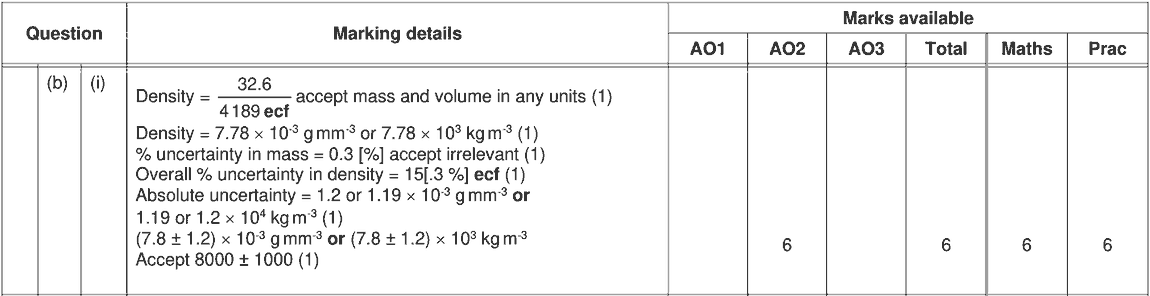
1.1-g the concept of density and how to use the equation ρ = m/V to calculate mass, density and volume
1.1-h what is meant by the turning effect of a force
1.1-i the use of the principle of moments
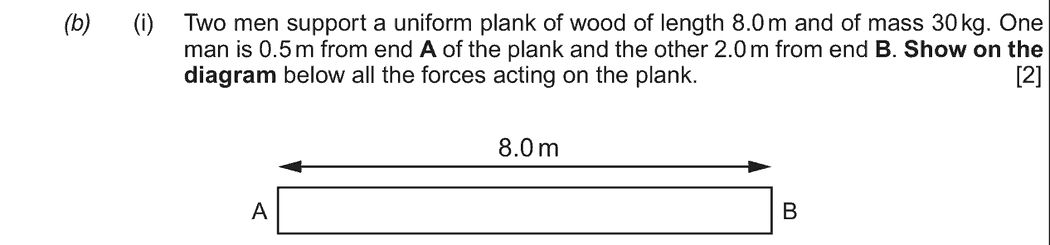
1.1-j the use of centre of gravity, for example in problems including stability: identify its position in a cylinder, sphere and cuboid (beam) of uniform density
1.1-k when a body is in equilibrium the resultant force is zero and the net moment is zero, and be able to perform simple calculations
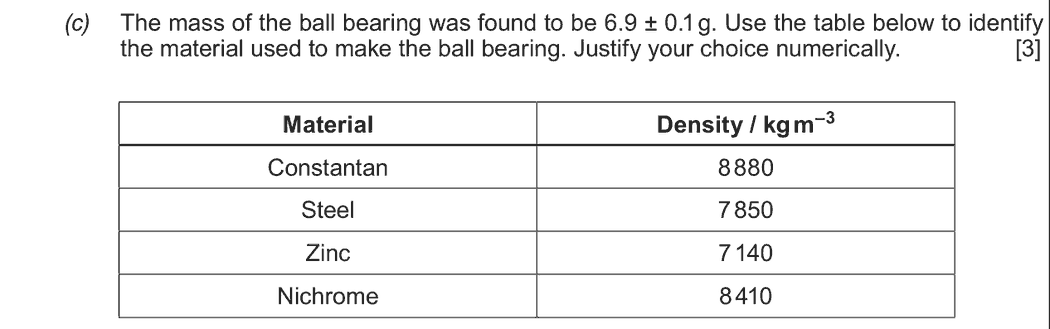
1.1-P1 Specified practical: Measurement of the density of solids
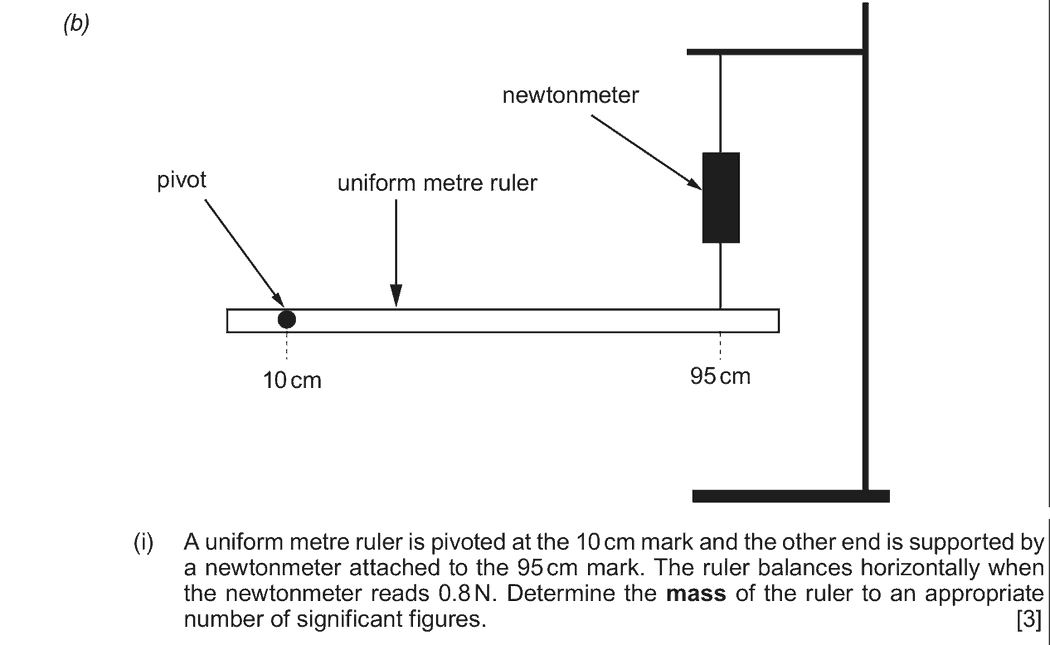
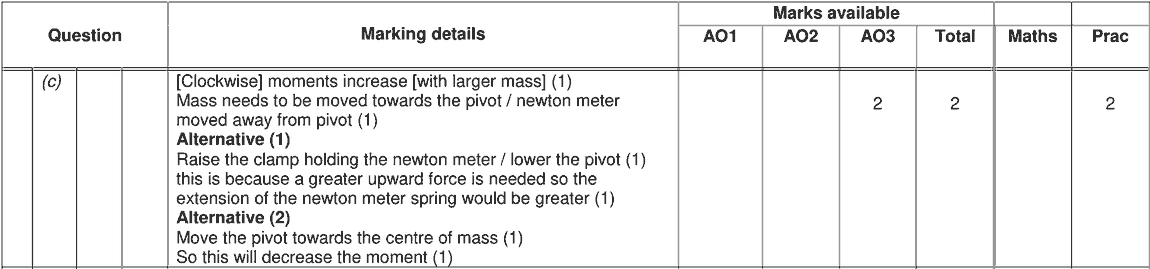
1.1-P2 Specified practical: Determination of unknown masses by using the principle of moments
. (a) Describe how you could determine the mass of an unknown object using only a metre ruler, pivoted at the 30 cm point, and a known mass. Assume both the known and unknown masses are similar to the mass of the metre r
Tap a question to zoom it. Where a part needs a figure, table or graph from earlier in the question, that part folds out above it; the mark scheme and examiner's comment open underneath. Have the Eduqas Data Booklet beside you (see the Data Booklet page).
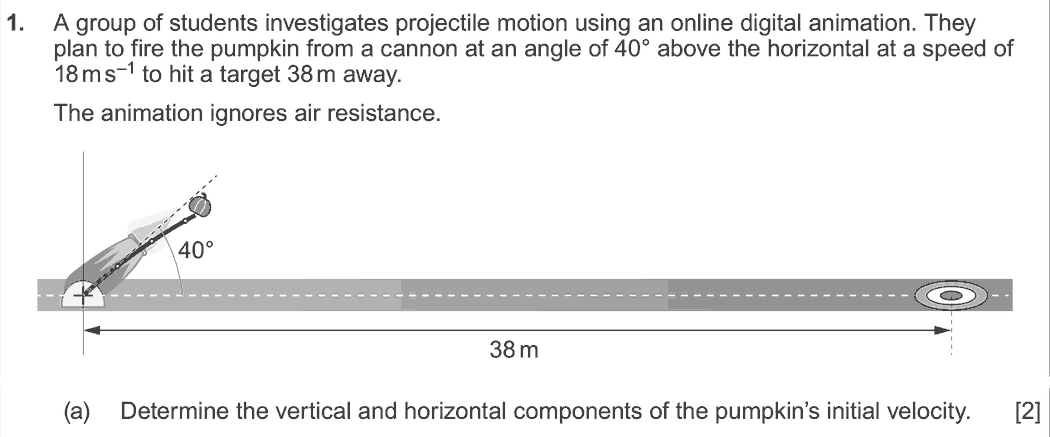
June 2025 · Component 1 · Q1(a)2 marksAO2=2Calculation
Mark scheme
Examiner's comment
This was very well answered by nearly all candidates. In some instances, candidates wrote down ‘18sin40’ and ‘18cos40’ but didn’t calculate a final answer. They were awarded 1 mark. It should be noted that calculated final answers are required.
Notes from the mark scheme and report
Answer: vertical 11.6 m s⁻¹ (18 sin 40°), horizontal 13.8 m s⁻¹ (18 cos 40°)
the expressions left unevaluated scored 1
Scheme columns: Maths 2
Skills: Trigonometryand vectors Resolving, components, vector addition, angles; Mathsmarks The mark scheme's Maths column gives this part at least one mark for mathematical skills
June 2025 · AS Component 1 · Q1(a)1 markAO1=1Short answer
Mark scheme
Notes from the mark scheme and report
A vector has direction as well as magnitude
a scalar has magnitude only
June 2025 · AS Component 1 · Q1(b)(i)2 marksAO3=2Calculation
Earlier part of question 1 that this part uses
Mark scheme
Notes from the mark scheme and report
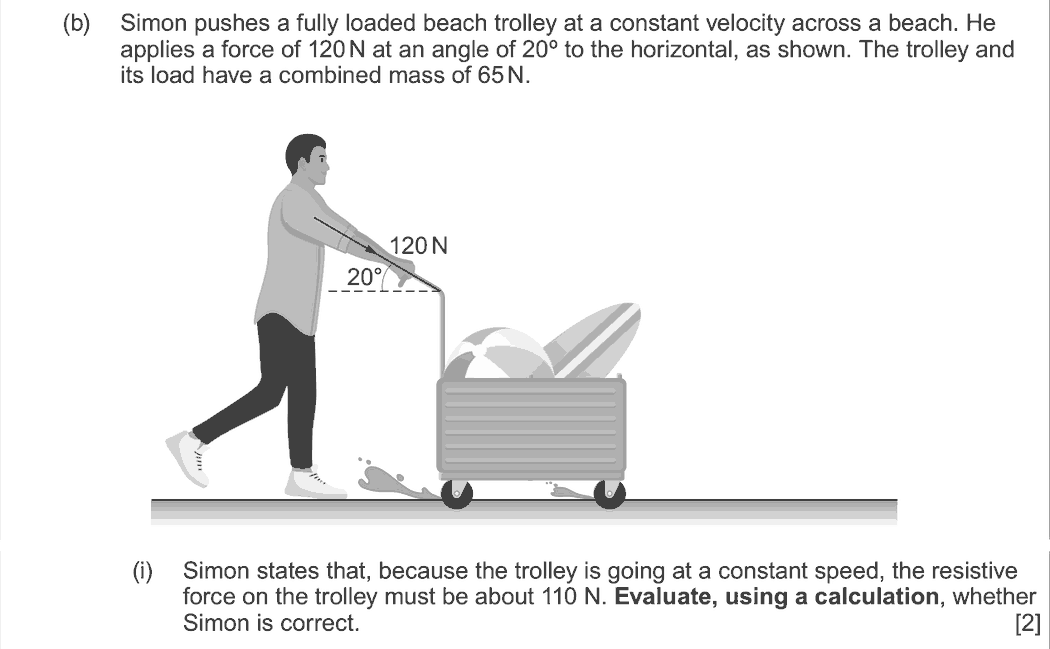
Horizontal component of the push = 120 cos 20° = 113 N (1)
constant velocity means zero resultant force, so the resistive force equals this, about 110 N, and Simon is correct (1)
Scheme columns: Maths 1
Skills: Trigonometryand vectors Resolving, components, vector addition, angles; Mathsmarks The mark scheme's Maths column gives this part at least one mark for mathematical skills
June 2025 · AS Component 1 · Q1(b)(ii)3 marksAO1=1, AO2=2Calculation
Earlier parts of question 1 that this part uses
Mark scheme
Notes from the mark scheme and report
Answer: 679 N. Weight = 65 × 9.81 = 638 N
downward component of the push = 120 sin 20° = 41 N
total = 638 + 41. The paper prints the mass as '65 N', so 65 + 41 = 106 N also earns full marks
Scheme columns: Maths 3
Skills: Trigonometryand vectors Resolving, components, vector addition, angles; Mathsmarks The mark scheme's Maths column gives this part at least one mark for mathematical skills
June 2025 · AS Component 1 · Q1(b)(iii)3 marksAO2=3Explanation
Earlier parts of question 1 that this part uses
Mark scheme
Notes from the mark scheme and report
Pulling gives the applied force an upward vertical component (1), so the downward force on the sand is less than the weight (1)
the wheels sink in less, the resistance is lower and a smaller force is needed (1)
June 2025 · AS Component 1 · Q2(a)1 markAO1=1Definition
Mark scheme
Notes from the mark scheme and report
The single point at which the whole weight of the object can be taken to act
June 2025 · AS Component 1 · Q2(b)(i)2 marksAO1=2Diagram or graph
Earlier part of question 2 that this part uses
Mark scheme
Notes from the mark scheme and report
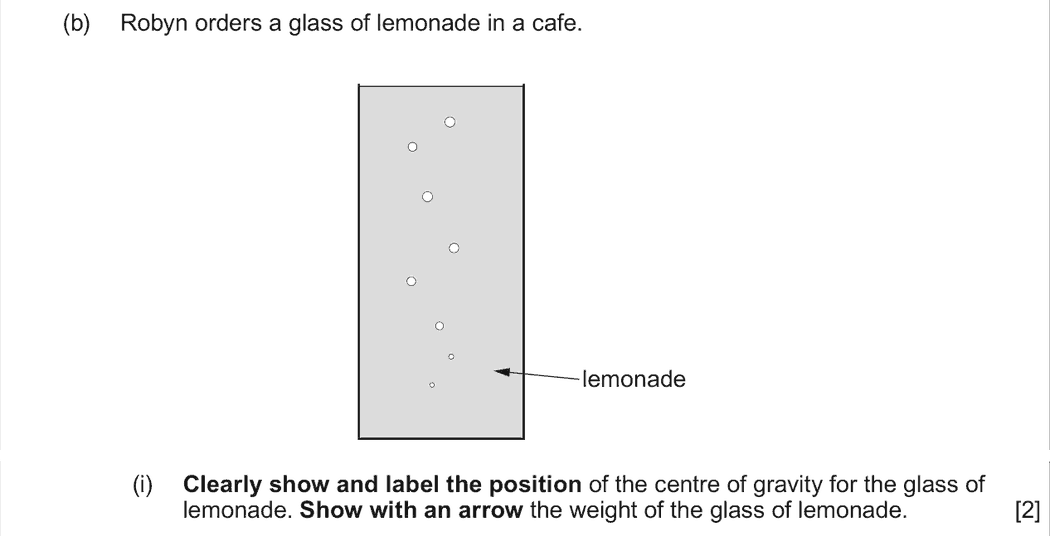
Point marked and labelled at the centre of the glass (where the diagonals cross) (1)
arrow from that point vertically downwards for the weight (1)
June 2025 · AS Component 1 · Q2(b)(ii)2 marksAO3=2Explanation
Earlier parts of question 2 that this part uses
Mark scheme
Notes from the mark scheme and report
Mali is correct (no mark alone): a half-full glass has a lower centre of gravity (1), so it must be tilted through a larger angle before the line of action of the weight passes outside the base and it topples (1)
June 2025 · AS Component 1 · Q2(b)(iii)3 marksAO2=3Explanation
Earlier parts of question 2 that this part uses
Mark scheme
Notes from the mark scheme and report
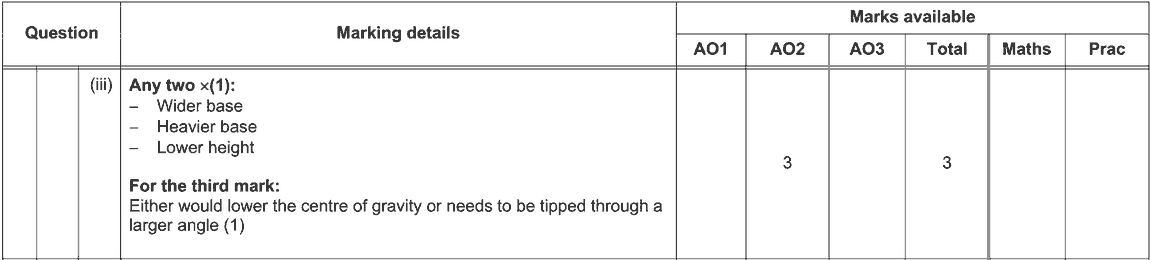
Any two features: wider base, heavier base, shorter glass (2)
explanation: lowers the centre of gravity, or the glass must be tipped through a larger angle before the weight acts outside the base (1)
June 2025 · AS Component 1 · Q4(c)4 marksAO1=2, AO2=2Calculation
Earlier part of question 4 that this part uses
Mark scheme
Notes from the mark scheme and report
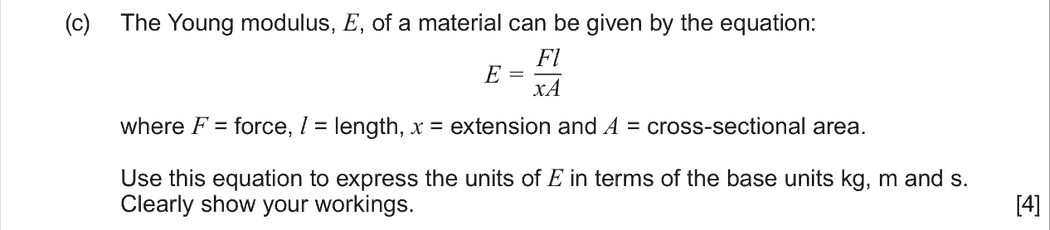
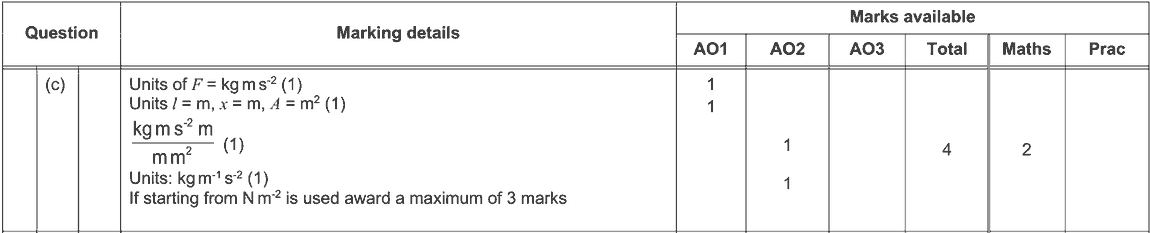
Answer: kg m⁻¹ s⁻². Force: kg m s⁻² (1)
l and x in m, A in m² (1)
(kg m s⁻² × m)/(m × m²) (1) simplifies to kg m⁻¹ s⁻² (1)
starting from N m⁻² scores at most 3
Scheme columns: Maths 2
Skills: Unitsand conversions Unit marks, base units, prefixes and conversions; Mathsmarks The mark scheme's Maths column gives this part at least one mark for mathematical skills
June 2025 · Component 1 · Q5(b)(i)3 marksAO1=2, AO2=1Show that
Earlier part of question 5 that this part uses
Mark scheme
Examiner's comment
This was very well answered. We saw some excellent use of indices and communication was often clear. We did see candidates writing that the 2𝜋 had no units which was pleasing. We did on this occasion allow the disappearance of 2𝜋 but those that left it in place often tripped up when completing the final balancing act and were penalised.
Notes from the mark scheme and report
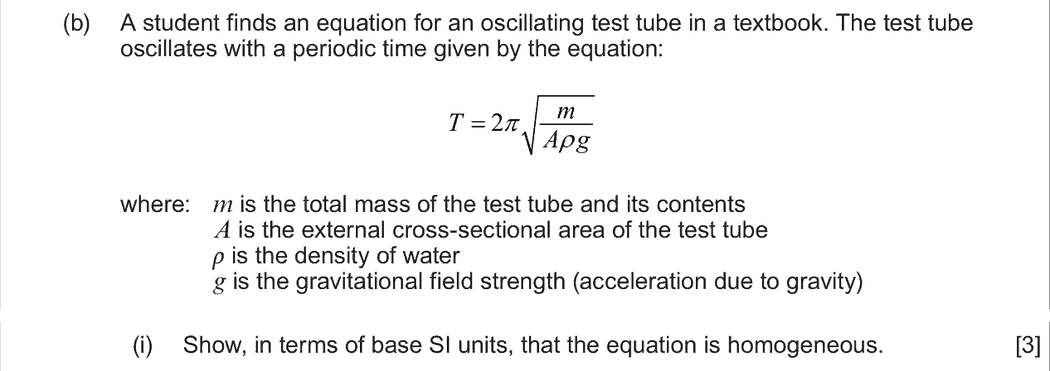
T in s
m in kg, A in m² (1)
ρ in kg m⁻³, g in m s⁻² (1)
right-hand side: √(kg/(m² × kg m⁻³ × m s⁻²)) = √(s²) = s, 2π having no unit (1)
Scheme columns: Maths 1
Skills: Unitsand conversions Unit marks, base units, prefixes and conversions; Algebra Derivations and rearranging equations; Mathsmarks The mark scheme's Maths column gives this part at least one mark for mathematical skills
June 2024 · Component 1 · Q1(a)(i)1 markAO1=1Practical and data analysis
Mark scheme
Examiner's comment
Nearly all candidates answered this correctly. Sporadically, we saw answers of ‘0.1’ and ‘0.005’ and these were not awarded credit.
Notes from the mark scheme and report
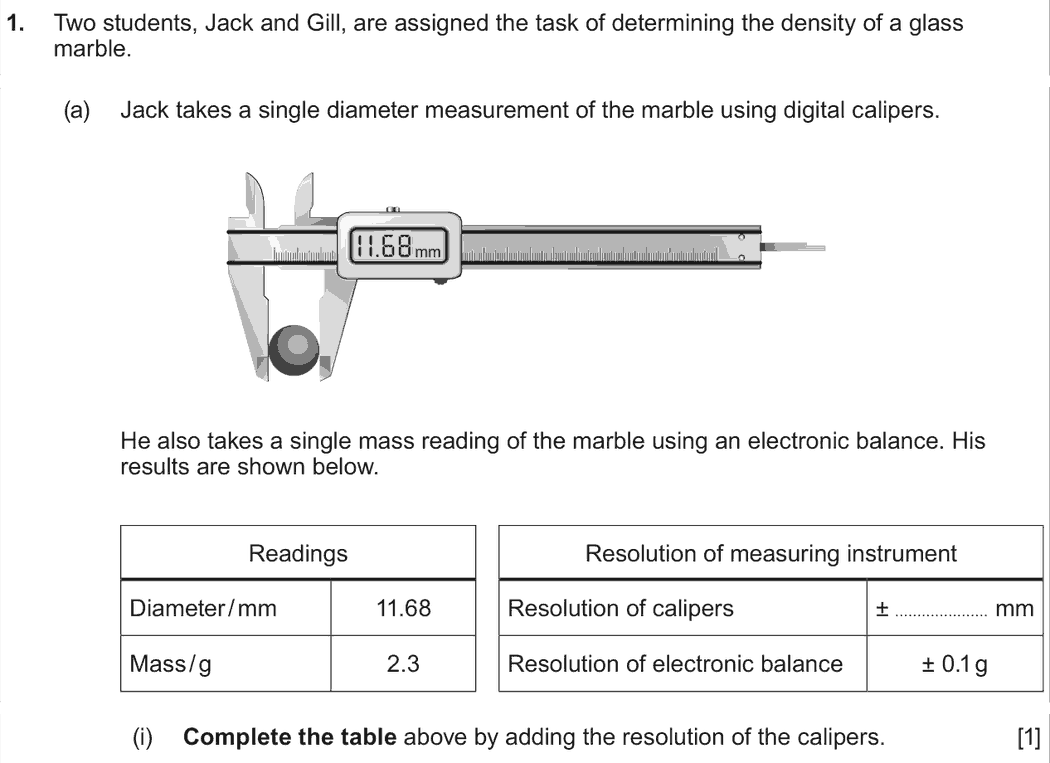
Answer: ± 0.01 mm (resolution of the digital calipers)
0.1 and 0.005 were not credited
Scheme columns: Practical 1
Skills: Uncertainties Resolution, absolute and percentage uncertainty, combining uncertainties, error bars; Practicalmarks The mark scheme's Prac column gives this part at least one mark for practical skills
June 2024 · AS Component 1 · Q1(a)(i)2 marksAO1=2Short answer
Mark scheme
Examiner's comment
This was a nice straightforward start to the paper. It was generally very well answered with the vast majority understanding the difference between vectors and scalars and applying Pythagoras correctly. It was pleasing to see in (b)(i) that candidates included the angle with the magnitude. However, in (b)(ii) a number only obtained one mark because they did not include the direction.
Notes from the mark scheme and report
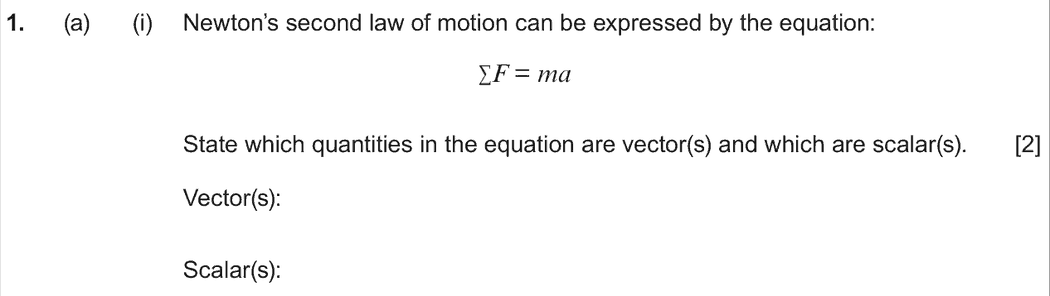
Vectors: (resultant) force and acceleration (1)
scalar: mass (1)
June 2024 · Component 1 · Q1(a)(ii)1 markAO2=1Practical and data analysis
Earlier part of question 1 that this part uses
Mark scheme
Examiner's comment
& (iii) Many candidates answered these questions correctly. Some candidates, after stating that Jack should add 0.04 mm to the d value in (ii), did not go on to do this in (iii) when calculating the density. They lost the 2nd mark in (ii). Others who stated he should subtract the 0.04 mm were not awarded credit in (i) but generally went on to get 2 marks in (ii) with ecf.
Notes from the mark scheme and report
Zero error: add 0.04 mm to the diameter reading (11.68 mm becomes 11.72 mm)
Scheme columns: Practical 1
Skills: Experimentalmethod Describing, planning or improving an experiment; Practicalmarks The mark scheme's Prac column gives this part at least one mark for practical skills
June 2024 · AS Component 1 · Q1(a)(ii)2 marksAO1=2Short answer
Earlier part of question 1 that this part uses
Mark scheme
Examiner's comment
This was a nice straightforward start to the paper. It was generally very well answered with the vast majority understanding the difference between vectors and scalars and applying Pythagoras correctly. It was pleasing to see in (b)(i) that candidates included the angle with the magnitude. However, in (b)(ii) a number only obtained one mark because they did not include the direction.
Notes from the mark scheme and report
A vector has direction as well as magnitude, a scalar has magnitude only (1)
a further example of each, e.g. velocity or displacement and speed or distance, both needed (1)
June 2024 · Component 1 · Q1(a)(iii)2 marksAO1=1, AO2=1Show that
Earlier part of question 1 that this part uses
Mark scheme
Notes from the mark scheme and report
Use of ρ = m/V with V = (4/3)πr³ and r = 1.172/2 cm
ρ = 2.3/0.843 = 2.73 g cm⁻³
ecf from (ii)
some did not use the corrected diameter
Scheme columns: Maths 1, Practical 2
Skills: Unitsand conversions Unit marks, base units, prefixes and conversions; Mathsmarks The mark scheme's Maths column gives this part at least one mark for mathematical skills; Practicalmarks The mark scheme's Prac column gives this part at least one mark for practical skills
June 2024 · Component 1 · Q1(b)4 marksAO3=4Practical and data analysis
Earlier part of question 1 that this part uses
Mark scheme
Examiner's comment
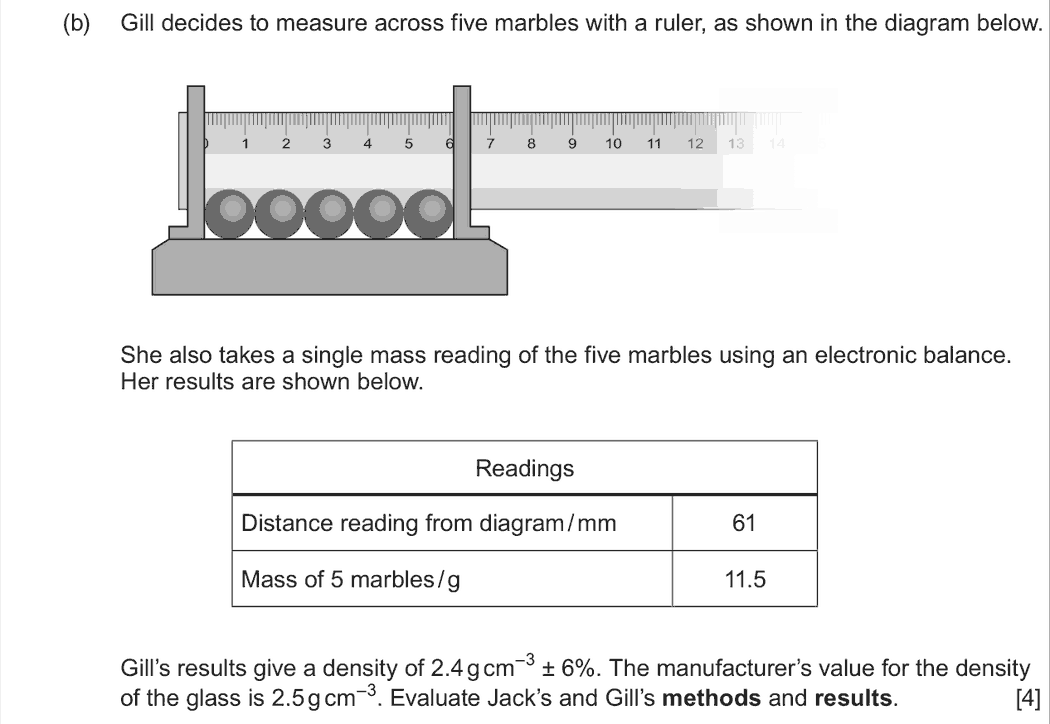
Several different approaches were seen by candidates in this AO3 question. We were looking for good comments regarding Jack and Gill’s methods for obtaining the diameter (1 mark) and mass (1 mark). Responses that compared their density values were able to access the final 2 marks. Good responses included comments stating that the actual value was within Gill’s error range and usually calculated the percentage uncertainty in Jack’s results. Not all percentage uncertainty calculations included the factor of 3 because of the cubed term in the volume equation. Better responses would firstly comment on Gill’s method reducing the percentage uncertainty and showed a consideration of apparatus resolution when measuring the diameter. The measurement of mass was too often overlooked but candidates who attempted this usually did manage to gain credit. Comments about ‘uncertainty’ were sometimes vague. Candidates should be encouraged to specify either ‘absolute’ or ‘percentage’ in their evaluative comments.
Notes from the mark scheme and report
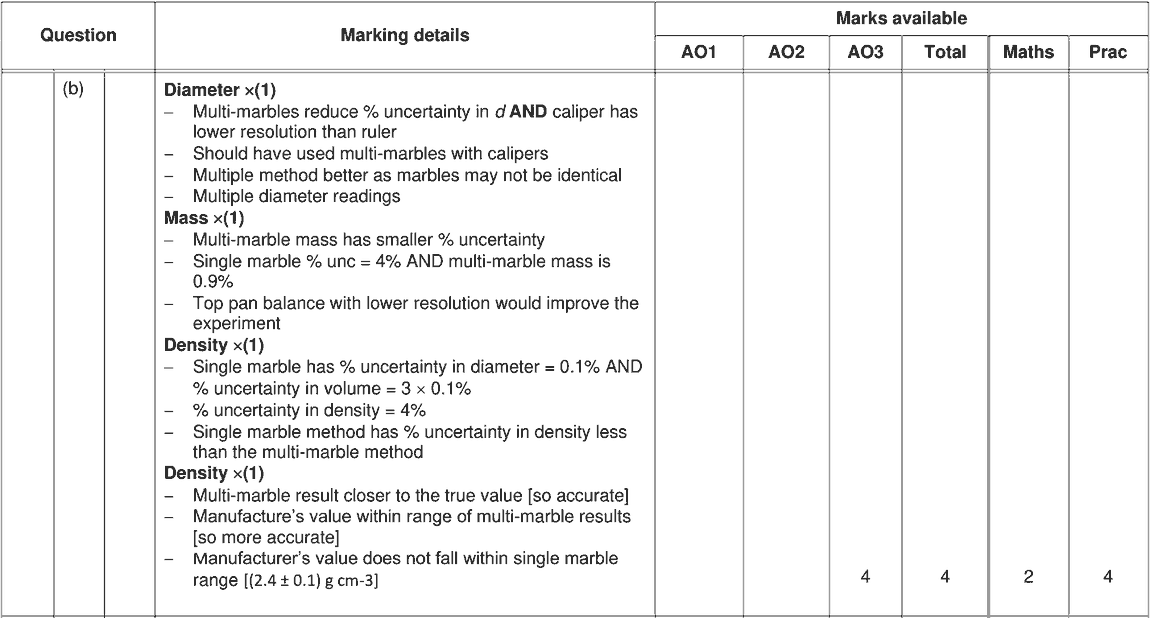
One mark each: diameter method (five marbles reduce the % uncertainty in d but the ruler has poorer resolution than the calipers)
mass method (five marbles give a smaller % uncertainty, 0.9% against 4%)
density uncertainty (single marble about 4%, less than Gill's 6%)
results (manufacturer's 2.5 g cm⁻³ lies within Gill's range but not Jack's)
Scheme columns: Maths 2, Practical 4
Skills: Uncertainties Resolution, absolute and percentage uncertainty, combining uncertainties, error bars; Mathsmarks The mark scheme's Maths column gives this part at least one mark for mathematical skills; Practicalmarks The mark scheme's Prac column gives this part at least one mark for practical skills
June 2024 · AS Component 1 · Q1(b)(i)4 marksAO1=1, AO2=3Calculation
Earlier part of question 1 that this part uses
Mark scheme
Examiner's comment
This was a nice straightforward start to the paper. It was generally very well answered with the vast majority understanding the difference between vectors and scalars and applying Pythagoras correctly. It was pleasing to see in (b)(i) that candidates included the angle with the magnitude. However, in (b)(ii) a number only obtained one mark because they did not include the direction.
Notes from the mark scheme and report
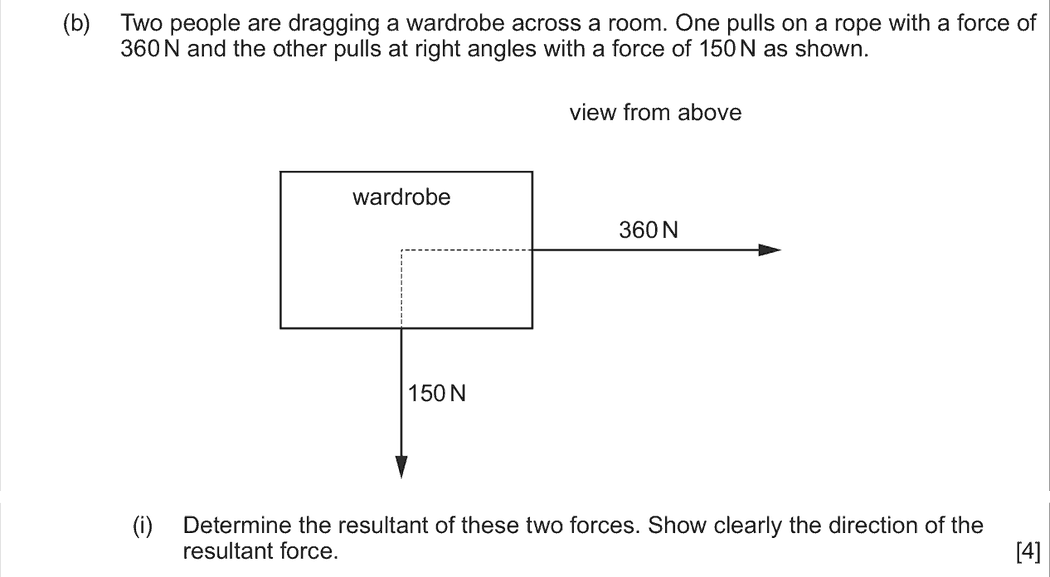
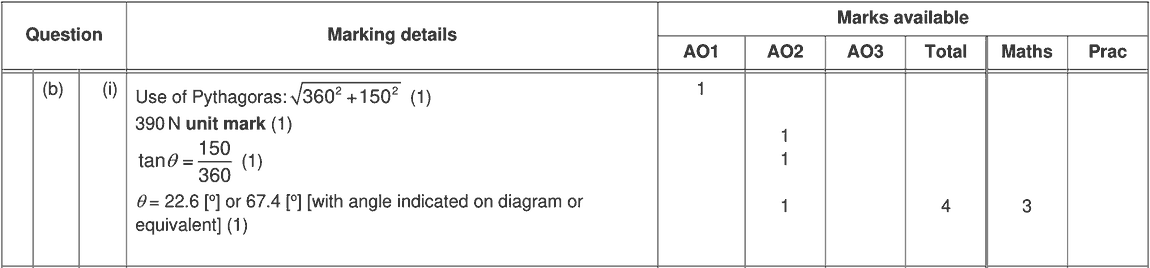
Answer: 390 N at 22.6° to the 360 N force (67.4° to the 150 N force). Pythagoras √(360² + 150²) with unit
tan θ = 150/360
the angle must be shown on the diagram or described
Scheme columns: Maths 3
Skills: Trigonometryand vectors Resolving, components, vector addition, angles; Mathsmarks The mark scheme's Maths column gives this part at least one mark for mathematical skills
June 2024 · AS Component 1 · Q1(b)(ii)2 marksAO2=2Short answer
Earlier parts of question 1 that this part uses
Mark scheme
Examiner's comment
This was a nice straightforward start to the paper. It was generally very well answered with the vast majority understanding the difference between vectors and scalars and applying Pythagoras correctly. It was pleasing to see in (b)(i) that candidates included the angle with the magnitude. However, in (b)(ii) a number only obtained one mark because they did not include the direction.
Notes from the mark scheme and report
Answer: 390 N in the opposite direction to the resultant pull (zero resultant force at constant velocity)
ecf from (i)
a number gave the size without the direction and scored 1
June 2024 · AS Component 1 · Q2(a)2 marksAO1=1, AO2=1Show that
Mark scheme
Examiner's comment
It was apparent that the candidates understood equations of motion very well. In (b)(i) six marks were available and many candidates scored full marks.
Notes from the mark scheme and report
v and u are in m s⁻¹ (1)
at is m s⁻² × s = m s⁻¹, so every term has the same units (1)
Scheme columns: Maths 1
Skills: Unitsand conversions Unit marks, base units, prefixes and conversions; Mathsmarks The mark scheme's Maths column gives this part at least one mark for mathematical skills
June 2024 · AS Component 1 · Q3(b)(ii)3 marksAO2=3Calculation
Earlier parts of question 3 that this part uses
Mark scheme
Examiner's comment
The definition in part (a) was generally well done. Few problems were seen with applying the equations in parts (b)(i)-(iii). In (b)(iv) a few candidates added the energies together before dividing and so lost one mark. Surprisingly in part (c) most candidates only gave one reason even though the question was worth 2 marks.
Notes from the mark scheme and report
Answer: 4370 J (4369 J). Height gained = 200 sin 1.5° = 5.24 m
ΔEp = 85 × 9.81 × 5.24
Scheme columns: Maths 3
Skills: Trigonometryand vectors Resolving, components, vector addition, angles; Mathsmarks The mark scheme's Maths column gives this part at least one mark for mathematical skills
June 2024 · Component 1 · Q3(b)(iii)3 marksAO1=1, AO2=2CalculationEasy
Earlier parts of question 3 that this part uses
Mark scheme
Examiner's comment
Components along the slope was the most readily used approach to answering this question, however, we did see a mixture of both methods covered in the mark scheme. Those that used the energy route already had values calculated in readiness for (c).
Notes from the mark scheme and report
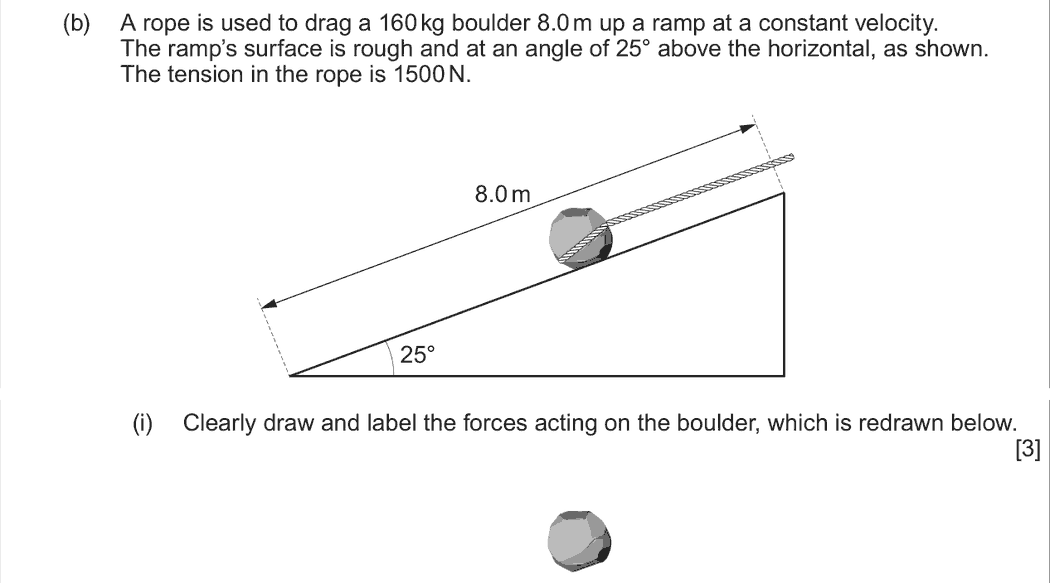
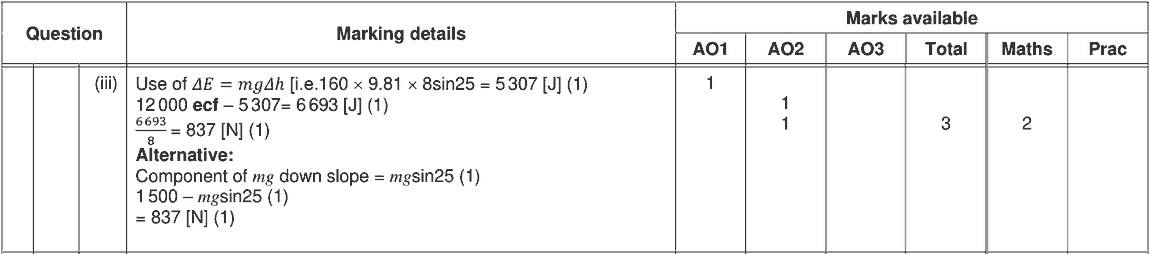
Answer: 837 N. Energy route: gain in gravitational PE = 160 × 9.81 × 8 sin 25° = 5307 J
work against friction = 12 000 − 5307 = 6693 J
F = 6693/8. Force route: 1500 − mg sin 25°
Scheme columns: Maths 2
Skills: Trigonometryand vectors Resolving, components, vector addition, angles; Mathsmarks The mark scheme's Maths column gives this part at least one mark for mathematical skills
June 2024 · Component 3 · Q8(b)3 marksAO1=1, AO2=2Calculation
Earlier part of question 8 that this part uses
Mark scheme
Examiner's comment
The calculation was well done. A small number of candidates used the diameter instead of the radius so they lost one mark only.
Notes from the mark scheme and report
Answer: 0.263 kg. Cross-section = π(0.0080² − 0.0075²) = 2.43 × 10⁻⁵ m²
volume = area × 1.205
mass = 8960 × volume
using diameters as radii gives 1.05 kg (2 marks)
Scheme columns: Maths 3
Skills: Synoptic Needs physics from another component of the qualification; Unitsand conversions Unit marks, base units, prefixes and conversions; Mathsmarks The mark scheme's Maths column gives this part at least one mark for mathematical skills
June 2023 · Component 1 · Q1(a)1 markAO3=1Practical and data analysis
Mark scheme
Examiner's comment
After careful consideration of the diagram in (a), most candidates were able to suggest a way of ensuring the ruler was level. These included spirit levels, vertical height measurements and use of set squares or protractors. In (b) many candidates were able to define the centre of gravity. A small number confused mass with weight and were not awarded credit. Less candidates picked up the second mark as their attempts at labelling the centre of gravity on the ruler were not clear. Responses that didn’t score both marks in (c)(i) failed to include ‘sum of…’ or ‘total clockwise equals total anticlockwise…’. A small number incorrectly used ‘an enclosed system’ in place of ‘a system in equilibrium’. There were many good responses to (c)(ii) that included the principle of moments and convincing algebra. Clearly dividing by 0.8 was enough, however, in many responses candidates showed clear algebraic steps in their workings. Some weaker responses appeared to reverse engineer a response which sometimes left an incorrect ‘0.5 W’ in the starting equation. This year there was no credit for stating the point where moments were taken, although it was good to see candidates demonstrating this. In (d) many candidates did identify the first result as the anomaly. A good appreciation of 𝑦= 𝑚𝑥+ 𝑐 and use of the T intercept often followed. Some candidates used the gradient to calculate the value of W. Weaker responses included the thinking that the gradient of their graph was ‘𝑎 + 𝑊 2 ’ and attempted to proceed with this. This was not credited. Many good evaluative responses were seen in the last part and responses depended on how candidates had tackled the previous question part. Good use of ‘accuracy’ was common.
Notes from the mark scheme and report
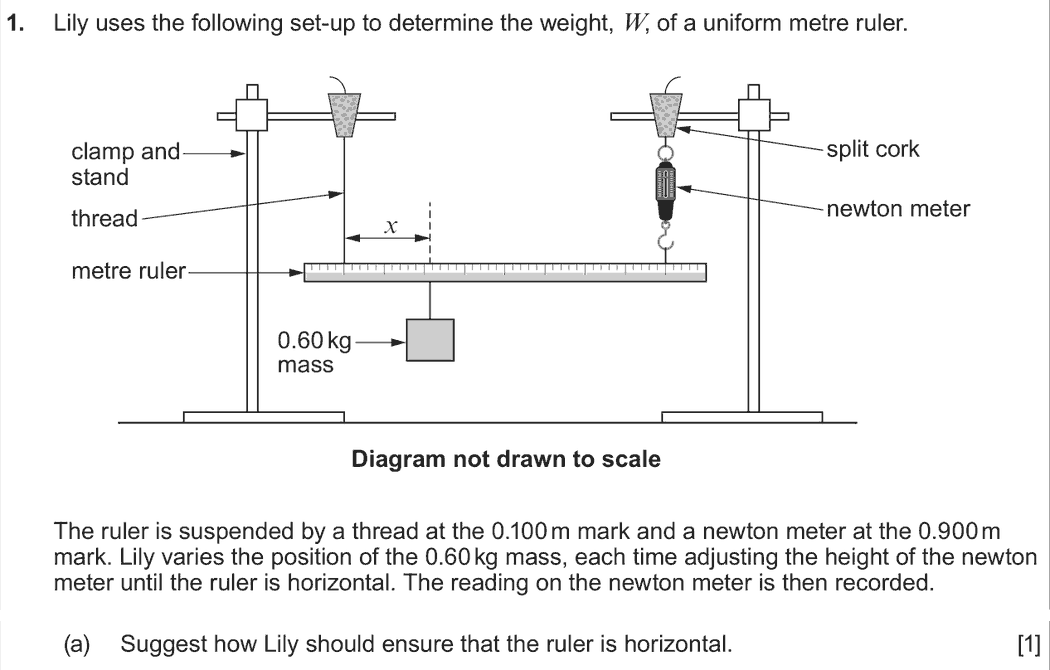
Measure the height of the ruler above the bench at both ends, or use a spirit level
set square or protractor checks against the vertical threads also accepted
Scheme columns: Practical 1
Skills: Experimentalmethod Describing, planning or improving an experiment; Practicalmarks The mark scheme's Prac column gives this part at least one mark for practical skills
June 2023 · AS Component 1 · Q1(a)(i)1 markAO1=1Short answer
Mark scheme
Examiner's comment
Vectors very well done with the majority of candidates realising that an angle needed to be determined along with the force.
Notes from the mark scheme and report
A vector has direction as well as magnitude
a scalar has magnitude only
June 2023 · AS Component 1 · Q1(a)(ii)2 marksAO1=2Short answer
Earlier part of question 1 that this part uses
Mark scheme
Examiner's comment
Vectors very well done with the majority of candidates realising that an angle needed to be determined along with the force.
Notes from the mark scheme and report
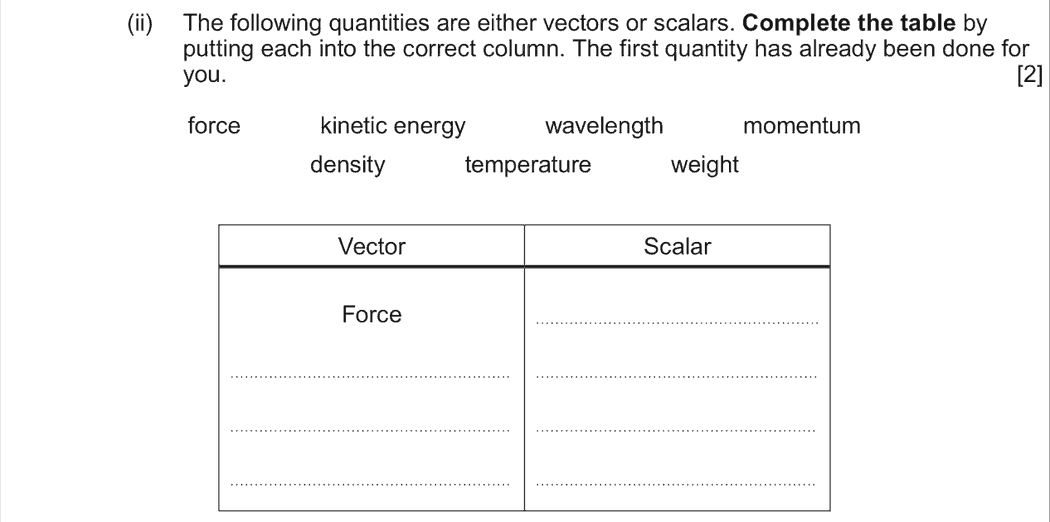
Vectors: momentum, weight (and force). Scalars: kinetic energy, wavelength, density, temperature. One mistake scores 1, two or more score 0
June 2023 · Component 1 · Q1(b)2 marksAO1=2Definition
Earlier part of question 1 that this part uses
Mark scheme
Examiner's comment
After careful consideration of the diagram in (a), most candidates were able to suggest a way of ensuring the ruler was level. These included spirit levels, vertical height measurements and use of set squares or protractors. In (b) many candidates were able to define the centre of gravity. A small number confused mass with weight and were not awarded credit. Less candidates picked up the second mark as their attempts at labelling the centre of gravity on the ruler were not clear. Responses that didn’t score both marks in (c)(i) failed to include ‘sum of…’ or ‘total clockwise equals total anticlockwise…’. A small number incorrectly used ‘an enclosed system’ in place of ‘a system in equilibrium’. There were many good responses to (c)(ii) that included the principle of moments and convincing algebra. Clearly dividing by 0.8 was enough, however, in many responses candidates showed clear algebraic steps in their workings. Some weaker responses appeared to reverse engineer a response which sometimes left an incorrect ‘0.5 W’ in the starting equation. This year there was no credit for stating the point where moments were taken, although it was good to see candidates demonstrating this. In (d) many candidates did identify the first result as the anomaly. A good appreciation of 𝑦= 𝑚𝑥+ 𝑐 and use of the T intercept often followed. Some candidates used the gradient to calculate the value of W. Weaker responses included the thinking that the gradient of their graph was ‘𝑎 + 𝑊 2 ’ and attempted to proceed with this. This was not credited. Many good evaluative responses were seen in the last part and responses depended on how candidates had tackled the previous question part. Good use of ‘accuracy’ was common.
Notes from the mark scheme and report
The point at which the whole weight of the object can be taken to act (1)
marked at the centre (0.500 m mark) of the uniform ruler (1)
mass confused with weight and unclear marking on the diagram lost marks
Scheme columns: Practical 1
Skills: Practicalmarks The mark scheme's Prac column gives this part at least one mark for practical skills
June 2023 · AS Component 1 · Q1(b)(i)4 marksAO1=1, AO2=3Calculation
Earlier parts of question 1 that this part uses
Mark scheme
Examiner's comment
Vectors very well done with the majority of candidates realising that an angle needed to be determined along with the force.
Notes from the mark scheme and report
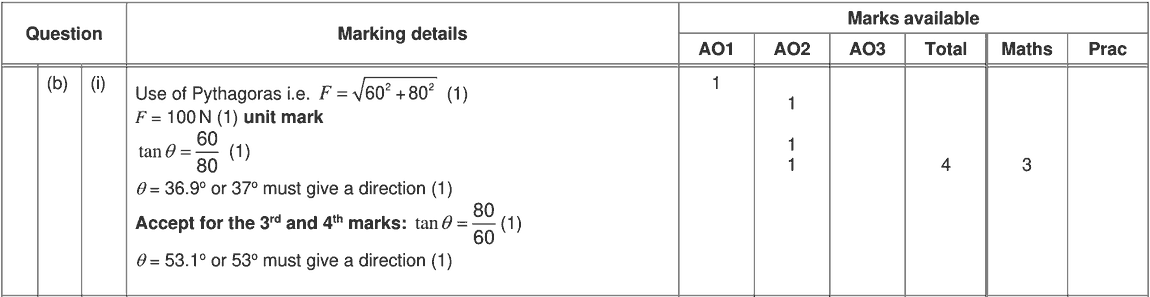
Answer: 100 N at 37° north of east (53° east of north). F = √(60² + 80²)
tan θ = 60/80
unit mark
the angle must come with a stated direction
Scheme columns: Maths 3
Skills: Trigonometryand vectors Resolving, components, vector addition, angles; Unitsand conversions Unit marks, base units, prefixes and conversions; Mathsmarks The mark scheme's Maths column gives this part at least one mark for mathematical skills
June 2023 · AS Component 1 · Q1(b)(ii)2 marksAO2=2Short answer
Earlier parts of question 1 that this part uses
Mark scheme
Examiner's comment
Vectors very well done with the majority of candidates realising that an angle needed to be determined along with the force.
Notes from the mark scheme and report
Answer: 100 N in the opposite direction to the resultant push (37° south of west). Constant velocity means zero resultant force
ecf from (i)
June 2023 · Component 1 · Q1(c)(i)2 marksAO1=2Definition
Earlier part of question 1 that this part uses
Mark scheme
Examiner's comment
After careful consideration of the diagram in (a), most candidates were able to suggest a way of ensuring the ruler was level. These included spirit levels, vertical height measurements and use of set squares or protractors. In (b) many candidates were able to define the centre of gravity. A small number confused mass with weight and were not awarded credit. Less candidates picked up the second mark as their attempts at labelling the centre of gravity on the ruler were not clear. Responses that didn’t score both marks in (c)(i) failed to include ‘sum of…’ or ‘total clockwise equals total anticlockwise…’. A small number incorrectly used ‘an enclosed system’ in place of ‘a system in equilibrium’. There were many good responses to (c)(ii) that included the principle of moments and convincing algebra. Clearly dividing by 0.8 was enough, however, in many responses candidates showed clear algebraic steps in their workings. Some weaker responses appeared to reverse engineer a response which sometimes left an incorrect ‘0.5 W’ in the starting equation. This year there was no credit for stating the point where moments were taken, although it was good to see candidates demonstrating this. In (d) many candidates did identify the first result as the anomaly. A good appreciation of 𝑦= 𝑚𝑥+ 𝑐 and use of the T intercept often followed. Some candidates used the gradient to calculate the value of W. Weaker responses included the thinking that the gradient of their graph was ‘𝑎 + 𝑊 2 ’ and attempted to proceed with this. This was not credited. Many good evaluative responses were seen in the last part and responses depended on how candidates had tackled the previous question part. Good use of ‘accuracy’ was common.
Notes from the mark scheme and report
For a system in equilibrium (1) the sum of the clockwise moments about any point equals the sum of the anticlockwise moments about the same point (1)
'sum of' was often missing and 'closed system' is not equilibrium
June 2023 · Component 1 · Q1(c)(ii)2 marksAO2=2Show that
Earlier parts of question 1 that this part uses
Mark scheme
Examiner's comment
After careful consideration of the diagram in (a), most candidates were able to suggest a way of ensuring the ruler was level. These included spirit levels, vertical height measurements and use of set squares or protractors. In (b) many candidates were able to define the centre of gravity. A small number confused mass with weight and were not awarded credit. Less candidates picked up the second mark as their attempts at labelling the centre of gravity on the ruler were not clear. Responses that didn’t score both marks in (c)(i) failed to include ‘sum of…’ or ‘total clockwise equals total anticlockwise…’. A small number incorrectly used ‘an enclosed system’ in place of ‘a system in equilibrium’. There were many good responses to (c)(ii) that included the principle of moments and convincing algebra. Clearly dividing by 0.8 was enough, however, in many responses candidates showed clear algebraic steps in their workings. Some weaker responses appeared to reverse engineer a response which sometimes left an incorrect ‘0.5 W’ in the starting equation. This year there was no credit for stating the point where moments were taken, although it was good to see candidates demonstrating this. In (d) many candidates did identify the first result as the anomaly. A good appreciation of 𝑦= 𝑚𝑥+ 𝑐 and use of the T intercept often followed. Some candidates used the gradient to calculate the value of W. Weaker responses included the thinking that the gradient of their graph was ‘𝑎 + 𝑊 2 ’ and attempted to proceed with this. This was not credited. Many good evaluative responses were seen in the last part and responses depended on how candidates had tackled the previous question part. Good use of ‘accuracy’ was common.
Notes from the mark scheme and report
Moments about the thread at the 0.100 m mark: 0.60 g x + W × 0.40 = T × 0.80 (1)
divide by 0.80 to give T = 7.36x + W/2 (1)
some worked backwards and left 0.5W in the first line
Scheme columns: Maths 2, Practical 2
Skills: Algebra Derivations and rearranging equations; Mathsmarks The mark scheme's Maths column gives this part at least one mark for mathematical skills; Practicalmarks The mark scheme's Prac column gives this part at least one mark for practical skills
June 2023 · Component 1 · Q1(d)(i)3 marksAO2=3Practical and data analysis
Earlier part of question 1 that this part uses
Mark scheme
Examiner's comment
After careful consideration of the diagram in (a), most candidates were able to suggest a way of ensuring the ruler was level. These included spirit levels, vertical height measurements and use of set squares or protractors. In (b) many candidates were able to define the centre of gravity. A small number confused mass with weight and were not awarded credit. Less candidates picked up the second mark as their attempts at labelling the centre of gravity on the ruler were not clear. Responses that didn’t score both marks in (c)(i) failed to include ‘sum of…’ or ‘total clockwise equals total anticlockwise…’. A small number incorrectly used ‘an enclosed system’ in place of ‘a system in equilibrium’. There were many good responses to (c)(ii) that included the principle of moments and convincing algebra. Clearly dividing by 0.8 was enough, however, in many responses candidates showed clear algebraic steps in their workings. Some weaker responses appeared to reverse engineer a response which sometimes left an incorrect ‘0.5 W’ in the starting equation. This year there was no credit for stating the point where moments were taken, although it was good to see candidates demonstrating this. In (d) many candidates did identify the first result as the anomaly. A good appreciation of 𝑦= 𝑚𝑥+ 𝑐 and use of the T intercept often followed. Some candidates used the gradient to calculate the value of W. Weaker responses included the thinking that the gradient of their graph was ‘𝑎 + 𝑊 2 ’ and attempted to proceed with this. This was not credited. Many good evaluative responses were seen in the last part and responses depended on how candidates had tackled the previous question part. Good use of ‘accuracy’ was common.
Notes from the mark scheme and report
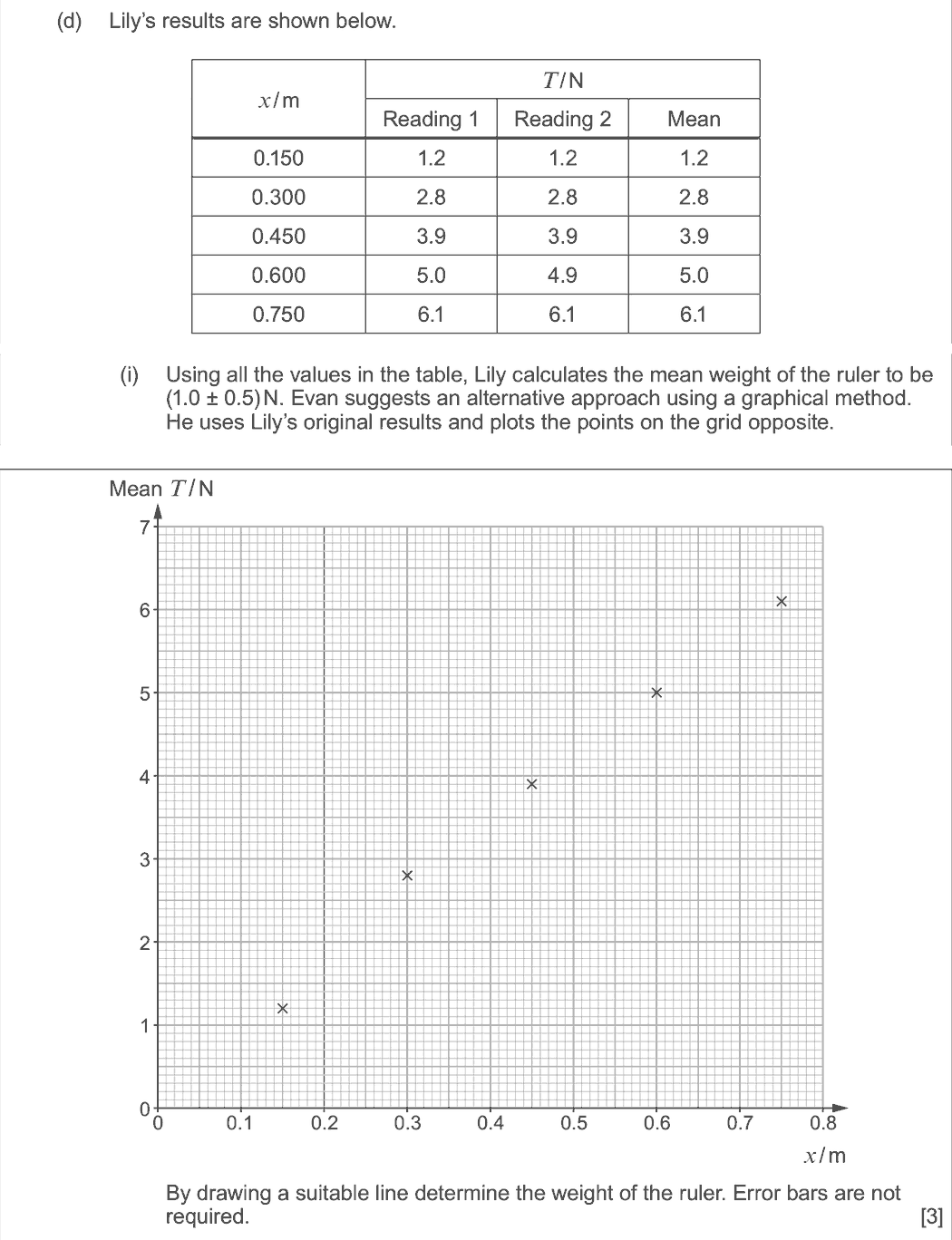
Answer: about 1.2 N. Best-fit straight line ignoring the anomalous first point (1)
intercept on the T axis about 0.6 N (or gradient and a point on the line) (1)
W = 2 × intercept (1)
treating the gradient as a + W/2 was not credited
Scheme columns: Maths 2, Practical 3
Skills: Graphskills Reading, plotting or sketching graphs; gradients, intercepts and areas; Mathsmarks The mark scheme's Maths column gives this part at least one mark for mathematical skills; Practicalmarks The mark scheme's Prac column gives this part at least one mark for practical skills
June 2023 · Component 1 · Q1(d)(ii)2 marksAO3=2Practical and data analysis
Earlier parts of question 1 that this part uses
Mark scheme
Examiner's comment
After careful consideration of the diagram in (a), most candidates were able to suggest a way of ensuring the ruler was level. These included spirit levels, vertical height measurements and use of set squares or protractors. In (b) many candidates were able to define the centre of gravity. A small number confused mass with weight and were not awarded credit. Less candidates picked up the second mark as their attempts at labelling the centre of gravity on the ruler were not clear. Responses that didn’t score both marks in (c)(i) failed to include ‘sum of…’ or ‘total clockwise equals total anticlockwise…’. A small number incorrectly used ‘an enclosed system’ in place of ‘a system in equilibrium’. There were many good responses to (c)(ii) that included the principle of moments and convincing algebra. Clearly dividing by 0.8 was enough, however, in many responses candidates showed clear algebraic steps in their workings. Some weaker responses appeared to reverse engineer a response which sometimes left an incorrect ‘0.5 W’ in the starting equation. This year there was no credit for stating the point where moments were taken, although it was good to see candidates demonstrating this. In (d) many candidates did identify the first result as the anomaly. A good appreciation of 𝑦= 𝑚𝑥+ 𝑐 and use of the T intercept often followed. Some candidates used the gradient to calculate the value of W. Weaker responses included the thinking that the gradient of their graph was ‘𝑎 + 𝑊 2 ’ and attempted to proceed with this. This was not credited. Many good evaluative responses were seen in the last part and responses depended on how candidates had tackled the previous question part. Good use of ‘accuracy’ was common.
Notes from the mark scheme and report
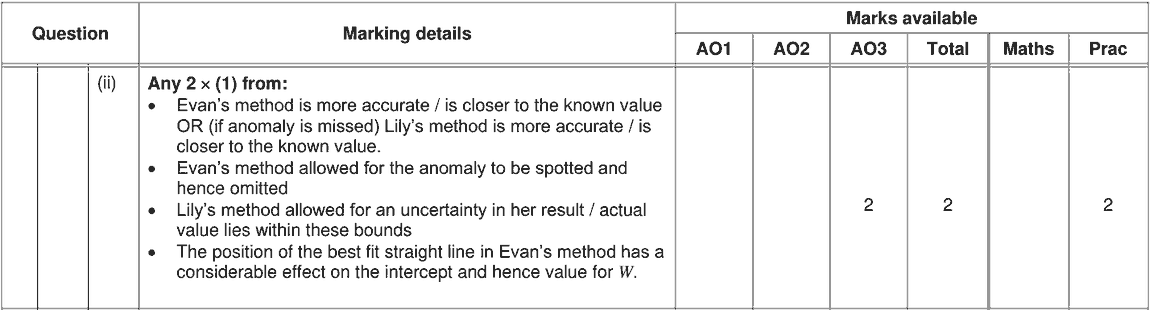
Any two: Evan's graphical value is closer to 1.18 N so more accurate
the graph shows up the anomalous point so it can be left out
Lily's method gives an uncertainty and the true value lies inside her range
the intercept, and so W, is sensitive to where the best-fit line is drawn
Scheme columns: Practical 2
Skills: Uncertainties Resolution, absolute and percentage uncertainty, combining uncertainties, error bars; Graphskills Reading, plotting or sketching graphs; gradients, intercepts and areas; Practicalmarks The mark scheme's Prac column gives this part at least one mark for practical skills
June 2023 · Component 1 · Q2(b)(ii)3 marksAO2=3Practical and data analysis
Earlier parts of question 2 that this part uses
Mark scheme
Examiner's comment
Most candidates were able to successfully navigate the synoptic ‘show that’ question in (a). There were the occasional slips where the diameter was used instead of the radius, however, some candidates seemed to have spotted this and re-showed their response correctly. Part (b)(ii) proved to be somewhat of a discriminating question as candidates needed to appreciate that the copper container and the water received energy from the electrical heater to access the 2nd and 3rd marking points. Candidates found the last part of the question, challenging as well. Those who thought that it was bad practice as the heat would flow into the system from the surroundings, achieved some credit. A smaller number of candidates realised the energy absorbed below 16 °C would be countered by the energy emitted above 16 °C. This scored two marks if it was accompanied by a conclusion.
Notes from the mark scheme and report
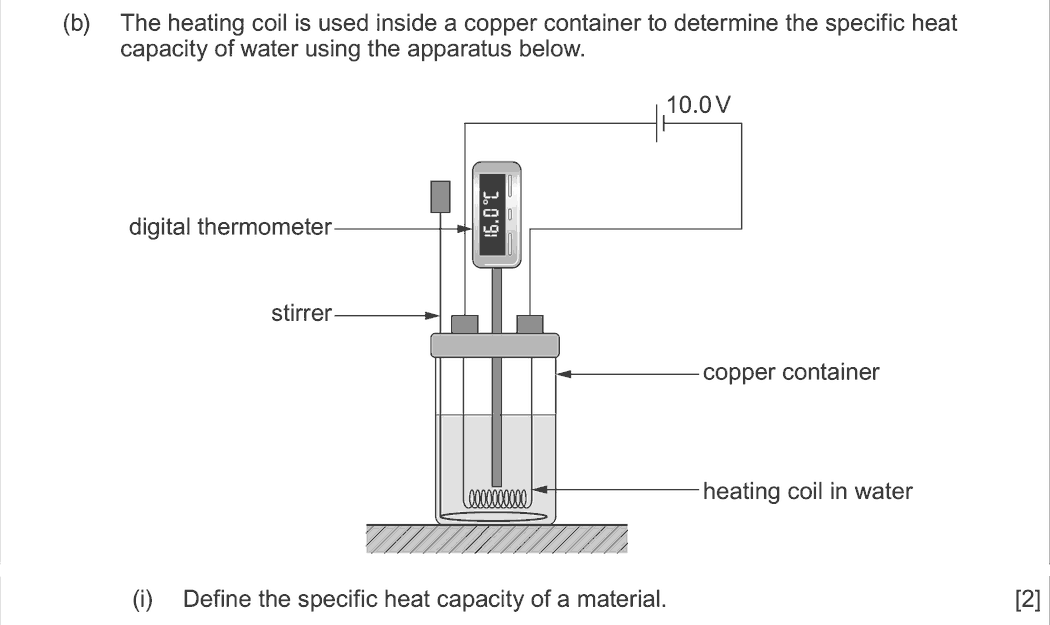
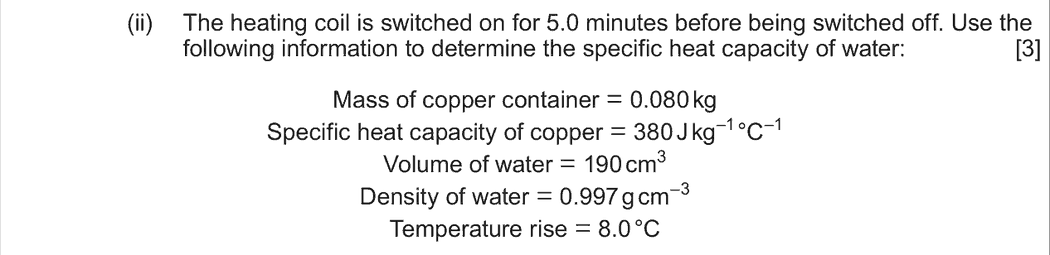
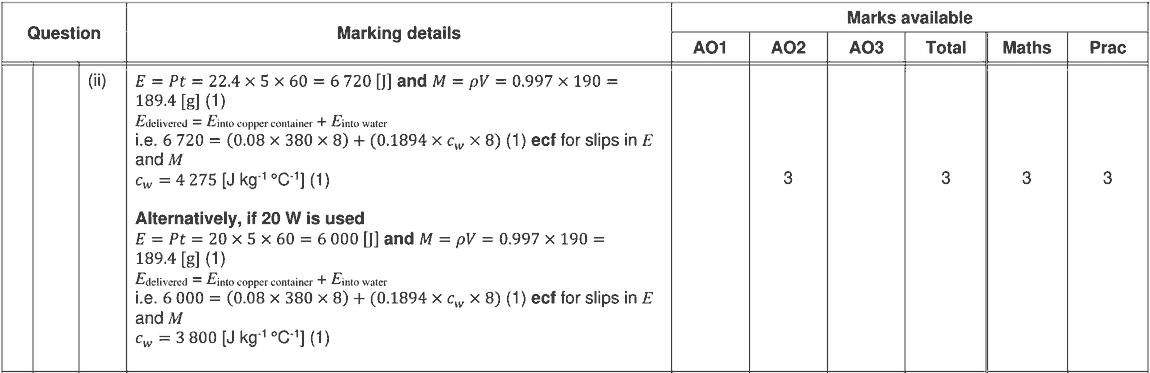
Answer: 4275 J kg⁻¹ °C⁻¹ (3800 if 20 W is used). E = Pt = 22.4 × 300 = 6720 J
mass of water = 0.997 × 190 = 189.4 g
6720 = (0.080 × 380 × 8.0) + (0.1894 × c × 8.0)
many forgot that the copper container is heated as well
Scheme columns: Maths 3, Practical 3
Skills: Unitsand conversions Unit marks, base units, prefixes and conversions; Mathsmarks The mark scheme's Maths column gives this part at least one mark for mathematical skills; Practicalmarks The mark scheme's Prac column gives this part at least one mark for practical skills
June 2023 · AS Component 1 · Q2(c)3 marksAO1=1, AO2=2Short answer
Earlier part of question 2 that this part uses
Mark scheme
Examiner's comment
In part (a) the QER produced mixed marks as expected ranging from 1 – 6. The majority of candidates expressed themselves clearly and legibly.
Notes from the mark scheme and report
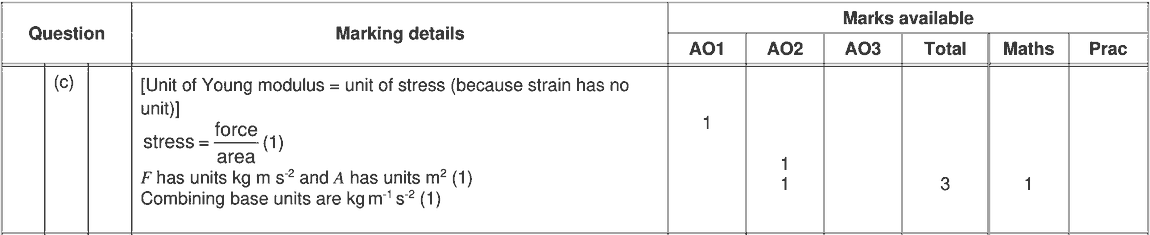
Answer: kg m⁻¹ s⁻². Unit of stress = force/area (strain has no unit) (1)
N = kg m s⁻² and area in m² (1)
combined (1)
Scheme columns: Maths 1
Skills: Unitsand conversions Unit marks, base units, prefixes and conversions; Mathsmarks The mark scheme's Maths column gives this part at least one mark for mathematical skills
June 2023 · AS Component 1 · Q3(a)2 marksAO1=2Definition
Mark scheme
Examiner's comment
Moments was very well answered; however many lost the last mark in (b)(ii) for not giving a direction (upwards).
Notes from the mark scheme and report
For a system in equilibrium (1) the total clockwise moment about any point equals the total anticlockwise moment about that point (1)
June 2023 · AS Component 1 · Q3(b)(i)5 marksAO3=5Calculation
Earlier part of question 3 that this part uses
Mark scheme
Examiner's comment
Moments was very well answered; however many lost the last mark in (b)(ii) for not giving a direction (upwards).
Notes from the mark scheme and report
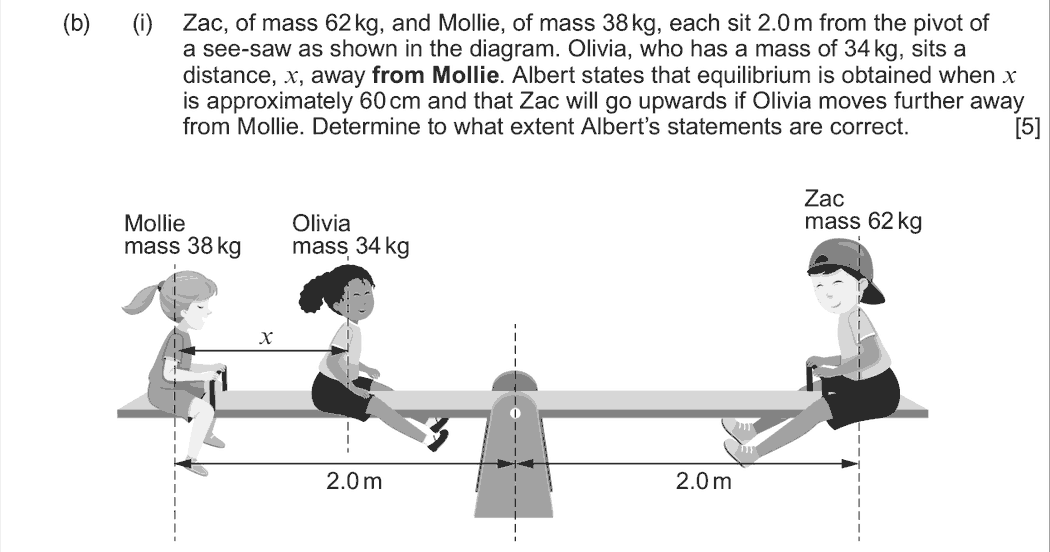
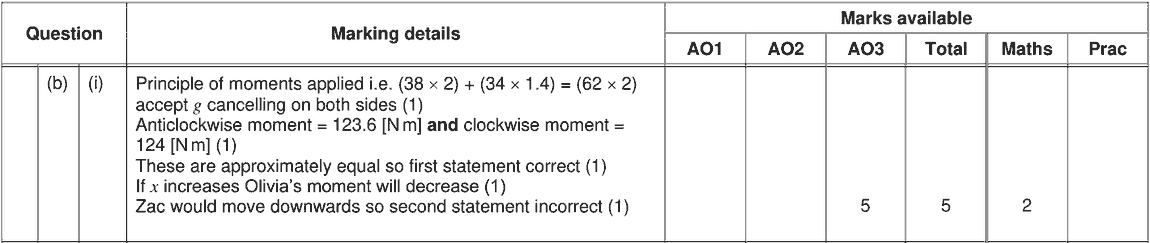
With x = 0.60 m Olivia is 1.4 m from the pivot: anticlockwise (38 × 2.0) + (34 × 1.4) = 123.6 and clockwise 62 × 2.0 = 124 (× g cancels) (2)
nearly equal, so the first statement is correct (1)
if x increases Olivia is nearer the pivot and her moment falls (1), so Zac's side goes down and the second statement is wrong (1)
Scheme columns: Maths 2
Skills: Mathsmarks The mark scheme's Maths column gives this part at least one mark for mathematical skills
June 2023 · AS Component 1 · Q3(b)(ii)3 marksAO2=3Calculation
Earlier parts of question 3 that this part uses
Mark scheme
Examiner's comment
Moments was very well answered; however many lost the last mark in (b)(ii) for not giving a direction (upwards).
Notes from the mark scheme and report
Answer: 1710 N upwards. Total mass = 62 + 38 + 34 + 40 = 174 kg
force from pivot = total weight = 174 × 9.81
many lost the mark for the direction
Scheme columns: Maths 2
Skills: Trigonometryand vectors Resolving, components, vector addition, angles; Mathsmarks The mark scheme's Maths column gives this part at least one mark for mathematical skills
June 2023 · AS Component 1 · Q4(a)3 marksAO2=3Practical and data analysis
Mark scheme
Examiner's comment
In part (b)(ii) a number lost a mark as they made the general comment “using better equipment” rather than specifying using a micrometer / Vernier callipers. They also needed to specify the resolution of the instrument as 0.01 mm.
Notes from the mark scheme and report
Answer: 4190 mm³ (4.19 × 10⁻⁶ m³) ± 15%. V = (4/3)πr³ with r = 10 mm
% uncertainty in the radius (diameter) = 5%
× 3 for the cube
unit mark
Scheme columns: Maths 2, Practical 3
Skills: Uncertainties Resolution, absolute and percentage uncertainty, combining uncertainties, error bars; Unitsand conversions Unit marks, base units, prefixes and conversions; Mathsmarks The mark scheme's Maths column gives this part at least one mark for mathematical skills; Practicalmarks The mark scheme's Prac column gives this part at least one mark for practical skills
June 2023 · AS Component 1 · Q4(b)(i)6 marksAO2=6Practical and data analysis
Earlier part of question 4 that this part uses
Mark scheme
Examiner's comment
In part (b)(ii) a number lost a mark as they made the general comment “using better equipment” rather than specifying using a micrometer / Vernier callipers. They also needed to specify the resolution of the instrument as 0.01 mm.
value and uncertainty to matching, sensible significant figures
Scheme columns: Maths 6, Practical 6
Skills: Uncertainties Resolution, absolute and percentage uncertainty, combining uncertainties, error bars; Unitsand conversions Unit marks, base units, prefixes and conversions; Mathsmarks The mark scheme's Maths column gives this part at least one mark for mathematical skills; Practicalmarks The mark scheme's Prac column gives this part at least one mark for practical skills
June 2023 · AS Component 1 · Q4(b)(ii)2 marksAO3=2Practical and data analysis
Earlier parts of question 4 that this part uses
Mark scheme
Examiner's comment
In part (b)(ii) a number lost a mark as they made the general comment “using better equipment” rather than specifying using a micrometer / Vernier callipers. They also needed to specify the resolution of the instrument as 0.01 mm.
Notes from the mark scheme and report
The diameter measurement gives the largest uncertainty (1)
use an instrument with better resolution, i.e. a micrometer or vernier callipers reading to 0.01 mm (1)
'better equipment' and repeat readings were not credited
Scheme columns: Practical 2
Skills: Uncertainties Resolution, absolute and percentage uncertainty, combining uncertainties, error bars; Experimentalmethod Describing, planning or improving an experiment; Practicalmarks The mark scheme's Prac column gives this part at least one mark for practical skills
June 2023 · Component 1 · Q6(a)3 marksAO2=3Show that
Mark scheme
Examiner's comment
The ‘show that’ question in part (a) proved to be demanding. A significant number of candidates were unable to appreciate where the component of the bob’s weight was acting and diagrams indicating horizontal force directions were confused. The use of tension also halted progress here. The second and third marking points proved more accessible. Mainly very good candidate responses were seen in (b)(i). There were some weaker attempts using 𝑣 = −𝐴𝜔sin𝜔𝑡 but these did not develop as the candidates were unable to determine the amplitude. For the GPE – time graph in (ii) we were looking for the correct period, phase, and shape. There was a good success rate. A triangular wave is not an acceptable alternative for a sinusoid. Candidates who used the negative portion of the graph were only able to access the period mark as this was a significant error. The transition from simple harmonic motion to circular motion in part (iii) proved demanding for some candidates. Some used 𝑎= 𝜔2𝑟 and the periodic time of 1.4 s for the pendulum to be the time for one complete revolution. This is incorrect. Candidates who used 𝑎= 𝑣2 𝑟 were more successful. In the second part of the question, we were looking for candidates to show us that a centripetal force is a resultant force and at the bottom of the swing, this resultant force would be upwards. Some candidates were able to do this. We accepted ‘𝑇 – 𝑚𝑔 = 𝑚𝑎’ for the first marking point. The direction needed to be clear for the second marking point. Some drew a diagram to support their responses and were often rewarded. The last part was the QER and it tested the candidate’s ability to describe how forced oscillations can be demonstrated and how the amplitude varies with frequency. It bridged AO1 and AO3 and this challenged candidates. The description of the experiment was often limited whereas the variation of amplitude and hence links to resonance were more readily seen. A graph would often be seen, however, we wanted it to be referenced in their written response. The simple and effective way of obtaining the natural frequency of an oscillator (when the signal generator is off) was not regularly seen, however, it was encouraging to see additional practical detail regarding the amplitude measurement. There were a minority of confused responses involving damping.
Notes from the mark scheme and report
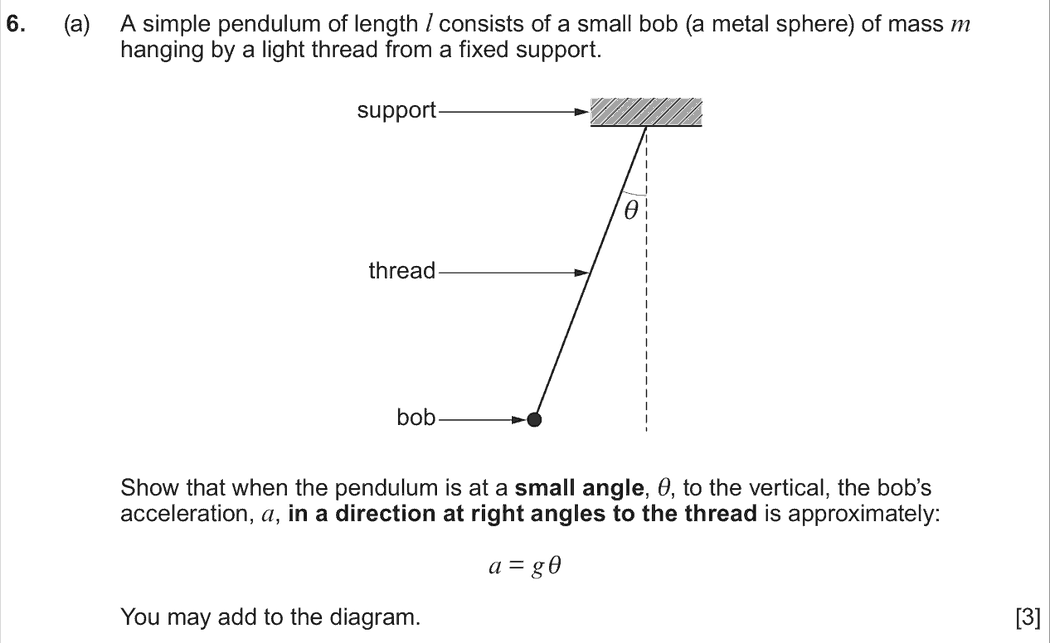
Component of the weight at right angles to the thread = mg sin θ (1)
for small angles sin θ ≈ θ in radians (1)
a = mg sin θ/m ≈ gθ (1)
many drew horizontal forces or tried to use the tension
Scheme columns: Maths 2
Skills: Trigonometryand vectors Resolving, components, vector addition, angles; Algebra Derivations and rearranging equations; Mathsmarks The mark scheme's Maths column gives this part at least one mark for mathematical skills
June 2023 · Component 2 · Q4(c)(i)4 marksAO1=1, AO2=3Show that
Earlier parts of question 4 that this part uses
Mark scheme
Examiner's comment
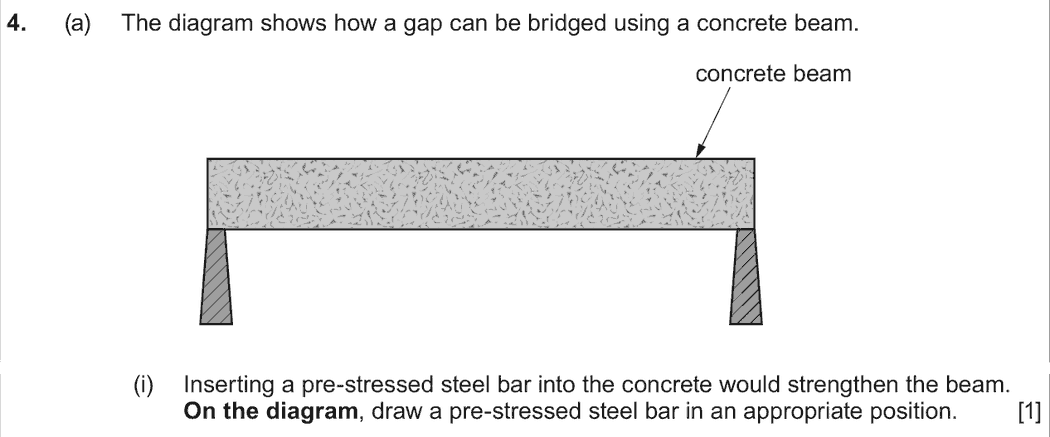
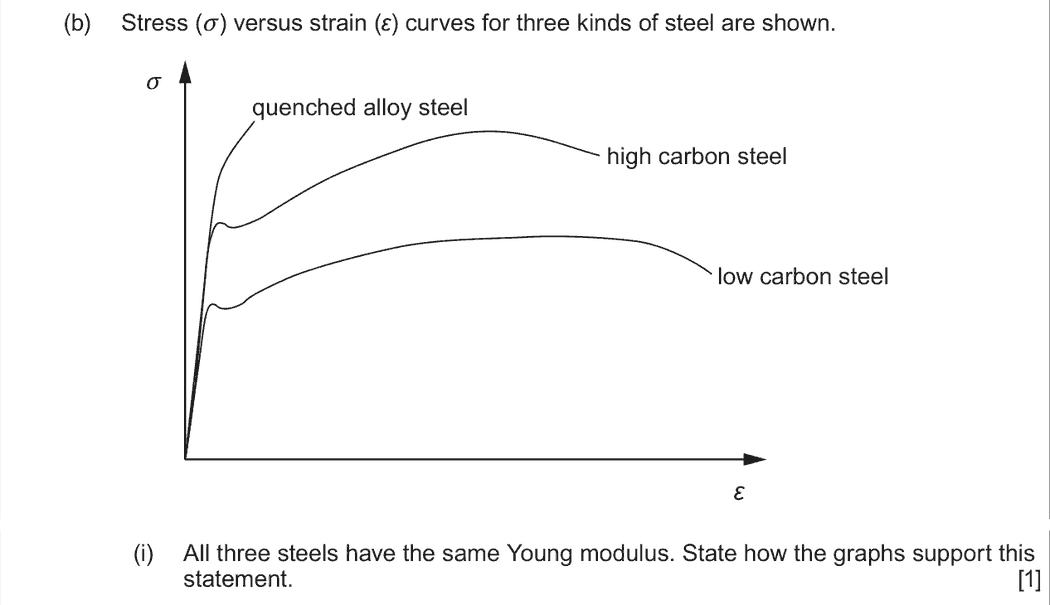
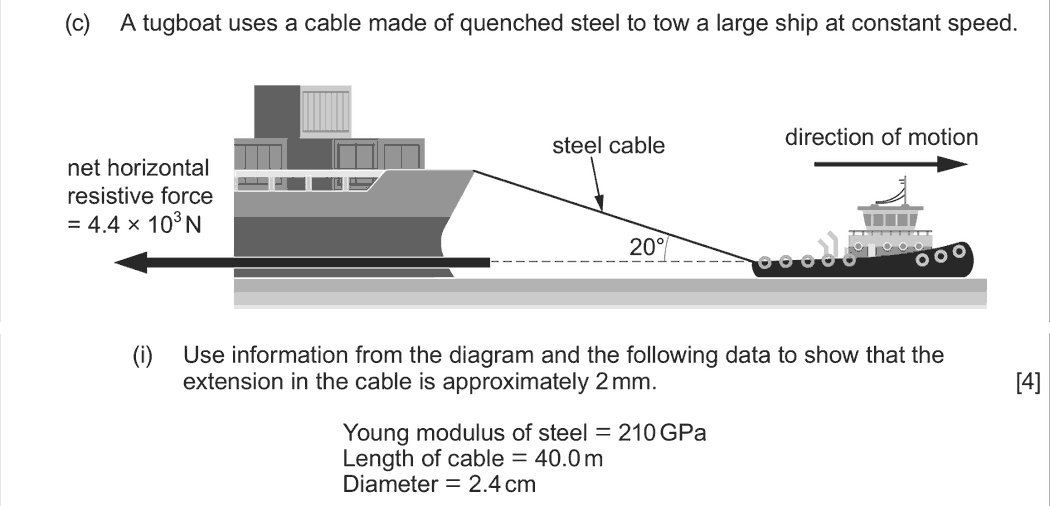
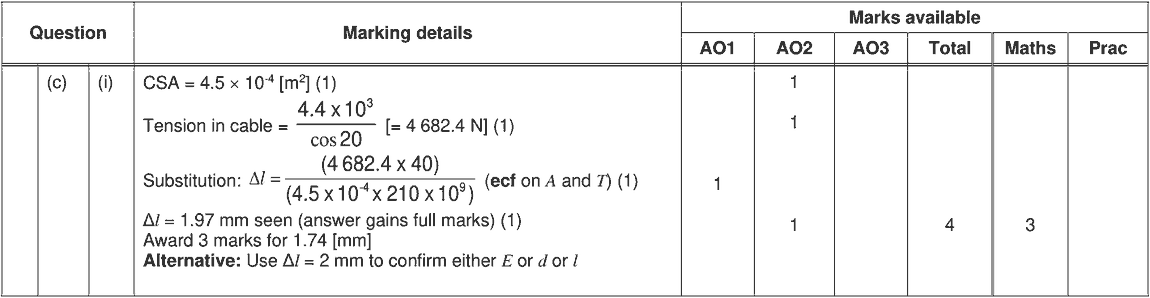
Disappointingly in (a)(i), fewer than half of the candidates drew the pre-stressed bar towards the lower surface of the concrete beam as required, with many sketching the bar near the middle of the beam. The response in (ii) was more encouraging with many candidates recognising that the bar would put the concrete under compression which would inhibit crack propagation. Nearly all candidates in (b) correctly referred to the fact that the initial gradients of the three graphs were the same. Many candidates identified that high carbon steel is ‘stronger’ (or equivalent) than low carbon steel and explained this physical property in terms of additional carbon atoms inhibiting the flow of dislocations within the metal. This was understood better than in previous sittings of this paper. However, once again, a significant minority of candidates incorrectly described carbon atoms inhibiting the motion of whole planes of atoms rather than dislocation movement. Reference to whole plane of atoms was not credited. In (c)(i) many candidates were able to show that the extension in the cable approximated the value given in the question. Of those that failed, many incorrectly resolved the force given, often multiplying rather than dividing by cosine (20°). In (ii), most candidates used W = ½ FΔl to determine the energy stored in the cable, with ecf being applied to F and Δl for those who failed to resolve correctly in
Skills: Synoptic Needs physics from another component of the qualification; Trigonometryand vectors Resolving, components, vector addition, angles; Unitsand conversions Unit marks, base units, prefixes and conversions; Mathsmarks The mark scheme's Maths column gives this part at least one mark for mathematical skills
June 2022 · Component 1 · Q1(a)(i)1 markAO1=1Diagram or graph
Mark scheme
Examiner's comment
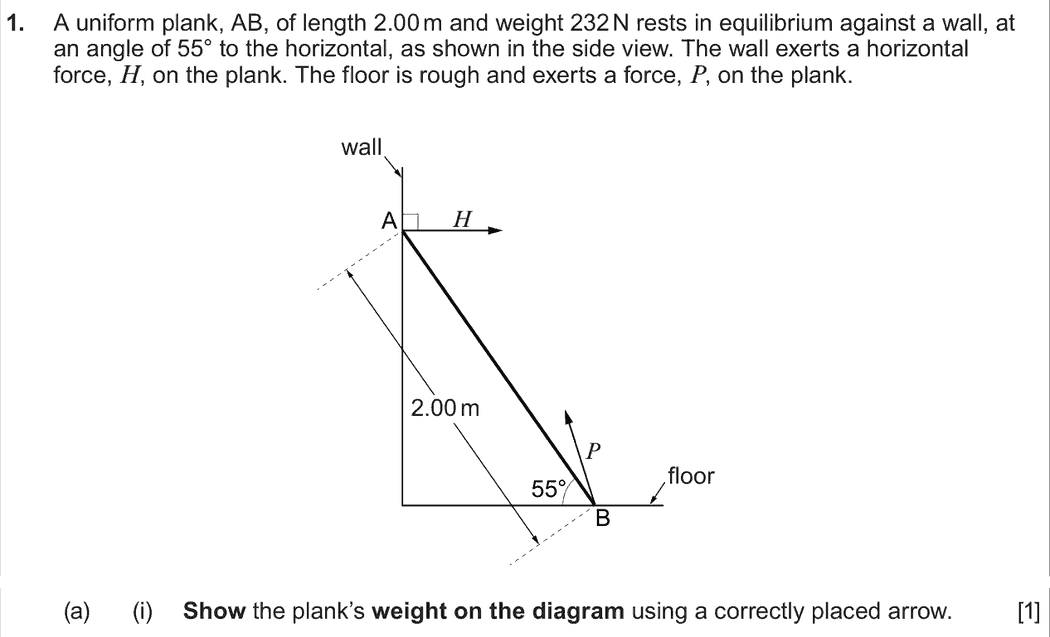
Only a handful of candidates failed to show the plank’s weight by a vertical arrow through its centre.
Notes from the mark scheme and report
Vertical downward arrow starting at, or passing through, the centre of the plank
June 2022 · AS Component 1 · Q1(a)(i)1 markAO1=1Short answer
Mark scheme
Notes from the mark scheme and report
A vector has direction as well as magnitude
a scalar has magnitude only
June 2022 · Component 1 · Q1(a)(ii)4 marksAO1=3, AO2=1Show that
Earlier part of question 1 that this part uses
Mark scheme
Examiner's comment
Most candidates realised that the easiest way to find the force of the wall on the ladder was to take moments about the ladder’s foot, B. This was usually done successfully, though occasionally moments were confused with forces. One mark was reserved for the brief explanation requested. “Moments about B” was enough, and the mark was usually given.
Notes from the mark scheme and report
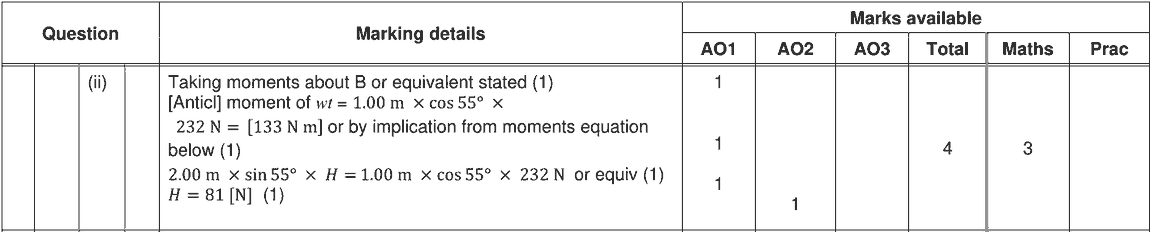
Take moments about B (statement needed for a mark)
moment of weight = 232 × 1.00 cos 55° = 133 N m
H × 2.00 sin 55° = 133
H = 81 N
moments and forces were occasionally confused
Scheme columns: Maths 3
Skills: Trigonometryand vectors Resolving, components, vector addition, angles; Mathsmarks The mark scheme's Maths column gives this part at least one mark for mathematical skills
June 2022 · AS Component 1 · Q1(a)(ii)2 marksAO1=2Short answer
Earlier part of question 1 that this part uses
Mark scheme
Notes from the mark scheme and report
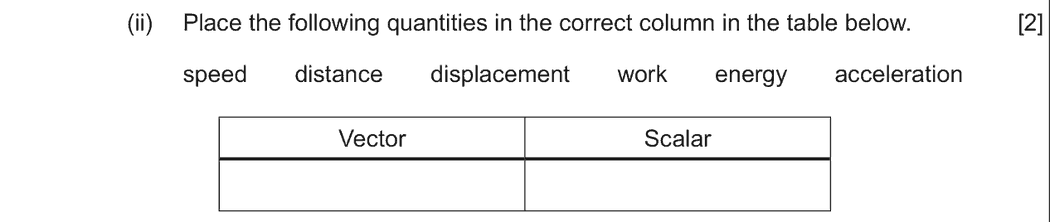
Vector: displacement and acceleration (1)
scalar: speed, distance, work and energy (1)
June 2022 · Component 1 · Q1(a)(iii)3 marksAO2=3Calculation
Earlier part of question 1 that this part uses
Mark scheme
Examiner's comment
Most candidates correctly calculated the magnitude and direction of the contact force on the ladder’s foot from its horizontal and vertical components, though a small minority, recalling that sines and cosines might be relevant, tried to incorporate those of the ladder’s angle of lean.
Notes from the mark scheme and report
Answer: 245 N at 71° to the horizontal. Horizontal component 81 N (towards the wall), vertical component 232 N up
P = √(81² + 232²)
tan θ = 232/81
ecf
a few wrongly brought in the 55° angle of the plank
Scheme columns: Maths 2
Skills: Trigonometryand vectors Resolving, components, vector addition, angles; Mathsmarks The mark scheme's Maths column gives this part at least one mark for mathematical skills
June 2022 · Component 1 · Q1(b)3 marksAO1=1, AO2=2Show that
Earlier part of question 1 that this part uses
Mark scheme
Examiner's comment
About half the candidates realised that the main thing they needed to do to investigate the ladder’s stability at an angle of 45° was to repeat (a)(ii) using the new angle. Other approaches were possible. A fairly common mistake was to try to use values computed in part (a) that were not applicable to the new angle.
Notes from the mark scheme and report
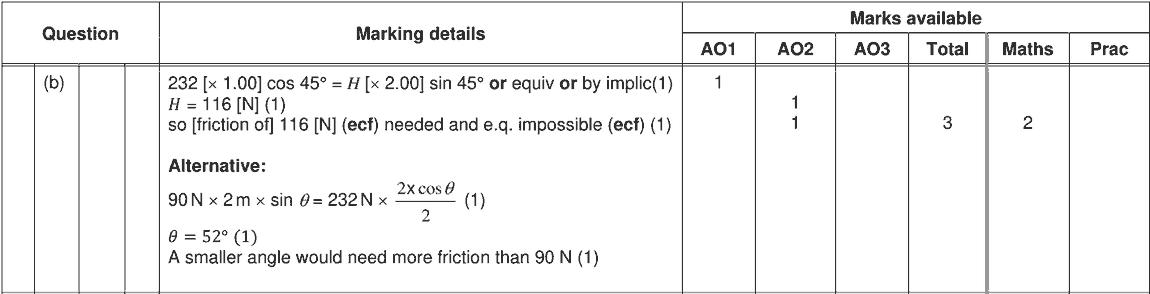
Repeat the moments calculation at 45°: 232 × 1.00 cos 45° = H × 2.00 sin 45°, H = 116 N (2)
the friction needed (116 N) exceeds the 90 N available so equilibrium is impossible (1). Alternative: with 90 N the smallest angle is 52°. About half saw that (a)(ii) had to be repeated
values from part (a) cannot be reused
Scheme columns: Maths 2
Skills: Trigonometryand vectors Resolving, components, vector addition, angles; Mathsmarks The mark scheme's Maths column gives this part at least one mark for mathematical skills
June 2022 · AS Component 1 · Q1(b)3 marksAO2=3Calculation
Earlier part of question 1 that this part uses
Mark scheme
Notes from the mark scheme and report
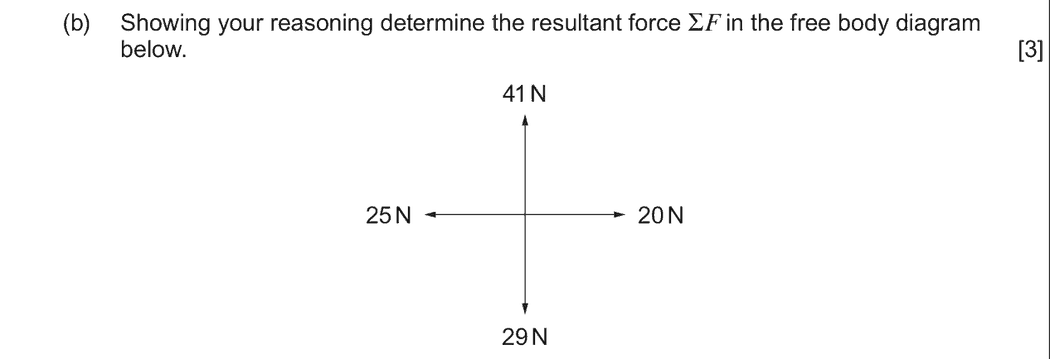
Answer: 13 N at 67° to the horizontal (23° to the vertical), upwards and to the left. Net 12 N up and 5 N to the left (1)
magnitude by Pythagoras (1)
angle from tan⁻¹(12/5) (1)
Scheme columns: Maths 3
Skills: Trigonometryand vectors Resolving, components, vector addition, angles; Mathsmarks The mark scheme's Maths column gives this part at least one mark for mathematical skills
June 2022 · AS Component 1 · Q1(c)2 marksAO2=2Show that
Earlier part of question 1 that this part uses
Mark scheme
Notes from the mark scheme and report
x is in m and ut is m s⁻¹ × s = m (1)
½at² is m s⁻² × s² = m (1), so every term has the same unit
Scheme columns: Maths 2
Skills: Mathsmarks The mark scheme's Maths column gives this part at least one mark for mathematical skills
June 2022 · Component 1 · Q3(b)4 marksAO3=4Calculation
Earlier parts of question 3 that this part uses
Mark scheme
Examiner's comment
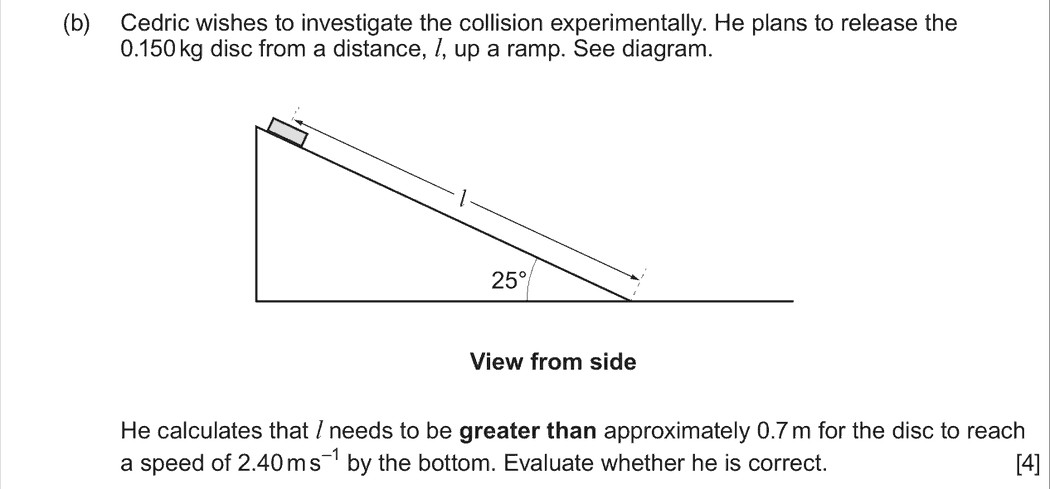
3 of the 4 marks were available for showing that a slope-length of 0.70 m would give an ‘ideal’ final speed of 2.4 m s–1, or vice versa. Many candidates succeeded, using energy conservation. The less popular method, using acceleration, tended to be less successful. The last mark was reserved for explaining why the actual slope-length needed to be greater than 0.7 m. A surprising number of candidates didn’t cite friction.
Notes from the mark scheme and report
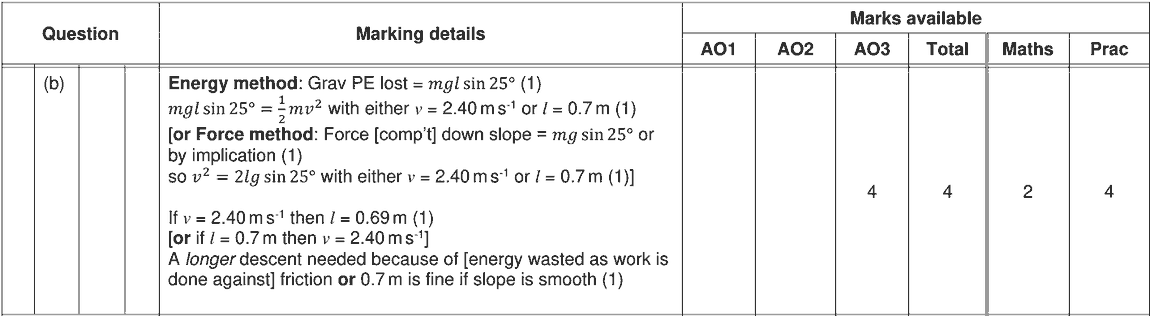
Gravitational PE lost = mgl sin 25° (1) set equal to ½mv² (1)
v = 2.40 m s⁻¹ gives l = 0.69 m, or l = 0.7 m gives v = 2.4 m s⁻¹ (1)
in practice a longer run is needed because work is done against friction, so he is correct (1). Force route: a = g sin 25° and v² = 2al. Many did not mention friction
Scheme columns: Maths 2, Practical 4
Skills: Trigonometryand vectors Resolving, components, vector addition, angles; Mathsmarks The mark scheme's Maths column gives this part at least one mark for mathematical skills; Practicalmarks The mark scheme's Prac column gives this part at least one mark for practical skills
June 2022 · AS Component 1 · Q5(a)2 marksAO1=2Definition
Mark scheme
Notes from the mark scheme and report
For a body in equilibrium (1) the sum of the clockwise moments about any point equals the sum of the anticlockwise moments about the same point (1)
June 2022 · AS Component 1 · Q5(b)(i)4 marksAO2=4Calculation
Earlier part of question 5 that this part uses
Mark scheme
Notes from the mark scheme and report
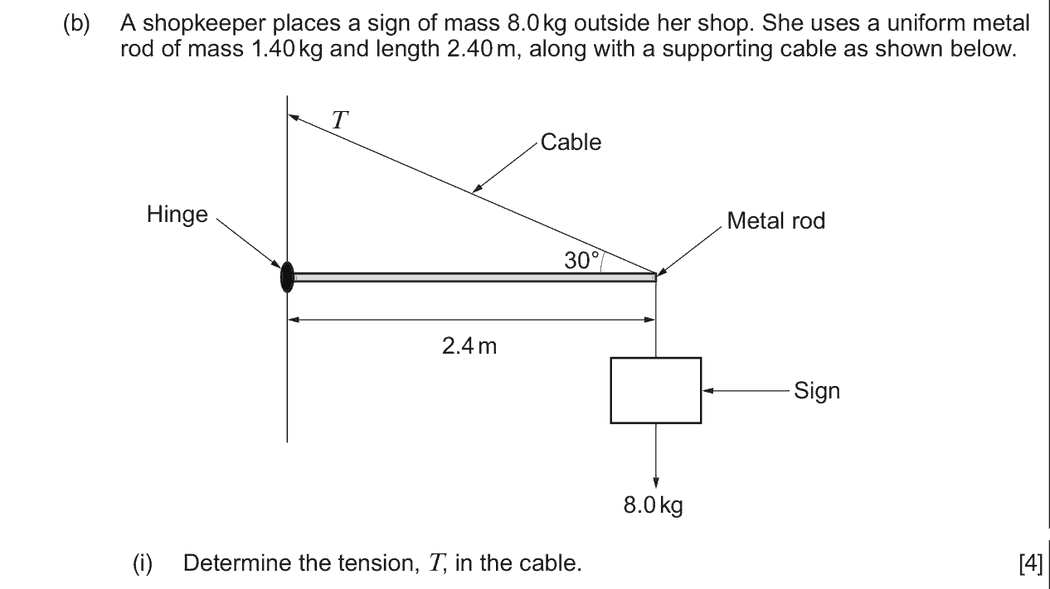
Answer: 171 N. Perpendicular distance from the hinge to the cable = 2.4 sin 30° = 1.2 m
moments about the hinge: 1.2T = 1.2 × 1.40 × 9.81 + 2.4 × 8.0 × 9.81 (rod weight acts at its centre)
Scheme columns: Maths 4
Skills: Trigonometryand vectors Resolving, components, vector addition, angles; Mathsmarks The mark scheme's Maths column gives this part at least one mark for mathematical skills
October 2021 · Component 1 · Q1(a)2 marksAO1=2Short answer
Mark scheme
Notes from the mark scheme and report
The resultant (vector sum of the) force on the body is zero (1)
the sum of the clockwise moments about any point equals the sum of the anticlockwise moments about that point (1)
October 2021 · Component 1 · Q1(b)(i)I2 marksAO2=2Calculation
Earlier part of question 1 that this part uses
Mark scheme
Notes from the mark scheme and report
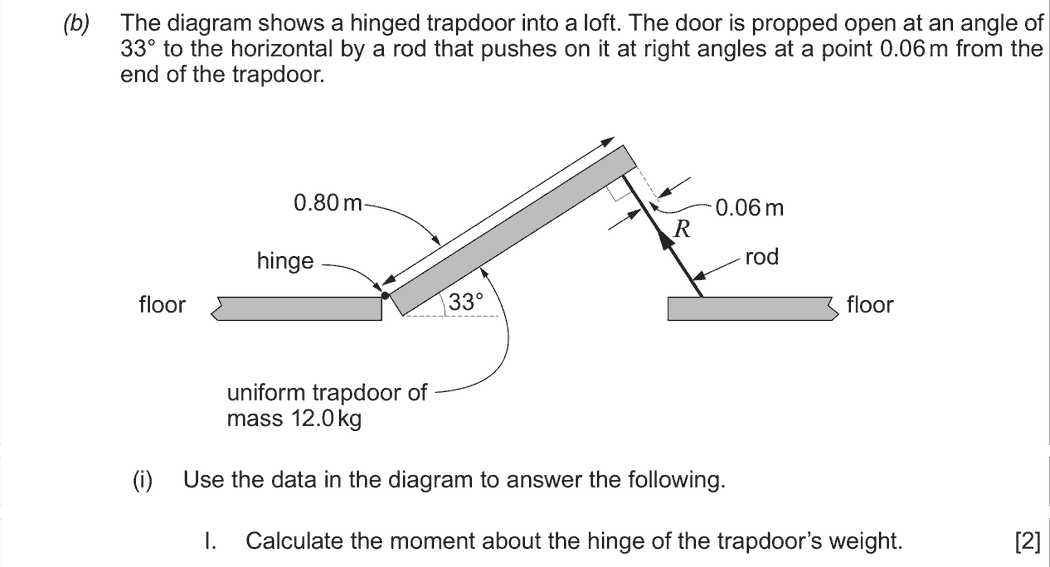
Answer: 39.5 N m. Weight acts at the centre, 0.40 m along the door
moment = 12.0 × 9.81 × 0.40 cos 33° (perpendicular distance from the hinge)
unit mark
Scheme columns: Maths 1
Skills: Trigonometryand vectors Resolving, components, vector addition, angles; Mathsmarks The mark scheme's Maths column gives this part at least one mark for mathematical skills
October 2021 · Component 1 · Q1(b)(i)II2 marksAO2=2Show that
Earlier parts of question 1 that this part uses
Mark scheme
Notes from the mark scheme and report
R acts at right angles to the door, 0.80 − 0.06 = 0.74 m from the hinge: R × 0.74 = 39.5 so R = 53.4 N
using 0.80 m loses one mark
Scheme columns: Maths 1
Skills: Mathsmarks The mark scheme's Maths column gives this part at least one mark for mathematical skills
October 2021 · Component 1 · Q1(b)(i)III2 marksAO2=2Calculation
Earlier parts of question 1 that this part uses
Mark scheme
Notes from the mark scheme and report
Answer: 29 N. R is at 57° to the horizontal, so its horizontal component is 53.4 cos 57°
the weight has no horizontal component, so the hinge supplies an equal and opposite 29 N (27 N if R = 50 N is used)
Scheme columns: Maths 1
Skills: Trigonometryand vectors Resolving, components, vector addition, angles; Mathsmarks The mark scheme's Maths column gives this part at least one mark for mathematical skills
October 2021 · Component 1 · Q1(b)(ii)I1 markAO2=1Diagram or graph
Earlier parts of question 1 that this part uses
Mark scheme
Notes from the mark scheme and report
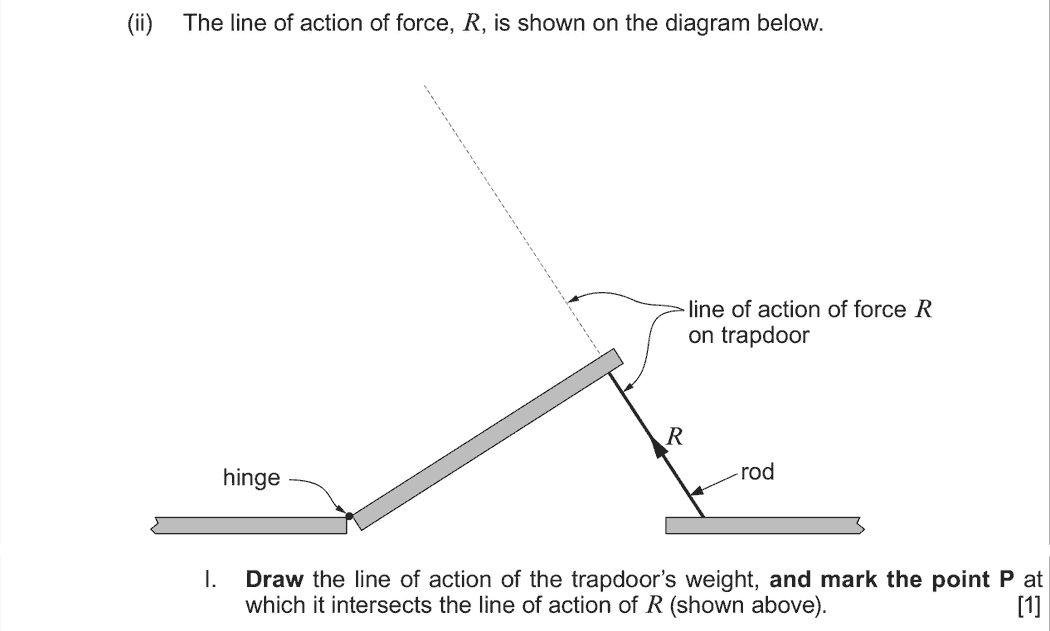
Vertical line through the centre of the trapdoor, extended upwards to meet the line of action of R
intersection labelled P
October 2021 · Component 1 · Q1(b)(ii)II2 marksAO3=2Explanation
Earlier parts of question 1 that this part uses
Mark scheme
Notes from the mark scheme and report
R and the weight both pass through P, so neither has a moment about P (1)
for equilibrium the hinge force must also have zero moment about P, so its line of action passes through P and Darren is correct (1)
October 2021 · Component 1 · Q4(a)3 marksAO2=3Calculation
Mark scheme
Notes from the mark scheme and report
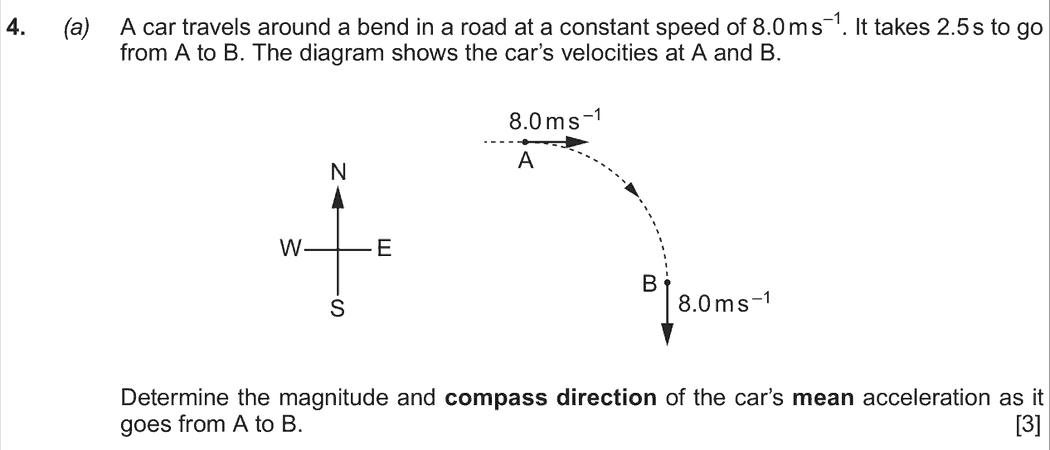
Answer: 4.5 m s⁻² towards the south-west (bearing 225°). Change in velocity = 8.0 south minus 8.0 east = 8.0√2 = 11.3 m s⁻¹ (1)
divide by 2.5 s (1)
direction (1)
Scheme columns: Maths 2
Skills: Trigonometryand vectors Resolving, components, vector addition, angles; Mathsmarks The mark scheme's Maths column gives this part at least one mark for mathematical skills
October 2021 · Component 2 · Q2(a)3 marksAO1=1, AO2=2Show that
Mark scheme
Notes from the mark scheme and report
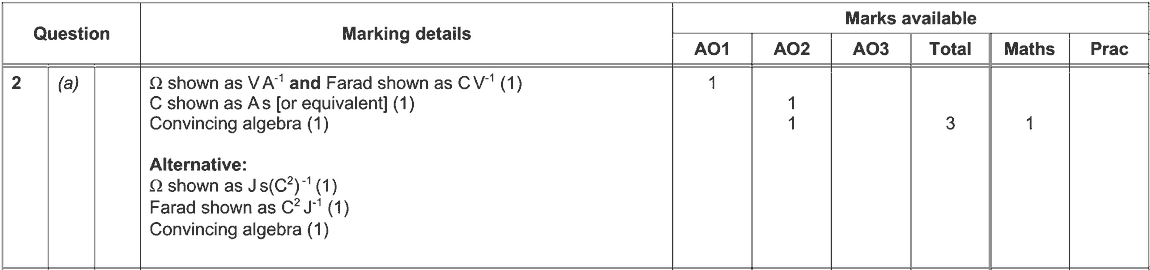
Ω = V A⁻¹ and F = C V⁻¹ (1)
C = A s (1)
so Ω F = V A⁻¹ × A s V⁻¹ = s (1). Or Ω = J s C⁻² and F = C² J⁻¹
Scheme columns: Maths 1
Skills: Unitsand conversions Unit marks, base units, prefixes and conversions; Algebra Derivations and rearranging equations; Mathsmarks The mark scheme's Maths column gives this part at least one mark for mathematical skills
October 2020 · Component 1 · Q2(b)(iii)3 marksAO2=3Calculation
Earlier parts of question 2 that this part uses
Mark scheme
Examiner's comment
More than half the candidates correctly defined mean acceleration as change in velocity divided by time to change, but not all who did so were able to calculate the proton’s mean acceleration over a semicircle (part (b)(iii)). Calculating the proton’s speed and its instantaneous acceleration at a point in its path caused few problems. Many candidates discussed only one of the two opinions about the mean force on a proton over one revolution.
Notes from the mark scheme and report
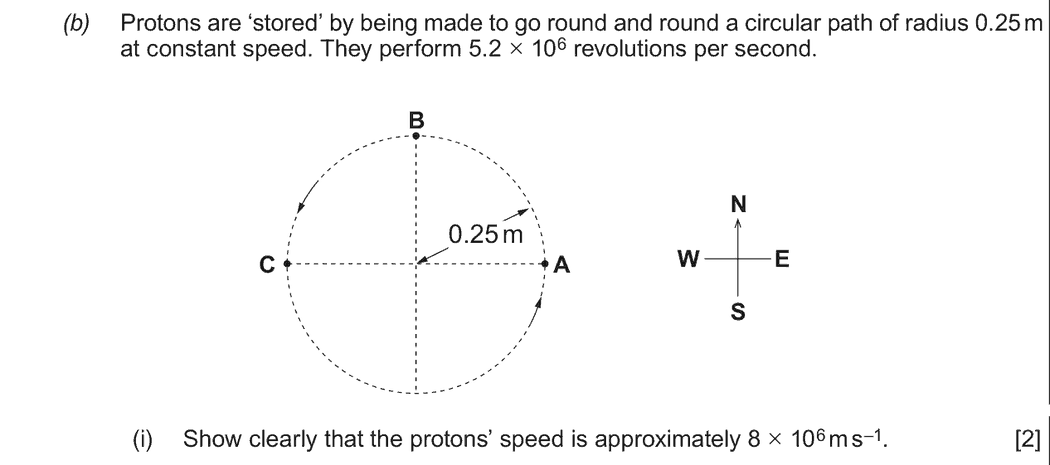
Answer: 1.7 × 10¹⁴ m s⁻² South. Time for half a revolution = ½ × 1/5.2 × 10⁶ = 9.62 × 10⁻⁸ s
change in velocity = 2 × 8.17 × 10⁶ = 1.63 × 10⁷ m s⁻¹ (velocity reverses)
mean acceleration = Δv/t
many who could define mean acceleration could not apply it here
Scheme columns: Maths 2
Skills: Trigonometryand vectors Resolving, components, vector addition, angles; Mathsmarks The mark scheme's Maths column gives this part at least one mark for mathematical skills
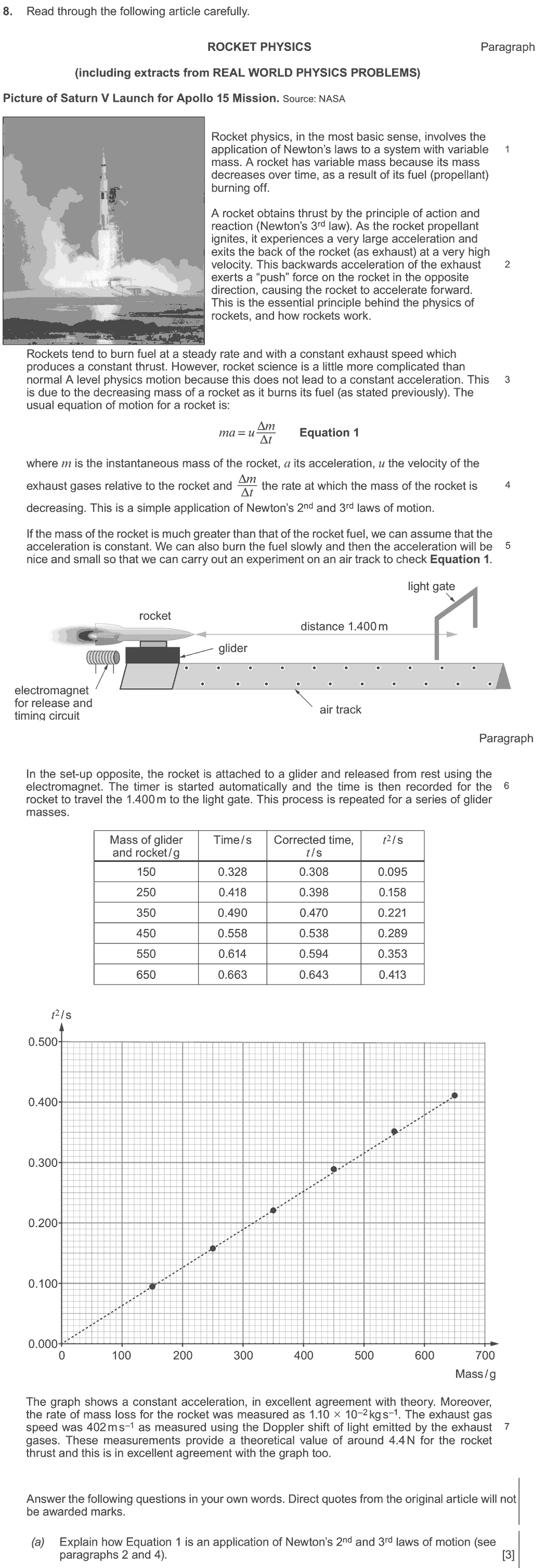
October 2020 · Component 1 · Q8(c)(i)1 markAO1=1Short answer
Earlier part of question 8 that this part uses
Mark scheme
Examiner's comment
In (a) and (b), 𝒖𝒖 ∆𝒎𝒎 ∆𝒕𝒕 was not always recognised as the rate of change of momentum of the exhaust gases, and the constancy of u and ∆𝒎𝒎 ∆𝒕𝒕 often went unnoticed. In (c) the wrong unit for 𝒕𝒕𝟐𝟐 was usually spotted. The 0.02 s delay was identified and almost always explained correctly. In
Notes from the mark scheme and report
The unit of t² should be s², not s (table heading and graph axis)
Scheme columns: Practical 1
Skills: Comprehension A level Component 1 Section B: questions on the printed article; Unitsand conversions Unit marks, base units, prefixes and conversions; Practicalmarks The mark scheme's Prac column gives this part at least one mark for practical skills
June 2019 · AS Component 1 · Q1(a)(ii)3 marksAO1=1, AO2=2Short answer
Earlier part of question 1 that this part uses
Mark scheme
Notes from the mark scheme and report
Answer: kg m⁻¹ s⁻². Strain has no unit (1)
stress = force/area = kg m s⁻² / m² (1)
Young modulus kg m⁻¹ s⁻² (1)
Scheme columns: Maths 3
Skills: Unitsand conversions Unit marks, base units, prefixes and conversions; Mathsmarks The mark scheme's Maths column gives this part at least one mark for mathematical skills
June 2019 · Component 1 · Q1(b)4 marksAO2=4Calculation
Earlier part of question 1 that this part uses
Mark scheme
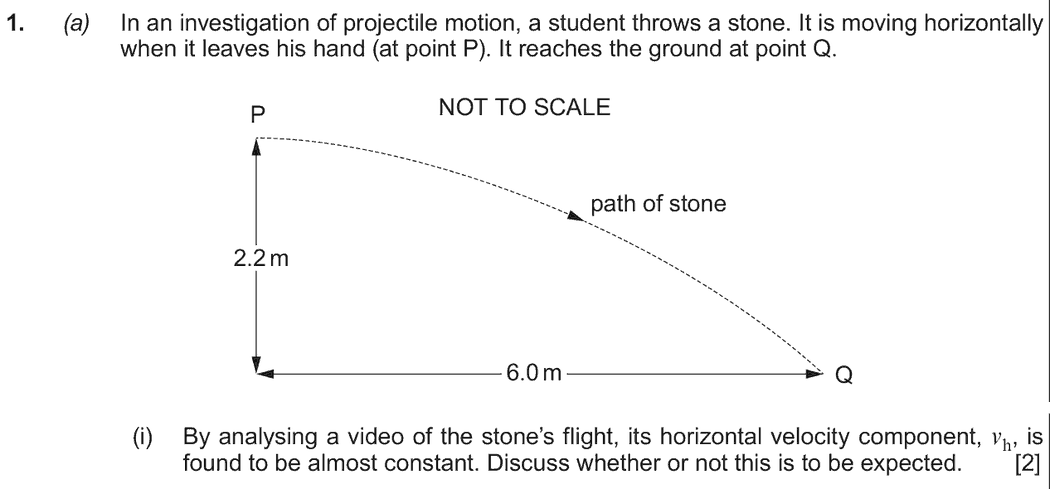
Examiner's comment
Having found the stone’s ‘final’ vertical velocity, most candidates performed vector addition correctly and gave their answers clearly.
Notes from the mark scheme and report
Answer: 11 m s⁻¹ at 36° below the horizontal (54° to the vertical). Vertical component = √(2 × 9.81 × 2.2) = 6.6 m s⁻¹ (or gt = 6.5)
vector diagram of vh and vv
resultant = √(9.0² + 6.6²)
angle = tan⁻¹(6.6/9.0)
ecf on vv
Scheme columns: Maths 3
Skills: Trigonometryand vectors Resolving, components, vector addition, angles; Mathsmarks The mark scheme's Maths column gives this part at least one mark for mathematical skills
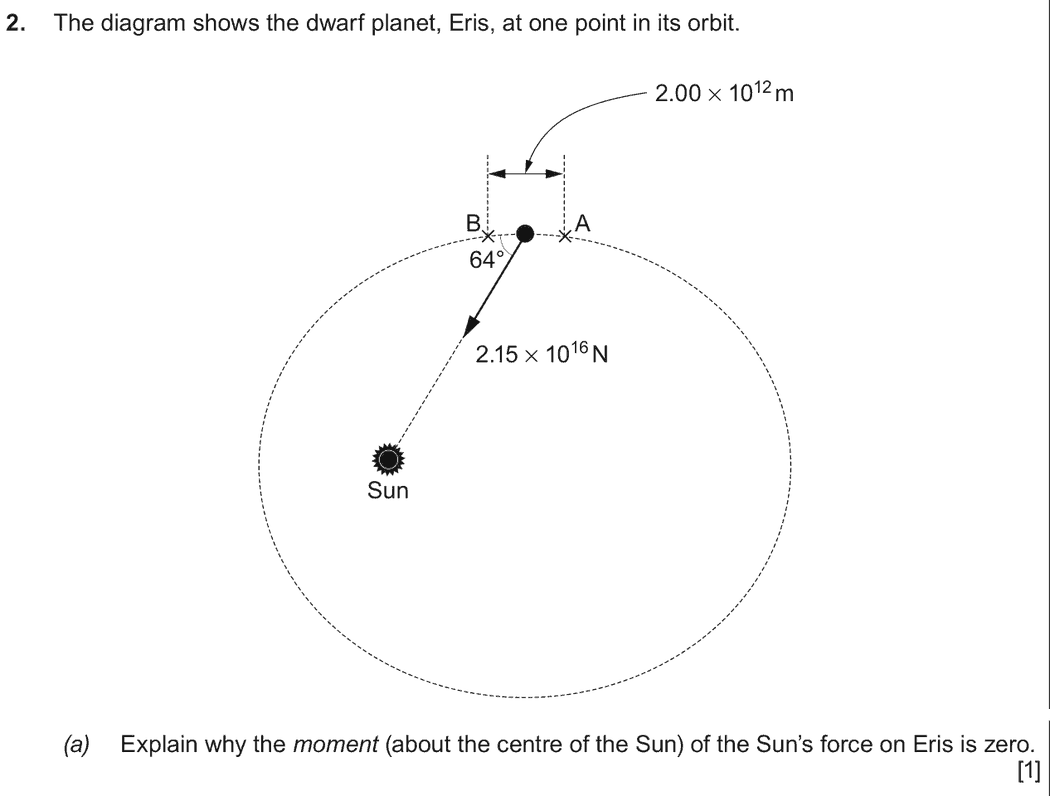
June 2019 · Component 1 · Q2(a)1 markAO2=1Explanation
Mark scheme
Examiner's comment
As a reason for zero moment on Eris we accepted zero force component at right angles to the line joining Eris and the Sun, zero perpendicular distance from Sun to line of action of force, or just force directed towards Sun. Most candidates gave one of these, though there were some garbled versions such as “force not perpendicular to distance between Sun and Eris”.
Notes from the mark scheme and report
The line of action of the force passes through the centre of the Sun, so the perpendicular distance from the Sun to the line of action is zero
'force not perpendicular to the distance' was a garbled version
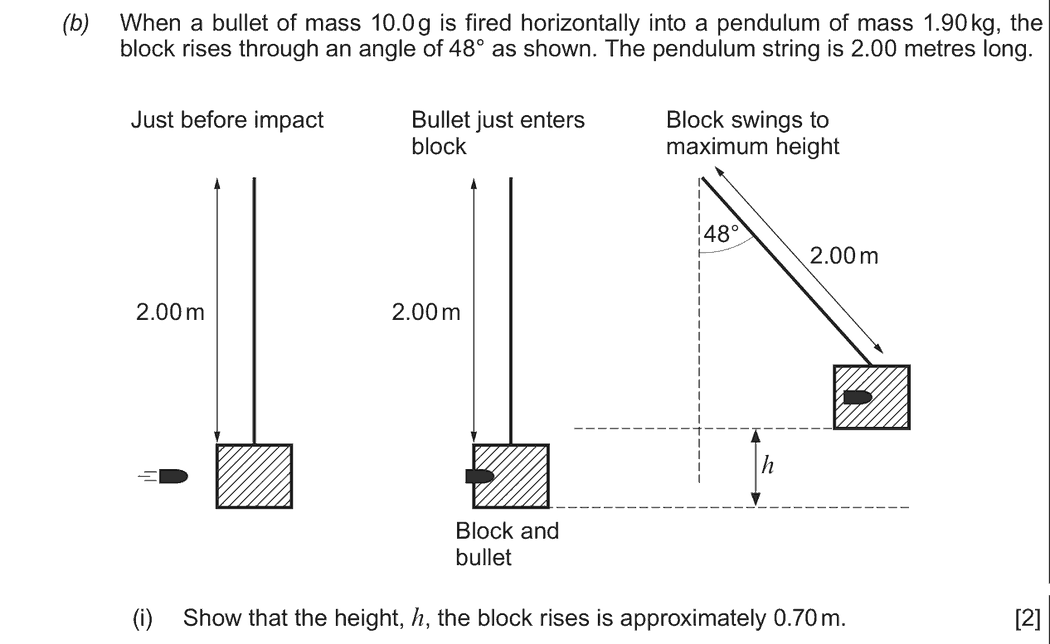
June 2019 · AS Component 1 · Q2(b)(i)2 marksAO2=2Show that
Earlier part of question 2 that this part uses
Mark scheme
Notes from the mark scheme and report
Vertical length of string = 2.00 cos 48° = 1.34 m (1)
h = 2.00 − 1.34 = 0.66 m (1)
Scheme columns: Maths 2
Skills: Trigonometryand vectors Resolving, components, vector addition, angles; Mathsmarks The mark scheme's Maths column gives this part at least one mark for mathematical skills
June 2019 · Component 1 · Q4(a)(ii)I2 marksAO2=2Calculation
Earlier part of question 4 that this part uses
Mark scheme
Examiner's comment
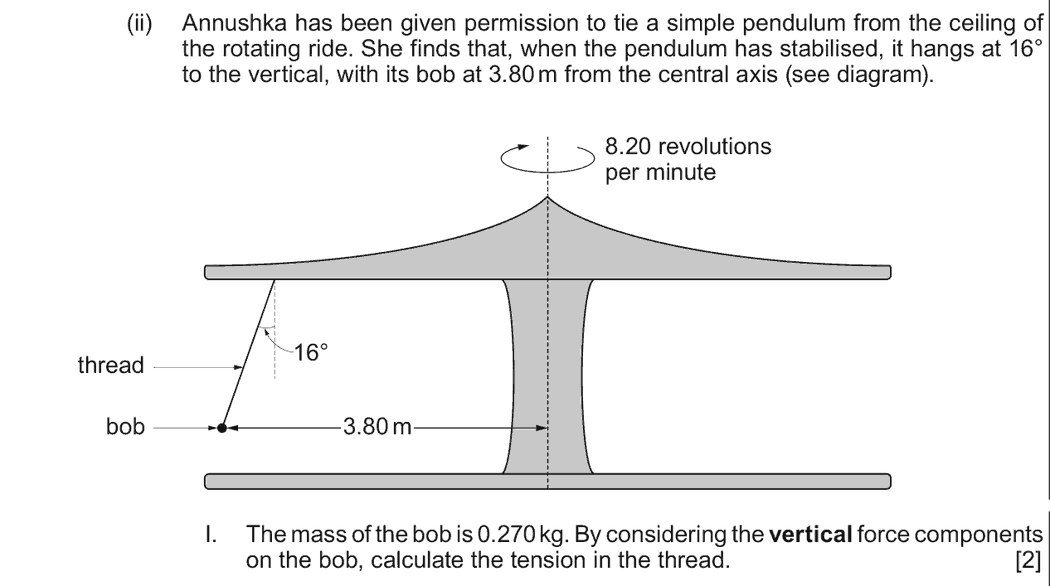
Only a small minority put 𝑻= 𝒎𝒈𝐜𝐨𝐬𝟏𝟔° rather than the correct 𝑻𝐜𝐨𝐬𝟏𝟔° = 𝒎𝒈.
Notes from the mark scheme and report
Answer: 2.76 N. Vertical equilibrium: T cos 16° = mg, so T = 0.270 × 9.81/cos 16°
T = mg cos 16° (2.55 N) is an error of principle
Scheme columns: Maths 1
Skills: Trigonometryand vectors Resolving, components, vector addition, angles; Mathsmarks The mark scheme's Maths column gives this part at least one mark for mathematical skills
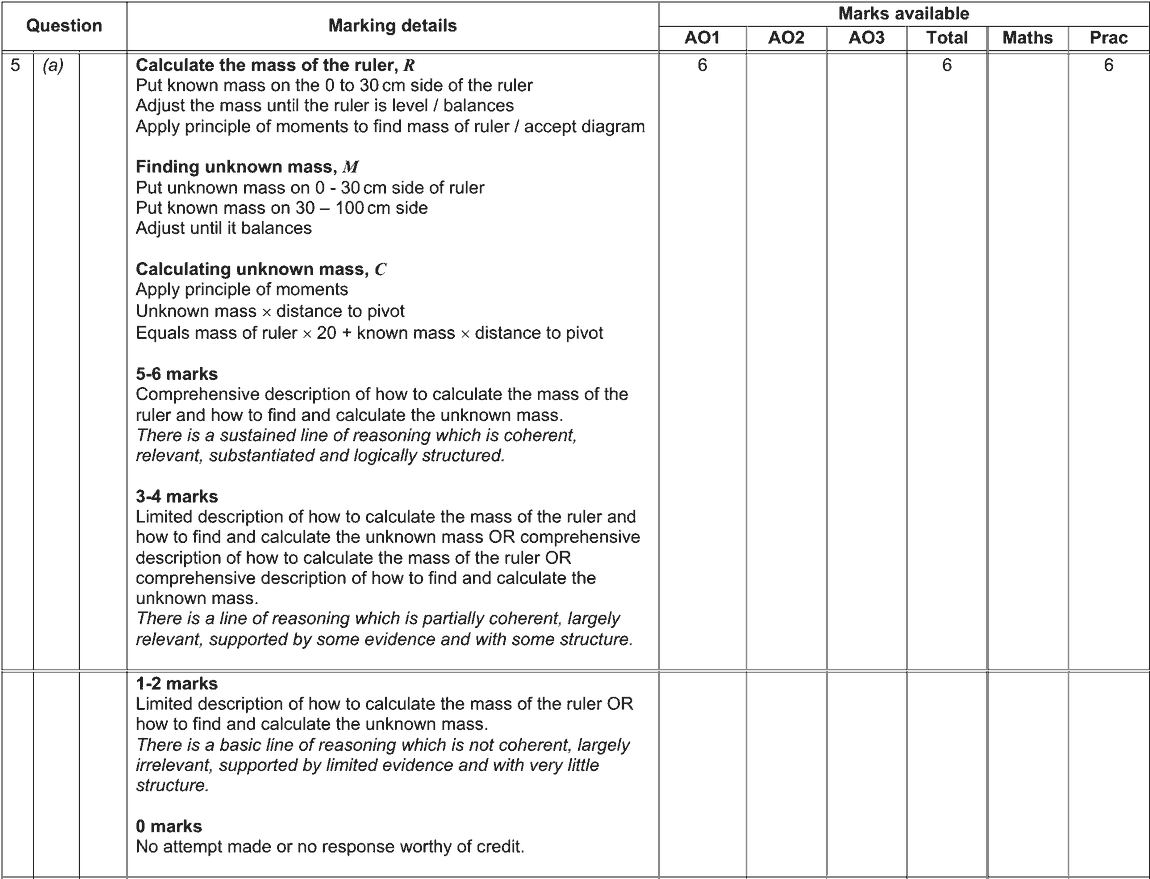
June 2019 · AS Component 1 · Q5(a)6 marksAO1=66-mark extended response
Mark scheme, with the levels and indicative content
Notes from the mark scheme and report
QER, levels marked. Mass of ruler: place the known mass on the 0 to 30 cm side, move it until the ruler balances level, apply the principle of moments with the ruler's weight acting at the 50 cm mark (20 cm from the pivot). Unknown mass: place it on the 0 to 30 cm side with the known mass on the 30 to 100 cm side and adjust until balanced. Calculation: unknown mass × its distance from pivot = ruler mass × 20 + known mass × its distance from pivot
Scheme columns: Practical 6
Skills: Experimentalmethod Describing, planning or improving an experiment; Practicalmarks The mark scheme's Prac column gives this part at least one mark for practical skills; QER The 6-mark quality of extended response question
June 2019 · AS Component 1 · Q5(b)5 marksAO2=3, AO3=2Calculation
Earlier part of question 5 that this part uses
Mark scheme
Notes from the mark scheme and report
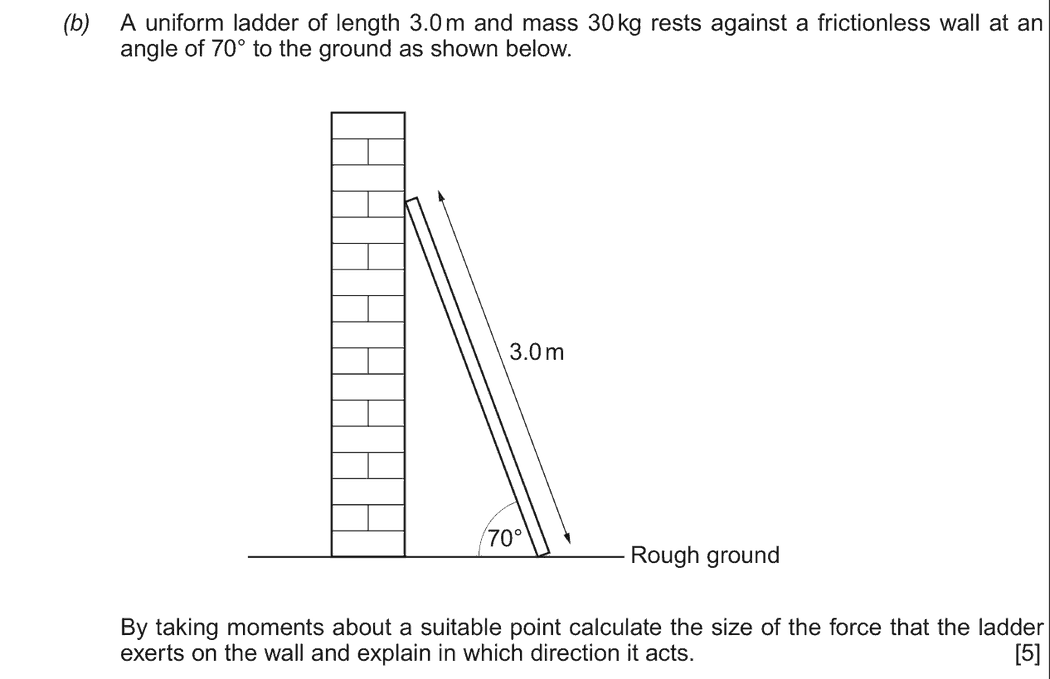
Answer: 53.6 N horizontally towards the wall (to the left). Wall is frictionless so its force on the ladder acts at 90° to the wall (1)
moments about the foot: R × 3.0 sin 70° (1) = 30 × 9.81 × 1.5 cos 70° (1)
R = 53.6 N (1)
by Newton's third law the ladder pushes on the wall with an equal force in the opposite direction (1)
Scheme columns: Maths 3
Skills: Trigonometryand vectors Resolving, components, vector addition, angles; Mathsmarks The mark scheme's Maths column gives this part at least one mark for mathematical skills
June 2019 · Component 1 · Q6(a)(i)4 marksAO1=1, AO2=3Practical and data analysis
Mark scheme
Examiner's comment
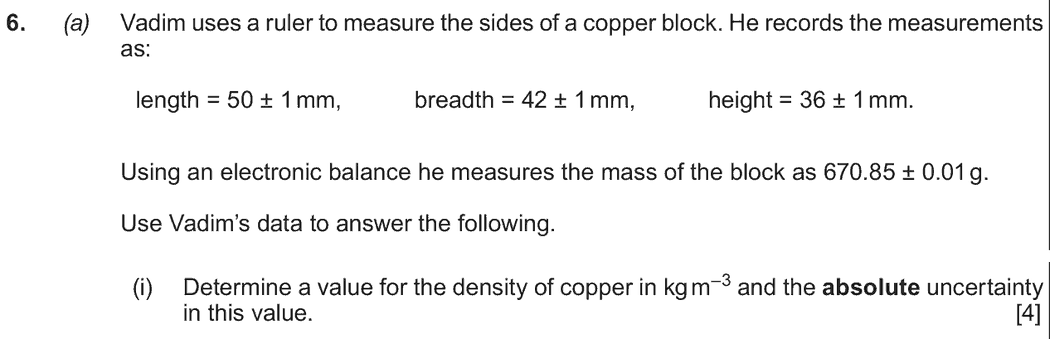
Most candidates knew how to calculate the density in kg m–3 and its absolute uncertainty. The measurements in mm were handled well. Full marks were given for 𝝆= (𝟖. 𝟗± 𝟎. 𝟔) × 𝟏𝟎𝟑[kg m-3], 𝝆= (𝟖. 𝟗± 𝟎. 𝟕) × 𝟏𝟎𝟑[kg m-3], 𝝆= (𝟖. 𝟖𝟕± 𝟎. 𝟔𝟒) × 𝟏𝟎𝟑[kg m-3]. A common fault was giving uncertainties to too many significant figures.
Notes from the mark scheme and report
Answer: (8.9 ± 0.6) × 10³ kg m⁻³ (± 0.7 also accepted). V = 50 × 42 × 36 mm³ = 7.56 × 10⁻⁵ m³
uncertainties were often quoted to too many significant figures
Scheme columns: Maths 2, Practical 4
Skills: Uncertainties Resolution, absolute and percentage uncertainty, combining uncertainties, error bars; Unitsand conversions Unit marks, base units, prefixes and conversions; Mathsmarks The mark scheme's Maths column gives this part at least one mark for mathematical skills; Practicalmarks The mark scheme's Prac column gives this part at least one mark for practical skills
June 2019 · Component 1 · Q6(a)(ii)2 marksAO2=2Calculation
Earlier part of question 6 that this part uses
Mark scheme
Examiner's comment
Finding the number of atoms per m3 of copper was usually done successfully, though a small minority divided the mass of the block in
Notes from the mark scheme and report
Answer: 8.4 × 10²⁸ m⁻³. Number per m³ = ρ/(mass of one atom) = 8.87 × 10³/(63.5 × 1.66 × 10⁻²⁷)
ecf on ρ
a few divided the mass of the block instead of the density
Scheme columns: Maths 1, Practical 2
Skills: Unitsand conversions Unit marks, base units, prefixes and conversions; Mathsmarks The mark scheme's Maths column gives this part at least one mark for mathematical skills; Practicalmarks The mark scheme's Prac column gives this part at least one mark for practical skills
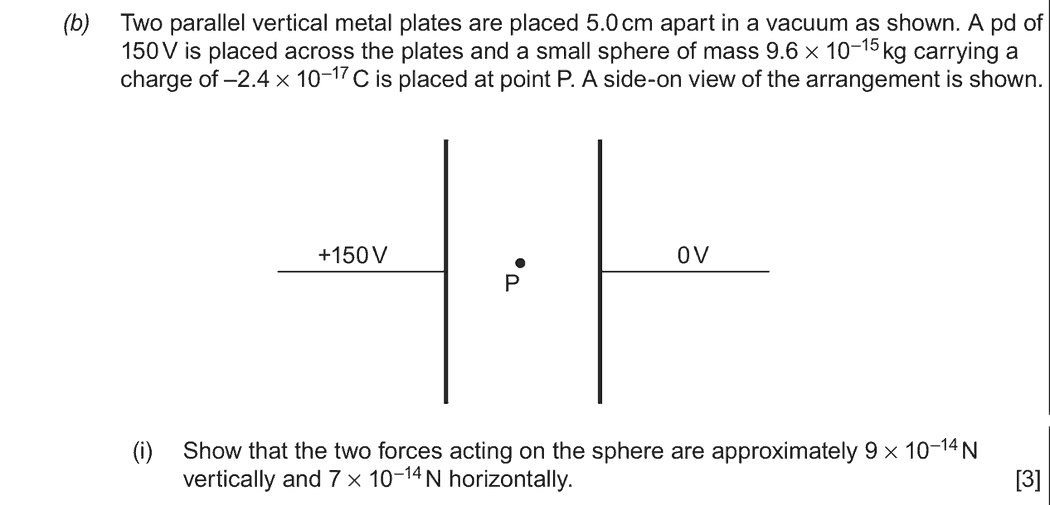
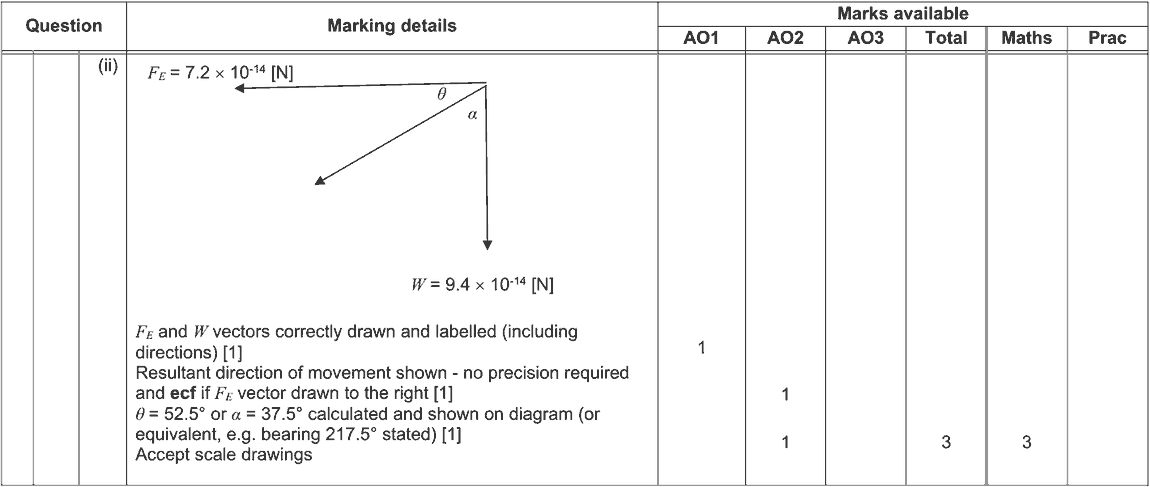
June 2019 · Component 2 · Q8(b)(ii)3 marksAO1=1, AO2=2Diagram or graph
Earlier parts of question 8 that this part uses
Mark scheme
Examiner's comment
A significant number of candidates drew the electric force vector to the right rather than the left, and a surprising number drew the weight vector upwards. Angles were largely calculated correctly but a significant number then labelled the wrong angle on the diagram. No candidate drew scale diagrams.
Notes from the mark scheme and report
Electric force 7.2 × 10⁻¹⁴ N horizontally towards the +150 V plate (left, since the charge is negative) and weight 9.4 × 10⁻¹⁴ N downwards, labelled (1)
resultant direction shown down and to the left (1)
angle 52.5° below the horizontal (37.5° to the vertical) marked (1)
common errors: electric force drawn to the right, weight upwards, or the wrong angle labelled
Scheme columns: Maths 3
Skills: Trigonometryand vectors Resolving, components, vector addition, angles; Mathsmarks The mark scheme's Maths column gives this part at least one mark for mathematical skills
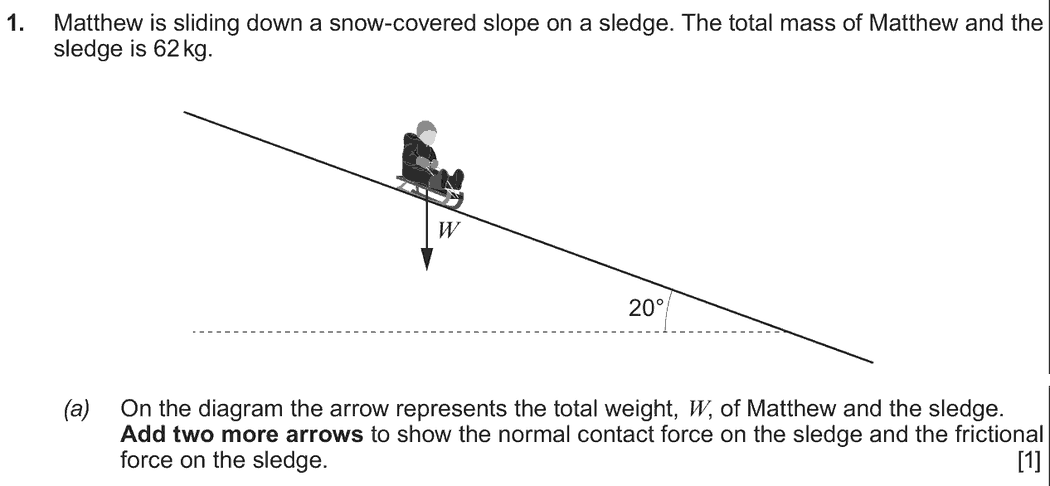
June 2018 · Component 1 · Q1(b)(i)2 marksAO1=1, AO2=1Show that
Earlier part of question 1 that this part uses
Mark scheme
Examiner's comment
The component of W parallel to the slope was almost always found correctly.
Notes from the mark scheme and report
W = 62 × 9.81 = 608 N (1)
component along the slope = W sin 20° (or W cos 70°) = 208 N (1)
Scheme columns: Maths 1
Skills: Trigonometryand vectors Resolving, components, vector addition, angles; Mathsmarks The mark scheme's Maths column gives this part at least one mark for mathematical skills
June 2018 · Component 1 · Q1(b)(ii)2 marksAO2=2Calculation
Earlier parts of question 1 that this part uses
Mark scheme
Examiner's comment
There were a few more mistakes in the calculation of the normal contact force. Occasionally, for example, W was divided, rather than multiplied, by cos 20°.
Notes from the mark scheme and report
Answer: 572 N (570 N). No acceleration perpendicular to the slope so N = W cos 20°
some divided by cos 20°
Scheme columns: Maths 2
Skills: Trigonometryand vectors Resolving, components, vector addition, angles; Mathsmarks The mark scheme's Maths column gives this part at least one mark for mathematical skills
June 2018 · AS Component 1 · Q2(a)(i)2 marksAO2=2Practical and data analysis
Mark scheme
Examiner's comment
This is the second year that uncertainties have been examined in a theory paper and as mentioned earlier there was a notable improvement in the way in which this question was answered
Skills: Uncertainties Resolution, absolute and percentage uncertainty, combining uncertainties, error bars; Mathsmarks The mark scheme's Maths column gives this part at least one mark for mathematical skills; Practicalmarks The mark scheme's Prac column gives this part at least one mark for practical skills
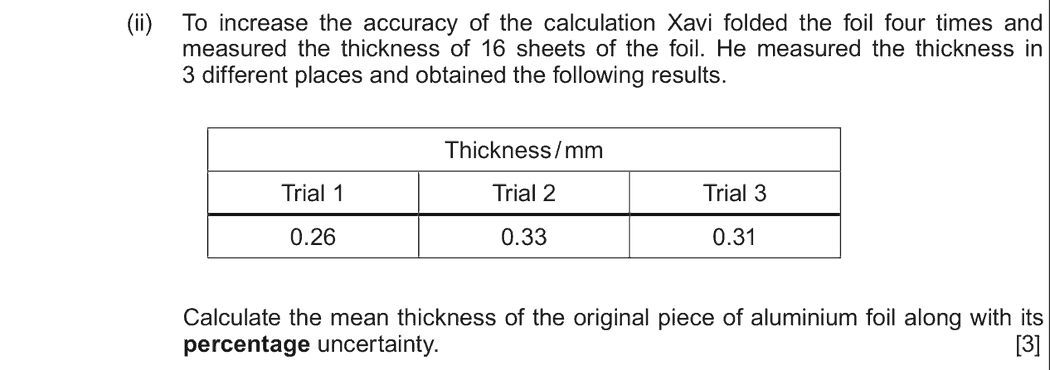
June 2018 · AS Component 1 · Q2(a)(ii)3 marksAO2=3Practical and data analysis
Earlier part of question 2 that this part uses
Mark scheme
Examiner's comment
This is the second year that uncertainties have been examined in a theory paper and as mentioned earlier there was a notable improvement in the way in which this question was answered
Notes from the mark scheme and report
Answer: 0.019 mm ± 12%. Mean of 16 sheets = 0.30 mm
one sheet = 0.30/16 = 0.0188 mm
uncertainty = half the range = 0.035 mm, so 0.035/0.30 = 12% (10% accepted)
Scheme columns: Maths 3, Practical 3
Skills: Uncertainties Resolution, absolute and percentage uncertainty, combining uncertainties, error bars; Mathsmarks The mark scheme's Maths column gives this part at least one mark for mathematical skills; Practicalmarks The mark scheme's Prac column gives this part at least one mark for practical skills
June 2018 · AS Component 1 · Q2(a)(iii)2 marksAO2=2Practical and data analysis
Earlier part of question 2 that this part uses
Mark scheme
Examiner's comment
This is the second year that uncertainties have been examined in a theory paper and as mentioned earlier there was a notable improvement in the way in which this question was answered
Notes from the mark scheme and report
Answer: 1.1 cm³ ± 13% (1.125 cm³ or 1125 mm³). Volume = area × thickness = 600 × 0.001875 cm³
percentage uncertainties from (i) and (ii) added
Scheme columns: Maths 2, Practical 2
Skills: Uncertainties Resolution, absolute and percentage uncertainty, combining uncertainties, error bars; Unitsand conversions Unit marks, base units, prefixes and conversions; Mathsmarks The mark scheme's Maths column gives this part at least one mark for mathematical skills; Practicalmarks The mark scheme's Prac column gives this part at least one mark for practical skills
June 2018 · AS Component 1 · Q2(b)4 marksAO2=4Practical and data analysis
Earlier part of question 2 that this part uses
Mark scheme
Examiner's comment
This is the second year that uncertainties have been examined in a theory paper and as mentioned earlier there was a notable improvement in the way in which this question was answered
Notes from the mark scheme and report
Answer: (2.5 ± 0.3) g cm⁻³. Mass uncertainty 0.36%
density = 2.81/1.125 = 2.50 g cm⁻³ with unit
total uncertainty about 13% gives ± 0.3
density to 2 sf and uncertainty to 1 sf
Scheme columns: Maths 4, Practical 4
Skills: Uncertainties Resolution, absolute and percentage uncertainty, combining uncertainties, error bars; Mathsmarks The mark scheme's Maths column gives this part at least one mark for mathematical skills; Practicalmarks The mark scheme's Prac column gives this part at least one mark for practical skills
June 2018 · AS Component 1 · Q2(c)2 marksAO3=2Practical and data analysis
Earlier part of question 2 that this part uses
Mark scheme
Examiner's comment
This is the second year that uncertainties have been examined in a theory paper and as mentioned earlier there was a notable improvement in the way in which this question was answered
Notes from the mark scheme and report
The thickness measurement contributes most (1)
reduce it by folding more times to measure more sheets, using a higher resolution instrument, or using thicker foil (1)
Scheme columns: Practical 2
Skills: Uncertainties Resolution, absolute and percentage uncertainty, combining uncertainties, error bars; Experimentalmethod Describing, planning or improving an experiment; Practicalmarks The mark scheme's Prac column gives this part at least one mark for practical skills
June 2018 · AS Component 1 · Q4(a)3 marksAO1=2, AO2=1Show that
Mark scheme
Examiner's comment
This was not well answered with a large number of candidates unable to convert the watt into base SI units.
Notes from the mark scheme and report
σ = P/(AT⁴) (1)
W = J s⁻¹ = kg m² s⁻³ (1)
A in m² and T⁴ in K⁴, so m² cancels to leave kg s⁻³ K⁻⁴ (1)
many could not write the watt in base units
Scheme columns: Maths 1
Skills: Algebra Derivations and rearranging equations; Mathsmarks The mark scheme's Maths column gives this part at least one mark for mathematical skills
June 2018 · Component 1 · Q6(a)3 marksAO1=1, AO2=2Practical and data analysis
Mark scheme
Examiner's comment
Most candidates justified the equation 0.150 mz M using the principle of moments, though not all pointed out that the resulting equation required dividing through by g. The origin of the 0.150 was well explained.
Notes from the mark scheme and report
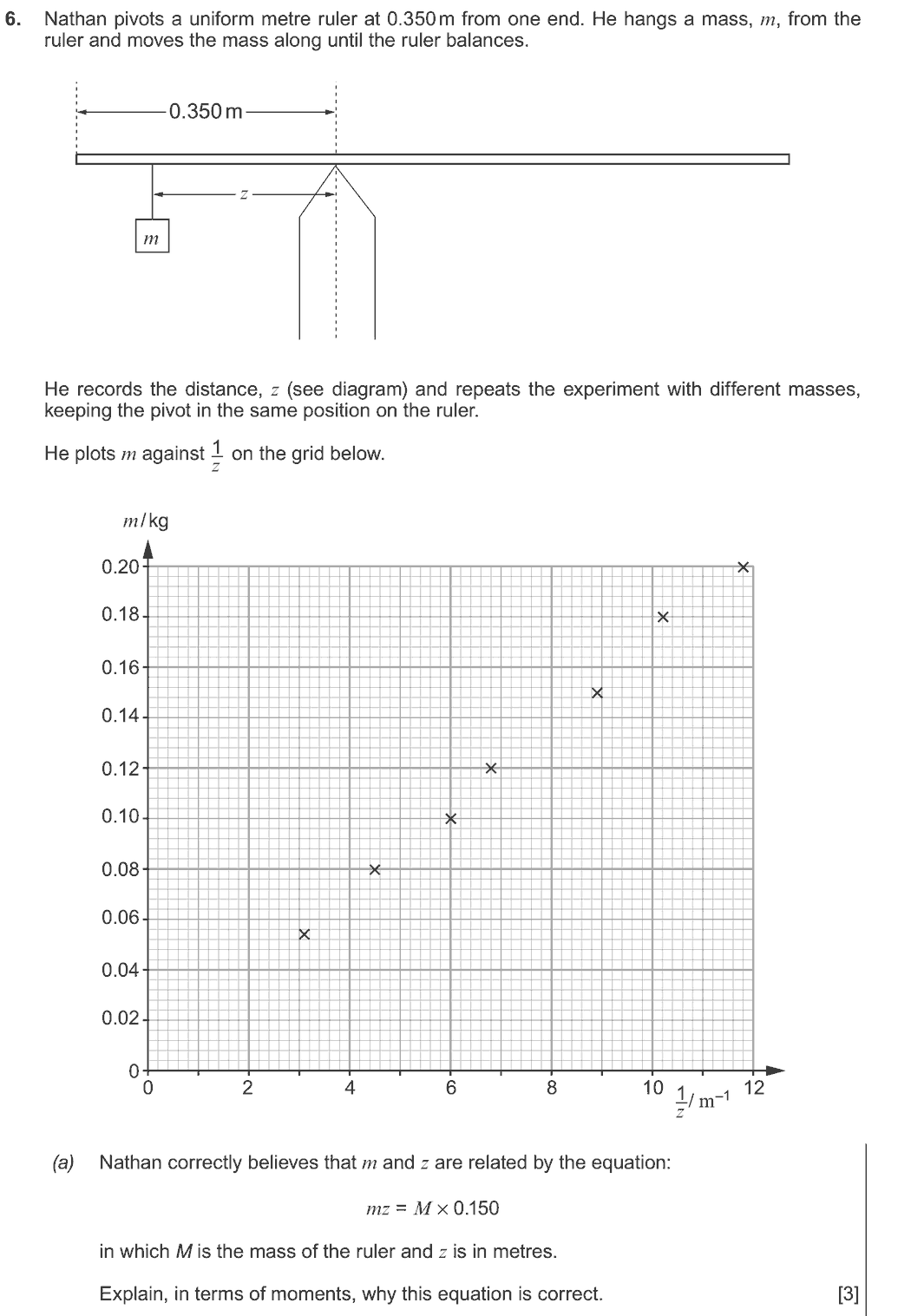
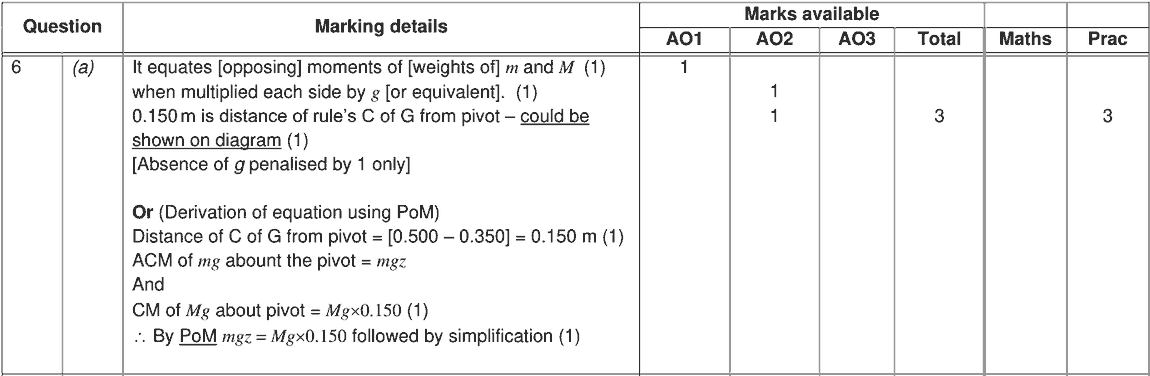
The equation equates the moments of the weights of m and M about the pivot (1): mgz = Mg × 0.150, then g cancels (1)
0.150 m is the distance of the ruler's centre of gravity (at 0.500 m) from the pivot at 0.350 m (1)
leaving out g lost one mark
Scheme columns: Practical 3
Skills: Practicalmarks The mark scheme's Prac column gives this part at least one mark for practical skills
June 2018 · AS Component 1 · Q6(a)1 markAO1=1Definition
Mark scheme
Examiner's comment
In part (a) a number of candidates described the centre of mass rather than the centre of gravity. The rest of the question was generally well answered.
Notes from the mark scheme and report
The point at which the whole weight of the object can be considered to act
some described the centre of mass
June 2018 · Component 1 · Q6(b)4 marksAO3=4Practical and data analysis
Earlier part of question 6 that this part uses
Mark scheme
Examiner's comment
A substantial majority realised that the gradient of a graph of m against 1 z would e 0.150 M , drew the graph line and found a value for M. Sometimes a mark was lost for a poor choice of line or inaccurate determination of gradient
Notes from the mark scheme and report
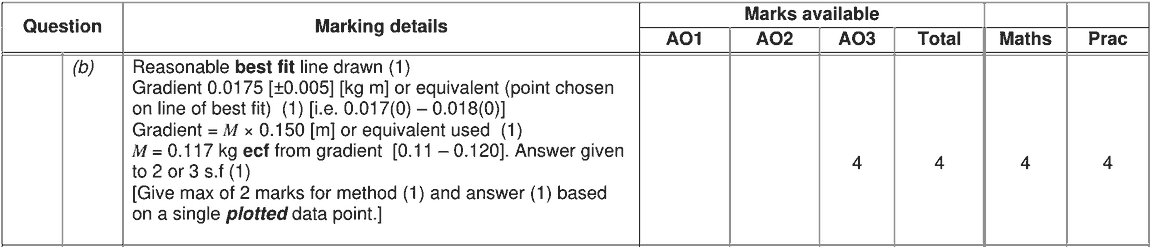
Answer: 0.117 kg (0.110 to 0.120, 2 or 3 sf). Best-fit line through the origin (1)
gradient 0.0175 kg m from points on the line (1)
gradient = 0.150 M (1)
M = gradient/0.150 (1)
using a single plotted point scores at most 2
Scheme columns: Maths 4, Practical 4
Skills: Graphskills Reading, plotting or sketching graphs; gradients, intercepts and areas; Mathsmarks The mark scheme's Maths column gives this part at least one mark for mathematical skills; Practicalmarks The mark scheme's Prac column gives this part at least one mark for practical skills
June 2018 · AS Component 1 · Q6(b)(i)2 marksAO1=1, AO2=1Calculation
Earlier part of question 6 that this part uses
Mark scheme
Examiner's comment
In part (a) a number of candidates described the centre of mass rather than the centre of gravity. The rest of the question was generally well answered.
Notes from the mark scheme and report
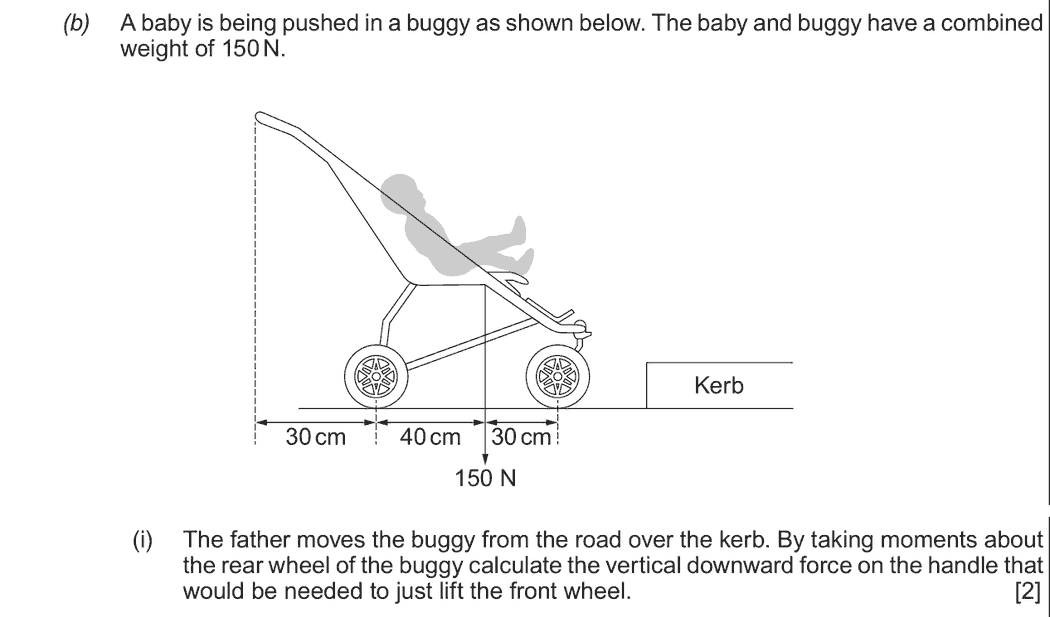
Answer: 200 N. Moments about the rear wheel: F × 30 = 150 × 40
Scheme columns: Maths 2
Skills: Mathsmarks The mark scheme's Maths column gives this part at least one mark for mathematical skills
June 2018 · AS Component 1 · Q6(b)(ii)3 marksAO3=3Calculation
Earlier parts of question 6 that this part uses
Mark scheme
Examiner's comment
In part (a) a number of candidates described the centre of mass rather than the centre of gravity. The rest of the question was generally well answered.
Notes from the mark scheme and report
Answer: 45 N. The pivot is now the front wheel, which is much further from the handle (100 cm) (1)
F × 100 = 150 × 30 (1)
F = 45 N, far less than 200 N (1)
Scheme columns: Maths 3
Skills: Mathsmarks The mark scheme's Maths column gives this part at least one mark for mathematical skills
June 2018 · AS Component 1 · Q6(b)(iii)2 marksAO1=2Short answer
Earlier parts of question 6 that this part uses
Mark scheme
Examiner's comment
In part (a) a number of candidates described the centre of mass rather than the centre of gravity. The rest of the question was generally well answered.
Notes from the mark scheme and report
Widen the base, i.e. increase the distance between the wheels (1)
lower the centre of gravity, e.g. lower seat or heavier base (1)
June 2018 · Component 1 · Q6(c)2 marksAO3=2Practical and data analysis
Earlier part of question 6 that this part uses
Mark scheme
Examiner's comment
Most candidates showed, for example by using their graphs, that an m of 0.050 kg would put the mass close to the end of the ruler, so significantly smaller values of m couldn’t be used. A few candidates wrote about larger uncertainties with smaller masses. They had clearly missed the important point.
Notes from the mark scheme and report
For m = 0.050 kg the mass is already at about z = 0.34 m (1)
a smaller m needs a larger z but z cannot exceed 0.350 m (m = 0.049 kg at the end of the ruler), so significantly lower masses are not possible (1)
answers about larger uncertainties missed the point
Scheme columns: Maths 1, Practical 2
Skills: Graphskills Reading, plotting or sketching graphs; gradients, intercepts and areas; Mathsmarks The mark scheme's Maths column gives this part at least one mark for mathematical skills; Practicalmarks The mark scheme's Prac column gives this part at least one mark for practical skills
June 2018 · AS Component 1 · Q7(b)(i)4 marksAO2=4Show that
Earlier part of question 7 that this part uses
Mark scheme
Examiner's comment
(i) and (ii). These sections were answered correctly by a minority of candidates. It was, however, pleasing to note that the vast majority of candidates kept with the question and obtained full marks for (b)(iii). PHYSICS GCE AS Summer 2018
Notes from the mark scheme and report
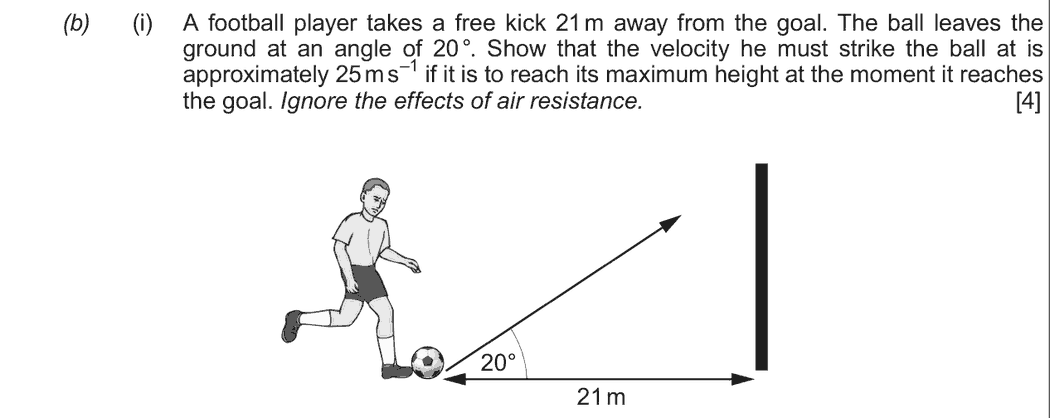
Components u cos 20° and u sin 20° (1)
time to goal t = 21/(u cos 20°) (1)
at maximum height 0 = u sin 20° − gt (1)
eliminating t: u² = 21g/(sin 20° cos 20°), u = 25.3 m s⁻¹ (1)
only a minority completed it
Scheme columns: Maths 4
Skills: Trigonometryand vectors Resolving, components, vector addition, angles; Algebra Derivations and rearranging equations; Mathsmarks The mark scheme's Maths column gives this part at least one mark for mathematical skills
June 2018 · Component 2 · Q7(b)(ii)1 markAO2=1Diagram or graph
Earlier parts of question 7 that this part uses
Mark scheme
Examiner's comment
(mean mark: 9.4/16 = 59%)
Notes from the mark scheme and report
Resultant R drawn between the two component arrows by vector addition (closer to the stronger field from B), labelled
June 2017 · Component 1 · Q1(a)(i)3 marksAO1=2, AO2=1Calculation
Mark scheme
Examiner's comment
There was great success in calculating the sum of clockwise moments. Common mistakes were treating the weight of the bar as if it acted through the end of the bar, failing to multiply masses by g, and giving the unit as N.
Notes from the mark scheme and report
Answer: 17 N m (16.7 to 16.8). Lantern 0.90 × 9.81 × 0.80 = 7.06 N m
bar weight acts at its centre: 1.80 × 9.81 × 0.55 = 9.70 N m
unit mark. Errors: bar weight taken at the end of the bar, g left out, unit given as N
Scheme columns: Maths 3
Skills: Unitsand conversions Unit marks, base units, prefixes and conversions; Mathsmarks The mark scheme's Maths column gives this part at least one mark for mathematical skills
June 2017 · Component 1 · Q1(a)(ii)2 marksAO3=2Calculation
Earlier part of question 1 that this part uses
Mark scheme
Examiner's comment
The tension in the wire was usually found correctly, the commonest serious mistake being to write Tsin = 16.8 [N m], that is equating a force to a moment.
Notes from the mark scheme and report
Answer: 27 N. Anticlockwise moment = T × 1.10 × sin 35° = 16.8 N m
ecf from (i)
a force (T sin θ) was sometimes equated to a moment
Scheme columns: Maths 2
Skills: Trigonometryand vectors Resolving, components, vector addition, angles; Mathsmarks The mark scheme's Maths column gives this part at least one mark for mathematical skills
June 2017 · Component 1 · Q1(a)(iii)2 marksAO3=2Explanation
Earlier part of question 1 that this part uses
Mark scheme
Examiner's comment
Most candidates explained clearly enough – either in words or with the help of an equation – why the tension would increase if were made smaller.
Notes from the mark scheme and report
Tension increases (1)
a smaller angle gives a smaller perpendicular distance (or smaller component of T perpendicular to the bar), so T must rise to balance the unchanged clockwise moment (1)
June 2017 · AS Component 1 · Q2(a)(ii)2 marksAO2=2Short answer
Earlier part of question 2 that this part uses
Mark scheme
Examiner's comment
Very well answered.
Notes from the mark scheme and report
I: motion in a circle at constant speed, or a practical example such as a car on a roundabout (1)
II: an object thrown upwards on its way up, or any decelerating object such as a braking car (1)
June 2017 · Component 1 · Q3(a)(i)2 marksAO1=1, AO2=1Show that
Mark scheme
Examiner's comment
Homogeneity of units in 𝑎= 𝒗𝟐 𝒓 was demonstrated clearly by almost everyone.
Notes from the mark scheme and report
Units of a, v and r given as m s⁻², m s⁻¹ and m (1)
(m s⁻¹)²/m = m² s⁻²/m = m s⁻² shown (1)
Scheme columns: Maths 1
Skills: Unitsand conversions Unit marks, base units, prefixes and conversions; Mathsmarks The mark scheme's Maths column gives this part at least one mark for mathematical skills
June 2017 · Component 1 · Q3(b)(ii)I2 marksCalculation
Earlier parts of question 3 that this part uses
Mark scheme
Examiner's comment
Although cos was sometimes used by mistake instead of sin, there was a good success rate in determining .
Notes from the mark scheme and report
Answer: 37.6° (38°). Component of F towards the centre provides the centripetal force: 5500 sin θ = 3360
June 2017 · Component 1 · Q3(b)(ii)II3 marksCalculation
Earlier parts of question 3 that this part uses
Mark scheme
Examiner's comment
Most candidates calculated D correctly using D = F cos, but the reasoning was not always given clearly. We were looking for no tangential (component of) acceleration, but accepted constant speed. ‘Constant velocity’ or ‘no acceleration’ or ‘no resultant force’ was not acceptable.
Notes from the mark scheme and report
Answer: 4360 N. Speed is constant so there is no tangential acceleration and the forward component of F balances D (1)
D = F cos θ = 5500 cos 37.6°
'constant velocity' or 'no resultant force' not accepted as the reason
June 2017 · AS Component 1 · Q6(a)2 marksAO1=2Definition
Mark scheme
Examiner's comment
There were many poor diagrams often unlabelled.
Notes from the mark scheme and report
Labelled diagram showing the force and the perpendicular distance from its line of action to the point (1)
moment = force × perpendicular distance (1)
diagrams were often unlabelled
June 2017 · AS Component 1 · Q6(b)(i)3 marksAO2=3Practical and data analysis
Earlier part of question 6 that this part uses
Mark scheme
Examiner's comment
A surprisingly large number of errors with this calculation; mainly candidates getting the distances incorrect. Even if they couldn’t recall the name of a spirit-level, they could have described any number of methods to gain this mark.
Notes from the mark scheme and report
Answer: 0.17 kg (or 0.2 kg). Distances from the pivot: newtonmeter 85 cm, centre of gravity (50 cm mark) 40 cm
W × 40 = 0.8 × 85 so W = 1.7 N
m = W/g
wrong distances were the main error
Scheme columns: Maths 2, Practical 3
Skills: Unitsand conversions Unit marks, base units, prefixes and conversions; Mathsmarks The mark scheme's Maths column gives this part at least one mark for mathematical skills; Practicalmarks The mark scheme's Prac column gives this part at least one mark for practical skills
June 2017 · AS Component 1 · Q6(b)(ii)I1 markPractical and data analysis
Earlier parts of question 6 that this part uses
Mark scheme
Examiner's comment
A surprisingly large number of errors with this calculation; mainly candidates getting the distances incorrect. Even if they couldn’t recall the name of a spirit-level, they could have described any number of methods to gain this mark.
Notes from the mark scheme and report
Measure the height of each end above the bench and check they are equal, or use a spirit level
Skills: Experimentalmethod Describing, planning or improving an experiment
June 2017 · AS Component 1 · Q6(b)(ii)II2 marksPractical and data analysis
Earlier parts of question 6 that this part uses
Mark scheme
Examiner's comment
A surprisingly large number of errors with this calculation; mainly candidates getting the distances incorrect. Even if they couldn’t recall the name of a spirit-level, they could have described any number of methods to gain this mark.
Notes from the mark scheme and report
Answer: 4.26 N (4.3 N). F × 85 = 1.7 × 40 + 0.5 × 9.81 × 60
June 2017 · AS Component 1 · Q6(c)2 marksAO3=2Practical and data analysis
Earlier parts of question 6 that this part uses
Mark scheme
Examiner's comment
A number of candidates correctly stated how to alter the apparatus but didn’t go on to explain their reasoning.
Notes from the mark scheme and report
The heavier ruler gives a larger clockwise moment (1)
so move the added mass towards the pivot or the newtonmeter further from it (1)
or raise the newtonmeter clamp because a larger upward force stretches its spring more
or move the pivot towards the centre of gravity to reduce the moment
the reasoning was often left out
Scheme columns: Practical 2
Skills: Experimentalmethod Describing, planning or improving an experiment; Practicalmarks The mark scheme's Prac column gives this part at least one mark for practical skills
June 2016 · AS Component 1 · Q1(a)2 marksAO1=2Short answer
Mark scheme
Examiner's comment
The conditions for equilibrium were well known.
Notes from the mark scheme and report
No resultant force (1) and no resultant moment, or sum of clockwise moments = sum of anticlockwise moments (1)
June 2016 · AS Component 1 · Q1(b)(i)2 marksAO1=1, AO2=1Diagram or graph
Earlier part of question 1 that this part uses
Mark scheme
Examiner's comment
The diagram was well labelled. However a few candidates used ‘floating’ arrows which did not touch the diagram so they lost a mark and a few others forgot to label the arrows.
Notes from the mark scheme and report
Weight (294 N or mg) drawn downwards from about the centre and touching the plank (1)
two upward support forces labelled, the right-hand one nearer the centre than the left-hand one (1)
arrows not touching the plank and unlabelled arrows lost marks
Scheme columns: Maths 1
Skills: Mathsmarks The mark scheme's Maths column gives this part at least one mark for mathematical skills
June 2016 · AS Component 1 · Q1(b)(ii)4 marksAO2=4Calculation
Earlier parts of question 1 that this part uses
Mark scheme
Examiner's comment
This was generally well done with a large number of candidates gaining all 4 marks.
Notes from the mark scheme and report
Answer: 187 N (man near B) and 107 N (man near A). Moments about the man near A: 5.5 F2 = 3.5 × 294
F1 = 294 − 187 (ecf)
Scheme columns: Maths 4
Skills: Mathsmarks The mark scheme's Maths column gives this part at least one mark for mathematical skills
June 2016 · AS Component 1 · Q1(b)(iii)1 markAO3=1Short answer
Earlier parts of question 1 that this part uses
Mark scheme
Examiner's comment
&(iv) Generally well done again.
Notes from the mark scheme and report
The force from the man near B decreases and the force from the man near A increases (both needed)
June 2016 · AS Component 1 · Q1(b)(iv)1 markAO3=1Short answer
Earlier parts of question 1 that this part uses
Mark scheme
Notes from the mark scheme and report
2.0 m from end A, i.e. the same distance from the centre of gravity as the man near B
June 2016 · AS Component 1 · Q2(a)2 marksAO1=2Short answer
Mark scheme
Examiner's comment
The definition of vector and scalar quantities was well known and the examples given were almost always correct.
Notes from the mark scheme and report
A vector has direction as well as magnitude, a scalar has magnitude only (1)
one correct example of each (1)
June 2016 · AS Component 1 · Q3(b)(ii)3 marksAO2=3Calculation
Earlier parts of question 3 that this part uses
Mark scheme
Examiner's comment
These parts differentiated well with only the better candidates managing to determine the angle in part (ii).
Skills: Trigonometryand vectors Resolving, components, vector addition, angles; Mathsmarks The mark scheme's Maths column gives this part at least one mark for mathematical skills
June 2016 · AS Component 1 · Q4(a)1 markAO2=1Practical and data analysis
Mark scheme
Examiner's comment
This was the most poorly answered question on the paper with a number of the candidates seemingly unprepared for a practical question of this type. In fact many candidates were unable to calculate percentage uncertainty never mind convert a percentage uncertainty to an absolute uncertainty. Part (d) was very poorly answered with few candidates realising there was a very large uncertainty in the resistance and also few attempted to determine the percentage uncertainties in the readings given.
Notes from the mark scheme and report
Answer: 0.8% (0.83%)
0.01/1.20 × 100
many could not calculate a percentage uncertainty
Scheme columns: Maths 1, Practical 1
Skills: Uncertainties Resolution, absolute and percentage uncertainty, combining uncertainties, error bars; Mathsmarks The mark scheme's Maths column gives this part at least one mark for mathematical skills; Practicalmarks The mark scheme's Prac column gives this part at least one mark for practical skills
June 2016 · AS Component 1 · Q4(b)3 marksAO1=1, AO2=2Practical and data analysis
Earlier part of question 4 that this part uses
Mark scheme
Examiner's comment
This was the most poorly answered question on the paper with a number of the candidates seemingly unprepared for a practical question of this type. In fact many candidates were unable to calculate percentage uncertainty never mind convert a percentage uncertainty to an absolute uncertainty. Part (d) was very poorly answered with few candidates realising there was a very large uncertainty in the resistance and also few attempted to determine the percentage uncertainties in the readings given.
Notes from the mark scheme and report
Answer: 9.0 × 10⁻⁷ m³ (0.90 cm³) ± 2.5%. V = (4/3)πr³ with r = 0.60 cm (unit needed)
percentage uncertainty = 3 × that of the diameter (ecf), given to 1 or 2 sf
Scheme columns: Maths 3, Practical 3
Skills: Uncertainties Resolution, absolute and percentage uncertainty, combining uncertainties, error bars; Unitsand conversions Unit marks, base units, prefixes and conversions; Mathsmarks The mark scheme's Maths column gives this part at least one mark for mathematical skills; Practicalmarks The mark scheme's Prac column gives this part at least one mark for practical skills
June 2016 · AS Component 1 · Q4(c)3 marksAO2=2, AO3=1Practical and data analysis
Earlier part of question 4 that this part uses
Mark scheme
Examiner's comment
This was the most poorly answered question on the paper with a number of the candidates seemingly unprepared for a practical question of this type. In fact many candidates were unable to calculate percentage uncertainty never mind convert a percentage uncertainty to an absolute uncertainty. Part (d) was very poorly answered with few candidates realising there was a very large uncertainty in the resistance and also few attempted to determine the percentage uncertainties in the readings given.
Notes from the mark scheme and report
Answer: steel. Percentage uncertainty in mass = 1.4%
density = 6.9 × 10⁻³/9.04 × 10⁻⁷ = 7626 kg m⁻³ with 3.9% uncertainty, i.e. ± 300 kg m⁻³
only steel (7850) lies in the range
ecf
few could turn a percentage uncertainty into an absolute one
Scheme columns: Maths 2, Practical 3
Skills: Uncertainties Resolution, absolute and percentage uncertainty, combining uncertainties, error bars; Unitsand conversions Unit marks, base units, prefixes and conversions; Mathsmarks The mark scheme's Maths column gives this part at least one mark for mathematical skills; Practicalmarks The mark scheme's Prac column gives this part at least one mark for practical skills
June 2016 · AS Component 1 · Q4(d)3 marksAO3=3Practical and data analysis
Earlier part of question 4 that this part uses
Mark scheme
Examiner's comment
This was the most poorly answered question on the paper with a number of the candidates seemingly unprepared for a practical question of this type. In fact many candidates were unable to calculate percentage uncertainty never mind convert a percentage uncertainty to an absolute uncertainty. Part (d) was very poorly answered with few candidates realising there was a very large uncertainty in the resistance and also few attempted to determine the percentage uncertainties in the readings given.
Notes from the mark scheme and report
Percentage uncertainty in the wire's diameter (4%) is much bigger than for the ball bearing because the diameter is much smaller (2)
the resistance has the largest percentage uncertainty (9%) (1). Alternative: add %R + %A + %l = 9 + 8 + 0.03 = 18% (13% scores 2)
very poorly answered, few calculated the percentage uncertainties
Scheme columns: Maths 2, Practical 3
Skills: Uncertainties Resolution, absolute and percentage uncertainty, combining uncertainties, error bars; Mathsmarks The mark scheme's Maths column gives this part at least one mark for mathematical skills; Practicalmarks The mark scheme's Prac column gives this part at least one mark for practical skills
Work with an Eduqas physics tutor
Dropping marks on calculations, specified practicals or the six-mark QER questions? Book a trial session with a specialist Eduqas physics tutor.