2.4-a the idea that a simple parallel plate capacitor consists of a pair of equal parallel metal plates separated by a vacuum or air
2.4-b a capacitor storing energy by transferring charge from one plate to the other, so that the plates carry equal but opposite charges (the net charge being zero)
2.4-c the definition of capacitance as C = Q/V
2.4-d the use of C = ε₀A/d for a parallel plate capacitor, with no dielectric
2.4-e the idea that a dielectric increases the capacitance of a vacuum-spaced capacitor
2.4-f the E field within a parallel plate capacitor being uniform and the use of the equation E = V/d
2.4-g the equation U = ½QV for the energy stored in a capacitor
2.4-h the equations for capacitors in series and in parallel
2.4-i the process by which a capacitor charges and discharges through a resistor
2.4-j the equations: Q = Q₀(1 − e^(−t/RC)) and Q = Q₀e^(−t/RC) where RC is the time constant
2.4-P1 Specified practical: Investigation of the charging and discharging of a capacitor to determine the time constant
2.4-P2 Specified practical: Investigation of the energy stored in a capacitor
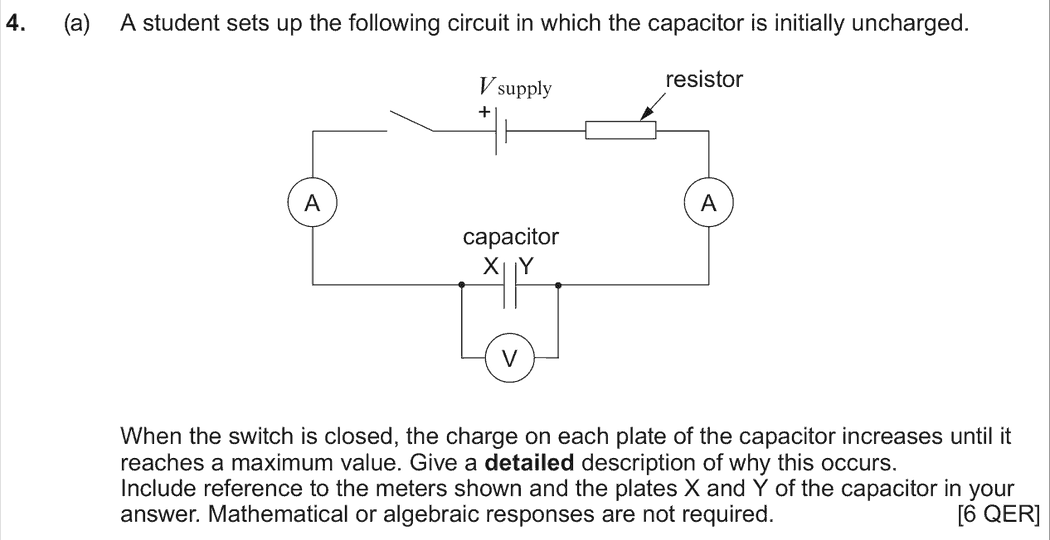
. (a) A student sets up the following circuit in which the capacitor is initially uncharged. resistor V supply + A A capacitor X Y V When the switch is closed, the charge on each plate of the capacitor increases until it
Tap a question to zoom it. Where a part needs a figure, table or graph from earlier in the question, that part folds out above it; the mark scheme and examiner's comment open underneath. Have the Eduqas Data Booklet beside you (see the Data Booklet page).
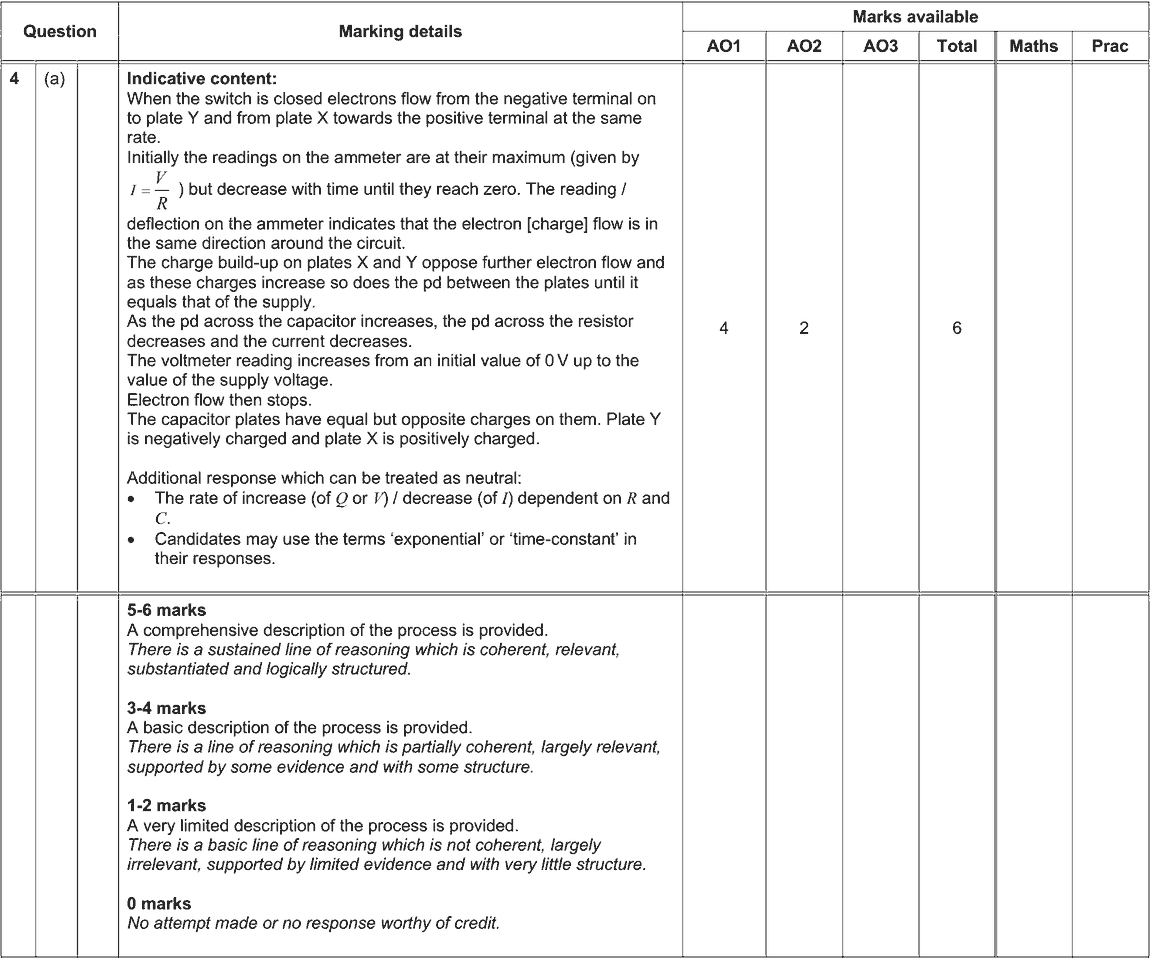
Mark scheme, with the levels and indicative content
Examiner's comment
This QER (Quality of Extended Response) question was answered satisfactorily. Stronger responses clearly explained the mechanism of charge flow to and from plates X and Y, described the resulting changes in potential difference and current within the circuit, and related these to what would be observed on the meters. Some candidates also addressed how the potential difference across resistor R would be affected. A number of responses included discussion of how the rates of change of current, charge, or potential difference varied over time. Weaker or lower-band responses tended to be limited or superficial, often mentioning charge or electron flow to and from the plates without referencing the behaviour of the meters, which limited the depth and relevance of their answers.
Notes from the mark scheme and report
QER, levels marked. Electrons flow from the negative terminal onto plate Y and off plate X towards the positive terminal at the same rate, shown by equal readings on both ammeters
current starts at its maximum (V/R) and falls to zero
charge on the plates opposes further flow
pd across the capacitor (voltmeter) rises from 0 to the supply pd while the pd across the resistor falls
finally Y is negative and X positive with equal and opposite charges. Weaker answers did not mention the meters
Skills: QER The 6-mark quality of extended response question
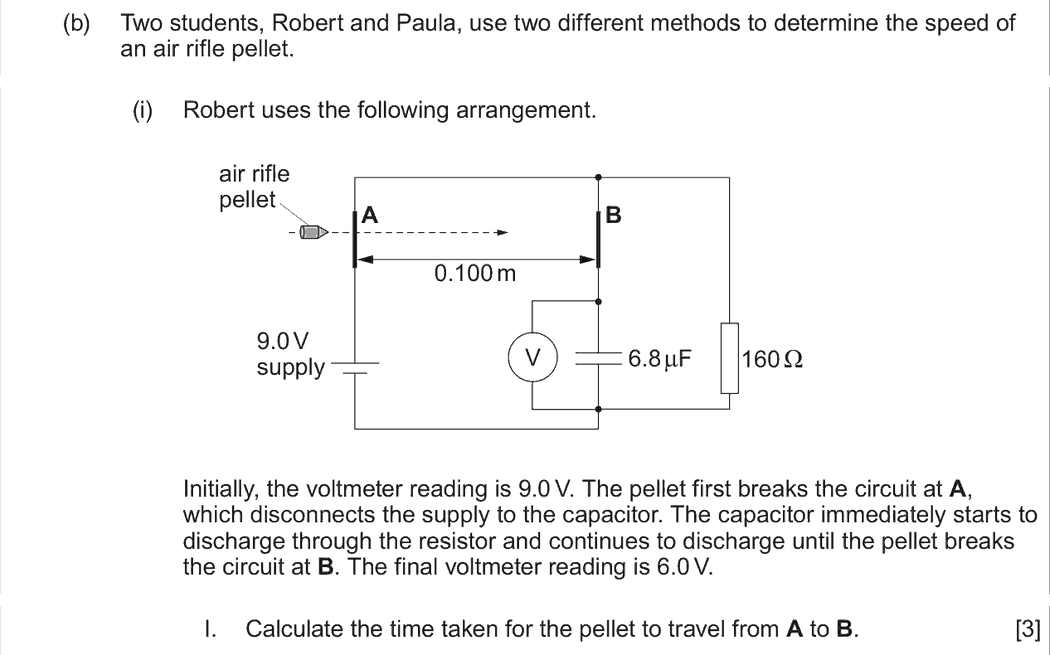
June 2025 · Component 2 · Q4(b)(i)I3 marksCalculation
Earlier part of question 4 that this part uses
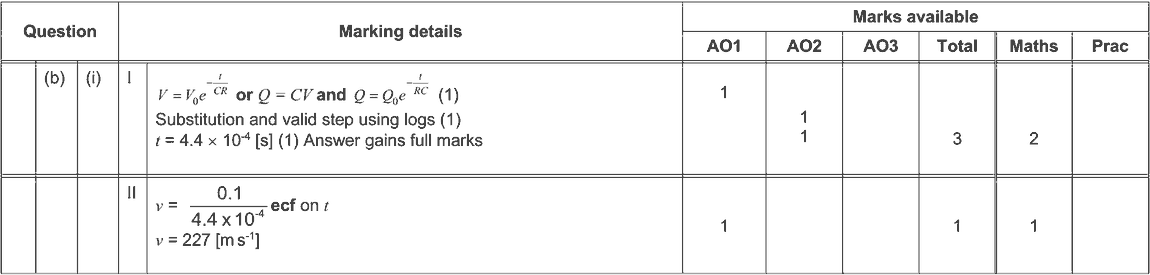
Mark scheme
Examiner's comment
and (ii) Nearly all candidates correctly used an exponential decay equation—based on either given voltage values or calculated charge values—to determine the time taken for the pellet to travel the specified distance. Most then correctly calculated the speed of the pellet. In part (ii), candidates showed strong understanding of the principle of conservation of momentum and successfully applied it to validate their answers to part (i), which was encouraging.
Notes from the mark scheme and report
Answer: 4.4 × 10⁻⁴ s. V = V0 e^(−t/RC)
t = RC ln(9.0/6.0) = 160 × 6.8 × 10⁻⁶ × 0.405. The mark-scheme crop also shows the row for part II
Skills: Algebra Derivations and rearranging equations
June 2024 · Component 2 · Q4(a)2 marksAO2=2Calculation
Mark scheme
Examiner's comment
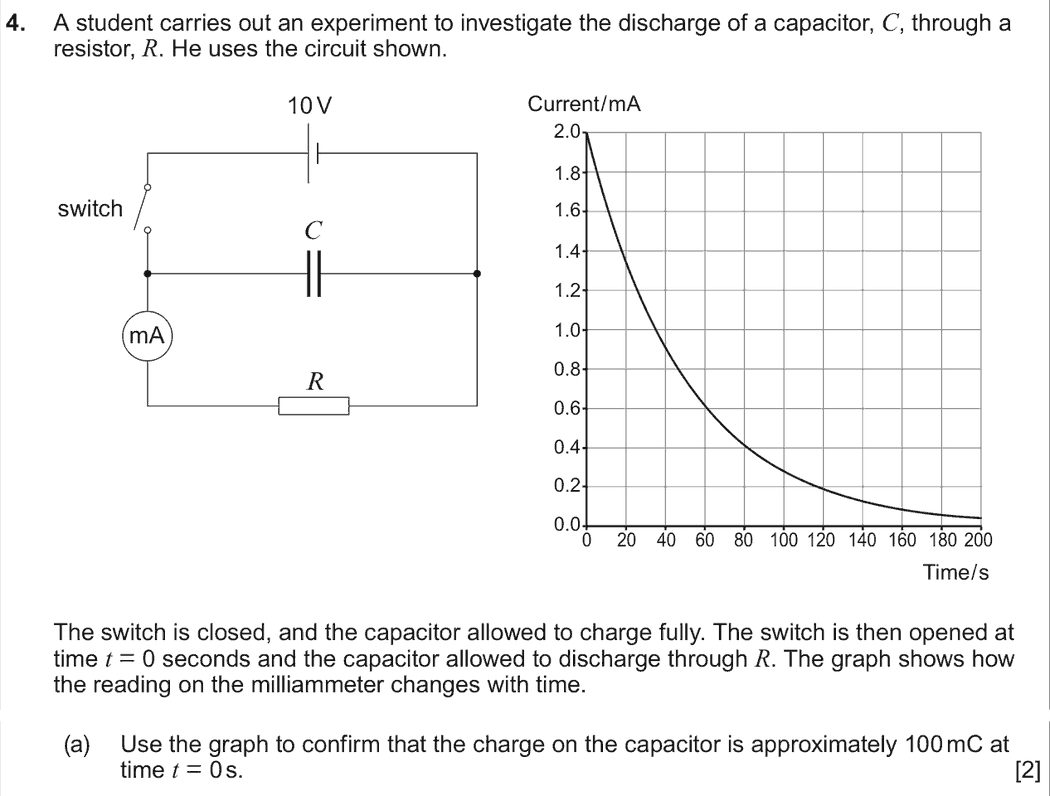
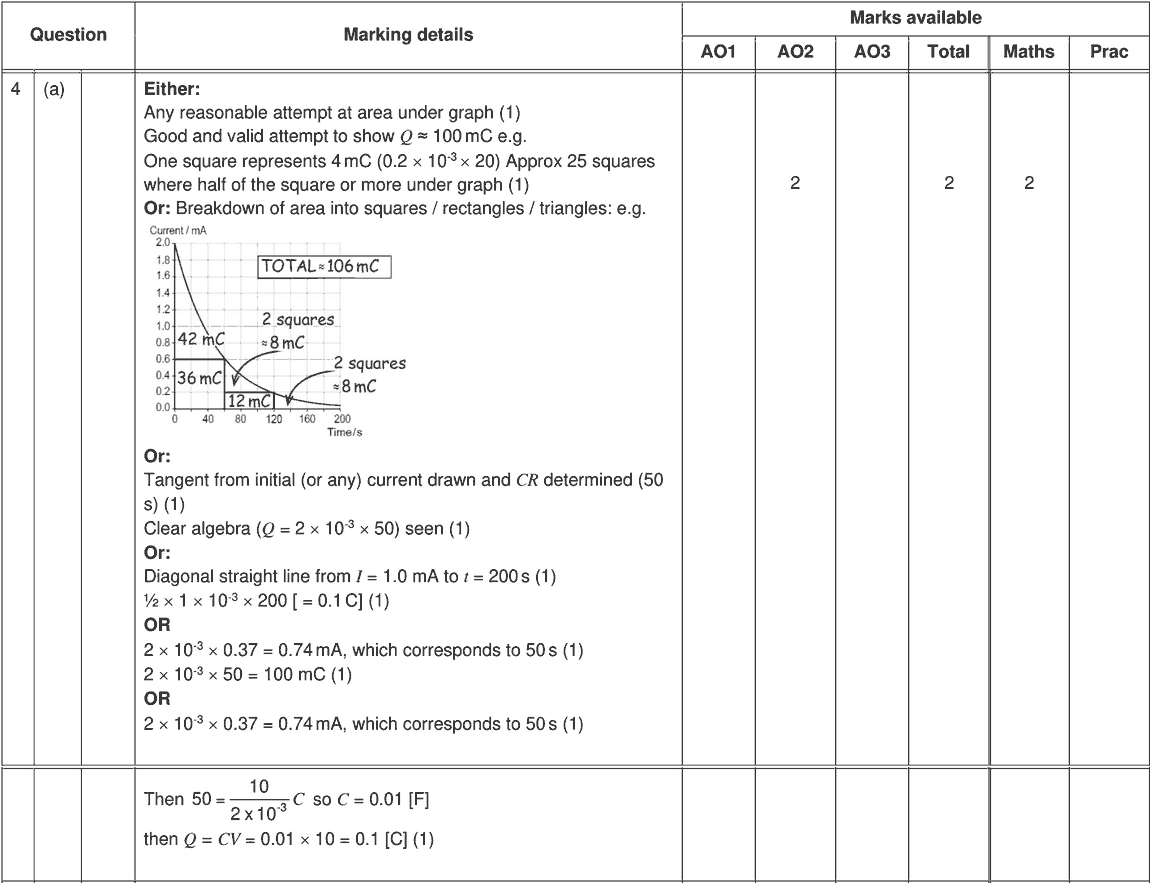
A variety of good attempts were made to confirm the charge on the capacitor, including valiant attempts at estimating the area under the curve. Tolerance was given to final answers based on this approach. It was apparent however that a noticeable number of candidates were unaware of the link between area and charge. A few candidates drew an appropriate tangent and determined the time constant from it, and from this determined the required charge.
Notes from the mark scheme and report
Charge = area under the current-time graph: each square is 0.2 mA × 20 s = 4 mC and there are about 25 squares, so about 100 mC
or time constant 50 s from the initial tangent (or 37% point, 0.74 mA) and Q = I0 × CR = 2.0 mA × 50 s
some did not link area with charge
Scheme columns: Maths 2
Skills: Graphskills Reading, plotting or sketching graphs; gradients, intercepts and areas; Mathsmarks The mark scheme's Maths column gives this part at least one mark for mathematical skills
June 2024 · Component 2 · Q4(b)(i)3 marksAO1=1, AO2=2Calculation
Earlier part of question 4 that this part uses
Mark scheme
Examiner's comment
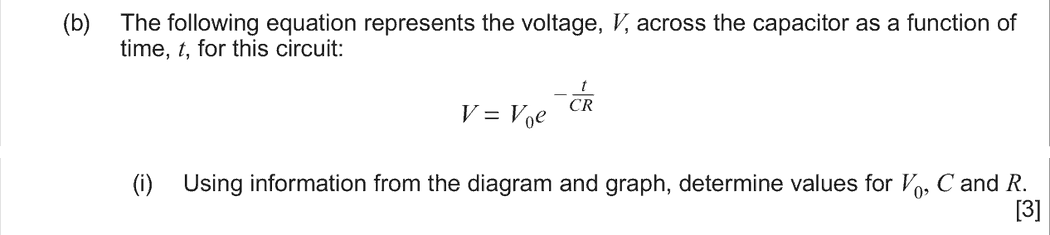
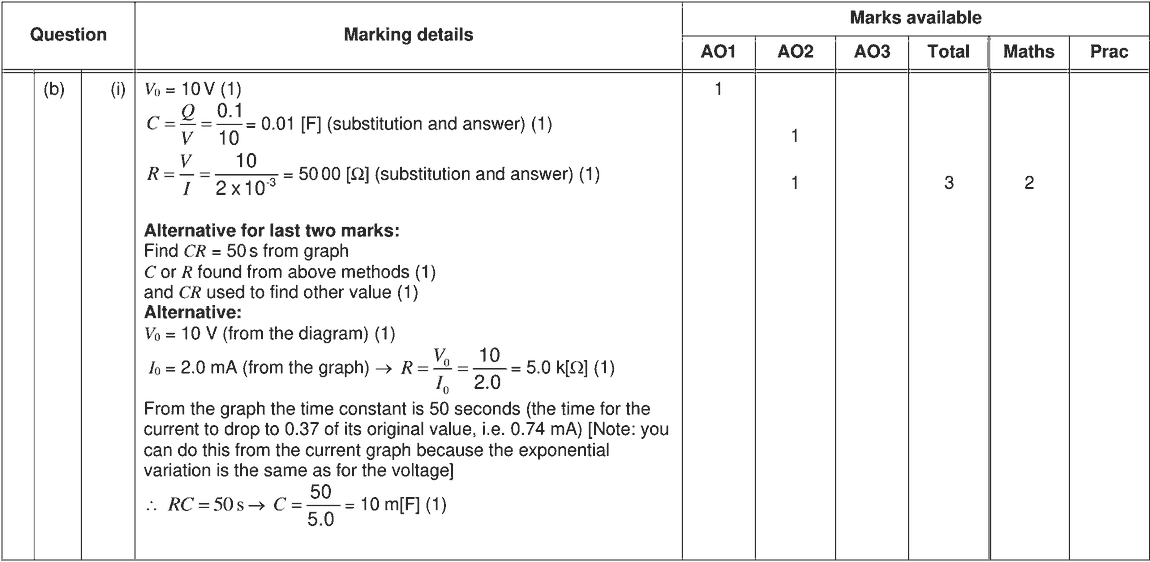
A very good response. Most candidates were able to determine the values of V0, C and R correctly. Many were confident using the decay equation.
Notes from the mark scheme and report
Answer: V0 = 10 V, C = 0.010 F, R = 5.0 kΩ. V0 is the supply pd
C = Q/V = 0.10/10
R = V0/I0 = 10/2.0 × 10⁻³
or CR = 50 s from the graph to find the other value
Scheme columns: Maths 2
Skills: Graphskills Reading, plotting or sketching graphs; gradients, intercepts and areas; Mathsmarks The mark scheme's Maths column gives this part at least one mark for mathematical skills
June 2024 · Component 2 · Q4(b)(ii)3 marksAO2=3Calculation
Earlier parts of question 4 that this part uses
Mark scheme
Examiner's comment
Most candidates correctly calculated the pd. Fewer were able to show clearly that their value for pd was consistent with the current value at the required time. For example, the mark could not be awarded to responses such as ‘and therefore consistent’. Additional detail was required to show that the calculated pd corresponded to the current measured at the correct time on the graph.
Notes from the mark scheme and report
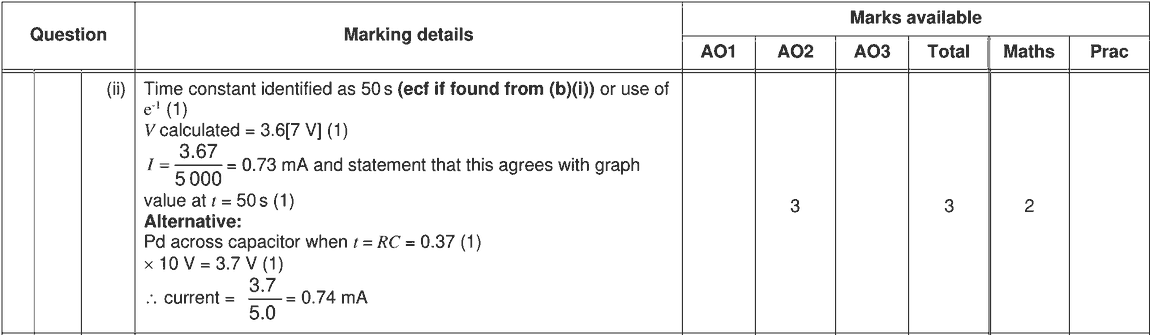
Answer: 3.7 V. Time constant CR = 50 s
V = 10 e⁻¹ = 3.68 V
current = 3.68/5000 = 0.74 mA, which matches the graph reading at t = 50 s
the comparison with the graph value had to be explicit
Scheme columns: Maths 2
Skills: Graphskills Reading, plotting or sketching graphs; gradients, intercepts and areas; Mathsmarks The mark scheme's Maths column gives this part at least one mark for mathematical skills
June 2024 · Component 2 · Q4(c)(i)2 marksAO1=2Show that
Earlier part of question 4 that this part uses
Mark scheme
Examiner's comment
Nearly all candidates were able to show the key step of substituting ‘CV’ for ‘Q’ in ½ QV. That is, examiners looked for ½(CV)V to be able to award the marks.
Notes from the mark scheme and report
Q = CV (1) substituted into U = ½QV gives ½(CV)V = ½CV² (1)
a numerical check of both forms was also accepted
Scheme columns: Maths 1
Skills: Algebra Derivations and rearranging equations; Mathsmarks The mark scheme's Maths column gives this part at least one mark for mathematical skills
June 2024 · Component 2 · Q4(c)(ii)2 marksAO2=2Calculation
Earlier parts of question 4 that this part uses
Mark scheme
Examiner's comment
Most candidates correctly determined the pd at t = 60 s and used the formula from (c)(i) to determine the energy stored. A few candidates attempted to determine Q and then use ½ QV, which they usually did successfully.
Notes from the mark scheme and report
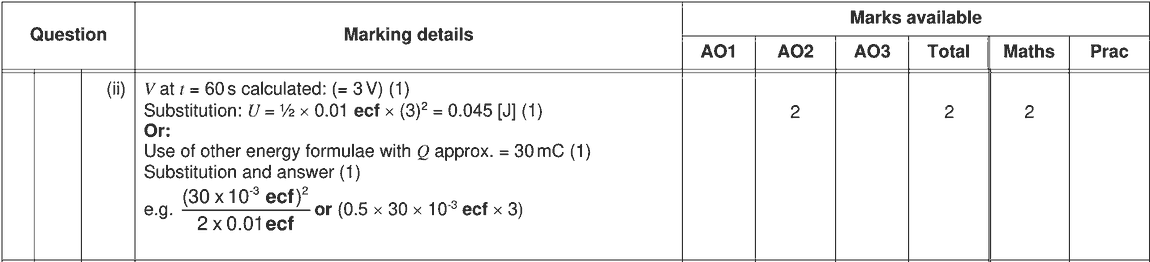
Answer: 0.045 J. V at 60 s = 10 e^(−60/50) = 3.0 V
U = ½CV² = ½ × 0.010 × 3.0²
or Q about 30 mC with ½QV or Q²/2C
Scheme columns: Maths 2
Skills: Mathsmarks The mark scheme's Maths column gives this part at least one mark for mathematical skills
June 2024 · Component 2 · Q5(b)(i)1 markAO2=1Show that
Earlier part of question 5 that this part uses
Mark scheme
Examiner's comment
. A variety of responses were seen in (ii). Many candidates drew the weight and tension arrows correctly; however, a significant number drew the electric field arrow pointing to the left. In a few cases, candidates labelled the ‘electrostatic’ force arrow incorrectly, usually as ‘electromagnetic’ force. Nearly 15% of candidates did not attempt the last part. Of those that did, many were penalised for ‘powers of 10’ errors, failing to convert the 24 mg to the correct corresponding weight. ecf was applied in this case. Consequently 6.3 µC was a commonly seen (incorrect) answer. A significant minority also failed to resolve forces correctly, usually confusing sin with cosine.
Notes from the mark scheme and report
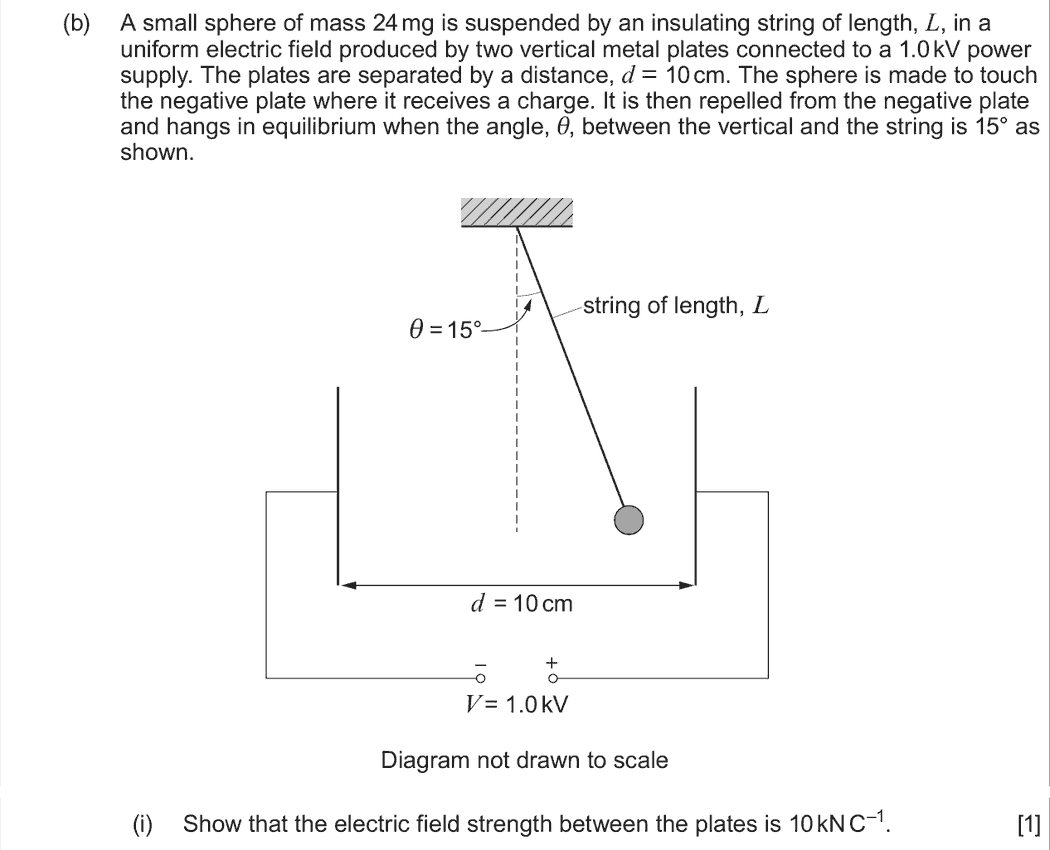
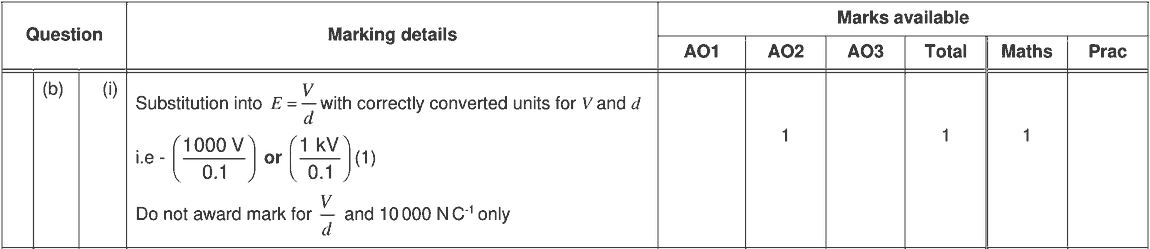
E = V/d = 1000/0.10 = 10 000 V m⁻¹ = 10 kN C⁻¹
the converted values must be seen
Scheme columns: Maths 1
Skills: Unitsand conversions Unit marks, base units, prefixes and conversions; Mathsmarks The mark scheme's Maths column gives this part at least one mark for mathematical skills
June 2024 · Component 2 · Q5(b)(ii)3 marksAO2=3Diagram or graph
Earlier parts of question 5 that this part uses
Mark scheme
Examiner's comment
Nearly all candidates were able to show the required electric field strength in
Notes from the mark scheme and report
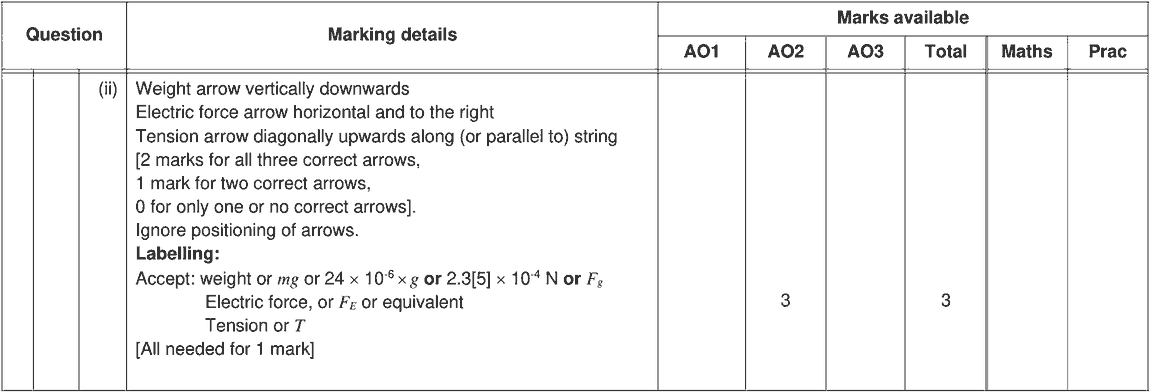
Weight vertically down, tension up along the string, electric force horizontal towards the positive plate (to the right): 2 marks for three arrows, 1 for two
third mark for all three labels
many drew the electric force to the left or called it electromagnetic
June 2024 · Component 2 · Q5(b)(iii)4 marksAO2=4Calculation
Earlier parts of question 5 that this part uses
Mark scheme
Examiner's comment
Nearly all candidates were able to show the required electric field strength in
Notes from the mark scheme and report
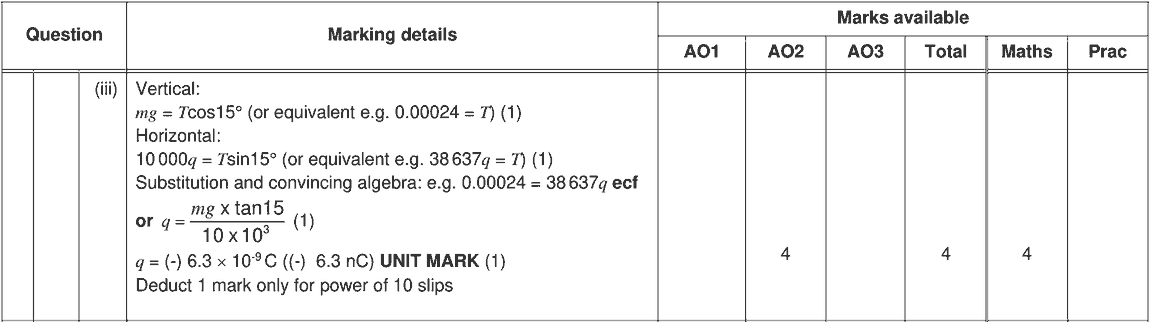
Answer: 6.3 × 10⁻⁹ C (negative). T cos 15° = mg and T sin 15° = Eq, so q = mg tan 15°/E = 24 × 10⁻⁶ × 9.81 × tan 15°/10 000
unit mark
6.3 μC from not converting mg to kg was common, as was swapping sin and cos
about 15% left it blank
Scheme columns: Maths 4
Skills: Trigonometryand vectors Resolving, components, vector addition, angles; Unitsand conversions Unit marks, base units, prefixes and conversions; Synoptic Needs physics from another component of the qualification; Mathsmarks The mark scheme's Maths column gives this part at least one mark for mathematical skills
June 2023 · Component 2 · Q3(a)3 marksAO1=3Practical and data analysis
Mark scheme
Examiner's comment
There were impressive responses to the experimental technique question in (a), with many candidates providing clear and logical steps to obtain the required data. A few candidates did not clearly explain that readings should be taken at intervals, implying instead that only one reading of V be taken, which was not credited. The majority in
Notes from the mark scheme and report
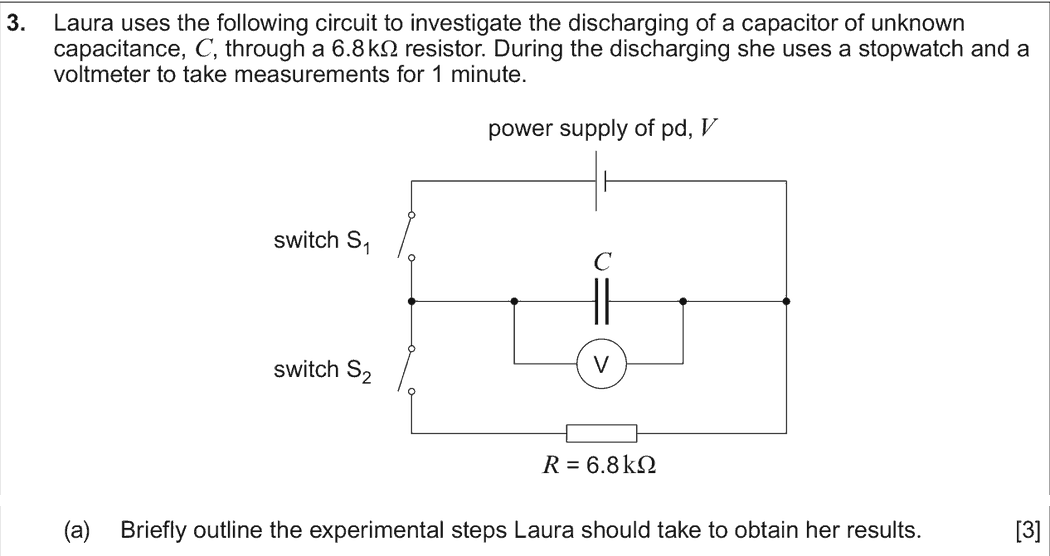
Close S1 to charge the capacitor
open S1 and close S2 to start the discharge (1 for the switching)
start the stopwatch and record V at regular intervals, e.g. every 10 s (1)
taking a single reading was not credited
Scheme columns: Practical 3
Skills: Experimentalmethod Describing, planning or improving an experiment; Practicalmarks The mark scheme's Prac column gives this part at least one mark for practical skills
June 2023 · Component 2 · Q3(b)2 marksAO2=2Practical and data analysis
Earlier part of question 3 that this part uses
Mark scheme
Examiner's comment
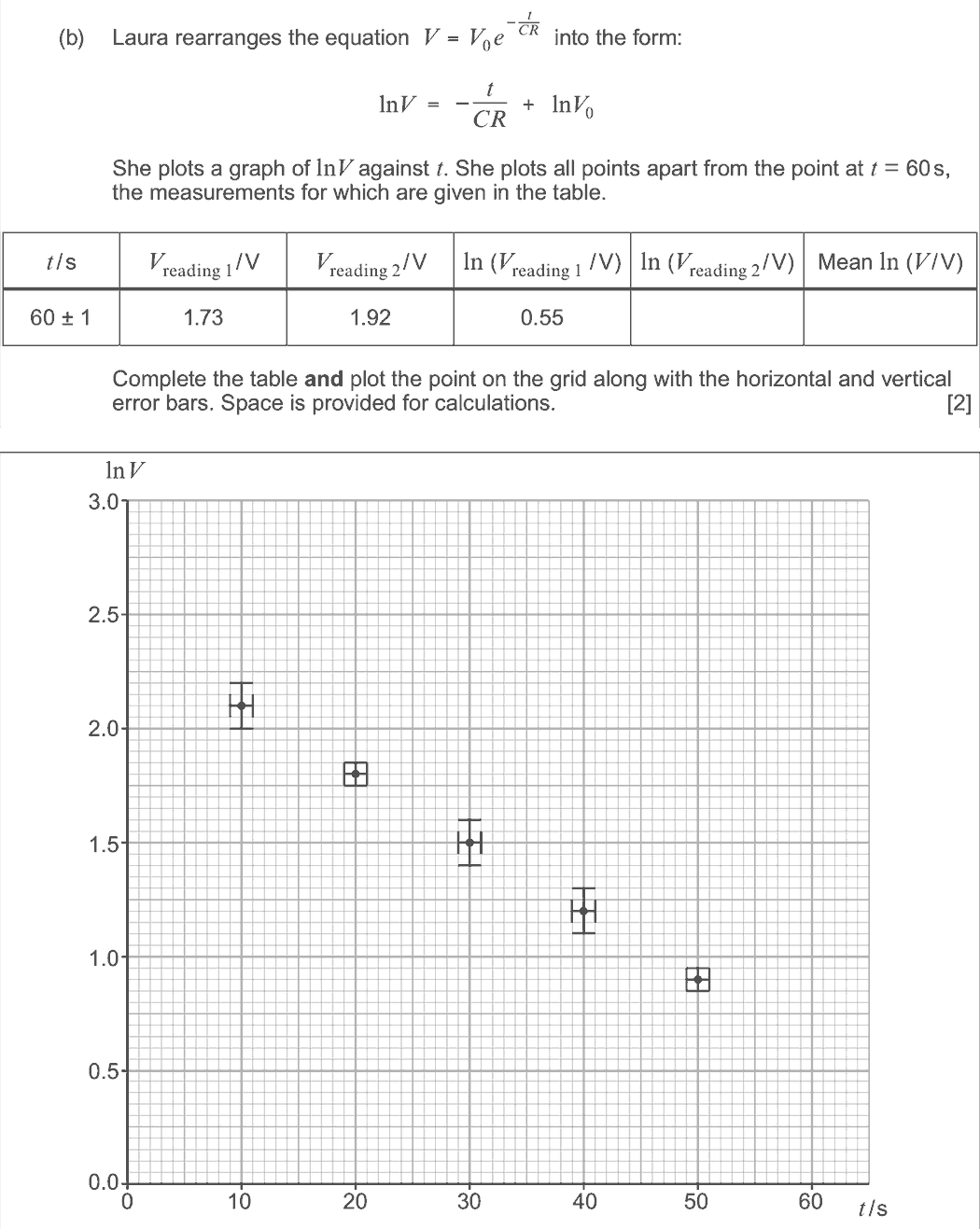
were able to plot the required point along with error bars, though a small number drew error bars which were twice as large as required. In part (c) candidates who took care to draw accurate gradient lines usually scored full marks. Lack of accuracy unfortunately led to some candidates losing marks when determining the gradients. ECF (Error Carried Forward) was applied in (ii) for calculated gradients which were outside of tolerance. Regardless of the values used, it was encouraging to note that most candidates were able to determine the mean gradient and the percentage uncertainty in it correctly. In (d)(i) most candidates recognised the relationship: CR = gradient and hence successfully determined the capacitance of the capacitor, in some cases as ecf from part (c). Two marks were awarded for calculating C. Two further marks were awarded for determining the total % uncertainty and the consequent absolute uncertainty in C, which many candidates managed successfully. Far fewer candidates provided the final answer to the correct number of significant figures. A useful rule of thumb would be to ensure that the number of significant figures in a calculated value and corresponding uncertainty are the same, with no more than two significant figures given for the uncertainty. In (ii), only a minority of candidates were successful in determining the pd of the power supply and the uncertainty in it. In many cases candidates determined an appropriate value for the mean intercept from their graphs and hence the value of V from their intercept. Far fewer were successful in determining the absolute uncertainty associated with their value for V, with many omitting to convert lnΔV into ΔV.
Notes from the mark scheme and report
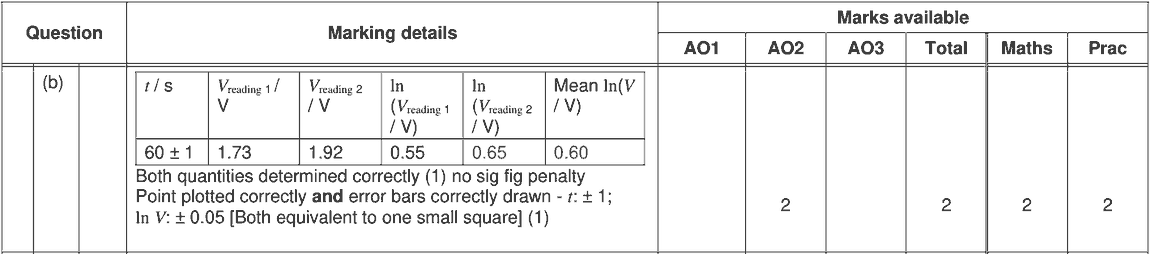
ln 1.92 = 0.65 and mean ln V = 0.60 (1)
point plotted at (60, 0.60) with error bars ± 1 s and ± 0.05, each one small square (1)
some drew bars twice the required size
Scheme columns: Maths 2, Practical 2
Skills: Graphskills Reading, plotting or sketching graphs; gradients, intercepts and areas; Uncertainties Resolution, absolute and percentage uncertainty, combining uncertainties, error bars; Mathsmarks The mark scheme's Maths column gives this part at least one mark for mathematical skills; Practicalmarks The mark scheme's Prac column gives this part at least one mark for practical skills
June 2023 · Component 2 · Q3(c)(i)3 marksAO2=3Practical and data analysis
Earlier parts of question 3 that this part uses
Mark scheme
Examiner's comment
There were impressive responses to the experimental technique question in (a), with many candidates providing clear and logical steps to obtain the required data. A few candidates did not clearly explain that readings should be taken at intervals, implying instead that only one reading of V be taken, which was not credited. The majority in
Notes from the mark scheme and report
Steepest and least steep lines drawn through the error bars (1)
maximum gradient −0.033 ± 0.001 s⁻¹ (1)
minimum gradient −0.027 ± 0.001 s⁻¹ (1)
ecf on the lines
careless lines lost marks
Scheme columns: Maths 3, Practical 3
Skills: Graphskills Reading, plotting or sketching graphs; gradients, intercepts and areas; Uncertainties Resolution, absolute and percentage uncertainty, combining uncertainties, error bars; Mathsmarks The mark scheme's Maths column gives this part at least one mark for mathematical skills; Practicalmarks The mark scheme's Prac column gives this part at least one mark for practical skills
June 2023 · Component 2 · Q3(c)(ii)2 marksAO2=2Practical and data analysis
Earlier parts of question 3 that this part uses
Mark scheme
Examiner's comment
There were impressive responses to the experimental technique question in (a), with many candidates providing clear and logical steps to obtain the required data. A few candidates did not clearly explain that readings should be taken at intervals, implying instead that only one reading of V be taken, which was not credited. The majority in
Notes from the mark scheme and report
Answer: mean gradient 0.030 s⁻¹ with 10% uncertainty. Mean = (0.033 + 0.027)/2
uncertainty = half the range, 0.003/0.030
ecf
Scheme columns: Maths 2, Practical 2
Skills: Uncertainties Resolution, absolute and percentage uncertainty, combining uncertainties, error bars; Mathsmarks The mark scheme's Maths column gives this part at least one mark for mathematical skills; Practicalmarks The mark scheme's Prac column gives this part at least one mark for practical skills
June 2023 · Component 2 · Q3(d)(i)5 marksAO3=5Practical and data analysis
Earlier parts of question 3 that this part uses
Mark scheme
Examiner's comment
There were impressive responses to the experimental technique question in (a), with many candidates providing clear and logical steps to obtain the required data. A few candidates did not clearly explain that readings should be taken at intervals, implying instead that only one reading of V be taken, which was not credited. The majority in
Notes from the mark scheme and report
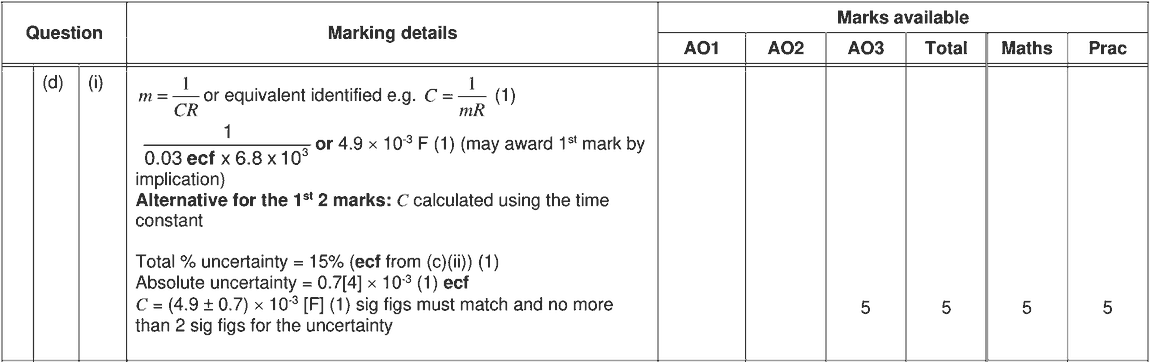
Answer: C = (4.9 ± 0.7) × 10⁻³ F. Gradient = 1/CR so C = 1/(0.030 × 6.8 × 10³) (2)
total percentage uncertainty = 10% + 5% = 15% (1)
absolute uncertainty 0.74 × 10⁻³ F (1)
value and uncertainty to matching, sensible significant figures (1), the mark most often lost
Scheme columns: Maths 5, Practical 5
Skills: Uncertainties Resolution, absolute and percentage uncertainty, combining uncertainties, error bars; Graphskills Reading, plotting or sketching graphs; gradients, intercepts and areas; Mathsmarks The mark scheme's Maths column gives this part at least one mark for mathematical skills; Practicalmarks The mark scheme's Prac column gives this part at least one mark for practical skills
June 2023 · Component 2 · Q3(d)(ii)2 marksAO3=2Practical and data analysis
Earlier parts of question 3 that this part uses
Mark scheme
Examiner's comment
There were impressive responses to the experimental technique question in (a), with many candidates providing clear and logical steps to obtain the required data. A few candidates did not clearly explain that readings should be taken at intervals, implying instead that only one reading of V be taken, which was not credited. The majority in
Notes from the mark scheme and report
Answer: about 11.0 ± 1.2 V. Intercept on the ln V axis = ln V0: mean of the two lines' intercepts, e.g. 2.4 ± 0.2 (1)
V = e^2.4 with the uncertainty from e^2.6 and e^2.2 (1)
only a minority correct, many left the uncertainty as a ln value
Scheme columns: Maths 2, Practical 2
Skills: Uncertainties Resolution, absolute and percentage uncertainty, combining uncertainties, error bars; Graphskills Reading, plotting or sketching graphs; gradients, intercepts and areas; Mathsmarks The mark scheme's Maths column gives this part at least one mark for mathematical skills; Practicalmarks The mark scheme's Prac column gives this part at least one mark for practical skills
June 2022 · Component 2 · Q3(a)(i)3 marksAO3=3Calculation
Mark scheme
Examiner's comment
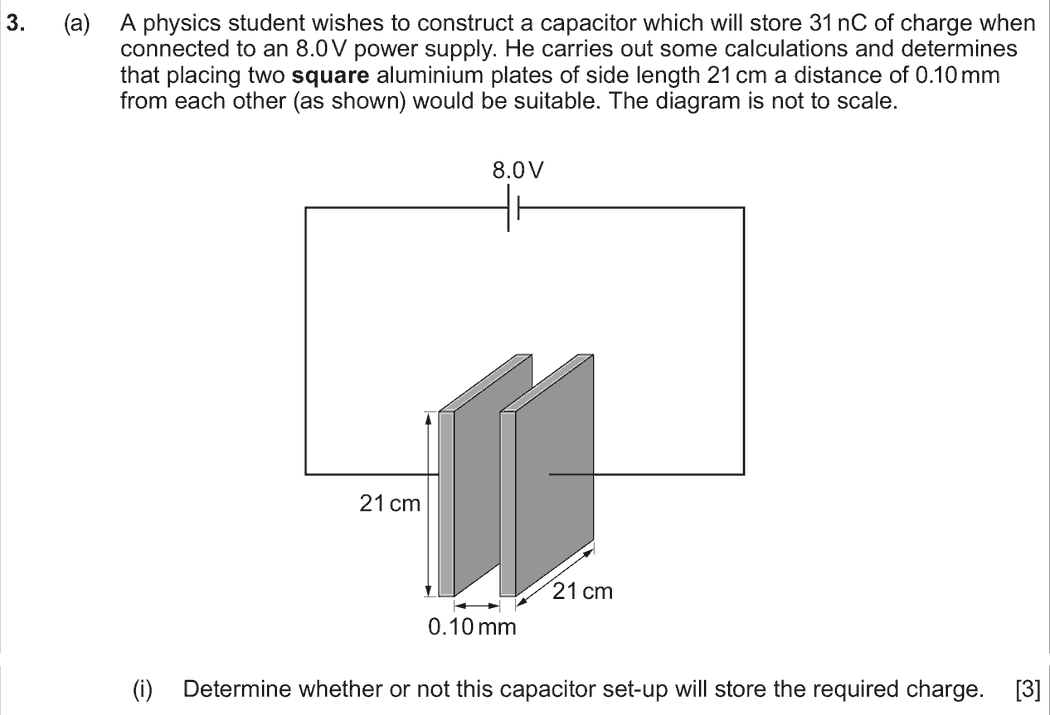
Many candidates were able to show, through a variety of approaches, that the capacitor set-up would store the required charge. Candidates were provided with all the information related to the capacitor set up, and so had the option to determine one of Q, C, A, or d to answer the question.
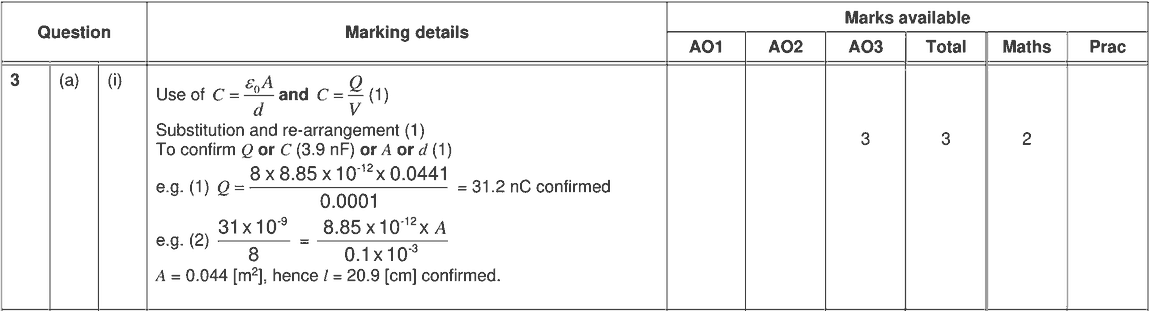
Q = CV = 3.9 × 10⁻⁹ × 8.0 = 31.2 nC. Could equally confirm C, A (0.044 m², side 20.9 cm) or d
Scheme columns: Maths 2
Skills: Unitsand conversions Unit marks, base units, prefixes and conversions; Mathsmarks The mark scheme's Maths column gives this part at least one mark for mathematical skills
June 2022 · Component 2 · Q3(a)(ii)1 markAO1=1Short answer
Earlier part of question 3 that this part uses
Mark scheme
Examiner's comment
Nearly all candidates stated that the charge stored could be increased by using a dielectric.
Notes from the mark scheme and report
Put a dielectric (insulator) between the plates
June 2022 · Component 2 · Q3(b)6 marksAO1=1, AO2=5Calculation
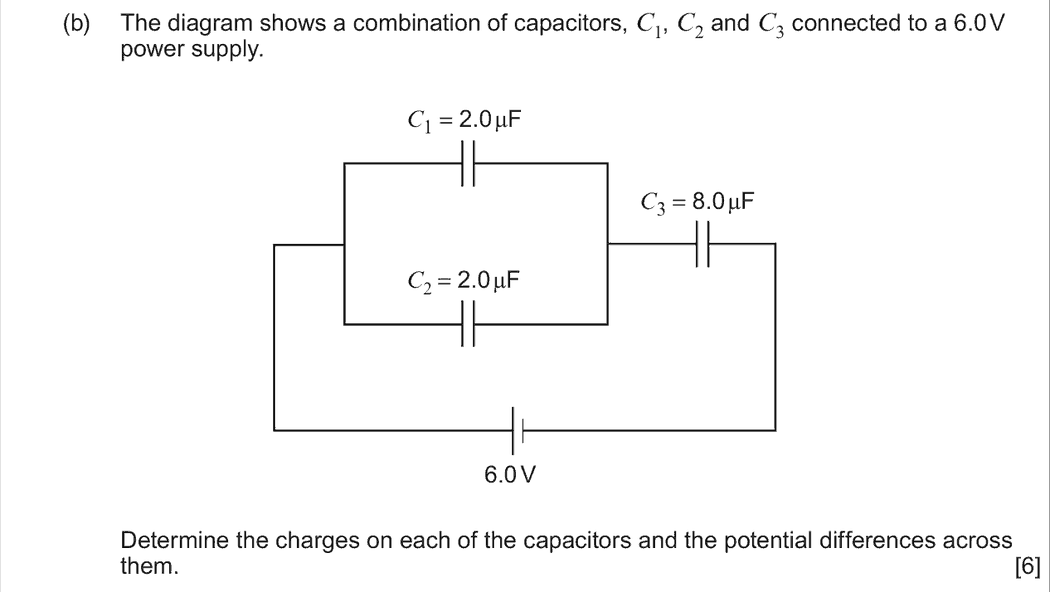
Earlier part of question 3 that this part uses
Mark scheme
Examiner's comment
There were impressive responses to this combination of capacitors question. Candidates displayed a good understanding of the effects of capacitors in parallel and series on charge and potential differences. Most candidates adopted the approach of determining the overall capacitance, and hence the overall charge and from there the charge on each capacitor. From there they determined the pd across each capacitor. A significant minority however determined the pds across each capacitor as a first step using appropriate ratios before proceeding to determine the charge on each capacitor. Both approaches are equally valid.
Notes from the mark scheme and report
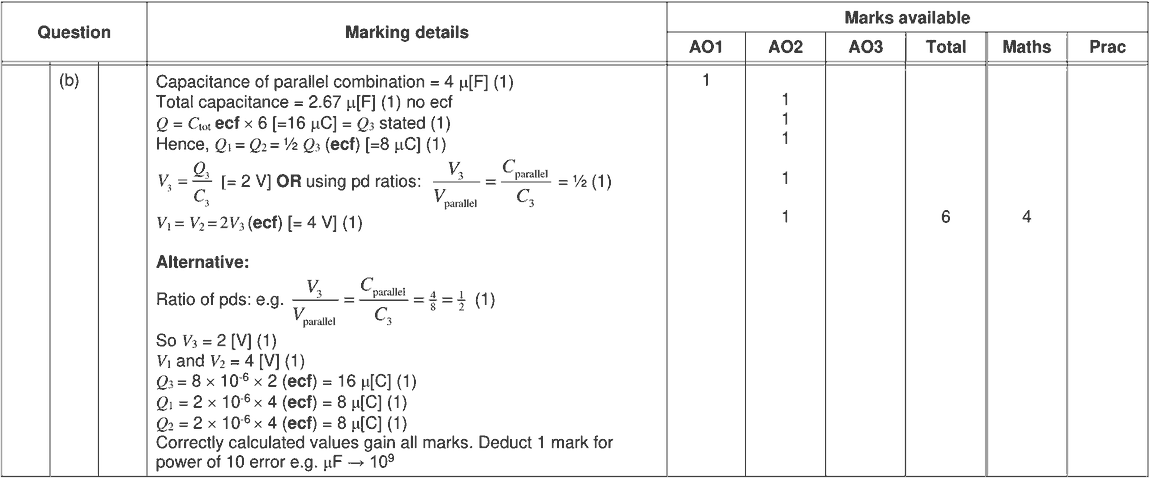
Answer: Q3 = 16 μC, V3 = 2.0 V
Q1 = Q2 = 8.0 μC, V1 = V2 = 4.0 V. C1 and C2 in parallel = 4.0 μF
in series with 8.0 μF gives 2.67 μF
total charge = 2.67 μF × 6.0 V = 16 μC, which is the charge on C3 and is shared equally by C1 and C2
V = Q/C. Or split the 6.0 V in the inverse ratio of the capacitances first. 1 mark off for a power of ten error
Scheme columns: Maths 4
Skills: Unitsand conversions Unit marks, base units, prefixes and conversions; Mathsmarks The mark scheme's Maths column gives this part at least one mark for mathematical skills
June 2022 · Component 2 · Q3(c)3 marksAO2=3Show that
Earlier parts of question 3 that this part uses
Mark scheme
Examiner's comment
Good attempts were made to show the given expression. Most candidates produced two separate decay equations, one for each of the capacitors before proceeding to manipulate the equations to show the given expression. Marks were awarded for the expressions and a further mark for correct algebra leading to the final expression. Many candidates were awarded 2 marks for providing correct expressions, however fewer were successful in gaining the third mark. A very few candidates opted for the logic-based approach, realising that the charge would halve through R in t and that to decay from 16 nC would require 3 t time periods.
Notes from the mark scheme and report
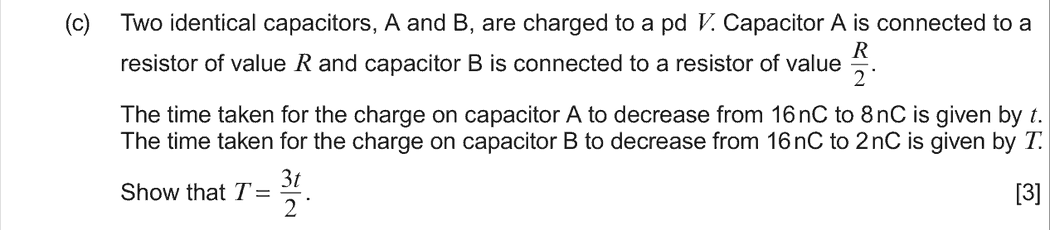
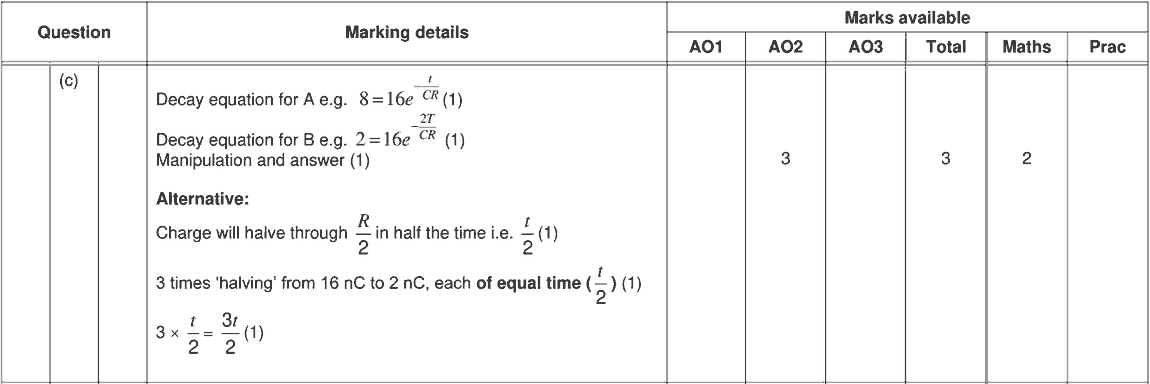
A: 8 = 16 e^(−t/RC) so t = RC ln 2
B: 2 = 16 e^(−2T/RC) so T = (RC/2) ln 8 = (3/2)RC ln 2 = 3t/2. Or: halving the resistance halves the 'half-life' to t/2, and 16 to 2 nC is three halvings. Many set up both equations but did not finish the algebra
Scheme columns: Maths 2
Skills: Algebra Derivations and rearranging equations; Mathsmarks The mark scheme's Maths column gives this part at least one mark for mathematical skills
June 2022 · Component 2 · Q5(c)(ii)2 marksAO2=2Show that
Earlier parts of question 5 that this part uses
Mark scheme
Examiner's comment
Nearly all candidates were able to derive the given expression.
Notes from the mark scheme and report
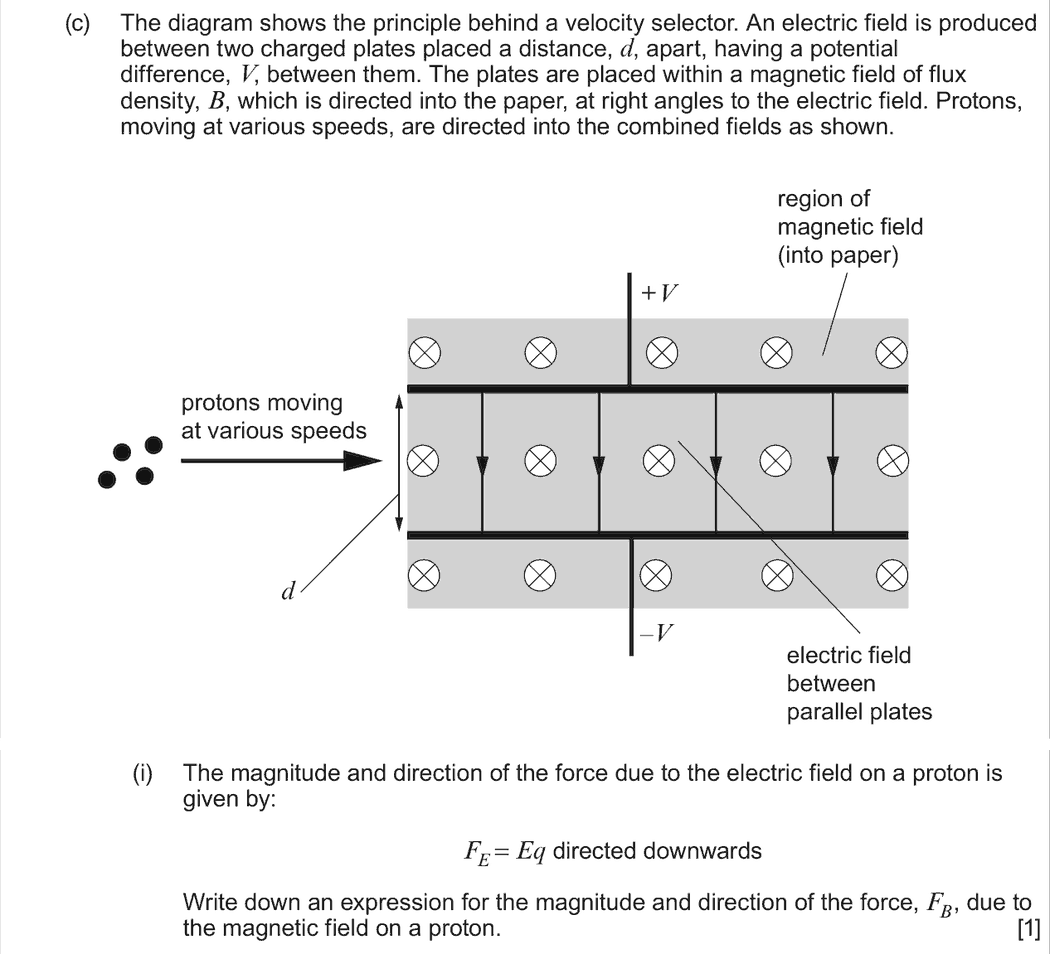
Eq = Bqv with E = V/d (1)
cancel q and rearrange to v = V/Bd (1)
Scheme columns: Maths 1
Skills: Synoptic Needs physics from another component of the qualification; Algebra Derivations and rearranging equations; Mathsmarks The mark scheme's Maths column gives this part at least one mark for mathematical skills
October 2021 · Component 2 · Q2(a)3 marksAO1=1, AO2=2Show that
Mark scheme
Notes from the mark scheme and report
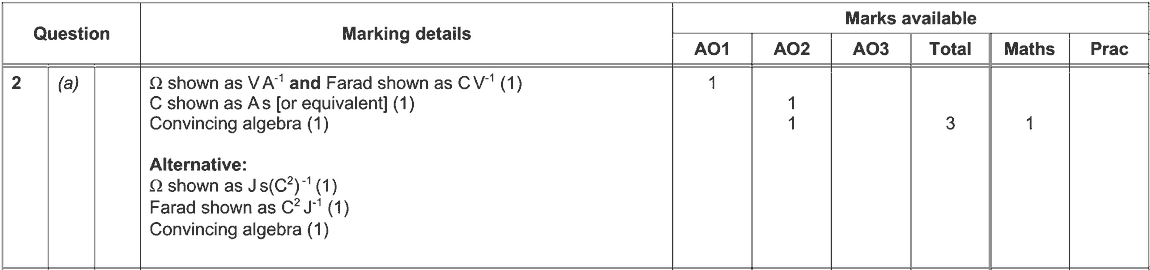
Ω = V A⁻¹ and F = C V⁻¹ (1)
C = A s (1)
so Ω F = V A⁻¹ × A s V⁻¹ = s (1). Or Ω = J s C⁻² and F = C² J⁻¹
Scheme columns: Maths 1
Skills: Unitsand conversions Unit marks, base units, prefixes and conversions; Algebra Derivations and rearranging equations; Mathsmarks The mark scheme's Maths column gives this part at least one mark for mathematical skills
October 2021 · Component 2 · Q2(b)(i)2 marksAO1=2Diagram or graph
Earlier part of question 2 that this part uses
Mark scheme
Notes from the mark scheme and report
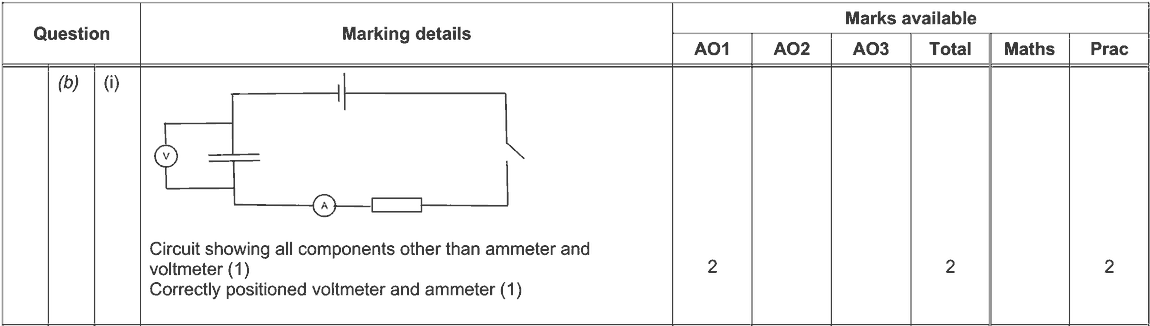
Series circuit of battery, switch, resistor and capacitor (1)
ammeter in series and voltmeter in parallel with the capacitor (1)
Scheme columns: Practical 2
Skills: Experimentalmethod Describing, planning or improving an experiment; Practicalmarks The mark scheme's Prac column gives this part at least one mark for practical skills
October 2021 · Component 2 · Q2(b)(ii)4 marksAO1=1, AO2=3Calculation
Skills: Unitsand conversions Unit marks, base units, prefixes and conversions; Mathsmarks The mark scheme's Maths column gives this part at least one mark for mathematical skills; Practicalmarks The mark scheme's Prac column gives this part at least one mark for practical skills
October 2021 · Component 2 · Q2(b)(iii)2 marksAO3=2Calculation
Earlier parts of question 2 that this part uses
Mark scheme
Notes from the mark scheme and report
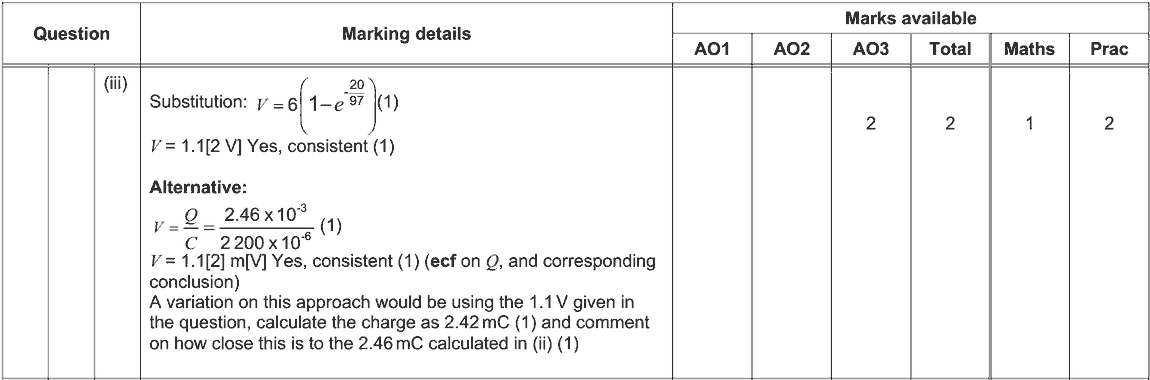
Answer: consistent. V = 6.0(1 − e^(−20/97)) = 1.12 V
or V = Q/C = 2.46 × 10⁻³/2200 × 10⁻⁶ = 1.12 V
or 1.1 V gives Q = 2.42 mC, close to 2.46 mC
Scheme columns: Maths 1, Practical 2
Skills: Mathsmarks The mark scheme's Maths column gives this part at least one mark for mathematical skills; Practicalmarks The mark scheme's Prac column gives this part at least one mark for practical skills
October 2021 · Component 2 · Q2(c)1 markAO2=1Calculation
Skills: Mathsmarks The mark scheme's Maths column gives this part at least one mark for mathematical skills; Practicalmarks The mark scheme's Prac column gives this part at least one mark for practical skills
October 2020 · Component 2 · Q2(a)(i)2 marksAO2=2Practical and data analysis
Mark scheme
Examiner's comment
Only a minority of candidates fully explained how the given readings could be used to determine the length of error bars. Fewer still used appropriate data from the graph to illustrate their answers. Subsequent questions testing uncertainties and error analysis were answered well however, with the majority of candidates showing confidence in error analysis and the significance of the gradients provided. Providing a ‘final answer’ with uncertainty to an appropriate number of significant figures was not well answered and resulted in many candidates losing one mark. In part (c), candidates used a variety of approaches to show that the given data were consistent.
Notes from the mark scheme and report
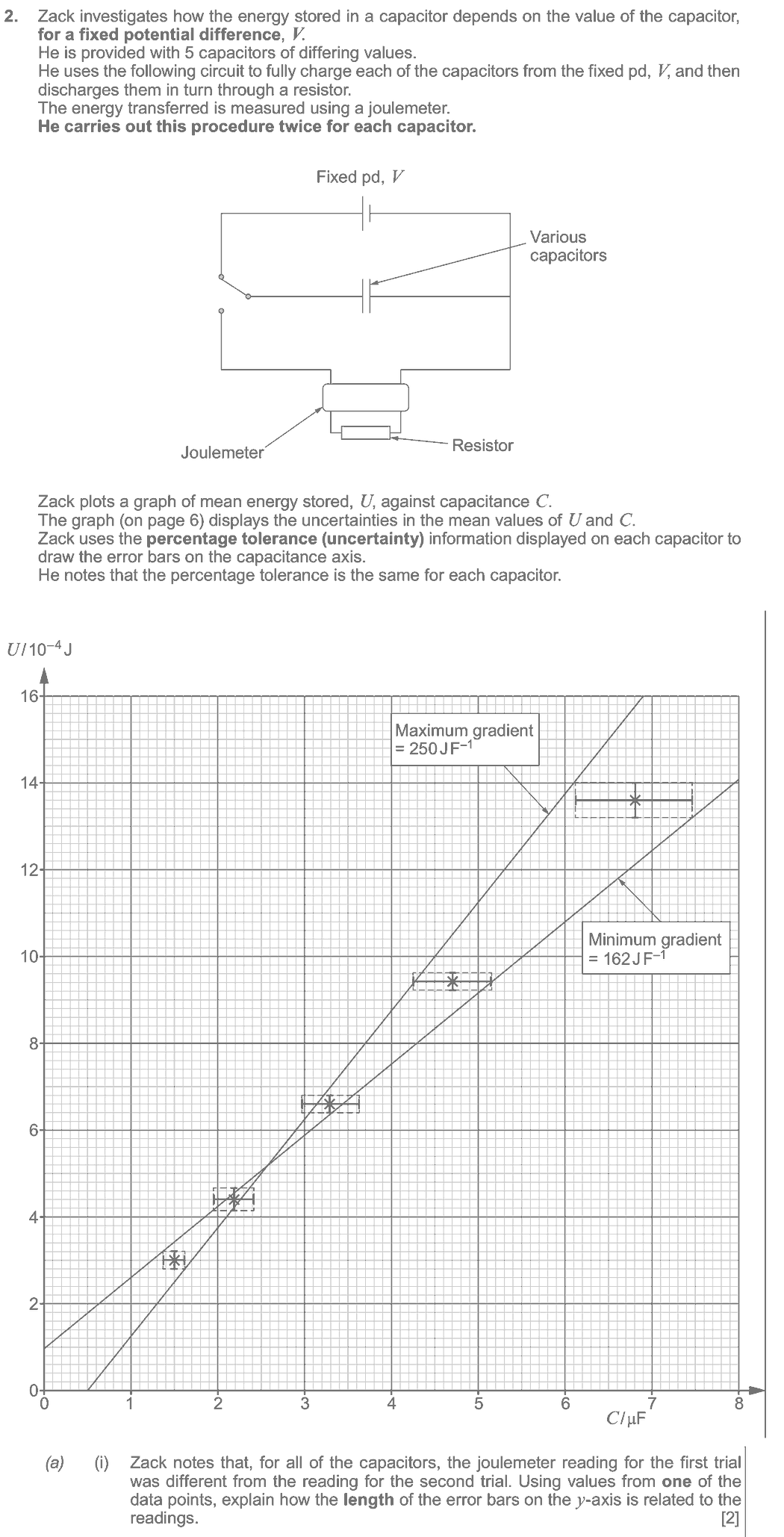
The length of the vertical error bar is the larger reading of U minus the smaller reading (the mean is plotted mid-way) (1)
illustrated with one point, e.g. for 6.8 μF the bar runs from 13.2 × 10⁻⁴ J to 14.0 × 10⁻⁴ J (1)
few explained it fully or quoted values
Scheme columns: Maths 1, Practical 2
Skills: Uncertainties Resolution, absolute and percentage uncertainty, combining uncertainties, error bars; Graphskills Reading, plotting or sketching graphs; gradients, intercepts and areas; Mathsmarks The mark scheme's Maths column gives this part at least one mark for mathematical skills; Practicalmarks The mark scheme's Prac column gives this part at least one mark for practical skills
October 2020 · Component 2 · Q2(a)(ii)2 marksAO2=2Practical and data analysis
Earlier part of question 2 that this part uses
Mark scheme
Examiner's comment
Only a minority of candidates fully explained how the given readings could be used to determine the length of error bars. Fewer still used appropriate data from the graph to illustrate their answers. Subsequent questions testing uncertainties and error analysis were answered well however, with the majority of candidates showing confidence in error analysis and the significance of the gradients provided. Providing a ‘final answer’ with uncertainty to an appropriate number of significant figures was not well answered and resulted in many candidates losing one mark. In part (c), candidates used a variety of approaches to show that the given data were consistent.
Notes from the mark scheme and report
Answer: 10% (6% to 12% accepted). Half the length of a horizontal error bar, e.g. 0.68 μF for the 6.8 μF capacitor, divided by the capacitance
Scheme columns: Maths 1, Practical 2
Skills: Uncertainties Resolution, absolute and percentage uncertainty, combining uncertainties, error bars; Graphskills Reading, plotting or sketching graphs; gradients, intercepts and areas; Mathsmarks The mark scheme's Maths column gives this part at least one mark for mathematical skills; Practicalmarks The mark scheme's Prac column gives this part at least one mark for practical skills
October 2020 · Component 2 · Q2(b)(i)3 marksAO2=3Practical and data analysis
Earlier part of question 2 that this part uses
Mark scheme
Examiner's comment
Only a minority of candidates fully explained how the given readings could be used to determine the length of error bars. Fewer still used appropriate data from the graph to illustrate their answers. Subsequent questions testing uncertainties and error analysis were answered well however, with the majority of candidates showing confidence in error analysis and the significance of the gradients provided. Providing a ‘final answer’ with uncertainty to an appropriate number of significant figures was not well answered and resulted in many candidates losing one mark. In part (c), candidates used a variety of approaches to show that the given data were consistent.
Notes from the mark scheme and report
Answer: Vmax = 22.4 V, Vmin = 18.0 V. U = ½CV² so gradient of U against C = ½V² and V = √(2 × gradient)
√(2 × 250) and √(2 × 162)
Scheme columns: Maths 3, Practical 3
Skills: Graphskills Reading, plotting or sketching graphs; gradients, intercepts and areas; Algebra Derivations and rearranging equations; Mathsmarks The mark scheme's Maths column gives this part at least one mark for mathematical skills; Practicalmarks The mark scheme's Prac column gives this part at least one mark for practical skills
October 2020 · Component 2 · Q2(b)(ii)3 marksAO2=3Practical and data analysis
Earlier parts of question 2 that this part uses
Mark scheme
Examiner's comment
Only a minority of candidates fully explained how the given readings could be used to determine the length of error bars. Fewer still used appropriate data from the graph to illustrate their answers. Subsequent questions testing uncertainties and error analysis were answered well however, with the majority of candidates showing confidence in error analysis and the significance of the gradients provided. Providing a ‘final answer’ with uncertainty to an appropriate number of significant figures was not well answered and resulted in many candidates losing one mark. In part (c), candidates used a variety of approaches to show that the given data were consistent.
Notes from the mark scheme and report
Answer: (20 ± 2) V. Mean = (22.4 + 18.0)/2 = 20.2 V
uncertainty = (22.4 − 18.0)/2 = 2.2 V
third mark for sensible sf (V to 2 or 3, uncertainty to 1 or 2)
the sf mark was often lost
Scheme columns: Maths 3, Practical 3
Skills: Uncertainties Resolution, absolute and percentage uncertainty, combining uncertainties, error bars; Mathsmarks The mark scheme's Maths column gives this part at least one mark for mathematical skills; Practicalmarks The mark scheme's Prac column gives this part at least one mark for practical skills
October 2020 · Component 2 · Q2(c)3 marksAO3=3Calculation
Earlier part of question 2 that this part uses
Mark scheme
Examiner's comment
Only a minority of candidates fully explained how the given readings could be used to determine the length of error bars. Fewer still used appropriate data from the graph to illustrate their answers. Subsequent questions testing uncertainties and error analysis were answered well however, with the majority of candidates showing confidence in error analysis and the significance of the gradients provided. Providing a ‘final answer’ with uncertainty to an appropriate number of significant figures was not well answered and resulted in many candidates losing one mark. In part (c), candidates used a variety of approaches to show that the given data were consistent.
Notes from the mark scheme and report
CR = 6.8 × 10⁻⁶ × 5.6 × 10⁶ = 38.1 s
V = V0 e^(−t/CR) = 20.0 × e^(−35/38.1) = 8.0 V (or solve for V0, t or CR) (2)
statement that the results are consistent (1)
Scheme columns: Maths 2, Practical 3
Skills: Mathsmarks The mark scheme's Maths column gives this part at least one mark for mathematical skills; Practicalmarks The mark scheme's Prac column gives this part at least one mark for practical skills
June 2019 · Component 2 · Q3(a)2 marksAO1=2Short answer
Mark scheme
Examiner's comment
The majority of candidates gave two valid reasons as to why the capacitance of X is greater than that of Y. However, a significant minority failed to pick up marks due to the vagueness of their responses: “One has the plates closer together and one has a dielectric” were the type of responses which could not be credited.
Notes from the mark scheme and report
Plates of X are closer together than those of Y (1)
X contains a dielectric (material of higher permittivity) between its plates (1)
greater plate overlap in X accepted
vague answers not naming the capacitor were not credited
June 2019 · Component 2 · Q3(b)(i)3 marksAO1=2, AO2=1Calculation
Earlier part of question 3 that this part uses
Mark scheme
Examiner's comment
Nearly all candidates correctly calculated the total capacitance of the combination.
Notes from the mark scheme and report
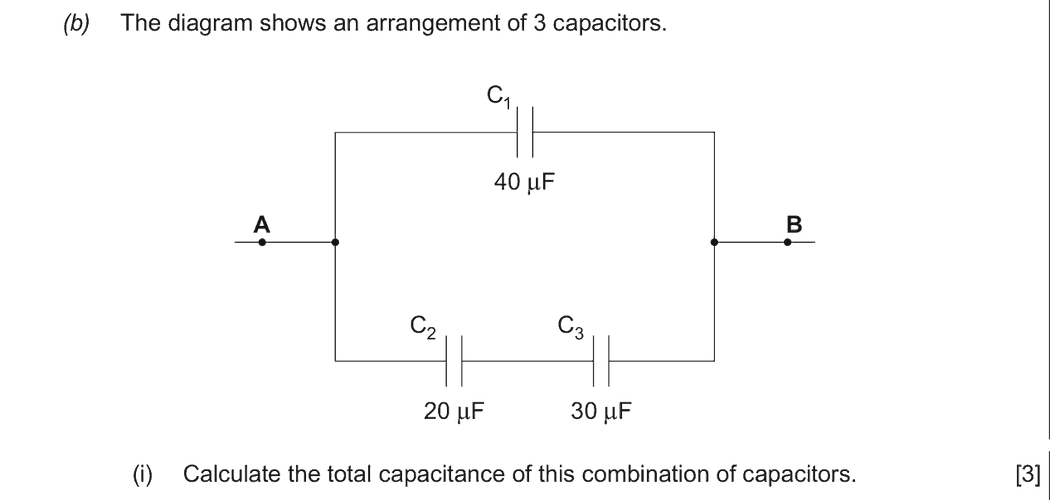
Answer: 52 µF. Series pair: 1/C = 1/20 + 1/30 (1) so C = 12 µF (1)
add the parallel 40 µF (1)
Scheme columns: Maths 2
Skills: Mathsmarks The mark scheme's Maths column gives this part at least one mark for mathematical skills
June 2019 · Component 2 · Q3(b)(ii)2 marksAO1=1, AO2=1Explanation
Earlier parts of question 3 that this part uses
Mark scheme
Examiner's comment
Many candidates did not give a clear explanation, including the fact that the charge on both capacitors in series must be the same. Few candidates, for example, used the values of the capacitances given (20 µF and 30 µF) to illustrate their answers.
Skills: Mathsmarks The mark scheme's Maths column gives this part at least one mark for mathematical skills
June 2019 · Component 2 · Q3(b)(iii)1 markAO2=1Calculation
Earlier parts of question 3 that this part uses
Mark scheme
Examiner's comment
Many candidates gave the correct answer of 40 V, however a significant minority gave 60 V as their answer, notwithstanding that C
Notes from the mark scheme and report
Answer: 40 V (V₂ + V₃ = 100 V with V₂ = 1.5 V₃, so 2.5 V₃ = 100)
60 V was a common wrong answer
Scheme columns: Maths 1
Skills: Mathsmarks The mark scheme's Maths column gives this part at least one mark for mathematical skills
June 2019 · Component 2 · Q3(b)(iv)2 marksAO1=1, AO2=1Calculation
Earlier parts of question 3 that this part uses
Mark scheme
Examiner's comment
Many candidates were successful in calculating the size of the greatest charge. However, few candidates incorrectly explained the reasons why C1 stored the greatest charge.
Notes from the mark scheme and report
Answer: C₁, 4.0 × 10⁻³ C. C₁ has the largest capacitance and the largest pd (100 V) across it (1)
Q = CV = 40 × 10⁻⁶ × 100 (1)
the series pair hold only 1.2 mC each
Scheme columns: Maths 1
Skills: Mathsmarks The mark scheme's Maths column gives this part at least one mark for mathematical skills
June 2019 · Component 2 · Q3(c)5 marksAO3=5Calculation
Earlier parts of question 3 that this part uses
Mark scheme
Examiner's comment
Most candidates scored full marks in this part, providing a clear and logical argument in terms of capacitor energy and the energy gained by the block. The synoptic nature of the question didn’t seem to affect candidates, with the use of specific heat capacity and the efficiency of the energy transfer being calculated correctly by nearly all.
Notes from the mark scheme and report
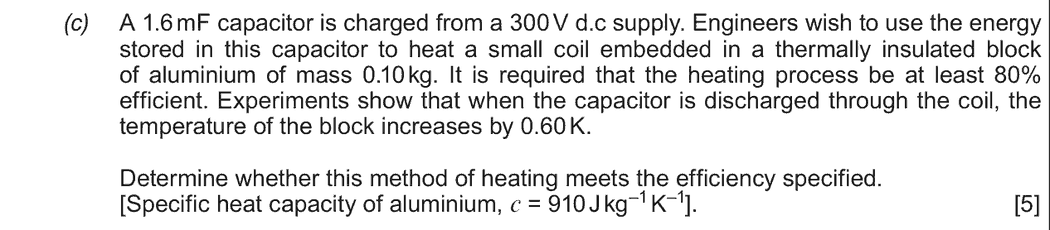
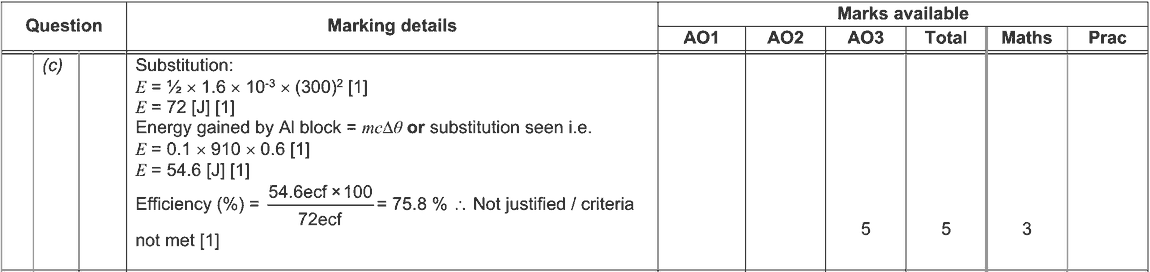
Answer: 76%, so the 80% requirement is not met. Energy stored = ½CV² = ½ × 1.6 × 10⁻³ × 300² (1) = 72 J (1)
energy gained by block = mcΔθ = 0.10 × 910 × 0.60 (1) = 54.6 J (1)
efficiency = 54.6/72 = 75.8% with conclusion (1)
synoptic with Component 1 thermal physics
most scored full marks
Scheme columns: Maths 3
Skills: Synoptic Needs physics from another component of the qualification; Mathsmarks The mark scheme's Maths column gives this part at least one mark for mathematical skills
June 2019 · Component 2 · Q8(b)(i)3 marksAO1=1, AO2=2Show that
Earlier part of question 8 that this part uses
Mark scheme
Examiner's comment
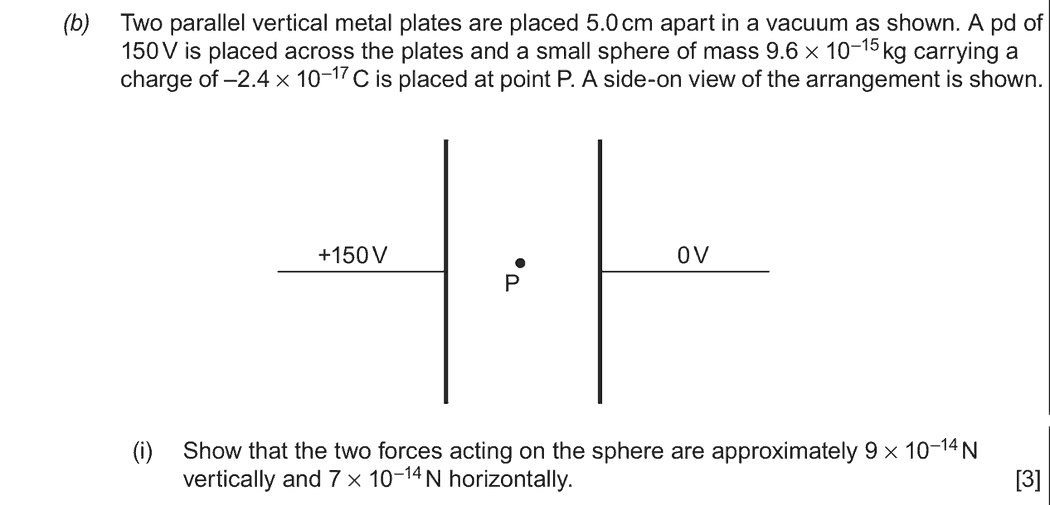
Nearly all candidates were able to confirm the vertical and horizontal forces acting on the sphere were equivalent to the ones given in the question.
electric force = Eq = 3000 × 2.4 × 10⁻¹⁷ = 7.2 × 10⁻¹⁴ N (1)
Scheme columns: Maths 2
Skills: Mathsmarks The mark scheme's Maths column gives this part at least one mark for mathematical skills
June 2018 · Component 2 · Q6(a)1 markAO1=1Definition
Mark scheme
Examiner's comment
Nearly all candidates were able to define capacitance either in words or using defined symbols.
Notes from the mark scheme and report
Charge on either plate divided by the pd between the plates (charge per unit pd)
C = Q/V only with symbols defined
June 2018 · Component 2 · Q6(b)(i)3 marksAO1=3Short answer
Earlier part of question 6 that this part uses
Mark scheme
Examiner's comment
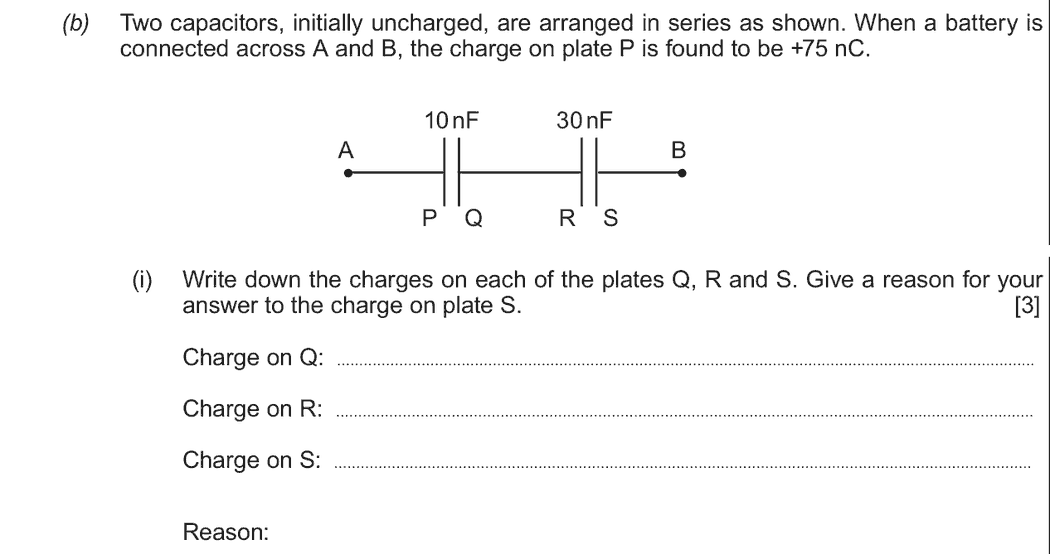
Disappointingly, the majority of candidates wrote down different charges for plates Q, R and S. Reasons were often invalid and incorrect. The idea that capacitors connected in series carry the same charge was poorly understood.
Notes from the mark scheme and report
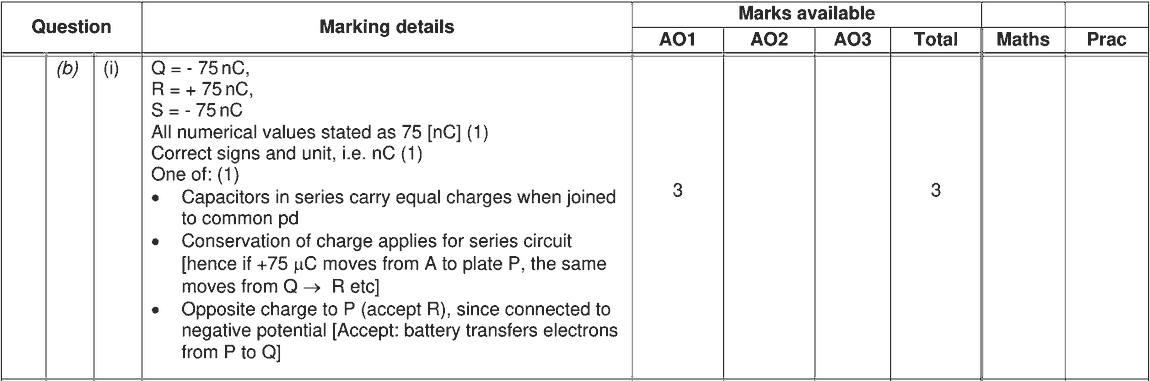
Q = −75 nC, R = +75 nC, S = −75 nC: all magnitudes 75 (1)
signs and unit (1)
reason, e.g. capacitors in series carry equal charges, conservation of charge, or S is joined to the negative terminal (1)
most gave different charges for the plates
June 2018 · Component 2 · Q6(b)(ii)2 marksAO2=2Calculation
Earlier parts of question 6 that this part uses
Mark scheme
Examiner's comment
A significant number of candidates failed to calculate the total capacitance of the two capacitors in series. However, many more achieved the second mark (as ecf) for correctly determining the pd across A and B
Notes from the mark scheme and report
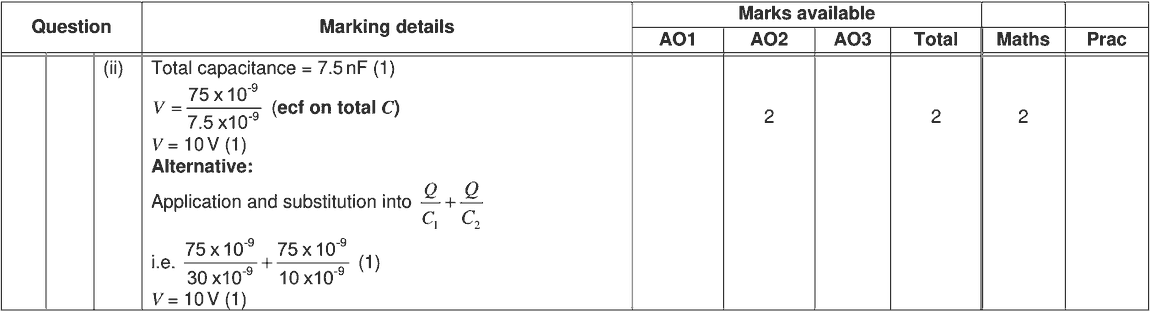
Answer: 10 V. Series capacitance = (1/10 + 1/30)⁻¹ = 7.5 nF (1)
V = Q/C = 75 × 10⁻⁹/7.5 × 10⁻⁹ (1)
or sum of Q/C = 7.5 + 2.5 V
many did not find the series capacitance
Scheme columns: Maths 2
Skills: Mathsmarks The mark scheme's Maths column gives this part at least one mark for mathematical skills
June 2018 · Component 2 · Q6(b)(iii)2 marksAO3=2Explanation
Earlier parts of question 6 that this part uses
Mark scheme
Examiner's comment
Candidates who carried out a logical analysis using one of the equations for the energy stored in a capacitor usually scored well here. The majority of candidates displayed a poor understanding of capacitor theory however and gave vague and ambiguous answers which, more often than not, agreed with the students’ statement (which was incorrect).
Notes from the mark scheme and report
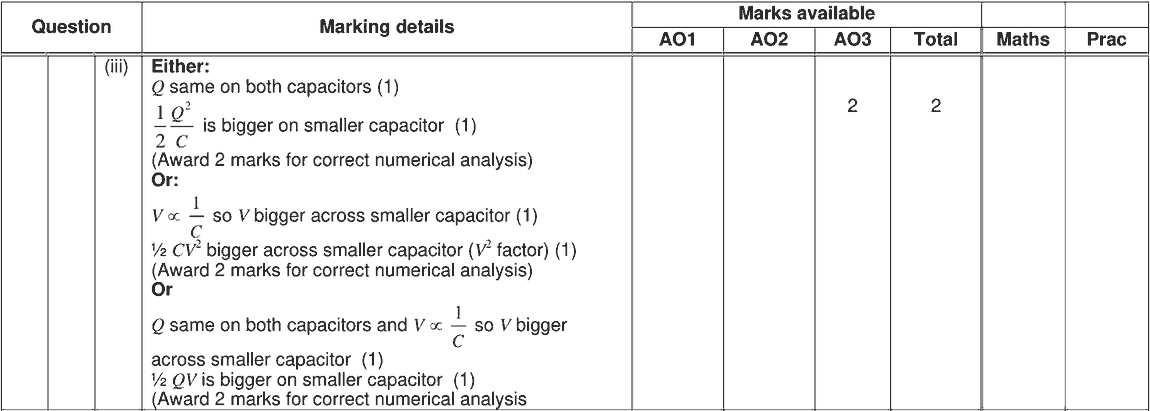
Student is wrong. Q is the same on both (1)
U = ½Q²/C (or ½QV with the larger V on the smaller C) is larger for the smaller capacitor: 0.28 µJ for 10 nF against 0.094 µJ for 30 nF (1)
most answers were vague and agreed with the student
June 2018 · Component 2 · Q6(c)4 marksAO3=4Calculation
Earlier parts of question 6 that this part uses
Mark scheme
Examiner's comment
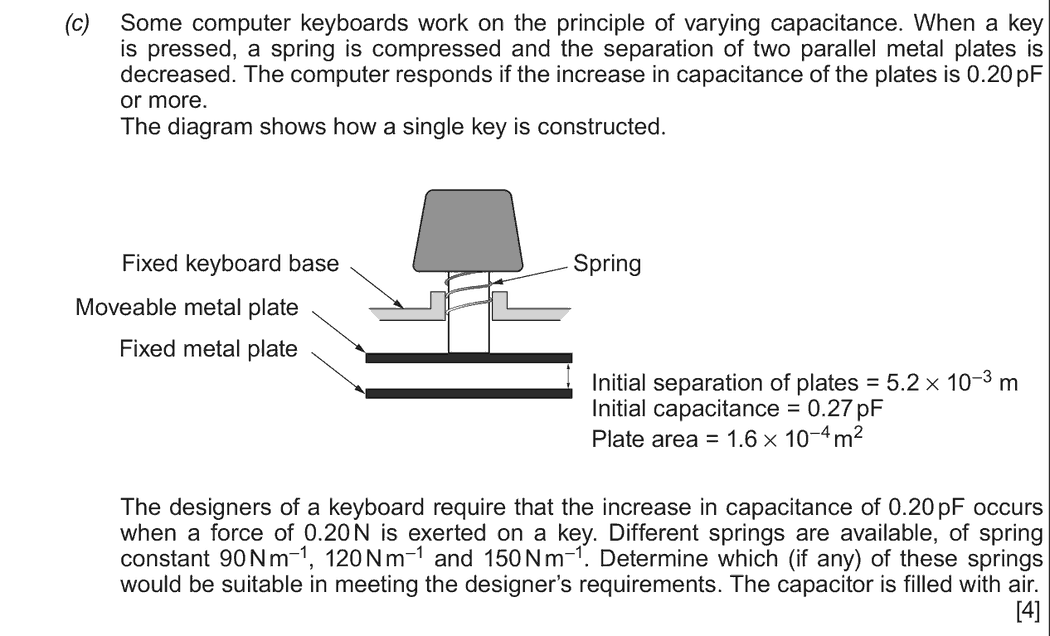
Surprisingly, this was the best answered section of the question. Good, clear and logical approaches were seen leading to the 90 N m1 spring’s being identified as an appropriate spring to use. The majority of candidates chose to use the equation for a parallel capacitor to determine the change in distance between the plates. They then proceeded to use Hooke’s law to determine the spring constant. Some candidates applied ‘trial and error’, taking each of the springs in turn to determine a value for distance and then using the parallel plate capacitor equation to determine the corresponding capacitance, which was then matched with the value given in the question. Although this approach would have taken longer, it is perfectly valid and many candidates scored full marks.
Notes from the mark scheme and report
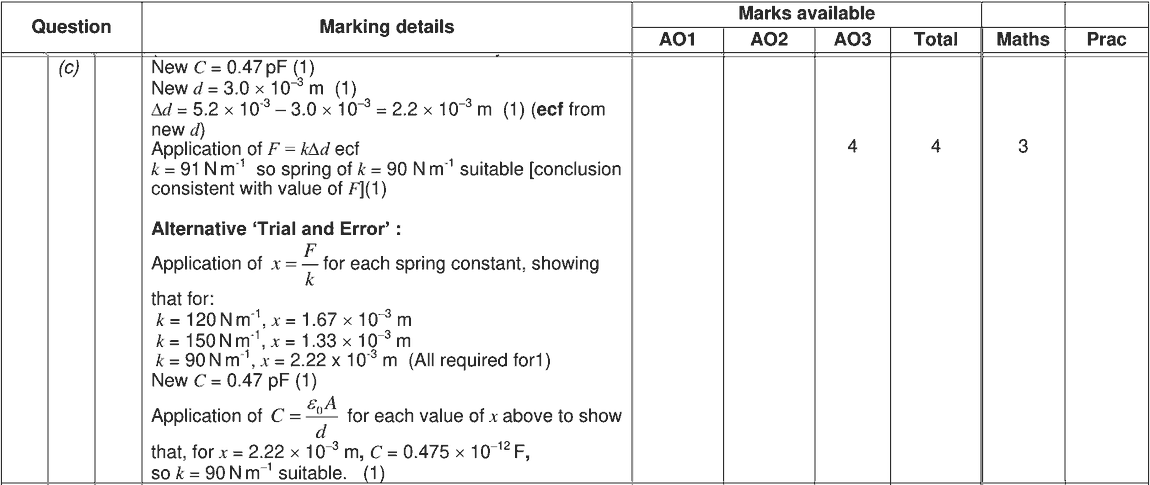
Answer: the 90 N m⁻¹ spring. New C = 0.47 pF (1)
C ∝ 1/d so new d = 5.2 × 10⁻³ × 0.27/0.47 = 3.0 × 10⁻³ m (1)
Δd = 2.2 × 10⁻³ m (1)
k = F/Δd = 0.20/2.2 × 10⁻³ = 91 N m⁻¹ so the 90 N m⁻¹ spring suits (1)
trial of each spring also accepted. Best answered part of the question
Scheme columns: Maths 3
Skills: Synoptic Needs physics from another component of the qualification; Mathsmarks The mark scheme's Maths column gives this part at least one mark for mathematical skills
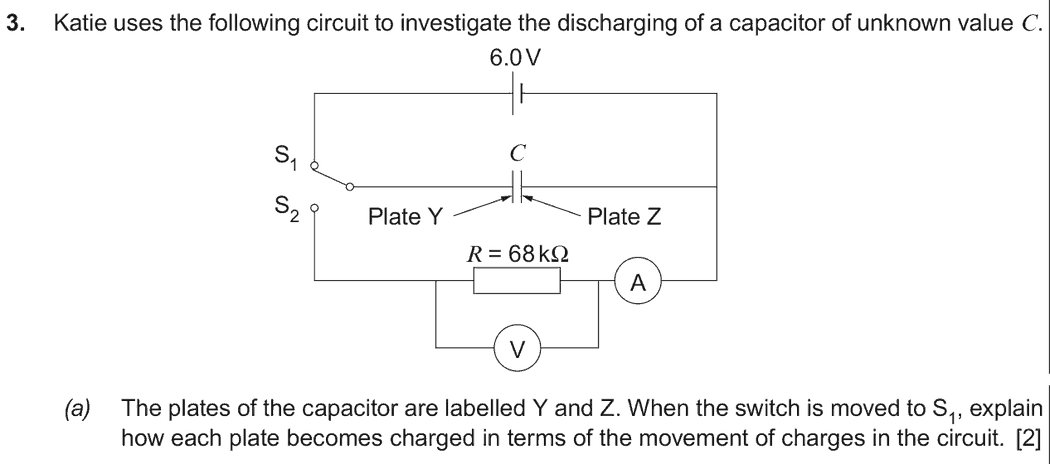
June 2017 · Component 2 · Q3(a)2 marksAO2=2Explanation
Mark scheme
Examiner's comment
A significant number of candidates gave clear and concise explanations as to how each plate on the capacitor is charged in terms of the movement of electrons (or negatively charged particles) around the circuit. A common misconception however was to state that ‘the electrons jumped the gap from one plate to the other’.
Notes from the mark scheme and report
Electrons (negative charge) flow onto plate Z, making it negative (1)
electrons are removed from plate Y, leaving it positive (1)
wrong idea seen: electrons jumping across the gap between the plates
Scheme columns: Practical 2
Skills: Practicalmarks The mark scheme's Prac column gives this part at least one mark for practical skills
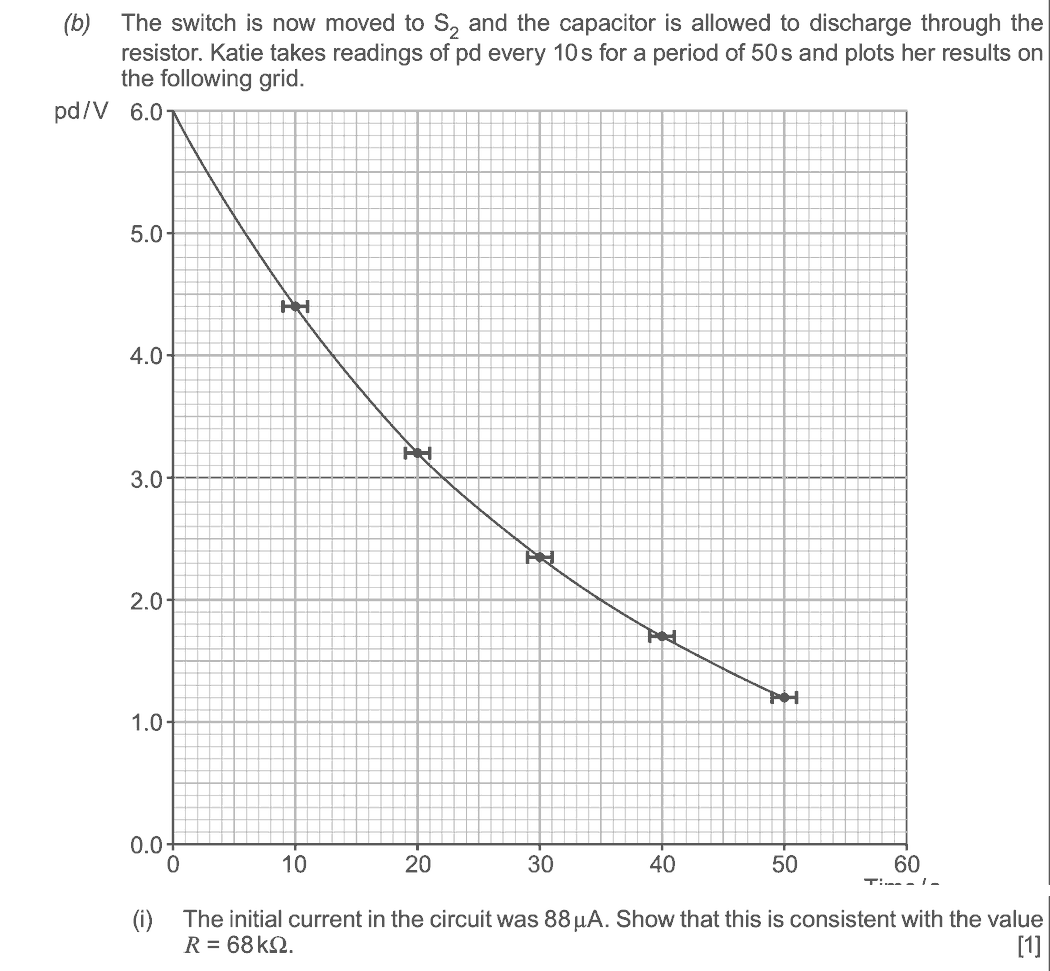
June 2017 · Component 2 · Q3(b)(ii)2 marksAO3=2Practical and data analysis
Earlier parts of question 3 that this part uses
Mark scheme
Examiner's comment
Candidates usually scored one out of two marks here, usually for stating that the error bars would be too small to be plotted on the given scale. Candidates also needed to identify the resolution of the voltmeter as being the uncertainty (or refer to the 0.01 V given). A few candidates suggested wrongly that error bars could not be plotted as ‘a mean uncertainty had not been calculated from multiple readings of the voltmeter’.
Notes from the mark scheme and report
The uncertainty is the voltmeter resolution, 0.01 V (1), which is too small to plot on the scale of the graph (1)
the first point was often missing
Scheme columns: Practical 2
Skills: Uncertainties Resolution, absolute and percentage uncertainty, combining uncertainties, error bars; Graphskills Reading, plotting or sketching graphs; gradients, intercepts and areas; Practicalmarks The mark scheme's Prac column gives this part at least one mark for practical skills
June 2017 · Component 2 · Q3(b)(iii)1 markAO2=1Practical and data analysis
Earlier parts of question 3 that this part uses
Mark scheme
Examiner's comment
Nearly all candidates referred correctly to the error bars as representing the resolution of the stopwatch.
Notes from the mark scheme and report
By the horizontal error bars of ± 1 s
Scheme columns: Practical 1
Skills: Uncertainties Resolution, absolute and percentage uncertainty, combining uncertainties, error bars; Graphskills Reading, plotting or sketching graphs; gradients, intercepts and areas; Practicalmarks The mark scheme's Prac column gives this part at least one mark for practical skills
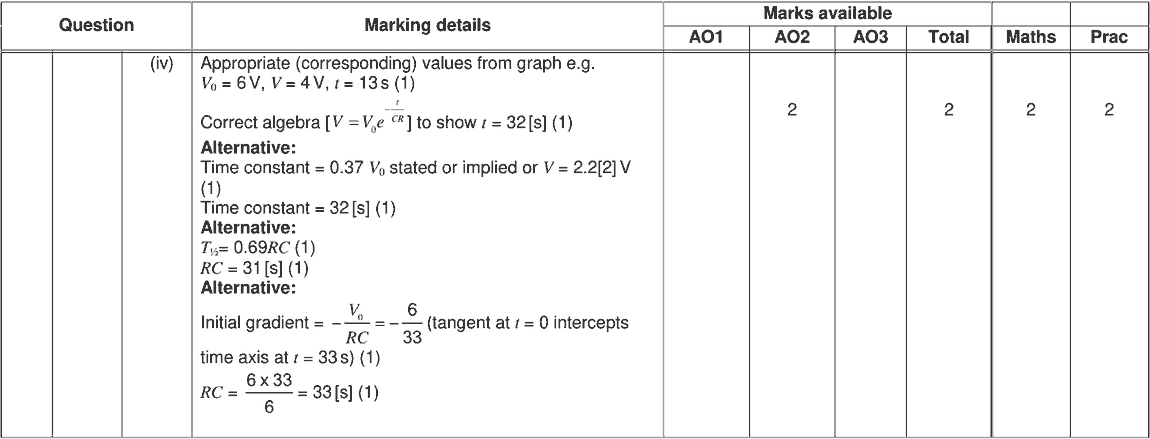
June 2017 · Component 2 · Q3(b)(iv)2 marksAO2=2Show that
Earlier parts of question 3 that this part uses
Mark scheme
Examiner's comment
Most candidates used appropriate values from the graph to find the time constant.
Notes from the mark scheme and report
Time constant about 32 s. Read corresponding values, e.g. V0 = 6 V, V = 4 V at t = 13 s, and use V = V0 e^(−t/RC)
or time to fall to 0.37 V0 (2.2 V)
or half-life = 0.69RC
or the tangent at t = 0 meets the time axis at 33 s
Scheme columns: Maths 2, Practical 2
Skills: Graphskills Reading, plotting or sketching graphs; gradients, intercepts and areas; Mathsmarks The mark scheme's Maths column gives this part at least one mark for mathematical skills; Practicalmarks The mark scheme's Prac column gives this part at least one mark for practical skills
June 2017 · Component 2 · Q3(b)(v)4 marksAO1=1, AO2=3Practical and data analysis
Earlier parts of question 3 that this part uses
Mark scheme
Examiner's comment
Most candidates could determine a correct value for the capacitance of the capacitor. Only the better candidates could determine the absolute uncertainty in C correctly. A common error was to ignore the uncertainty in the time constant. Also, many candidates gave their final answers to C and its absolute uncertainty to an inconsistent number of significant figures. One mark was deducted in this case.
Notes from the mark scheme and report
Answer: 470 ± 30 μF. C = time constant/R = 32/68 000 = 471 μF
value and uncertainty must have consistent significant figures
the time uncertainty was often ignored
Scheme columns: Maths 4, Practical 4
Skills: Uncertainties Resolution, absolute and percentage uncertainty, combining uncertainties, error bars; Mathsmarks The mark scheme's Maths column gives this part at least one mark for mathematical skills; Practicalmarks The mark scheme's Prac column gives this part at least one mark for practical skills
June 2017 · Component 2 · Q3(b)(vi)3 marksAO3=3Practical and data analysis
Earlier parts of question 3 that this part uses
Mark scheme
Examiner's comment
Many candidates applied the decay formula correctly to determine the pd at 55 s and concluded correctly that their answer was consistent with the trend shown in the graph.
Notes from the mark scheme and report
Answer: 1.1 V, consistent. V = 6.0 e^(−55/32)
the graph line extended passes through this point
Scheme columns: Maths 2, Practical 3
Skills: Graphskills Reading, plotting or sketching graphs; gradients, intercepts and areas; Mathsmarks The mark scheme's Maths column gives this part at least one mark for mathematical skills; Practicalmarks The mark scheme's Prac column gives this part at least one mark for practical skills
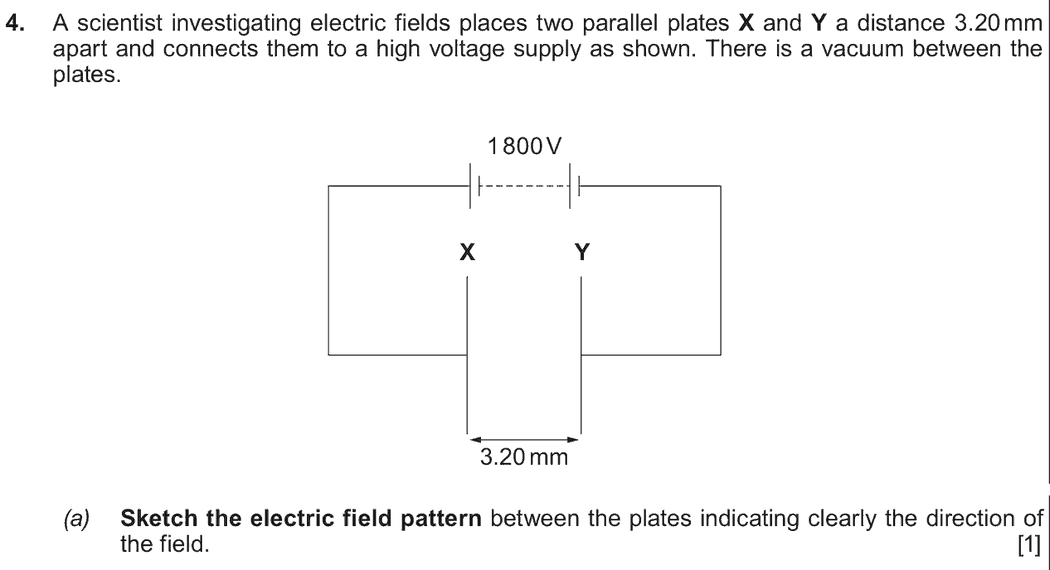
June 2017 · Component 2 · Q4(a)1 markAO1=1Diagram or graph
Mark scheme
Examiner's comment
Many candidates drew horizontal lines between the plates, but a significant number either showed the field going from right to left or did not identify a direction at all.
Notes from the mark scheme and report
Parallel horizontal lines between the plates with arrows from X (positive) to Y
direction often reversed or missing
June 2017 · Component 2 · Q4(b)(i)2 marksAO1=1, AO2=1Calculation
Earlier part of question 4 that this part uses
Mark scheme
Examiner's comment
Only a minority of candidates could determine the force on an electron.
Notes from the mark scheme and report
Answer: 9.0 × 10⁻¹⁴ N. F = Ve/d = 1800 × 1.6 × 10⁻¹⁹/3.2 × 10⁻³
poorly done
Scheme columns: Maths 2
Skills: Unitsand conversions Unit marks, base units, prefixes and conversions; Mathsmarks The mark scheme's Maths column gives this part at least one mark for mathematical skills
June 2017 · Component 2 · Q4(c)2 marksAO3=2Explanation
Earlier part of question 4 that this part uses
Mark scheme
Examiner's comment
Few candidates provided a clear, logical and unambiguous argument to verify the claim made. Many options were possible when answering this question, including analyses using W = Fd and W = QV.
Notes from the mark scheme and report
Halving d doubles the force (F = Ve/d) (1)
work done = 2F × d/2, so unchanged (1). Or W = QV with Q and V both constant, so the KE gain is unchanged. Clear arguments were rare
Work with an Eduqas physics tutor
Dropping marks on calculations, specified practicals or the six-mark QER questions? Book a trial session with a specialist Eduqas physics tutor.