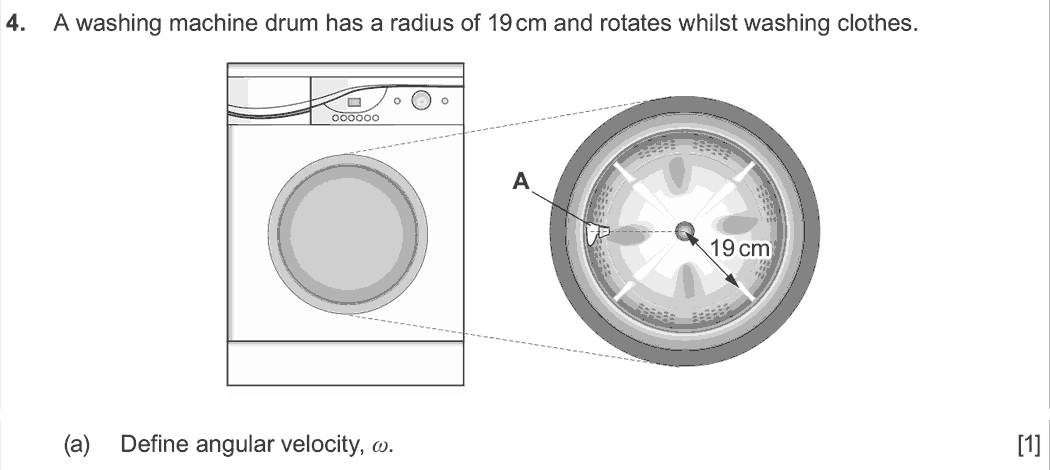
Tap a question to zoom it. Where a part needs a figure, table or graph from earlier in the question, that part folds out above it; the mark scheme and examiner's comment open underneath. Have the Eduqas Data Booklet beside you (see the Data Booklet page).
June 2025 · Component 1 · Q4(a)1 markAO1=1Definition
Mark scheme
Examiner's comment
The definition of 𝜔 was well answered by many. There were plenty of responses that matched the MS word for word. Some candidates managed the ‘angle swept out’ part of the definition, but they finished with ‘in a given time’ rather than ‘in unit time’.
Notes from the mark scheme and report
Angle swept out (by the radius) per unit time, or rate of change of angular displacement
'in a given time' not accepted
June 2025 · Component 1 · Q4(b)(i)2 marksAO2=2Show that
Earlier part of question 4 that this part uses
Mark scheme
Examiner's comment
&(ii) Both of these questions were well done. In (i), we were looking for evidence of the multiplication of 2π and division by 60. This often came within 𝜔= 2𝜋 𝑇 or 2𝜋𝑓. In part (ii), 𝐹= 𝑚𝑣2 𝑟 and 𝑚𝑟𝜔2 were regularly seen. Some candidates used the approximation (150 rad s-1) which resulted in a final answer of 641 N. This was credited. For the 3rd MP we required more than just ‘towards the centre’. Towards the centre of the drum was credited and we also accepted towards the centre of the washing machine.
Notes from the mark scheme and report
ω = 2πf = 2π × 1400/60 = 147 rad s⁻¹ (× 2π and ÷ 60 both shown)
Scheme columns: Maths 2
Skills: Unitsand conversions Unit marks, base units, prefixes and conversions; Mathsmarks The mark scheme's Maths column gives this part at least one mark for mathematical skills
June 2025 · Component 1 · Q4(b)(ii)3 marksAO1=2, AO2=1Calculation
Earlier parts of question 4 that this part uses
Mark scheme
Notes from the mark scheme and report
Answer: 616 N (641 N if 150 rad s⁻¹ used), towards the centre of the drum. F = mω²r = 0.15 × 147² × 0.19 (or mv²/r with v = 28 m s⁻¹)
'towards the centre' alone was not enough
Scheme columns: Maths 2
Skills: Unitsand conversions Unit marks, base units, prefixes and conversions; Mathsmarks The mark scheme's Maths column gives this part at least one mark for mathematical skills
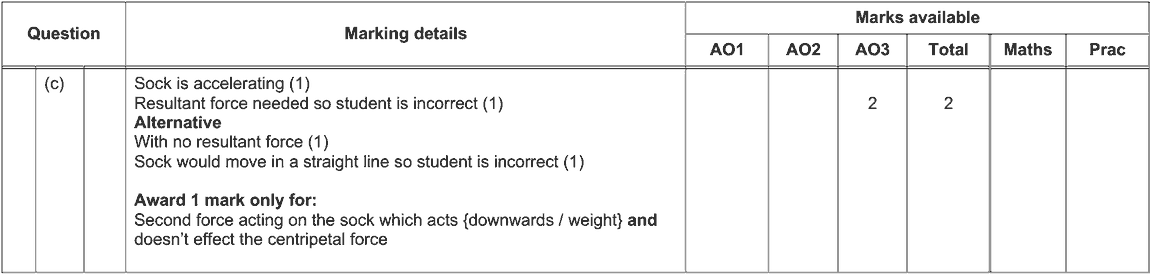
June 2025 · Component 1 · Q4(c)2 marksAO3=2Explanation
Earlier part of question 4 that this part uses
Mark scheme
Examiner's comment
It is worth noting that this question focused on the sock. The sock is accelerating so must have a resultant force acting upon it. References to the fictitious centrifugal force balancing the inward force were not given credit. For those candidates who focused on the weight acting downwards, we wanted them to clearly show an understanding that it did not affect the centripetal force at this position.
Notes from the mark scheme and report
Incorrect. The sock moves in a circle so it is accelerating (1) and needs a resultant force towards the centre
balanced forces would mean motion in a straight line (1). 1 mark only for noting the second force is the weight, acting down, which does not cancel the centripetal force. Centrifugal force arguments not credited
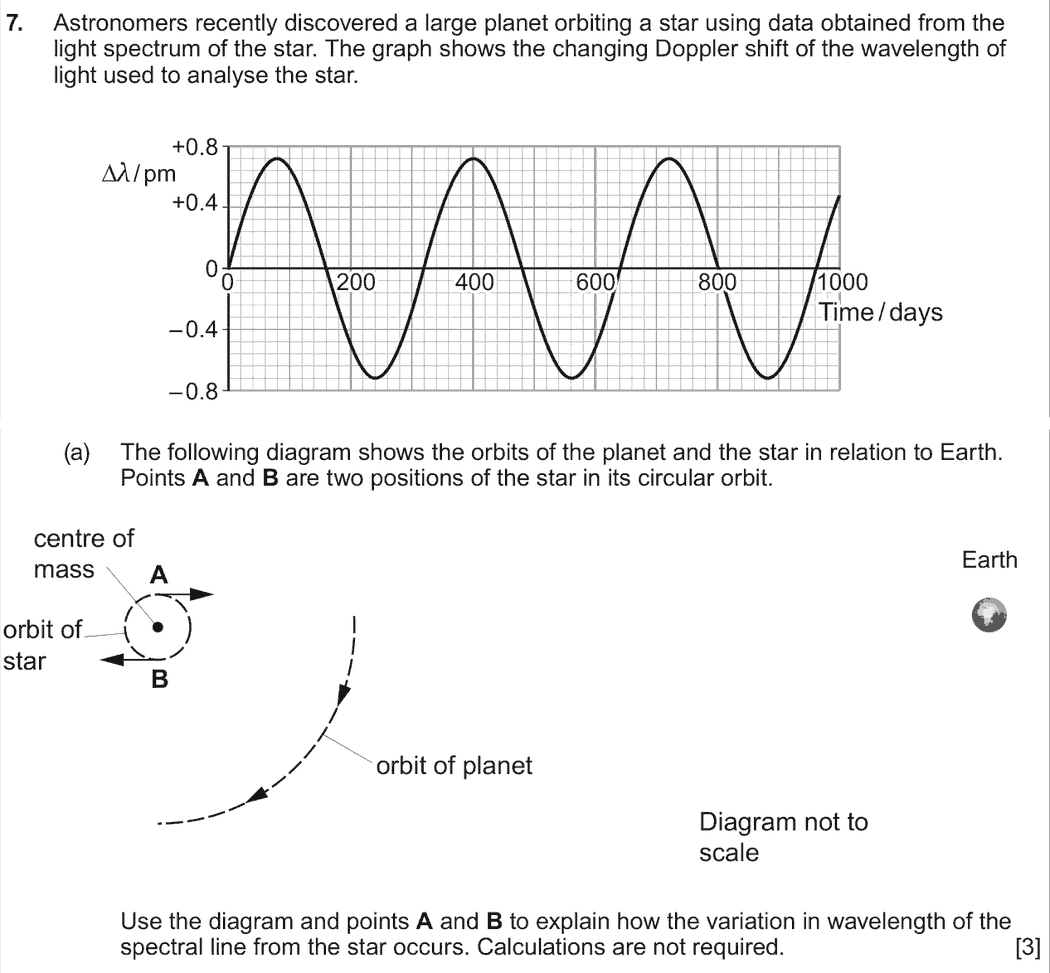
June 2025 · Component 2 · Q7(b)(ii)3 marksAO1=1, AO2=2Show that
Earlier parts of question 7 that this part uses
Mark scheme
Examiner's comment
) from d. Few candidates completed this step and thus lost the mark. The final two marks were for applying the mass-to-radius ratio correctly. ECF (error carried forward) was applied, and many candidates gained these marks.
Notes from the mark scheme and report
T = 320 days = 2.76 × 10⁷ s from the graph
r = vT/2π = 361 × 2.76 × 10⁷/2π = 1.59 × 10⁹ m
Scheme columns: Maths 2
Skills: Graphskills Reading, plotting or sketching graphs; gradients, intercepts and areas; Unitsand conversions Unit marks, base units, prefixes and conversions; Mathsmarks The mark scheme's Maths column gives this part at least one mark for mathematical skills
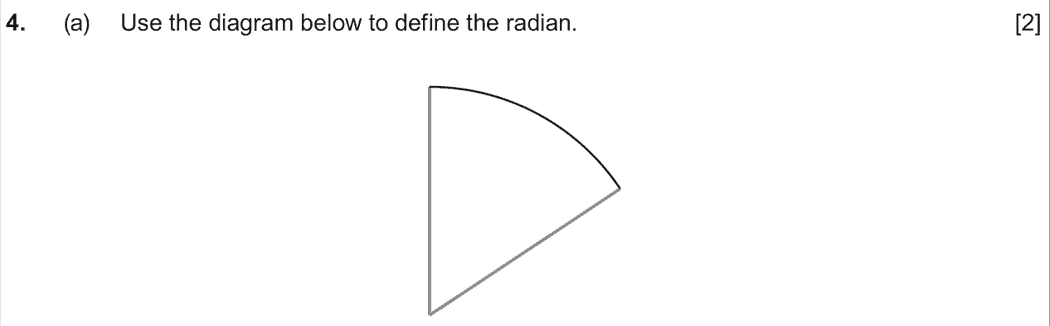
June 2024 · Component 1 · Q4(a)2 marksAO1=2DefinitionEasy
Mark scheme
Examiner's comment
Many candidates labelled the diagram correctly. 𝜃, 𝑟, and 𝑟𝜃 were regularly seen. There were variations in approach that were acceptable. Some candidates used values that showed the arc length was the same length as the radius. Some candidates scored the 1st mark but could not go further. ‘2𝜋 = full circle’ was not enough as many candidates thought. ‘A radian is about 57.3 degrees’ was also not enough for credit.
Notes from the mark scheme and report
s = rθ seen or the terms labelled on the diagram (1)
the angle subtended at the centre of a circle by an arc equal in length to the radius (1)
June 2024 · Component 1 · Q4(b)(i)3 marksAO1=1, AO2=2CalculationEasy
Earlier part of question 4 that this part uses
Mark scheme
Examiner's comment
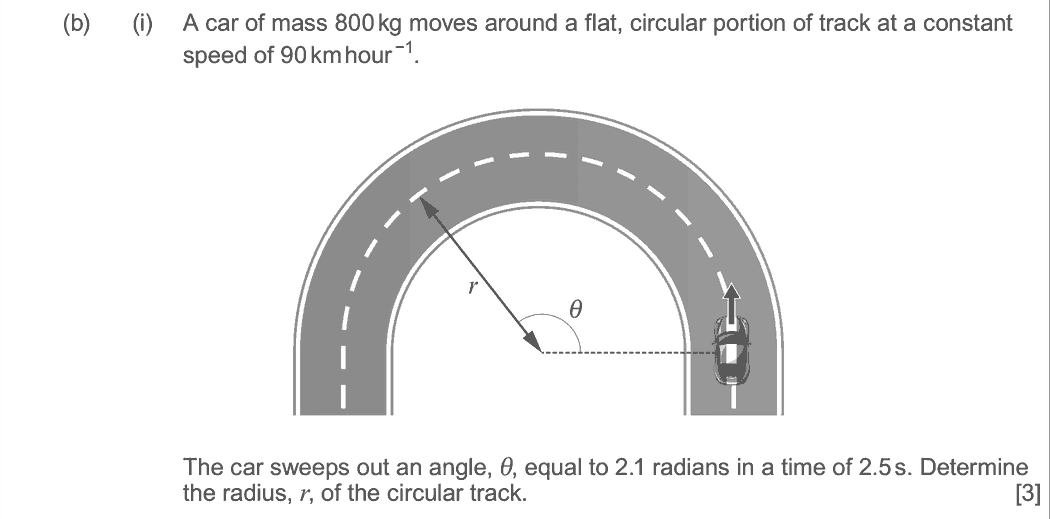
Nearly all candidates were able to convert from km hr-1 into m s-1. 𝜔 was regularly calculated but occasionally an extra ‘2𝜋’ would creep into a calculation and result in a mark being lost.
Notes from the mark scheme and report
Answer: 29.8 m. v = 90 km h⁻¹ = 25 m s⁻¹
ω = θ/t = 2.1/2.5 = 0.84 rad s⁻¹
r = v/ω
an extra 2π sometimes crept in
Scheme columns: Maths 2
Skills: Unitsand conversions Unit marks, base units, prefixes and conversions; Mathsmarks The mark scheme's Maths column gives this part at least one mark for mathematical skills
June 2024 · Component 1 · Q4(b)(ii)4 marksAO1=1, AO2=3CalculationEasy
Earlier parts of question 4 that this part uses
Mark scheme
Examiner's comment
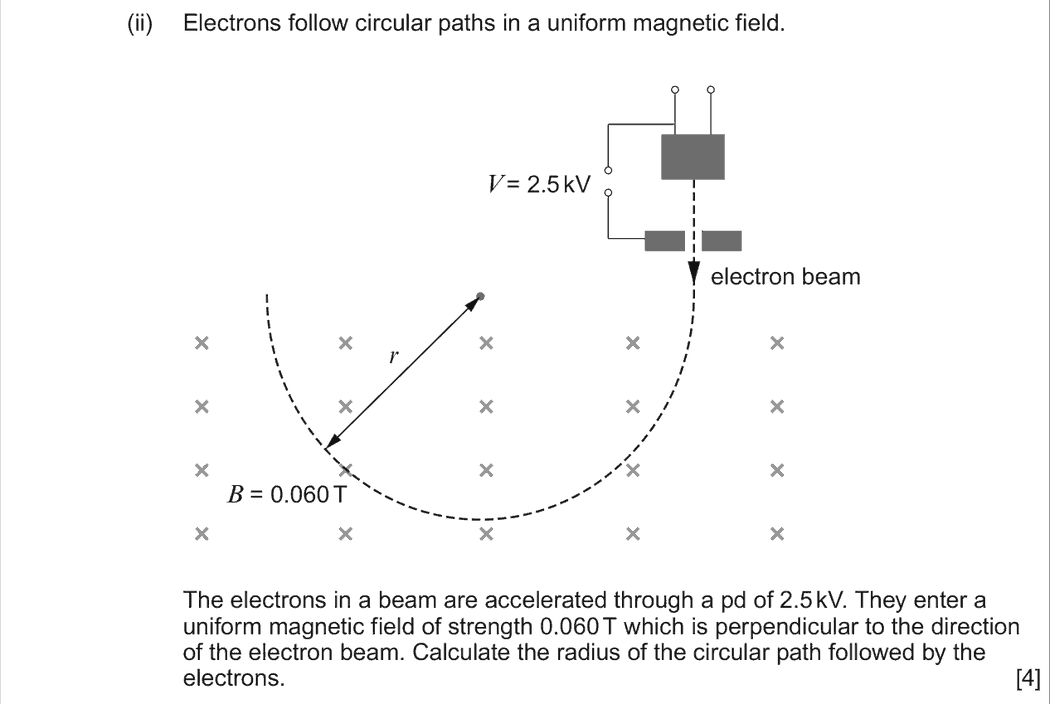
There were many excellent responses however, there were a small number of blanks for this synoptic question. Some candidates spotted the centripetal force was created by 𝐵𝑒𝑣 but went no further. Candidates who correctly calculated the speed of the electron (3 107m s-1) would often go on to gain full credit. Some unsuccessfully tried to use the speed of light instead of the speed of an electron. There were also confused responses involving the pd (V) being used as velocity. These candidates were only able to access the 3rd marking point.
Notes from the mark scheme and report
Answer: 2.8 × 10⁻³ m. KE = eV = 4.0 × 10⁻¹⁶ J so v = 3.0 × 10⁷ m s⁻¹
mv²/r = Bev so r = mv/Be
synoptic with Component 3 magnetic fields
some blanks
Scheme columns: Maths 3
Skills: Synoptic Needs physics from another component of the qualification; Mathsmarks The mark scheme's Maths column gives this part at least one mark for mathematical skills
June 2024 · Component 1 · Q4(b)(iii)I1 markAO2=1Short answerEasy
Earlier parts of question 4 that this part uses
Mark scheme
Examiner's comment
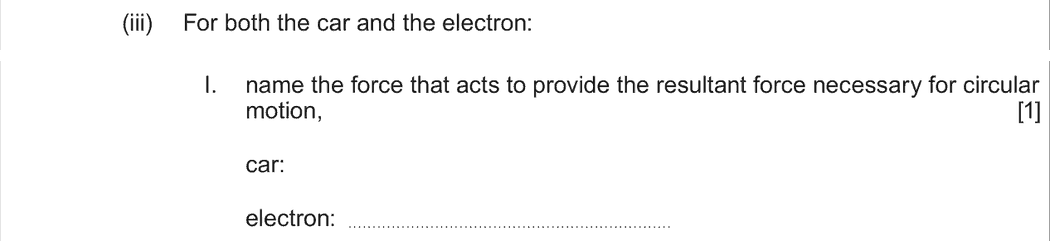
In part I candidates were required to name both forces for 1 mark and this proved tricky. A large number of candidates used ‘centripetal force’ and this wasn’t accepted. A centripetal force is a resultant force created by other forces. We were looking for ‘friction’ and ‘magnetic’ force. In part II it was pleasing to see many good calculations. There were occasional slips when using 𝑚𝑣2 𝑟 as the squared term was sometimes missed. Some candidates were unable to calculate the forces as required. On this occasion we awarded 1 mark for the comment alone.
Notes from the mark scheme and report
Car: friction (grip)
electron: magnetic (motor) force
both needed for the mark
'centripetal force' not accepted because it is the resultant
June 2024 · Component 1 · Q4(b)(iii)II3 marksAO3=3CalculationEasy
Earlier parts of question 4 that this part uses
Mark scheme
Examiner's comment
In part I candidates were required to name both forces for 1 mark and this proved tricky. A large number of candidates used ‘centripetal force’ and this wasn’t accepted. A centripetal force is a resultant force created by other forces. We were looking for ‘friction’ and ‘magnetic’ force. In part II it was pleasing to see many good calculations. There were occasional slips when using 𝑚𝑣2 𝑟 as the squared term was sometimes missed. Some candidates were unable to calculate the forces as required. On this occasion we awarded 1 mark for the comment alone.
Notes from the mark scheme and report
Car: F = mv²/r = 17 kN
electron: F = Bev = 0.29 pN
comparison, e.g. the force on the car is about 6 × 10¹⁶ times bigger
ecf from (b)(i) and (b)(ii)
Scheme columns: Maths 2
Skills: Synoptic Needs physics from another component of the qualification; Mathsmarks The mark scheme's Maths column gives this part at least one mark for mathematical skills
June 2023 · Component 1 · Q6(b)(iii)I2 marksAO1=1, AO2=1Calculation
Earlier parts of question 6 that this part uses
Mark scheme
Examiner's comment
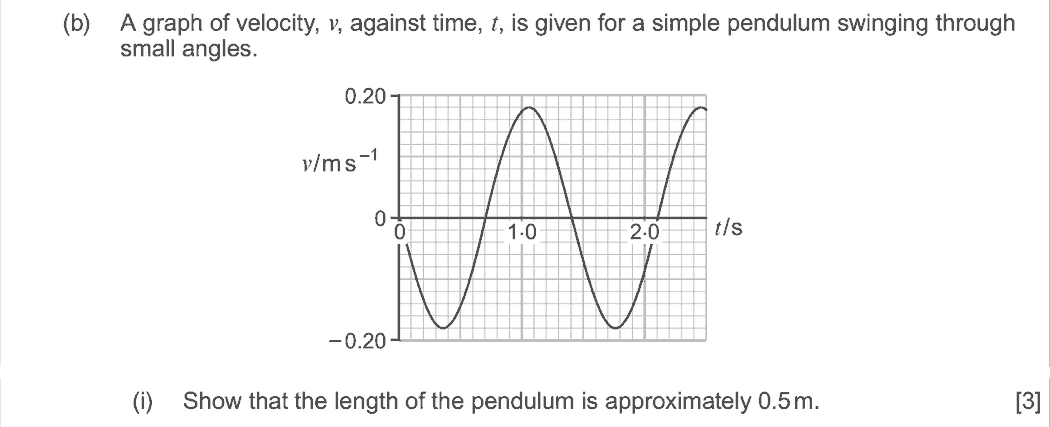
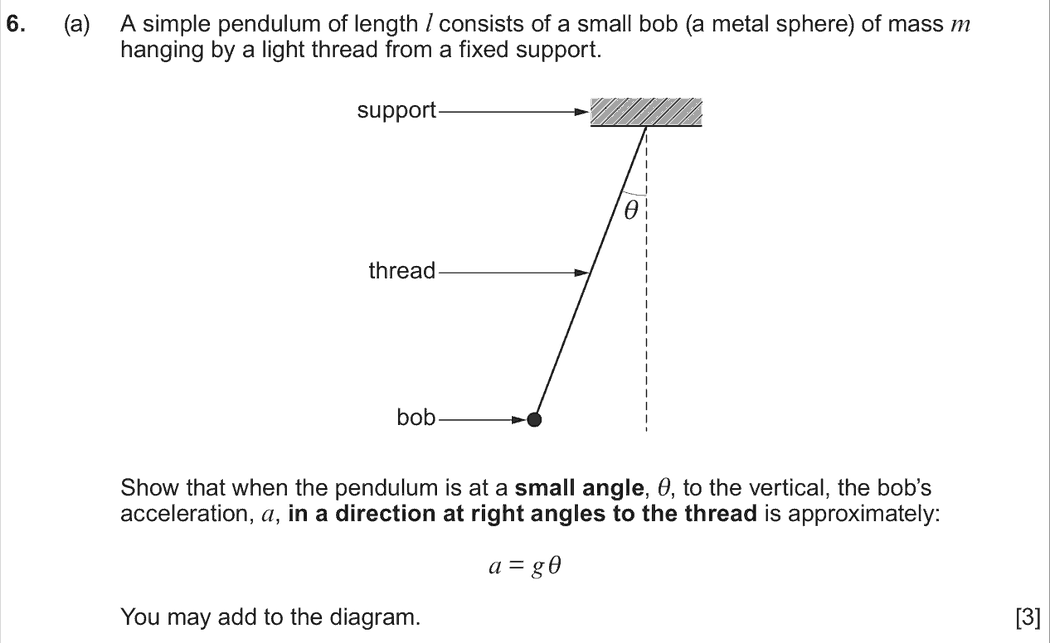
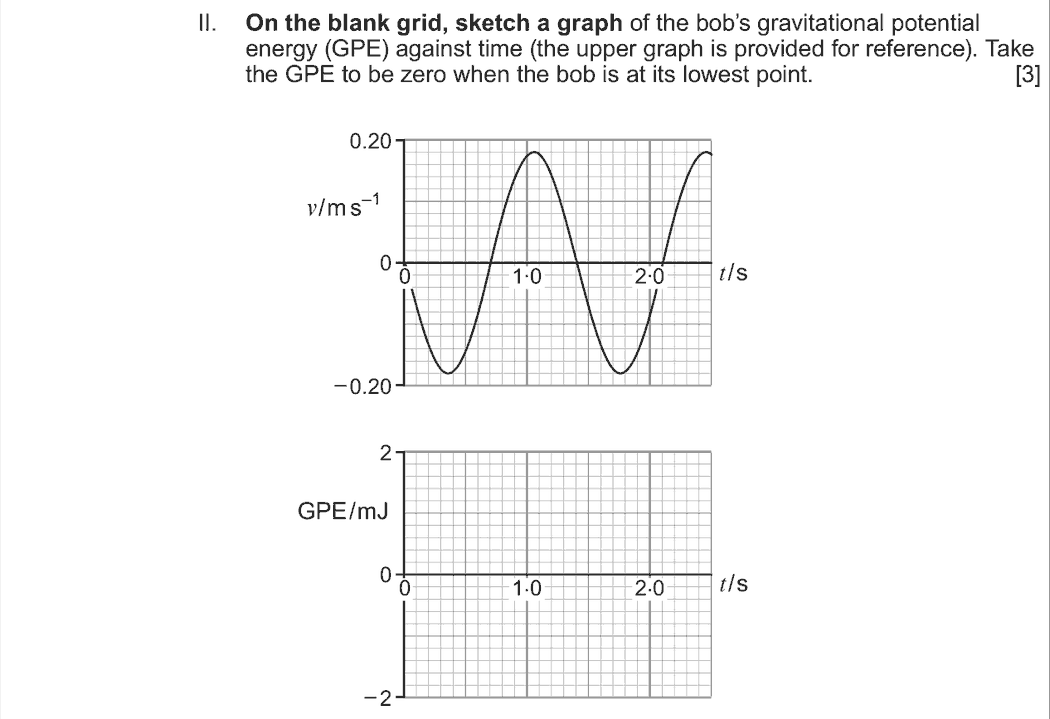
The ‘show that’ question in part (a) proved to be demanding. A significant number of candidates were unable to appreciate where the component of the bob’s weight was acting and diagrams indicating horizontal force directions were confused. The use of tension also halted progress here. The second and third marking points proved more accessible. Mainly very good candidate responses were seen in (b)(i). There were some weaker attempts using 𝑣 = −𝐴𝜔sin𝜔𝑡 but these did not develop as the candidates were unable to determine the amplitude. For the GPE – time graph in (ii) we were looking for the correct period, phase, and shape. There was a good success rate. A triangular wave is not an acceptable alternative for a sinusoid. Candidates who used the negative portion of the graph were only able to access the period mark as this was a significant error. The transition from simple harmonic motion to circular motion in part (iii) proved demanding for some candidates. Some used 𝑎= 𝜔2𝑟 and the periodic time of 1.4 s for the pendulum to be the time for one complete revolution. This is incorrect. Candidates who used 𝑎= 𝑣2 𝑟 were more successful. In the second part of the question, we were looking for candidates to show us that a centripetal force is a resultant force and at the bottom of the swing, this resultant force would be upwards. Some candidates were able to do this. We accepted ‘𝑇 – 𝑚𝑔 = 𝑚𝑎’ for the first marking point. The direction needed to be clear for the second marking point. Some drew a diagram to support their responses and were often rewarded. The last part was the QER and it tested the candidate’s ability to describe how forced oscillations can be demonstrated and how the amplitude varies with frequency. It bridged AO1 and AO3 and this challenged candidates. The description of the experiment was often limited whereas the variation of amplitude and hence links to resonance were more readily seen. A graph would often be seen, however, we wanted it to be referenced in their written response. The simple and effective way of obtaining the natural frequency of an oscillator (when the signal generator is off) was not regularly seen, however, it was encouraging to see additional practical detail regarding the amplitude measurement. There were a minority of confused responses involving damping.
Notes from the mark scheme and report
Answer: 0.067 m s⁻². a = v²/r = 0.18²/0.487 (0.065 with r = 0.5 m)
unit mark
using a = ω²r with the pendulum's period 1.4 s as a rotation period is wrong
Scheme columns: Maths 1
Skills: Unitsand conversions Unit marks, base units, prefixes and conversions; Mathsmarks The mark scheme's Maths column gives this part at least one mark for mathematical skills
June 2023 · Component 1 · Q6(b)(iii)II2 marksAO1=1, AO2=1Explanation
Earlier parts of question 6 that this part uses
Mark scheme
Examiner's comment
The ‘show that’ question in part (a) proved to be demanding. A significant number of candidates were unable to appreciate where the component of the bob’s weight was acting and diagrams indicating horizontal force directions were confused. The use of tension also halted progress here. The second and third marking points proved more accessible. Mainly very good candidate responses were seen in (b)(i). There were some weaker attempts using 𝑣 = −𝐴𝜔sin𝜔𝑡 but these did not develop as the candidates were unable to determine the amplitude. For the GPE – time graph in (ii) we were looking for the correct period, phase, and shape. There was a good success rate. A triangular wave is not an acceptable alternative for a sinusoid. Candidates who used the negative portion of the graph were only able to access the period mark as this was a significant error. The transition from simple harmonic motion to circular motion in part (iii) proved demanding for some candidates. Some used 𝑎= 𝜔2𝑟 and the periodic time of 1.4 s for the pendulum to be the time for one complete revolution. This is incorrect. Candidates who used 𝑎= 𝑣2 𝑟 were more successful. In the second part of the question, we were looking for candidates to show us that a centripetal force is a resultant force and at the bottom of the swing, this resultant force would be upwards. Some candidates were able to do this. We accepted ‘𝑇 – 𝑚𝑔 = 𝑚𝑎’ for the first marking point. The direction needed to be clear for the second marking point. Some drew a diagram to support their responses and were often rewarded. The last part was the QER and it tested the candidate’s ability to describe how forced oscillations can be demonstrated and how the amplitude varies with frequency. It bridged AO1 and AO3 and this challenged candidates. The description of the experiment was often limited whereas the variation of amplitude and hence links to resonance were more readily seen. A graph would often be seen, however, we wanted it to be referenced in their written response. The simple and effective way of obtaining the natural frequency of an oscillator (when the signal generator is off) was not regularly seen, however, it was encouraging to see additional practical detail regarding the amplitude measurement. There were a minority of confused responses involving damping.
Notes from the mark scheme and report
The bob is moving in a circular arc so there must be a resultant (centripetal) force on it, T − mg = ma (1), directed upwards towards the support, so T exceeds mg (1)
'acceleration is upwards' alone scores 1
June 2023 · Component 2 · Q5(b)(ii)3 marksAO1=1, AO2=2Show that
Earlier parts of question 5 that this part uses
Mark scheme
Examiner's comment
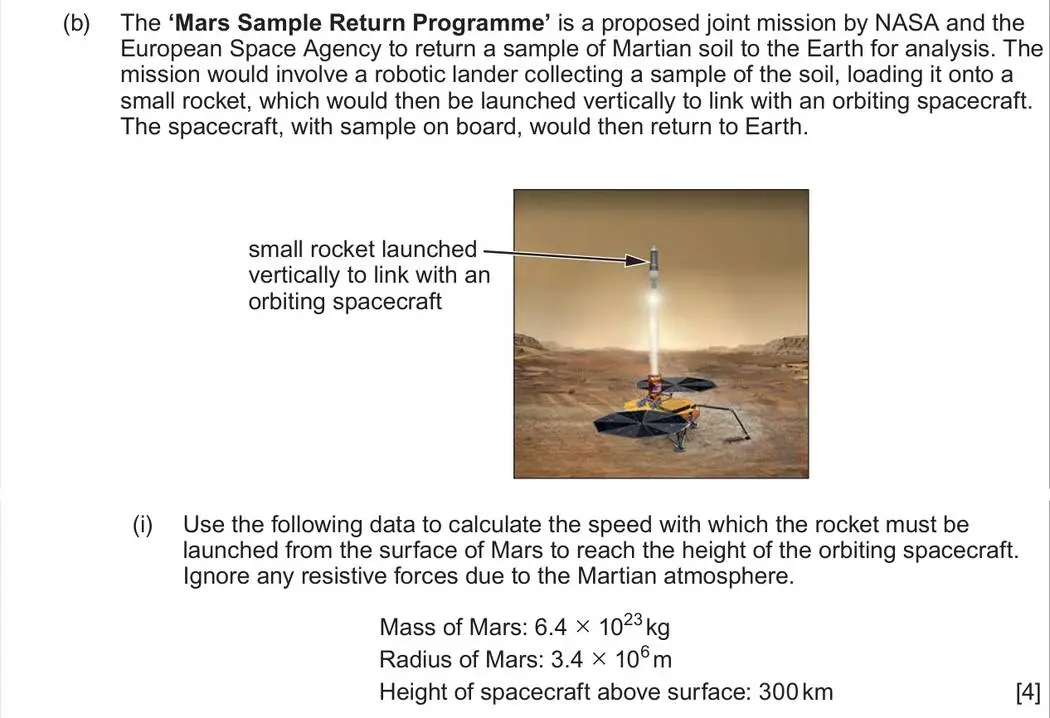
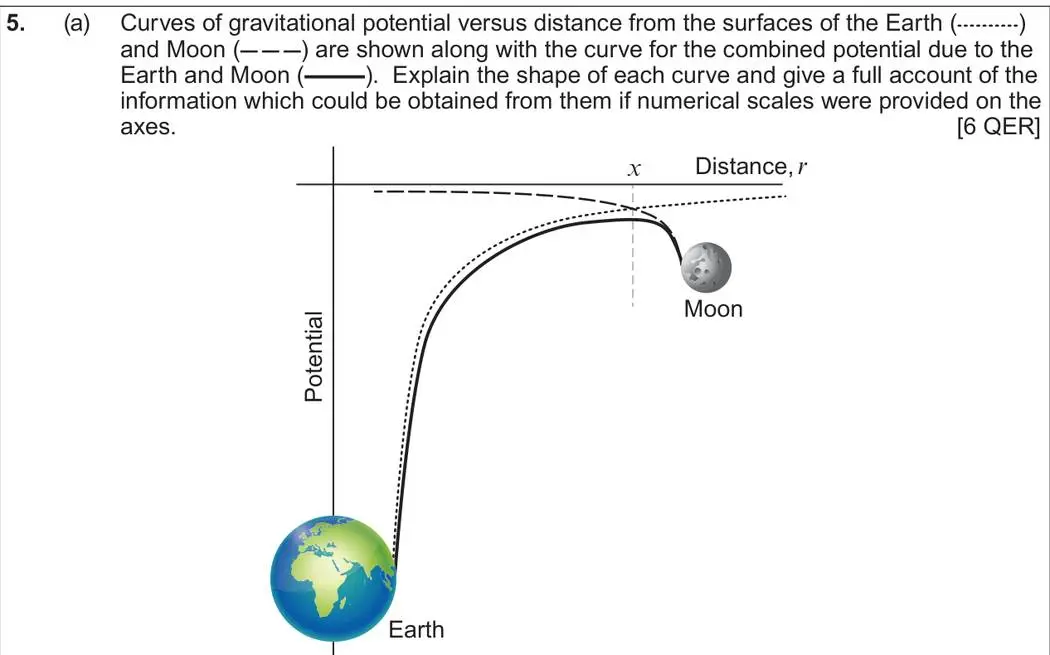
Part (a) was the QER question and in general, good attempts were made to explain the shapes of the potential vs distance curves. Higher scoring candidates (top band responses) were able to refer to the definition of potential and the expected relationship between potential and distance (i.e. 𝑉𝑔∝ − 𝑟). They explained the reason why the potential near the earth had a greater (negative) value than near the Moon and identified the relationship between the gradient of the curves and gravitational field strength. They described the scalar nature of potential and explained that the combined curve was due to the sum of the individual potentials. They also correctly described the significance of the gradient at X in terms of field strength and, in some cases, the work needed to escape the system. Middle band responses contained some of the above points, with lower band candidates only managing to describe one or two of these aspects. Many candidates in (b)(i) had an appreciation of the energy principles involved in determining the launch speed of the rocket, including the concept of initial Ep and Ek at the surface being equal to the Ep at the given height in orbit. However, a significant minority of candidates failed to gain full marks due to their incorrect use of signs when considering Ep. That is they failed to account for the negative values of Ep at both the surface and at the height of the orbit. Responses to (ii) were more successful with many applying the appropriate circular motion equation to confirm the orbital speed. In a few cases candidates used the orbital speed given in the question to determine the period of orbit, T, and then used the same equation again to re-confirm the orbital speed - a circular approach which was not credited.
Notes from the mark scheme and report
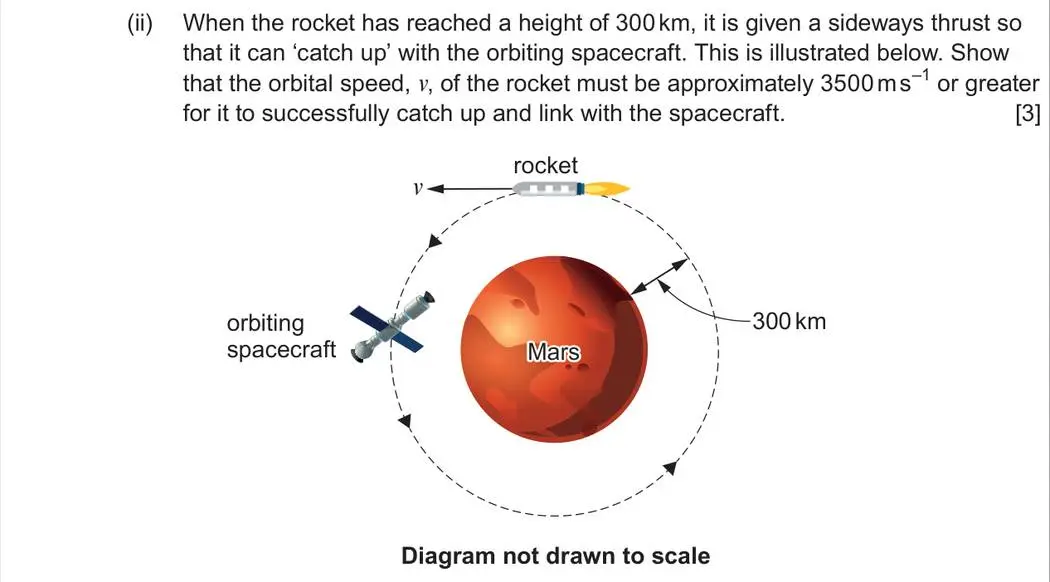
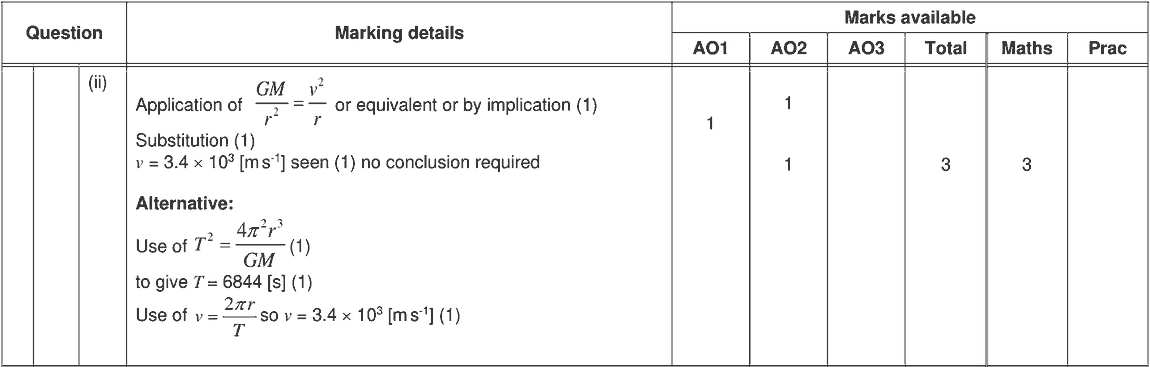
GMm/r² = mv²/r so v = √(GM/r) = √(6.67 × 10⁻¹¹ × 6.4 × 10²³/3.7 × 10⁶) = 3.4 × 10³ m s⁻¹
or Kepler's third law gives T = 6844 s then v = 2πr/T
using the given speed to find T and back again is circular
Scheme columns: Maths 3
Skills: Synoptic Needs physics from another component of the qualification; Mathsmarks The mark scheme's Maths column gives this part at least one mark for mathematical skills
June 2022 · Component 1 · Q4(a)2 marksAO1=2Explanation
Mark scheme
Examiner's comment
We needed to be told that an object moving in a circular path is continuously changing its direction, so it is changing its velocity, or is accelerating, and that this requires a (resultant) force to act on it. The first point was often not made clearly.
Notes from the mark scheme and report
The direction of travel changes continuously, so the velocity changes and the object is accelerating (1)
a resultant force is needed to produce an acceleration, F = ma (1)
the first point was often unclear
June 2022 · Component 1 · Q4(b)(ii)3 marksAO1=2, AO2=1Calculation
Earlier parts of question 4 that this part uses
Mark scheme
Examiner's comment
Calculating the greatest rotation frequency was also done very well. The commonest mistake was failure to divide a calculated value of 𝜔 by 2𝜋.
Notes from the mark scheme and report
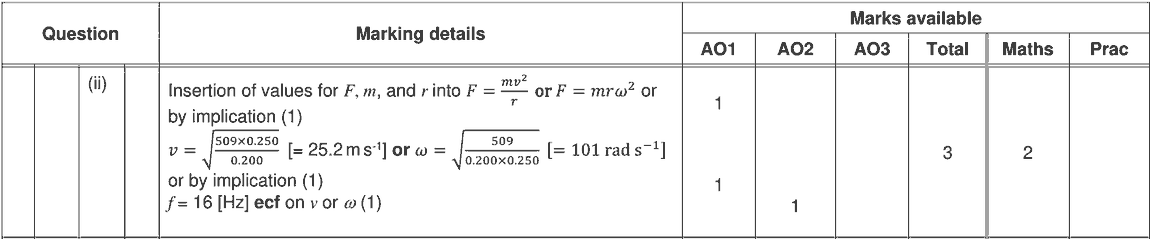
Answer: 16 Hz. F = mrω² so ω = √(509/(0.200 × 0.250)) = 101 rad s⁻¹ (or v = 25.2 m s⁻¹)
f = ω/2π
forgetting to divide ω by 2π was the commonest error
Scheme columns: Maths 2
Skills: Mathsmarks The mark scheme's Maths column gives this part at least one mark for mathematical skills
June 2022 · Component 1 · Q4(b)(iii)I1 markAO2=1Short answer
Earlier parts of question 4 that this part uses
Mark scheme
Examiner's comment
Only a minority of candidates pointed out that they had ignored the mass of the rod itself, or the rod’s elongation. Air resistance was commonly offered, but it would not contribute a radial force.
Notes from the mark scheme and report
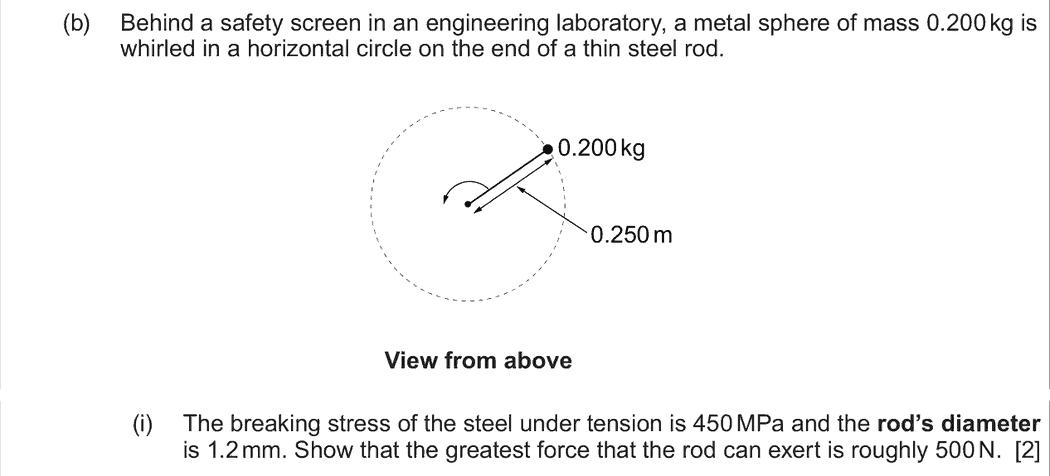
The mass of the rod was ignored, or the stretching of the rod was ignored
air resistance not accepted as it gives no radial force
only a minority correct
June 2022 · Component 1 · Q4(b)(iii)II1 markAO3=1Explanation
Earlier parts of question 4 that this part uses
Mark scheme
Examiner's comment
Only a minority of candidates pointed out that they had ignored the mass of the rod itself, or the rod’s elongation. Air resistance was commonly offered, but it would not contribute a radial force.
Notes from the mark scheme and report
Smaller: the rod's own mass needs centripetal force too, so the stress in the inner part is greater at a given rotation rate
or stretching increases the radius and so the stress at a given rate
October 2021 · Component 1 · Q4(b)(i)1 markAO1=1Short answer
Earlier part of question 4 that this part uses
Mark scheme
Notes from the mark scheme and report
0.37 mm is enormous for an atom (ordinary atoms are about 10⁻¹⁰ m across)
'a definite orbit is not possible' also accepted. No spec statement fits this mark closely
October 2021 · Component 1 · Q4(b)(ii)3 marksAO2=3Show that
Earlier parts of question 4 that this part uses
Mark scheme
Notes from the mark scheme and report
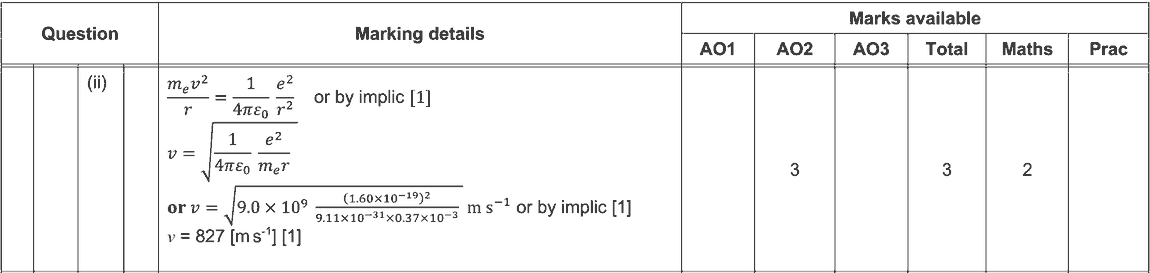
Coulomb attraction provides the centripetal force: mv²/r = e²/4πε0r² (1)
Skills: Synoptic Needs physics from another component of the qualification; Algebra Derivations and rearranging equations; Mathsmarks The mark scheme's Maths column gives this part at least one mark for mathematical skills
October 2021 · Component 1 · Q4(b)(iii)2 marksAO1=1, AO2=1Calculation
Earlier parts of question 4 that this part uses
Mark scheme
Notes from the mark scheme and report
Answer: 3.6 × 10⁵ Hz (3.4 × 10⁵ with v = 800 m s⁻¹). f = v/2πr = 827/(2π × 0.37 × 10⁻³)
unit mark
Scheme columns: Maths 1
Skills: Mathsmarks The mark scheme's Maths column gives this part at least one mark for mathematical skills
October 2021 · Component 2 · Q4(c)(i)3 marksAO3=3Show that
Earlier part of question 4 that this part uses
Mark scheme
Notes from the mark scheme and report
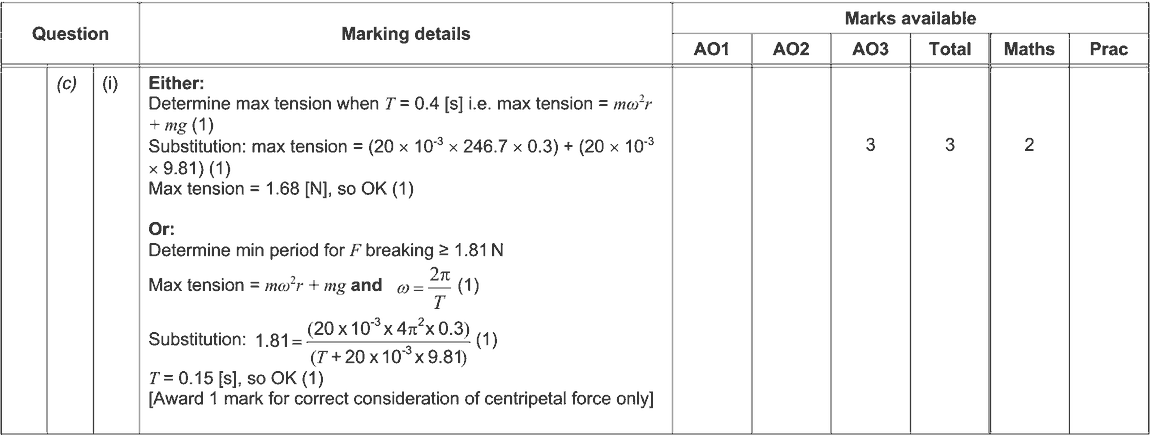
Greatest tension is at the bottom: T = mω²r + mg, with ω = 2π/0.40 = 15.7 rad s⁻¹: 0.020 × 246.7 × 0.30 + 0.020 × 9.81 = 1.48 + 0.20 = 1.68 N, below the 1.81 N breaking force. Or find the shortest safe period, 0.38 s. 1 mark only if the weight is ignored. Circular motion is Component 1 content
Scheme columns: Maths 2
Skills: Synoptic Needs physics from another component of the qualification; Mathsmarks The mark scheme's Maths column gives this part at least one mark for mathematical skills
October 2021 · Component 2 · Q4(c)(ii)4 marksAO1=1, AO2=3Diagram or graph
Earlier parts of question 4 that this part uses
Mark scheme
Notes from the mark scheme and report
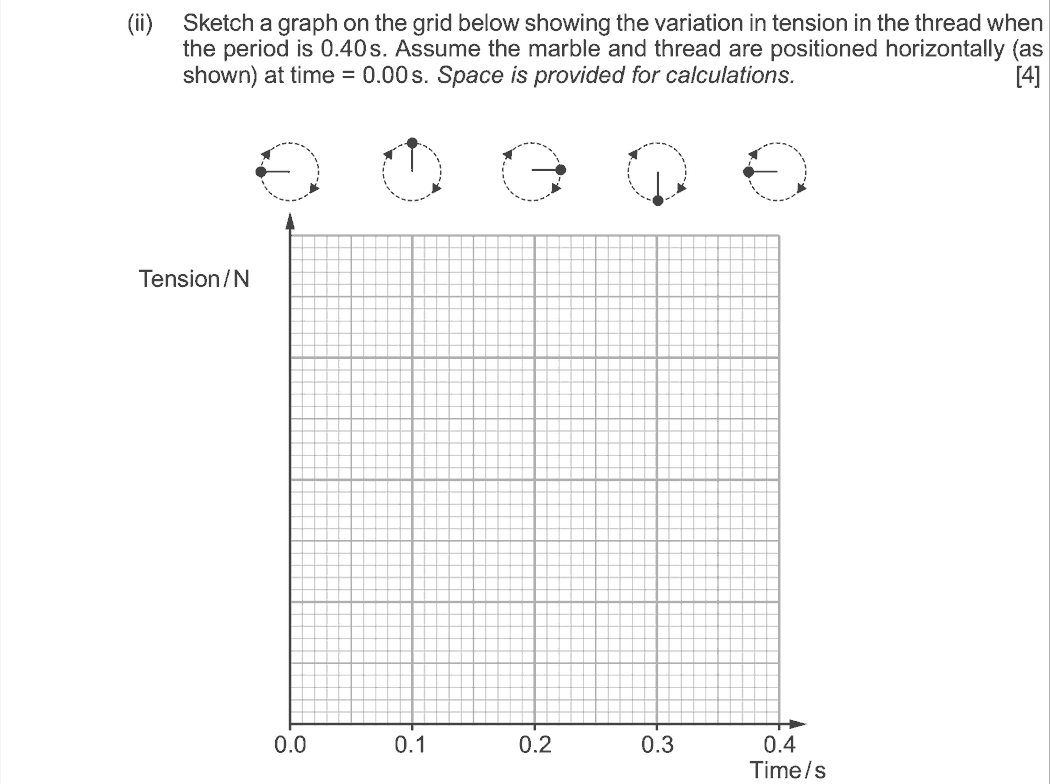
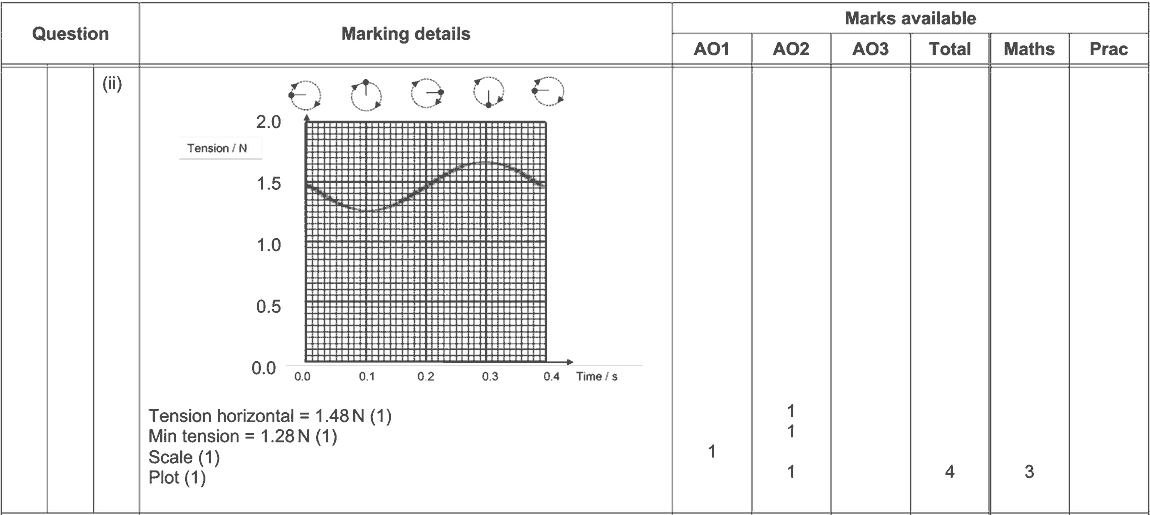
Sinusoidal variation about 1.48 N (thread horizontal at 0, 0.2 and 0.4 s) (1)
minimum 1.28 N at the top (0.1 s), maximum 1.68 N at the bottom (0.3 s) (1)
sensible scale (1)
smooth curve through these values (1)
Scheme columns: Maths 3
Skills: Synoptic Needs physics from another component of the qualification; Graphskills Reading, plotting or sketching graphs; gradients, intercepts and areas; Mathsmarks The mark scheme's Maths column gives this part at least one mark for mathematical skills
October 2020 · Component 1 · Q2(b)(i)2 marksAO1=1, AO2=1Show that
Earlier part of question 2 that this part uses
Mark scheme
Examiner's comment
More than half the candidates correctly defined mean acceleration as change in velocity divided by time to change, but not all who did so were able to calculate the proton’s mean acceleration over a semicircle (part (b)(iii)). Calculating the proton’s speed and its instantaneous acceleration at a point in its path caused few problems. Many candidates discussed only one of the two opinions about the mean force on a proton over one revolution.
Notes from the mark scheme and report
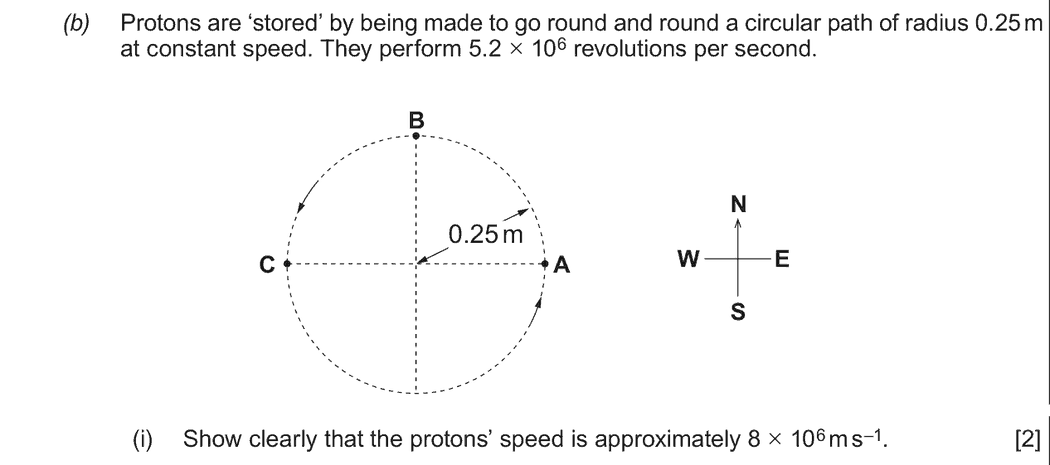
v = distance per second = 2π × 0.25 × 5.2 × 10⁶ = 8.2 × 10⁶ m s⁻¹
Scheme columns: Maths 2
Skills: Mathsmarks The mark scheme's Maths column gives this part at least one mark for mathematical skills
October 2020 · Component 1 · Q2(b)(ii)3 marksAO1=2, AO2=1Calculation
Earlier parts of question 2 that this part uses
Mark scheme
Examiner's comment
More than half the candidates correctly defined mean acceleration as change in velocity divided by time to change, but not all who did so were able to calculate the proton’s mean acceleration over a semicircle (part (b)(iii)). Calculating the proton’s speed and its instantaneous acceleration at a point in its path caused few problems. Many candidates discussed only one of the two opinions about the mean force on a proton over one revolution.
Notes from the mark scheme and report
Answer: 2.7 × 10¹⁴ m s⁻² towards the centre (South). a = v²/r = (8.17 × 10⁶)²/0.25 (2.6 × 10¹⁴ with 8.0 × 10⁶)
unit mark
Scheme columns: Maths 1
Skills: Unitsand conversions Unit marks, base units, prefixes and conversions; Mathsmarks The mark scheme's Maths column gives this part at least one mark for mathematical skills
October 2020 · Component 1 · Q2(c)2 marksAO3=2Explanation
Earlier parts of question 2 that this part uses
Mark scheme
Examiner's comment
More than half the candidates correctly defined mean acceleration as change in velocity divided by time to change, but not all who did so were able to calculate the proton’s mean acceleration over a semicircle (part (b)(iii)). Calculating the proton’s speed and its instantaneous acceleration at a point in its path caused few problems. Many candidates discussed only one of the two opinions about the mean force on a proton over one revolution.
Notes from the mark scheme and report
Adam is wrong: the force has constant magnitude but its direction keeps changing (1)
Brian is right: over a full revolution final velocity − initial velocity = 0, so the mean acceleration and mean force are zero (1)
many discussed only one opinion
October 2020 · Component 2 · Q5(c)(ii)3 marksAO1=1, AO2=2Calculation
Earlier parts of question 5 that this part uses
Mark scheme
Examiner's comment
Nearly all candidates were able to confirm the maximum extension possible for the wire without exceeding the elastic limit. Far fewer were able to give a correct and logical argument as to whether the maximum extension depended on the radius, with many unable to make the connection between changing radius and the corresponding change in tension. In (b) however, the majority of candidates gained all of the marks available for determining the value of k and also the required mass. Part (c) was synoptic in nature testing SHM as applied to the situation given. Good attempts were made to determine the period of oscillation and the maximum velocity of the mass. However nearly all candidates used an incorrect value for displacement when determining velocity and were deducted one mark. No correct responses were seen showing graphically how the stress varied in the wire over one complete oscillation. Many candidates however did gain some credit for using appropriate scales and/or for providing a general shape for the expected curve (with no reference to time and stress values).
Notes from the mark scheme and report
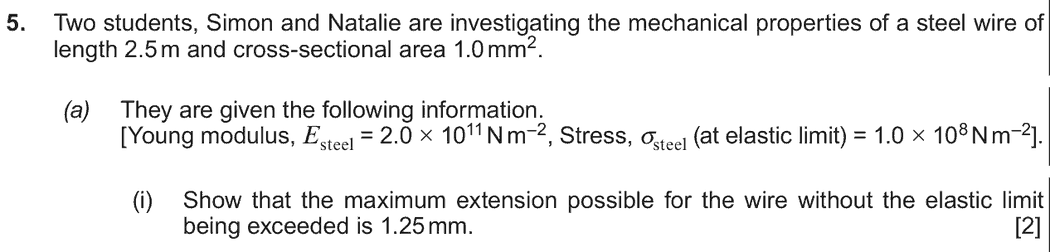
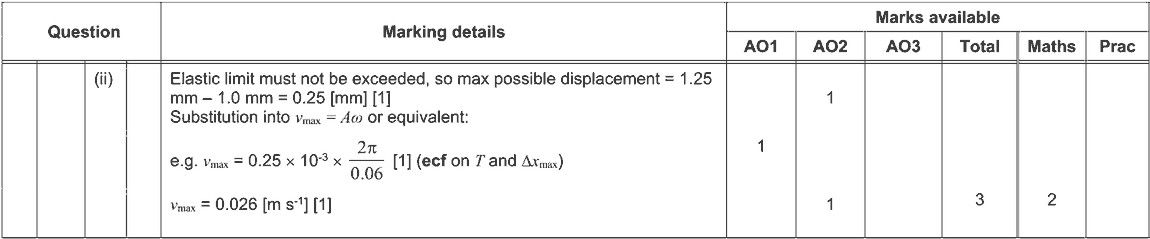
Answer: 0.025 m s⁻¹ (0.026 with T rounded to 0.06 s). Largest amplitude keeping within the elastic limit = 1.25 − 1.0 = 0.25 mm
vmax = Aω = 0.25 × 10⁻³ × 2π/T
nearly everyone used the wrong amplitude
Scheme columns: Maths 2
Skills: Synoptic Needs physics from another component of the qualification; Mathsmarks The mark scheme's Maths column gives this part at least one mark for mathematical skills
June 2019 · Component 1 · Q4(a)(i)I2 marksAO1=1, AO2=1Calculation
Mark scheme
Examiner's comment
As expected for a routine calculation, the angular velocity was almost always found correctly.
Notes from the mark scheme and report
Answer: 0.859 rad s⁻¹. ω = 2πf with f = 8.20/60 Hz
Scheme columns: Maths 1
Skills: Unitsand conversions Unit marks, base units, prefixes and conversions; Mathsmarks The mark scheme's Maths column gives this part at least one mark for mathematical skills
June 2019 · Component 1 · Q4(a)(i)II2 marksAO1=1, AO2=1Calculation
Earlier part of question 4 that this part uses
Mark scheme
Examiner's comment
Finding the time taken to travel the 10.0 m arc required a little strategic thinking. Some mistakes were made, often involving a factor of 𝟐𝛑.
Notes from the mark scheme and report
Answer: 3.06 s. v = rω = 3.80 × 0.859 = 3.26 m s⁻¹
t = 10.0/3.26 (or angle = 10.0/3.80 rad divided by ω)
stray factors of 2π were the usual error
ecf
Scheme columns: Maths 1
Skills: Mathsmarks The mark scheme's Maths column gives this part at least one mark for mathematical skills
June 2019 · Component 1 · Q4(a)(i)III2 marksAO1=1, AO2=1Calculation
Earlier part of question 4 that this part uses
Mark scheme
Examiner's comment
Almost everyone found the acceleration correctly.
Notes from the mark scheme and report
Answer: 2.80 m s⁻² (towards the axis). a = rω² = 3.80 × 0.859² or v²/r
ecf
Scheme columns: Maths 1
Skills: Mathsmarks The mark scheme's Maths column gives this part at least one mark for mathematical skills
June 2019 · Component 1 · Q4(a)(ii)II3 marksAO3=3Calculation
Earlier parts of question 4 that this part uses
Mark scheme
Examiner's comment
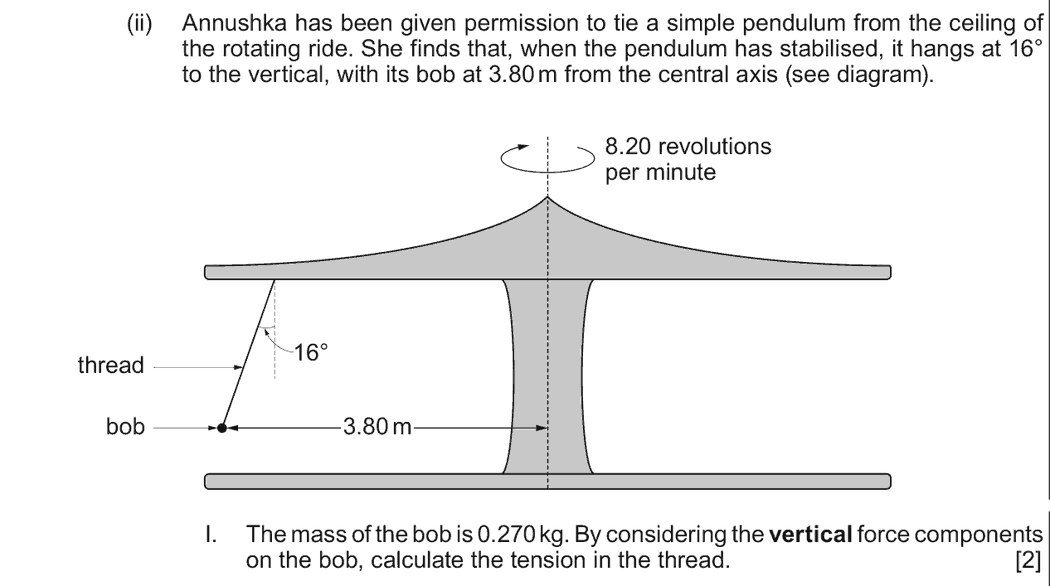
What provides the centripetal force on the bob? We accepted: the string, the horizontal component of tension in the string, the resultant of the weight of the bob and tension in the string. Candidates who gave one of these answers usually went on to calculate the centripetal force using their previous answer, and showed its consistency with the acceleration calculated in
Notes from the mark scheme and report
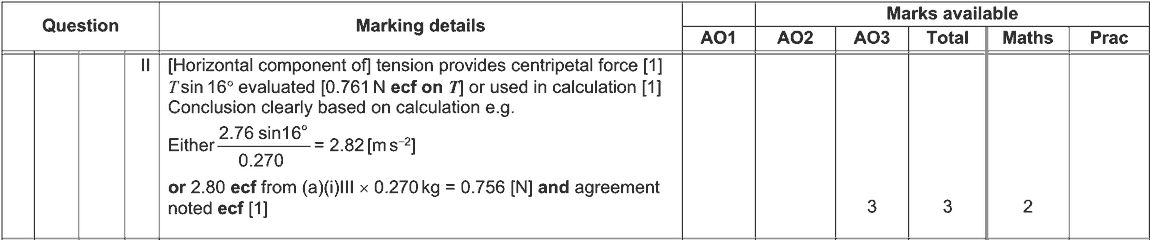
The horizontal component of the tension provides the centripetal force (1)
T sin 16° = 0.761 N (1)
a = 0.761/0.270 = 2.82 m s⁻², or 0.270 × 2.80 = 0.756 N, in agreement with (a)(i)III, so consistent (1)
'the string' or the resultant of weight and tension also accepted
Scheme columns: Maths 2
Skills: Trigonometryand vectors Resolving, components, vector addition, angles; Mathsmarks The mark scheme's Maths column gives this part at least one mark for mathematical skills
June 2019 · Component 1 · Q4(b)3 marksAO3=3Explanation
Earlier parts of question 4 that this part uses
Mark scheme
Notes from the mark scheme and report
Named example (bends in roads or railway lines, spin-drier) (1)
one factor affecting the centripetal force or acceleration discussed in context, e.g. bends must not be too sharp or the spin speed must be high enough (1)
a second factor, e.g. speed limits, banking of tracks, limited drum size (1)
June 2018 · Component 1 · Q2(a)(i)1 markAO1=1Definition
Mark scheme
Examiner's comment
Most definitions of angular velocity were satisfactory. We did not accept “angle swept out in a given time”.
Notes from the mark scheme and report
Angle swept out per unit time (angle swept out divided by time taken)
'angle swept out in a given time' not accepted
June 2018 · Component 1 · Q2(a)(ii)2 marksAO1=1, AO2=1Show that
Earlier part of question 2 that this part uses
Mark scheme
Examiner's comment
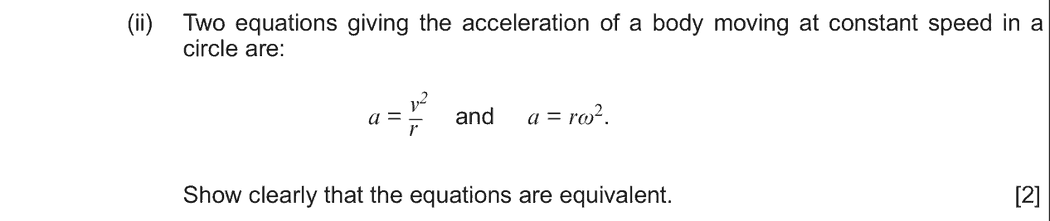
Establishing the equivalence of 2v a r and a r was usually done very well. A minority started by writing v r r and then made substitutions on one side. This is at best poor style and at worst poor logic. On this occasion we didn’t penalise it as long as we could see the right substitution and the right algebra.
Notes from the mark scheme and report
Use of v = rω (1)
substitute into a = v²/r to give a = (rω)²/r = rω² with clear algebra (1)
Scheme columns: Maths 1
Skills: Algebra Derivations and rearranging equations; Mathsmarks The mark scheme's Maths column gives this part at least one mark for mathematical skills
June 2018 · Component 1 · Q2(b)(i)2 marksAO1=1, AO2=1Calculation
Earlier part of question 2 that this part uses
Mark scheme
Examiner's comment
2v F m r was generally re-arranged successfully and the speed of Deimos determined correctly. A small minority of candidates calculated 𝝎 instead of v.
Notes from the mark scheme and report
Answer: 1.35 km s⁻¹ (1350 m s⁻¹). F = mv²/r so v = √(Fr/m) with r = 2.35 × 10⁷ m
a few found ω instead of v
Scheme columns: Maths 1
Skills: Unitsand conversions Unit marks, base units, prefixes and conversions; Mathsmarks The mark scheme's Maths column gives this part at least one mark for mathematical skills
June 2018 · Component 1 · Q2(b)(ii)2 marksAO2=2Explanation
Earlier parts of question 2 that this part uses
Mark scheme
Examiner's comment
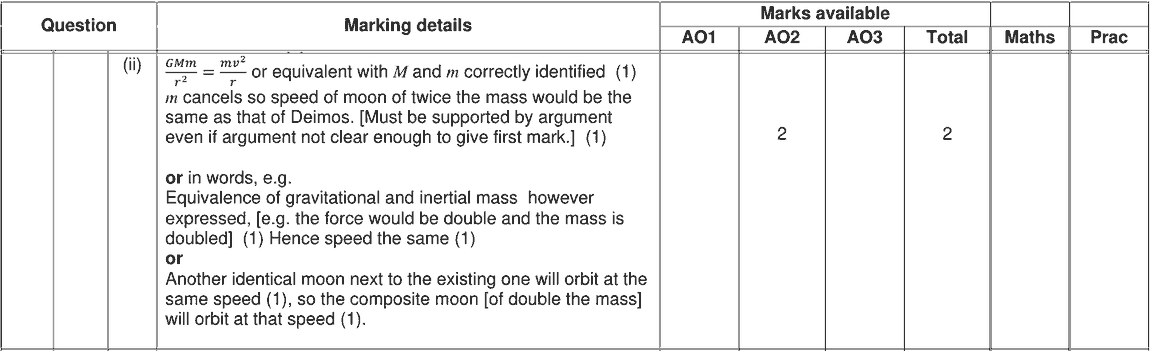
Most candidates, often citing v GMm m r r , argued convincingly that a moon of twice the mass of Deimos but in the same orbit would have the same speed. A substantial minority (not alert to synopticity?) claimed that the force would be the same, and so the speed would be less.
Notes from the mark scheme and report
GMm/r² = mv²/r with M and m identified (1)
m cancels so the speed is the same (1)
or in words: the force doubles and so does the mass. Synoptic with Component 2 gravitation
a substantial minority assumed the force stays the same so the speed falls
Skills: Synoptic Needs physics from another component of the qualification; Algebra Derivations and rearranging equations
June 2017 · Component 1 · Q1(b)1 markAO2=1Calculation
Earlier part of question 1 that this part uses
Mark scheme
Examiner's comment
Almost everyone used v = r successfully.
Notes from the mark scheme and report
Answer: 1.4 m s⁻¹ (v = ωr = 1.3 × 1.10)
June 2017 · Component 1 · Q3(a)(ii)2 marksAO3=2Explanation
Earlier part of question 3 that this part uses
Mark scheme
Examiner's comment
Most candidates pointed out, as intended, that as r became extremely small, then (for a given v), a approached zero (one mark). The request to justify that this was a ‘sensible’ value baffled many candidates, though some correctly remarked that the body would be going almost in a straight line – or equivalent.
Notes from the mark scheme and report
As r becomes very large a tends to zero (1)
sensible because the path is then almost a straight line, so there is almost no change of direction (1)
many missed the second mark
June 2017 · Component 1 · Q3(b)(i)3 marksAO2=3Show that
Earlier part of question 3 that this part uses
Mark scheme
Examiner's comment
Almost everyone calculated the centripetal force on the car correctly.
Notes from the mark scheme and report
v = 2π × 200/52 = 24.2 m s⁻¹ (or ω = 0.121 rad s⁻¹)
F = mv²/r = 1150 × 24.2²/200 = 3360 N
Scheme columns: Maths 3
Skills: Mathsmarks The mark scheme's Maths column gives this part at least one mark for mathematical skills
June 2017 · Component 1 · Q3(b)(ii)I2 marksCalculation
Earlier parts of question 3 that this part uses
Mark scheme
Examiner's comment
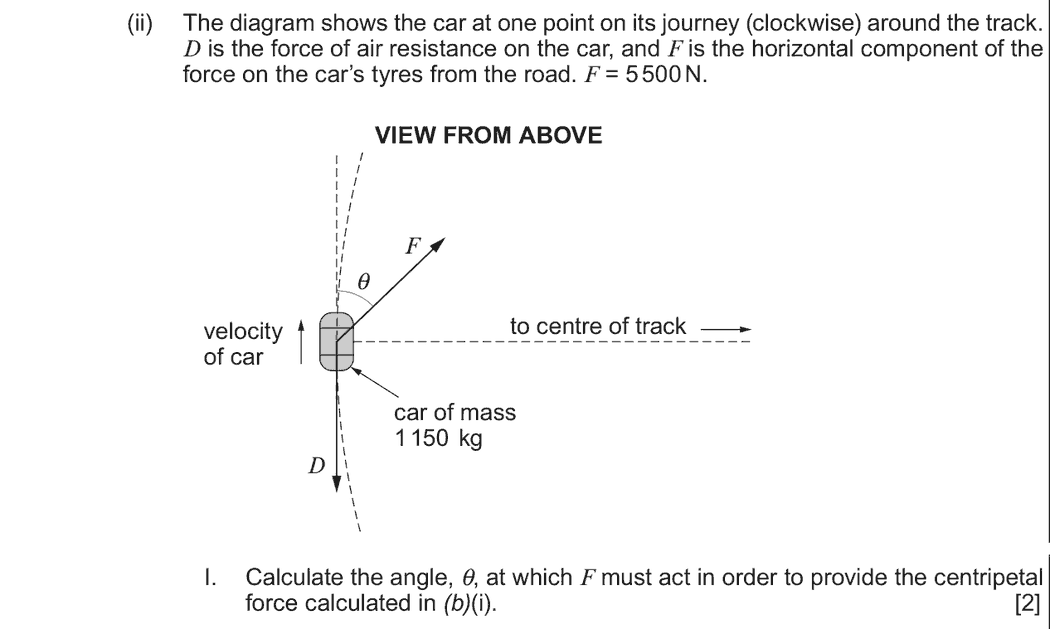
Although cos was sometimes used by mistake instead of sin, there was a good success rate in determining .
Notes from the mark scheme and report
Answer: 37.6° (38°). Component of F towards the centre provides the centripetal force: 5500 sin θ = 3360