Tap a question to zoom it. Where a part needs a figure, table or graph from earlier in the question, that part folds out above it; the mark scheme and examiner's comment open underneath. Have the Eduqas Data Booklet beside you (see the Data Booklet page).
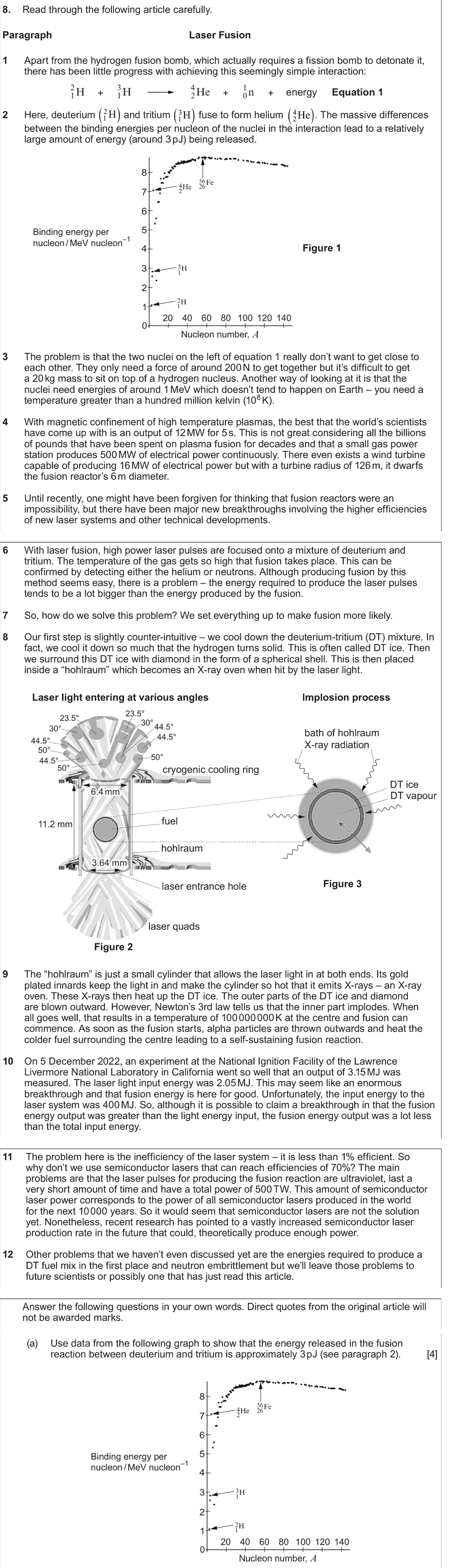
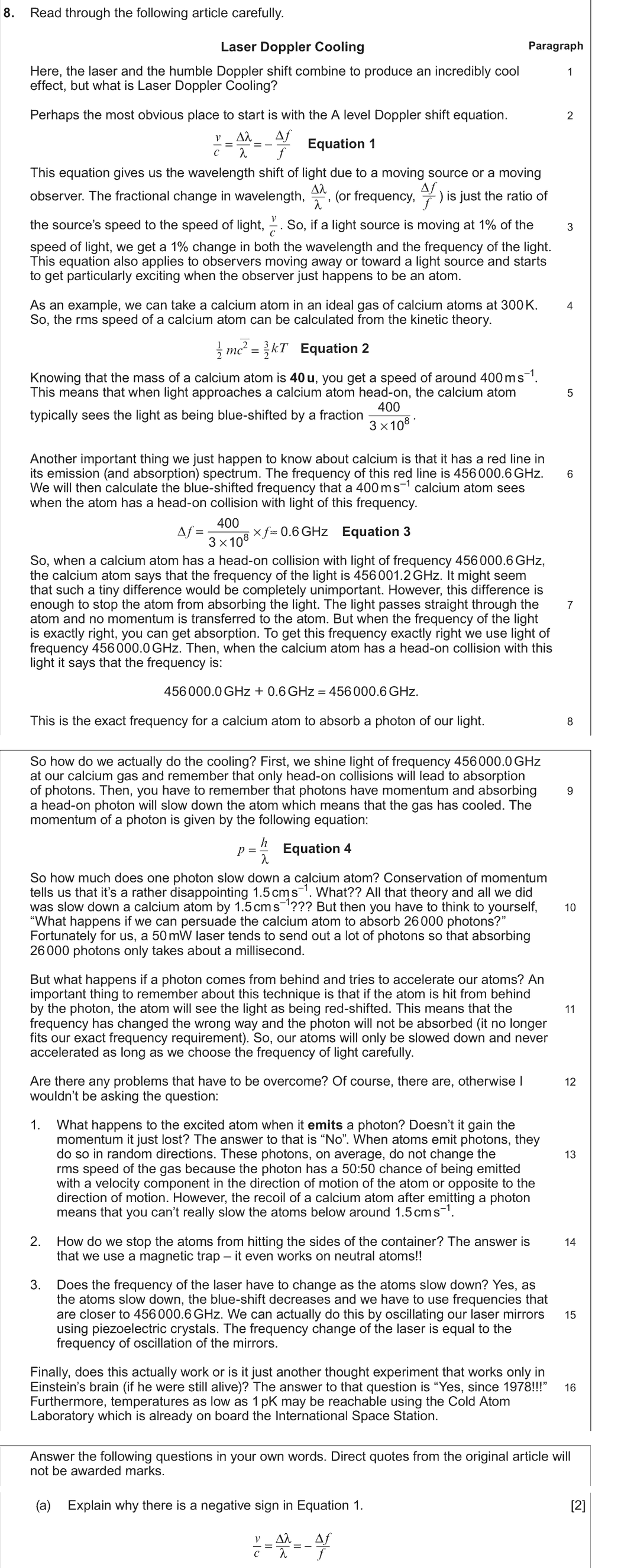
June 2025 · Component 1 · Q8(a)4 marksAO2=4Show that
Mark scheme
Examiner's comment
The first question in the comprehension section worked well. The 4 MPs were effectively standalone marking points. Many candidates achieved the 1st MP. Some missed it because they only focused on 𝐻 3 and 𝐻 2 . All 3 values were needed to be recorded. Less candidates multiplied by the nucleon number. The multiplication of 𝑒 was popular and was added in many different stages of their calculations.
multiply each by its nucleon number: 28.4, 8.7 and 2.2 MeV (1)
energy released = 28.4 − 8.7 − 2.2 = 17.5 MeV
× 1.6 × 10⁻¹³ J (1) = 2.8 pJ (1). All three readings needed
many forgot the nucleon numbers. Component 3 content
Scheme columns: Maths 4
Skills: Comprehension A level Component 1 Section B: questions on the printed article; Synoptic Needs physics from another component of the qualification; Graphskills Reading, plotting or sketching graphs; gradients, intercepts and areas; Mathsmarks The mark scheme's Maths column gives this part at least one mark for mathematical skills
June 2025 · Component 1 · Q8(b)3 marksAO3=3Calculation
Earlier part of question 8 that this part uses
Mark scheme
Examiner's comment
The presentation in responses noticeably declined in this question indicating there were sudden changes in approach. Candidates sometimes needed multiple attempts. Most spotted they needed to use 𝐹= 9 × 10⁹ 𝑄1𝑄2 𝑟2 and subbed either 200 N or 1 fm into this equation. Some could not see what charge value to use or thought that 2𝑄1 would be suitable. In these instances, they picked up the 1st MP but not the 2nd. The 3rd MP was for the correct answer and comment. For example, 200 ≈230 would have been credited. Unfortunately, the comment was not always seen.
Notes from the mark scheme and report
Answer: yes, about right. F = Q1Q2/4πε0r² with both charges 1.6 × 10⁻¹⁹ C: r = √(9 × 10⁹ × (1.6 × 10⁻¹⁹)²/200) = 1.1 fm
or r = 1 fm gives 230 N, close to 200 N
comment required, often missing. Coulomb's law is Component 2 content
Scheme columns: Maths 3
Skills: Comprehension A level Component 1 Section B: questions on the printed article; Synoptic Needs physics from another component of the qualification; Mathsmarks The mark scheme's Maths column gives this part at least one mark for mathematical skills
June 2025 · Component 1 · Q8(c)3 marksAO1=1, AO2=2Calculation
Earlier part of question 8 that this part uses
Mark scheme
Examiner's comment
This proved to be challenging for some candidates as they could not see that 2 𝑘𝑇 was required in this unfamiliar setting. Many candidates did use the equation. There was the occasional power of ten slip but many correct answers. A significant number of candidates did not make the correct comment as they said the two values did not agree and the statement was incorrect. We were looking for reference to 7.7 × 10⁹ ≫ 108 and that statement is correct.
(3/2)kT = 1.6 × 10⁻¹³ so T = 7.7 × 10⁹ K, well above 10⁸ K, so 'greater than a hundred million kelvin' is correct. Many reached the value but said it disagreed
Scheme columns: Maths 2
Skills: Comprehension A level Component 1 Section B: questions on the printed article; Unitsand conversions Unit marks, base units, prefixes and conversions; Mathsmarks The mark scheme's Maths column gives this part at least one mark for mathematical skills
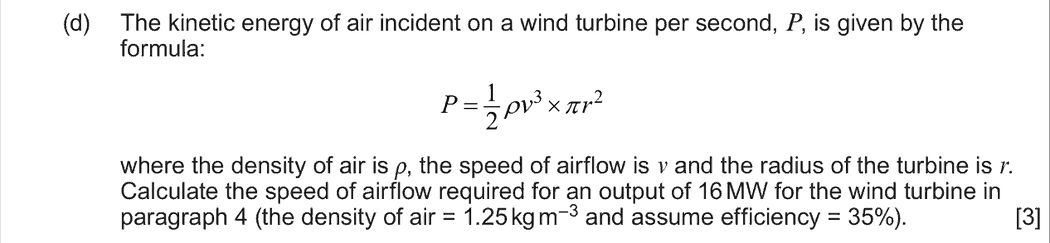
June 2025 · Component 1 · Q8(d)3 marksAO1=1, AO2=2Calculation
Earlier part of question 8 that this part uses
Mark scheme
Examiner's comment
The 1st MP was awarded for correct algebra. The 2nd was for the correct substitution of 35%. Unfortunately, on occasion 0.35 did not arrive in the equation in the correct position or it was not considered at all. For candidates that missed 0.35 entirely we generously awarded 2 marks for a final answer of 8 m s-1. 38.3 m was also sometimes seen. Here a candidate had slipped up and used a √ instead of a ∛. If their workings were correct up to this point, we awarded 2 marks out of the 3. Candidates achieved all 3 marks a final answer for a final answer of 11.4 m/s.
cube root. 8.0 m s⁻¹ (efficiency ignored) scores 2
a square root instead of a cube root also 2
Scheme columns: Maths 2
Skills: Comprehension A level Component 1 Section B: questions on the printed article; Algebra Derivations and rearranging equations; Mathsmarks The mark scheme's Maths column gives this part at least one mark for mathematical skills
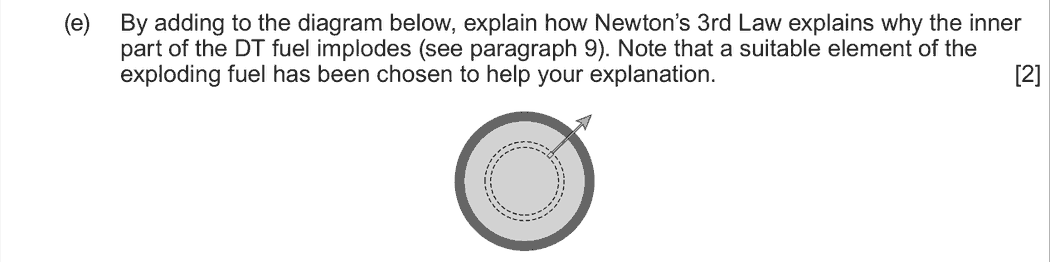
June 2025 · Component 1 · Q8(e)2 marksAO2=2Explanation
Earlier part of question 8 that this part uses
Mark scheme
Examiner's comment
We saw some lovely answers in this demanding question. We credited end to end arrows for the 1st MP. This was sometimes left blank. General Newton third law statements were not enough on their own. We were looking for candidates to consider the two objects that were applying forces on each other. An example that did gain credit was ‘force of element on outer fuel is equal and opposite to force of outer fuel on element which acts back towards the centre’. The implosion is clearly implied. It should be noted for future candidates that direct quotes will not be awarded marks on the comprehension question. There were a few examples of this here.
Notes from the mark scheme and report
Arrow added on the element pointing the opposite way (towards the centre), end to end with the given one (1)
the element pushes the outer fuel outwards, so the outer fuel pushes back on it with an equal and opposite force directed inwards, which drives the implosion (1). General statements of the law, or quotes from the article, not credited
Skills: Comprehension A level Component 1 Section B: questions on the printed article
June 2025 · Component 1 · Q8(f)2 marksAO1=1, AO2=1Calculation
Earlier part of question 8 that this part uses
Mark scheme
Examiner's comment
In this question candidates really had to show good interpretation of what was written in the article. The laser system is less than 1% efficient but to prove this, candidates had to use 400 MJ and 2.05 MJ in the efficiency equation. For candidates that did this, a final answer of 0.51% allowed for 2 marks. Those that selected 3.15 MJ did not gain credit.
Notes from the mark scheme and report
Answer: 0.51%, so the statement holds. Efficiency = laser light energy/input energy = 2.05 MJ/400 MJ × 100
using the 3.15 MJ fusion output was wrong
Scheme columns: Maths 1
Skills: Comprehension A level Component 1 Section B: questions on the printed article; Mathsmarks The mark scheme's Maths column gives this part at least one mark for mathematical skills
June 2025 · Component 1 · Q8(g)3 marksAO3=3Calculation
Earlier part of question 8 that this part uses
Mark scheme
Examiner's comment
Candidates found a few different paths through this question as outlined on the MS. There were also a few candidates that started down one path then changed approach often picking up all the MPs. Some converted the time to seconds and cancelled later. This was fine. Some of these candidates did not cancel later and were often stuck on two marks. PHYSICS GCE A level Summer 2025
Notes from the mark scheme and report
Answer: no. Power added per year = 2 × 10⁹ × 2 × 10⁻³ = 4 × 10⁶ W
time needed = 500 × 10¹²/4 × 10⁶ = 1.25 × 10⁸ years, far more than 10 000
or in 10 000 years only 4 × 10¹⁰ W, far below 5 × 10¹⁴ W
Scheme columns: Maths 3
Skills: Comprehension A level Component 1 Section B: questions on the printed article; Mathsmarks The mark scheme's Maths column gives this part at least one mark for mathematical skills
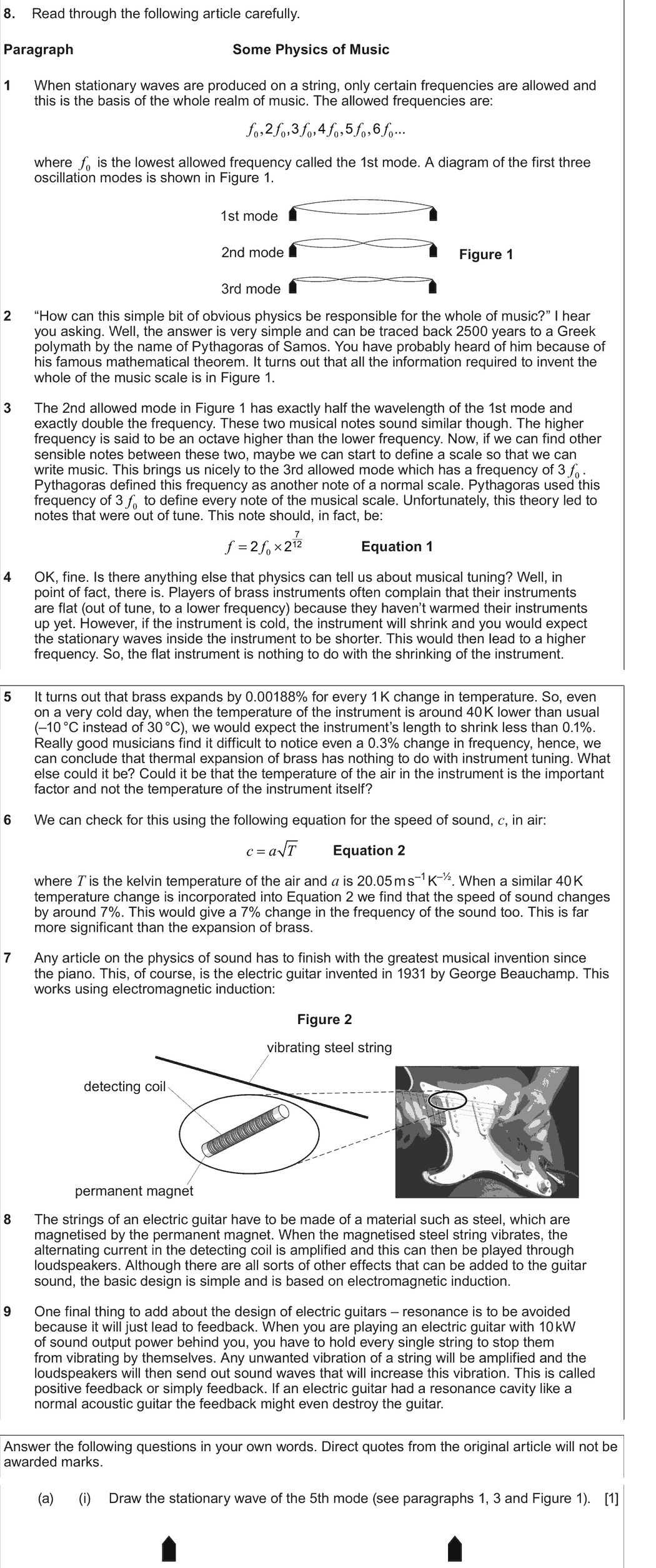
June 2024 · Component 1 · Q8(a)(i)1 markAO1=1Diagram or graph
Mark scheme
Examiner's comment
Nearly all candidates were able to draw the correct standing wave pattern. Only a few candidates drew the incorrect number of loops but even then went on to write ‘λ0/5’ in the following question.
Notes from the mark scheme and report
Stationary wave with 5 loops drawn
Skills: Comprehension A level Component 1 Section B: questions on the printed article
June 2024 · Component 1 · Q8(a)(ii)1 markAO2=1Short answer
Earlier part of question 8 that this part uses
Mark scheme
Examiner's comment
Again, nearly all candidates gave correct responses. There were a small number who wrote incorrect responses including ‘5λ0’, ‘5f0’ and ‘λ/16’
Notes from the mark scheme and report
Answer: λ0/5 (0.2 λ0)
wrong answers included 5λ0 and 5f0
Scheme columns: Maths 1
Skills: Comprehension A level Component 1 Section B: questions on the printed article; Mathsmarks The mark scheme's Maths column gives this part at least one mark for mathematical skills
June 2024 · Component 1 · Q8(b)2 marksAO3=2Calculation
Earlier part of question 8 that this part uses
Mark scheme
Examiner's comment
Many candidates chose to calculate the frequency (2.9966) and then made a comment on how close it was to ‘3’. Weaker responses were more descriptive, but we did award the 2nd marking point without a calculation. Some used the equation’s effect on, for example, 440 Hz and compared values which was acceptable. Some candidates moved between frequency and wavelength in their response, and these often became a little confused. There were a small number of non-attempts.
Notes from the mark scheme and report
Equation 1 gives 2.9966 f0, about 0.1% below 3f0 (1)
so very little difference, or any reasonable comment (1)
Skills: Comprehension A level Component 1 Section B: questions on the printed article
June 2024 · Component 1 · Q8(c)2 marksAO3=2Calculation
Earlier part of question 8 that this part uses
Mark scheme
Examiner's comment
Candidates responded well to this AO3 question. We required a comment about the 0.0752% being less than 0.1% and some did miss this. Some candidates clearly hadn’t found what was needed in the article and tried an explanation using 𝑝𝑉= 𝑛𝑅𝑇. This proved unsuccessful.
Notes from the mark scheme and report
40 × 0.00188% = 0.0752% (1), which is less than 0.1% so the claim is true (1)
the comparison was often missing
Scheme columns: Maths 1
Skills: Comprehension A level Component 1 Section B: questions on the printed article; Mathsmarks The mark scheme's Maths column gives this part at least one mark for mathematical skills
June 2024 · Component 1 · Q8(d)4 marksAO1=1, AO2=3Explanation
Earlier part of question 8 that this part uses
Mark scheme
Examiner's comment
We saw varied responses with a range of marks. Many used the wave equation,𝑐= 𝑓𝜆, less made the link to the air temperature increasing although any reference to the kinetic energy of the particles increasing did gain this mark. Many candidates stated the speed of sound increases. The last mark proved too demanding for some where we looked for reference to the wavelength being constant or at least the expansion of the brass being small or insignificant.
Notes from the mark scheme and report
c = fλ stated or implied (1)
the air temperature increases (1) so the speed of sound increases (1)
λ is fixed because the expansion of the instrument is negligible, so f increases (1)
Skills: Comprehension A level Component 1 Section B: questions on the printed article
June 2024 · Component 1 · Q8(e)3 marksAO1=1, AO2=2Calculation
Earlier part of question 8 that this part uses
Mark scheme
Examiner's comment
Several good approaches and a full range of marks were seen for this question. Most used 𝑐= 𝑎√𝑇 and calculated one (or both) of the speeds. Other approaches used the equation to calculate 𝜆. Some calculated 𝑐 𝑎 and used ratios. We credited candidates 2 marks if they correctly used the ‘7%’ given in the comprehension. The final mark or this approach was tougher when they tried to incorporate 0.3 Hz. Some didn’t realise it was an increase. They were unable to get all 3 marks.
Notes from the mark scheme and report
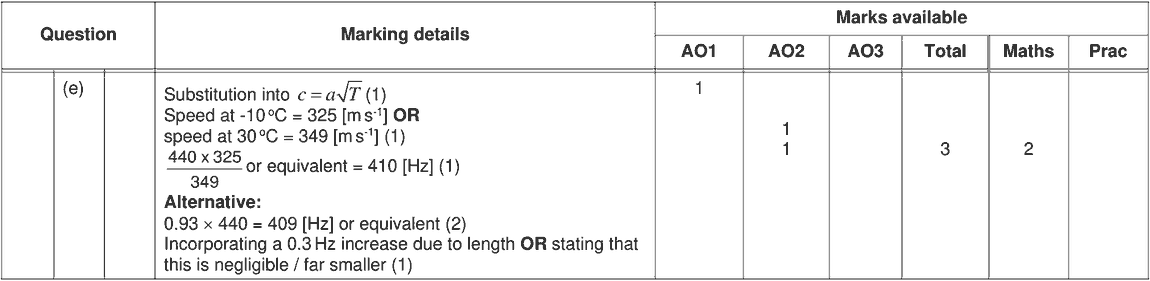
Answer: 410 Hz. c = a√T: 325 m s⁻¹ at −10 °C (263 K) and 349 m s⁻¹ at 30 °C (303 K)
f = 440 × 325/349 (or 440 × 0.93)
the 0.3 Hz change due to length is negligible
Scheme columns: Maths 2
Skills: Comprehension A level Component 1 Section B: questions on the printed article; Mathsmarks The mark scheme's Maths column gives this part at least one mark for mathematical skills
June 2024 · Component 1 · Q8(f)5 marksAO1=1, AO2=4Explanation
Earlier part of question 8 that this part uses
Mark scheme
Examiner's comment
This proved challenging for candidates. All marking points were achieved. Not many achieved all 5 marks, however, there were a good number of 3’s and 4’s. Weaker responses indicated that the strings were permanently magnetised. There were also some confused responses where an induced current was set up in the strings as it moved past the coil and permanent magnet. Really good responses linked a changing B-field to a changing flux linkage in the coil and hence to Faraday’s law.
Notes from the mark scheme and report
Steel string is magnetised by the permanent magnet (1)
the vibrating string gives a varying B-field (1)
the flux in the coil varies (1)
an emf is induced (Faraday) (1)
the signal is amplified and sent to speakers (1)
weaker answers said the strings are permanently magnetised
Skills: Comprehension A level Component 1 Section B: questions on the printed article; Synoptic Needs physics from another component of the qualification
June 2024 · Component 1 · Q8(g)2 marksAO3=2Explanation
Earlier part of question 8 that this part uses
Mark scheme
Examiner's comment
A significant number of candidates thought that copper was magnetic, and they struggled to pick up any marks in this question part. Phrases like ‘it is more difficult to magnetise than steel’ were not deemed enough. ‘If the strings were copper, they would likely stick to the pickup’ was an example of a confused response that was not given credit. PHYSICS GCE A level Summer 2024
Notes from the mark scheme and report
Copper is not (ferro)magnetic so the strings are not magnetised (1)
so no change of flux in the coil and no induced emf or current (1)
many thought copper was magnetic
Skills: Comprehension A level Component 1 Section B: questions on the printed article
June 2023 · Component 1 · Q8(a)2 marksAO1=2Short answer
Mark scheme
Examiner's comment
Most candidates were able to successfully identify the centripetal and gravitational forces in (a). Candidates were asked to use forces in their responses to part (b). In several cases this was not done. For the first mark candidates needed to reference the mass inside of the bulge. Some considered this as a point mass, but it was not a requirement. This mass causes a force towards the centre. As the star obits, the bulge outside will pull in different directions. This proved to be a tough marking point to achieve. Good algebra skills were on show in (c). The first marking point was sometimes missed in (d)(i) as candidates focused on using logs. Referencing the supermassive black hole or even the centre of the galaxy would have been enough. The mathematical demand in this question part made it difficult for some candidates. There were a good number who were successful and correctly identified -0.5 in their algebra and linked this to 𝑦= 𝑚𝑥+ 𝑐. In (ii) taking values from the graph was generally well done. Some candidates brought forward their log equations from (d)(i), leading to a relatively simple substitution and manipulation. Many candidates used 10𝑥 to calculate a distance and a velocity and then used a rearranged version of the orbital velocity equation. A comment was needed to pick up the last marking point. In
Notes from the mark scheme and report
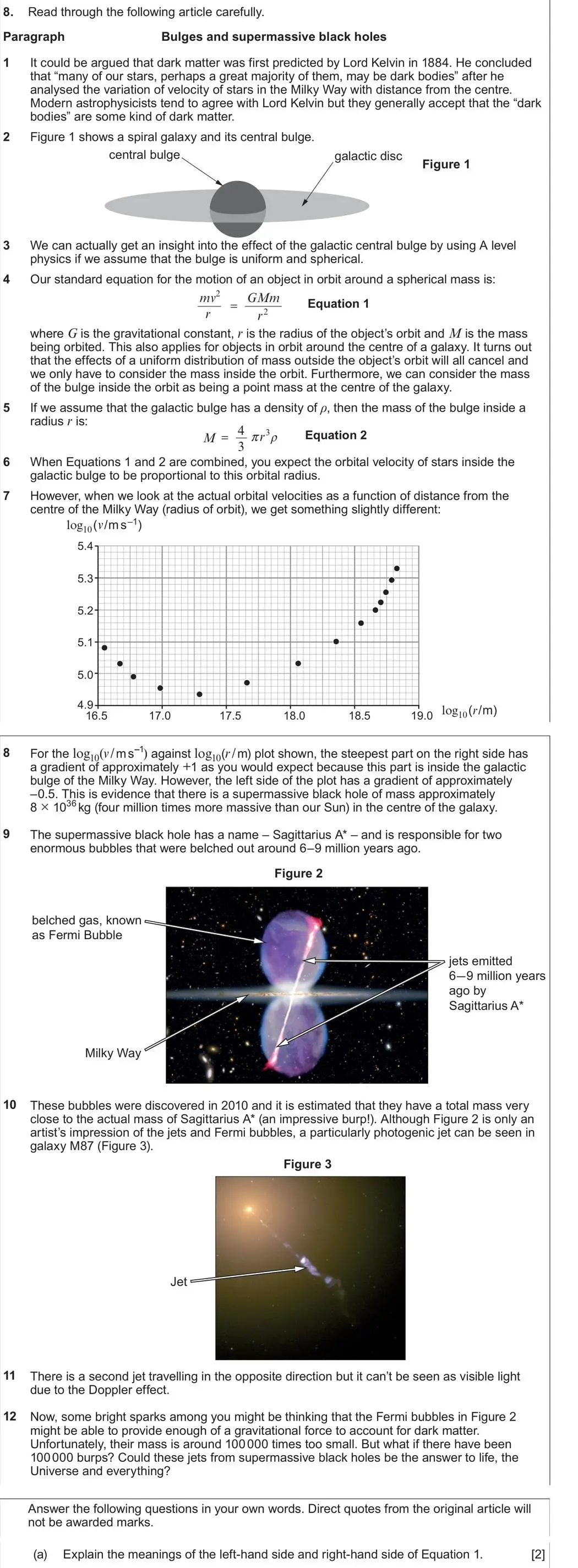
Left-hand side: the centripetal force needed for the orbit (1)
right-hand side: the gravitational force on the orbiting object (1)
Skills: Comprehension A level Component 1 Section B: questions on the printed article; Synoptic Needs physics from another component of the qualification
June 2023 · Component 1 · Q8(b)2 marksAO2=2Explanation
Earlier part of question 8 that this part uses
Mark scheme
Examiner's comment
Most candidates were able to successfully identify the centripetal and gravitational forces in (a). Candidates were asked to use forces in their responses to part (b). In several cases this was not done. For the first mark candidates needed to reference the mass inside of the bulge. Some considered this as a point mass, but it was not a requirement. This mass causes a force towards the centre. As the star obits, the bulge outside will pull in different directions. This proved to be a tough marking point to achieve. Good algebra skills were on show in (c). The first marking point was sometimes missed in (d)(i) as candidates focused on using logs. Referencing the supermassive black hole or even the centre of the galaxy would have been enough. The mathematical demand in this question part made it difficult for some candidates. There were a good number who were successful and correctly identified -0.5 in their algebra and linked this to 𝑦= 𝑚𝑥+ 𝑐. In (ii) taking values from the graph was generally well done. Some candidates brought forward their log equations from (d)(i), leading to a relatively simple substitution and manipulation. Many candidates used 10𝑥 to calculate a distance and a velocity and then used a rearranged version of the orbital velocity equation. A comment was needed to pick up the last marking point. In
Notes from the mark scheme and report
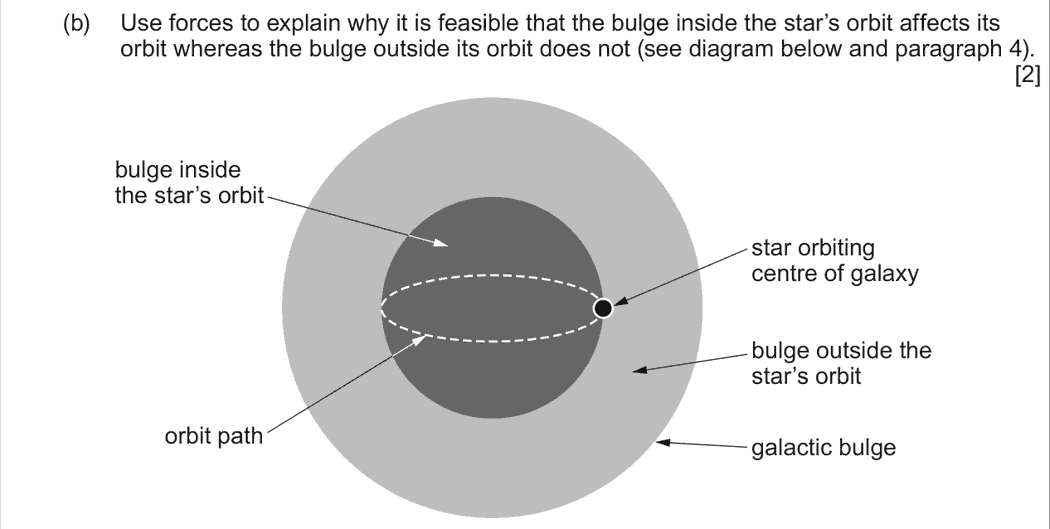
The bulge inside the orbit acts like a point mass at the centre, so its force on the star is always towards the centre (1)
the parts of the bulge outside the orbit pull the star in all directions and these forces cancel (1)
the second mark was hard to get
Skills: Comprehension A level Component 1 Section B: questions on the printed article; Synoptic Needs physics from another component of the qualification
June 2023 · Component 1 · Q8(c)3 marksAO1=1, AO2=2Calculation
Earlier parts of question 8 that this part uses
Mark scheme
Examiner's comment
Most candidates were able to successfully identify the centripetal and gravitational forces in (a). Candidates were asked to use forces in their responses to part (b). In several cases this was not done. For the first mark candidates needed to reference the mass inside of the bulge. Some considered this as a point mass, but it was not a requirement. This mass causes a force towards the centre. As the star obits, the bulge outside will pull in different directions. This proved to be a tough marking point to achieve. Good algebra skills were on show in (c). The first marking point was sometimes missed in (d)(i) as candidates focused on using logs. Referencing the supermassive black hole or even the centre of the galaxy would have been enough. The mathematical demand in this question part made it difficult for some candidates. There were a good number who were successful and correctly identified -0.5 in their algebra and linked this to 𝑦= 𝑚𝑥+ 𝑐. In (ii) taking values from the graph was generally well done. Some candidates brought forward their log equations from (d)(i), leading to a relatively simple substitution and manipulation. Many candidates used 10𝑥 to calculate a distance and a velocity and then used a rearranged version of the orbital velocity equation. A comment was needed to pick up the last marking point. In
Notes from the mark scheme and report
Substitute M = (4/3)πr³ρ into mv²/r = GMm/r² (1)
cancel m and collect r (1)
v = r√(4πGρ/3), so v is proportional to r (1)
Scheme columns: Maths 3
Skills: Comprehension A level Component 1 Section B: questions on the printed article; Algebra Derivations and rearranging equations; Synoptic Needs physics from another component of the qualification; Mathsmarks The mark scheme's Maths column gives this part at least one mark for mathematical skills
June 2023 · Component 1 · Q8(d)(i)3 marksAO2=3Explanation
Earlier parts of question 8 that this part uses
Mark scheme
Examiner's comment
Most candidates were able to successfully identify the centripetal and gravitational forces in (a). Candidates were asked to use forces in their responses to part (b). In several cases this was not done. For the first mark candidates needed to reference the mass inside of the bulge. Some considered this as a point mass, but it was not a requirement. This mass causes a force towards the centre. As the star obits, the bulge outside will pull in different directions. This proved to be a tough marking point to achieve. Good algebra skills were on show in (c). The first marking point was sometimes missed in (d)(i) as candidates focused on using logs. Referencing the supermassive black hole or even the centre of the galaxy would have been enough. The mathematical demand in this question part made it difficult for some candidates. There were a good number who were successful and correctly identified -0.5 in their algebra and linked this to 𝑦= 𝑚𝑥+ 𝑐. In (ii) taking values from the graph was generally well done. Some candidates brought forward their log equations from (d)(i), leading to a relatively simple substitution and manipulation. Many candidates used 10𝑥 to calculate a distance and a velocity and then used a rearranged version of the orbital velocity equation. A comment was needed to pick up the last marking point. In
Notes from the mark scheme and report
The left side is close to the centre of the galaxy where the supermassive black hole's mass dominates, so v = √(GM/r) applies with M constant (1)
taking logs: log v = −0.5 log r + 0.5 log(GM) (1)
comparing with y = mx + c the gradient is −0.5, as expected (1)
the first point was often missed
Scheme columns: Maths 2
Skills: Comprehension A level Component 1 Section B: questions on the printed article; Algebra Derivations and rearranging equations; Graphskills Reading, plotting or sketching graphs; gradients, intercepts and areas; Synoptic Needs physics from another component of the qualification; Mathsmarks The mark scheme's Maths column gives this part at least one mark for mathematical skills
June 2023 · Component 1 · Q8(d)(ii)4 marksAO3=4Calculation
Earlier parts of question 8 that this part uses
Mark scheme
Examiner's comment
Most candidates were able to successfully identify the centripetal and gravitational forces in (a). Candidates were asked to use forces in their responses to part (b). In several cases this was not done. For the first mark candidates needed to reference the mass inside of the bulge. Some considered this as a point mass, but it was not a requirement. This mass causes a force towards the centre. As the star obits, the bulge outside will pull in different directions. This proved to be a tough marking point to achieve. Good algebra skills were on show in (c). The first marking point was sometimes missed in (d)(i) as candidates focused on using logs. Referencing the supermassive black hole or even the centre of the galaxy would have been enough. The mathematical demand in this question part made it difficult for some candidates. There were a good number who were successful and correctly identified -0.5 in their algebra and linked this to 𝑦= 𝑚𝑥+ 𝑐. In (ii) taking values from the graph was generally well done. Some candidates brought forward their log equations from (d)(i), leading to a relatively simple substitution and manipulation. Many candidates used 10𝑥 to calculate a distance and a velocity and then used a rearranged version of the orbital velocity equation. A comment was needed to pick up the last marking point. In
Notes from the mark scheme and report
Answer: 7.7 × 10³⁶ kg, so yes. Point read as log r = 16.55, log v = 5.08
r = 3.55 × 10¹⁶ m, v = 1.2 × 10⁵ m s⁻¹
M = rv²/G
a comment on the agreement with 8 × 10³⁶ kg is needed
Scheme columns: Maths 4
Skills: Comprehension A level Component 1 Section B: questions on the printed article; Graphskills Reading, plotting or sketching graphs; gradients, intercepts and areas; Synoptic Needs physics from another component of the qualification; Mathsmarks The mark scheme's Maths column gives this part at least one mark for mathematical skills
June 2023 · Component 1 · Q8(e)2 marksAO2=2Calculation
Earlier parts of question 8 that this part uses
Mark scheme
Examiner's comment
many spotted the concise route using 2 million years and 4 million Suns. Others tried different paths and firstly calculated the number of kg ejected per year. One mark was awarded for this approach. There were a significant number who went no further even though the question clearly stated ‘in solar masses per year’. Candidates realised in (f) that ‘can’t be seen’ means ‘not visible’. We were looking for more than this. The jet is not visible because it is outside the visible range. Reference to doppler shift alone was not considered enough for the second mark. Good responses included reference to redshift. Most candidates picked up one of the marking points in the last part. A sensible comment about a burp not being enough mass was popular. Less candidates appeared to go on to describe some further observations. PHYSICS GCE A LEVEL Summer 2023
Notes from the mark scheme and report
Answer: 2 solar masses per year. Bubble mass is about 4 million solar masses (the mass of Sagittarius A*) ejected over 2 million years
4 × 10³⁰ kg per year scores 1
Skills: Comprehension A level Component 1 Section B: questions on the printed article
June 2023 · Component 1 · Q8(f)2 marksAO2=2Explanation
Earlier parts of question 8 that this part uses
Mark scheme
Examiner's comment
Most candidates were able to successfully identify the centripetal and gravitational forces in (a). Candidates were asked to use forces in their responses to part (b). In several cases this was not done. For the first mark candidates needed to reference the mass inside of the bulge. Some considered this as a point mass, but it was not a requirement. This mass causes a force towards the centre. As the star obits, the bulge outside will pull in different directions. This proved to be a tough marking point to achieve. Good algebra skills were on show in (c). The first marking point was sometimes missed in (d)(i) as candidates focused on using logs. Referencing the supermassive black hole or even the centre of the galaxy would have been enough. The mathematical demand in this question part made it difficult for some candidates. There were a good number who were successful and correctly identified -0.5 in their algebra and linked this to 𝑦= 𝑚𝑥+ 𝑐. In (ii) taking values from the graph was generally well done. Some candidates brought forward their log equations from (d)(i), leading to a relatively simple substitution and manipulation. Many candidates used 10𝑥 to calculate a distance and a velocity and then used a rearranged version of the orbital velocity equation. A comment was needed to pick up the last marking point. In
Notes from the mark scheme and report
The jet is moving away, so its light is red-shifted to longer wavelength (1) and falls outside the visible part of the spectrum (1)
'Doppler shift' alone or 'not visible' alone was not enough
Skills: Comprehension A level Component 1 Section B: questions on the printed article; Synoptic Needs physics from another component of the qualification
June 2023 · Component 1 · Q8(g)2 marksAO3=2Explanation
Earlier parts of question 8 that this part uses
Mark scheme
Examiner's comment
Most candidates were able to successfully identify the centripetal and gravitational forces in (a). Candidates were asked to use forces in their responses to part (b). In several cases this was not done. For the first mark candidates needed to reference the mass inside of the bulge. Some considered this as a point mass, but it was not a requirement. This mass causes a force towards the centre. As the star obits, the bulge outside will pull in different directions. This proved to be a tough marking point to achieve. Good algebra skills were on show in (c). The first marking point was sometimes missed in (d)(i) as candidates focused on using logs. Referencing the supermassive black hole or even the centre of the galaxy would have been enough. The mathematical demand in this question part made it difficult for some candidates. There were a good number who were successful and correctly identified -0.5 in their algebra and linked this to 𝑦= 𝑚𝑥+ 𝑐. In (ii) taking values from the graph was generally well done. Some candidates brought forward their log equations from (d)(i), leading to a relatively simple substitution and manipulation. Many candidates used 10𝑥 to calculate a distance and a velocity and then used a rearranged version of the orbital velocity equation. A comment was needed to pick up the last marking point. In
Notes from the mark scheme and report
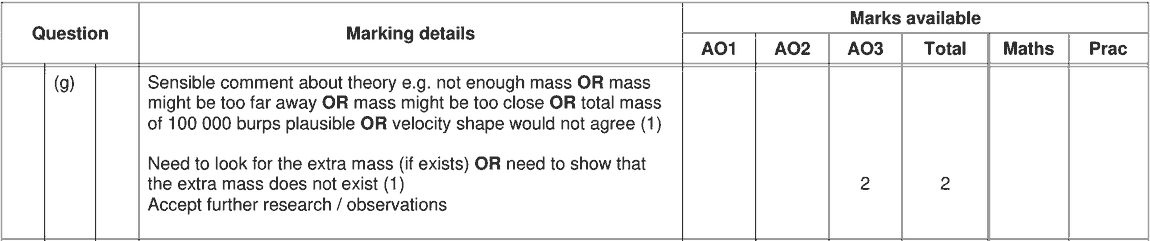
A sensible comment on the idea, e.g. one burp has far too little mass, 100 000 burps might be plausible, the mass may be in the wrong place to give the observed velocity curve (1)
a next step, e.g. look for the ejected mass or show that it is not there, further observations (1)
Skills: Comprehension A level Component 1 Section B: questions on the printed article
June 2022 · Component 1 · Q8(a)2 marksAO2=2Explanation
Mark scheme
Examiner's comment
More than half the candidates explained that the negative sign was needed because if the wavelength went up the frequency had to go down or equivalent. The commonest mistake was to think that the sign had something to do with direction of travel.
Notes from the mark scheme and report
λ = c/f, so wavelength is inversely proportional to frequency (1)
when the frequency goes up the wavelength goes down, so Δλ and Δf have opposite signs (1)
the sign is not about the direction of travel
Scheme columns: Maths 1
Skills: Comprehension A level Component 1 Section B: questions on the printed article; Synoptic Needs physics from another component of the qualification; Mathsmarks The mark scheme's Maths column gives this part at least one mark for mathematical skills
June 2022 · Component 1 · Q8(b)(i)2 marksAO2=2Explanation
Earlier part of question 8 that this part uses
Mark scheme
Examiner's comment
Most candidates understood that the blue shift would make the photon the right frequency to be absorbed…
Notes from the mark scheme and report
The atom sees the approaching photon blue-shifted by 0.6 GHz to 456 000.6 GHz (1), which is exactly the frequency of its absorption line (1)
Skills: Comprehension A level Component 1 Section B: questions on the printed article; Synoptic Needs physics from another component of the qualification
June 2022 · Component 1 · Q8(b)(ii)1 markAO2=1Short answer
Earlier parts of question 8 that this part uses
Mark scheme
Examiner's comment
… but that if the photons and atom are moving in the same direction, the photon will be red shifted, making its frequency further away from that needed.
Notes from the mark scheme and report
The photon is red-shifted (to 455 999.4 GHz), further from the absorption frequency
Skills: Comprehension A level Component 1 Section B: questions on the printed article; Synoptic Needs physics from another component of the qualification
June 2022 · Component 1 · Q8(b)(iii)1 markAO2=1Short answer
Earlier parts of question 8 that this part uses
Mark scheme
Examiner's comment
To explain cooling we were hoping that candidates would tell us that only photons that could slow down the atoms would be absorbed, but the mark was not often awarded.
Notes from the mark scheme and report
Only photons meeting an atom head-on are absorbed, and these always slow the atom, so the mean speed and hence the temperature falls
this mark was not often awarded
Skills: Comprehension A level Component 1 Section B: questions on the printed article; Synoptic Needs physics from another component of the qualification
June 2022 · Component 1 · Q8(c)4 marksAO1=1, AO2=3Calculation
Earlier part of question 8 that this part uses
Mark scheme
Examiner's comment
The change in wavelength, ∆𝜆, of photons as ‘seen’ by helium atoms moving towards them was calculated directly by many candidates. Sometimes ∆𝜆 was found, with more labour, by first calculating the frequency shift. Candidates then needed to realise that the laser wavelength needed to be greater by ∆𝜆 than the helium absorption (or emission) wavelength, so that blue-shifted photons would be absorbed by approaching atoms. Many candidates subtracted rather than added ∆𝜆. They lost one mark.
the laser wavelength must be longer than the emission line so that the atom sees it blue-shifted on to the line
many subtracted Δλ and lost one mark
Scheme columns: Maths 3
Skills: Comprehension A level Component 1 Section B: questions on the printed article; Synoptic Needs physics from another component of the qualification; Mathsmarks The mark scheme's Maths column gives this part at least one mark for mathematical skills
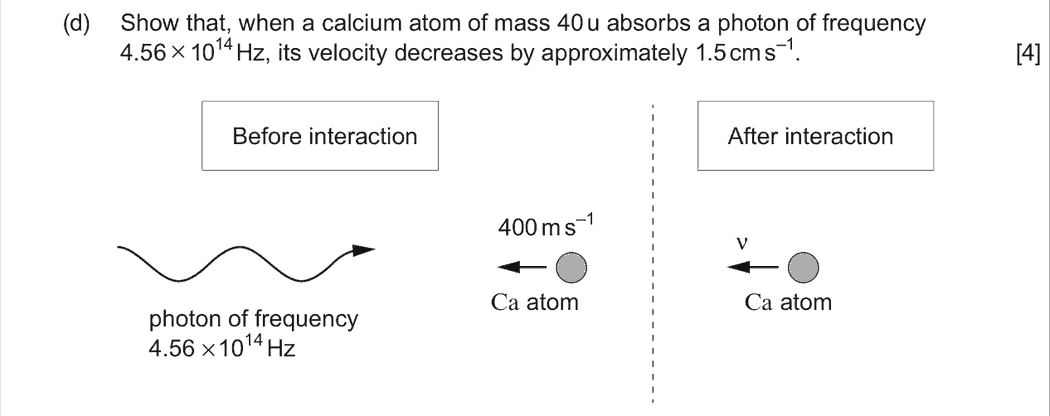
June 2022 · Component 1 · Q8(d)4 marksAO2=4Show that
Earlier part of question 8 that this part uses
Mark scheme
Examiner's comment
Most, but not all, candidates realised that to find the decrease in the atom’s velocity, they needed to apply conservation of momentum. The photon’s momentum was usually found correctly. Most candidates calculated the atom’s initial momentum (sometimes making mistakes with mass units) and then its final momentum, hence the new velocity. A minority saw that the change in velocity was simply equal to the photon momentum divided by the atom’s mass.
Notes from the mark scheme and report
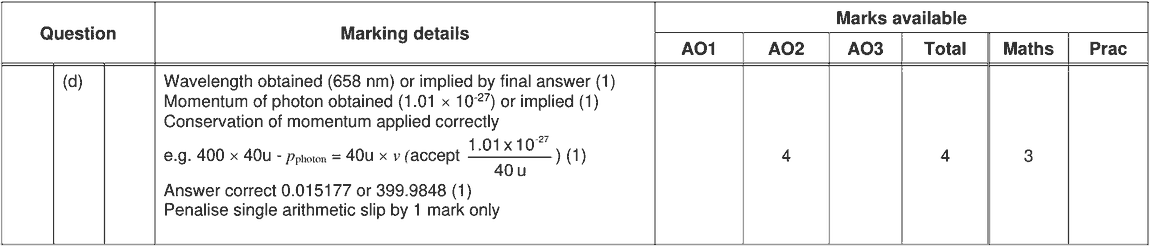
λ = c/f = 658 nm
photon momentum p = h/λ = 1.01 × 10⁻²⁷ kg m s⁻¹
conservation of momentum: Δv = p/(40 u) = 1.01 × 10⁻²⁷/6.64 × 10⁻²⁶ = 0.0152 m s⁻¹ (new speed 399.985 m s⁻¹)
mass-unit slips occurred
Scheme columns: Maths 3
Skills: Comprehension A level Component 1 Section B: questions on the printed article; Synoptic Needs physics from another component of the qualification; Unitsand conversions Unit marks, base units, prefixes and conversions; Mathsmarks The mark scheme's Maths column gives this part at least one mark for mathematical skills
June 2022 · Component 1 · Q8(e)3 marksAO3=3Calculation
Earlier parts of question 8 that this part uses
Mark scheme
Examiner's comment
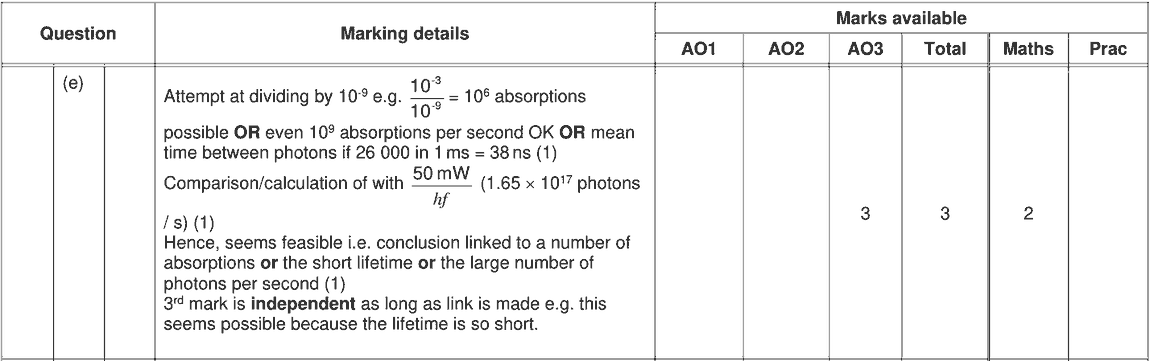
Candidates could gain 2 out of the 3 marks by calculating the number of photons emitted by the laser in a millisecond and pointing out that this is far larger than 26 000, making the photon supply ample for 26 000 to be absorbed in a millisecond. Many candidates missed these easy marks; perhaps some had been thrown by being told that the lifetime of the excited atom was a few nanoseconds. One way of using this information was to show that for 26 000 photons to be absorbed in a millisecond, the mean time between absorptions was 38 ns, so there was plenty of ‘spare time’ when the atom was not excited and so able to absorb, making it capable of absorbing several times more than 26 000 in a millisecond. A significant number of candidates did present this argument in some form.
Notes from the mark scheme and report
Lifetime argument: 1 ms / a few ns allows about 10⁶ absorptions, or 26 000 in 1 ms means 38 ns between absorptions (1)
photon supply: 50 mW/hf = 1.65 × 10¹⁷ photons per second (1)
so the claim is feasible, with the conclusion linked to a number (1)
many missed the easy photon-rate marks
Scheme columns: Maths 2
Skills: Comprehension A level Component 1 Section B: questions on the printed article; Synoptic Needs physics from another component of the qualification; Mathsmarks The mark scheme's Maths column gives this part at least one mark for mathematical skills
June 2022 · Component 1 · Q8(f)3 marksAO3=3Calculation
Earlier parts of question 8 that this part uses
Mark scheme
Examiner's comment
Most candidates sensibly chose to use 2 𝑚𝑐2̅̅̅ = 2 𝑘𝑇, but many did not substitute the value from the bottom of paragraph 13 as the mean square speed (to get a temperature of 0.36 μK). There were also some mistakes handling units for mass and speed. Summary of key points Answers to the first four questions revealed a generally excellent understanding of basic statics and dynamics. • Candidates had evidently been very well trained in calculating a gradient together with its uncertainty from a straight line graph and correlating it with the equation of the graph. • The variation of kinetic energy with time for a body in SHM was a weak area. • Few candidates distinguished between natural and forced oscillations in the question part about damping in car suspensions and pedestrian suspension bridges. • The assumptions made in deriving 𝑝= 3 𝜌𝑐2̅̅̅ did not appear to be well known. • Thermodynamics was (again) a weak area. Qualitative comparisons of work could have been made by inspecting p–V graphs but were often omitted. Heat and internal energy were sometimes confused with each other, and, occasionally, constant temperature with no heat entering or leaving. • Most candidates seemed to grasp the principle of laser Doppler cooling as explained in the article for comprehension. Calculation of number of photons emitted per (milli)second from a laser, and minimum temperature achievable (using kinetic theory) were poorly done. More careful study of the paragraphs mentioned in the questions might have helped. PHYSICS GCE A LEVEL Summer 2022
Notes from the mark scheme and report
Answer: 0.36 μK. Put the 1.5 cm s⁻¹ limit into Equation 2 as the rms speed: T = m<c²>/3k = 6.64 × 10⁻²⁶ × 0.015²/(3 × 1.38 × 10⁻²³)
conclusion linked to the value (same order of magnitude but higher than 0.1 μK)
many did not use 1.5 cm s⁻¹
Scheme columns: Maths 1
Skills: Comprehension A level Component 1 Section B: questions on the printed article; Unitsand conversions Unit marks, base units, prefixes and conversions; Mathsmarks The mark scheme's Maths column gives this part at least one mark for mathematical skills
October 2021 · Component 1 · Q8(a)2 marksAO1=2Explanation
Mark scheme
Notes from the mark scheme and report
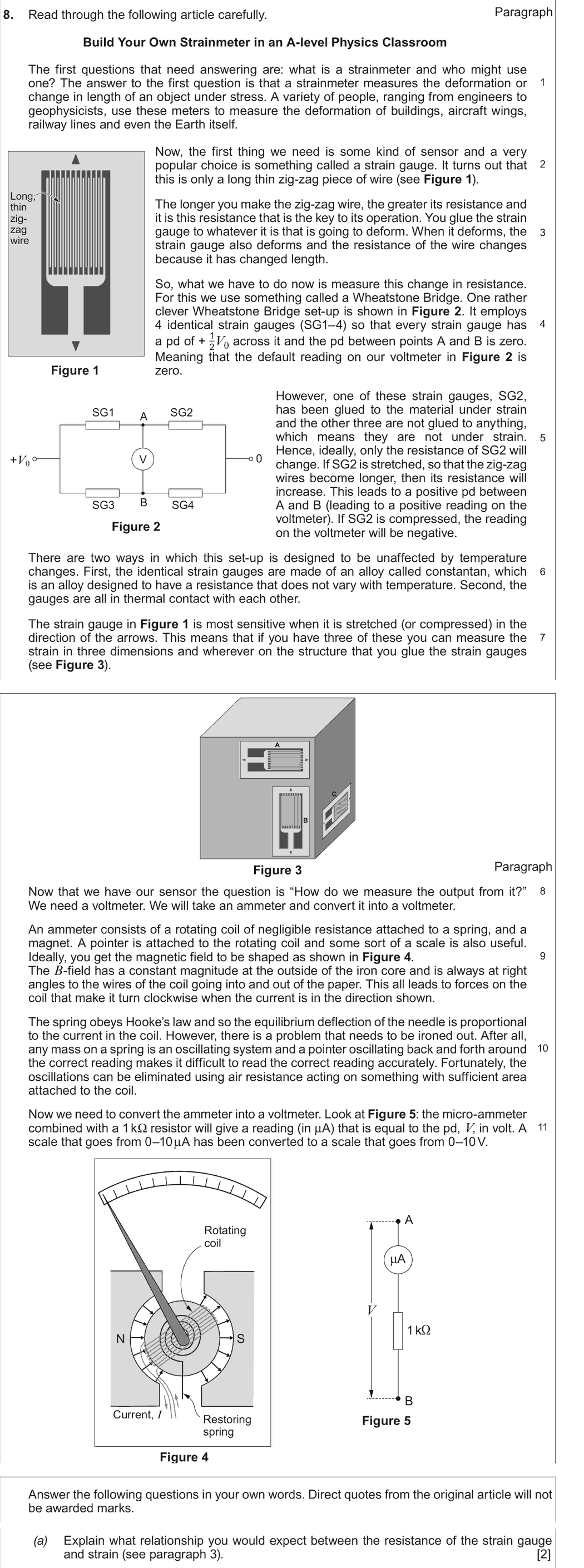
The resistance of a wire is proportional to its length (1), so the gauge resistance should vary linearly with strain (increase in proportion to the extension) (1)
Skills: Comprehension A level Component 1 Section B: questions on the printed article; Synoptic Needs physics from another component of the qualification
October 2021 · Component 1 · Q8(b)3 marksAO1=1, AO2=2Explanation
Earlier part of question 8 that this part uses
Mark scheme
Notes from the mark scheme and report
Compressed SG2 is shorter so its resistance falls (1)
it takes a smaller share of V0 (more across SG1) (1)
so the potential at A falls below the potential at B, giving a negative reading (1)
Skills: Comprehension A level Component 1 Section B: questions on the printed article; Synoptic Needs physics from another component of the qualification
October 2021 · Component 1 · Q8(c)2 marksAO3=2Explanation
Earlier part of question 8 that this part uses
Mark scheme
Notes from the mark scheme and report
The resistance of constantan does not vary with temperature (1), so the reading is not affected if the gauges are at different temperatures or the temperature changes (1)
Skills: Comprehension A level Component 1 Section B: questions on the printed article; Synoptic Needs physics from another component of the qualification
October 2021 · Component 1 · Q8(d)3 marksAO2=3Explanation
Earlier part of question 8 that this part uses
Mark scheme
Notes from the mark scheme and report
B (wires along the direction of compression) decreases in resistance (1)
A and C change very little, or increase slightly (1)
reason: B's wires get shorter, while A and C are at right angles to the compression so their length hardly changes (or increases slightly) (1)
Skills: Comprehension A level Component 1 Section B: questions on the printed article; Synoptic Needs physics from another component of the qualification
October 2021 · Component 1 · Q8(e)3 marksAO1=1, AO2=2Explanation
Earlier part of question 8 that this part uses
Mark scheme
Notes from the mark scheme and report
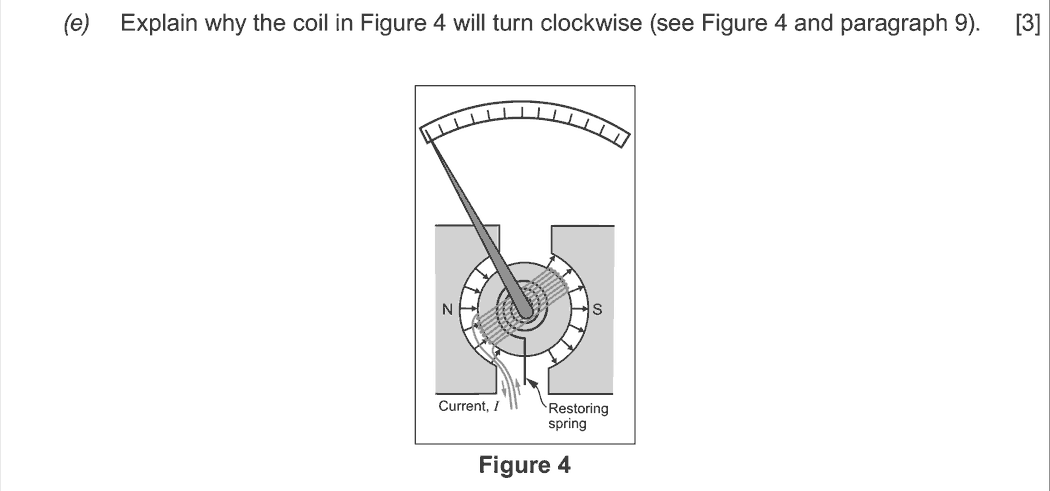
Fleming's left-hand rule (1) applied with the current into the page on one side of the coil and out of the page on the other (1) gives forces in opposite directions on the two sides (shown or described), a clockwise couple (1)
Skills: Comprehension A level Component 1 Section B: questions on the printed article; Synoptic Needs physics from another component of the qualification
October 2021 · Component 1 · Q8(f)3 marksAO1=1, AO2=2Explanation
Earlier parts of question 8 that this part uses
Mark scheme
Notes from the mark scheme and report
F = BIl (1), so with B constant the force on the coil is proportional to the current (1)
the spring obeys Hooke's law, force proportional to deflection, so the deflection is proportional to the current (1)
Skills: Comprehension A level Component 1 Section B: questions on the printed article; Synoptic Needs physics from another component of the qualification
October 2021 · Component 1 · Q8(g)2 marksAO1=2Short answer
Earlier parts of question 8 that this part uses
Mark scheme
Notes from the mark scheme and report
Critical damping (1): the pointer reaches its equilibrium reading in the shortest time without oscillating (1)
Skills: Comprehension A level Component 1 Section B: questions on the printed article
October 2021 · Component 1 · Q8(h)2 marksAO3=2Calculation
Earlier parts of question 8 that this part uses
Mark scheme
Notes from the mark scheme and report
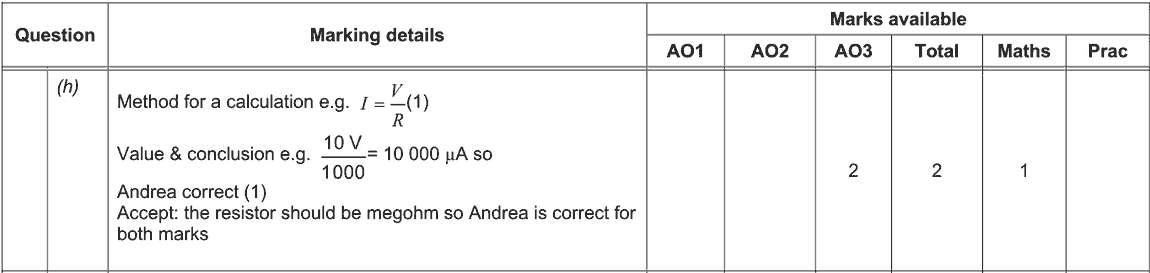
I = V/R (1): 10 V across 1 kΩ gives 10 mA = 10 000 μA, a thousand times the pd in volts, so Andrea is correct (the resistor should be 1 MΩ) (1)
Scheme columns: Maths 1
Skills: Comprehension A level Component 1 Section B: questions on the printed article; Synoptic Needs physics from another component of the qualification; Unitsand conversions Unit marks, base units, prefixes and conversions; Mathsmarks The mark scheme's Maths column gives this part at least one mark for mathematical skills
October 2020 · Component 1 · Q8(a)3 marksAO1=3Explanation
Mark scheme
Examiner's comment
In (a) and (b), 𝒖𝒖 ∆𝒎𝒎 ∆𝒕𝒕 was not always recognised as the rate of change of momentum of the exhaust gases, and the constancy of u and ∆𝒎𝒎 ∆𝒕𝒕 often went unnoticed. In (c) the wrong unit for 𝒕𝒕𝟐𝟐 was usually spotted. The 0.02 s delay was identified and almost always explained correctly. In
Notes from the mark scheme and report
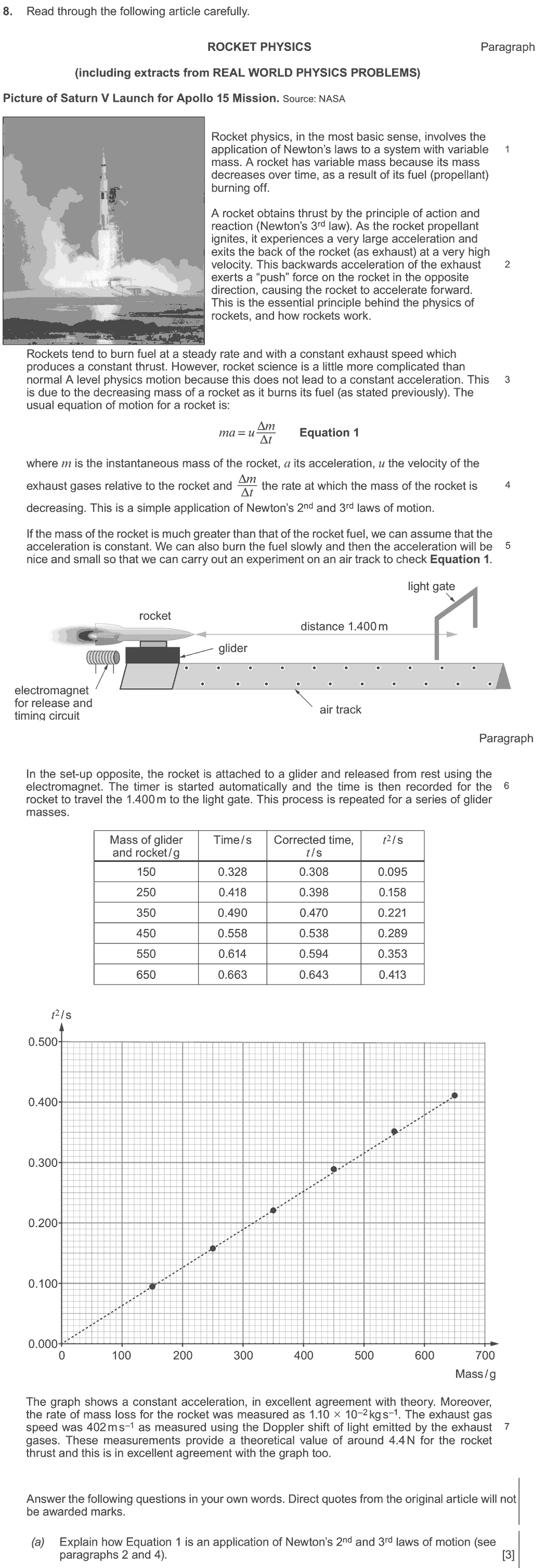
The left side, ma, is the resultant force on the rocket (Newton's 2nd law, F = ma) (1)
u Δm/Δt is the rate of change of momentum of the exhaust gas, i.e. the force on the gas (1)
by Newton's 3rd law the gas exerts an equal and opposite force on the rocket (1)
the momentum-rate idea was often missed
Scheme columns: Maths 1, Practical 3
Skills: Comprehension A level Component 1 Section B: questions on the printed article; Mathsmarks The mark scheme's Maths column gives this part at least one mark for mathematical skills; Practicalmarks The mark scheme's Prac column gives this part at least one mark for practical skills
October 2020 · Component 1 · Q8(b)3 marksAO2=3Explanation
Earlier part of question 8 that this part uses
Mark scheme
Examiner's comment
In (a) and (b), 𝒖𝒖 ∆𝒎𝒎 ∆𝒕𝒕 was not always recognised as the rate of change of momentum of the exhaust gases, and the constancy of u and ∆𝒎𝒎 ∆𝒕𝒕 often went unnoticed. In (c) the wrong unit for 𝒕𝒕𝟐𝟐 was usually spotted. The 0.02 s delay was identified and almost always explained correctly. In
Notes from the mark scheme and report
The fuel mass is small compared with the rocket and glider, so m is nearly constant (1)
u and Δm/Δt are constant (paragraph 3), so the thrust is constant and so is a (1)
a is small because m is large and Δm/Δt is small (1)
Scheme columns: Maths 1, Practical 3
Skills: Comprehension A level Component 1 Section B: questions on the printed article; Mathsmarks The mark scheme's Maths column gives this part at least one mark for mathematical skills; Practicalmarks The mark scheme's Prac column gives this part at least one mark for practical skills
October 2020 · Component 1 · Q8(c)(i)1 markAO1=1Short answer
Earlier part of question 8 that this part uses
Mark scheme
Examiner's comment
In (a) and (b), 𝒖𝒖 ∆𝒎𝒎 ∆𝒕𝒕 was not always recognised as the rate of change of momentum of the exhaust gases, and the constancy of u and ∆𝒎𝒎 ∆𝒕𝒕 often went unnoticed. In (c) the wrong unit for 𝒕𝒕𝟐𝟐 was usually spotted. The 0.02 s delay was identified and almost always explained correctly. In
Notes from the mark scheme and report
The unit of t² should be s², not s (table heading and graph axis)
Scheme columns: Practical 1
Skills: Comprehension A level Component 1 Section B: questions on the printed article; Unitsand conversions Unit marks, base units, prefixes and conversions; Practicalmarks The mark scheme's Prac column gives this part at least one mark for practical skills
October 2020 · Component 1 · Q8(c)(ii)2 marksAO2=2Practical and data analysis
Earlier parts of question 8 that this part uses
Mark scheme
Examiner's comment
In (a) and (b), 𝒖𝒖 ∆𝒎𝒎 ∆𝒕𝒕 was not always recognised as the rate of change of momentum of the exhaust gases, and the constancy of u and ∆𝒎𝒎 ∆𝒕𝒕 often went unnoticed. In (c) the wrong unit for 𝒕𝒕𝟐𝟐 was usually spotted. The 0.02 s delay was identified and almost always explained correctly. In
Notes from the mark scheme and report
0.02 s has been subtracted from each time (1), to allow for the delay in the electromagnet releasing the glider, a systematic error in t (1)
Scheme columns: Practical 2
Skills: Comprehension A level Component 1 Section B: questions on the printed article; Experimentalmethod Describing, planning or improving an experiment; Practicalmarks The mark scheme's Prac column gives this part at least one mark for practical skills
October 2020 · Component 1 · Q8(d)3 marksAO2=3Explanation
Earlier part of question 8 that this part uses
Mark scheme
Examiner's comment
most candidates realised that the relevant equation was 𝒙𝒙= 𝒖𝒖𝒖𝒖+ 𝟏𝟏 𝟐𝟐𝒂𝒂𝒕𝒕𝟐𝟐, but they didn’t always show clearly why the graph gradient would be 2.8 F . Parts (e) and (f) were handled very well. In
Notes from the mark scheme and report
From rest x = ½at² (1)
with a = F/m, t² = 2xm/F, so t² is proportional to m and the graph is a straight line through the origin (1)
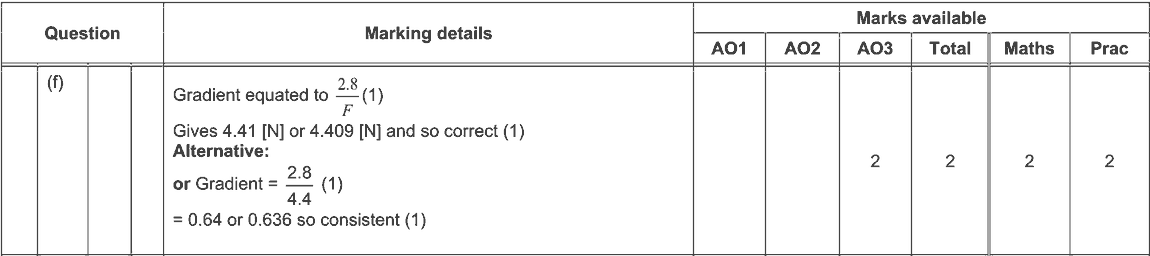
gradient = 2x/F = 2 × 1.400/F = 2.80/F (1)
the last step was often not shown clearly
Scheme columns: Maths 2, Practical 3
Skills: Comprehension A level Component 1 Section B: questions on the printed article; Algebra Derivations and rearranging equations; Graphskills Reading, plotting or sketching graphs; gradients, intercepts and areas; Mathsmarks The mark scheme's Maths column gives this part at least one mark for mathematical skills; Practicalmarks The mark scheme's Prac column gives this part at least one mark for practical skills
October 2020 · Component 1 · Q8(e)1 markAO2=1Show that
Earlier part of question 8 that this part uses
Mark scheme
Examiner's comment
In (a) and (b), 𝒖𝒖 ∆𝒎𝒎 ∆𝒕𝒕 was not always recognised as the rate of change of momentum of the exhaust gases, and the constancy of u and ∆𝒎𝒎 ∆𝒕𝒕 often went unnoticed. In (c) the wrong unit for 𝒕𝒕𝟐𝟐 was usually spotted. The 0.02 s delay was identified and almost always explained correctly. In
Notes from the mark scheme and report
Thrust = u Δm/Δt (rate of change of momentum of the exhaust) = 402 × 1.10 × 10⁻² = 4.42 N
Scheme columns: Practical 1
Skills: Comprehension A level Component 1 Section B: questions on the printed article; Practicalmarks The mark scheme's Prac column gives this part at least one mark for practical skills
October 2020 · Component 1 · Q8(f)2 marksAO3=2Calculation
Earlier part of question 8 that this part uses
Mark scheme
Examiner's comment
In (a) and (b), 𝒖𝒖 ∆𝒎𝒎 ∆𝒕𝒕 was not always recognised as the rate of change of momentum of the exhaust gases, and the constancy of u and ∆𝒎𝒎 ∆𝒕𝒕 often went unnoticed. In (c) the wrong unit for 𝒕𝒕𝟐𝟐 was usually spotted. The 0.02 s delay was identified and almost always explained correctly. In
Notes from the mark scheme and report
Answer: F = 4.41 N, consistent. Gradient = 2.80/F so F = 2.80/0.635
or 2.80/4.4 = 0.636, which matches the gradient
Scheme columns: Maths 2, Practical 2
Skills: Comprehension A level Component 1 Section B: questions on the printed article; Graphskills Reading, plotting or sketching graphs; gradients, intercepts and areas; Mathsmarks The mark scheme's Maths column gives this part at least one mark for mathematical skills; Practicalmarks The mark scheme's Prac column gives this part at least one mark for practical skills
October 2020 · Component 1 · Q8(g)(i)2 marksAO1=2Definition
Earlier part of question 8 that this part uses
Mark scheme
Examiner's comment
disappointingly many candidates couldn’t clearly explain the meaning of Doppler Effect. Most could quote the relevant equation, but few attempted to “describe how the exhaust speed might be measured”; mention of where the light or infra-red came from would have been welcome. Summary of key points When drawing lines on graphs always check to see if a best fit line is appropriate or lines of greatest and least gradient can be drawn. Always consider what uncertainty is required, is it the absolute uncertainty or the percentage uncertainty? Make sure that all areas of book work are learnt e.g. a weaker area in this paper was critical damping and ensure that qualitative responses are carefully constructed e.g. is heat flowing in or out. PHYSICS GCE A LEVEL Autumn 2020
Notes from the mark scheme and report
A change in the observed wavelength (or frequency) of a wave (1) caused by relative motion of the source and the observer (1)
synoptic with Component 2
many could not explain it clearly
Skills: Comprehension A level Component 1 Section B: questions on the printed article; Synoptic Needs physics from another component of the qualification
October 2020 · Component 1 · Q8(g)(ii)3 marksAO3=3Explanation
Earlier parts of question 8 that this part uses
Mark scheme
Examiner's comment
disappointingly many candidates couldn’t clearly explain the meaning of Doppler Effect. Most could quote the relevant equation, but few attempted to “describe how the exhaust speed might be measured”; mention of where the light or infra-red came from would have been welcome. Summary of key points When drawing lines on graphs always check to see if a best fit line is appropriate or lines of greatest and least gradient can be drawn. Always consider what uncertainty is required, is it the absolute uncertainty or the percentage uncertainty? Make sure that all areas of book work are learnt e.g. a weaker area in this paper was critical damping and ensure that qualitative responses are carefully constructed e.g. is heat flowing in or out. PHYSICS GCE A LEVEL Autumn 2020
Notes from the mark scheme and report
Collect light from the exhaust gases with a telescope or detector looking along the direction of the exhaust (1)
use a spectrometer (diffraction grating or prism) to measure the shift in wavelength of a known spectral line (1)
v = cΔλ/λ (1)
most quoted the equation but did not describe the measurement
Skills: Comprehension A level Component 1 Section B: questions on the printed article; Synoptic Needs physics from another component of the qualification
June 2019 · Component 1 · Q8(a)1 markAO2=1Short answer
Mark scheme
Examiner's comment
The first mark, a gentle introduction, required picking out from a diagram the stages in a star’s life cycle. Although most candidates succeeded it was slightly surprising how many omitted a stage.
Notes from the mark scheme and report
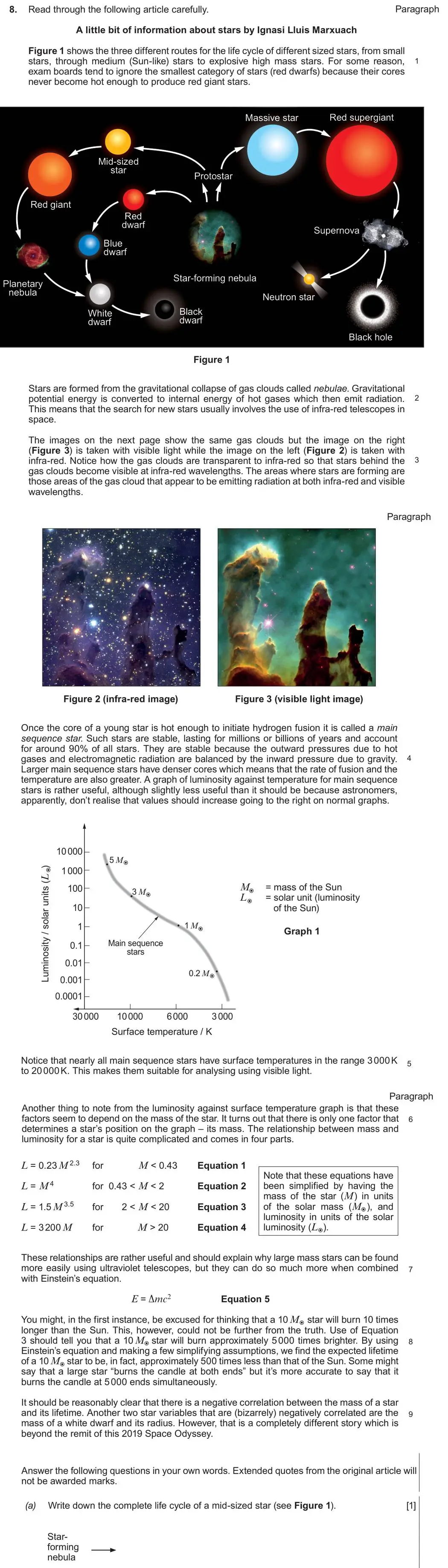
Star-forming nebula, protostar, mid-sized star, red giant, planetary nebula, white dwarf, black dwarf (read from Figure 1)
some left out a stage
Skills: Comprehension A level Component 1 Section B: questions on the printed article
June 2019 · Component 1 · Q8(b)1 markAO3=1Short answer
Earlier part of question 8 that this part uses
Mark scheme
Examiner's comment
Most candidates gave the answer that we had hoped for: telescopes in space avoid the problem of absorption of radiation by the Earth’s atmosphere. We also accepted avoidance of image distortion by uneven refraction.
Notes from the mark scheme and report
Infra-red (the radiation) is not absorbed by the Earth's atmosphere
avoiding distortion of the image by the atmosphere also accepted
Skills: Comprehension A level Component 1 Section B: questions on the printed article
June 2019 · Component 1 · Q8(c)1 markAO2=1Short answer
Earlier part of question 8 that this part uses
Mark scheme
Examiner's comment
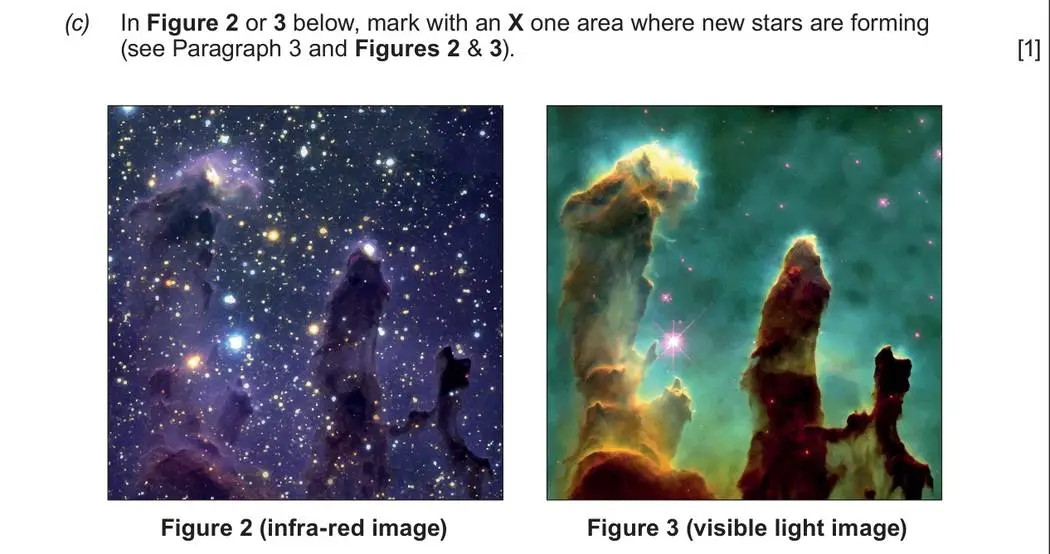
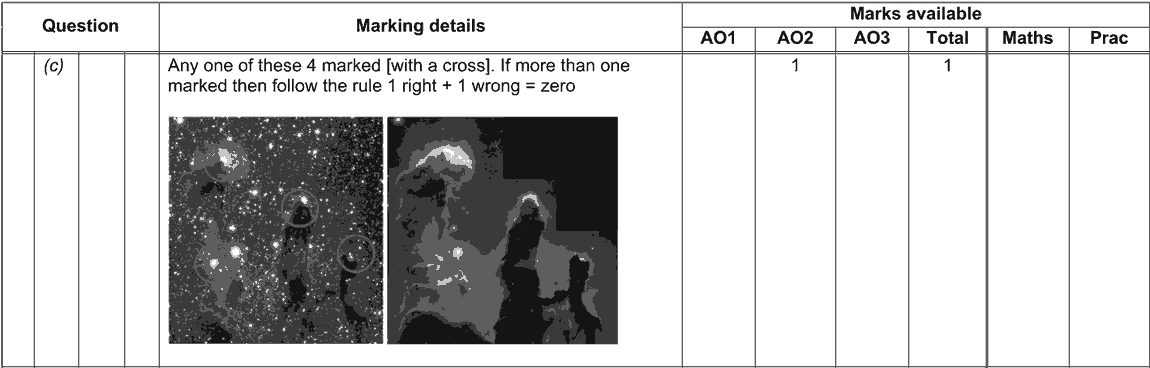
There was considerable success in showing where new stars are forming.
Notes from the mark scheme and report
A cross on any one of the four regions that are bright in both the infra-red and the visible image
one right plus one wrong scores zero
Skills: Comprehension A level Component 1 Section B: questions on the printed article
June 2019 · Component 1 · Q8(d)3 marksAO1=2, AO2=1Explanation
Earlier parts of question 8 that this part uses
Mark scheme
Examiner's comment
Most candidates sensibly chose to give a photon explanation for radiation pressure in a star. Sometimes it was not made clear that the photons had to encounter matter in the star so that their momentum changed.
Notes from the mark scheme and report
Photons have momentum, p = h/λ (1)
photons collide with or are absorbed by matter in the star so their momentum changes (1)
force is the rate of change of momentum (and pressure is force per unit area) (1)
the encounter with matter was sometimes missing
synoptic with Component 3 photons
Skills: Comprehension A level Component 1 Section B: questions on the printed article; Synoptic Needs physics from another component of the qualification
June 2019 · Component 1 · Q8(e)3 marksAO2=3Explanation
Earlier parts of question 8 that this part uses
Mark scheme
Examiner's comment
It was not always stated that increased gravitational forces was the reason why higher mass stars have higher core densities. A significant minority of candidates tried to explain why a higher density led to higher temperature without mentioning or implying nuclear fusion. There were, though, many excellent answers.
Notes from the mark scheme and report
Greater mass gives greater gravitational force, compressing the core to a higher density (1)
higher density gives a greater rate of fusion (1)
fusion releases energy, so more energy is released and the temperature is higher (1)
some never mentioned fusion
Skills: Comprehension A level Component 1 Section B: questions on the printed article
June 2019 · Component 1 · Q8(f)(i)2 marksAO1=1, AO2=1Show that
Earlier parts of question 8 that this part uses
Mark scheme
Examiner's comment
Wien’s law was applied correctly by almost everyone.
Notes from the mark scheme and report
Wien's law: λmax = 2.9 × 10⁻³/T with T = 20 000 K gives 145 nm (temperatures from 17 000 K to 22 000 K accepted from the graph)
synoptic with Component 2
Scheme columns: Maths 1
Skills: Comprehension A level Component 1 Section B: questions on the printed article; Synoptic Needs physics from another component of the qualification; Graphskills Reading, plotting or sketching graphs; gradients, intercepts and areas; Mathsmarks The mark scheme's Maths column gives this part at least one mark for mathematical skills
June 2019 · Component 1 · Q8(f)(ii)2 marksAO3=2Explanation
Earlier parts of question 8 that this part uses
Mark scheme
Examiner's comment
With few exceptions, candidates gained the first mark for pointing out that 150 nm was not in the visible region. The second mark was seldom given. The point had to be made that although 150 nm was the wavelength of peak emission, the star would emit plenty of visible radiation [as the luminosity of a very high temperature star will be high].
Notes from the mark scheme and report
150 nm is ultraviolet, so the peak emission is outside the visible region and UV would be better (1)
but a hot star still emits plenty of visible light, more than a cooler star (1)
the second mark was rarely gained
Skills: Comprehension A level Component 1 Section B: questions on the printed article; Synoptic Needs physics from another component of the qualification
June 2019 · Component 1 · Q8(g)2 marksAO3=2Calculation
Earlier parts of question 8 that this part uses
Mark scheme
Examiner's comment
Most candidates selected equation 1 and calculated the luminosity correctly. As justification that the star had been correctly plotted we were happy to accept that the calculated luminosity lay between 0.001 𝑳⨀ and 0.01 𝑳⨀. Both marks were often gained.
Notes from the mark scheme and report
Answer: L = 0.0057 solar units. Equation 1: L = 0.23 × 0.2^2.3
this lies between 0.001 and 0.01 on the log scale of Graph 1, so the point is plotted about right (not credited as a guess)
Scheme columns: Maths 2
Skills: Comprehension A level Component 1 Section B: questions on the printed article; Graphskills Reading, plotting or sketching graphs; gradients, intercepts and areas; Mathsmarks The mark scheme's Maths column gives this part at least one mark for mathematical skills
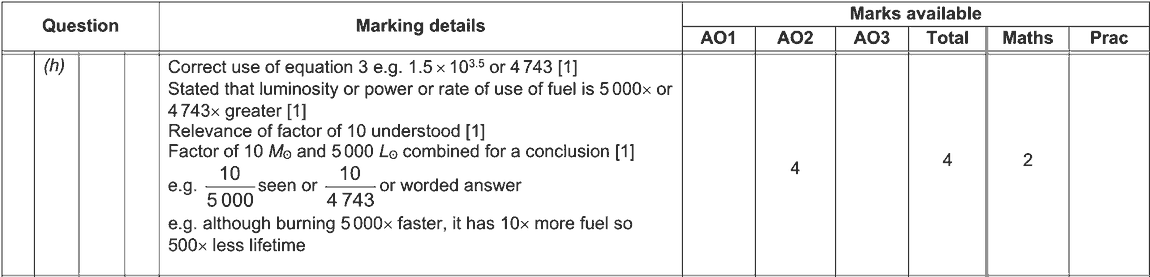
June 2019 · Component 1 · Q8(h)4 marksAO2=4Explanation
Earlier parts of question 8 that this part uses
Mark scheme
Examiner's comment
The first mark, usually gained, was for using equation 3 to calculate the luminosity of a star of mass 10 𝑴⨀. Credit was then available for making clear that the luminosity was to be used as the rate of loss of energy and that the available energy was 𝑴𝒄𝟐= 𝟏𝟎 𝑴⨀𝒄𝟐. This credit could be given by implication to the many candidates who quoted energy time = power and substituted 𝟏𝟎 𝑴⨀𝒄𝟐 𝟓𝟎𝟎𝟎 𝑳⨀= ( 𝟓𝟎𝟎) × solar lifetime. Once or twice it was pointed out that this is oversimplified because the star’s luminosity would decrease as its mass dwindled.
Notes from the mark scheme and report
Equation 3: L = 1.5 × 10^3.5 = 4743, about 5000 solar units (1)
so fuel is used about 5000 times faster (1)
assume the energy available is proportional to mass (E = mc²), so there is 10 times more fuel (1)
lifetime factor = 10/5000 = 1/500 (1)
assumes constant luminosity
Scheme columns: Maths 2
Skills: Comprehension A level Component 1 Section B: questions on the printed article; Mathsmarks The mark scheme's Maths column gives this part at least one mark for mathematical skills
June 2019 · Component 1 · Q8(i)1 markAO1=1Short answer
Earlier parts of question 8 that this part uses
Mark scheme
Notes from the mark scheme and report
As the mass of a white dwarf increases its radius decreases (or the reverse)
Skills: Comprehension A level Component 1 Section B: questions on the printed article
June 2018 · Component 1 · Q9(a)4 marksAO1=4Explanation
Mark scheme
Examiner's comment
The common features of the electrons’ motion with and without the electric field, and the differences, were usually summarised well.
Notes from the mark scheme and report
Without a field: fast random motion with collisions (1), mean velocity zero or no preferred direction (1). With a field, any two: random motion still present
slight acceleration between collisions
a drift velocity (2)
Skills: Comprehension A level Component 1 Section B: questions on the printed article; Synoptic Needs physics from another component of the qualification
June 2018 · Component 1 · Q9(b)2 marksAO2=2Calculation
Earlier part of question 9 that this part uses
Mark scheme
Examiner's comment
Almost everyone succeeded in calculating the temperature at which the electrons would have the given rms speed.
Notes from the mark scheme and report
Answer: 220 K. ½m<v²> = (3/2)kT so T = m<v²>/3k with v = 1.00 × 10⁵ m s⁻¹ and the electron mass
Scheme columns: Maths 2
Skills: Comprehension A level Component 1 Section B: questions on the printed article; Algebra Derivations and rearranging equations; Mathsmarks The mark scheme's Maths column gives this part at least one mark for mathematical skills
June 2018 · Component 1 · Q9(c)2 marksAO2=2Show that
Earlier part of question 9 that this part uses
Mark scheme
Examiner's comment
Occasionally students didn’t make clear the role of force in deriving e eE a m .
Notes from the mark scheme and report
F = qE and F = ma (1)
with q = e and m = me (or stating the electric force is the resultant force), so a = eE/me (1)
the role of force was sometimes unclear
Scheme columns: Maths 1
Skills: Comprehension A level Component 1 Section B: questions on the printed article; Synoptic Needs physics from another component of the qualification; Algebra Derivations and rearranging equations; Mathsmarks The mark scheme's Maths column gives this part at least one mark for mathematical skills
June 2018 · Component 1 · Q9(d)2 marksAO2=2Calculation
Earlier part of question 9 that this part uses
Mark scheme
Examiner's comment
Few difficulties were encountered in finding E using the given equation, even with given in fs.
Notes from the mark scheme and report
Answer: 0.071 V m⁻¹ (or N C⁻¹, unit needed). Rearrange Equation 4 for E with τ = 40 × 10⁻¹⁵ s and v = 0.25 × 10⁻³ m s⁻¹
one mark lost for a power-of-ten slip
Scheme columns: Maths 1
Skills: Comprehension A level Component 1 Section B: questions on the printed article; Unitsand conversions Unit marks, base units, prefixes and conversions; Mathsmarks The mark scheme's Maths column gives this part at least one mark for mathematical skills
June 2018 · Component 1 · Q9(e)2 marksAO2=2Explanation
Earlier part of question 9 that this part uses
Mark scheme
Examiner's comment
Candidates derived the equation for resistivity in terms of from that for resistance in different ways, almost all valid.
Notes from the mark scheme and report
Compare Equation 8 with R = ρl/A (1)
the length l is the d of Equation 8, and the algebra gives Equation 9 (1)
Scheme columns: Maths 1
Skills: Comprehension A level Component 1 Section B: questions on the printed article; Synoptic Needs physics from another component of the qualification; Algebra Derivations and rearranging equations; Mathsmarks The mark scheme's Maths column gives this part at least one mark for mathematical skills
June 2018 · Component 1 · Q9(f)2 marksAO2=2Calculation
Earlier part of question 9 that this part uses
Mark scheme
Examiner's comment
There were a few arithmetical slips and occasional algebraic blunders, but the calculation of was generally done well.
Skills: Comprehension A level Component 1 Section B: questions on the printed article; Algebra Derivations and rearranging equations; Mathsmarks The mark scheme's Maths column gives this part at least one mark for mathematical skills
June 2018 · Component 1 · Q9(g)4 marksAO3=4Explanation
Earlier part of question 9 that this part uses
Mark scheme
Examiner's comment
Explaining why resistivity was proportional to T was the most challenging part of this question. Candidates had to realise that was inversely proportional to the mean speed (and therefore to the rms speed). Occasionally mean speed was confused with drift velocity. There were, though, many good answers.
Notes from the mark scheme and report
Time between collisions = distance/speed, with the speed being the rms speed (1)
ρ is proportional to 1/time so to v (1)
v² is proportional to T from kinetic theory (1)
so ρ is proportional to √T (1)
the thermal speed was sometimes confused with the drift velocity
Scheme columns: Maths 2
Skills: Comprehension A level Component 1 Section B: questions on the printed article; Algebra Derivations and rearranging equations; Mathsmarks The mark scheme's Maths column gives this part at least one mark for mathematical skills
June 2018 · Component 1 · Q9(h)2 marksAO2=2Short answer
Earlier part of question 9 that this part uses
Mark scheme
Examiner's comment
It required a certain amount of courage to assign a charge to a lattice vibration, but many candidates correctly attributed the attractive forces on the electrons to a positively charged lattice vibration. PHYSICS GCE A LEVEL Summer 2018
Notes from the mark scheme and report
Positive (1), because it attracts electrons, giving an excess of electrons either side (1)
Skills: Comprehension A level Component 1 Section B: questions on the printed article
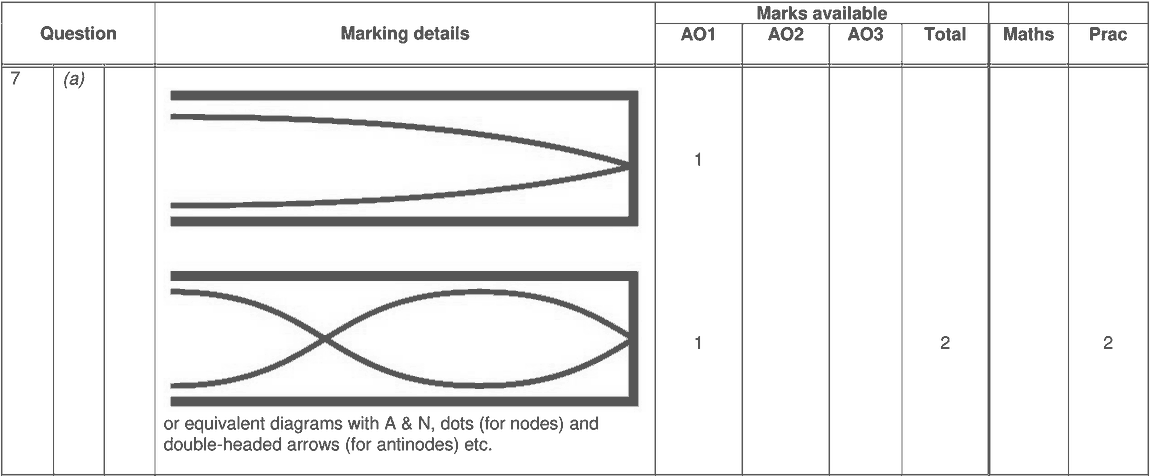
June 2017 · Component 1 · Q7(a)2 marksAO1=2Diagram or graph
Mark scheme
Examiner's comment
Drawing the stationary wave patterns for the two lowest notes caused some difficulty, even though the node/antinode status of the ends of the tube had been given in the passage. Nonetheless there were many good answers.
Notes from the mark scheme and report
Fundamental: node at the closed end and antinode at the open end (quarter wavelength in the tube) (1)
third harmonic: three quarter-wavelengths, with one more node and antinode (1)
labelled N and A diagrams accepted
found hard although the article states the end conditions
Scheme columns: Practical 2
Skills: Comprehension A level Component 1 Section B: questions on the printed article; Practicalmarks The mark scheme's Prac column gives this part at least one mark for practical skills
June 2017 · Component 1 · Q7(b)2 marksAO2=2Calculation
Earlier part of question 7 that this part uses
Mark scheme
Examiner's comment
The success rate was somewhat better for finding the frequency of the third harmonic; the wavelength gave a little more trouble.
Notes from the mark scheme and report
Answer: f = 141 Hz (3 × 47) and λ = 2.4 m (4 × 1.800/3, or 340/141)
the wavelength was found harder
Scheme columns: Maths 2, Practical 2
Skills: Comprehension A level Component 1 Section B: questions on the printed article; Mathsmarks The mark scheme's Maths column gives this part at least one mark for mathematical skills; Practicalmarks The mark scheme's Prac column gives this part at least one mark for practical skills
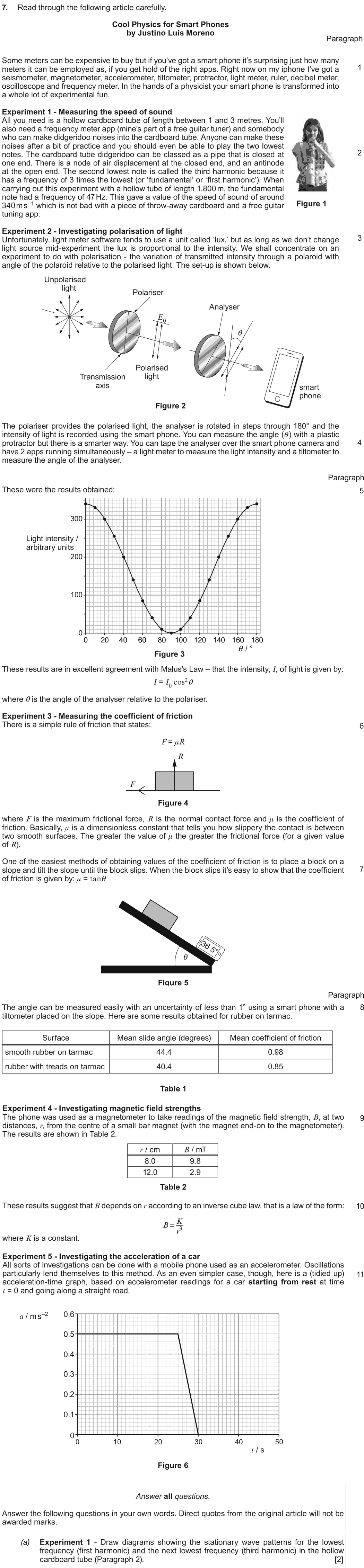
June 2017 · Component 1 · Q7(c)4 marksAO1=4Explanation
Earlier part of question 7 that this part uses
Mark scheme
Examiner's comment
In explanations of the intensity curve when the analyser was rotated, credit was given for statements about zero intensity due to absorption by the analyser when crossed with the polariser, and maximum when polariser and analyser were in the same direction, but we did also need to be told that this happened because in the light emerging from the polariser, the (electric) vibrations were confined to one direction at right angles to the direction of travel. Some candidates omitted to do so, attempting to answer the question without saying anything about the light itself.
Notes from the mark scheme and report
Light leaving the polariser has its vibrations in one direction only (1)
at 0° and 180° the analyser is aligned with the polariser so intensity is a maximum (1)
at 90° they are crossed so (almost) no light passes (1)
in between there is partial transmission (1)
many never described the polarised light itself
Scheme columns: Practical 4
Skills: Comprehension A level Component 1 Section B: questions on the printed article; Practicalmarks The mark scheme's Prac column gives this part at least one mark for practical skills
June 2017 · Component 1 · Q7(d)(i)1 markAO2=1Show that
Earlier part of question 7 that this part uses
Mark scheme
Examiner's comment
We expected candidates to substitute I = 340, = 0 into I = I0 cos2 in order to show that I0 = 340. Many did so, while some, equally correctly, used data from other points.
Notes from the mark scheme and report
At θ = 0 (or 180°) cos²θ = 1 so I = I0 = 340 from the graph
substituting any other plotted point accepted
Scheme columns: Maths 1, Practical 1
Skills: Comprehension A level Component 1 Section B: questions on the printed article; Graphskills Reading, plotting or sketching graphs; gradients, intercepts and areas; Mathsmarks The mark scheme's Maths column gives this part at least one mark for mathematical skills; Practicalmarks The mark scheme's Prac column gives this part at least one mark for practical skills
June 2017 · Component 1 · Q7(d)(ii)2 marksAO1=1, AO2=1Calculation
Earlier parts of question 7 that this part uses
Mark scheme
Examiner's comment
This second check on the fit between the graph and equation was taken by almost all candidates as the gift that it was.
Notes from the mark scheme and report
cos² 140° = 0.587 (1)
predicted I = 340 × 0.587 = 200, which matches the plotted point (1)
Scheme columns: Maths 2, Practical 2
Skills: Comprehension A level Component 1 Section B: questions on the printed article; Graphskills Reading, plotting or sketching graphs; gradients, intercepts and areas; Mathsmarks The mark scheme's Maths column gives this part at least one mark for mathematical skills; Practicalmarks The mark scheme's Prac column gives this part at least one mark for practical skills
June 2017 · Component 1 · Q7(e)3 marksAO3=3Explanation
Earlier part of question 7 that this part uses
Mark scheme
Examiner's comment
There were many good discussions of the claim about the roughness of smooth and treaded rubber, with good use made of the quoted uncertainties for the experimental data, and some doubts raised about the relevance of the experiment to whole tyres.
Notes from the mark scheme and report
The smooth rubber has the larger coefficient (0.98 against 0.85), which appears to contradict the textbook (1)
the slide angles differ by 4° while the uncertainty is under 1° (1)
so the difference is not random error, or a more guarded conclusion because repeats and whole tyres are not covered (1)
Scheme columns: Practical 3
Skills: Comprehension A level Component 1 Section B: questions on the printed article; Uncertainties Resolution, absolute and percentage uncertainty, combining uncertainties, error bars; Practicalmarks The mark scheme's Prac column gives this part at least one mark for practical skills
June 2017 · Component 1 · Q7(f)2 marksAO3=2Calculation
Earlier part of question 7 that this part uses
Mark scheme
Examiner's comment
It was impressive to see, so often, Br3 evaluated from each pair of data – with conclusion. There were some less elegant variations (no penalty), but few failures.
Notes from the mark scheme and report
Br³ is constant: 9.8 × 8.0³ = 5018 and 2.9 × 12.0³ = 5011 (1)
good agreement, or a reservation that two readings are too few (1)
Scheme columns: Maths 1, Practical 2
Skills: Comprehension A level Component 1 Section B: questions on the printed article; Mathsmarks The mark scheme's Maths column gives this part at least one mark for mathematical skills; Practicalmarks The mark scheme's Prac column gives this part at least one mark for practical skills
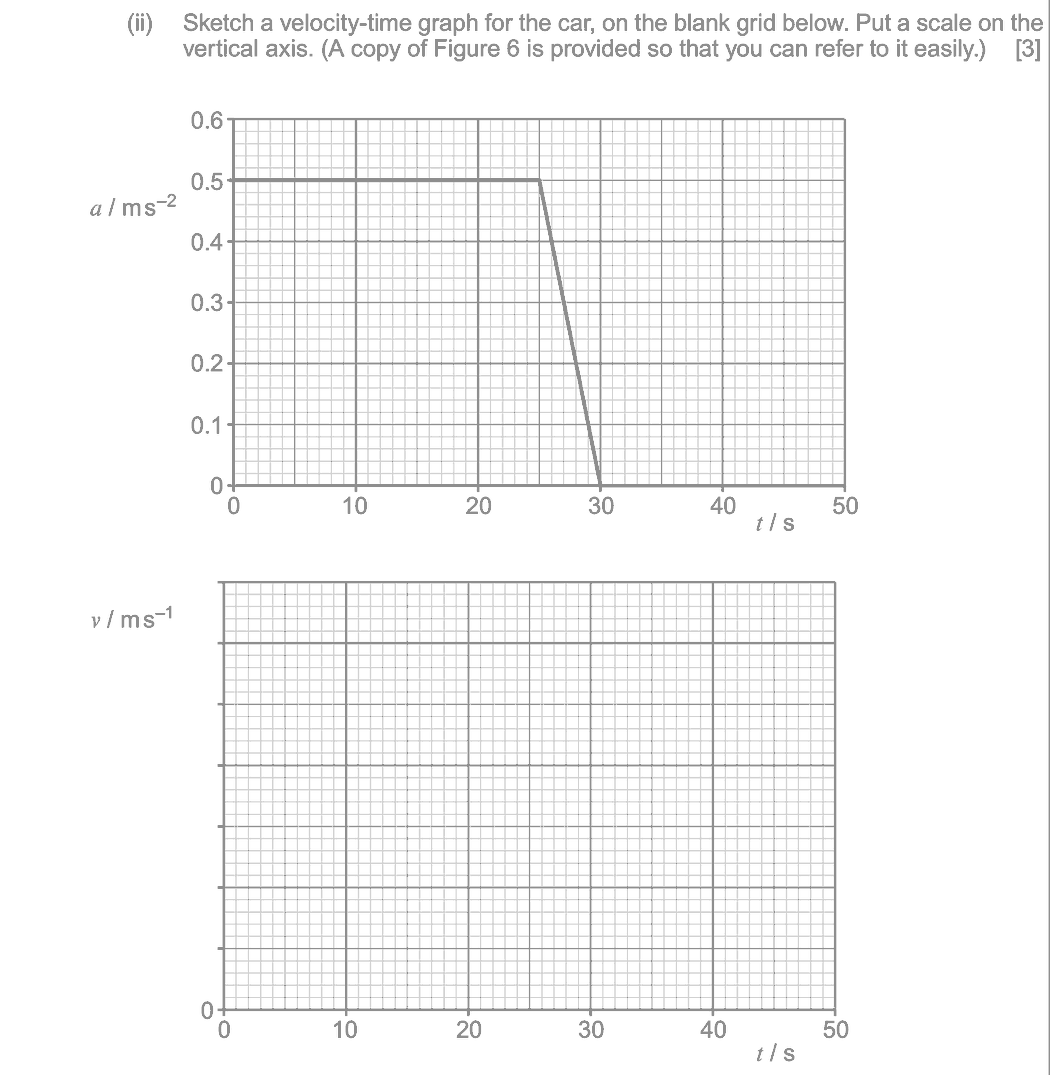
June 2017 · Component 1 · Q7(g)(i)1 markAO2=1Calculation
Earlier part of question 7 that this part uses
Mark scheme
Examiner's comment
With few exceptions the velocity at 25 s was evaluated correctly.
Notes from the mark scheme and report
Answer: 12.5 m s⁻¹ (area under the acceleration-time graph, 0.50 × 25)
Scheme columns: Practical 1
Skills: Comprehension A level Component 1 Section B: questions on the printed article; Graphskills Reading, plotting or sketching graphs; gradients, intercepts and areas; Practicalmarks The mark scheme's Prac column gives this part at least one mark for practical skills
June 2017 · Component 1 · Q7(g)(ii)3 marksAO2=3Diagram or graph
Earlier parts of question 7 that this part uses
Mark scheme
Examiner's comment
The straight portion of graph up to 25 s was almost always correct, the part between 25 s and 30 s was sometimes drawn straight instead of curved, and the rest, though occasionally omitted, was usually drawn correctly. EDUQAS GCE A LEVEL PHYSICS Summer 2017
Notes from the mark scheme and report
Straight line from (0, 0) to (25, 12.5) with a vertical scale (1)
from 25 s to 30 s the velocity still rises but at a decreasing rate, a curve (1)
constant velocity (13.75 m s⁻¹) from 30 s to 50 s, joined smoothly (1)
the middle section was often drawn straight
Scheme columns: Maths 3, Practical 3
Skills: Comprehension A level Component 1 Section B: questions on the printed article; Graphskills Reading, plotting or sketching graphs; gradients, intercepts and areas; Mathsmarks The mark scheme's Maths column gives this part at least one mark for mathematical skills; Practicalmarks The mark scheme's Prac column gives this part at least one mark for practical skills
Work with an Eduqas physics tutor
Dropping marks on calculations, specified practicals or the six-mark QER questions? Book a trial session with a specialist Eduqas physics tutor.