Tap a question to zoom it. Where a part needs a figure, table or graph from earlier in the question, that part folds out above it; the mark scheme and examiner's comment open underneath. Have the Eduqas Data Booklet beside you (see the Data Booklet page).
June 2025 · Component 2 · Q1(a)(i)1 markAO1=1Short answer
Mark scheme
Examiner's comment
and (ii) Nearly all candidates correctly referenced the flow of charge when explaining why copper is an electrical conductor. Responses to part (ii) were generally strong, with most candidates providing clear, logical, and accurate derivations of the equation I = nAve. However, in a few cases, the term ‘n’ was either not defined or incorrectly defined, which resulted in the loss of marks.
Notes from the mark scheme and report
Copper lets charge (electrons) flow through it
it contains free (delocalised) electrons
'current' without reference to charge or electrons not accepted
June 2025 · Component 2 · Q1(a)(ii)4 marksAO1=4Explanation
Earlier part of question 1 that this part uses
Mark scheme
Notes from the mark scheme and report
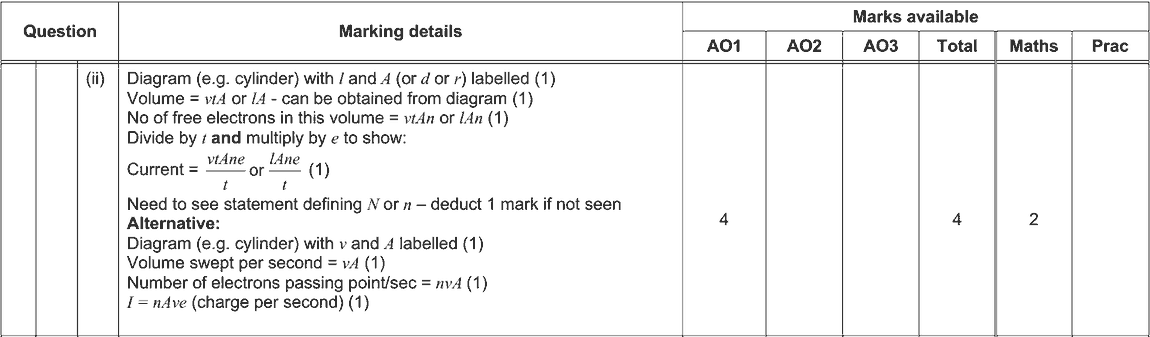
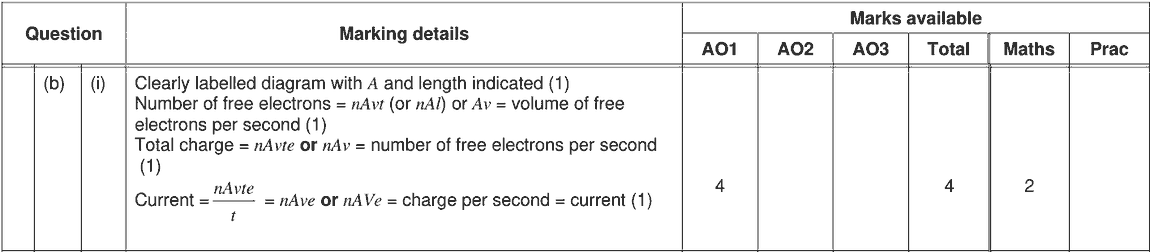
Labelled cylinder of length l (or vt) and area A (1)
volume = Avt (1)
number of free electrons in it = nAvt, with n defined as the number of free electrons per unit volume (1)
charge = nAvte and I = Q/t = nAve (1)
one mark lost if n is not defined
Scheme columns: Maths 2
Skills: Algebra Derivations and rearranging equations; Mathsmarks The mark scheme's Maths column gives this part at least one mark for mathematical skills
June 2025 · Component 2 · Q1(a)(iii)2 marksAO2=2Calculation
Earlier part of question 1 that this part uses
Mark scheme
Examiner's comment
Almost all candidates correctly recognised that I, n, and e were the same for both wires, and used this understanding to produce valid algebraic calculations to determine the required drift velocity.
Notes from the mark scheme and report
Answer: 2.67 × 10⁻⁴ m s⁻¹. Series, so I, n and e are the same
vA is constant
v = 6.0 × 10⁻⁴ × (0.20/0.30)² = 6.0 × 10⁻⁴ × 4/9
2.6 × 10⁻⁴ not accepted
Scheme columns: Maths 2
Skills: Algebra Derivations and rearranging equations; Mathsmarks The mark scheme's Maths column gives this part at least one mark for mathematical skills
June 2025 · AS Component 2 · Q3(b)3 marksAO1=1, AO2=2Calculation
Earlier part of question 3 that this part uses
Mark scheme
Notes from the mark scheme and report
Answer: 2.4 × 10⁻⁴ m s⁻¹. n = 3 × 6.0 × 10²⁸ = 1.8 × 10²⁹ m⁻³
Skills: Mathsmarks The mark scheme's Maths column gives this part at least one mark for mathematical skills
June 2025 · AS Component 2 · Q7(b)(i)3 marksAO2=3Calculation
Earlier part of question 7 that this part uses
Mark scheme
Notes from the mark scheme and report
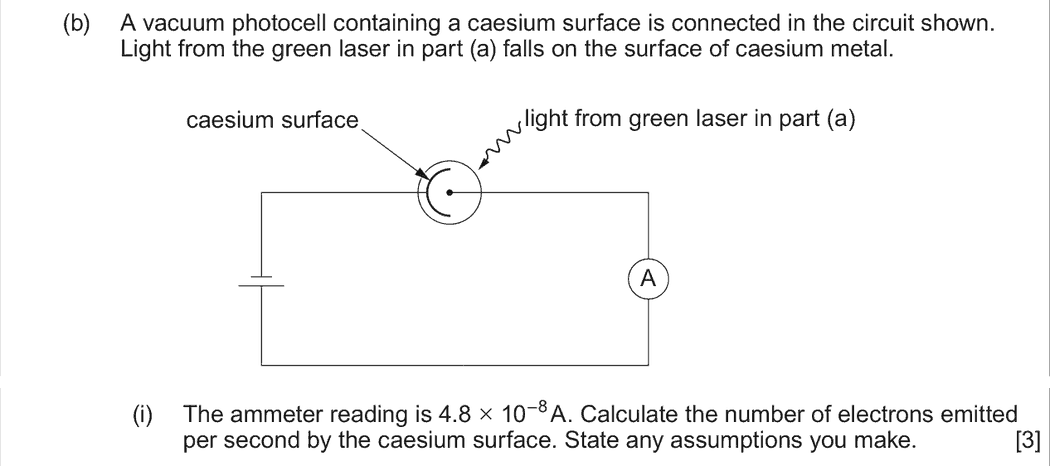
Answer: 3.0 × 10¹¹ electrons per second. Charge per second = 4.8 × 10⁻⁸ C (1)
divide by 1.60 × 10⁻¹⁹ C (1)
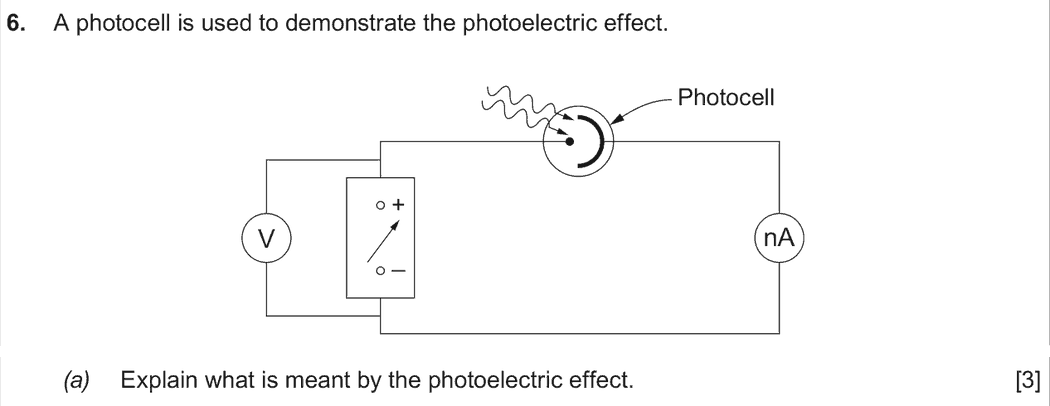
assumption: every emitted electron reaches the other electrode and contributes to the ammeter current (1)
Scheme columns: Maths 2
Skills: Mathsmarks The mark scheme's Maths column gives this part at least one mark for mathematical skills
June 2024 · Component 2 · Q4(a)2 marksAO2=2Calculation
Mark scheme
Examiner's comment
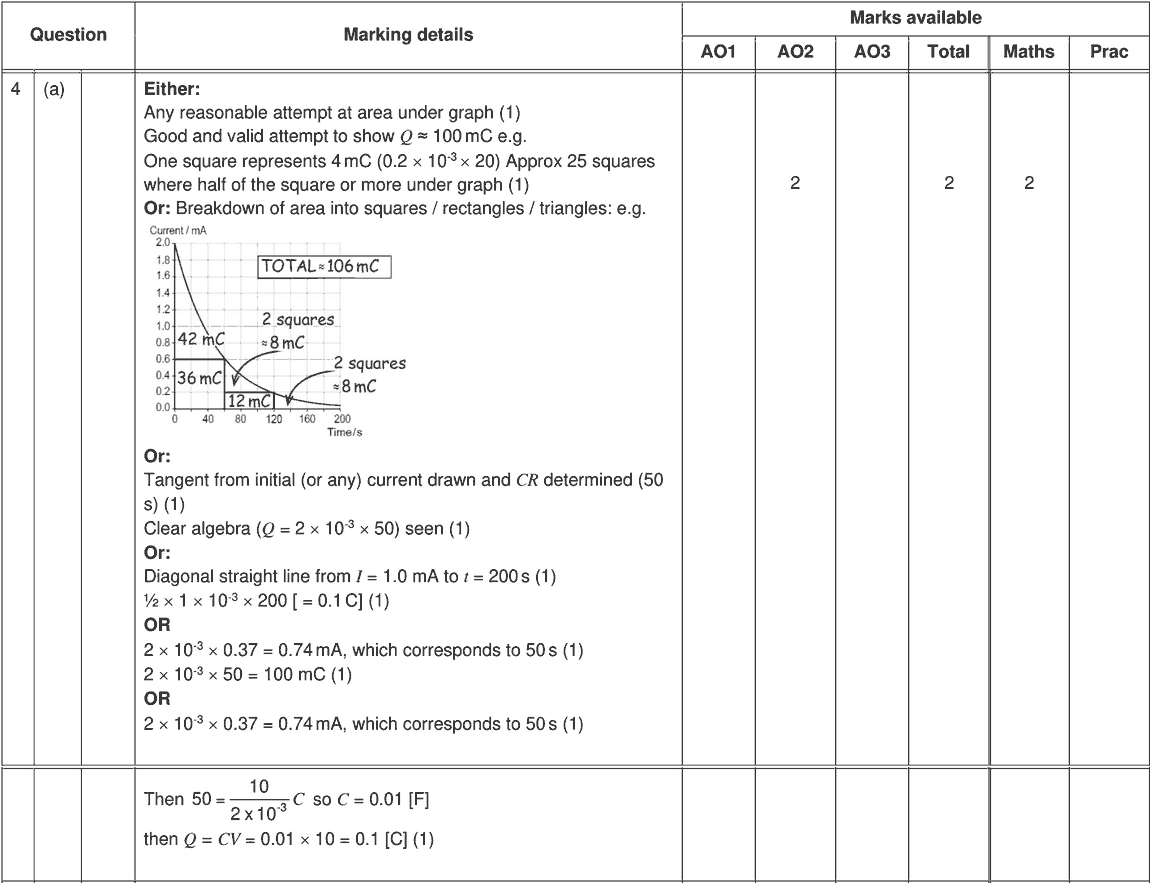
A variety of good attempts were made to confirm the charge on the capacitor, including valiant attempts at estimating the area under the curve. Tolerance was given to final answers based on this approach. It was apparent however that a noticeable number of candidates were unaware of the link between area and charge. A few candidates drew an appropriate tangent and determined the time constant from it, and from this determined the required charge.
Notes from the mark scheme and report
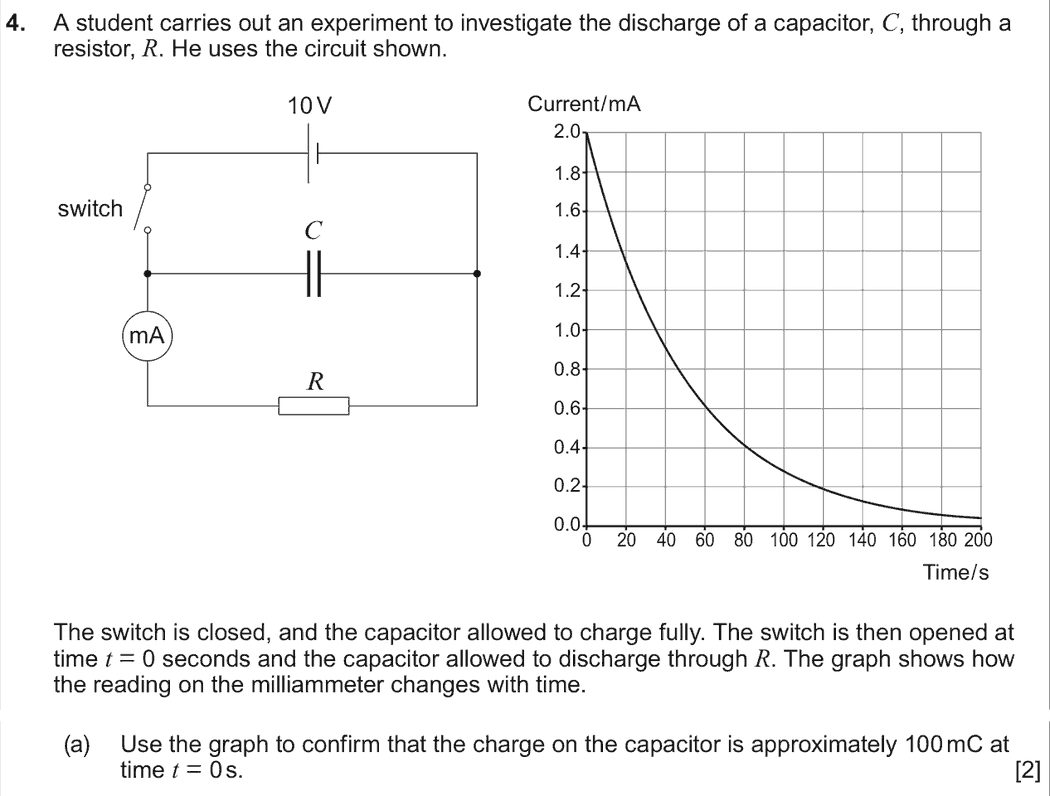
Charge = area under the current-time graph: each square is 0.2 mA × 20 s = 4 mC and there are about 25 squares, so about 100 mC
or time constant 50 s from the initial tangent (or 37% point, 0.74 mA) and Q = I0 × CR = 2.0 mA × 50 s
some did not link area with charge
Scheme columns: Maths 2
Skills: Graphskills Reading, plotting or sketching graphs; gradients, intercepts and areas; Mathsmarks The mark scheme's Maths column gives this part at least one mark for mathematical skills
June 2024 · Component 2 · Q5(c)1 markAO3=1Calculation
Earlier parts of question 5 that this part uses
Mark scheme
Examiner's comment
Nearly all candidates who were able to give an answer to (b)(iii) also gained the mark here, in many cases as ecf on the value of charge obtained in the previous part, and for giving an appropriate consequent response.
Notes from the mark scheme and report
Number of electrons = 6.3 × 10⁻⁹/1.60 × 10⁻¹⁹ = 3.9 × 10¹⁰, tens of billions, so the comment is not justified
ecf on q
Scheme columns: Maths 1
Skills: Mathsmarks The mark scheme's Maths column gives this part at least one mark for mathematical skills
June 2023 · Component 2 · Q2(b)(i)2 marksAO1=1, AO2=1Show that
Earlier part of question 2 that this part uses
Mark scheme
Examiner's comment
Nearly all candidates in (a) were able to explain resistance in terms of collisions between electrons and the lattice (or equivalent). Once again however, a small minority of candidates gave incorrect responses based on collisions between conducting electrons. A variety of valid responses were seen in (b)(ii) with credit given for responses involving at least two relevant substitutions involving I = nAve, l R A = and V = IR. In many cases marks were awarded as Benefit of Doubt (BOD) as the algebra seen was not always clearly laid out. It would be useful for example for candidates to show how particular terms (e.g A) cancel out, rather than just ‘disappearing’. In (iii), a small number of candidates did not gain the mark for not including a unit in their final answer or providing an incorrect unit. Whilst many candidates in (c) identified and explained why n and v were incorrect, fewer made any reference to the fact that ρ and A were correct, thus not fully answering the question. Good attempts were made at answering the issues-based question, with many candidates identifying reduced energy loss during transmission, reduced cooling costs (or easier to cool) and the possibility of a more widespread use of technology such as MRI scanners being amongst the more common responses seen.
Notes from the mark scheme and report
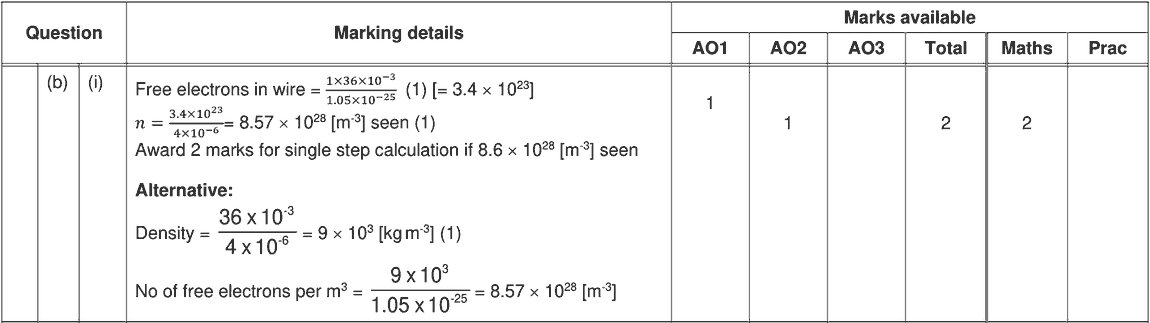
Number of atoms (and free electrons) = 36.0 × 10⁻³/1.05 × 10⁻²⁵ = 3.4 × 10²³ (1)
volume = 2.0 × 2.0 × 10⁻⁶ = 4.0 × 10⁻⁶ m³, so n = 8.57 × 10²⁸ m⁻³ (1)
or via density 9.0 × 10³ kg m⁻³
Scheme columns: Maths 2
Skills: Mathsmarks The mark scheme's Maths column gives this part at least one mark for mathematical skills
June 2023 · Component 2 · Q2(b)(ii)3 marksAO2=3Show that
Earlier parts of question 2 that this part uses
Mark scheme
Examiner's comment
Nearly all candidates in (a) were able to explain resistance in terms of collisions between electrons and the lattice (or equivalent). Once again however, a small minority of candidates gave incorrect responses based on collisions between conducting electrons. A variety of valid responses were seen in (b)(ii) with credit given for responses involving at least two relevant substitutions involving I = nAve, l R A = and V = IR. In many cases marks were awarded as Benefit of Doubt (BOD) as the algebra seen was not always clearly laid out. It would be useful for example for candidates to show how particular terms (e.g A) cancel out, rather than just ‘disappearing’. In (iii), a small number of candidates did not gain the mark for not including a unit in their final answer or providing an incorrect unit. Whilst many candidates in (c) identified and explained why n and v were incorrect, fewer made any reference to the fact that ρ and A were correct, thus not fully answering the question. Good attempts were made at answering the issues-based question, with many candidates identifying reduced energy loss during transmission, reduced cooling costs (or easier to cool) and the possibility of a more widespread use of technology such as MRI scanners being amongst the more common responses seen.
Notes from the mark scheme and report
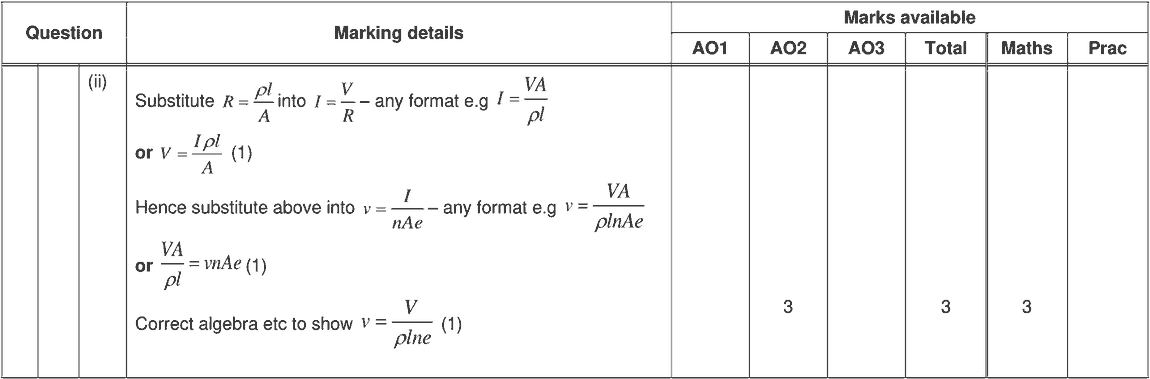
R = ρl/A in I = V/R gives I = VA/ρl (1)
put into I = nAve (1)
A cancels to give v = V/(ρlne) (1)
the cancelling should be shown, many answers were given benefit of doubt
Scheme columns: Maths 3
Skills: Algebra Derivations and rearranging equations; Mathsmarks The mark scheme's Maths column gives this part at least one mark for mathematical skills
June 2023 · Component 2 · Q2(b)(iii)2 marksAO1=1, AO2=1Calculation
Earlier parts of question 2 that this part uses
Mark scheme
Examiner's comment
Nearly all candidates in (a) were able to explain resistance in terms of collisions between electrons and the lattice (or equivalent). Once again however, a small minority of candidates gave incorrect responses based on collisions between conducting electrons. A variety of valid responses were seen in (b)(ii) with credit given for responses involving at least two relevant substitutions involving I = nAve, l R A = and V = IR. In many cases marks were awarded as Benefit of Doubt (BOD) as the algebra seen was not always clearly laid out. It would be useful for example for candidates to show how particular terms (e.g A) cancel out, rather than just ‘disappearing’. In (iii), a small number of candidates did not gain the mark for not including a unit in their final answer or providing an incorrect unit. Whilst many candidates in (c) identified and explained why n and v were incorrect, fewer made any reference to the fact that ρ and A were correct, thus not fully answering the question. Good attempts were made at answering the issues-based question, with many candidates identifying reduced energy loss during transmission, reduced cooling costs (or easier to cool) and the possibility of a more widespread use of technology such as MRI scanners being amongst the more common responses seen.
Notes from the mark scheme and report
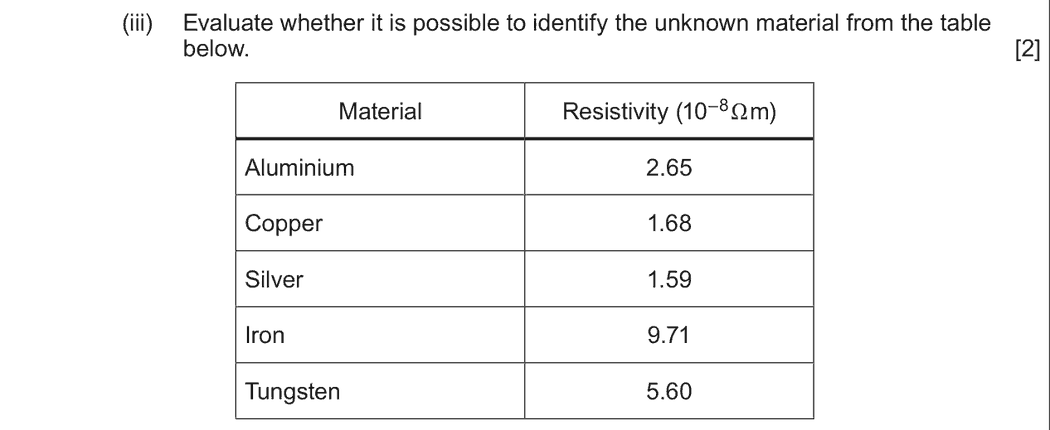
Answer: 2.6 × 10⁻³ m s⁻¹ (2.57 × 10⁻³ with n = 8.57 × 10²⁸
2.45 × 10⁻³ with 9 × 10²⁸). v = 1.2/(1.7 × 10⁻⁸ × 2.0 × n × 1.60 × 10⁻¹⁹)
unit mark
Scheme columns: Maths 2
Skills: Mathsmarks The mark scheme's Maths column gives this part at least one mark for mathematical skills
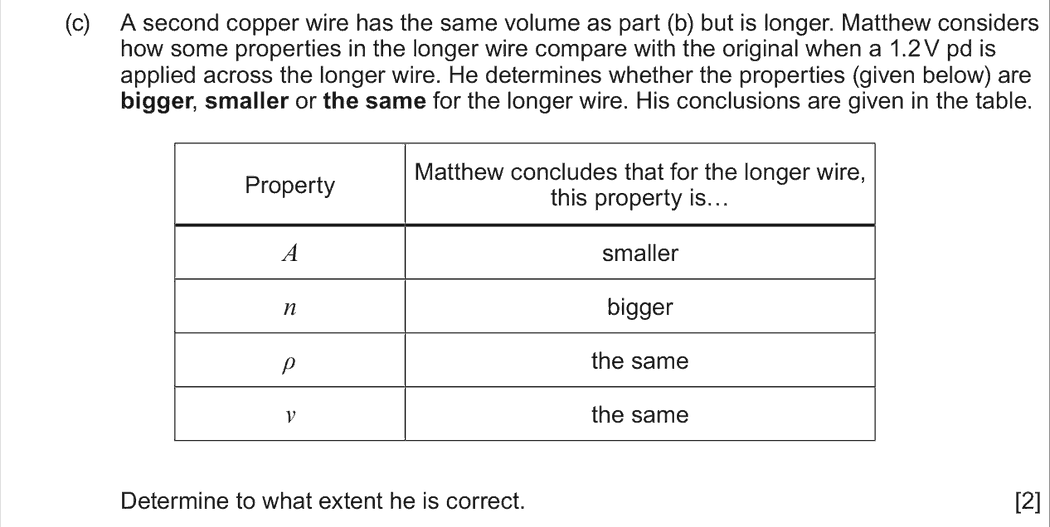
June 2023 · Component 2 · Q2(c)2 marksAO3=2Explanation
Earlier part of question 2 that this part uses
Mark scheme
Examiner's comment
Nearly all candidates in (a) were able to explain resistance in terms of collisions between electrons and the lattice (or equivalent). Once again however, a small minority of candidates gave incorrect responses based on collisions between conducting electrons. A variety of valid responses were seen in (b)(ii) with credit given for responses involving at least two relevant substitutions involving I = nAve, l R A = and V = IR. In many cases marks were awarded as Benefit of Doubt (BOD) as the algebra seen was not always clearly laid out. It would be useful for example for candidates to show how particular terms (e.g A) cancel out, rather than just ‘disappearing’. In (iii), a small number of candidates did not gain the mark for not including a unit in their final answer or providing an incorrect unit. Whilst many candidates in (c) identified and explained why n and v were incorrect, fewer made any reference to the fact that ρ and A were correct, thus not fully answering the question. Good attempts were made at answering the issues-based question, with many candidates identifying reduced energy loss during transmission, reduced cooling costs (or easier to cool) and the possibility of a more widespread use of technology such as MRI scanners being amongst the more common responses seen.
Notes from the mark scheme and report
n should be 'the same' (a property of copper) and v should be 'smaller' (v = V/ρlne with a larger l) (1)
A smaller and ρ the same are correct (1)
many forgot to say which conclusions were right
June 2023 · AS Component 2 · Q5(a)1 markAO1=1Definition
Mark scheme
Examiner's comment
Parts (a) and (b) were answered well with nearly all the candidates being able to derive the equation I = nAve. In part (c) the explanation for the change in drift velocity did not refer to the motion of the free electrons.
Notes from the mark scheme and report
Rate of flow of charge
June 2023 · AS Component 2 · Q5(b)(i)4 marksAO1=4Explanation
Earlier part of question 5 that this part uses
Mark scheme
Examiner's comment
Parts (a) and (b) were answered well with nearly all the candidates being able to derive the equation I = nAve. In part (c) the explanation for the change in drift velocity did not refer to the motion of the free electrons.
Notes from the mark scheme and report
Labelled diagram of a section of wire of area A and length vt (1)
number of free electrons in it = nAvt (1)
charge passing in time t = nAvte (1)
I = Q/t = nAve (1)
Scheme columns: Maths 2
Skills: Algebra Derivations and rearranging equations; Mathsmarks The mark scheme's Maths column gives this part at least one mark for mathematical skills
June 2023 · AS Component 2 · Q5(b)(ii)2 marksAO2=2Calculation
Earlier parts of question 5 that this part uses
Mark scheme
Examiner's comment
Parts (a) and (b) were answered well with nearly all the candidates being able to derive the equation I = nAve. In part (c) the explanation for the change in drift velocity did not refer to the motion of the free electrons.
Skills: Unitsand conversions Unit marks, base units, prefixes and conversions; Mathsmarks The mark scheme's Maths column gives this part at least one mark for mathematical skills
June 2023 · AS Component 2 · Q5(c)(i)3 marksAO3=3Explanation
Earlier part of question 5 that this part uses
Mark scheme
Examiner's comment
Parts (a) and (b) were answered well with nearly all the candidates being able to derive the equation I = nAve. In part (c) the explanation for the change in drift velocity did not refer to the motion of the free electrons.
Notes from the mark scheme and report
The ions vibrate with more energy at the higher temperature (1)
free electrons collide with the ions more often (1)
so the drift velocity falls and Alexander is wrong (1)
answers often did not refer to the electrons' motion
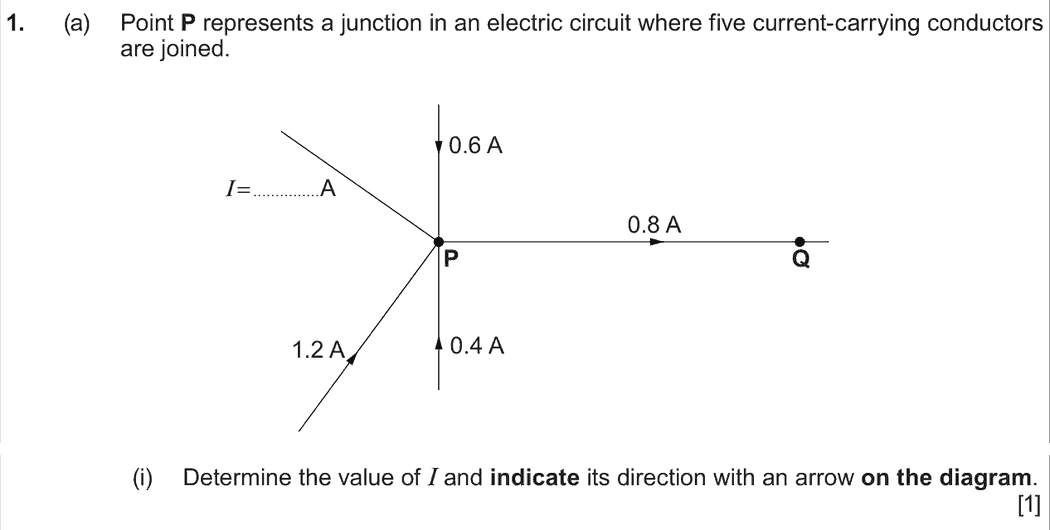
June 2022 · Component 2 · Q1(a)(ii)1 markAO2=1Calculation
Earlier part of question 1 that this part uses
Mark scheme
Examiner's comment
Nearly all candidates applied the concept of conservation of charge at a junction correctly to find the required current and give its direction. Nearly all candidates were successful in calculating the number of electrons passing point Q in one second.
Notes from the mark scheme and report
Answer: 5 × 10¹⁸ electrons. Charge in one second = 0.8 C
n = 0.8/1.6 × 10⁻¹⁹
Scheme columns: Maths 1
Skills: Mathsmarks The mark scheme's Maths column gives this part at least one mark for mathematical skills
June 2022 · AS Component 2 · Q3(a)2 marksAO1=1, AO2=1Calculation
Mark scheme
Notes from the mark scheme and report
Answer: 144 C (Q = It = 0.16 × 15 × 60)
Scheme columns: Maths 1
Skills: Unitsand conversions Unit marks, base units, prefixes and conversions; Mathsmarks The mark scheme's Maths column gives this part at least one mark for mathematical skills
October 2021 · Component 2 · Q2(c)1 markAO2=1Calculation
Skills: Mathsmarks The mark scheme's Maths column gives this part at least one mark for mathematical skills; Practicalmarks The mark scheme's Prac column gives this part at least one mark for practical skills
October 2021 · Component 3 · Q6(b)(ii)2 marksAO2=2Calculation
current as rate of flow of charge is Component 2 content
Scheme columns: Maths 2
Skills: Synoptic Needs physics from another component of the qualification; Unitsand conversions Unit marks, base units, prefixes and conversions; Mathsmarks The mark scheme's Maths column gives this part at least one mark for mathematical skills
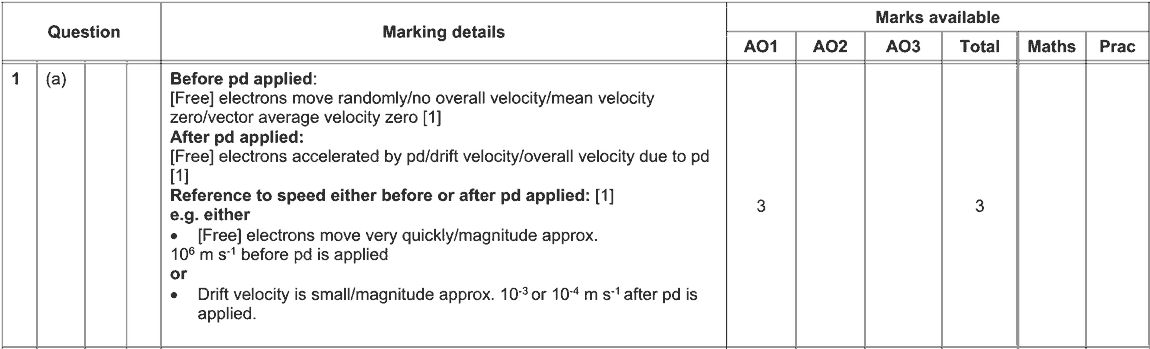
October 2020 · Component 2 · Q1(a)3 marksAO1=3Explanation
Mark scheme
Examiner's comment
Many candidates were able to distinguish between thermal and drift motions of electrons in a metal. Very few however made any reference to the comparative magnitude of these velocities. Around half of the candidates were able to derive the formula I = nave fully from first principles, using an appropriate diagram. In part (c), only a minority were able to clearly determine the ratio of velocities correctly. An inability to convert the given data regarding diameters into cross-sectional area was the main cause of error for many.
Notes from the mark scheme and report
Before: free electrons move randomly, so their mean (vector) velocity is zero (1)
after: they are accelerated by the pd and gain a drift velocity along the wire (1)
reference to speeds: random thermal speeds are very high (about 10⁶ m s⁻¹) or the drift velocity is very small (about 10⁻⁴ m s⁻¹) (1)
the comparison of magnitudes was rarely made
October 2020 · Component 2 · Q1(b)(i)4 marksAO1=4Show that
Earlier part of question 1 that this part uses
Mark scheme
Examiner's comment
Many candidates were able to distinguish between thermal and drift motions of electrons in a metal. Very few however made any reference to the comparative magnitude of these velocities. Around half of the candidates were able to derive the formula I = nave fully from first principles, using an appropriate diagram. In part (c), only a minority were able to clearly determine the ratio of velocities correctly. An inability to convert the given data regarding diameters into cross-sectional area was the main cause of error for many.
Notes from the mark scheme and report
Labelled diagram of a length l = vt of wire of area A
volume = Avt (1)
number of free electrons = nAvt (1)
charge = nAvte (1)
I = Q/t = nAve (1)
about half gave a full derivation
Scheme columns: Maths 1
Skills: Algebra Derivations and rearranging equations; Mathsmarks The mark scheme's Maths column gives this part at least one mark for mathematical skills
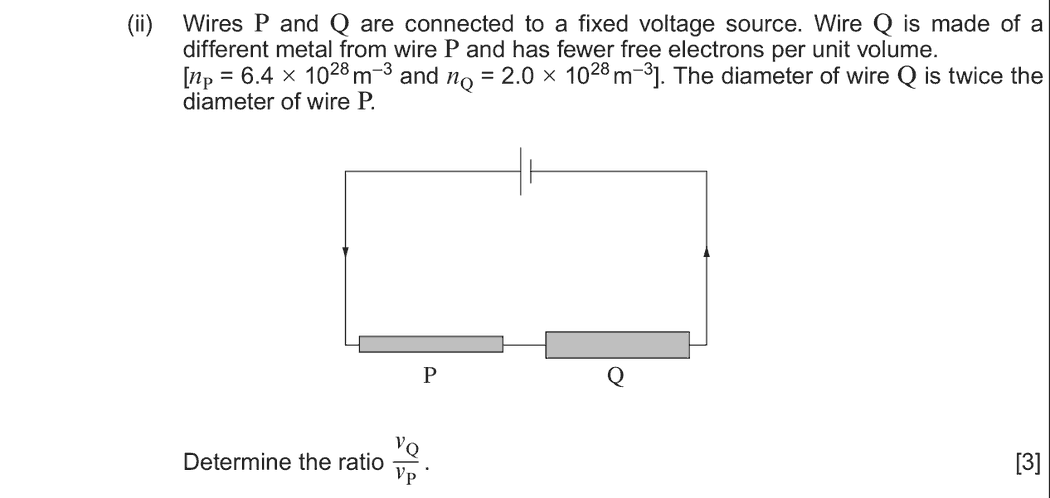
October 2020 · Component 2 · Q1(b)(ii)3 marksAO1=1, AO2=2Calculation
Earlier parts of question 1 that this part uses
Mark scheme
Examiner's comment
Many candidates were able to distinguish between thermal and drift motions of electrons in a metal. Very few however made any reference to the comparative magnitude of these velocities. Around half of the candidates were able to derive the formula I = nave fully from first principles, using an appropriate diagram. In part (c), only a minority were able to clearly determine the ratio of velocities correctly. An inability to convert the given data regarding diameters into cross-sectional area was the main cause of error for many.
Notes from the mark scheme and report
Answer: vQ/vP = 0.8. Wires in series so IP = IQ: nP AP vP = nQ AQ vQ
double the diameter gives AQ = 4AP
6.4 × A × vP = 2.0 × 4A × vQ
turning the diameter ratio into an area ratio was the main error
Scheme columns: Maths 3
Skills: Algebra Derivations and rearranging equations; Mathsmarks The mark scheme's Maths column gives this part at least one mark for mathematical skills
June 2019 · AS Component 2 · Q4(b)(i)4 marksAO1=4Explanation
Earlier parts of question 4 that this part uses
Mark scheme
Notes from the mark scheme and report
Current is a flow (drift) of free electrons (1)
the flow is impeded by collisions with the ions of the lattice (1)
at higher temperature the collisions are more frequent (1) because the ions vibrate more (or the random speed of the electrons increases), so resistance rises and the current falls at fixed pd (1)
June 2019 · Component 3 · Q9(b)2 marksAO2=2Calculation
Earlier part of question 9 that this part uses
Mark scheme
Examiner's comment
Very well answered.
Notes from the mark scheme and report
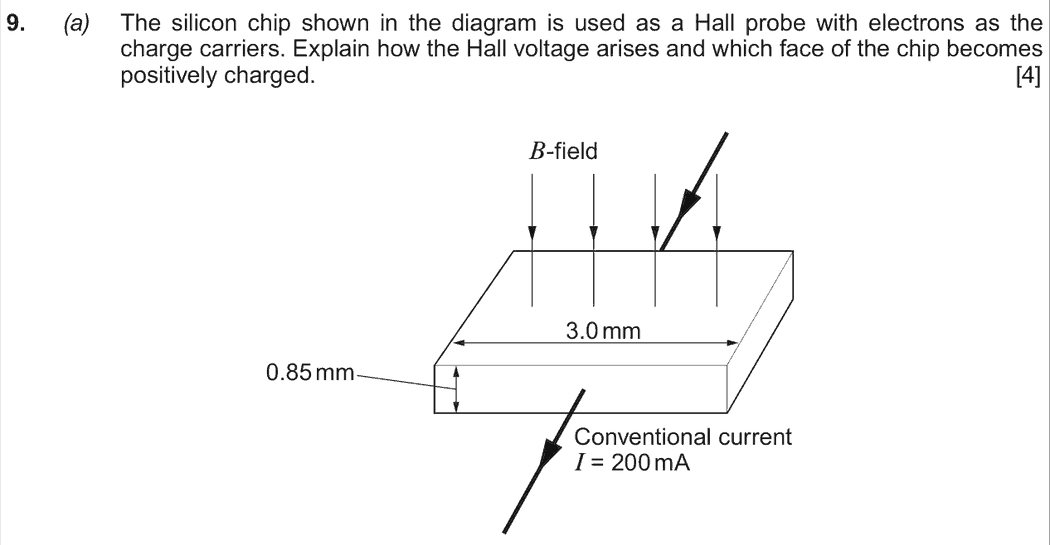
Answer: 0.204 m s⁻¹. v = I/nAe with A = 3.0 × 10⁻³ × 0.85 × 10⁻³ m²: 0.200/(2.4 × 10²⁴ × 2.55 × 10⁻⁶ × 1.6 × 10⁻¹⁹). I = nAve is Component 2 content
Scheme columns: Maths 2
Skills: Synoptic Needs physics from another component of the qualification; Unitsand conversions Unit marks, base units, prefixes and conversions; Mathsmarks The mark scheme's Maths column gives this part at least one mark for mathematical skills
June 2018 · Component 1 · Q9(a)4 marksAO1=4Explanation
Mark scheme
Examiner's comment
The common features of the electrons’ motion with and without the electric field, and the differences, were usually summarised well.
Notes from the mark scheme and report
Without a field: fast random motion with collisions (1), mean velocity zero or no preferred direction (1). With a field, any two: random motion still present
slight acceleration between collisions
a drift velocity (2)
Skills: Comprehension A level Component 1 Section B: questions on the printed article; Synoptic Needs physics from another component of the qualification
June 2018 · Component 1 · Q9(d)2 marksAO2=2Calculation
Earlier part of question 9 that this part uses
Mark scheme
Examiner's comment
Few difficulties were encountered in finding E using the given equation, even with given in fs.
Notes from the mark scheme and report
Answer: 0.071 V m⁻¹ (or N C⁻¹, unit needed). Rearrange Equation 4 for E with τ = 40 × 10⁻¹⁵ s and v = 0.25 × 10⁻³ m s⁻¹
one mark lost for a power-of-ten slip
Scheme columns: Maths 1
Skills: Comprehension A level Component 1 Section B: questions on the printed article; Unitsand conversions Unit marks, base units, prefixes and conversions; Mathsmarks The mark scheme's Maths column gives this part at least one mark for mathematical skills
June 2018 · Component 1 · Q9(f)2 marksAO2=2Calculation
Earlier part of question 9 that this part uses
Mark scheme
Examiner's comment
There were a few arithmetical slips and occasional algebraic blunders, but the calculation of was generally done well.
Skills: Comprehension A level Component 1 Section B: questions on the printed article; Algebra Derivations and rearranging equations; Mathsmarks The mark scheme's Maths column gives this part at least one mark for mathematical skills
June 2018 · Component 2 · Q2(a)(i)1 markAO1=1Definition
Mark scheme
Examiner's comment
The majority of candidates gave a correct explanation for the term ‘electric current’. Common reasons for not awarding the mark included giving an equation in symbol form without defining the symbols, describing electric current merely as a flow of electrons or making more than one reference to time e.g. ‘The rate of flow of charge per unit time’ was not accepted.
Notes from the mark scheme and report
Rate of flow of charge
I = ΔQ/Δt accepted only with symbols defined
'flow of electrons' and 'rate of flow of charge per unit time' were rejected
June 2018 · AS Component 2 · Q4(a)1 markAO1=1Definition
Mark scheme
Examiner's comment
This was generally answered well with the many candidates giving the correct definition of electric current.
Notes from the mark scheme and report
Rate of flow of (electric) charge
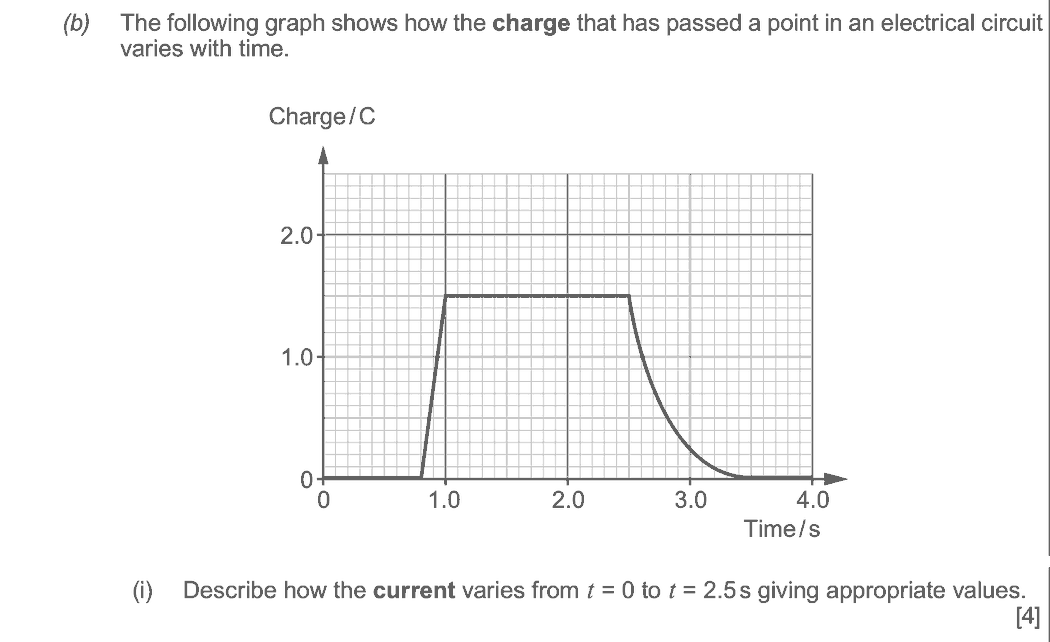
June 2018 · AS Component 2 · Q4(b)(i)4 marksAO2=4Explanation
Earlier part of question 4 that this part uses
Mark scheme
Examiner's comment
Only the more able candidates were able to gain full marks for this part. Nearly all the candidates were able to state that the current is zero for the period 0 0.8 s. But frequently candidates were able to give a value for the current for the range 0.8 s 1.0 s as well as stating that the current is zero for the time 1.0 s 2.5 s.
Notes from the mark scheme and report
Current = gradient of the charge-time graph. Zero from 0 to 0.8 s (1)
sudden rise at 0.8 s (1) to 1.5/0.2 = 7.5 A between 0.8 and 1.0 s (1)
zero again from 1.0 to 2.5 s (1). The 7.5 A value and the second zero were often missing
Skills: Graphskills Reading, plotting or sketching graphs; gradients, intercepts and areas
June 2018 · AS Component 2 · Q4(b)(ii)3 marksAO3=3Calculation
Earlier parts of question 4 that this part uses
Mark scheme
Examiner's comment
Many candidates did not draw a tangent to the graph for this part and simply determined the mean value of the current up to that point.
Notes from the mark scheme and report
Answer: 1.0 ± 0.1 A. Draw a tangent to the curve at t = 3.0 s and find its gradient (sign ignored)
many instead found a mean current up to that time
Scheme columns: Maths 3
Skills: Graphskills Reading, plotting or sketching graphs; gradients, intercepts and areas; Mathsmarks The mark scheme's Maths column gives this part at least one mark for mathematical skills
June 2017 · Component 2 · Q2(c)(i)1 markAO1=1Definition
Earlier parts of question 2 that this part uses
Mark scheme
Examiner's comment
A disappointing response. Few candidates could state the meaning of n correctly. In many cases the term ‘free’ (or equivalent e.g. delocalised) and/or ‘per m3’ (or equivalent) were omitted.
Notes from the mark scheme and report
Number of free electrons per unit volume (free electron density)
'free' and 'per m³' were commonly left out
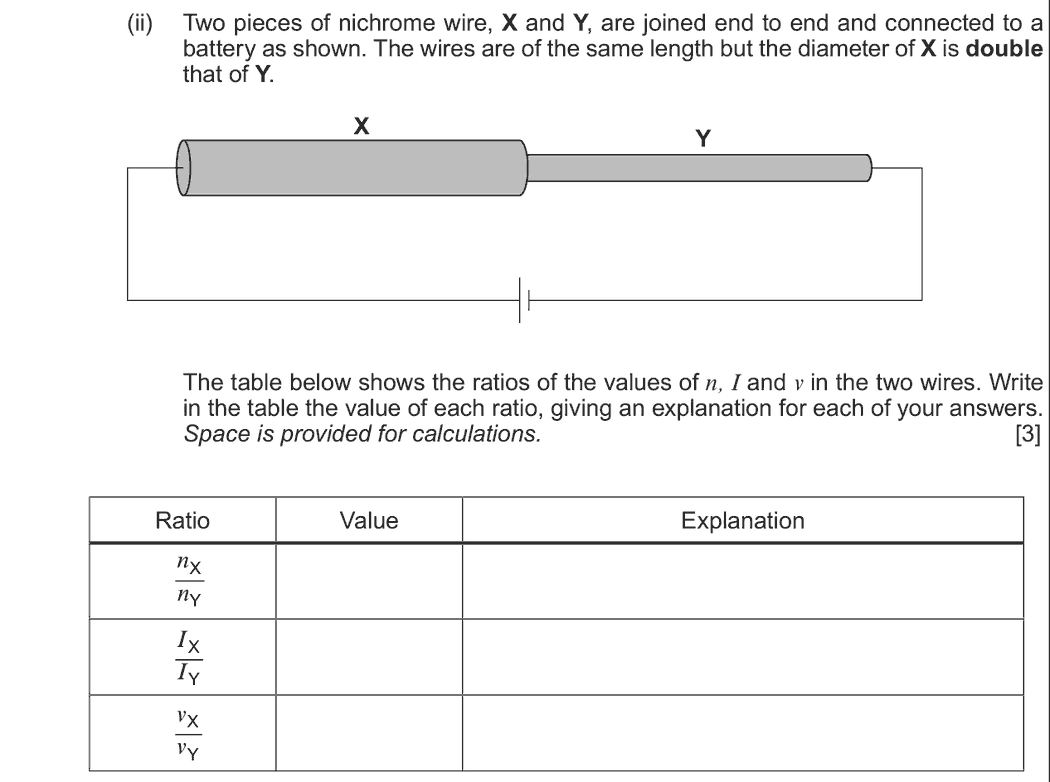
June 2017 · Component 2 · Q2(c)(ii)3 marksAO1=2, AO2=1Short answer
Earlier parts of question 2 that this part uses
Mark scheme
Examiner's comment
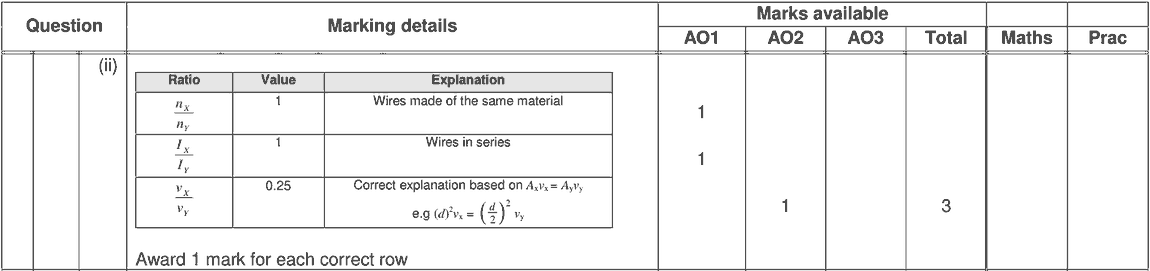
Few candidates gained full marks for these sections. About half gave correct values for the ratios X Y n n and X Y
Notes from the mark scheme and report
n ratio = 1 (same material)
I ratio = 1 (wires in series)
v ratio = 0.25 because A(X)v(X) = A(Y)v(Y) and X has double the diameter so four times the area. One mark per correct row with explanation
Skills: Algebra Derivations and rearranging equations
June 2017 · AS Component 2 · Q4(a)4 marksAO1=1, AO2=3Calculation
Mark scheme
Examiner's comment
This was also answered well with nearly all the candidates able to score marks on the question. Marks were lost for not determining n correctly and also using the diameter value incorrectly when using the area of a circle.
Notes from the mark scheme and report
Answer: 5.0 × 10⁻⁴ m s⁻¹. A = π(0.25 × 10⁻³)² = 1.96 × 10⁻⁷ m²
n = 3 × 6.0 × 10²⁸ = 1.8 × 10²⁹ m⁻³
v = I/nAe
unit mark. Errors: n not multiplied by 3, diameter used as radius
Scheme columns: Maths 4
Skills: Unitsand conversions Unit marks, base units, prefixes and conversions; Mathsmarks The mark scheme's Maths column gives this part at least one mark for mathematical skills
June 2017 · AS Component 2 · Q4(b)3 marksAO3=3Explanation
Earlier part of question 4 that this part uses
Mark scheme
Examiner's comment
This was also answered well by nearly all the candidates. They were able to determine that the drift velocity would be greater. However, some omitted the fact that the current as well as n and e would stay constant in the thin section.
Notes from the mark scheme and report
Current is the same along the wire, and n and e are unchanged (1)
cross-sectional area is smaller in the thin section (1)
so v = I/nAe is greater and Paula is correct (1). The constant I, n and e point was often omitted
June 2017 · Component 2 · Q5(b)(ii)2 marksAO3=2Show that
Earlier parts of question 5 that this part uses
Mark scheme
Examiner's comment
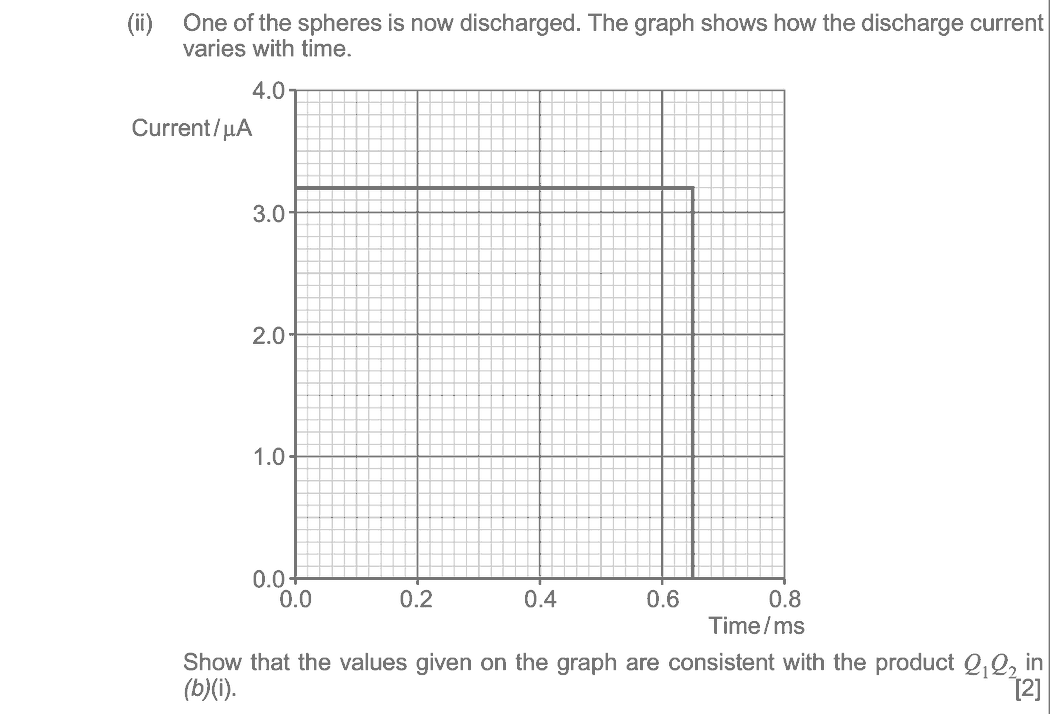
Again, nearly all candidates could show that the area under the graph was consistent with the product Q1Q2.
Notes from the mark scheme and report
Charge = area under the current-time graph = 3.2 × 10⁻⁶ × 0.65 × 10⁻³ = 2.08 × 10⁻⁹ C
equal charges so Q = √(4.36 × 10⁻¹⁸) = 2.09 × 10⁻⁹ C, in agreement (or square the area to get 4.3 × 10⁻¹⁸ C²)
Scheme columns: Maths 2, Practical 2
Skills: Graphskills Reading, plotting or sketching graphs; gradients, intercepts and areas; Mathsmarks The mark scheme's Maths column gives this part at least one mark for mathematical skills; Practicalmarks The mark scheme's Prac column gives this part at least one mark for practical skills
June 2017 · Component 2 · Q5(b)(iii)1 markAO2=1Calculation
Earlier parts of question 5 that this part uses
Mark scheme
Examiner's comment
Nearly all candidates were successful in estimating the number of electrons on one sphere. Sometimes the mark was awarded as ecf from (ii).
Skills: Mathsmarks The mark scheme's Maths column gives this part at least one mark for mathematical skills; Practicalmarks The mark scheme's Prac column gives this part at least one mark for practical skills
Work with an Eduqas physics tutor
Dropping marks on calculations, specified practicals or the six-mark QER questions? Book a trial session with a specialist Eduqas physics tutor.