Notes and key-term cards for this topic are being written by our tutors. The past-paper questions below are ready now.
Specification statements
Show the 7 statements from the specification
1.3-a the concept of force and Newton's 3rd law of motion
1.3-b how free body diagrams can be used to represent forces on a particle or body
1.3-c the use of the relationship F = ma in situations where mass is constant
1.3-d the idea that linear momentum is the product of mass and velocity
1.3-e the concept that force is the rate of change of momentum, applying this in situations where mass is constant
1.3-f the principle of conservation of momentum and use it to solve problems in one dimension involving elastic collisions (where there is no loss of kinetic energy) and inelastic collisions (where there is a loss of kinetic energy)
1.3-P1 Specified practical: Investigation of Newton’s 2nd law
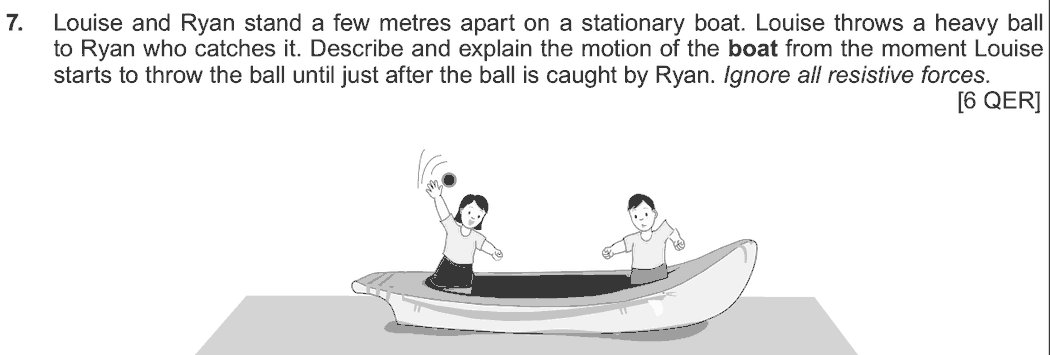
. Louise and Ryan stand a few metres apart on a stationary boat. Louise throws a heavy ball to Ryan who catches it. Describe and explain the motion of the boat from the moment Louise starts to throw the ball until just a
Tap a question to zoom it. Where a part needs a figure, table or graph from earlier in the question, that part folds out above it; the mark scheme and examiner's comment open underneath. Have the Eduqas Data Booklet beside you (see the Data Booklet page).
June 2025 · Component 1 · Q2(b)(i)1 markAO1=1Definition
Earlier part of question 2 that this part uses
Mark scheme
Examiner's comment
This was generally well answered but there were also quite a few weaker responses where candidates had not learnt the momentum definition. Some used the equation from the data booklet. We only accepted this if it was written in words.
Notes from the mark scheme and report
Product of mass and velocity
the data-booklet equation only if written in words
June 2025 · Component 1 · Q2(b)(ii)2 marksAO1=2Definition
Earlier parts of question 2 that this part uses
Mark scheme
Examiner's comment
This recall question was found to be a little trickier. Some candidates omitted the word ‘resultant’ (we did accept ‘net’) and were held back. More candidates missed the directional element of this. Future candidates should be advised to use the WJEC definitions booklet when preparing for these types of questions.
Notes from the mark scheme and report
The rate of change of momentum of a body is proportional to the resultant (net) force acting on it (1) and takes place in the direction of that force (1)
an equation with named terms scores 1
'resultant' and the direction were often missing
June 2025 · Component 1 · Q2(b)(iii)2 marksAO2=2Calculation
Earlier parts of question 2 that this part uses
Mark scheme
Examiner's comment
This was well answered with the first two methods on the MS being used most regularly.
Notes from the mark scheme and report
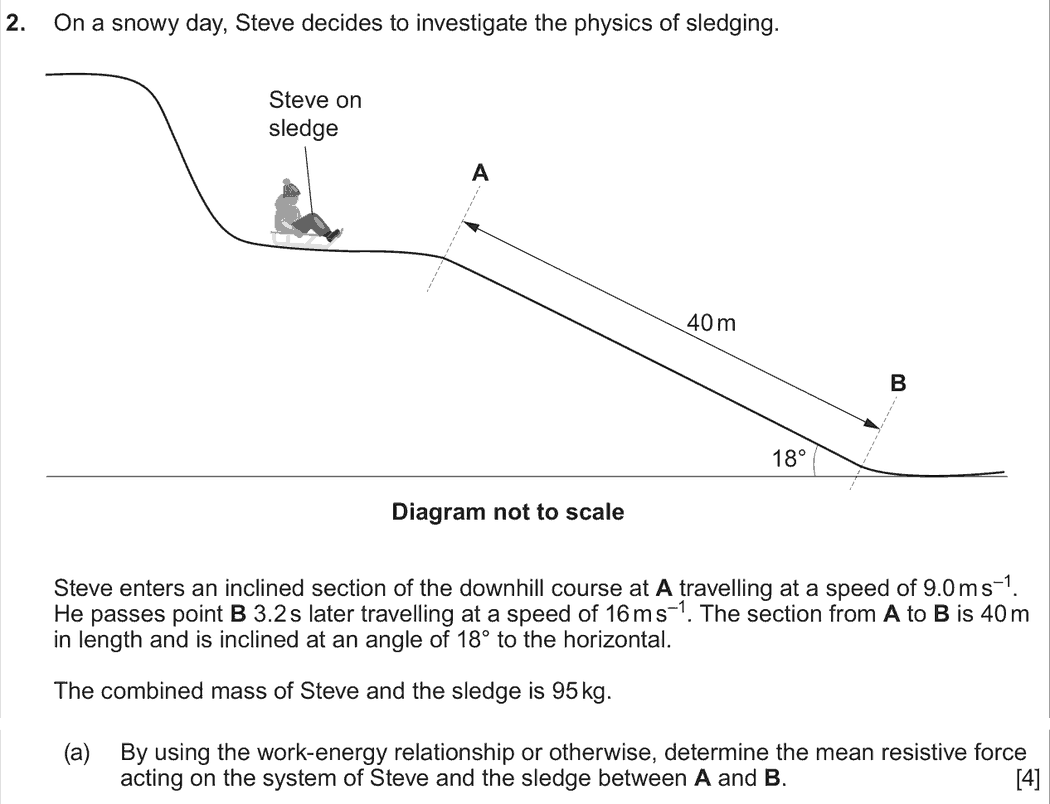
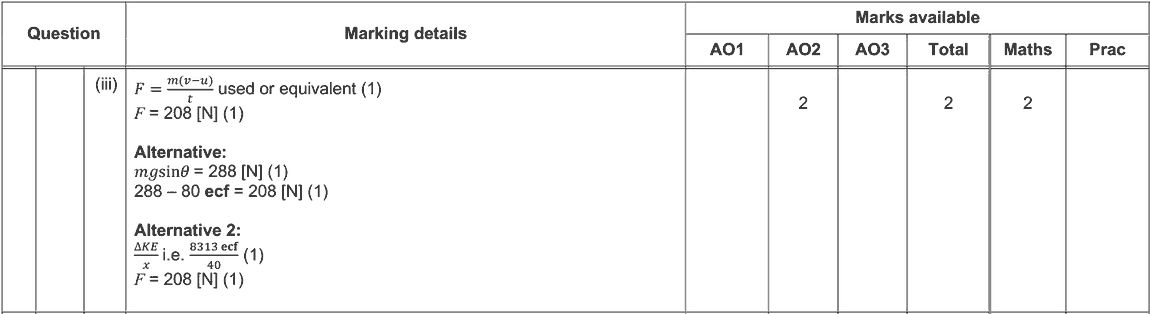
Answer: 208 N. F = m(v − u)/t = 95 × (16 − 9.0)/3.2
or 288 − 80 N
or change in KE/distance = 8313/40
Scheme columns: Maths 2
Skills: Mathsmarks The mark scheme's Maths column gives this part at least one mark for mathematical skills
June 2025 · AS Component 1 · Q5(b)(ii)2 marksAO1=1, AO2=1Calculation
Earlier parts of question 5 that this part uses
Mark scheme
Notes from the mark scheme and report
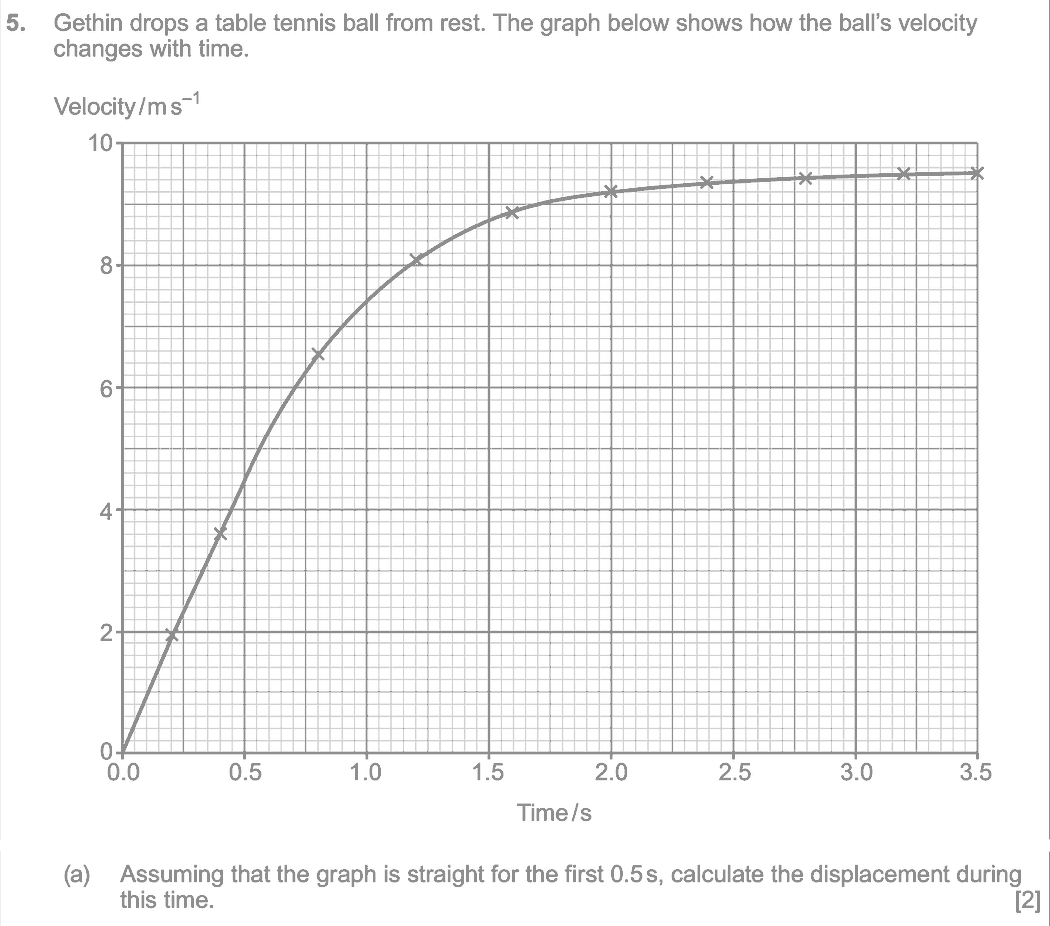
Answer: about 0.010 N (9.9 × 10⁻³ N with the scheme's 3.68 m s⁻²
0.011 N with 4.0). F = ma = 2.7 × 10⁻³ × acceleration from (i)
ecf
Scheme columns: Maths 2, Practical 2
Skills: Unitsand conversions Unit marks, base units, prefixes and conversions; Mathsmarks The mark scheme's Maths column gives this part at least one mark for mathematical skills; Practicalmarks The mark scheme's Prac column gives this part at least one mark for practical skills
June 2025 · AS Component 1 · Q5(b)(iii)3 marksAO2=3Calculation
Earlier parts of question 5 that this part uses
Mark scheme
Notes from the mark scheme and report
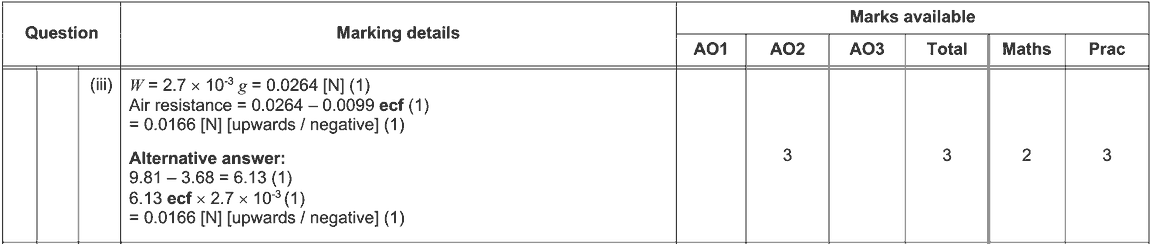
Answer: 0.017 N upwards. Weight = 2.7 × 10⁻³ × 9.81 = 0.0265 N
air resistance = weight − resultant force = 0.0265 − 0.0099
or m(g − a)
ecf
Scheme columns: Maths 2, Practical 3
Skills: Mathsmarks The mark scheme's Maths column gives this part at least one mark for mathematical skills; Practicalmarks The mark scheme's Prac column gives this part at least one mark for practical skills
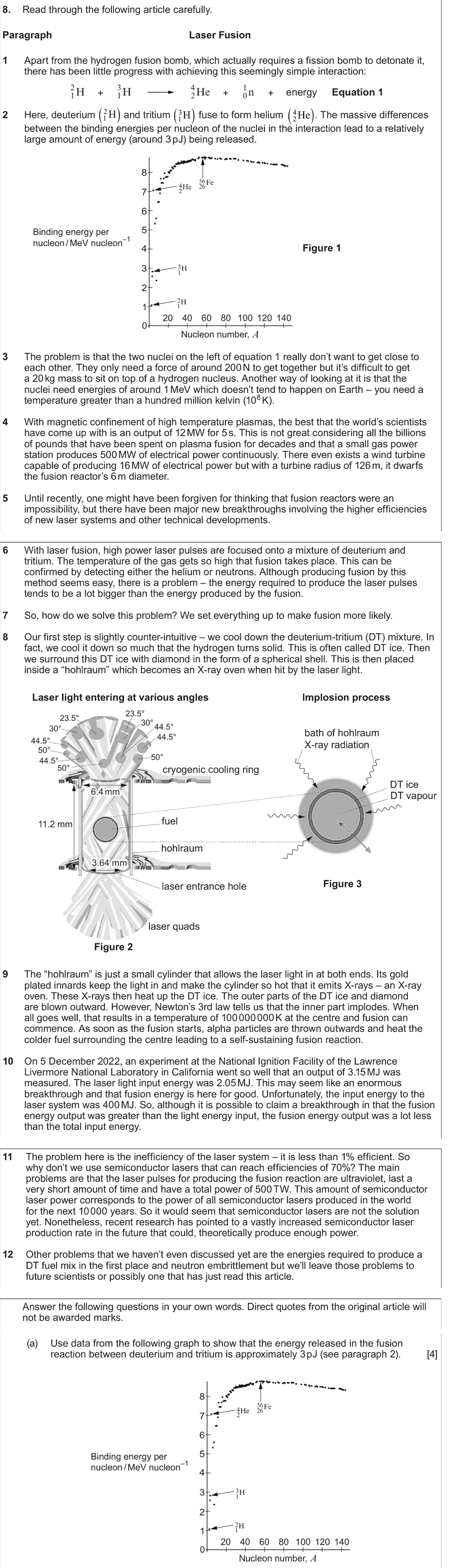
June 2025 · Component 1 · Q8(e)2 marksAO2=2Explanation
Earlier part of question 8 that this part uses
Mark scheme
Examiner's comment
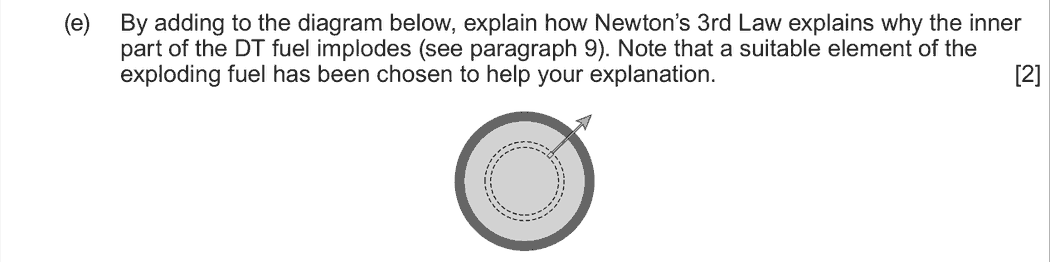
We saw some lovely answers in this demanding question. We credited end to end arrows for the 1st MP. This was sometimes left blank. General Newton third law statements were not enough on their own. We were looking for candidates to consider the two objects that were applying forces on each other. An example that did gain credit was ‘force of element on outer fuel is equal and opposite to force of outer fuel on element which acts back towards the centre’. The implosion is clearly implied. It should be noted for future candidates that direct quotes will not be awarded marks on the comprehension question. There were a few examples of this here.
Notes from the mark scheme and report
Arrow added on the element pointing the opposite way (towards the centre), end to end with the given one (1)
the element pushes the outer fuel outwards, so the outer fuel pushes back on it with an equal and opposite force directed inwards, which drives the implosion (1). General statements of the law, or quotes from the article, not credited
Skills: Comprehension A level Component 1 Section B: questions on the printed article
June 2025 · Component 2 · Q4(b)(ii)3 marksAO3=3Calculation
Earlier parts of question 4 that this part uses
Mark scheme
Notes from the mark scheme and report
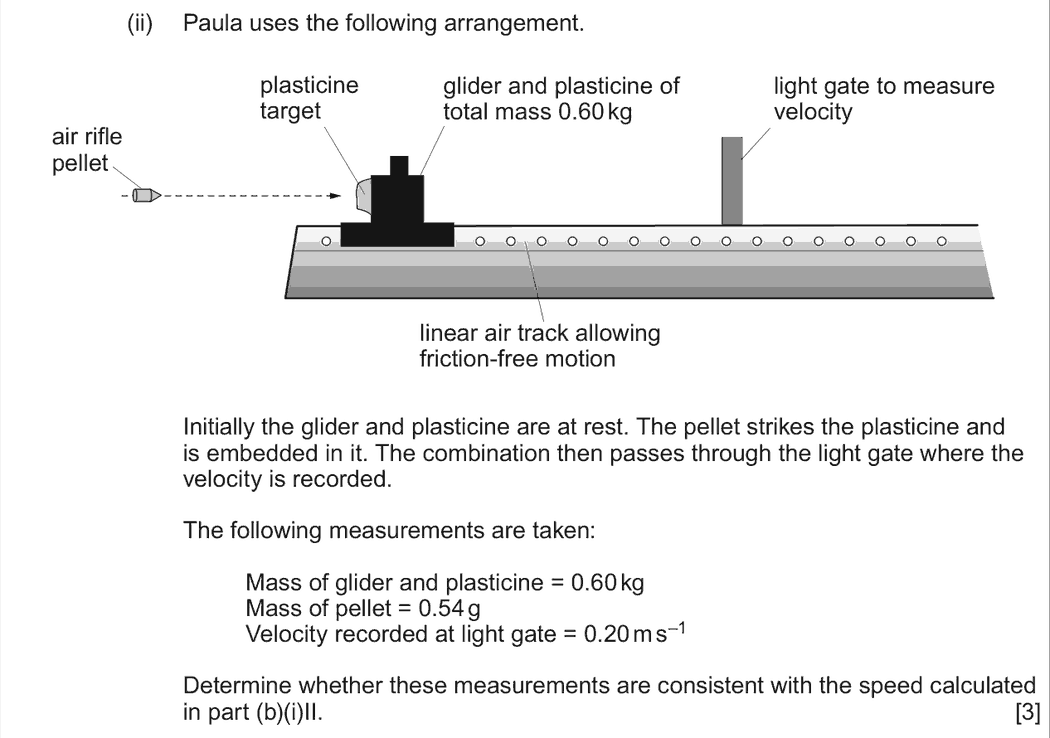
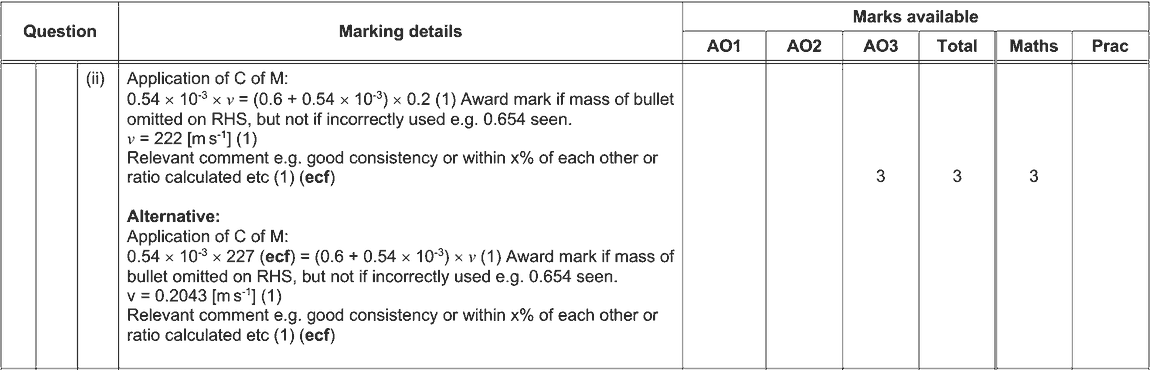
Answer: 222 m s⁻¹, consistent. Conservation of momentum: 0.54 × 10⁻³ × v = (0.60 + 0.54 × 10⁻³) × 0.20 (1)
v = 222 m s⁻¹ (1)
within about 2% of 227 m s⁻¹, so consistent (1)
or work forward from 227 to get 0.204 m s⁻¹
momentum is Component 1 content
Scheme columns: Maths 3
Skills: Synoptic Needs physics from another component of the qualification; Unitsand conversions Unit marks, base units, prefixes and conversions; Mathsmarks The mark scheme's Maths column gives this part at least one mark for mathematical skills
June 2024 · AS Component 1 · Q1(b)(ii)2 marksAO2=2Short answer
Earlier parts of question 1 that this part uses
Mark scheme
Examiner's comment
This was a nice straightforward start to the paper. It was generally very well answered with the vast majority understanding the difference between vectors and scalars and applying Pythagoras correctly. It was pleasing to see in (b)(i) that candidates included the angle with the magnitude. However, in (b)(ii) a number only obtained one mark because they did not include the direction.
Notes from the mark scheme and report
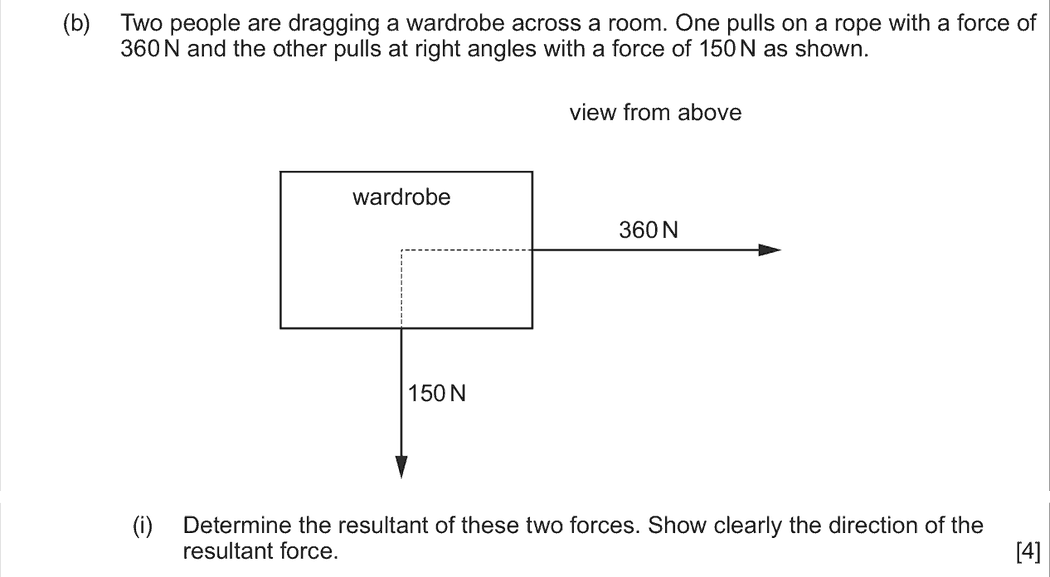
Answer: 390 N in the opposite direction to the resultant pull (zero resultant force at constant velocity)
ecf from (i)
a number gave the size without the direction and scored 1
June 2024 · Component 1 · Q3(b)(i)3 marksAO2=3Diagram or graphEasy
Earlier part of question 3 that this part uses
Mark scheme
Examiner's comment
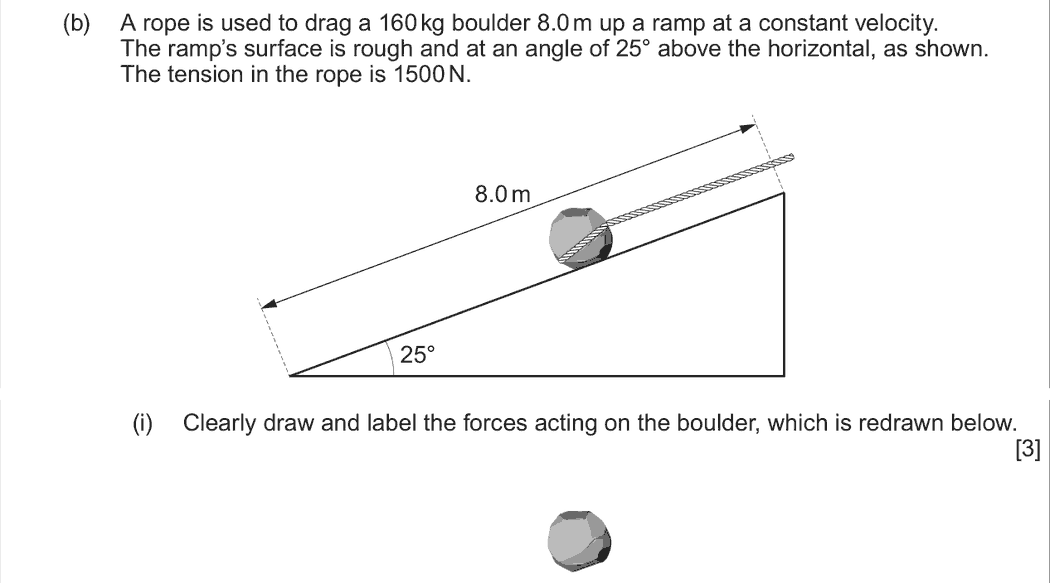
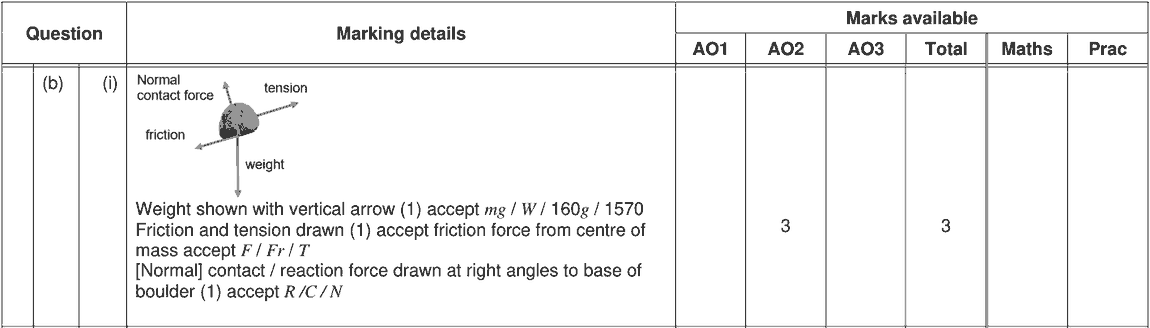
When marking these responses, we were looking for arrows that originated from the boulder. Any gaps between the arrows and the boulder resulted in a marking penalty. ‘Gravity’ was not accepted. The ‘normal contact force’ should have been drawn at right angles to the base of the boulder but there was some leniency in this because of the boulders shape. Some candidates that correctly added ‘Friction’ and ‘Tension’ sometimes lost the ‘normal contact force’ mark as it was not drawn at right angles. The use of rulers was evident in most cases. Correct letters were accepted as the named forces.
Notes from the mark scheme and report
Weight vertically down (mg or W
'gravity' not accepted)
friction and tension along the slope
normal contact force at right angles to the base of the boulder
arrows must start on the boulder
June 2023 · Component 1 · Q3(b)4 marksAO1=1, AO2=3Calculation
Earlier part of question 3 that this part uses
Mark scheme
Examiner's comment
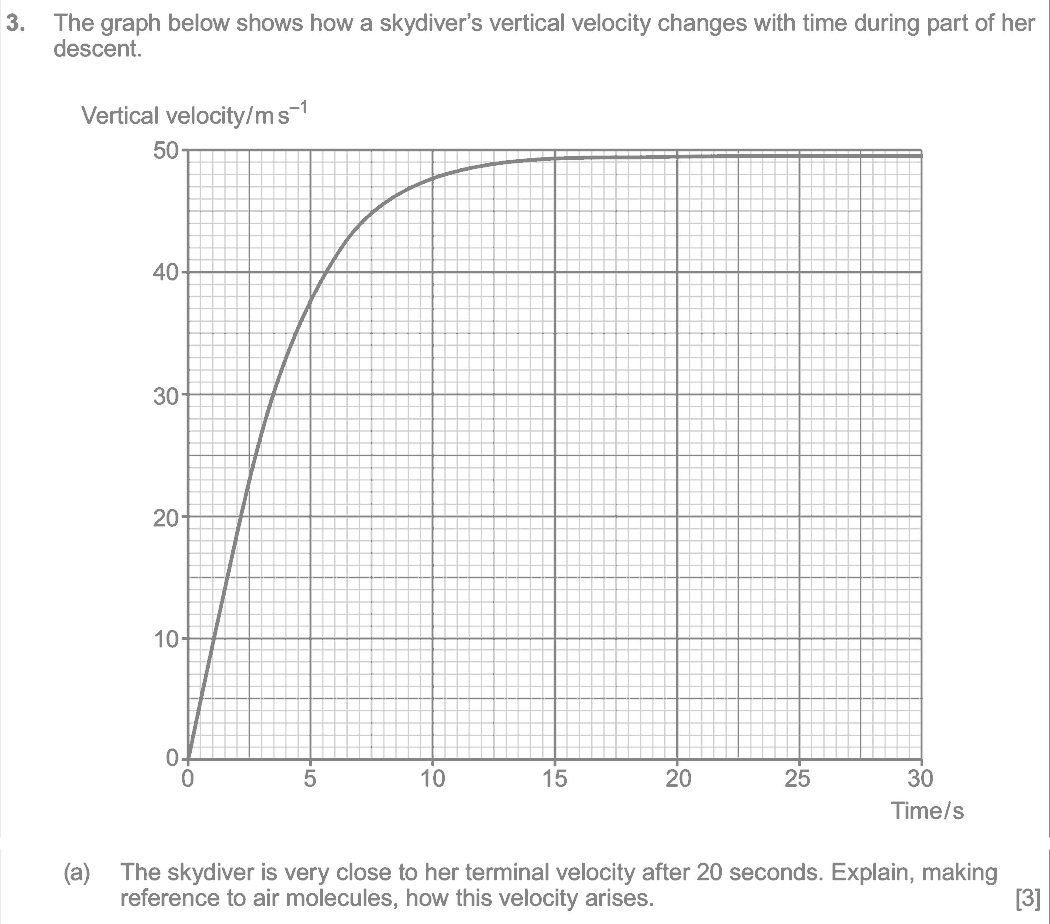
Most candidates in (a) were able to link an increased velocity to an increased drag force. Less mentioned the greater collision rate. More were comfortable in explaining how the resultant force would eventually reach zero. This was done in several ways with many candidates referring to the ‘drag force balancing mg’. In part (b) most were able to draw a suitable tangent and achieve a value within tolerance. Some candidates went on to use their value to calculate the resultant force but went no further. The appreciation of ‘mg – ma’ was the important final step here. In the last part most candidates showed good responses regarding the ethical use of this money. Some responses gave a balanced argument, but most were loaded in favour of spending money on these parachutes. They were able to access full marks with a one-sided discussion.
Notes from the mark scheme and report
Answer: about 520 N. Tangent at 7 s gives a = 2.1 ± 0.4 m s⁻²
resultant force = ma = 68 × 2.1 = 143 N
ma = mg − F so F = 68 × 9.81 − 143 = 524 N
some stopped at the resultant force
Scheme columns: Maths 3
Skills: Graphskills Reading, plotting or sketching graphs; gradients, intercepts and areas; Mathsmarks The mark scheme's Maths column gives this part at least one mark for mathematical skills
June 2023 · Component 1 · Q6(a)3 marksAO2=3Show that
Mark scheme
Examiner's comment
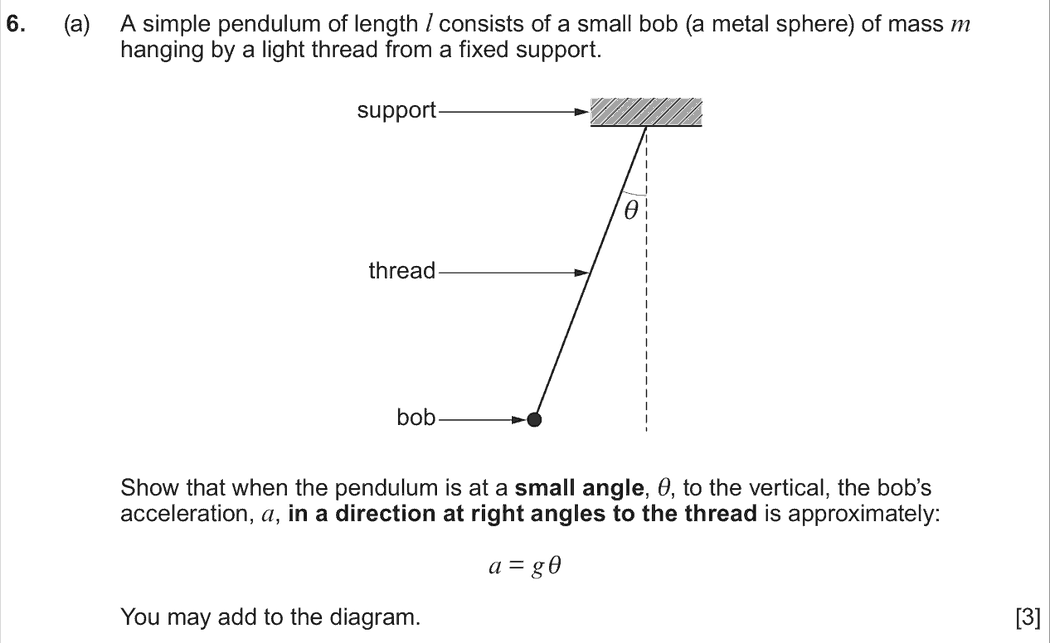
The ‘show that’ question in part (a) proved to be demanding. A significant number of candidates were unable to appreciate where the component of the bob’s weight was acting and diagrams indicating horizontal force directions were confused. The use of tension also halted progress here. The second and third marking points proved more accessible. Mainly very good candidate responses were seen in (b)(i). There were some weaker attempts using 𝑣 = −𝐴𝜔sin𝜔𝑡 but these did not develop as the candidates were unable to determine the amplitude. For the GPE – time graph in (ii) we were looking for the correct period, phase, and shape. There was a good success rate. A triangular wave is not an acceptable alternative for a sinusoid. Candidates who used the negative portion of the graph were only able to access the period mark as this was a significant error. The transition from simple harmonic motion to circular motion in part (iii) proved demanding for some candidates. Some used 𝑎= 𝜔2𝑟 and the periodic time of 1.4 s for the pendulum to be the time for one complete revolution. This is incorrect. Candidates who used 𝑎= 𝑣2 𝑟 were more successful. In the second part of the question, we were looking for candidates to show us that a centripetal force is a resultant force and at the bottom of the swing, this resultant force would be upwards. Some candidates were able to do this. We accepted ‘𝑇 – 𝑚𝑔 = 𝑚𝑎’ for the first marking point. The direction needed to be clear for the second marking point. Some drew a diagram to support their responses and were often rewarded. The last part was the QER and it tested the candidate’s ability to describe how forced oscillations can be demonstrated and how the amplitude varies with frequency. It bridged AO1 and AO3 and this challenged candidates. The description of the experiment was often limited whereas the variation of amplitude and hence links to resonance were more readily seen. A graph would often be seen, however, we wanted it to be referenced in their written response. The simple and effective way of obtaining the natural frequency of an oscillator (when the signal generator is off) was not regularly seen, however, it was encouraging to see additional practical detail regarding the amplitude measurement. There were a minority of confused responses involving damping.
Notes from the mark scheme and report
Component of the weight at right angles to the thread = mg sin θ (1)
for small angles sin θ ≈ θ in radians (1)
a = mg sin θ/m ≈ gθ (1)
many drew horizontal forces or tried to use the tension
Scheme columns: Maths 2
Skills: Trigonometryand vectors Resolving, components, vector addition, angles; Algebra Derivations and rearranging equations; Mathsmarks The mark scheme's Maths column gives this part at least one mark for mathematical skills
June 2022 · Component 1 · Q2(a)1 markAO2=1Practical and data analysis
Mark scheme
Examiner's comment
Most candidates gained the mark for pointing out that 𝑎= 𝑔 𝑀𝑚 followed from 𝐹= 𝑚𝑔 and 𝐹= 𝑀𝑎.
Notes from the mark scheme and report
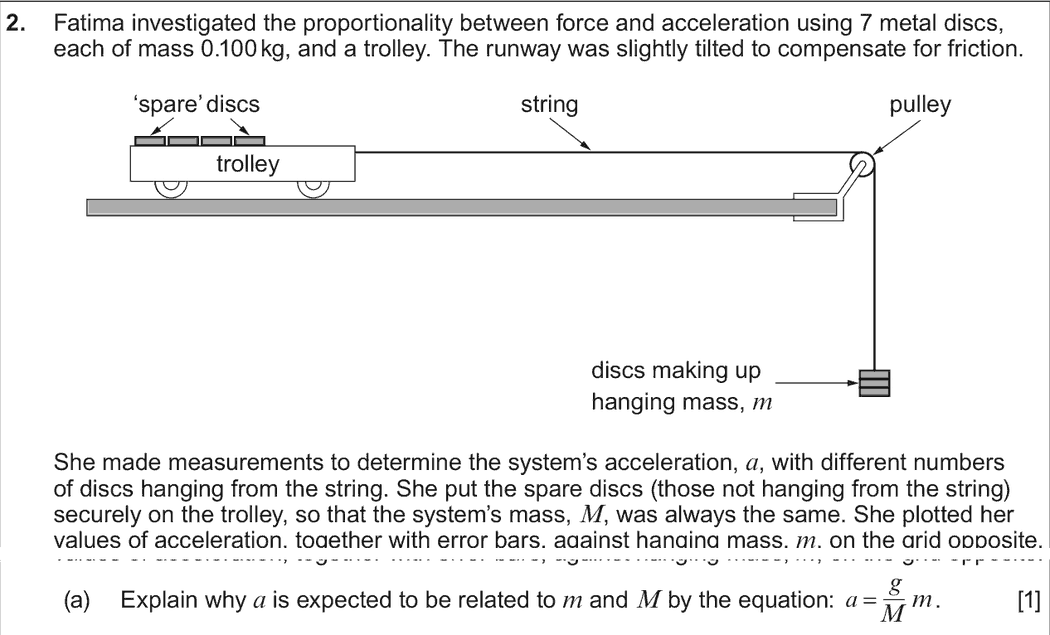
The accelerating force is the weight of the hanging discs, F = mg, and it accelerates the whole system, F = Ma, so a = (g/M)m
Scheme columns: Practical 1
Skills: Algebra Derivations and rearranging equations; Practicalmarks The mark scheme's Prac column gives this part at least one mark for practical skills
June 2022 · AS Component 1 · Q2(a)2 marksAO1=2Definition
Mark scheme
Notes from the mark scheme and report
The rate of change of momentum of a body is proportional (or equal) to (1) the resultant force acting on it, and is in the direction of that force (1)
June 2022 · Component 1 · Q2(b)6 marksAO3=6Practical and data analysis
Earlier part of question 2 that this part uses
Mark scheme
Examiner's comment
A few candidates drew single lines of best fit, and therefore couldn’t calculate uncertainties; they could still score 3 marks. The great majority drew lines of maximum and minimum gradients consistent with the error bars, though occasionally a line going near the tops of all the error bars and another near the bottoms were drawn. Gradients were generally calculated accurately. Almost, but not quite, everyone could work out M from the mean gradient, and there was a very pleasing level of success in calculating the uncertainty in M.
Notes from the mark scheme and report
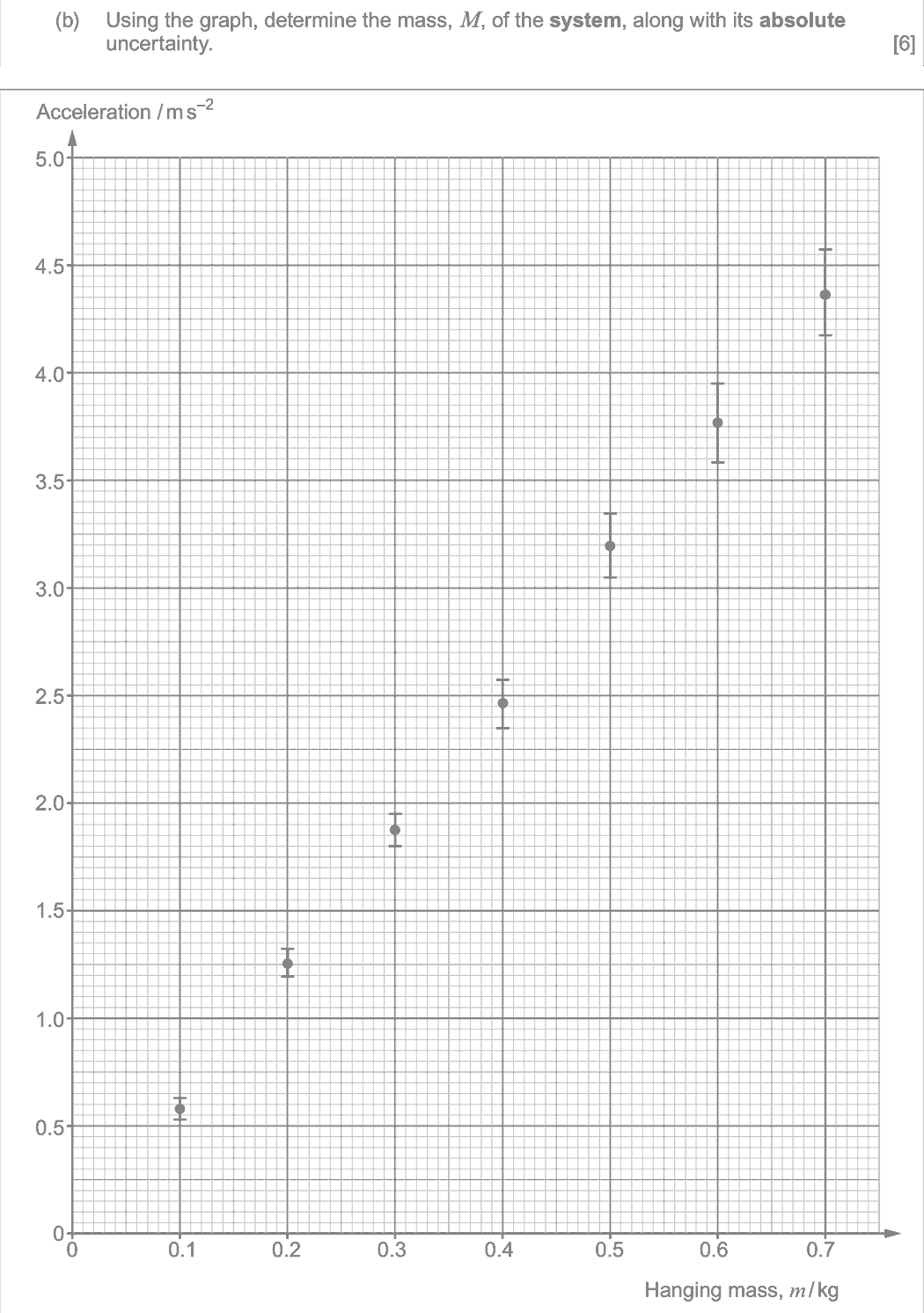
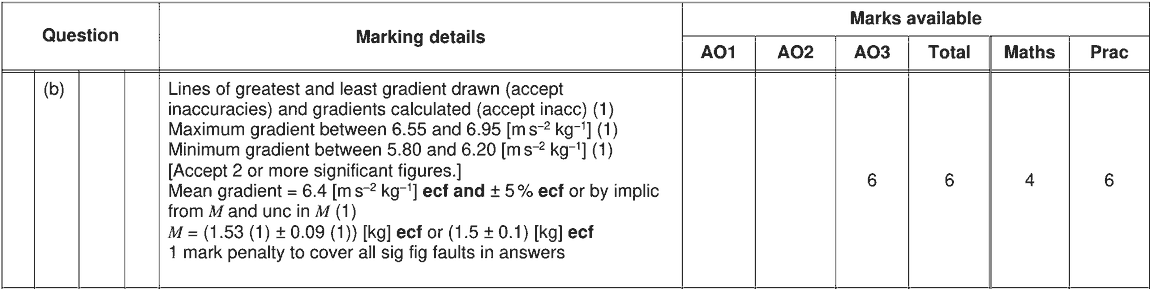
Answer: M = 1.53 ± 0.09 kg (1.5 ± 0.1 kg). Lines of greatest and least gradient through the error bars
maximum gradient 6.55 to 6.95, minimum 5.80 to 6.20 m s⁻² kg⁻¹
mean gradient 6.4 ± 5%
M = g/gradient with the same percentage uncertainty
a single best-fit line scores at most 3
one mark penalty for significant-figure faults
Scheme columns: Maths 4, Practical 6
Skills: Uncertainties Resolution, absolute and percentage uncertainty, combining uncertainties, error bars; Graphskills Reading, plotting or sketching graphs; gradients, intercepts and areas; Mathsmarks The mark scheme's Maths column gives this part at least one mark for mathematical skills; Practicalmarks The mark scheme's Prac column gives this part at least one mark for practical skills
June 2022 · AS Component 1 · Q2(b)(ii)2 marksAO2=2Calculation
Earlier parts of question 2 that this part uses
Mark scheme
Notes from the mark scheme and report
Answer: 1.5 N (downwards). Change in momentum = 0.16 × (9.0 + 7.0) = 2.56 kg m s⁻¹ because the direction reverses
divide by 1.7 s
Scheme columns: Maths 2
Skills: Mathsmarks The mark scheme's Maths column gives this part at least one mark for mathematical skills
June 2022 · Component 1 · Q2(c)3 marksAO1=3Practical and data analysis
Earlier parts of question 2 that this part uses
Mark scheme
Examiner's comment
A minority of candidates ignored the context of the question and described how the acceleration could be found from the applied force. Most gave a kinematic method as required, though sometimes marred by vagueness, as in claims that measured values of displacement and time should be inserted into “an equation of motion”.
Notes from the mark scheme and report
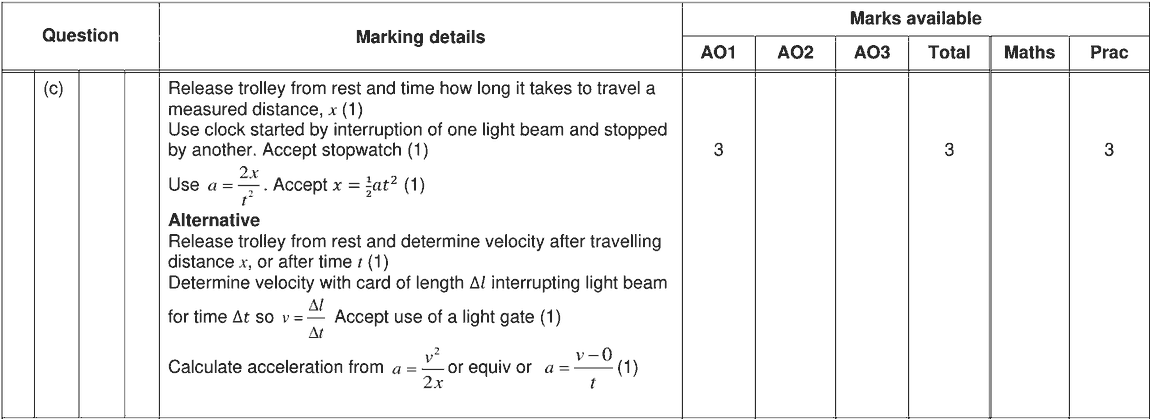
Release the trolley from rest and time it over a measured distance x (1) using light gates and a timer or a stopwatch (1)
a = 2x/t² (1). Alternative: find the final velocity with a card of known length through a light gate, then a = v²/2x or v/t. Vague 'use an equation of motion' and finding a from the force were not credited
Scheme columns: Practical 3
Skills: Experimentalmethod Describing, planning or improving an experiment; Practicalmarks The mark scheme's Prac column gives this part at least one mark for practical skills
June 2022 · AS Component 1 · Q3(a)3 marksAO2=3Diagram or graph
Mark scheme
Notes from the mark scheme and report
Forces mg = 0.098, 0.196, 0.294, 0.392, 0.491 N. Axes labelled with units (N, m s⁻²) and linear scales using at least half of each axis (1)
points plotted to half a small square (1)
line of best fit by eye (1)
Scheme columns: Maths 2, Practical 3
Skills: Graphskills Reading, plotting or sketching graphs; gradients, intercepts and areas; Unitsand conversions Unit marks, base units, prefixes and conversions; Mathsmarks The mark scheme's Maths column gives this part at least one mark for mathematical skills; Practicalmarks The mark scheme's Prac column gives this part at least one mark for practical skills
June 2022 · Component 1 · Q3(a)(i)2 marksAO1=2Definition
Mark scheme
Examiner's comment
Despite occasional claims that it applied only to elastic collisions, the principle of conservation of momentum was usually stated correctly.
Notes from the mark scheme and report
The total (vector sum of) momentum of interacting bodies stays constant (1) provided no external resultant force acts, i.e. an isolated system (1)
it does not apply only to elastic collisions
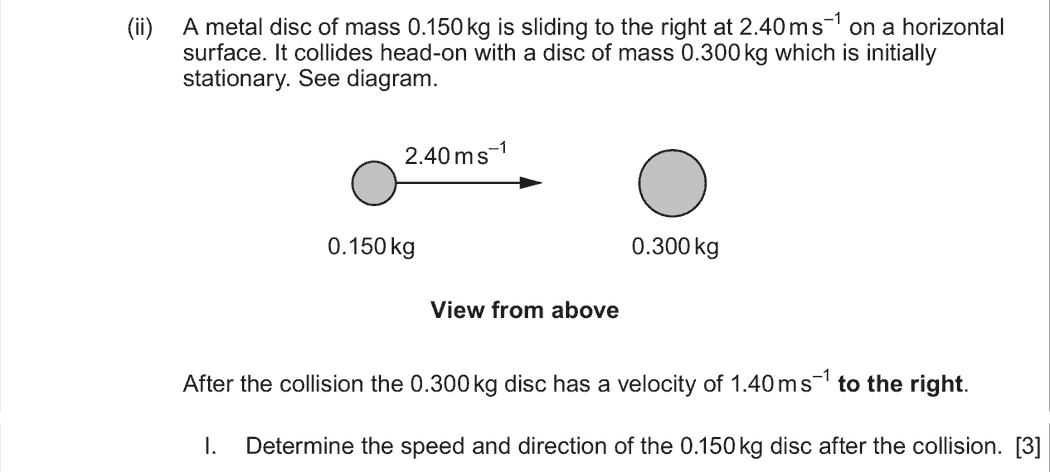
June 2022 · Component 1 · Q3(a)(ii)I3 marksAO1=1, AO2=2Calculation
Earlier part of question 3 that this part uses
Mark scheme
Examiner's comment
Most candidates applied the principle successfully to the collision and correctly calculated the loss of kinetic energy. Mistakes were usually arithmetical. How does conservation of energy apply? Most candidates gained the first mark for some mention of transfer of kinetic to thermal, but for the second mark we needed more precision, such as transfer of kinetic energy to (random) internal energy in the discs, or, in time, as heat from the discs to the surroundings.
Notes from the mark scheme and report
Answer: 0.40 m s⁻¹ to the left (direction reversed). 0.150 × 2.40 = 0.300 × 1.40 + 0.150 v so v = −0.40 m s⁻¹
Scheme columns: Maths 2
Skills: Mathsmarks The mark scheme's Maths column gives this part at least one mark for mathematical skills
June 2022 · Component 1 · Q3(a)(ii)II2 marksAO1=1, AO2=1Calculation
Earlier parts of question 3 that this part uses
Mark scheme
Examiner's comment
Most candidates applied the principle successfully to the collision and correctly calculated the loss of kinetic energy. Mistakes were usually arithmetical. How does conservation of energy apply? Most candidates gained the first mark for some mention of transfer of kinetic to thermal, but for the second mark we needed more precision, such as transfer of kinetic energy to (random) internal energy in the discs, or, in time, as heat from the discs to the surroundings.
Notes from the mark scheme and report
Answer: 0.126 J. KE before = ½ × 0.150 × 2.40² = 0.432 J
after = 0.012 + 0.294 = 0.306 J
ecf on the 0.40 m s⁻¹
Scheme columns: Maths 1
Skills: Mathsmarks The mark scheme's Maths column gives this part at least one mark for mathematical skills
June 2022 · AS Component 1 · Q3(b)3 marksAO3=3Practical and data analysis
Earlier part of question 3 that this part uses
Mark scheme
Notes from the mark scheme and report
Agrees (or almost agrees): straight line with positive gradient (1)
passes through or close to the origin (1)
all points lie close to the line of best fit (1)
Scheme columns: Maths 3, Practical 3
Skills: Graphskills Reading, plotting or sketching graphs; gradients, intercepts and areas; Mathsmarks The mark scheme's Maths column gives this part at least one mark for mathematical skills; Practicalmarks The mark scheme's Prac column gives this part at least one mark for practical skills
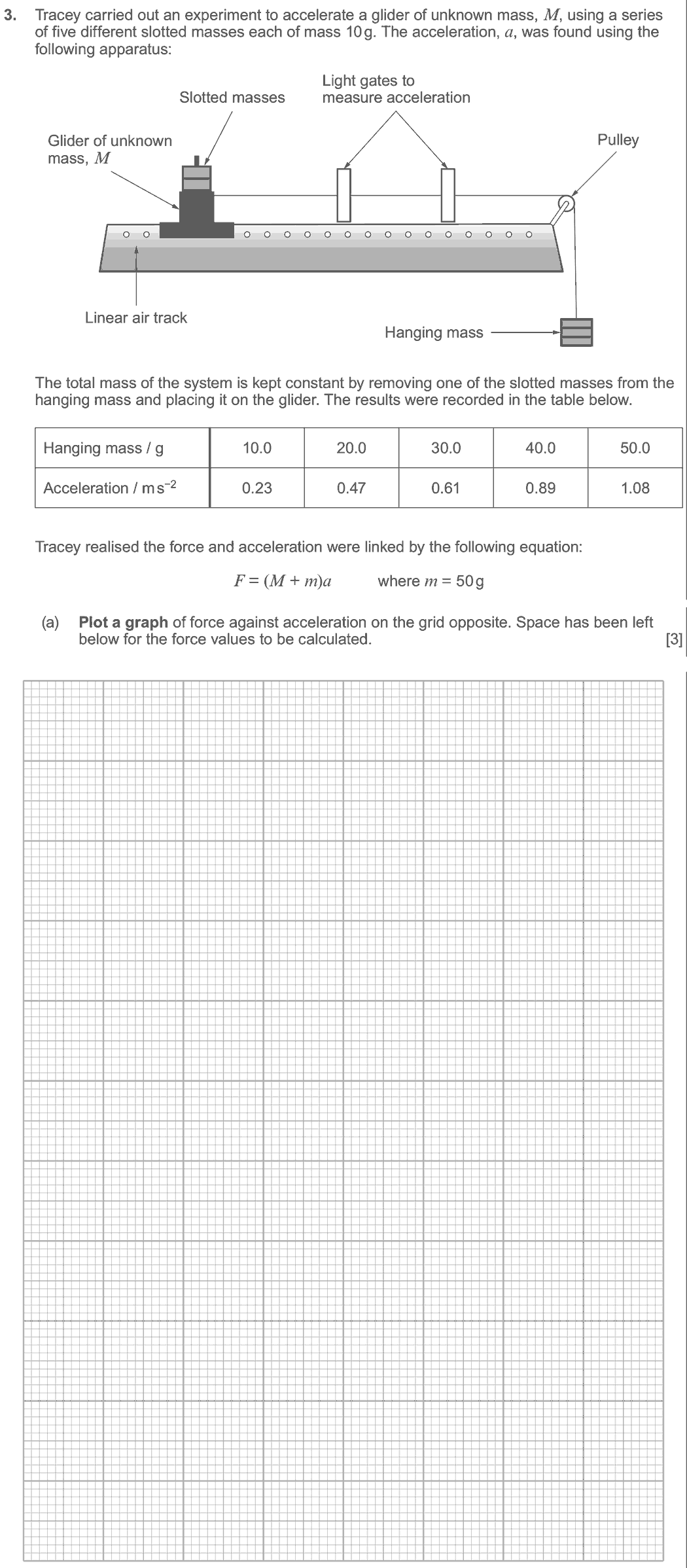
June 2022 · AS Component 1 · Q3(c)4 marksAO2=4Practical and data analysis
Earlier part of question 3 that this part uses
Mark scheme
Notes from the mark scheme and report
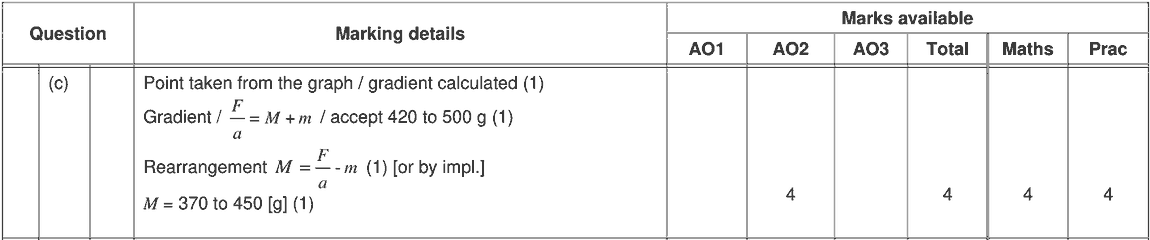
Answer: about 0.41 kg (370 to 450 g accepted). Gradient F/a from a large triangle on the line (1) = M + m, about 0.46 kg (420 to 500 g) (1)
M = gradient − m (1) with m = 50 g (1)
Scheme columns: Maths 4, Practical 4
Skills: Graphskills Reading, plotting or sketching graphs; gradients, intercepts and areas; Algebra Derivations and rearranging equations; Mathsmarks The mark scheme's Maths column gives this part at least one mark for mathematical skills; Practicalmarks The mark scheme's Prac column gives this part at least one mark for practical skills
June 2022 · AS Component 1 · Q3(d)2 marksAO3=2Explanation
Earlier part of question 3 that this part uses
Mark scheme
Notes from the mark scheme and report
Incorrect: once the masses reach the floor there is no resultant force on the glider (1), so its acceleration is zero and it moves at constant velocity (1)
alternative: it decelerates because air resistance is then the only force
Scheme columns: Practical 2
Skills: Practicalmarks The mark scheme's Prac column gives this part at least one mark for practical skills
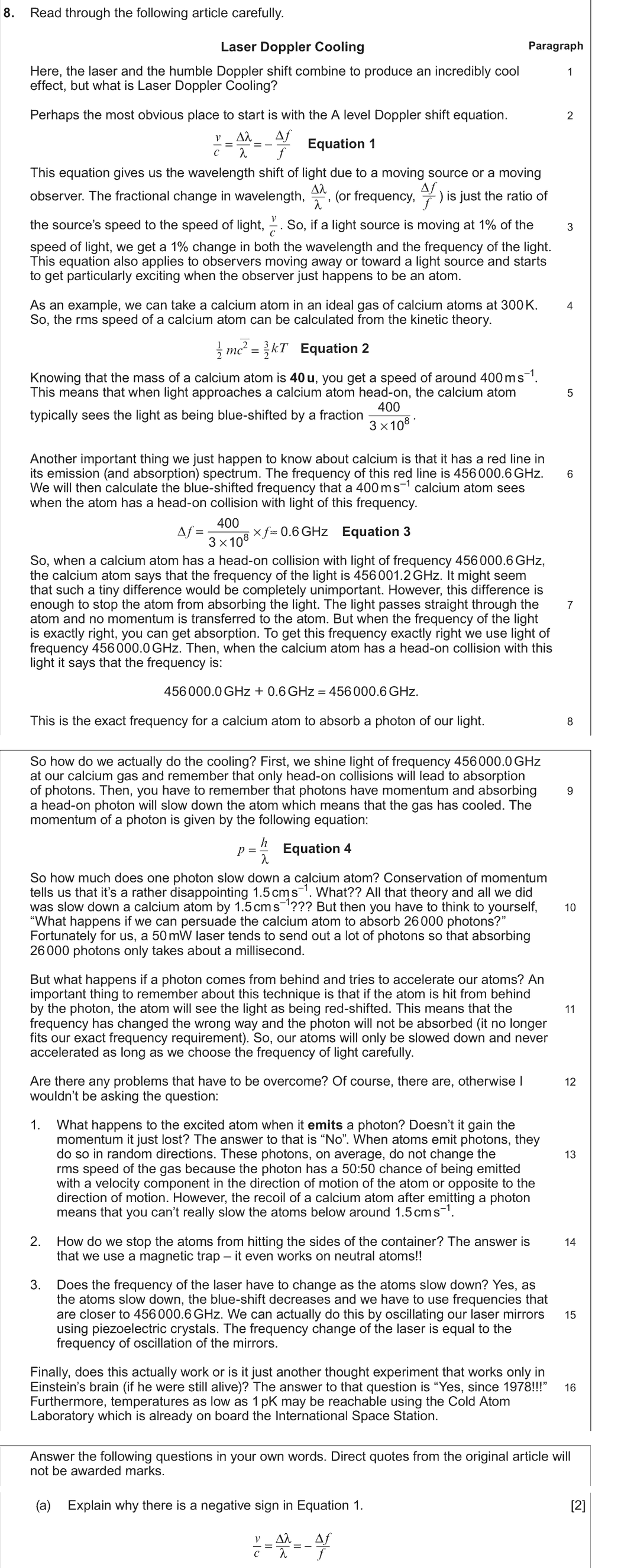
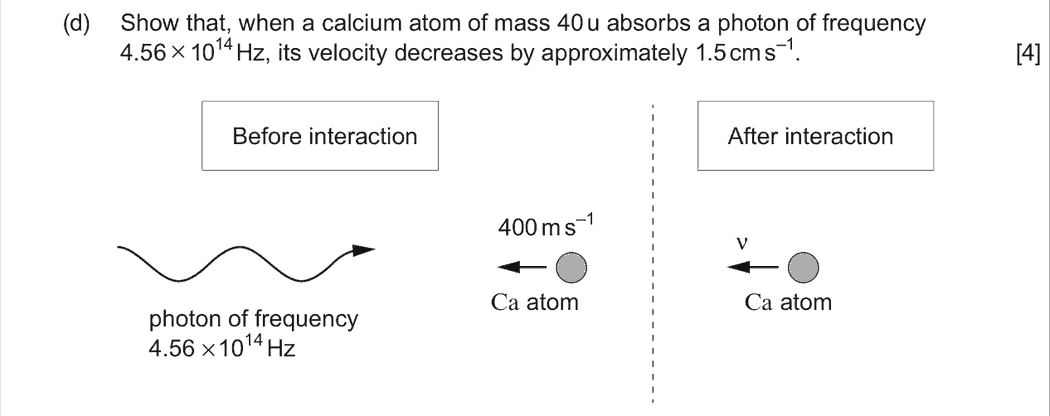
June 2022 · Component 1 · Q8(d)4 marksAO2=4Show that
Earlier part of question 8 that this part uses
Mark scheme
Examiner's comment
Most, but not all, candidates realised that to find the decrease in the atom’s velocity, they needed to apply conservation of momentum. The photon’s momentum was usually found correctly. Most candidates calculated the atom’s initial momentum (sometimes making mistakes with mass units) and then its final momentum, hence the new velocity. A minority saw that the change in velocity was simply equal to the photon momentum divided by the atom’s mass.
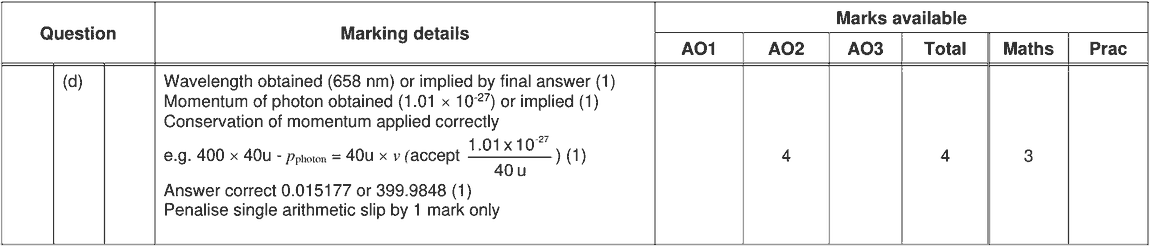
Notes from the mark scheme and report
λ = c/f = 658 nm
photon momentum p = h/λ = 1.01 × 10⁻²⁷ kg m s⁻¹
conservation of momentum: Δv = p/(40 u) = 1.01 × 10⁻²⁷/6.64 × 10⁻²⁶ = 0.0152 m s⁻¹ (new speed 399.985 m s⁻¹)
mass-unit slips occurred
Scheme columns: Maths 3
Skills: Comprehension A level Component 1 Section B: questions on the printed article; Synoptic Needs physics from another component of the qualification; Unitsand conversions Unit marks, base units, prefixes and conversions; Mathsmarks The mark scheme's Maths column gives this part at least one mark for mathematical skills
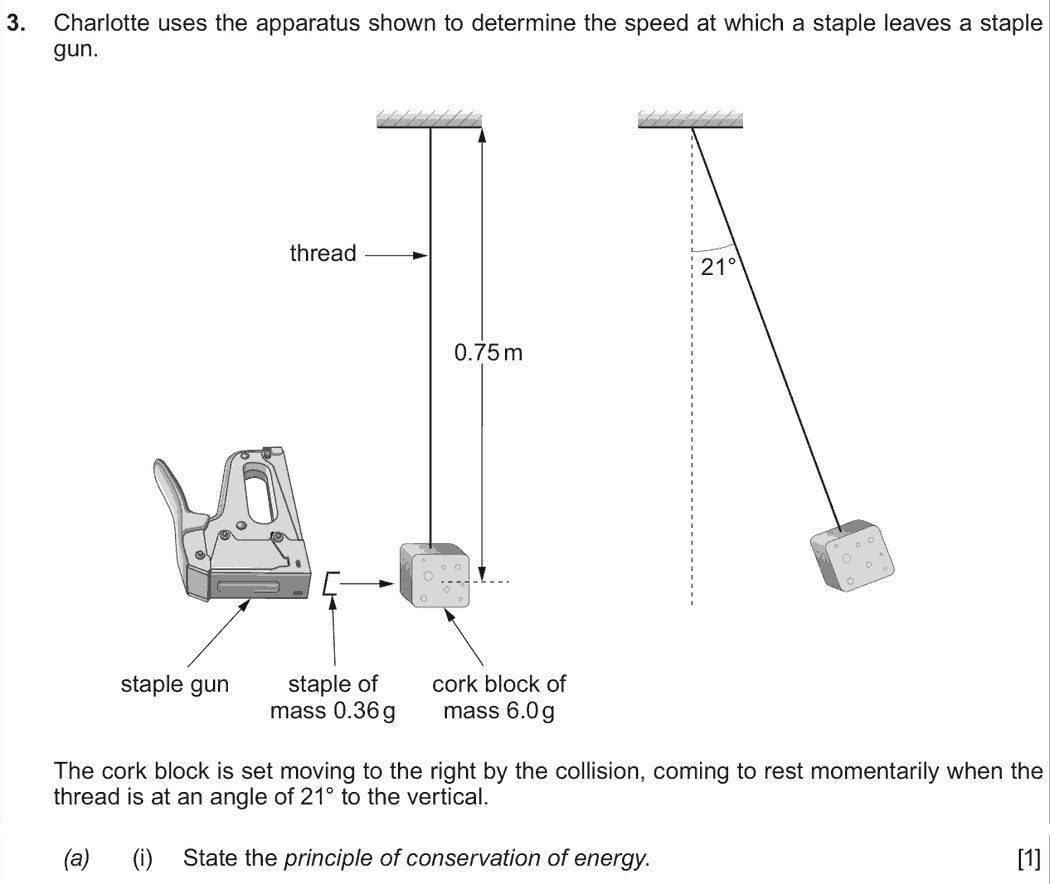
October 2021 · Component 1 · Q3(b)2 marksAO1=1, AO2=1Calculation
Earlier part of question 3 that this part uses
Mark scheme
Notes from the mark scheme and report
Answer: 17.5 m s⁻¹. Conservation of momentum: 0.36v = (6.0 + 0.36) × 0.99
using 6.00 g instead of 6.36 g (16.5 m s⁻¹) scores 1
Scheme columns: Maths 1
Skills: Unitsand conversions Unit marks, base units, prefixes and conversions; Mathsmarks The mark scheme's Maths column gives this part at least one mark for mathematical skills
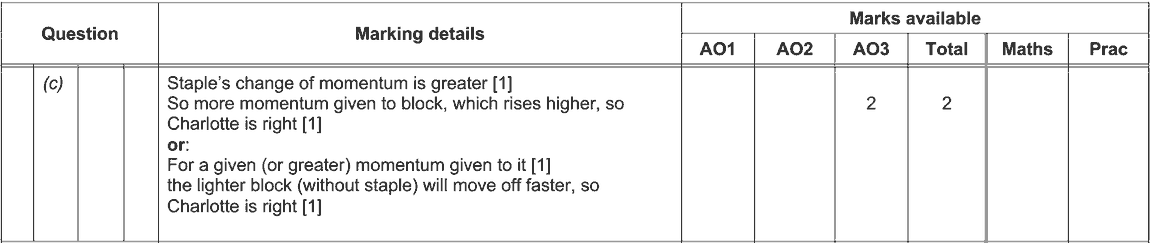
October 2021 · Component 1 · Q3(c)2 marksAO3=2Explanation
Earlier part of question 3 that this part uses
Mark scheme
Notes from the mark scheme and report
If the staple rebounds its change of momentum is greater (1), so more momentum is given to the block (which is also lighter without the staple), it moves off faster and rises higher: Charlotte is right (1)
October 2021 · Component 2 · Q5(b)(ii)2 marksAO1=2Short answer
Earlier parts of question 5 that this part uses
Mark scheme
Notes from the mark scheme and report
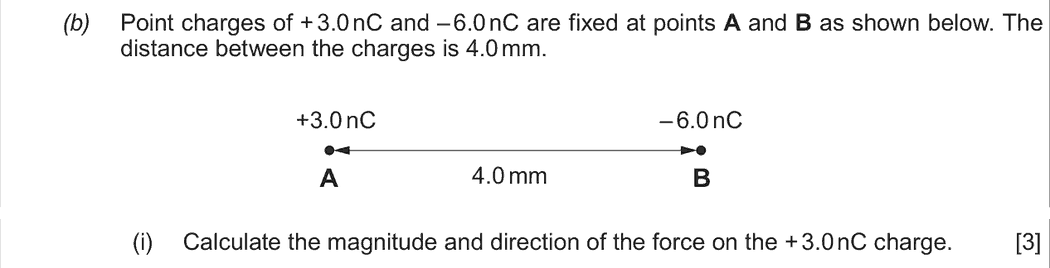
0.010 N towards A (to the left): equal in size and opposite in direction (1), by Newton's third law (1)
Skills: Synoptic Needs physics from another component of the qualification
October 2021 · Component 3 · Q4(a)(i)2 marksAO3=2Explanation
Mark scheme
Notes from the mark scheme and report
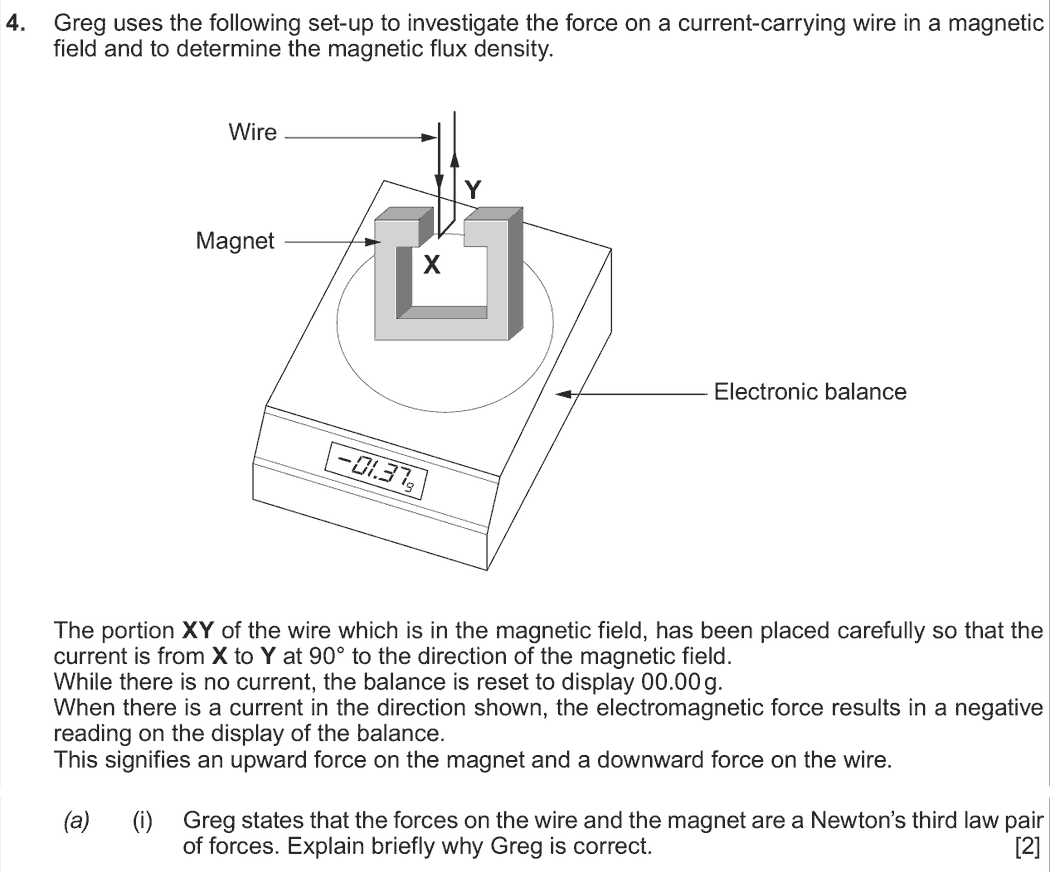
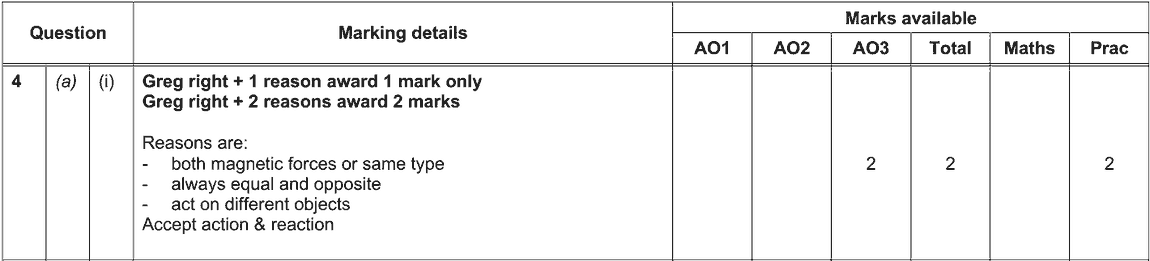
Greg is right, with two reasons for 2 marks: the forces are of the same type (magnetic)
equal in size and opposite in direction
act on different bodies (wire and magnet)
Newton's third law is Component 1 content
Scheme columns: Practical 2
Skills: Synoptic Needs physics from another component of the qualification; Practicalmarks The mark scheme's Prac column gives this part at least one mark for practical skills
October 2020 · Component 1 · Q2(c)2 marksAO3=2Explanation
Earlier parts of question 2 that this part uses
Mark scheme
Examiner's comment
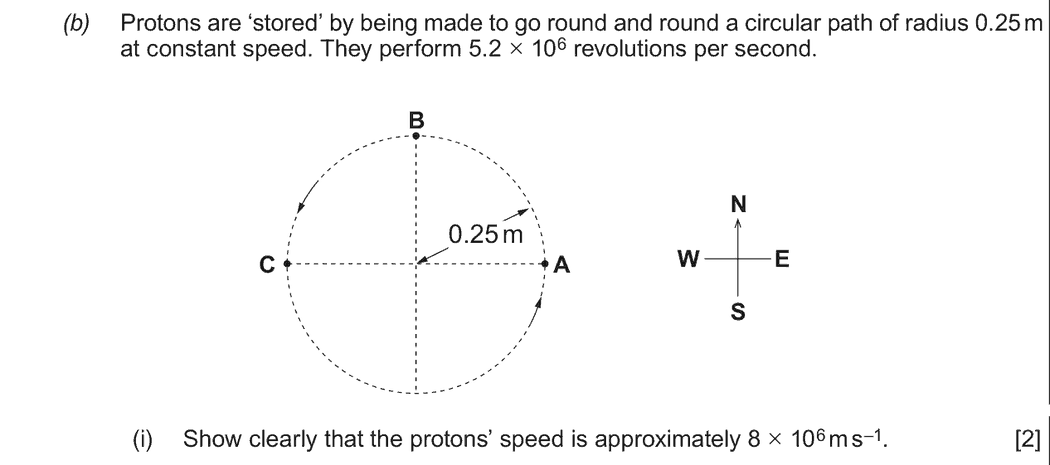
More than half the candidates correctly defined mean acceleration as change in velocity divided by time to change, but not all who did so were able to calculate the proton’s mean acceleration over a semicircle (part (b)(iii)). Calculating the proton’s speed and its instantaneous acceleration at a point in its path caused few problems. Many candidates discussed only one of the two opinions about the mean force on a proton over one revolution.
Notes from the mark scheme and report
Adam is wrong: the force has constant magnitude but its direction keeps changing (1)
Brian is right: over a full revolution final velocity − initial velocity = 0, so the mean acceleration and mean force are zero (1)
many discussed only one opinion
October 2020 · Component 1 · Q5(b)(ii)2 marksAO2=2Calculation
Earlier parts of question 5 that this part uses
Mark scheme
Examiner's comment
The kinetic theory calculations were very well done, and the momentum conservation and kinetic energy non-conservation parts, almost as well. Several candidates did not seem to know that gas molecules at a given temperature had a wide range of speeds. A surprising number of candidates used a wrong formula for the photon energy.
Notes from the mark scheme and report
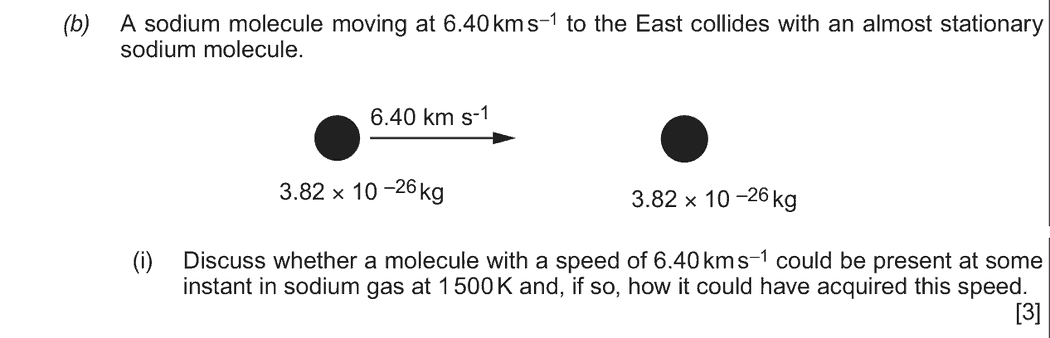
Answer: 2.01 km s⁻¹ to the East. Equal masses: 6.40 + 0 = 4.39 + v
Scheme columns: Maths 2
Skills: Mathsmarks The mark scheme's Maths column gives this part at least one mark for mathematical skills
October 2020 · Component 1 · Q5(b)(iii)3 marksAO2=3Calculation
Earlier parts of question 5 that this part uses
Mark scheme
Examiner's comment
The kinetic theory calculations were very well done, and the momentum conservation and kinetic energy non-conservation parts, almost as well. Several candidates did not seem to know that gas molecules at a given temperature had a wide range of speeds. A surprising number of candidates used a wrong formula for the photon energy.
Notes from the mark scheme and report
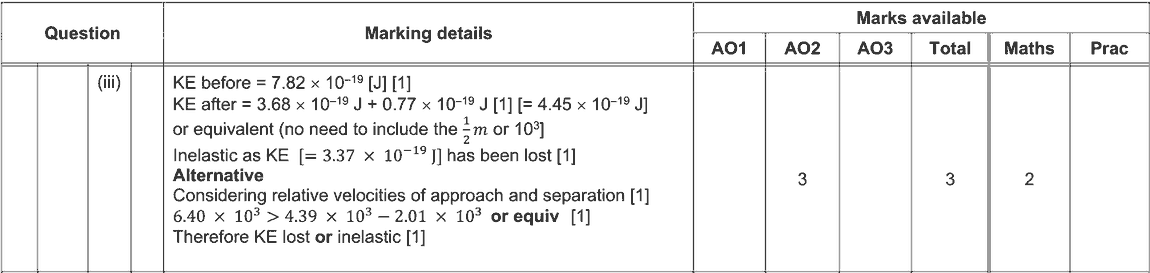
Answer: inelastic. KE before = ½ × 3.82 × 10⁻²⁶ × 6400² = 7.82 × 10⁻¹⁹ J
KE after = 3.68 × 10⁻¹⁹ + 0.77 × 10⁻¹⁹ = 4.45 × 10⁻¹⁹ J
kinetic energy is lost. Or relative speed of separation (2.38 km s⁻¹) is less than that of approach (6.40 km s⁻¹)
Scheme columns: Maths 2
Skills: Mathsmarks The mark scheme's Maths column gives this part at least one mark for mathematical skills
October 2020 · Component 1 · Q5(b)(iv)1 markAO1=1Short answer
Earlier parts of question 5 that this part uses
Mark scheme
Examiner's comment
The kinetic theory calculations were very well done, and the momentum conservation and kinetic energy non-conservation parts, almost as well. Several candidates did not seem to know that gas molecules at a given temperature had a wide range of speeds. A surprising number of candidates used a wrong formula for the photon energy.
Notes from the mark scheme and report
During the collision each molecule exerts a force on the other that is equal in size and opposite in direction
October 2020 · Component 1 · Q8(a)3 marksAO1=3Explanation
Mark scheme
Examiner's comment
In (a) and (b), 𝒖𝒖 ∆𝒎𝒎 ∆𝒕𝒕 was not always recognised as the rate of change of momentum of the exhaust gases, and the constancy of u and ∆𝒎𝒎 ∆𝒕𝒕 often went unnoticed. In (c) the wrong unit for 𝒕𝒕𝟐𝟐 was usually spotted. The 0.02 s delay was identified and almost always explained correctly. In
Notes from the mark scheme and report
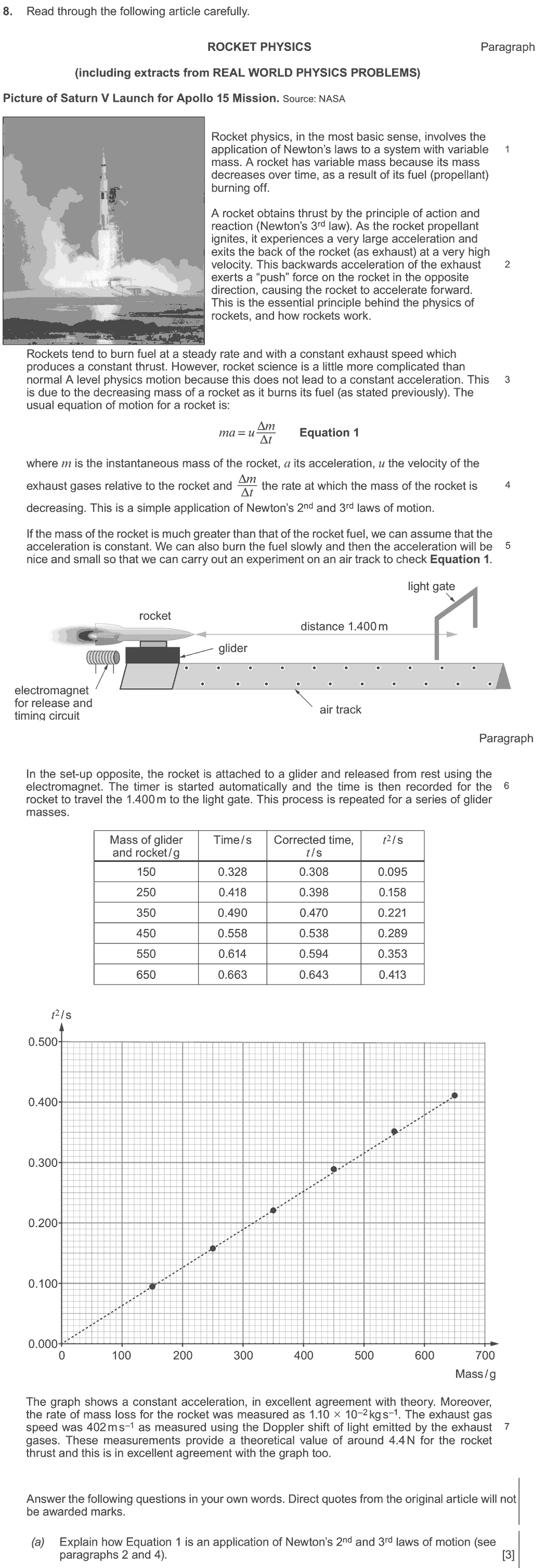
The left side, ma, is the resultant force on the rocket (Newton's 2nd law, F = ma) (1)
u Δm/Δt is the rate of change of momentum of the exhaust gas, i.e. the force on the gas (1)
by Newton's 3rd law the gas exerts an equal and opposite force on the rocket (1)
the momentum-rate idea was often missed
Scheme columns: Maths 1, Practical 3
Skills: Comprehension A level Component 1 Section B: questions on the printed article; Mathsmarks The mark scheme's Maths column gives this part at least one mark for mathematical skills; Practicalmarks The mark scheme's Prac column gives this part at least one mark for practical skills
October 2020 · Component 1 · Q8(b)3 marksAO2=3Explanation
Earlier part of question 8 that this part uses
Mark scheme
Examiner's comment
In (a) and (b), 𝒖𝒖 ∆𝒎𝒎 ∆𝒕𝒕 was not always recognised as the rate of change of momentum of the exhaust gases, and the constancy of u and ∆𝒎𝒎 ∆𝒕𝒕 often went unnoticed. In (c) the wrong unit for 𝒕𝒕𝟐𝟐 was usually spotted. The 0.02 s delay was identified and almost always explained correctly. In
Notes from the mark scheme and report
The fuel mass is small compared with the rocket and glider, so m is nearly constant (1)
u and Δm/Δt are constant (paragraph 3), so the thrust is constant and so is a (1)
a is small because m is large and Δm/Δt is small (1)
Scheme columns: Maths 1, Practical 3
Skills: Comprehension A level Component 1 Section B: questions on the printed article; Mathsmarks The mark scheme's Maths column gives this part at least one mark for mathematical skills; Practicalmarks The mark scheme's Prac column gives this part at least one mark for practical skills
October 2020 · Component 1 · Q8(d)3 marksAO2=3Explanation
Earlier part of question 8 that this part uses
Mark scheme
Examiner's comment
most candidates realised that the relevant equation was 𝒙𝒙= 𝒖𝒖𝒖𝒖+ 𝟏𝟏 𝟐𝟐𝒂𝒂𝒕𝒕𝟐𝟐, but they didn’t always show clearly why the graph gradient would be 2.8 F . Parts (e) and (f) were handled very well. In
Notes from the mark scheme and report
From rest x = ½at² (1)
with a = F/m, t² = 2xm/F, so t² is proportional to m and the graph is a straight line through the origin (1)
gradient = 2x/F = 2 × 1.400/F = 2.80/F (1)
the last step was often not shown clearly
Scheme columns: Maths 2, Practical 3
Skills: Comprehension A level Component 1 Section B: questions on the printed article; Algebra Derivations and rearranging equations; Graphskills Reading, plotting or sketching graphs; gradients, intercepts and areas; Mathsmarks The mark scheme's Maths column gives this part at least one mark for mathematical skills; Practicalmarks The mark scheme's Prac column gives this part at least one mark for practical skills
October 2020 · Component 1 · Q8(e)1 markAO2=1Show that
Earlier part of question 8 that this part uses
Mark scheme
Examiner's comment
In (a) and (b), 𝒖𝒖 ∆𝒎𝒎 ∆𝒕𝒕 was not always recognised as the rate of change of momentum of the exhaust gases, and the constancy of u and ∆𝒎𝒎 ∆𝒕𝒕 often went unnoticed. In (c) the wrong unit for 𝒕𝒕𝟐𝟐 was usually spotted. The 0.02 s delay was identified and almost always explained correctly. In
Notes from the mark scheme and report
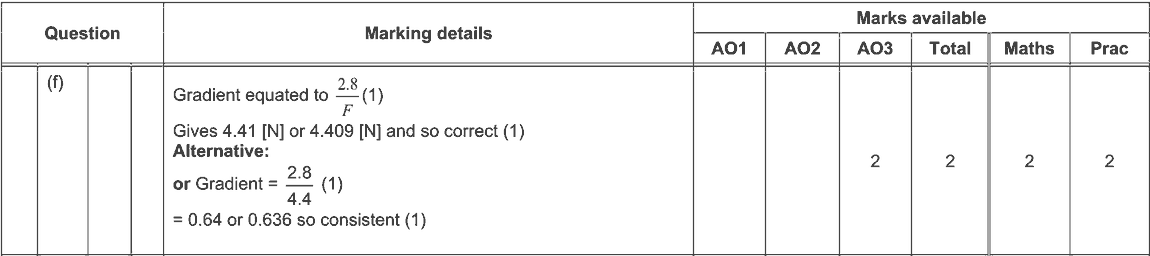
Thrust = u Δm/Δt (rate of change of momentum of the exhaust) = 402 × 1.10 × 10⁻² = 4.42 N
Scheme columns: Practical 1
Skills: Comprehension A level Component 1 Section B: questions on the printed article; Practicalmarks The mark scheme's Prac column gives this part at least one mark for practical skills
October 2020 · Component 1 · Q8(f)2 marksAO3=2Calculation
Earlier part of question 8 that this part uses
Mark scheme
Examiner's comment
In (a) and (b), 𝒖𝒖 ∆𝒎𝒎 ∆𝒕𝒕 was not always recognised as the rate of change of momentum of the exhaust gases, and the constancy of u and ∆𝒎𝒎 ∆𝒕𝒕 often went unnoticed. In (c) the wrong unit for 𝒕𝒕𝟐𝟐 was usually spotted. The 0.02 s delay was identified and almost always explained correctly. In
Notes from the mark scheme and report
Answer: F = 4.41 N, consistent. Gradient = 2.80/F so F = 2.80/0.635
or 2.80/4.4 = 0.636, which matches the gradient
Scheme columns: Maths 2, Practical 2
Skills: Comprehension A level Component 1 Section B: questions on the printed article; Graphskills Reading, plotting or sketching graphs; gradients, intercepts and areas; Mathsmarks The mark scheme's Maths column gives this part at least one mark for mathematical skills; Practicalmarks The mark scheme's Prac column gives this part at least one mark for practical skills
June 2019 · AS Component 1 · Q2(c)(i)2 marksAO1=2Definition
Earlier parts of question 2 that this part uses
Mark scheme
Notes from the mark scheme and report
The vector sum (total) of the momenta before a collision equals that after it (1) provided no external forces act (1)
June 2019 · AS Component 1 · Q2(c)(ii)2 marksAO2=2Calculation
Earlier parts of question 2 that this part uses
Mark scheme
Notes from the mark scheme and report
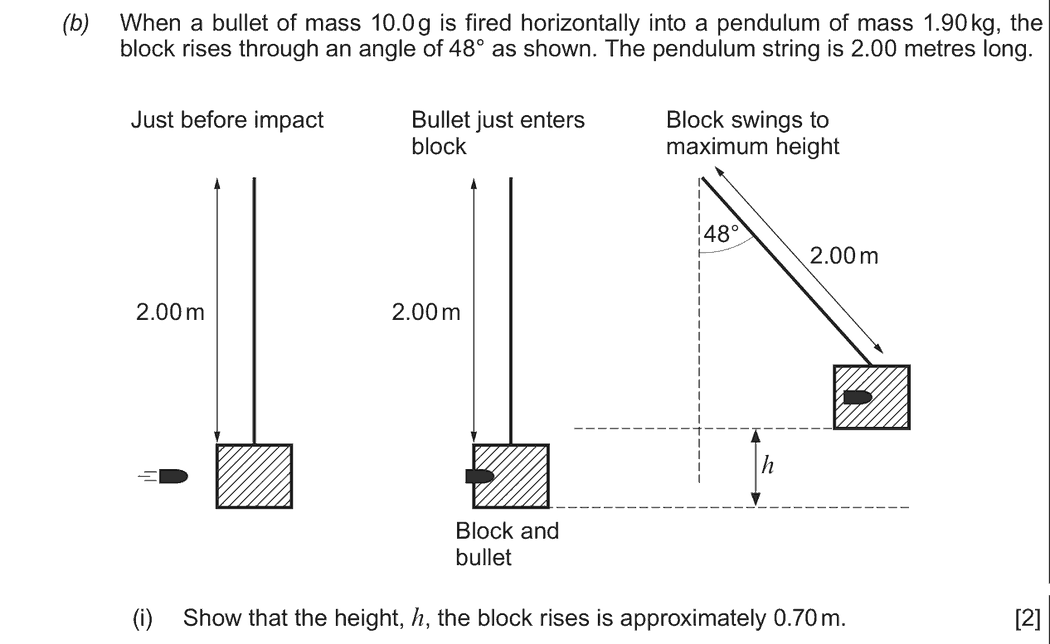
Answer: 688 m s⁻¹. Momentum of bullet = momentum of block and bullet: 0.0100 × v = 1.91 × 3.60 (1)
ecf from (b)(ii)
Scheme columns: Maths 2
Skills: Mathsmarks The mark scheme's Maths column gives this part at least one mark for mathematical skills
June 2019 · AS Component 1 · Q2(d)2 marksAO3=2Short answer
Earlier parts of question 2 that this part uses
Mark scheme
Notes from the mark scheme and report
Any two: students are over sixteen
legitimate scientific learning purpose
gun must be transported through the school grounds
June 2019 · Component 1 · Q3(a)2 marksAO1=2Definition
Mark scheme
Examiner's comment
Despite occasional claims that it applied only to elastic collisions, the principle of conservation of momentum was usually stated perfectly.
Notes from the mark scheme and report
The vector sum of the momenta (total momentum) of a system of bodies is constant (1) provided no external resultant force acts (1)
it is not restricted to elastic collisions
June 2019 · Component 1 · Q3(b)(i)3 marksAO2=3Calculation
Earlier part of question 3 that this part uses
Mark scheme
Examiner's comment
Sometimes the vector nature of momentum wasn’t properly taken account of, but most candidates found the required velocity correctly.
Notes from the mark scheme and report
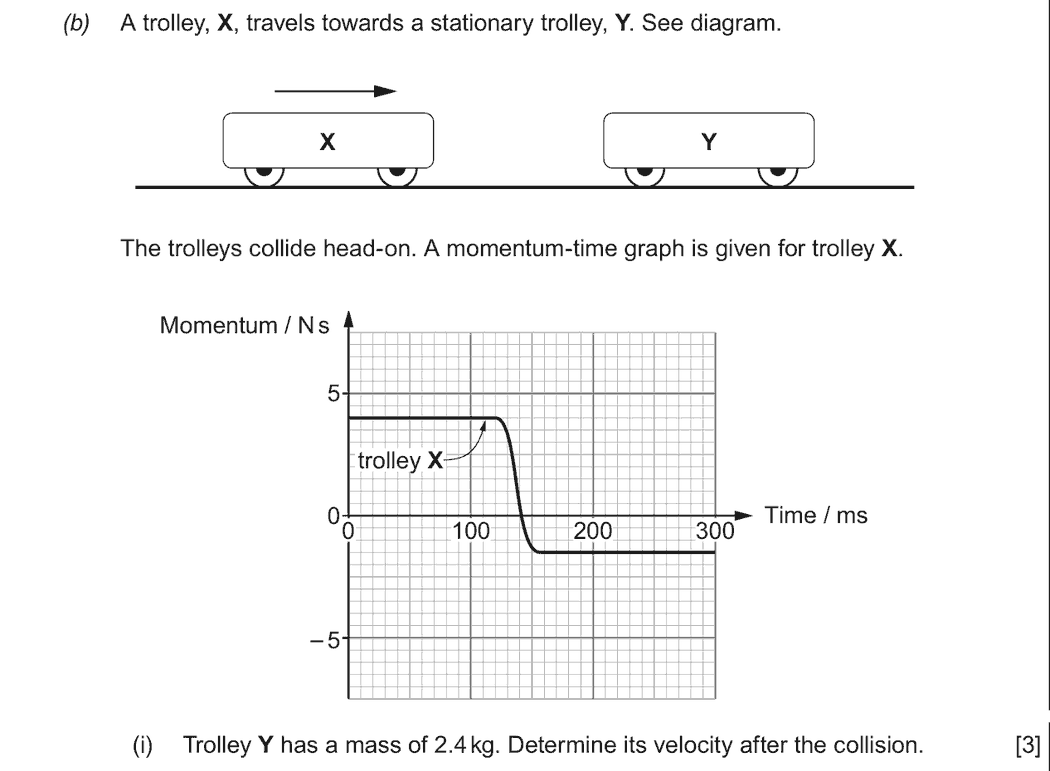
Answer: 2.3 m s⁻¹. Change in X's momentum = −5.5 N s (from +4.0 to −1.5), so Y gains +5.5 N s
v = 5.5/2.4
some ignored the sign of X's final momentum
Scheme columns: Maths 2
Skills: Graphskills Reading, plotting or sketching graphs; gradients, intercepts and areas; Mathsmarks The mark scheme's Maths column gives this part at least one mark for mathematical skills
June 2019 · Component 1 · Q3(b)(ii)3 marksAO2=3Diagram or graph
Earlier parts of question 3 that this part uses
Mark scheme
Examiner's comment
Sketches of the momentum-time graph for trolley Y usually showed a good understanding of momentum conservation.
Notes from the mark scheme and report
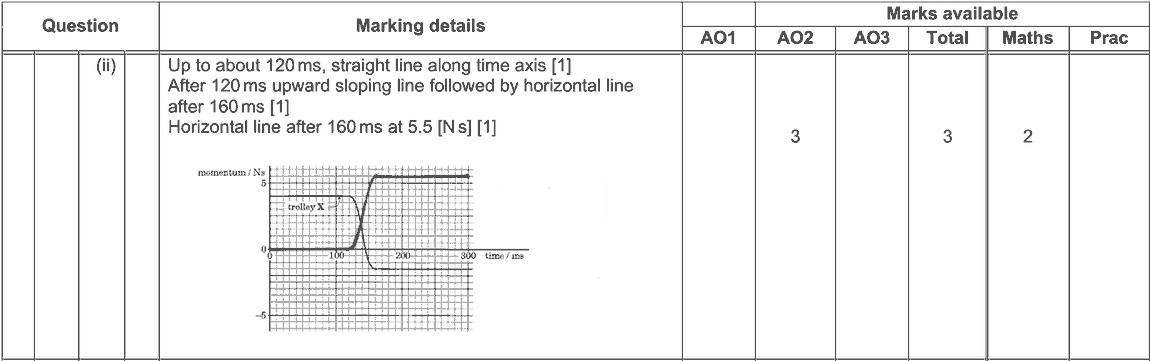
Line along the time axis until about 120 ms (1)
rising line during the collision, then horizontal after about 160 ms (1)
final level at 5.5 N s (1)
Scheme columns: Maths 2
Skills: Graphskills Reading, plotting or sketching graphs; gradients, intercepts and areas; Mathsmarks The mark scheme's Maths column gives this part at least one mark for mathematical skills
June 2019 · AS Component 1 · Q3(b)(ii)2 marksAO2=2Calculation
Earlier parts of question 3 that this part uses
Mark scheme
Notes from the mark scheme and report
Answer: 150 m s⁻². a = kx/m = 50 × 0.060/0.020 (1)
answer with the assumption that the weight (g) is ignored (1)
Scheme columns: Maths 1
Skills: Mathsmarks The mark scheme's Maths column gives this part at least one mark for mathematical skills
June 2019 · Component 1 · Q3(b)(iii)2 marksAO2=2Calculation
Earlier parts of question 3 that this part uses
Mark scheme
Examiner's comment
Using the graph to estimate the mean force during the collision was, regrettably, slightly complicated by the rounded ‘corners’, but answers based on any reasonable reading of the collision time were accepted.
Notes from the mark scheme and report
Answer: about 140 N (magnitude). F = Δp/Δt = 5.5/0.040
any collision time from 30 to 40 ms read from the graph accepted
ecf on 5.5 N s
Scheme columns: Maths 2
Skills: Graphskills Reading, plotting or sketching graphs; gradients, intercepts and areas; Mathsmarks The mark scheme's Maths column gives this part at least one mark for mathematical skills
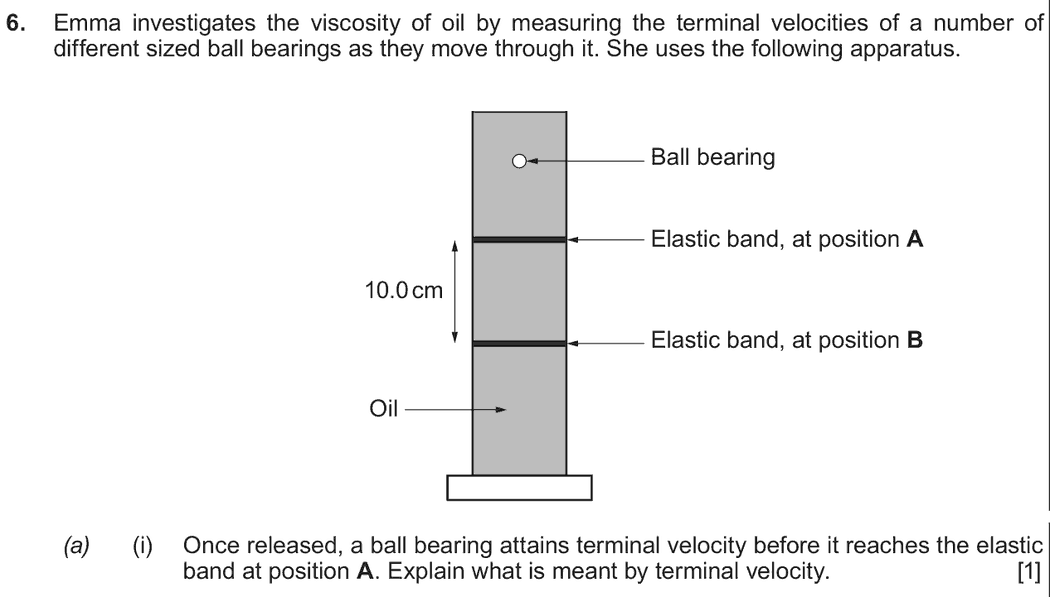
June 2019 · AS Component 1 · Q6(a)(ii)2 marksAO3=2Short answer
Earlier part of question 6 that this part uses
Mark scheme
Notes from the mark scheme and report
Weight pair: the Earth pulls the ball bearing and the ball bearing pulls the Earth with an equal gravitational force upwards on the Earth (1)
drag pair: the oil pushes up on the ball bearing and the ball bearing pushes down on the oil (1)
June 2019 · Component 2 · Q8(b)(ii)3 marksAO1=1, AO2=2Diagram or graph
Earlier parts of question 8 that this part uses
Mark scheme
Examiner's comment
A significant number of candidates drew the electric force vector to the right rather than the left, and a surprising number drew the weight vector upwards. Angles were largely calculated correctly but a significant number then labelled the wrong angle on the diagram. No candidate drew scale diagrams.
Notes from the mark scheme and report
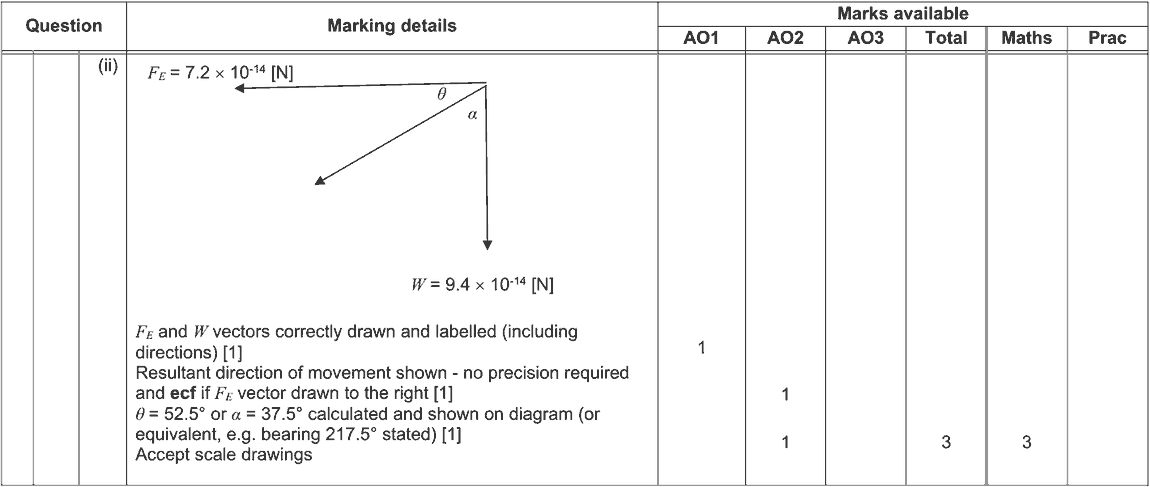
Electric force 7.2 × 10⁻¹⁴ N horizontally towards the +150 V plate (left, since the charge is negative) and weight 9.4 × 10⁻¹⁴ N downwards, labelled (1)
resultant direction shown down and to the left (1)
angle 52.5° below the horizontal (37.5° to the vertical) marked (1)
common errors: electric force drawn to the right, weight upwards, or the wrong angle labelled
Scheme columns: Maths 3
Skills: Trigonometryand vectors Resolving, components, vector addition, angles; Mathsmarks The mark scheme's Maths column gives this part at least one mark for mathematical skills
June 2019 · Component 2 · Q8(c)4 marksAO2=4Calculation
Earlier parts of question 8 that this part uses
Mark scheme
Examiner's comment
A pleasing number of candidates calculated the time correctly, gaining all four marks. Again, as in 3(c), this question had a significant synoptic element which was handled well and with confidence by many candidates. Summary of key points • A strong feature of the previous papers in this specification has been the competence shown by candidates in relation to circuit theory. Question 1(c) showed that this was not the case for this paper. In nearly all cases, candidates made valid comments about the impact on current and resistance of adding a coil to the circuit in parallel to the original. However, again in nearly all cases, candidates failed to account for the internal resistance of the cells. This was the cause of most candidates’ failure to answer this part correctly. • Responses to questions which required written responses and reasoning were sometimes too vague and could not be credited. Two examples are given: Q3(a) Two parallel plate capacitors X and Y, have equal plate areas. The capacitance of X is greater than that of Y. Suggest two possible reasons for the difference. [2] Candidate response: Because the plates are closer together and there is a dielectric in it. It may be argued that the ‘it’ referred to in the response is capacitor X, and this is a reasonable response, but it is not definitive. The first part doesn’t mention which capacitor has the plates closer together. There is ambiguity and a vagueness to the response which does not warrant any credit.
Notes from the mark scheme and report
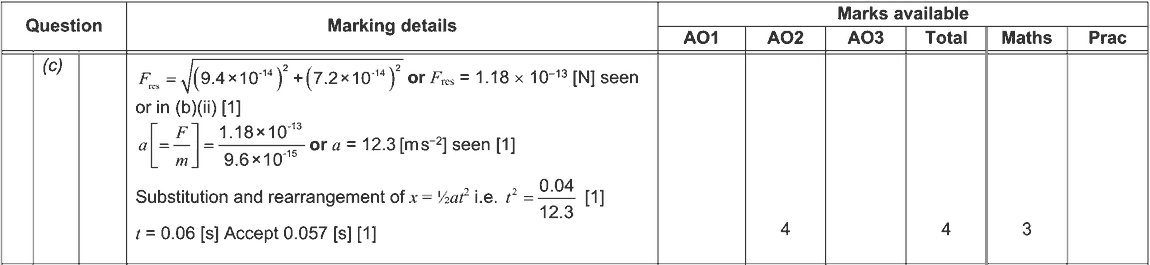
Answer: 0.057 s. Resultant force = √(9.4² + 7.2²) × 10⁻¹⁴ = 1.18 × 10⁻¹³ N (1)
a = F/m = 12.3 m s⁻² (1)
x = ½at² so t² = 0.040/12.3 (1)
t = 0.057 s (0.06 s) (1)
synoptic with Component 1 dynamics and kinematics
Scheme columns: Maths 3
Skills: Synoptic Needs physics from another component of the qualification; Mathsmarks The mark scheme's Maths column gives this part at least one mark for mathematical skills
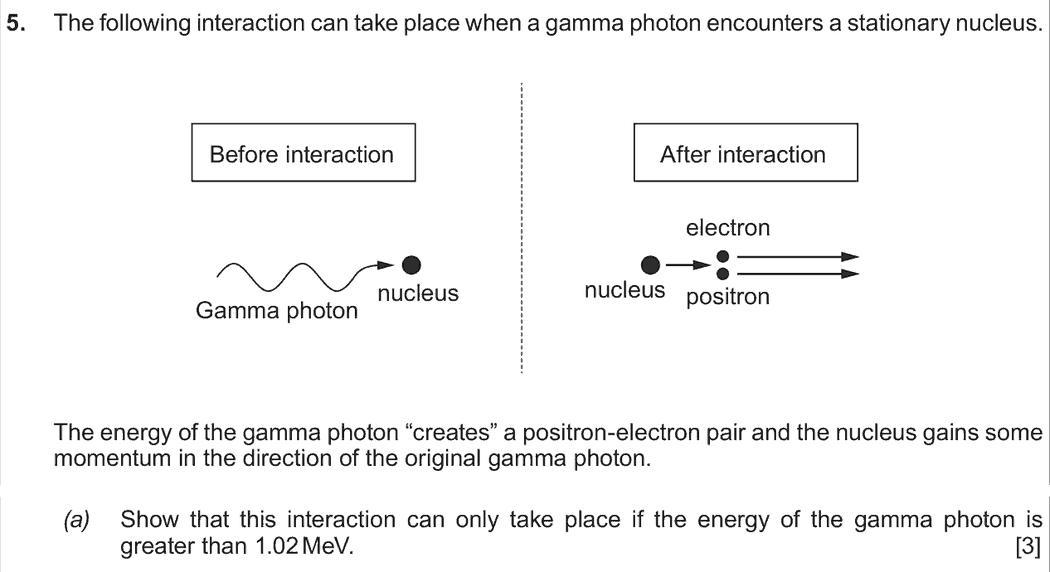
June 2019 · Component 3 · Q5(c)4 marksAO2=4Show that
Earlier part of question 5 that this part uses
Mark scheme
Examiner's comment
Obtaining the momentum of the gamma photon proved to be the most difficult step here but this is far easier for those who can derive/memorise E p c = . The momentum of the electron and positron also proved troublesome but, again, there was a simple short cut for those who memorised/derived p2 = 2mE.
Notes from the mark scheme and report
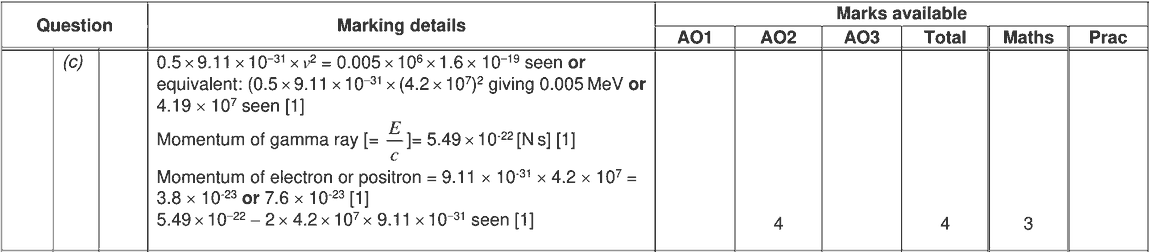
½mv² = 0.005 × 10⁶ × 1.6 × 10⁻¹⁹ J gives v = 4.19 × 10⁷ m s⁻¹
photon momentum p = E/c = 1.03 MeV/c = 5.49 × 10⁻²² N s
electron and positron each mv = 3.8 × 10⁻²³ N s
nucleus = 5.49 × 10⁻²² − 2 × 3.8 × 10⁻²³ = 4.7 × 10⁻²² kg m s⁻¹. Conservation of momentum is Component 1
the photon momentum was the hardest step
Scheme columns: Maths 3
Skills: Synoptic Needs physics from another component of the qualification; Unitsand conversions Unit marks, base units, prefixes and conversions; Mathsmarks The mark scheme's Maths column gives this part at least one mark for mathematical skills
June 2019 · Component 3 · Q5(d)2 marksAO3=2Calculation
Earlier part of question 5 that this part uses
Mark scheme
Examiner's comment
This part question proved to be tougher than expected (p2 = 2mE was an advantage here too). The very best answers converted the KE of the nucleus to eV.
Skills: Synoptic Needs physics from another component of the qualification; Mathsmarks The mark scheme's Maths column gives this part at least one mark for mathematical skills
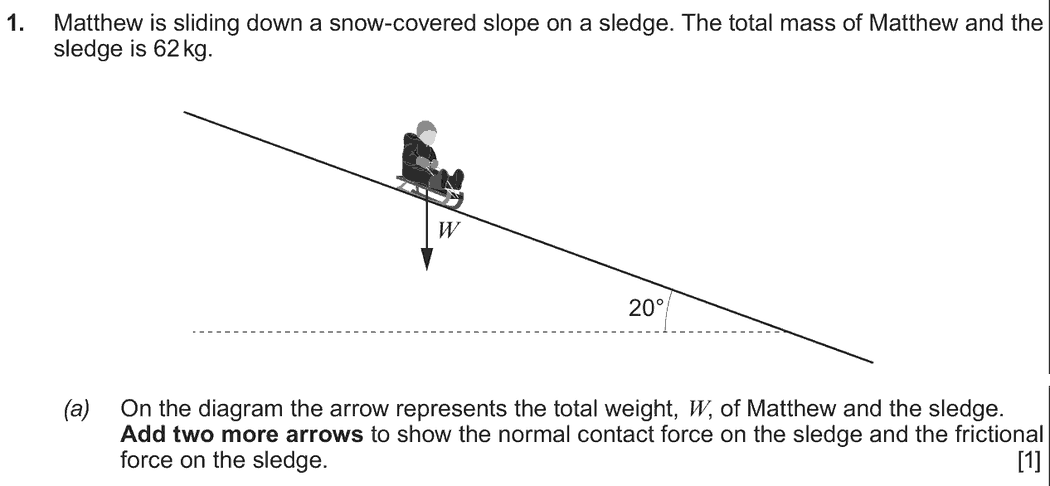
June 2018 · Component 1 · Q1(a)1 markAO1=1Diagram or graph
Mark scheme
Examiner's comment
Almost everyone showed the normal contact force and the frictional force correctly.
Notes from the mark scheme and report
Normal contact force drawn perpendicular to the slope (away from it) and friction drawn up the slope
labels, exact positions and lengths not required
June 2018 · Component 1 · Q3(a)2 marksAO1=2Definition
Mark scheme
Examiner's comment
Most students gave good statements of Newton’s second law, often, commendably, referring to the resultant force or to the sum of forces. Occasionally we were treated instead to statements of the principle of conservation of momentum.
Notes from the mark scheme and report
Rate of change of momentum of a body is proportional (or equal) to the force (1)
the force is the resultant force, or the change takes place in the direction of the force (1)
some stated conservation of momentum instead
June 2018 · Component 1 · Q3(b)(i)3 marksAO2=3Show that
Earlier part of question 3 that this part uses
Mark scheme
Examiner's comment
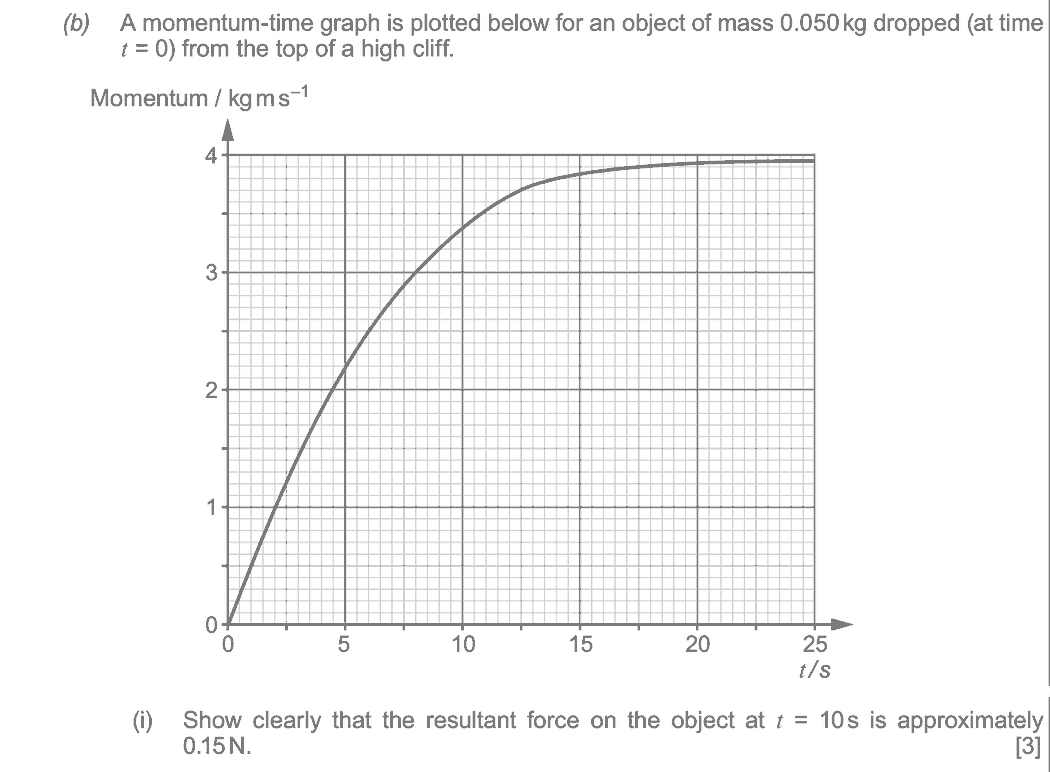
Most candidates drew tangents to the graph at t = 10 s and determined the resultant force competently. A minority divided the momentum at t = 10 s by 10 s, and gave this mean force itself, or mysteriously halved, as their answer.
Notes from the mark scheme and report
Tangent drawn to the momentum-time graph at t = 10 s (1)
gradient clearly calculated (1)
force = 0.15 ± 0.03 N (1)
dividing the momentum at 10 s by 10 s gives the mean force and was not credited
Scheme columns: Maths 2
Skills: Graphskills Reading, plotting or sketching graphs; gradients, intercepts and areas; Mathsmarks The mark scheme's Maths column gives this part at least one mark for mathematical skills
June 2018 · Component 1 · Q3(b)(ii)2 marksAO2=2Calculation
Earlier parts of question 3 that this part uses
Mark scheme
Examiner's comment
There was a pleasing success rate in finding the air resistance at t = 10 s,
Notes from the mark scheme and report
Answer: 0.34 N (0.35 N). Resultant force = weight − air resistance
weight = 0.050 × 9.81 = 0.49 N
ecf
Scheme columns: Maths 1
Skills: Mathsmarks The mark scheme's Maths column gives this part at least one mark for mathematical skills
June 2018 · Component 1 · Q9(c)2 marksAO2=2Show that
Earlier part of question 9 that this part uses
Mark scheme
Examiner's comment
Occasionally students didn’t make clear the role of force in deriving e eE a m .
Notes from the mark scheme and report
F = qE and F = ma (1)
with q = e and m = me (or stating the electric force is the resultant force), so a = eE/me (1)
the role of force was sometimes unclear
Scheme columns: Maths 1
Skills: Comprehension A level Component 1 Section B: questions on the printed article; Synoptic Needs physics from another component of the qualification; Algebra Derivations and rearranging equations; Mathsmarks The mark scheme's Maths column gives this part at least one mark for mathematical skills
June 2017 · Component 1 · Q2(a)(i)3 marksAO1=1, AO2=2Calculation
Mark scheme
Examiner's comment
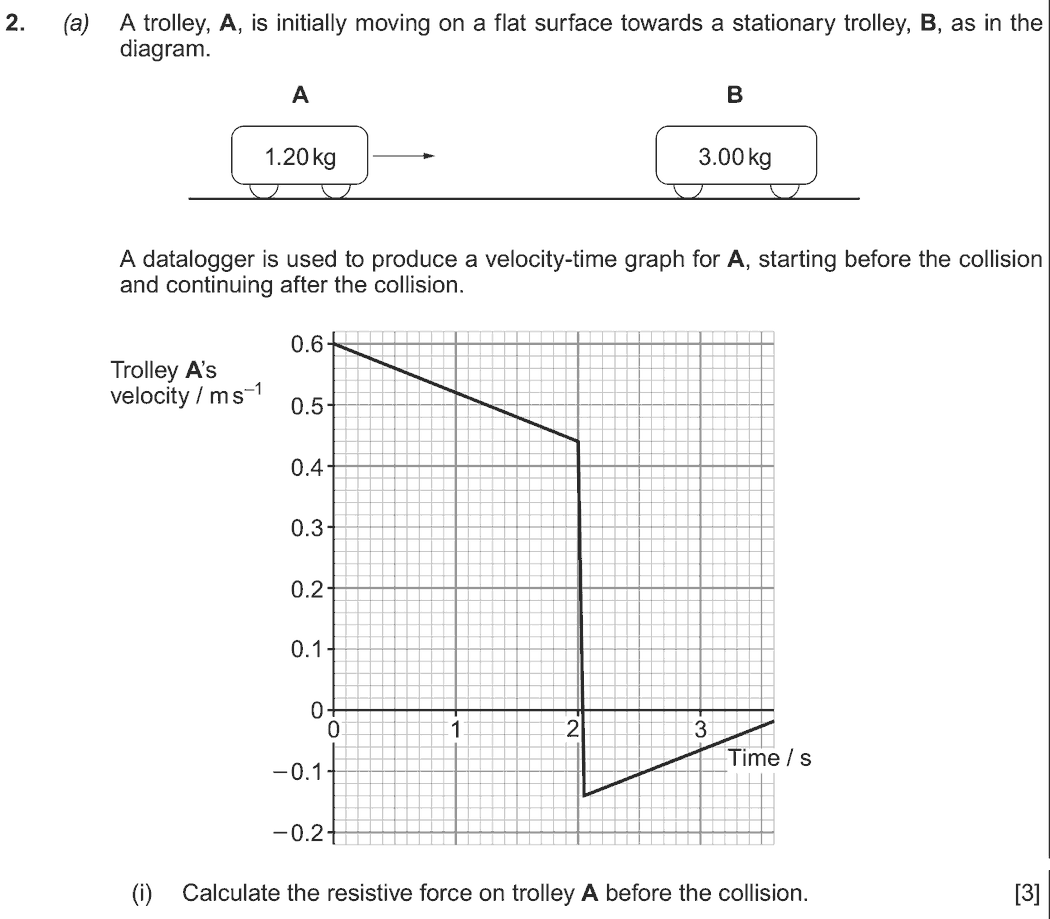
Most candidates extracted a value for the acceleration of trolley A from the graph and applied F = ma, as intended. Mistakes were quite rare.
Notes from the mark scheme and report
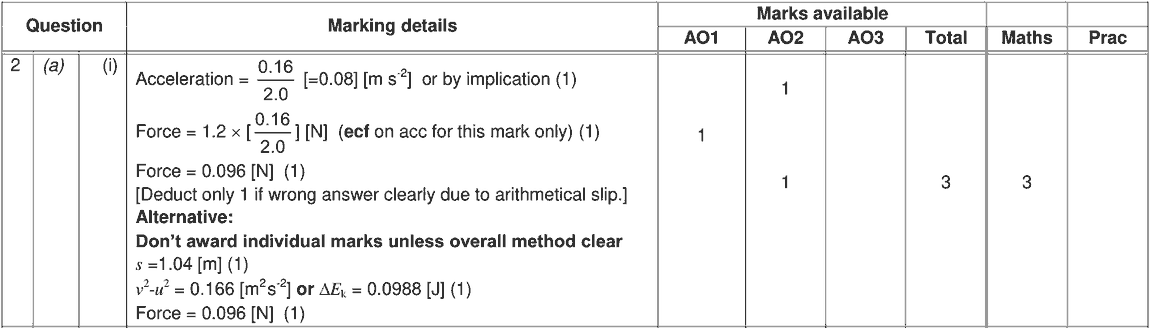
Answer: 0.096 N. Deceleration from the graph = (0.60 − 0.44)/2.0 = 0.08 m s⁻²
F = ma = 1.20 × 0.08
alternative via distance and change in kinetic energy
Scheme columns: Maths 3
Skills: Graphskills Reading, plotting or sketching graphs; gradients, intercepts and areas; Mathsmarks The mark scheme's Maths column gives this part at least one mark for mathematical skills
June 2017 · Component 1 · Q2(a)(iii)4 marksAO1=2, AO2=2Calculation
Earlier part of question 2 that this part uses
Mark scheme
Examiner's comment
Determining the velocity given to trolley B was done well. A minor slip was to use the wrong initial velocity for A. More serious was not taking account of A’s change of direction.
Notes from the mark scheme and report
Answer: 0.23 m s⁻¹ to the right. 1.20 × 0.44 = −1.20 × 0.14 + 3.00 v
A rebounds so its velocity after is −0.14 m s⁻¹ (ignoring the reversal gives 0.12 m s⁻¹ and loses 2 marks)
using 0.60 m s⁻¹ as A's initial velocity loses 1
Scheme columns: Maths 4
Skills: Graphskills Reading, plotting or sketching graphs; gradients, intercepts and areas; Mathsmarks The mark scheme's Maths column gives this part at least one mark for mathematical skills
June 2017 · Component 1 · Q2(a)(iv)3 marksAO3=3Calculation
Earlier part of question 2 that this part uses
Mark scheme
Examiner's comment
Most candidates showed clearly that the collision was inelastic. Kinetic energy calculations were far more common than using the coefficient of restitution – not on our specification but perfectly legitimate.
Notes from the mark scheme and report
Kinetic energy before = ½ × 1.20 × 0.44² = 0.116 J
after = ½ × 1.20 × 0.14² + ½ × 3.00 × 0.232² = 0.092 J
kinetic energy is lost so the collision is inelastic and Jasmine is wrong
ecf
Scheme columns: Maths 2
Skills: Mathsmarks The mark scheme's Maths column gives this part at least one mark for mathematical skills
June 2017 · Component 1 · Q2(b)3 marksAO3=3Explanation
Earlier part of question 2 that this part uses
Mark scheme
Examiner's comment
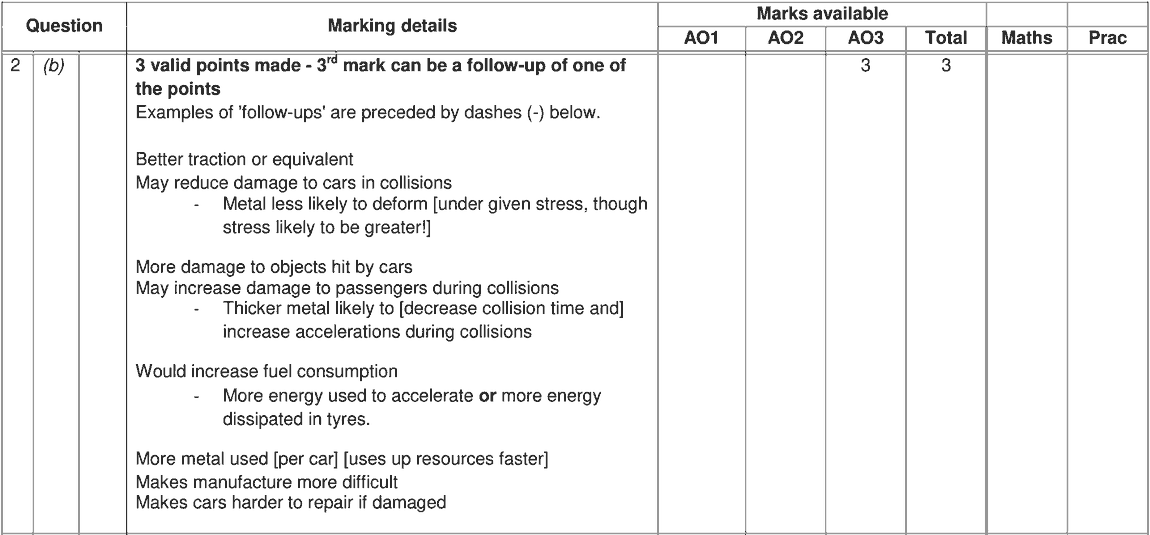
Thicker metal for cars? Many candidates considered the effect on passengers in collisions. The valid point was sometimes made that certain injuries might be avoided because the thicker metal would be less likely to deform. There were some poorly argued claims that injuries might be worse ‘because of the greater momentum’, but the more rapid deceleration of passengers due to less crumpling was quite often correctly given as a likely disadvantage of using thicker metal. [Some candidates claimed implausibly that the collision would be more prolonged and the passenger acceleration less.] Points not directly related to passenger injuries included the bad effects of mining more metal, and increased fuel consumption – sometimes related to more energy being needed to bring the car up to speed and/or more tyre resistance. Well- argued points were given two marks. Plenty of sound reasoning (and some sloppy reasoning) were displayed, as well as excellent awareness of environmental issues.
Notes from the mark scheme and report
Three valid points, the third may develop an earlier one: e.g. less deformation so less damage to the car
less crumpling means a shorter collision time and greater deceleration of passengers
more damage to whatever is hit
heavier car so more fuel used
more metal mined and manufactured. Claims based only on 'greater momentum' were weak
June 2017 · AS Component 1 · Q76 marksAO1=2, AO2=46-mark extended response
Mark scheme, with the levels and indicative content
Examiner's comment
A large proportion of candidates only referred to the boat rocking. A maximum of 1 mark was awarded for this response. Many of those who did grasp the lateral movement, did not use adequate vocabulary to clearly describe the motion e.g. accelerate/decelerate. Few candidates described the uniform motion whilst the ball was travelling in the air. EDUQAS GCE AS PHYSICS Summer 2017
Notes from the mark scheme and report
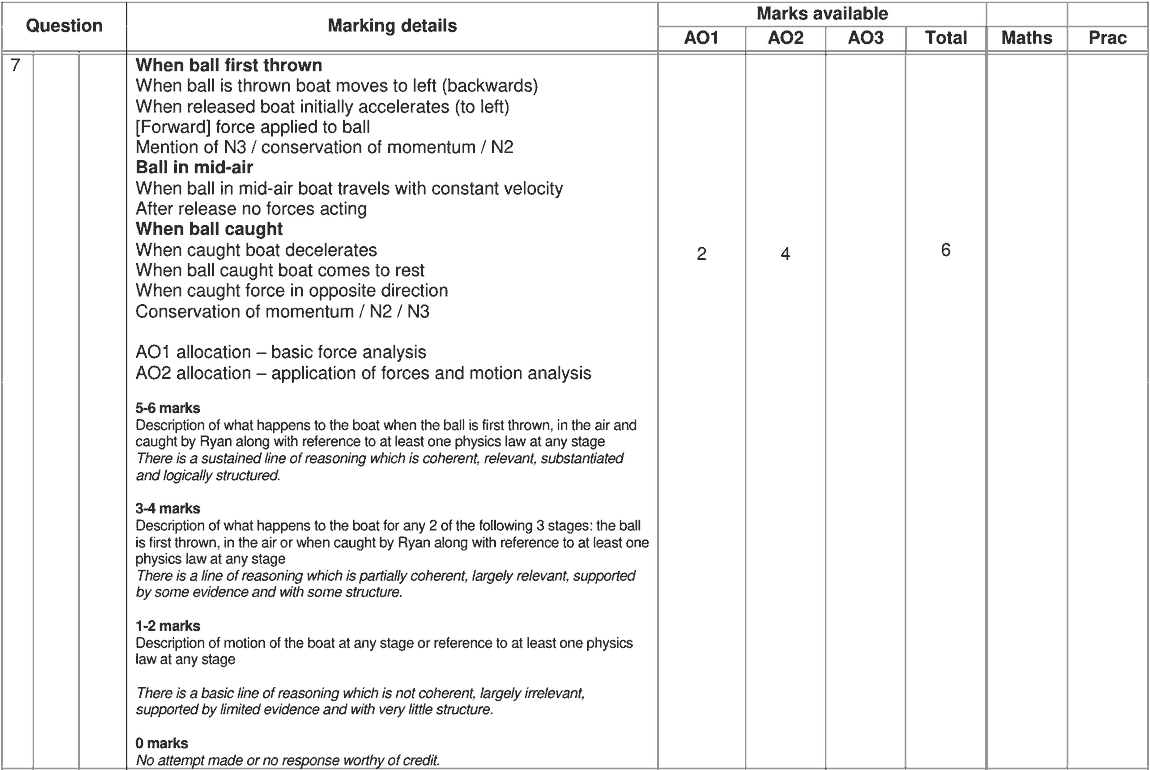
QER, levels marked. Throw: Louise pushes the ball forward and the ball pushes back on her (Newton's third law), so the boat accelerates backwards
momentum of ball and boat is conserved (total stays zero). Ball in flight: no horizontal force on the boat, so it moves backwards at constant velocity. Catch: the ball pushes Ryan forward, the boat decelerates and comes to rest when the ball is caught. Answers about the boat only rocking gained at most 1 mark
few described the constant velocity stage
Skills: QER The 6-mark quality of extended response question
June 2017 · Component 1 · Q7(e)3 marksAO3=3Explanation
Earlier part of question 7 that this part uses
Mark scheme
Examiner's comment
There were many good discussions of the claim about the roughness of smooth and treaded rubber, with good use made of the quoted uncertainties for the experimental data, and some doubts raised about the relevance of the experiment to whole tyres.
Notes from the mark scheme and report
The smooth rubber has the larger coefficient (0.98 against 0.85), which appears to contradict the textbook (1)
the slide angles differ by 4° while the uncertainty is under 1° (1)
so the difference is not random error, or a more guarded conclusion because repeats and whole tyres are not covered (1)
Scheme columns: Practical 3
Skills: Comprehension A level Component 1 Section B: questions on the printed article; Uncertainties Resolution, absolute and percentage uncertainty, combining uncertainties, error bars; Practicalmarks The mark scheme's Prac column gives this part at least one mark for practical skills
June 2017 · Component 2 · Q4(b)(iii)3 marksAO1=1, AO2=2Calculation
Earlier parts of question 4 that this part uses
Mark scheme
Examiner's comment
Good attempts were made by many candidates to determine the time taken for an electron to travel from Y to X. Many candidates scored at least one mark here, usually for an appropriate ‘first step’ in their calculation. This could either be for determining acceleration from their answer to (i) or velocity from their answer to (ii). In many cases, the mark was awarded as ecf. Unfortunately, a significant number of candidates used the equation for constant velocity to determine t, rather than an equation for accelerated motion.
Notes from the mark scheme and report
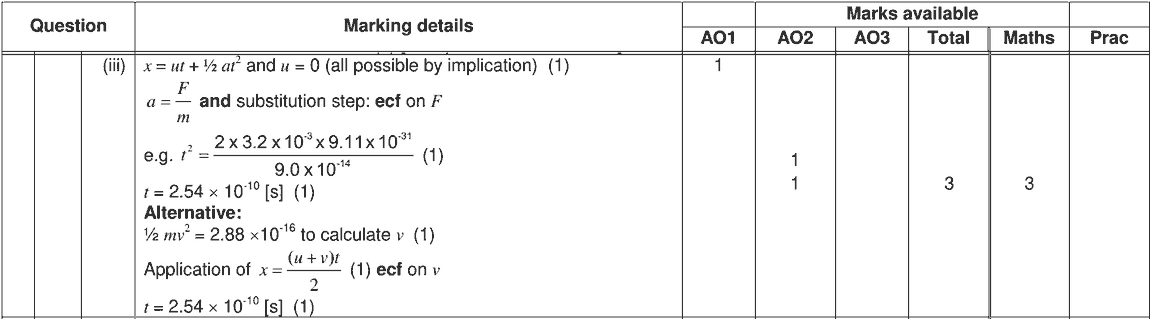
Answer: 2.54 × 10⁻¹⁰ s. a = F/m = 9.0 × 10⁻¹⁴/9.11 × 10⁻³¹
x = ½at² with u = 0, so t² = 2xm/F. Alternative: v from ½mv² = 2.88 × 10⁻¹⁶ J, then x = ½(u + v)t. Synoptic with Component 1 kinematics
a common error was using constant-velocity t = x/v
Scheme columns: Maths 3
Skills: Synoptic Needs physics from another component of the qualification; Mathsmarks The mark scheme's Maths column gives this part at least one mark for mathematical skills
June 2017 · AS Component 2 · Q7(c)5 marksAO2=5Calculation
Earlier part of question 7 that this part uses
Mark scheme
Notes from the mark scheme and report
Answer: 1.7 × 10³⁴ molecules per second. Area = 2290 km² = 2.29 × 10⁹ m²
F = pA = 1.38 × 10¹² N
momentum of a molecule = 7.3 × 10⁻²⁶ × 550 = 4.0 × 10⁻²³ N s, change on rebound = 8.03 × 10⁻²³ N s
number per second = F/Δp. Force = rate of change of momentum is AS Component 1 content (same method as radiation pressure). No report comment for this part
Scheme columns: Maths 5
Skills: Synoptic Needs physics from another component of the qualification; Unitsand conversions Unit marks, base units, prefixes and conversions; Mathsmarks The mark scheme's Maths column gives this part at least one mark for mathematical skills
June 2016 · AS Component 1 · Q1(b)(i)2 marksAO1=1, AO2=1Diagram or graph
Earlier part of question 1 that this part uses
Mark scheme
Examiner's comment
The diagram was well labelled. However a few candidates used ‘floating’ arrows which did not touch the diagram so they lost a mark and a few others forgot to label the arrows.
Notes from the mark scheme and report
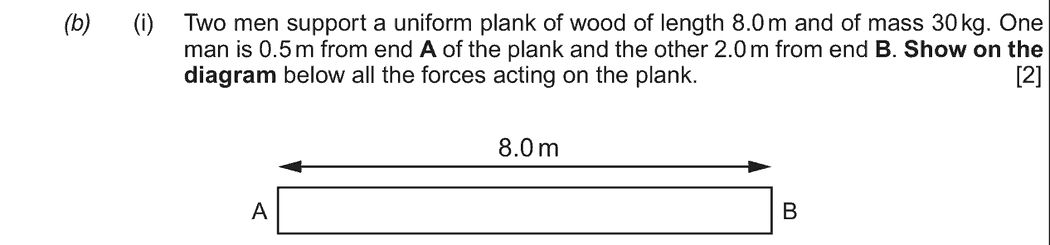
Weight (294 N or mg) drawn downwards from about the centre and touching the plank (1)
two upward support forces labelled, the right-hand one nearer the centre than the left-hand one (1)
arrows not touching the plank and unlabelled arrows lost marks
Scheme columns: Maths 1
Skills: Mathsmarks The mark scheme's Maths column gives this part at least one mark for mathematical skills
June 2016 · AS Component 1 · Q2(c)3 marksAO2=3Explanation
Earlier parts of question 2 that this part uses
Mark scheme
Examiner's comment
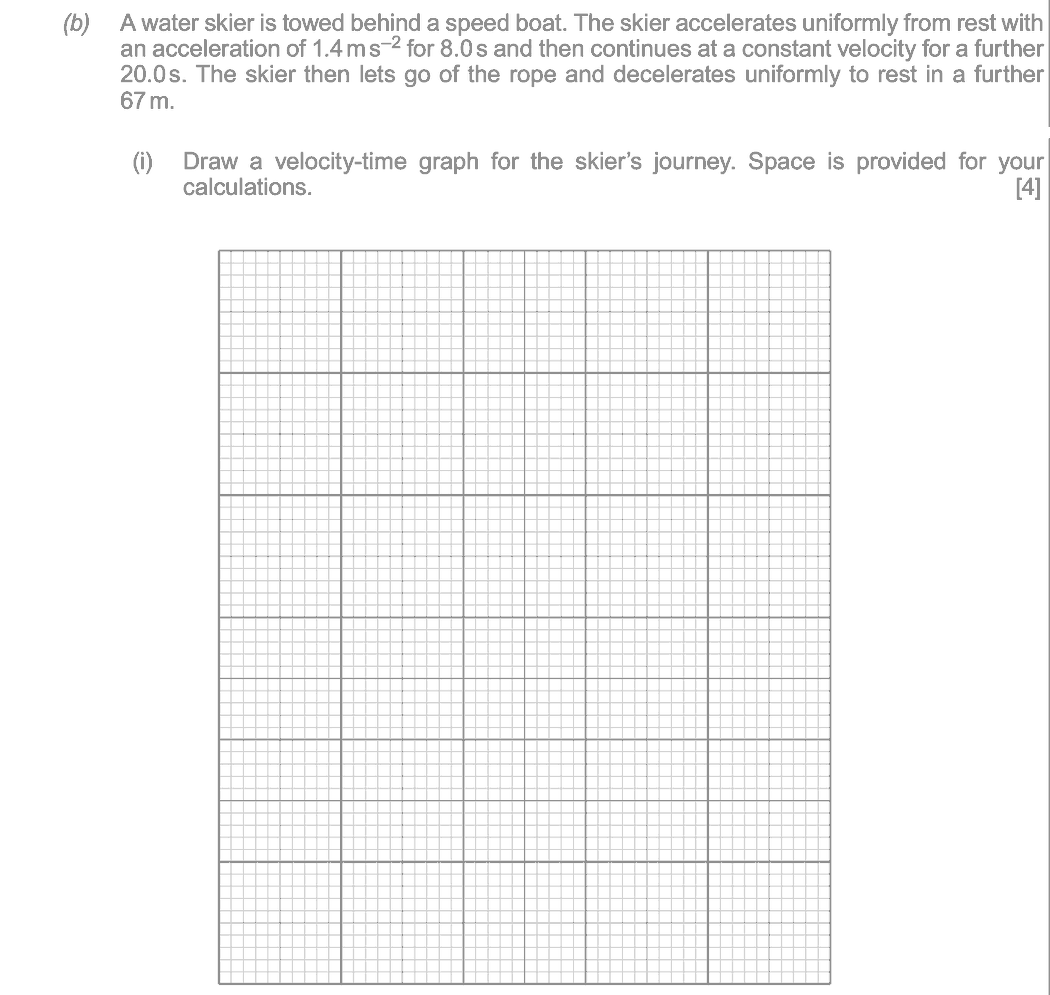
This was the most problematic part of the question, with very few candidates gaining more than 1/3 marks. Some candidates obtained a mark for realising there was zero resultant force when the skier was travelling at constant velocity but very few stated there was a constant forward force between 0 and 8 seconds and a constant backward force between 28 and 40 seconds.
Notes from the mark scheme and report
0 to 8 s: constant forward resultant force (1)
8 to 28 s: zero resultant force (1)
28 to 40 s: constant backward resultant force (1)
most only gained the zero-force mark and omitted 'constant' and the direction
June 2016 · AS Component 1 · Q3(a)2 marksAO2=2Calculation
Mark scheme
Examiner's comment
The recoil velocity of the gun was well done using conservation of momentum.
Notes from the mark scheme and report
Answer: 0.098 m s⁻¹ (0.10). Total momentum is zero: 3.0 × 10⁻³ × 85 = 2.60 v
Scheme columns: Maths 2
Skills: Mathsmarks The mark scheme's Maths column gives this part at least one mark for mathematical skills
June 2016 · AS Component 1 · Q3(c)(ii)3 marksAO2=3Calculation
Earlier parts of question 3 that this part uses
Mark scheme
Examiner's comment
These parts caused a number of candidates problems. In part (i) many candidates realised the velocity would change due to air resistance but didn’t specify that the horizontal velocity was the important component. There were a number of different ways to answer part (ii) with many using the work – energy theorem and others equations of motion.
Notes from the mark scheme and report
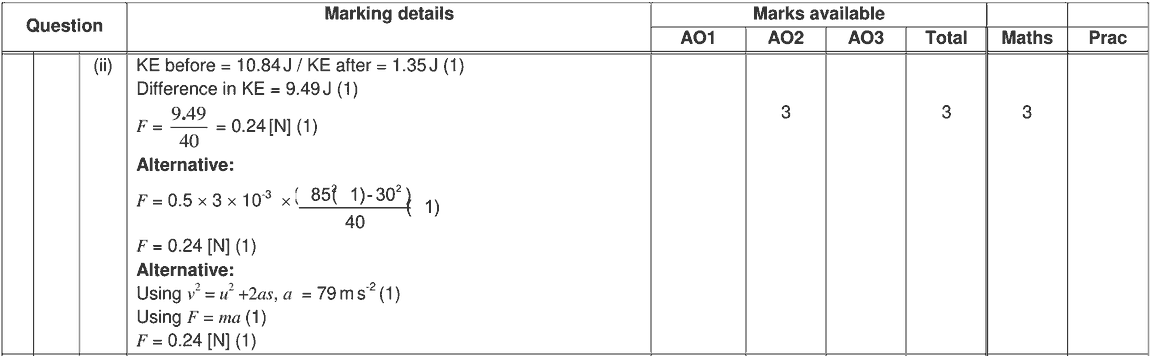
Answer: 0.24 N. Loss of KE = 10.84 − 1.35 = 9.49 J
F = 9.49/40. Alternative: v² = u² + 2as gives a = 79 m s⁻², then F = ma
Scheme columns: Maths 3
Skills: Mathsmarks The mark scheme's Maths column gives this part at least one mark for mathematical skills
Work with an Eduqas physics tutor
Dropping marks on calculations, specified practicals or the six-mark QER questions? Book a trial session with a specialist Eduqas physics tutor.