Notes and key-term cards for this topic are being written by our tutors. The past-paper questions below are ready now.
Specification statements
Show the 5 statements from the specification
3.10-a the definition of magnetic flux as φ = AB cos θ and flux linkage = Nφ
3.10-b the laws of Faraday and Lenz
3.10-c how to apply the laws of Faraday and Lenz (i.e. emf = - rate of change of flux linkage)
3.10-d the idea that an emf is induced in a linear conductor moving at right angles to a uniform magnetic field
3.10-e qualitatively, how the instantaneous emf induced in a coil rotating at right angles to a magnetic field is related to the position of the coil, flux density, coil area and angular velocity
Tap a question to zoom it. Where a part needs a figure, table or graph from earlier in the question, that part folds out above it; the mark scheme and examiner's comment open underneath. Have the Eduqas Data Booklet beside you (see the Data Booklet page).
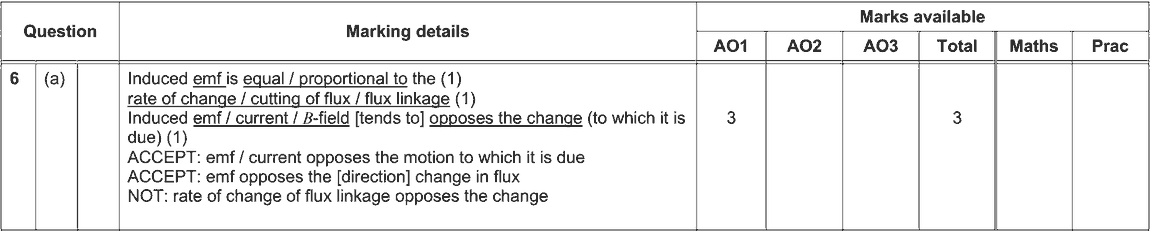
June 2025 · Component 3 · Q6(a)3 marksAO1=3Definition
Mark scheme
Examiner's comment
This question was well answered except for part (b)(i). This was just a standard rotating coil in a B-field and one would have expected better answers.
Notes from the mark scheme and report
Faraday: the induced emf is equal (proportional) to (1) the rate of change of flux linkage (1)
Lenz: the direction of the induced emf or current is such as to oppose the change causing it (1)
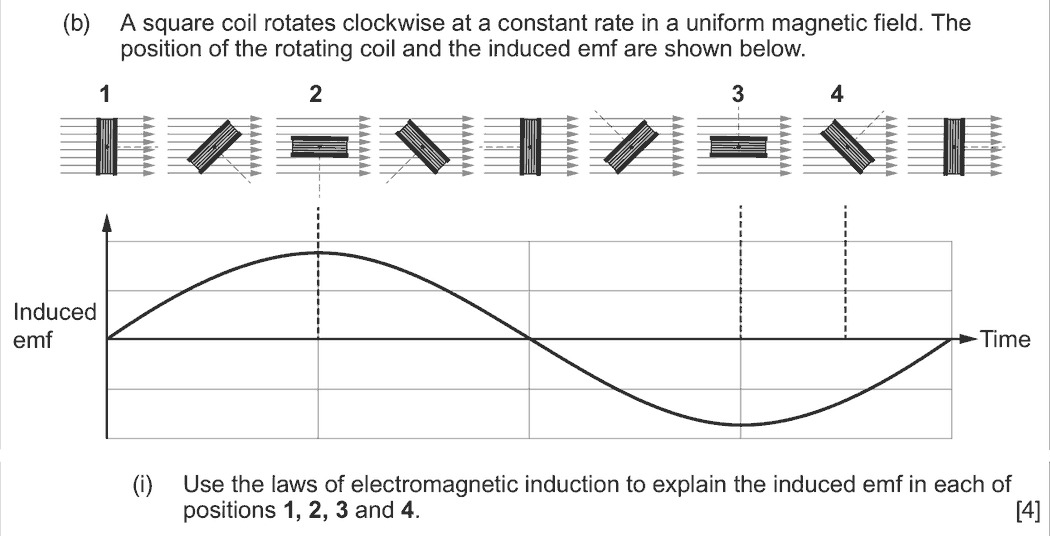
June 2025 · Component 3 · Q6(b)(i)4 marksAO2=4Explanation
Earlier part of question 6 that this part uses
Mark scheme
Examiner's comment
This question was well answered except for part (b)(i). This was just a standard rotating coil in a B-field and one would have expected better answers.
Notes from the mark scheme and report
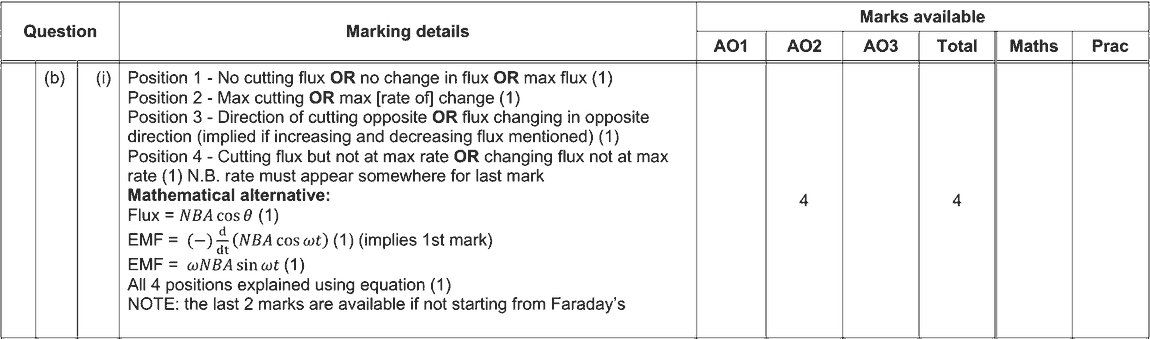
Position 1: flux linkage is a maximum but not changing (no flux cut), so zero emf (1)
position 2: maximum rate of change (cutting) of flux, so maximum emf (1)
position 3: flux changing at the maximum rate in the opposite sense, so maximum negative emf (1)
position 4: flux changing but not at the maximum rate, so a smaller negative emf (1). Maths route: flux linkage = BAN cos ωt, emf = ωBAN sin ωt. Weaker than expected for a standard rotating coil
June 2025 · Component 3 · Q6(b)(ii)2 marksAO2=2Explanation
Earlier parts of question 6 that this part uses
Mark scheme
Examiner's comment
This question was well answered except for part (b)(i). This was just a standard rotating coil in a B-field and one would have expected better answers.
Notes from the mark scheme and report
Peak emf doubles because the rate of change of flux linkage doubles (1)
the frequency doubles, i.e. the period halves (1)
'wavelength halves' not accepted
Skills: Graphskills Reading, plotting or sketching graphs; gradients, intercepts and areas
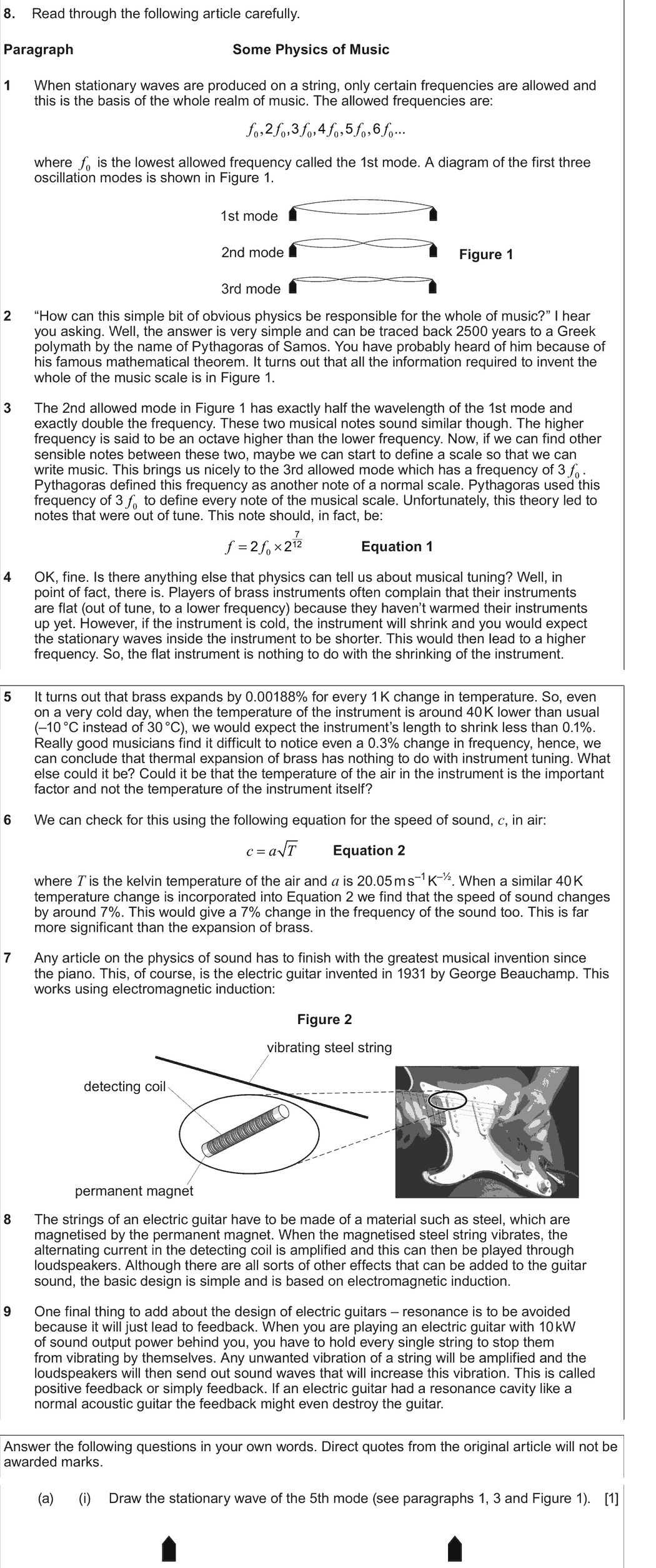
June 2024 · Component 1 · Q8(f)5 marksAO1=1, AO2=4Explanation
Earlier part of question 8 that this part uses
Mark scheme
Examiner's comment
This proved challenging for candidates. All marking points were achieved. Not many achieved all 5 marks, however, there were a good number of 3’s and 4’s. Weaker responses indicated that the strings were permanently magnetised. There were also some confused responses where an induced current was set up in the strings as it moved past the coil and permanent magnet. Really good responses linked a changing B-field to a changing flux linkage in the coil and hence to Faraday’s law.
Notes from the mark scheme and report
Steel string is magnetised by the permanent magnet (1)
the vibrating string gives a varying B-field (1)
the flux in the coil varies (1)
an emf is induced (Faraday) (1)
the signal is amplified and sent to speakers (1)
weaker answers said the strings are permanently magnetised
Skills: Comprehension A level Component 1 Section B: questions on the printed article; Synoptic Needs physics from another component of the qualification
June 2024 · Component 1 · Q8(g)2 marksAO3=2Explanation
Earlier part of question 8 that this part uses
Mark scheme
Examiner's comment
A significant number of candidates thought that copper was magnetic, and they struggled to pick up any marks in this question part. Phrases like ‘it is more difficult to magnetise than steel’ were not deemed enough. ‘If the strings were copper, they would likely stick to the pickup’ was an example of a confused response that was not given credit. PHYSICS GCE A level Summer 2024
Notes from the mark scheme and report
Copper is not (ferro)magnetic so the strings are not magnetised (1)
so no change of flux in the coil and no induced emf or current (1)
many thought copper was magnetic
Skills: Comprehension A level Component 1 Section B: questions on the printed article
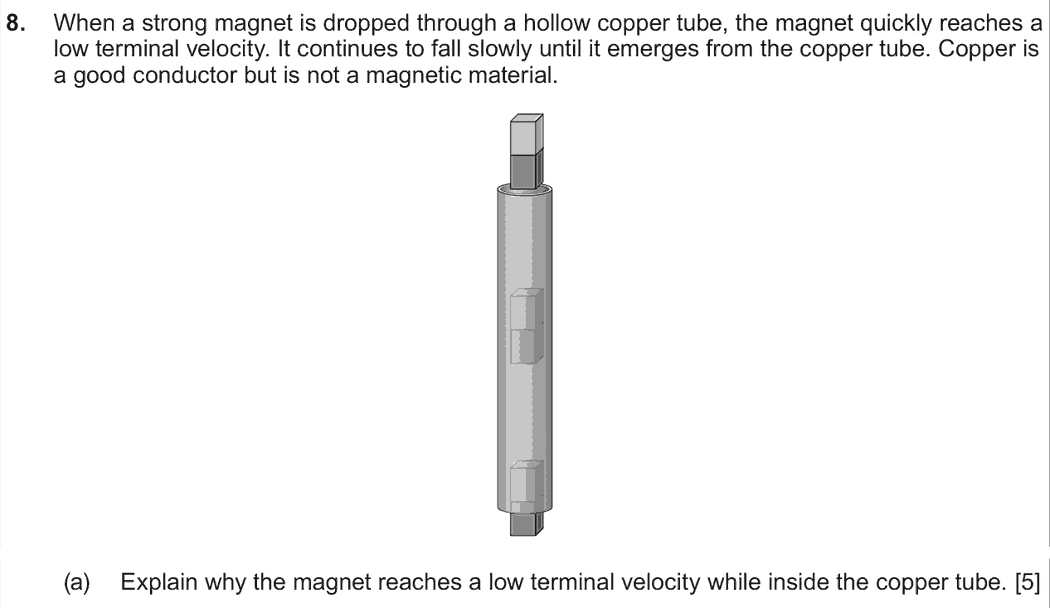
June 2024 · Component 3 · Q8(a)5 marksAO2=5Explanation
Mark scheme
Examiner's comment
It was rare to award five marks for this qualitative response. Many part answers were seen that showed some understanding of why the magnet reached a low terminal velocity but in most cases one or two of the steps in the explanation were omitted.
Notes from the mark scheme and report
The falling magnet changes the flux through the copper tube (field lines cut the tube) (1)
an emf is induced (1), driving currents in the tube (1)
by Lenz's law the field of these currents opposes the magnet's motion (1)
the upward magnetic force grows with speed until it equals the weight, so there is no resultant force (1)
full marks were rare, a step or two usually missing
June 2023 · Component 3 · Q10(a)(i)1 markAO2=1Explanation
Mark scheme
Examiner's comment
Both parts of (a) were poorly answered in general, most candidates couldn’t quite find a form of words to answer (i). Probably the easiest way to answer the question is “the horizontal lines are not cut”. In (ii) some answers to the direction of flow were impossible to understand e.g. the current flows left to right or the current flows upwards (without stating where). Many had the wrong direction for the current. Some of the rules stated were insufficient e.g. using Fleming’s left hand rule. By itself, FLHR is not enough to explain the current direction. However, FLHR applied to the electrons in the slider is valid as is FLHR along with Lenz’s Law. If candidates knew the relationship 𝑉= 𝐵𝑙𝑣 then (iii) was answered well. The last part was quite well answered but the explanation was often inadequate. Some candidates incorrectly thought that the current increases. Many explanations involved the area decreasing when the area was actually increasing. If an explanation was attempted with area, it needed to say that the area was increasing at a decreasing rate. Option A – Alternating Currents
Notes from the mark scheme and report
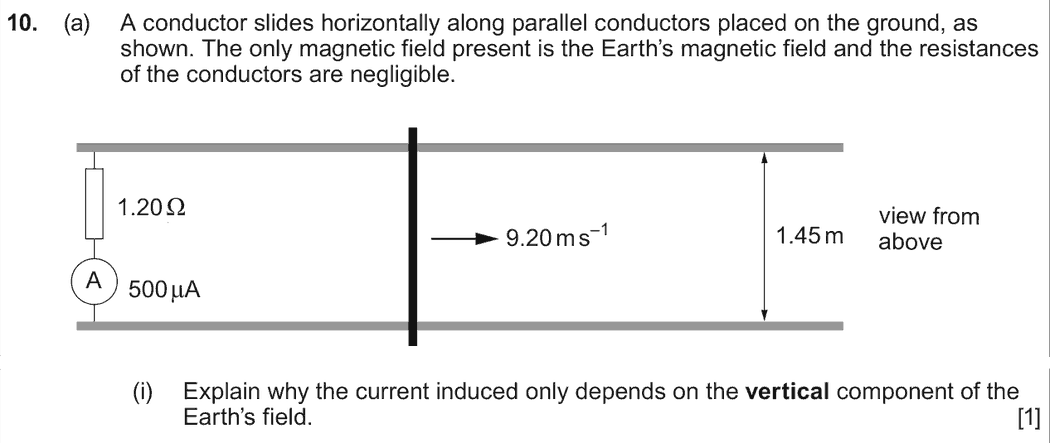
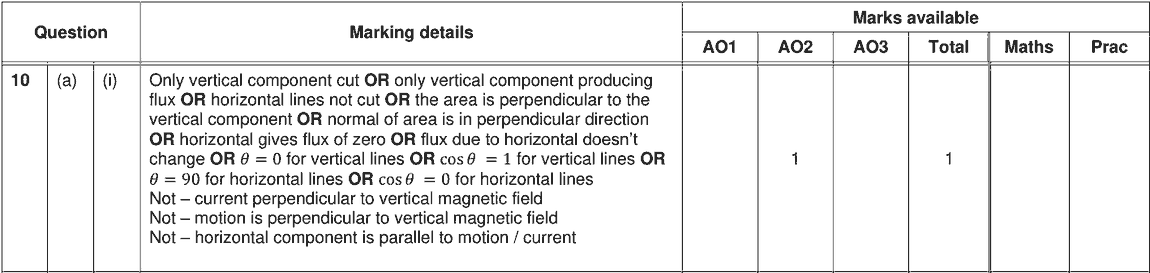
Only the vertical field lines are cut by the horizontally moving conductor (only the vertical component gives flux through the horizontal circuit)
the horizontal component is not cut. Poorly worded by most
June 2023 · Component 3 · Q10(a)(ii)2 marksAO1=1, AO2=1Explanation
Earlier part of question 10 that this part uses
Mark scheme
Examiner's comment
Both parts of (a) were poorly answered in general, most candidates couldn’t quite find a form of words to answer (i). Probably the easiest way to answer the question is “the horizontal lines are not cut”. In (ii) some answers to the direction of flow were impossible to understand e.g. the current flows left to right or the current flows upwards (without stating where). Many had the wrong direction for the current. Some of the rules stated were insufficient e.g. using Fleming’s left hand rule. By itself, FLHR is not enough to explain the current direction. However, FLHR applied to the electrons in the slider is valid as is FLHR along with Lenz’s Law. If candidates knew the relationship 𝑉= 𝐵𝑙𝑣 then (iii) was answered well. The last part was quite well answered but the explanation was often inadequate. Some candidates incorrectly thought that the current increases. Many explanations involved the area decreasing when the area was actually increasing. If an explanation was attempted with area, it needed to say that the area was increasing at a decreasing rate. Option A – Alternating Currents
Notes from the mark scheme and report
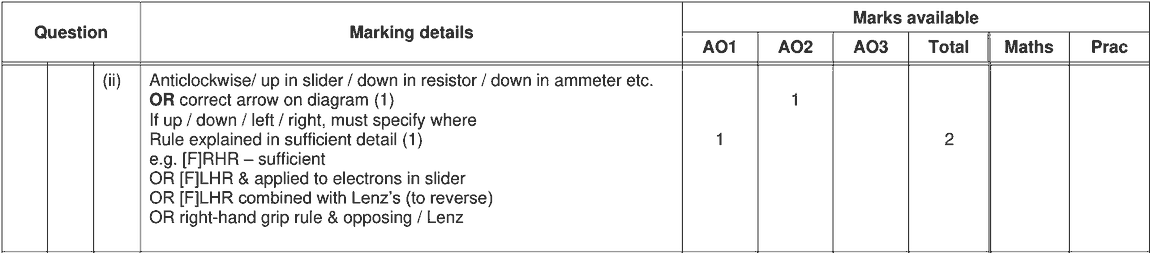
Anticlockwise as viewed (e.g. down through the resistor and ammeter), stated at a named place or by an arrow (1)
justified by Fleming's right-hand rule, or the left-hand rule with Lenz's law (the force on the induced current must oppose the motion) (1)
many directions were wrong or not located
June 2023 · Component 3 · Q10(a)(iii)3 marksAO2=3Calculation
Earlier part of question 10 that this part uses
Mark scheme
Examiner's comment
Both parts of (a) were poorly answered in general, most candidates couldn’t quite find a form of words to answer (i). Probably the easiest way to answer the question is “the horizontal lines are not cut”. In (ii) some answers to the direction of flow were impossible to understand e.g. the current flows left to right or the current flows upwards (without stating where). Many had the wrong direction for the current. Some of the rules stated were insufficient e.g. using Fleming’s left hand rule. By itself, FLHR is not enough to explain the current direction. However, FLHR applied to the electrons in the slider is valid as is FLHR along with Lenz’s Law. If candidates knew the relationship 𝑉= 𝐵𝑙𝑣 then (iii) was answered well. The last part was quite well answered but the explanation was often inadequate. Some candidates incorrectly thought that the current increases. Many explanations involved the area decreasing when the area was actually increasing. If an explanation was attempted with area, it needed to say that the area was increasing at a decreasing rate. Option A – Alternating Currents
Notes from the mark scheme and report
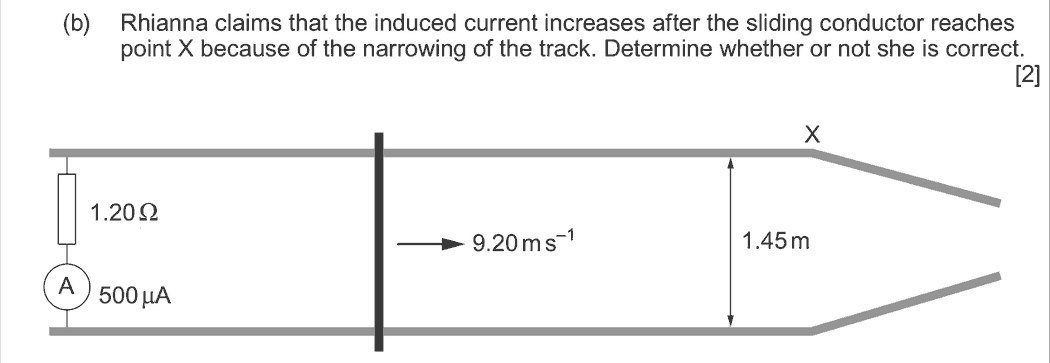
Answer: 45 µT. Emf = IR = 500 × 10⁻⁶ × 1.20 = 6.0 × 10⁻⁴ V (1)
emf = Blv (1)
B = 6.0 × 10⁻⁴/(1.45 × 9.20) = 4.5 × 10⁻⁵ T (1)
Scheme columns: Maths 3
Skills: Mathsmarks The mark scheme's Maths column gives this part at least one mark for mathematical skills
June 2023 · Component 3 · Q10(b)2 marksAO3=2Explanation
Earlier part of question 10 that this part uses
Mark scheme
Examiner's comment
Both parts of (a) were poorly answered in general, most candidates couldn’t quite find a form of words to answer (i). Probably the easiest way to answer the question is “the horizontal lines are not cut”. In (ii) some answers to the direction of flow were impossible to understand e.g. the current flows left to right or the current flows upwards (without stating where). Many had the wrong direction for the current. Some of the rules stated were insufficient e.g. using Fleming’s left hand rule. By itself, FLHR is not enough to explain the current direction. However, FLHR applied to the electrons in the slider is valid as is FLHR along with Lenz’s Law. If candidates knew the relationship 𝑉= 𝐵𝑙𝑣 then (iii) was answered well. The last part was quite well answered but the explanation was often inadequate. Some candidates incorrectly thought that the current increases. Many explanations involved the area decreasing when the area was actually increasing. If an explanation was attempted with area, it needed to say that the area was increasing at a decreasing rate. Option A – Alternating Currents
Notes from the mark scheme and report
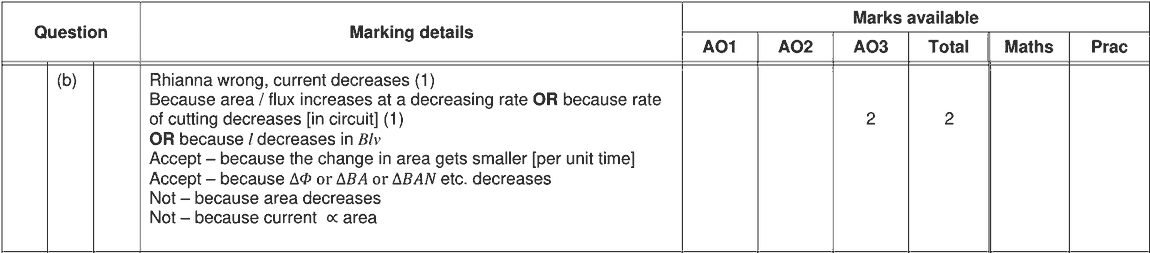
Rhianna is wrong: the current decreases (1) because the length of conductor between the rails falls, so flux is cut (the area grows) at a smaller rate, l decreases in Blv (1)
'because the area decreases' not accepted
June 2022 · Component 3 · Q9(a)3 marksAO2=3Explanation
Mark scheme
Examiner's comment
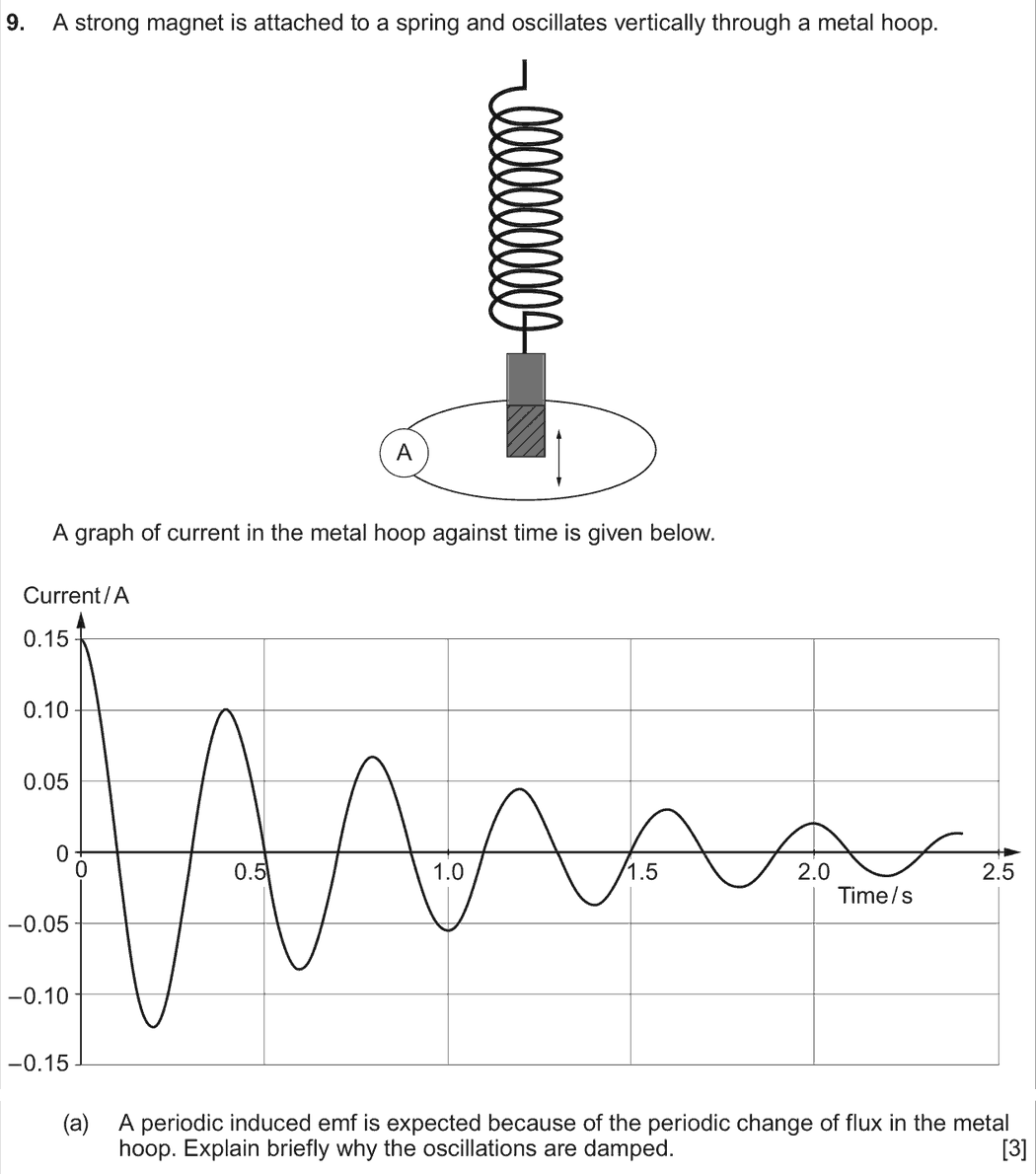
This part question possessed the lowest mean percentage mark. More candidates discussed air resistance than ohmic heating in the hoop.
Notes from the mark scheme and report
The induced emf drives a current in the hoop (1)
by Lenz's law its field opposes the motion of the magnet (1)
energy of the oscillation is dissipated as heating in the resistance of the hoop (1)
lowest-scoring part, many wrote about air resistance
Skills: Synoptic Needs physics from another component of the qualification
June 2022 · Component 3 · Q9(b)2 marksAO2=2Calculation
Earlier part of question 9 that this part uses
Mark scheme
Examiner's comment
This was an alternative method of asking for the induced emf but most candidates saw through this by using 𝑉= 𝐼𝑅 followed by Faraday’s Law. SECTION B – OPTIONS OPTION A – ALTERNATING CURRENTS
Notes from the mark scheme and report
Answer: 0.027 Wb s⁻¹ (V). emf = IR = 0.15 × 0.18 = 0.027 V (1)
by Faraday's law this equals the rate of change of flux (linkage) (1)
Scheme columns: Maths 1
Skills: Synoptic Needs physics from another component of the qualification; Graphskills Reading, plotting or sketching graphs; gradients, intercepts and areas; Mathsmarks The mark scheme's Maths column gives this part at least one mark for mathematical skills
October 2021 · Component 3 · Q8(a)3 marksAO1=3Definition
Mark scheme
Notes from the mark scheme and report
Faraday: the induced emf is equal (proportional) to (1) the rate of change of flux linkage (1)
Lenz: the direction of the induced emf is such as to oppose the change producing it (1)
October 2021 · Component 3 · Q8(b)(i)2 marksAO2=2Explanation
Earlier part of question 8 that this part uses
Mark scheme
Notes from the mark scheme and report
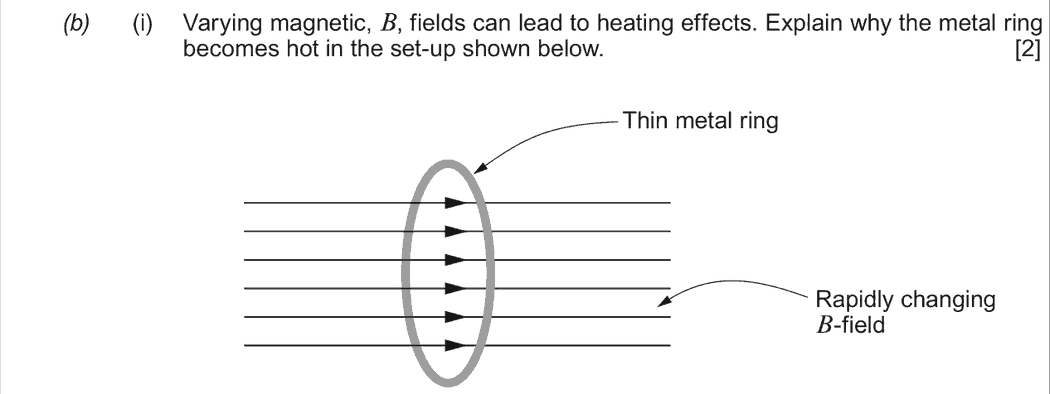
The changing flux through the ring induces an emf (1)
this drives a current round the ring, which heats it (I²R) (1)
October 2021 · Component 3 · Q8(b)(ii)3 marksAO2=3Calculation
Earlier parts of question 8 that this part uses
Mark scheme
Notes from the mark scheme and report
Answer: 11.9 A. emf = A dB/dt = π × 0.070² × 67 = 1.03 V
I = 1.03/0.087
Scheme columns: Maths 3
Skills: Mathsmarks The mark scheme's Maths column gives this part at least one mark for mathematical skills
October 2020 · Component 3 · Q10(b)(i)3 marksAO2=3Explanation
Earlier part of question 10 that this part uses
Mark scheme
Examiner's comment
In part (a)(iii) some candidates wanted to increase the number of turns when it would be far easier to put in an iron core (after all the question did ask for “increased greatly”). Part (b)(i) was well answered but many candidates did not mention that the circuit was complete (or had low resistance). The easiest way to answer part (ii) was to explain it with FRHR. Those who explained using FLHR or the right-hand grip rule were usually unclear in their explanations (as opposed to being incorrect). In part (iii) there were the usual instances of using 𝐵𝐵= 𝜇𝜇0𝐼𝐼 2𝜋𝜋𝜋𝜋. In the last part a few candidates did everything perfectly and then concluded that the force was in the wrong direction. Section B Comments in section B are not as detailed because of the small number of candidates that attempted each question. Question 11 – Alternating Currents No candidate answered this question Question 12 – Medical Physics All parts in (a) were answered quite well. Part (b) was quite well answered and there are no problems to report. The evaluation questions are always difficult to answer so in part (c) justifying the choice of imaging technique was problematic. Question 13 – The Physics of Sports The definition of moment of inertia was not well known. Part (b)(ii) was not well understood with few candidates trying to discuss force. In part (c)(i) the most disappointing aspect of these answers was the force diagram. Very few diagrams had weight, drag and magnus force. In the second part candidates needed to remember that the area in the drag equation was the cross-sectional area (π𝑟𝑟2). Question 14 – Energy and the Environment In the last part of (a) nearly all candidates talked immediately about greenhouse gases without mentioning the atmosphere. Part (b)(i) was not well known. Most candidates only knew one factor - the temperature. The definitions in part (c) were very poor. Candidates looked at the unit of the thermal conductivity and then said, “The rate of heat transfer per metre and per oC.” The second part of (c) was very poorly answered with most candidates only attempting to verify the first part of Jack’s statement and they did this incorrectly. Summary of key points Certain topic areas were poorly understood such as de Broglie wavelength and electron diffraction, electric fields. In qualitative responses a lack of clarity sometimes resulted in candidates not gaining all of the marks available. Recall questions on definitions which were testing assessment objective 1 often were not well answered, this highlights the importance of candidates learning their work.
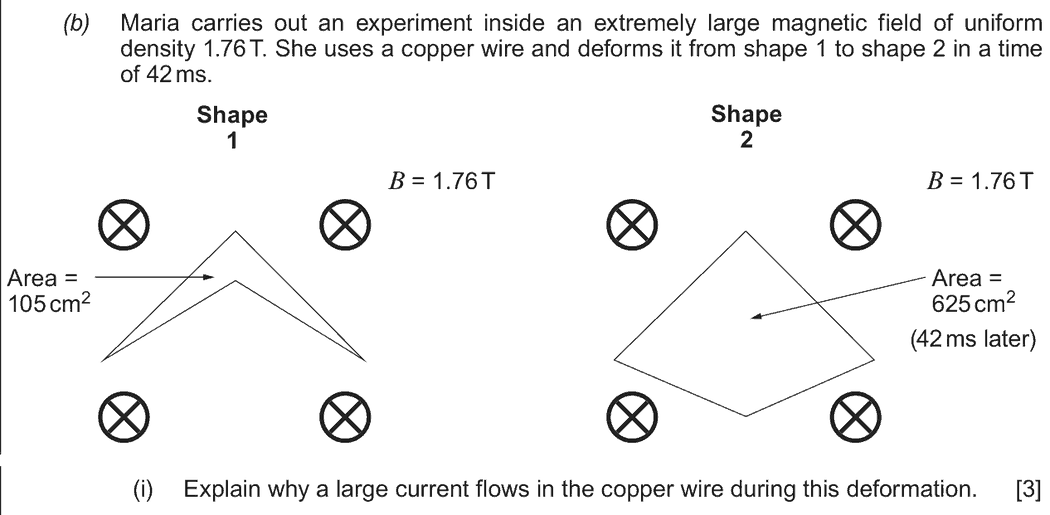
Notes from the mark scheme and report
The area and so the flux linked with the loop changes (1)
the change is large and takes only 42 ms, so the rate of change of flux and the induced emf are large (1)
the loop is a complete circuit of low resistance (1)
the complete circuit was often omitted
October 2020 · Component 3 · Q10(b)(ii)2 marksAO1=1, AO2=1Explanation
Earlier parts of question 10 that this part uses
Mark scheme
Examiner's comment
In part (a)(iii) some candidates wanted to increase the number of turns when it would be far easier to put in an iron core (after all the question did ask for “increased greatly”). Part (b)(i) was well answered but many candidates did not mention that the circuit was complete (or had low resistance). The easiest way to answer part (ii) was to explain it with FRHR. Those who explained using FLHR or the right-hand grip rule were usually unclear in their explanations (as opposed to being incorrect). In part (iii) there were the usual instances of using 𝐵𝐵= 𝜇𝜇0𝐼𝐼 2𝜋𝜋𝜋𝜋. In the last part a few candidates did everything perfectly and then concluded that the force was in the wrong direction. Section B Comments in section B are not as detailed because of the small number of candidates that attempted each question. Question 11 – Alternating Currents No candidate answered this question Question 12 – Medical Physics All parts in (a) were answered quite well. Part (b) was quite well answered and there are no problems to report. The evaluation questions are always difficult to answer so in part (c) justifying the choice of imaging technique was problematic. Question 13 – The Physics of Sports The definition of moment of inertia was not well known. Part (b)(ii) was not well understood with few candidates trying to discuss force. In part (c)(i) the most disappointing aspect of these answers was the force diagram. Very few diagrams had weight, drag and magnus force. In the second part candidates needed to remember that the area in the drag equation was the cross-sectional area (π𝑟𝑟2). Question 14 – Energy and the Environment In the last part of (a) nearly all candidates talked immediately about greenhouse gases without mentioning the atmosphere. Part (b)(i) was not well known. Most candidates only knew one factor - the temperature. The definitions in part (c) were very poor. Candidates looked at the unit of the thermal conductivity and then said, “The rate of heat transfer per metre and per oC.” The second part of (c) was very poorly answered with most candidates only attempting to verify the first part of Jack’s statement and they did this incorrectly. Summary of key points Certain topic areas were poorly understood such as de Broglie wavelength and electron diffraction, electric fields. In qualitative responses a lack of clarity sometimes resulted in candidates not gaining all of the marks available. Recall questions on definitions which were testing assessment objective 1 often were not well answered, this highlights the importance of candidates learning their work.
Notes from the mark scheme and report
Apply Fleming's right-hand rule to the moving bottom part of the wire (or Lenz: flux into the page is increasing, so the induced field must be out of the page, right-hand grip) (1) giving an anticlockwise current (1)
left-hand rule answers were often unclear
October 2020 · Component 3 · Q10(b)(iii)3 marksAO1=2, AO2=1Calculation
Earlier parts of question 10 that this part uses
Mark scheme
Examiner's comment
In part (a)(iii) some candidates wanted to increase the number of turns when it would be far easier to put in an iron core (after all the question did ask for “increased greatly”). Part (b)(i) was well answered but many candidates did not mention that the circuit was complete (or had low resistance). The easiest way to answer part (ii) was to explain it with FRHR. Those who explained using FLHR or the right-hand grip rule were usually unclear in their explanations (as opposed to being incorrect). In part (iii) there were the usual instances of using 𝐵𝐵= 𝜇𝜇0𝐼𝐼 2𝜋𝜋𝜋𝜋. In the last part a few candidates did everything perfectly and then concluded that the force was in the wrong direction. Section B Comments in section B are not as detailed because of the small number of candidates that attempted each question. Question 11 – Alternating Currents No candidate answered this question Question 12 – Medical Physics All parts in (a) were answered quite well. Part (b) was quite well answered and there are no problems to report. The evaluation questions are always difficult to answer so in part (c) justifying the choice of imaging technique was problematic. Question 13 – The Physics of Sports The definition of moment of inertia was not well known. Part (b)(ii) was not well understood with few candidates trying to discuss force. In part (c)(i) the most disappointing aspect of these answers was the force diagram. Very few diagrams had weight, drag and magnus force. In the second part candidates needed to remember that the area in the drag equation was the cross-sectional area (π𝑟𝑟2). Question 14 – Energy and the Environment In the last part of (a) nearly all candidates talked immediately about greenhouse gases without mentioning the atmosphere. Part (b)(i) was not well known. Most candidates only knew one factor - the temperature. The definitions in part (c) were very poor. Candidates looked at the unit of the thermal conductivity and then said, “The rate of heat transfer per metre and per oC.” The second part of (c) was very poorly answered with most candidates only attempting to verify the first part of Jack’s statement and they did this incorrectly. Summary of key points Certain topic areas were poorly understood such as de Broglie wavelength and electron diffraction, electric fields. In qualitative responses a lack of clarity sometimes resulted in candidates not gaining all of the marks available. Recall questions on definitions which were testing assessment objective 1 often were not well answered, this highlights the importance of candidates learning their work.
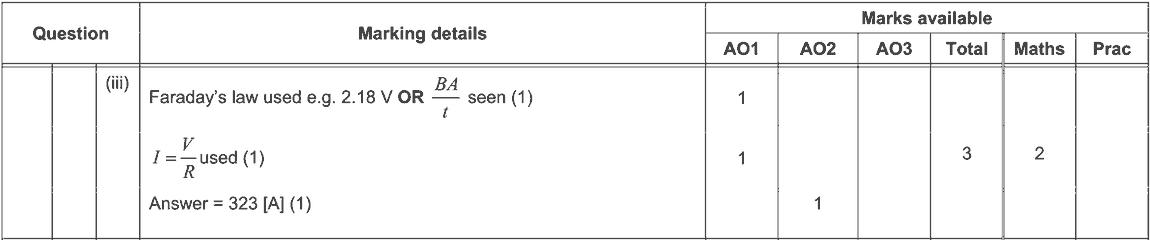
Notes from the mark scheme and report
Answer: 323 A. ΔA = 625 − 105 = 520 cm² = 0.0520 m²
emf = BΔA/t = 1.76 × 0.0520/0.042 = 2.18 V
I = V/R = 2.18/6.75 × 10⁻³
Scheme columns: Maths 2
Skills: Unitsand conversions Unit marks, base units, prefixes and conversions; Mathsmarks The mark scheme's Maths column gives this part at least one mark for mathematical skills
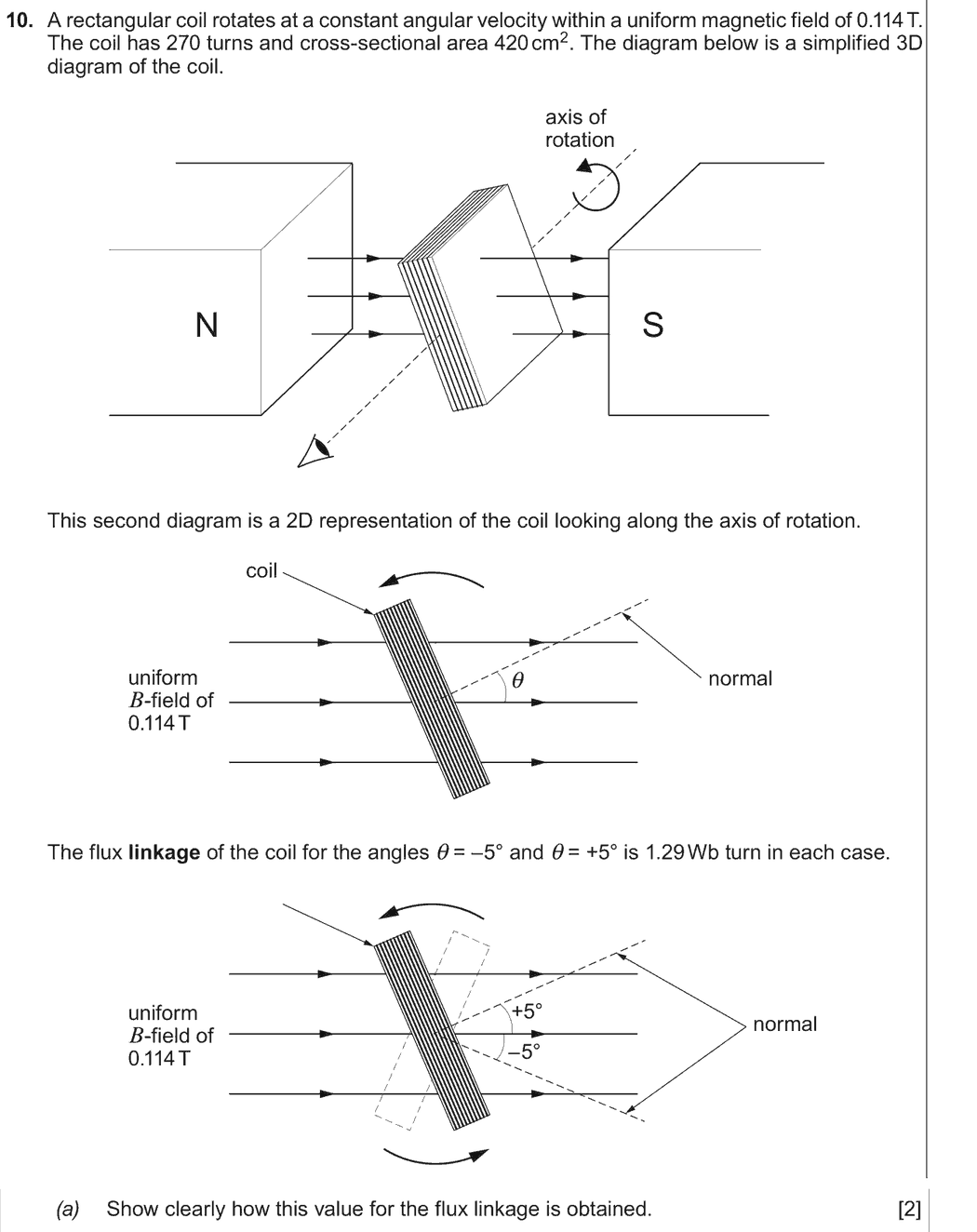
June 2019 · Component 3 · Q10(a)2 marksAO1=2Show that
Mark scheme
Examiner's comment
Well answered but sometimes cos(5) or N were missing.
Notes from the mark scheme and report
Flux linkage NΦ = NBA cos θ = 270 × 0.114 × 0.042 × cos 5° = 1.29 Wb turn (area 420 cm² = 0.042 m²)
cos 5° or N sometimes missing
Scheme columns: Maths 1
Skills: Unitsand conversions Unit marks, base units, prefixes and conversions; Mathsmarks The mark scheme's Maths column gives this part at least one mark for mathematical skills
June 2019 · Component 3 · Q10(b)1 markAO2=1Explanation
Earlier part of question 10 that this part uses
Mark scheme
Examiner's comment
The most common mistake here is to talk of flux rather than change in flux (or flux cutting).
Notes from the mark scheme and report
At θ = 0 the flux linkage is at its maximum, so its rate of change is zero (the coil sides are not cutting field lines)
talking about flux rather than change of flux lost the mark
June 2019 · Component 3 · Q10(c)2 marksAO2=2Calculation
Earlier part of question 10 that this part uses
Mark scheme
Examiner's comment
Well answered - most candidates obtained full marks. It was rare to award one mark here because those candidates who knew what to do invariably obtained the correct answer.
Notes from the mark scheme and report
Answer: 37.9 V. Change in flux linkage = 0.11 − (−0.11) = 0.22 Wb turn
emf = 0.22/5.8 × 10⁻³
Scheme columns: Maths 1
Skills: Mathsmarks The mark scheme's Maths column gives this part at least one mark for mathematical skills
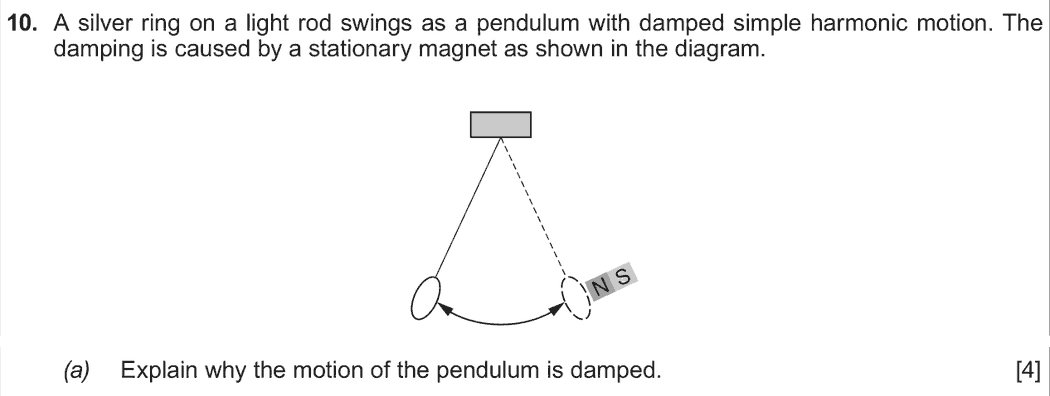
June 2018 · Component 3 · Q10(a)4 marksAO2=4Explanation
Mark scheme
Examiner's comment
Very well explained in general with 4/4 being a common mark. However, there was a small minority that thought this question was about magnetic attraction between a ferro-magnetic metal and a magnet. Descriptions of the purpose of the metal filter were generally not well done with many candidates failing to mention that it was intended to block low- energy X-rays. The description of the lead grid was much better answered. A minority of candidates mistakenly talked about the absorption of alpha, beta and gamma rays. This was answered poorly by all the candidates with only very few references to the centre of gravity. The most common answer given was that the the clockwise moments equals the anticlockwise moments. making accurate observations and
Notes from the mark scheme and report
The flux through the ring changes as it approaches or leaves the magnet (1)
an emf is induced (Faraday) (1)
the ring is a complete circuit so a current flows (1)
by Lenz's law the force on this current opposes the motion, so energy is dissipated (1)
a few treated it as attraction of a magnetic material
June 2018 · Component 3 · Q10(b)2 marksAO2=2Explanation
Earlier part of question 10 that this part uses
Mark scheme
Examiner's comment
Extremely well answered generally. There, again, was a small minority talking about ferro-magnetism (of silver!). However, they were joined this time by another very small minority who thought that the oscillations would now increase in amplitude - thus solving all future energy problems. Option questions Question 11 Alternating Currents (mean mark: 14.5/20 = 73%) obtaining accurate, precise and sufficient data ……. Observations should be made directly into their practical books. They should not be written on to scraps of paper and copied up at a later time. Tables of information should have appropriate headings and units. Units were not always observed in tables. This is a requirement to achieve the CPAC statement. CPAC 5 CPAC 4 and CPAC 5 are still occasionally confused by centres. CPAC 4 is about recording data ‘live’ into appropriate tables. CPAC 5 has two main elements: (a) processing data and (b) referencing information. There should be evidence of learners processing data using graphs and calculations. Centres should use require candidates to use software (e.g. Excel) to draw graphs and, on other occasions, to draw them by hand. The second strand of this CPAC is also important. Candidates must show evidence of referencing sources of information. The information referenced may be, for example, a data or a quote; the information may come from a text book, journal or website. The evidence produced towards this aspect of the CPAC varies considerably among centres. Some have candidates demonstrating referencing on multiple occasions, even using the Harvard System (which exceeds our requirements), while, in other centres, it is rarely evidenced. A few centres, and therefore candidates, still confuse referencing with a bibliography. There is an important difference. Centres are reminded to download the following documents which provide support on interpreting CPAC. ‘The Practical Endorsement Standard’ ‘Pen Portraits’ (available on the Secure website) Eduqas GCE A Level Physics Report Summer 2018/ed
Notes from the mark scheme and report
No change to the motion (1)
the induced current reverses but by Lenz's law its effect still opposes the motion (1)
'the force is opposite' not accepted
June 2018 · Component 3 · Q10(d)3 marksAO1=1, AO2=2Calculation
Earlier part of question 10 that this part uses
Mark scheme
Examiner's comment
All the candidates were able to gain some marks for this part. As was expected the common approach was to determine the forces involved. However some candidates did not appreciate the magnitude of the force is very large. Question 14 Energy and the environment (mean mark: 11.8/20 = 59%)
Notes from the mark scheme and report
Answer: 0.29 T s⁻¹. Emf = IR = 5.5 × 1.04 × 10⁻⁴ = 5.7 × 10⁻⁴ V (1)
emf = A × ΔB/Δt with A = π × 0.025² = 1.96 × 10⁻³ m² (area of the ring, not of the wire) (1)
ΔB/Δt = 0.29 T s⁻¹ (1)
Scheme columns: Maths 2
Skills: Mathsmarks The mark scheme's Maths column gives this part at least one mark for mathematical skills
June 2017 · Component 3 · Q5(a)(i)2 marksAO1=1, AO2=1Explanation
Mark scheme
Examiner's comment
No problems with stating Faraday’s law but more candidates should have made reference to the circuit being complete so that a current could arise.
Notes from the mark scheme and report
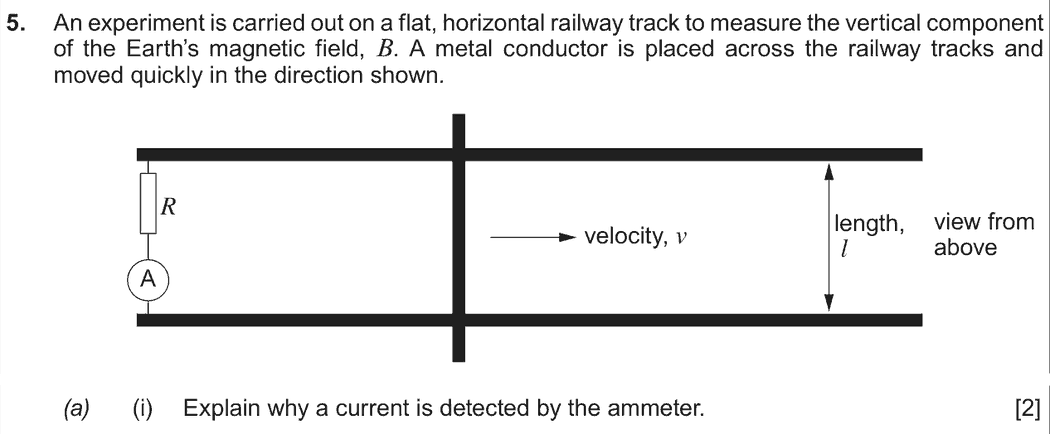
An emf is induced because the conductor cuts magnetic flux (flux linkage of the loop changes) (1)
the rails, resistor and ammeter form a complete circuit so a current flows (1)
the complete circuit was often not mentioned
June 2017 · Component 3 · Q5(a)(ii)1 markAO2=1Explanation
Earlier part of question 5 that this part uses
Mark scheme
Examiner's comment
This is a slightly odd case where the flux cutting explanation is easier than the flux changing approach. Many candidates stated that the horizontal field lines were not being cut. It was rarer to find a candidate that wrote “the flux due to the horizontal field is zero.”
Notes from the mark scheme and report
The horizontal component is parallel to the plane of the motion, so its field lines are not cut (its flux through the swept area is zero)
only the vertical component is perpendicular to the area swept
June 2017 · Component 3 · Q5(b)3 marksAO1=1, AO2=2Show that
Earlier part of question 5 that this part uses
Mark scheme
Examiner's comment
The difficult step here was d𝐴 dt = d(𝑙𝑥) dt = 𝑙d𝑥 dt = 𝑙𝑣 𝑜𝑟 𝐴 𝑡= 𝑙𝑥 𝑡= 𝑙𝑥 𝑡= 𝑙𝑣 The non-calculus route is equally valid at this level.
Notes from the mark scheme and report
emf = d(BA)/dt (1)
area swept A = lx so dA/dt = l dx/dt = lv, giving emf = Blv (1)
I = V/R = Blv/R (1)
non-calculus version (A/t = lx/t = lv) accepted
the area step was the difficulty
Scheme columns: Maths 3
Skills: Algebra Derivations and rearranging equations; Mathsmarks The mark scheme's Maths column gives this part at least one mark for mathematical skills
June 2017 · Component 3 · Q5(c)(i)4 marksAO3=4Practical and data analysis
Earlier part of question 5 that this part uses
Mark scheme
Examiner's comment
Quite well answered but it was rare to award all 4 marks. Most often, candidates omitted to state that B, ℓ and R were constants.
Notes from the mark scheme and report
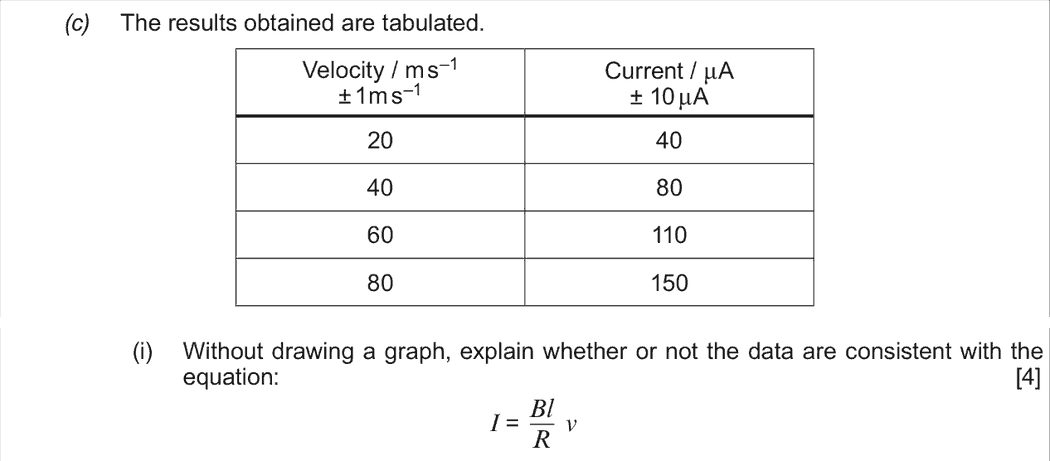
Sensible test, e.g. the ratio v/I (or I/v) for at least three rows (1): 0.50, 0.50, 0.55, 0.53 (1)
B, l and R are constant so I should be proportional to v (1)
ratios agree within the uncertainties so the data are consistent (1)
the statement that B, l and R are constant was usually missing
Scheme columns: Maths 3, Practical 4
Skills: Uncertainties Resolution, absolute and percentage uncertainty, combining uncertainties, error bars; Mathsmarks The mark scheme's Maths column gives this part at least one mark for mathematical skills; Practicalmarks The mark scheme's Prac column gives this part at least one mark for practical skills
June 2017 · Component 3 · Q5(c)(ii)6 marksAO2=3, AO3=3Practical and data analysis
Earlier parts of question 5 that this part uses
Mark scheme
Examiner's comment
A good differentiating question and it was very rare to award full marks. However, most candidates were able to score a good number of marks. Candidates should be reminded that percentage uncertainties should be added here. It was relatively common to see the following bad mistake: 1.25% 6.67% = 8.33%. On this occasion, this gave an answer that was very nearly correct and so the markers had to be particularly vigilant. Perhaps most problems arose when expressing the final answer. (58 ± 5) µT, 58 µT ± 5µT, (57.6 ± 4.6) µT, 57.6 µT ± 4.6 µT, (5.8 ± 0.5) 10-5 T, 5.8 10-5 T± 0.5 10-5 T were all perfectly acceptable. However, these were rarities. Common unacceptable answers were: (58 ± 4.56) µT, (58.0 ± 5) µT, (58 ± 4.6) µT, (57.6 ± 4.56) µT, 5.8 10-5 T ± 4.6 10-6 T, (57.62 ± 4.56) µT and even 58 ± 5 with the unit omitted. At this level, candidates should be able to quote the answer in the form (quantity ± uncertainty)unit. The following answers would have been accepted this year but, in truth, they are not quite good enough at this level:
Notes from the mark scheme and report
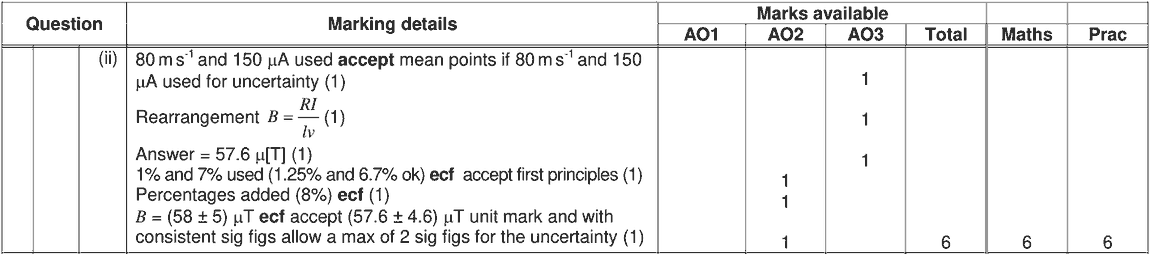
Answer: (58 ± 5) μT. Use 80 m s⁻¹ and 150 μA (smallest % uncertainties)
final answer with unit and consistent sf (uncertainty to at most 2 sf)
full marks rare: percentages multiplied instead of added, and inconsistent sf such as 58 ± 4.56
Scheme columns: Maths 6, Practical 6
Skills: Uncertainties Resolution, absolute and percentage uncertainty, combining uncertainties, error bars; Algebra Derivations and rearranging equations; Mathsmarks The mark scheme's Maths column gives this part at least one mark for mathematical skills; Practicalmarks The mark scheme's Prac column gives this part at least one mark for practical skills
Work with an Eduqas physics tutor
Dropping marks on calculations, specified practicals or the six-mark QER questions? Book a trial session with a specialist Eduqas physics tutor.