2.6-a the features of electric and gravitational fields as specified in the table on page 30 [Table, two columns, ELECTRIC FIELDS | GRAVITATIONAL FIELDS: Electric field strength, E, is the force per unit charge on a small positive test charge placed at the point | Gravitational field strength, g, is the force per unit mass on a small test mass placed at the point; Inverse square law for the force between two electric charges in the form F = (1/(4πε₀)) Q₁Q₂/r² (Coulomb's law) | Inverse square law for the force between two masses in the form F = GM₁M₂/r² (Newton's law of gravitation); F can be attractive or repulsive | F is attractive only; E = (1/(4πε₀)) Q/r² for the field strength due to a point charge in free space or air | g = GM/r² for the field strength due to a point mass; Potential at a point due to a point charge in terms of the work done in bringing a unit positive charge from infinity to that point | Potential at a point due to a point mass in terms of the work done in bringing a unit mass from infinity to that point; VE = (1/(4πε₀)) Q/r and PE = (1/(4πε₀)) Q₁Q₂/r | Vg = −GM/r and PE = −GM₁M₂/r; Change in potential energy of a point charge moving in any electric field = qΔVE | Change in potential energy of a point mass moving in any gravitational field = mΔVg; Field strength at a point is given by E = − slope of the VE – r graph at that point | Field strength at a point is given by g = − slope of the Vg – r graph at that point; Note that 1/(4πε₀) ≈ 9 × 10⁹ F⁻¹ m is an acceptable approximation | (blank)]
2.6-b the idea that the gravitational field outside spherical bodies such as the Earth is essentially the same as if the whole mass were concentrated at the centre
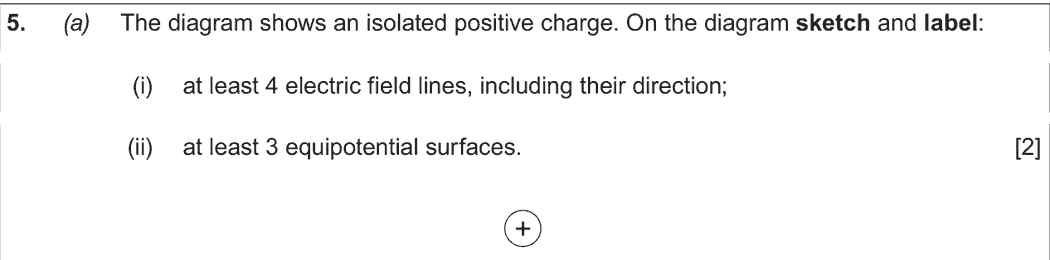
2.6-c field lines (or lines of force) giving the direction of the field at a point, thus, for a positive point charge, the field lines are radially outward
2.6-d equipotential surfaces joining points of equal potential and are therefore spherical for a point charge
2.6-e how to calculate the net potential and resultant field strength for a number of point charges or point masses
2.6-f the equation ΔUP = mgΔh for distances over which the variation of g is negligible
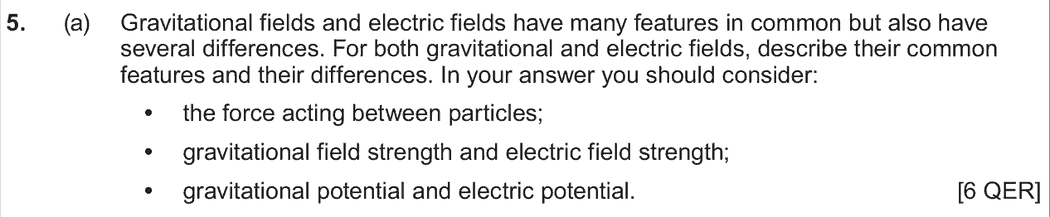
. (a) Gravitational fields and electric fields have many features in common but also have several differences. For both gravitational and electric fields, describe their common features and their differences. In your ans
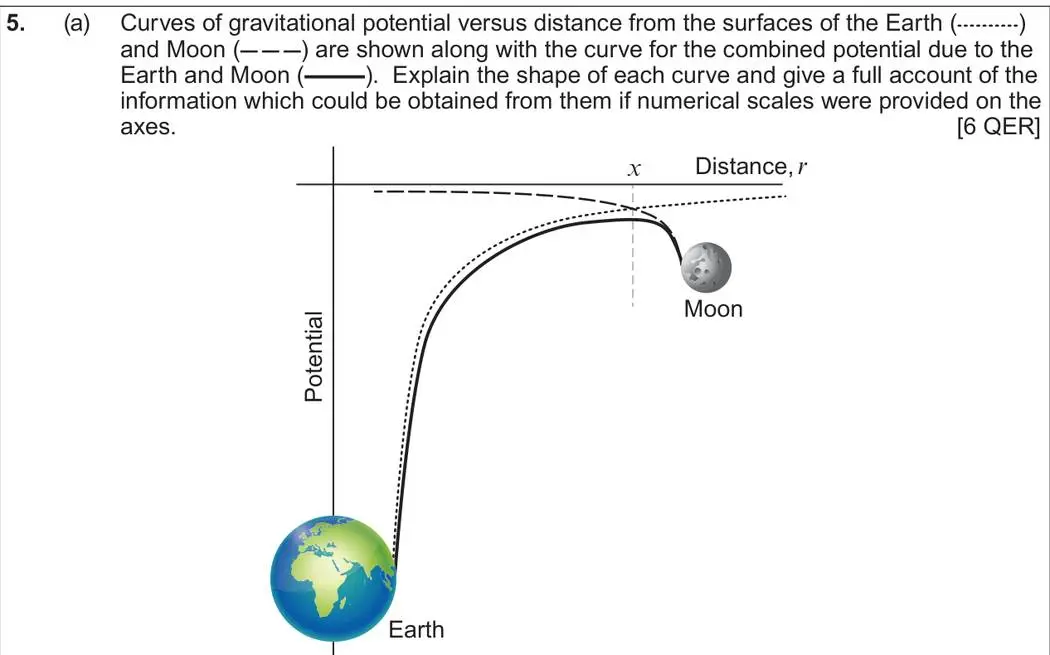
. (a) Curves of gravitational potential versus distance from the surfaces of the Earth ( ) and Moon ( ) are shown along with the curve for the combined potential due to the Earth and Moon ( ). Explain the shape of each c
Tap a question to zoom it. Where a part needs a figure, table or graph from earlier in the question, that part folds out above it; the mark scheme and examiner's comment open underneath. Have the Eduqas Data Booklet beside you (see the Data Booklet page).
June 2025 · Component 1 · Q5(c)(i)2 marksAO1=1, AO2=1Calculation
Earlier part of question 5 that this part uses
Mark scheme
Examiner's comment
This synoptic question was well answered by many candidates. Some candidates made km to m errors, but this was rare.
Notes from the mark scheme and report
Answer: 1.6 N kg⁻¹. g = GM/r² = 6.67 × 10⁻¹¹ × 7.4 × 10²²/(1.74 × 10⁶)²
Component 2 content
occasional km to m slips
Scheme columns: Maths 1
Skills: Synoptic Needs physics from another component of the qualification; Unitsand conversions Unit marks, base units, prefixes and conversions; Mathsmarks The mark scheme's Maths column gives this part at least one mark for mathematical skills
June 2025 · Component 1 · Q8(b)3 marksAO3=3Calculation
Earlier part of question 8 that this part uses
Mark scheme
Examiner's comment
The presentation in responses noticeably declined in this question indicating there were sudden changes in approach. Candidates sometimes needed multiple attempts. Most spotted they needed to use 𝐹= 9 × 10⁹ 𝑄1𝑄2 𝑟2 and subbed either 200 N or 1 fm into this equation. Some could not see what charge value to use or thought that 2𝑄1 would be suitable. In these instances, they picked up the 1st MP but not the 2nd. The 3rd MP was for the correct answer and comment. For example, 200 ≈230 would have been credited. Unfortunately, the comment was not always seen.
Notes from the mark scheme and report
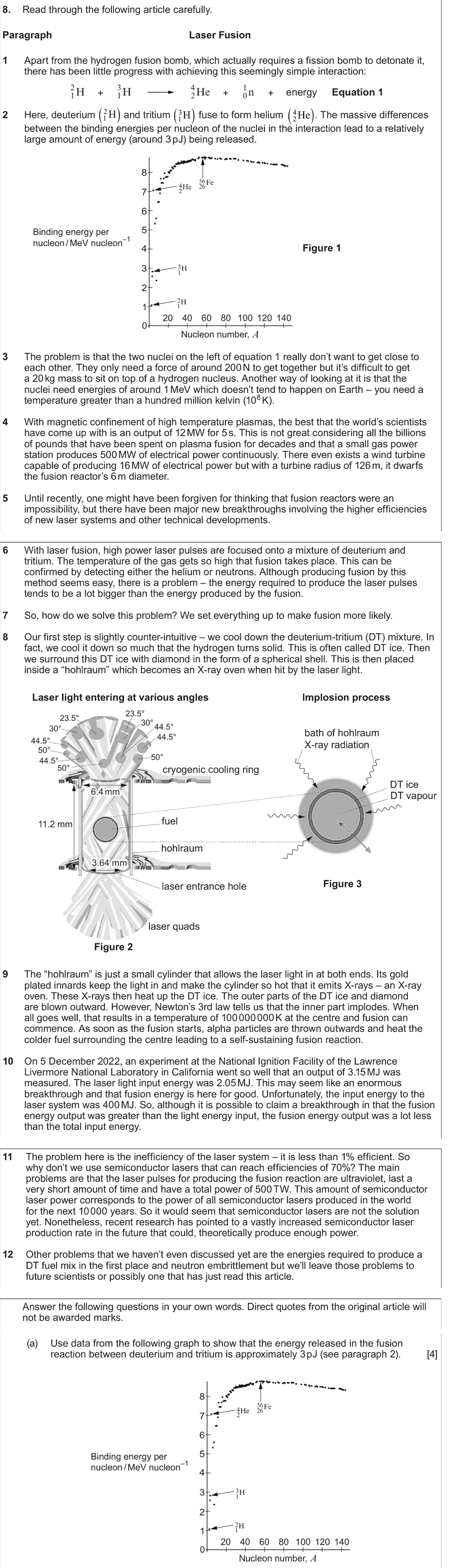
Answer: yes, about right. F = Q1Q2/4πε0r² with both charges 1.6 × 10⁻¹⁹ C: r = √(9 × 10⁹ × (1.6 × 10⁻¹⁹)²/200) = 1.1 fm
or r = 1 fm gives 230 N, close to 200 N
comment required, often missing. Coulomb's law is Component 2 content
Scheme columns: Maths 3
Skills: Comprehension A level Component 1 Section B: questions on the printed article; Synoptic Needs physics from another component of the qualification; Mathsmarks The mark scheme's Maths column gives this part at least one mark for mathematical skills
June 2025 · Component 2 · Q6(a)1 markAO1=1Definition
Mark scheme
Examiner's comment
Many, but not all, candidates correctly identified the two required conditions: that the electric potential is defined for a unit positive charge, and that the charge must be brought to the point in the field from infinity.
Notes from the mark scheme and report
It must be the work done per unit positive charge, and the charge must be brought from infinity
both needed for the mark
June 2025 · Component 2 · Q6(b)(i)3 marksAO2=3Calculation
Earlier part of question 6 that this part uses
Mark scheme
Examiner's comment
Most candidates correctly calculated the magnitude of the electric field strength at point R. However, fewer stated the direction of the resultant field (or gave the incorrect direction), which led to the loss of one mark.
Notes from the mark scheme and report
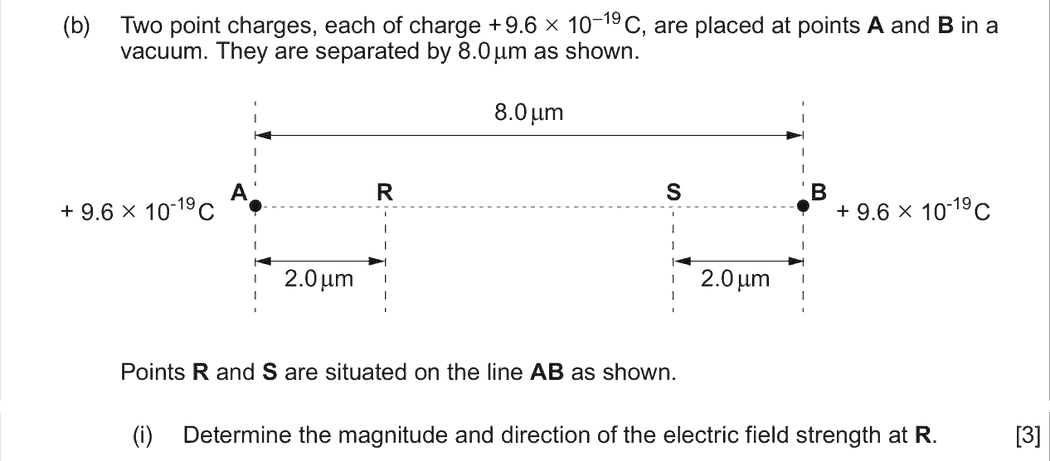
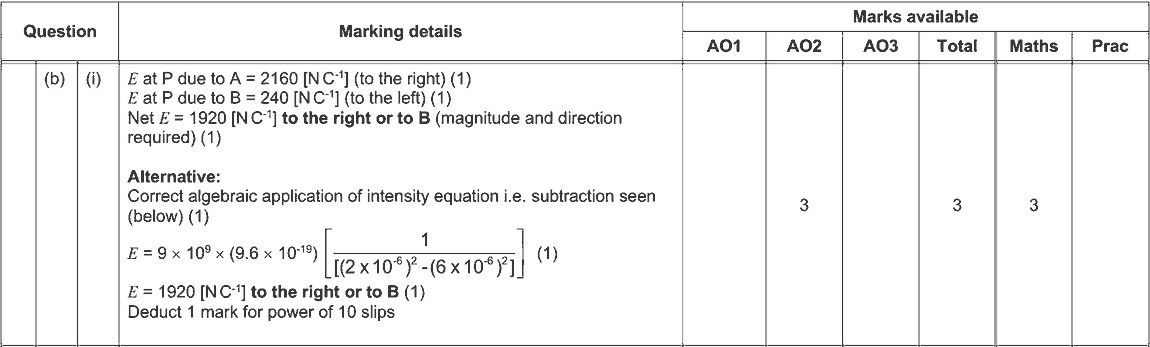
Answer: 1920 N C⁻¹ towards B (to the right). From A: 9 × 10⁹ × 9.6 × 10⁻¹⁹/(2.0 × 10⁻⁶)² = 2160 N C⁻¹ to the right
from B: 9 × 10⁹ × 9.6 × 10⁻¹⁹/(6.0 × 10⁻⁶)² = 240 N C⁻¹ to the left
the direction was often missing or wrong
Scheme columns: Maths 3
Skills: Trigonometryand vectors Resolving, components, vector addition, angles; Unitsand conversions Unit marks, base units, prefixes and conversions; Mathsmarks The mark scheme's Maths column gives this part at least one mark for mathematical skills
June 2025 · Component 2 · Q6(b)(ii)2 marksAO2=2Explanation
Earlier parts of question 6 that this part uses
Mark scheme
Examiner's comment
The majority of candidates recognised that the electric potential at points R and S was the same—often expressed as ΔV = 0. Fewer linked this to the work done using the formula W = QΔV to conclude that W = 0.
Notes from the mark scheme and report
By symmetry the potentials at R and S are equal, so ΔV = 0 (1)
W = QΔV, so W = 0 (1)
or: work done against the field from R to the mid-point is returned from the mid-point to S
W = QΔV was often not quoted
June 2025 · Component 2 · Q6(b)(iii)4 marksAO2=4Calculation
Earlier parts of question 6 that this part uses
Mark scheme
Examiner's comment
Fewer correct responses were seen than expected. Many candidates failed to account for both charges when determining the net potentials at the required points, resulting in the loss of the first two marks. Error carried forward (ECF) was applied for the subsequent calculation of the potential difference and the work done in moving a proton. Only a small number of candidates approached the problem by calculating the net electric potential energy at each point and then finding the difference.
Notes from the mark scheme and report
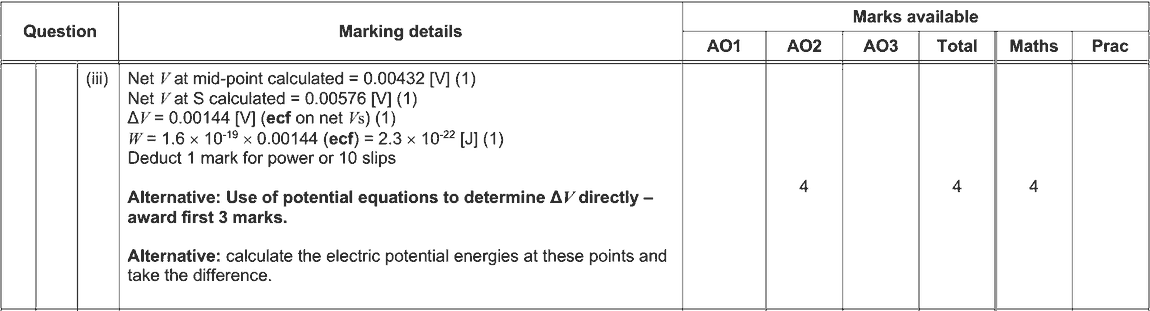
Answer: 2.3 × 10⁻²² J. V at mid-point = 2 × 9 × 10⁹ × 9.6 × 10⁻¹⁹/4.0 × 10⁻⁶ = 4.32 mV
V at S = 9 × 10⁹ × 9.6 × 10⁻¹⁹ × (1/6.0 × 10⁻⁶ + 1/2.0 × 10⁻⁶) = 5.76 mV
ΔV = 1.44 mV
W = eΔV
many used only one of the two charges
Scheme columns: Maths 4
Skills: Unitsand conversions Unit marks, base units, prefixes and conversions; Mathsmarks The mark scheme's Maths column gives this part at least one mark for mathematical skills
June 2025 · Component 2 · Q7(c)4 marksAO2=4Calculation
Earlier part of question 7 that this part uses
Mark scheme
Examiner's comment
This part was answered well. Most candidates applied the density equations correctly to derive a relationship between the planets’ radii and then used this to determine the correct ratio of gravitational field strengths. A few highly concise but logically sound solutions were awarded full marks, reflecting strong conceptual understanding.
Notes from the mark scheme and report
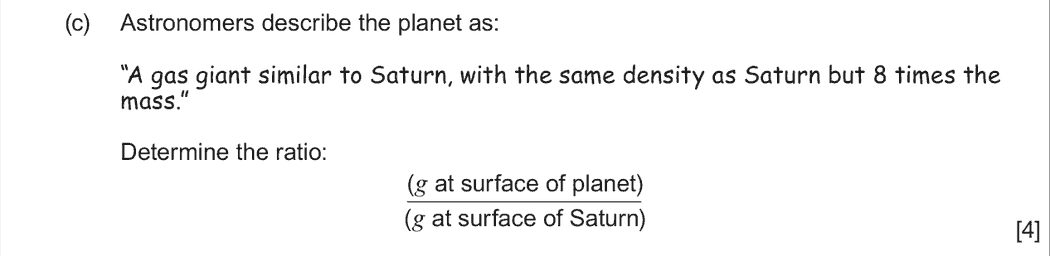
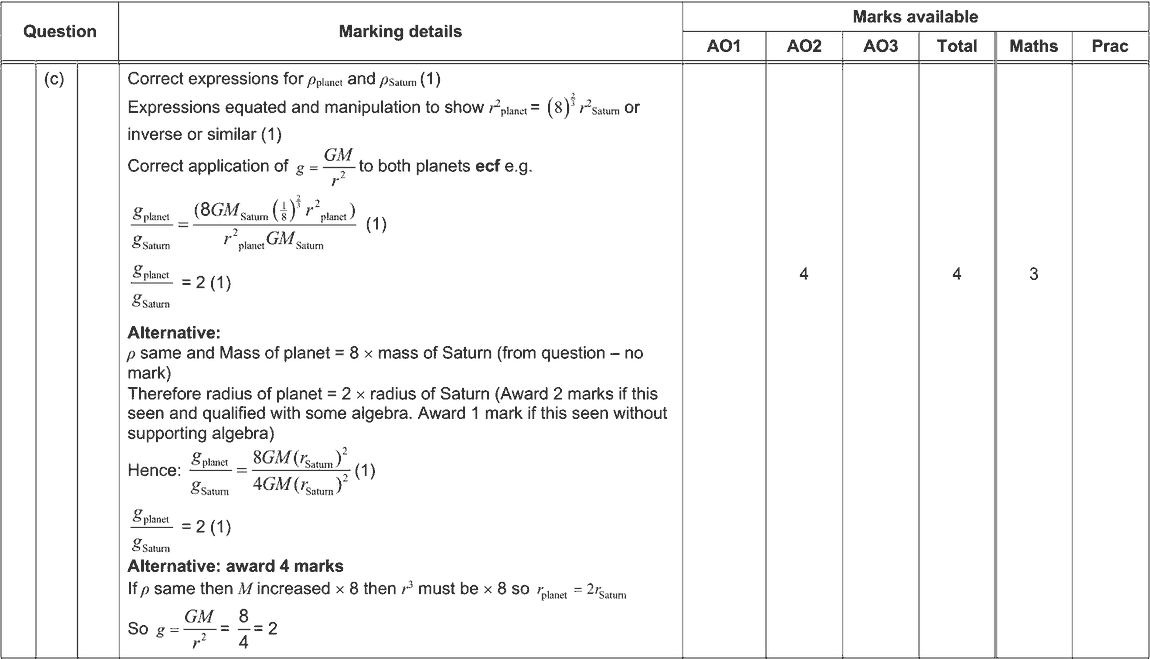
Answer: 2. Same density and 8 times the mass means 8 times the volume, so twice the radius
g = GM/r², so the ratio = 8/2²
Scheme columns: Maths 3
Skills: Algebra Derivations and rearranging equations; Mathsmarks The mark scheme's Maths column gives this part at least one mark for mathematical skills
June 2024 · Component 2 · Q5(a)6 marksAO1=66-mark extended response
Mark scheme, with the levels and indicative content
Examiner's comment
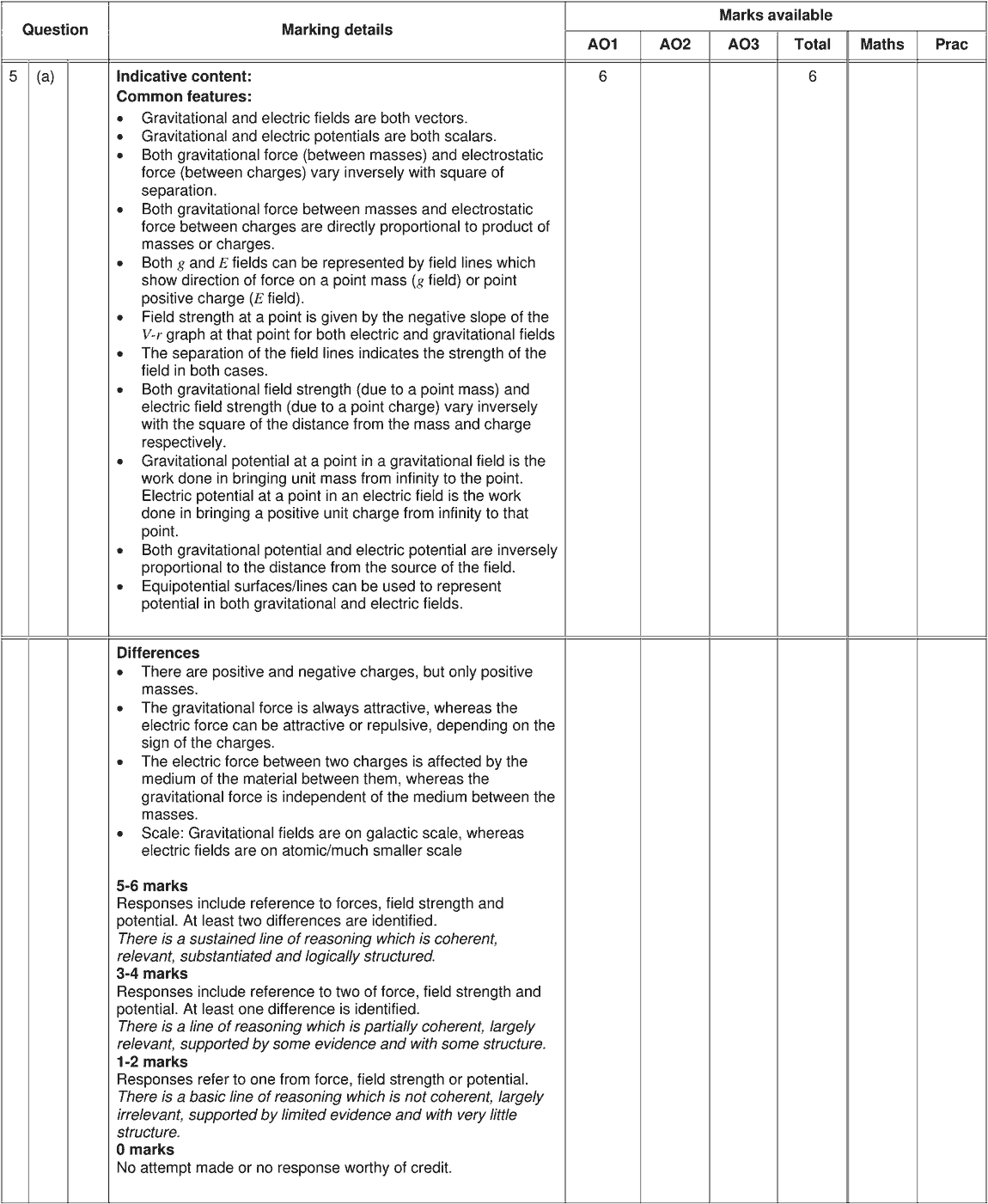
Good attempts were made to describe the common features and differences between electric and gravitational fields. Most candidates chose to follow the bulleted structure provided and focused their answers on ‘force’, ‘field strength’ and ‘potential’. Higher scoring candidates (top band responses) were able to refer to the inverse square nature of forces and field strengths with many mentioning the direct dependency of both force and field strength on the size of the charge / mass. Some also described the vector nature of the fields. Many responses also gave appropriate definitions for potential, describing the inverse relationship between potential and distance. They also described the scalar nature of potential and equipotential surfaces. In nearly all cases, the attraction / repulsion nature of both fields were highlighted as a difference. A few very good responses described the relationship between field strength and potential gradients. Middle band responses contained some of the above points, with lower band candidates only managing to describe one or two of these.
Notes from the mark scheme and report
QER, levels marked. Similarities: both forces follow an inverse square law and depend on the product of the masses or charges
field strength (force per unit mass or per unit positive charge) is a vector, falls as 1/r² for a point source and is shown by field lines
potential (work done per unit mass or charge from infinity) is a scalar, varies as 1/r, shown by equipotentials
field strength = −potential gradient. Differences: gravity only attracts while electric forces attract or repel (two signs of charge, one of mass), gravitational potential is always negative, the electric force depends on the medium, gravity dominates on large scales. Top band needs force, field strength and potential plus two differences
Skills: QER The 6-mark quality of extended response question
June 2024 · Component 2 · Q5(b)(ii)3 marksAO2=3Diagram or graph
Earlier parts of question 5 that this part uses
Mark scheme
Examiner's comment
Nearly all candidates were able to show the required electric field strength in
Notes from the mark scheme and report
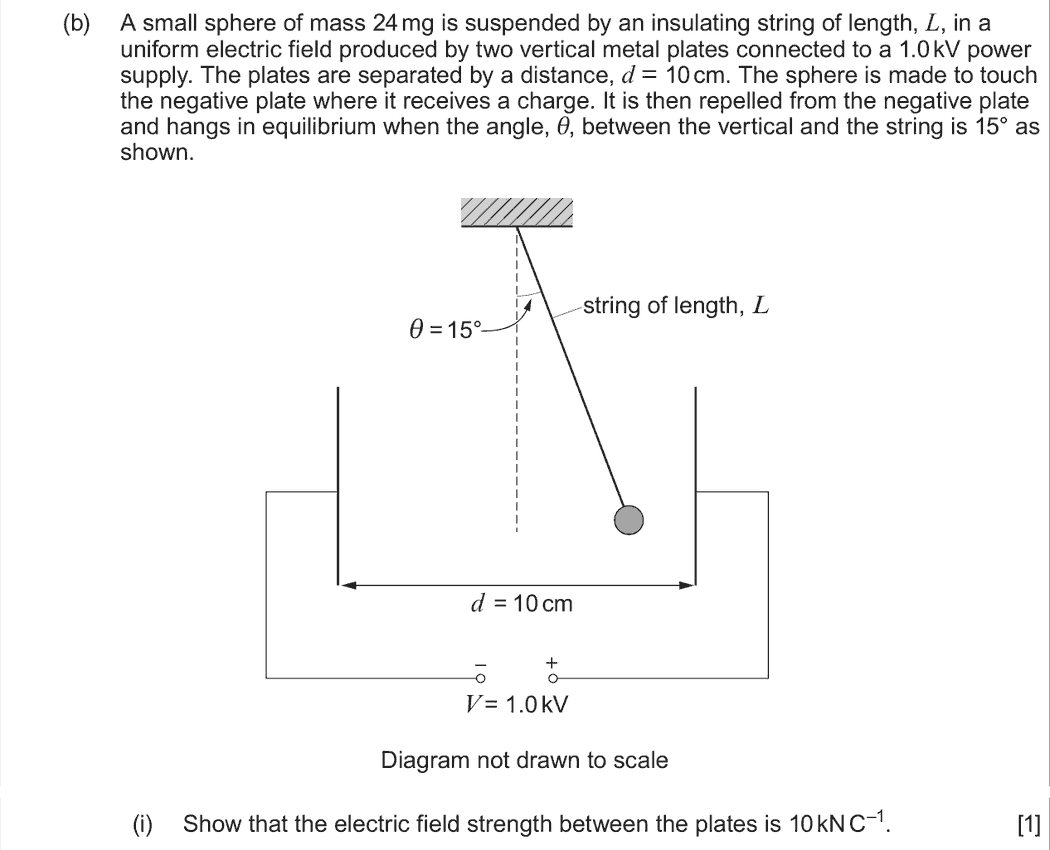
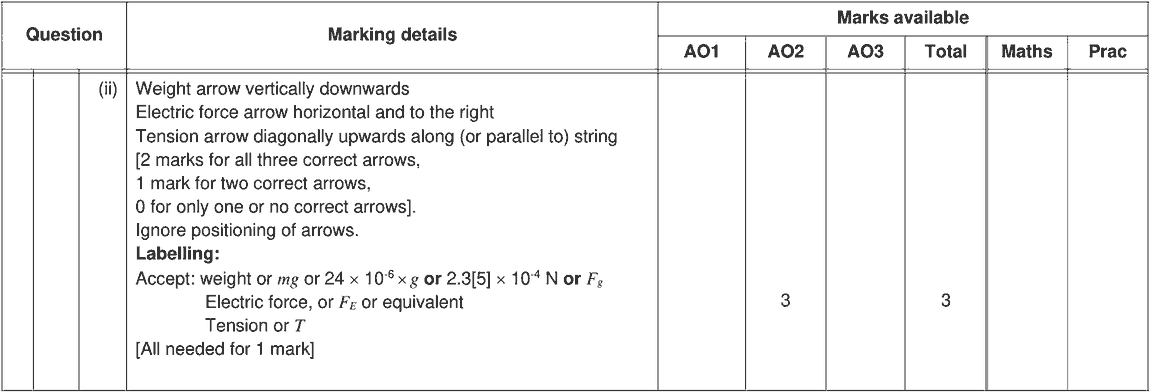
Weight vertically down, tension up along the string, electric force horizontal towards the positive plate (to the right): 2 marks for three arrows, 1 for two
third mark for all three labels
many drew the electric force to the left or called it electromagnetic
June 2024 · Component 2 · Q5(b)(iii)4 marksAO2=4Calculation
Earlier parts of question 5 that this part uses
Mark scheme
Examiner's comment
Nearly all candidates were able to show the required electric field strength in
Notes from the mark scheme and report
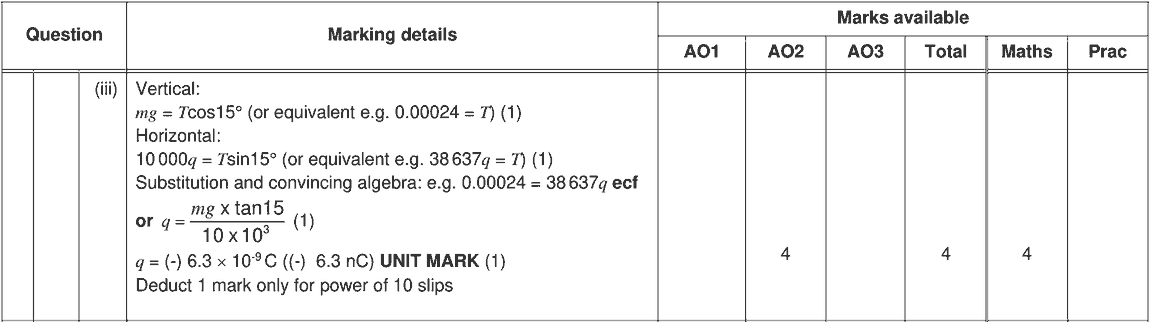
Answer: 6.3 × 10⁻⁹ C (negative). T cos 15° = mg and T sin 15° = Eq, so q = mg tan 15°/E = 24 × 10⁻⁶ × 9.81 × tan 15°/10 000
unit mark
6.3 μC from not converting mg to kg was common, as was swapping sin and cos
about 15% left it blank
Scheme columns: Maths 4
Skills: Trigonometryand vectors Resolving, components, vector addition, angles; Unitsand conversions Unit marks, base units, prefixes and conversions; Synoptic Needs physics from another component of the qualification; Mathsmarks The mark scheme's Maths column gives this part at least one mark for mathematical skills
June 2023 · Component 1 · Q8(b)2 marksAO2=2Explanation
Earlier part of question 8 that this part uses
Mark scheme
Examiner's comment
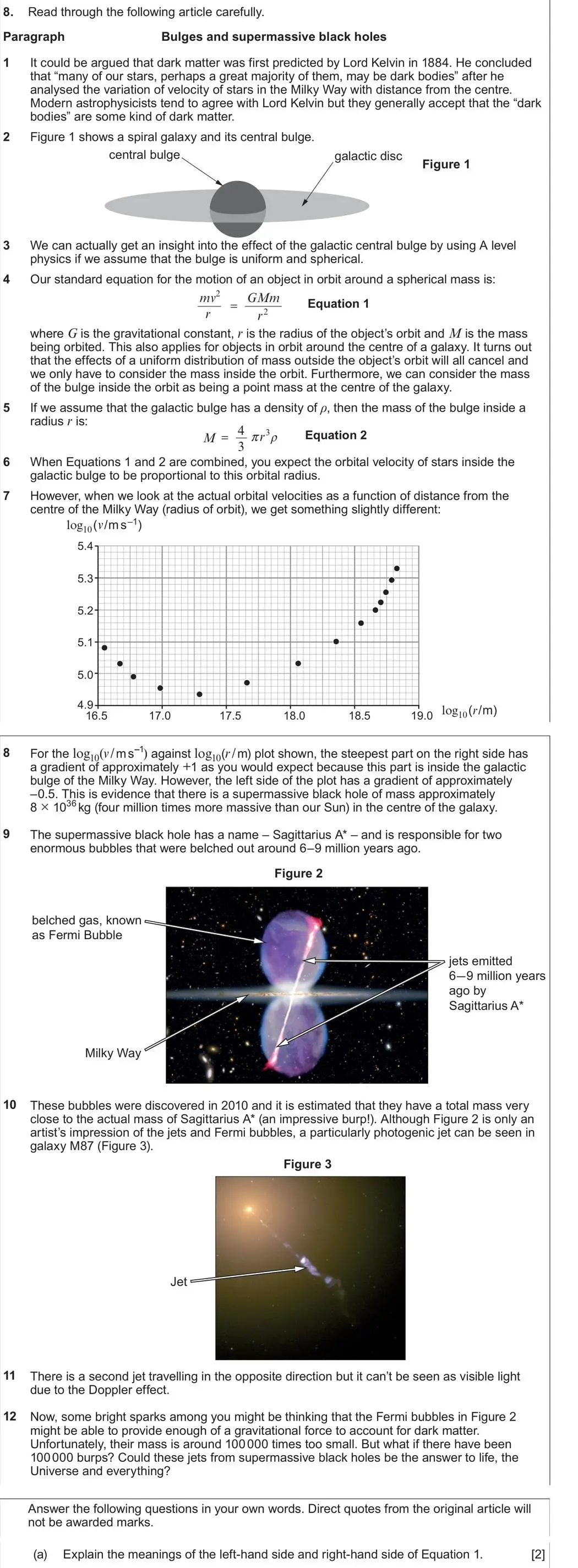
Most candidates were able to successfully identify the centripetal and gravitational forces in (a). Candidates were asked to use forces in their responses to part (b). In several cases this was not done. For the first mark candidates needed to reference the mass inside of the bulge. Some considered this as a point mass, but it was not a requirement. This mass causes a force towards the centre. As the star obits, the bulge outside will pull in different directions. This proved to be a tough marking point to achieve. Good algebra skills were on show in (c). The first marking point was sometimes missed in (d)(i) as candidates focused on using logs. Referencing the supermassive black hole or even the centre of the galaxy would have been enough. The mathematical demand in this question part made it difficult for some candidates. There were a good number who were successful and correctly identified -0.5 in their algebra and linked this to 𝑦= 𝑚𝑥+ 𝑐. In (ii) taking values from the graph was generally well done. Some candidates brought forward their log equations from (d)(i), leading to a relatively simple substitution and manipulation. Many candidates used 10𝑥 to calculate a distance and a velocity and then used a rearranged version of the orbital velocity equation. A comment was needed to pick up the last marking point. In
Notes from the mark scheme and report
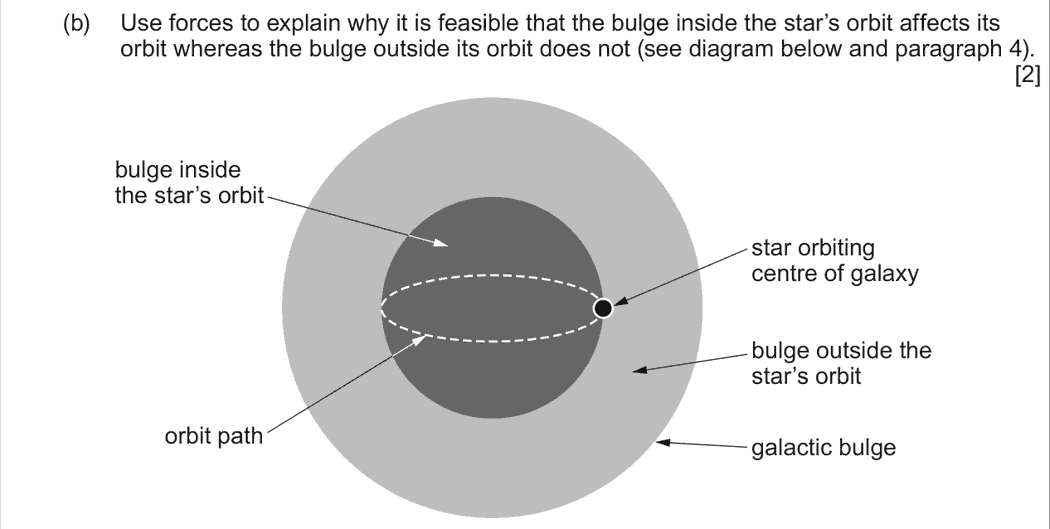
The bulge inside the orbit acts like a point mass at the centre, so its force on the star is always towards the centre (1)
the parts of the bulge outside the orbit pull the star in all directions and these forces cancel (1)
the second mark was hard to get
Skills: Comprehension A level Component 1 Section B: questions on the printed article; Synoptic Needs physics from another component of the qualification
Mark scheme, with the levels and indicative content
Examiner's comment
Part (a) was the QER question and in general, good attempts were made to explain the shapes of the potential vs distance curves. Higher scoring candidates (top band responses) were able to refer to the definition of potential and the expected relationship between potential and distance (i.e. 𝑉𝑔∝ − 𝑟). They explained the reason why the potential near the earth had a greater (negative) value than near the Moon and identified the relationship between the gradient of the curves and gravitational field strength. They described the scalar nature of potential and explained that the combined curve was due to the sum of the individual potentials. They also correctly described the significance of the gradient at X in terms of field strength and, in some cases, the work needed to escape the system. Middle band responses contained some of the above points, with lower band candidates only managing to describe one or two of these aspects. Many candidates in (b)(i) had an appreciation of the energy principles involved in determining the launch speed of the rocket, including the concept of initial Ep and Ek at the surface being equal to the Ep at the given height in orbit. However, a significant minority of candidates failed to gain full marks due to their incorrect use of signs when considering Ep. That is they failed to account for the negative values of Ep at both the surface and at the height of the orbit. Responses to (ii) were more successful with many applying the appropriate circular motion equation to confirm the orbital speed. In a few cases candidates used the orbital speed given in the question to determine the period of orbit, T, and then used the same equation again to re-confirm the orbital speed - a circular approach which was not credited.
Notes from the mark scheme and report
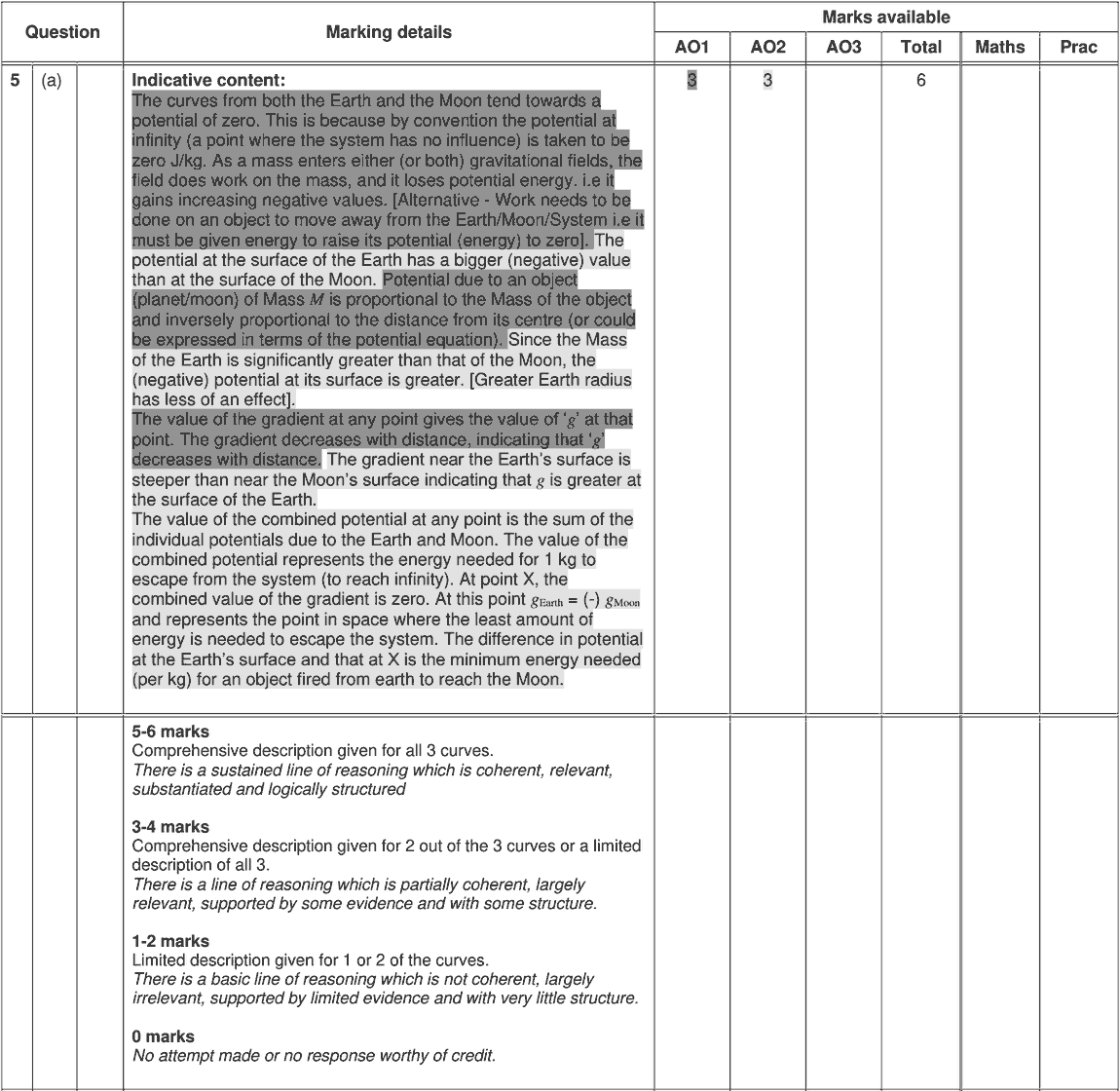
QER, levels marked. Each curve tends to zero because potential is defined as zero at infinity and is negative closer in (work must be done to move a mass away)
V = −GM/r so the Earth's larger mass gives a more negative surface potential than the Moon's
the gradient gives g (with a minus sign), decreasing with distance and steeper near the Earth
the combined potential is the scalar sum of the two
at X the gradient is zero so the resultant field is zero
the potential difference between the Earth's surface and X gives the minimum energy per kg to reach the Moon, and the combined value the energy per kg to escape
Skills: QER The 6-mark quality of extended response question
June 2023 · Component 2 · Q5(b)(i)4 marksAO1=1, AO2=3Calculation
Earlier part of question 5 that this part uses
Mark scheme
Examiner's comment
Part (a) was the QER question and in general, good attempts were made to explain the shapes of the potential vs distance curves. Higher scoring candidates (top band responses) were able to refer to the definition of potential and the expected relationship between potential and distance (i.e. 𝑉𝑔∝ − 𝑟). They explained the reason why the potential near the earth had a greater (negative) value than near the Moon and identified the relationship between the gradient of the curves and gravitational field strength. They described the scalar nature of potential and explained that the combined curve was due to the sum of the individual potentials. They also correctly described the significance of the gradient at X in terms of field strength and, in some cases, the work needed to escape the system. Middle band responses contained some of the above points, with lower band candidates only managing to describe one or two of these aspects. Many candidates in (b)(i) had an appreciation of the energy principles involved in determining the launch speed of the rocket, including the concept of initial Ep and Ek at the surface being equal to the Ep at the given height in orbit. However, a significant minority of candidates failed to gain full marks due to their incorrect use of signs when considering Ep. That is they failed to account for the negative values of Ep at both the surface and at the height of the orbit. Responses to (ii) were more successful with many applying the appropriate circular motion equation to confirm the orbital speed. In a few cases candidates used the orbital speed given in the question to determine the period of orbit, T, and then used the same equation again to re-confirm the orbital speed - a circular approach which was not credited.
Notes from the mark scheme and report
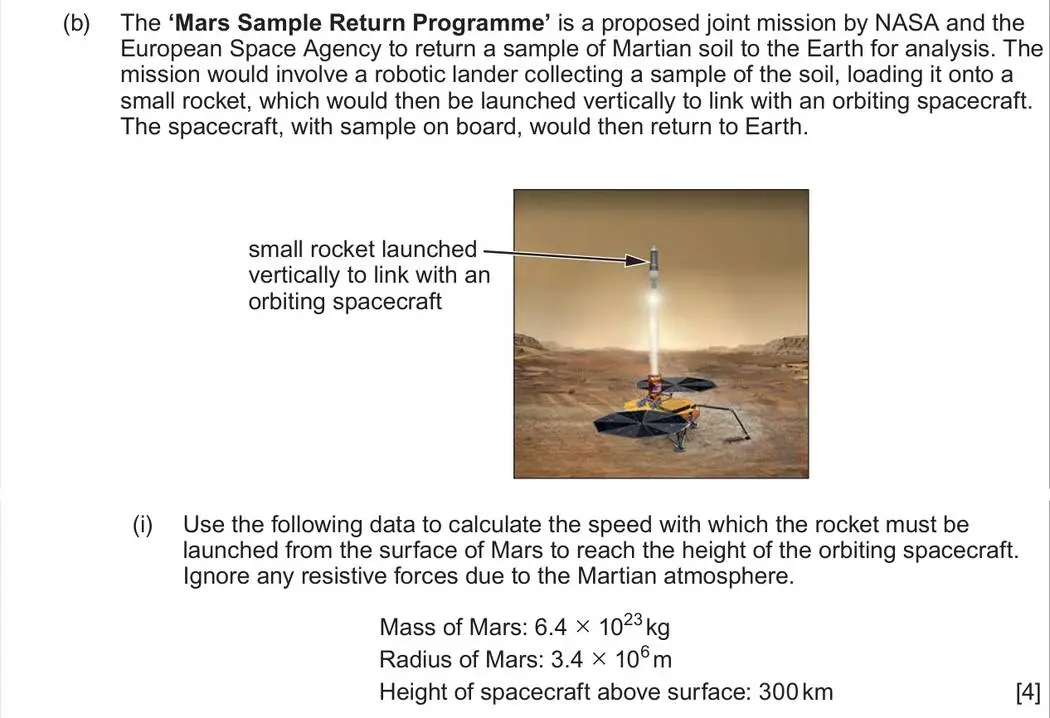
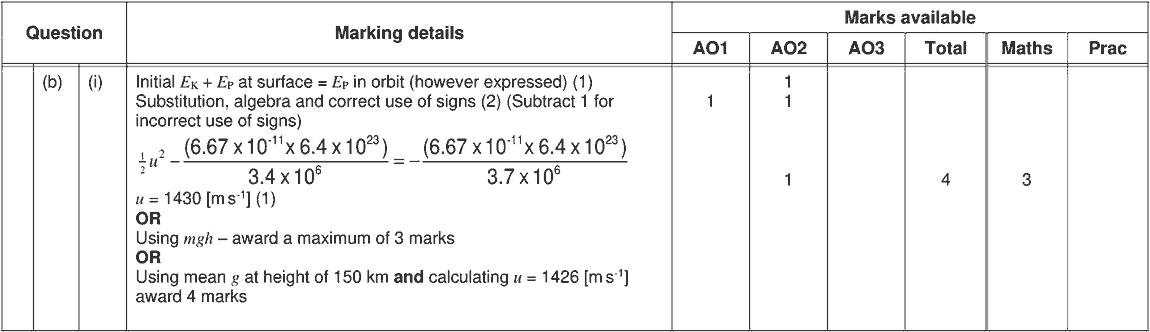
Answer: 1430 m s⁻¹. ½u² − GM/R = −GM/(R + h) with R = 3.4 × 10⁶ m and R + h = 3.7 × 10⁶ m
signs must be right (one mark lost otherwise)
mgh with surface g scores at most 3, mean g at 150 km gives full marks
Scheme columns: Maths 3
Skills: Synoptic Needs physics from another component of the qualification; Mathsmarks The mark scheme's Maths column gives this part at least one mark for mathematical skills
June 2023 · Component 2 · Q6(a)5 marksAO1=1, AO2=4Calculation
Mark scheme
Examiner's comment
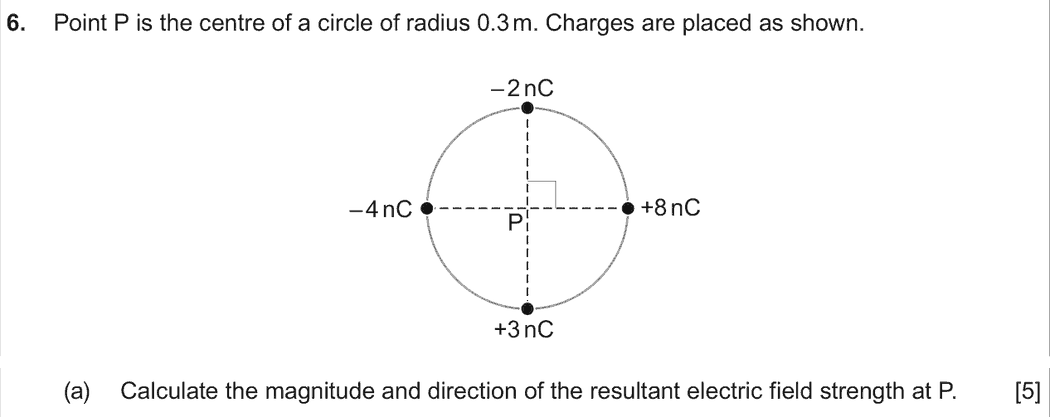
In (a) a significant number included negative signs in their answers which seemed to be related to the sign of the given charge. Whilst this was not penalised at the stage of calculating the individual field strengths, this lack of conceptual understanding was highlighted when calculating the overall horizontal and vertical components, which were often incorrect because of the ‘sign’ values in their calculations for the individual field strengths. This in turn led to an incorrect overall vale for the intensity due to all the charges and its direction. Where candidates did calculate the magnitude of the overall intensity correctly, the direction associated with it was not always clearly shown. More often than not candidates were successful in (b) in calculating the combined potential due to the four charges at point P. Once again however, some candidates showed confusion with the use of signs. In this case, consideration of the negative or positive nature of the potential due to each charge is important. Those that ignored the scalar nature of the individual potentials were unsuccessful when calculating the overall potential. In light of the comment related to (b), ecf had to be applied frequently in (c) with many candidates successfully achieving full marks for a correct application of physics principles. Regardless of the figures used, many candidates displayed a good understanding of the concepts involved to achieve full marks here.
Notes from the mark scheme and report
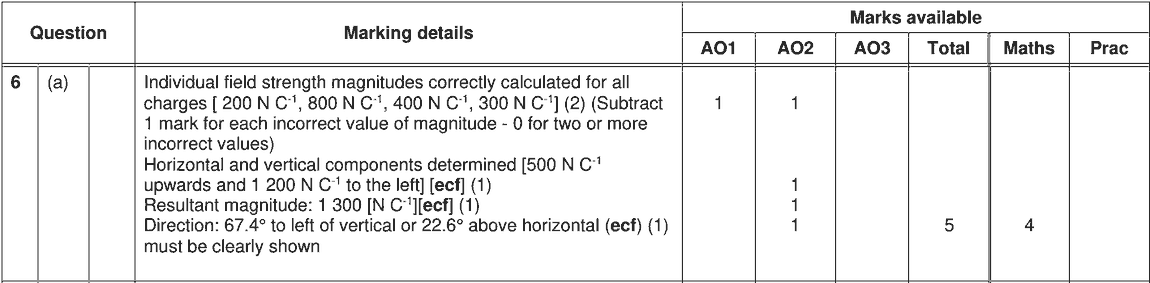
Answer: 1300 N C⁻¹ at 22.6° above the horizontal, towards the left (67.4° from the vertical). E = kQ/r²: 200, 400, 800 and 300 N C⁻¹
vertical resultant 500 N C⁻¹ upwards, horizontal 1200 N C⁻¹ to the left
carrying the sign of the charge into the magnitudes gave wrong components
Scheme columns: Maths 4
Skills: Trigonometryand vectors Resolving, components, vector addition, angles; Mathsmarks The mark scheme's Maths column gives this part at least one mark for mathematical skills
June 2023 · Component 2 · Q6(b)3 marksAO1=1, AO2=2Calculation
Earlier part of question 6 that this part uses
Mark scheme
Examiner's comment
In (a) a significant number included negative signs in their answers which seemed to be related to the sign of the given charge. Whilst this was not penalised at the stage of calculating the individual field strengths, this lack of conceptual understanding was highlighted when calculating the overall horizontal and vertical components, which were often incorrect because of the ‘sign’ values in their calculations for the individual field strengths. This in turn led to an incorrect overall vale for the intensity due to all the charges and its direction. Where candidates did calculate the magnitude of the overall intensity correctly, the direction associated with it was not always clearly shown. More often than not candidates were successful in (b) in calculating the combined potential due to the four charges at point P. Once again however, some candidates showed confusion with the use of signs. In this case, consideration of the negative or positive nature of the potential due to each charge is important. Those that ignored the scalar nature of the individual potentials were unsuccessful when calculating the overall potential. In light of the comment related to (b), ecf had to be applied frequently in (c) with many candidates successfully achieving full marks for a correct application of physics principles. Regardless of the figures used, many candidates displayed a good understanding of the concepts involved to achieve full marks here.
Notes from the mark scheme and report
Answer: +150 V. V = kQ/r for each charge: −60, −120, +240 and +90 V, added as scalars with their signs
Scheme columns: Maths 2
Skills: Mathsmarks The mark scheme's Maths column gives this part at least one mark for mathematical skills
June 2023 · Component 2 · Q6(c)3 marksAO3=3Calculation
Earlier part of question 6 that this part uses
Mark scheme
Examiner's comment
In (a) a significant number included negative signs in their answers which seemed to be related to the sign of the given charge. Whilst this was not penalised at the stage of calculating the individual field strengths, this lack of conceptual understanding was highlighted when calculating the overall horizontal and vertical components, which were often incorrect because of the ‘sign’ values in their calculations for the individual field strengths. This in turn led to an incorrect overall vale for the intensity due to all the charges and its direction. Where candidates did calculate the magnitude of the overall intensity correctly, the direction associated with it was not always clearly shown. More often than not candidates were successful in (b) in calculating the combined potential due to the four charges at point P. Once again however, some candidates showed confusion with the use of signs. In this case, consideration of the negative or positive nature of the potential due to each charge is important. Those that ignored the scalar nature of the individual potentials were unsuccessful when calculating the overall potential. In light of the comment related to (b), ecf had to be applied frequently in (c) with many candidates successfully achieving full marks for a correct application of physics principles. Regardless of the figures used, many candidates displayed a good understanding of the concepts involved to achieve full marks here.
Notes from the mark scheme and report
½mv² = eΔV with ΔV = 150 − 50 = 100 V (1)
v = 5.9 × 10⁶ m s⁻¹ (1)
2% of c is 6.0 × 10⁶ m s⁻¹, so he is correct (1)
ecf on the potential from (b)
Scheme columns: Maths 3
Skills: Mathsmarks The mark scheme's Maths column gives this part at least one mark for mathematical skills
June 2022 · Component 2 · Q5(a)1 markAO1=1Definition
Mark scheme
Examiner's comment
Few candidates were able to give a correct definition for electric potential, with key words and / or phrases often being missed out. For example, the word ‘unit’ (or one coulomb) was missed by many, as was the reference to moving the positive unit charge from infinity (to the point).
Notes from the mark scheme and report
Work done per unit positive charge in bringing a (small) positive charge from infinity to the point
'unit', 'positive' or 'from infinity' frequently missing
June 2022 · Component 2 · Q5(b)(i)3 marksAO1=2, AO2=1Calculation
Earlier part of question 5 that this part uses
Mark scheme
Examiner's comment
Most candidates were able to take appropriate readings from the graph and use them correctly to determine the charge Q.
Notes from the mark scheme and report
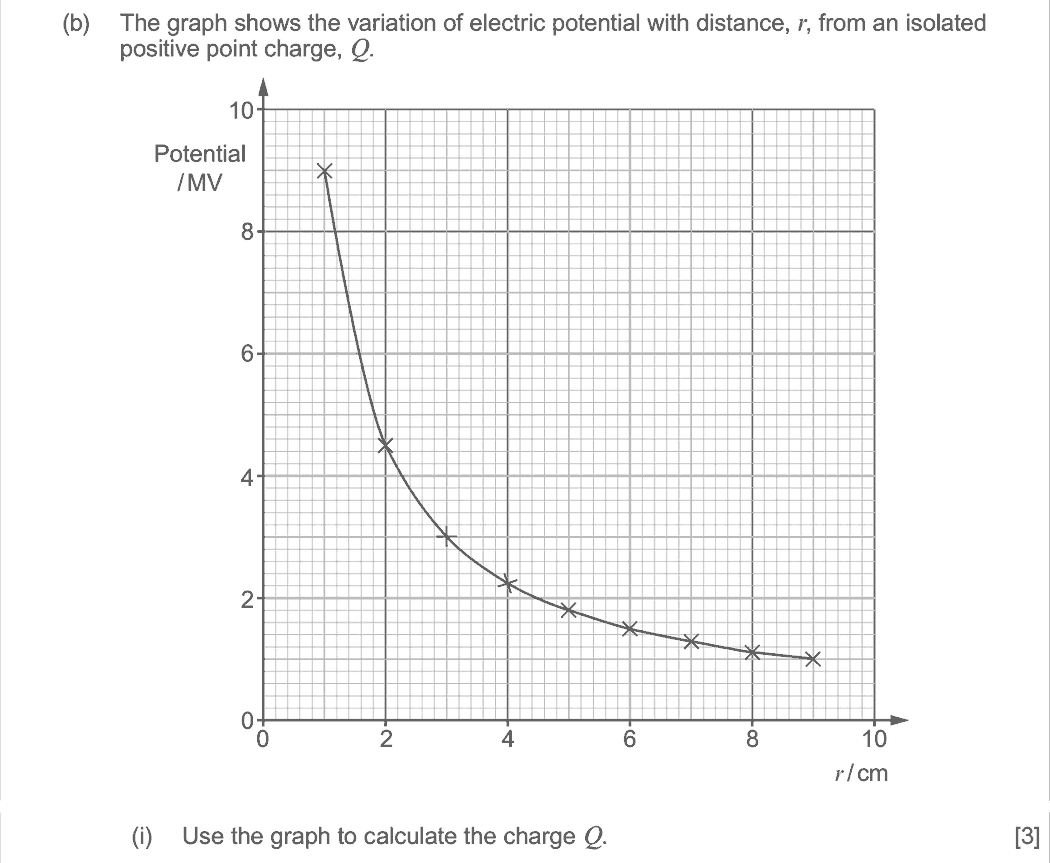
Answer: 10 μC. Read a point, e.g. 9 MV at 1.0 cm or 3 MV at 3.0 cm
V = Q/4πε0r so Q = Vr/9 × 10⁹ = 9 × 10⁶ × 0.01/9 × 10⁹
Scheme columns: Maths 2
Skills: Graphskills Reading, plotting or sketching graphs; gradients, intercepts and areas; Unitsand conversions Unit marks, base units, prefixes and conversions; Mathsmarks The mark scheme's Maths column gives this part at least one mark for mathematical skills
June 2022 · Component 2 · Q5(b)(ii)2 marksAO1=1, AO2=1Calculation
Earlier parts of question 5 that this part uses
Mark scheme
Examiner's comment
Fewer candidates were able to take correct values of potential from the graph at the distances indicated. Those that did so correctly often placed the values the wrong way around in their equations, leading to a negative value for the work done. One mark was deducted for negative answers.
Notes from the mark scheme and report
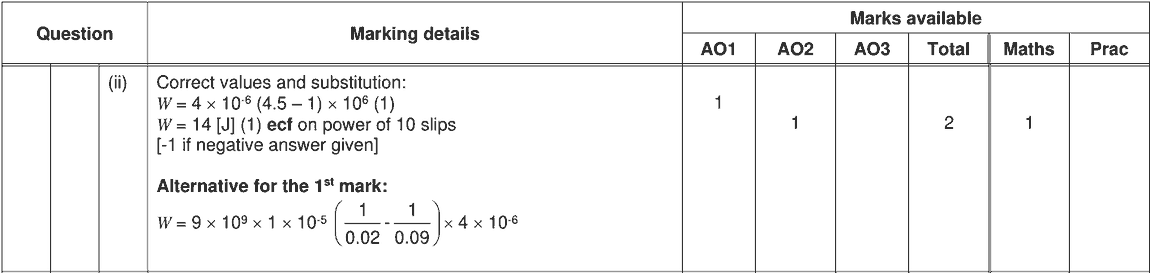
Answer: 14 J. W = qΔV = 4.0 × 10⁻⁶ × (4.5 − 1.0) × 10⁶
potentials read at 2.0 cm and 9.0 cm
1 mark off for a negative answer (values subtracted the wrong way round)
Scheme columns: Maths 1
Skills: Graphskills Reading, plotting or sketching graphs; gradients, intercepts and areas; Mathsmarks The mark scheme's Maths column gives this part at least one mark for mathematical skills
June 2022 · Component 2 · Q5(b)(iii)2 marksAO3=2Calculation
Earlier parts of question 5 that this part uses
Mark scheme
Examiner's comment
Many candidates drew an appropriate tangent and then determined the gradient correctly.
Notes from the mark scheme and report
Field strength = −potential gradient: tangent to the curve at 3.0 cm, gradient about 6 MV/0.06 m = 1.0 × 10⁸ V m⁻¹. Using E = kQ/r² with Q from (i) scores 1 only because the graph must be used
Scheme columns: Maths 2
Skills: Graphskills Reading, plotting or sketching graphs; gradients, intercepts and areas; Mathsmarks The mark scheme's Maths column gives this part at least one mark for mathematical skills
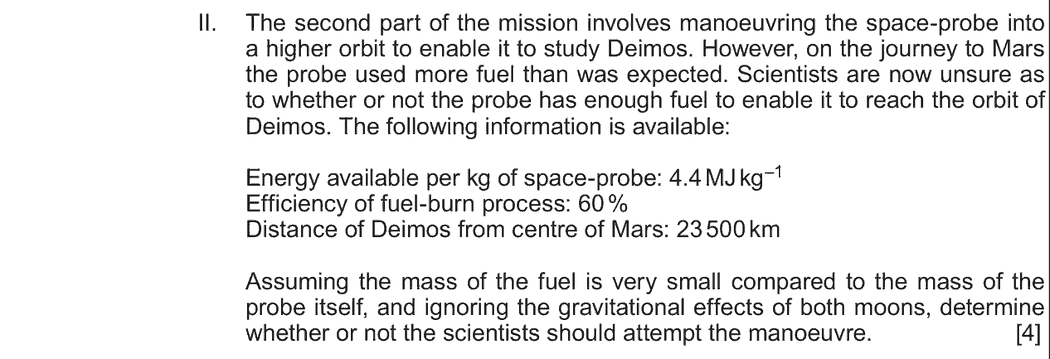
June 2022 · Component 2 · Q8(a)2 marksAO1=1, AO2=1Show that
Mark scheme
Examiner's comment
Nearly all candidates were successful in confirming the mass of the Moon.
Notes from the mark scheme and report
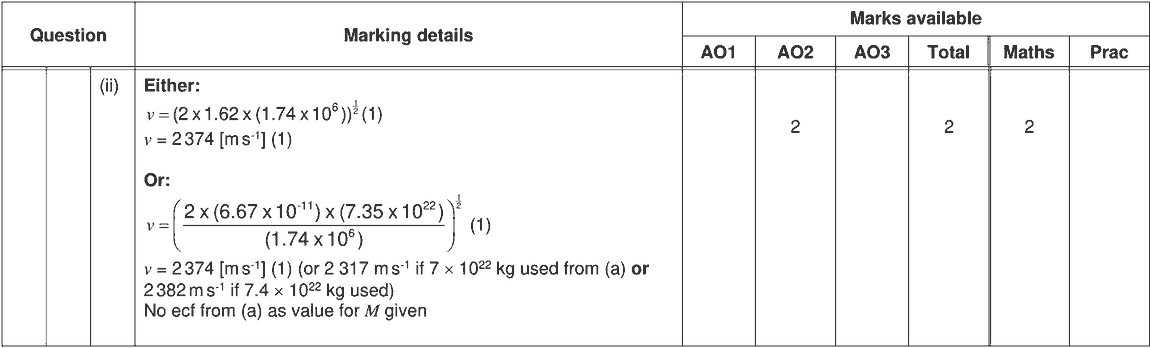
g = GM/r² so M = gr²/G = 1.62 × (1.74 × 10⁶)²/6.67 × 10⁻¹¹ = 7.35 × 10²² kg
Scheme columns: Maths 1
Skills: Mathsmarks The mark scheme's Maths column gives this part at least one mark for mathematical skills
June 2022 · Component 2 · Q8(b)(i)2 marksAO1=1, AO2=1Show that
Earlier part of question 8 that this part uses
Mark scheme
Examiner's comment
Many candidates applied the principle of conservation of energy appropriately to derive an expression for escape velocity. Some candidates lost a mark for incorrect use of signs.
Notes from the mark scheme and report
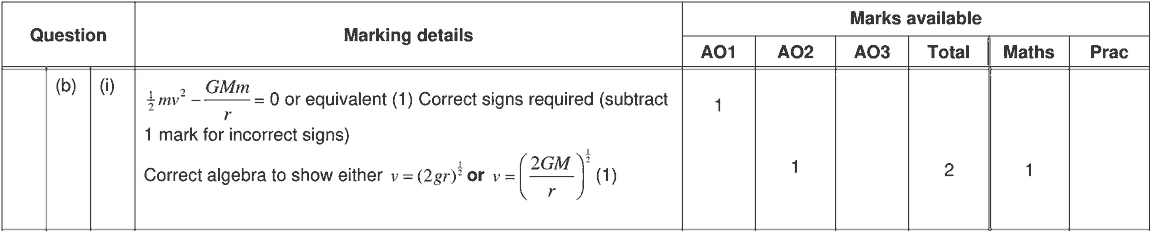
Total energy zero at infinity: ½mv² − GMm/r = 0 (signs must be right) (1)
v = √(2GM/r), or √(2gr) (1)
Scheme columns: Maths 1
Skills: Algebra Derivations and rearranging equations; Mathsmarks The mark scheme's Maths column gives this part at least one mark for mathematical skills
June 2022 · Component 2 · Q8(b)(ii)2 marksAO2=2Calculation
Earlier parts of question 8 that this part uses
Mark scheme
Examiner's comment
Those candidates who were able to derive a correct expression in (i) usually used it correctly to calculate the escape velocity in (ii).
Notes from the mark scheme and report
Answer: 2.37 × 10³ m s⁻¹. v = √(2gr) = √(2 × 1.62 × 1.74 × 10⁶), or √(2GM/r)
Scheme columns: Maths 2
Skills: Mathsmarks The mark scheme's Maths column gives this part at least one mark for mathematical skills
October 2021 · Component 1 · Q4(b)(ii)3 marksAO2=3Show that
Earlier parts of question 4 that this part uses
Mark scheme
Notes from the mark scheme and report
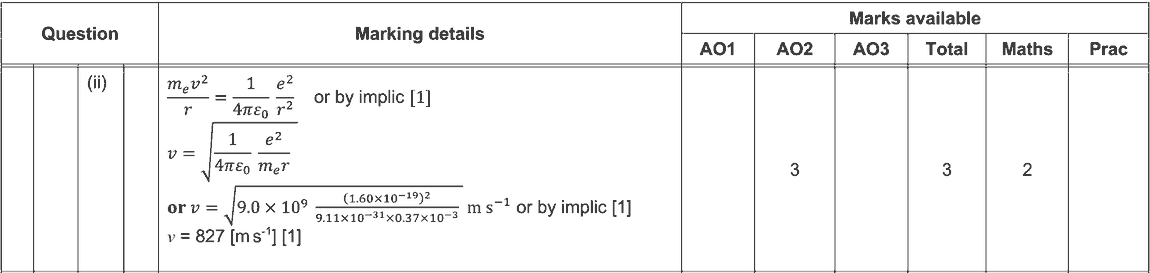
Coulomb attraction provides the centripetal force: mv²/r = e²/4πε0r² (1)
Skills: Synoptic Needs physics from another component of the qualification; Algebra Derivations and rearranging equations; Mathsmarks The mark scheme's Maths column gives this part at least one mark for mathematical skills
October 2021 · Component 2 · Q5(a)(ii)2 marksAO1=2Diagram or graph
Mark scheme
Notes from the mark scheme and report
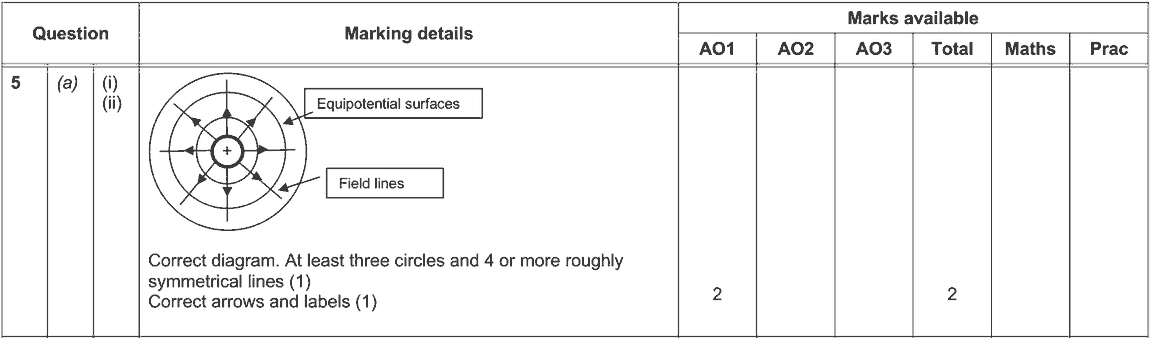
Covers (a)(i) and (ii) together [2]. At least four roughly symmetrical radial lines and three concentric circles (1)
arrows pointing outwards from the positive charge, with lines and circles labelled (1)
October 2021 · Component 2 · Q5(b)(i)3 marksAO1=1, AO2=2Calculation
Earlier part of question 5 that this part uses
Mark scheme
Notes from the mark scheme and report
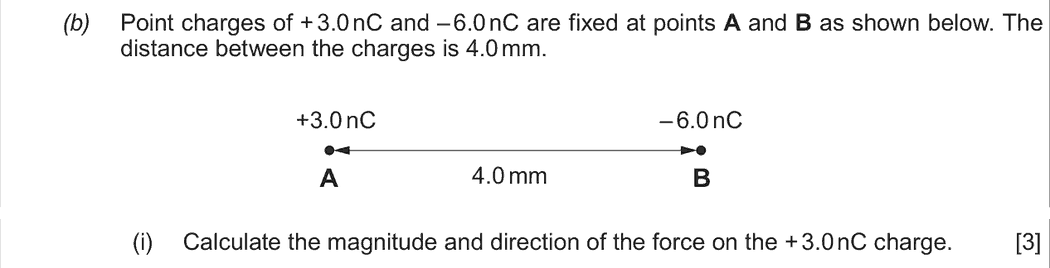
Answer: 0.010 N towards B (to the right), attractive. F = 9 × 10⁹ × 3.0 × 10⁻⁹ × 6.0 × 10⁻⁹/(4.0 × 10⁻³)²
Scheme columns: Maths 2
Skills: Unitsand conversions Unit marks, base units, prefixes and conversions; Mathsmarks The mark scheme's Maths column gives this part at least one mark for mathematical skills
October 2021 · Component 2 · Q5(b)(ii)2 marksAO1=2Short answer
Earlier parts of question 5 that this part uses
Mark scheme
Notes from the mark scheme and report
0.010 N towards A (to the left): equal in size and opposite in direction (1), by Newton's third law (1)
Skills: Synoptic Needs physics from another component of the qualification
October 2021 · Component 2 · Q5(c)(i)1 markAO1=1Definition
Earlier part of question 5 that this part uses
Mark scheme
Notes from the mark scheme and report
Work done per unit positive charge in bringing a (small) positive charge from infinity to the point
October 2021 · Component 2 · Q5(c)(ii)4 marksAO1=1, AO2=3Calculation
Earlier parts of question 5 that this part uses
Mark scheme
Notes from the mark scheme and report
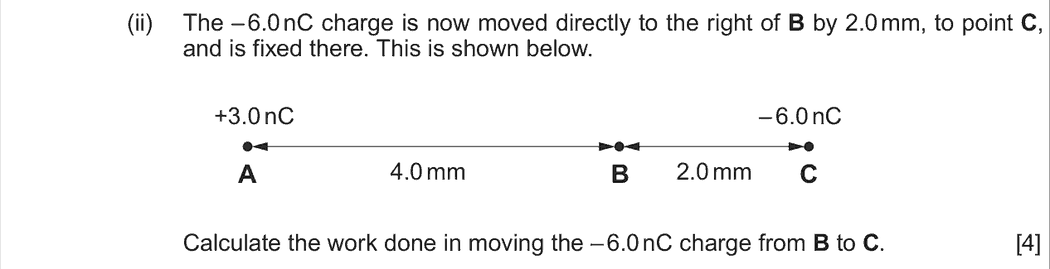
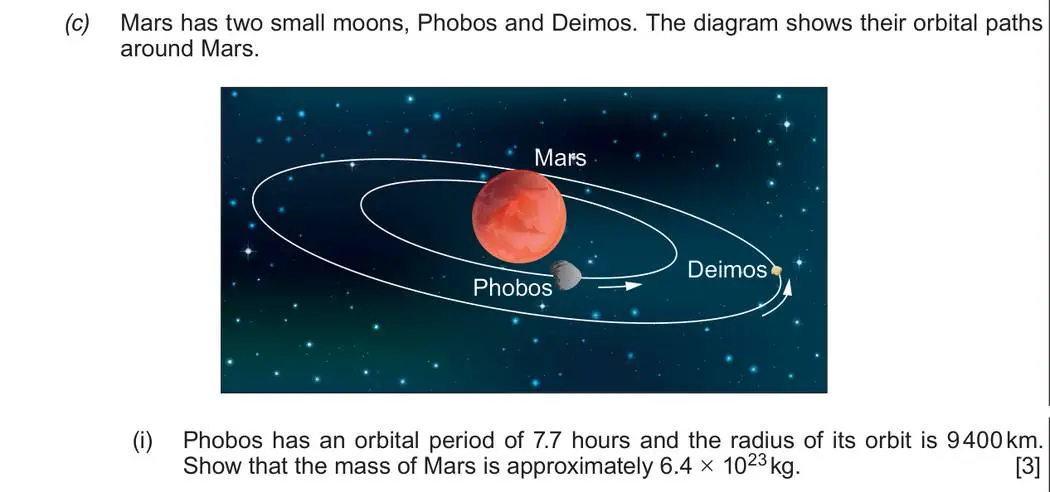
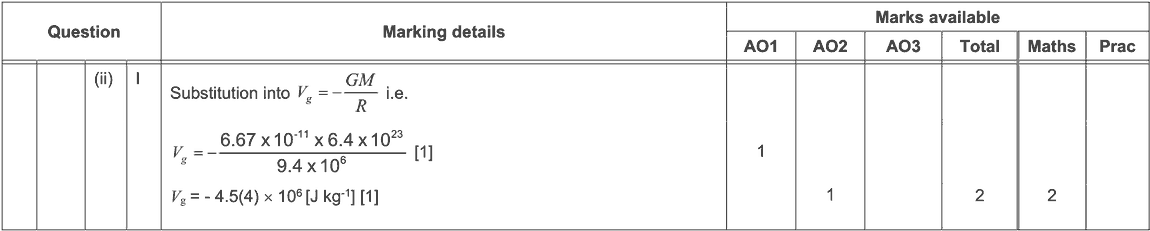
Answer: 1.35 × 10⁻⁵ J. Potential due to the +3.0 nC charge: change from B to C = 9 × 10⁹ × 3.0 × 10⁻⁹ × (1/0.006 − 1/0.004) = −2250 V
W = QΔV = (−6.0 × 10⁻⁹) × (−2250)
unit mark
Scheme columns: Maths 2
Skills: Unitsand conversions Unit marks, base units, prefixes and conversions; Mathsmarks The mark scheme's Maths column gives this part at least one mark for mathematical skills
October 2021 · Component 2 · Q5(d)3 marksAO1=3Explanation
Earlier part of question 5 that this part uses
Mark scheme
Notes from the mark scheme and report
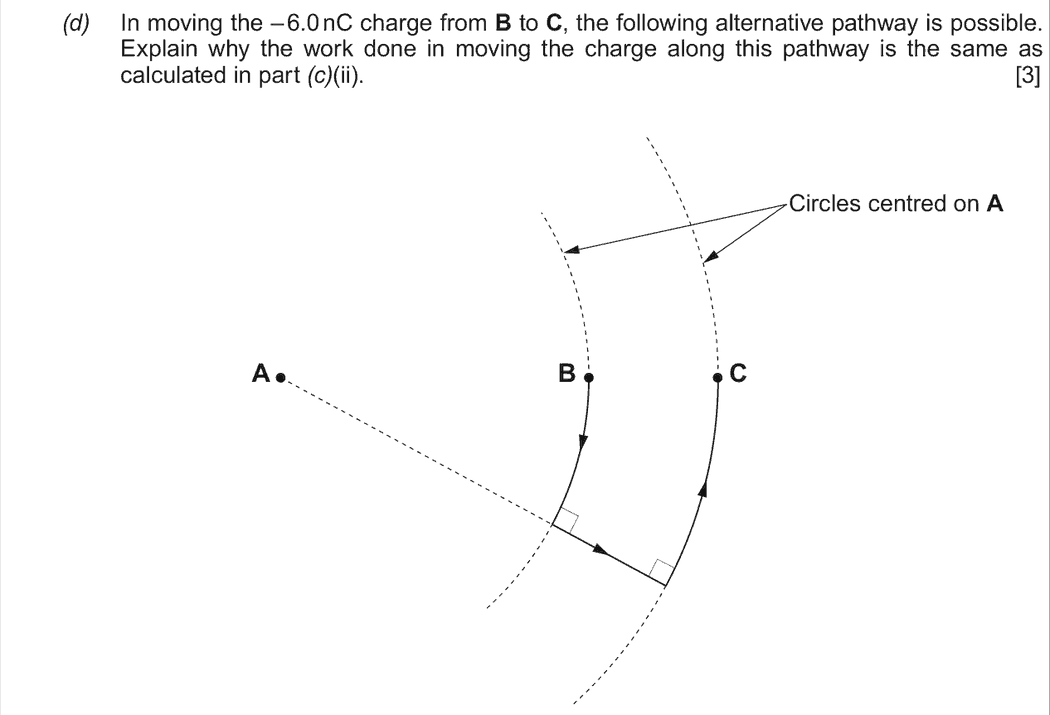
The curved sections are along equipotentials (circles centred on A), so no work is done on them (1)
the radial section between the two equipotentials has the same length as BC (1), and covers the same change in potential (same change in separation), so the work is the same (1)
October 2020 · Component 2 · Q7(c)(ii)I2 marksAO1=1, AO2=1Show that
Earlier parts of question 7 that this part uses
Mark scheme
Examiner's comment
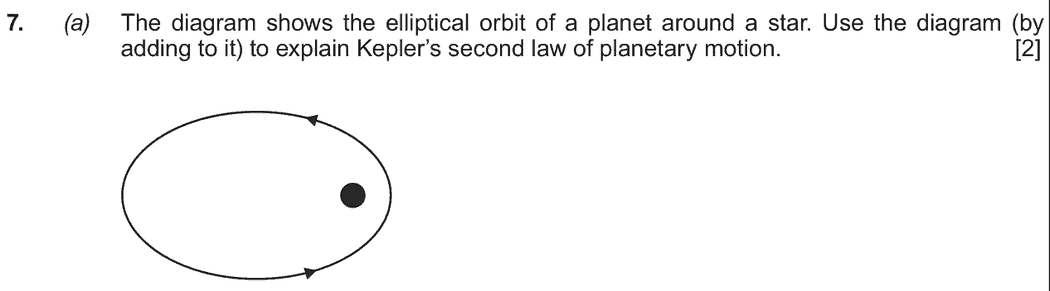
In explaining Kepler’s second law of planetary motion, it was expected that responses referred to ‘equal areas’ swept out in ‘equal time intervals’. Candidates were expected to add to the given diagram to reinforce their answers. The majority of responses either focused on the ‘time’ aspect or the ‘area’ aspect, but few linked both together to give a complete answer. In (b), fewer than expected candidates were able to show that T2 α r3 starting from Newton’s law of gravitation. Good responses were seen for part (c), with nearly all candidates able to determine the mass of Mars and also confirm the gravitational potential at the Phobos orbit. Fewer candidates were able to determine whether or not the spacecraft should attempt the manoeuvre described, however the majority were able to obtain some credit for responses which were partially correct. Nearly all candidates gave a correct response as to why it was not possible to use the equation ∆Ep = mg∆h.
Skills: Mathsmarks The mark scheme's Maths column gives this part at least one mark for mathematical skills
October 2020 · Component 2 · Q7(c)(ii)II4 marksAO3=4Calculation
Earlier parts of question 7 that this part uses
Mark scheme
Examiner's comment
In explaining Kepler’s second law of planetary motion, it was expected that responses referred to ‘equal areas’ swept out in ‘equal time intervals’. Candidates were expected to add to the given diagram to reinforce their answers. The majority of responses either focused on the ‘time’ aspect or the ‘area’ aspect, but few linked both together to give a complete answer. In (b), fewer than expected candidates were able to show that T2 α r3 starting from Newton’s law of gravitation. Good responses were seen for part (c), with nearly all candidates able to determine the mass of Mars and also confirm the gravitational potential at the Phobos orbit. Fewer candidates were able to determine whether or not the spacecraft should attempt the manoeuvre described, however the majority were able to obtain some credit for responses which were partially correct. Nearly all candidates gave a correct response as to why it was not possible to use the equation ∆Ep = mg∆h.
not enough, so the manoeuvre should not be attempted (1)
most gained partial credit
Scheme columns: Maths 3
Skills: Mathsmarks The mark scheme's Maths column gives this part at least one mark for mathematical skills
October 2020 · Component 2 · Q7(c)(iii)1 markAO2=1Short answer
Earlier parts of question 7 that this part uses
Mark scheme
Examiner's comment
In explaining Kepler’s second law of planetary motion, it was expected that responses referred to ‘equal areas’ swept out in ‘equal time intervals’. Candidates were expected to add to the given diagram to reinforce their answers. The majority of responses either focused on the ‘time’ aspect or the ‘area’ aspect, but few linked both together to give a complete answer. In (b), fewer than expected candidates were able to show that T2 α r3 starting from Newton’s law of gravitation. Good responses were seen for part (c), with nearly all candidates able to determine the mass of Mars and also confirm the gravitational potential at the Phobos orbit. Fewer candidates were able to determine whether or not the spacecraft should attempt the manoeuvre described, however the majority were able to obtain some credit for responses which were partially correct. Nearly all candidates gave a correct response as to why it was not possible to use the equation ∆Ep = mg∆h.
Notes from the mark scheme and report
g is not constant between the two orbits (it falls with distance, the field is not uniform), and mgΔh assumes constant g
October 2020 · Component 3 · Q9(b)3 marksAO1=1, AO2=2Calculation
Earlier part of question 9 that this part uses
Mark scheme
Examiner's comment
Some candidates failed to apply Einstein’s equation. Others failed to discuss the stopping potential. Many candidates jumped straight in with the equation 𝐸𝐸= 𝑉𝑉 𝑑𝑑 which is the equation for a uniform field. However, they obtained the correct answer if they used the radius as 𝑑𝑑. This was probably just good fortune on many occasions because it is true that: 𝐸𝐸= 𝑘𝑘𝑘𝑘 𝑟𝑟2 = 𝑘𝑘𝑘𝑘 𝑟𝑟 𝑟𝑟= 𝑉𝑉 𝑟𝑟
Notes from the mark scheme and report
Answer: 126 V m⁻¹. E = Q/4πε0r² and V = Q/4πε0r so E = V/r = 8.2/0.065 at the surface (or find Q = 59 pC first)
Component 2 fields
Scheme columns: Maths 2
Skills: Synoptic Needs physics from another component of the qualification; Mathsmarks The mark scheme's Maths column gives this part at least one mark for mathematical skills
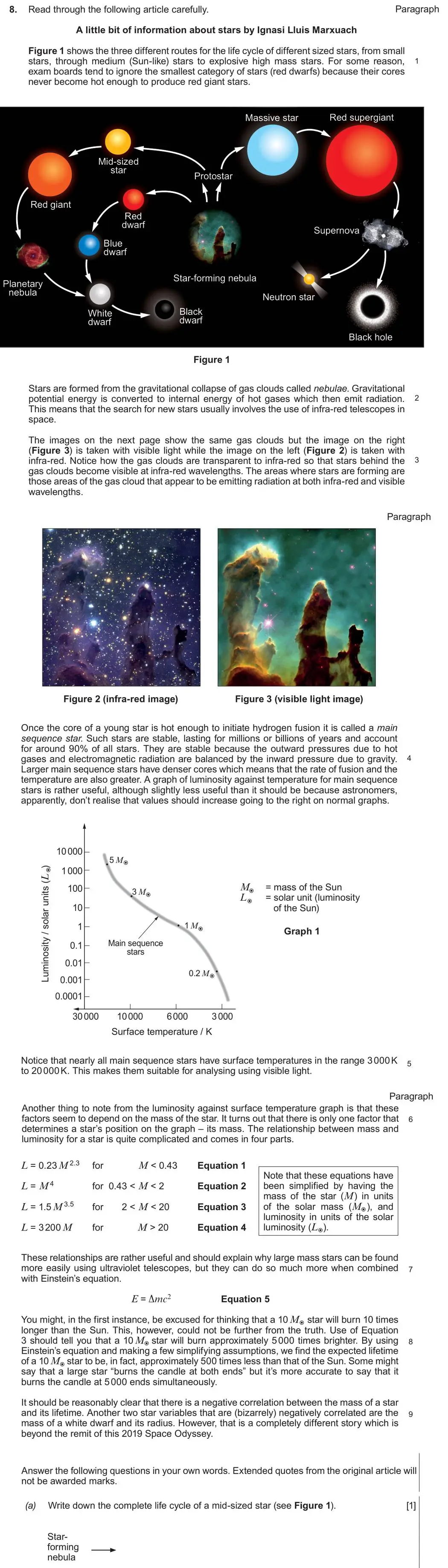
June 2019 · Component 1 · Q8(e)3 marksAO2=3Explanation
Earlier parts of question 8 that this part uses
Mark scheme
Examiner's comment
It was not always stated that increased gravitational forces was the reason why higher mass stars have higher core densities. A significant minority of candidates tried to explain why a higher density led to higher temperature without mentioning or implying nuclear fusion. There were, though, many excellent answers.
Notes from the mark scheme and report
Greater mass gives greater gravitational force, compressing the core to a higher density (1)
higher density gives a greater rate of fusion (1)
fusion releases energy, so more energy is released and the temperature is higher (1)
some never mentioned fusion
Skills: Comprehension A level Component 1 Section B: questions on the printed article
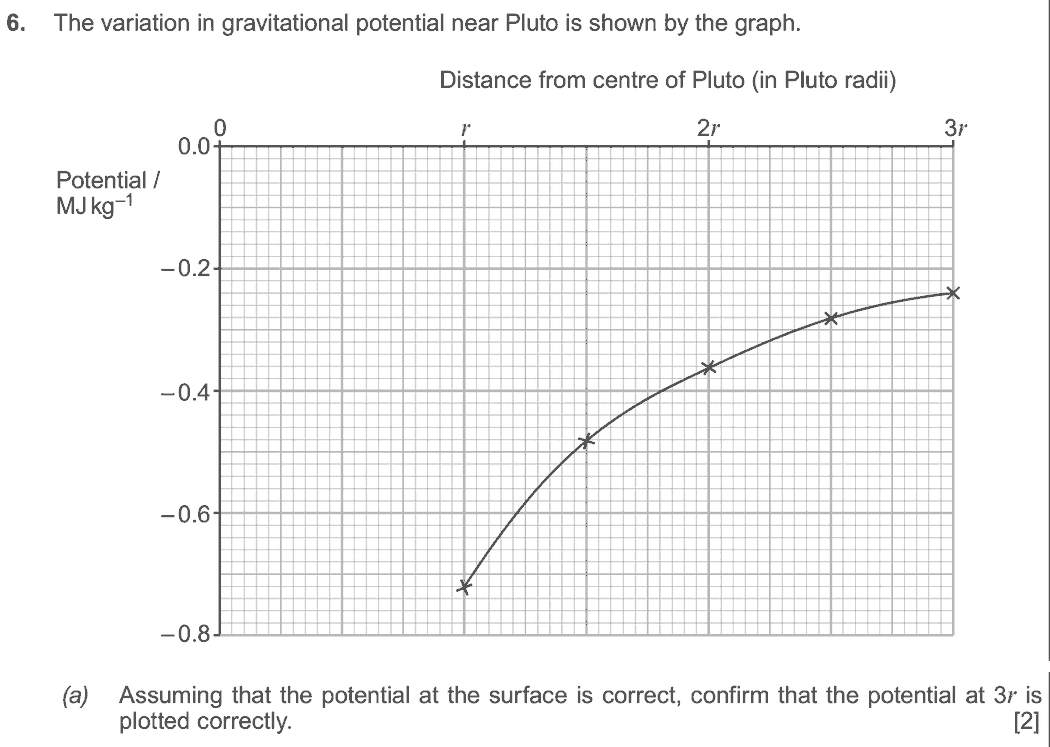
June 2019 · Component 2 · Q6(a)2 marksAO3=2Calculation
Mark scheme
Examiner's comment
Most candidates were able to use the value of the surface potential obtained from the graph and appropriate theory correctly to confirm that the potential at 3r was plotted correctly.
Notes from the mark scheme and report
V ∝ 1/r (1)
surface potential −0.72 MJ kg⁻¹ so at 3r it should be −0.72/3 = −0.24 MJ kg⁻¹, as plotted (1)
Scheme columns: Maths 1
Skills: Graphskills Reading, plotting or sketching graphs; gradients, intercepts and areas; Mathsmarks The mark scheme's Maths column gives this part at least one mark for mathematical skills
June 2019 · Component 2 · Q6(b)(i)2 marksAO1=1, AO2=1Calculation
Earlier part of question 6 that this part uses
Mark scheme
Examiner's comment
and (ii) Most candidates calculated the gravitational potential energy and the escape speed correctly. In some cases, ‘error carried forward’ was applied in (ii) from an incorrect potential energy value in (i). In many cases this was because the candidate had omitted the factor (106), thus leading to an escape speed of 1.2 m s-1, which is unrealistic. Candidates should be encouraged to check their workings in these cases.
Notes from the mark scheme and report
Answer: −4.3 × 10⁸ J. PE = mV = 600 × (−0.72 × 10⁶) (2)
omitting the 10⁶ was the usual slip
Scheme columns: Maths 1
Skills: Graphskills Reading, plotting or sketching graphs; gradients, intercepts and areas; Unitsand conversions Unit marks, base units, prefixes and conversions; Mathsmarks The mark scheme's Maths column gives this part at least one mark for mathematical skills
June 2019 · Component 2 · Q6(b)(ii)3 marksAO2=3Calculation
Earlier parts of question 6 that this part uses
Mark scheme
Notes from the mark scheme and report
Answer: 1.2 km s⁻¹. Kinetic energy needed = magnitude of the potential energy (total energy zero at infinity) (1)
½ × 600 × v² = 4.3 × 10⁸, or v = √(2 × 0.72 × 10⁶) (1)
v = 1.2 × 10³ m s⁻¹ (1)
ecf
Scheme columns: Maths 2
Skills: Mathsmarks The mark scheme's Maths column gives this part at least one mark for mathematical skills
June 2019 · Component 2 · Q6(c)4 marksAO3=4Show that
Earlier part of question 6 that this part uses
Mark scheme
Examiner's comment
Most candidates drew a suitable tangent, but many failed to use the corresponding graph values correctly to determine a valid gradient. Many did not give a clear argument around proving the inverse square law relationship.
Notes from the mark scheme and report
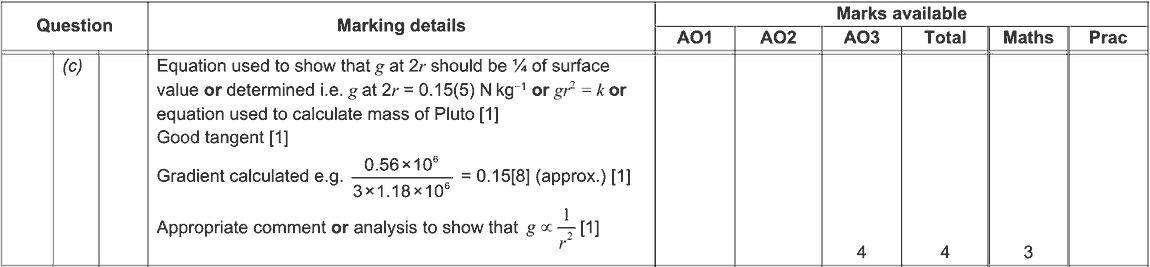
Theory: g at 2r should be ¼ of 0.62 = 0.155 N kg⁻¹ (1)
good tangent drawn at 2r (1)
gradient, with distances converted using r = 1.18 × 10⁶ m, e.g. 0.56 × 10⁶/(3 × 1.18 × 10⁶) = 0.158 N kg⁻¹ (1)
g = −slope of the V-r graph, and the agreement shows g ∝ 1/r² (1)
gradients often miscalculated and the argument unclear
Scheme columns: Maths 3
Skills: Graphskills Reading, plotting or sketching graphs; gradients, intercepts and areas; Mathsmarks The mark scheme's Maths column gives this part at least one mark for mathematical skills
June 2019 · Component 2 · Q8(a)2 marksAO1=2Short answer
Mark scheme
Examiner's comment
Most candidates mentioned either the inverse square nature or the fact that both fields were infinite in range as similarities. Many candidates either mentioned that gravitational fields act on masses and electric fields act on charges or the attractive/repulsive nature of the fields as their differences. As in 3(a), some candidates’ answers were vague, not relating specifically to gravitational or electrical, and so couldn’t be credited.
Notes from the mark scheme and report
Similarity: both follow an inverse square law, have infinite range, or field strength is a vector in both (1)
difference: gravitational fields only attract while electric fields attract or repel, or one acts on mass and the other on charge (1)
vague unattributed statements not credited
June 2019 · Component 2 · Q8(b)(i)3 marksAO1=1, AO2=2Show that
Earlier part of question 8 that this part uses
Mark scheme
Examiner's comment
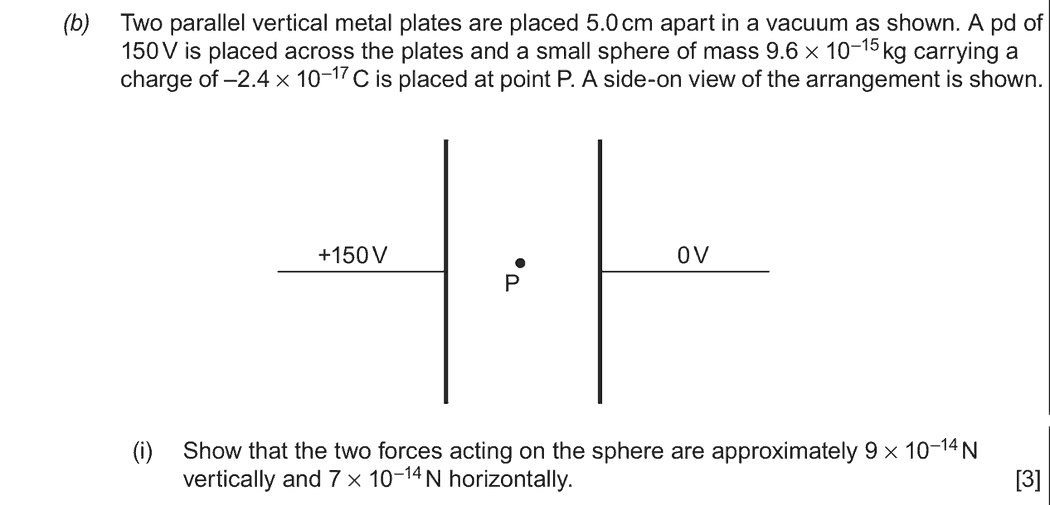
Nearly all candidates were able to confirm the vertical and horizontal forces acting on the sphere were equivalent to the ones given in the question.
electric force = Eq = 3000 × 2.4 × 10⁻¹⁷ = 7.2 × 10⁻¹⁴ N (1)
Scheme columns: Maths 2
Skills: Mathsmarks The mark scheme's Maths column gives this part at least one mark for mathematical skills
June 2018 · Component 1 · Q9(c)2 marksAO2=2Show that
Earlier part of question 9 that this part uses
Mark scheme
Examiner's comment
Occasionally students didn’t make clear the role of force in deriving e eE a m .
Notes from the mark scheme and report
F = qE and F = ma (1)
with q = e and m = me (or stating the electric force is the resultant force), so a = eE/me (1)
the role of force was sometimes unclear
Scheme columns: Maths 1
Skills: Comprehension A level Component 1 Section B: questions on the printed article; Synoptic Needs physics from another component of the qualification; Algebra Derivations and rearranging equations; Mathsmarks The mark scheme's Maths column gives this part at least one mark for mathematical skills
June 2018 · Component 2 · Q7(a)3 marksAO1=3Definition
Mark scheme
Examiner's comment
Fewer than expected candidates managed to provide correct definitions for both electric field strength and electric potential and also to correctly identify them as a scalar or vector. In many cases, no reference was made to unit charge (or equivalent), and in the case of electric potential, many candidates incorrectly referred to the work done to take a unit charge from a point in the field to infinity.
Notes from the mark scheme and report
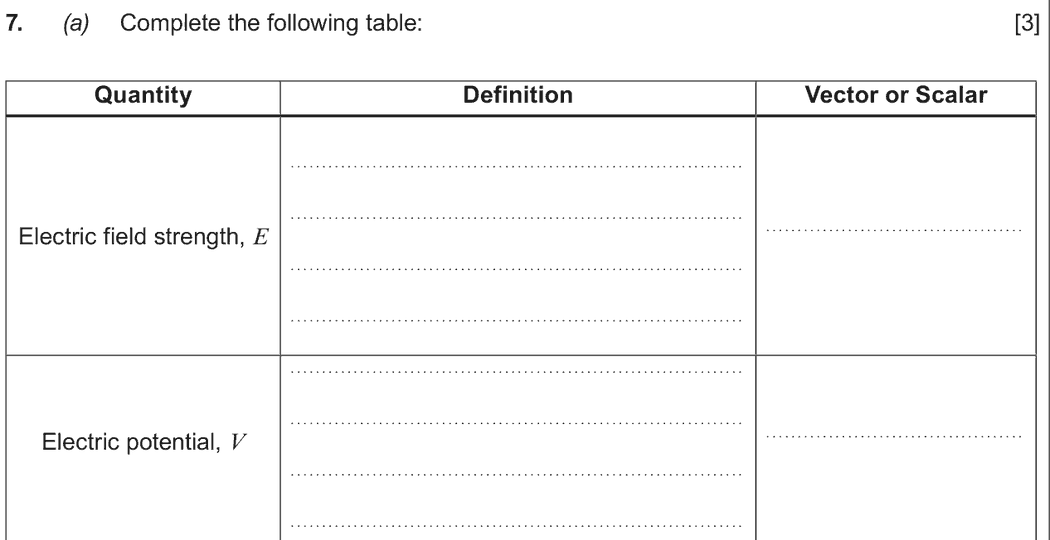
E: force per unit charge on a small positive test charge at the point (1)
V: work done per unit charge in bringing a positive charge from infinity to the point (1)
E vector and V scalar (1)
'per unit charge' often omitted and potential described as work done from the point to infinity
June 2018 · Component 2 · Q7(b)(i)1 markAO1=1Diagram or graph
Earlier part of question 7 that this part uses
Mark scheme
Examiner's comment
and (ii) nearly all candidates drew correct arrows showing the directions of the field strengths and the resultant field strength.
Notes from the mark scheme and report
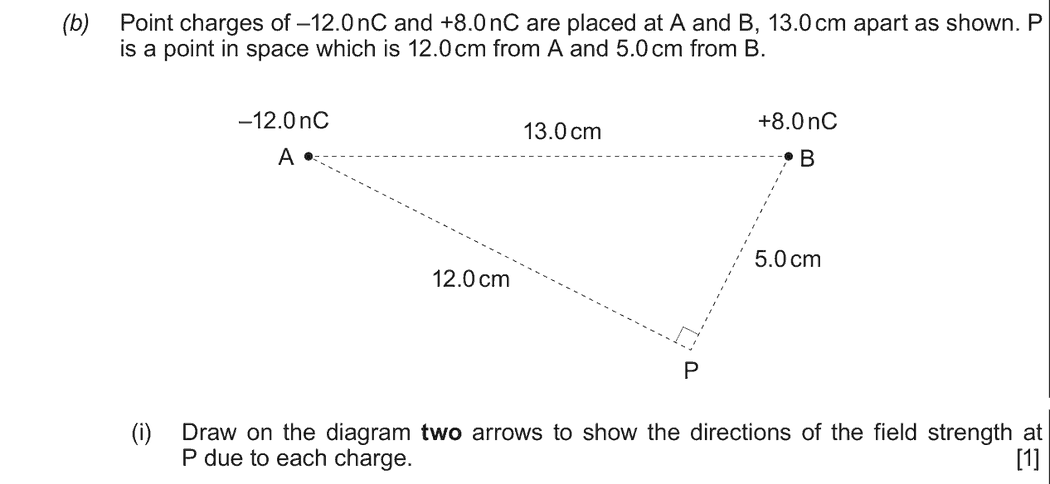
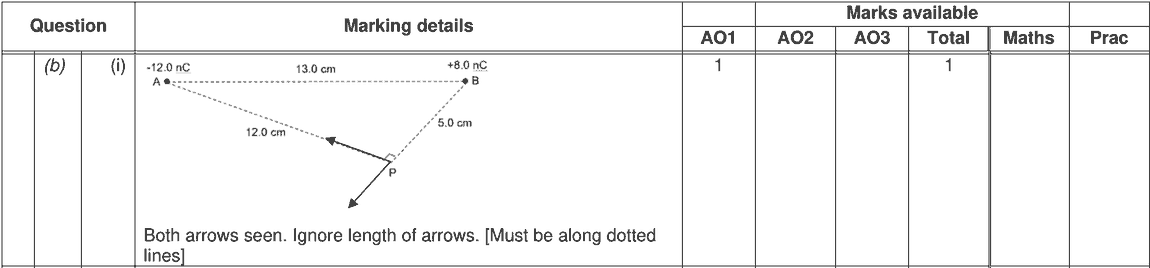
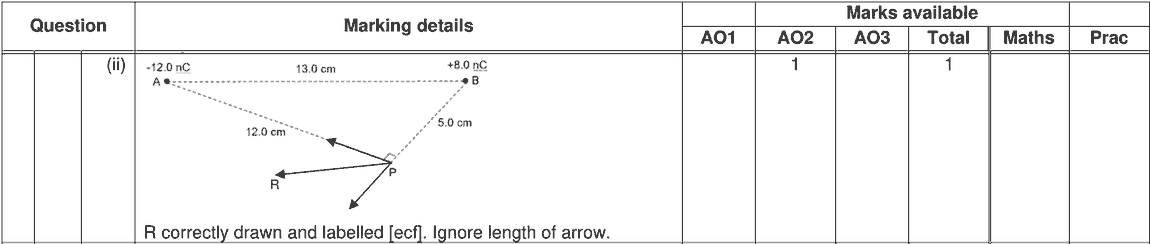
Arrow at P along PA towards A (negative charge) and arrow along BP directed away from B (positive charge)
June 2018 · Component 2 · Q7(b)(iii)4 marksAO2=4Calculation
Earlier parts of question 7 that this part uses
Mark scheme
Examiner's comment
The majority of candidates were successful in calculating the individual field strengths due to the charges at A and B. Far fewer candidates proceeded successfully to determine the resultant field strength and its direction. Often, when a correct direction of travel had been correctly calculated as an angle, it was not possible to award the mark as the candidate had not clearly identified, either in a diagram, or as statement, where the angle referred to.
Notes from the mark scheme and report
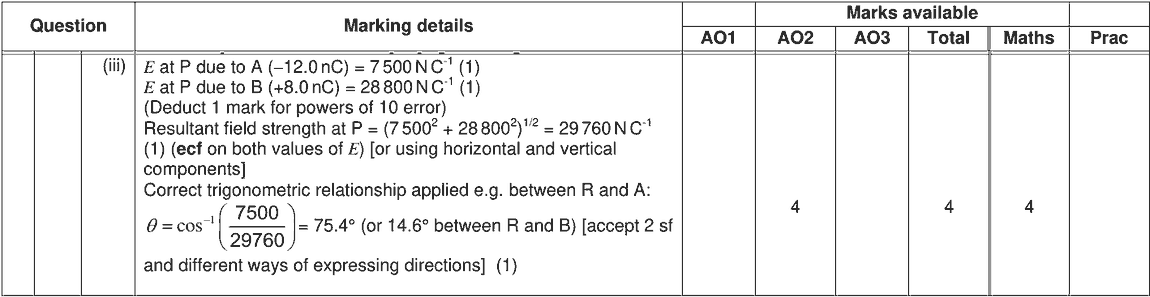
Answer: 2.98 × 10⁴ N C⁻¹ at 75° to PA (15° to the line BP). E from A = 9 × 10⁹ × 12.0 × 10⁻⁹/0.120² = 7500 N C⁻¹ (1)
E from B = 9 × 10⁹ × 8.0 × 10⁻⁹/0.050² = 28 800 N C⁻¹ (1)
perpendicular so resultant = √(7500² + 28 800²) (1)
angle from cos⁻¹(7500/29 760), clearly referenced (1)
the angle was often not identified
Scheme columns: Maths 4
Skills: Trigonometryand vectors Resolving, components, vector addition, angles; Mathsmarks The mark scheme's Maths column gives this part at least one mark for mathematical skills
June 2018 · Component 2 · Q7(c)(i)2 marksAO2=2Show that
Earlier parts of question 7 that this part uses
Mark scheme
Examiner's comment
Nearly all candidates used the appropriate equations correctly to determine the individual potentials due to the two charges. Most then proceeded to successfully determine the overall potential at P.
Notes from the mark scheme and report
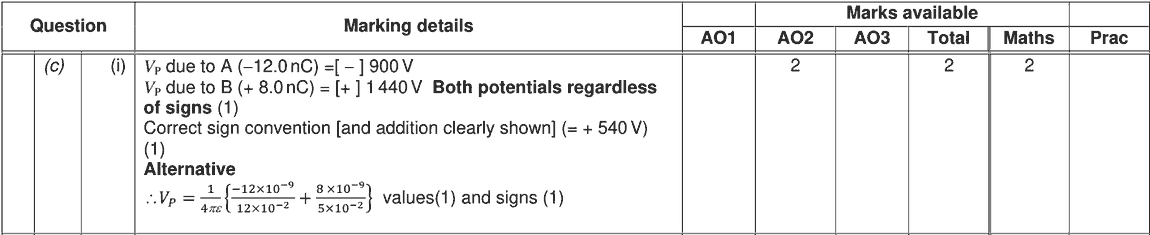
V from A = 9 × 10⁹ × (−12.0 × 10⁻⁹)/0.120 = −900 V and from B = 9 × 10⁹ × 8.0 × 10⁻⁹/0.050 = +1440 V (1)
scalar sum with signs = +540 V (1)
Scheme columns: Maths 2
Skills: Mathsmarks The mark scheme's Maths column gives this part at least one mark for mathematical skills
June 2018 · Component 2 · Q7(c)(ii)2 marksAO1=1, AO2=1Calculation
Earlier parts of question 7 that this part uses
Mark scheme
Examiner's comment
Nearly all candidates calculated the gain in kinetic energy correctly.
Notes from the mark scheme and report
Answer: 8.64 × 10⁻¹⁷ J. W = qΔV = 1.60 × 10⁻¹⁹ × 540 (1)
the loss of potential energy equals the gain in kinetic energy (1)
Scheme columns: Maths 1
Skills: Mathsmarks The mark scheme's Maths column gives this part at least one mark for mathematical skills
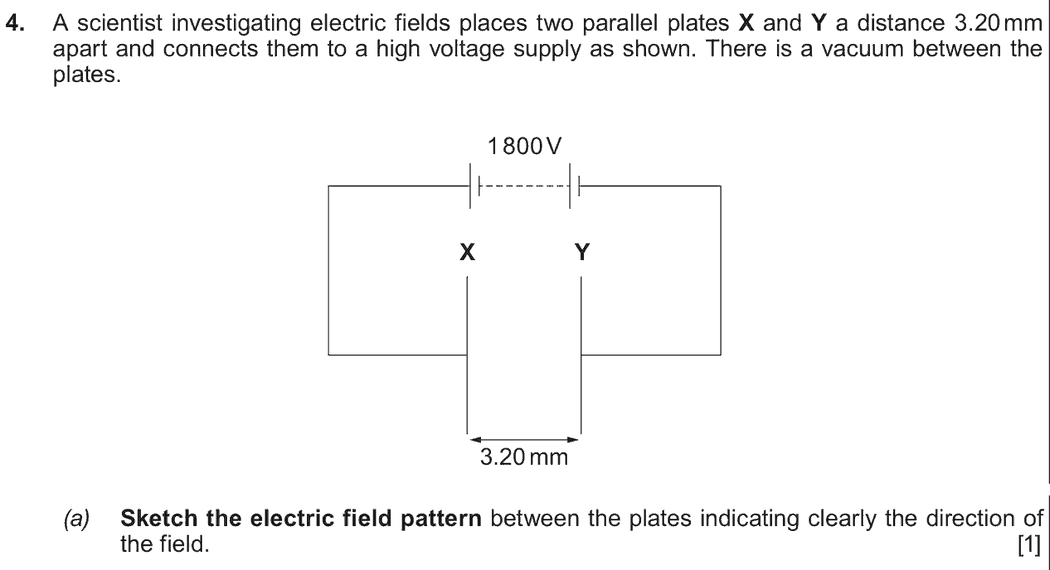
June 2017 · Component 2 · Q4(a)1 markAO1=1Diagram or graph
Mark scheme
Examiner's comment
Many candidates drew horizontal lines between the plates, but a significant number either showed the field going from right to left or did not identify a direction at all.
Notes from the mark scheme and report
Parallel horizontal lines between the plates with arrows from X (positive) to Y
direction often reversed or missing
June 2017 · Component 2 · Q4(b)(i)2 marksAO1=1, AO2=1Calculation
Earlier part of question 4 that this part uses
Mark scheme
Examiner's comment
Only a minority of candidates could determine the force on an electron.
Notes from the mark scheme and report
Answer: 9.0 × 10⁻¹⁴ N. F = Ve/d = 1800 × 1.6 × 10⁻¹⁹/3.2 × 10⁻³
poorly done
Scheme columns: Maths 2
Skills: Unitsand conversions Unit marks, base units, prefixes and conversions; Mathsmarks The mark scheme's Maths column gives this part at least one mark for mathematical skills
June 2017 · Component 2 · Q4(b)(ii)2 marksAO1=1, AO2=1Calculation
Earlier parts of question 4 that this part uses
Mark scheme
Examiner's comment
Few candidates realized that the gain in kinetic energy of an electron was equivalent to the work done by the field. 1 800 eV was accepted as a correct answer, but rarely seen.
Notes from the mark scheme and report
Answer: 2.88 × 10⁻¹⁶ J (1800 eV accepted). Gain in KE = work done by the field = Fd = 9.0 × 10⁻¹⁴ × 3.2 × 10⁻³, or W = eV = 1.6 × 10⁻¹⁹ × 1800
unit mark
few linked KE gain to work done
Scheme columns: Maths 2
Skills: Mathsmarks The mark scheme's Maths column gives this part at least one mark for mathematical skills
June 2017 · Component 2 · Q4(c)2 marksAO3=2Explanation
Earlier part of question 4 that this part uses
Mark scheme
Examiner's comment
Few candidates provided a clear, logical and unambiguous argument to verify the claim made. Many options were possible when answering this question, including analyses using W = Fd and W = QV.
Notes from the mark scheme and report
Halving d doubles the force (F = Ve/d) (1)
work done = 2F × d/2, so unchanged (1). Or W = QV with Q and V both constant, so the KE gain is unchanged. Clear arguments were rare
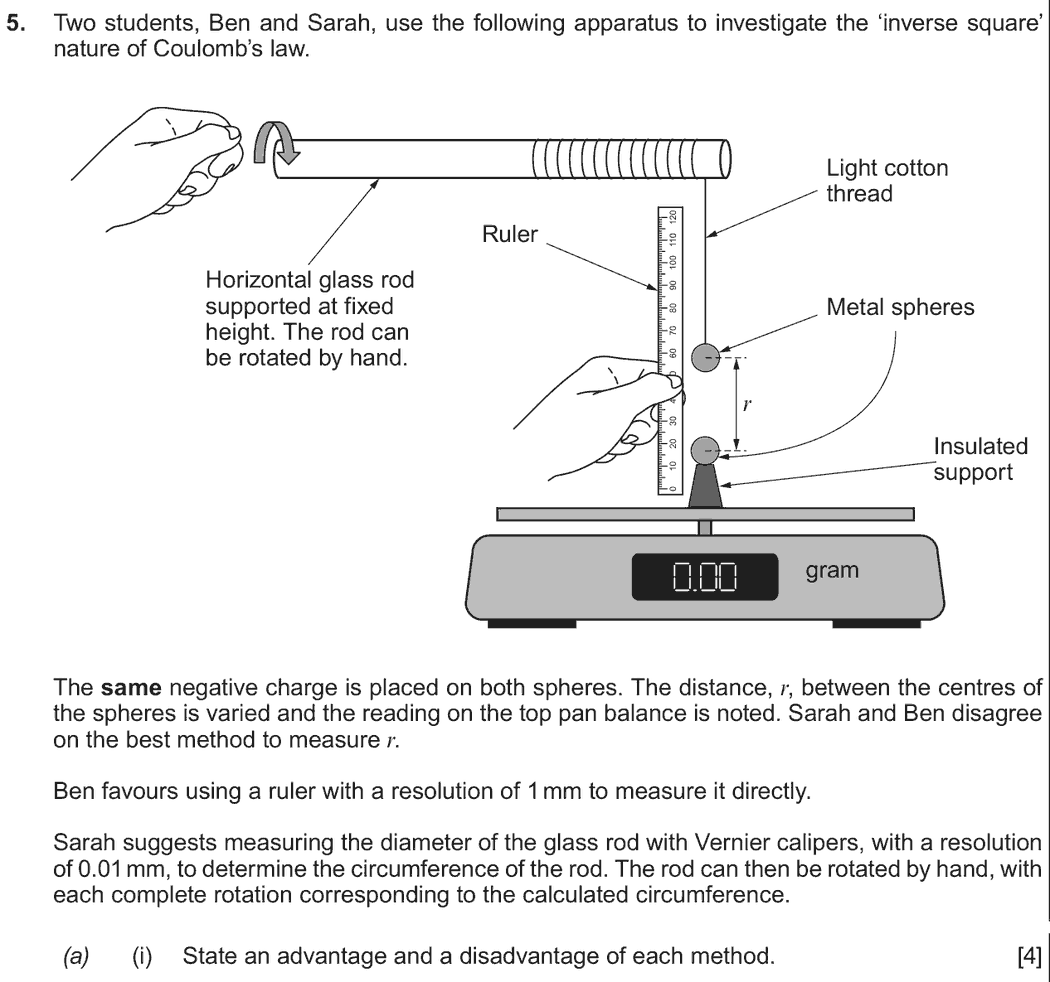
June 2017 · Component 2 · Q5(a)(i)4 marksAO2=4Practical and data analysis
Mark scheme
Examiner's comment
Nearly all candidates scored well here. Advantages and disadvantages of both methods were usually laid out clearly and logically. However, the question highlighted a misconception with some candidates when using the terms ‘high’ and ‘low’ resolution. Many candidates confused high resolution with high uncertainty or vice versa for example. Comments such as: ‘Ben’s ruler has a higher resolution so is less accurate’ and ‘The resolution of the callipers is high so the uncertainty will be high’ were seen.
Notes from the mark scheme and report
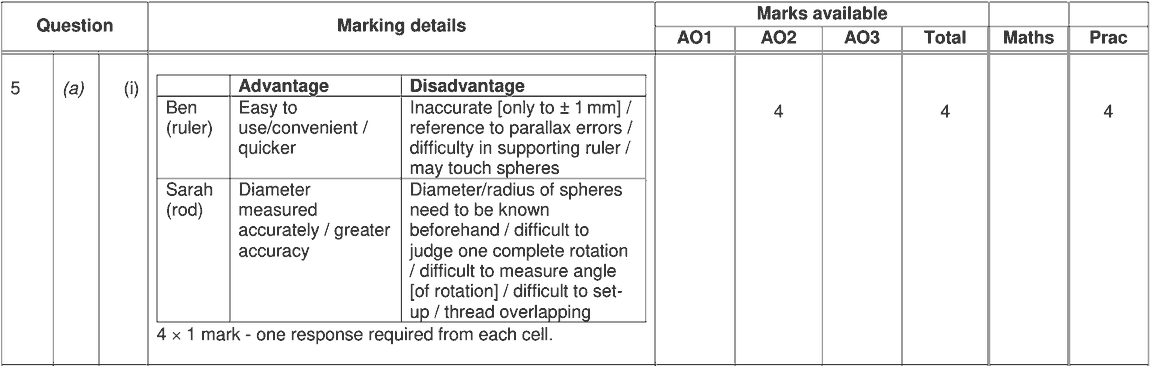
One response per cell. Ruler (Ben): quick and easy to use
but only ± 1 mm, parallax, hard to hold steady, may touch the spheres. Rod (Sarah): diameter measured to higher precision
but hard to judge one full rotation or the angle turned, the starting separation or sphere size must be known, thread may overlap. Some confused high resolution with high uncertainty
Scheme columns: Practical 4
Skills: Experimentalmethod Describing, planning or improving an experiment; Practicalmarks The mark scheme's Prac column gives this part at least one mark for practical skills
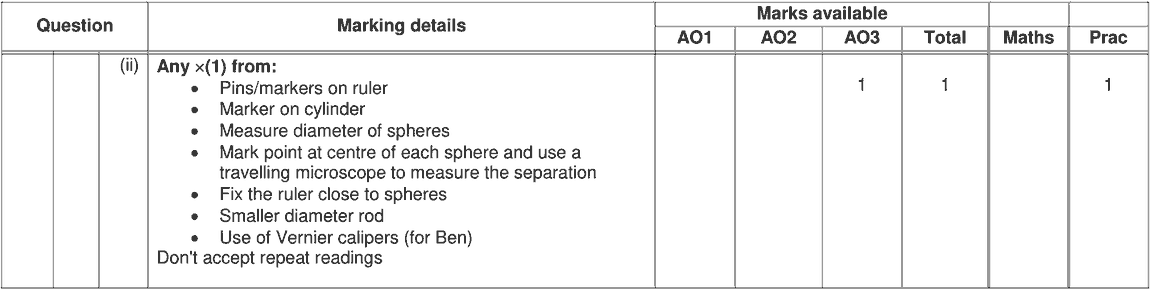
June 2017 · Component 2 · Q5(a)(ii)1 markAO3=1Practical and data analysis
Earlier part of question 5 that this part uses
Mark scheme
Examiner's comment
Most candidates could suggest a valid improvement which would lead to an increase in accuracy when measuring r.
Notes from the mark scheme and report
Any one: pins or markers on the ruler
marker on the rod
measure the sphere diameters
mark sphere centres and use a travelling microscope
fix the ruler close to the spheres
thinner rod
calipers for Ben. Repeat readings not accepted
Scheme columns: Practical 1
Skills: Experimentalmethod Describing, planning or improving an experiment; Practicalmarks The mark scheme's Prac column gives this part at least one mark for practical skills
June 2017 · Component 2 · Q5(b)(i)3 marksAO1=1, AO2=2Show that
Earlier part of question 5 that this part uses
Mark scheme
Examiner's comment
Nearly all candidates used the Coulomb equation correctly to determine the value of Q1Q2. A few candidates did not convert mass to weight and failed to make progress.
Notes from the mark scheme and report
F = mg = 1.0 × 10⁻⁵ × 9.81 = 9.81 × 10⁻⁵ N
Coulomb's law F = 9 × 10⁹ Q1Q2/r² with r = 0.020 m gives Q1Q2 = 4.36 × 10⁻¹⁸ C²
some did not convert the balance reading to a weight
Scheme columns: Maths 3, Practical 3
Skills: Unitsand conversions Unit marks, base units, prefixes and conversions; Mathsmarks The mark scheme's Maths column gives this part at least one mark for mathematical skills; Practicalmarks The mark scheme's Prac column gives this part at least one mark for practical skills
June 2017 · Component 2 · Q7(a)(i)2 marksAO1=2Explanation
Mark scheme
Examiner's comment
A disappointing response. Few candidates could explain clearly and unambiguously why potentials had negative signs. Many candidates talked about doing work against attractive gravitational forces without making any reference to the potential at infinity. Without this context, their explanations carried no meaning.
Notes from the mark scheme and report
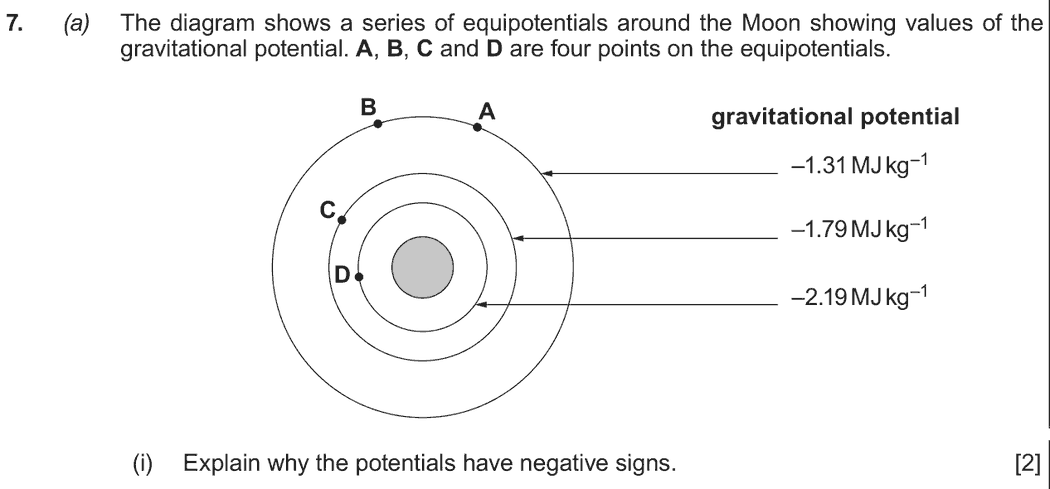
Potential is defined as zero at infinity (1)
work must be done on a mass to move it out to infinity against the attractive force, so potential nearer the Moon is negative (1)
many omitted the zero at infinity
June 2017 · Component 2 · Q7(a)(ii)I2 marksAO1=2Short answer
Earlier part of question 7 that this part uses
Mark scheme
Examiner's comment
Nearly all candidates stated that the change in potential was zero and made correct reference to equipotential in their answers.
Notes from the mark scheme and report
Answer: zero (1). A and B lie on the same equipotential so there is no change in potential (1)
'same distance' alone not enough
June 2017 · Component 2 · Q7(a)(ii)II2 marksAO2=2Calculation
Earlier parts of question 7 that this part uses
Mark scheme
Examiner's comment
Most candidates could calculate the change in gravitational potential energy of the spacecraft when moving from B to C, however a significant minority only determined the change in potential, omitting to multiply this by the mass of the spacecraft.
Notes from the mark scheme and report
Answer: −144 MJ (a decrease of 1.44 × 10⁸ J). ΔV = (−1.79) − (−1.31) = −0.48 MJ kg⁻¹
ΔEp = mΔV = 300 × 0.48 MJ
some gave only the change in potential
Scheme columns: Maths 2
Skills: Unitsand conversions Unit marks, base units, prefixes and conversions; Mathsmarks The mark scheme's Maths column gives this part at least one mark for mathematical skills
June 2017 · Component 2 · Q7(a)(iii)4 marksAO1=1, AO2=3Calculation
Earlier part of question 7 that this part uses
Mark scheme
Examiner's comment
Only the better candidates calculated the speed with which the spacecraft impacted with the Moon successfully. Both approaches outlined in the mark scheme were seen in the scripts.
Notes from the mark scheme and report
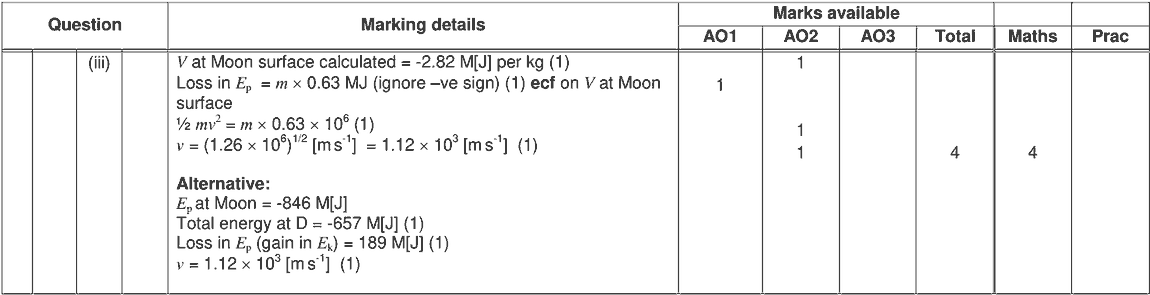
Answer: 1.12 × 10³ m s⁻¹. Potential at the surface = −GM/r = −6.67 × 10⁻¹¹ × 7.35 × 10²²/1.74 × 10⁶ = −2.82 MJ kg⁻¹
loss in potential from D = 0.63 MJ kg⁻¹
½v² = 0.63 × 10⁶. Or energies: −846 MJ at the surface, −657 MJ at D, gain in KE 189 MJ
Scheme columns: Maths 4
Skills: Unitsand conversions Unit marks, base units, prefixes and conversions; Mathsmarks The mark scheme's Maths column gives this part at least one mark for mathematical skills
June 2017 · Component 2 · Q7(b)2 marksAO3=2Short answer
Earlier part of question 7 that this part uses
Mark scheme
Examiner's comment
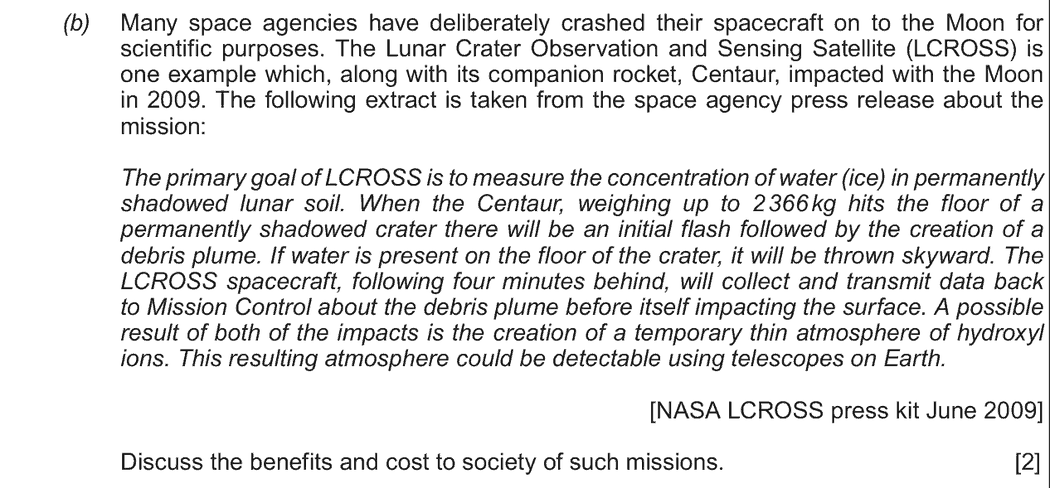
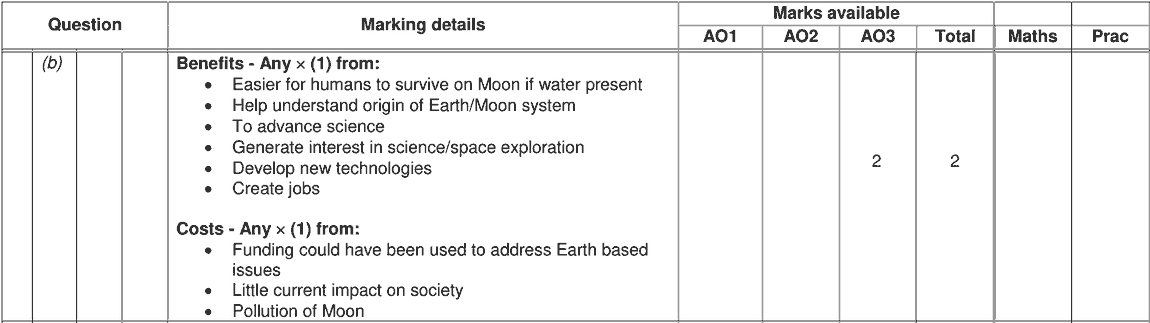
It was expected that candidates would provide one benefit and one cost to society in their answers. Many candidates opted for the ‘advancing science/knowledge or aiding human habitation of the Moon’ options in reference to benefits. Fewer acceptable answers were seen in reference to costs, with the majority of candidates stating simply that the exercise was ‘too expensive’ without expanding on their answers. This was not credited.
Notes from the mark scheme and report
One benefit (e.g. water would help humans live on the Moon, understanding the origin of the Earth-Moon system, advancing science, new technology, jobs, interest in science) and one cost (e.g. money could be spent on problems on Earth, little present impact on society, pollution of the Moon)