Mark scheme

Notes from the mark scheme and report
- An energy source that is replenished naturally on a short timescale (e.g. within a human lifetime), so it will not run out
Notes and key-term cards for this topic are being written by our tutors. The past-paper questions below are ready now.
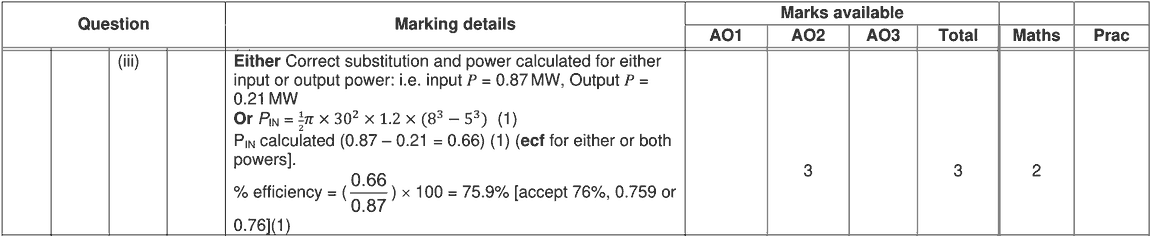
Candidates produced a good range of responses for this question. A tolerance of ± 3 kW was used when reading from the graph. Only a few candidates fell outside of this. Some used ‘155’ but didn’t consider the efficiency. They were awarded 2 marks. These were the 2nd and 4th with ecf. Some multiplied 155 by 0.42 to get an 11.8 m diameter. They were awarded three marks. Some only went as far as the radius. Some (not many) couldn’t find the power equation in the data booklet and either scored 1 or zero. Power of 10 slips were rare but only resulted in a 1-mark penalty.
Skills: Mathsmarks The mark scheme's Maths column gives this part at least one mark for mathematical skills

There were some very good two-mark responses covering the points on the mark scheme. We were generous and allowed reference to ‘wind/air velocity’ as reference to kinetic energy. Ther were some vague comments about ‘heat loss’ but they didn’t say enough for credit. There was some misinterpretation of the question in places where candidates tried to recalculate the efficiency of the wind turbine or similar which didn’t score any marks.
Skills: Unitsand conversions Unit marks, base units, prefixes and conversions; Mathsmarks The mark scheme's Maths column gives this part at least one mark for mathematical skills

Nearly all candidates managed this. A small number either made an error with the powers or they didn’t use the maximum power output in their calculation.
Skills: Mathsmarks The mark scheme's Maths column gives this part at least one mark for mathematical skills
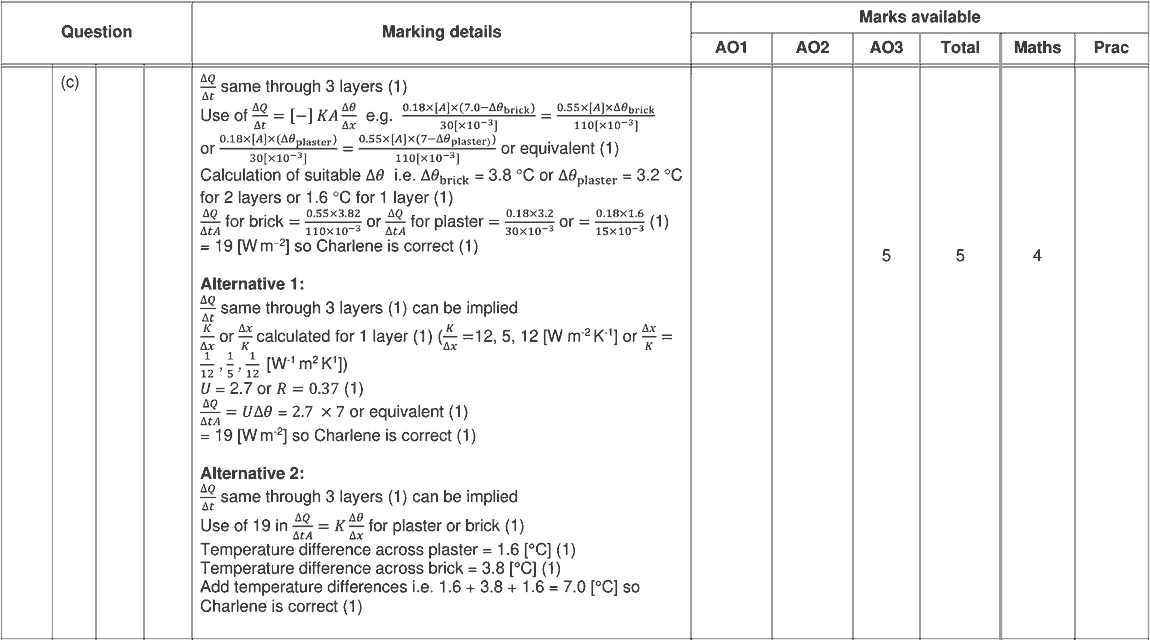
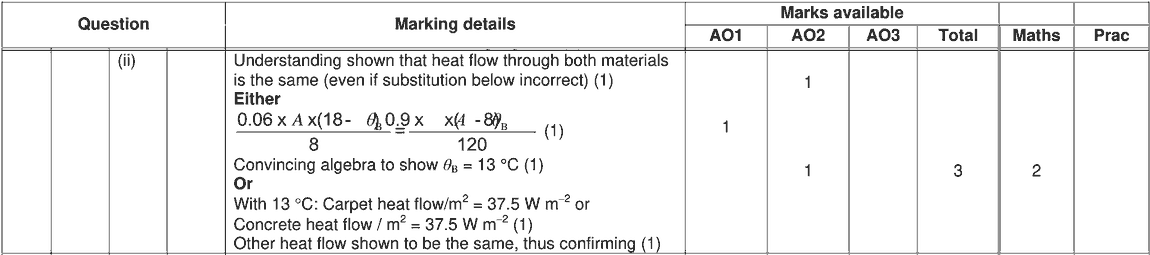
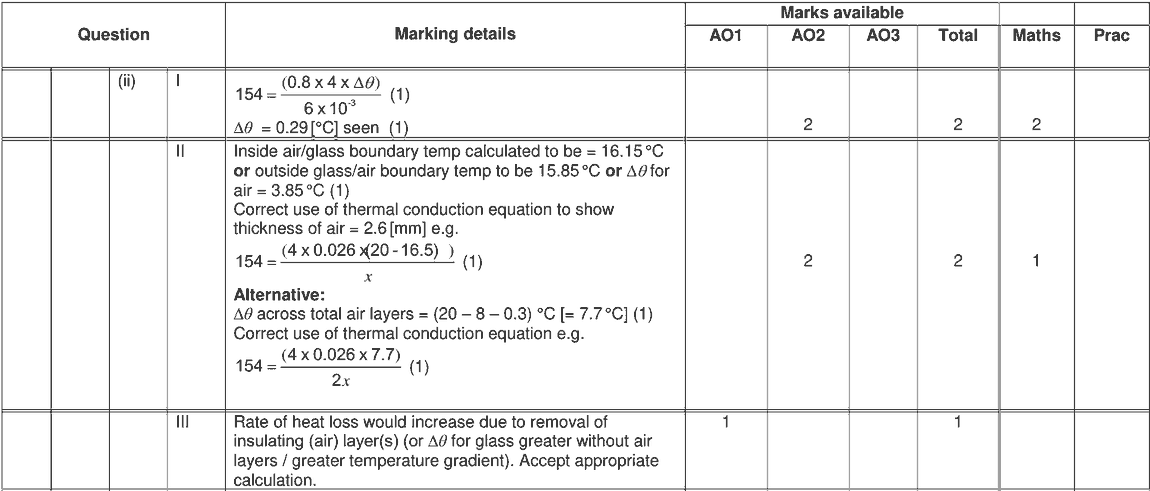
The final question allowed for many different paths by design and was a good discriminator. Candidates who indicated heat flow was the same throughout picked up the first mark. There were some excellent responses, however, a small number of candidates struggled with the algebra. There was a less algebraic method as outlined as alternative 2 in the mark scheme. Some candidates made good use of this method. This method was sometimes seen to be used as a second attempt for candidates. Some candidates thought that subtracting ‘0.18’ from ‘0.55’ resulted in an R value but they were not awarded any more than the 1st marking point. PHYSICS GCE A level Summer 2025
Skills: Mathsmarks The mark scheme's Maths column gives this part at least one mark for mathematical skills

The final question allowed for many different paths by design and was a good discriminator. Candidates who indicated heat flow was the same throughout picked up the first mark. There were some excellent responses, however, a small number of candidates struggled with the algebra. There was a less algebraic method as outlined as alternative 2 in the mark scheme. Some candidates made good use of this method. This method was sometimes seen to be used as a second attempt for candidates. Some candidates thought that subtracting ‘0.18’ from ‘0.55’ resulted in an R value but they were not awarded any more than the 1st marking point. PHYSICS GCE A level Summer 2025
Skills: Mathsmarks The mark scheme's Maths column gives this part at least one mark for mathematical skills




This AO1 type question scored full marks several times but it was not answered as well as anticipated. The 1st marking point was most commonly awarded. ‘Wholly or partially’ was often added. Some candidates replaced ‘wholly’ with ‘partially’ which didn’t help their cause. The 2nd marking point was tougher. Many candidates did not reference an ‘upthrust’ or ‘upwards force’. We accepted ‘buoyancy force’ as a correct alternative. There was some confusion where mass was not replaced by weight. Also, ‘dispersed’ was not always replaced by ‘displaced’. That was a little disappointing.

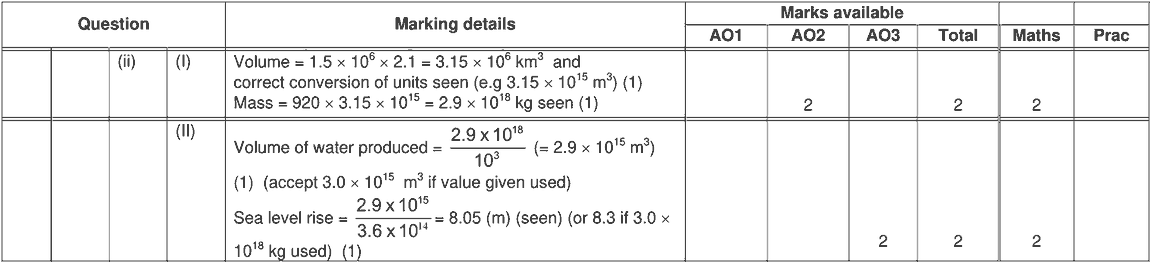
The question did say to start with the Archimedes principle and show workings clearly. To get three marks candidates did have to do this. Good responses included density Vice cube = density Vdisplaced liquid for the first two marks. Most candidates were then able to follow this up with a fraction, decimal or even percentage. A standalone calculation of 920 1020 = 0.902 scored two marks. Weaker responses confused the two volumes. Some incorrectly wrote ‘volume of iceberg = volume of water displaced’.
Skills: Algebra Derivations and rearranging equations; Mathsmarks The mark scheme's Maths column gives this part at least one mark for mathematical skills
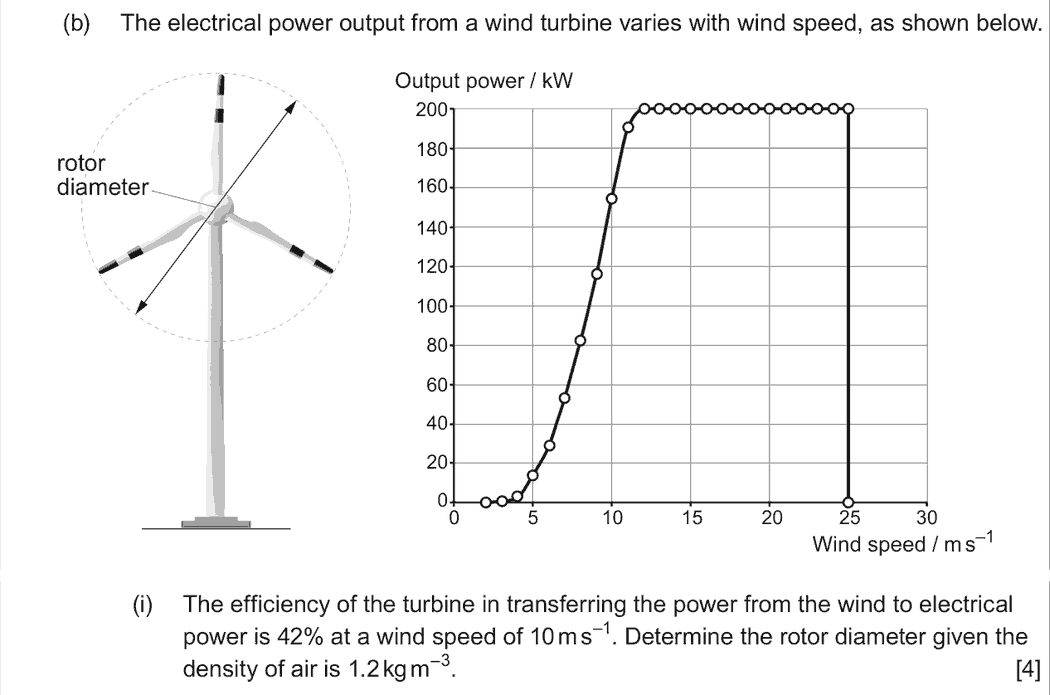
Candidates produced a good range of responses for this question. A tolerance of ± 3 kW was used when reading from the graph. Only a few candidates fell outside of this. Some used ‘155’ but didn’t consider the efficiency. They were awarded two marks. These were the 2nd and 4th with ecf. Some multiplied 155 by 0.42 to get an 11.8 m diameter. They were awarded 3 marks. Some only went as far as the radius. Some (not many) couldn’t find the power equation in the data booklet and either scored 1 or zero. Power of 10 slips were rare but only resulted in a 1-mark penalty.
Skills: Graphskills Reading, plotting or sketching graphs; gradients, intercepts and areas; Unitsand conversions Unit marks, base units, prefixes and conversions; Mathsmarks The mark scheme's Maths column gives this part at least one mark for mathematical skills

There were some very good two-mark responses covering the points on the mark scheme. We were generous and allowed reference to ‘wind / air velocity’ as reference to kinetic energy. There were some vague comments about ‘heat loss’ but they didn’t say enough for credit. There was some misinterpretation of the question in places where candidates tried to recalculate the efficiency of the wind turbine or similar which didn’t score any marks.

Nearly all candidates managed this. A small number either made an error with the powers or they didn’t use the maximum power output in their calculation.
Skills: Unitsand conversions Unit marks, base units, prefixes and conversions

Candidates found this challenging. The 1st making point was awarded for reference to high temperature required to ‘overcome repulsion’ or ‘to allow a strong force interaction’. This was the most common mark to be achieved. With regards to ‘high particle density for large number of collisions’, we did not need to see ‘rate’ or ‘per second’ to award the mark. ‘Maintaining internal energy’ or ‘maintain required temperature’ or ‘stay above ignition temperature’ were accepted for the third marking point. We did see a small number of 3-mark responses. We saw lots of reference to ‘high temperature and pressure needed’ but this was not deemed enough for credit. Some mentioned the three components of the triple product, but no explanation followed and they weren’t given any marks. Surprisingly, a number of candidates incorrectly described issues with nuclear fission.
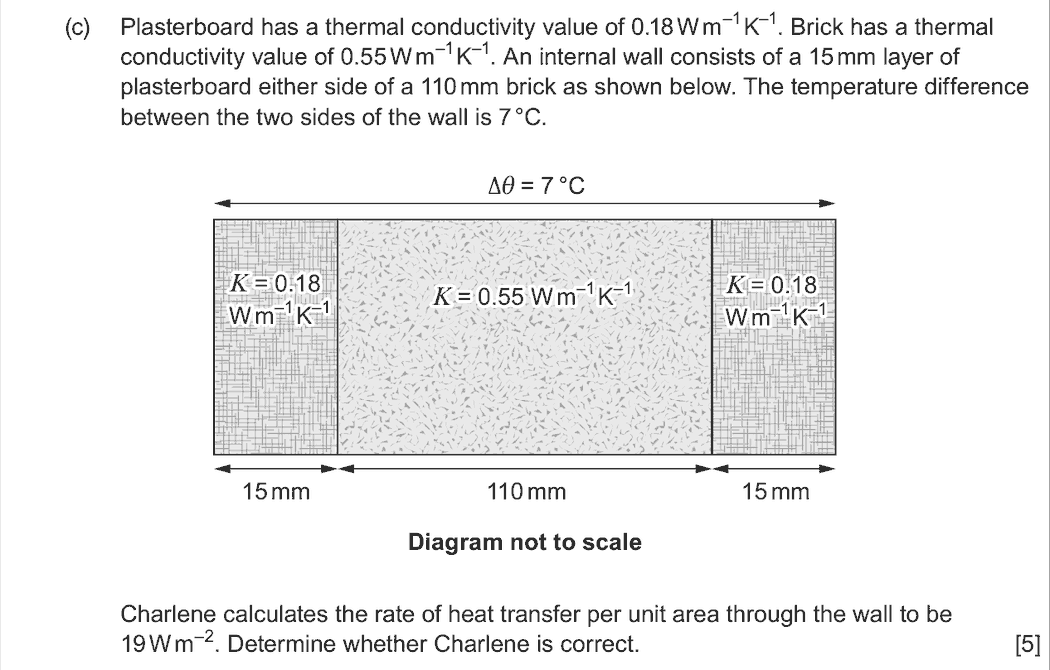
The final part allowed for many different paths by design and was a good discriminator. Candidates who indicated heat flow was the same throughout picked up the first mark. There were some excellent responses, however, a small number of candidates struggled with the algebra. There was a less algebraic method as outlined as alternative 2 in the mark scheme. Some candidates made good use of this method. This method was sometimes seen to be used as a second attempt for candidates. Some candidates thought that subtracting ‘0.18’ from ‘0.55’ resulted in an R value but they were not awarded any more than the 1st marking point. PHYSICS GCE A level Summer 2024 PRACTICAL ENDORSEMENT Overview of the Component A number of centres were observed, all of which demonstrated a good understanding of the requirements of Practical Endorsement. Aspects of good practice seen during the visits include: • A suitable plan of practical work. The plan was incorporated into Scheme of Work and was often also kept as a separate document, available to all members of teaching staff. A suitable plan showed the specified practical, the CPAC to be assessed in the practical, and the proposed time in the teaching year where it would be carried out. Please note this plan, with these details, must be available to the monitor if you are visited. The plan should also allow for the development of skills within Practical Endorsement and should cover all elements of each CPAC over the two years of teaching. It is not necessary to assess CPAC in every practical performed. • The maintenance of accurate and up-to-date Teacher and Candidate Records. This is vital. Most centres now record their outcomes in an Excel Spreadsheet, often showing the CPAC element. However, if teacher records do not show this level of detail (i.e. the element assessed) then teachers should annotate the candidate work showing the element achieved (e.g. CPAC 3(a)✓ or CPAC 3(a&b)✓). Monitors will always check to ensure all elements of each CPAC are covered and will ask teachers how they ensure all aspects of the skills are achieved by each candidate. • Candidates are aware which CPAC are assessed in a particular practical and understand what they need to do in order to succeed. • Practical books are used in ‘real time’ at the bench by candidates when collecting experimental data. We do not expect to see practical books which are in immaculate condition! Candidates should not write on scraps of paper and later copy the work up neatly into practical books. • There is simple annotation of the candidate work that shows where the candidate achieves or fails to achieve a CPAC, (e.g. with CPAC 3(a)✓ or CPAC5(b)). It is good practice to give feedback to candidates in order that they can improve on their skills in future. Feedback on how to improve may be given verbally or in writing. Important note: Many centres now record the CPAC element assessed in a practical which helps ensure all aspects of CPAC are covered. • Records of candidate performance show a progression in candidate attainment. It is not necessary for a candidate to succeed and obtain a CPAC every time. Early in the course there will be occasions where a candidate may struggle to achieve a skill. This should be reflected in the teacher records of candidate performance. We do not expect to see every candidate getting every criterion each time they are assessed. Indeed, when this happens there will be legitimate concerns about whether the work has been appropriately assessed. We expect to see that there are places where candidate work is marked ‘not achieved’. The key question is, ‘Is the candidate competent at the end of the course and not, is the candidate competent all the way through the course.’ • There is evidence of standardisation across all subject teachers where Practical Endorsement is delivered by a team of teachers. It is a requirement of Practical Endorsement and is recorded in the monitor’s report of the centre. Standardisation must be implemented for a centre to pass the monitoring visit. This standardisation may be carried out by cross marking of candidate work or by meetings in which some candidate work is discussed. Please expect questions on how you do this if visited by a monitor. A number of centres write descriptors of minimum standards necessary to achieve a CPAC in a practical. This is good practice and particularly helpful in large departments where there are many teachers of the subject. See for example, CPAC Pen Portraits on the EDUQAS website. Comments on individual questions/sections Assessment of Practical Endorsement Centres are reminded that in order to award a pass for Practical Endorsement, a candidate needs to ‘consistently and routinely meet the criteria’. Although this does not mean a candidate gets a CPAC every time it is assessed, it does means that a candidate develops these skills as the course progresses. In other words, there should be evidence that the candidate gains a pass for each CPAC statement on a number of occasions particularly towards the end of the teaching programme. It is important that suitable opportunities have been built into the assessment plan which allow candidates to generate this evidence. It is understood that some practical work will need to be carried out in small groups. If these practicals are used to assess candidates, each candidate must generate suitable evidence that he or she independently meets the criteria. Centres must give careful consideration to how group work is conducted so that individual candidates can be assessed on their own performance. Notes on assessment of CPAC The Monitor finds it difficult to expand on comments from previous years. It is important that centres read through these comments carefully to ensure they are compliant with our expectations. As a general rule, set high standards for the achievement of CPAC skills early in the course. Be clear on what you expect from candidates and ensure they understand why they have failed to meet the standard (if they fail) and they understand what to do to achieve it next time. CPAC 1 The assessment of this CPAC requires the candidate to correctly follow written instructions to carry out an experimental technique or procedure. In the vast majority of cases, the monitor accepted the teacher’s judgement unless there was strong evidence to suggest the CPAC was incorrectly awarded. Please note, where a teacher feels it is necessary to intervene and correct a candidate’s technique, explain the intent of an instruction etc. then the candidate should not be awarded the CPAC. CPAC 2 This is the most difficult CPAC for candidates to evidence since it involves higher level skills. Your plan should show you know where and when you are going to assess each element of this CPAC. It is also important that sufficient time is given to candidates to develop the necessary skills before assessment occurs. Generally, we do not expect to see this CPAC assessed in the first two terms of an A level course. However, we do expect to see evidence of some assessment of this criterion by the end of the first year of the A level course. This skill may be evidenced by a candidate planning to carry out a procedure and then adapting their approach, as necessary. It is not necessary to assess every element of CPAC2 each time this CPAC is assessed. However, it is a requirement that each element of CPAC2 is met during the course. If you are monitored, the monitor will look at the coverage of each element. CPAC 3 Please select practicals where there are some significant safety issues for candidates to comment upon when assessing this CPAC. Do not use practical work to assess this where hazards are minimal. It is not necessary to assess this skill every time a practical is completed. CPAC 3(a) requires candidates to identify hazards and assess the risks associated with the hazards. A simple written risk assessment is the easiest and best way of evidencing this aspect of the skill. CPAC 3(b) should be assessed by observation of candidates’ conduct during a practical session. CPAC 4 This CPAC deals with both qualitative and quantitative data. There are multiple opportunities in physics to both develop and assess this skill. CPAC4(a) making accurate observations. Ensure that the following points shown are borne in mind when assessing this CPAC: • Observations should be made directly into candidate practical books / spreadsheet. Do not award this CPAC if the candidate writes results on to scraps of paper to copy up later. • Do not award this CPAC if you provide a template table to the candidates for recording results. Templates may be useful to teach candidates a good approach to recording data early in the course but when it comes to assessment candidates must devise their own tables. Where necessary, remove table templates to allow candidates to construct their own. • The tables which candidates construct must have appropriate headings and units, where relevant. Please maintain hight standards here. It is perfectly possible for all candidates to achieve this. • The units must be written in the table column head and not in the body of the table. If units are missing, do not award criteria. CPAC4(b) obtaining accurate, precise and sufficient data ....... Please carefully check candidates’ data. • Is it recorded to appropriate precision? Occasionally some centres are too lenient on this. If data readings are not consistently recorded by a candidate, then do not award the criteria. Make sure that recordings are to the correct number of decimal places. Be particularly careful to check that candidates are recording readings from an instrument correctly. You should be walking around the classroom checking on candidates as they record their values. • Is there sufficient data? Is the data what you expect? Please set suitable standards at the beginning of the course. It does not matter if a candidate did not always achieve the criterion. CPAC 5 This important higher-level skill should be assessed from early in the course. There is no shortage of suitable assessment opportunities. CPAC 5 has two elements:
Skills: Algebra Derivations and rearranging equations; Mathsmarks The mark scheme's Maths column gives this part at least one mark for mathematical skills
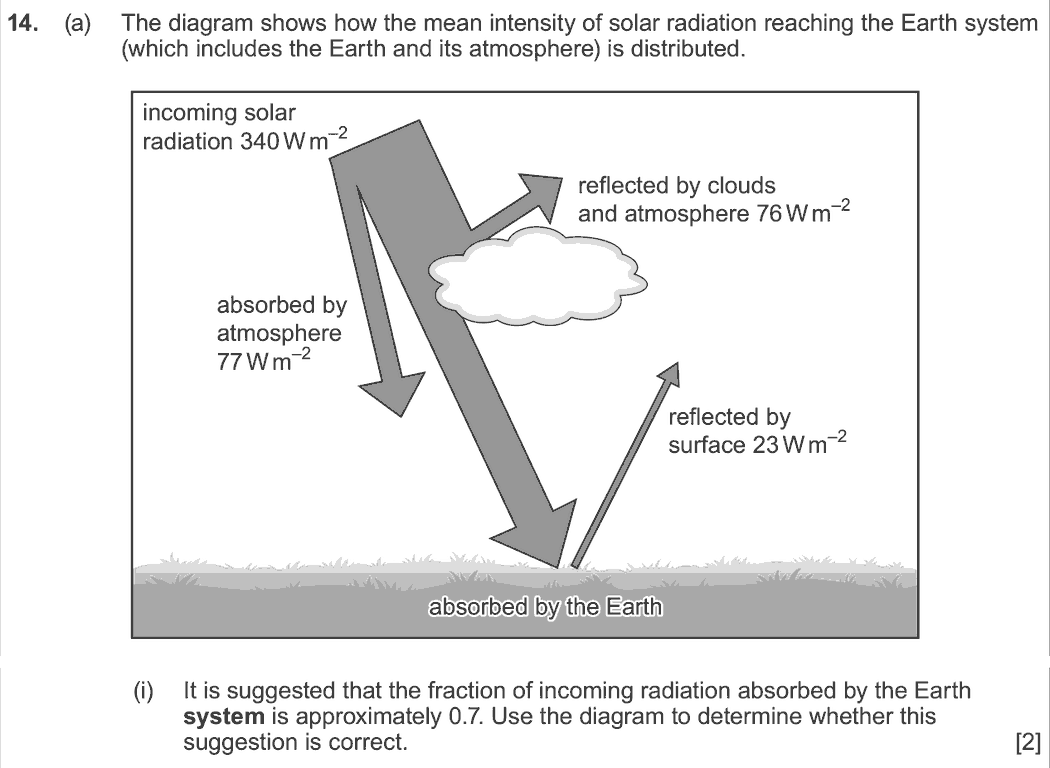
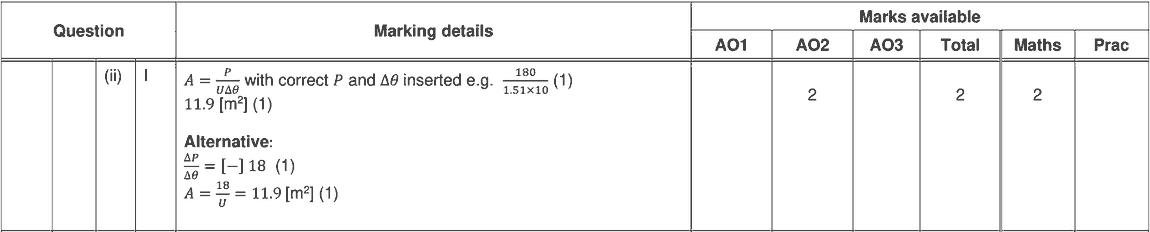
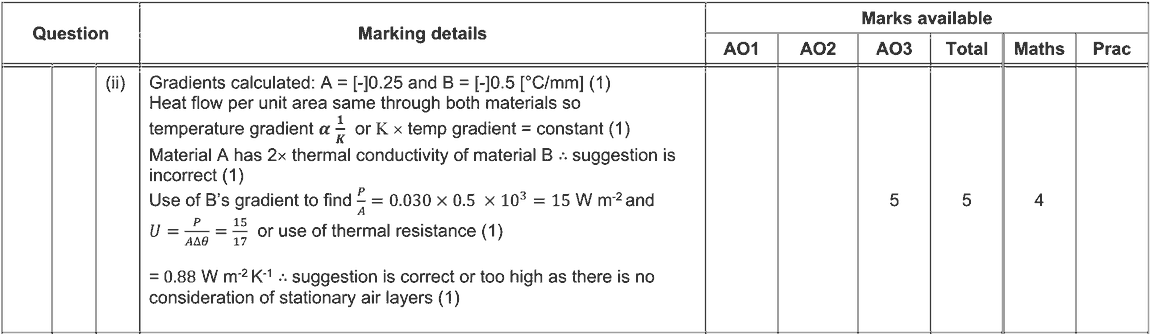
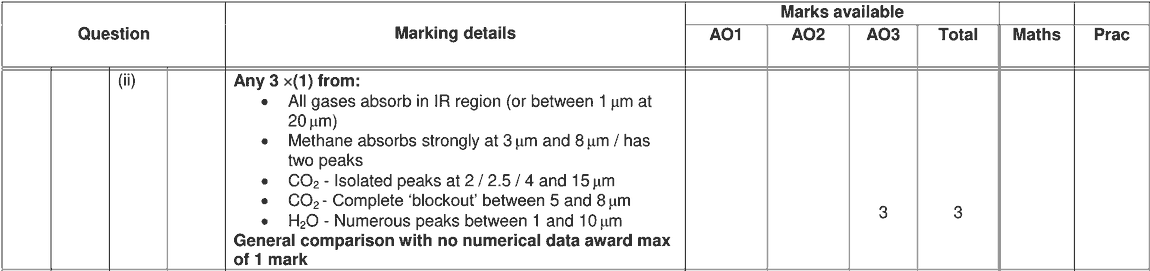
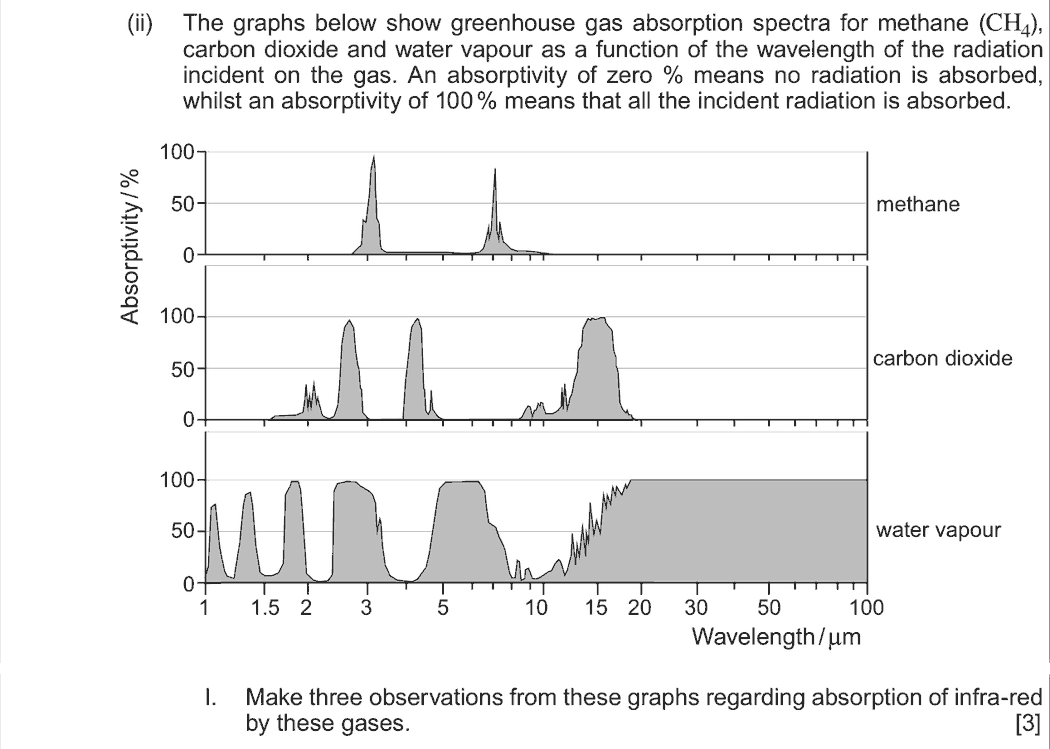
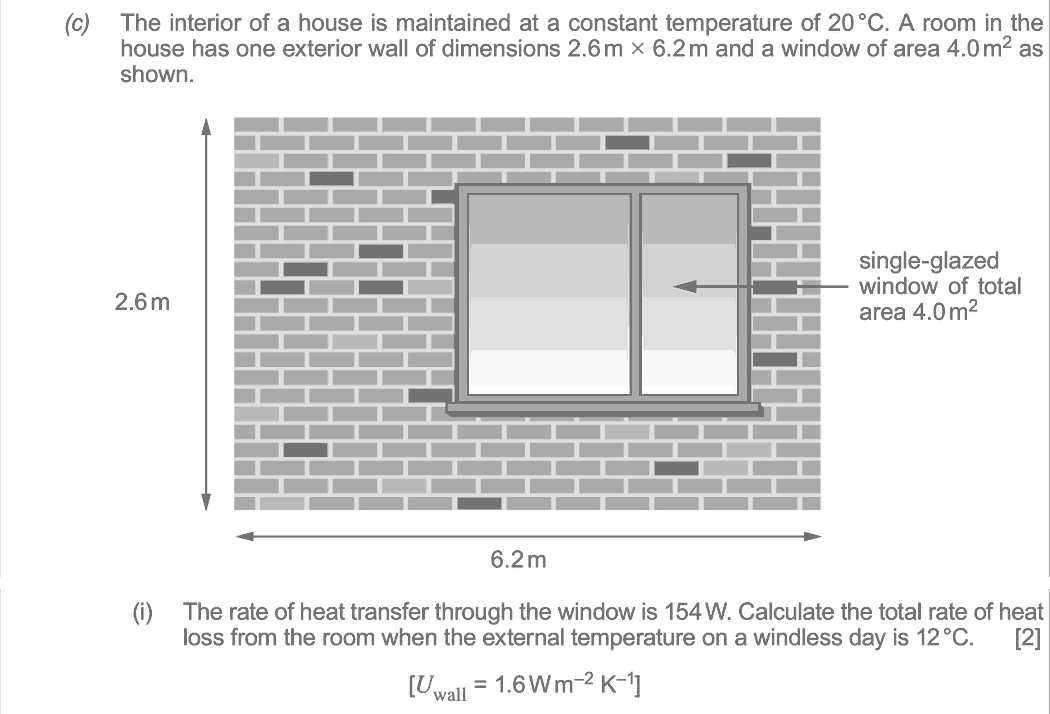
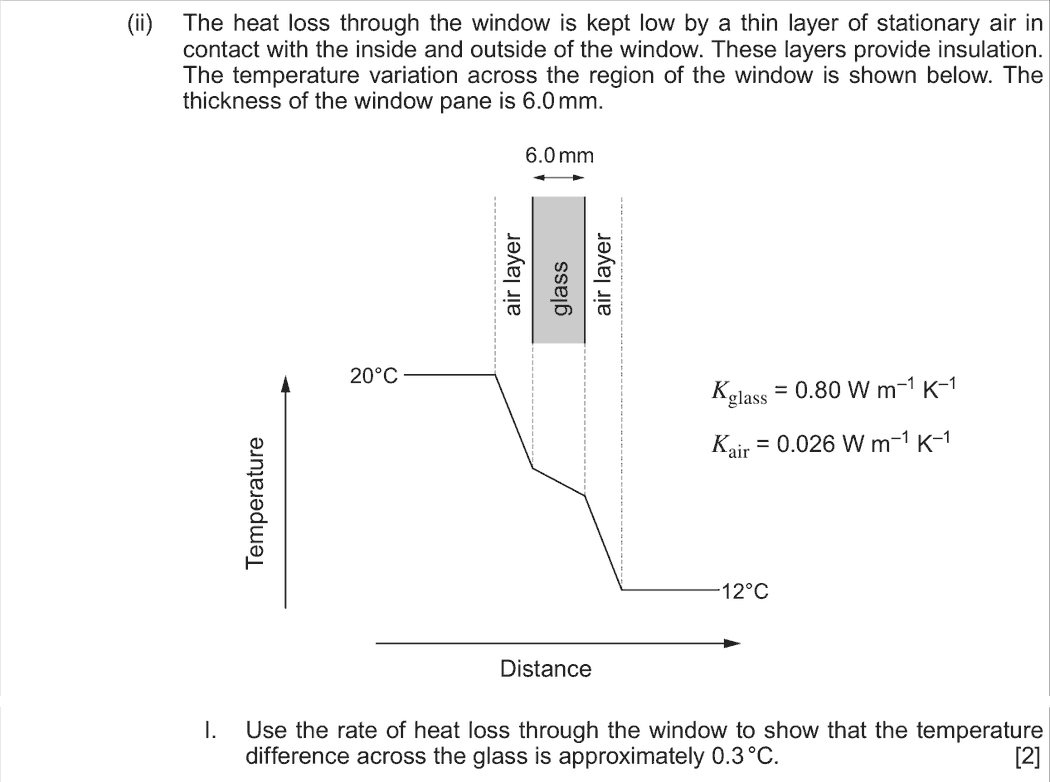
In (a)(i) the majority of candidates were able to access the data given in the diagram. The more readily used approach involved a calculation of the intensity absorbed by the Earth. They then used this to calculate the fraction to be 0.71. An alternative route saw candidates calculate the fraction reflected. A further subtraction allowed the 2nd mark to be obtained. Part (a)(ii) proved to be more demanding than expected. Weaker responses included reference to reflected radiation being absorbed. Stronger responses included the Earth emitting longer wavelength radiation that then gets absorbed. This is then re- radiated causing the planet to warm. In (a)(iii) candidates were very aware of the human activities that were contributing to this effect. Many were able to link this to increased carbon dioxide or methane or simply greenhouses gases. Less candidates achieved the last marking point where they needed to state that ‘more infra-red radiation is absorbed’ or ‘less infra-red radiation is escaping’. In the second part candidate responses were mixed. Weaker responses sometimes included reference to ozone which was not credited. The majority realised that this was a positive feedback question and strong responses made reference to albedo changes after snow or ice melt. This was the most popular correct response however all options on the mark scheme were regularly seen. Part (b) gave a good range of marks. Stronger responses included good use of the intensity and efficiency equations and an appreciation of sin 62 or cos 28 at some point in their response. A minority of candidates confused sin with cos, however, they were able to attain three marks with ecf. A small number of candidates failed to address the angle but were able to use both equations and achieve two marks. In (c)(i) there were some limited responses that involved the apparent heating of the wall. The U-value is not the power needed to heat up 1 m2 by 1 K. There were also some confused responses that involved reference to a temperature gradient. Stronger responses made clear reference to a ‘temperature difference of 1 K’. In the first part of (c)(ii) the majority of candidates used the gradient method outlined in the mark scheme. A minority of candidates missed 4 °C and hence, the temperature difference. Some of these candidates then realised their answer was incorrect and often attempted this again correctly. There were many different approaches used in the last part. Many candidates produced excellent responses. Some noticeable errors involved the use of 𝑈𝑇 = 𝑈𝑤 + 𝑈𝑃. Some weaker responses got as far as calculating the area of the wall but then paired this with the U-value for the patio doors. It is worth noting that candidates were trying to determine if the U-value of the insulated wall was less than 0.2 W m-2 K-1. This was not the same as the usual checking if the value was close to 0.2 W m-2 K-1. PHYSICS GCE A LEVEL Summer 2023
Skills: Mathsmarks The mark scheme's Maths column gives this part at least one mark for mathematical skills

In (a)(i) the majority of candidates were able to access the data given in the diagram. The more readily used approach involved a calculation of the intensity absorbed by the Earth. They then used this to calculate the fraction to be 0.71. An alternative route saw candidates calculate the fraction reflected. A further subtraction allowed the 2nd mark to be obtained. Part (a)(ii) proved to be more demanding than expected. Weaker responses included reference to reflected radiation being absorbed. Stronger responses included the Earth emitting longer wavelength radiation that then gets absorbed. This is then re- radiated causing the planet to warm. In (a)(iii) candidates were very aware of the human activities that were contributing to this effect. Many were able to link this to increased carbon dioxide or methane or simply greenhouses gases. Less candidates achieved the last marking point where they needed to state that ‘more infra-red radiation is absorbed’ or ‘less infra-red radiation is escaping’. In the second part candidate responses were mixed. Weaker responses sometimes included reference to ozone which was not credited. The majority realised that this was a positive feedback question and strong responses made reference to albedo changes after snow or ice melt. This was the most popular correct response however all options on the mark scheme were regularly seen. Part (b) gave a good range of marks. Stronger responses included good use of the intensity and efficiency equations and an appreciation of sin 62 or cos 28 at some point in their response. A minority of candidates confused sin with cos, however, they were able to attain three marks with ecf. A small number of candidates failed to address the angle but were able to use both equations and achieve two marks. In (c)(i) there were some limited responses that involved the apparent heating of the wall. The U-value is not the power needed to heat up 1 m2 by 1 K. There were also some confused responses that involved reference to a temperature gradient. Stronger responses made clear reference to a ‘temperature difference of 1 K’. In the first part of (c)(ii) the majority of candidates used the gradient method outlined in the mark scheme. A minority of candidates missed 4 °C and hence, the temperature difference. Some of these candidates then realised their answer was incorrect and often attempted this again correctly. There were many different approaches used in the last part. Many candidates produced excellent responses. Some noticeable errors involved the use of 𝑈𝑇 = 𝑈𝑤 + 𝑈𝑃. Some weaker responses got as far as calculating the area of the wall but then paired this with the U-value for the patio doors. It is worth noting that candidates were trying to determine if the U-value of the insulated wall was less than 0.2 W m-2 K-1. This was not the same as the usual checking if the value was close to 0.2 W m-2 K-1. PHYSICS GCE A LEVEL Summer 2023

In (a)(i) the majority of candidates were able to access the data given in the diagram. The more readily used approach involved a calculation of the intensity absorbed by the Earth. They then used this to calculate the fraction to be 0.71. An alternative route saw candidates calculate the fraction reflected. A further subtraction allowed the 2nd mark to be obtained. Part (a)(ii) proved to be more demanding than expected. Weaker responses included reference to reflected radiation being absorbed. Stronger responses included the Earth emitting longer wavelength radiation that then gets absorbed. This is then re- radiated causing the planet to warm. In (a)(iii) candidates were very aware of the human activities that were contributing to this effect. Many were able to link this to increased carbon dioxide or methane or simply greenhouses gases. Less candidates achieved the last marking point where they needed to state that ‘more infra-red radiation is absorbed’ or ‘less infra-red radiation is escaping’. In the second part candidate responses were mixed. Weaker responses sometimes included reference to ozone which was not credited. The majority realised that this was a positive feedback question and strong responses made reference to albedo changes after snow or ice melt. This was the most popular correct response however all options on the mark scheme were regularly seen. Part (b) gave a good range of marks. Stronger responses included good use of the intensity and efficiency equations and an appreciation of sin 62 or cos 28 at some point in their response. A minority of candidates confused sin with cos, however, they were able to attain three marks with ecf. A small number of candidates failed to address the angle but were able to use both equations and achieve two marks. In (c)(i) there were some limited responses that involved the apparent heating of the wall. The U-value is not the power needed to heat up 1 m2 by 1 K. There were also some confused responses that involved reference to a temperature gradient. Stronger responses made clear reference to a ‘temperature difference of 1 K’. In the first part of (c)(ii) the majority of candidates used the gradient method outlined in the mark scheme. A minority of candidates missed 4 °C and hence, the temperature difference. Some of these candidates then realised their answer was incorrect and often attempted this again correctly. There were many different approaches used in the last part. Many candidates produced excellent responses. Some noticeable errors involved the use of 𝑈𝑇 = 𝑈𝑤 + 𝑈𝑃. Some weaker responses got as far as calculating the area of the wall but then paired this with the U-value for the patio doors. It is worth noting that candidates were trying to determine if the U-value of the insulated wall was less than 0.2 W m-2 K-1. This was not the same as the usual checking if the value was close to 0.2 W m-2 K-1. PHYSICS GCE A LEVEL Summer 2023

In (a)(i) the majority of candidates were able to access the data given in the diagram. The more readily used approach involved a calculation of the intensity absorbed by the Earth. They then used this to calculate the fraction to be 0.71. An alternative route saw candidates calculate the fraction reflected. A further subtraction allowed the 2nd mark to be obtained. Part (a)(ii) proved to be more demanding than expected. Weaker responses included reference to reflected radiation being absorbed. Stronger responses included the Earth emitting longer wavelength radiation that then gets absorbed. This is then re- radiated causing the planet to warm. In (a)(iii) candidates were very aware of the human activities that were contributing to this effect. Many were able to link this to increased carbon dioxide or methane or simply greenhouses gases. Less candidates achieved the last marking point where they needed to state that ‘more infra-red radiation is absorbed’ or ‘less infra-red radiation is escaping’. In the second part candidate responses were mixed. Weaker responses sometimes included reference to ozone which was not credited. The majority realised that this was a positive feedback question and strong responses made reference to albedo changes after snow or ice melt. This was the most popular correct response however all options on the mark scheme were regularly seen. Part (b) gave a good range of marks. Stronger responses included good use of the intensity and efficiency equations and an appreciation of sin 62 or cos 28 at some point in their response. A minority of candidates confused sin with cos, however, they were able to attain three marks with ecf. A small number of candidates failed to address the angle but were able to use both equations and achieve two marks. In (c)(i) there were some limited responses that involved the apparent heating of the wall. The U-value is not the power needed to heat up 1 m2 by 1 K. There were also some confused responses that involved reference to a temperature gradient. Stronger responses made clear reference to a ‘temperature difference of 1 K’. In the first part of (c)(ii) the majority of candidates used the gradient method outlined in the mark scheme. A minority of candidates missed 4 °C and hence, the temperature difference. Some of these candidates then realised their answer was incorrect and often attempted this again correctly. There were many different approaches used in the last part. Many candidates produced excellent responses. Some noticeable errors involved the use of 𝑈𝑇 = 𝑈𝑤 + 𝑈𝑃. Some weaker responses got as far as calculating the area of the wall but then paired this with the U-value for the patio doors. It is worth noting that candidates were trying to determine if the U-value of the insulated wall was less than 0.2 W m-2 K-1. This was not the same as the usual checking if the value was close to 0.2 W m-2 K-1. PHYSICS GCE A LEVEL Summer 2023
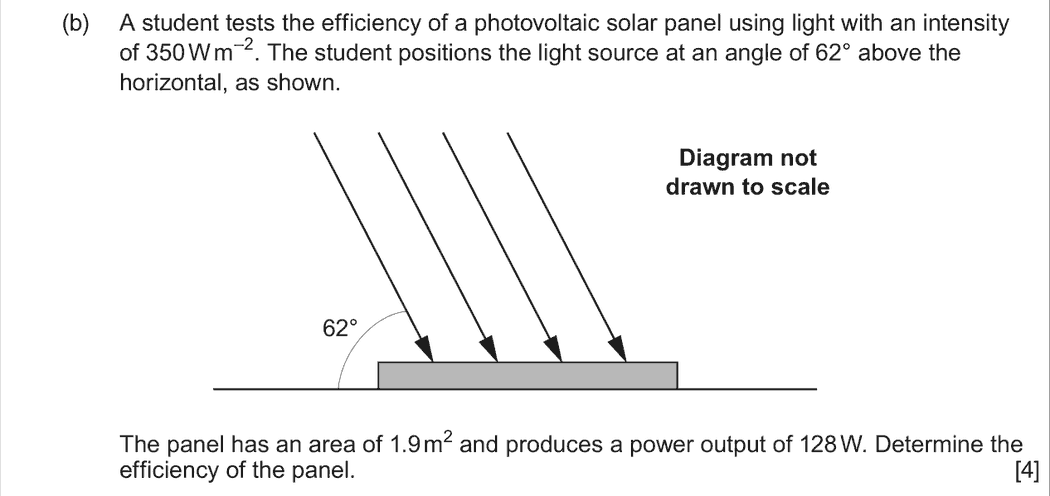
In (a)(i) the majority of candidates were able to access the data given in the diagram. The more readily used approach involved a calculation of the intensity absorbed by the Earth. They then used this to calculate the fraction to be 0.71. An alternative route saw candidates calculate the fraction reflected. A further subtraction allowed the 2nd mark to be obtained. Part (a)(ii) proved to be more demanding than expected. Weaker responses included reference to reflected radiation being absorbed. Stronger responses included the Earth emitting longer wavelength radiation that then gets absorbed. This is then re- radiated causing the planet to warm. In (a)(iii) candidates were very aware of the human activities that were contributing to this effect. Many were able to link this to increased carbon dioxide or methane or simply greenhouses gases. Less candidates achieved the last marking point where they needed to state that ‘more infra-red radiation is absorbed’ or ‘less infra-red radiation is escaping’. In the second part candidate responses were mixed. Weaker responses sometimes included reference to ozone which was not credited. The majority realised that this was a positive feedback question and strong responses made reference to albedo changes after snow or ice melt. This was the most popular correct response however all options on the mark scheme were regularly seen. Part (b) gave a good range of marks. Stronger responses included good use of the intensity and efficiency equations and an appreciation of sin 62 or cos 28 at some point in their response. A minority of candidates confused sin with cos, however, they were able to attain three marks with ecf. A small number of candidates failed to address the angle but were able to use both equations and achieve two marks. In (c)(i) there were some limited responses that involved the apparent heating of the wall. The U-value is not the power needed to heat up 1 m2 by 1 K. There were also some confused responses that involved reference to a temperature gradient. Stronger responses made clear reference to a ‘temperature difference of 1 K’. In the first part of (c)(ii) the majority of candidates used the gradient method outlined in the mark scheme. A minority of candidates missed 4 °C and hence, the temperature difference. Some of these candidates then realised their answer was incorrect and often attempted this again correctly. There were many different approaches used in the last part. Many candidates produced excellent responses. Some noticeable errors involved the use of 𝑈𝑇 = 𝑈𝑤 + 𝑈𝑃. Some weaker responses got as far as calculating the area of the wall but then paired this with the U-value for the patio doors. It is worth noting that candidates were trying to determine if the U-value of the insulated wall was less than 0.2 W m-2 K-1. This was not the same as the usual checking if the value was close to 0.2 W m-2 K-1. PHYSICS GCE A LEVEL Summer 2023
Skills: Trigonometryand vectors Resolving, components, vector addition, angles; Mathsmarks The mark scheme's Maths column gives this part at least one mark for mathematical skills

In (a)(i) the majority of candidates were able to access the data given in the diagram. The more readily used approach involved a calculation of the intensity absorbed by the Earth. They then used this to calculate the fraction to be 0.71. An alternative route saw candidates calculate the fraction reflected. A further subtraction allowed the 2nd mark to be obtained. Part (a)(ii) proved to be more demanding than expected. Weaker responses included reference to reflected radiation being absorbed. Stronger responses included the Earth emitting longer wavelength radiation that then gets absorbed. This is then re- radiated causing the planet to warm. In (a)(iii) candidates were very aware of the human activities that were contributing to this effect. Many were able to link this to increased carbon dioxide or methane or simply greenhouses gases. Less candidates achieved the last marking point where they needed to state that ‘more infra-red radiation is absorbed’ or ‘less infra-red radiation is escaping’. In the second part candidate responses were mixed. Weaker responses sometimes included reference to ozone which was not credited. The majority realised that this was a positive feedback question and strong responses made reference to albedo changes after snow or ice melt. This was the most popular correct response however all options on the mark scheme were regularly seen. Part (b) gave a good range of marks. Stronger responses included good use of the intensity and efficiency equations and an appreciation of sin 62 or cos 28 at some point in their response. A minority of candidates confused sin with cos, however, they were able to attain three marks with ecf. A small number of candidates failed to address the angle but were able to use both equations and achieve two marks. In (c)(i) there were some limited responses that involved the apparent heating of the wall. The U-value is not the power needed to heat up 1 m2 by 1 K. There were also some confused responses that involved reference to a temperature gradient. Stronger responses made clear reference to a ‘temperature difference of 1 K’. In the first part of (c)(ii) the majority of candidates used the gradient method outlined in the mark scheme. A minority of candidates missed 4 °C and hence, the temperature difference. Some of these candidates then realised their answer was incorrect and often attempted this again correctly. There were many different approaches used in the last part. Many candidates produced excellent responses. Some noticeable errors involved the use of 𝑈𝑇 = 𝑈𝑤 + 𝑈𝑃. Some weaker responses got as far as calculating the area of the wall but then paired this with the U-value for the patio doors. It is worth noting that candidates were trying to determine if the U-value of the insulated wall was less than 0.2 W m-2 K-1. This was not the same as the usual checking if the value was close to 0.2 W m-2 K-1. PHYSICS GCE A LEVEL Summer 2023
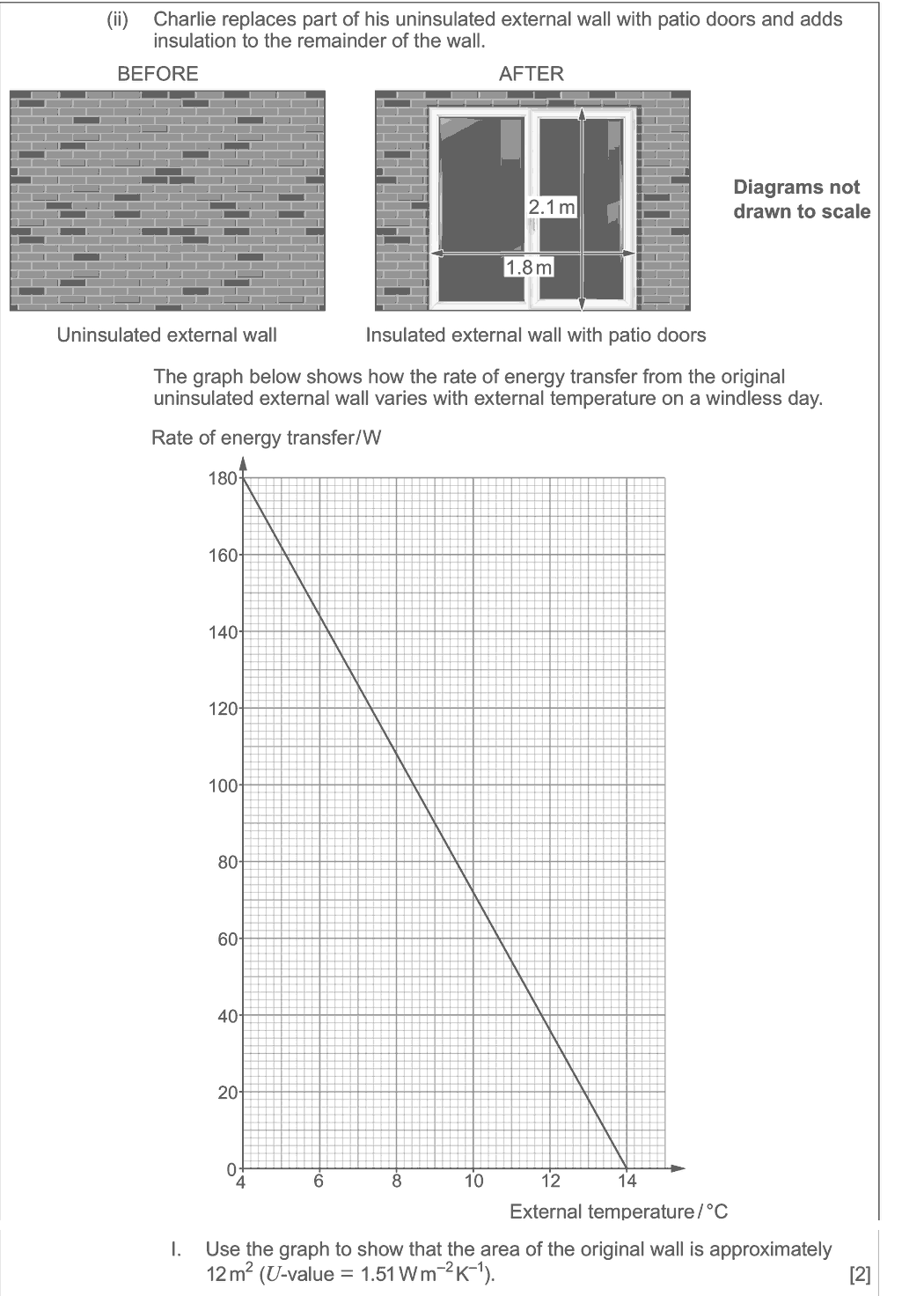
In (a)(i) the majority of candidates were able to access the data given in the diagram. The more readily used approach involved a calculation of the intensity absorbed by the Earth. They then used this to calculate the fraction to be 0.71. An alternative route saw candidates calculate the fraction reflected. A further subtraction allowed the 2nd mark to be obtained. Part (a)(ii) proved to be more demanding than expected. Weaker responses included reference to reflected radiation being absorbed. Stronger responses included the Earth emitting longer wavelength radiation that then gets absorbed. This is then re- radiated causing the planet to warm. In (a)(iii) candidates were very aware of the human activities that were contributing to this effect. Many were able to link this to increased carbon dioxide or methane or simply greenhouses gases. Less candidates achieved the last marking point where they needed to state that ‘more infra-red radiation is absorbed’ or ‘less infra-red radiation is escaping’. In the second part candidate responses were mixed. Weaker responses sometimes included reference to ozone which was not credited. The majority realised that this was a positive feedback question and strong responses made reference to albedo changes after snow or ice melt. This was the most popular correct response however all options on the mark scheme were regularly seen. Part (b) gave a good range of marks. Stronger responses included good use of the intensity and efficiency equations and an appreciation of sin 62 or cos 28 at some point in their response. A minority of candidates confused sin with cos, however, they were able to attain three marks with ecf. A small number of candidates failed to address the angle but were able to use both equations and achieve two marks. In (c)(i) there were some limited responses that involved the apparent heating of the wall. The U-value is not the power needed to heat up 1 m2 by 1 K. There were also some confused responses that involved reference to a temperature gradient. Stronger responses made clear reference to a ‘temperature difference of 1 K’. In the first part of (c)(ii) the majority of candidates used the gradient method outlined in the mark scheme. A minority of candidates missed 4 °C and hence, the temperature difference. Some of these candidates then realised their answer was incorrect and often attempted this again correctly. There were many different approaches used in the last part. Many candidates produced excellent responses. Some noticeable errors involved the use of 𝑈𝑇 = 𝑈𝑤 + 𝑈𝑃. Some weaker responses got as far as calculating the area of the wall but then paired this with the U-value for the patio doors. It is worth noting that candidates were trying to determine if the U-value of the insulated wall was less than 0.2 W m-2 K-1. This was not the same as the usual checking if the value was close to 0.2 W m-2 K-1. PHYSICS GCE A LEVEL Summer 2023
Skills: Graphskills Reading, plotting or sketching graphs; gradients, intercepts and areas; Mathsmarks The mark scheme's Maths column gives this part at least one mark for mathematical skills

In (a)(i) the majority of candidates were able to access the data given in the diagram. The more readily used approach involved a calculation of the intensity absorbed by the Earth. They then used this to calculate the fraction to be 0.71. An alternative route saw candidates calculate the fraction reflected. A further subtraction allowed the 2nd mark to be obtained. Part (a)(ii) proved to be more demanding than expected. Weaker responses included reference to reflected radiation being absorbed. Stronger responses included the Earth emitting longer wavelength radiation that then gets absorbed. This is then re- radiated causing the planet to warm. In (a)(iii) candidates were very aware of the human activities that were contributing to this effect. Many were able to link this to increased carbon dioxide or methane or simply greenhouses gases. Less candidates achieved the last marking point where they needed to state that ‘more infra-red radiation is absorbed’ or ‘less infra-red radiation is escaping’. In the second part candidate responses were mixed. Weaker responses sometimes included reference to ozone which was not credited. The majority realised that this was a positive feedback question and strong responses made reference to albedo changes after snow or ice melt. This was the most popular correct response however all options on the mark scheme were regularly seen. Part (b) gave a good range of marks. Stronger responses included good use of the intensity and efficiency equations and an appreciation of sin 62 or cos 28 at some point in their response. A minority of candidates confused sin with cos, however, they were able to attain three marks with ecf. A small number of candidates failed to address the angle but were able to use both equations and achieve two marks. In (c)(i) there were some limited responses that involved the apparent heating of the wall. The U-value is not the power needed to heat up 1 m2 by 1 K. There were also some confused responses that involved reference to a temperature gradient. Stronger responses made clear reference to a ‘temperature difference of 1 K’. In the first part of (c)(ii) the majority of candidates used the gradient method outlined in the mark scheme. A minority of candidates missed 4 °C and hence, the temperature difference. Some of these candidates then realised their answer was incorrect and often attempted this again correctly. There were many different approaches used in the last part. Many candidates produced excellent responses. Some noticeable errors involved the use of 𝑈𝑇 = 𝑈𝑤 + 𝑈𝑃. Some weaker responses got as far as calculating the area of the wall but then paired this with the U-value for the patio doors. It is worth noting that candidates were trying to determine if the U-value of the insulated wall was less than 0.2 W m-2 K-1. This was not the same as the usual checking if the value was close to 0.2 W m-2 K-1. PHYSICS GCE A LEVEL Summer 2023
Skills: Mathsmarks The mark scheme's Maths column gives this part at least one mark for mathematical skills

There were mixed responses for this question part. The majority of candidates were able to define intensity. We were not requiring the fact that the area was perpendicular to the radiation direction, however, it was noticeable that some candidates had knowledge of that level of detail. Not all candidates went on to state the correct units or incorrectly stated them.
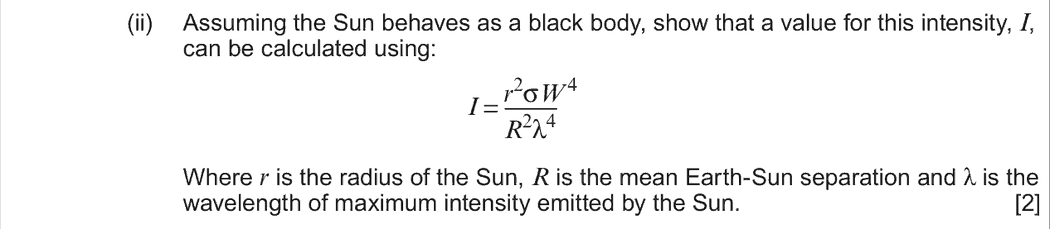
Good attempts were made by most candidates here. 𝑃= 𝐴𝜎𝑇4 and 𝜆max= 𝑊 𝑇 were regularly seen and the orderly presentation of the algebraic steps was pleasing. A minority of candidates were unable to separate the surface area of the Sun with the surface area of the ‘radiation sphere’ created by the Sun considered at the Earth-Sun distance.
Skills: Algebra Derivations and rearranging equations; Mathsmarks The mark scheme's Maths column gives this part at least one mark for mathematical skills

This was not answered as well as anticipated as a minority of candidates incorrectly transferred the powers in the given equation. There were also some clear calculator errors.
Skills: Unitsand conversions Unit marks, base units, prefixes and conversions; Mathsmarks The mark scheme's Maths column gives this part at least one mark for mathematical skills
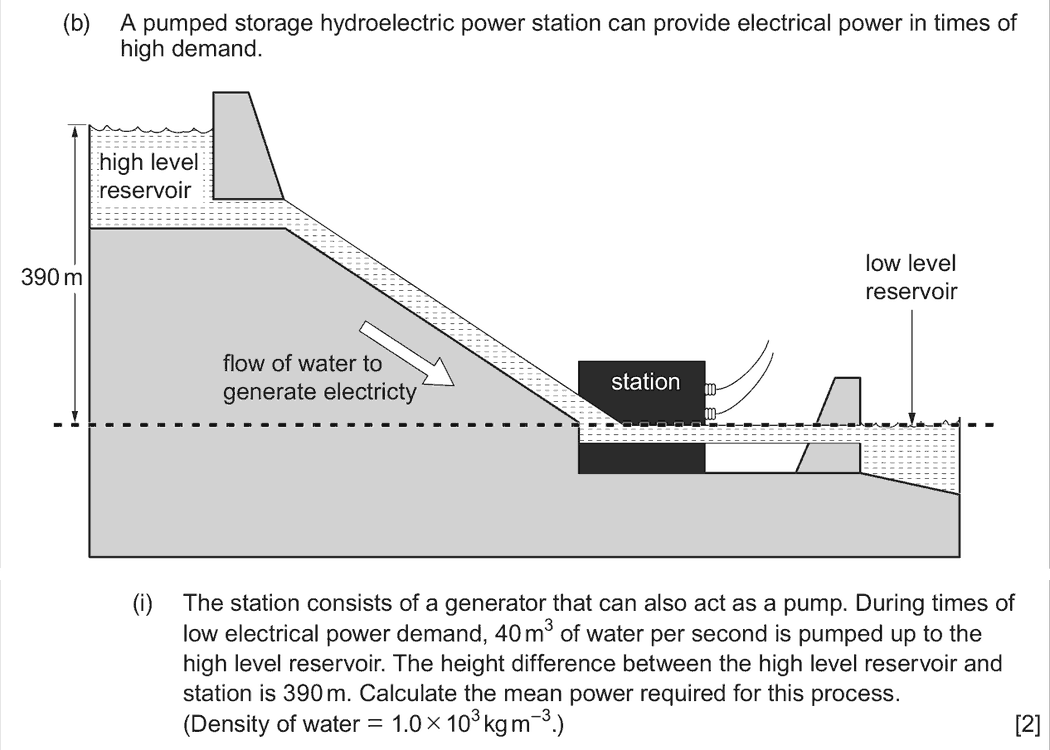
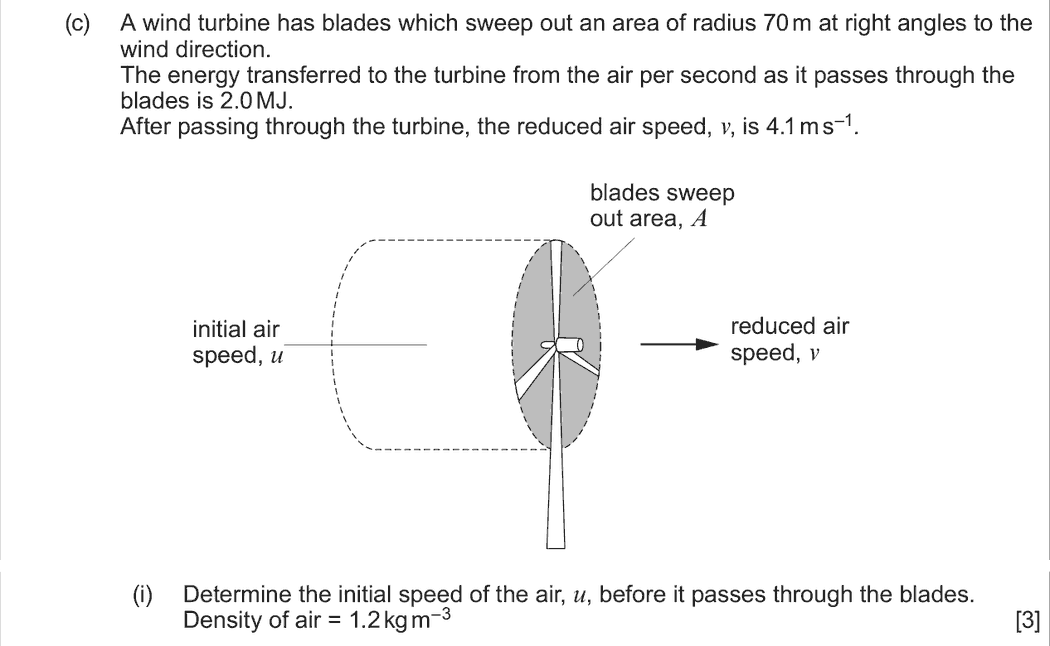
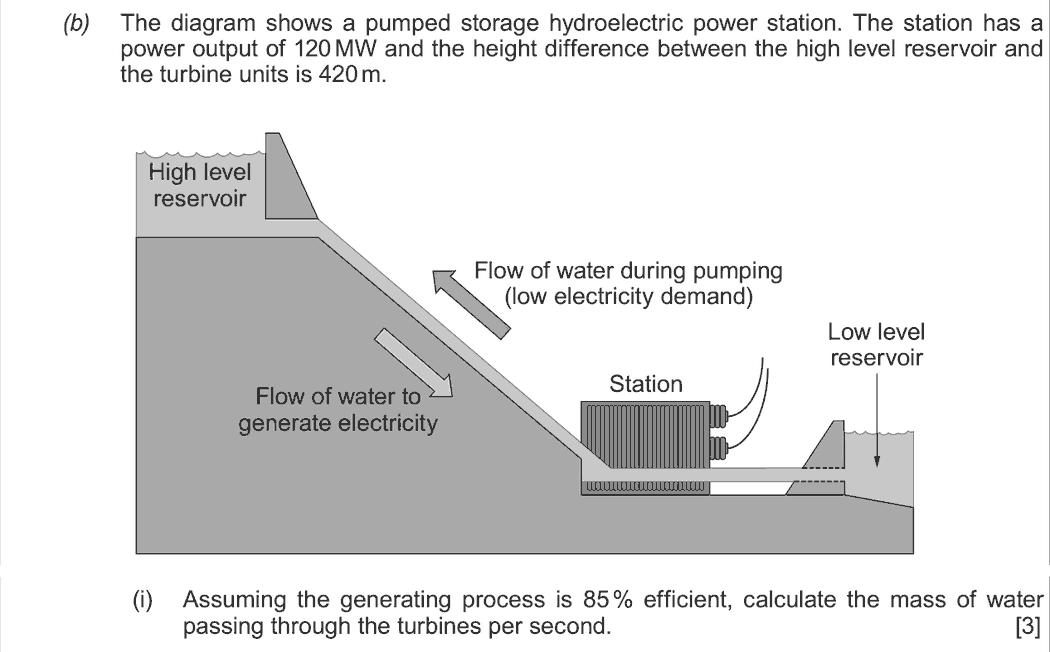
The majority of candidates were able to determine the mass per second and use PE = 𝑚𝑔ℎ per second. This often resulted in the correct answer of 153 MW. There were a minority of candidates who incorrectly rearranged the density equation or tried using 𝑃= 2 𝐴𝜌𝑣3 which did not gain any credit.
Skills: Unitsand conversions Unit marks, base units, prefixes and conversions; Mathsmarks The mark scheme's Maths column gives this part at least one mark for mathematical skills

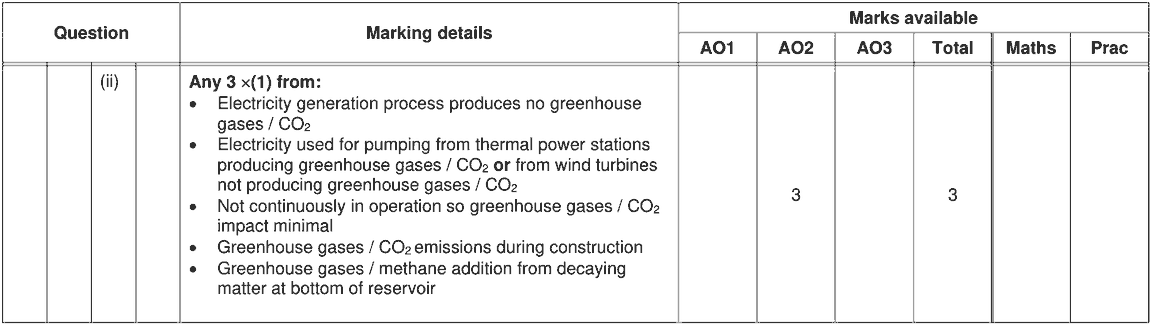
The discussion on greenhouse gas emissions was mixed. There were some very good responses. These candidates generally mentioned that the electricity generated from the hydroelectric power plant produces no greenhouse gases or more specifically, no CO2. They would then go on to say when electricity is bought back for the pumping process, the electricity may have been created in, for example, a thermal power station. The hydroelectric power station using its own electricity to pump the water back up did not gain credit. A minority of candidates suggested that renewable resources are resources that do not produce greenhouse gases. These responses were often confused. A renewable resource can be replenished within a given timescale.
Skills: Issues Benefits, risks, ethical or environmental issues (How Science Works)

Only a small number of candidates were able to explain what is meant by the confinement time. It is the time that the fuel can maintain its internal energy. Some candidates were rewarded for responses that referenced ‘more energy produced from fusion than the energy put in to heat the plasma’.

Candidates in part I generally saw that the Boltzmann constant was the link between temperature and energy which was pleasing. Multiplying 1.1 108 K by 𝑘 or dividing by 𝑒 was required for the first mark. Multiplying by 2 𝑘 was accepted as an understandable alternative. In part II the first mark was accessed by the majority of candidates where they had to manipulate the triple product into the form 𝜏𝐸= 𝑛𝑇𝜏𝐸 𝑛𝑇. Some did not consider the unusual unit for the triple product given in the question. A minority realised that the temperature was required to be in keV and used their value from part I to obtain a correct value. An alternative correct answer used the 10 eV approximation resulting in a confinement time of 4 seconds.
Skills: Unitsand conversions Unit marks, base units, prefixes and conversions; Mathsmarks The mark scheme's Maths column gives this part at least one mark for mathematical skills

Candidates in part I generally saw that the Boltzmann constant was the link between temperature and energy which was pleasing. Multiplying 1.1 108 K by 𝑘 or dividing by 𝑒 was required for the first mark. Multiplying by 2 𝑘 was accepted as an understandable alternative. In part II the first mark was accessed by the majority of candidates where they had to manipulate the triple product into the form 𝜏𝐸= 𝑛𝑇𝜏𝐸 𝑛𝑇. Some did not consider the unusual unit for the triple product given in the question. A minority realised that the temperature was required to be in keV and used their value from part I to obtain a correct value. An alternative correct answer used the 10 eV approximation resulting in a confinement time of 4 seconds.
Skills: Algebra Derivations and rearranging equations; Mathsmarks The mark scheme's Maths column gives this part at least one mark for mathematical skills
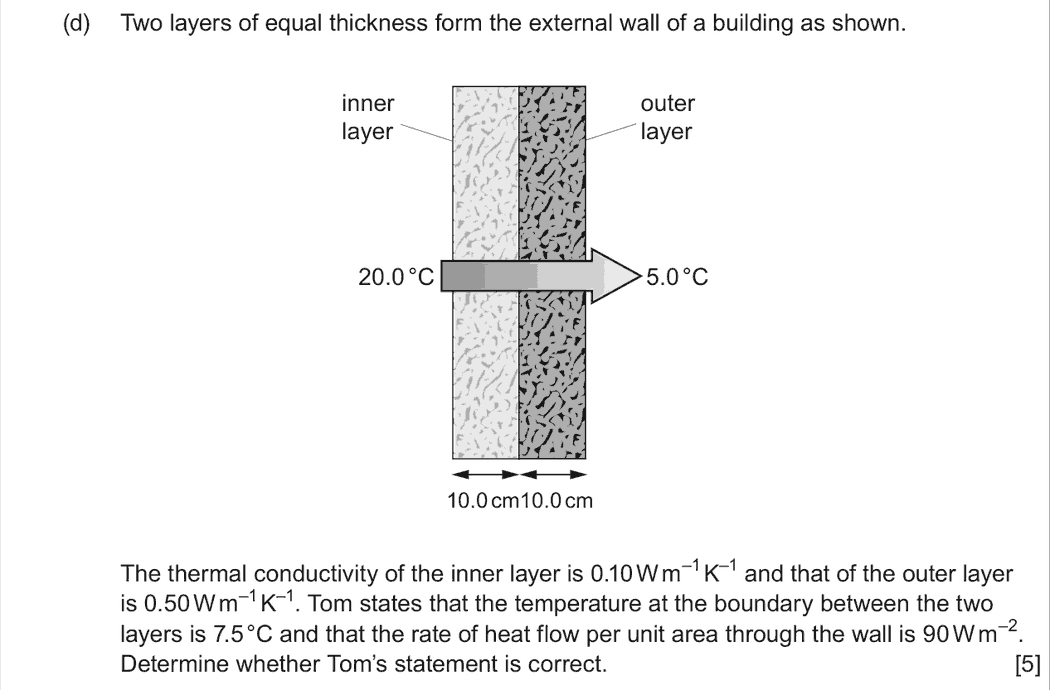
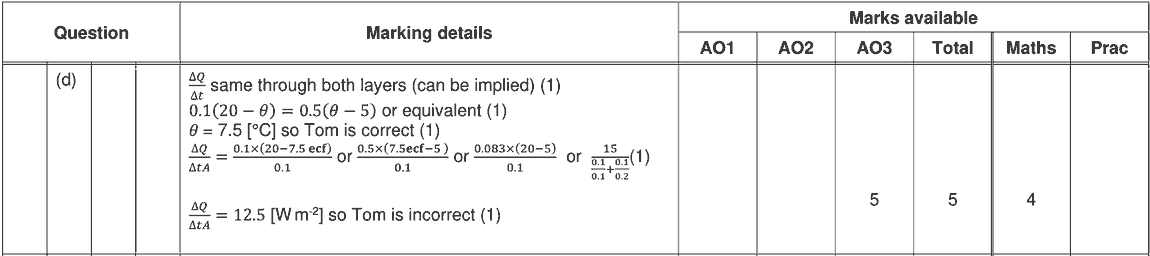
This question was well attempted with a full range of marks awarded. The first marking point was generally achieved through implication within the second and third marking points. However, a noticeable number of candidates are now communicating that Δ𝑄 Δ𝑡 is the same through both layers before they proceed with their calculations. There were different approaches used by candidates. The most common involved setting up a version of 0.1(20 −𝜃) = 0.5(𝜃−5) for 2 marks and correctly determining 𝜃 as 7.5° for the third mark. Simply substituting 7.5 back into either side of the above equation would have achieved the fourth mark. The fifth mark usually followed. Some candidates incorrectly calculated the combined K value for the external wall and did not get past three marks. A minority of candidates implied an understanding of Δ𝑄 Δ𝑡 being the same through both layers, correctly calculated the temperature at the boundary, but then incorrectly calculated Δ𝑄 Δ𝑡 in the individual layers to be different values. This was somewhat contradictory. Summary of key points • The variation with distance of phase of a progressive wave (1(a)(iii)). • Explanation of the percentage uncertainty should discuss the top and bottom of the fraction i.e. the absolute uncertainty and the value itself (2(b)(ii)). • Explaining energy loss or energy conservation in unusual circumstances. Although these were tough applications this year (5(b)(iv) and 9(a)), there is room for improvement. Explaining damped oscillations incorporating Lenz’s Law and ohmic heating proved to be particularly difficult. Explaining the apparent contradiction in laser propulsion of a rocket also proved testing. • In the medical physics option, the role of radio waves in MRI and the evaluation of imaging techniques. • In the energy and the environment option, intensity and the solar constant. PHYSICS GCE A LEVEL Summer 2022
Skills: Algebra Derivations and rearranging equations; Mathsmarks The mark scheme's Maths column gives this part at least one mark for mathematical skills
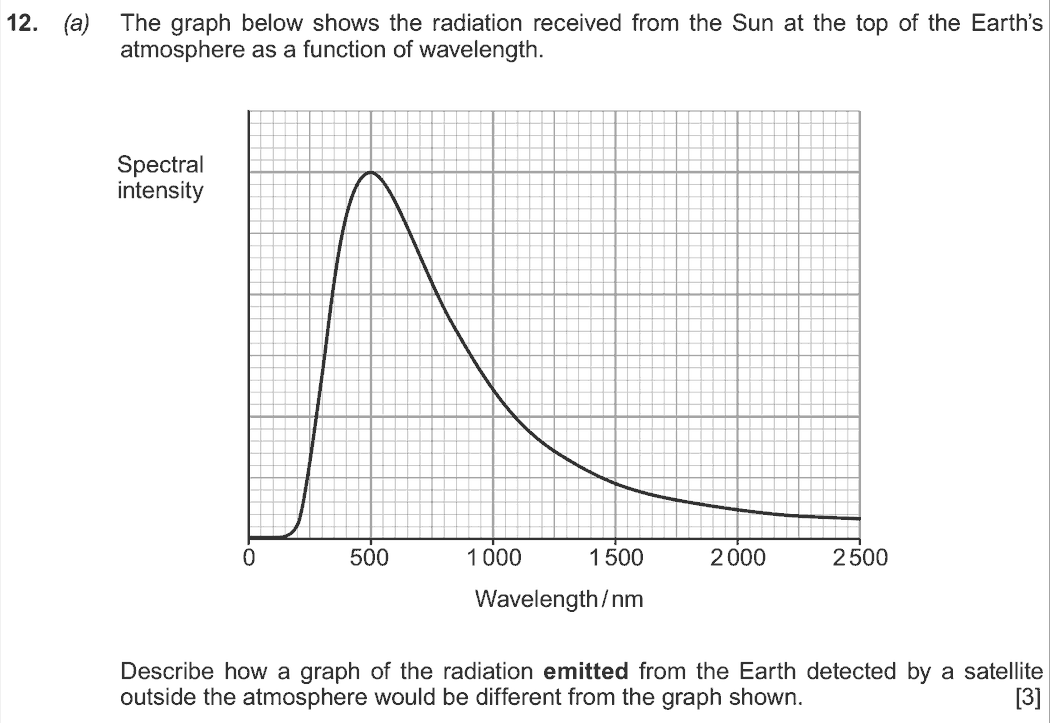
Skills: Graphskills Reading, plotting or sketching graphs; gradients, intercepts and areas


Skills: Unitsand conversions Unit marks, base units, prefixes and conversions; Mathsmarks The mark scheme's Maths column gives this part at least one mark for mathematical skills

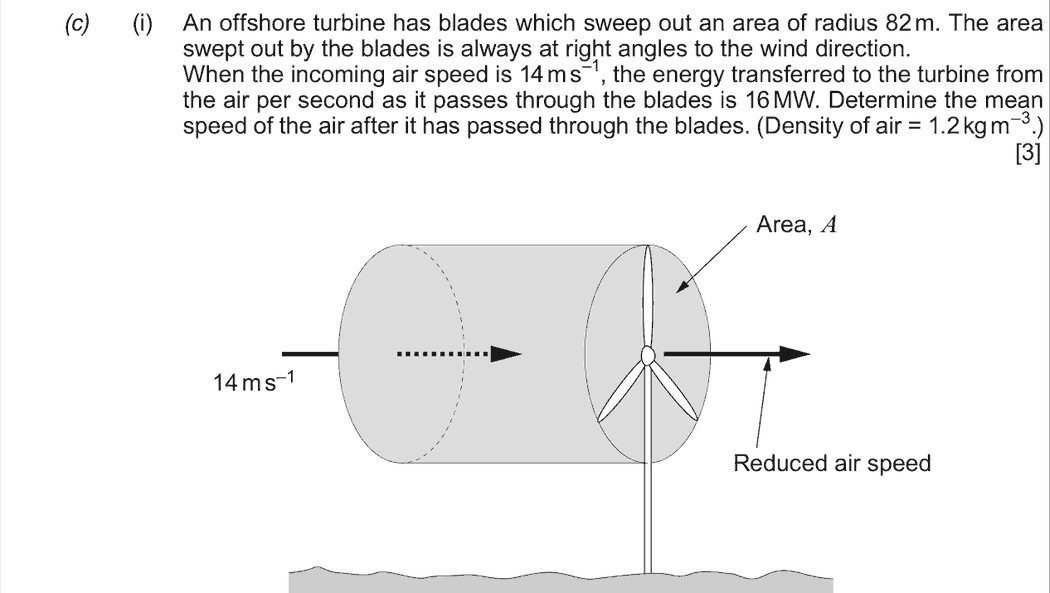
Skills: Algebra Derivations and rearranging equations; Mathsmarks The mark scheme's Maths column gives this part at least one mark for mathematical skills

Skills: Unitsand conversions Unit marks, base units, prefixes and conversions; Mathsmarks The mark scheme's Maths column gives this part at least one mark for mathematical skills

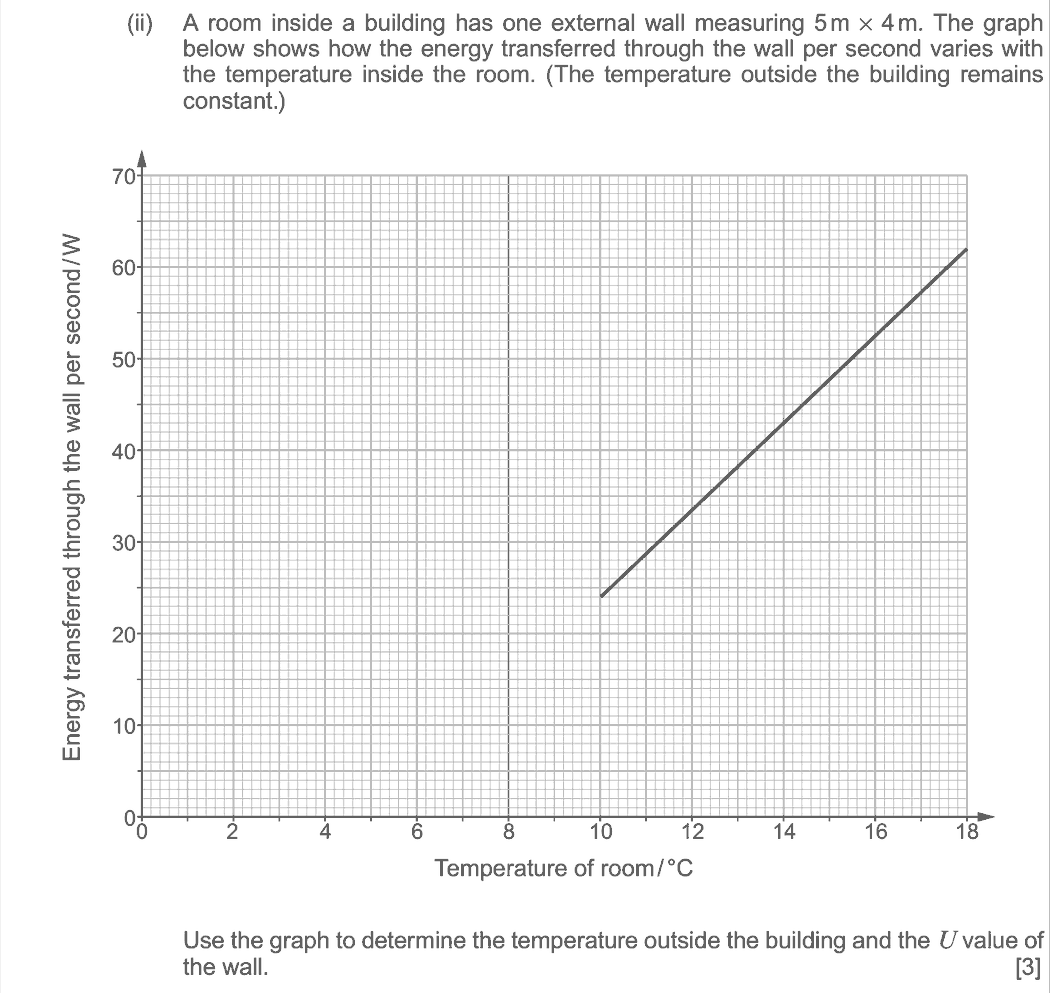
Skills: Graphskills Reading, plotting or sketching graphs; gradients, intercepts and areas; Mathsmarks The mark scheme's Maths column gives this part at least one mark for mathematical skills
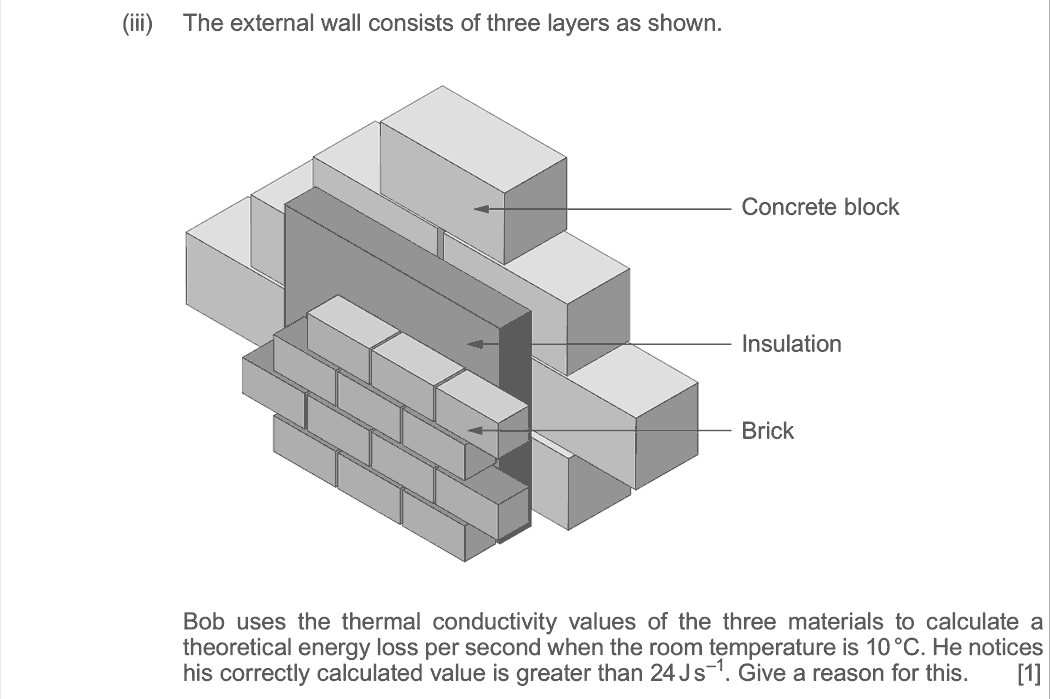

Skills: Mathsmarks The mark scheme's Maths column gives this part at least one mark for mathematical skills

Skills: Algebra Derivations and rearranging equations; Mathsmarks The mark scheme's Maths column gives this part at least one mark for mathematical skills



Skills: Mathsmarks The mark scheme's Maths column gives this part at least one mark for mathematical skills

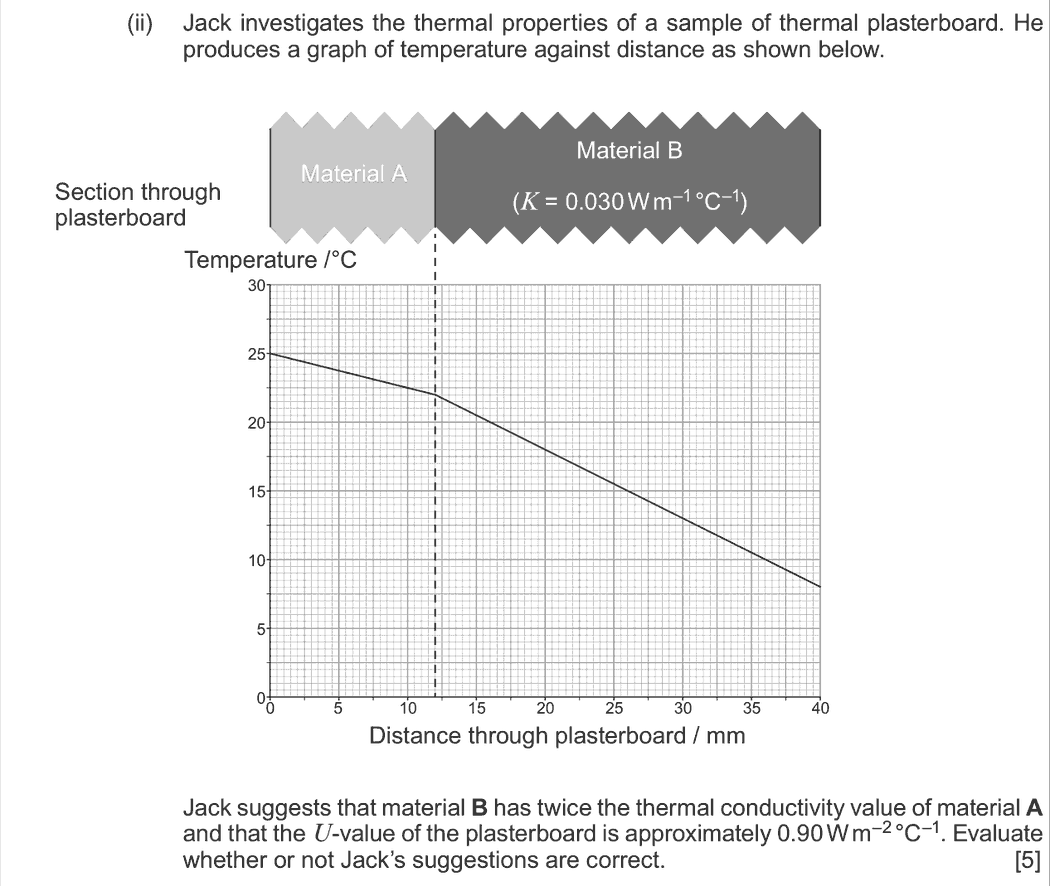
Skills: Graphskills Reading, plotting or sketching graphs; gradients, intercepts and areas; Unitsand conversions Unit marks, base units, prefixes and conversions; Mathsmarks The mark scheme's Maths column gives this part at least one mark for mathematical skills

This introductory question part resulted in some good responses from candidates, however, overall it was found to be challenging. We were looking for reference to ‘replenishment in a short time period’ or a resource that would ‘last for a long period of time’ here.
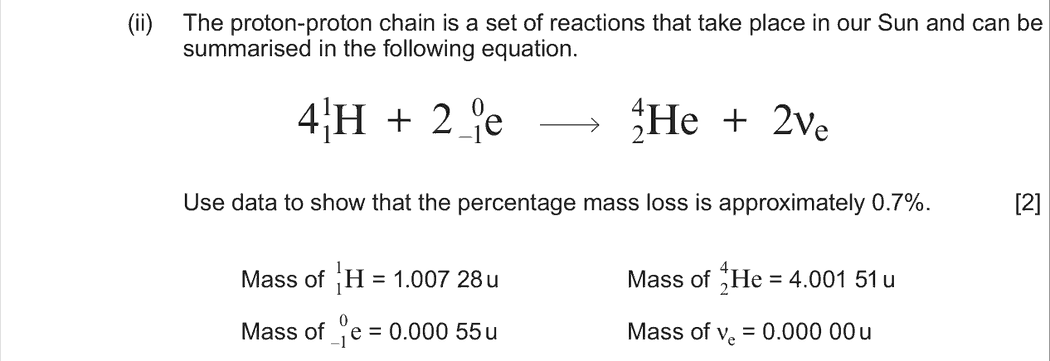
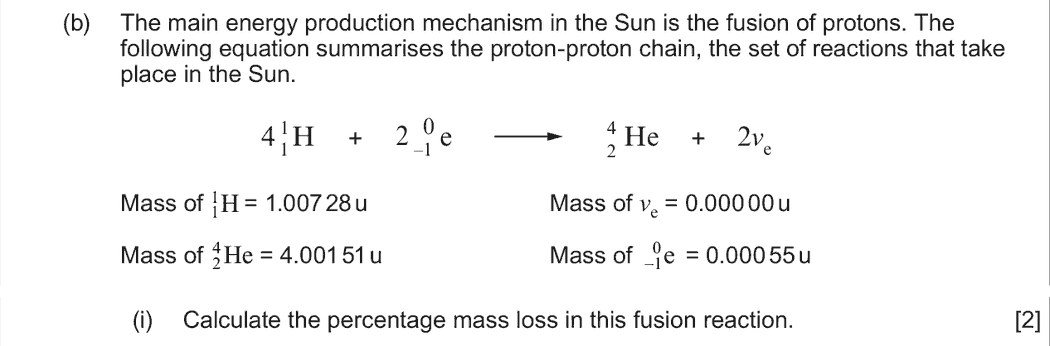
Most candidates were able to successfully show the percentage mass loss to be 0.7 %. Candidates used a number of different methods of showing this successfully. Some candidates converted into MeV in their attempts. A minority of candidates calculated the mass loss correctly but went on to find this as a percentage of an incorrect total mass.
Skills: Mathsmarks The mark scheme's Maths column gives this part at least one mark for mathematical skills

This question proved more demanding than the previous question part. The first mark required 0.7 % of the mass of the sun to be used. This was missed by some candidates. The use of energy per second was considered by a good number of candidates allowing them access to the second marking point.
Skills: Unitsand conversions Unit marks, base units, prefixes and conversions; Mathsmarks The mark scheme's Maths column gives this part at least one mark for mathematical skills
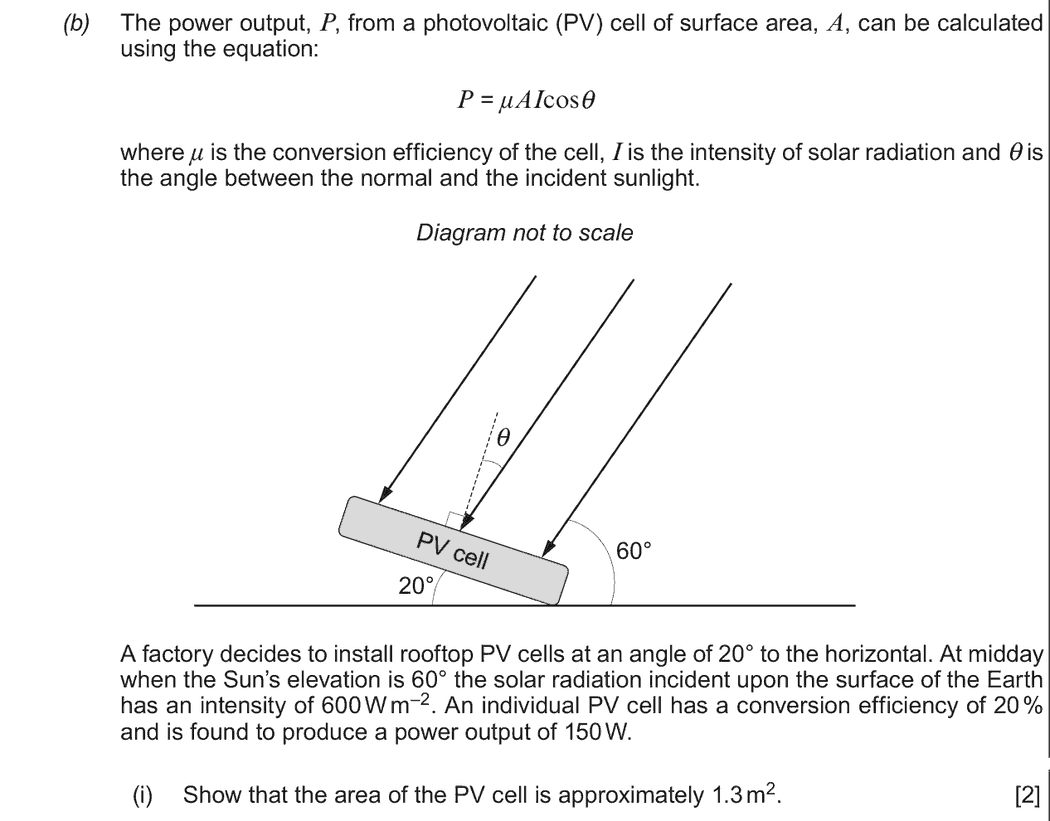
Most used the equation stated in the question. A good number of candidates were able to determine ‘10°’ using good numeracy skills. They invariably went on to gain two marks. A minority unsuccessfully attempted using other equations from the data booklet.
Skills: Trigonometryand vectors Resolving, components, vector addition, angles; Mathsmarks The mark scheme's Maths column gives this part at least one mark for mathematical skills

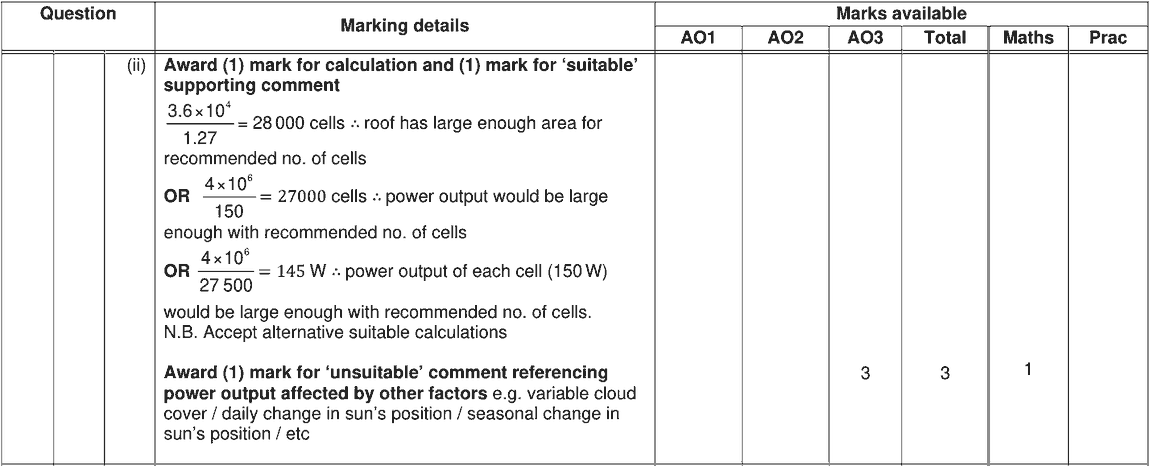
Candidates generally answered this question part well. The example calculations on the mark scheme were not exhaustive and candidates found alternative calculations to support their statements. The third marking point proved most difficult with not enough specific detail regarding changes to the Sun’s intensity incident on the cells. General ‘weather dependent’ comments were not deemed specific enough.
Skills: Mathsmarks The mark scheme's Maths column gives this part at least one mark for mathematical skills

There were some excellent responses here however there was sometimes confusion between which of U-235 and U-238 was fissile.
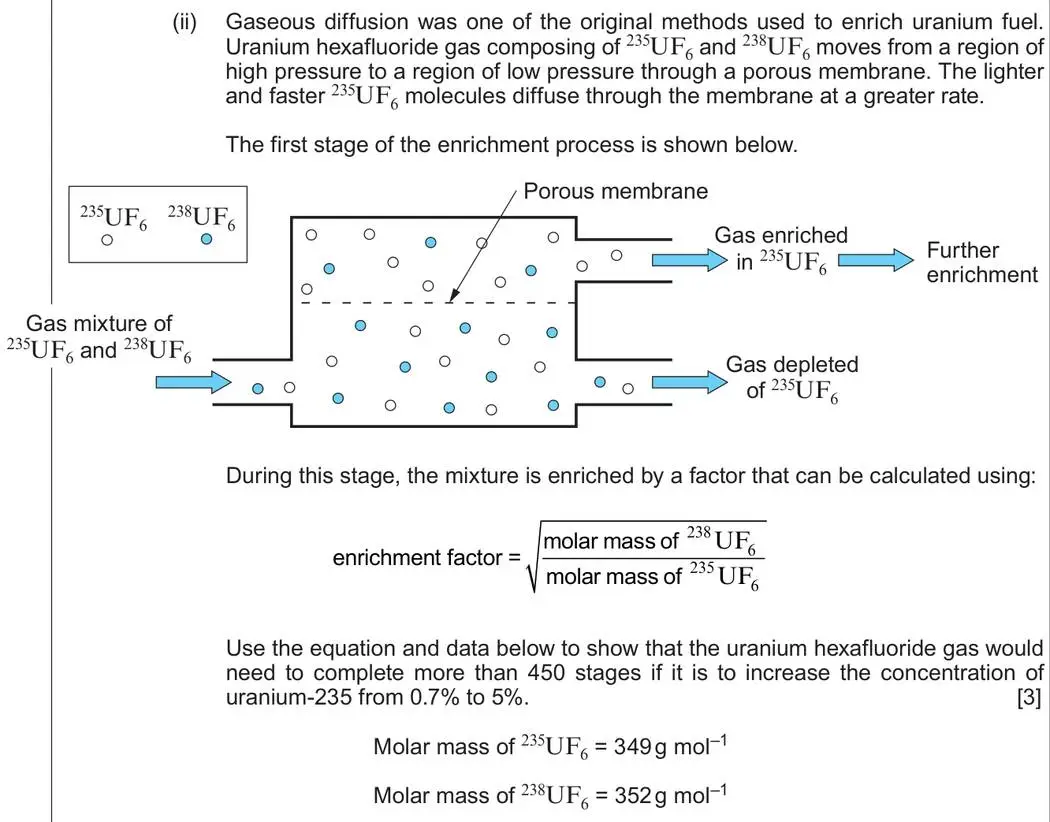
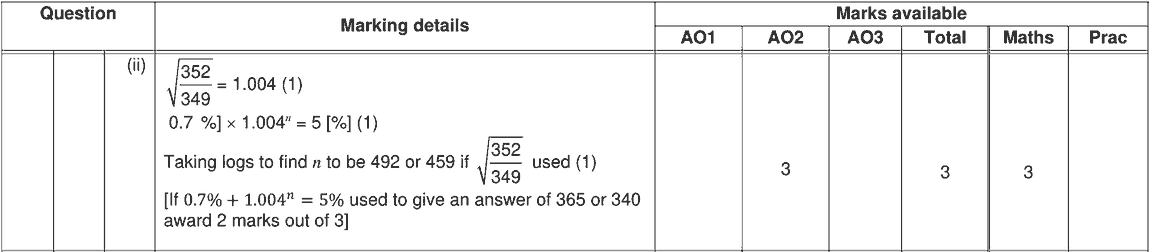
This proved to be a good discriminator. The first marking point was achieved by most candidates. Setting up the ‘0.7 % 1.004n = 5 %’ proved to be more challenging for candidates. Some candidates went on to show very good numerical skills in finding a value for n. A small number of candidates realised that substituting 450 for n in the above equation gave a value of 4.8 % and hence more than 450 stages was required. They were awarded full credit.
Skills: Algebra Derivations and rearranging equations; Mathsmarks The mark scheme's Maths column gives this part at least one mark for mathematical skills

The gas centrifuge was the most common response here. There were also a small number of alternatives as stated on the mark scheme. A minority of candidates were not able to access this question part.
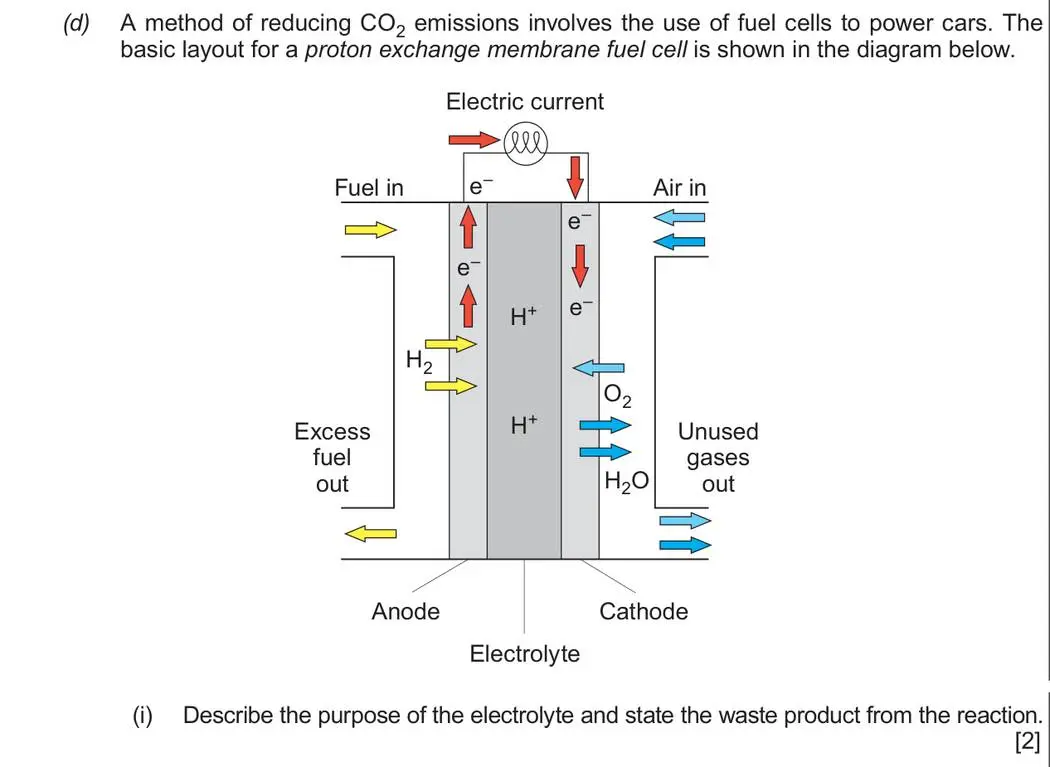
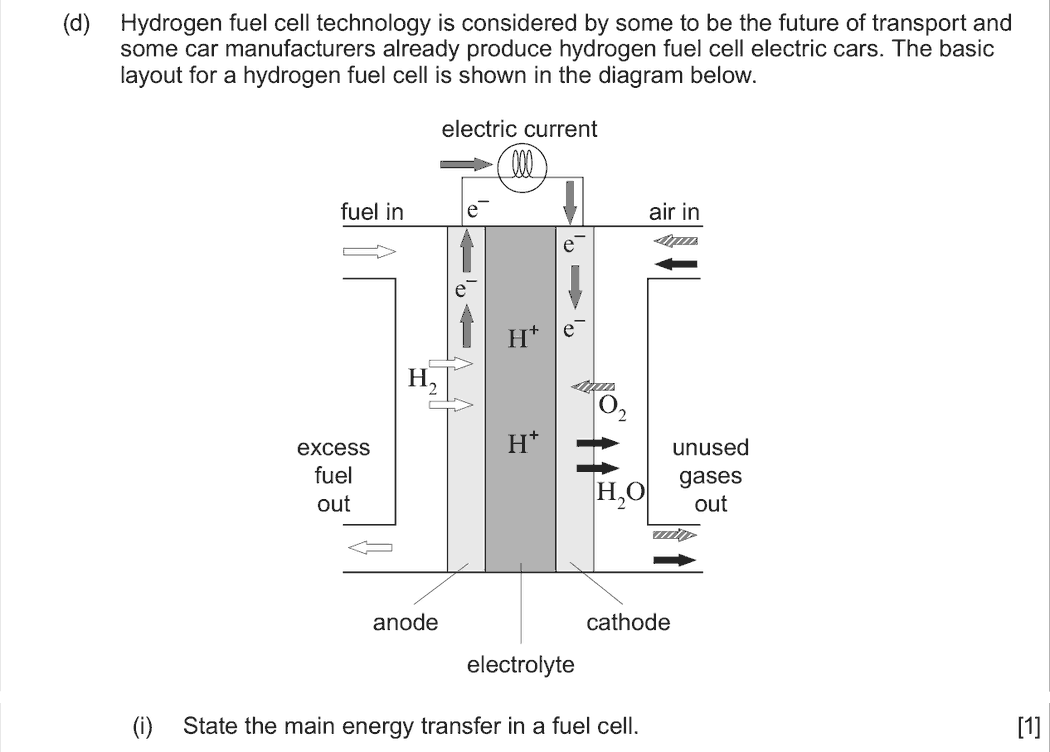
The first marking point was less well answered than the second. Some candidates did realise that the hydrogen ions pass through the electrolyte and so allow the electrons to travel through the external circuit. As expected, water was the well-known waste product from the process. This allowed many to access this marking point.
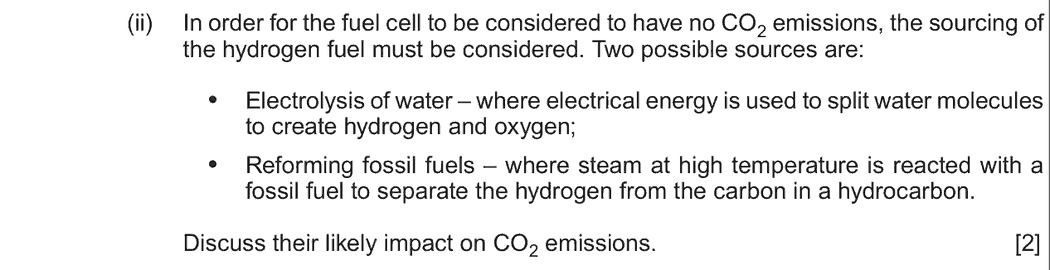
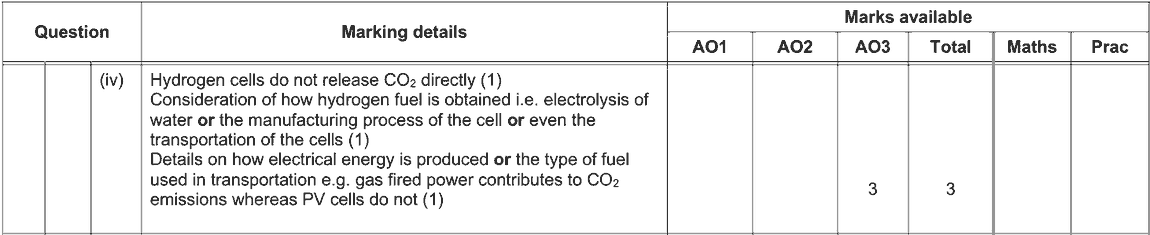
Many candidates gained credit for the dependence on the type of power station that was used to produce the electrical energy. Some candidates then went on to discuss what could then happen to the released carbon. Summary of key points In short, some areas of improvement that might benefit your candidates: 1. Explaining the advantages of a 4-level laser system over a 3-level system. 2. Differentiating between α, β, and γ radiation using electric or magnetic fields. 3. Tightening up the final representation of value, uncertainty and unit. A typical bad example being 24 ± 0.9 µF and a good example being (24.0 ± 0.9) µF. 4. Explaining the origins of emission and absorption spectra. 5. The useful relationships between momentum and energy for particles and photons (p2 = 2mE and E p c = ). PHYSICS GCE A LEVEL Summer 2019
Skills: Issues Benefits, risks, ethical or environmental issues (How Science Works)


Skills: Unitsand conversions Unit marks, base units, prefixes and conversions

Skills: Unitsand conversions Unit marks, base units, prefixes and conversions
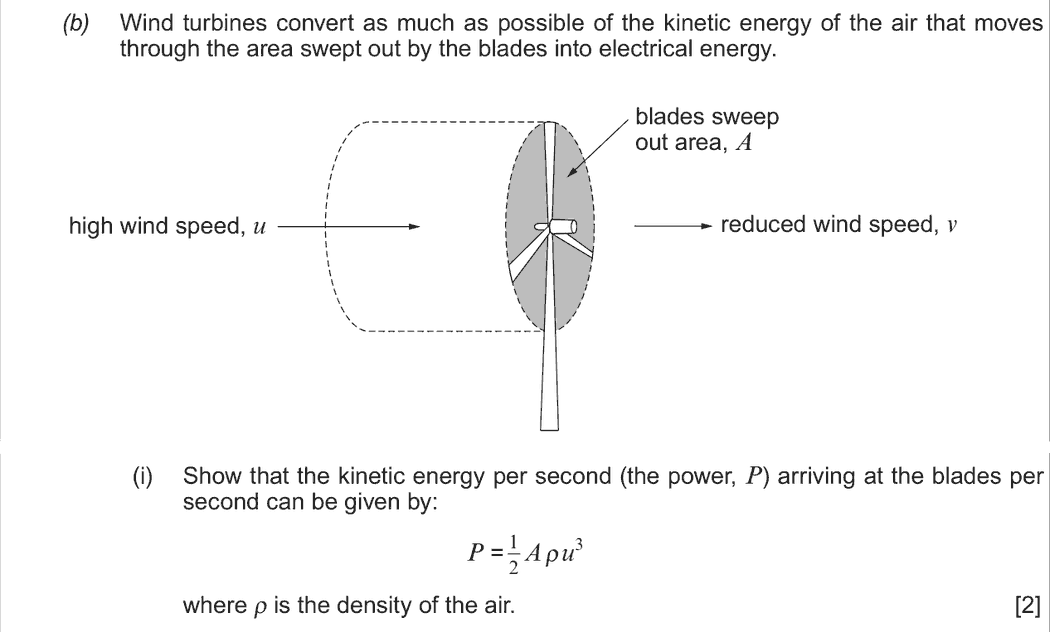
Skills: Algebra Derivations and rearranging equations


Skills: Mathsmarks The mark scheme's Maths column gives this part at least one mark for mathematical skills


Skills: Unitsand conversions Unit marks, base units, prefixes and conversions
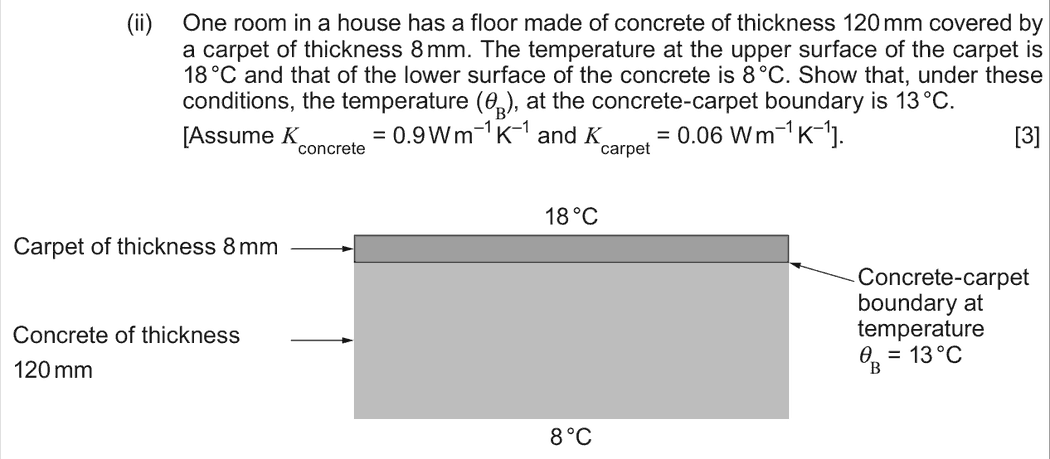
Skills: Algebra Derivations and rearranging equations; Mathsmarks The mark scheme's Maths column gives this part at least one mark for mathematical skills

Skills: Mathsmarks The mark scheme's Maths column gives this part at least one mark for mathematical skills

Skills: Mathsmarks The mark scheme's Maths column gives this part at least one mark for mathematical skills
Skills: Graphskills Reading, plotting or sketching graphs; gradients, intercepts and areas

Skills: Issues Benefits, risks, ethical or environmental issues (How Science Works)
Skills: Mathsmarks The mark scheme's Maths column gives this part at least one mark for mathematical skills

Skills: Unitsand conversions Unit marks, base units, prefixes and conversions; Mathsmarks The mark scheme's Maths column gives this part at least one mark for mathematical skills

Skills: Mathsmarks The mark scheme's Maths column gives this part at least one mark for mathematical skills
Skills: Unitsand conversions Unit marks, base units, prefixes and conversions

Skills: Graphskills Reading, plotting or sketching graphs; gradients, intercepts and areas

Dropping marks on calculations, specified practicals or the six-mark QER questions? Book a trial session with a specialist Eduqas physics tutor.