Notes and key-term cards for this topic are being written by our tutors. The past-paper questions below are ready now.
Specification statements
Show the 7 statements from the specification
1.4-a the idea that work is the product of a force and distance moved in the direction of the force when the force is constant
1.4-b the calculation of the work done for constant forces, when the force is not along the line of motion (work done = Fx cos θ)
1.4-c the principle of conservation of energy including knowledge of gravitational potential energy (mgΔh), elastic potential energy (½kx²) and kinetic energy (½mv²)
1.4-d the work-energy relationship: Fx = ½mv² − ½mu²
1.4-e power being the rate of energy transfer
1.4-f dissipative forces for example, friction and drag cause energy to be transferred from a system and reduce the overall efficiency of the system
1.4-g the equation efficiency = (useful energy transfer / total energy input) × 100%
Tap a question to zoom it. Where a part needs a figure, table or graph from earlier in the question, that part folds out above it; the mark scheme and examiner's comment open underneath. Have the Eduqas Data Booklet beside you (see the Data Booklet page).
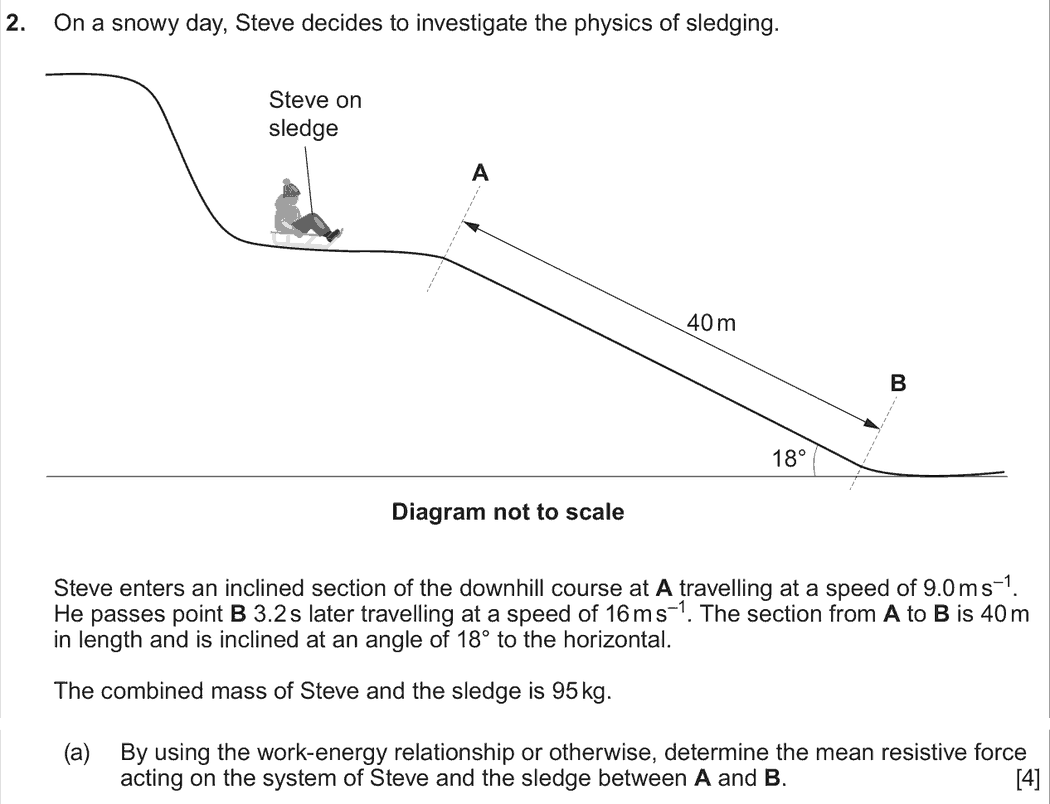
June 2025 · Component 1 · Q2(a)4 marksAO1=2, AO2=2Calculation
Mark scheme
Examiner's comment
Most candidates coped very well with this question. We saw either an energy or force approach as outlined in the MS. The 1st and 2nd MPs were sometimes awarded together for ΔPE + KEinitial= KEfinal + W. The presentation of this multistage calculation was very good. There were a few candidates who seemed confused as to what force they were calculating. The resistive force along the slope was required.
Notes from the mark scheme and report
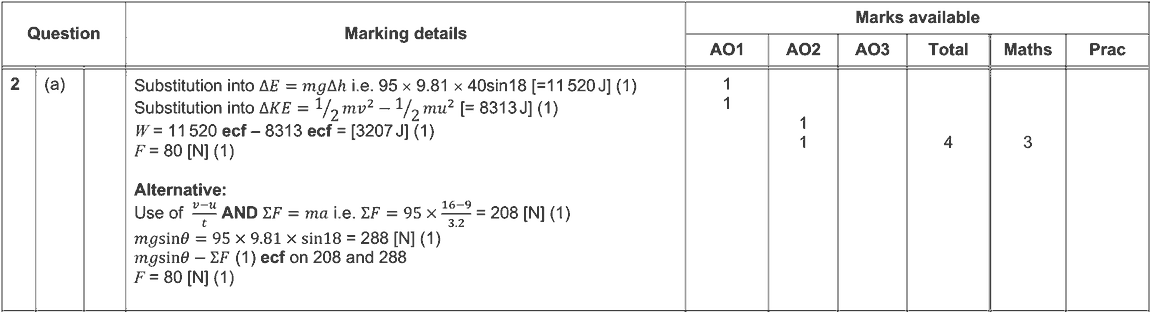
Answer: 80 N. Loss of PE = 95 × 9.81 × 40 sin 18° = 11 520 J
gain in KE = ½ × 95 × (16² − 9.0²) = 8313 J
work against resistance = 3207 J over 40 m. Force route: resultant = ma = 95 × 7/3.2 = 208 N
weight component 288 N
288 − 208. Some were unsure which force was wanted
Scheme columns: Maths 3
Skills: Trigonometryand vectors Resolving, components, vector addition, angles; Mathsmarks The mark scheme's Maths column gives this part at least one mark for mathematical skills
June 2025 · AS Component 1 · Q3(b)3 marksAO2=3Calculation
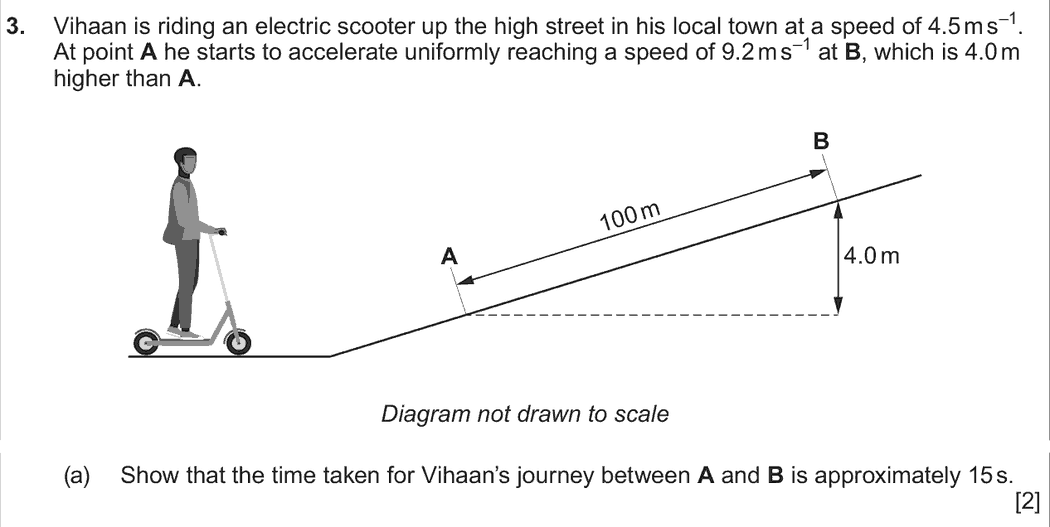
Earlier part of question 3 that this part uses
Mark scheme
Notes from the mark scheme and report
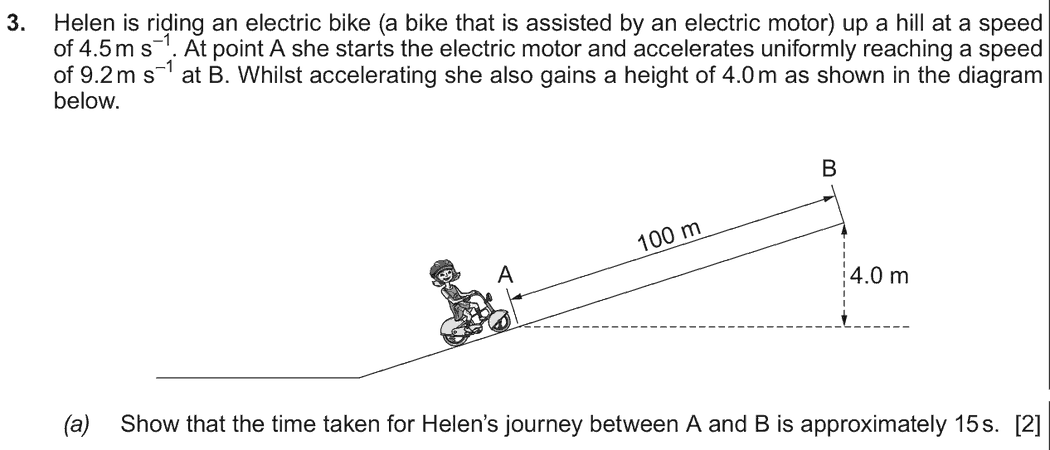
Answer: 3930 J. Gain in kinetic energy = ½ × 55 × (9.2² − 4.5²) = 2328 − 557 = 1771 J
gain in gravitational PE = 55 × 9.81 × 4.0 = 2158 J
total 3929 J
unit mark
ecf
Scheme columns: Maths 3
Skills: Mathsmarks The mark scheme's Maths column gives this part at least one mark for mathematical skills
June 2025 · AS Component 1 · Q3(c)(i)2 marksAO1=1, AO2=1Calculation
Earlier part of question 3 that this part uses
Mark scheme
Notes from the mark scheme and report
Answer: 2100 J. E = VIt = 24 × 6.0 × 14.6 = 2102 J (2160 J if 15 s is used)
Scheme columns: Maths 1
Skills: Mathsmarks The mark scheme's Maths column gives this part at least one mark for mathematical skills
June 2025 · AS Component 1 · Q3(c)(ii)2 marksAO2=2Calculation
Earlier parts of question 3 that this part uses
Mark scheme
Notes from the mark scheme and report
Answer: 70%. Total energy input = 2102 + 3500 = 5602 J
efficiency = 3929/5602 × 100
ecf
0.70 accepted
Scheme columns: Maths 2
Skills: Mathsmarks The mark scheme's Maths column gives this part at least one mark for mathematical skills
June 2025 · AS Component 1 · Q3(c)(iii)2 marksAO1=1, AO2=1Short answer
Earlier parts of question 3 that this part uses
Mark scheme
Notes from the mark scheme and report
Friction and air resistance (drag) (1)
friction between the wheels (and axles) and the road, air resistance on Vihaan and the scooter as they move through the air (1)
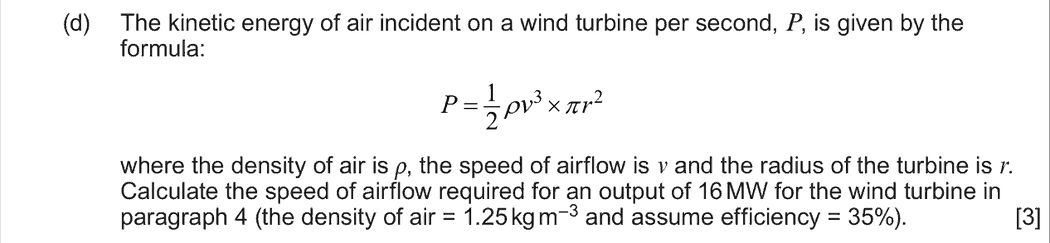
June 2025 · Component 1 · Q8(d)3 marksAO1=1, AO2=2Calculation
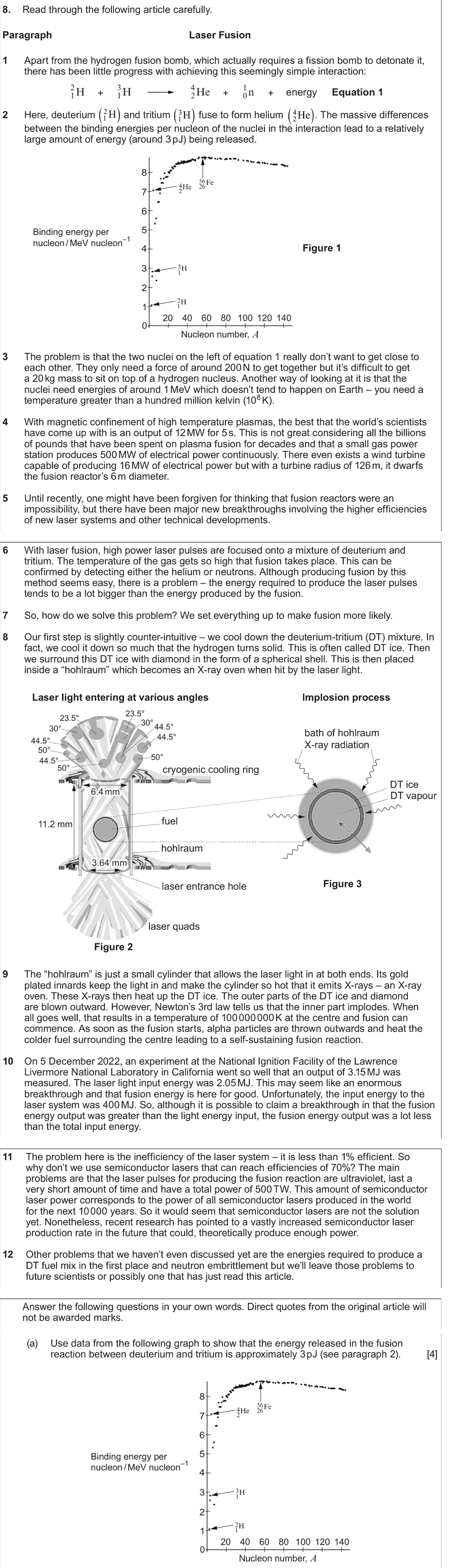
Earlier part of question 8 that this part uses
Mark scheme
Examiner's comment
The 1st MP was awarded for correct algebra. The 2nd was for the correct substitution of 35%. Unfortunately, on occasion 0.35 did not arrive in the equation in the correct position or it was not considered at all. For candidates that missed 0.35 entirely we generously awarded 2 marks for a final answer of 8 m s-1. 38.3 m was also sometimes seen. Here a candidate had slipped up and used a √ instead of a ∛. If their workings were correct up to this point, we awarded 2 marks out of the 3. Candidates achieved all 3 marks a final answer for a final answer of 11.4 m/s.
cube root. 8.0 m s⁻¹ (efficiency ignored) scores 2
a square root instead of a cube root also 2
Scheme columns: Maths 2
Skills: Comprehension A level Component 1 Section B: questions on the printed article; Algebra Derivations and rearranging equations; Mathsmarks The mark scheme's Maths column gives this part at least one mark for mathematical skills
June 2025 · Component 1 · Q8(f)2 marksAO1=1, AO2=1Calculation
Earlier part of question 8 that this part uses
Mark scheme
Examiner's comment
In this question candidates really had to show good interpretation of what was written in the article. The laser system is less than 1% efficient but to prove this, candidates had to use 400 MJ and 2.05 MJ in the efficiency equation. For candidates that did this, a final answer of 0.51% allowed for 2 marks. Those that selected 3.15 MJ did not gain credit.
Notes from the mark scheme and report
Answer: 0.51%, so the statement holds. Efficiency = laser light energy/input energy = 2.05 MJ/400 MJ × 100
using the 3.15 MJ fusion output was wrong
Scheme columns: Maths 1
Skills: Comprehension A level Component 1 Section B: questions on the printed article; Mathsmarks The mark scheme's Maths column gives this part at least one mark for mathematical skills
June 2025 · Component 1 · Q8(g)3 marksAO3=3Calculation
Earlier part of question 8 that this part uses
Mark scheme
Examiner's comment
Candidates found a few different paths through this question as outlined on the MS. There were also a few candidates that started down one path then changed approach often picking up all the MPs. Some converted the time to seconds and cancelled later. This was fine. Some of these candidates did not cancel later and were often stuck on two marks. PHYSICS GCE A level Summer 2025
Notes from the mark scheme and report
Answer: no. Power added per year = 2 × 10⁹ × 2 × 10⁻³ = 4 × 10⁶ W
time needed = 500 × 10¹²/4 × 10⁶ = 1.25 × 10⁸ years, far more than 10 000
or in 10 000 years only 4 × 10¹⁰ W, far below 5 × 10¹⁴ W
Scheme columns: Maths 3
Skills: Comprehension A level Component 1 Section B: questions on the printed article; Mathsmarks The mark scheme's Maths column gives this part at least one mark for mathematical skills
June 2024 · Component 1 · Q3(a)2 marksAO1=2DefinitionEasy
Mark scheme
Examiner's comment
Responses for this AO1 question were more varied than anticipated. There were many responses similar to the mark scheme. Some candidates seemed to have used the data booklet and defined the terms in the work equation. These candidates often didn’t get the 2nd marking point. A few less specific comments about ‘energy transfer’ and even some definitions of power were seen that were not awarded credit.
Notes from the mark scheme and report
Product of the force and the distance (1) moved in the direction of the force (1)
defining the symbols of the data-booklet equation often missed the second mark
June 2024 · AS Component 1 · Q3(a)2 marksAO1=1, AO2=1Show that
Mark scheme
Examiner's comment
The definition in part (a) was generally well done. Few problems were seen with applying the equations in parts (b)(i)-(iii). In (b)(iv) a few candidates added the energies together before dividing and so lost one mark. Surprisingly in part (c) most candidates only gave one reason even though the question was worth 2 marks.
Notes from the mark scheme and report
Work W = Fx and power P = W/t, so P = Fx/t (1)
x/t = v, so P = Fv (1)
Scheme columns: Maths 1
Skills: Algebra Derivations and rearranging equations; Mathsmarks The mark scheme's Maths column gives this part at least one mark for mathematical skills
June 2024 · Component 1 · Q3(b)(ii)1 markAO2=1CalculationEasy
Earlier parts of question 3 that this part uses
Mark scheme
Examiner's comment
Most candidates calculated 1200 J. A correct unit was required, and this stopped a small number of candidates accessing the mark. Good unit responses included ‘N m’ and ‘kg m2 s-2’ as alternatives to ‘J’. We did see some incorrect use of angles in the work equation at this stage.
Notes from the mark scheme and report
Answer: 12 000 J (1500 × 8.0)
unit mark: J, N m or kg m² s⁻²
Scheme columns: Maths 1
Skills: Unitsand conversions Unit marks, base units, prefixes and conversions; Mathsmarks The mark scheme's Maths column gives this part at least one mark for mathematical skills
June 2024 · AS Component 1 · Q3(b)(ii)3 marksAO2=3Calculation
Earlier parts of question 3 that this part uses
Mark scheme
Examiner's comment
The definition in part (a) was generally well done. Few problems were seen with applying the equations in parts (b)(i)-(iii). In (b)(iv) a few candidates added the energies together before dividing and so lost one mark. Surprisingly in part (c) most candidates only gave one reason even though the question was worth 2 marks.
Notes from the mark scheme and report
Answer: 4370 J (4369 J). Height gained = 200 sin 1.5° = 5.24 m
ΔEp = 85 × 9.81 × 5.24
Scheme columns: Maths 3
Skills: Trigonometryand vectors Resolving, components, vector addition, angles; Mathsmarks The mark scheme's Maths column gives this part at least one mark for mathematical skills
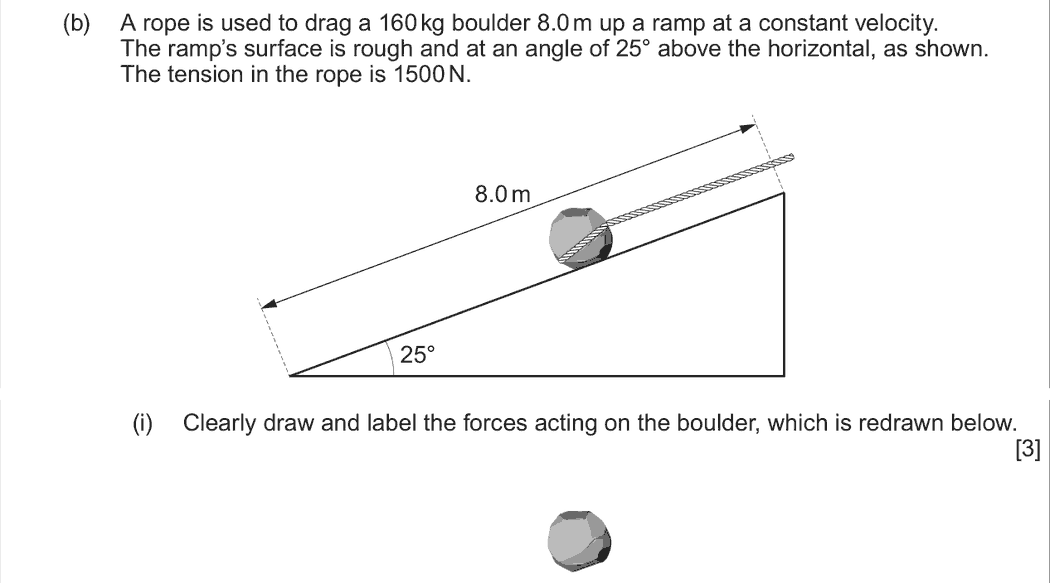
June 2024 · Component 1 · Q3(b)(iii)3 marksAO1=1, AO2=2CalculationEasy
Earlier parts of question 3 that this part uses
Mark scheme
Examiner's comment
Components along the slope was the most readily used approach to answering this question, however, we did see a mixture of both methods covered in the mark scheme. Those that used the energy route already had values calculated in readiness for (c).
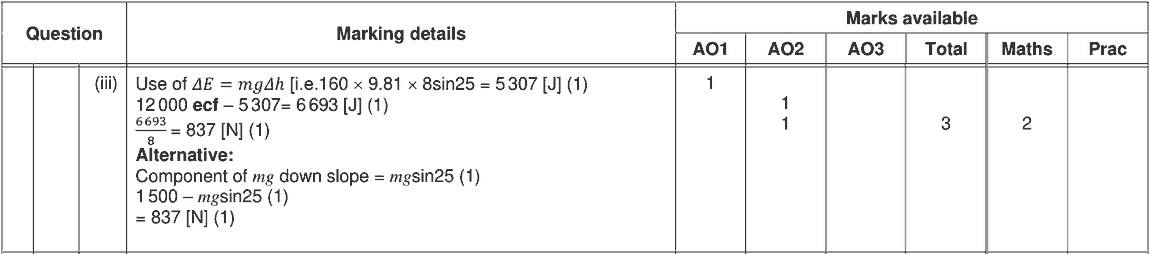
Notes from the mark scheme and report
Answer: 837 N. Energy route: gain in gravitational PE = 160 × 9.81 × 8 sin 25° = 5307 J
work against friction = 12 000 − 5307 = 6693 J
F = 6693/8. Force route: 1500 − mg sin 25°
Scheme columns: Maths 2
Skills: Trigonometryand vectors Resolving, components, vector addition, angles; Mathsmarks The mark scheme's Maths column gives this part at least one mark for mathematical skills
June 2024 · AS Component 1 · Q3(b)(iii)2 marksAO1=1, AO2=1Calculation
Earlier parts of question 3 that this part uses
Mark scheme
Examiner's comment
The definition in part (a) was generally well done. Few problems were seen with applying the equations in parts (b)(i)-(iii). In (b)(iv) a few candidates added the energies together before dividing and so lost one mark. Surprisingly in part (c) most candidates only gave one reason even though the question was worth 2 marks.
Notes from the mark scheme and report
Answer: 5080 J (5076 J). E = VIt = 36 × 6.0 × 23.5
ecf on the time
Scheme columns: Maths 1
Skills: Mathsmarks The mark scheme's Maths column gives this part at least one mark for mathematical skills
June 2024 · AS Component 1 · Q3(b)(iv)2 marksAO2=2Calculation
Earlier parts of question 3 that this part uses
Mark scheme
Examiner's comment
The definition in part (a) was generally well done. Few problems were seen with applying the equations in parts (b)(i)-(iii). In (b)(iv) a few candidates added the energies together before dividing and so lost one mark. Surprisingly in part (c) most candidates only gave one reason even though the question was worth 2 marks.
Notes from the mark scheme and report
Answer: 86%. Useful energy / input energy = 4369/5076 × 100
ecf
a few added the two energies before dividing
Scheme columns: Maths 2
Skills: Mathsmarks The mark scheme's Maths column gives this part at least one mark for mathematical skills
June 2024 · Component 1 · Q3(c)3 marksAO1=1, AO2=2CalculationEasy
Earlier parts of question 3 that this part uses
Mark scheme
Examiner's comment
Candidates generally used the efficiency equation effectively. A few candidates used forces instead of energy. This was unusual but resulted in the same answer. There were some vague statements about heat that were not awarded credit. Many candidates produced detailed answers involving an increased kinetic energy of particles in the slope or the boulder. In some responses, internal energy and heat were sometimes confused. If a candidate described heat flow from a boulder, they first had to mention how the particles in the boulder gained that energy in order to be awarded credit.
Notes from the mark scheme and report
Answer: 44% (5307/12 000)
the wasted 6693 J is transferred to the energy of the particles (internal energy) of the ramp and boulder
vague statements about heat not credited
Scheme columns: Maths 1
Skills: Mathsmarks The mark scheme's Maths column gives this part at least one mark for mathematical skills
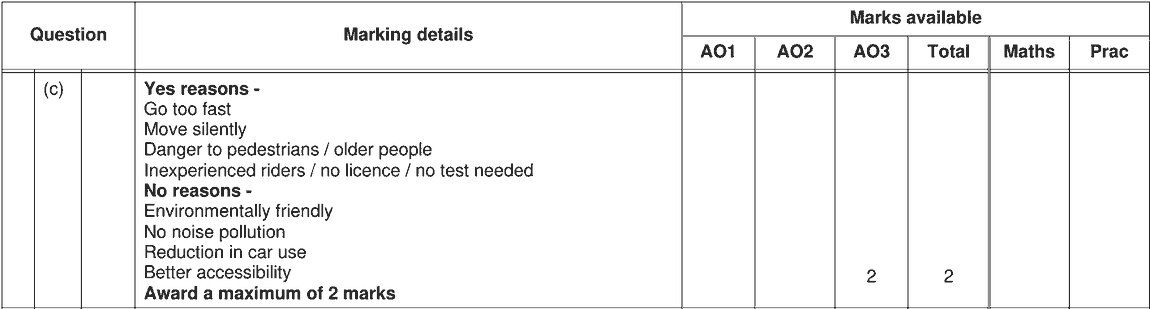
June 2024 · AS Component 1 · Q3(c)2 marksAO3=2Short answer
Earlier part of question 3 that this part uses
Mark scheme
Examiner's comment
The definition in part (a) was generally well done. Few problems were seen with applying the equations in parts (b)(i)-(iii). In (b)(iv) a few candidates added the energies together before dividing and so lost one mark. Surprisingly in part (c) most candidates only gave one reason even though the question was worth 2 marks.
Notes from the mark scheme and report
Two reasons for a view (2), e.g. agree: fast and silent so a danger to pedestrians, riders untrained and unlicensed
disagree: environmentally friendly, quiet, fewer car journeys, better accessibility. Most gave only one reason
June 2024 · Component 3 · Q8(c)3 marksAO1=1, AO2=2Calculation
Earlier part of question 8 that this part uses
Mark scheme
Examiner's comment
If candidates realised that GPE had to be used in the question then the correct answer usually followed, a small number of candidates used mg and hence did not get awarded any marks. Option A – Alternating Currents
Notes from the mark scheme and report
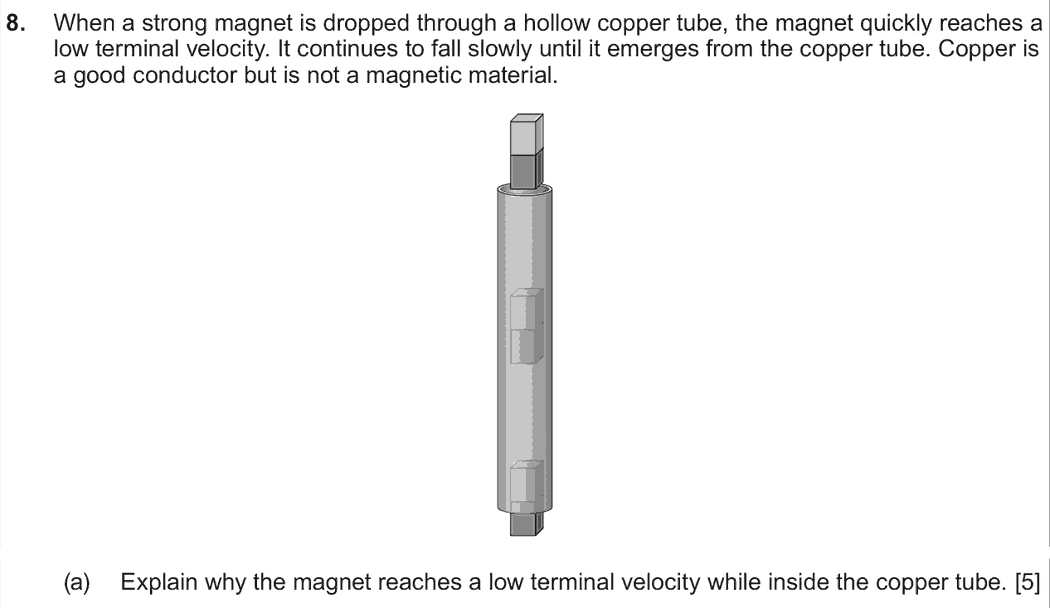
Answer: 0.038 K. Gravitational PE lost = 0.325 × 9.81 × 1.205 = 3.84 J, all transferred to the tube (the magnet's kinetic energy is small)
Δθ = 3.84/(0.263 × 389)
ecf on the mass
mg = mcΔθ scores nothing
Scheme columns: Maths 2
Skills: Synoptic Needs physics from another component of the qualification; Mathsmarks The mark scheme's Maths column gives this part at least one mark for mathematical skills
June 2023 · Component 1 · Q5(a)1 markAO1=1Definition
Mark scheme
Examiner's comment
In (b)(i) most candidates were comfortable in calculating the gain of gravitational potential energy. There was a unit mark here and there were a few candidates who incorrectly stated the unit. The 0.92 is significant in (ii). The justification was missed by some candidates. Stronger responses included reference to 0.92 being 33% of (1.9 + 0.92) and so significant. This usually allowed for better access to the next question part. The input energy was correctly calculated by most in (iii). A significant number of candidates were not combining 1.9 and the 0.92 and hence incorrectly established an efficiency of either 24% or 12%.
Notes from the mark scheme and report
Rate of doing work or rate of energy transfer (work/time or energy/time)
June 2023 · Component 1 · Q5(b)(i)2 marksAO1=1, AO2=1Calculation
Earlier part of question 5 that this part uses
Mark scheme
Examiner's comment
In (b)(i) most candidates were comfortable in calculating the gain of gravitational potential energy. There was a unit mark here and there were a few candidates who incorrectly stated the unit. The 0.92 is significant in (ii). The justification was missed by some candidates. Stronger responses included reference to 0.92 being 33% of (1.9 + 0.92) and so significant. This usually allowed for better access to the next question part. The input energy was correctly calculated by most in (iii). A significant number of candidates were not combining 1.9 and the 0.92 and hence incorrectly established an efficiency of either 24% or 12%.
Notes from the mark scheme and report
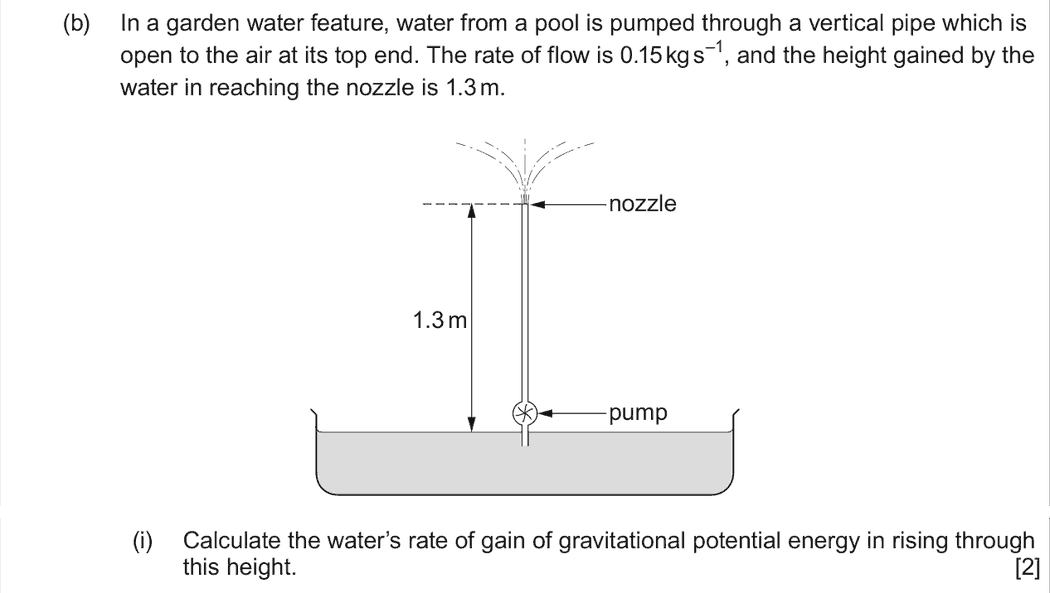
Answer: 1.9 W. Rate of gain of GPE = (m/t)gh = 0.15 × 9.81 × 1.3
unit mark (W or J s⁻¹)
Scheme columns: Maths 1
Skills: Unitsand conversions Unit marks, base units, prefixes and conversions; Mathsmarks The mark scheme's Maths column gives this part at least one mark for mathematical skills
June 2023 · Component 1 · Q5(b)(ii)2 marksAO3=2Calculation
Earlier parts of question 5 that this part uses
Mark scheme
Examiner's comment
In (b)(i) most candidates were comfortable in calculating the gain of gravitational potential energy. There was a unit mark here and there were a few candidates who incorrectly stated the unit. The 0.92 is significant in (ii). The justification was missed by some candidates. Stronger responses included reference to 0.92 being 33% of (1.9 + 0.92) and so significant. This usually allowed for better access to the next question part. The input energy was correctly calculated by most in (iii). A significant number of candidates were not combining 1.9 and the 0.92 and hence incorrectly established an efficiency of either 24% or 12%.
Notes from the mark scheme and report
KE given per second = ½ × 0.15 × 3.5² = 0.92 W (1)
this is about a third of the useful output power (1.9 + 0.92 W), so it is significant and Leo is right (1)
the justification was often missing
Scheme columns: Maths 1
Skills: Mathsmarks The mark scheme's Maths column gives this part at least one mark for mathematical skills
June 2023 · Component 1 · Q5(b)(iii)3 marksAO1=2, AO2=1Calculation
Earlier parts of question 5 that this part uses
Mark scheme
Examiner's comment
In (b)(i) most candidates were comfortable in calculating the gain of gravitational potential energy. There was a unit mark here and there were a few candidates who incorrectly stated the unit. The 0.92 is significant in (ii). The justification was missed by some candidates. Stronger responses included reference to 0.92 being 33% of (1.9 + 0.92) and so significant. This usually allowed for better access to the next question part. The input energy was correctly calculated by most in (iii). A significant number of candidates were not combining 1.9 and the 0.92 and hence incorrectly established an efficiency of either 24% or 12%.
Notes from the mark scheme and report
Answer: 36% (0.36). Input power = IV = 12 × 0.65 = 7.8 W
useful output = 1.9 + 0.92 = 2.82 W
common error: using only one of the two outputs (24% or 12%)
P = IV is from Component 2
Scheme columns: Maths 2
Skills: Synoptic Needs physics from another component of the qualification; Mathsmarks The mark scheme's Maths column gives this part at least one mark for mathematical skills
June 2023 · Component 1 · Q6(b)(ii)I2 marksAO1=1, AO2=1Show that
Earlier parts of question 6 that this part uses
Mark scheme
Examiner's comment
The ‘show that’ question in part (a) proved to be demanding. A significant number of candidates were unable to appreciate where the component of the bob’s weight was acting and diagrams indicating horizontal force directions were confused. The use of tension also halted progress here. The second and third marking points proved more accessible. Mainly very good candidate responses were seen in (b)(i). There were some weaker attempts using 𝑣 = −𝐴𝜔sin𝜔𝑡 but these did not develop as the candidates were unable to determine the amplitude. For the GPE – time graph in (ii) we were looking for the correct period, phase, and shape. There was a good success rate. A triangular wave is not an acceptable alternative for a sinusoid. Candidates who used the negative portion of the graph were only able to access the period mark as this was a significant error. The transition from simple harmonic motion to circular motion in part (iii) proved demanding for some candidates. Some used 𝑎= 𝜔2𝑟 and the periodic time of 1.4 s for the pendulum to be the time for one complete revolution. This is incorrect. Candidates who used 𝑎= 𝑣2 𝑟 were more successful. In the second part of the question, we were looking for candidates to show us that a centripetal force is a resultant force and at the bottom of the swing, this resultant force would be upwards. Some candidates were able to do this. We accepted ‘𝑇 – 𝑚𝑔 = 𝑚𝑎’ for the first marking point. The direction needed to be clear for the second marking point. Some drew a diagram to support their responses and were often rewarded. The last part was the QER and it tested the candidate’s ability to describe how forced oscillations can be demonstrated and how the amplitude varies with frequency. It bridged AO1 and AO3 and this challenged candidates. The description of the experiment was often limited whereas the variation of amplitude and hence links to resonance were more readily seen. A graph would often be seen, however, we wanted it to be referenced in their written response. The simple and effective way of obtaining the natural frequency of an oscillator (when the signal generator is off) was not regularly seen, however, it was encouraging to see additional practical detail regarding the amplitude measurement. There were a minority of confused responses involving damping.
Notes from the mark scheme and report
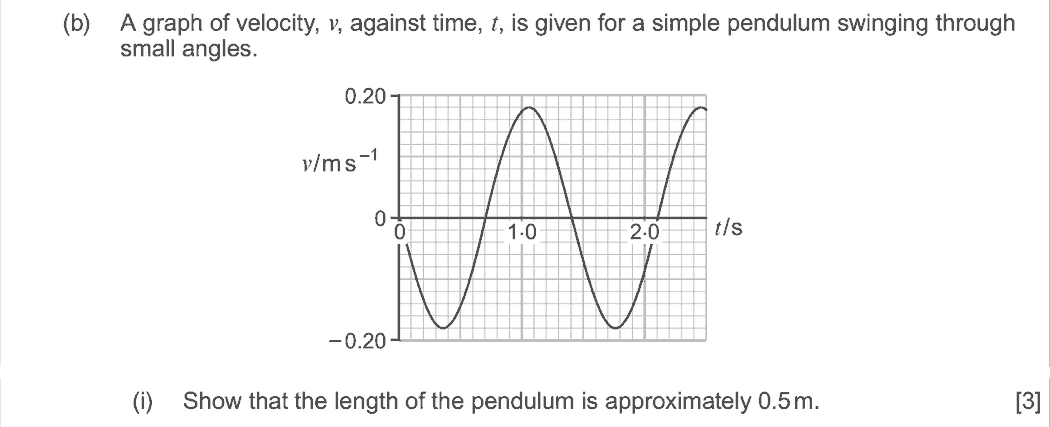
vmax = 0.18 m s⁻¹ from the graph
Ek max = ½ × 0.12 × 0.18² = 1.94 mJ
Scheme columns: Maths 1
Skills: Graphskills Reading, plotting or sketching graphs; gradients, intercepts and areas; Mathsmarks The mark scheme's Maths column gives this part at least one mark for mathematical skills
June 2023 · Component 2 · Q5(b)(i)4 marksAO1=1, AO2=3Calculation
Earlier part of question 5 that this part uses
Mark scheme
Examiner's comment
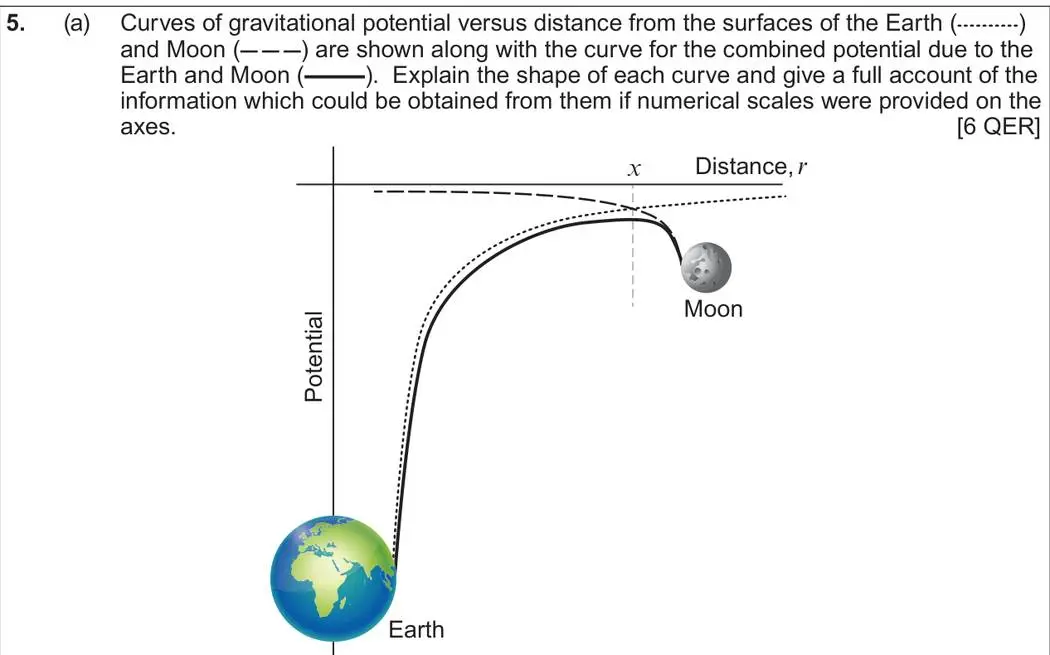
Part (a) was the QER question and in general, good attempts were made to explain the shapes of the potential vs distance curves. Higher scoring candidates (top band responses) were able to refer to the definition of potential and the expected relationship between potential and distance (i.e. 𝑉𝑔∝ − 𝑟). They explained the reason why the potential near the earth had a greater (negative) value than near the Moon and identified the relationship between the gradient of the curves and gravitational field strength. They described the scalar nature of potential and explained that the combined curve was due to the sum of the individual potentials. They also correctly described the significance of the gradient at X in terms of field strength and, in some cases, the work needed to escape the system. Middle band responses contained some of the above points, with lower band candidates only managing to describe one or two of these aspects. Many candidates in (b)(i) had an appreciation of the energy principles involved in determining the launch speed of the rocket, including the concept of initial Ep and Ek at the surface being equal to the Ep at the given height in orbit. However, a significant minority of candidates failed to gain full marks due to their incorrect use of signs when considering Ep. That is they failed to account for the negative values of Ep at both the surface and at the height of the orbit. Responses to (ii) were more successful with many applying the appropriate circular motion equation to confirm the orbital speed. In a few cases candidates used the orbital speed given in the question to determine the period of orbit, T, and then used the same equation again to re-confirm the orbital speed - a circular approach which was not credited.
Notes from the mark scheme and report
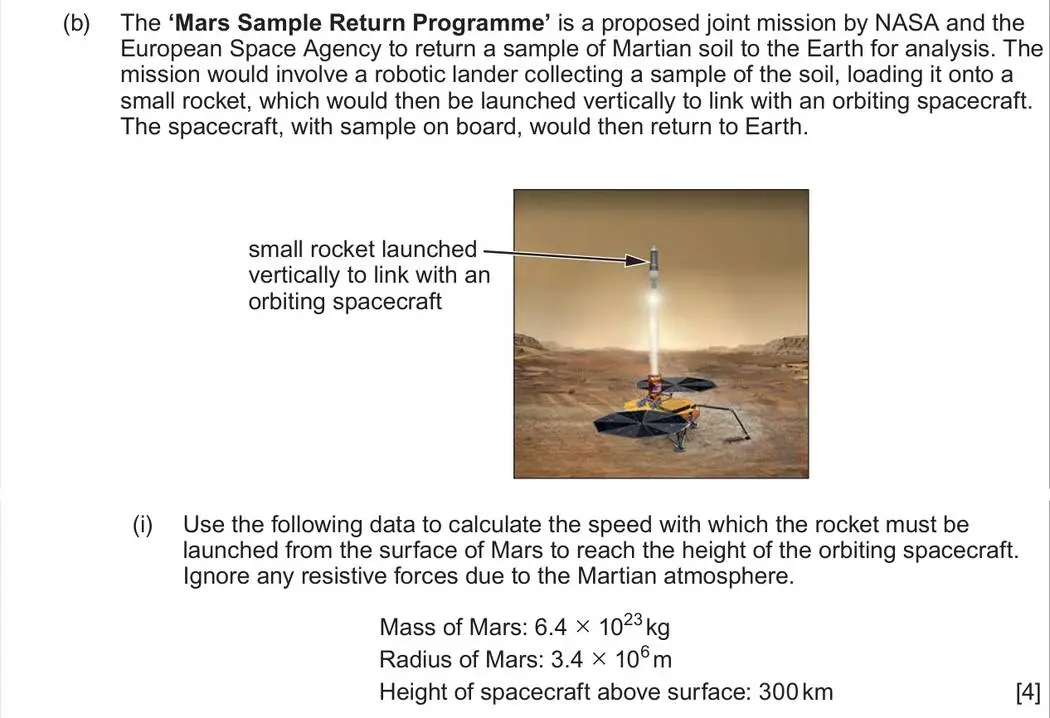
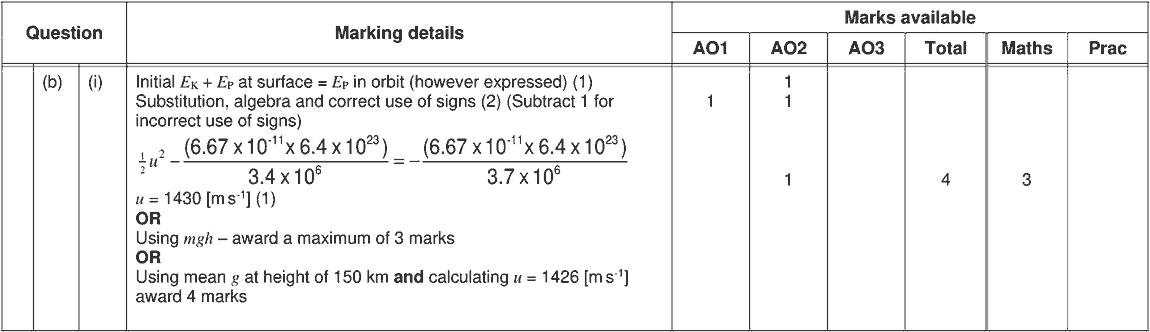
Answer: 1430 m s⁻¹. ½u² − GM/R = −GM/(R + h) with R = 3.4 × 10⁶ m and R + h = 3.7 × 10⁶ m
signs must be right (one mark lost otherwise)
mgh with surface g scores at most 3, mean g at 150 km gives full marks
Scheme columns: Maths 3
Skills: Synoptic Needs physics from another component of the qualification; Mathsmarks The mark scheme's Maths column gives this part at least one mark for mathematical skills
June 2023 · Component 3 · Q9(d)3 marksAO1=1, AO2=2Explanation
Earlier part of question 9 that this part uses
Mark scheme
Examiner's comment
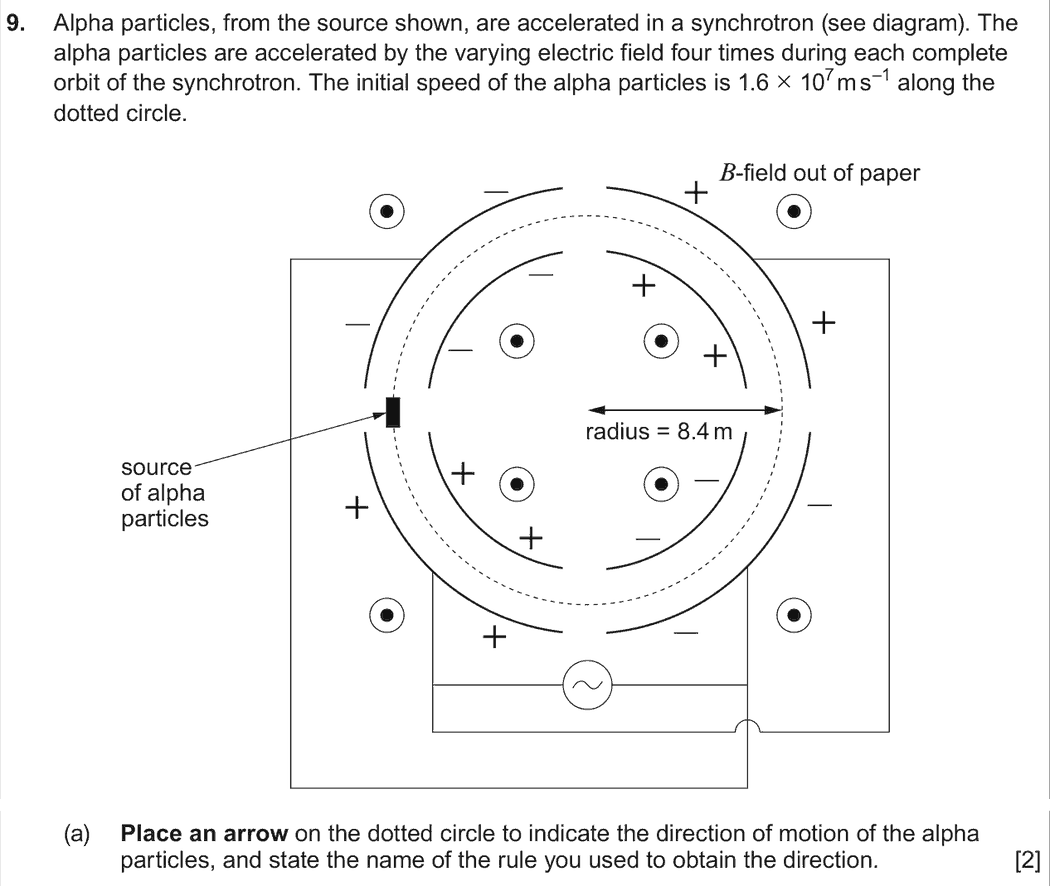
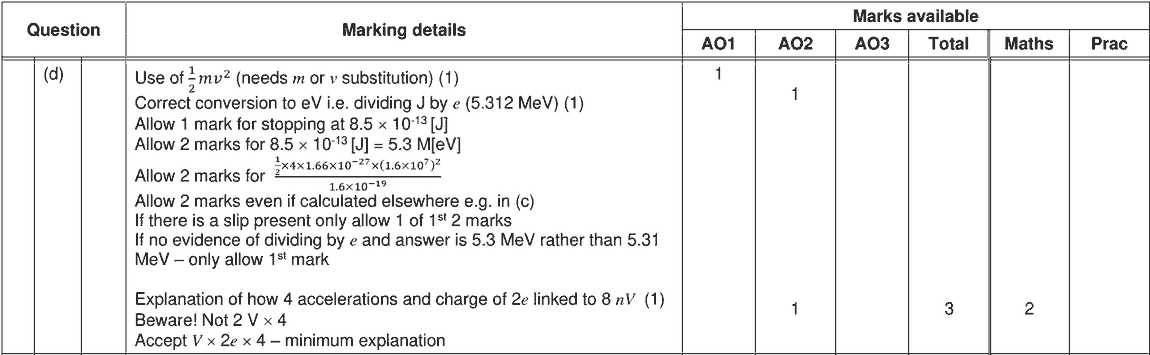
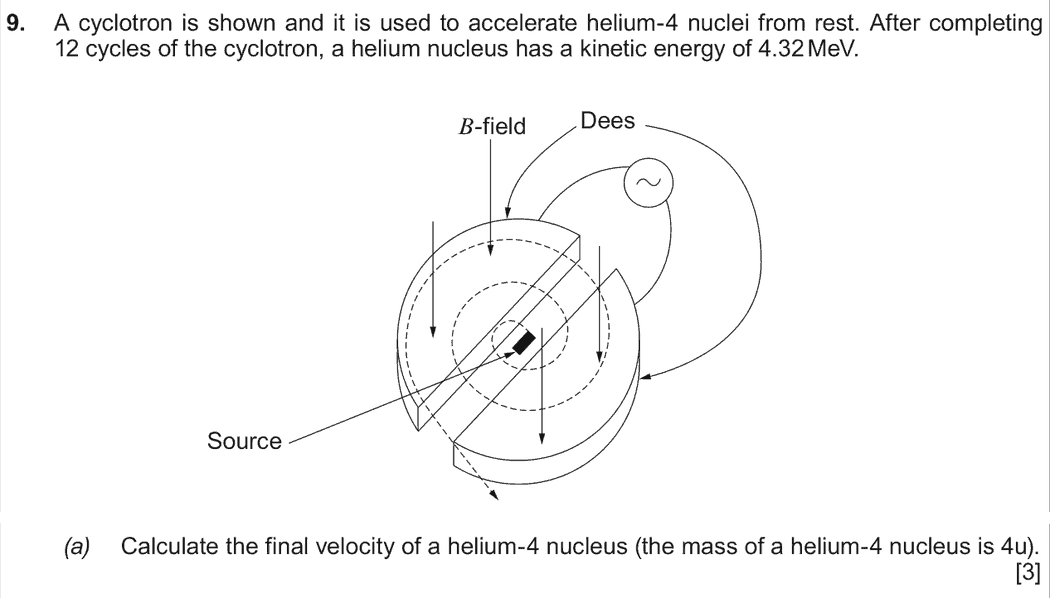
The direction was frequently wrong in (a) and the mass or the charge was sometimes wrong in (b). Part (c) was quite well answered. Few candidates realised that the frequency of the ac supply was 2 the frequency of performing circles (the pd needs to change sign 4 per cycle but the pd changes twice per cycle for a given frequency). The last part was quite poorly answered. Although the 8 × 𝑛× 𝑉 was difficult to explain (4 kicks per cycle and a charge of 2𝑒), converting 1.6 107 m s-1 to 5.3 MeV should have been straightforward. Perhaps candidates had forgotten that the speed was at the start of the question.
each orbit has 4 accelerations, each giving a charge of 2e an energy 2eV joules, i.e. 2V in eV, so 8V per orbit and 8nV after n orbits (1)
the conversion step was often not shown
Scheme columns: Maths 2
Skills: Unitsand conversions Unit marks, base units, prefixes and conversions; Mathsmarks The mark scheme's Maths column gives this part at least one mark for mathematical skills
June 2022 · AS Component 1 · Q2(b)(i)2 marksAO2=2Calculation
Earlier part of question 2 that this part uses
Mark scheme
Notes from the mark scheme and report
Answer: 2.56 J. Loss of kinetic energy = ½ × 0.16 × (9.0² − 7.0²), since the ball returns to the same height
unit mark
Scheme columns: Maths 2
Skills: Mathsmarks The mark scheme's Maths column gives this part at least one mark for mathematical skills
June 2022 · Component 1 · Q3(a)(ii)II2 marksAO1=1, AO2=1Calculation
Earlier parts of question 3 that this part uses
Mark scheme
Examiner's comment
Most candidates applied the principle successfully to the collision and correctly calculated the loss of kinetic energy. Mistakes were usually arithmetical. How does conservation of energy apply? Most candidates gained the first mark for some mention of transfer of kinetic to thermal, but for the second mark we needed more precision, such as transfer of kinetic energy to (random) internal energy in the discs, or, in time, as heat from the discs to the surroundings.
Notes from the mark scheme and report
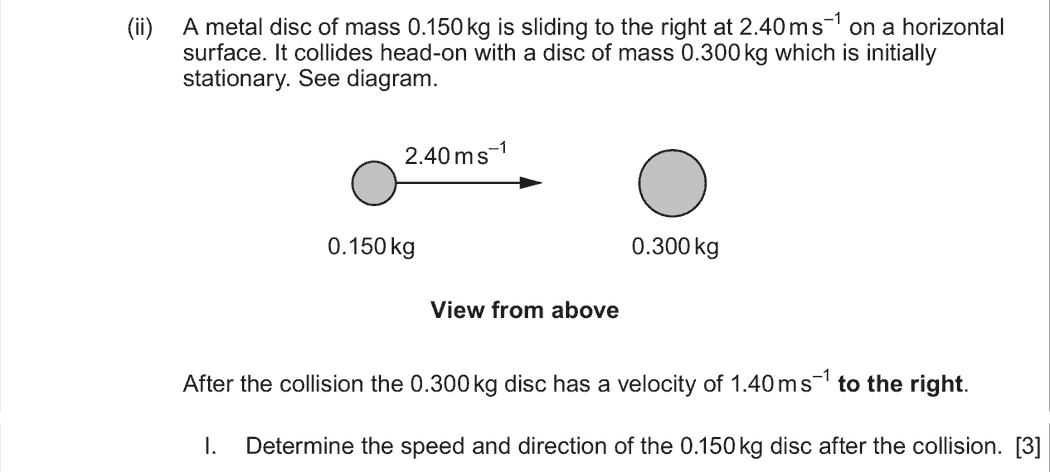
Answer: 0.126 J. KE before = ½ × 0.150 × 2.40² = 0.432 J
after = 0.012 + 0.294 = 0.306 J
ecf on the 0.40 m s⁻¹
Scheme columns: Maths 1
Skills: Mathsmarks The mark scheme's Maths column gives this part at least one mark for mathematical skills
June 2022 · Component 1 · Q3(a)(ii)III2 marksAO1=2Explanation
Earlier parts of question 3 that this part uses
Mark scheme
Examiner's comment
Most candidates applied the principle successfully to the collision and correctly calculated the loss of kinetic energy. Mistakes were usually arithmetical. How does conservation of energy apply? Most candidates gained the first mark for some mention of transfer of kinetic to thermal, but for the second mark we needed more precision, such as transfer of kinetic energy to (random) internal energy in the discs, or, in time, as heat from the discs to the surroundings.
Notes from the mark scheme and report
The kinetic energy 'lost' is transferred to internal (thermal) energy (1), of the discs, or eventually as heat to the surroundings (1), so total energy is unchanged
the second mark needed that precision
June 2022 · Component 1 · Q3(b)4 marksAO3=4Calculation
Earlier parts of question 3 that this part uses
Mark scheme
Examiner's comment
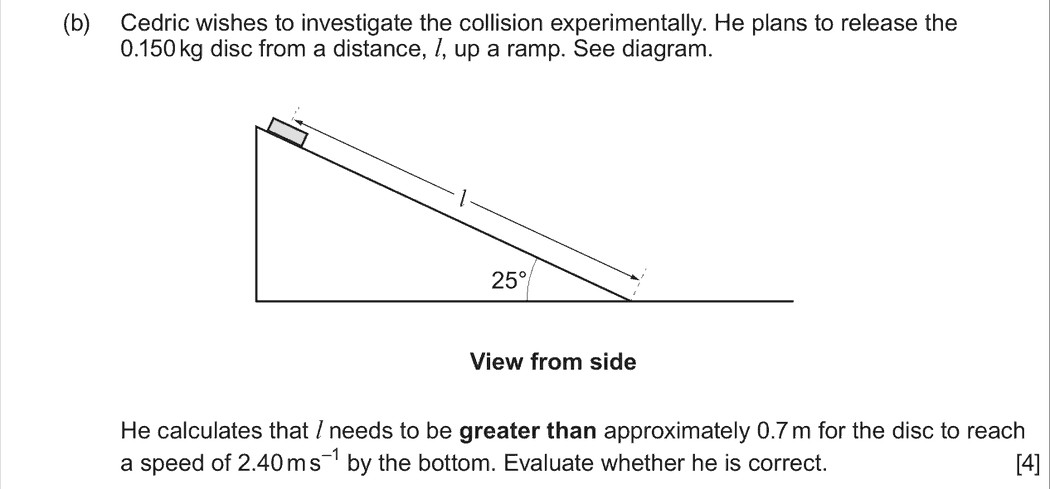
3 of the 4 marks were available for showing that a slope-length of 0.70 m would give an ‘ideal’ final speed of 2.4 m s–1, or vice versa. Many candidates succeeded, using energy conservation. The less popular method, using acceleration, tended to be less successful. The last mark was reserved for explaining why the actual slope-length needed to be greater than 0.7 m. A surprising number of candidates didn’t cite friction.
Notes from the mark scheme and report
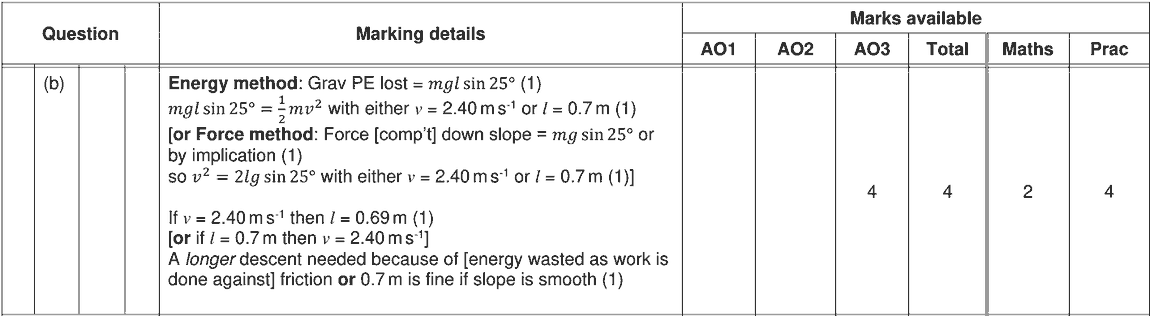
Gravitational PE lost = mgl sin 25° (1) set equal to ½mv² (1)
v = 2.40 m s⁻¹ gives l = 0.69 m, or l = 0.7 m gives v = 2.4 m s⁻¹ (1)
in practice a longer run is needed because work is done against friction, so he is correct (1). Force route: a = g sin 25° and v² = 2al. Many did not mention friction
Scheme columns: Maths 2, Practical 4
Skills: Trigonometryand vectors Resolving, components, vector addition, angles; Mathsmarks The mark scheme's Maths column gives this part at least one mark for mathematical skills; Practicalmarks The mark scheme's Prac column gives this part at least one mark for practical skills
June 2022 · Component 2 · Q8(b)(i)2 marksAO1=1, AO2=1Show that
Earlier part of question 8 that this part uses
Mark scheme
Examiner's comment
Many candidates applied the principle of conservation of energy appropriately to derive an expression for escape velocity. Some candidates lost a mark for incorrect use of signs.
Notes from the mark scheme and report
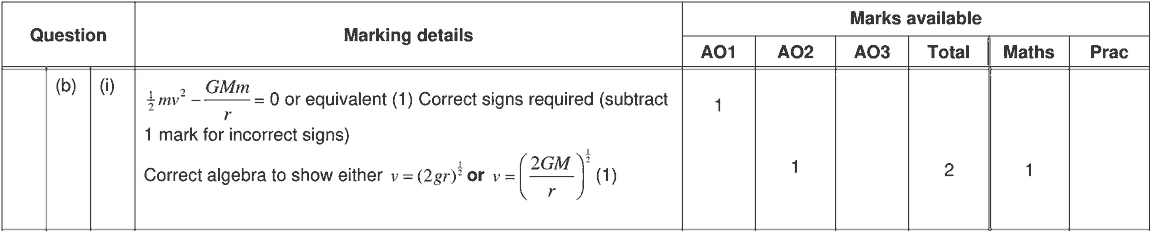
Total energy zero at infinity: ½mv² − GMm/r = 0 (signs must be right) (1)
v = √(2GM/r), or √(2gr) (1)
Scheme columns: Maths 1
Skills: Algebra Derivations and rearranging equations; Mathsmarks The mark scheme's Maths column gives this part at least one mark for mathematical skills
October 2021 · Component 1 · Q3(a)(i)1 markAO1=1Definition
Mark scheme
Notes from the mark scheme and report
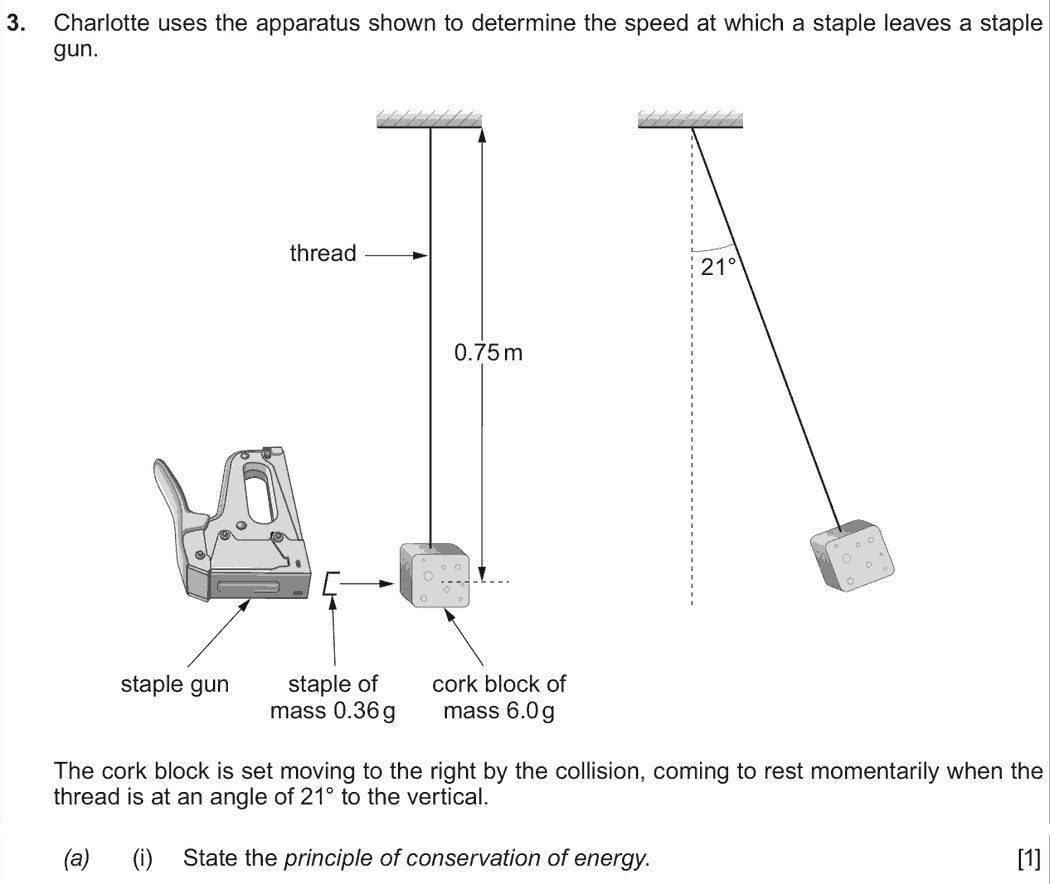
Energy cannot be created or destroyed, only transferred from one form to another
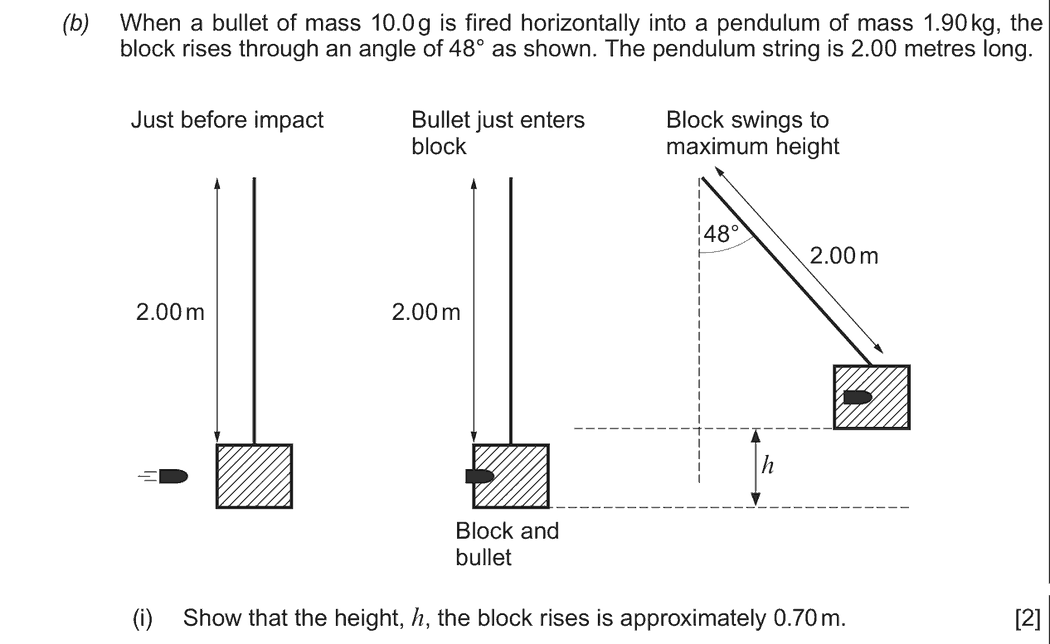
October 2021 · Component 1 · Q3(a)(ii)4 marksAO1=1, AO2=3Show that
Earlier part of question 3 that this part uses
Mark scheme
Notes from the mark scheme and report
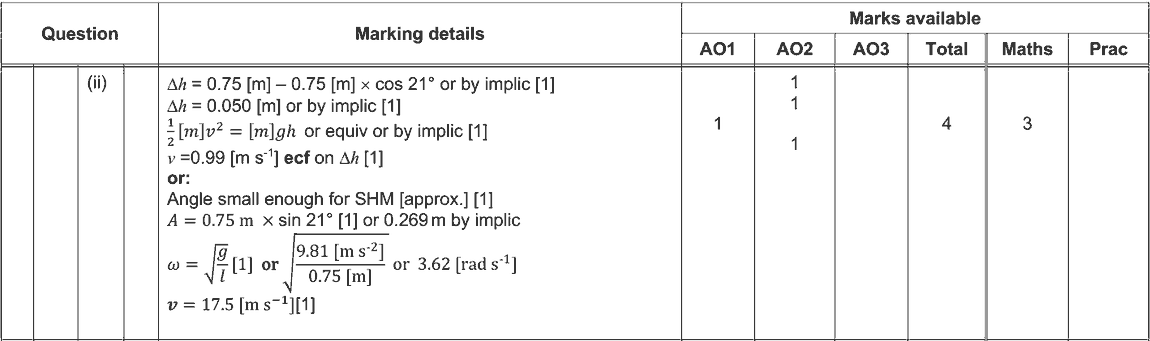
Rise of the block Δh = 0.75 − 0.75 cos 21° = 0.050 m (2)
½mv² = mgΔh (1)
v = √(2 × 9.81 × 0.050) = 0.99 m s⁻¹ (1)
SHM route also allowed: A = 0.75 sin 21° = 0.269 m, ω = √(g/l) = 3.62 rad s⁻¹, v = Aω
Scheme columns: Maths 3
Skills: Trigonometryand vectors Resolving, components, vector addition, angles; Mathsmarks The mark scheme's Maths column gives this part at least one mark for mathematical skills
October 2021 · Component 1 · Q5(a)(iii)II2 marksAO2=2Explanation
Earlier parts of question 5 that this part uses
Mark scheme
Notes from the mark scheme and report
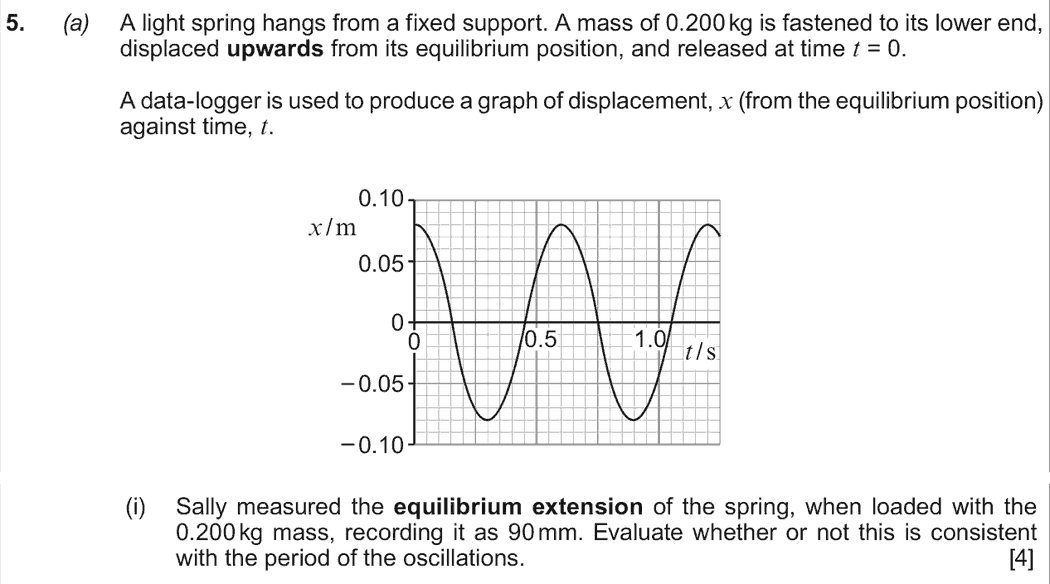
The spring stretches further as the mass moves down, so elastic potential energy is gained as well as kinetic energy (1)
KE gained = gravitational PE lost − elastic PE gained (1)
October 2020 · Component 1 · Q3(c)(ii)2 marksAO1=2Explanation
Earlier parts of question 3 that this part uses
Mark scheme
Examiner's comment
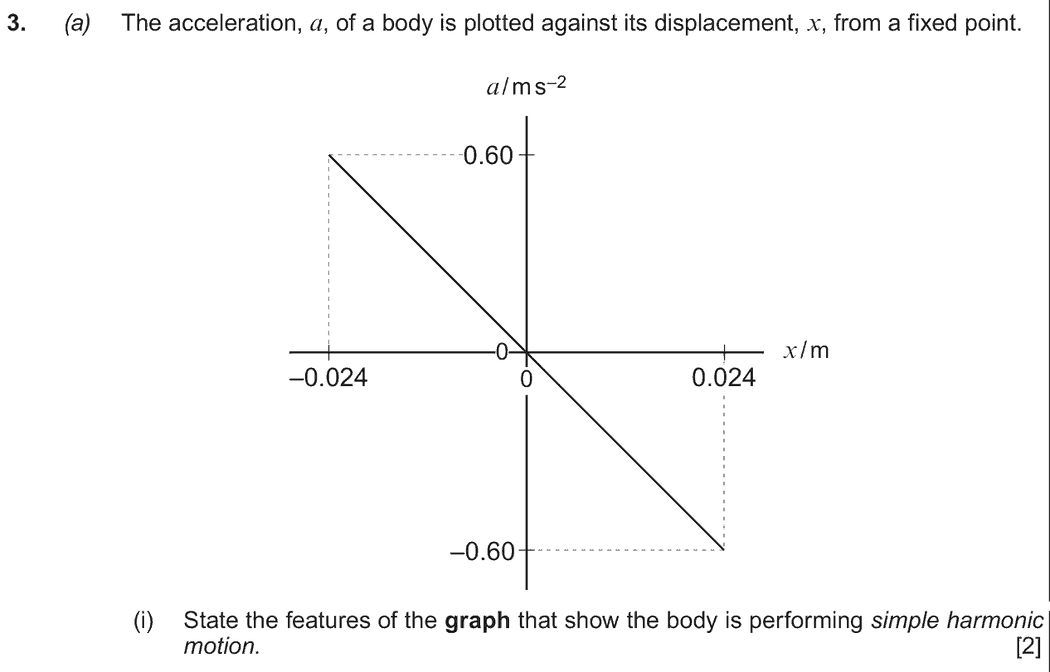
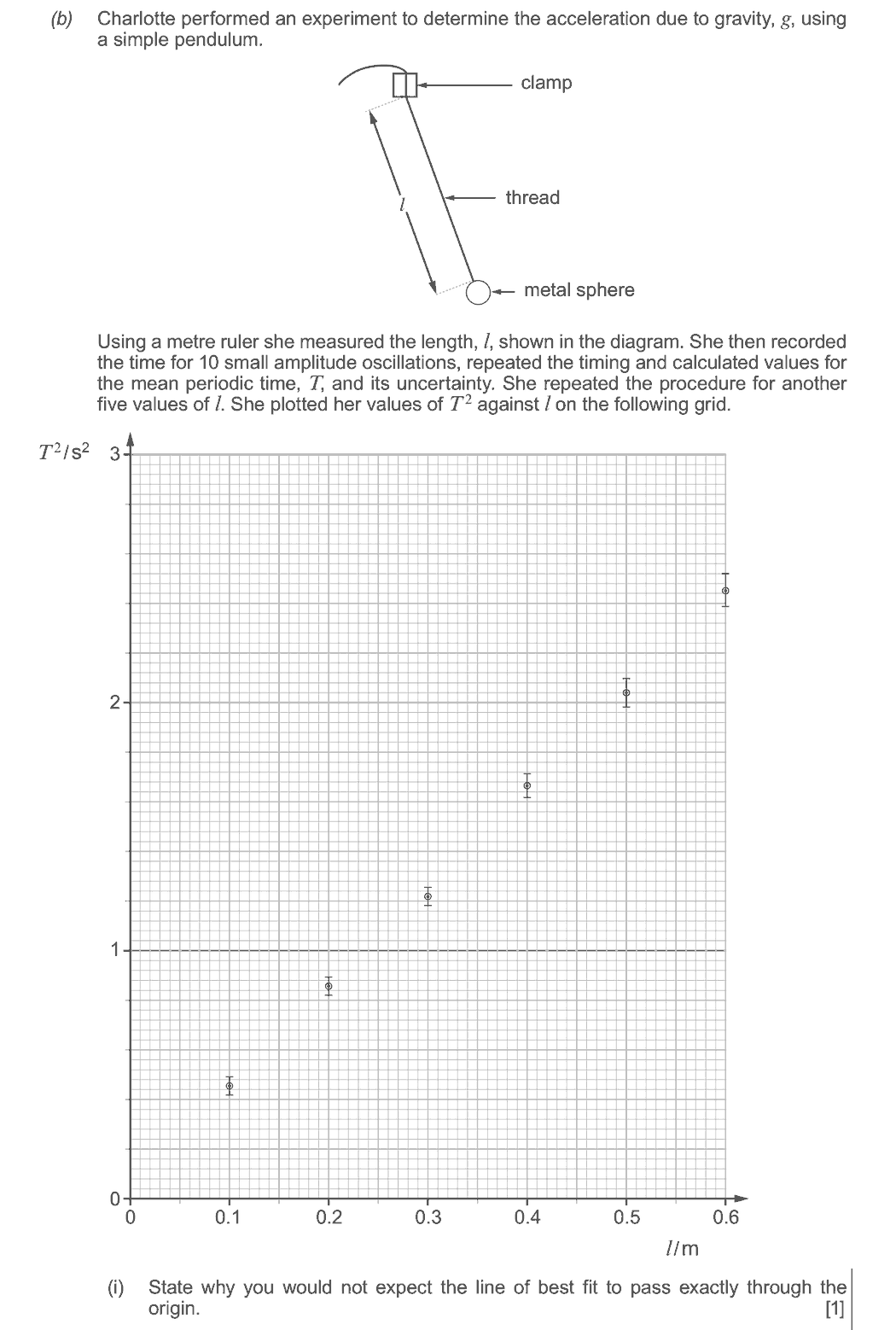
A graph of acceleration against displacement was given. Most candidates successfully identified the amplitude and calculated the period of the shm, but not everyone referred to the graph itself when asked what features showed the motion to be simple harmonic. Hardly anyone spotted that the pendulum’s length had not been measured to the centre of the bob, so the mark for (b)(i) was usually lost. This had not been intended to be tricky! A correct value for g was usually extracted from the graph of T2 against l, but the calculation of percentage uncertainty was not so good; several candidates drew only a single, best fit, graph line rather than lines of greatest and least gradient allowed by the error bars. Everyone knew that damping was associated with decreasing amplitude and attributed it to the action of resistive forces. Critical damping was less well understood. A bare majority knew that it brings the displaced body to rest without overshooting zero displacement, and only one or two candidates knew that the resistive force is the least possible that will do this (as a greater resistive force will result in a slower approach to zero). A good example, often given, was a car suspension. Suspension bridge damping was accepted on this occasion, but this is really to damp forced oscillations, and isn’t necessarily critical.
Notes from the mark scheme and report
Resistive (dissipative) forces such as air resistance act on the ball (1)
they always oppose the motion, so energy is transferred out of the oscillating system (1)
October 2020 · Component 1 · Q4(a)3 marksAO2=3Show that
Mark scheme
Examiner's comment
The power input to the piano hauling and the efficiency were usually calculated correctly, though elements of output and input were sometimes muddled together. Was the KE given to the piano a major reason for inefficiency? Calculating its KE (2.4 J) was a sensible start – made by about half the candidates.
Notes from the mark scheme and report
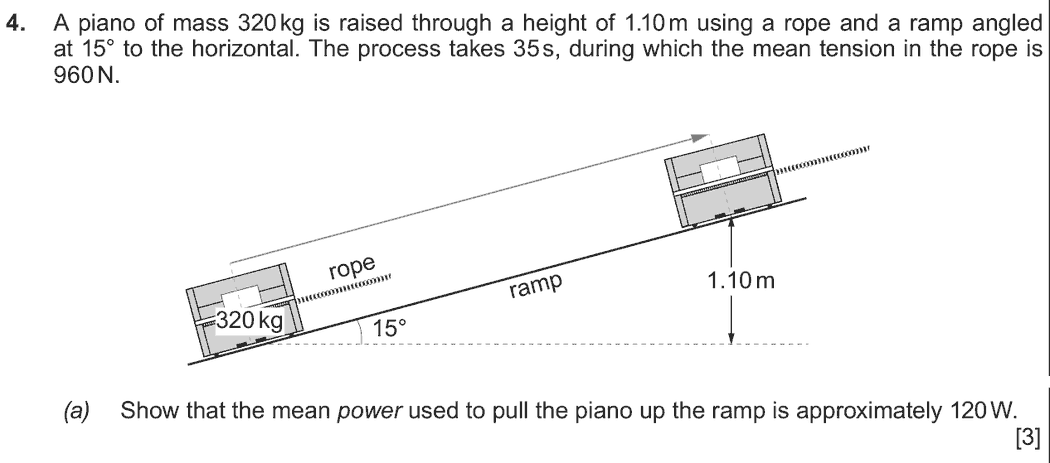
Distance along the ramp = 1.10/sin 15° = 4.25 m
work = 960 × 4.25 = 4080 J
power = 4080/35 = 117 W
Scheme columns: Maths 2
Skills: Trigonometryand vectors Resolving, components, vector addition, angles; Mathsmarks The mark scheme's Maths column gives this part at least one mark for mathematical skills
October 2020 · Component 1 · Q4(b)3 marksAO2=3Calculation
Earlier part of question 4 that this part uses
Mark scheme
Examiner's comment
The power input to the piano hauling and the efficiency were usually calculated correctly, though elements of output and input were sometimes muddled together. Was the KE given to the piano a major reason for inefficiency? Calculating its KE (2.4 J) was a sensible start – made by about half the candidates.
Notes from the mark scheme and report
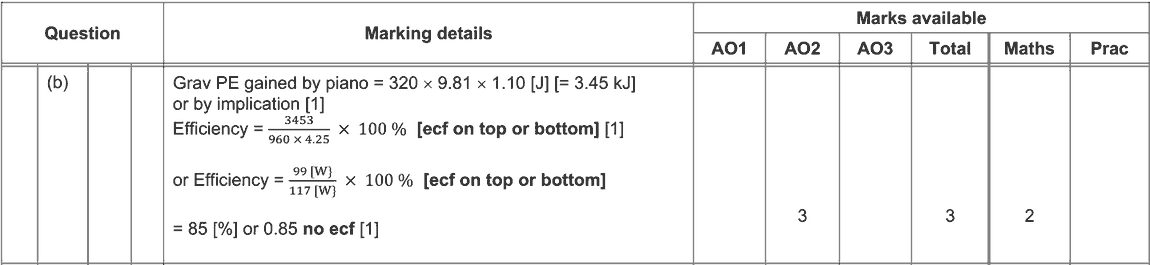
Answer: 85% (0.85). Gain in GPE = 320 × 9.81 × 1.10 = 3453 J
efficiency = 3453/(960 × 4.25), or 99 W/117 W
input and output were sometimes mixed up
Scheme columns: Maths 2
Skills: Mathsmarks The mark scheme's Maths column gives this part at least one mark for mathematical skills
October 2020 · Component 1 · Q4(c)2 marksAO3=2Calculation
Earlier part of question 4 that this part uses
Mark scheme
Examiner's comment
The power input to the piano hauling and the efficiency were usually calculated correctly, though elements of output and input were sometimes muddled together. Was the KE given to the piano a major reason for inefficiency? Calculating its KE (2.4 J) was a sensible start – made by about half the candidates.
Notes from the mark scheme and report
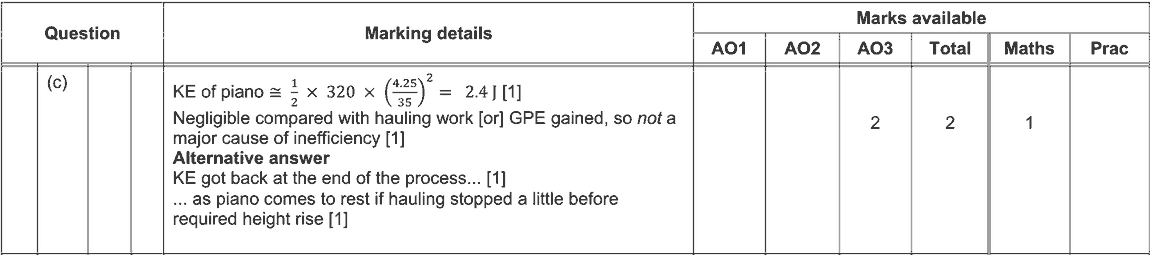
KE = ½ × 320 × (4.25/35)² = 2.4 J (1)
negligible beside the 4080 J of work or 3450 J of GPE, so not a major cause (friction is) (1)
alternative: the KE is recovered as the piano coasts to rest at the top
Scheme columns: Maths 1
Skills: Mathsmarks The mark scheme's Maths column gives this part at least one mark for mathematical skills
October 2020 · Component 1 · Q5(b)(iii)3 marksAO2=3Calculation
Earlier parts of question 5 that this part uses
Mark scheme
Examiner's comment
The kinetic theory calculations were very well done, and the momentum conservation and kinetic energy non-conservation parts, almost as well. Several candidates did not seem to know that gas molecules at a given temperature had a wide range of speeds. A surprising number of candidates used a wrong formula for the photon energy.
Notes from the mark scheme and report
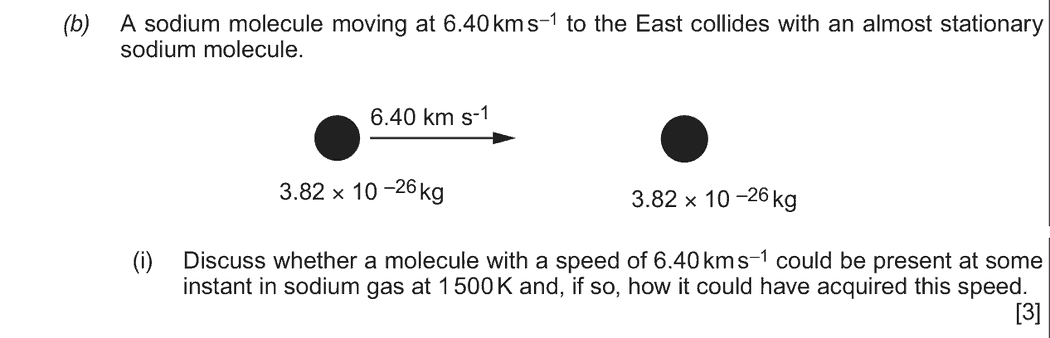
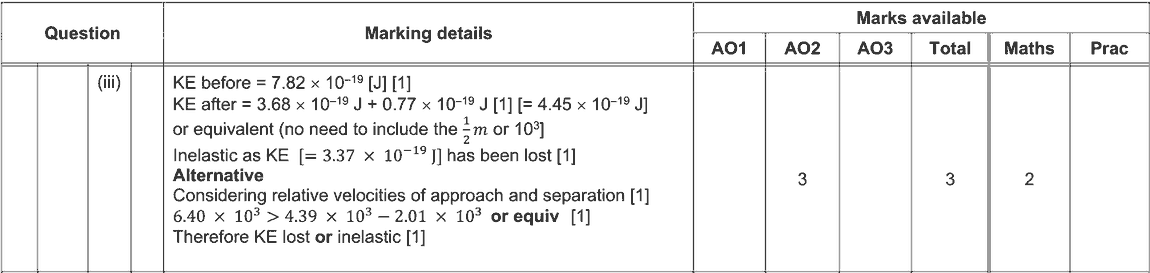
Answer: inelastic. KE before = ½ × 3.82 × 10⁻²⁶ × 6400² = 7.82 × 10⁻¹⁹ J
KE after = 3.68 × 10⁻¹⁹ + 0.77 × 10⁻¹⁹ = 4.45 × 10⁻¹⁹ J
kinetic energy is lost. Or relative speed of separation (2.38 km s⁻¹) is less than that of approach (6.40 km s⁻¹)
Scheme columns: Maths 2
Skills: Mathsmarks The mark scheme's Maths column gives this part at least one mark for mathematical skills
June 2019 · AS Component 1 · Q2(a)1 markAO1=1Definition
Mark scheme
Notes from the mark scheme and report
Energy cannot be created or destroyed, only transferred from one form to another
June 2019 · Component 1 · Q2(b)2 marksAO1=1, AO2=1Calculation
Earlier part of question 2 that this part uses
Mark scheme
Examiner's comment
Almost everyone calculated the work done by the gravitational force correctly. Occasionally the factor of cos 64° was omitted.
Notes from the mark scheme and report
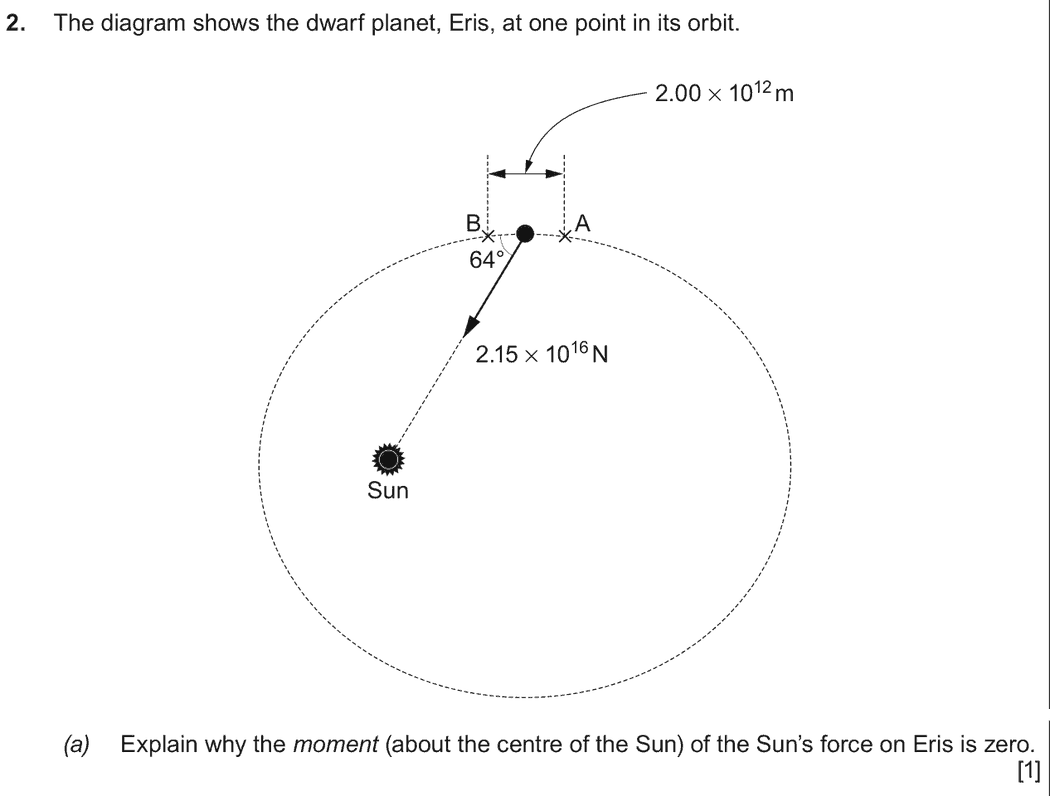
Answer: 1.88 × 10²⁸ J. W = Fx cos θ = 2.15 × 10¹⁶ × 2.00 × 10¹² × cos 64°
unit mark
cos 64° occasionally left out
Scheme columns: Maths 2
Skills: Trigonometryand vectors Resolving, components, vector addition, angles; Unitsand conversions Unit marks, base units, prefixes and conversions; Mathsmarks The mark scheme's Maths column gives this part at least one mark for mathematical skills
June 2019 · AS Component 1 · Q2(b)(ii)2 marksAO2=2Calculation
Earlier parts of question 2 that this part uses
Mark scheme
Notes from the mark scheme and report
Answer: 3.60 m s⁻¹. ½mv² = mgh (1) so v = √(2 × 9.81 × 0.66) (1)
Scheme columns: Maths 2
Skills: Mathsmarks The mark scheme's Maths column gives this part at least one mark for mathematical skills
June 2019 · Component 1 · Q2(c)3 marksAO3=3Calculation
Earlier part of question 2 that this part uses
Mark scheme
Examiner's comment
The great majority calculated the change in KE of Eris, and noted that it was the same as the work done. A minority used the data to calculate the acceleration of Eris in the direction AB, multiplied it by the mass of Eris and then by the distance AB, and commented that this was the same as the work calculated in (b). This is a valid check and was given full credit (even though it was seldom mentioned that the calculated acceleration was only one component of Eris’s acceleration).
Notes from the mark scheme and report
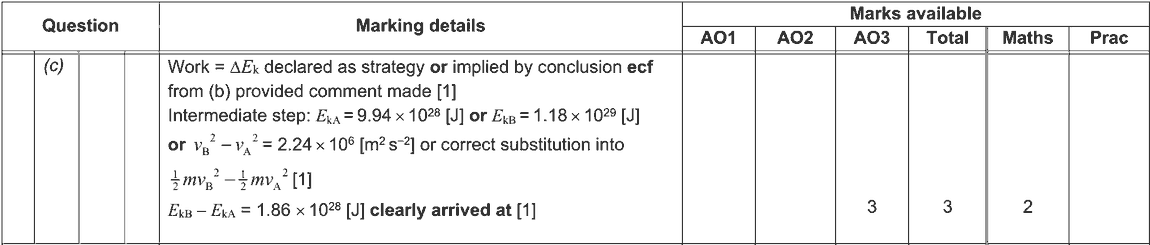
Work done = gain in kinetic energy
½m(vB² − vA²) = ½ × 1.66 × 10²² × (3770² − 3460²) = 1.86 × 10²⁸ J (EkA = 9.94 × 10²⁸ J, EkB = 1.18 × 10²⁹ J), which agrees with (b), so consistent
a check using the acceleration component along AB × mass × distance was also credited
Scheme columns: Maths 2
Skills: Mathsmarks The mark scheme's Maths column gives this part at least one mark for mathematical skills
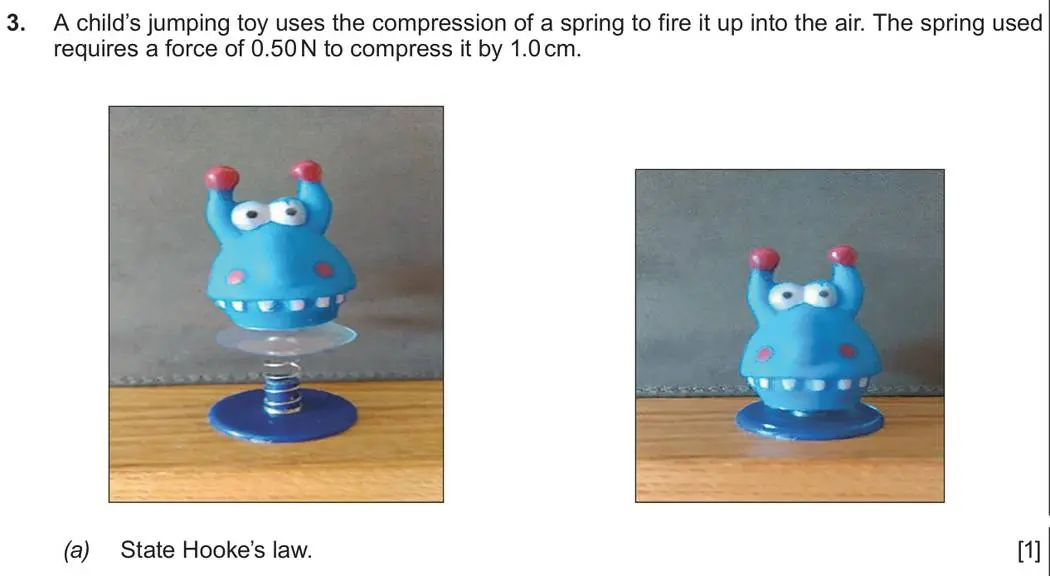
June 2019 · AS Component 1 · Q3(b)(i)3 marksAO2=3Calculation
Earlier part of question 3 that this part uses
Mark scheme
Notes from the mark scheme and report
Answer: 3.0 m s⁻¹. k = 0.50/0.010 = 50 N m⁻¹ (1)
½kx² = ½mv² (1)
v = 0.060 × √(50/0.020) (1)
Scheme columns: Maths 2
Skills: Unitsand conversions Unit marks, base units, prefixes and conversions; Mathsmarks The mark scheme's Maths column gives this part at least one mark for mathematical skills
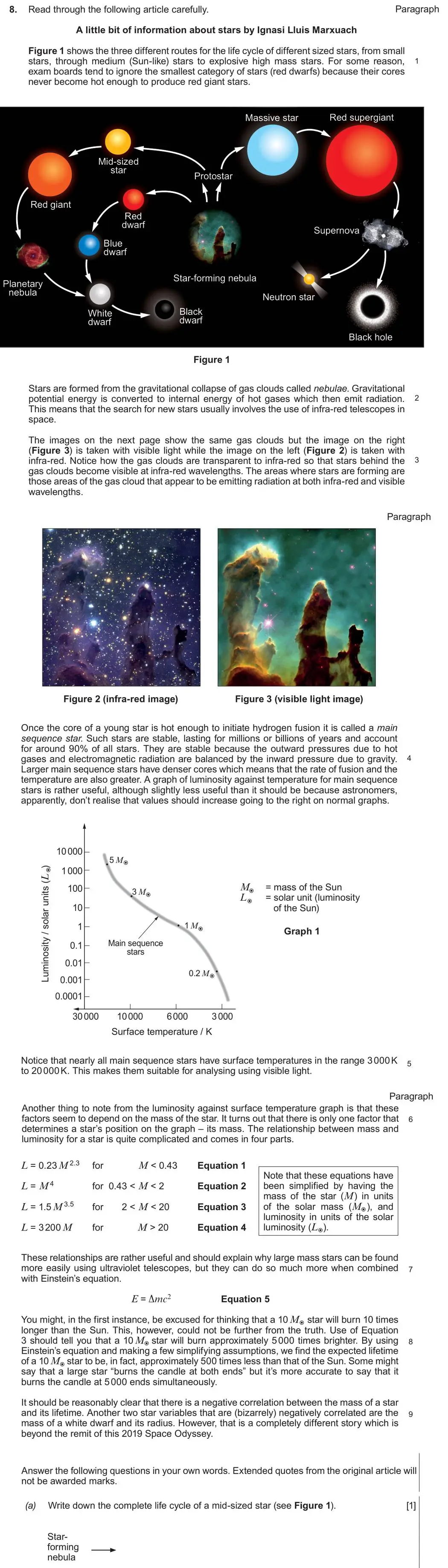
June 2019 · Component 1 · Q8(h)4 marksAO2=4Explanation
Earlier parts of question 8 that this part uses
Mark scheme
Examiner's comment
The first mark, usually gained, was for using equation 3 to calculate the luminosity of a star of mass 10 𝑴⨀. Credit was then available for making clear that the luminosity was to be used as the rate of loss of energy and that the available energy was 𝑴𝒄𝟐= 𝟏𝟎 𝑴⨀𝒄𝟐. This credit could be given by implication to the many candidates who quoted energy time = power and substituted 𝟏𝟎 𝑴⨀𝒄𝟐 𝟓𝟎𝟎𝟎 𝑳⨀= ( 𝟓𝟎𝟎) × solar lifetime. Once or twice it was pointed out that this is oversimplified because the star’s luminosity would decrease as its mass dwindled.
Notes from the mark scheme and report
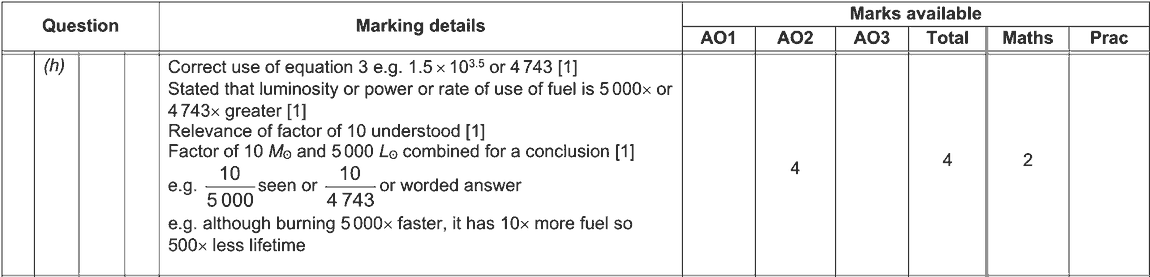
Equation 3: L = 1.5 × 10^3.5 = 4743, about 5000 solar units (1)
so fuel is used about 5000 times faster (1)
assume the energy available is proportional to mass (E = mc²), so there is 10 times more fuel (1)
lifetime factor = 10/5000 = 1/500 (1)
assumes constant luminosity
Scheme columns: Maths 2
Skills: Comprehension A level Component 1 Section B: questions on the printed article; Mathsmarks The mark scheme's Maths column gives this part at least one mark for mathematical skills
June 2019 · Component 2 · Q6(b)(ii)3 marksAO2=3Calculation
Earlier parts of question 6 that this part uses
Mark scheme
Notes from the mark scheme and report
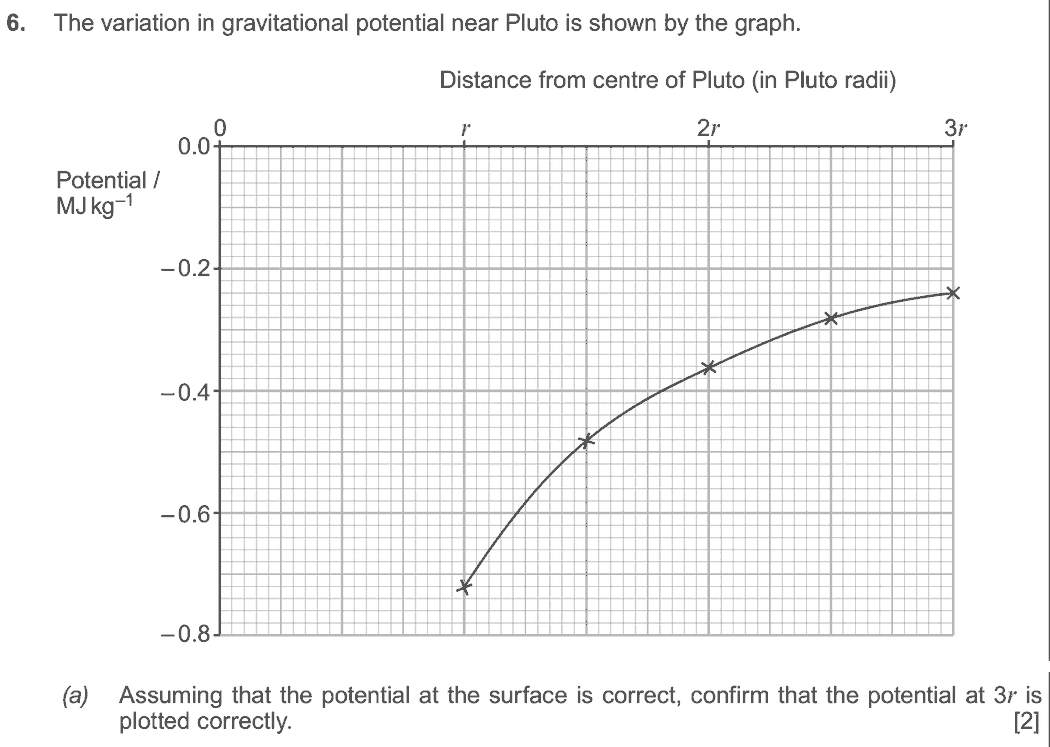
Answer: 1.2 km s⁻¹. Kinetic energy needed = magnitude of the potential energy (total energy zero at infinity) (1)
½ × 600 × v² = 4.3 × 10⁸, or v = √(2 × 0.72 × 10⁶) (1)
v = 1.2 × 10³ m s⁻¹ (1)
ecf
Scheme columns: Maths 2
Skills: Mathsmarks The mark scheme's Maths column gives this part at least one mark for mathematical skills
June 2019 · Component 3 · Q5(d)2 marksAO3=2Calculation
Earlier part of question 5 that this part uses
Mark scheme
Examiner's comment
This part question proved to be tougher than expected (p2 = 2mE was an advantage here too). The very best answers converted the KE of the nucleus to eV.
Skills: Synoptic Needs physics from another component of the qualification; Mathsmarks The mark scheme's Maths column gives this part at least one mark for mathematical skills
June 2018 · AS Component 1 · Q3(b)3 marksAO2=3Calculation
Earlier part of question 3 that this part uses
Mark scheme
Examiner's comment
Parts (a) (b) and (c)(i) and (ii) were generally well answered
Notes from the mark scheme and report
Answer: 6790 J. Gain in KE = ½ × 95 × (9.2² − 4.5²) = 3058 J
gain in PE = 95 × 9.81 × 4.0 = 3728 J
add
Scheme columns: Maths 3
Skills: Mathsmarks The mark scheme's Maths column gives this part at least one mark for mathematical skills
June 2018 · AS Component 1 · Q3(c)(i)2 marksAO1=1, AO2=1Calculation
Earlier part of question 3 that this part uses
Mark scheme
Examiner's comment
Parts (a) (b) and (c)(i) and (ii) were generally well answered
Notes from the mark scheme and report
Answer: 3680 J. E = VIt = 36 × 7.0 × 14.6
ecf on the time
Scheme columns: Maths 2
Skills: Mathsmarks The mark scheme's Maths column gives this part at least one mark for mathematical skills
June 2018 · AS Component 1 · Q3(c)(ii)2 marksAO2=2Calculation
Earlier parts of question 3 that this part uses
Mark scheme
Examiner's comment
Parts (a) (b) and (c)(i) and (ii) were generally well answered
Notes from the mark scheme and report
Answer: 35%. Useful output of the motor = 6786 − 5500 = 1286 J
efficiency = 1286/3679 × 100
ecf from (b) and (c)(i)
Scheme columns: Maths 2
Skills: Mathsmarks The mark scheme's Maths column gives this part at least one mark for mathematical skills
June 2018 · AS Component 1 · Q3(c)(iii)2 marksAO1=2Short answer
Earlier parts of question 3 that this part uses
Mark scheme
Examiner's comment
This was not well answered. Many candidates just wrote the words ‘friction’ and ‘air resistance’ without stating on which part of the person / bike they were acting.
Notes from the mark scheme and report
Friction in the motor, bearings or between tyre and road (1)
air resistance on Helen and the bike (1)
the place where each force acts is needed, bare 'friction' or 'heat and sound' not credited
poorly answered for that reason
June 2018 · AS Component 1 · Q3(d)2 marksAO3=2Explanation
Earlier part of question 3 that this part uses
Mark scheme
Examiner's comment
This also proved to be more discriminating than expected, although there were some very well argued examples.
Notes from the mark scheme and report
Yes: no direct emissions from the bike, unlike a petrol car (1)
and the power-station emissions (CO2, particulates) needed to charge it are much smaller than those from a car (1)
June 2018 · Component 1 · Q4(a)2 marksAO1=2Definition
Mark scheme
Examiner's comment
Almost all statements of the principle of conservation of energy were satisfactory.
Notes from the mark scheme and report
The total energy of a closed system stays constant (1)
energy can be transferred from one form (store) to another (1)
June 2018 · Component 1 · Q4(b)(i)I3 marksAO1=1, AO2=2Calculation
Earlier part of question 4 that this part uses
Mark scheme
Examiner's comment
Most candidates applied E kx to the graph of elastic PE, and found k correctly. A minority tried unsuccessfully to use F kx .
Notes from the mark scheme and report
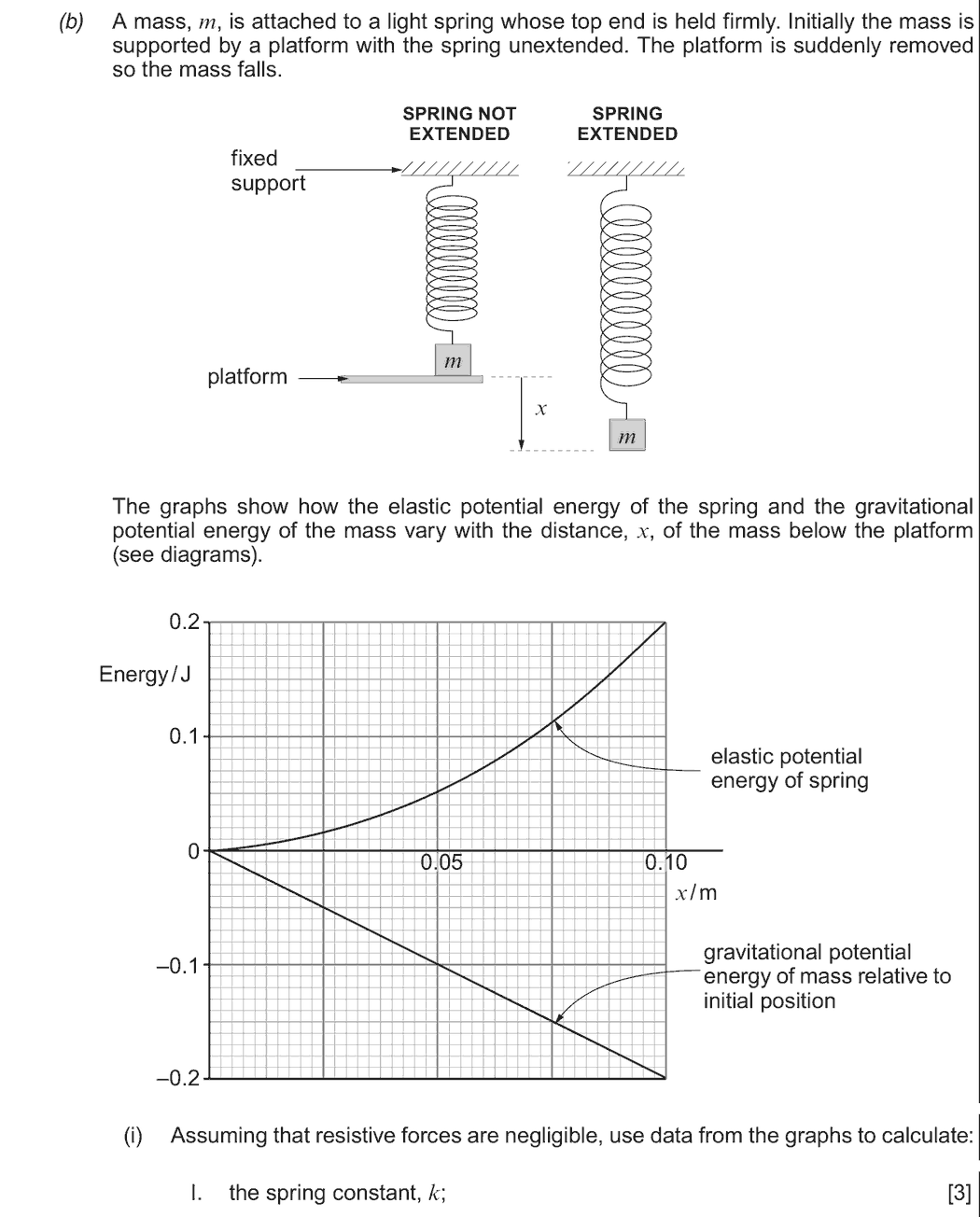
Answer: 40 N m⁻¹ (unit needed
J m⁻² accepted). Read a point on the curve, e.g. 0.20 J at x = 0.10 m
k = 2E/x²
using F = kx did not work
Scheme columns: Maths 2
Skills: Graphskills Reading, plotting or sketching graphs; gradients, intercepts and areas; Mathsmarks The mark scheme's Maths column gives this part at least one mark for mathematical skills
June 2018 · Component 1 · Q4(b)(i)II2 marksAO1=1, AO2=1Calculation
Earlier parts of question 4 that this part uses
Mark scheme
Examiner's comment
Almost everyone determined the mass correctly from the graph of gravitational PE.
Notes from the mark scheme and report
Answer: 0.20 kg. Point on the straight line, e.g. −0.20 J at x = 0.10 m
m = E/(gx)
Scheme columns: Maths 1
Skills: Graphskills Reading, plotting or sketching graphs; gradients, intercepts and areas; Mathsmarks The mark scheme's Maths column gives this part at least one mark for mathematical skills
June 2018 · Component 1 · Q4(b)(i)III2 marksAO2=2Calculation
Earlier parts of question 4 that this part uses
Mark scheme
Examiner's comment
The correct value for the KE at x = 0.05 m was usually given. In that case the method was not scrutinised too severely, as the ‘command word’ in the question was ‘calculate’, but we withheld marks if the candidate had clearly equated the KE to the elastic PE without taking account of the (change in) gravitational PE.
Notes from the mark scheme and report
Answer: 0.050 J. Total energy is zero throughout, so KE = 0.10 − 0.050 J
equating KE to the elastic PE alone scored nothing
Scheme columns: Maths 1
Skills: Graphskills Reading, plotting or sketching graphs; gradients, intercepts and areas; Mathsmarks The mark scheme's Maths column gives this part at least one mark for mathematical skills
June 2018 · Component 1 · Q4(b)(ii)2 marksAO2=2Diagram or graph
Earlier parts of question 4 that this part uses
Mark scheme
Examiner's comment
About half the candidates sketched KE against distance fallen correctly – quite impressive as it needed careful thought, or dredging from the depths of SHM theory. The commonest mistake was to start with a non-zero KE at x = 0.
Notes from the mark scheme and report
Smooth curve rising from (0, 0) to a maximum at (0.05, 0.05) and falling to (0.10, 0)
about half were correct
commonest error a non-zero KE at x = 0
Scheme columns: Maths 2
Skills: Graphskills Reading, plotting or sketching graphs; gradients, intercepts and areas; Mathsmarks The mark scheme's Maths column gives this part at least one mark for mathematical skills
June 2018 · Component 1 · Q4(c)4 marksAO3=4Practical and data analysis
Earlier parts of question 4 that this part uses
Mark scheme
Examiner's comment
Describing how to verify that xmax is proportional to m was well done. Occasionally candidates wrote of waiting for the mass to be in equilibrium, and sometimes, but not often, they did not specify how to use the results to check the relationship.
Notes from the mark scheme and report
Attach different masses, release and measure xmax each time (1)
one practical detail, e.g. metre rule, repeats, avoid parallax (1)
plot xmax against m, or calculate xmax/m for each pair (1)
a straight line through the origin, or a constant ratio, verifies the relationship (1)
waiting for equilibrium was a mistake
Scheme columns: Maths 2, Practical 4
Skills: Experimentalmethod Describing, planning or improving an experiment; Graphskills Reading, plotting or sketching graphs; gradients, intercepts and areas; Mathsmarks The mark scheme's Maths column gives this part at least one mark for mathematical skills; Practicalmarks The mark scheme's Prac column gives this part at least one mark for practical skills
June 2018 · Component 1 · Q8(b)3 marksAO3=3Explanation
Earlier part of question 8 that this part uses
Mark scheme
Examiner's comment
Discussions of the advantages and disadvantages of powering cars by compressed air were generally disappointing. Many candidates seemed to think that compressed air was a free resource: there were frequent (correct) claims that the cars would not pollute, but little consideration of the energy needed elsewhere to compress the air. Credit was available, but not always claimed, for ‘adding value’ to the data in the question, for example by pointing out that ‘refuelling’ would have to be much more frequent than for a petrol car.
Notes from the mark scheme and report
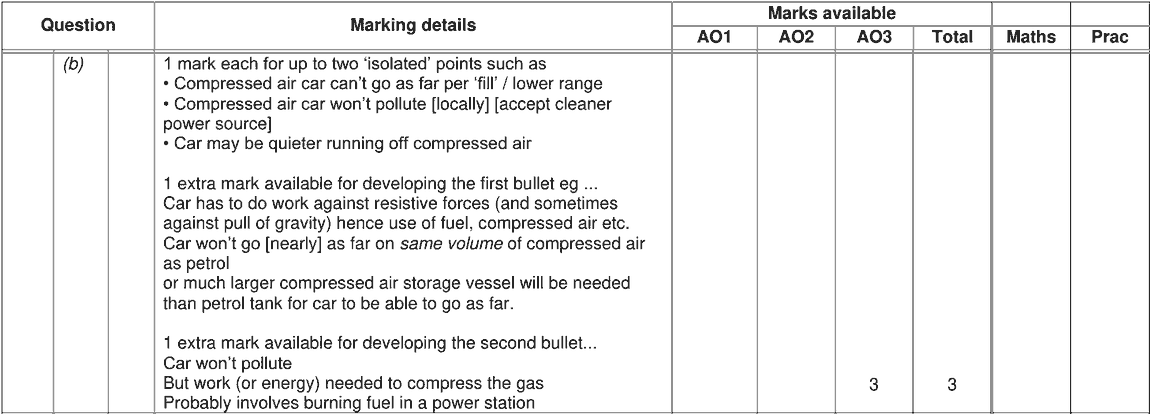
Up to two separate points (range per fill is far lower
no local pollution
quieter) plus development: 40 times less work from the same volume so a much larger tank or far more frequent refilling
energy is needed to compress the air, probably from burning fuel at a power station. Many treated compressed air as a free resource
Skills: Synoptic Needs physics from another component of the qualification; Unitsand conversions Unit marks, base units, prefixes and conversions; Mathsmarks The mark scheme's Maths column gives this part at least one mark for mathematical skills
June 2017 · Component 1 · Q2(a)(ii)3 marksAO1=1, AO2=2Calculation
Earlier part of question 2 that this part uses
Mark scheme
Examiner's comment
To find the work done by the force, the usual way was to multiply the force by the distance as determined from the graph. Quite a common mistake was to calculate the distance as 𝒖−𝒗 𝟐𝑡 rather than 𝒖+𝒗 𝟐𝑡.
Notes from the mark scheme and report
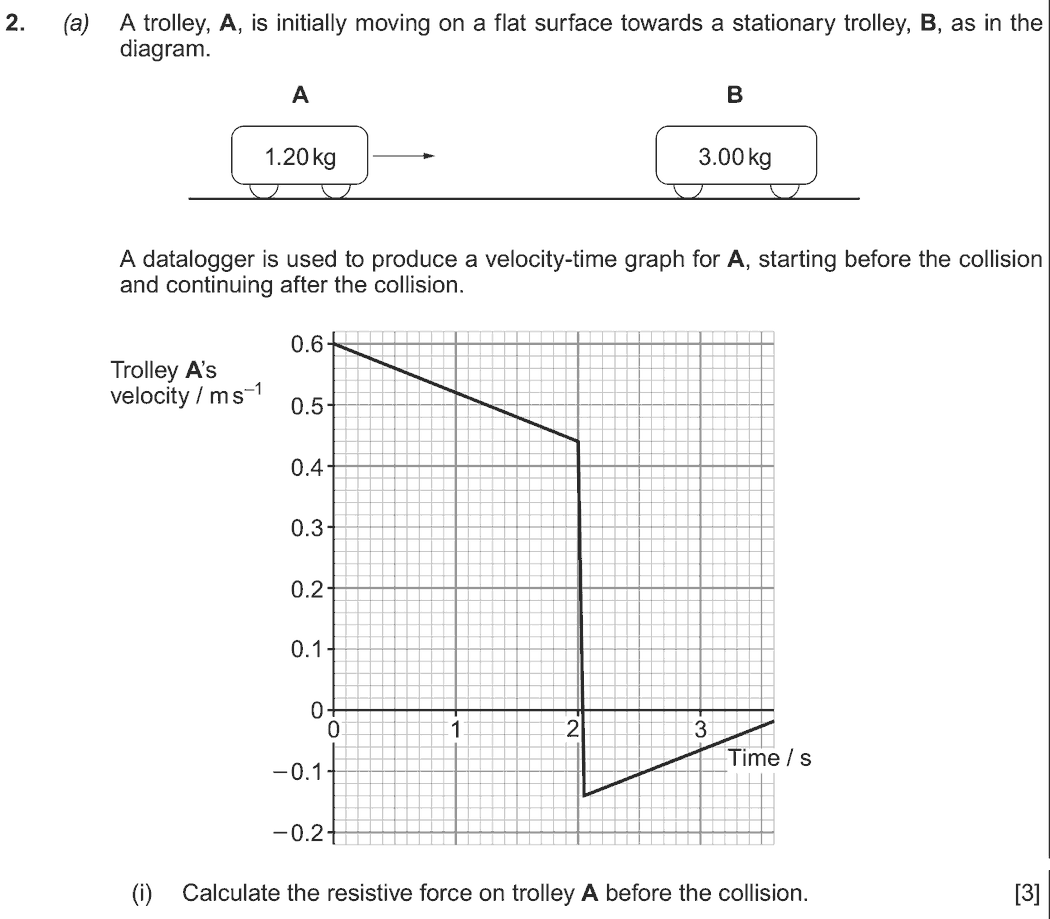
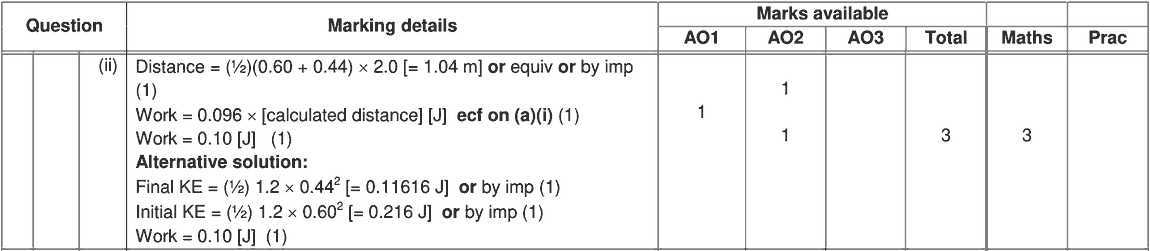
Answer: 0.10 J. Distance = area under graph = ½(0.60 + 0.44) × 2.0 = 1.04 m
work = 0.096 × 1.04
or loss of kinetic energy 0.216 − 0.116 J
common slip: (u − v)t/2 for the distance
Scheme columns: Maths 3
Skills: Graphskills Reading, plotting or sketching graphs; gradients, intercepts and areas; Mathsmarks The mark scheme's Maths column gives this part at least one mark for mathematical skills
June 2017 · Component 1 · Q2(a)(iv)3 marksAO3=3Calculation
Earlier part of question 2 that this part uses
Mark scheme
Examiner's comment
Most candidates showed clearly that the collision was inelastic. Kinetic energy calculations were far more common than using the coefficient of restitution – not on our specification but perfectly legitimate.
Notes from the mark scheme and report
Kinetic energy before = ½ × 1.20 × 0.44² = 0.116 J
after = ½ × 1.20 × 0.14² + ½ × 3.00 × 0.232² = 0.092 J
kinetic energy is lost so the collision is inelastic and Jasmine is wrong
ecf
Scheme columns: Maths 2
Skills: Mathsmarks The mark scheme's Maths column gives this part at least one mark for mathematical skills
June 2017 · Component 1 · Q2(b)3 marksAO3=3Explanation
Earlier part of question 2 that this part uses
Mark scheme
Examiner's comment
Thicker metal for cars? Many candidates considered the effect on passengers in collisions. The valid point was sometimes made that certain injuries might be avoided because the thicker metal would be less likely to deform. There were some poorly argued claims that injuries might be worse ‘because of the greater momentum’, but the more rapid deceleration of passengers due to less crumpling was quite often correctly given as a likely disadvantage of using thicker metal. [Some candidates claimed implausibly that the collision would be more prolonged and the passenger acceleration less.] Points not directly related to passenger injuries included the bad effects of mining more metal, and increased fuel consumption – sometimes related to more energy being needed to bring the car up to speed and/or more tyre resistance. Well- argued points were given two marks. Plenty of sound reasoning (and some sloppy reasoning) were displayed, as well as excellent awareness of environmental issues.
Notes from the mark scheme and report
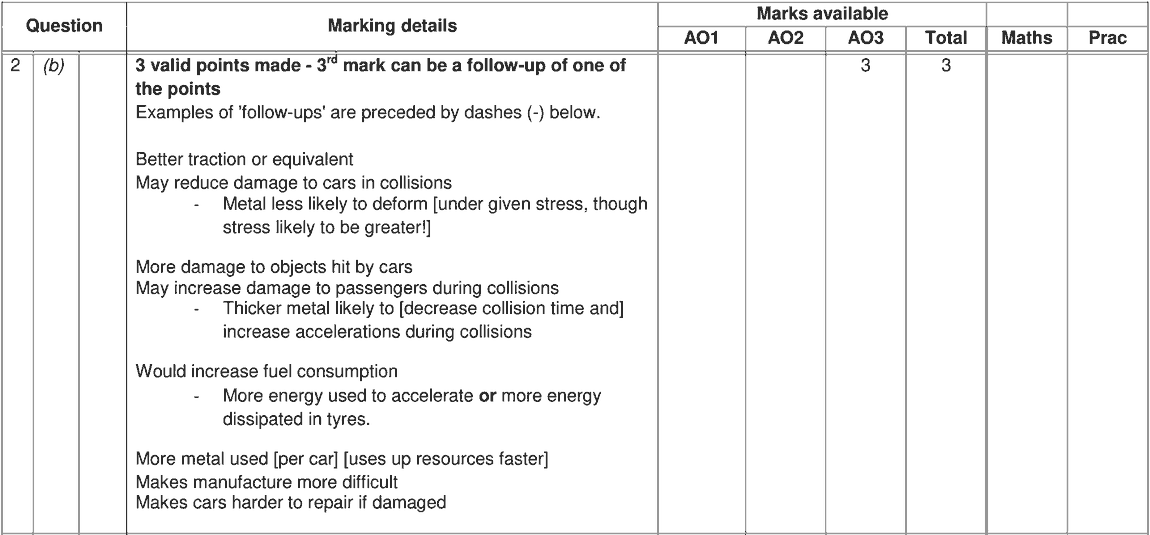
Three valid points, the third may develop an earlier one: e.g. less deformation so less damage to the car
less crumpling means a shorter collision time and greater deceleration of passengers
more damage to whatever is hit
heavier car so more fuel used
more metal mined and manufactured. Claims based only on 'greater momentum' were weak
June 2017 · Component 2 · Q7(a)(iii)4 marksAO1=1, AO2=3Calculation
Earlier part of question 7 that this part uses
Mark scheme
Examiner's comment
Only the better candidates calculated the speed with which the spacecraft impacted with the Moon successfully. Both approaches outlined in the mark scheme were seen in the scripts.
Notes from the mark scheme and report
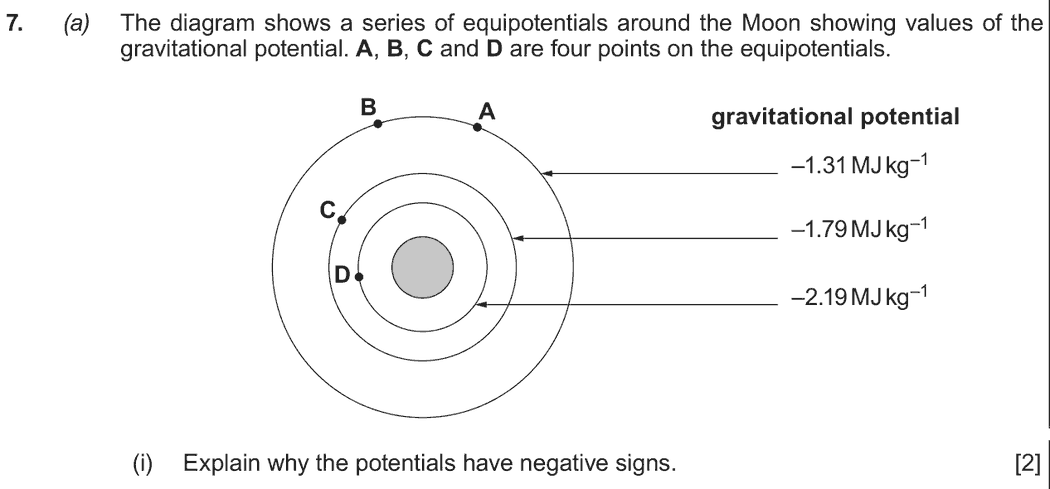
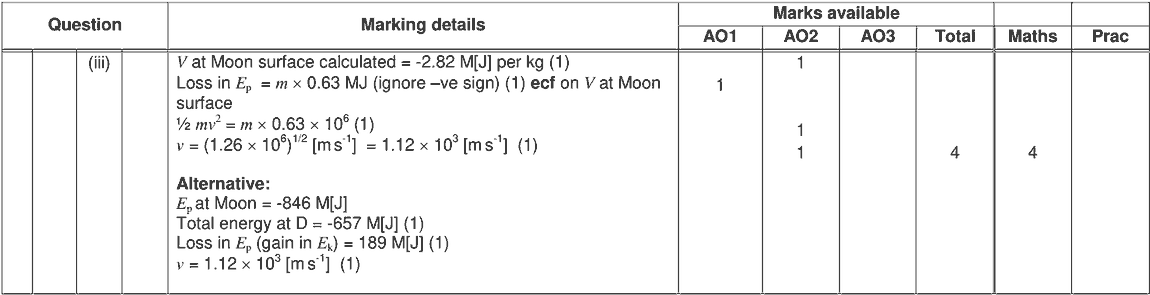
Answer: 1.12 × 10³ m s⁻¹. Potential at the surface = −GM/r = −6.67 × 10⁻¹¹ × 7.35 × 10²²/1.74 × 10⁶ = −2.82 MJ kg⁻¹
loss in potential from D = 0.63 MJ kg⁻¹
½v² = 0.63 × 10⁶. Or energies: −846 MJ at the surface, −657 MJ at D, gain in KE 189 MJ
Scheme columns: Maths 4
Skills: Unitsand conversions Unit marks, base units, prefixes and conversions; Mathsmarks The mark scheme's Maths column gives this part at least one mark for mathematical skills
June 2016 · AS Component 1 · Q3(c)(ii)3 marksAO2=3Calculation
Earlier parts of question 3 that this part uses
Mark scheme
Examiner's comment
These parts caused a number of candidates problems. In part (i) many candidates realised the velocity would change due to air resistance but didn’t specify that the horizontal velocity was the important component. There were a number of different ways to answer part (ii) with many using the work – energy theorem and others equations of motion.
Notes from the mark scheme and report
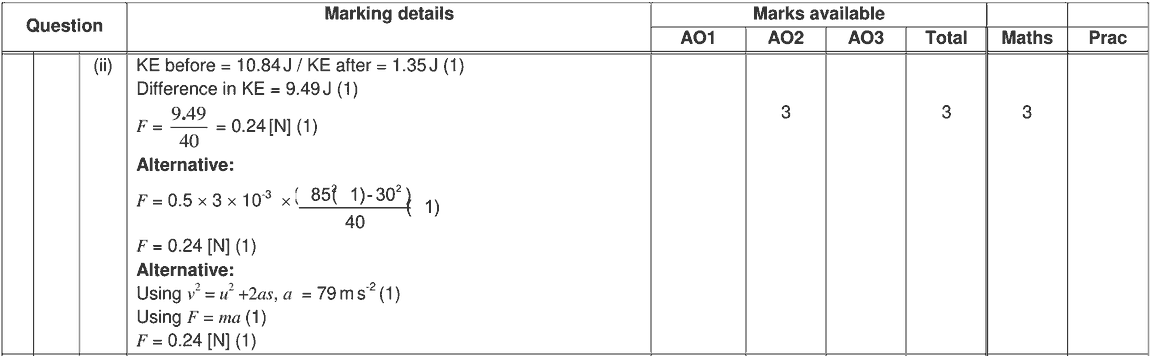
Answer: 0.24 N. Loss of KE = 10.84 − 1.35 = 9.49 J
F = 9.49/40. Alternative: v² = u² + 2as gives a = 79 m s⁻², then F = ma
Scheme columns: Maths 3
Skills: Mathsmarks The mark scheme's Maths column gives this part at least one mark for mathematical skills
Work with an Eduqas physics tutor
Dropping marks on calculations, specified practicals or the six-mark QER questions? Book a trial session with a specialist Eduqas physics tutor.