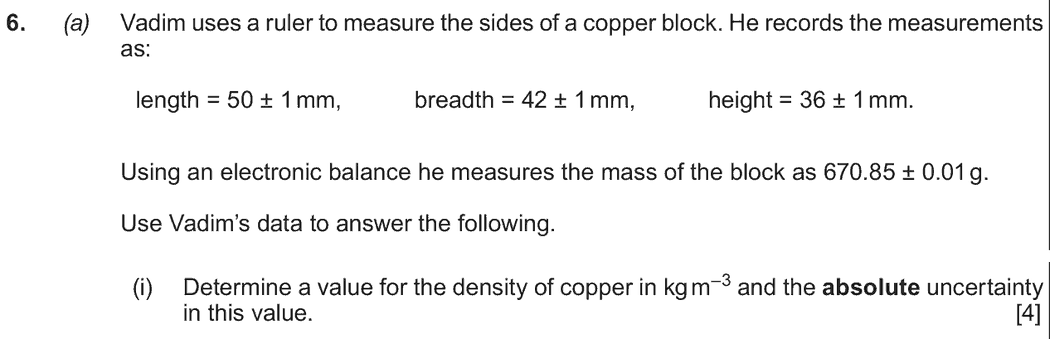
Notes and key-term cards for this topic are being written by our tutors. The past-paper questions below are ready now.
Specification statements
Show the 6 statements from the specification
1.7-a the equation of state for an ideal gas expressed as pV = nRT where R is the molar gas constant and pV = NkT where k is the Boltzmann constant
1.7-b the assumptions of the kinetic theory of gases which includes the random distribution of energy among the molecules
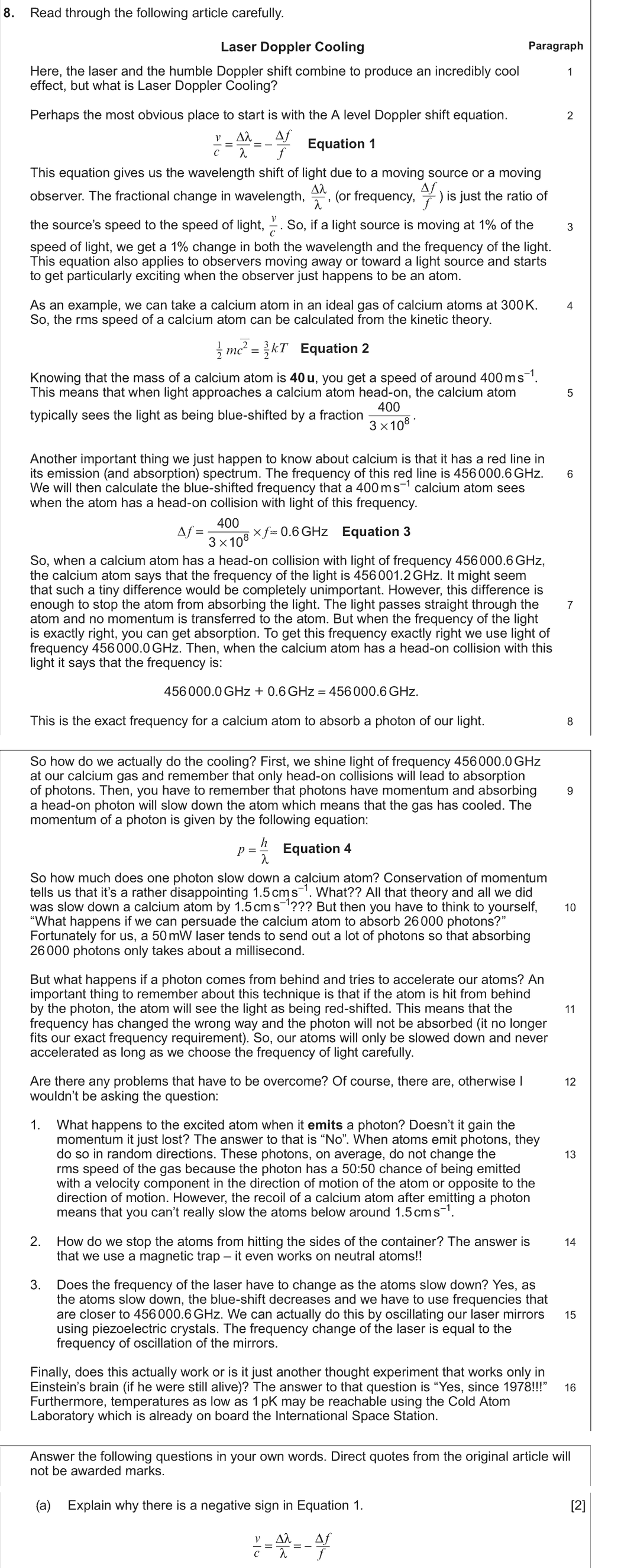
1.7-c the idea that molecular movement causes the pressure exerted by a gas, and use p = ⅓ρ<c²> = ⅓(N/V)m<c²> where N is the number of molecules (<c²> = mean square speed)
1.7-d the definition of Avogadro constant NA and hence the mole
1.7-e the idea that the molar mass M is related to the relative molecular mass Mr by M / kg = Mr/1000, and that the number of moles n is given by total mass / molar mass
1.7-f how to combine pV = ⅓Nm<c²> with pV = nRT and show that the total translational kinetic energy of a mole of a monatomic gas is given by (3/2)RT and the mean kinetic energy of a molecule is (3/2)kT where k = R/NA is the Boltzmann constant, and that T is proportional to the mean kinetic energy
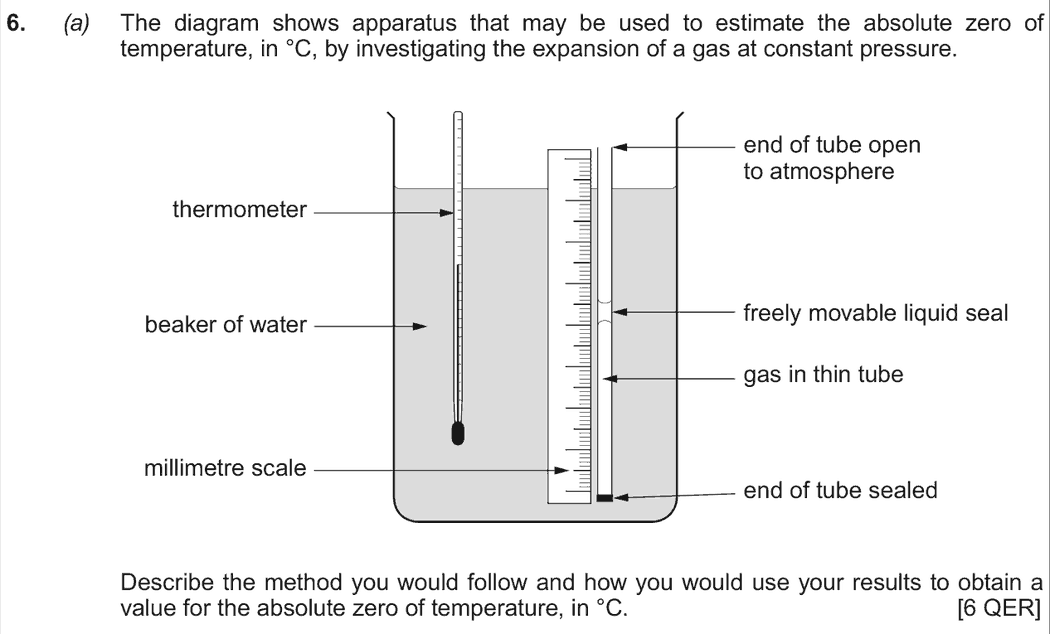
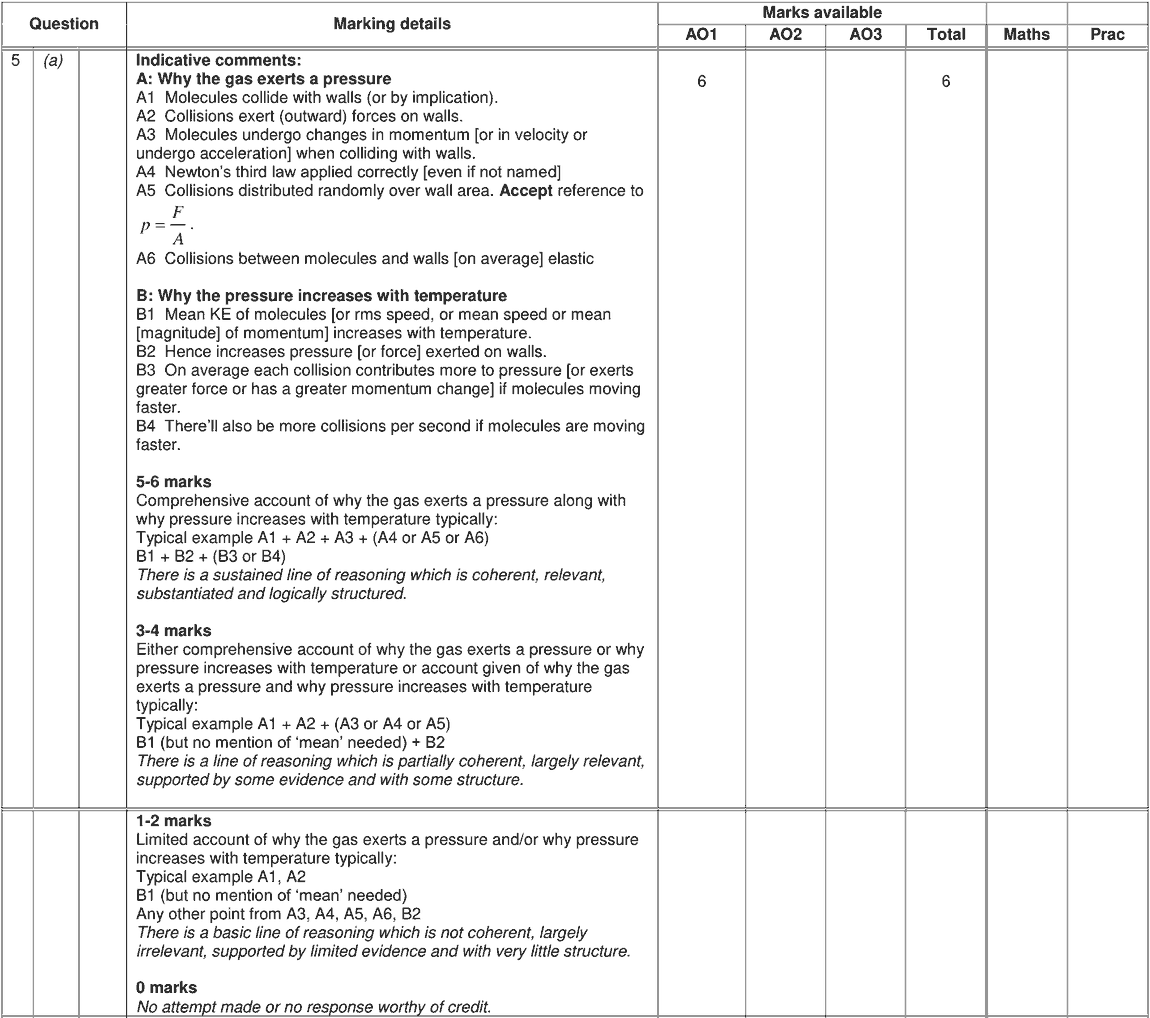
. (a) Explain, in terms of molecules, how a gas exerts a pressure on the walls of its container, and why this pressure increases with temperature. [6 QER]
Tap a question to zoom it. Where a part needs a figure, table or graph from earlier in the question, that part folds out above it; the mark scheme and examiner's comment open underneath. Have the Eduqas Data Booklet beside you (see the Data Booklet page).
June 2025 · Component 1 · Q6(a)2 marksAO2=2Calculation
Mark scheme
Examiner's comment
2 𝑘𝑇 was used by many in this question. They were awarded the 1st MP and usually went on to produce the correct answer. Some candidates used 2 𝑅𝑇 and this was accepted for the 1st MP if they remembered to divide by NA. This was not regularly the case.
Notes from the mark scheme and report
Answer: 6.1 × 10⁻²¹ J. Mean KE = (3/2)kT = 1.5 × 1.38 × 10⁻²³ × 293
(3/2)RT needs dividing by the Avogadro constant, often forgotten
Scheme columns: Maths 2
Skills: Unitsand conversions Unit marks, base units, prefixes and conversions; Mathsmarks The mark scheme's Maths column gives this part at least one mark for mathematical skills
June 2025 · Component 1 · Q6(b)4 marksAO1=1, AO2=3Calculation
Earlier part of question 6 that this part uses
Mark scheme
Examiner's comment
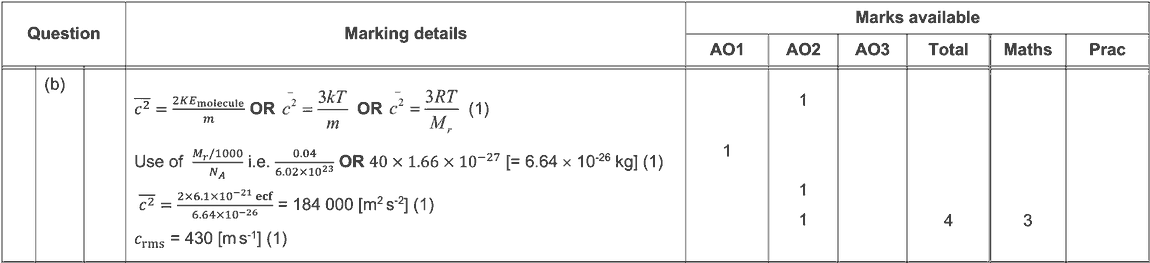
The different paths through this question meant we often saw kinetic theory equations being combined in order to arrive at 𝑐2̅̅̅ = 𝐸𝑘 𝑚𝑜𝑙𝑒𝑐𝑢𝑙𝑒 𝑚 or 3𝑘𝑇 𝑚 for the 1st MP. Candidates then had to successfully calculate the mass of one molecule to allow 𝑐2̅̅̅ to be calculated and hence 𝑐rms. Some candidates found a way around the 2nd MP by using 𝑐2̅̅̅ = 3𝑅𝑇 𝑀𝑟. They were awarded all 4 marks if the arrived at the correct 𝑐rms. On a small number of occasions 𝑐2̅̅̅ was written as 𝑐 2. We did not penalise on this occasion however it is worth noting for future candidates that 𝑐2̅̅̅ is the mean square speed and 𝑐 2 is the mean speed squared. This should not be confused.
Notes from the mark scheme and report
Answer: 430 m s⁻¹. Mass of a molecule = 0.040/6.02 × 10²³ = 6.64 × 10⁻²⁶ kg
<c²> = 2 × KE/m = 3kT/m = 1.84 × 10⁵ m² s⁻²
take the square root. Or <c²> = 3RT/M with M = 0.040 kg mol⁻¹
Scheme columns: Maths 3
Skills: Mathsmarks The mark scheme's Maths column gives this part at least one mark for mathematical skills
June 2025 · Component 1 · Q6(c)3 marksAO2=3Explanation
Earlier part of question 6 that this part uses
Mark scheme
Examiner's comment
This was generally well answered. We were not looking for explanations in this case, but they were often given. For the 3rd MP we were holding out for Neon’s 𝑐rms being √2 times bigger than argon or vise versa. A good number of candidates attained 3 marks. Even though the temperature is constant at 20°, a small number of candidates incorrectly thought that the KE per molecule would be different because of the difference in their masses.
Notes from the mark scheme and report
Same mean molecular KE, because the temperature is the same (1)
neon has the greater rms speed (1), by a factor √2 since its molecular mass is half (1). Some thought KE differed because the masses differ
June 2025 · Component 1 · Q8(c)3 marksAO1=1, AO2=2Calculation
Earlier part of question 8 that this part uses
Mark scheme
Examiner's comment
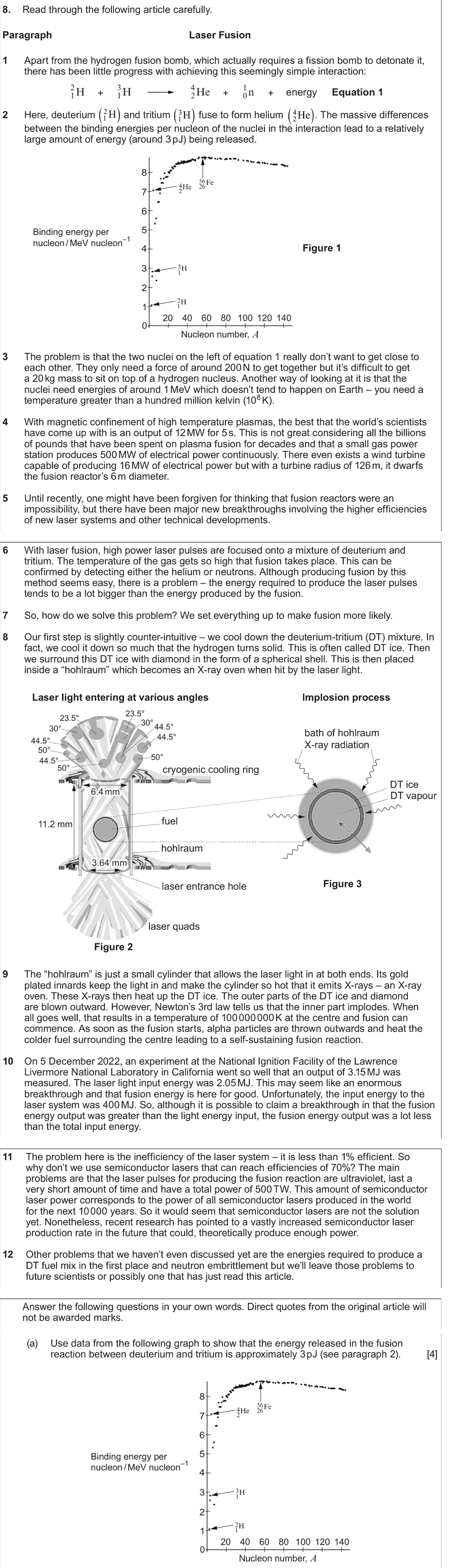
This proved to be challenging for some candidates as they could not see that 2 𝑘𝑇 was required in this unfamiliar setting. Many candidates did use the equation. There was the occasional power of ten slip but many correct answers. A significant number of candidates did not make the correct comment as they said the two values did not agree and the statement was incorrect. We were looking for reference to 7.7 × 10⁹ ≫ 108 and that statement is correct.
(3/2)kT = 1.6 × 10⁻¹³ so T = 7.7 × 10⁹ K, well above 10⁸ K, so 'greater than a hundred million kelvin' is correct. Many reached the value but said it disagreed
Scheme columns: Maths 2
Skills: Comprehension A level Component 1 Section B: questions on the printed article; Unitsand conversions Unit marks, base units, prefixes and conversions; Mathsmarks The mark scheme's Maths column gives this part at least one mark for mathematical skills
June 2024 · Component 1 · Q6(a)1 markAO1=1Definition
Mark scheme
Examiner's comment
This was not particularly well answered. Some candidates quoted 1/12th of carbon-12 instead of 12 g of carbon-12. Some candidates defined Avogadro’s constant. Other candidates wrote more general comments about a mole. It is the ‘amount of a substance’ but this is not the definition.
Notes from the mark scheme and report
The amount containing as many particles as there are atoms in 12 g of carbon-12
'1/12 of carbon-12' and definitions of the Avogadro constant not credited
not well answered
June 2024 · Component 1 · Q6(b)(i)3 marksAO1=3Show that
Earlier part of question 6 that this part uses
Mark scheme
Examiner's comment
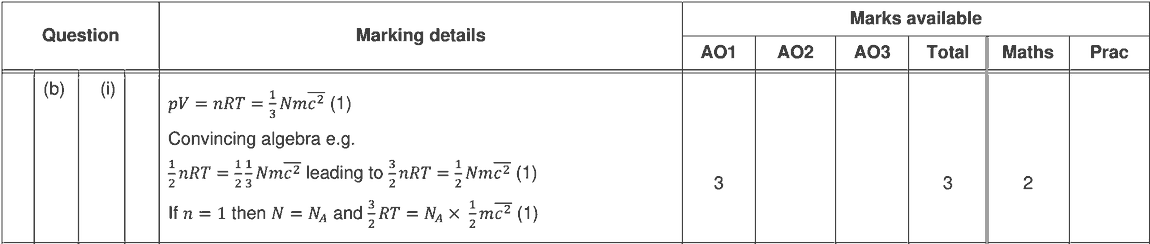
Most candidates equated the ideal gas equation to the equation given in the question. 𝑝𝑉= 𝑛𝑅𝑇 and 𝑝𝑉= 𝑁𝑘𝑇 were seen. There was plenty of good algebra witnessed. The usual ‘multiply by 3’ and ‘multiply by ½’ were regularly seen. Candidates that dropped ‘N’ without explanation were unable to be awarded the final marking point. The question asked for the KE of a mole, and we wanted clear reference to NA for all 3 marks.
Notes from the mark scheme and report
pV = nRT = ⅓Nm<c²>
multiply by 3/2 to give ½Nm<c²> = (3/2)nRT
for one mole n = 1 and N = NA, so the total translational kinetic energy is (3/2)RT
dropping N without explanation lost a mark
Scheme columns: Maths 2
Skills: Algebra Derivations and rearranging equations; Mathsmarks The mark scheme's Maths column gives this part at least one mark for mathematical skills
June 2024 · Component 1 · Q6(b)(ii)3 marksAO3=3Calculation
Earlier parts of question 6 that this part uses
Mark scheme
Examiner's comment
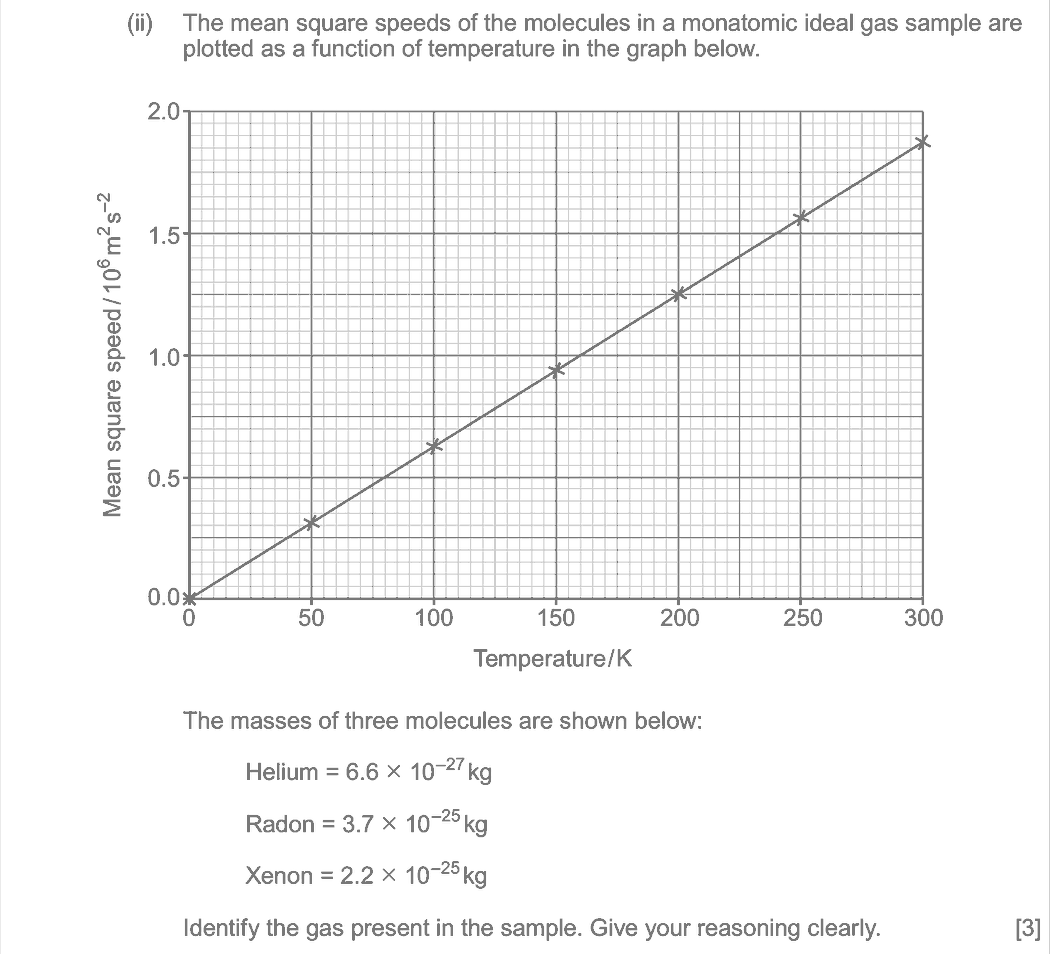
There was a good variation in responses and included the alternative routes outlined in the mark scheme. Those starting with 2 𝑚𝑐2̅̅̅ = 2 𝑅𝑇 often corrected themselves with the sudden appearance of NA somewhere in their response. They were awarded 2 marks if their reasoning wasn’t clear.
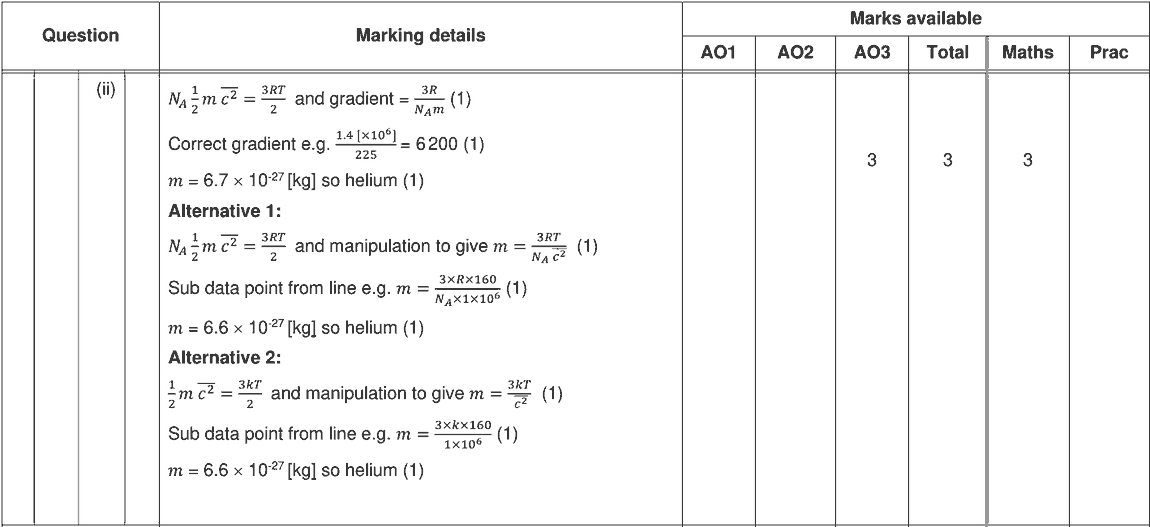
Notes from the mark scheme and report
Answer: helium. ½m<c²> = (3/2)(R/NA)T so the gradient of <c²> against T is 3R/(NA m)
gradient = 1.4 × 10⁶/225 = 6200
m = 6.7 × 10⁻²⁷ kg
or substitute a point from the line
Scheme columns: Maths 3
Skills: Graphskills Reading, plotting or sketching graphs; gradients, intercepts and areas; Mathsmarks The mark scheme's Maths column gives this part at least one mark for mathematical skills
June 2024 · Component 1 · Q7(a)3 marksAO1=1, AO2=2Calculation
Mark scheme
Examiner's comment
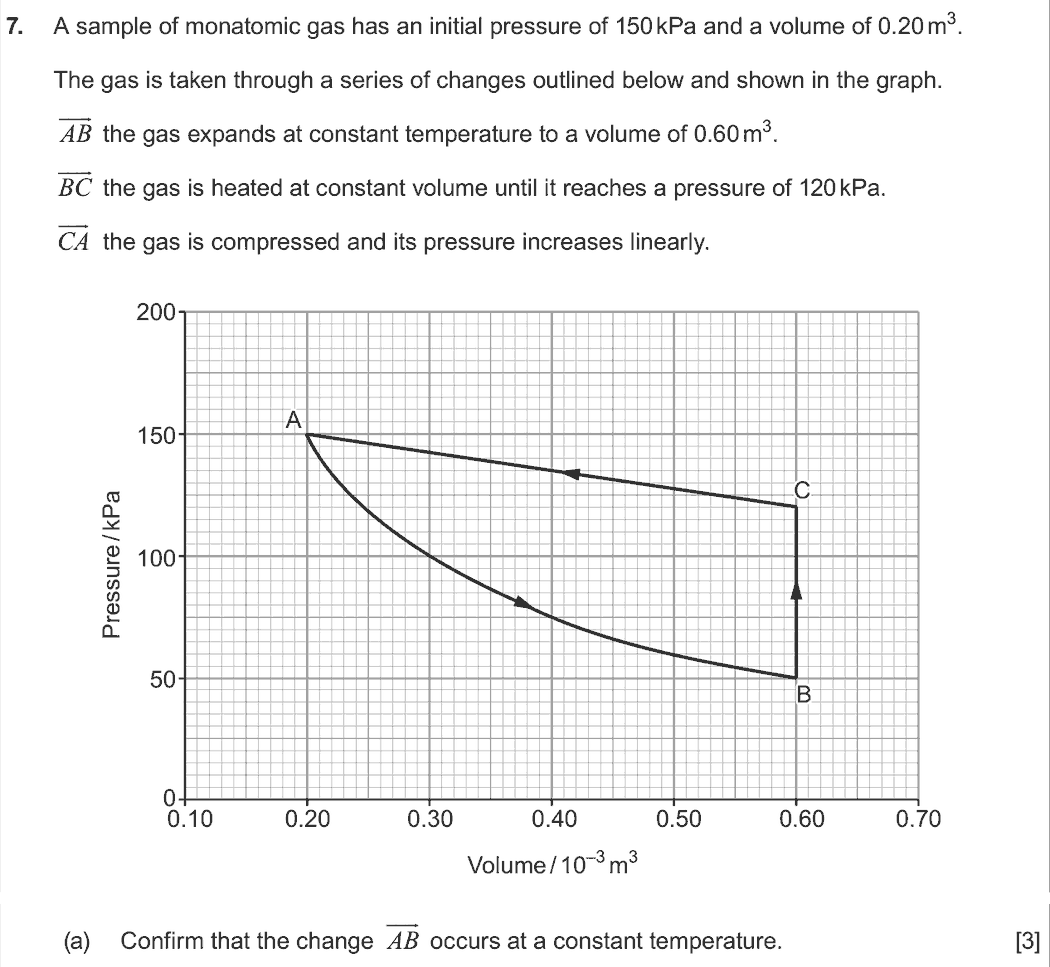
Again, there was a good variation in approach to this question. Candidates regularly used pV = constant and calculated either 30 (or 30 000 which we also accepted). Others assumed about the number of moles (e.g. n = 1) and used 𝑇= 𝑝𝑉 𝑛𝑅. Often, candidates completed 2 calculations (at A and B). A third calculation was required for the last marking point.
Notes from the mark scheme and report
pV is constant at constant temperature: pV = 30 (30 000 also accepted) at two points on AB (2) and confirmed at a third point (1)
Scheme columns: Maths 2
Skills: Graphskills Reading, plotting or sketching graphs; gradients, intercepts and areas; Mathsmarks The mark scheme's Maths column gives this part at least one mark for mathematical skills
June 2024 · Component 1 · Q7(b)(ii)II2 marksAO2=2Calculation
Earlier parts of question 7 that this part uses
Mark scheme
Examiner's comment
Candidates generally did well in part 1. Most were able to use 2 𝑛𝑅𝑇= 2 𝑝𝑉 to calculate U. 45 J and 108 J (or 45 000 J and 108 000 J - again accepted) were seen and credited here. A small number of candidates used 𝑝∆𝑉 or ½ 𝑝𝑉 and were not awarded credit. Candidates used a mixture of paths in part II. The increase of U or p were most widely seen. Those who left out the 2 in the previous question were still rewarded with ecf.
Notes from the mark scheme and report
Answer: 1.55. U (or p or T) increases by a factor 108/45 = 2.4
crms is proportional to √T so the ratio is √2.4
ecf from (ii)I
Scheme columns: Maths 2
Skills: Algebra Derivations and rearranging equations; Mathsmarks The mark scheme's Maths column gives this part at least one mark for mathematical skills
June 2024 · Component 1 · Q7(b)(iii)4 marksAO2=4Explanation
Earlier parts of question 7 that this part uses
Mark scheme
Examiner's comment
This question produced a full range of marks. There were many excellent responses. We did need to see reference to an increased crms or KEmolecule to award the last two marking points.
Notes from the mark scheme and report
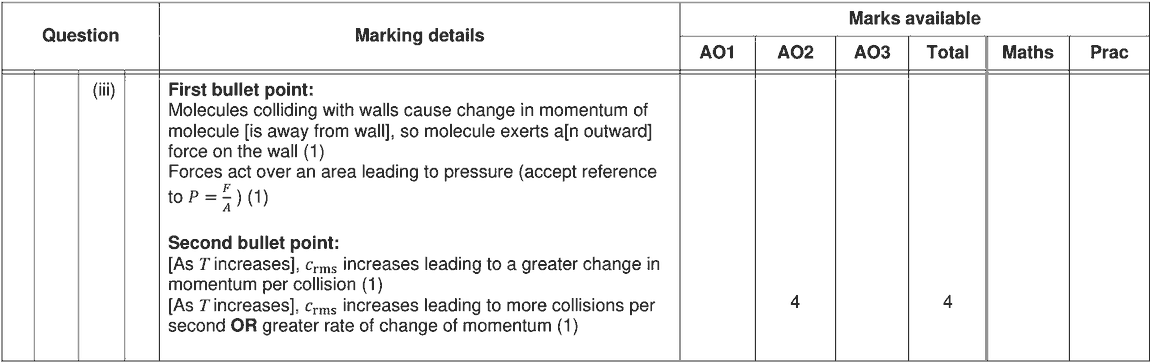
Molecules collide with the walls and their momentum changes, so they exert a force on the wall (1)
force over an area gives pressure (1)
as T rises crms increases, so a greater change of momentum per collision (1) and more collisions per second (1)
a reference to increased crms or molecular KE was needed for the last two marks
June 2023 · Component 1 · Q4(b)(i)2 marksAO2=2Calculation
Earlier part of question 4 that this part uses
Mark scheme
Examiner's comment
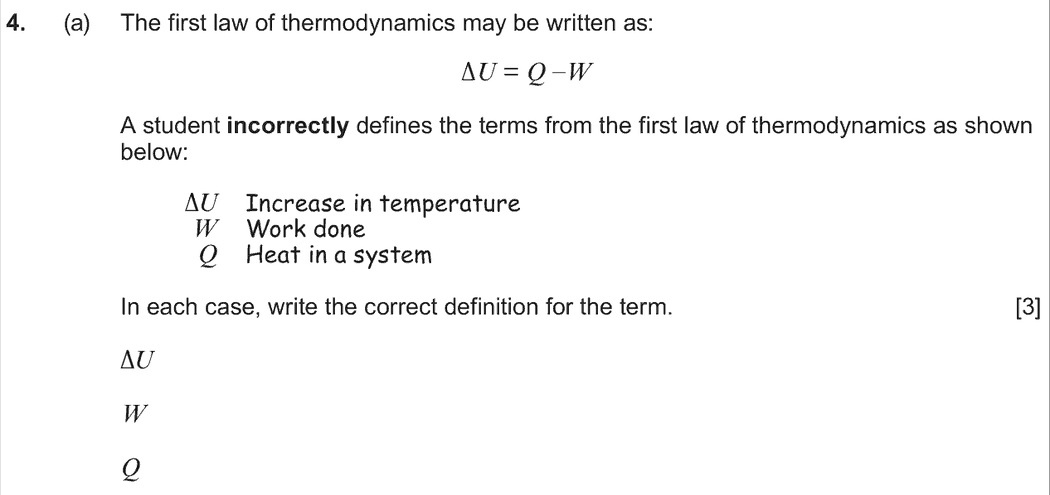
Most candidates were successful in part (a). There was the occasional omission of ‘increase’ or ‘change’ in internal energy by a minority of candidates. References to ‘energy into a system’ without mentioning heat were rarely seen and not credited. Part (b)(i) was very well answered either by using the ideal gas equation or Boyle’s law. Most went down the route of calculating 289 K at A and B. In (ii) most candidates chose a correct method for obtaining the work done. The second mark was achieved for a close approximation. One single trapezium here would have fallen outside of this range. A significant number of candidates used a counting squares method. The responses to the last part of the question were encouraging. Candidates could obtain the correct answer of ‘+150 J and hence Joseph is correct’ by several different methods – some looked at the process stage by stage whereas some calculated the area of the enclosed ‘triangle’. A minority answered the question without referencing 150 J. They were still able to attain the first two making points.
Notes from the mark scheme and report
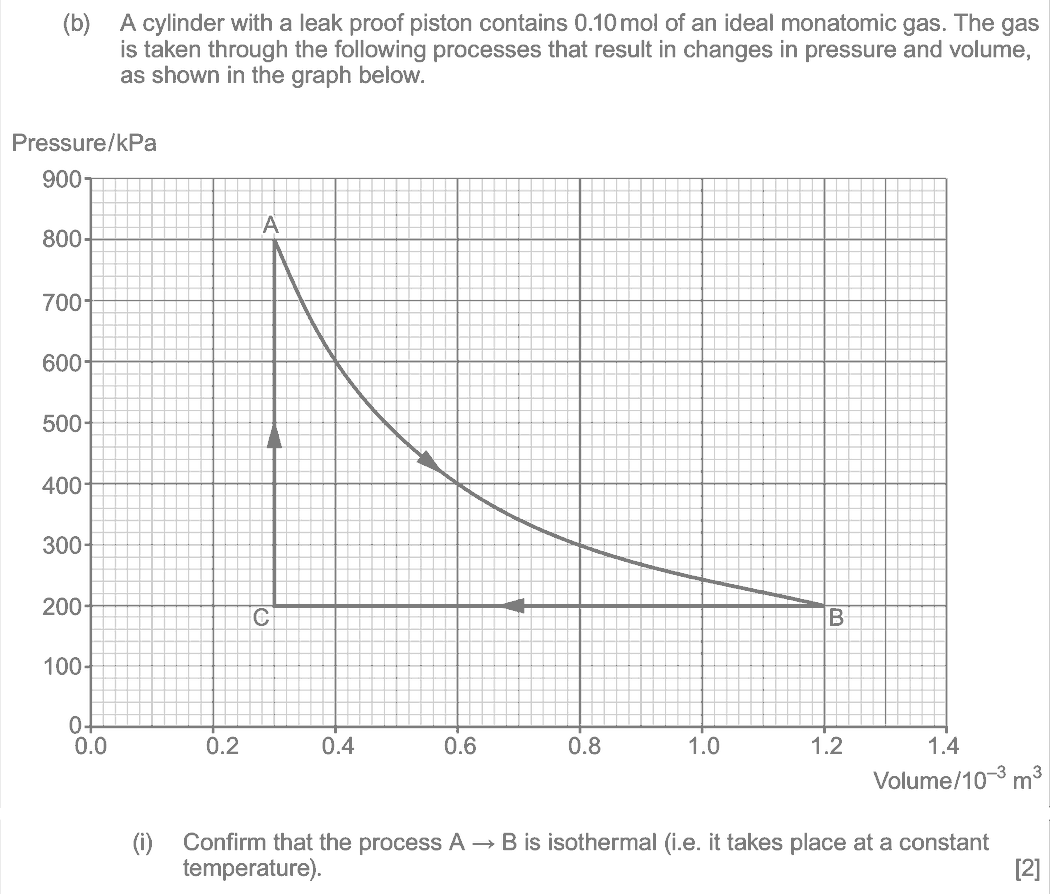
pV is the same at two or more points on AB, e.g. 800 kPa × 0.3 × 10⁻³ m³ = 240 J and 200 kPa × 1.2 × 10⁻³ m³ = 240 J
or T = pV/nR = 289 K at both
Scheme columns: Maths 2
Skills: Graphskills Reading, plotting or sketching graphs; gradients, intercepts and areas; Mathsmarks The mark scheme's Maths column gives this part at least one mark for mathematical skills
June 2023 · Component 1 · Q7(a)3 marksAO1=3Explanation
Mark scheme
Examiner's comment
Apart from a handful of candidates who were more focused on kinetic energy than kinetic theory, candidate responses were generally very good to (a). Particles colliding with container or walls of container were credited. A small number led with collisions between particles which halted progress. Momentum change and force on wall was credited. It was pleasing to see many references to Newton’s first and second laws in candidate explanations. The final marking point was more readily missed by a smaller number of candidates. In part (b) there were a couple of number transfer errors and incorrect ‘regular’ mean calculations, but the majority of candidates were successful in calculating the rms speed. The last part was a demanding question where candidates needed to demonstrate advanced level analysis techniques. Step 1 was to identify a way of calculating a rms speed at the stated temperatures. Those that did were usually able to pick up the first two marks. Ratios of speed of sound to rms speed then needed to be evaluated and a conclusion reached. Many good responses finished with a correct equation linking the two using a constant of proportionality of either 4.16 or 0.68. Some candidates who could not see how to calculate the rms speed set off by showing that the rms speed is proportional to the square root of temperature. If they did this and evaluated ratios of 𝑣𝑠 √𝑇, they were awarded two marks.
Notes from the mark scheme and report
Molecules collide with the walls (1)
each collision changes the molecule's momentum, so the wall exerts a force on it and it exerts an equal outward force on the wall (1)
the total force per unit area of wall is the pressure (1)
collisions between molecules are not the cause
June 2023 · Component 1 · Q7(b)2 marksAO2=2Calculation
Earlier part of question 7 that this part uses
Mark scheme
Examiner's comment
Apart from a handful of candidates who were more focused on kinetic energy than kinetic theory, candidate responses were generally very good to (a). Particles colliding with container or walls of container were credited. A small number led with collisions between particles which halted progress. Momentum change and force on wall was credited. It was pleasing to see many references to Newton’s first and second laws in candidate explanations. The final marking point was more readily missed by a smaller number of candidates. In part (b) there were a couple of number transfer errors and incorrect ‘regular’ mean calculations, but the majority of candidates were successful in calculating the rms speed. The last part was a demanding question where candidates needed to demonstrate advanced level analysis techniques. Step 1 was to identify a way of calculating a rms speed at the stated temperatures. Those that did were usually able to pick up the first two marks. Ratios of speed of sound to rms speed then needed to be evaluated and a conclusion reached. Many good responses finished with a correct equation linking the two using a constant of proportionality of either 4.16 or 0.68. Some candidates who could not see how to calculate the rms speed set off by showing that the rms speed is proportional to the square root of temperature. If they did this and evaluated ratios of 𝑣𝑠 √𝑇, they were awarded two marks.
Notes from the mark scheme and report
Answer: 461 m s⁻¹. Mean of the squares = (394² + 453² + 527²)/3 = 212 725
square root
the ordinary mean (458) is wrong
Scheme columns: Maths 2
Skills: Mathsmarks The mark scheme's Maths column gives this part at least one mark for mathematical skills
June 2023 · Component 1 · Q7(c)4 marksAO3=4Calculation
Earlier part of question 7 that this part uses
Mark scheme
Examiner's comment
Apart from a handful of candidates who were more focused on kinetic energy than kinetic theory, candidate responses were generally very good to (a). Particles colliding with container or walls of container were credited. A small number led with collisions between particles which halted progress. Momentum change and force on wall was credited. It was pleasing to see many references to Newton’s first and second laws in candidate explanations. The final marking point was more readily missed by a smaller number of candidates. In part (b) there were a couple of number transfer errors and incorrect ‘regular’ mean calculations, but the majority of candidates were successful in calculating the rms speed. The last part was a demanding question where candidates needed to demonstrate advanced level analysis techniques. Step 1 was to identify a way of calculating a rms speed at the stated temperatures. Those that did were usually able to pick up the first two marks. Ratios of speed of sound to rms speed then needed to be evaluated and a conclusion reached. Many good responses finished with a correct equation linking the two using a constant of proportionality of either 4.16 or 0.68. Some candidates who could not see how to calculate the rms speed set off by showing that the rms speed is proportional to the square root of temperature. If they did this and evaluated ratios of 𝑣𝑠 √𝑇, they were awarded two marks.
Notes from the mark scheme and report
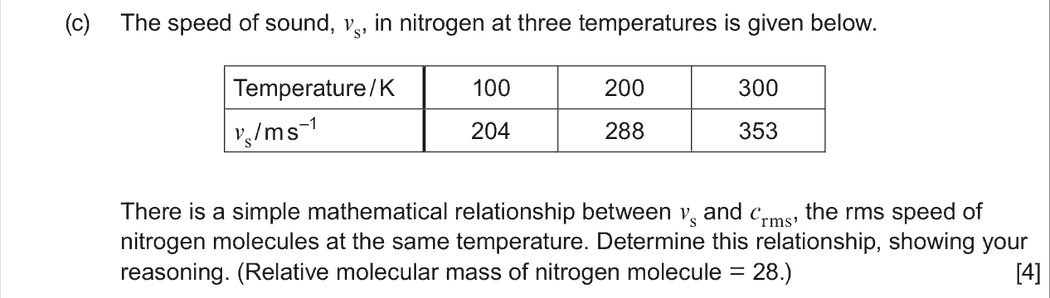
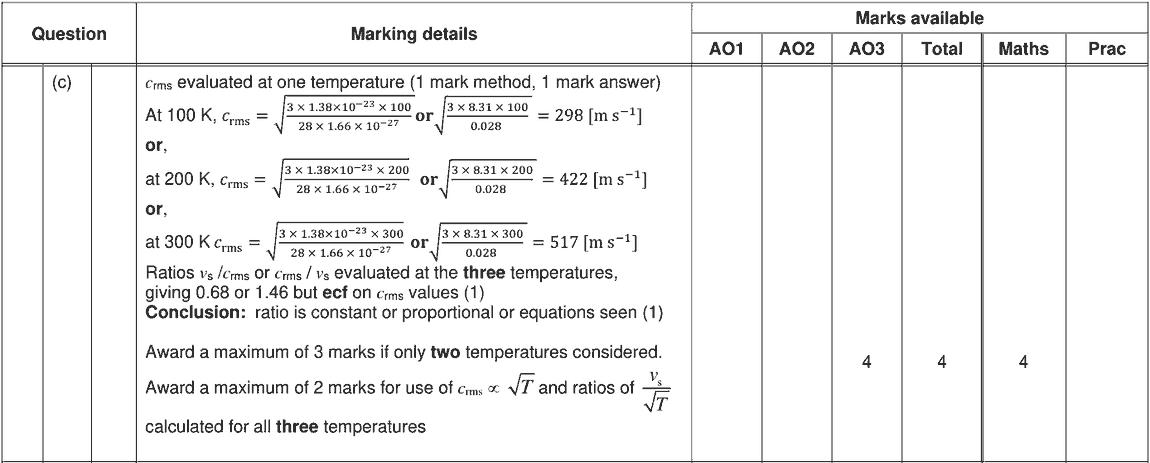
Answer: vs = 0.68 crms (ratio constant). crms = √(3kT/m) = √(3RT/M) with M = 0.028 kg mol⁻¹: 298, 422 and 517 m s⁻¹ at 100, 200 and 300 K (method 1, value 1)
vs/crms = 0.68 at all three temperatures (1)
so vs is proportional to crms (1)
max 3 if only two temperatures used
max 2 for showing only that vs/√T is constant
Scheme columns: Maths 4
Skills: Algebra Derivations and rearranging equations; Mathsmarks The mark scheme's Maths column gives this part at least one mark for mathematical skills
June 2022 · Component 1 · Q6(a)1 markAO1=1Definition
Mark scheme
Examiner's comment
Most candidates, but not all, were able to quote “ force pressure = area ”.
Notes from the mark scheme and report
Pressure = (normal) force divided by the area over which it acts
June 2022 · Component 1 · Q6(b)(i)2 marksAO2=2Explanation
Earlier part of question 6 that this part uses
Mark scheme
Examiner's comment
The ratio of pressures for the O2 and the N2 was more often than not calculated correctly using the ideal gas equation, though some candidates tried misguidedly to introduce the molecular masses.
Notes from the mark scheme and report
Answer: 1 (pressures equal) (1)
because n, V and T are the same for both gases in pV = nRT (1)
molecular mass is irrelevant here
June 2022 · Component 1 · Q6(b)(ii)2 marksAO2=2Calculation
Earlier parts of question 6 that this part uses
Mark scheme
Examiner's comment
The ratio of rms speeds proved more difficult to determine. Many candidates didn’t seem to know that 2 𝑚𝑐2̅̅̅ was the same for both gases, and some of those who did know made mistakes in the algebra.
Notes from the mark scheme and report
Answer: 0.94 (√(28/32) = √(7/8)). Same temperature so the same mean molecular KE: ½m<c²> = (3/2)kT, so crms is proportional to 1/√m
many did not know the mean KE is the same and some slipped in the algebra
Scheme columns: Maths 1
Skills: Algebra Derivations and rearranging equations; Mathsmarks The mark scheme's Maths column gives this part at least one mark for mathematical skills
June 2022 · Component 1 · Q6(c)(i)2 marksAO2=2Calculation
Earlier part of question 6 that this part uses
Mark scheme
Examiner's comment
Candidates bravely applied 𝑝= 3 𝜌𝑐2̅̅̅ to the centre of the Sun, almost everyone gaining the 2 marks available.
Skills: Mathsmarks The mark scheme's Maths column gives this part at least one mark for mathematical skills
June 2022 · Component 1 · Q6(c)(ii)2 marksAO1=2Short answer
Earlier parts of question 6 that this part uses
Mark scheme
Examiner's comment
There was rather less appreciation that most of the assumptions of the ideal gas kinetic theory wouldn’t hold in that region, though sometimes, no doubt, the assumptions were simply not known.
Notes from the mark scheme and report
Any two: particles take up a significant fraction of the volume
forces between particles are not negligible
more than one type of particle (no molecules at the Sun's centre)
collisions likely to be inelastic
June 2022 · Component 1 · Q7(a)3 marksAO1=1, AO2=2Calculation
Mark scheme
Examiner's comment
The great majority of candidates knew how to use the ideal gas equation to calculate temperatures using data from the graph grid.
Notes from the mark scheme and report
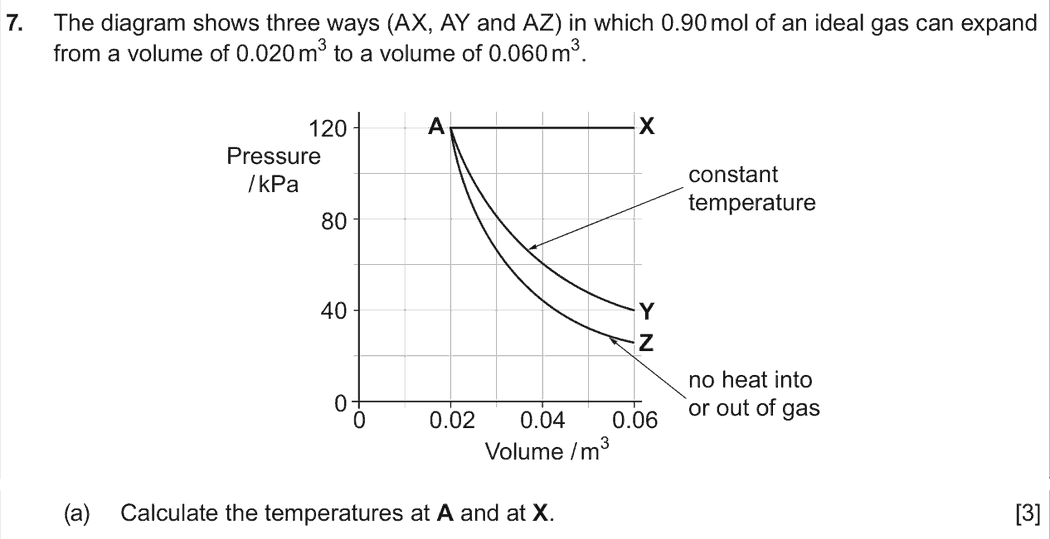
Answer: TA = 321 K and TX = 963 K. T = pV/nR with p = 120 × 10³ Pa, V = 0.020 m³ and 0.060 m³, n = 0.90 mol
unit needed
Scheme columns: Maths 2
Skills: Graphskills Reading, plotting or sketching graphs; gradients, intercepts and areas; Unitsand conversions Unit marks, base units, prefixes and conversions; Mathsmarks The mark scheme's Maths column gives this part at least one mark for mathematical skills
June 2022 · Component 1 · Q8(f)3 marksAO3=3Calculation
Earlier parts of question 8 that this part uses
Mark scheme
Examiner's comment
Most candidates sensibly chose to use 2 𝑚𝑐2̅̅̅ = 2 𝑘𝑇, but many did not substitute the value from the bottom of paragraph 13 as the mean square speed (to get a temperature of 0.36 μK). There were also some mistakes handling units for mass and speed. Summary of key points Answers to the first four questions revealed a generally excellent understanding of basic statics and dynamics. • Candidates had evidently been very well trained in calculating a gradient together with its uncertainty from a straight line graph and correlating it with the equation of the graph. • The variation of kinetic energy with time for a body in SHM was a weak area. • Few candidates distinguished between natural and forced oscillations in the question part about damping in car suspensions and pedestrian suspension bridges. • The assumptions made in deriving 𝑝= 3 𝜌𝑐2̅̅̅ did not appear to be well known. • Thermodynamics was (again) a weak area. Qualitative comparisons of work could have been made by inspecting p–V graphs but were often omitted. Heat and internal energy were sometimes confused with each other, and, occasionally, constant temperature with no heat entering or leaving. • Most candidates seemed to grasp the principle of laser Doppler cooling as explained in the article for comprehension. Calculation of number of photons emitted per (milli)second from a laser, and minimum temperature achievable (using kinetic theory) were poorly done. More careful study of the paragraphs mentioned in the questions might have helped. PHYSICS GCE A LEVEL Summer 2022
Notes from the mark scheme and report
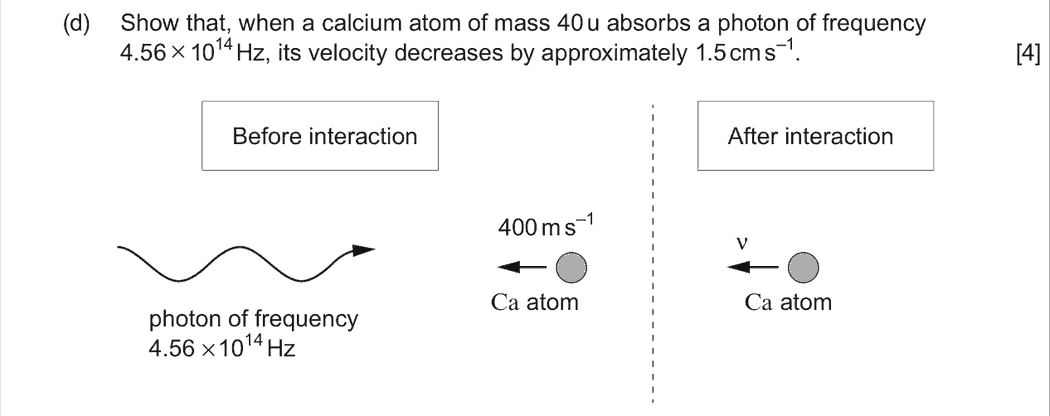
Answer: 0.36 μK. Put the 1.5 cm s⁻¹ limit into Equation 2 as the rms speed: T = m<c²>/3k = 6.64 × 10⁻²⁶ × 0.015²/(3 × 1.38 × 10⁻²³)
conclusion linked to the value (same order of magnitude but higher than 0.1 μK)
many did not use 1.5 cm s⁻¹
Scheme columns: Maths 1
Skills: Comprehension A level Component 1 Section B: questions on the printed article; Unitsand conversions Unit marks, base units, prefixes and conversions; Mathsmarks The mark scheme's Maths column gives this part at least one mark for mathematical skills
June 2022 · Component 2 · Q8(c)(i)4 marksAO1=1, AO2=3Show that
Earlier part of question 8 that this part uses
Mark scheme
Examiner's comment
As required, a percentage of each of the physics components should contain synoptic elements, testing aspects from all parts of the specification. This was one such part. The response in general was very good, with many candidates able to determine the rms speed required. Several approaches were possible, either using the mass of the gas, or the mass of individual molecules. Some candidates became confused with their approaches, using for example the Boltzmann constant instead of the molar gas constant, or vice-versa.
Notes from the mark scheme and report
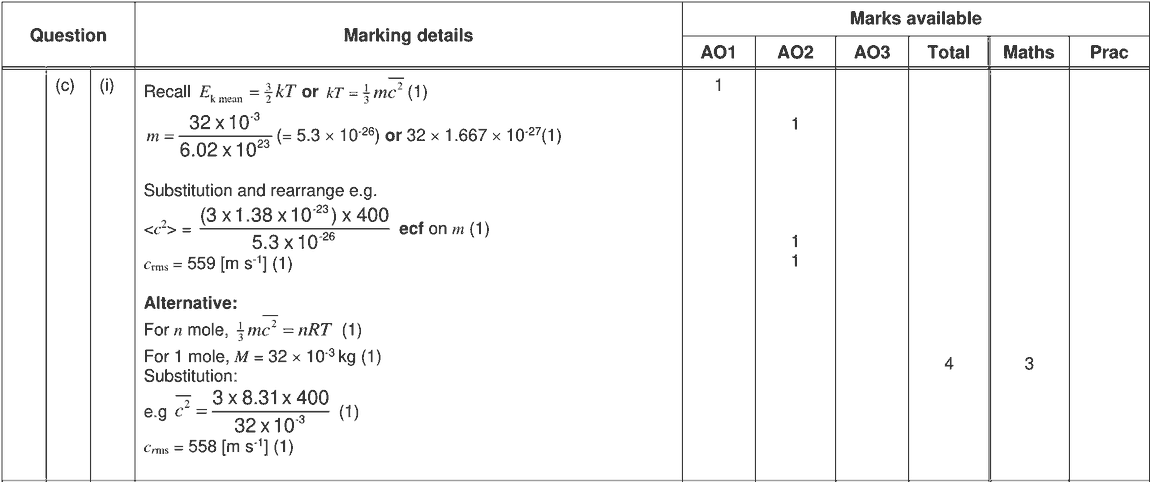
Answer: 559 m s⁻¹. ½m<c²> = (3/2)kT
m = 32 × 10⁻³/6.02 × 10²³ = 5.3 × 10⁻²⁶ kg
<c²> = 3kT/m = 3 × 1.38 × 10⁻²³ × 400/5.3 × 10⁻²⁶
or <c²> = 3RT/M with M = 0.032 kg. Synoptic with Component 1 kinetic theory
some mixed up k and R
Scheme columns: Maths 3
Skills: Synoptic Needs physics from another component of the qualification; Unitsand conversions Unit marks, base units, prefixes and conversions; Mathsmarks The mark scheme's Maths column gives this part at least one mark for mathematical skills
June 2022 · Component 2 · Q8(c)(ii)2 marksAO3=2Explanation
Earlier parts of question 8 that this part uses
Mark scheme
Examiner's comment
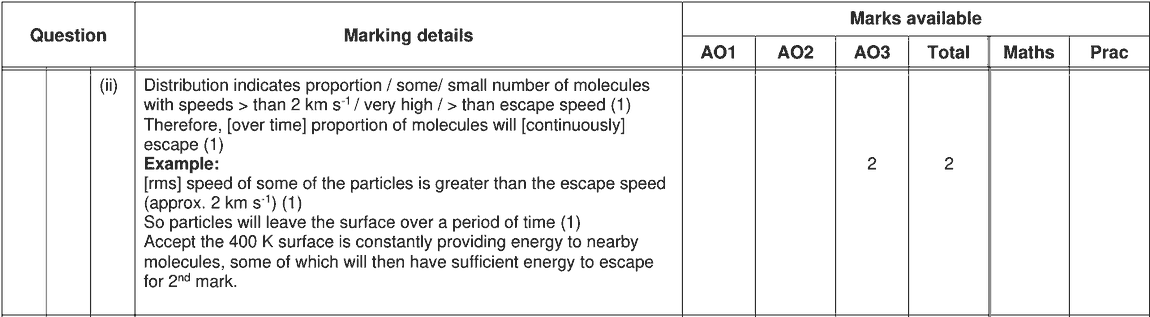
Many candidates focussed their answers on the 500 m s-1 region of the speed distribution graph, whereas the focus should have been on the region which showed that a proportion of molecules had speeds greater than the escape velocity calculate previously in the question. Summary of key points Candidates would benefit from: • Learning key definitions. Teachers should emphasise the need for complete and correct wording when answering definition-based questions. Examples of ‘nearly correct’ responses to the question, define electric potential, VE, at a point in an electric field include: − The work done to move a charge from infinity to that point in the field. − The work done to move a positive unit charge. − The work done to move a positive unit charge from the point to infinity. • Understanding concepts related to scientific methodology, especially when answering issues-based questions which test the role of the scientific community in validating new knowledge and ensuring integrity. • Being aware that at least two marks are awarded in each component for the use of correct units to numerical answers. That is, if the unit is incorrect or omitted the mark is not awarded, even if the numerical answer is correct. • Ensuring that they have a sound grasp of the importance of experimental technique. For example, very few candidates appreciated the significance of the technique for taking electrical readings in Q2 on the emf of the cell. PHYSICS GCE A LEVEL Summer 2022
Notes from the mark scheme and report
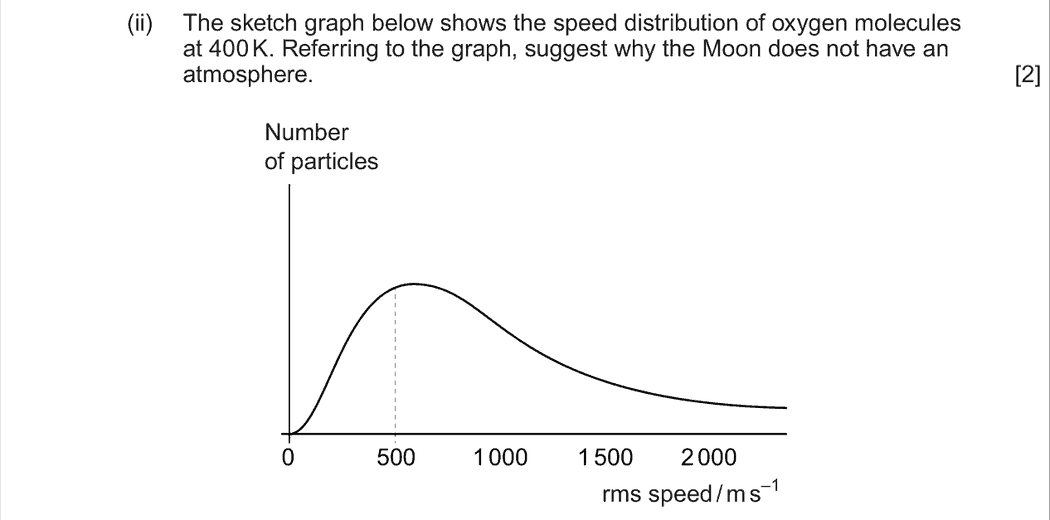
The distribution has a tail: some molecules have speeds above the escape speed (about 2.4 km s⁻¹) (1)
these escape, and as the distribution is continually re-established the gas is steadily lost over time (1). Many wrongly focused on the 500 m s⁻¹ region
Skills: Synoptic Needs physics from another component of the qualification; Graphskills Reading, plotting or sketching graphs; gradients, intercepts and areas
June 2022 · Component 3 · Q7(a)(ii)3 marksAO1=1, AO2=2Show that
Earlier part of question 7 that this part uses
Mark scheme
Examiner's comment
Very well answered but this is to be expected when the answer is given in a “show that”.
Skills: Synoptic Needs physics from another component of the qualification; Unitsand conversions Unit marks, base units, prefixes and conversions; Mathsmarks The mark scheme's Maths column gives this part at least one mark for mathematical skills
October 2021 · Component 1 · Q6(b)(i)2 marksAO1=2Short answer
Earlier part of question 6 that this part uses
Mark scheme
Notes from the mark scheme and report
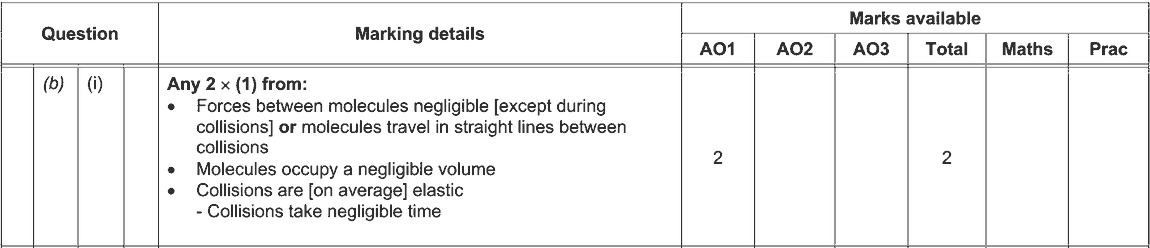
Any two: negligible forces between molecules except in collisions (straight-line motion between collisions)
the molecules' own volume is negligible
collisions are elastic
collision time is negligible
October 2021 · Component 1 · Q6(b)(ii)I3 marksAO2=3Calculation
Earlier parts of question 6 that this part uses
Mark scheme
Notes from the mark scheme and report
Answer: 484 m s⁻¹. Mass of gas = 20.0 × 32.0 × 10⁻³ = 0.640 kg, so ρ = 0.640/0.050 = 12.8 kg m⁻³
p = ⅓ρ<c²> so crms = √(3p/ρ) = √(3 × 1.00 × 10⁶/12.8)
Scheme columns: Maths 2
Skills: Mathsmarks The mark scheme's Maths column gives this part at least one mark for mathematical skills
October 2021 · Component 1 · Q6(b)(ii)II4 marksAO3=4Explanation
Earlier parts of question 6 that this part uses
Mark scheme
Notes from the mark scheme and report
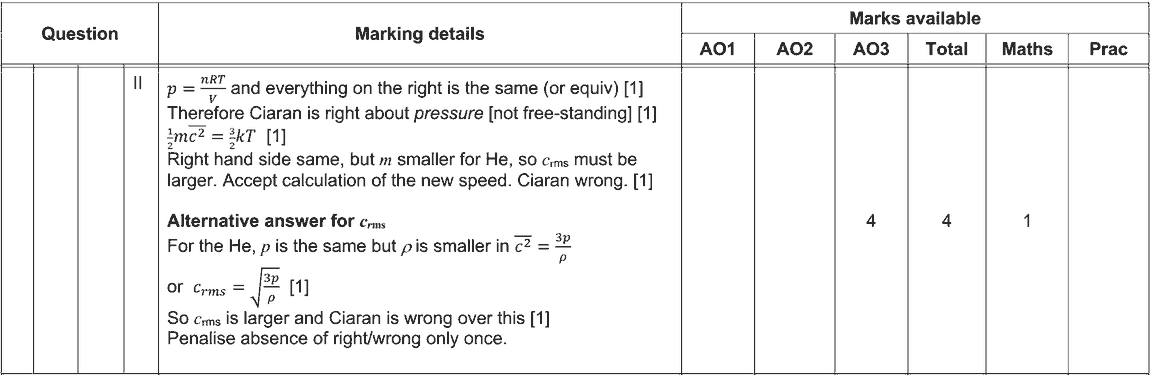
p = nRT/V with n, T and V unchanged (1), so the pressure is the same and Ciaran is right about pressure (1)
½m<c²> = (3/2)kT is the same but helium molecules have a smaller mass (or p the same with smaller density in crms = √(3p/ρ)) (1), so the rms speed is greater (√8 times) and he is wrong about speed (1)
Scheme columns: Maths 1
Skills: Mathsmarks The mark scheme's Maths column gives this part at least one mark for mathematical skills
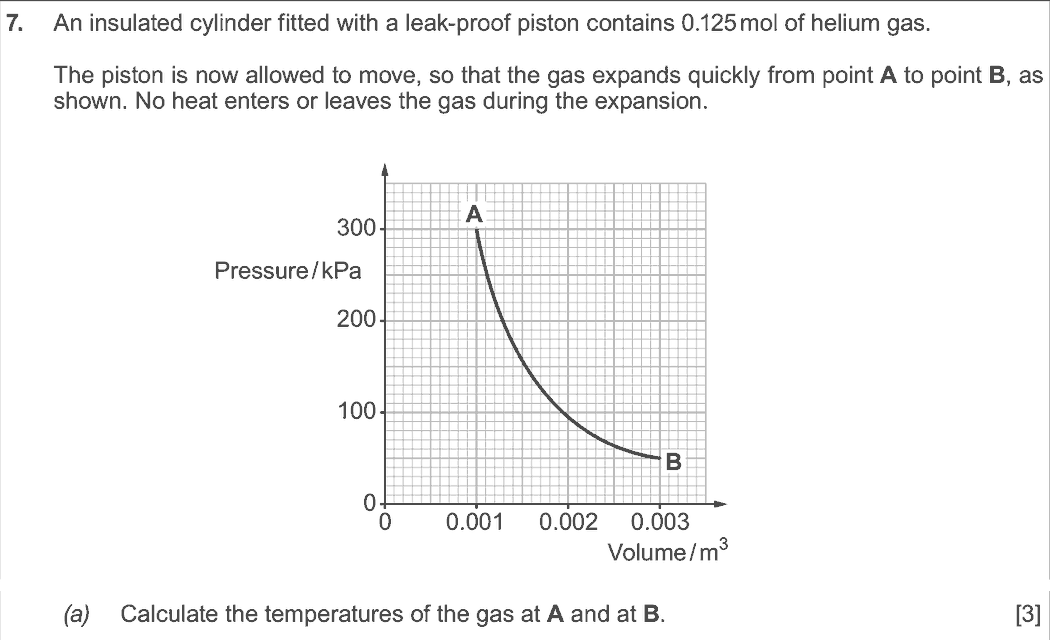
October 2021 · Component 1 · Q7(a)3 marksAO2=3Calculation
Mark scheme
Notes from the mark scheme and report
Answer: TA = 289 K, TB = 144 K. T = pV/nR: 300 × 10³ × 0.001/(0.125 × 8.31) and 50 × 10³ × 0.003/(0.125 × 8.31)
Scheme columns: Maths 2
Skills: Graphskills Reading, plotting or sketching graphs; gradients, intercepts and areas; Unitsand conversions Unit marks, base units, prefixes and conversions; Mathsmarks The mark scheme's Maths column gives this part at least one mark for mathematical skills
October 2020 · Component 1 · Q5(a)(i)2 marksAO1=1, AO2=1Show that
Mark scheme
Examiner's comment
The kinetic theory calculations were very well done, and the momentum conservation and kinetic energy non-conservation parts, almost as well. Several candidates did not seem to know that gas molecules at a given temperature had a wide range of speeds. A surprising number of candidates used a wrong formula for the photon energy.
Notes from the mark scheme and report
Mean KE = (3/2)kT = 1.5 × 1.38 × 10⁻²³ × 1500 = 3.11 × 10⁻²⁰ J
Scheme columns: Maths 1
Skills: Mathsmarks The mark scheme's Maths column gives this part at least one mark for mathematical skills
October 2020 · Component 1 · Q5(a)(ii)2 marksAO2=2Calculation
Earlier part of question 5 that this part uses
Mark scheme
Examiner's comment
The kinetic theory calculations were very well done, and the momentum conservation and kinetic energy non-conservation parts, almost as well. Several candidates did not seem to know that gas molecules at a given temperature had a wide range of speeds. A surprising number of candidates used a wrong formula for the photon energy.
Skills: Mathsmarks The mark scheme's Maths column gives this part at least one mark for mathematical skills
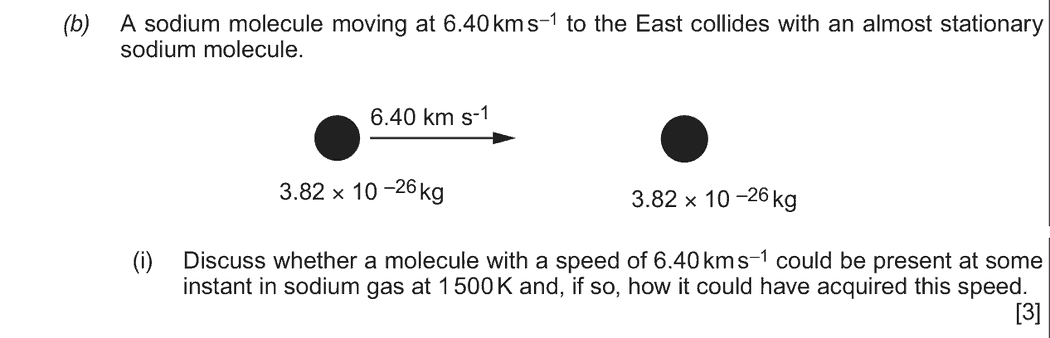
October 2020 · Component 1 · Q5(b)(i)3 marksAO2=3Explanation
Earlier part of question 5 that this part uses
Mark scheme
Examiner's comment
The kinetic theory calculations were very well done, and the momentum conservation and kinetic energy non-conservation parts, almost as well. Several candidates did not seem to know that gas molecules at a given temperature had a wide range of speeds. A surprising number of candidates used a wrong formula for the photon energy.
Notes from the mark scheme and report
Molecules at a given temperature have a wide range of speeds (random distribution of energy) (1)
6.40 km s⁻¹ is about 5 times the rms speed, so rare but possible (1)
gained through a run of favourable collisions (1)
several did not know there is a range of speeds
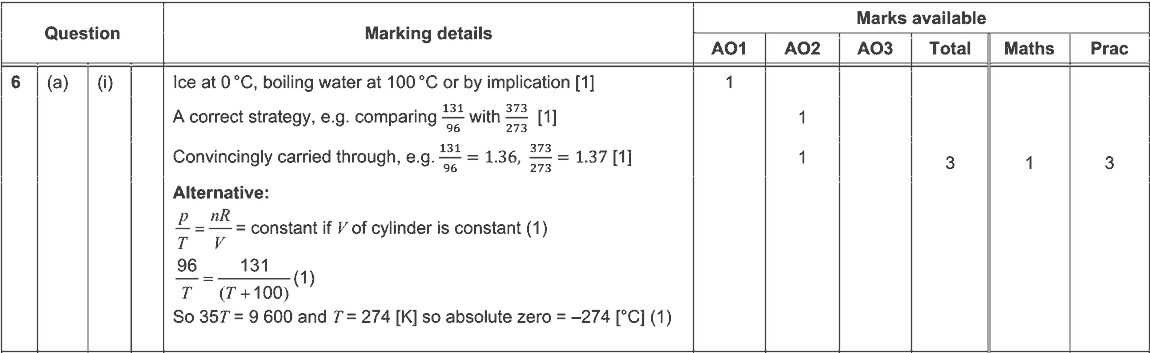
October 2020 · Component 1 · Q6(a)(i)3 marksAO1=1, AO2=2Show that
Mark scheme
Examiner's comment
Several methods were used, generally successfully, to show that the gas pressure data were consistent with an absolute zero of temperature at about –273 °C. We accepted that the kinetic energy of molecules was zero at absolute zero, though in a real substance, the particles have a residual zero point energy of vibration. Temperature and work calculations based on the p–V graph were very well done, but some candidates could not apply the First Law correctly to find the heat flow. There were – unfortunately no surprise – two or three claims that since the gas temperature was the same at C as at A, there would be no heat flow into or out of the system.
Notes from the mark scheme and report
Ice at 0 °C and boiling water at 100 °C (1)
at constant volume p is proportional to T, so compare 131/96 = 1.36 with 373/273 = 1.37 (2)
or 96/T = 131/(T + 100) gives T = 274 K, so absolute zero is about −274 °C
Scheme columns: Maths 1, Practical 3
Skills: Mathsmarks The mark scheme's Maths column gives this part at least one mark for mathematical skills; Practicalmarks The mark scheme's Prac column gives this part at least one mark for practical skills
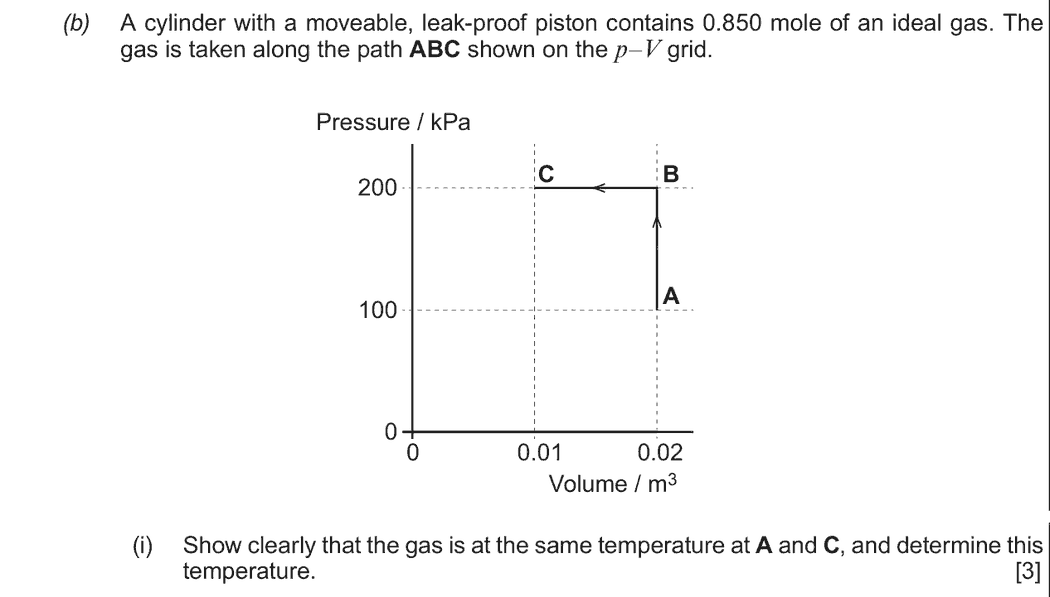
October 2020 · Component 1 · Q6(b)(i)3 marksAO2=3Calculation
Earlier part of question 6 that this part uses
Mark scheme
Examiner's comment
Several methods were used, generally successfully, to show that the gas pressure data were consistent with an absolute zero of temperature at about –273 °C. We accepted that the kinetic energy of molecules was zero at absolute zero, though in a real substance, the particles have a residual zero point energy of vibration. Temperature and work calculations based on the p–V graph were very well done, but some candidates could not apply the First Law correctly to find the heat flow. There were – unfortunately no surprise – two or three claims that since the gas temperature was the same at C as at A, there would be no heat flow into or out of the system.
Notes from the mark scheme and report
Answer: 283 K. pV is the same at A (100 kPa × 0.02 m³) and C (200 kPa × 0.01 m³) = 2000 J, so the same T
T = pV/nR = 2000/(0.850 × 8.31)
Scheme columns: Maths 2
Skills: Graphskills Reading, plotting or sketching graphs; gradients, intercepts and areas; Mathsmarks The mark scheme's Maths column gives this part at least one mark for mathematical skills
October 2020 · Component 2 · Q8(c)(iii)2 marksAO2=2Calculation
Earlier parts of question 8 that this part uses
Mark scheme
Examiner's comment
Nearly all candidates calculated the critical density of the universe correctly, giving appropriate units. It was noted that a significant number of candidates gave the units as s-2 N-1 m-2 kg2, using the terms directly from the critical density equation it would seem. This was credited. Few candidates were able to show the increase in separation of two objects as a fraction of their original separation over a period of 2 billion years. Surprisingly, a significant number of candidates also failed to calculate the radial velocity in (c)(i), with a significant number using 475 nm as the reference wavelength instead of 410 nm. No credit was given for this fundamental error; however error carried forward was applied to (ii) where the majority of candidates were able to correctly calculate the distance of the star from the Earth. Part (c)(iii) was a further synoptic based question requiring knowledge from outside of this component. Only a few candidates correctly calculated the mean kinetic energy of particles in the photosphere. Summary of key points Surface area or cross-sectional area are two quantities that are frequently being confused, encourage candidates to think carefully before answering questions requiring one of these quantities. It is a requirement that synoptic questions appear on all three examination papers, candidates need to be reminded of this. Expressing a ‘final answer’ with its uncertainty to an appropriate number of significant figures is an area that needs to be developed. The term multiwavelength astronomy was unfamiliar to many candidates. PHYSICS GCE A LEVEL Autumn 2020
Notes from the mark scheme and report
Answer: 0.92 eV. Mean KE = (3/2)kT = 1.5 × 1.38 × 10⁻²³ × 7100 = 1.47 × 10⁻¹⁹ J
divide by 1.60 × 10⁻¹⁹
Component 1 kinetic theory
Scheme columns: Maths 1
Skills: Synoptic Needs physics from another component of the qualification; Unitsand conversions Unit marks, base units, prefixes and conversions; Mathsmarks The mark scheme's Maths column gives this part at least one mark for mathematical skills
June 2019 · Component 1 · Q6(a)(ii)2 marksAO2=2Calculation
Earlier part of question 6 that this part uses
Mark scheme
Examiner's comment
Finding the number of atoms per m3 of copper was usually done successfully, though a small minority divided the mass of the block in
Notes from the mark scheme and report
Answer: 8.4 × 10²⁸ m⁻³. Number per m³ = ρ/(mass of one atom) = 8.87 × 10³/(63.5 × 1.66 × 10⁻²⁷)
ecf on ρ
a few divided the mass of the block instead of the density
Scheme columns: Maths 1, Practical 2
Skills: Unitsand conversions Unit marks, base units, prefixes and conversions; Mathsmarks The mark scheme's Maths column gives this part at least one mark for mathematical skills; Practicalmarks The mark scheme's Prac column gives this part at least one mark for practical skills
June 2019 · Component 1 · Q6(b)(i)I3 marksAO2=3Calculation
Earlier part of question 6 that this part uses
Mark scheme
Examiner's comment
Almost everyone calculated the number of gas molecules per m3 correctly.
Notes from the mark scheme and report
Answer: 2.54 × 10²⁵ m⁻³. N/V = p/kT = 101 × 10³/(1.38 × 10⁻²³ × 288), or n = 42.2 mol per m³ then × NA
T must be 288 K
Scheme columns: Maths 2
Skills: Unitsand conversions Unit marks, base units, prefixes and conversions; Mathsmarks The mark scheme's Maths column gives this part at least one mark for mathematical skills
June 2019 · Component 1 · Q6(b)(i)II2 marksAO1=1, AO3=1Explanation
Earlier parts of question 6 that this part uses
Mark scheme
Examiner's comment
The key point, made by most candidates, is that a gas is mainly empty space, between molecules, whereas in a solid the atoms are closely packed. The second mark, often awarded, required a subsidiary point such as a copper atom and a gas molecule usually differing in volume by only a small factor, or gas molecules ‘filling the container’ by rapid random translations.
Notes from the mark scheme and report
Not really: a gas is mainly empty space between the molecules whereas atoms in a solid are closely packed (1)
the molecules themselves are of similar size to copper atoms, or they only 'take up' more space in the sense of moving rapidly through the container (1)
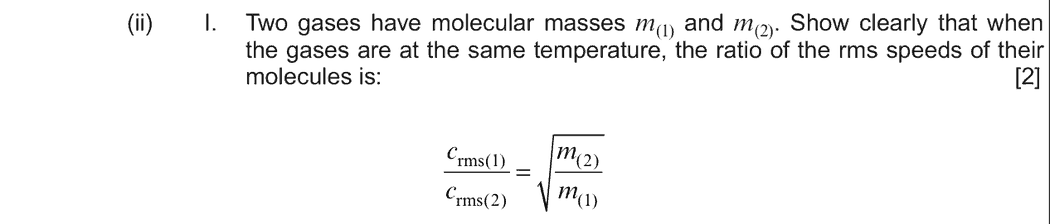
June 2019 · Component 1 · Q6(b)(ii)I2 marksAO1=1, AO2=1Show that
Earlier parts of question 6 that this part uses
Mark scheme
Examiner's comment
We insisted that the relation between ratio of rms speeds and ratio of molecular masses was derived from a valid starting point: equal molecular KE at the same temperature, or 𝟐𝒎𝒄𝟐̅̅̅ = 𝟐𝒌𝑻. There were many faulty attempts to derive it from 𝒑𝑽= 𝟑𝑵𝒎𝒄𝟐̅̅̅ alone.
Notes from the mark scheme and report
Start from ½m c²rms = (3/2)kT (equal mean molecular kinetic energy at the same temperature) (1)
so m(1)c²rms(1) = m(2)c²rms(2) and the ratio follows by convincing algebra (1)
starting from pV = ⅓Nm<c²> alone was not accepted
Skills: Algebra Derivations and rearranging equations
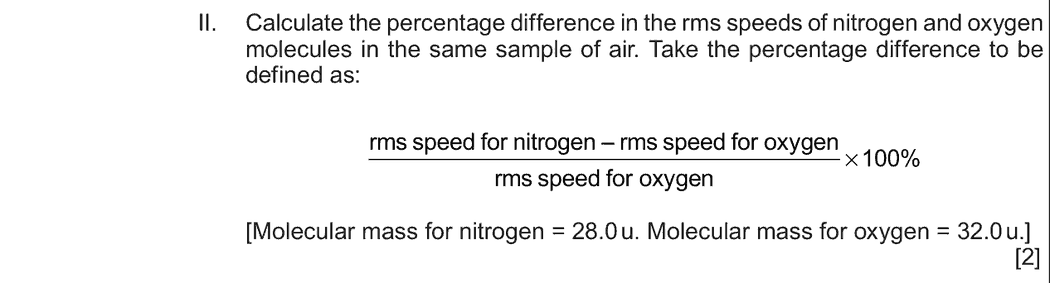
June 2019 · Component 1 · Q6(b)(ii)II2 marksAO3=2Calculation
Earlier parts of question 6 that this part uses
Mark scheme
Examiner's comment
Most candidates successfully used the relationship given in the previous part (even if they had failed to establish it) to find the percentage difference in speeds of nitrogen and oxygen molecules.
Notes from the mark scheme and report
Answer: 7% (6.9%). crms(N2)/crms(O2) = √(32.0/28.0) = 1.07, so nitrogen is 7% faster
Scheme columns: Maths 1
Skills: Algebra Derivations and rearranging equations; Mathsmarks The mark scheme's Maths column gives this part at least one mark for mathematical skills
June 2018 · Component 1 · Q7(a)2 marksAO1=2Short answer
Mark scheme
Examiner's comment
Most candidates gave two relevant assumptions needed to derive p c . Occasionally we were told that molecules had to have a random distribution of speeds, or that they all had to have the same speed. Neither of these is necessary.
Notes from the mark scheme and report
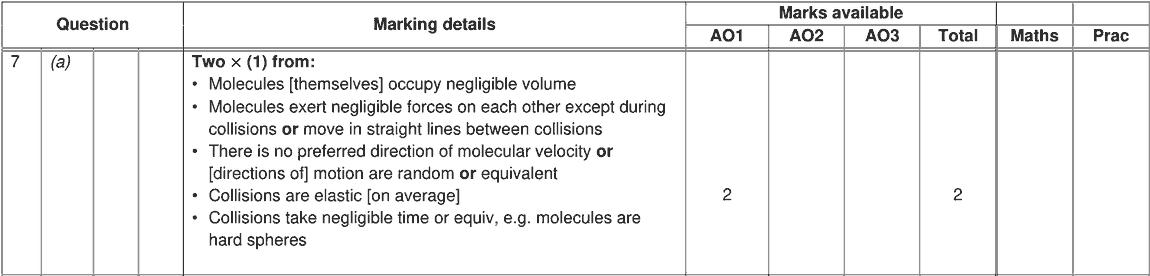
Any two: molecules have negligible volume
negligible forces between molecules except in collisions
no preferred direction of motion (random)
collisions are elastic
collisions take negligible time. 'All have the same speed' is not an assumption
June 2018 · Component 1 · Q7(b)(i)3 marksAO1=1, AO2=2Calculation
Earlier part of question 7 that this part uses
Mark scheme
Examiner's comment
Calculating the rms speed of the argon molecules was not quite a routine exercise because, instead of the mass of gas, the rmm was given, together with the amount of gas in mole. Predictably some answers were adrift by factors of 1000 and / or A N .
Notes from the mark scheme and report
Answer: 654 m s⁻¹. Mass = 2.20 × 0.0399 kg so ρ = 1.76 kg m⁻³
crms = √(3p/ρ) with p = 2.5 × 10⁵ Pa
errors of a factor of 1000 or NA were common
Scheme columns: Maths 2
Skills: Unitsand conversions Unit marks, base units, prefixes and conversions; Mathsmarks The mark scheme's Maths column gives this part at least one mark for mathematical skills
June 2018 · Component 1 · Q7(b)(ii)I2 marksAO1=1, AO2=1Explanation
Earlier parts of question 7 that this part uses
Mark scheme
Examiner's comment
Some thought that doubling T would double the rms speed of the molecules, but more candidates gave the right answer (crms increases by a factor of 2 ).
Notes from the mark scheme and report
½m<c²> = (3/2)kT, so mean KE is proportional to T (1)
crms increases by a factor of √2, to 924 m s⁻¹ (1)
some said it doubles
Scheme columns: Maths 1
Skills: Mathsmarks The mark scheme's Maths column gives this part at least one mark for mathematical skills
June 2018 · Component 1 · Q7(b)(ii)II1 markAO2=1Short answer
Earlier parts of question 7 that this part uses
Mark scheme
Examiner's comment
There was by no means full agreement that this result would still hold if some gas escaped while T was being doubled. A seductive irrelevance was that more of the faster molecules would escape than of the slower. What matters is that the temperature doubles!
Notes from the mark scheme and report
Yes: crms depends only on the temperature (for a given gas), not on the amount of gas
'faster molecules escape' is irrelevant
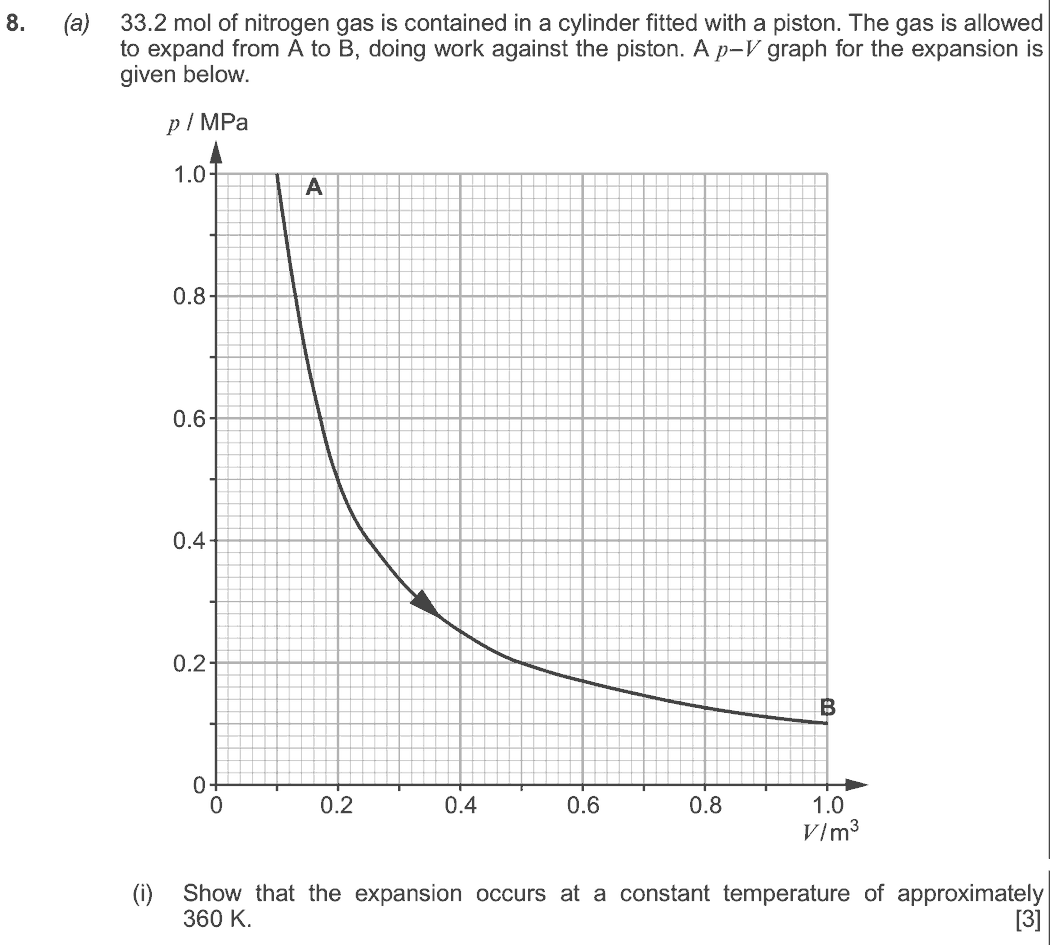
June 2018 · Component 1 · Q8(a)(i)3 marksAO3=3Show that
Mark scheme
Examiner's comment
(i) We deemed that the pV product ought really to be evaluated at 3 points to show convincingly that the graph represented expansion at constant temperature, but we gave full marks for evaluation at two points provided they weren’t both end- points. The temperature also had to be calculated; sometimes this was done using a single point, ignoring the demand to show constancy: 1 mark only.
Notes from the mark scheme and report
pV evaluated at two or more points, not both at the ends of the curve (1)
pV constant (1.0 × 10⁵ J) so T is constant (1)
T = pV/nR = 362 K (1)
a single point scored 1
Scheme columns: Maths 2
Skills: Graphskills Reading, plotting or sketching graphs; gradients, intercepts and areas; Unitsand conversions Unit marks, base units, prefixes and conversions; Mathsmarks The mark scheme's Maths column gives this part at least one mark for mathematical skills
June 2018 · Component 1 · Q9(b)2 marksAO2=2Calculation
Earlier part of question 9 that this part uses
Mark scheme
Examiner's comment
Almost everyone succeeded in calculating the temperature at which the electrons would have the given rms speed.
Notes from the mark scheme and report
Answer: 220 K. ½m<v²> = (3/2)kT so T = m<v²>/3k with v = 1.00 × 10⁵ m s⁻¹ and the electron mass
Scheme columns: Maths 2
Skills: Comprehension A level Component 1 Section B: questions on the printed article; Algebra Derivations and rearranging equations; Mathsmarks The mark scheme's Maths column gives this part at least one mark for mathematical skills
June 2018 · Component 1 · Q9(g)4 marksAO3=4Explanation
Earlier part of question 9 that this part uses
Mark scheme
Examiner's comment
Explaining why resistivity was proportional to T was the most challenging part of this question. Candidates had to realise that was inversely proportional to the mean speed (and therefore to the rms speed). Occasionally mean speed was confused with drift velocity. There were, though, many good answers.
Notes from the mark scheme and report
Time between collisions = distance/speed, with the speed being the rms speed (1)
ρ is proportional to 1/time so to v (1)
v² is proportional to T from kinetic theory (1)
so ρ is proportional to √T (1)
the thermal speed was sometimes confused with the drift velocity
Scheme columns: Maths 2
Skills: Comprehension A level Component 1 Section B: questions on the printed article; Algebra Derivations and rearranging equations; Mathsmarks The mark scheme's Maths column gives this part at least one mark for mathematical skills
June 2017 · Component 1 · Q5(a)6 marksAO1=66-mark extended response
Mark scheme, with the levels and indicative content
Examiner's comment
To gain entry into the lowest band (1 or 2 marks) it needed to be pointed out that gas pressure was due to gas molecules colliding with the walls of the container, that molecules’ speed increased with temperature, and that this made the hits harder or more frequent. A minority of candidates gave no more than this. Top band (5 or 6) answers, and there were many of these, discussed the collisions in terms of momentum changes, pointed out that the random hits all over the container walls led to a uniform mean pressure, and mentioned both mean frequency of collision and mean impulse per hit as causes of increase of pressure with mean molecular speed and hence with temperature. Omission of one of these didn’t automatically demote a candidate to the middle band. Several candidates gave mathematical derivations of 𝑝= 3 𝜌𝑐2̅̅̅. There was no specific penalty for doing this, but some derivations were (not surprisingly too) lacking in explanation to answer the question clearly.
Notes from the mark scheme and report
QER, levels marked. Pressure: molecules collide with the walls, their momentum changes, so a force acts on the molecule and (Newton's third law) on the wall
random collisions over the whole area give a steady pressure = F/A
collisions elastic. Temperature: mean kinetic energy (rms speed) rises with T, so each collision gives a larger momentum change and there are more collisions per second, hence greater force and pressure. Top band needed momentum change and both effects of higher speed
a bare derivation of p = ⅓ρ<c²> did not answer the question
Skills: QER The 6-mark quality of extended response question
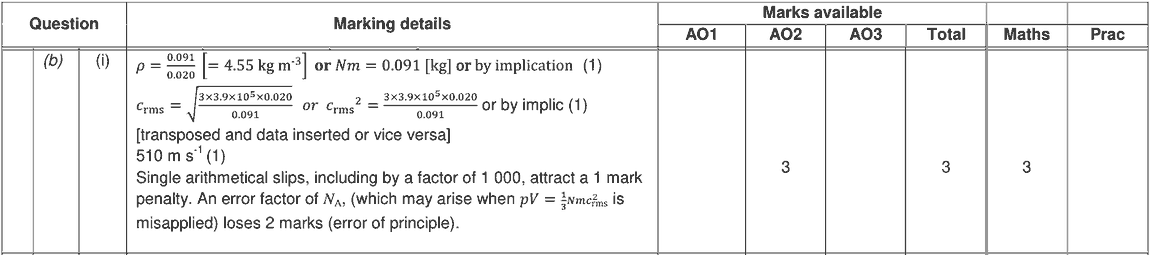
June 2017 · Component 1 · Q5(b)(i)3 marksAO2=3Calculation
Earlier part of question 5 that this part uses
Mark scheme
Examiner's comment
The rms speed was calculated correctly by most candidates, who used 𝑝= 3 𝜌𝑐2̅̅̅. Those who used the alternative form 𝑝𝑉= 3 𝑁𝑚𝑐2̅̅̅ very often made wrong substitutions for N and/or m, and finished up with answers that were wrong (e.g. by a factor of √𝑁𝐴).
Notes from the mark scheme and report
Answer: 510 m s⁻¹. ρ = 0.091/0.020 = 4.55 kg m⁻³
c rms = √(3p/ρ) = √(3 × 3.9 × 10⁵ × 0.020/0.091)
using pV = ⅓Nm<c²> with wrong N or m gave errors by a factor of √NA
Scheme columns: Maths 3
Skills: Mathsmarks The mark scheme's Maths column gives this part at least one mark for mathematical skills
June 2017 · Component 1 · Q5(b)(ii)3 marksAO2=3Calculation
Earlier parts of question 5 that this part uses
Mark scheme
Examiner's comment
Calculations of the temperature were generally done very well, using pV = nRT. The commonest mistake was to make n (and hence T) wrong by a factor of 1000.
Notes from the mark scheme and report
Answer: 290 K. n = 91/28 = 3.25 mol
T = pV/nR = 3.9 × 10⁵ × 0.020/(3.25 × 8.31)
unit mark
n wrong by a factor of 1000 was the usual error
Scheme columns: Maths 3
Skills: Unitsand conversions Unit marks, base units, prefixes and conversions; Mathsmarks The mark scheme's Maths column gives this part at least one mark for mathematical skills
Work with an Eduqas physics tutor
Dropping marks on calculations, specified practicals or the six-mark QER questions? Book a trial session with a specialist Eduqas physics tutor.