Notes and key-term cards for this topic are being written by our tutors. The past-paper questions below are ready now.
Specification statements
Show the 7 statements from the specification
3.5-a the process of stimulated emission and how this process leads to light emission that is coherent
3.5-b the idea that a population inversion (N₂ > N₁) is necessary for a laser to operate
3.5-c the idea that a population inversion is not (usually) possible with a 2-level energy system
3.5-d how a population inversion is attained in 3 and 4-level energy systems
3.5-e the process of pumping and its purpose
3.5-f the structure of a typical laser i.e. an amplifying medium between two mirrors, one of which partially transmits light
3.5-g the advantages and uses of a semiconductor laser i.e. small, cheap, far more efficient than other types of laser, and it is used for CDs, DVDs, telecommunication etc
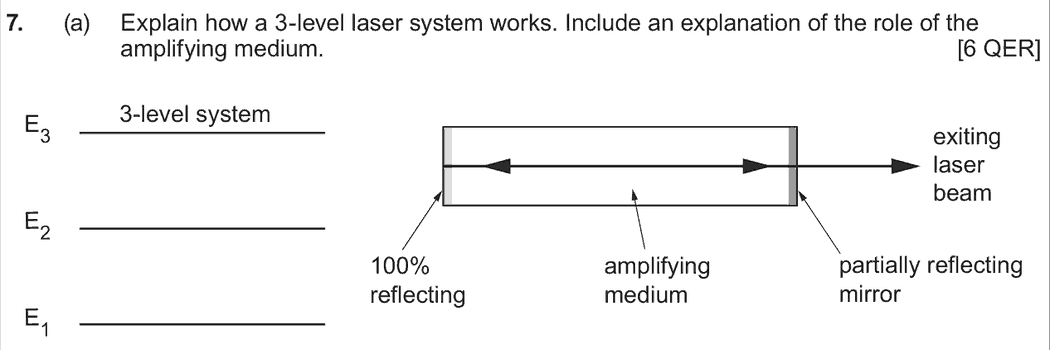
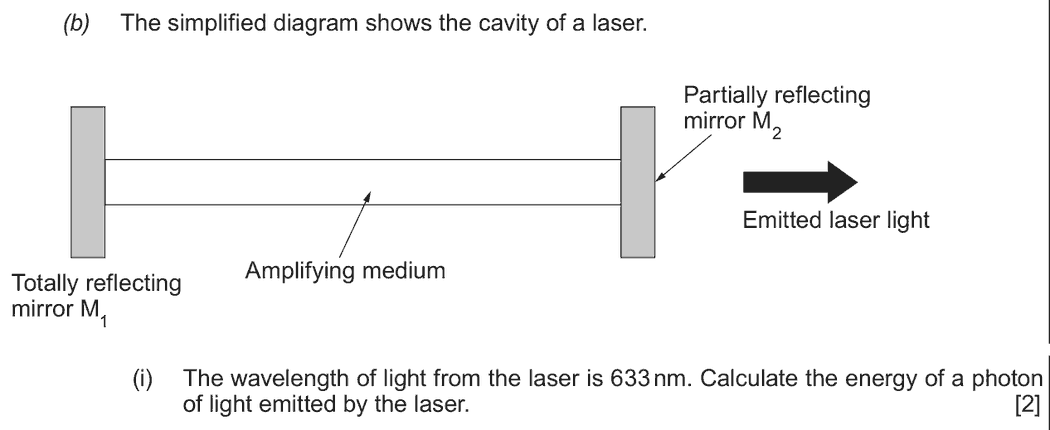
. (a) Explain how a 3-level laser system works. Include an explanation of the role of the amplifying medium. [6 QER] 3-level system E3 exiting laser beam E2 100% amplifying partially reflecting reflecting medium mirror E
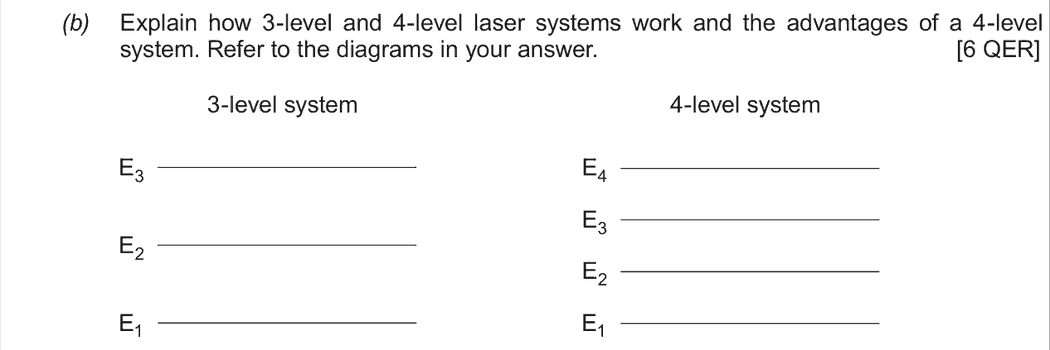
Explain how 3-level and 4-level laser systems work and the advantages of a 4-level system. Refer to the diagrams in your answer. [6 QER] 3-level system 4-level system E3 E4 E3 E2 E2 E1 E1
Tap a question to zoom it. Where a part needs a figure, table or graph from earlier in the question, that part folds out above it; the mark scheme and examiner's comment open underneath. Have the Eduqas Data Booklet beside you (see the Data Booklet page).
June 2025 · Component 1 · Q8(g)3 marksAO3=3Calculation
Earlier part of question 8 that this part uses
Mark scheme
Examiner's comment
Candidates found a few different paths through this question as outlined on the MS. There were also a few candidates that started down one path then changed approach often picking up all the MPs. Some converted the time to seconds and cancelled later. This was fine. Some of these candidates did not cancel later and were often stuck on two marks. PHYSICS GCE A level Summer 2025
Notes from the mark scheme and report
Answer: no. Power added per year = 2 × 10⁹ × 2 × 10⁻³ = 4 × 10⁶ W
time needed = 500 × 10¹²/4 × 10⁶ = 1.25 × 10⁸ years, far more than 10 000
or in 10 000 years only 4 × 10¹⁰ W, far below 5 × 10¹⁴ W
Scheme columns: Maths 3
Skills: Comprehension A level Component 1 Section B: questions on the printed article; Mathsmarks The mark scheme's Maths column gives this part at least one mark for mathematical skills
June 2025 · Component 3 · Q7(a)6 marksAO1=66-mark extended response
Mark scheme, with the levels and indicative content
Examiner's comment
Part (a) was the extended writing question and was answered well. Part (b) was also answered well.
Notes from the mark scheme and report
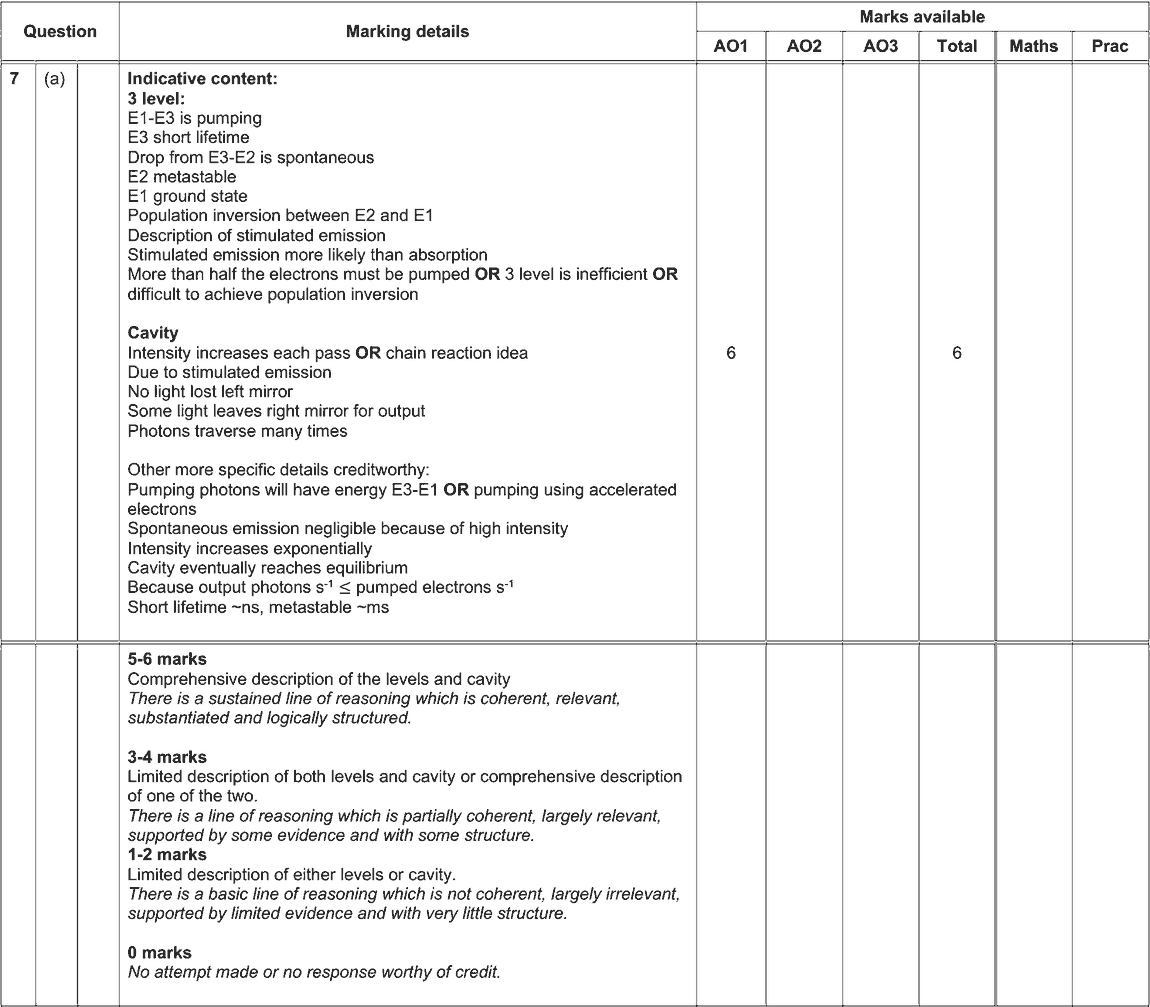
QER, levels marked. Levels: pumping raises electrons from E1 to E3
E3 is short-lived and electrons drop spontaneously to the metastable E2
a population inversion builds between E2 and the ground state E1 (more than half the electrons must be pumped, so 3-level is inefficient)
a photon of energy E2 − E1 stimulates emission of an identical, coherent photon, and stimulated emission outweighs absorption. Cavity: light passes back and forth through the amplifying medium between the mirrors, growing on every pass
the 100% mirror loses nothing and the partially reflecting mirror lets some out as the beam. Answered well
Skills: QER The 6-mark quality of extended response question
June 2025 · Component 3 · Q7(b)2 marksAO1=2Short answer
Earlier part of question 7 that this part uses
Mark scheme
Examiner's comment
Part (a) was the extended writing question and was answered well. Part (b) was also answered well.
Notes from the mark scheme and report
One further advantage, e.g. small, cheap, mass produced, low voltage (1)
one use, e.g. CD, DVD or Blu-ray players, telecommunications, scanners, laser cutters (1)
June 2024 · AS Component 2 · Q5(a)(i)1 markAO2=1Short answer
Mark scheme
Examiner's comment
This question was very well answered and it was apparent the topic was well understood by candidates.
Notes from the mark scheme and report
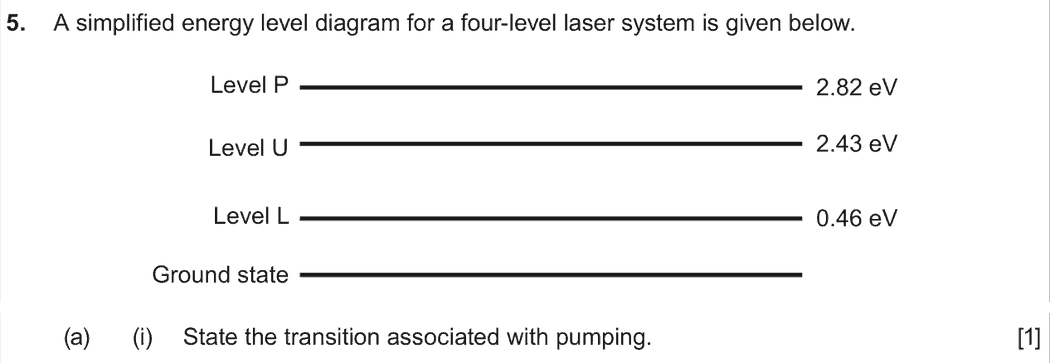
From the ground state up to level P (or a correct upward arrow on the diagram)
June 2024 · AS Component 2 · Q5(a)(ii)3 marksAO1=3Explanation
Earlier part of question 5 that this part uses
Mark scheme
Examiner's comment
This question was very well answered and it was apparent the topic was well understood by candidates.
Notes from the mark scheme and report
With more electrons in the upper level than the lower one, stimulated emission is more likely (1) than absorption of the photons (1)
so the number of photons grows, giving light amplification (1)
June 2024 · AS Component 2 · Q5(b)4 marksAO3=4Calculation
Earlier part of question 5 that this part uses
Mark scheme
Examiner's comment
This question was very well answered and it was apparent the topic was well understood by candidates.
Notes from the mark scheme and report
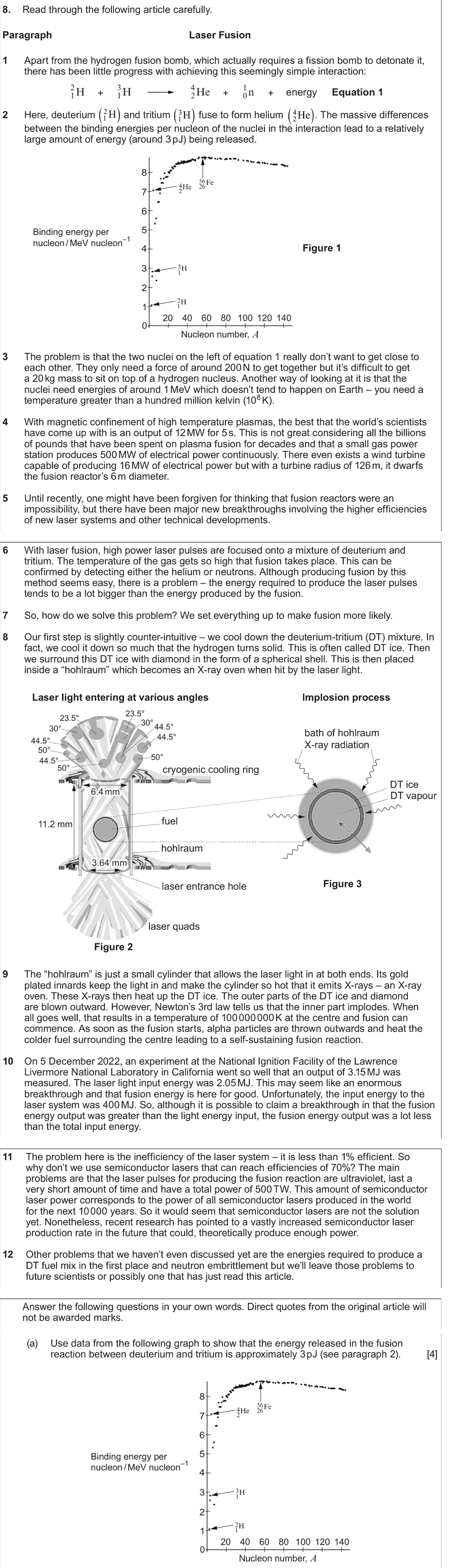
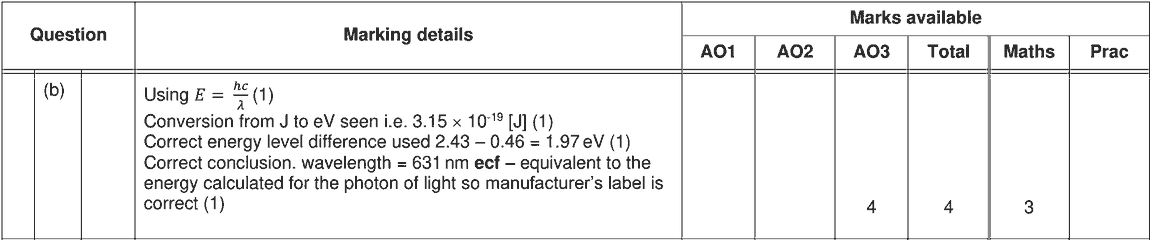
Answer: label correct (631 nm). Laser transition U to L: 2.43 − 0.46 = 1.97 eV (1) = 3.15 × 10⁻¹⁹ J (1)
Skills: Unitsand conversions Unit marks, base units, prefixes and conversions; Mathsmarks The mark scheme's Maths column gives this part at least one mark for mathematical skills
June 2023 · Component 3 · Q6(a)1 markAO1=1Definition
Mark scheme
Examiner's comment
Part (b) was very well answered. However, very few candidates were able to state that the rate of pumping was equal to the rate of dropping at equilibrium. In part (c), one mark was rarely awarded. After the previous calculation, one would expect some candidates to state that the population of the metastable state was proportional to its half-life. Unfortunately, the best candidates were just falling short and stating that the population increased with the half-life.
Notes from the mark scheme and report
An excited level in which electrons stay for a relatively long time (long lifetime, transition down is 'forbidden')
'not quite stable' not accepted
June 2023 · Component 3 · Q6(c)3 marksAO1=2, AO2=1Explanation
Earlier part of question 6 that this part uses
Mark scheme
Examiner's comment
Part (b) was very well answered. However, very few candidates were able to state that the rate of pumping was equal to the rate of dropping at equilibrium. In part (c), one mark was rarely awarded. After the previous calculation, one would expect some candidates to state that the population of the metastable state was proportional to its half-life. Unfortunately, the best candidates were just falling short and stating that the population increased with the half-life.
Notes from the mark scheme and report
The metastable level is the upper level of the population inversion needed for stimulated emission (1)
from (b) its population is proportional to the half-life (1)
a larger population means more stimulated emission, a higher output, or less pumping needed (1)
'proportional' rarely stated
June 2022 · AS Component 2 · Q4(c)4 marksAO1=4Explanation
Earlier part of question 4 that this part uses
Mark scheme
Notes from the mark scheme and report
Electrons are pumped up to a metastable state where they stay a relatively long time (1)
this builds a population inversion, more electrons in the upper level than the lower, so stimulated emission is more likely than absorption or spontaneous emission (1)
stimulated emission: an electron drops to the lower level (1) when triggered by a photon of the same energy, giving a second identical, coherent photon (1)
June 2022 · Component 3 · Q4(a)(i)2 marksAO1=2Explanation
Mark scheme
Examiner's comment
Quite poorly answered. Most candidates were unable to come up with two relevant points.
Notes from the mark scheme and report
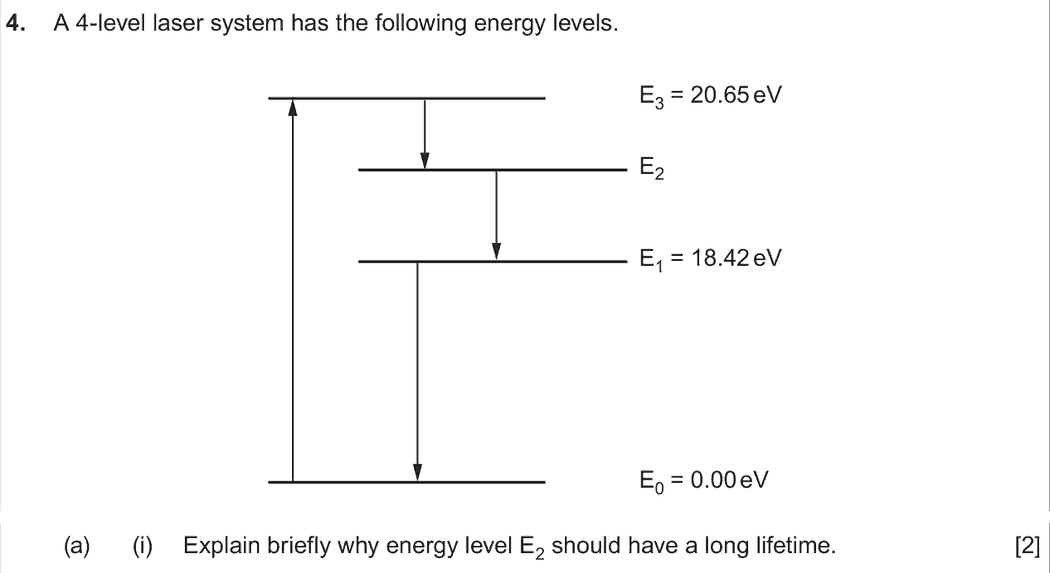
A long lifetime lets electrons accumulate in E2 so a population inversion between E2 and E1 can be set up (1), which raises the chance of stimulated emission (1)
few gave two relevant points
October 2020 · Component 3 · Q4(a)2 marksAO1=2Definition
Mark scheme
Examiner's comment
Explanations of stimulated emission were surprisingly incomplete. Part (b) was quite well answered, especially the point that E1 has a short lifetime. Obtaining a second reason was more difficult e.g. stating that E1 is above the ground state or that the level above has a long lifetime. It was rare to encounter a candidate who explained that the 1 % loss on reflection is balanced by a 2 × 0.5 % gain each time the beam passes through the amplifying medium.
Notes from the mark scheme and report
An incoming photon of the right energy (equal to the level gap) (1) causes an excited electron to drop, emitting a second photon, so two photons leave (1)
answers were often incomplete
October 2020 · Component 3 · Q4(b)2 marksAO1=2Short answer
Earlier part of question 4 that this part uses
Mark scheme
Examiner's comment
Explanations of stimulated emission were surprisingly incomplete. Part (b) was quite well answered, especially the point that E1 has a short lifetime. Obtaining a second reason was more difficult e.g. stating that E1 is above the ground state or that the level above has a long lifetime. It was rare to encounter a candidate who explained that the 1 % loss on reflection is balanced by a 2 × 0.5 % gain each time the beam passes through the amplifying medium.
Notes from the mark scheme and report
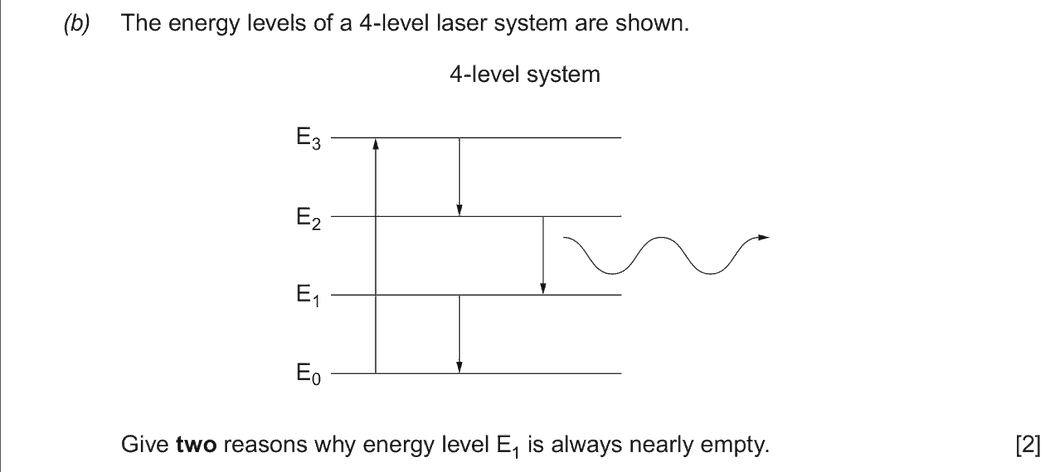
E1 has a short lifetime, electrons drop quickly to E0 (1)
it lies above the ground state so is not thermally populated, or the level above (E2) is metastable so few electrons arrive (1)
October 2020 · Component 3 · Q4(c)3 marksAO3=3Explanation
Earlier parts of question 4 that this part uses
Mark scheme
Examiner's comment
Explanations of stimulated emission were surprisingly incomplete. Part (b) was quite well answered, especially the point that E1 has a short lifetime. Obtaining a second reason was more difficult e.g. stating that E1 is above the ground state or that the level above has a long lifetime. It was rare to encounter a candidate who explained that the 1 % loss on reflection is balanced by a 2 × 0.5 % gain each time the beam passes through the amplifying medium.
Notes from the mark scheme and report
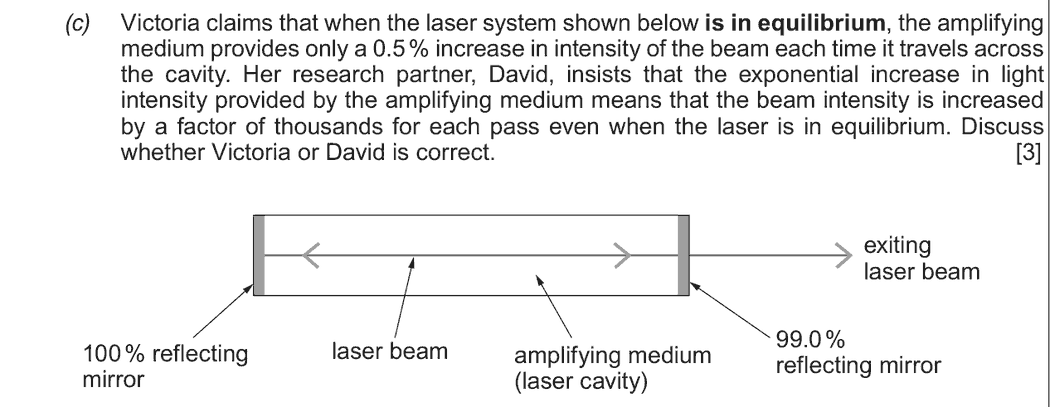
1% of the beam leaves through the 99% mirror each round trip (1)
in equilibrium the gain must just balance this, 1% per round trip (1)
that is 0.5% per pass, so Victoria is correct (1)
arguing for David (large gain needed to offset other losses) max 2
very few spotted the 2 × 0.5% balance
June 2019 · Component 3 · Q3(a)(i)2 marksAO1=2Explanation
Mark scheme
Examiner's comment
This little corner is very specific. When a 2-level system is being pumped using light, the best that can be achieved is equal population in each level and an equal probability of absorption and stimulated emission.
Notes from the mark scheme and report
Pumping photons also cause stimulated emission from the upper level (1), which lowers the upper population
absorption and stimulated emission are equally likely so at best 50% can be in the upper level (1)
June 2019 · Component 3 · Q3(a)(ii)2 marksAO1=2Short answer
Earlier part of question 3 that this part uses
Mark scheme
Examiner's comment
This little corner is very specific. When a 2-level system is being pumped using light, the best that can be achieved is equal population in each level and an equal probability of absorption and stimulated emission.
Notes from the mark scheme and report
Advantage: far more efficient (less pumping energy or low pumping voltage), small, cheap and mass produced (1) ('lower current' not accepted)
use: CD, DVD or Blu-ray players, laser pointers, telecommunications (1)
June 2019 · Component 3 · Q3(b)6 marksAO1=66-mark extended response
Earlier part of question 3 that this part uses
Mark scheme, with the levels and indicative content
Examiner's comment
Very well answered. The explanations of 3 and 4-level systems were almost textbook quality at times. The more difficult points to score were the advantages of the 4-level system over the 3-level system.
Notes from the mark scheme and report
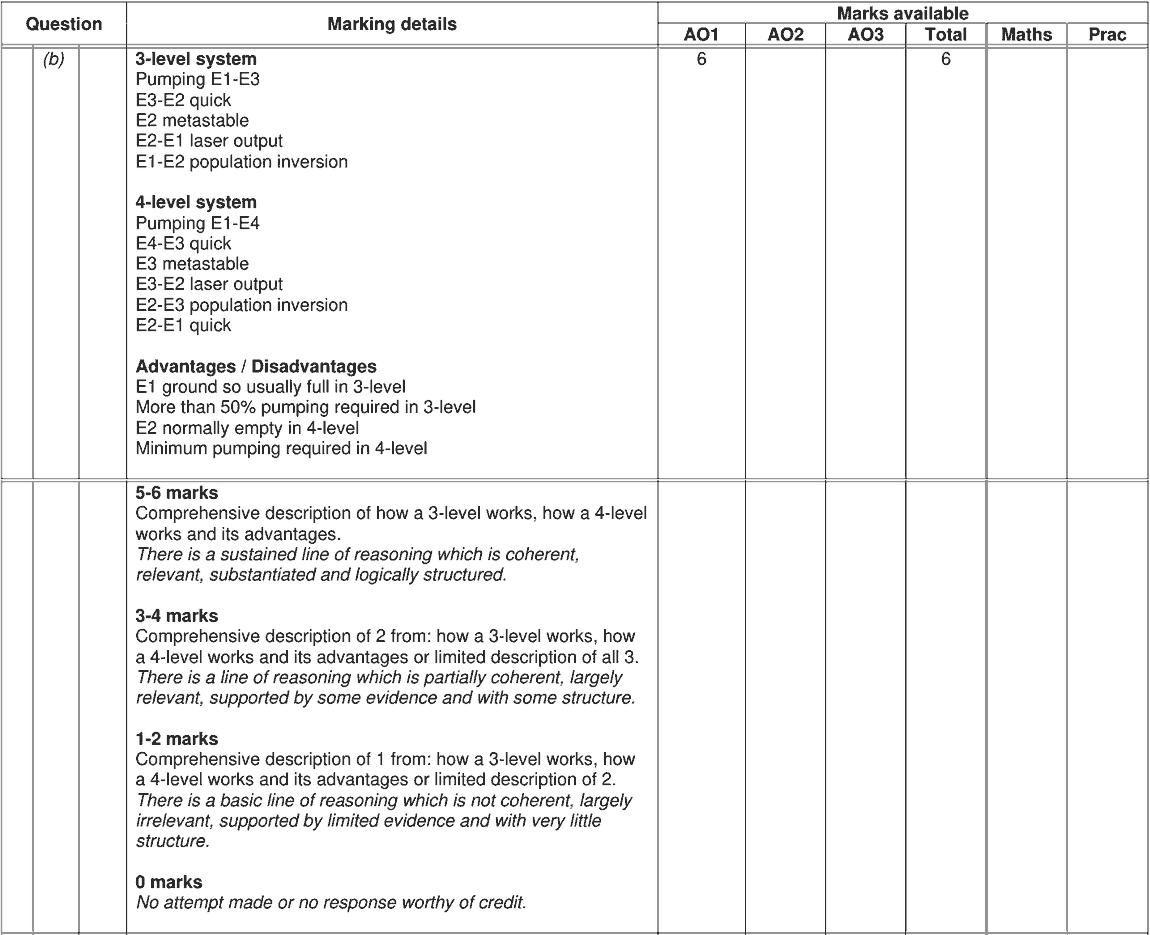
QER, levels marked. 3-level: pump E1 to E3
fast drop E3 to E2
E2 metastable, so inversion between E2 and E1
laser transition E2 to E1. 4-level: pump E1 to E4
fast drop to E3 (metastable)
laser transition E3 to E2
E2 empties quickly to E1, so inversion between E3 and E2. Advantage: in a 3-level system the lower laser level is the ground state, normally full, so more than half the atoms must be pumped
in a 4-level system E2 is normally empty so very little pumping gives an inversion. The advantages were the hardest points
Skills: QER The 6-mark quality of extended response question
June 2018 · AS Component 2 · Q5(a)6 marksAO1=66-mark extended response
Mark scheme, with the levels and indicative content
Examiner's comment
This QER question was answered well and nearly all candidates made at least two valid points. Many did not draw a clearly labelled diagram to indicate the transition between the levels. Nearly all candidates were able to refer to the fact that population inversion is required and that this not possible with a 2 level system.
Notes from the mark scheme and report
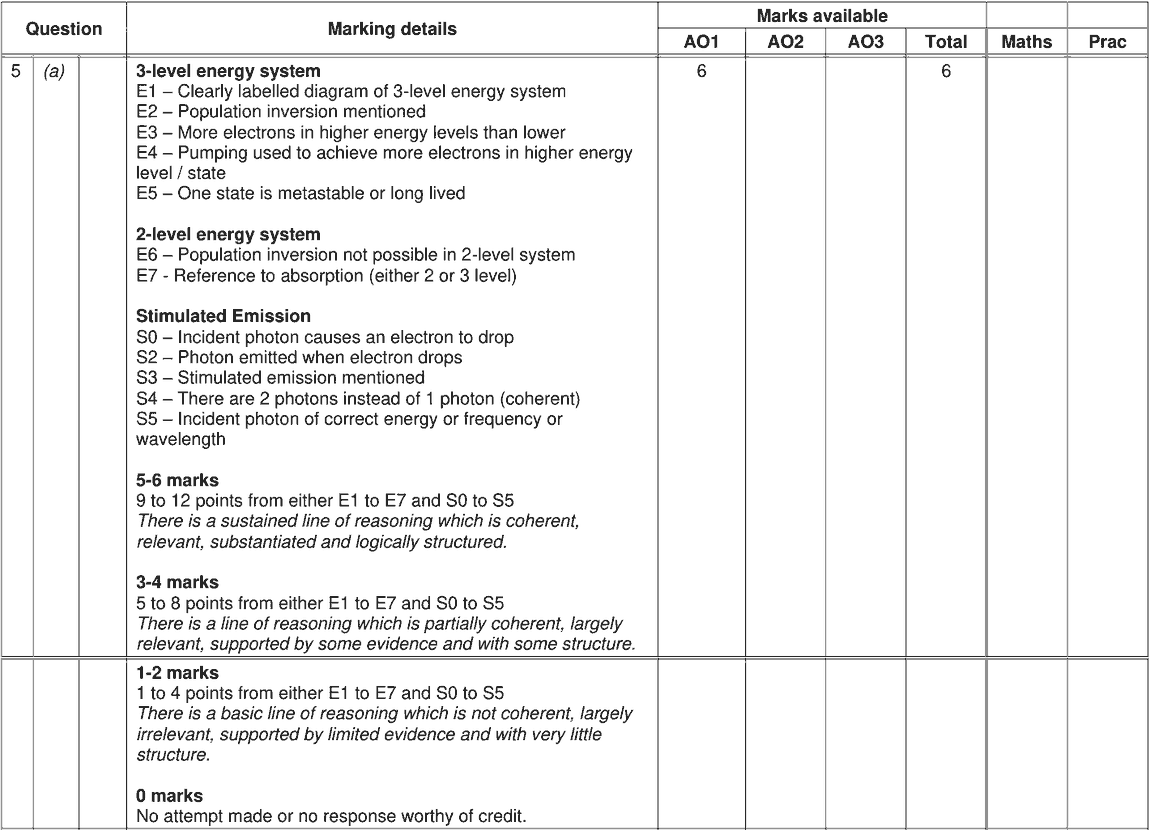
QER, levels marked on number of points. Three-level system: labelled level diagram
pumping lifts electrons from the ground state to the top level
they drop quickly to a metastable (long-lived) level, giving a population inversion (more electrons in the upper laser level than the lower). Two-level: inversion impossible, since pumping photons are as likely to cause stimulated emission as absorption. Stimulated emission: an incident photon of the right energy makes an electron drop, emitting a second photon in phase, so two photons leave for one in. Diagrams were often missing
Skills: QER The 6-mark quality of extended response question
June 2018 · AS Component 2 · Q5(b)(ii)3 marksAO2=3Calculation
Earlier parts of question 5 that this part uses
Mark scheme
Examiner's comment
Only the more able candidates were able to use the simple probability of 1 in 500 photons in relation to the number of incident photons.
Notes from the mark scheme and report
Answer: 1.6 × 10¹⁸ photons per second. Emitted photons per second = P/E = 1.0 × 10⁻³/3.14 × 10⁻¹⁹ = 3.18 × 10¹⁵
only 1 in 500 is transmitted, so incident number = 3.18 × 10¹⁵ × 500
the factor of 500 defeated most
Scheme columns: Maths 3
Skills: Mathsmarks The mark scheme's Maths column gives this part at least one mark for mathematical skills
June 2018 · Component 3 · Q4(a)2 marksAO1=2Explanation
Mark scheme
Examiner's comment
Well answered.
Notes from the mark scheme and report
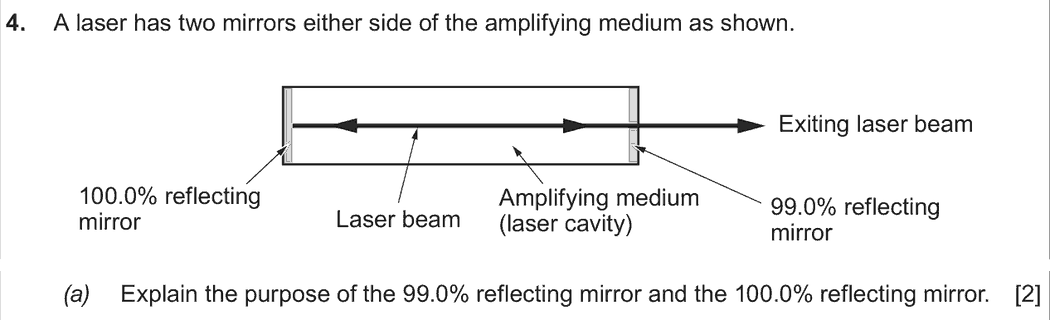
Mirrors send the light back and forth through the medium many times, giving more stimulated emission and amplification (1)
the 99.0% mirror transmits about 1% as the output beam (1)
June 2018 · Component 3 · Q4(b)3 marksAO1=3Explanation
Earlier part of question 4 that this part uses
Mark scheme
Examiner's comment
Well answered with most candidates realising that the probability of stimulated emission needs to be greater than that of absorption.
Notes from the mark scheme and report
With more electrons in the upper level, stimulated emission (1) is more likely than absorption (1), so the light intensity grows as it passes through (amplification) (1)
June 2017 · AS Component 2 · Q7(a)(i)1 markAO1=1Definition
Mark scheme
Examiner's comment
The vast majority of candidates were able to state what is meant by a population inversion. A significant number did refer to the ground state as being the lower energy level which did not gain credit.
Notes from the mark scheme and report
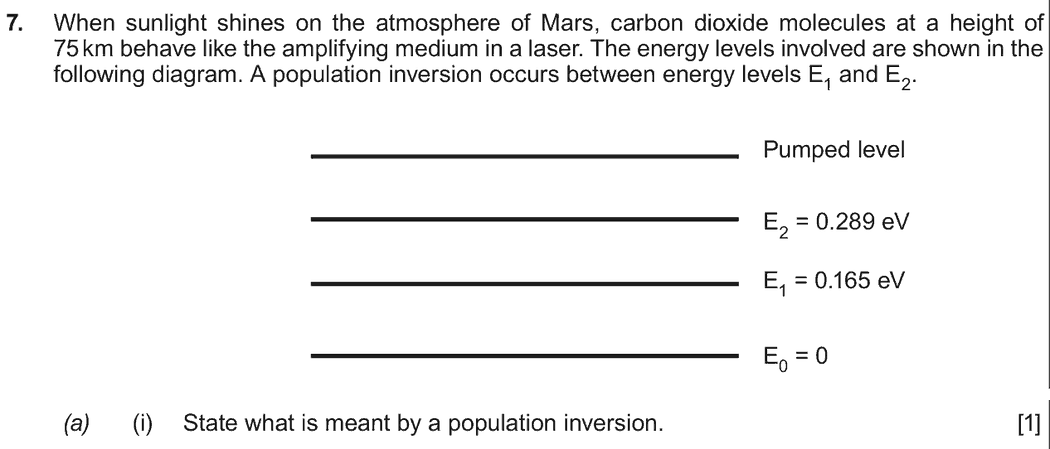
More electrons (molecules) in the higher level E2 than in the lower level E1
naming the ground state as the lower level was not credited
June 2017 · AS Component 2 · Q7(a)(ii)2 marksAO1=2Explanation
Earlier part of question 7 that this part uses
Mark scheme
Examiner's comment
Surprisingly only a minority of candidates were able to state that a population inversion was needed for stimulated emission and that an incoming photon results in an additional photon being emitted i.e. the amplifying action was rarely given though the question asked for the laser action specifically.
Notes from the mark scheme and report
So that stimulated emission is more likely than absorption or spontaneous emission (1)
each incoming photon then gives two photons leaving, so the light is amplified (1)
the amplification idea was rarely given
June 2017 · Component 3 · Q1(a)2 marksAO1=2Short answer
Mark scheme
Examiner's comment
As expected, nearly universally correct.
Notes from the mark scheme and report
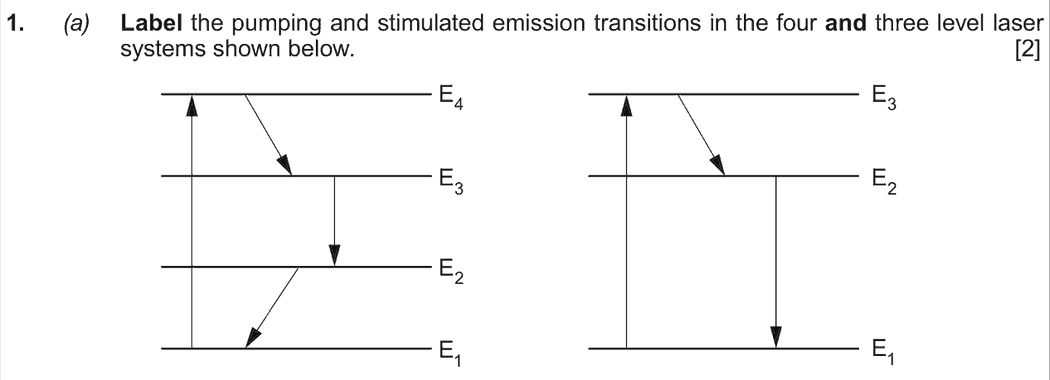
Pumping is the upward arrow in both diagrams
stimulated emission is E3 to E2 in the four level system and E2 to E1 in the three level system
all three correct for 2 marks, one or two correct for 1
June 2017 · Component 3 · Q1(b)4 marksAO1=2, AO2=2Explanation
Earlier part of question 1 that this part uses
Mark scheme
Examiner's comment
A tough question to answer and most candidates just explained how the 4- level system works followed by how the 3-level system works. However, this question was about the advantage of the 4-level system over the 3-level system. The essential difference is that the lower level of the population inversion is (initially) full for the 3-level system but empty for the 4-level system. This leads to minimal pumping being required for the 4-level system but more than 50% pumping being required for the 3-level system.
Notes from the mark scheme and report
In the four level system the lower laser level E2 starts almost empty and empties quickly (1)
in the three level system the lower level is the ground state E1, which starts full (1)
so much more pumping is needed for three levels (1): over 50% of the electrons must be pumped, whereas any pumping gives an inversion with four levels (1)
most just described each system in turn without comparing
June 2017 · Component 3 · Q1(c)2 marksAO2=2Explanation
Earlier part of question 1 that this part uses
Mark scheme
Examiner's comment
Another question that seemed innocent enough but was difficult to find an appropriate answer. Too many candidates tried generic answers that could apply to any laser energy question e.g. “to get a population inversion” or “to get as many electrons as possible in the metastable state.”
Notes from the mark scheme and report
A full (or filling) top level cannot be pumped into, so pumping would become ineffective (1)
electrons must drop quickly to the level below (E3 or E2) to build up the population inversion there (1)
generic answers such as 'to get a population inversion' not credited
June 2016 · AS Component 2 · Q5(b)4 marksAO3=4Calculation
Earlier part of question 5 that this part uses
Mark scheme
Examiner's comment
A large number of candidates could not convert mm-2 to m-2 to make any valid comparisons. Indeed, some candidates thought you could look directly at the sun without glasses!
Notes from the mark scheme and report
Convert to the same units: Sun 1360 W m⁻²
laser 1.0 mW mm⁻² = 1000 W m⁻² (1 for the power conversion, 1 for the area conversion)
comparison, e.g. the Sun is 36% more intense (1)
reasoned conclusion, e.g. almost as dangerous as looking at the Sun so goggles are needed (1)
mm⁻² to m⁻² was the stumbling block
Scheme columns: Maths 2
Skills: Unitsand conversions Unit marks, base units, prefixes and conversions; Issues Benefits, risks, ethical or environmental issues (How Science Works); Mathsmarks The mark scheme's Maths column gives this part at least one mark for mathematical skills
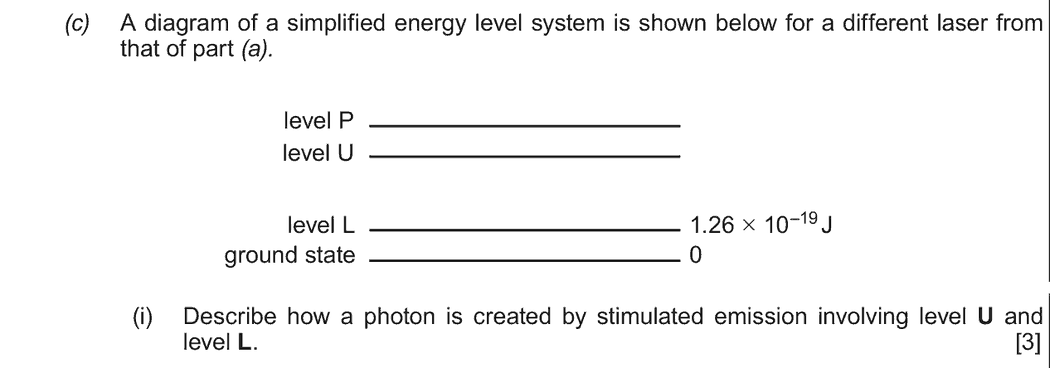
June 2016 · AS Component 2 · Q5(c)(i)3 marksAO1=3Explanation
Earlier part of question 5 that this part uses
Mark scheme
Examiner's comment
A significant number of answers described the entire process from ground state to ground state instead of mentioning the pertinent points. Often candidates described an excitation to U, spontaneous emission and then this photon stimulating another emission. Many did not comment that the two resulting photons are identical.
Notes from the mark scheme and report
An incoming photon (1) causes an electron (atom) in level U to drop to level L (1)
the energy lost is emitted as a photon identical to the incident one (1)
many described the whole pumping cycle or spontaneous emission and did not say the photons are identical
Work with an Eduqas physics tutor
Dropping marks on calculations, specified practicals or the six-mark QER questions? Book a trial session with a specialist Eduqas physics tutor.