Tap a question to zoom it. Where a part needs a figure, table or graph from earlier in the question, that part folds out above it; the mark scheme and examiner's comment open underneath. Have the Eduqas Data Booklet beside you (see the Data Booklet page).
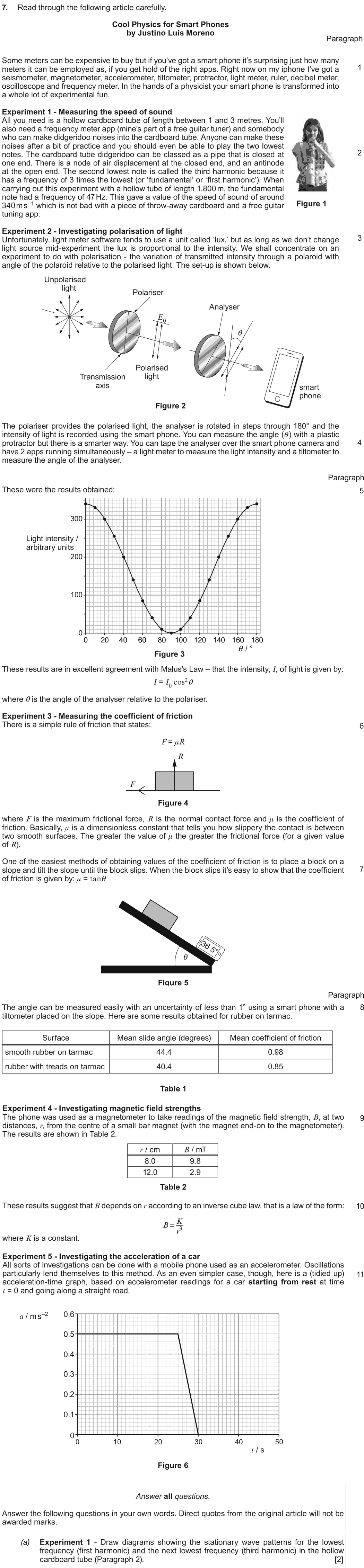
June 2025 · AS Component 2 · Q1(a)(i)2 marksAO1=2Definition
Mark scheme
Notes from the mark scheme and report
A pattern of disturbances (oscillations) travelling through a medium and carrying energy (1), with the particles of the medium only vibrating about their equilibrium positions, so no matter is transferred (1)
June 2025 · AS Component 2 · Q1(a)(ii)2 marksAO1=2Explanation
Earlier part of question 1 that this part uses
Mark scheme
Notes from the mark scheme and report
Transverse: the vibrations are at right angles to the direction of travel of the wave (1)
longitudinal: the vibrations are along the direction of travel (1)
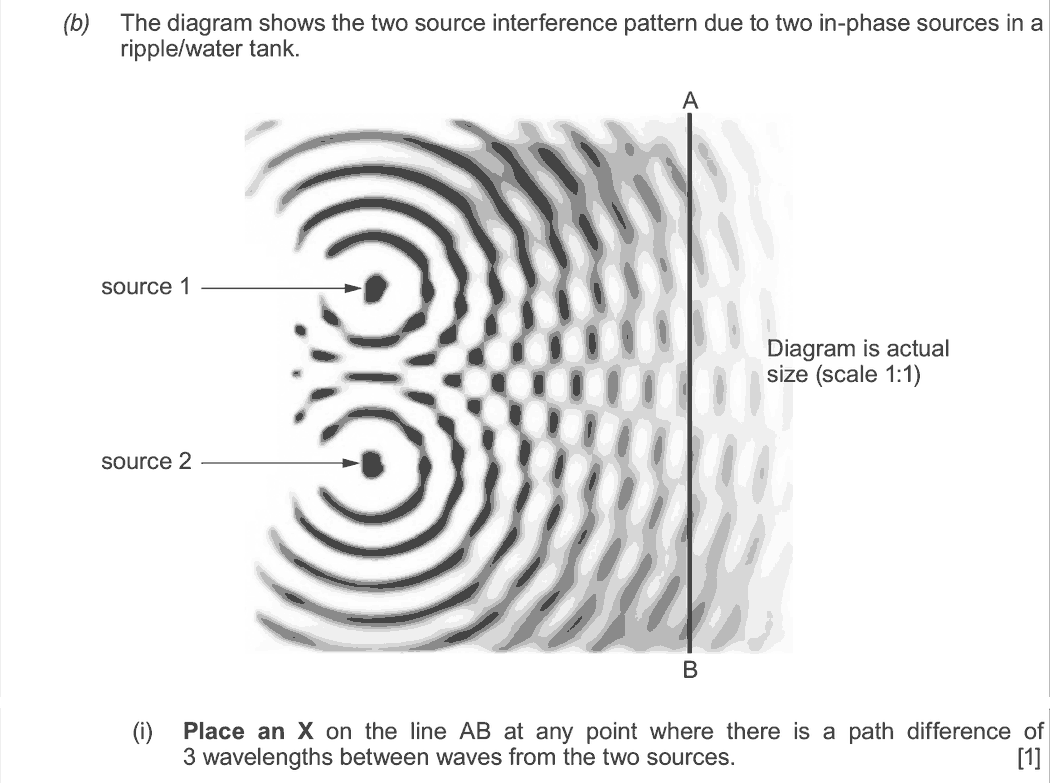
June 2025 · AS Component 2 · Q1(b)(i)2 marksAO2=2Calculation
Earlier part of question 1 that this part uses
Mark scheme
Notes from the mark scheme and report
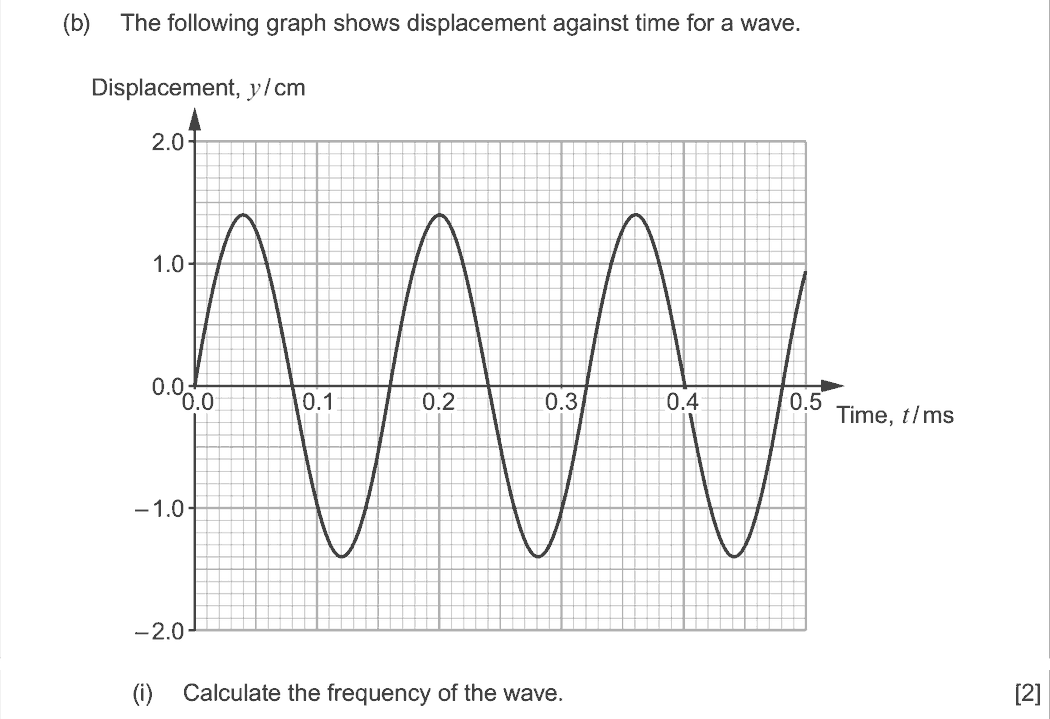
Answer: 6250 Hz (6.25 kHz). Period read from the graph = 0.16 ms
f = 1/T
ecf on a power-of-ten error
Scheme columns: Maths 1
Skills: Graphskills Reading, plotting or sketching graphs; gradients, intercepts and areas; Unitsand conversions Unit marks, base units, prefixes and conversions; Mathsmarks The mark scheme's Maths column gives this part at least one mark for mathematical skills
June 2025 · AS Component 2 · Q1(b)(ii)3 marksAO2=3Diagram or graph
Earlier parts of question 1 that this part uses
Mark scheme
Notes from the mark scheme and report
Sinusoid of the same period, 0.16 ms (1)
amplitude 0.7 cm, half the original 1.4 cm (1)
shifted by a quarter of a cycle (0.04 ms), so it starts at a peak or trough
lead or lag both accepted (1)
Scheme columns: Maths 3
Skills: Graphskills Reading, plotting or sketching graphs; gradients, intercepts and areas; Mathsmarks The mark scheme's Maths column gives this part at least one mark for mathematical skills
June 2025 · Component 3 · Q1(a)(i)3 marksAO1=3Definition
Mark scheme
Examiner's comment
The whole of this question was well answered with the exception of two of the parts -
Notes from the mark scheme and report
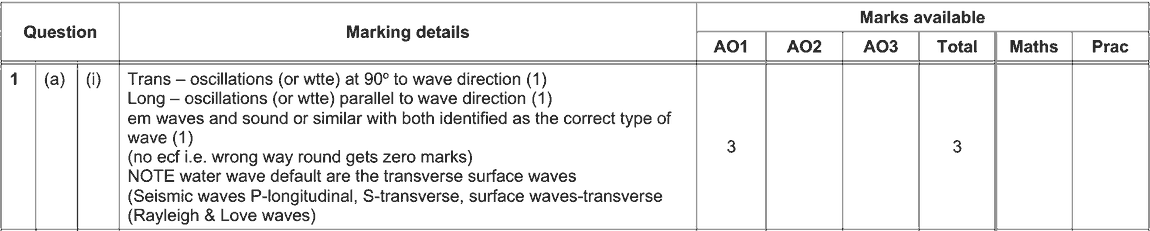
Transverse: oscillations at right angles to the direction of travel of the wave (1)
longitudinal: oscillations parallel to it (1)
correct example of each, e.g. electromagnetic waves and sound (1), no credit if the wrong way round
June 2025 · Component 3 · Q1(a)(ii)3 marksAO1=3Explanation
Earlier part of question 1 that this part uses
Mark scheme
Examiner's comment
The whole of this question was well answered with the exception of two of the parts -
Notes from the mark scheme and report
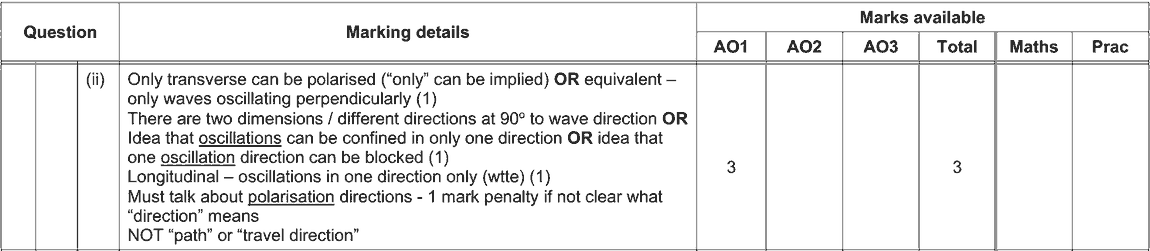
Only transverse waves can be polarised (1)
there are many possible oscillation directions perpendicular to the direction of travel, and polarising restricts them to one (1)
a longitudinal wave has only one possible oscillation direction, along the direction of travel (1)
'direction' must clearly mean the oscillation direction
June 2025 · Component 3 · Q1(b)(i)2 marksAO2=2Calculation
Earlier part of question 1 that this part uses
Mark scheme
Examiner's comment
The whole of this question was well answered with the exception of two of the parts -
Notes from the mark scheme and report
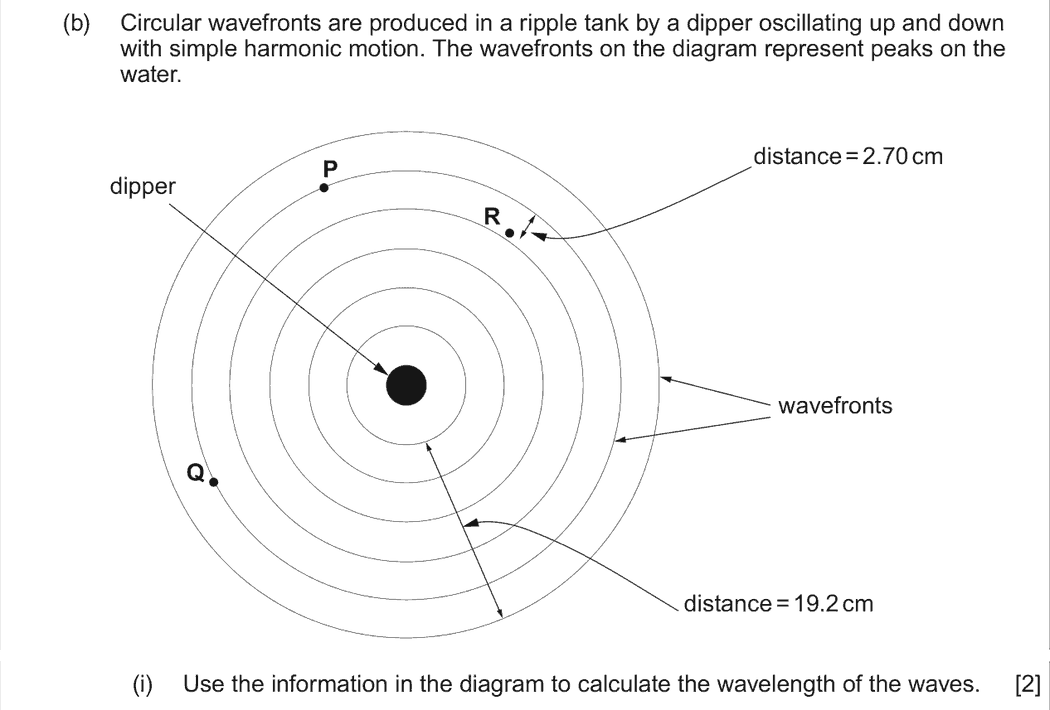
Answer: 3.84 cm (3.8). 19.2 cm spans 5 wavelengths
dividing by 6 (3.2 cm) scores 1
Scheme columns: Maths 1
Skills: Mathsmarks The mark scheme's Maths column gives this part at least one mark for mathematical skills
June 2025 · Component 3 · Q1(b)(ii)1 markAO2=1Diagram or graph
Earlier parts of question 1 that this part uses
Mark scheme
Examiner's comment
The whole of this question was well answered with the exception of two of the parts -
Notes from the mark scheme and report
Arrow at Q pointing radially outwards from the dipper, perpendicular to the wavefront
June 2025 · Component 3 · Q1(b)(iii)1 markAO1=1Short answer
Earlier parts of question 1 that this part uses
Mark scheme
Examiner's comment
The whole of this question was well answered with the exception of two of the parts -
Notes from the mark scheme and report
In phase (zero phase difference): P and Q lie on the same wavefront
2π or 360° treated as neutral
June 2025 · Component 3 · Q1(b)(iv)3 marksAO2=3Calculation
Earlier parts of question 1 that this part uses
Mark scheme
Examiner's comment
The whole of this question was well answered with the exception of two of the parts -
Notes from the mark scheme and report
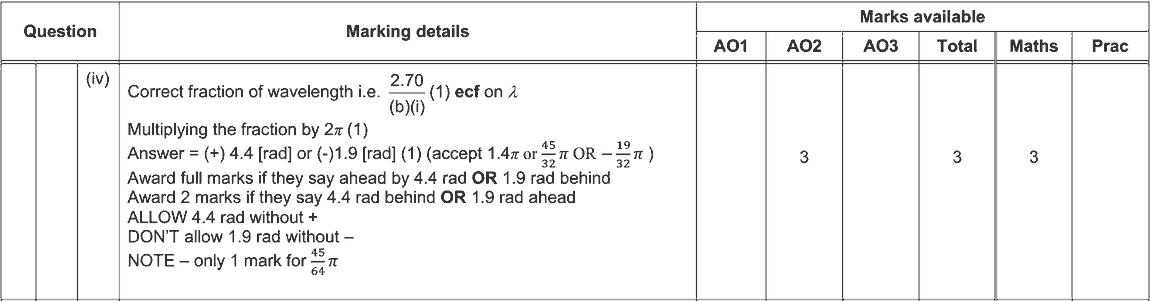
Answer: 4.4 rad ahead (equivalently 1.9 rad behind). Fraction of a wavelength = 2.70/3.84, multiplied by 2π
ecf on the wavelength
Scheme columns: Maths 3
Skills: Mathsmarks The mark scheme's Maths column gives this part at least one mark for mathematical skills
June 2025 · Component 3 · Q1(c)(i)3 marksAO2=3Calculation
Earlier parts of question 1 that this part uses
Mark scheme
Examiner's comment
(i) and (c)(iii). It is slightly strange that part (c)(i) caused so many problems - candidates were unable to pick up on the point that the number in front of 𝑡 was the angular frequency. On the other hand, part (c)(iii) was meant to be demanding and the low mean mark was expected.
Notes from the mark scheme and report
Answer: 6.5 cm s⁻¹ (unit needed). 10.7 is the angular frequency, so f = 10.7/2π = 1.70 Hz
v = fλ = 1.70 × 3.84 cm
many did not recognise ω, so this part scored poorly
Scheme columns: Maths 2
Skills: Synoptic Needs physics from another component of the qualification; Mathsmarks The mark scheme's Maths column gives this part at least one mark for mathematical skills
June 2025 · Component 3 · Q1(c)(iii)3 marksAO3=3Calculation
Earlier parts of question 1 that this part uses
Mark scheme
Examiner's comment
(i) and (c)(iii). It is slightly strange that part (c)(i) caused so many problems - candidates were unable to pick up on the point that the number in front of 𝑡 was the angular frequency. On the other hand, part (c)(iii) was meant to be demanding and the low mean mark was expected.
Notes from the mark scheme and report
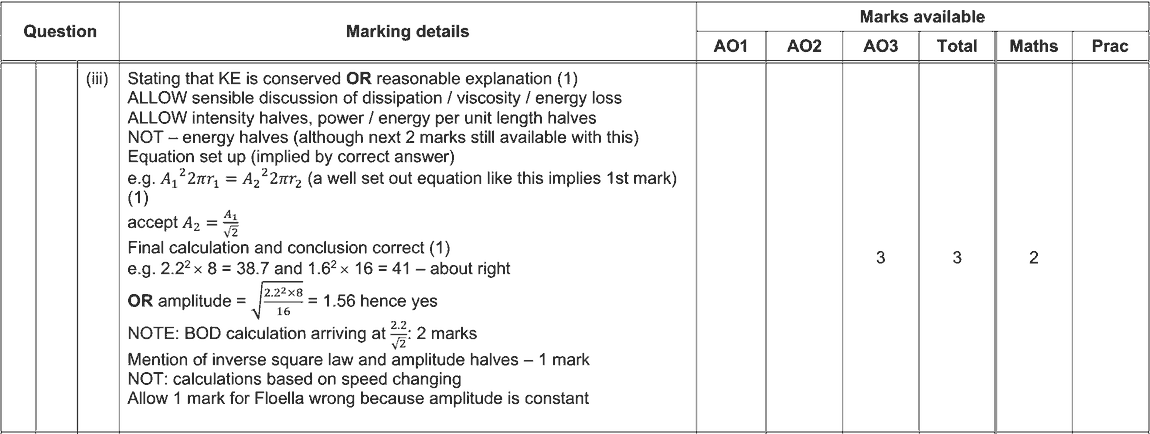
Energy is conserved but spread round a circumference that doubles, so the energy per unit length of wavefront halves (1)
A₁² × 2πr₁ = A₂² × 2πr₂ so A₂ = A₁/√2 (1)
2.2/√2 = 1.56 mm, so she is about right (1)
'amplitude halves by the inverse square law' scores 1
intended to be demanding, low mean mark
Scheme columns: Maths 2
Skills: Algebra Derivations and rearranging equations; Mathsmarks The mark scheme's Maths column gives this part at least one mark for mathematical skills
June 2024 · Component 1 · Q8(d)4 marksAO1=1, AO2=3Explanation
Earlier part of question 8 that this part uses
Mark scheme
Examiner's comment
We saw varied responses with a range of marks. Many used the wave equation,𝑐= 𝑓𝜆, less made the link to the air temperature increasing although any reference to the kinetic energy of the particles increasing did gain this mark. Many candidates stated the speed of sound increases. The last mark proved too demanding for some where we looked for reference to the wavelength being constant or at least the expansion of the brass being small or insignificant.
Notes from the mark scheme and report
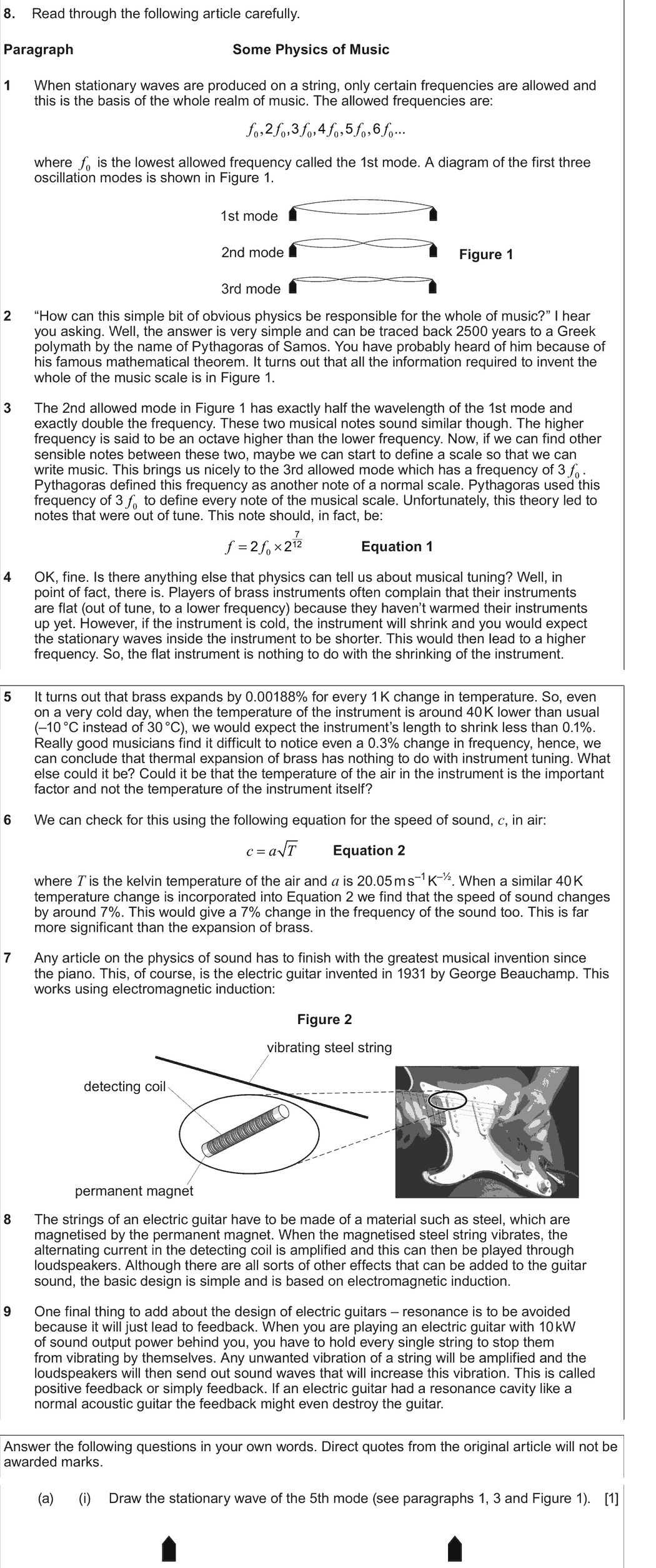
c = fλ stated or implied (1)
the air temperature increases (1) so the speed of sound increases (1)
λ is fixed because the expansion of the instrument is negligible, so f increases (1)
Skills: Comprehension A level Component 1 Section B: questions on the printed article
June 2024 · Component 1 · Q8(e)3 marksAO1=1, AO2=2Calculation
Earlier part of question 8 that this part uses
Mark scheme
Examiner's comment
Several good approaches and a full range of marks were seen for this question. Most used 𝑐= 𝑎√𝑇 and calculated one (or both) of the speeds. Other approaches used the equation to calculate 𝜆. Some calculated 𝑐 𝑎 and used ratios. We credited candidates 2 marks if they correctly used the ‘7%’ given in the comprehension. The final mark or this approach was tougher when they tried to incorporate 0.3 Hz. Some didn’t realise it was an increase. They were unable to get all 3 marks.
Notes from the mark scheme and report
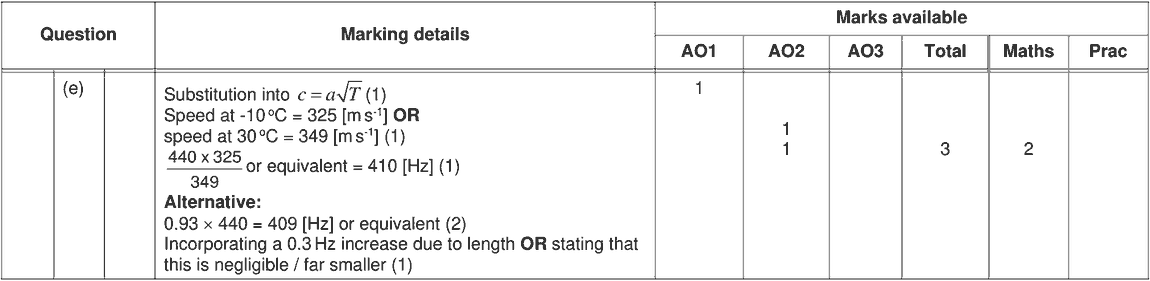
Answer: 410 Hz. c = a√T: 325 m s⁻¹ at −10 °C (263 K) and 349 m s⁻¹ at 30 °C (303 K)
f = 440 × 325/349 (or 440 × 0.93)
the 0.3 Hz change due to length is negligible
Scheme columns: Maths 2
Skills: Comprehension A level Component 1 Section B: questions on the printed article; Mathsmarks The mark scheme's Maths column gives this part at least one mark for mathematical skills
June 2024 · AS Component 2 · Q1(a)2 marksAO1=2Definition
Mark scheme
Examiner's comment
The majority of candidates in part (a) were able to explain what is meant by a transverse wave. Part (b) was also answered well with the majority being able to explain what is meant by the amplitude and were able to proceed to determine the wavelength correctly as well as applying 𝑣= 𝑓𝜆 to determine the frequency. Many candidates lost marks in part (c) for not identifying that Q leads P by either 90o or 𝜋 2.
Notes from the mark scheme and report
The oscillations of the particles (or fields) are at right angles (1) to the direction of travel (energy transfer) of the wave (1)
generally well done
June 2024 · AS Component 2 · Q1(b)(i)1 markAO1=1Definition
Earlier part of question 1 that this part uses
Mark scheme
Examiner's comment
The majority of candidates in part (a) were able to explain what is meant by a transverse wave. Part (b) was also answered well with the majority being able to explain what is meant by the amplitude and were able to proceed to determine the wavelength correctly as well as applying 𝑣= 𝑓𝜆 to determine the frequency. Many candidates lost marks in part (c) for not identifying that Q leads P by either 90o or 𝜋 2.
Notes from the mark scheme and report
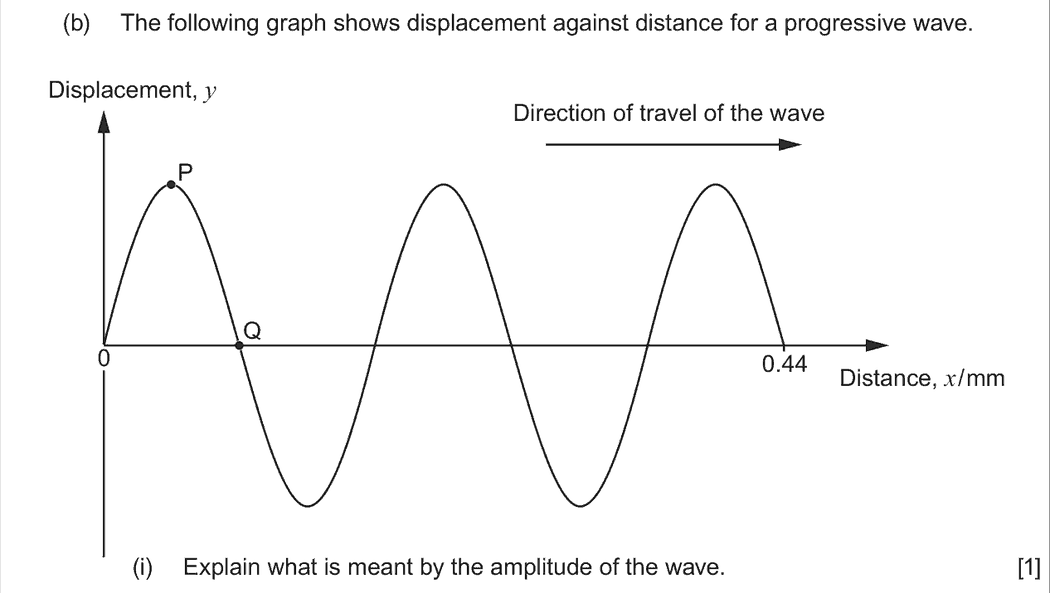
The maximum displacement of a particle from its equilibrium position
June 2024 · AS Component 2 · Q1(b)(ii)2 marksAO2=2Calculation
Earlier parts of question 1 that this part uses
Mark scheme
Examiner's comment
The majority of candidates in part (a) were able to explain what is meant by a transverse wave. Part (b) was also answered well with the majority being able to explain what is meant by the amplitude and were able to proceed to determine the wavelength correctly as well as applying 𝑣= 𝑓𝜆 to determine the frequency. Many candidates lost marks in part (c) for not identifying that Q leads P by either 90o or 𝜋 2.
Notes from the mark scheme and report
Answer: 0.176 mm. The graph shows 2.5 wavelengths in 0.44 mm (1)
λ = 0.44/2.5 (1)
Scheme columns: Maths 2
Skills: Graphskills Reading, plotting or sketching graphs; gradients, intercepts and areas; Mathsmarks The mark scheme's Maths column gives this part at least one mark for mathematical skills
June 2024 · AS Component 2 · Q1(b)(iii)2 marksAO1=1, AO2=1Calculation
Earlier parts of question 1 that this part uses
Mark scheme
Examiner's comment
The majority of candidates in part (a) were able to explain what is meant by a transverse wave. Part (b) was also answered well with the majority being able to explain what is meant by the amplitude and were able to proceed to determine the wavelength correctly as well as applying 𝑣= 𝑓𝜆 to determine the frequency. Many candidates lost marks in part (c) for not identifying that Q leads P by either 90o or 𝜋 2.
Notes from the mark scheme and report
Answer: 1.9 × 10⁶ Hz. c = fλ (1)
f = 340/0.176 × 10⁻³ (1)
ecf from (ii)
Scheme columns: Maths 1
Skills: Unitsand conversions Unit marks, base units, prefixes and conversions; Mathsmarks The mark scheme's Maths column gives this part at least one mark for mathematical skills
June 2024 · AS Component 2 · Q1(c)2 marksAO2=2Short answer
Earlier parts of question 1 that this part uses
Mark scheme
Examiner's comment
The majority of candidates in part (a) were able to explain what is meant by a transverse wave. Part (b) was also answered well with the majority being able to explain what is meant by the amplitude and were able to proceed to determine the wavelength correctly as well as applying 𝑣= 𝑓𝜆 to determine the frequency. Many candidates lost marks in part (c) for not identifying that Q leads P by either 90o or 𝜋 2.
Notes from the mark scheme and report
Phase difference 90° (π/2 rad, or a quarter of a cycle) (1)
Q leads P (1)
the leading point was the mark most often lost
Skills: Graphskills Reading, plotting or sketching graphs; gradients, intercepts and areas
June 2024 · AS Component 2 · Q4(b)(i)4 marksAO1=1, AO2=3Calculation
Earlier part of question 4 that this part uses
Mark scheme
Examiner's comment
The QER was based on the experiment to measure the speed of sound in air using stationary waves in a resonance tube. This was not answered well by many candidates with only few answers scoring top band marks. Several answers used poorly labelled diagrams to show the experimental set-up and the description based on the formation of stationary waves in the set-up without discussing the steps needed to obtain data to measure the speed of sound. There were only a few candidates that were able to give a graphical analysis of how the speed of sound could be determined from the graph of length against f or an equivalent method. The most common answer for part (b)(ii) was that most countries do not need to develop an earthquake early warning system due to the rare occurrence of earthquakes. Candidates could have developed this and discussed the benefits an early warning system where needed.
Notes from the mark scheme and report
Answer: 504 km. distance = speed × time (1)
same distance for both waves: 6.0t = 3.5(t + 60) (1)
t = 84 s for the faster wave (1)
distance = 6.0 × 84 (1)
ecf on t
Scheme columns: Maths 3
Skills: Algebra Derivations and rearranging equations; Mathsmarks The mark scheme's Maths column gives this part at least one mark for mathematical skills
June 2024 · AS Component 2 · Q4(b)(ii)2 marksAO3=2Short answer
Earlier parts of question 4 that this part uses
Mark scheme
Examiner's comment
The QER was based on the experiment to measure the speed of sound in air using stationary waves in a resonance tube. This was not answered well by many candidates with only few answers scoring top band marks. Several answers used poorly labelled diagrams to show the experimental set-up and the description based on the formation of stationary waves in the set-up without discussing the steps needed to obtain data to measure the speed of sound. There were only a few candidates that were able to give a graphical analysis of how the speed of sound could be determined from the graph of length against f or an equivalent method. The most common answer for part (b)(ii) was that most countries do not need to develop an earthquake early warning system due to the rare occurrence of earthquakes. Candidates could have developed this and discussed the benefits an early warning system where needed.
Notes from the mark scheme and report
Any two: gives people time to act and saves lives
creates employment
some countries may prefer to spend on health and education
the risk of earthquakes is low in some countries. Most gave only the low-risk point without developing it
June 2024 · Component 3 · Q1(a)4 marksAO3=4Explanation
Mark scheme
Examiner's comment
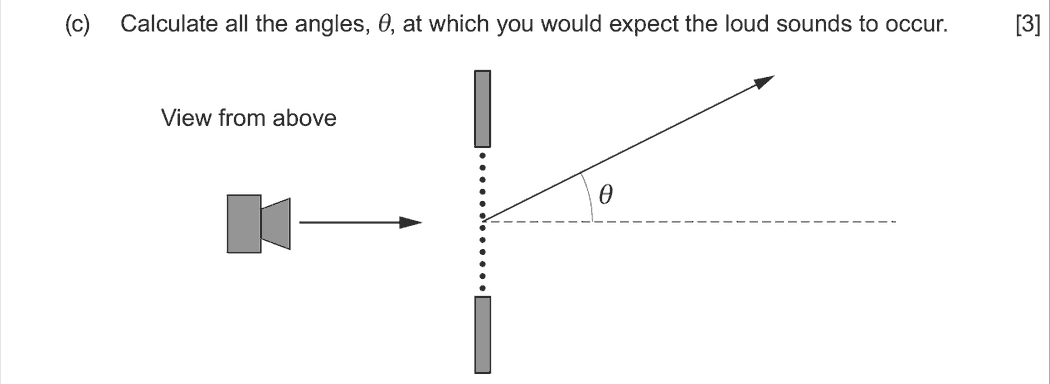
After calculating the correct wavelength nearly all candidates noticed that it was greater than the slit separation but then proceeded to state that diffraction does not occur. The problem with this answer is that diffraction will occur but that the transmitted intensity is low. Hence, this common response could not gain the last mark.
Notes from the mark scheme and report
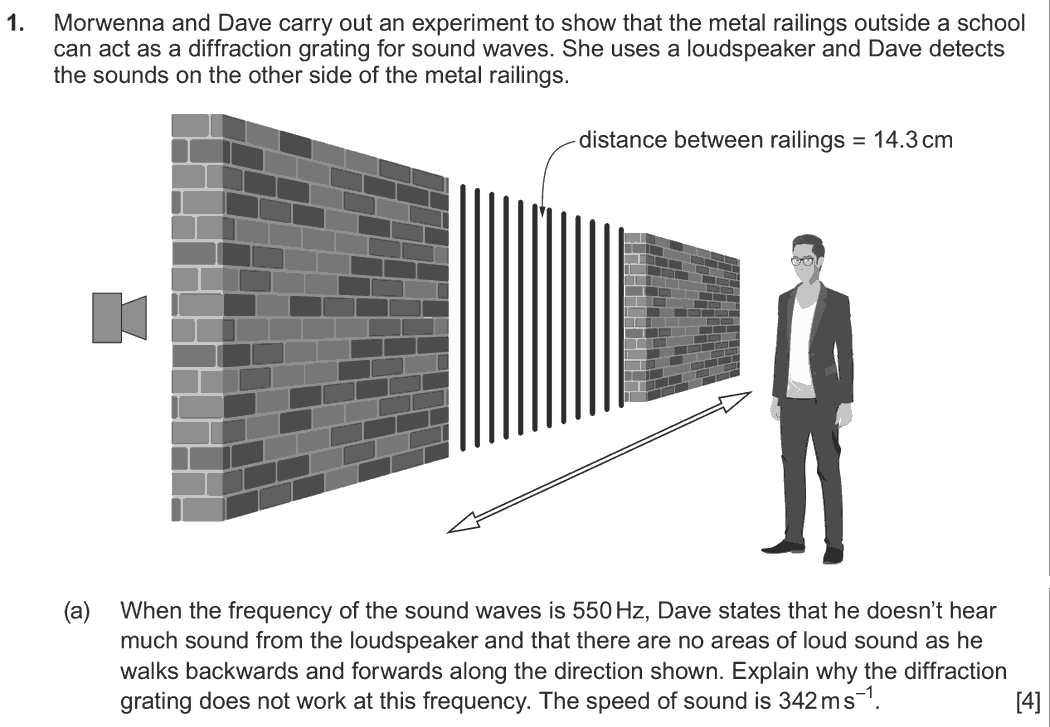
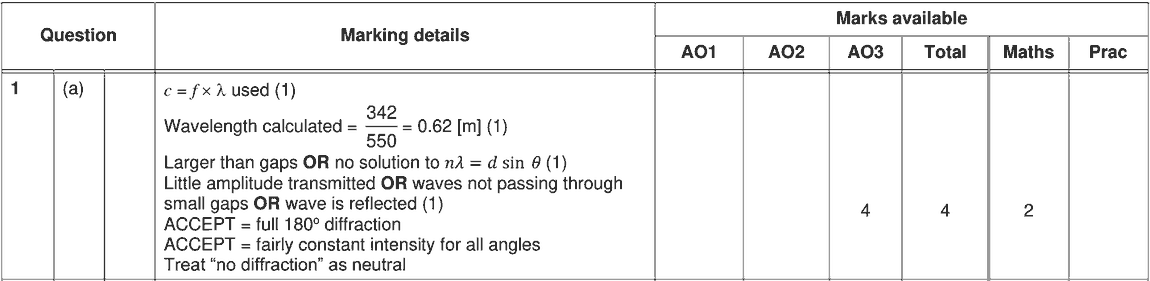
λ = c/f = 342/550 = 0.62 m (2)
this is much larger than the 14.3 cm gaps, so nλ = d sin θ has no solution for n = 1 or more (1)
little of the wave gets through the narrow gaps (most is reflected), or what does spreads through 180° with roughly constant intensity, so no loud directions (1)
'no diffraction occurs' did not earn the last mark
Scheme columns: Maths 2
Skills: Mathsmarks The mark scheme's Maths column gives this part at least one mark for mathematical skills
June 2024 · Component 3 · Q1(b)3 marksAO1=1, AO2=2Calculation
Earlier part of question 1 that this part uses
Mark scheme
Examiner's comment
The whole of this question was well answered with the exception of one of the points in part (a) and part (d).
Notes from the mark scheme and report
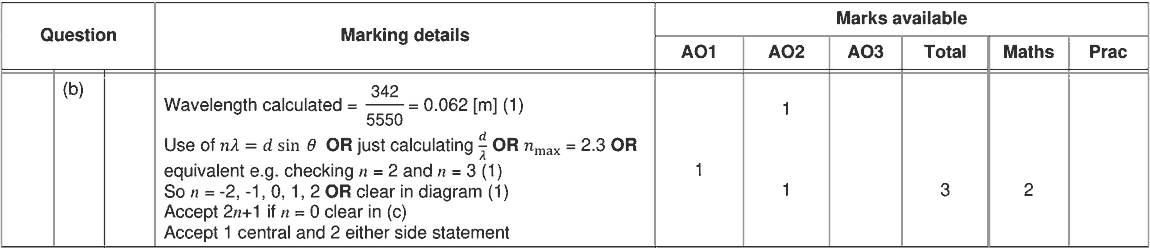
λ = 342/5500 = 0.062 m (1)
maximum order n = d/λ = 0.143/0.062 = 2.3, so n = 2 is the highest possible (1)
orders n = 0, ±1, ±2 give 5 beams (1)
Scheme columns: Maths 2
Skills: Mathsmarks The mark scheme's Maths column gives this part at least one mark for mathematical skills
June 2024 · Component 3 · Q1(d)3 marksAO3=3Explanation
Earlier parts of question 1 that this part uses
Mark scheme
Examiner's comment
These are open-ended AO3 marks and can be tough to gain. Once candidates realised that sound is a longitudinal wave, full marks followed.
Notes from the mark scheme and report
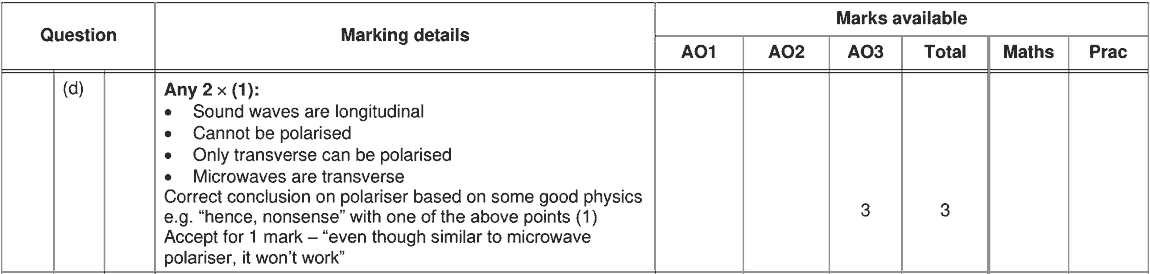
Any two: sound is longitudinal
longitudinal waves cannot be polarised
only transverse waves can
microwaves are transverse (2)
conclusion that Dave is wrong even though the railings resemble a microwave polariser (1)
June 2024 · Component 3 · Q2(b)4 marksAO1=1, AO2=3Calculation
Earlier part of question 2 that this part uses
Mark scheme
Examiner's comment
There were many tiny little slips here for obvious reasons e.g. dividing by 26 instead of 25 or believing the nodal separation to be a whole wavelength.
Notes from the mark scheme and report
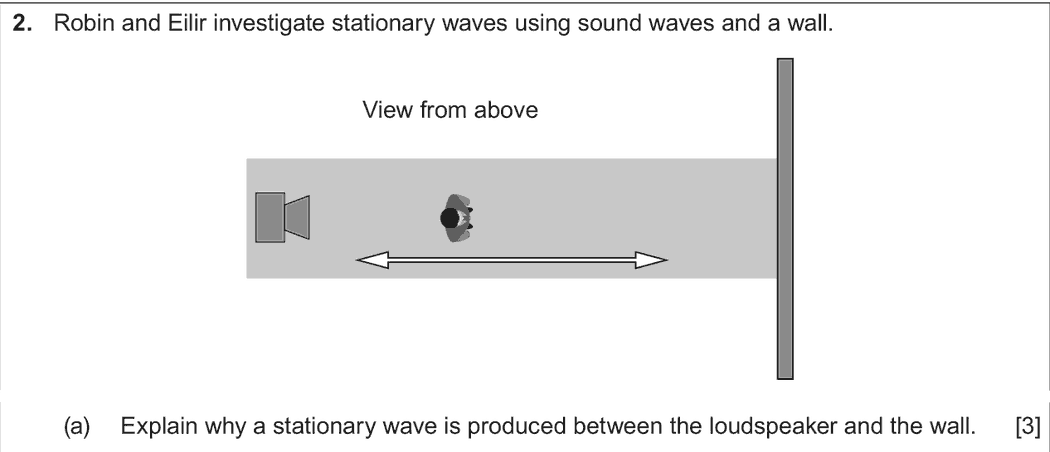
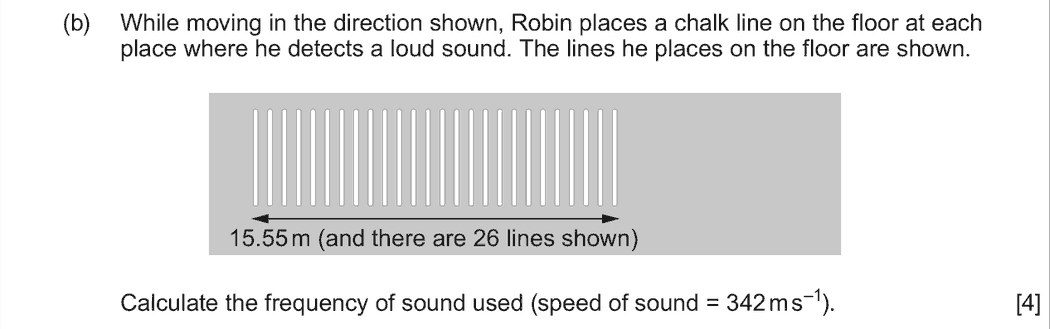
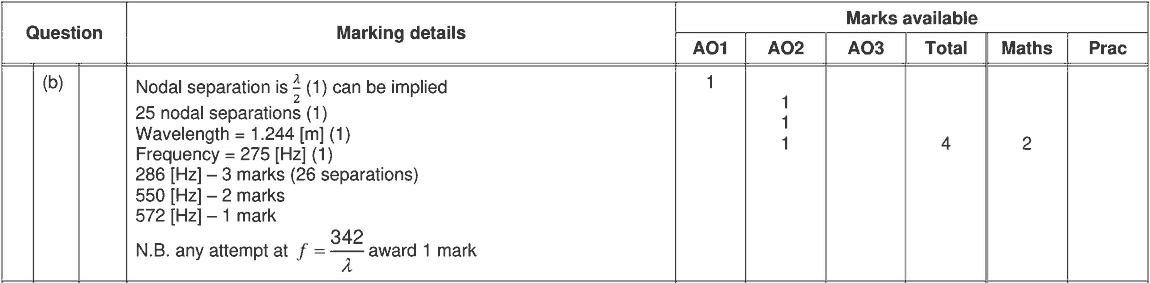
Answer: 275 Hz. Adjacent loud positions are λ/2 apart
26 lines means 25 spacings, so λ/2 = 15.55/25 = 0.622 m and λ = 1.244 m
f = 342/1.244
using 26 spacings gives 286 Hz (3 marks), forgetting the half gives 550 Hz (2 marks)
Scheme columns: Maths 2
Skills: Mathsmarks The mark scheme's Maths column gives this part at least one mark for mathematical skills
June 2023 · AS Component 2 · Q1(a)(i)2 marksAO2=2Calculation
Mark scheme
Examiner's comment
Part (a) was answered well, and the only errors were converting cm to m leading to incorrect values of speed. Part (b) was not answered well. Nearly all candidates stated that only transverse waves can be polarised but could not explain clearly that the direction of oscillations could not be determined from the graph.
Notes from the mark scheme and report
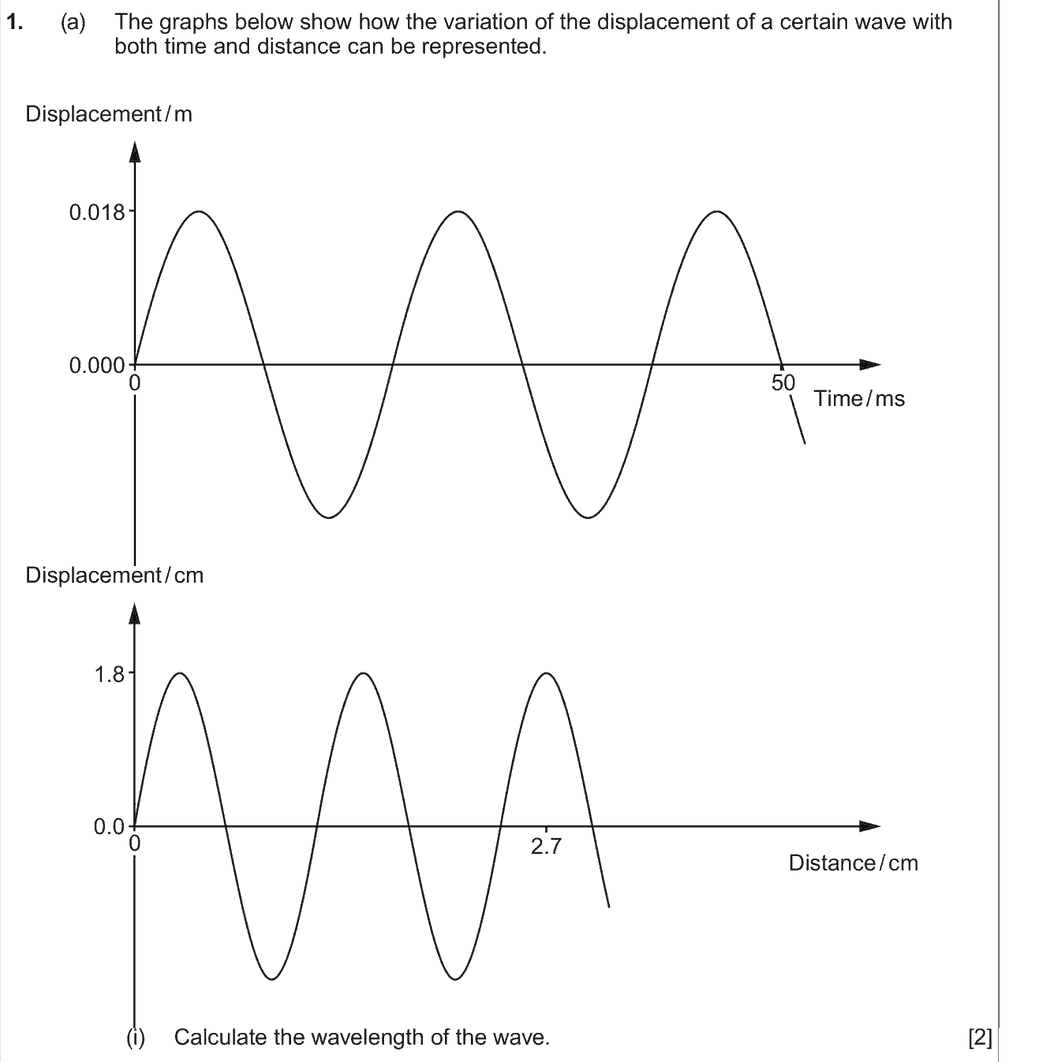
Answer: 1.2 cm. The displacement-distance graph shows 2.25 wavelengths in 2.7 cm
Scheme columns: Maths 2
Skills: Graphskills Reading, plotting or sketching graphs; gradients, intercepts and areas; Mathsmarks The mark scheme's Maths column gives this part at least one mark for mathematical skills
June 2023 · AS Component 2 · Q1(a)(ii)3 marksAO2=3Calculation
Earlier part of question 1 that this part uses
Mark scheme
Examiner's comment
Part (a) was answered well, and the only errors were converting cm to m leading to incorrect values of speed. Part (b) was not answered well. Nearly all candidates stated that only transverse waves can be polarised but could not explain clearly that the direction of oscillations could not be determined from the graph.
Notes from the mark scheme and report
Answer: 50 Hz. The displacement-time graph shows 2.5 periods in 50 ms, so T = 20 ms
f = 1/T
Scheme columns: Maths 3
Skills: Graphskills Reading, plotting or sketching graphs; gradients, intercepts and areas; Unitsand conversions Unit marks, base units, prefixes and conversions; Mathsmarks The mark scheme's Maths column gives this part at least one mark for mathematical skills
June 2023 · AS Component 2 · Q1(a)(iii)2 marksAO1=1, AO2=1Calculation
Earlier part of question 1 that this part uses
Mark scheme
Examiner's comment
Part (a) was answered well, and the only errors were converting cm to m leading to incorrect values of speed. Part (b) was not answered well. Nearly all candidates stated that only transverse waves can be polarised but could not explain clearly that the direction of oscillations could not be determined from the graph.
Notes from the mark scheme and report
Answer: 0.60 m s⁻¹. v = fλ = 50 × 0.012
ecf
errors came from the cm to m conversion
Scheme columns: Maths 1
Skills: Unitsand conversions Unit marks, base units, prefixes and conversions; Mathsmarks The mark scheme's Maths column gives this part at least one mark for mathematical skills
June 2023 · AS Component 2 · Q1(b)3 marksAO3=3Explanation
Earlier part of question 1 that this part uses
Mark scheme
Examiner's comment
Part (a) was answered well, and the only errors were converting cm to m leading to incorrect values of speed. Part (b) was not answered well. Nearly all candidates stated that only transverse waves can be polarised but could not explain clearly that the direction of oscillations could not be determined from the graph.
Notes from the mark scheme and report
Only transverse waves can be polarised (1)
to decide, the direction of the oscillations relative to the direction of travel is needed (1)
the graphs give only the size of the displacement, so transverse or longitudinal cannot be told and Declan is correct (1)
most gave only the first point
June 2023 · AS Component 2 · Q2(a)(ii)1 markAO1=1Definition
Earlier part of question 2 that this part uses
Mark scheme
Examiner's comment
Part (a)(i) was answered well but (a)(ii) was not answered well with only a few candidates being able to explain what is meant by the term phase. For part (b)(i); only a few candidates realised that the path difference is 2 wavelength for the fringe to be formed at A. Part (b)(ii) was answered well by all candidates. In part (c); nearly all candidates scored full marks but for part (c)(ii); it was not evident that candidates realised the steps involved and simply inputted the numbers into an equation. This obtained full marks.
Notes from the mark scheme and report
The waves are at the same point in their cycles at the same time (zero phase difference)
few could explain 'phase'
June 2023 · Component 3 · Q1(a)2 marksAO1=2Definition
Mark scheme
Examiner's comment
The first part was slightly disappointing. The best definition is “the distance between adjacent points on the wave moving in phase”. Sometimes candidates referred to “peaks” and some weaker candidates were talking about more than one wave. Part
Notes from the mark scheme and report
The (minimum) distance between adjacent (1) points oscillating in phase, e.g. successive compressions or rarefactions (1)
'distance between successive peaks' scores 1
weaker answers spoke of more than one wave
June 2023 · Component 3 · Q1(b)(i)2 marksAO1=2Explanation
Earlier part of question 1 that this part uses
Mark scheme
Examiner's comment
(i) was well answered in general. Many candidates only scored half marks by starting from 𝑣= 𝑓𝜆 i.e. 𝑣= 𝑓𝜆 and 𝑓= 𝑇 hence 𝑣= 𝑓 𝑇 Part (b)(iv) was quite poorly answered. There were two approaches to explain the factor of two difference in the results. First, the stroboscope could be flashing at half the correct frequency – the loudspeaker would still appear stationary. Second, the student could have timed half oscillations instead of full oscillations – resulting in a frequency 2 too large.
Notes from the mark scheme and report
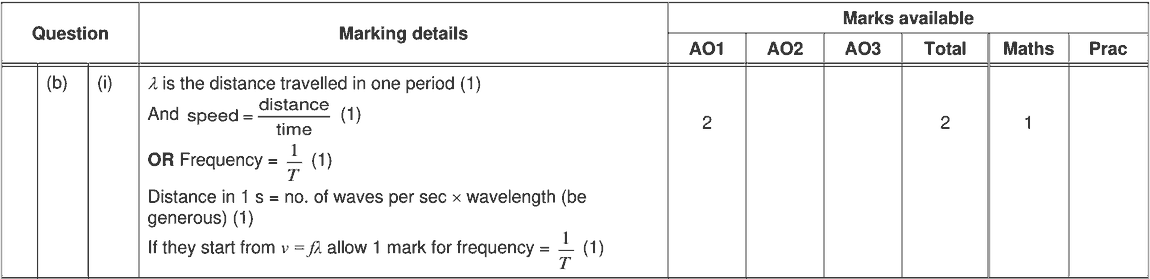
The wave travels one wavelength in one period (1) and speed = distance/time, so c = λ/T (1)
starting from c = fλ and f = 1/T earns only 1
Scheme columns: Maths 1
Skills: Algebra Derivations and rearranging equations; Mathsmarks The mark scheme's Maths column gives this part at least one mark for mathematical skills
June 2023 · Component 3 · Q1(b)(ii)2 marksAO2=2Calculation
Earlier parts of question 1 that this part uses
Mark scheme
Examiner's comment
(i) was well answered in general. Many candidates only scored half marks by starting from 𝑣= 𝑓𝜆 i.e. 𝑣= 𝑓𝜆 and 𝑓= 𝑇 hence 𝑣= 𝑓 𝑇 Part (b)(iv) was quite poorly answered. There were two approaches to explain the factor of two difference in the results. First, the stroboscope could be flashing at half the correct frequency – the loudspeaker would still appear stationary. Second, the student could have timed half oscillations instead of full oscillations – resulting in a frequency 2 too large.
Notes from the mark scheme and report
Answer: 353 m s⁻¹. Sound travels to the wall and back, 180 m (1)
speed = 180/0.51 (1)
176 m s⁻¹ scores 1
Scheme columns: Maths 1, Practical 2
Skills: Experimentalmethod Describing, planning or improving an experiment; Mathsmarks The mark scheme's Maths column gives this part at least one mark for mathematical skills; Practicalmarks The mark scheme's Prac column gives this part at least one mark for practical skills
June 2023 · Component 3 · Q1(b)(iii)3 marksAO1=1, AO2=2Calculation
Earlier parts of question 1 that this part uses
Mark scheme
Examiner's comment
(i) was well answered in general. Many candidates only scored half marks by starting from 𝑣= 𝑓𝜆 i.e. 𝑣= 𝑓𝜆 and 𝑓= 𝑇 hence 𝑣= 𝑓 𝑇 Part (b)(iv) was quite poorly answered. There were two approaches to explain the factor of two difference in the results. First, the stroboscope could be flashing at half the correct frequency – the loudspeaker would still appear stationary. Second, the student could have timed half oscillations instead of full oscillations – resulting in a frequency 2 too large.
Notes from the mark scheme and report
Answer: 133 m. Period = 7.55/20 = 0.378 s (f = 2.65 Hz) (1)
λ = cT or c/f (1) = 353 × 0.378 (1)
ecf on c
Scheme columns: Maths 2, Practical 3
Skills: Mathsmarks The mark scheme's Maths column gives this part at least one mark for mathematical skills; Practicalmarks The mark scheme's Prac column gives this part at least one mark for practical skills
June 2023 · Component 3 · Q1(b)(iv)3 marksAO3=3Explanation
Earlier parts of question 1 that this part uses
Mark scheme
Examiner's comment
(i) was well answered in general. Many candidates only scored half marks by starting from 𝑣= 𝑓𝜆 i.e. 𝑣= 𝑓𝜆 and 𝑓= 𝑇 hence 𝑣= 𝑓 𝑇 Part (b)(iv) was quite poorly answered. There were two approaches to explain the factor of two difference in the results. First, the stroboscope could be flashing at half the correct frequency – the loudspeaker would still appear stationary. Second, the student could have timed half oscillations instead of full oscillations – resulting in a frequency 2 too large.
Notes from the mark scheme and report
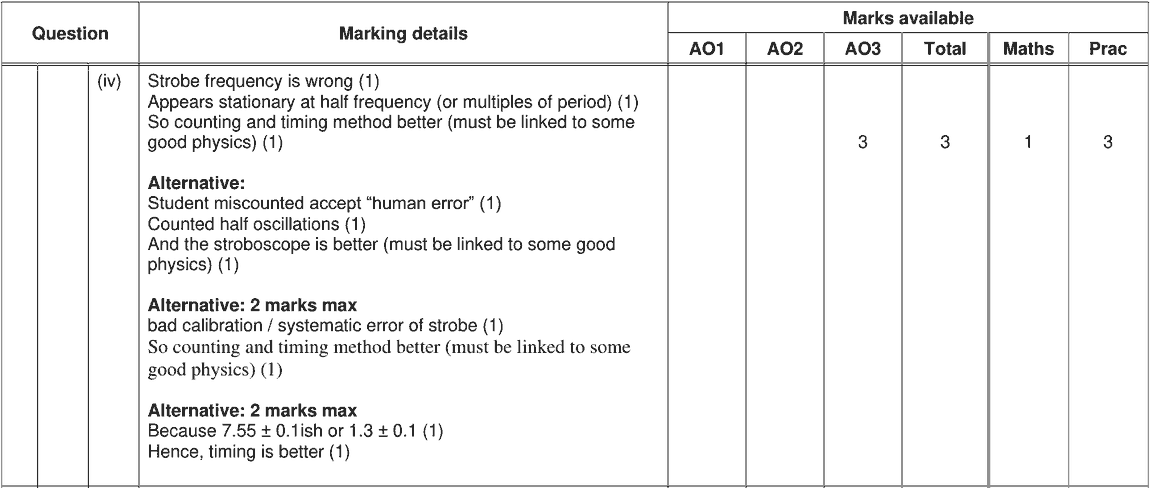
The two values differ by a factor of 2 (1.3 Hz against 2.65 Hz). Either the strobe value is wrong (1) because the cone also appears stationary when the strobe flashes at half the true frequency (1), so the timing method is better (1)
or the student counted half oscillations so the strobe is better
systematic error or uncertainty arguments score at most 2. Poorly answered
Scheme columns: Maths 1, Practical 3
Skills: Experimentalmethod Describing, planning or improving an experiment; Uncertainties Resolution, absolute and percentage uncertainty, combining uncertainties, error bars; Mathsmarks The mark scheme's Maths column gives this part at least one mark for mathematical skills; Practicalmarks The mark scheme's Prac column gives this part at least one mark for practical skills
June 2022 · Component 1 · Q8(a)2 marksAO2=2Explanation
Mark scheme
Examiner's comment
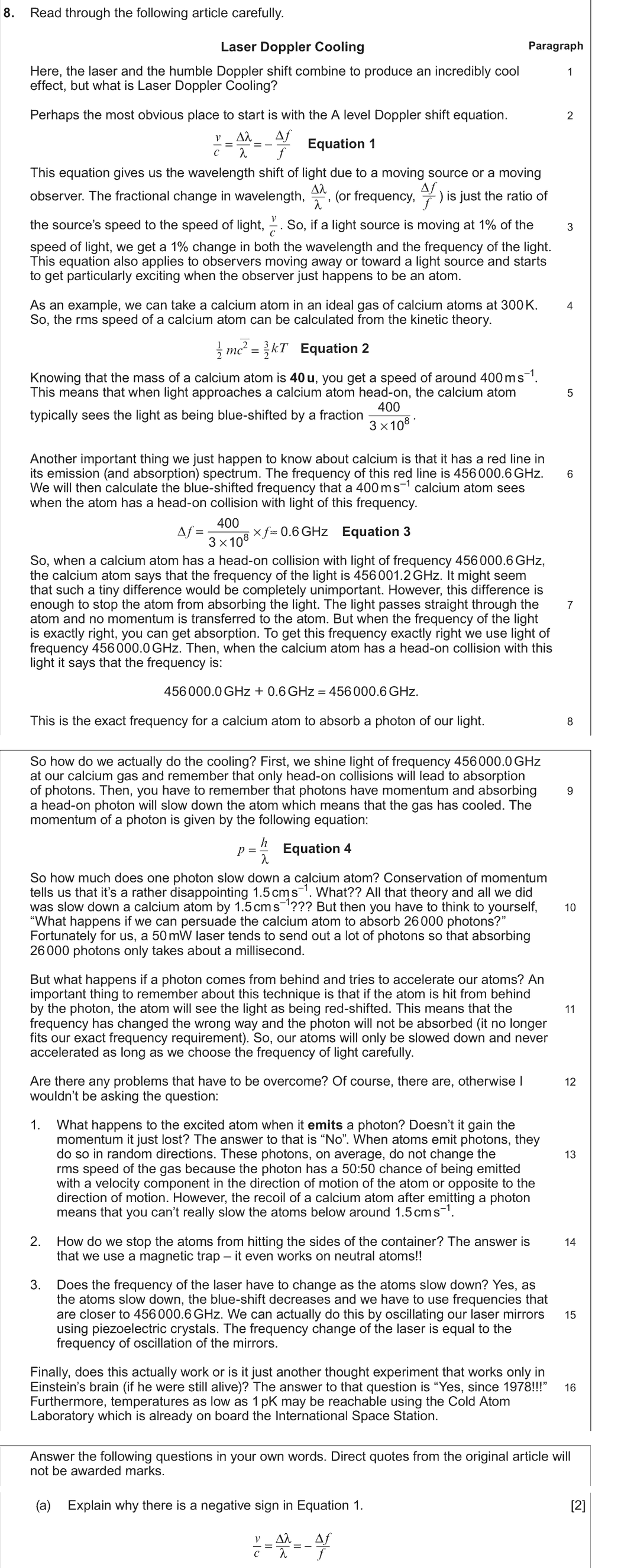
More than half the candidates explained that the negative sign was needed because if the wavelength went up the frequency had to go down or equivalent. The commonest mistake was to think that the sign had something to do with direction of travel.
Notes from the mark scheme and report
λ = c/f, so wavelength is inversely proportional to frequency (1)
when the frequency goes up the wavelength goes down, so Δλ and Δf have opposite signs (1)
the sign is not about the direction of travel
Scheme columns: Maths 1
Skills: Comprehension A level Component 1 Section B: questions on the printed article; Synoptic Needs physics from another component of the qualification; Mathsmarks The mark scheme's Maths column gives this part at least one mark for mathematical skills
June 2022 · AS Component 2 · Q1(a)3 marksAO1=3Explanation
Mark scheme
Notes from the mark scheme and report
Both described by the direction of the oscillations (displacement of the particles) (1)
longitudinal: parallel to the direction of travel of the wave (1)
transverse: at right angles to it (1)
June 2022 · AS Component 2 · Q1(b)(i)3 marksAO2=3Diagram or graph
Earlier part of question 1 that this part uses
Mark scheme
Notes from the mark scheme and report
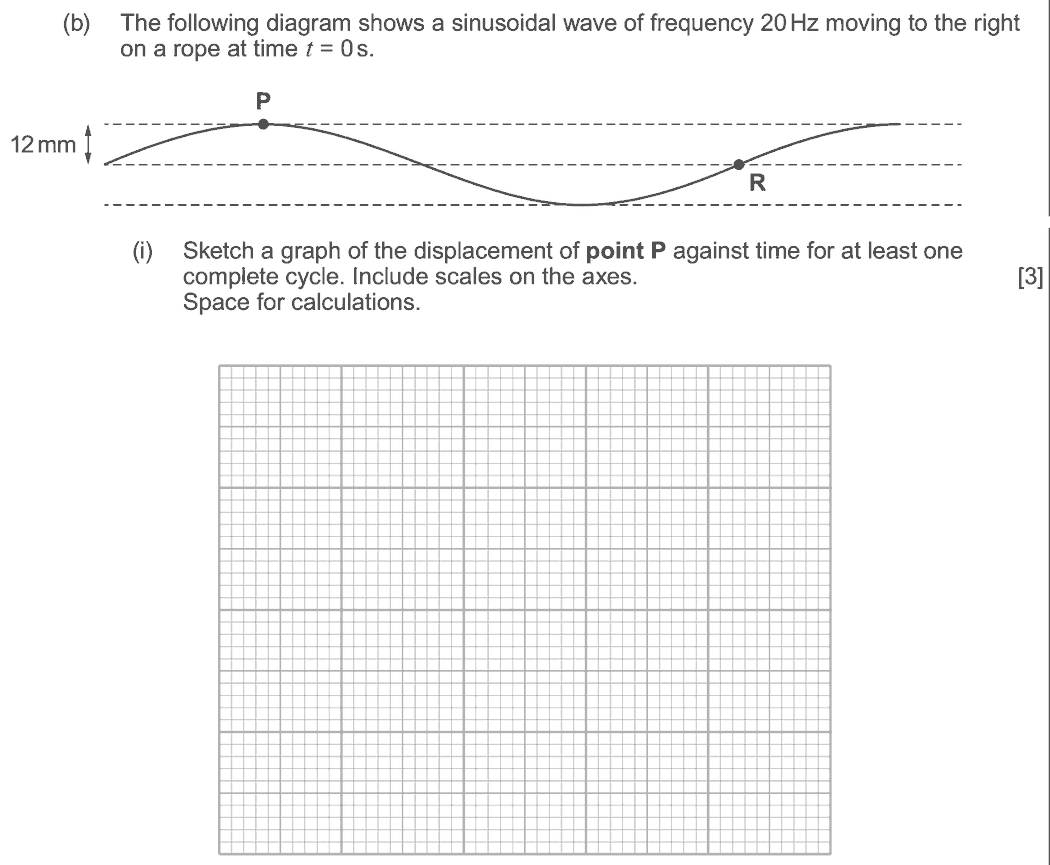
Sinusoidal curve starting at the peak (P is at a crest at t = 0) (1)
amplitude 12 mm shown on the scale (1)
period = 1/20 = 0.050 s = 50 ms (1)
Scheme columns: Maths 2
Skills: Graphskills Reading, plotting or sketching graphs; gradients, intercepts and areas; Mathsmarks The mark scheme's Maths column gives this part at least one mark for mathematical skills
June 2022 · AS Component 2 · Q1(b)(ii)2 marksAO2=2Short answer
Earlier parts of question 1 that this part uses
Mark scheme
Notes from the mark scheme and report
Same amplitude and frequency (1)
out of phase by about three-quarters of a cycle (270°), i.e. R is a quarter of a cycle ahead of P (1)
June 2022 · Component 3 · Q1(a)(i)1 markAO1=1Short answer
Mark scheme
Examiner's comment
Almost universally correct.
Notes from the mark scheme and report
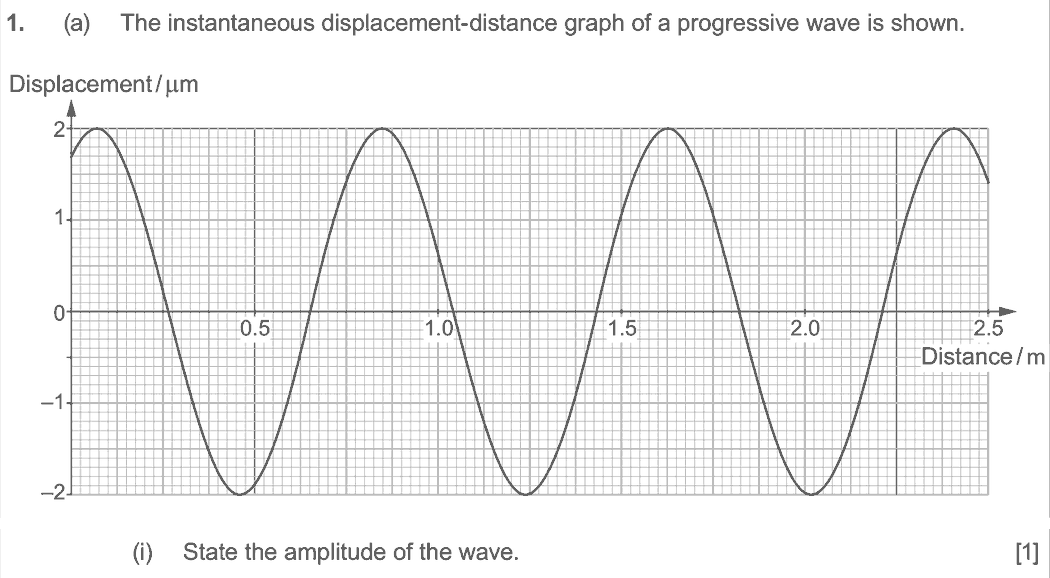
Answer: 2 μm (maximum displacement read from the graph)
Skills: Graphskills Reading, plotting or sketching graphs; gradients, intercepts and areas
June 2022 · Component 3 · Q1(a)(ii)2 marksAO2=2Calculation
Earlier part of question 1 that this part uses
Mark scheme
Examiner's comment
Only a small minority used more than one wavelength to improve the percentage uncertainty.
Notes from the mark scheme and report
Answer: 0.78 m (0.70 to 0.85 accepted). Measure across 3 (or 2) whole wavelengths and divide, e.g. (2.41 − 0.07)/3
few used more than one wavelength
Scheme columns: Maths 1
Skills: Graphskills Reading, plotting or sketching graphs; gradients, intercepts and areas; Mathsmarks The mark scheme's Maths column gives this part at least one mark for mathematical skills
June 2022 · Component 3 · Q1(a)(iii)4 marksAO1=4Explanation
Earlier part of question 1 that this part uses
Mark scheme
Examiner's comment
Generally quite poorly answered. Although most candidates were comfortable describing points in phase and in antiphase, very few were willing to discuss the relationship between phase angle and distance. The equation 𝜀= 𝑥 𝜆× 2𝜋 is rather useful.
Notes from the mark scheme and report
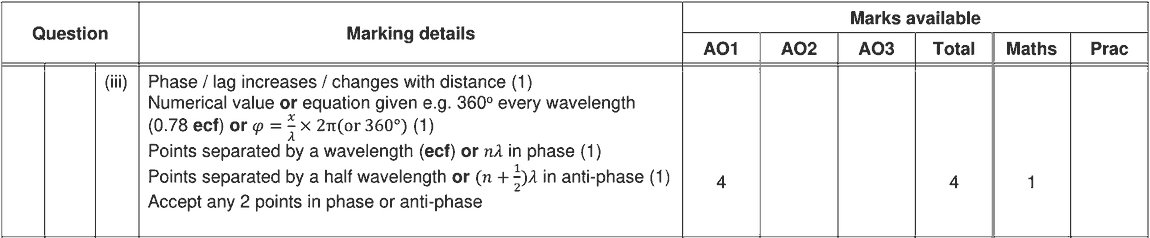
Phase (lag) changes steadily with distance (1)
by 360° (2π) for every wavelength of 0.78 m, phase = (x/λ) × 2π (1)
points a whole number of wavelengths apart are in phase (1)
points an odd number of half wavelengths apart are in antiphase (1)
two named points from the graph accepted
the link between phase angle and distance was rarely given
Scheme columns: Maths 1
Skills: Graphskills Reading, plotting or sketching graphs; gradients, intercepts and areas; Mathsmarks The mark scheme's Maths column gives this part at least one mark for mathematical skills
June 2022 · Component 3 · Q1(b)(i)4 marksAO2=4Calculation
Earlier part of question 1 that this part uses
Mark scheme
Examiner's comment
Generally well answered but few candidates used more than one period to improve the percentage uncertainty. There were quite a few power of ten mistakes here too due to the time in ms.
Notes from the mark scheme and report
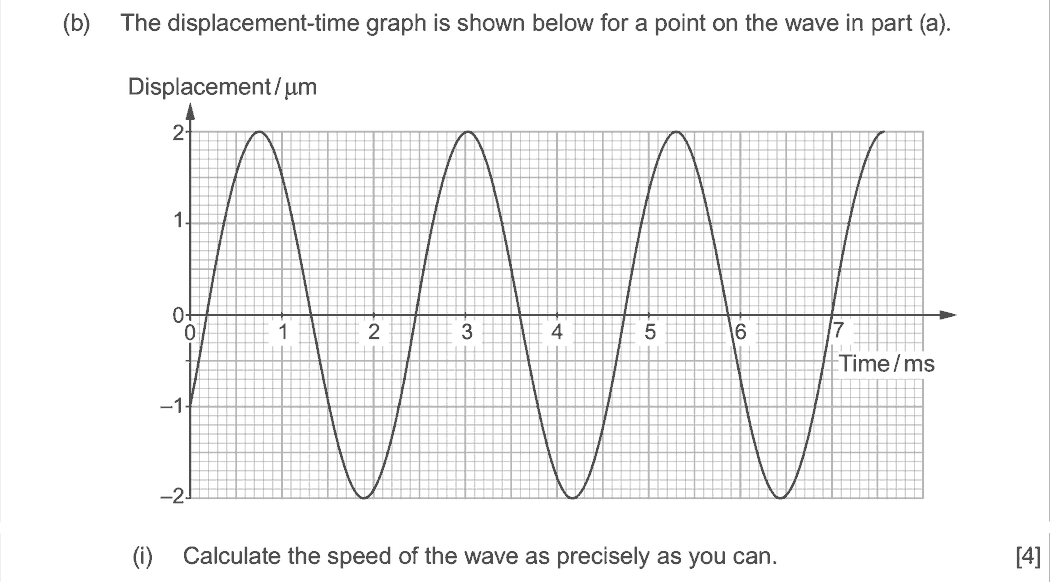
Answer: 343 m s⁻¹. Period 2.27 ms (2.24 to 2.30) from 3 periods, e.g. 6.8/3
v = λ/T = 0.78/2.27 × 10⁻³
ecf on λ
power of ten slips with ms
Scheme columns: Maths 3
Skills: Graphskills Reading, plotting or sketching graphs; gradients, intercepts and areas; Unitsand conversions Unit marks, base units, prefixes and conversions; Mathsmarks The mark scheme's Maths column gives this part at least one mark for mathematical skills
June 2022 · Component 3 · Q1(b)(ii)2 marksAO2=2Explanation
Earlier parts of question 1 that this part uses
Mark scheme
Examiner's comment
Again, one of the weak points of the paper. Obtaining the correct displacement proved to be slightly tough but this was more successful than the explanation.
Notes from the mark scheme and report
Answer: −2 μm (± 0.2). 8.7 ms is one period after 6.45 ms where the displacement is a minimum (or half a cycle after the peak at 7.6 ms), so the pattern repeats
the explanation was the weak part
Scheme columns: Maths 1
Skills: Graphskills Reading, plotting or sketching graphs; gradients, intercepts and areas; Mathsmarks The mark scheme's Maths column gives this part at least one mark for mathematical skills
June 2022 · Component 3 · Q2(b)(i)3 marksAO1=1, AO2=2Calculation
Earlier part of question 2 that this part uses
Mark scheme
Examiner's comment
Well answered. The most difficult step here was realising that the series of nodes and antinodes represented 1¾ wavelengths.
Notes from the mark scheme and report
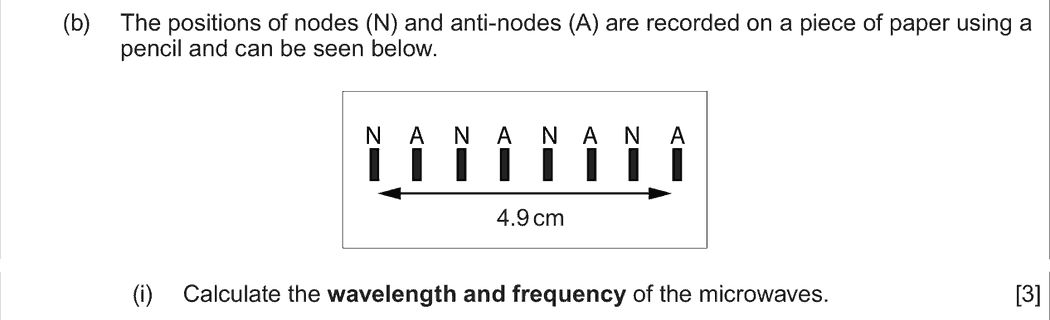
Answer: λ = 2.8 cm, f = 10.7 GHz. N to the last A is 3.5 internodal distances = 1.75 wavelengths
λ = 4.9/1.75
f = c/λ = 3.00 × 10⁸/0.028
taking 4.9 cm as 3.5 λ gives 1.4 cm and 21.4 GHz (partial credit)
Scheme columns: Maths 2, Practical 3
Skills: Unitsand conversions Unit marks, base units, prefixes and conversions; Mathsmarks The mark scheme's Maths column gives this part at least one mark for mathematical skills; Practicalmarks The mark scheme's Prac column gives this part at least one mark for practical skills
June 2022 · Component 3 · Q2(c)2 marksAO3=2Calculation
Earlier part of question 2 that this part uses
Mark scheme
Examiner's comment
Very well answered.
Notes from the mark scheme and report
λ = v/f = 343/12 250 = 0.028 m = 2.8 cm (1)
same wavelength as the microwaves so the node separation (λ/2) is the same and she is correct (1)
Scheme columns: Maths 1, Practical 2
Skills: Unitsand conversions Unit marks, base units, prefixes and conversions; Mathsmarks The mark scheme's Maths column gives this part at least one mark for mathematical skills; Practicalmarks The mark scheme's Prac column gives this part at least one mark for practical skills
October 2021 · Component 3 · Q1(a)(i)3 marksAO1=3Practical and data analysis
Mark scheme
Notes from the mark scheme and report
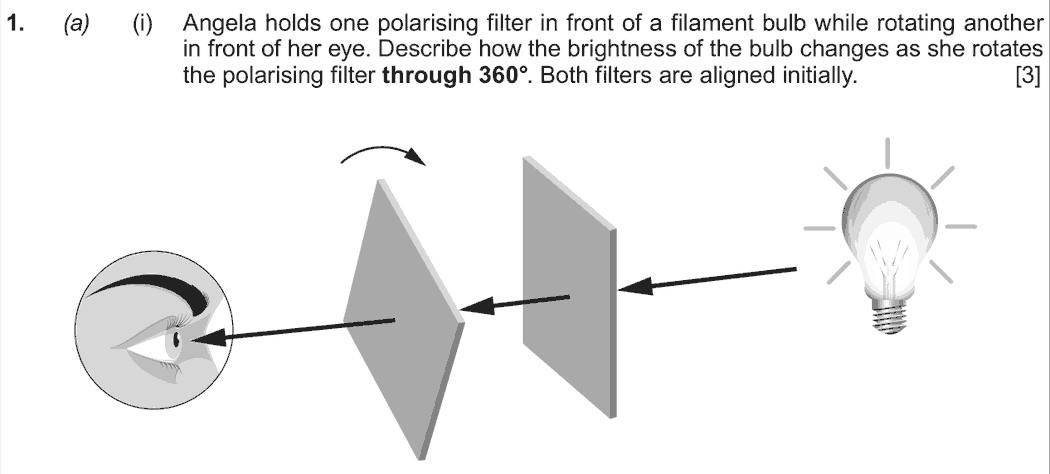
Brightest with the filters aligned at 0°, 180° and 360° (1)
zero or very dim at 90° and 270° (1)
the brightness changes gradually between these (1)
Scheme columns: Practical 3
Skills: Experimentalmethod Describing, planning or improving an experiment; Practicalmarks The mark scheme's Prac column gives this part at least one mark for practical skills
October 2021 · Component 3 · Q1(a)(ii)2 marksAO2=2Explanation
Earlier part of question 1 that this part uses
Mark scheme
Notes from the mark scheme and report
The brightness falls to a minimum but not to zero (1), because the unpolarised part has oscillations in all directions and can never be completely blocked (1)
Scheme columns: Practical 2
Skills: Practicalmarks The mark scheme's Prac column gives this part at least one mark for practical skills
October 2020 · Component 3 · Q1(a)2 marksAO3=2Explanation
Mark scheme
Examiner's comment
Part (a) was quite well answered but some did not mention “without transferring matter” or did not refer to oscillations. In part (b) most realised that the holes were too small for the microwaves to pass through (at 1/60th of a wavelength, the intensity passing through is negligible). It was rare to encounter a candidate who said that the 2 mm holes were far greater than the wavelength of light. A surprising number said (incorrectly) that the wavelength was longer and the energy greater. Part (c) was surprisingly well answered with most candidates obtaining full marks, however, some candidates could not add the displacements.
Notes from the mark scheme and report
A wave transfers energy without transferring matter, by means of oscillations
here matter (the coal) is itself transferred and nothing oscillates (1)
so Bruce is wrong (1)
a de Broglie wavelength argument earns 1
June 2019 · AS Component 2 · Q1(b)(i)3 marksAO1=1, AO2=2Calculation
Earlier part of question 1 that this part uses
Mark scheme
Notes from the mark scheme and report
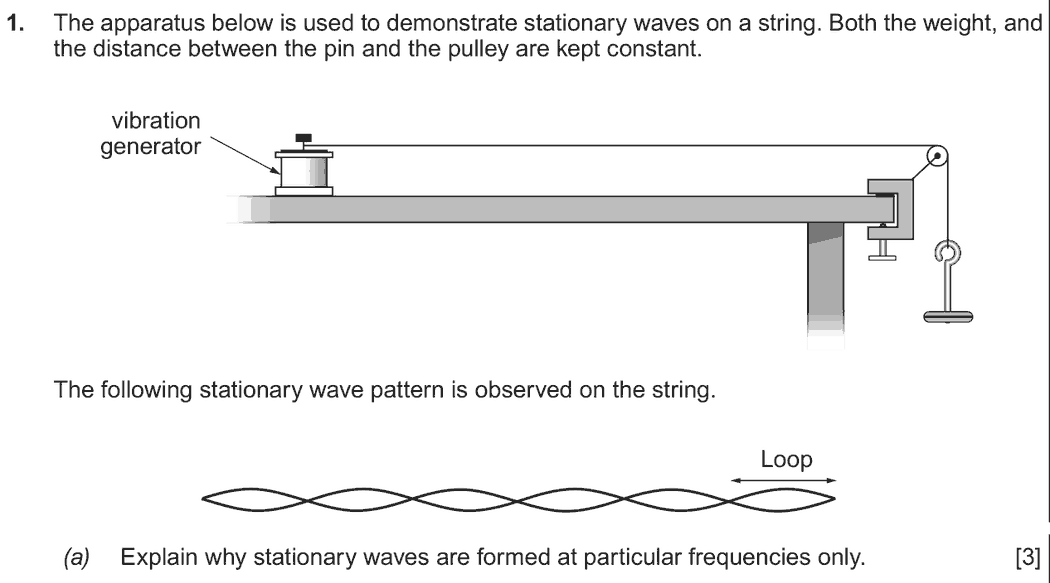
Answer: 108 m s⁻¹. Loop length = node to node = λ/2 (1)
λ = 0.240 m (1)
v = fλ = 450 × 0.240 (1)
Scheme columns: Maths 2
Skills: Mathsmarks The mark scheme's Maths column gives this part at least one mark for mathematical skills
June 2019 · AS Component 2 · Q2(a)6 marksAO1=2, AO3=46-mark extended response
Mark scheme, with the levels and indicative content
Notes from the mark scheme and report
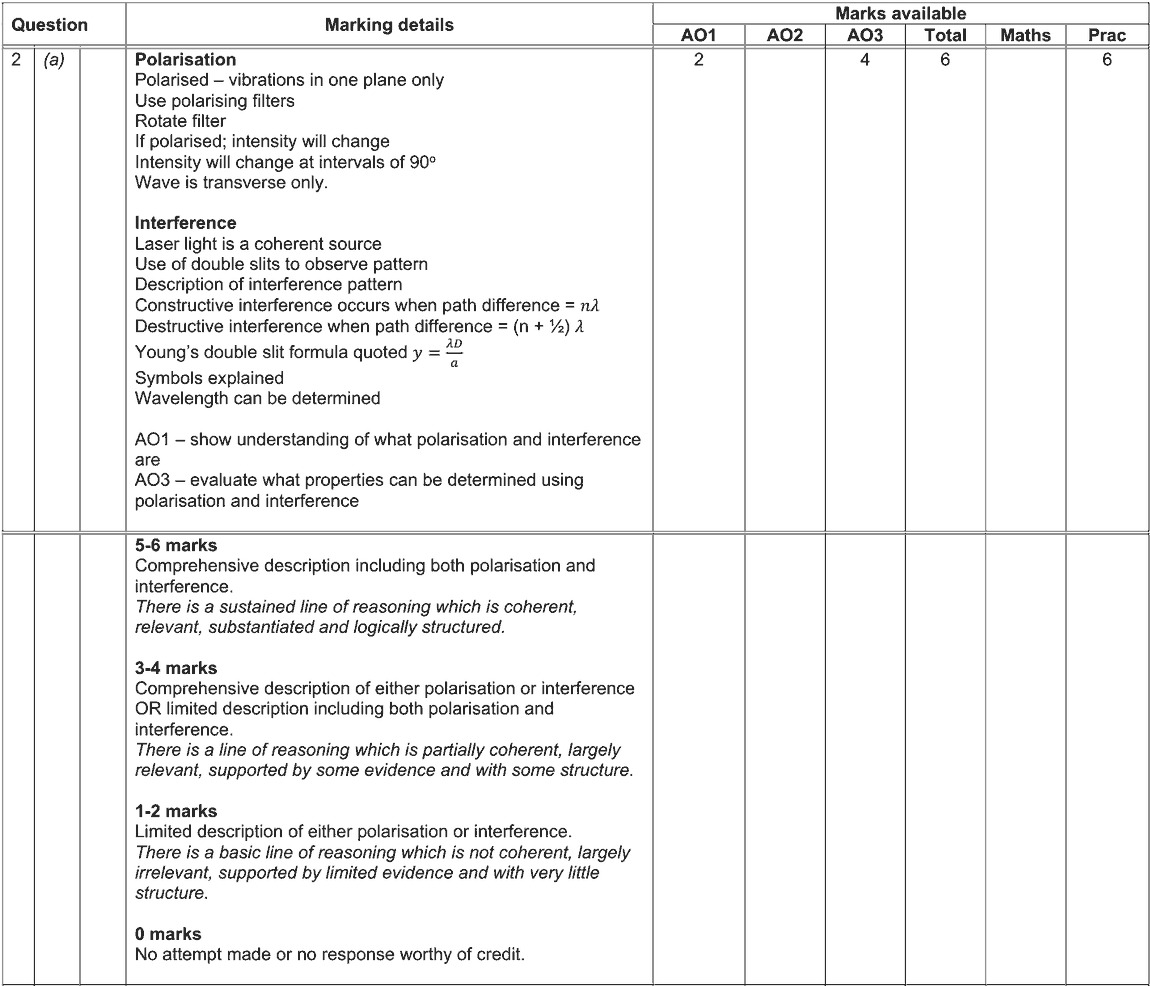
QER, levels marked. Polarisation: vibrations in one plane only
view the laser through a polarising filter and rotate it
if polarised the intensity varies, going from maximum to zero every 90°
shows the light is a transverse wave. Interference: laser light is coherent
shine through double slits and observe equally spaced bright and dark fringes on a screen
constructive where path difference = nλ, destructive where (n + ½)λ
measure fringe spacing y, slit separation a and screen distance D and use λ = ay/D with symbols explained to find the wavelength
Scheme columns: Practical 6
Skills: Experimentalmethod Describing, planning or improving an experiment; Practicalmarks The mark scheme's Prac column gives this part at least one mark for practical skills; QER The 6-mark quality of extended response question
June 2019 · AS Component 2 · Q2(b)3 marksAO3=3Short answer
Earlier part of question 2 that this part uses
Mark scheme
Notes from the mark scheme and report
Benefit of new materials, e.g. greater efficiency or improvements to society (1)
issue, e.g. disposal of the materials (1)
comment on the importance of research and development, e.g. the environmental impact should be considered before new materials are developed (1)
June 2019 · Component 3 · Q1(a)2 marksAO1=2Definition
Mark scheme
Examiner's comment
A reasonable minority cannot define transverse and longitudinal waves. One might expect over 90 % correct answers here for a standard definition, but it was not the case.
Notes from the mark scheme and report
Transverse: oscillations perpendicular to the direction of energy transfer (wave travel) (1)
longitudinal: oscillations parallel to it (1)
missing 'oscillations' or 'direction of travel' penalised once. A sizeable minority could not give this
June 2019 · Component 3 · Q1(b)(i)1 markAO1=1Short answer
Earlier part of question 1 that this part uses
Mark scheme
Examiner's comment
(ii) and (iii) Almost universally correct. The main difficulty was obtaining the correct period because the displacement-time graph started in an awkward place.
Notes from the mark scheme and report
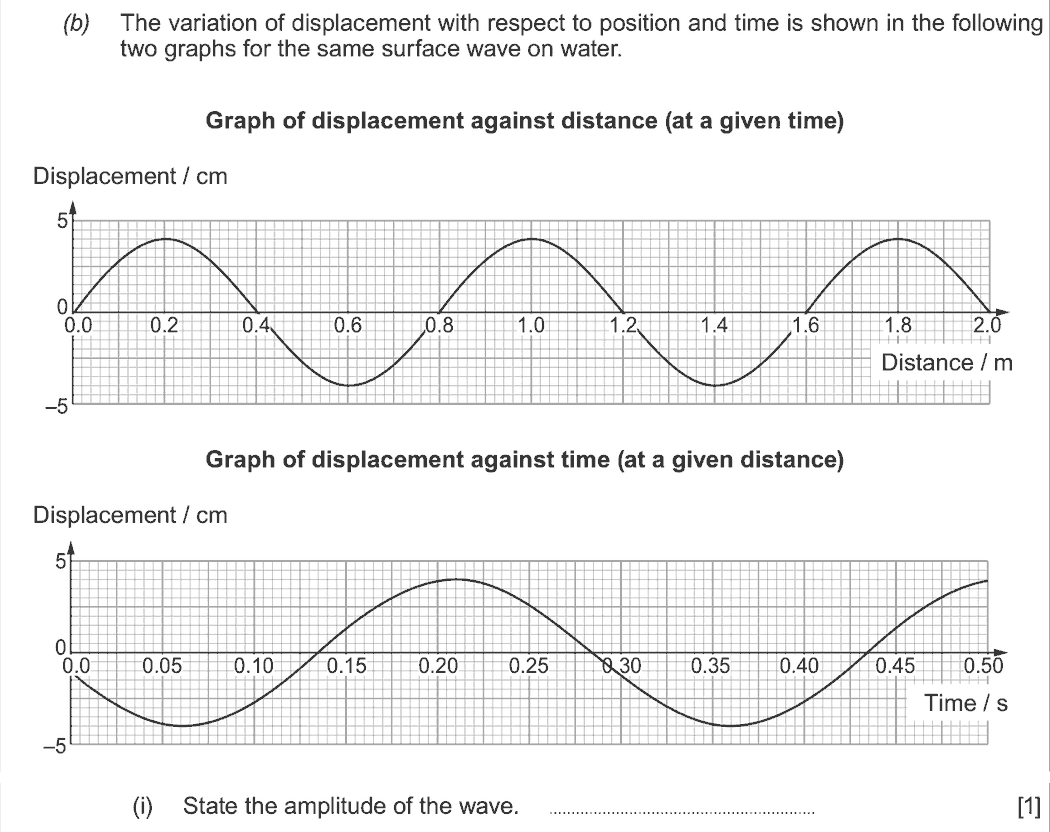
Answer: 4 cm (peak displacement on either graph)
Scheme columns: Maths 1
Skills: Graphskills Reading, plotting or sketching graphs; gradients, intercepts and areas; Mathsmarks The mark scheme's Maths column gives this part at least one mark for mathematical skills
June 2019 · Component 3 · Q1(b)(ii)1 markAO1=1Short answer
Earlier parts of question 1 that this part uses
Mark scheme
Notes from the mark scheme and report
Answer: 0.8 m, from the displacement-distance graph
Scheme columns: Maths 1
Skills: Graphskills Reading, plotting or sketching graphs; gradients, intercepts and areas; Mathsmarks The mark scheme's Maths column gives this part at least one mark for mathematical skills
June 2019 · Component 3 · Q1(b)(iii)3 marksAO1=1, AO2=2Calculation
Earlier parts of question 1 that this part uses
Mark scheme
Notes from the mark scheme and report
Answer: 2.67 m s⁻¹ (2.6 not accepted). Period from the displacement-time graph = 0.3 s
v = λ/T = 0.8/0.3 (or f = 1/T then v = fλ). The period was the hard part because the trace does not start at zero
Scheme columns: Maths 1
Skills: Graphskills Reading, plotting or sketching graphs; gradients, intercepts and areas; Mathsmarks The mark scheme's Maths column gives this part at least one mark for mathematical skills
June 2019 · Component 3 · Q1(c)(i)1 markAO1=1Diagram or graph
Earlier parts of question 1 that this part uses
Mark scheme
Examiner's comment
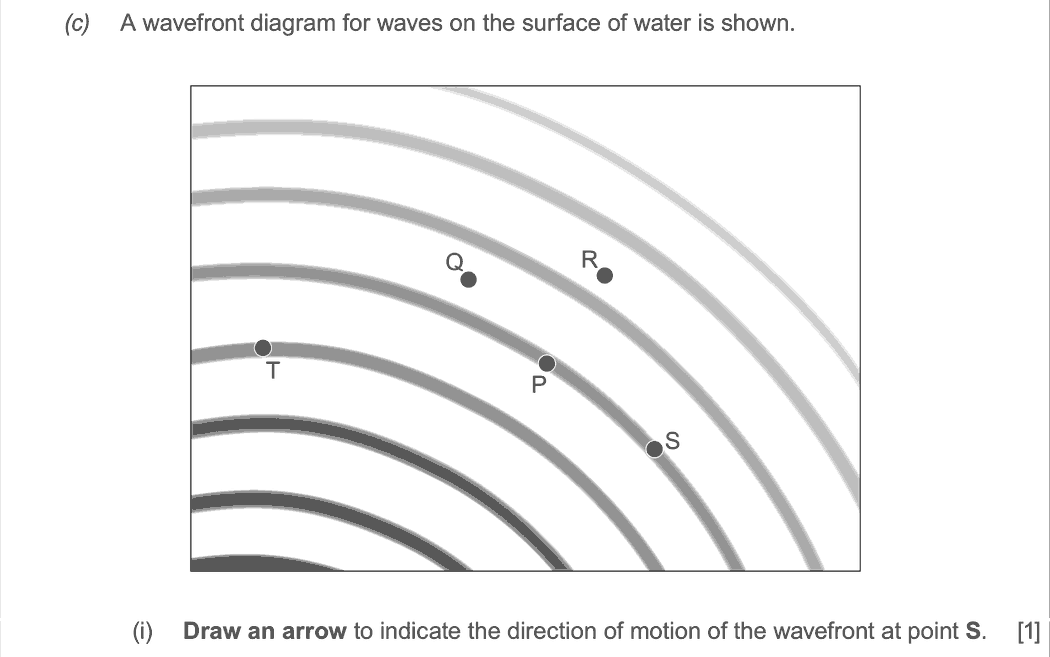
and (ii) Only a very small minority did not realise that wave direction and wavefronts are perpendicular. Likewise, nearly all candidates could state that both S and T were in phase with P.
Notes from the mark scheme and report
Arrow at S at right angles to the wavefront, radially outward (inward accepted)
June 2019 · Component 3 · Q1(c)(ii)1 markAO1=1Short answer
Earlier parts of question 1 that this part uses
Mark scheme
Notes from the mark scheme and report
Answer: S and T only (P and S on the same wavefront
T one whole wavelength away)
June 2018 · AS Component 2 · Q1(a)2 marksAO1=2Definition
Mark scheme
Examiner's comment
A significant number of candidates were not able to give a clear definition of the progressive wave though many did refer to the fact that it can transfer energy without reference to the medium carrying the wave.
Notes from the mark scheme and report
A pattern of disturbances that travels through a medium carrying energy (1), with the particles of the medium oscillating about their equilibrium positions (no net transfer of matter) (1)
e-m version accepted: travelling oscillating electric and magnetic fields carrying energy. Many gave energy transfer only
June 2018 · AS Component 2 · Q1(b)(i)2 marksAO2=2Short answer
Earlier part of question 1 that this part uses
Mark scheme
Examiner's comment
This part was well answered by all the candidates.
Notes from the mark scheme and report
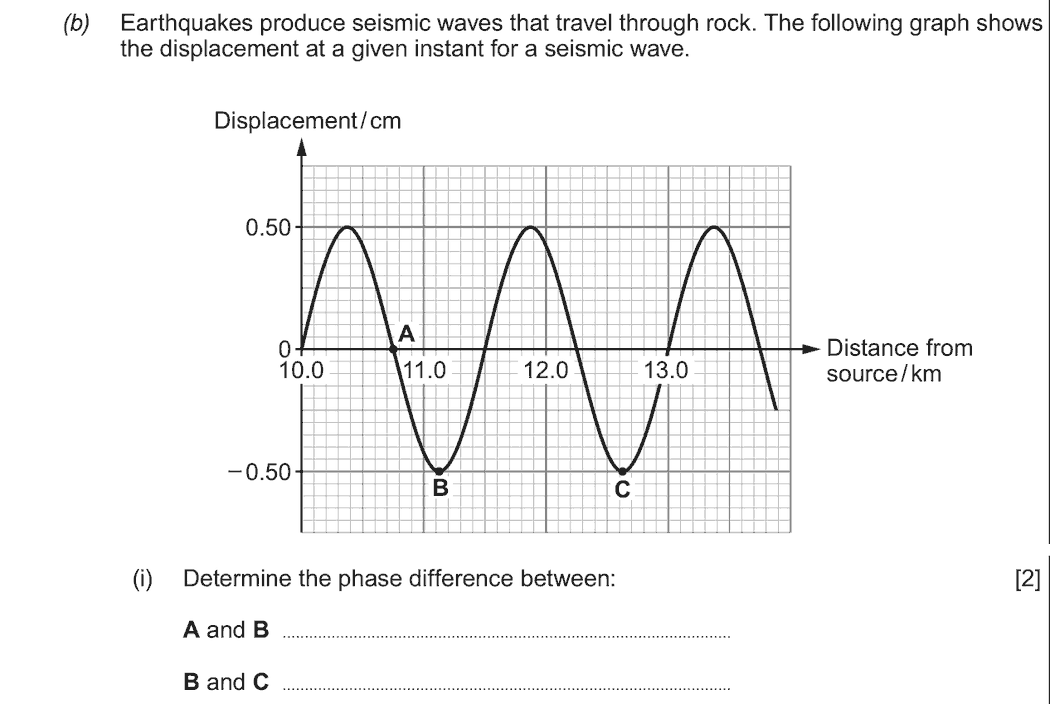
A and B: 90° (π/2 or a quarter of a cycle) (1)
B and C: 0 (or 360°, 2π: in phase) (1)
Scheme columns: Maths 1
Skills: Graphskills Reading, plotting or sketching graphs; gradients, intercepts and areas; Mathsmarks The mark scheme's Maths column gives this part at least one mark for mathematical skills
June 2018 · AS Component 2 · Q1(b)(ii)4 marksAO1=1, AO2=3Calculation
Earlier parts of question 1 that this part uses
Mark scheme
Examiner's comment
Many candidates were able to gain full marks. The common error was not being able to determine the wavelength correctly from the graph or the frequency.
Notes from the mark scheme and report
Answer: 3.75 × 10³ m s⁻¹. f = 50/20 = 2.5 Hz (T = 0.4 s)
wavelength from the graph = 1.5 km
v = fλ. Errors: misreading the wavelength or the frequency
Scheme columns: Maths 4
Skills: Graphskills Reading, plotting or sketching graphs; gradients, intercepts and areas; Unitsand conversions Unit marks, base units, prefixes and conversions; Mathsmarks The mark scheme's Maths column gives this part at least one mark for mathematical skills
June 2018 · AS Component 2 · Q1(d)2 marksAO3=2Short answer
Earlier parts of question 1 that this part uses
Mark scheme
Examiner's comment
There were a number of vague answers given to this question. The majority referred to the fact that the information can be used to predict earthquakes but were not able to give specific reasons e.g. saving lives through enabling a quicker evacuation.
Notes from the mark scheme and report
Data show where and how often earthquakes occur (1), which informs planning and siting of new buildings, or improves knowledge of the Earth's structure (1)
'predicting earthquakes' needed a specific benefit such as time to evacuate
June 2018 · Component 3 · Q5(b)3 marksAO2=3Show that
Earlier part of question 5 that this part uses
Mark scheme
Examiner's comment
This was a classic case of incomplete responses to “show that”. A majority of candidates noticed that 2L n must be the wavelength but only a small minority could explain why.
Notes from the mark scheme and report
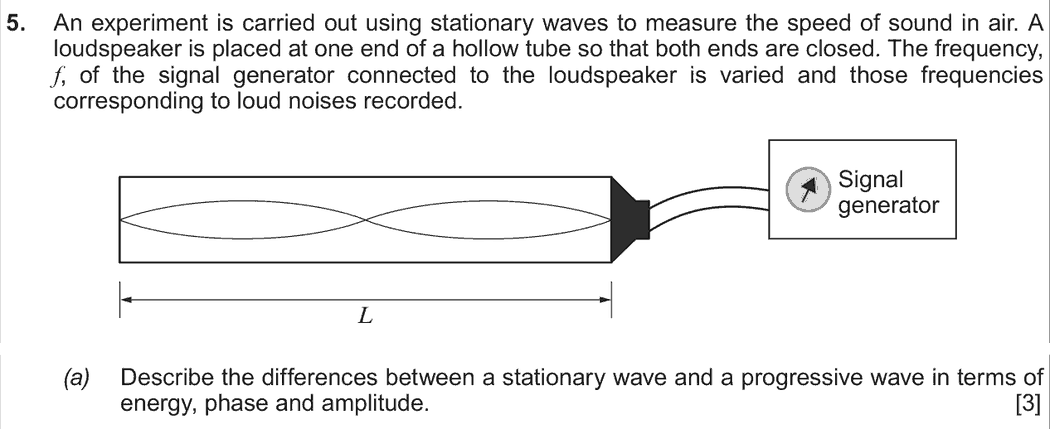
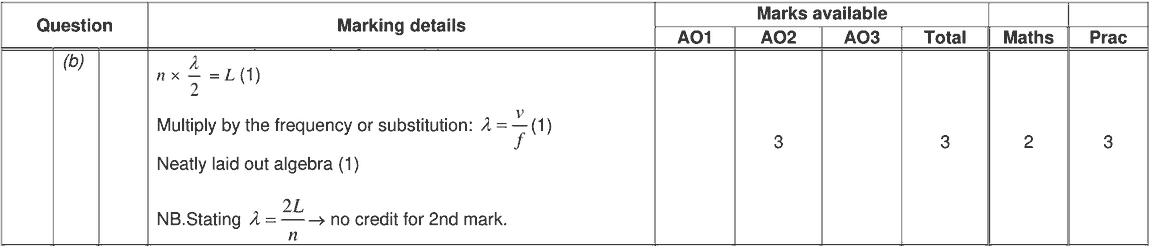
Nodes at both closed ends so a whole number of half wavelengths fits: nλ/2 = L (1)
substitute λ = v/f (1)
rearrange clearly to f = nv/2L (1)
quoting λ = 2L/n without justification lost credit
Scheme columns: Maths 2, Practical 3
Skills: Algebra Derivations and rearranging equations; Mathsmarks The mark scheme's Maths column gives this part at least one mark for mathematical skills; Practicalmarks The mark scheme's Prac column gives this part at least one mark for practical skills
June 2017 · Component 1 · Q7(b)2 marksAO2=2Calculation
Earlier part of question 7 that this part uses
Mark scheme
Examiner's comment
The success rate was somewhat better for finding the frequency of the third harmonic; the wavelength gave a little more trouble.
Notes from the mark scheme and report
Answer: f = 141 Hz (3 × 47) and λ = 2.4 m (4 × 1.800/3, or 340/141)
the wavelength was found harder
Scheme columns: Maths 2, Practical 2
Skills: Comprehension A level Component 1 Section B: questions on the printed article; Mathsmarks The mark scheme's Maths column gives this part at least one mark for mathematical skills; Practicalmarks The mark scheme's Prac column gives this part at least one mark for practical skills
June 2017 · Component 1 · Q7(c)4 marksAO1=4Explanation
Earlier part of question 7 that this part uses
Mark scheme
Examiner's comment
In explanations of the intensity curve when the analyser was rotated, credit was given for statements about zero intensity due to absorption by the analyser when crossed with the polariser, and maximum when polariser and analyser were in the same direction, but we did also need to be told that this happened because in the light emerging from the polariser, the (electric) vibrations were confined to one direction at right angles to the direction of travel. Some candidates omitted to do so, attempting to answer the question without saying anything about the light itself.
Notes from the mark scheme and report
Light leaving the polariser has its vibrations in one direction only (1)
at 0° and 180° the analyser is aligned with the polariser so intensity is a maximum (1)
at 90° they are crossed so (almost) no light passes (1)
in between there is partial transmission (1)
many never described the polarised light itself
Scheme columns: Practical 4
Skills: Comprehension A level Component 1 Section B: questions on the printed article; Practicalmarks The mark scheme's Prac column gives this part at least one mark for practical skills
June 2017 · Component 1 · Q7(d)(i)1 markAO2=1Show that
Earlier part of question 7 that this part uses
Mark scheme
Examiner's comment
We expected candidates to substitute I = 340, = 0 into I = I0 cos2 in order to show that I0 = 340. Many did so, while some, equally correctly, used data from other points.
Notes from the mark scheme and report
At θ = 0 (or 180°) cos²θ = 1 so I = I0 = 340 from the graph
substituting any other plotted point accepted
Scheme columns: Maths 1, Practical 1
Skills: Comprehension A level Component 1 Section B: questions on the printed article; Graphskills Reading, plotting or sketching graphs; gradients, intercepts and areas; Mathsmarks The mark scheme's Maths column gives this part at least one mark for mathematical skills; Practicalmarks The mark scheme's Prac column gives this part at least one mark for practical skills
June 2017 · Component 1 · Q7(d)(ii)2 marksAO1=1, AO2=1Calculation
Earlier parts of question 7 that this part uses
Mark scheme
Examiner's comment
This second check on the fit between the graph and equation was taken by almost all candidates as the gift that it was.
Notes from the mark scheme and report
cos² 140° = 0.587 (1)
predicted I = 340 × 0.587 = 200, which matches the plotted point (1)
Scheme columns: Maths 2, Practical 2
Skills: Comprehension A level Component 1 Section B: questions on the printed article; Graphskills Reading, plotting or sketching graphs; gradients, intercepts and areas; Mathsmarks The mark scheme's Maths column gives this part at least one mark for mathematical skills; Practicalmarks The mark scheme's Prac column gives this part at least one mark for practical skills
June 2017 · AS Component 2 · Q1(a)2 marksAO1=2Definition
Mark scheme
Examiner's comment
This question was answered well by all candidates. The definition of a longitudinal wave was clearly understood by all candidates.
Notes from the mark scheme and report
Particle oscillations (displacements) (1) are along, i.e. parallel to, the direction of wave travel (energy transfer) (1)
June 2017 · AS Component 2 · Q1(b)1 markAO1=1Short answer
Earlier part of question 1 that this part uses
Mark scheme
Examiner's comment
Nearly all the candidates gave the correct amplitude.
Notes from the mark scheme and report
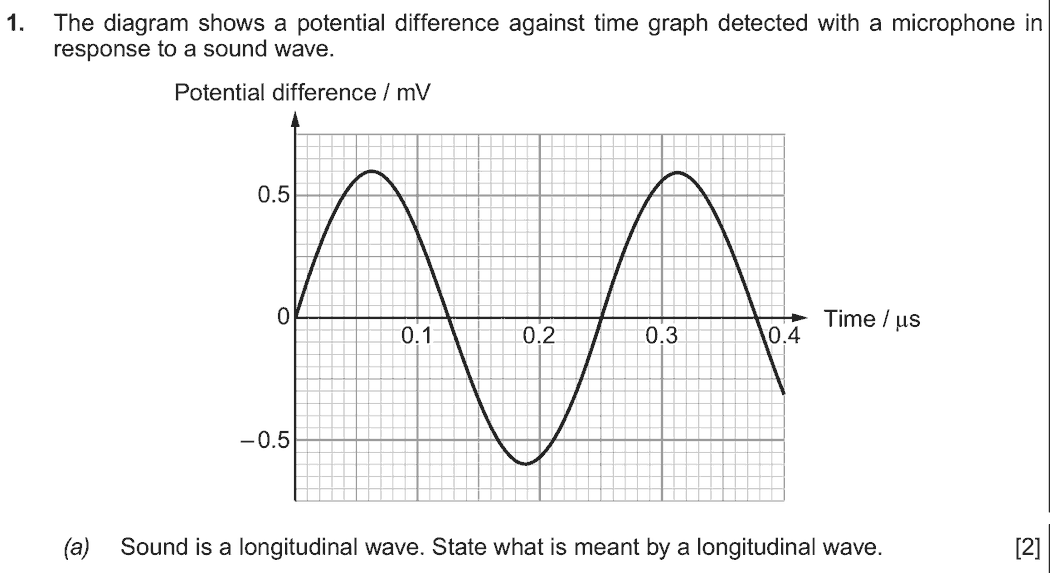
Answer: 0.6 mV, read as the peak value on the graph
Skills: Graphskills Reading, plotting or sketching graphs; gradients, intercepts and areas
June 2017 · AS Component 2 · Q1(c)(i)1 markAO2=1Calculation
Earlier part of question 1 that this part uses
Mark scheme
Examiner's comment
Many candidates were able to obtain full marks for both parts. The most common errors were not realising that the wavelength was in mm for part (i) and that the time was given in 𝜇s on the axis of the diagram.
Notes from the mark scheme and report
Answer: 3.95 × 10⁶ Hz. f = c/λ = 1580/0.40 × 10⁻³
common slip: leaving the wavelength in mm
Scheme columns: Maths 1
Skills: Unitsand conversions Unit marks, base units, prefixes and conversions; Mathsmarks The mark scheme's Maths column gives this part at least one mark for mathematical skills
June 2017 · AS Component 2 · Q1(c)(ii)3 marksAO3=3Calculation
Earlier parts of question 1 that this part uses
Mark scheme
Examiner's comment
Many candidates were able to obtain full marks for both parts. The most common errors were not realising that the wavelength was in mm for part (i) and that the time was given in 𝜇s on the axis of the diagram.
Notes from the mark scheme and report
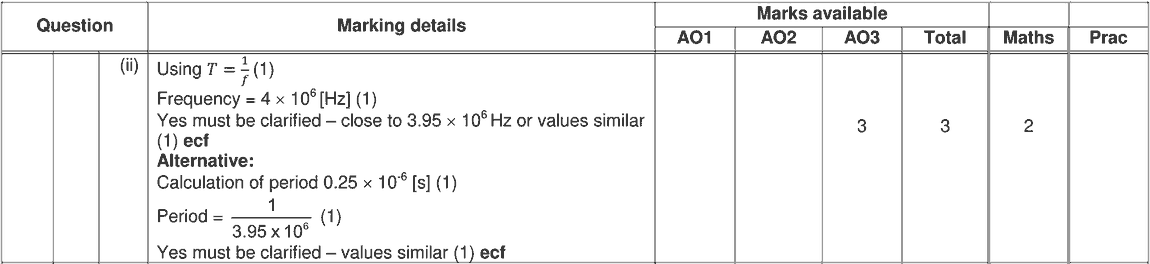
Period from the graph = 0.25 μs, so f = 1/T = 4 × 10⁶ Hz (1)(1)
yes, suitable, because this is close to 3.95 × 10⁶ Hz (1). Or compare the period 0.25 μs with 1/3.95 × 10⁶ s. Conclusion must be justified
the μs on the time axis was often missed
Scheme columns: Maths 2
Skills: Graphskills Reading, plotting or sketching graphs; gradients, intercepts and areas; Unitsand conversions Unit marks, base units, prefixes and conversions; Mathsmarks The mark scheme's Maths column gives this part at least one mark for mathematical skills
June 2017 · Component 3 · Q7(c)(i)2 marksAO2=2Practical and data analysis
Earlier parts of question 7 that this part uses
Mark scheme
Examiner's comment
Most candidates did not make use of more than one wavelength to obtain a more accurate value.
Notes from the mark scheme and report
Answer: 0.50 to 0.70 cm. Measure across two or more wavelengths with a ruler and divide (1)
value in range (1)
most measured a single wavelength
Scheme columns: Practical 2
Skills: Experimentalmethod Describing, planning or improving an experiment; Practicalmarks The mark scheme's Prac column gives this part at least one mark for practical skills
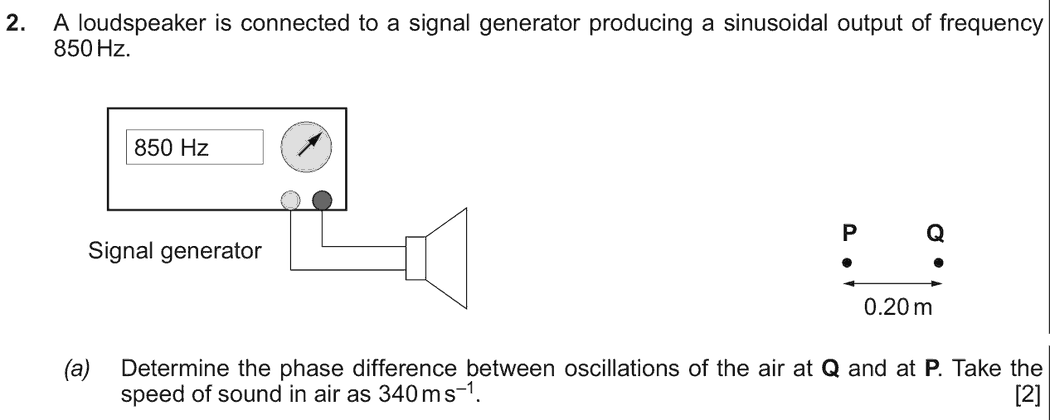
June 2016 · AS Component 2 · Q2(a)2 marksAO2=2Calculation
Mark scheme
Examiner's comment
Many confused phase and path difference or gave answers such as ½ and failed to convert their answer to a phase angle.
Notes from the mark scheme and report
Answer: 180° (π rad, antiphase). λ = 340/850 = 0.40 m so 0.20 m is half a wavelength
many gave a path difference or ½ rather than a phase angle
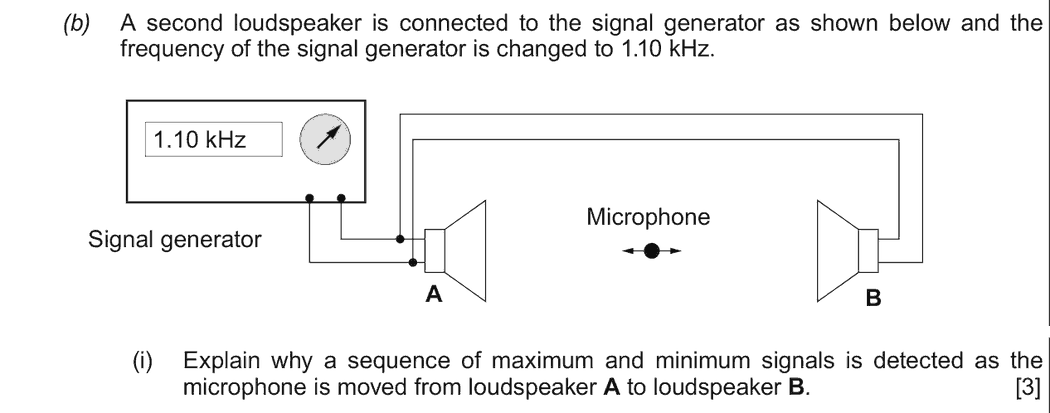
June 2016 · AS Component 2 · Q2(b)(ii)4 marksAO1=2, AO2=2Calculation
Earlier parts of question 2 that this part uses
Mark scheme
Examiner's comment
Marks were awarded if the equation 𝑣= 𝑓𝜆 was used correctly. However many candidates were not able to determine the wavelength from the node-node distance.
Notes from the mark scheme and report
Answer: 330 m s⁻¹. 60.0 cm spans four node-to-node distances so λ/2 = 0.15 m and λ = 0.30 m
c = fλ = 1100 × 0.30
many could not get λ from the node spacing
Scheme columns: Maths 3
Skills: Mathsmarks The mark scheme's Maths column gives this part at least one mark for mathematical skills
Work with an Eduqas physics tutor
Dropping marks on calculations, specified practicals or the six-mark QER questions? Book a trial session with a specialist Eduqas physics tutor.