3.6-a the spontaneous nature of nuclear decay; the nature of α, β and γ radiation, and equations to represent the nuclear transformations using the ^A_Z X notation
3.6-b different methods used to distinguish between α, β and γ radiation and the connections between the nature, penetration and range for ionising particles
3.6-c how to make allowance for background radiation in experimental measurements
3.6-d the concept of the half-life, T½
3.6-e the definition of the activity, A, and the Becquerel
3.6-f the decay constant, λ, and the equation A = λ N
3.6-g the exponential law of decay in graphical and algebraic form, N = N₀e^(−λt) and A = A₀e^(−λt) or N = N₀/2^x and A = A₀/2^x where x is the number of half-lives elapsed – not necessarily an integer
3.6-h the derivation and use of λ = ln 2 / T½
3.6-P1 Specified practical: Investigation of radioactive decay – a dice analogy
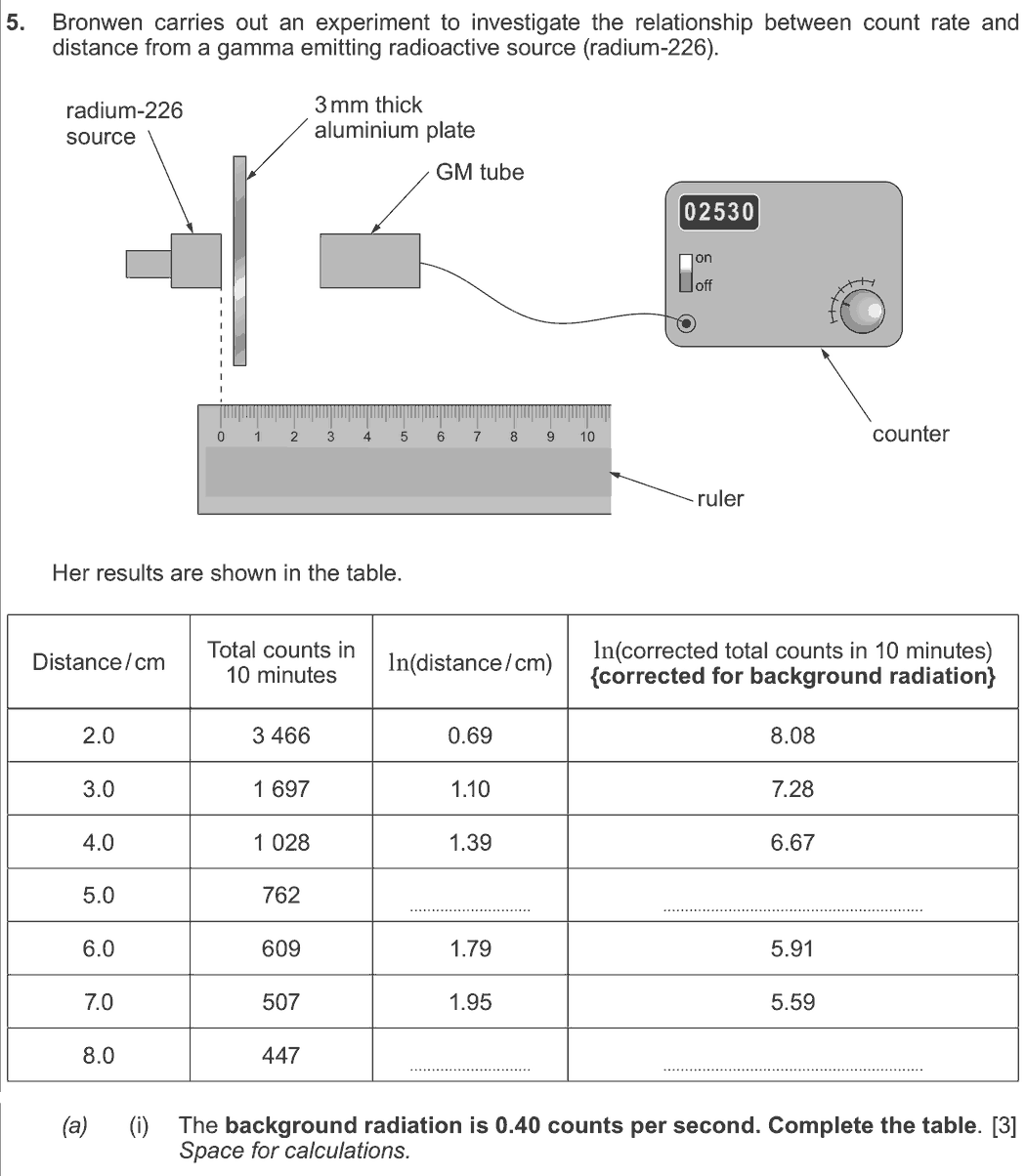
3.6-P2 Specified practical: Investigation of the variation of intensity of gamma radiation with distance
Tap a question to zoom it. Where a part needs a figure, table or graph from earlier in the question, that part folds out above it; the mark scheme and examiner's comment open underneath. Have the Eduqas Data Booklet beside you (see the Data Booklet page).
June 2025 · Component 3 · Q5(a)(i)1 markAO1=1Definition
Mark scheme
Examiner's comment
This practical question was well answered in general but there were problems with the definition of the Becquerel ((a)(ii)), part (c)(ii) and (d).
Notes from the mark scheme and report
The number of decays (disintegrations) per unit time, i.e. the rate of decay
'counts per second' not accepted
June 2025 · Component 3 · Q5(a)(ii)1 markAO1=1Definition
Earlier part of question 5 that this part uses
Mark scheme
Examiner's comment
This practical question was well answered in general but there were problems with the definition of the Becquerel ((a)(ii)), part (c)(ii) and (d).
Notes from the mark scheme and report
One decay (disintegration) per second
just 'per second' or s⁻¹ not accepted
often poorly answered
June 2025 · Component 3 · Q5(b)(i)1 markAO2=1Practical and data analysis
Earlier part of question 5 that this part uses
Mark scheme
Examiner's comment
This practical question was well answered in general but there were problems with the definition of the Becquerel ((a)(ii)), part (c)(ii) and (d).
Notes from the mark scheme and report
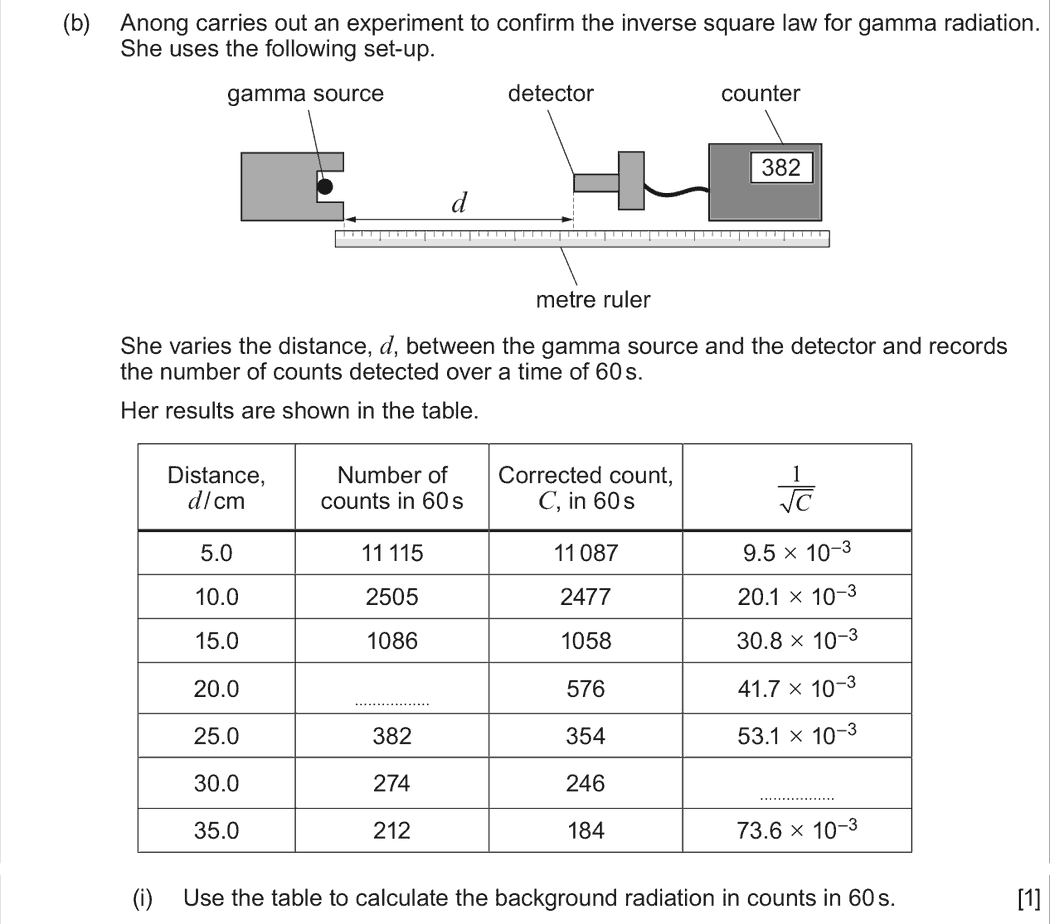
Answer: 28 counts in 60 s (difference between the raw and corrected counts, e.g. 382 − 354)
Scheme columns: Practical 1
Skills: Practicalmarks The mark scheme's Prac column gives this part at least one mark for practical skills
June 2025 · Component 3 · Q5(b)(ii)2 marksAO2=2Practical and data analysis
Earlier parts of question 5 that this part uses
Mark scheme
Examiner's comment
This practical question was well answered in general but there were problems with the definition of the Becquerel ((a)(ii)), part (c)(ii) and (d).
Notes from the mark scheme and report
Raw count at 20.0 cm = 576 + 28 = 604 (1)
1/√C at 30.0 cm = 1/√246 = 63.8 × 10⁻³ (1)
Scheme columns: Maths 2, Practical 2
Skills: Mathsmarks The mark scheme's Maths column gives this part at least one mark for mathematical skills; Practicalmarks The mark scheme's Prac column gives this part at least one mark for practical skills
June 2025 · Component 3 · Q5(b)(iii)2 marksAO2=2Practical and data analysis
Earlier parts of question 5 that this part uses
Mark scheme
Examiner's comment
This practical question was well answered in general but there were problems with the definition of the Becquerel ((a)(ii)), part (c)(ii) and (d).
Notes from the mark scheme and report
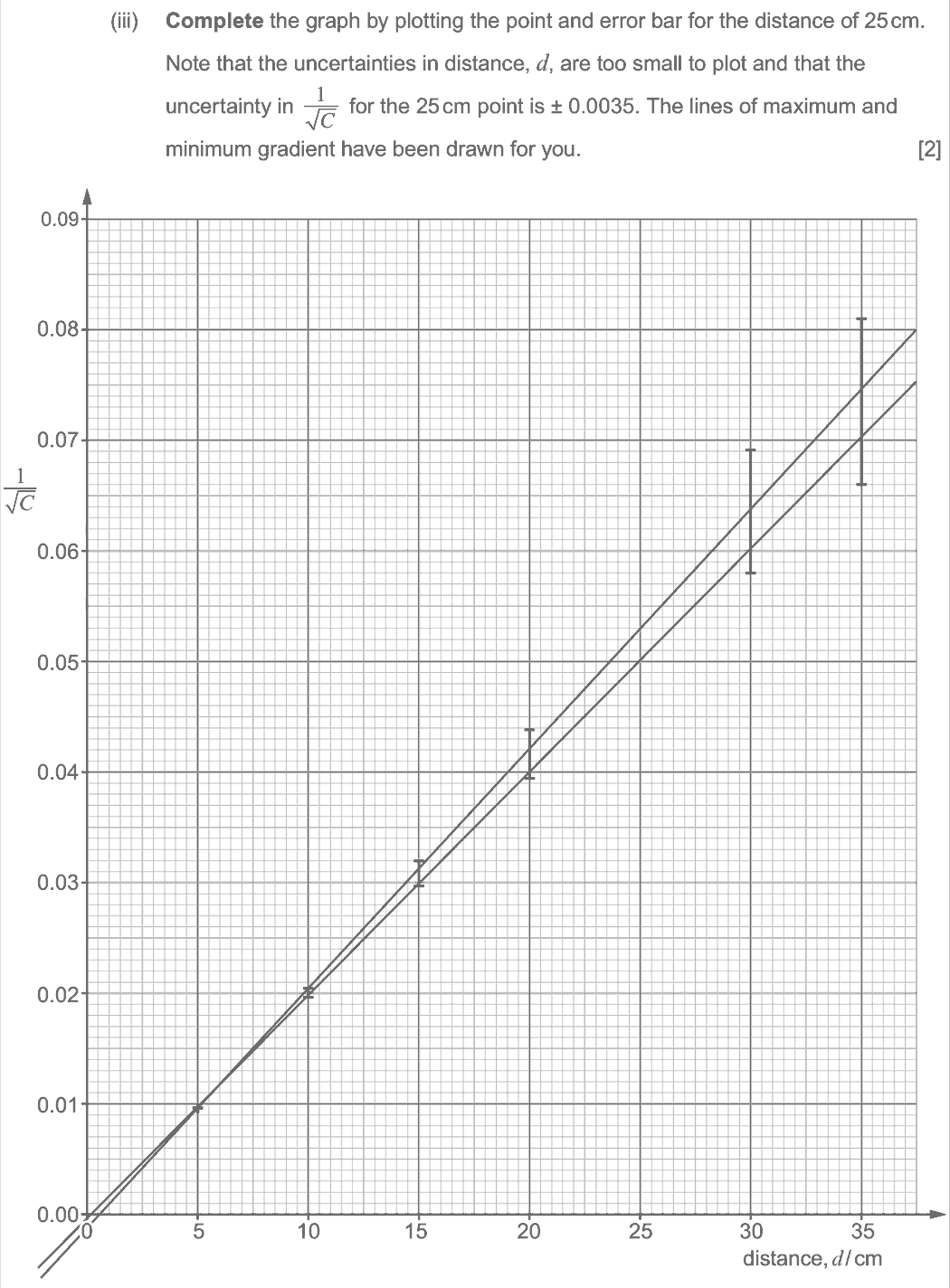
Point plotted at (25, 0.0531) within half a square (1)
error bar from 0.0496 to 0.0566 (1), marked independently
Scheme columns: Maths 2, Practical 2
Skills: Graphskills Reading, plotting or sketching graphs; gradients, intercepts and areas; Uncertainties Resolution, absolute and percentage uncertainty, combining uncertainties, error bars; Mathsmarks The mark scheme's Maths column gives this part at least one mark for mathematical skills; Practicalmarks The mark scheme's Prac column gives this part at least one mark for practical skills
June 2025 · Component 3 · Q5(c)(i)2 marksAO2=2Practical and data analysis
Earlier parts of question 5 that this part uses
Mark scheme
Examiner's comment
This practical question was well answered in general but there were problems with the definition of the Becquerel ((a)(ii)), part (c)(ii) and (d).
Notes from the mark scheme and report
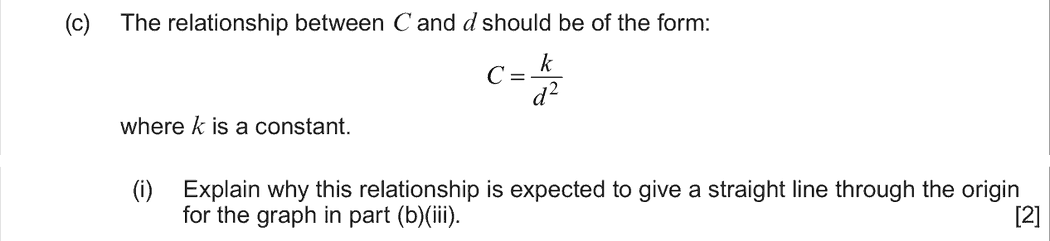
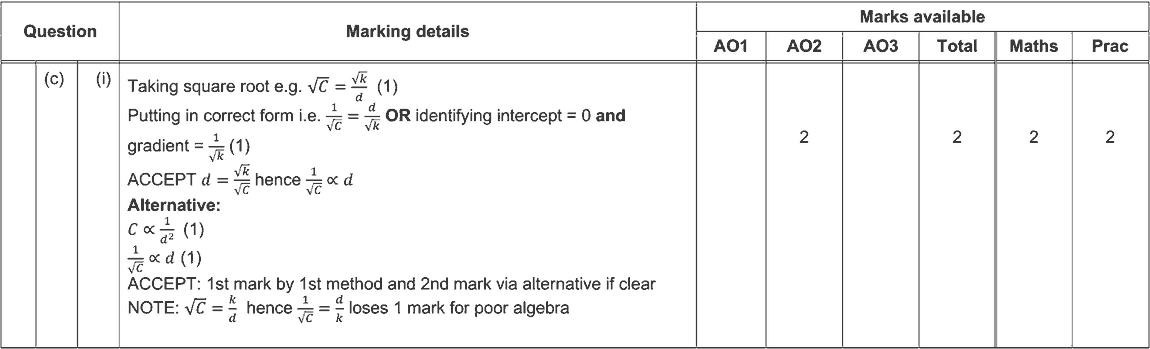
C = k/d² so √C = √k/d (1)
1/√C = d/√k, of the form y = mx with gradient 1/√k and zero intercept (1)
poor algebra such as 1/√C = d/k loses a mark
Scheme columns: Maths 2, Practical 2
Skills: Algebra Derivations and rearranging equations; Graphskills Reading, plotting or sketching graphs; gradients, intercepts and areas; Mathsmarks The mark scheme's Maths column gives this part at least one mark for mathematical skills; Practicalmarks The mark scheme's Prac column gives this part at least one mark for practical skills
June 2025 · Component 3 · Q5(c)(ii)4 marksAO3=4Practical and data analysis
Earlier parts of question 5 that this part uses
Mark scheme
Examiner's comment
This practical question was well answered in general but there were problems with the definition of the Becquerel ((a)(ii)), part (c)(ii) and (d).
Notes from the mark scheme and report
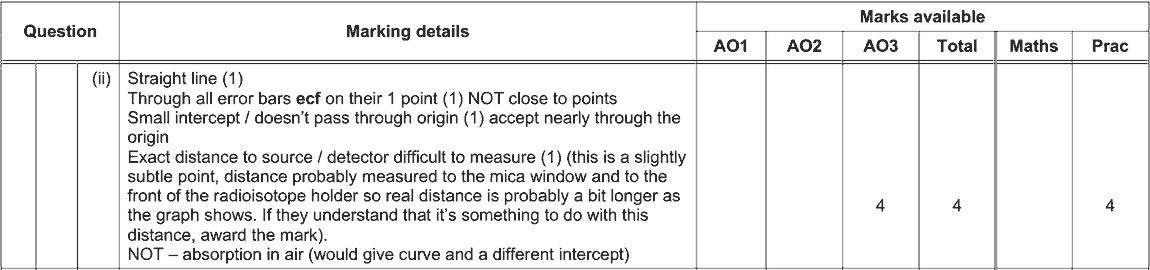
Agrees: a straight line (1) can be drawn through all the error bars (1)
disagrees: there is a small intercept, the line does not quite pass through the origin (1)
reason: the true source-to-detector distance is uncertain, as the source and the sensitive region sit behind the measured faces (1)
absorption in air not accepted
one of the weaker parts
Scheme columns: Practical 4
Skills: Graphskills Reading, plotting or sketching graphs; gradients, intercepts and areas; Uncertainties Resolution, absolute and percentage uncertainty, combining uncertainties, error bars; Experimentalmethod Describing, planning or improving an experiment; Practicalmarks The mark scheme's Prac column gives this part at least one mark for practical skills
June 2025 · Component 3 · Q5(d)4 marksAO3=4Practical and data analysis
Earlier parts of question 5 that this part uses
Mark scheme
Examiner's comment
This practical question was well answered in general but there were problems with the definition of the Becquerel ((a)(ii)), part (c)(ii) and (d).
Notes from the mark scheme and report
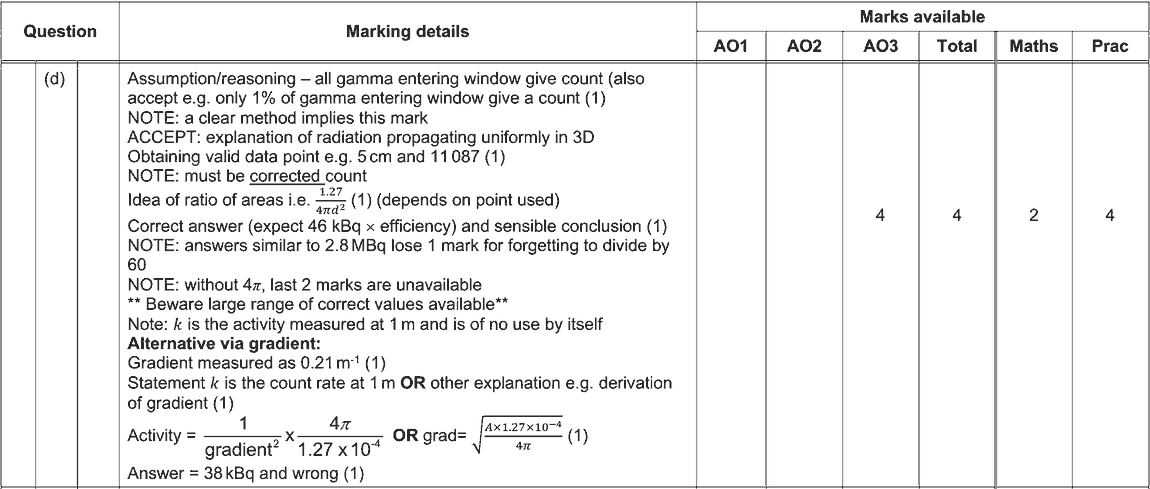
Answer: about 46 kBq, so 18 000 Bq is too low (the estimate rises further if the detector is not 100% efficient). Assume every gamma entering the window is counted and emission is uniform in all directions (1)
use a corrected count, e.g. 11 087 in 60 s at 5.0 cm (1)
fraction intercepted = 1.27/(4π × 5.0²) (1)
A = (11 087/60) × 4π × 25/1.27 (1)
forgetting to divide by 60 loses 1
gradient route gives 38 kBq
poorly answered
Scheme columns: Maths 2, Practical 4
Skills: Unitsand conversions Unit marks, base units, prefixes and conversions; Mathsmarks The mark scheme's Maths column gives this part at least one mark for mathematical skills; Practicalmarks The mark scheme's Prac column gives this part at least one mark for practical skills
June 2024 · Component 3 · Q5(a)4 marksAO1=4Practical and data analysis
Mark scheme
Examiner's comment
Some omissions were seen in this practical procedure. Candidates need to check when writing a method that they have included every step that is required. Sometimes not saying to count the number of coins and / or the number of times the procedure should be repeated for example were omitted. Some candidates forget that 𝑛 is the number of turns per unit length.
Notes from the mark scheme and report
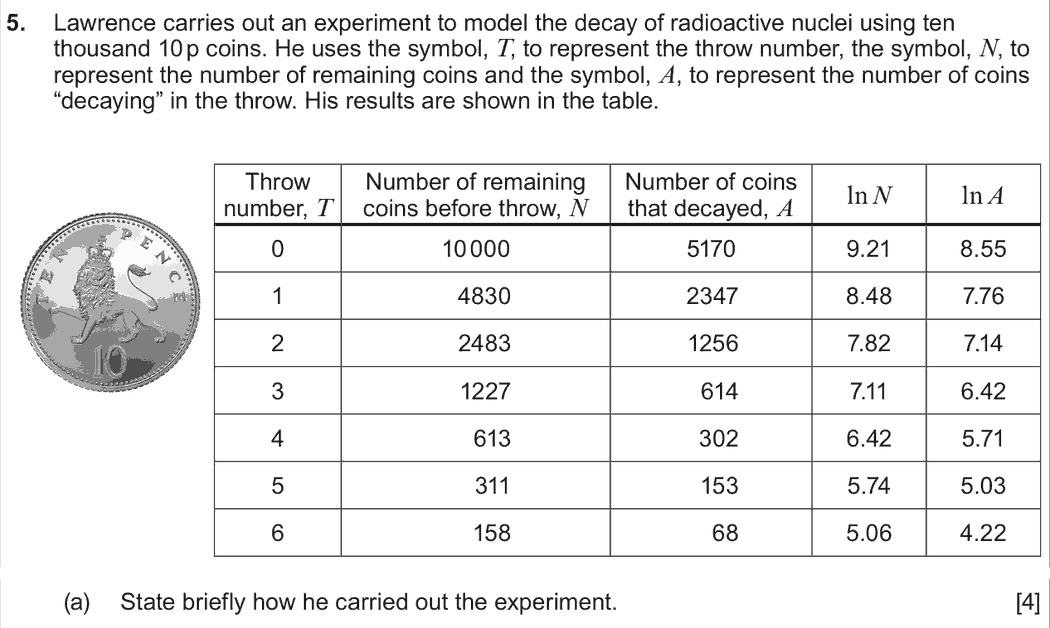
Throw all the coins (1)
count the heads (or tails) as 'decayed' (1)
remove them (1)
throw the remaining coins again and repeat for several throws (1)
steps such as counting or repeating were often left out
Scheme columns: Practical 4
Skills: Experimentalmethod Describing, planning or improving an experiment; Practicalmarks The mark scheme's Prac column gives this part at least one mark for practical skills
June 2024 · Component 3 · Q5(b)(i)1 markAO2=1Practical and data analysis
Earlier part of question 5 that this part uses
Mark scheme
Examiner's comment
&(ii) Not easy but very well done. It is interesting to think how well this question would have been answered had part (b)(i) not been asked before part (b)(ii). The direction of the force was sometimes wrong here (understandably).
Notes from the mark scheme and report
Answer: 1 throw (half the coins are expected to decay each throw)
Scheme columns: Maths 1, Practical 1
Skills: Mathsmarks The mark scheme's Maths column gives this part at least one mark for mathematical skills; Practicalmarks The mark scheme's Prac column gives this part at least one mark for practical skills
June 2024 · Component 3 · Q5(b)(ii)3 marksAO2=3Show that
Earlier parts of question 5 that this part uses
Mark scheme
Examiner's comment
Inevitably correct once the correct equation has been selected or derived.
Notes from the mark scheme and report
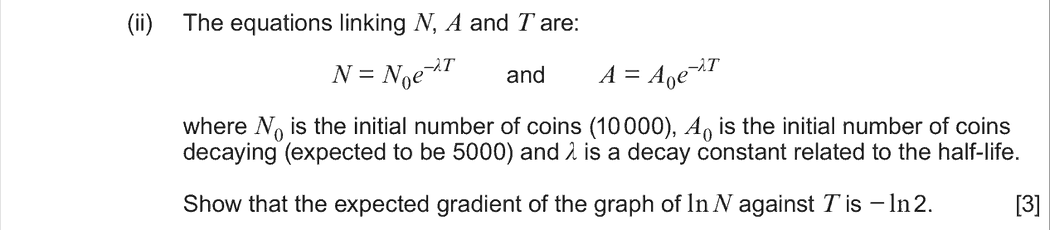
Taking logs: ln N = ln N0 − λT (1)
compare with y = mx + c, so the gradient is −λ (1)
λ = ln 2/T½ and the half-life is 1 throw, so gradient = −ln 2 (1)
Scheme columns: Maths 3, Practical 3
Skills: Algebra Derivations and rearranging equations; Graphskills Reading, plotting or sketching graphs; gradients, intercepts and areas; Mathsmarks The mark scheme's Maths column gives this part at least one mark for mathematical skills; Practicalmarks The mark scheme's Prac column gives this part at least one mark for practical skills
June 2024 · Component 3 · Q5(c)6 marksAO3=6Practical and data analysis
Earlier part of question 5 that this part uses
Mark scheme
Examiner's comment
Well answered but candidates needed to talk about the straight line, gradient and the intercept. The poorer responses involved discussing the gradient and straight line only or, sometimes, the intercepts only.
Notes from the mark scheme and report
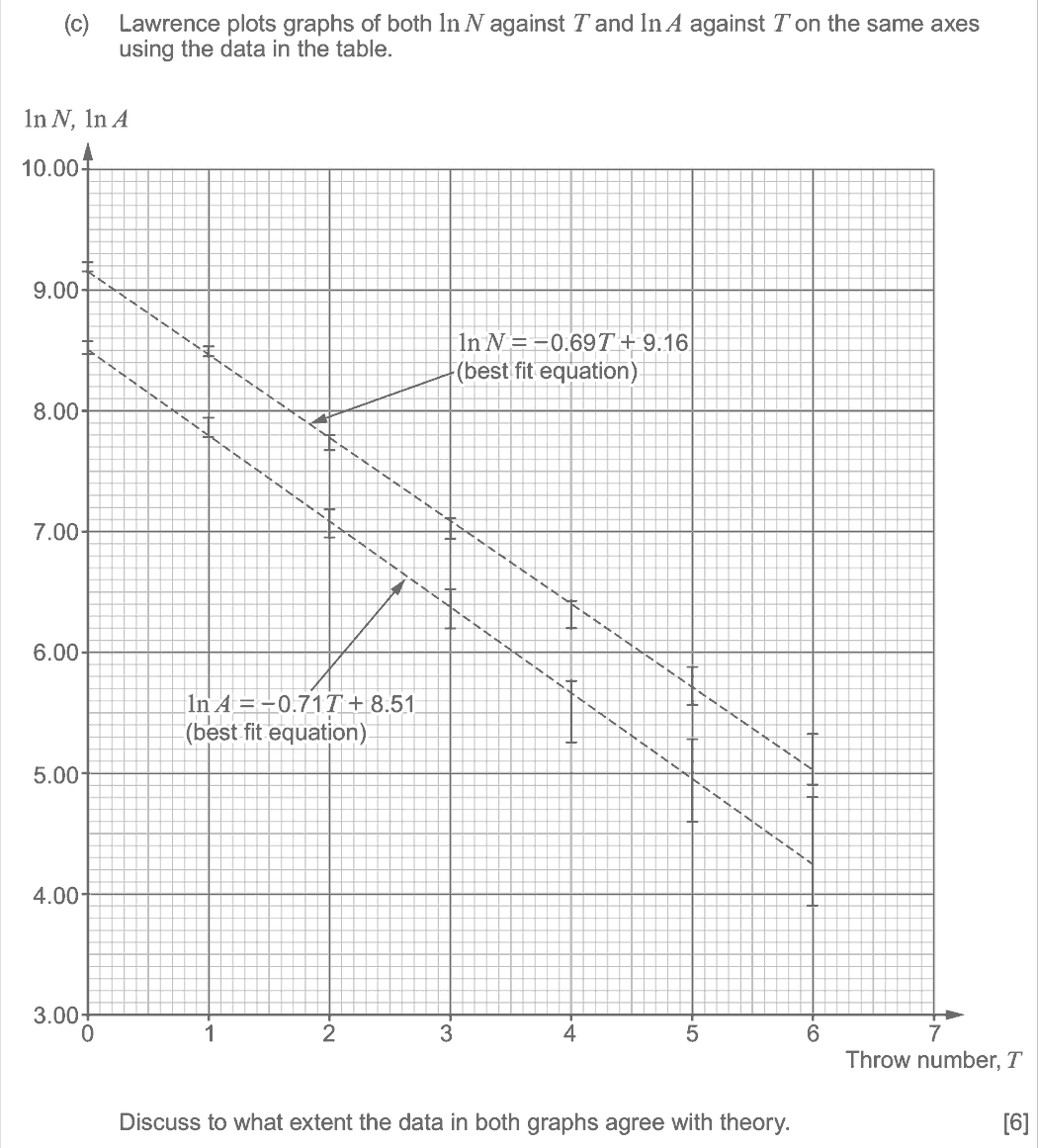
Both graphs are straight lines (1) passing through all the error bars (1)
gradients −0.69 and −0.71 agree closely with −ln 2 = −0.693 (1)
intercept should be ln N0 or ln A0 (1): e^9.16 = 9500 against 10 000 and e^8.51 = 4960 against 5000 (ln 10 000 = 9.21, ln 5000 = 8.52) (1), so the intercepts agree quite well (1)
weaker answers discussed only the gradient or only the intercepts
Scheme columns: Maths 3, Practical 6
Skills: Graphskills Reading, plotting or sketching graphs; gradients, intercepts and areas; Uncertainties Resolution, absolute and percentage uncertainty, combining uncertainties, error bars; Mathsmarks The mark scheme's Maths column gives this part at least one mark for mathematical skills; Practicalmarks The mark scheme's Prac column gives this part at least one mark for practical skills
June 2024 · Component 3 · Q5(d)(i)2 marksAO1=1, AO2=1Practical and data analysis
Earlier parts of question 5 that this part uses
Mark scheme
Examiner's comment
The practical question and well answered in general.
Notes from the mark scheme and report
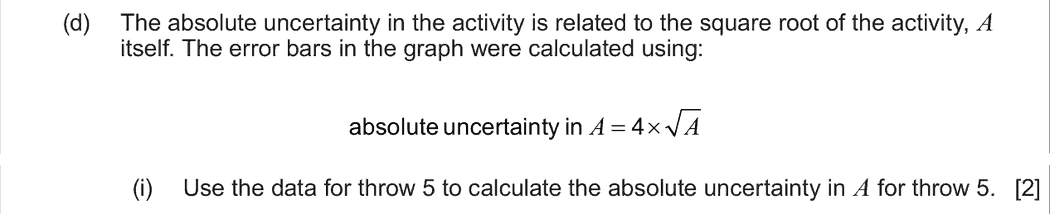
Answer: 49 (49.5). 4 × √153
Scheme columns: Maths 2, Practical 2
Skills: Uncertainties Resolution, absolute and percentage uncertainty, combining uncertainties, error bars; Mathsmarks The mark scheme's Maths column gives this part at least one mark for mathematical skills; Practicalmarks The mark scheme's Prac column gives this part at least one mark for practical skills
June 2024 · Component 3 · Q5(d)(ii)3 marksAO3=3Practical and data analysis
Earlier parts of question 5 that this part uses
Mark scheme
Examiner's comment
Uncertainties in logs are difficult and always cause problems. The best method is to go back to 1st principles and work out the worst-case scenario(s) i.e. calculating 2 of these 3: 𝑒ln 𝑁+∆ln 𝑁 , 𝑒ln 𝑁, 𝑒ln 𝑁−∆ln 𝑁. There are many “wrong” ways to approach this question, the most common being calculating 𝑒∆ln 𝑁 which gives completely the wrong answer (even though, at first glance, it might look correct).
Notes from the mark scheme and report
A = 153 ± 49 gives ln A between ln 104 = 4.64 and ln 202 = 5.31 (centre 5.03), i.e. about ± 0.32 (2)
the plotted bar runs from about 4.6 to 5.3, so it is about right (1)
go back to the extreme values
e raised to the uncertainty in ln A is the common wrong method
Scheme columns: Maths 2, Practical 3
Skills: Uncertainties Resolution, absolute and percentage uncertainty, combining uncertainties, error bars; Graphskills Reading, plotting or sketching graphs; gradients, intercepts and areas; Mathsmarks The mark scheme's Maths column gives this part at least one mark for mathematical skills; Practicalmarks The mark scheme's Prac column gives this part at least one mark for practical skills
June 2024 · Component 3 · Q5(d)(iii)2 marksAO3=2Practical and data analysis
Earlier parts of question 5 that this part uses
Mark scheme
Examiner's comment
Many candidates though that these error bars would increase in size. Q.6A challenging little question involving electron capture. The most common problem is trying to include all the other electrons (the other electrons are involved in all sorts of complicated stuff including 2 different Auger electrons). It is best to forget about all the other electrons and treat this as a nuclear reaction! Clearly setting out answers is important here to, label each of the laws and show the working for each law. Q.7Very well answered except part (b)(iii).
Notes from the mark scheme and report
The error bars would get smaller as T increases (1) because A, and so 4√A, decreases (e.g. ± 288 at throw 0 but ± 33 at throw 6) (1)
many said they would increase
Scheme columns: Maths 1, Practical 2
Skills: Uncertainties Resolution, absolute and percentage uncertainty, combining uncertainties, error bars; Graphskills Reading, plotting or sketching graphs; gradients, intercepts and areas; Mathsmarks The mark scheme's Maths column gives this part at least one mark for mathematical skills; Practicalmarks The mark scheme's Prac column gives this part at least one mark for practical skills
June 2023 · Component 3 · Q6(b)3 marksAO2=3Calculation
Earlier part of question 6 that this part uses
Mark scheme
Examiner's comment
Part (b) was very well answered. However, very few candidates were able to state that the rate of pumping was equal to the rate of dropping at equilibrium. In part (c), one mark was rarely awarded. After the previous calculation, one would expect some candidates to state that the population of the metastable state was proportional to its half-life. Unfortunately, the best candidates were just falling short and stating that the population increased with the half-life.
Notes from the mark scheme and report
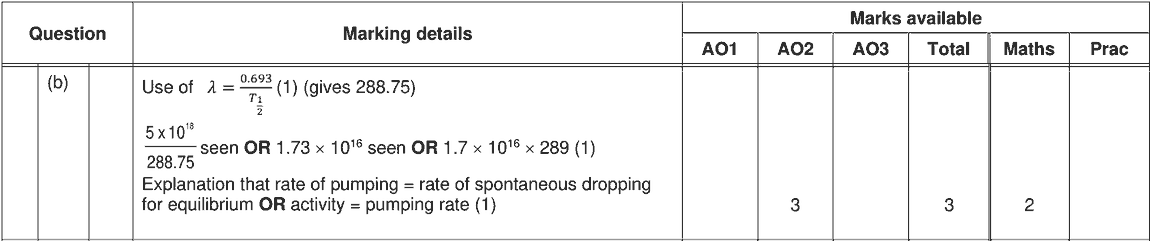
λ = ln 2/T½ = 0.693/2.4 × 10⁻³ = 289 s⁻¹ (1)
at equilibrium the rate of spontaneous decay λN equals the pumping rate (1)
N = 5 × 10¹⁸/289 = 1.73 × 10¹⁶ (1)
the nuclear decay equations applied to laser levels
the equilibrium statement was rarely given
Scheme columns: Maths 2
Skills: Synoptic Needs physics from another component of the qualification; Mathsmarks The mark scheme's Maths column gives this part at least one mark for mathematical skills
June 2023 · Component 3 · Q7(a)(i)2 marksAO2=2Short answer
Mark scheme
Examiner's comment
(ii) was a difficult part question, usually involving taking logs but it was extremely well answered. The next part was quite well answered considering that this was a very difficult calculation. Those candidates who scored poorly usually tried to solve the problem by considering only one of the two radioactive nuclei. In order to score well, equations for both nuclei had to be set up and these equations had to be divided at some point. The last part of the question was not well answered. Part of the problem was that an increase from 0.4% to 0.5% is a small increase of 0.1%. However, it could be argued that an increase from 0.4% to 0.5% is a large increase of 25%. Hence, the increase of lung cancer incidence had to be marked strictly.
Notes from the mark scheme and report
Answer: nucleon number 207 (235 − 7 × 4), proton number 82 (92 − 14 + 4)
the proton number caused more errors
June 2023 · Component 3 · Q7(a)(ii)4 marksAO1=1, AO2=3Calculation
Earlier part of question 7 that this part uses
Mark scheme
Examiner's comment
(ii) was a difficult part question, usually involving taking logs but it was extremely well answered. The next part was quite well answered considering that this was a very difficult calculation. Those candidates who scored poorly usually tried to solve the problem by considering only one of the two radioactive nuclei. In order to score well, equations for both nuclei had to be set up and these equations had to be divided at some point. The last part of the question was not well answered. Part of the problem was that an increase from 0.4% to 0.5% is a small increase of 0.1%. However, it could be argued that an increase from 0.4% to 0.5% is a large increase of 25%. Hence, the increase of lung cancer incidence had to be marked strictly.
Notes from the mark scheme and report
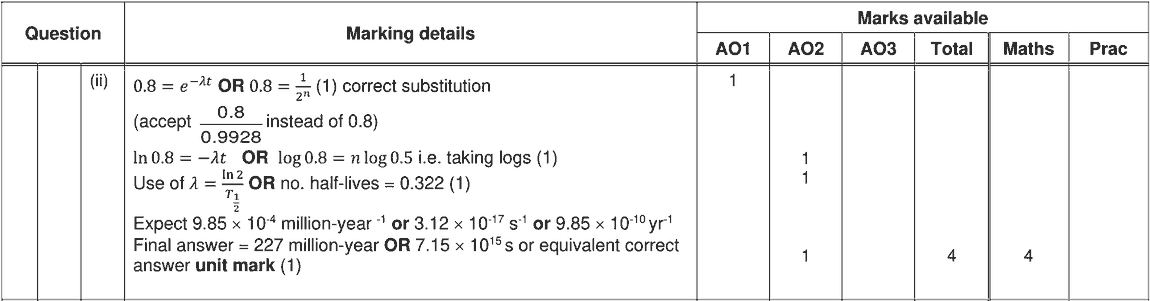
Answer: 227 million years. 0.80 = e^(−λt) or 0.80 = 1/2ⁿ (1)
take logs (1)
λ = ln 2/704 = 9.85 × 10⁻⁴ per million years, or n = 0.322 half-lives (1)
t = 227 million years (7.15 × 10¹⁵ s) with unit (1)
very well answered
Scheme columns: Maths 4
Skills: Algebra Derivations and rearranging equations; Mathsmarks The mark scheme's Maths column gives this part at least one mark for mathematical skills
June 2023 · Component 3 · Q7(a)(iii)5 marksAO3=5Calculation
Earlier part of question 7 that this part uses
Mark scheme
Examiner's comment
(ii) was a difficult part question, usually involving taking logs but it was extremely well answered. The next part was quite well answered considering that this was a very difficult calculation. Those candidates who scored poorly usually tried to solve the problem by considering only one of the two radioactive nuclei. In order to score well, equations for both nuclei had to be set up and these equations had to be divided at some point. The last part of the question was not well answered. Part of the problem was that an increase from 0.4% to 0.5% is a small increase of 0.1%. However, it could be argued that an increase from 0.4% to 0.5% is a large increase of 25%. Hence, the increase of lung cancer incidence had to be marked strictly.
Notes from the mark scheme and report
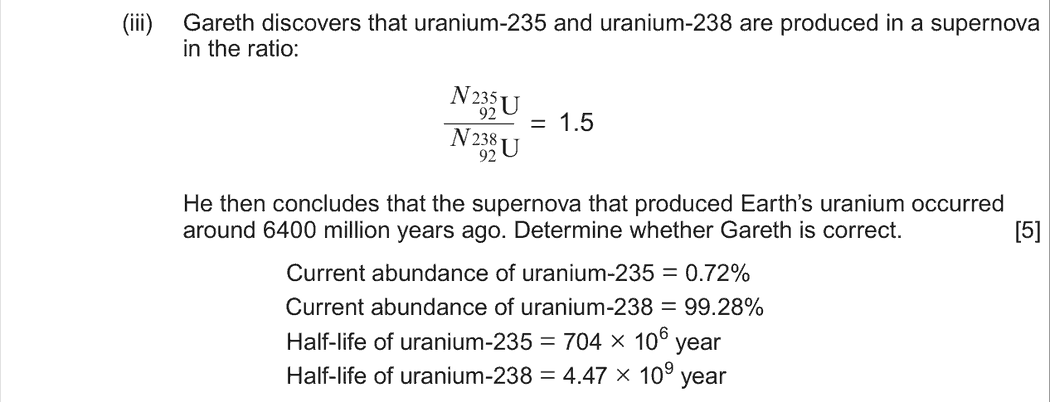
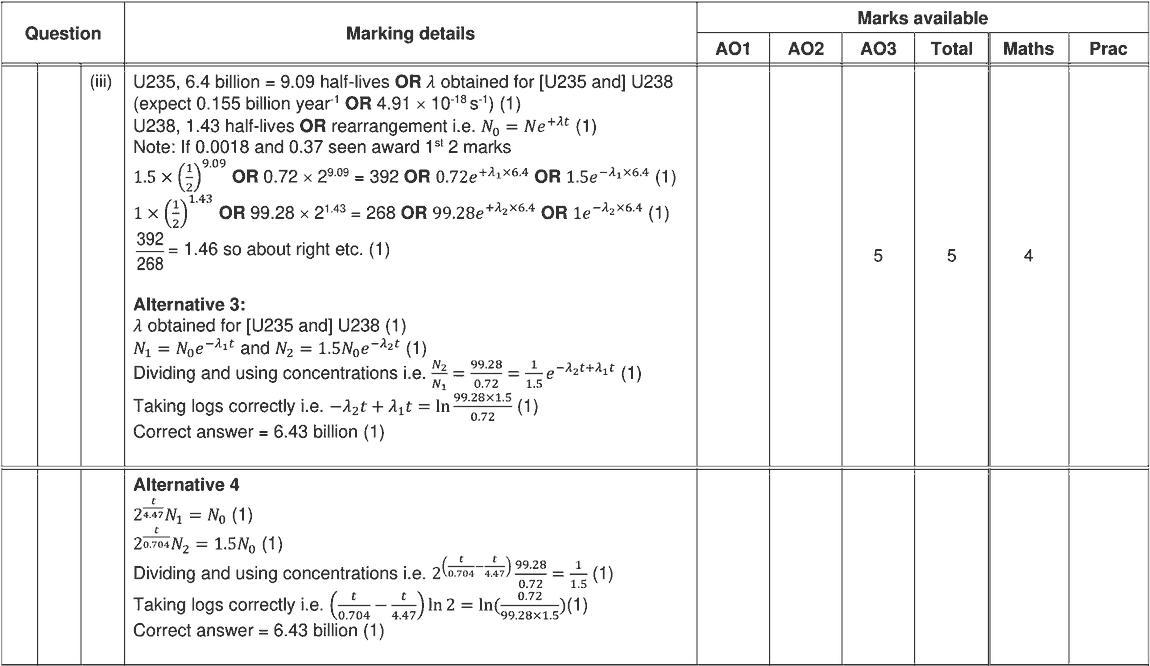
Gareth is about right (6.43 billion years). 6.4 billion years = 9.09 half-lives of U-235 and 1.43 half-lives of U-238 (2)
original amounts 0.72 × 2^9.09 = 392 and 99.28 × 2^1.43 = 268 (2)
ratio 392/268 = 1.46, close to 1.5 (1)
or set up decay equations for both isotopes, divide, take logs and solve for t. Poor answers treated only one isotope
Scheme columns: Maths 4
Skills: Algebra Derivations and rearranging equations; Mathsmarks The mark scheme's Maths column gives this part at least one mark for mathematical skills
June 2023 · Component 3 · Q7(b)3 marksAO3=3Short answer
Earlier parts of question 7 that this part uses
Mark scheme
Examiner's comment
In (a)(i) the atomic number was more difficult to obtain than the mass number. Part
Notes from the mark scheme and report
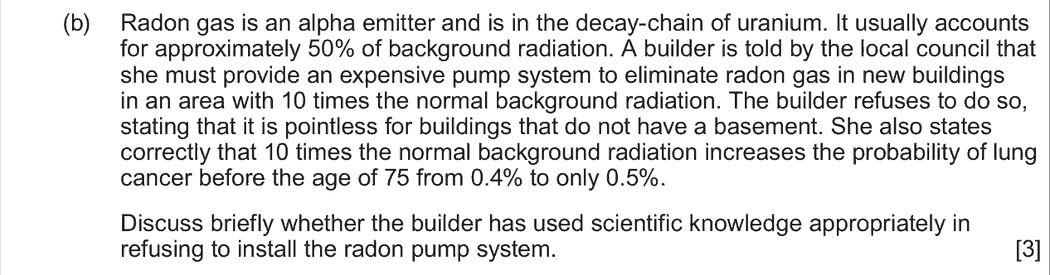
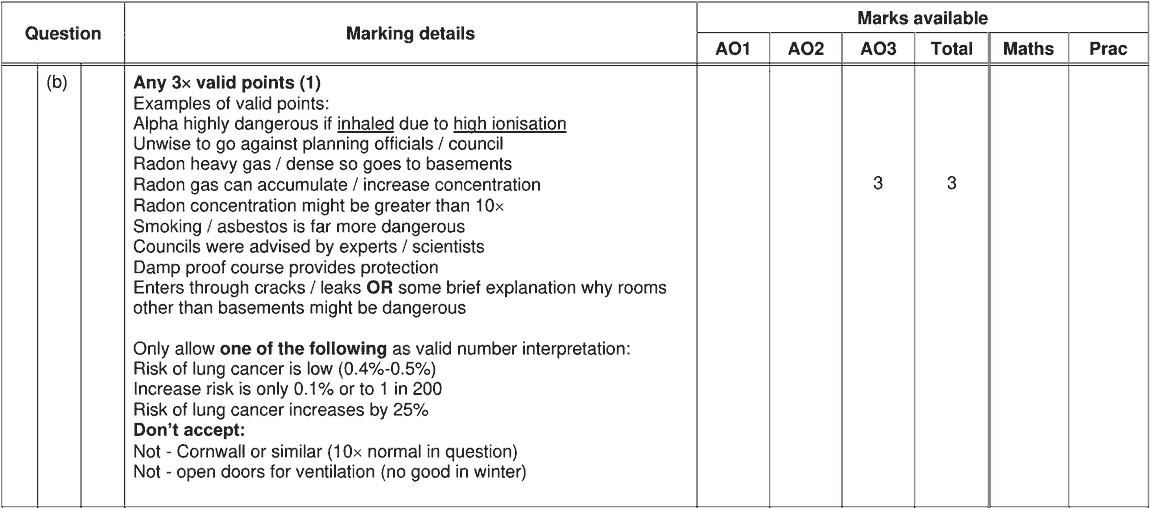
Any three valid points, e.g. alpha emitters are highly ionising and dangerous when inhaled
radon is dense and can enter through cracks and accumulate in any room, not only basements
the concentration may exceed 10 times normal
the council acts on expert advice
smoking is a far greater risk
only one comment on the figures counts (the risk is low at 0.4 to 0.5%, or the rise is only 0.1%, or it is a 25% increase). Not well answered
June 2022 · Component 3 · Q7(a)(i)3 marksAO1=2, AO2=1Short answer
Mark scheme
Examiner's comment
Although well answered, one would expect the vast majority to score 3/3 here. This was not the case on this occasion.
Notes from the mark scheme and report
Helium-3 with Z = 2 (1)
beta-minus particle (electron, 0 over −1) (1)
electron antineutrino (1)
fewer scored 3 than expected
June 2022 · Component 3 · Q7(a)(iii)2 marksAO1=1, AO2=1Calculation
Earlier part of question 7 that this part uses
Mark scheme
Examiner's comment
&(iv)Very well answered with the majority of candidates making no mistakes and obtaining full marks. Calculating the number of nuclei is usually the most difficult step but this was given this time. Small minorities failed to obtain the correct decay constant or mixed up between 10% and 90%.
A = λN with N = 1.93 × 10²⁴ (1.08 × 10²³ year⁻¹ also accepted)
unit mark
Scheme columns: Maths 2
Skills: Unitsand conversions Unit marks, base units, prefixes and conversions; Mathsmarks The mark scheme's Maths column gives this part at least one mark for mathematical skills
June 2022 · Component 3 · Q7(a)(iv)3 marksAO1=1, AO2=2Calculation
Earlier part of question 7 that this part uses
Mark scheme
Notes from the mark scheme and report
Answer: 40.9 years (1.29 × 10⁹ s). 0.1 = e^(−λt), so t = ln 10/λ
or 0.1 = 1/2ⁿ with n = 3.32 half-lives
a few used 90% instead of 10%
Scheme columns: Maths 3
Skills: Algebra Derivations and rearranging equations; Mathsmarks The mark scheme's Maths column gives this part at least one mark for mathematical skills
October 2020 · Component 3 · Q5(a)(i)3 marksAO2=3Practical and data analysis
Mark scheme
Examiner's comment
Part (a) was very well answered apart from part (iv)I because most candidates did not start from: Count rate = 𝑘𝑘 distance2 so they struggled to obtain any more than 1 mark. Parts (b) and(c) were well answered but only a surprisingly small number in part (c) mentioned that X-rays were ionising. Some candidates mentioned that it might be ethical to experiment on dead bodies (with consent) but I’m not sure how they would inform their fellow researchers as to whether or not the “blue-grey” glow appeared.
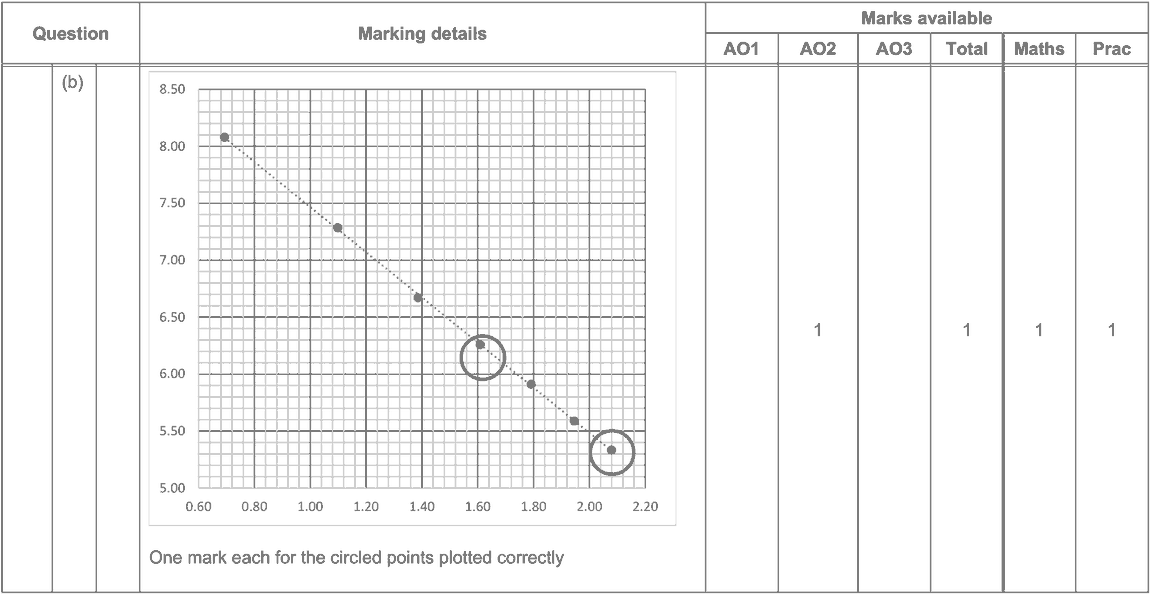
corrected counts 522 and 207 give ln values 6.26 and 5.33 (1)
Scheme columns: Maths 2, Practical 3
Skills: Experimentalmethod Describing, planning or improving an experiment; Mathsmarks The mark scheme's Maths column gives this part at least one mark for mathematical skills; Practicalmarks The mark scheme's Prac column gives this part at least one mark for practical skills
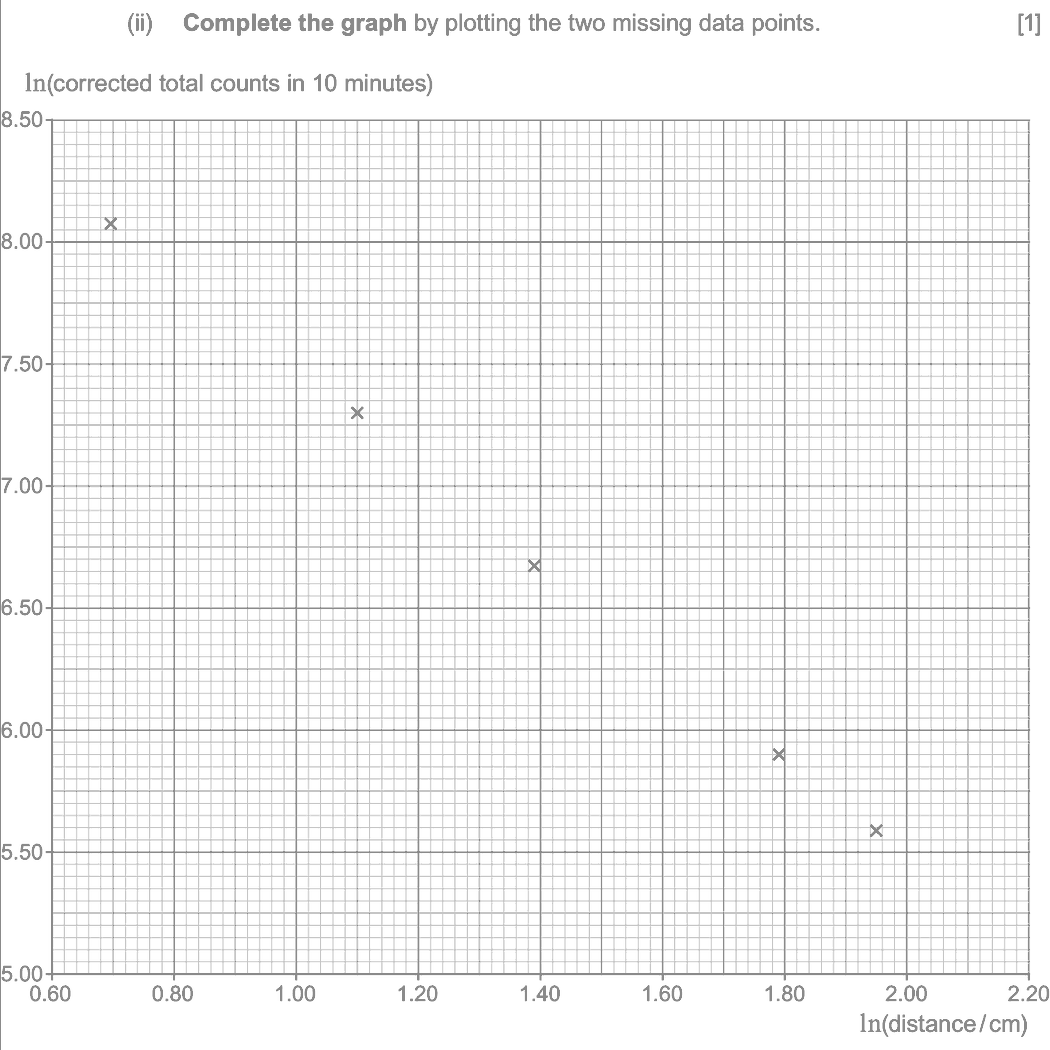
October 2020 · Component 3 · Q5(a)(ii)1 markAO2=1Diagram or graph
Earlier part of question 5 that this part uses
Mark scheme
Examiner's comment
Part (a) was very well answered apart from part (iv)I because most candidates did not start from: Count rate = 𝑘𝑘 distance2 so they struggled to obtain any more than 1 mark. Parts (b) and(c) were well answered but only a surprisingly small number in part (c) mentioned that X-rays were ionising. Some candidates mentioned that it might be ethical to experiment on dead bodies (with consent) but I’m not sure how they would inform their fellow researchers as to whether or not the “blue-grey” glow appeared.
Notes from the mark scheme and report
Points (1.61, 6.26) and (2.08, 5.33) plotted correctly
mark scheme row not matched in the packet (it is shown in the 5(b) mark-scheme crop)
Scheme columns: Maths 1, Practical 1
Skills: Graphskills Reading, plotting or sketching graphs; gradients, intercepts and areas; Mathsmarks The mark scheme's Maths column gives this part at least one mark for mathematical skills; Practicalmarks The mark scheme's Prac column gives this part at least one mark for practical skills
October 2020 · Component 3 · Q5(a)(iii)3 marksAO2=3Practical and data analysis
Earlier parts of question 5 that this part uses
Mark scheme
Examiner's comment
Part (a) was very well answered apart from part (iv)I because most candidates did not start from: Count rate = 𝑘𝑘 distance2 so they struggled to obtain any more than 1 mark. Parts (b) and(c) were well answered but only a surprisingly small number in part (c) mentioned that X-rays were ionising. Some candidates mentioned that it might be ethical to experiment on dead bodies (with consent) but I’m not sure how they would inform their fellow researchers as to whether or not the “blue-grey” glow appeared.
Notes from the mark scheme and report
Answer: gradient = −1.98 (± 0.05). Line of best fit (1)
gradient from a large triangle (1)
value (1)
mark scheme row not matched in the packet (it is shown in the 5(c) mark-scheme crop)
Scheme columns: Maths 3, Practical 3
Skills: Graphskills Reading, plotting or sketching graphs; gradients, intercepts and areas; Mathsmarks The mark scheme's Maths column gives this part at least one mark for mathematical skills; Practicalmarks The mark scheme's Prac column gives this part at least one mark for practical skills
October 2020 · Component 3 · Q5(a)(iv)I2 marksAO2=2Show that
Earlier parts of question 5 that this part uses
Mark scheme
Examiner's comment
Part (a) was very well answered apart from part (iv)I because most candidates did not start from: Count rate = 𝑘𝑘 distance2 so they struggled to obtain any more than 1 mark. Parts (b) and(c) were well answered but only a surprisingly small number in part (c) mentioned that X-rays were ionising. Some candidates mentioned that it might be ethical to experiment on dead bodies (with consent) but I’m not sure how they would inform their fellow researchers as to whether or not the “blue-grey” glow appeared.
Notes from the mark scheme and report
Count rate = k/distance² so ln(count rate) = ln k − 2 ln(distance)
comparing with y = mx + c the gradient is −2. Mark scheme row not matched (crop repeats the (a)(i) row)
the report says most did not start from count rate = k/distance²
Scheme columns: Maths 2, Practical 2
Skills: Algebra Derivations and rearranging equations; Graphskills Reading, plotting or sketching graphs; gradients, intercepts and areas; Mathsmarks The mark scheme's Maths column gives this part at least one mark for mathematical skills; Practicalmarks The mark scheme's Prac column gives this part at least one mark for practical skills
October 2020 · Component 3 · Q5(a)(iv)II3 marksAO3=3Practical and data analysis
Earlier parts of question 5 that this part uses
Mark scheme
Examiner's comment
Part (a) was very well answered apart from part (iv)I because most candidates did not start from: Count rate = 𝑘𝑘 distance2 so they struggled to obtain any more than 1 mark. Parts (b) and(c) were well answered but only a surprisingly small number in part (c) mentioned that X-rays were ionising. Some candidates mentioned that it might be ethical to experiment on dead bodies (with consent) but I’m not sure how they would inform their fellow researchers as to whether or not the “blue-grey” glow appeared.
Notes from the mark scheme and report
Mark scheme row not matched (crop repeats the (a)(i) row). Expected points: the graph is a good straight line with the points close to it
the gradient −1.98 is within about 1% of −2
so the results agree well with an inverse square law
Scheme columns: Practical 3
Skills: Graphskills Reading, plotting or sketching graphs; gradients, intercepts and areas; Practicalmarks The mark scheme's Prac column gives this part at least one mark for practical skills
October 2020 · Component 3 · Q5(b)1 markAO1=1Short answer
Earlier parts of question 5 that this part uses
Mark scheme
Examiner's comment
Part (a) was very well answered apart from part (iv)I because most candidates did not start from: Count rate = 𝑘𝑘 distance2 so they struggled to obtain any more than 1 mark. Parts (b) and(c) were well answered but only a surprisingly small number in part (c) mentioned that X-rays were ionising. Some candidates mentioned that it might be ethical to experiment on dead bodies (with consent) but I’m not sure how they would inform their fellow researchers as to whether or not the “blue-grey” glow appeared.
Notes from the mark scheme and report
Mark scheme row not matched (crop shows the (a)(ii) graph). The aluminium absorbs the alpha and beta radiation that radium-226 and its products also emit, so only gamma reaches the GM tube
Scheme columns: Practical 1
Skills: Experimentalmethod Describing, planning or improving an experiment; Practicalmarks The mark scheme's Prac column gives this part at least one mark for practical skills
October 2020 · Component 3 · Q5(c)3 marksAO3=3Explanation
Earlier parts of question 5 that this part uses
Mark scheme
Examiner's comment
Part (a) was very well answered apart from part (iv)I because most candidates did not start from: Count rate = 𝑘𝑘 distance2 so they struggled to obtain any more than 1 mark. Parts (b) and(c) were well answered but only a surprisingly small number in part (c) mentioned that X-rays were ionising. Some candidates mentioned that it might be ethical to experiment on dead bodies (with consent) but I’m not sure how they would inform their fellow researchers as to whether or not the “blue-grey” glow appeared.
Notes from the mark scheme and report
Mark scheme row not matched (crop shows the (a)(iii) row). Expected points: X-rays are ionising and large doses to the eye risk cell damage, cataracts or cancer
so it would be unethical to expose people (or animals) for this purpose
could only be justified with informed consent and benefits outweighing the risk, or by using alternatives
the report notes few said that X-rays are ionising
October 2020 · Component 3 · Q7(a)2 marksAO1=1, AO2=1Short answer
Mark scheme
Examiner's comment
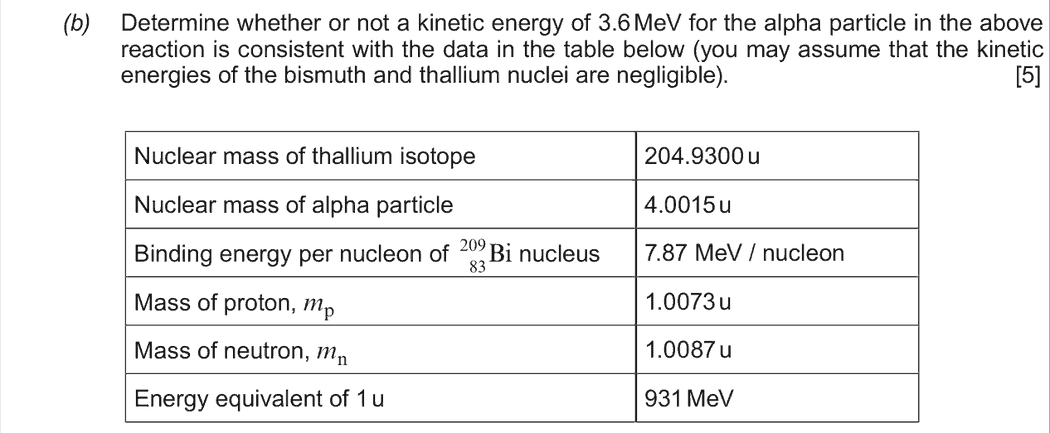
In part (a) a surprising minority wrote He . In part (b) the most common omission was not combining the BE/nucleon of Bi-209 with the mass of its nucleons to obtain the nuclear mass of Bi-209. These candidates were still able to obtain 3/5 marks. Part (c)(ii) is an example of a calculation when the “Computer says no!”. Candidates put the numbers in their calculators and obtained the answer zero (because -λt is such a small number). However, the bright candidates made the correct approximation of multiplying the activity by the time.
Notes from the mark scheme and report
Helium: 4 and 2 (1)
thallium: 205 and 81 (1)
October 2020 · Component 3 · Q7(c)(i)4 marksAO1=1, AO2=3Calculation
Earlier parts of question 7 that this part uses
Mark scheme
Examiner's comment
In part (a) a surprising minority wrote He . In part (b) the most common omission was not combining the BE/nucleon of Bi-209 with the mass of its nucleons to obtain the nuclear mass of Bi-209. These candidates were still able to obtain 3/5 marks. Part (c)(ii) is an example of a calculation when the “Computer says no!”. Candidates put the numbers in their calculators and obtained the answer zero (because -λt is such a small number). However, the bright candidates made the correct approximation of multiplying the activity by the time.
Skills: Unitsand conversions Unit marks, base units, prefixes and conversions; Mathsmarks The mark scheme's Maths column gives this part at least one mark for mathematical skills
October 2020 · Component 3 · Q7(c)(ii)2 marksAO2=2Calculation
Earlier parts of question 7 that this part uses
Mark scheme
Examiner's comment
In part (a) a surprising minority wrote He . In part (b) the most common omission was not combining the BE/nucleon of Bi-209 with the mass of its nucleons to obtain the nuclear mass of Bi-209. These candidates were still able to obtain 3/5 marks. Part (c)(ii) is an example of a calculation when the “Computer says no!”. Candidates put the numbers in their calculators and obtained the answer zero (because -λt is such a small number). However, the bright candidates made the correct approximation of multiplying the activity by the time.
Notes from the mark scheme and report
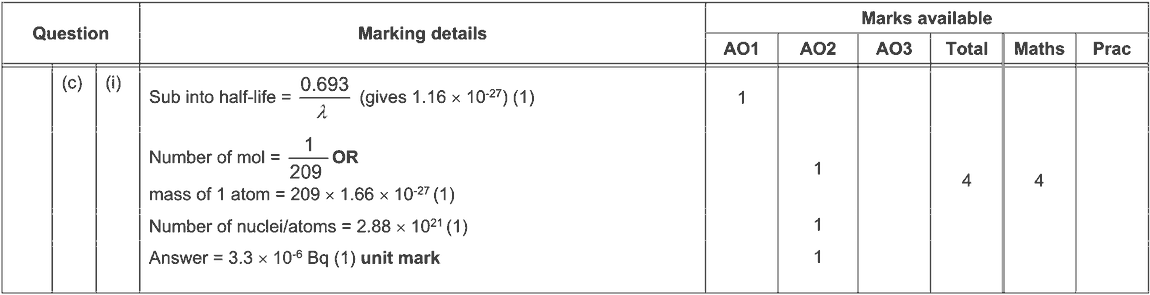
Answer: 525 nuclei. Activity is effectively constant over 5 years, so number decayed = A × t = 3.3 × 10⁻⁶ × 5 × 365 × 24 × 3600
using e^(−λt) on a calculator gives zero because λt is so small
Scheme columns: Maths 2
Skills: Unitsand conversions Unit marks, base units, prefixes and conversions; Mathsmarks The mark scheme's Maths column gives this part at least one mark for mathematical skills
June 2019 · Component 3 · Q4(a)3 marksAO1=1, AO2=2Explanation
Mark scheme
Examiner's comment
This part question caught most candidates by surprise but the syllabus says clearly “different methods used to distinguish between α, β, and γ radiation”. Many candidates scored no marks by describing how to distinguish using different absorbers. Those who mentioned electric or magnetic fields invariably scored full marks.
Notes from the mark scheme and report
Pass the radiation through a magnetic or electric field (diagram or description) (1)
α and β are deflected in opposite directions (1)
directions all correct, with γ undeflected (1). Many scored zero by describing absorbers again
June 2019 · Component 3 · Q4(b)(i)3 marksAO2=3Show that
Earlier part of question 4 that this part uses
Mark scheme
Examiner's comment
The vast majority obtained full marks for this two-step calculation.
Skills: Mathsmarks The mark scheme's Maths column gives this part at least one mark for mathematical skills
June 2019 · Component 3 · Q4(b)(ii)4 marksAO3=4Calculation
Earlier parts of question 4 that this part uses
Mark scheme
Examiner's comment
This part question was meant to be difficult but the majority obtained full marks. Whether to add or subtract background radiation is a difficult concept but the responses here were highly impressive.
conclusion: agrees (any small difference down to the random nature of decay and low counts)
Scheme columns: Maths 2
Skills: Mathsmarks The mark scheme's Maths column gives this part at least one mark for mathematical skills
June 2018 · Component 3 · Q6(a)2 marksAO2=2Short answer
Mark scheme
Examiner's comment
Unexpectedly, a large number of incorrect answers were encountered. Some through arithmetic slips, others through using the wrong numbers for an electron.
Notes from the mark scheme and report
Answer: nucleon number 232, proton number 90 for Th (208 + 6 × 4 = 232
82 + 6 × 2 − 4 = 90)
no marks for the alpha and beta numbers
more errors than expected
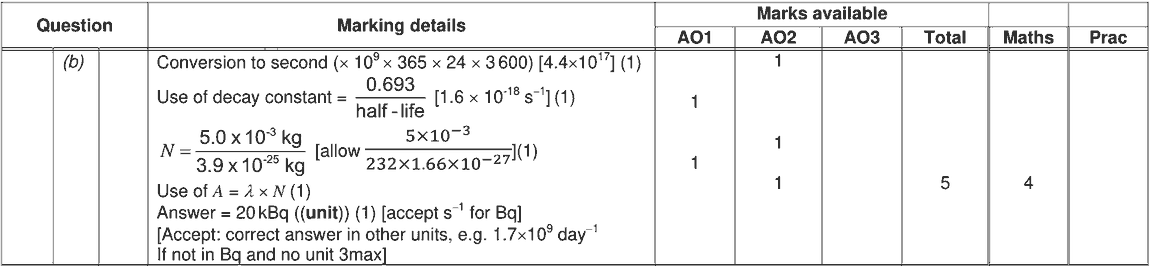
June 2018 · Component 3 · Q6(b)5 marksAO1=2, AO2=3Calculation
Earlier part of question 6 that this part uses
Mark scheme
Examiner's comment
Extremely well answered with the vast majority gaining all 5 marks. As usual, the most common failure was not being able to calculate the correct number of nuclei.
Skills: Unitsand conversions Unit marks, base units, prefixes and conversions; Mathsmarks The mark scheme's Maths column gives this part at least one mark for mathematical skills
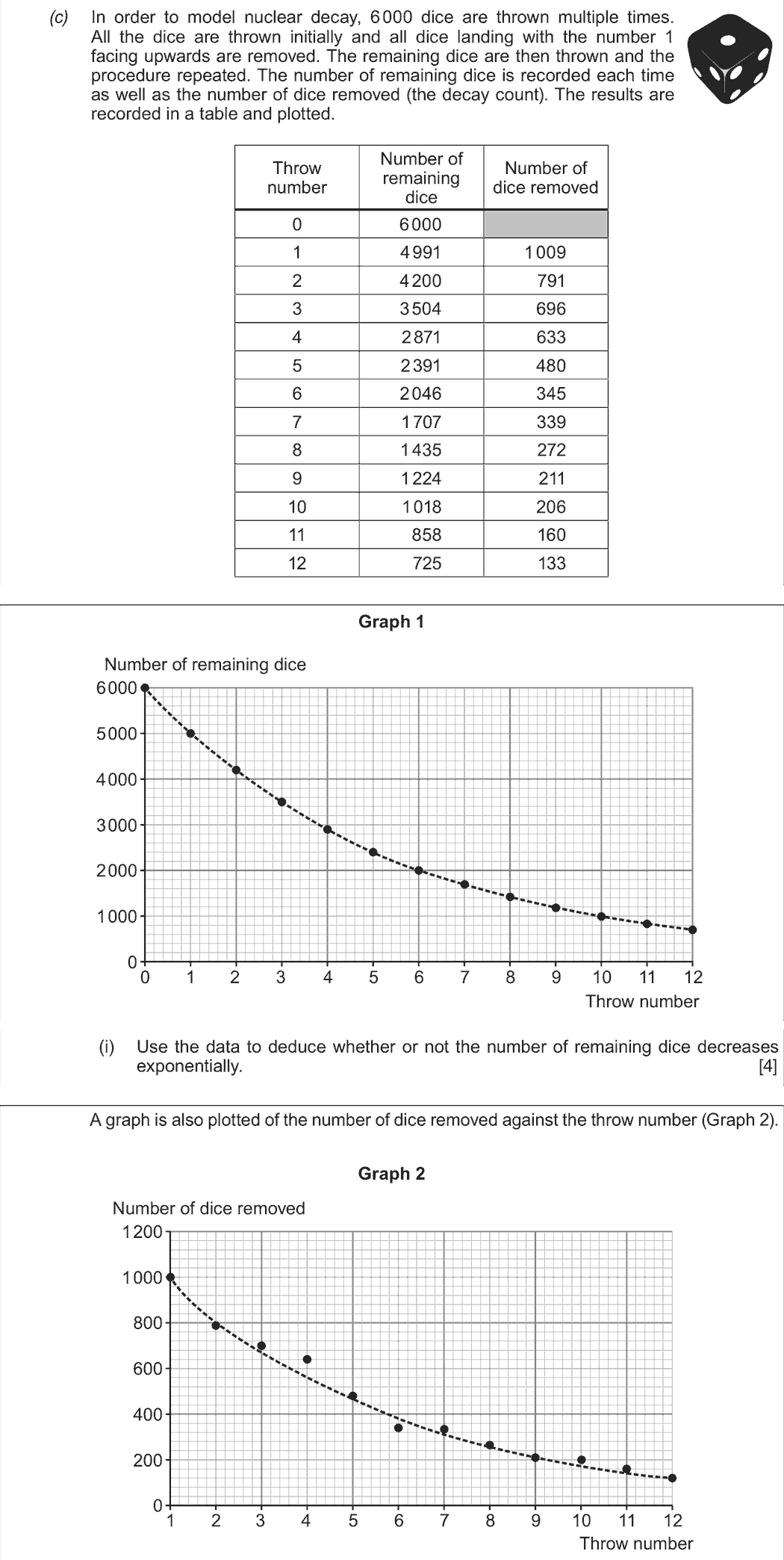
June 2018 · Component 3 · Q6(c)(i)4 marksAO3=4Practical and data analysis
Earlier part of question 6 that this part uses
Mark scheme
Examiner's comment
Not an easy question but superbly answered by a large majority. The most common reason for dropping a mark was checking 2 half lives rather than 3.
Notes from the mark scheme and report
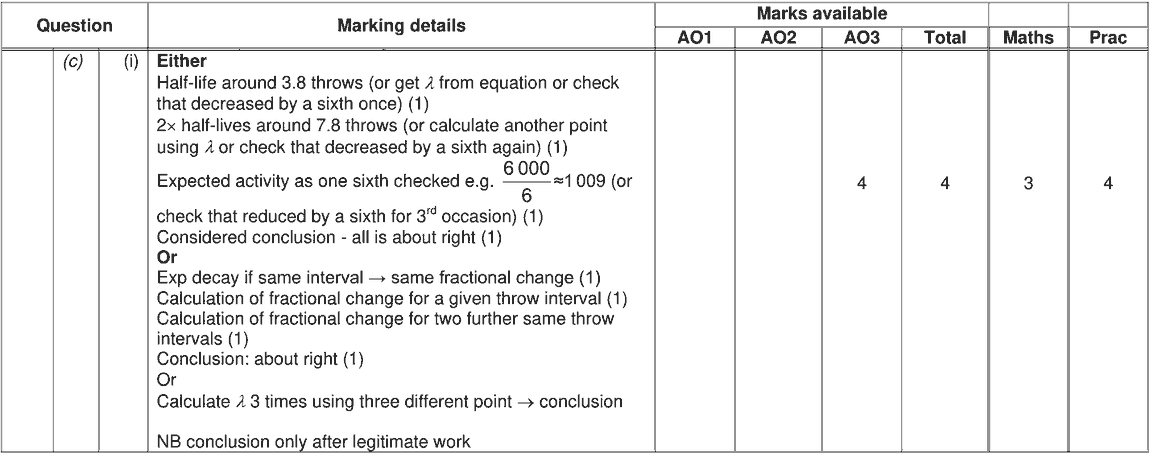
Exponential if the half-life is constant: 6000 to 3000 takes about 3.8 throws (1), 3000 to 1500 takes about 3.8 more (7.8 total) (1), with a third check such as a third half-life or the first removal being one sixth of 6000 (1)
conclusion that the decrease is approximately exponential (1)
or equal throw intervals give equal fractional changes, tested three times
checking only two half-lives lost a mark
Scheme columns: Maths 3, Practical 4
Skills: Graphskills Reading, plotting or sketching graphs; gradients, intercepts and areas; Mathsmarks The mark scheme's Maths column gives this part at least one mark for mathematical skills; Practicalmarks The mark scheme's Prac column gives this part at least one mark for practical skills
June 2018 · Component 3 · Q6(c)(ii)2 marksAO3=2Practical and data analysis
Earlier parts of question 6 that this part uses
Mark scheme
Examiner's comment
Nearly all students realised that smaller numbers were involved but few were attributing the scatter to the random nature of decay (or dice throwing).
Notes from the mark scheme and report
The numbers of dice removed are much smaller than the numbers remaining (1), so the random variation is a larger percentage of each value (1)
the randomness point was often missing
Scheme columns: Practical 2
Skills: Uncertainties Resolution, absolute and percentage uncertainty, combining uncertainties, error bars; Practicalmarks The mark scheme's Prac column gives this part at least one mark for practical skills
June 2017 · Component 3 · Q2(b)(i)3 marksAO1=1, AO2=2Calculation
Earlier part of question 2 that this part uses
Mark scheme
Examiner's comment
Similarly well answered with three marks the most popular mark attained.
Notes from the mark scheme and report
Answer: 5730 years. T½ = ln 2/λ = 0.693/3.83 × 10⁻¹² = 1.81 × 10¹¹ s
Scheme columns: Maths 3
Skills: Unitsand conversions Unit marks, base units, prefixes and conversions; Mathsmarks The mark scheme's Maths column gives this part at least one mark for mathematical skills
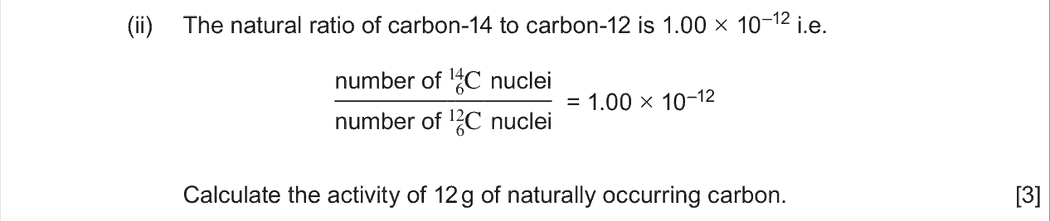
June 2017 · Component 3 · Q2(b)(ii)3 marksAO1=1, AO2=2Calculation
Earlier parts of question 2 that this part uses
Mark scheme
Examiner's comment
Obtaining the correct number of nuclei was by far the most difficult step. This is usually the case in these types of questions – using the equations rarely causes much difficulty at this level.
Notes from the mark scheme and report
Answer: 2.3 Bq. 12 g of carbon is one mole, so N(C-14) = 6.02 × 10²³ × 1.00 × 10⁻¹² = 6.02 × 10¹¹
A = λN
unit mark
finding N was the hard step
Scheme columns: Maths 3
Skills: Mathsmarks The mark scheme's Maths column gives this part at least one mark for mathematical skills
June 2017 · Component 3 · Q2(b)(iii)3 marksAO1=1, AO2=2Calculation
Earlier parts of question 2 that this part uses
Mark scheme
Examiner's comment
Taking logarithms to obtain the correct answer rarely causes problems nowadays which is a credit to modern day physics teaching. However, the first step (realising that 𝑁 𝑁0 = 0.34) provides most difficulty with these types of questions.
Skills: Algebra Derivations and rearranging equations; Mathsmarks The mark scheme's Maths column gives this part at least one mark for mathematical skills
June 2017 · Component 3 · Q2(c)3 marksAO2=1, AO3=2Short answer
Earlier part of question 2 that this part uses
Mark scheme
Examiner's comment
Very well answered with an equal tendency to drop marks on each of the 3 marking points.
Notes from the mark scheme and report
Boron-11 with proton number 5 (1)
positron e⁺ or β⁺ (1)
electron neutrino, not antineutrino (1)
any fourth particle loses a mark
Work with an Eduqas physics tutor
Dropping marks on calculations, specified practicals or the six-mark QER questions? Book a trial session with a specialist Eduqas physics tutor.