Notes and key-term cards for this topic are being written by our tutors. The past-paper questions below are ready now.
Specification statements
Show the 5 statements from the specification
3.8-a the association between mass and energy and that E = mc²
3.8-b the binding energy for a nucleus and hence the binding energy per nucleon, making use, where necessary, of the unified atomic mass unit (u)
3.8-c how to calculate binding energy and binding energy per nucleon from given masses of nuclei
3.8-d the conservation of mass / energy to particle interactions – for example: fission, fusion
3.8-e the relevance of binding energy per nucleon to nuclear fission and fusion making reference when appropriate to the binding energy per nucleon versus nucleon number curve
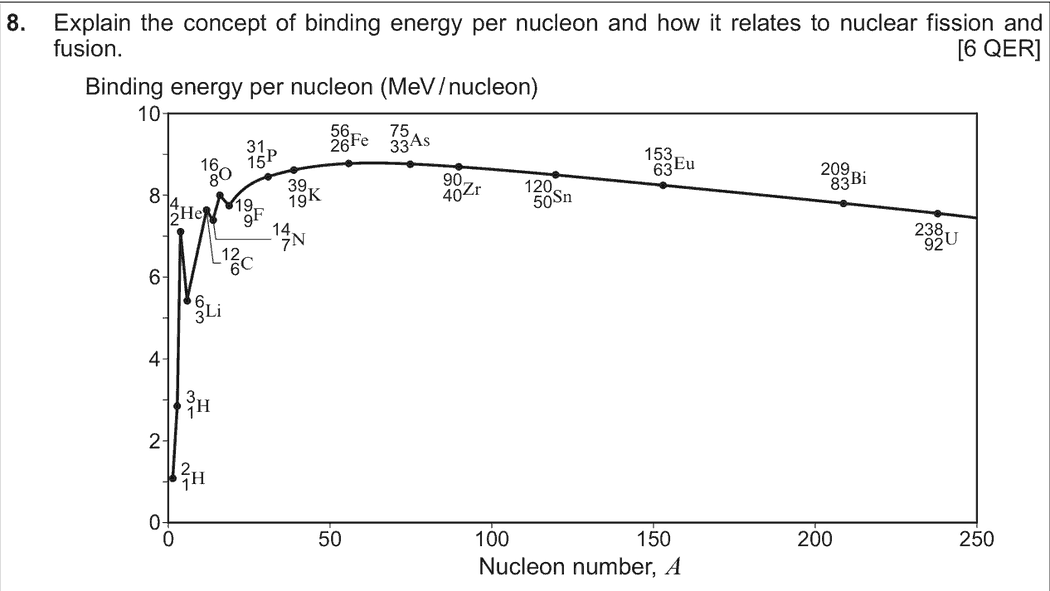
. Explain the concept of binding energy per nucleon and how it relates to nuclear fission and fusion. [6 QER] Binding energy per nucleon (MeV / nucleon) 10 56 75 31 26Fe 33As 15P 153 16 63Eu 209 8O 90 83Bi 39 40Zr 120 8
Tap a question to zoom it. Where a part needs a figure, table or graph from earlier in the question, that part folds out above it; the mark scheme and examiner's comment open underneath. Have the Eduqas Data Booklet beside you (see the Data Booklet page).
June 2025 · Component 1 · Q8(a)4 marksAO2=4Show that
Mark scheme
Examiner's comment
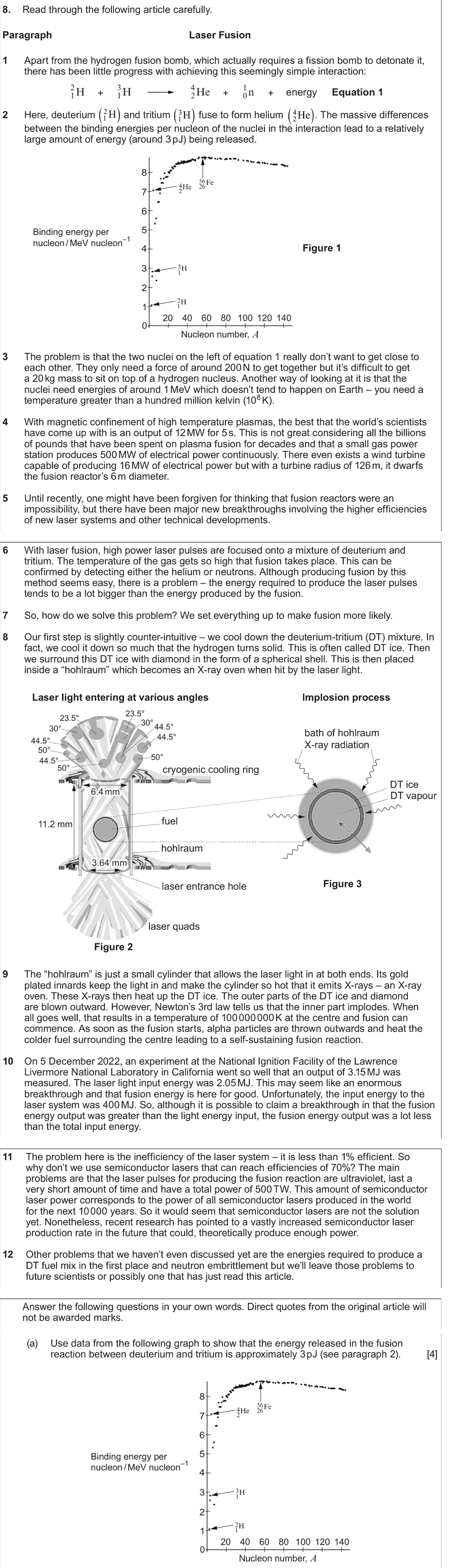
The first question in the comprehension section worked well. The 4 MPs were effectively standalone marking points. Many candidates achieved the 1st MP. Some missed it because they only focused on 𝐻 3 and 𝐻 2 . All 3 values were needed to be recorded. Less candidates multiplied by the nucleon number. The multiplication of 𝑒 was popular and was added in many different stages of their calculations.
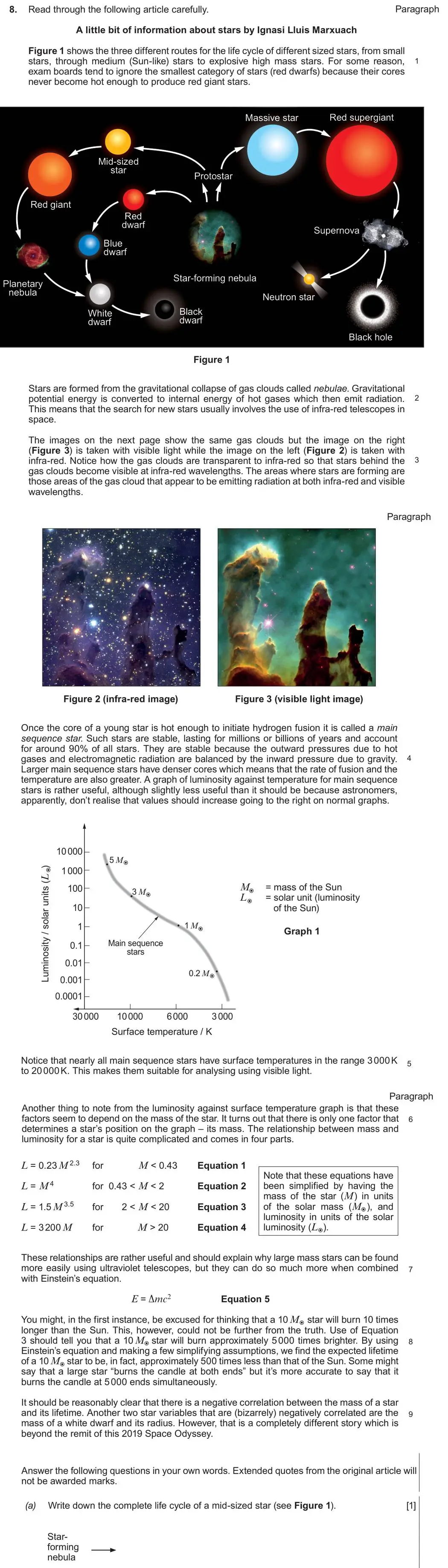
multiply each by its nucleon number: 28.4, 8.7 and 2.2 MeV (1)
energy released = 28.4 − 8.7 − 2.2 = 17.5 MeV
× 1.6 × 10⁻¹³ J (1) = 2.8 pJ (1). All three readings needed
many forgot the nucleon numbers. Component 3 content
Scheme columns: Maths 4
Skills: Comprehension A level Component 1 Section B: questions on the printed article; Synoptic Needs physics from another component of the qualification; Graphskills Reading, plotting or sketching graphs; gradients, intercepts and areas; Mathsmarks The mark scheme's Maths column gives this part at least one mark for mathematical skills
June 2025 · Component 3 · Q8(d)5 marksAO3=5Calculation
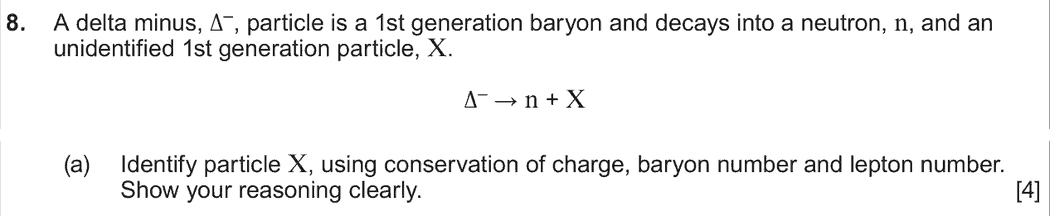
Earlier part of question 8 that this part uses
Mark scheme
Examiner's comment
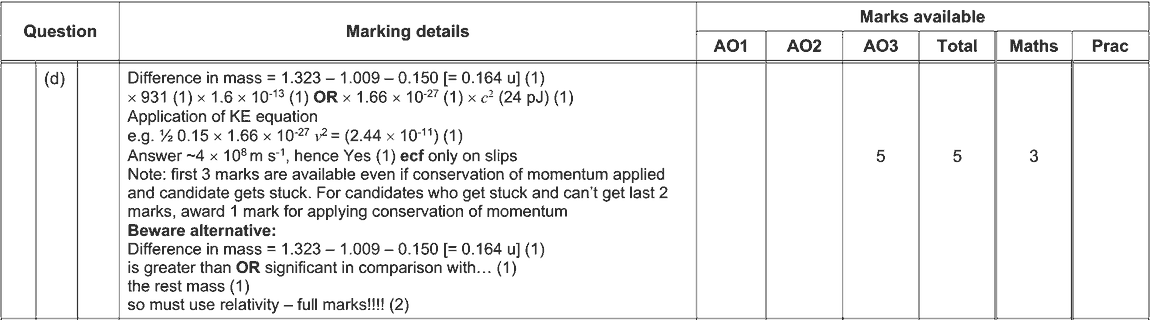
This was a difficult particles question but the mean mark is very impressive. The part with the lowest mean mark was part (e), the issues question. The mark scheme this year was quite narrow. When the numbers do not agree with theory, there’s only two things that you can do - further research/experiments, modify/improve the theory/model. Hence, a mean mark on this part of 58% was rather encouraging. Alternating Currents – Question 9
½ × 0.150 × 1.66 × 10⁻²⁷ × v² = 2.4 × 10⁻¹¹ (1) gives v about 4 × 10⁸ m s⁻¹, above c, so relativity must be considered (1). Alternative: the energy released is comparable with the rest mass energy of X
Scheme columns: Maths 3
Skills: Unitsand conversions Unit marks, base units, prefixes and conversions; Mathsmarks The mark scheme's Maths column gives this part at least one mark for mathematical skills
June 2023 · Component 3 · Q8(b)3 marksAO2=3Calculation
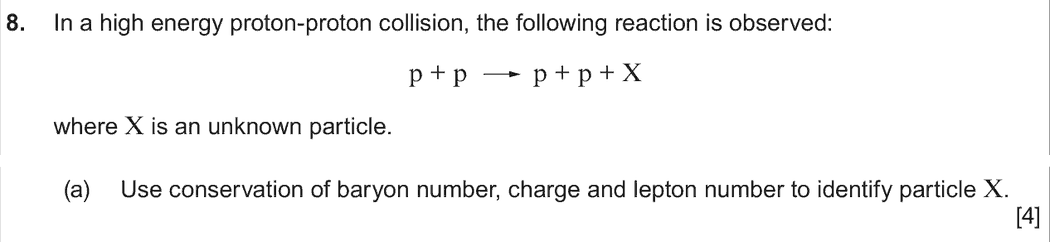
Earlier part of question 8 that this part uses
Mark scheme
Examiner's comment
This question was extremely well answered. Some candidates thought that the particle was a photon. Some candidates were a factor of 2 out in the final mass.
Notes from the mark scheme and report
Answer: 2.41 × 10⁻²⁸ kg. Rest energy = 2 × 67.5 = 135 MeV (1)
convert: × 1.60 × 10⁻¹³ J then ÷ c² (or ÷ 931 then × 1.66 × 10⁻²⁷) (1)
answer (1)
a factor of 2 error was the usual slip
Scheme columns: Maths 3
Skills: Unitsand conversions Unit marks, base units, prefixes and conversions; Mathsmarks The mark scheme's Maths column gives this part at least one mark for mathematical skills
June 2022 · Component 3 · Q6(a)3 marksAO1=1, AO2=2Calculation
Mark scheme
Examiner's comment
These question types are not particularly easy but are always well answered.
Notes from the mark scheme and report
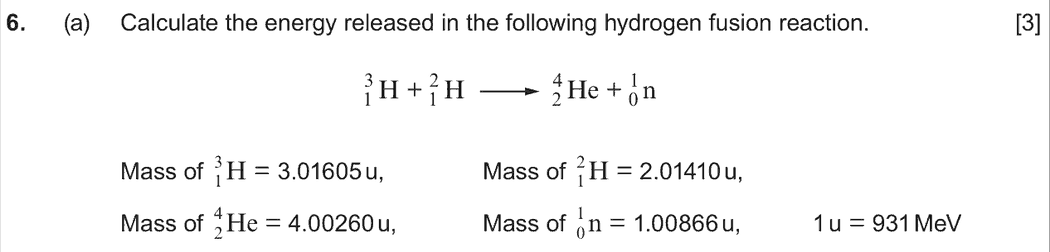
Answer: 17.6 MeV (2.81 × 10⁻¹² J). Mass lost = 3.01605 + 2.01410 − 4.00260 − 1.00866 = 0.01889 u
× 931 MeV
unit mark
Scheme columns: Maths 3
Skills: Unitsand conversions Unit marks, base units, prefixes and conversions; Mathsmarks The mark scheme's Maths column gives this part at least one mark for mathematical skills
June 2022 · Component 3 · Q6(b)2 marksAO2=2Explanation
Earlier part of question 6 that this part uses
Mark scheme
Examiner's comment
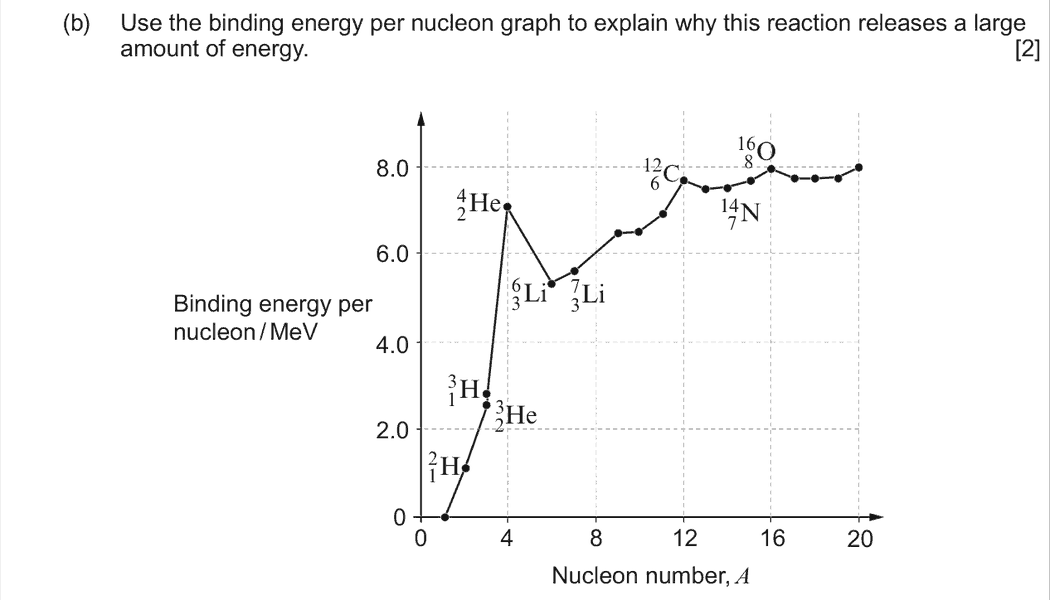
Explaining the previous answer in terms of binding energy proved to be more difficult than the previous calculation in terms of mass.
Notes from the mark scheme and report
Helium-4 has a high binding energy per nucleon (about 7 MeV) (1) while hydrogen-2 and hydrogen-3 have low values (about 1 and 2.8 MeV) (1), so the nucleons end up much more tightly bound
harder than the mass calculation
Skills: Graphskills Reading, plotting or sketching graphs; gradients, intercepts and areas
June 2022 · Component 3 · Q6(c)3 marksAO3=3Explanation
Earlier parts of question 6 that this part uses
Mark scheme
Examiner's comment
Quite well answered with the majority of candidates being able to make two good, relevant points.
Notes from the mark scheme and report
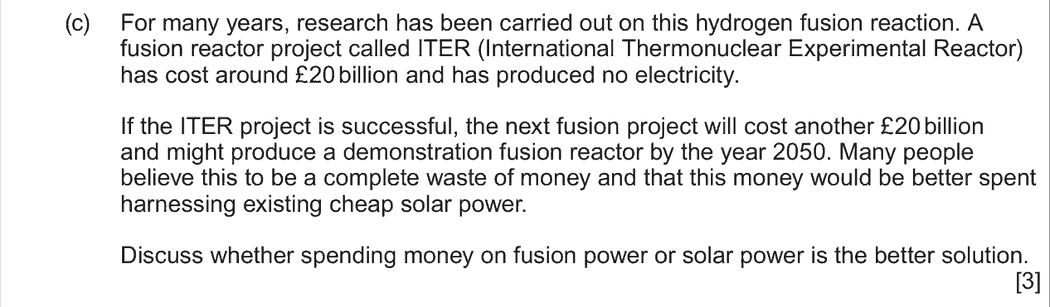
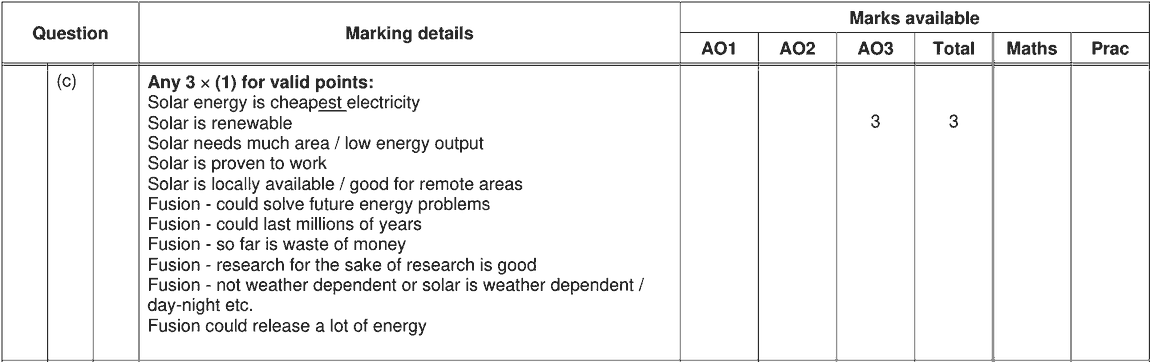
Any three valid points, e.g. solar is cheap, proven, renewable and available locally but needs large areas and depends on weather and daylight
fusion could supply huge amounts of energy for millions of years and is not weather dependent, but is unproven and very costly so far
October 2021 · Component 3 · Q7(c)2 marksAO2=2Calculation
Earlier part of question 7 that this part uses
Mark scheme
Notes from the mark scheme and report
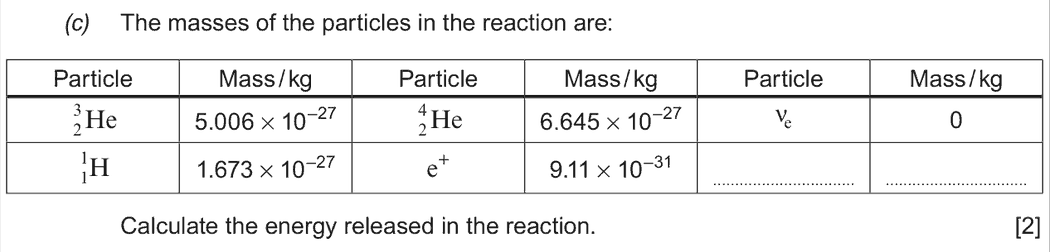
Answer: 2.98 × 10⁻¹² J (18.6 MeV). Mass lost = (5.006 + 1.673 − 6.645) × 10⁻²⁷ − 9.11 × 10⁻³¹ = 0.0331 × 10⁻²⁷ kg
E = mc²
Scheme columns: Maths 2
Skills: Mathsmarks The mark scheme's Maths column gives this part at least one mark for mathematical skills
October 2020 · Component 3 · Q7(b)5 marksAO3=5Calculation
Earlier part of question 7 that this part uses
Mark scheme
Examiner's comment
In part (a) a surprising minority wrote He . In part (b) the most common omission was not combining the BE/nucleon of Bi-209 with the mass of its nucleons to obtain the nuclear mass of Bi-209. These candidates were still able to obtain 3/5 marks. Part (c)(ii) is an example of a calculation when the “Computer says no!”. Candidates put the numbers in their calculators and obtained the answer zero (because -λt is such a small number). However, the bright candidates made the correct approximation of multiplying the activity by the time.
Notes from the mark scheme and report
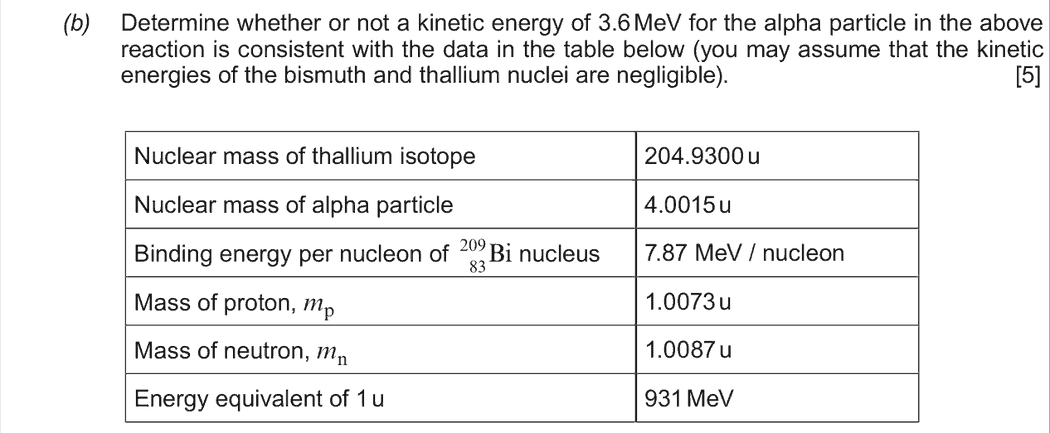
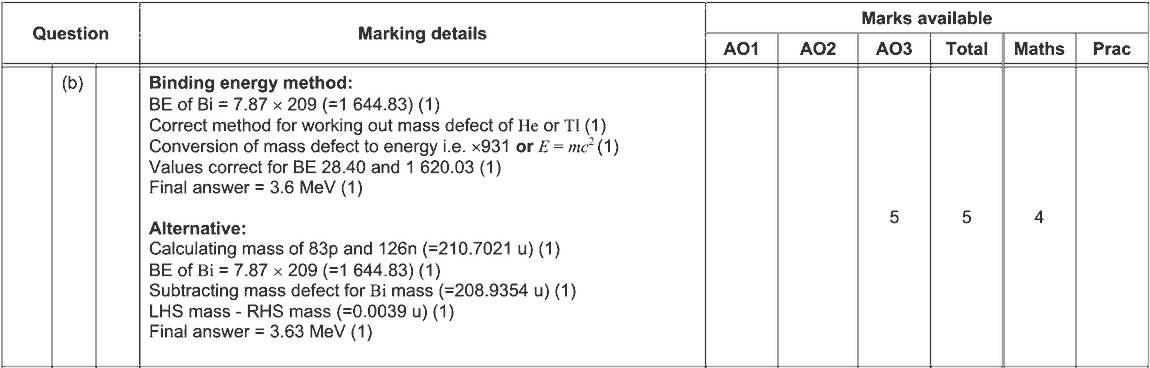
Answer: 3.6 MeV, so consistent. Mass of 83 p + 126 n = 210.7021 u
binding energy of Bi-209 = 7.87 × 209 = 1644.8 MeV = 1.7667 u, so nuclear mass = 208.9354 u
mass lost in the decay = 208.9354 − 204.9300 − 4.0015 = 0.0039 u = 3.63 MeV
or compare binding energies (He 28.40 MeV, Tl 1620.03 MeV)
many did not turn the BE per nucleon into the Bi mass
Scheme columns: Maths 4
Skills: Mathsmarks The mark scheme's Maths column gives this part at least one mark for mathematical skills
June 2019 · Component 1 · Q8(e)3 marksAO2=3Explanation
Earlier parts of question 8 that this part uses
Mark scheme
Examiner's comment
It was not always stated that increased gravitational forces was the reason why higher mass stars have higher core densities. A significant minority of candidates tried to explain why a higher density led to higher temperature without mentioning or implying nuclear fusion. There were, though, many excellent answers.
Notes from the mark scheme and report
Greater mass gives greater gravitational force, compressing the core to a higher density (1)
higher density gives a greater rate of fusion (1)
fusion releases energy, so more energy is released and the temperature is higher (1)
some never mentioned fusion
Skills: Comprehension A level Component 1 Section B: questions on the printed article
June 2019 · Component 1 · Q8(h)4 marksAO2=4Explanation
Earlier parts of question 8 that this part uses
Mark scheme
Examiner's comment
The first mark, usually gained, was for using equation 3 to calculate the luminosity of a star of mass 10 𝑴⨀. Credit was then available for making clear that the luminosity was to be used as the rate of loss of energy and that the available energy was 𝑴𝒄𝟐= 𝟏𝟎 𝑴⨀𝒄𝟐. This credit could be given by implication to the many candidates who quoted energy time = power and substituted 𝟏𝟎 𝑴⨀𝒄𝟐 𝟓𝟎𝟎𝟎 𝑳⨀= ( 𝟓𝟎𝟎) × solar lifetime. Once or twice it was pointed out that this is oversimplified because the star’s luminosity would decrease as its mass dwindled.
Notes from the mark scheme and report
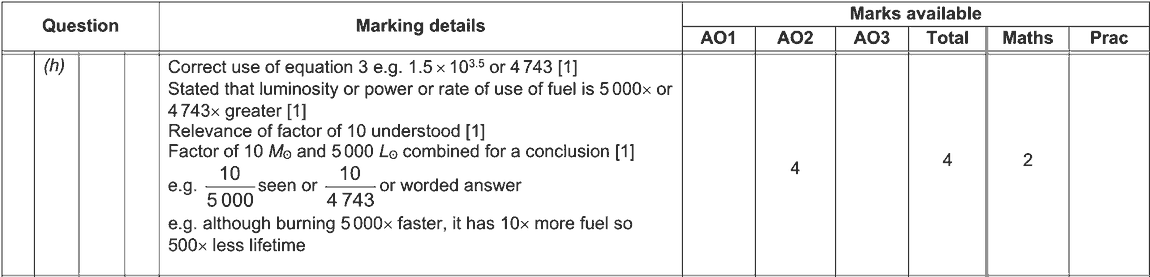
Equation 3: L = 1.5 × 10^3.5 = 4743, about 5000 solar units (1)
so fuel is used about 5000 times faster (1)
assume the energy available is proportional to mass (E = mc²), so there is 10 times more fuel (1)
lifetime factor = 10/5000 = 1/500 (1)
assumes constant luminosity
Scheme columns: Maths 2
Skills: Comprehension A level Component 1 Section B: questions on the printed article; Mathsmarks The mark scheme's Maths column gives this part at least one mark for mathematical skills
June 2019 · Component 3 · Q5(a)3 marksAO2=3Show that
Mark scheme
Examiner's comment
The responses to this question were perhaps not as impressive as expected. No step in the calculation proved to be particularly difficult but many candidates did not know where to start.
Notes from the mark scheme and report
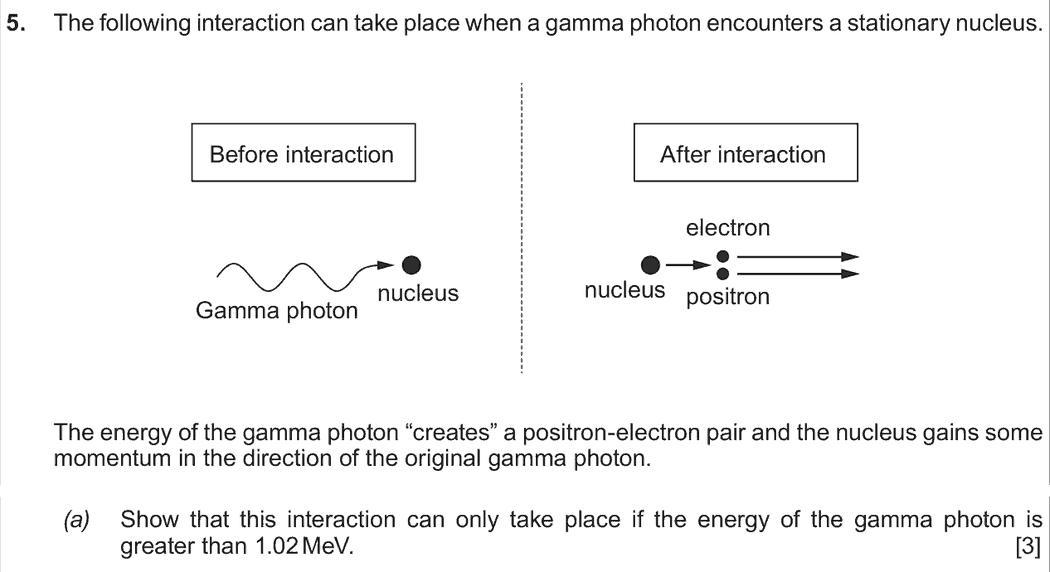
Energy to create the pair = 2mc² = 2 × 9.11 × 10⁻³¹ × (3.00 × 10⁸)² = 1.64 × 10⁻¹³ J
divide by 1.6 × 10⁻¹⁹ to get 1.02 MeV. Or mass 0.000549 u each, × 2 × 931 MeV. Many did not know where to start
Scheme columns: Maths 3
Skills: Unitsand conversions Unit marks, base units, prefixes and conversions; Mathsmarks The mark scheme's Maths column gives this part at least one mark for mathematical skills
June 2019 · Component 3 · Q5(b)2 marksAO2=2Explanation
Earlier part of question 5 that this part uses
Mark scheme
Examiner's comment
Most candidates realised that the excess energy (0.01 MeV) was shared between the positron and electron. Of those, only a small minority could explain that the energy was shared equally because of the equal masses.
Notes from the mark scheme and report
Excess energy = 1.03 − 1.02 = 0.01 MeV (1)
shared equally between electron and positron because they have equal masses (1)
the equal-mass reason was rare
June 2018 · Component 3 · Q7(a)2 marksAO1=2Explanation
Mark scheme
Examiner's comment
Generally well answered.
Notes from the mark scheme and report
Mass and energy are equivalent, E = mc², so mass can be converted to energy and vice versa (1)
it is the total of mass-energy (rest energy plus other energy) that is conserved when the mass changes (1)
June 2018 · Component 3 · Q7(b)4 marksAO3=4Explanation
Earlier part of question 7 that this part uses
Mark scheme
Examiner's comment
Quite a discriminating question and it was common to see mistakes in baryon numbers (pions counting as 1 and -1), charge (neutrons or pions being wrong) and mass-energy (usually anti-particles having negative rest mass- energy).
Notes from the mark scheme and report
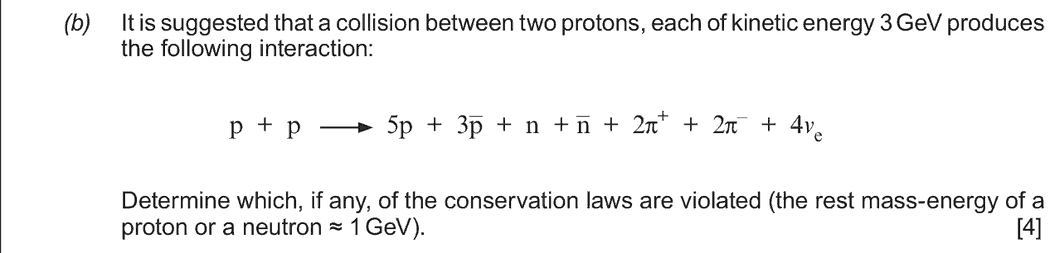
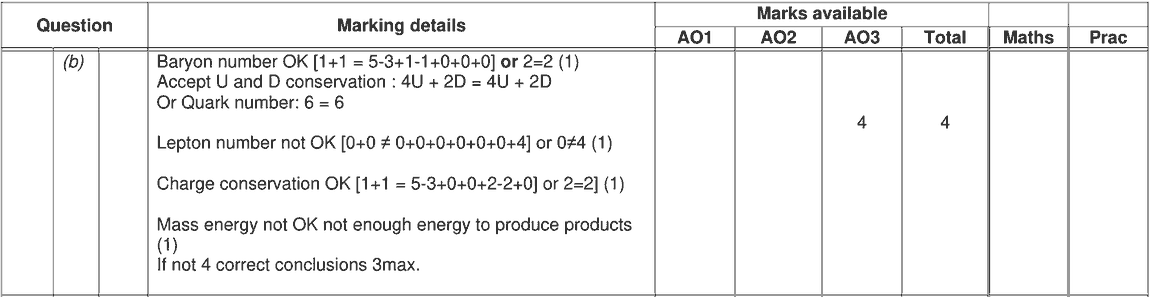
Baryon number conserved: 2 = 5 − 3 + 1 − 1 (1)
lepton number violated: 0 ≠ 4 (1)
charge conserved: 2 = 5 − 3 + 2 − 2 (1)
mass-energy violated: 8 GeV available (2 GeV rest + 6 GeV kinetic) but the products need over 10 GeV of rest energy (1)
all four conclusions needed for full marks
pions were often given baryon number and antiparticles negative rest energy
June 2018 · Component 3 · Q86 marksAO1=66-mark extended response
Mark scheme, with the levels and indicative content
Examiner's comment
(mean mark: 2.6/6 = 43%) The main problem was not answering the whole of the question - many candidates did not explain the concept of binding energy per nucleon before explaining how it relates to fission and fusion.
Notes from the mark scheme and report
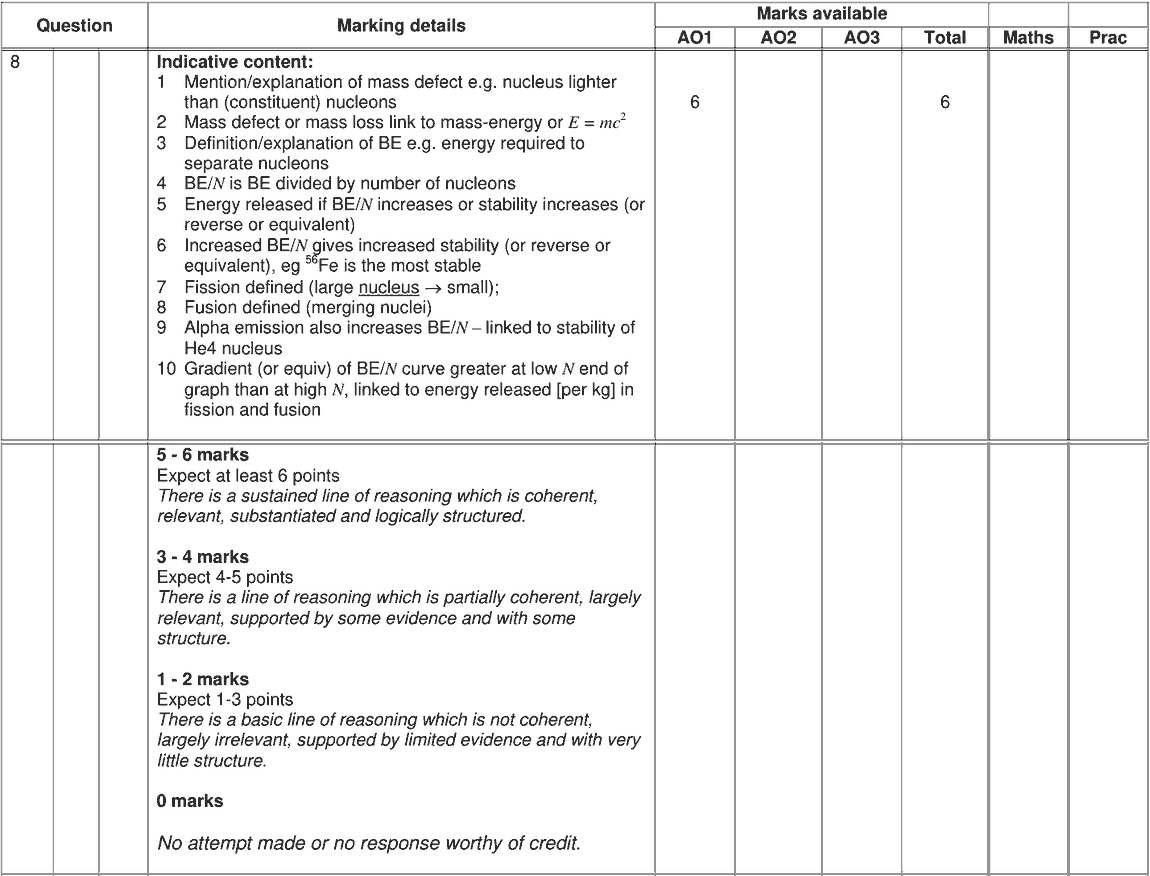
QER, levels marked on the number of points. A nucleus has less mass than its separate nucleons (mass defect)
linked to energy by E = mc²
binding energy is the energy needed to separate the nucleons
divide by the nucleon number for BE per nucleon
higher BE per nucleon means greater stability, peak near Fe-56
energy is released when BE per nucleon increases
fission: a heavy nucleus splits into lighter ones
fusion: light nuclei join
the curve is steeper at the light end so fusion releases more energy per kg
He-4 is especially stable (alpha emission). Report: mean 2.6/6 = 43%
many did not explain binding energy per nucleon before discussing fission and fusion
Skills: QER The 6-mark quality of extended response question
June 2017 · Component 3 · Q3(a)3 marksAO1=1, AO2=2Calculation
Mark scheme
Examiner's comment
Very well answered but, again, I would advise candidates to forget about atomic electrons here. The masses provided should always be nuclear masses and, in any case, the helium-3 would be positively charged initially meaning that no allowance is required for the mass of an electron.
Notes from the mark scheme and report
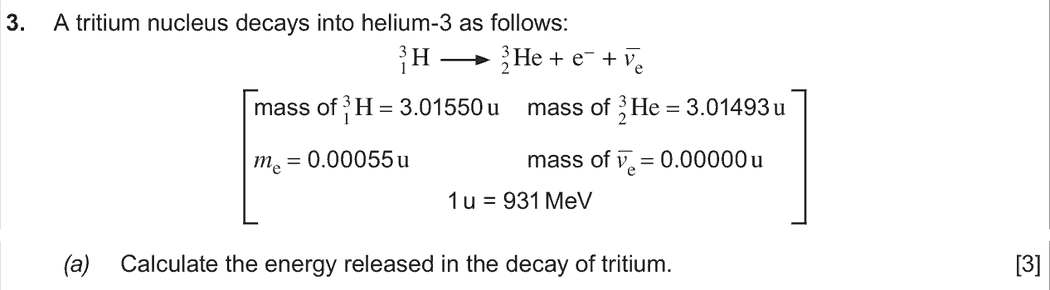
Answer: 0.0186 MeV (2.98 × 10⁻¹⁵ J). Mass difference = 3.01550 − 3.01493 − 0.00055 = 0.00002 u
× 931 MeV per u
the masses are nuclear so no allowance for atomic electrons
Scheme columns: Maths 2
Skills: Unitsand conversions Unit marks, base units, prefixes and conversions; Mathsmarks The mark scheme's Maths column gives this part at least one mark for mathematical skills
June 2017 · Component 3 · Q3(b)(i)3 marksAO2=3Calculation
Earlier part of question 3 that this part uses
Mark scheme
Examiner's comment
Very well answered although a small minority forgot to divide by the nucleon number. Also, those who converted to kg and used 𝐸= 𝑚𝑐2 were far more likely to make a mistake than those who used u and 931 MeV/u.
Notes from the mark scheme and report
Answer: 2.82 MeV per nucleon (4.52 × 10⁻¹³ J). Mass of p + 2n = 3.02460 u
mass defect = 0.00910 u
× 931 = 8.47 MeV
divide by 3
a few forgot to divide by 3
working in kg and mc² gave more slips
Scheme columns: Maths 2
Skills: Mathsmarks The mark scheme's Maths column gives this part at least one mark for mathematical skills
June 2017 · Component 3 · Q3(b)(ii)3 marksAO3=3Explanation
Earlier parts of question 3 that this part uses
Mark scheme
Examiner's comment
The point that was missed by most candidates was the most obvious – that tritium decays to helium-3.
Notes from the mark scheme and report
Tritium decays to helium-3 (or helium-3 has the better proton to neutron ratio) (1)
energy is released, the products have less mass, so helium-3 is the more stable (1)
yet the product would be expected to have the higher binding energy per nucleon and it does not (1)
most missed the obvious point that tritium decays into helium-3
Work with an Eduqas physics tutor
Dropping marks on calculations, specified practicals or the six-mark QER questions? Book a trial session with a specialist Eduqas physics tutor.