Notes and key-term cards for this topic are being written by our tutors. The past-paper questions below are ready now.
Specification statements
Show the 13 statements from the specification
2.8-a Kepler's three laws of planetary motion
2.8-b Newton's law of gravitation F = GM₁M₂/r² in simple examples, including the motion of planets and satellites
2.8-c how to derive Kepler's 3rd law, for the case of a circular orbit from Newton's law of gravity and the formula for centripetal acceleration
2.8-d how to use data on orbital motion, such as period or orbital speed, to calculate the mass of the central object
2.8-e how the orbital speeds of objects in spiral galaxies implies the existence of dark matter
2.8-f how the recently discovered Higgs boson may be related to dark matter
2.8-g how to determine the position of the centre of mass of two spherically symmetric objects, given their masses and separation, and calculate their mutual orbital period in the case of circular orbits
2.8-h the Doppler relationship in the form Δλ/λ = v/c
2.8-i how to determine a star's radial velocity (i.e. the component of its velocity along the line joining it and an observer on the Earth) from data about the Doppler shift of spectral lines
2.8-j the use of data on the variation of the radial velocities of the bodies in a double system (for example, a star and orbiting exo-planet) and their orbital period to determine the masses of the bodies for the case of a circular orbit edge on as viewed from the Earth
2.8-k how the Hubble constant (H₀) relates galactic radial velocity (v) to distance (D) and it is defined by v = H₀D
2.8-l why 1/H₀ approximates the age of the universe
2.8-m how the equation ρc = 3H₀²/(8πG) for the critical density of a 'flat' universe can be derived very simply using conservation of energy
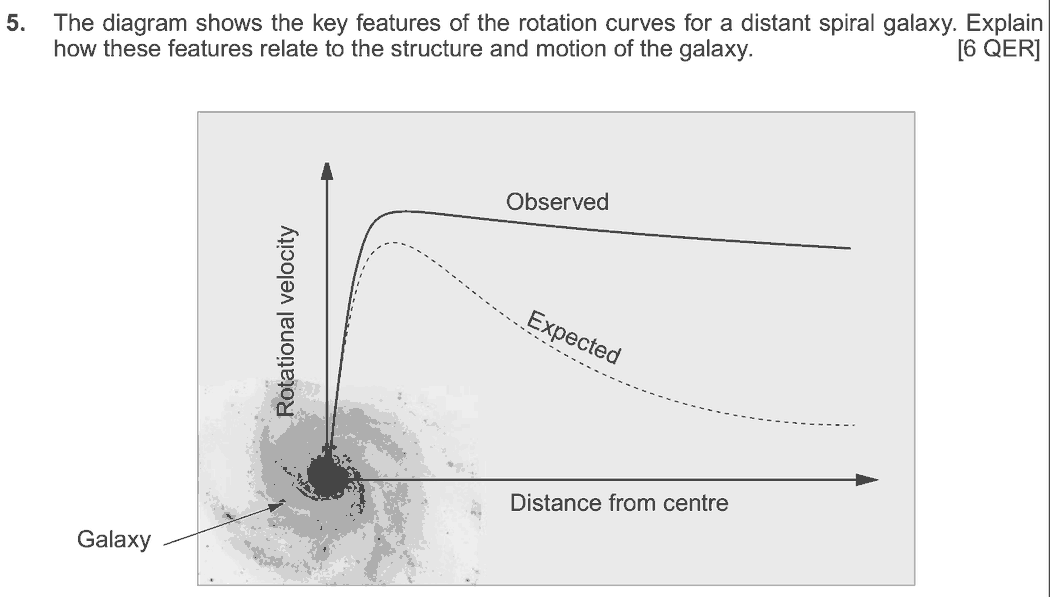
. The diagram shows the key features of the rotation curves for a distant spiral galaxy. Explain how these features relate to the structure and motion of the galaxy. [6 QER] Observed velocity Expected Rotational Distance
Tap a question to zoom it. Where a part needs a figure, table or graph from earlier in the question, that part folds out above it; the mark scheme and examiner's comment open underneath. Have the Eduqas Data Booklet beside you (see the Data Booklet page).
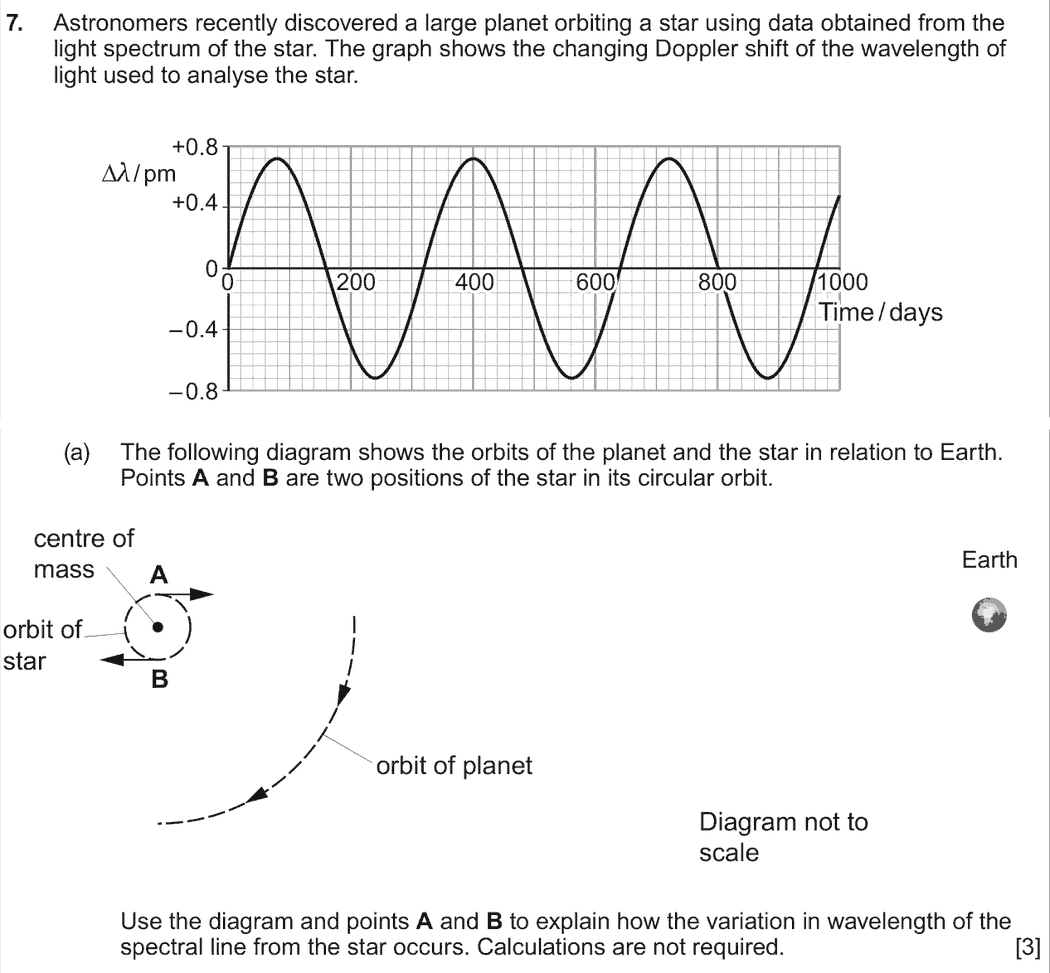
June 2025 · Component 2 · Q7(a)3 marksAO1=1, AO2=2Explanation
Mark scheme
Examiner's comment
This question was generally well answered. Most candidates successfully linked the observed change in wavelength to the respective positions of the star at points A and B in its rotation. However, some responses did not reference these positions explicitly. Unless the explanation was clearly and unambiguously phrased, candidates did not receive full marks.
Notes from the mark scheme and report
The star orbits the centre of mass so it alternately moves towards and away from the Earth (1)
at A it moves towards the Earth: shorter wavelength, blue shift, negative Δλ (1)
at B it moves away: longer wavelength, red shift, positive Δλ (1)
answers had to refer to A and B
Skills: Graphskills Reading, plotting or sketching graphs; gradients, intercepts and areas
June 2025 · Component 2 · Q7(b)(i)3 marksAO1=1, AO2=2Show that
Earlier part of question 7 that this part uses
Mark scheme
Examiner's comment
and (ii) In part (i), most candidates were able to interpret the challenging scale on the graph correctly and determine the value of Δλ. Nearly all then used the appropriate equation successfully to confirm the orbital speed of the star. In part (ii), nearly all candidates accurately calculated the star’s orbital radius.
Notes from the mark scheme and report
Δλ = 0.72 pm (amplitude from the graph)
v = cΔλ/λ = 3.00 × 10⁸ × 0.72 × 10⁻¹²/598 × 10⁻⁹ = 361 m s⁻¹
Scheme columns: Maths 2
Skills: Graphskills Reading, plotting or sketching graphs; gradients, intercepts and areas; Unitsand conversions Unit marks, base units, prefixes and conversions; Mathsmarks The mark scheme's Maths column gives this part at least one mark for mathematical skills
June 2025 · Component 2 · Q7(b)(ii)3 marksAO1=1, AO2=2Show that
Earlier parts of question 7 that this part uses
Mark scheme
Examiner's comment
) from d. Few candidates completed this step and thus lost the mark. The final two marks were for applying the mass-to-radius ratio correctly. ECF (error carried forward) was applied, and many candidates gained these marks.
Notes from the mark scheme and report
T = 320 days = 2.76 × 10⁷ s from the graph
r = vT/2π = 361 × 2.76 × 10⁷/2π = 1.59 × 10⁹ m
Scheme columns: Maths 2
Skills: Graphskills Reading, plotting or sketching graphs; gradients, intercepts and areas; Unitsand conversions Unit marks, base units, prefixes and conversions; Mathsmarks The mark scheme's Maths column gives this part at least one mark for mathematical skills
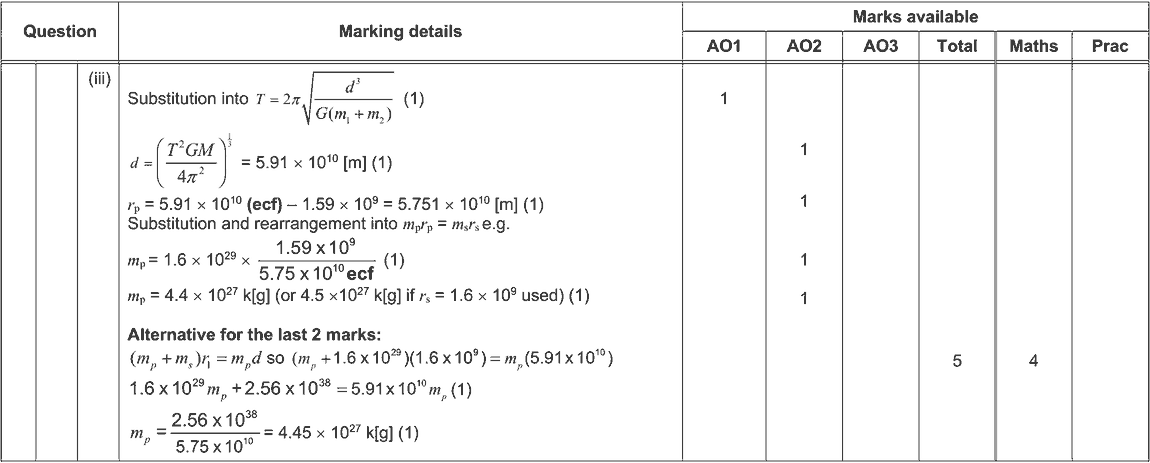
June 2025 · Component 2 · Q7(b)(iii)5 marksAO1=1, AO2=4Calculation
Earlier parts of question 7 that this part uses
Mark scheme
Examiner's comment
Fewer candidates than expected gained all 5 marks in this part. A significant number struggled with substituting into and rearranging the relevant form of Kepler’s Third Law to solve for d. Common mistakes included omitting G, failing to square 2π, or making other algebraic errors. The first two marks were awarded for correctly calculating d. A third mark, which many overlooked, was awarded for determining the planet’s orbital radius by subtracting the star’s orbital radius (from part
Notes from the mark scheme and report
Answer: 4.4 × 10²⁷ kg. T = 2π√(d³/GM) so d = (T²GM/4π²)^(1/3) = 5.91 × 10¹⁰ m
planet's orbit radius = d − 1.59 × 10⁹ = 5.75 × 10¹⁰ m
errors: leaving out G, not squaring 2π, not subtracting the star's radius
Scheme columns: Maths 4
Skills: Algebra Derivations and rearranging equations; Mathsmarks The mark scheme's Maths column gives this part at least one mark for mathematical skills
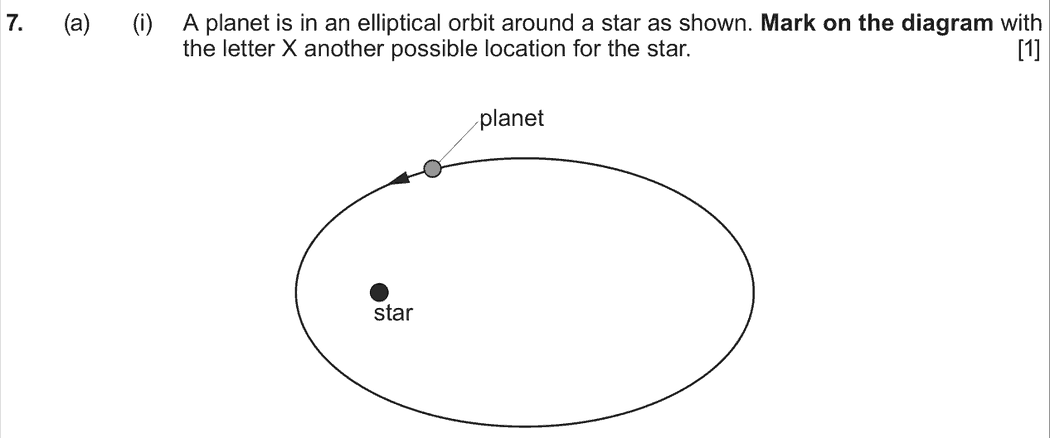
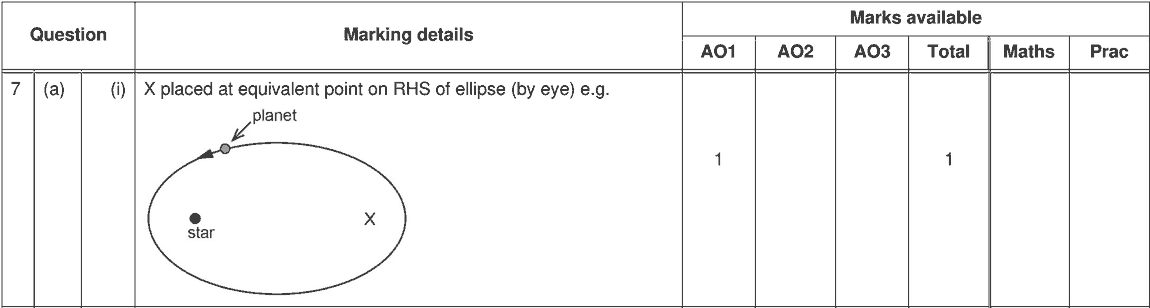
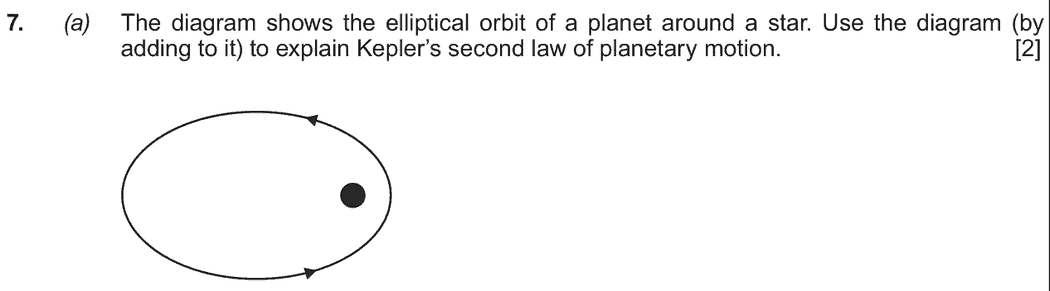
June 2024 · Component 2 · Q7(a)(i)1 markAO1=1Diagram or graph
Mark scheme
Examiner's comment
A very few candidates did not answer part (i). Of those who did, nearly all correctly marked another location for the star. In (ii), nearly all candidates stated Kepler’s 2nd law in terms of the time taken to sweep out the given areas. The majority also proceeded to relate this to the respective speeds to transverse both areas.
Notes from the mark scheme and report
X at the other focus: the mirror-image point on the right-hand side of the ellipse
June 2024 · Component 2 · Q7(a)(ii)2 marksAO1=2Explanation
Earlier part of question 7 that this part uses
Mark scheme
Examiner's comment
A very few candidates did not answer part (i). Of those who did, nearly all correctly marked another location for the star. In (ii), nearly all candidates stated Kepler’s 2nd law in terms of the time taken to sweep out the given areas. The majority also proceeded to relate this to the respective speeds to transverse both areas.
Notes from the mark scheme and report
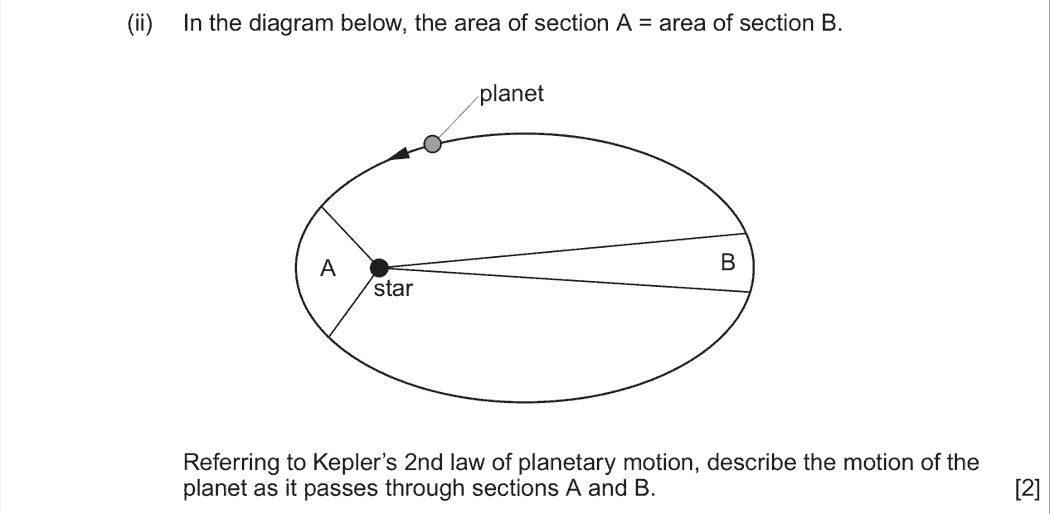
The line from star to planet sweeps out equal areas in equal times, so A and B take the same time (1)
the arc in A (near the star) is longer, so the planet moves faster through A than through B (1)
June 2024 · Component 2 · Q7(b)(i)2 marksAO3=2Show that
Earlier parts of question 7 that this part uses
Mark scheme
Examiner's comment
In (i) nearly all candidates confirmed Kepler’s 3rd law using T k r = or the reciprocal of this. A small number of candidates determined k initially for one moon and then substituted to confirm either T or r for the other Moon. All approaches were valid. The majority of candidates determined the mass of Jupiter correctly in (ii).
Notes from the mark scheme and report
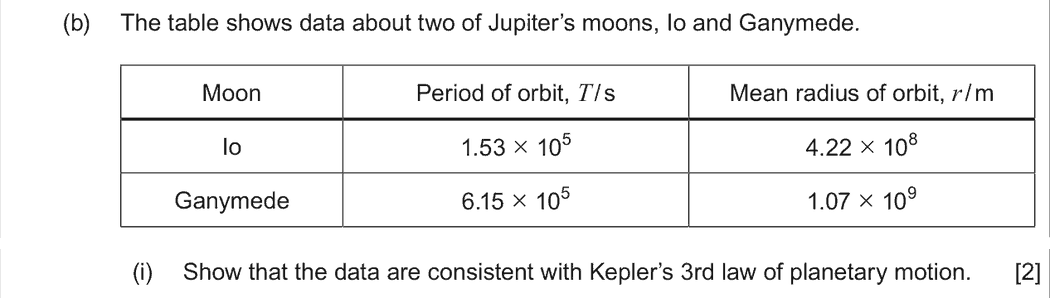
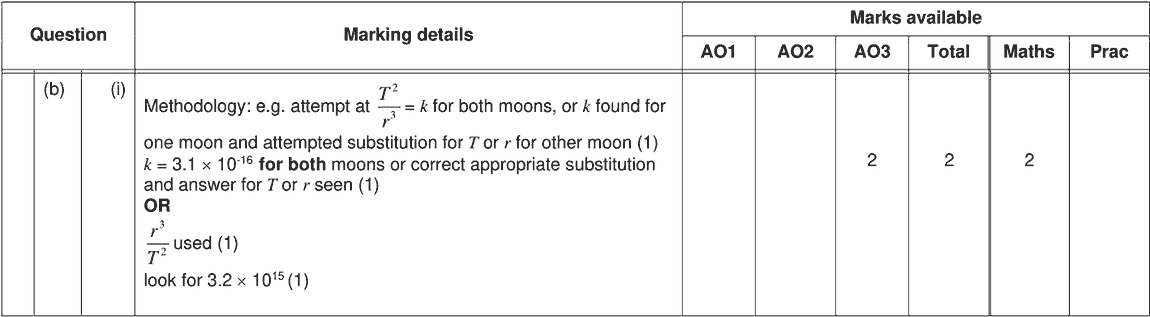
T²/r³ = 3.1 × 10⁻¹⁶ s² m⁻³ for both Io and Ganymede (or r³/T² = 3.2 × 10¹⁵), so T² is proportional to r³
or find the constant for one moon and predict T or r for the other
Scheme columns: Maths 2
Skills: Mathsmarks The mark scheme's Maths column gives this part at least one mark for mathematical skills
June 2024 · Component 2 · Q7(b)(ii)3 marksAO1=1, AO2=2Calculation
Earlier parts of question 7 that this part uses
Mark scheme
Examiner's comment
In (i) nearly all candidates confirmed Kepler’s 3rd law using T k r = or the reciprocal of this. A small number of candidates determined k initially for one moon and then substituted to confirm either T or r for the other Moon. All approaches were valid. The majority of candidates determined the mass of Jupiter correctly in (ii).
Notes from the mark scheme and report
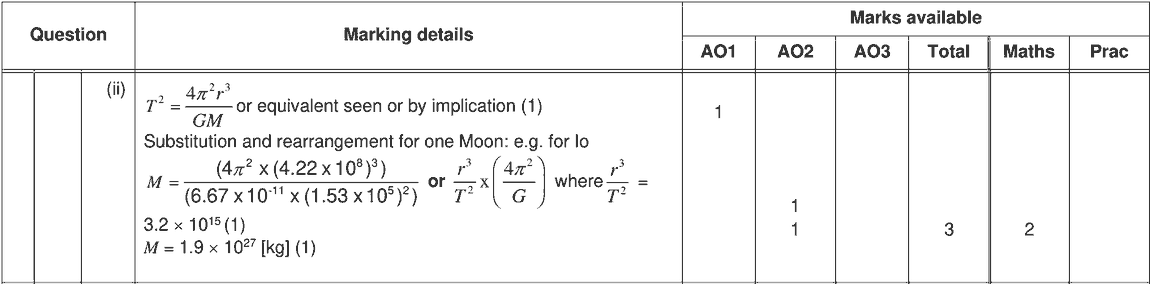
Answer: 1.9 × 10²⁷ kg. T² = 4π²r³/(GM) so M = 4π²r³/(GT²) = 4π² × (4.22 × 10⁸)³/(6.67 × 10⁻¹¹ × (1.53 × 10⁵)²)
Scheme columns: Maths 2
Skills: Mathsmarks The mark scheme's Maths column gives this part at least one mark for mathematical skills
June 2024 · Component 2 · Q7(c)(i)2 marksAO1=1, AO2=1Calculation
Earlier parts of question 7 that this part uses
Mark scheme
Examiner's comment
A minority of candidates incorrectly attempted to apply the concept of energy conservation when answering this question. Those that correctly approached the question in terms of centripetal forces usually gained full marks.
Notes from the mark scheme and report
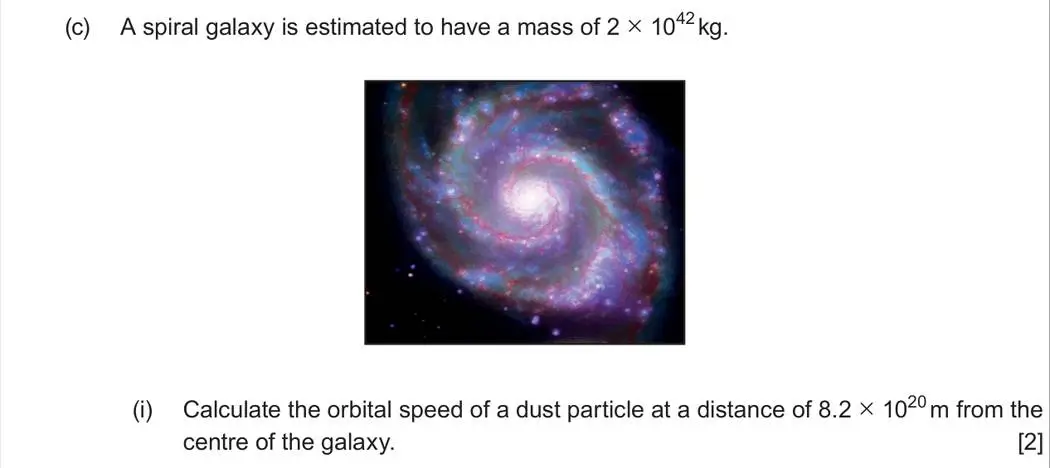
Answer: 4 × 10⁵ m s⁻¹. Gravity provides the centripetal force: v = √(GM/r) = √(6.67 × 10⁻¹¹ × 2 × 10⁴²/8.2 × 10²⁰)
energy conservation is not the right approach
Scheme columns: Maths 1
Skills: Mathsmarks The mark scheme's Maths column gives this part at least one mark for mathematical skills
June 2024 · Component 2 · Q7(c)(ii)3 marksAO2=3Explanation
Earlier parts of question 7 that this part uses
Mark scheme
Examiner's comment
Many good, logical responses were seen here. Candidates related the increased velocity to increased mass (1st mark), which is ‘unseen’ or ‘dark’ (2nd mark), the source of which may be due to the Higgs Boson (3rd mark).
Notes from the mark scheme and report
A higher orbital speed means more mass inside the orbit than is observed (1)
the unseen mass is dark matter (1)
the Higgs boson was suggested as a possible source of dark matter (1)
June 2024 · Component 2 · Q7(d)2 marksAO3=2Short answer
Earlier parts of question 7 that this part uses
Mark scheme
Examiner's comment
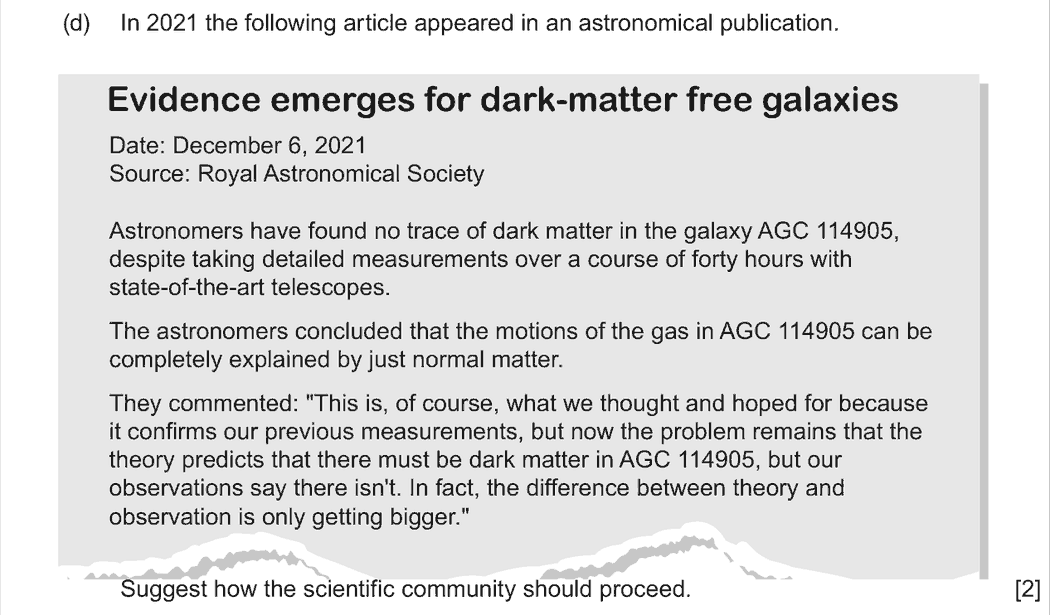
This ‘how Science works’ question explores the ‘role of the scientific community in validating new knowledge and ensuring integrity’. A variety of responses to the given scenario were acceptable. These included: (the same team or others) carrying out measurements of different galaxies, another team independently carrying out measurements of the same galaxy, peer reviewing the data obtained and / or proposing new theories. The same team repeating the same experiment was not accepted as this had already been carried out and stated in the article. Most candidates gained at least one mark here.
Notes from the mark scheme and report
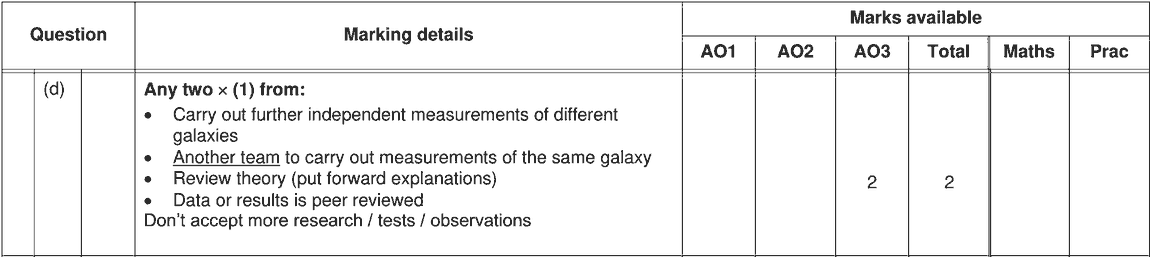
Any two: independent measurements of other galaxies
a different team measures the same galaxy
peer review of the data and results
review or revise the theory. Simply 'more research' or the same team repeating the work not credited
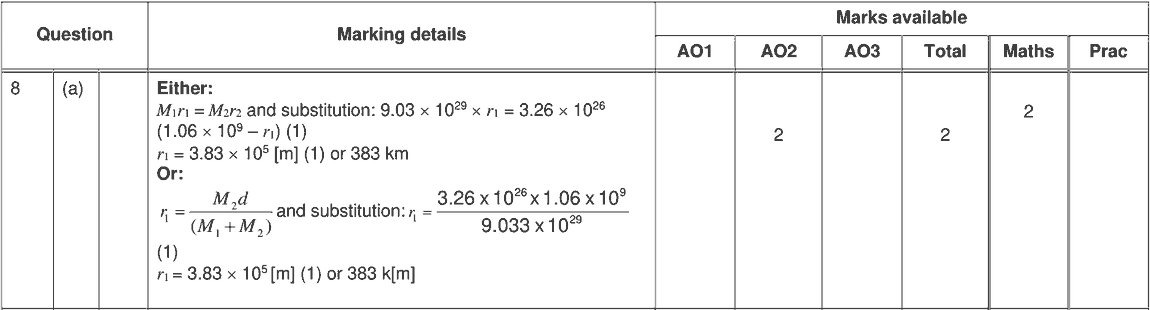
June 2024 · Component 2 · Q8(a)2 marksAO2=2Show that
Mark scheme
Examiner's comment
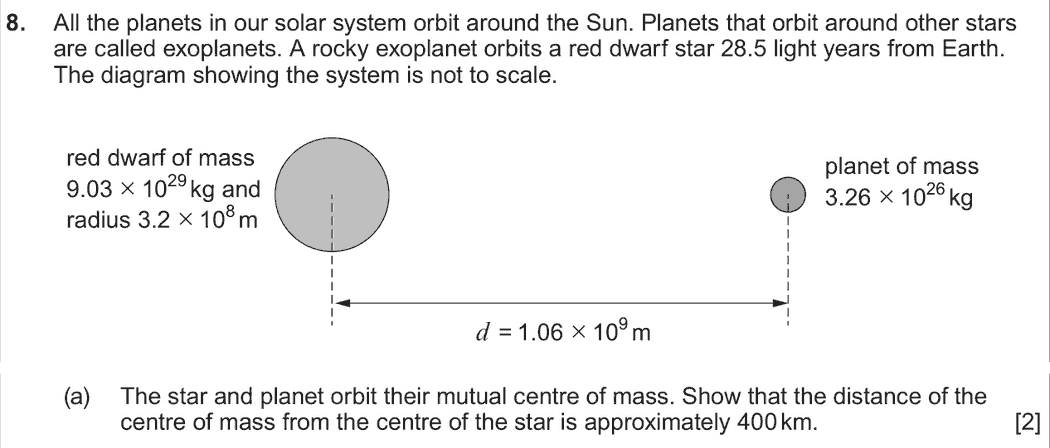
Nearly all candidates showed that the distance of the centre of mass from the star was 383 km as required.
Notes from the mark scheme and report
M1 r1 = M2 r2 with r2 = d − r1: r1 = M2 d/(M1 + M2) = 3.26 × 10²⁶ × 1.06 × 10⁹/9.03 × 10²⁹ = 3.83 × 10⁵ m = 383 km
Scheme columns: Maths 2
Skills: Mathsmarks The mark scheme's Maths column gives this part at least one mark for mathematical skills
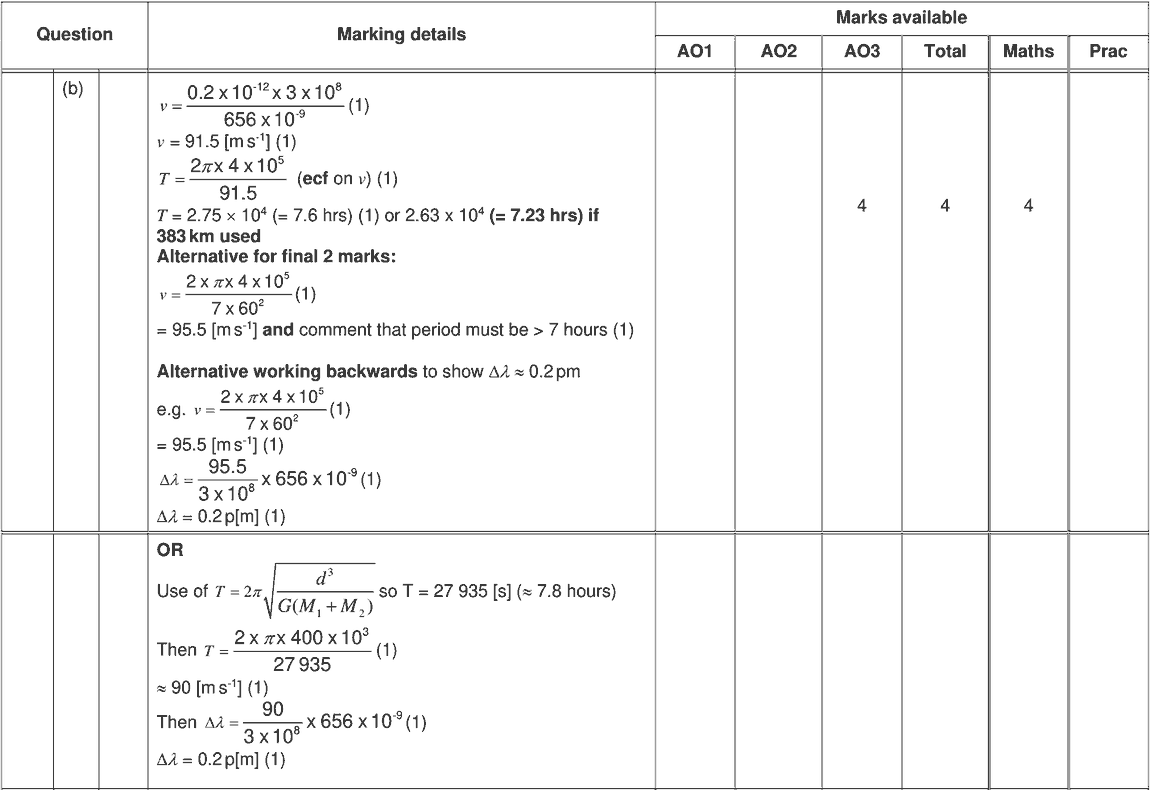
June 2024 · Component 2 · Q8(b)4 marksAO3=4Show that
Earlier part of question 8 that this part uses
Mark scheme
Examiner's comment
A variety of successful approaches were seen. Many candidates chose to determine the orbital speed using the red shift formula, and then determined the period from distance speed = time . Others chose to take the 7 hours given in the question to work backwards to confirm the wavelength shift. This was acceptable if a valid conclusion was given, such as the data then confirming the wavelength shift for a period of orbit greater than 7 hours, as required in the question. This was not always stated, and one mark was deducted consequently.
Notes from the mark scheme and report
Answer: T = 2.75 × 10⁴ s = 7.6 h (7.3 h with 383 km). v = cΔλ/λ = 3.00 × 10⁸ × 0.20 × 10⁻¹²/656 × 10⁻⁹ = 91.5 m s⁻¹
T = 2πr/v with r = 4 × 10⁵ m
working back from 7 h (95.5 m s⁻¹, 0.2 pm) is valid only with a concluding comment
Scheme columns: Maths 4
Skills: Unitsand conversions Unit marks, base units, prefixes and conversions; Mathsmarks The mark scheme's Maths column gives this part at least one mark for mathematical skills
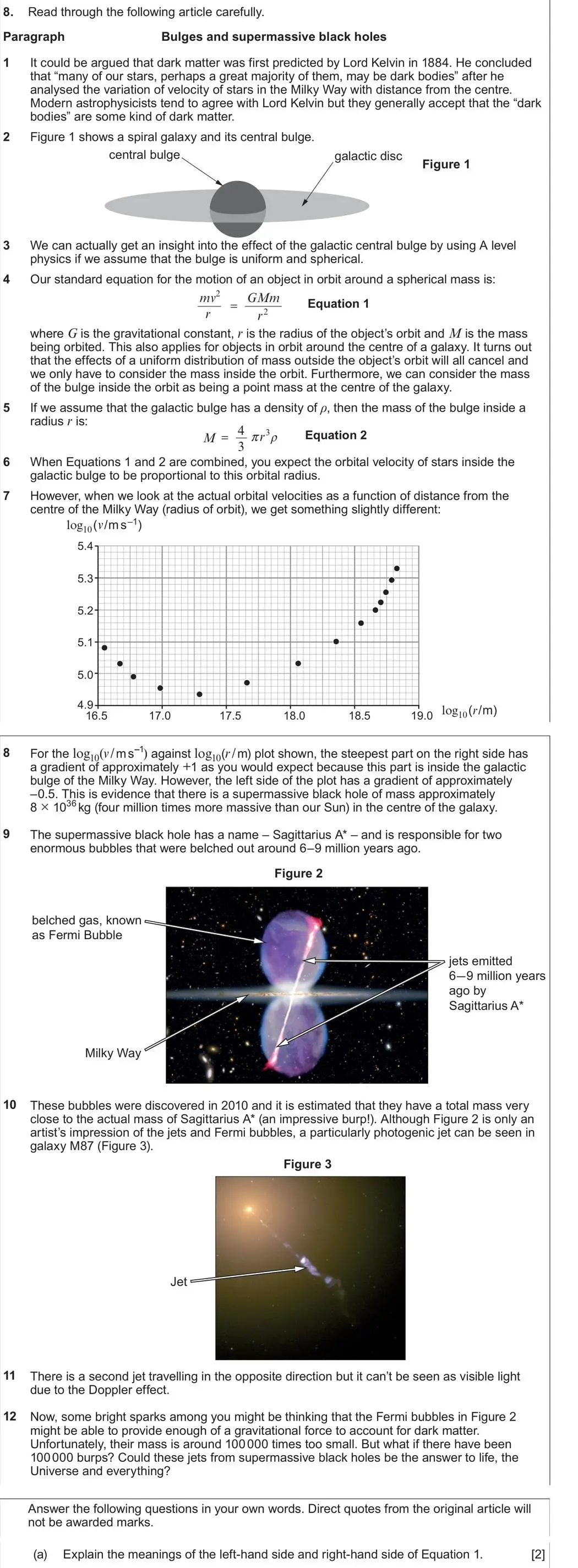
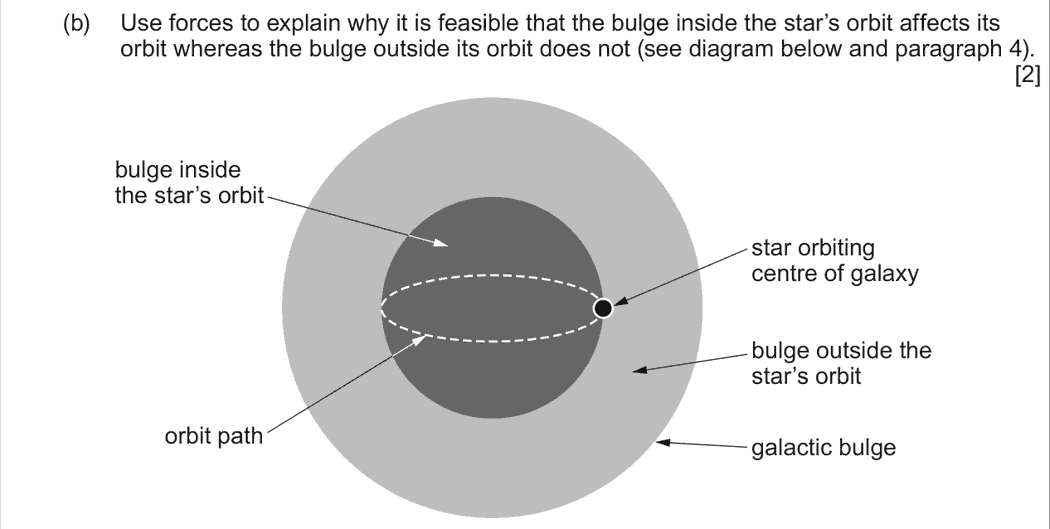
June 2023 · Component 1 · Q8(a)2 marksAO1=2Short answer
Mark scheme
Examiner's comment
Most candidates were able to successfully identify the centripetal and gravitational forces in (a). Candidates were asked to use forces in their responses to part (b). In several cases this was not done. For the first mark candidates needed to reference the mass inside of the bulge. Some considered this as a point mass, but it was not a requirement. This mass causes a force towards the centre. As the star obits, the bulge outside will pull in different directions. This proved to be a tough marking point to achieve. Good algebra skills were on show in (c). The first marking point was sometimes missed in (d)(i) as candidates focused on using logs. Referencing the supermassive black hole or even the centre of the galaxy would have been enough. The mathematical demand in this question part made it difficult for some candidates. There were a good number who were successful and correctly identified -0.5 in their algebra and linked this to 𝑦= 𝑚𝑥+ 𝑐. In (ii) taking values from the graph was generally well done. Some candidates brought forward their log equations from (d)(i), leading to a relatively simple substitution and manipulation. Many candidates used 10𝑥 to calculate a distance and a velocity and then used a rearranged version of the orbital velocity equation. A comment was needed to pick up the last marking point. In
Notes from the mark scheme and report
Left-hand side: the centripetal force needed for the orbit (1)
right-hand side: the gravitational force on the orbiting object (1)
Skills: Comprehension A level Component 1 Section B: questions on the printed article; Synoptic Needs physics from another component of the qualification
June 2023 · Component 1 · Q8(c)3 marksAO1=1, AO2=2Calculation
Earlier parts of question 8 that this part uses
Mark scheme
Examiner's comment
Most candidates were able to successfully identify the centripetal and gravitational forces in (a). Candidates were asked to use forces in their responses to part (b). In several cases this was not done. For the first mark candidates needed to reference the mass inside of the bulge. Some considered this as a point mass, but it was not a requirement. This mass causes a force towards the centre. As the star obits, the bulge outside will pull in different directions. This proved to be a tough marking point to achieve. Good algebra skills were on show in (c). The first marking point was sometimes missed in (d)(i) as candidates focused on using logs. Referencing the supermassive black hole or even the centre of the galaxy would have been enough. The mathematical demand in this question part made it difficult for some candidates. There were a good number who were successful and correctly identified -0.5 in their algebra and linked this to 𝑦= 𝑚𝑥+ 𝑐. In (ii) taking values from the graph was generally well done. Some candidates brought forward their log equations from (d)(i), leading to a relatively simple substitution and manipulation. Many candidates used 10𝑥 to calculate a distance and a velocity and then used a rearranged version of the orbital velocity equation. A comment was needed to pick up the last marking point. In
Notes from the mark scheme and report
Substitute M = (4/3)πr³ρ into mv²/r = GMm/r² (1)
cancel m and collect r (1)
v = r√(4πGρ/3), so v is proportional to r (1)
Scheme columns: Maths 3
Skills: Comprehension A level Component 1 Section B: questions on the printed article; Algebra Derivations and rearranging equations; Synoptic Needs physics from another component of the qualification; Mathsmarks The mark scheme's Maths column gives this part at least one mark for mathematical skills
June 2023 · Component 1 · Q8(d)(i)3 marksAO2=3Explanation
Earlier parts of question 8 that this part uses
Mark scheme
Examiner's comment
Most candidates were able to successfully identify the centripetal and gravitational forces in (a). Candidates were asked to use forces in their responses to part (b). In several cases this was not done. For the first mark candidates needed to reference the mass inside of the bulge. Some considered this as a point mass, but it was not a requirement. This mass causes a force towards the centre. As the star obits, the bulge outside will pull in different directions. This proved to be a tough marking point to achieve. Good algebra skills were on show in (c). The first marking point was sometimes missed in (d)(i) as candidates focused on using logs. Referencing the supermassive black hole or even the centre of the galaxy would have been enough. The mathematical demand in this question part made it difficult for some candidates. There were a good number who were successful and correctly identified -0.5 in their algebra and linked this to 𝑦= 𝑚𝑥+ 𝑐. In (ii) taking values from the graph was generally well done. Some candidates brought forward their log equations from (d)(i), leading to a relatively simple substitution and manipulation. Many candidates used 10𝑥 to calculate a distance and a velocity and then used a rearranged version of the orbital velocity equation. A comment was needed to pick up the last marking point. In
Notes from the mark scheme and report
The left side is close to the centre of the galaxy where the supermassive black hole's mass dominates, so v = √(GM/r) applies with M constant (1)
taking logs: log v = −0.5 log r + 0.5 log(GM) (1)
comparing with y = mx + c the gradient is −0.5, as expected (1)
the first point was often missed
Scheme columns: Maths 2
Skills: Comprehension A level Component 1 Section B: questions on the printed article; Algebra Derivations and rearranging equations; Graphskills Reading, plotting or sketching graphs; gradients, intercepts and areas; Synoptic Needs physics from another component of the qualification; Mathsmarks The mark scheme's Maths column gives this part at least one mark for mathematical skills
June 2023 · Component 1 · Q8(d)(ii)4 marksAO3=4Calculation
Earlier parts of question 8 that this part uses
Mark scheme
Examiner's comment
Most candidates were able to successfully identify the centripetal and gravitational forces in (a). Candidates were asked to use forces in their responses to part (b). In several cases this was not done. For the first mark candidates needed to reference the mass inside of the bulge. Some considered this as a point mass, but it was not a requirement. This mass causes a force towards the centre. As the star obits, the bulge outside will pull in different directions. This proved to be a tough marking point to achieve. Good algebra skills were on show in (c). The first marking point was sometimes missed in (d)(i) as candidates focused on using logs. Referencing the supermassive black hole or even the centre of the galaxy would have been enough. The mathematical demand in this question part made it difficult for some candidates. There were a good number who were successful and correctly identified -0.5 in their algebra and linked this to 𝑦= 𝑚𝑥+ 𝑐. In (ii) taking values from the graph was generally well done. Some candidates brought forward their log equations from (d)(i), leading to a relatively simple substitution and manipulation. Many candidates used 10𝑥 to calculate a distance and a velocity and then used a rearranged version of the orbital velocity equation. A comment was needed to pick up the last marking point. In
Notes from the mark scheme and report
Answer: 7.7 × 10³⁶ kg, so yes. Point read as log r = 16.55, log v = 5.08
r = 3.55 × 10¹⁶ m, v = 1.2 × 10⁵ m s⁻¹
M = rv²/G
a comment on the agreement with 8 × 10³⁶ kg is needed
Scheme columns: Maths 4
Skills: Comprehension A level Component 1 Section B: questions on the printed article; Graphskills Reading, plotting or sketching graphs; gradients, intercepts and areas; Synoptic Needs physics from another component of the qualification; Mathsmarks The mark scheme's Maths column gives this part at least one mark for mathematical skills
June 2023 · Component 1 · Q8(f)2 marksAO2=2Explanation
Earlier parts of question 8 that this part uses
Mark scheme
Examiner's comment
Most candidates were able to successfully identify the centripetal and gravitational forces in (a). Candidates were asked to use forces in their responses to part (b). In several cases this was not done. For the first mark candidates needed to reference the mass inside of the bulge. Some considered this as a point mass, but it was not a requirement. This mass causes a force towards the centre. As the star obits, the bulge outside will pull in different directions. This proved to be a tough marking point to achieve. Good algebra skills were on show in (c). The first marking point was sometimes missed in (d)(i) as candidates focused on using logs. Referencing the supermassive black hole or even the centre of the galaxy would have been enough. The mathematical demand in this question part made it difficult for some candidates. There were a good number who were successful and correctly identified -0.5 in their algebra and linked this to 𝑦= 𝑚𝑥+ 𝑐. In (ii) taking values from the graph was generally well done. Some candidates brought forward their log equations from (d)(i), leading to a relatively simple substitution and manipulation. Many candidates used 10𝑥 to calculate a distance and a velocity and then used a rearranged version of the orbital velocity equation. A comment was needed to pick up the last marking point. In
Notes from the mark scheme and report
The jet is moving away, so its light is red-shifted to longer wavelength (1) and falls outside the visible part of the spectrum (1)
'Doppler shift' alone or 'not visible' alone was not enough
Skills: Comprehension A level Component 1 Section B: questions on the printed article; Synoptic Needs physics from another component of the qualification
June 2023 · Component 1 · Q8(g)2 marksAO3=2Explanation
Earlier parts of question 8 that this part uses
Mark scheme
Examiner's comment
Most candidates were able to successfully identify the centripetal and gravitational forces in (a). Candidates were asked to use forces in their responses to part (b). In several cases this was not done. For the first mark candidates needed to reference the mass inside of the bulge. Some considered this as a point mass, but it was not a requirement. This mass causes a force towards the centre. As the star obits, the bulge outside will pull in different directions. This proved to be a tough marking point to achieve. Good algebra skills were on show in (c). The first marking point was sometimes missed in (d)(i) as candidates focused on using logs. Referencing the supermassive black hole or even the centre of the galaxy would have been enough. The mathematical demand in this question part made it difficult for some candidates. There were a good number who were successful and correctly identified -0.5 in their algebra and linked this to 𝑦= 𝑚𝑥+ 𝑐. In (ii) taking values from the graph was generally well done. Some candidates brought forward their log equations from (d)(i), leading to a relatively simple substitution and manipulation. Many candidates used 10𝑥 to calculate a distance and a velocity and then used a rearranged version of the orbital velocity equation. A comment was needed to pick up the last marking point. In
Notes from the mark scheme and report
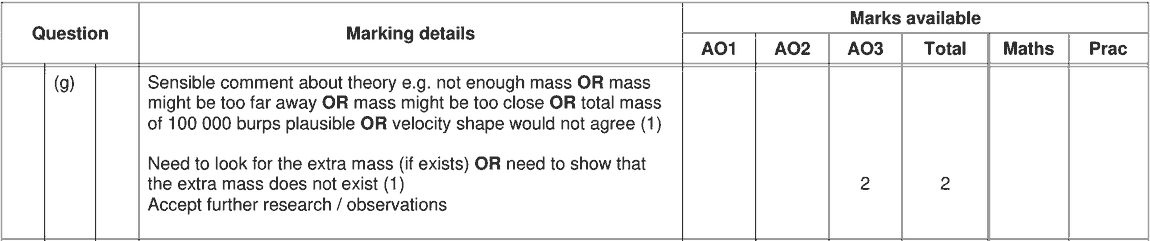
A sensible comment on the idea, e.g. one burp has far too little mass, 100 000 burps might be plausible, the mass may be in the wrong place to give the observed velocity curve (1)
a next step, e.g. look for the ejected mass or show that it is not there, further observations (1)
Skills: Comprehension A level Component 1 Section B: questions on the printed article
June 2023 · Component 2 · Q5(b)(ii)3 marksAO1=1, AO2=2Show that
Earlier parts of question 5 that this part uses
Mark scheme
Examiner's comment
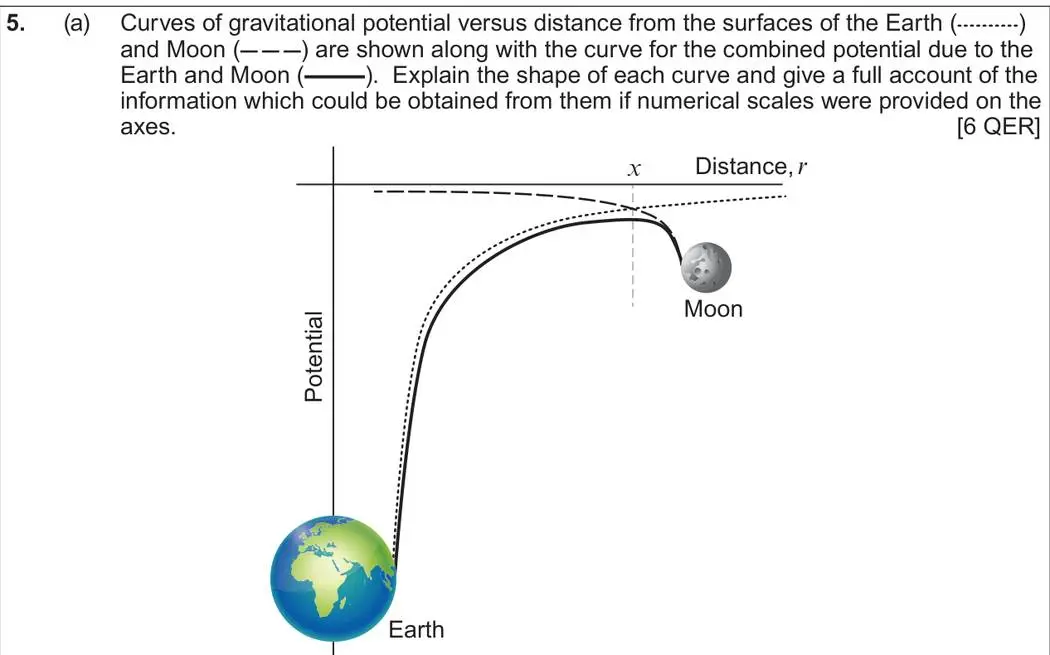
Part (a) was the QER question and in general, good attempts were made to explain the shapes of the potential vs distance curves. Higher scoring candidates (top band responses) were able to refer to the definition of potential and the expected relationship between potential and distance (i.e. 𝑉𝑔∝ − 𝑟). They explained the reason why the potential near the earth had a greater (negative) value than near the Moon and identified the relationship between the gradient of the curves and gravitational field strength. They described the scalar nature of potential and explained that the combined curve was due to the sum of the individual potentials. They also correctly described the significance of the gradient at X in terms of field strength and, in some cases, the work needed to escape the system. Middle band responses contained some of the above points, with lower band candidates only managing to describe one or two of these aspects. Many candidates in (b)(i) had an appreciation of the energy principles involved in determining the launch speed of the rocket, including the concept of initial Ep and Ek at the surface being equal to the Ep at the given height in orbit. However, a significant minority of candidates failed to gain full marks due to their incorrect use of signs when considering Ep. That is they failed to account for the negative values of Ep at both the surface and at the height of the orbit. Responses to (ii) were more successful with many applying the appropriate circular motion equation to confirm the orbital speed. In a few cases candidates used the orbital speed given in the question to determine the period of orbit, T, and then used the same equation again to re-confirm the orbital speed - a circular approach which was not credited.
Notes from the mark scheme and report
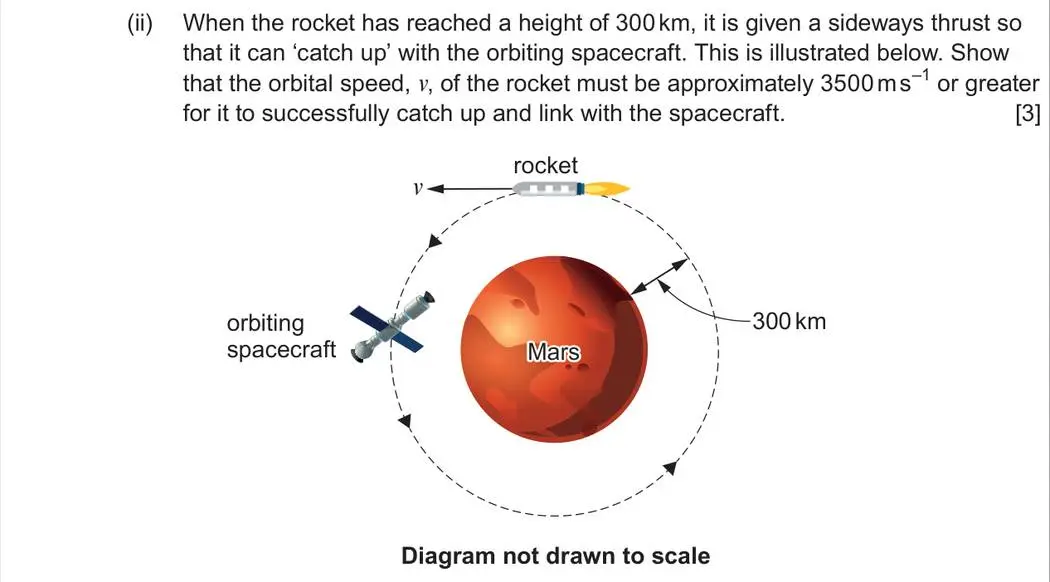
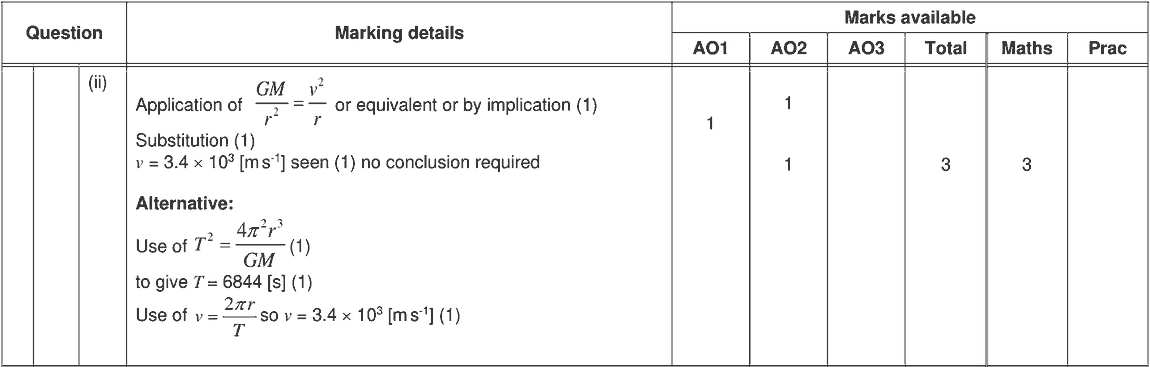
GMm/r² = mv²/r so v = √(GM/r) = √(6.67 × 10⁻¹¹ × 6.4 × 10²³/3.7 × 10⁶) = 3.4 × 10³ m s⁻¹
or Kepler's third law gives T = 6844 s then v = 2πr/T
using the given speed to find T and back again is circular
Scheme columns: Maths 3
Skills: Synoptic Needs physics from another component of the qualification; Mathsmarks The mark scheme's Maths column gives this part at least one mark for mathematical skills
June 2023 · Component 2 · Q7(a)2 marksAO1=1, AO2=1Diagram or graph
Mark scheme
Examiner's comment
Many candidates were successful in sketching an appropriate spectrum in (a) with nearly all gaining at least one mark for drawing the same pattern as the one given in the question. Most candidates showed a ‘shift to the right’ as required, however a few candidates showed a shift to the left, which was not credited. In (b)(i) nearly all candidates were successful in using Wien’s law to calculate the required wavelength, with most stating that the wavelength lies in the visible or ‘blue’ part of the spectrum. Unlike previous sittings of this paper, it was encouraging to note that many candidates used Stefan’s law correctly by including the formula for surface area of a sphere (4πr2), rather than the cross-sectional area of a sphere. A few candidates did not gain the second mark for giving an incorrect unit for luminosity or for omitting it altogether. It was expected that only high achieving candidates might be able to access part (c) as it required a consideration of the impact of two changes to the properties of the star on its temperature in comparison to the star’s initial conditions. Responses however were very encouraging, indicating that candidates from a broad range of abilities were able to confidently manipulate the data given to confirm the decrease in temperature required in the question. As with other AO3 style questions of this nature, many approaches are possible. Many candidates chose an algebraic approach, comparing initial and final conditions for the star, usually ending with a factor √3 decrease in temperature. Others chose to take a numerical approach, showing that the decrease in stellar temperature amounted to about 440 K, a decrease of less than 10% as required.
Notes from the mark scheme and report
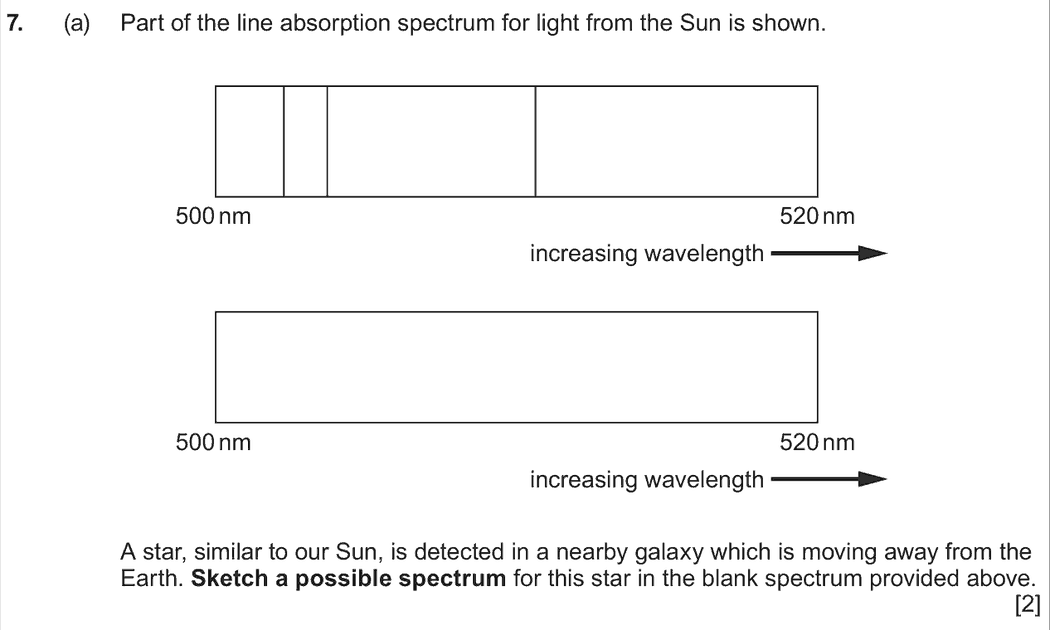
Same pattern and spacing of lines (1), all shifted to the right (longer wavelength) by the same amount (1)
a shift to the left was not credited
June 2023 · Component 2 · Q8(a)(i)4 marksAO1=4Show that
Mark scheme
Examiner's comment
Candidates, overall, applied the principle of conservation of energy and equations for density and the Hubble’s Law appropriately to derive the equation for the critical density of the Universe in (a)(i). Candidates should however be encouraged to provide some context to their work, with many going straight into ‘algebra mode’ without setting the scene in terms of the rationale behind the proof being given. A simple comment such as: “consider matter within a spherical shell of radius R” (or equivalent) would at least give some context to the argument. Where this was seen full marks were awarded. One mark was deducted where no context was given. In (ii) nearly all candidates were successful in confirming the relationship between the Hubble constant and the number of atoms of hydrogen per m3 in the universe. Once again, many approaches are possible with some candidates choosing to use the value for the Hubble constant given in the data booklet and the critical density equation to determine the number of hydrogen atoms per m3, while others chose the converse approach of starting with the number of atoms to determine the corresponding Hubble constant. Both approaches are equally valid. Nearly all candidates successfully confirmed the receding velocity of the galaxy in kms-1 as required in (b)(i). In (ii) many candidates, though by no means all, were successful in using ∆𝜆 𝜆= 𝑣 𝑐 to determine Δλ. Of those candidates who successfully determined the change in wavelength a significant minority subtracted this from the original wavelength given rather than adding the two figures together. As in previous years it seems that candidates continue to have misconceptions regarding this part of the specification. In the last part it was expected that candidates would identify from part (b) that the galaxy emits radiation across a wide range of the electromagnetic spectrum, beyond that of visible light. A few candidates identified that the hydrogen line described in (b) was in the infra-red part of the spectrum for example. Using this knowledge, candidates were expected to comment on the usefulness of using the Hubble telescope to detect wavelengths beyond the visible spectrum in comparison to telescopes sensitive only to visible light. Fewer candidates than expected were able to recognise this relationship. PHYSICS GCE A LEVEL Summer 2023
Notes from the mark scheme and report
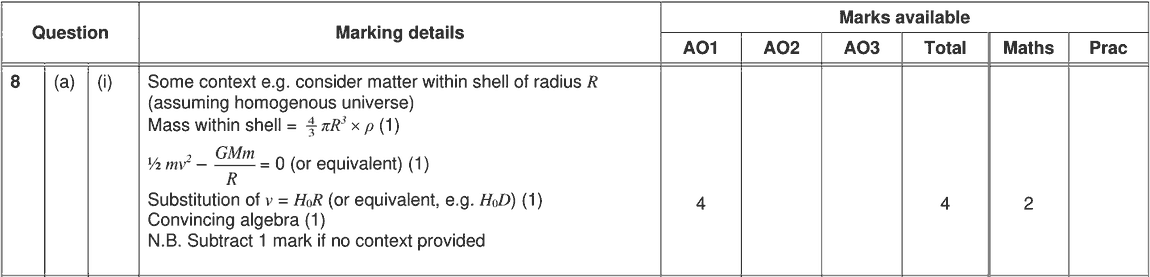
Context: a galaxy of mass m at the edge of a sphere of radius R in a uniform universe (one mark lost without it)
mass inside M = (4/3)πR³ρ (1)
½mv² − GMm/R = 0 (1)
v = H0R (1)
algebra to ρc = 3H0²/8πG (1)
Scheme columns: Maths 2
Skills: Algebra Derivations and rearranging equations; Mathsmarks The mark scheme's Maths column gives this part at least one mark for mathematical skills
June 2023 · Component 2 · Q8(a)(ii)3 marksAO3=3Calculation
Earlier part of question 8 that this part uses
Mark scheme
Examiner's comment
Candidates, overall, applied the principle of conservation of energy and equations for density and the Hubble’s Law appropriately to derive the equation for the critical density of the Universe in (a)(i). Candidates should however be encouraged to provide some context to their work, with many going straight into ‘algebra mode’ without setting the scene in terms of the rationale behind the proof being given. A simple comment such as: “consider matter within a spherical shell of radius R” (or equivalent) would at least give some context to the argument. Where this was seen full marks were awarded. One mark was deducted where no context was given. In (ii) nearly all candidates were successful in confirming the relationship between the Hubble constant and the number of atoms of hydrogen per m3 in the universe. Once again, many approaches are possible with some candidates choosing to use the value for the Hubble constant given in the data booklet and the critical density equation to determine the number of hydrogen atoms per m3, while others chose the converse approach of starting with the number of atoms to determine the corresponding Hubble constant. Both approaches are equally valid. Nearly all candidates successfully confirmed the receding velocity of the galaxy in kms-1 as required in (b)(i). In (ii) many candidates, though by no means all, were successful in using ∆𝜆 𝜆= 𝑣 𝑐 to determine Δλ. Of those candidates who successfully determined the change in wavelength a significant minority subtracted this from the original wavelength given rather than adding the two figures together. As in previous years it seems that candidates continue to have misconceptions regarding this part of the specification. In the last part it was expected that candidates would identify from part (b) that the galaxy emits radiation across a wide range of the electromagnetic spectrum, beyond that of visible light. A few candidates identified that the hydrogen line described in (b) was in the infra-red part of the spectrum for example. Using this knowledge, candidates were expected to comment on the usefulness of using the Hubble telescope to detect wavelengths beyond the visible spectrum in comparison to telescopes sensitive only to visible light. Fewer candidates than expected were able to recognise this relationship. PHYSICS GCE A LEVEL Summer 2023
Notes from the mark scheme and report
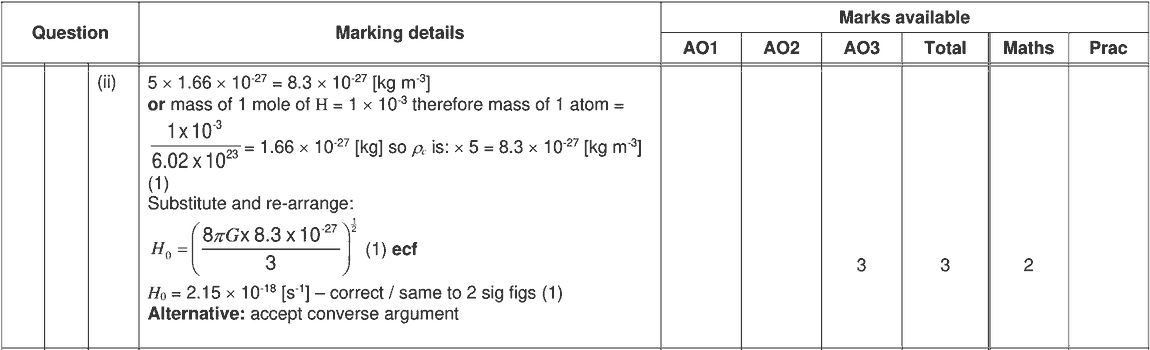
ρc = 5 × 1.66 × 10⁻²⁷ = 8.3 × 10⁻²⁷ kg m⁻³ (1)
H0 = √(8πGρc/3) (1) = 2.15 × 10⁻¹⁸ s⁻¹, agreeing with the data booklet value (2.20 × 10⁻¹⁸ s⁻¹) to 2 sf (1)
the converse argument is accepted
Scheme columns: Maths 2
Skills: Mathsmarks The mark scheme's Maths column gives this part at least one mark for mathematical skills
June 2023 · Component 2 · Q8(b)(i)2 marksAO1=1, AO2=1Show that
Earlier part of question 8 that this part uses
Mark scheme
Examiner's comment
Candidates, overall, applied the principle of conservation of energy and equations for density and the Hubble’s Law appropriately to derive the equation for the critical density of the Universe in (a)(i). Candidates should however be encouraged to provide some context to their work, with many going straight into ‘algebra mode’ without setting the scene in terms of the rationale behind the proof being given. A simple comment such as: “consider matter within a spherical shell of radius R” (or equivalent) would at least give some context to the argument. Where this was seen full marks were awarded. One mark was deducted where no context was given. In (ii) nearly all candidates were successful in confirming the relationship between the Hubble constant and the number of atoms of hydrogen per m3 in the universe. Once again, many approaches are possible with some candidates choosing to use the value for the Hubble constant given in the data booklet and the critical density equation to determine the number of hydrogen atoms per m3, while others chose the converse approach of starting with the number of atoms to determine the corresponding Hubble constant. Both approaches are equally valid. Nearly all candidates successfully confirmed the receding velocity of the galaxy in kms-1 as required in (b)(i). In (ii) many candidates, though by no means all, were successful in using ∆𝜆 𝜆= 𝑣 𝑐 to determine Δλ. Of those candidates who successfully determined the change in wavelength a significant minority subtracted this from the original wavelength given rather than adding the two figures together. As in previous years it seems that candidates continue to have misconceptions regarding this part of the specification. In the last part it was expected that candidates would identify from part (b) that the galaxy emits radiation across a wide range of the electromagnetic spectrum, beyond that of visible light. A few candidates identified that the hydrogen line described in (b) was in the infra-red part of the spectrum for example. Using this knowledge, candidates were expected to comment on the usefulness of using the Hubble telescope to detect wavelengths beyond the visible spectrum in comparison to telescopes sensitive only to visible light. Fewer candidates than expected were able to recognise this relationship. PHYSICS GCE A LEVEL Summer 2023
Notes from the mark scheme and report
D = 3.2 × 10⁹ × 9.5 × 10¹² = 3.0 × 10²² km (1)
v = H0D = 2.20 × 10⁻¹⁸ × 3.04 × 10²² = 66 900 km s⁻¹ (1)
Scheme columns: Maths 2
Skills: Unitsand conversions Unit marks, base units, prefixes and conversions; Mathsmarks The mark scheme's Maths column gives this part at least one mark for mathematical skills
June 2023 · Component 2 · Q8(b)(ii)3 marksAO2=3Calculation
Earlier parts of question 8 that this part uses
Mark scheme
Examiner's comment
Candidates, overall, applied the principle of conservation of energy and equations for density and the Hubble’s Law appropriately to derive the equation for the critical density of the Universe in (a)(i). Candidates should however be encouraged to provide some context to their work, with many going straight into ‘algebra mode’ without setting the scene in terms of the rationale behind the proof being given. A simple comment such as: “consider matter within a spherical shell of radius R” (or equivalent) would at least give some context to the argument. Where this was seen full marks were awarded. One mark was deducted where no context was given. In (ii) nearly all candidates were successful in confirming the relationship between the Hubble constant and the number of atoms of hydrogen per m3 in the universe. Once again, many approaches are possible with some candidates choosing to use the value for the Hubble constant given in the data booklet and the critical density equation to determine the number of hydrogen atoms per m3, while others chose the converse approach of starting with the number of atoms to determine the corresponding Hubble constant. Both approaches are equally valid. Nearly all candidates successfully confirmed the receding velocity of the galaxy in kms-1 as required in (b)(i). In (ii) many candidates, though by no means all, were successful in using ∆𝜆 𝜆= 𝑣 𝑐 to determine Δλ. Of those candidates who successfully determined the change in wavelength a significant minority subtracted this from the original wavelength given rather than adding the two figures together. As in previous years it seems that candidates continue to have misconceptions regarding this part of the specification. In the last part it was expected that candidates would identify from part (b) that the galaxy emits radiation across a wide range of the electromagnetic spectrum, beyond that of visible light. A few candidates identified that the hydrogen line described in (b) was in the infra-red part of the spectrum for example. Using this knowledge, candidates were expected to comment on the usefulness of using the Hubble telescope to detect wavelengths beyond the visible spectrum in comparison to telescopes sensitive only to visible light. Fewer candidates than expected were able to recognise this relationship. PHYSICS GCE A LEVEL Summer 2023
Notes from the mark scheme and report
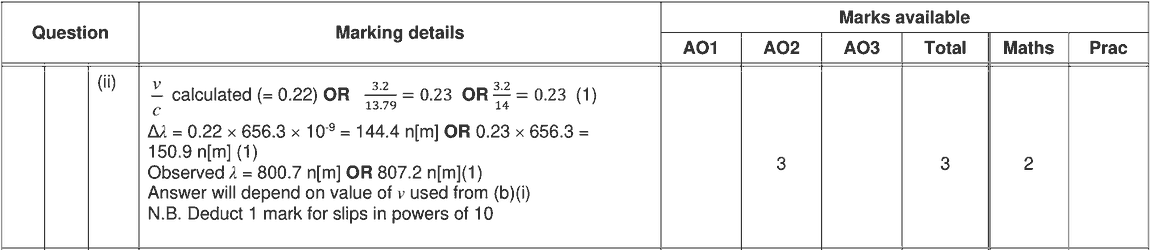
Answer: about 800 nm (801 nm with v/c = 0.22
807 nm with 0.23). Δλ = λv/c = 0.22 × 656.3 = 144 nm, added to 656.3 nm because the galaxy is receding
a significant minority subtracted
Scheme columns: Maths 2
Skills: Mathsmarks The mark scheme's Maths column gives this part at least one mark for mathematical skills
June 2022 · Component 1 · Q8(b)(i)2 marksAO2=2Explanation
Earlier part of question 8 that this part uses
Mark scheme
Examiner's comment
Most candidates understood that the blue shift would make the photon the right frequency to be absorbed…
Notes from the mark scheme and report
The atom sees the approaching photon blue-shifted by 0.6 GHz to 456 000.6 GHz (1), which is exactly the frequency of its absorption line (1)
Skills: Comprehension A level Component 1 Section B: questions on the printed article; Synoptic Needs physics from another component of the qualification
June 2022 · Component 1 · Q8(b)(ii)1 markAO2=1Short answer
Earlier parts of question 8 that this part uses
Mark scheme
Examiner's comment
… but that if the photons and atom are moving in the same direction, the photon will be red shifted, making its frequency further away from that needed.
Notes from the mark scheme and report
The photon is red-shifted (to 455 999.4 GHz), further from the absorption frequency
Skills: Comprehension A level Component 1 Section B: questions on the printed article; Synoptic Needs physics from another component of the qualification
June 2022 · Component 1 · Q8(c)4 marksAO1=1, AO2=3Calculation
Earlier part of question 8 that this part uses
Mark scheme
Examiner's comment
The change in wavelength, ∆𝜆, of photons as ‘seen’ by helium atoms moving towards them was calculated directly by many candidates. Sometimes ∆𝜆 was found, with more labour, by first calculating the frequency shift. Candidates then needed to realise that the laser wavelength needed to be greater by ∆𝜆 than the helium absorption (or emission) wavelength, so that blue-shifted photons would be absorbed by approaching atoms. Many candidates subtracted rather than added ∆𝜆. They lost one mark.
the laser wavelength must be longer than the emission line so that the atom sees it blue-shifted on to the line
many subtracted Δλ and lost one mark
Scheme columns: Maths 3
Skills: Comprehension A level Component 1 Section B: questions on the printed article; Synoptic Needs physics from another component of the qualification; Mathsmarks The mark scheme's Maths column gives this part at least one mark for mathematical skills
June 2022 · Component 2 · Q7(a)(i)2 marksAO1=1, AO2=1Show that
Mark scheme
Examiner's comment
Many candidates were able to relate the age of the universe to the Hubble constant as required.
Notes from the mark scheme and report
Assumption: the universe has expanded at a constant rate (galaxies recede at constant velocity) (1)
D = vT in v = H0D gives v = H0vT, so T = 1/H0 (1)
Scheme columns: Maths 1
Skills: Algebra Derivations and rearranging equations; Mathsmarks The mark scheme's Maths column gives this part at least one mark for mathematical skills
June 2022 · Component 2 · Q7(a)(ii)4 marksAO2=4Calculation
Earlier part of question 7 that this part uses
Mark scheme
Examiner's comment
The majority of candidates used the Doppler and Hubble equations correctly to determine the age of the universe, however a few candidates failed to give an appropriate unit for their answers to the age of the universe and were deducted one mark.
Notes from the mark scheme and report
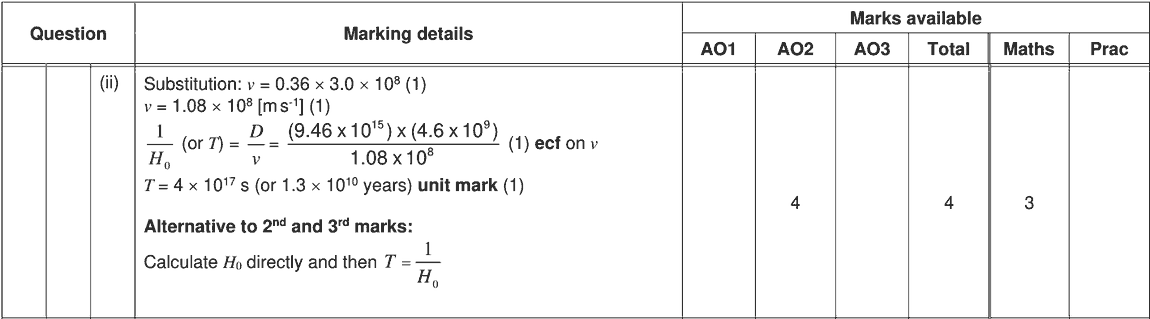
Answer: 4.0 × 10¹⁷ s (1.3 × 10¹⁰ years). v = 0.36c = 1.08 × 10⁸ m s⁻¹
D = 4.60 × 10⁹ × 9.46 × 10¹⁵ m
T = 1/H0 = D/v
unit mark, sometimes lost
Scheme columns: Maths 3
Skills: Unitsand conversions Unit marks, base units, prefixes and conversions; Mathsmarks The mark scheme's Maths column gives this part at least one mark for mathematical skills
June 2022 · Component 2 · Q7(b)(i)2 marksAO2=2Calculation
Earlier part of question 7 that this part uses
Mark scheme
Examiner's comment
Nearly all candidates were able to determine the theoretical orbital speed of dust particles.
Notes from the mark scheme and report
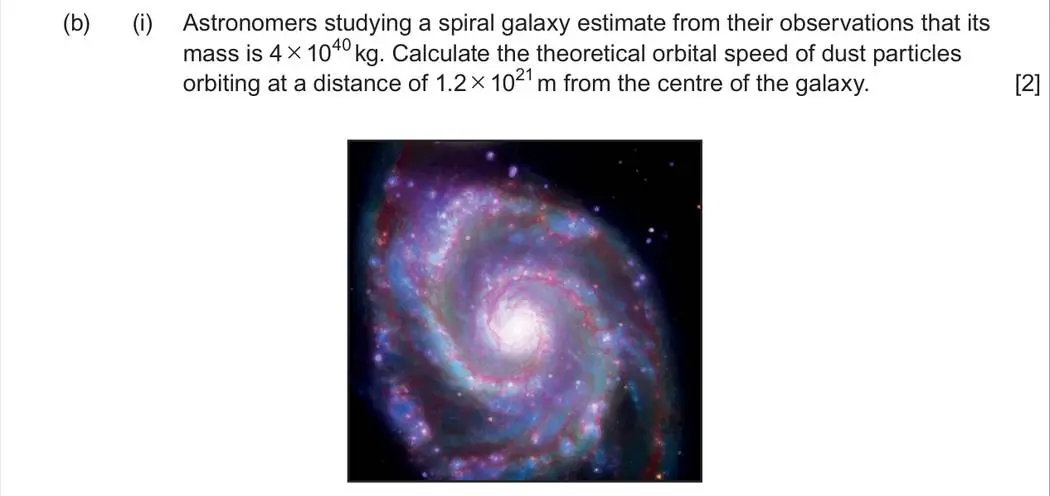
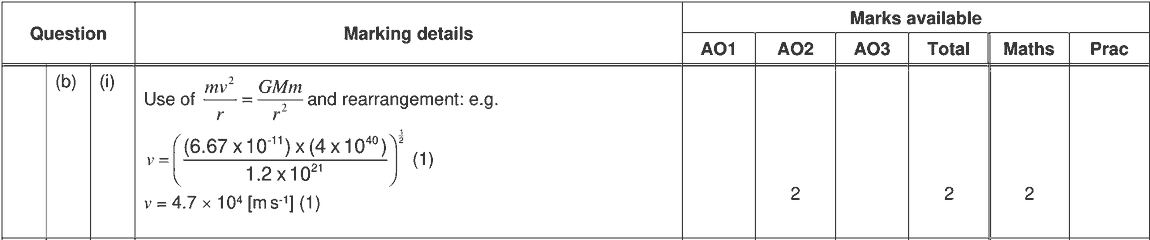
Answer: 4.7 × 10⁴ m s⁻¹. mv²/r = GMm/r² so v = √(GM/r) = √(6.67 × 10⁻¹¹ × 4 × 10⁴⁰/1.2 × 10²¹)
Scheme columns: Maths 2
Skills: Mathsmarks The mark scheme's Maths column gives this part at least one mark for mathematical skills
June 2022 · Component 2 · Q7(b)(ii)2 marksAO1=2Explanation
Earlier parts of question 7 that this part uses
Mark scheme
Examiner's comment
Most candidates referred to ‘dark matter’, however fewer made the link between dark matter and additional mass for the second mark.
Notes from the mark scheme and report
The galaxy must contain more mass than is observed (1), in the form of dark matter that cannot be detected directly (1)
many named dark matter without linking it to extra mass
October 2021 · Component 2 · Q7(a)(i)1 markAO2=1Short answer
Mark scheme
Notes from the mark scheme and report
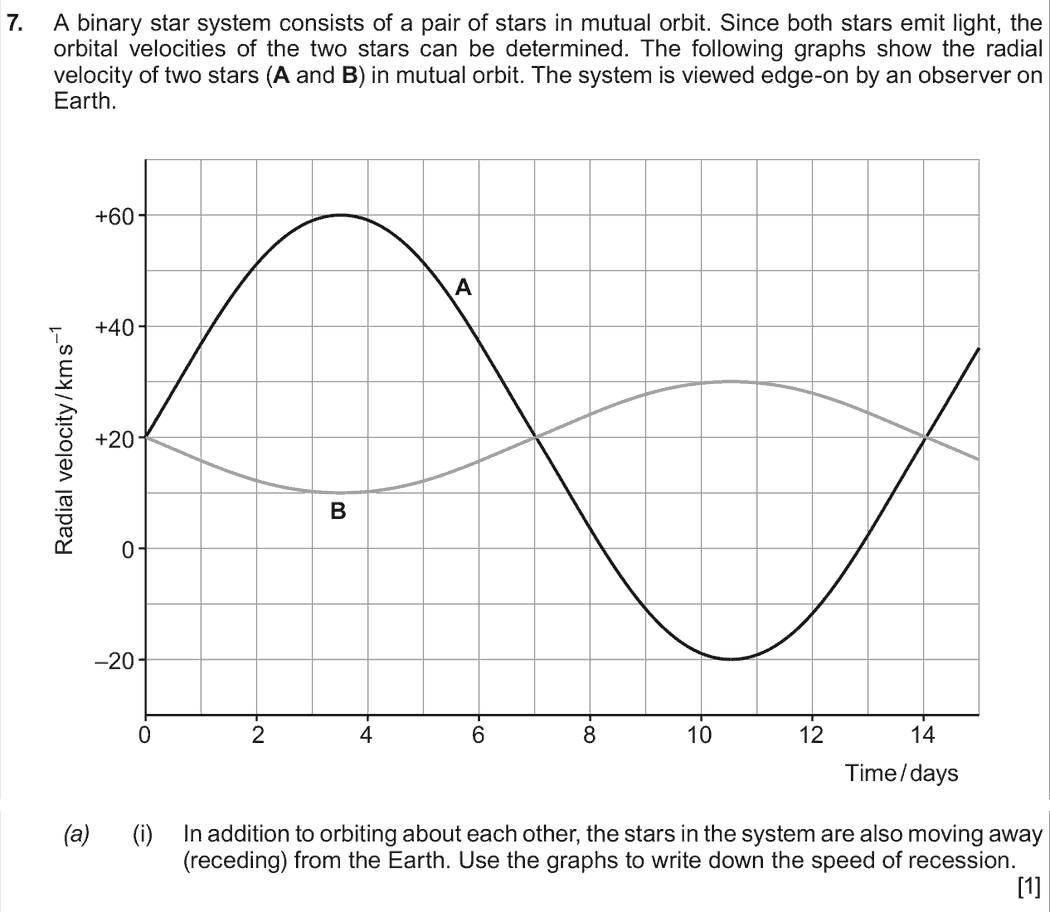
Answer: 20 km s⁻¹, the mean value about which both radial velocity curves oscillate
unit mark
Scheme columns: Maths 1
Skills: Graphskills Reading, plotting or sketching graphs; gradients, intercepts and areas; Mathsmarks The mark scheme's Maths column gives this part at least one mark for mathematical skills
October 2021 · Component 2 · Q7(a)(ii)2 marksAO2=2Show that
Earlier part of question 7 that this part uses
Mark scheme
Notes from the mark scheme and report
Peak radial velocities 60 km s⁻¹ (A) and 30 km s⁻¹ (B) (1)
subtract the 20 km s⁻¹ recession: orbital speeds 40 and 10 km s⁻¹, a ratio of 4 (1)
Scheme columns: Maths 2
Skills: Graphskills Reading, plotting or sketching graphs; gradients, intercepts and areas; Mathsmarks The mark scheme's Maths column gives this part at least one mark for mathematical skills
October 2021 · Component 2 · Q7(a)(iii)3 marksAO2=3Calculation
Earlier part of question 7 that this part uses
Mark scheme
Notes from the mark scheme and report
Answer: 7.7 × 10⁹ m (7.70 × 10⁶ km). Period 14 days from the graph
r = vT/2π = 40 × 10³ × 14 × 24 × 3600/2π
Scheme columns: Maths 2
Skills: Graphskills Reading, plotting or sketching graphs; gradients, intercepts and areas; Unitsand conversions Unit marks, base units, prefixes and conversions; Mathsmarks The mark scheme's Maths column gives this part at least one mark for mathematical skills
October 2021 · Component 2 · Q7(a)(iv)2 marksAO2=2Calculation
Earlier part of question 7 that this part uses
Mark scheme
Notes from the mark scheme and report
Answer: 9.6 × 10⁹ m (9.63 × 10⁶ km). Radius of B's orbit = a quarter of A's = 1.93 × 10⁹ m
separation = sum of the two radii
Scheme columns: Maths 1
Skills: Mathsmarks The mark scheme's Maths column gives this part at least one mark for mathematical skills
October 2021 · Component 2 · Q7(b)(i)3 marksAO1=1, AO2=2Calculation
Earlier part of question 7 that this part uses
Mark scheme
Notes from the mark scheme and report
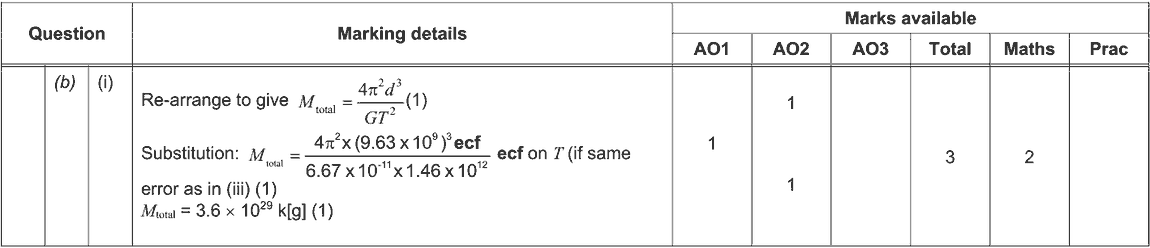
Answer: 3.6 × 10²⁹ kg. T = 2π√(d³/G(M1 + M2)) so M total = 4π²d³/GT² = 4π² × (9.63 × 10⁹)³/(6.67 × 10⁻¹¹ × (1.21 × 10⁶)²)
ecf on d and T
Scheme columns: Maths 2
Skills: Mathsmarks The mark scheme's Maths column gives this part at least one mark for mathematical skills
October 2021 · Component 2 · Q7(b)(ii)2 marksAO2=2Calculation
Earlier parts of question 7 that this part uses
Mark scheme
Notes from the mark scheme and report
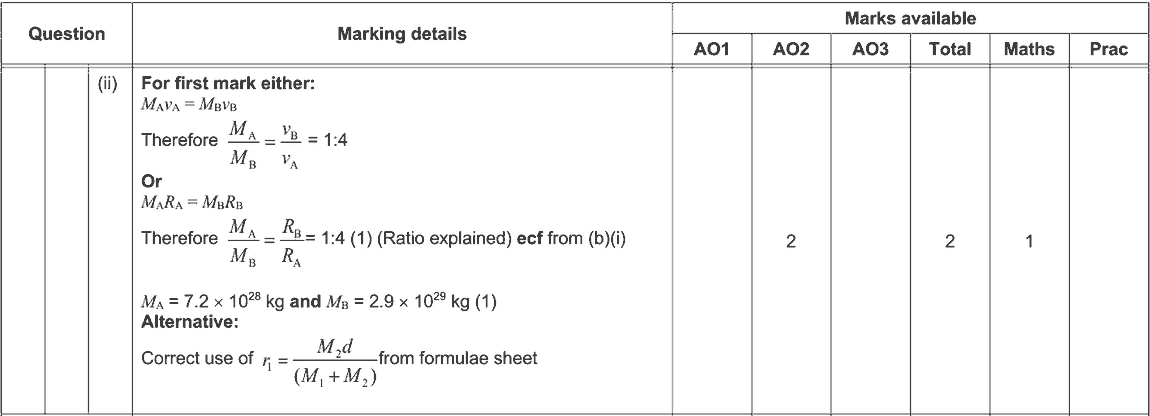
Answer: M(A) = 7.2 × 10²⁸ kg, M(B) = 2.9 × 10²⁹ kg. Centre of mass: M(A)r(A) = M(B)r(B) (or M(A)v(A) = M(B)v(B)), so M(A):M(B) = 1:4 (1)
one fifth and four fifths of the total (1)
ecf from (b)(i)
Scheme columns: Maths 1
Skills: Mathsmarks The mark scheme's Maths column gives this part at least one mark for mathematical skills
October 2021 · Component 2 · Q8(a)3 marksAO3=3Show that
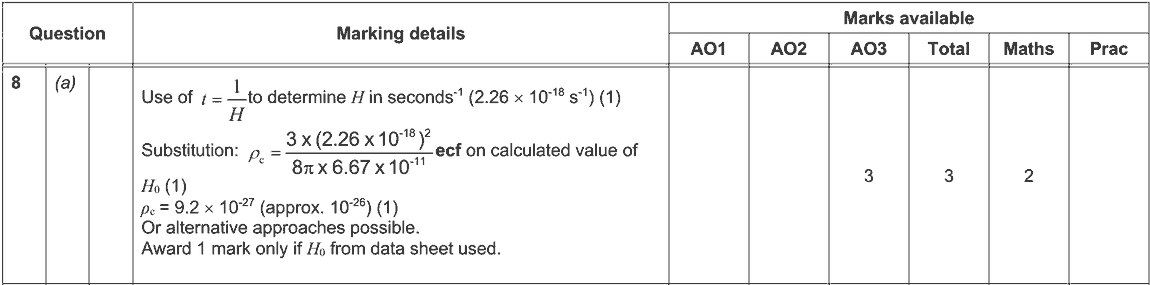
critical density = 3H0²/8πG = 3 × (2.26 × 10⁻¹⁸)²/(8π × 6.67 × 10⁻¹¹) (1) = 9.2 × 10⁻²⁷ kg m⁻³, about 10⁻²⁶ (1). Only 1 mark if the data-sheet H0 is used instead
Scheme columns: Maths 2
Skills: Unitsand conversions Unit marks, base units, prefixes and conversions; Mathsmarks The mark scheme's Maths column gives this part at least one mark for mathematical skills
October 2021 · Component 2 · Q8(b)(i)2 marksAO1=2Explanation
Earlier part of question 8 that this part uses
Mark scheme
Notes from the mark scheme and report
The galaxy is moving away from the Earth (receding) (1), because the measured wavelength is longer than the laboratory value: a red shift (1)
October 2021 · Component 2 · Q8(b)(ii)3 marksAO2=3Calculation
Earlier parts of question 8 that this part uses
Mark scheme
Notes from the mark scheme and report
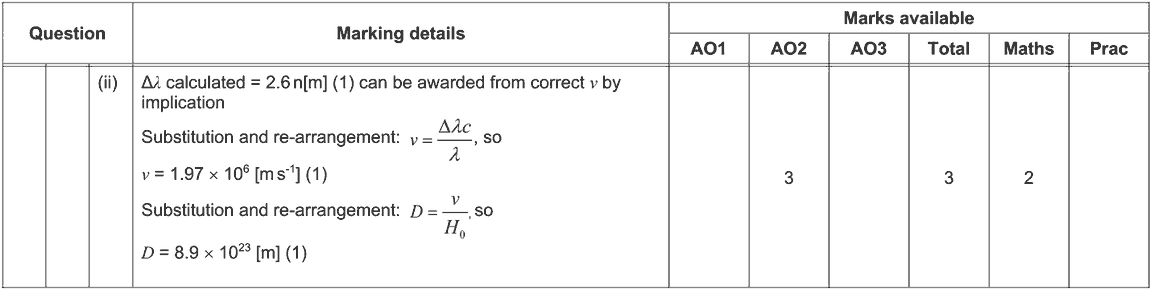
Answer: 8.9 × 10²³ m. Δλ = 2.6 nm
v = cΔλ/λ = 3.00 × 10⁸ × 2.6/396.8 = 1.97 × 10⁶ m s⁻¹
D = v/H0 with H0 = 2.20 × 10⁻¹⁸ s⁻¹ from the data sheet
Scheme columns: Maths 2
Skills: Unitsand conversions Unit marks, base units, prefixes and conversions; Mathsmarks The mark scheme's Maths column gives this part at least one mark for mathematical skills
October 2021 · Component 2 · Q8(c)3 marksAO3=3Explanation
Earlier part of question 8 that this part uses
Mark scheme
Notes from the mark scheme and report
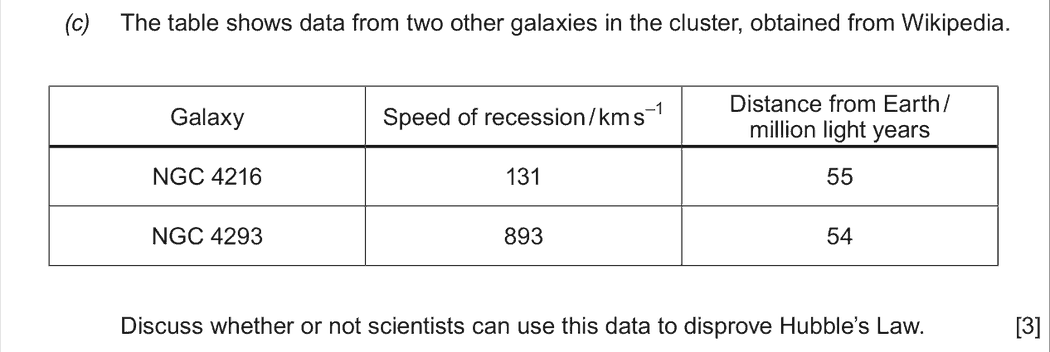
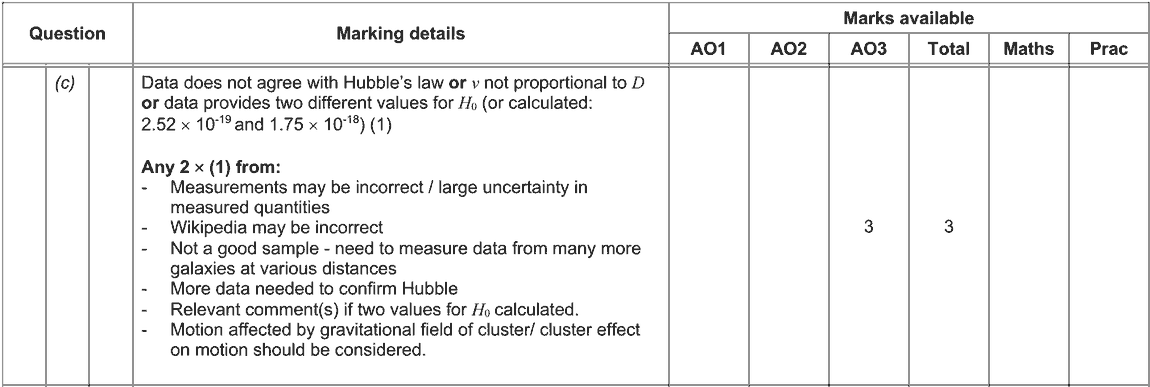
The data do not fit Hubble's law: nearly equal distances but very different speeds, giving two values of H0 (2.5 × 10⁻¹⁹ and 1.75 × 10⁻¹⁸ s⁻¹) (1). Any two: measurements may be wrong or have large uncertainties
Wikipedia may be unreliable
two galaxies is too small a sample, many galaxies over a range of distances are needed
motion within the cluster's gravitational field adds to the Hubble flow
October 2020 · Component 1 · Q8(g)(i)2 marksAO1=2Definition
Earlier part of question 8 that this part uses
Mark scheme
Examiner's comment
disappointingly many candidates couldn’t clearly explain the meaning of Doppler Effect. Most could quote the relevant equation, but few attempted to “describe how the exhaust speed might be measured”; mention of where the light or infra-red came from would have been welcome. Summary of key points When drawing lines on graphs always check to see if a best fit line is appropriate or lines of greatest and least gradient can be drawn. Always consider what uncertainty is required, is it the absolute uncertainty or the percentage uncertainty? Make sure that all areas of book work are learnt e.g. a weaker area in this paper was critical damping and ensure that qualitative responses are carefully constructed e.g. is heat flowing in or out. PHYSICS GCE A LEVEL Autumn 2020
Notes from the mark scheme and report
A change in the observed wavelength (or frequency) of a wave (1) caused by relative motion of the source and the observer (1)
synoptic with Component 2
many could not explain it clearly
Skills: Comprehension A level Component 1 Section B: questions on the printed article; Synoptic Needs physics from another component of the qualification
October 2020 · Component 1 · Q8(g)(ii)3 marksAO3=3Explanation
Earlier parts of question 8 that this part uses
Mark scheme
Examiner's comment
disappointingly many candidates couldn’t clearly explain the meaning of Doppler Effect. Most could quote the relevant equation, but few attempted to “describe how the exhaust speed might be measured”; mention of where the light or infra-red came from would have been welcome. Summary of key points When drawing lines on graphs always check to see if a best fit line is appropriate or lines of greatest and least gradient can be drawn. Always consider what uncertainty is required, is it the absolute uncertainty or the percentage uncertainty? Make sure that all areas of book work are learnt e.g. a weaker area in this paper was critical damping and ensure that qualitative responses are carefully constructed e.g. is heat flowing in or out. PHYSICS GCE A LEVEL Autumn 2020
Notes from the mark scheme and report
Collect light from the exhaust gases with a telescope or detector looking along the direction of the exhaust (1)
use a spectrometer (diffraction grating or prism) to measure the shift in wavelength of a known spectral line (1)
v = cΔλ/λ (1)
most quoted the equation but did not describe the measurement
Skills: Comprehension A level Component 1 Section B: questions on the printed article; Synoptic Needs physics from another component of the qualification
October 2020 · Component 2 · Q7(a)2 marksAO1=2Diagram or graph
Mark scheme
Examiner's comment
In explaining Kepler’s second law of planetary motion, it was expected that responses referred to ‘equal areas’ swept out in ‘equal time intervals’. Candidates were expected to add to the given diagram to reinforce their answers. The majority of responses either focused on the ‘time’ aspect or the ‘area’ aspect, but few linked both together to give a complete answer. In (b), fewer than expected candidates were able to show that T2 α r3 starting from Newton’s law of gravitation. Good responses were seen for part (c), with nearly all candidates able to determine the mass of Mars and also confirm the gravitational potential at the Phobos orbit. Fewer candidates were able to determine whether or not the spacecraft should attempt the manoeuvre described, however the majority were able to obtain some credit for responses which were partially correct. Nearly all candidates gave a correct response as to why it was not possible to use the equation ∆Ep = mg∆h.
Notes from the mark scheme and report
Sectors drawn from the star to the orbit for equal time intervals at different parts of the orbit (1)
the areas swept out are equal, A1 = A2 (1)
most gave either the time or the area idea but not both
October 2020 · Component 2 · Q7(b)3 marksAO1=1, AO2=2Show that
Earlier part of question 7 that this part uses
Mark scheme
Examiner's comment
In explaining Kepler’s second law of planetary motion, it was expected that responses referred to ‘equal areas’ swept out in ‘equal time intervals’. Candidates were expected to add to the given diagram to reinforce their answers. The majority of responses either focused on the ‘time’ aspect or the ‘area’ aspect, but few linked both together to give a complete answer. In (b), fewer than expected candidates were able to show that T2 α r3 starting from Newton’s law of gravitation. Good responses were seen for part (c), with nearly all candidates able to determine the mass of Mars and also confirm the gravitational potential at the Phobos orbit. Fewer candidates were able to determine whether or not the spacecraft should attempt the manoeuvre described, however the majority were able to obtain some credit for responses which were partially correct. Nearly all candidates gave a correct response as to why it was not possible to use the equation ∆Ep = mg∆h.
Notes from the mark scheme and report
GMm/r² = mv²/r (or mrω²) (1)
v = 2πr/T (or ω = 2π/T) (1)
substitute to get T² = 4π²r³/GM, so T² is proportional to r³ (1)
fewer than expected completed it
Scheme columns: Maths 2
Skills: Algebra Derivations and rearranging equations; Mathsmarks The mark scheme's Maths column gives this part at least one mark for mathematical skills
October 2020 · Component 2 · Q7(c)(i)3 marksAO2=3Show that
Earlier part of question 7 that this part uses
Mark scheme
Examiner's comment
In explaining Kepler’s second law of planetary motion, it was expected that responses referred to ‘equal areas’ swept out in ‘equal time intervals’. Candidates were expected to add to the given diagram to reinforce their answers. The majority of responses either focused on the ‘time’ aspect or the ‘area’ aspect, but few linked both together to give a complete answer. In (b), fewer than expected candidates were able to show that T2 α r3 starting from Newton’s law of gravitation. Good responses were seen for part (c), with nearly all candidates able to determine the mass of Mars and also confirm the gravitational potential at the Phobos orbit. Fewer candidates were able to determine whether or not the spacecraft should attempt the manoeuvre described, however the majority were able to obtain some credit for responses which were partially correct. Nearly all candidates gave a correct response as to why it was not possible to use the equation ∆Ep = mg∆h.
Notes from the mark scheme and report
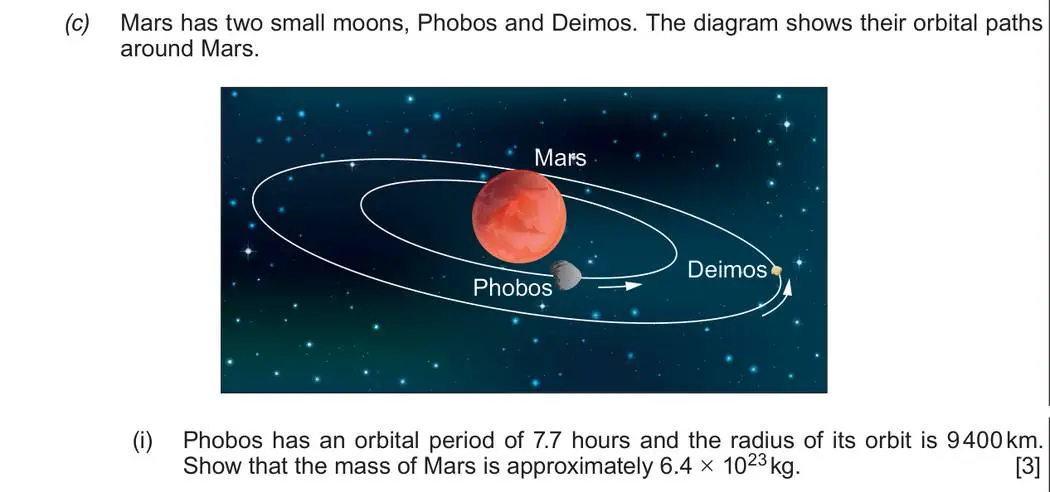
ω = 2π/(7.7 × 3600) = 2.27 × 10⁻⁴ rad s⁻¹
M = ω²r³/G = (2.27 × 10⁻⁴)² × (9.4 × 10⁶)³/6.67 × 10⁻¹¹ = 6.4 × 10²³ kg
Scheme columns: Maths 3
Skills: Unitsand conversions Unit marks, base units, prefixes and conversions; Mathsmarks The mark scheme's Maths column gives this part at least one mark for mathematical skills
October 2020 · Component 2 · Q8(a)2 marksAO1=1, AO2=1Calculation
Mark scheme
Examiner's comment
Nearly all candidates calculated the critical density of the universe correctly, giving appropriate units. It was noted that a significant number of candidates gave the units as s-2 N-1 m-2 kg2, using the terms directly from the critical density equation it would seem. This was credited. Few candidates were able to show the increase in separation of two objects as a fraction of their original separation over a period of 2 billion years. Surprisingly, a significant number of candidates also failed to calculate the radial velocity in (c)(i), with a significant number using 475 nm as the reference wavelength instead of 410 nm. No credit was given for this fundamental error; however error carried forward was applied to (ii) where the majority of candidates were able to correctly calculate the distance of the star from the Earth. Part (c)(iii) was a further synoptic based question requiring knowledge from outside of this component. Only a few candidates correctly calculated the mean kinetic energy of particles in the photosphere. Summary of key points Surface area or cross-sectional area are two quantities that are frequently being confused, encourage candidates to think carefully before answering questions requiring one of these quantities. It is a requirement that synoptic questions appear on all three examination papers, candidates need to be reminded of this. Expressing a ‘final answer’ with its uncertainty to an appropriate number of significant figures is an area that needs to be developed. The term multiwavelength astronomy was unfamiliar to many candidates. PHYSICS GCE A LEVEL Autumn 2020
Notes from the mark scheme and report
Answer: 8.66 × 10⁻²⁷ kg m⁻³. ρc = 3H0²/8πG with H0 = 2.20 × 10⁻¹⁸ s⁻¹
unit mark
Scheme columns: Maths 2
Skills: Mathsmarks The mark scheme's Maths column gives this part at least one mark for mathematical skills
October 2020 · Component 2 · Q8(b)3 marksAO3=3Calculation
Earlier part of question 8 that this part uses
Mark scheme
Examiner's comment
Nearly all candidates calculated the critical density of the universe correctly, giving appropriate units. It was noted that a significant number of candidates gave the units as s-2 N-1 m-2 kg2, using the terms directly from the critical density equation it would seem. This was credited. Few candidates were able to show the increase in separation of two objects as a fraction of their original separation over a period of 2 billion years. Surprisingly, a significant number of candidates also failed to calculate the radial velocity in (c)(i), with a significant number using 475 nm as the reference wavelength instead of 410 nm. No credit was given for this fundamental error; however error carried forward was applied to (ii) where the majority of candidates were able to correctly calculate the distance of the star from the Earth. Part (c)(iii) was a further synoptic based question requiring knowledge from outside of this component. Only a few candidates correctly calculated the mean kinetic energy of particles in the photosphere. Summary of key points Surface area or cross-sectional area are two quantities that are frequently being confused, encourage candidates to think carefully before answering questions requiring one of these quantities. It is a requirement that synoptic questions appear on all three examination papers, candidates need to be reminded of this. Expressing a ‘final answer’ with its uncertainty to an appropriate number of significant figures is an area that needs to be developed. The term multiwavelength astronomy was unfamiliar to many candidates. PHYSICS GCE A LEVEL Autumn 2020
Notes from the mark scheme and report
Recession speed v = H0R
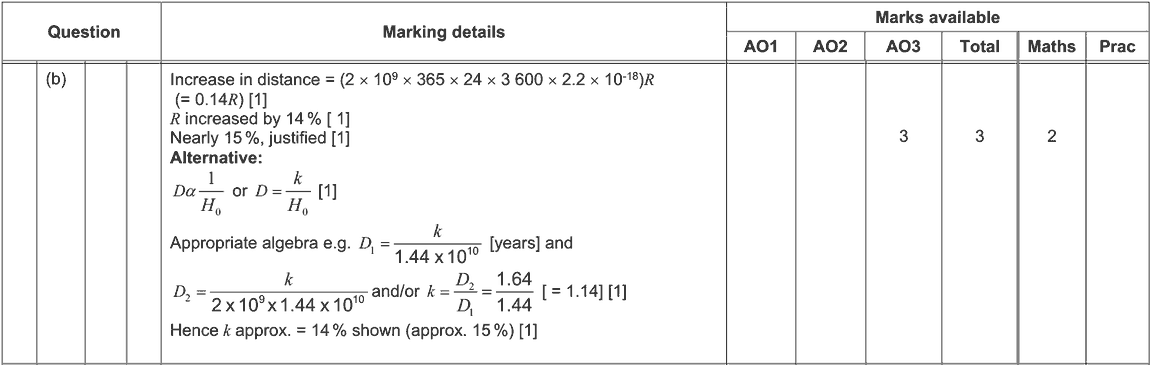
increase in separation = H0R × t = 2.2 × 10⁻¹⁸ × (2 × 10⁹ × 365 × 24 × 3600) × R = 0.14R (1)
a 14% increase (1), i.e. nearly 15% (1)
few managed it
Scheme columns: Maths 2
Skills: Unitsand conversions Unit marks, base units, prefixes and conversions; Mathsmarks The mark scheme's Maths column gives this part at least one mark for mathematical skills
October 2020 · Component 2 · Q8(c)(i)2 marksAO2=2Calculation
Earlier part of question 8 that this part uses
Mark scheme
Examiner's comment
Nearly all candidates calculated the critical density of the universe correctly, giving appropriate units. It was noted that a significant number of candidates gave the units as s-2 N-1 m-2 kg2, using the terms directly from the critical density equation it would seem. This was credited. Few candidates were able to show the increase in separation of two objects as a fraction of their original separation over a period of 2 billion years. Surprisingly, a significant number of candidates also failed to calculate the radial velocity in (c)(i), with a significant number using 475 nm as the reference wavelength instead of 410 nm. No credit was given for this fundamental error; however error carried forward was applied to (ii) where the majority of candidates were able to correctly calculate the distance of the star from the Earth. Part (c)(iii) was a further synoptic based question requiring knowledge from outside of this component. Only a few candidates correctly calculated the mean kinetic energy of particles in the photosphere. Summary of key points Surface area or cross-sectional area are two quantities that are frequently being confused, encourage candidates to think carefully before answering questions requiring one of these quantities. It is a requirement that synoptic questions appear on all three examination papers, candidates need to be reminded of this. Expressing a ‘final answer’ with its uncertainty to an appropriate number of significant figures is an area that needs to be developed. The term multiwavelength astronomy was unfamiliar to many candidates. PHYSICS GCE A LEVEL Autumn 2020
using 475 nm as the reference wavelength scored nothing
Scheme columns: Maths 2
Skills: Mathsmarks The mark scheme's Maths column gives this part at least one mark for mathematical skills
October 2020 · Component 2 · Q8(c)(ii)2 marksCalculation
Earlier parts of question 8 that this part uses
Examiner's comment
Nearly all candidates calculated the critical density of the universe correctly, giving appropriate units. It was noted that a significant number of candidates gave the units as s-2 N-1 m-2 kg2, using the terms directly from the critical density equation it would seem. This was credited. Few candidates were able to show the increase in separation of two objects as a fraction of their original separation over a period of 2 billion years. Surprisingly, a significant number of candidates also failed to calculate the radial velocity in (c)(i), with a significant number using 475 nm as the reference wavelength instead of 410 nm. No credit was given for this fundamental error; however error carried forward was applied to (ii) where the majority of candidates were able to correctly calculate the distance of the star from the Earth. Part (c)(iii) was a further synoptic based question requiring knowledge from outside of this component. Only a few candidates correctly calculated the mean kinetic energy of particles in the photosphere. Summary of key points Surface area or cross-sectional area are two quantities that are frequently being confused, encourage candidates to think carefully before answering questions requiring one of these quantities. It is a requirement that synoptic questions appear on all three examination papers, candidates need to be reminded of this. Expressing a ‘final answer’ with its uncertainty to an appropriate number of significant figures is an area that needs to be developed. The term multiwavelength astronomy was unfamiliar to many candidates. PHYSICS GCE A LEVEL Autumn 2020
Notes from the mark scheme and report
Answer: 2.2 × 10²⁵ m. D = v/H0 = 4.8 × 10⁷/2.20 × 10⁻¹⁸
ecf from (i). Mark scheme row not matched (no scheme text or crop)
June 2019 · Component 2 · Q7(a)(i)2 marksAO1=1, AO2=1Calculation
Mark scheme
Examiner's comment
and (ii) Nearly all candidates correctly calculated the period and the centre of mass from the centre of the star.
Notes from the mark scheme and report
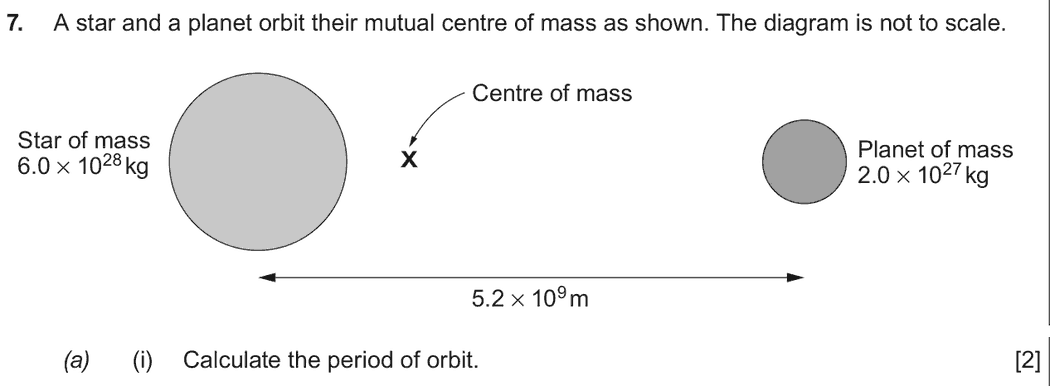
Answer: 1.16 × 10⁶ s. T = 2π√(d³/G(M₁ + M₂)) with d = 5.2 × 10⁹ m and total mass 6.2 × 10²⁸ kg (1) (1)
ignoring the planet's mass gives 1.18 × 10⁶ s for 1 mark
Scheme columns: Maths 1
Skills: Mathsmarks The mark scheme's Maths column gives this part at least one mark for mathematical skills
June 2019 · Component 2 · Q7(a)(ii)2 marksAO1=1, AO2=1Calculation
Skills: Mathsmarks The mark scheme's Maths column gives this part at least one mark for mathematical skills
June 2019 · Component 2 · Q7(b)4 marksAO3=4Calculation
Earlier part of question 7 that this part uses
Mark scheme
Examiner's comment
Most candidates went down the route of using Doppler shift to calculate the speed of the star and then compared it with the value gained using 2 r T , rather than predicting the wavelength shift and comparing it with 2.0 pm. Both methods are valid. Most candidates were successful in confirming the consistency of their answers to (a)(i) and (ii), whichever method was chosen.
Notes from the mark scheme and report
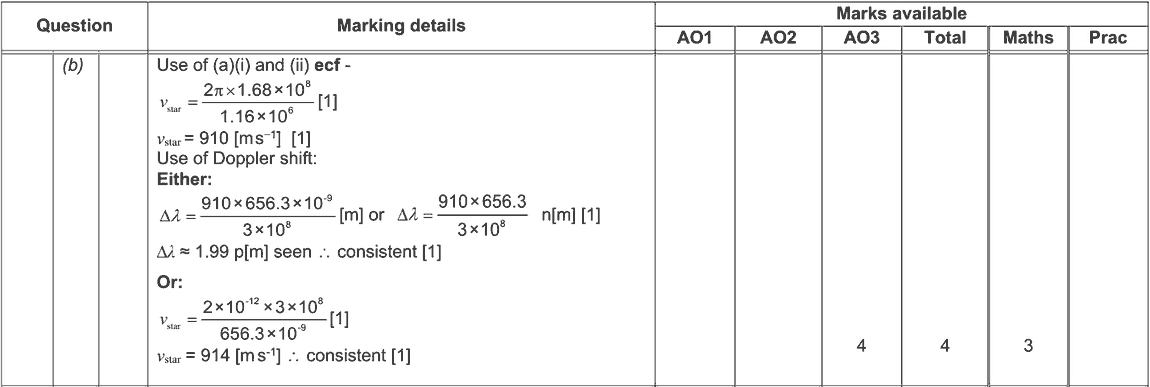
Star's orbital speed v = 2πr/T = 2π × 1.68 × 10⁸/1.16 × 10⁶ (1) = 910 m s⁻¹ (1)
or work back from 2.0 pm to v = 914 m s⁻¹ and compare
ecf
Scheme columns: Maths 3
Skills: Mathsmarks The mark scheme's Maths column gives this part at least one mark for mathematical skills
June 2019 · Component 2 · Q7(c)1 markAO3=1Short answer
Earlier part of question 7 that this part uses
Mark scheme
Examiner's comment
The majority of candidates gained this mark by stating that the planet moves in front of the star (or equivalent).
Notes from the mark scheme and report
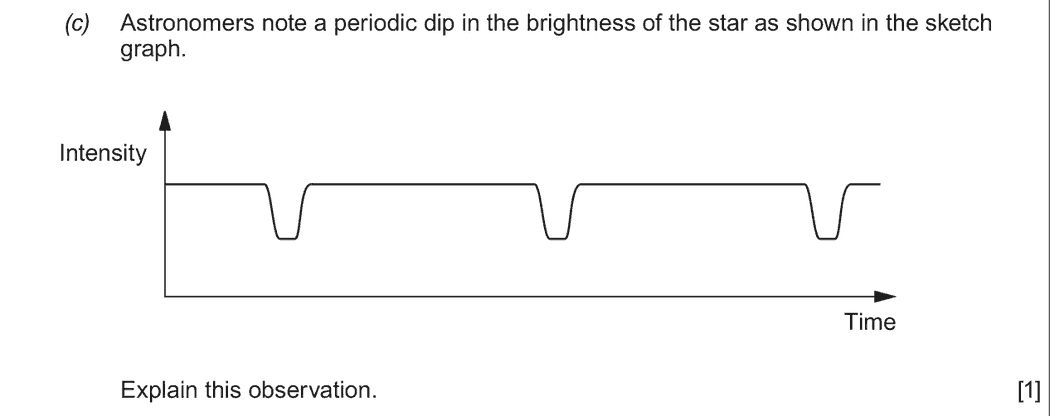
The planet passes in front of the star once per orbit (a transit), blocking a little of its light
Skills: Graphskills Reading, plotting or sketching graphs; gradients, intercepts and areas
June 2018 · Component 1 · Q2(b)(ii)2 marksAO2=2Explanation
Earlier parts of question 2 that this part uses
Mark scheme
Examiner's comment
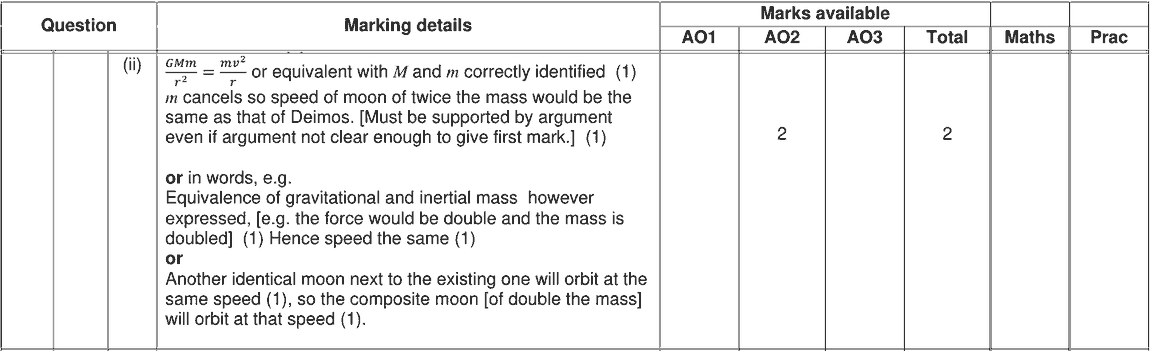
Most candidates, often citing v GMm m r r , argued convincingly that a moon of twice the mass of Deimos but in the same orbit would have the same speed. A substantial minority (not alert to synopticity?) claimed that the force would be the same, and so the speed would be less.
Notes from the mark scheme and report
GMm/r² = mv²/r with M and m identified (1)
m cancels so the speed is the same (1)
or in words: the force doubles and so does the mass. Synoptic with Component 2 gravitation
a substantial minority assumed the force stays the same so the speed falls
Skills: Synoptic Needs physics from another component of the qualification; Algebra Derivations and rearranging equations
June 2018 · Component 2 · Q4(a)(i)4 marksAO1=4Show that
Mark scheme
Examiner's comment
In order to gain the first mark, it was expected that candidates provide some context: e.g. ‘consider matter within a radius R (or shell)’. A simple diagram depicting a shell of radius R would have been credited. This was rarely seen with nearly all candidates opting to begin with an equation showing energy conservation as applied to this context. The derivations on the whole were very good, and consequently most candidates scored 3 out of 4 here.
Notes from the mark scheme and report
Consider a galaxy of mass m at the edge of a sphere of radius R of the (homogeneous) universe (1)
mass inside M = (4/3)πR³ρ
for a flat universe ½mv² − GMm/R = 0 (1)
substitute v = H₀R (1)
algebra to ρc = 3H₀²/8πG (1)
the opening context was rarely given so 3 out of 4 was typical
Scheme columns: Maths 3
Skills: Algebra Derivations and rearranging equations; Mathsmarks The mark scheme's Maths column gives this part at least one mark for mathematical skills
June 2018 · Component 2 · Q4(a)(ii)2 marksAO2=2Show that
Earlier part of question 4 that this part uses
Mark scheme
Examiner's comment
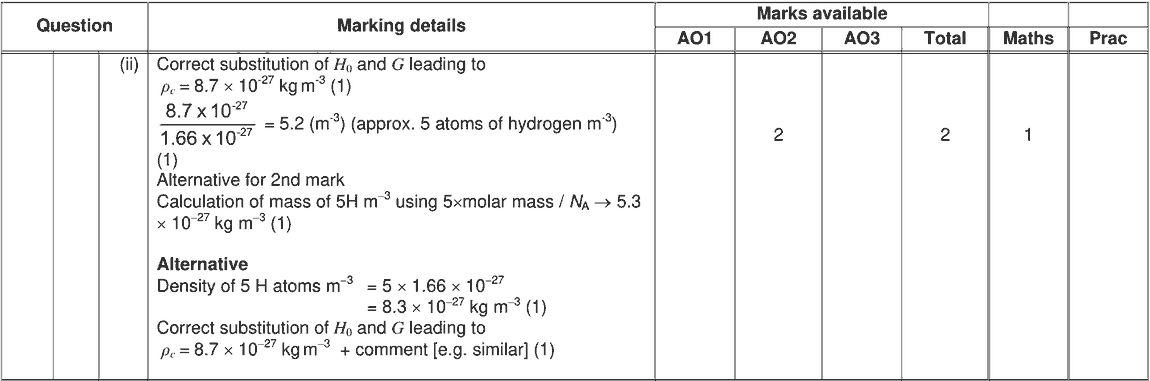
Nearly all candidates could show that the critical density of the universe corresponded to approximately 5 atoms of hydrogen per m3.
divided by the mass of a hydrogen atom 1.66 × 10⁻²⁷ kg gives 5.2 atoms per m³ (1)
Scheme columns: Maths 1
Skills: Unitsand conversions Unit marks, base units, prefixes and conversions; Mathsmarks The mark scheme's Maths column gives this part at least one mark for mathematical skills
June 2018 · Component 2 · Q4(b)(i)1 markAO1=1Short answer
Earlier part of question 4 that this part uses
Mark scheme
Examiner's comment
Most candidates stated correctly that the increase in wavelength was due to the expansion of the universe or equivalent.
Notes from the mark scheme and report
The universe (space) is expanding, or the galaxy is receding so the light is Doppler shifted
'red shift' alone not enough
June 2018 · Component 2 · Q4(b)(ii)3 marksAO1=1, AO2=2Calculation
Earlier parts of question 4 that this part uses
Mark scheme
Examiner's comment
Nearly all candidates used the appropriate equation v c . However, a significant minority did so incorrectly, with many giving 116% rather that 16% as their value for ∆.
Notes from the mark scheme and report
Answer: 2.2 × 10²⁵ m. Δλ/λ = v/c with Δλ/λ = 0.16 (1)
v = 0.16 × 3.00 × 10⁸ = 4.8 × 10⁷ m s⁻¹ (1)
D = v/H₀ = 4.8 × 10⁷/2.20 × 10⁻¹⁸ (1)
common error: using 1.16
Scheme columns: Maths 2
Skills: Mathsmarks The mark scheme's Maths column gives this part at least one mark for mathematical skills
June 2018 · Component 2 · Q4(c)3 marksAO1=1, AO2=2Calculation
Earlier part of question 4 that this part uses
Mark scheme
Examiner's comment
Nearly all candidates gained at least two marks out of three here. Stating an incorrect assumption (or not stating one at all) or forgetting to convert the age of the universe from seconds to years were the most common reasons for not awarding marks.
Notes from the mark scheme and report
Answer: 1.4 × 10¹⁰ years. Assumption: the universe has expanded at a constant rate (H₀ constant) since the Big Bang (1)
age = 1/H₀ = 4.55 × 10¹⁷ s (1)
converted to years (1)
marks lost for a missing or wrong assumption or leaving the answer in seconds
Scheme columns: Maths 2
Skills: Unitsand conversions Unit marks, base units, prefixes and conversions; Mathsmarks The mark scheme's Maths column gives this part at least one mark for mathematical skills
June 2018 · Component 2 · Q56 marksAO1=66-mark extended response
Mark scheme, with the levels and indicative content
Examiner's comment
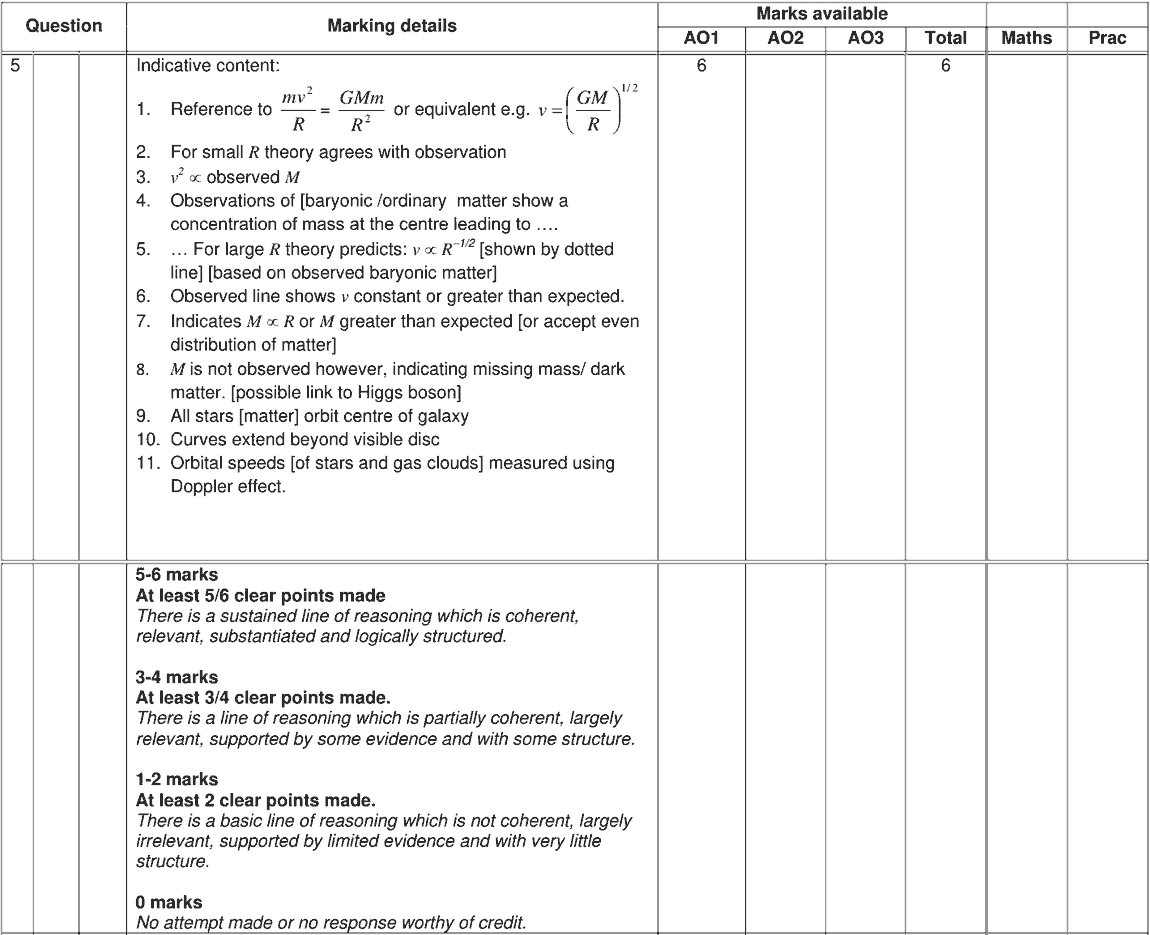
(mean mark: 3.2 = 53%) Good, well argued and logical responses were seen to the QER question. Candidates who scored well usually referred to appropriate equations and explained the features in the diagram in terms of mathematical theory and expectation. They proceeded to explain clearly that the observed curve did not follow the expected relationship and further suggested, in terms of missing mass, why this is the case. They also referred to measuring techniques. Middle band answers tended to focus entirely on the observed curve with little or no reference to the theory surrounding the expected curve. Lower band answers tended to focus on the idea of dark matter with little or no reference to the graphs.
Notes from the mark scheme and report
QER, levels marked on the number of clear points. mv²/R = GMm/R² so v = √(GM/R)
at small R theory and observation agree and visible matter is concentrated at the centre
at large R theory (dotted line) predicts v ∝ R^(−1/2)
the observed curve stays roughly constant, greater than expected
this implies M ∝ R, more mass than is seen
the unseen mass is dark matter (possible Higgs link)
all matter orbits the galactic centre
curves extend beyond the visible disc
speeds measured by Doppler shift. Report: mean 3.2/6 = 53%
weaker answers discussed dark matter without the graphs or the theory
Skills: QER The 6-mark quality of extended response question
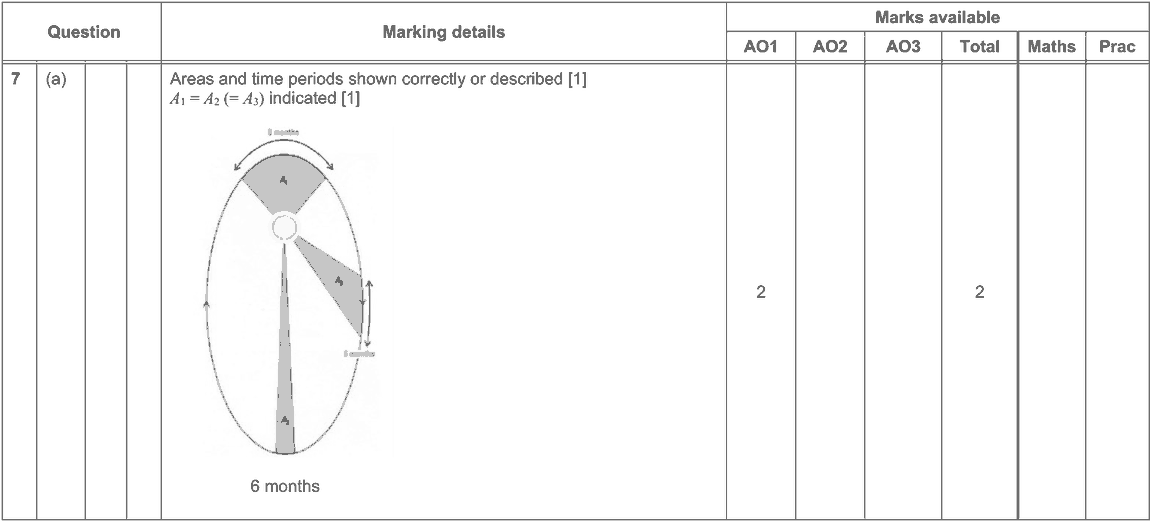
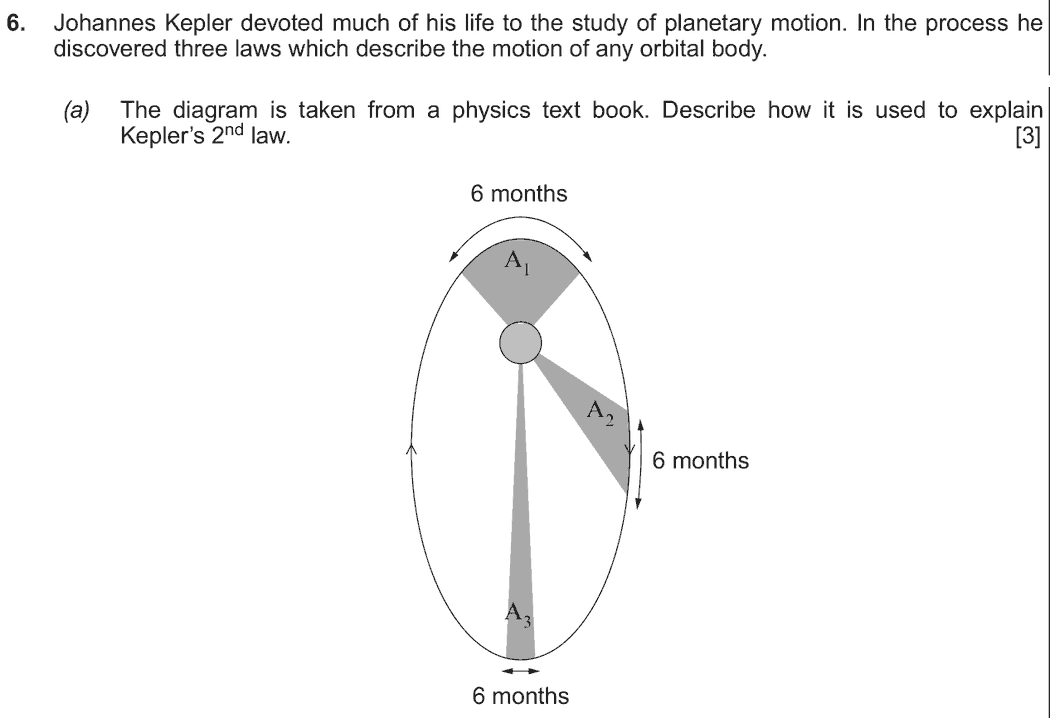
June 2017 · Component 2 · Q6(a)3 marksAO1=3Explanation
Mark scheme
Examiner's comment
To gain the three marks on offer candidates were expected to refer to ‘the line joining the central star (or Sun) to the orbiting planet’ and to the fact that the areas shown were equal (A1 = A2 =A3), each taking 6 months to complete. Most candidates made correct reference to the areas and time periods. Far fewer candidates referred to the line joining the star and the planet. The most common mark awarded was 2 out of 3.
Notes from the mark scheme and report
The line joining the Sun to the planet (1) sweeps out equal areas, A1 = A2 = A3 (1) in equal times, here 6 months (1)
the line from star to planet was most often left out
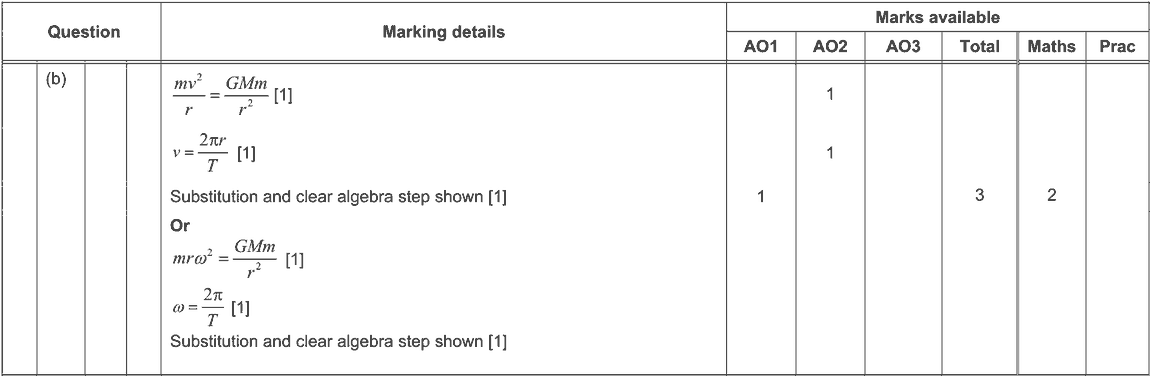
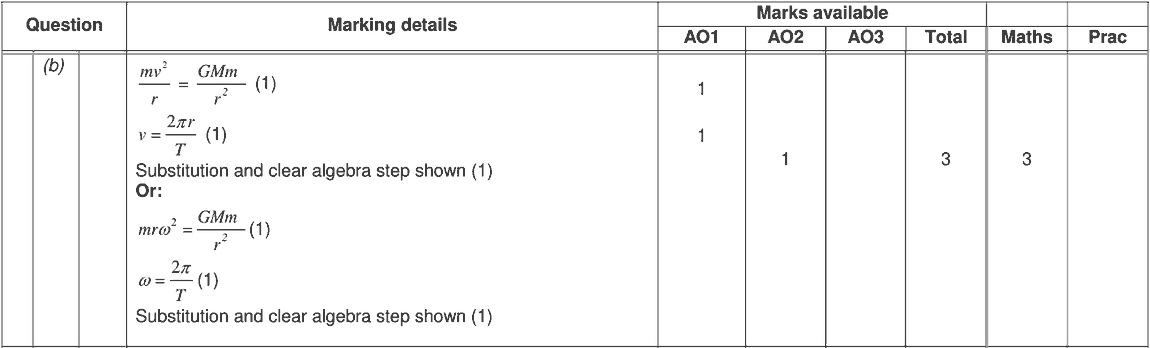
June 2017 · Component 2 · Q6(b)3 marksAO1=2, AO2=1Show that
Earlier part of question 6 that this part uses
Mark scheme
Examiner's comment
Most candidates could equate an equation for centripetal force and the equation for the gravitational force between two masses to derive the required expression.
Notes from the mark scheme and report
GMm/r² = mv²/r (1)
v = 2πr/T (1)
substitute and rearrange with a clear algebra step (1). Or GMm/r² = mrω² with ω = 2π/T
Scheme columns: Maths 3
Skills: Algebra Derivations and rearranging equations; Mathsmarks The mark scheme's Maths column gives this part at least one mark for mathematical skills
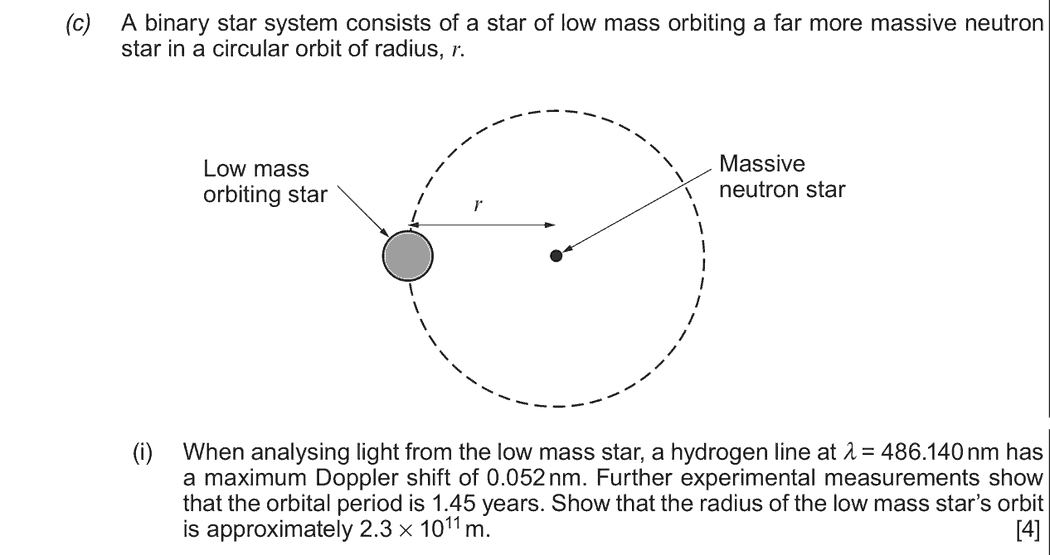
June 2017 · Component 2 · Q6(c)(i)4 marksAO1=1, AO2=3Show that
Earlier part of question 6 that this part uses
Mark scheme
Examiner's comment
Most candidates were confident when using the Doppler shift formula and were successful in finding the radius of the low mass star.
Notes from the mark scheme and report
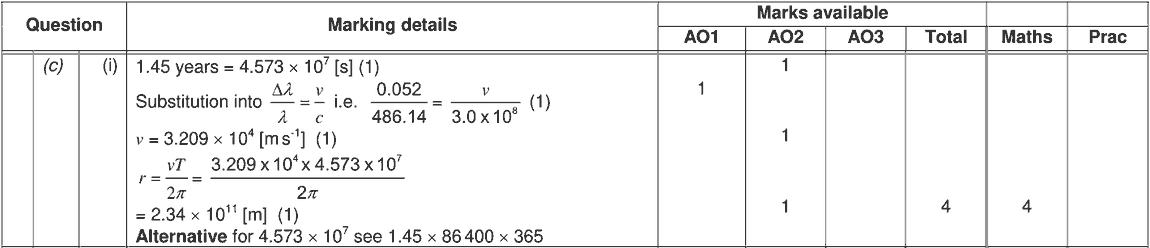
T = 1.45 years = 4.573 × 10⁷ s
Δλ/λ = v/c so v = 3.0 × 10⁸ × 0.052/486.14 = 3.21 × 10⁴ m s⁻¹
r = vT/2π = 2.34 × 10¹¹ m
Scheme columns: Maths 4
Skills: Unitsand conversions Unit marks, base units, prefixes and conversions; Mathsmarks The mark scheme's Maths column gives this part at least one mark for mathematical skills
June 2017 · Component 2 · Q6(c)(ii)4 marksAO3=4Calculation
Earlier parts of question 6 that this part uses
Mark scheme
Examiner's comment
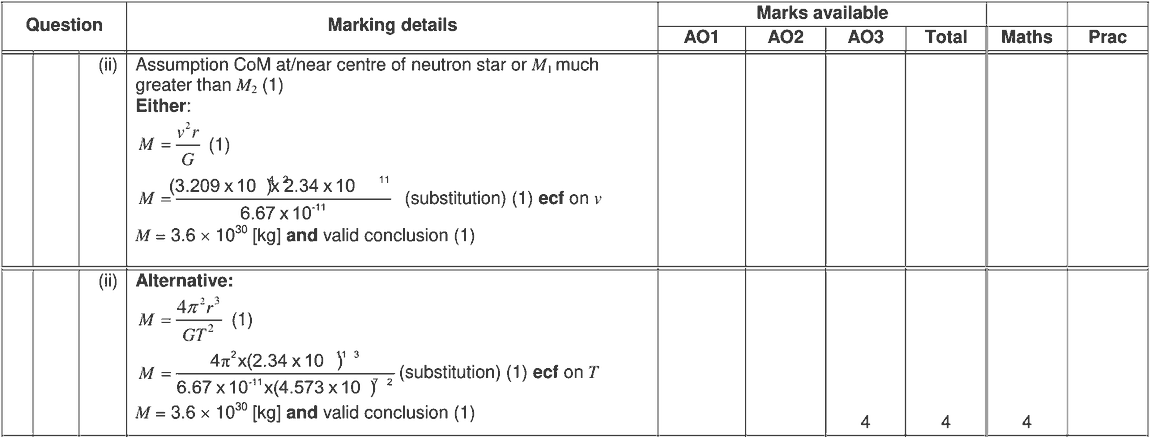
Those candidates who realised that the mass of the low mass star could be considered to be negligible went on to answer the question successfully. A few candidates, who did not make the assumption, became ‘bogged down’ in algebra and were unsuccessful.
Notes from the mark scheme and report
Answer: M = 3.6 × 10³⁰ kg = 1.8 solar masses, so correct. Assumption: neutron star mass much greater than the companion's, so the centre of mass is at (near) the neutron star's centre (1). M = v²r/G or M = 4π²r³/GT²
conclusion needed. Those who did not make the assumption got lost in algebra
Scheme columns: Maths 4
Skills: Mathsmarks The mark scheme's Maths column gives this part at least one mark for mathematical skills
June 2017 · Component 3 · Q2(d)3 marksAO3=3Explanation
Earlier part of question 2 that this part uses
Mark scheme
Examiner's comment
Some very relevant comments made.
Notes from the mark scheme and report
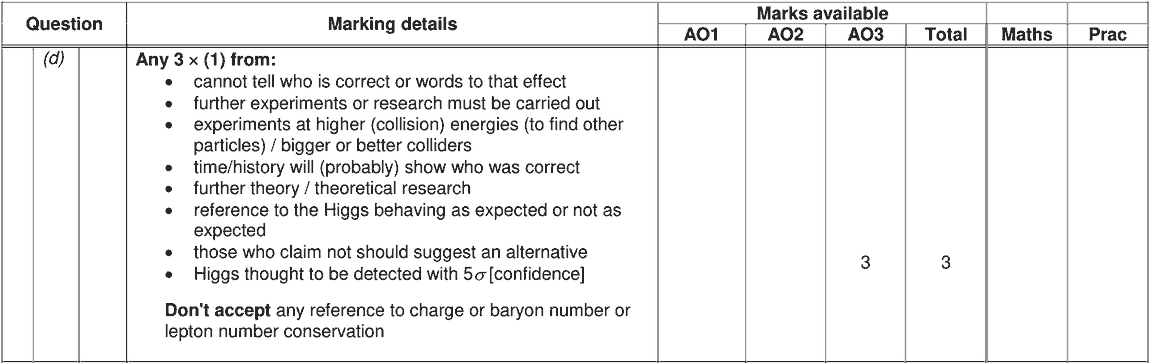
Any three: cannot yet tell who is right
more experiments or research needed
higher collision energies or better colliders to look for other particles
further theoretical work
check whether the particle behaves as the Higgs is predicted to
time will show
doubters should offer an alternative
detection quoted at 5σ confidence. Conservation-law arguments not accepted