3.7-a the significance of the results of the Rutherford alpha particle scattering experiment
3.7-b how to approximate the maximum size of the Coulomb repulsion force between an alpha particle and a gold atom / nucleus for both the plum pudding model and the Rutherford model
3.7-c the idea that matter is composed of quarks and leptons and that there are three generations of quarks and leptons, although no questions will be set involving second or third generations [Table: leptons – electron (e⁻), charge (e) 1; electron neutrino (νe), charge 0; quarks – up (u), charge +2/3; down (d), charge −1/3]
3.7-d the idea that antiparticles exist for the particles given in the table above, that the properties of an antiparticle are identical to those of its corresponding particle apart from having opposite charge, and that particles and antiparticles annihilate
3.7-e symbols for a positron and for antiparticles of quarks and hadrons
3.7-f the idea that quarks and antiquarks are never observed in isolation, but are bound into composite particles called hadrons, or three types of baryon (combinations of 3 quarks), or antibaryons (combinations of 3 antiquarks) or mesons (quark-antiquark pairs)
3.7-g the quark compositions of the neutron and proton
3.7-h how to use data in the table on page 45 to suggest the quark make-up of less well known first generation baryons and of charged pions
3.7-i the properties of the four forces or interactions experienced by particles as summarized in the table below [Table columns: Interaction | Experienced by | Range | Comments. gravitational | all matter | infinite | very weak – negligible except between large objects such as planets; weak | all leptons, all quarks, so all hadrons | very short | only significant when the e-m and strong interactions do not operate; electromagnetic (e-m) | all charged particles | infinite | also experienced by neutral hadrons, as these are composed of quarks; strong | all quarks, so all hadrons | short | (no comment)]
3.7-j how to apply conservation of charge, lepton number and baryon number (or quark number) to given simple reactions
3.7-k the idea that neutrino involvement and quark flavour changes are exclusive to weak interactions
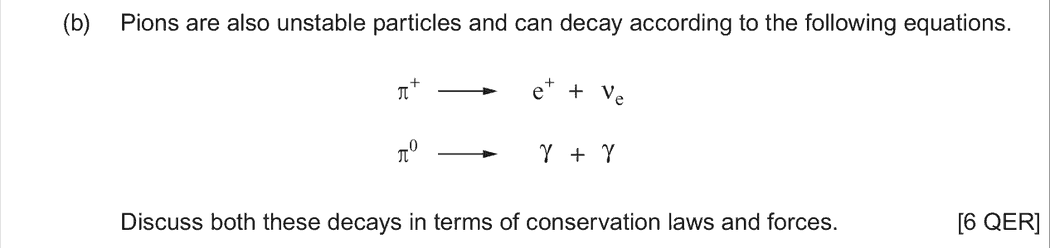
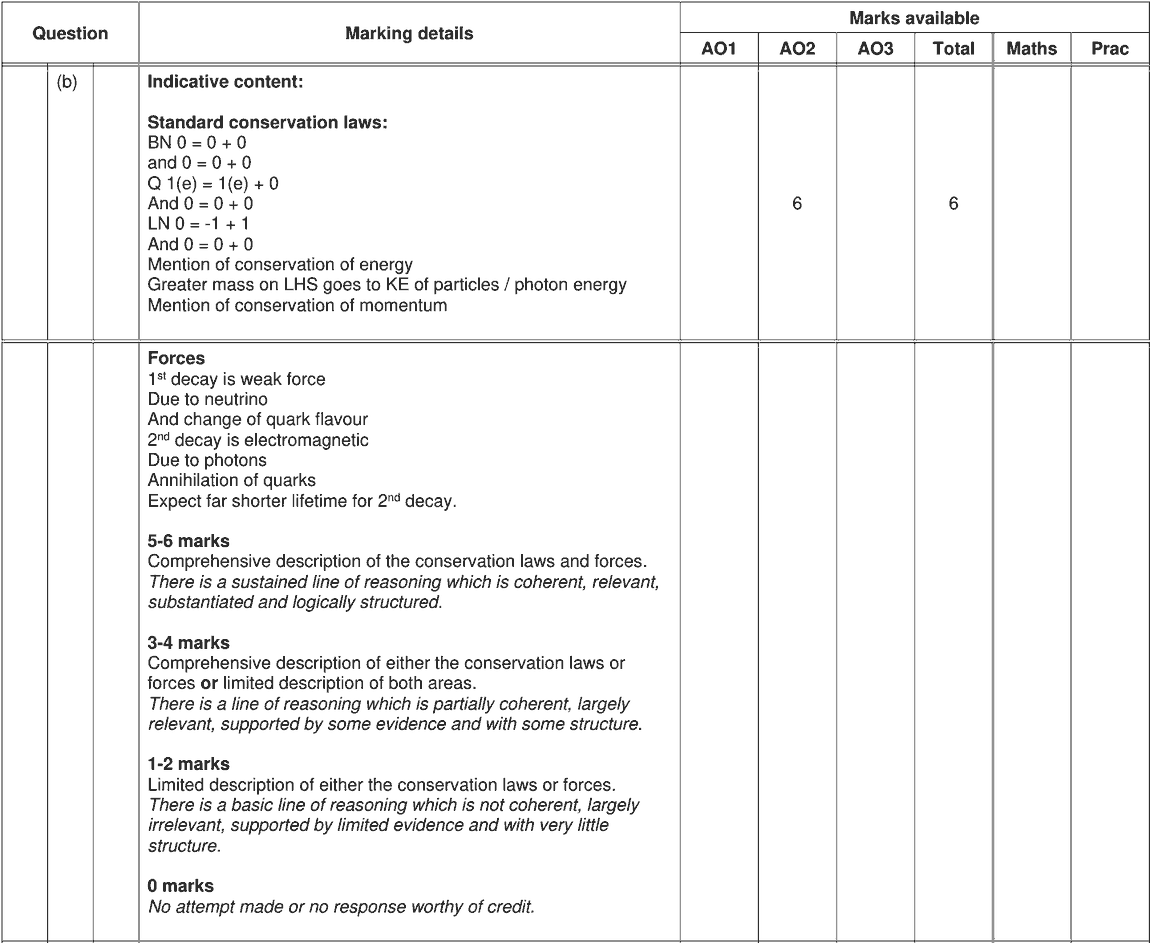
Pions are also unstable particles and can decay according to the following equations. π+ e+ + νe π0 γ γ + Discuss both these decays in terms of conservation laws and forces. [6 QER]
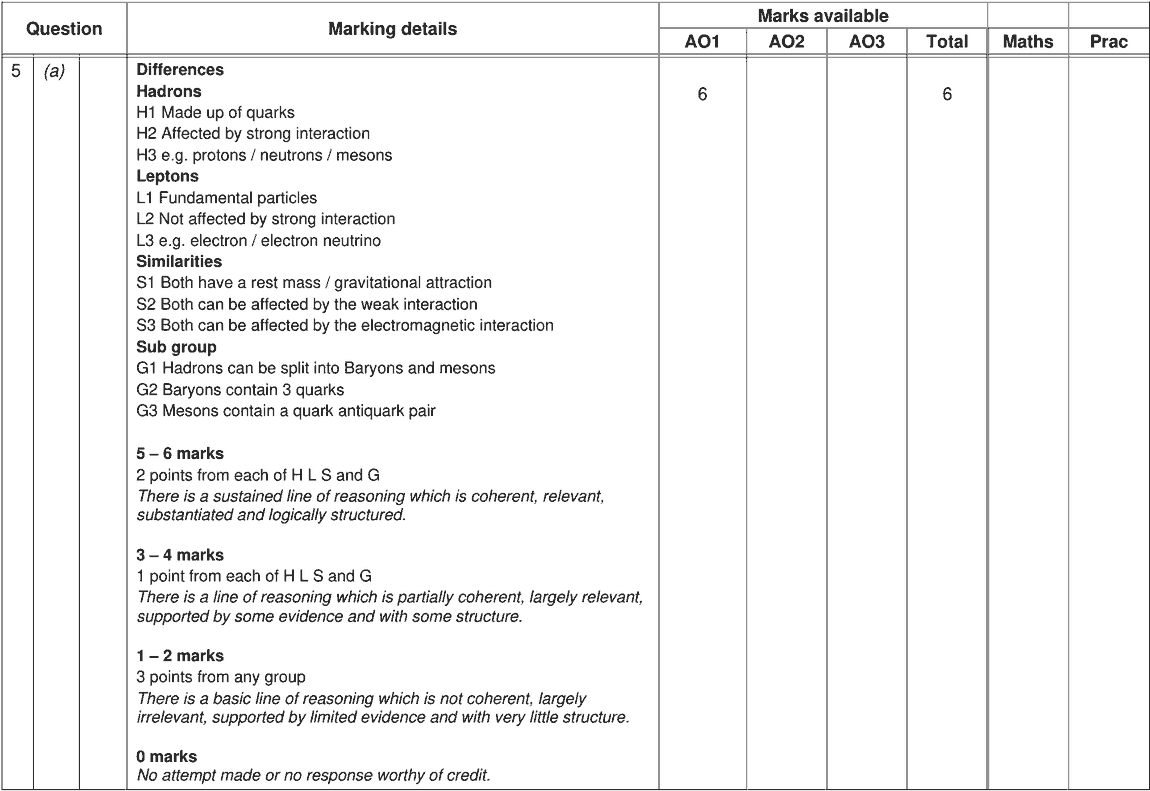
. (a) Subatomic particles can be classified as either hadrons or leptons. Giving examples of each, fully describe the differences and similarities between these two groups. Include the types of interaction they undergo a
Tap a question to zoom it. Where a part needs a figure, table or graph from earlier in the question, that part folds out above it; the mark scheme and examiner's comment open underneath. Have the Eduqas Data Booklet beside you (see the Data Booklet page).
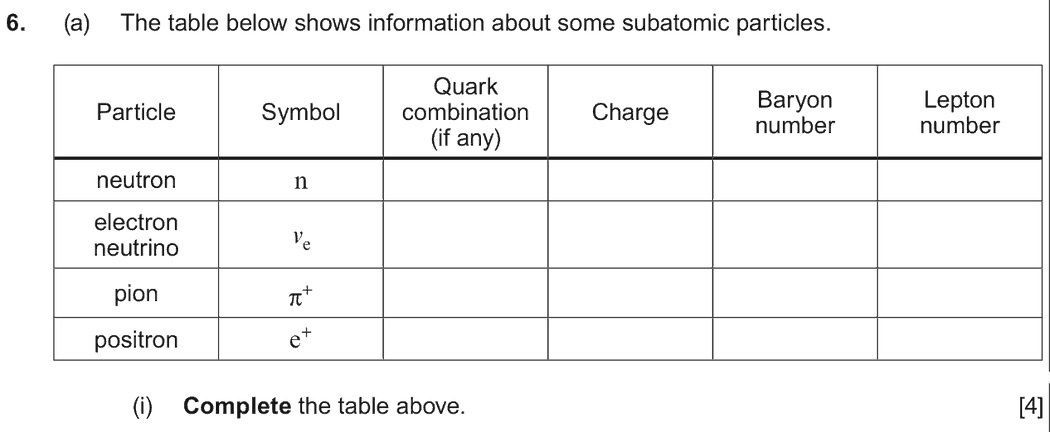
June 2025 · AS Component 1 · Q6(a)6 marksAO1=2, AO2=4Short answer
Mark scheme
Notes from the mark scheme and report
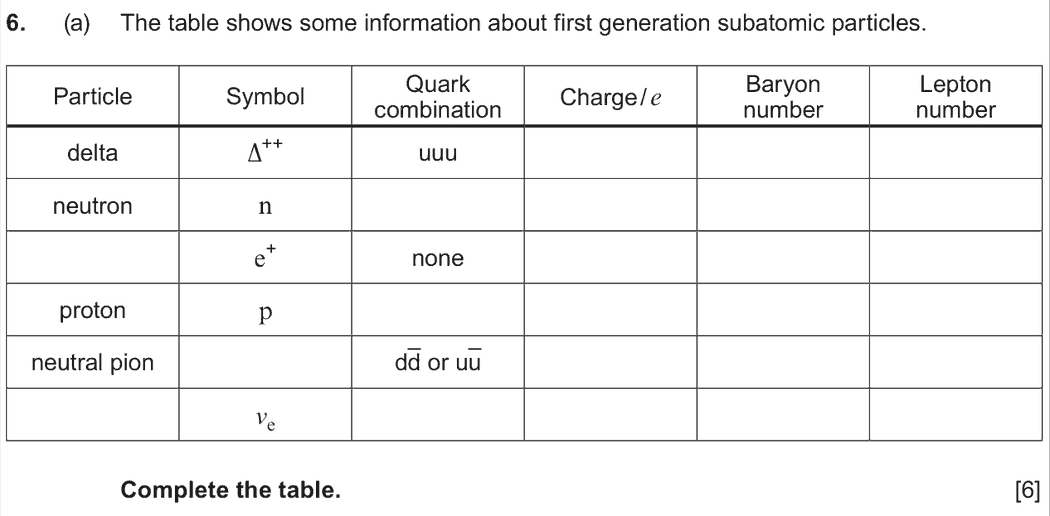
One mark per column. Names and symbols: positron for e⁺, π⁰ for the neutral pion, electron neutrino for νe. Quarks: neutron udd, proton uud, none for the neutrino. Charge: Δ⁺⁺ +2, n 0, e⁺ +1, p +1, π⁰ 0, νe 0. Baryon number: 1 for Δ⁺⁺, n and p, 0 for the rest. Lepton number: e⁺ −1, νe +1, 0 for the rest. Mark scheme row not matched: the scheme's answer table is not in the crop, values worked from the question
June 2025 · AS Component 1 · Q6(b)(i)3 marksAO3=3Explanation
Earlier part of question 6 that this part uses
Mark scheme
Notes from the mark scheme and report
Charge: 0 = +1 − 1 + X, so X is neutral (1)
lepton number: 0 = 0 + 1 + X, so X has lepton number −1 (1)
X is an electron antineutrino (1)
June 2025 · AS Component 1 · Q6(b)(ii)2 marksAO3=2Short answer
Earlier parts of question 6 that this part uses
Mark scheme
Notes from the mark scheme and report
Weak interaction (1)
because a neutrino is involved, or because a quark changes flavour (d to u) (1)
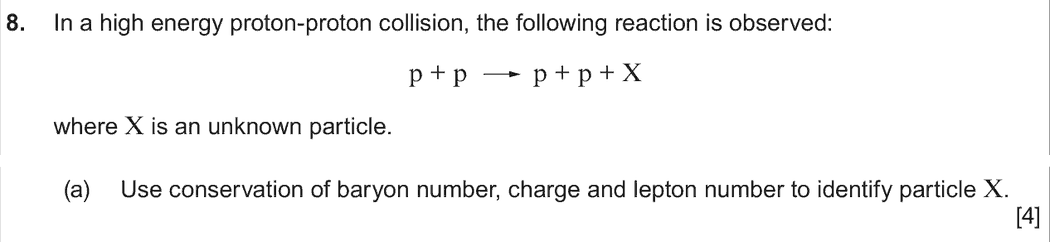
June 2025 · Component 3 · Q8(a)4 marksAO2=4Explanation
Mark scheme
Examiner's comment
This was a difficult particles question but the mean mark is very impressive. The part with the lowest mean mark was part (e), the issues question. The mark scheme this year was quite narrow. When the numbers do not agree with theory, there’s only two things that you can do - further research/experiments, modify/improve the theory/model. Hence, a mean mark on this part of 58% was rather encouraging. Alternating Currents – Question 9
Notes from the mark scheme and report
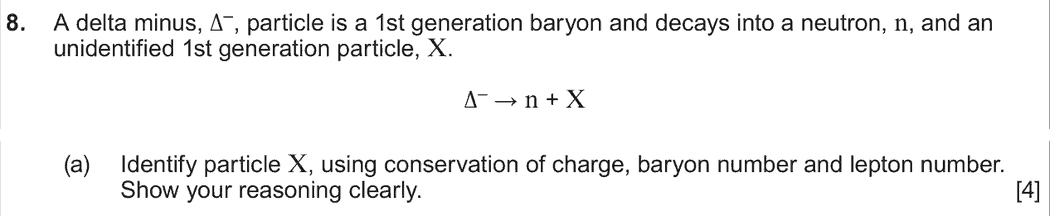
Charge: −1 = 0 + Q, so X has charge −1 (1)
baryon number: 1 = 1 + 0 (1)
lepton number: 0 = 0 + 0 (1)
X is a meson of charge −1, the π⁻ (1)
π⁻ with no reasoning scores 1
June 2025 · Component 3 · Q8(b)1 markAO1=1Show that
Earlier part of question 8 that this part uses
Mark scheme
Examiner's comment
This was a difficult particles question but the mean mark is very impressive. The part with the lowest mean mark was part (e), the issues question. The mark scheme this year was quite narrow. When the numbers do not agree with theory, there’s only two things that you can do - further research/experiments, modify/improve the theory/model. Hence, a mean mark on this part of 58% was rather encouraging. Alternating Currents – Question 9
Notes from the mark scheme and report
Each d quark has charge −⅓e, so three d quarks give −1, the only three-quark combination with that charge
June 2025 · Component 3 · Q8(c)2 marksAO1=1, AO2=1Explanation
Earlier part of question 8 that this part uses
Mark scheme
Examiner's comment
This was a difficult particles question but the mean mark is very impressive. The part with the lowest mean mark was part (e), the issues question. The mark scheme this year was quite narrow. When the numbers do not agree with theory, there’s only two things that you can do - further research/experiments, modify/improve the theory/model. Hence, a mean mark on this part of 58% was rather encouraging. Alternating Currents – Question 9
Notes from the mark scheme and report
Neutron is udd (1)
ddd goes to udd + ūd: d number 3 = 2 + 1 and u number 0 = 1 − 1, so both are conserved (1)
June 2025 · Component 3 · Q8(e)2 marksAO3=2Short answer
Earlier part of question 8 that this part uses
Mark scheme
Examiner's comment
This was a difficult particles question but the mean mark is very impressive. The part with the lowest mean mark was part (e), the issues question. The mark scheme this year was quite narrow. When the numbers do not agree with theory, there’s only two things that you can do - further research/experiments, modify/improve the theory/model. Hence, a mean mark on this part of 58% was rather encouraging. Alternating Currents – Question 9
Notes from the mark scheme and report
Carry out further experiments to confirm or contradict the measurement (1)
modify the theory or develop an alternative model (1)
June 2024 · AS Component 1 · Q5(a)4 marksAO1=4Explanation
Mark scheme
Examiner's comment
This question was very well done by the vast majority of the cohort and it was apparent that the topic of particles was very well understood.
Notes from the mark scheme and report
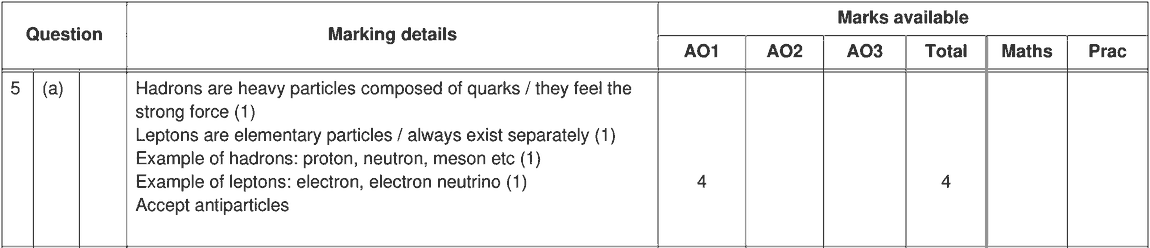
Hadrons are made of quarks and feel the strong force (1)
leptons are fundamental and do not (1)
hadron example, e.g. proton, neutron or a meson (1)
lepton example, e.g. electron or electron neutrino (1)
June 2024 · AS Component 1 · Q5(b)(i)4 marksAO3=4Explanation
Earlier part of question 5 that this part uses
Mark scheme
Examiner's comment
This question was very well done by the vast majority of the cohort and it was apparent that the topic of particles was very well understood.
Notes from the mark scheme and report
Charge: 0 + 0 = 1 + (−1) (1)
lepton number: 1 + 0 = 0 + 1 (1)
baryon number: 0 + 1 = 1 + 0 (1)
so x has charge −1, lepton number 1 and baryon number 0: an electron (1)
June 2024 · AS Component 1 · Q5(b)(ii)2 marksAO3=2Explanation
Earlier parts of question 5 that this part uses
Mark scheme
Examiner's comment
This question was very well done by the vast majority of the cohort and it was apparent that the topic of particles was very well understood.
Notes from the mark scheme and report
Not correct: it is a weak interaction (1) because a neutrino is involved and a quark changes flavour (d to u) (1)
June 2024 · Component 3 · Q65 marksAO2=5Explanation
Mark scheme
Notes from the mark scheme and report
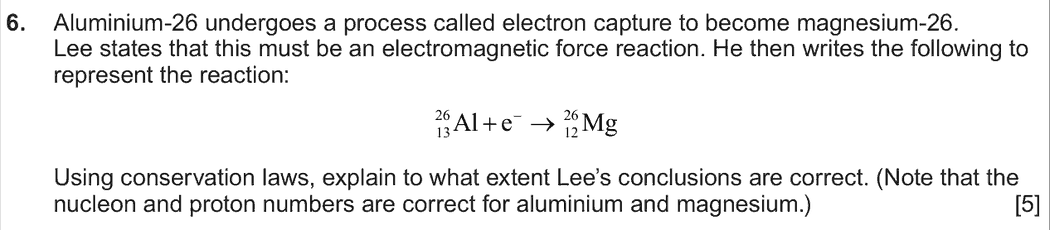
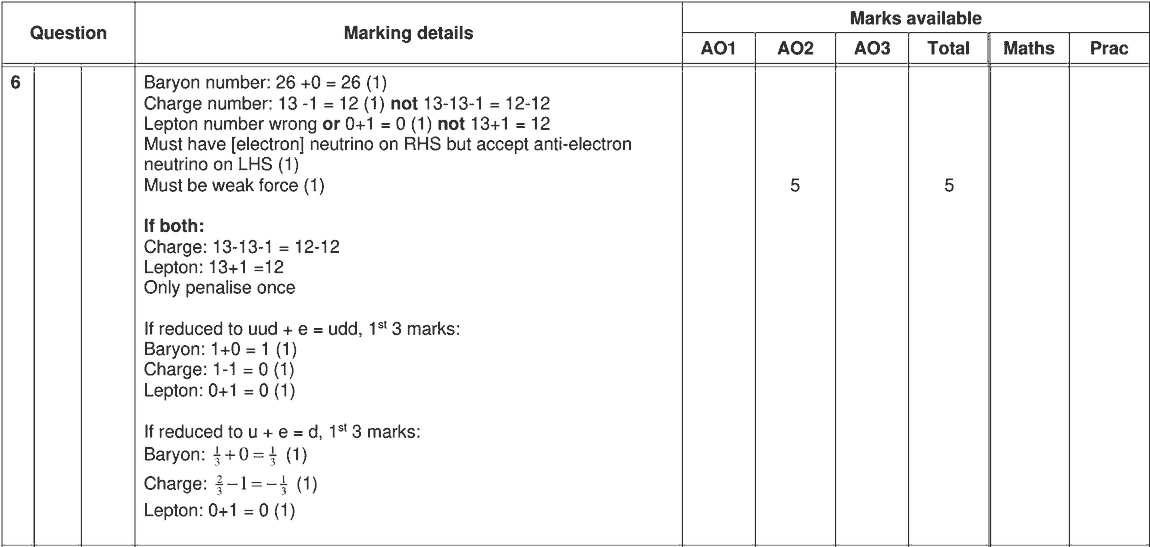
Baryon number conserved: 26 + 0 = 26 (1)
charge conserved: 13 − 1 = 12 (1)
lepton number not conserved as written: 0 + 1 ≠ 0 (1)
so an electron neutrino is needed on the right (1)
a neutrino (and a change of quark flavour, u to d) means the weak interaction, not electromagnetic (1)
the proton or quark level versions are accepted
treat it as a nuclear reaction and label each law
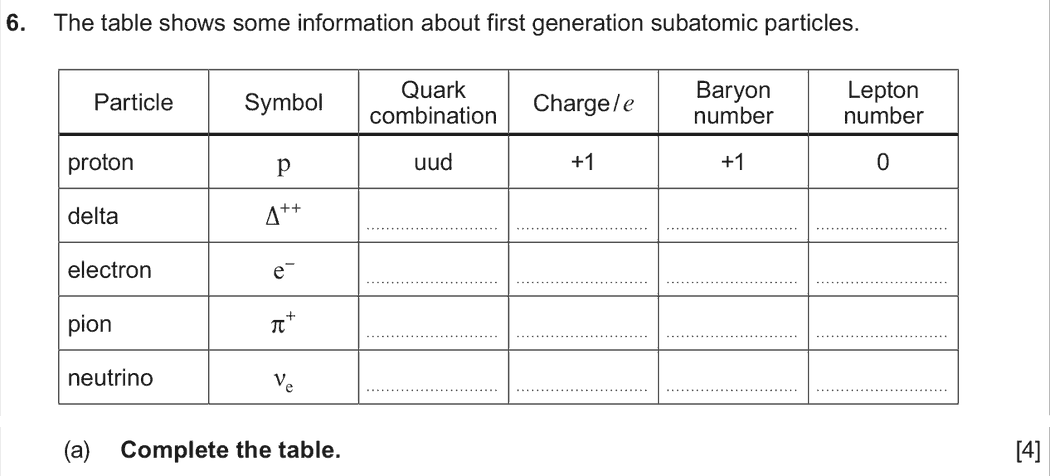
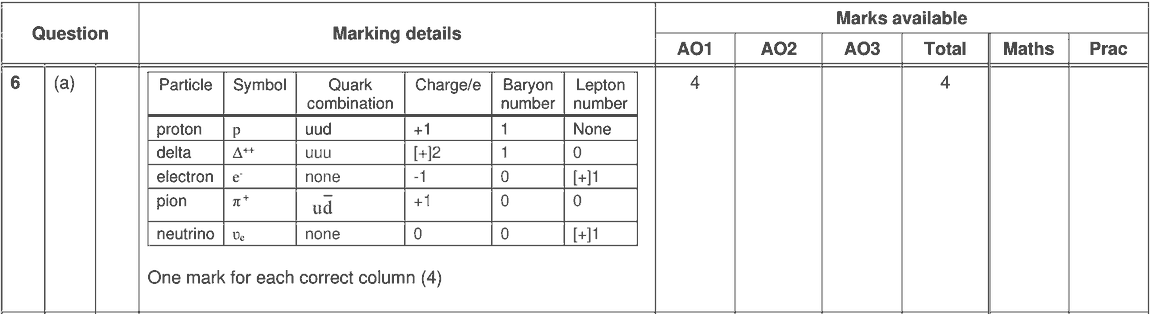
June 2023 · AS Component 1 · Q6(a)4 marksAO1=4Short answer
Mark scheme
Examiner's comment
The particles question was very well done with candidates showing clearly how they used the conservation laws to determine the nature of the unknown particle. The weakest part was, surprisingly the “issues” question, (c)(ii) whether every country should contribute to CERN, often only one relevant comment was provided.
Notes from the mark scheme and report
One mark per correct column. Quarks: Δ⁺⁺ uuu, e⁻ none, π⁺ u d-bar, νe none. Charge: +2, −1, +1, 0. Baryon number: 1, 0, 0, 0. Lepton number: 0, 1, 0, 1. Mark-scheme text did not extract but the crop shows the completed table
June 2023 · AS Component 1 · Q6(b)(i)3 marksAO3=3Explanation
Earlier part of question 6 that this part uses
Mark scheme
Examiner's comment
The particles question was very well done with candidates showing clearly how they used the conservation laws to determine the nature of the unknown particle. The weakest part was, surprisingly the “issues” question, (c)(ii) whether every country should contribute to CERN, often only one relevant comment was provided.
Notes from the mark scheme and report
Answer: electron antineutrino. Charge: +4 → +5 − 1, so X is neutral (1)
lepton number: 0 → 0 + 1, so X has lepton number −1 (1)
so X is an antineutrino (1)
June 2023 · AS Component 1 · Q6(b)(ii)2 marksAO2=2Short answer
Earlier parts of question 6 that this part uses
Mark scheme
Examiner's comment
The particles question was very well done with candidates showing clearly how they used the conservation laws to determine the nature of the unknown particle. The weakest part was, surprisingly the “issues” question, (c)(ii) whether every country should contribute to CERN, often only one relevant comment was provided.
Notes from the mark scheme and report
Weak interaction (1), because a neutrino (antineutrino) is involved, or because a quark changes flavour (d to u) (1)
June 2023 · AS Component 1 · Q6(c)(i)1 markAO1=1Definition
Earlier part of question 6 that this part uses
Mark scheme
Examiner's comment
The particles question was very well done with candidates showing clearly how they used the conservation laws to determine the nature of the unknown particle. The weakest part was, surprisingly the “issues” question, (c)(ii) whether every country should contribute to CERN, often only one relevant comment was provided.
Notes from the mark scheme and report
A particle made of quarks (a baryon or a meson), or a particle that feels the strong force
June 2023 · AS Component 1 · Q6(c)(ii)2 marksAO3=2Explanation
Earlier parts of question 6 that this part uses
Mark scheme
Examiner's comment
The particles question was very well done with candidates showing clearly how they used the conservation laws to determine the nature of the unknown particle. The weakest part was, surprisingly the “issues” question, (c)(ii) whether every country should contribute to CERN, often only one relevant comment was provided.
Notes from the mark scheme and report
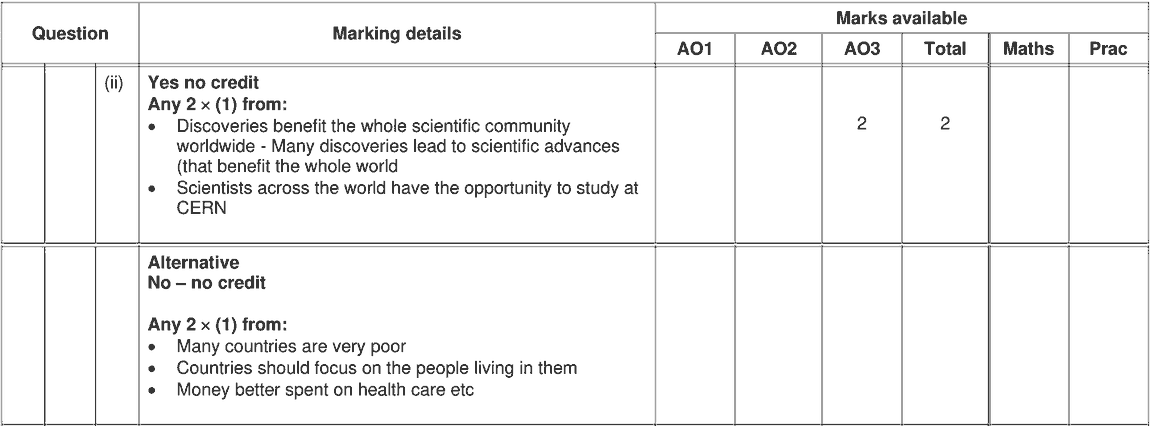
Yes or no gets no credit by itself
two supporting reasons needed. For: discoveries benefit the whole world and lead to wider scientific advances
scientists from every country can work there. Against: many countries are poor
they should put their own people first
money is better spent on health care. Often only one relevant point was made
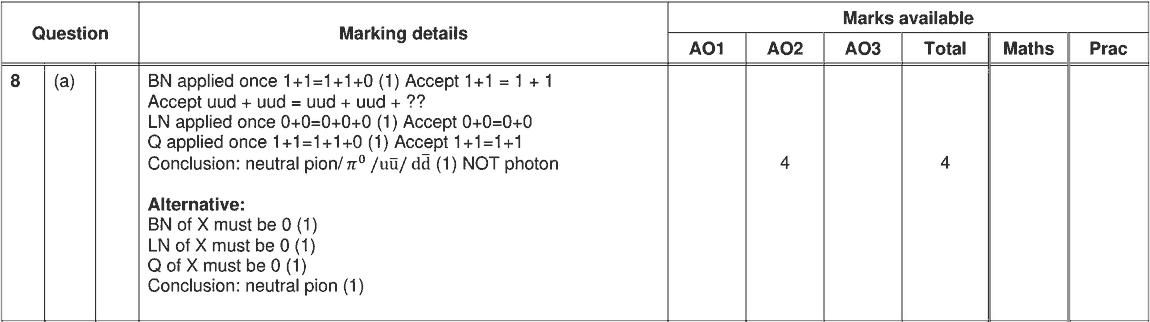
June 2023 · Component 3 · Q8(a)4 marksAO2=4Explanation
Mark scheme
Examiner's comment
This question was extremely well answered. Some candidates thought that the particle was a photon. Some candidates were a factor of 2 out in the final mass.
Notes from the mark scheme and report
Baryon number: 1 + 1 = 1 + 1 + 0 (1)
lepton number: 0 = 0 + 0 (1)
charge: 1 + 1 = 1 + 1 + 0 (1)
so X is a neutral meson, the π⁰ (uū or dd̄) (1)
a photon is not accepted
June 2022 · AS Component 1 · Q6(a)(i)4 marksAO1=4Short answer
Mark scheme
Notes from the mark scheme and report
One mark per row: neutron udd, charge 0, baryon number 1, lepton number 0
electron neutrino no quarks, 0, 0, 1
π⁺ u anti-d, +1, 0, 0
positron no quarks, +1, 0, −1 (rows worked from the spec table
the scheme's appendix table is not in the crop)
June 2022 · AS Component 1 · Q6(a)(ii)1 markAO1=1Short answer
Earlier part of question 6 that this part uses
Mark scheme
Notes from the mark scheme and report
The positron (e⁺)
June 2022 · AS Component 1 · Q6(a)(iii)1 markAO1=1Short answer
Earlier part of question 6 that this part uses
Mark scheme
Notes from the mark scheme and report
Same mass
opposite charge (or opposite lepton or baryon number)
both needed for the mark
June 2022 · AS Component 1 · Q6(b)(i)3 marksAO1=1, AO3=2Explanation
Earlier part of question 6 that this part uses
Mark scheme
Notes from the mark scheme and report
Charge: −1 + 1 = +2 + x − 1 so x has charge −1 (1)
lepton number: 1 on the left and 0 from the other products so x has lepton number 1 (1)
x is an electron (1)
June 2022 · AS Component 1 · Q6(b)(ii)2 marksAO3=2Explanation
Earlier parts of question 6 that this part uses
Mark scheme
Notes from the mark scheme and report
Electromagnetic (1)
all the particles involved are charged, or valid reasons for excluding the others: no neutrino or flavour change so not weak, a lepton takes part so not strong (1)
June 2022 · Component 3 · Q7(b)6 marksAO2=66-mark extended responseEasy
Earlier part of question 7 that this part uses
Mark scheme, with the levels and indicative content
Examiner's comment
This was a particularly fair and successful 6 mark QER with a mean score of nearly 4/6. The common methods of dropping marks were incomplete answers e.g. • discussing one reaction fully but not the other; • discussing conservation laws but not forces (and vice versa); • not discussing enough conservation laws; • discussing the force responsible for one reaction but not the other. There were some mistakes present too e.g. stating that the lepton number of a positron is +1 (or -1 for the electron-neutrino). Some candidates believed that the photons were leptons.
Notes from the mark scheme and report
QER, levels marked. Conservation: charge (+1 = +1 + 0 and 0 = 0 + 0), baryon number (0 throughout), lepton number (0 = −1 + 1 for the positron and neutrino
0 = 0 + 0), energy (the pion's mass becomes kinetic energy or photon energy) and momentum. Forces: the π⁺ decay is weak (neutrino involved, quark flavour changes)
the π⁰ decay is electromagnetic (photons, quark-antiquark annihilation) and so much faster. Marks were lost by covering only one decay or only laws or forces
errors: positron given lepton number +1, photons called leptons
Skills: QER The 6-mark quality of extended response question
October 2021 · Component 3 · Q7(a)3 marksAO2=3Show that
Mark scheme
Notes from the mark scheme and report
Baryon number: 3 + 1 = 4 + 0 + 0 (1)
lepton number: 0 + 0 = 0 − 1 + 1 (1)
charge: 2 + 1 = 2 + 1 + 0 (1)
October 2021 · Component 3 · Q7(b)1 markAO1=1Short answer
Earlier part of question 7 that this part uses
Mark scheme
Notes from the mark scheme and report
A quark changes flavour (a proton becomes a neutron, u to d)
October 2021 · Component 3 · Q7(d)2 marksAO3=2Explanation
Earlier part of question 7 that this part uses
Mark scheme
Notes from the mark scheme and report
Sophie is correct: strong interaction (1), because only hadrons are involved and the quarks are just rearranged, with no flavour change and no neutrino (1)
October 2020 · Component 3 · Q66 marksAO1=66-mark extended response
Mark scheme, with the levels and indicative content
Examiner's comment
A successful QER question with all candidates having a good attempt and a wide range of marks awarded. Some misconceptions were observed but nothing consistent to report. The most common mistakes were wrong quark make-ups of neutron, anti-proton and the pi- meson.
Notes from the mark scheme and report
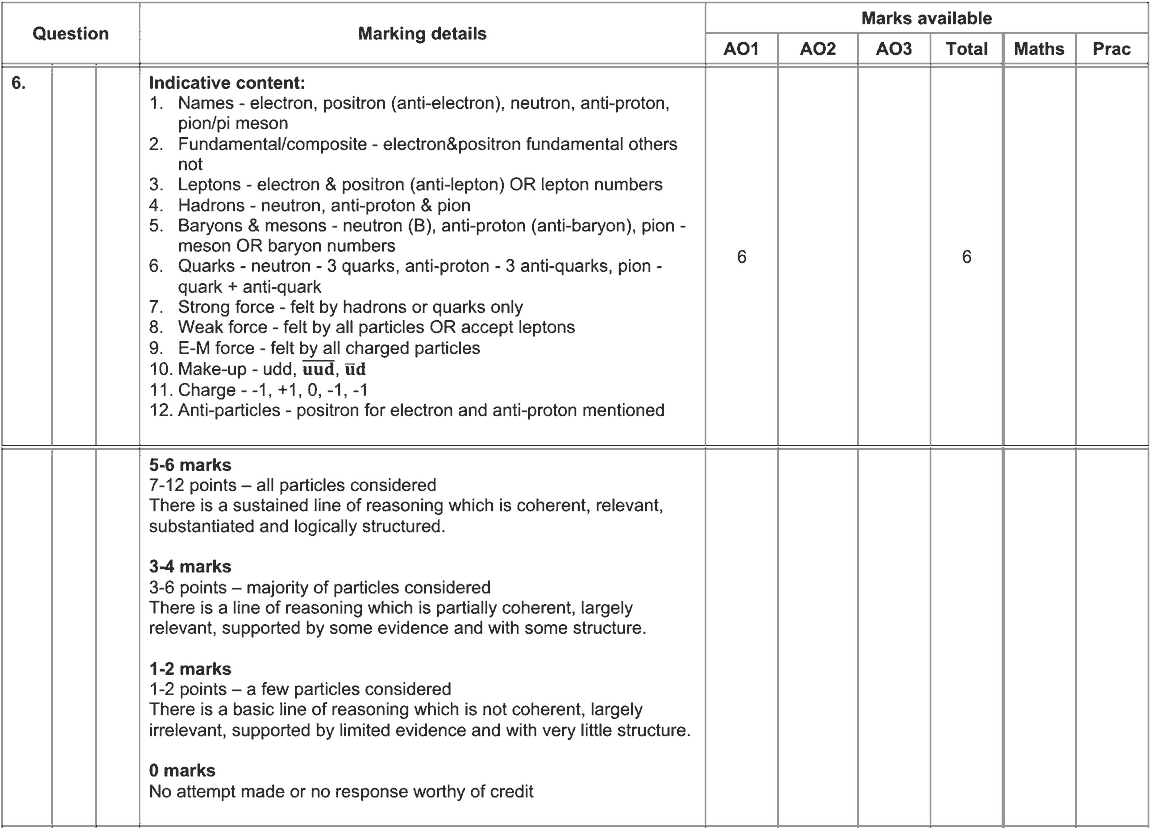
QER, levels marked. Electron and positron: fundamental leptons, charges −1 and +1, positron is the antiparticle of the electron. Neutron (udd), antiproton (three antiquarks, anti-u anti-u anti-d, charge −1, antibaryon) and π⁻ (anti-u d, meson, charge −1) are composite hadrons. Hadrons feel the strong force, all feel the weak force, charged particles feel the electromagnetic force. Top band: 7 or more points covering all five particles
wrong quark make-ups were the usual error
Skills: QER The 6-mark quality of extended response question
June 2019 · AS Component 1 · Q7(a)2 marksAO1=2Explanation
Mark scheme
Notes from the mark scheme and report
Protons and neutrons are each made of three quarks (1)
quarks and neutrinos (leptons) are not made up of other particles (1)
June 2019 · AS Component 1 · Q7(b)(i)2 marksAO1=2Short answer
Earlier part of question 7 that this part uses
Mark scheme
Notes from the mark scheme and report
Neutrinos do not feel the strong or electromagnetic forces, so interact only via the weak interaction (1)
they are uncharged (1)
June 2019 · AS Component 1 · Q7(b)(ii)3 marksAO2=2, AO3=1Explanation
June 2019 · AS Component 1 · Q7(c)2 marksAO2=1, AO3=1Short answer
Earlier part of question 7 that this part uses
Mark scheme
Notes from the mark scheme and report
Electromagnetic (1) because photons (gamma rays) are produced and only charged particles, with no neutrinos or quark flavour change, are involved (1)
June 2019 · Component 3 · Q6(a)1 markAO2=1Explanation
Mark scheme
Examiner's comment
Very well answered.
Notes from the mark scheme and report
Three antiquarks needed and only three anti-up quarks give −⅔ − ⅔ − ⅔ = −2
June 2019 · Component 3 · Q6(b)2 marksAO3=2Short answer
Earlier part of question 6 that this part uses
Mark scheme
Examiner's comment
Although slightly tricky, this was very well answered too with perhaps the make-up of the π-meson causing most problems.
Notes from the mark scheme and report
Anti-up anti-up anti-up → (anti-u anti-u anti-d) + (d anti-u): antiproton (or anti-Δ⁺) and π⁻ (1 for quarks, 1 for names). Also allowed: anti-Δ⁺⁺ with π⁰ (u anti-u or d anti-d). The pion's make-up caused most trouble
June 2019 · Component 3 · Q6(c)2 marksAO3=2Short answer
Earlier part of question 6 that this part uses
Mark scheme
Examiner's comment
Very well answered too although some candidates did not realise that this was a very short lifetime.
Notes from the mark scheme and report
Strong force (1)
because the lifetime is very short, or only quarks (hadrons) are involved with no flavour change, no neutrinos and no photons (1)
June 2019 · Component 3 · Q6(d)3 marksAO3=3Explanation
Earlier part of question 6 that this part uses
Mark scheme
Examiner's comment
This issues question proved to be far more satisfying than previous questions with a large majority of candidates obtaining two or three marks.
Notes from the mark scheme and report
Any three: contradicts relativity (nothing travels faster than light)
that theory is very well established
further experiments needed
by other groups (peer review, reproducibility)
the cause was an instrument fault (timing delay) or systematic error
June 2018 · AS Component 1 · Q5(a)6 marksAO1=66-mark extended response
Mark scheme, with the levels and indicative content
Examiner's comment
[QER] Generally well answered with most candidates obtaining the middle band and it was pleasing to note that the majority of candidates had fully read the question and did attempt to answer all aspects.
Notes from the mark scheme and report
QER, levels marked. Hadrons: made of quarks, feel the strong interaction, e.g. proton, neutron, pion. Leptons: fundamental, do not feel the strong interaction, e.g. electron, electron neutrino. Similarities: both have mass (gravitational), both feel the weak interaction, charged ones feel the electromagnetic. Sub-groups: hadrons divide into baryons (three quarks) and mesons (quark-antiquark pair). Top band needs two points from each group
most reached the middle band
Skills: QER The 6-mark quality of extended response question
June 2018 · AS Component 1 · Q5(b)(i)3 marksAO2=3Explanation
Earlier part of question 5 that this part uses
Mark scheme
Examiner's comment
This was one of the best-answered parts on the paper. Candidates are now, generally, much better at stating which conservation laws they are using and are able to put these down clearly.
Notes from the mark scheme and report
Charge: +1 − 1 = 0 + 0 so x is neutral (1)
lepton number: 0 + 1 = 0 + 1 so x is a lepton (1)
x is an electron neutrino (1)
one of the best answered parts
June 2018 · AS Component 1 · Q5(b)(ii)1 markAO2=1Short answer
Earlier parts of question 5 that this part uses
Mark scheme
Examiner's comment
This was one of the best-answered parts on the paper. Candidates are now, generally, much better at stating which conservation laws they are using and are able to put these down clearly.
Notes from the mark scheme and report
An up quark changes to a down quark (uud becomes udd)
June 2018 · AS Component 1 · Q5(b)(iii)1 markAO1=1Short answer
Earlier parts of question 5 that this part uses
Mark scheme
Examiner's comment
This was one of the best-answered parts on the paper. Candidates are now, generally, much better at stating which conservation laws they are using and are able to put these down clearly.
Notes from the mark scheme and report
Weak interaction, because a neutrino is involved or because quark flavour changes
June 2018 · Component 3 · Q7(b)4 marksAO3=4Explanation
Earlier part of question 7 that this part uses
Mark scheme
Examiner's comment
Quite a discriminating question and it was common to see mistakes in baryon numbers (pions counting as 1 and -1), charge (neutrons or pions being wrong) and mass-energy (usually anti-particles having negative rest mass- energy).
Notes from the mark scheme and report
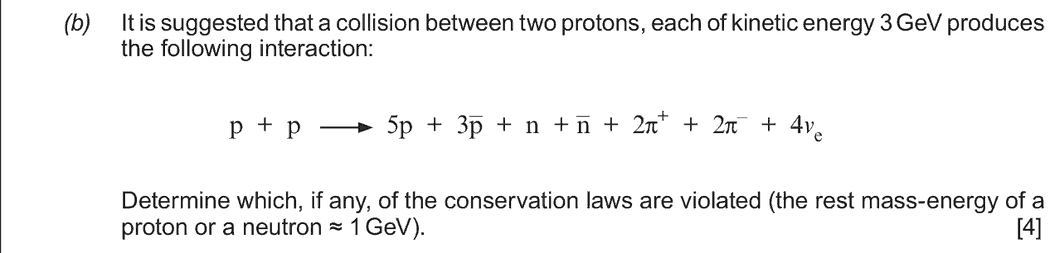
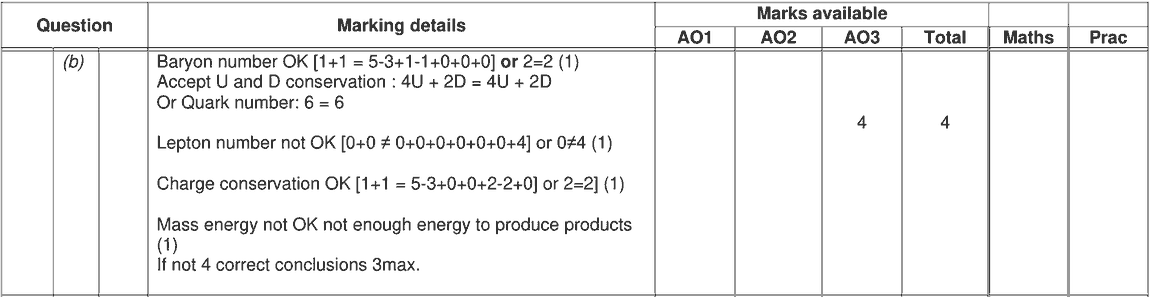
Baryon number conserved: 2 = 5 − 3 + 1 − 1 (1)
lepton number violated: 0 ≠ 4 (1)
charge conserved: 2 = 5 − 3 + 2 − 2 (1)
mass-energy violated: 8 GeV available (2 GeV rest + 6 GeV kinetic) but the products need over 10 GeV of rest energy (1)
all four conclusions needed for full marks
pions were often given baryon number and antiparticles negative rest energy
June 2017 · AS Component 1 · Q3(a)3 marksAO2=2, AO3=1Explanation
Mark scheme
Examiner's comment
On the whole this was answered well. The conservation question was greatly improved from last year. Candidates were a lot better at explaining which conservation rules they were using rather than just writing a string of zeros and ones. In part (d) many candidates just repeated parts of the question rather than bringing in something new. A common response ‘ I think money would be better spent on humanitarian aid’ did not provide any new information and did not evaluate the question.
Notes from the mark scheme and report
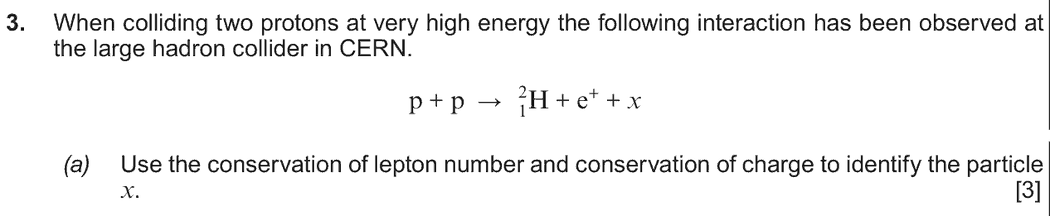
Lepton number: 0 + 0 = 0 − 1 + 1, so x has lepton number +1 (1)
charge: 1 + 1 = 1 + 1 + 0, so x is neutral (1)
x is an (electron) neutrino (1)
state which conservation law each line of numbers refers to
June 2017 · AS Component 1 · Q3(b)2 marksAO1=2Short answer
Earlier part of question 3 that this part uses
Mark scheme
Examiner's comment
On the whole this was answered well. The conservation question was greatly improved from last year. Candidates were a lot better at explaining which conservation rules they were using rather than just writing a string of zeros and ones. In part (d) many candidates just repeated parts of the question rather than bringing in something new. A common response ‘ I think money would be better spent on humanitarian aid’ did not provide any new information and did not evaluate the question.
Notes from the mark scheme and report
Weak (1)
because a neutrino is involved, or the quark flavour changes (a u quark becomes a d quark) (1)
June 2017 · AS Component 1 · Q3(c)2 marksAO1=2Short answer
Earlier part of question 3 that this part uses
Mark scheme
Examiner's comment
On the whole this was answered well. The conservation question was greatly improved from last year. Candidates were a lot better at explaining which conservation rules they were using rather than just writing a string of zeros and ones. In part (d) many candidates just repeated parts of the question rather than bringing in something new. A common response ‘ I think money would be better spent on humanitarian aid’ did not provide any new information and did not evaluate the question.
Notes from the mark scheme and report
(i) baryon: proton (or the deuterium nucleus) (1)
(ii) antiparticle: positron, e⁺ (1)
June 2017 · AS Component 1 · Q3(d)2 marksAO3=2Explanation
Earlier part of question 3 that this part uses
Mark scheme
Examiner's comment
On the whole this was answered well. The conservation question was greatly improved from last year. Candidates were a lot better at explaining which conservation rules they were using rather than just writing a string of zeros and ones. In part (d) many candidates just repeated parts of the question rather than bringing in something new. A common response ‘ I think money would be better spent on humanitarian aid’ did not provide any new information and did not evaluate the question.
Notes from the mark scheme and report
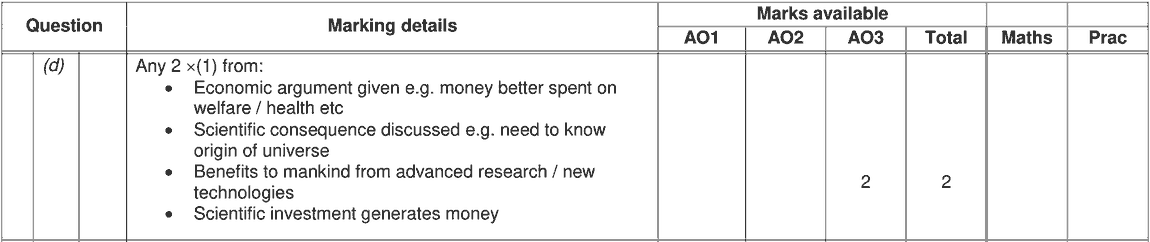
Any two developed points: an economic case for spending on health or welfare
the scientific value of understanding matter and the origin of the universe
spin-off technologies that benefit people
research investment generates money. Merely restating the question earned nothing
June 2017 · Component 3 · Q2(a)(i)3 marksAO2=3Short answer
Mark scheme
Examiner's comment
Generally very well answered. Conservation of charge caused a few more problems than baryon number and lepton number. The fact that the nitrogen is initially positively charged caused problems to those candidates who insisted on considering the electrons. It is far easier to ignore the electrons and accept this as being a nuclear reaction.
Notes from the mark scheme and report
Charge: 6 = 7 − 1 + 0 (1)
baryon number: 14 = 14 + 0 + 0 (1)
lepton number: 0 = 0 + 1 − 1 (1)
nucleon or quark level versions accepted
treat it as a nuclear reaction and ignore atomic electrons
June 2017 · Component 3 · Q2(a)(ii)2 marksAO2=2Short answer
Earlier part of question 2 that this part uses
Mark scheme
Examiner's comment
Very well done in the main.
Notes from the mark scheme and report
Quark flavour changes (d to u) (1)
a neutrino is involved (1)
long half-life also accepted
June 2017 · Component 3 · Q2(c)3 marksAO2=1, AO3=2Short answer
Earlier part of question 2 that this part uses
Mark scheme
Examiner's comment
Very well answered with an equal tendency to drop marks on each of the 3 marking points.
Notes from the mark scheme and report
Boron-11 with proton number 5 (1)
positron e⁺ or β⁺ (1)
electron neutrino, not antineutrino (1)
any fourth particle loses a mark
June 2016 · AS Component 1 · Q5(a)(i)2 marksAO1=2Short answer
Mark scheme
Examiner's comment
This question was generally well done with the majority of candidates having learnt the terminology used in this section of the specification. Some candidates had problems in identifying the particle in (b)(ii) and also lost method marks by not clearly showing whether they were attempting to conserve charge or lepton number. The candidates who scored well on this clearly labelled which law they were using followed by a series of numbers to represent the charges / lepton numbers.
Notes from the mark scheme and report
Only hadrons feel the strong interaction, or hadrons are made of quarks while leptons are fundamental (1)
hadron example (proton, neutron, pion) and lepton example (electron, neutrino), both needed (1)
mass or lepton number not accepted
June 2016 · AS Component 1 · Q5(a)(ii)1 markAO1=1Short answer
Earlier part of question 5 that this part uses
Mark scheme
Examiner's comment
This question was generally well done with the majority of candidates having learnt the terminology used in this section of the specification. Some candidates had problems in identifying the particle in (b)(ii) and also lost method marks by not clearly showing whether they were attempting to conserve charge or lepton number. The candidates who scored well on this clearly labelled which law they were using followed by a series of numbers to represent the charges / lepton numbers.
Notes from the mark scheme and report
Baryons: three quarks (or three antiquarks)
mesons: a quark-antiquark pair
both needed
June 2016 · AS Component 1 · Q5(b)(i)2 marksAO1=2Short answer
Earlier part of question 5 that this part uses
Mark scheme
Examiner's comment
This question was generally well done with the majority of candidates having learnt the terminology used in this section of the specification. Some candidates had problems in identifying the particle in (b)(ii) and also lost method marks by not clearly showing whether they were attempting to conserve charge or lepton number. The candidates who scored well on this clearly labelled which law they were using followed by a series of numbers to represent the charges / lepton numbers.
Notes from the mark scheme and report
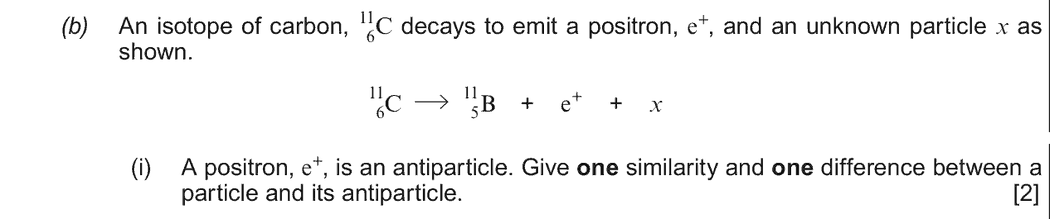
Similarity: same (rest) mass (1)
difference: opposite charge (1)
June 2016 · AS Component 1 · Q5(b)(ii)3 marksAO3=3Explanation
Earlier parts of question 5 that this part uses
Mark scheme
Examiner's comment
This question was generally well done with the majority of candidates having learnt the terminology used in this section of the specification. Some candidates had problems in identifying the particle in (b)(ii) and also lost method marks by not clearly showing whether they were attempting to conserve charge or lepton number. The candidates who scored well on this clearly labelled which law they were using followed by a series of numbers to represent the charges / lepton numbers.
Notes from the mark scheme and report
Charge: 6 = 5 + 1 + 0 so x is neutral (1)
lepton number: 0 = 0 − 1 + 1 so x has lepton number +1 (1)
x is an electron neutrino (1)
marks lost when it was not clear which conservation law was being applied
June 2016 · AS Component 1 · Q5(b)(iii)1 markAO3=1Short answer
Earlier parts of question 5 that this part uses
Mark scheme
Examiner's comment
This question was generally well done with the majority of candidates having learnt the terminology used in this section of the specification. Some candidates had problems in identifying the particle in (b)(ii) and also lost method marks by not clearly showing whether they were attempting to conserve charge or lepton number. The candidates who scored well on this clearly labelled which law they were using followed by a series of numbers to represent the charges / lepton numbers.
Notes from the mark scheme and report
Weak interaction, because a neutrino is involved (or a quark changes flavour)
Work with an Eduqas physics tutor
Dropping marks on calculations, specified practicals or the six-mark QER questions? Book a trial session with a specialist Eduqas physics tutor.