3.4-a the fact that light can be shown to consist of discrete packets (photons) of energy
3.4-b how the photoelectric effect can be demonstrated
3.4-c how a vacuum photocell can be used to measure the maximum kinetic energy, Ek max, of emitted electrons in eV and hence in J
3.4-d the graph of Ek max against frequency of illuminating radiation
3.4-e how a photon picture of light leads to Einstein's equation, Ek max = hf − φ, and how this equation correlates with the graph of Ek max against frequency
3.4-f the fact that the visible spectrum runs approximately from 700 nm (red end) to 400 nm (violet end) and the orders of magnitude of the wavelengths of the other named regions of the electromagnetic spectrum
3.4-g typical photon energies for these radiations
3.4-h how to produce line emission and line absorption spectra from atoms
3.4-i the appearance of such spectra as seen in a diffraction grating
3.4-j simple atomic energy level diagrams, together with the photon hypothesis, line emission and line absorption spectra
3.4-k how to determine ionisation energies from an energy level diagram
3.4-l the demonstration of electron diffraction and that particles have a wave-like aspect
3.4-m the use of the relationship p = h/λ for both particles of matter and photons
3.4-n the calculation of radiation pressure on a surface absorbing or reflecting photons
3.4-P1 Specified practical: Determination of h using LEDs
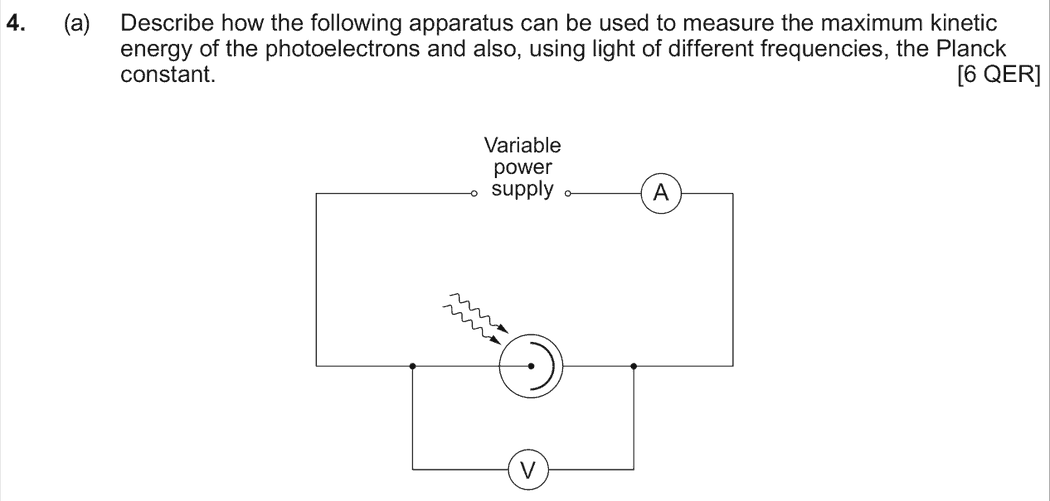
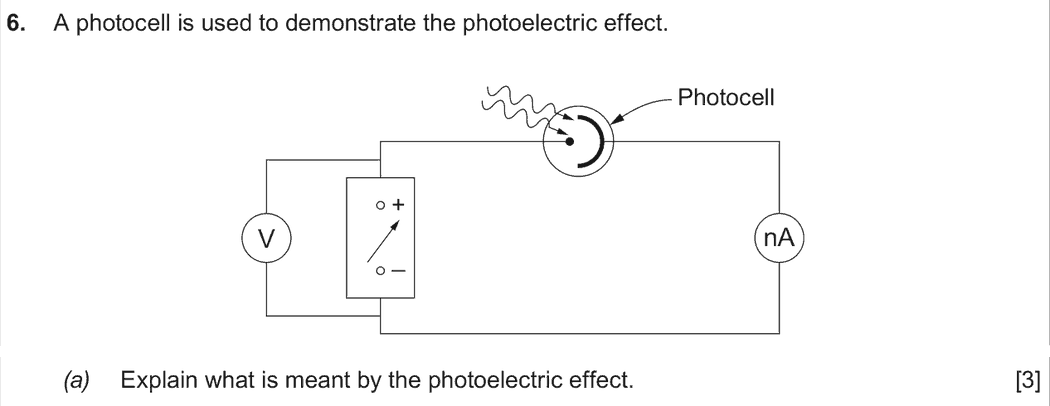
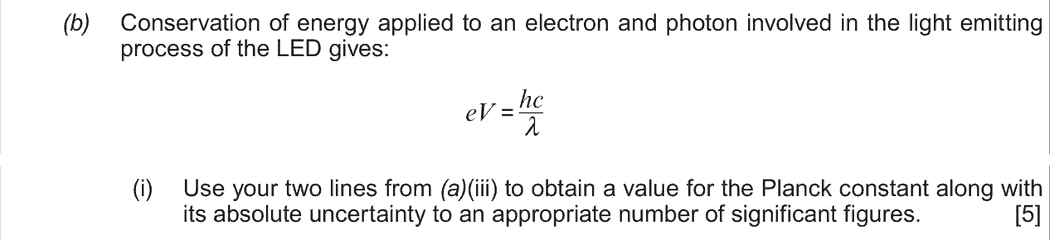
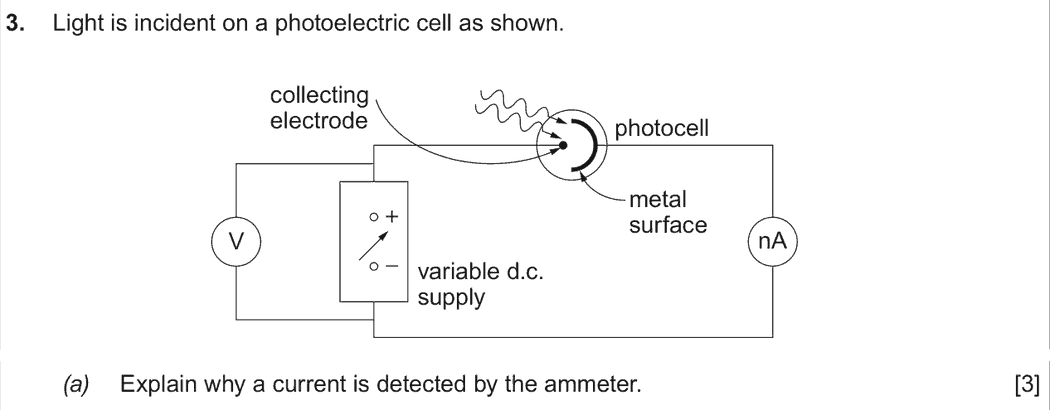
. (a) Describe how the following apparatus can be used to measure the maximum kinetic energy of the photoelectrons and also, using light of different frequencies, the Planck constant. [6 QER] Variable power supply A V
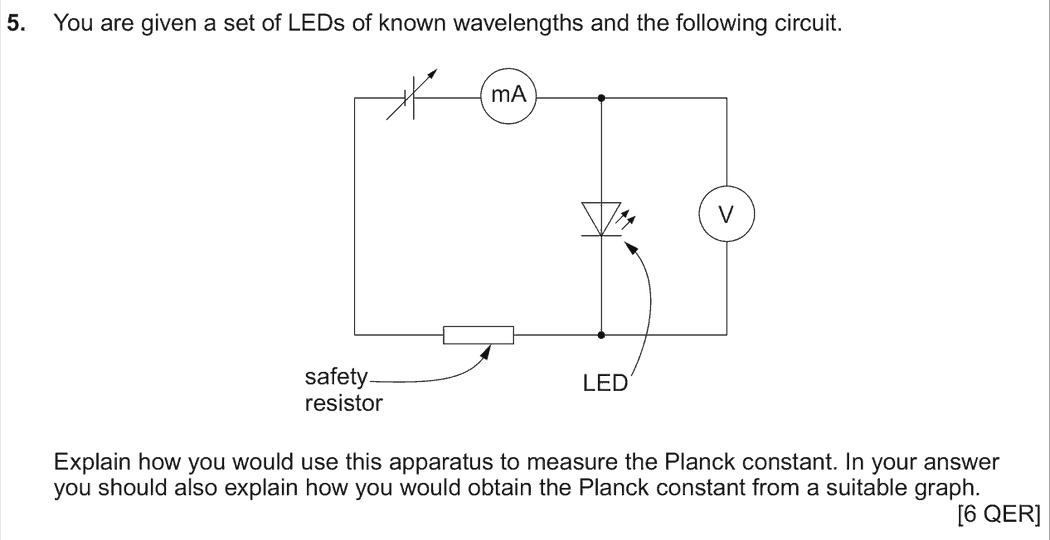
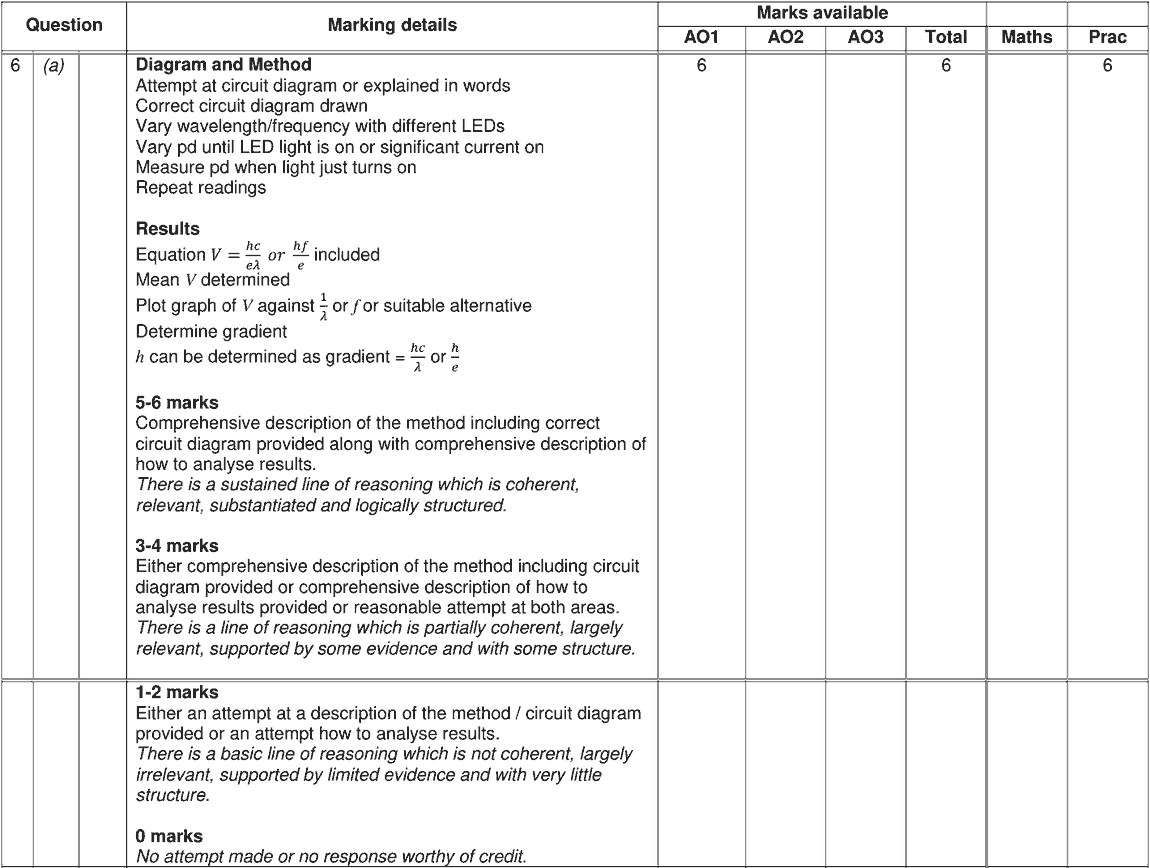
. You are given a set of LEDs of known wavelengths and the following circuit. mA V safety LED resistor Explain how you would use this apparatus to measure the Planck constant. In your answer you should also explain how y
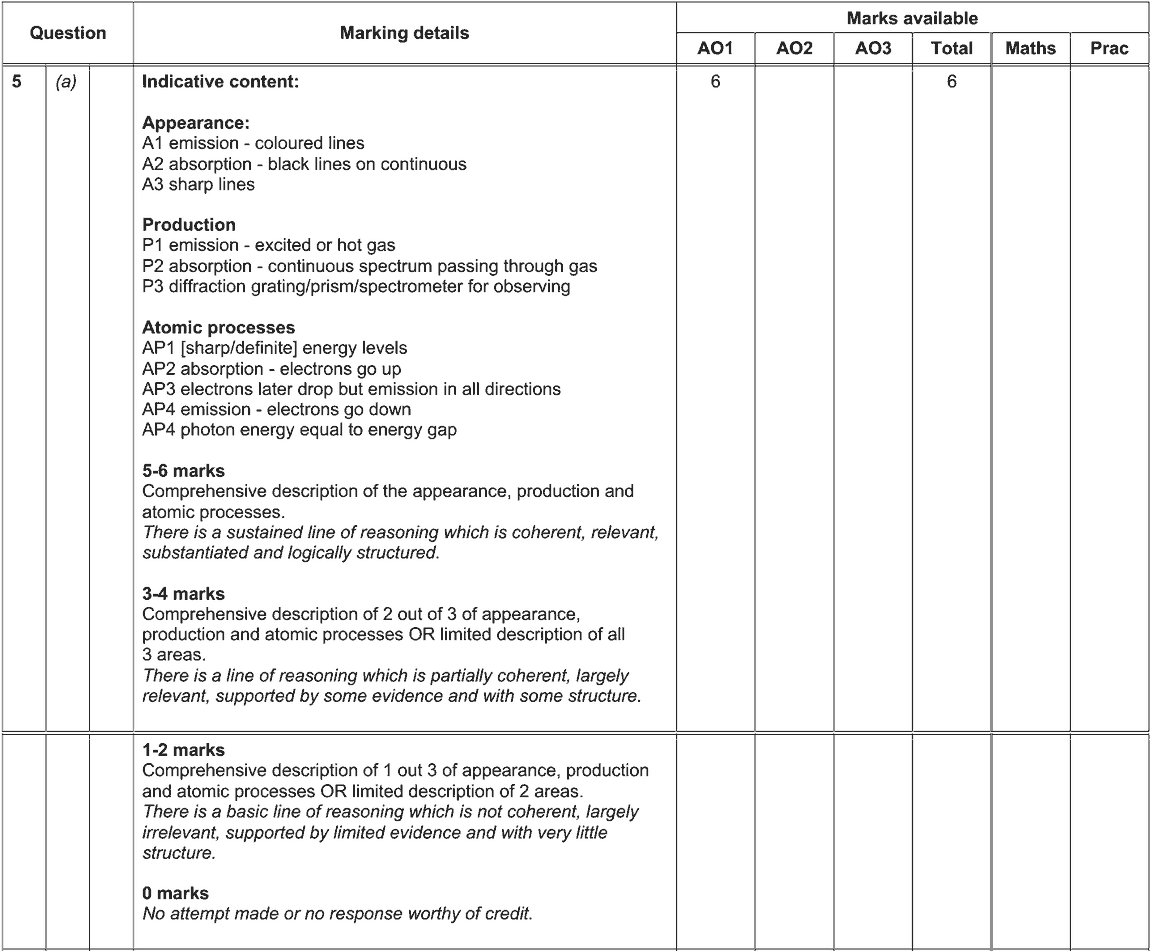
. (a) Describe the appearance of line emission spectra and absorption spectra, how they can be produced and explain the atomic processes responsible for their production. [6 QER]
Tap a question to zoom it. Where a part needs a figure, table or graph from earlier in the question, that part folds out above it; the mark scheme and examiner's comment open underneath. Have the Eduqas Data Booklet beside you (see the Data Booklet page).
June 2025 · AS Component 2 · Q7(a)(i)3 marksAO1=1, AO2=2Calculation
Skills: Unitsand conversions Unit marks, base units, prefixes and conversions; Mathsmarks The mark scheme's Maths column gives this part at least one mark for mathematical skills
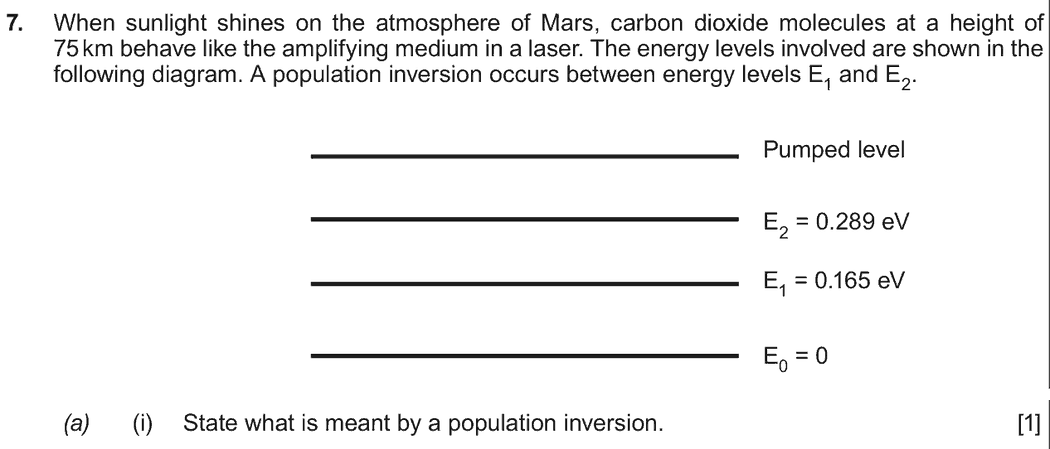
June 2025 · AS Component 2 · Q7(a)(ii)2 marksAO1=1, AO2=1Explanation
Earlier part of question 7 that this part uses
Mark scheme
Notes from the mark scheme and report
Blue light has a shorter wavelength (higher frequency) than green (1)
so each photon has more energy, and the same power is carried by fewer photons per second (1)
June 2025 · AS Component 2 · Q7(b)(i)3 marksAO2=3Calculation
Earlier part of question 7 that this part uses
Mark scheme
Notes from the mark scheme and report
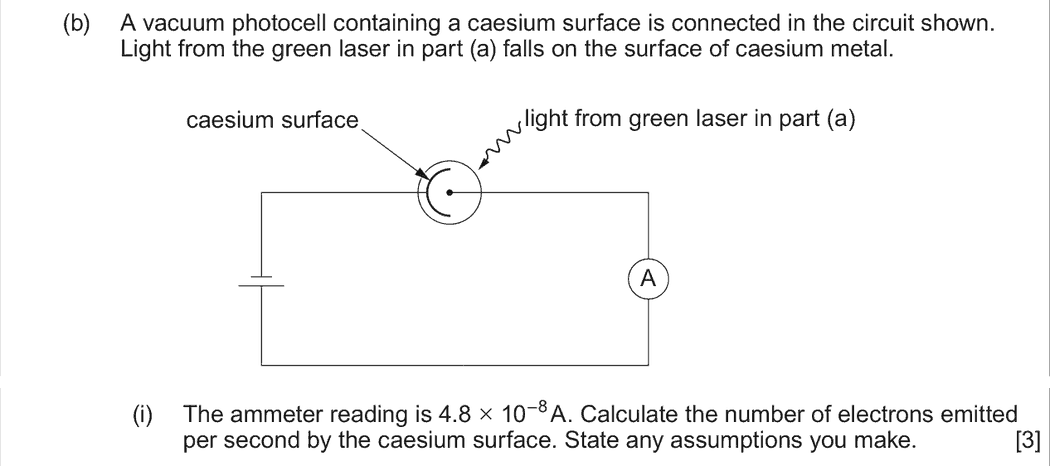
Answer: 3.0 × 10¹¹ electrons per second. Charge per second = 4.8 × 10⁻⁸ C (1)
divide by 1.60 × 10⁻¹⁹ C (1)
assumption: every emitted electron reaches the other electrode and contributes to the ammeter current (1)
Scheme columns: Maths 2
Skills: Mathsmarks The mark scheme's Maths column gives this part at least one mark for mathematical skills
June 2025 · AS Component 2 · Q7(b)(ii)1 markAO3=1Calculation
Earlier parts of question 7 that this part uses
Mark scheme
Notes from the mark scheme and report
Correct: electrons per second/photons per second = 3.0 × 10¹¹/6.9 × 10¹⁵, about 1 in 23 000
ecf from (a)(i) and (b)(i)
Scheme columns: Maths 1
Skills: Mathsmarks The mark scheme's Maths column gives this part at least one mark for mathematical skills
June 2025 · AS Component 2 · Q7(b)(iii)3 marksAO2=3Practical and data analysis
Earlier parts of question 7 that this part uses
Mark scheme
Notes from the mark scheme and report
Reverse the polarity of the supply so the collecting electrode is negative (1)
make the supply variable so the pd can be raised until the current is zero (1)
connect a voltmeter across the supply (photocell) to read the stopping potential (1)
Scheme columns: Practical 3
Skills: Experimentalmethod Describing, planning or improving an experiment; Practicalmarks The mark scheme's Prac column gives this part at least one mark for practical skills
June 2025 · Component 3 · Q4(a)4 marksAO1=4Practical and data analysis
Mark scheme
Examiner's comment
Parts (b) and (c) were very well answered.
Notes from the mark scheme and report
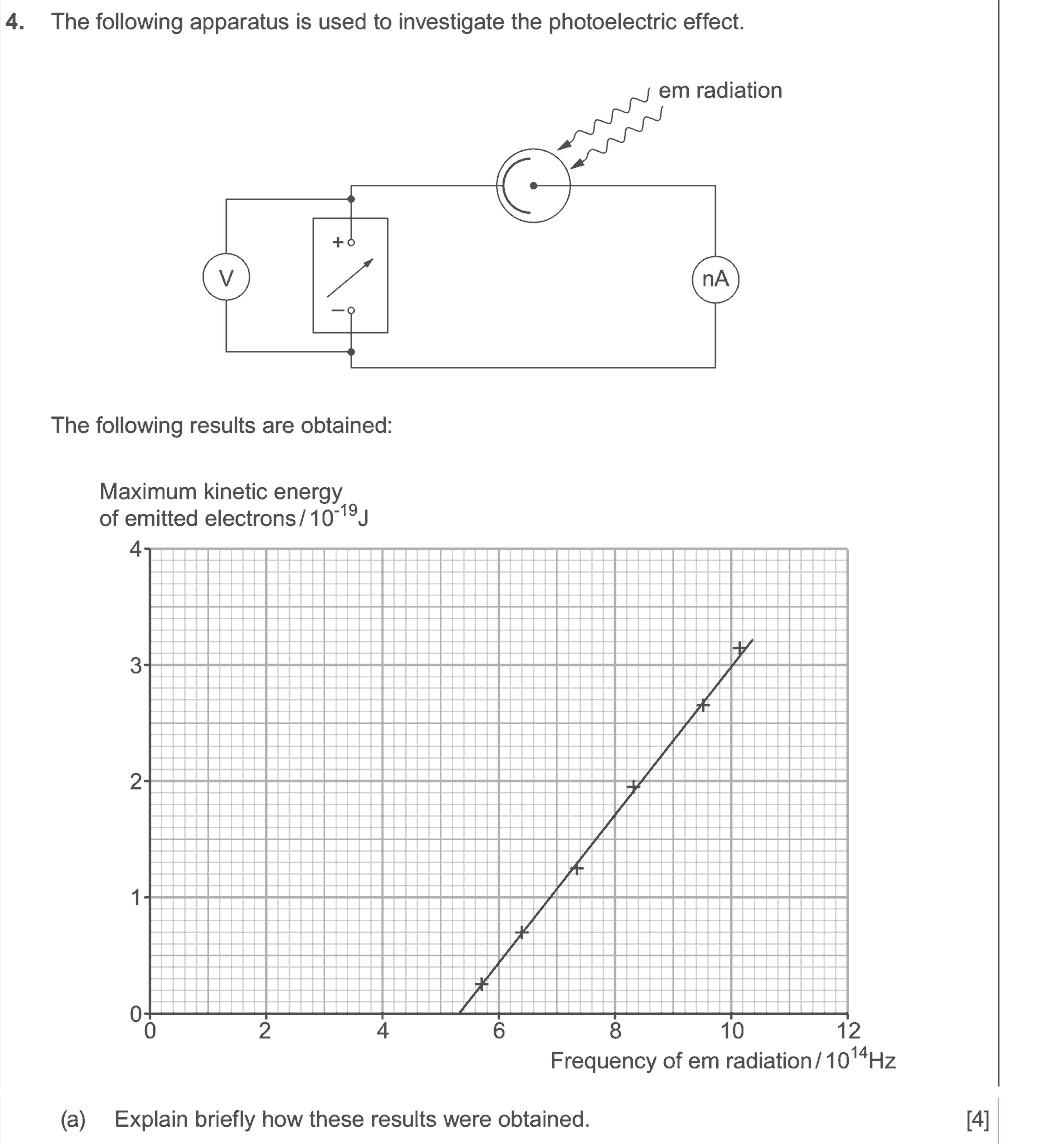
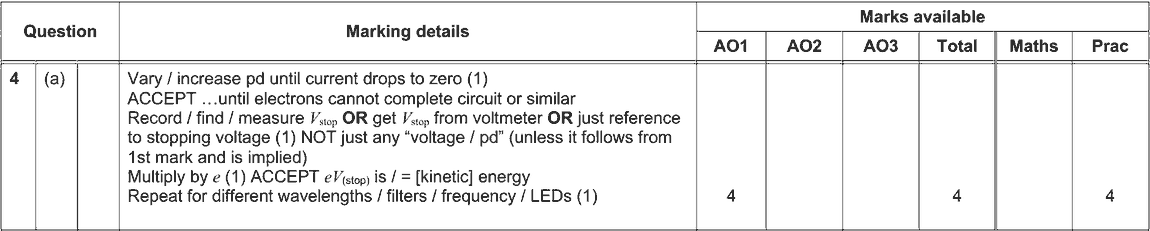
Increase the opposing pd until the current just falls to zero (1)
record this stopping voltage from the voltmeter (1)
Ek max = e × Vstop (1)
repeat for radiation of different frequencies, e.g. filters or LEDs (1)
Scheme columns: Practical 4
Skills: Experimentalmethod Describing, planning or improving an experiment; Practicalmarks The mark scheme's Prac column gives this part at least one mark for practical skills
June 2025 · Component 3 · Q4(b)3 marksAO2=3Calculation
Earlier part of question 4 that this part uses
Mark scheme
Examiner's comment
Parts (b) and (c) were very well answered.
Notes from the mark scheme and report
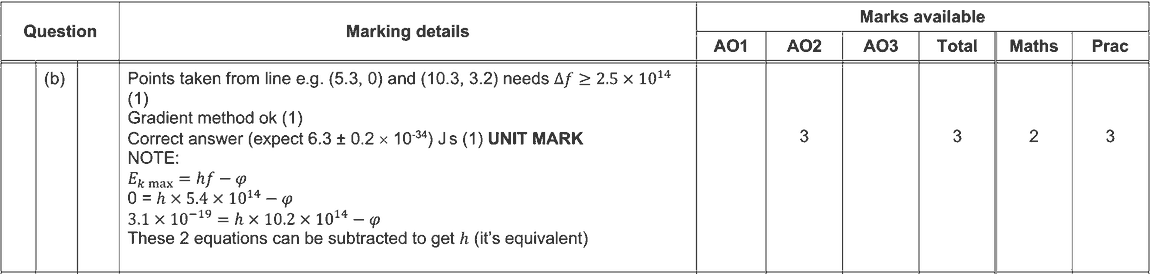
Answer: 6.3 × 10⁻³⁴ J s (± 0.2, unit needed). h = gradient of the line, using points at least 2.5 × 10¹⁴ Hz apart, e.g. (5.3, 0) and (10.3, 3.2): 3.2 × 10⁻¹⁹/5.0 × 10¹⁴
Scheme columns: Maths 2, Practical 3
Skills: Graphskills Reading, plotting or sketching graphs; gradients, intercepts and areas; Mathsmarks The mark scheme's Maths column gives this part at least one mark for mathematical skills; Practicalmarks The mark scheme's Prac column gives this part at least one mark for practical skills
June 2025 · Component 3 · Q4(c)4 marksAO3=4Calculation
Earlier part of question 4 that this part uses
Mark scheme
Examiner's comment
Parts (b) and (c) were very well answered.
Notes from the mark scheme and report
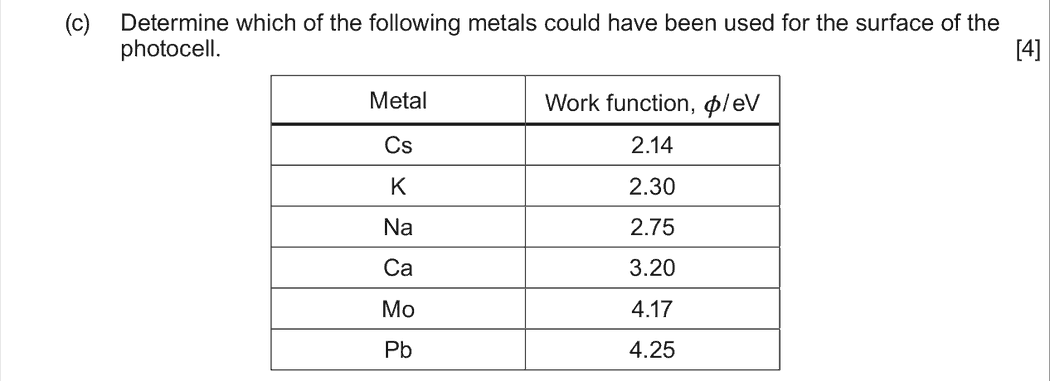
Answer: caesium (or potassium). Threshold frequency from the intercept = 5.3 × 10¹⁴ Hz (1)
φ = hf0 = 3.5 × 10⁻¹⁹ J (1) = 2.2 eV (1)
conclusion consistent with the value (1)
Scheme columns: Maths 2, Practical 4
Skills: Graphskills Reading, plotting or sketching graphs; gradients, intercepts and areas; Unitsand conversions Unit marks, base units, prefixes and conversions; Mathsmarks The mark scheme's Maths column gives this part at least one mark for mathematical skills; Practicalmarks The mark scheme's Prac column gives this part at least one mark for practical skills
June 2024 · AS Component 2 · Q3(a)1 markAO1=1Definition
Mark scheme
Examiner's comment
Parts (a) and (b)(i) were well answered. The determination of the minimum pd needed proved to be more difficult as well as explaining the effects of increasing the intensity of the radiation on the minimum pd in parts (b)(ii) and (iii). Several candidates were able to state correctly that the number of photons per second increases by increasing the intensity but did not state that the energy of the photon remains the same. In part (c)(i) nearly all the candidates were able to explain that the pattern shows the wave- like properties of electrons and that it corresponds to a diffraction pattern. However, in part
Notes from the mark scheme and report
The minimum energy needed to remove an electron from the surface of the metal
June 2024 · AS Component 2 · Q3(b)(i)2 marksAO2=2Calculation
Earlier part of question 3 that this part uses
Mark scheme
Examiner's comment
Parts (a) and (b)(i) were well answered. The determination of the minimum pd needed proved to be more difficult as well as explaining the effects of increasing the intensity of the radiation on the minimum pd in parts (b)(ii) and (iii). Several candidates were able to state correctly that the number of photons per second increases by increasing the intensity but did not state that the energy of the photon remains the same. In part (c)(i) nearly all the candidates were able to explain that the pattern shows the wave- like properties of electrons and that it corresponds to a diffraction pattern. However, in part
Notes from the mark scheme and report
Answer: 8.0 × 10¹⁴ Hz. Photon energy hf = φ + Ek max = 3.8 × 10⁻¹⁹ + 1.5 × 10⁻¹⁹ = 5.3 × 10⁻¹⁹ J (1)
f = 5.3 × 10⁻¹⁹/6.63 × 10⁻³⁴ (1)
Scheme columns: Maths 2
Skills: Mathsmarks The mark scheme's Maths column gives this part at least one mark for mathematical skills
June 2024 · AS Component 2 · Q3(b)(ii)2 marksAO1=1, AO2=1Calculation
Earlier parts of question 3 that this part uses
Mark scheme
Examiner's comment
Parts (a) and (b)(i) were well answered. The determination of the minimum pd needed proved to be more difficult as well as explaining the effects of increasing the intensity of the radiation on the minimum pd in parts (b)(ii) and (iii). Several candidates were able to state correctly that the number of photons per second increases by increasing the intensity but did not state that the energy of the photon remains the same. In part (c)(i) nearly all the candidates were able to explain that the pattern shows the wave- like properties of electrons and that it corresponds to a diffraction pattern. However, in part
Notes from the mark scheme and report
Answer: 0.94 V. eV = Ek max so V = 1.5 × 10⁻¹⁹/1.60 × 10⁻¹⁹ (2)
found harder than (i)
Scheme columns: Maths 1
Skills: Mathsmarks The mark scheme's Maths column gives this part at least one mark for mathematical skills
June 2024 · AS Component 2 · Q3(b)(iii)3 marksAO3=3Explanation
Earlier parts of question 3 that this part uses
Mark scheme
Examiner's comment
Parts (a) and (b)(i) were well answered. The determination of the minimum pd needed proved to be more difficult as well as explaining the effects of increasing the intensity of the radiation on the minimum pd in parts (b)(ii) and (iii). Several candidates were able to state correctly that the number of photons per second increases by increasing the intensity but did not state that the energy of the photon remains the same. In part (c)(i) nearly all the candidates were able to explain that the pattern shows the wave- like properties of electrons and that it corresponds to a diffraction pattern. However, in part
Notes from the mark scheme and report
Ronald is not correct. The frequency, and so the energy of each photon, is unchanged (1)
greater intensity only means more photons per second (more electrons emitted per second), each electron being released by one photon (1)
Ek max and so the stopping pd stay the same (1)
many gave 'more photons' without saying the photon energy is unchanged
June 2024 · AS Component 2 · Q3(c)(i)1 markAO1=1Short answer
Earlier part of question 3 that this part uses
Mark scheme
Examiner's comment
(ii), several candidates were not able to explain that the pattern is due to interference after the electrons have been diffracted by the atoms in the graphite that act as a diffraction grating. The last part proved to be more challenging with few correct answers and an understanding of the approach needed to determine the de Broglie wavelength.
Notes from the mark scheme and report
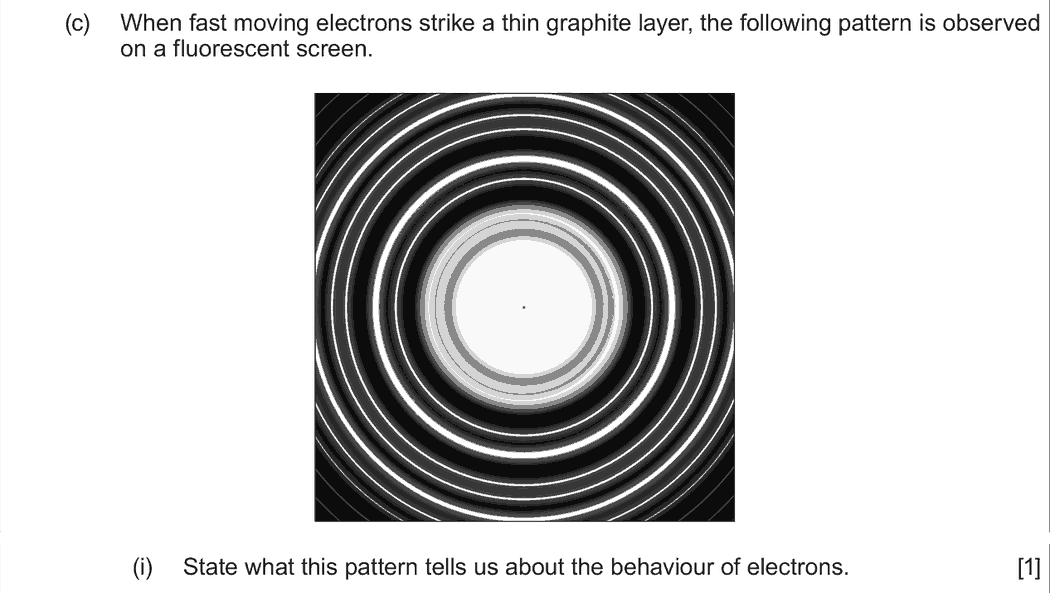
Electrons show wave behaviour (they diffract or interfere)
June 2024 · AS Component 2 · Q3(c)(ii)2 marksAO2=2Explanation
Earlier parts of question 3 that this part uses
Mark scheme
Examiner's comment
(ii), several candidates were not able to explain that the pattern is due to interference after the electrons have been diffracted by the atoms in the graphite that act as a diffraction grating. The last part proved to be more challenging with few correct answers and an understanding of the approach needed to determine the de Broglie wavelength.
Notes from the mark scheme and report
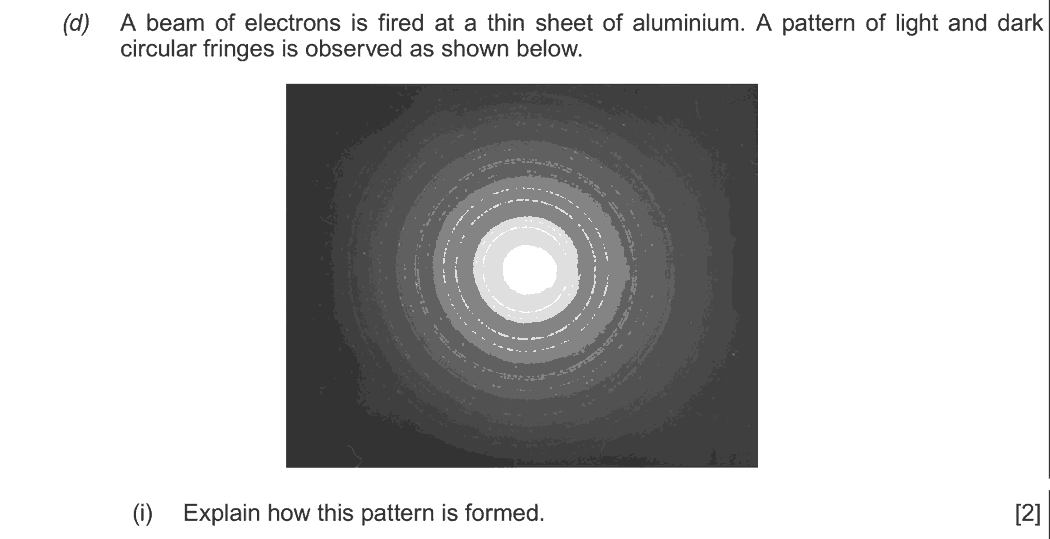
The regularly spaced atoms of the graphite crystal act as a diffraction grating for the electron waves (1)
the diffracted waves interfere, constructively at the bright rings (1)
the interference step was often missing
June 2024 · AS Component 2 · Q3(c)(iii)2 marksAO2=2Calculation
Earlier parts of question 3 that this part uses
Mark scheme
Examiner's comment
(ii), several candidates were not able to explain that the pattern is due to interference after the electrons have been diffracted by the atoms in the graphite that act as a diffraction grating. The last part proved to be more challenging with few correct answers and an understanding of the approach needed to determine the de Broglie wavelength.
Notes from the mark scheme and report
Answer: 4.3 × 10⁷ m s⁻¹. p = h/λ so v = h/mλ = 6.63 × 10⁻³⁴/(9.11 × 10⁻³¹ × 1.7 × 10⁻¹¹) (2)
few correct answers
Scheme columns: Maths 2
Skills: Mathsmarks The mark scheme's Maths column gives this part at least one mark for mathematical skills
June 2024 · AS Component 2 · Q5(b)4 marksAO3=4Calculation
Earlier part of question 5 that this part uses
Mark scheme
Examiner's comment
This question was very well answered and it was apparent the topic was well understood by candidates.
Notes from the mark scheme and report
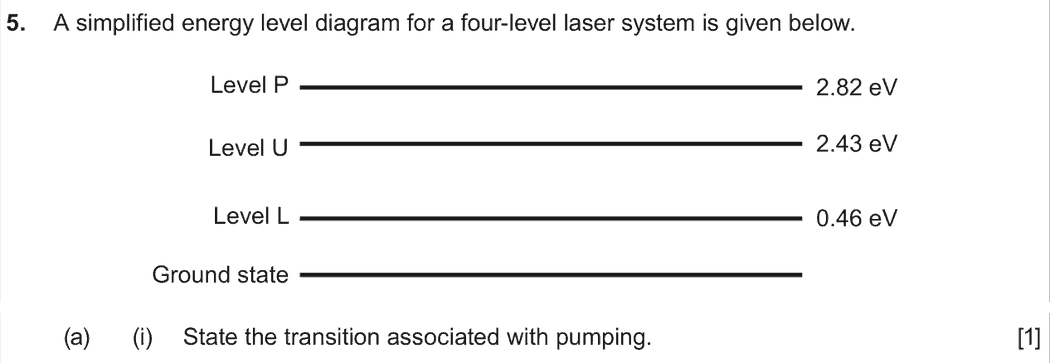
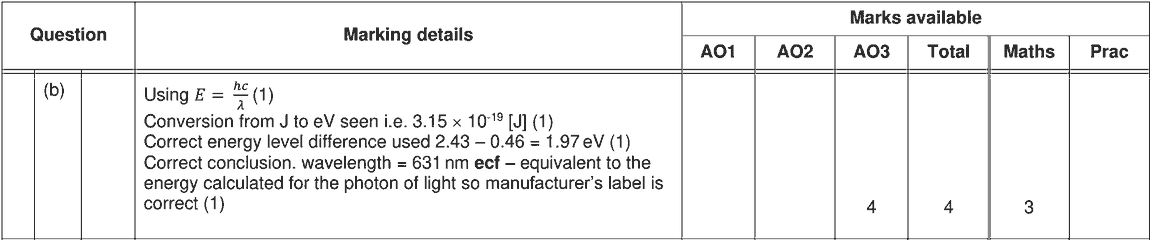
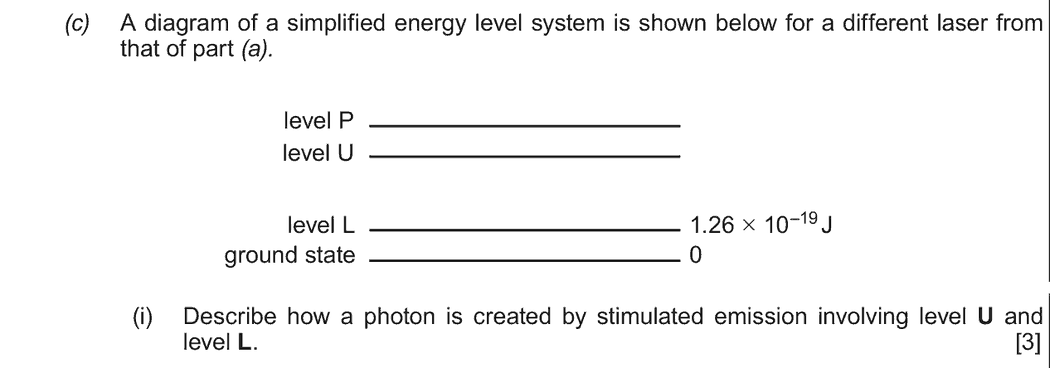
Answer: label correct (631 nm). Laser transition U to L: 2.43 − 0.46 = 1.97 eV (1) = 3.15 × 10⁻¹⁹ J (1)
Skills: Unitsand conversions Unit marks, base units, prefixes and conversions; Mathsmarks The mark scheme's Maths column gives this part at least one mark for mathematical skills
June 2024 · Component 3 · Q4(a)3 marksAO1=1, AO2=2Explanation
Mark scheme
Examiner's comment
The mark scheme was made more lenient here because the candidates almost universally talked about one thing causing an increase in another. This, strictly speaking, does not answer the question! The question is asking for an explanation of proportionality – a very specific relationship. However, there is no point in setting a mark scheme that awards nearly everyone 0 marks and the mark scheme was modified so that the whole range of marks was awarded.
Notes from the mark scheme and report
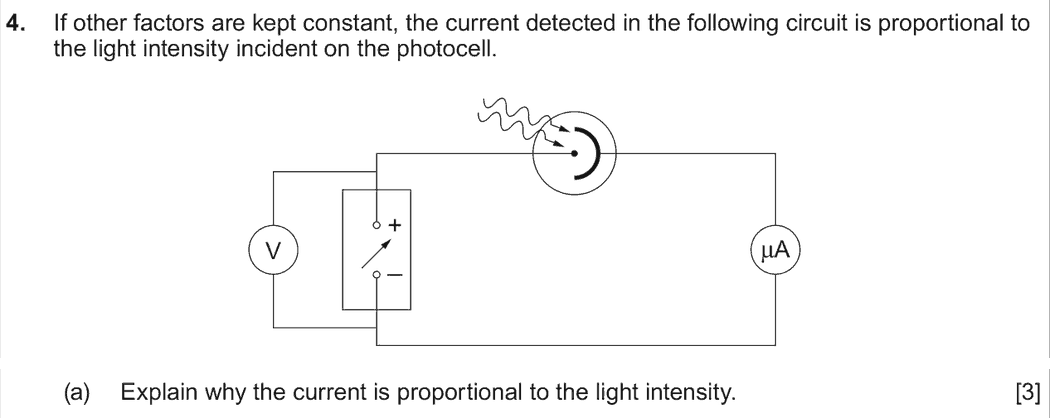
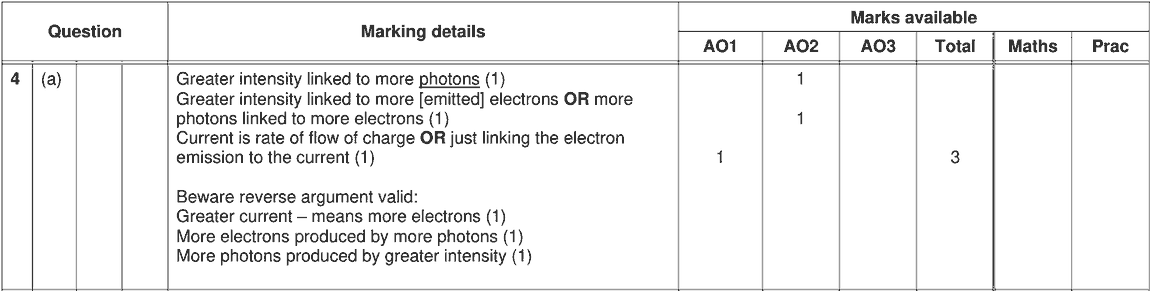
Greater intensity means more photons arriving per second (1)
each photon can release one electron, so more electrons are emitted per second (1)
current is the rate of flow of charge, so it rises in step (1)
the scheme was relaxed because few explained proportionality as such
June 2024 · Component 3 · Q4(b)2 marksAO3=2Short answer
Earlier part of question 4 that this part uses
Mark scheme
Examiner's comment
Wavelength and pd were the correct and most frequent answers. Some candidates mentioned resistance. They could obtain a mark if they discussed this “effective resistance” but this was not usually the case.
Notes from the mark scheme and report
Wavelength (frequency, photon energy) of the light (1)
pd across the photocell (1)
background light also accepted, temperature not
Scheme columns: Practical 2
Skills: Experimentalmethod Describing, planning or improving an experiment; Practicalmarks The mark scheme's Prac column gives this part at least one mark for practical skills
June 2024 · Component 3 · Q4(c)(i)3 marksAO1=2, AO2=1Calculation
Earlier part of question 4 that this part uses
Mark scheme
Examiner's comment
A challenging photoelectric effect question but the mean mark was close to 60%.
Notes from the mark scheme and report
Answer: 2.6 eV (4.2 × 10⁻¹⁹ J). Ek max = ½mv² = ½ × 9.11 × 10⁻³¹ × (3.9 × 10⁵)² = 6.9 × 10⁻²⁰ J
photon energy hc/λ = 4.85 × 10⁻¹⁹ J
φ = hf − Ek max
unit mark
report: mean close to 60%
Scheme columns: Maths 3
Skills: Unitsand conversions Unit marks, base units, prefixes and conversions; Mathsmarks The mark scheme's Maths column gives this part at least one mark for mathematical skills
June 2024 · Component 3 · Q4(c)(ii)3 marksAO2=3Calculation
Earlier parts of question 4 that this part uses
Mark scheme
Examiner's comment
The assumption was the most common part to be omitted – one photon produces one electron would have sufficed (even though this quantum efficiency will never be attained). Once a candidate was able to divide the power by the photon energy, the correct answer inevitably followed. There is an alternative that leads to the correct answer involving power but this is probably better to avoid and involves explaining that the photons provide a “constant pd” of 3 V. Although the calculation is relatively simple, the explanation is not.
Notes from the mark scheme and report
Answer: 0.12 μA. Assume every photon releases one electron that reaches the collector (1)
photons per second = 0.36 × 10⁻⁶/4.85 × 10⁻¹⁹ = 7.4 × 10¹¹ (1)
I = 7.4 × 10¹¹ × 1.60 × 10⁻¹⁹ (1)
the assumption was usually missing
Scheme columns: Maths 2
Skills: Mathsmarks The mark scheme's Maths column gives this part at least one mark for mathematical skills
June 2024 · Component 3 · Q4(d)3 marksAO3=3Explanation
Earlier part of question 4 that this part uses
Mark scheme
Examiner's comment
The issues question. Quite well answered but extremely well answered once the candidates mentioned wave-particle duality.
Notes from the mark scheme and report
Light shows both wave and particle behaviour: wave-particle duality (1)
this is the model now accepted (1)
adopted because a large body of evidence from many different experiments supports it, not just repeats (1)
June 2023 · AS Component 2 · Q2(c)(i)3 marksAO1=1, AO2=2Show that
Earlier parts of question 2 that this part uses
Mark scheme
Examiner's comment
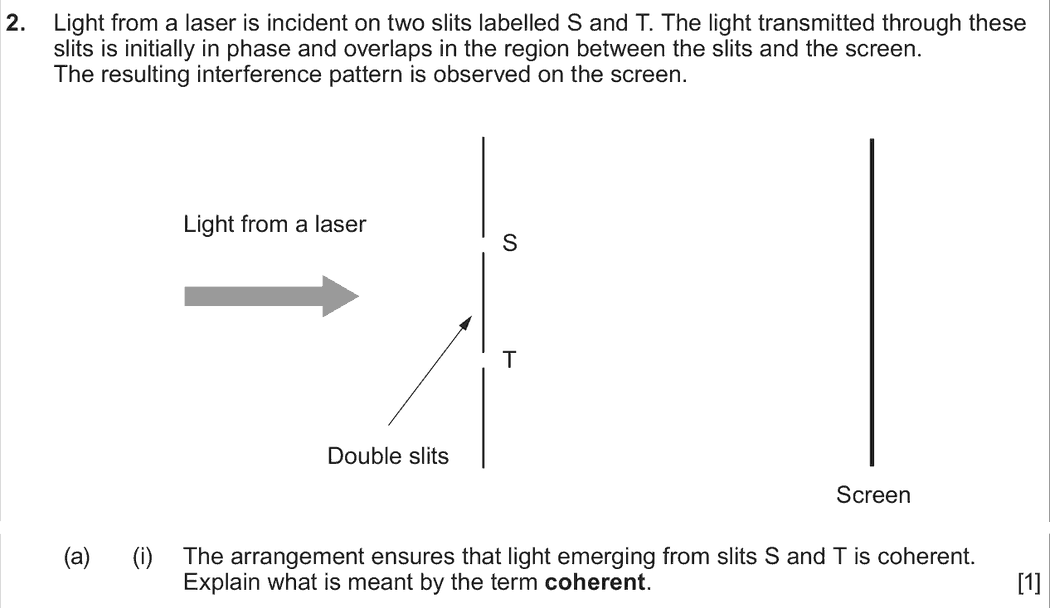
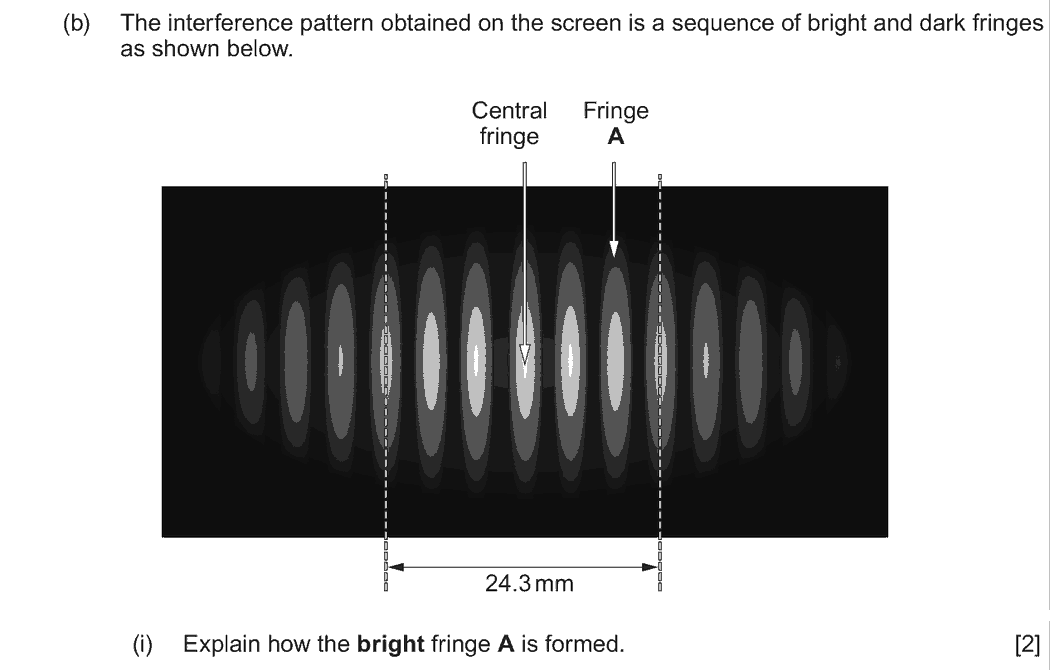
Part (a)(i) was answered well but (a)(ii) was not answered well with only a few candidates being able to explain what is meant by the term phase. For part (b)(i); only a few candidates realised that the path difference is 2 wavelength for the fringe to be formed at A. Part (b)(ii) was answered well by all candidates. In part (c); nearly all candidates scored full marks but for part (c)(ii); it was not evident that candidates realised the steps involved and simply inputted the numbers into an equation. This obtained full marks.
Skills: Unitsand conversions Unit marks, base units, prefixes and conversions; Mathsmarks The mark scheme's Maths column gives this part at least one mark for mathematical skills
June 2023 · AS Component 2 · Q2(c)(ii)3 marksAO1=1, AO2=2Calculation
Earlier parts of question 2 that this part uses
Mark scheme
Examiner's comment
Part (a)(i) was answered well but (a)(ii) was not answered well with only a few candidates being able to explain what is meant by the term phase. For part (b)(i); only a few candidates realised that the path difference is 2 wavelength for the fringe to be formed at A. Part (b)(ii) was answered well by all candidates. In part (c); nearly all candidates scored full marks but for part (c)(ii); it was not evident that candidates realised the steps involved and simply inputted the numbers into an equation. This obtained full marks.
Notes from the mark scheme and report
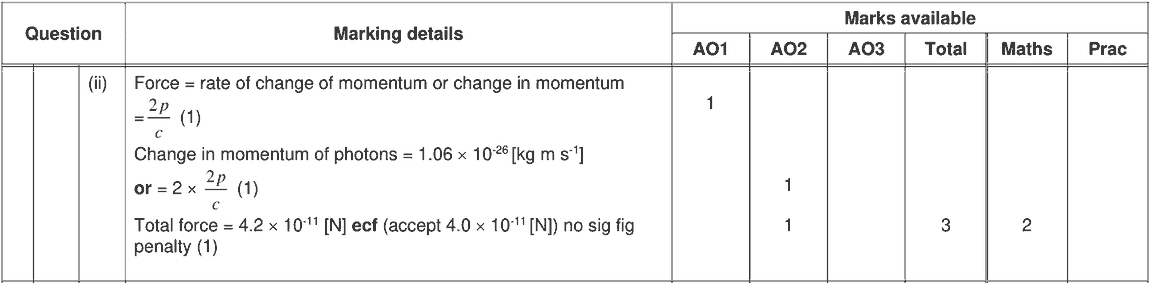
Answer: 4.2 × 10⁻¹¹ N (4.0 × 10⁻¹¹ with the rounded photon rate). Force = rate of change of momentum
each reflected photon changes momentum by 2p = 1.06 × 10⁻²⁶ kg m s⁻¹
× 4 × 10¹⁵ photons per second
numbers were often put in without the steps being understood
Scheme columns: Maths 2
Skills: Mathsmarks The mark scheme's Maths column gives this part at least one mark for mathematical skills
June 2023 · AS Component 2 · Q4(a)6 marksAO1=66-mark extended response
Mark scheme, with the levels and indicative content
Examiner's comment
For part (a); there was a range of marks with some candidates being able to give limited responses. Part (b) was answered poorly with hardly any responses on the applications of the photon model of light in lasers or electron microscopes.
Notes from the mark scheme and report
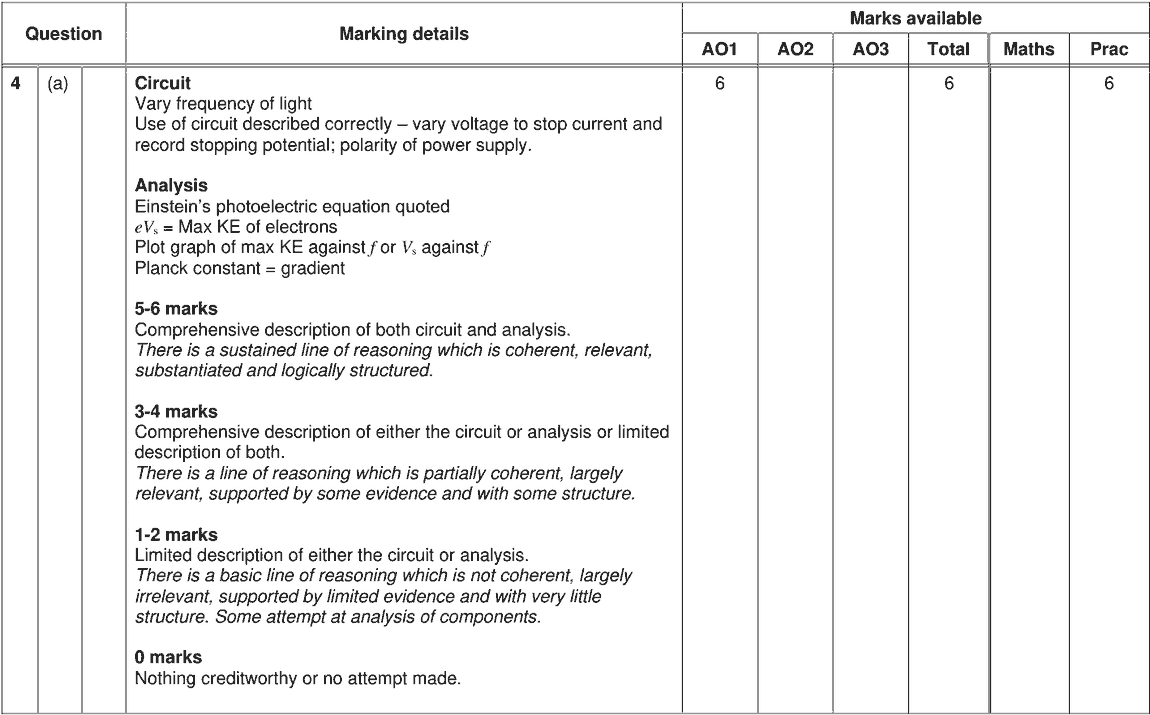
QER, levels marked. Circuit: shine light of known frequency on the photocell
connect the supply so that it opposes the photoelectrons
raise the pd until the ammeter reads zero and record this stopping pd
repeat for several frequencies. Analysis: Ek max = eVs
Einstein's equation Ek max = hf − φ
plot Ek max (or Vs) against f
straight line with gradient h (or h/e). Many answers were limited
Scheme columns: Practical 6
Skills: Experimentalmethod Describing, planning or improving an experiment; Graphskills Reading, plotting or sketching graphs; gradients, intercepts and areas; Practicalmarks The mark scheme's Prac column gives this part at least one mark for practical skills; QER The 6-mark quality of extended response question
June 2023 · AS Component 2 · Q4(b)2 marksAO3=2Explanation
Earlier part of question 4 that this part uses
Mark scheme
Examiner's comment
For part (a); there was a range of marks with some candidates being able to give limited responses. Part (b) was answered poorly with hardly any responses on the applications of the photon model of light in lasers or electron microscopes.
Notes from the mark scheme and report
It gave evidence for the photon model of light (wave-particle duality) (1)
a named application with its use, e.g. lasers in eye surgery, electron microscopes for studying atomic structure (1)
June 2023 · Component 3 · Q4(a)(i)1 markAO1=1Short answer
Mark scheme
Examiner's comment
In part (a) the UV wavelength was better known than the microwave. Occasionally the word “minimum” was missing in (b)(i). Part (b)(iii) was extremely well answered especially considering that the speed of the electron was required.
Notes from the mark scheme and report
Any value from 1 mm to 1 m, with unit
Skills: Unitsand conversions Unit marks, base units, prefixes and conversions
June 2023 · Component 3 · Q4(a)(ii)1 markAO1=1Short answer
Earlier part of question 4 that this part uses
Mark scheme
Examiner's comment
In part (a) the UV wavelength was better known than the microwave. Occasionally the word “minimum” was missing in (b)(i). Part (b)(iii) was extremely well answered especially considering that the speed of the electron was required.
Notes from the mark scheme and report
Any value from 10 nm to 400 nm, with unit
better known than the microwave value
Skills: Unitsand conversions Unit marks, base units, prefixes and conversions
June 2023 · Component 3 · Q4(b)(i)2 marksAO1=2Definition
Earlier part of question 4 that this part uses
Mark scheme
Examiner's comment
In part (a) the UV wavelength was better known than the microwave. Occasionally the word “minimum” was missing in (b)(i). Part (b)(iii) was extremely well answered especially considering that the speed of the electron was required.
Notes from the mark scheme and report
The minimum energy (1) needed to free an electron from the surface (1)
'minimum' sometimes missing
June 2023 · Component 3 · Q4(b)(ii)3 marksAO1=1, AO2=2Calculation
Earlier parts of question 4 that this part uses
Mark scheme
Examiner's comment
In part (a) the UV wavelength was better known than the microwave. Occasionally the word “minimum” was missing in (b)(i). Part (b)(iii) was extremely well answered especially considering that the speed of the electron was required.
Notes from the mark scheme and report
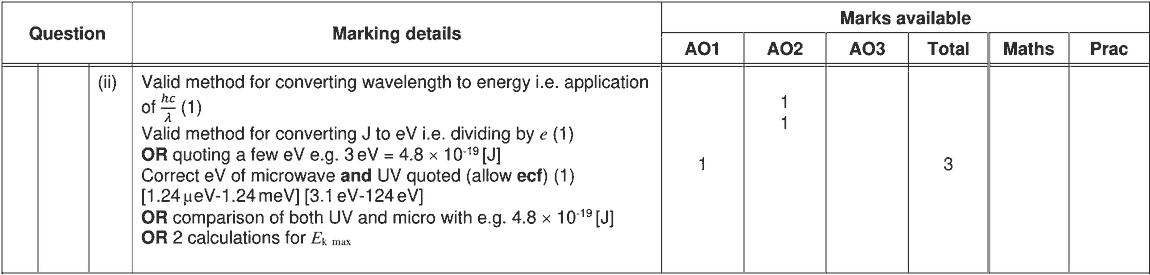
Photon energy E = hc/λ (1)
convert between J and eV (1)
microwave photons are about 1 µeV to 1 meV, far below a few eV, while ultraviolet photons are about 3 eV to 120 eV, above it, so only UV releases electrons (1)
Skills: Unitsand conversions Unit marks, base units, prefixes and conversions
June 2023 · Component 3 · Q4(b)(iii)5 marksAO1=1, AO2=4Calculation
Earlier parts of question 4 that this part uses
Mark scheme
Examiner's comment
In part (a) the UV wavelength was better known than the microwave. Occasionally the word “minimum” was missing in (b)(i). Part (b)(iii) was extremely well answered especially considering that the speed of the electron was required.
Notes from the mark scheme and report
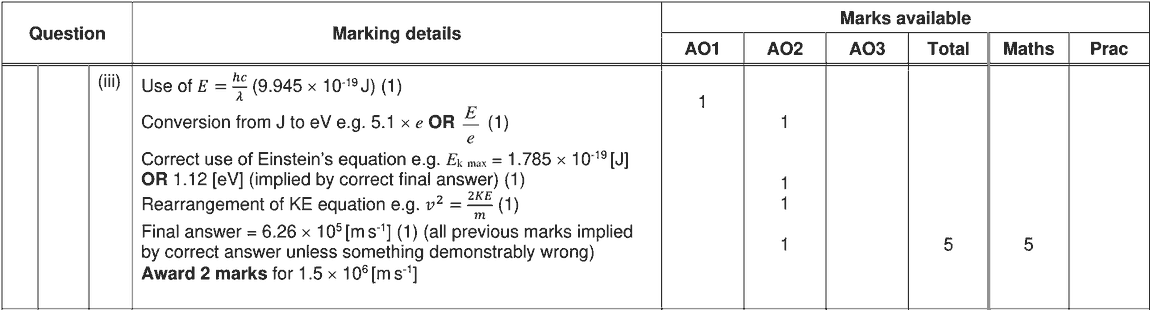
Answer: 6.26 × 10⁵ m s⁻¹. Photon energy hc/λ = 9.95 × 10⁻¹⁹ J (1)
φ = 5.1 × 1.60 × 10⁻¹⁹ = 8.16 × 10⁻¹⁹ J (1)
Ek max = 1.79 × 10⁻¹⁹ J (1.12 eV) (1)
v = √(2Ek/m) (1)
answer (1)
1.5 × 10⁶ m s⁻¹ (work function ignored) scores 2
extremely well answered
Scheme columns: Maths 5
Skills: Unitsand conversions Unit marks, base units, prefixes and conversions; Mathsmarks The mark scheme's Maths column gives this part at least one mark for mathematical skills
June 2023 · Component 3 · Q56 marksAO1=66-mark extended response
Mark scheme, with the levels and indicative content
Examiner's comment
Slightly disappointing responses in general were seen for the QER. Many candidates confused this experiment with the stopping potential in the photoeletric effect. Fortunately, for those candidates that made this mistake, they were not penalised heavily. They could still talk about plotting the correct graph and how to obtain the Planck constant from the gradient.
Notes from the mark scheme and report
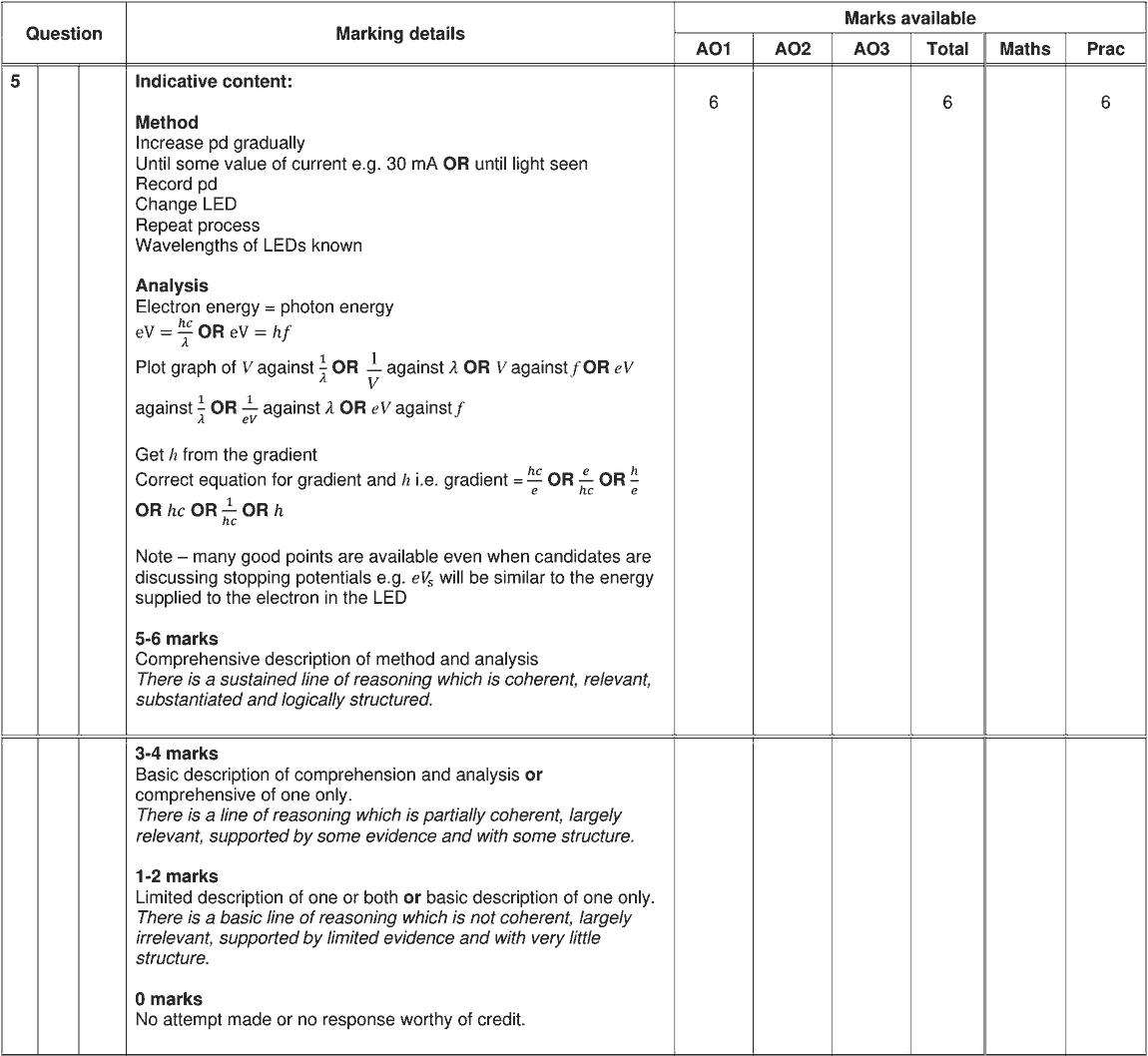
QER, levels marked. Method: increase the pd gradually until the LED just lights (or a fixed small current is reached)
record that pd
repeat for each LED of known wavelength. Analysis: energy given to each electron = photon energy, eV = hc/λ (= hf)
plot V against 1/λ (or V against f)
straight line whose gradient is hc/e (or h/e), so h = gradient × e/c. Report: many confused this with the stopping potential in the photoelectric effect, though the graph work could still be credited
Scheme columns: Practical 6
Skills: Experimentalmethod Describing, planning or improving an experiment; Graphskills Reading, plotting or sketching graphs; gradients, intercepts and areas; Practicalmarks The mark scheme's Prac column gives this part at least one mark for practical skills; QER The 6-mark quality of extended response question
June 2022 · Component 1 · Q8(b)(i)2 marksAO2=2Explanation
Earlier part of question 8 that this part uses
Mark scheme
Examiner's comment
Most candidates understood that the blue shift would make the photon the right frequency to be absorbed…
Notes from the mark scheme and report
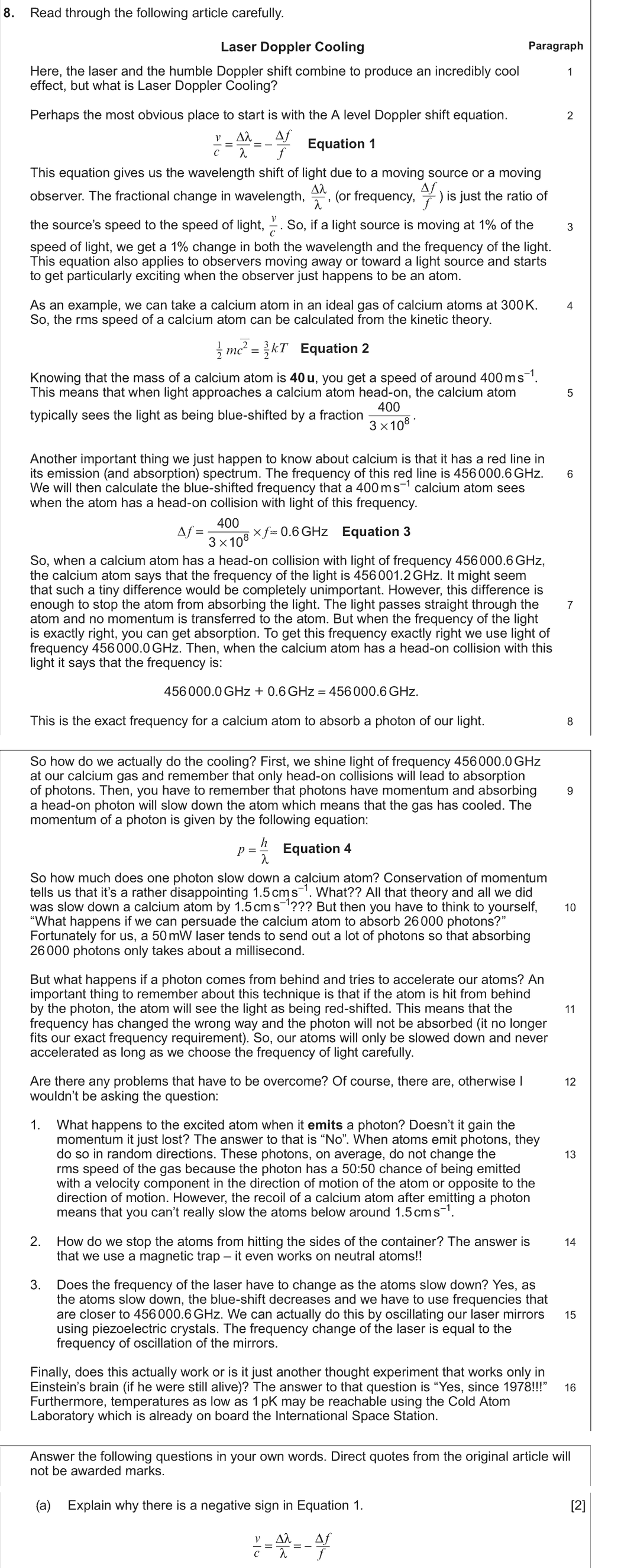
The atom sees the approaching photon blue-shifted by 0.6 GHz to 456 000.6 GHz (1), which is exactly the frequency of its absorption line (1)
Skills: Comprehension A level Component 1 Section B: questions on the printed article; Synoptic Needs physics from another component of the qualification
June 2022 · Component 1 · Q8(b)(ii)1 markAO2=1Short answer
Earlier parts of question 8 that this part uses
Mark scheme
Examiner's comment
… but that if the photons and atom are moving in the same direction, the photon will be red shifted, making its frequency further away from that needed.
Notes from the mark scheme and report
The photon is red-shifted (to 455 999.4 GHz), further from the absorption frequency
Skills: Comprehension A level Component 1 Section B: questions on the printed article; Synoptic Needs physics from another component of the qualification
June 2022 · Component 1 · Q8(b)(iii)1 markAO2=1Short answer
Earlier parts of question 8 that this part uses
Mark scheme
Examiner's comment
To explain cooling we were hoping that candidates would tell us that only photons that could slow down the atoms would be absorbed, but the mark was not often awarded.
Notes from the mark scheme and report
Only photons meeting an atom head-on are absorbed, and these always slow the atom, so the mean speed and hence the temperature falls
this mark was not often awarded
Skills: Comprehension A level Component 1 Section B: questions on the printed article; Synoptic Needs physics from another component of the qualification
June 2022 · Component 1 · Q8(d)4 marksAO2=4Show that
Earlier part of question 8 that this part uses
Mark scheme
Examiner's comment
Most, but not all, candidates realised that to find the decrease in the atom’s velocity, they needed to apply conservation of momentum. The photon’s momentum was usually found correctly. Most candidates calculated the atom’s initial momentum (sometimes making mistakes with mass units) and then its final momentum, hence the new velocity. A minority saw that the change in velocity was simply equal to the photon momentum divided by the atom’s mass.
Notes from the mark scheme and report
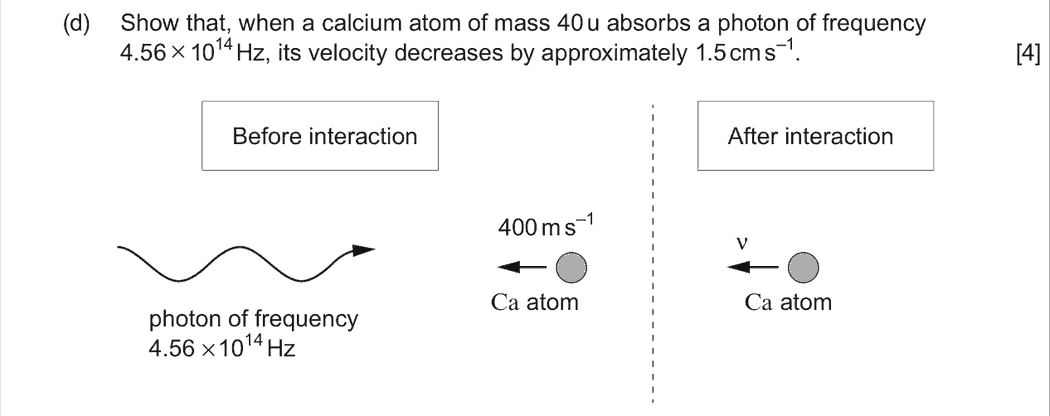
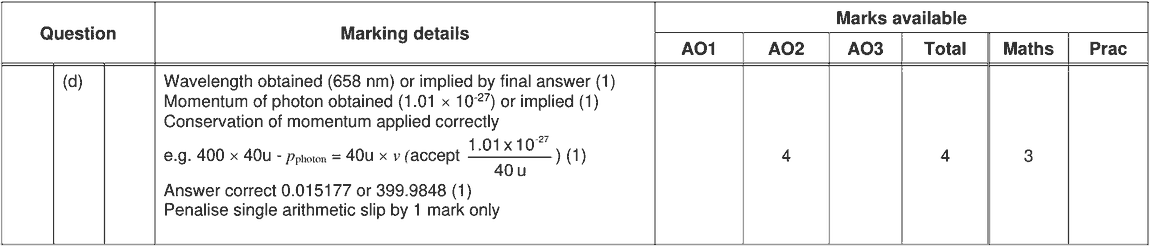
λ = c/f = 658 nm
photon momentum p = h/λ = 1.01 × 10⁻²⁷ kg m s⁻¹
conservation of momentum: Δv = p/(40 u) = 1.01 × 10⁻²⁷/6.64 × 10⁻²⁶ = 0.0152 m s⁻¹ (new speed 399.985 m s⁻¹)
mass-unit slips occurred
Scheme columns: Maths 3
Skills: Comprehension A level Component 1 Section B: questions on the printed article; Synoptic Needs physics from another component of the qualification; Unitsand conversions Unit marks, base units, prefixes and conversions; Mathsmarks The mark scheme's Maths column gives this part at least one mark for mathematical skills
June 2022 · Component 1 · Q8(e)3 marksAO3=3Calculation
Earlier parts of question 8 that this part uses
Mark scheme
Examiner's comment
Candidates could gain 2 out of the 3 marks by calculating the number of photons emitted by the laser in a millisecond and pointing out that this is far larger than 26 000, making the photon supply ample for 26 000 to be absorbed in a millisecond. Many candidates missed these easy marks; perhaps some had been thrown by being told that the lifetime of the excited atom was a few nanoseconds. One way of using this information was to show that for 26 000 photons to be absorbed in a millisecond, the mean time between absorptions was 38 ns, so there was plenty of ‘spare time’ when the atom was not excited and so able to absorb, making it capable of absorbing several times more than 26 000 in a millisecond. A significant number of candidates did present this argument in some form.
Notes from the mark scheme and report
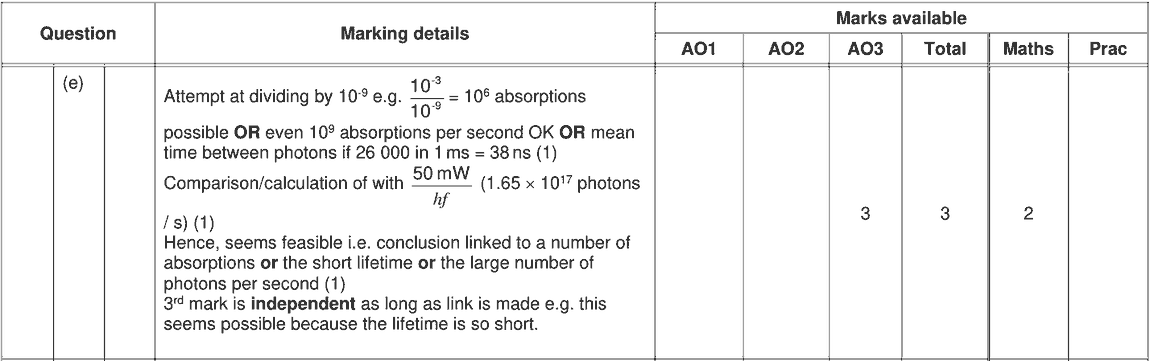
Lifetime argument: 1 ms / a few ns allows about 10⁶ absorptions, or 26 000 in 1 ms means 38 ns between absorptions (1)
photon supply: 50 mW/hf = 1.65 × 10¹⁷ photons per second (1)
so the claim is feasible, with the conclusion linked to a number (1)
many missed the easy photon-rate marks
Scheme columns: Maths 2
Skills: Comprehension A level Component 1 Section B: questions on the printed article; Synoptic Needs physics from another component of the qualification; Mathsmarks The mark scheme's Maths column gives this part at least one mark for mathematical skills
June 2022 · AS Component 2 · Q4(a)2 marksAO1=2Short answer
Mark scheme
Notes from the mark scheme and report
A dark background (1) with a series of separate coloured lines at particular positions (1)
Scheme columns: Practical 2
Skills: Practicalmarks The mark scheme's Prac column gives this part at least one mark for practical skills
June 2022 · AS Component 2 · Q4(b)4 marksAO3=4Calculation
Skills: Unitsand conversions Unit marks, base units, prefixes and conversions; Mathsmarks The mark scheme's Maths column gives this part at least one mark for mathematical skills
June 2022 · AS Component 2 · Q4(d)(i)2 marksAO2=2Show that
Earlier part of question 4 that this part uses
Mark scheme
Notes from the mark scheme and report
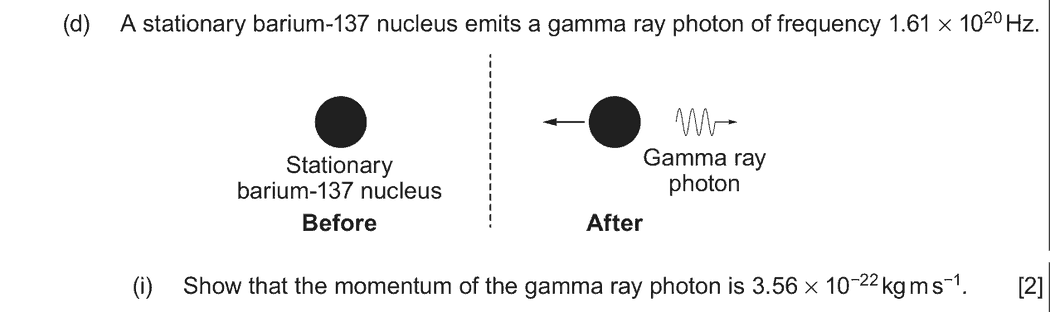
λ = c/f = 3.00 × 10⁸/1.61 × 10²⁰ = 1.86 × 10⁻¹² m
p = h/λ (= hf/c) = 6.63 × 10⁻³⁴/1.86 × 10⁻¹² = 3.56 × 10⁻²² kg m s⁻¹
Scheme columns: Maths 2
Skills: Mathsmarks The mark scheme's Maths column gives this part at least one mark for mathematical skills
June 2022 · AS Component 2 · Q4(d)(ii)3 marksAO1=1, AO2=2Calculation
Earlier parts of question 4 that this part uses
Mark scheme
Notes from the mark scheme and report
Answer: 1.55 × 10³ m s⁻¹. Total momentum is zero before, so the nucleus recoils with momentum equal and opposite to the photon's: v = 3.56 × 10⁻²²/2.29 × 10⁻²⁵
Scheme columns: Maths 3
Skills: Mathsmarks The mark scheme's Maths column gives this part at least one mark for mathematical skills
June 2022 · AS Component 2 · Q4(d)(iii)3 marksAO1=1, AO2=2Calculation
Earlier parts of question 4 that this part uses
Mark scheme
Notes from the mark scheme and report
Answer: 1.07 × 10⁻¹³ J. Photon energy hf = 6.63 × 10⁻³⁴ × 1.61 × 10²⁰
kinetic energy of the nucleus ½mv² = 2.77 × 10⁻¹⁹ J is negligible in comparison
ecf
Scheme columns: Maths 3
Skills: Mathsmarks The mark scheme's Maths column gives this part at least one mark for mathematical skills
June 2022 · AS Component 2 · Q4(e)2 marksAO3=2Explanation
Earlier part of question 4 that this part uses
Mark scheme
Notes from the mark scheme and report
Quantities derived from the constants can be found with smaller uncertainty (1)
more precise design and prediction reduces the risk of failures and extra cost in engineering projects (1)
June 2022 · Component 3 · Q4(a)(ii)3 marksAO1=1, AO2=2Calculation
Earlier part of question 4 that this part uses
Mark scheme
Examiner's comment
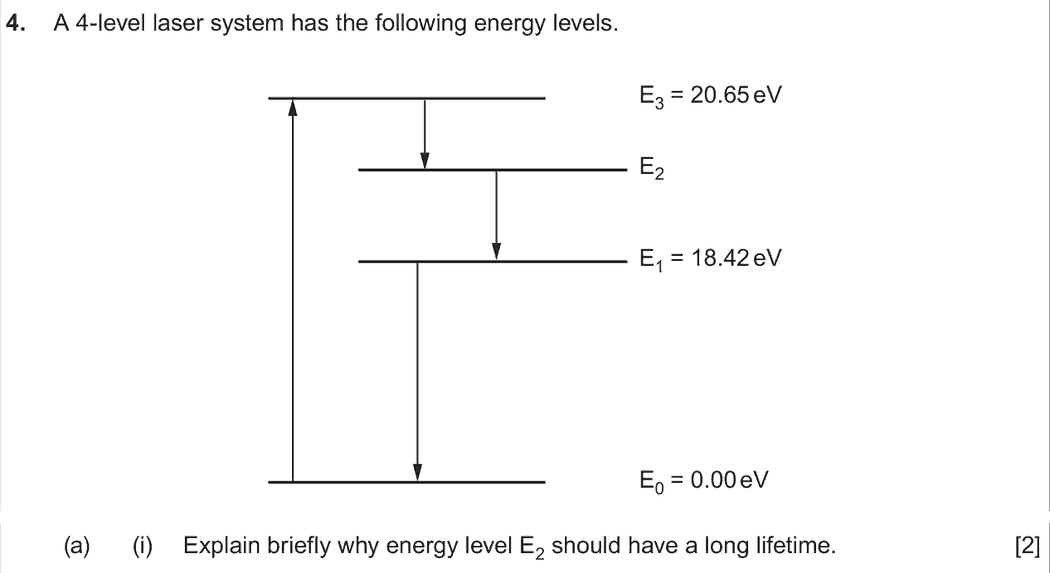
Well answered but a significant minority finished with just the photon energy or even subtracted the photon energy from E3 (instead of adding it to E2).
some stopped at the photon energy or subtracted it from E3
Scheme columns: Maths 2
Skills: Unitsand conversions Unit marks, base units, prefixes and conversions; Mathsmarks The mark scheme's Maths column gives this part at least one mark for mathematical skills
June 2022 · Component 3 · Q5(a)2 marksAO1=2Explanation
Mark scheme
Notes from the mark scheme and report
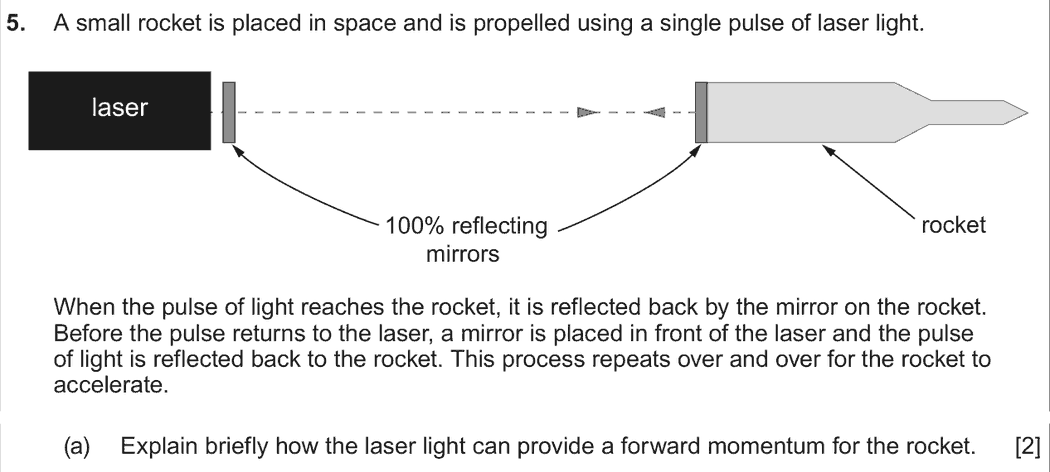
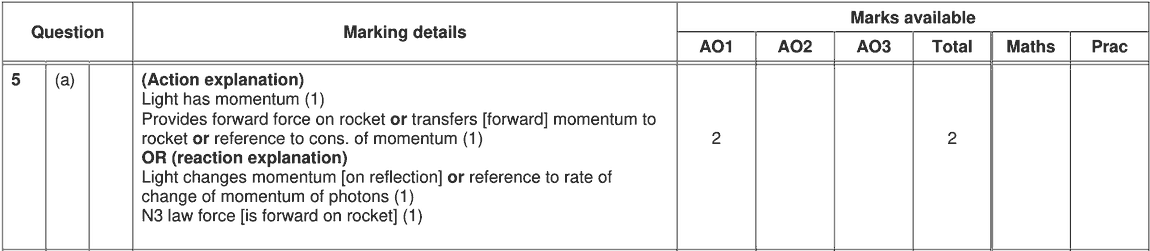
Photons carry momentum (1) and transfer forward momentum to the rocket when they reflect (conservation of momentum) (1)
or the photons' momentum changes on reflection so, by Newton's third law, the force on the rocket is forwards
Skills: Synoptic Needs physics from another component of the qualification
June 2022 · Component 3 · Q5(b)(i)2 marksAO1=1, AO2=1Show that
Skills: Unitsand conversions Unit marks, base units, prefixes and conversions; Mathsmarks The mark scheme's Maths column gives this part at least one mark for mathematical skills
June 2022 · Component 3 · Q5(b)(ii)2 marksAO1=1, AO2=1Show that
Earlier parts of question 5 that this part uses
Mark scheme
Notes from the mark scheme and report
Photon momentum p = h/λ (or E/c) = 1.645 × 10⁻²⁷ kg m s⁻¹
reflection doubles the change, so 2 × 1.645 × 10⁻²⁷ × 2.57 × 10²¹ = 8.5 × 10⁻⁶ kg m s⁻¹
Scheme columns: Maths 1
Skills: Mathsmarks The mark scheme's Maths column gives this part at least one mark for mathematical skills
June 2022 · Component 3 · Q5(b)(iii)4 marksAO2=4Calculation
Earlier parts of question 5 that this part uses
Mark scheme
Examiner's comment
Well answered in general. A significant minority tried to obtain the answer assuming the same KE is transferred every time. Unfortunately, this gives a completely wrong answer.
Notes from the mark scheme and report
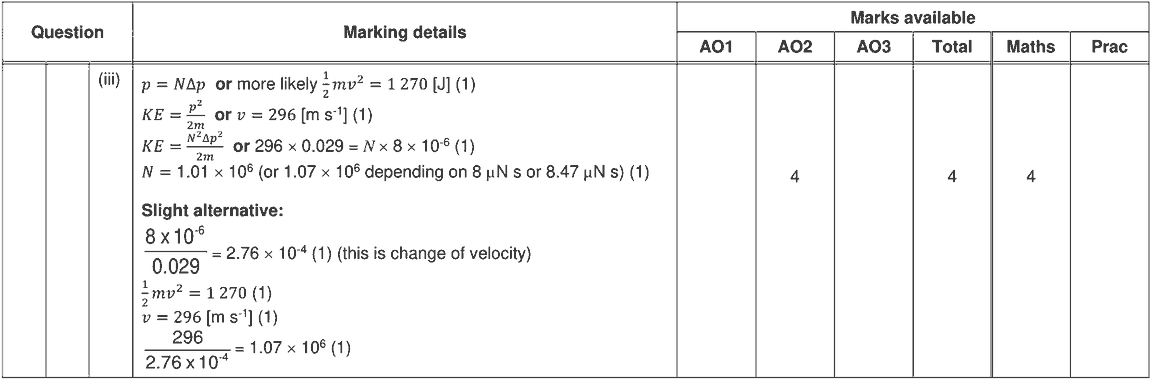
Answer: about 1.07 × 10⁶ reflections (1.01 × 10⁶ with 8 μN s). ½mv² = 1270 J gives v = 296 m s⁻¹
momentum 296 × 0.029 = N × 8.47 × 10⁻⁶
assuming equal kinetic energy per reflection is wrong
Scheme columns: Maths 4
Skills: Synoptic Needs physics from another component of the qualification; Algebra Derivations and rearranging equations; Mathsmarks The mark scheme's Maths column gives this part at least one mark for mathematical skills
June 2022 · Component 3 · Q5(b)(iv)3 marksAO3=3Explanation
Earlier parts of question 5 that this part uses
Mark scheme
Examiner's comment
Most candidates realised that conservation of energy was being violated but few were able to explain it completely. Although it was not required, some candidates realised that the red shift of the reflected light could explain this “contradiction”.
Notes from the mark scheme and report
The rocket's kinetic energy keeps rising (1) while the light pulse is assumed to keep the same energy (1), which would break conservation of energy (1)
in reality the reflected light is red-shifted so each photon loses energy
'conservation of kinetic energy' not accepted
Skills: Synoptic Needs physics from another component of the qualification
October 2021 · Component 3 · Q5(a)6 marksAO1=66-mark extended response
Mark scheme, with the levels and indicative content
Notes from the mark scheme and report
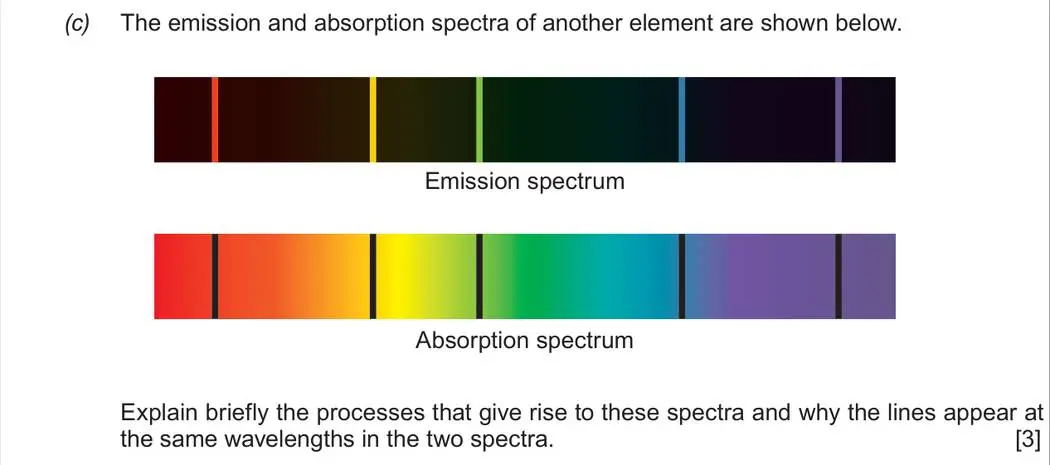
QER, levels marked on three strands. Appearance: emission is sharp coloured lines on a dark background
absorption is dark lines on a continuous spectrum. Production: emission from a hot or electrically excited gas
absorption when white light passes through a cooler gas
viewed with a diffraction grating or prism. Atomic processes: discrete energy levels
in emission electrons fall and give out photons with energy equal to the gap
in absorption photons of exactly those energies raise electrons, which later re-emit in all directions
Skills: QER The 6-mark quality of extended response question
October 2021 · Component 3 · Q5(b)4 marksAO2=4Calculation
Earlier part of question 5 that this part uses
Mark scheme
Notes from the mark scheme and report
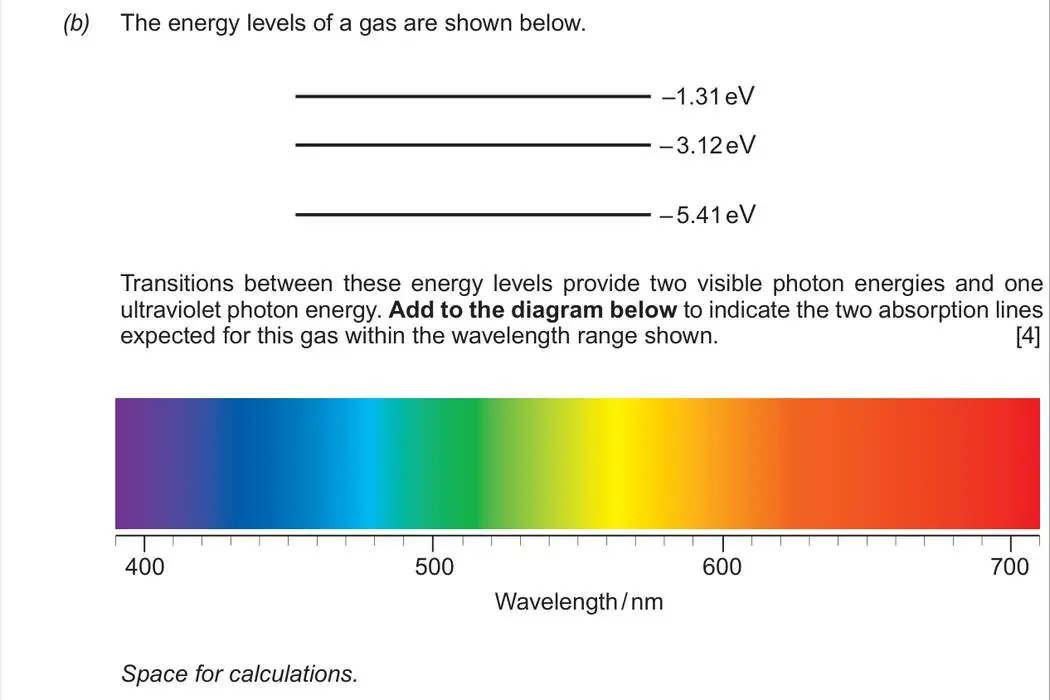
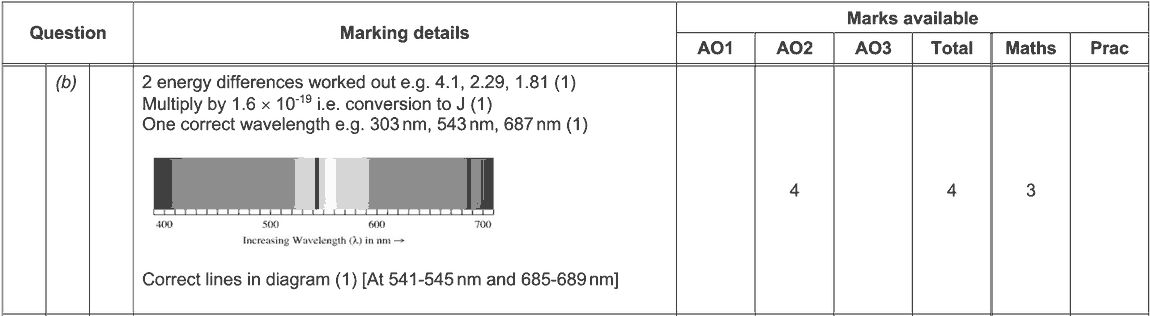
Answer: lines at 543 nm and 687 nm. Gaps: 5.41 − 3.12 = 2.29 eV, 3.12 − 1.31 = 1.81 eV (and 4.10 eV, 303 nm, ultraviolet) (1)
× 1.60 × 10⁻¹⁹ to J (1)
λ = hc/E (1)
two lines drawn at 541 to 545 nm and 685 to 689 nm (1)
Scheme columns: Maths 3
Skills: Unitsand conversions Unit marks, base units, prefixes and conversions; Mathsmarks The mark scheme's Maths column gives this part at least one mark for mathematical skills
October 2021 · Component 3 · Q6(a)3 marksAO1=3Definition
Mark scheme
Notes from the mark scheme and report
Emission of electrons (1) from a metal surface (1) when light, UV or other electromagnetic radiation of high enough frequency falls on it (1)
October 2021 · Component 3 · Q6(b)(i)4 marksAO1=1, AO2=3Calculation
Skills: Unitsand conversions Unit marks, base units, prefixes and conversions; Mathsmarks The mark scheme's Maths column gives this part at least one mark for mathematical skills
October 2021 · Component 3 · Q6(b)(ii)2 marksAO2=2Calculation
current as rate of flow of charge is Component 2 content
Scheme columns: Maths 2
Skills: Synoptic Needs physics from another component of the qualification; Unitsand conversions Unit marks, base units, prefixes and conversions; Mathsmarks The mark scheme's Maths column gives this part at least one mark for mathematical skills
October 2021 · Component 3 · Q6(c)3 marksAO1=3Practical and data analysis
Earlier part of question 6 that this part uses
Mark scheme
Notes from the mark scheme and report
Reverse the polarity of the supply so the collecting electrode repels the electrons (1)
increase the pd until the nanoammeter reads zero (1)
Ek max = e × this stopping pd (the pd in volts is the energy in eV) (1)
Scheme columns: Practical 3
Skills: Experimentalmethod Describing, planning or improving an experiment; Practicalmarks The mark scheme's Prac column gives this part at least one mark for practical skills
October 2021 · Component 3 · Q8(c)3 marksAO3=3Explanation
Earlier parts of question 8 that this part uses
Mark scheme
Notes from the mark scheme and report
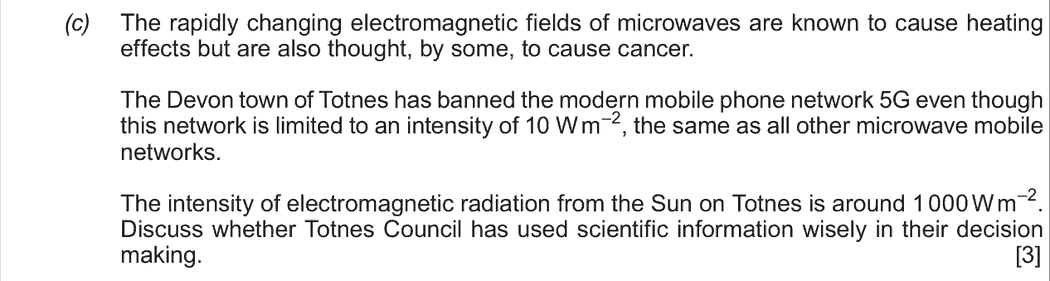
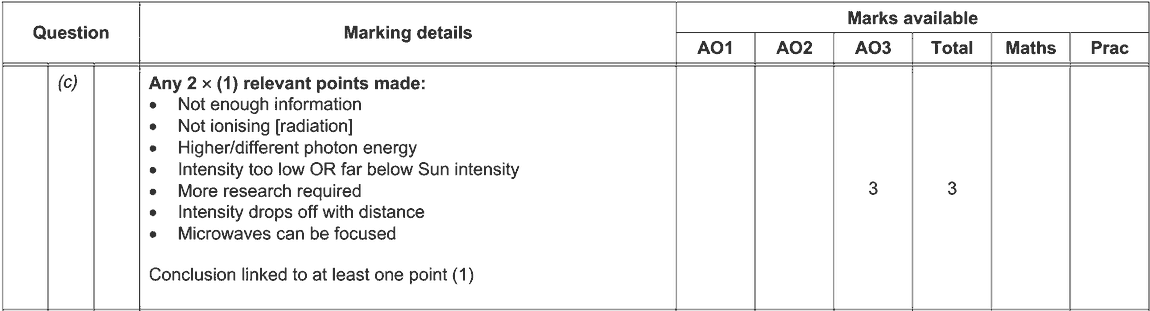
Any two relevant points (2): microwaves are not ionising
their photon energy is far lower than that of sunlight
10 W m⁻² is 100 times less than the Sun's intensity and falls off with distance
little evidence, more research needed
microwaves can be focused. Conclusion linked to at least one point (1)
October 2020 · Component 1 · Q5(b)(v)3 marksAO3=3Calculation
Earlier parts of question 5 that this part uses
Mark scheme
Examiner's comment
The kinetic theory calculations were very well done, and the momentum conservation and kinetic energy non-conservation parts, almost as well. Several candidates did not seem to know that gas molecules at a given temperature had a wide range of speeds. A surprising number of candidates used a wrong formula for the photon energy.
Notes from the mark scheme and report
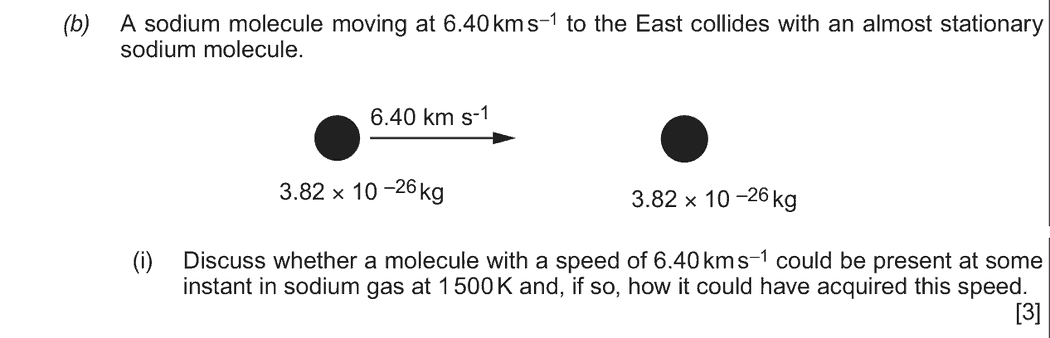
Answer: no significant effect. Photon momentum = h/λ = 6.63 × 10⁻³⁴/589 × 10⁻⁹ = 1.1 × 10⁻²⁷ N s (unit mark)
the molecules' momenta are about 10⁻²² N s (e.g. 3.82 × 10⁻²⁶ × 4390 = 1.7 × 10⁻²²), far larger
synoptic with Component 3
a wrong photon formula was common
Scheme columns: Maths 1
Skills: Synoptic Needs physics from another component of the qualification; Unitsand conversions Unit marks, base units, prefixes and conversions; Mathsmarks The mark scheme's Maths column gives this part at least one mark for mathematical skills
October 2020 · Component 3 · Q1(b)(ii)1 markAO1=1Short answer
Earlier parts of question 1 that this part uses
Mark scheme
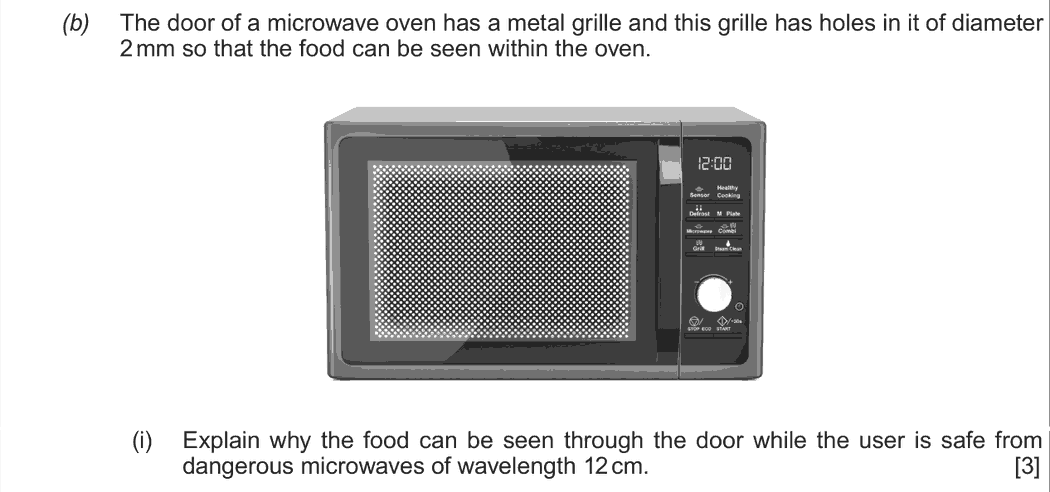
Examiner's comment
Part (a) was quite well answered but some did not mention “without transferring matter” or did not refer to oscillations. In part (b) most realised that the holes were too small for the microwaves to pass through (at 1/60th of a wavelength, the intensity passing through is negligible). It was rare to encounter a candidate who said that the 2 mm holes were far greater than the wavelength of light. A surprising number said (incorrectly) that the wavelength was longer and the energy greater. Part (c) was surprisingly well answered with most candidates obtaining full marks, however, some candidates could not add the displacements.
Notes from the mark scheme and report
Answer: any value from 1.6 to 3.3 eV (2.6 × 10⁻¹⁹ to 5.3 × 10⁻¹⁹ J), e.g. hc/λ for 400 to 700 nm
October 2020 · Component 3 · Q1(b)(iii)1 markAO2=1Short answer
Earlier parts of question 1 that this part uses
Mark scheme
Examiner's comment
Part (a) was quite well answered but some did not mention “without transferring matter” or did not refer to oscillations. In part (b) most realised that the holes were too small for the microwaves to pass through (at 1/60th of a wavelength, the intensity passing through is negligible). It was rare to encounter a candidate who said that the 2 mm holes were far greater than the wavelength of light. A surprising number said (incorrectly) that the wavelength was longer and the energy greater. Part (c) was surprisingly well answered with most candidates obtaining full marks, however, some candidates could not add the displacements.
Notes from the mark scheme and report
Smaller, because the microwave frequency is lower (wavelength longer) and E = hf
some wrongly said longer wavelength means more energy
October 2020 · Component 3 · Q2(a)3 marksAO1=1, AO2=2Calculation
Mark scheme
Examiner's comment
Surprisingly badly answered with the majority of candidates calculating the wavelength of a photon of 2 200 eV. The experiment was not well known with the majority scoring only 1/3 marks.
Notes from the mark scheme and report
Answer: 2.62 × 10⁻¹¹ m. KE = eV = 2200 × 1.60 × 10⁻¹⁹ = 3.52 × 10⁻¹⁶ J
p = √(2m × KE) = 2.53 × 10⁻²³ kg m s⁻¹
λ = h/p
most wrongly found the wavelength of a 2200 eV photon
Scheme columns: Maths 3
Skills: Mathsmarks The mark scheme's Maths column gives this part at least one mark for mathematical skills
October 2020 · Component 3 · Q2(b)3 marksAO1=2, AO2=1Explanation
Earlier part of question 2 that this part uses
Mark scheme
Examiner's comment
Surprisingly badly answered with the majority of candidates calculating the wavelength of a photon of 2 200 eV. The experiment was not well known with the majority scoring only 1/3 marks.
Notes from the mark scheme and report
Electron beam fired at a thin crystal such as graphite (1)
a pattern of concentric rings is seen on a fluorescent screen (1)
a higher pd gives more momentum and a shorter wavelength, so the rings close up (1)
the experiment was poorly known
Scheme columns: Practical 3
Skills: Practicalmarks The mark scheme's Prac column gives this part at least one mark for practical skills
October 2020 · Component 3 · Q9(a)5 marksAO1=2, AO2=3Explanation
Mark scheme
Examiner's comment
Some candidates failed to apply Einstein’s equation. Others failed to discuss the stopping potential. Many candidates jumped straight in with the equation 𝐸𝐸= 𝑉𝑉 𝑑𝑑 which is the equation for a uniform field. However, they obtained the correct answer if they used the radius as 𝑑𝑑. This was probably just good fortune on many occasions because it is true that: 𝐸𝐸= 𝑘𝑘𝑘𝑘 𝑟𝑟2 = 𝑘𝑘𝑘𝑘 𝑟𝑟 𝑟𝑟= 𝑉𝑉 𝑟𝑟
Notes from the mark scheme and report
Einstein: Ek max = hf − φ, 2.1 eV is needed to free an electron (1)
so Ek max = 10.3 − 2.1 = 8.2 eV (1)
an electron with 8.2 eV can just climb a potential difference of 8.2 V (1)
losing electrons leaves the sphere positive, which attracts the electrons back (1)
at +8.2 V even the fastest electrons cannot escape, so the potential stops rising (1)
Skills: Synoptic Needs physics from another component of the qualification
June 2019 · Component 1 · Q8(d)3 marksAO1=2, AO2=1Explanation
Earlier parts of question 8 that this part uses
Mark scheme
Examiner's comment
Most candidates sensibly chose to give a photon explanation for radiation pressure in a star. Sometimes it was not made clear that the photons had to encounter matter in the star so that their momentum changed.
Notes from the mark scheme and report
Photons have momentum, p = h/λ (1)
photons collide with or are absorbed by matter in the star so their momentum changes (1)
force is the rate of change of momentum (and pressure is force per unit area) (1)
the encounter with matter was sometimes missing
synoptic with Component 3 photons
Skills: Comprehension A level Component 1 Section B: questions on the printed article; Synoptic Needs physics from another component of the qualification
June 2019 · Component 1 · Q8(f)(ii)2 marksAO3=2Explanation
Earlier parts of question 8 that this part uses
Mark scheme
Examiner's comment
With few exceptions, candidates gained the first mark for pointing out that 150 nm was not in the visible region. The second mark was seldom given. The point had to be made that although 150 nm was the wavelength of peak emission, the star would emit plenty of visible radiation [as the luminosity of a very high temperature star will be high].
Notes from the mark scheme and report
150 nm is ultraviolet, so the peak emission is outside the visible region and UV would be better (1)
but a hot star still emits plenty of visible light, more than a cooler star (1)
the second mark was rarely gained
Skills: Comprehension A level Component 1 Section B: questions on the printed article; Synoptic Needs physics from another component of the qualification
June 2019 · AS Component 2 · Q6(a)1 markAO1=1Short answer
Mark scheme
Notes from the mark scheme and report
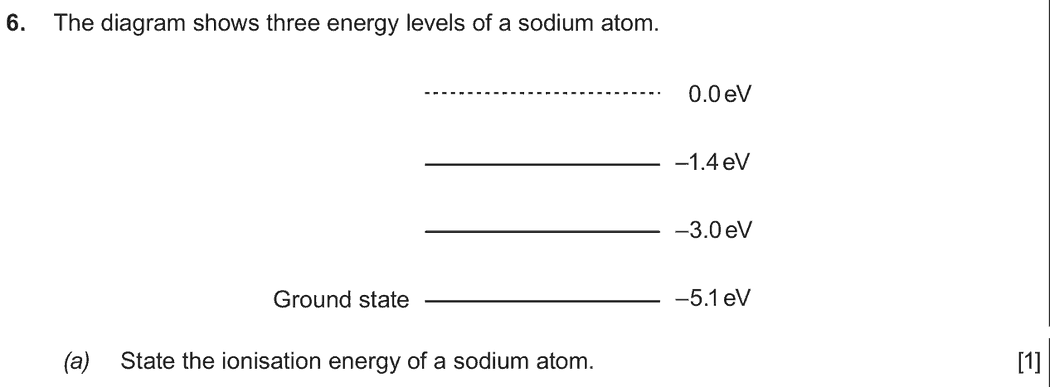
Answer: 5.1 eV (energy to remove the electron from the ground state to the 0 eV level)
June 2019 · AS Component 2 · Q6(b)3 marksAO1=3Explanation
Earlier part of question 6 that this part uses
Mark scheme
Notes from the mark scheme and report
Photons of particular wavelengths (energies matching level differences) are absorbed (1)
electrons (atoms) are raised to higher energy levels (1)
the light is re-emitted in all directions so little continues in the original direction, leaving dark lines (1)
June 2019 · AS Component 2 · Q6(c)(i)3 marksAO3=3Calculation
Earlier part of question 6 that this part uses
Mark scheme
Notes from the mark scheme and report
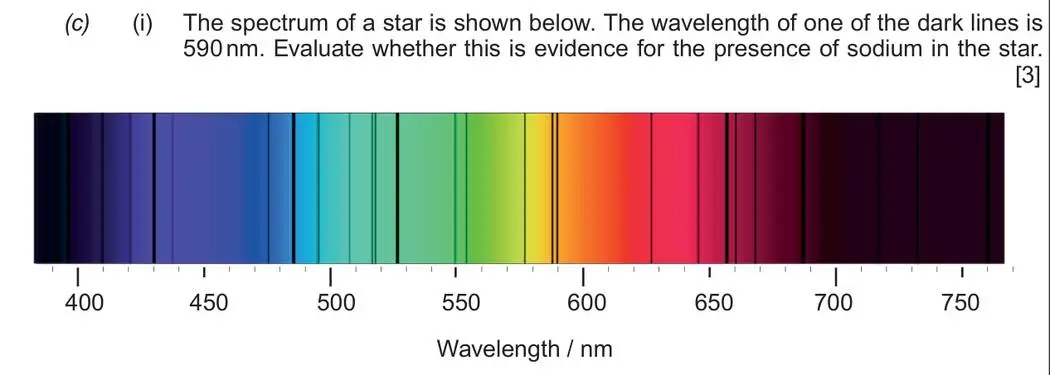
Photon energy E = hc/λ = 6.63 × 10⁻³⁴ × 3.00 × 10⁸ / 590 × 10⁻⁹ = 3.4 × 10⁻¹⁹ J (1) = 2.1 eV (1)
this equals the gap between the −5.1 eV and −3.0 eV levels, so it is evidence for sodium (1)
Scheme columns: Maths 2
Skills: Unitsand conversions Unit marks, base units, prefixes and conversions; Mathsmarks The mark scheme's Maths column gives this part at least one mark for mathematical skills
June 2019 · AS Component 2 · Q6(c)(ii)3 marksAO1=1, AO2=2Calculation
Earlier parts of question 6 that this part uses
Mark scheme
Notes from the mark scheme and report
Answer: 29 000 K. Wien's law λmax = W/T (1)
T = 2.90 × 10⁻³ / 100 × 10⁻⁹ (1) = 2.9 × 10⁴ K (1). The marks are all for Wien's law, which is AS Component 1 content (2.7-d)
no Component 2 statement is credited, 3.4-i given only as the nearest paper topic
Scheme columns: Maths 3
Skills: Synoptic Needs physics from another component of the qualification; Mathsmarks The mark scheme's Maths column gives this part at least one mark for mathematical skills
June 2019 · AS Component 2 · Q7(a)2 marksAO1=2Definition
Mark scheme
Notes from the mark scheme and report
The (minimum) energy needed (1) to remove an electron from the surface of the metal (1)
June 2019 · AS Component 2 · Q7(b)(i)2 marksAO2=2Calculation
Skills: Mathsmarks The mark scheme's Maths column gives this part at least one mark for mathematical skills
June 2019 · AS Component 2 · Q7(b)(ii)I2 marksAO2=2Calculation
Earlier parts of question 7 that this part uses
Mark scheme
Notes from the mark scheme and report
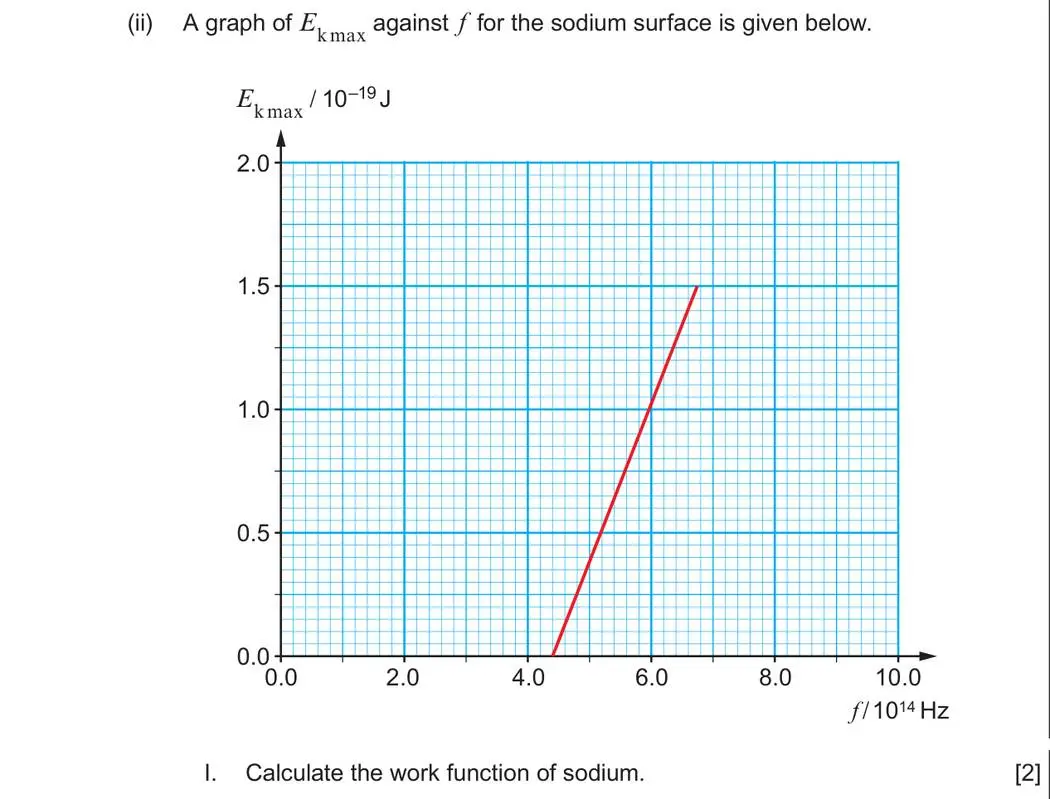
Answer: 2.9 × 10⁻¹⁹ J. Threshold frequency from the intercept on the f axis = 4.4 × 10¹⁴ Hz (1)
φ = hf₀ (1)
Scheme columns: Maths 2
Skills: Graphskills Reading, plotting or sketching graphs; gradients, intercepts and areas; Mathsmarks The mark scheme's Maths column gives this part at least one mark for mathematical skills
June 2019 · AS Component 2 · Q7(b)(ii)II2 marksAO2=2Diagram or graph
Earlier parts of question 7 that this part uses
Mark scheme
Notes from the mark scheme and report
Straight line with an intercept on the f axis greater than 4.4 × 10¹⁴ Hz (1), parallel to the sodium line because the gradient is h (1)
Scheme columns: Maths 1
Skills: Graphskills Reading, plotting or sketching graphs; gradients, intercepts and areas; Mathsmarks The mark scheme's Maths column gives this part at least one mark for mathematical skills
June 2019 · AS Component 2 · Q7(b)(ii)III2 marksAO2=2Explanation
Earlier parts of question 7 that this part uses
Mark scheme
Notes from the mark scheme and report
The frequency is unchanged so each photon has the same energy
a greater rate only means more photons per second (1)
the surface, and so the work function, is the same, so Ek max at each frequency is unchanged (1)
June 2019 · Component 3 · Q5(c)4 marksAO2=4Show that
Earlier part of question 5 that this part uses
Mark scheme
Examiner's comment
Obtaining the momentum of the gamma photon proved to be the most difficult step here but this is far easier for those who can derive/memorise E p c = . The momentum of the electron and positron also proved troublesome but, again, there was a simple short cut for those who memorised/derived p2 = 2mE.
Notes from the mark scheme and report
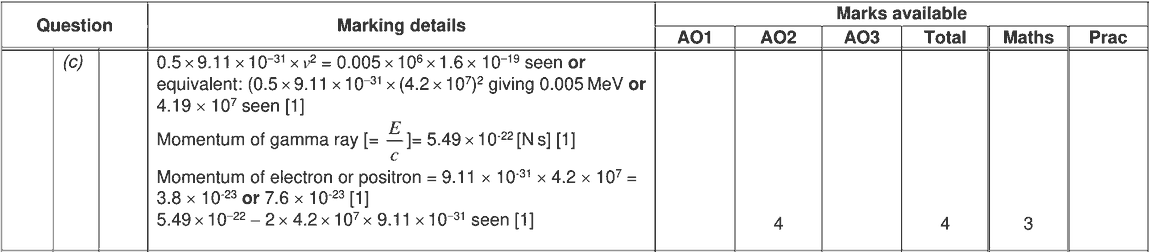
½mv² = 0.005 × 10⁶ × 1.6 × 10⁻¹⁹ J gives v = 4.19 × 10⁷ m s⁻¹
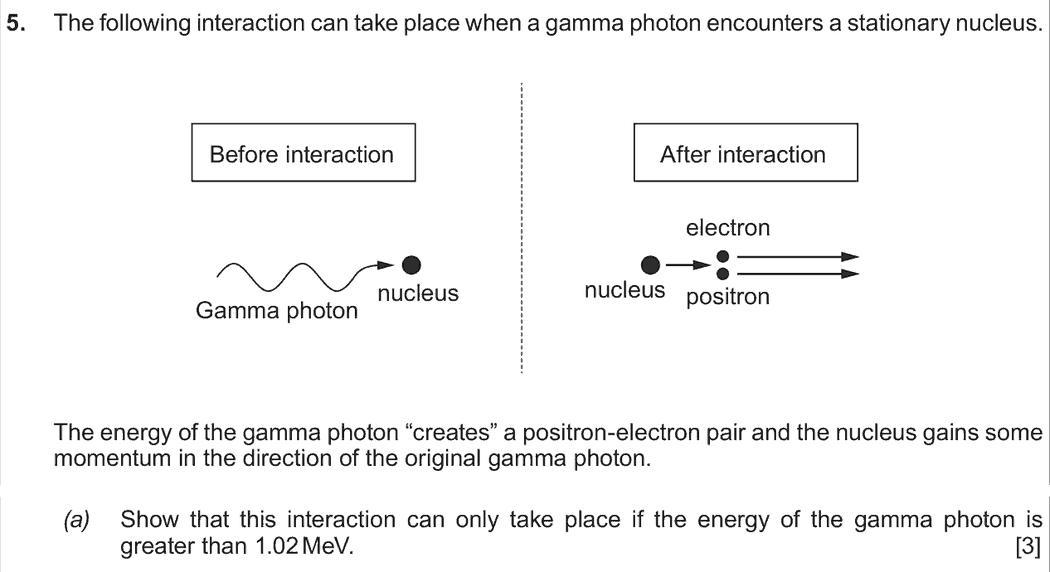
photon momentum p = E/c = 1.03 MeV/c = 5.49 × 10⁻²² N s
electron and positron each mv = 3.8 × 10⁻²³ N s
nucleus = 5.49 × 10⁻²² − 2 × 3.8 × 10⁻²³ = 4.7 × 10⁻²² kg m s⁻¹. Conservation of momentum is Component 1
the photon momentum was the hardest step
Scheme columns: Maths 3
Skills: Synoptic Needs physics from another component of the qualification; Unitsand conversions Unit marks, base units, prefixes and conversions; Mathsmarks The mark scheme's Maths column gives this part at least one mark for mathematical skills
June 2019 · Component 3 · Q7(a)(i)2 marksAO3=2Practical and data analysis
Mark scheme
Examiner's comment
Almost universally correct. Very few candidates round incorrectly at this level.
Notes from the mark scheme and report
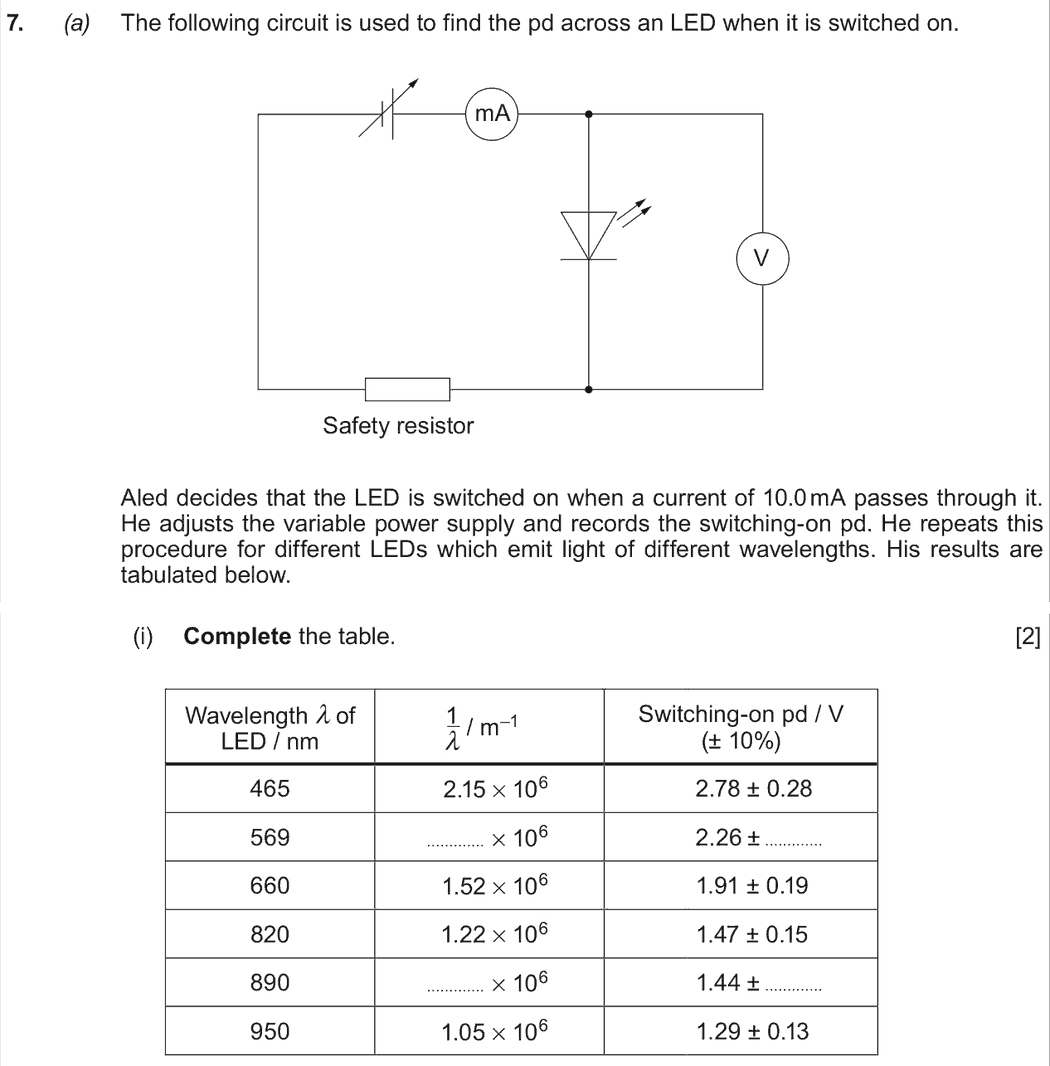
Answer: 1/λ = 1.76 × 10⁶ and 1.12 × 10⁶ m⁻¹ (1)
uncertainties ± 0.23 V and ± 0.14 V, 10% of each pd (1)
Scheme columns: Maths 2, Practical 2
Skills: Uncertainties Resolution, absolute and percentage uncertainty, combining uncertainties, error bars; Mathsmarks The mark scheme's Maths column gives this part at least one mark for mathematical skills; Practicalmarks The mark scheme's Prac column gives this part at least one mark for practical skills
June 2019 · Component 3 · Q7(a)(ii)2 marksAO2=2Diagram or graph
Earlier part of question 7 that this part uses
Mark scheme
Examiner's comment
It was extremely rare to find an incorrectly plotted point and incorrect error bars were almost as rare.
Notes from the mark scheme and report
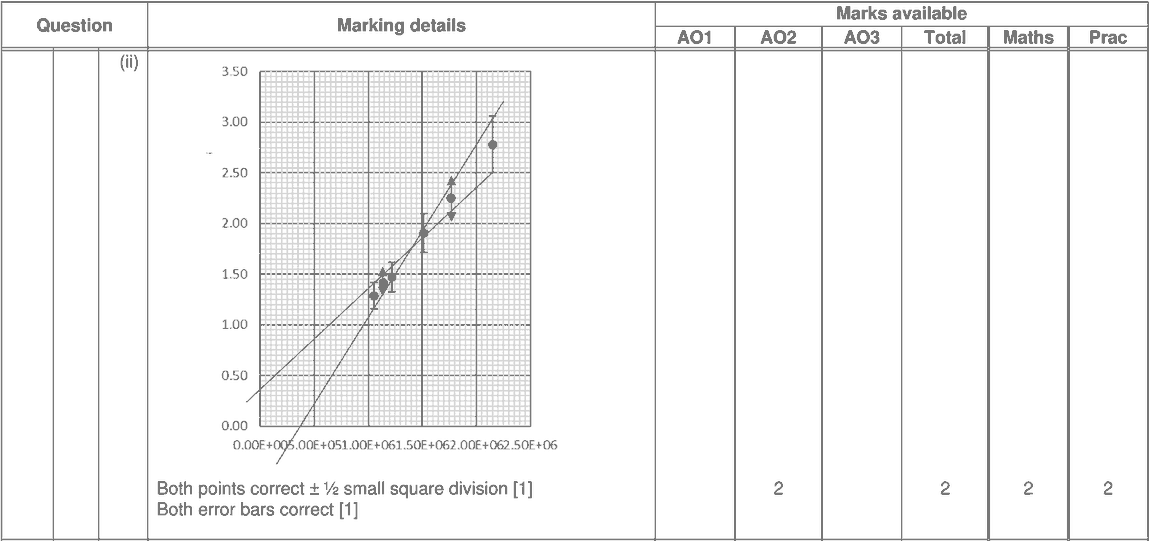
Both points plotted within half a small square (1)
both vertical error bars correct (1)
Scheme columns: Maths 2, Practical 2
Skills: Graphskills Reading, plotting or sketching graphs; gradients, intercepts and areas; Uncertainties Resolution, absolute and percentage uncertainty, combining uncertainties, error bars; Mathsmarks The mark scheme's Maths column gives this part at least one mark for mathematical skills; Practicalmarks The mark scheme's Prac column gives this part at least one mark for practical skills
June 2019 · Component 3 · Q7(a)(iii)2 marksAO2=2Diagram or graph
Earlier part of question 7 that this part uses
Mark scheme
Examiner's comment
In general, a little more care is required with the lines of best fit to ensure that no error bars are missed or to ensure that the line passes through the correct extreme of the error bar.
Notes from the mark scheme and report
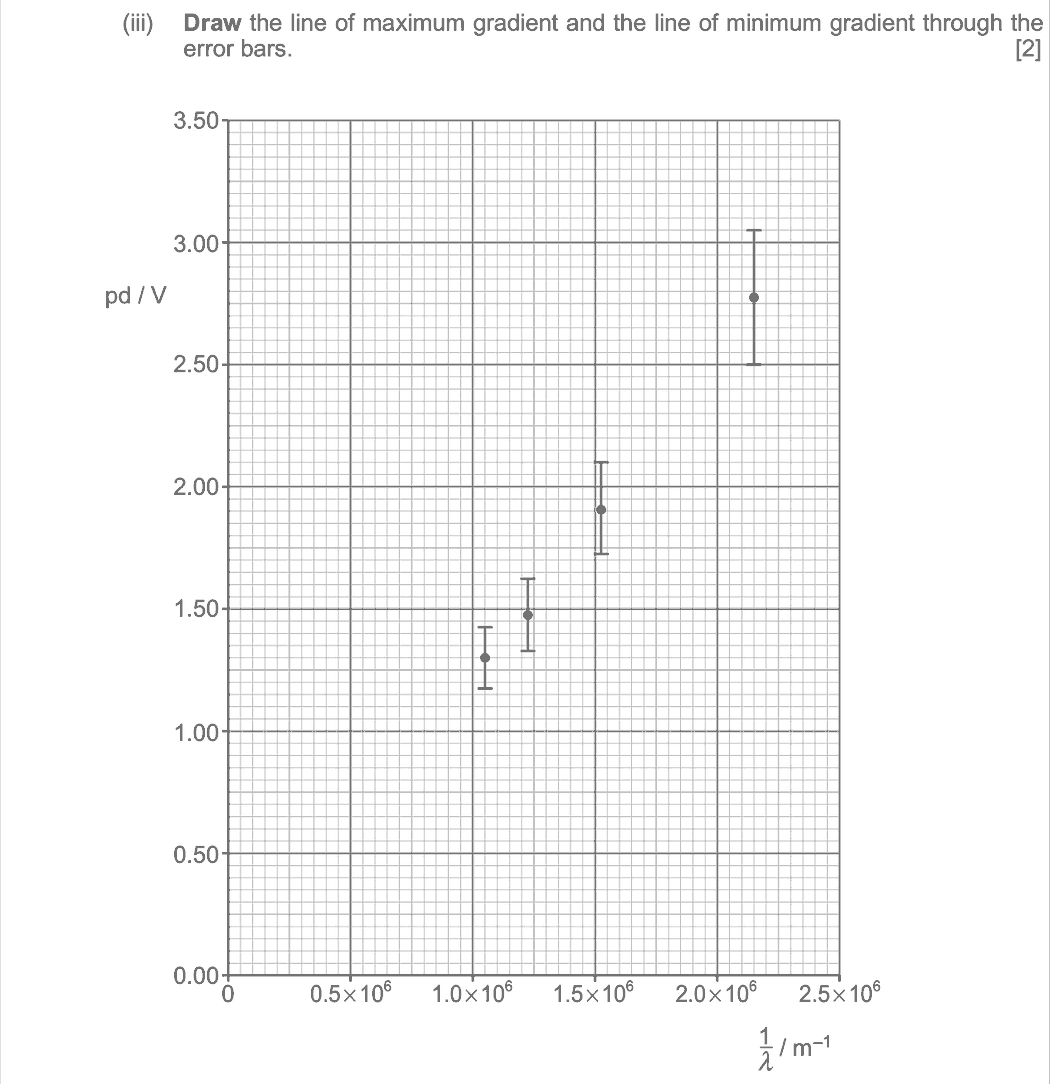
Steepest line (1) and least steep line (1) that still pass through all the error bars, using the extremes of the bars
care needed not to miss a bar
Scheme columns: Practical 2
Skills: Graphskills Reading, plotting or sketching graphs; gradients, intercepts and areas; Uncertainties Resolution, absolute and percentage uncertainty, combining uncertainties, error bars; Practicalmarks The mark scheme's Prac column gives this part at least one mark for practical skills
June 2019 · Component 3 · Q7(b)(i)5 marksAO3=5Practical and data analysis
Earlier parts of question 7 that this part uses
Mark scheme
Examiner's comment
This was well answered in general but two marks proved more difficult to obtain than the others. One of these was obtaining the correct final percentage uncertainty in the value of the Planck constant. The other was ensuring that the final answer and uncertainty were written in the correct manner e.g. (7 ± 2) 10-34 J s or with ecf (6.7 ± 0.7) 10-34 J s.
Notes from the mark scheme and report
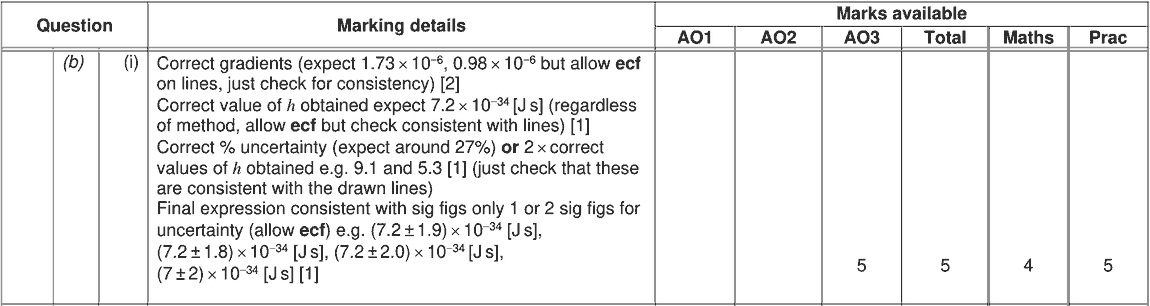
Answer: about (7 ± 2) × 10⁻³⁴ J s. Gradients about 1.73 × 10⁻⁶ and 0.98 × 10⁻⁶ V m (2)
h = gradient × e/c, mean about 7.2 × 10⁻³⁴ J s (1)
% uncertainty about 27%, or the two extreme h values 9.1 and 5.3 (1)
final value and uncertainty quoted consistently, uncertainty to 1 or 2 s.f. (1). The % uncertainty and the final presentation were the marks most often lost
Scheme columns: Maths 4, Practical 5
Skills: Graphskills Reading, plotting or sketching graphs; gradients, intercepts and areas; Uncertainties Resolution, absolute and percentage uncertainty, combining uncertainties, error bars; Mathsmarks The mark scheme's Maths column gives this part at least one mark for mathematical skills; Practicalmarks The mark scheme's Prac column gives this part at least one mark for practical skills
June 2019 · Component 3 · Q7(b)(ii)4 marksAO3=4Practical and data analysis
Earlier parts of question 7 that this part uses
Mark scheme
Examiner's comment
There was an improvement in the standard of the responses to this evaluation of data question this year - more of the candidates are making good comments regarding the quality of the data.
Notes from the mark scheme and report
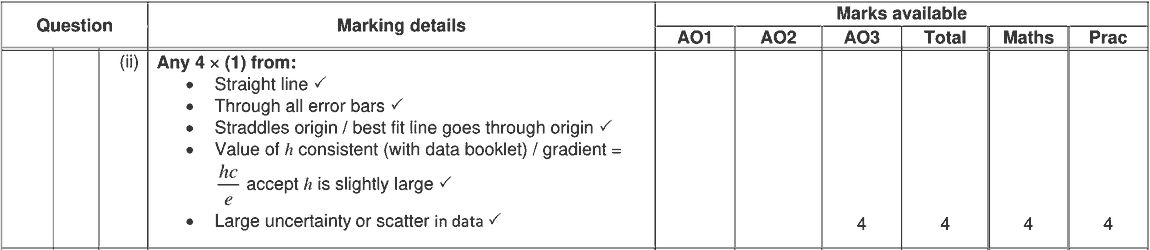
Any four: straight line
passes through all the error bars
the max and min lines straddle the origin (best line through the origin)
h agrees with the accepted value within the uncertainty (a little large)
large uncertainty and scatter mean the support is weak
Scheme columns: Maths 4, Practical 4
Skills: Graphskills Reading, plotting or sketching graphs; gradients, intercepts and areas; Uncertainties Resolution, absolute and percentage uncertainty, combining uncertainties, error bars; Mathsmarks The mark scheme's Maths column gives this part at least one mark for mathematical skills; Practicalmarks The mark scheme's Prac column gives this part at least one mark for practical skills
June 2019 · Component 3 · Q7(c)1 markAO3=1Practical and data analysis
Earlier parts of question 7 that this part uses
Mark scheme
Examiner's comment
It is far better to check the pd when the diode is switched on properly (a current of 10 mA is not a bad rule of thumb for most LEDs). It was good to see that the majority of candidates realised that the longer wavelengths would be invisible. Unfortunately, quite a large minority tried the stock phrase “to avoid human error” which was not specific enough.
Notes from the mark scheme and report
The eye's sensitivity varies with wavelength, and the longer (infrared) wavelengths cannot be seen at all
'human error' not accepted
Skills: Experimentalmethod Describing, planning or improving an experiment
June 2019 · Component 3 · Q7(d)(i)2 marksAO2=2Calculation
Earlier parts of question 7 that this part uses
Mark scheme
Examiner's comment
The vast majority knew that the answer was the gradient of the line. A minority failed to obtain the correct gradient (usually due to powers of ten mistakes).
Notes from the mark scheme and report
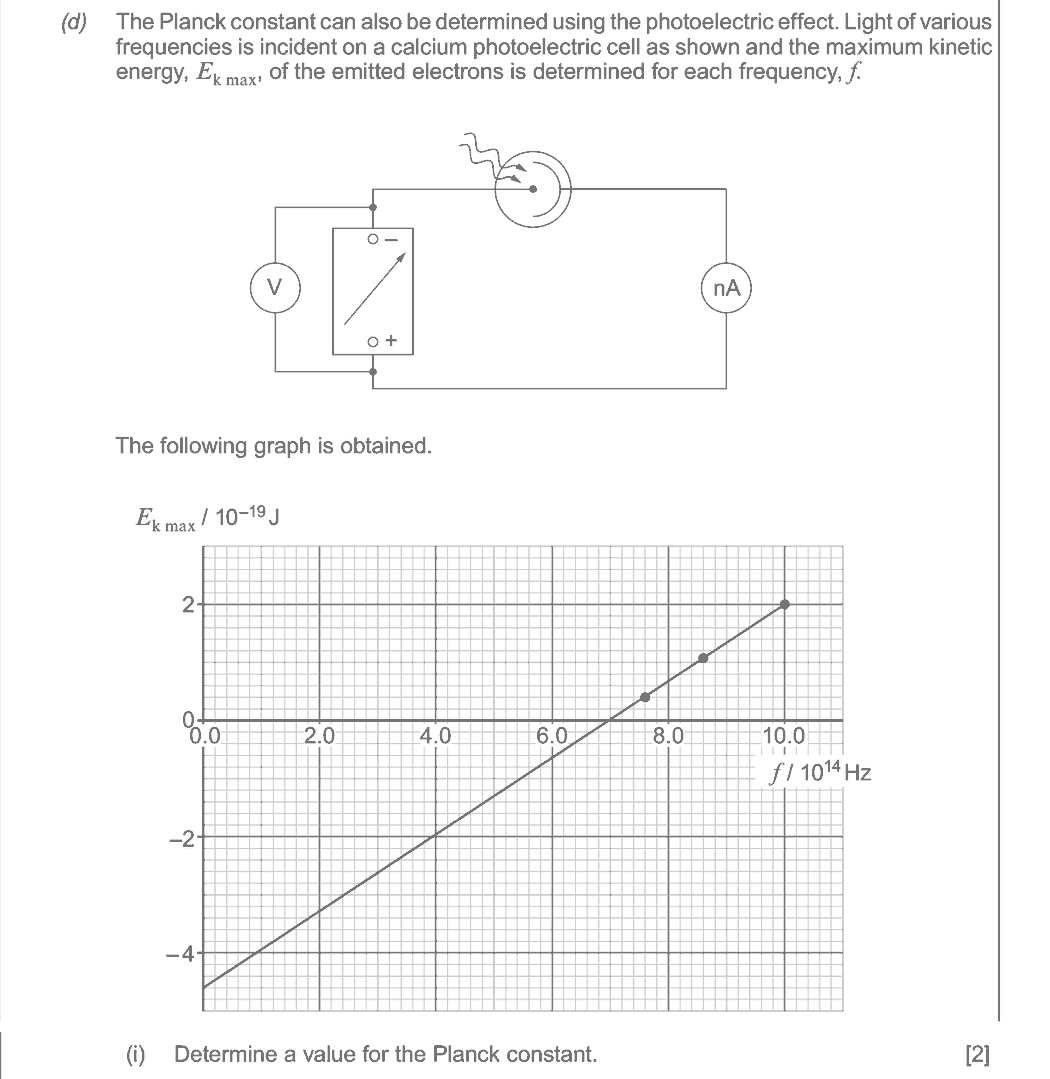
Answer: 6.6 × 10⁻³⁴ J s. h = gradient = 6.6 × 10⁻¹⁹/10 × 10¹⁴
or substitute a point and the intercept
power of ten slips were the main error
Scheme columns: Maths 2, Practical 2
Skills: Graphskills Reading, plotting or sketching graphs; gradients, intercepts and areas; Mathsmarks The mark scheme's Maths column gives this part at least one mark for mathematical skills; Practicalmarks The mark scheme's Prac column gives this part at least one mark for practical skills
June 2019 · Component 3 · Q7(d)(ii)3 marksAO1=2, AO2=1Explanation
Earlier parts of question 7 that this part uses
Mark scheme
Examiner's comment
Well answered but common omissions were not to mention the energy of the photon and the emission of electrons.
Notes from the mark scheme and report
Answer: work function 4.6 × 10⁻¹⁹ J (magnitude of the intercept on the Ek axis, or h × 6.9 × 10¹⁴ Hz) (1)
below this threshold frequency the photon energy is less than the work function (1) so no electrons are emitted (1)
Scheme columns: Maths 1, Practical 3
Skills: Graphskills Reading, plotting or sketching graphs; gradients, intercepts and areas; Mathsmarks The mark scheme's Maths column gives this part at least one mark for mathematical skills; Practicalmarks The mark scheme's Prac column gives this part at least one mark for practical skills
June 2019 · Component 3 · Q8(a)2 marksAO2=2Calculation
Mark scheme
Examiner's comment
The conversion from eV to J was not a problem. The main problem was choosing the correct energy i.e. the electron must be raised from the ground level to n = ∞.
Notes from the mark scheme and report
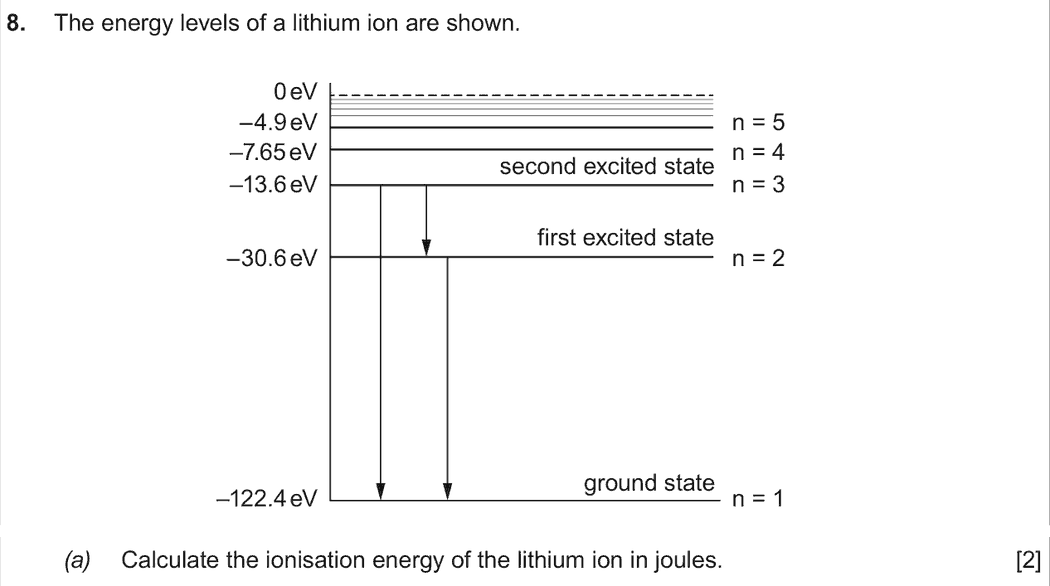
Answer: 1.96 × 10⁻¹⁷ J. Ionisation energy = 122.4 eV, from the ground state to 0 eV
× 1.6 × 10⁻¹⁹
choosing the right levels was the difficulty
Scheme columns: Maths 1
Skills: Unitsand conversions Unit marks, base units, prefixes and conversions; Mathsmarks The mark scheme's Maths column gives this part at least one mark for mathematical skills
June 2019 · Component 3 · Q8(b)3 marksAO2=3Calculation
Earlier part of question 8 that this part uses
Mark scheme
Examiner's comment
Very well answered. Probably the most difficult mark proved to be choosing the correct region of the e-m spectrum.
Notes from the mark scheme and report
Answer: 73 nm, ultraviolet. Photon energy = 30.6 − 13.6 = 17.0 eV = 2.72 × 10⁻¹⁸ J
λ = hc/E
the region was the mark most often lost
Scheme columns: Maths 1
Skills: Unitsand conversions Unit marks, base units, prefixes and conversions; Mathsmarks The mark scheme's Maths column gives this part at least one mark for mathematical skills
June 2019 · Component 3 · Q8(c)3 marksAO2=3Explanation
Earlier part of question 8 that this part uses
Mark scheme
Examiner's comment
The answers to this part question were slightly disappointing - only a small minority obtained full marks even though the mark scheme was quite lenient.
Notes from the mark scheme and report
Atoms have discrete electron energy levels (1)
an electron dropping to a lower level emits a photon (emission line), and a photon of matching energy is absorbed when an electron is raised (absorption line) (1)
the same level differences are involved, so the same photon energies and hence the same wavelengths (1). Full marks were uncommon
June 2018 · AS Component 2 · Q3(a)(i)1 markAO1=1Definition
Mark scheme
Examiner's comment
Most candidates were able to explain what is meant by the photoelectric effect.
Notes from the mark scheme and report
Emission of electrons from a (metal) surface when light or other e-m radiation falls on it
June 2018 · AS Component 2 · Q3(a)(ii)3 marksAO1=3Explanation
Earlier part of question 3 that this part uses
Mark scheme
Examiner's comment
Candidates were not able to express clearly the meaning of Einstein’s photoelectric equation in terms of energy. They were not able to express that the remaining energy is maximum KE of the electron that is being emitted.
Notes from the mark scheme and report
Light arrives as photons each of energy hf (1)
φ, the work function, is the (minimum) energy needed for an electron to escape the surface (1)
Ek max is the energy left over as the electron's maximum kinetic energy (1)
the last point was poorly expressed
June 2018 · AS Component 2 · Q3(b)4 marksAO3=4Practical and data analysis
Earlier part of question 3 that this part uses
Mark scheme
Examiner's comment
Only the more able candidates were able to describe all the modifications required for the circuit. Nearly all candidates referred to the fact that the voltmeter is connected incorrectly and should be in parallel as well stating there is no ammeter in the circuit. On the more able were to note that the polarity of the power supply / photo-cell is incorrect.
Notes from the mark scheme and report
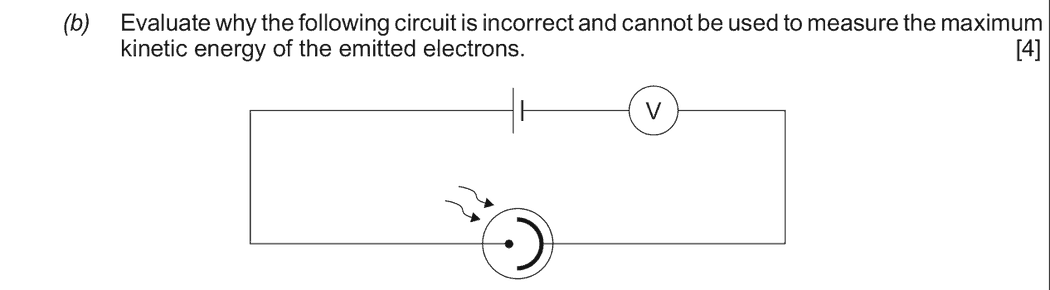
Supply polarity is the wrong way round, so all electrons reach the collecting electrode instead of being stopped (1)
no ammeter to detect when the current falls to zero (1)
voltmeter is in series, should be in parallel (1)
supply is not variable (1). Polarity was spotted only by the best candidates
Scheme columns: Practical 4
Skills: Experimentalmethod Describing, planning or improving an experiment; Practicalmarks The mark scheme's Prac column gives this part at least one mark for practical skills
June 2018 · AS Component 2 · Q3(c)(i)3 marksAO2=3Diagram or graph
Earlier part of question 3 that this part uses
Mark scheme
Examiner's comment
A number of candidates were not able to draw a good line of fit consistent with the data. Frequently the line was drawn the first and last data point and as a consequence the distribution of data points above and below the line was not good.
Notes from the mark scheme and report
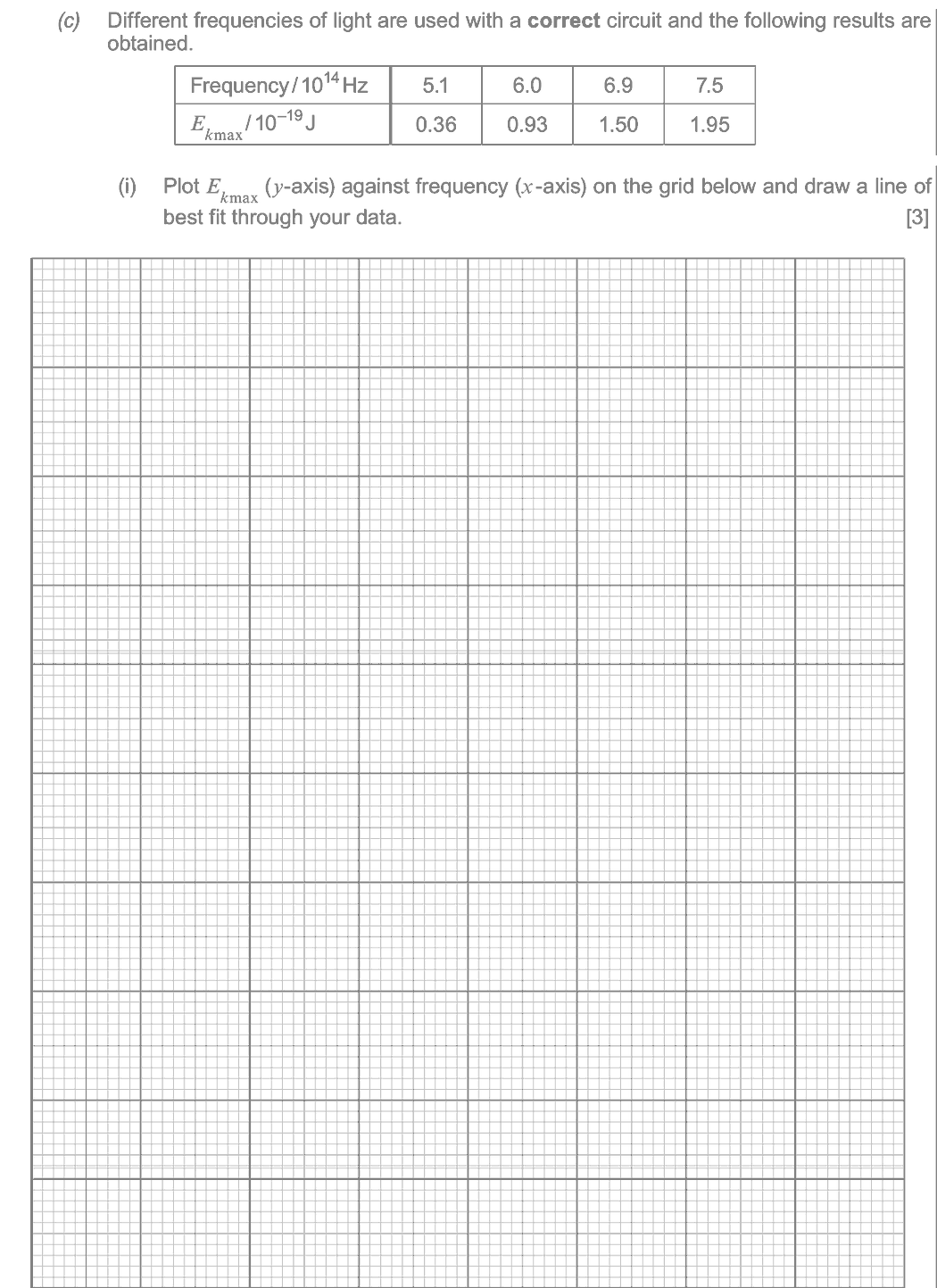
Axes labelled with units and scales so the points fill at least half of each axis (1)
points plotted within half a small square (1)
line of best fit with points balanced either side (1)
many simply joined the first and last points
Scheme columns: Maths 3, Practical 3
Skills: Graphskills Reading, plotting or sketching graphs; gradients, intercepts and areas; Mathsmarks The mark scheme's Maths column gives this part at least one mark for mathematical skills; Practicalmarks The mark scheme's Prac column gives this part at least one mark for practical skills
June 2018 · AS Component 2 · Q3(c)(ii)3 marksAO3=3Practical and data analysis
Earlier parts of question 3 that this part uses
Mark scheme
Examiner's comment
This part was not answered well and were not able to give to state that it is a straight line graph and that it passes close to the data points. The data for the graph was given in such a way that it would have been difficult to conclude that the line did or did not pass through the origin.
Notes from the mark scheme and report
Straight line with positive gradient (1), passing close to all the points (1), with a negative intercept on the Ek axis (does not pass through the origin
must match the candidate's graph) (1), as Ek max = hf − φ predicts
not well answered
Scheme columns: Maths 1, Practical 3
Skills: Graphskills Reading, plotting or sketching graphs; gradients, intercepts and areas; Mathsmarks The mark scheme's Maths column gives this part at least one mark for mathematical skills; Practicalmarks The mark scheme's Prac column gives this part at least one mark for practical skills
June 2018 · AS Component 2 · Q3(c)(iii)3 marksAO2=3Practical and data analysis
Earlier parts of question 3 that this part uses
Mark scheme
Examiner's comment
Most candidates were able to determine the gradient but did not indicate on the graph the data used by drawing a triangle that covers at least half of the graph line. Also many candidates did not state that the gradient is equal to the Planck constant.
Notes from the mark scheme and report
Answer: 6.6 (± 0.2) × 10⁻³⁴ J s. State h = gradient (1)
large triangle or two well-separated points shown on the line (1)
correct gradient (1). Many did not show the triangle or say that the gradient is h
Scheme columns: Maths 2, Practical 2
Skills: Graphskills Reading, plotting or sketching graphs; gradients, intercepts and areas; Mathsmarks The mark scheme's Maths column gives this part at least one mark for mathematical skills; Practicalmarks The mark scheme's Prac column gives this part at least one mark for practical skills
June 2018 · AS Component 2 · Q3(c)(iv)2 marksAO2=1, AO3=1Practical and data analysis
Earlier parts of question 3 that this part uses
Mark scheme
Examiner's comment
This was answered well by all candidates with the majority determining the 5% of Planck constant and then being able to draw a valid conclusion by comparing their value with the range.
Notes from the mark scheme and report
5% of 6.63 × 10⁻³⁴ J s = 0.33 × 10⁻³⁴ J s, so the acceptable range is 6.30 to 6.96 × 10⁻³⁴ J s (1)
conclusion comparing the candidate's value with this range (1)
June 2018 · AS Component 2 · Q5(b)(i)2 marksAO1=1, AO2=1Calculation
Earlier part of question 5 that this part uses
Mark scheme
Examiner's comment
Many candidates were able to determine the energy but did not give the unit.
Notes from the mark scheme and report
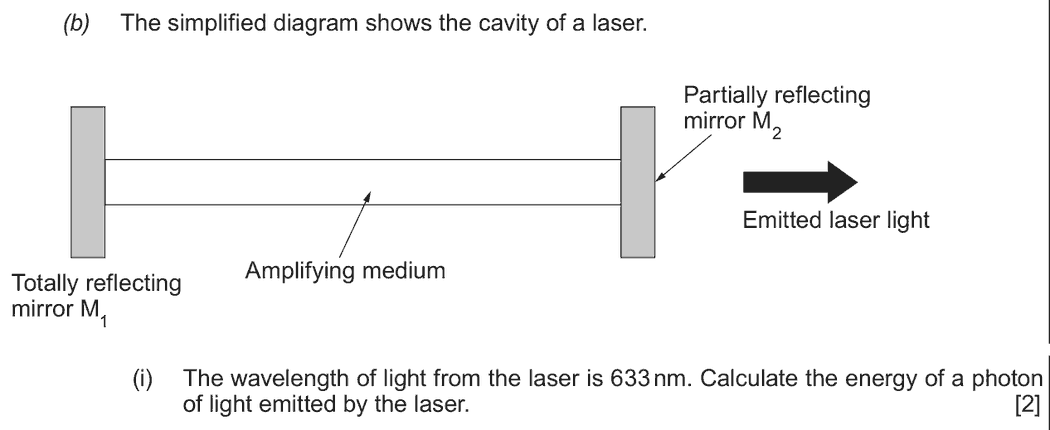
Answer: 3.14 × 10⁻¹⁹ J. E = hc/λ = 6.63 × 10⁻³⁴ × 3.00 × 10⁸/633 × 10⁻⁹
unit mark often lost
Scheme columns: Maths 2
Skills: Unitsand conversions Unit marks, base units, prefixes and conversions; Mathsmarks The mark scheme's Maths column gives this part at least one mark for mathematical skills
June 2018 · AS Component 2 · Q5(b)(ii)3 marksAO2=3Calculation
Earlier parts of question 5 that this part uses
Mark scheme
Examiner's comment
Only the more able candidates were able to use the simple probability of 1 in 500 photons in relation to the number of incident photons.
Notes from the mark scheme and report
Answer: 1.6 × 10¹⁸ photons per second. Emitted photons per second = P/E = 1.0 × 10⁻³/3.14 × 10⁻¹⁹ = 3.18 × 10¹⁵
only 1 in 500 is transmitted, so incident number = 3.18 × 10¹⁵ × 500
the factor of 500 defeated most
Scheme columns: Maths 3
Skills: Mathsmarks The mark scheme's Maths column gives this part at least one mark for mathematical skills
June 2018 · Component 2 · Q7(d)3 marksAO1=1, AO2=2Explanation
Earlier parts of question 7 that this part uses
Mark scheme
Examiner's comment
It was hoped that candidates would link the gain in Ek to a gain in momentum and then use the de Broglie equation to explain the change in wavelength. It was pleasing to note that a significant number of candidates did this. However, many candidates incorrectly provided responses in terms of the energy of a photon, using hc E to attempt to explain their answers. No credit was given for this.
Notes from the mark scheme and report
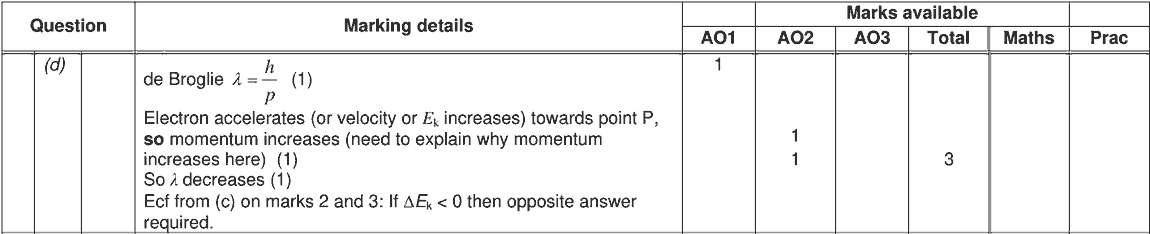
λ = h/p (1)
the electron is attracted towards the positive potential and speeds up, so its momentum increases (1)
so the wavelength decreases (1)
synoptic with Component 3 de Broglie
answers using photon E = hc/λ gained nothing
Skills: Synoptic Needs physics from another component of the qualification
June 2018 · Component 3 · Q3(a)3 marksAO1=2, AO2=1Explanation
Mark scheme
Examiner's comment
Well answered but many candidates omitted to mention that the photons were of a high enough energy or that the electrons arrived at the (collecting) electrode.
Notes from the mark scheme and report
Photons have enough energy (hf above the work function) (1) to release electrons from the metal surface (1)
the electrons reach the collecting electrode, completing the circuit (1)
the first and last points were often left out
Scheme columns: Practical 3
Skills: Practicalmarks The mark scheme's Prac column gives this part at least one mark for practical skills
June 2018 · Component 3 · Q3(b)3 marksAO1=1, AO2=2Calculation
Earlier part of question 3 that this part uses
Mark scheme
Examiner's comment
Very well answered - this is an equation that the cohort understands and applies with confidence.
Notes from the mark scheme and report
Answer: 9.4 × 10¹⁴ Hz. hf = φ + Ek max = 2.7 + 1.2 = 3.9 eV (1) = 6.24 × 10⁻¹⁹ J (1)
f = 6.24 × 10⁻¹⁹/6.63 × 10⁻³⁴ (1)
leaving the energy in eV scores 1
Scheme columns: Maths 2
Skills: Unitsand conversions Unit marks, base units, prefixes and conversions; Mathsmarks The mark scheme's Maths column gives this part at least one mark for mathematical skills
June 2018 · Component 3 · Q3(c)(i)3 marksAO2=3Practical and data analysis
Earlier part of question 3 that this part uses
Mark scheme
Examiner's comment
Very well answered but some candidates forgot to mention that the polarity of the supply should be reversed.
Notes from the mark scheme and report
Reverse the polarity of the supply so the collecting electrode is negative (1)
increase the pd until the current just falls to zero (1)
the voltmeter reading is then the stopping potential (1)
reversing the supply was sometimes forgotten
Scheme columns: Practical 3
Skills: Experimentalmethod Describing, planning or improving an experiment; Practicalmarks The mark scheme's Prac column gives this part at least one mark for practical skills
June 2018 · Component 3 · Q3(c)(ii)3 marksAO3=3Explanation
Earlier parts of question 3 that this part uses
Mark scheme
Examiner's comment
This was a good differentiating question - it was very rare to award all 3 marks. Candidates would often realise that the alpha particles had the opposite charge but would then talk about the collecting electrode becoming positive - this was a dead end and almost invariably resulted in zero marks. Candidates should have explained in terms of the current - the photo-electron current is decreased so that the stopping potential is reduced. The last mark for reducing this effect proved very difficult. Most candidates thought that absorbers would get rid of the alpha particles without realising that the photo-electrons are low energy and less penetrating than alpha particles! However, some very able candidates gave excellent answers e.g. measuring the dark current and obtaining the stopping potential when the current drops to this value rather than zero.
Notes from the mark scheme and report
Alpha particles are positive so they give a current in the opposite direction to the photoelectrons (1)
the net current reaches zero at a smaller pd, so the stopping potential is underestimated (1)
reduce the effect e.g. with brighter light so the photocurrent dominates, or measure the 'dark' current and take the pd at which the current falls to that value (1). Full marks rare
absorbers were a popular wrong idea
Scheme columns: Practical 3
Skills: Experimentalmethod Describing, planning or improving an experiment; Practicalmarks The mark scheme's Prac column gives this part at least one mark for practical skills
June 2018 · Component 3 · Q4(c)(i)2 marksAO2=2Show that
Earlier part of question 4 that this part uses
Mark scheme
Examiner's comment
All parts well answered. In part (iii) the factor of 2 due to reflection was sometimes missed. In part (iv) minor slips were common with only a tiny minority unable to cope with the synopticity here.
photons per second = 2.0 × 10¹⁵/1.89 × 10⁻¹⁹ = 1.06 × 10³⁴ (1)
Scheme columns: Maths 2
Skills: Mathsmarks The mark scheme's Maths column gives this part at least one mark for mathematical skills
June 2018 · Component 3 · Q4(c)(ii)1 markAO2=1Show that
Earlier parts of question 4 that this part uses
Mark scheme
Examiner's comment
All parts well answered. In part (iii) the factor of 2 due to reflection was sometimes missed. In part (iv) minor slips were common with only a tiny minority unable to cope with the synopticity here.
Notes from the mark scheme and report
p = h/λ = 6.63 × 10⁻³⁴/1.05 × 10⁻⁶ = 6.31 × 10⁻²⁸ kg m s⁻¹
Scheme columns: Maths 1
Skills: Mathsmarks The mark scheme's Maths column gives this part at least one mark for mathematical skills
June 2018 · Component 3 · Q4(c)(iii)2 marksAO2=2Show that
Earlier parts of question 4 that this part uses
Mark scheme
Examiner's comment
All parts well answered. In part (iii) the factor of 2 due to reflection was sometimes missed. In part (iv) minor slips were common with only a tiny minority unable to cope with the synopticity here.
Notes from the mark scheme and report
Force = rate of change of momentum = photons per second × momentum change each
reflection doubles the change: 2 × 1.06 × 10³⁴ × 6.31 × 10⁻²⁸ = 1.33 × 10⁷ N (2)
the factor of 2 was sometimes missed
Scheme columns: Maths 1
Skills: Mathsmarks The mark scheme's Maths column gives this part at least one mark for mathematical skills
June 2017 · AS Component 2 · Q5(d)(i)2 marksAO1=1, AO2=1Explanation
Earlier part of question 5 that this part uses
Mark scheme
Examiner's comment
Many candidates gained a mark for realising that it was electron diffraction but were not able to explain fully that the atoms or lattice in the aluminium were acting as a diffraction grating. Credit was also given if the candidate realised that the wavelength of the electron beam was similar to the interatomic spacing.
Notes from the mark scheme and report
The electrons behave as waves and are diffracted (1) by the regularly spaced atoms, which act like a diffraction grating because the electron wavelength is similar to the atomic spacing (1)
the second point was often missing
June 2017 · AS Component 2 · Q5(d)(ii)2 marksAO1=1, AO3=1Short answer
Earlier parts of question 5 that this part uses
Mark scheme
Examiner's comment
Only the more able candidates were able to deduce that the radius of the rings increased in the diffraction pattern for copper and the intensity would reduce or stay roughly the same.
Notes from the mark scheme and report
Rings have a larger radius (more spread out) because the spacing is smaller (1)
intensity lower, or about the same (1)
June 2017 · AS Component 2 · Q6(a)6 marksAO1=66-mark extended response
Mark scheme, with the levels and indicative content
Examiner's comment
The QER question tested candidates' understanding of the experiment to use LEDs to determine Planck constant. As a consequence, a significant number of candidates referred incorrectly to the photoelectric experiment with the LED used to shine on the metal surface. The candidates who had identified the correct experiment were able to describe the method clearly but were not able to give a full explanation of how the data could be analysed to determine the Planck constant. The better responses were clearly structured and coherent and covered all the marking points.
Notes from the mark scheme and report
QER, levels marked. Method: circuit with variable pd (potential divider), LED and voltmeter (and ammeter)
use LEDs of different known wavelengths
raise the pd until the LED just lights (or current just starts) and record it
repeat and average. Analysis: eV = hc/λ (or hf), so plot V against 1/λ (or f)
gradient = hc/e (or h/e), so h found from the gradient. Many wrongly described the photoelectric effect with LEDs lighting a metal surface
analysis was the weaker half
Scheme columns: Practical 6
Skills: Experimentalmethod Describing, planning or improving an experiment; Graphskills Reading, plotting or sketching graphs; gradients, intercepts and areas; Practicalmarks The mark scheme's Prac column gives this part at least one mark for practical skills; QER The 6-mark quality of extended response question
June 2017 · AS Component 2 · Q6(b)2 marksAO3=2Short answer
Earlier part of question 6 that this part uses
Mark scheme
Examiner's comment
Nearly all the candidates were able to score full marks on this question and were able to understand how the scientific community validates experimental results.
Notes from the mark scheme and report
Other groups repeat the same experiment (1) and see whether they obtain similar results, allowing comparison (1)
June 2017 · AS Component 2 · Q7(b)3 marksAO1=2, AO2=1Calculation
Earlier part of question 7 that this part uses
Mark scheme
Examiner's comment
The majority of candidates were able to convert the eV to J correctly for one of the energy values but were not able to consequently determine the wavelength correctly and identify the region of the electromagnetic spectrum it appears in.
Notes from the mark scheme and report
Answer: 1.00 × 10⁻⁵ m, infrared. Photon energy = E2 − E1 = 0.124 eV = 1.98 × 10⁻²⁰ J
λ = hc/E
many converted one level to joules but did not use the difference
Scheme columns: Maths 2
Skills: Unitsand conversions Unit marks, base units, prefixes and conversions; Mathsmarks The mark scheme's Maths column gives this part at least one mark for mathematical skills
June 2016 · AS Component 2 · Q5(c)(ii)3 marksAO1=1, AO2=2Calculation
Earlier parts of question 5 that this part uses
Mark scheme
Examiner's comment
The calculation of the energy of the photon was answered very well but many candidates failed to add on the energy of level L.
Notes from the mark scheme and report
Answer: 4.63 × 10⁻¹⁹ J. Photon energy hc/λ = 3.37 × 10⁻¹⁹ J
add the energy of level L (1.26 × 10⁻¹⁹ J)
many forgot to add level L
Scheme columns: Maths 3
Skills: Mathsmarks The mark scheme's Maths column gives this part at least one mark for mathematical skills
June 2016 · AS Component 2 · Q7(a)(i)2 marksAO1=2Definition
Mark scheme
Examiner's comment
This was answered well though some candidates confused this with ionisation.
Notes from the mark scheme and report
Emission of electrons from a (metal) surface (1) when light, em radiation or photons fall on it (1)
some confused it with ionisation
June 2016 · AS Component 2 · Q7(a)(ii)3 marksAO1=1, AO2=2Calculation
Earlier part of question 7 that this part uses
Mark scheme
Examiner's comment
Many candidates did not recognise that the Ek max would be zero with the longest wavelength of emission.
Notes from the mark scheme and report
Answer: 3.79 × 10⁻⁷ m. Longest wavelength when Ek max = 0, so hc/λ = φ = 5.24 × 10⁻¹⁹ J
many did not see that Ek max is zero at the threshold
Scheme columns: Maths 3
Skills: Mathsmarks The mark scheme's Maths column gives this part at least one mark for mathematical skills
June 2016 · AS Component 2 · Q7(b)(i)3 marksAO2=3Calculation
Earlier part of question 7 that this part uses
Mark scheme
Examiner's comment
This was either answered very well or very poorly. A good number of candidates were able to determine the number of photons.
Notes from the mark scheme and report
Answer: 6.3 × 10²² photons per second. Photon energy hc/λ = 3.62 × 10⁻¹⁹ J
power on panel = 1.39 × 10³ × 16.4 = 2.28 × 10⁴ W
divide
Scheme columns: Maths 3
Skills: Mathsmarks The mark scheme's Maths column gives this part at least one mark for mathematical skills
June 2016 · AS Component 2 · Q7(b)(ii)2 marksAO2=2Calculation
Earlier parts of question 7 that this part uses
Mark scheme
Examiner's comment
This was a very discriminating question with only the very able candidates able to determine the pressure.
Notes from the mark scheme and report
Answer: 4.6 × 10⁻⁶ Pa (scheme 4.53 × 10⁻⁶). Photon momentum h/λ, total momentum per second 7.6 × 10⁻⁵ N, divided by 16.4 m²
or pressure = intensity/c
only the strongest candidates managed it
Scheme columns: Maths 2
Skills: Mathsmarks The mark scheme's Maths column gives this part at least one mark for mathematical skills
Work with an Eduqas physics tutor
Dropping marks on calculations, specified practicals or the six-mark QER questions? Book a trial session with a specialist Eduqas physics tutor.