Notes and key-term cards for this topic are being written by our tutors. The past-paper questions below are ready now.
Specification statements
Show the 15 statements from the specification
3.C-a how to use the centre of gravity to explain how stability and toppling is achieved in various sporting contexts
3.C-b how to use the principle of moments to determine forces within • various muscle systems in the human body and • other sporting contexts, for example, sailing
3.C-c how to use Newton’s 2nd law in the form Ft = mv − mu in various sporting contexts
3.C-d the coefficient of restitution as e = (Relative speed after collision)/(Relative speed before collision) and also use it in the form e = √(h/H) where h is the bounce height and H is the drop height
3.C-e what is meant by the moment of inertia of a body
3.C-f how to use equations to determine the moment of inertia, I, for example • a solid sphere I = (2/5)mr² • a thin spherical shell I = (2/3)mr² where m is the mass and r is the radius
3.C-g the idea that angular acceleration, α, is defined as the rate of change of angular velocity, ω, and how to use the equation α = (ω₂ − ω₁)/t
3.C-h the idea that torque, τ, is given as τ = Iα
3.C-i angular momentum, L, is given as L = Iω where ω is the angular velocity
3.C-j the principle of conservation of angular momentum and use it to solve problems in sporting contexts
3.C-k how to use the equation for the rotational kinetic energy, rotational KE = ½Iω²
3.C-l how to use the principle of conservation of energy including the use of linear and rotational kinetic energy as well as gravitational and elastic potential energy in various sporting contexts
3.C-m how to use projectile motion theory in sporting contexts
3.C-n how to use Bernoulli’s equation p = p₀ − ½ρv² in sporting contexts
3.C-o how to determine the magnitude of the drag force using FD = ½ρv²ACD where CD is the drag coefficient
Tap a question to zoom it. Where a part needs a figure, table or graph from earlier in the question, that part folds out above it; the mark scheme and examiner's comment open underneath. Have the Eduqas Data Booklet beside you (see the Data Booklet page).
June 2025 · Component 3 · Q11(a)(i)2 marksAO1=1, AO2=1Explanation
Mark scheme
Examiner's comment
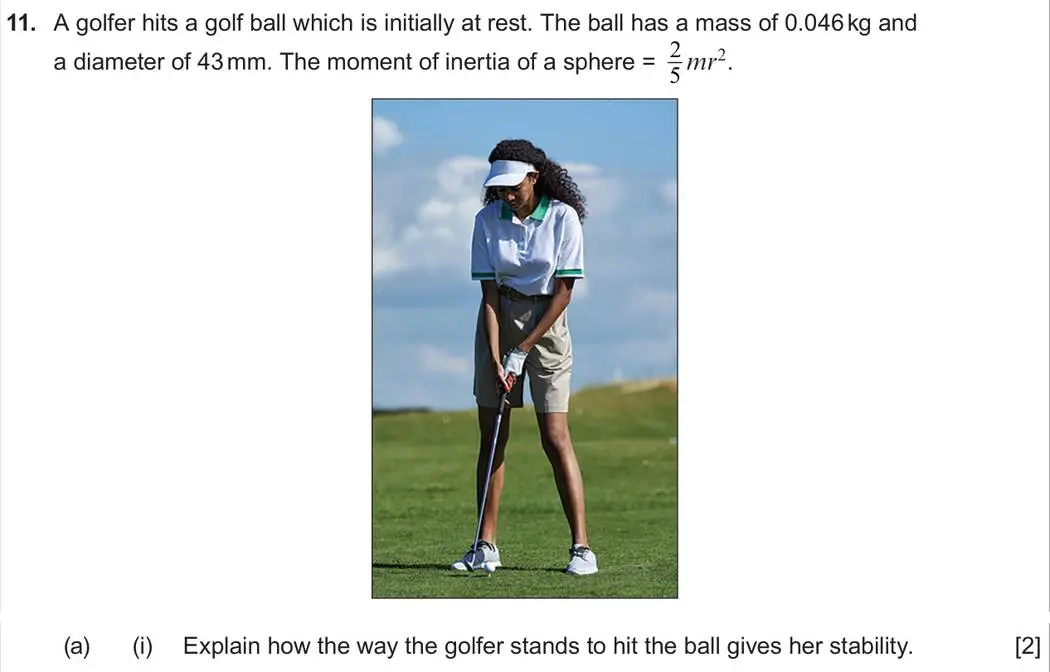
Many candidates were able to discuss how the centre of gravity or mass makes the golfer stable but did not further explain that this means that there is no net moment or that a greater moment is required to topple the golfer.
Notes from the mark scheme and report
Feet apart give a wide base, with the line of action of the weight from the centre of gravity passing between the feet (1)
so there is no net toppling moment, or a large moment would be needed to topple her (1)
the second point was often missing
June 2025 · Component 3 · Q11(a)(ii)2 marksAO1=2Definition
Earlier part of question 11 that this part uses
Mark scheme
Examiner's comment
Most candidates were able to give the answers in relation to the ratio of the speeds but frequently omitted that these speeds are relative in order to gain the full marks for this part.
Notes from the mark scheme and report
The relative speed of separation of club and ball after the collision (1) is 0.830 times their relative speed of approach before it (1)
'relative' must appear
June 2025 · Component 3 · Q11(a)(iii)3 marksAO1=1, AO2=2Calculation
Earlier part of question 11 that this part uses
Mark scheme
Examiner's comment
This was well answered with many candidates gaining full marks. The most common error was to use the diameter instead of the radius in order to determine the moment of inertia.
Notes from the mark scheme and report
Answer: 9.2 N m. α = 280/0.26 × 10⁻³ = 1.08 × 10⁶ rad s⁻²
I = (2/5) × 0.046 × 0.0215² = 8.5 × 10⁻⁶ kg m²
τ = Iα
using the diameter gives 36.6 N m for 2 marks
Scheme columns: Maths 2
Skills: Unitsand conversions Unit marks, base units, prefixes and conversions; Mathsmarks The mark scheme's Maths column gives this part at least one mark for mathematical skills
June 2025 · Component 3 · Q11(a)(iv)2 marksAO3=2Explanation
Earlier part of question 11 that this part uses
Mark scheme
Examiner's comment
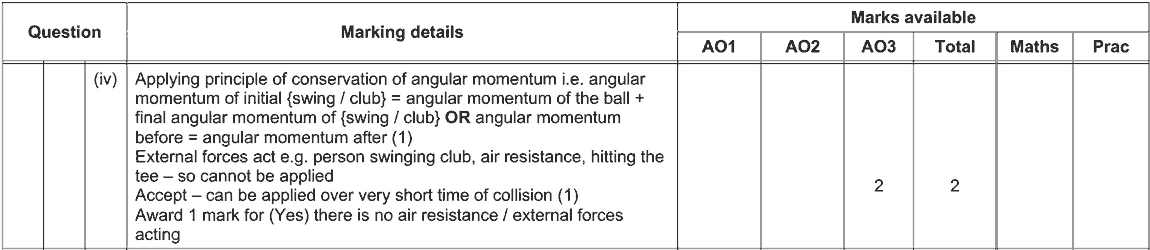
This was answered poorly with many answers not referring to the principle of conservation of angular momentum and applying the principle to the case of the golfer hitting the ball. Credit was given if candidates referred to no external forces acting and the sources of these external forces.
Notes from the mark scheme and report
The principle: total angular momentum of club and ball before = total after (1), provided no external torque acts
here the golfer drives the club (and there is air resistance and the tee), so it cannot strictly be applied, or only over the very short contact time (1)
poorly answered
June 2025 · Component 3 · Q11(b)(i)4 marksAO2=4Calculation
Earlier part of question 11 that this part uses
Mark scheme
Examiner's comment
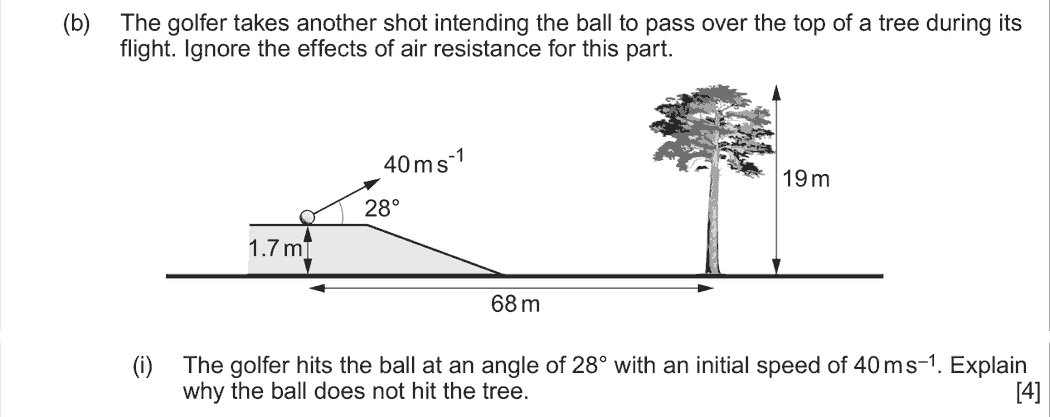
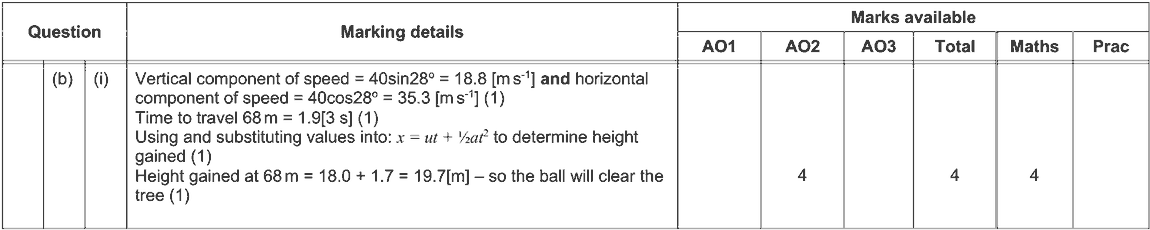
This was answered well by several candidates with many gaining full marks for this part. Many candidates took the approach to determine the time taken to travel 68 m and then used the equation 𝑥= 𝑢𝑡+ 2 𝑎𝑡2 to determine the height gained. All candidates used the 1.7 m correctly to determine that the ball cleared the tree.
Notes from the mark scheme and report
Components: vertical 40 sin 28° = 18.8 m s⁻¹, horizontal 40 cos 28° = 35.3 m s⁻¹ (1)
time to travel 68 m = 68/35.3 = 1.93 s (1)
height gained = 18.8 × 1.93 − ½ × 9.81 × 1.93² = 18.0 m (1)
18.0 + 1.7 = 19.7 m, above the 19 m tree (1)
Scheme columns: Maths 4
Skills: Trigonometryand vectors Resolving, components, vector addition, angles; Mathsmarks The mark scheme's Maths column gives this part at least one mark for mathematical skills
June 2025 · Component 3 · Q11(b)(ii)3 marksAO3=3Calculation
Earlier parts of question 11 that this part uses
Mark scheme
Examiner's comment
Many candidates determined the rotational kinetic energy correctly and were able to gain credit for the moment of inertia if diameter was used in part (a)(iii) to determine the torque. However, the linear kinetic energy was poorly understood with many candidates not using the horizontal speed or simply stating that the linear kinetic energy at maximum height is equal to zero.
Notes from the mark scheme and report
Rotational KE = ½Iω² = ½ × 8.5 × 10⁻⁶ × 195² = 0.16 J (1)
at maximum height the ball still has its horizontal velocity 35.3 m s⁻¹ (1)
linear KE = ½ × 0.046 × 35.3² = 28.7 J, far greater, so the rotational KE is negligible (1)
many took the linear KE at the top to be zero
Scheme columns: Maths 3
Skills: Mathsmarks The mark scheme's Maths column gives this part at least one mark for mathematical skills
June 2025 · Component 3 · Q11(c)4 marksAO1=2, AO2=2Explanation
Earlier parts of question 11 that this part uses
Mark scheme
Examiner's comment
This was answered well by nearly all candidates. They were able to discuss at least one factor that could be changed and then explain the physics principle that enabled the horizontal range to be reduced. The most common approach was to use the drag force equation and explain how the factors in this equation could be changed. Some candidates did discuss changing the density of the golf ball in the context of this equation which was not correct. Energy and the Environment – Question 12
Notes from the mark scheme and report
Two changes, each with its physics (2 + 2), e.g. lower the coefficient of restitution by changing the ball material, giving a lower launch speed
increase the drag coefficient by changing the dimple pattern
increase the diameter and so the area, giving greater drag
reduce lift
increase the mass, giving a lower initial speed. Changing the ball's density via the drag equation is wrong, as that density is the air's
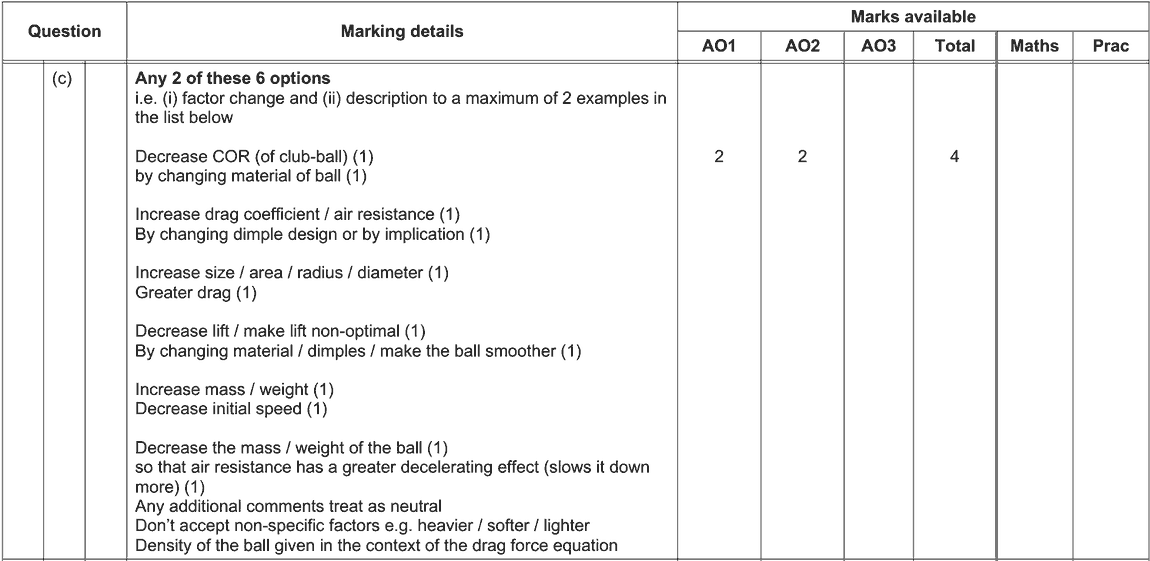
June 2024 · Component 3 · Q11(a)(i)2 marksAO1=2Short answer
Mark scheme
Examiner's comment
The majority of candidates were able to state the two factors that increased the stability of the skier. Some candidates referred to the increased surface area of the skis which was not given any credit.
Notes from the mark scheme and report
Wide base, skis and legs apart (1)
low centre of gravity from crouching (1)
'larger surface area of the skis' not credited
June 2024 · Component 3 · Q11(a)(ii)4 marksAO1=1, AO2=3Calculation
Earlier part of question 11 that this part uses
Mark scheme
Examiner's comment
This part was answered well by all candidates with the steps to determine the increased drag force clearly laid out. In some cases, candidates lost marks by simply stating 1.252 0.85 without explaining the multiplication in detail.
Notes from the mark scheme and report
Answer: the drag force increases by a factor of 1.33. FD = ½ρv²ACD (1)
assume the air density and drag coefficient stay the same (1)
factor = 0.85 × 1.25² (1) = 1.33 (1)
show the multiplication in full
Scheme columns: Maths 3
Skills: Algebra Derivations and rearranging equations; Mathsmarks The mark scheme's Maths column gives this part at least one mark for mathematical skills
June 2024 · Component 3 · Q11(a)(iii)2 marksAO1=1, AO2=1Calculation
Earlier part of question 11 that this part uses
Mark scheme
Examiner's comment
This was also answered well by all the candidates with nearly all gaining full marks for this part.
Notes from the mark scheme and report
Answer: 2000 N (2022 N). F = (mv − mu)/t = 72 × 25/0.89, opposing the motion
Scheme columns: Maths 1
Skills: Mathsmarks The mark scheme's Maths column gives this part at least one mark for mathematical skills
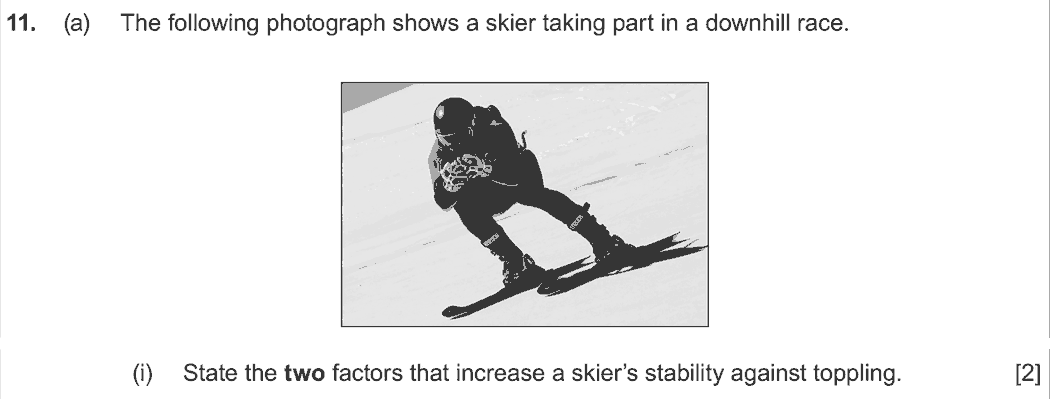
June 2024 · Component 3 · Q11(b)(i)3 marksAO1=1, AO2=2Calculation
Earlier part of question 11 that this part uses
Mark scheme
Examiner's comment
Many candidates gained all the marks for this part. The common mistakes were power of 10 errors when calculating the moment of inertia or algebraic manipulation to determine the angular velocity correctly.
Notes from the mark scheme and report
Answer: 143 rad s⁻¹. I = ½mr² = 0.5 × 0.160 × 0.040² = 1.28 × 10⁻⁴ kg m²
½Iω² = 1.3 J so ω = √(2 × 1.3/1.28 × 10⁻⁴)
power of ten and rearranging slips
Scheme columns: Maths 2
Skills: Unitsand conversions Unit marks, base units, prefixes and conversions; Mathsmarks The mark scheme's Maths column gives this part at least one mark for mathematical skills
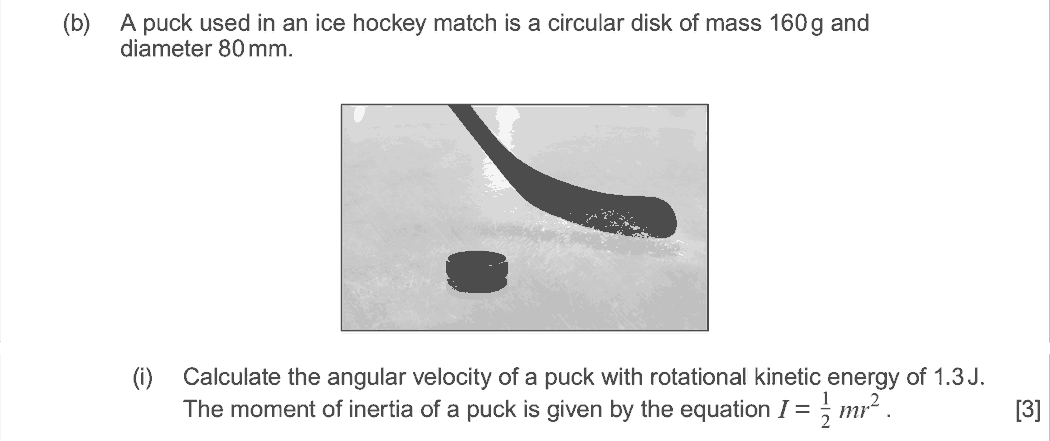
June 2024 · Component 3 · Q11(b)(ii)5 marksAO3=5Calculation
Earlier parts of question 11 that this part uses
Mark scheme
Examiner's comment
This part was also answered well with many candidates able to determine the correct height and conclude that the goal could not be scored.
Notes from the mark scheme and report
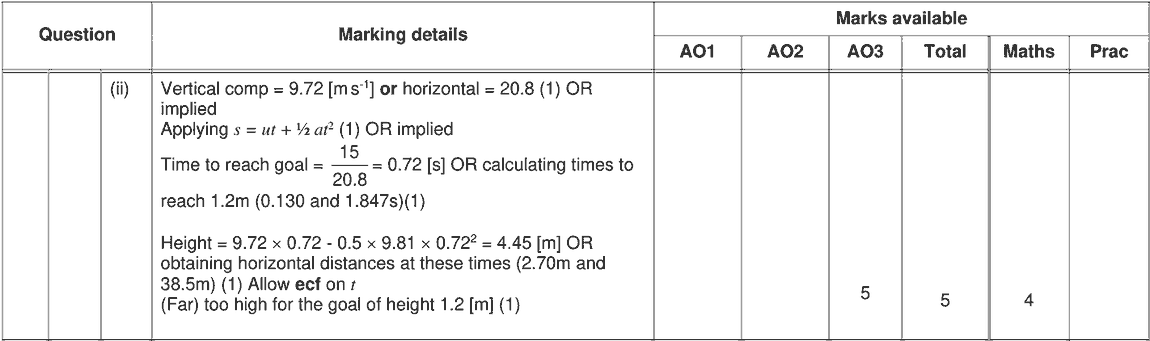
Answer: the puck is 4.45 m high at the goal, far above 1.2 m, so no goal. Horizontal speed 23 cos 25° = 20.8 m s⁻¹, vertical 23 sin 25° = 9.72 m s⁻¹
time to travel 15 m = 0.72 s
height = 9.72 × 0.72 − ½ × 9.81 × 0.72²
or find where the puck is at 1.2 m high (2.7 m and 38.5 m from the player)
Scheme columns: Maths 4
Skills: Trigonometryand vectors Resolving, components, vector addition, angles; Mathsmarks The mark scheme's Maths column gives this part at least one mark for mathematical skills
June 2024 · Component 3 · Q11(c)4 marksAO1=1, AO2=3Explanation
Earlier parts of question 11 that this part uses
Mark scheme
Examiner's comment
Nearly all the candidates gained a mark for stating that the moment of inertia was reduced by the ice skater pulling in her arms and reducing the distance to axis of rotation within the general equation for the moment of inertia. Most of the candidates based their approach on the conservation of angular momentum and were able to gain all the marks. A few responses were based on rotational kinetic energy which gained some credit if explained correctly. A few other answers were based on resistive forces which did not gain any marks. Option D – Energy and the Environment
Notes from the mark scheme and report
Angular momentum L = Iω (1)
pulling the arms in brings mass closer to the axis so the moment of inertia falls (1)
no external torque, so angular momentum is conserved (1)
therefore ω must increase (1)
answers based on resistive forces scored nothing
June 2023 · Component 3 · Q13(a)3 marksAO1=1, AO2=2Calculation
Mark scheme
Examiner's comment
Part (a) was answered well by all candidates. Frequent slips seen were that candidates did not use the correct component or the perpendicular distance was not determined correctly or used when applying the principle of moments. Part (b) was not answered well by candidates with many noting that the r represented the radius in the definition rather than correctly defining this as the distance from the axis of rotation. Error carried forward from the previous part for the moment of inertia was often applied in (c)(ii). The projectile part of (d)(i) was answered well but a surprising number of candidates commented that the final answer of 11.8 m could be approximated to 11 m and therefore commented that this was achieved by the bowler. In (d)(iii) the direction of the lift force was frequently incorrectly given as an answer to this part. This should point downwards and perpendicular to the direction of motion. In the last part the effects of the forces could be explained to a certain extent by nearly all the candidates. Error carried forward was applied for an incorrect lift force from the previous part. Option D – Energy and the Environment
Notes from the mark scheme and report
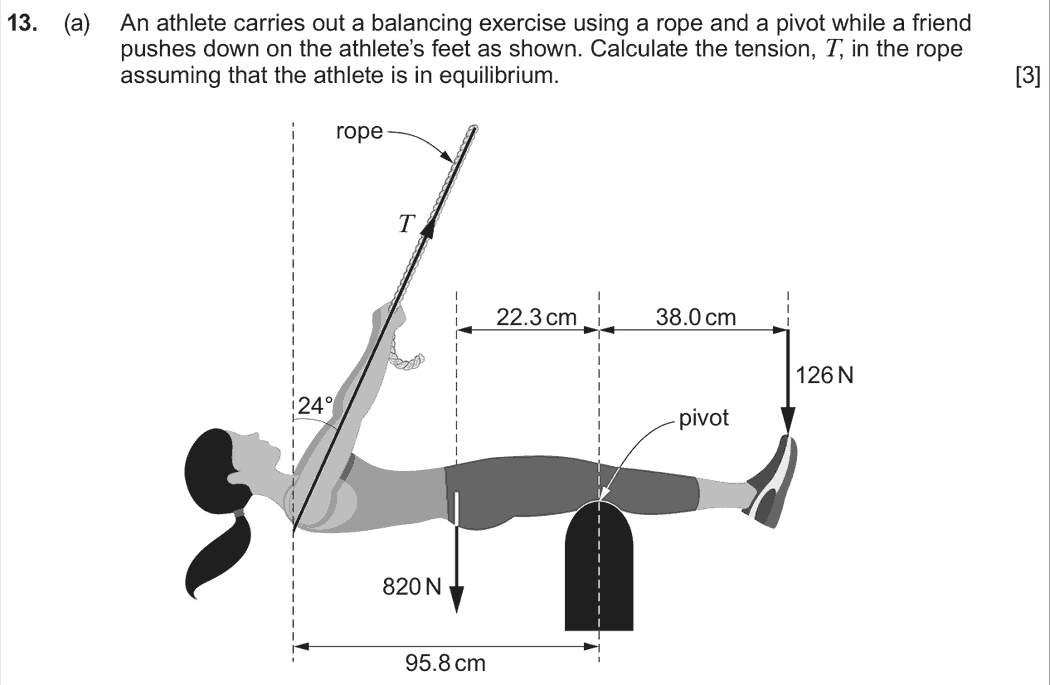
Answer: 154 N. Principle of moments about the pivot (1)
errors were in the component or the perpendicular distance
Scheme columns: Maths 2
Skills: Trigonometryand vectors Resolving, components, vector addition, angles; Mathsmarks The mark scheme's Maths column gives this part at least one mark for mathematical skills
June 2023 · Component 3 · Q13(b)2 marksAO1=2Definition
Earlier part of question 13 that this part uses
Mark scheme
Examiner's comment
Part (a) was answered well by all candidates. Frequent slips seen were that candidates did not use the correct component or the perpendicular distance was not determined correctly or used when applying the principle of moments. Part (b) was not answered well by candidates with many noting that the r represented the radius in the definition rather than correctly defining this as the distance from the axis of rotation. Error carried forward from the previous part for the moment of inertia was often applied in (c)(ii). The projectile part of (d)(i) was answered well but a surprising number of candidates commented that the final answer of 11.8 m could be approximated to 11 m and therefore commented that this was achieved by the bowler. In (d)(iii) the direction of the lift force was frequently incorrectly given as an answer to this part. This should point downwards and perpendicular to the direction of motion. In the last part the effects of the forces could be explained to a certain extent by nearly all the candidates. Error carried forward was applied for an incorrect lift force from the previous part. Option D – Energy and the Environment
Notes from the mark scheme and report
I = Σmr² (1) where m is the mass of each part and r its distance from the axis of rotation (1)
or torque per unit angular acceleration
calling r 'the radius' lost the mark
June 2023 · Component 3 · Q13(c)(i)3 marksAO1=1, AO2=2Calculation
Earlier part of question 13 that this part uses
Mark scheme
Examiner's comment
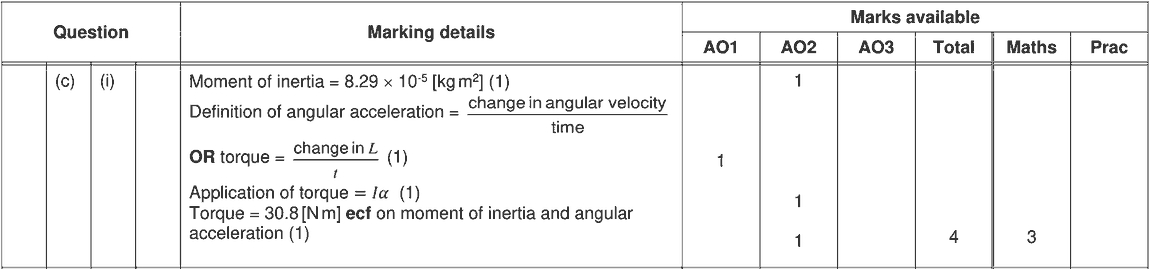
Part (a) was answered well by all candidates. Frequent slips seen were that candidates did not use the correct component or the perpendicular distance was not determined correctly or used when applying the principle of moments. Part (b) was not answered well by candidates with many noting that the r represented the radius in the definition rather than correctly defining this as the distance from the axis of rotation. Error carried forward from the previous part for the moment of inertia was often applied in (c)(ii). The projectile part of (d)(i) was answered well but a surprising number of candidates commented that the final answer of 11.8 m could be approximated to 11 m and therefore commented that this was achieved by the bowler. In (d)(iii) the direction of the lift force was frequently incorrectly given as an answer to this part. This should point downwards and perpendicular to the direction of motion. In the last part the effects of the forces could be explained to a certain extent by nearly all the candidates. Error carried forward was applied for an incorrect lift force from the previous part. Option D – Energy and the Environment
Notes from the mark scheme and report
Answer: 2.59 × 10⁻³ kg m² s⁻¹. L = Iω (1)
I = (2/5) × 0.159 × 0.036² = 8.24 × 10⁻⁵ kg m² (1)
ω = 300 × 2π/60 = 31.4 rad s⁻¹, L = 2.59 × 10⁻³ (1)
Scheme columns: Maths 2
Skills: Unitsand conversions Unit marks, base units, prefixes and conversions; Mathsmarks The mark scheme's Maths column gives this part at least one mark for mathematical skills
June 2023 · Component 3 · Q13(c)(ii)3 marksAO1=1, AO2=2Calculation
Earlier parts of question 13 that this part uses
Mark scheme
Examiner's comment
Part (a) was answered well by all candidates. Frequent slips seen were that candidates did not use the correct component or the perpendicular distance was not determined correctly or used when applying the principle of moments. Part (b) was not answered well by candidates with many noting that the r represented the radius in the definition rather than correctly defining this as the distance from the axis of rotation. Error carried forward from the previous part for the moment of inertia was often applied in (c)(ii). The projectile part of (d)(i) was answered well but a surprising number of candidates commented that the final answer of 11.8 m could be approximated to 11 m and therefore commented that this was achieved by the bowler. In (d)(iii) the direction of the lift force was frequently incorrectly given as an answer to this part. This should point downwards and perpendicular to the direction of motion. In the last part the effects of the forces could be explained to a certain extent by nearly all the candidates. Error carried forward was applied for an incorrect lift force from the previous part. Option D – Energy and the Environment
Notes from the mark scheme and report
Rotational KE = ½Iω² (1) = ½ × 8.24 × 10⁻⁵ × 210² = 1.82 J (1)
linear KE = ½ × 0.159 × 30² = 71.6 J, about 40 times bigger, so the statement is correct (1)
ecf on I
Scheme columns: Maths 2
Skills: Mathsmarks The mark scheme's Maths column gives this part at least one mark for mathematical skills
June 2023 · Component 3 · Q13(d)(i)5 marksAO3=5Calculation
Earlier part of question 13 that this part uses
Mark scheme
Examiner's comment
Part (a) was answered well by all candidates. Frequent slips seen were that candidates did not use the correct component or the perpendicular distance was not determined correctly or used when applying the principle of moments. Part (b) was not answered well by candidates with many noting that the r represented the radius in the definition rather than correctly defining this as the distance from the axis of rotation. Error carried forward from the previous part for the moment of inertia was often applied in (c)(ii). The projectile part of (d)(i) was answered well but a surprising number of candidates commented that the final answer of 11.8 m could be approximated to 11 m and therefore commented that this was achieved by the bowler. In (d)(iii) the direction of the lift force was frequently incorrectly given as an answer to this part. This should point downwards and perpendicular to the direction of motion. In the last part the effects of the forces could be explained to a certain extent by nearly all the candidates. Error carried forward was applied for an incorrect lift force from the previous part. Option D – Energy and the Environment
Notes from the mark scheme and report
Answer: not quite
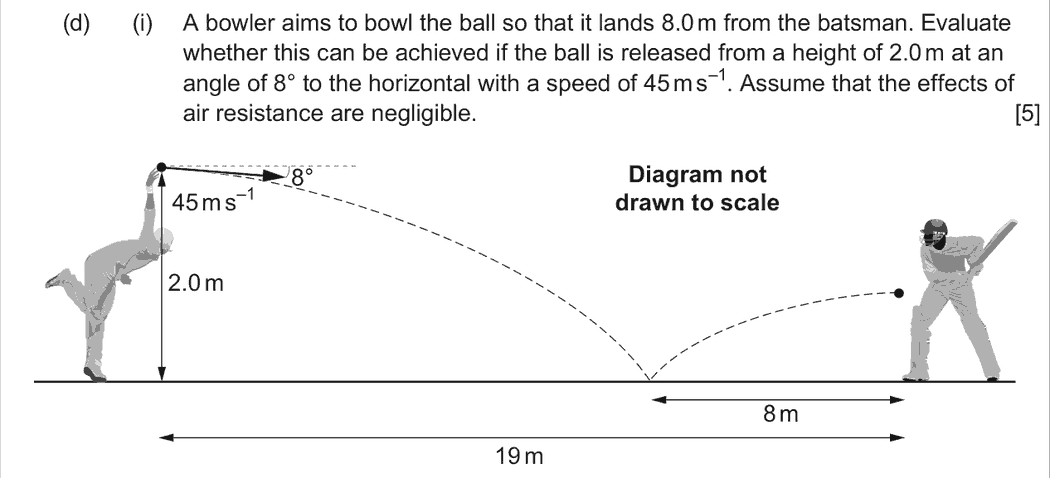
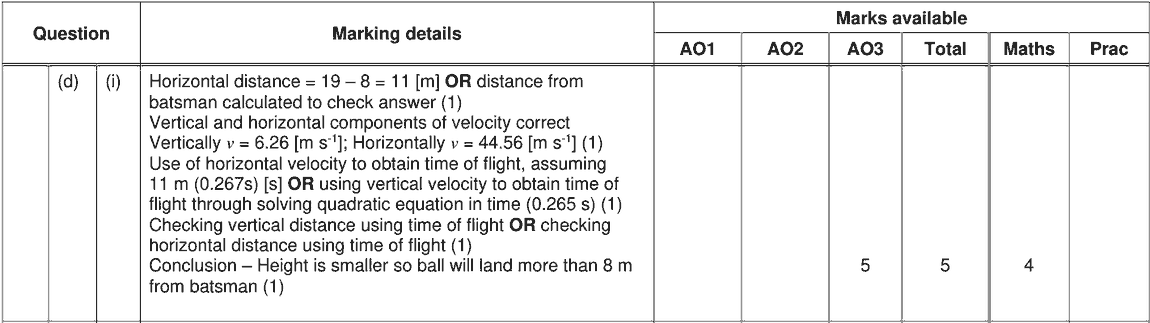
it lands about 11.8 m from the bowler, 7.2 m from the batsman. Horizontal distance needed = 19 − 8 = 11 m (1)
components 45 cos 8° = 44.6 m s⁻¹ horizontally and 45 sin 8° = 6.26 m s⁻¹ downwards (1)
time to travel 11 m = 11/44.6 = 0.247 s, or time to fall 2.0 m from the quadratic = 0.265 s (1)
check the other direction: in 0.247 s the ball has fallen only 1.85 m, or in 0.265 s it travels 11.8 m (1)
conclusion consistent with the working (1). The scheme prints 0.267 s for the 11 m time and concludes 'more than 8 m from the batsman', which does not match this arithmetic
Scheme columns: Maths 4
Skills: Trigonometryand vectors Resolving, components, vector addition, angles; Mathsmarks The mark scheme's Maths column gives this part at least one mark for mathematical skills
June 2023 · Component 3 · Q13(d)(ii)2 marksAO1=1, AO2=1Diagram or graph
Earlier parts of question 13 that this part uses
Mark scheme
Examiner's comment
Part (a) was answered well by all candidates. Frequent slips seen were that candidates did not use the correct component or the perpendicular distance was not determined correctly or used when applying the principle of moments. Part (b) was not answered well by candidates with many noting that the r represented the radius in the definition rather than correctly defining this as the distance from the axis of rotation. Error carried forward from the previous part for the moment of inertia was often applied in (c)(ii). The projectile part of (d)(i) was answered well but a surprising number of candidates commented that the final answer of 11.8 m could be approximated to 11 m and therefore commented that this was achieved by the bowler. In (d)(iii) the direction of the lift force was frequently incorrectly given as an answer to this part. This should point downwards and perpendicular to the direction of motion. In the last part the effects of the forces could be explained to a certain extent by nearly all the candidates. Error carried forward was applied for an incorrect lift force from the previous part. Option D – Energy and the Environment
Notes from the mark scheme and report
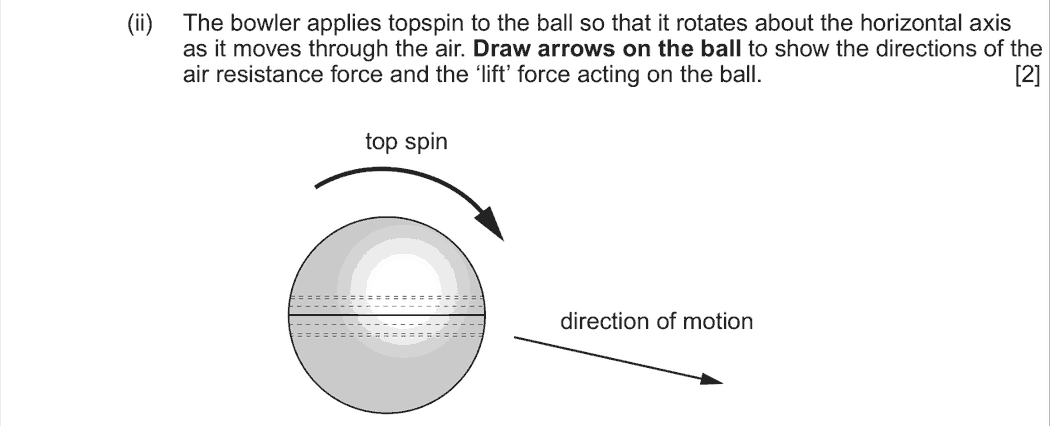
Air resistance (drag) arrow opposite to the direction of motion (1)
'lift' force at 90° to the motion, directed downwards for topspin (1)
June 2023 · Component 3 · Q13(d)(iii)2 marksAO2=2Explanation
Earlier parts of question 13 that this part uses
Mark scheme
Examiner's comment
Part (a) was answered well by all candidates. Frequent slips seen were that candidates did not use the correct component or the perpendicular distance was not determined correctly or used when applying the principle of moments. Part (b) was not answered well by candidates with many noting that the r represented the radius in the definition rather than correctly defining this as the distance from the axis of rotation. Error carried forward from the previous part for the moment of inertia was often applied in (c)(ii). The projectile part of (d)(i) was answered well but a surprising number of candidates commented that the final answer of 11.8 m could be approximated to 11 m and therefore commented that this was achieved by the bowler. In (d)(iii) the direction of the lift force was frequently incorrectly given as an answer to this part. This should point downwards and perpendicular to the direction of motion. In the last part the effects of the forces could be explained to a certain extent by nearly all the candidates. Error carried forward was applied for an incorrect lift force from the previous part. Option D – Energy and the Environment
Notes from the mark scheme and report
Drag reduces the horizontal velocity so the ball lands earlier (shorter range) (1)
topspin gives a downward force, so the ball reaches the ground sooner and lands earlier still (1)
ecf on the lift direction drawn
June 2022 · Component 3 · Q12(a)2 marksAO1=1, AO2=1Explanation
Mark scheme
Examiner's comment
(a) This was well answered by most candidates. The main reason many did not gain full marks was that they did not refer to the centre of gravity being lowered.
Notes from the mark scheme and report
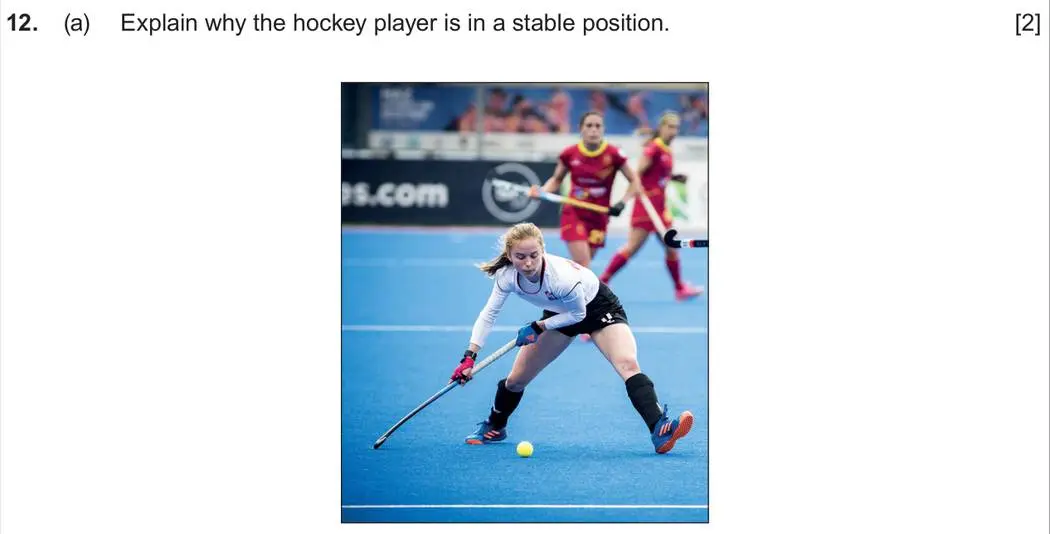
Low centre of gravity (1)
wide base, feet well apart, so the line of action of the weight stays inside the base (1)
many did not mention the lowered centre of gravity
June 2022 · Component 3 · Q12(b)2 marksAO3=2Explanation
Earlier part of question 12 that this part uses
Mark scheme
Examiner's comment
The definition of coefficient of restitution was given by most of the candidates but they were not then able to use this to explain fully why hockey stick C is the preferred option. Some candidates attempted to use the equation based on heights which did not receive credit.
Notes from the mark scheme and report
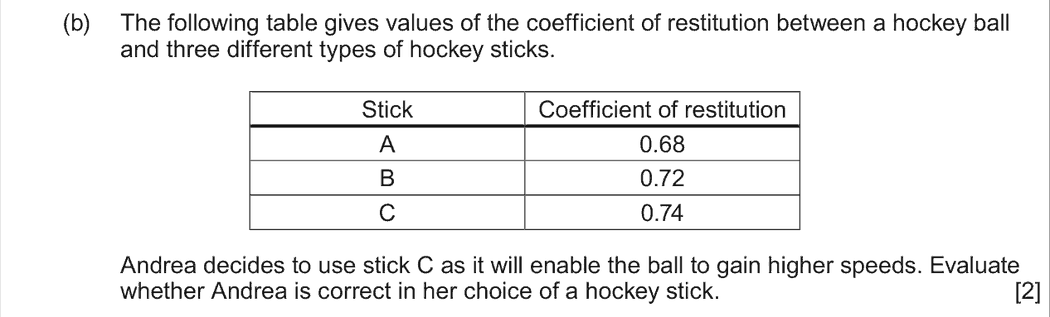
Coefficient of restitution = relative speed after ÷ relative speed before (or a larger value means more energy recovered) (1)
the highest value, stick C, gives the greatest ball speed so she is correct (1)
the height form of the equation was not credited
June 2022 · Component 3 · Q12(c)(i)4 marksAO1=1, AO2=3Calculation
Earlier part of question 12 that this part uses
Mark scheme
Examiner's comment
A significant number of candidates were not able to determine the angular velocity correctly from the data given or able to determine correctly the moment of inertia though the equation was given. Error carried forward was applied and many candidates were able to gain marks for determining the torque if the correct equation was used.
Notes from the mark scheme and report
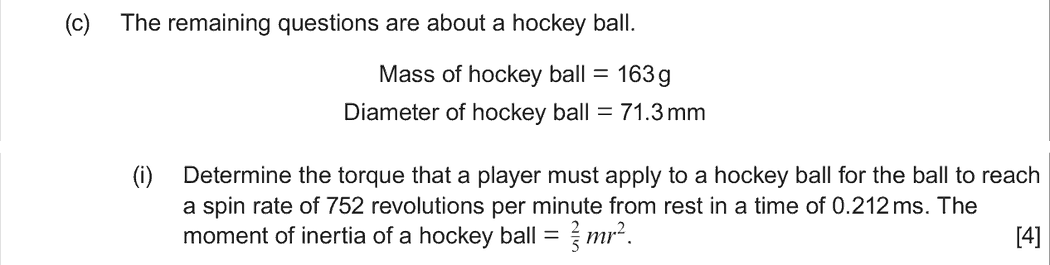
Answer: 30.8 N m. I = (2/5)mr² = 0.4 × 0.163 × 0.03565² = 8.29 × 10⁻⁵ kg m²
ω = 752 × 2π/60 = 78.7 rad s⁻¹
α = 78.7/0.212 × 10⁻³ = 3.71 × 10⁵ rad s⁻²
τ = Iα
errors in ω and in I (diameter used as radius), ecf applied
Scheme columns: Maths 3
Skills: Unitsand conversions Unit marks, base units, prefixes and conversions; Mathsmarks The mark scheme's Maths column gives this part at least one mark for mathematical skills
June 2022 · Component 3 · Q12(c)(ii)3 marksAO1=1, AO2=2Calculation
Earlier parts of question 12 that this part uses
Mark scheme
Examiner's comment
The linear and rotational kinetic energy and their use were well understood by all candidates and the majority were able to gain full marks with ecf from part (c)(i).
Notes from the mark scheme and report
Answer: rotational 0.257 J, linear 144 J. ½Iω² = ½ × 8.29 × 10⁻⁵ × 78.7²
½mv² = ½ × 0.163 × 42²
ecf from (i)
Scheme columns: Maths 2
Skills: Mathsmarks The mark scheme's Maths column gives this part at least one mark for mathematical skills
June 2022 · Component 3 · Q12(c)(iii)3 marksAO3=3Calculation
Earlier parts of question 12 that this part uses
Mark scheme
Examiner's comment
This was not answered well with many not being able to use the speeds correctly in the equation. The sign for the magnitude of the force was consequently omitted by the majority. A significant number then stated that protection was not advisable due to the high force though a minority did gain credit by saying that additional protection was required since the force was high.
Notes from the mark scheme and report
Answer: force of about 2160 N. F = (mv − mu)/t = 0.163 × (−27 − 42)/5.2 × 10⁻³ = −2163 N
the velocities have opposite signs
such a large force on the goalkeeper means protection is advisable
many subtracted the speeds
Scheme columns: Maths 1
Skills: Mathsmarks The mark scheme's Maths column gives this part at least one mark for mathematical skills
June 2022 · Component 3 · Q12(c)(iv)I4 marksAO1=2, AO2=2Calculation
Earlier parts of question 12 that this part uses
Mark scheme
Examiner's comment
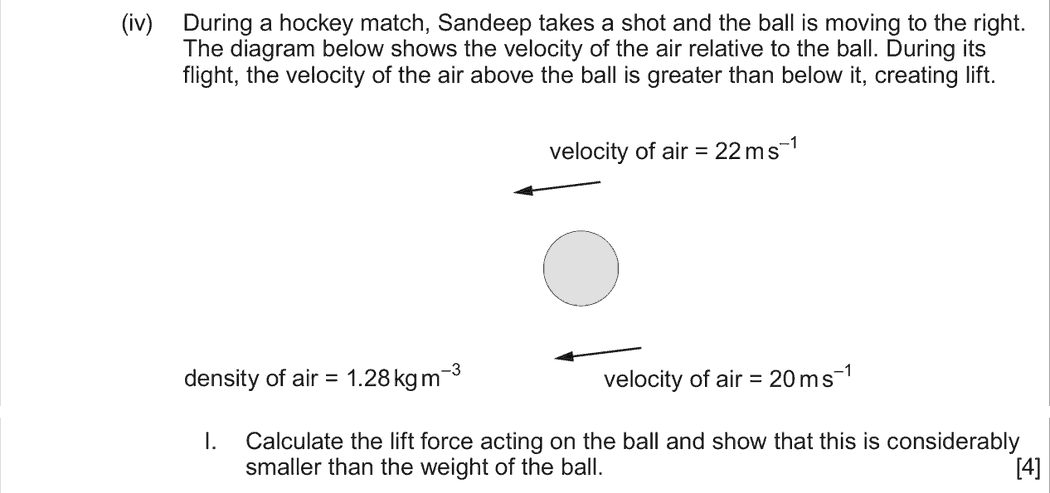
In part I many candidates struggled and used the drag force equation rather than Bernoulli’s equation. Also, the pressure difference was not calculated correctly with 22 rather than 222 – 202 being used. Candidates did gain credit if they used either the surface area of a circle or hemisphere for determining the force. Also an ecf was applied if a correct comparison was made with the weight of the ball for the final mark. In part II most candidates were able to correctly base their answers on the drag force equation but did not give a full explanation e.g. factor of 4 in their final answer. OPTION D – ENERGY AND THE ENVIRONMENT
Notes from the mark scheme and report
Answer: 0.215 N (0.43 N if the hemisphere area is used), against a weight of 1.6 N. Pressure difference = ½ρ(v1² − v2²) = ½ × 1.28 × (22² − 20²) = 53.8 Pa
Skills: Mathsmarks The mark scheme's Maths column gives this part at least one mark for mathematical skills
June 2022 · Component 3 · Q12(c)(iv)II2 marksAO1=1, AO2=1Calculation
Earlier parts of question 12 that this part uses
Mark scheme
Examiner's comment
In part I many candidates struggled and used the drag force equation rather than Bernoulli’s equation. Also, the pressure difference was not calculated correctly with 22 rather than 222 – 202 being used. Candidates did gain credit if they used either the surface area of a circle or hemisphere for determining the force. Also an ecf was applied if a correct comparison was made with the weight of the ball for the final mark. In part II most candidates were able to correctly base their answers on the drag force equation but did not give a full explanation e.g. factor of 4 in their final answer. OPTION D – ENERGY AND THE ENVIRONMENT
Notes from the mark scheme and report
Answer: the drag force falls to ¼ of its value. FD = ½ρv²ACD so F is proportional to v²
halving the speed gives (½)²
the factor had to be stated
Scheme columns: Maths 1
Skills: Algebra Derivations and rearranging equations; Mathsmarks The mark scheme's Maths column gives this part at least one mark for mathematical skills
October 2021 · Component 3 · Q11(a)(i)2 marksAO1=2Explanation
Mark scheme
Notes from the mark scheme and report
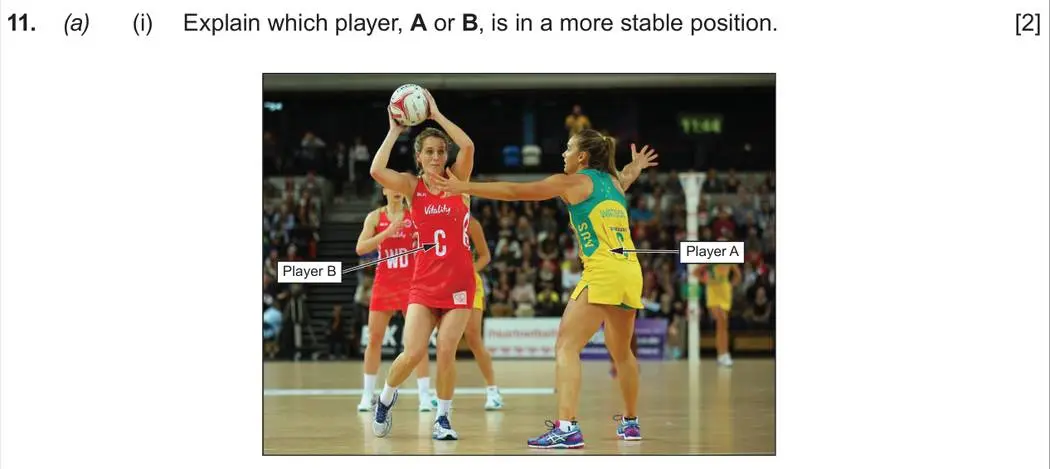
Player A is more stable: feet wider apart, so a wider base (1)
the line of action of the weight from the centre of gravity stays between the feet for a larger tilt (1). The pictures of the two players are missing from the crop
October 2021 · Component 3 · Q11(a)(ii)2 marksAO1=2Definition
Earlier part of question 11 that this part uses
Mark scheme
Notes from the mark scheme and report
Ratio of speeds (1): the relative speed after the bounce is 0.8 of the relative speed before it (after/before = 0.8) (1)
October 2021 · Component 3 · Q11(a)(iii)2 marksAO1=1, AO2=1Show that
Earlier part of question 11 that this part uses
Mark scheme
Notes from the mark scheme and report
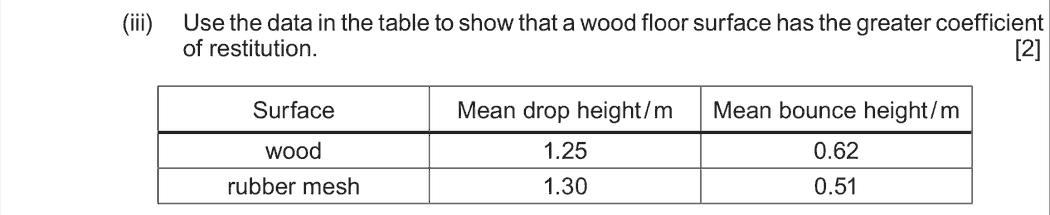
e = √(h/H): wood √(0.62/1.25) = 0.70
rubber mesh √(0.51/1.30) = 0.63
or argue wood gives a higher bounce from a lower drop
Scheme columns: Maths 1
Skills: Mathsmarks The mark scheme's Maths column gives this part at least one mark for mathematical skills
October 2021 · Component 3 · Q11(b)(i)3 marksAO3=3Explanation
Earlier part of question 11 that this part uses
Mark scheme
Notes from the mark scheme and report
Spin produces a lift (Bernoulli/Magnus) force on the ball, its direction depending on the type of spin (1)
this acts in addition to weight and air resistance (1)
so the ball rises or dips compared with no spin and the spectator is wrong, unless the spin is too small to matter (1)
October 2021 · Component 3 · Q11(b)(ii)4 marksAO1=1, AO2=3Calculation
Earlier parts of question 11 that this part uses
Mark scheme
Notes from the mark scheme and report
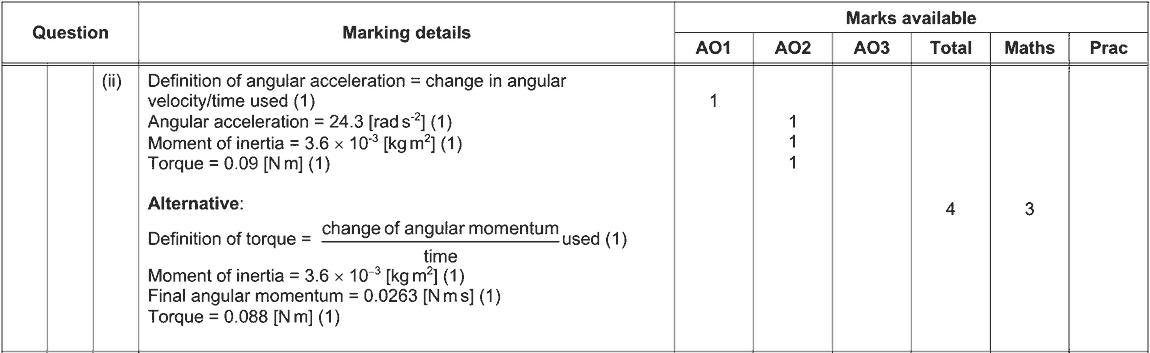
Answer: 0.088 N m (0.09). α = 7.3/0.3 = 24.3 rad s⁻²
I = (2/3) × 0.450 × 0.110² = 3.6 × 10⁻³ kg m²
τ = Iα
or change of angular momentum/time
Scheme columns: Maths 3
Skills: Unitsand conversions Unit marks, base units, prefixes and conversions; Mathsmarks The mark scheme's Maths column gives this part at least one mark for mathematical skills
October 2021 · Component 3 · Q11(b)(iii)3 marksAO2=3Calculation
Earlier parts of question 11 that this part uses
Mark scheme
Notes from the mark scheme and report
Answer: 7.9 revolutions per second. ω = √(2 × 4.4/3.6 × 10⁻³) = 49.4 rad s⁻¹
divide by 2π
ecf on I
Scheme columns: Maths 3
Skills: Unitsand conversions Unit marks, base units, prefixes and conversions; Mathsmarks The mark scheme's Maths column gives this part at least one mark for mathematical skills
October 2021 · Component 3 · Q11(c)(i)2 marksAO2=2Calculation
Earlier part of question 11 that this part uses
Mark scheme
Notes from the mark scheme and report
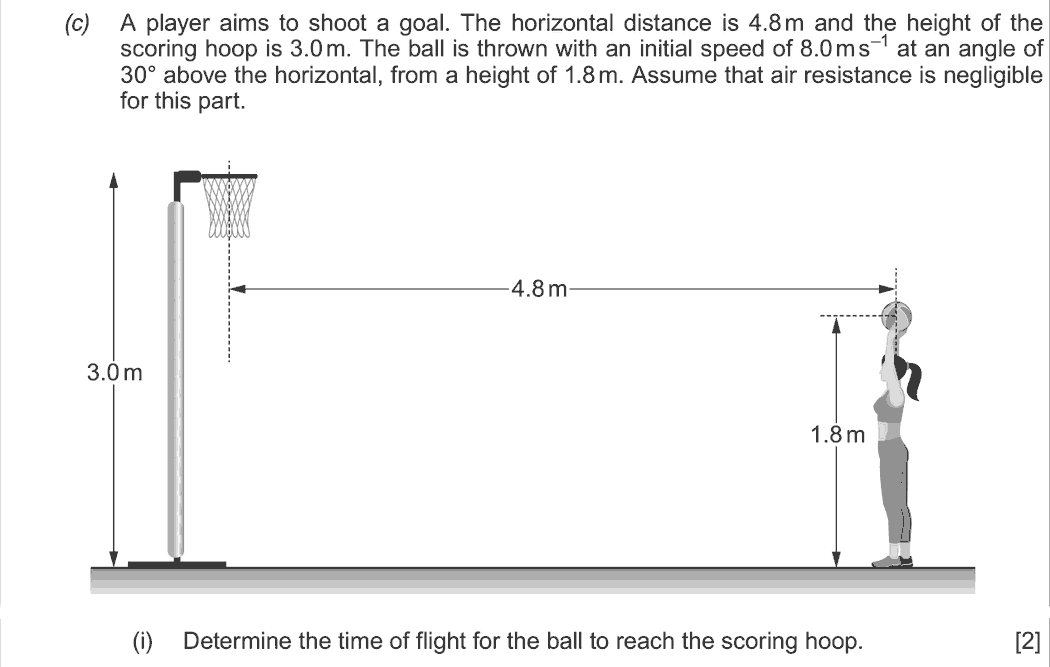
Answer: 0.69 s. Horizontal speed = 8.0 cos 30° = 6.93 m s⁻¹
t = 4.8/6.93
Scheme columns: Maths 1
Skills: Trigonometryand vectors Resolving, components, vector addition, angles; Mathsmarks The mark scheme's Maths column gives this part at least one mark for mathematical skills
October 2021 · Component 3 · Q11(c)(ii)2 marksAO3=2Calculation
Earlier parts of question 11 that this part uses
Mark scheme
Notes from the mark scheme and report
Answer: no goal. Height at the hoop = 1.8 + (8.0 sin 30° × 0.69) − ½ × 9.81 × 0.69² = about 2.2 m, below the 3.0 m hoop
Scheme columns: Maths 2
Skills: Trigonometryand vectors Resolving, components, vector addition, angles; Mathsmarks The mark scheme's Maths column gives this part at least one mark for mathematical skills
October 2020 · Component 3 · Q13(a)(i)2 marksAO1=2Definition
Mark scheme
Notes from the mark scheme and report
I = Σmr² summed over all the points of the body, about a given axis (1), where m is the mass of each point and r its distance from the axis (1)
poorly known
October 2020 · Component 3 · Q13(a)(ii)3 marksAO1=1, AO2=2Calculation
Earlier part of question 13 that this part uses
Mark scheme
Notes from the mark scheme and report
Answer: 8.3 × 10⁻⁵ kg m². ω = 30 × 2π = 188 rad s⁻¹
I = 2 × 1.47/ω²
Scheme columns: Maths 2
Skills: Unitsand conversions Unit marks, base units, prefixes and conversions; Mathsmarks The mark scheme's Maths column gives this part at least one mark for mathematical skills
October 2020 · Component 3 · Q13(b)(i)5 marksAO3=5Calculation
Earlier part of question 13 that this part uses
Mark scheme
Notes from the mark scheme and report
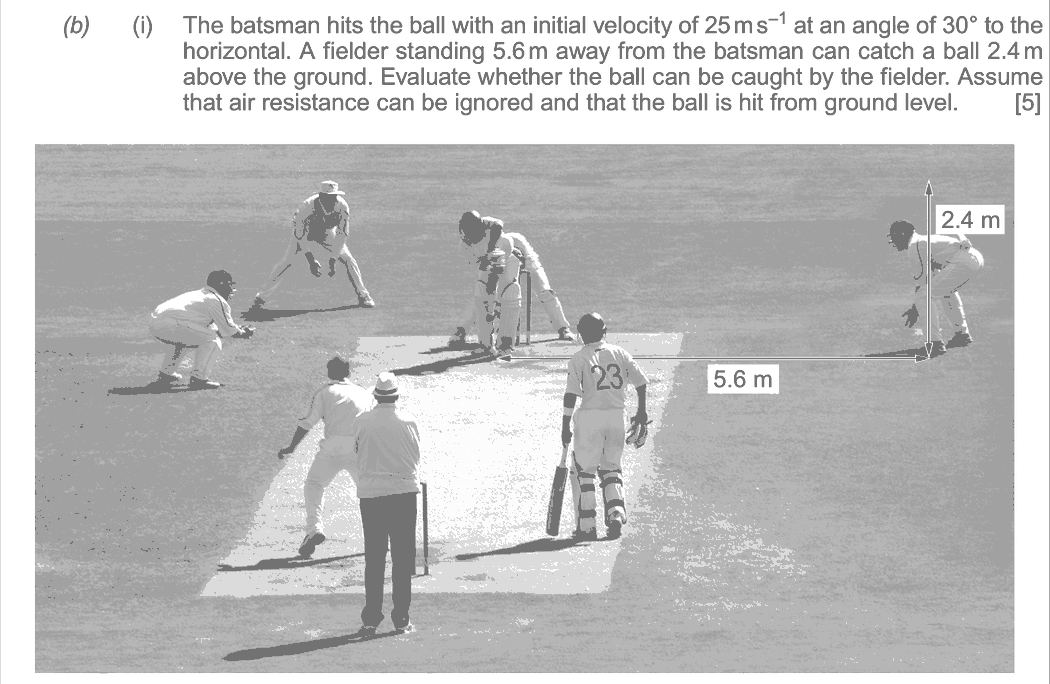
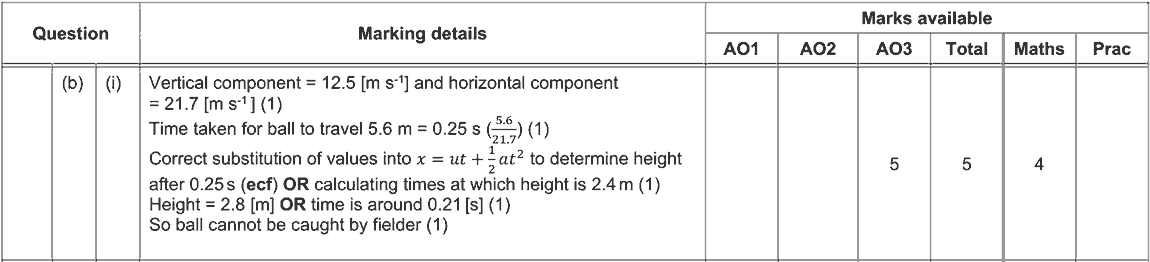
Components 25 sin 30° = 12.5 m s⁻¹ up and 25 cos 30° = 21.7 m s⁻¹ horizontally (1)
time to travel 5.6 m = 0.26 s (1)
height then = 12.5t − ½ × 9.81t² (1) = about 2.9 m (scheme 2.8 m with t = 0.25 s) (1)
above 2.4 m so the fielder cannot catch it (1)
Scheme columns: Maths 4
Skills: Trigonometryand vectors Resolving, components, vector addition, angles; Mathsmarks The mark scheme's Maths column gives this part at least one mark for mathematical skills
October 2020 · Component 3 · Q13(b)(ii)2 marksAO2=2Explanation
Earlier parts of question 13 that this part uses
Mark scheme
Notes from the mark scheme and report
Moving the hands with the ball increases the time (or distance) over which it is stopped (1)
F = (mv − mu)/t, so the force on the hands is smaller for the same change of momentum (1)
few discussed force
October 2020 · Component 3 · Q13(b)(iii)2 marksAO2=2Calculation
Earlier parts of question 13 that this part uses
Mark scheme
Notes from the mark scheme and report
Answer: 0.32 m. e = √(h/H) so h = e²H = 0.37² × 2.35
Scheme columns: Maths 2
Skills: Mathsmarks The mark scheme's Maths column gives this part at least one mark for mathematical skills
October 2020 · Component 3 · Q13(c)(i)3 marksAO1=3Explanation
Earlier parts of question 13 that this part uses
Mark scheme
Notes from the mark scheme and report
Weight and drag (opposite to the velocity) act on the ball (1)
the spin makes the air move faster on one side, lower pressure there (Bernoulli), giving a lift or Magnus force at right angles to the motion (1)
the resultant of the three forces is not along the line of motion, so the path curves (1)
force diagrams were poor
October 2020 · Component 3 · Q13(c)(ii)3 marksAO2=3Calculation
Earlier parts of question 13 that this part uses
Mark scheme
Notes from the mark scheme and report
Answer: 1.19 N. A = πr² = π × 0.036² = 4.07 × 10⁻³ m² (cross-sectional area)
Skills: Mathsmarks The mark scheme's Maths column gives this part at least one mark for mathematical skills
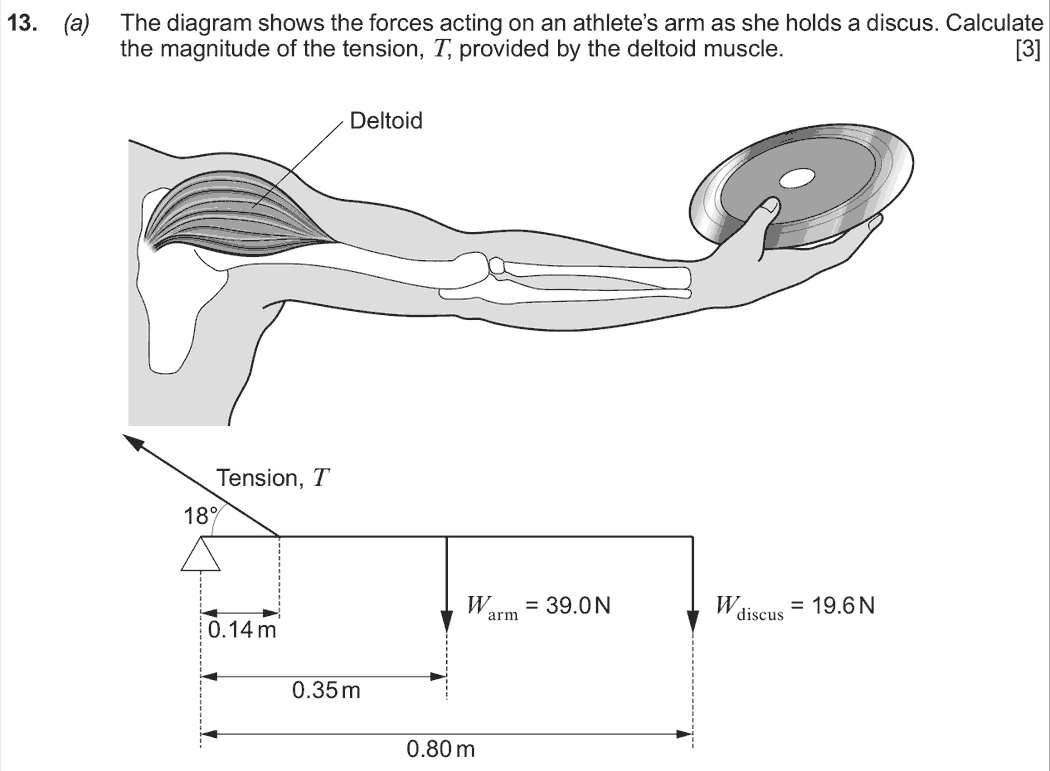
June 2019 · Component 3 · Q13(a)3 marksAO1=1, AO2=2Calculation
Mark scheme
Examiner's comment
Answered well by all candidates. The common errors resulted in not being able to resolve the tension correctly in order to determine the moments.
Notes from the mark scheme and report
Answer: 678 N. Moments about the shoulder: T sin 18° × 0.14 = 39.0 × 0.35 + 19.6 × 0.80
the usual error was not resolving the tension
Scheme columns: Maths 2
Skills: Trigonometryand vectors Resolving, components, vector addition, angles; Mathsmarks The mark scheme's Maths column gives this part at least one mark for mathematical skills
June 2019 · Component 3 · Q13(b)(i)1 markAO1=1Definition
Earlier part of question 13 that this part uses
Mark scheme
Examiner's comment
Definition of angular acceleration was answered well.
Notes from the mark scheme and report
Rate of change of angular velocity
June 2019 · Component 3 · Q13(b)(ii)2 marksAO2=2Calculation
Earlier parts of question 13 that this part uses
Mark scheme
Examiner's comment
A surprising number of candidates were not able to determine the correct value for the angular velocity with an incorrect answer of 8.52 rad s-2 given.
Notes from the mark scheme and report
Answer: 53 rad s⁻². ω = 2π × 2.3 = 14.5 rad s⁻¹
α = ω/t = 14.5/0.27
leaving 2.3 rev s⁻¹ unconverted gives the wrong 8.52
Scheme columns: Maths 1
Skills: Unitsand conversions Unit marks, base units, prefixes and conversions; Mathsmarks The mark scheme's Maths column gives this part at least one mark for mathematical skills
June 2019 · Component 3 · Q13(b)(iii)3 marksAO1=1, AO2=2Calculation
Earlier parts of question 13 that this part uses
Mark scheme
Examiner's comment
The torque was determined correctly by nearly all the candidates.
Notes from the mark scheme and report
Answer: 0.65 N m. I = mr²/2 = 2.0 × 0.11²/2 = 0.0121 kg m²
τ = Iα = 0.0121 × 53.5
Scheme columns: Maths 2
Skills: Mathsmarks The mark scheme's Maths column gives this part at least one mark for mathematical skills
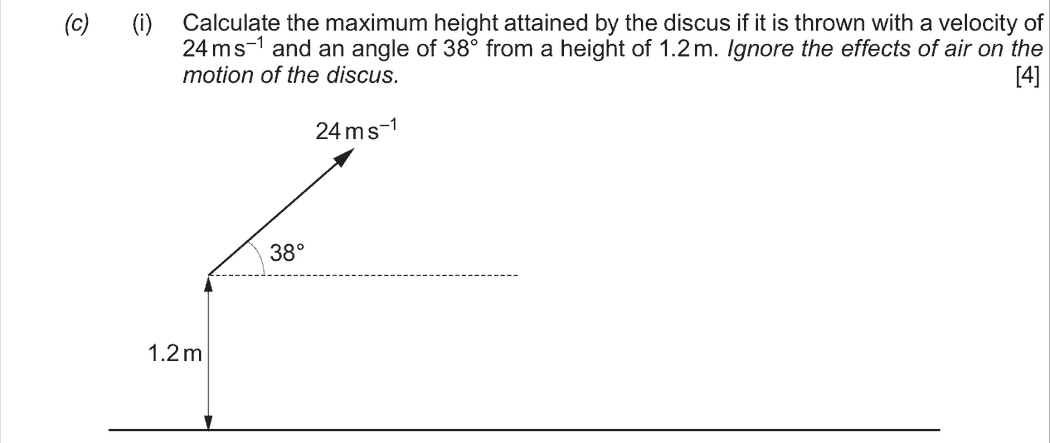
June 2019 · Component 3 · Q13(c)(i)4 marksAO1=2, AO2=2Calculation
Earlier part of question 13 that this part uses
Mark scheme
Examiner's comment
The maximum height was determined correctly by the majority.
Notes from the mark scheme and report
Answer: 12.3 m. Vertical component = 24 sin 38° = 14.8 m s⁻¹
rise = u²/2g = 11.1 m
add the 1.2 m release height
Scheme columns: Maths 2
Skills: Trigonometryand vectors Resolving, components, vector addition, angles; Mathsmarks The mark scheme's Maths column gives this part at least one mark for mathematical skills
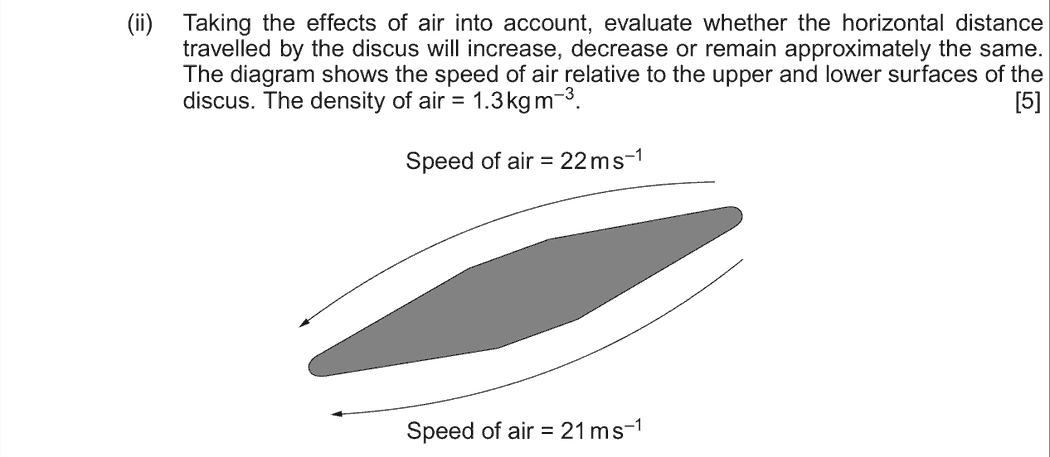
June 2019 · Component 3 · Q13(c)(ii)5 marksAO3=5Calculation
Earlier parts of question 13 that this part uses
Mark scheme
Examiner's comment
As noted previously; this part was the most discriminating as the correct approach is based on the Bernoulli equation. Some candidates did gain credit for a correct conclusion in that the distance did not change.
Notes from the mark scheme and report
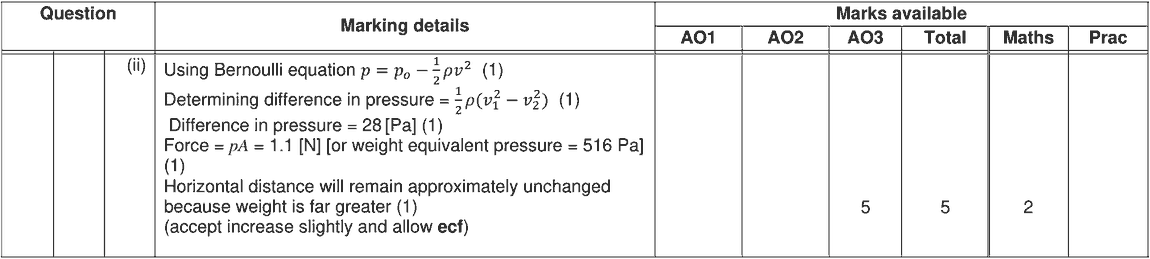
Answer: about the same (slight increase accepted). Bernoulli: pressure difference = ½ρ(v1² − v2²) = ½ × 1.3 × (22² − 21²) = 28 Pa
lift = ΔpA = 28 × π × 0.11² = 1.1 N, tiny compared with the 19.6 N weight (equivalent to 516 Pa), so the range barely changes. The most discriminating part
few used Bernoulli
Scheme columns: Maths 2
Skills: Mathsmarks The mark scheme's Maths column gives this part at least one mark for mathematical skills
June 2019 · Component 3 · Q13(c)(iii)2 marksAO1=1, AO2=1Calculation
Earlier parts of question 13 that this part uses
Mark scheme
Examiner's comment
In general; this was answered well with many candidates realising that the drag force is directly proportional to v2.
Notes from the mark scheme and report
Answer: 2.25. Drag F = ½ρv²AC(D) is proportional to v², so the factor is (30/20)²
Scheme columns: Maths 1
Skills: Mathsmarks The mark scheme's Maths column gives this part at least one mark for mathematical skills
June 2018 · Component 3 · Q13(a)1 markAO1=1Short answer
Mark scheme
Notes from the mark scheme and report
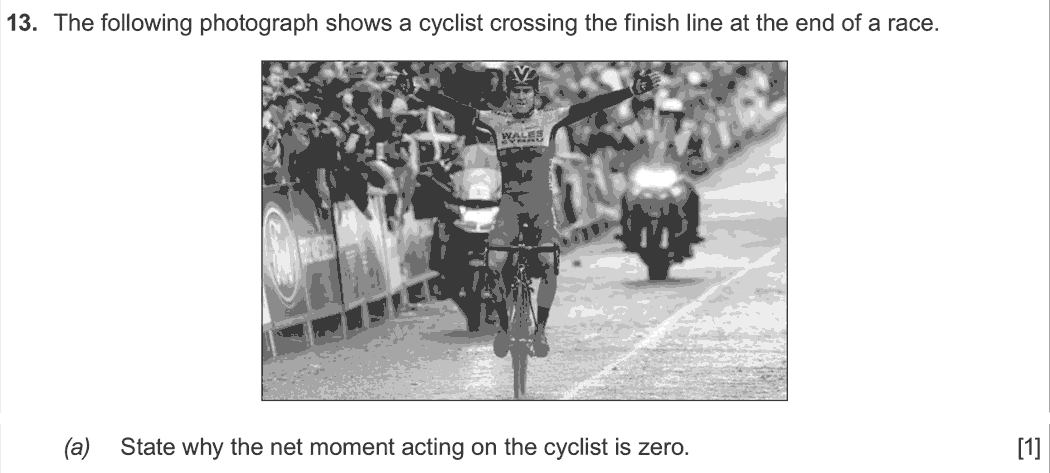
The line of action of the weight (through the centre of gravity of cyclist and bicycle) passes through the base, the point of contact of the wheels, in line with the normal reaction, so there is no turning effect
poorly answered, most just said clockwise moments equal anticlockwise moments
June 2018 · Component 3 · Q13(b)(i)2 marksAO1=2Definition
Earlier part of question 13 that this part uses
Mark scheme
Notes from the mark scheme and report
The sum over all parts of the body (1) of mass × (distance from the axis of rotation)² (1)
I = Σmr² with symbols explained, or torque per unit angular acceleration, accepted
June 2018 · Component 3 · Q13(b)(ii)3 marksAO2=3Calculation
Earlier parts of question 13 that this part uses
Mark scheme
Notes from the mark scheme and report
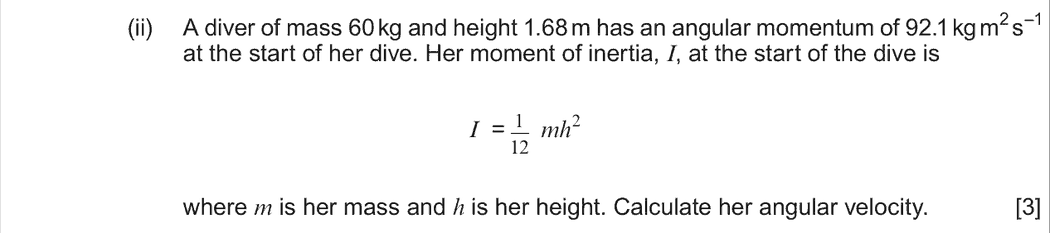
Answer: 6.53 rad s⁻¹. I = (1/12) × 60 × 1.68² = 14.1 kg m² (1)
ω = L/I = 92.1/14.1 (1) (1)
Scheme columns: Maths 2
Skills: Mathsmarks The mark scheme's Maths column gives this part at least one mark for mathematical skills
June 2018 · Component 3 · Q13(b)(iii)3 marksAO1=1, AO2=2Calculation
Earlier parts of question 13 that this part uses
Mark scheme
Notes from the mark scheme and report
Answer: 34.1 rad s⁻¹. Angular momentum is conserved (1)
ω = 92.1/2.7 (1) (1)
Scheme columns: Maths 2
Skills: Mathsmarks The mark scheme's Maths column gives this part at least one mark for mathematical skills
June 2018 · Component 3 · Q13(c)(i)3 marksAO1=1, AO2=2Calculation
Earlier part of question 13 that this part uses
Mark scheme
Notes from the mark scheme and report
Answer: 177 N m. τ = Iα (1)
α = (220 − 170)/0.310 = 161 rad s⁻² (1)
τ = 1.10 × 161 (1)
sign ignored
Scheme columns: Maths 2
Skills: Mathsmarks The mark scheme's Maths column gives this part at least one mark for mathematical skills
June 2018 · Component 3 · Q13(c)(ii)3 marksAO1=1, AO2=2Calculation
Earlier parts of question 13 that this part uses
Mark scheme
Notes from the mark scheme and report
Answer: 4.29 × 10⁴ J. Loss per wheel = ½I(ω₁² − ω₂²) = ½ × 1.10 × (220² − 170²) = 10 725 J (1)
× 4 wheels (1) = 42.9 kJ (1)
Scheme columns: Maths 2
Skills: Mathsmarks The mark scheme's Maths column gives this part at least one mark for mathematical skills
June 2018 · Component 3 · Q13(d)5 marksAO3=5Calculation
Earlier part of question 13 that this part uses
Mark scheme
Notes from the mark scheme and report
213 km h⁻¹ = 59.2 m s⁻¹ (1)
F = (mv − mu)/t or a = (v − u)/t (1)
F = 710 × 59.2/0.651 = 64.5 kN (6.4 kN on the driver) or a = 90.9 m s⁻² (1)
this force (about 9g) is very large and must be reduced (1)
grass or gravel slows the car over a longer time before any impact, reducing the force (1)
many did not comment on the size of the force
Scheme columns: Maths 2
Skills: Unitsand conversions Unit marks, base units, prefixes and conversions; Mathsmarks The mark scheme's Maths column gives this part at least one mark for mathematical skills
June 2017 · Component 3 · Q12(a)(i)3 marksAO3=3Calculation
Mark scheme
Notes from the mark scheme and report
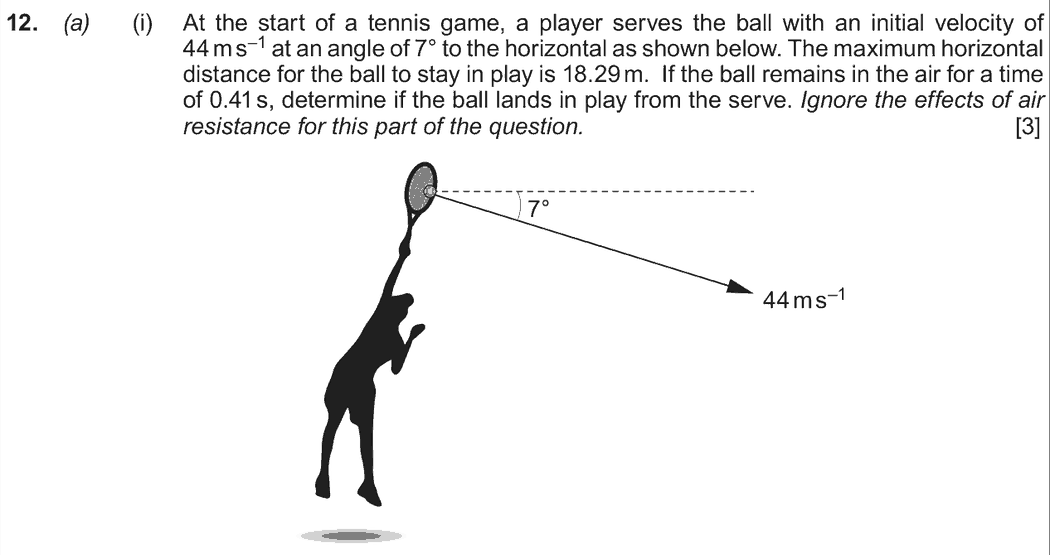
Horizontal velocity = 44 cos 7° = 43.7 m s⁻¹ (1)
range = 43.7 × 0.41 = 17.9 m (1)
less than 18.29 m so the ball lands in play (1)
Scheme columns: Maths 2
Skills: Trigonometryand vectors Resolving, components, vector addition, angles; Mathsmarks The mark scheme's Maths column gives this part at least one mark for mathematical skills
June 2017 · Component 3 · Q12(a)(ii)2 marksAO1=1, AO2=1Calculation
Earlier part of question 12 that this part uses
Mark scheme
Notes from the mark scheme and report
Answer: 411 N. F = (mv − mu)/t = 0.056 × 44/6.0 × 10⁻³
Scheme columns: Maths 1
Skills: Unitsand conversions Unit marks, base units, prefixes and conversions; Mathsmarks The mark scheme's Maths column gives this part at least one mark for mathematical skills
June 2017 · Component 3 · Q12(b)(i)2 marksAO1=2Definition
Earlier part of question 12 that this part uses
Mark scheme
Notes from the mark scheme and report
The relative speed of ball and floor after the collision (rebound speed) (1) is 0.74 times the relative speed before it (impact speed) (1)
June 2017 · Component 3 · Q12(b)(ii)3 marksAO1=1, AO2=2Calculation
Earlier parts of question 12 that this part uses
Mark scheme
Notes from the mark scheme and report
Answer: 0.58 m. e = √(h/H) so h = e²H
first bounce 0.74² × 1.95 = 1.07 m
second bounce 0.74² × 1.07
Scheme columns: Maths 2
Skills: Algebra Derivations and rearranging equations; Mathsmarks The mark scheme's Maths column gives this part at least one mark for mathematical skills
June 2017 · Component 3 · Q12(c)(i)4 marksAO1=1, AO2=1, AO3=2Explanation
Earlier part of question 12 that this part uses
Mark scheme
Notes from the mark scheme and report
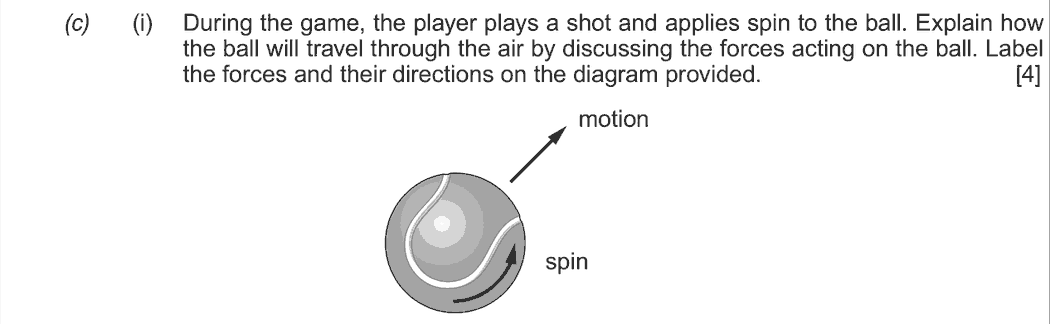
Diagram: weight down and drag opposite to the motion (1)
lift (Magnus force) at 90° to the motion, up and to the left for this backspin (1)
the lift keeps the ball in the air longer or carries it higher (1)
lift and drag change (decrease) during the flight as the speed and spin fall (1)
June 2017 · Component 3 · Q12(c)(ii)4 marksAO1=1, AO2=3Calculation
Earlier parts of question 12 that this part uses
Mark scheme
Notes from the mark scheme and report
Answer: 10.6 J. ω = 3500 × 2π/60 = 367 rad s⁻¹
I = (2/3)mr² = 4.6 × 10⁻⁵ kg m² with r = 0.035 m
rotational KE = ½Iω² = 3.1 J
linear KE = ½mv² = 7.5 J
add
Scheme columns: Maths 3
Skills: Unitsand conversions Unit marks, base units, prefixes and conversions; Mathsmarks The mark scheme's Maths column gives this part at least one mark for mathematical skills
June 2017 · Component 3 · Q12(c)(iii)2 marksAO2=2Calculation
Earlier parts of question 12 that this part uses
Mark scheme
Notes from the mark scheme and report
Answer: 0.33 N. A = πr² = π(3.5 × 10⁻²)² = 3.8 × 10⁻³ m²
F = ½ρv²ACD with v = 16.4 m s⁻¹
Scheme columns: Maths 2
Skills: Mathsmarks The mark scheme's Maths column gives this part at least one mark for mathematical skills
Work with an Eduqas physics tutor
Dropping marks on calculations, specified practicals or the six-mark QER questions? Book a trial session with a specialist Eduqas physics tutor.