Mark scheme

Notes from the mark scheme and report
- A body that absorbs all the electromagnetic radiation falling on it
Notes and key-term cards for this topic are being written by our tutors. The past-paper questions below are ready now.
| Series | Paper | Q | What it asks |
|---|---|---|---|
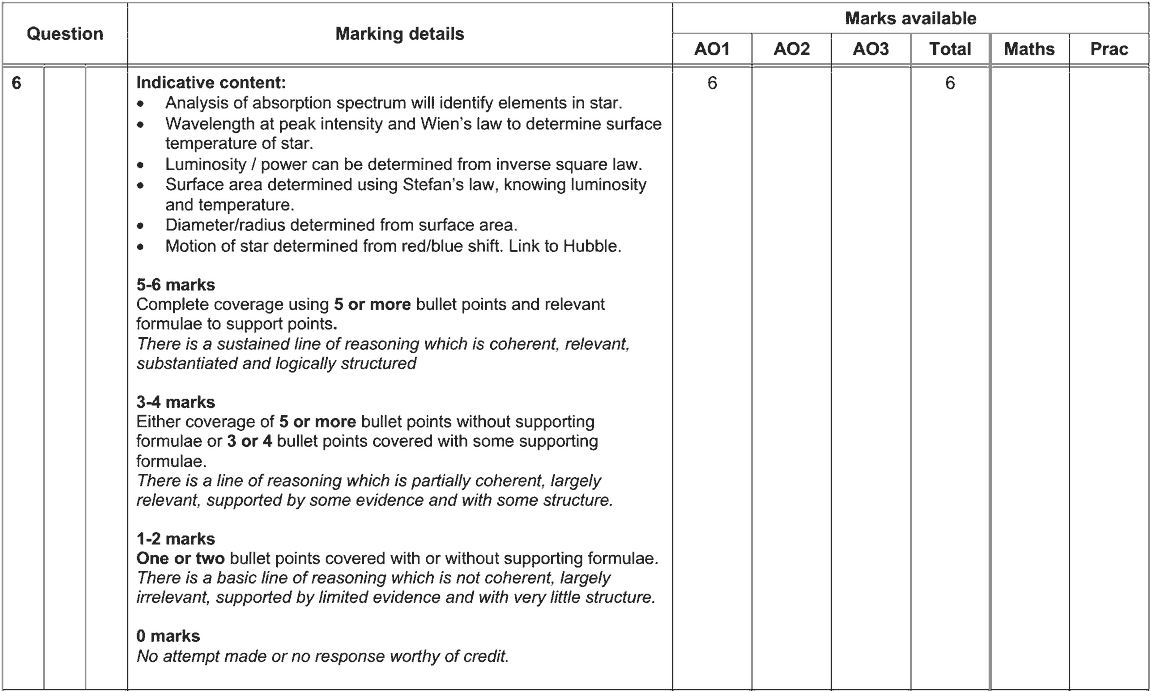
| October 2021 | Component 2 | 6 | . Astronomers can learn much about a star from: • measuring the intensity of radiation originating from the star; • knowing its distance from the Earth; • studying its spectrum. Explain how this information can be used t |


Skills: Unitsand conversions Unit marks, base units, prefixes and conversions; Mathsmarks The mark scheme's Maths column gives this part at least one mark for mathematical skills

Skills: Algebra Derivations and rearranging equations; Mathsmarks The mark scheme's Maths column gives this part at least one mark for mathematical skills

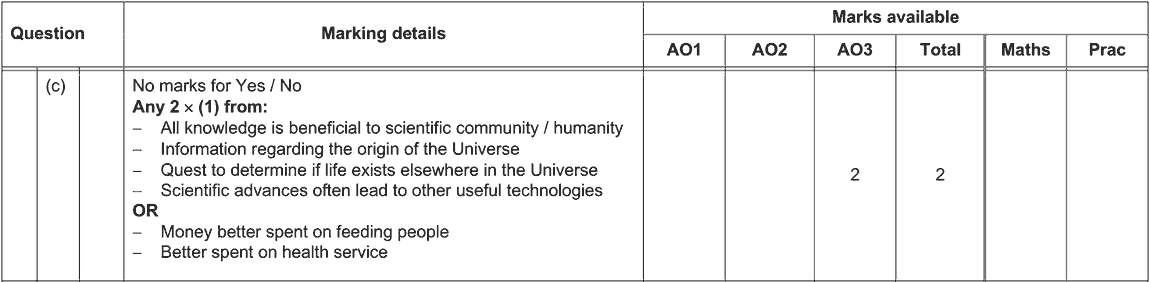
Skills: Issues Benefits, risks, ethical or environmental issues (How Science Works)

Skills: Synoptic Needs physics from another component of the qualification

Skills: Synoptic Needs physics from another component of the qualification
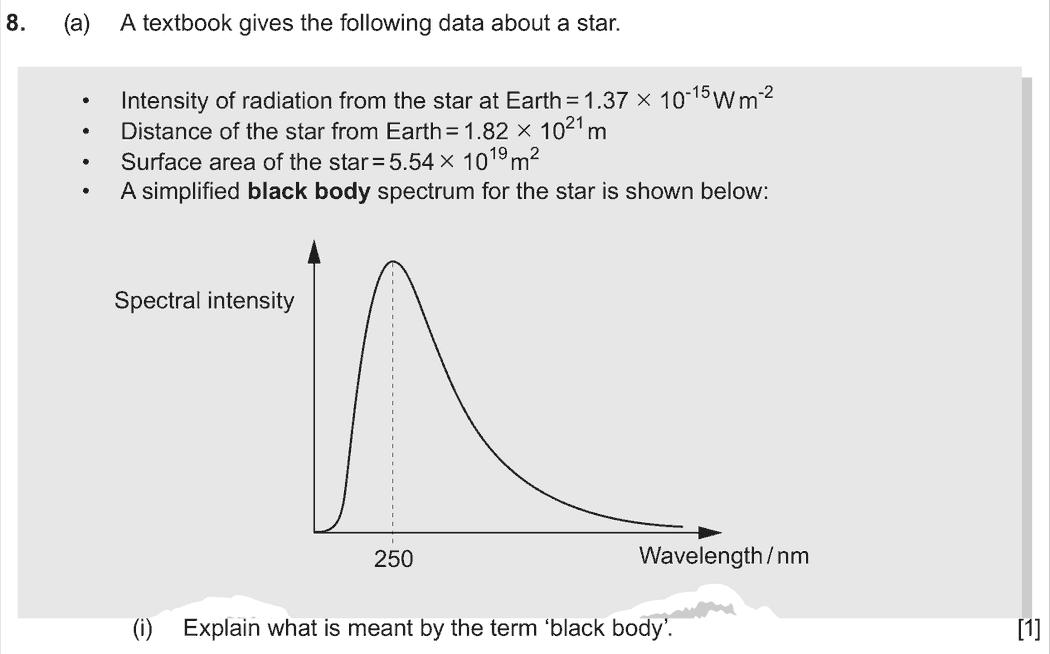
Some candidates failed to include the term ‘electromagnetic’ (or em) in their responses, which was required to gain the mark.

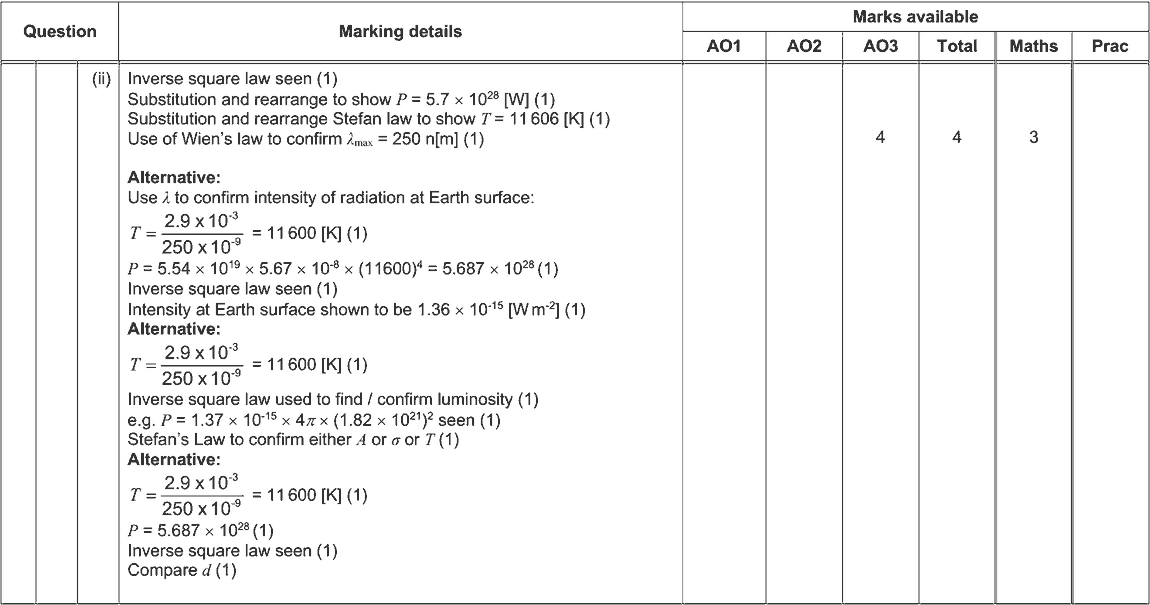
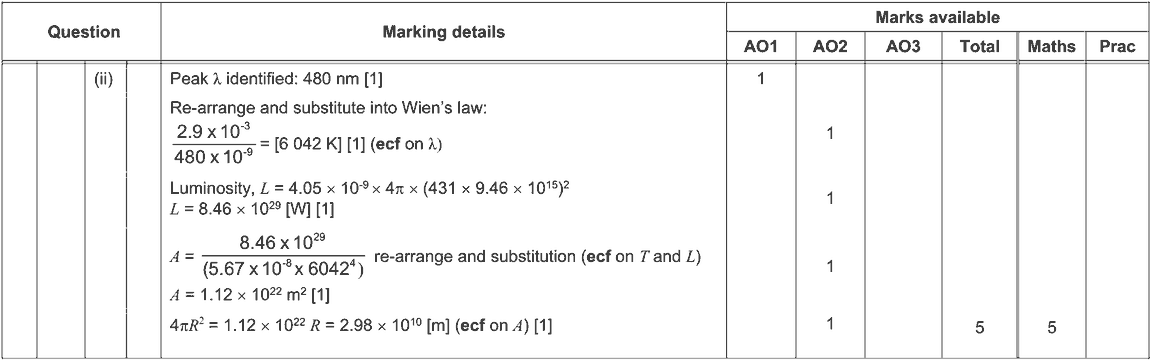
Candidates adopted a range of valid methods to confirm consistency between the values provided. Typically, Wien’s Law was used to determine the temperature T, which was then cross-verified using the Stefan–Boltzmann Law, with power P often derived from the inverse square law. An alternative and quite common approach involved confirming the intensity at Earth’s surface. Exemplar methods are outlined in the provided reference materials.
Skills: Unitsand conversions Unit marks, base units, prefixes and conversions; Mathsmarks The mark scheme's Maths column gives this part at least one mark for mathematical skills

and (ii) In part (i), candidates were required to explain multiwavelength astronomy by referencing both astronomy (e.g. the study of celestial objects or the universe) and multiwavelength (i.e. using many parts of the electromagnetic spectrum). Many responses lacked a clear reference to ‘electromagnetic’, which meant that the mark could not be awarded. In part
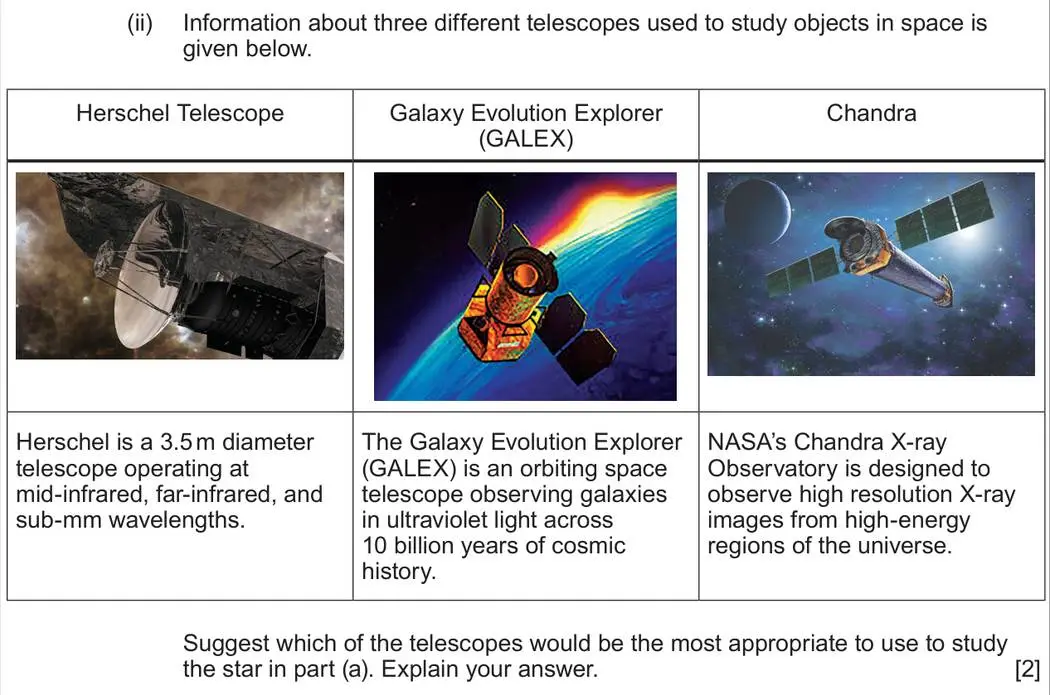
, nearly all candidates correctly identified GALEX as the appropriate telescope and gave a valid justification based on its ability to detect ultraviolet radiation. PHYSICS GCE A level Summer 2025

This question was very well done, a few had problems with powers of 10 but this was only penalised once. PHYSICS GCE Advanced Subsidiary Summer 2024

This question was very well done, a few had problems with powers of 10 but this was only penalised once. PHYSICS GCE Advanced Subsidiary Summer 2024
Skills: Mathsmarks The mark scheme's Maths column gives this part at least one mark for mathematical skills

This question was very well done, a few had problems with powers of 10 but this was only penalised once. PHYSICS GCE Advanced Subsidiary Summer 2024

This question was very well done, a few had problems with powers of 10 but this was only penalised once. PHYSICS GCE Advanced Subsidiary Summer 2024
Skills: Unitsand conversions Unit marks, base units, prefixes and conversions; Mathsmarks The mark scheme's Maths column gives this part at least one mark for mathematical skills

This question was very well done, a few had problems with powers of 10 but this was only penalised once. PHYSICS GCE Advanced Subsidiary Summer 2024
Skills: Mathsmarks The mark scheme's Maths column gives this part at least one mark for mathematical skills

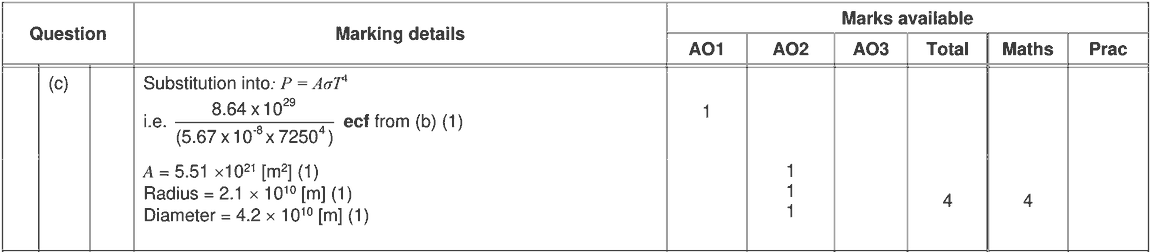
As on previous occasions, a recurring mistake is for candidates to omit the factor ‘4’ when determining the surface area. It was no different on this occasion with a significant minority substituting an incorrect value for A into the Stefan’s equation, and hence incorrectly determining the luminosity.
Skills: Mathsmarks The mark scheme's Maths column gives this part at least one mark for mathematical skills

Most candidates were able to recall the inverse square relationship and use it correctly to determine the intensity of radiation at the Earth’s surface. Marks were awarded as ecf where answers to (c)(i) were incorrect.
Skills: Unitsand conversions Unit marks, base units, prefixes and conversions; Mathsmarks The mark scheme's Maths column gives this part at least one mark for mathematical skills

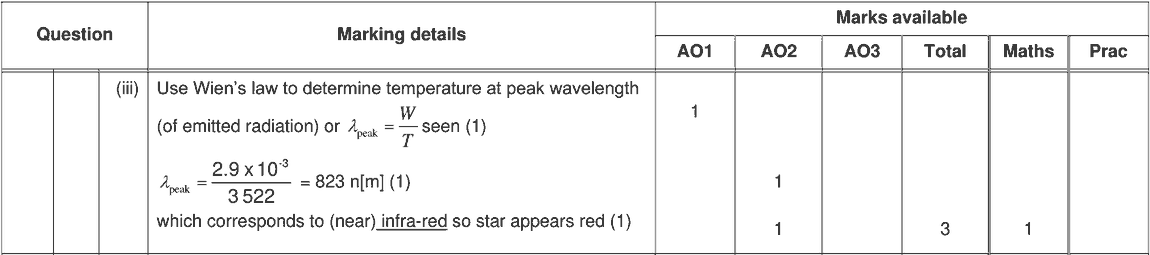
Nearly all candidates used Wien’s law correctly to determine the peak wavelength. Fewer candidates stated that this corresponded to infra- red radiation, which was why the star appeared red. PHYSICS GCE A level Summer 2024
Skills: Mathsmarks The mark scheme's Maths column gives this part at least one mark for mathematical skills

Well done generally but often one out of the two marks was dropped in (c)(i) as expected. AS PHYSICS GCE AS Summer 2023
Well done generally but often one out of the two marks was dropped in (c)(i) as expected. AS PHYSICS GCE AS Summer 2023
Skills: Graphskills Reading, plotting or sketching graphs; gradients, intercepts and areas; Unitsand conversions Unit marks, base units, prefixes and conversions; Mathsmarks The mark scheme's Maths column gives this part at least one mark for mathematical skills

Well done generally but often one out of the two marks was dropped in (c)(i) as expected. AS PHYSICS GCE AS Summer 2023

Well done generally but often one out of the two marks was dropped in (c)(i) as expected. AS PHYSICS GCE AS Summer 2023

Well done generally but often one out of the two marks was dropped in (c)(i) as expected. AS PHYSICS GCE AS Summer 2023
Skills: Graphskills Reading, plotting or sketching graphs; gradients, intercepts and areas; Unitsand conversions Unit marks, base units, prefixes and conversions; Mathsmarks The mark scheme's Maths column gives this part at least one mark for mathematical skills
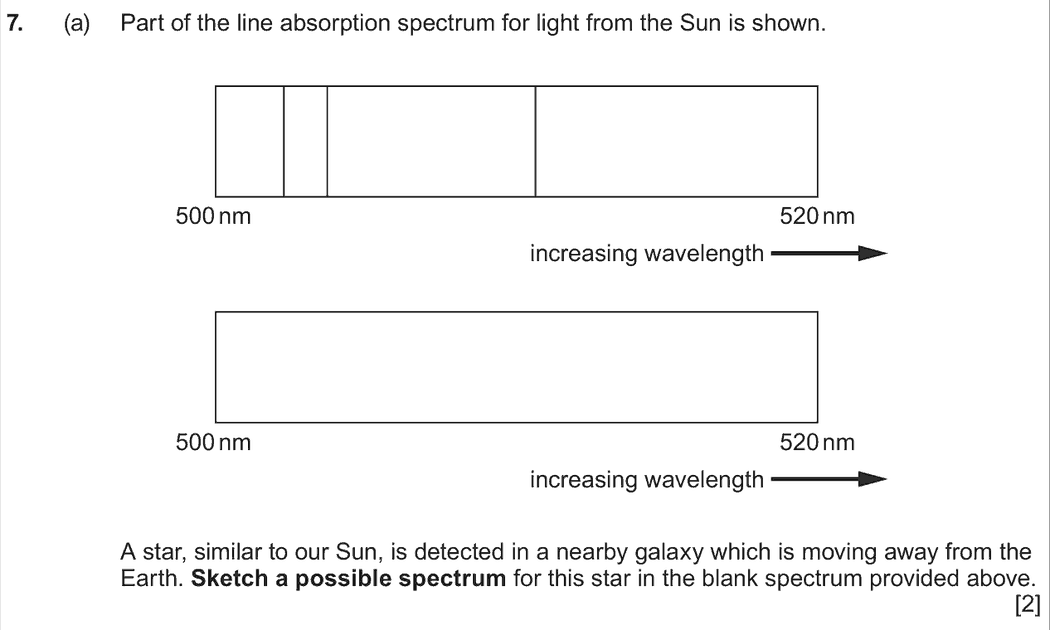
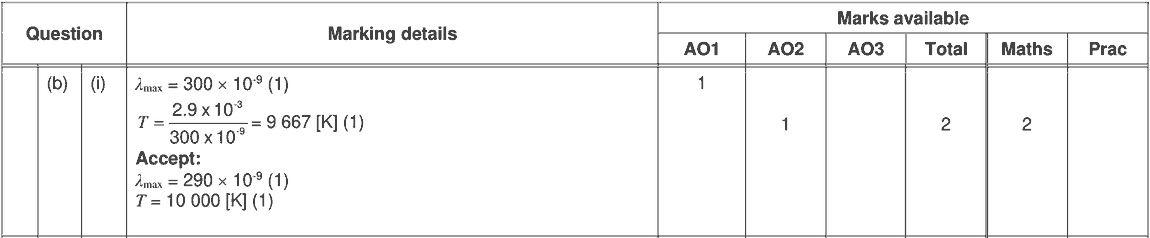
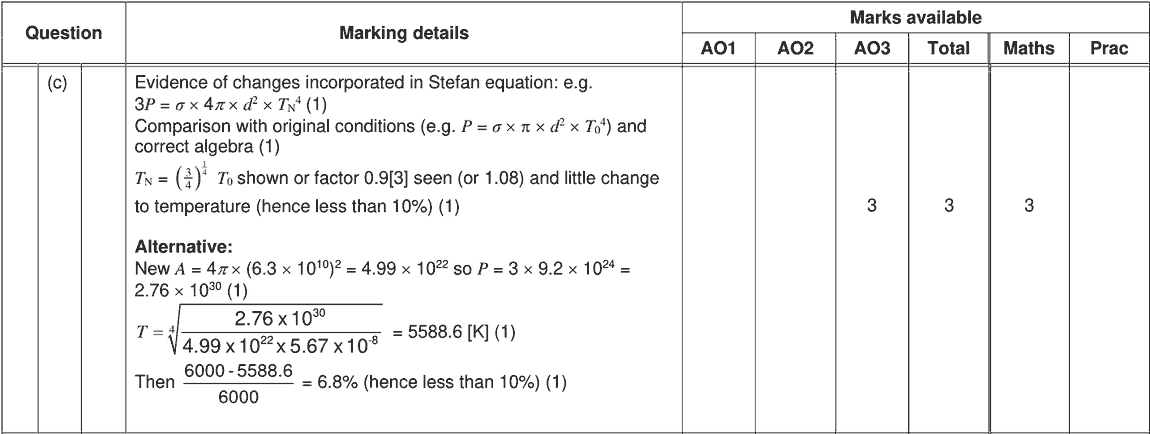
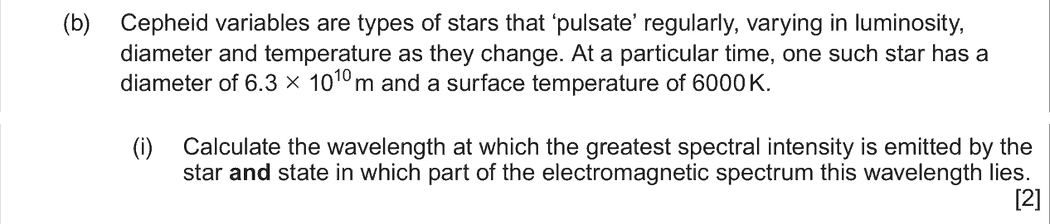
Many candidates were successful in sketching an appropriate spectrum in (a) with nearly all gaining at least one mark for drawing the same pattern as the one given in the question. Most candidates showed a ‘shift to the right’ as required, however a few candidates showed a shift to the left, which was not credited. In (b)(i) nearly all candidates were successful in using Wien’s law to calculate the required wavelength, with most stating that the wavelength lies in the visible or ‘blue’ part of the spectrum. Unlike previous sittings of this paper, it was encouraging to note that many candidates used Stefan’s law correctly by including the formula for surface area of a sphere (4πr2), rather than the cross-sectional area of a sphere. A few candidates did not gain the second mark for giving an incorrect unit for luminosity or for omitting it altogether. It was expected that only high achieving candidates might be able to access part (c) as it required a consideration of the impact of two changes to the properties of the star on its temperature in comparison to the star’s initial conditions. Responses however were very encouraging, indicating that candidates from a broad range of abilities were able to confidently manipulate the data given to confirm the decrease in temperature required in the question. As with other AO3 style questions of this nature, many approaches are possible. Many candidates chose an algebraic approach, comparing initial and final conditions for the star, usually ending with a factor √3 decrease in temperature. Others chose to take a numerical approach, showing that the decrease in stellar temperature amounted to about 440 K, a decrease of less than 10% as required.
Many candidates were successful in sketching an appropriate spectrum in (a) with nearly all gaining at least one mark for drawing the same pattern as the one given in the question. Most candidates showed a ‘shift to the right’ as required, however a few candidates showed a shift to the left, which was not credited. In (b)(i) nearly all candidates were successful in using Wien’s law to calculate the required wavelength, with most stating that the wavelength lies in the visible or ‘blue’ part of the spectrum. Unlike previous sittings of this paper, it was encouraging to note that many candidates used Stefan’s law correctly by including the formula for surface area of a sphere (4πr2), rather than the cross-sectional area of a sphere. A few candidates did not gain the second mark for giving an incorrect unit for luminosity or for omitting it altogether. It was expected that only high achieving candidates might be able to access part (c) as it required a consideration of the impact of two changes to the properties of the star on its temperature in comparison to the star’s initial conditions. Responses however were very encouraging, indicating that candidates from a broad range of abilities were able to confidently manipulate the data given to confirm the decrease in temperature required in the question. As with other AO3 style questions of this nature, many approaches are possible. Many candidates chose an algebraic approach, comparing initial and final conditions for the star, usually ending with a factor √3 decrease in temperature. Others chose to take a numerical approach, showing that the decrease in stellar temperature amounted to about 440 K, a decrease of less than 10% as required.
Skills: Mathsmarks The mark scheme's Maths column gives this part at least one mark for mathematical skills

Many candidates were successful in sketching an appropriate spectrum in (a) with nearly all gaining at least one mark for drawing the same pattern as the one given in the question. Most candidates showed a ‘shift to the right’ as required, however a few candidates showed a shift to the left, which was not credited. In (b)(i) nearly all candidates were successful in using Wien’s law to calculate the required wavelength, with most stating that the wavelength lies in the visible or ‘blue’ part of the spectrum. Unlike previous sittings of this paper, it was encouraging to note that many candidates used Stefan’s law correctly by including the formula for surface area of a sphere (4πr2), rather than the cross-sectional area of a sphere. A few candidates did not gain the second mark for giving an incorrect unit for luminosity or for omitting it altogether. It was expected that only high achieving candidates might be able to access part (c) as it required a consideration of the impact of two changes to the properties of the star on its temperature in comparison to the star’s initial conditions. Responses however were very encouraging, indicating that candidates from a broad range of abilities were able to confidently manipulate the data given to confirm the decrease in temperature required in the question. As with other AO3 style questions of this nature, many approaches are possible. Many candidates chose an algebraic approach, comparing initial and final conditions for the star, usually ending with a factor √3 decrease in temperature. Others chose to take a numerical approach, showing that the decrease in stellar temperature amounted to about 440 K, a decrease of less than 10% as required.
Skills: Mathsmarks The mark scheme's Maths column gives this part at least one mark for mathematical skills

Many candidates were successful in sketching an appropriate spectrum in (a) with nearly all gaining at least one mark for drawing the same pattern as the one given in the question. Most candidates showed a ‘shift to the right’ as required, however a few candidates showed a shift to the left, which was not credited. In (b)(i) nearly all candidates were successful in using Wien’s law to calculate the required wavelength, with most stating that the wavelength lies in the visible or ‘blue’ part of the spectrum. Unlike previous sittings of this paper, it was encouraging to note that many candidates used Stefan’s law correctly by including the formula for surface area of a sphere (4πr2), rather than the cross-sectional area of a sphere. A few candidates did not gain the second mark for giving an incorrect unit for luminosity or for omitting it altogether. It was expected that only high achieving candidates might be able to access part (c) as it required a consideration of the impact of two changes to the properties of the star on its temperature in comparison to the star’s initial conditions. Responses however were very encouraging, indicating that candidates from a broad range of abilities were able to confidently manipulate the data given to confirm the decrease in temperature required in the question. As with other AO3 style questions of this nature, many approaches are possible. Many candidates chose an algebraic approach, comparing initial and final conditions for the star, usually ending with a factor √3 decrease in temperature. Others chose to take a numerical approach, showing that the decrease in stellar temperature amounted to about 440 K, a decrease of less than 10% as required.
Skills: Algebra Derivations and rearranging equations; Mathsmarks The mark scheme's Maths column gives this part at least one mark for mathematical skills

Candidates, overall, applied the principle of conservation of energy and equations for density and the Hubble’s Law appropriately to derive the equation for the critical density of the Universe in (a)(i). Candidates should however be encouraged to provide some context to their work, with many going straight into ‘algebra mode’ without setting the scene in terms of the rationale behind the proof being given. A simple comment such as: “consider matter within a spherical shell of radius R” (or equivalent) would at least give some context to the argument. Where this was seen full marks were awarded. One mark was deducted where no context was given. In (ii) nearly all candidates were successful in confirming the relationship between the Hubble constant and the number of atoms of hydrogen per m3 in the universe. Once again, many approaches are possible with some candidates choosing to use the value for the Hubble constant given in the data booklet and the critical density equation to determine the number of hydrogen atoms per m3, while others chose the converse approach of starting with the number of atoms to determine the corresponding Hubble constant. Both approaches are equally valid. Nearly all candidates successfully confirmed the receding velocity of the galaxy in kms-1 as required in (b)(i). In (ii) many candidates, though by no means all, were successful in using ∆𝜆 𝜆= 𝑣 𝑐 to determine Δλ. Of those candidates who successfully determined the change in wavelength a significant minority subtracted this from the original wavelength given rather than adding the two figures together. As in previous years it seems that candidates continue to have misconceptions regarding this part of the specification. In the last part it was expected that candidates would identify from part (b) that the galaxy emits radiation across a wide range of the electromagnetic spectrum, beyond that of visible light. A few candidates identified that the hydrogen line described in (b) was in the infra-red part of the spectrum for example. Using this knowledge, candidates were expected to comment on the usefulness of using the Hubble telescope to detect wavelengths beyond the visible spectrum in comparison to telescopes sensitive only to visible light. Fewer candidates than expected were able to recognise this relationship. PHYSICS GCE A LEVEL Summer 2023

Skills: Unitsand conversions Unit marks, base units, prefixes and conversions; Mathsmarks The mark scheme's Maths column gives this part at least one mark for mathematical skills

Skills: Algebra Derivations and rearranging equations; Mathsmarks The mark scheme's Maths column gives this part at least one mark for mathematical skills
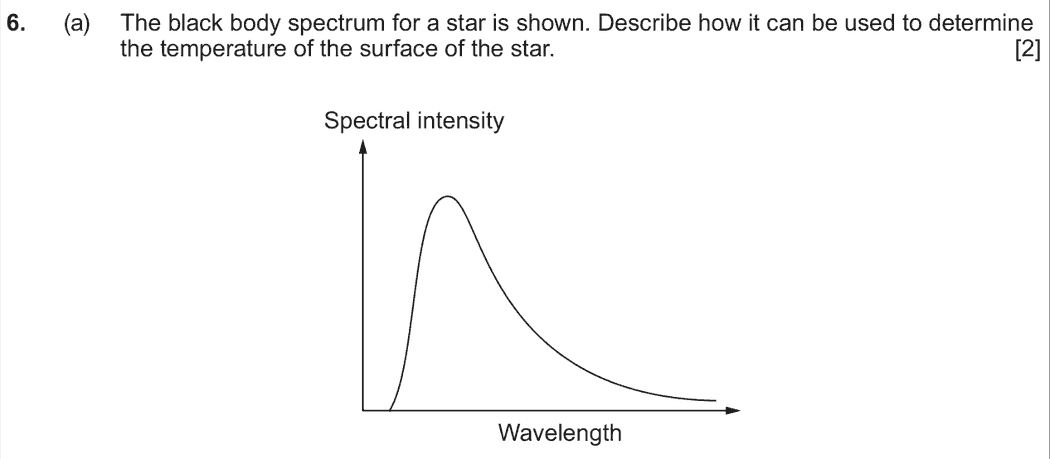
Nearly all candidates referred to the peak wavelength and Wien’s law. However, responses which referred to ‘maximum wavelength’ (instead of wavelength at maximum intensity, or peak wavelength) were not credited.
Skills: Graphskills Reading, plotting or sketching graphs; gradients, intercepts and areas
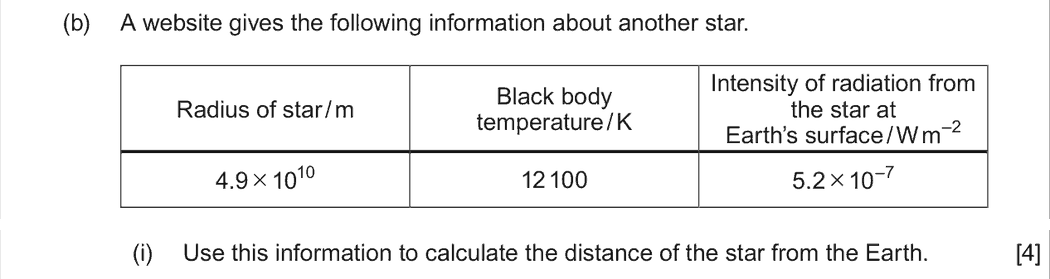
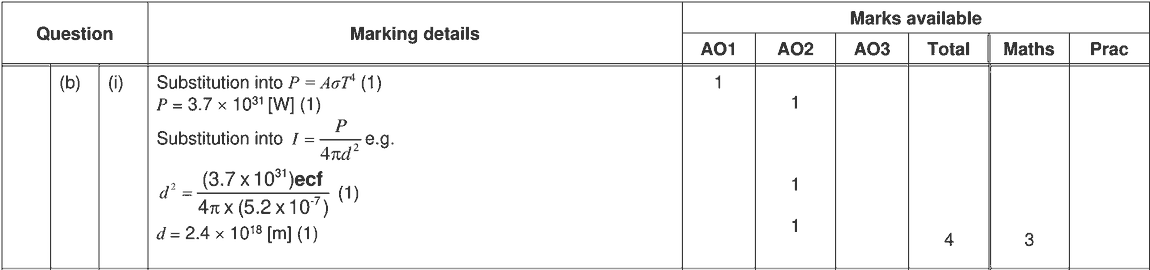
Candidates were required to use Stefan’s law to determine the luminosity of the star as a first step followed by the inverse square law to determine the distance of the star from Earth. These processes were carried out correctly by many candidates, however a frequently seen error was to use the formula for the area of a circle (πr2) rather than that for the surface area of a sphere (4πr2) in both equations. Candidates should also consider the validity of their answers to questions such as these - does the answer make sense? Distances of a few km for example should indicate that an arithmetic error may have taken place and should encourage candidates to check their calculations.
Skills: Mathsmarks The mark scheme's Maths column gives this part at least one mark for mathematical skills

Nearly all candidates were successful in calculating λpeak as 240 nm, however some stated that this was in the blue part of the spectrum, rather than stating that it was less than blue, or in the UV.
Skills: Mathsmarks The mark scheme's Maths column gives this part at least one mark for mathematical skills
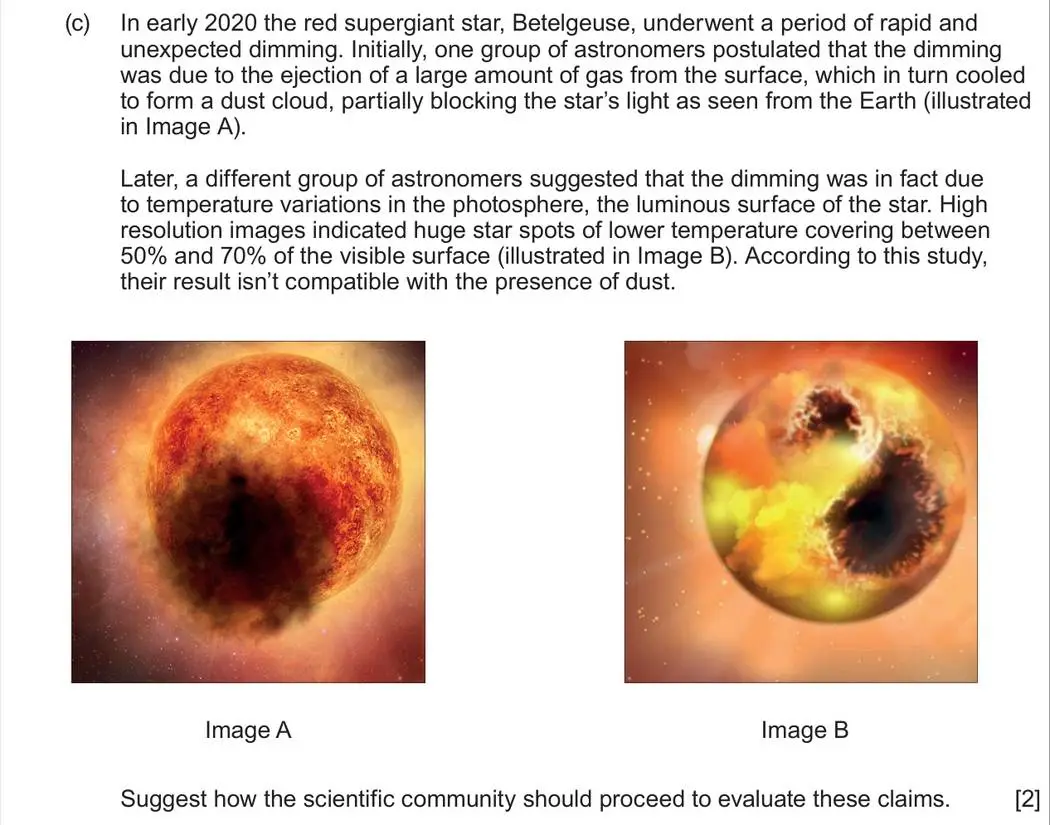
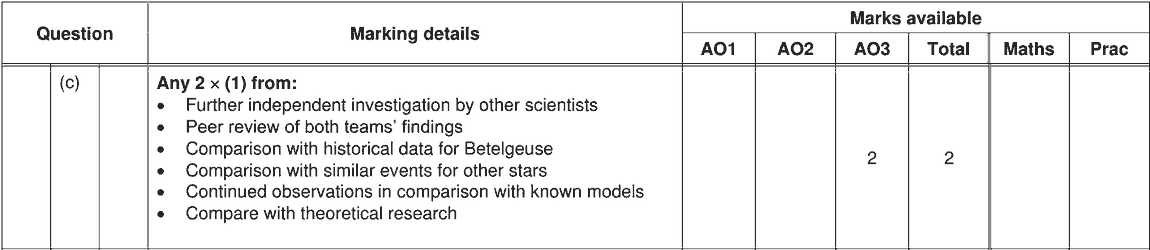
In this issues-based question it was expected that candidates focus their responses on scientific methodology rather than give specific physics-based responses. The mark scheme offered a range of responses, including ‘peer review’, ‘further independent verification’ and ‘comparison with historical data’ amongst them. Whilst many candidates identified one acceptable response, few were able to provide two suggestions as required.
Skills: Issues Benefits, risks, ethical or environmental issues (How Science Works)

Skills: QER The 6-mark quality of extended response question

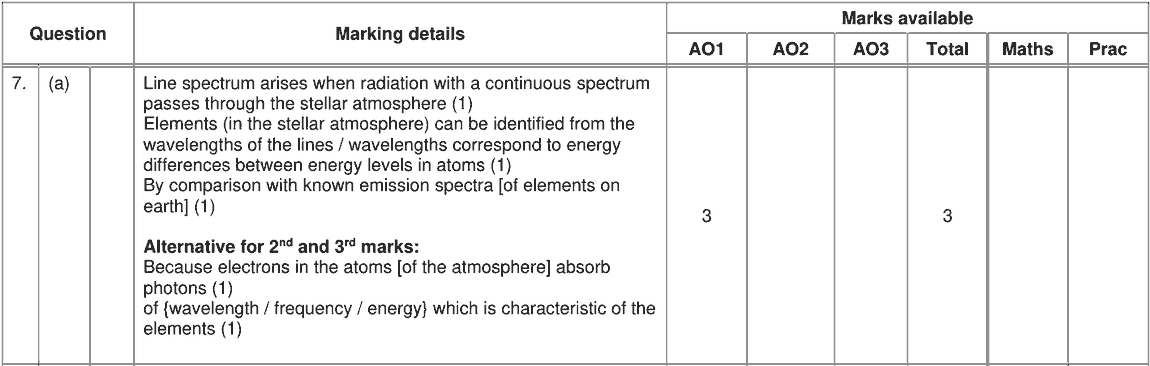
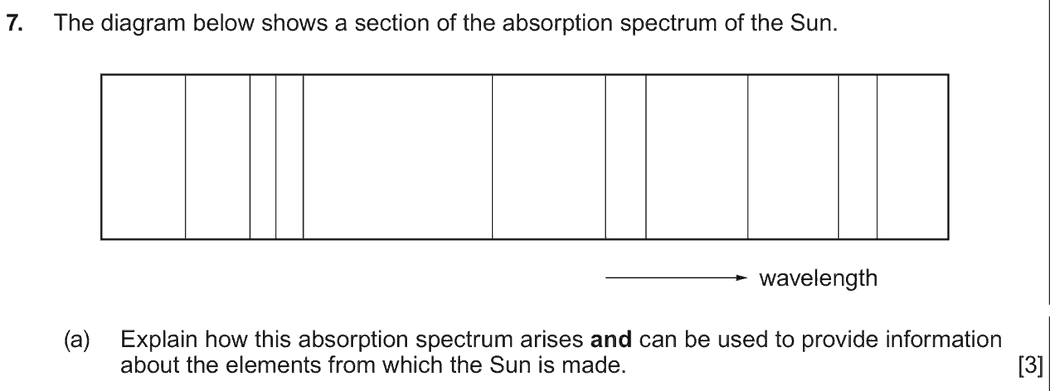
Few responses made reference to a continuous spectrum superimposed by a line spectrum, with even fewer stating where in the star these arise. Many candidates identified three key differences between Polaris and Chi Pegasi, with nearly all being able to give the expected colours of the stars. Good attempts were made by many candidates to calculate the radius of Polaris. However, as in other questions in this paper, a significant number of candidates used the wrong expressions for the inverse square law, or for the surface area of the star. In a few cases the expression for the volume of a sphere was used instead of the surface area. Consequently error carried forward was often applied. In (c), candidates merely had to explain that a variety of em wavelengths provided additional detail of the processes within the galaxy, compared to the earlier optical image. It was expected that candidates made reference to the term ‘multiwavelength astronomy’ in their responses, which few (if any) did.
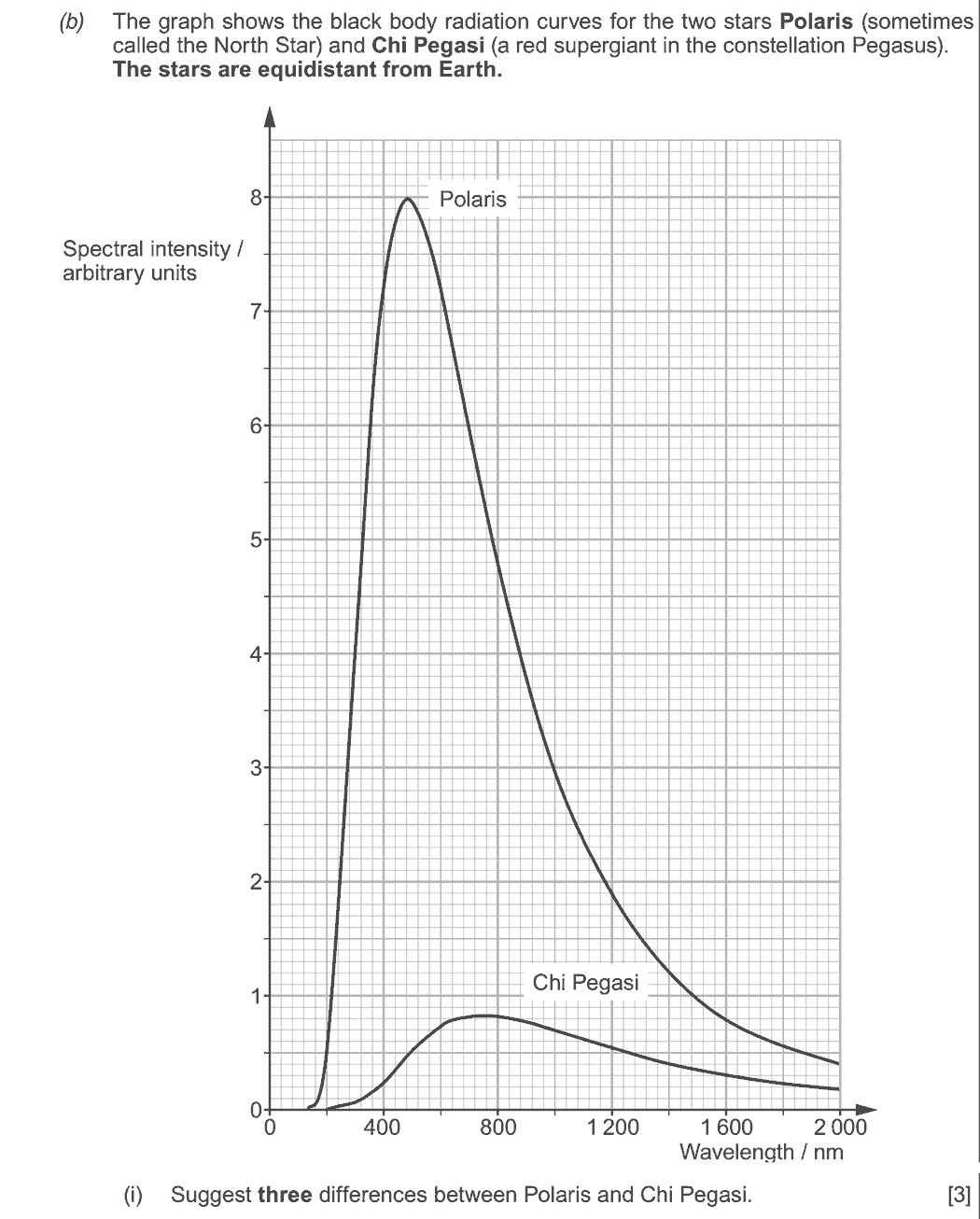
Few responses made reference to a continuous spectrum superimposed by a line spectrum, with even fewer stating where in the star these arise. Many candidates identified three key differences between Polaris and Chi Pegasi, with nearly all being able to give the expected colours of the stars. Good attempts were made by many candidates to calculate the radius of Polaris. However, as in other questions in this paper, a significant number of candidates used the wrong expressions for the inverse square law, or for the surface area of the star. In a few cases the expression for the volume of a sphere was used instead of the surface area. Consequently error carried forward was often applied. In (c), candidates merely had to explain that a variety of em wavelengths provided additional detail of the processes within the galaxy, compared to the earlier optical image. It was expected that candidates made reference to the term ‘multiwavelength astronomy’ in their responses, which few (if any) did.
Skills: Graphskills Reading, plotting or sketching graphs; gradients, intercepts and areas

Few responses made reference to a continuous spectrum superimposed by a line spectrum, with even fewer stating where in the star these arise. Many candidates identified three key differences between Polaris and Chi Pegasi, with nearly all being able to give the expected colours of the stars. Good attempts were made by many candidates to calculate the radius of Polaris. However, as in other questions in this paper, a significant number of candidates used the wrong expressions for the inverse square law, or for the surface area of the star. In a few cases the expression for the volume of a sphere was used instead of the surface area. Consequently error carried forward was often applied. In (c), candidates merely had to explain that a variety of em wavelengths provided additional detail of the processes within the galaxy, compared to the earlier optical image. It was expected that candidates made reference to the term ‘multiwavelength astronomy’ in their responses, which few (if any) did.
Skills: Graphskills Reading, plotting or sketching graphs; gradients, intercepts and areas; Unitsand conversions Unit marks, base units, prefixes and conversions; Mathsmarks The mark scheme's Maths column gives this part at least one mark for mathematical skills
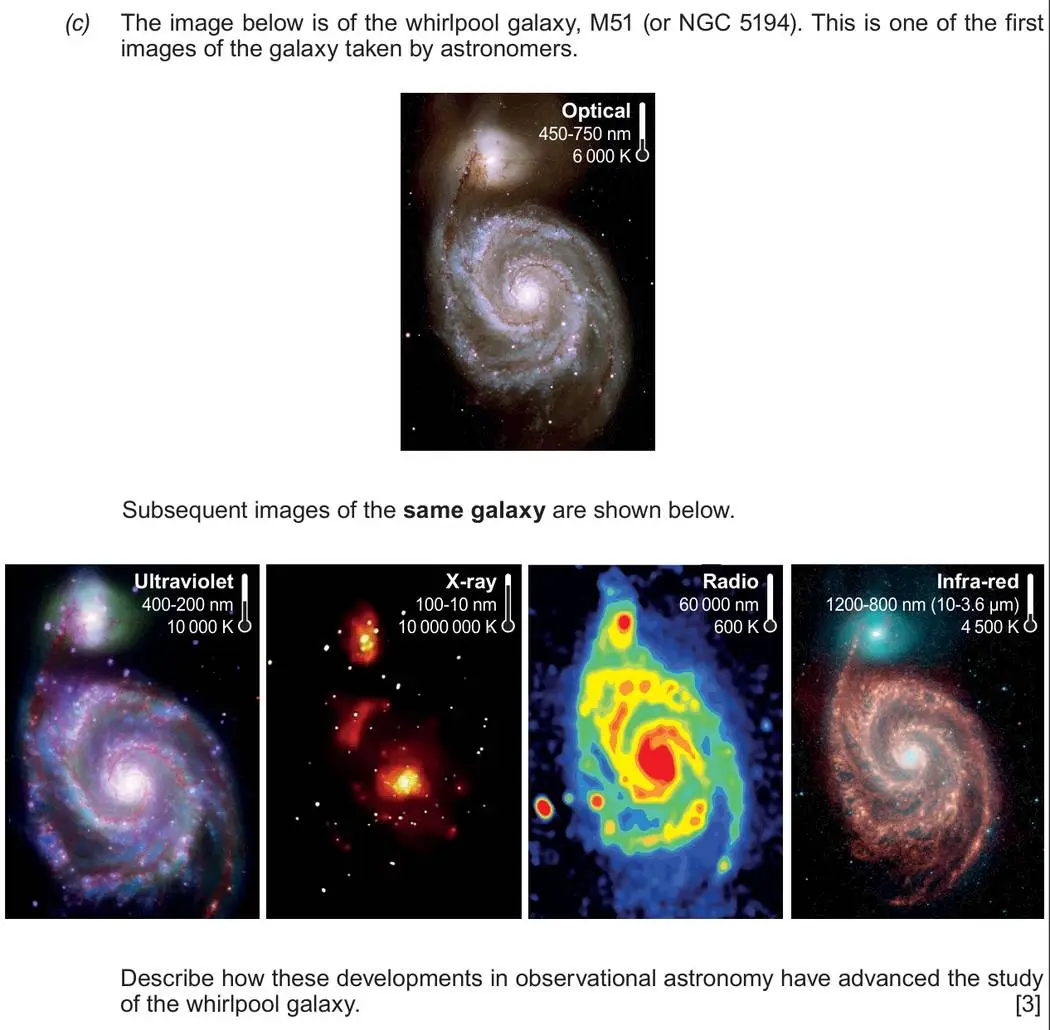
Few responses made reference to a continuous spectrum superimposed by a line spectrum, with even fewer stating where in the star these arise. Many candidates identified three key differences between Polaris and Chi Pegasi, with nearly all being able to give the expected colours of the stars. Good attempts were made by many candidates to calculate the radius of Polaris. However, as in other questions in this paper, a significant number of candidates used the wrong expressions for the inverse square law, or for the surface area of the star. In a few cases the expression for the volume of a sphere was used instead of the surface area. Consequently error carried forward was often applied. In (c), candidates merely had to explain that a variety of em wavelengths provided additional detail of the processes within the galaxy, compared to the earlier optical image. It was expected that candidates made reference to the term ‘multiwavelength astronomy’ in their responses, which few (if any) did.


Skills: Unitsand conversions Unit marks, base units, prefixes and conversions; Mathsmarks The mark scheme's Maths column gives this part at least one mark for mathematical skills
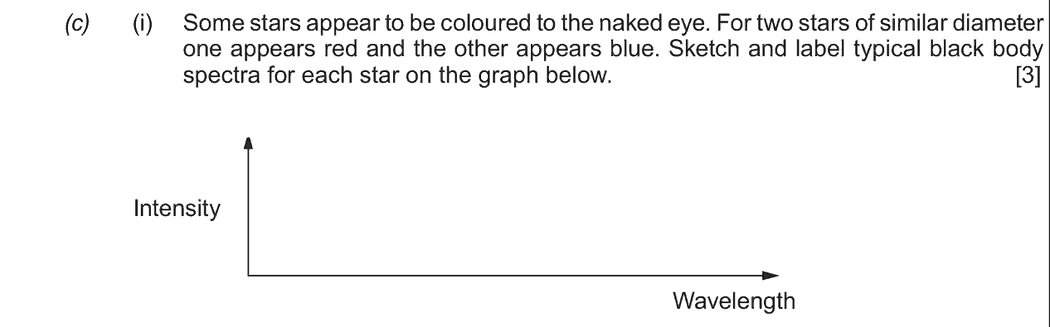
Skills: Graphskills Reading, plotting or sketching graphs; gradients, intercepts and areas


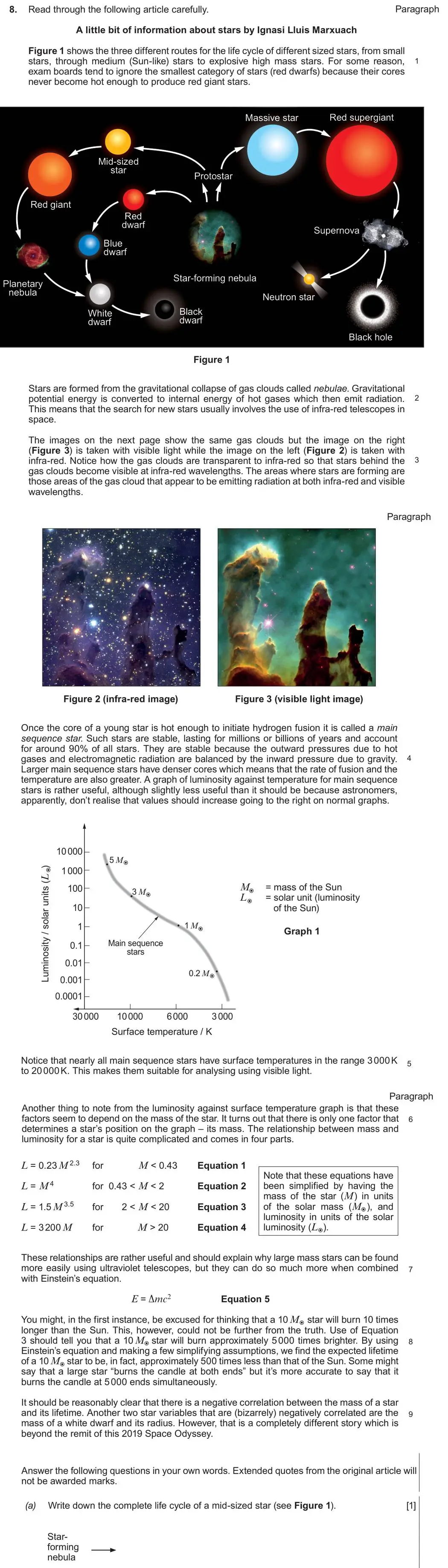
Most candidates gave the answer that we had hoped for: telescopes in space avoid the problem of absorption of radiation by the Earth’s atmosphere. We also accepted avoidance of image distortion by uneven refraction.
Skills: Comprehension A level Component 1 Section B: questions on the printed article
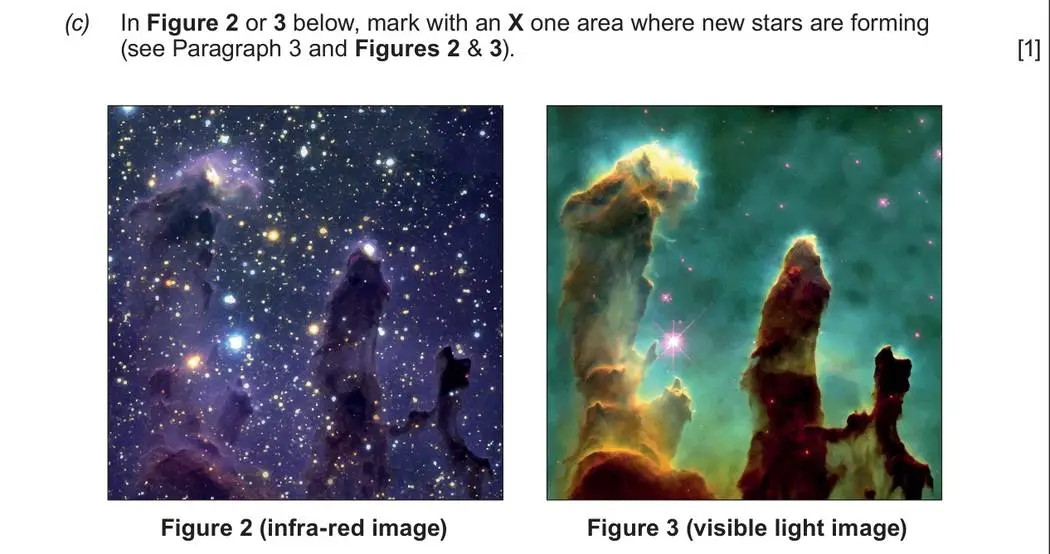
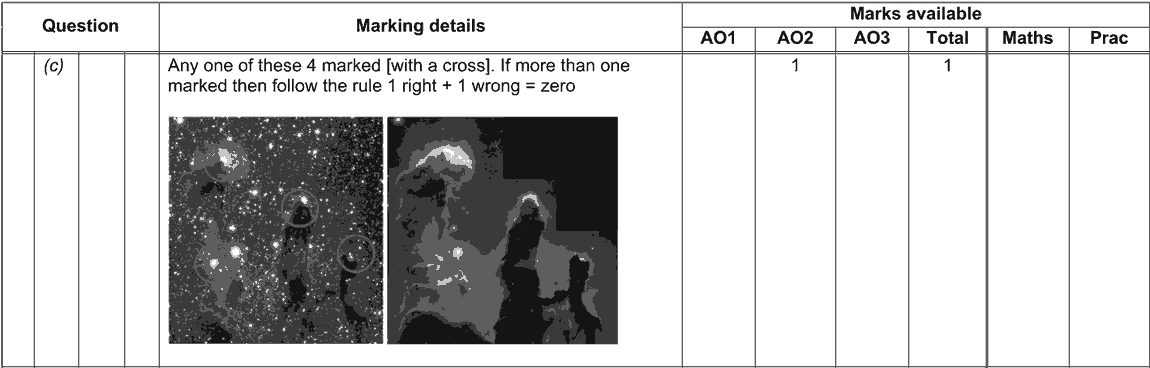
There was considerable success in showing where new stars are forming.
Skills: Comprehension A level Component 1 Section B: questions on the printed article

Wien’s law was applied correctly by almost everyone.
Skills: Comprehension A level Component 1 Section B: questions on the printed article; Synoptic Needs physics from another component of the qualification; Graphskills Reading, plotting or sketching graphs; gradients, intercepts and areas; Mathsmarks The mark scheme's Maths column gives this part at least one mark for mathematical skills

With few exceptions, candidates gained the first mark for pointing out that 150 nm was not in the visible region. The second mark was seldom given. The point had to be made that although 150 nm was the wavelength of peak emission, the star would emit plenty of visible radiation [as the luminosity of a very high temperature star will be high].
Skills: Comprehension A level Component 1 Section B: questions on the printed article; Synoptic Needs physics from another component of the qualification

Most candidates selected equation 1 and calculated the luminosity correctly. As justification that the star had been correctly plotted we were happy to accept that the calculated luminosity lay between 0.001 𝑳⨀ and 0.01 𝑳⨀. Both marks were often gained.
Skills: Comprehension A level Component 1 Section B: questions on the printed article; Graphskills Reading, plotting or sketching graphs; gradients, intercepts and areas; Mathsmarks The mark scheme's Maths column gives this part at least one mark for mathematical skills
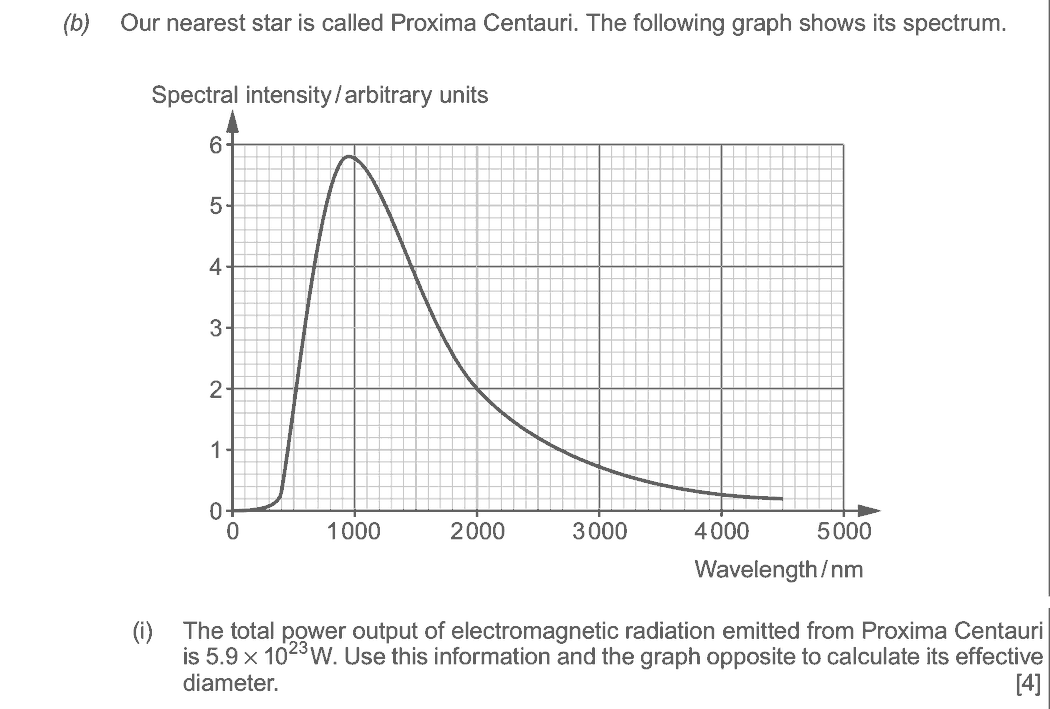
Very well answered be the majority of candidates.
Skills: Graphskills Reading, plotting or sketching graphs; gradients, intercepts and areas; Unitsand conversions Unit marks, base units, prefixes and conversions; Mathsmarks The mark scheme's Maths column gives this part at least one mark for mathematical skills

Very well answered be the majority of candidates.
Skills: Graphskills Reading, plotting or sketching graphs; gradients, intercepts and areas
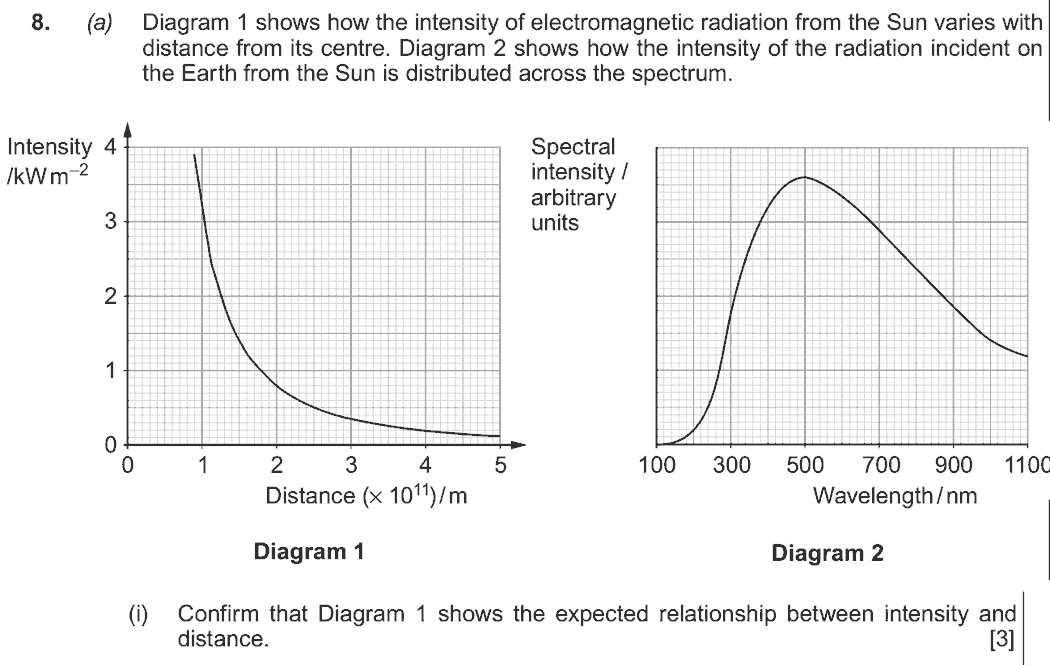
Nearly all candidates correctly referred to the expected relationship i.e.
Skills: Graphskills Reading, plotting or sketching graphs; gradients, intercepts and areas; Mathsmarks The mark scheme's Maths column gives this part at least one mark for mathematical skills

Nearly all candidates substituted appropriate corresponding pairs of values into the equation to determine the Sun’s luminosity.
Skills: Graphskills Reading, plotting or sketching graphs; gradients, intercepts and areas; Unitsand conversions Unit marks, base units, prefixes and conversions; Mathsmarks The mark scheme's Maths column gives this part at least one mark for mathematical skills
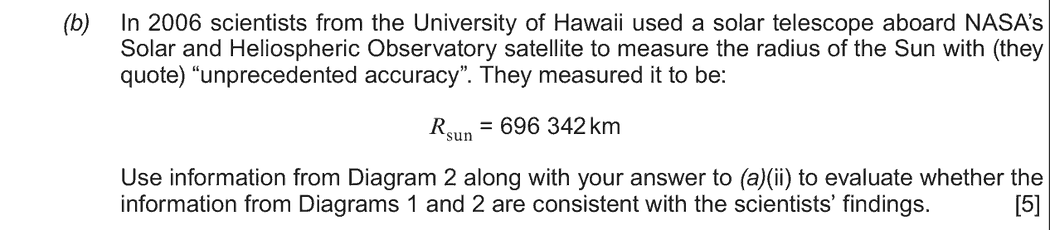
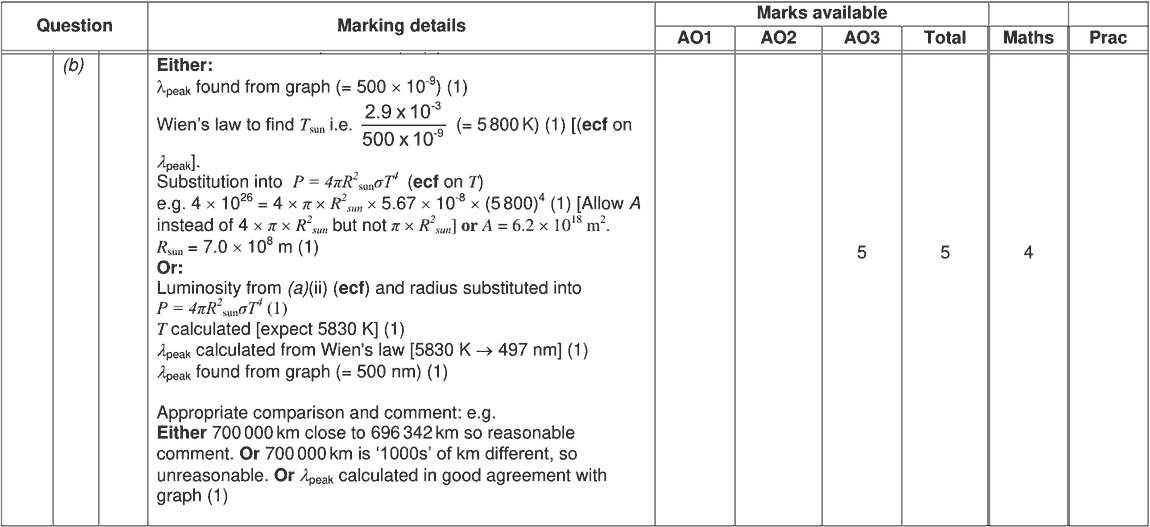
Nearly all candidates scored at least two marks (out of 5) here, usually for finding the peak wavelength from diagram 2 and using Wien’s law to determine the surface temperature of the Sun. Candidates could then use Stefan’s law either to determine the radius of the Sun or to confirm its luminosity by using the given value of radius. Approaches seemed to be divided evenly with the majority of candidates successfully confirming the consistency of the information given. As stated in the general comments section, candidates who chose to calculate R using Stefan’s law often equated their value for A (surface area) to R as opposed to 4 R and as a consequence lost one mark.
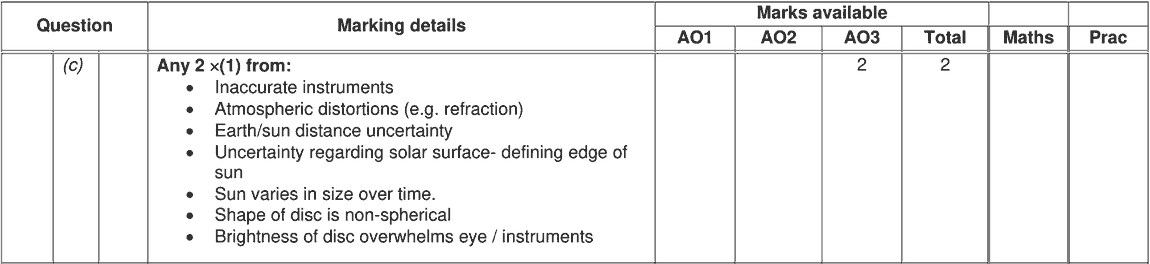
Skills: Graphskills Reading, plotting or sketching graphs; gradients, intercepts and areas; Mathsmarks The mark scheme's Maths column gives this part at least one mark for mathematical skills
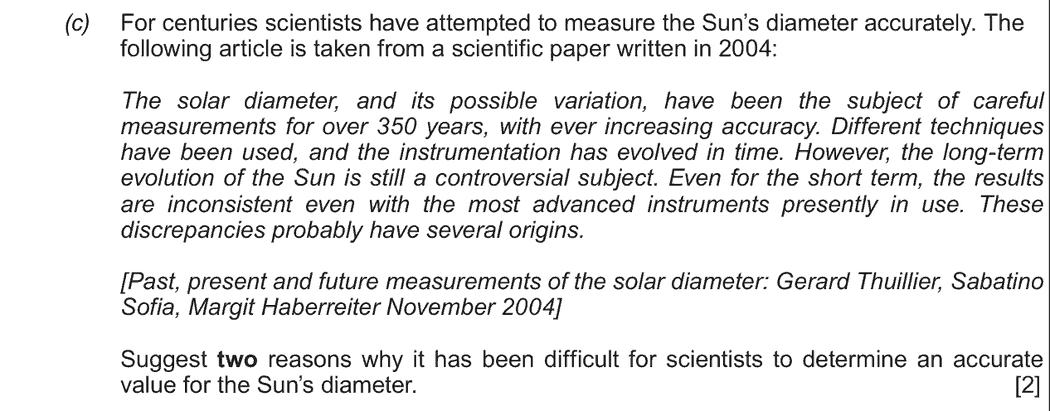
This was the ‘ethical issues in science’ question. Many good and valid points were given as to the difficulties experienced in measuring the Sun’s diameter. The majority of candidates gained at least one mark here. PHYSICS GCE A LEVEL Summer 2018
Skills: Issues Benefits, risks, ethical or environmental issues (How Science Works)

Many candidates spoke about it absorbing all radiation.

Lots of missing units – fortunately, marks were not penalised in this question for this.
Skills: Unitsand conversions Unit marks, base units, prefixes and conversions; Mathsmarks The mark scheme's Maths column gives this part at least one mark for mathematical skills
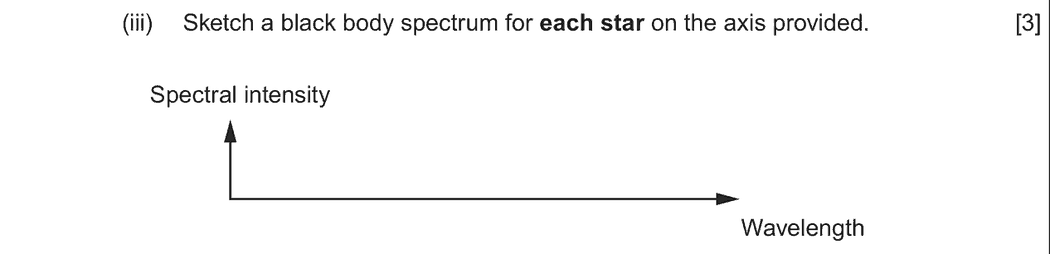
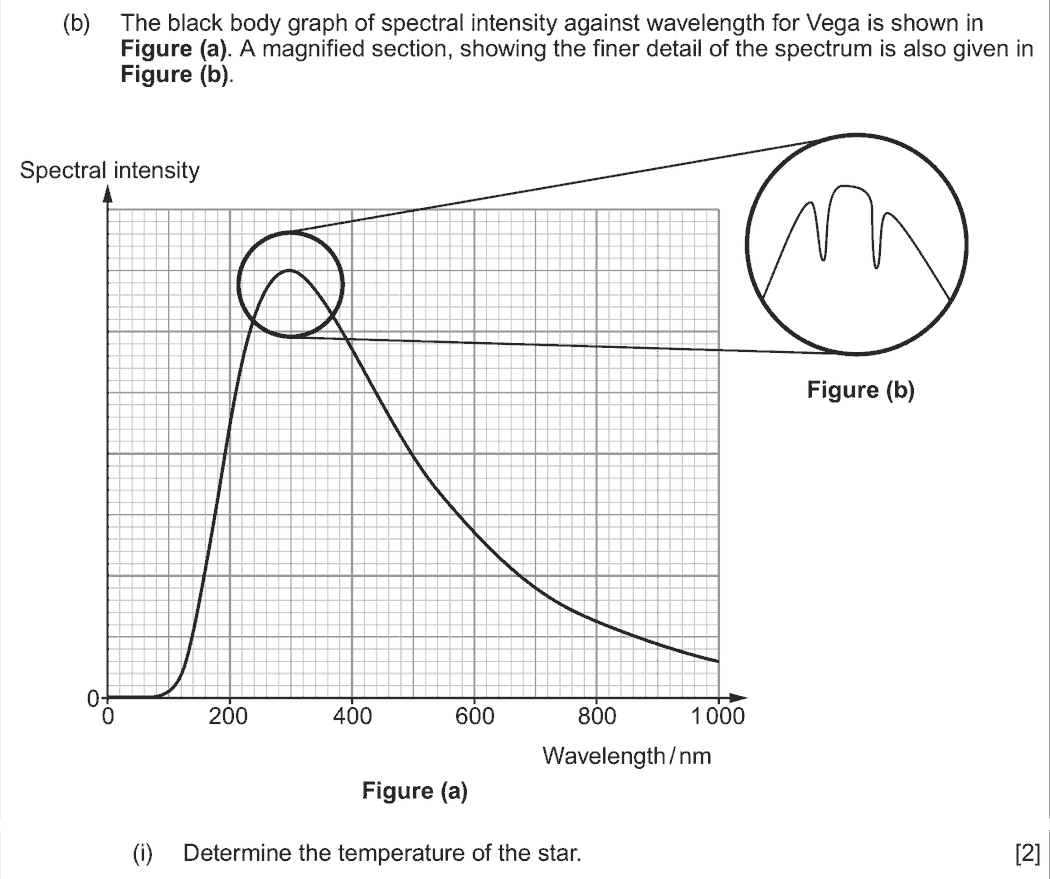
Very few candidates scored 3 marks. Very few drew the spectrum of Vega above that of the Sun at all times.
Skills: Graphskills Reading, plotting or sketching graphs; gradients, intercepts and areas

Generally answered well. The most common mistake involved treating the radius squared for Vega as 2.71 r2 rather than (2.71 r)2. Some candidates also forgot to multiply temperature to the power of 4. Candidates were able to pick up two easy marks here just by quoting Stefan’s Law and the equation for surface area.
Skills: Algebra Derivations and rearranging equations; Mathsmarks The mark scheme's Maths column gives this part at least one mark for mathematical skills
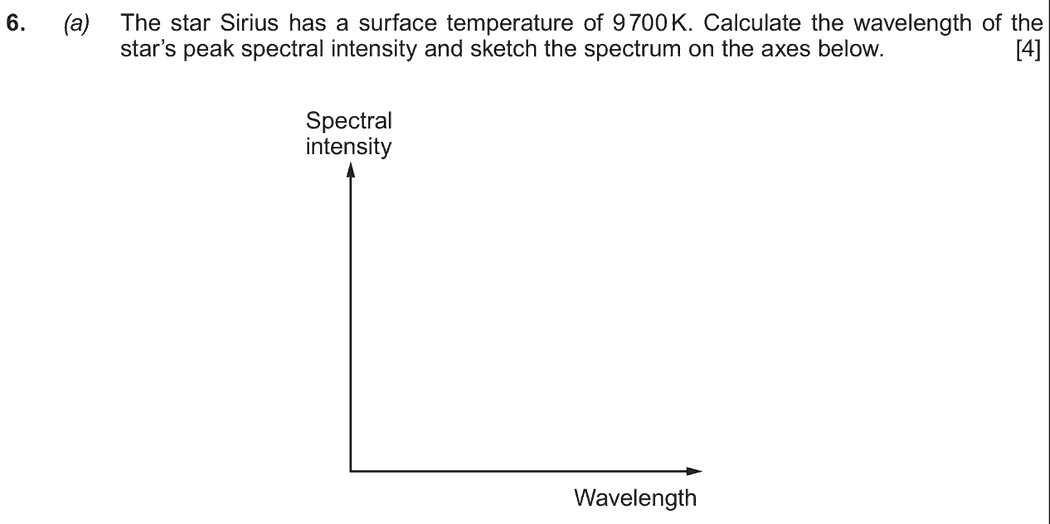
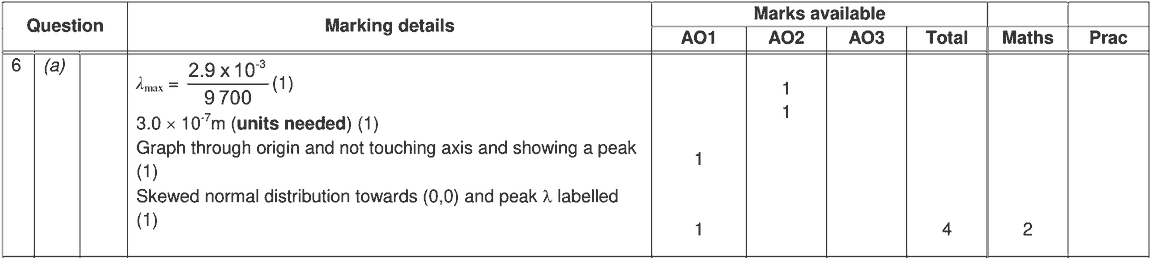
The vast majority correctly used Wien’s law to determine the wavelength but then lost a relatively easy mark by not including the unit. In addition, whilst the majority drew a skewed normal distribution for the intensity many forgot to label the peak wavelength so losing another fairly simple mark.
Skills: Graphskills Reading, plotting or sketching graphs; gradients, intercepts and areas; Mathsmarks The mark scheme's Maths column gives this part at least one mark for mathematical skills

Electron volts are new to the specification and some candidates had problems with part (ii) as a result of this.

Electron volts are new to the specification and some candidates had problems with part (ii) as a result of this.
Skills: Unitsand conversions Unit marks, base units, prefixes and conversions; Mathsmarks The mark scheme's Maths column gives this part at least one mark for mathematical skills

This part was intended to be difficult and provided a range of marks.
Skills: Mathsmarks The mark scheme's Maths column gives this part at least one mark for mathematical skills
Dropping marks on calculations, specified practicals or the six-mark QER questions? Book a trial session with a specialist Eduqas physics tutor.