Notes and key-term cards for this topic are being written by our tutors. The past-paper questions below are ready now.
Specification statements
Show the 9 statements from the specification
3.3-a the refractive index, n, of a medium being defined as c/v, in which v is the speed of light in the medium and c is the speed of light in a vacuum
3.3-b the use of the equations: n₁v₁ = n₂v₂ and n₁ sin θ₁ = n₂ sin θ₂ (regarded as Snell’s law)
3.3-c how Snell's law relates to the wave model of light propagation and for diagrams of plane waves approaching a plane boundary obliquely, and being refracted
3.3-d the conditions for total internal reflection
3.3-e the derivation and use of the equation for the critical angle n₁ sin θC = n₂
3.3-f how to apply the concept of total internal reflection to multimode optical fibres
3.3-g the problem of multimode dispersion with optical fibres in terms of limiting the rate of data transfer and transmission distance
3.3-h how the introduction of monomode optical fibres has allowed for much greater transmission rates and distances
3.3-P1 Specified practical: Measurement of the refractive index of a material
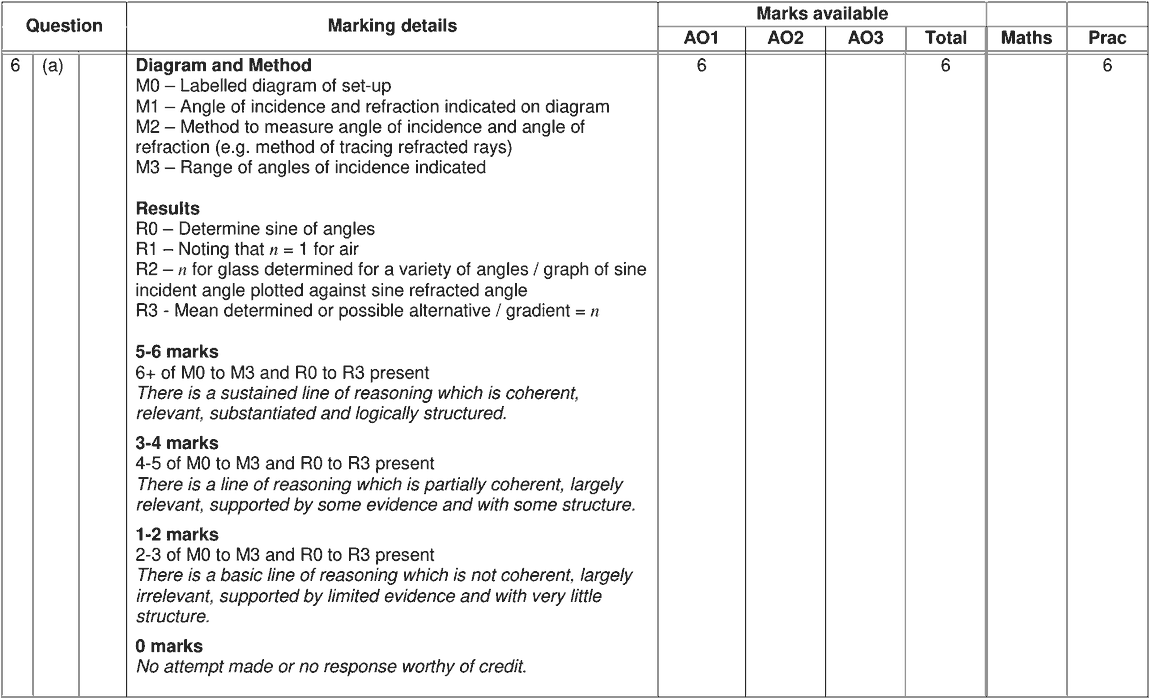
. (a) Explain in detail how you would carry out an experiment based on angles to determine the refractive index of glass in the form of a rectangular block. [6 QER]
Tap a question to zoom it. Where a part needs a figure, table or graph from earlier in the question, that part folds out above it; the mark scheme and examiner's comment open underneath. Have the Eduqas Data Booklet beside you (see the Data Booklet page).
June 2025 · AS Component 2 · Q4(a)2 marksAO1=1, AO2=1Calculation
Mark scheme
Notes from the mark scheme and report
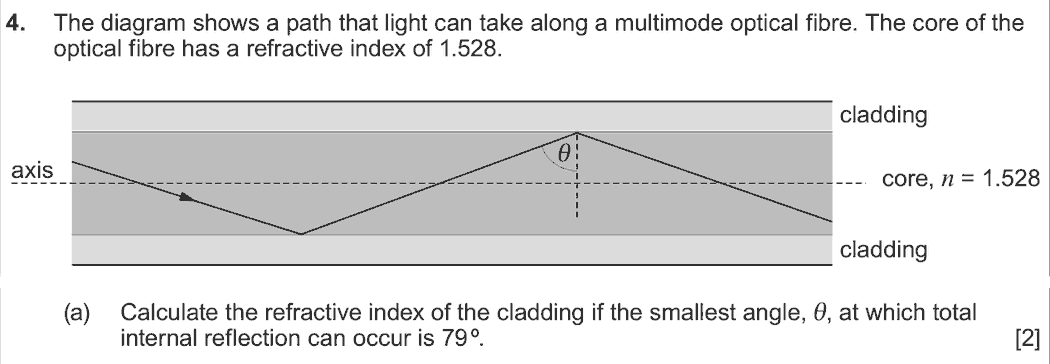
Answer: 1.50. The smallest angle is the critical angle: 1.528 sin 79° = n(cladding) sin 90°
Scheme columns: Maths 1
Skills: Mathsmarks The mark scheme's Maths column gives this part at least one mark for mathematical skills
June 2025 · AS Component 2 · Q4(b)(i)3 marksAO1=1, AO2=2Calculation
Earlier part of question 4 that this part uses
Mark scheme
Notes from the mark scheme and report
Answer: 10.2 μs (1.02 × 10⁻⁵ s). Speed in the core = 3.00 × 10⁸/1.528 = 1.96 × 10⁸ m s⁻¹
t = 2000/1.96 × 10⁸
Scheme columns: Maths 3
Skills: Unitsand conversions Unit marks, base units, prefixes and conversions; Mathsmarks The mark scheme's Maths column gives this part at least one mark for mathematical skills
June 2025 · AS Component 2 · Q4(b)(ii)3 marksAO3=3Calculation
Earlier parts of question 4 that this part uses
Mark scheme
Notes from the mark scheme and report
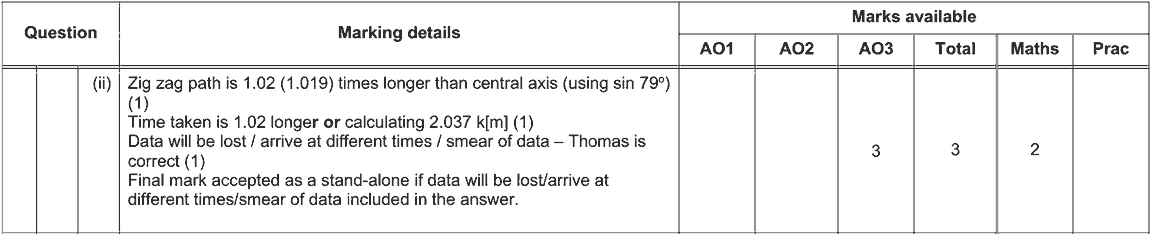
Zig-zag path length = 2.0/sin 79° = 2.037 km, 1.02 times longer (1)
so the time is 1.02 times longer, 10.4 μs, a lag of about 0.2 μs (1)
pulses taking different paths arrive at different times and smear into one another (multimode dispersion), so data can be lost and Thomas is correct (1)
Scheme columns: Maths 2
Skills: Trigonometryand vectors Resolving, components, vector addition, angles; Mathsmarks The mark scheme's Maths column gives this part at least one mark for mathematical skills
June 2025 · Component 3 · Q3(a)2 marksAO1=1, AO2=1Calculation
Mark scheme
Examiner's comment
Not an easy optical fibre question but very well answered in general. In part (b), not many candidates mentioned the 2nd condition for total internal reflection - light attempting to pass from dense to less dense. In part (c), many candidates forgot to use the speed of light of the core and simply used 3 108 m s-1.
Notes from the mark scheme and report
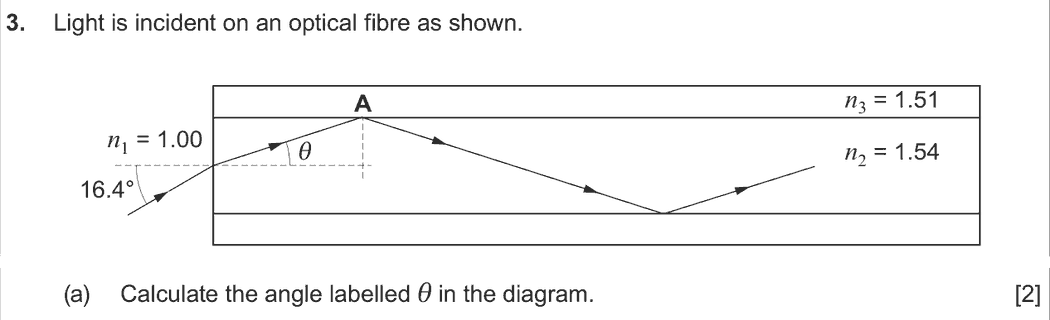
Answer: 10.6°. 1.00 × sin 16.4° = 1.54 × sin θ
Scheme columns: Maths 2
Skills: Mathsmarks The mark scheme's Maths column gives this part at least one mark for mathematical skills
June 2025 · Component 3 · Q3(b)4 marksAO1=2, AO2=2Explanation
Earlier part of question 3 that this part uses
Mark scheme
Examiner's comment
Not an easy optical fibre question but very well answered in general. In part (b), not many candidates mentioned the 2nd condition for total internal reflection - light attempting to pass from dense to less dense. In part (c), many candidates forgot to use the speed of light of the core and simply used 3 108 m s-1.
Notes from the mark scheme and report
Light is travelling from the denser core towards the less dense cladding, n2 > n3 (1)
angle of incidence at A = 90° − 10.6° = 79.4° (1)
critical angle from sin C = 1.51/1.54, C = 78.7° (1)
79.4° exceeds the critical angle so total internal reflection occurs (1)
the first condition was often missing
Scheme columns: Maths 2
Skills: Mathsmarks The mark scheme's Maths column gives this part at least one mark for mathematical skills
June 2025 · Component 3 · Q3(c)4 marksAO1=1, AO2=3Calculation
Earlier part of question 3 that this part uses
Mark scheme
Examiner's comment
Not an easy optical fibre question but very well answered in general. In part (b), not many candidates mentioned the 2nd condition for total internal reflection - light attempting to pass from dense to less dense. In part (c), many candidates forgot to use the speed of light of the core and simply used 3 108 m s-1.
Notes from the mark scheme and report
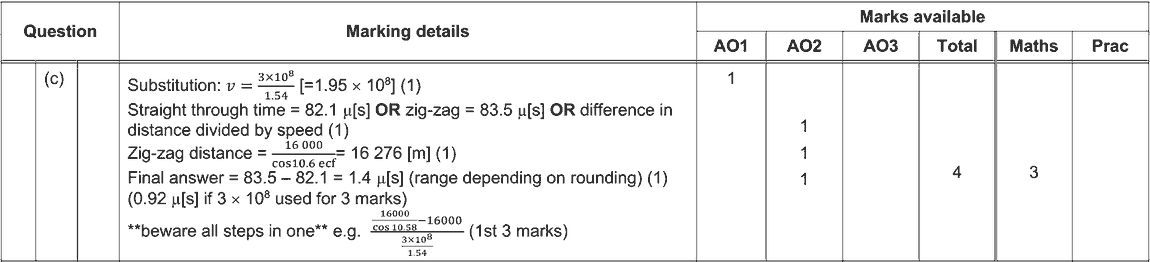
Answer: 1.4 μs. Speed in the core = 3.00 × 10⁸/1.54 = 1.95 × 10⁸ m s⁻¹
Skills: Trigonometryand vectors Resolving, components, vector addition, angles; Unitsand conversions Unit marks, base units, prefixes and conversions; Mathsmarks The mark scheme's Maths column gives this part at least one mark for mathematical skills
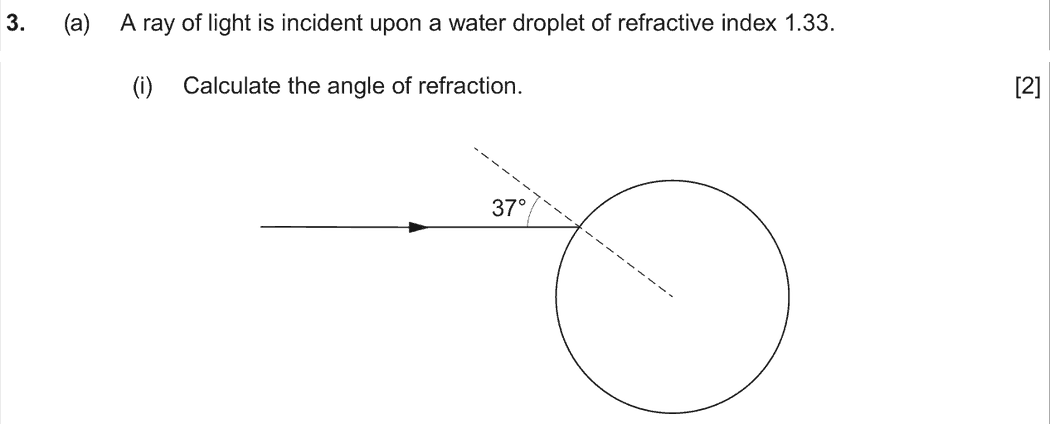
June 2024 · Component 3 · Q3(a)(i)2 marksAO1=1, AO2=1Calculation
Mark scheme
Notes from the mark scheme and report
Answer: 27° (26.9°). 1.00 × sin 37° = 1.33 × sin r
Scheme columns: Maths 1
Skills: Trigonometryand vectors Resolving, components, vector addition, angles; Mathsmarks The mark scheme's Maths column gives this part at least one mark for mathematical skills
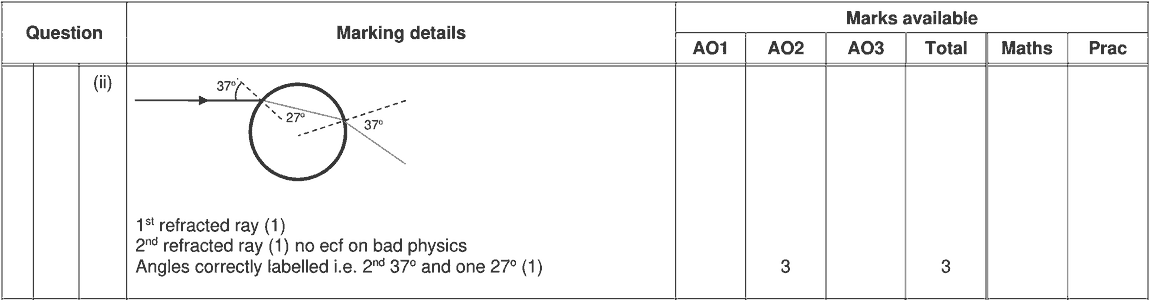
June 2024 · Component 3 · Q3(a)(ii)3 marksAO2=3Diagram or graph
Earlier part of question 3 that this part uses
Mark scheme
Notes from the mark scheme and report
Ray refracted towards the normal inside the droplet (1)
refracted away from the normal on leaving (1)
angles labelled 27° at each surface inside and 37° on emerging (1)
no ecf for bad physics
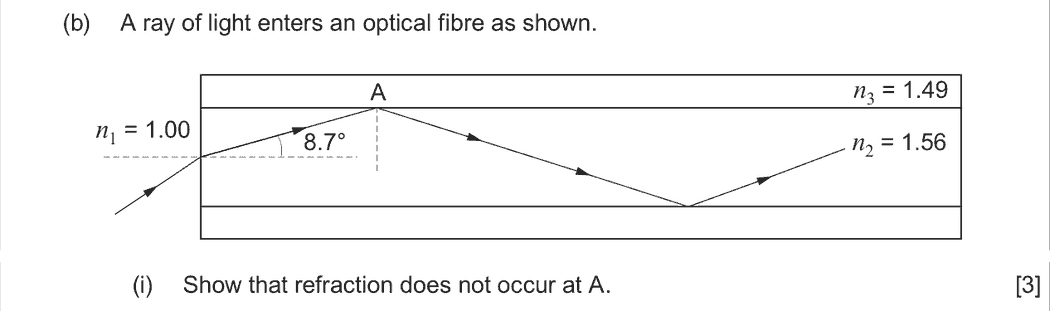
June 2024 · Component 3 · Q3(b)(i)3 marksAO1=1, AO2=2Show that
Earlier part of question 3 that this part uses
Mark scheme
Notes from the mark scheme and report
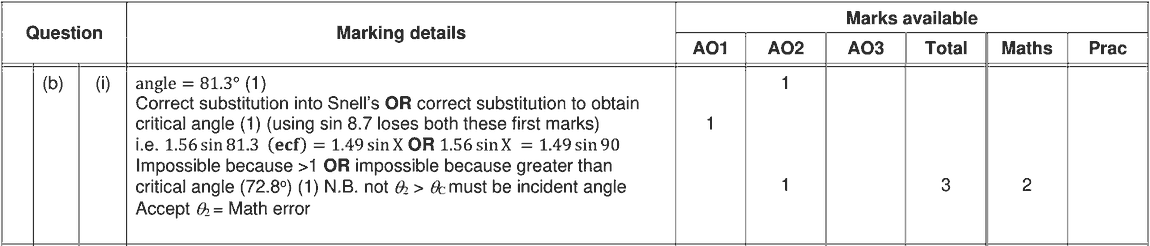
Angle of incidence at A = 90 − 8.7 = 81.3° (1)
critical angle from 1.56 sin C = 1.49 sin 90° is 72.8° (or Snell's law gives sin θ greater than 1) (1)
81.3° is greater than the critical angle so there is total internal reflection and no refraction (1)
using 8.7° loses the first two marks
Scheme columns: Maths 2
Skills: Trigonometryand vectors Resolving, components, vector addition, angles; Mathsmarks The mark scheme's Maths column gives this part at least one mark for mathematical skills
June 2024 · Component 3 · Q3(b)(ii)3 marksAO1=3Explanation
Earlier parts of question 3 that this part uses
Mark scheme
Notes from the mark scheme and report
Rays at different angles follow zig-zag paths of different lengths (1)
so they take different times to travel along the fibre (1)
pulses spread out and overlap, limiting data rate and distance (1)
just saying 'dispersion' or 'distorted' not enough
June 2024 · Component 3 · Q3(b)(iii)2 marksAO1=2Explanation
Earlier parts of question 3 that this part uses
Mark scheme
Notes from the mark scheme and report
Use a very thin (monomode) fibre, core diameter of the order of the wavelength (1)
so light can travel only along one path, parallel to the axis (1)
the weakest part of the question
June 2023 · AS Component 2 · Q3(i)2 marksAO2=2Practical and data analysis
Mark scheme
Examiner's comment
The concept of refraction was understood well by all candidates.
Notes from the mark scheme and report
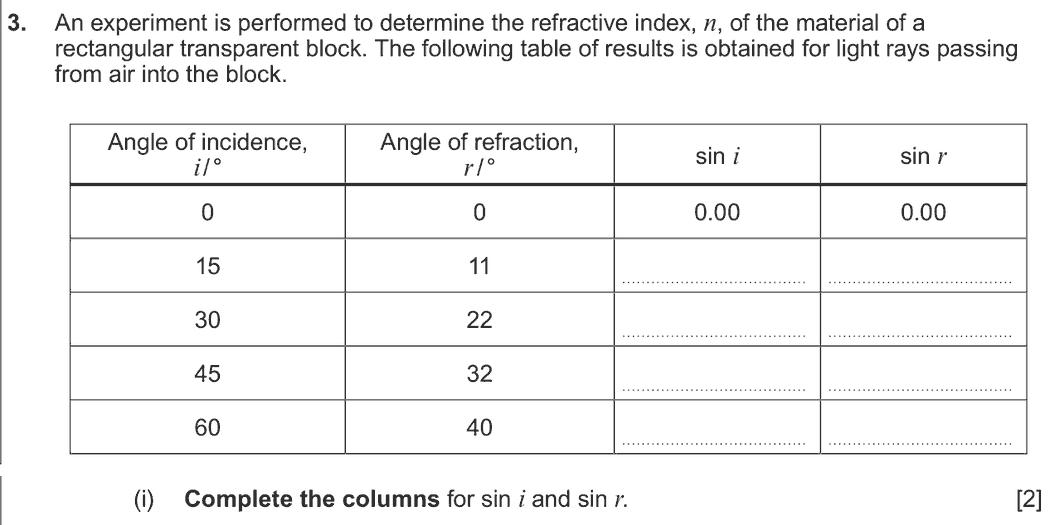
sin i: 0.259, 0.500, 0.707, 0.866
sin r: 0.191, 0.375, 0.530, 0.643 (1)
consistent significant figures, no more than 3 (1)
Scheme columns: Maths 2, Practical 2
Skills: Mathsmarks The mark scheme's Maths column gives this part at least one mark for mathematical skills; Practicalmarks The mark scheme's Prac column gives this part at least one mark for practical skills
June 2023 · AS Component 2 · Q3(ii)4 marksAO1=1, AO2=3Practical and data analysis
Earlier part of question 3 that this part uses
Mark scheme
Examiner's comment
The concept of refraction was understood well by all candidates.
Notes from the mark scheme and report
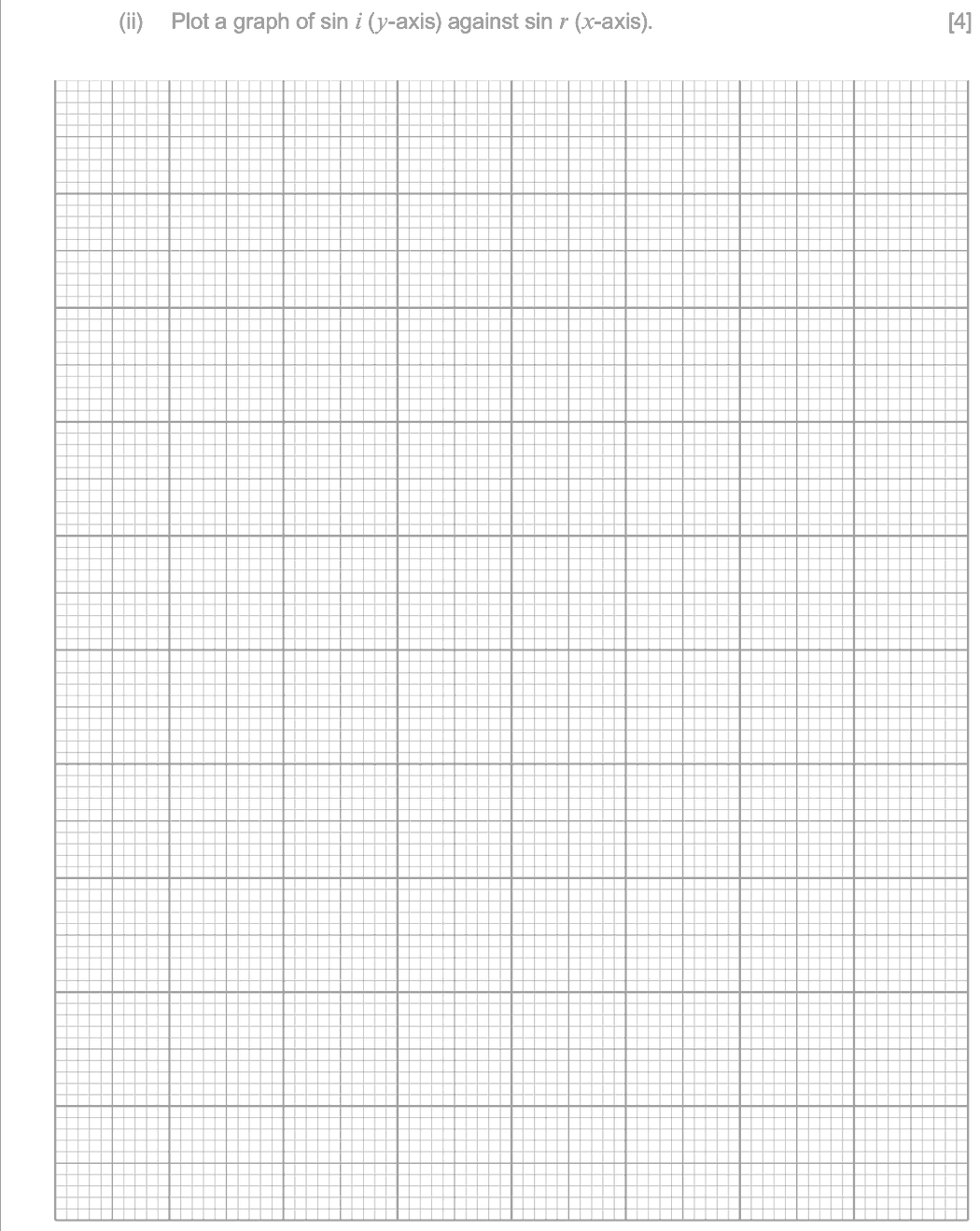
Axes labelled, no units (1)
sensible scales using at least half of each axis (1)
points plotted to within half a small square (1)
straight best-fit line through the origin (1)
Scheme columns: Maths 3, Practical 4
Skills: Graphskills Reading, plotting or sketching graphs; gradients, intercepts and areas; Mathsmarks The mark scheme's Maths column gives this part at least one mark for mathematical skills; Practicalmarks The mark scheme's Prac column gives this part at least one mark for practical skills
June 2023 · AS Component 2 · Q3(iii)3 marksAO3=3Practical and data analysis
Earlier parts of question 3 that this part uses
Mark scheme
Examiner's comment
The concept of refraction was understood well by all candidates.
Notes from the mark scheme and report
Answer: n = 1.35 ± 0.02. Gradient of sin i against sin r from a large triangle (1)
gradient calculated (1)
gradient = n (1)
Scheme columns: Maths 2, Practical 3
Skills: Graphskills Reading, plotting or sketching graphs; gradients, intercepts and areas; Mathsmarks The mark scheme's Maths column gives this part at least one mark for mathematical skills; Practicalmarks The mark scheme's Prac column gives this part at least one mark for practical skills
June 2023 · AS Component 2 · Q3(iv)2 marksAO1=1, AO2=1Calculation
Earlier parts of question 3 that this part uses
Mark scheme
Examiner's comment
The concept of refraction was understood well by all candidates.
Notes from the mark scheme and report
Answer: 47.8° (with n = 1.35). sin C = 1/n
ecf on n
Scheme columns: Maths 2, Practical 2
Skills: Mathsmarks The mark scheme's Maths column gives this part at least one mark for mathematical skills; Practicalmarks The mark scheme's Prac column gives this part at least one mark for practical skills
June 2023 · AS Component 2 · Q3(v)2 marksAO1=1, AO2=1Calculation
Earlier parts of question 3 that this part uses
Mark scheme
Examiner's comment
The concept of refraction was understood well by all candidates.
Notes from the mark scheme and report
Answer: 2.2 × 10⁸ m s⁻¹. v = c/n = 3.00 × 10⁸/1.35 (from n₁v₁ = n₂v₂)
ecf on n
Scheme columns: Maths 1, Practical 2
Skills: Mathsmarks The mark scheme's Maths column gives this part at least one mark for mathematical skills; Practicalmarks The mark scheme's Prac column gives this part at least one mark for practical skills
June 2023 · Component 3 · Q3(a)(i)1 markAO2=1Short answer
Mark scheme
Examiner's comment
Candidates found (a)(ii) challenging. They were expected to comment on the graphs already drawn but they often suggested other graphs or additional lines of fit. Once again, standard but important lines of conclusion would have sufficed – straight line through origin, line of best fit passes through all error bars, the gradient decreases etc. The last part was well answered in general but justifying the best method for obtaining the refractive index proved difficult – “the gradient incorporates all points” would have sufficed.
Notes from the mark scheme and report
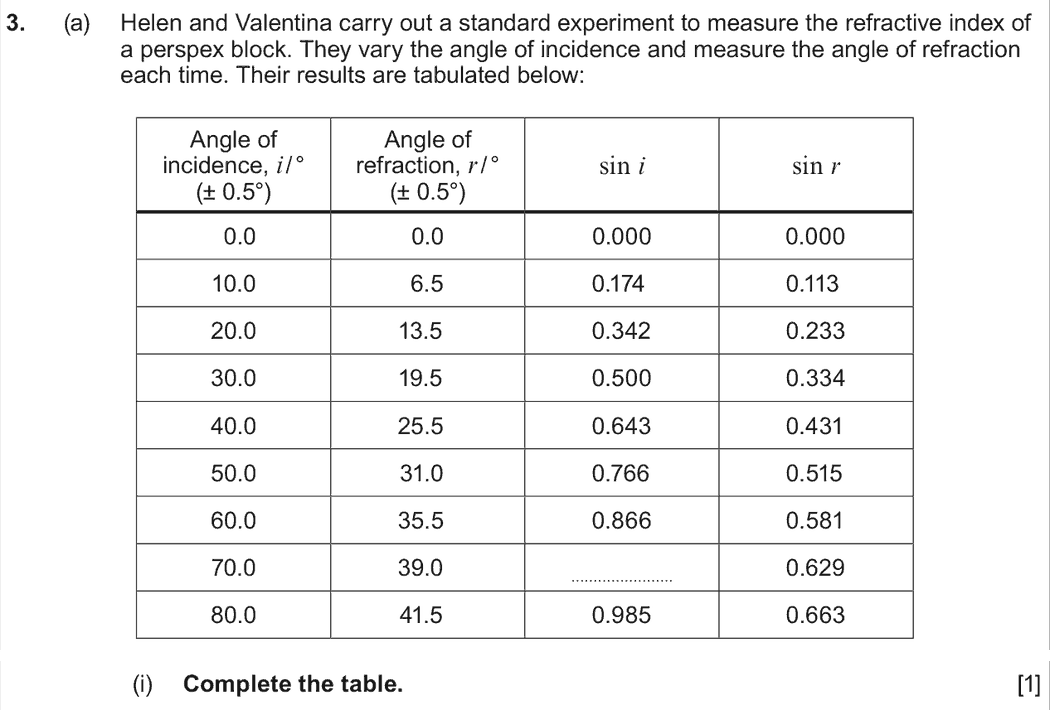
Answer: 0.940 (sin 70.0°)
Scheme columns: Maths 1, Practical 1
Skills: Mathsmarks The mark scheme's Maths column gives this part at least one mark for mathematical skills; Practicalmarks The mark scheme's Prac column gives this part at least one mark for practical skills
June 2023 · Component 3 · Q3(a)(ii)4 marksAO3=4Practical and data analysis
Earlier part of question 3 that this part uses
Mark scheme
Examiner's comment
Candidates found (a)(ii) challenging. They were expected to comment on the graphs already drawn but they often suggested other graphs or additional lines of fit. Once again, standard but important lines of conclusion would have sufficed – straight line through origin, line of best fit passes through all error bars, the gradient decreases etc. The last part was well answered in general but justifying the best method for obtaining the refractive index proved difficult – “the gradient incorporates all points” would have sufficed.
Notes from the mark scheme and report
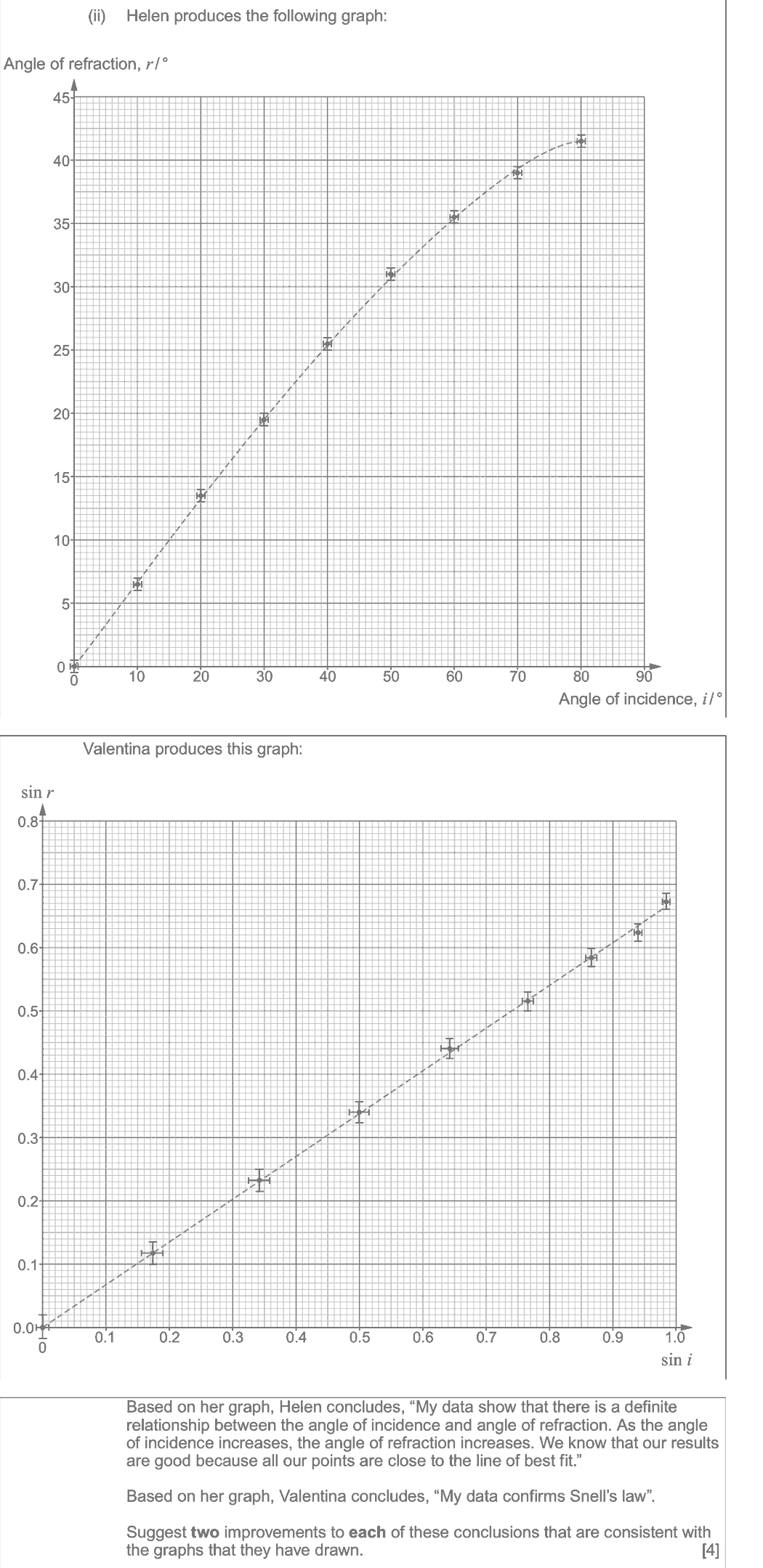
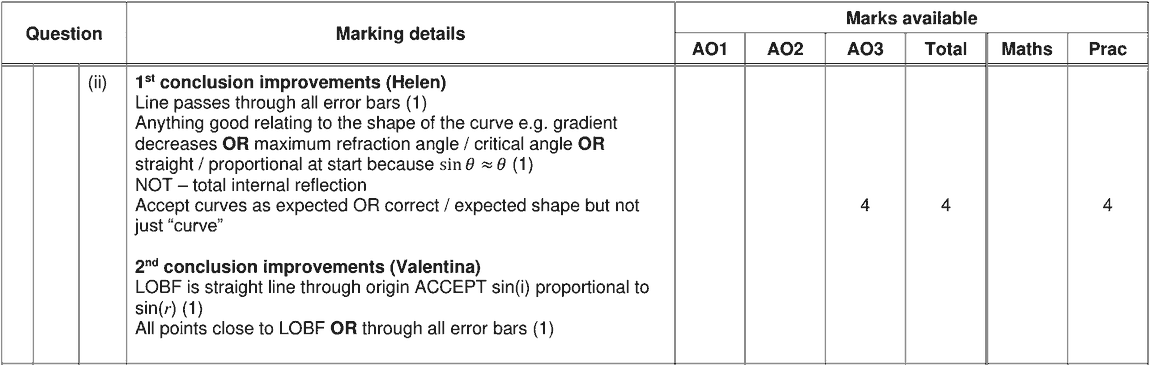
Helen: the curve passes through all the error bars (1)
comment on its shape, e.g. the gradient decreases, r tends to a maximum (critical angle), or it is nearly straight at small angles where sin θ ≈ θ (1). Valentina: line of best fit is a straight line through the origin, so sin r is proportional to sin i (1)
the line passes through all the error bars (points close to it) (1). Candidates tended to propose new graphs instead of commenting on these
Scheme columns: Practical 4
Skills: Graphskills Reading, plotting or sketching graphs; gradients, intercepts and areas; Uncertainties Resolution, absolute and percentage uncertainty, combining uncertainties, error bars; Practicalmarks The mark scheme's Prac column gives this part at least one mark for practical skills
June 2023 · Component 3 · Q3(b)3 marksAO3=3Practical and data analysis
Earlier parts of question 3 that this part uses
Mark scheme
Examiner's comment
Candidates found (a)(ii) challenging. They were expected to comment on the graphs already drawn but they often suggested other graphs or additional lines of fit. Once again, standard but important lines of conclusion would have sufficed – straight line through origin, line of best fit passes through all error bars, the gradient decreases etc. The last part was well answered in general but justifying the best method for obtaining the refractive index proved difficult – “the gradient incorporates all points” would have sufficed.
Notes from the mark scheme and report
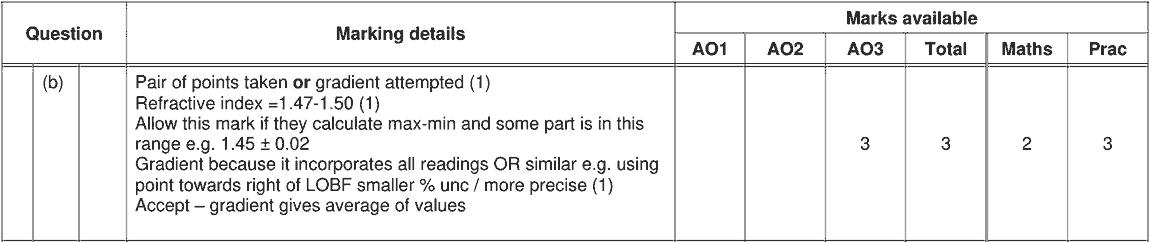
Answer: 1.47 to 1.50. n = sin i/sin r = 1/gradient of Valentina's graph, from the gradient or a pair of points on the line (1)
value in range (1)
gradient chosen because it uses all the readings (averages them), or a point far along the line has the smallest % uncertainty (1)
the justification proved hard
Scheme columns: Maths 2, Practical 3
Skills: Graphskills Reading, plotting or sketching graphs; gradients, intercepts and areas; Mathsmarks The mark scheme's Maths column gives this part at least one mark for mathematical skills; Practicalmarks The mark scheme's Prac column gives this part at least one mark for practical skills
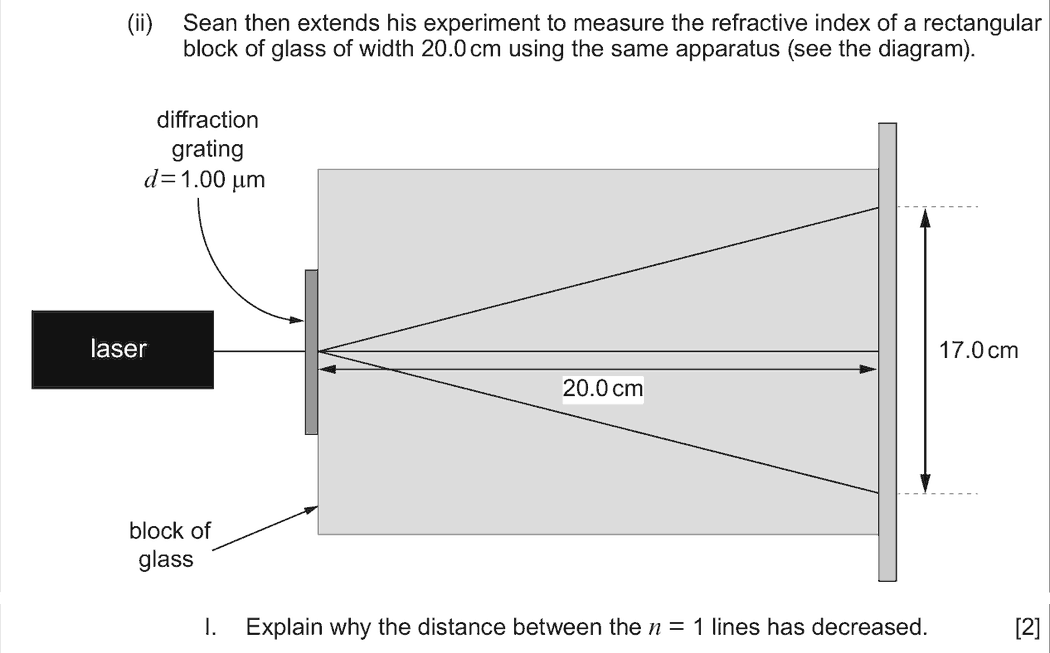
June 2022 · Component 3 · Q4(b)(ii)I2 marksAO1=1, AO2=1Explanation
Earlier parts of question 4 that this part uses
Mark scheme
Examiner's comment
Well answered in general but a significant number were unable to calculate the refractive index (either by the wavelength shortening route or using Snell’s Law).
Notes from the mark scheme and report
Light is refracted towards the normal on entering the glass because it travels more slowly there (2)
or the wavelength is shorter in glass so sin θ and the angle are smaller
Scheme columns: Practical 2
Skills: Practicalmarks The mark scheme's Prac column gives this part at least one mark for practical skills
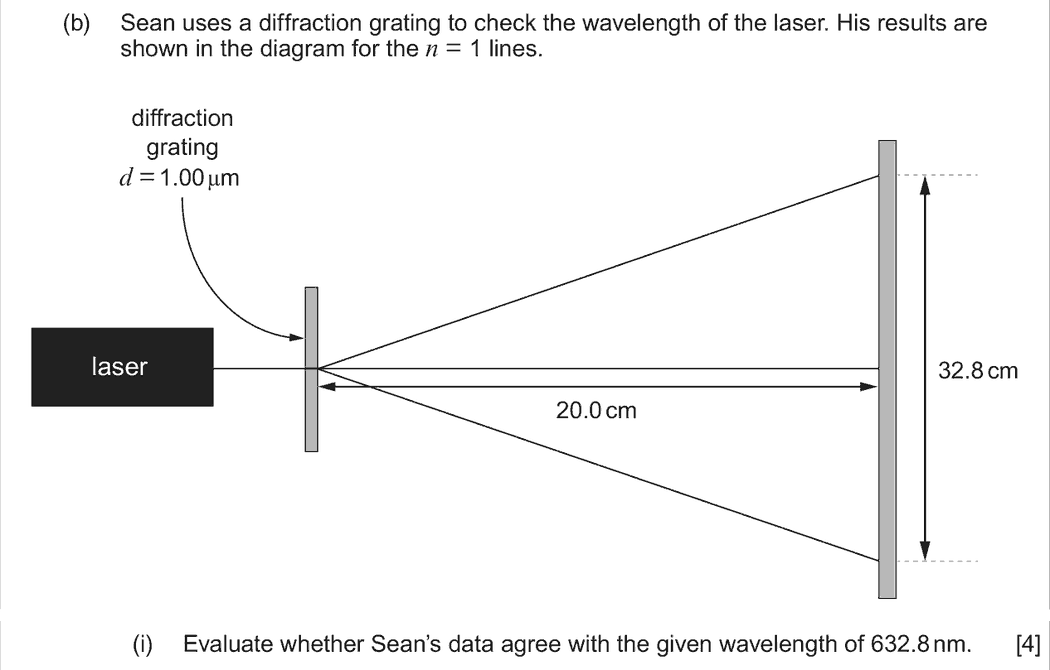
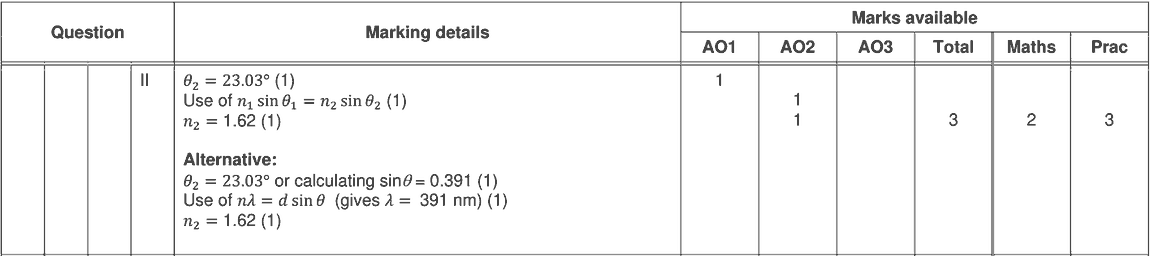
June 2022 · Component 3 · Q4(b)(ii)II3 marksAO1=1, AO2=2Calculation
Earlier parts of question 4 that this part uses
Mark scheme
Examiner's comment
Well answered in general but a significant number were unable to calculate the refractive index (either by the wavelength shortening route or using Snell’s Law).
Notes from the mark scheme and report
Answer: 1.62. Angle in glass: tan θ2 = 8.5/20.0 so θ2 = 23.03°
1 × sin 39.35° = n sin 23.03°
or λ in glass = d sin θ2 = 391 nm and n = 634/391
Scheme columns: Maths 2, Practical 3
Skills: Trigonometryand vectors Resolving, components, vector addition, angles; Mathsmarks The mark scheme's Maths column gives this part at least one mark for mathematical skills; Practicalmarks The mark scheme's Prac column gives this part at least one mark for practical skills
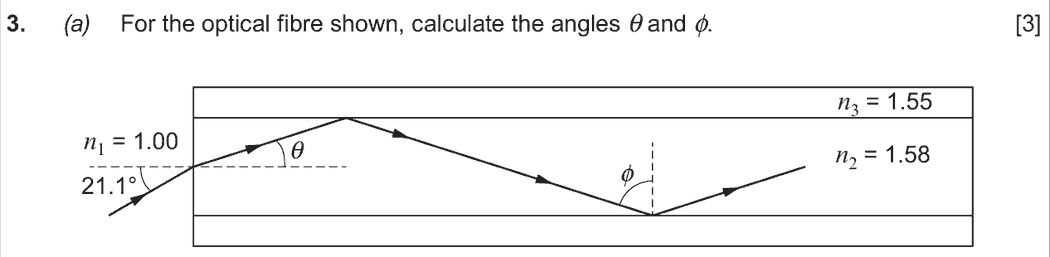
October 2021 · Component 3 · Q3(a)3 marksAO1=1, AO2=2Calculation
Mark scheme
Notes from the mark scheme and report
Answer: θ = 13.2°, φ = 76.8°. 1.00 sin 21.1° = 1.58 sin θ
φ = 90° − θ
Scheme columns: Maths 2
Skills: Trigonometryand vectors Resolving, components, vector addition, angles; Mathsmarks The mark scheme's Maths column gives this part at least one mark for mathematical skills
October 2021 · Component 3 · Q3(b)3 marksAO3=3Calculation
Earlier part of question 3 that this part uses
Mark scheme
Notes from the mark scheme and report
Critical angle at the core-cladding boundary: sin C = 1.55/1.58, C = 78.8° (1)
the ray meets the boundary at 76.8°, less than C (1)
so there is no total internal reflection, light escapes into the cladding at each reflection and the intensity falls quickly (1)
Scheme columns: Maths 3
Skills: Mathsmarks The mark scheme's Maths column gives this part at least one mark for mathematical skills
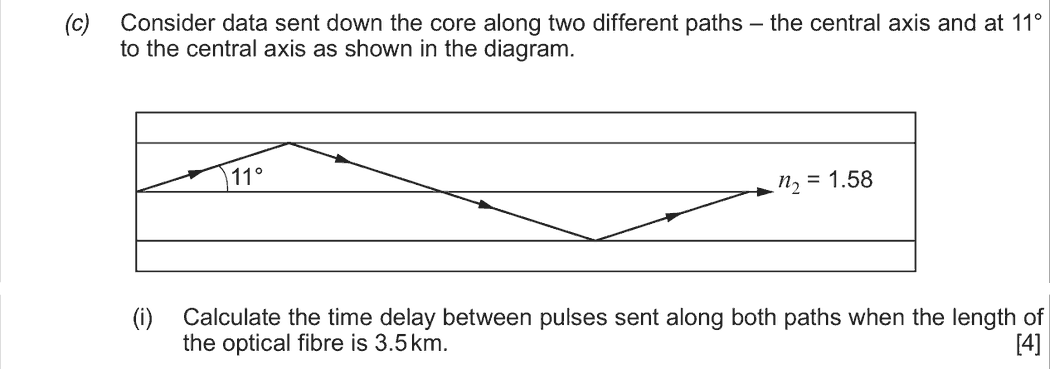
October 2021 · Component 3 · Q3(c)(i)4 marksAO1=1, AO2=3Calculation
Earlier part of question 3 that this part uses
Mark scheme
Notes from the mark scheme and report
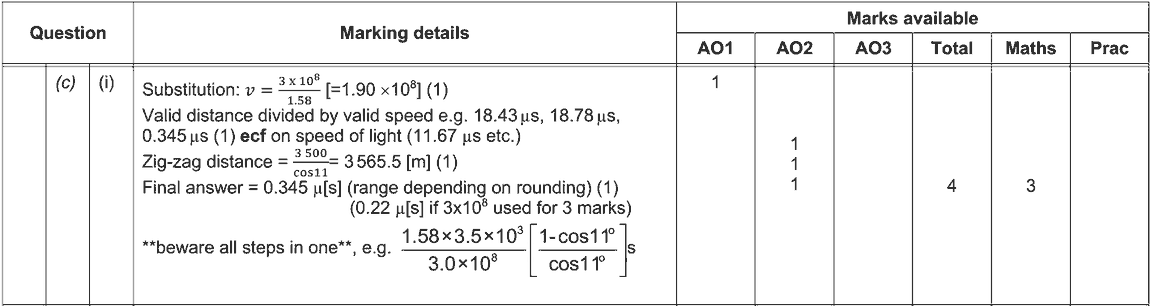
Answer: 0.345 μs. Speed in the core = 3.00 × 10⁸/1.58 = 1.90 × 10⁸ m s⁻¹
axial time = 3500/1.90 × 10⁸ = 18.43 μs
zig-zag path = 3500/cos 11° = 3565.5 m, time 18.78 μs
difference
0.22 μs (using 3 × 10⁸) scores 3
Scheme columns: Maths 3
Skills: Trigonometryand vectors Resolving, components, vector addition, angles; Unitsand conversions Unit marks, base units, prefixes and conversions; Mathsmarks The mark scheme's Maths column gives this part at least one mark for mathematical skills
October 2021 · Component 3 · Q3(c)(ii)2 marksAO2=2Calculation
Earlier parts of question 3 that this part uses
Mark scheme
Notes from the mark scheme and report
Answer: about 2.9 × 10⁶ pulses per second (1.45 × 10⁶ if a gap of 2T is allowed). Successive pulses must be separated by at least the time delay, so rate = 1/0.345 μs
ecf
Scheme columns: Maths 2
Skills: Mathsmarks The mark scheme's Maths column gives this part at least one mark for mathematical skills
June 2019 · AS Component 2 · Q3(a)3 marksAO1=2, AO2=1Explanation
Mark scheme
Notes from the mark scheme and report
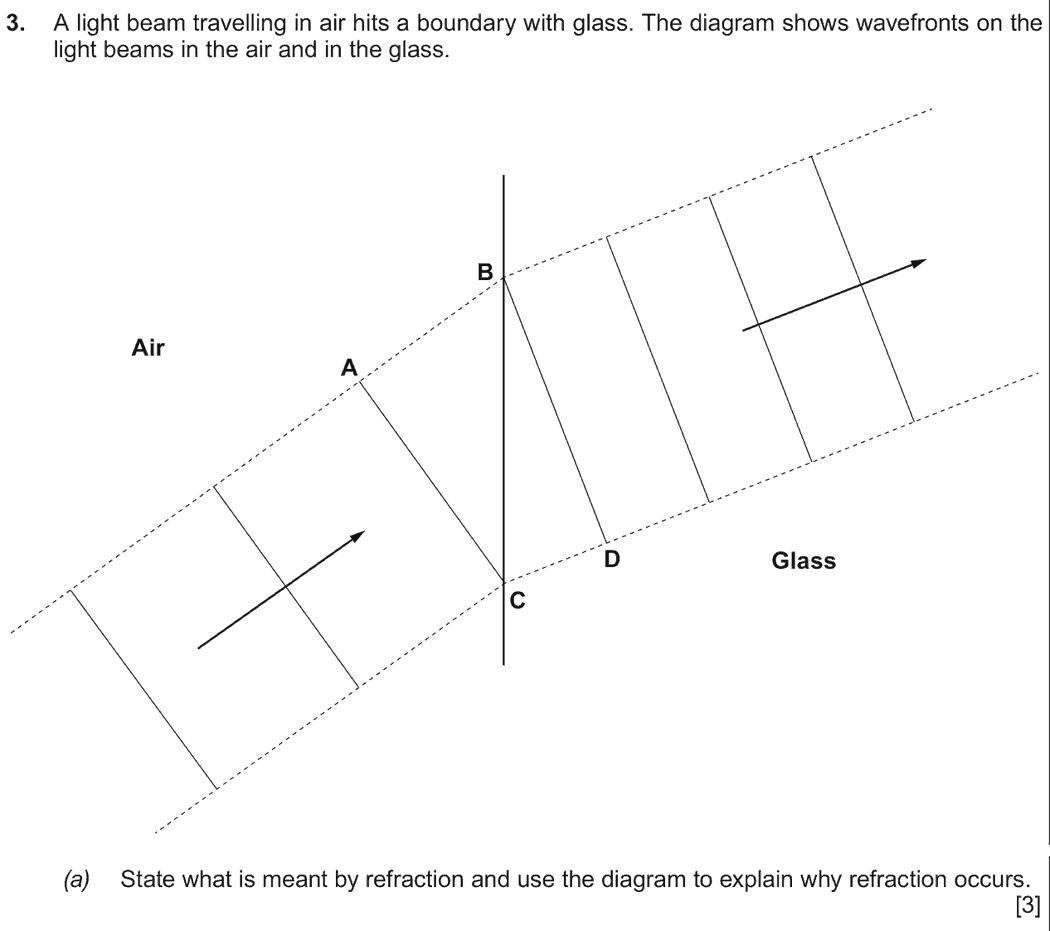
Refraction is a change in direction of travel of a wave (as it crosses a boundary) (1)
light travels more slowly in glass than in air (1)
so in the same time end A of the wavefront travels further (AB) than end C does in the glass (CD), AB greater than CD, turning the wavefront (1)
June 2019 · AS Component 2 · Q3(b)3 marksAO1=1, AO2=2Calculation
Earlier part of question 3 that this part uses
Mark scheme
Notes from the mark scheme and report
Answer: about 1.9 × 10⁸ m s⁻¹. Measure AB = 2.9 cm and CD = 1.8 cm (± 0.1 cm) (1)
the two distances are covered in the same time so v(glass)/c = CD/AB (1)
v = 3.00 × 10⁸ × 1.8/2.9 = 1.86 × 10⁸ m s⁻¹ (1). The scheme's 'BD and AC' is a slip for AB and CD
Scheme columns: Maths 2
Skills: Mathsmarks The mark scheme's Maths column gives this part at least one mark for mathematical skills
June 2018 · AS Component 2 · Q6(a)(i)2 marksAO2=2Calculation
Mark scheme
Examiner's comment
Nearly all the candidates were able to determine the critical angle and angle A correctly and a majority went on to deduce that that the technician was not correct and made a valid conclusion based on their values
Notes from the mark scheme and report
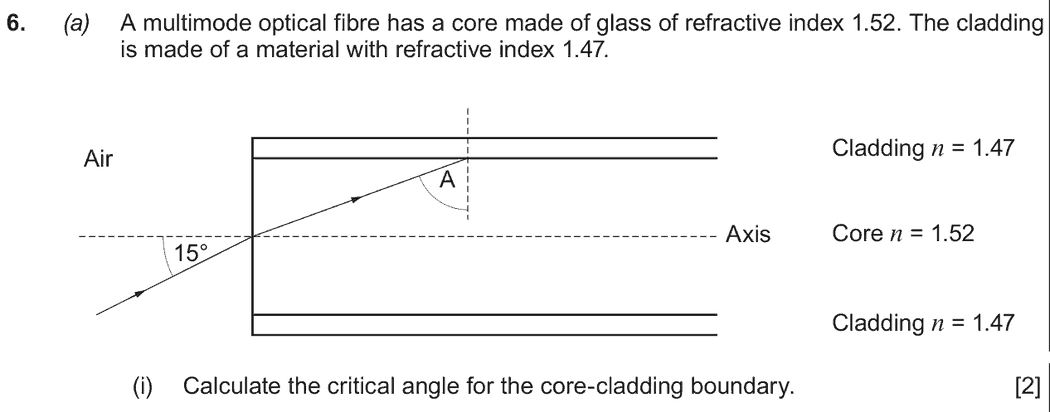
Answer: 75.3°. sin C = 1.47/1.52
Scheme columns: Maths 2
Skills: Trigonometryand vectors Resolving, components, vector addition, angles; Mathsmarks The mark scheme's Maths column gives this part at least one mark for mathematical skills
June 2018 · AS Component 2 · Q6(a)(ii)3 marksAO1=1, AO2=2Calculation
Earlier part of question 6 that this part uses
Mark scheme
Examiner's comment
Nearly all the candidates were able to determine the critical angle and angle A correctly and a majority went on to deduce that that the technician was not correct and made a valid conclusion based on their values
Notes from the mark scheme and report
Answer: 80.2°. sin 15° = 1.52 sin r gives r = 9.8°
A = 90° − r
Scheme columns: Maths 2
Skills: Trigonometryand vectors Resolving, components, vector addition, angles; Mathsmarks The mark scheme's Maths column gives this part at least one mark for mathematical skills
June 2018 · AS Component 2 · Q6(a)(iii)2 marksAO3=2Explanation
Earlier part of question 6 that this part uses
Mark scheme
Examiner's comment
Nearly all the candidates were able to determine the critical angle and angle A correctly and a majority went on to deduce that that the technician was not correct and made a valid conclusion based on their values
Notes from the mark scheme and report
Angle A (80.2°) is greater than the critical angle (75.3°) (1), so total internal reflection occurs and the light does travel along the fibre: technician not correct (1)
ecf on both angles
June 2018 · AS Component 2 · Q6(b)3 marksAO1=1, AO2=2Calculation
Earlier part of question 6 that this part uses
Mark scheme
Examiner's comment
The more able candidates were able to determine the time correctly,
Notes from the mark scheme and report
Answer: 7.6 × 10⁻⁵ s. v = c/n = 3.00 × 10⁸/1.52 = 1.97 × 10⁸ m s⁻¹
t = 15 000/v
Scheme columns: Maths 3
Skills: Unitsand conversions Unit marks, base units, prefixes and conversions; Mathsmarks The mark scheme's Maths column gives this part at least one mark for mathematical skills
June 2018 · AS Component 2 · Q6(c)(i)1 markAO1=1Short answer
Earlier part of question 6 that this part uses
Mark scheme
Examiner's comment
The vast majority of candidates were able to distinguish between monomode and multimode.
Notes from the mark scheme and report
Monomode: a single path straight along (parallel to) the axis
multimode: many zig-zag paths at different angles
June 2018 · AS Component 2 · Q6(c)(ii)3 marksAO1=3Explanation
Earlier parts of question 6 that this part uses
Mark scheme
Examiner's comment
All candidates were able to gain marks on this part though the fact that it allows for a higher rate of data transfer was frequently omitted. Eduqas AS Physics Report Summer 2018/mp
Notes from the mark scheme and report
Only one path, so pulses do not spread out (no multimode dispersion) (1)
all parts of a pulse arrive together so successive pulses do not overlap (1)
so a faster data rate is possible (1)
the last point was often left out
June 2018 · Component 3 · Q2(a)2 marksAO1=1, AO2=1Show that
Mark scheme
Examiner's comment
Extremely well answered.
Notes from the mark scheme and report
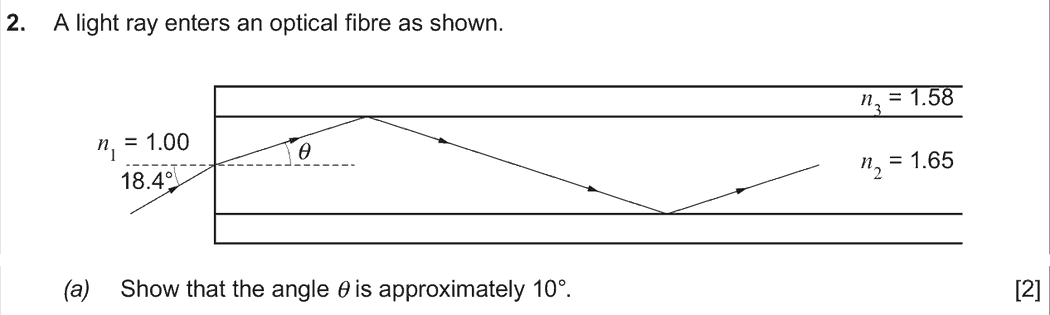
Snell's law: 1.00 × sin 18.4° = 1.65 sin θ (1)
θ = 11.0° (1)
the unrounded value must be shown
Scheme columns: Maths 1
Skills: Mathsmarks The mark scheme's Maths column gives this part at least one mark for mathematical skills
June 2018 · Component 3 · Q2(b)4 marksCalculation
Earlier part of question 2 that this part uses
Mark scheme
Examiner's comment
Very well answered with 4/4 being the most common award. Failing to obtain the correct angle of incidence was the most common problem.
Notes from the mark scheme and report
Answer: yes. Angle of incidence at the core-cladding boundary φ = 90 − 11 = 79° (1)
critical angle from 1.65 sin C = 1.58 sin 90° (1), C = 73.2° (1)
79° exceeds C so the ray is totally internally reflected (1)
or show that Snell's law has no solution at 79°. Most common slip: wrong angle of incidence
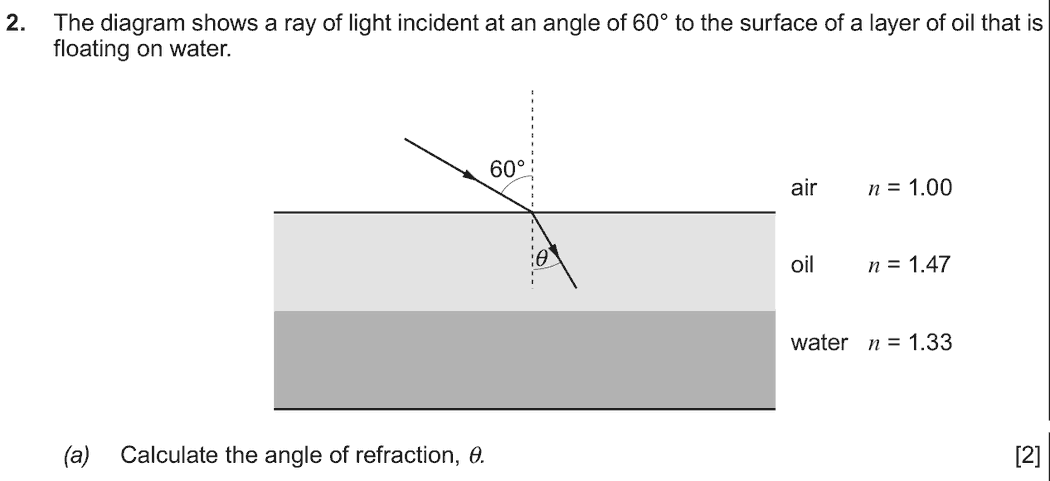
June 2017 · AS Component 2 · Q2(a)2 marksAO2=2Calculation
Mark scheme
Examiner's comment
All the candidates were able to apply Snell’s law and obtain the angle of refraction.
Notes from the mark scheme and report
Answer: 36°. 1.00 sin 60° = 1.47 sin θ
Scheme columns: Maths 2
Skills: Trigonometryand vectors Resolving, components, vector addition, angles; Mathsmarks The mark scheme's Maths column gives this part at least one mark for mathematical skills
June 2017 · AS Component 2 · Q2(b)(i)2 marksAO2=2Calculation
Earlier part of question 2 that this part uses
Mark scheme
Examiner's comment
Also the vast majority were able to determine the critical angle correctly. All candidates were able to determine that the angle refracted into the water. However, a significant number of candidates were able to use the critical angle and realise that the angle of incidence did exceed the critical angle and therefore refraction would occur. Some candidates noted that the density of oil was greater than that of water and that the ray of light was travelling from a dense to a less dense medium. This was was not credited.
Notes from the mark scheme and report
Answer: 65°. 1.47 sin C = 1.33 sin 90°
Scheme columns: Maths 2
Skills: Trigonometryand vectors Resolving, components, vector addition, angles; Mathsmarks The mark scheme's Maths column gives this part at least one mark for mathematical skills
June 2017 · AS Component 2 · Q2(b)(ii)2 marksAO2=2Explanation
Earlier parts of question 2 that this part uses
Mark scheme
Examiner's comment
Many candidates were able to score full marks for this question.
Notes from the mark scheme and report
The angle of incidence at the oil-water boundary (36°) is less than the critical angle (65°) (1), so the ray is refracted into the water (1)
arguments based on density of oil and water not credited
June 2017 · AS Component 2 · Q2(c)2 marksAO2=2Calculation
Earlier part of question 2 that this part uses
Mark scheme
Examiner's comment
Nearly all the candidates were able to apply the relevant equation to determine the speed of light in the oil.
Notes from the mark scheme and report
Answer: 2.0 × 10⁸ m s⁻¹. v = c/n = 3.00 × 10⁸/1.47
Scheme columns: Maths 2
Skills: Mathsmarks The mark scheme's Maths column gives this part at least one mark for mathematical skills
June 2017 · Component 3 · Q8(a)2 marksAO1=2Diagram or graph
Mark scheme
Examiner's comment
Very well answered.
Notes from the mark scheme and report
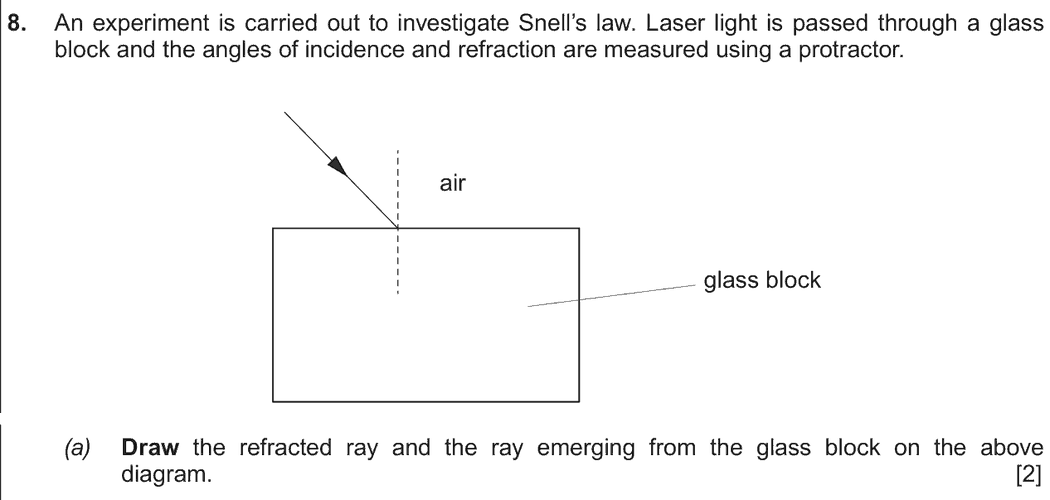
Ray bends towards the normal inside the glass (1)
emergent ray roughly parallel to the incident ray (1)
Scheme columns: Practical 2
Skills: Practicalmarks The mark scheme's Prac column gives this part at least one mark for practical skills
June 2017 · Component 3 · Q8(b)(i)4 marksAO2=4Practical and data analysis
Earlier part of question 8 that this part uses
Mark scheme
Examiner's comment
A good differentiating question with the full range of possible marks awarded. It was rare to see all the error bars correct. It was also common to see the lines of best fit reaching the top/bottom middle of the error bar instead of the corners of the error bars. i.e. is wrong and is correct
Notes from the mark scheme and report
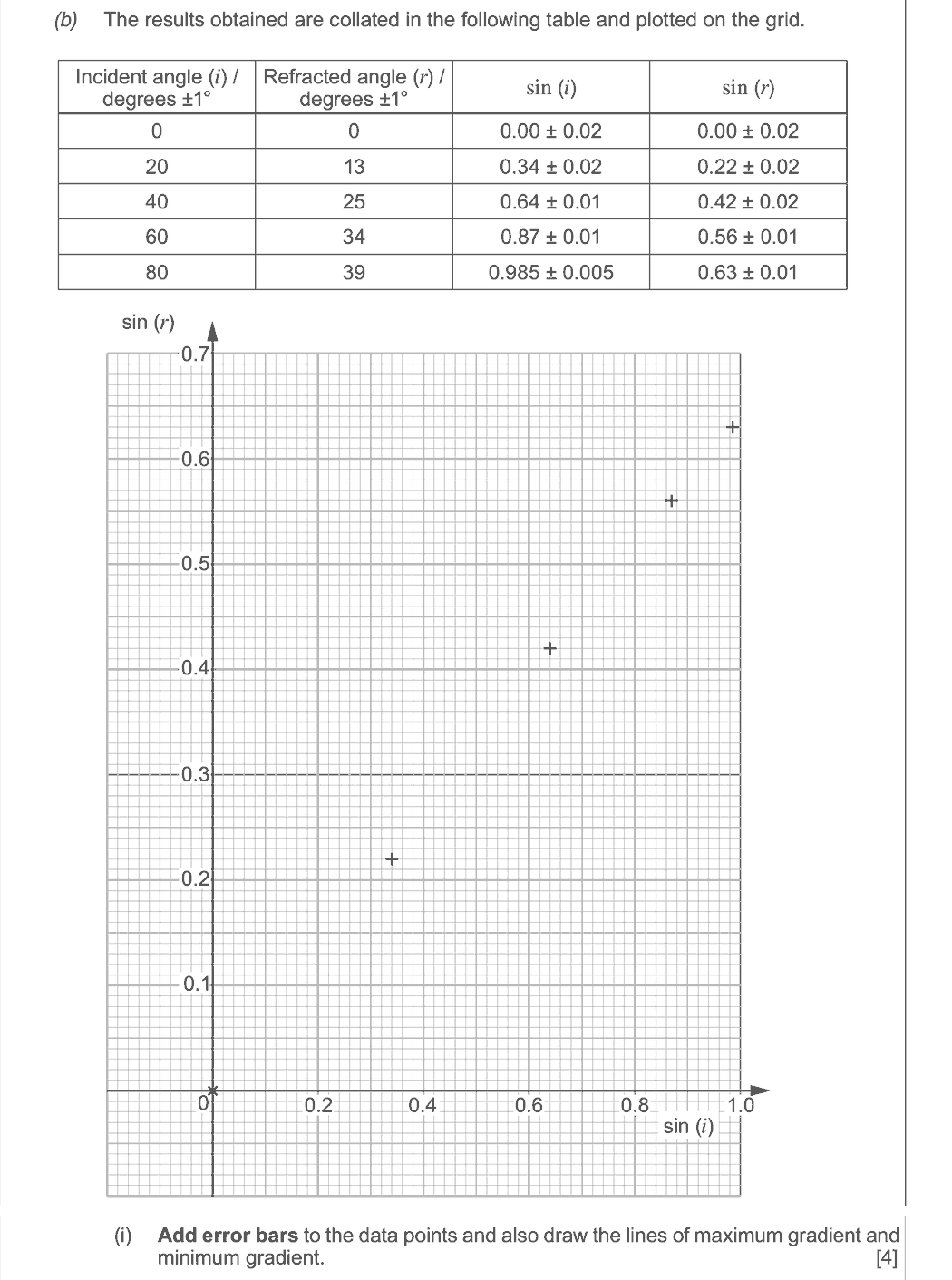
Vertical error bars (1) and horizontal error bars (1) from the ± values in the table, all correct (1)
steepest and least steep lines through the error boxes (1)
lines should pass through the corners of the error boxes, not the mid-points of the bars
all bars correct was rare
Scheme columns: Maths 4, Practical 4
Skills: Uncertainties Resolution, absolute and percentage uncertainty, combining uncertainties, error bars; Graphskills Reading, plotting or sketching graphs; gradients, intercepts and areas; Mathsmarks The mark scheme's Maths column gives this part at least one mark for mathematical skills; Practicalmarks The mark scheme's Prac column gives this part at least one mark for practical skills
June 2017 · Component 3 · Q8(b)(ii)4 marksAO3=4Practical and data analysis
Earlier parts of question 8 that this part uses
Mark scheme
Examiner's comment
Another differentiating question with few completely correct answers. The biggest cause of lost marks was not calculating two gradients. Calculating the refractive index using one point and then attempting the uncertainties almost invariably led to one mark (for obtaining a value of n).
Notes from the mark scheme and report
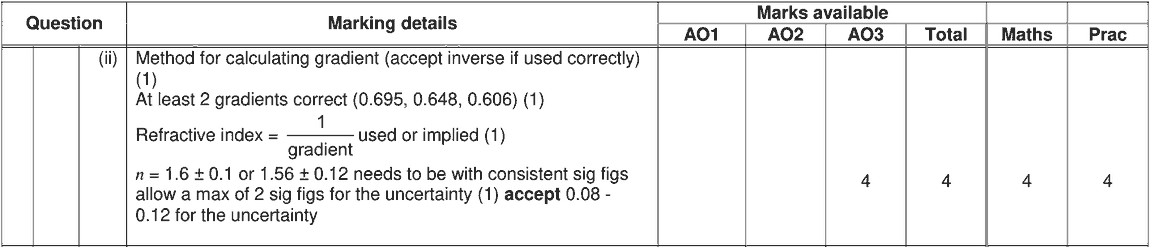
Answer: n = 1.6 ± 0.1 (1.56 ± 0.12). Gradients of sin r against sin i: max 0.695, min 0.606 (mean 0.648)
n = 1/gradient, giving 1.44 to 1.65
uncertainty = half the range (0.08 to 0.12 accepted), sf consistent
most lost marks by finding only one gradient or using a single point
Scheme columns: Maths 4, Practical 4
Skills: Uncertainties Resolution, absolute and percentage uncertainty, combining uncertainties, error bars; Graphskills Reading, plotting or sketching graphs; gradients, intercepts and areas; Mathsmarks The mark scheme's Maths column gives this part at least one mark for mathematical skills; Practicalmarks The mark scheme's Prac column gives this part at least one mark for practical skills
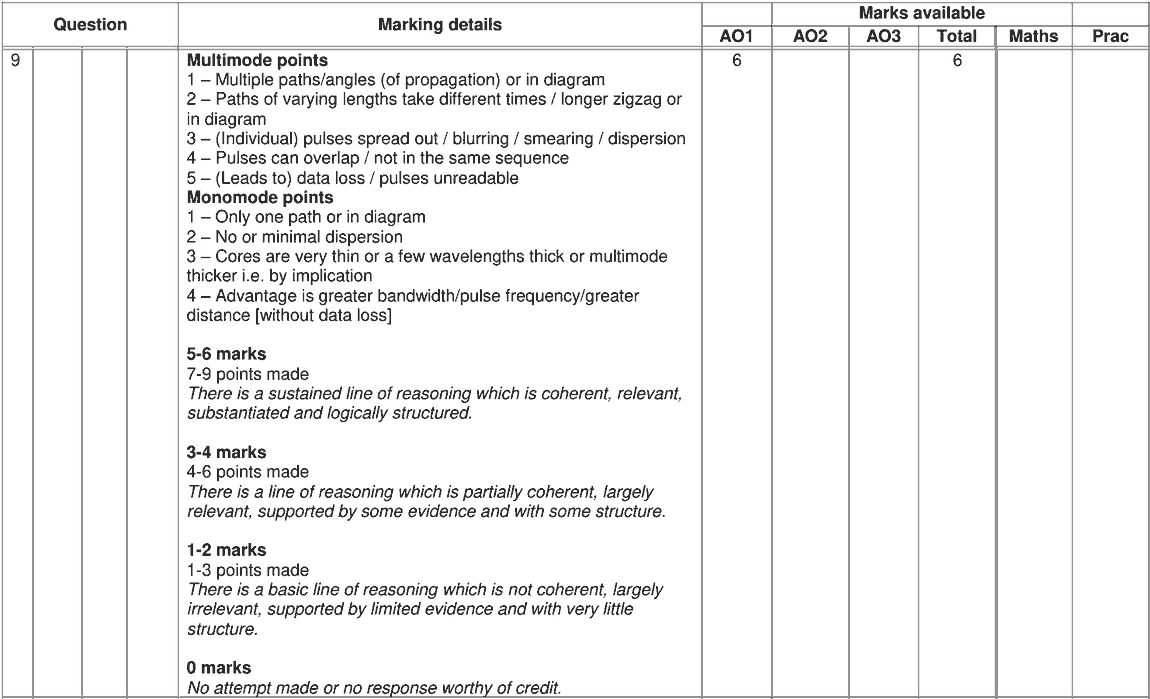
June 2017 · Component 3 · Q96 marksAO1=66-mark extended response
Mark scheme, with the levels and indicative content
Examiner's comment
This question achieved the full range of available marks. Candidates were rewarded for what they knew and it was rare to encounter answers that were not constructed logically. Some misconceptions that appeared were:
Notes from the mark scheme and report
QER, levels marked. Multimode: many paths at different angles
longer zigzag paths take longer
each pulse spreads (multimode dispersion)
neighbouring pulses overlap
data lost. Monomode: only one path (along the axis)
little or no dispersion
core very thin, a few wavelengths across
so higher pulse rate (bandwidth) and longer distances without data loss
Skills: QER The 6-mark quality of extended response question
June 2016 · AS Component 2 · Q6(a)6 marksAO1=66-mark extended response
Mark scheme, with the levels and indicative content
Examiner's comment
The QER was answered well and nearly all candidates made at least two valid points. Many did not draw a labelled diagram or a poor diagram without clearly indicating refraction or the angles involved. Also a common emission was to forget to mention a suitable range of angles. A number of candidates did not choose to mention a graph and simply used a mean. A few tried to answer in terms of critical angle.
Notes from the mark scheme and report
QER, levels marked. Method: labelled diagram of ray box and block, angles of incidence and refraction marked from the normal, trace the rays to measure both angles, a range of angles of incidence. Results: take sines, n = 1 for air, find n for each pair and take a mean, or plot sin i against sin r and use gradient = n. Weak points: poor diagrams, no range of angles, no graph
Scheme columns: Practical 6
Skills: Experimentalmethod Describing, planning or improving an experiment; Graphskills Reading, plotting or sketching graphs; gradients, intercepts and areas; Practicalmarks The mark scheme's Prac column gives this part at least one mark for practical skills; QER The 6-mark quality of extended response question
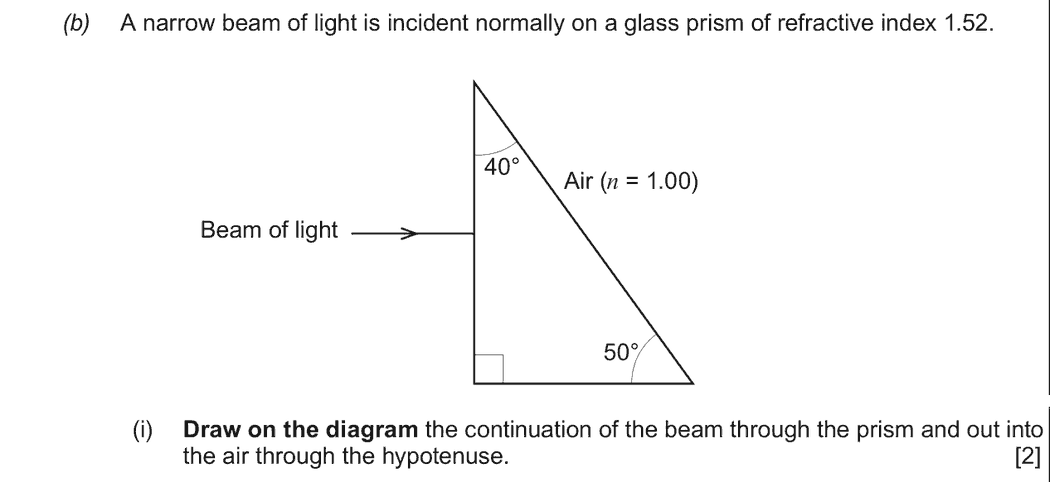
June 2016 · AS Component 2 · Q6(b)(i)2 marksAO2=2Diagram or graph
Earlier part of question 6 that this part uses
Mark scheme
Examiner's comment
Most candidates who lost a mark did not draw on the normal to the hypotenuse and showed the ray bending upwards at the second face.
Notes from the mark scheme and report
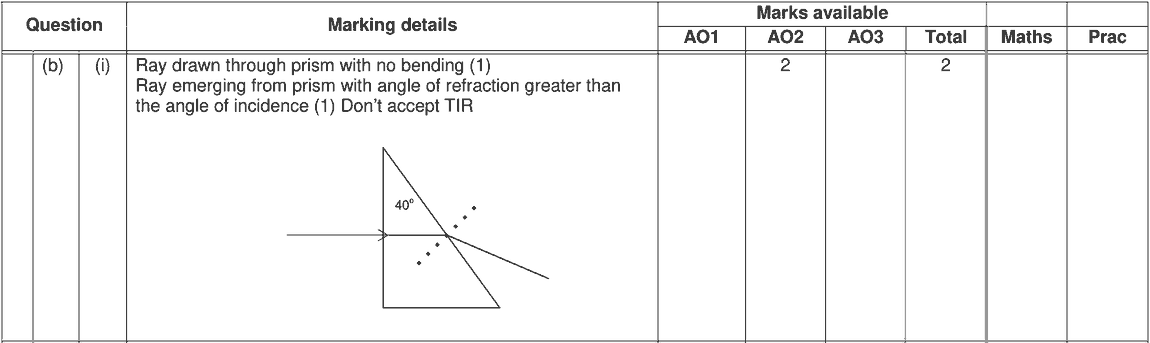
Ray continues undeviated through the first face (1)
at the hypotenuse it emerges bent away from the normal, angle of refraction greater than angle of incidence (1)
TIR not accepted
many omitted the normal and bent the ray upwards
June 2016 · AS Component 2 · Q6(b)(ii)3 marksAO1=1, AO2=2Calculation
Earlier parts of question 6 that this part uses
Mark scheme
Examiner's comment
Many did not know how to use Snell’s law and tried to find the critical angle.
Notes from the mark scheme and report
Answer: 38°. Angle of incidence at the hypotenuse = 40°
1.52 sin 40° = 1.00 sin r gives r = 78°
deviation = 78° − 40°
many tried the critical angle instead
Scheme columns: Maths 3
Skills: Trigonometryand vectors Resolving, components, vector addition, angles; Mathsmarks The mark scheme's Maths column gives this part at least one mark for mathematical skills
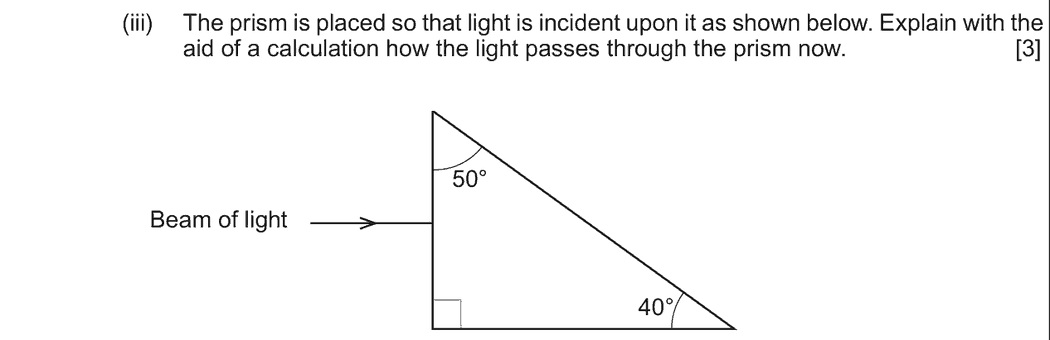
June 2016 · AS Component 2 · Q6(b)(iii)3 marksAO3=3Explanation
Earlier parts of question 6 that this part uses
Mark scheme
Examiner's comment
Candidates calculated the critical angle well. Many candidates did not mention what happened after the hypotenuse, and omitted to continue the ray until it left the bottom face.
Notes from the mark scheme and report
Critical angle = sin⁻¹(1/1.52) = 41° (1)
angle of incidence at the hypotenuse is now 50°, greater than the critical angle, so total internal reflection (1)
the ray then leaves (refracted) through the bottom face (1)
the last step was often missing
Scheme columns: Maths 1
Skills: Trigonometryand vectors Resolving, components, vector addition, angles; Mathsmarks The mark scheme's Maths column gives this part at least one mark for mathematical skills
Work with an Eduqas physics tutor
Dropping marks on calculations, specified practicals or the six-mark QER questions? Book a trial session with a specialist Eduqas physics tutor.