2.2-b the idea that potential difference is measured in volts (V) where V = J C⁻¹
2.2-c the characteristics of I – V graphs for the filament of a lamp, and a metal wire at constant temperature
2.2-d Ohm's law, the equation V = IR and the definition of resistance
2.2-e resistance being measured in ohms (Ω), where Ω = V A⁻¹
2.2-f the application of P = IV = I²R = V²/R
2.2-g collisions between free electrons and ions gives rise to electrical resistance, and electrical resistance increases with temperature
2.2-h the application of R = ρl/A, the equation for resistivity
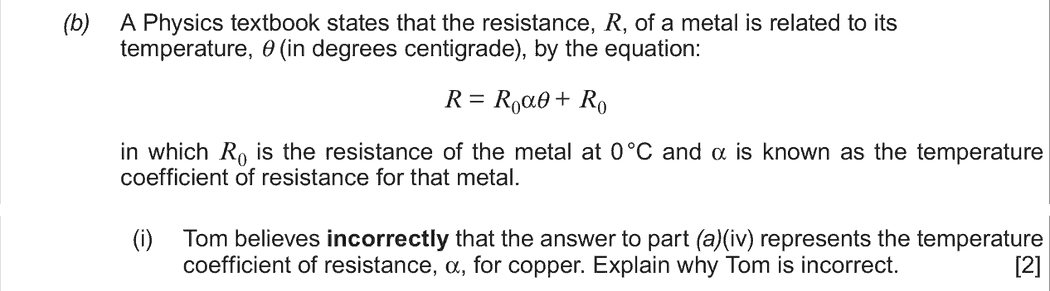
2.2-i the idea that the resistance of metals varies almost linearly with temperature over a wide range
2.2-j the idea that ordinarily, collisions between free electrons and ions in metals increase the random vibration energy of the ions, so the temperature of the metal increases
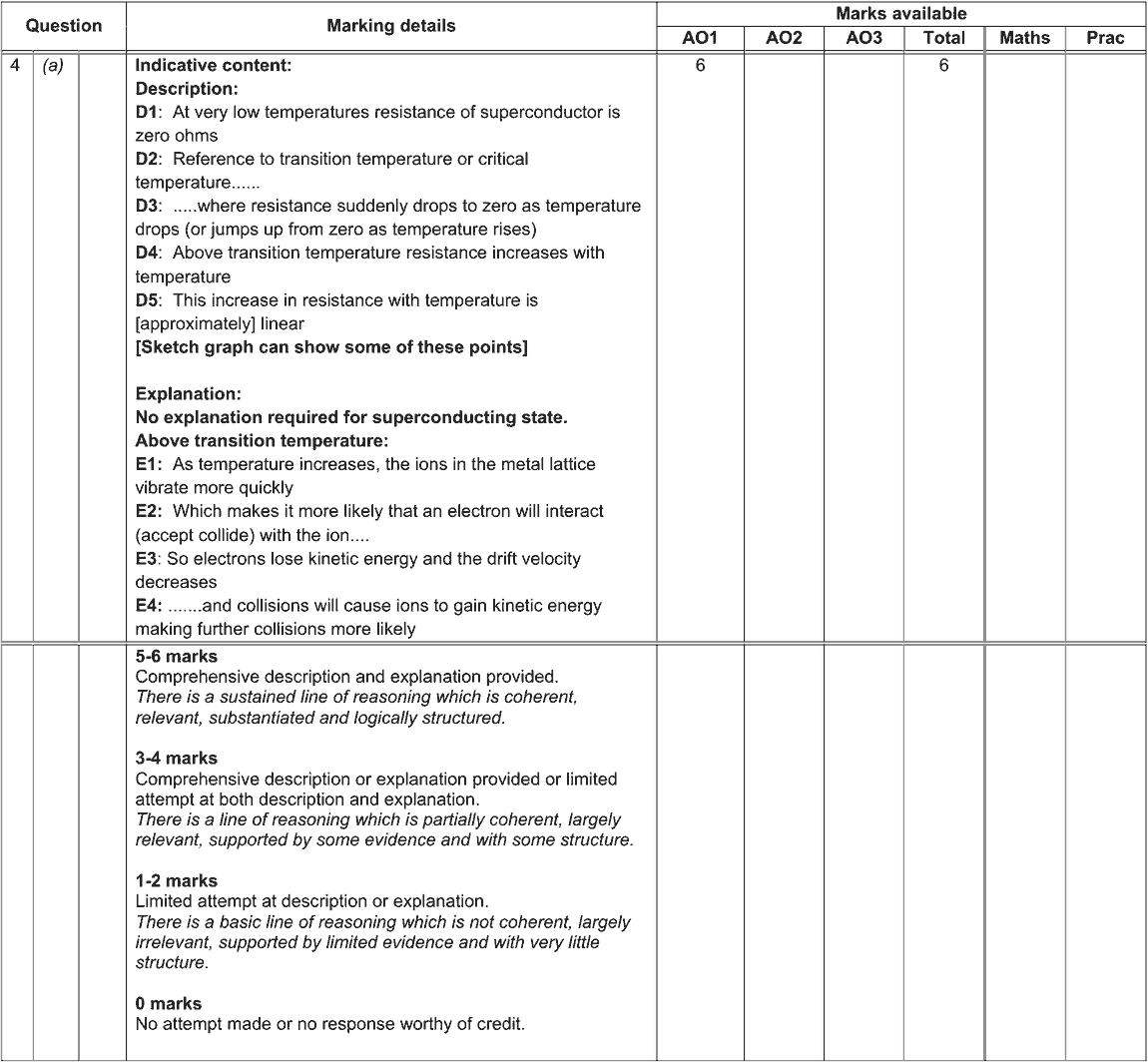
2.2-k what is meant by superconductivity, and superconducting transition temperature
2.2-l the fact that most metals show superconductivity, and have transition temperatures a few degrees above absolute zero (–273 °C)
2.2-m certain materials (high temperature superconductors) having transition temperatures above the boiling point of nitrogen (–196 °C)
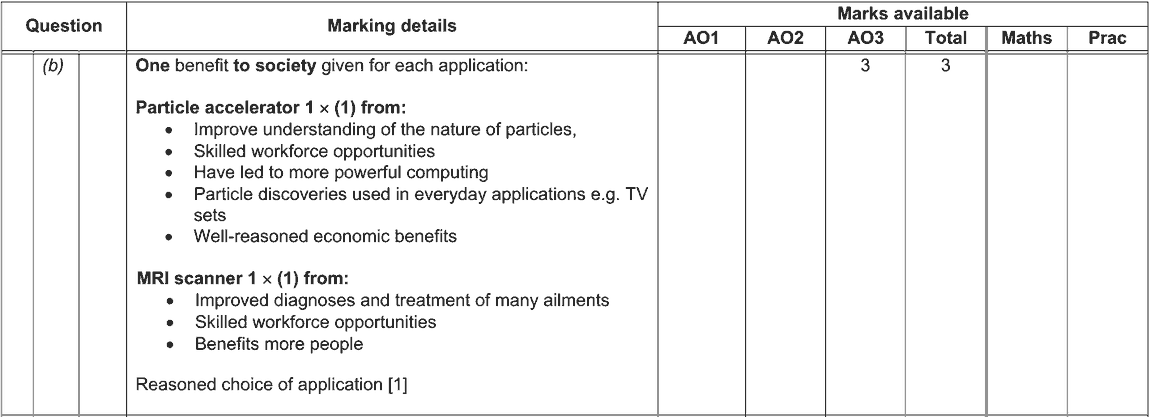
2.2-n some uses of superconductors for example, MRI scanners and particle accelerators
2.2-P1 Specified practical: Investigation of the I-V characteristics of the filament of a lamp and a metal wire at constant temperature
2.2-P2 Specified practical: Determination of resistivity of a metal
2.2-P3 Specified practical: Investigation of the variation of resistance with temperature for a metal wire
. (a) Ada investigates the variation of resistance with temperature over the range 0 ºC to 100 ºC for a copper wire. Describe the apparatus and how Ada would use it to obtain accurate results in the investigation. Also,
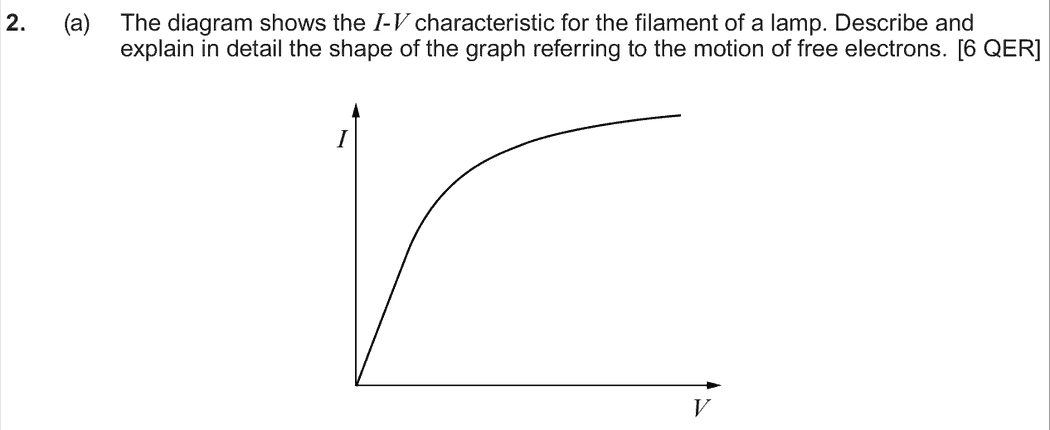
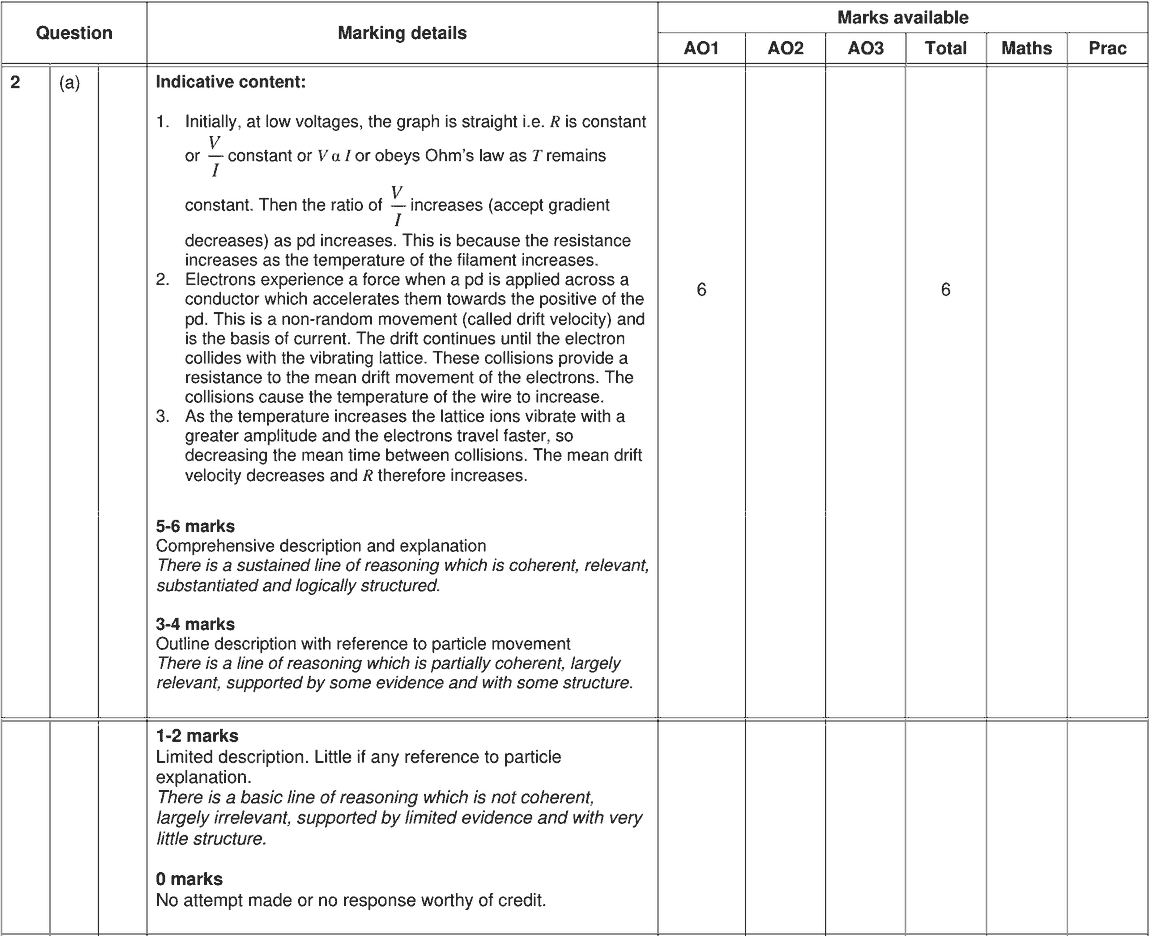
. (a) The diagram shows the I-V characteristic for the filament of a lamp. Describe and explain in detail the shape of the graph referring to the motion of free electrons. [6 QER] I V
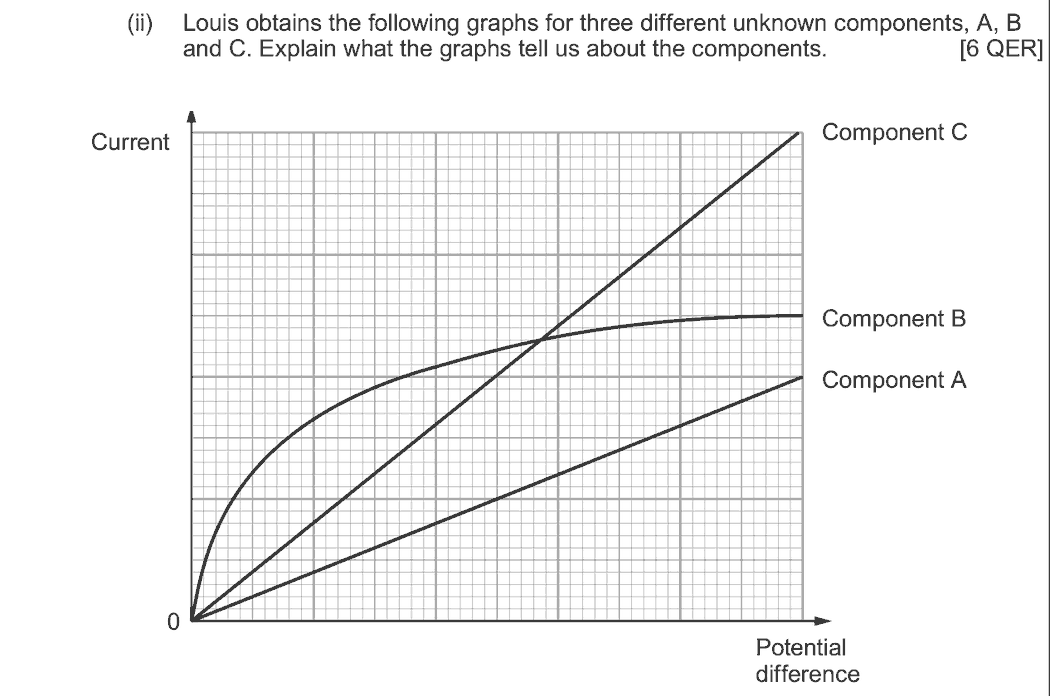
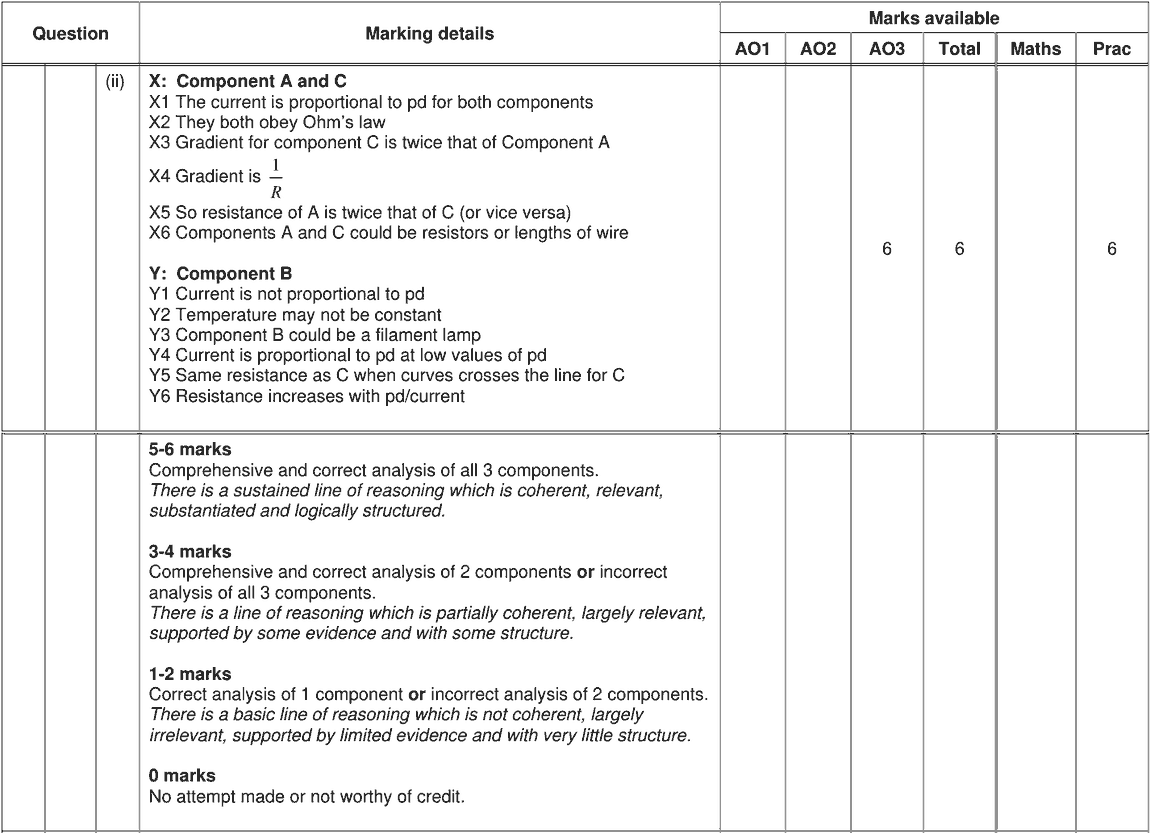
Louis obtains the following graphs for three different unknown components, A, B and C. Explain what the graphs tell us about the components. [6 QER] Component C Current Component B Component A 0 Potential difference
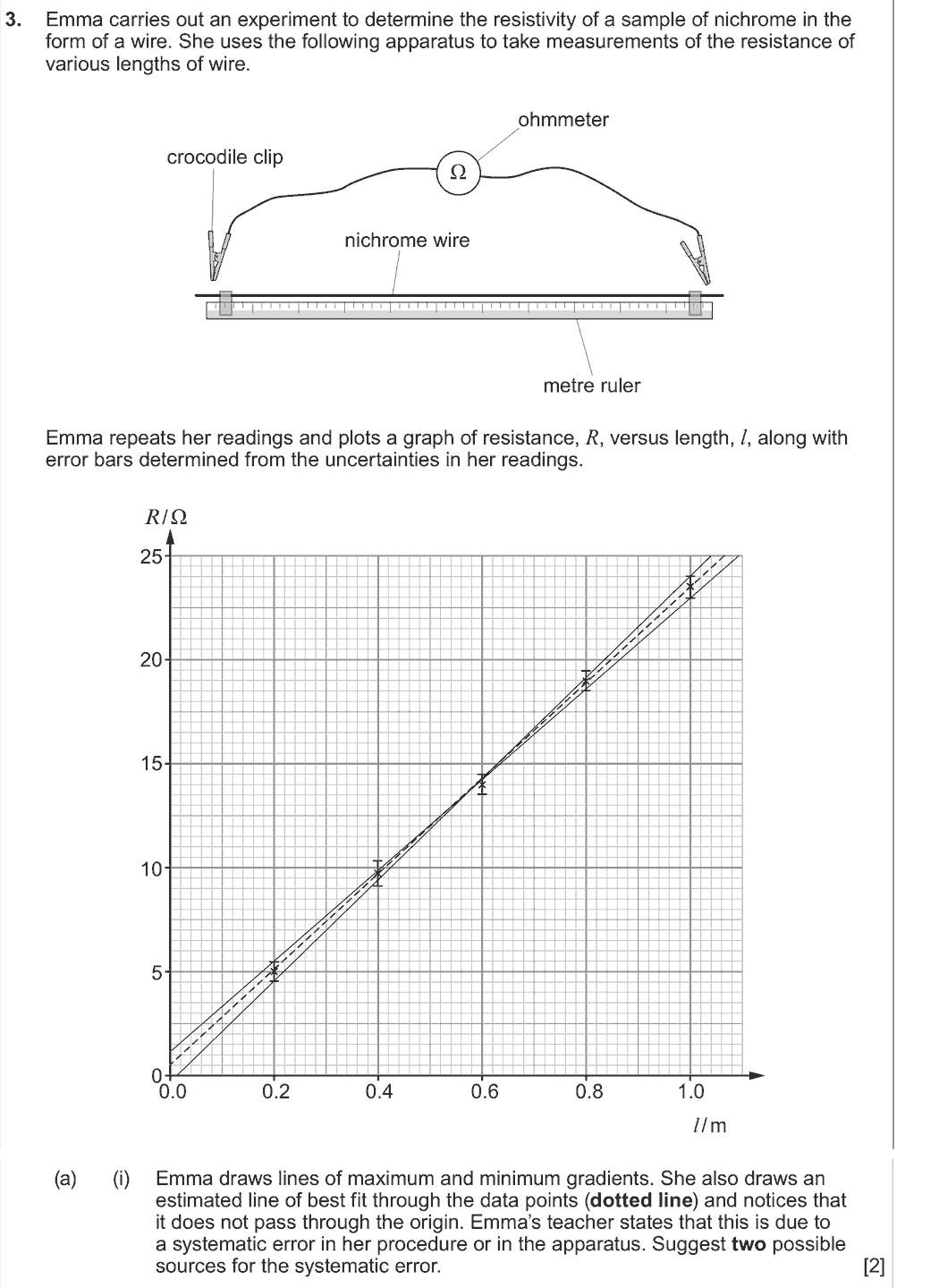
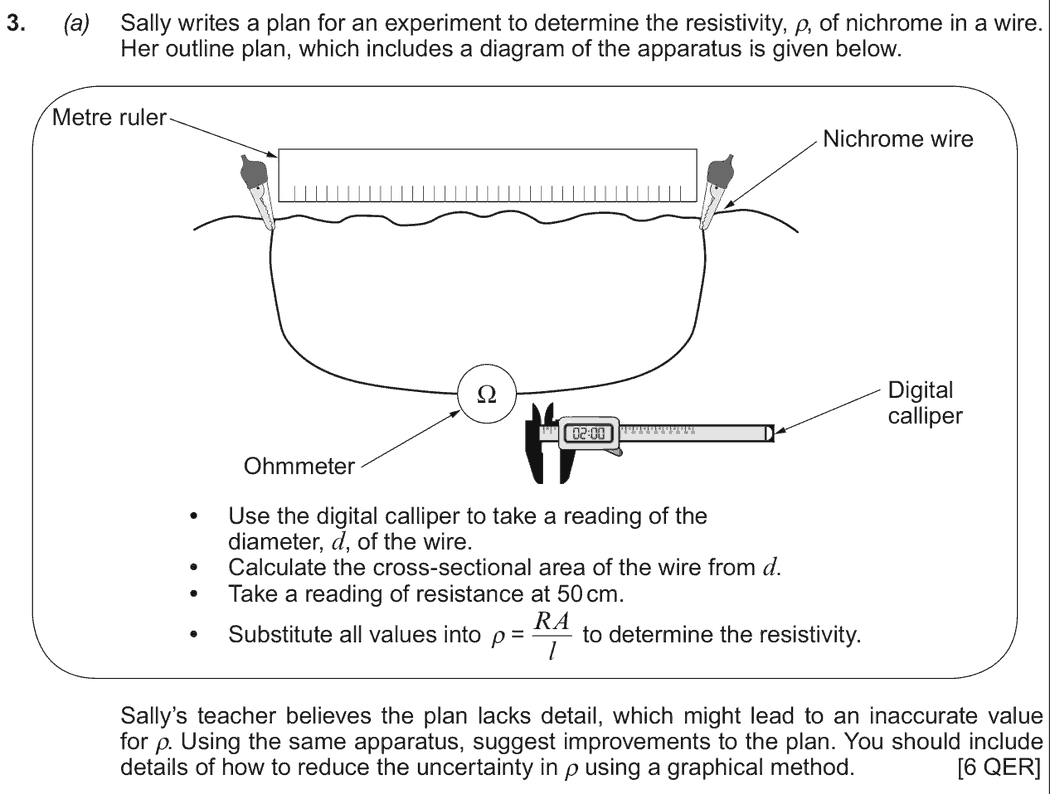
. (a) Sally writes a plan for an experiment to determine the resistivity, ρ, of nichrome in a wire. Her outline plan, which includes a diagram of the apparatus is given below. Metre ruler Nichrome wire Ω Digital calliper
. (a) Describe how the resistance of a metal varies between 0 K and 1 000 K. [Assume that the metal is superconducting below a certain temperature.] Account for this variation in resistance at higher temperatures. [6 QER
Tap a question to zoom it. Where a part needs a figure, table or graph from earlier in the question, that part folds out above it; the mark scheme and examiner's comment open underneath. Have the Eduqas Data Booklet beside you (see the Data Booklet page).
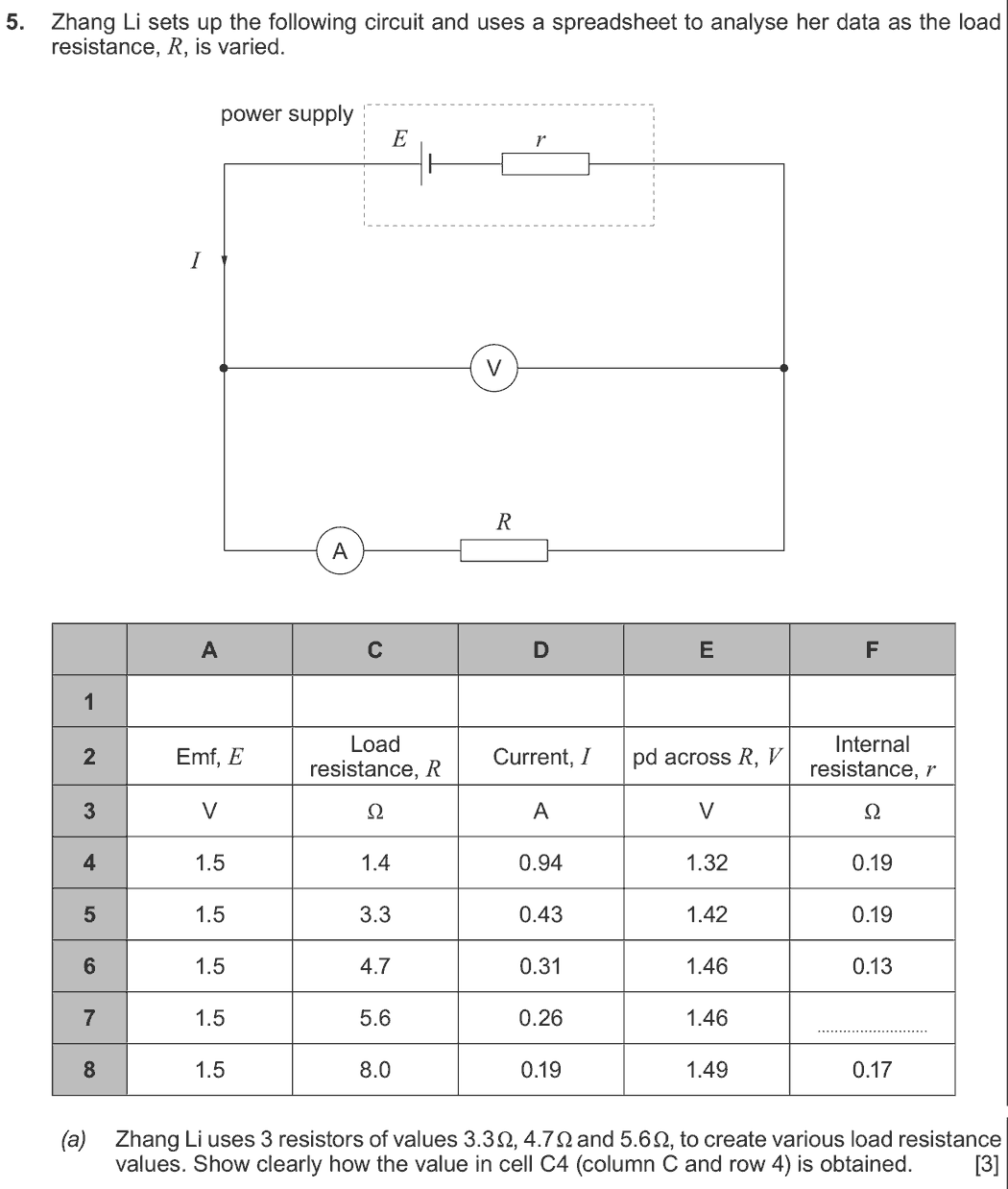
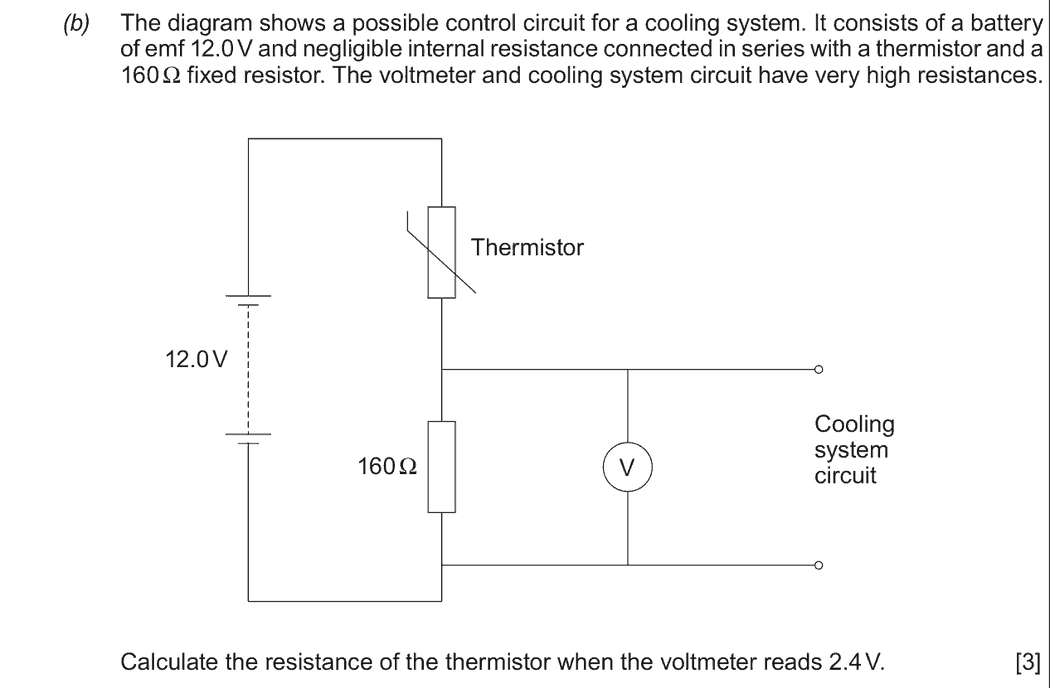
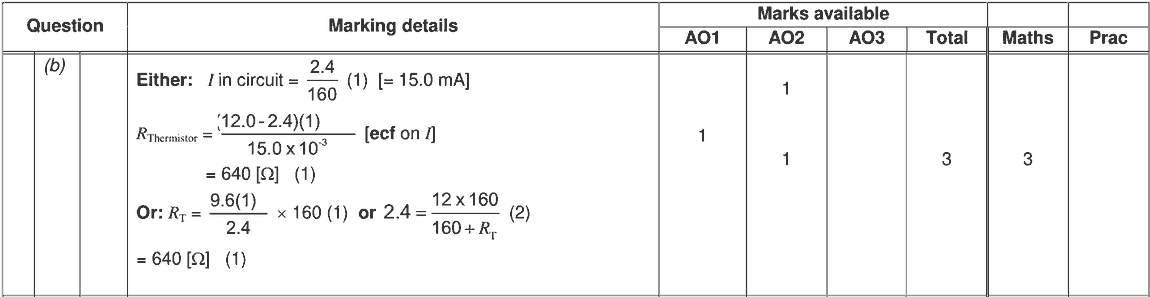
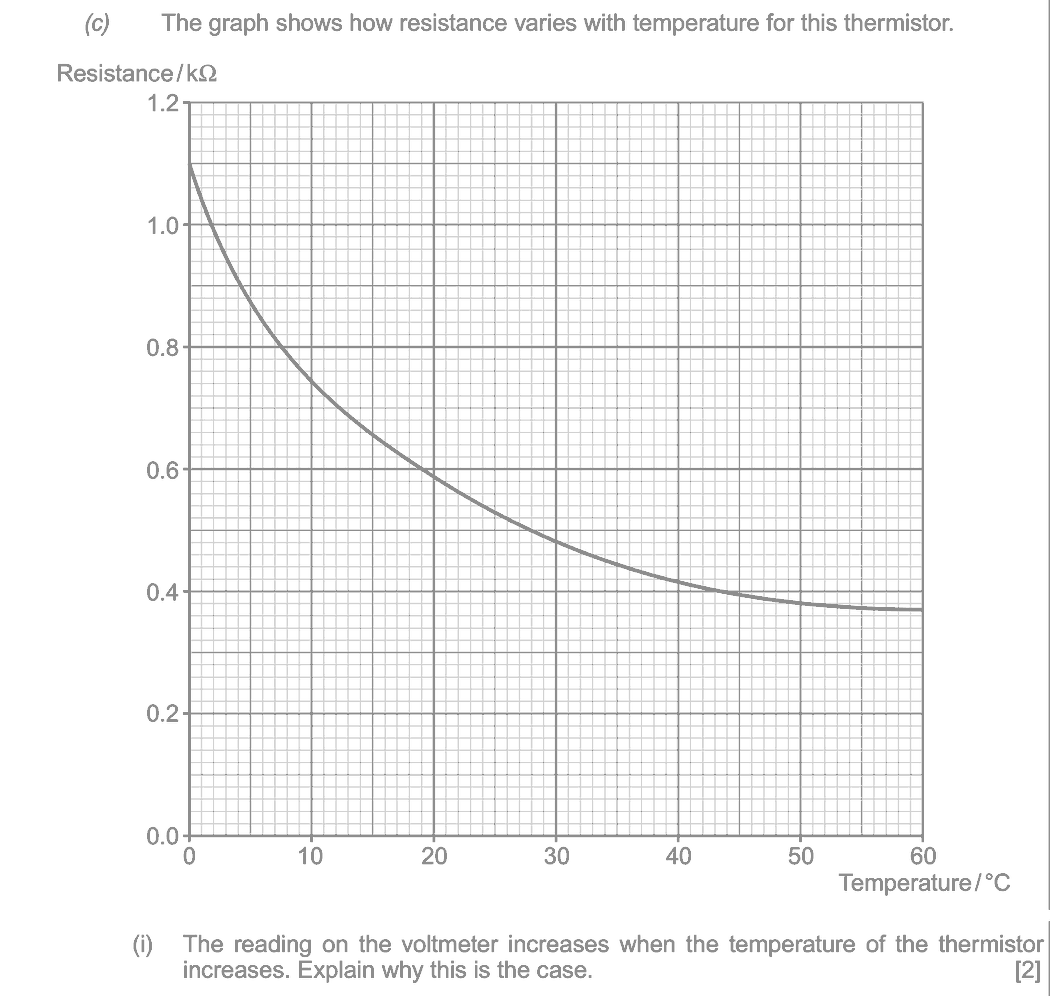
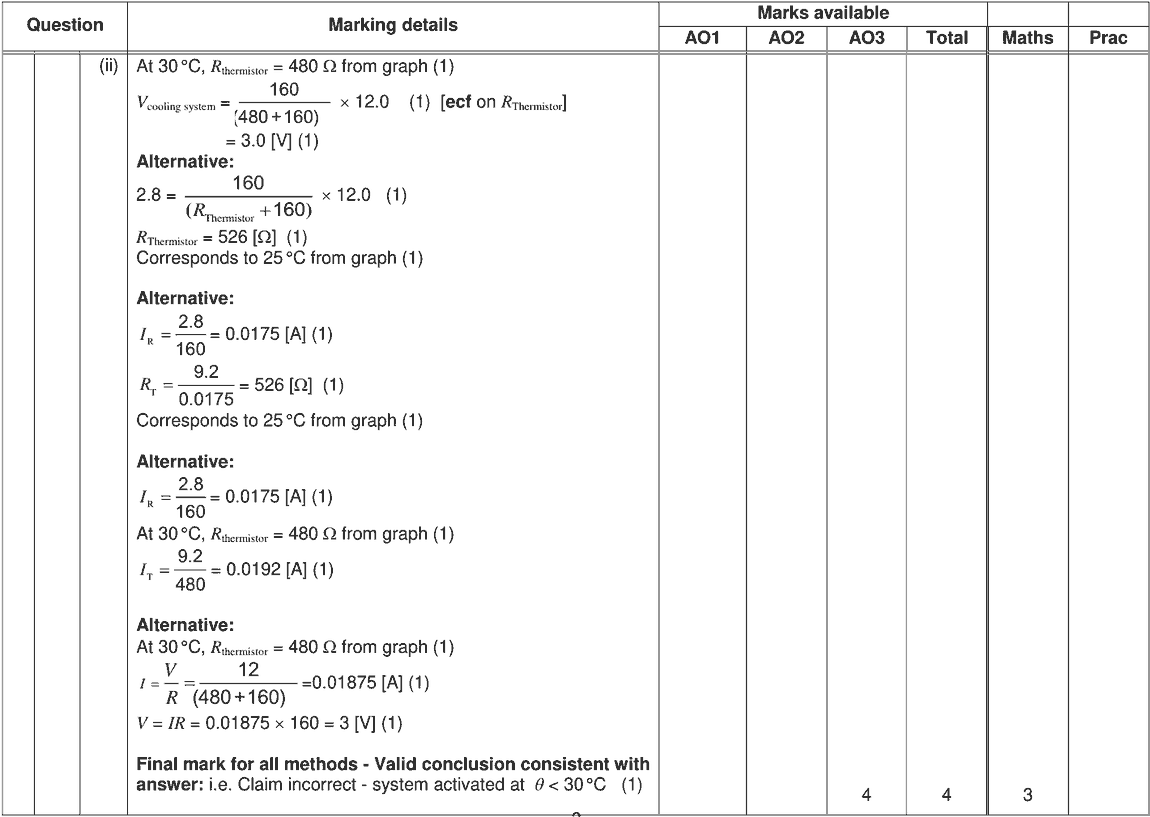
June 2025 · Component 2 · Q1(b)(i)3 marksAO1=1, AO2=2Calculation
Earlier part of question 1 that this part uses
Mark scheme
Examiner's comment
and (ii) Candidates demonstrated a solid understanding of emf and potential difference, with nearly all giving the correct units as either volts (V) or joules per coulomb (J C-1). In a few instances, candidates did not clearly specify which value referred to emf and which to potential difference, resulting in the loss of one mark. In part (ii), nearly all candidates successfully calculated the battery’s internal resistance.
Notes from the mark scheme and report
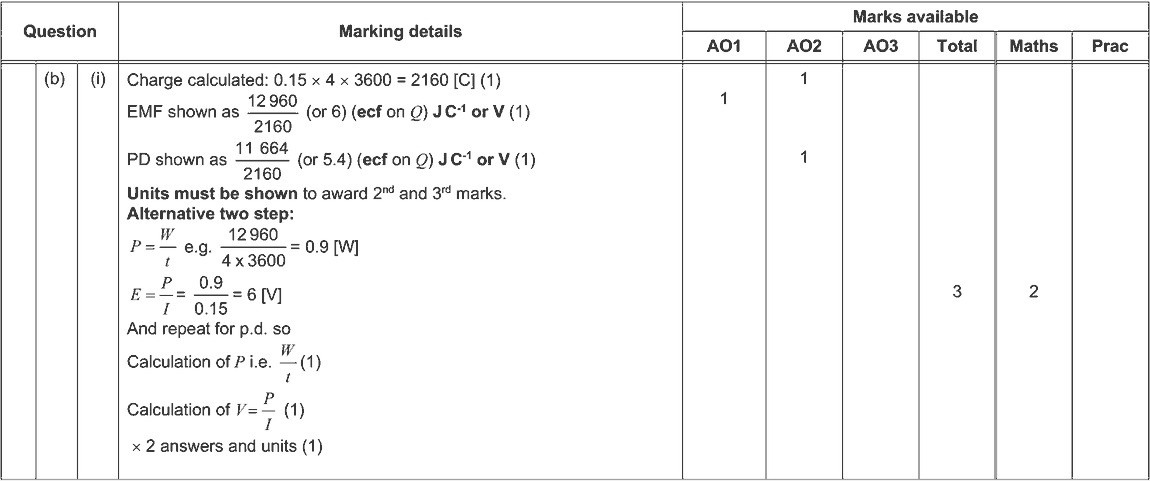
Answer: emf 6.0 V, pd 5.4 V. Q = It = 0.15 × 4 × 3600 = 2160 C
emf = 12 960/2160
pd = 11 664/2160
units (V or J C⁻¹) needed for the second and third marks
or P = W/t then V = P/I
label which value is which
Scheme columns: Maths 2
Skills: Unitsand conversions Unit marks, base units, prefixes and conversions; Mathsmarks The mark scheme's Maths column gives this part at least one mark for mathematical skills
June 2025 · Component 2 · Q2(a)1 markAO1=1Diagram or graph
Mark scheme
Examiner's comment
A surprising number of candidates failed to include either the voltmeter, the ammeter, or both in their circuit diagrams.
Notes from the mark scheme and report
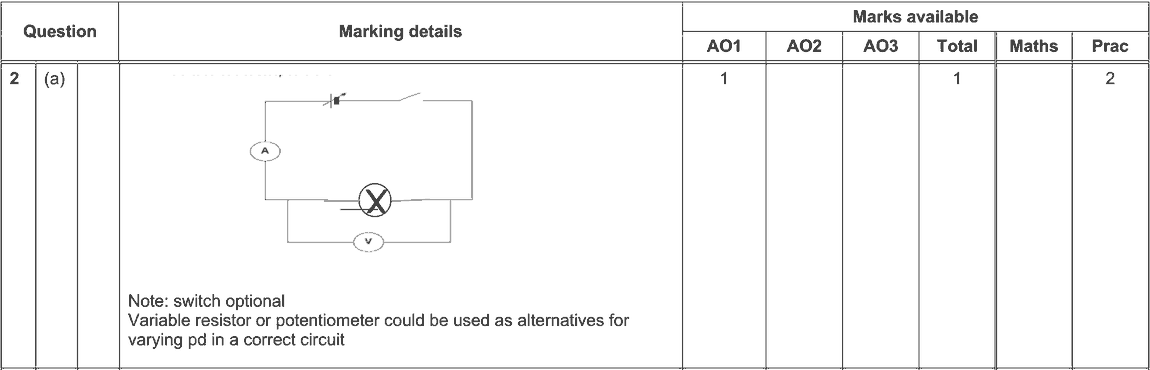
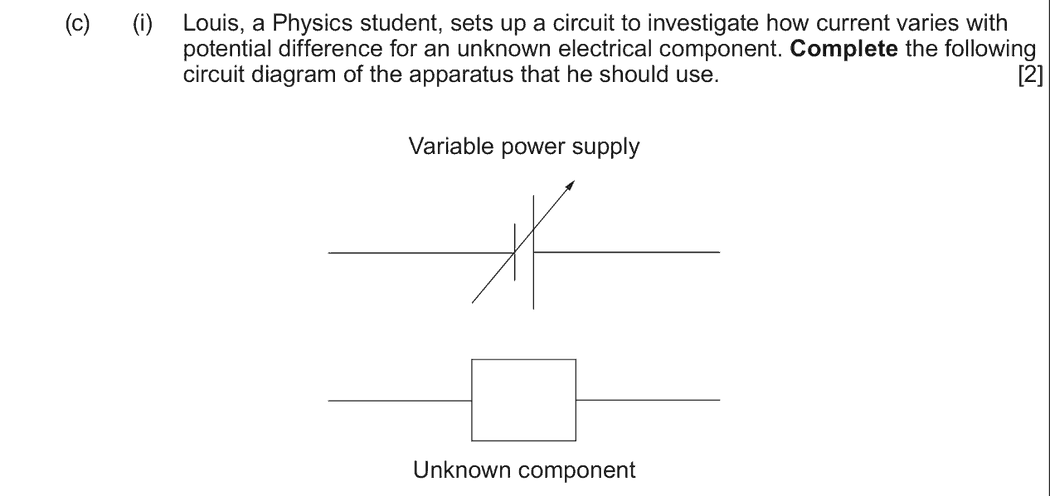
Supply with a variable resistor (or potentiometer, or variable supply), ammeter in series with the lamp and voltmeter in parallel across the lamp
many left out one or both meters
Scheme columns: Practical 2
Skills: Experimentalmethod Describing, planning or improving an experiment; Practicalmarks The mark scheme's Prac column gives this part at least one mark for practical skills
June 2025 · Component 2 · Q2(b)1 markAO2=1Short answer
Earlier part of question 2 that this part uses
Mark scheme
Examiner's comment
Nearly all candidates successfully took logarithms of the given equation and correctly expressed it in the form y = mx+c.
Notes from the mark scheme and report
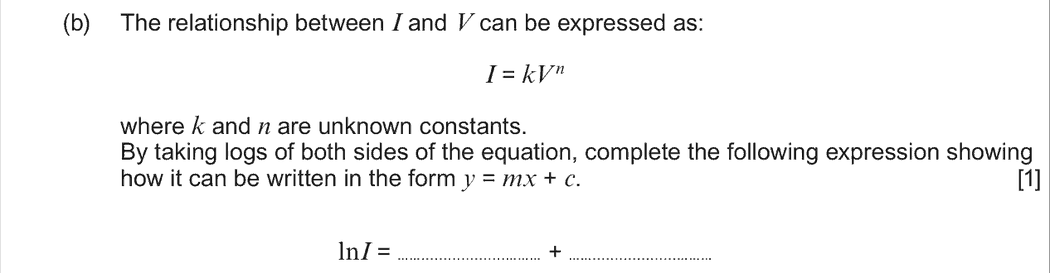
ln I = n ln V + ln k
Scheme columns: Maths 1, Practical 1
Skills: Algebra Derivations and rearranging equations; Graphskills Reading, plotting or sketching graphs; gradients, intercepts and areas; Mathsmarks The mark scheme's Maths column gives this part at least one mark for mathematical skills; Practicalmarks The mark scheme's Prac column gives this part at least one mark for practical skills
June 2025 · Component 2 · Q2(c)(i)6 marksAO3=6Practical and data analysis
Earlier part of question 2 that this part uses
Mark scheme
Examiner's comment
Lines of best fit intersecting the second and third plotted points were accepted. When determining the gradient, candidates were expected to use points that were widely spaced or, if using a triangle, to ensure it occupied at least half of the graph grid—considered good experimental practice. While most candidates followed this guidance, a significant minority did not. Almost all candidates obtained the y- intercept successfully. However, a few failed to retain the negative sign of the intercept value, incorrectly converting it to a positive value. This error led to incorrect results when taking the antilogarithm. Nevertheless, nearly all candidates correctly used their calculated gradient and intercept to write the final equation, sometimes as ecf.
Notes from the mark scheme and report
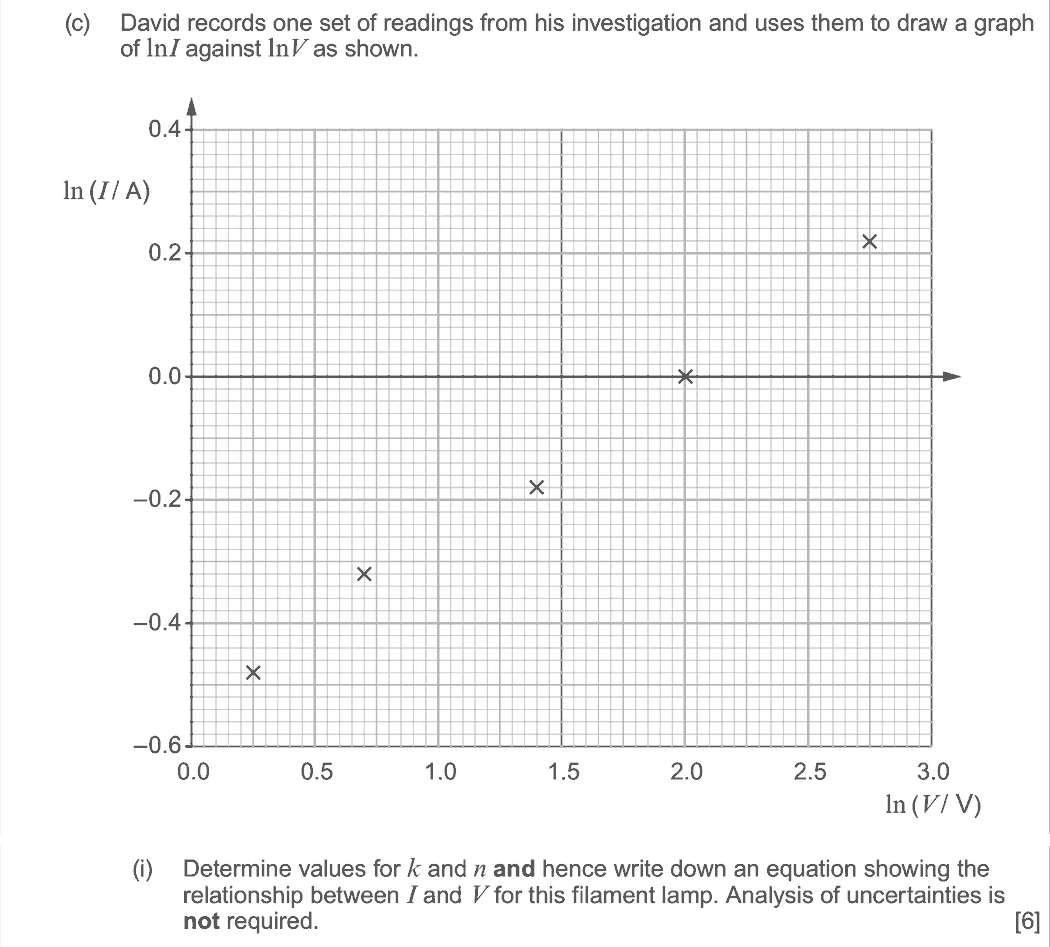
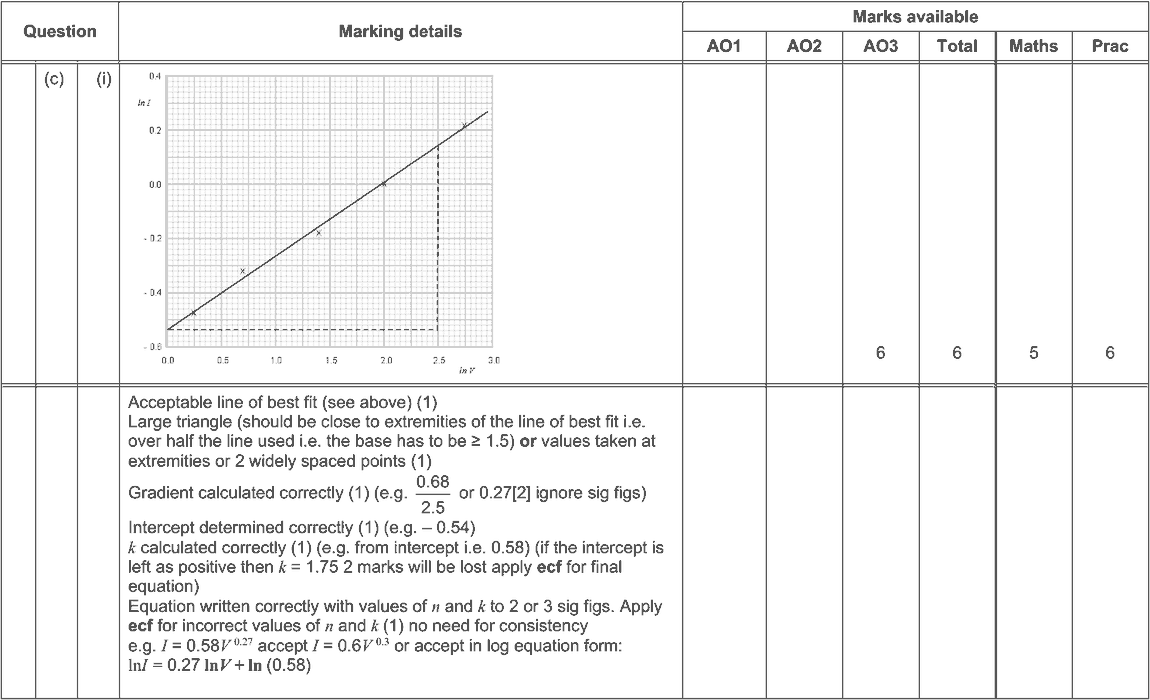
Answer: I = 0.58 V^0.27 (0.6 V^0.3 accepted). Best-fit line (1)
large triangle, base at least 1.5, or widely spaced points (1)
gradient n = 0.68/2.5 = 0.27 (1)
intercept ln k = −0.54 (1)
k = e^(−0.54) = 0.58 (1)
equation with n and k to 2 or 3 sf (1)
dropping the minus sign of the intercept (k = 1.75) loses 2 marks
small triangles were a common fault
Scheme columns: Maths 5, Practical 6
Skills: Graphskills Reading, plotting or sketching graphs; gradients, intercepts and areas; Algebra Derivations and rearranging equations; Mathsmarks The mark scheme's Maths column gives this part at least one mark for mathematical skills; Practicalmarks The mark scheme's Prac column gives this part at least one mark for practical skills
June 2025 · Component 2 · Q2(c)(ii)2 marksAO3=2Practical and data analysis
Earlier parts of question 2 that this part uses
Mark scheme
Examiner's comment
Most candidates earned at least one mark, typically by noting that the data points were widely scattered or not closely aligned with the line of best fit. Fewer candidates gained the second mark, which required a valid approach to increase confidence in the results. Many simply suggested repeating the experiment, which was not accepted. Acceptable responses included taking a greater range of readings, averaging multiple results, or adding error bars to indicate uncertainty (and which implied taking means and multiple readings).
Notes from the mark scheme and report
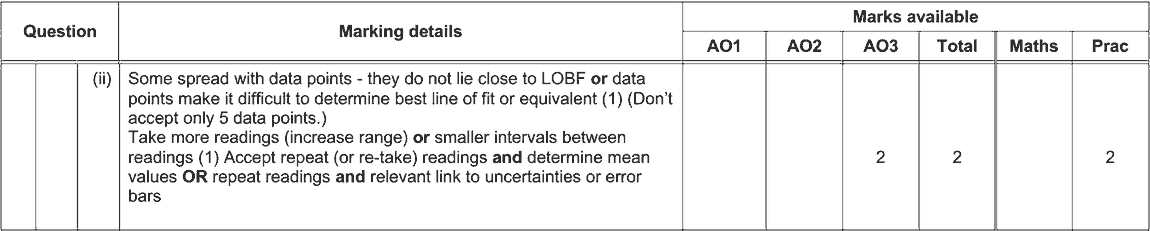
The points are scattered and do not lie close to the best-fit line, so the line is hard to place (1) ('only 5 points' not accepted)
take more readings over a wider range or at smaller intervals, or repeat readings and use means (with error bars) (1)
'repeat the experiment' alone not accepted
Scheme columns: Practical 2
Skills: Uncertainties Resolution, absolute and percentage uncertainty, combining uncertainties, error bars; Graphskills Reading, plotting or sketching graphs; gradients, intercepts and areas; Practicalmarks The mark scheme's Prac column gives this part at least one mark for practical skills
June 2025 · Component 2 · Q3(a)3 marksAO1=2, AO2=1Show that
Mark scheme
Examiner's comment
Nearly all candidates correctly explained how the ohm (Ω) could be expressed in base units as V A⁻¹. Many also gave good explanations of how Ω could alternatively be expressed as J s C⁻², often deriving this through the relationship between volts and amps. A significant number of candidates opted to derive this via a power-based approach, which, though slightly more complex, was valid and generally well executed.
Notes from the mark scheme and report
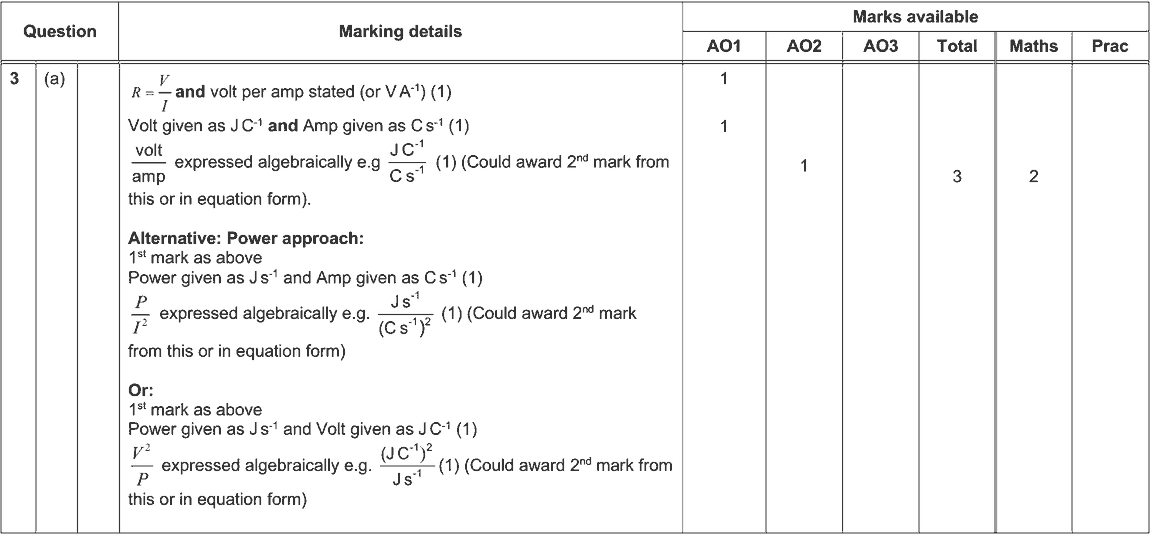
R = V/I so Ω = V A⁻¹ (1)
V = J C⁻¹ and A = C s⁻¹ (1)
so Ω = J C⁻¹/C s⁻¹ = J s C⁻² (1)
power routes (P/I² or V²/P with W = J s⁻¹) also accepted
Scheme columns: Maths 2
Skills: Unitsand conversions Unit marks, base units, prefixes and conversions; Mathsmarks The mark scheme's Maths column gives this part at least one mark for mathematical skills
June 2025 · AS Component 2 · Q3(a)6 marksAO1=66-mark extended response
Mark scheme, with the levels and indicative content
Notes from the mark scheme and report
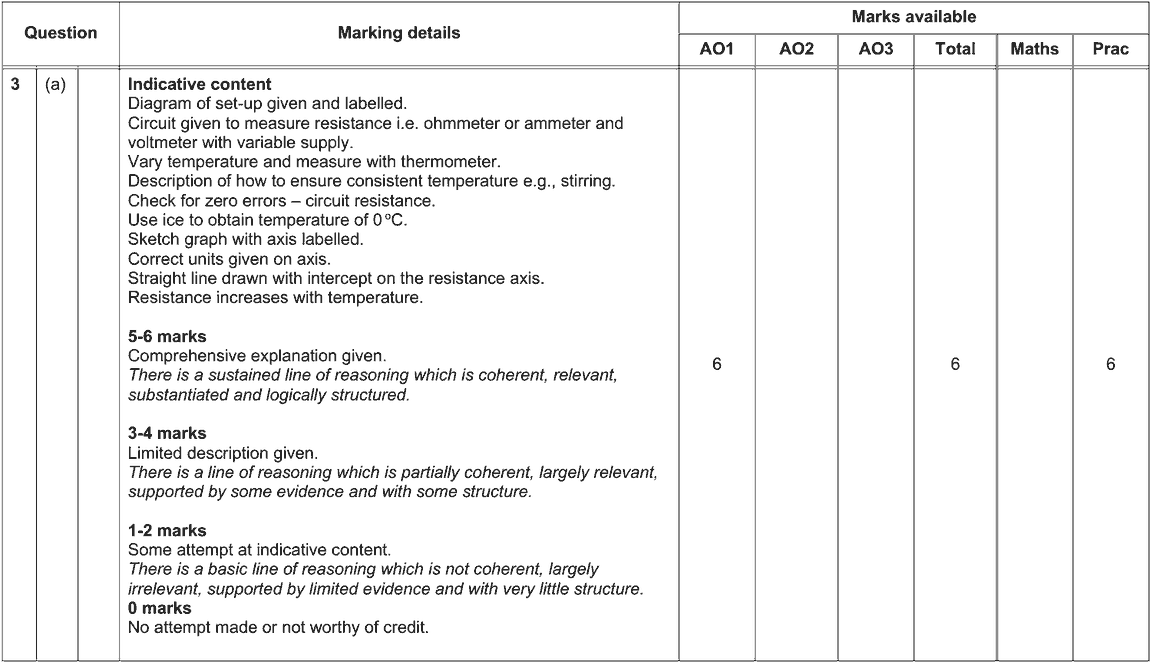
QER, levels marked. Apparatus: labelled diagram of the wire (coil) in a water bath with a thermometer, connected to an ohmmeter or to an ammeter, voltmeter and variable supply. Method: start with ice at 0 °C, heat and stir for an even temperature, record R at intervals up to 100 °C, allow for zero error (lead resistance), keep the current small. Relationship: resistance increases linearly with temperature
sketch graph of R against θ with labelled axes and units, a straight line with a positive intercept on the R axis
Scheme columns: Practical 6
Skills: Experimentalmethod Describing, planning or improving an experiment; Graphskills Reading, plotting or sketching graphs; gradients, intercepts and areas; Practicalmarks The mark scheme's Prac column gives this part at least one mark for practical skills; QER The 6-mark quality of extended response question
June 2025 · Component 2 · Q3(c)3 marksAO3=3Calculation
Earlier parts of question 3 that this part uses
Mark scheme
Examiner's comment
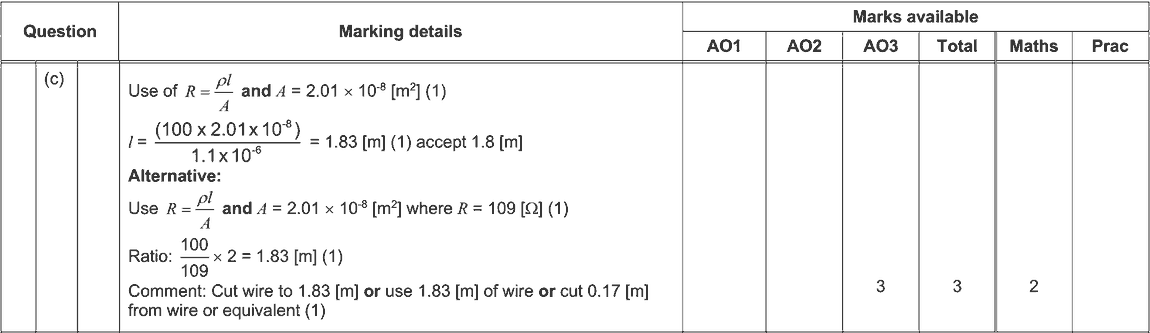
Most responses involved determining the new required length of nichrome wire using the resistivity formula. In some cases, candidates first calculated the resistance of 2 m of wire (109 Ω), then used this in ratio with the target resistance (100 Ω) to calculate the required length, i.e. 100 109 2
Notes from the mark scheme and report
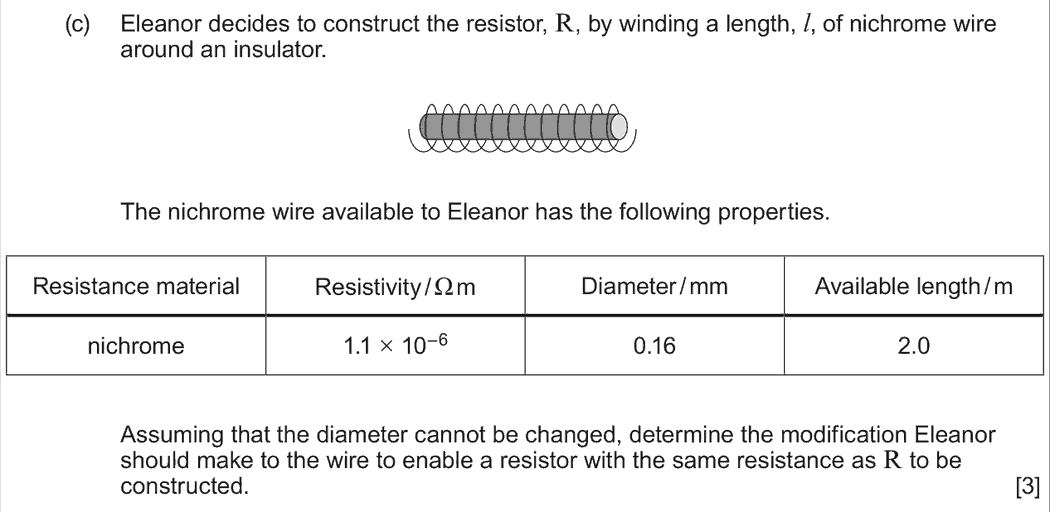
Answer: cut the wire to 1.83 m (remove 0.17 m). A = π(0.08 × 10⁻³)² = 2.01 × 10⁻⁸ m²
l = RA/ρ = 100 × 2.01 × 10⁻⁸/1.1 × 10⁻⁶
or the 2.0 m has 109 Ω, so use 100/109 of it
a statement of the modification is needed for the third mark
Scheme columns: Maths 2
Skills: Unitsand conversions Unit marks, base units, prefixes and conversions; Mathsmarks The mark scheme's Maths column gives this part at least one mark for mathematical skills
June 2025 · AS Component 2 · Q3(c)(i)1 markAO1=1Definition
Earlier part of question 3 that this part uses
Mark scheme
Notes from the mark scheme and report
The electrical resistance falls to zero (below the transition temperature)
June 2025 · AS Component 2 · Q3(c)(ii)3 marksAO1=1, AO2=2Short answer
Earlier parts of question 3 that this part uses
Mark scheme
Notes from the mark scheme and report
Application, e.g. MRI scanner magnets, particle accelerators, maglev trains (1)
advantage: no energy dissipated as heat, so very large currents and strong magnetic fields (1)
disadvantage: must be kept at a very low temperature (1)
'expensive' needs a reason
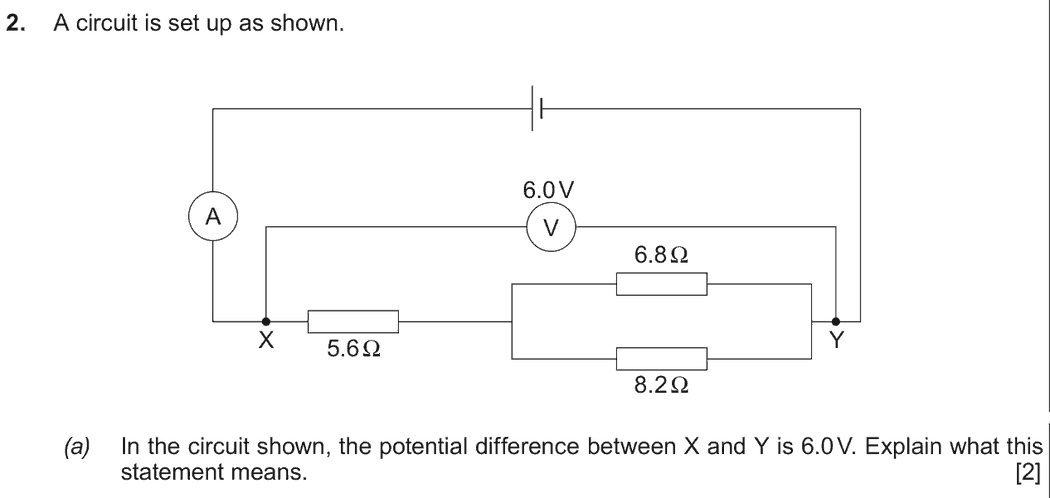
June 2025 · AS Component 2 · Q5(a)2 marksAO1=2Definition
Mark scheme
Notes from the mark scheme and report
1.6 J of electrical energy is transferred to other forms (1) for each coulomb of charge passing between the two points (1)
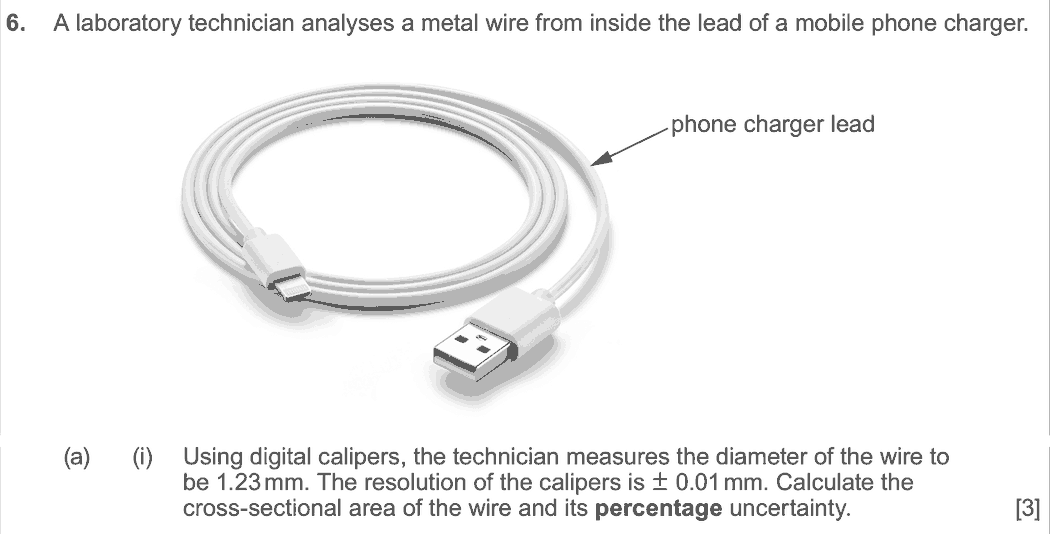
June 2025 · AS Component 2 · Q6(a)(i)3 marksAO1=1, AO2=2Practical and data analysis
Mark scheme
Notes from the mark scheme and report
Answer: 1.19 × 10⁻⁶ m² ± 2% (unit needed). A = πd²/4 with d = 1.23 × 10⁻³ m
percentage uncertainty = 2 × (0.01/1.23) × 100 = 1.6%, quoted as 2% (no more than 2 sf)
Scheme columns: Maths 3, Practical 3
Skills: Uncertainties Resolution, absolute and percentage uncertainty, combining uncertainties, error bars; Unitsand conversions Unit marks, base units, prefixes and conversions; Mathsmarks The mark scheme's Maths column gives this part at least one mark for mathematical skills; Practicalmarks The mark scheme's Prac column gives this part at least one mark for practical skills
June 2025 · AS Component 2 · Q6(a)(ii)6 marksAO3=6Practical and data analysis
Earlier part of question 6 that this part uses
Mark scheme
Notes from the mark scheme and report
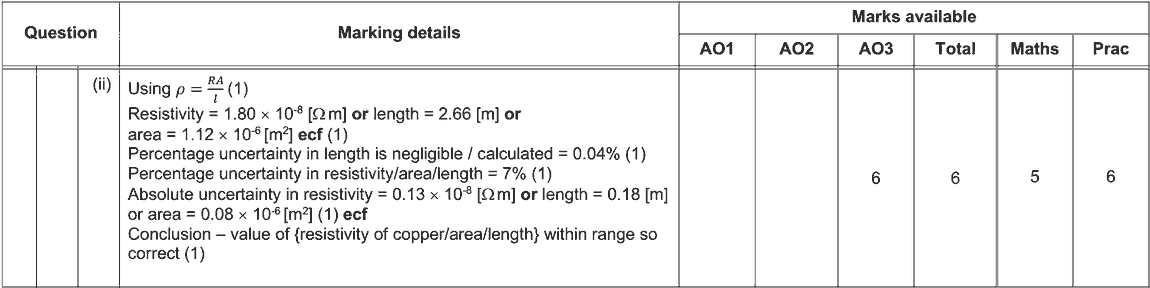
Answer: ρ = (1.80 ± 0.13) × 10⁻⁸ Ω m, so copper (1.7 × 10⁻⁸ Ω m) lies within the range and the technician is correct. ρ = RA/l (1)
value (1)
length uncertainty 0.04%, negligible (1)
total = 5% + 2% = 7% (1)
absolute uncertainty (1)
conclusion (1)
equivalent comparisons of the predicted length or area are accepted
ecf
Scheme columns: Maths 5, Practical 6
Skills: Uncertainties Resolution, absolute and percentage uncertainty, combining uncertainties, error bars; Mathsmarks The mark scheme's Maths column gives this part at least one mark for mathematical skills; Practicalmarks The mark scheme's Prac column gives this part at least one mark for practical skills
June 2025 · AS Component 2 · Q6(b)2 marksAO3=2Short answer
Earlier part of question 6 that this part uses
Mark scheme
Notes from the mark scheme and report
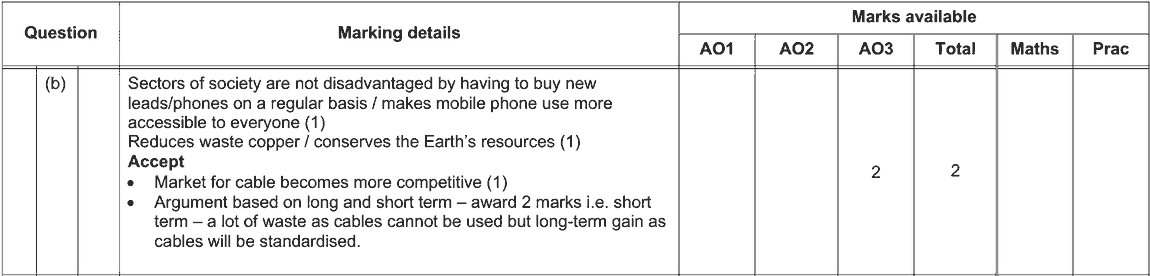
Any two: people no longer have to buy new leads or chargers regularly, so phones are more affordable and accessible
less waste copper and plastic, conserving resources
more competition in the cable market
a short-term rise in waste as old cables are discarded, with a long-term gain
June 2024 · Component 2 · Q1(a)2 marksAO1=2Definition
Mark scheme
Examiner's comment
Most candidates were able to state Ohm’s law correctly. A few omitted references to ‘constant temperature’ and lost a mark consequently. Stating V = IR gained one mark only.
Notes from the mark scheme and report
For a metal conductor at constant temperature (1) the current is directly proportional to the pd across it (1)
V = IR alone scores 1
constant temperature was sometimes left out
June 2024 · Component 2 · Q1(b)(i)2 marksAO3=2Explanation
Earlier part of question 1 that this part uses
Mark scheme
Examiner's comment
Candidates were expected to comment on both the straight line and curved parts of the graph. Many candidates did not explicitly state that the line went through the origin initially and lost one mark consequently.
Notes from the mark scheme and report
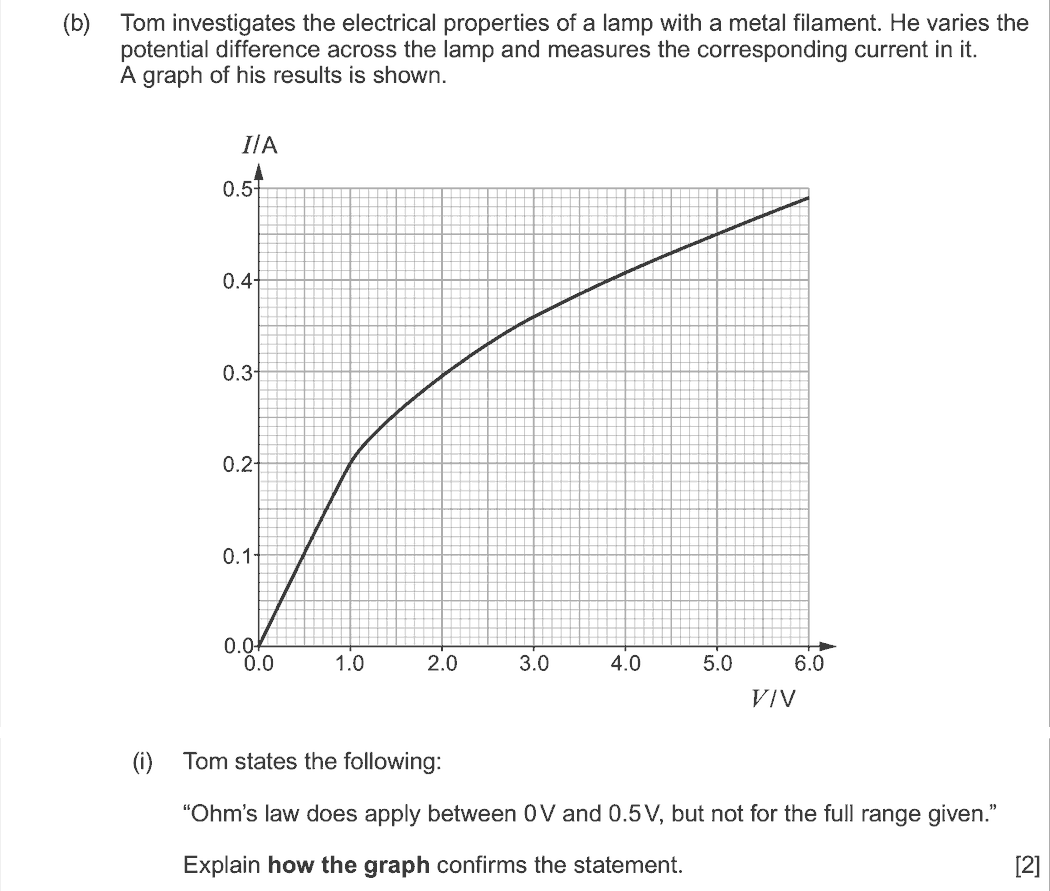
From 0 to 0.5 V the graph is a straight line through the origin, so I is proportional to V (or R shown constant from data) (1)
beyond that the line curves and its gradient falls, so I is no longer proportional to V (1)
'through the origin' was often missing
Skills: Graphskills Reading, plotting or sketching graphs; gradients, intercepts and areas
June 2024 · Component 2 · Q1(b)(ii)5 marksAO1=3, AO2=2Explanation
Earlier parts of question 1 that this part uses
Mark scheme
Examiner's comment
Many candidates used appropriate calculations, by taking pairs of readings from the graph, to show the difference in resistance at the different voltages. A minority, however, took tangents at the given voltages, which is an invalid approach and was deducted one mark. Regardless of their approach to the calculation part of the question, many correct responses were seen for the explanation part. In summary, to gain the three marks, candidates were required to: • refer to ‘collisions’ between electrons (or free charges) and atoms (or equivalent) • explain that at higher voltages the collisions became more frequent (or ‘harder’) or equivalent • explain that this would lead to resistance increasing. Referring to ‘electrons colliding with themselves’ or not specifying what electrons collided with were common reasons for candidates losing marks.
Notes from the mark scheme and report
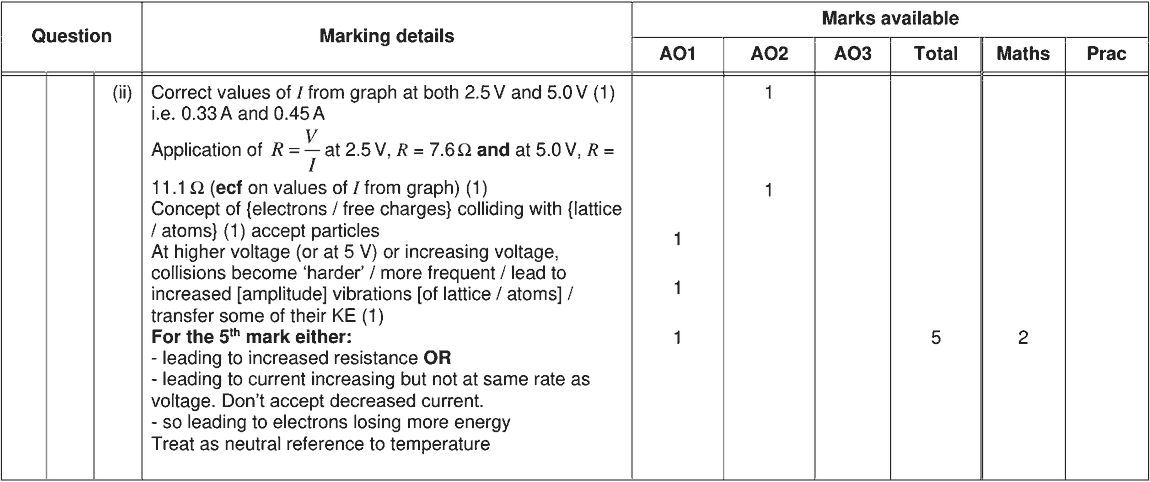
Answer: 7.6 Ω at 2.5 V and 11.1 Ω at 5.0 V (I = 0.33 A and 0.45 A, R = V/I, not a tangent). Free electrons collide with the lattice ions (1)
at higher pd the collisions are more frequent or more energetic and the ions vibrate with larger amplitude (1)
so resistance increases (1)
must say what the electrons collide with
Scheme columns: Maths 2
Skills: Graphskills Reading, plotting or sketching graphs; gradients, intercepts and areas; Mathsmarks The mark scheme's Maths column gives this part at least one mark for mathematical skills
June 2024 · Component 2 · Q1(d)(i)1 markAO1=1Definition
Earlier parts of question 1 that this part uses
Mark scheme
Examiner's comment
In part (i) nearly all candidates explained the term ‘superconductivity’ correctly. A variety of superconductivity graphs were seen in (ii), with a minority of candidates not including a reference temperature on the horizontal axis and losing one mark as a consequence. Reference temperatures could have included 0 K to the left of the critical temperature or 0 °C on a central vertical axis to the right of the critical temperature. Some candidates drew curves and the transition to superconductivity was not clearly vertical or labelled.
Notes from the mark scheme and report
The material has zero (negligible) resistance or resistivity (below its transition temperature)
June 2024 · Component 2 · Q1(d)(ii)3 marksAO1=3Diagram or graph
Earlier parts of question 1 that this part uses
Mark scheme
Examiner's comment
In part (i) nearly all candidates explained the term ‘superconductivity’ correctly. A variety of superconductivity graphs were seen in (ii), with a minority of candidates not including a reference temperature on the horizontal axis and losing one mark as a consequence. Reference temperatures could have included 0 K to the left of the critical temperature or 0 °C on a central vertical axis to the right of the critical temperature. Some candidates drew curves and the transition to superconductivity was not clearly vertical or labelled.
Notes from the mark scheme and report
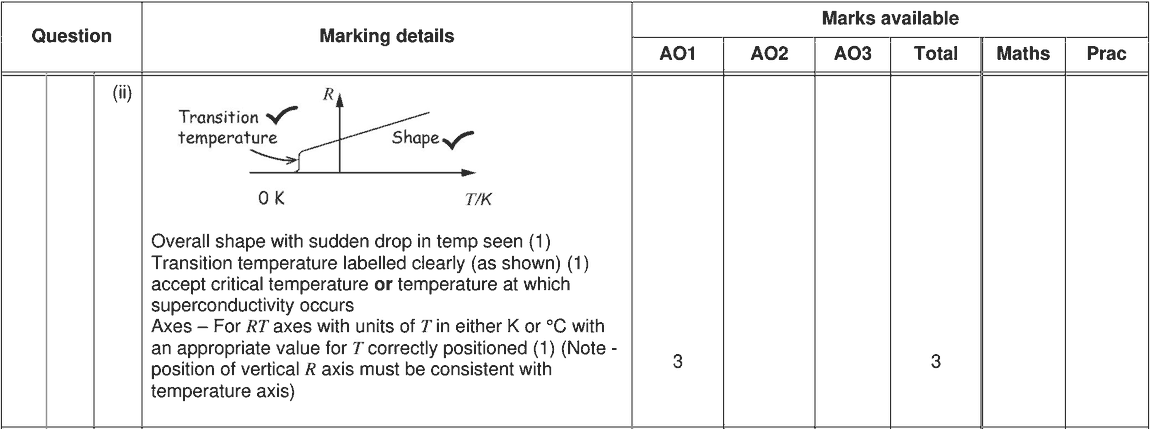
Resistance falling with temperature then dropping vertically to zero (1)
transition (critical) temperature labelled (1)
axes R and T with a reference temperature correctly placed, e.g. 0 K at the origin (1)
the reference value and a clearly vertical drop were the common omissions
Skills: Graphskills Reading, plotting or sketching graphs; gradients, intercepts and areas
June 2024 · Component 2 · Q2(a)1 markAO2=1Show that
Mark scheme
Examiner's comment
Nearly all candidates were able to show that R1 = 12.0 Ω. It was commented by examiners however, that a significant number of candidates were unclear with their explanations, often giving algebraically incorrect expressions in their responses. Whilst, ‘Benefit of Doubt’ (bod) was applied in many cases, it was not always possible to do so when the working seen was clearly incorrect. Candidates should be encouraged to be accurate with algebraic expression.
Notes from the mark scheme and report
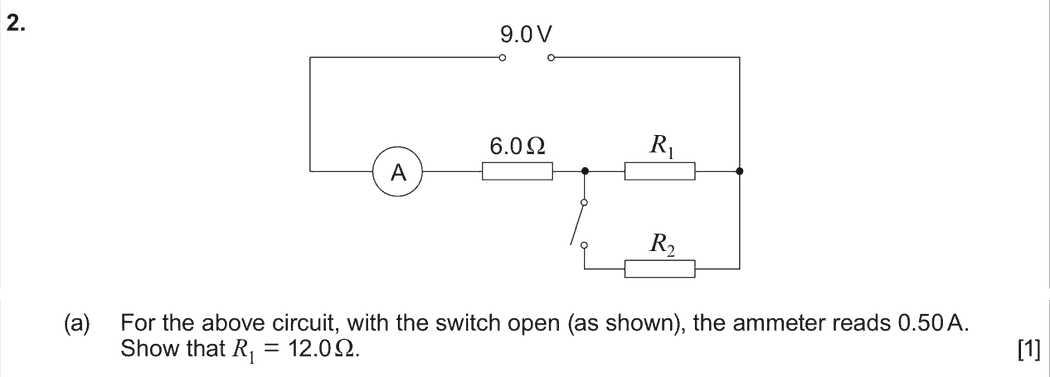
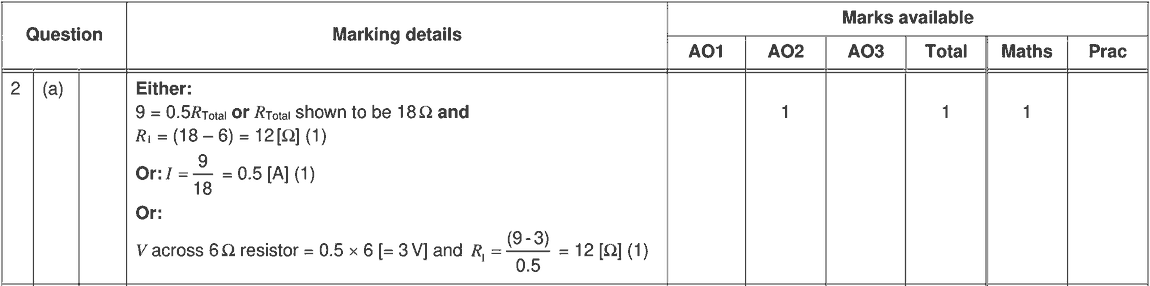
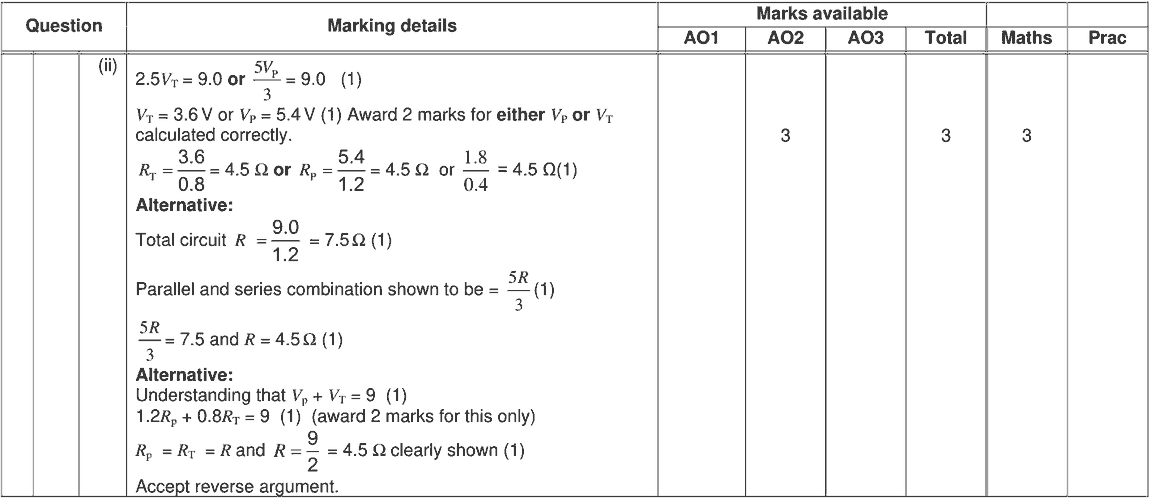
Total resistance = 9.0/0.50 = 18 Ω, so R1 = 18 − 6.0 = 12 Ω
or pd across 6.0 Ω = 3.0 V, leaving 6.0 V across R1 at 0.50 A
algebra must be correct
Scheme columns: Maths 1
Skills: Mathsmarks The mark scheme's Maths column gives this part at least one mark for mathematical skills
June 2024 · Component 2 · Q3(a)(i)2 marksAO3=2Practical and data analysis
Mark scheme
Examiner's comment
In part (i) many candidates were able to identify at least one source for the systematic error. These generally included reference to a zero error on the ohmmeter or an incorrectly measured length of test wire. Common responses which did not gain credit were: ‘resistance in the wires’ (which ones?) or ‘the wires would heat up’ (not with an Ohmmeter). Nearly all candidates correctly stated that the gradient would be unaffected in (ii).
Notes from the mark scheme and report
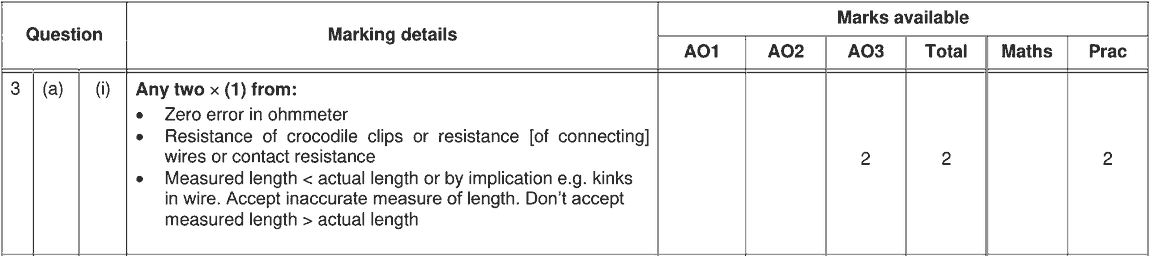
Any two: zero error on the ohmmeter
resistance of the crocodile clips, leads or contacts
measured length shorter than the true length (e.g. kinks in the wire). Vague 'resistance in the wires' and heating of the wire not credited
Scheme columns: Practical 2
Skills: Experimentalmethod Describing, planning or improving an experiment; Uncertainties Resolution, absolute and percentage uncertainty, combining uncertainties, error bars; Practicalmarks The mark scheme's Prac column gives this part at least one mark for practical skills
June 2024 · Component 2 · Q3(a)(ii)1 markAO3=1Practical and data analysis
Earlier part of question 3 that this part uses
Mark scheme
Examiner's comment
In part (i) many candidates were able to identify at least one source for the systematic error. These generally included reference to a zero error on the ohmmeter or an incorrectly measured length of test wire. Common responses which did not gain credit were: ‘resistance in the wires’ (which ones?) or ‘the wires would heat up’ (not with an Ohmmeter). Nearly all candidates correctly stated that the gradient would be unaffected in (ii).
Notes from the mark scheme and report
The error shifts every point by the same amount, so the gradient, from which the resistivity is found, is unchanged
Scheme columns: Practical 1
Skills: Graphskills Reading, plotting or sketching graphs; gradients, intercepts and areas; Practicalmarks The mark scheme's Prac column gives this part at least one mark for practical skills
June 2024 · Component 2 · Q3(b)7 marksAO3=7Practical and data analysis
Earlier part of question 3 that this part uses
Mark scheme
Examiner's comment
Many candidates gained most of the available marks here. Many attempted to determine both the maximum and minimum gradients, and most did so to an acceptable tolerance. Nearly all proceeded to determine the mean gradient and associated uncertainty. Nearly all were able to calculate the overall percentage uncertainty and calculate the resistivity from mean gradient cross-sectional area. Many candidates failed to gain the final mark however, as they did not give their answer and accompanying uncertainty to an appropriate and consistent number of significant figures and / or did not include a correct unit with their answer. Error Carried Forward (ecf) was extensively applied in this part. A handful of candidates responded by determining maximum and minimum values for the resistivity and determined the uncertainty and mean value from these. This was a valid approach which was usually well presented.
Notes from the mark scheme and report
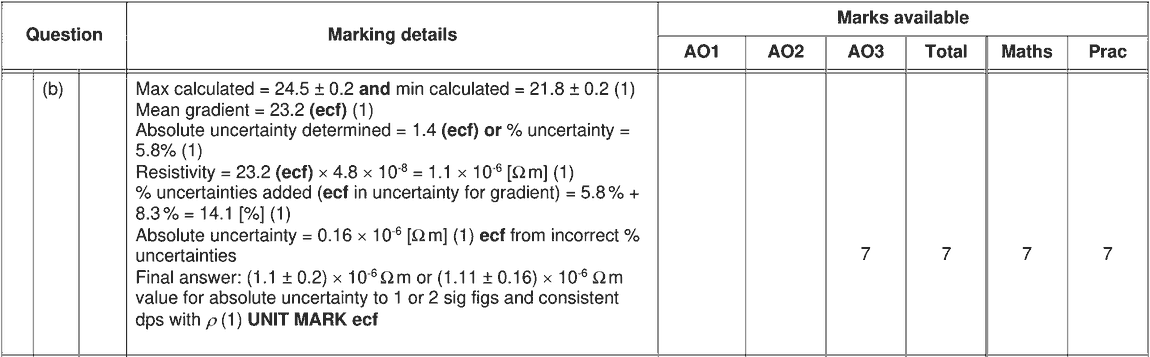
Answer: (1.1 ± 0.2) × 10⁻⁶ Ω m. Maximum gradient 24.5 and minimum 21.8 Ω m⁻¹
final value and uncertainty to consistent decimal places with unit (the mark most often lost)
finding max and min ρ also valid
Scheme columns: Maths 7, Practical 7
Skills: Uncertainties Resolution, absolute and percentage uncertainty, combining uncertainties, error bars; Graphskills Reading, plotting or sketching graphs; gradients, intercepts and areas; Mathsmarks The mark scheme's Maths column gives this part at least one mark for mathematical skills; Practicalmarks The mark scheme's Prac column gives this part at least one mark for practical skills
June 2024 · AS Component 2 · Q6(a)2 marksAO1=2Diagram or graph
Mark scheme
Examiner's comment
This question was answered really well by all the candidates with many gaining full marks and showing a clear understanding of D.C circuit analysis. Part (a)(iii) proved to be the most challenging part of this question for candidates as the relevant approach proved to be difficult using the correct equations for energy and the charge stored to determine the time.
Notes from the mark scheme and report
Wire in series with a supply and an ammeter, voltmeter in parallel across the wire (1)
correct circuit symbols (1)
Scheme columns: Practical 2
Skills: Experimentalmethod Describing, planning or improving an experiment; Practicalmarks The mark scheme's Prac column gives this part at least one mark for practical skills
June 2024 · AS Component 2 · Q6(b)4 marksAO1=1, AO2=3Practical and data analysis
Earlier part of question 6 that this part uses
Mark scheme
Examiner's comment
This question was answered really well by all the candidates with many gaining full marks and showing a clear understanding of D.C circuit analysis. Part (a)(iii) proved to be the most challenging part of this question for candidates as the relevant approach proved to be difficult using the correct equations for energy and the charge stored to determine the time.
Notes from the mark scheme and report
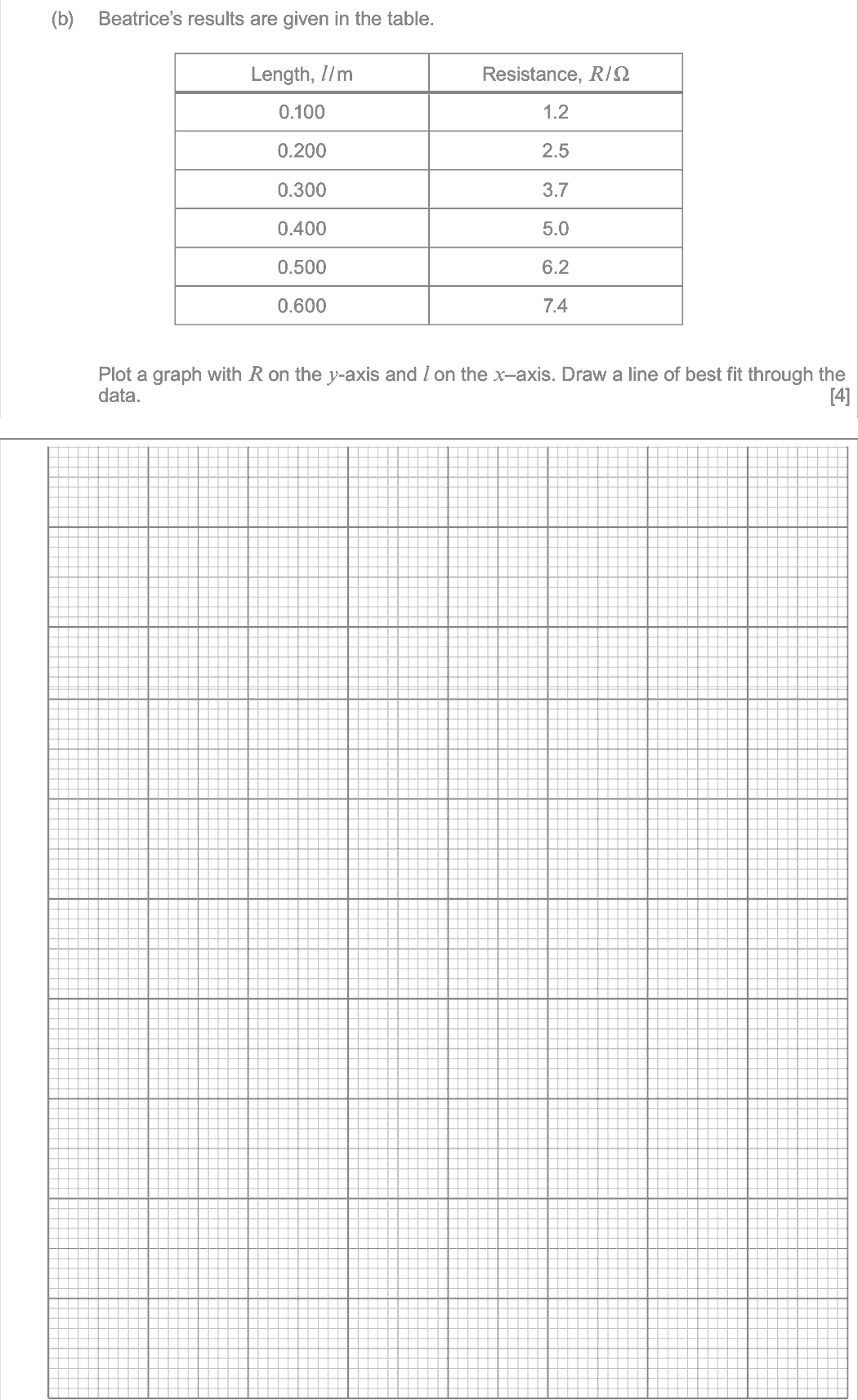
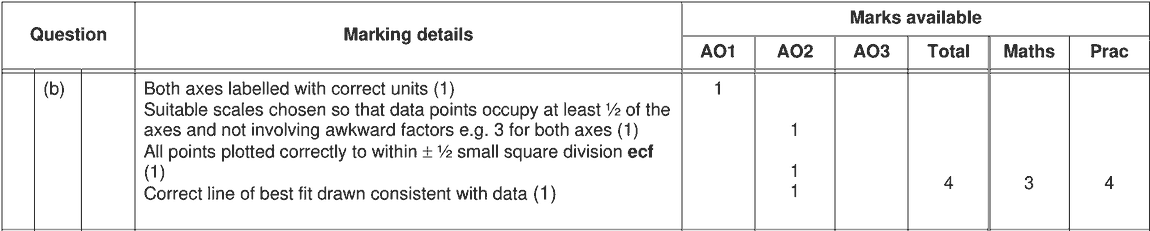
Both axes labelled with units (R / Ω, l / m) (1)
sensible scales with the points covering at least half of each axis, no awkward factors such as 3 (1)
all points plotted to within half a small square (1)
straight line of best fit (1)
Scheme columns: Maths 3, Practical 4
Skills: Graphskills Reading, plotting or sketching graphs; gradients, intercepts and areas; Mathsmarks The mark scheme's Maths column gives this part at least one mark for mathematical skills; Practicalmarks The mark scheme's Prac column gives this part at least one mark for practical skills
June 2024 · AS Component 2 · Q6(c)(i)6 marksAO3=6Practical and data analysis
Earlier parts of question 6 that this part uses
Mark scheme
Examiner's comment
This question was answered really well by all the candidates with many gaining full marks and showing a clear understanding of D.C circuit analysis. Part (a)(iii) proved to be the most challenging part of this question for candidates as the relevant approach proved to be difficult using the correct equations for energy and the charge stored to determine the time.
Notes from the mark scheme and report
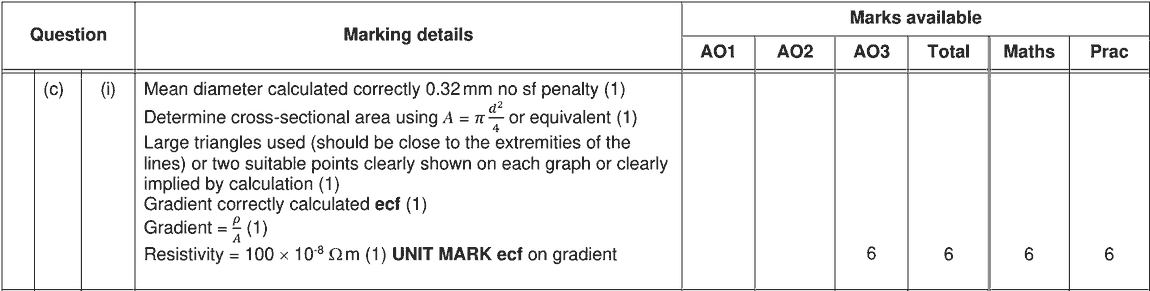
Answer: about 100 × 10⁻⁸ Ω m. Mean d = 0.32 mm (1)
A = πd²/4 = 8.0 × 10⁻⁸ m² (1)
gradient from a large triangle or two well separated points on the line (1), about 12.4 Ω m⁻¹ (1)
gradient = ρ/A (1)
ρ = gradient × A with unit (1)
ecf on gradient
Scheme columns: Maths 6, Practical 6
Skills: Graphskills Reading, plotting or sketching graphs; gradients, intercepts and areas; Unitsand conversions Unit marks, base units, prefixes and conversions; Mathsmarks The mark scheme's Maths column gives this part at least one mark for mathematical skills; Practicalmarks The mark scheme's Prac column gives this part at least one mark for practical skills
June 2024 · AS Component 2 · Q6(c)(ii)2 marksAO2=2Practical and data analysis
Earlier parts of question 6 that this part uses
Mark scheme
Examiner's comment
This question was answered really well by all the candidates with many gaining full marks and showing a clear understanding of D.C circuit analysis. Part (a)(iii) proved to be the most challenging part of this question for candidates as the relevant approach proved to be difficult using the correct equations for energy and the charge stored to determine the time.
Notes from the mark scheme and report
18% of 100 × 10⁻⁸ = 18 × 10⁻⁸ Ω m, so the range is 82 to 118 × 10⁻⁸ Ω m (1)
110 × 10⁻⁸ Ω m lies inside the range so the wire could be nichrome (1)
ecf from (i)
Scheme columns: Maths 1, Practical 2
Skills: Uncertainties Resolution, absolute and percentage uncertainty, combining uncertainties, error bars; Mathsmarks The mark scheme's Maths column gives this part at least one mark for mathematical skills; Practicalmarks The mark scheme's Prac column gives this part at least one mark for practical skills
June 2024 · AS Component 2 · Q7(a)(ii)3 marksAO1=1, AO2=2Calculation
Skills: Mathsmarks The mark scheme's Maths column gives this part at least one mark for mathematical skills
June 2024 · AS Component 2 · Q7(a)(iii)2 marksAO2=2Calculation
Earlier part of question 7 that this part uses
Mark scheme
Notes from the mark scheme and report
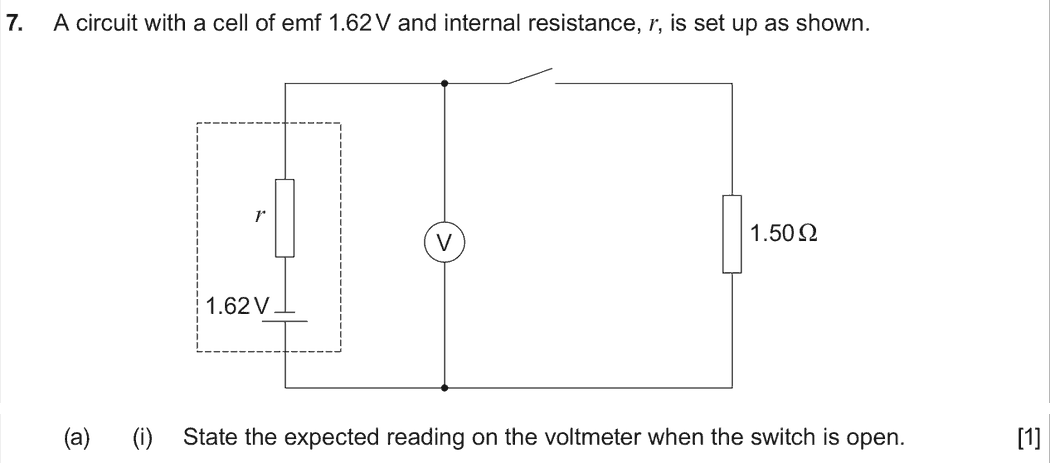
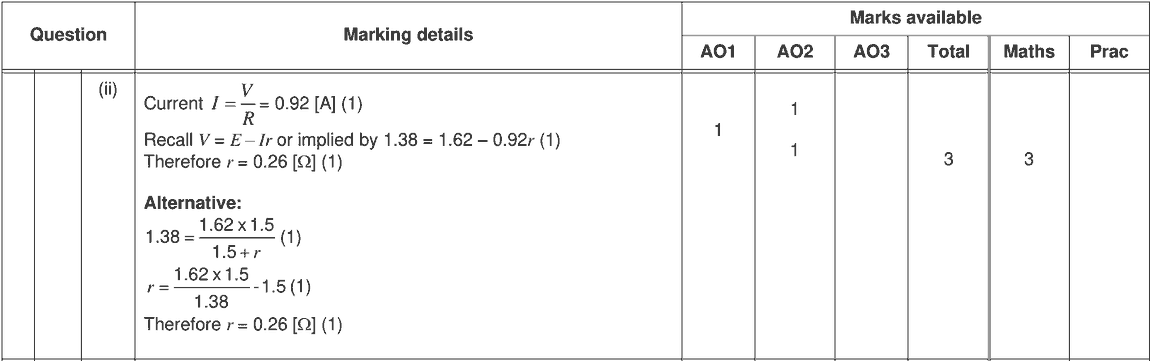
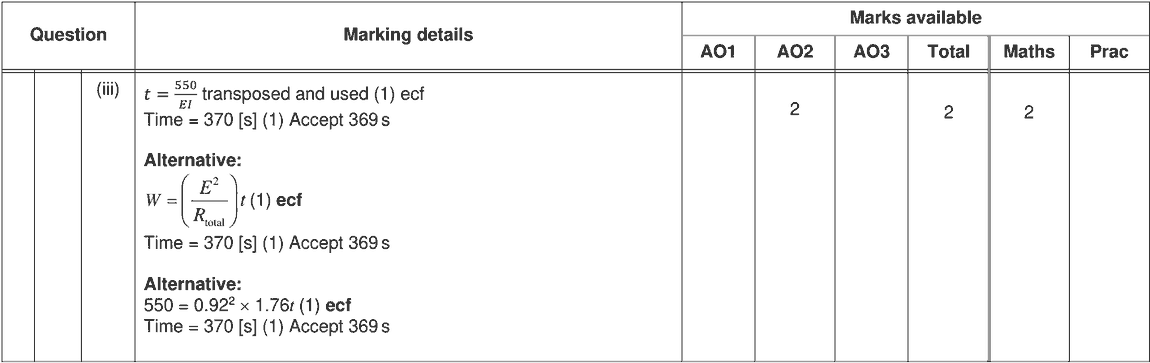
Answer: 370 s (369 s). Total energy transferred by the cell W = EIt so t = 550/(1.62 × 0.92) (2)
or W = E²t/R(total) or I²R(total)t with R(total) = 1.76 Ω
ecf. The hardest part of the question
Scheme columns: Maths 2
Skills: Mathsmarks The mark scheme's Maths column gives this part at least one mark for mathematical skills
June 2023 · Component 1 · Q2(a)4 marksAO1=2, AO2=2Show that
Mark scheme
Examiner's comment
Most candidates were able to successfully navigate the synoptic ‘show that’ question in (a). There were the occasional slips where the diameter was used instead of the radius, however, some candidates seemed to have spotted this and re-showed their response correctly. Part (b)(ii) proved to be somewhat of a discriminating question as candidates needed to appreciate that the copper container and the water received energy from the electrical heater to access the 2nd and 3rd marking points. Candidates found the last part of the question, challenging as well. Those who thought that it was bad practice as the heat would flow into the system from the surroundings, achieved some credit. A smaller number of candidates realised the energy absorbed below 16 °C would be countered by the energy emitted above 16 °C. This scored two marks if it was accompanied by a conclusion.
Skills: Synoptic Needs physics from another component of the qualification; Unitsand conversions Unit marks, base units, prefixes and conversions; Mathsmarks The mark scheme's Maths column gives this part at least one mark for mathematical skills
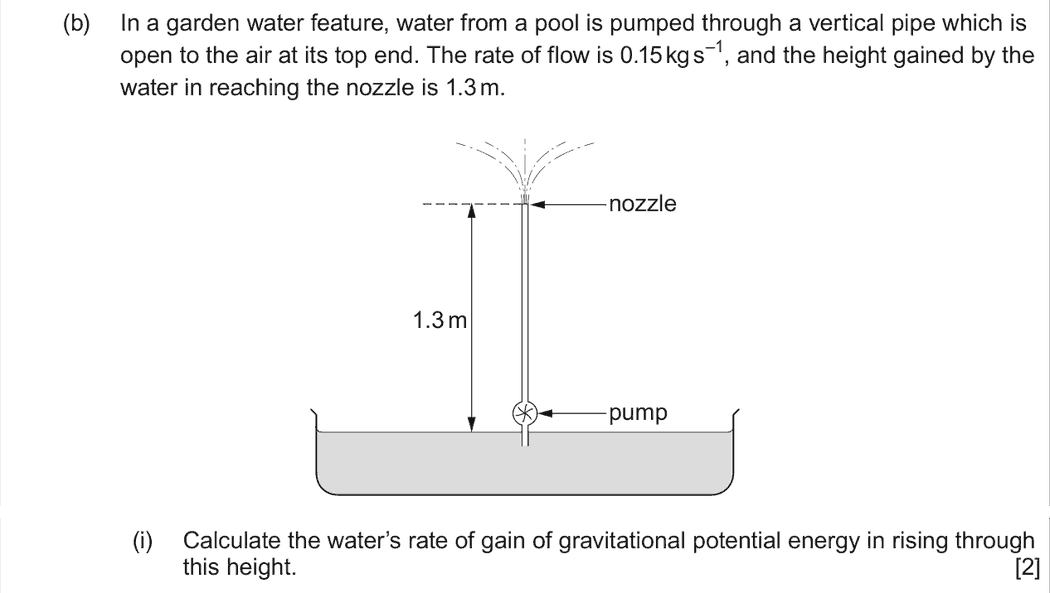
June 2023 · Component 1 · Q5(b)(iii)3 marksAO1=2, AO2=1Calculation
Earlier parts of question 5 that this part uses
Mark scheme
Examiner's comment
In (b)(i) most candidates were comfortable in calculating the gain of gravitational potential energy. There was a unit mark here and there were a few candidates who incorrectly stated the unit. The 0.92 is significant in (ii). The justification was missed by some candidates. Stronger responses included reference to 0.92 being 33% of (1.9 + 0.92) and so significant. This usually allowed for better access to the next question part. The input energy was correctly calculated by most in (iii). A significant number of candidates were not combining 1.9 and the 0.92 and hence incorrectly established an efficiency of either 24% or 12%.
Notes from the mark scheme and report
Answer: 36% (0.36). Input power = IV = 12 × 0.65 = 7.8 W
useful output = 1.9 + 0.92 = 2.82 W
common error: using only one of the two outputs (24% or 12%)
P = IV is from Component 2
Scheme columns: Maths 2
Skills: Synoptic Needs physics from another component of the qualification; Mathsmarks The mark scheme's Maths column gives this part at least one mark for mathematical skills
June 2023 · Component 2 · Q1(a)1 markAO1=1Definition
Mark scheme
Examiner's comment
Around half of the candidates in (a) provided a clear and accurate definition of the potential difference between two points in an electric field. Of those that were unsuccessful, many did not include the term ‘per coulomb (or unit charge)’ in their responses. In (b)(i) most candidates provided clear and logical responses to the double instruction of ‘state’ and ‘explain’ how the reading on the voltmeter changed in the circuit. Many chose to compare the pds across the relevant components in the circuit and discussed how these would be affected by the changing resistance across the LDR. Others chose to discuss the changing current (because of the reduced overall resistance) and the impact of this on the pd across the fixed resistor, and hence the reading on the voltmeter. Both approaches were equally valid. It was noted that responses were presented clearly and logically. In (ii) a few candidates lost marks for miscalculating the pd across the fixed resistor. In (iii), nearly all candidates sketched the variable resistor in series with the LDR, however a significant number were not awarded the mark as they gave an incorrect circuit symbol for the variable resistor, with many giving the symbol for a thermistor. Encouraging responses were seen in (iii)(II), with many candidates showing clearly that the modification to the circuit would allow the water feature to be turned off in full sunlight. Many candidates chose to show that the minimum pd across the fixed resistor would fall to 1.8 V with the variable resistor set to its maximum value, commenting that this is below the activation pd.
Notes from the mark scheme and report
Energy transferred (from electrical to other forms) per unit charge passing between the two points
about half were correct, 'per coulomb' or 'per unit charge' was the usual omission
June 2023 · Component 2 · Q2(a)1 markAO1=1Short answer
Mark scheme
Examiner's comment
Nearly all candidates in (a) were able to explain resistance in terms of collisions between electrons and the lattice (or equivalent). Once again however, a small minority of candidates gave incorrect responses based on collisions between conducting electrons. A variety of valid responses were seen in (b)(ii) with credit given for responses involving at least two relevant substitutions involving I = nAve, l R A = and V = IR. In many cases marks were awarded as Benefit of Doubt (BOD) as the algebra seen was not always clearly laid out. It would be useful for example for candidates to show how particular terms (e.g A) cancel out, rather than just ‘disappearing’. In (iii), a small number of candidates did not gain the mark for not including a unit in their final answer or providing an incorrect unit. Whilst many candidates in (c) identified and explained why n and v were incorrect, fewer made any reference to the fact that ρ and A were correct, thus not fully answering the question. Good attempts were made at answering the issues-based question, with many candidates identifying reduced energy loss during transmission, reduced cooling costs (or easier to cool) and the possibility of a more widespread use of technology such as MRI scanners being amongst the more common responses seen.
Notes from the mark scheme and report
Collisions between the free electrons and the metal ions (lattice)
collisions between electrons not accepted
June 2023 · Component 2 · Q2(b)(ii)3 marksAO2=3Show that
Earlier parts of question 2 that this part uses
Mark scheme
Examiner's comment
Nearly all candidates in (a) were able to explain resistance in terms of collisions between electrons and the lattice (or equivalent). Once again however, a small minority of candidates gave incorrect responses based on collisions between conducting electrons. A variety of valid responses were seen in (b)(ii) with credit given for responses involving at least two relevant substitutions involving I = nAve, l R A = and V = IR. In many cases marks were awarded as Benefit of Doubt (BOD) as the algebra seen was not always clearly laid out. It would be useful for example for candidates to show how particular terms (e.g A) cancel out, rather than just ‘disappearing’. In (iii), a small number of candidates did not gain the mark for not including a unit in their final answer or providing an incorrect unit. Whilst many candidates in (c) identified and explained why n and v were incorrect, fewer made any reference to the fact that ρ and A were correct, thus not fully answering the question. Good attempts were made at answering the issues-based question, with many candidates identifying reduced energy loss during transmission, reduced cooling costs (or easier to cool) and the possibility of a more widespread use of technology such as MRI scanners being amongst the more common responses seen.
Notes from the mark scheme and report
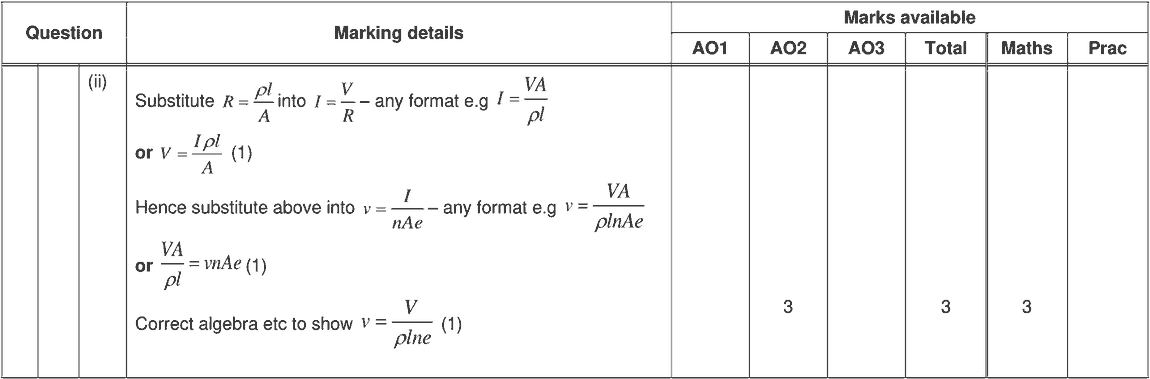
R = ρl/A in I = V/R gives I = VA/ρl (1)
put into I = nAve (1)
A cancels to give v = V/(ρlne) (1)
the cancelling should be shown, many answers were given benefit of doubt
Scheme columns: Maths 3
Skills: Algebra Derivations and rearranging equations; Mathsmarks The mark scheme's Maths column gives this part at least one mark for mathematical skills
June 2023 · Component 2 · Q2(b)(iii)2 marksAO1=1, AO2=1Calculation
Earlier parts of question 2 that this part uses
Mark scheme
Examiner's comment
Nearly all candidates in (a) were able to explain resistance in terms of collisions between electrons and the lattice (or equivalent). Once again however, a small minority of candidates gave incorrect responses based on collisions between conducting electrons. A variety of valid responses were seen in (b)(ii) with credit given for responses involving at least two relevant substitutions involving I = nAve, l R A = and V = IR. In many cases marks were awarded as Benefit of Doubt (BOD) as the algebra seen was not always clearly laid out. It would be useful for example for candidates to show how particular terms (e.g A) cancel out, rather than just ‘disappearing’. In (iii), a small number of candidates did not gain the mark for not including a unit in their final answer or providing an incorrect unit. Whilst many candidates in (c) identified and explained why n and v were incorrect, fewer made any reference to the fact that ρ and A were correct, thus not fully answering the question. Good attempts were made at answering the issues-based question, with many candidates identifying reduced energy loss during transmission, reduced cooling costs (or easier to cool) and the possibility of a more widespread use of technology such as MRI scanners being amongst the more common responses seen.
Notes from the mark scheme and report
Answer: 2.6 × 10⁻³ m s⁻¹ (2.57 × 10⁻³ with n = 8.57 × 10²⁸
2.45 × 10⁻³ with 9 × 10²⁸). v = 1.2/(1.7 × 10⁻⁸ × 2.0 × n × 1.60 × 10⁻¹⁹)
unit mark
Scheme columns: Maths 2
Skills: Mathsmarks The mark scheme's Maths column gives this part at least one mark for mathematical skills
June 2023 · Component 2 · Q2(c)2 marksAO3=2Explanation
Earlier part of question 2 that this part uses
Mark scheme
Examiner's comment
Nearly all candidates in (a) were able to explain resistance in terms of collisions between electrons and the lattice (or equivalent). Once again however, a small minority of candidates gave incorrect responses based on collisions between conducting electrons. A variety of valid responses were seen in (b)(ii) with credit given for responses involving at least two relevant substitutions involving I = nAve, l R A = and V = IR. In many cases marks were awarded as Benefit of Doubt (BOD) as the algebra seen was not always clearly laid out. It would be useful for example for candidates to show how particular terms (e.g A) cancel out, rather than just ‘disappearing’. In (iii), a small number of candidates did not gain the mark for not including a unit in their final answer or providing an incorrect unit. Whilst many candidates in (c) identified and explained why n and v were incorrect, fewer made any reference to the fact that ρ and A were correct, thus not fully answering the question. Good attempts were made at answering the issues-based question, with many candidates identifying reduced energy loss during transmission, reduced cooling costs (or easier to cool) and the possibility of a more widespread use of technology such as MRI scanners being amongst the more common responses seen.
Notes from the mark scheme and report
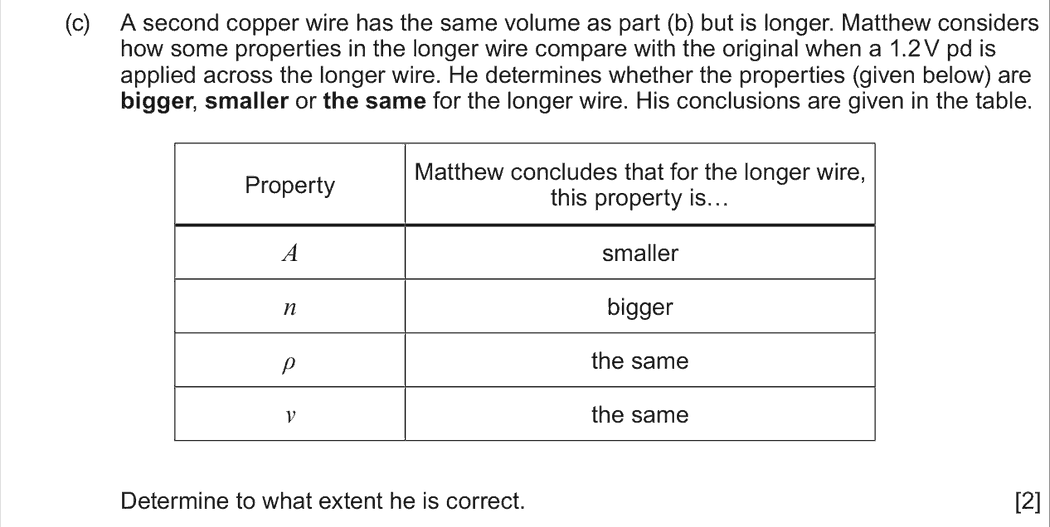
n should be 'the same' (a property of copper) and v should be 'smaller' (v = V/ρlne with a larger l) (1)
A smaller and ρ the same are correct (1)
many forgot to say which conclusions were right
June 2023 · Component 2 · Q2(d)2 marksAO3=2Short answer
Earlier parts of question 2 that this part uses
Mark scheme
Examiner's comment
Nearly all candidates in (a) were able to explain resistance in terms of collisions between electrons and the lattice (or equivalent). Once again however, a small minority of candidates gave incorrect responses based on collisions between conducting electrons. A variety of valid responses were seen in (b)(ii) with credit given for responses involving at least two relevant substitutions involving I = nAve, l R A = and V = IR. In many cases marks were awarded as Benefit of Doubt (BOD) as the algebra seen was not always clearly laid out. It would be useful for example for candidates to show how particular terms (e.g A) cancel out, rather than just ‘disappearing’. In (iii), a small number of candidates did not gain the mark for not including a unit in their final answer or providing an incorrect unit. Whilst many candidates in (c) identified and explained why n and v were incorrect, fewer made any reference to the fact that ρ and A were correct, thus not fully answering the question. Good attempts were made at answering the issues-based question, with many candidates identifying reduced energy loss during transmission, reduced cooling costs (or easier to cool) and the possibility of a more widespread use of technology such as MRI scanners being amongst the more common responses seen.
Notes from the mark scheme and report
Any two: less energy lost in transmission
larger currents or more electricity transmitted
smaller, more efficient or more widely used equipment (e.g. MRI scanners)
June 2023 · AS Component 2 · Q5(c)(i)3 marksAO3=3Explanation
Earlier part of question 5 that this part uses
Mark scheme
Examiner's comment
Parts (a) and (b) were answered well with nearly all the candidates being able to derive the equation I = nAve. In part (c) the explanation for the change in drift velocity did not refer to the motion of the free electrons.
Notes from the mark scheme and report
The ions vibrate with more energy at the higher temperature (1)
free electrons collide with the ions more often (1)
so the drift velocity falls and Alexander is wrong (1)
answers often did not refer to the electrons' motion
June 2023 · AS Component 2 · Q5(c)(ii)2 marksAO3=2Explanation
Earlier parts of question 5 that this part uses
Mark scheme
Examiner's comment
Parts (a) and (b) were answered well with nearly all the candidates being able to derive the equation I = nAve. In part (c) the explanation for the change in drift velocity did not refer to the motion of the free electrons.
Notes from the mark scheme and report
Lower drift velocity means a smaller current, I = nAve, at the same pd (1)
R = V/I so the resistance rises and the statement is wrong (1)
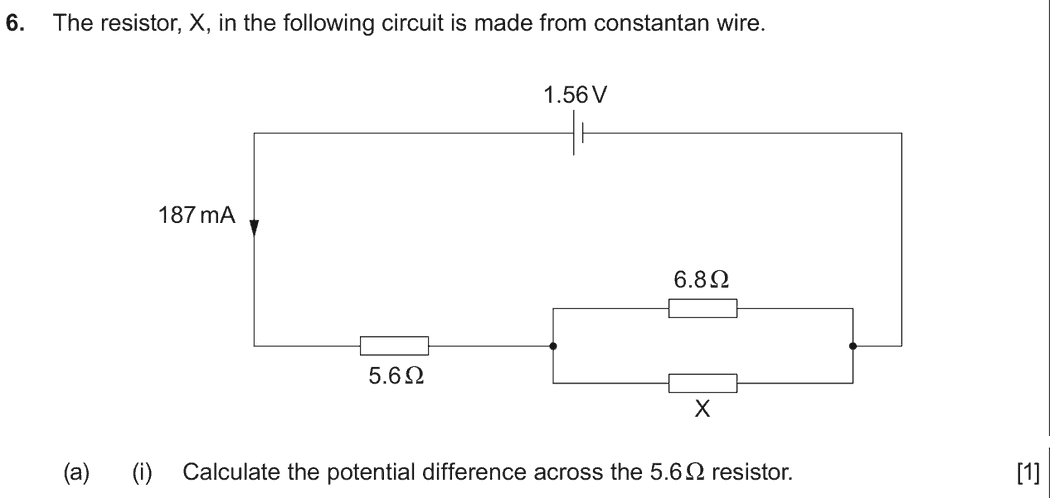
June 2023 · AS Component 2 · Q6(a)(i)1 markAO2=1Calculation
Mark scheme
Examiner's comment
This was answered well by all candidates and d.c. circuit analysis was well understood. Also the synoptic element was answered well.
Notes from the mark scheme and report
Answer: 1.05 V (0.187 × 5.6)
Scheme columns: Maths 1
Skills: Unitsand conversions Unit marks, base units, prefixes and conversions; Mathsmarks The mark scheme's Maths column gives this part at least one mark for mathematical skills
June 2023 · AS Component 2 · Q6(a)(iii)2 marksAO3=2Calculation
Earlier part of question 6 that this part uses
Mark scheme
Examiner's comment
This was answered well by all candidates and d.c. circuit analysis was well understood. Also the synoptic element was answered well.
Notes from the mark scheme and report
Answer: 0.057 W, so the technician is correct. P = I²R = 0.112² × 4.55 (or V²/R, IV)
ecf on R
Scheme columns: Maths 1
Skills: Mathsmarks The mark scheme's Maths column gives this part at least one mark for mathematical skills
June 2023 · AS Component 2 · Q6(b)4 marksAO1=1, AO2=3Calculation
Earlier part of question 6 that this part uses
Mark scheme
Examiner's comment
This was answered well by all candidates and d.c. circuit analysis was well understood. Also the synoptic element was answered well.
Notes from the mark scheme and report
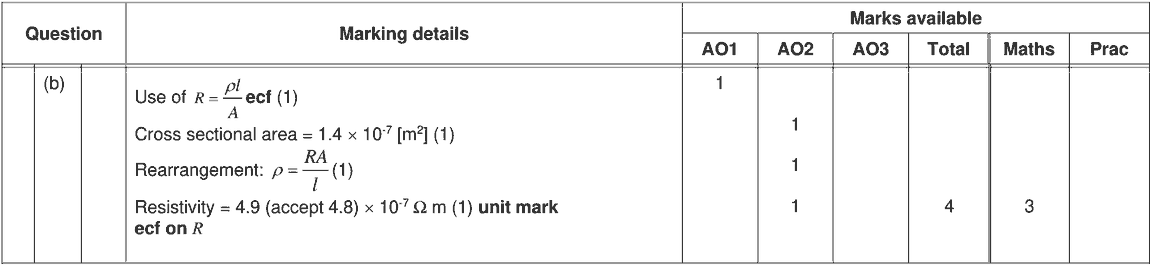
Answer: 4.9 × 10⁻⁷ Ω m. A = π(0.2115 × 10⁻³)² = 1.4 × 10⁻⁷ m²
ρ = RA/l = 4.55 × 1.4 × 10⁻⁷/1.31
unit mark
ecf on R
Scheme columns: Maths 3
Skills: Unitsand conversions Unit marks, base units, prefixes and conversions; Mathsmarks The mark scheme's Maths column gives this part at least one mark for mathematical skills
June 2023 · AS Component 2 · Q6(d)2 marksAO1=1, AO2=1Diagram or graph
Earlier part of question 6 that this part uses
Mark scheme
Examiner's comment
This was answered well by all candidates and d.c. circuit analysis was well understood. Also the synoptic element was answered well.
Notes from the mark scheme and report
R = 0 up to the transition temperature, a vertical rise there, then a roughly linear increase (1)
transition temperature labelled 3.7 K (1)
Skills: Graphskills Reading, plotting or sketching graphs; gradients, intercepts and areas
June 2022 · Component 2 · Q1(b)(i)2 marksAO1=1, AO2=1Calculation
Earlier part of question 1 that this part uses
Mark scheme
Examiner's comment
Most candidates applied
Notes from the mark scheme and report
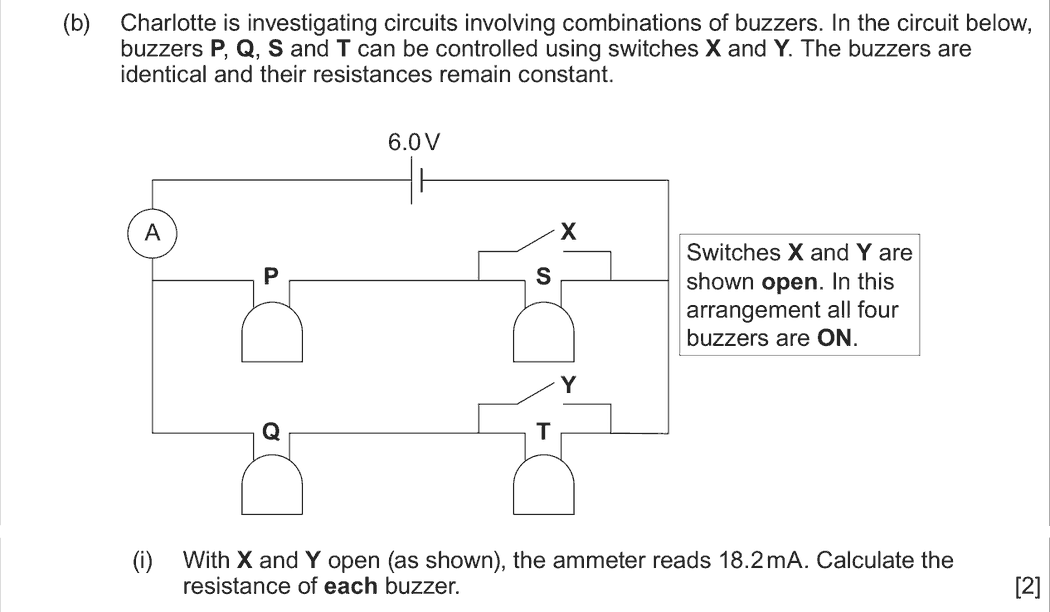
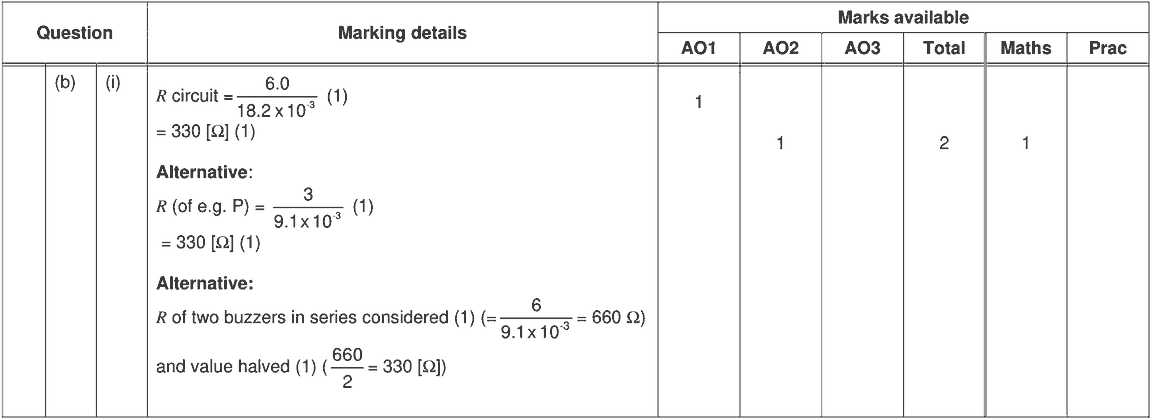
Answer: 330 Ω. Circuit resistance = 6.0/18.2 × 10⁻³ = 330 Ω, and two series pairs (2R each) in parallel have total resistance R
or each branch carries 9.1 mA with 3.0 V across each buzzer
Scheme columns: Maths 1
Skills: Unitsand conversions Unit marks, base units, prefixes and conversions; Mathsmarks The mark scheme's Maths column gives this part at least one mark for mathematical skills
June 2022 · Component 2 · Q1(b)(ii)3 marksAO3=3Calculation
Earlier parts of question 1 that this part uses
Mark scheme
Examiner's comment
Candidates had to show the current increased with switch X closed and increased further with both X and Y closed. A significant number of candidates determined both currents correctly and provided a valid conclusion, that ‘Charlotte was correct’. A common approach was to discuss in general terms the impact of resistors in parallel on the overall resistance and hence the current. Whilst this approach did gain some credit, very few candidates were able to clearly articulate the impact of the reduction in series resistance on the overall resistance of the remaining parallel resistors. Those candidates giving an algebraic solution in terms of R usually did so very well e.g. they showed, with switch X closed, that the overall resistance would become 2 R (where R = original resistance), and so on.
Notes from the mark scheme and report
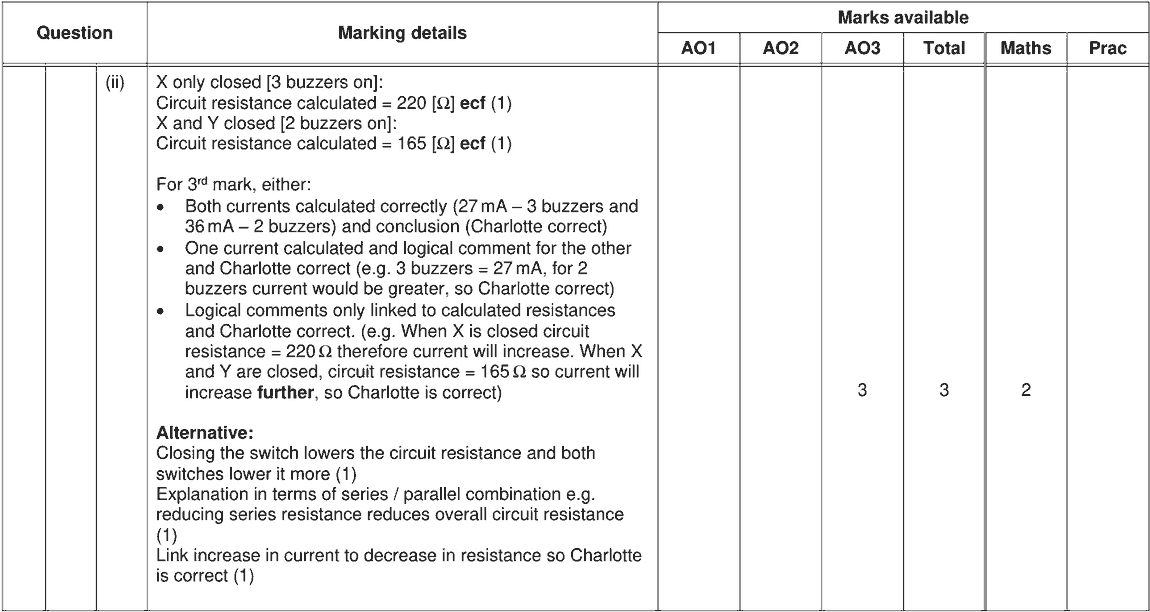
Answer: correct. X closed (S shorted, three buzzers): 330 Ω in parallel with 660 Ω = 220 Ω, current 27 mA
X and Y closed (two buzzers): 165 Ω, current 36 mA
both higher than 18.2 mA and the second higher still. A qualitative argument (less series resistance in a branch lowers the total resistance, so more current) also credited, but few made it clearly
Scheme columns: Maths 2
Skills: Mathsmarks The mark scheme's Maths column gives this part at least one mark for mathematical skills
June 2022 · Component 2 · Q1(b)(iii)3 marksAO1=2, AO2=1Show that
Earlier parts of question 1 that this part uses
Mark scheme
Examiner's comment
Many candidates were able to determine and compare the power emitted when 2 and then 4 buzzers were operating and confirm the measurements made. Some candidates did not realise that the two buzzers had to be P and Q, with some choosing two buzzers at random. Many candidates failed to realise that the resistance of the circuit when only two buzzers were operating was half of the original value, and the current was twice the original value.
Notes from the mark scheme and report
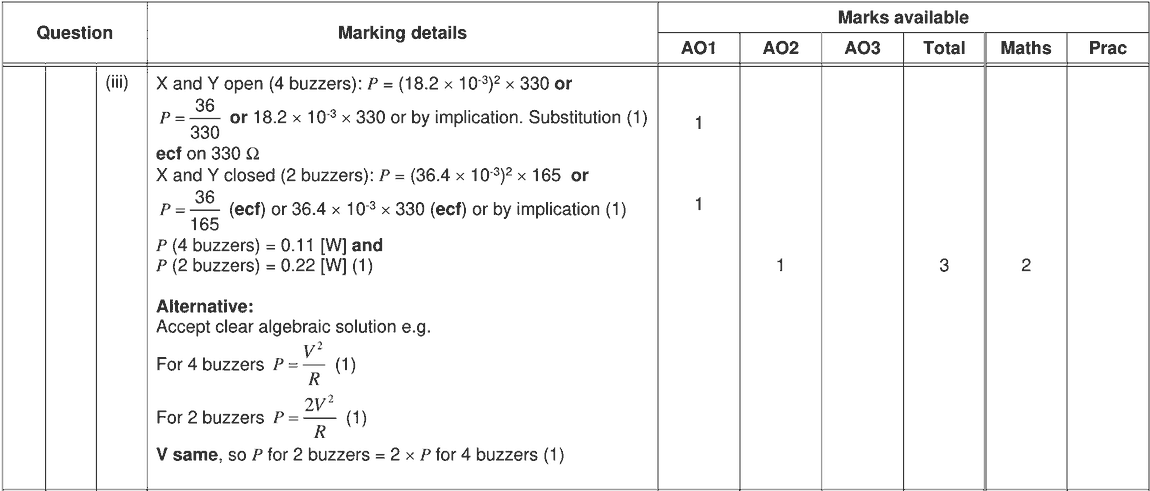
Four buzzers: P = V²/R = 36/330 = 0.11 W (or I²R with 18.2 mA)
two buzzers (P and Q only): 36/165 = 0.22 W, double. Algebraic version: V²/R against 2V²/R. Some picked two buzzers at random or missed that the resistance halves and current doubles
Scheme columns: Maths 2
Skills: Mathsmarks The mark scheme's Maths column gives this part at least one mark for mathematical skills
June 2022 · Component 2 · Q2(a)6 marksAO1=66-mark extended response
Mark scheme, with the levels and indicative content
Examiner's comment
In general candidates made good attempts at describing and explaining the features of the I-V graph for the filament of a lamp. To access the higher marking band, it was expected that candidates distinguished (and explained) the difference between the drift velocity and random vibrational velocity of electrons. They were expected to discuss collisions between electrons and lattice ions and the effect of increasing temperature on the motion of the lattice and electrons, leading to the mean drift velocity decreasing and hence the resistance increasing at higher voltages. They were expected to understand that the increase in temperature is caused by the increased frequency of collisions, which many failed to do. They were expected to relate this back to the shape of the graph at higher voltages. Lower band responses typically outlined the initial straight line aspect of the graph as ‘obeying Ohm’s law’ or equivalent and failed to refer to the motion of electrons. Middle band responses built upon this basic description by introducing the idea of collisions between electrons and the lattice, but then failed to provide any depth in terms of the effects of increased pd on the movement of electrons and the consequent effect on temperature for example.
Notes from the mark scheme and report
QER, levels marked. Shape: straight through the origin at low pd (R constant, I proportional to V while temperature is constant), then curves so V/I rises: resistance increases as the filament heats. Electrons: the pd gives free electrons a drift velocity on top of their random motion
they collide with the vibrating lattice ions, which is the resistance, and the collisions transfer energy so the temperature rises. Hotter: ions vibrate with larger amplitude, electrons collide more often (shorter time between collisions), so the mean drift velocity for a given pd falls and R rises. Top band needed drift against random motion and the cause of the heating
Skills: QER The 6-mark quality of extended response question
June 2022 · AS Component 2 · Q3(b)(i)1 markAO1=1Definition
Earlier part of question 3 that this part uses
Mark scheme
Notes from the mark scheme and report
One joule (of energy transferred) per coulomb (of charge)
June 2022 · AS Component 2 · Q3(b)(ii)2 marksAO1=1, AO2=1Calculation
Earlier parts of question 3 that this part uses
Mark scheme
Notes from the mark scheme and report
Answer: 864 J (W = VQ = 6.0 × 144, or VIt)
ecf from (a)
Scheme columns: Maths 1
Skills: Mathsmarks The mark scheme's Maths column gives this part at least one mark for mathematical skills
June 2022 · AS Component 2 · Q3(c)(i)2 marksAO1=2Practical and data analysis
Earlier part of question 3 that this part uses
Mark scheme
Notes from the mark scheme and report
Complete (closed) circuit joining the supply and the component (1)
ammeter in series and voltmeter in parallel with the component (1)
Scheme columns: Practical 2
Skills: Experimentalmethod Describing, planning or improving an experiment; Practicalmarks The mark scheme's Prac column gives this part at least one mark for practical skills
June 2022 · AS Component 2 · Q3(c)(ii)6 marksAO3=66-mark extended response
Earlier parts of question 3 that this part uses
Mark scheme, with the levels and indicative content
Notes from the mark scheme and report
QER, levels marked. A and C: straight lines through the origin, so current is proportional to pd and they obey Ohm's law (resistors or wires at constant temperature)
gradient = 1/R
C's gradient is twice A's so A has twice the resistance of C. B: curve, current not proportional to pd
roughly ohmic at low pd, then resistance rises as pd and current increase because the temperature rises, as for a filament lamp
B has the same resistance as C where the curve crosses C's line
Scheme columns: Practical 6
Skills: Graphskills Reading, plotting or sketching graphs; gradients, intercepts and areas; Practicalmarks The mark scheme's Prac column gives this part at least one mark for practical skills; QER The 6-mark quality of extended response question
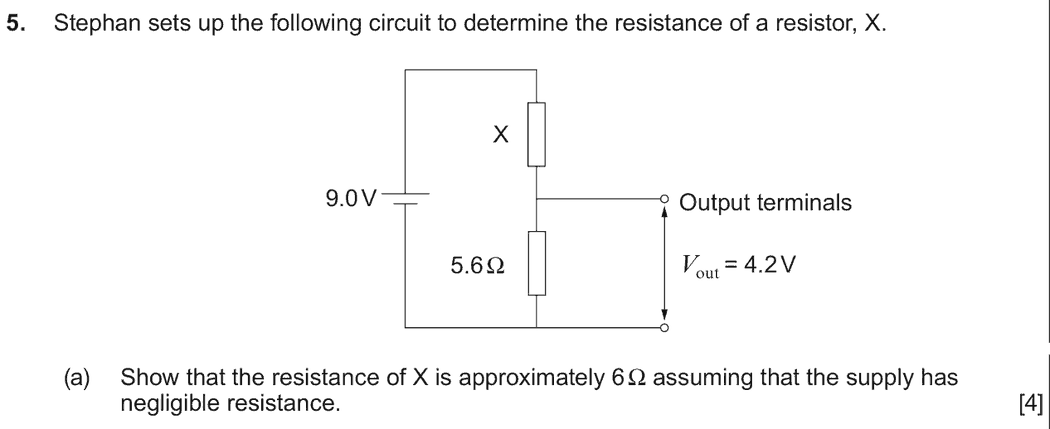
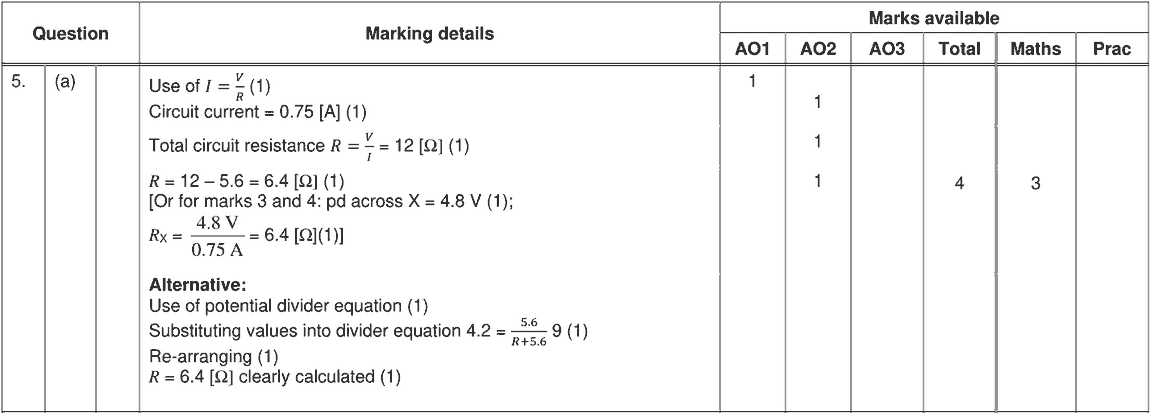
June 2022 · AS Component 2 · Q5(a)4 marksAO1=1, AO2=3Show that
Mark scheme
Notes from the mark scheme and report
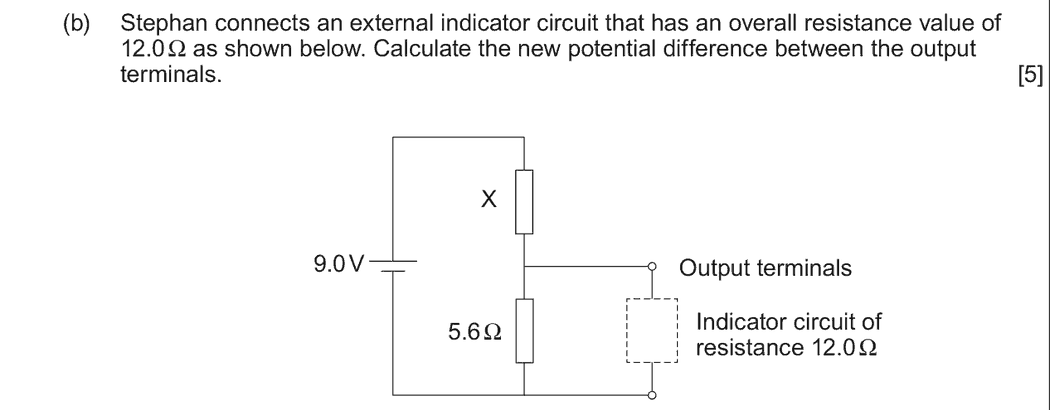
Current = 4.2/5.6 = 0.75 A
pd across X = 9.0 − 4.2 = 4.8 V
R = 4.8/0.75 = 6.4 Ω
or total resistance 9.0/0.75 = 12 Ω minus 5.6 Ω
or the potential divider equation 4.2 = 9.0 × 5.6/(R + 5.6)
Scheme columns: Maths 3
Skills: Mathsmarks The mark scheme's Maths column gives this part at least one mark for mathematical skills
June 2022 · Component 2 · Q5(b)(ii)2 marksAO1=1, AO2=1Calculation
Earlier parts of question 5 that this part uses
Mark scheme
Examiner's comment
Fewer candidates were able to take correct values of potential from the graph at the distances indicated. Those that did so correctly often placed the values the wrong way around in their equations, leading to a negative value for the work done. One mark was deducted for negative answers.
Notes from the mark scheme and report
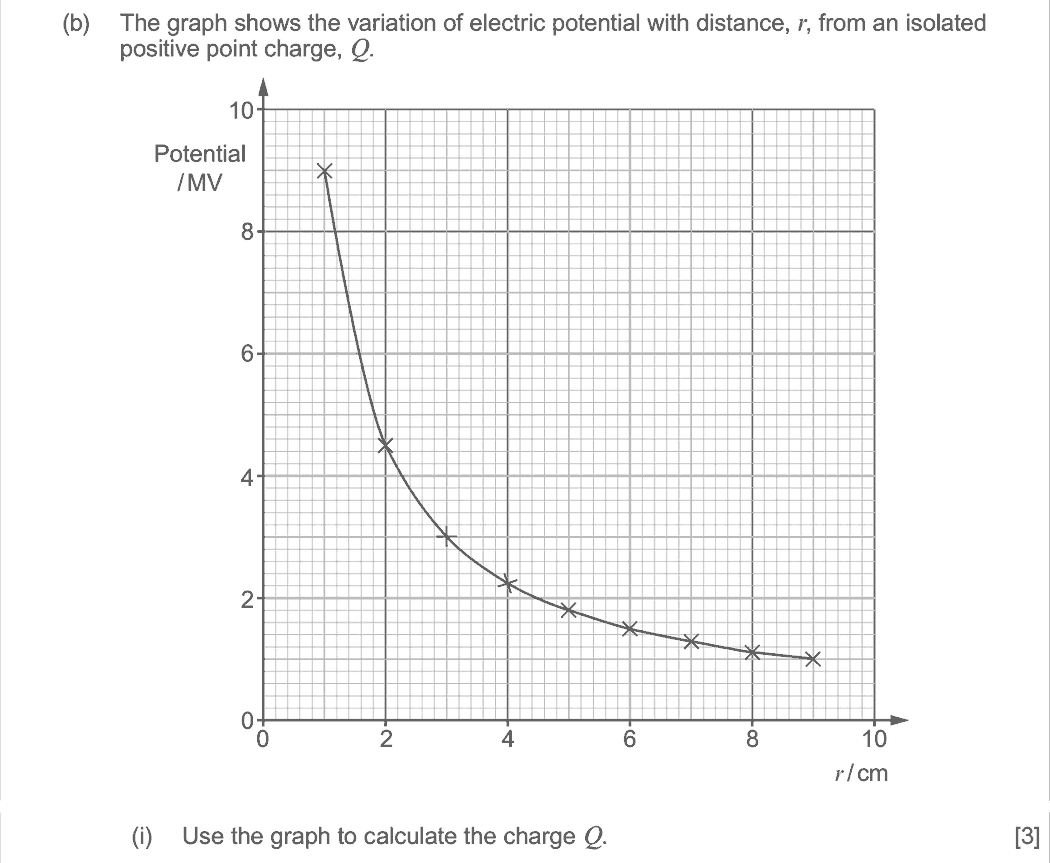
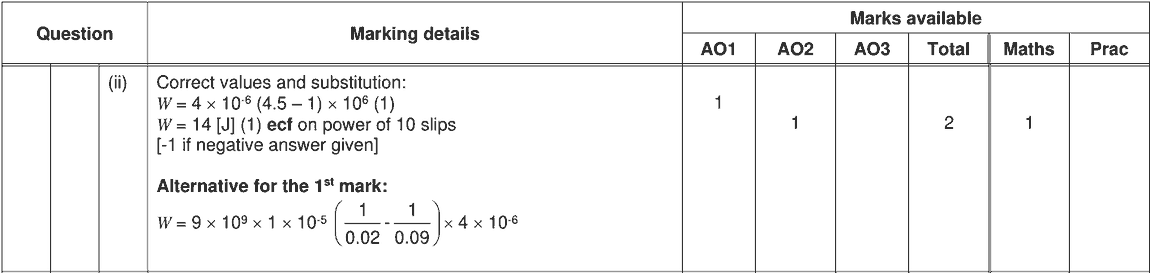
Answer: 14 J. W = qΔV = 4.0 × 10⁻⁶ × (4.5 − 1.0) × 10⁶
potentials read at 2.0 cm and 9.0 cm
1 mark off for a negative answer (values subtracted the wrong way round)
Scheme columns: Maths 1
Skills: Graphskills Reading, plotting or sketching graphs; gradients, intercepts and areas; Mathsmarks The mark scheme's Maths column gives this part at least one mark for mathematical skills
June 2022 · AS Component 2 · Q5(c)2 marksAO2=2Explanation
Earlier parts of question 5 that this part uses
Mark scheme
Notes from the mark scheme and report
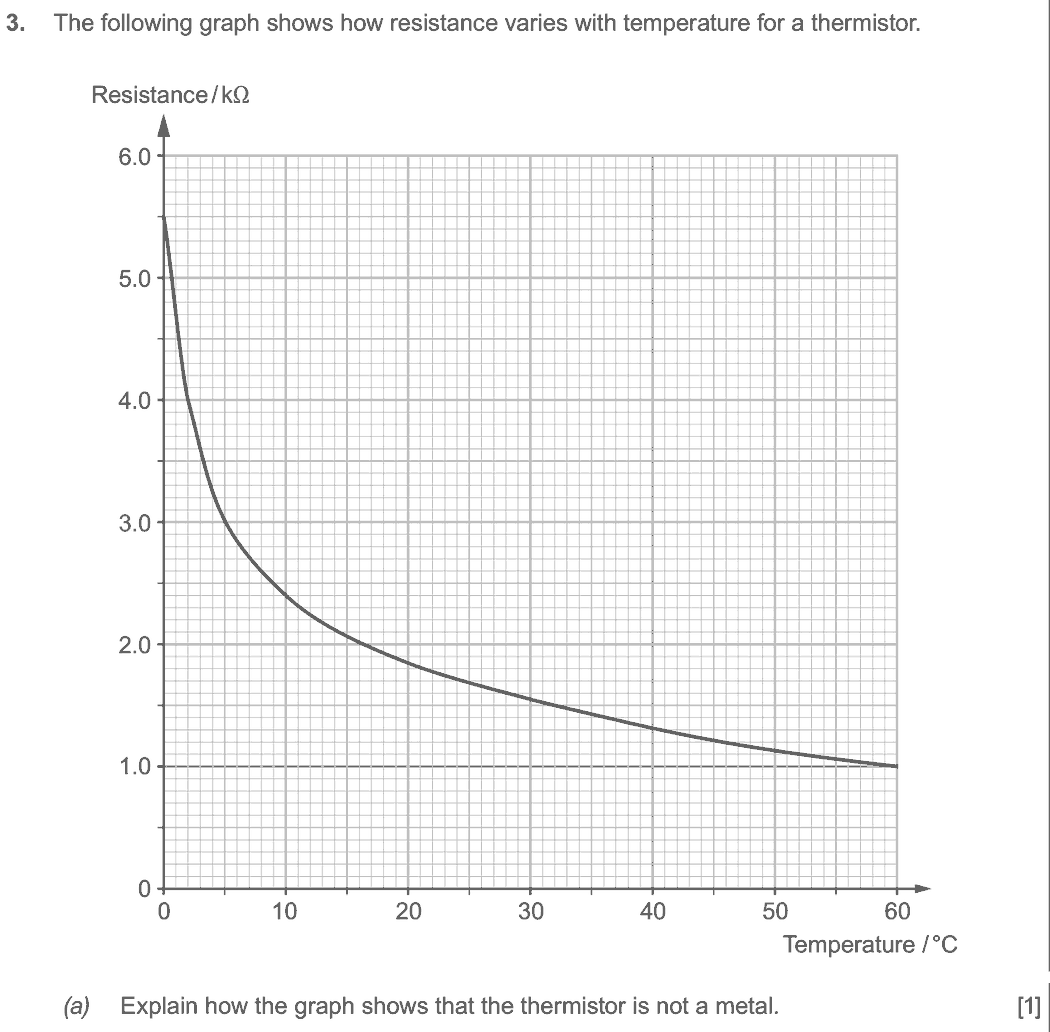
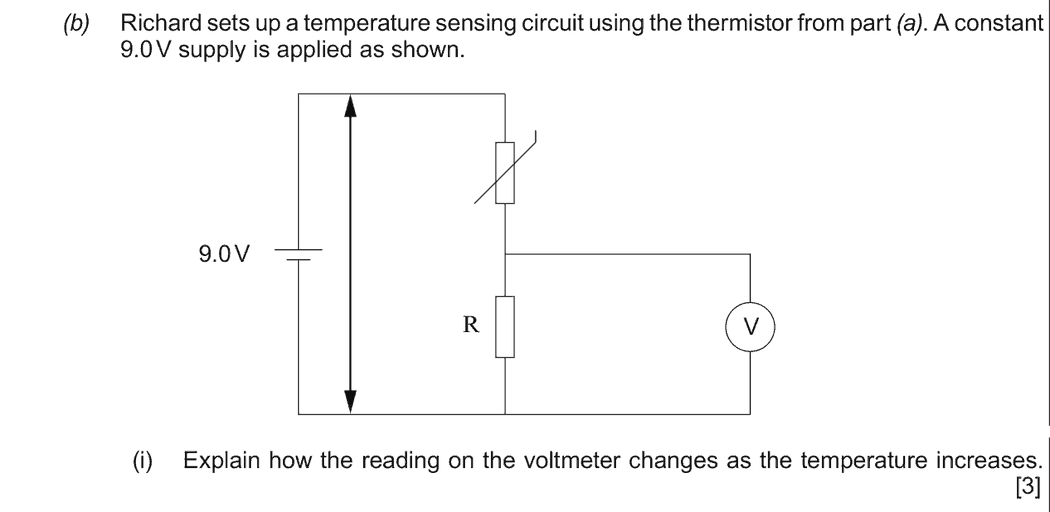
The thermistor's resistance (about 9 to 10 kΩ) is far larger than the rest of the circuit (1)
the largest possible current is about 9.0/8700 = 1 mA, well below the 10 mA needed (and nearly all the pd is across the thermistor) (1)
Skills: Unitsand conversions Unit marks, base units, prefixes and conversions
June 2022 · AS Component 2 · Q5(d)1 markAO1=1Short answer
Earlier parts of question 5 that this part uses
Mark scheme
Notes from the mark scheme and report
Below the transition temperature the resistance is zero, so it does not change with temperature
June 2022 · Component 3 · Q9(b)2 marksAO2=2Calculation
Earlier part of question 9 that this part uses
Mark scheme
Examiner's comment
This was an alternative method of asking for the induced emf but most candidates saw through this by using 𝑉= 𝐼𝑅 followed by Faraday’s Law. SECTION B – OPTIONS OPTION A – ALTERNATING CURRENTS
Notes from the mark scheme and report
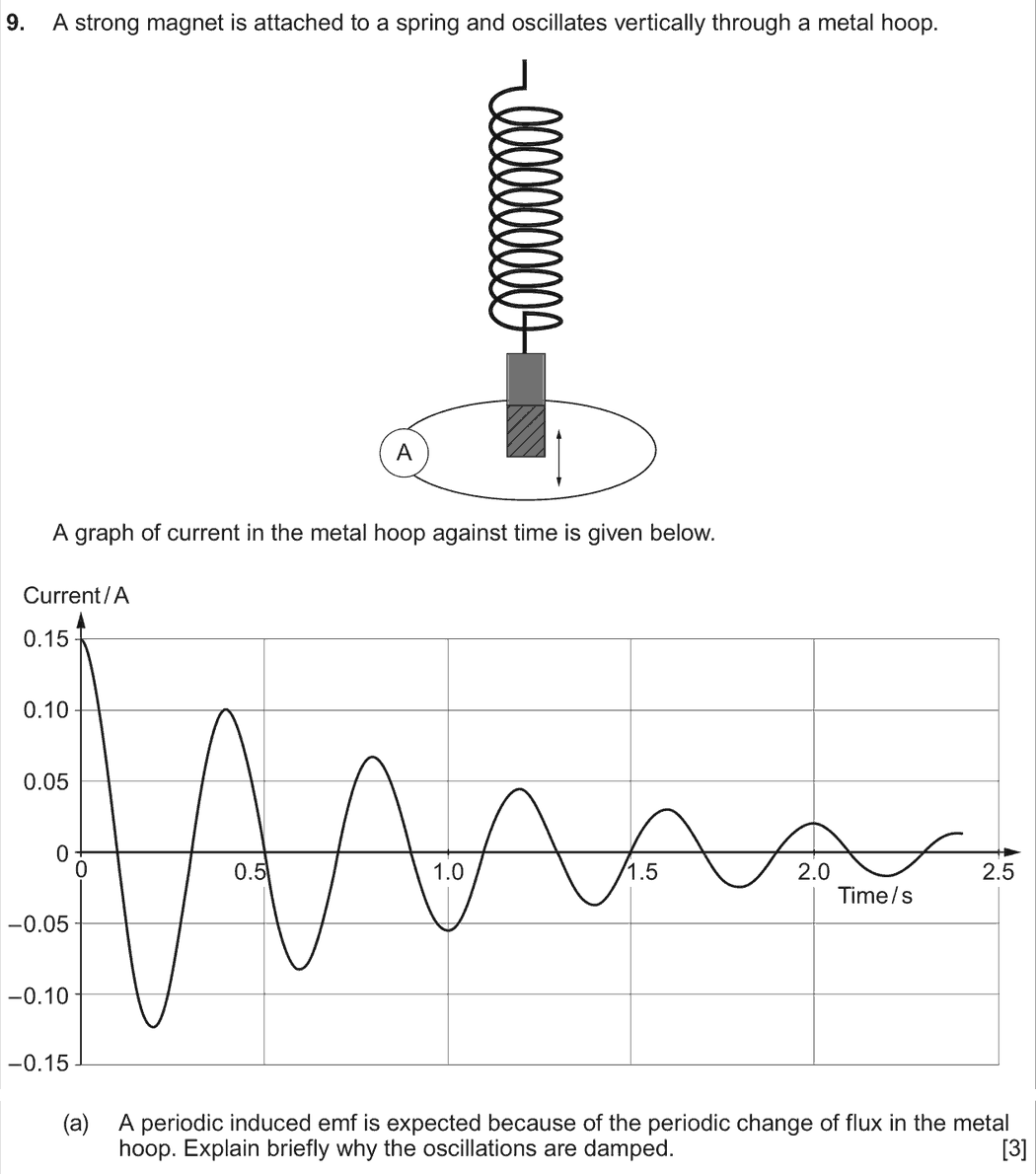
Answer: 0.027 Wb s⁻¹ (V). emf = IR = 0.15 × 0.18 = 0.027 V (1)
by Faraday's law this equals the rate of change of flux (linkage) (1)
Scheme columns: Maths 1
Skills: Synoptic Needs physics from another component of the qualification; Graphskills Reading, plotting or sketching graphs; gradients, intercepts and areas; Mathsmarks The mark scheme's Maths column gives this part at least one mark for mathematical skills
October 2021 · Component 1 · Q8(a)2 marksAO1=2Explanation
Mark scheme
Notes from the mark scheme and report
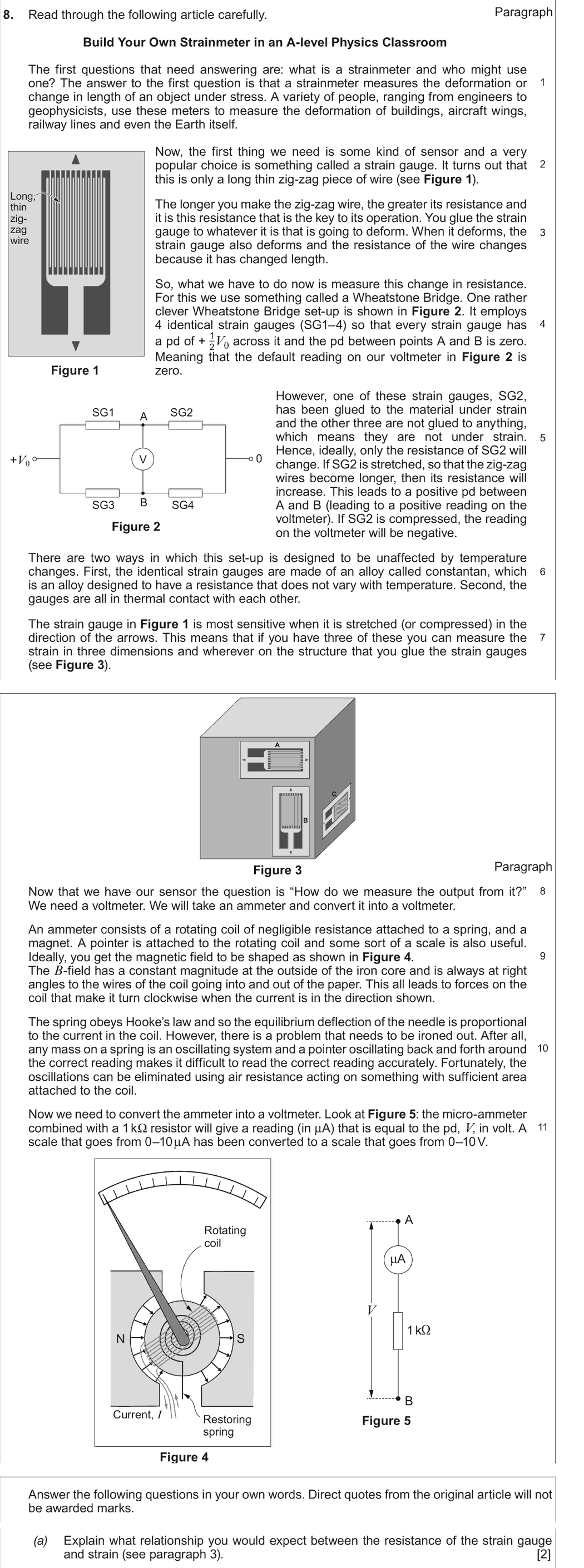
The resistance of a wire is proportional to its length (1), so the gauge resistance should vary linearly with strain (increase in proportion to the extension) (1)
Skills: Comprehension A level Component 1 Section B: questions on the printed article; Synoptic Needs physics from another component of the qualification
October 2021 · Component 1 · Q8(b)3 marksAO1=1, AO2=2Explanation
Earlier part of question 8 that this part uses
Mark scheme
Notes from the mark scheme and report
Compressed SG2 is shorter so its resistance falls (1)
it takes a smaller share of V0 (more across SG1) (1)
so the potential at A falls below the potential at B, giving a negative reading (1)
Skills: Comprehension A level Component 1 Section B: questions on the printed article; Synoptic Needs physics from another component of the qualification
October 2021 · Component 1 · Q8(c)2 marksAO3=2Explanation
Earlier part of question 8 that this part uses
Mark scheme
Notes from the mark scheme and report
The resistance of constantan does not vary with temperature (1), so the reading is not affected if the gauges are at different temperatures or the temperature changes (1)
Skills: Comprehension A level Component 1 Section B: questions on the printed article; Synoptic Needs physics from another component of the qualification
October 2021 · Component 1 · Q8(d)3 marksAO2=3Explanation
Earlier part of question 8 that this part uses
Mark scheme
Notes from the mark scheme and report
B (wires along the direction of compression) decreases in resistance (1)
A and C change very little, or increase slightly (1)
reason: B's wires get shorter, while A and C are at right angles to the compression so their length hardly changes (or increases slightly) (1)
Skills: Comprehension A level Component 1 Section B: questions on the printed article; Synoptic Needs physics from another component of the qualification
October 2021 · Component 1 · Q8(h)2 marksAO3=2Calculation
Earlier parts of question 8 that this part uses
Mark scheme
Notes from the mark scheme and report
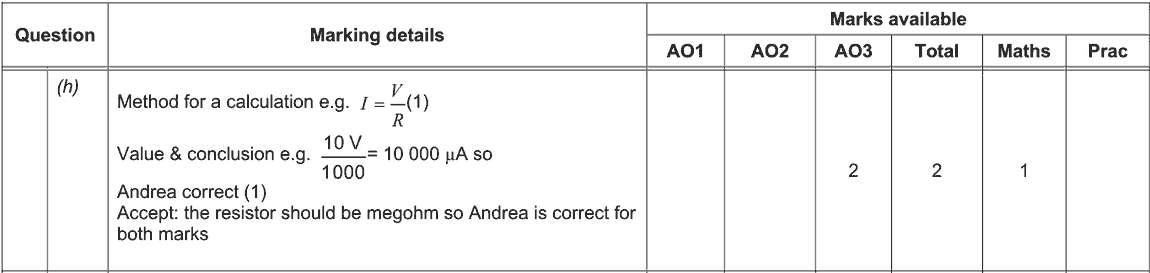
I = V/R (1): 10 V across 1 kΩ gives 10 mA = 10 000 μA, a thousand times the pd in volts, so Andrea is correct (the resistor should be 1 MΩ) (1)
Scheme columns: Maths 1
Skills: Comprehension A level Component 1 Section B: questions on the printed article; Synoptic Needs physics from another component of the qualification; Unitsand conversions Unit marks, base units, prefixes and conversions; Mathsmarks The mark scheme's Maths column gives this part at least one mark for mathematical skills
October 2021 · Component 2 · Q1(b)(ii)3 marksAO3=3Calculation
Earlier parts of question 1 that this part uses
Mark scheme
Notes from the mark scheme and report
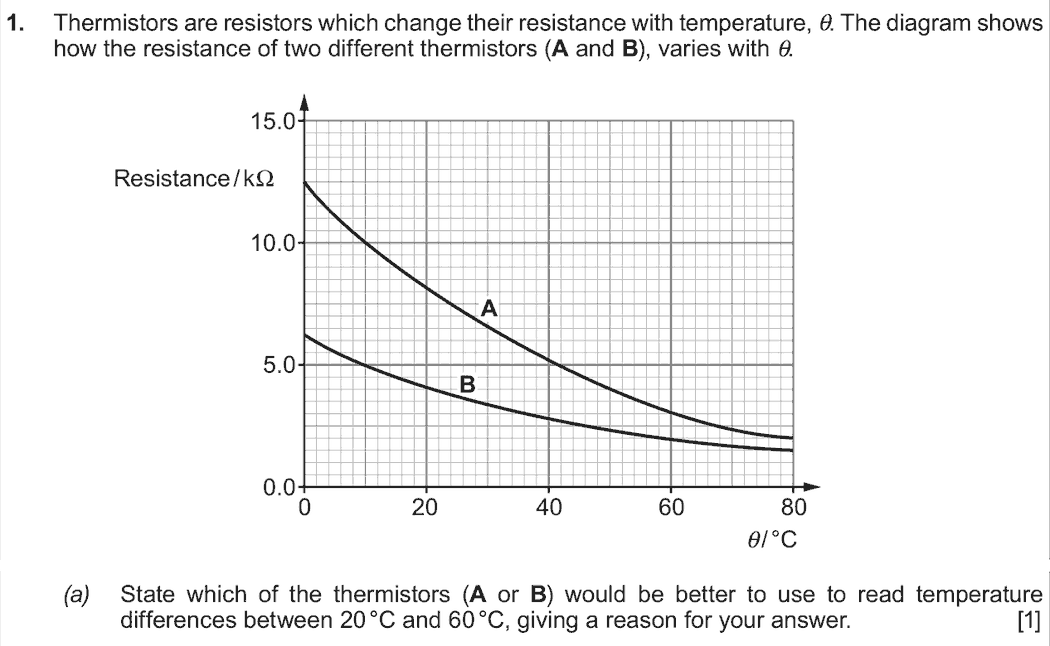
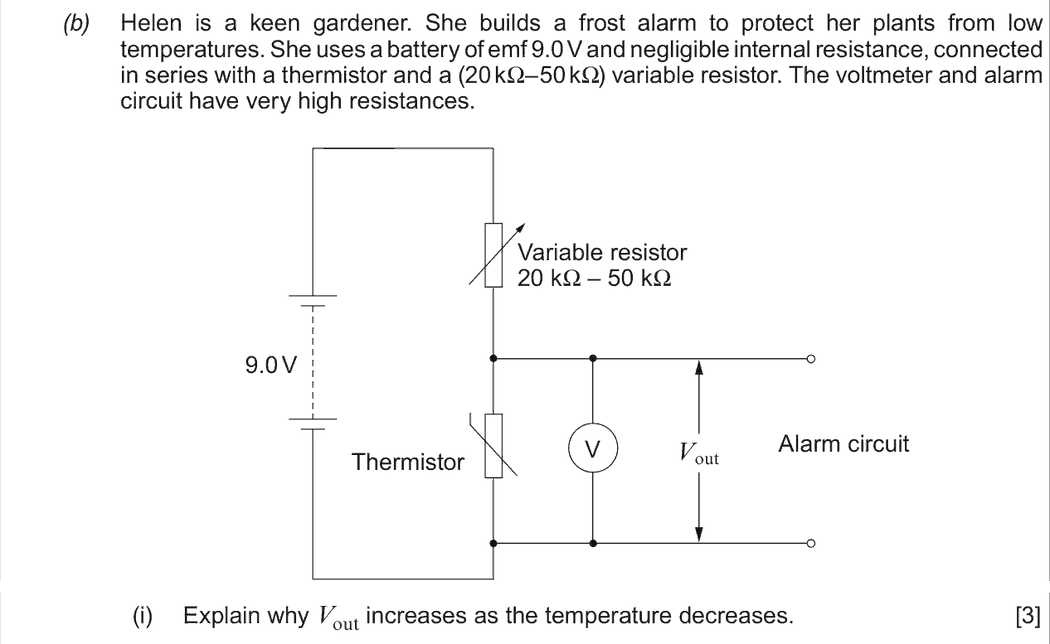
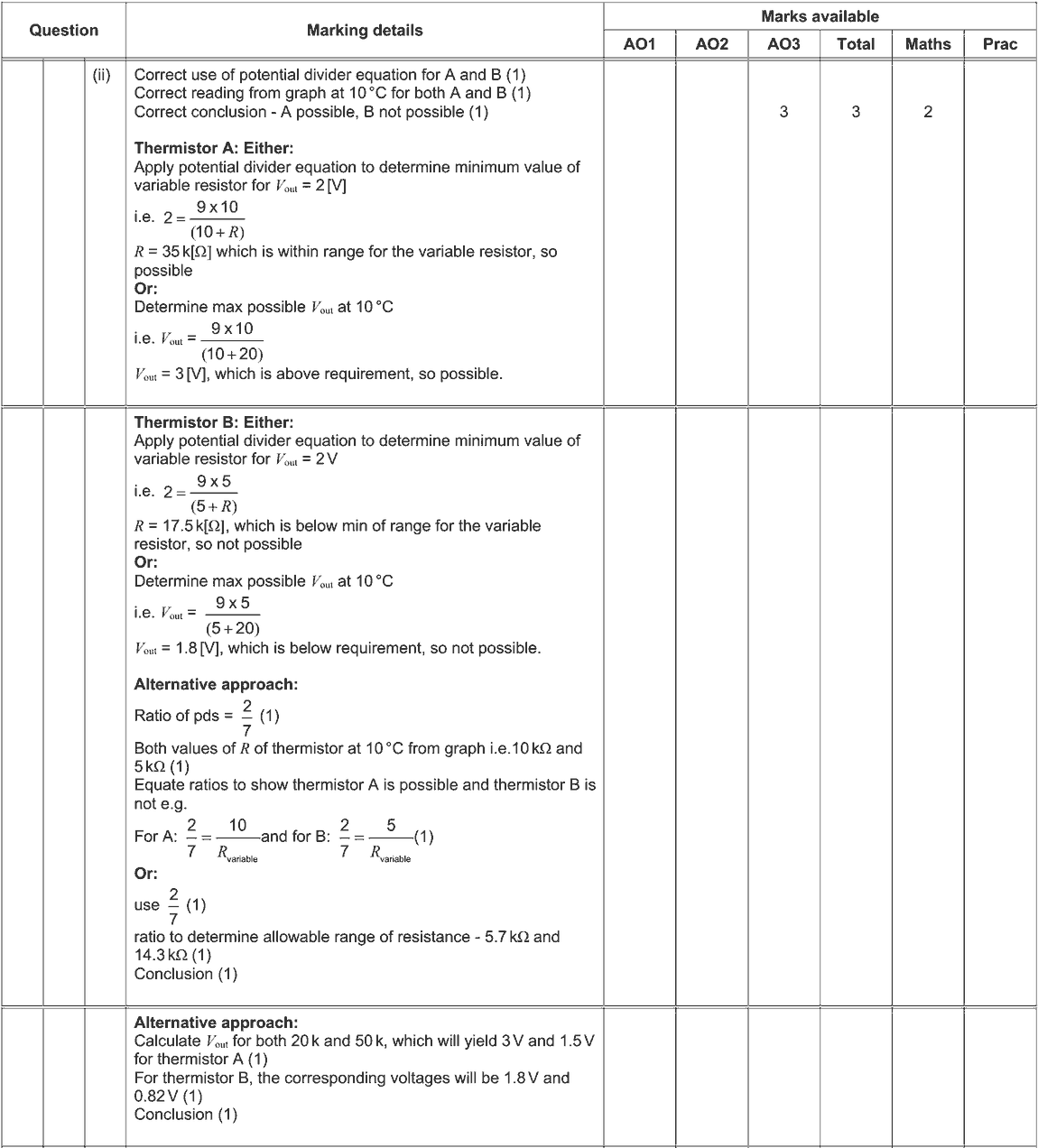
Answer: A suitable, B not. At 10 °C A is 10 kΩ and B is 5 kΩ. For Vout = 2.0 V the variable resistor must take 7.0 V, i.e. 3.5 times the thermistor resistance: 35 kΩ for A (within 20 to 50 kΩ), 17.5 kΩ for B (below the 20 kΩ minimum). Or maximum Vout at 20 kΩ: A gives 3.0 V, B only 1.8 V
Scheme columns: Maths 2
Skills: Graphskills Reading, plotting or sketching graphs; gradients, intercepts and areas; Mathsmarks The mark scheme's Maths column gives this part at least one mark for mathematical skills
October 2021 · Component 2 · Q1(b)(iii)2 marksAO2=2Calculation
Earlier parts of question 1 that this part uses
Mark scheme
Notes from the mark scheme and report
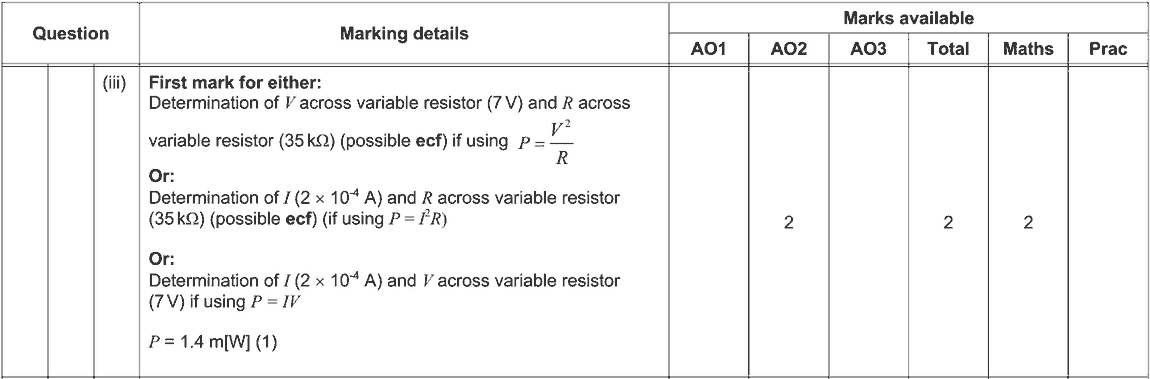
Answer: 1.4 mW. With thermistor A: 7.0 V across 35 kΩ, current 2.0 × 10⁻⁴ A
P = V²/R = 49/35 000 (or I²R or IV)
ecf
Scheme columns: Maths 2
Skills: Unitsand conversions Unit marks, base units, prefixes and conversions; Mathsmarks The mark scheme's Maths column gives this part at least one mark for mathematical skills
October 2021 · Component 2 · Q1(b)(iv)1 markAO3=1Short answer
Earlier parts of question 1 that this part uses
Mark scheme
Notes from the mark scheme and report
Acceptable: the power dissipated is so small that heating from the variable resistor has a negligible effect on the thermistor's temperature
October 2021 · Component 2 · Q3(a)(i)1 markAO3=1Practical and data analysis
Mark scheme
Notes from the mark scheme and report
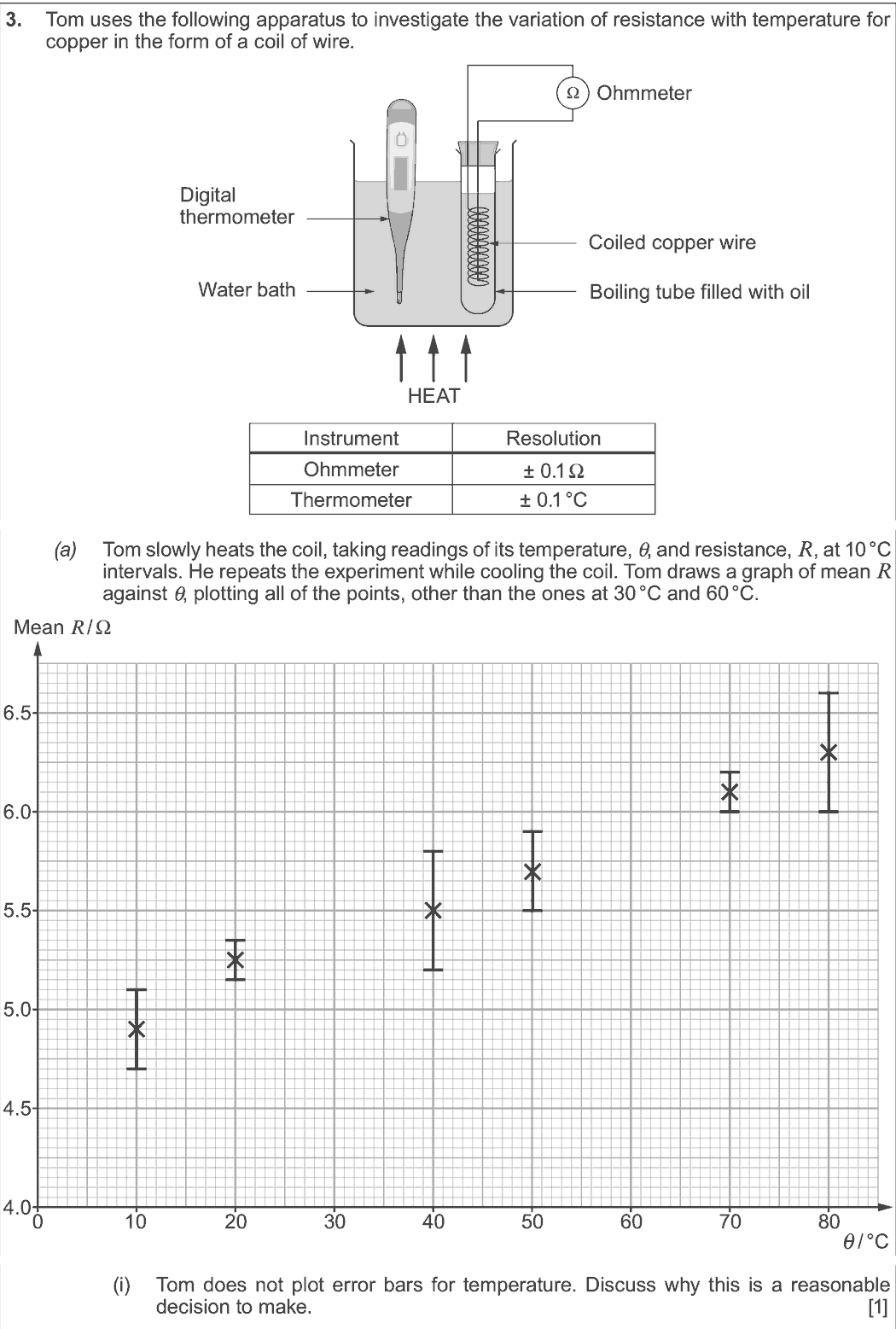
The temperature uncertainty (± 0.1 °C) is very small compared with the uncertainty in R, so the bars would be too small to draw on this scale
Scheme columns: Practical 1
Skills: Uncertainties Resolution, absolute and percentage uncertainty, combining uncertainties, error bars; Graphskills Reading, plotting or sketching graphs; gradients, intercepts and areas; Practicalmarks The mark scheme's Prac column gives this part at least one mark for practical skills
October 2021 · Component 2 · Q3(a)(ii)2 marksAO2=2Diagram or graph
Earlier part of question 3 that this part uses
Mark scheme
Notes from the mark scheme and report
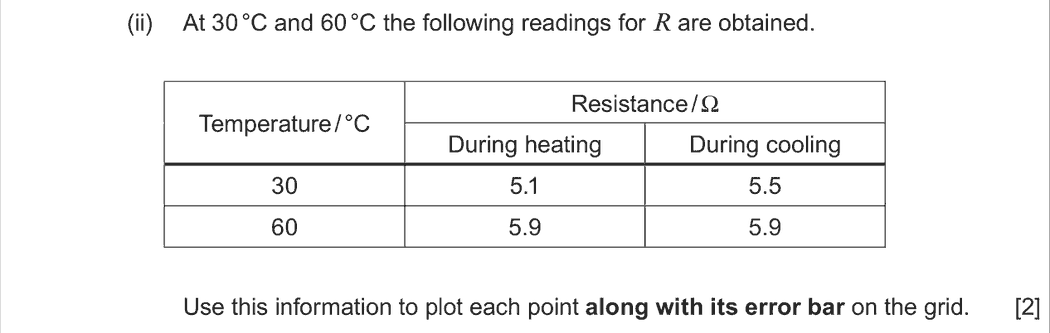
30 °C: point at the mean 5.3 Ω with bar from 5.1 to 5.5 Ω (1)
60 °C: point at 5.9 Ω with bar from 5.8 to 6.0 Ω, the ± 0.1 Ω resolution, since both readings agree (1)
Scheme columns: Maths 2, Practical 2
Skills: Graphskills Reading, plotting or sketching graphs; gradients, intercepts and areas; Uncertainties Resolution, absolute and percentage uncertainty, combining uncertainties, error bars; Mathsmarks The mark scheme's Maths column gives this part at least one mark for mathematical skills; Practicalmarks The mark scheme's Prac column gives this part at least one mark for practical skills
October 2021 · Component 2 · Q3(a)(iii)3 marksAO2=3Practical and data analysis
Earlier part of question 3 that this part uses
Mark scheme
Notes from the mark scheme and report
Answer: max gradient about 0.022 Ω °C⁻¹, min about 0.015 Ω °C⁻¹. Steepest and shallowest straight lines that pass through all the error bars (1)
one mark for each gradient
Scheme columns: Maths 2, Practical 3
Skills: Graphskills Reading, plotting or sketching graphs; gradients, intercepts and areas; Uncertainties Resolution, absolute and percentage uncertainty, combining uncertainties, error bars; Mathsmarks The mark scheme's Maths column gives this part at least one mark for mathematical skills; Practicalmarks The mark scheme's Prac column gives this part at least one mark for practical skills
October 2021 · Component 2 · Q3(a)(iv)2 marksAO2=2Practical and data analysis
% uncertainty = half the range/mean = 0.0035/0.0185
ecf
Scheme columns: Maths 2, Practical 2
Skills: Uncertainties Resolution, absolute and percentage uncertainty, combining uncertainties, error bars; Mathsmarks The mark scheme's Maths column gives this part at least one mark for mathematical skills; Practicalmarks The mark scheme's Prac column gives this part at least one mark for practical skills
October 2021 · Component 2 · Q3(b)(i)2 marksAO3=2Practical and data analysis
Earlier part of question 3 that this part uses
Mark scheme
Notes from the mark scheme and report
Compare R = R0αθ + R0 with y = mx + c (1): the gradient is R0α, not α, and the intercept is R0 (1)
Scheme columns: Maths 1, Practical 2
Skills: Graphskills Reading, plotting or sketching graphs; gradients, intercepts and areas; Algebra Derivations and rearranging equations; Mathsmarks The mark scheme's Maths column gives this part at least one mark for mathematical skills; Practicalmarks The mark scheme's Prac column gives this part at least one mark for practical skills
October 2021 · Component 2 · Q3(b)(ii)5 marksAO3=5Practical and data analysis
Earlier parts of question 3 that this part uses
Mark scheme
Notes from the mark scheme and report
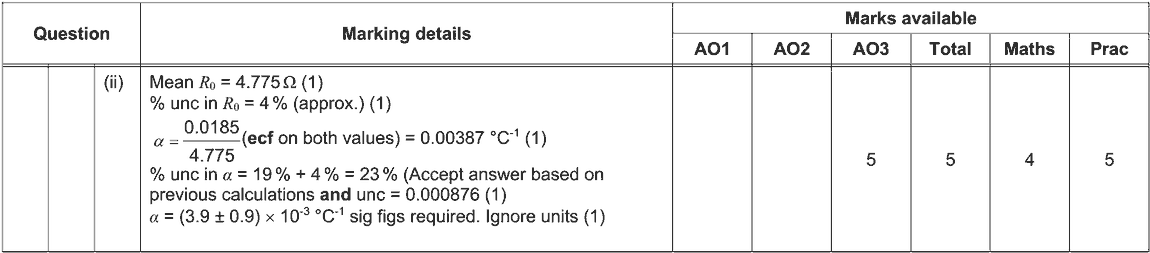
Answer: (3.9 ± 0.9) × 10⁻³ °C⁻¹. R0 = mean of the two intercepts = 4.78 Ω, about ± 4% (2)
final value with uncertainty to matching significant figures (1)
Scheme columns: Maths 4, Practical 5
Skills: Uncertainties Resolution, absolute and percentage uncertainty, combining uncertainties, error bars; Graphskills Reading, plotting or sketching graphs; gradients, intercepts and areas; Mathsmarks The mark scheme's Maths column gives this part at least one mark for mathematical skills; Practicalmarks The mark scheme's Prac column gives this part at least one mark for practical skills
October 2021 · Component 2 · Q3(c)2 marksAO3=2Practical and data analysis
Earlier part of question 3 that this part uses
Mark scheme
Notes from the mark scheme and report
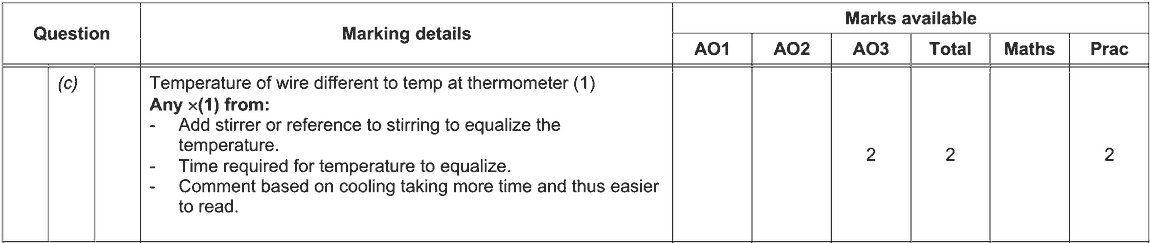
Reason: the wire's temperature differs from that at the thermometer (in the water bath, not the oil), so heating and cooling readings disagree (1). Improvement: stir, or wait at each temperature for it to equalise
heat or cool more slowly (1)
Scheme columns: Practical 2
Skills: Experimentalmethod Describing, planning or improving an experiment; Uncertainties Resolution, absolute and percentage uncertainty, combining uncertainties, error bars; Practicalmarks The mark scheme's Prac column gives this part at least one mark for practical skills
Mark scheme, with the levels and indicative content
Examiner's comment
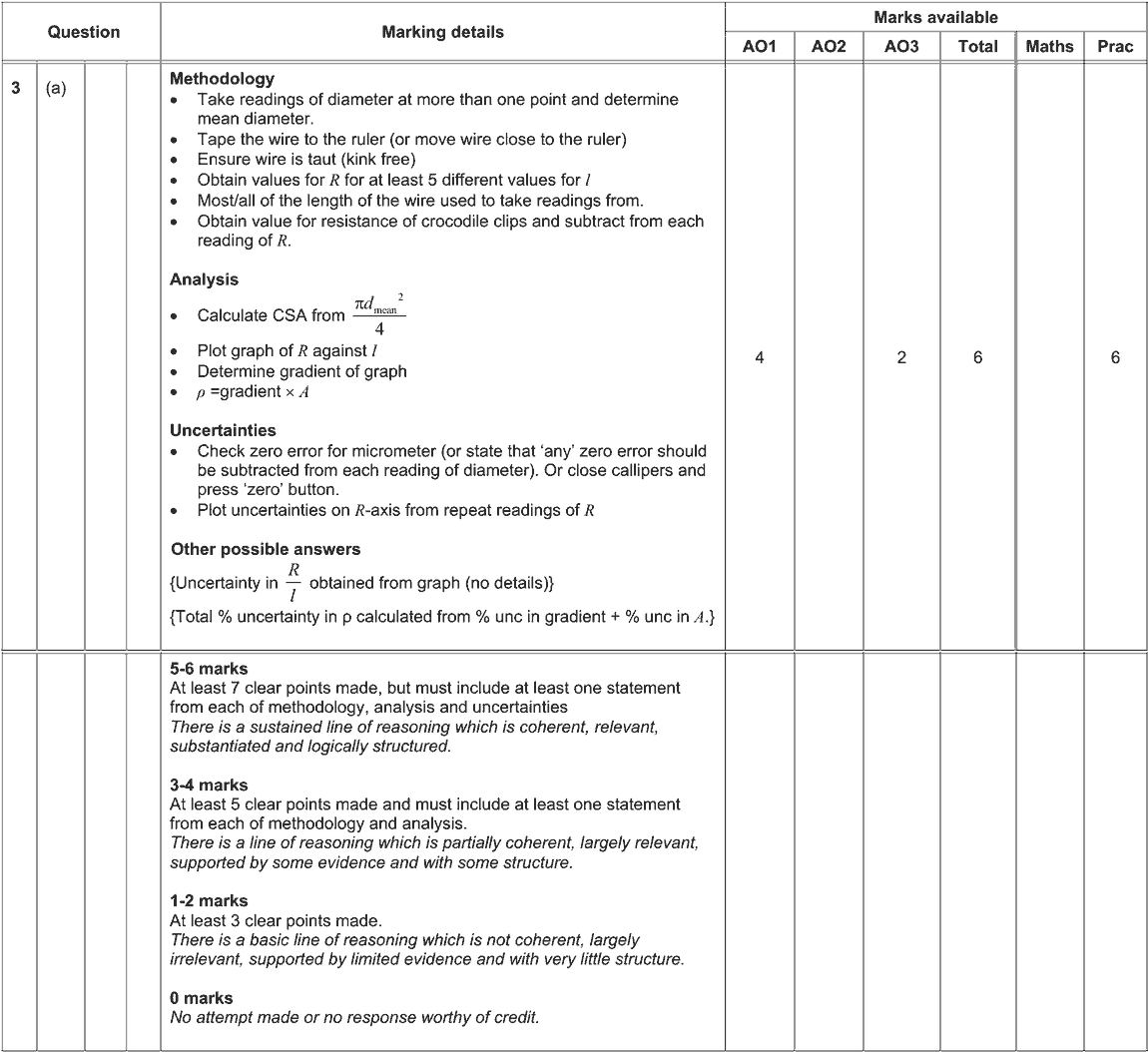
Few candidate responses allowed access to the top band of marks for the QER question. The majority did however give ‘solid’ middle band responses but failed to provide the extensive detail required to access the upper marks e.g. candidates might state that a graph of R vs l should be drawn and that the value for the resistivity could be gained from the gradient, which is correct to an extent, but the added detail of requiring the gradient to be multiplied by the cross-sectional area was often missing. In (b), many candidates were able to show that the heating unit would work as planned using the given data. The few candidates who failed to do so were often confused between the resistance of one strip and that of the full heating unit.
Notes from the mark scheme and report
QER, levels marked. Method: diameter at several places and take the mean
wire taut, kink-free and against the rule
R for at least five lengths over most of the wire
subtract the resistance of the leads and clips. Analysis: A = πd²/4
plot R against l
gradient = ρ/A so ρ = gradient × A. Uncertainties: check the calliper zero
repeat R readings for error bars
% uncertainty in ρ from gradient and area. Top band needs 7 points across all three sections
most were mid band and forgot to multiply the gradient by A
Scheme columns: Practical 6
Skills: Experimentalmethod Describing, planning or improving an experiment; Graphskills Reading, plotting or sketching graphs; gradients, intercepts and areas; Uncertainties Resolution, absolute and percentage uncertainty, combining uncertainties, error bars; Practicalmarks The mark scheme's Prac column gives this part at least one mark for practical skills; QER The 6-mark quality of extended response question
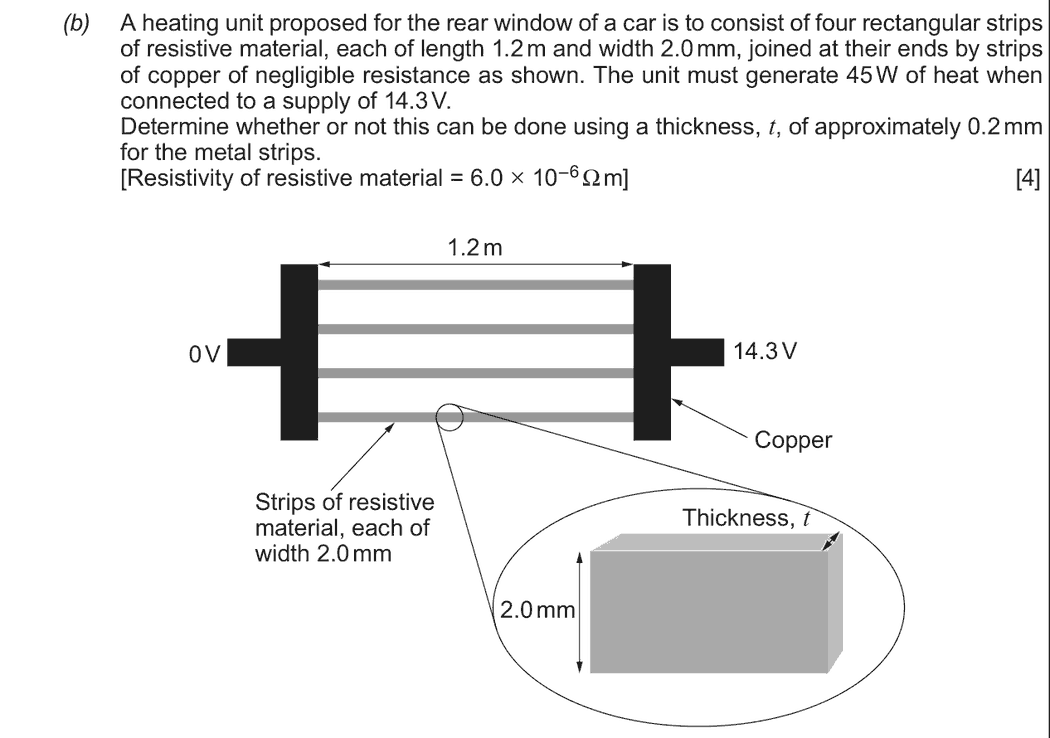
October 2020 · Component 2 · Q3(b)4 marksAO3=4Calculation
Earlier part of question 3 that this part uses
Mark scheme
Examiner's comment
Few candidate responses allowed access to the top band of marks for the QER question. The majority did however give ‘solid’ middle band responses but failed to provide the extensive detail required to access the upper marks e.g. candidates might state that a graph of R vs l should be drawn and that the value for the resistivity could be gained from the gradient, which is correct to an extent, but the added detail of requiring the gradient to be multiplied by the cross-sectional area was often missing. In (b), many candidates were able to show that the heating unit would work as planned using the given data. The few candidates who failed to do so were often confused between the resistance of one strip and that of the full heating unit.
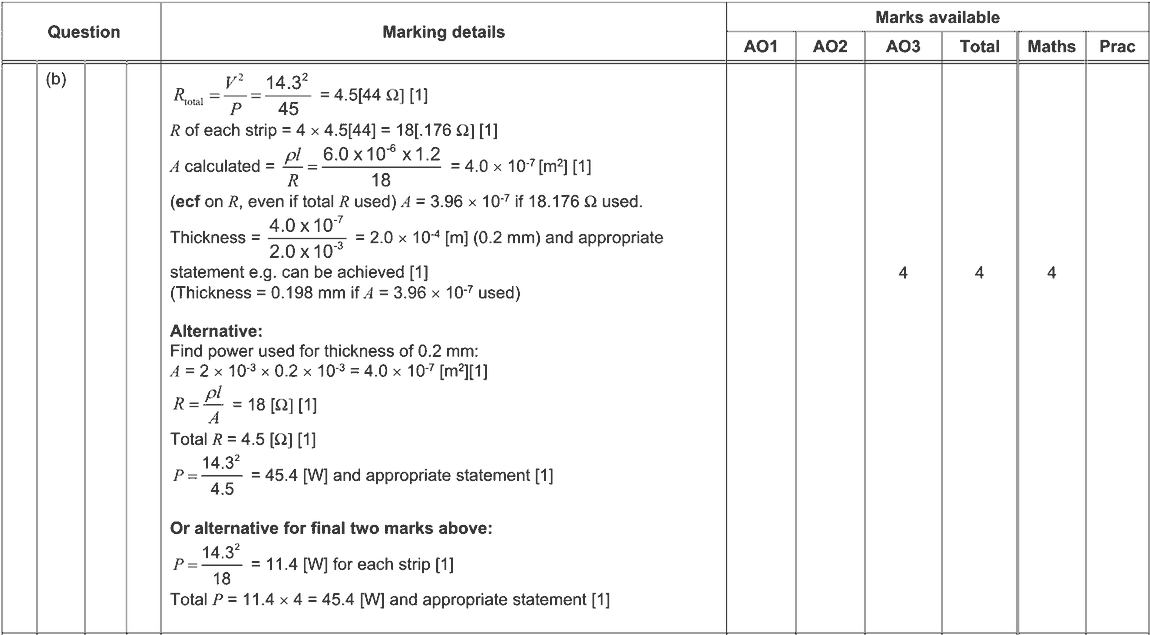
Notes from the mark scheme and report
Answer: yes, t = 0.20 mm. Total R = V²/P = 14.3²/45 = 4.54 Ω
four equal strips in parallel so each is 18.2 Ω
A = ρl/R = 6.0 × 10⁻⁶ × 1.2/18.2 = 4.0 × 10⁻⁷ m²
t = A/2.0 × 10⁻³
or work forwards from t = 0.2 mm to P = 45.4 W
errors came from mixing up one strip with the whole unit
Scheme columns: Maths 4
Skills: Unitsand conversions Unit marks, base units, prefixes and conversions; Mathsmarks The mark scheme's Maths column gives this part at least one mark for mathematical skills
June 2019 · Component 2 · Q1(b)(ii)2 marksAO1=1, AO2=1Calculation
Earlier parts of question 1 that this part uses
Mark scheme
Examiner's comment
Only a few candidates were then able to calculate the energy dissipated in each cell in one minute. The majority of candidates either failed to include the factor 60 in their calculations or used an incorrect value for r or V.
Notes from the mark scheme and report
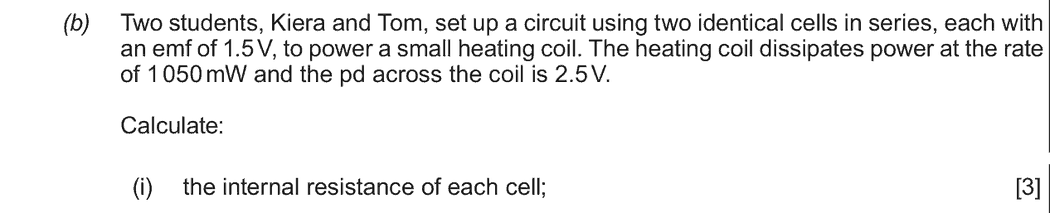
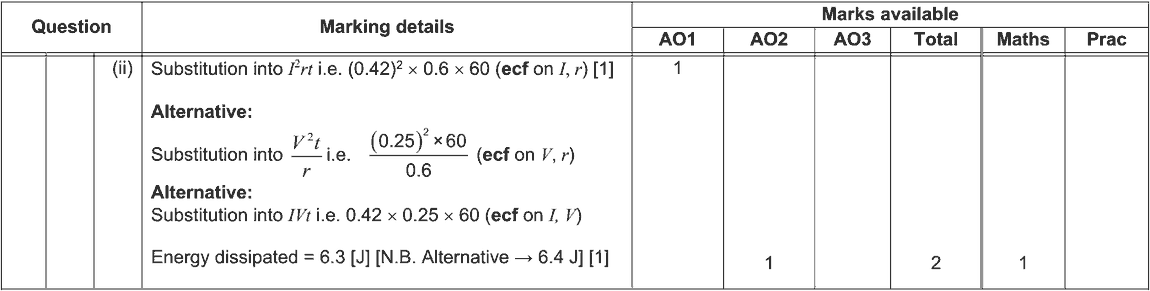
Answer: 6.3 J. Energy = I²rt = 0.42² × 0.6 × 60 (1), or V²t/r or IVt with 0.25 V per cell (6.4 J by that route) (1)
the factor 60 was often left out or the wrong r or V used
Scheme columns: Maths 1
Skills: Unitsand conversions Unit marks, base units, prefixes and conversions; Mathsmarks The mark scheme's Maths column gives this part at least one mark for mathematical skills
June 2019 · Component 2 · Q2(a)1 markAO3=1Practical and data analysis
Mark scheme
Examiner's comment
The majority of candidates correctly stated that the variable resistor should be varied to obtain a range of values for V and I.
Notes from the mark scheme and report
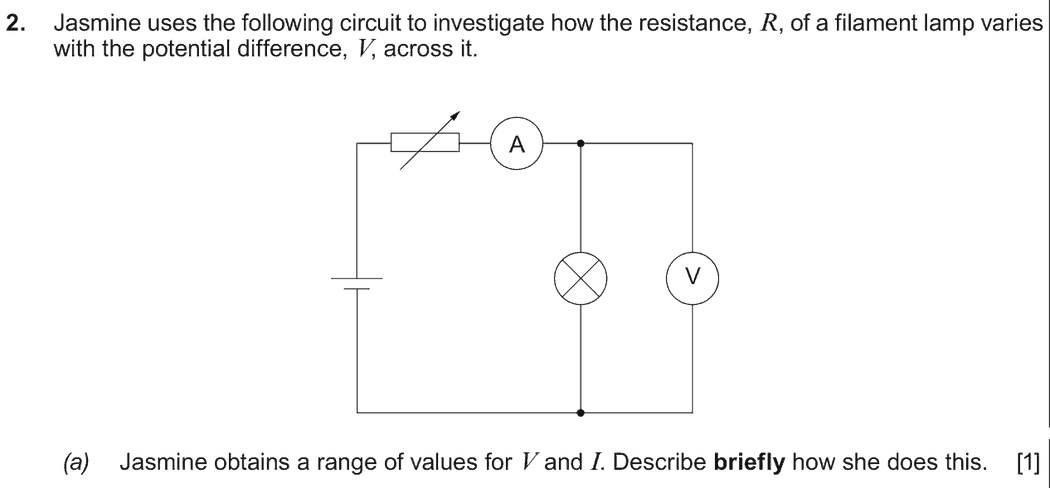
Adjust the variable resistor to change the pd and current
Scheme columns: Practical 1
Skills: Experimentalmethod Describing, planning or improving an experiment; Practicalmarks The mark scheme's Prac column gives this part at least one mark for practical skills
June 2019 · Component 2 · Q2(b)2 marksAO2=2Show that
Earlier part of question 2 that this part uses
Mark scheme
Examiner's comment
Only a few of the weaker candidates were unable to use logs correctly to rewrite the equation as required. Nearly all other candidates were successful in their attempts to do this.
Notes from the mark scheme and report
Take logs: log R = log k + log Vⁿ (1)
log R = n log V + log k, so y = log R, x = log V, gradient n, intercept log k (1)
Scheme columns: Maths 2, Practical 2
Skills: Algebra Derivations and rearranging equations; Mathsmarks The mark scheme's Maths column gives this part at least one mark for mathematical skills; Practicalmarks The mark scheme's Prac column gives this part at least one mark for practical skills
June 2019 · Component 2 · Q2(c)3 marksAO2=3Practical and data analysis
Earlier part of question 2 that this part uses
Mark scheme
Examiner's comment
The majority of candidates completed the table correctly with nearly all deciding to use log10 or loge. Both were acceptable. A minority of candidates lost one mark for using an inappropriate number of sig. figs.
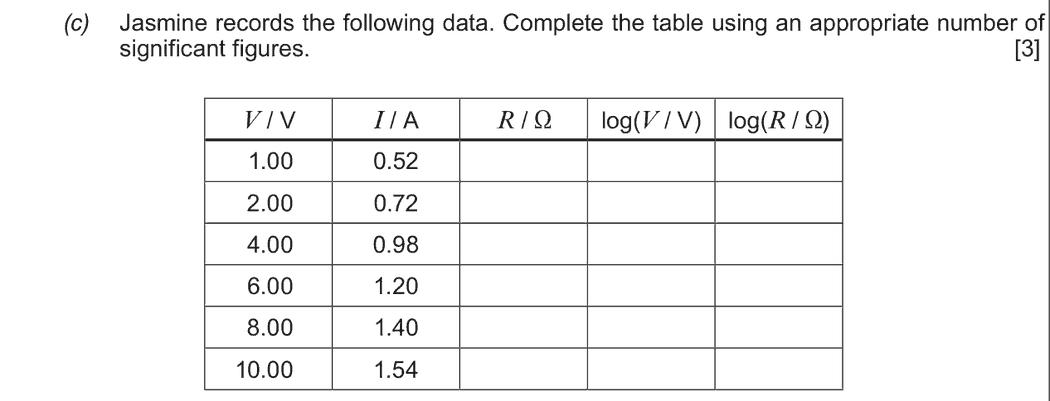
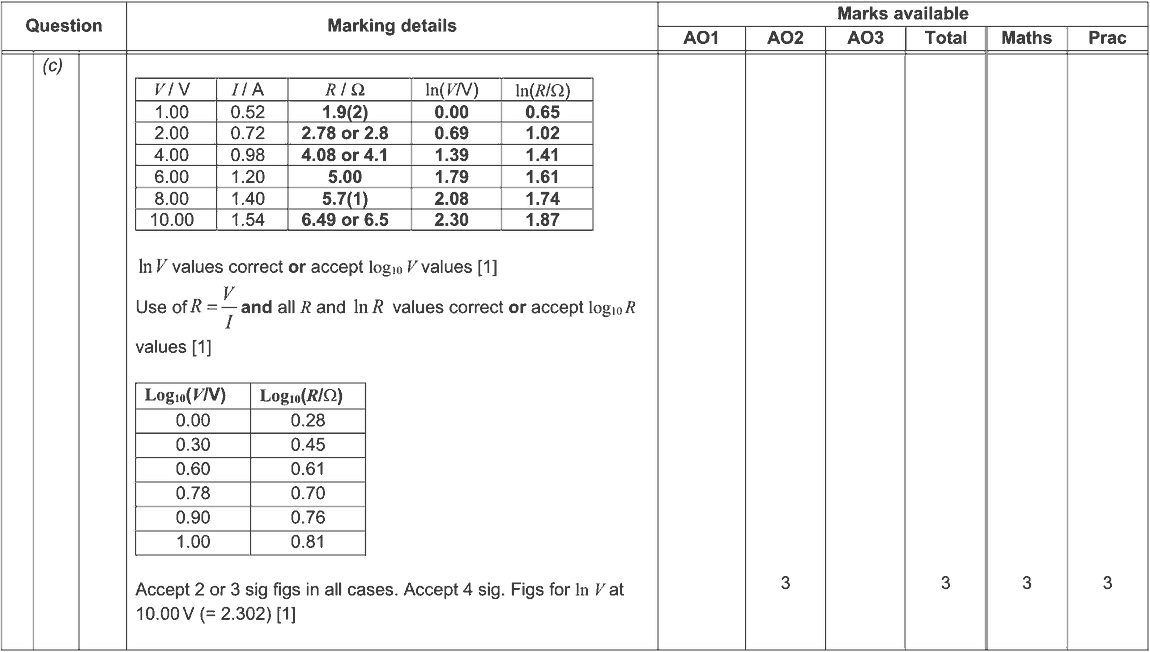
log₁₀R: 0.28, 0.44, 0.61, 0.70, 0.76, 0.81, all to 2 or 3 significant figures (1)
Scheme columns: Maths 3, Practical 3
Skills: Graphskills Reading, plotting or sketching graphs; gradients, intercepts and areas; Mathsmarks The mark scheme's Maths column gives this part at least one mark for mathematical skills; Practicalmarks The mark scheme's Prac column gives this part at least one mark for practical skills
June 2019 · Component 2 · Q2(d)5 marksAO2=5Practical and data analysis
Earlier parts of question 2 that this part uses
Mark scheme
Examiner's comment
A significant number of candidates labelled the axes incorrectly, in most cases by giving labels with units incorrectly. For example, labels such as log10 V (V) were often seen. Labelling without units was accepted as was labelling with units bracketed correctly e.g. log10(V/V). The majority chose sensible scales and plotted the points correctly. Best fit lines were drawn well.
Notes from the mark scheme and report
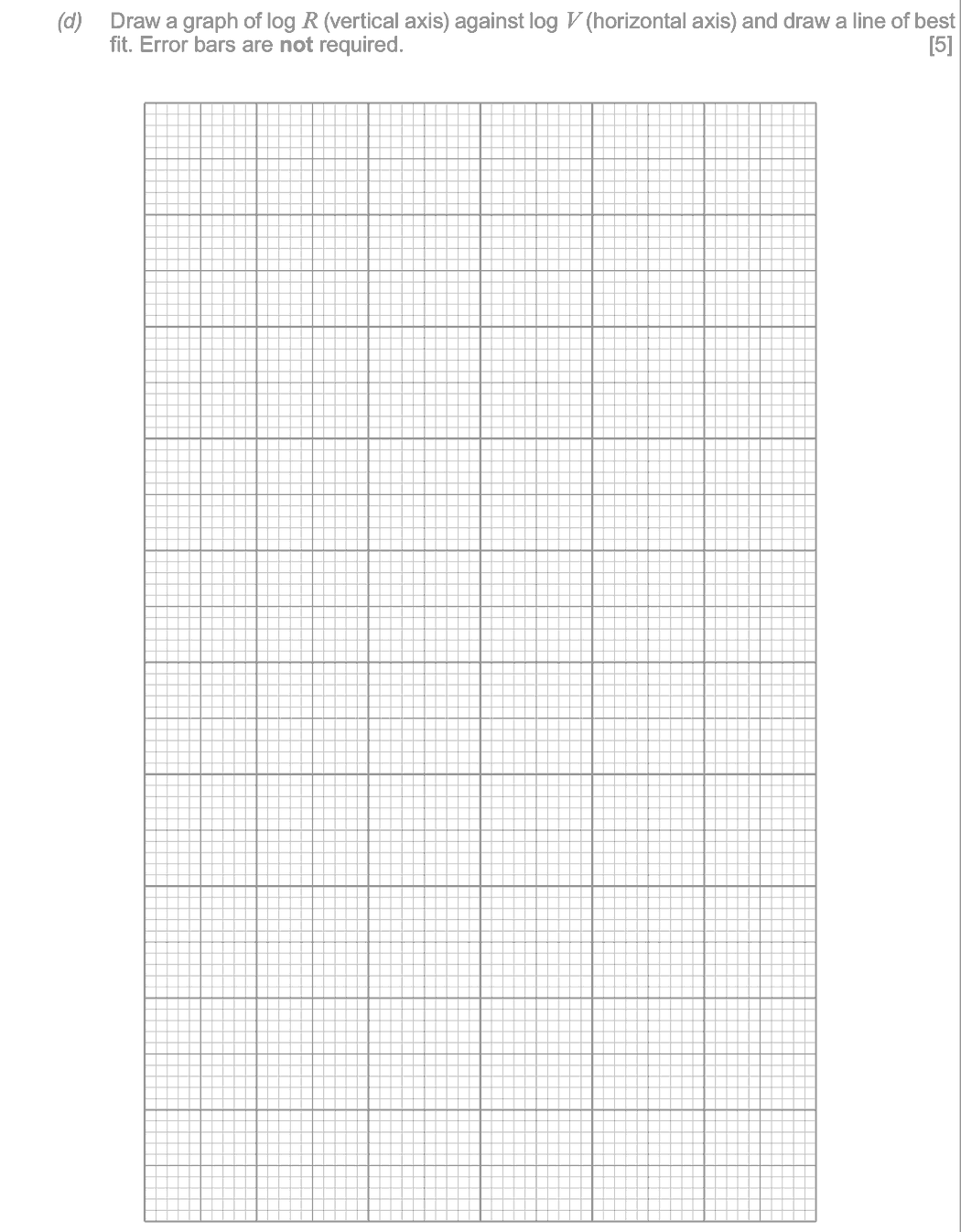
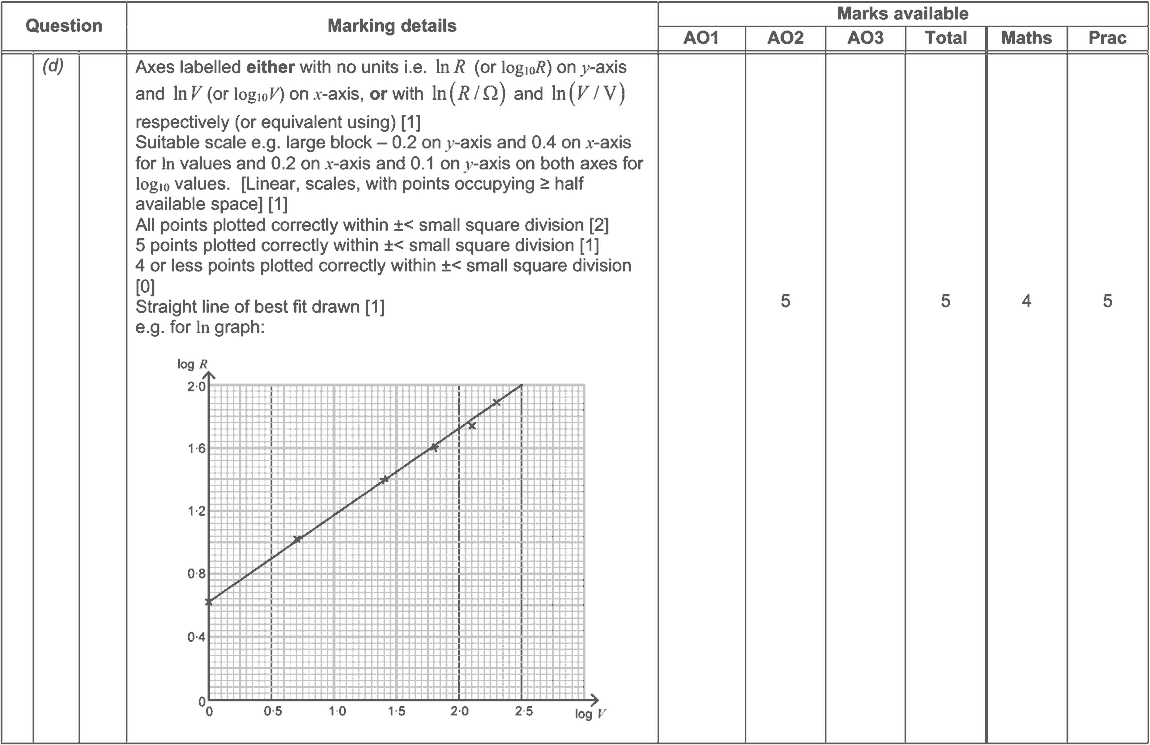
Axes labelled log R and log V with no units, or as log(R/Ω) and log(V/V) (1)
linear scales with points filling at least half the grid (1)
all six points within half a small square (2
five correct 1)
straight line of best fit (1)
common error: units written after the log label
Scheme columns: Maths 4, Practical 5
Skills: Graphskills Reading, plotting or sketching graphs; gradients, intercepts and areas; Mathsmarks The mark scheme's Maths column gives this part at least one mark for mathematical skills; Practicalmarks The mark scheme's Prac column gives this part at least one mark for practical skills
June 2019 · Component 2 · Q2(e)(i)4 marksAO1=2, AO2=2Practical and data analysis
Earlier parts of question 2 that this part uses
Mark scheme
Examiner's comment
Most candidates who were successful in (b) understood how to use the graph to obtain values for n and k. In a minority of cases, candidates misread their graphs which led to incorrect answers. Care should be taken when carrying out this simple task.
Notes from the mark scheme and report
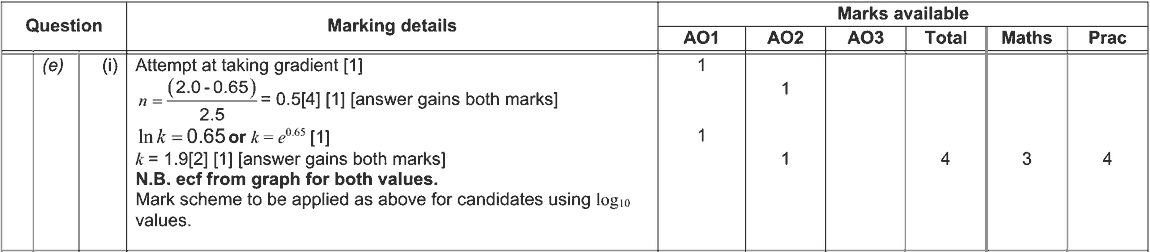
Answer: n ≈ 0.54, k ≈ 1.9. Gradient of the line = n (2), e.g. (2.0 − 0.65)/2.5 on the ln graph
intercept = log k (1) so k = e^0.65 or 10^0.28 = 1.9 (1)
ecf from the graph
Scheme columns: Maths 3, Practical 4
Skills: Graphskills Reading, plotting or sketching graphs; gradients, intercepts and areas; Algebra Derivations and rearranging equations; Mathsmarks The mark scheme's Maths column gives this part at least one mark for mathematical skills; Practicalmarks The mark scheme's Prac column gives this part at least one mark for practical skills
June 2019 · Component 2 · Q2(e)(ii)1 markAO1=1Short answer
Earlier parts of question 2 that this part uses
Mark scheme
Examiner's comment
Most candidates who were successful in (b) understood how to use the graph to obtain values for n and k. In a minority of cases, candidates misread their graphs which led to incorrect answers. Care should be taken when carrying out this simple task.
Notes from the mark scheme and report
Answer: R = 1.9 V^0.5 (ecf on n and k)
Scheme columns: Maths 1, Practical 1
Skills: Mathsmarks The mark scheme's Maths column gives this part at least one mark for mathematical skills; Practicalmarks The mark scheme's Prac column gives this part at least one mark for practical skills
June 2019 · Component 2 · Q2(f)1 markAO3=1Practical and data analysis
Earlier parts of question 2 that this part uses
Mark scheme
Examiner's comment
A significant number of candidates did not state clearly that the best fit line has all the points close to it.
Notes from the mark scheme and report
All points lie close to the line of best fit, so the results are of good quality (or agree with the expected relationship)
'it is a straight line' or comments on instruments not accepted
Scheme columns: Practical 1
Skills: Graphskills Reading, plotting or sketching graphs; gradients, intercepts and areas; Practicalmarks The mark scheme's Prac column gives this part at least one mark for practical skills
June 2019 · Component 2 · Q4(a)6 marksAO1=66-mark extended response
Mark scheme, with the levels and indicative content
Examiner's comment
There were many good responses here with the majority of candidates scoring well with the describe aspect of the question. Many described how resistance changed with temperature from the superconducting stage to higher temperatures well. Most made appropriate reference to the critical or transition temperature. Fewer candidates were able to account for the changing resistance adequately however, with a significant minority describing collisions between electrons rather than between electrons and ions. Fewer again outlined the consequence of these collisions in terms of reduced drift speed and increased resistance. A sketch graph helped some candidates’ answers but only if of the correct shape.
Notes from the mark scheme and report
QER, levels marked. Description: resistance is zero at very low temperatures (superconducting)
at the transition (critical) temperature it jumps suddenly from zero
above it the resistance rises with temperature, approximately linearly (sketch graph can carry these points). Explanation above the transition: hotter lattice ions vibrate more
free electrons are more likely to collide with the ions
electrons lose kinetic energy so the drift velocity falls and resistance rises
collisions pass energy to the ions, making further collisions more likely. Report: description done well
explanation weaker, some described electron-electron collisions
Skills: QER The 6-mark quality of extended response question
June 2019 · AS Component 2 · Q4(a)(i)3 marksAO1=1, AO2=2Calculation
Mark scheme
Notes from the mark scheme and report
Answer: 1.62 × 10⁻⁸ Ω m. R = ρl/A (1)
A = πd²/4 = 6.16 × 10⁻⁸ m² (1)
ρ = 0.085 × 6.16 × 10⁻⁸ / 0.324 with unit (1)
Scheme columns: Maths 2
Skills: Unitsand conversions Unit marks, base units, prefixes and conversions; Mathsmarks The mark scheme's Maths column gives this part at least one mark for mathematical skills
June 2019 · AS Component 2 · Q4(a)(ii)4 marksAO2=4Practical and data analysis
Skills: Uncertainties Resolution, absolute and percentage uncertainty, combining uncertainties, error bars; Mathsmarks The mark scheme's Maths column gives this part at least one mark for mathematical skills; Practicalmarks The mark scheme's Prac column gives this part at least one mark for practical skills
June 2019 · AS Component 2 · Q4(a)(iii)2 marksAO3=2Practical and data analysis
Earlier part of question 4 that this part uses
Mark scheme
Notes from the mark scheme and report
Range 1.4 to 1.8 × 10⁻⁸ Ω m includes both silver (1.59) and copper (1.68) (1)
so the material cannot be identified uniquely from the table (1)
June 2019 · Component 2 · Q4(b)3 marksAO3=3Short answer
Earlier part of question 4 that this part uses
Mark scheme
Examiner's comment
In this scientific issues question, it was expected that candidates provided an example of how MRI scanners and particle accelerators are used in society. Two marks were awarded for this. The third mark was awarded for providing clear reasoning as to which one the candidate thought was of greater benefit to society.
Notes from the mark scheme and report
One benefit of particle accelerators (e.g. better understanding of particles, advances in computing, spin-off applications, skilled jobs) (1)
one benefit of MRI scanners (e.g. improved diagnosis and treatment, benefits more people) (1)
June 2019 · AS Component 2 · Q4(b)(i)4 marksAO1=4Explanation
Earlier parts of question 4 that this part uses
Mark scheme
Notes from the mark scheme and report
Current is a flow (drift) of free electrons (1)
the flow is impeded by collisions with the ions of the lattice (1)
at higher temperature the collisions are more frequent (1) because the ions vibrate more (or the random speed of the electrons increases), so resistance rises and the current falls at fixed pd (1)
June 2019 · AS Component 2 · Q4(b)(ii)3 marksAO3=3Practical and data analysis
Earlier parts of question 4 that this part uses
Mark scheme
Notes from the mark scheme and report
R = V/I so R is proportional to 1/I at constant V (1)
test for proportionality with all three rows, e.g. R/θ = 2.07, 0.77, 0.50 Ω °C⁻¹ or θ × I = 2.9, 7.8, 12 (1)
not constant so Anika is not correct, the resistance varies linearly but not in direct proportion to Celsius temperature (1)
Scheme columns: Maths 2, Practical 3
Skills: Mathsmarks The mark scheme's Maths column gives this part at least one mark for mathematical skills; Practicalmarks The mark scheme's Prac column gives this part at least one mark for practical skills
June 2019 · AS Component 2 · Q5(b)(iii)3 marksAO1=1, AO2=2Calculation
Earlier parts of question 5 that this part uses
Mark scheme
Notes from the mark scheme and report
Answer: the 0.50 W resistor. P = I²R (1) = 0.31² × 4.7 = 0.45 W (or VI = 1.46 × 0.31) (1)
the rating must exceed the power dissipated, so 0.25 W would overheat (1)
Scheme columns: Maths 1
Skills: Mathsmarks The mark scheme's Maths column gives this part at least one mark for mathematical skills
June 2018 · Component 1 · Q9(e)2 marksAO2=2Explanation
Earlier part of question 9 that this part uses
Mark scheme
Examiner's comment
Candidates derived the equation for resistivity in terms of from that for resistance in different ways, almost all valid.
Notes from the mark scheme and report
Compare Equation 8 with R = ρl/A (1)
the length l is the d of Equation 8, and the algebra gives Equation 9 (1)
Scheme columns: Maths 1
Skills: Comprehension A level Component 1 Section B: questions on the printed article; Synoptic Needs physics from another component of the qualification; Algebra Derivations and rearranging equations; Mathsmarks The mark scheme's Maths column gives this part at least one mark for mathematical skills
June 2018 · Component 1 · Q9(f)2 marksAO2=2Calculation
Earlier part of question 9 that this part uses
Mark scheme
Examiner's comment
There were a few arithmetical slips and occasional algebraic blunders, but the calculation of was generally done well.
Skills: Comprehension A level Component 1 Section B: questions on the printed article; Algebra Derivations and rearranging equations; Mathsmarks The mark scheme's Maths column gives this part at least one mark for mathematical skills
June 2018 · Component 1 · Q9(h)2 marksAO2=2Short answer
Earlier part of question 9 that this part uses
Mark scheme
Examiner's comment
It required a certain amount of courage to assign a charge to a lattice vibration, but many candidates correctly attributed the attractive forces on the electrons to a positively charged lattice vibration. PHYSICS GCE A LEVEL Summer 2018
Notes from the mark scheme and report
Positive (1), because it attracts electrons, giving an excess of electrons either side (1)
Skills: Comprehension A level Component 1 Section B: questions on the printed article
June 2018 · AS Component 2 · Q2(a)2 marksAO1=2Definition
Mark scheme
Examiner's comment
The explanation of what is meant by a pd of 6V was not well understood by many candidates.
Notes from the mark scheme and report
6.0 J of energy transferred from electrical to other forms (1) per coulomb of charge passing between X and Y (1)
poorly understood
June 2018 · Component 2 · Q2(a)(ii)2 marksAO1=1, AO2=1Show that
Earlier part of question 2 that this part uses
Mark scheme
Examiner's comment
This was very well done. Nearly all candidates used the definition of current and voltage correctly to show that the ohm could be expressed a J s C2. A significant number of candidates approached the question from an energy perspective, that is by analysing P = I2R or equivalent in terms of units. Again, this was usually done successfully.
Notes from the mark scheme and report
V in J C⁻¹ and I in C s⁻¹ (1)
R = V/I gives J C⁻¹ / C s⁻¹ = J s C⁻² (1)
or from R = P/I² or V²/P
very well done
Scheme columns: Maths 1
Skills: Unitsand conversions Unit marks, base units, prefixes and conversions; Mathsmarks The mark scheme's Maths column gives this part at least one mark for mathematical skills
June 2018 · Component 2 · Q2(b)(i)2 marksAO2=2Show that
Earlier part of question 2 that this part uses
Mark scheme
Examiner's comment
Those candidates who realised that the currents through P and T were 1.2 A and 0.8 A respectively had little trouble in showing that P T 1.5
Notes from the mark scheme and report
T is in parallel with Q and S in series, so T carries 0.80 A and P carries 0.40 + 0.80 = 1.2 A (1)
identical resistors so VP/VT = 1.2R/0.8R = 1.5 (1)
or parallel section = 2R/3 and potential divider
Scheme columns: Maths 1
Skills: Mathsmarks The mark scheme's Maths column gives this part at least one mark for mathematical skills
June 2018 · AS Component 2 · Q2(b)(i)4 marksAO1=1, AO2=3Calculation
Earlier part of question 2 that this part uses
Mark scheme
Examiner's comment
This was well-answered by the majority of candidates with the current being given to the correct number of decimal places.
Notes from the mark scheme and report
Answer: 0.64 A (0.65 A accepted), given to 2 decimal places. Parallel pair: 1/R = 1/6.8 + 1/8.2 so R = 3.72 Ω
total = 5.6 + 3.72 = 9.3 Ω
I = 6.0/9.3
Scheme columns: Maths 3
Skills: Mathsmarks The mark scheme's Maths column gives this part at least one mark for mathematical skills
June 2018 · Component 2 · Q2(b)(ii)3 marksAO2=3Show that
Earlier parts of question 2 that this part uses
Mark scheme
Examiner's comment
Many approaches were possible to show that the value of each resistor was 4.5 . Examiners commented on the confident understanding of circuit theory shown by the majority of candidates in their different approaches. Nearly all candidates were successful.
Notes from the mark scheme and report
VP + VT = 9.0 so 2.5VT = 9.0 (1)
VT = 3.6 V, VP = 5.4 V (1)
R = 3.6/0.80 = 5.4/1.2 = 4.5 Ω (1)
or total R = 9.0/1.2 = 7.5 Ω = 5R/3
nearly all successful
Scheme columns: Maths 3
Skills: Mathsmarks The mark scheme's Maths column gives this part at least one mark for mathematical skills
June 2018 · AS Component 2 · Q2(b)(iii)2 marksAO1=1, AO2=1Calculation
Earlier parts of question 2 that this part uses
Mark scheme
Examiner's comment
Candidates were awarded a mark for an attempt to use a correct equation to determine the power.
Notes from the mark scheme and report
Answer: 1.5 W. P = I²R = 0.65² × 3.7 (or V²/R, or IV)
ecf
Scheme columns: Maths 2
Skills: Mathsmarks The mark scheme's Maths column gives this part at least one mark for mathematical skills
June 2018 · Component 2 · Q2(c)3 marksAO2=3Show that
Earlier parts of question 2 that this part uses
Mark scheme
Examiner's comment
Again, nearly all candidates calculated the energy dissipated per second in the whole circuit and also in resistor Q correctly, and most proceeded to compare the two values appropriately.
Notes from the mark scheme and report
Circuit power = 9.0 × 1.2 = 10.8 W (1)
power in Q = 0.40² × 4.5 = 0.72 W (1)
10.8/0.72 = 15 (1)
or by currents: PS = PQ, PT = 4PQ, PP = 9PQ, total 15PQ
Scheme columns: Maths 2
Skills: Mathsmarks The mark scheme's Maths column gives this part at least one mark for mathematical skills
June 2018 · Component 2 · Q2(d)3 marksAO2=3Explanation
Earlier parts of question 2 that this part uses
Mark scheme
Examiner's comment
Only a minority of candidates were able to fully explain the effect of removing T. Some thought that the change would short circuit Q and S and that as a consequence the ratio would become infinite. Others correctly stated that the current in the remaining resistors would be the same, but incorrectly stated that it would be 1.2 A.
Notes from the mark scheme and report
Ratio falls to 3. Circuit resistance rises to 13.5 Ω so total current and total power fall (to 0.67 A, 6 W) (1)
the current in Q rises from 0.40 A to 0.67 A so PQ rises to 2 W (1)
hence the ratio decreases (1)
or three equal resistors in series dissipate equal power so total = 3PQ. Common errors: thinking Q and S are short-circuited, or that the current stays 1.2 A
June 2018 · Component 3 · Q10(c)2 marksAO1=1, AO2=1Show that
Earlier part of question 10 that this part uses
Mark scheme
Examiner's comment
The responses to this question were rather varied. At the lower end many candidates just stated either that each test would or wouldn’t work without giving any scientific reasons for their decision and so did not obtain any marks. Others described how each technique worked without giving any advantages or disadvantages. The candidates who did answer the question correctly were generally very good at describing the advantages of each technique and the disadvantage for ultrasound but many missed out disadvantages for the other techniques.
Skills: Synoptic Needs physics from another component of the qualification; Mathsmarks The mark scheme's Maths column gives this part at least one mark for mathematical skills
June 2017 · Component 2 · Q1(a)1 markAO1=1Definition
Mark scheme
Examiner's comment
Surprisingly few candidates could provide a correct definition of potential difference. Many omitted ‘per coulomb’ (or equivalent) of charge.
Notes from the mark scheme and report
Energy (work) transferred to other forms per unit charge (per coulomb) passing between the two points
'per coulomb' was often left out
June 2017 · Component 2 · Q1(b)3 marksAO1=1, AO2=2Calculation
Earlier part of question 1 that this part uses
Mark scheme
Examiner's comment
Nearly all candidates applied the formula for potential dividers correctly to determine the resistance of the thermistor. A minority gave correct solutions from first principles and using V = IR.
Notes from the mark scheme and report
Answer: 640 Ω. I = 2.4/160 = 15.0 mA
pd across thermistor = 12.0 − 2.4 = 9.6 V
R = 9.6/0.015
or potential divider ratio R = (9.6/2.4) × 160
Scheme columns: Maths 3
Skills: Mathsmarks The mark scheme's Maths column gives this part at least one mark for mathematical skills
June 2017 · Component 2 · Q1(c)(ii)4 marksAO3=4Calculation
Earlier parts of question 1 that this part uses
Mark scheme
Examiner's comment
A variety of approaches were possible to check the claim made by the engineer, all of which were seen in the scripts. Better candidates could provide clear and logical explanations with suitable conclusions. Many candidates scored 2 or 3 marks for attempting to determine relevant values of pd and/or current, but often did not give correct conclusions. Weaker candidates usually gained 1 mark for determining the resistance of the thermistor at 30 °C from the graph.
Notes from the mark scheme and report
Answer: claim incorrect, the system switches on below 30 °C. At 30 °C R = 480 Ω from the graph, so V = 160/(480 + 160) × 12.0 = 3.0 V, above 2.8 V. Alternative: 2.8 V needs R = 526 Ω (I = 17.5 mA, 9.2 V across the thermistor), which is about 25 °C on the graph. Final mark for a conclusion consistent with the working
conclusions often missing
Scheme columns: Maths 3
Skills: Graphskills Reading, plotting or sketching graphs; gradients, intercepts and areas; Mathsmarks The mark scheme's Maths column gives this part at least one mark for mathematical skills
June 2017 · Component 2 · Q2(a)(ii)2 marksAO2=2Short answer
Earlier part of question 2 that this part uses
Mark scheme
Examiner's comment
Nearly all candidates correctly identified the resistor which dissipated the greatest power. However, significantly fewer could give valid reasons for their choice in terms of either current or voltage.
Notes from the mark scheme and report
Right-hand single resistor circled (1)
it carries the greatest (whole) current, or has the greatest pd across it (1)
reason often missing
June 2017 · Component 2 · Q2(b)2 marksAO1=1, AO2=1Calculation
Earlier part of question 2 that this part uses
Mark scheme
Examiner's comment
Nearly all candidates calculated the length of nichrome wire correctly.
Notes from the mark scheme and report
Answer: 0.10 m. l = RA/ρ = 2.0 × 10³ × (250 × 10⁻⁹ × 0.25 × 10⁻³)/1.20 × 10⁻⁶
ecf on a slip in powers of ten
Scheme columns: Maths 2
Skills: Unitsand conversions Unit marks, base units, prefixes and conversions; Mathsmarks The mark scheme's Maths column gives this part at least one mark for mathematical skills
June 2017 · Component 2 · Q2(c)(iii)3 marksAO2=3Calculation
Earlier parts of question 2 that this part uses
Mark scheme
Examiner's comment
Few candidates could provide clear and logical responses. The most common mark was 1 out of 3 for attempting to merge l R A with P = I2R. Most candidates failed to recognise that doubling the diameter lead to a factor 4 change in cross-sectional area.
Notes from the mark scheme and report
Answer: 4. P = I²R = I²ρl/A with the same current
Z has half the resistivity, double the length and a quarter of the area of X, so P(Z)/P(X) = (½ × 2)/(¼) = 4. Most missed that double diameter means four times the area
Scheme columns: Maths 3
Skills: Algebra Derivations and rearranging equations; Mathsmarks The mark scheme's Maths column gives this part at least one mark for mathematical skills
June 2017 · AS Component 2 · Q3(a)3 marksAO1=1, AO2=2Diagram or graph
Mark scheme
Examiner's comment
All candidates were able to plot the graph and scored marks on this question. Marks were lost by some candidates in not using an appropriate scale or not plotting the points correctly as well as not being able to draw a smooth curve through the points.
Notes from the mark scheme and report
Axes labelled with units and a sensible scale (1)
all points plotted to within half a small square (1)
smooth curve with its maximum between 2.3 and 2.6 Ω, no straight sections (1). Marks lost for poor scales, misplots and curves that were not smooth
Scheme columns: Maths 3, Practical 3
Skills: Graphskills Reading, plotting or sketching graphs; gradients, intercepts and areas; Mathsmarks The mark scheme's Maths column gives this part at least one mark for mathematical skills; Practicalmarks The mark scheme's Prac column gives this part at least one mark for practical skills
June 2017 · Component 2 · Q3(b)(i)1 markAO2=1Show that
Earlier part of question 3 that this part uses
Mark scheme
Examiner's comment
Nearly all candidates could use V = IR appropriately to show consistency in the values given.
Notes from the mark scheme and report
Initial pd across the capacitor equals the cell pd, 6.0 V
R = 6.0/88 × 10⁻⁶ = 68 kΩ (or I = 6.0/68 000 = 88 μA)
Scheme columns: Practical 1
Skills: Practicalmarks The mark scheme's Prac column gives this part at least one mark for practical skills
June 2017 · AS Component 2 · Q3(b)(ii)3 marksAO1=1, AO2=2Calculation
Earlier parts of question 3 that this part uses
Mark scheme
Examiner's comment
A surprising number of candidates decided to draw a tangent to the curve and use P = I2R with the I2 used as the gradient of the tangent. The value of the resistor was stated as being set to 4.5 in the stem of the question.
Notes from the mark scheme and report
Answer: 0.90 A. Read P = 3.64 W at R = 4.5 Ω from the candidate's curve (within half a small square)
I = √(P/R). A common wrong method was drawing a tangent and treating its gradient as I²
Scheme columns: Maths 3, Practical 3
Skills: Graphskills Reading, plotting or sketching graphs; gradients, intercepts and areas; Mathsmarks The mark scheme's Maths column gives this part at least one mark for mathematical skills; Practicalmarks The mark scheme's Prac column gives this part at least one mark for practical skills
June 2017 · AS Component 2 · Q3(c)2 marksAO3=2Explanation
Earlier part of question 3 that this part uses
Mark scheme
Examiner's comment
It was expected that candidates would be able to deduce how the graph would change from their previous answers to this question. As expected only the more able candidates were able to determine how the graph would change and that the power would be greater with the peak moving.
Notes from the mark scheme and report
Power is greater (1) because the total circuit resistance is lower for every value of R, so the current is larger (1)
'the peak moves to the left' (to lower R) also accepted
only stronger candidates managed this
Scheme columns: Practical 2
Skills: Graphskills Reading, plotting or sketching graphs; gradients, intercepts and areas; Practicalmarks The mark scheme's Prac column gives this part at least one mark for practical skills
June 2017 · Component 2 · Q4(b)(ii)2 marksAO1=1, AO2=1Calculation
Earlier parts of question 4 that this part uses
Mark scheme
Examiner's comment
Few candidates realized that the gain in kinetic energy of an electron was equivalent to the work done by the field. 1 800 eV was accepted as a correct answer, but rarely seen.
Notes from the mark scheme and report
Answer: 2.88 × 10⁻¹⁶ J (1800 eV accepted). Gain in KE = work done by the field = Fd = 9.0 × 10⁻¹⁴ × 3.2 × 10⁻³, or W = eV = 1.6 × 10⁻¹⁹ × 1800
unit mark
few linked KE gain to work done
Scheme columns: Maths 2
Skills: Mathsmarks The mark scheme's Maths column gives this part at least one mark for mathematical skills
June 2017 · AS Component 2 · Q4(c)(i)1 markAO1=1Definition
Earlier part of question 4 that this part uses
Mark scheme
Examiner's comment
Nearly all candidates were able to state what is meant by a superconductor.
Notes from the mark scheme and report
A material with zero (negligible) electrical resistance (below its transition temperature)
June 2017 · AS Component 2 · Q4(c)(ii)4 marksAO2=4Explanation
Earlier parts of question 4 that this part uses
Mark scheme
Examiner's comment
The answer to the advantages to using superconductors was disappointing. There were no answers referring to their use in MRI scanners or particle accelerators. The question stem refers to their use in being able to carry large currents and as a consequence it would be expected that an advantage would be the large magnetic field that entails from a large current which is used in the above applications. The most frequent disadvantage given was the cost and expense. This had to be qualified with a reason to gain the mark.
Notes from the mark scheme and report
Advantage (2): no energy or power loss in the cables since R = 0 and P = I²R, so no heating
or large currents give the strong magnetic fields needed in MRI scanners and particle accelerators. Disadvantage (2): only works at very low temperature, so energy and equipment are needed for cooling
'costly' needs the cooling reason. No answers mentioned MRI or accelerators
June 2017 · Component 3 · Q4(b)3 marksAO1=1, AO2=2Show that
Earlier part of question 4 that this part uses
Mark scheme
Examiner's comment
Generally well answered. Some candidates did not calculate the cross- sectional area but proceeded by mysteriously obtaining a resistance of 480 (which gave a current of exactly 25 mA). These answers usually only missed one step and were rewarded with two marks.
Notes from the mark scheme and report
R = ρl/A with A = π(0.125 × 10⁻³)² = 4.91 × 10⁻⁸ m² gives R = 488 Ω
I = V/R = 12.0/488 = 24.6 mA
uses Component 2 resistivity
some skipped the area and quoted 480 Ω
Scheme columns: Maths 3
Skills: Synoptic Needs physics from another component of the qualification; Unitsand conversions Unit marks, base units, prefixes and conversions; Mathsmarks The mark scheme's Maths column gives this part at least one mark for mathematical skills
June 2016 · AS Component 2 · Q1(a)2 marksAO1=2Definition
Mark scheme
Examiner's comment
A significant number of candidates did not recall the law correctly or quoted the definition of resistance V R
Notes from the mark scheme and report
Current (through a metal wire) is proportional to the pd across it (1) provided the temperature or physical conditions stay constant (1)
V = IR alone not accepted
many gave the definition of resistance instead
June 2016 · AS Component 2 · Q1(b)(i)3 marksAO1=2, AO2=1Calculation
Earlier part of question 1 that this part uses
Mark scheme
Examiner's comment
For this part, many candidates used the diameter incorrectly for radius and omitted the unit of resistivity.
Notes from the mark scheme and report
Answer: 1.1 × 10⁻⁶ Ω m. R = V/I = 7.5 Ω
A = π(0.20 × 10⁻³)² = 1.26 × 10⁻⁷ m²
ρ = RA/l with l = 0.850 m
unit mark
common errors: diameter used as radius and unit omitted
Scheme columns: Maths 3
Skills: Unitsand conversions Unit marks, base units, prefixes and conversions; Mathsmarks The mark scheme's Maths column gives this part at least one mark for mathematical skills
June 2016 · AS Component 2 · Q1(b)(ii)3 marksAO3=3Calculation
Earlier parts of question 1 that this part uses
Mark scheme
Examiner's comment
Candidates often did not attempt a numerical evaluation and this scored no marks and they also did not justify their conclusion.
Notes from the mark scheme and report
Half the diameter gives a quarter of the area (3.14 × 10⁻⁸ m²)
with half the length R doubles to 15 Ω so the expected current is 0.60 A, close to the measured 0.55 A
alternatives: recalculate resistivity (1.21 × 10⁻⁶ Ω m) and compare, or ratio argument
a numerical evaluation and a stated conclusion were needed
Scheme columns: Maths 2
Skills: Algebra Derivations and rearranging equations; Mathsmarks The mark scheme's Maths column gives this part at least one mark for mathematical skills
June 2016 · AS Component 2 · Q3(a)1 markAO1=1Short answer
Mark scheme
Examiner's comment
This part was answered well by all the candidates.
Notes from the mark scheme and report
Resistance falls as temperature rises (or the graph is non-linear), whereas the resistance of a metal increases (almost linearly) with temperature
Skills: Graphskills Reading, plotting or sketching graphs; gradients, intercepts and areas
June 2016 · AS Component 2 · Q3(b)(ii)3 marksAO2=3Calculation
Earlier parts of question 3 that this part uses
Mark scheme
Examiner's comment
The common mistake in this part was that candidates did not realise that the units of the graph were in k.
Notes from the mark scheme and report
Answer: 2.86 kΩ. Thermistor resistance at 35 °C = 1.43 kΩ from the graph
pd across thermistor = 3.0 V so I = 2.10 mA
R = 6.0/I
or ratio R/R(thermistor) = 6/3
common error: missing that the graph is in kΩ
Scheme columns: Maths 3
Skills: Graphskills Reading, plotting or sketching graphs; gradients, intercepts and areas; Unitsand conversions Unit marks, base units, prefixes and conversions; Mathsmarks The mark scheme's Maths column gives this part at least one mark for mathematical skills
Work with an Eduqas physics tutor
Dropping marks on calculations, specified practicals or the six-mark QER questions? Book a trial session with a specialist Eduqas physics tutor.