2.5-a Hooke’s law and use F = kx where the spring constant k is the force per unit extension
2.5-b the ideas that for materials the tensile stress, σ = F/A and the tensile strain, ε = Δl/l and the Young modulus, E = σ/ε when Hooke’s law applies
2.5-c the work done in deforming a solid being equal to the area under a force-extension graph, which is ½Fx if Hooke’s law is obeyed
2.5-d the classification of solids as crystalline, amorphous (to include glasses and ceramics) and polymeric
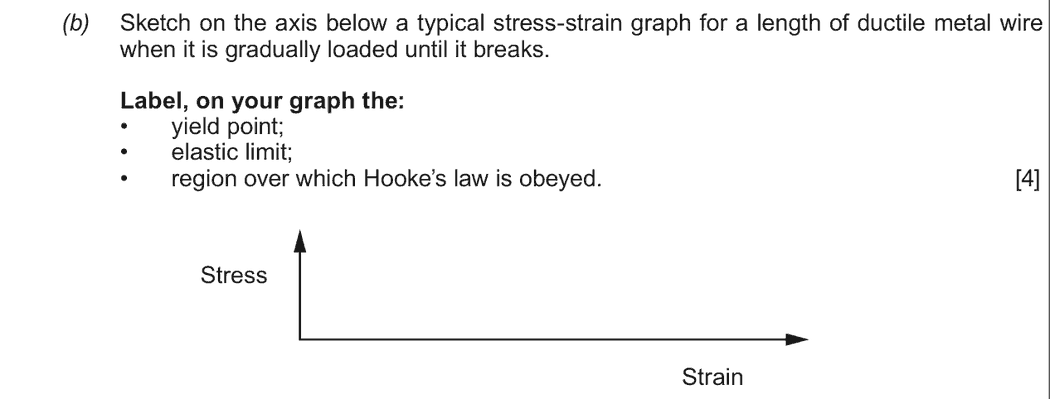
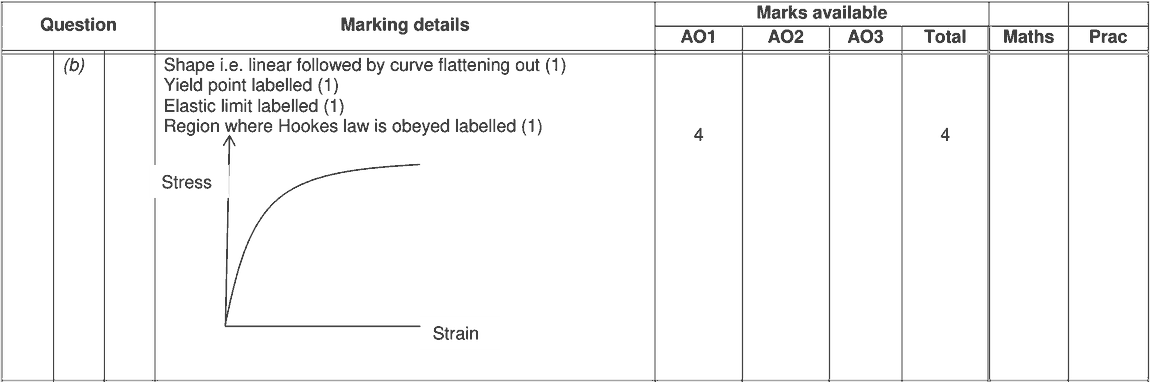
2.5-e the features of a force-extension (or stress-strain) graph for a metal such as copper, to include • elastic and plastic strain • the effects of dislocations, and the strengthening of metals by introducing barriers to dislocation movement, such as foreign atoms, other dislocations, and more grain boundaries • necking and ductile fracture
2.5-f the features of a force-extension (or stress-strain) graph for a brittle material such as glass, to include • elastic strain and obeying Hooke’s law up to fracture • brittle fracture by crack propagation, the effect of surface imperfections on breaking stress, and how breaking stress can be increased by reducing surface imperfections (as in thin fibres) or by putting surface under compression (as in toughened glass or pre-stressed concrete)
2.5-g the features of a force-extension (or stress-strain) graph for rubber, to include • Hooke’s law only approximately obeyed, low Young modulus and the extension due to straightening of chain molecules against thermal opposition • hysteresis
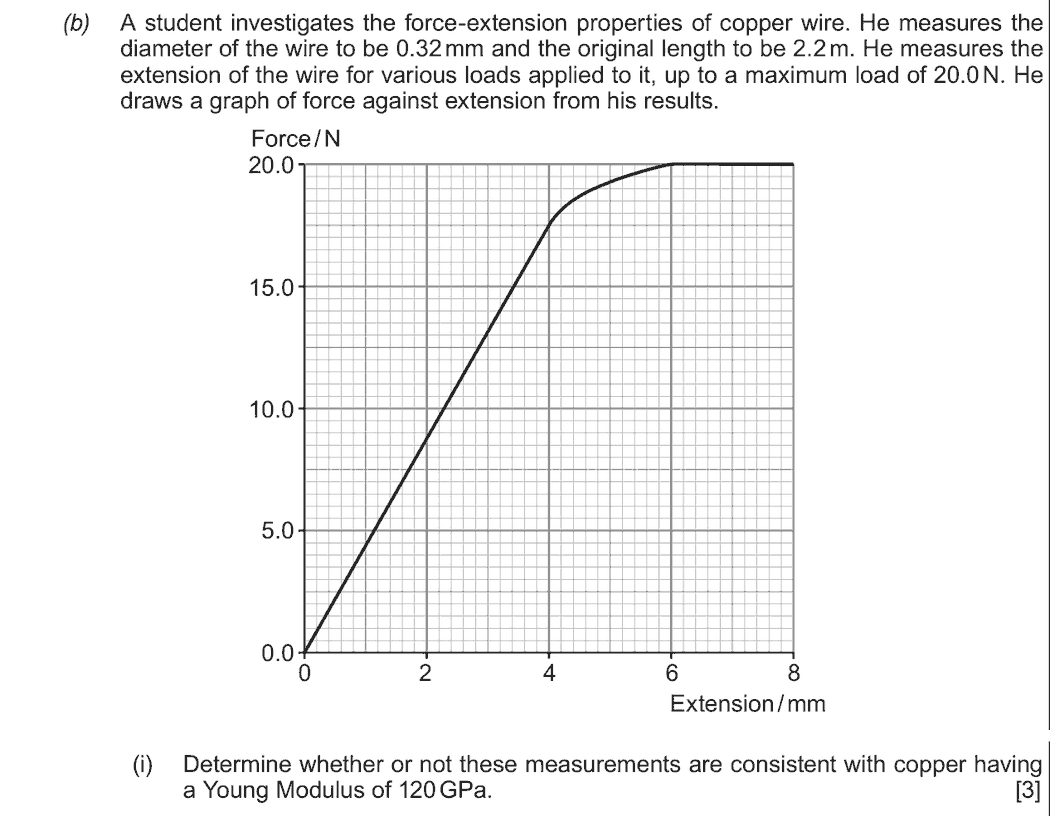
2.5-P1 Specified practical: Determination of Young modulus of a metal in the form of a wire
2.5-P2 Specified practical: Investigation of the force-extension relationship for rubber
. (a) Glass is an example of an amorphous, brittle material. Explain what is meant by an amorphous, brittle material and how glass fractures under tension. Give your answer at both a molecular and macroscopic level. [6 Q
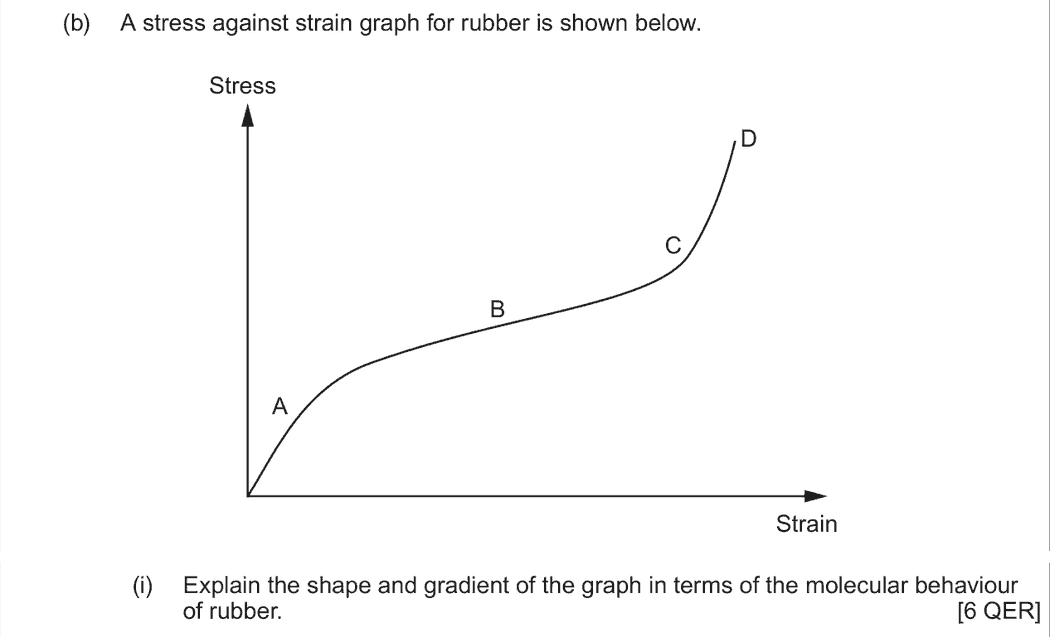
A stress against strain graph for rubber is shown below. Stress D C B A Strain (i) Explain the shape and gradient of the graph in terms of the molecular behaviour of rubber. [6 QER]
. (a) Copper is a crystalline material. Describe its structure and explain, on a molecular and macroscopic level, what happens to a copper wire when it breaks. [6 QER]
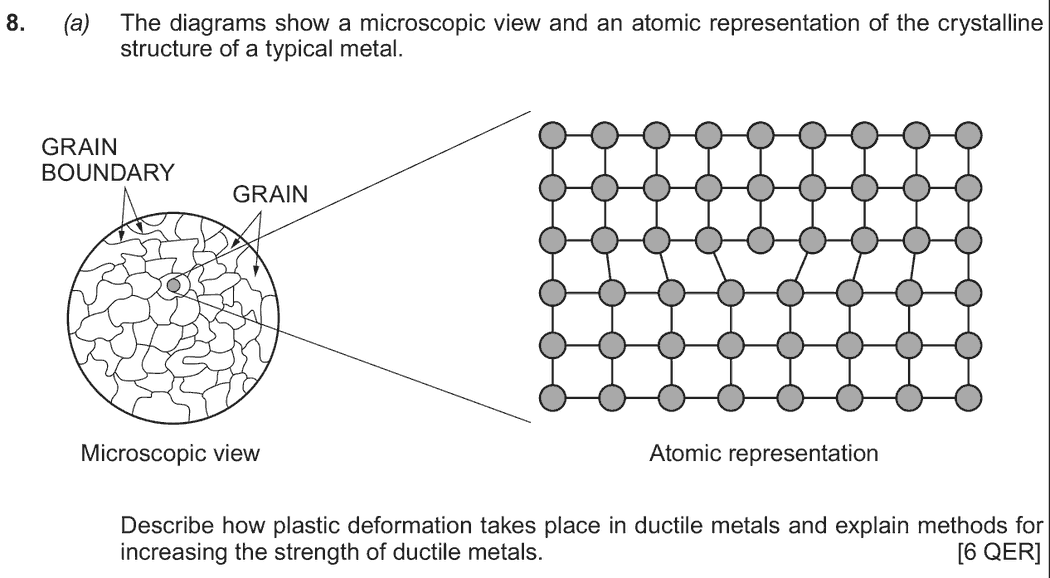
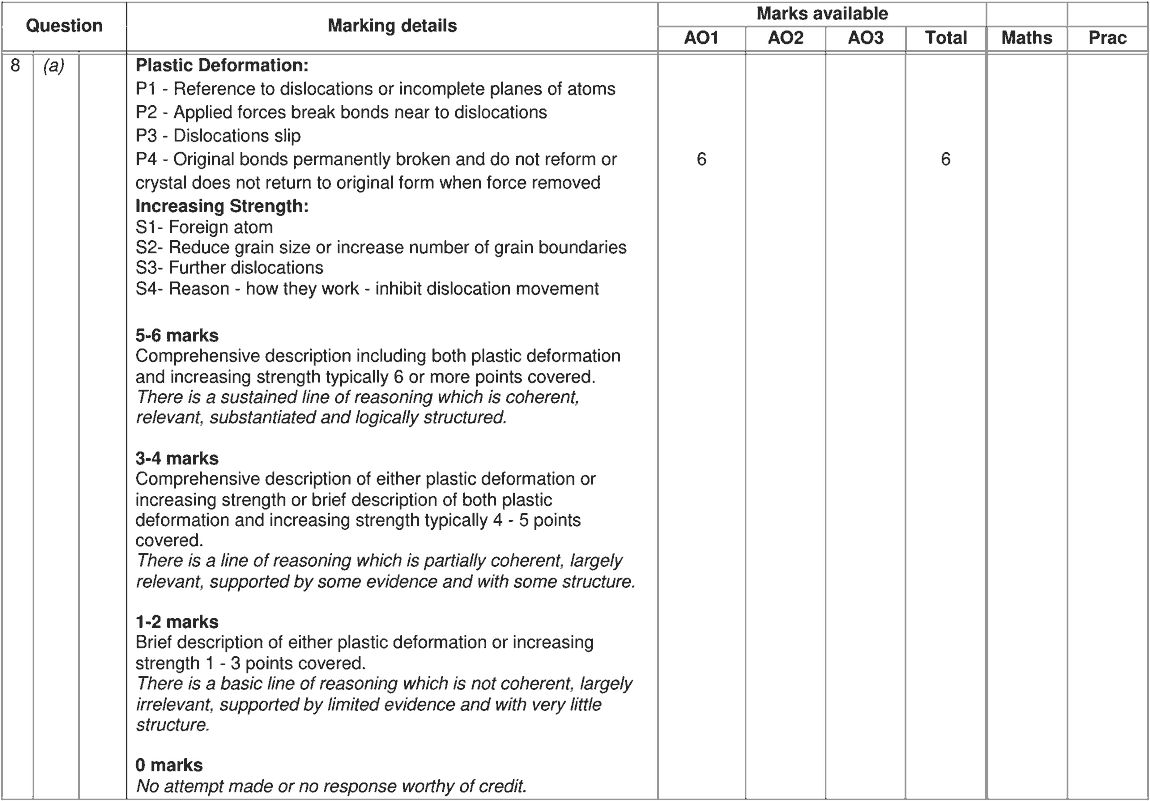
. (a) The diagrams show a microscopic view and an atomic representation of the crystalline structure of a typical metal. GRAIN BOUNDARY GRAIN Microscopic view Atomic representation Describe how plastic deformation takes
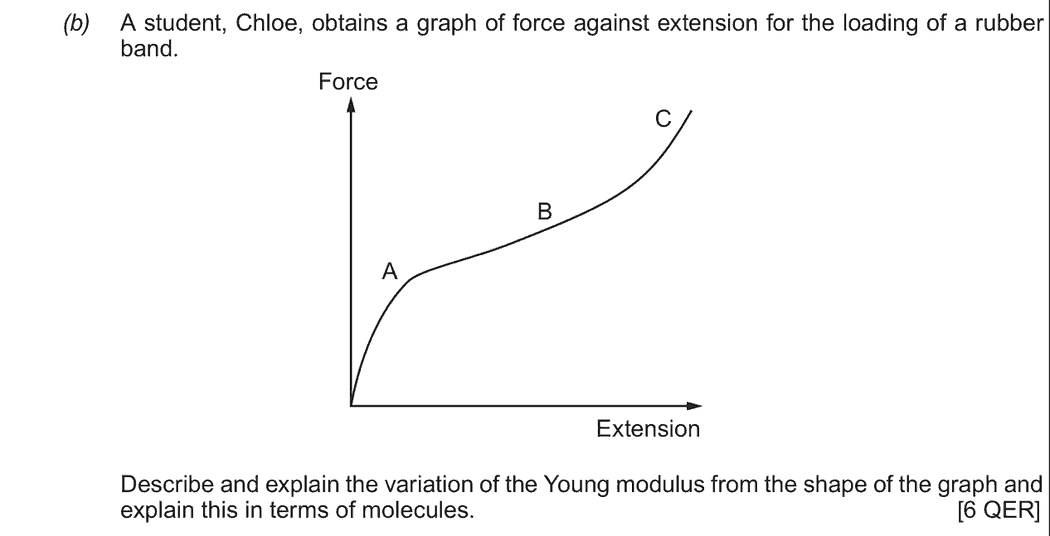
A student, Chloe, obtains a graph of force against extension for the loading of a rubber band. Force C B A Extension Describe and explain the variation of the Young modulus from the shape of the graph and explain this in
Tap a question to zoom it. Where a part needs a figure, table or graph from earlier in the question, that part folds out above it; the mark scheme and examiner's comment open underneath. Have the Eduqas Data Booklet beside you (see the Data Booklet page).
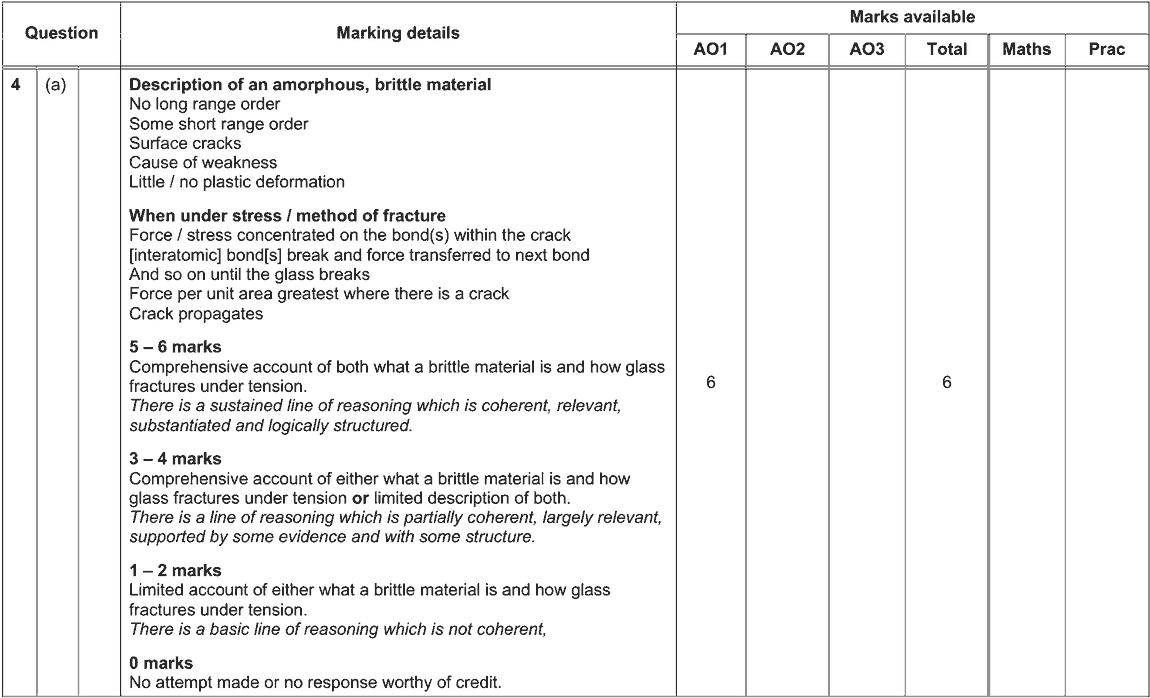
June 2025 · AS Component 1 · Q4(a)6 marksAO1=66-mark extended response
Mark scheme, with the levels and indicative content
Notes from the mark scheme and report
QER, levels marked. Amorphous: the atoms have no long range order, only some short range order. Brittle: breaks with little or no plastic deformation, obeying Hooke's law up to fracture. Fracture: surface cracks are the weakness
under tension the stress is concentrated at the tip of a crack
the bonds there break, passing the stress to the next bonds, so the crack propagates rapidly through the glass. Both the molecular and the large-scale picture are needed for the top band
Skills: QER The 6-mark quality of extended response question
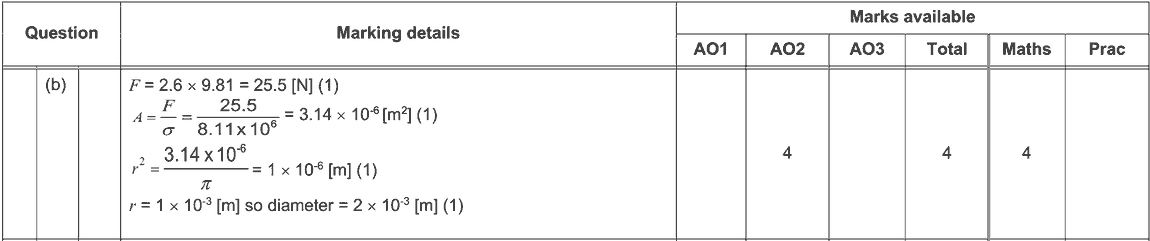
June 2025 · AS Component 1 · Q4(b)4 marksAO2=4Calculation
Earlier part of question 4 that this part uses
Mark scheme
Notes from the mark scheme and report
Answer: 2.0 × 10⁻³ m (2.0 mm). F = 2.6 × 9.81 = 25.5 N
A = F/stress = 25.5/8.11 × 10⁶ = 3.14 × 10⁻⁶ m²
r = √(A/π) = 1.0 × 10⁻³ m
diameter = 2r
Scheme columns: Maths 4
Skills: Unitsand conversions Unit marks, base units, prefixes and conversions; Mathsmarks The mark scheme's Maths column gives this part at least one mark for mathematical skills
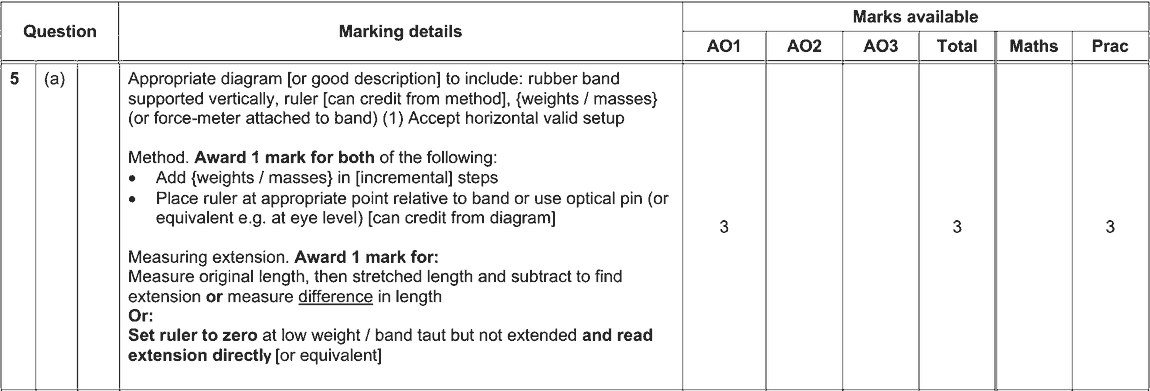
June 2025 · Component 2 · Q5(a)3 marksAO1=3Practical and data analysis
Mark scheme
Examiner's comment
Candidates were asked to describe a method for investigating the force– extension characteristics of rubber, using an elastic band under load. Space was provided for a diagram, though not all candidates made use of it, instead opting for written descriptions. The key marking points were: • A suitable diagram (or accurate description) of the apparatus. • A brief method referencing the incremental addition of weight/mass and use of a ruler to take readings (these could be included in the diagram). • A detailed explanation of how extension is measured, e.g., stretched length minus original length. While most candidates addressed the first two points, many failed to gain the third mark due to vague or incomplete descriptions of how extension was measured.
Notes from the mark scheme and report
Diagram or description: band hung vertically from a clamp, masses or a newton meter on the lower end, ruler alongside (1)
add masses in equal steps and read the ruler at eye level or with a pointer (1)
extension = stretched length − original length, or zero the ruler with the band just taut and read the extension directly (1)
the last mark was often lost through vague wording
Scheme columns: Practical 3
Skills: Experimentalmethod Describing, planning or improving an experiment; Practicalmarks The mark scheme's Prac column gives this part at least one mark for practical skills
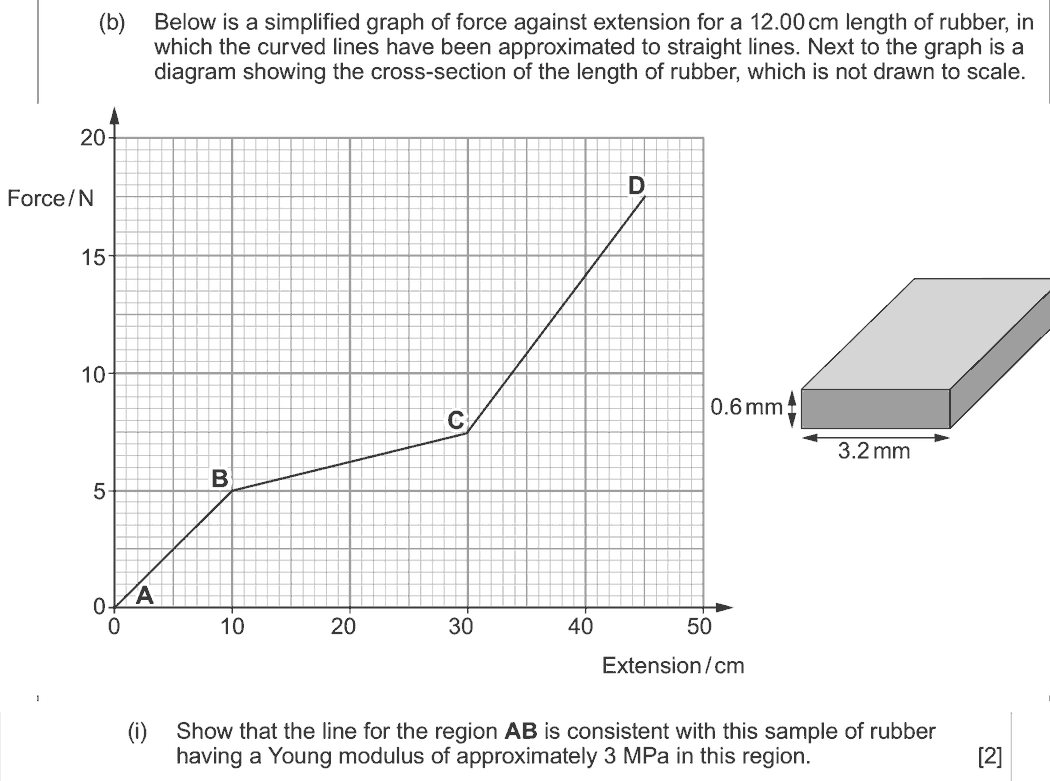
June 2025 · Component 2 · Q5(b)(i)2 marksAO3=2Show that
Earlier part of question 5 that this part uses
Mark scheme
Examiner's comment
Nearly all candidates successfully read values from the graph and used them appropriately to confirm the Young modulus.
Notes from the mark scheme and report
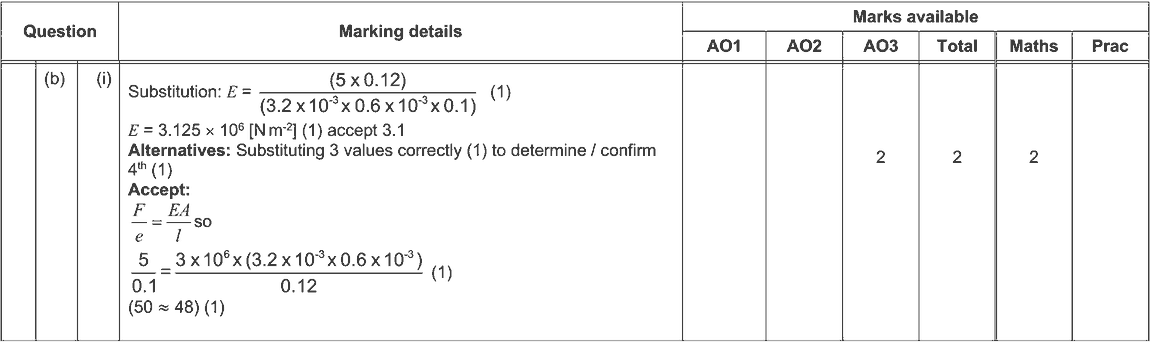
E = Fl/(Ae) = 5.0 × 0.12/(3.2 × 10⁻³ × 0.6 × 10⁻³ × 0.10) = 3.1 × 10⁶ Pa, using point B (5.0 N, 10 cm)
Scheme columns: Maths 2
Skills: Graphskills Reading, plotting or sketching graphs; gradients, intercepts and areas; Unitsand conversions Unit marks, base units, prefixes and conversions; Mathsmarks The mark scheme's Maths column gives this part at least one mark for mathematical skills
June 2025 · Component 2 · Q5(b)(ii)2 marksAO1=2Explanation
Earlier parts of question 5 that this part uses
Mark scheme
Examiner's comment
Not all candidates recognised that in region BC, molecular chains were unravelling or undergoing alignment. Most, but not all, referenced interatomic forces in region CD.
Notes from the mark scheme and report
BC: the tangled chain molecules straighten out (bond rotation), so little extra force gives a large extension (1)
CD: the chains are fully straightened, so further stretching pulls against the strong bonds within the molecules (1)
Skills: Graphskills Reading, plotting or sketching graphs; gradients, intercepts and areas
June 2025 · Component 2 · Q5(b)(iii)3 marksAO2=3Calculation
Earlier parts of question 5 that this part uses
Mark scheme
Examiner's comment
While most candidates understood that the area under the graph represents work done, many struggled to apply the trapezium rule (or triangle + rectangle method) accurately. A frequent issue was a power-of-ten error, resulting in a penalty for answers that were off by a factor of 10.
Notes from the mark scheme and report
Answer: yes, ratio 1.5. Work = area under the graph. BC: (5 × 0.20) + (½ × 0.20 × 2.5) = 1.25 J
CD: (7.5 × 0.15) + (½ × 0.15 × 10) = 1.875 J
1.875/1.25 = 1.5
one mark off for powers of ten (cm not converted)
Scheme columns: Maths 3
Skills: Graphskills Reading, plotting or sketching graphs; gradients, intercepts and areas; Unitsand conversions Unit marks, base units, prefixes and conversions; Mathsmarks The mark scheme's Maths column gives this part at least one mark for mathematical skills
June 2025 · Component 2 · Q5(c)3 marksAO3=3Explanation
Earlier parts of question 5 that this part uses
Mark scheme
Examiner's comment
This ‘How Science Works’ question asked candidates to evaluate how science informs decision-making. A correct definition of ‘hysteresis’ was expected but rarely given. Two marks were awarded for identifying that under-inflated tyres undergo large hysteresis cycles (e.g. extensive stretching and relaxing), and that this causes heat generation or leads to energy loss, damage, or excessive wear. Few responses achieved all three available marks.
Notes from the mark scheme and report
Hysteresis: energy is lost as heat in each cycle of loading and unloading rubber (1)
an under-inflated tyre changes shape more, so each cycle is larger (1)
so more energy is wasted: the tyre gets hot, wears or is damaged, and more fuel is used (1)
June 2024 · AS Component 1 · Q4(a)(i)1 markAO1=1Definition
Mark scheme
Examiner's comment
In part (a)(ii) a number of candidates did not refer to cross linking / tangled molecules and some of the responses seen were rather confused. In the QER some candidates only commented on the shape / gradient of the graph and ignored the molecular element of the question. Hence, they could only access a maximum of a middle band mark. In the last part most realised the molecules where realigning but missed out the fact that energy was being dissipated.
Notes from the mark scheme and report
Tensile stress divided by tensile strain
June 2024 · AS Component 1 · Q4(a)(ii)2 marksAO1=2Short answer
Earlier part of question 4 that this part uses
Mark scheme
Examiner's comment
In part (a)(ii) a number of candidates did not refer to cross linking / tangled molecules and some of the responses seen were rather confused. In the QER some candidates only commented on the shape / gradient of the graph and ignored the molecular element of the question. Hence, they could only access a maximum of a middle band mark. In the last part most realised the molecules where realigning but missed out the fact that energy was being dissipated.
Notes from the mark scheme and report
Long chain molecules (1) that are tangled or cross-linked (1)
many left out the tangling or cross-linking
June 2024 · AS Component 1 · Q4(b)(i)6 marksAO1=3, AO2=36-mark extended response
Earlier part of question 4 that this part uses
Mark scheme, with the levels and indicative content
Examiner's comment
In part (a)(ii) a number of candidates did not refer to cross linking / tangled molecules and some of the responses seen were rather confused. In the QER some candidates only commented on the shape / gradient of the graph and ignored the molecular element of the question. Hence, they could only access a maximum of a middle band mark. In the last part most realised the molecules where realigning but missed out the fact that energy was being dissipated.
Notes from the mark scheme and report
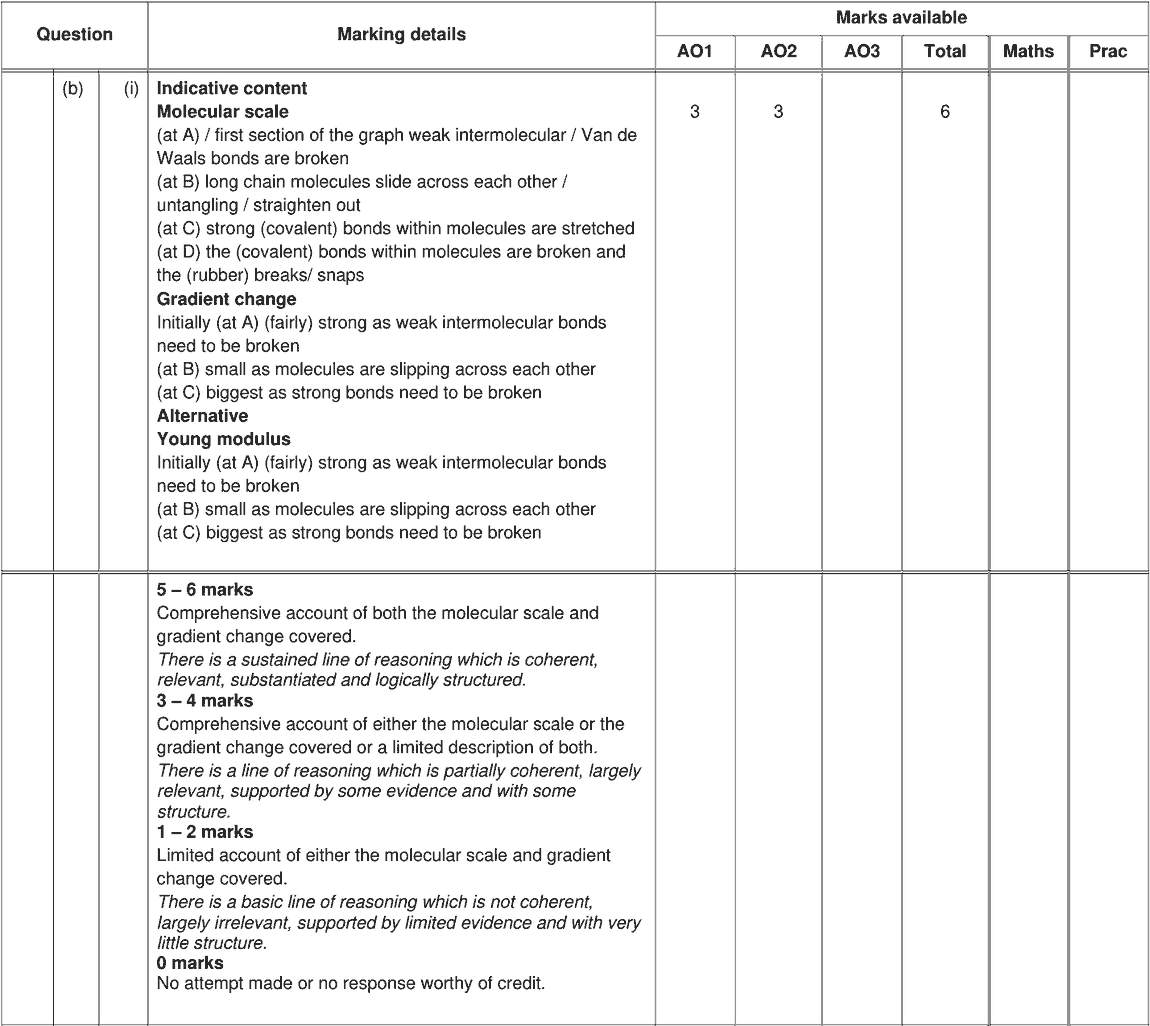
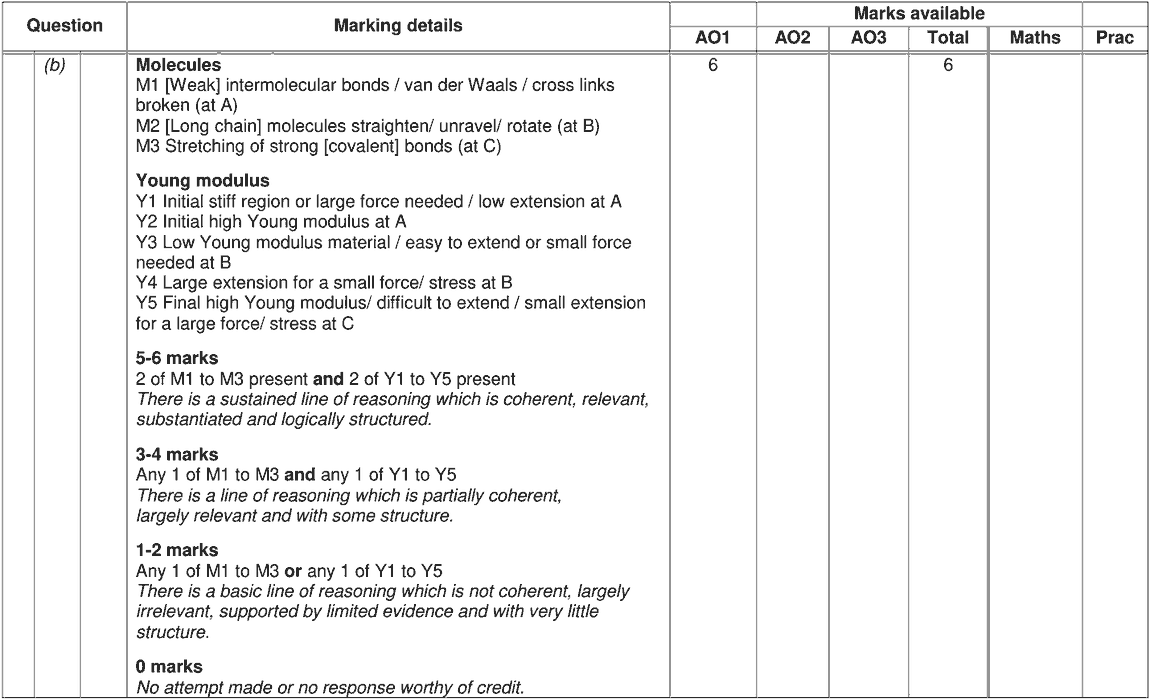
QER, levels marked. Molecules: at A weak intermolecular (van der Waals) bonds are broken
at B the long chains untangle, straighten and slide past each other
at C strong covalent bonds within the chains are stretched
at D these break and the rubber snaps. Gradient (Young modulus): fairly large at A, small at B, largest at C. Answers that only described the gradient could not get beyond the middle band
Skills: Graphskills Reading, plotting or sketching graphs; gradients, intercepts and areas; QER The 6-mark quality of extended response question
June 2024 · AS Component 1 · Q4(b)(ii)1 markAO2=1Diagram or graph
Earlier parts of question 4 that this part uses
Mark scheme
Examiner's comment
In part (a)(ii) a number of candidates did not refer to cross linking / tangled molecules and some of the responses seen were rather confused. In the QER some candidates only commented on the shape / gradient of the graph and ignored the molecular element of the question. Hence, they could only access a maximum of a middle band mark. In the last part most realised the molecules where realigning but missed out the fact that energy was being dissipated.
Notes from the mark scheme and report
Curve of similar shape lying below the loading curve, ending on the strain axis at the origin or a little to its right
Skills: Graphskills Reading, plotting or sketching graphs; gradients, intercepts and areas
June 2024 · AS Component 1 · Q4(b)(iii)2 marksAO2=2Explanation
Earlier parts of question 4 that this part uses
Mark scheme
Examiner's comment
In part (a)(ii) a number of candidates did not refer to cross linking / tangled molecules and some of the responses seen were rather confused. In the QER some candidates only commented on the shape / gradient of the graph and ignored the molecular element of the question. Hence, they could only access a maximum of a middle band mark. In the last part most realised the molecules where realigning but missed out the fact that energy was being dissipated.
Notes from the mark scheme and report
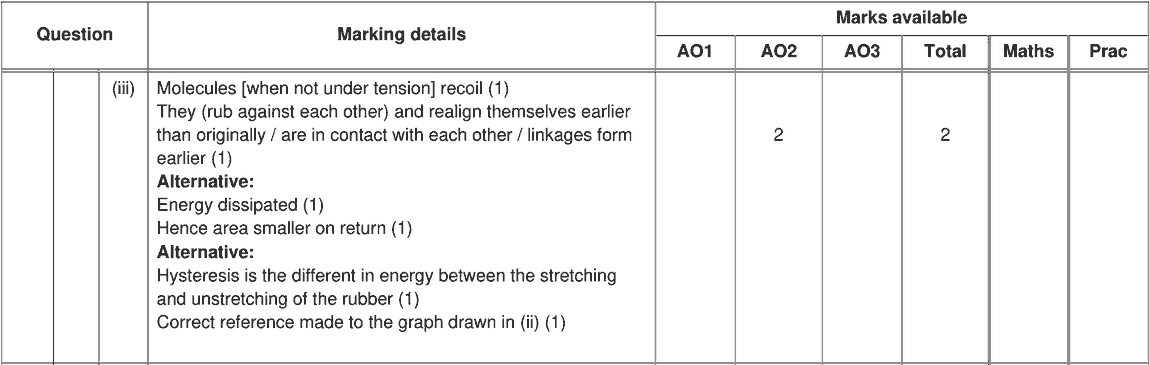
Energy is dissipated (as internal energy) in each cycle (1), so the unloading curve lies below the loading curve and encloses less area (1)
or the molecules recoil and re-form links earlier than they broke. Most mentioned realignment but not the energy dissipated
June 2024 · Component 2 · Q6(a)(i)1 markAO1=1Diagram or graph
Mark scheme
Examiner's comment
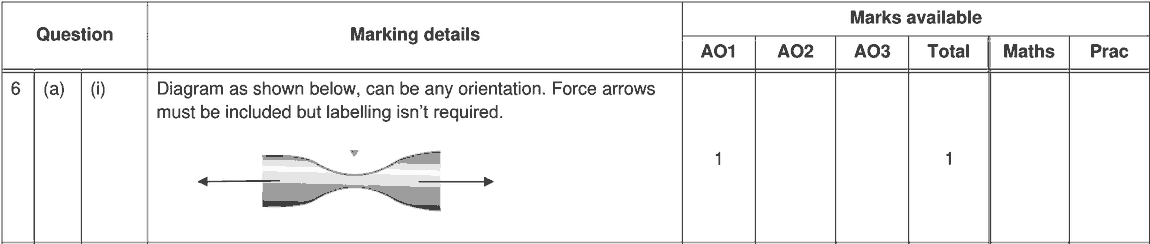
Nearly all candidates sketched an appropriate diagram with force arrows to illustrate the concept of necking in metals. In (ii), most candidates made the connection between reduced cross-sectional area and increased stress.
Notes from the mark scheme and report
Bar with a narrowed section (neck) and arrows showing the stretching forces pointing outwards at each end
June 2024 · Component 2 · Q6(a)(ii)2 marksAO1=2Explanation
Earlier part of question 6 that this part uses
Mark scheme
Examiner's comment
Nearly all candidates sketched an appropriate diagram with force arrows to illustrate the concept of necking in metals. In (ii), most candidates made the connection between reduced cross-sectional area and increased stress.
Notes from the mark scheme and report
Cross-sectional area is smallest at the neck (1)
stress = F/A so the stress is greatest there (1)
June 2024 · Component 2 · Q6(b)2 marksAO2=2Show that
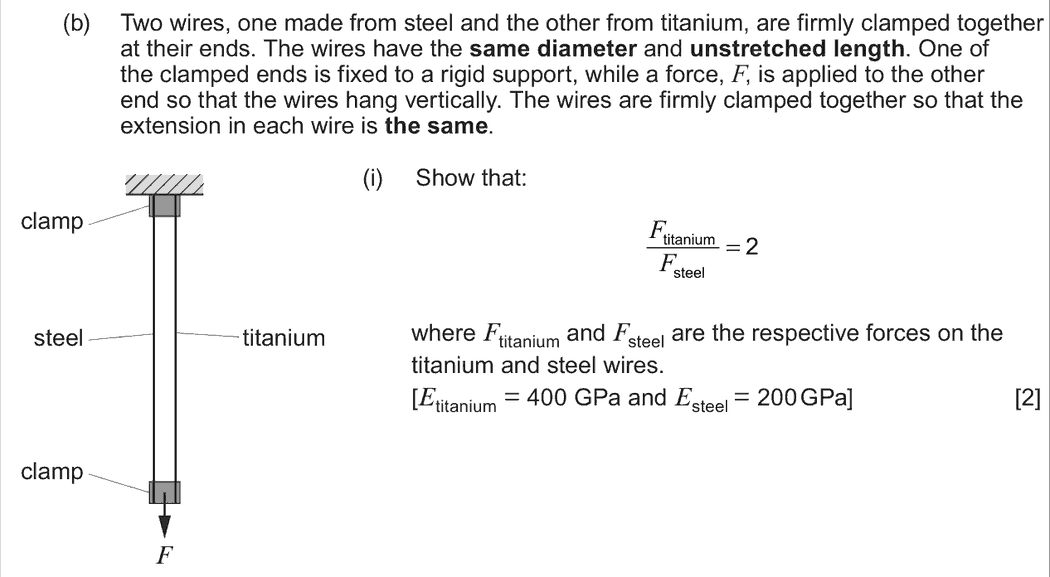
Earlier part of question 6 that this part uses
Mark scheme
Notes from the mark scheme and report
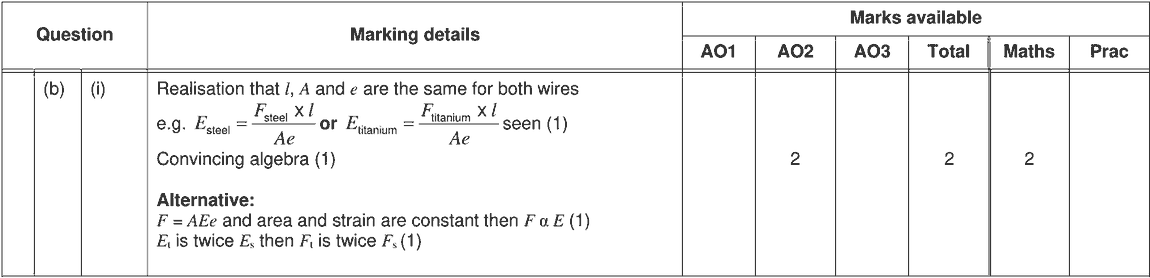
This is part (b)(i). Length, area and extension are the same for both wires, so from E = Fl/(Ae) the force is proportional to E (1)
E titanium = 2 × E steel so F titanium/F steel = 2 (1). Mark scheme row not matched: the crop and packet text run (i), (ii) and (iii) together
Scheme columns: Maths 2
Skills: Algebra Derivations and rearranging equations; Mathsmarks The mark scheme's Maths column gives this part at least one mark for mathematical skills
June 2024 · Component 2 · Q6(b)(ii)3 marksAO2=3Calculation
Earlier parts of question 6 that this part uses
Mark scheme
Examiner's comment
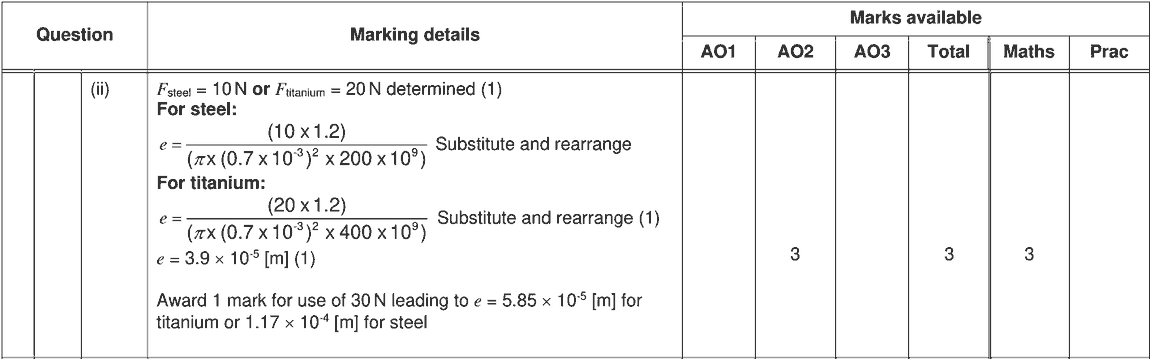
Those candidates who understood that the given force should be divided into the ratio 2:1 succeeded in gaining full marks. About half of candidates used the full 30 N force and gained a maximum of 1 mark as ecf for subsequent working.
Notes from the mark scheme and report
Answer: 3.9 × 10⁻⁵ m. The 30 N splits 2:1, 20 N in titanium and 10 N in steel
about half used the full 30 N on one wire (1 mark at most)
Scheme columns: Maths 3
Skills: Unitsand conversions Unit marks, base units, prefixes and conversions; Mathsmarks The mark scheme's Maths column gives this part at least one mark for mathematical skills
June 2024 · Component 2 · Q6(b)(iii)2 marksAO3=2Explanation
Earlier parts of question 6 that this part uses
Mark scheme
Examiner's comment
Encouraging responses were seen, with many candidates choosing to base their responses on E = ½ kx2, commenting that, since k is dependent on the material of the wire, that the energy stored in each of the wires must be different. Others based their answers to E = ½ Fx.
Notes from the mark scheme and report
Energy stored = ½Fe (or ½ke²) (1)
the extension is the same but the force (or stiffness) differs, titanium carrying twice the force, so it stores twice the energy and the assumption is wrong (1)
June 2023 · AS Component 1 · Q2(a)6 marksAO1=66-mark extended response
Mark scheme, with the levels and indicative content
Examiner's comment
In part (a) the QER produced mixed marks as expected ranging from 1 – 6. The majority of candidates expressed themselves clearly and legibly.
Notes from the mark scheme and report
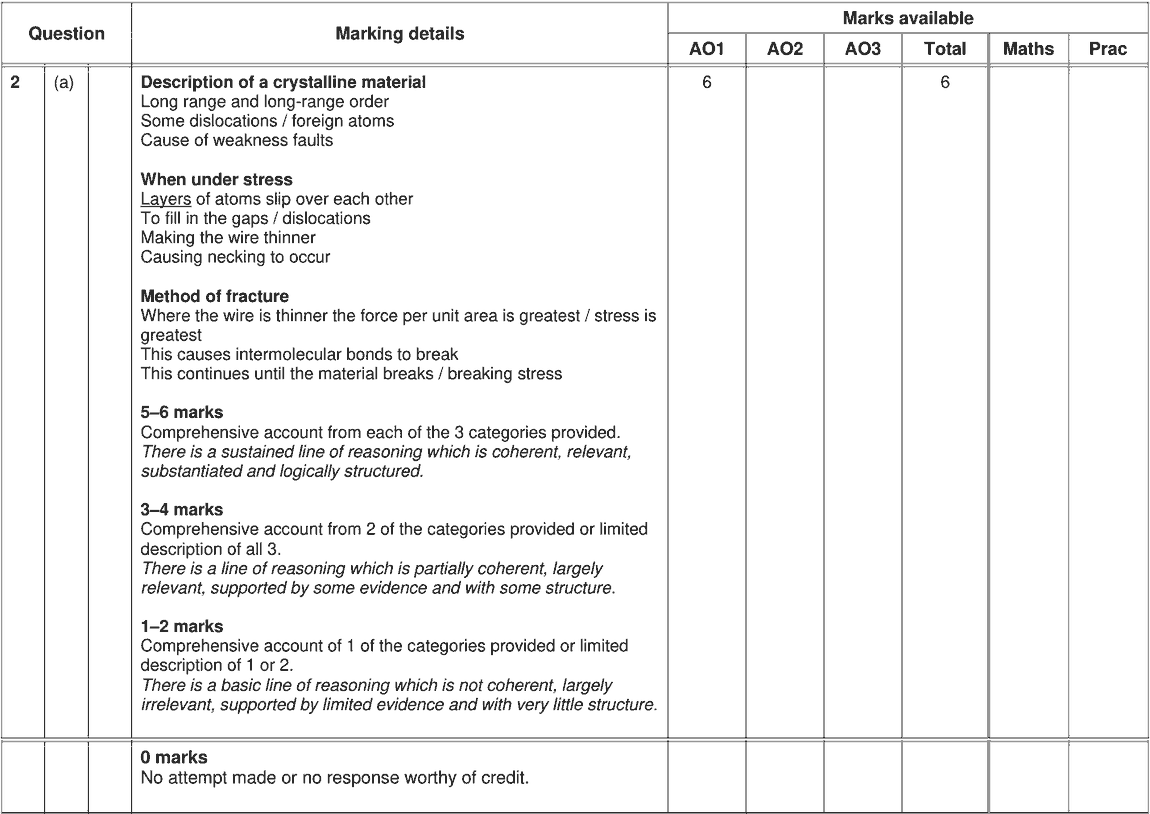
QER, levels marked on three strands. Structure: crystalline (polycrystalline) with long-range order, containing dislocations and foreign atoms. Under stress: beyond the elastic limit planes of atoms slip as dislocations move, the wire becomes thinner and necks. Fracture: at the neck the stress is greatest, bonds break and the wire fails by ductile fracture. Marks ranged across the full scale
Skills: QER The 6-mark quality of extended response question
June 2023 · AS Component 1 · Q2(b)(i)2 marksAO1=1, AO2=1Calculation
Earlier part of question 2 that this part uses
Mark scheme
Examiner's comment
In part (a) the QER produced mixed marks as expected ranging from 1 – 6. The majority of candidates expressed themselves clearly and legibly.
Skills: Unitsand conversions Unit marks, base units, prefixes and conversions; Mathsmarks The mark scheme's Maths column gives this part at least one mark for mathematical skills
June 2023 · AS Component 1 · Q2(b)(ii)2 marksAO2=2Calculation
Earlier parts of question 2 that this part uses
Mark scheme
Examiner's comment
In part (a) the QER produced mixed marks as expected ranging from 1 – 6. The majority of candidates expressed themselves clearly and legibly.
Skills: Unitsand conversions Unit marks, base units, prefixes and conversions; Mathsmarks The mark scheme's Maths column gives this part at least one mark for mathematical skills
June 2023 · Component 2 · Q4(a)(i)1 markAO2=1Diagram or graph
Mark scheme
Examiner's comment
Disappointingly in (a)(i), fewer than half of the candidates drew the pre-stressed bar towards the lower surface of the concrete beam as required, with many sketching the bar near the middle of the beam. The response in (ii) was more encouraging with many candidates recognising that the bar would put the concrete under compression which would inhibit crack propagation. Nearly all candidates in (b) correctly referred to the fact that the initial gradients of the three graphs were the same. Many candidates identified that high carbon steel is ‘stronger’ (or equivalent) than low carbon steel and explained this physical property in terms of additional carbon atoms inhibiting the flow of dislocations within the metal. This was understood better than in previous sittings of this paper. However, once again, a significant minority of candidates incorrectly described carbon atoms inhibiting the motion of whole planes of atoms rather than dislocation movement. Reference to whole plane of atoms was not credited. In (c)(i) many candidates were able to show that the extension in the cable approximated the value given in the question. Of those that failed, many incorrectly resolved the force given, often multiplying rather than dividing by cosine (20°). In (ii), most candidates used W = ½ FΔl to determine the energy stored in the cable, with ecf being applied to F and Δl for those who failed to resolve correctly in
Notes from the mark scheme and report
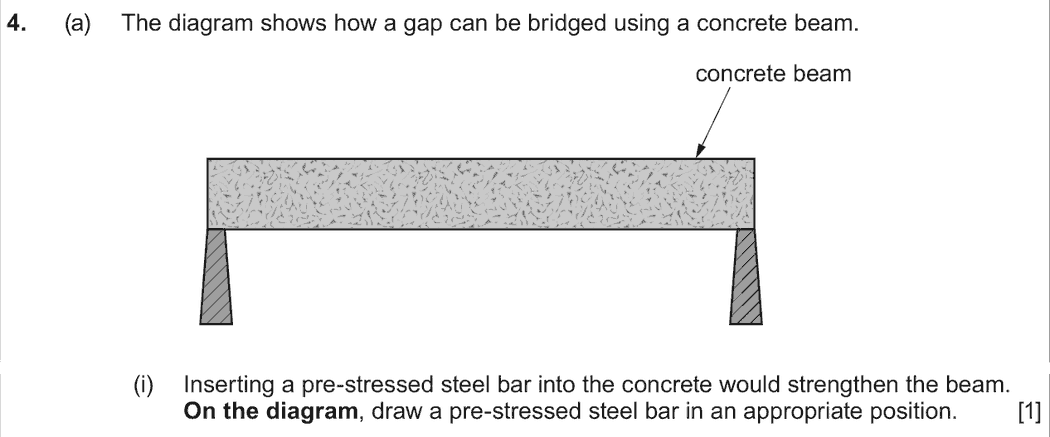
Bar drawn horizontally inside the beam near the lower surface (below the mid-line)
fewer than half did so, many put it in the middle
June 2023 · Component 2 · Q4(a)(ii)2 marksAO1=2Explanation
Earlier part of question 4 that this part uses
Mark scheme
Examiner's comment
Disappointingly in (a)(i), fewer than half of the candidates drew the pre-stressed bar towards the lower surface of the concrete beam as required, with many sketching the bar near the middle of the beam. The response in (ii) was more encouraging with many candidates recognising that the bar would put the concrete under compression which would inhibit crack propagation. Nearly all candidates in (b) correctly referred to the fact that the initial gradients of the three graphs were the same. Many candidates identified that high carbon steel is ‘stronger’ (or equivalent) than low carbon steel and explained this physical property in terms of additional carbon atoms inhibiting the flow of dislocations within the metal. This was understood better than in previous sittings of this paper. However, once again, a significant minority of candidates incorrectly described carbon atoms inhibiting the motion of whole planes of atoms rather than dislocation movement. Reference to whole plane of atoms was not credited. In (c)(i) many candidates were able to show that the extension in the cable approximated the value given in the question. Of those that failed, many incorrectly resolved the force given, often multiplying rather than dividing by cosine (20°). In (ii), most candidates used W = ½ FΔl to determine the energy stored in the cable, with ecf being applied to F and Δl for those who failed to resolve correctly in
Notes from the mark scheme and report
The bar puts the lower surface of the concrete under compression (1), which inhibits crack propagation (1)
dislocations are not relevant
June 2023 · Component 2 · Q4(b)(i)1 markAO2=1Short answer
Earlier part of question 4 that this part uses
Mark scheme
Examiner's comment
Disappointingly in (a)(i), fewer than half of the candidates drew the pre-stressed bar towards the lower surface of the concrete beam as required, with many sketching the bar near the middle of the beam. The response in (ii) was more encouraging with many candidates recognising that the bar would put the concrete under compression which would inhibit crack propagation. Nearly all candidates in (b) correctly referred to the fact that the initial gradients of the three graphs were the same. Many candidates identified that high carbon steel is ‘stronger’ (or equivalent) than low carbon steel and explained this physical property in terms of additional carbon atoms inhibiting the flow of dislocations within the metal. This was understood better than in previous sittings of this paper. However, once again, a significant minority of candidates incorrectly described carbon atoms inhibiting the motion of whole planes of atoms rather than dislocation movement. Reference to whole plane of atoms was not credited. In (c)(i) many candidates were able to show that the extension in the cable approximated the value given in the question. Of those that failed, many incorrectly resolved the force given, often multiplying rather than dividing by cosine (20°). In (ii), most candidates used W = ½ FΔl to determine the energy stored in the cable, with ecf being applied to F and Δl for those who failed to resolve correctly in
Notes from the mark scheme and report
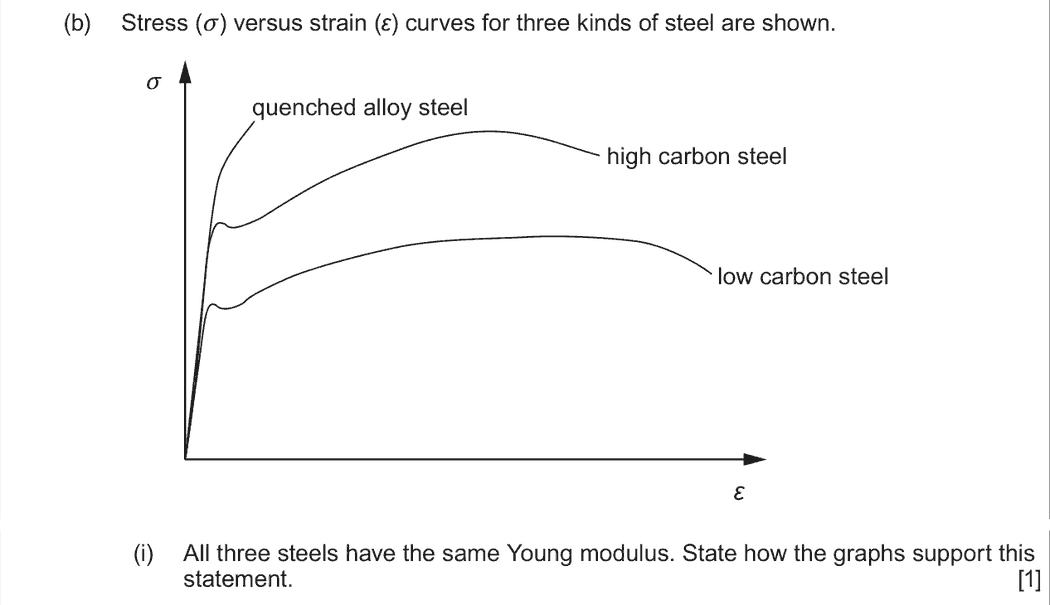
The initial (elastic, straight) parts of all three curves have the same gradient
Skills: Graphskills Reading, plotting or sketching graphs; gradients, intercepts and areas
June 2023 · Component 2 · Q4(b)(ii)3 marksAO1=2, AO2=1Explanation
Earlier parts of question 4 that this part uses
Mark scheme
Examiner's comment
Disappointingly in (a)(i), fewer than half of the candidates drew the pre-stressed bar towards the lower surface of the concrete beam as required, with many sketching the bar near the middle of the beam. The response in (ii) was more encouraging with many candidates recognising that the bar would put the concrete under compression which would inhibit crack propagation. Nearly all candidates in (b) correctly referred to the fact that the initial gradients of the three graphs were the same. Many candidates identified that high carbon steel is ‘stronger’ (or equivalent) than low carbon steel and explained this physical property in terms of additional carbon atoms inhibiting the flow of dislocations within the metal. This was understood better than in previous sittings of this paper. However, once again, a significant minority of candidates incorrectly described carbon atoms inhibiting the motion of whole planes of atoms rather than dislocation movement. Reference to whole plane of atoms was not credited. In (c)(i) many candidates were able to show that the extension in the cable approximated the value given in the question. Of those that failed, many incorrectly resolved the force given, often multiplying rather than dividing by cosine (20°). In (ii), most candidates used W = ½ FΔl to determine the energy stored in the cable, with ecf being applied to F and Δl for those who failed to resolve correctly in
Notes from the mark scheme and report
High carbon steel is stronger (higher yield and breaking stress
low carbon steel is softer and more malleable) (1)
the extra carbon atoms in the lattice are foreign atoms (1) which oppose the movement of dislocations (1)
whole planes of atoms sliding not accepted
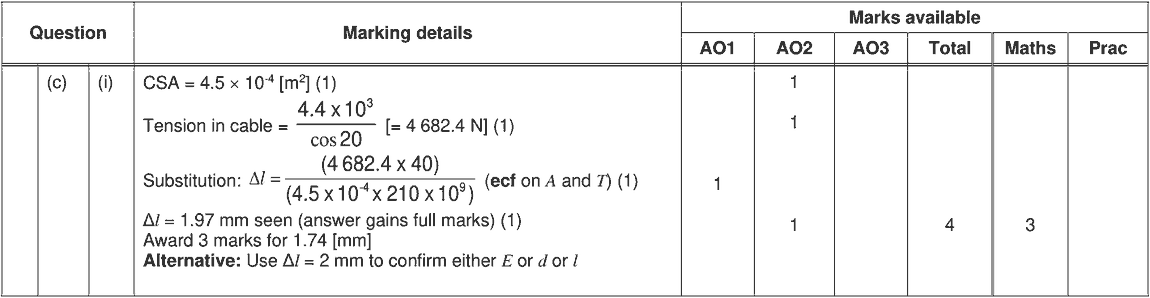
June 2023 · Component 2 · Q4(c)(i)4 marksAO1=1, AO2=3Show that
Earlier parts of question 4 that this part uses
Mark scheme
Examiner's comment
Disappointingly in (a)(i), fewer than half of the candidates drew the pre-stressed bar towards the lower surface of the concrete beam as required, with many sketching the bar near the middle of the beam. The response in (ii) was more encouraging with many candidates recognising that the bar would put the concrete under compression which would inhibit crack propagation. Nearly all candidates in (b) correctly referred to the fact that the initial gradients of the three graphs were the same. Many candidates identified that high carbon steel is ‘stronger’ (or equivalent) than low carbon steel and explained this physical property in terms of additional carbon atoms inhibiting the flow of dislocations within the metal. This was understood better than in previous sittings of this paper. However, once again, a significant minority of candidates incorrectly described carbon atoms inhibiting the motion of whole planes of atoms rather than dislocation movement. Reference to whole plane of atoms was not credited. In (c)(i) many candidates were able to show that the extension in the cable approximated the value given in the question. Of those that failed, many incorrectly resolved the force given, often multiplying rather than dividing by cosine (20°). In (ii), most candidates used W = ½ FΔl to determine the energy stored in the cable, with ecf being applied to F and Δl for those who failed to resolve correctly in
Skills: Synoptic Needs physics from another component of the qualification; Trigonometryand vectors Resolving, components, vector addition, angles; Unitsand conversions Unit marks, base units, prefixes and conversions; Mathsmarks The mark scheme's Maths column gives this part at least one mark for mathematical skills
June 2023 · Component 2 · Q4(c)(ii)2 marksAO1=1, AO2=1Calculation
Earlier parts of question 4 that this part uses
Mark scheme
Examiner's comment
Disappointingly in (a)(i), fewer than half of the candidates drew the pre-stressed bar towards the lower surface of the concrete beam as required, with many sketching the bar near the middle of the beam. The response in (ii) was more encouraging with many candidates recognising that the bar would put the concrete under compression which would inhibit crack propagation. Nearly all candidates in (b) correctly referred to the fact that the initial gradients of the three graphs were the same. Many candidates identified that high carbon steel is ‘stronger’ (or equivalent) than low carbon steel and explained this physical property in terms of additional carbon atoms inhibiting the flow of dislocations within the metal. This was understood better than in previous sittings of this paper. However, once again, a significant minority of candidates incorrectly described carbon atoms inhibiting the motion of whole planes of atoms rather than dislocation movement. Reference to whole plane of atoms was not credited. In (c)(i) many candidates were able to show that the extension in the cable approximated the value given in the question. Of those that failed, many incorrectly resolved the force given, often multiplying rather than dividing by cosine (20°). In (ii), most candidates used W = ½ FΔl to determine the energy stored in the cable, with ecf being applied to F and Δl for those who failed to resolve correctly in
Notes from the mark scheme and report
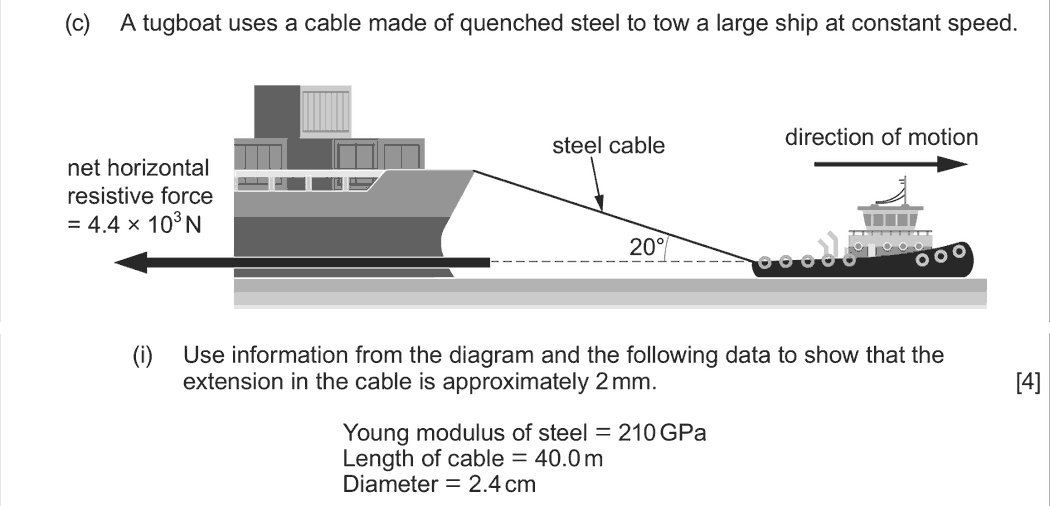
Answer: 4.6 J (4.7 J with 2 mm). E = ½FΔl = ½ × 4682 × 1.97 × 10⁻³
ecf on F and Δl
Scheme columns: Maths 1
Skills: Mathsmarks The mark scheme's Maths column gives this part at least one mark for mathematical skills
June 2023 · Component 2 · Q4(c)(iii)2 marksAO3=2Explanation
Earlier parts of question 4 that this part uses
Mark scheme
Examiner's comment
Disappointingly in (a)(i), fewer than half of the candidates drew the pre-stressed bar towards the lower surface of the concrete beam as required, with many sketching the bar near the middle of the beam. The response in (ii) was more encouraging with many candidates recognising that the bar would put the concrete under compression which would inhibit crack propagation. Nearly all candidates in (b) correctly referred to the fact that the initial gradients of the three graphs were the same. Many candidates identified that high carbon steel is ‘stronger’ (or equivalent) than low carbon steel and explained this physical property in terms of additional carbon atoms inhibiting the flow of dislocations within the metal. This was understood better than in previous sittings of this paper. However, once again, a significant minority of candidates incorrectly described carbon atoms inhibiting the motion of whole planes of atoms rather than dislocation movement. Reference to whole plane of atoms was not credited. In (c)(i) many candidates were able to show that the extension in the cable approximated the value given in the question. Of those that failed, many incorrectly resolved the force given, often multiplying rather than dividing by cosine (20°). In (ii), most candidates used W = ½ FΔl to determine the energy stored in the cable, with ecf being applied to F and Δl for those who failed to resolve correctly in
Notes from the mark scheme and report
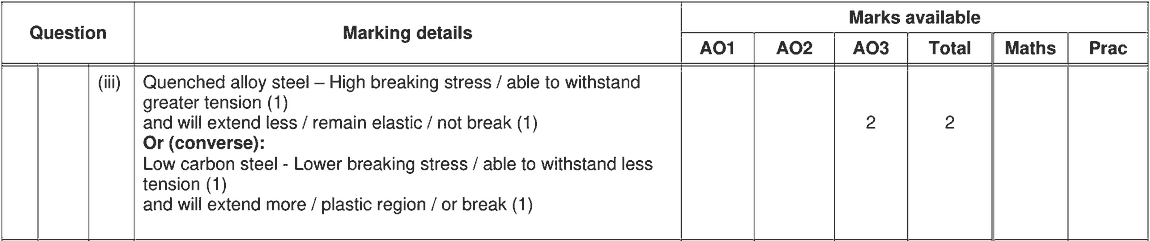
Low carbon steel has a lower yield and breaking stress so withstands less tension (1)
it would extend more, deform plastically or break under the same load (1)
or the converse for quenched steel
Skills: Graphskills Reading, plotting or sketching graphs; gradients, intercepts and areas
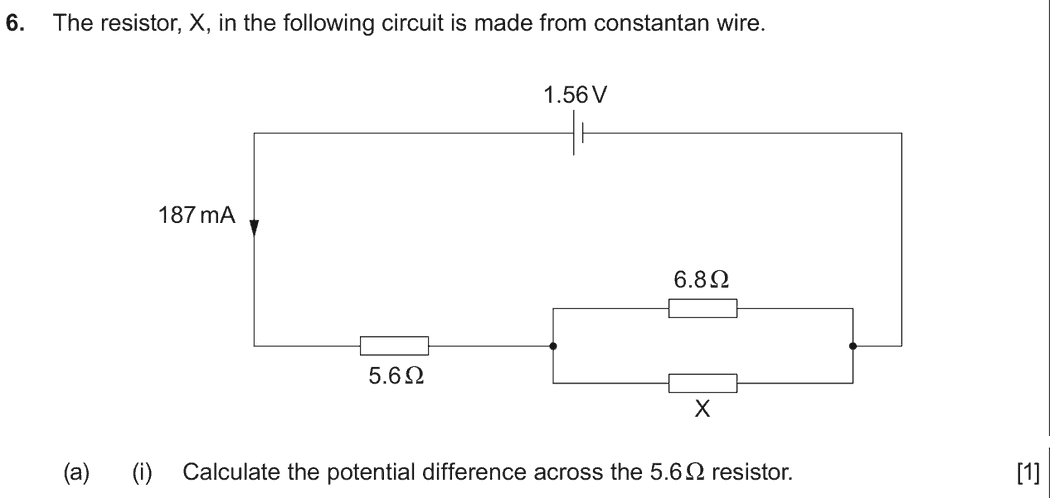
June 2023 · AS Component 2 · Q6(c)4 marksAO1=1, AO2=3Calculation
Earlier part of question 6 that this part uses
Mark scheme
Examiner's comment
This was answered well by all candidates and d.c. circuit analysis was well understood. Also the synoptic element was answered well.
Skills: Synoptic Needs physics from another component of the qualification; Unitsand conversions Unit marks, base units, prefixes and conversions; Mathsmarks The mark scheme's Maths column gives this part at least one mark for mathematical skills
June 2022 · AS Component 1 · Q4(a)6 marksAO1=66-mark extended response
Mark scheme, with the levels and indicative content
Notes from the mark scheme and report
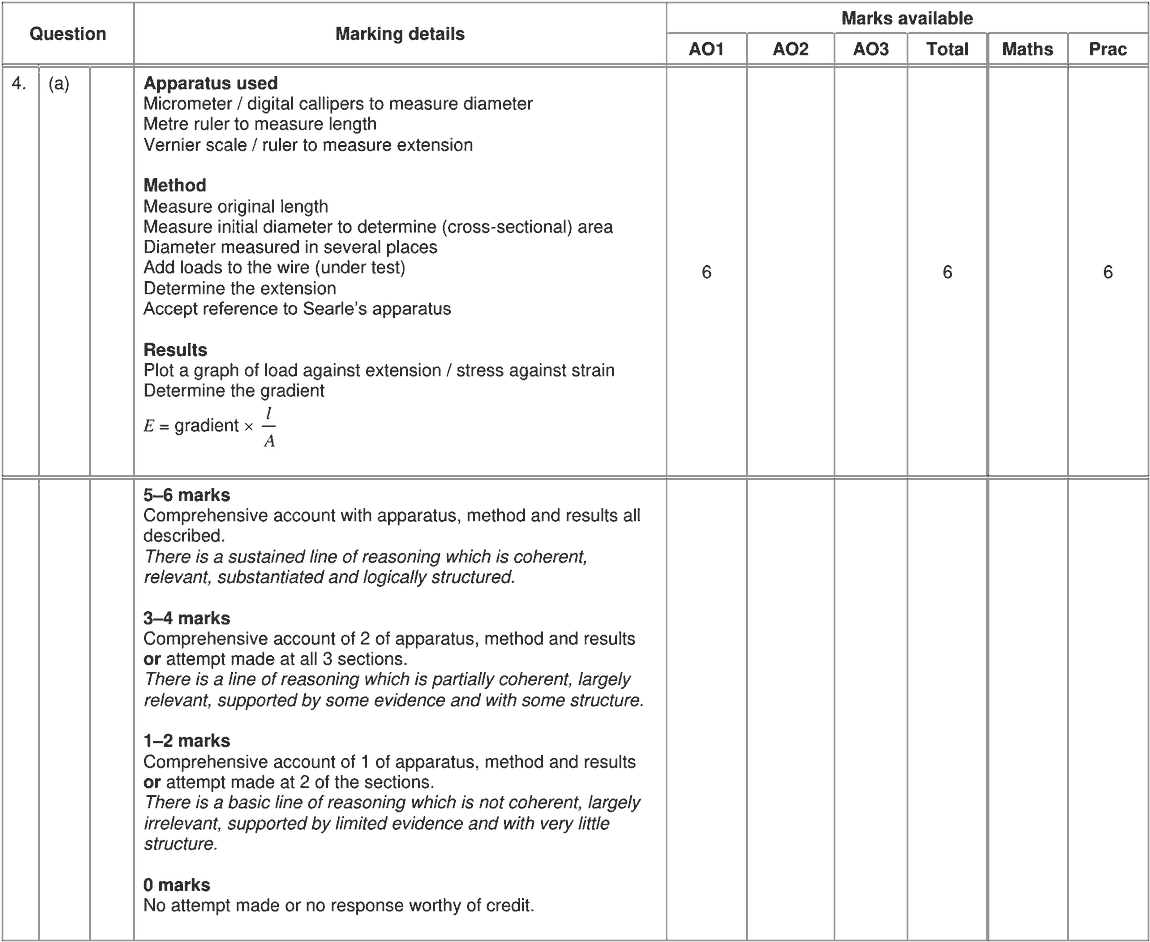
QER, levels marked. Apparatus: long wire clamped and loaded, metre rule for length, micrometer for diameter, vernier scale or marker and rule for extension (Searle's apparatus accepted). Method: measure the original length, diameter in several places to get the area, add loads and record the extension for each. Results: plot load against extension (or stress against strain), find the gradient, E = gradient × l/A. Top band needs apparatus, method and results
Scheme columns: Practical 6
Skills: Experimentalmethod Describing, planning or improving an experiment; Graphskills Reading, plotting or sketching graphs; gradients, intercepts and areas; Practicalmarks The mark scheme's Prac column gives this part at least one mark for practical skills; QER The 6-mark quality of extended response question
June 2022 · Component 1 · Q4(b)(i)2 marksAO1=1, AO2=1Show that
Earlier part of question 4 that this part uses
Mark scheme
Examiner's comment
Almost everyone could calculate the greatest force the rod could exert, given its diameter and the breaking stress of the metal.
Notes from the mark scheme and report
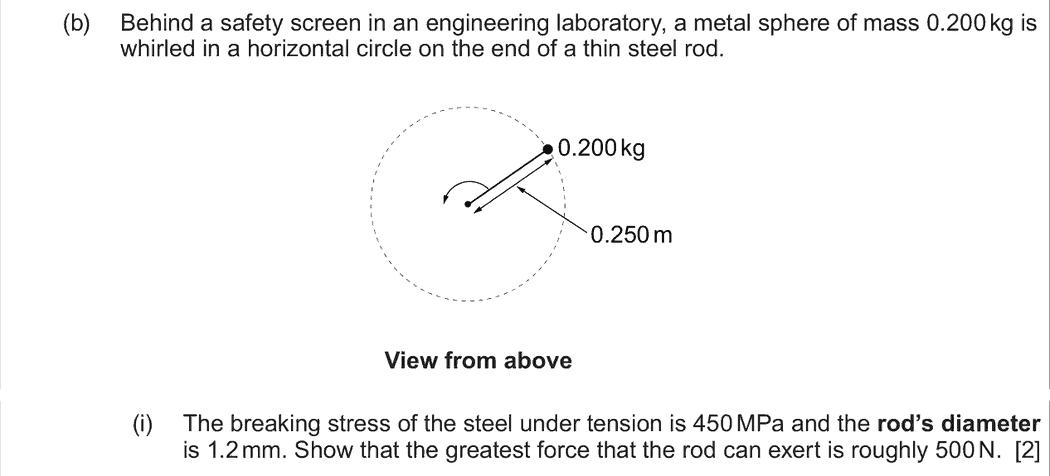
Force = stress × area = 450 × 10⁶ × π × (0.60 × 10⁻³)² = 509 N
synoptic with Component 2 solids under stress
Scheme columns: Maths 1
Skills: Synoptic Needs physics from another component of the qualification; Unitsand conversions Unit marks, base units, prefixes and conversions; Mathsmarks The mark scheme's Maths column gives this part at least one mark for mathematical skills
June 2022 · AS Component 1 · Q4(b)(i)1 markAO2=1Short answer
Earlier part of question 4 that this part uses
Mark scheme
Notes from the mark scheme and report
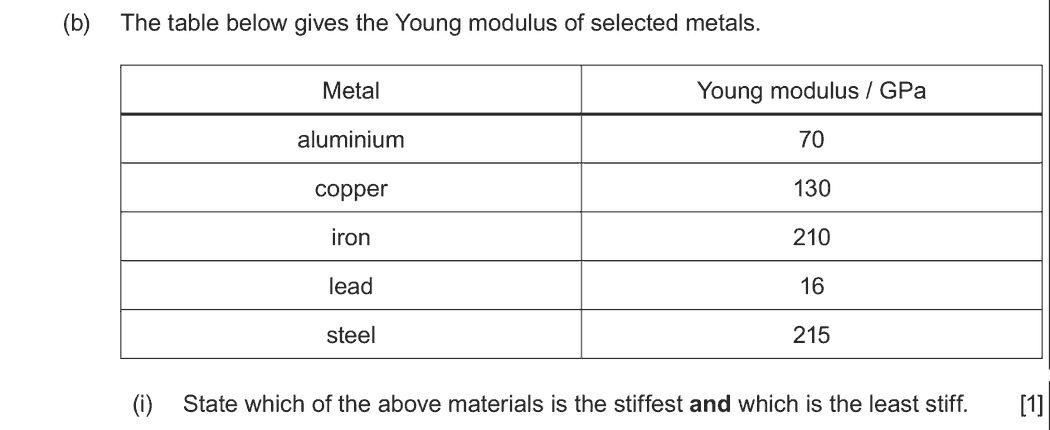
Stiffest: steel (largest Young modulus)
least stiff: lead
both needed
June 2022 · AS Component 1 · Q4(b)(ii)3 marksAO2=3Calculation
Earlier parts of question 4 that this part uses
Mark scheme
Notes from the mark scheme and report
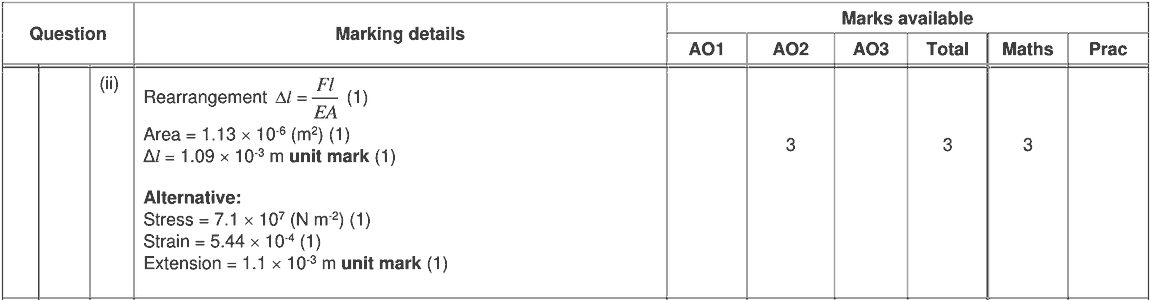
Answer: 1.09 × 10⁻³ m. A = π(0.60 × 10⁻³)² = 1.13 × 10⁻⁶ m²
Skills: Unitsand conversions Unit marks, base units, prefixes and conversions; Mathsmarks The mark scheme's Maths column gives this part at least one mark for mathematical skills
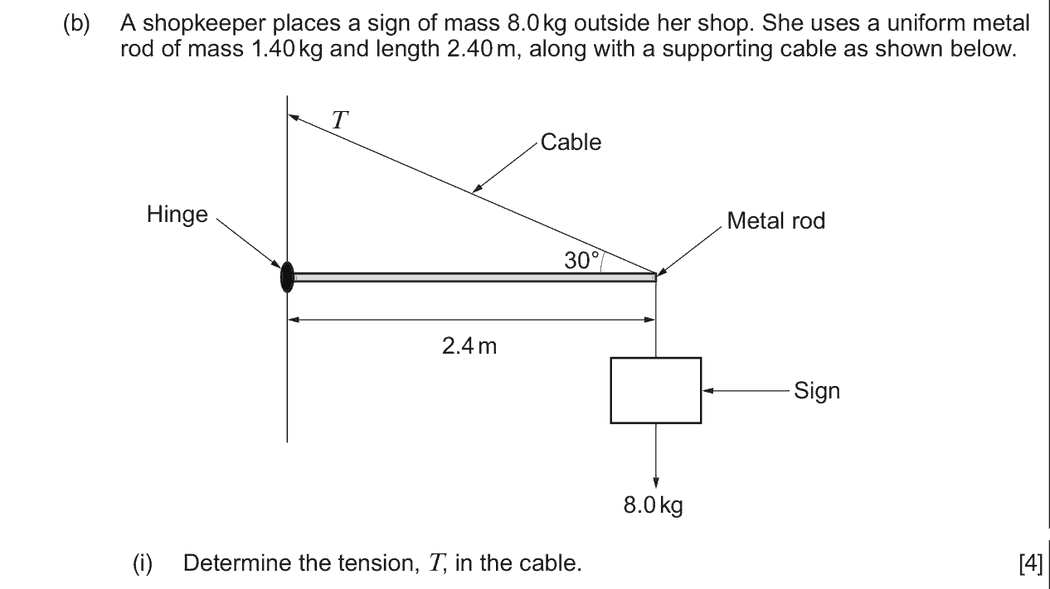
June 2022 · AS Component 1 · Q5(b)(ii)3 marksAO1=1, AO3=2Calculation
Earlier parts of question 5 that this part uses
Mark scheme
Notes from the mark scheme and report
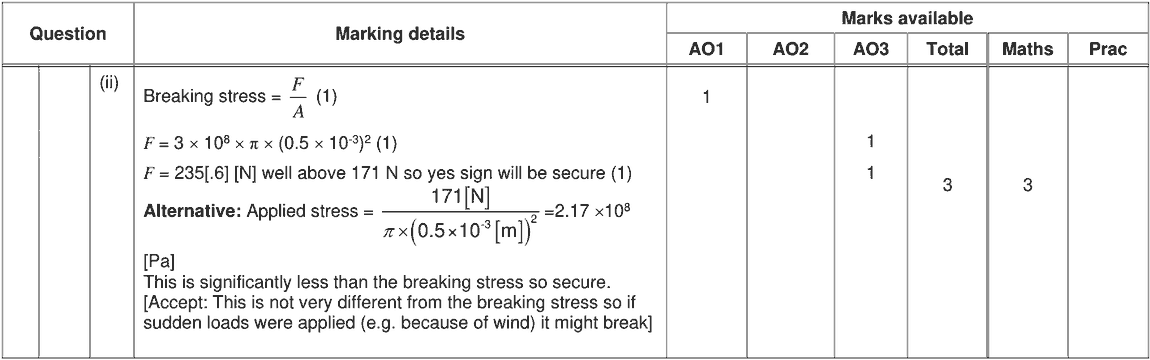
Breaking force = breaking stress × area = 3.0 × 10⁸ × π(0.50 × 10⁻³)² = 236 N (1 for stress = F/A, 1 for the substitution)
above the 171 N tension so the sign is secure (1)
or applied stress 2.2 × 10⁸ Pa is below the breaking stress
a comment that the margin is small for gusts is also accepted
Scheme columns: Maths 3
Skills: Mathsmarks The mark scheme's Maths column gives this part at least one mark for mathematical skills
June 2022 · AS Component 1 · Q5(c)2 marksAO3=2Short answer
Earlier parts of question 5 that this part uses
Mark scheme
Notes from the mark scheme and report
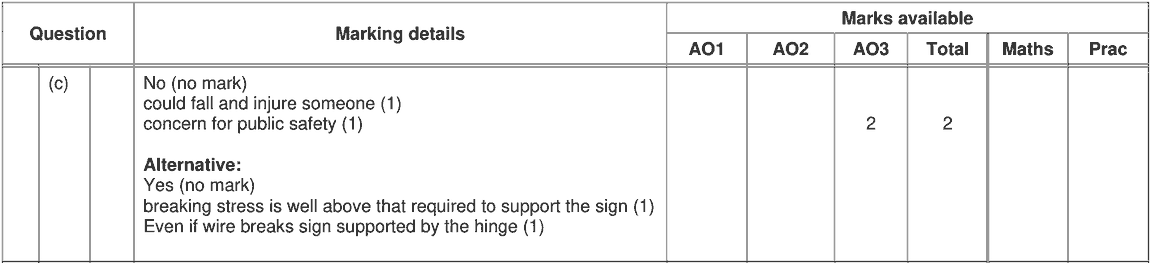
Either: no, the sign could fall and injure someone (1), so public safety needs an expert check (1)
or: yes, the breaking stress is well above what is needed (1) and the hinge would still hold the sign if the wire broke (1)
June 2022 · Component 2 · Q4(a)2 marksAO1=2Explanation
Mark scheme
Examiner's comment
Whilst many candidates were able to give a correct explanation for the term ductile, far fewer were able to describe the effect of adding carbon atoms to iron. In most cases this was due to candidates referring to the carbon atoms inhibiting the motion of whole planes of atoms rather than inhibiting dislocation movement. Reference to whole plane of atoms movement was not credited.
Notes from the mark scheme and report
Ductile: can be drawn into wires, i.e. undergoes large plastic deformation without breaking ('can be stretched' not enough) (1)
carbon (foreign) atoms hinder the movement of dislocations (1)
whole planes of atoms sliding was not credited
June 2022 · Component 2 · Q4(b)5 marksCalculation
Earlier part of question 4 that this part uses
Mark scheme
Notes from the mark scheme and report
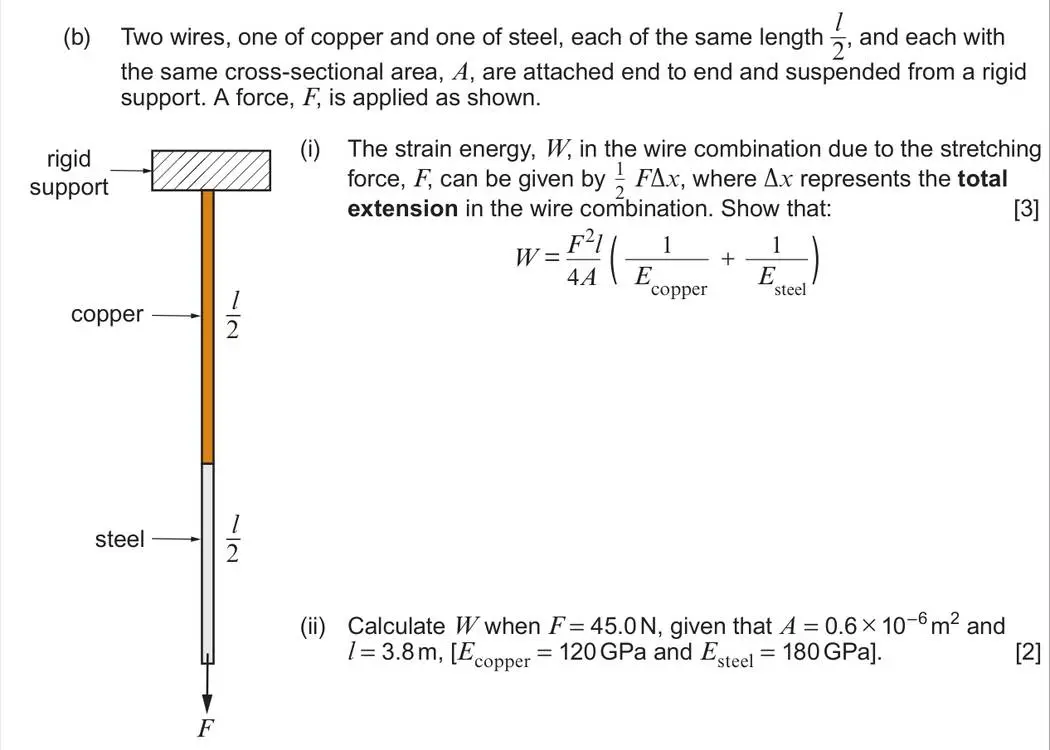
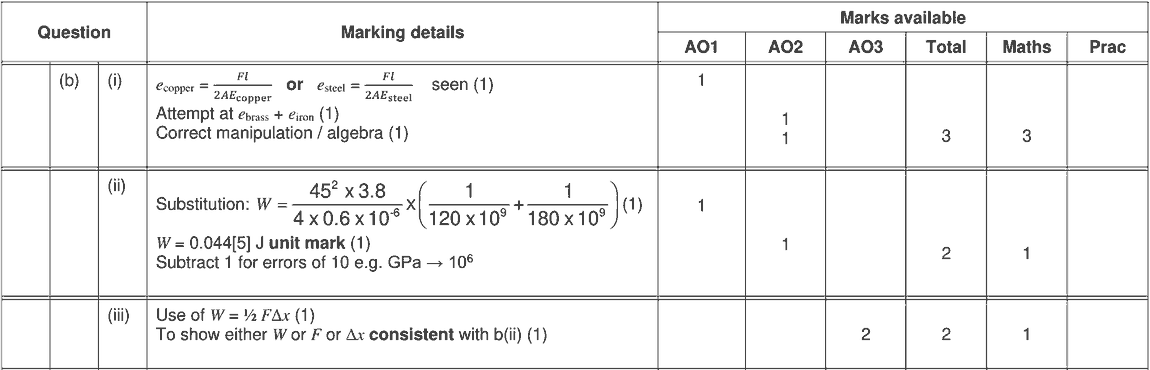
This crop holds parts (b)(i) and (b)(ii). (i) [3] extension of each wire = F(l/2)/AE = Fl/2AE (1)
total Δx = (Fl/2A)(1/E copper + 1/E steel) (1)
W = ½FΔx gives W = (F²l/4A)(1/E copper + 1/E steel) (1). (ii) [2] Answer: 0.045 J. W = 45.0² × 3.8/(4 × 0.6 × 10⁻⁶) × (1/120 × 10⁹ + 1/180 × 10⁹)
unit mark
1 off for a power of ten slip. No report comment shown
Skills: Algebra Derivations and rearranging equations; Unitsand conversions Unit marks, base units, prefixes and conversions
June 2022 · Component 2 · Q4(b)(iii)2 marksAO3=2Calculation
Earlier parts of question 4 that this part uses
Mark scheme
Notes from the mark scheme and report
Answer: consistent. W = ½FΔx = ½ × 45.0 × 2 × 10⁻³ = 0.045 J, matching (b)(ii) (or Δx = 2W/F = 1.98 mm). No report comment shown
Scheme columns: Maths 1
Skills: Mathsmarks The mark scheme's Maths column gives this part at least one mark for mathematical skills
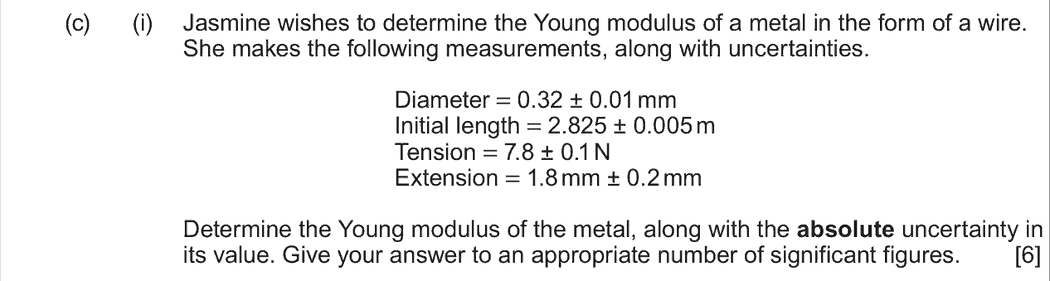
June 2022 · Component 2 · Q4(c)(i)6 marksAO2=6Practical and data analysis
Earlier parts of question 4 that this part uses
Mark scheme
Examiner's comment
Many candidates determined the Young modulus of the metal along with its absolute uncertainty correctly. A common reason for not achieving full marks was for incorrectly calculating the uncertainty in cross-sectional area, with a significant number of candidates omitting the factor ‘2’ in their calculations (leading to a % uncertainty of half the correct value). Many candidates also failed to give their final answers to an appropriate number of significant figures.
Notes from the mark scheme and report
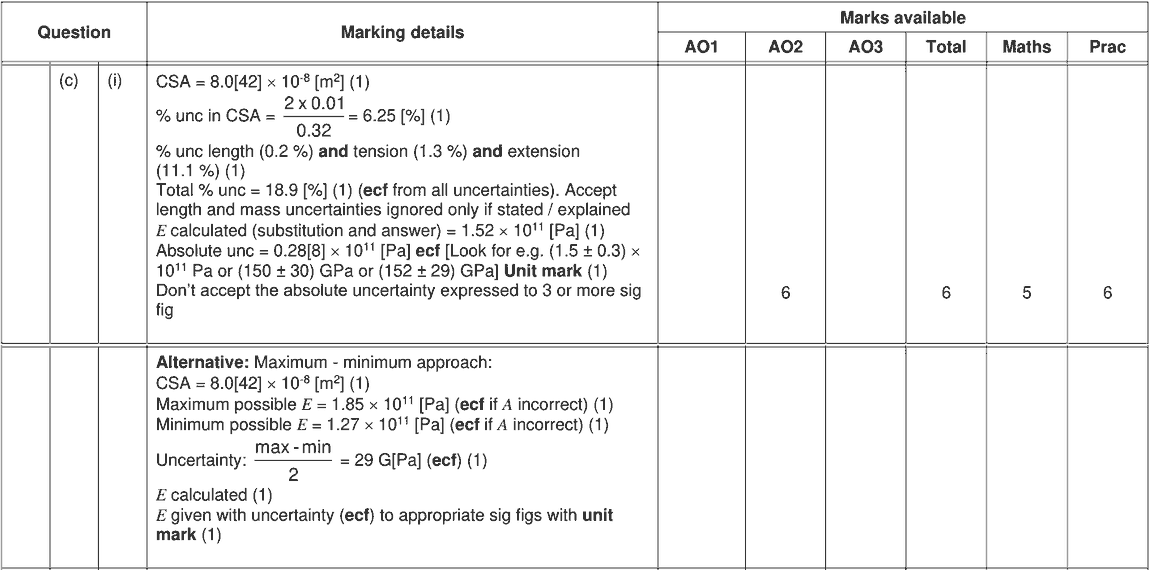
Answer: (1.5 ± 0.3) × 10¹¹ Pa (150 ± 30 GPa). A = π(0.16 × 10⁻³)² = 8.04 × 10⁻⁸ m²
E = Fl/Ax = 7.8 × 2.825/(8.04 × 10⁻⁸ × 1.8 × 10⁻³) = 1.52 × 10¹¹ Pa
% uncertainties: area 2 × 3.1 = 6.25, length 0.2, tension 1.3, extension 11.1, total 18.9%, so ± 0.29 × 10¹¹ Pa
uncertainty to 1 or 2 s.f.
unit mark. Max-min method also allowed. Common errors: not doubling the diameter uncertainty and too many significant figures
Scheme columns: Maths 5, Practical 6
Skills: Uncertainties Resolution, absolute and percentage uncertainty, combining uncertainties, error bars; Unitsand conversions Unit marks, base units, prefixes and conversions; Mathsmarks The mark scheme's Maths column gives this part at least one mark for mathematical skills; Practicalmarks The mark scheme's Prac column gives this part at least one mark for practical skills
June 2022 · Component 2 · Q4(c)(ii)4 marksAO3=4Practical and data analysis
Earlier parts of question 4 that this part uses
Mark scheme
Examiner's comment
Many candidates identified the reduction in the uncertainty due to the increased diameter, however only a few candidates discussed the impact of the reduced extension on the final uncertainty.
Notes from the mark scheme and report
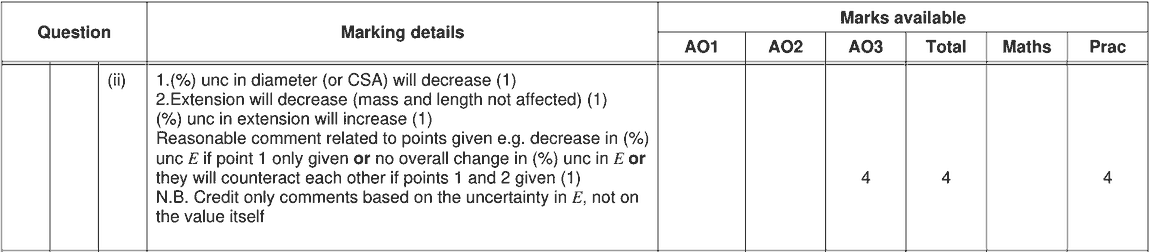
% uncertainty in diameter (and area) falls (1)
the extension is smaller for the same tension (1), so its % uncertainty rises (1)
sensible overall comment on the uncertainty in E, e.g. the two effects oppose each other so little overall change, or extension dominates (1). Comments on the value of E not credited
few considered the extension
Scheme columns: Practical 4
Skills: Uncertainties Resolution, absolute and percentage uncertainty, combining uncertainties, error bars; Practicalmarks The mark scheme's Prac column gives this part at least one mark for practical skills
October 2021 · Component 1 · Q8(f)3 marksAO1=1, AO2=2Explanation
Earlier parts of question 8 that this part uses
Mark scheme
Notes from the mark scheme and report
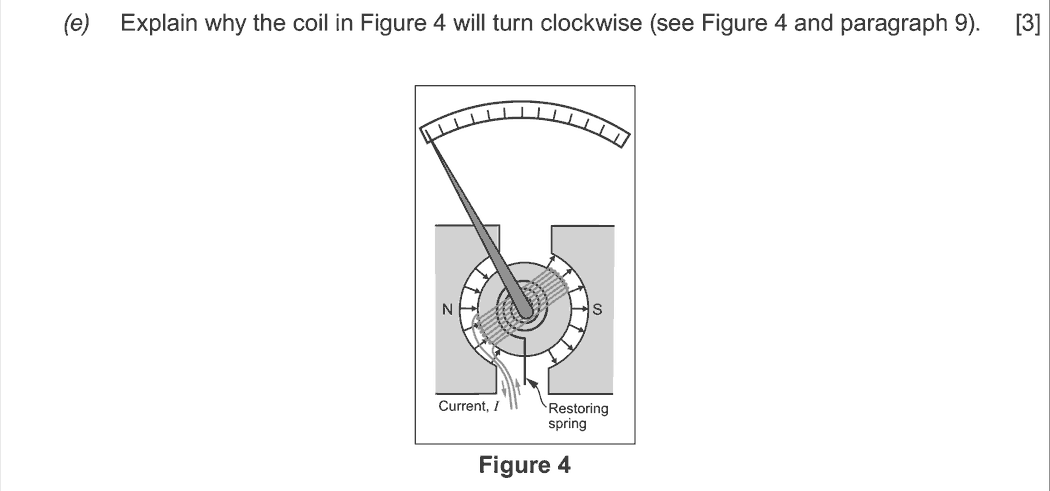
F = BIl (1), so with B constant the force on the coil is proportional to the current (1)
the spring obeys Hooke's law, force proportional to deflection, so the deflection is proportional to the current (1)
Skills: Comprehension A level Component 1 Section B: questions on the printed article; Synoptic Needs physics from another component of the qualification
October 2021 · Component 2 · Q4(a)(i)2 marksAO1=2Explanation
Mark scheme
Notes from the mark scheme and report
Surface cracks or imperfections (scratches) (1) concentrate the stress, and under tension the crack propagates through the glass (1)
bond-by-bond version accepted: a bond at the crack tip breaks and the stress passes to the next
October 2021 · Component 2 · Q4(a)(ii)2 marksAO1=2Explanation
Earlier part of question 4 that this part uses
Mark scheme
Notes from the mark scheme and report
The surface is in compression, which closes up surface cracks (1)
a larger applied tension is needed before the surface goes into tension and cracks can propagate (bonds break) (1)
October 2021 · Component 2 · Q4(b)(i)3 marksAO1=1, AO2=2Calculation
Earlier part of question 4 that this part uses
Mark scheme
Notes from the mark scheme and report
Answer: 1.46 × 10⁻³ m. A = π(0.08 × 10⁻³)² = 2.01 × 10⁻⁸ m²
Skills: Unitsand conversions Unit marks, base units, prefixes and conversions; Mathsmarks The mark scheme's Maths column gives this part at least one mark for mathematical skills
October 2021 · Component 2 · Q4(b)(ii)2 marksAO2=2Calculation
Earlier parts of question 4 that this part uses
Mark scheme
Notes from the mark scheme and report
Answer: 1.81 N. F = stress × area = 9.00 × 10⁷ × 2.01 × 10⁻⁸
ecf on area
Scheme columns: Maths 1
Skills: Mathsmarks The mark scheme's Maths column gives this part at least one mark for mathematical skills
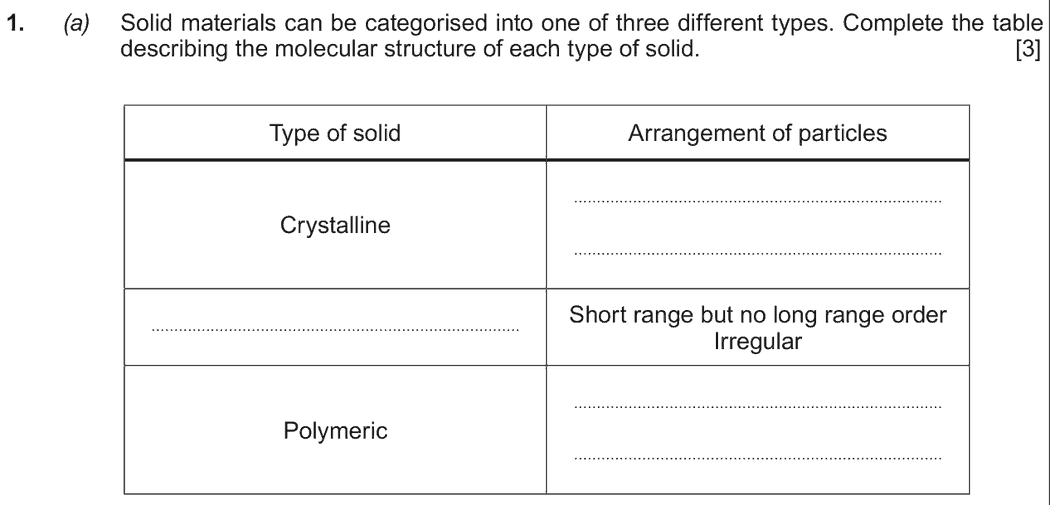
October 2020 · Component 2 · Q4(a)3 marksAO1=3Explanation
Mark scheme
Examiner's comment
The majority of candidates were able to describe the microscopic structures of the materials and to give an example of each type. Likewise, many candidates were able to make correct reference to the molecular structure of rubber at points A and B on the graph, but few were able to relate the structure changes to the gradients at these points. Nearly every candidate was able to recall and explain the term ‘hysteresis’ correctly, and to sketch a correct ‘unloading’ curve.
Notes from the mark scheme and report
One mark each for description with an example: crystalline: regular repeating arrangement with long-range order, e.g. a metal
amorphous: no long-range order, e.g. glass
polymeric: long chain molecules, e.g. rubber or polythene
October 2020 · Component 2 · Q4(b)(i)3 marksAO1=2, AO2=1Explanation
Earlier part of question 4 that this part uses
Mark scheme
Examiner's comment
The majority of candidates were able to describe the microscopic structures of the materials and to give an example of each type. Likewise, many candidates were able to make correct reference to the molecular structure of rubber at points A and B on the graph, but few were able to relate the structure changes to the gradients at these points. Nearly every candidate was able to recall and explain the term ‘hysteresis’ correctly, and to sketch a correct ‘unloading’ curve.
Notes from the mark scheme and report
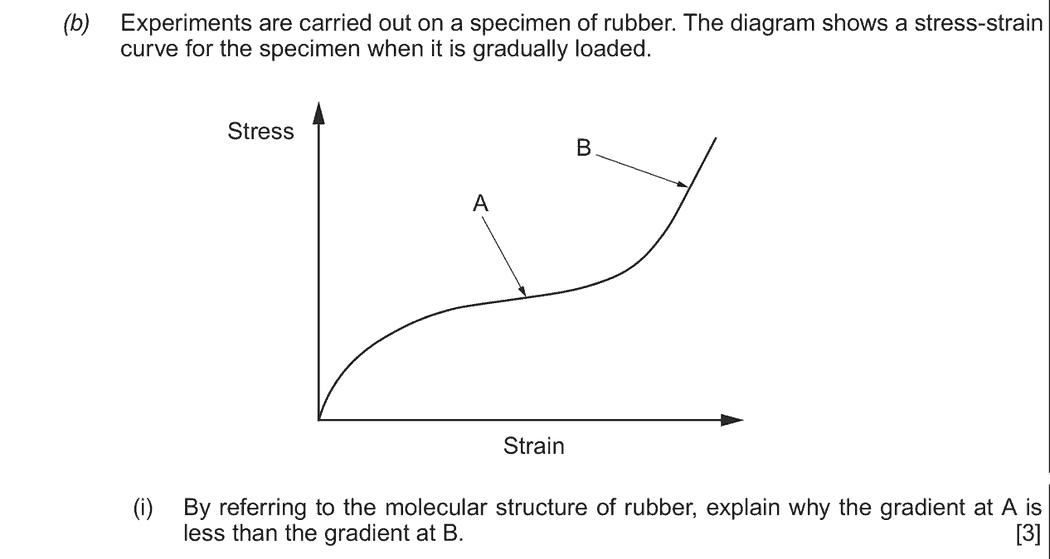
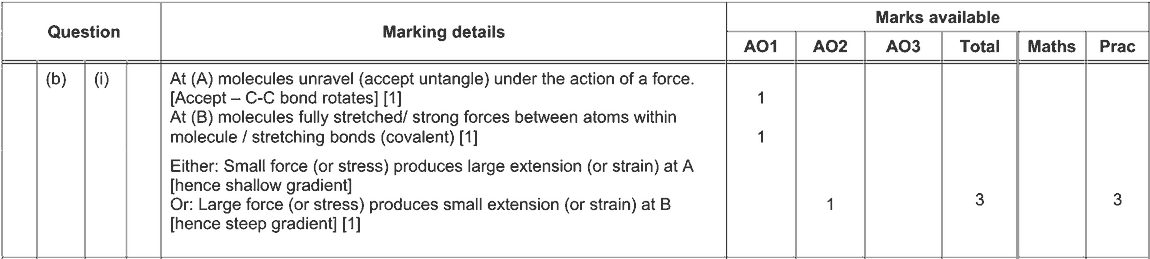
At A the tangled chain molecules are being straightened (bond rotation) (1)
at B the molecules are fully extended so the bonds themselves are being stretched (1)
so a small stress gives a large strain at A (shallow gradient), or a large stress gives a small strain at B (1)
the link to gradient was often missing
Scheme columns: Practical 3
Skills: Practicalmarks The mark scheme's Prac column gives this part at least one mark for practical skills
October 2020 · Component 2 · Q4(b)(ii)I2 marksAO1=2Short answer
Earlier parts of question 4 that this part uses
Mark scheme
Examiner's comment
The majority of candidates were able to describe the microscopic structures of the materials and to give an example of each type. Likewise, many candidates were able to make correct reference to the molecular structure of rubber at points A and B on the graph, but few were able to relate the structure changes to the gradients at these points. Nearly every candidate was able to recall and explain the term ‘hysteresis’ correctly, and to sketch a correct ‘unloading’ curve.
Notes from the mark scheme and report
Hysteresis (1)
the area between the loading and unloading curves is the energy transferred to internal energy of the rubber per cycle and lost as heat (1)
October 2020 · Component 2 · Q4(b)(ii)II1 markAO1=1Diagram or graph
Earlier parts of question 4 that this part uses
Mark scheme
Examiner's comment
The majority of candidates were able to describe the microscopic structures of the materials and to give an example of each type. Likewise, many candidates were able to make correct reference to the molecular structure of rubber at points A and B on the graph, but few were able to relate the structure changes to the gradients at these points. Nearly every candidate was able to recall and explain the term ‘hysteresis’ correctly, and to sketch a correct ‘unloading’ curve.
Notes from the mark scheme and report
Unloading curve of similar shape lying below the loading curve at every point, returning to the origin (or a small permanent set)
Skills: Graphskills Reading, plotting or sketching graphs; gradients, intercepts and areas
October 2020 · Component 2 · Q5(a)(i)2 marksAO2=2Show that
Mark scheme
Examiner's comment
Nearly all candidates were able to confirm the maximum extension possible for the wire without exceeding the elastic limit. Far fewer were able to give a correct and logical argument as to whether the maximum extension depended on the radius, with many unable to make the connection between changing radius and the corresponding change in tension. In (b) however, the majority of candidates gained all of the marks available for determining the value of k and also the required mass. Part (c) was synoptic in nature testing SHM as applied to the situation given. Good attempts were made to determine the period of oscillation and the maximum velocity of the mass. However nearly all candidates used an incorrect value for displacement when determining velocity and were deducted one mark. No correct responses were seen showing graphically how the stress varied in the wire over one complete oscillation. Many candidates however did gain some credit for using appropriate scales and/or for providing a general shape for the expected curve (with no reference to time and stress values).
Notes from the mark scheme and report
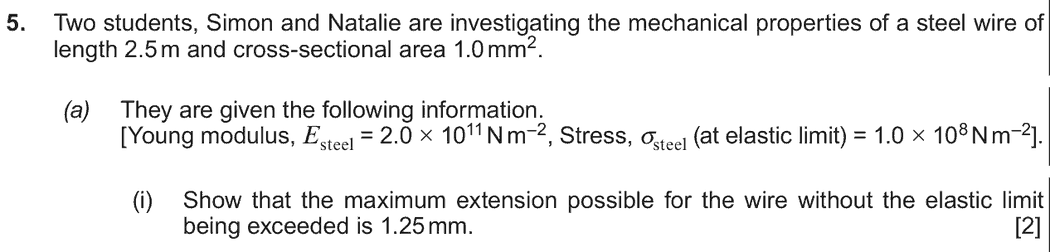
Strain at the elastic limit = σ/E = 1.0 × 10⁸/2.0 × 10¹¹ = 5.0 × 10⁻⁴
Δx = strain × l = 5.0 × 10⁻⁴ × 2.5 = 1.25 × 10⁻³ m
Scheme columns: Maths 2
Skills: Mathsmarks The mark scheme's Maths column gives this part at least one mark for mathematical skills
October 2020 · Component 2 · Q5(a)(ii)3 marksAO3=3Explanation
Earlier part of question 5 that this part uses
Mark scheme
Examiner's comment
Nearly all candidates were able to confirm the maximum extension possible for the wire without exceeding the elastic limit. Far fewer were able to give a correct and logical argument as to whether the maximum extension depended on the radius, with many unable to make the connection between changing radius and the corresponding change in tension. In (b) however, the majority of candidates gained all of the marks available for determining the value of k and also the required mass. Part (c) was synoptic in nature testing SHM as applied to the situation given. Good attempts were made to determine the period of oscillation and the maximum velocity of the mass. However nearly all candidates used an incorrect value for displacement when determining velocity and were deducted one mark. No correct responses were seen showing graphically how the stress varied in the wire over one complete oscillation. Many candidates however did gain some credit for using appropriate scales and/or for providing a general shape for the expected curve (with no reference to time and stress values).
Notes from the mark scheme and report
The stress at the elastic limit is a property of the steel, the same for any radius (a thicker wire just needs more tension, 4 times for double the radius) (1)
maximum strain = stress/E, so the maximum extension for this length is unchanged (1)
Natalie is correct (1)
many could not link the change of radius to the change of tension
October 2020 · Component 2 · Q5(b)(i)3 marksAO2=3Show that
Earlier part of question 5 that this part uses
Mark scheme
Examiner's comment
Nearly all candidates were able to confirm the maximum extension possible for the wire without exceeding the elastic limit. Far fewer were able to give a correct and logical argument as to whether the maximum extension depended on the radius, with many unable to make the connection between changing radius and the corresponding change in tension. In (b) however, the majority of candidates gained all of the marks available for determining the value of k and also the required mass. Part (c) was synoptic in nature testing SHM as applied to the situation given. Good attempts were made to determine the period of oscillation and the maximum velocity of the mass. However nearly all candidates used an incorrect value for displacement when determining velocity and were deducted one mark. No correct responses were seen showing graphically how the stress varied in the wire over one complete oscillation. Many candidates however did gain some credit for using appropriate scales and/or for providing a general shape for the expected curve (with no reference to time and stress values).
Notes from the mark scheme and report
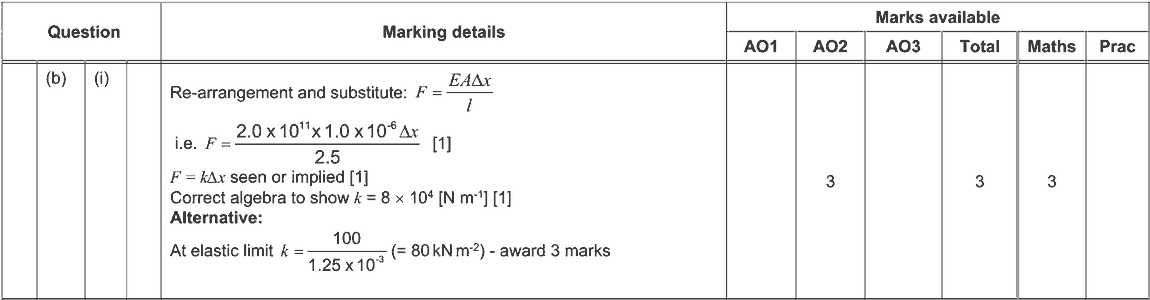
F = EAΔx/l and F = kΔx so k = EA/l = 2.0 × 10¹¹ × 1.0 × 10⁻⁶/2.5 = 8.0 × 10⁴ N m⁻¹
or force at the elastic limit 100 N divided by 1.25 × 10⁻³ m
Scheme columns: Maths 3
Skills: Algebra Derivations and rearranging equations; Unitsand conversions Unit marks, base units, prefixes and conversions; Mathsmarks The mark scheme's Maths column gives this part at least one mark for mathematical skills
October 2020 · Component 2 · Q5(b)(ii)2 marksAO2=2Calculation
Earlier parts of question 5 that this part uses
Mark scheme
Examiner's comment
Nearly all candidates were able to confirm the maximum extension possible for the wire without exceeding the elastic limit. Far fewer were able to give a correct and logical argument as to whether the maximum extension depended on the radius, with many unable to make the connection between changing radius and the corresponding change in tension. In (b) however, the majority of candidates gained all of the marks available for determining the value of k and also the required mass. Part (c) was synoptic in nature testing SHM as applied to the situation given. Good attempts were made to determine the period of oscillation and the maximum velocity of the mass. However nearly all candidates used an incorrect value for displacement when determining velocity and were deducted one mark. No correct responses were seen showing graphically how the stress varied in the wire over one complete oscillation. Many candidates however did gain some credit for using appropriate scales and/or for providing a general shape for the expected curve (with no reference to time and stress values).
Notes from the mark scheme and report
Answer: 8.2 kg. mg = kΔx so m = 8.0 × 10⁴ × 1.0 × 10⁻³/9.81
Scheme columns: Maths 1
Skills: Mathsmarks The mark scheme's Maths column gives this part at least one mark for mathematical skills
October 2020 · Component 2 · Q5(c)(iii)4 marksAO2=4Diagram or graph
Earlier parts of question 5 that this part uses
Mark scheme
Examiner's comment
Nearly all candidates were able to confirm the maximum extension possible for the wire without exceeding the elastic limit. Far fewer were able to give a correct and logical argument as to whether the maximum extension depended on the radius, with many unable to make the connection between changing radius and the corresponding change in tension. In (b) however, the majority of candidates gained all of the marks available for determining the value of k and also the required mass. Part (c) was synoptic in nature testing SHM as applied to the situation given. Good attempts were made to determine the period of oscillation and the maximum velocity of the mass. However nearly all candidates used an incorrect value for displacement when determining velocity and were deducted one mark. No correct responses were seen showing graphically how the stress varied in the wire over one complete oscillation. Many candidates however did gain some credit for using appropriate scales and/or for providing a general shape for the expected curve (with no reference to time and stress values).
Notes from the mark scheme and report
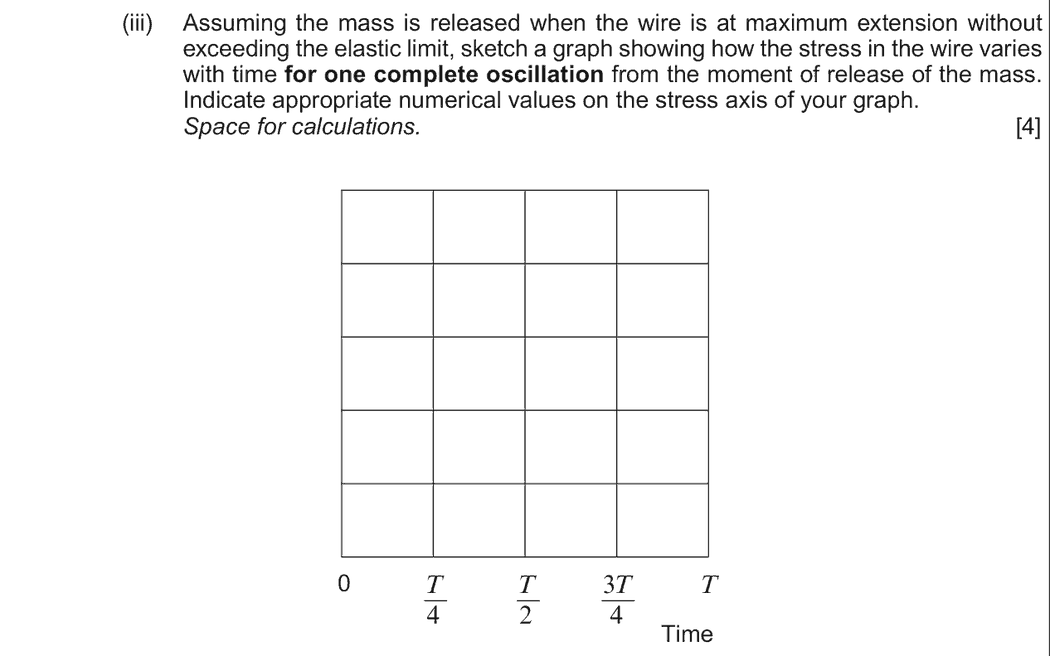
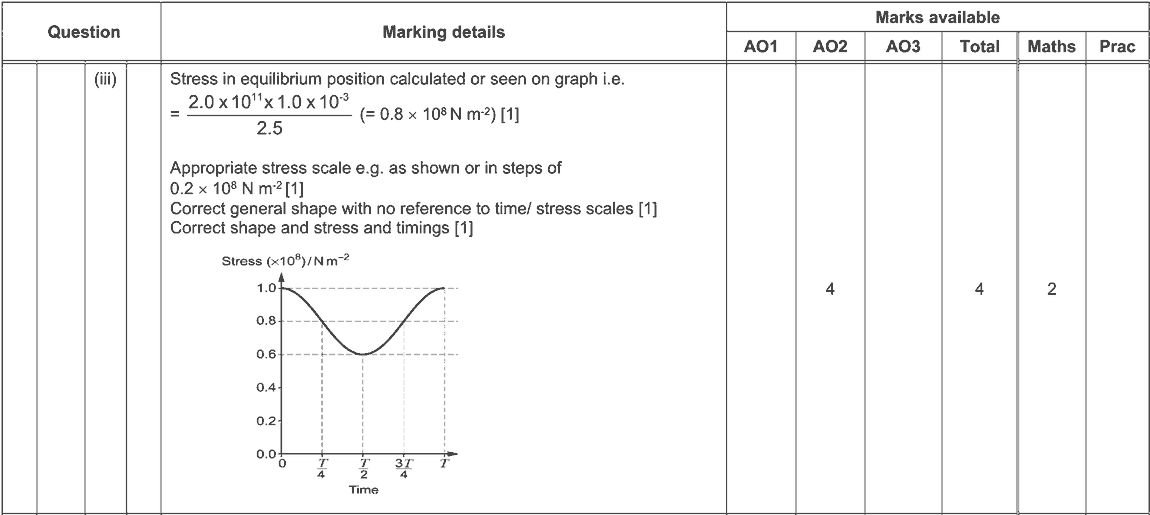
Stress at equilibrium = E × strain = 2.0 × 10¹¹ × 1.0 × 10⁻³/2.5 = 0.8 × 10⁸ N m⁻² (1)
sensible stress scale (1)
cosine shape (1) starting at 1.0 × 10⁸ at t = 0, 0.8 × 10⁸ at T/4, minimum 0.6 × 10⁸ at T/2, back to 1.0 × 10⁸ at T (1)
no fully correct answers were seen
Scheme columns: Maths 2
Skills: Synoptic Needs physics from another component of the qualification; Graphskills Reading, plotting or sketching graphs; gradients, intercepts and areas; Mathsmarks The mark scheme's Maths column gives this part at least one mark for mathematical skills
June 2019 · AS Component 1 · Q1(a)(i)1 markAO1=1Definition
Mark scheme
Notes from the mark scheme and report
Young modulus = tensile stress / tensile strain (when Hooke's law applies)
June 2019 · AS Component 1 · Q1(a)(ii)3 marksAO1=1, AO2=2Short answer
Earlier part of question 1 that this part uses
Mark scheme
Notes from the mark scheme and report
Answer: kg m⁻¹ s⁻². Strain has no unit (1)
stress = force/area = kg m s⁻² / m² (1)
Young modulus kg m⁻¹ s⁻² (1)
Scheme columns: Maths 3
Skills: Unitsand conversions Unit marks, base units, prefixes and conversions; Mathsmarks The mark scheme's Maths column gives this part at least one mark for mathematical skills
June 2019 · AS Component 1 · Q1(b)(i)3 marksAO1=3Diagram or graph
Earlier part of question 1 that this part uses
Mark scheme
Notes from the mark scheme and report
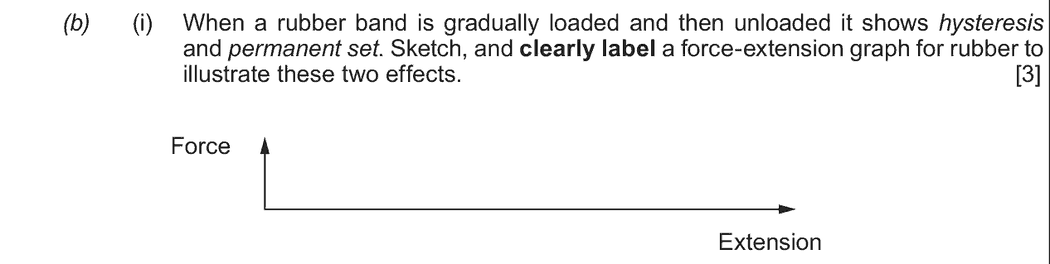
S-shaped loading curve (1)
loading and unloading curves labelled (1)
hysteresis loop shown, unloading below loading, not returning to the origin for permanent set (1)
Scheme columns: Practical 3
Skills: Graphskills Reading, plotting or sketching graphs; gradients, intercepts and areas; Practicalmarks The mark scheme's Prac column gives this part at least one mark for practical skills
June 2019 · AS Component 1 · Q1(b)(ii)2 marksAO2=2Explanation
Earlier parts of question 1 that this part uses
Mark scheme
Notes from the mark scheme and report
Rubber: long chain molecules unravel or straighten, held by weak (van der Waals) bonds between molecules (1)
these are easily overcome whereas a metal has strong metallic bonds that must be stretched (1)
June 2019 · AS Component 1 · Q1(b)(iii)2 marksAO1=2Explanation
Earlier parts of question 1 that this part uses
Mark scheme
Notes from the mark scheme and report
Young modulus increases (1) because greater molecular vibration makes the chains more entangled, opposing straightening (1)
June 2019 · AS Component 1 · Q3(a)1 markAO1=1Definition
Mark scheme
Notes from the mark scheme and report
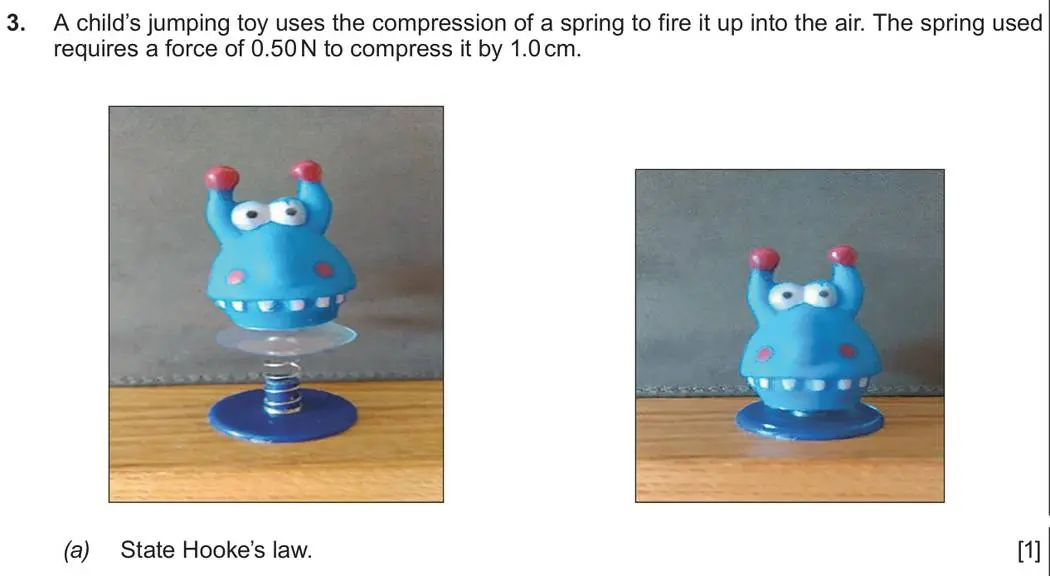
The force (tension) in a spring is directly proportional to its extension
'directly' required
June 2019 · AS Component 1 · Q3(b)(i)3 marksAO2=3Calculation
Earlier part of question 3 that this part uses
Mark scheme
Notes from the mark scheme and report
Answer: 3.0 m s⁻¹. k = 0.50/0.010 = 50 N m⁻¹ (1)
½kx² = ½mv² (1)
v = 0.060 × √(50/0.020) (1)
Scheme columns: Maths 2
Skills: Unitsand conversions Unit marks, base units, prefixes and conversions; Mathsmarks The mark scheme's Maths column gives this part at least one mark for mathematical skills
June 2019 · AS Component 1 · Q3(b)(ii)2 marksAO2=2Calculation
Earlier parts of question 3 that this part uses
Mark scheme
Notes from the mark scheme and report
Answer: 150 m s⁻². a = kx/m = 50 × 0.060/0.020 (1)
answer with the assumption that the weight (g) is ignored (1)
Scheme columns: Maths 1
Skills: Mathsmarks The mark scheme's Maths column gives this part at least one mark for mathematical skills
June 2019 · Component 2 · Q5(a)(i)3 marksAO2=3Show that
Mark scheme
Examiner's comment
Many candidates recognised the need to add the extensions and many gave correct terms for the extension of each of the parts. However, many candidates then wrote down the final expression (which was given in the question) without showing clearly the algebra to get to it.
Notes from the mark scheme and report
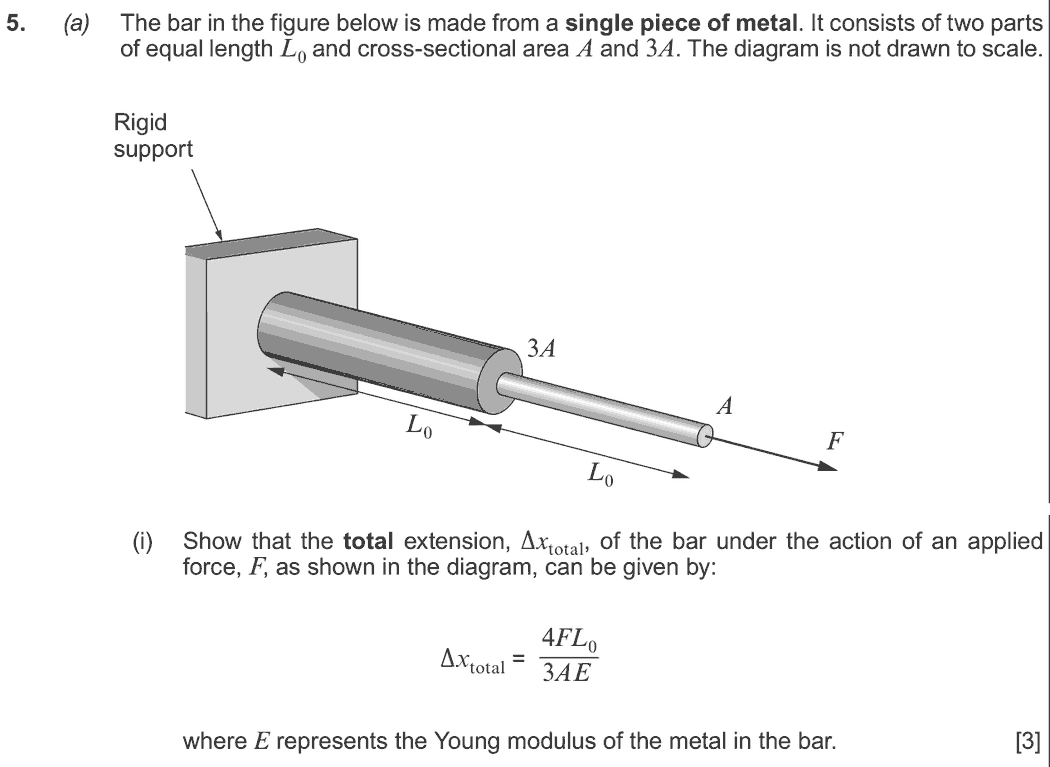
Total extension = extension of thin part + extension of thick part (1)
Δx = FL₀/AE + FL₀/3AE (1)
common denominator 3FL₀/3AE + FL₀/3AE = 4FL₀/3AE shown (1)
the final algebra step was often skipped
Scheme columns: Maths 2
Skills: Algebra Derivations and rearranging equations; Mathsmarks The mark scheme's Maths column gives this part at least one mark for mathematical skills
June 2019 · Component 2 · Q5(a)(ii)1 markAO2=1Diagram or graph
Earlier part of question 5 that this part uses
Mark scheme
Examiner's comment
A significant number of candidates seemed to miss this question, not showing the additional line on the graph. Many others incorrectly drew in a shallower line.
Notes from the mark scheme and report
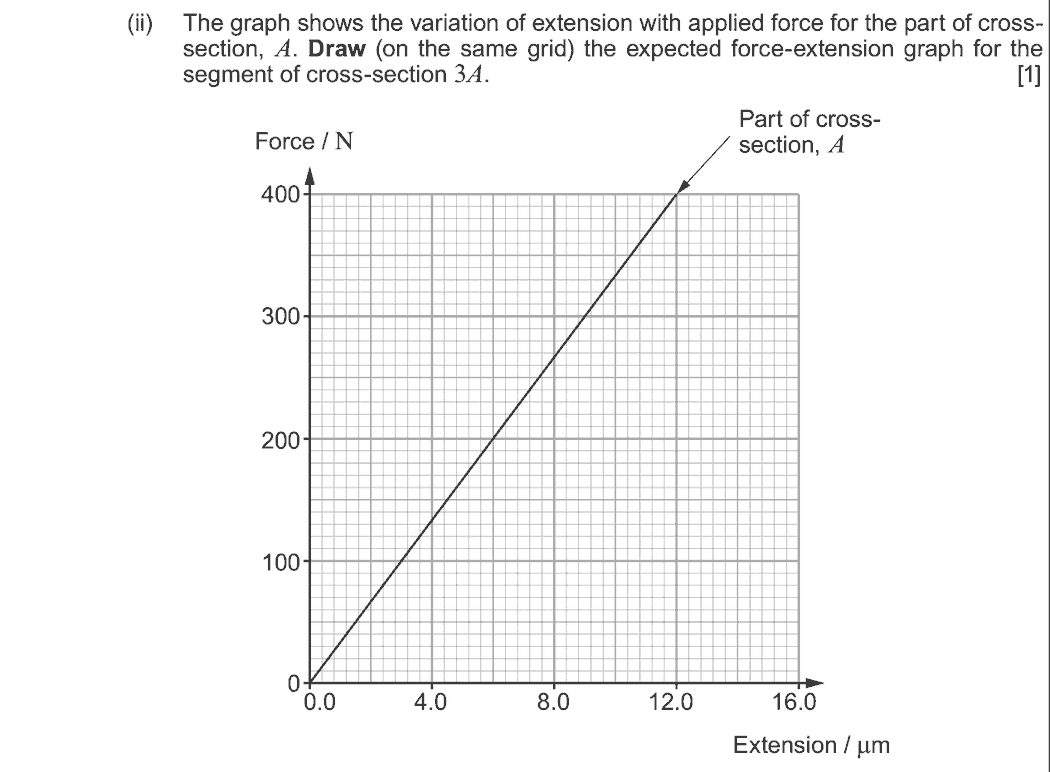
Straight line from the origin to (4.0 µm, 400 N): one third of the extension for the same force, so three times steeper
many drew a shallower line or left it blank
Skills: Graphskills Reading, plotting or sketching graphs; gradients, intercepts and areas
June 2019 · Component 2 · Q5(a)(iii)3 marksAO2=3Calculation
Earlier parts of question 5 that this part uses
Mark scheme
Examiner's comment
Most candidates calculated Young modulus correctly, many by using the line of cross-section A or the line of cross-section 3A. Some candidates tried using a mean cross-sectional area unsuccessfully. Some candidates were penalised for giving an incorrect unit.
Notes from the mark scheme and report
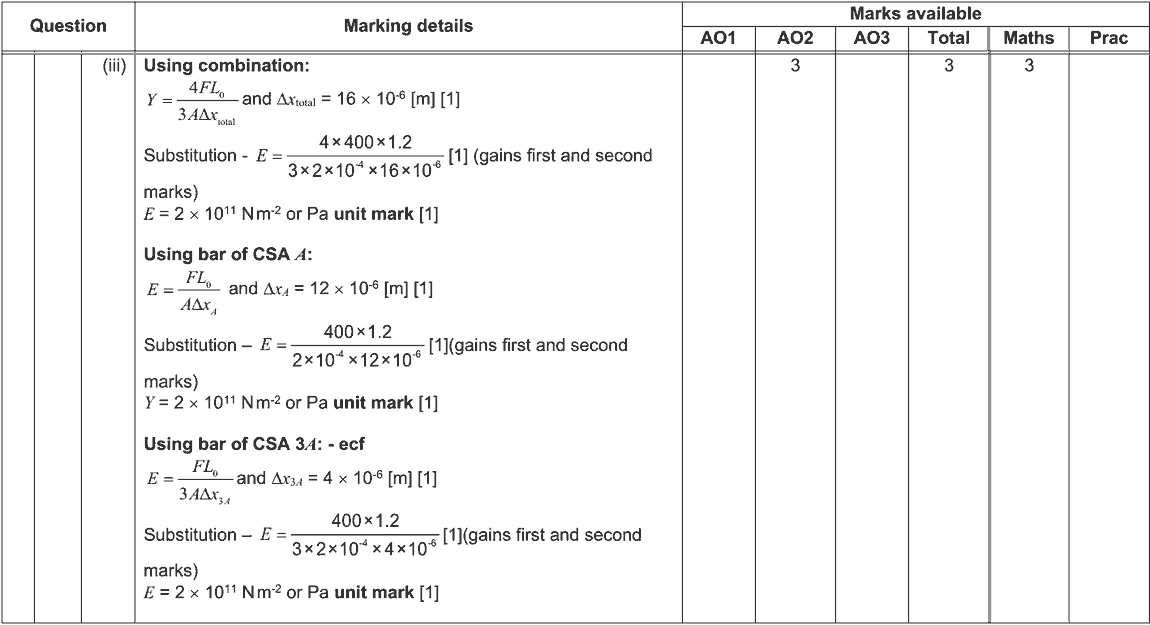
Answer: 2.0 × 10¹¹ N m⁻² (Pa). From the graph Δx = 12 × 10⁻⁶ m at 400 N for the part of area A (1)
or use the whole bar with Δx total = 16 µm, or the 3A part with 4 µm
a mean area does not work
Scheme columns: Maths 3
Skills: Graphskills Reading, plotting or sketching graphs; gradients, intercepts and areas; Unitsand conversions Unit marks, base units, prefixes and conversions; Mathsmarks The mark scheme's Maths column gives this part at least one mark for mathematical skills
June 2019 · Component 2 · Q5(a)(iv)2 marksAO1=1, AO2=1Calculation
Earlier parts of question 5 that this part uses
Mark scheme
Examiner's comment
The majority of candidates were unsuccessful here with many determining the energy stored for only one of the sections.
Notes from the mark scheme and report
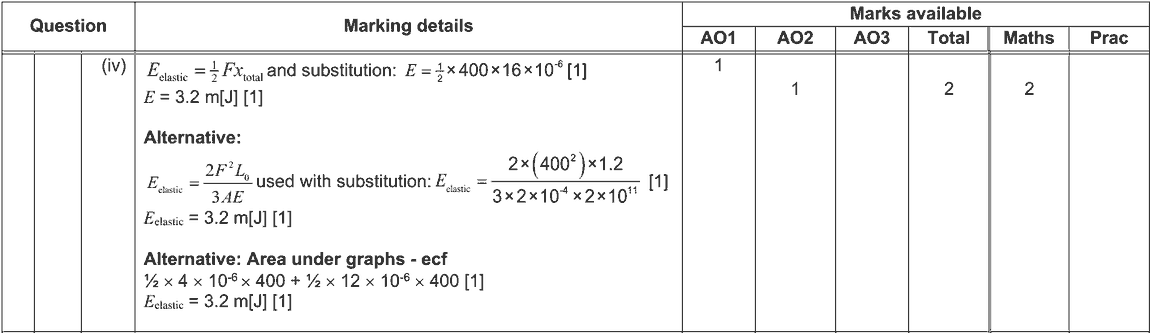
Answer: 3.2 mJ. Energy = ½FΔx(total) = ½ × 400 × 16 × 10⁻⁶ (1) (1)
or the sum of the areas under both graphs
most found the energy for one section only
Scheme columns: Maths 2
Skills: Mathsmarks The mark scheme's Maths column gives this part at least one mark for mathematical skills
June 2019 · Component 2 · Q5(b)(i)3 marksAO2=3Calculation
Earlier parts of question 5 that this part uses
Mark scheme
Examiner's comment
Most candidates completed this part successfully, with clear lines on the graph to show how they obtained the breaking stress. However, a significant number did not convert weight to mass as required and lost one mark.
Notes from the mark scheme and report
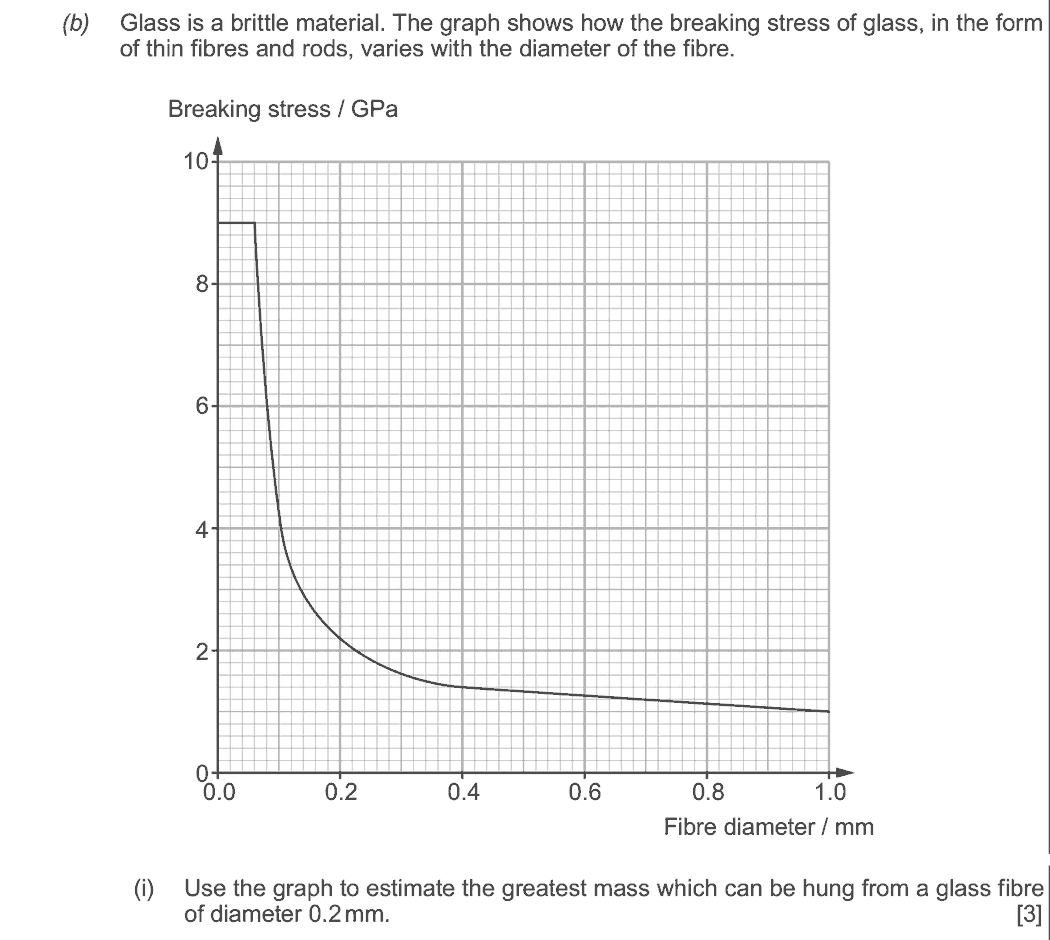
Answer: 7.0 kg. Breaking stress at 0.2 mm = 2.2 × 10⁹ Pa from the graph (1)
F = stress × area = 2.2 × 10⁹ × π × (0.1 × 10⁻³)² = 69 N (1)
mass = 69/9.81 (1)
many left the answer as a weight
Scheme columns: Maths 2
Skills: Graphskills Reading, plotting or sketching graphs; gradients, intercepts and areas; Unitsand conversions Unit marks, base units, prefixes and conversions; Mathsmarks The mark scheme's Maths column gives this part at least one mark for mathematical skills
June 2019 · Component 2 · Q5(b)(ii)2 marksAO1=2Explanation
Earlier parts of question 5 that this part uses
Mark scheme
Examiner's comment
Many candidates were able to explain the mechanism of brittle fracture in terms of crack propagation, but few were able to give a correct reason, in terms of having fewer surface imperfections and why thinner fibres have a greater breaking stress than thicker ones. Many, for example, referred to the decreased cross-sectional area of thinner fibres.
Notes from the mark scheme and report
Brittle fracture: a crack spreads (propagates) through the material from a surface imperfection (1)
a thinner fibre has fewer surface imperfections (1)
answers about smaller cross-sectional area gained nothing
June 2018 · AS Component 1 · Q1(a)(i)1 markAO1=1Practical and data analysis
Mark scheme
Examiner's comment
Generally well answered. Some irrelevant risk assessments were given for (iii) such as the weight falling on a person’s foot when the test was being taken on a bench.
Notes from the mark scheme and report
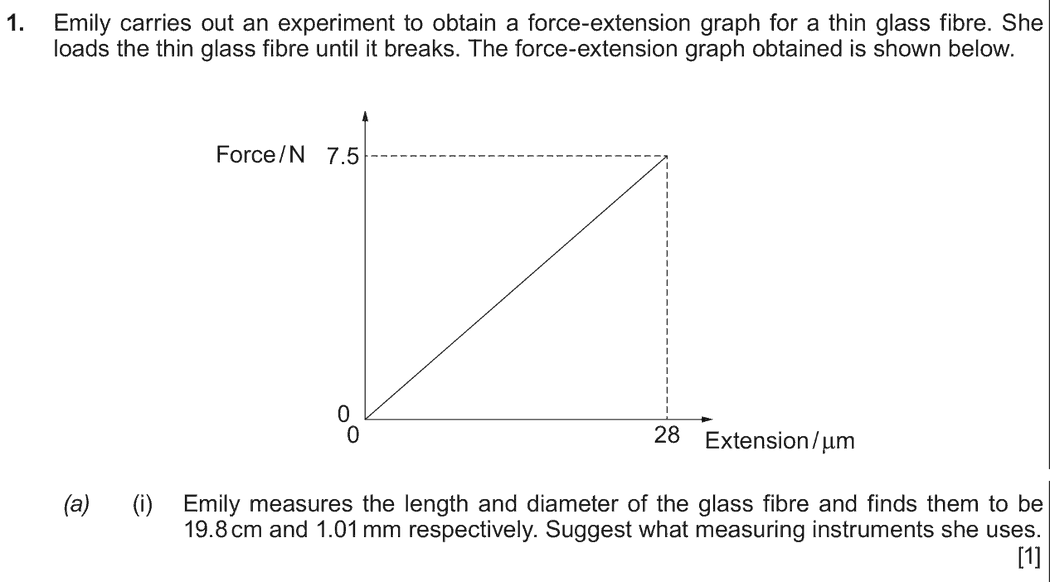
Ruler (metre rule) for the length and a micrometer or vernier callipers for the diameter
Scheme columns: Practical 1
Skills: Experimentalmethod Describing, planning or improving an experiment; Practicalmarks The mark scheme's Prac column gives this part at least one mark for practical skills
June 2018 · AS Component 1 · Q1(a)(ii)3 marksAO1=1, AO2=2Calculation
Earlier part of question 1 that this part uses
Mark scheme
Examiner's comment
Generally well answered. Some irrelevant risk assessments were given for (iii) such as the weight falling on a person’s foot when the test was being taken on a bench.
Notes from the mark scheme and report
Answer: 6.6 × 10¹⁰ Pa. A = π(0.505 × 10⁻³)² = 8.01 × 10⁻⁷ m²
Skills: Graphskills Reading, plotting or sketching graphs; gradients, intercepts and areas; Unitsand conversions Unit marks, base units, prefixes and conversions; Mathsmarks The mark scheme's Maths column gives this part at least one mark for mathematical skills; Practicalmarks The mark scheme's Prac column gives this part at least one mark for practical skills
June 2018 · AS Component 1 · Q1(a)(iii)2 marksAO3=2Practical and data analysis
Earlier part of question 1 that this part uses
Mark scheme
Examiner's comment
Generally well answered. Some irrelevant risk assessments were given for (iii) such as the weight falling on a person’s foot when the test was being taken on a bench.
Notes from the mark scheme and report
Hazard and risk: the thin glass fibre may shatter and cut the skin or enter the eyes (1)
control measure: handle with care, wear gloves or goggles (1)
irrelevant hazards such as weights falling on feet not credited
Scheme columns: Practical 2
Skills: Experimentalmethod Describing, planning or improving an experiment; Practicalmarks The mark scheme's Prac column gives this part at least one mark for practical skills
June 2018 · AS Component 1 · Q1(a)(iv)2 marksAO1=1, AO2=1Calculation
Earlier part of question 1 that this part uses
Mark scheme
Examiner's comment
Generally well answered. Some irrelevant risk assessments were given for (iii) such as the weight falling on a person’s foot when the test was being taken on a bench.
Notes from the mark scheme and report
Answer: 1.05 × 10⁻⁴ J. Energy stored = area under the graph = ½FΔl = 0.5 × 7.5 × 28 × 10⁻⁶
Scheme columns: Maths 2, Practical 2
Skills: Graphskills Reading, plotting or sketching graphs; gradients, intercepts and areas; Unitsand conversions Unit marks, base units, prefixes and conversions; Mathsmarks The mark scheme's Maths column gives this part at least one mark for mathematical skills; Practicalmarks The mark scheme's Prac column gives this part at least one mark for practical skills
June 2018 · AS Component 1 · Q1(b)3 marksAO1=3Explanation
Earlier part of question 1 that this part uses
Mark scheme
Examiner's comment
This was poorly answered with a large proportion of the candidates describing ductile (crystalline) fracture rather than brittle fracture.
Notes from the mark scheme and report
Cracks (imperfections) in the surface (1)
under tension (1) the stress is concentrated on the few bonds at the tip of the crack, which break so the crack spreads (1)
many wrongly described ductile fracture
June 2018 · Component 1 · Q4(b)(i)I3 marksAO1=1, AO2=2Calculation
Earlier part of question 4 that this part uses
Mark scheme
Examiner's comment
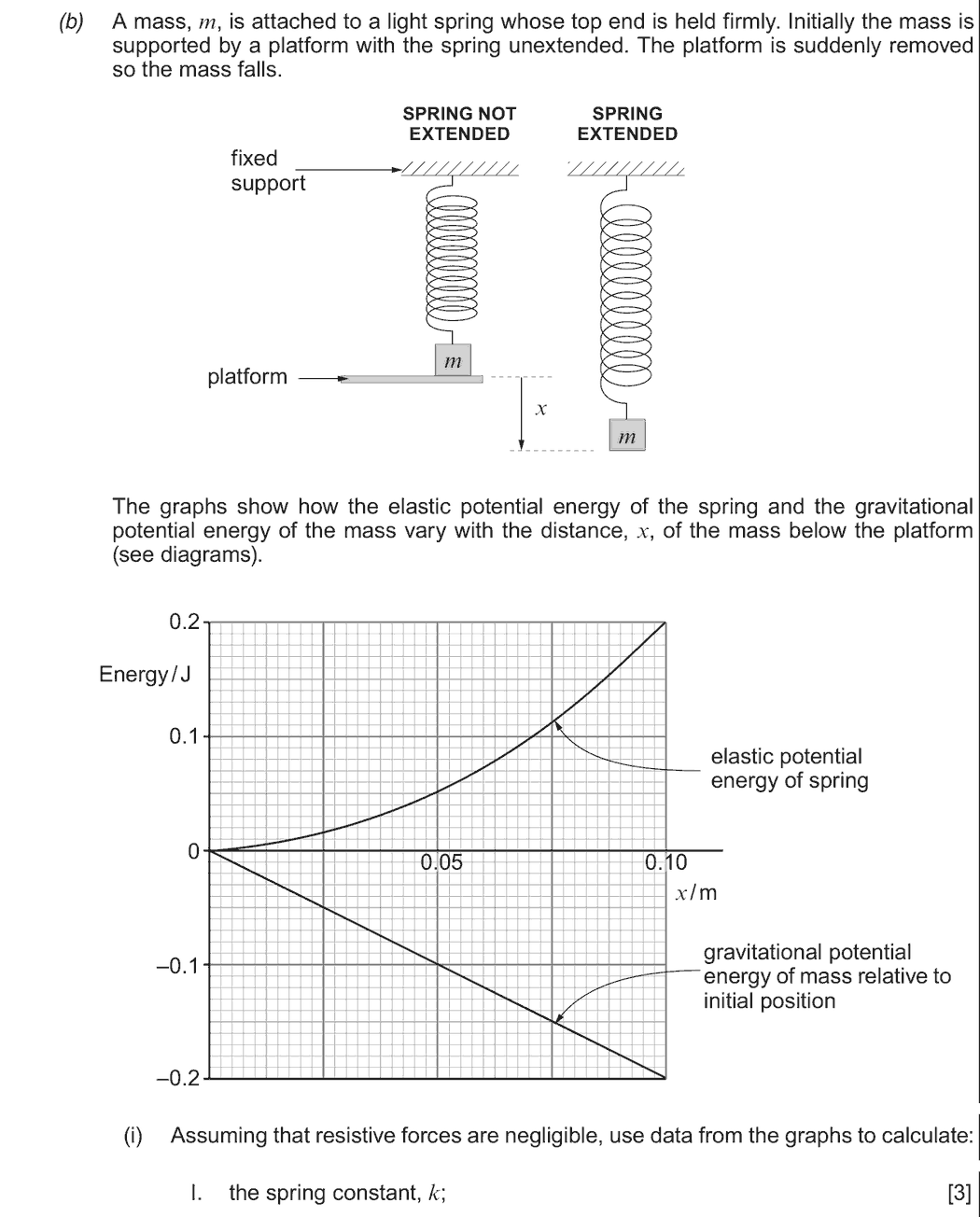
Most candidates applied E kx to the graph of elastic PE, and found k correctly. A minority tried unsuccessfully to use F kx .
Notes from the mark scheme and report
Answer: 40 N m⁻¹ (unit needed
J m⁻² accepted). Read a point on the curve, e.g. 0.20 J at x = 0.10 m
k = 2E/x²
using F = kx did not work
Scheme columns: Maths 2
Skills: Graphskills Reading, plotting or sketching graphs; gradients, intercepts and areas; Mathsmarks The mark scheme's Maths column gives this part at least one mark for mathematical skills
June 2018 · Component 1 · Q4(c)4 marksAO3=4Practical and data analysis
Earlier parts of question 4 that this part uses
Mark scheme
Examiner's comment
Describing how to verify that xmax is proportional to m was well done. Occasionally candidates wrote of waiting for the mass to be in equilibrium, and sometimes, but not often, they did not specify how to use the results to check the relationship.
Notes from the mark scheme and report
Attach different masses, release and measure xmax each time (1)
one practical detail, e.g. metre rule, repeats, avoid parallax (1)
plot xmax against m, or calculate xmax/m for each pair (1)
a straight line through the origin, or a constant ratio, verifies the relationship (1)
waiting for equilibrium was a mistake
Scheme columns: Maths 2, Practical 4
Skills: Experimentalmethod Describing, planning or improving an experiment; Graphskills Reading, plotting or sketching graphs; gradients, intercepts and areas; Mathsmarks The mark scheme's Maths column gives this part at least one mark for mathematical skills; Practicalmarks The mark scheme's Prac column gives this part at least one mark for practical skills
June 2018 · AS Component 2 · Q1(c)3 marksAO1=1, AO2=2Calculation
Earlier parts of question 1 that this part uses
Mark scheme
Examiner's comment
This synoptic part used knowledge from Component 1 and many candidates were able to score full marks and dealt well with the SI prefixes used for the stress and the Young Modulus.
ecf on a power of ten slip. Synoptic: Young modulus is AS Component 1 content
Scheme columns: Maths 3
Skills: Synoptic Needs physics from another component of the qualification; Unitsand conversions Unit marks, base units, prefixes and conversions; Mathsmarks The mark scheme's Maths column gives this part at least one mark for mathematical skills
June 2018 · Component 2 · Q3(a)2 marksAO3=2Practical and data analysisEasy
Mark scheme
Examiner's comment
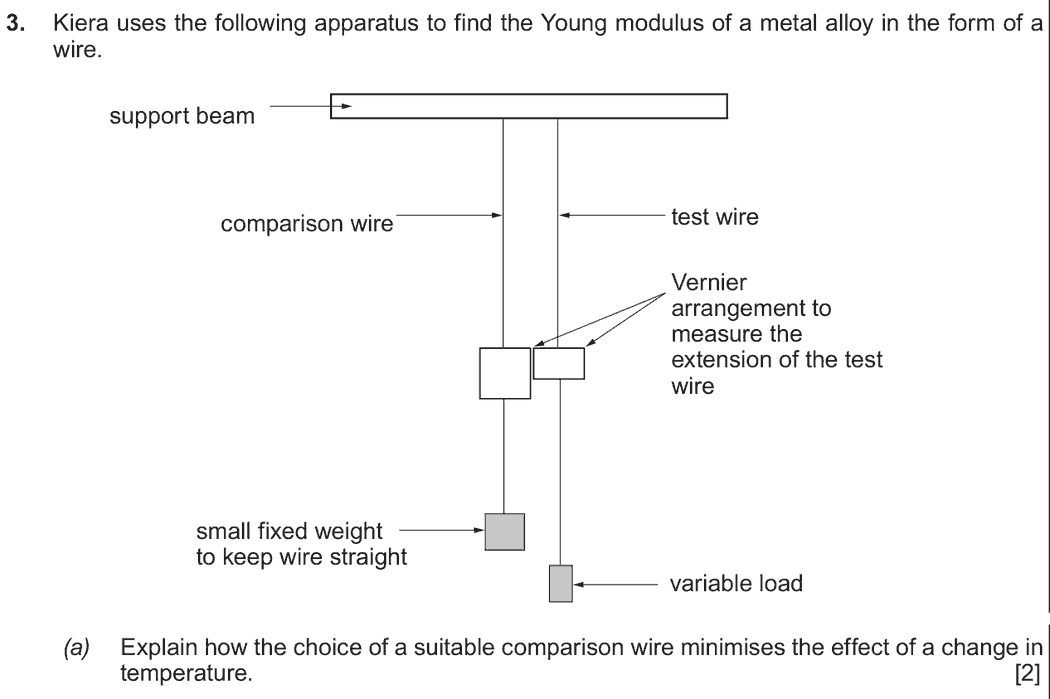
Most candidates gained one mark here for stating that any change in temperature would affect both wires the same. Far fewer candidates referred to the fact that both wires were made of the same material.
Notes from the mark scheme and report
Comparison wire is made of the same material as (identical to) the test wire (1), so a temperature change makes both expand equally and the vernier reading is unaffected (1)
'same support' not accepted
the same-material point was often missing
Scheme columns: Practical 2
Skills: Experimentalmethod Describing, planning or improving an experiment; Practicalmarks The mark scheme's Prac column gives this part at least one mark for practical skills
June 2018 · Component 2 · Q3(b)3 marksAO2=3Practical and data analysisEasy
Earlier part of question 3 that this part uses
Mark scheme
Examiner's comment
and (c) Nearly all candidates took the resolution of the micrometer and the ruler as the uncertainty in their calculations. In (b), nearly all candidates calculated the cross-sectional area correctly and were successful in determining the % uncertainty in r (6.25% or 6.3%). However, a small minority did not account for the squaring of r, failing to double their values accordingly. A few candidates used half of the resolution to determine the percentage uncertainty in the cross-sectional area. This was not credited but, in (c), those candidates who again used half of the resolution gained the mark on the ‘error carried forward’ (ecf) principle. Nearly all candidates showed that the percentage uncertainty in the metre ruler reading could be considered negligible.
Notes from the mark scheme and report
Answer: 2.01 × 10⁻⁸ m² ± 12.5% (13%). A = π(0.08 × 10⁻³)² (1)
% uncertainty in d = 0.01/0.16 = 6.25% (1)
doubled for the square (1)
using half the resolution was not credited
Scheme columns: Maths 3, Practical 3
Skills: Uncertainties Resolution, absolute and percentage uncertainty, combining uncertainties, error bars; Unitsand conversions Unit marks, base units, prefixes and conversions; Mathsmarks The mark scheme's Maths column gives this part at least one mark for mathematical skills; Practicalmarks The mark scheme's Prac column gives this part at least one mark for practical skills
June 2018 · Component 2 · Q3(c)2 marksAO1=1, AO2=1Practical and data analysisEasy
Earlier part of question 3 that this part uses
Mark scheme
Examiner's comment
(mean mark: 14.5/20 = 73%) This question tested candidates’ experimental skills and was the highest scoring question in the paper. Examiners commented favourably on the confidence and skill showed by the majority of candidates in their approach to this question.
Notes from the mark scheme and report
Uncertainty taken as the ruler resolution, 1 mm (1)
Skills: Uncertainties Resolution, absolute and percentage uncertainty, combining uncertainties, error bars; Mathsmarks The mark scheme's Maths column gives this part at least one mark for mathematical skills; Practicalmarks The mark scheme's Prac column gives this part at least one mark for practical skills
June 2018 · Component 2 · Q3(d)(i)I1 markAO2=1Diagram or graphEasy
Earlier part of question 3 that this part uses
Mark scheme
Examiner's comment
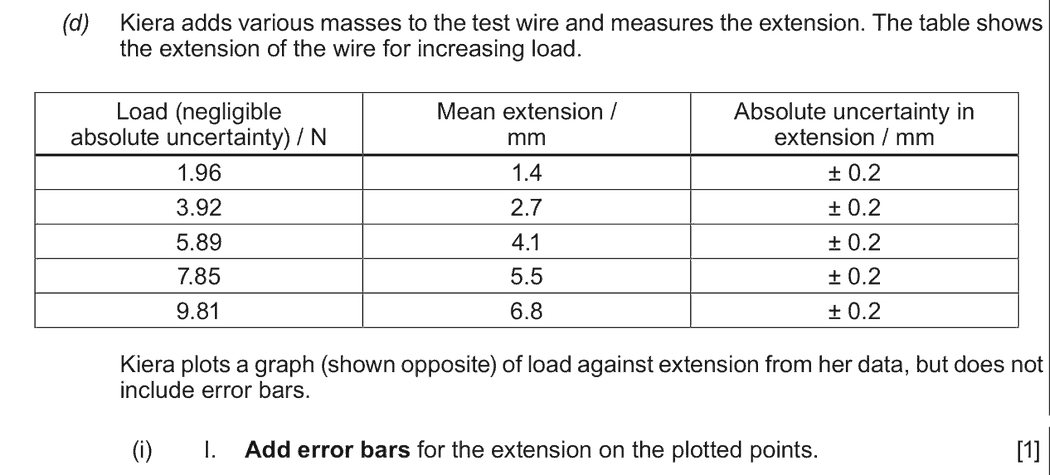
Examiners commented favourably on the high degree of accuracy with which candidates added error bars to the graph and with the drawing of lines of maximum and minimum gradients. Most candidates proceeded to determine the gradients of both lines accurately.
Notes from the mark scheme and report
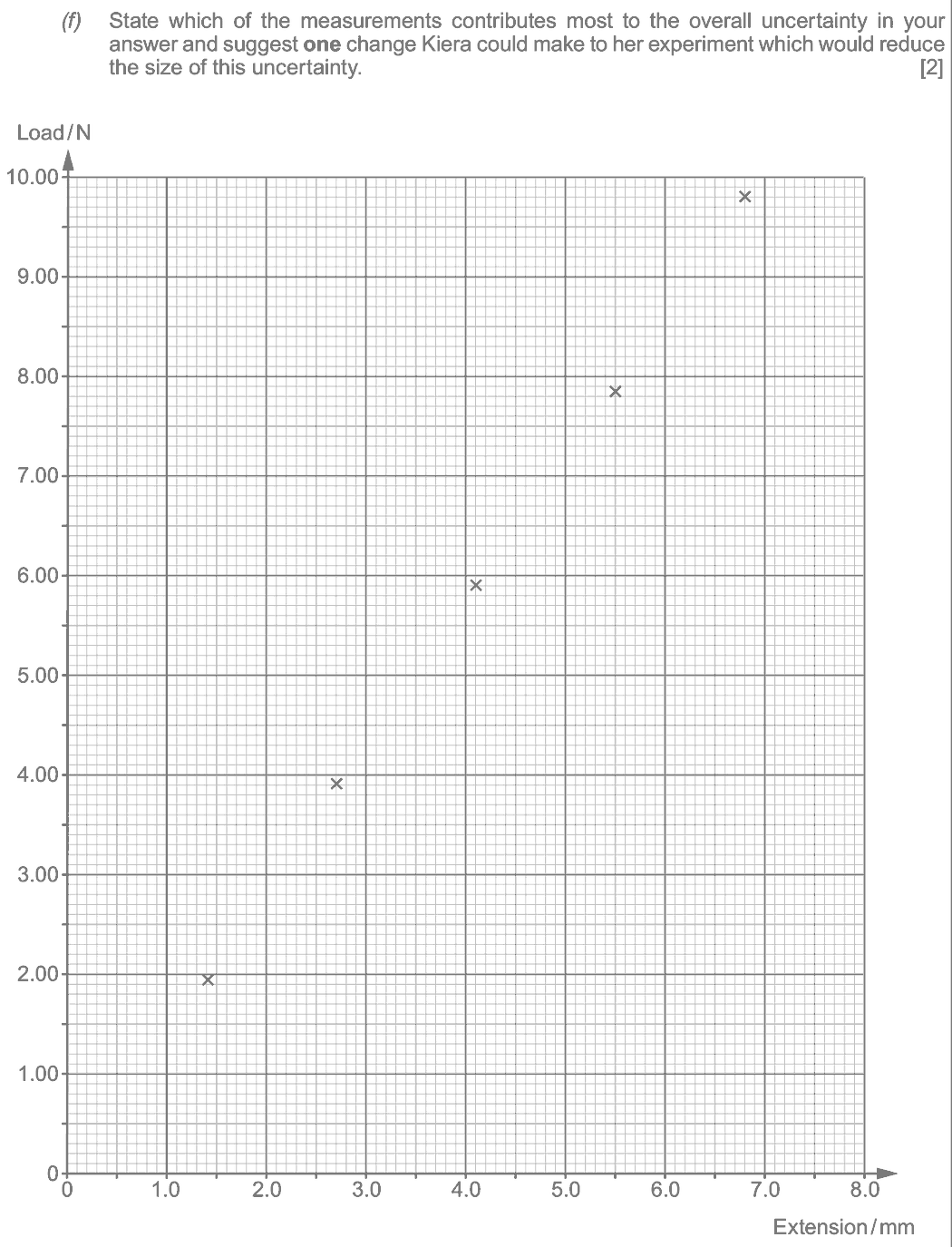
Horizontal error bars of ± 0.2 mm (two small divisions each side) on all five points
Scheme columns: Maths 1, Practical 1
Skills: Graphskills Reading, plotting or sketching graphs; gradients, intercepts and areas; Uncertainties Resolution, absolute and percentage uncertainty, combining uncertainties, error bars; Mathsmarks The mark scheme's Maths column gives this part at least one mark for mathematical skills; Practicalmarks The mark scheme's Prac column gives this part at least one mark for practical skills
June 2018 · Component 2 · Q3(d)(i)II3 marksAO2=3Practical and data analysisEasy
Earlier parts of question 3 that this part uses
Mark scheme
Examiner's comment
Examiners commented favourably on the high degree of accuracy with which candidates added error bars to the graph and with the drawing of lines of maximum and minimum gradients. Most candidates proceeded to determine the gradients of both lines accurately.
Notes from the mark scheme and report
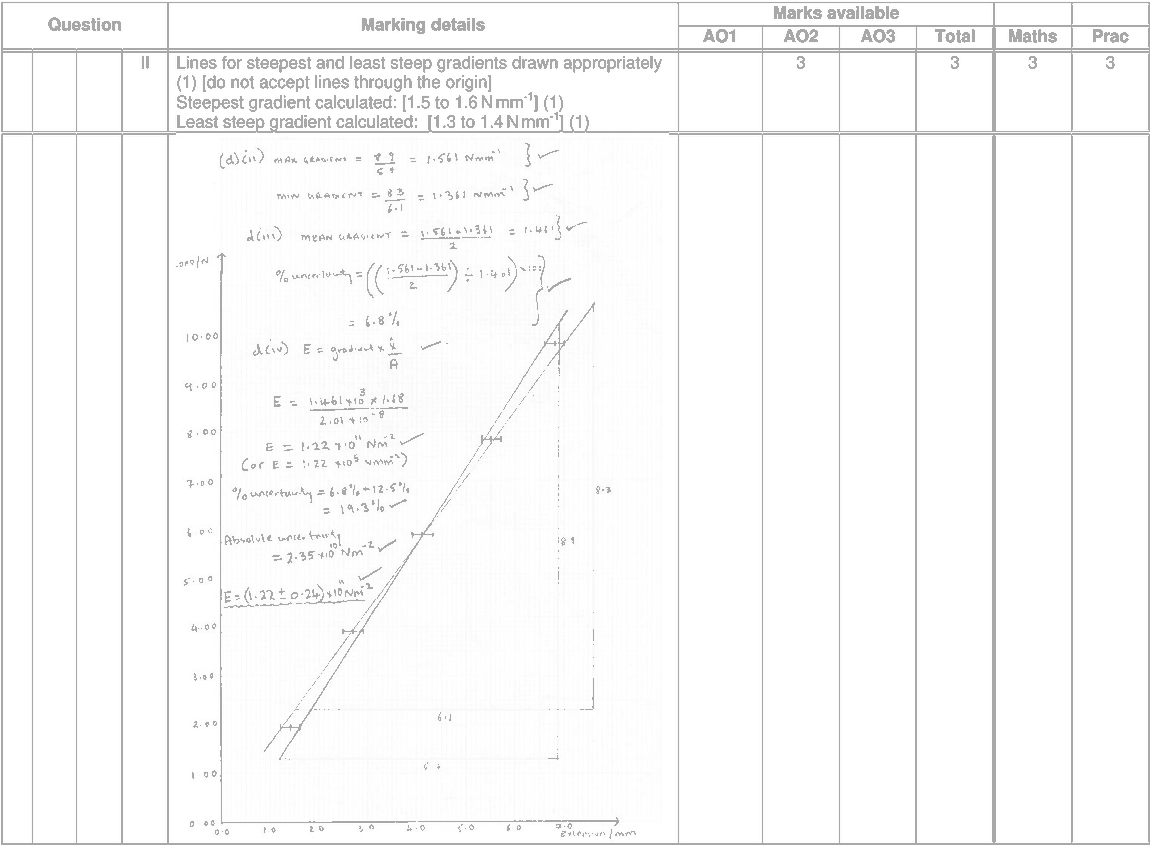
Steepest and least steep lines through the error bars, not forced through the origin (1)
steepest gradient 1.5 to 1.6 N mm⁻¹ (1)
least steep 1.3 to 1.4 N mm⁻¹ (1)
Scheme columns: Maths 3, Practical 3
Skills: Graphskills Reading, plotting or sketching graphs; gradients, intercepts and areas; Uncertainties Resolution, absolute and percentage uncertainty, combining uncertainties, error bars; Mathsmarks The mark scheme's Maths column gives this part at least one mark for mathematical skills; Practicalmarks The mark scheme's Prac column gives this part at least one mark for practical skills
June 2018 · Component 2 · Q3(d)(ii)2 marksAO2=2Practical and data analysisEasy
Earlier parts of question 3 that this part uses
Mark scheme
Examiner's comment
the majority of candidates understood how to use their answers to
Notes from the mark scheme and report
Answer: about 1.46 N mm⁻¹ ± 7%. Mean of the two gradients, 1.4 to 1.5 N mm⁻¹ (1)
% uncertainty = half the difference / mean × 100, 6% to 10% (1)
ecf
Scheme columns: Maths 2, Practical 2
Skills: Uncertainties Resolution, absolute and percentage uncertainty, combining uncertainties, error bars; Graphskills Reading, plotting or sketching graphs; gradients, intercepts and areas; Mathsmarks The mark scheme's Maths column gives this part at least one mark for mathematical skills; Practicalmarks The mark scheme's Prac column gives this part at least one mark for practical skills
June 2018 · Component 2 · Q3(e)5 marksAO3=5Practical and data analysisEasy
Earlier parts of question 3 that this part uses
Mark scheme
Examiner's comment
The majority of candidates made good attempts to determine the Young modulus of the metal alloy using their answers to previous sections. Nearly all candidates understood that E = gradient l A and the majority understood the need to add together their percentage uncertainties in the gradient and cross- sectional areas. Many candidates however lost a mark for not giving their final answer with uncertainty to an appropriate number of significant figures.
Notes from the mark scheme and report
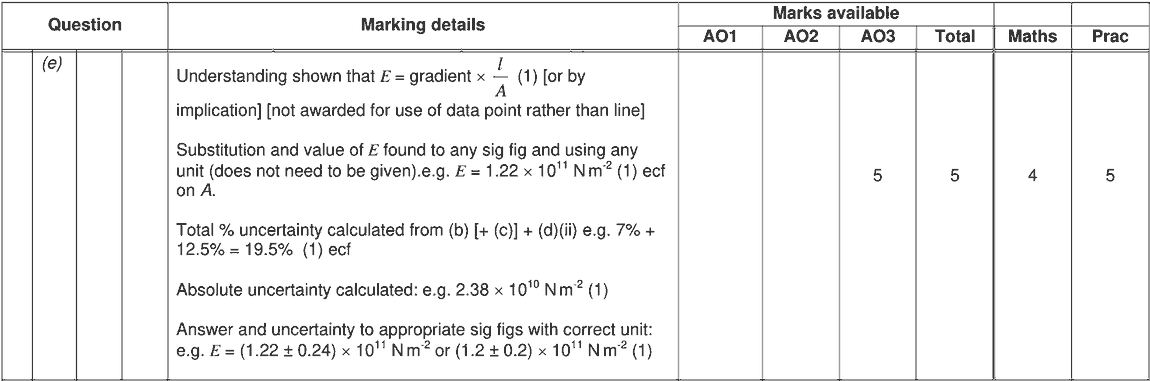
Answer: (1.2 ± 0.2) × 10¹¹ N m⁻². E = gradient × l/A (1) = 1.46 × 10³ × 1.680/2.01 × 10⁻⁸ = 1.22 × 10¹¹ N m⁻² (1)
total % uncertainty = gradient + area (+ length), e.g. 7 + 12.5 = 19.5% (1)
absolute uncertainty 2.4 × 10¹⁰ N m⁻² (1)
value and uncertainty to matching significant figures with unit (1)
the final sig fig mark was often lost
Scheme columns: Maths 4, Practical 5
Skills: Uncertainties Resolution, absolute and percentage uncertainty, combining uncertainties, error bars; Unitsand conversions Unit marks, base units, prefixes and conversions; Mathsmarks The mark scheme's Maths column gives this part at least one mark for mathematical skills; Practicalmarks The mark scheme's Prac column gives this part at least one mark for practical skills
June 2018 · Component 2 · Q3(f)2 marksAO3=2Practical and data analysisEasy
Earlier parts of question 3 that this part uses
Mark scheme
Examiner's comment
Many candidates stated correctly that diameter contributed most to the overall uncertainty and proceeded to suggest that ‘using a wire of greater diameter (or equivalent) would reduce this uncertainty. A significant number of candidates referred to the extension as contributing most to the overall uncertainty. This was probably based on the fact that, for small values of load, the percentage uncertainty in extension can be shown to be greater than that of the diameter. This was accepted as a viable alternative.
Notes from the mark scheme and report
Diameter (1)
use a thicker wire or an instrument with better resolution (1)
extension with a finer measuring method accepted if the candidate's gradient uncertainty was the larger
Scheme columns: Practical 2
Skills: Uncertainties Resolution, absolute and percentage uncertainty, combining uncertainties, error bars; Experimentalmethod Describing, planning or improving an experiment; Practicalmarks The mark scheme's Prac column gives this part at least one mark for practical skills
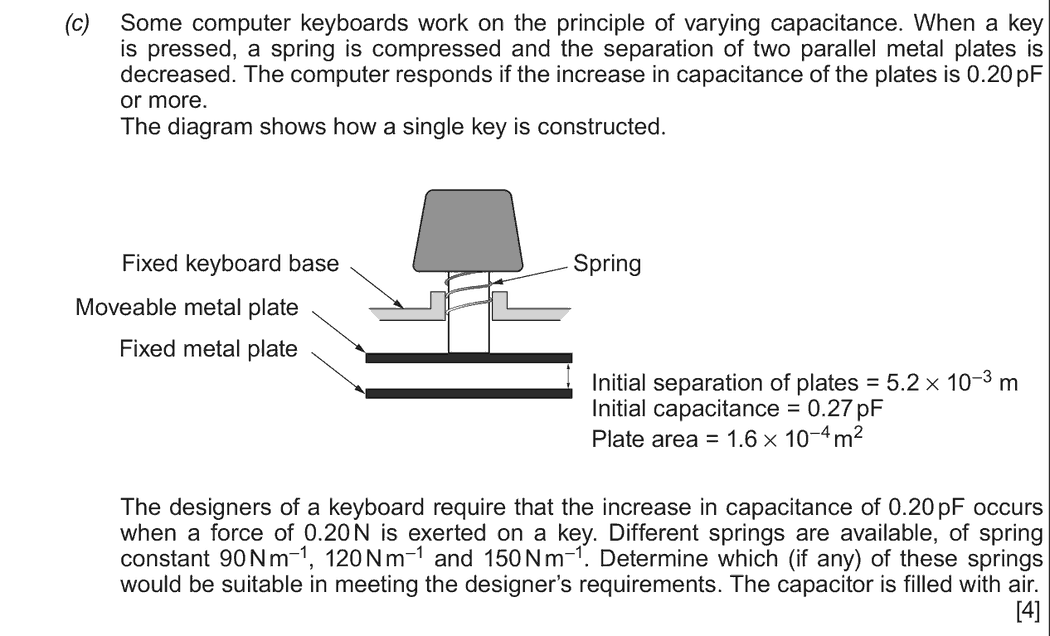
June 2018 · Component 2 · Q6(c)4 marksAO3=4Calculation
Earlier parts of question 6 that this part uses
Mark scheme
Examiner's comment
Surprisingly, this was the best answered section of the question. Good, clear and logical approaches were seen leading to the 90 N m1 spring’s being identified as an appropriate spring to use. The majority of candidates chose to use the equation for a parallel capacitor to determine the change in distance between the plates. They then proceeded to use Hooke’s law to determine the spring constant. Some candidates applied ‘trial and error’, taking each of the springs in turn to determine a value for distance and then using the parallel plate capacitor equation to determine the corresponding capacitance, which was then matched with the value given in the question. Although this approach would have taken longer, it is perfectly valid and many candidates scored full marks.
Notes from the mark scheme and report
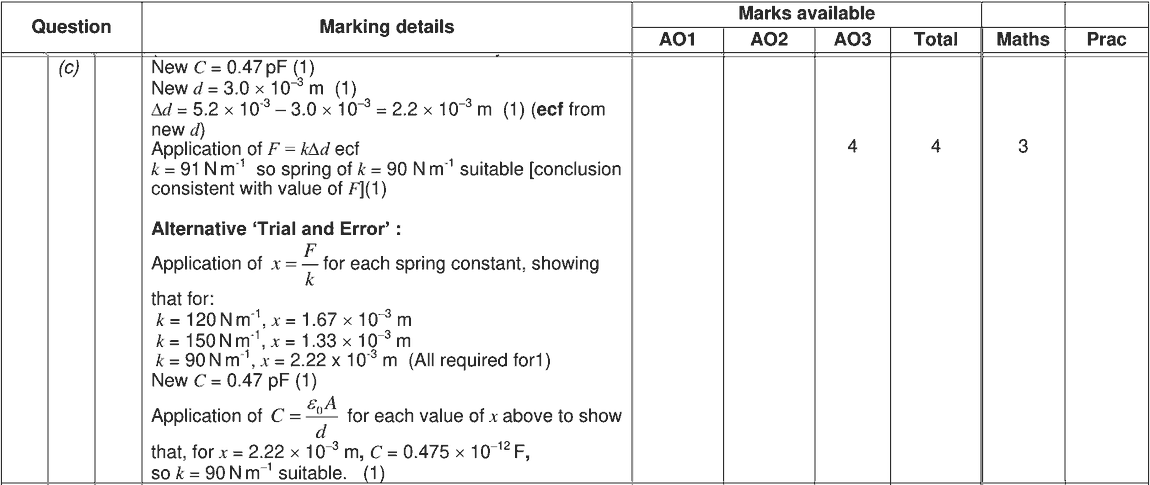
Answer: the 90 N m⁻¹ spring. New C = 0.47 pF (1)
C ∝ 1/d so new d = 5.2 × 10⁻³ × 0.27/0.47 = 3.0 × 10⁻³ m (1)
Δd = 2.2 × 10⁻³ m (1)
k = F/Δd = 0.20/2.2 × 10⁻³ = 91 N m⁻¹ so the 90 N m⁻¹ spring suits (1)
trial of each spring also accepted. Best answered part of the question
Scheme columns: Maths 3
Skills: Synoptic Needs physics from another component of the qualification; Mathsmarks The mark scheme's Maths column gives this part at least one mark for mathematical skills
June 2018 · Component 3 · Q4(c)(iv)3 marksAO1=2, AO2=1Calculation
Earlier parts of question 4 that this part uses
Mark scheme
Examiner's comment
All parts well answered. In part (iii) the factor of 2 due to reflection was sometimes missed. In part (iv) minor slips were common with only a tiny minority unable to cope with the synopticity here.
Notes from the mark scheme and report
Answer: 0.011 (0.0083 if 1 × 10⁷ N used). Stress = F/A = 1.33 × 10⁷/43 × 10⁻⁴ (1)
strain = stress/E (1) = 3.1 × 10⁹/2.8 × 10¹¹ (1)
synoptic with Component 2 solids under stress
depends on the value from (iii)
Scheme columns: Maths 3
Skills: Synoptic Needs physics from another component of the qualification; Unitsand conversions Unit marks, base units, prefixes and conversions; Mathsmarks The mark scheme's Maths column gives this part at least one mark for mathematical skills
June 2017 · AS Component 1 · Q1(a)3 marksAO1=3Short answer
Mark scheme
Examiner's comment
For an easy question – marks were thrown away here. Some candidates found it very difficult to concisely explain the particle arrangements and few put the missing material as amorphous.
Notes from the mark scheme and report
Crystalline: short and long range order, a regular lattice (1)
the missing type is amorphous (1)
polymeric: long chain molecules (1)
'amorphous' was rarely given and descriptions were wordy
June 2017 · AS Component 1 · Q1(b)4 marksAO1=4Diagram or graph
Earlier part of question 1 that this part uses
Mark scheme
Examiner's comment
On the whole, this question was answered well. Marks were lost when graphs looked similar to that of a rubber band i.e. went up right at the very end. The question stated ‘ductile’ and ‘until it breaks’ so a longer flattened out region should have been obvious.
Notes from the mark scheme and report
Linear section followed by a curve that flattens out over a long plastic region (1)
yield point labelled (1)
elastic limit labelled (1)
Hooke's law region (the straight section) labelled (1)
graphs that turned up at the end like rubber lost the shape mark
Skills: Graphskills Reading, plotting or sketching graphs; gradients, intercepts and areas
June 2017 · AS Component 1 · Q1(c)(i)4 marksAO1=2, AO2=2Calculation
Earlier parts of question 1 that this part uses
Mark scheme
Examiner's comment
As expected a common mistake was to use mass instead of weight and not convert MPa to Pa. Many candidates got as far as working out the new area, but then forgot to find the diameter.
Notes from the mark scheme and report
Answer: 1.0 mm (1.02 × 10⁻³ m). Load = mg = 5.0 × 9.81 = 49 N
A = F/stress = 49/(60 × 10⁶) = 8.2 × 10⁻⁷ m²
d = √(4A/π)
errors: mass used for the force, MPa not converted, stopping at the area
Scheme columns: Maths 4
Skills: Unitsand conversions Unit marks, base units, prefixes and conversions; Mathsmarks The mark scheme's Maths column gives this part at least one mark for mathematical skills
June 2017 · AS Component 1 · Q1(c)(ii)2 marksAO2=2Calculation
Earlier parts of question 1 that this part uses
Mark scheme
Examiner's comment
As expected a common mistake was to use mass instead of weight and not convert MPa to Pa. Many candidates got as far as working out the new area, but then forgot to find the diameter.
Notes from the mark scheme and report
Answer: 3.0 GPa. Strain = 0.040/2.00 = 0.02
E = stress/strain = 60 MPa/0.02
unit needed, no ecf
Scheme columns: Maths 2
Skills: Unitsand conversions Unit marks, base units, prefixes and conversions; Mathsmarks The mark scheme's Maths column gives this part at least one mark for mathematical skills
June 2017 · AS Component 1 · Q1(c)(iii)2 marksAO1=1, AO2=1Calculation
Earlier parts of question 1 that this part uses
Mark scheme
Examiner's comment
As expected a common mistake was to use mass instead of weight and not convert MPa to Pa. Many candidates got as far as working out the new area, but then forgot to find the diameter.
Notes from the mark scheme and report
Answer: 3.2 mm. Ten times the force needs ten times the area, so the diameter rises by √10
ecf on the method from (i)
Scheme columns: Maths 2
Skills: Algebra Derivations and rearranging equations; Mathsmarks The mark scheme's Maths column gives this part at least one mark for mathematical skills
June 2017 · Component 2 · Q8(a)6 marksAO1=66-mark extended response
Mark scheme, with the levels and indicative content
Examiner's comment
Few candidates succeeded in being awarded 6 marks for the QER question, although many candidates’ responses were good enough to be placed into the higher marking band (awarded 5 or 6 marks). Many candidates made credible attempts at describing plastic deformation, making correct reference to the movement of dislocations in their responses. However, a significant number of candidates made explicit reference to the movement of (whole) planes of atoms, involving the breaking of bonds across the whole plane. This is incorrect, the forces required would be many times what is observed if this were the case. This highlighted a clear misunderstanding of the science behind plastic deformation in ductile materials and was not deemed credit worthy. Most candidates gave one or two methods for increasing the strength of ductile materials, often, describing the effect of foreign atoms in terms of inhibiting dislocation movement. Few candidates referred to the effect of further dislocations on the movement of dislocations within the crystal.
Notes from the mark scheme and report
QER, levels marked. Plastic deformation: dislocations (incomplete planes of atoms)
applied force breaks bonds near a dislocation
dislocations slip through the crystal
bonds do not re-form in the original positions so the change is permanent. Strengthening: foreign atoms, smaller grains (more grain boundaries), more dislocations
all work by hindering dislocation movement. Common error: whole planes of atoms sliding over each other
Skills: QER The 6-mark quality of extended response question
June 2017 · Component 2 · Q8(b)(i)3 marksAO3=3Practical and data analysis
Earlier part of question 8 that this part uses
Mark scheme
Examiner's comment
Most candidates used appropriate data from the graph to confirm the value of the Young modulus provided. In a small number of cases candidates calculated the cross-sectional area of the wire incorrectly.
Notes from the mark scheme and report
Answer: E = 1.2 × 10¹¹ Pa, consistent. A = π(0.16 × 10⁻³)² = 8.0 × 10⁻⁸ m²
gradient of the linear part = 4375 N m⁻¹
E = gradient × l/A = 4375 × 2.2/8.0 × 10⁻⁸
some area errors
Scheme columns: Maths 3, Practical 3
Skills: Graphskills Reading, plotting or sketching graphs; gradients, intercepts and areas; Unitsand conversions Unit marks, base units, prefixes and conversions; Mathsmarks The mark scheme's Maths column gives this part at least one mark for mathematical skills; Practicalmarks The mark scheme's Prac column gives this part at least one mark for practical skills
June 2017 · Component 2 · Q8(b)(ii)2 marksAO2=2Calculation
Earlier parts of question 8 that this part uses
Mark scheme
Examiner's comment
Many candidates could show that a 0.2% strain corresponded to an extension of 4.4 mm. Far fewer could use the graph and appropriate equation to estimate the work needed. Most unsuccessful attempts omitted the factor ½ in their calculations.
Notes from the mark scheme and report
Answer: about 0.04 J. Strain of 0.2% of 2.2 m = extension 4.4 mm
work = area under the graph = ½ × 4.4 × 10⁻³ × 18.5
the ½ was commonly omitted
Scheme columns: Maths 2, Practical 2
Skills: Graphskills Reading, plotting or sketching graphs; gradients, intercepts and areas; Mathsmarks The mark scheme's Maths column gives this part at least one mark for mathematical skills; Practicalmarks The mark scheme's Prac column gives this part at least one mark for practical skills
June 2017 · Component 2 · Q8(b)(iii)1 markAO1=1Diagram or graph
Earlier parts of question 8 that this part uses
Mark scheme
Examiner's comment
Few candidates drew a straight line from an appropriate point, parallel to the original line and back to the x-axis. EDUQAS GCE A LEVEL PHYSICS Summer 2017
Notes from the mark scheme and report
Straight line from the end of the curve (6 to 8 mm) down to the extension axis, parallel to the original linear section
intercept between 0.4 and 4.0 mm (permanent extension)
Scheme columns: Practical 1
Skills: Graphskills Reading, plotting or sketching graphs; gradients, intercepts and areas; Practicalmarks The mark scheme's Prac column gives this part at least one mark for practical skills
June 2016 · AS Component 1 · Q7(a)1 markAO1=1Definition
Mark scheme
Examiner's comment
The definition of the Young modulus was well known.
Notes from the mark scheme and report
Tensile stress divided by tensile strain
if a formula is given the symbols must be defined
June 2016 · AS Component 1 · Q7(b)6 marksAO1=66-mark extended response
Earlier part of question 7 that this part uses
Mark scheme, with the levels and indicative content
Examiner's comment
The QER question was rather disappointing with many candidates confusing the force-extension graph of rubber with that of a crystalline material and so talked about grain boundaries and dislocations. Candidates who realised this was a polymer still had problems in correctly describing the three stages of change in Young modulus at a molecular level.
Notes from the mark scheme and report
QER, levels marked. Young modulus: stiff at first (high Young modulus, large force for a small extension at A)
low Young modulus in the middle (large extension for a small force at B)
high again at C. Molecules: weak intermolecular bonds or cross links break at A
long chain molecules straighten or unravel at B
strong covalent bonds are stretched at C. Many wrongly described a metal (dislocations, grain boundaries)
Skills: QER The 6-mark quality of extended response question
June 2016 · AS Component 1 · Q7(c)2 marksAO1=2Diagram or graph
Earlier parts of question 7 that this part uses
Mark scheme
Examiner's comment
The line for unloading and the explanation of hysteresis was well done.
Notes from the mark scheme and report
Unloading line below the loading line, of similar shape, ending at the origin (or showing permanent set) (1)
hysteresis: less work is recovered on unloading, the difference being dissipated as heat (1)
Scheme columns: Practical 2
Skills: Graphskills Reading, plotting or sketching graphs; gradients, intercepts and areas; Practicalmarks The mark scheme's Prac column gives this part at least one mark for practical skills
June 2016 · AS Component 1 · Q7(d)2 marksAO3=2Short answer
Earlier parts of question 7 that this part uses
Mark scheme
Examiner's comment
This was also well answered. PHYSICS AS Summer 2016
Notes from the mark scheme and report
A point with a linked conclusion (2), e.g. yes: the bags harm the environment because they fill landfill and harm wildlife
yes: they use non-renewable resources
no: they are strong and reusable so fewer need to be made