Notes and key-term cards for this topic are being written by our tutors. The past-paper questions below are ready now.
Specification statements
Show the 13 statements from the specification
1.8-a the idea that the internal energy of a system is the sum of the potential and kinetic energies of its molecules
1.8-b absolute zero being the temperature of a system when it has minimum internal energy
1.8-c the internal energy of an ideal monatomic gas being wholly kinetic so it is given by U = (3/2)nRT
1.8-d the idea that heat enters or leaves a system through its boundary or container wall, according to whether the system's temperature is lower or higher than that of its surroundings, so heat is energy in transit and not contained within the system
1.8-e the idea that if no heat flows between systems in contact, then they are said to be in thermal equilibrium, and are at the same temperature
1.8-f the idea that energy can enter or leave a system by means of work, so work is also energy in transit
1.8-g the equation W = pΔV can be used to calculate the work done by a gas under constant pressure
1.8-h the idea that even if p changes, W is given by the area under the p – V graph
1.8-i the use of the first law of thermodynamics, in the form ΔU = Q − W and know how to interpret negative values of ΔU, Q, and W
1.8-j the idea that for a solid (or liquid), W is usually negligible, so Q = ΔU
1.8-k Q = mcΔθ, for a solid or liquid, and this is the defining equation for specific heat capacity, c
1.8-P1 Specified practical: Estimation of absolute zero by use of the gas laws
1.8-P2 Specified practical: Measurement of the specific heat capacity for a solid
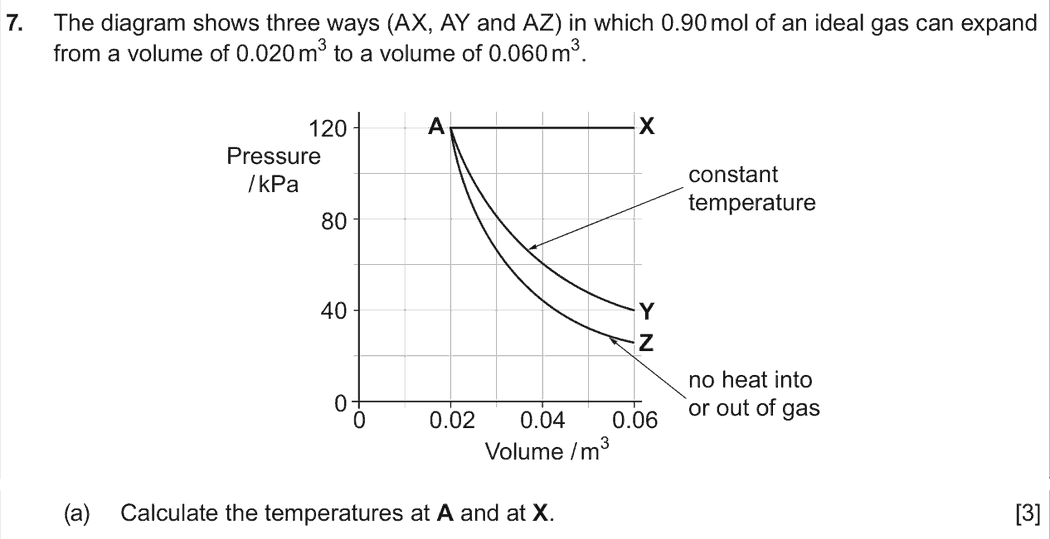
For both AY and AZ compare the work done, internal energy change and heat flow with those for AX. Calculations are not wanted, but you must give your reasoning. [6 QER]
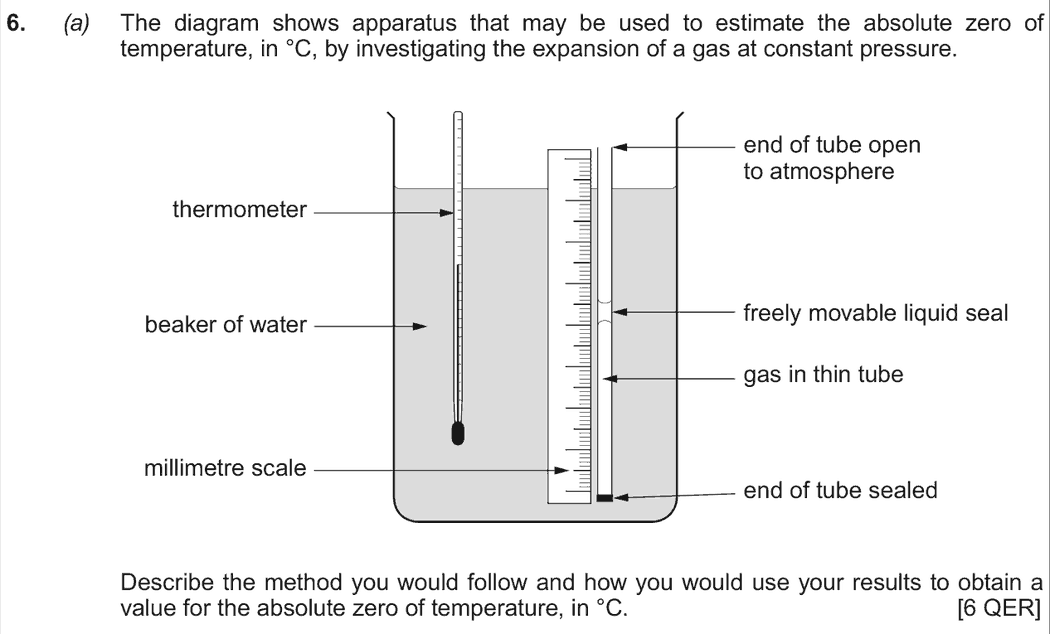
. (a) The diagram shows apparatus that may be used to estimate the absolute zero of temperature, in °C, by investigating the expansion of a gas at constant pressure. end of tube open to atmosphere thermometer freely mova
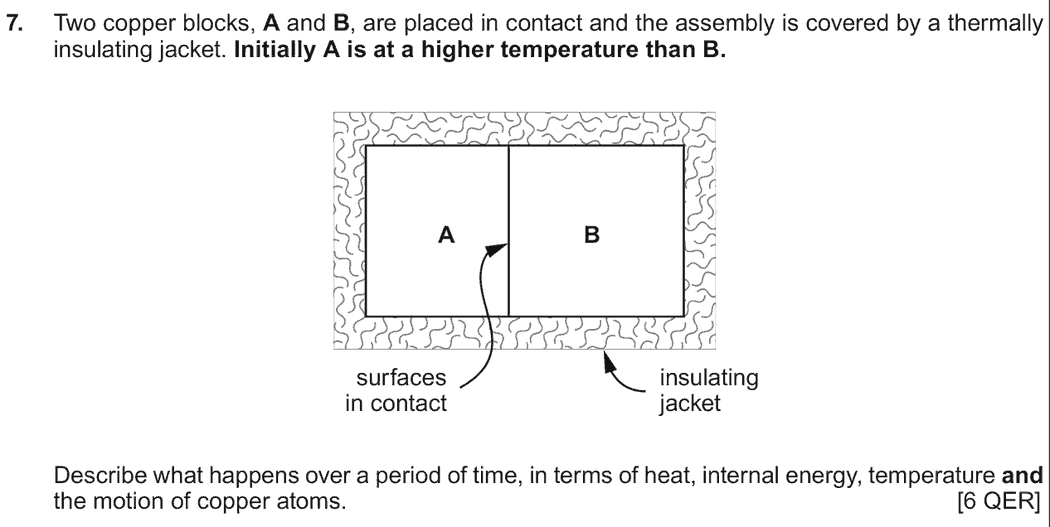
. Two copper blocks, A and B, are placed in contact and the assembly is covered by a thermally insulating jacket. Initially A is at a higher temperature than B. A B surfaces insulating in contact jacket Describe what hap
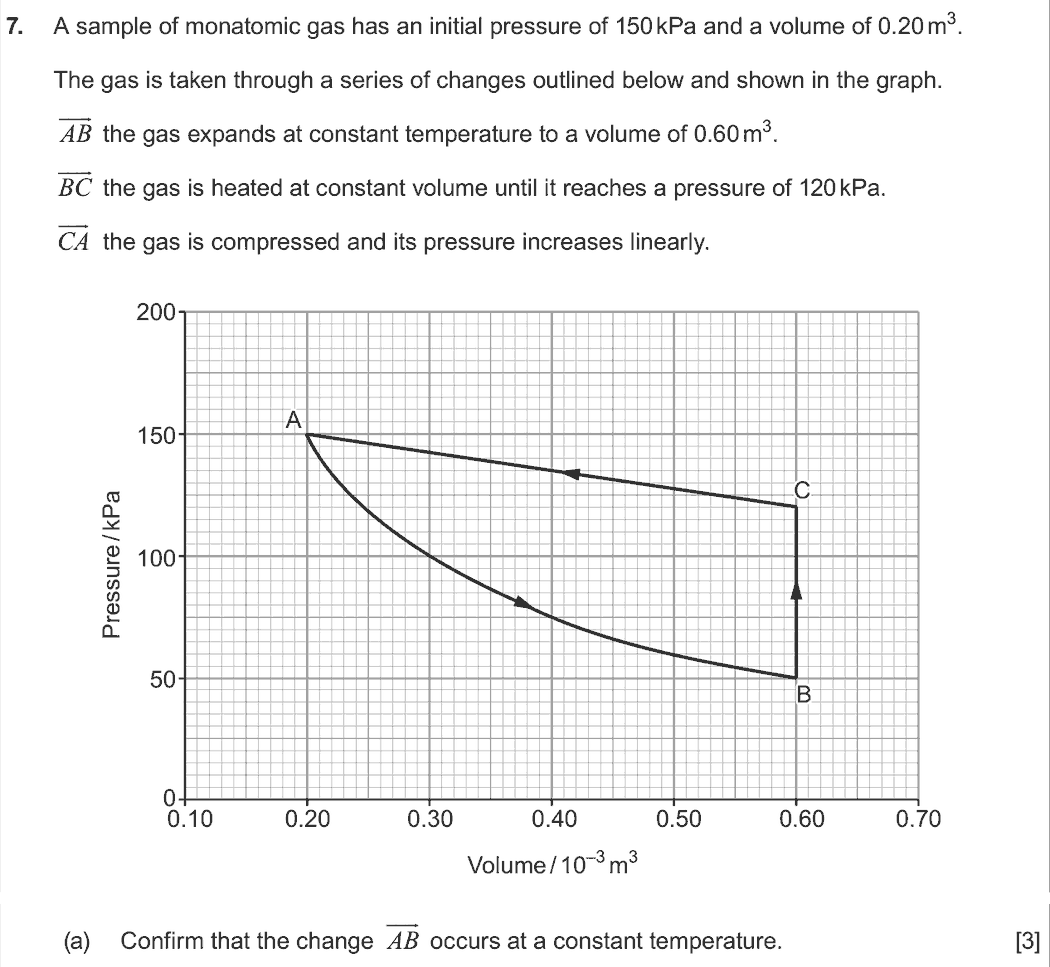
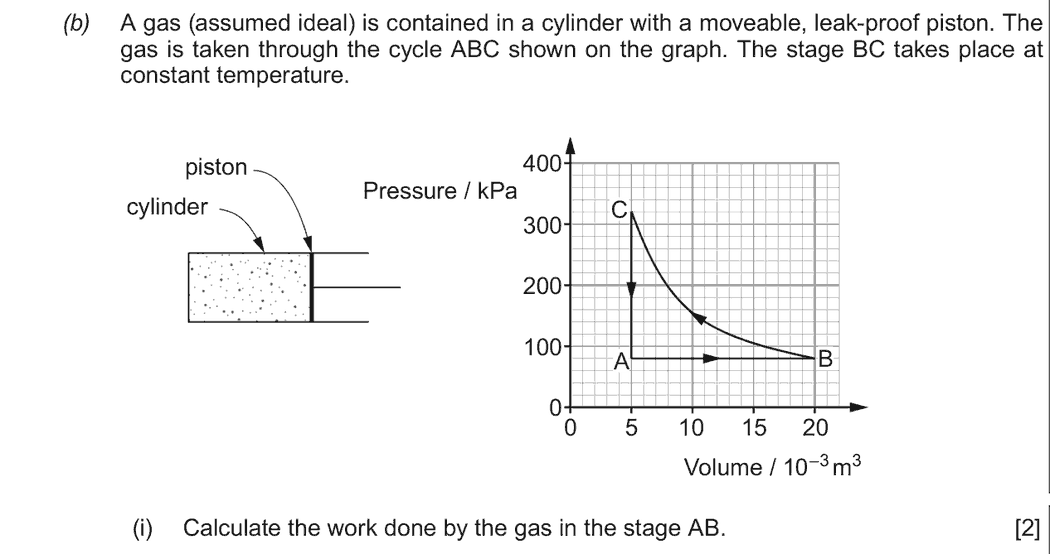
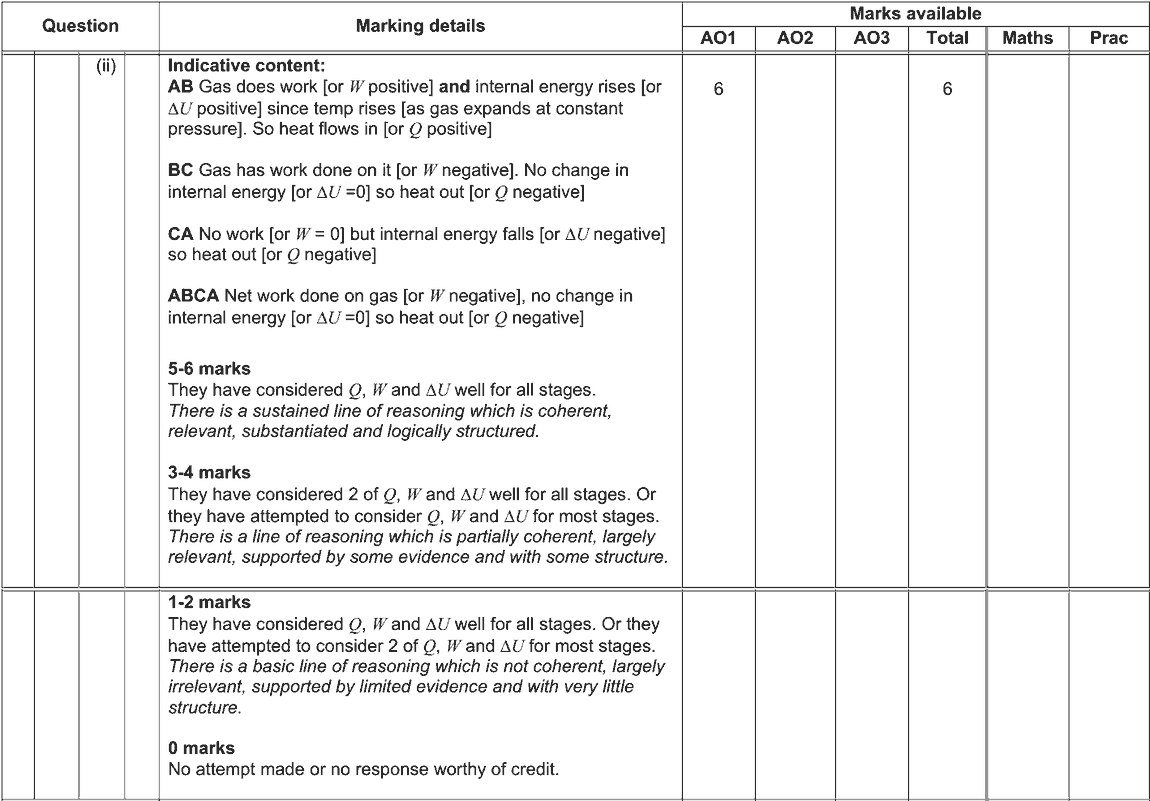
For each of the stages AB, BC and CA separately, and for the cycle as a whole, use the first law of thermodynamics to explain whether heat flows into the system or out of the system. Calculations are not required. [6 QER
Tap a question to zoom it. Where a part needs a figure, table or graph from earlier in the question, that part folds out above it; the mark scheme and examiner's comment open underneath. Have the Eduqas Data Booklet beside you (see the Data Booklet page).
June 2025 · Component 1 · Q7(a)3 marksAO1=3Explanation
Mark scheme
Examiner's comment
This proved to be a demanding question. ‘Q is an energy transfer due to a temperature difference’ was regularly seen. We also accepted ‘heat transfer’ instead of ‘energy transfer’ here, however, to gain all 3 marks reference to heat as an energy transfer was required somewhere in the response. To gain the 2nd MP, candidates need to link the initial rate of heat flow with the initial temperature difference. Both were at their greatest value at this point. We did not hold out for a decreasing temperature difference for the 3rd MP, but candidates did need to mention that the rate of heat flow was zero when equilibrium was reached. We saw some excellent 3 mark responses and the question gave a good spread of marks.
Notes from the mark scheme and report
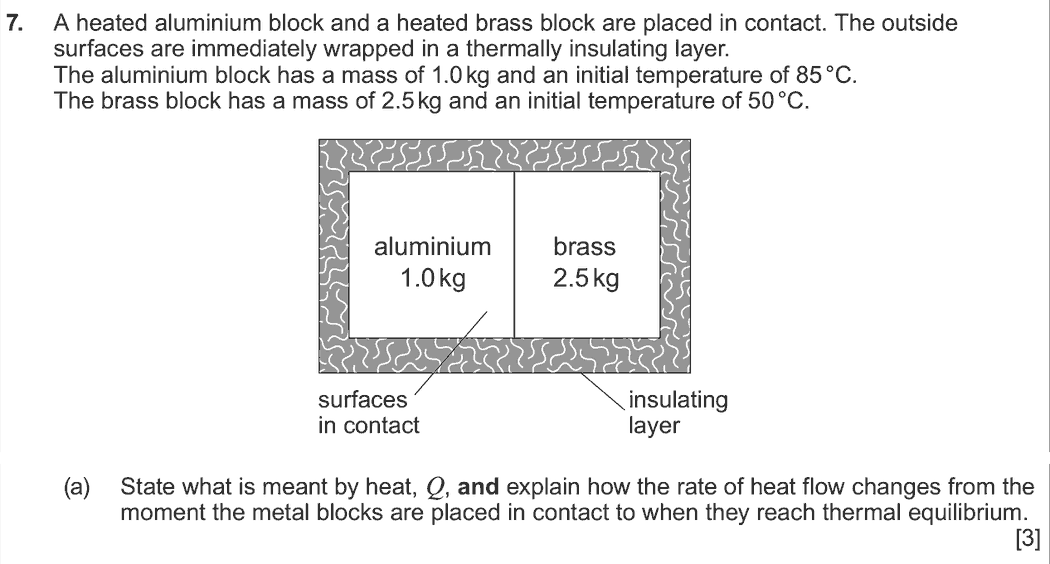
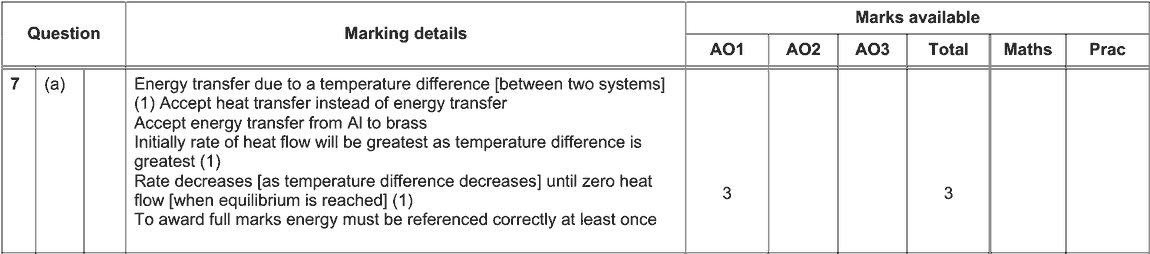
Heat: energy transferred because of a temperature difference (1)
rate of flow (from aluminium to brass) is greatest at the start, when the temperature difference is greatest (1)
it falls as the difference shrinks, reaching zero at thermal equilibrium when the temperatures are equal (1). Energy must be mentioned correctly at least once for full marks
a demanding part
June 2025 · Component 1 · Q7(b)4 marksAO1=1, AO2=3Calculation
Earlier part of question 7 that this part uses
Mark scheme
Examiner's comment
The 1st MP was awarded for the substitution into 𝑄= 𝑚𝑐∆𝜃 even if candidates struggled with the ∆𝜃 aspect. The weakest responses didn’t use the equation at all. Some that did, showed little appreciation of the heat transfer between the two blocks. They did not achieve more than 1 mark. Those candidates who did achieve the 1st and 2nd MPs often did so by correctly setting up the equation on the 3rd line of the MS. (85-𝜃) and (𝜃-50) (or variants of this) were regularly seen. The 4th MP relied on good algebra to arrive at the correct final answer.
Notes from the mark scheme and report
Answer: 66.8 °C. Heat lost by aluminium = heat gained by brass: 1.0 × 920 × (85 − θ) = 2.5 × 400 × (θ − 50)
78 200 + 50 000 = 1920θ. Weaker answers did not link the two transfers
Scheme columns: Maths 2
Skills: Algebra Derivations and rearranging equations; Mathsmarks The mark scheme's Maths column gives this part at least one mark for mathematical skills
June 2025 · Component 1 · Q7(c)2 marksAO3=2Short answer
Earlier part of question 7 that this part uses
Mark scheme
Examiner's comment
In this issues question the candidates were very creative in their responses. Benefits included references to limited CO2 emissions. Less pollution or more eco-friendly was deemed too vague. The most popular drawback was the timescale of growing hemp affecting production. They used the information in the question and were awarded credit. Other drawbacks included the fact the hemp was flammable or that it could biodegrade and not work effectively for long. Some questioned its efficiency compared to the tried and tested fibreglass.
Notes from the mark scheme and report
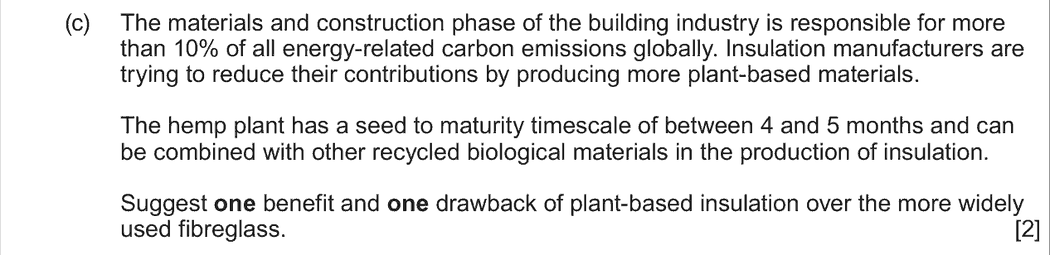
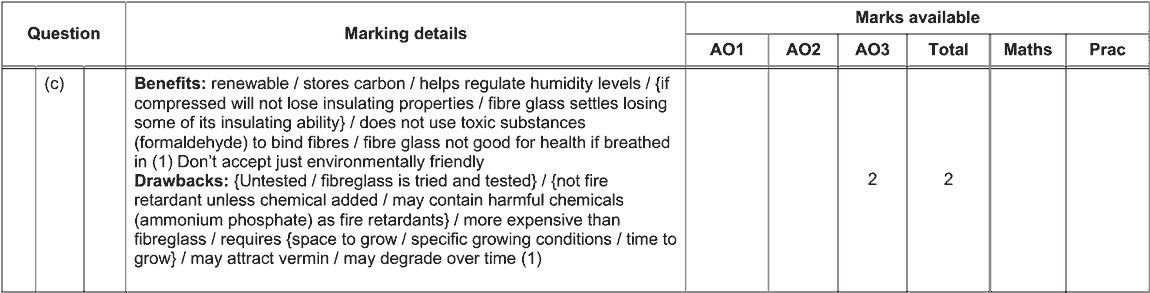
Benefit (1): renewable, stores carbon, regulates humidity, keeps its insulating ability when compressed, no toxic binders or irritant fibres ('environmentally friendly' alone not accepted). Drawback (1): less tried and tested, flammable unless treated with chemicals, dearer, needs land, time and suitable conditions to grow, may attract vermin or degrade
June 2024 · Component 1 · Q7(b)(i)1 markAO1=1Definition
Earlier part of question 7 that this part uses
Mark scheme
Examiner's comment
The key to this response was the inclusion of ‘molecules’ (or particles). Reference to the ‘sum of potential energies’ was treated as neutral when stated with the correct ‘sum of kinetic energies of particles’. Candidates who referenced the 1st law of thermodynamics did not gain credit. It should be reinforced that it is not just the ‘kinetic energy of a gas’. We needed reference to ‘sum’ or ‘total’.
Notes from the mark scheme and report
The sum of the kinetic energies of the particles of the gas
a reference to potential energy treated as neutral
'molecules' or 'particles' needed
June 2024 · Component 1 · Q7(b)(ii)I2 marksAO2=2Calculation
Earlier parts of question 7 that this part uses
Mark scheme
Examiner's comment
Candidates generally did well in part 1. Most were able to use 2 𝑛𝑅𝑇= 2 𝑝𝑉 to calculate U. 45 J and 108 J (or 45 000 J and 108 000 J - again accepted) were seen and credited here. A small number of candidates used 𝑝∆𝑉 or ½ 𝑝𝑉 and were not awarded credit. Candidates used a mixture of paths in part II. The increase of U or p were most widely seen. Those who left out the 2 in the previous question were still rewarded with ecf.
Notes from the mark scheme and report
Answer: 45 J at B and 108 J at C (45 000 J and 108 000 J accepted). U = (3/2)nRT = (3/2)pV
pΔV or ½pV not credited
Scheme columns: Maths 1
Skills: Mathsmarks The mark scheme's Maths column gives this part at least one mark for mathematical skills
June 2024 · Component 1 · Q7(c)3 marksAO2=3Explanation
Earlier part of question 7 that this part uses
Mark scheme
Examiner's comment
We saw a good range of responses for this question. ‘Same temperature at start and finish means ∆𝑈 is zero’ was stated by many candidates. Not as many candidates went further. Some candidates looked at each stage individually but usually struggled to piece together a correct final comment. Some candidates tried using specific heat capacity instead of the 1st law and scored zero.
Notes from the mark scheme and report
ΔU = 0 for the complete cycle (1)
the work done on the gas in CA is greater than the work done by the gas in AB (area under CA is greater), so net work is done on the gas (1)
Q = ΔU + W with W negative, so Q is negative and heat flows out of the system (1)
June 2024 · Component 3 · Q8(c)3 marksAO1=1, AO2=2Calculation
Earlier part of question 8 that this part uses
Mark scheme
Examiner's comment
If candidates realised that GPE had to be used in the question then the correct answer usually followed, a small number of candidates used mg and hence did not get awarded any marks. Option A – Alternating Currents
Notes from the mark scheme and report
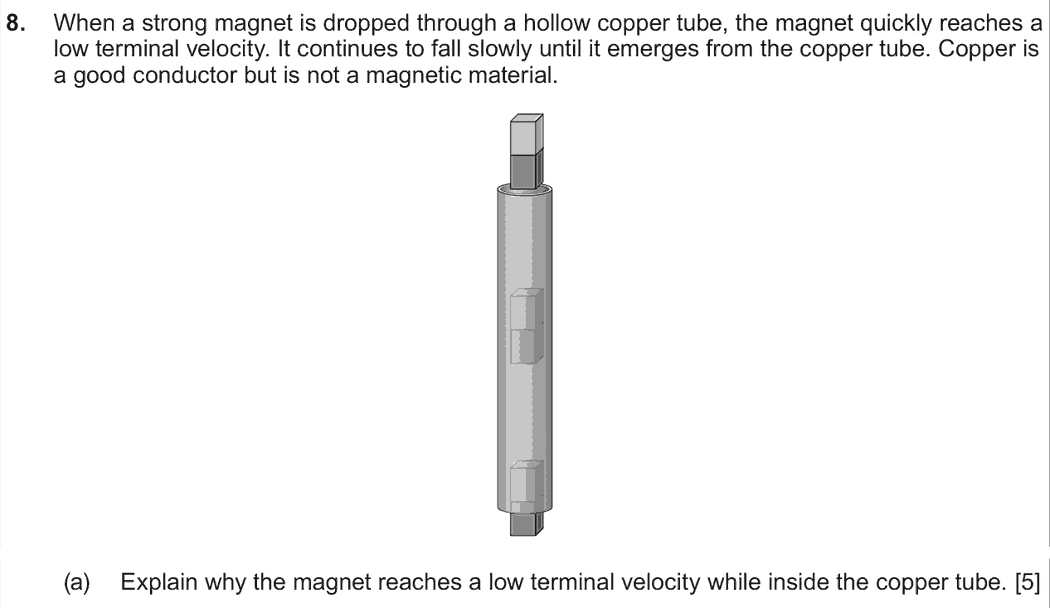
Answer: 0.038 K. Gravitational PE lost = 0.325 × 9.81 × 1.205 = 3.84 J, all transferred to the tube (the magnet's kinetic energy is small)
Δθ = 3.84/(0.263 × 389)
ecf on the mass
mg = mcΔθ scores nothing
Scheme columns: Maths 2
Skills: Synoptic Needs physics from another component of the qualification; Mathsmarks The mark scheme's Maths column gives this part at least one mark for mathematical skills
June 2023 · Component 1 · Q2(b)(i)2 marksAO1=2Definition
Earlier part of question 2 that this part uses
Mark scheme
Examiner's comment
Most candidates were able to successfully navigate the synoptic ‘show that’ question in (a). There were the occasional slips where the diameter was used instead of the radius, however, some candidates seemed to have spotted this and re-showed their response correctly. Part (b)(ii) proved to be somewhat of a discriminating question as candidates needed to appreciate that the copper container and the water received energy from the electrical heater to access the 2nd and 3rd marking points. Candidates found the last part of the question, challenging as well. Those who thought that it was bad practice as the heat would flow into the system from the surroundings, achieved some credit. A smaller number of candidates realised the energy absorbed below 16 °C would be countered by the energy emitted above 16 °C. This scored two marks if it was accompanied by a conclusion.
Notes from the mark scheme and report
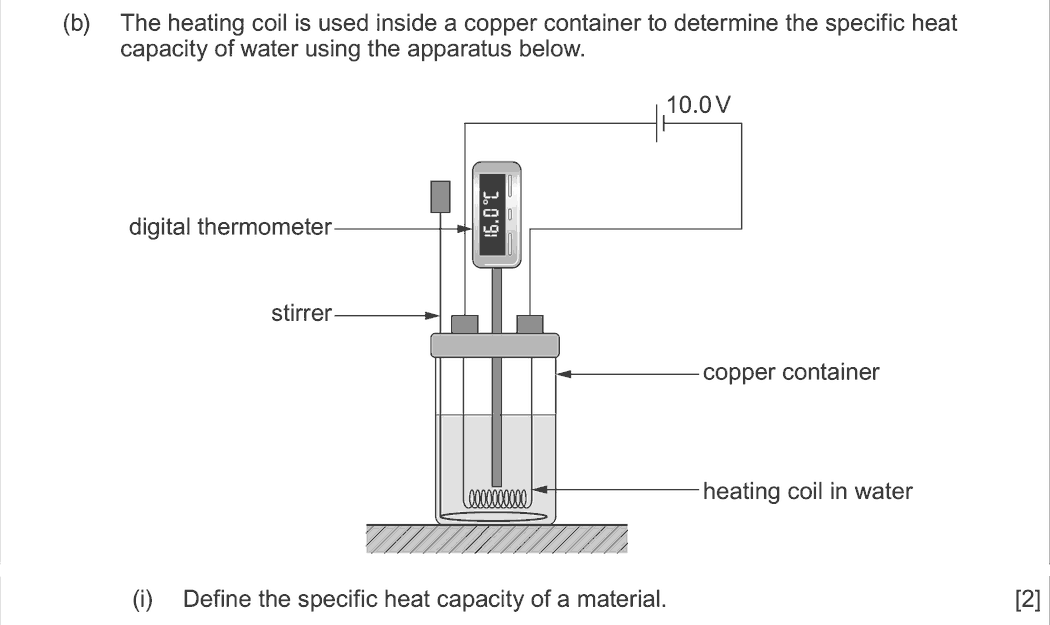
The energy needed to raise the temperature of 1 kg of the material (1) by 1 K or 1 °C (1)
Scheme columns: Practical 2
Skills: Practicalmarks The mark scheme's Prac column gives this part at least one mark for practical skills
June 2023 · Component 1 · Q2(b)(ii)3 marksAO2=3Practical and data analysis
Earlier parts of question 2 that this part uses
Mark scheme
Examiner's comment
Most candidates were able to successfully navigate the synoptic ‘show that’ question in (a). There were the occasional slips where the diameter was used instead of the radius, however, some candidates seemed to have spotted this and re-showed their response correctly. Part (b)(ii) proved to be somewhat of a discriminating question as candidates needed to appreciate that the copper container and the water received energy from the electrical heater to access the 2nd and 3rd marking points. Candidates found the last part of the question, challenging as well. Those who thought that it was bad practice as the heat would flow into the system from the surroundings, achieved some credit. A smaller number of candidates realised the energy absorbed below 16 °C would be countered by the energy emitted above 16 °C. This scored two marks if it was accompanied by a conclusion.
Notes from the mark scheme and report
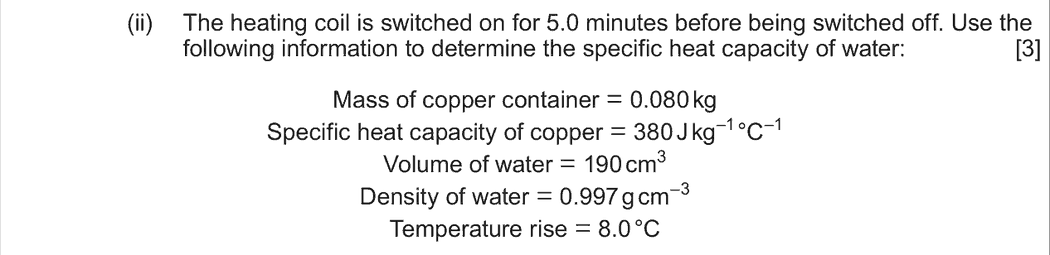
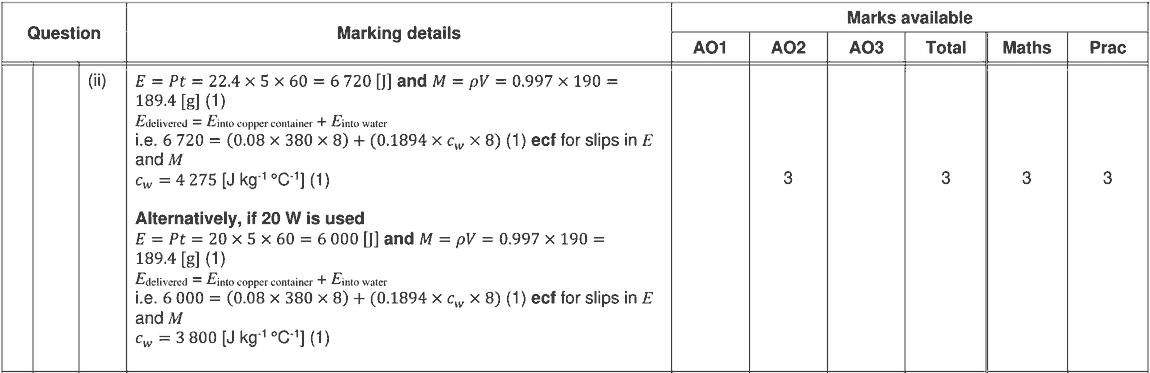
Answer: 4275 J kg⁻¹ °C⁻¹ (3800 if 20 W is used). E = Pt = 22.4 × 300 = 6720 J
mass of water = 0.997 × 190 = 189.4 g
6720 = (0.080 × 380 × 8.0) + (0.1894 × c × 8.0)
many forgot that the copper container is heated as well
Scheme columns: Maths 3, Practical 3
Skills: Unitsand conversions Unit marks, base units, prefixes and conversions; Mathsmarks The mark scheme's Maths column gives this part at least one mark for mathematical skills; Practicalmarks The mark scheme's Prac column gives this part at least one mark for practical skills
June 2023 · Component 1 · Q2(b)(iii)2 marksAO3=2Practical and data analysis
Earlier parts of question 2 that this part uses
Mark scheme
Examiner's comment
Most candidates were able to successfully navigate the synoptic ‘show that’ question in (a). There were the occasional slips where the diameter was used instead of the radius, however, some candidates seemed to have spotted this and re-showed their response correctly. Part (b)(ii) proved to be somewhat of a discriminating question as candidates needed to appreciate that the copper container and the water received energy from the electrical heater to access the 2nd and 3rd marking points. Candidates found the last part of the question, challenging as well. Those who thought that it was bad practice as the heat would flow into the system from the surroundings, achieved some credit. A smaller number of candidates realised the energy absorbed below 16 °C would be countered by the energy emitted above 16 °C. This scored two marks if it was accompanied by a conclusion.
Notes from the mark scheme and report
Below room temperature (16 °C) heat flows in from the surroundings (1)
above 16 °C heat flows out, so starting 4 °C below and ending 4 °C above roughly balances the two and reduces the net heat exchange, so it is good practice (1)
conclusion needed
Scheme columns: Practical 2
Skills: Experimentalmethod Describing, planning or improving an experiment; Practicalmarks The mark scheme's Prac column gives this part at least one mark for practical skills
June 2023 · Component 1 · Q4(a)3 marksAO1=3Definition
Mark scheme
Examiner's comment
Most candidates were successful in part (a). There was the occasional omission of ‘increase’ or ‘change’ in internal energy by a minority of candidates. References to ‘energy into a system’ without mentioning heat were rarely seen and not credited. Part (b)(i) was very well answered either by using the ideal gas equation or Boyle’s law. Most went down the route of calculating 289 K at A and B. In (ii) most candidates chose a correct method for obtaining the work done. The second mark was achieved for a close approximation. One single trapezium here would have fallen outside of this range. A significant number of candidates used a counting squares method. The responses to the last part of the question were encouraging. Candidates could obtain the correct answer of ‘+150 J and hence Joseph is correct’ by several different methods – some looked at the process stage by stage whereas some calculated the area of the enclosed ‘triangle’. A minority answered the question without referencing 150 J. They were still able to attain the first two making points.
Notes from the mark scheme and report
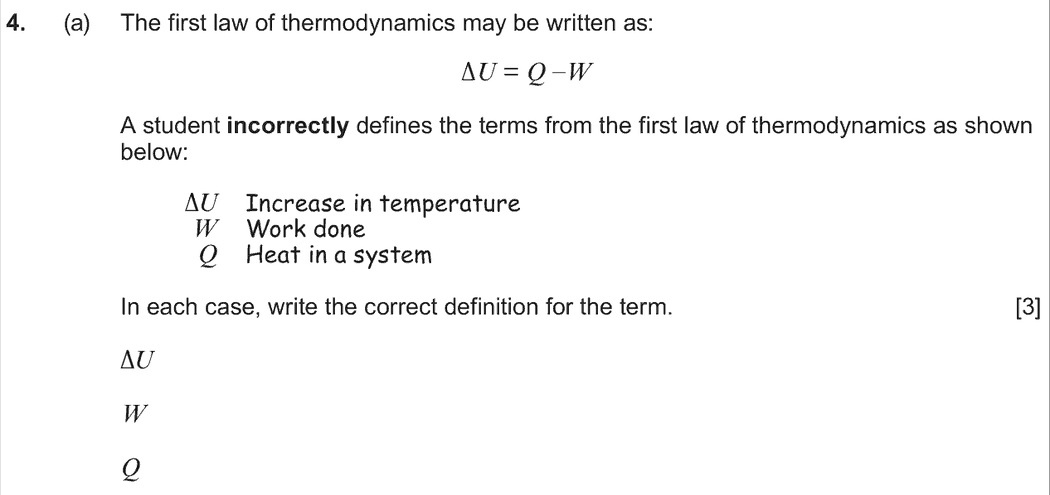
ΔU: increase (change) in the internal energy of the system (1)
W: work done by the system (1)
Q: heat flowing into the system (1)
'energy into the system' without heat not credited
June 2023 · Component 1 · Q4(b)(ii)2 marksAO2=2Show that
Earlier parts of question 4 that this part uses
Mark scheme
Examiner's comment
Most candidates were successful in part (a). There was the occasional omission of ‘increase’ or ‘change’ in internal energy by a minority of candidates. References to ‘energy into a system’ without mentioning heat were rarely seen and not credited. Part (b)(i) was very well answered either by using the ideal gas equation or Boyle’s law. Most went down the route of calculating 289 K at A and B. In (ii) most candidates chose a correct method for obtaining the work done. The second mark was achieved for a close approximation. One single trapezium here would have fallen outside of this range. A significant number of candidates used a counting squares method. The responses to the last part of the question were encouraging. Candidates could obtain the correct answer of ‘+150 J and hence Joseph is correct’ by several different methods – some looked at the process stage by stage whereas some calculated the area of the enclosed ‘triangle’. A minority answered the question without referencing 150 J. They were still able to attain the first two making points.
Notes from the mark scheme and report
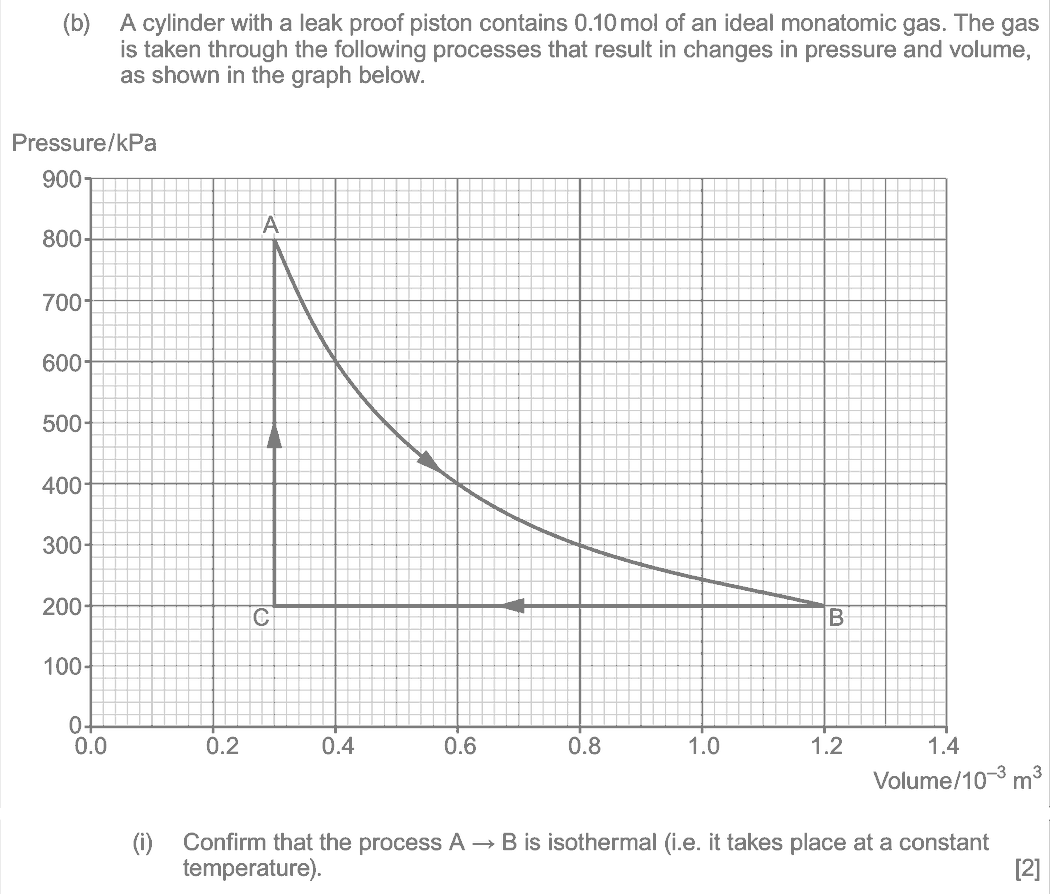
Work = area under AB, by counting squares or several trapezia (1)
value 333 ± 20 J (1)
a single trapezium (450 J) is outside the range
Scheme columns: Maths 2
Skills: Graphskills Reading, plotting or sketching graphs; gradients, intercepts and areas; Mathsmarks The mark scheme's Maths column gives this part at least one mark for mathematical skills
June 2023 · Component 1 · Q4(b)(iii)3 marksAO3=3Calculation
Earlier parts of question 4 that this part uses
Mark scheme
Examiner's comment
Most candidates were successful in part (a). There was the occasional omission of ‘increase’ or ‘change’ in internal energy by a minority of candidates. References to ‘energy into a system’ without mentioning heat were rarely seen and not credited. Part (b)(i) was very well answered either by using the ideal gas equation or Boyle’s law. Most went down the route of calculating 289 K at A and B. In (ii) most candidates chose a correct method for obtaining the work done. The second mark was achieved for a close approximation. One single trapezium here would have fallen outside of this range. A significant number of candidates used a counting squares method. The responses to the last part of the question were encouraging. Candidates could obtain the correct answer of ‘+150 J and hence Joseph is correct’ by several different methods – some looked at the process stage by stage whereas some calculated the area of the enclosed ‘triangle’. A minority answered the question without referencing 150 J. They were still able to attain the first two making points.
Notes from the mark scheme and report
For the complete cycle ΔU = 0 (1)
so Q = W (1)
net W = +330 (AB) − 180 (BC, 200 kPa × 0.9 × 10⁻³ m³) + 0 (CA) = +150 J, so 150 J of heat flows in and Joseph is correct (1)
Scheme columns: Maths 1
Skills: Graphskills Reading, plotting or sketching graphs; gradients, intercepts and areas; Mathsmarks The mark scheme's Maths column gives this part at least one mark for mathematical skills
June 2022 · Component 1 · Q7(b)2 marksAO1=1, AO2=1Calculation
Earlier part of question 7 that this part uses
Mark scheme
Examiner's comment
Few candidates made mistakes in calculating the work done at constant pressure.
Skills: Graphskills Reading, plotting or sketching graphs; gradients, intercepts and areas; Unitsand conversions Unit marks, base units, prefixes and conversions; Mathsmarks The mark scheme's Maths column gives this part at least one mark for mathematical skills
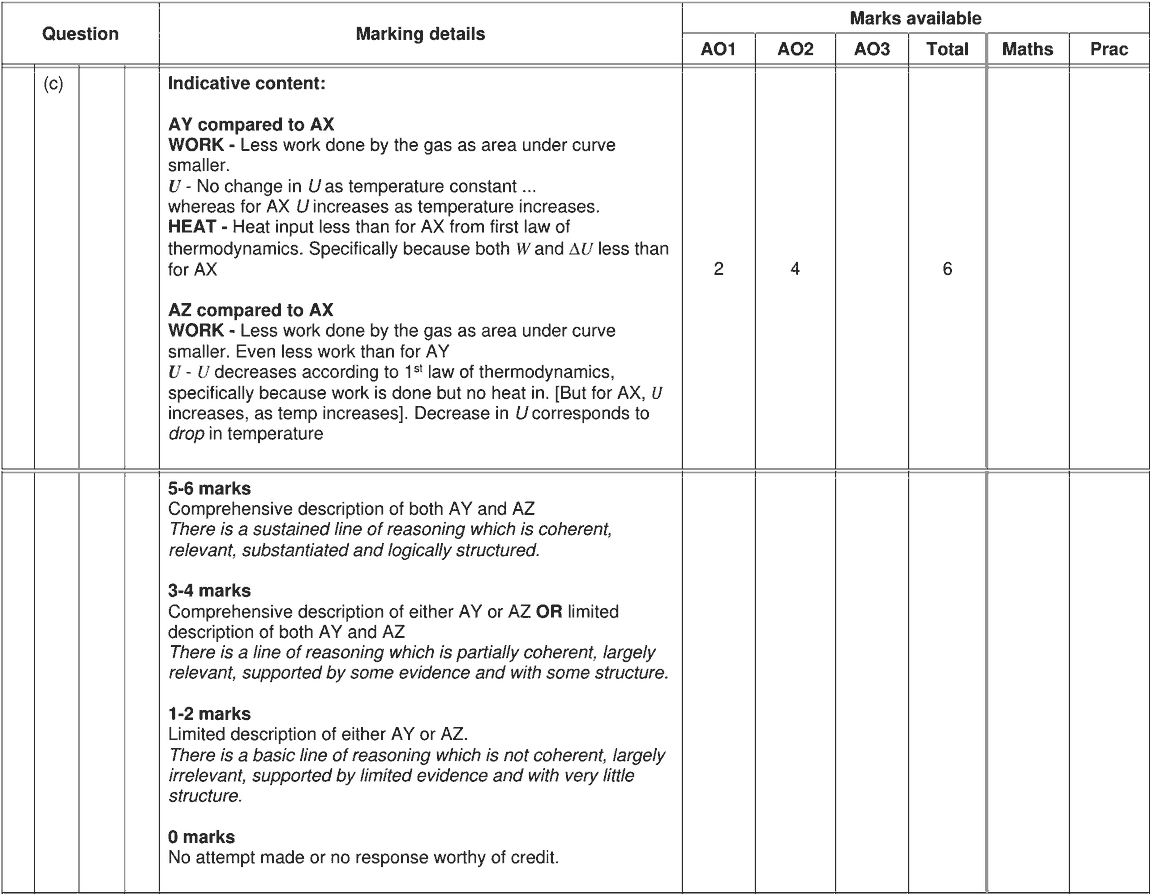
Mark scheme, with the levels and indicative content
Examiner's comment
Bearing in mind their success in part (b), it was surprising that many (perhaps most) candidates didn’t point out that less work was done by the gas over AY than over AX. It was noted rather more often that the internal energy increases over AX but doesn’t change over AY. Some candidates deduced that more heat flows in over AX than AY, but we were very seldom told that this was because both ∆𝑈 and W are greater for AX than AY. Admittedly making both these points would have been exemplary. For AZ an explicit work comparison with AX was often not made. Sometimes the absence of heat flow was confused with constant temperature, but some candidates did realise that work done with no heat flow implied a drop in internal energy, contrasting it with the rise over AX. Answers to this QER were in general disappointing.
Notes from the mark scheme and report
QER, levels marked. AY: less work than AX (smaller area under the curve)
ΔU = 0 as the temperature is constant, whereas U rises for AX
so less heat flows in than for AX because both W and ΔU are smaller. AZ: even less work
no heat flow, so by the first law U falls by the work done and the temperature drops, whereas U rises for AX. Answers were disappointing: work comparisons were often omitted and 'no heat flow' was confused with constant temperature
Skills: QER The 6-mark quality of extended response question
October 2021 · Component 1 · Q6(a)6 marksAO1=66-mark extended response
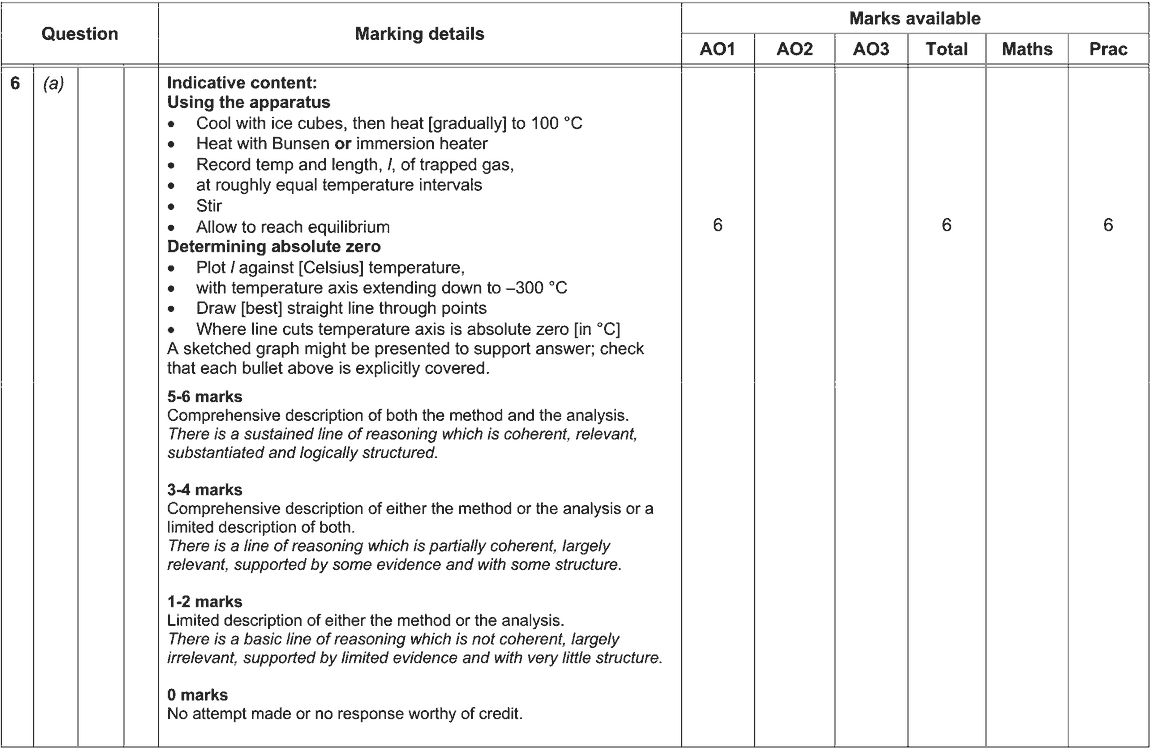
Mark scheme, with the levels and indicative content
Notes from the mark scheme and report
QER, levels marked. Method: cool the water with ice then heat gradually to about 100 °C (Bunsen or immersion heater)
stir and let the gas reach the water temperature
record the temperature and the length l of the trapped gas column at roughly equal temperature intervals. Analysis: plot l against Celsius temperature with the temperature axis extended to about −300 °C
draw the best straight line and extrapolate
absolute zero is where the line meets the temperature axis (l = 0). Top band needs full method and analysis
Scheme columns: Practical 6
Skills: Experimentalmethod Describing, planning or improving an experiment; Graphskills Reading, plotting or sketching graphs; gradients, intercepts and areas; Practicalmarks The mark scheme's Prac column gives this part at least one mark for practical skills; QER The 6-mark quality of extended response question
October 2021 · Component 1 · Q7(b)2 marksAO2=2Calculation
Earlier part of question 7 that this part uses
Mark scheme
Notes from the mark scheme and report
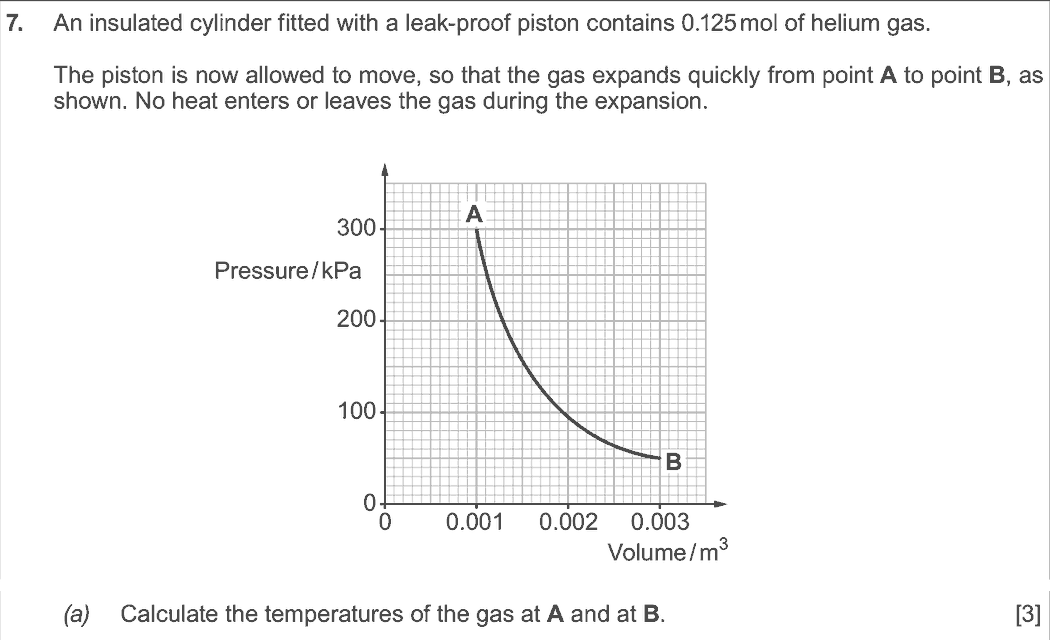
Answer: 230 J (± 30 J). Work done = area under the p-V curve between A and B, by counting squares or trapezia
watch the kPa factor of 10³
Scheme columns: Maths 1
Skills: Graphskills Reading, plotting or sketching graphs; gradients, intercepts and areas; Mathsmarks The mark scheme's Maths column gives this part at least one mark for mathematical skills
October 2021 · Component 1 · Q7(c)2 marksAO2=2Explanation
Earlier part of question 7 that this part uses
Mark scheme
Notes from the mark scheme and report
ΔU = Q − W with Q = 0 (no heat flow) and W positive (gas does work in expanding), so ΔU is negative (1)
for an ideal gas a fall in internal energy means a fall in temperature (1)
Scheme columns: Maths 1
Skills: Mathsmarks The mark scheme's Maths column gives this part at least one mark for mathematical skills
October 2020 · Component 1 · Q6(a)(i)3 marksAO1=1, AO2=2Show that
Mark scheme
Examiner's comment
Several methods were used, generally successfully, to show that the gas pressure data were consistent with an absolute zero of temperature at about –273 °C. We accepted that the kinetic energy of molecules was zero at absolute zero, though in a real substance, the particles have a residual zero point energy of vibration. Temperature and work calculations based on the p–V graph were very well done, but some candidates could not apply the First Law correctly to find the heat flow. There were – unfortunately no surprise – two or three claims that since the gas temperature was the same at C as at A, there would be no heat flow into or out of the system.
Notes from the mark scheme and report
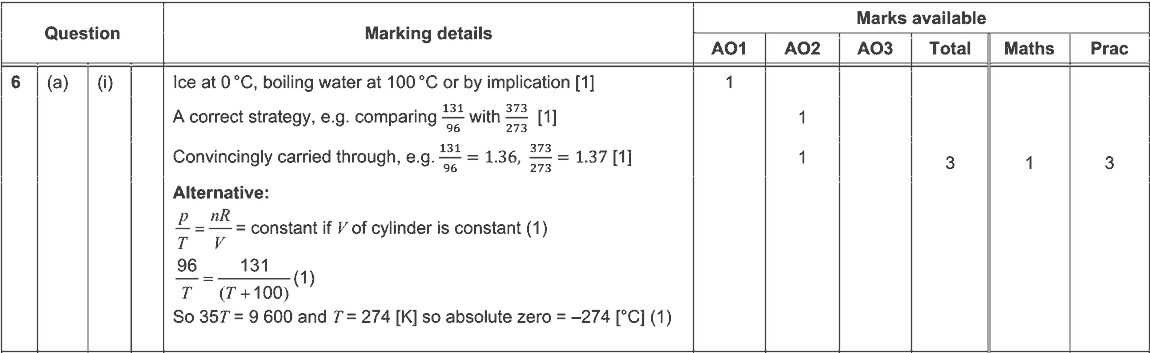
Ice at 0 °C and boiling water at 100 °C (1)
at constant volume p is proportional to T, so compare 131/96 = 1.36 with 373/273 = 1.37 (2)
or 96/T = 131/(T + 100) gives T = 274 K, so absolute zero is about −274 °C
Scheme columns: Maths 1, Practical 3
Skills: Mathsmarks The mark scheme's Maths column gives this part at least one mark for mathematical skills; Practicalmarks The mark scheme's Prac column gives this part at least one mark for practical skills
October 2020 · Component 1 · Q6(a)(ii)1 markAO1=1Short answer
Earlier part of question 6 that this part uses
Mark scheme
Examiner's comment
Several methods were used, generally successfully, to show that the gas pressure data were consistent with an absolute zero of temperature at about –273 °C. We accepted that the kinetic energy of molecules was zero at absolute zero, though in a real substance, the particles have a residual zero point energy of vibration. Temperature and work calculations based on the p–V graph were very well done, but some candidates could not apply the First Law correctly to find the heat flow. There were – unfortunately no surprise – two or three claims that since the gas temperature was the same at C as at A, there would be no heat flow into or out of the system.
Notes from the mark scheme and report
The molecules have the least possible energy (minimum internal energy)
zero kinetic energy was accepted
October 2020 · Component 1 · Q6(b)(ii)2 marksAO2=2Calculation
Earlier parts of question 6 that this part uses
Mark scheme
Examiner's comment
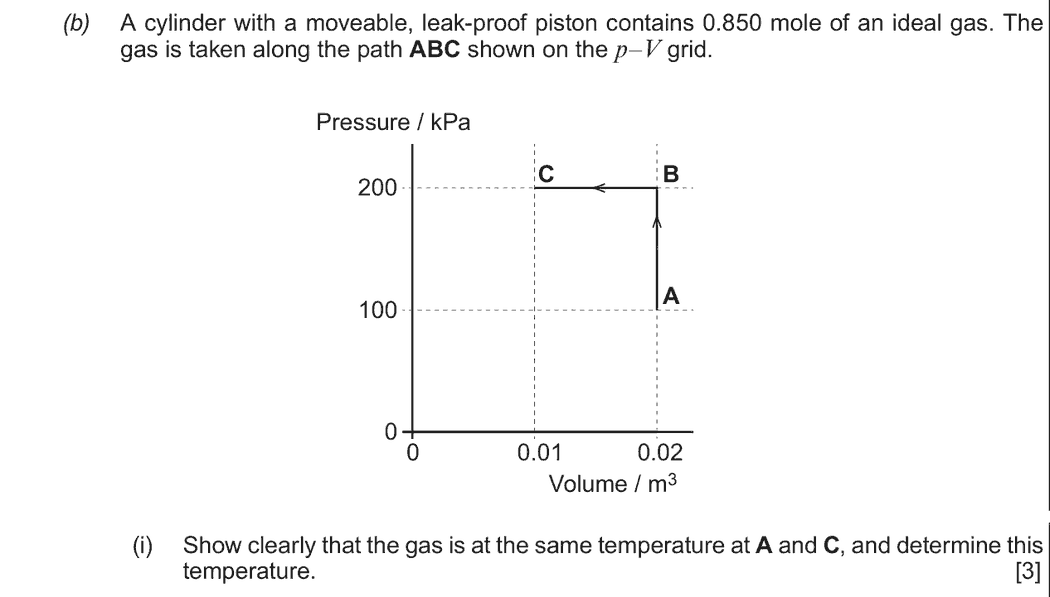
Several methods were used, generally successfully, to show that the gas pressure data were consistent with an absolute zero of temperature at about –273 °C. We accepted that the kinetic energy of molecules was zero at absolute zero, though in a real substance, the particles have a residual zero point energy of vibration. Temperature and work calculations based on the p–V graph were very well done, but some candidates could not apply the First Law correctly to find the heat flow. There were – unfortunately no surprise – two or three claims that since the gas temperature was the same at C as at A, there would be no heat flow into or out of the system.
Notes from the mark scheme and report
Answer: 2000 J done on the gas. No work over AB (constant volume)
over BC work on gas = pΔV = 200 × 10³ × 0.01
Scheme columns: Maths 1
Skills: Graphskills Reading, plotting or sketching graphs; gradients, intercepts and areas; Mathsmarks The mark scheme's Maths column gives this part at least one mark for mathematical skills
October 2020 · Component 1 · Q6(b)(iii)3 marksAO1=1, AO2=2Calculation
Earlier parts of question 6 that this part uses
Mark scheme
Examiner's comment
Several methods were used, generally successfully, to show that the gas pressure data were consistent with an absolute zero of temperature at about –273 °C. We accepted that the kinetic energy of molecules was zero at absolute zero, though in a real substance, the particles have a residual zero point energy of vibration. Temperature and work calculations based on the p–V graph were very well done, but some candidates could not apply the First Law correctly to find the heat flow. There were – unfortunately no surprise – two or three claims that since the gas temperature was the same at C as at A, there would be no heat flow into or out of the system.
Notes from the mark scheme and report
Answer: 2000 J of heat flows out. Same temperature at A and C so ΔU = 0 (1)
Q = ΔU + W = 0 + (−2000 J) (1)
so heat leaves the system (1)
some claimed no heat flow because the temperature is unchanged
Scheme columns: Maths 1
Skills: Mathsmarks The mark scheme's Maths column gives this part at least one mark for mathematical skills
October 2020 · Component 1 · Q76 marksAO1=66-mark extended response
Mark scheme, with the levels and indicative content
Examiner's comment
There were some excellent answers (6/6) to this QER question. The bottom band (1/6 or 2/6) answers didn’t deal with all four quantities mentioned in the question. In several scripts candidates confusedly referred to the heat in A and B. Sometimes the temperatures of A and B were (correctly) said to become constant, without it being stated that they became equal.
Notes from the mark scheme and report
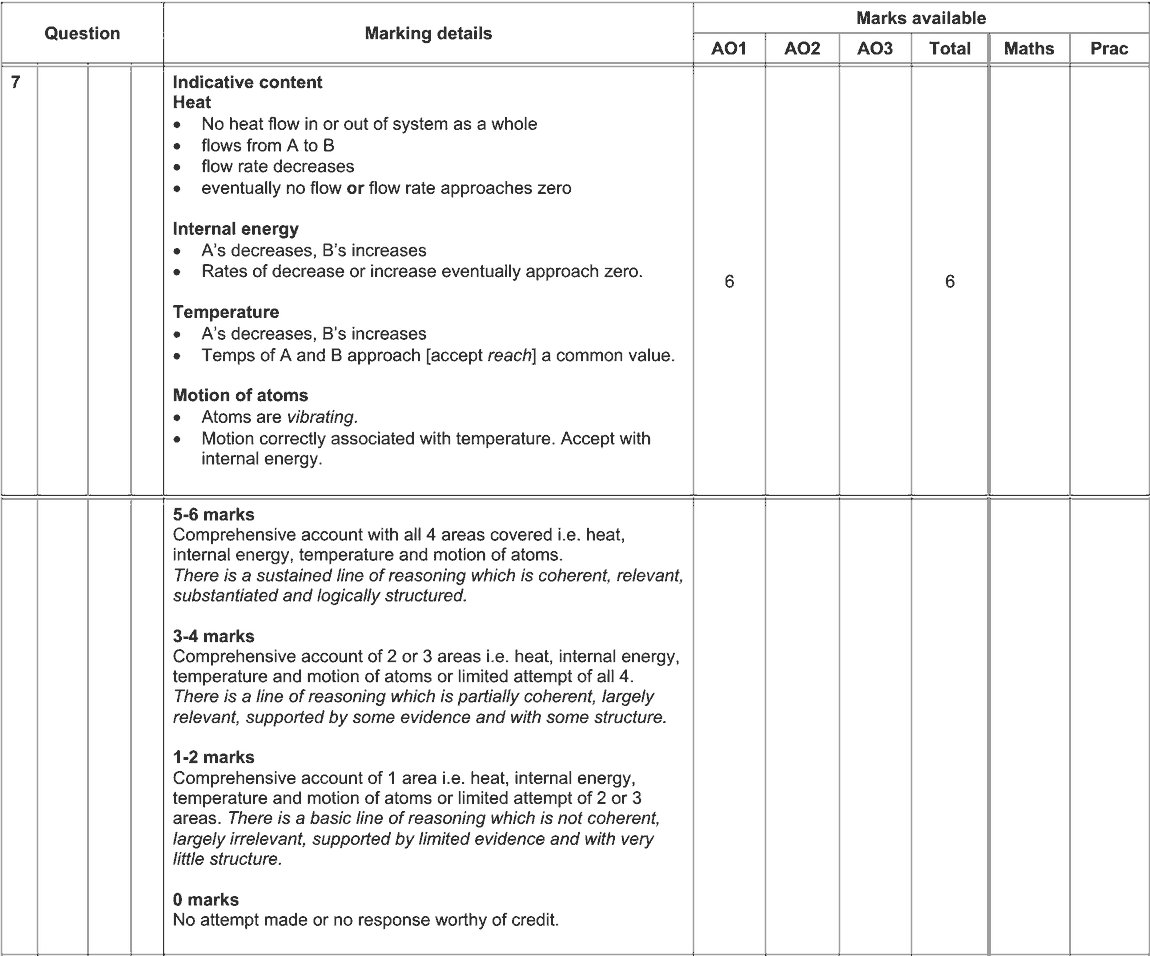
QER, levels marked on four strands. Heat: flows from A to B across the contact surfaces, none in or out of the whole system
the rate falls towards zero. Internal energy: A's decreases and B's increases, by equal amounts. Temperature: A's falls and B's rises until they are equal (thermal equilibrium). Atoms: vibrate about fixed positions, more vigorously at higher temperature, so A's vibrations lessen and B's grow. Faults: talking of the 'heat in' a block
saying temperatures become constant without saying equal
leaving out one of the four strands
Skills: QER The 6-mark quality of extended response question
June 2019 · Component 1 · Q7(a)2 marksAO1=2Definition
Mark scheme
Examiner's comment
A very easy first mark was given for stating that heat was energy [in transit]. The second, for distinguishing heat from other cases of energy in transit, proved rather more elusive, though most candidates wisely chose to state that heat needed a temperature difference in order to flow – or equivalent.
Notes from the mark scheme and report
Energy entering the system (energy in transit) (1) because of a temperature difference between the surroundings and the system (1)
the second mark was the harder one
June 2019 · Component 1 · Q7(b)(i)2 marksAO1=1, AO2=1Calculation
Earlier part of question 7 that this part uses
Mark scheme
Examiner's comment
Very few candidates made mistakes in calculating the work done in the constant pressure stage.
Skills: Graphskills Reading, plotting or sketching graphs; gradients, intercepts and areas; Unitsand conversions Unit marks, base units, prefixes and conversions
June 2019 · Component 1 · Q7(b)(ii)6 marksAO1=66-mark extended response
Earlier parts of question 7 that this part uses
Mark scheme, with the levels and indicative content
Examiner's comment
This 6 mark QER question required candidates to explain, using the first law of thermodynamics, whether heat flowed into or out of a gas for each stage in a cycle and for the cycle as a whole. Although most candidates (but not all) appeared to grasp that they needed to consider both the internal energy and the work in each case, quite often this was not done consistently, one or the other being ignored for some stages. A common fallacious claim was that for the isothermal stage, no heat would enter or leave. Perfect or near-perfect answers were quite rare.
Notes from the mark scheme and report
QER, levels marked on Q, W and ΔU for each stage. AB: gas expands so W positive, temperature rises so ΔU positive, so heat flows in. BC: work done on the gas (W negative), constant temperature so ΔU = 0, so heat flows out. CA: no work, ΔU negative, so heat flows out. Whole cycle: net work done on the gas, ΔU = 0, so net heat flows out. Common faults: ignoring W or ΔU for some stages and claiming no heat flow in the isothermal stage
Skills: QER The 6-mark quality of extended response question
June 2019 · Component 2 · Q3(c)5 marksAO3=5Calculation
Earlier parts of question 3 that this part uses
Mark scheme
Examiner's comment
Most candidates scored full marks in this part, providing a clear and logical argument in terms of capacitor energy and the energy gained by the block. The synoptic nature of the question didn’t seem to affect candidates, with the use of specific heat capacity and the efficiency of the energy transfer being calculated correctly by nearly all.
Notes from the mark scheme and report
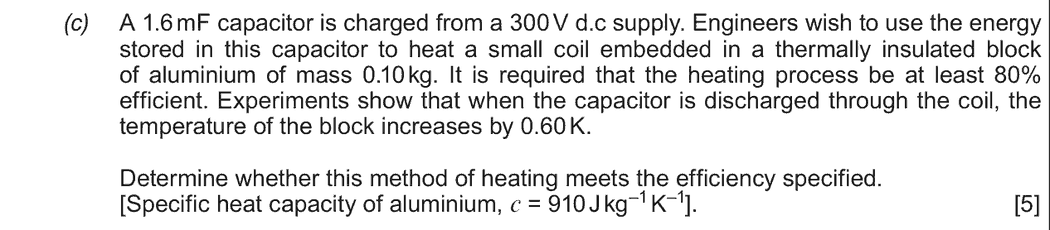
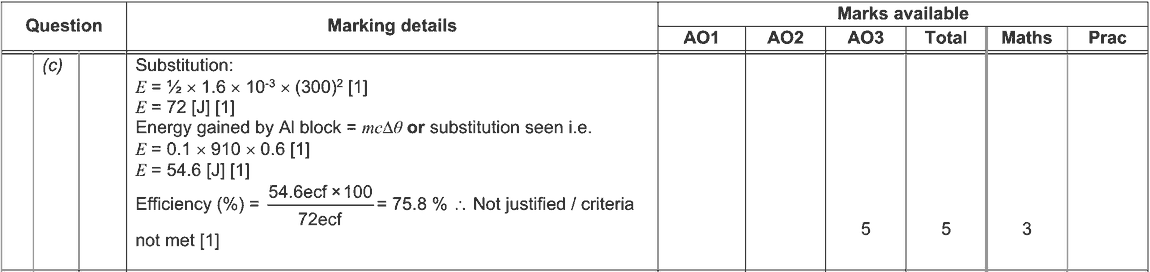
Answer: 76%, so the 80% requirement is not met. Energy stored = ½CV² = ½ × 1.6 × 10⁻³ × 300² (1) = 72 J (1)
energy gained by block = mcΔθ = 0.10 × 910 × 0.60 (1) = 54.6 J (1)
efficiency = 54.6/72 = 75.8% with conclusion (1)
synoptic with Component 1 thermal physics
most scored full marks
Scheme columns: Maths 3
Skills: Synoptic Needs physics from another component of the qualification; Mathsmarks The mark scheme's Maths column gives this part at least one mark for mathematical skills
June 2018 · Component 1 · Q8(a)(ii)2 marksAO1=1, AO2=1Calculation
Earlier part of question 8 that this part uses
Mark scheme
Examiner's comment
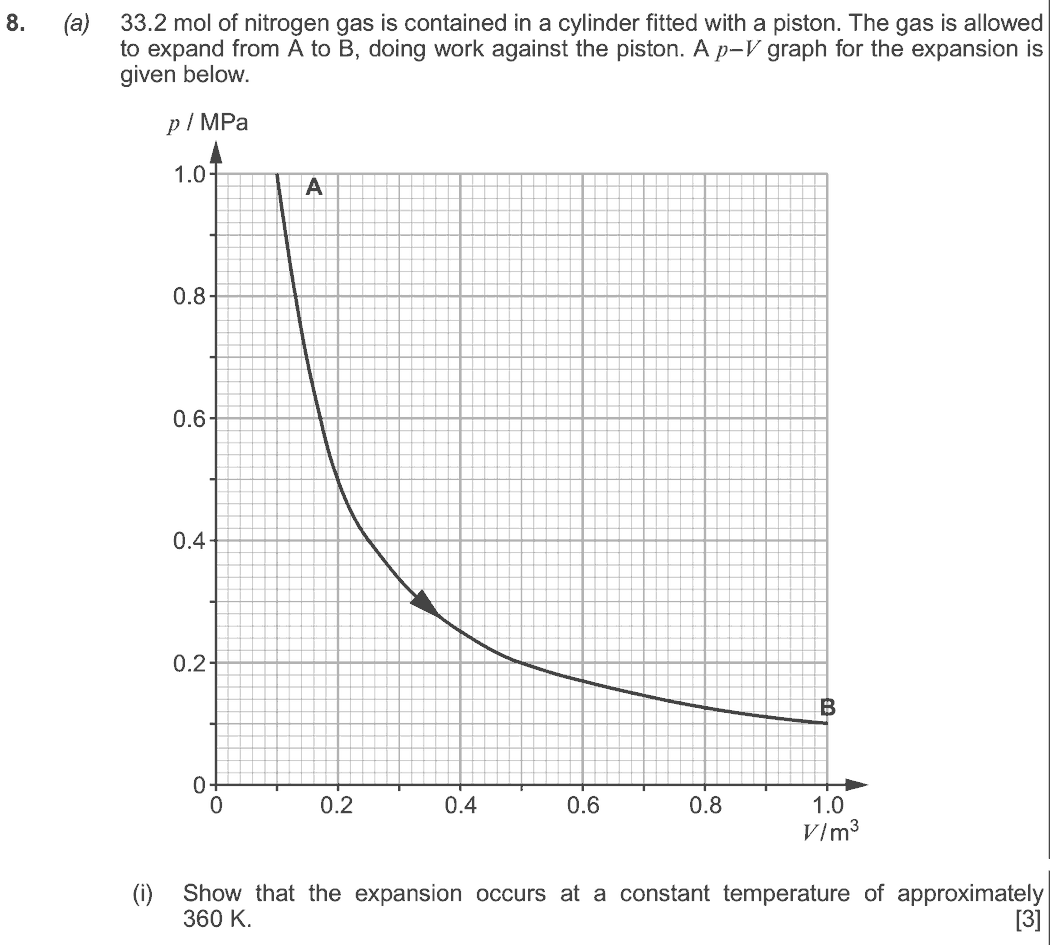
There were a few, usually successful, applications of integration, but almost everyone attempted to find the work done from the area under the graph. Quite a popular method was to link points on the curve by chords, and to add the areas of the trapezia ‘under’ these chords. The result was bound to be too large, but acceptable if three or four chords were drawn. An easier, and usually more accurate, way is to draw a straight line that, judging by eye, has the same area underneath it as the curve. In this case, the line might run from the point (0.10 m3, 0.40 MPa) to point B.
Notes from the mark scheme and report
Answer: 230 ± 50 kJ. Area under the p-V curve between A and B, by counting squares, trapezia or an equal-area straight line
Scheme columns: Maths 1
Skills: Graphskills Reading, plotting or sketching graphs; gradients, intercepts and areas; Unitsand conversions Unit marks, base units, prefixes and conversions; Mathsmarks The mark scheme's Maths column gives this part at least one mark for mathematical skills
June 2018 · Component 1 · Q8(a)(iii)2 marksAO3=2Explanation
Earlier part of question 8 that this part uses
Mark scheme
Examiner's comment
Perhaps half the candidates realised that constant temperature implied constant internal energy (assuming the gas to be ideal), so a quantity of heat flows in equal to the work done by the gas. Some candidates claimed that constant temperature implied no heat flow.
Notes from the mark scheme and report
The internal energy does not change because the temperature is constant, ΔU = 0 (1)
so heat equal to the work done by the gas flows into the gas (1)
about half saw this
some claimed constant temperature means no heat flow
June 2018 · Component 1 · Q8(b)3 marksAO3=3Explanation
Earlier part of question 8 that this part uses
Mark scheme
Examiner's comment
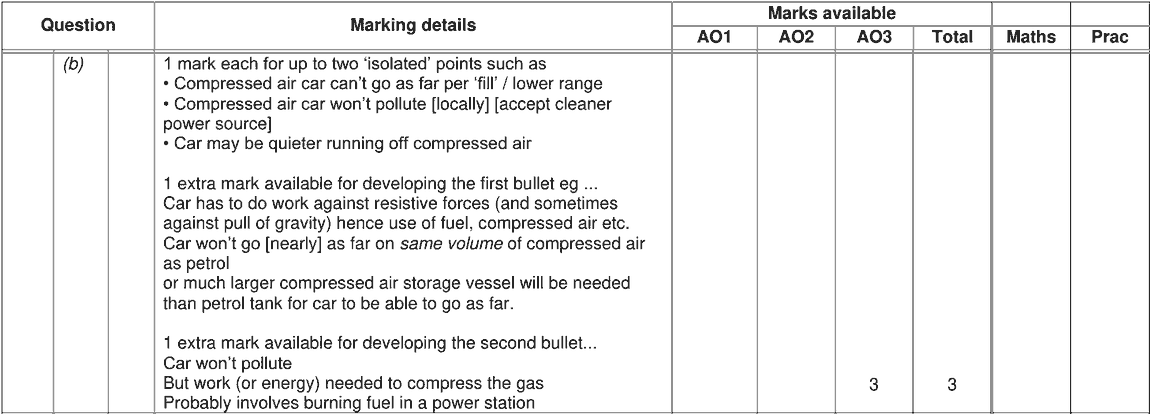
Discussions of the advantages and disadvantages of powering cars by compressed air were generally disappointing. Many candidates seemed to think that compressed air was a free resource: there were frequent (correct) claims that the cars would not pollute, but little consideration of the energy needed elsewhere to compress the air. Credit was available, but not always claimed, for ‘adding value’ to the data in the question, for example by pointing out that ‘refuelling’ would have to be much more frequent than for a petrol car.
Notes from the mark scheme and report
Up to two separate points (range per fill is far lower
no local pollution
quieter) plus development: 40 times less work from the same volume so a much larger tank or far more frequent refilling
energy is needed to compress the air, probably from burning fuel at a power station. Many treated compressed air as a free resource
June 2017 · Component 1 · Q6(a)(i)2 marksAO1=2Practical and data analysis
Mark scheme
Examiner's comment
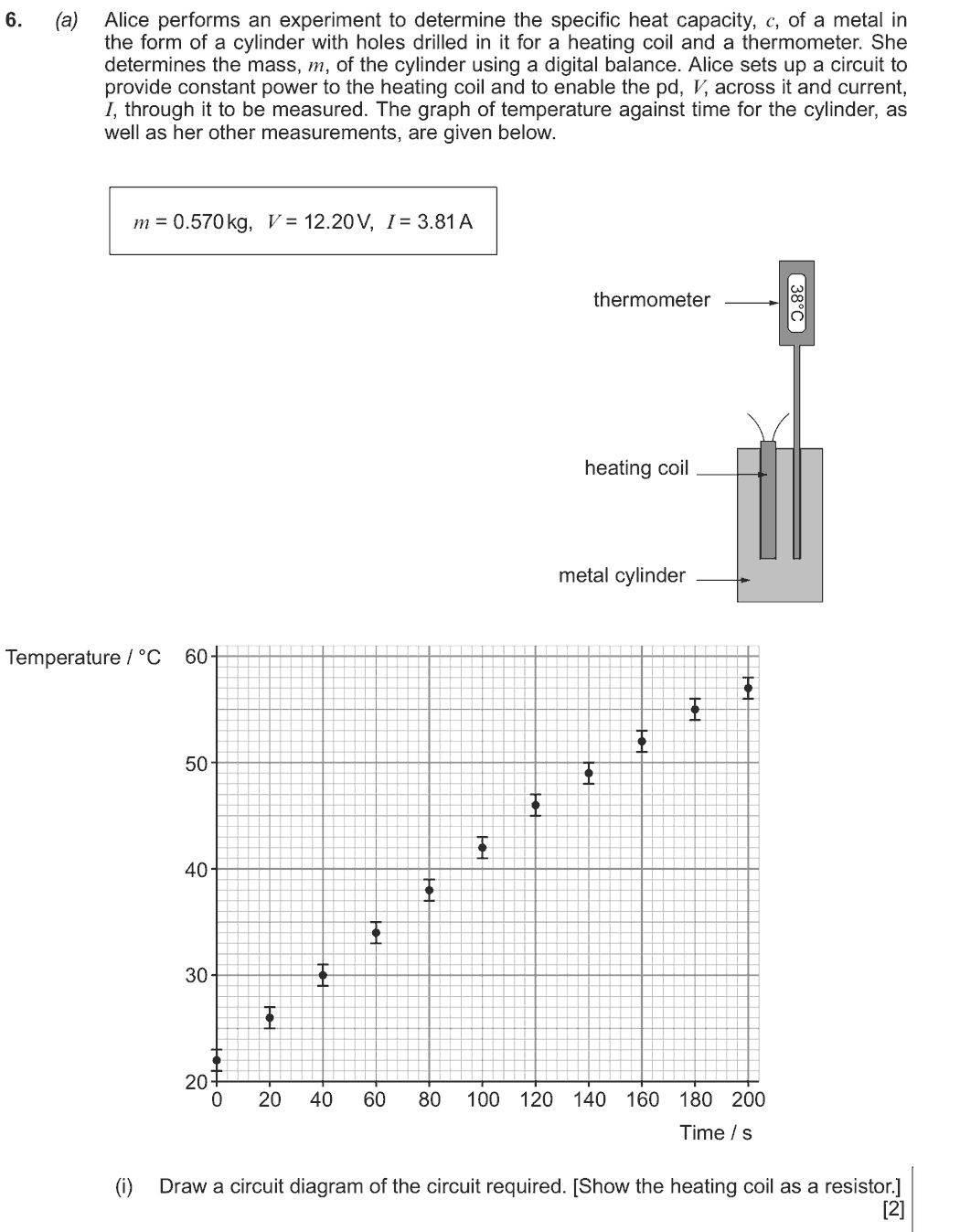
Almost everyone drew the right circuit diagram for the electrical heating experiment, but there were a few instances of wrongly connected meters.
Notes from the mark scheme and report
Power supply connected to the heating coil shown as a resistor (1)
ammeter in series and voltmeter in parallel with the coil (1)
Scheme columns: Practical 2
Skills: Experimentalmethod Describing, planning or improving an experiment; Practicalmarks The mark scheme's Prac column gives this part at least one mark for practical skills
June 2017 · Component 1 · Q6(a)(ii)2 marksAO3=2Practical and data analysis
Earlier part of question 6 that this part uses
Mark scheme
Examiner's comment
Heat loss to the surroundings was almost always recognized as the culprit, and insulation recommended. Slow response to the heater (offered by a few candidates) was unlikely to show up most at high temperatures.
Notes from the mark scheme and report
Heat loss to the surroundings becomes significant at the higher temperatures (1)
insulate (lag) the cylinder (1)
Scheme columns: Practical 2
Skills: Experimentalmethod Describing, planning or improving an experiment; Practicalmarks The mark scheme's Prac column gives this part at least one mark for practical skills
June 2017 · Component 1 · Q6(a)(iii)4 marksAO2=4Practical and data analysis
Earlier part of question 6 that this part uses
Mark scheme
Examiner's comment
Determining the maximum and minimum gradients was done competently by most candidates – who made sound judgements over which portion of the graph to use. A minority ignored the heavy hint and used the whole graph.
Notes from the mark scheme and report
Answer: maximum gradient 0.200 to 0.230 °C s⁻¹, minimum 0.170 to 0.190 °C s⁻¹. Steepest and least steep lines through the error bars of the early (linear) points, with triangles at least half the grid width
some used the whole graph despite the hint
Scheme columns: Maths 4, Practical 4
Skills: Graphskills Reading, plotting or sketching graphs; gradients, intercepts and areas; Uncertainties Resolution, absolute and percentage uncertainty, combining uncertainties, error bars; Mathsmarks The mark scheme's Maths column gives this part at least one mark for mathematical skills; Practicalmarks The mark scheme's Prac column gives this part at least one mark for practical skills
June 2017 · Component 1 · Q6(a)(iv)2 marksAO2=2Show that
Earlier part of question 6 that this part uses
Mark scheme
Examiner's comment
Many of the justifications offered for 𝑉𝐼 𝑚𝑐 being the graph gradient were ponderous, but they were usually successful. Perhaps only a minority started with 𝑉𝐼 Δ𝑡= 𝑚𝑐 Δ𝜃. There were a few terrible blunders, such as confusing Q for heat with Q for charge.
Notes from the mark scheme and report
Energy supplied VIΔt = mcΔθ (1)
so Δθ/Δt = VI/mc, or θ = (VI/mc)t + θ0, which is the gradient (1)
Q for heat was sometimes confused with charge
Scheme columns: Maths 2, Practical 2
Skills: Algebra Derivations and rearranging equations; Mathsmarks The mark scheme's Maths column gives this part at least one mark for mathematical skills; Practicalmarks The mark scheme's Prac column gives this part at least one mark for practical skills
June 2017 · Component 1 · Q6(a)(v)5 marksAO1=2, AO2=3Practical and data analysis
Earlier part of question 6 that this part uses
Mark scheme
Examiner's comment
The specific heat capacity of the metal was usually found successfully from the mean graph gradient. Most candidates knew how to set about determining the absolute uncertainty, but there were many slips, such as failures to halve the spread of graph gradients, leaving the answer as a percentage uncertainty... We insisted on 2 or 3 significant figures for the specific heat capacity and 1 or, at most, 2 for the uncertainty. Many candidates gave too many.
Notes from the mark scheme and report
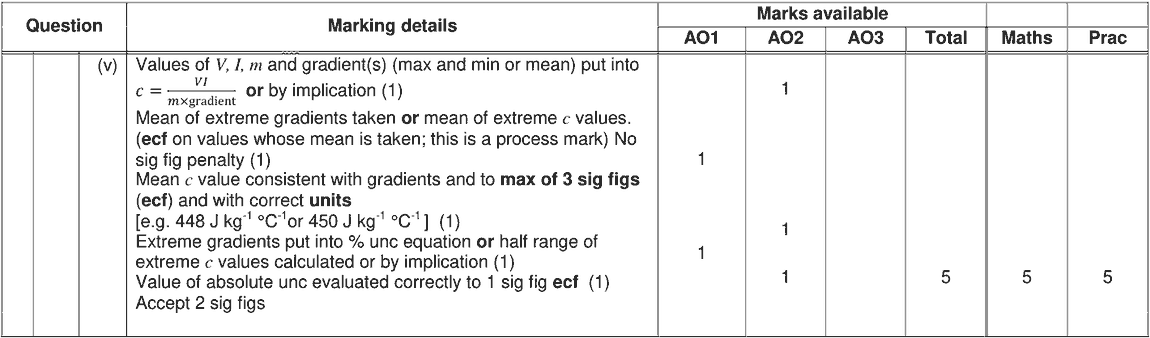
Answer: about 450 J kg⁻¹ °C⁻¹ with an uncertainty of a few tens (depends on the gradients). c = VI/(m × gradient) with VI = 12.20 × 3.81 = 46.5 W and m = 0.570 kg
use the mean of the extreme gradients (or of the extreme c values)
uncertainty = half the range of c, or from the % uncertainty in the gradient
c to 2 or 3 sf with unit, uncertainty to 1 (or 2) sf
common slips: not halving the spread, leaving a % uncertainty, too many figures
Scheme columns: Maths 5, Practical 5
Skills: Uncertainties Resolution, absolute and percentage uncertainty, combining uncertainties, error bars; Graphskills Reading, plotting or sketching graphs; gradients, intercepts and areas; Mathsmarks The mark scheme's Maths column gives this part at least one mark for mathematical skills; Practicalmarks The mark scheme's Prac column gives this part at least one mark for practical skills
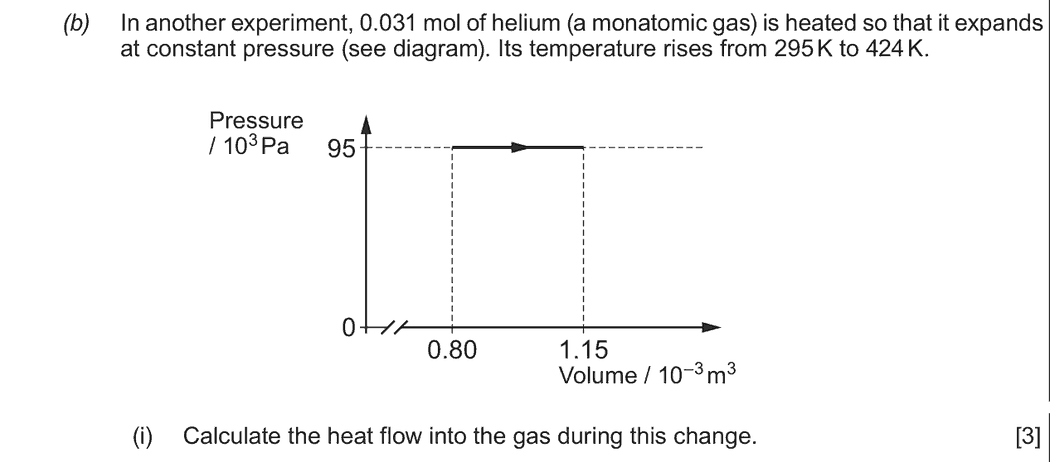
June 2017 · Component 1 · Q6(b)(i)3 marksAO1=2, AO2=1Calculation
Earlier part of question 6 that this part uses
Mark scheme
Examiner's comment
Most candidates calculated the work done by the expanding gas. An appreciable minority gave it as their answer to the heat intake, without calculating and adding in the increase of internal energy.
Skills: Graphskills Reading, plotting or sketching graphs; gradients, intercepts and areas; Mathsmarks The mark scheme's Maths column gives this part at least one mark for mathematical skills; Practicalmarks The mark scheme's Prac column gives this part at least one mark for practical skills
June 2017 · Component 1 · Q6(b)(ii)2 marksAO3=2Explanation
Earlier parts of question 6 that this part uses
Mark scheme
Examiner's comment
The idea of different amounts of heat being needed in different circumstances was clearly unfamiliar to some candidates. Others understood well. Whereas many gave us the familiar example of needing less heat at constant pressure for a given T, there were some unexpected but perfectly valid examples, such as raising the temperature by rapid compression without any heat being needed. Section B
Notes from the mark scheme and report
No: the heat needed depends on the work done as well as on the temperature rise (1)
work depends on the volume change, e.g. at constant volume W = 0 so only 50 J is needed, and a rapid compression could give the rise with no heat (1)
Scheme columns: Practical 2
Skills: Practicalmarks The mark scheme's Prac column gives this part at least one mark for practical skills
Work with an Eduqas physics tutor
Dropping marks on calculations, specified practicals or the six-mark QER questions? Book a trial session with a specialist Eduqas physics tutor.