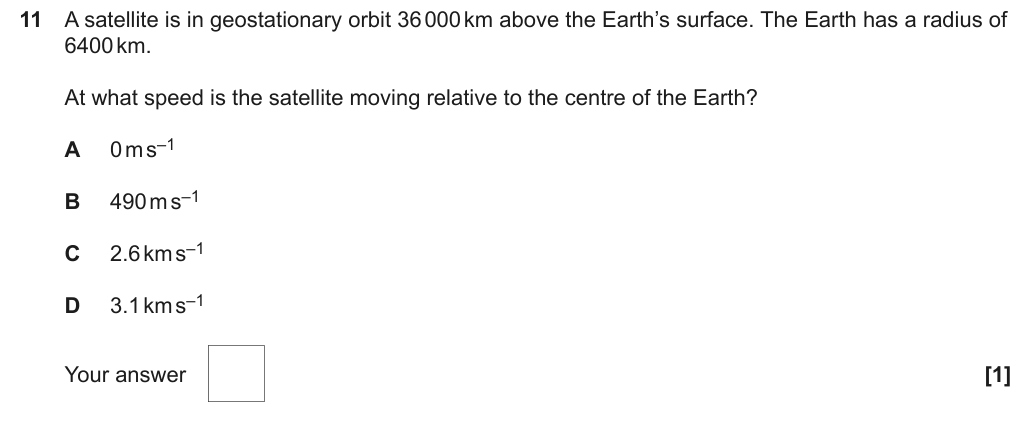
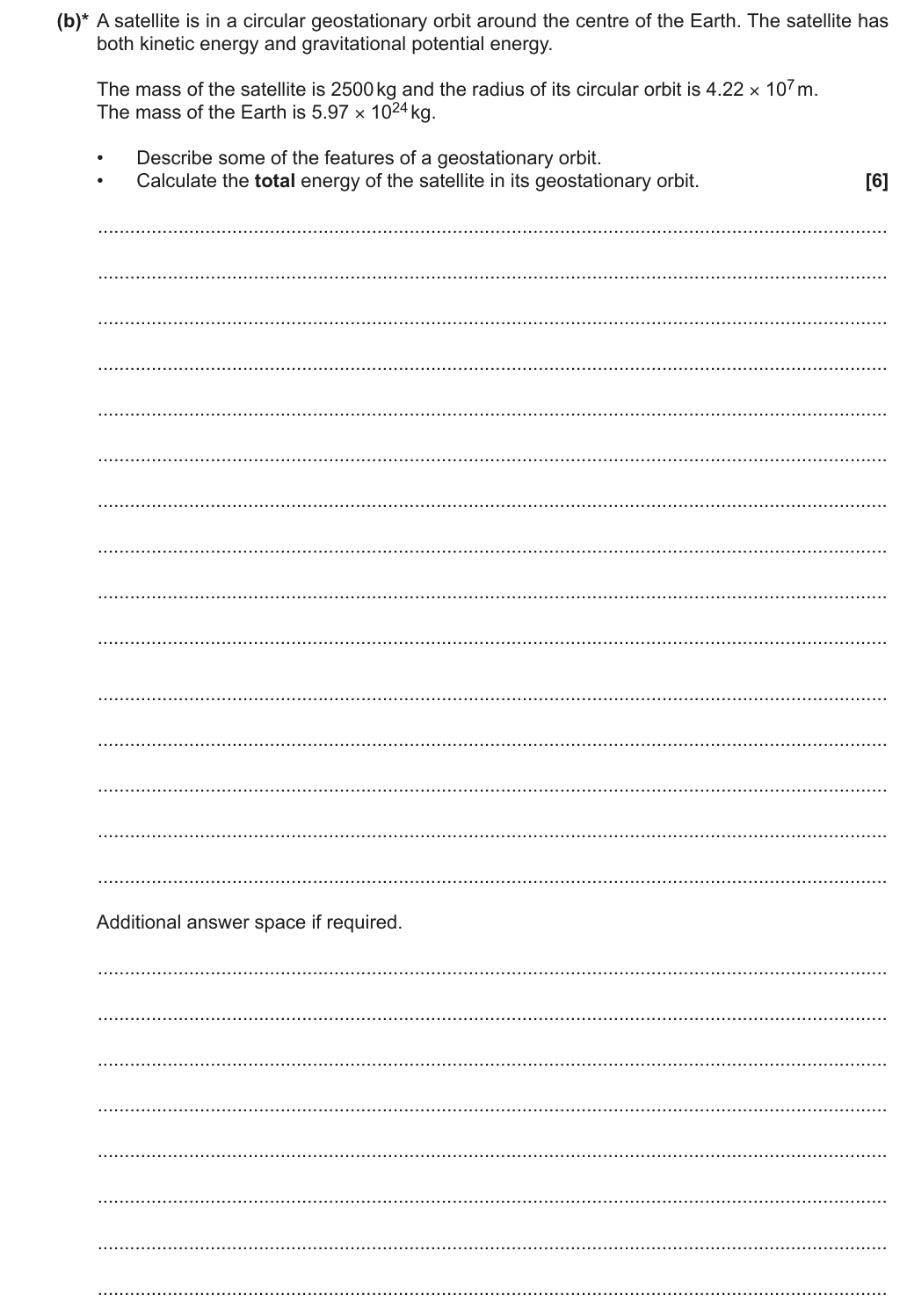
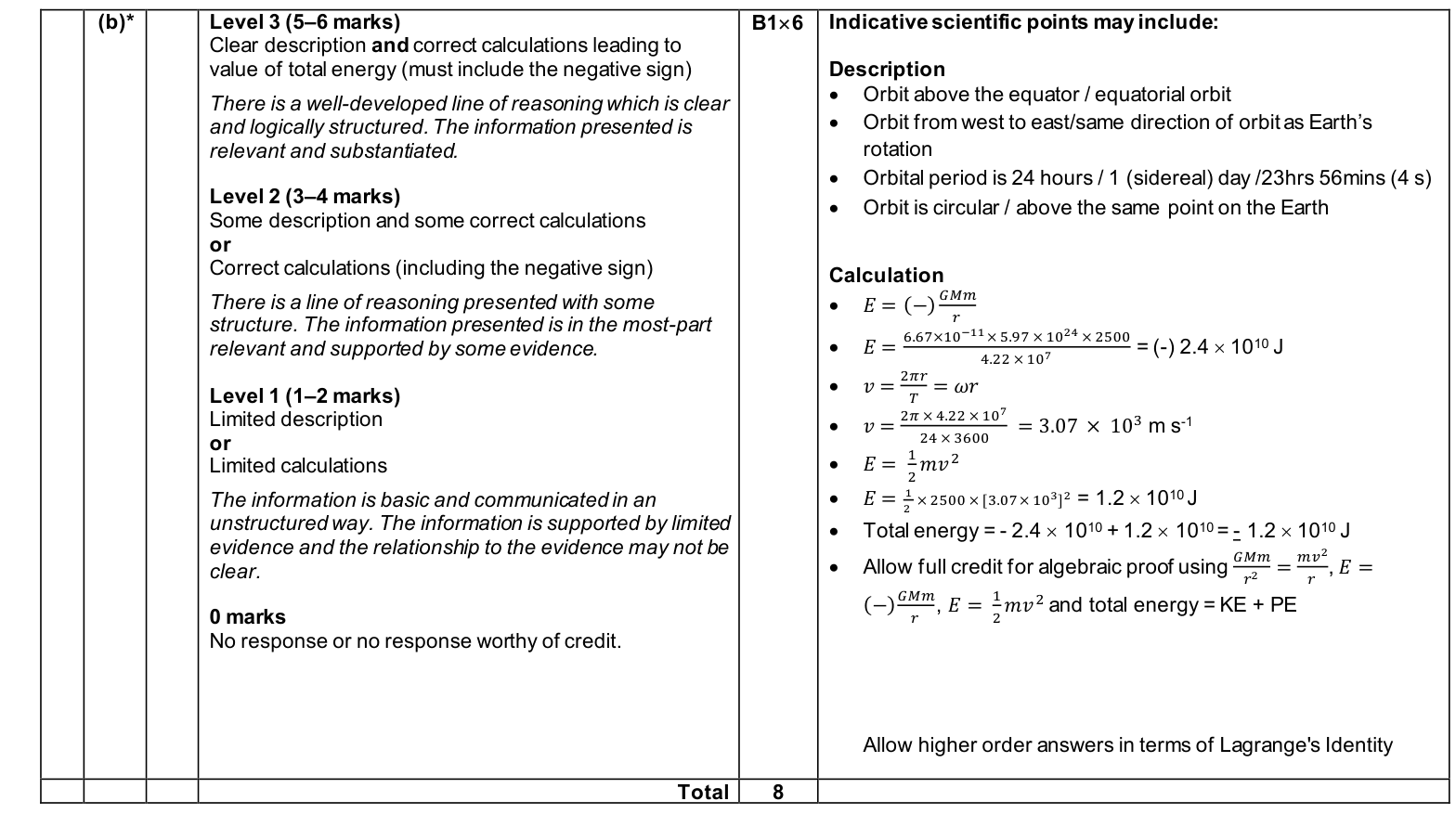
A satellite is in a circular geostationary orbit around the centre of the Earth. The satellite has • Describe some of the features of a geostationary orbit.
Tap a question to zoom it. Where a part needs a figure, table or graph from earlier in the question, that part folds out above it; the mark scheme and examiner's comment open underneath. Have the OCR Data, Formulae and Relationships Booklet beside you (see the data booklet page).
June 2025 · Paper 1 · Q81 markMultiple choiceMedium
Answer
B
Mark scheme
Examiner's comment
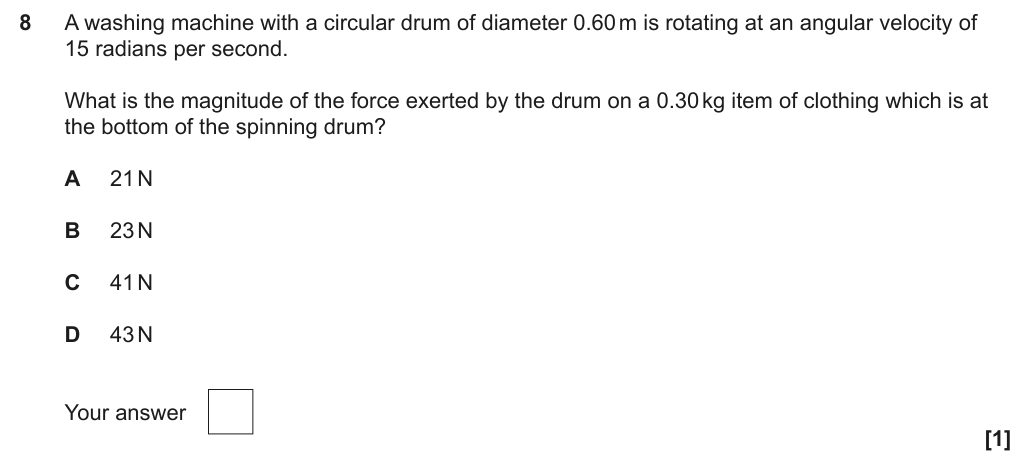
The data in the first sentence gives the centripetal force required to make the clothing perform circular motion i.e. 𝑚𝜔2𝑟= 20.25 N, which caused candidates to pick answer A. Those that used a radius of 0.60 m would get answer C at this point. Although, at the bottom of the drum, the centripetal force is given by the contact force from the drum – the weight of the clothing. To find the contact force, we must add the weight of the clothing (2.94 N) to the centripetal force, giving 23.2 N, i.e. answer B is correct. Those that used a radius of 0.60 m would get answer D.
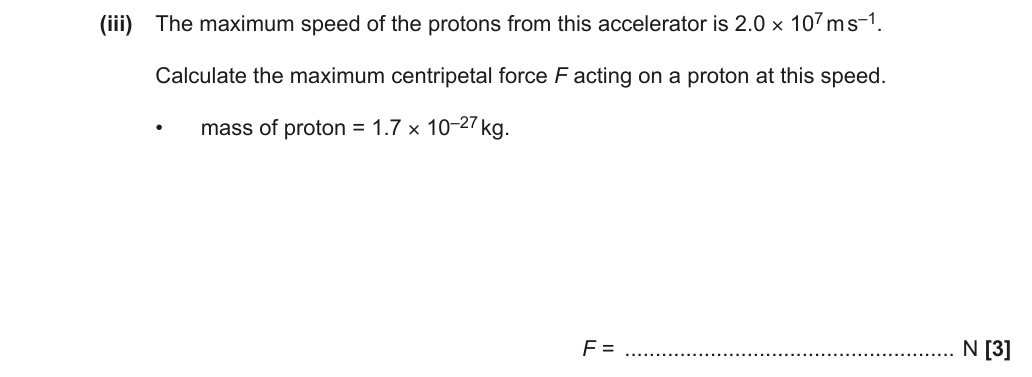
June 2025 · Paper 1 · Q22(a)(ii)3 marksCalculationMedium
Earlier part of question 22 that this part uses
Mark scheme
Examiner's comment
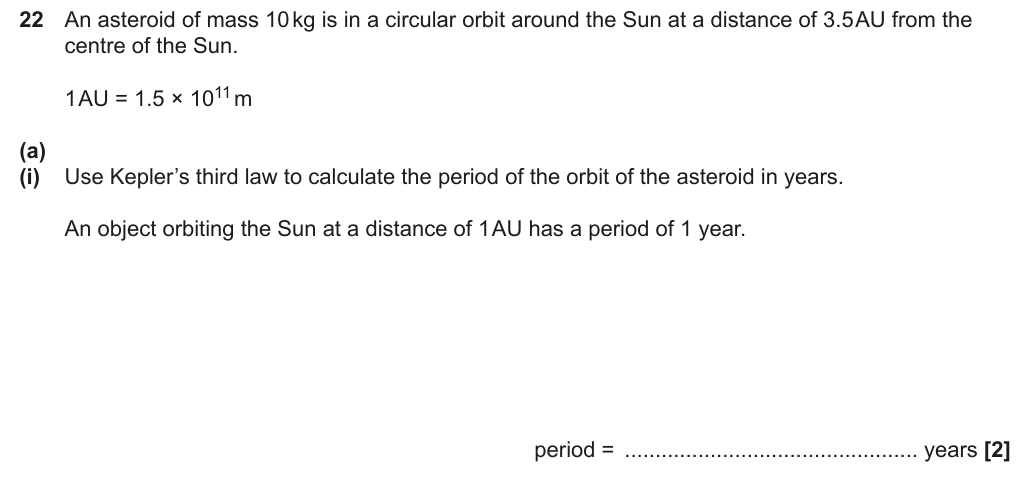
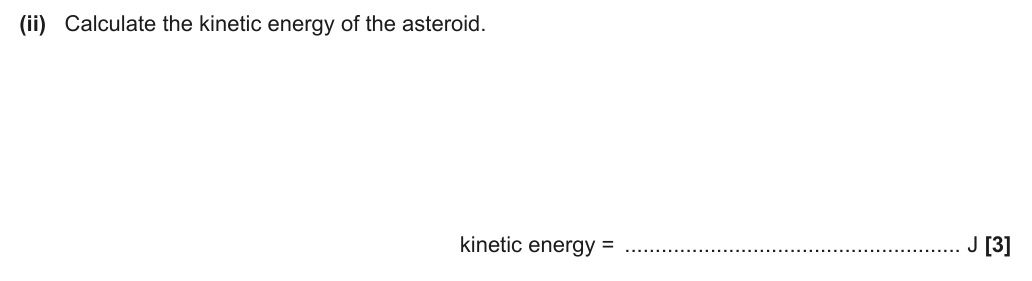
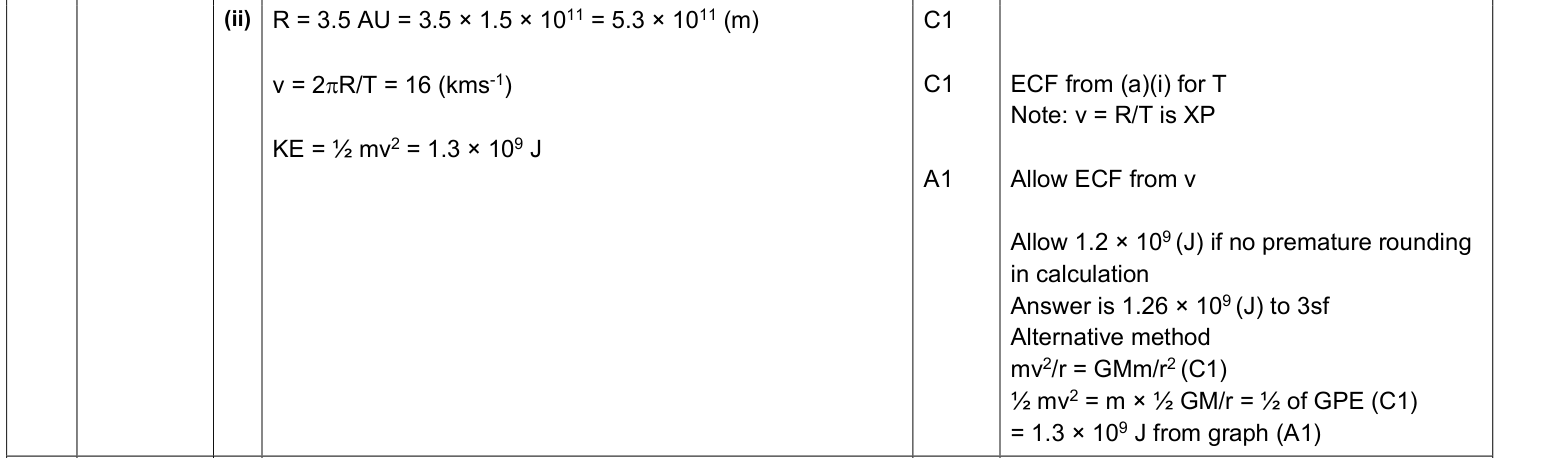
The ‘error carried forward’ rule was applied here in the case of the wrong value for the orbital period and again if the orbital velocity was incorrectly calculated. Otherwise this question was successfully completed.
Notes from the mark scheme and report
v = R/T is wrong physics
ecf from (a)(i) for T
alternative via GMm/r² = mv²/r and the graph
Skills: M0.1 Recognise and make use of appropriate units in calculations; M2.3 Substitute numerical values into algebraic equations using appropriate units for physical quantities
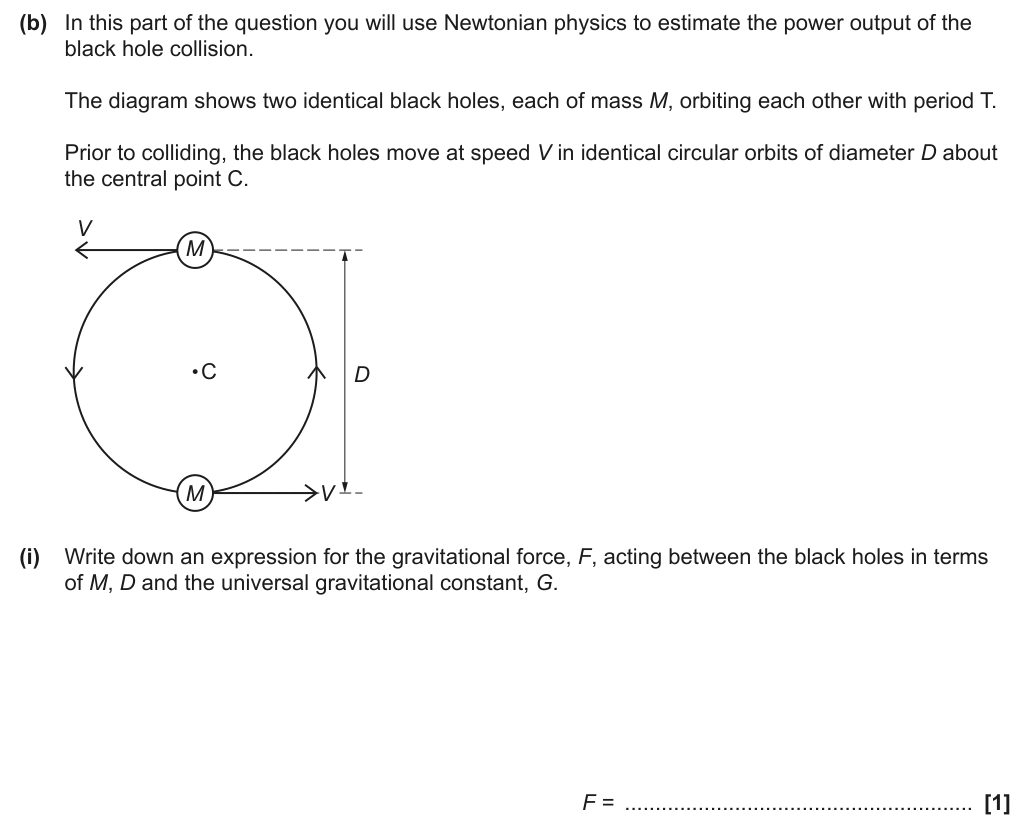
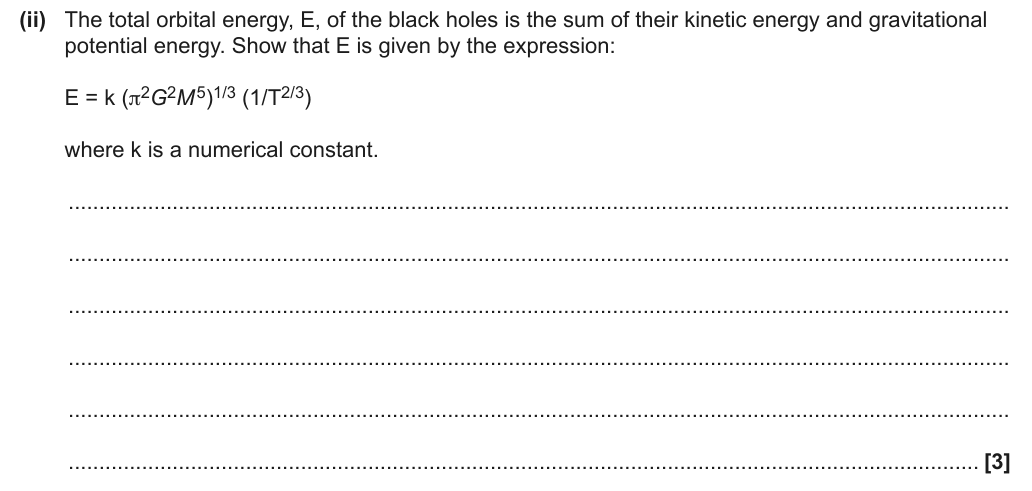
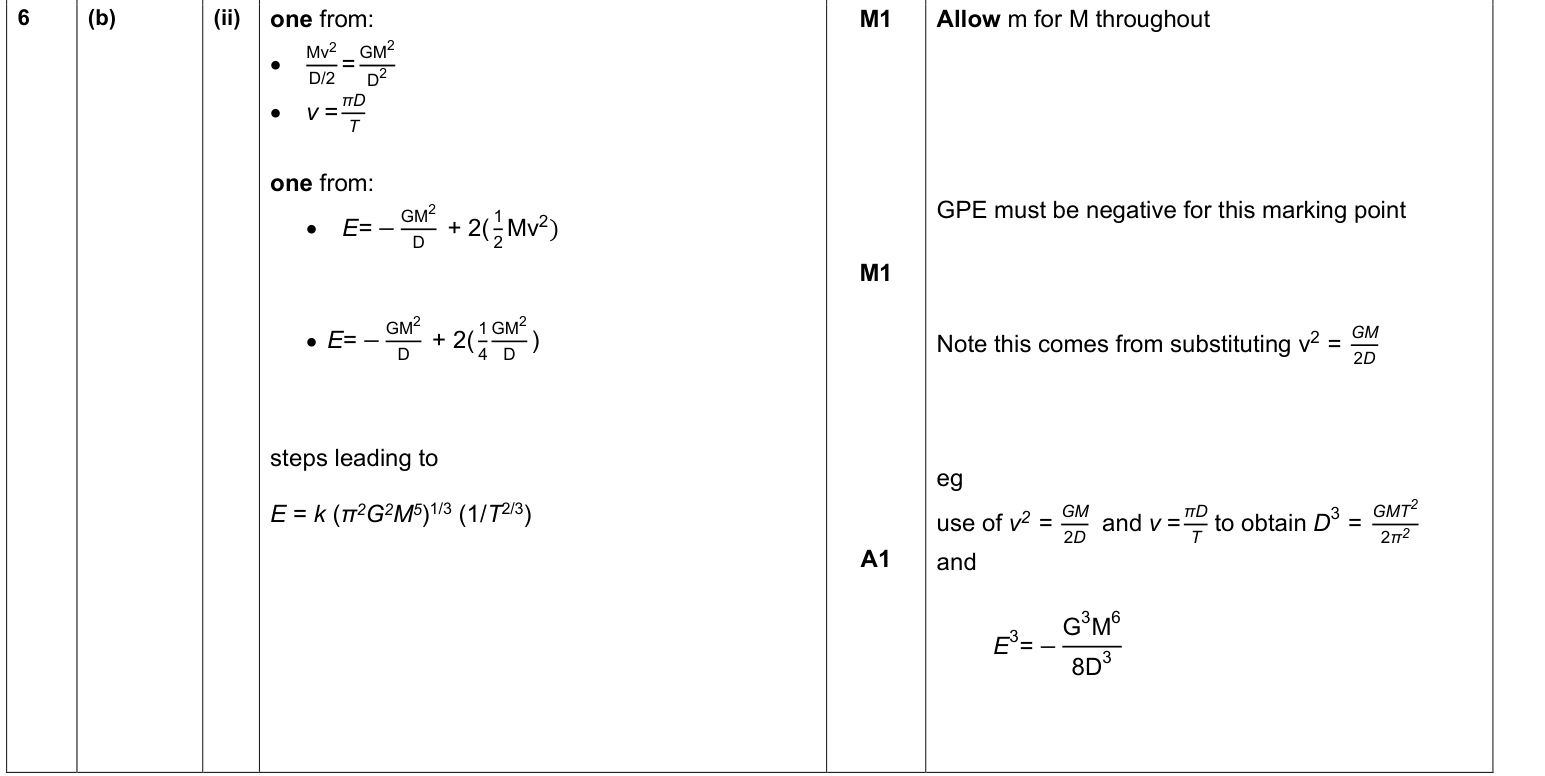
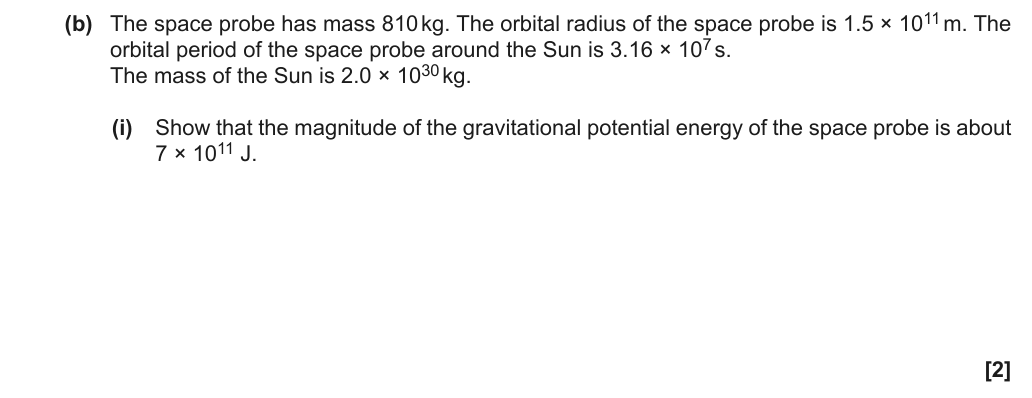
June 2025 · Paper 3 · Q6(b)(ii)3 marksShow thatMedium
Earlier part of question 6 that this part uses
Mark scheme
Examiner's comment
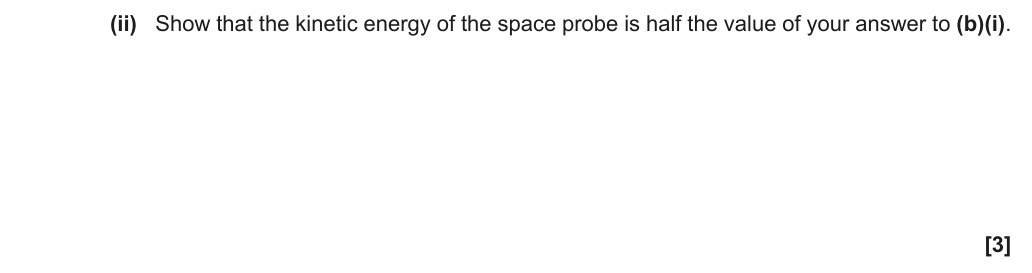
This derivation was designed to challenge the highest scoring candidates although the first two marking points were accessible to students across the mark range. Common issues • omitting the − sign from GPE • using r instead of D in equations • attempting to use Kepler’s laws rather than gravitational potential energy and kinetic energy equations.
Notes from the mark scheme and report
GPE must be negative
radius of each orbit is D/2 and v = πD/T
Skills: M0.5 Use calculators to find and use power, exponential and logarithmic functions; M2.2 Change the subject of an equation, including non-linear equations; M2.4 Solve algebraic equations, including quadratic equations
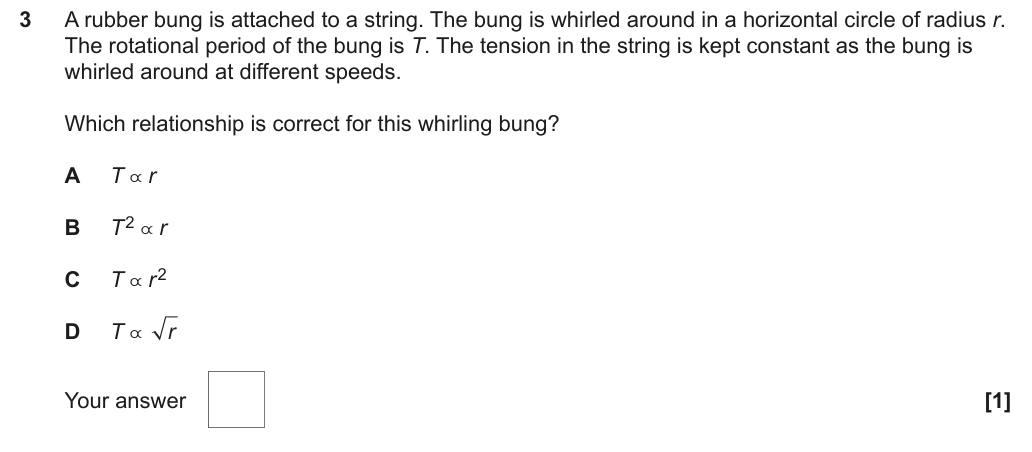
June 2024 · Paper 1 · Q31 markMultiple choiceMedium
Answer
B and D
Mark scheme
Examiner's comment
Many candidates used their knowledge of circular motion to select either option B or option D, both of which were acceptable, being mathematically equivalent.
Notes from the mark scheme and report
B and D are mathematically equivalent
OCR accepted either
Skills: M2.2 Change the subject of an equation, including non-linear equations
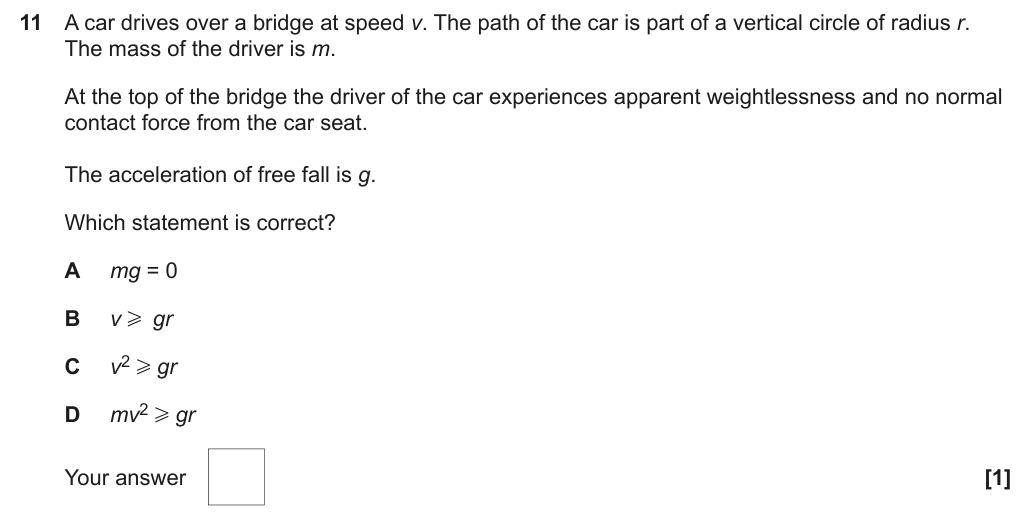
June 2024 · Paper 1 · Q111 markMultiple choiceMedium
Answer
C
Mark scheme
Examiner's comment
The condition for circular motion is that the centripetal force is equal to the resultant force. In this case, the resultant force is the weight - normal contact force so W - R = m v2 / r. The person leaves the seat when R ≤ 0. When rearranged with W = mg gives the correct answer C.
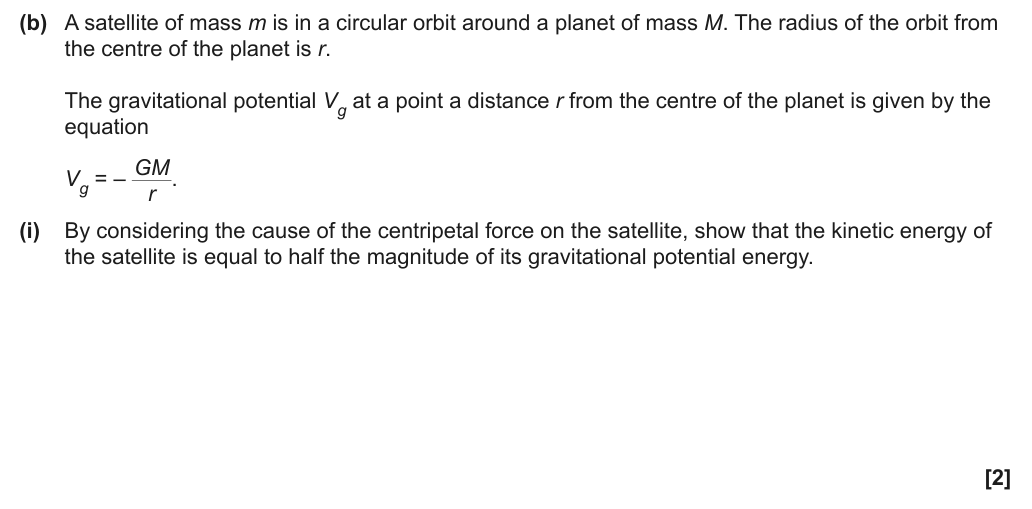
June 2024 · Paper 1 · Q22(b)(i)2 marksShow thatMedium
Mark scheme
Examiner's comment
Many candidates made a good start by equating the formula for gravitational force with the expression for centripetal motion. Others that assumed that g of 9.81 m s-2 did not score any marks. The simplest way to arrive at the correct expression was to identify GM/r in the gravitational force formula, to rearrange and then multiply both sides by ½. Approximately ½ of all candidates that responded got as far as this gaining both marks.
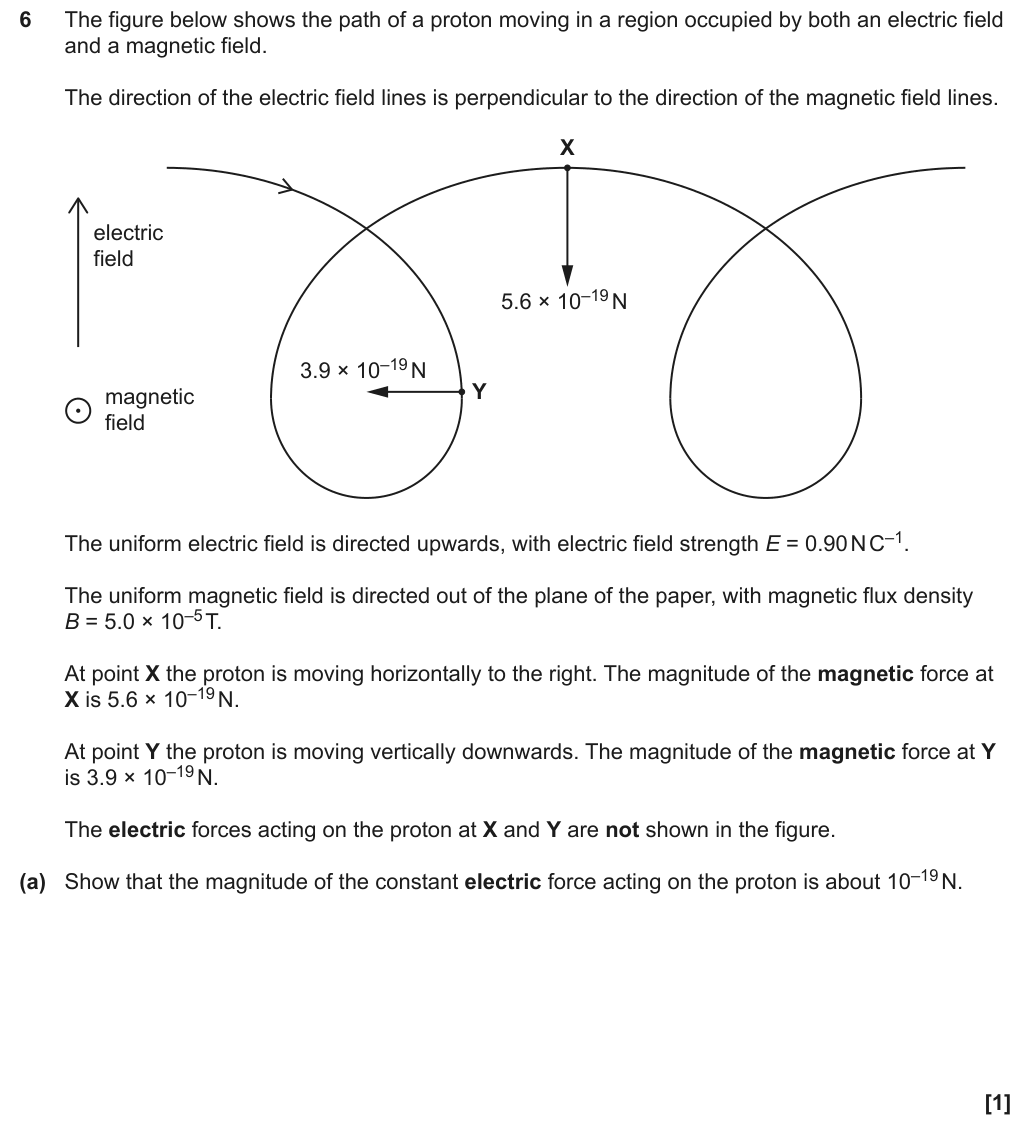
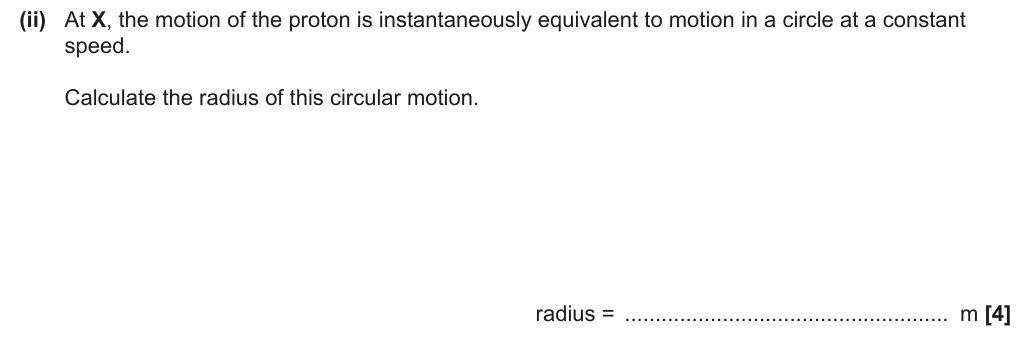
June 2024 · Paper 3 · Q6(b)(ii)4 marksCalculationMedium
Earlier part of question 6 that this part uses
Mark scheme
Examiner's comment
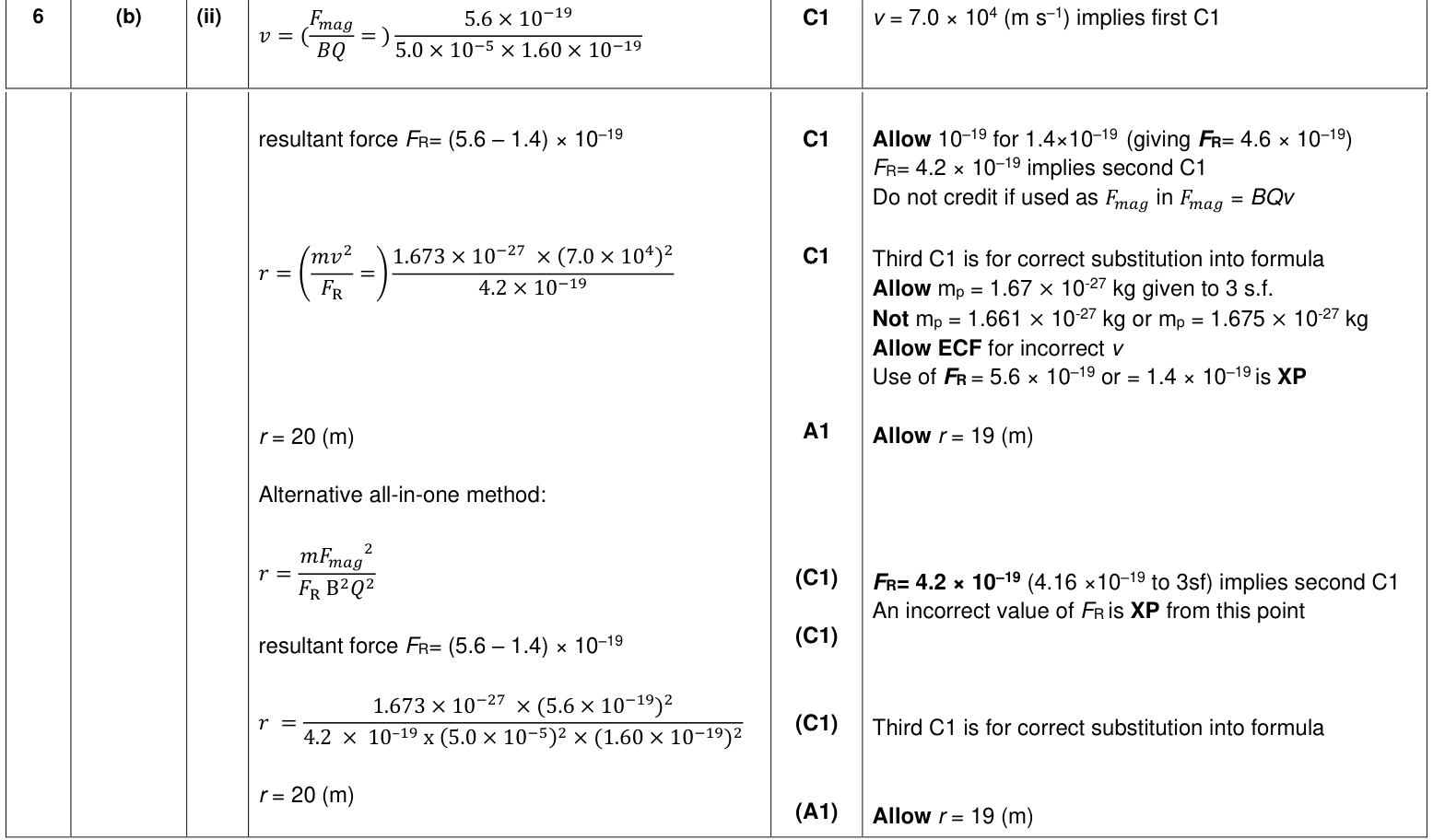
This question could not be done in one step, by equating the magnetic force to the centripetal force. This is because, at X, the centripetal force is being provided by a combination of forces from both the electric and the magnetic field. The easiest approach is to find the velocity of the proton using Fmag = BQv (the value for Fmag is given in the diagram as 5.6 x 10¹⁹ N). This velocity v can then be used in the formula F = mv2/r in order to calculate the radius, r. F here is the resultant force towards the centre of the circle, which is found from magnetic force downwards – electric force upwards (the electric force having been calculated in part (a)).
Notes from the mark scheme and report
resultant force (5.6 − 1.4) x 10⁻¹⁹ N must be used
using 5.6 x 10⁻¹⁹ or 1.4 x 10⁻¹⁹ as the centripetal force scores no further marks
Not proton mass 1.661 or 1.675 x 10⁻²⁷ kg
Skills: M0.2 Recognise and use expressions in decimal and standard form; M2.2 Change the subject of an equation, including non-linear equations; M2.3 Substitute numerical values into algebraic equations using appropriate units for physical quantities
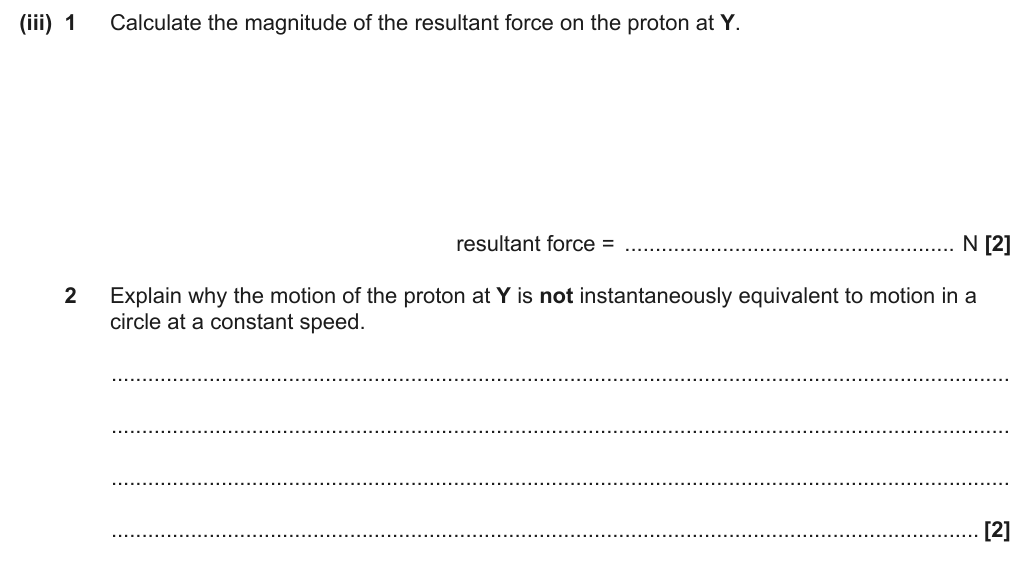
June 2024 · Paper 3 · Q6(b)(iii)4 marksCalculationMedium
Earlier part of question 6 that this part uses
Mark scheme
Examiner's comment
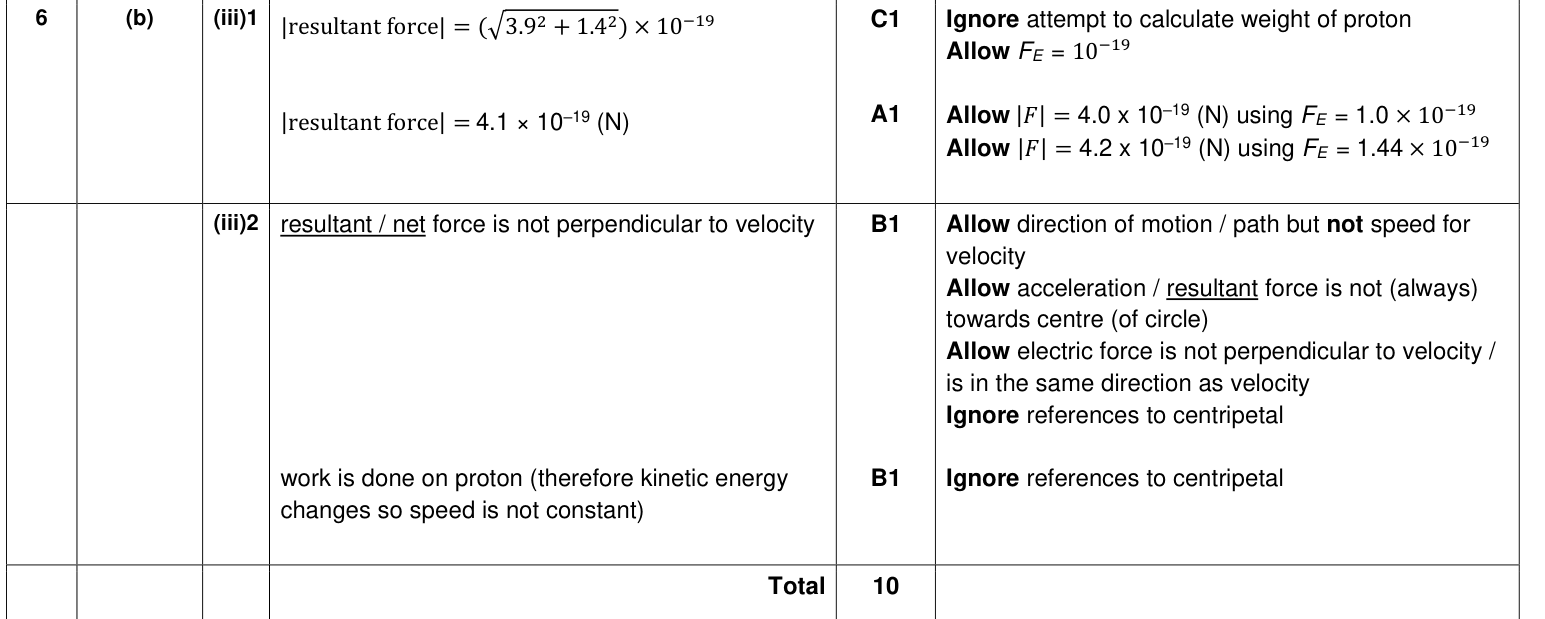
There are two forces acting on the proton at Y: an electric force upwards (given in (a)) and a magnetic force to the left (shown on the diagram). These two forces act at right angles to each other, and so the magnitude of their resultant can be found using Pythagoras’s Theorem. Credit was given for using a value for the electric force to 1, 2 or more significant figures. At Y, the proton is moving downwards, with a resultant force being the combination of an electric force upwards and a magnetic force to the left (calculated in part 1). The resultant force cannot be at right angles to the velocity, so we cannot have circular motion. The component of the resultant force acting in the direction of the proton’s motion will do work on the proton and change its speed. So, the proton cannot be travelling at a constant speed.
Notes from the mark scheme and report
ignore references to centripetal
allow 4.0 to 4.2 x 10⁻¹⁹ N
Skills: M4.4 Use Pythagoras’ theorem, and the angle sum of a triangle
June 2023 · Paper 1 · Q111 markMultiple choiceMedium
Answer
D
Mark scheme
Examiner's comment
The question is asking for the candidate to calculate the speed of an object in a circular orbit with radius 42 400 km, i.e. 42.4 × 10⁶ m. To do this, the candidate equates the gravitational force, FG = GMm/r2. with the centripetal force required for that orbit, FC = mv2/r, where M is the mass of the Earth and m is the mass of the satellite. Rearranging gives v = √GM/r. Substituting the correct values for G, M and r will give answer D.
June 2023 · Paper 1 · Q17(a)(iv)2 marksShow thatHard
Earlier parts of question 17 that this part uses
Mark scheme
Examiner's comment
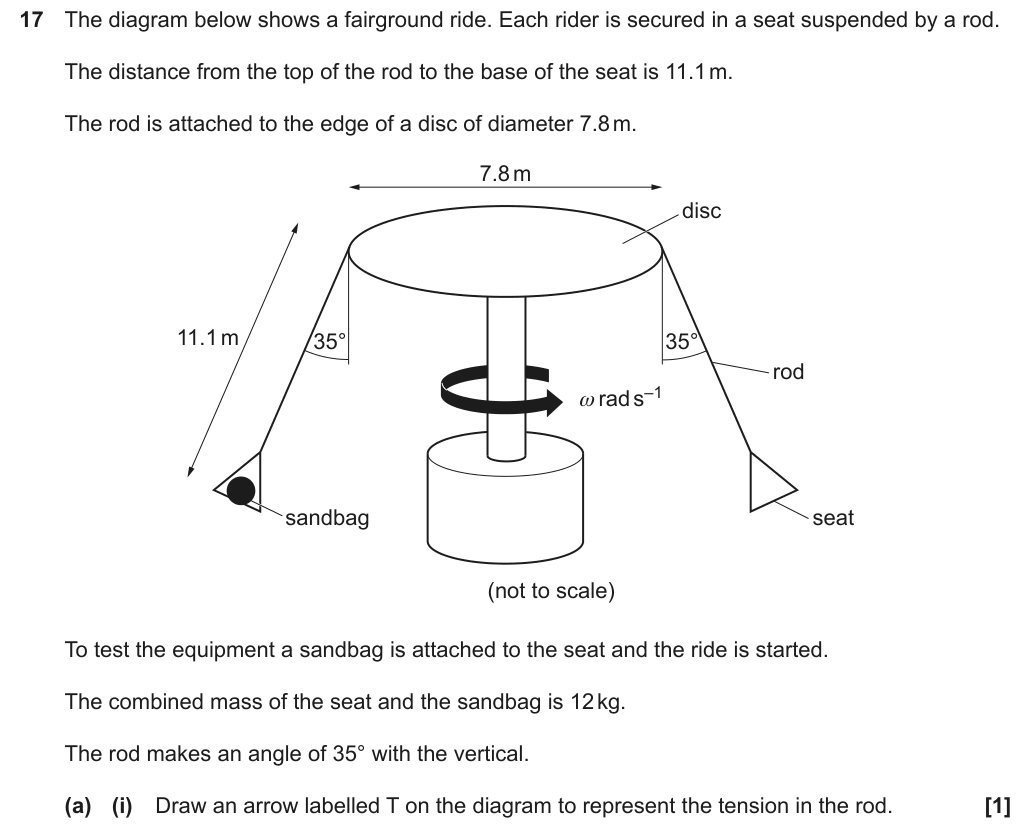
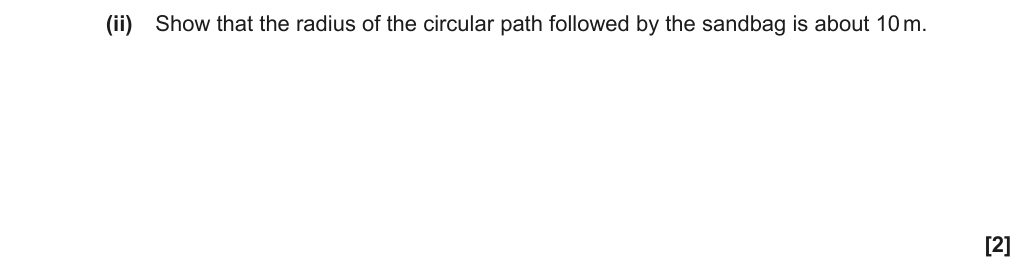
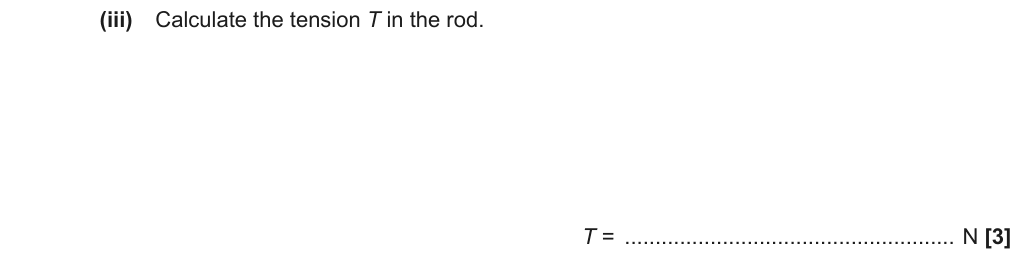
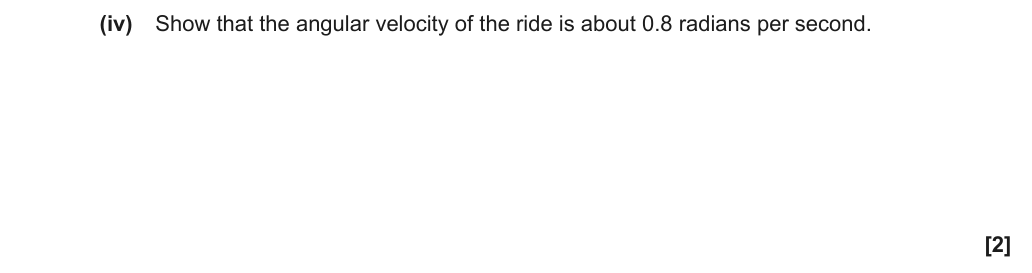
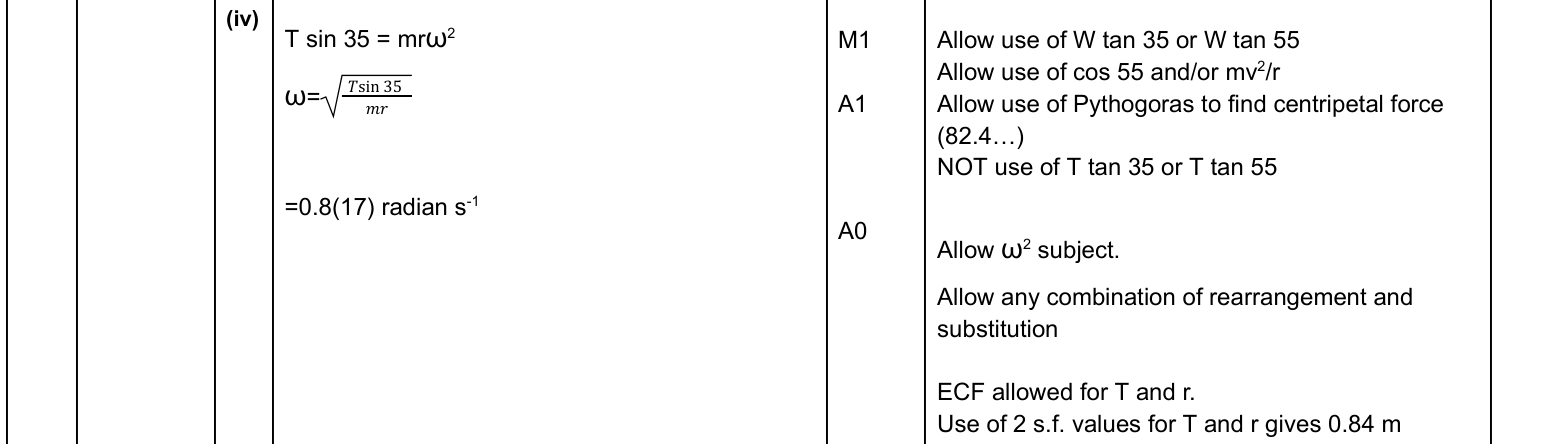
In Question 17 (a) (i) of this question, the phrase ‘tension in the rod’ can mean several different things, all of which were given in the mark scheme. Many candidates approached part (ii) with some confidence, spotting that the horizontal portion of the rod was 11.1 sin(35) and that it should be added to the radius of the disc. Parts (a) (iii) and (iv) were more challenging, requiring good knowledge of both circular motion and how to calculate components of forces. Again there were several legitimate routes to the right answer, all of which were mentioned in the mark scheme. Very logical approaches were in part (a) (iii), to equate the vertical component of the tension with the weight of the sandbag. In part (a) (iv), the quickest approach was to equate the horizontal component of the tension with the centripetal force. The data booklet provides a convenient expression for the centripetal force in terms of the angular velocity, without the need for finding the tangential velocity.
Notes from the mark scheme and report
NOT use of T tan 35 or T tan 55
allow W tan 35
ecf for T and r
Skills: M0.6 Use calculators to handle sin x, cos x and tan x when x is expressed in degrees or radians; M2.2 Change the subject of an equation, including non-linear equations; M2.3 Substitute numerical values into algebraic equations using appropriate units for physical quantities
June 2023 · Paper 1 · Q17(b)(ii)3 marksCalculationMedium
Earlier parts of question 17 that this part uses
Mark scheme
Examiner's comment
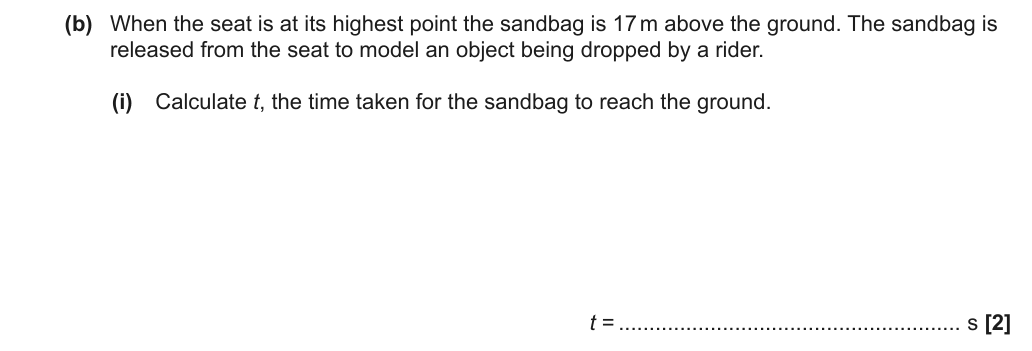
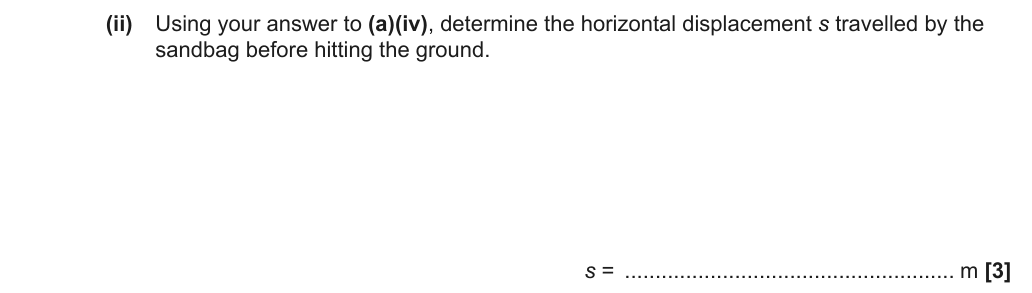
Question 17 (b) explored ideas about parabolic flight due to gravitation. The only force acting on the sandbag and the shoe after they have been released is the weight force, which acts vertically downwards. Many candidates realised that the vertical velocity of the sandbag when it left the swing was zero, enabling them to calculate the time for the bag to fall 17m vertically downwards (using s = ½gt2) To calculate the horizontal distance travelled required both the horizontal velocity (from v = rω) and the time of flight from part (b) (iii). There was lots of scope for applying error carried forward rules as mentioned in the mark scheme.
Notes from the mark scheme and report
stem values (0.8 and 10) allowed, giving 15.2 m
14.9 to 16.0 m
Skills: M2.3 Substitute numerical values into algebraic equations using appropriate units for physical quantities
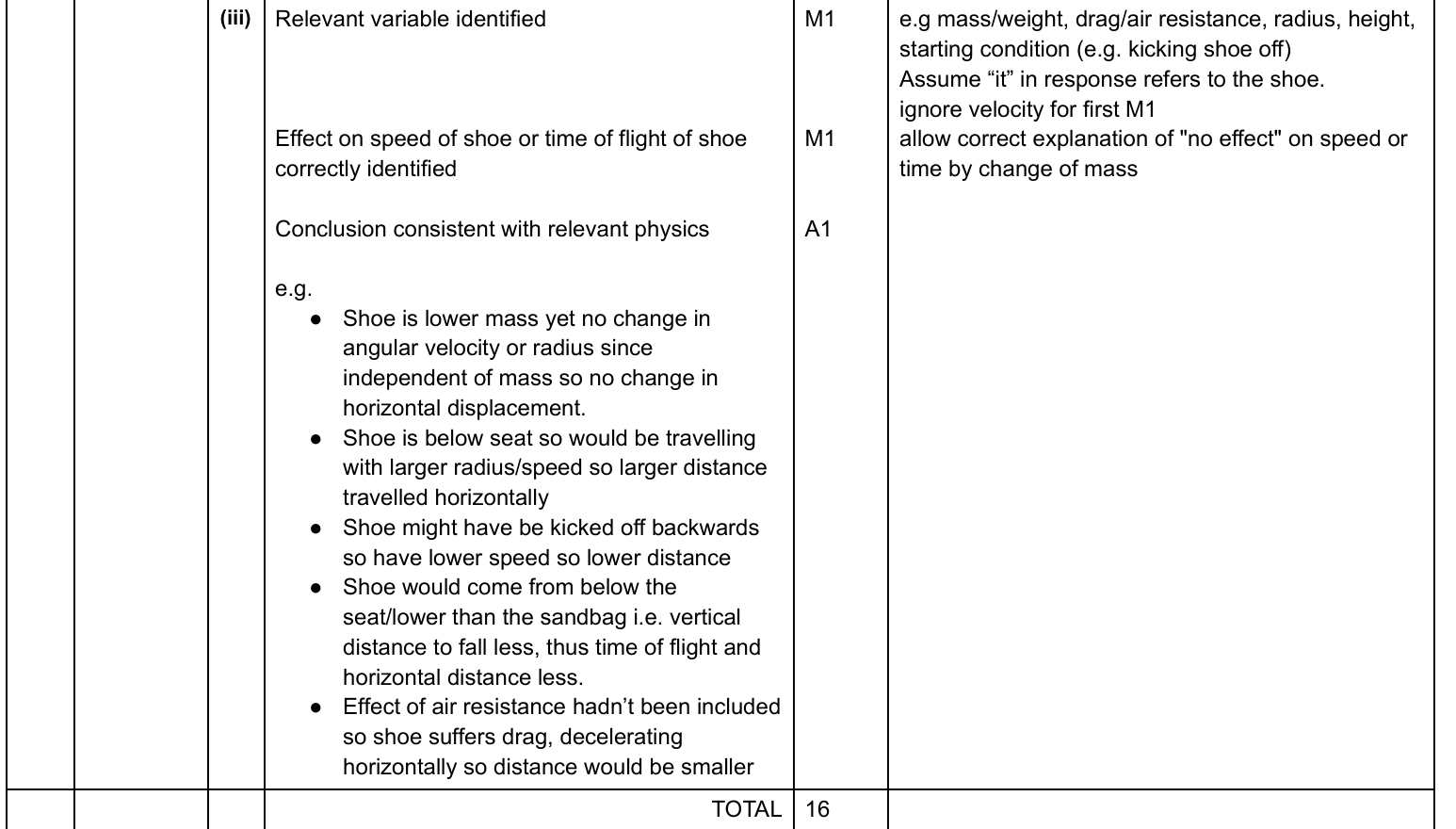
June 2023 · Paper 1 · Q17(b)(iii)3 marksCalculationMedium
Earlier part of question 17 that this part uses
Mark scheme
Examiner's comment
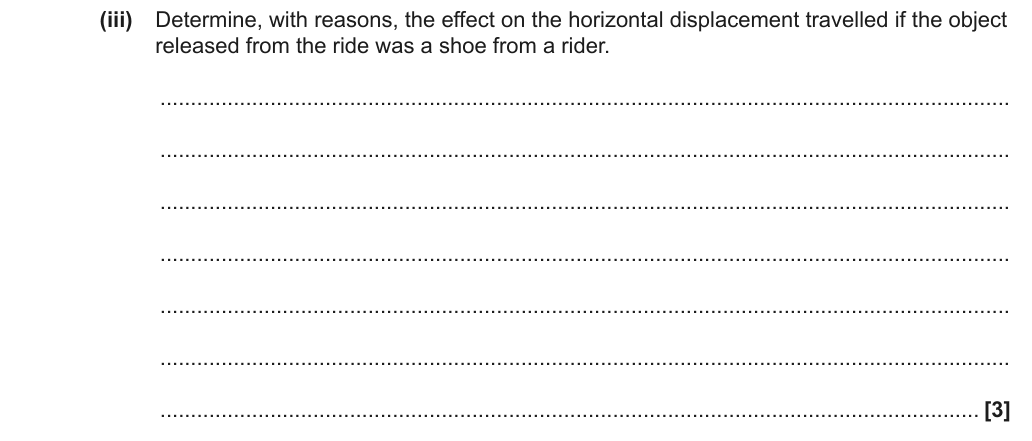
Question 17 (b) explored ideas about parabolic flight due to gravitation. The only force acting on the sandbag and the shoe after they have been released is the weight force, which acts vertically downwards. Many candidates realised that the vertical velocity of the sandbag when it left the swing was zero, enabling them to calculate the time for the bag to fall 17m vertically downwards (using s = ½gt2) To calculate the horizontal distance travelled required both the horizontal velocity (from v = rω) and the time of flight from part (b) (iii). There was lots of scope for applying error carried forward rules as mentioned in the mark scheme.
Notes from the mark scheme and report
relevant variable must be identified (mass, drag, radius, height, starting condition)
ignore velocity for the first M1
no effect of mass allowed with correct explanation
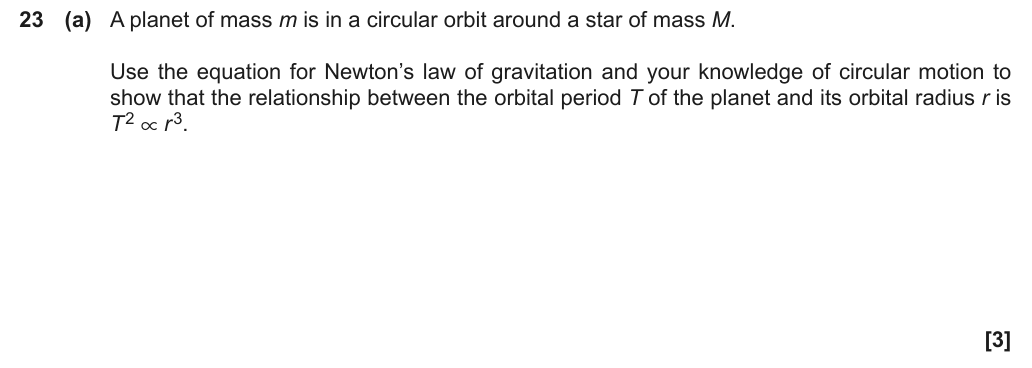
June 2022 · Paper 1 · Q23(a)3 marksShow thatEasy
Mark scheme
Examiner's comment
The demonstration of Kepler’s 3rd Law was well-remembered by the vast majority of candidates.
Notes from the mark scheme and report
must state 4π²/GM is constant
Skills: M2.2 Change the subject of an equation, including non-linear equations
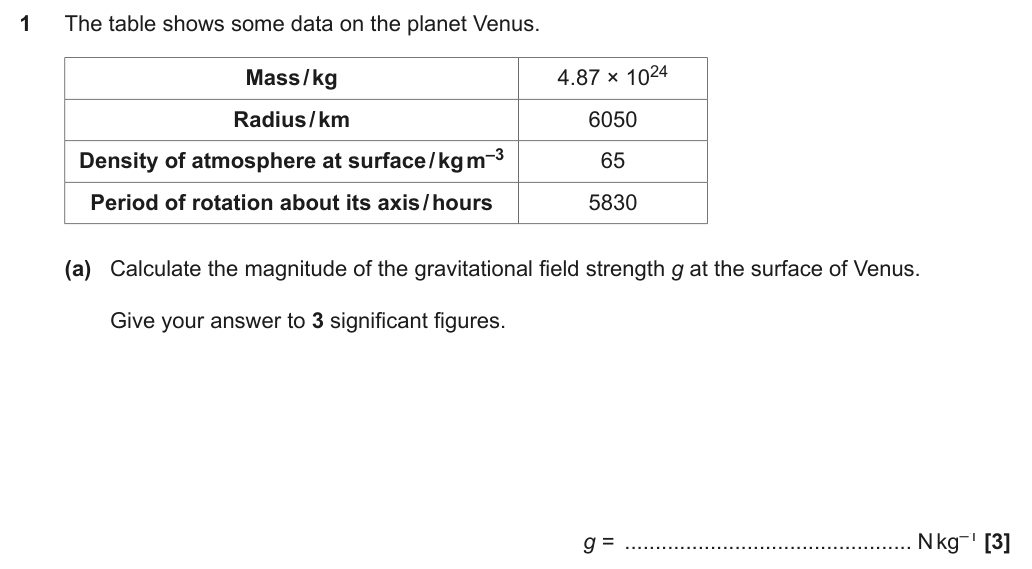
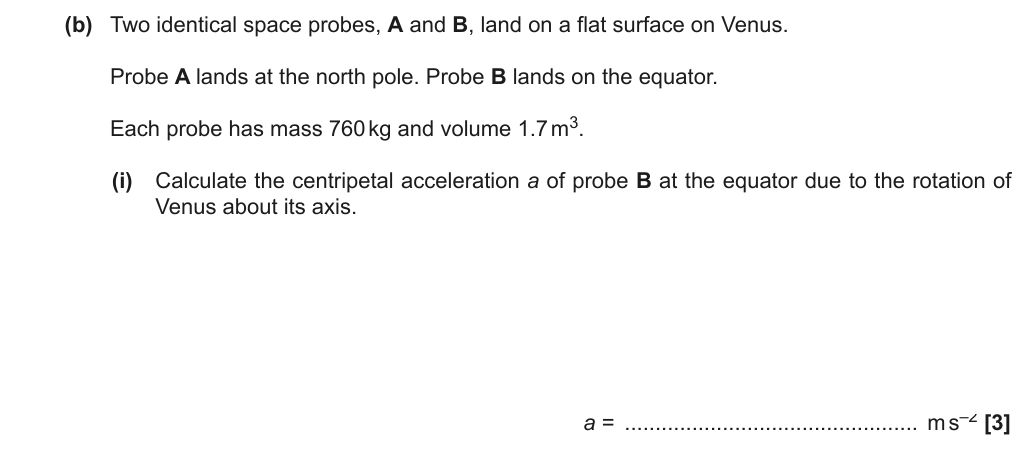
June 2022 · Paper 3 · Q1(b)(i)3 marksCalculationMedium
Earlier part of question 1 that this part uses
Mark scheme
Examiner's comment
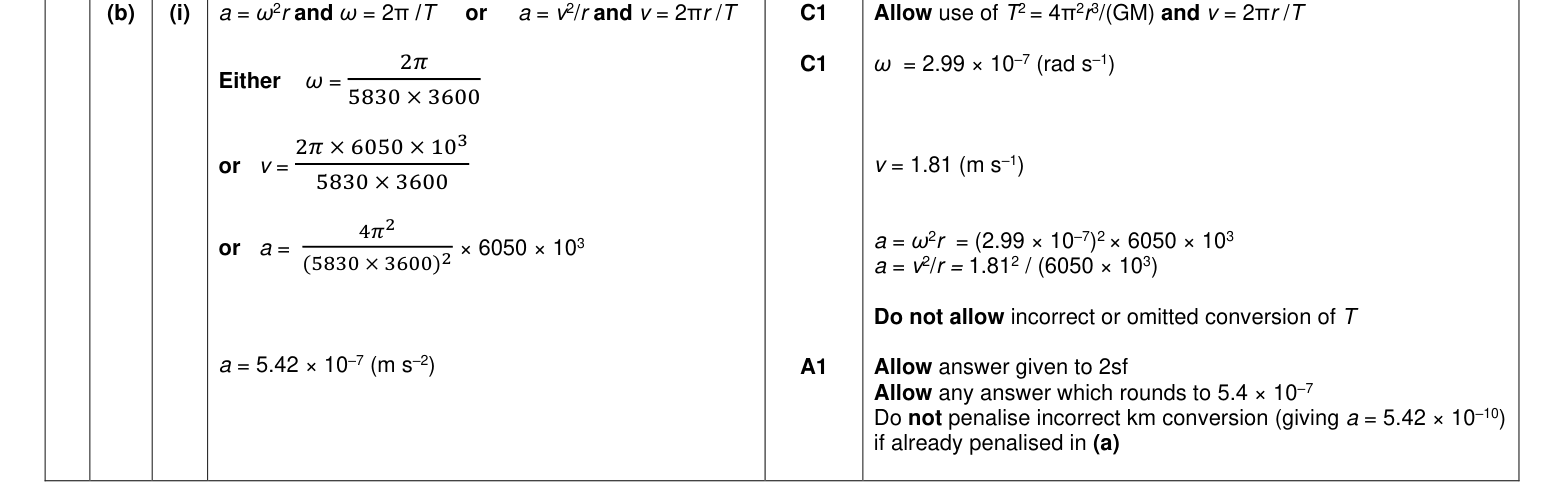
A slightly harder question, requiring the use of two formulas (either a = ω2r and ω = 2π /T, or a = v2/r and v = 2πr /T). Some marks were available for calculating either ω or v correctly. Common problems in 1(b)(i) • omitting to convert T from hours to seconds, or converting T incorrectly • omitting to convert r from km to m and so incurring a POT error
Notes from the mark scheme and report
incorrect or omitted conversion of T not allowed
km error not penalised again if penalised in (a)
Skills: M0.1 Recognise and make use of appropriate units in calculations; M0.2 Recognise and use expressions in decimal and standard form; M2.3 Substitute numerical values into algebraic equations using appropriate units for physical quantities
June 2022 · Paper 3 · Q1(b)(iii)3 marksExplanationMedium
Earlier parts of question 1 that this part uses
Mark scheme
Examiner's comment
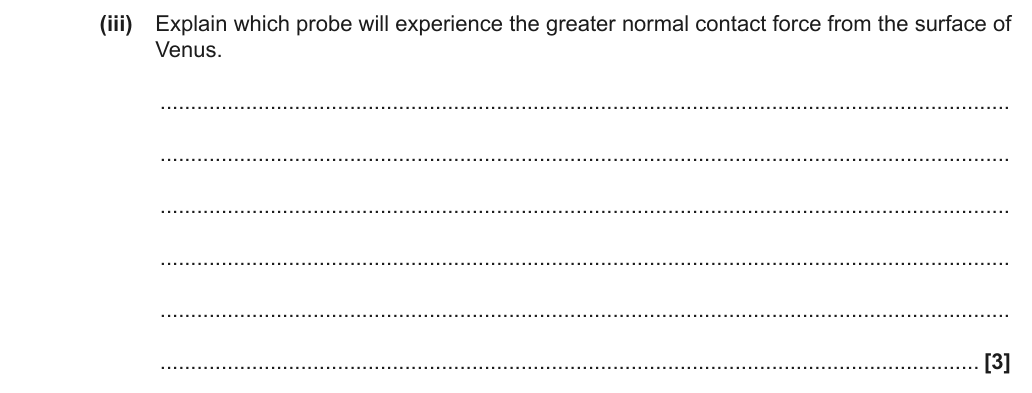
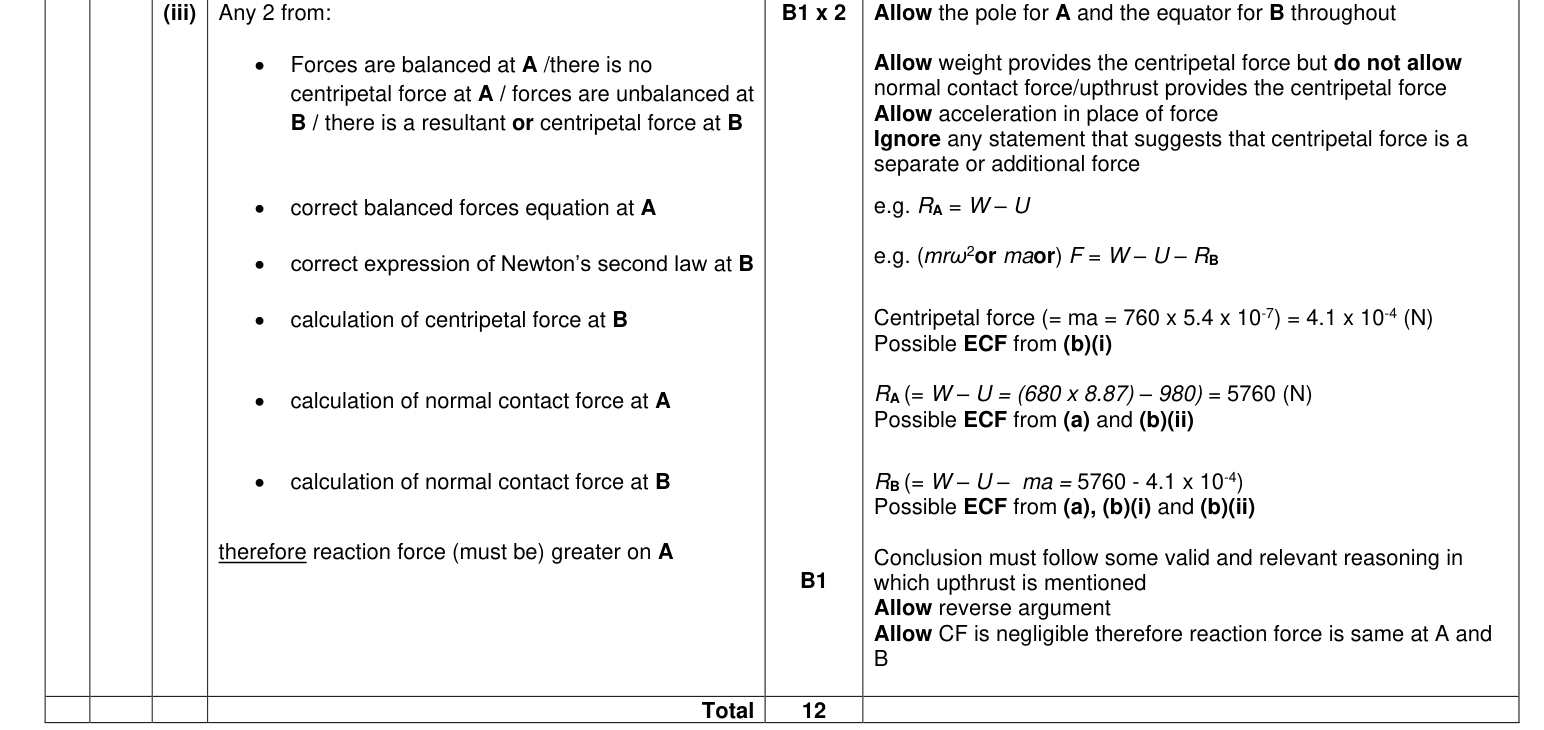
Candidates often struggle to demonstrate a clear understanding of circular motion, and this year was no exception. Most candidates understood that probe B on the equator was acted on by centripetal force whereas probe A at the pole was not. However, some thought that the centripetal force acted outwards, away from the surface. Many thought that the centripetal force was a separate force acting on probe B in addition to its weight. These candidates wrongly concluded that this would increase the force towards the centre, resulting in an increased normal contact force. Whereas the opposite is actually the case; part of the probe’s weight must be used to provide the centripetal force, and so the normal contact force would be smaller. A very common mistake was to ignore the effect of upthrust acting on the probe. Although the upthrust would be the same both at the equator and at the pole, it was worth a mention. Upthrust = 980N (from b(ii)) whereas the centripetal force was only 760 × 5.42 × 10–7N (from b(i)).
Notes from the mark scheme and report
greater on A (pole)
do not allow contact force or upthrust 'provides' the centripetal force
conclusion must follow reasoning that mentions upthrust
Ignore centripetal force treated as an extra force
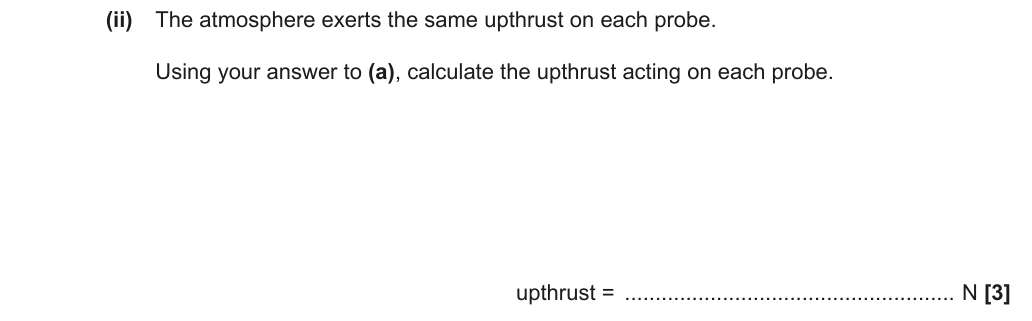
The author of the examination paper structures questions to support candidates in writing their responses. 1(b)(i) is a calculation of the centripetal acceleration and 1(b)(ii) is a calculation of the upthrust. These provide a logical progression to 1(b)(iii) which involves both centripetal acceleration and upthrust (and not, say, the shape of Venus or its magnetic field).
November 2021 · Paper 1 · Q20(b)6 marks6-mark extended responseEasy
Mark scheme, with the levels and indicative content
Examiner's comment
Common misconceptions Almost all candidates forgot that Gravitational Potential Energy is negative in Q20(b).
Notes from the mark scheme and report
total energy must include the negative sign (-1.2 x 10^10 J)
algebraic route from GMm/r² = mv²/r gets full credit
Skills: M0.2 Recognise and use expressions in decimal and standard form; M2.3 Substitute numerical values into algebraic equations using appropriate units for physical quantities
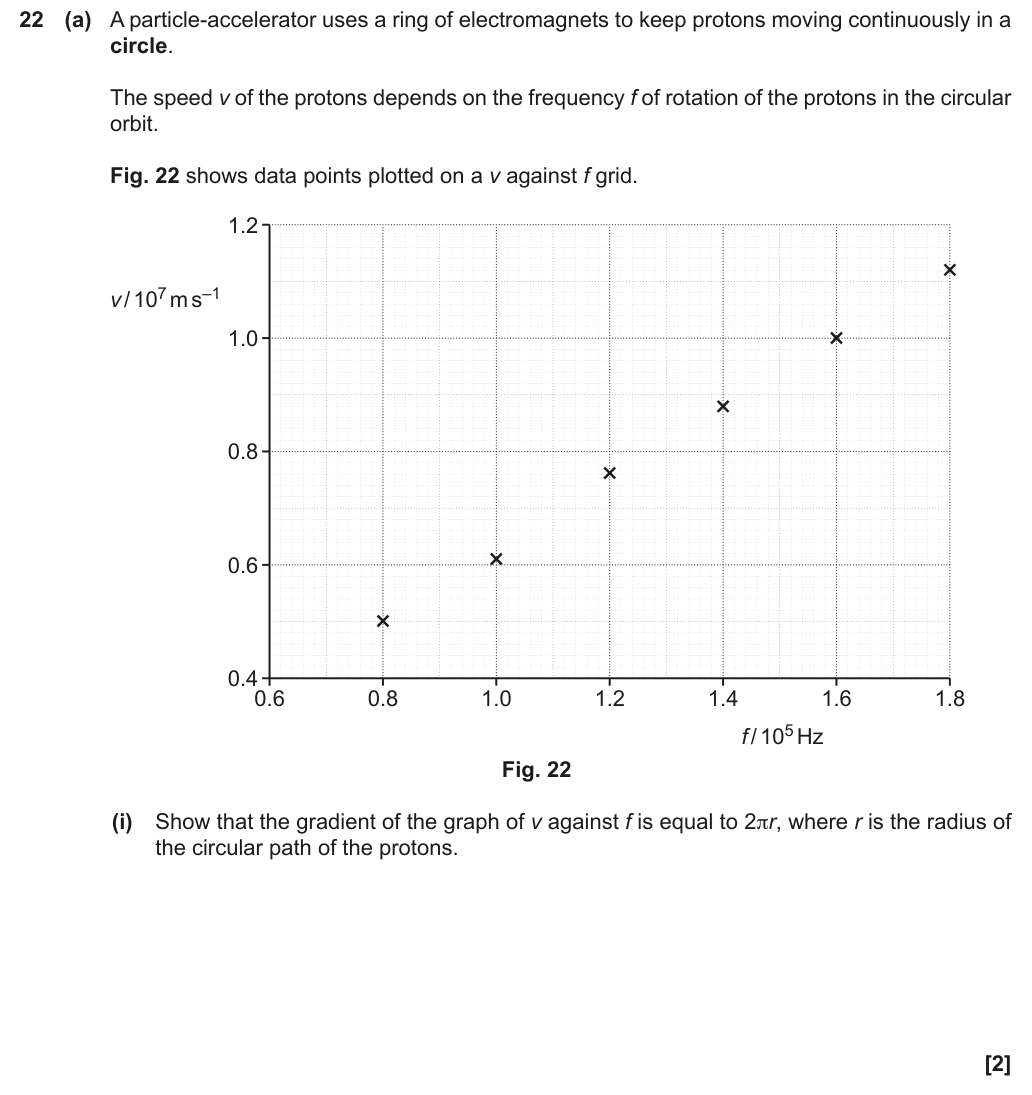
November 2021 · Paper 1 · Q22(a)(i)2 marksShow that
Mark scheme
Notes from the mark scheme and report
comparison with y = mx needed
Allow v/f = 2πr
Skills: M3.3 Understand that y = mx + c represents a linear relationship
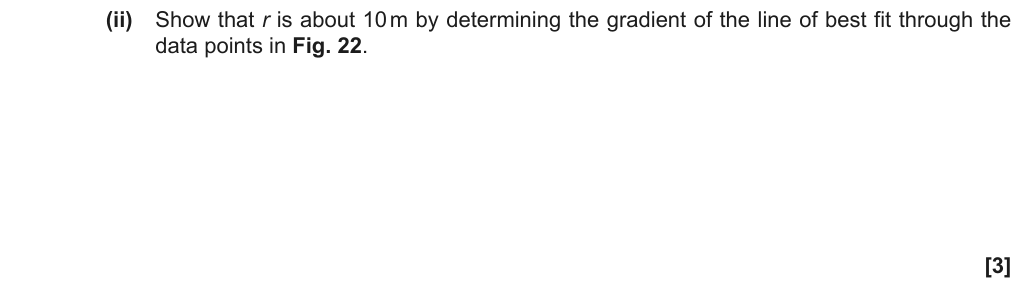
November 2021 · Paper 1 · Q22(a)(ii)3 marksShow that
Earlier part of question 22 that this part uses
Mark scheme
Notes from the mark scheme and report
line of best fit must be drawn
gradient 62.5 ± 3
Skills: M3.2 Plot two variables from experimental or other data; M3.4 Determine the slope and intercept of a linear graph
November 2021 · Paper 1 · Q22(a)(iii)3 marksCalculation
Earlier part of question 22 that this part uses
Mark scheme
Notes from the mark scheme and report
Allow candidate's r from (ii) or 10
Skills: M0.2 Recognise and use expressions in decimal and standard form; M2.3 Substitute numerical values into algebraic equations using appropriate units for physical quantities
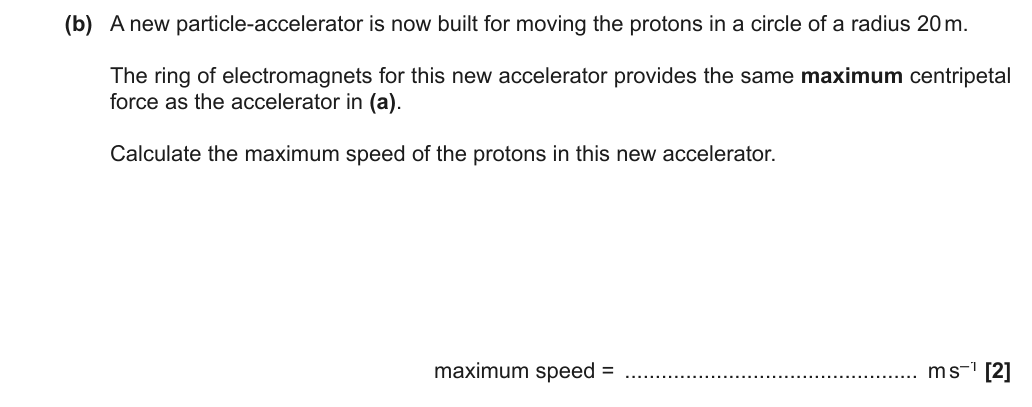
November 2021 · Paper 1 · Q22(b)2 marksCalculation
Earlier part of question 22 that this part uses
Mark scheme
Notes from the mark scheme and report
v ∝ √r for the same force, so speed increases by factor √2
Skills: M0.3 Use ratios, fractions and percentages; M2.2 Change the subject of an equation, including non-linear equations
November 2021 · Paper 3 · Q3(b)(ii)3 marksShow thatMedium
Earlier part of question 3 that this part uses
Mark scheme
Examiner's comment
Key teaching and learning point Question 3(b) was a question designed to test candidates’ knowledge that gravitational potential energy is always negative.
Notes from the mark scheme and report
v = 2πr/T then KE
algebraic proof (mv²/r = GMm/r²) allowed for full marks
Skills: M0.2 Recognise and use expressions in decimal and standard form; M2.3 Substitute numerical values into algebraic equations using appropriate units for physical quantities
November 2021 · Paper 3 · Q6(a)1 markExplanationMedium
Mark scheme
Examiner's comment
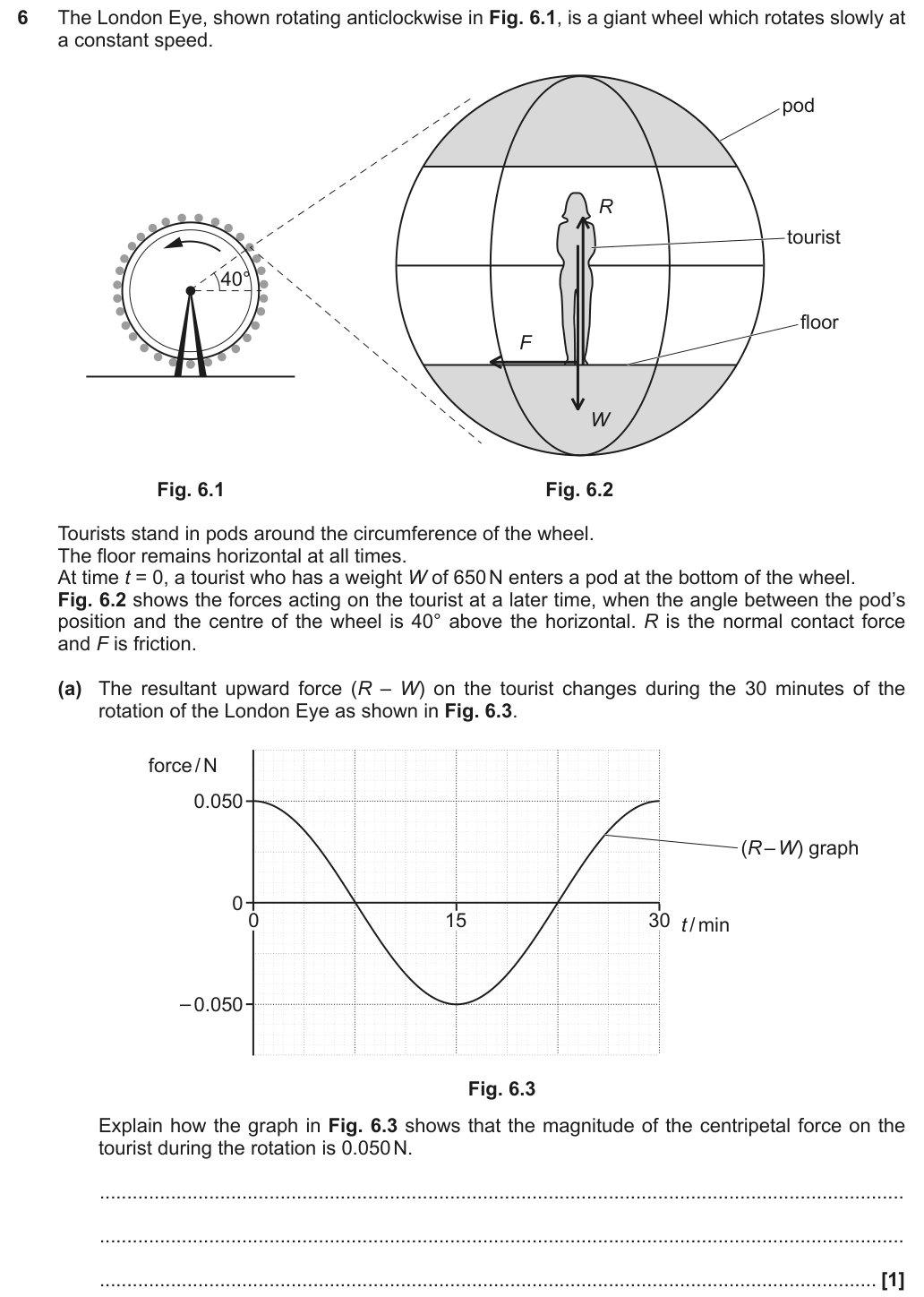
Common misconceptions Candidates often struggle to answer questions on circular motion, and Question 6 threw up the usual misconceptions. In Question 6, the two available forces are R – W, which acts vertically, and F, which acts horizontally.
Notes from the mark scheme and report
at t = 0 (bottom of the circle) only vertical forces act so R - W is the centripetal force
Skills: M3.1 Translate information between graphical, numerical and algebraic forms
November 2021 · Paper 3 · Q6(b)(i)2 marksExplanationMedium
Earlier part of question 6 that this part uses
Mark scheme
Examiner's comment
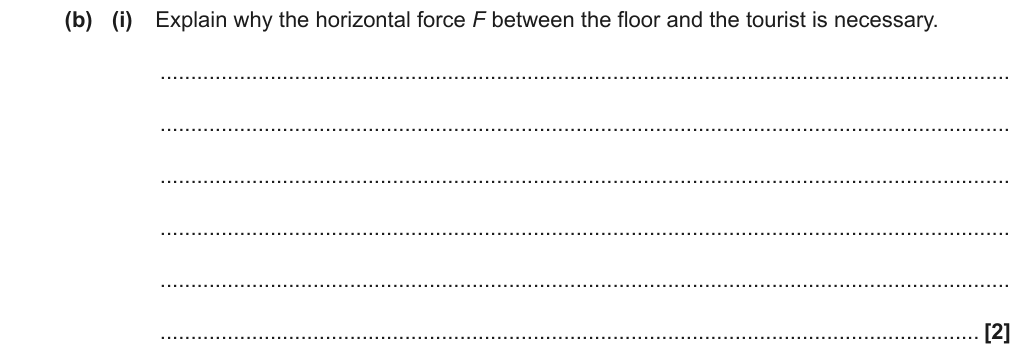
Common misconceptions Candidates often struggle to answer questions on circular motion, and Question 6 threw up the usual misconceptions. In Question 6, the two available forces are R – W, which acts vertically, and F, which acts horizontally.
Notes from the mark scheme and report
any two of three: resultant force always towards the centre
it is not always vertical
R and W are vertical so only friction F can provide the horizontal component
November 2021 · Paper 3 · Q6(b)(ii)4 marksDiagram or graphMedium
Earlier parts of question 6 that this part uses
Mark scheme
Examiner's comment
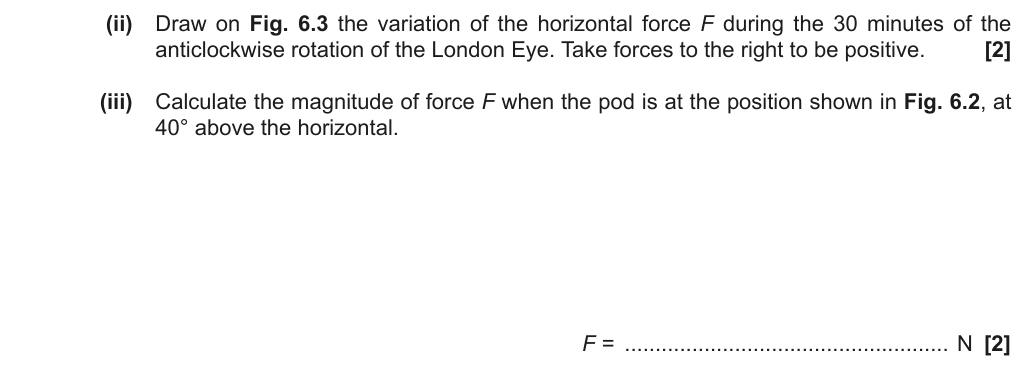
Common misconceptions Candidates often struggle to answer questions on circular motion, and Question 6 threw up the usual misconceptions. In Question 6, the two available forces are R – W, which acts vertically, and F, which acts horizontally.
Notes from the mark scheme and report
label covers (ii) and (iii): (ii) negative sine curve, amplitude 0.050 N, period 30 min, must start at the origin
(iii) F = 0.050 cos 40° = 0.038 N (ecf from graph if used)
Skills: M0.6 Use calculators to handle sin x, cos x and tan x when x is expressed in degrees or radians; M3.12 Sketch relationships which are modelled by y = k/x, y = kx², y = k/x², y = kx, y = sin x, y = cos x, y = e^(±x) and y = sin²x, y = cos²x as applied to physical relationships; M4.5 Use sin, cos and tan in physical problems
November 2021 · Paper 3 · Q6(c)3 marksCalculationMedium
Earlier part of question 6 that this part uses
Mark scheme
Examiner's comment
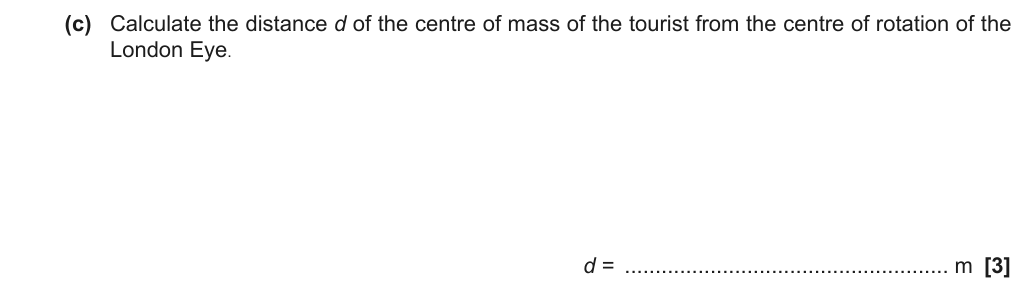
Common misconceptions Candidates often struggle to answer questions on circular motion, and Question 6 threw up the usual misconceptions. In Question 6, the two available forces are R – W, which acts vertically, and F, which acts horizontally.
Notes from the mark scheme and report
NOT m = 650 kg or 65 kg (m = 650 / 9.81)
ω from T = 30 min
Skills: M2.2 Change the subject of an equation, including non-linear equations; M2.3 Substitute numerical values into algebraic equations using appropriate units for physical quantities
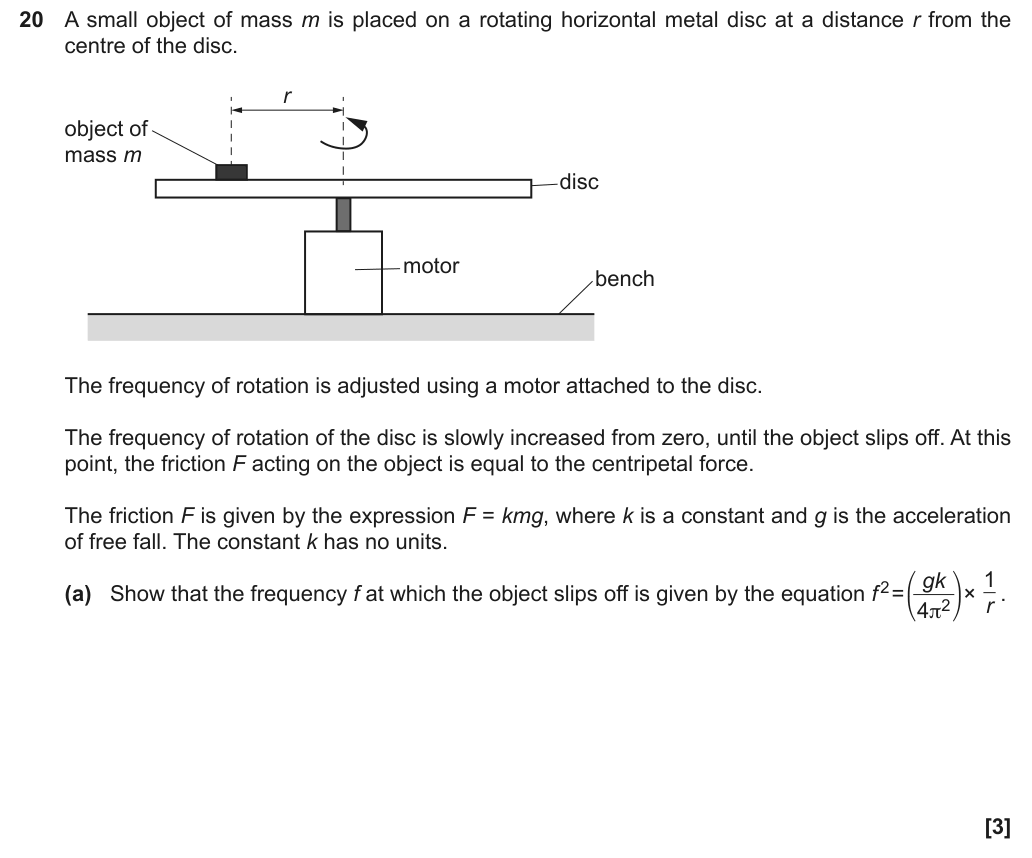
November 2020 · Paper 1 · Q20(a)3 marksShow that
Mark scheme
Notes from the mark scheme and report
allow F = mv²/r with v = 2πfr
algebra must be clear
Skills: M2.2 Change the subject of an equation, including non-linear equations
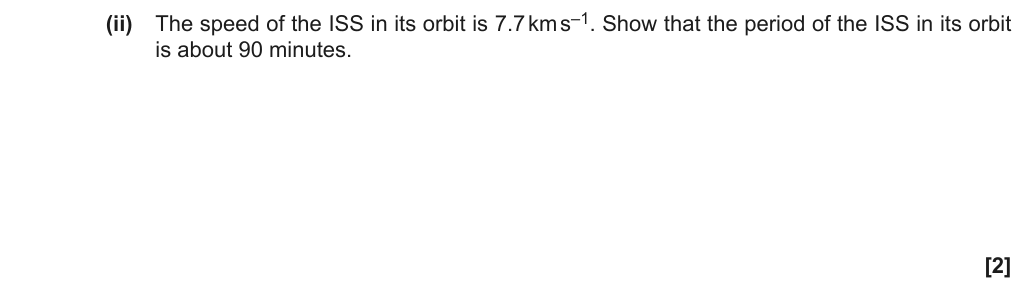
November 2020 · Paper 3 · Q4(b)(ii)2 marksShow thatMedium
Earlier part of question 4 that this part uses
Mark scheme
Examiner's comment
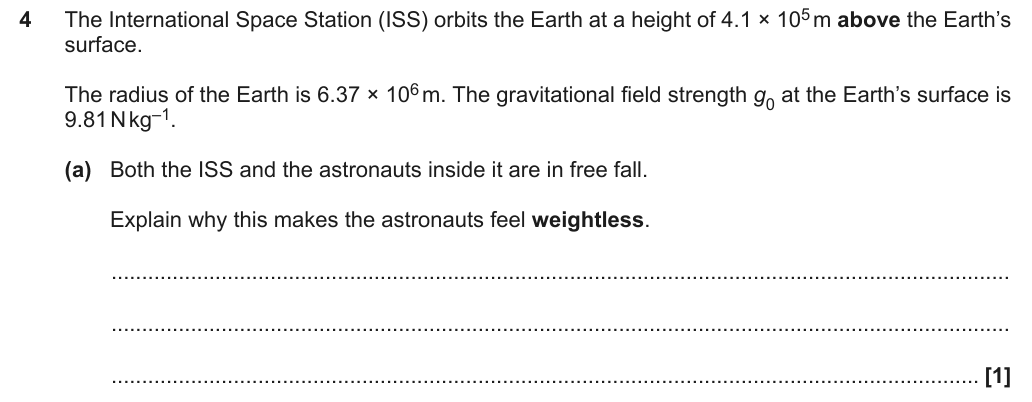
Question 4a Misconception Experiencing weightlessness is not the same as being in freefall There was a lack of understanding of the nature of feeling weightless. Question 4bi The simplest method here was to use the fact that g is inversely proportional to r2, so gr2 = constant. Question 4c The success in this question depended on understanding the meaning of the term m in the formula 2mc2 തതത = 3 2 kT given in the Data, Formulae and Relationship booklet. Question 4d Although this question looked daunting, it was actually quite linear and many candidates who attempted it were able to gain two or three marks even if they did not eventually get to the correct response.
Notes from the mark scheme and report
ecf for incorrect orbital radius from (b)(i)
Skills: M0.1 Recognise and make use of appropriate units in calculations; M2.2 Change the subject of an equation, including non-linear equations; M2.3 Substitute numerical values into algebraic equations using appropriate units for physical quantities
June 2019 · Paper 3 · Q4(b)(i)2 marksCalculationHard
Earlier part of question 4 that this part uses
Mark scheme
Examiner's comment
Question 4 (b) (ii) Question 4(b)(ii) proved very difficult and highlighted poor understanding of circular motion.
Notes from the mark scheme and report
Allow answer to 1 sf
Skills: M2.3 Substitute numerical values into algebraic equations using appropriate units for physical quantities
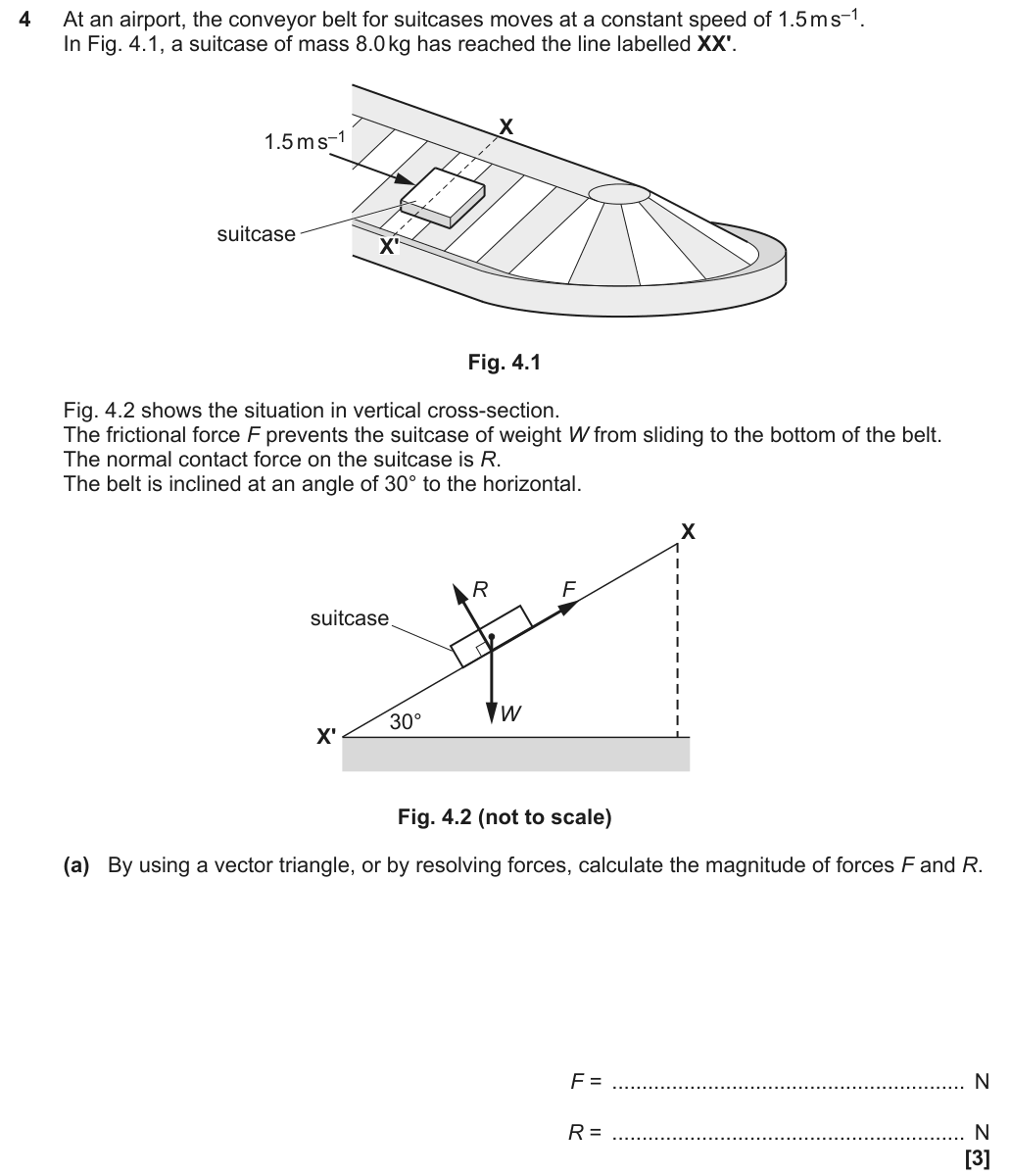
June 2019 · Paper 3 · Q4(b)(ii)4 marksExplanationMedium
Earlier parts of question 4 that this part uses
Mark scheme
Examiner's comment
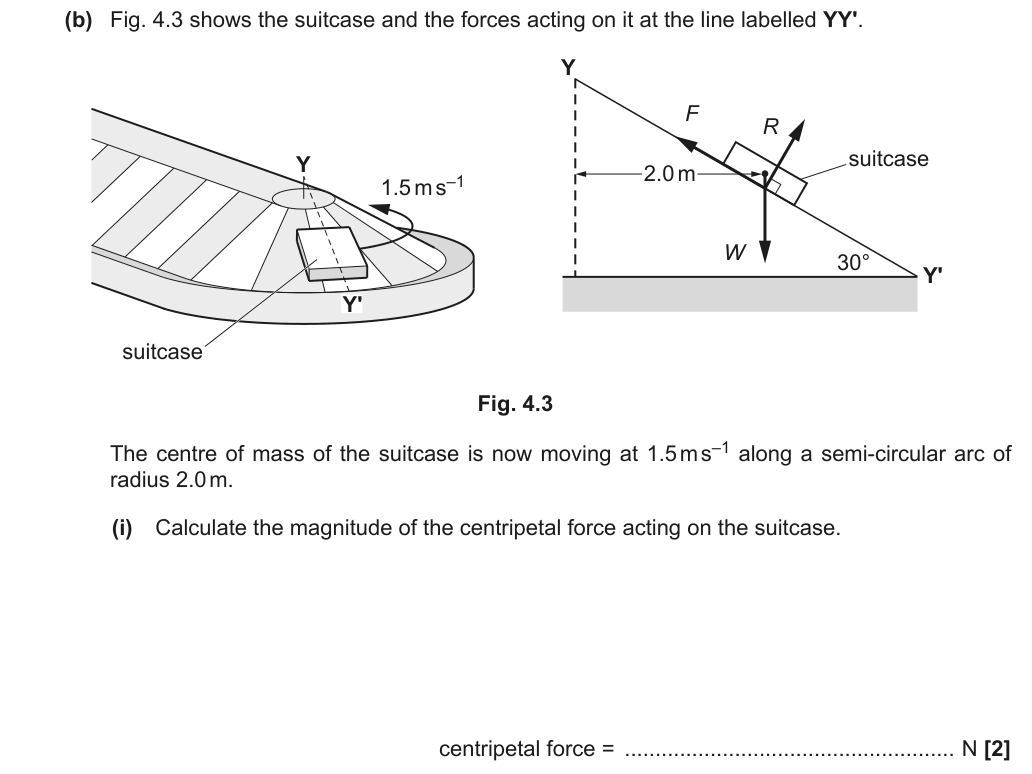
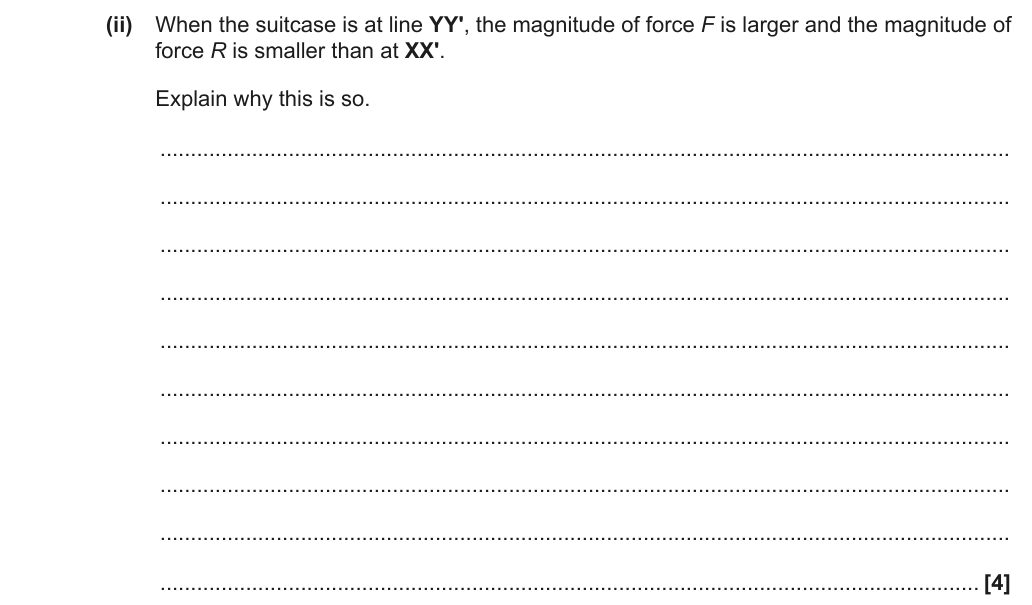
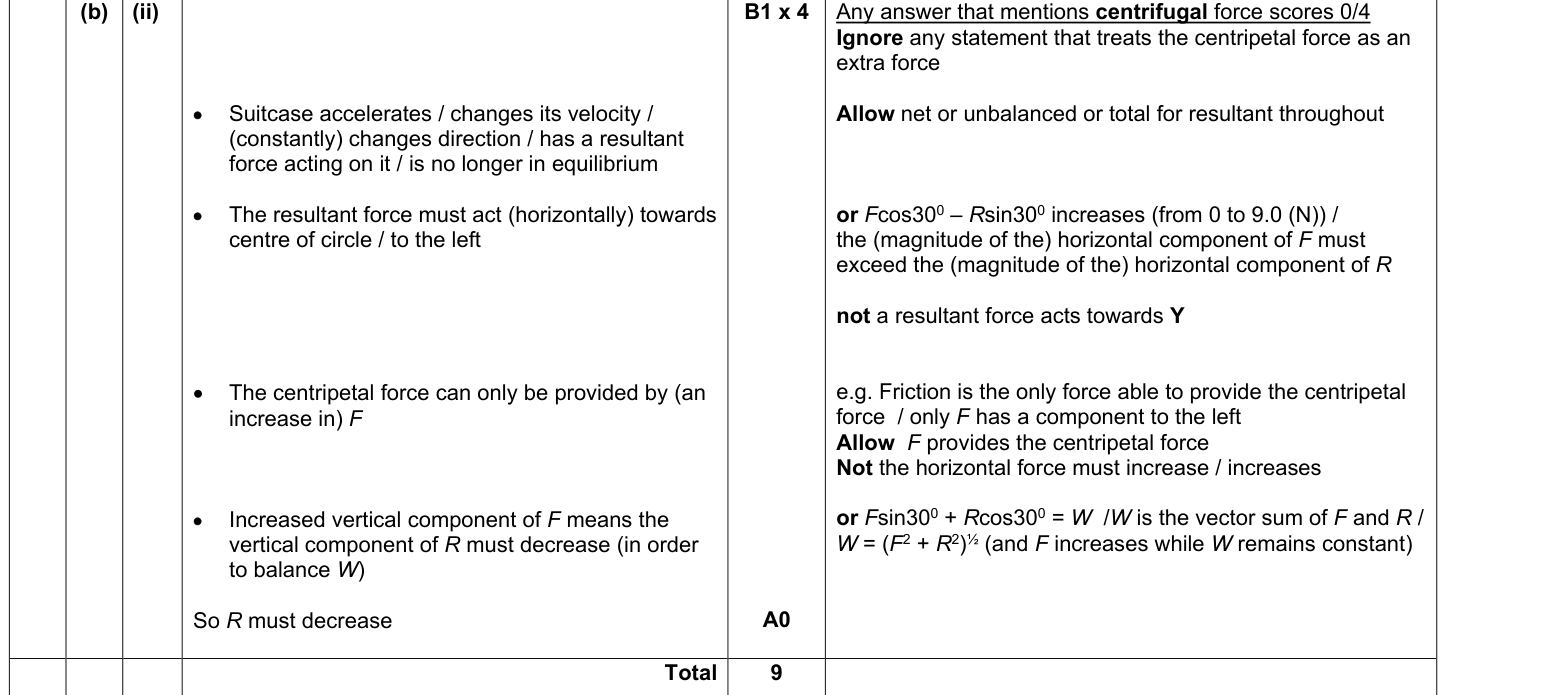
Question 4(b)(ii) proved very difficult and highlighted poor understanding of circular motion. Almost all candidates described the centripetal force as an additional force that had appeared out of nowhere. This centripetal force ‘pulled the suitcase inwards’ (or, in some cases, outwards) or ‘balanced the frictional force’ or ‘added to the frictional force’ and so on. The candidate who gave the response in Exemplar 5 clearly thinks that an additional force, called the centripetal force, now acts on the suitcase. The forces F and R have to adjust in order to keep the suitcase in equilibrium. They have not realised that the suitcase is no longer in equilibrium horizontally but is accelerating. This means that the available forces have to adjust in order to provide a resultant force towards the centre of the circle, while still balancing vertically. In contrast, the candidate who wrote the response in Exemplar 6 has a much better grasp of the situation.
Notes from the mark scheme and report
any answer that mentions centrifugal force scores 0
ignore centripetal force treated as an extra force
NOT a resultant force towards Y
Rather than using the phrase ‘centripetal force’, candidates could be encouraged to think of motion in a circle as a special case of F = ma where the resultant force F points towards the centre of the circle and the acceleration a is given by v2/r. This should hopefully encourage them to think about which of the forces available in the situation could provide the resultant force for this motion to occur.
June 2019 · Paper 3 · Q6(c)(i)2 marksShow thatEasy
Mark scheme
Examiner's comment
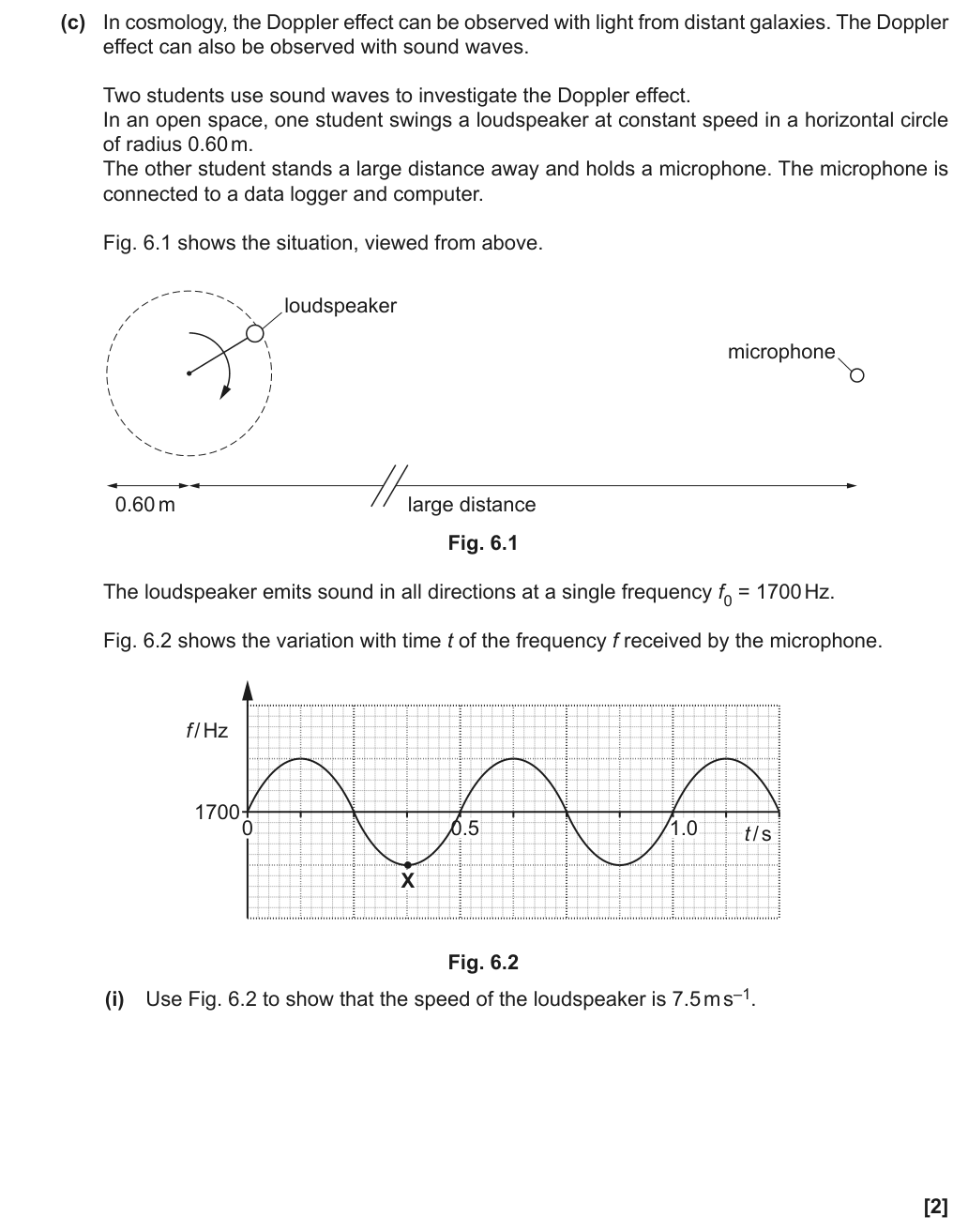
Most candidates scored this mark. Some tried to use the Doppler equation to find the speed of the sound (rather than the speed of the loudspeaker).
Notes from the mark scheme and report
period 0.50 s read from the graph
Skills: M2.3 Substitute numerical values into algebraic equations using appropriate units for physical quantities; M3.1 Translate information between graphical, numerical and algebraic forms
June 2018 · Paper 1 · Q17(a)(i)1 markDiagram or graphMedium
Mark scheme
Examiner's comment
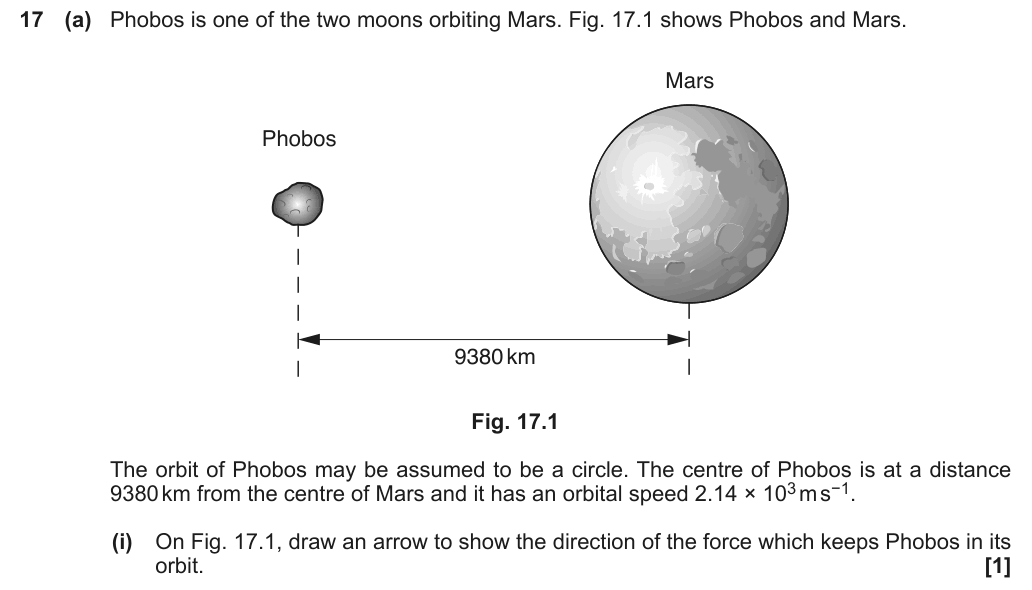
The examiners were quite lenient in this series in terms of the precise direction of the arrow, which should point towards the centre of Mars.
Notes from the mark scheme and report
arrow towards Mars
judged by eye
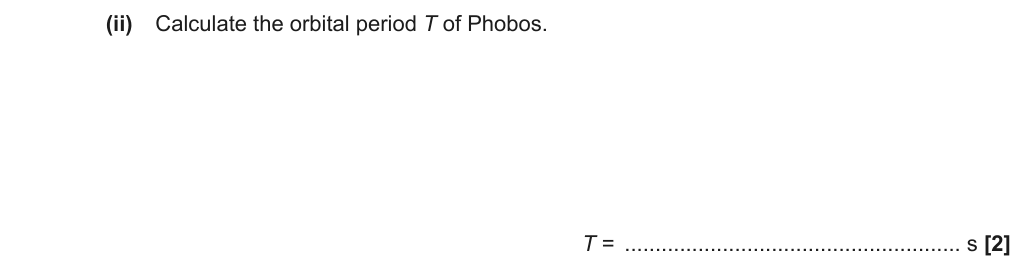
June 2018 · Paper 1 · Q17(a)(ii)2 marksCalculationHard
Earlier part of question 17 that this part uses
Mark scheme
Examiner's comment
Around four fifths of candidates got this right. Those that did not either poorly converted the radius from km or used the area rather than the circumference of the orbit.
Notes from the mark scheme and report
power-of-ten error scores 1 mark
Allow 2 SF
Skills: M0.1 Recognise and make use of appropriate units in calculations; M2.2 Change the subject of an equation, including non-linear equations
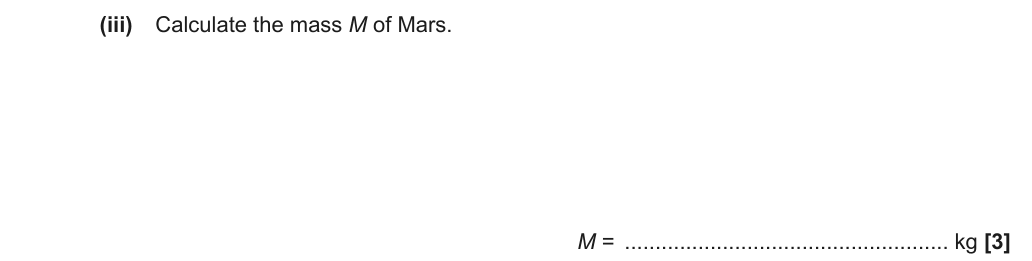
June 2018 · Paper 1 · Q17(a)(iii)3 marksCalculationMedium
Earlier part of question 17 that this part uses
Mark scheme
Examiner's comment
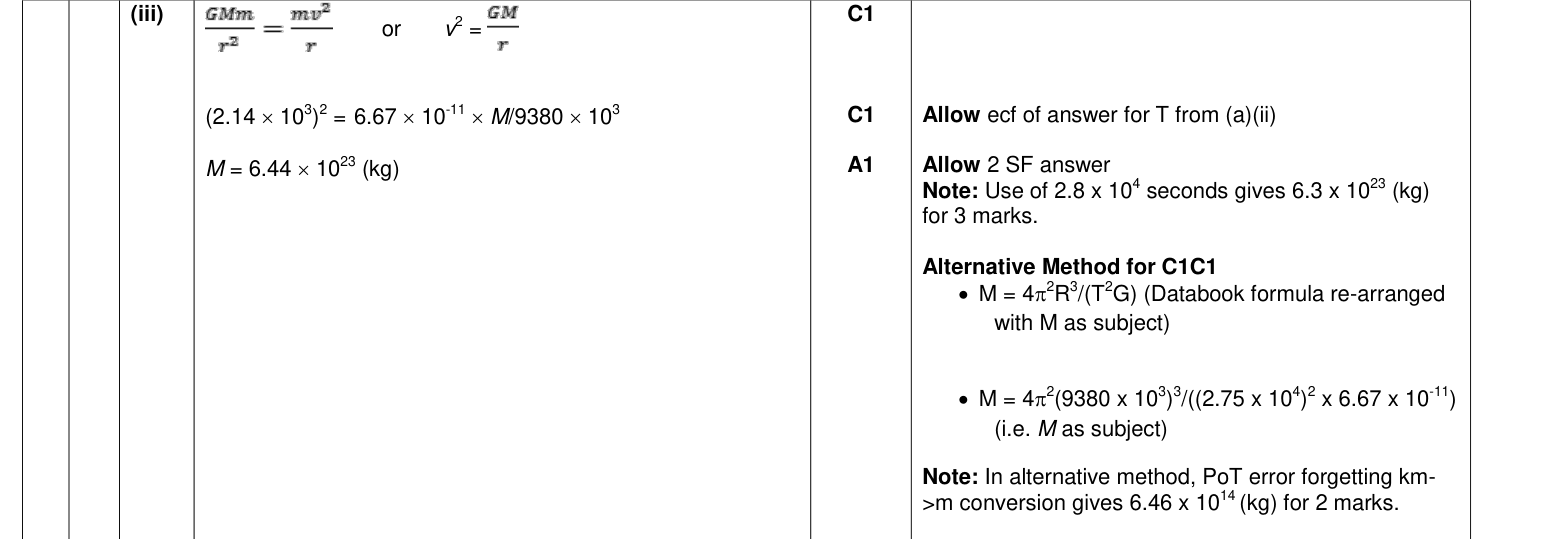
Many candidates successfully used the equation for Kepler’s Third Law, which is encouraging. A quicker route was to find the Phobos’s acceleration (from v2/r) and equating that to the gravitational field strength at Phobos from Mars (GMmars/r2) and then rearranging to find the mass of Mars.
Notes from the mark scheme and report
either GMm/r² = mv²/r or T² = 4π²r³/GM
km not converted gives 6.46 x 10^14 kg for 2 marks
ecf from (a)(ii)
Skills: M0.2 Recognise and use expressions in decimal and standard form; M2.2 Change the subject of an equation, including non-linear equations; M2.3 Substitute numerical values into algebraic equations using appropriate units for physical quantities
June 2018 · Paper 1 · Q21(b)3 marksCalculationMedium
Mark scheme
Examiner's comment
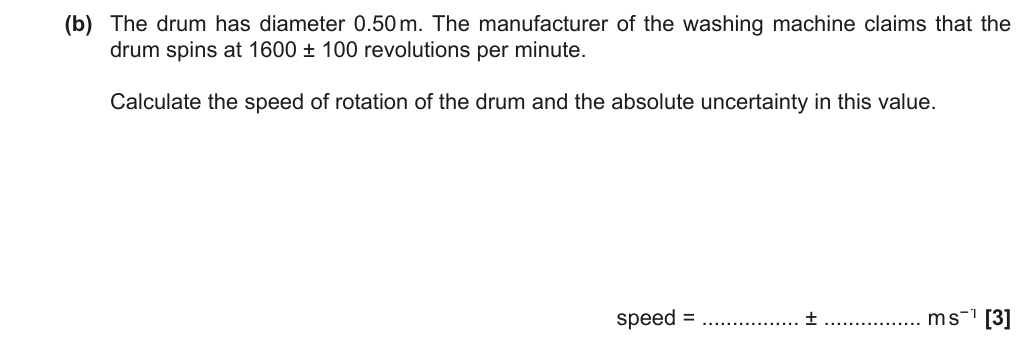
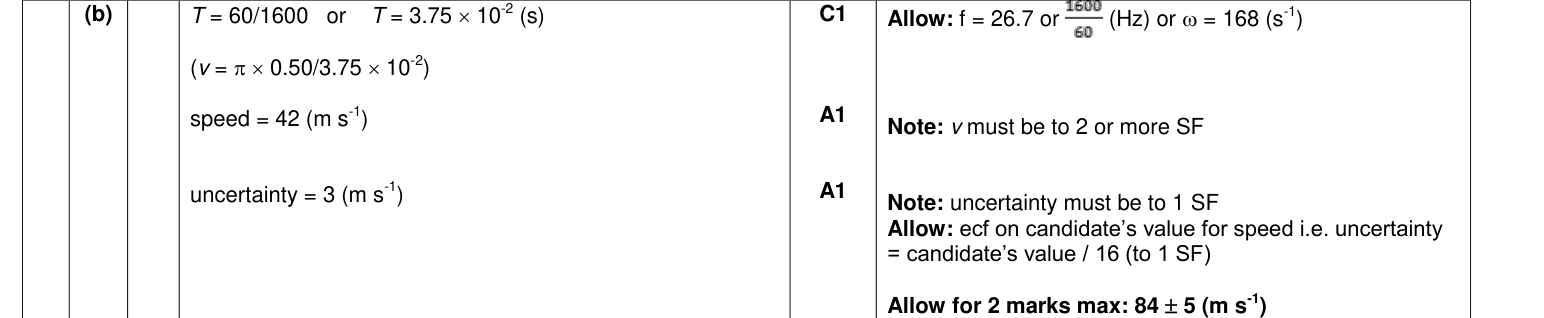
About half of the candidates got this item right or provided clear working to show where they were going. There was much confusion about which quantity was which. 1600 revolutions per minute refers to the frequency of the rotation, not the angular speed, angular frequency or the speed itself. The percentage error of the frequency was 6.25%, prior to rounding. Some candidates multiplied this by their value for the speed to get the correct absolute uncertainty, although good practice is to round uncertainties to 1 SF.
Notes from the mark scheme and report
uncertainty must be to 1 SF
speed to 2 or more SF
84 ± 5 (diameter used as radius) scores 2 max
Skills: M0.3 Use ratios, fractions and percentages; M1.5 Identify uncertainties in measurements and use simple techniques to determine uncertainty when data are combined; M2.3 Substitute numerical values into algebraic equations using appropriate units for physical quantities
June 2018 · Paper 1 · Q21(c)3 marksCalculationEasy
Earlier parts of question 21 that this part uses
Mark scheme
Examiner's comment
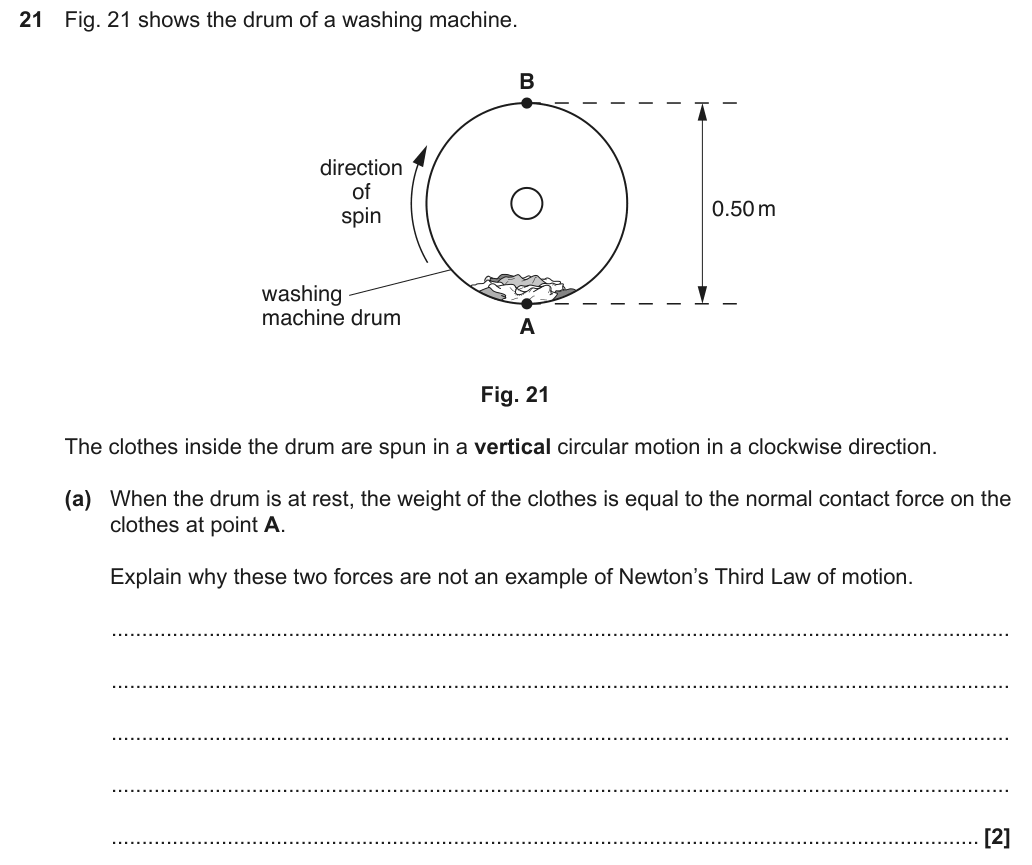
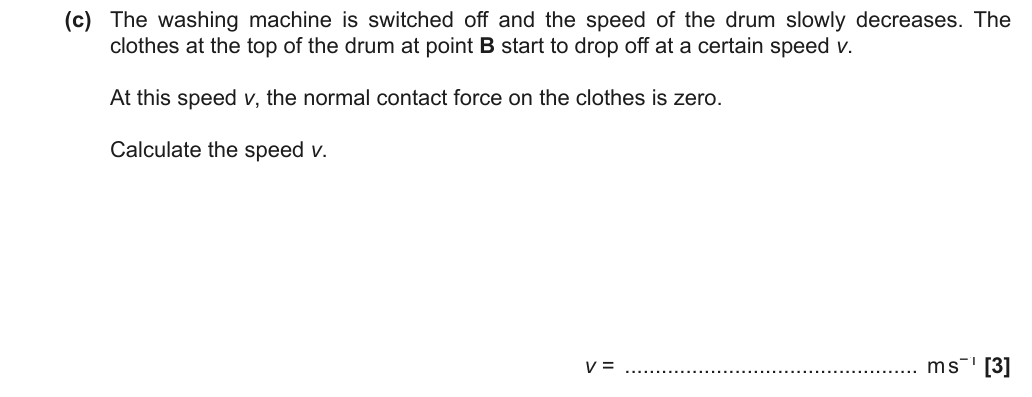
This question was answered well by those above the mean result. When the machine is switched off, the clothes are still in circular motion and at point B, the resultant force is still the weight of the clothes plus the normal contact force. This means at the critical speed when the clothes fall off at point B, the centripetal force will equal the weight of the clothes, since the question states that the normal contact force is zero.
Notes from the mark scheme and report
2.21 m s-1 (diameter used as radius) scores 2 marks
Skills: M2.2 Change the subject of an equation, including non-linear equations
June 2018 · Paper 3 · Q3(a)(i)2 marksExplanationHard
Mark scheme
Examiner's comment
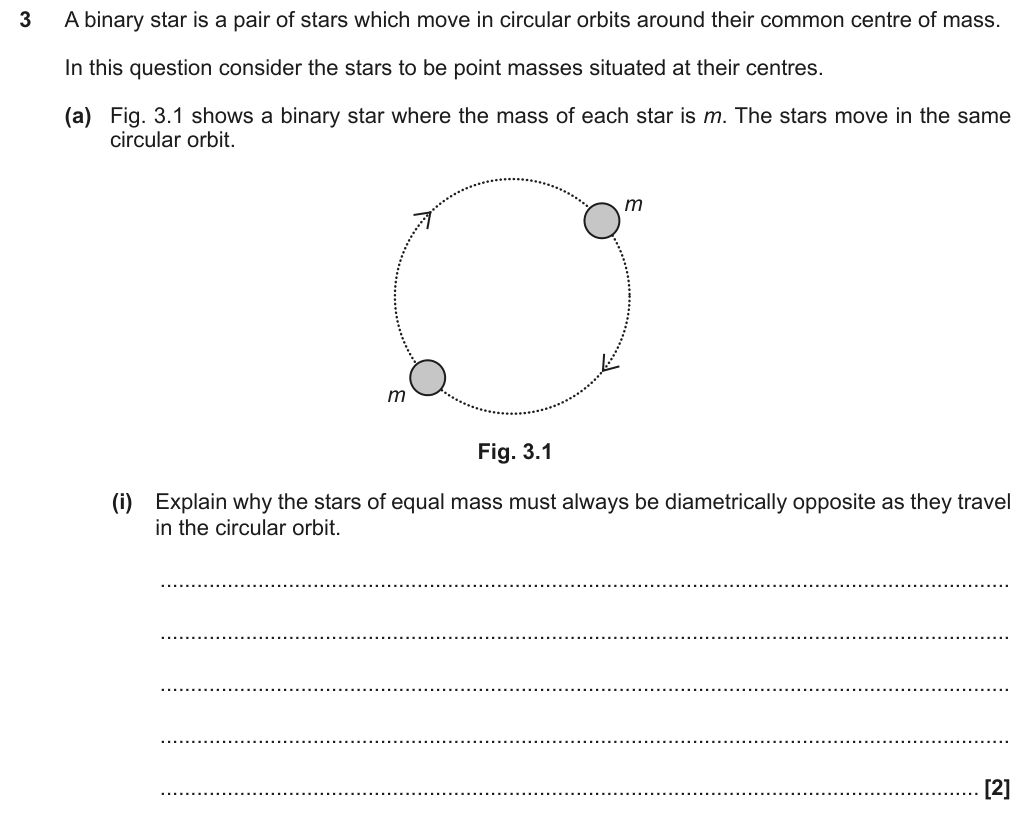
Only a minority of candidates related the gravitational force between the stars to the centripetal force required for circular motion to occur. This candidate has written the perfect answer (exemplar 5). There were two popular insufficient answers; that if the stars were not diametrically opposite they would collide and that the centre of mass of the system had to be at the centre of the orbit.
June 2018 · Paper 3 · Q3(a)(iii)2 marksCalculationMedium
Earlier part of question 3 that this part uses
Mark scheme
Examiner's comment
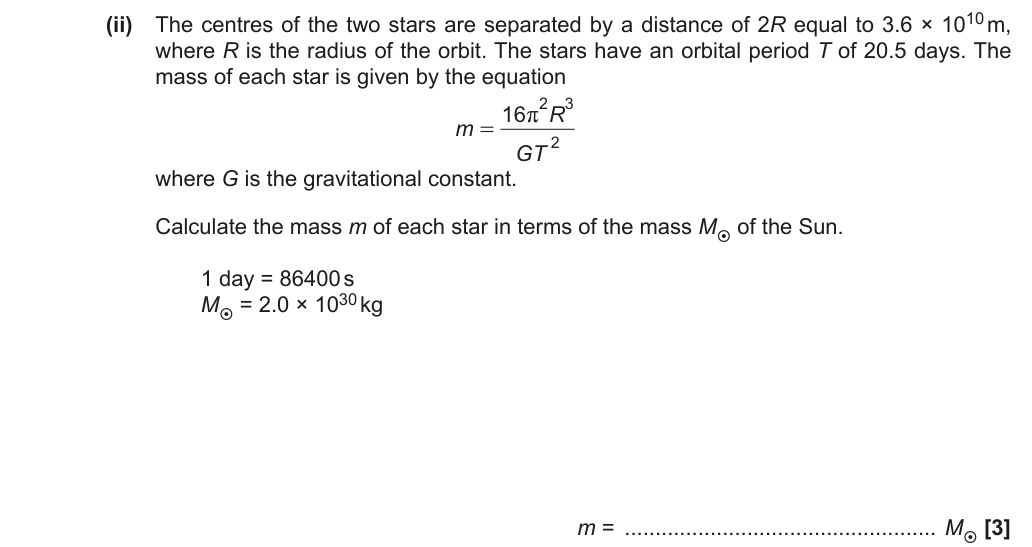
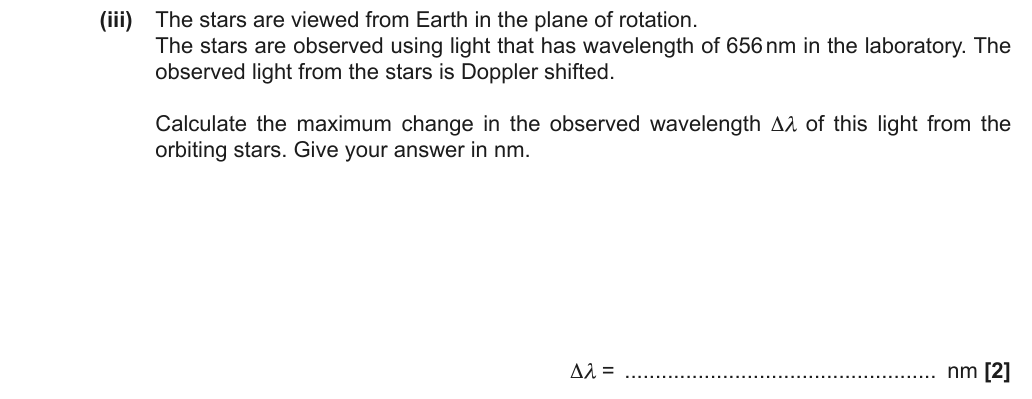
Most of the higher performing candidates completed this problem successfully. Two common errors among the remainder were to equate the formula for central force gravitational potential energy (GMm/r) to kinetic energy to find a value for the speed of the stars and to rewrite incorrectly metres in powers of 10 in nanometres.
Notes from the mark scheme and report
do not penalise repeated error for R or T
ecf for incorrect v
Skills: M0.3 Use ratios, fractions and percentages; M2.3 Substitute numerical values into algebraic equations using appropriate units for physical quantities
June 2018 · Paper 3 · Q3(b)(ii)2 marksExplanationHard
Earlier part of question 3 that this part uses
Mark scheme
Examiner's comment
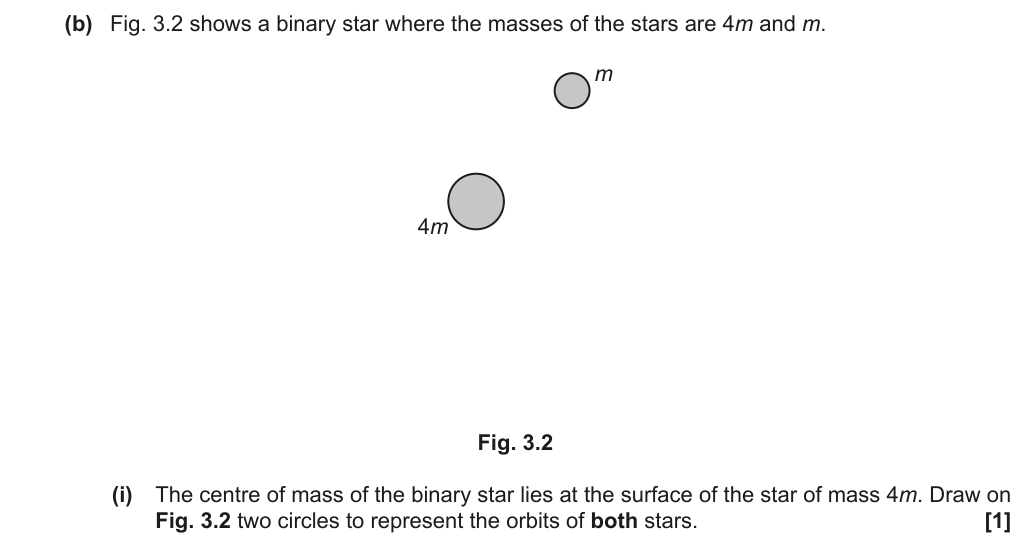
Candidates should be encouraged to draw diagrams such as part (i) as accurately as they can. Some had drawing instruments and drew accurate circles. Many drew shapes which were very far from circular, making it difficult in some examples to judge whether the candidate knew the correct path. A secondary purpose of this part was to reinforce the idea that the stars remain diametrically opposite as in part (a) (i). Many did not respond to this trigger having Kepler's laws or centripetal force requirements central in their minds. The rest stated clearly that the orbital period for the two stars had to be the same and consequently were credited both marks.
Notes from the mark scheme and report
any arguments using F = mv²/r score zero
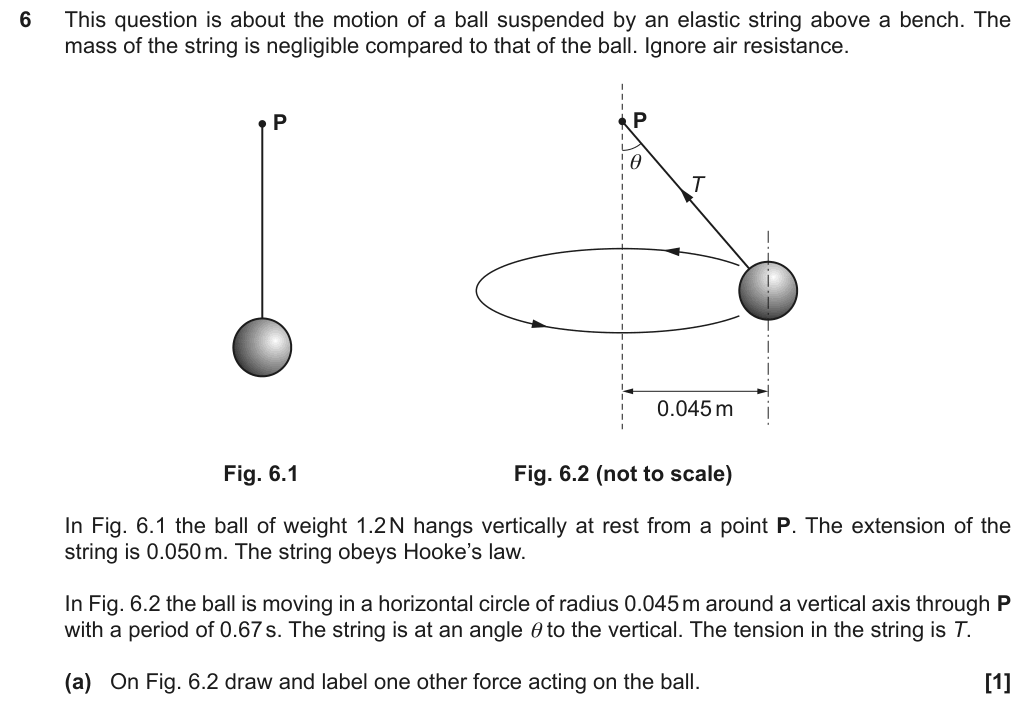
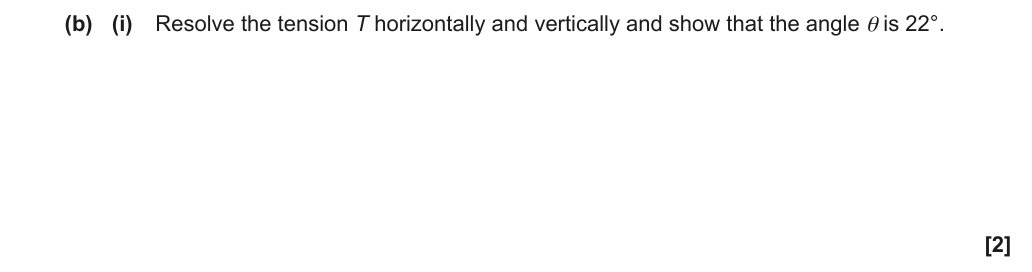
June 2017 · Paper 3 · Q6(b)(i)2 marksShow that
Earlier part of question 6 that this part uses
Mark scheme
Notes from the mark scheme and report
show-that: enough calculation needed to show the candidate has not worked back from 22°
Skills: M0.6 Use calculators to handle sin x, cos x and tan x when x is expressed in degrees or radians; M2.2 Change the subject of an equation, including non-linear equations; M4.5 Use sin, cos and tan in physical problems
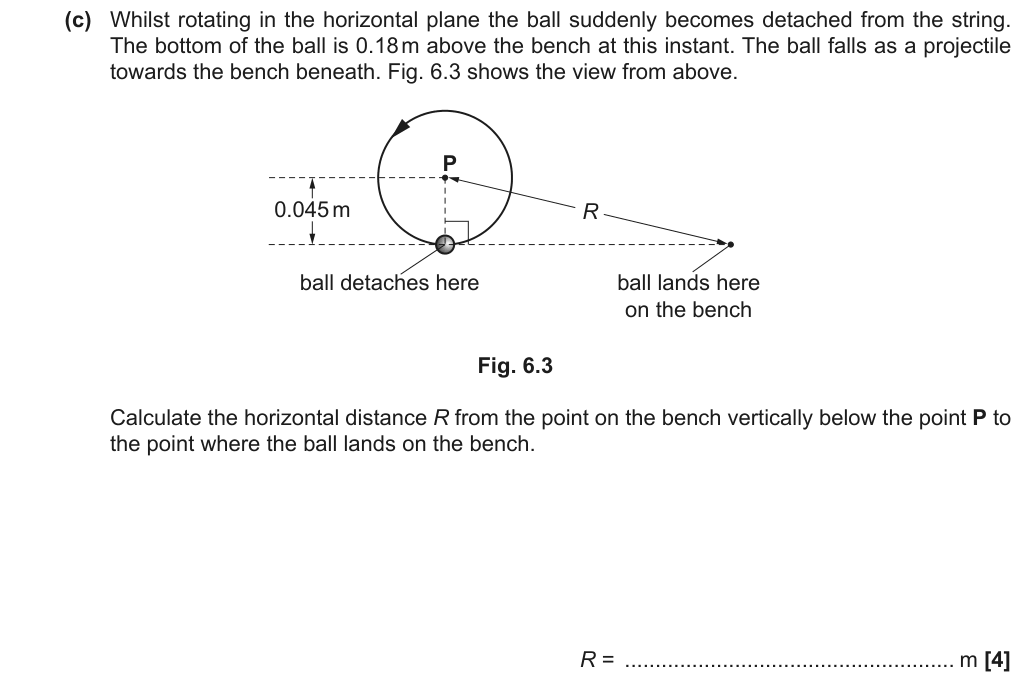
June 2017 · Paper 3 · Q6(c)4 marksCalculation
Earlier part of question 6 that this part uses
Mark scheme
Notes from the mark scheme and report
Pythagoras with r = 0.045 m needed for the final answer
ecf (b)(i) for v
Skills: M2.3 Substitute numerical values into algebraic equations using appropriate units for physical quantities; M4.4 Use Pythagoras’ theorem, and the angle sum of a triangle
June 2017 · Paper 3 · Q6(d)2 marksExplanation
Earlier part of question 6 that this part uses
Mark scheme
Notes from the mark scheme and report
causality must be implied for the second mark
allow mv²/r or mrω² for centripetal force
Work with an OCR physics tutor
Dropping marks on calculations, practical questions or the six-mark level of response questions? Book a trial session with a specialist OCR physics tutor.