Tap a question to zoom it. Where a part needs a figure, table or graph from earlier in the question, that part folds out above it; the mark scheme and examiner's comment open underneath. Have the OCR Data, Formulae and Relationships Booklet beside you (see the data booklet page).
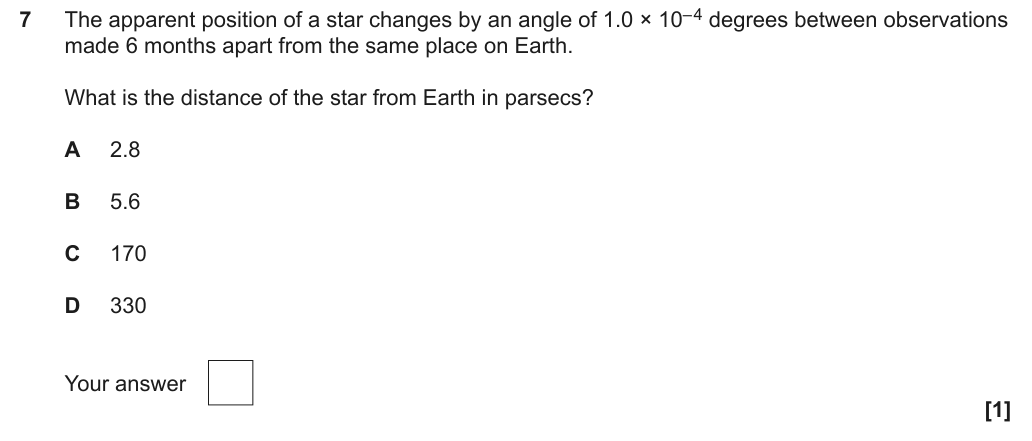
June 2025 · Paper 1 · Q71 markMultiple choiceMedium
Answer
B
Mark scheme
Examiner's comment
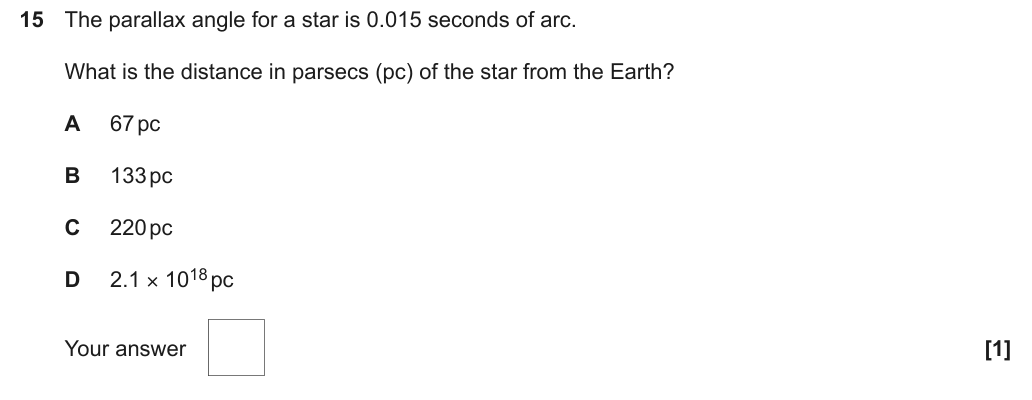
The data in the question gives a parallax angle of 0.5 × 10⁻⁴ degrees. This equates to 0.18 arcseconds. Parallax angle and distance in parsecs are inversely proportional, with 1 arcsecond giving a distance of 1 parsec. 0.18 arcseconds gives a distance of (1 ÷ 0.18) = 5.6 parsecs.
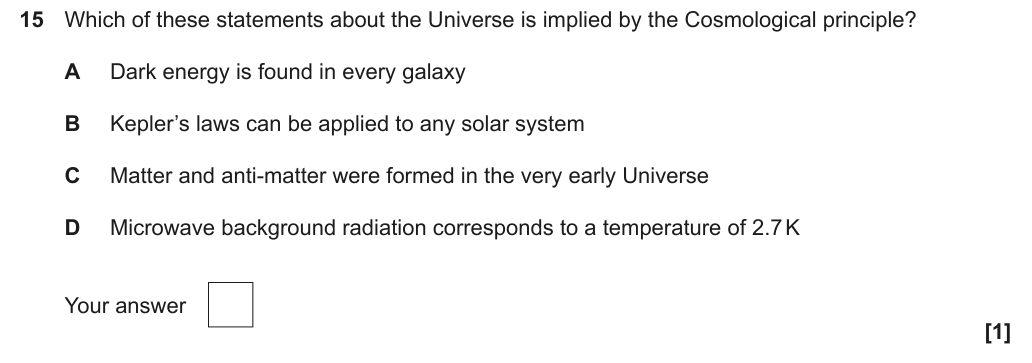
June 2025 · Paper 1 · Q151 markMultiple choiceMedium
Answer
B
Mark scheme
Examiner's comment
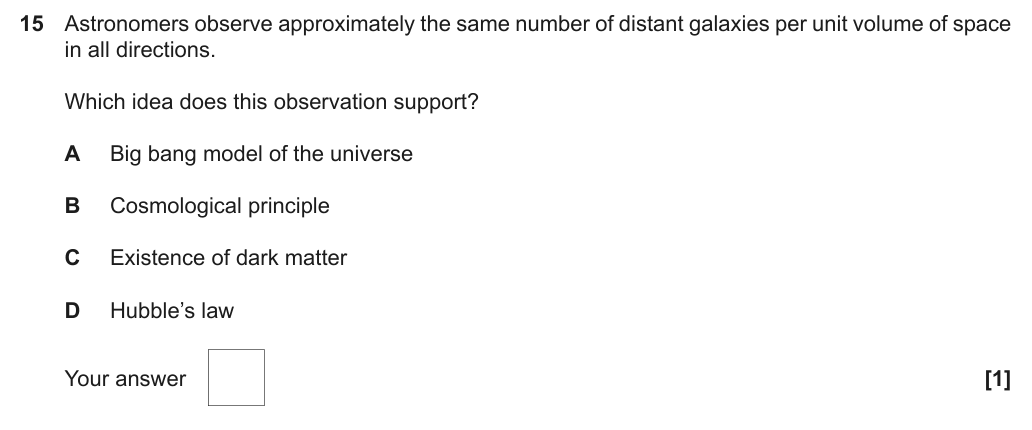
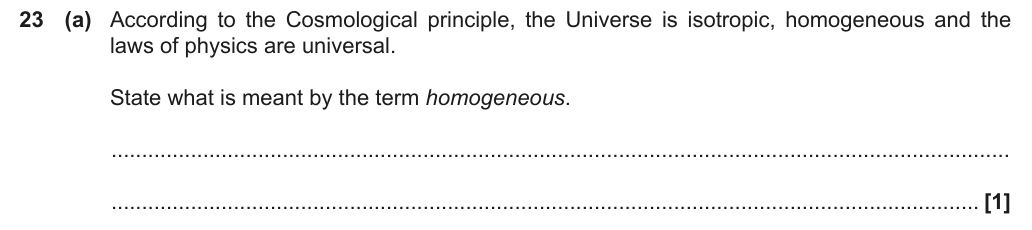
The Cosmological principle is that on a large scale, the universe is homogeneous (the same everywhere) and isotropic (the same in all directions). Answers A, C and D are not implied by this, although they may be true statements. Answer B is correct here.
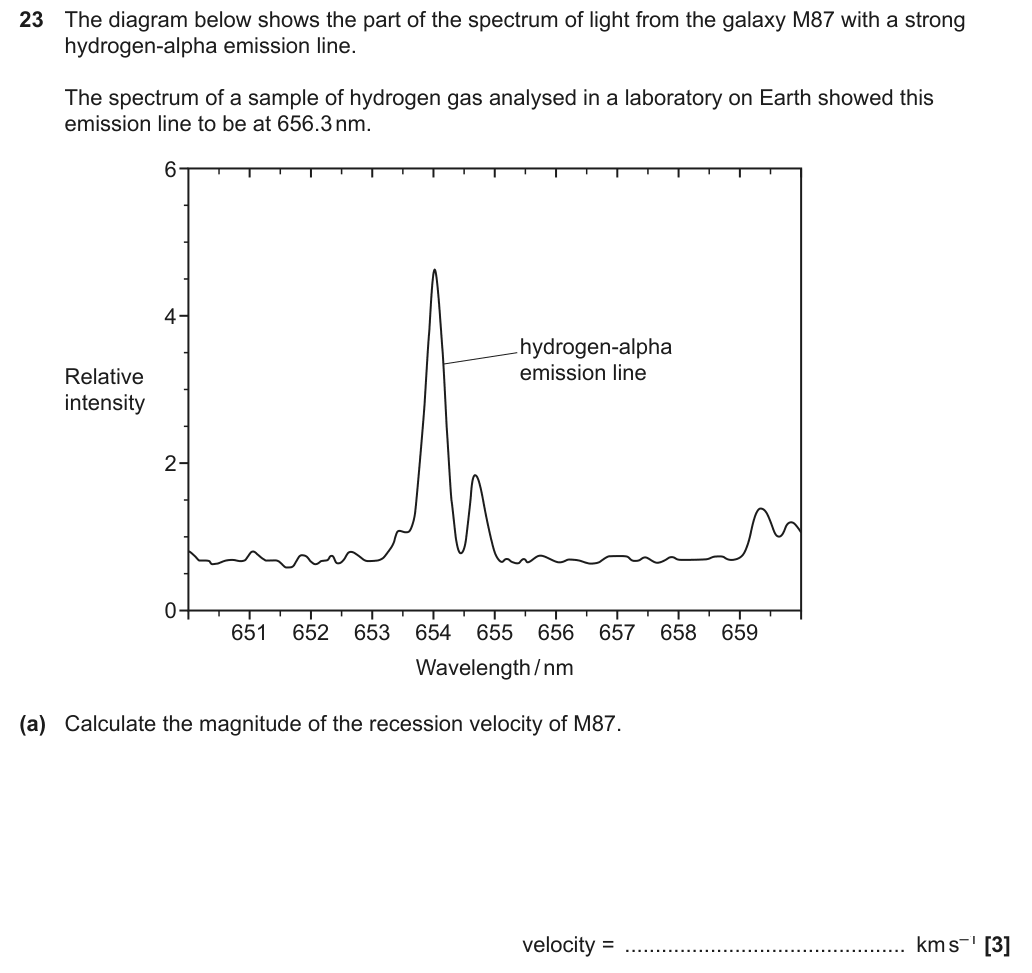
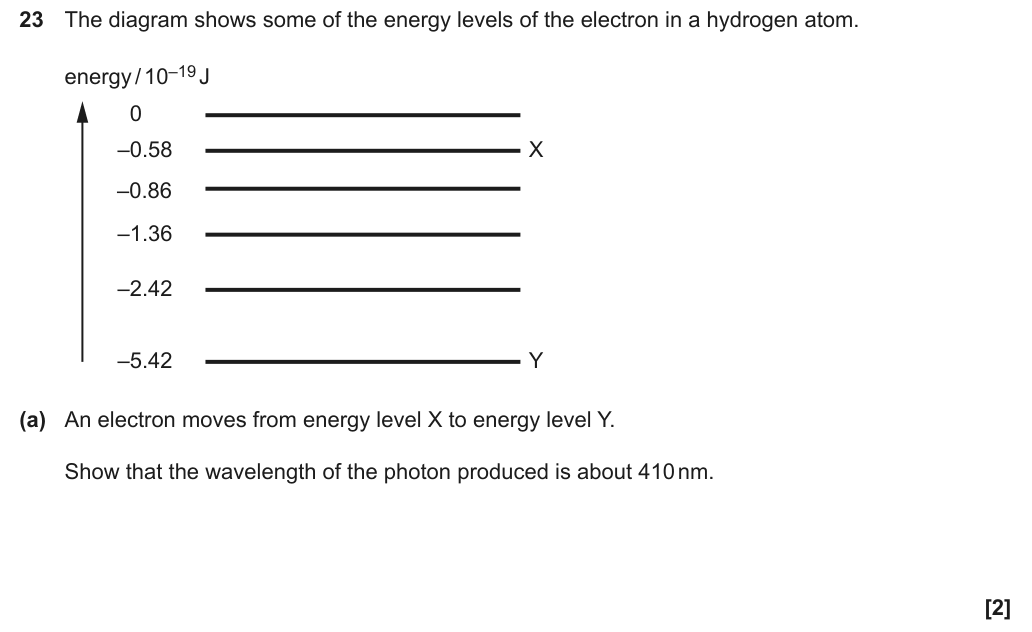
June 2025 · Paper 1 · Q23(a)3 marksCalculationMedium
Mark scheme
Examiner's comment
The approach here is to find the wavelength corresponding to the peak of the hydrogen-alpha emission line and find the difference between that and the laboratory wavelength of the same line. The shift in wavelength as a fraction of the original wavelength is equal to the velocity of M87 as a fraction of the speed of light. Answers that used the wavelength 654 nm as the denominator were judged as ‘XP’ i.e. wrong physics, just as in previous series, even though this gave a very similar answer to the correct value for the velocity. Finally the unit on the answer line is km s-1, so there was a conversion to complete. Most candidates completed all of these steps.
Notes from the mark scheme and report
denominator must be 656.3 not 654 (wrong physics)
Δλ between 2.25 and 2.35 nm
ignore minus sign
Skills: M0.1 Recognise and make use of appropriate units in calculations; M2.3 Substitute numerical values into algebraic equations using appropriate units for physical quantities; M3.1 Translate information between graphical, numerical and algebraic forms
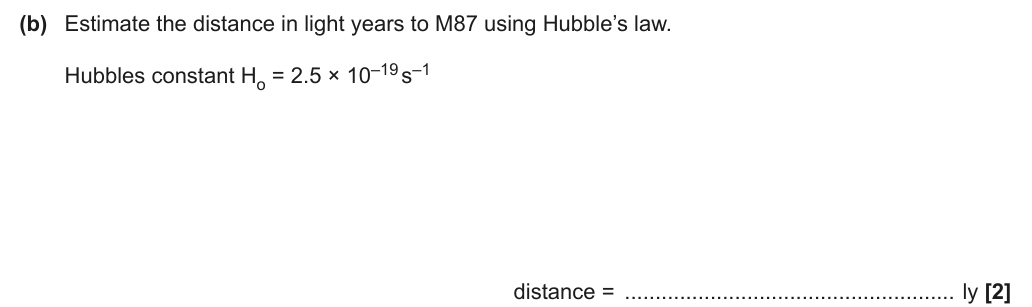
June 2025 · Paper 1 · Q23(b)2 marksCalculationMedium
Earlier part of question 23 that this part uses
Mark scheme
Examiner's comment
Erratum Notice By using the candidate’s value from part (a), quoted in ms-1 for this part, most candidates used an appropriate value for Hubble’s constant to arrive at a distance in metres to M87. Once more there is a conversion to complete to get the value in the required unit. The mark scheme allows full credit for the correct use of the original value of H0 if the erratum was not used, as well as use of any handwritten replacement value for H0 used correctly.
Notes from the mark scheme and report
ecf from (a)
Skills: M0.1 Recognise and make use of appropriate units in calculations; M0.2 Recognise and use expressions in decimal and standard form; M2.2 Change the subject of an equation, including non-linear equations
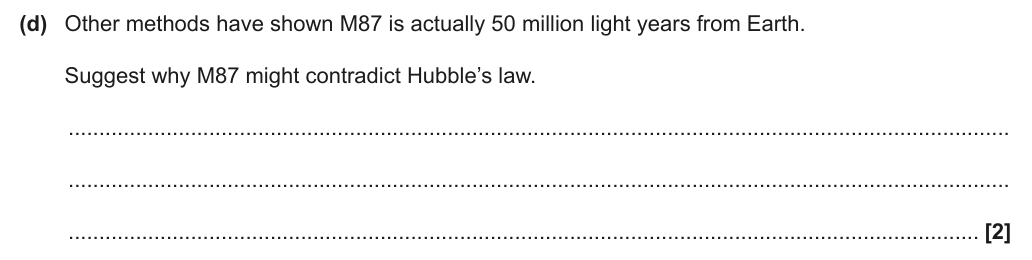
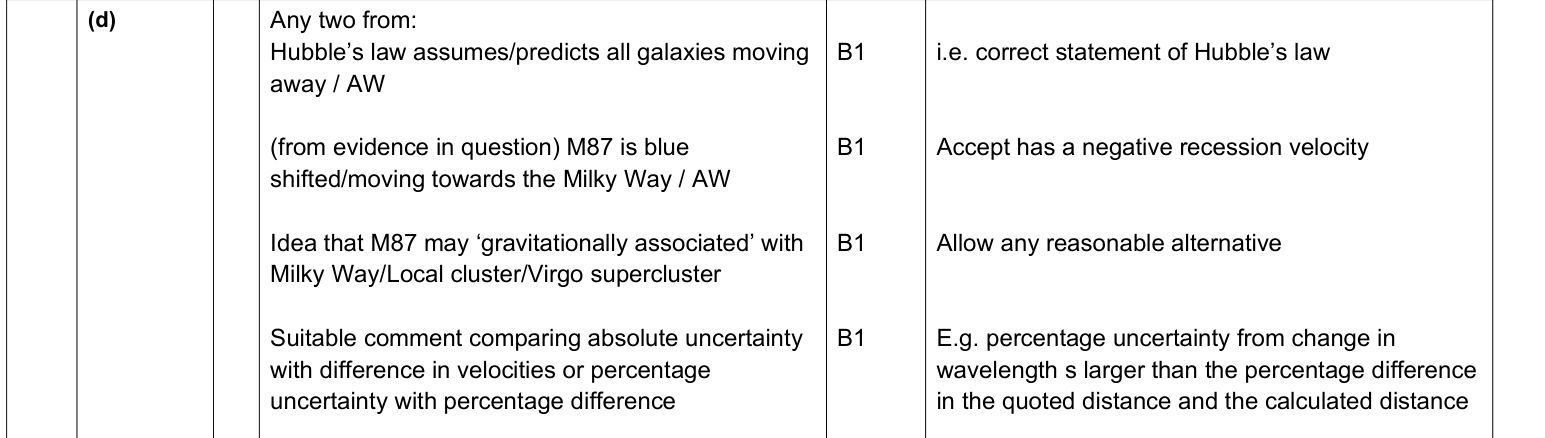
June 2025 · Paper 1 · Q23(d)2 marksExplanationMedium
Earlier parts of question 23 that this part uses
Mark scheme
Examiner's comment
The mark scheme shows a wide variety of acceptable ideas that were creditworthy for this item. Many candidates provided one acceptable idea with some providing at least two.
Notes from the mark scheme and report
M87 is blue-shifted (moving towards us) while Hubble's law has all galaxies receding
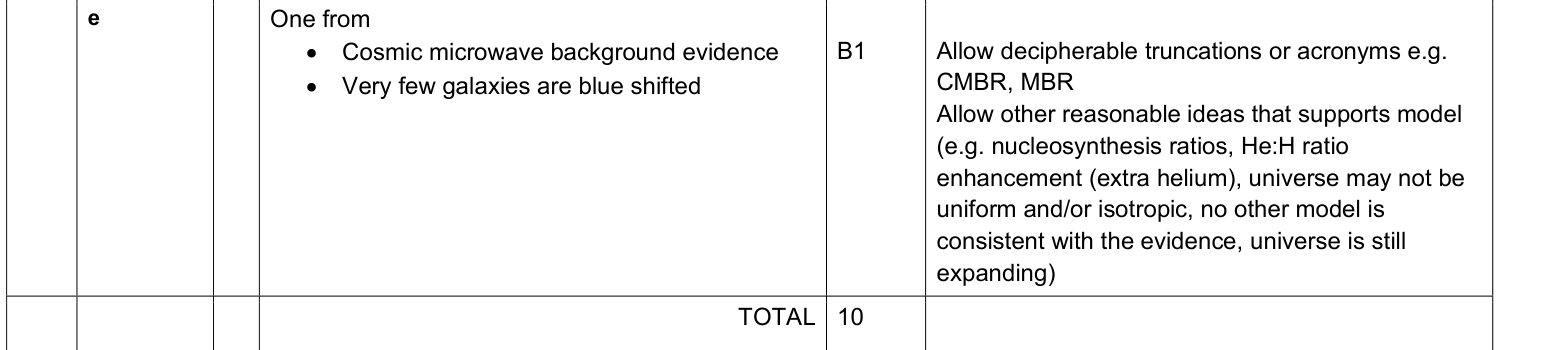
June 2025 · Paper 1 · Q23(e)1 markExplanationMedium
Mark scheme
Examiner's comment
There were also a wide variety of acceptable candidate responses to this question.
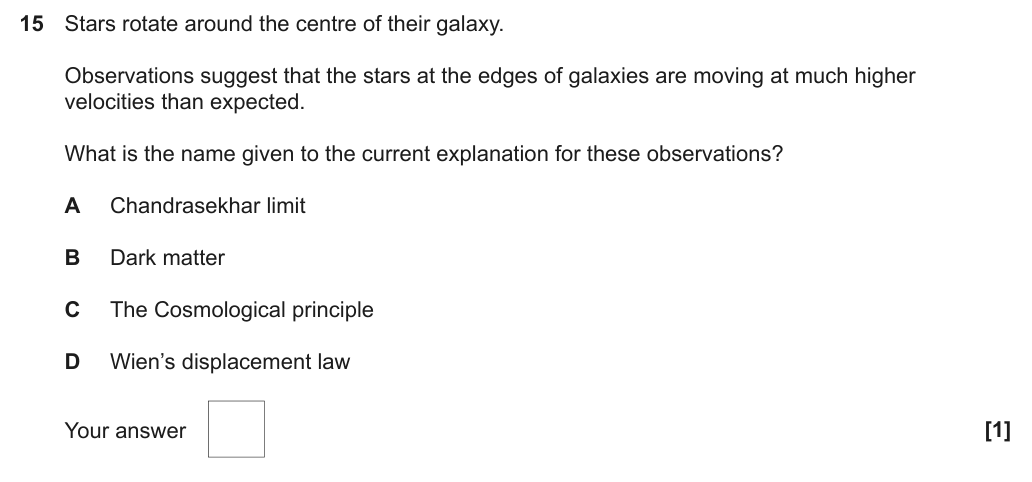
June 2024 · Paper 1 · Q151 markMultiple choiceMedium
Answer
B
Mark scheme
Examiner's comment
The Chandrasekhar limit relates to white dwarf stars and their evolution. Wien’s displacement law relates the surface temperature of a star and λmax. The Cosmological principle has nothing to do with stars’ velocity in a galaxy, hence the correct answer is B.
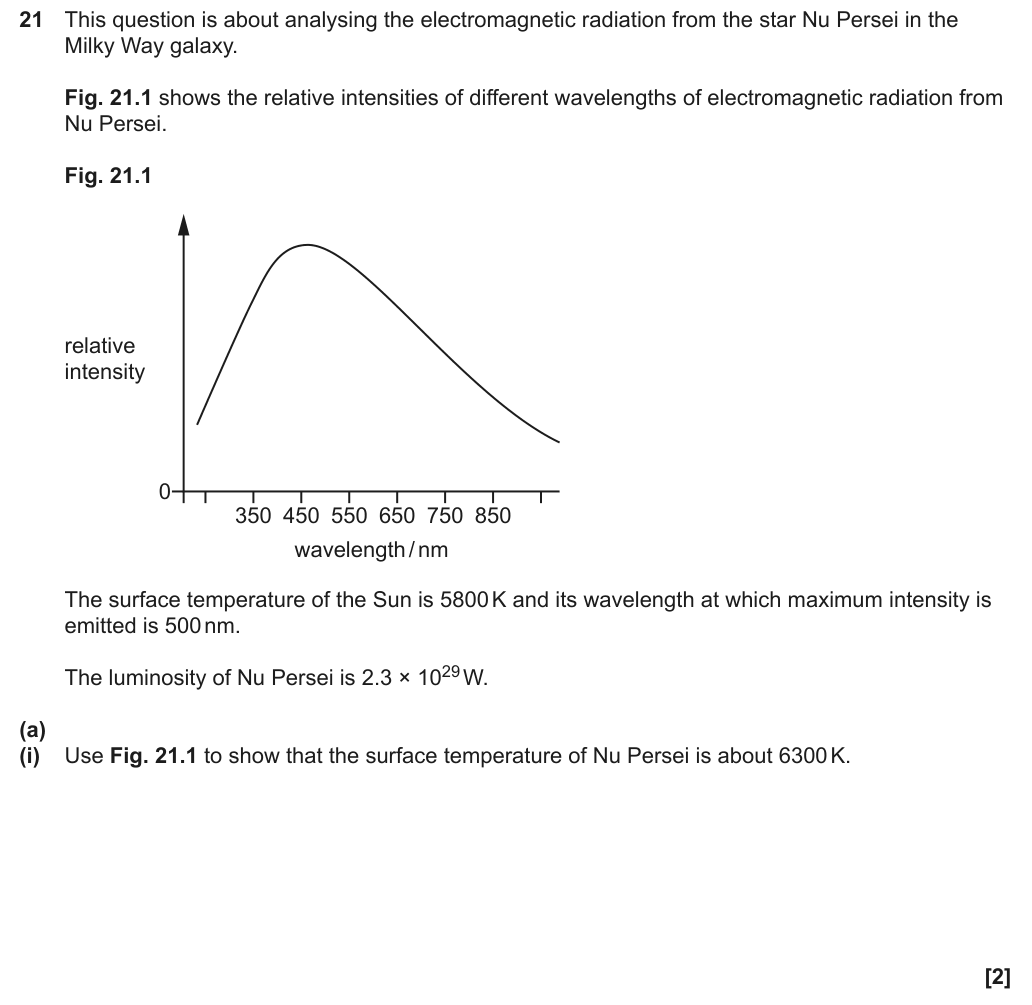
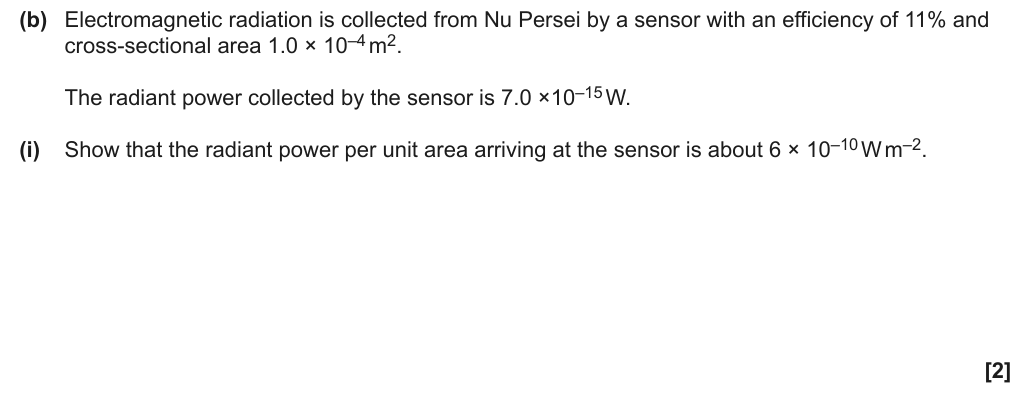
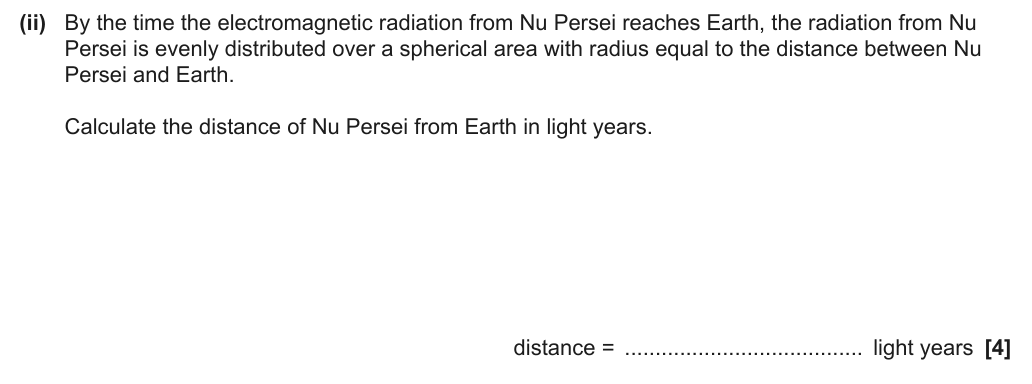
June 2024 · Paper 1 · Q21(b)(ii)4 marksCalculationHard
Earlier parts of question 21 that this part uses
Mark scheme
Examiner's comment
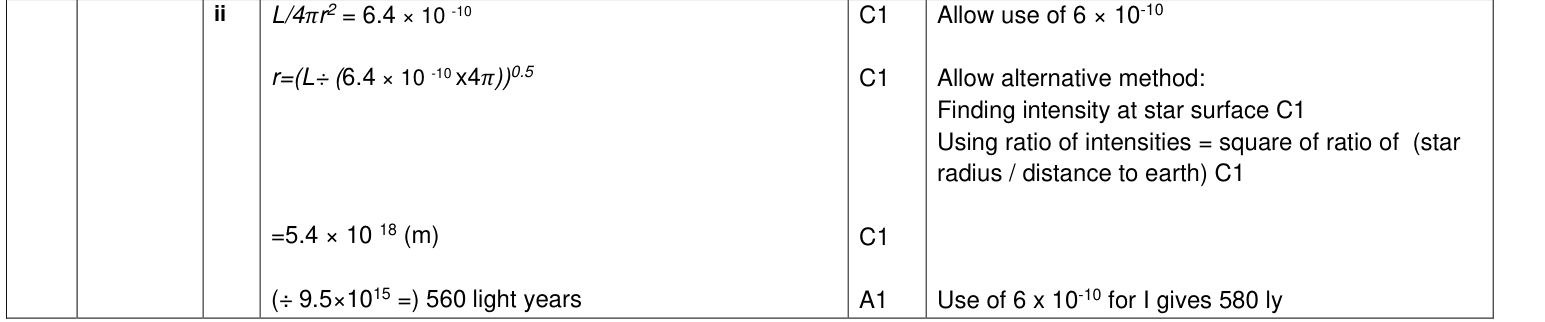
This is a challenging multi-step question. Essentially it tests understanding of the inverse-square relationship. Some candidates simply used the formula given on the formula sheet. Others did not, however successfully manipulated the data to use the inverse-square rule and/or finding the intensity of radiation leaving the surface of the star. Once the candidate arrived at the distance in metres, it was relatively simple to find the distance in light years.
Notes from the mark scheme and report
inverse-square relationship: intensity = L / 4πd²
Skills: M0.2 Recognise and use expressions in decimal and standard form; M2.2 Change the subject of an equation, including non-linear equations
June 2024 · Paper 1 · Q23(b)(ii)2 marksCalculationMedium
Earlier part of question 23 that this part uses
Mark scheme
Examiner's comment
Most candidates selected the correct formula in this part. If a candidate responded at all, they were likely to score both marks. A small percentage of candidates used the wrong wavelength for the denominator of the relevant expression. This was marked as ‘wrong Physics’ (XP) on scripts.
Notes from the mark scheme and report
432 nm as the denominator scores zero
Skills: M0.3 Use ratios, fractions and percentages; M2.3 Substitute numerical values into algebraic equations using appropriate units for physical quantities
June 2024 · Paper 1 · Q23(b)(iii)1 markShort answerMedium
Mark scheme
Examiner's comment
An overwhelming majority of candidates made some reference to either the Big Bang Theory, cosmological expansion or simply ‘Hubble’s Law’. Some other answers were also given credit as shown in the Mark Scheme although these were very much rarer.
Notes from the mark scheme and report
ignore redshift / Doppler
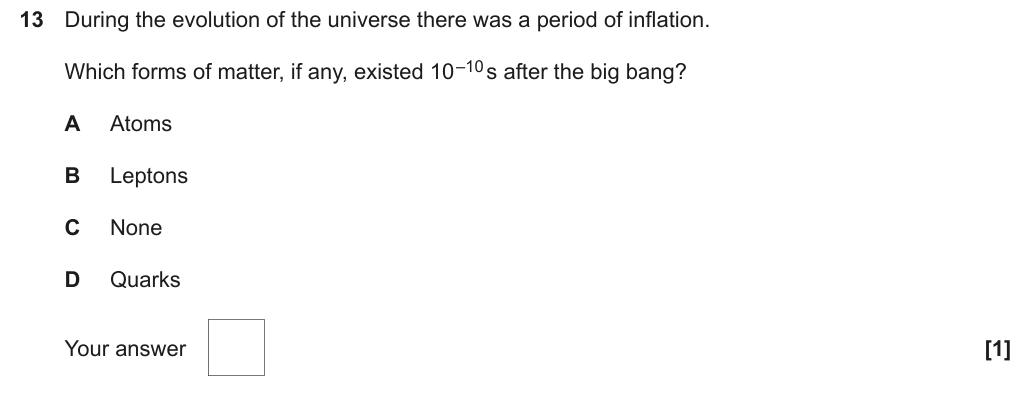
June 2023 · Paper 1 · Q131 markMultiple choice
Answer
C
Mark scheme
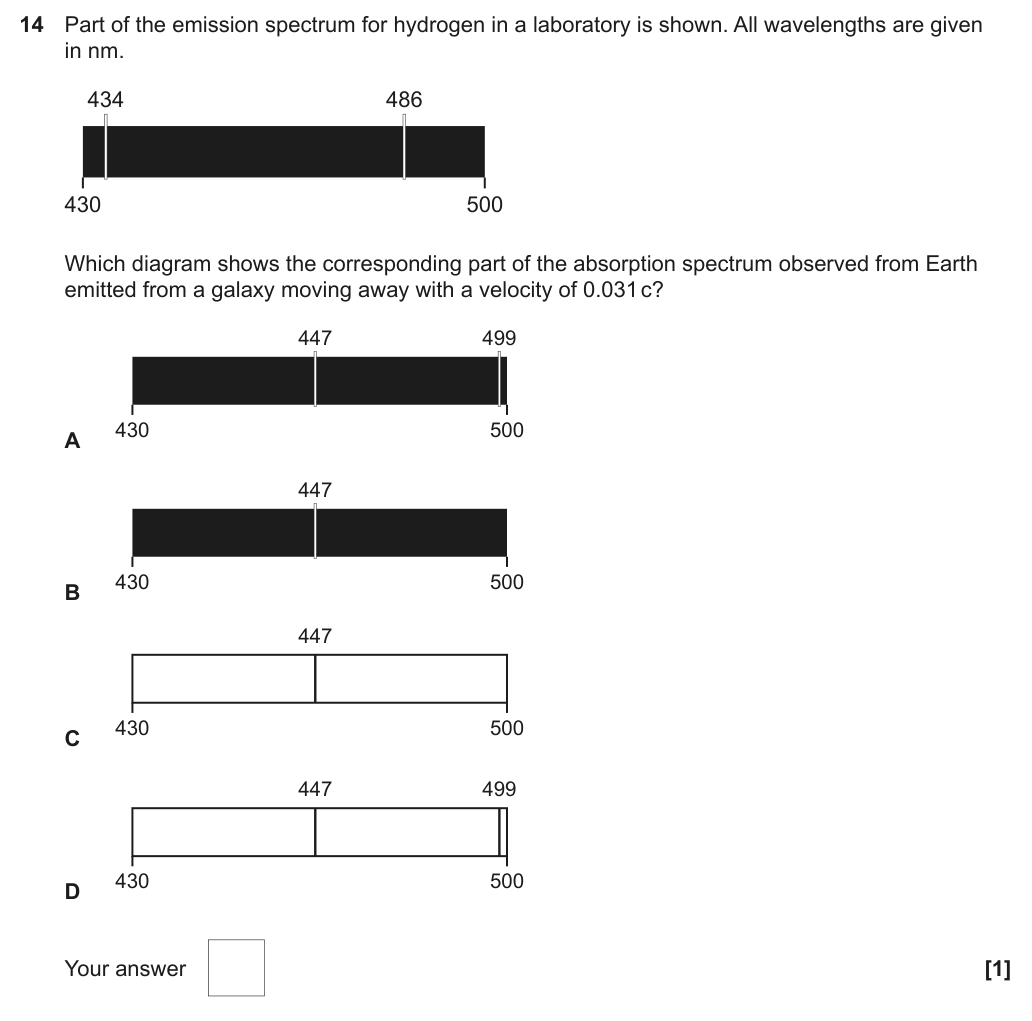
June 2023 · Paper 1 · Q141 markMultiple choiceMedium
Answer
C
Mark scheme
Examiner's comment
The spectrum in the question and those for answers A and B depict emission spectra. Spectra C and D are absorption spectra. The question asks for the absorption spectrum from distant galaxies so only answers C and D could be correct. With the recession velocity of 0.031c, both wavelengths will be increased by 3.1 percent. The laboratory wavelength of 434 nm becomes 447 nm after the redshift. The laboratory wavelength of 486 nm becomes 501 nm and so lies outside the range for these diagrams. This makes the correct answer C.
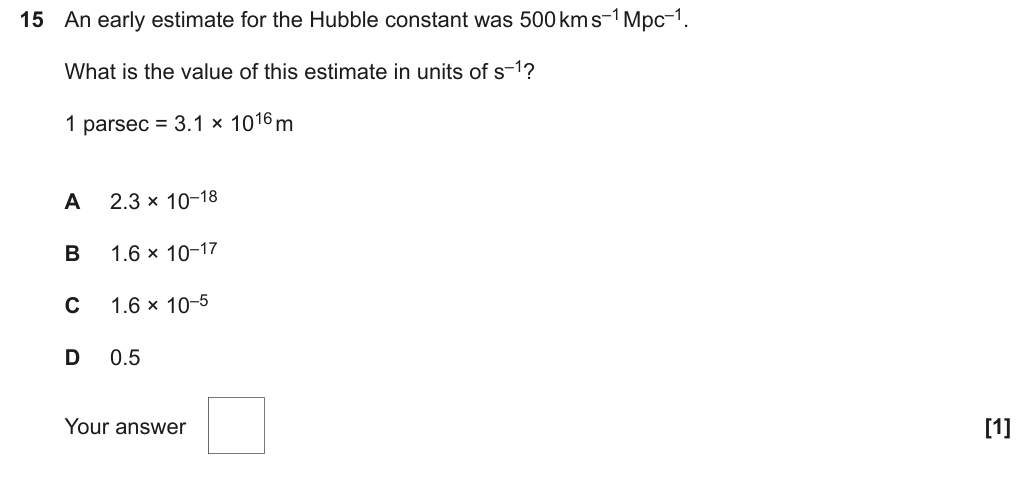
June 2023 · Paper 1 · Q151 markMultiple choice
Answer
B
Mark scheme
June 2023 · Paper 1 · Q23(a)(i)1 markCalculationHard
Mark scheme
Examiner's comment
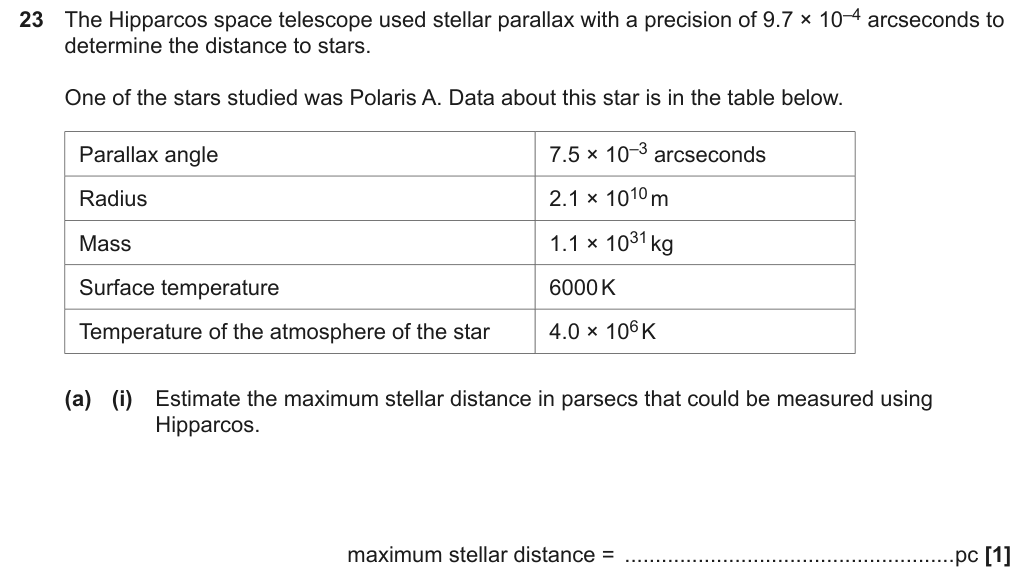
The maximum stellar distance is given by the smallest parallax Hipparcos can measure, i.e. 9.7 × 10⁻⁴ arcsec. The distance corresponding to this parallax is 1/9.7 × 10–4 = 1030 pc. To find the percentage uncertainty in the distance, candidates needed to divide the smallest detectable change in the parallax by the parallax itself. This is equivalent to the percentage uncertainty in the distance because of the reciprocal relationship of distance with parallax. Many candidates correctly determined both quantities. A minority of candidates confused the two similar sounding quantities.
June 2023 · Paper 3 · Q3(c)(ii)3 marksCalculationMedium
Earlier part of question 3 that this part uses
Mark scheme
Examiner's comment
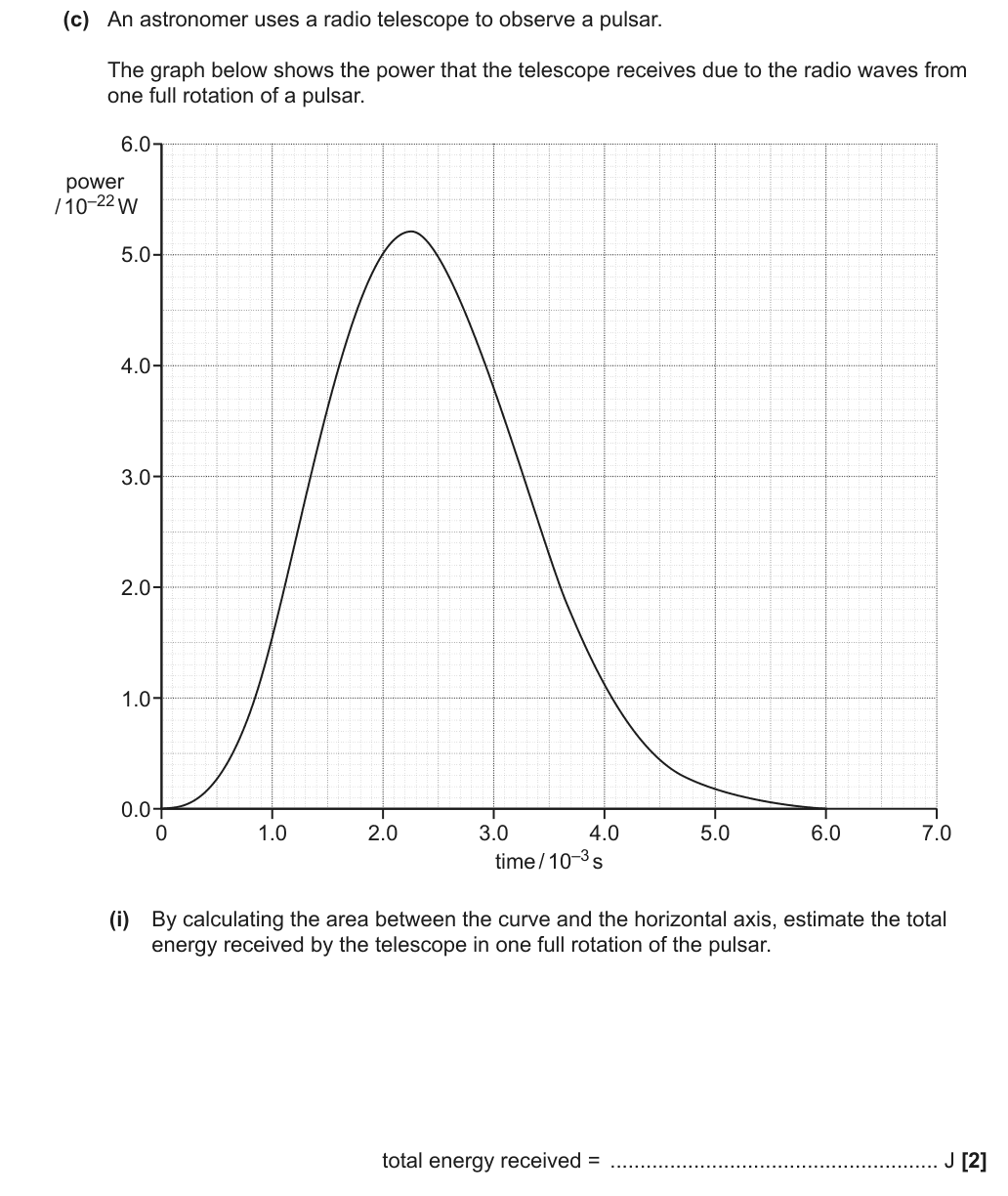
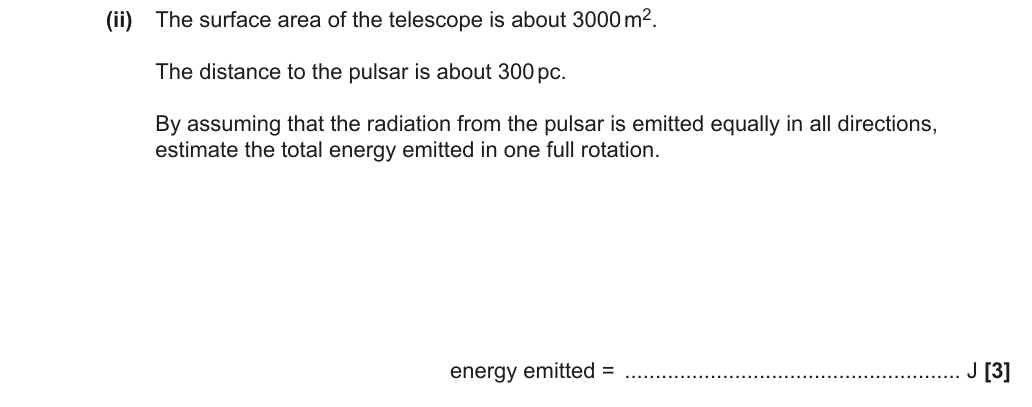
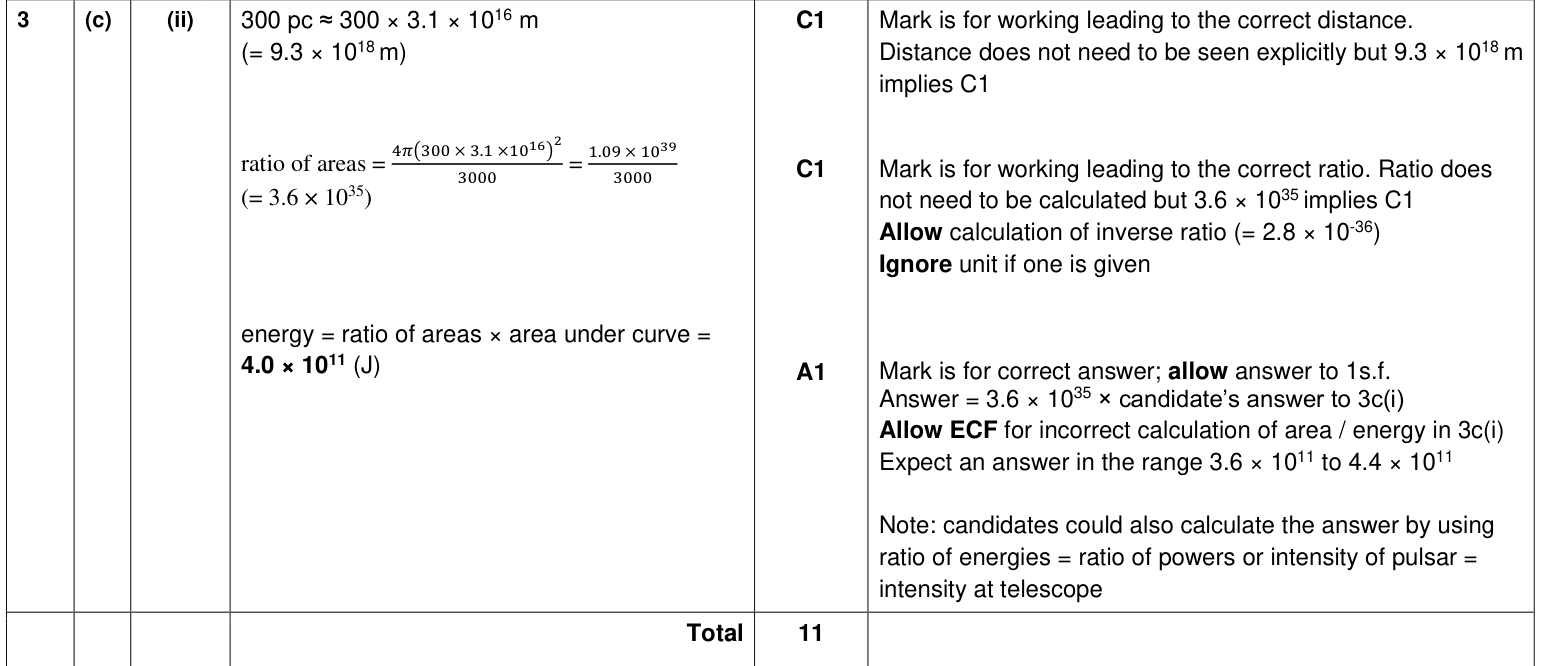
This question stretched even the highest ability candidates. The key was in realising that the intensity of the pulsar = the intensity at the telescope. So the ratio of powers (or energies) = ratio of surface areas. Most candidates successfully converted 300 pc into metres. However, some did not realise that the surface area of a sphere is 4r2, a formula that is in the data, formulae and relationships booklet.
Notes from the mark scheme and report
ratio of areas 4πd²/3000 = 3.6 x 10^35
ecf from (c)(i)
3.6 to 4.4 x 10^11 J
Skills: M0.2 Recognise and use expressions in decimal and standard form; M0.3 Use ratios, fractions and percentages; M4.3 Calculate areas of triangles, circumferences and areas of circles, surface areas and volumes of rectangular blocks, cylinders and spheres
June 2022 · Paper 1 · Q131 markMultiple choiceMedium
Answer
D
Mark scheme
Examiner's comment
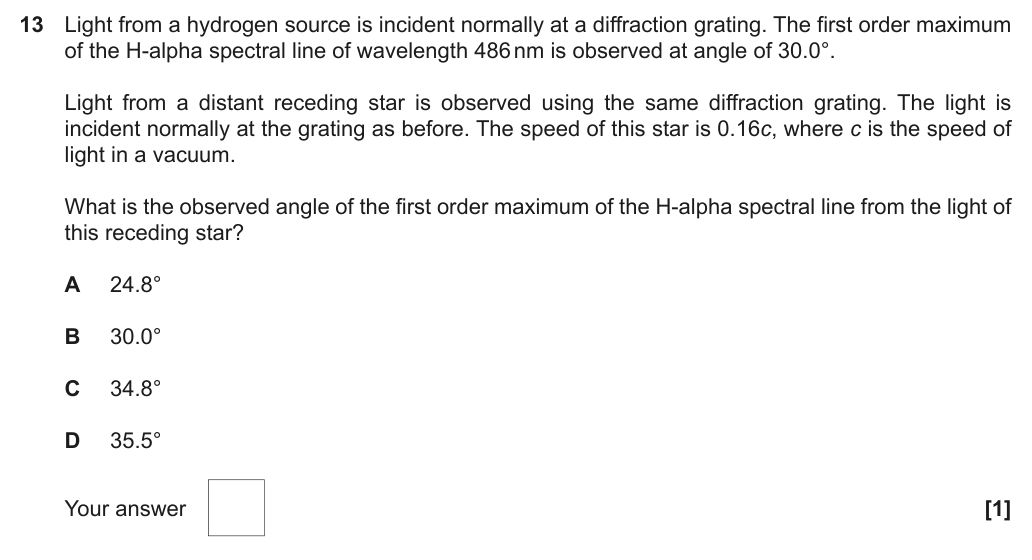
Candidates found this question challenging because it joins two ideas together. The first idea is that of the Doppler effect on waves from a moving source, which will increase the wavelength received by the observer. This removes options A and B. Once the new wavelength has been calculated, the corresponding angle should be calculated from the diffraction grating equation. It is worth mentioning that the correct answer and the most likely incorrect answer are too close together for the candidate to merely guess.
June 2022 · Paper 1 · Q141 markMultiple choice
Answer
C
Mark scheme
June 2022 · Paper 1 · Q151 markMultiple choice
Answer
B
Mark scheme
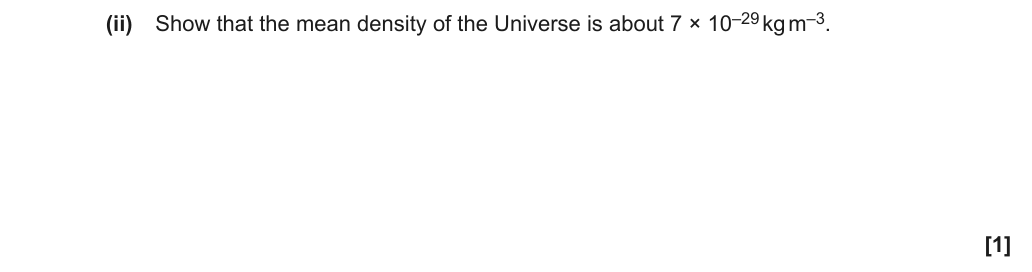
June 2022 · Paper 1 · Q21(b)(i)2 marksShow thatMedium
Mark scheme
Examiner's comment
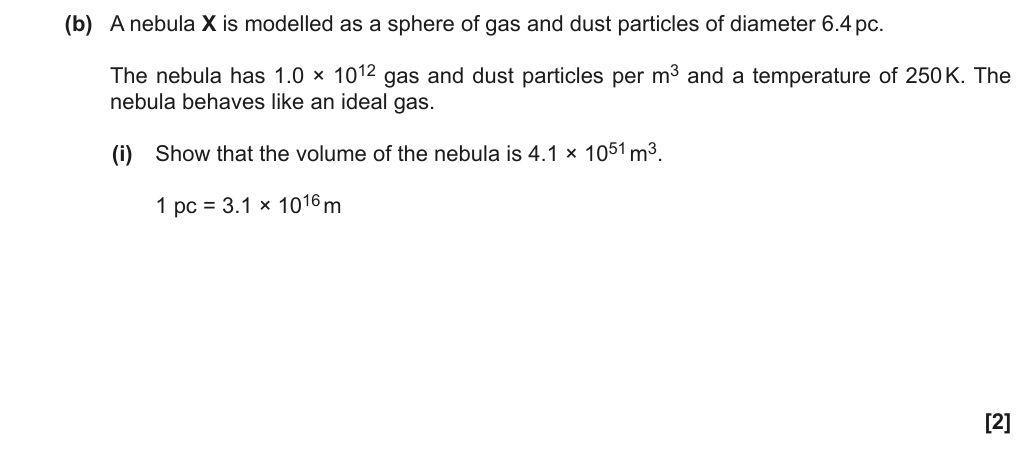
Candidates successfully converted the radius from parsecs into metres and from there the volume of the nebula.
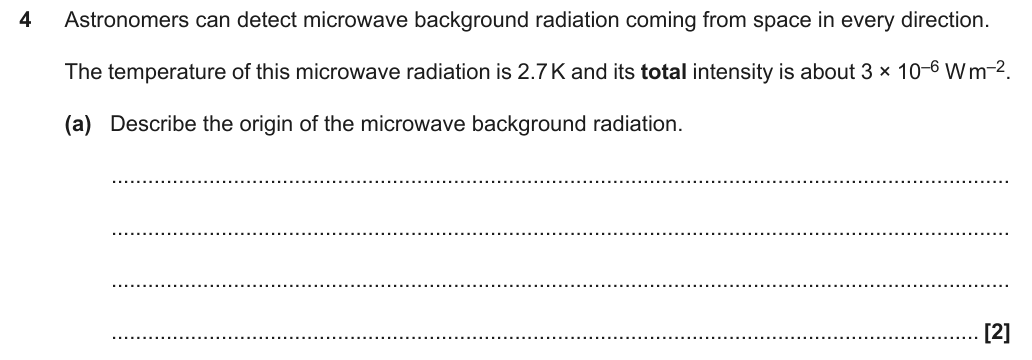
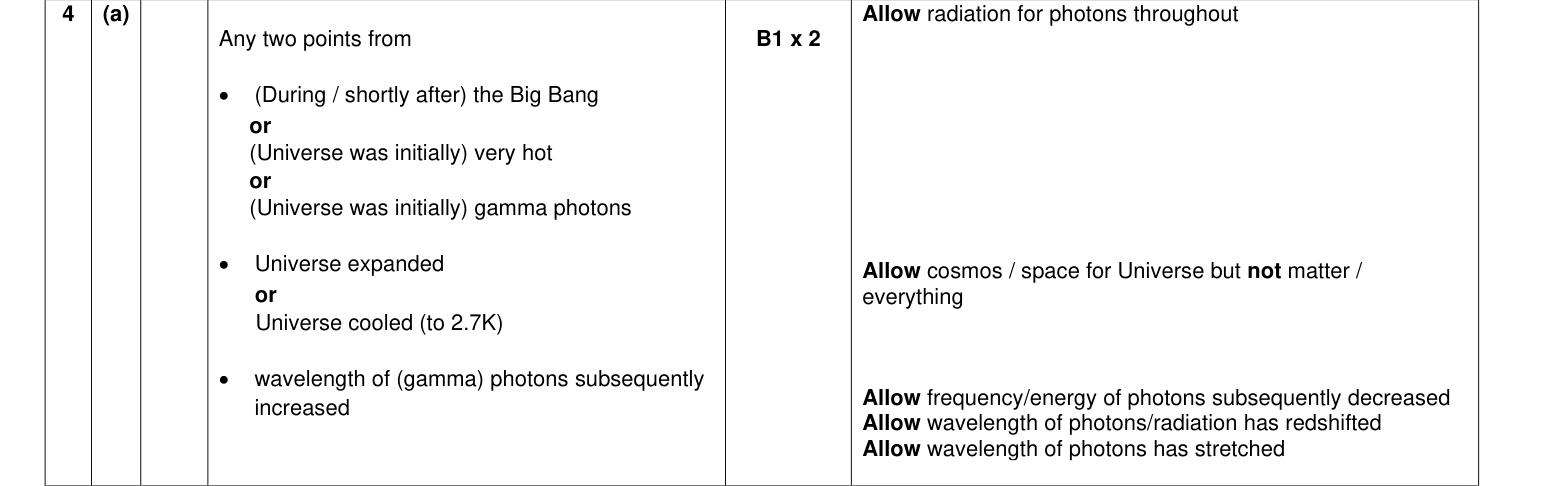
June 2022 · Paper 3 · Q4(a)2 marksExplanationHard
Mark scheme
Examiner's comment
Most candidates knew that the microwave background radiation originated in the Big Bang, although one common misconception was that it formed as microwaves which then spread through space. A few candidates thought that it came from black holes or supernovas. Precision in scientific language was important here. The photons themselves have not expanded or cooled since the Big Bang, and it is their wavelength that has increased / stretched / been red-shifted.
Notes from the mark scheme and report
any two points
Allow cosmos / space for Universe but not matter / everything
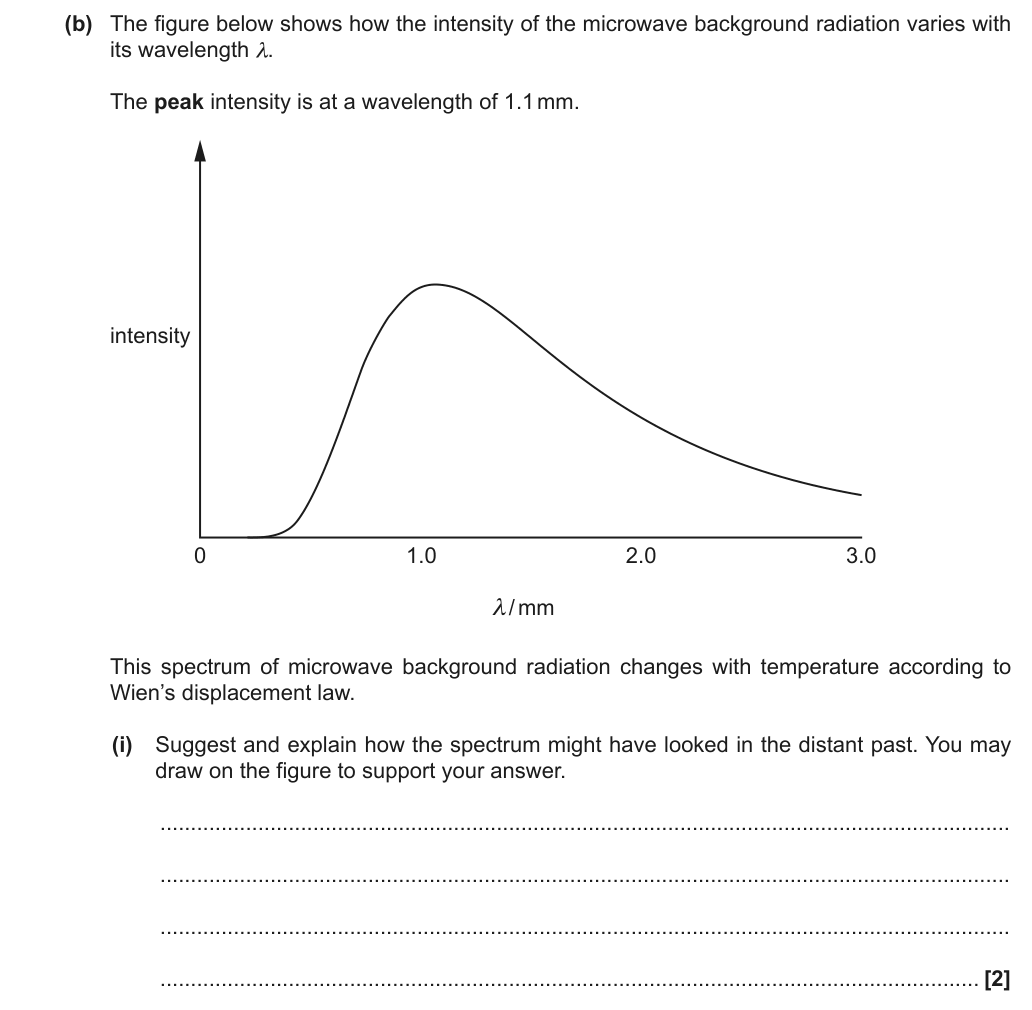
June 2022 · Paper 3 · Q4(b)(i)2 marksExplanationMedium
Mark scheme
Examiner's comment
The mention of Wien’s displacement law gave a clue that it would be useful in answering the question. A mark was given for stating the law. Note that the law is λMAX ∝ 1/T rather than λ ∝ 1/T or λMAX = 1/T. Candidates who did not draw on the diagram to illustrate their response sometimes missed the second B1 mark because they said that the wavelength (rather than the peak wavelength) would have been smaller. If an examiner says, ‘You may draw on the diagram’, it is generally a beneficial approach.
Notes from the mark scheme and report
NOT λmax = 1/T
peak at shorter wavelength
Ignore overall shape
Skills: M3.12 Sketch relationships which are modelled by y = k/x, y = kx², y = k/x², y = kx, y = sin x, y = cos x, y = e^(±x) and y = sin²x, y = cos²x as applied to physical relationships
November 2021 · Paper 1 · Q51 markMultiple choice
Answer
A
Mark scheme
November 2021 · Paper 1 · Q151 markMultiple choice
Answer
A
Mark scheme
November 2020 · Paper 1 · Q71 markMultiple choice
Answer
B
Mark scheme
November 2020 · Paper 1 · Q111 markMultiple choice
Answer
B
Mark scheme
June 2019 · Paper 1 · Q131 markMultiple choice
Answer
A
Mark scheme
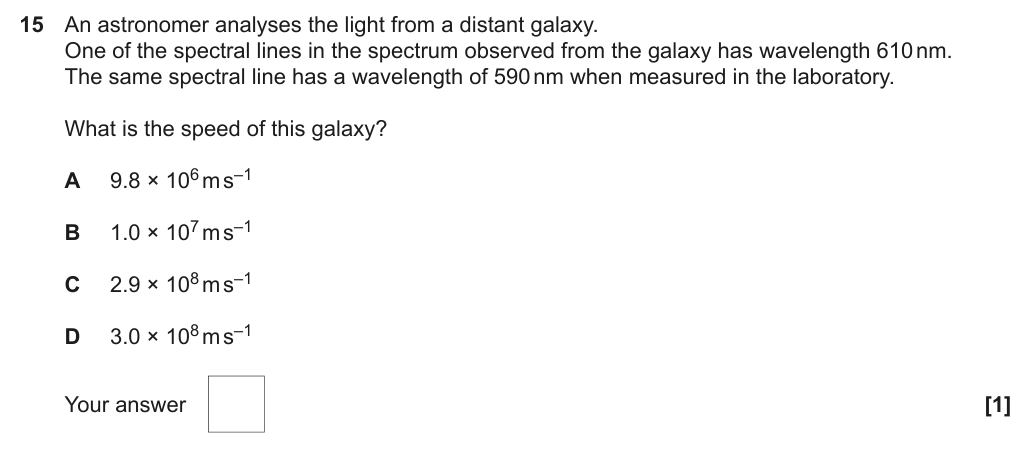
June 2019 · Paper 1 · Q151 markMultiple choiceMedium
Answer
B
Mark scheme
Examiner's comment
Option D is the speed of light, so the galaxy cannot be travelling this fast. The change in wavelength for the galaxy is 20 nm. The laboratory wavelength for this light is 590 nm. The relationship we need is that the fractional change in wavelength for light from a galaxy approximately equals the fraction of the speed of light for that galaxy. The fractional change in wavelength is 20/590 = 3.39 % 3.39% of the speed of light = 1.02 × 10⁷ m s-1, i.e. option B. Option A was the most common incorrect response, which is the speed when the change is wavelength is divided by the wavelength of light from the galaxy.
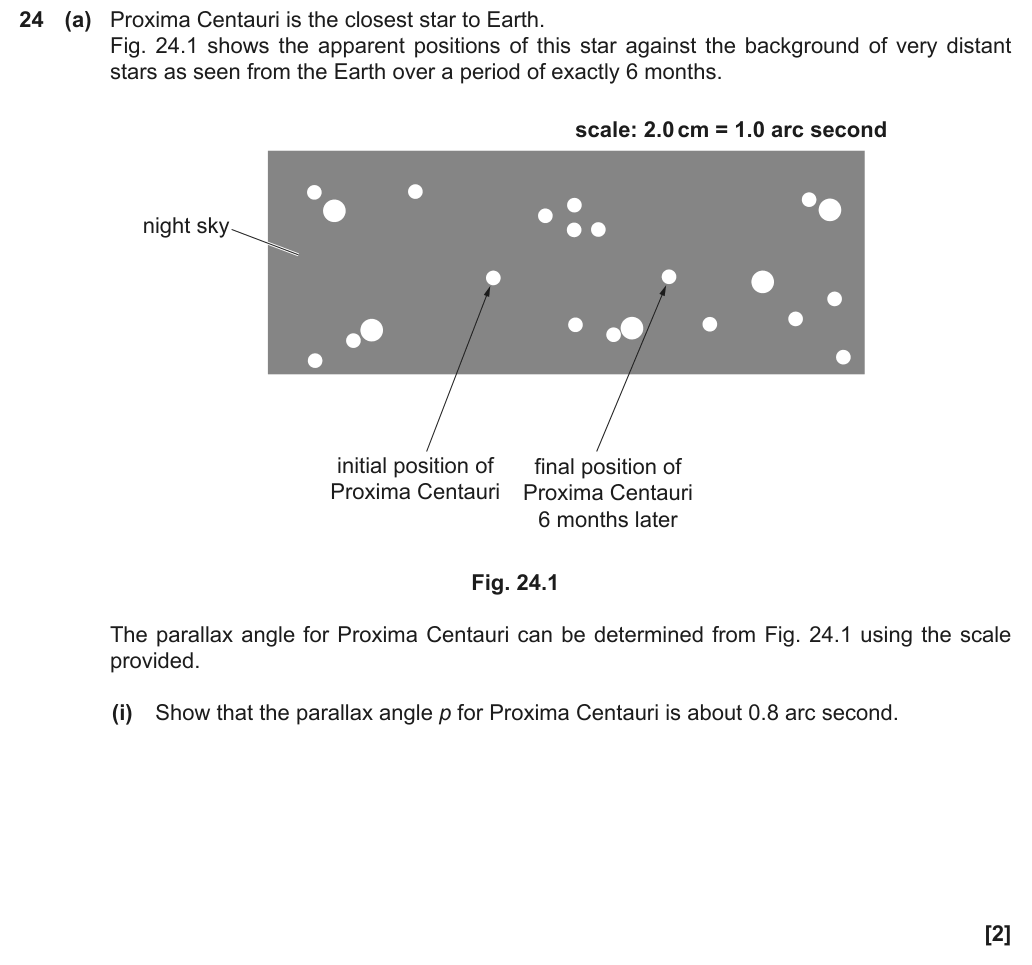
June 2019 · Paper 1 · Q24(a)(i)2 marksShow thatEasy
Mark scheme
Examiner's comment
Almost all candidates scored a mark for measuring the distance between promixa centauri’s positions 6 months apart. The scale was well understood, giving an angle of approximately 1.5 arc seconds. The parallax angle is defined to be half of this value, giving a parallax angle in this case of 0.75 arc seconds. This final step was what prevented candidates receiving the second mark.
Notes from the mark scheme and report
separation measured with a ruler on the printed figure (2.9 to 3.2 cm)
parallax angle is half the angular shift
Skills: M0.3 Use ratios, fractions and percentages; M3.1 Translate information between graphical, numerical and algebraic forms
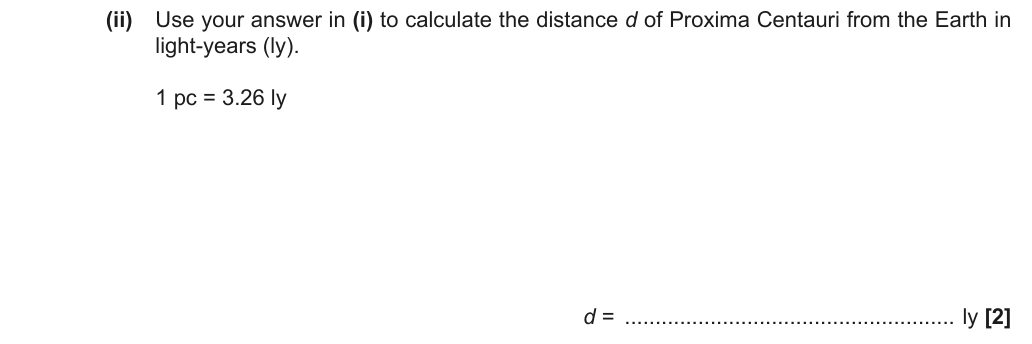
June 2019 · Paper 1 · Q24(a)(ii)2 marksCalculationMedium
Earlier part of question 24 that this part uses
Mark scheme
Examiner's comment
Most candidates used the data in the previous part of the question ie that the parallax angle was 0.8 arc seconds or trusted their own value which was close to 0.8 arc seconds. Nearly everyone that presented a distance in parsecs could then calculate the distance in light years.
Notes from the mark scheme and report
ecf from (a)(i)
4.2 using 0.78 arc seconds
Skills: M0.1 Recognise and make use of appropriate units in calculations; M2.3 Substitute numerical values into algebraic equations using appropriate units for physical quantities
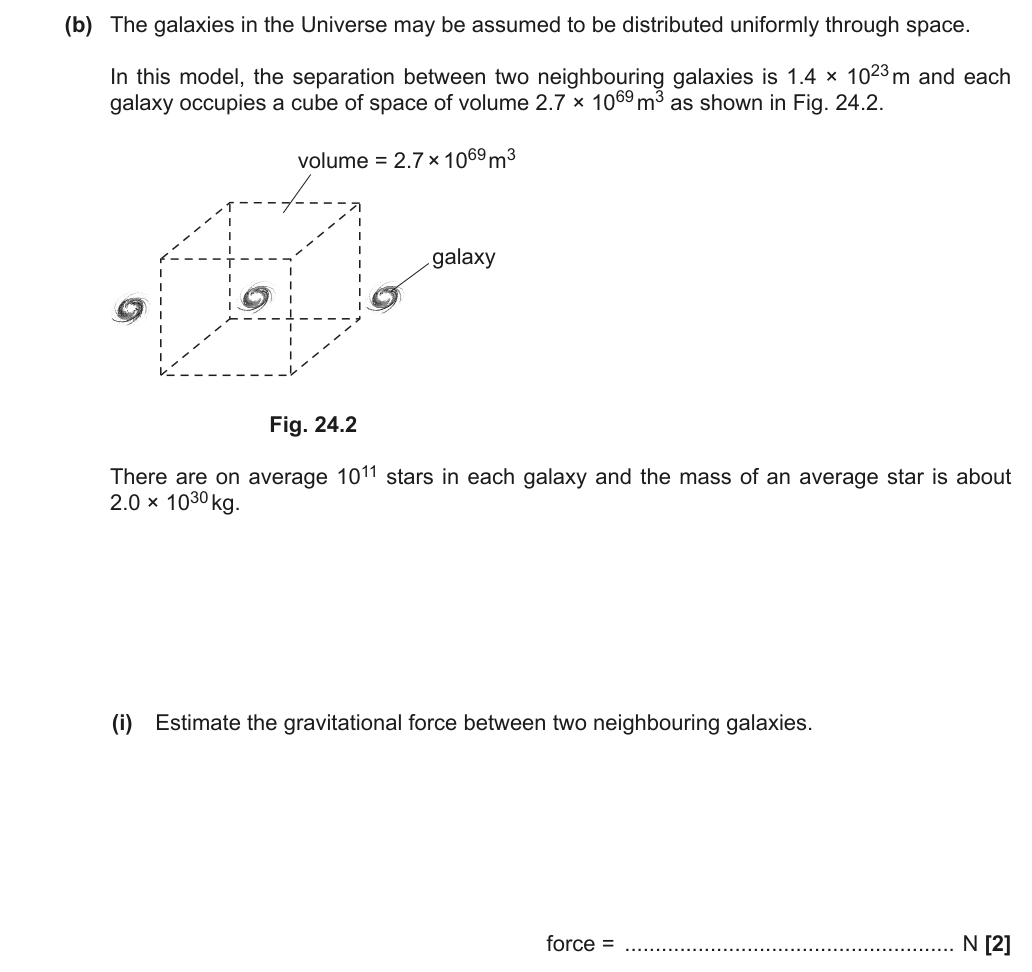
June 2019 · Paper 1 · Q24(b)(iii)1 markExplanationHard
Earlier parts of question 24 that this part uses
Mark scheme
Examiner's comment
This was a question about challenging the model of the universe. The model takes into account an average mass and average distance of separation, so answers that referred to a variation in masses or distances between galaxies did not score. Higher level responses included that the universe was expanding, so that the distances involved were always changing, or that dark matter was not included in the calculations. There was no indication that candidates were constrained by time in this paper.
Notes from the mark scheme and report
any reasonable criticism of the model, e.g. dark matter / dark energy, black holes, expanding universe
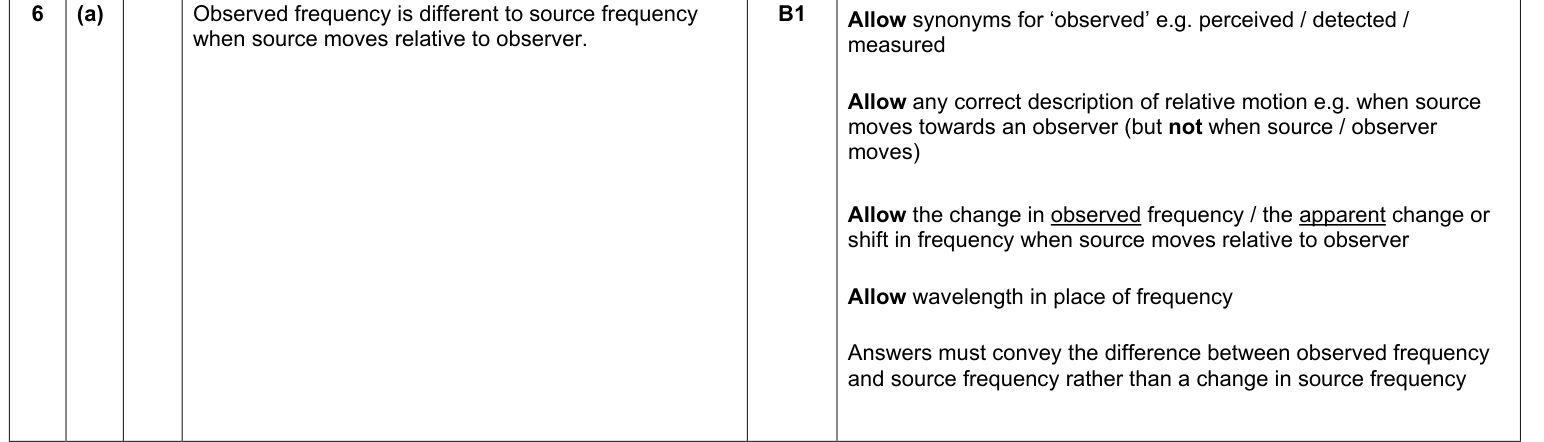
June 2019 · Paper 3 · Q6(a)1 markExplanationHard
Mark scheme
Examiner's comment
Very few candidates were able to score this mark. Common problems in 6(a) • stating that the frequency of the source had changed rather than referring to an observed frequency • referring to the frequency of an ‘object’ without specifying that the object was a wave source • referring only to the movement of the source or the observer rather than describing relative motion between the two • talking about the motion of the wave rather than the wave source.
Notes from the mark scheme and report
must convey a difference between observed and source frequency due to relative motion, not a change in source frequency
frequency of the wave does not change; it only appears to have changed when viewed by the observer.
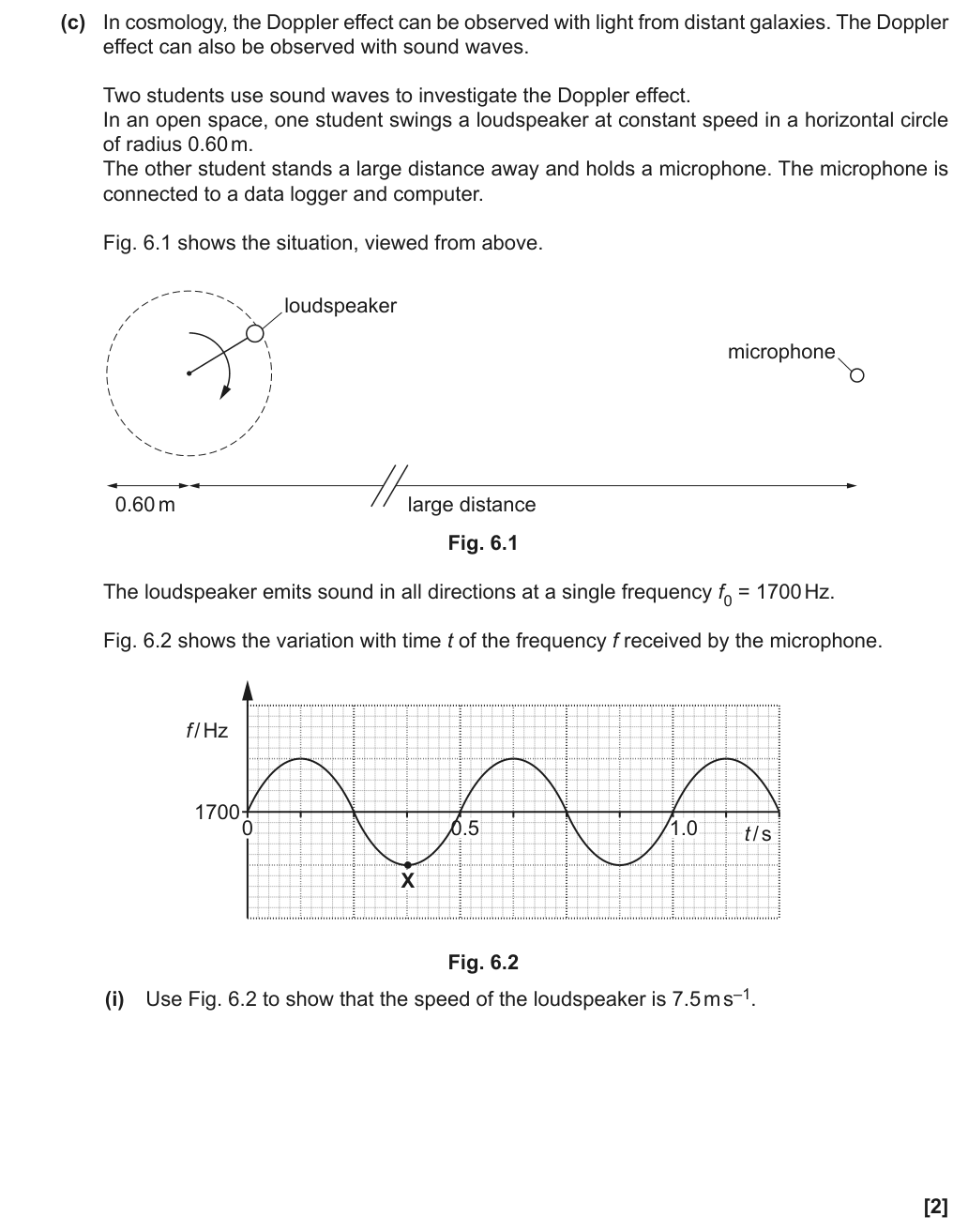
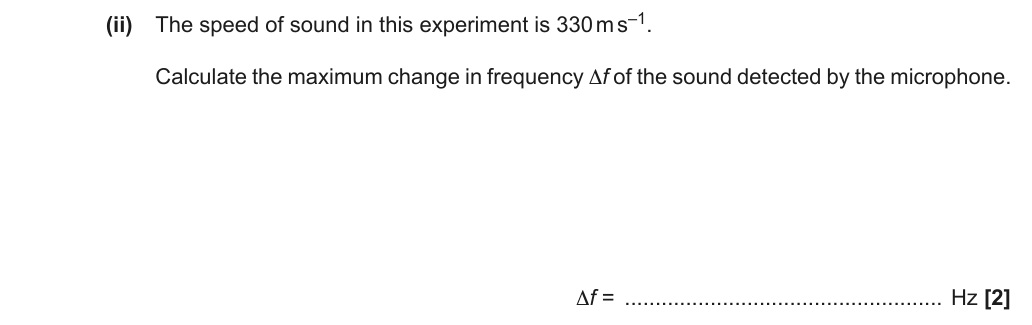
June 2019 · Paper 3 · Q6(c)(ii)2 marksCalculationMedium
Earlier part of question 6 that this part uses
Mark scheme
Examiner's comment
The question had stated clearly that the students were investigating the Doppler effect, and candidates were expected to use the Doppler equation Δf/f ≈ v/c. Common problems in 6(c)(ii) • using the formula for Doppler ultrasound from 6(b) and so obtaining an answer of 78Hz rather than 39Hz (see Exemplar 10) • using the velocity of light rather than velocity of sound for c • adding the velocity of the loudspeaker to the velocity of sound for v, substituting in the formula to find Δf, and then subtracting the frequency of sound from the answer. Although this gave the correct answer, it is wrong physics and so was not given credit.
Notes from the mark scheme and report
c is the speed of sound
39 or 40 Hz
Skills: M0.3 Use ratios, fractions and percentages; M2.3 Substitute numerical values into algebraic equations using appropriate units for physical quantities
June 2019 · Paper 3 · Q6(c)(iii)1 markShort answerMedium
Earlier parts of question 6 that this part uses
Mark scheme
Examiner's comment
Many candidates left 6(c)(iii) blank, although full marks could have been given from ECF from (c)(ii). The most common error here was using + and – the value obtained in (c)(ii), rather than subtracting or adding it to 1700, as demonstrated in Exemplar 10 below.
Notes from the mark scheme and report
minimum one labelled point (1740 or 1660)
ecf from (c)(ii)
Skills: M3.1 Translate information between graphical, numerical and algebraic forms
June 2019 · Paper 3 · Q6(c)(iv)1 markShort answerMedium
Earlier part of question 6 that this part uses
Mark scheme
Examiner's comment
The purpose of this question was to test whether candidates could associate a maximum decrease in observed frequency (a ‘red shift’) with motion directly away from the observer / microphone. Unfortunately, not many were able to place the cross correctly, with many leaving this response blank.
Notes from the mark scheme and report
X at the lowest point of the circle in Fig. 6.1
Skills: M3.1 Translate information between graphical, numerical and algebraic forms
June 2018 · Paper 1 · Q23(a)1 markShort answerMedium
Mark scheme
Examiner's comment
Just under half of the candidates got this term correct. The majority that did not confused this term with isotropic or used insufficiently clear language, such as ‘the universe is the same everywhere’.
Notes from the mark scheme and report
NOT the idea of isotropic / looks the same in all directions
June 2018 · Paper 1 · Q23(b)(i)3 marksCalculationHard
Mark scheme
Examiner's comment
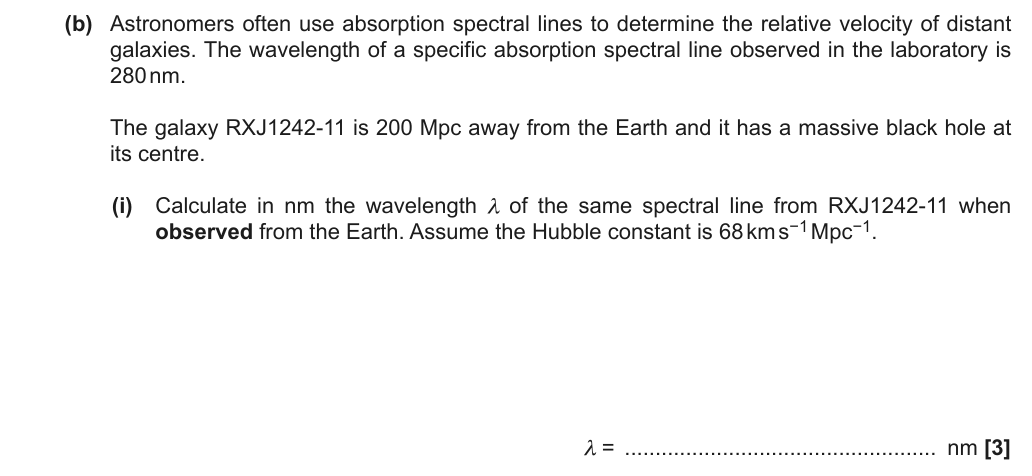
This is a more challenging question with several steps. In multiplying the distance in Mpc by the H0 as quoted, the velocity of the galaxy was 13600 km s-1. Some candidates handled the units well in this question, reaching a change in wavelength of 13 nm. If the candidate got as far as that, then approximately half then went on to add the change in wavelength correctly. The change is added as the galaxy is going away from us. This candidate has laid out the calculation very carefully. It is obvious that they have handled the idea that the speed of light is given in m s-1 and that the galaxy’s velocity is in km s-1. This gives the correct change in wavelength and eventually the correct wavelength.
Notes from the mark scheme and report
change in wavelength must be added to 280 nm
ecf for incorrect v
Skills: M0.1 Recognise and make use of appropriate units in calculations; M2.2 Change the subject of an equation, including non-linear equations; M2.3 Substitute numerical values into algebraic equations using appropriate units for physical quantities
June 2018 · Paper 1 · Q23(c)4 marksExplanationMedium
Mark scheme
Examiner's comment
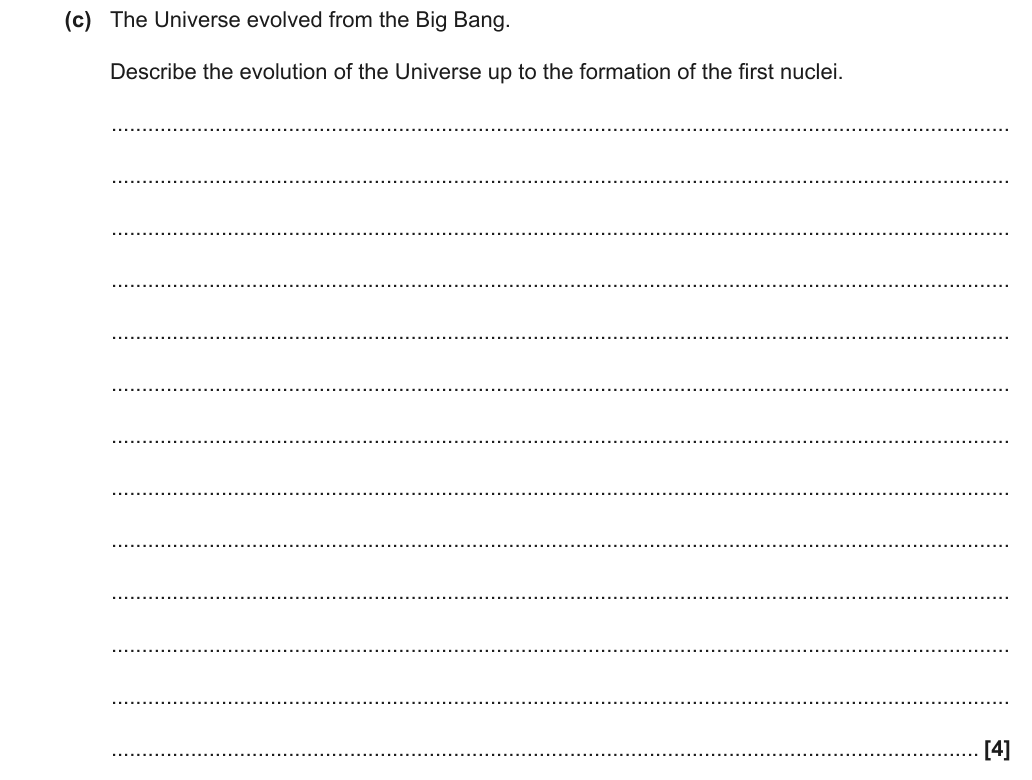
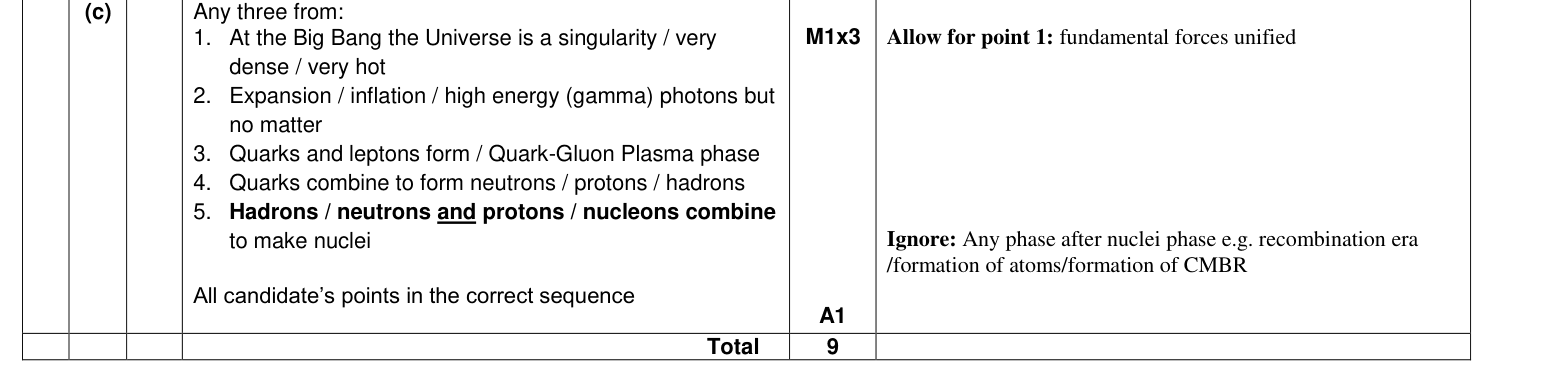
Many candidates did well on this question as they had learnt the stages and the order of those stages well. The most common reason for loss of marks was not including details about leptons or getting the stages in the wrong order.
Notes from the mark scheme and report
final mark for points in the correct sequence
ignore any phase after nuclei
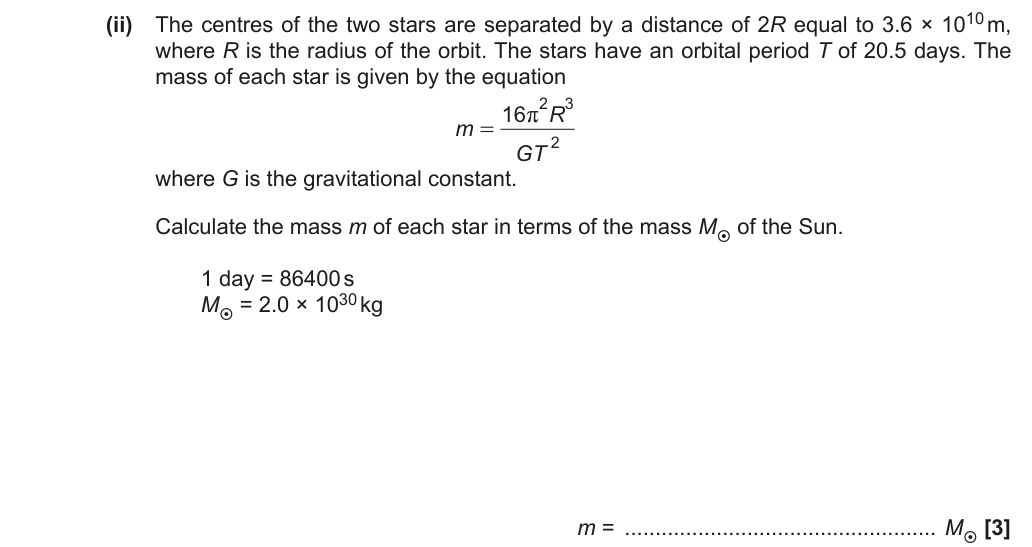
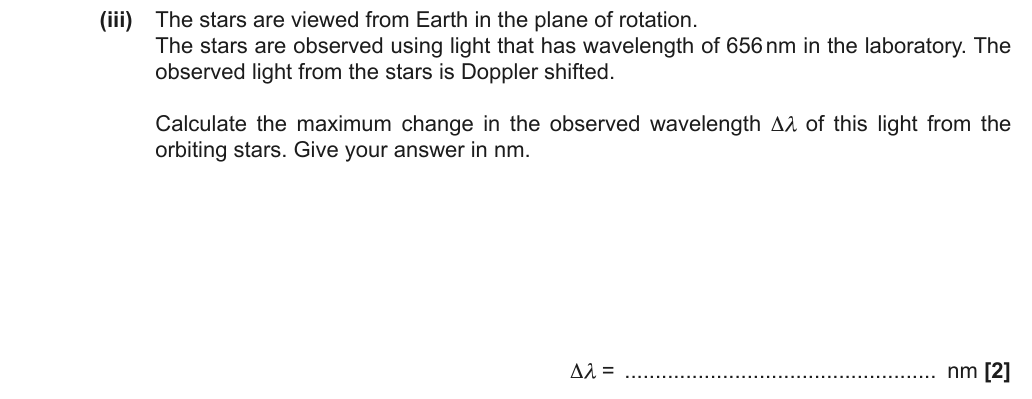
June 2018 · Paper 3 · Q3(a)(iii)2 marksCalculationMedium
Earlier part of question 3 that this part uses
Mark scheme
Examiner's comment
Most of the higher performing candidates completed this problem successfully. Two common errors among the remainder were to equate the formula for central force gravitational potential energy (GMm/r) to kinetic energy to find a value for the speed of the stars and to rewrite incorrectly metres in powers of 10 in nanometres.
Notes from the mark scheme and report
do not penalise repeated error for R or T
ecf for incorrect v
Skills: M0.3 Use ratios, fractions and percentages; M2.3 Substitute numerical values into algebraic equations using appropriate units for physical quantities
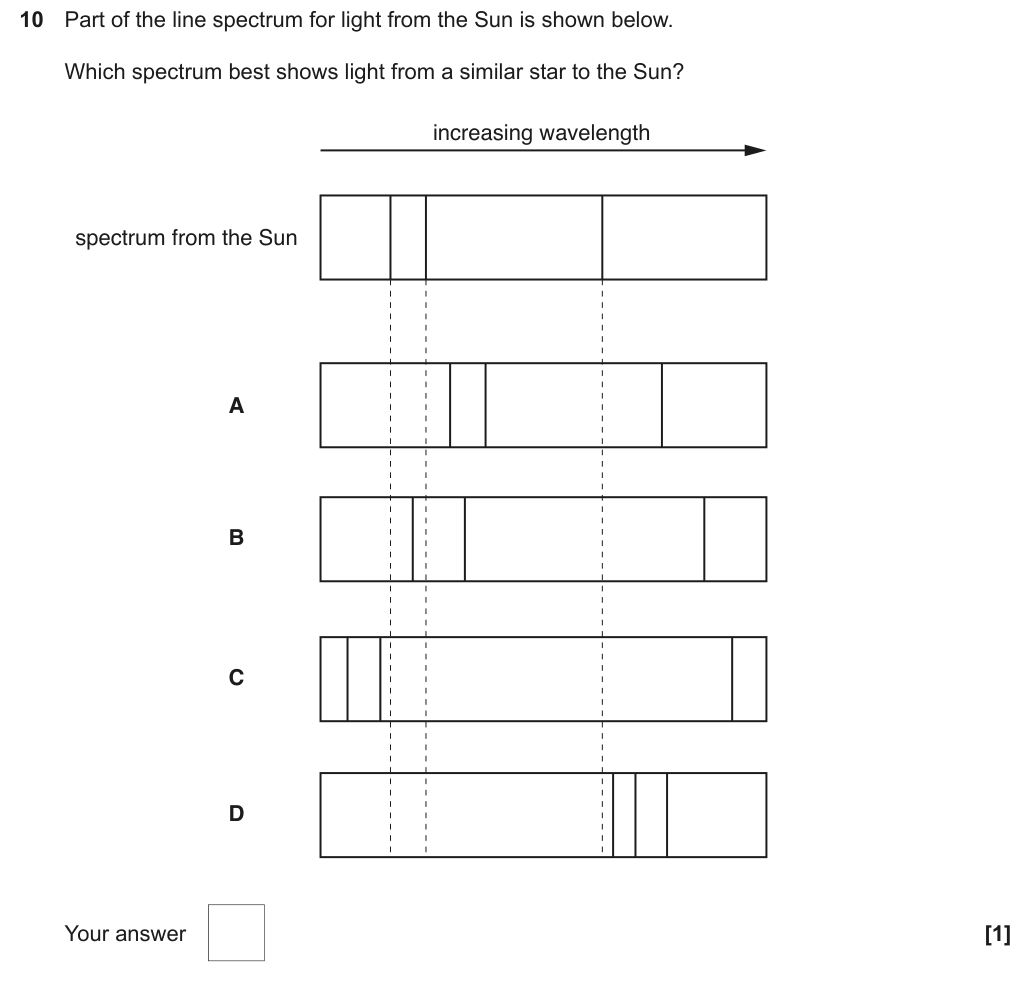
June 2017 · Paper 1 · Q101 markMultiple choice
Answer
B
Mark scheme
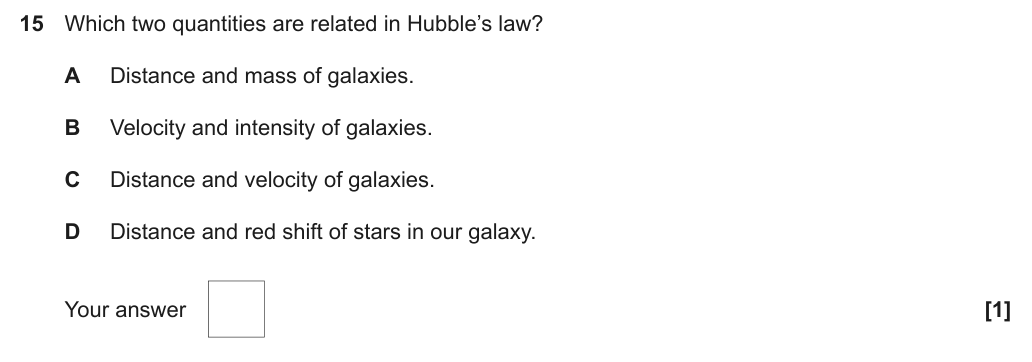
June 2017 · Paper 1 · Q151 markMultiple choice
Answer
C
Mark scheme
June 2017 · Paper 1 · Q21(b)(iii)3 marksCalculation
Earlier part of question 21 that this part uses
Mark scheme
Notes from the mark scheme and report
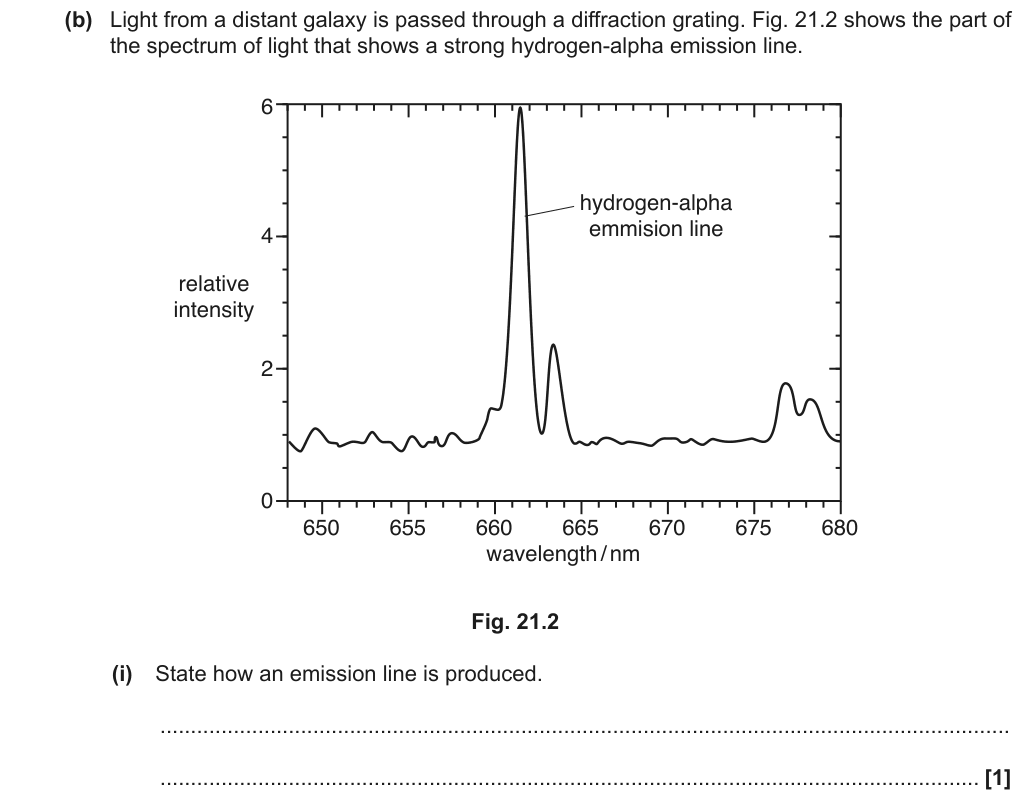
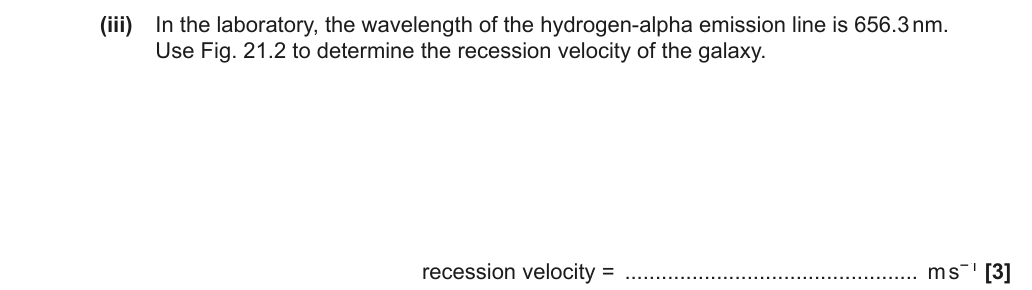
peak between 661 and 662 nm
must divide by 656.3 nm
2.15 to 2.61 x 10⁶ m s⁻¹
Skills: M0.3 Use ratios, fractions and percentages; M2.3 Substitute numerical values into algebraic equations using appropriate units for physical quantities; M3.1 Translate information between graphical, numerical and algebraic forms
June 2017 · Paper 1 · Q21(c)3 marksExplanation
Earlier part of question 21 that this part uses
Mark scheme
Notes from the mark scheme and report
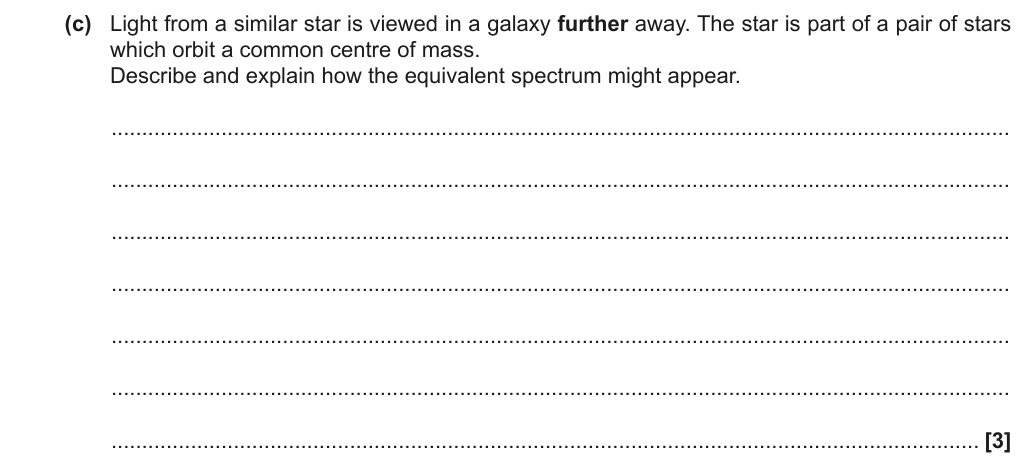
Not idea of blue shift
Work with an OCR physics tutor
Dropping marks on calculations, practical questions or the six-mark level of response questions? Book a trial session with a specialist OCR physics tutor.