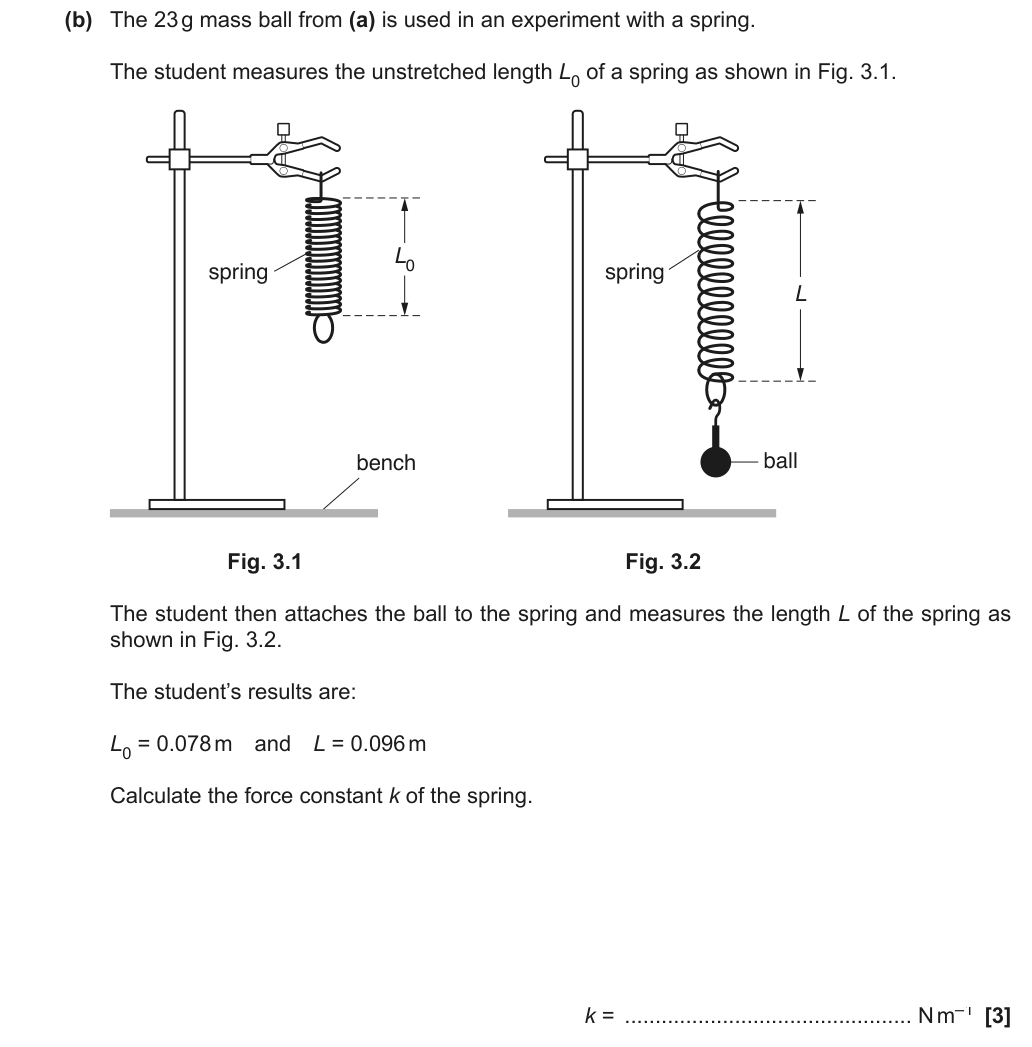
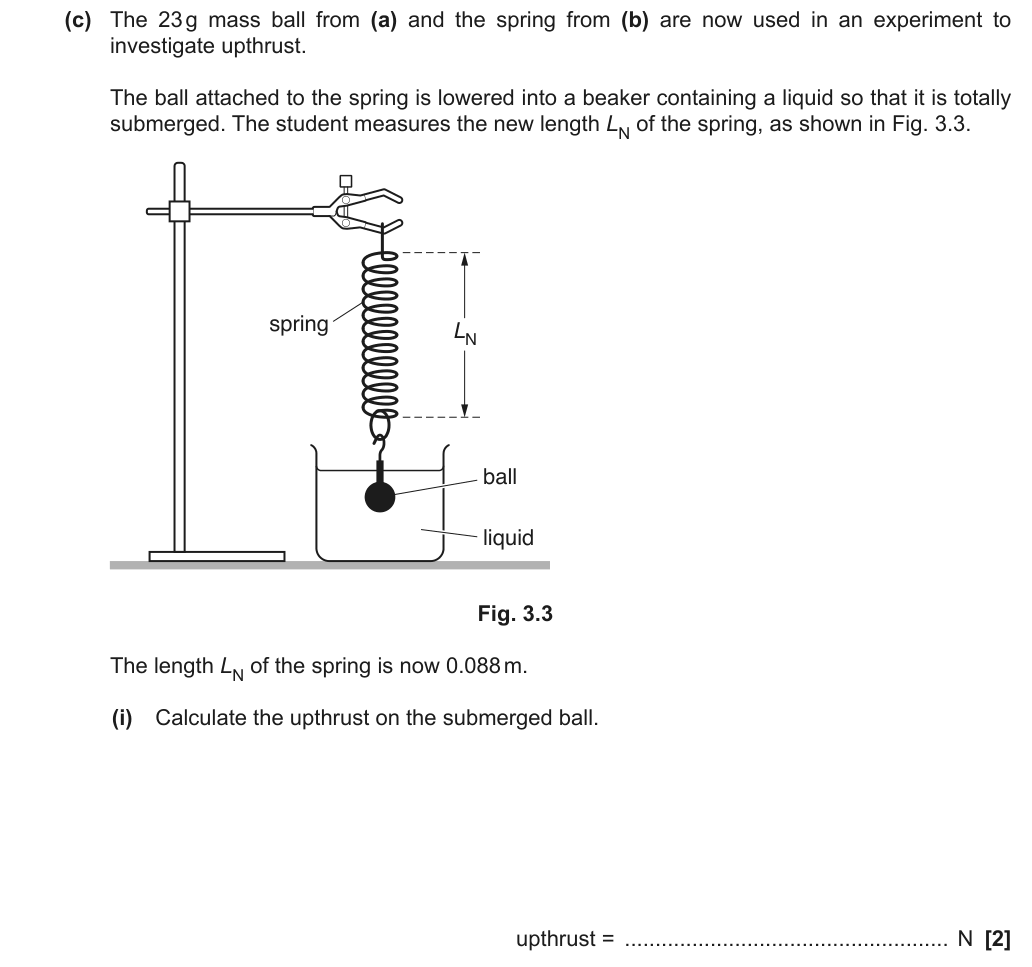
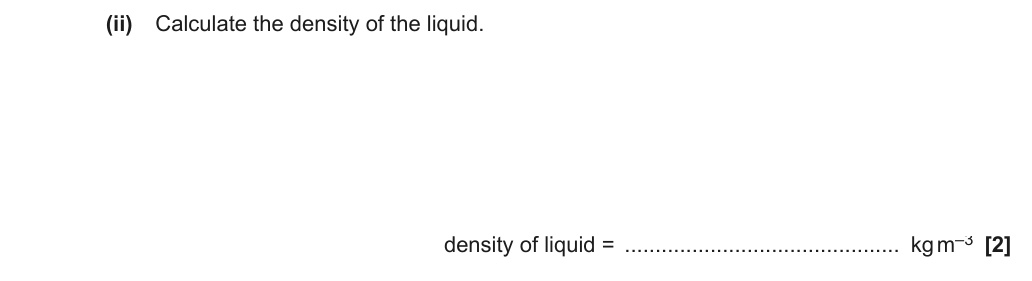
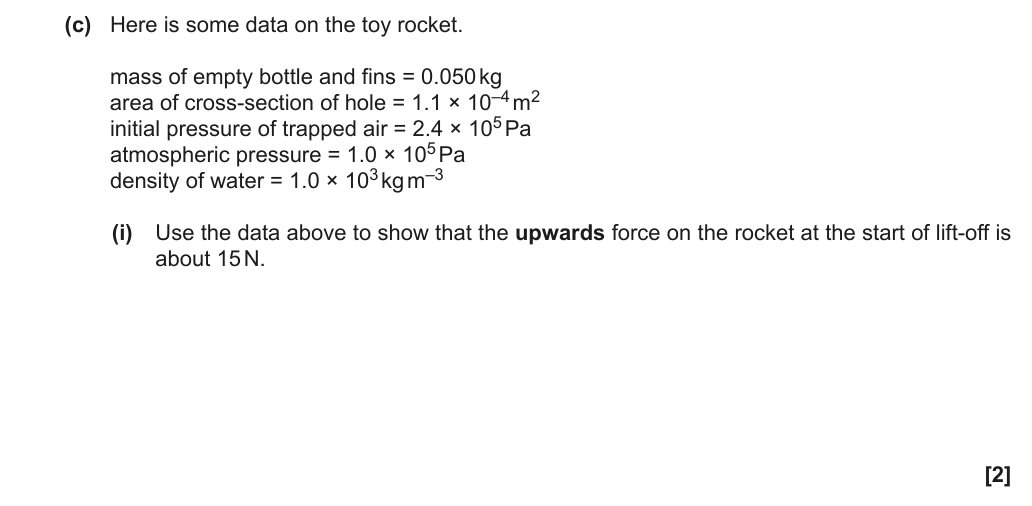
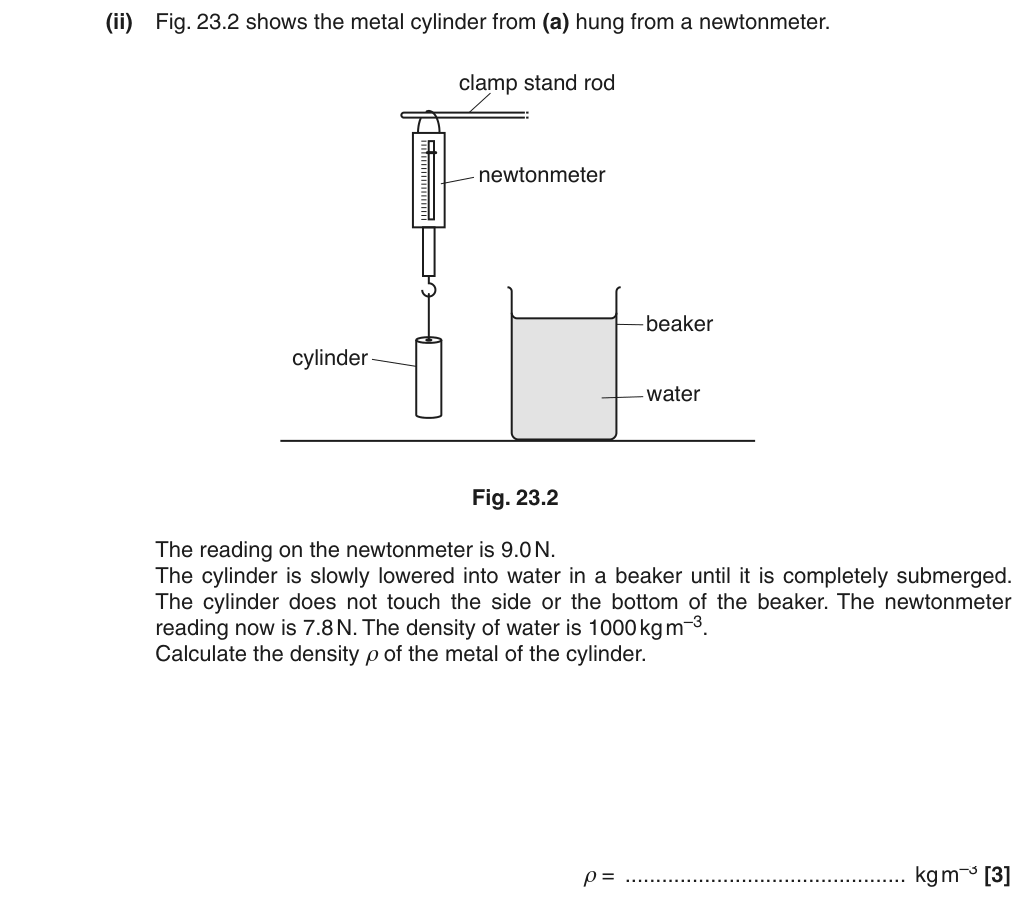
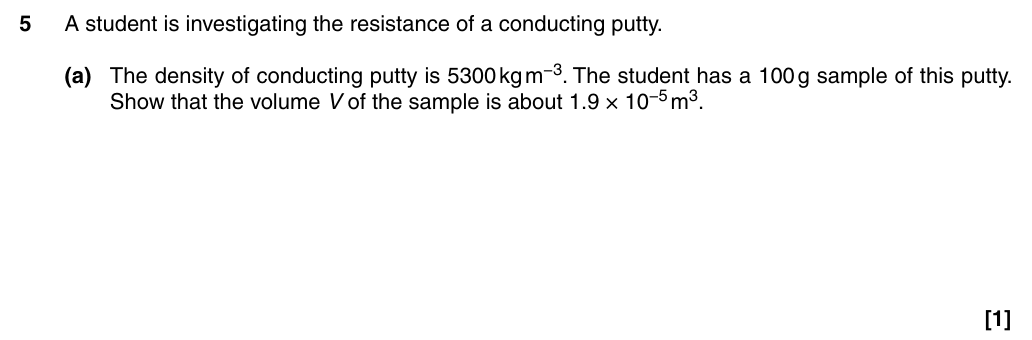
Tap a question to zoom it. Where a part needs a figure, table or graph from earlier in the question, that part folds out above it; the mark scheme and examiner's comment open underneath. Have the OCR Data, Formulae and Relationships Booklet beside you (see the data booklet page).
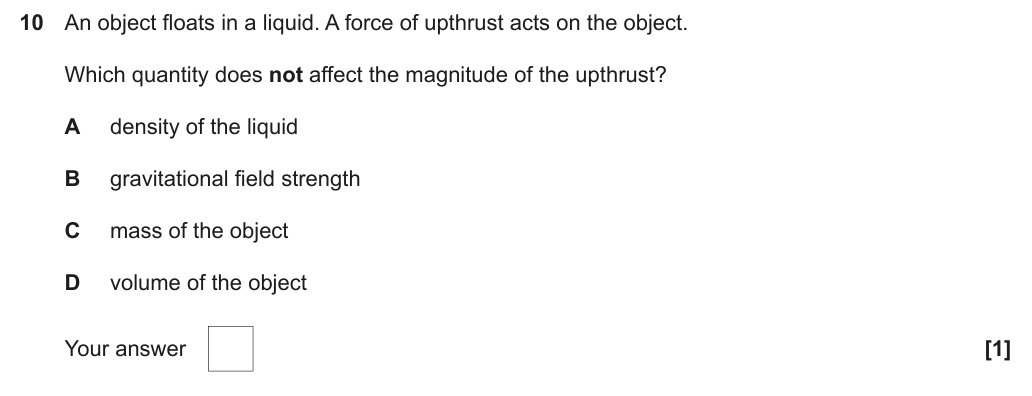
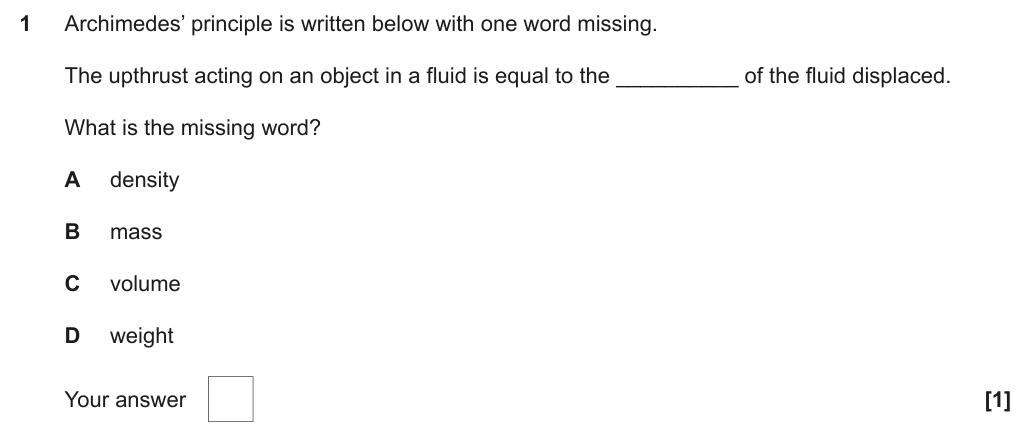
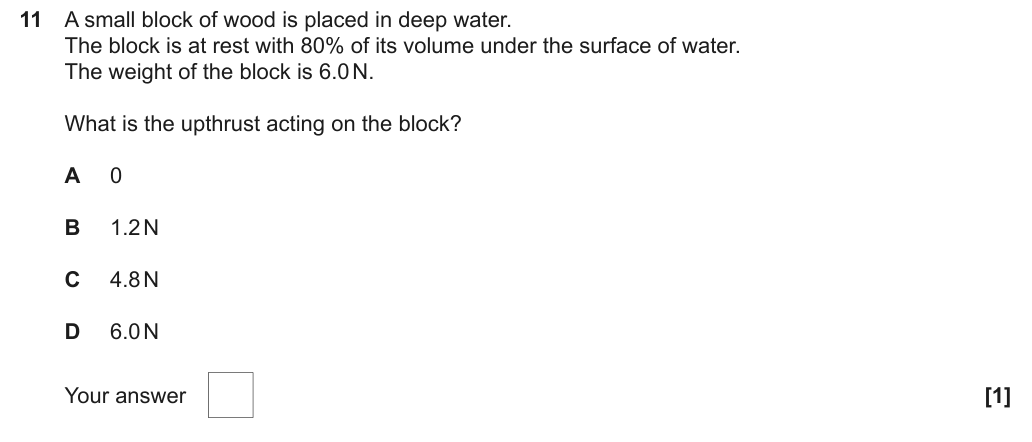
June 2025 · AS Paper 1 · Q101 markMultiple choiceHard
Mark scheme
Examiner's comment
There were many incorrect answers to this question. A significant minority of candidates selected the gravitational field strength option.
Notes from the mark scheme and report
Question removed by OCR due to an error
no answer in the mark scheme
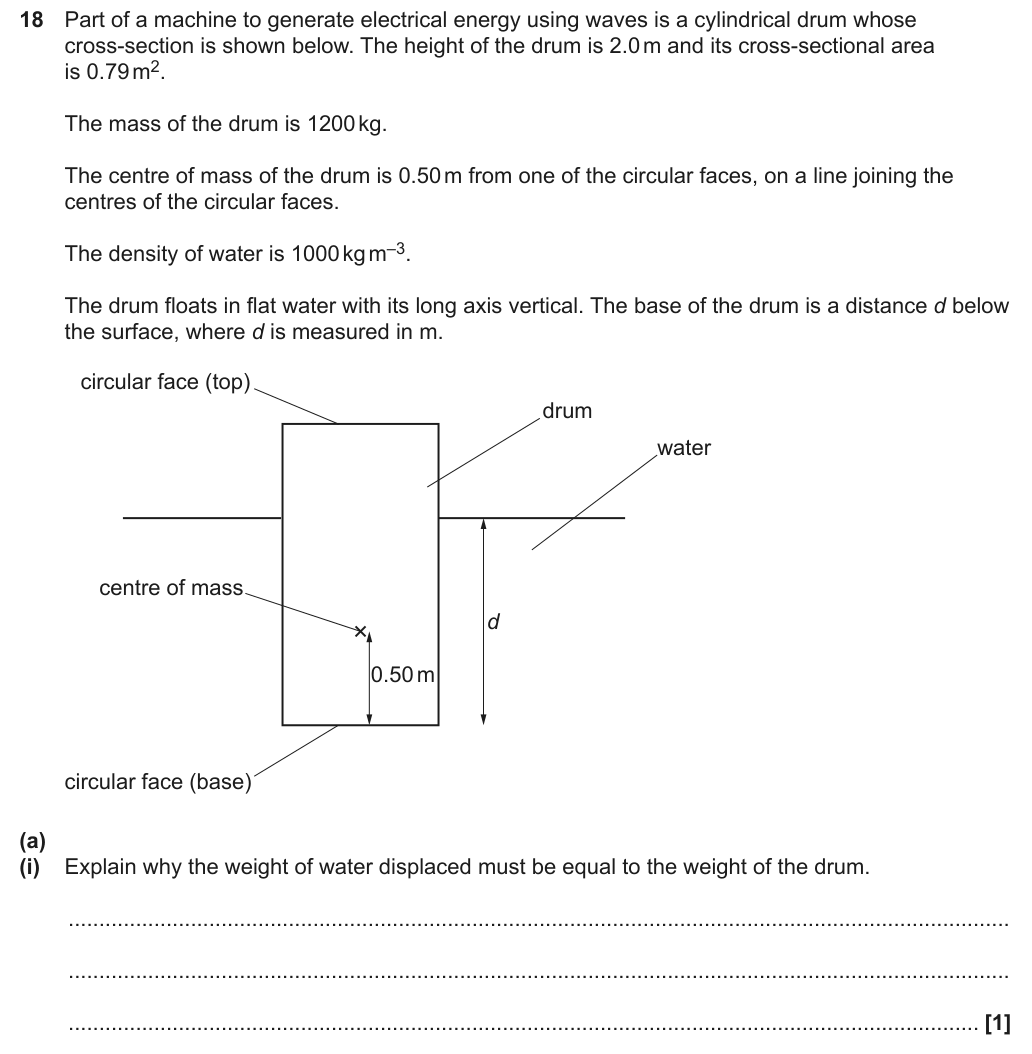
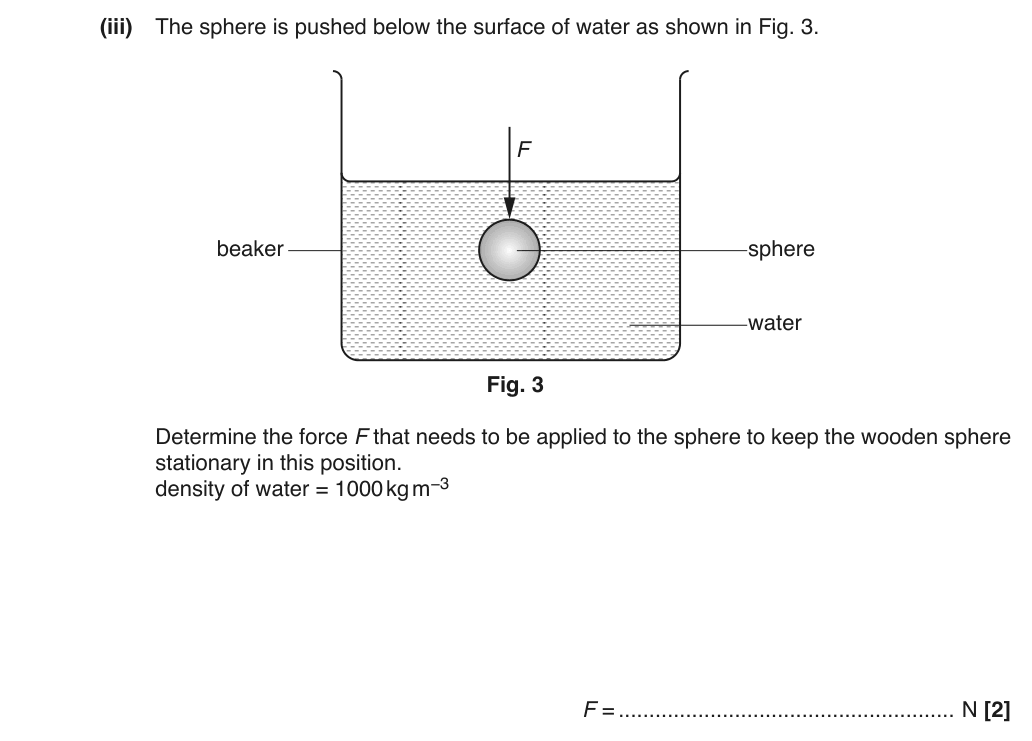
June 2025 · Paper 1 · Q18(a)(i)1 markExplanationMedium
Mark scheme
Examiner's comment
The key term here is ‘upthrust’. Candidates scored no mark for describing that the weight of the water displaced must be equal to the weight of the drum as stated in the question.
Notes from the mark scheme and report
Candidates should be careful not to inadvertently repeat the text of the question.
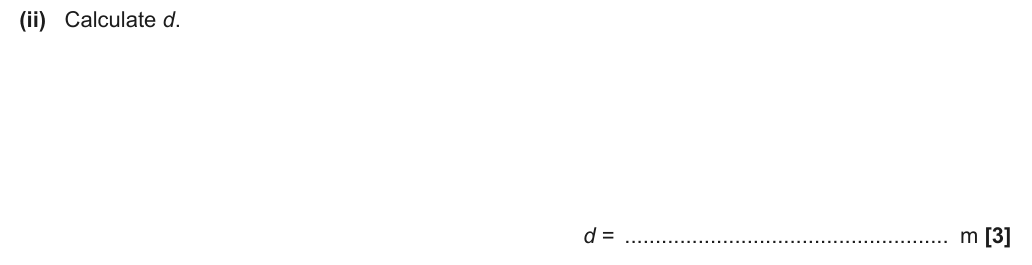
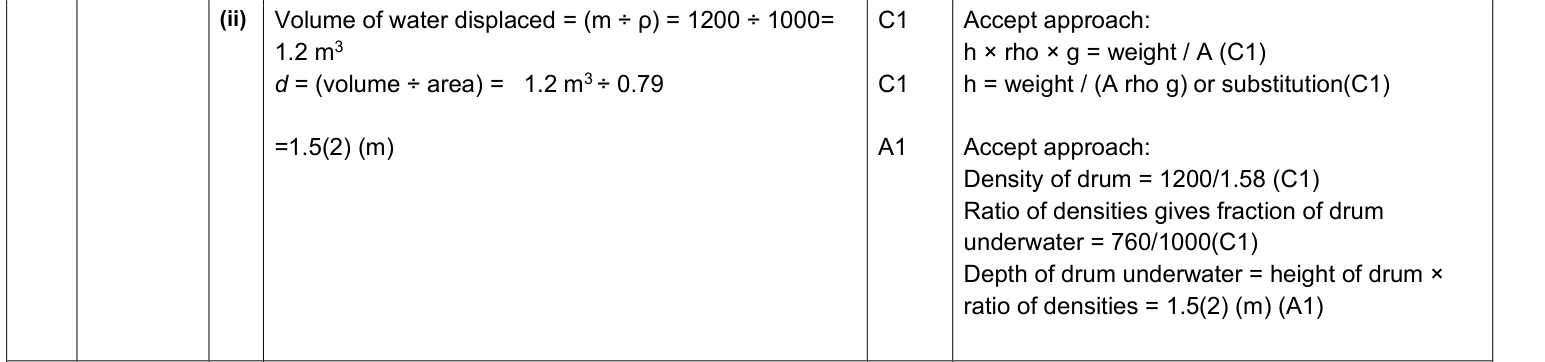
June 2025 · Paper 1 · Q18(a)(ii)3 marksCalculationEasy
Earlier part of question 18 that this part uses
Mark scheme
Examiner's comment
The most straightforward way to answer this question successfully is to equate the weight of the water displaced (density of water × volume of the drum from the bottom to depth d) to the weight of the drum (1200 x g). A neat approach was to find the density of the drum and using the ratio of the densities of the drum and water to work out the fraction of the drum (and hence the depth of the drum) that must be underwater.
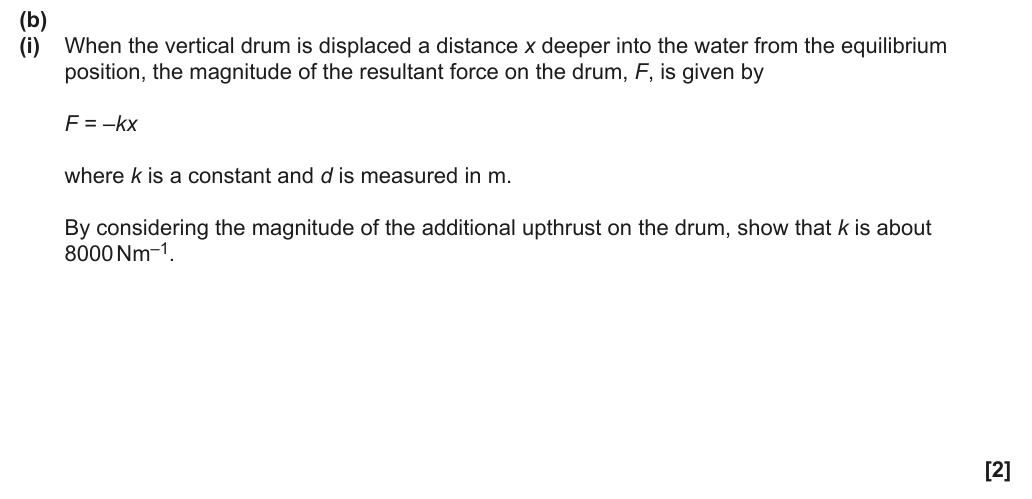
June 2025 · Paper 1 · Q18(b)(i)2 marksShow thatMedium
Earlier part of question 18 that this part uses
Mark scheme
Examiner's comment
Erratum Notice The erratum did not appear to have any effect on the ability of candidates to answer the question. The best way to answer this is to find an expression for the additional upthrust provided by displacing the drum by the distance, x, as this is equal to the resultant force. The candidate then needed to be clear about how they had cancelled ‘x’ from both sides of the equation, giving a value consistent with 8000 Nm-1.
Notes from the mark scheme and report
candidate's value for k alone is insufficient for the A1 (working must be shown)
Skills: M2.2 Change the subject of an equation, including non-linear equations; M2.3 Substitute numerical values into algebraic equations using appropriate units for physical quantities
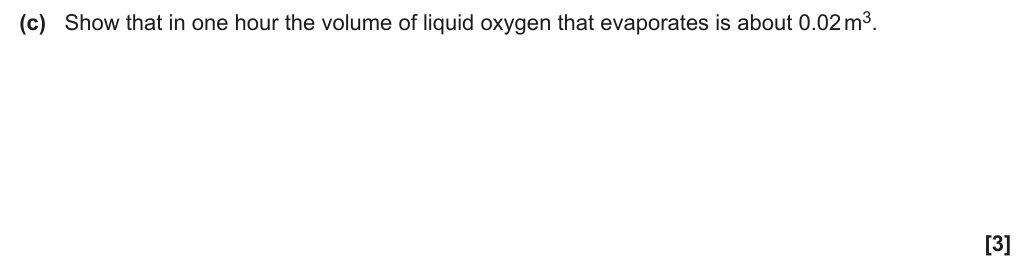
June 2025 · Paper 1 · Q19(c)3 marksShow thatMedium
Earlier part of question 19 that this part uses
Mark scheme
Examiner's comment
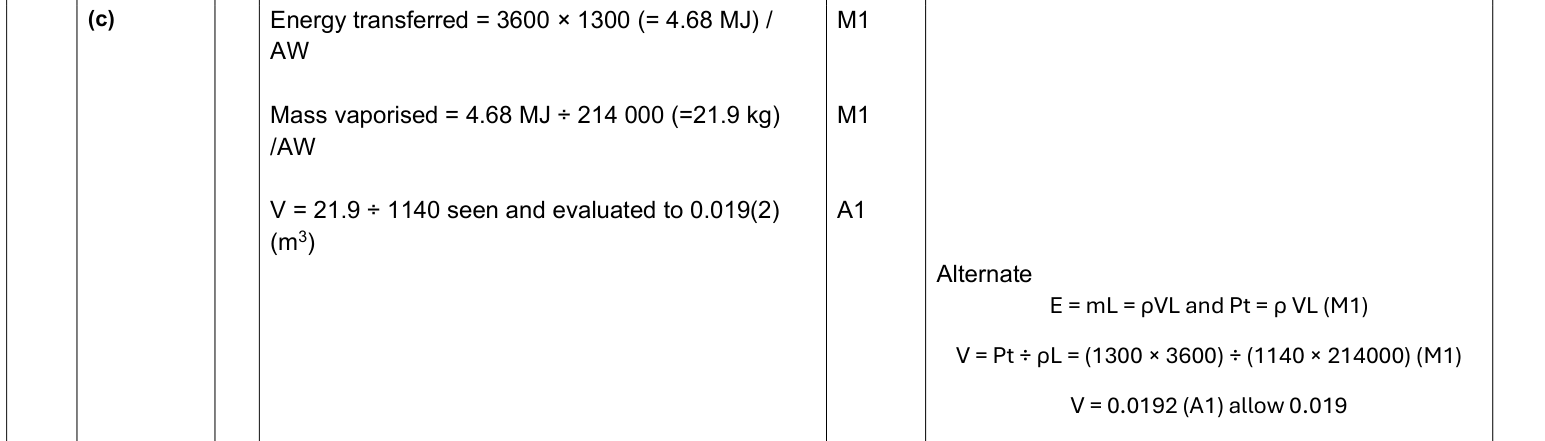
Successful candidates either rearranged all of the variables into a viable expression and then substituted into that expression or they performed each calculation separately. The common thread to all of the best answers was that the working was clear, with words often accompanying the calculations.
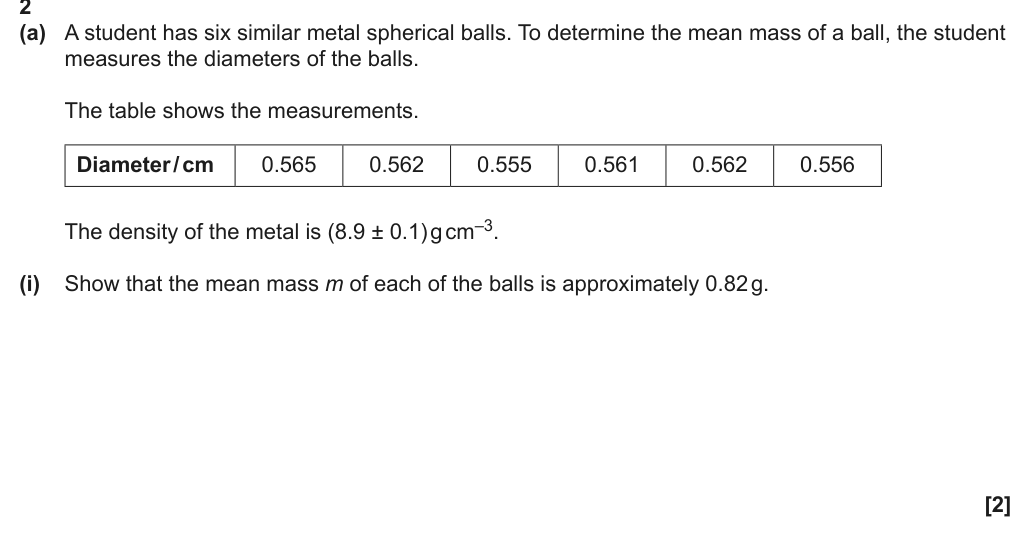
June 2025 · AS Paper 2 · Q2(a)(i)2 marksShow thatMedium
Mark scheme
Examiner's comment
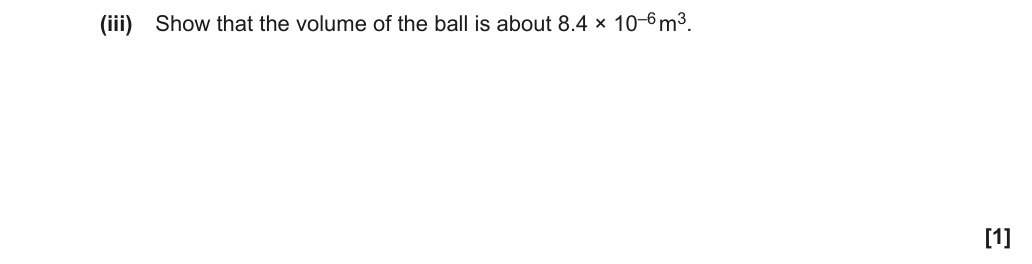
This question required candidates to carry out a multi-step calculation. Candidates needed to determine: • the mean diameter • the volume of a sphere, and • using the density determine the mass of a ball. High scoring candidates showed clearly the methods used, substituting data into expressions. Some candidates determined the mean radius – this also scored full marks. Since the question stated that the mass was approximately 0.82 g, candidates should be encouraged to determine their answer to at least three significant figures, i.e. 0.819 (g) ≈ 0.82 (g) so that the rounding can be seen to 0.82 (g). This candidate clearly shows how the mean diameter is determined. The candidate has then stated the equation to be used to calculate volume and also the equation to calculate the mas using density and volume. The equations have been combined with the data correctly substituted. The answer from the calculator 0.81837 is stated and then rounded correctly to 0.82 (g).
Notes from the mark scheme and report
one mark for 8.9 x candidate's volume
Skills: M1.2 Find arithmetic means; M2.3 Substitute numerical values into algebraic equations using appropriate units for physical quantities; M4.3 Calculate areas of triangles, circumferences and areas of circles, surface areas and volumes of rectangular blocks, cylinders and spheres
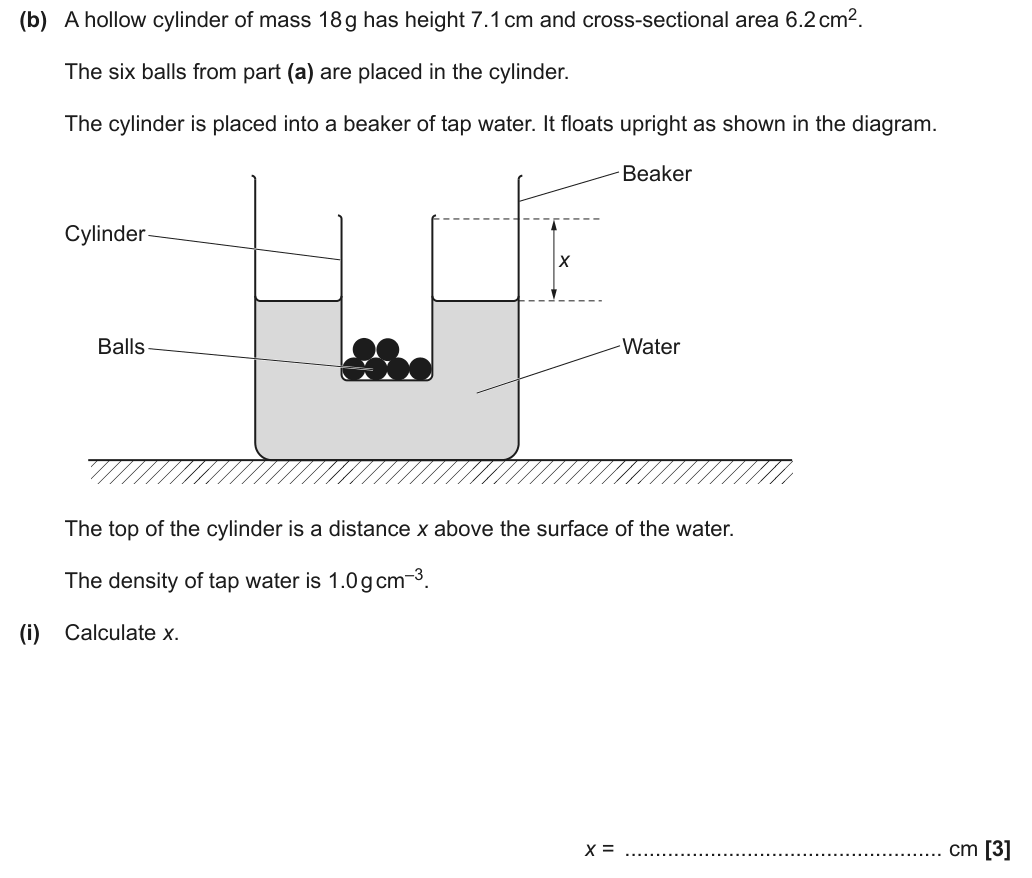
June 2025 · AS Paper 2 · Q2(b)(i)3 marksCalculationMedium
Earlier part of question 2 that this part uses
Mark scheme
Examiner's comment
High performing candidates clearly showed their method. Candidates needed to work out the total mass of the cylinder and the six balls. Since the weight of the cylinder and the balls is equal to the weight of the water (using Archimede’s principle), the vertical height of the cylinder below the surface is determined. High performing candidates then determined h.
Notes from the mark scheme and report
m = 4.92 (cylinder mass omitted) with x = 6.3 scores two marks
Candidates should practise answering calculation type questions.
Candidates should: 1. write done the equation(s) they are going to use 2. substitute the data into the equation(s) 3. consider the units 4. rearrange the equation 5. evaluate the answer 6. check that the answer is sensible.
Skills: M2.3 Substitute numerical values into algebraic equations using appropriate units for physical quantities; M4.3 Calculate areas of triangles, circumferences and areas of circles, surface areas and volumes of rectangular blocks, cylinders and spheres
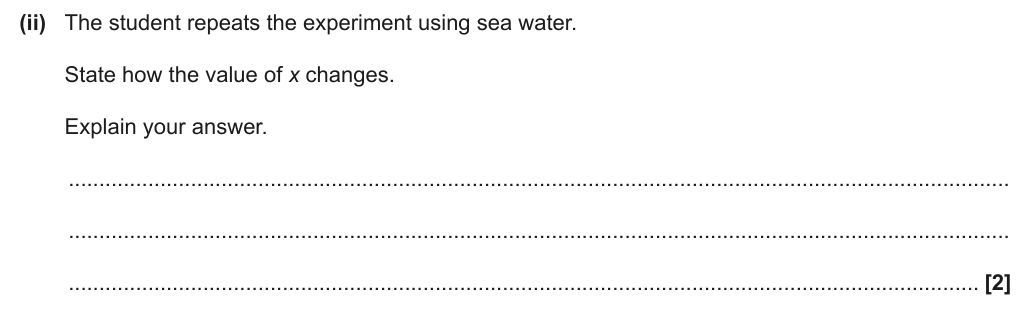
June 2025 · AS Paper 2 · Q2(b)(ii)2 marksExplanationHard
Earlier part of question 2 that this part uses
Mark scheme
Examiner's comment
The majority of the candidates realised that the density of sea water is greater than tap water. Only a small minority of candidates successfully related this change in density to a smaller volume of sea water displaced and therefore x increases.
Notes from the mark scheme and report
x increases
needs density of sea water greater and link to volume displaced / upthrust
ignore vague reference to V = m/ρ
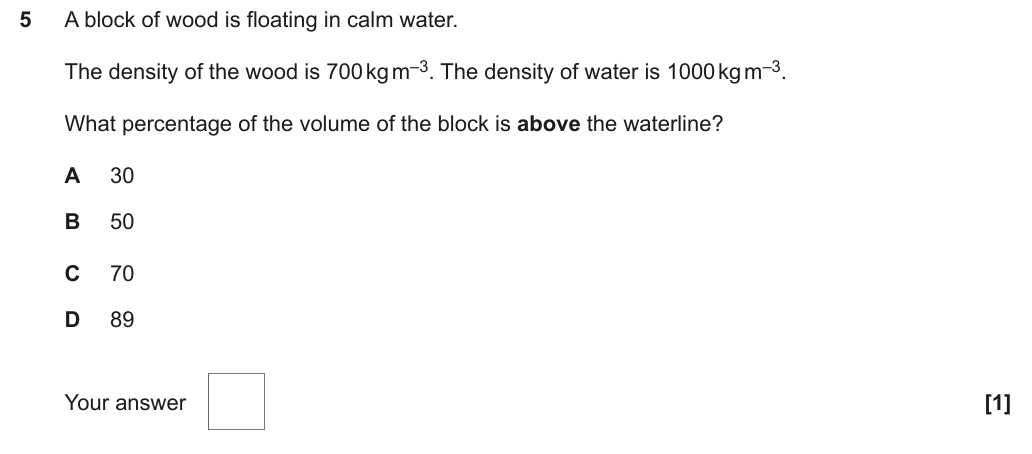
June 2024 · Paper 1 · Q51 markMultiple choiceMedium
Answer
A
Mark scheme
Examiner's comment
For the block to float, its weight (700 x V x g) must equal the weight of water displaced (1000 x k x V x g) where k is the fraction of the block under water. Equating these two expressions gives k as 0.7. The question, however, asks for the percentage of the block above the waterline, which is clearly 0.3, making A the correct answer.
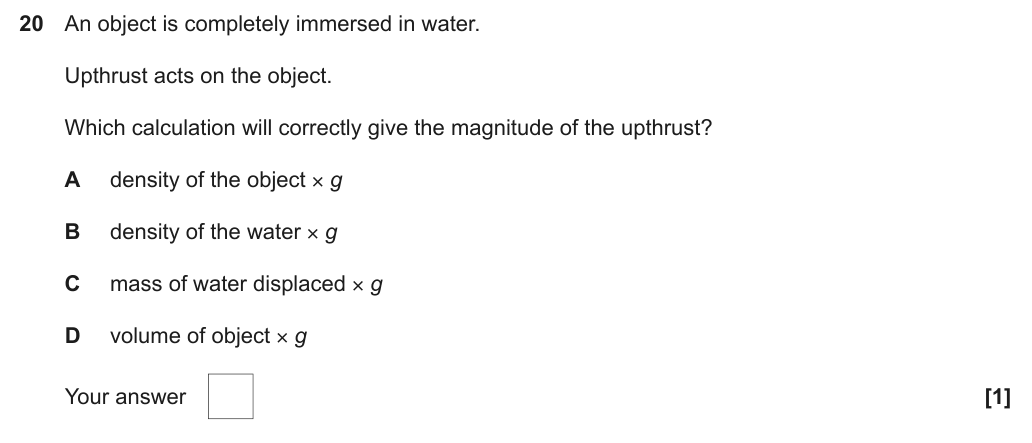
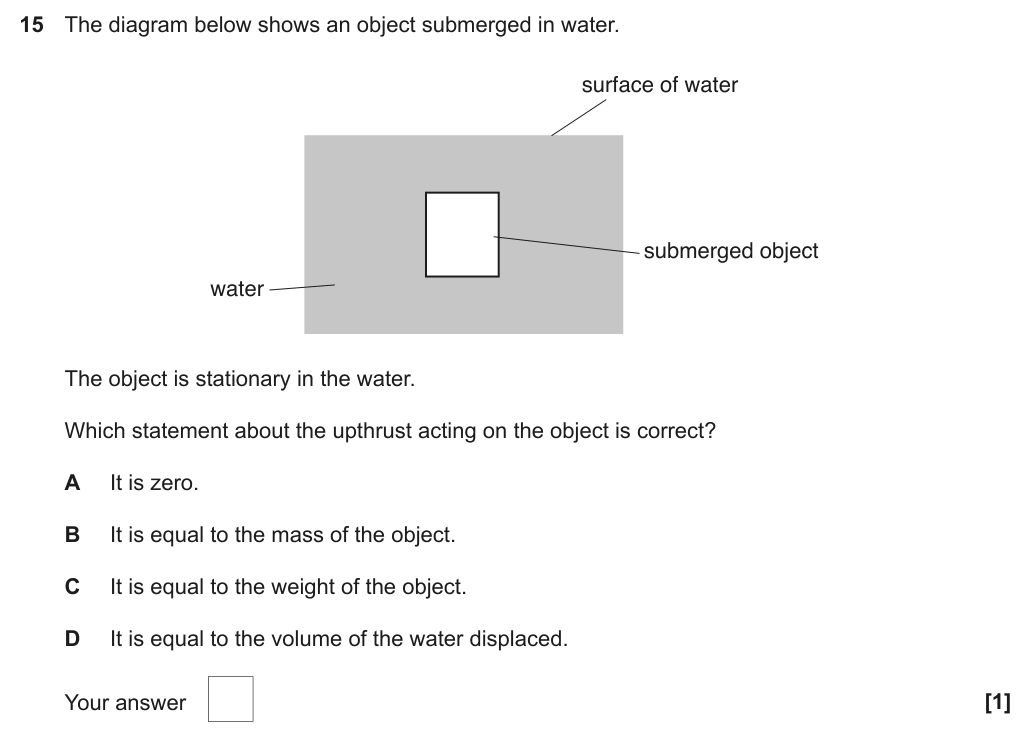
June 2024 · AS Paper 1 · Q201 markMultiple choiceMedium
Answer
C
Mark scheme
Examiner's comment
Candidates performed well on this question to correctly give that the magnitude of the upthrust of an object in a fluid is the weight of the fluid displaced by the object.
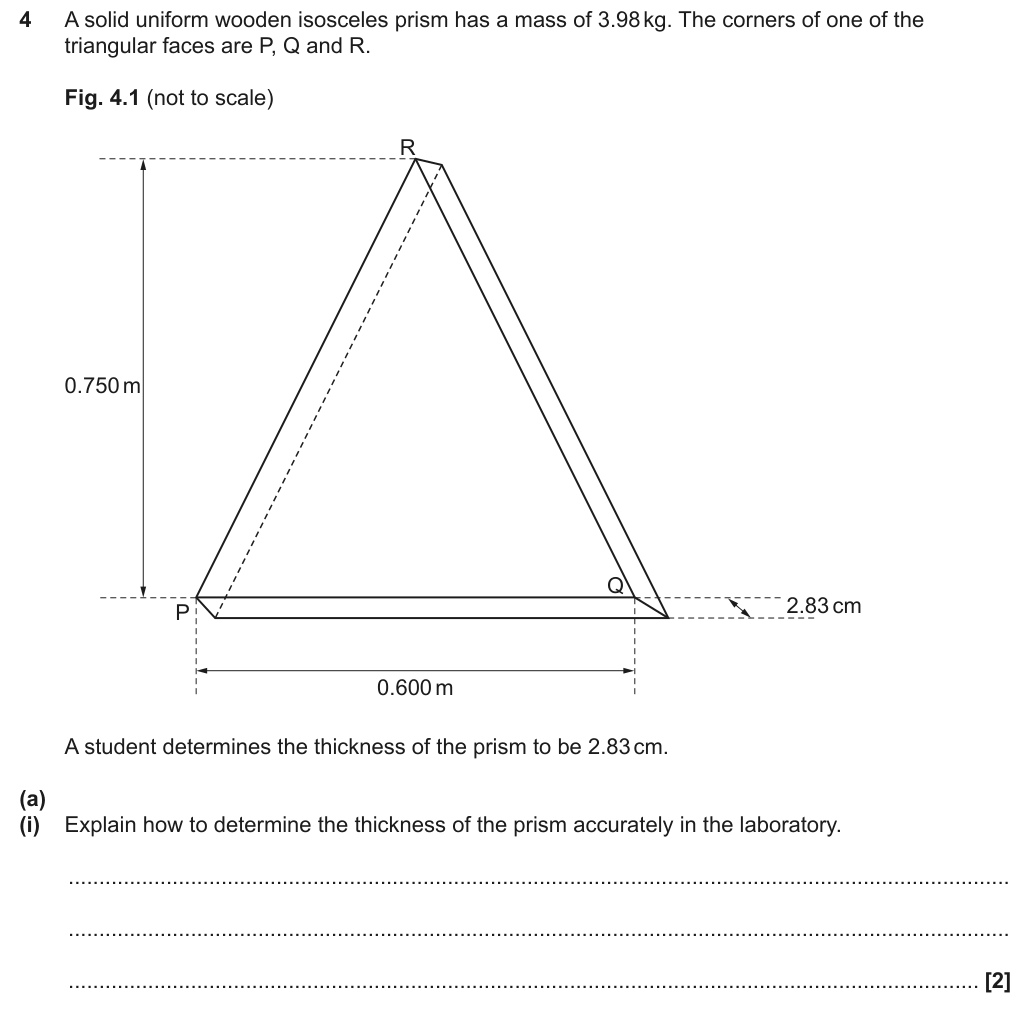
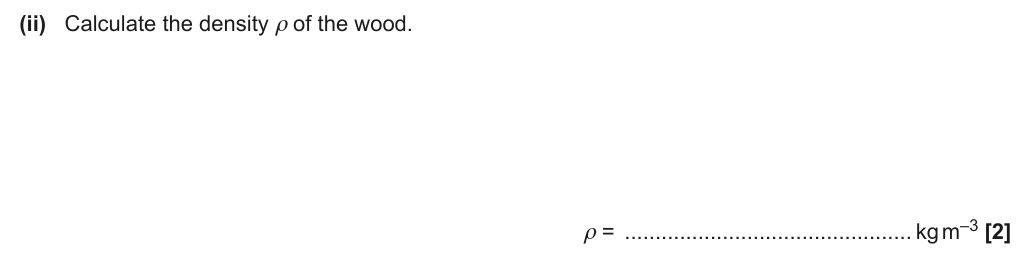
June 2024 · AS Paper 2 · Q4(a)(ii)2 marksCalculationHard
Earlier part of question 4 that this part uses
Mark scheme
Examiner's comment
A significant minority of candidates found calculating the volume of the prism challenging. Some candidates did not allow for changing ‘cm’ to ‘m’ for the thickness.
Notes from the mark scheme and report
310 or 313 (incorrect volume) scores 1
6.3 with wrong power of ten scores 1
Skills: M0.1 Recognise and make use of appropriate units in calculations; M2.3 Substitute numerical values into algebraic equations using appropriate units for physical quantities; M4.3 Calculate areas of triangles, circumferences and areas of circles, surface areas and volumes of rectangular blocks, cylinders and spheres
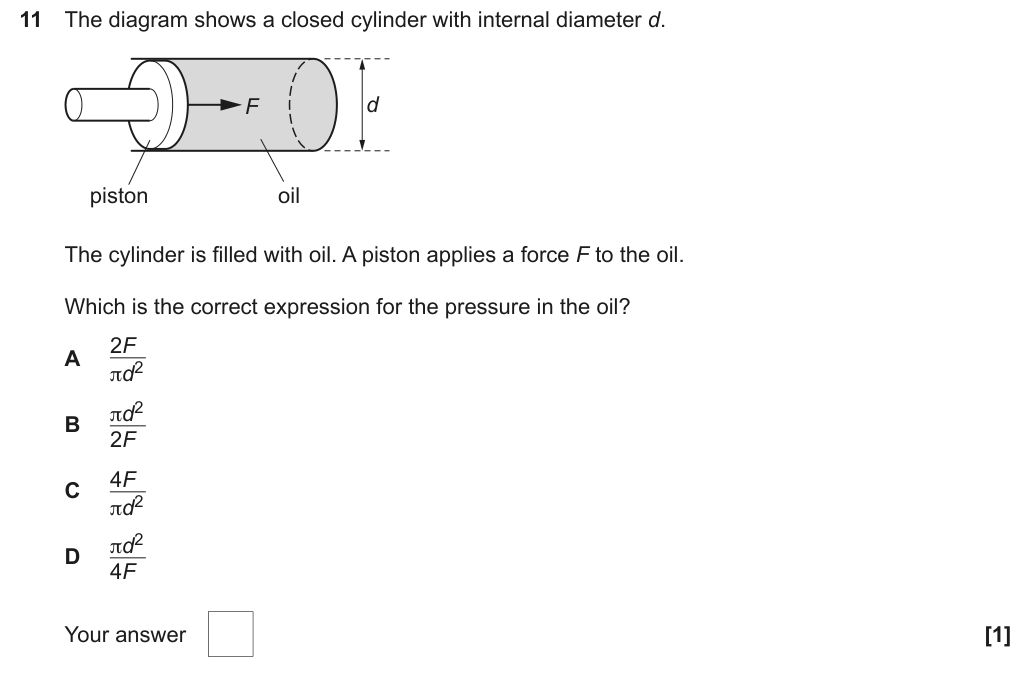
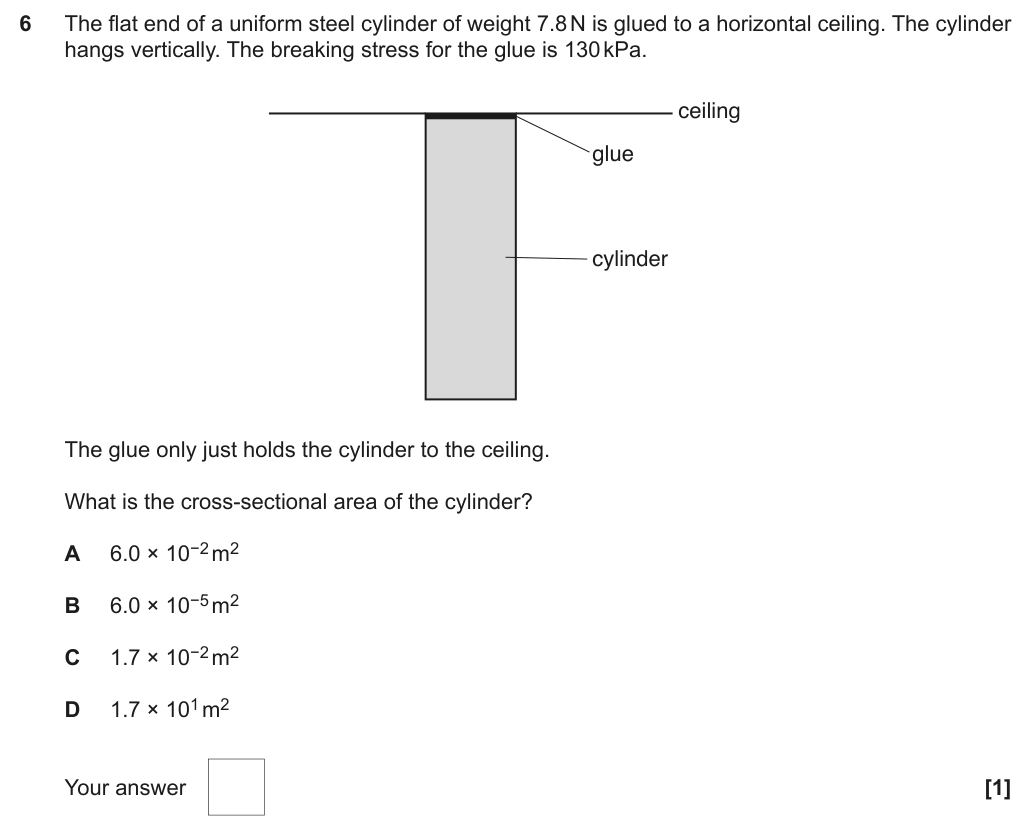
June 2023 · AS Paper 1 · Q111 markMultiple choiceEasy
Answer
C
Mark scheme
Examiner's comment
This question was answered well with most candidates giving the correct answer C by applying the equations P = F/A and πd2/4.
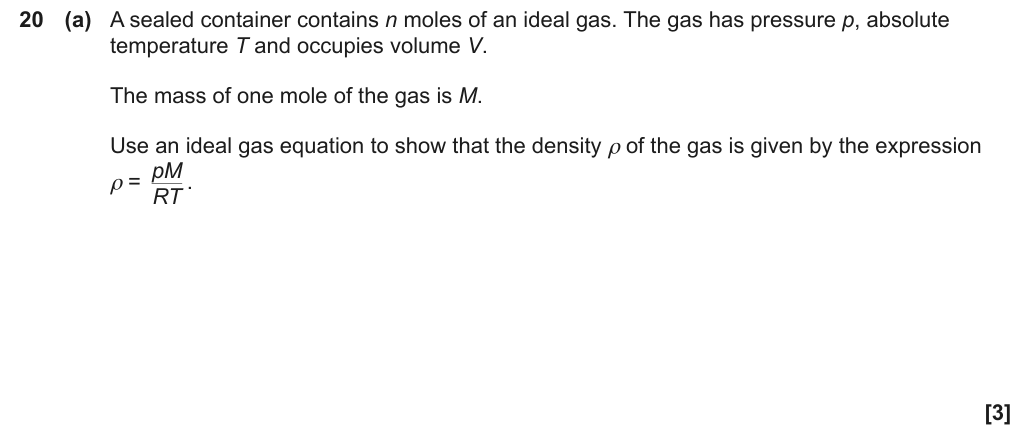
June 2023 · Paper 1 · Q20(a)3 marksShow thatMedium
Mark scheme
Examiner's comment
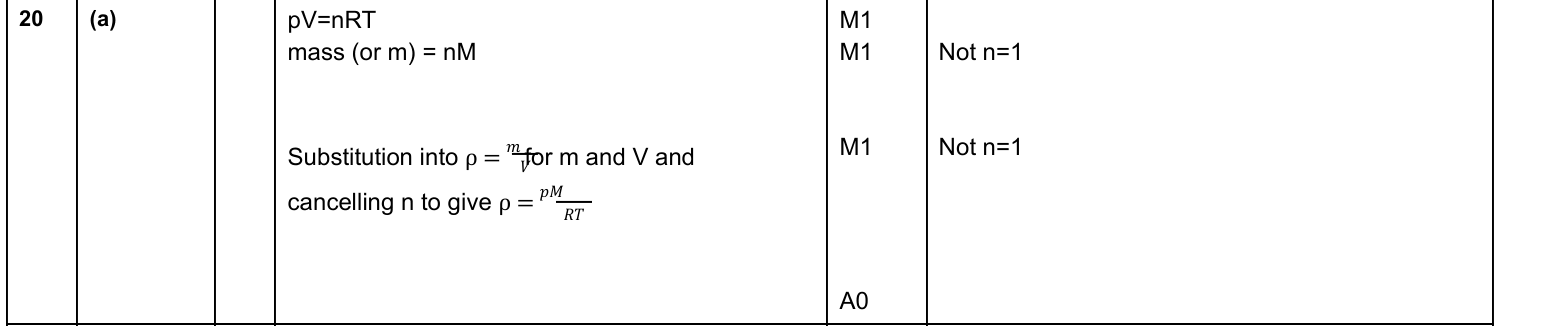
Successful candidates correctly identified the starting point for this question as the ideal gas equation, pV = nRT. Many candidates took the approach that n = 1 which was not sufficient. A more sufficient proof used the idea that the total mass of the gas was n × M, allowing cancelling of the n in the ideal gas equation.
Notes from the mark scheme and report
Not n = 1
Skills: M2.2 Change the subject of an equation, including non-linear equations
June 2023 · Paper 1 · Q20(b)(ii)2 marksCalculationEasy
Earlier part of question 20 that this part uses
Mark scheme
Examiner's comment
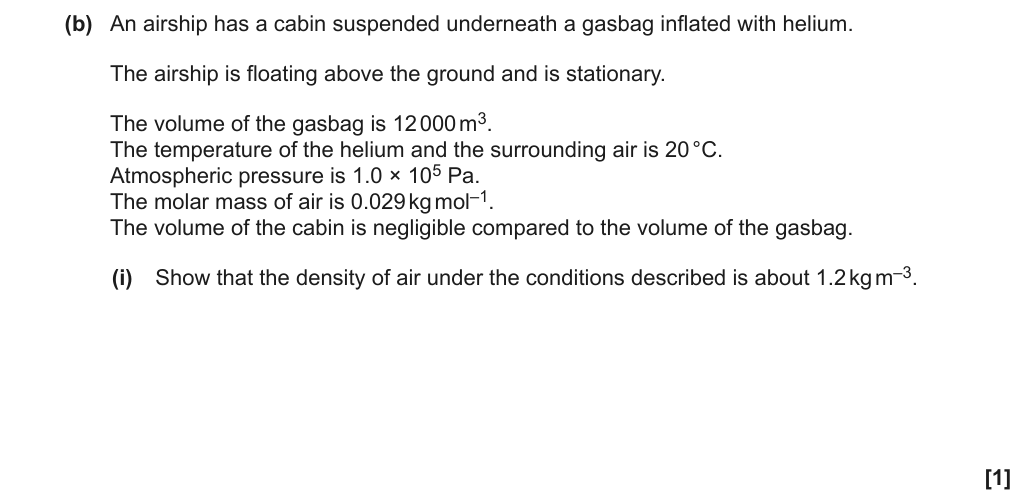
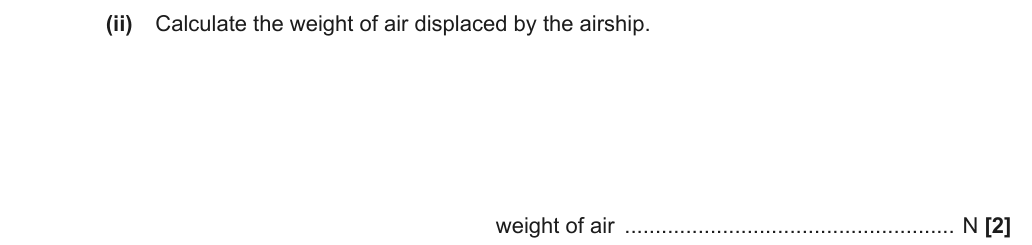
The vast majority of candidates correctly substituted values into the given formula, also remembering to convert the temperature from celsius into kelvin. Good practice for “show that” questions is to calculate the quantity required to at least one more significant figure in the question. In this example, that would mean evaluating the density to 1.19 kg m–3. In part (b) (ii), finding the weight was a matter of finding the mass and then finding the weight, all by using data in the question. Part (b) (iii) required understanding of Archimedes’ principle, rather than merely referring to it. Most candidates successfully related the principle to this context, writing about the upthrust being equal to the weight of fluid or air displaced by the gasbag. This is always true, regardless of the other forces that may be in play. References to displacement of water at this point were rejected. Fewer candidates completed the explanation by mentioning that the upthrust must be equal to the weight of the gas bag because we know that the gas bag is in equilibrium. Most candidates scored a mark in part (b) (iv) because they referred to some sort of structural failure if the pressure increased. Others delved a bit deeper, correctly stating that an increase in mass without an increase in volume (and hence upthrust) would cause the gas bag to sink.
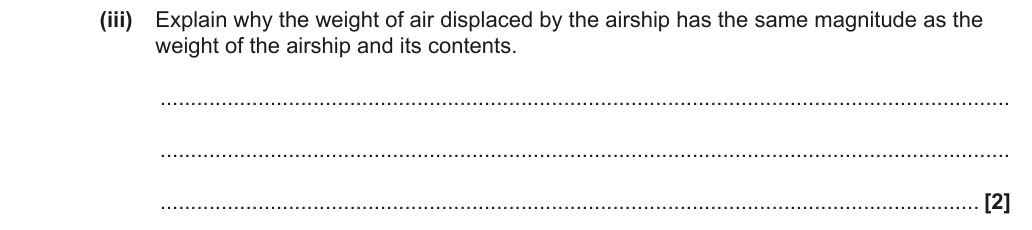
June 2023 · Paper 1 · Q20(b)(iii)2 marksExplanationEasy
Earlier part of question 20 that this part uses
Mark scheme
Examiner's comment
The vast majority of candidates correctly substituted values into the given formula, also remembering to convert the temperature from celsius into kelvin. Good practice for “show that” questions is to calculate the quantity required to at least one more significant figure in the question. In this example, that would mean evaluating the density to 1.19 kg m–3. In part (b) (ii), finding the weight was a matter of finding the mass and then finding the weight, all by using data in the question. Part (b) (iii) required understanding of Archimedes’ principle, rather than merely referring to it. Most candidates successfully related the principle to this context, writing about the upthrust being equal to the weight of fluid or air displaced by the gasbag. This is always true, regardless of the other forces that may be in play. References to displacement of water at this point were rejected. Fewer candidates completed the explanation by mentioning that the upthrust must be equal to the weight of the gas bag because we know that the gas bag is in equilibrium. Most candidates scored a mark in part (b) (iv) because they referred to some sort of structural failure if the pressure increased. Others delved a bit deeper, correctly stating that an increase in mass without an increase in volume (and hence upthrust) would cause the gas bag to sink.
Notes from the mark scheme and report
do not accept unqualified Archimedes' principle
Not water for fluid
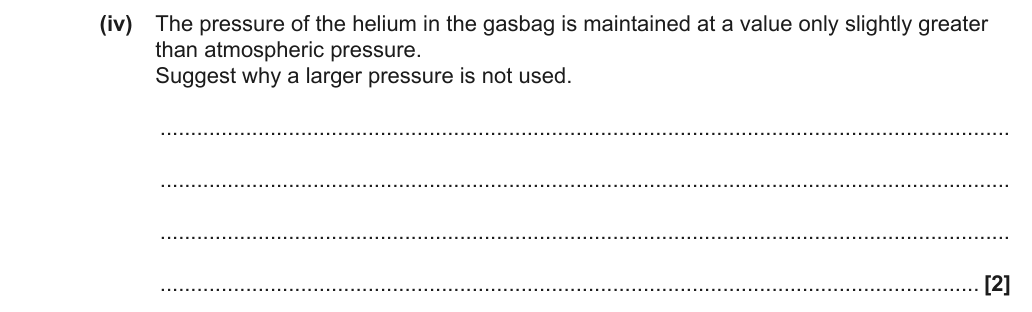
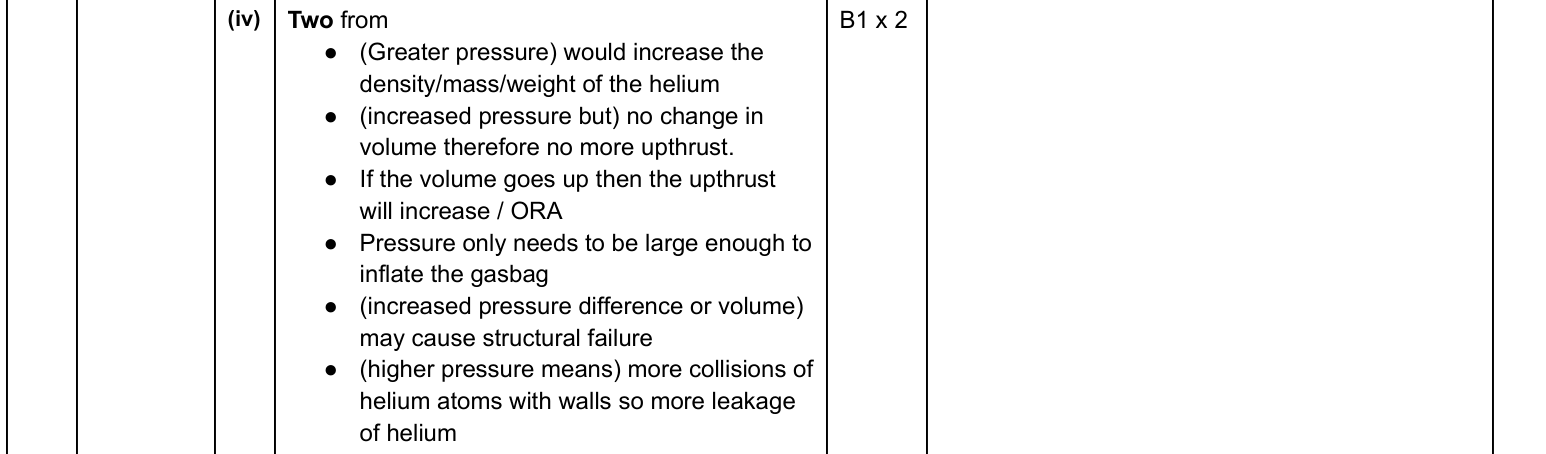
June 2023 · Paper 1 · Q20(b)(iv)2 marksExplanationEasy
Earlier part of question 20 that this part uses
Mark scheme
Examiner's comment
The vast majority of candidates correctly substituted values into the given formula, also remembering to convert the temperature from celsius into kelvin. Good practice for “show that” questions is to calculate the quantity required to at least one more significant figure in the question. In this example, that would mean evaluating the density to 1.19 kg m–3. In part (b) (ii), finding the weight was a matter of finding the mass and then finding the weight, all by using data in the question. Part (b) (iii) required understanding of Archimedes’ principle, rather than merely referring to it. Most candidates successfully related the principle to this context, writing about the upthrust being equal to the weight of fluid or air displaced by the gasbag. This is always true, regardless of the other forces that may be in play. References to displacement of water at this point were rejected. Fewer candidates completed the explanation by mentioning that the upthrust must be equal to the weight of the gas bag because we know that the gas bag is in equilibrium. Most candidates scored a mark in part (b) (iv) because they referred to some sort of structural failure if the pressure increased. Others delved a bit deeper, correctly stating that an increase in mass without an increase in volume (and hence upthrust) would cause the gas bag to sink.
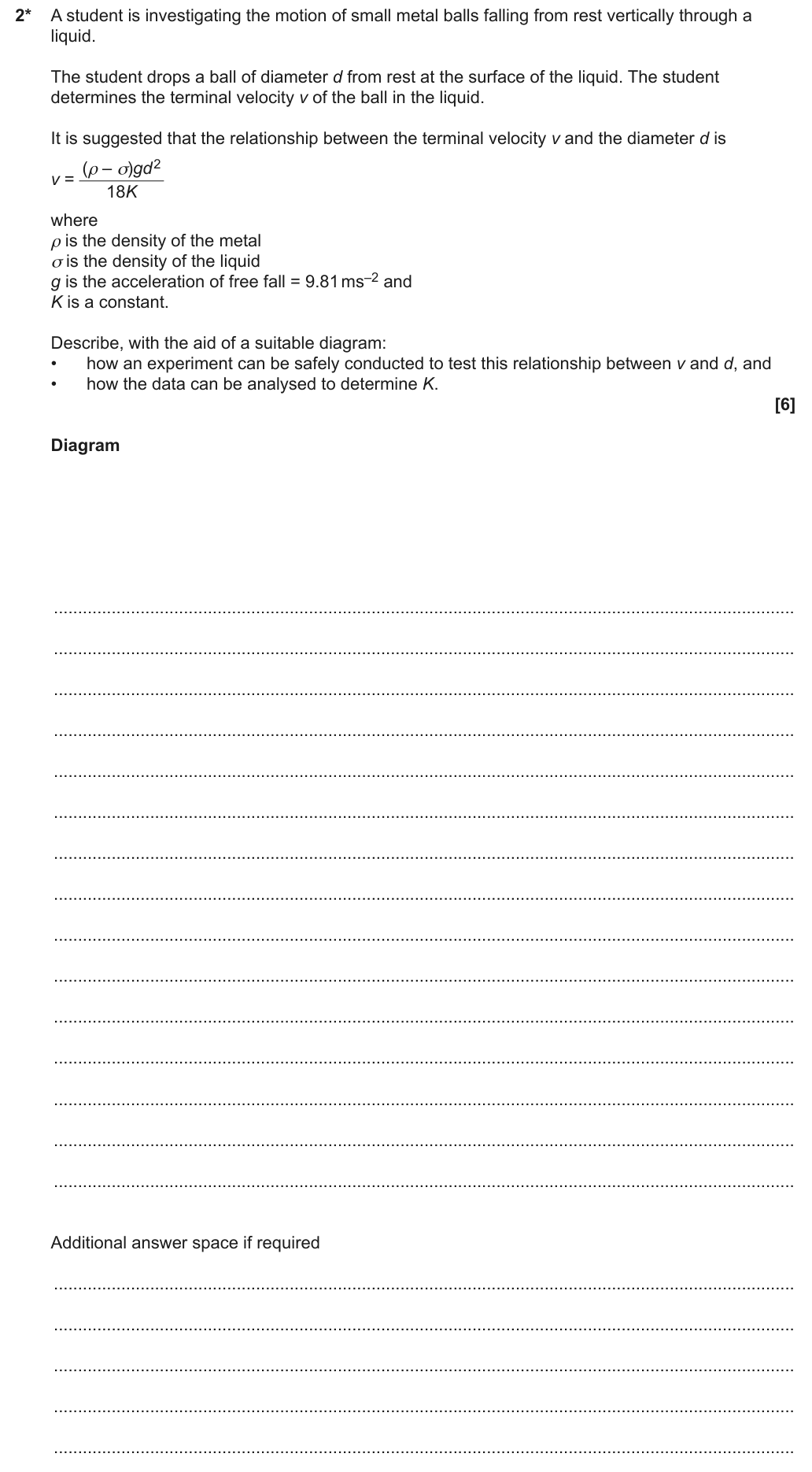
June 2023 · AS Paper 2 · Q26 marks6-mark extended responseMedium
Mark scheme, with the levels and indicative content
Examiner's comment
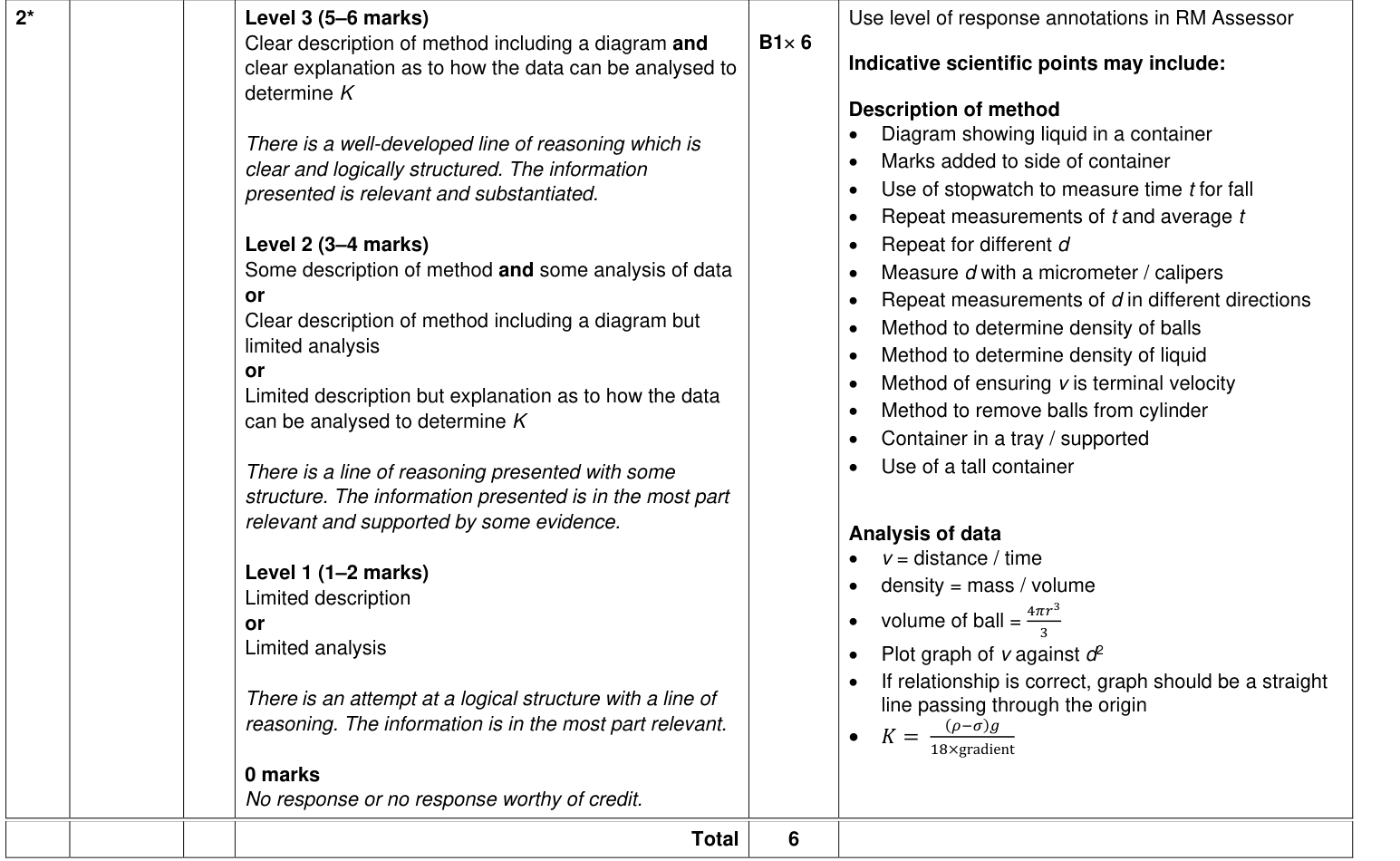
This question enabled candidates to plan an experiment. In candidates’ descriptions it was important to include how the independent and dependent variables were measured. Candidates could also explain how the density of the ball and liquid could be determined. Many candidates did not explain how the terminal velocity could be determined. Often descriptions was just timing the ball leaving the surface to the bottom. Some high scoring candidates discussed the need to check between successive distances that the velocity was constant. To determine the value of constant K it was expected that the axes of an appropriate graph would be suggested with an equation with K as the subject to indicate how the gradient could be used. This candidate starts their response by drawing a sketch diagram with markings on the side of the tube experiment. This diagram could be improved – it would have been helpful to have seen the bench for example. However, it does indicate that the candidate is thinking about terminal velocity. The description of the experiment is logically structured and contains appropriate detail, for example a viscous liquid oil. This candidate has included a method to measure the diameter of the balls. Importantly the candidate explains how terminal velocity is determined using the marks on the side of the tube. There is then a clear section of how the results could be analysed including an appropriate graph and then how K could be determined from the gradient. Overall, this candidate has provided a good description of the method including how terminal velocity is determined and how the data can be analysed. The information is clearly and logically structured and is relevant.
Notes from the mark scheme and report
graph of v against d² is a straight line through the origin
K = (ρ - σ)g / (18 x gradient)
must check terminal velocity reached
Practical techniques Candidates should have experience of describing methods as well as analysing data.
Skills: M3.3 Understand that y = mx + c represents a linear relationship; M3.4 Determine the slope and intercept of a linear graph; PAG1 Investigating motion
June 2023 · Paper 3 · Q3(b)3 marksShow thatEasy
Mark scheme
Examiner's comment
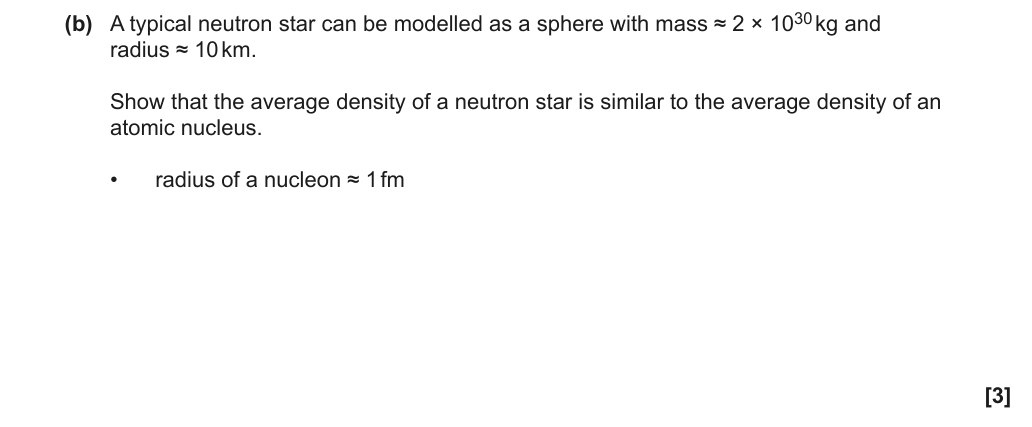
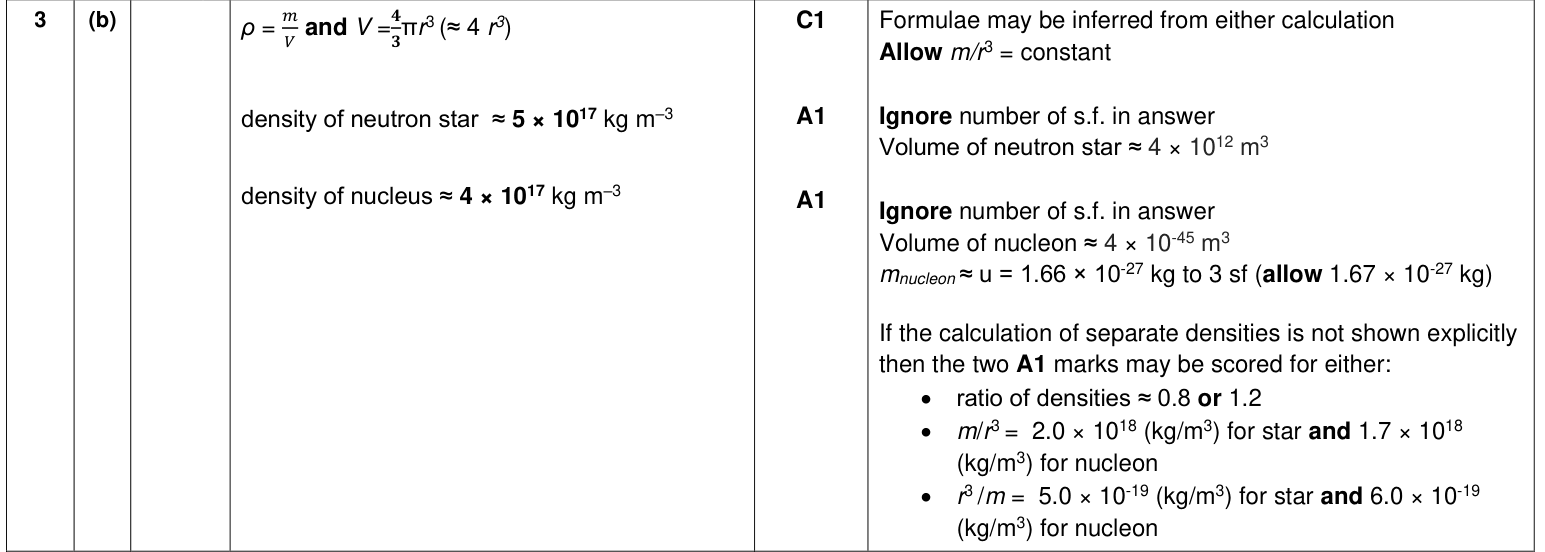
Most candidates were able to apply the correct formulae for density and for volume of a sphere. The calculation for the density of a neutron star was performed easily. However, rather than calculating the density of a single nucleon (whose radius had been given), many candidates tried to calculate the density of a different nucleus (such as deuteron or helium) whose radius had not been given. Some candidates lost marks through not stating the units in which their calculated densities were measured.
Notes from the mark scheme and report
about 5 x 10^17 and 4 x 10^17 kg m-3
nucleon mass about 1.66 x 10⁻²⁷ kg
Skills: M0.4 Estimate results; M2.3 Substitute numerical values into algebraic equations using appropriate units for physical quantities; M4.3 Calculate areas of triangles, circumferences and areas of circles, surface areas and volumes of rectangular blocks, cylinders and spheres
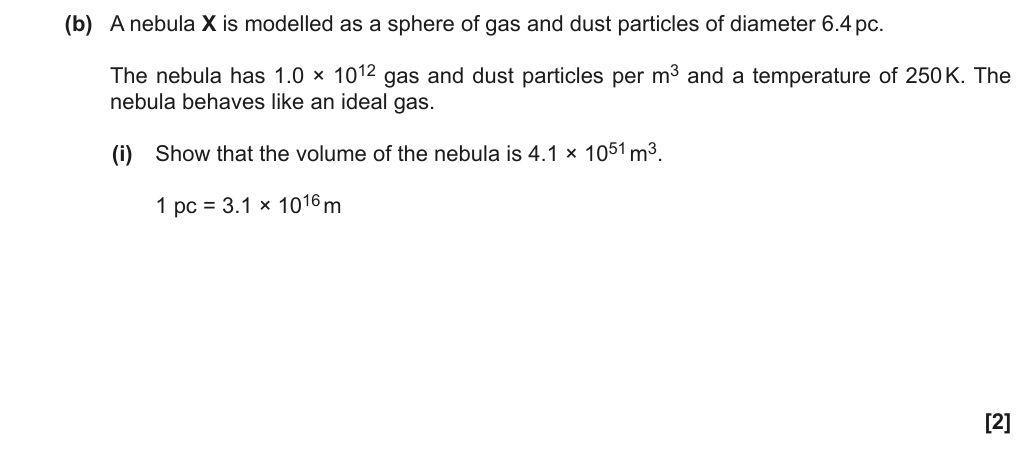
June 2022 · Paper 1 · Q18(a)(i)3 marksShow thatMedium
Mark scheme
Examiner's comment
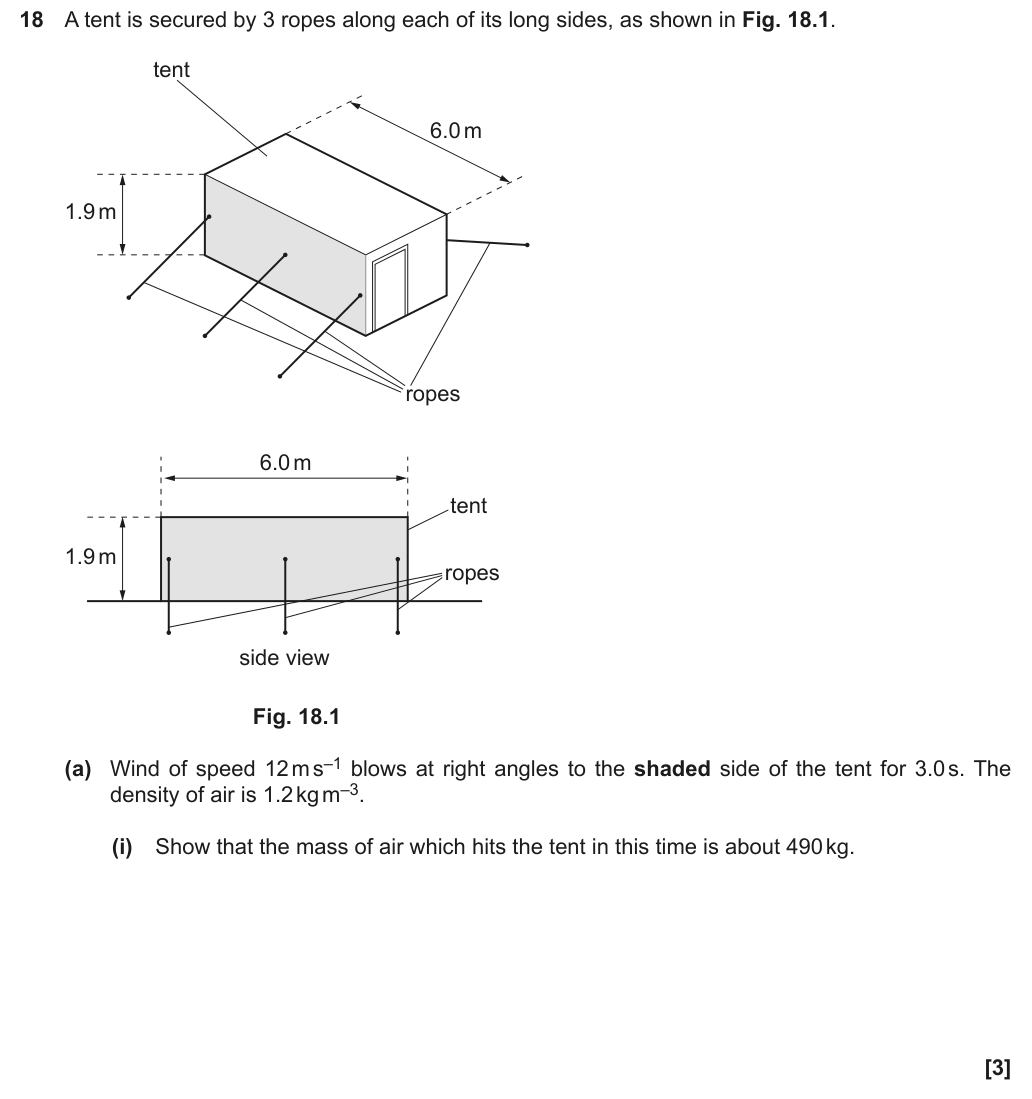
Question 18 (a) (i - ii) Candidate’s answers to this part were either jumbled or grounded in incorrect physics.
Notes from the mark scheme and report
volume of air is 410 m3
Skills: M2.3 Substitute numerical values into algebraic equations using appropriate units for physical quantities; M4.3 Calculate areas of triangles, circumferences and areas of circles, surface areas and volumes of rectangular blocks, cylinders and spheres
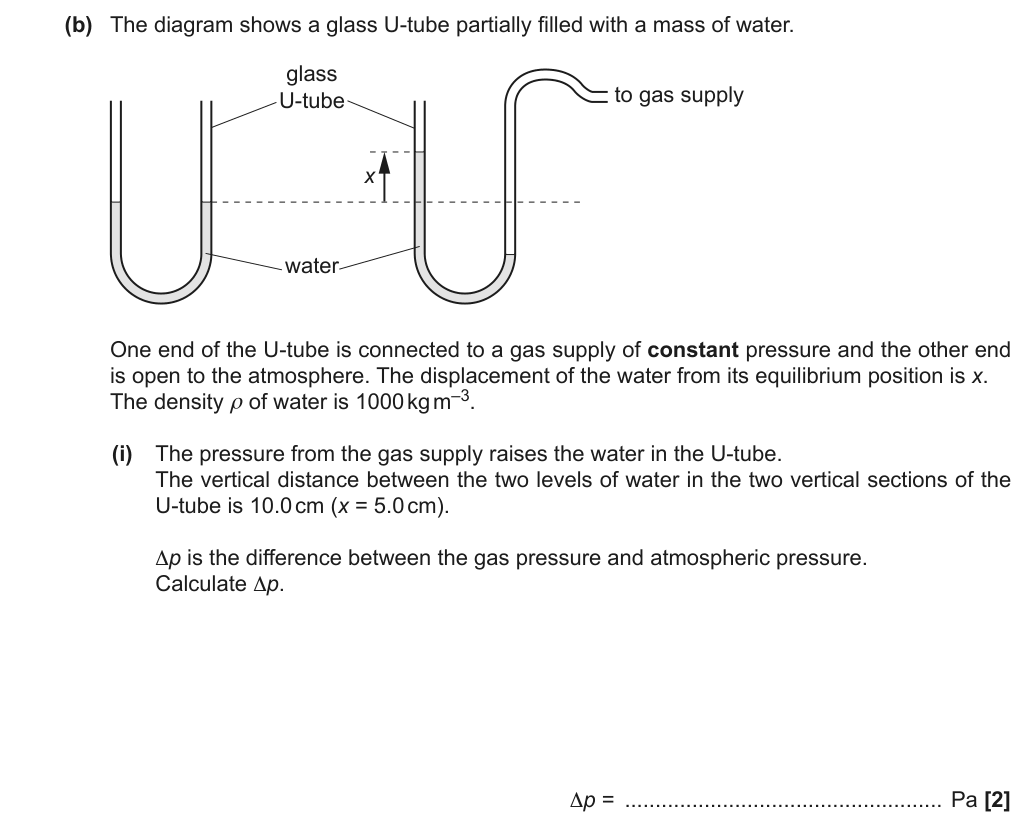
June 2022 · Paper 1 · Q20(b)(i)2 marksCalculationMedium
Mark scheme
Examiner's comment
Most candidates thought that the height difference here was 0.05 m, because that is the difference between the final liquid level and the undisturbed level. The correct approach is to look at the difference between the liquid levels once the liquid has stopped moving.
Notes from the mark scheme and report
490 Pa scores 1 mark (5.0 cm used)
Skills: M0.1 Recognise and make use of appropriate units in calculations; M2.3 Substitute numerical values into algebraic equations using appropriate units for physical quantities
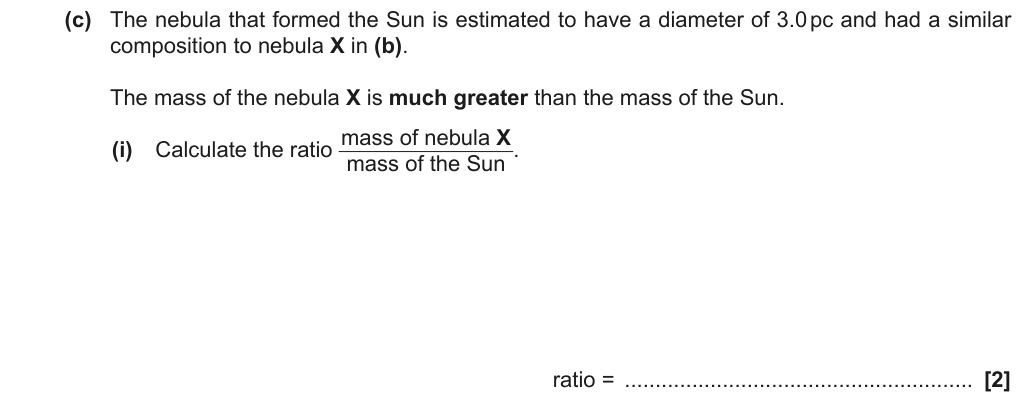
June 2022 · Paper 1 · Q21(c)(i)2 marksCalculationMedium
Earlier part of question 21 that this part uses
Mark scheme
Examiner's comment
Candidates used several different approaches here. By assuming a similar density, the mass is directly proportional to the volume. Some candidates calculated the volume of the Sun’s nebula. Others correctly assumed that the volume and hence mass of each nebula was directly proportional to the diameter3 (or radius3).
Notes from the mark scheme and report
allow 9.76
Skills: M0.3 Use ratios, fractions and percentages; M4.3 Calculate areas of triangles, circumferences and areas of circles, surface areas and volumes of rectangular blocks, cylinders and spheres
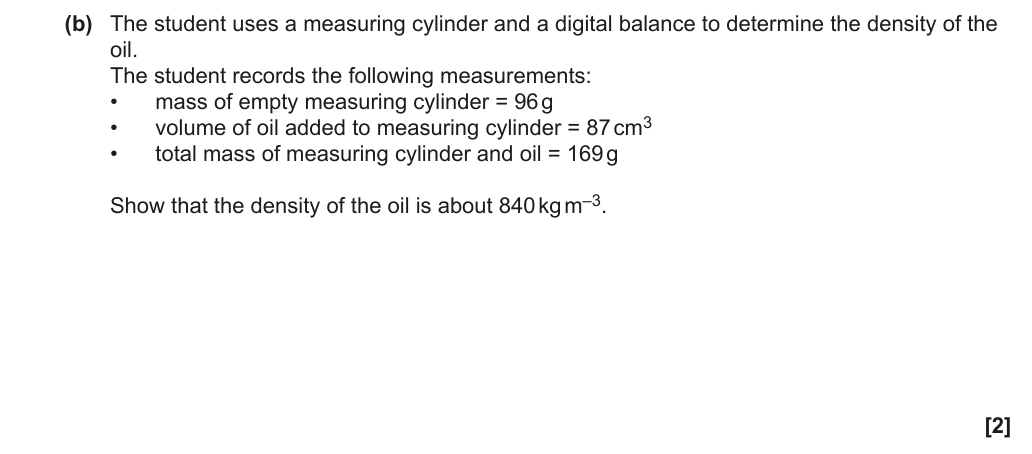
June 2022 · AS Paper 2 · Q1(b)2 marksShow thatEasy
Mark scheme
Examiner's comment
Most candidates were able to determine the mass of the oil correctly and divide the mass by the volume. A significant number of candidates did not demonstrate that 73 g was 0.073 kg and that 87 cm3 was 87 10-6 m3. More able candidates clearly showed how the cm3 was converted to m3.
Notes from the mark scheme and report
powers of ten must be seen for both mass and volume
Skills: M0.1 Recognise and make use of appropriate units in calculations; M2.3 Substitute numerical values into algebraic equations using appropriate units for physical quantities
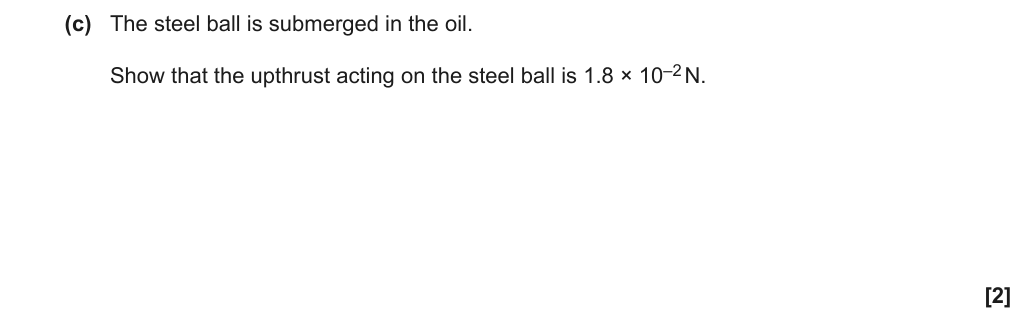
June 2022 · AS Paper 2 · Q1(c)2 marksShow thatHard
Earlier parts of question 1 that this part uses
Mark scheme
Examiner's comment
Candidates who understood that the upthrust was equal to the weight of the oil displaced scored well on this question. To score the marks it was necessary to show how the volume of the ball was calculated. Some candidates had difficulties with the powers of ten. Some candidates then went on to use one equation of density volume g while other candidates calculated the volume, then the density and then the weight. Both these methods were acceptable.
June 2022 · Paper 3 · Q1(b)(ii)3 marksCalculationMedium
Earlier parts of question 1 that this part uses
Mark scheme
Examiner's comment
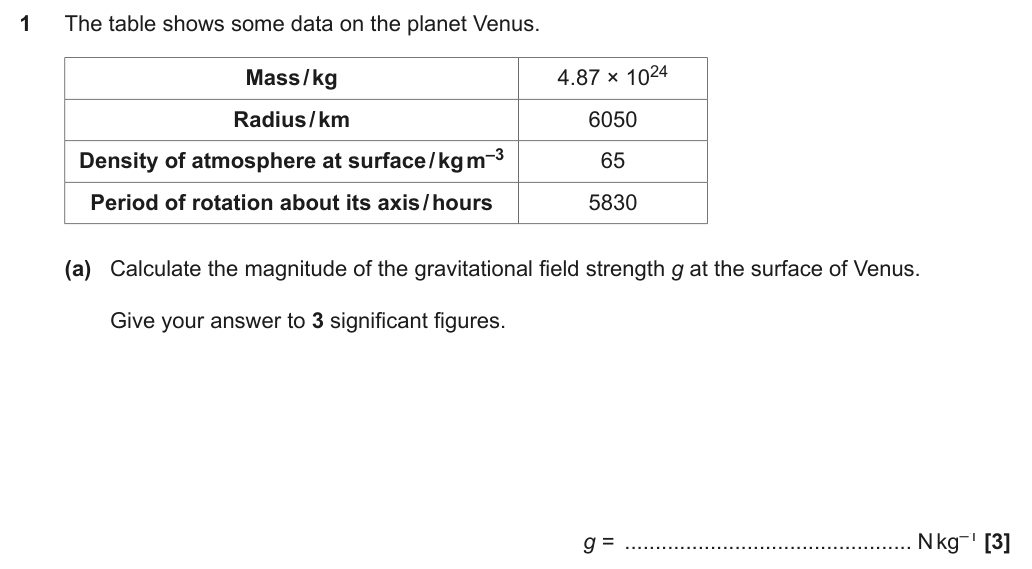
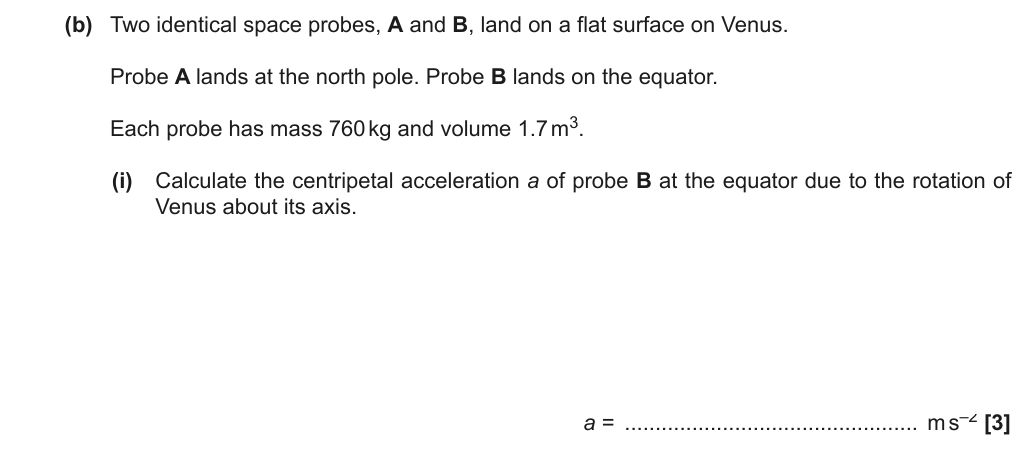
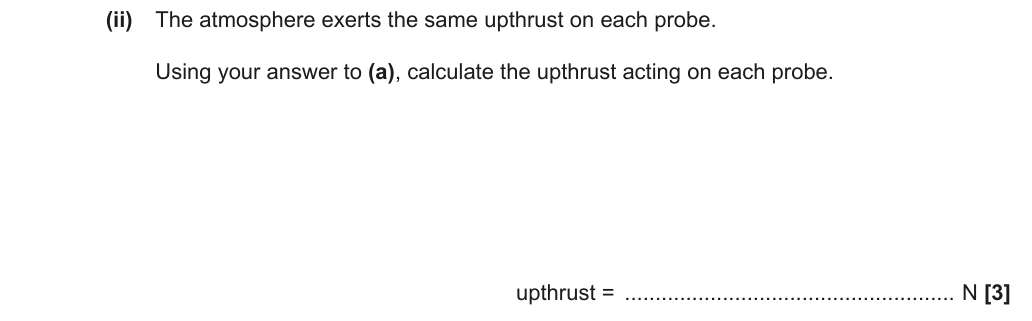
Unfortunately, many candidates did not know how to calculate upthrust, often confusing it with the normal contact force. This may be because upthrust forms a small part of the syllabus and is therefore easily overlooked. Upthrust = weight of fluid (atmosphere) displaced by the probe. The volume of the atmosphere displaced by the probe is identical to the volume of the probe itself. Common problems in 1(b)(ii) • using the value g = 9.81 rather than the value of g on Venus calculated in (a) • using the mass of the probe instead of calculating the mass of the atmosphere using the formula mass = density of atmosphere × volume of probe
Notes from the mark scheme and report
ecf from (a) but g = 9.81 not allowed
Skills: M2.3 Substitute numerical values into algebraic equations using appropriate units for physical quantities
June 2022 · Paper 3 · Q4(b)(iv)3 marksCalculationEasy
Earlier part of question 4 that this part uses
Mark scheme
Examiner's comment
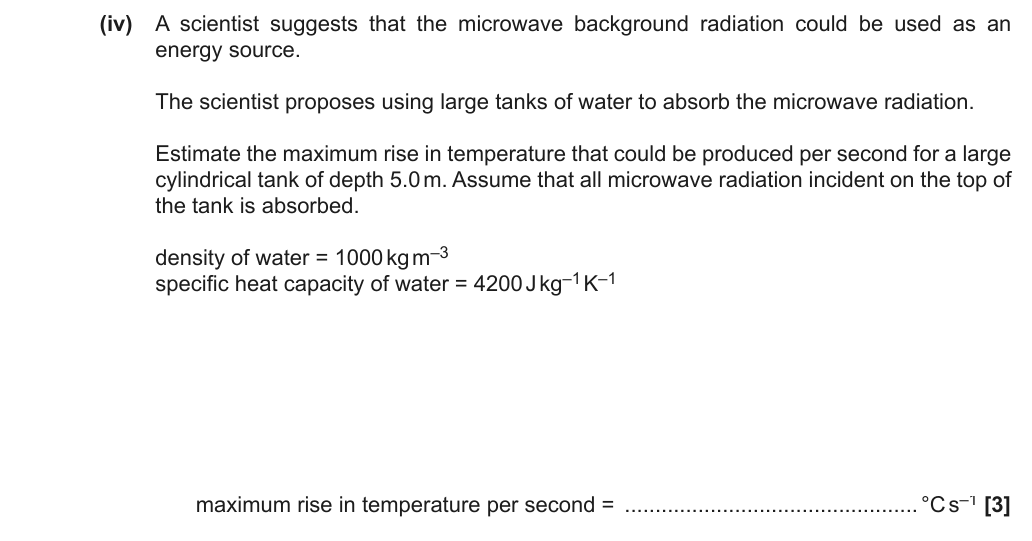
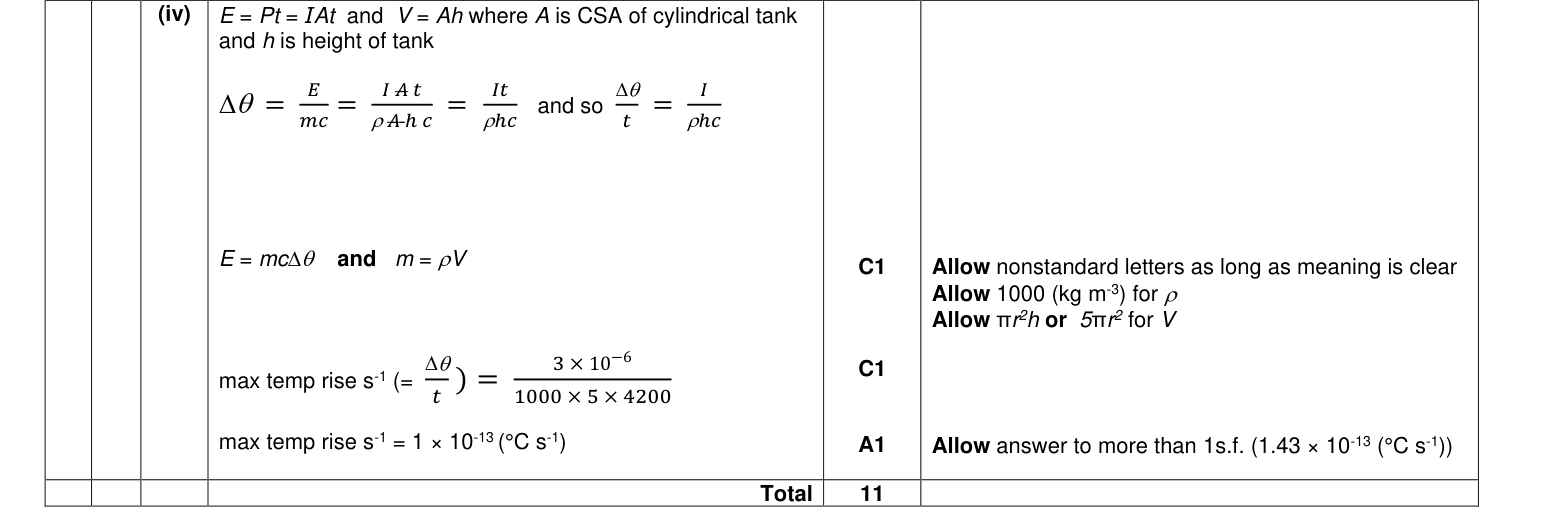
This too was a complex, multi-stage calculation. Most candidates correctly found their way into the question by writing down the formula E = mcΔθ and realising that they needed to use the formula ρ = m/V in order to calculate the mass. The volume V of the cylindrical tank could be found using V = depth × cross-sectional area. However, although the depth was specified in the question, the cross-sectional area was not. Successful candidates realised that, if the cross-sectional area was not given, then it must cancel out later in the calculation. Some used algebra and called the cross-sectional area A. Others simply made up a value for A (A = 1 m2 is the easiest).
Notes from the mark scheme and report
area cancels: Δθ/t = I/(ρhc)
Skills: M0.2 Recognise and use expressions in decimal and standard form; M2.2 Change the subject of an equation, including non-linear equations; M4.3 Calculate areas of triangles, circumferences and areas of circles, surface areas and volumes of rectangular blocks, cylinders and spheres
November 2021 · AS Paper 1 · Q11 markMultiple choice
Answer
D
Mark scheme
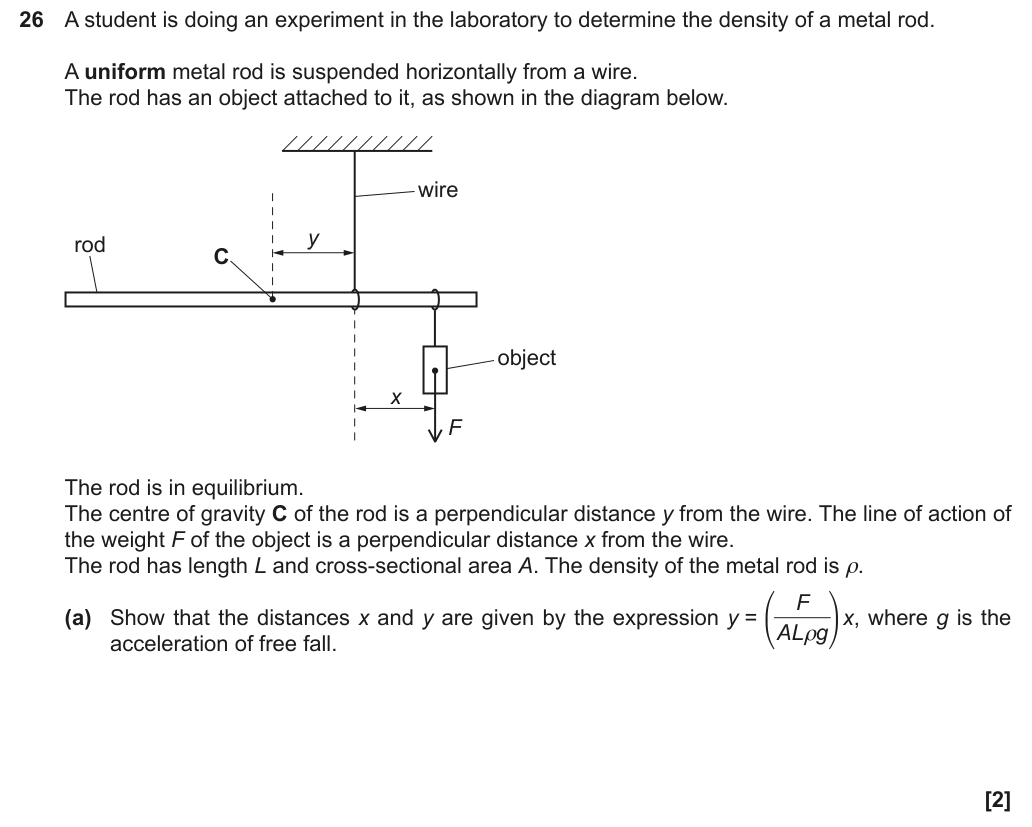
November 2021 · AS Paper 1 · Q26(a)2 marksShow that
Mark scheme
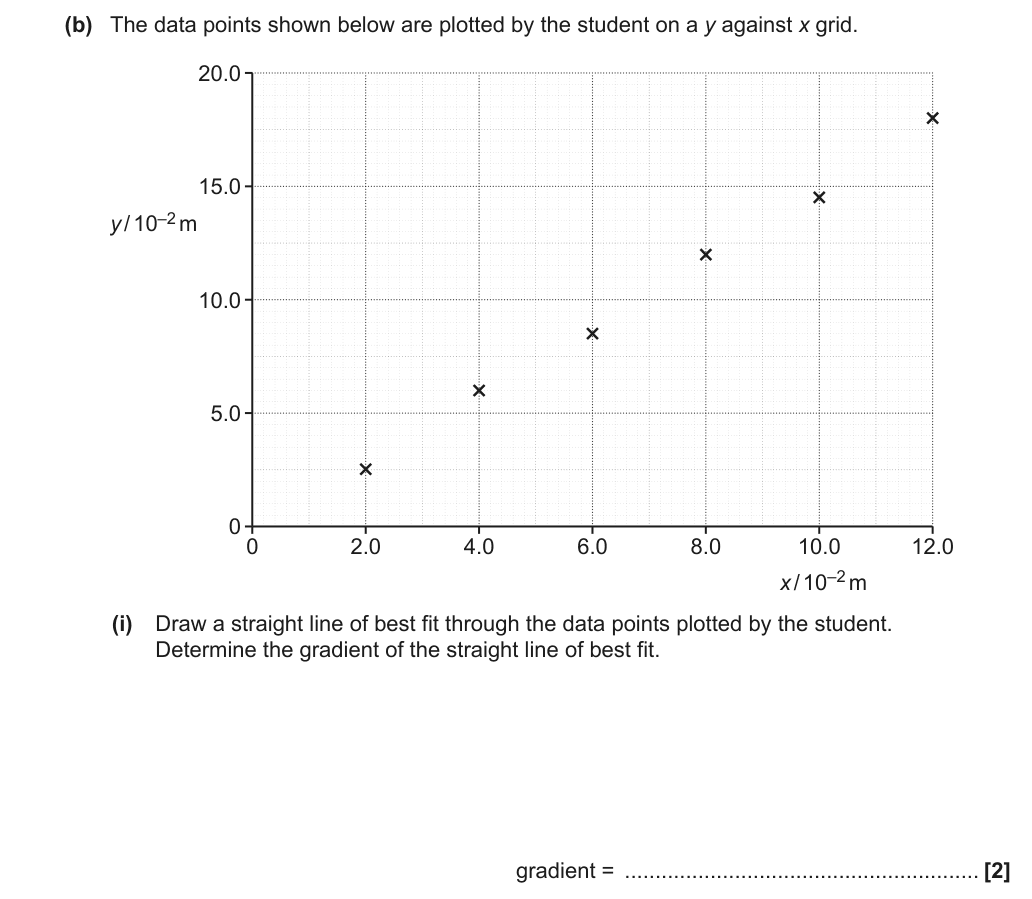
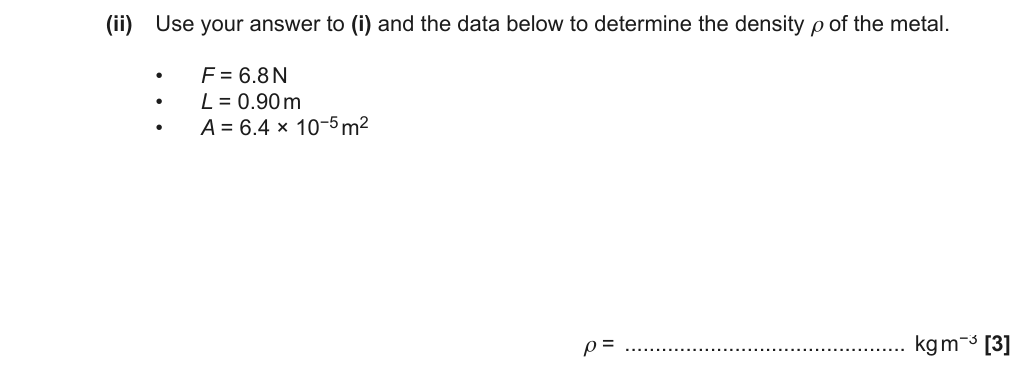
November 2021 · AS Paper 1 · Q26(b)(ii)3 marksCalculation
Earlier parts of question 26 that this part uses
Mark scheme
Notes from the mark scheme and report
ecf from (b)(i)
must be consistent with gradient from (b)(i)
allow 8 x 10^3 (1 SF)
Skills: M2.2 Change the subject of an equation, including non-linear equations; M2.3 Substitute numerical values into algebraic equations using appropriate units for physical quantities; M3.3 Understand that y = mx + c represents a linear relationship
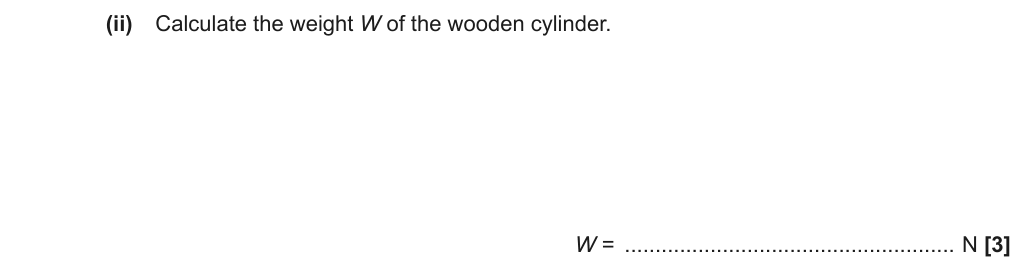
November 2021 · AS Paper 2 · Q4(a)(ii)3 marksCalculation
Earlier part of question 4 that this part uses
Mark scheme
Notes from the mark scheme and report
ignore power-of-ten errors
Skills: M0.1 Recognise and make use of appropriate units in calculations; M2.3 Substitute numerical values into algebraic equations using appropriate units for physical quantities; M4.3 Calculate areas of triangles, circumferences and areas of circles, surface areas and volumes of rectangular blocks, cylinders and spheres
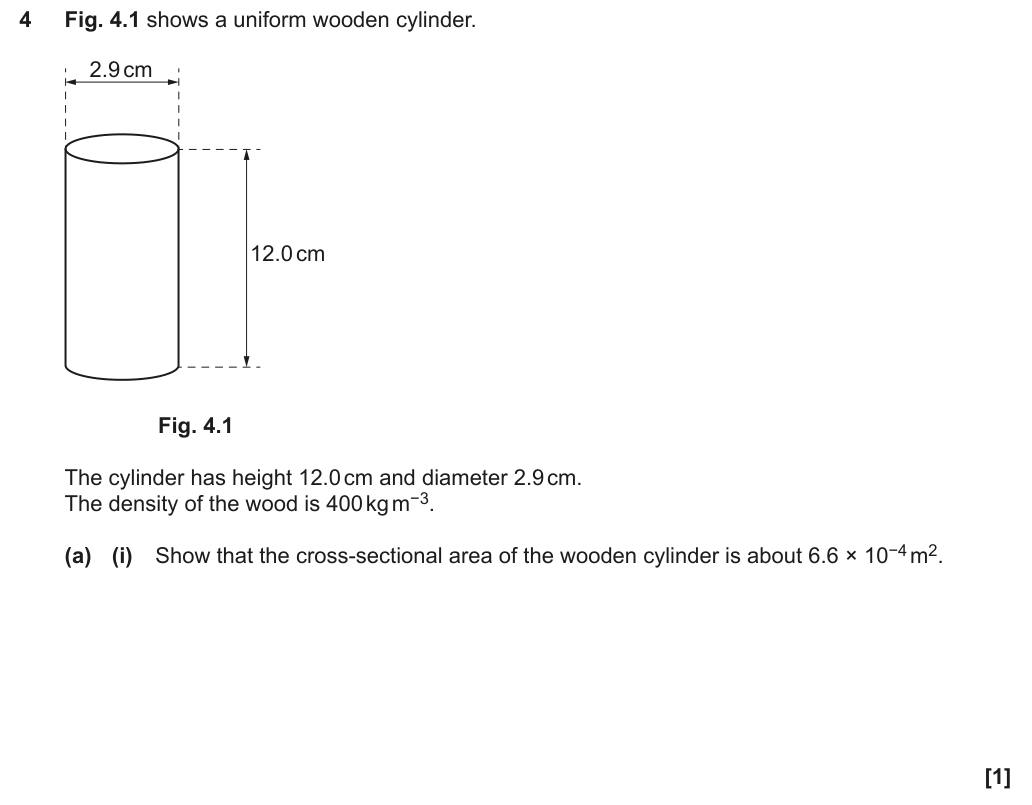
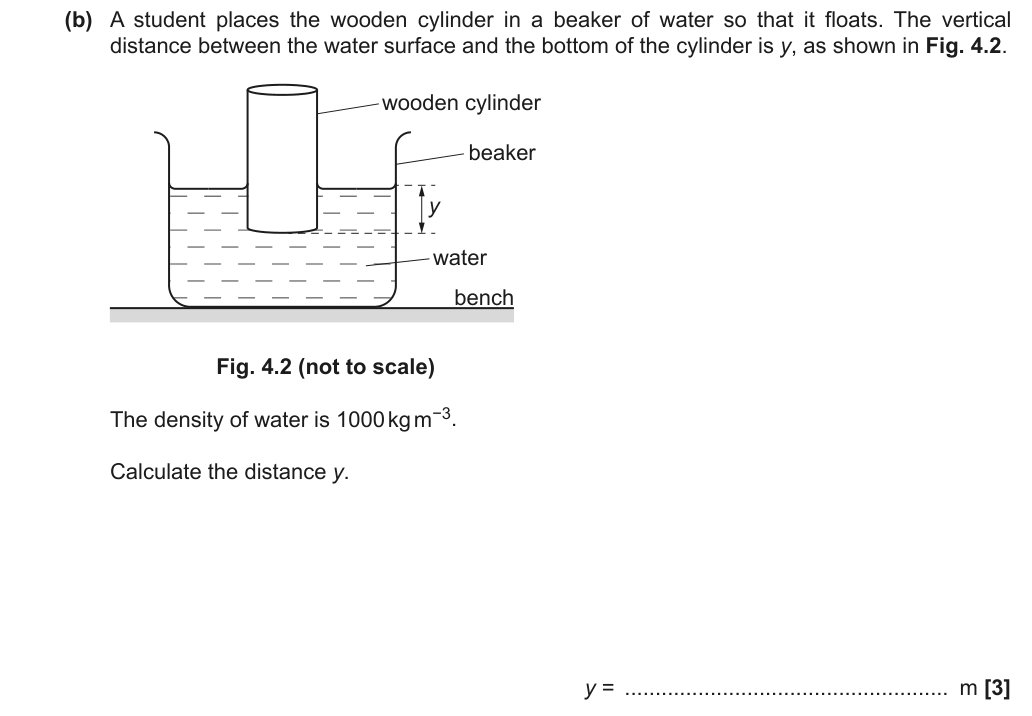
November 2021 · AS Paper 2 · Q4(b)3 marksCalculation
Earlier parts of question 4 that this part uses
Mark scheme
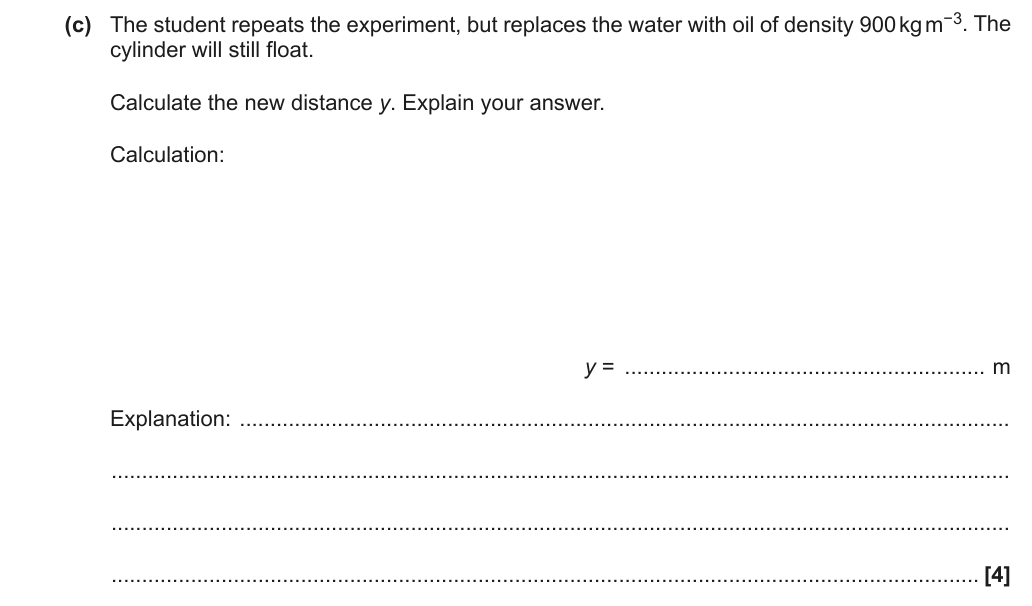
November 2021 · AS Paper 2 · Q4(c)4 marksCalculation
Earlier parts of question 4 that this part uses
Mark scheme
Notes from the mark scheme and report
same weight of oil displaced
smaller density means larger volume displaced so y is larger
Skills: M0.3 Use ratios, fractions and percentages; M2.2 Change the subject of an equation, including non-linear equations
November 2020 · AS Paper 1 · Q111 markMultiple choice
Answer
D
Mark scheme
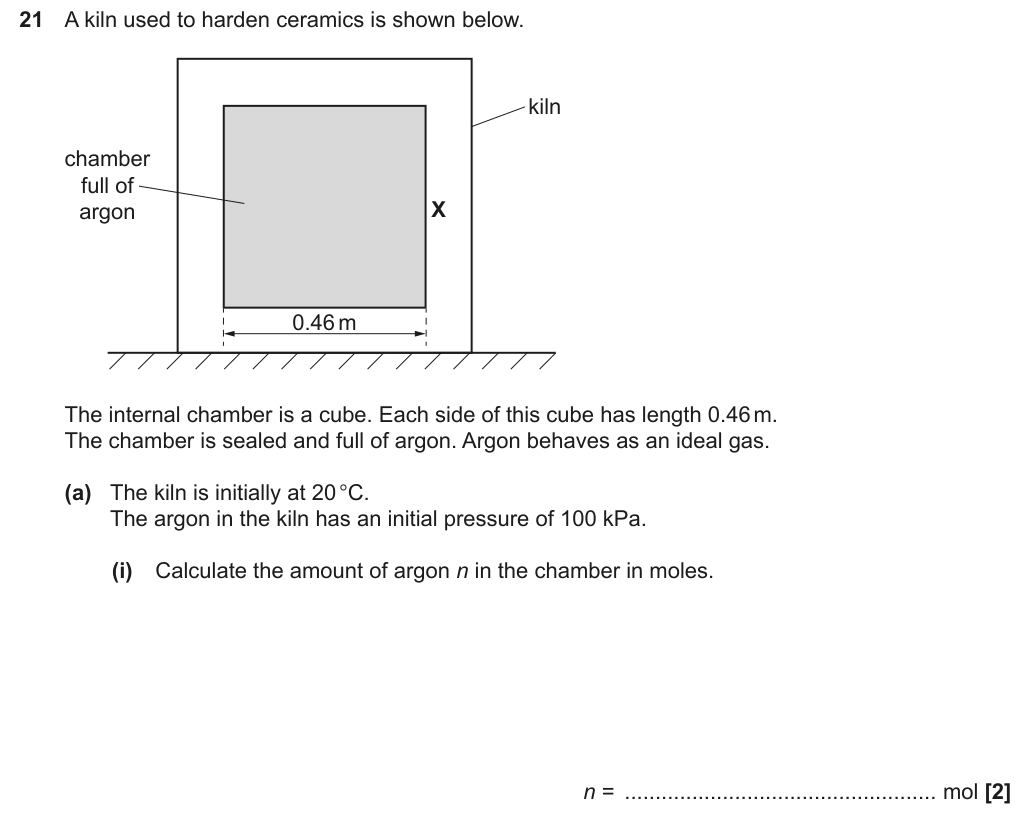
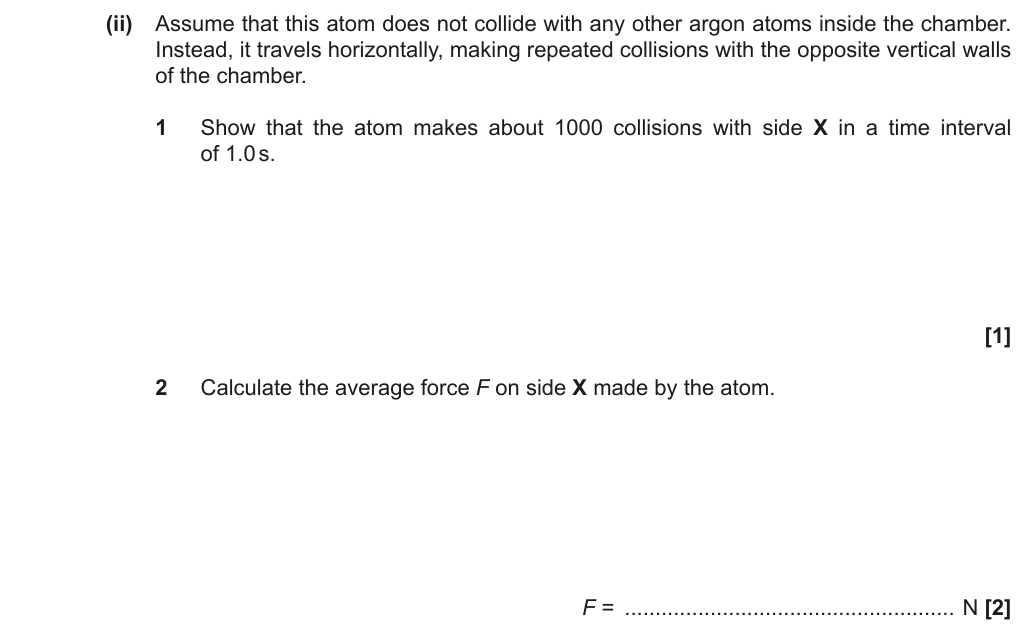
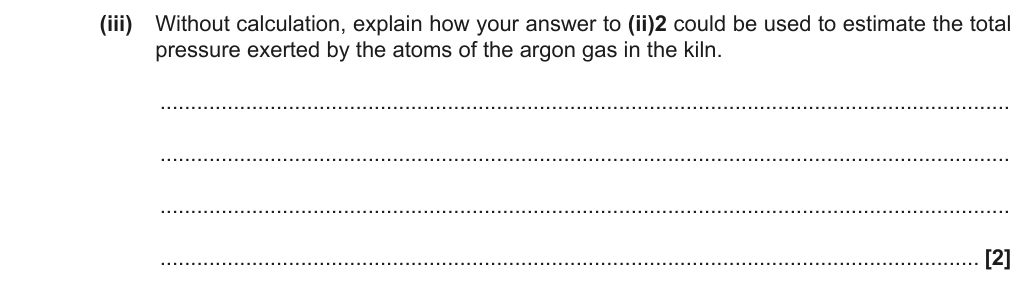
November 2020 · Paper 1 · Q21(b)(iii)2 marksExplanationMedium
Earlier parts of question 21 that this part uses
Mark scheme
Examiner's comment
Some candidates used degrees centigrade rather than kelvin as the unit of temperature for Question 21.
Notes from the mark scheme and report
pressure = total force / area AND multiply by the total number of atoms
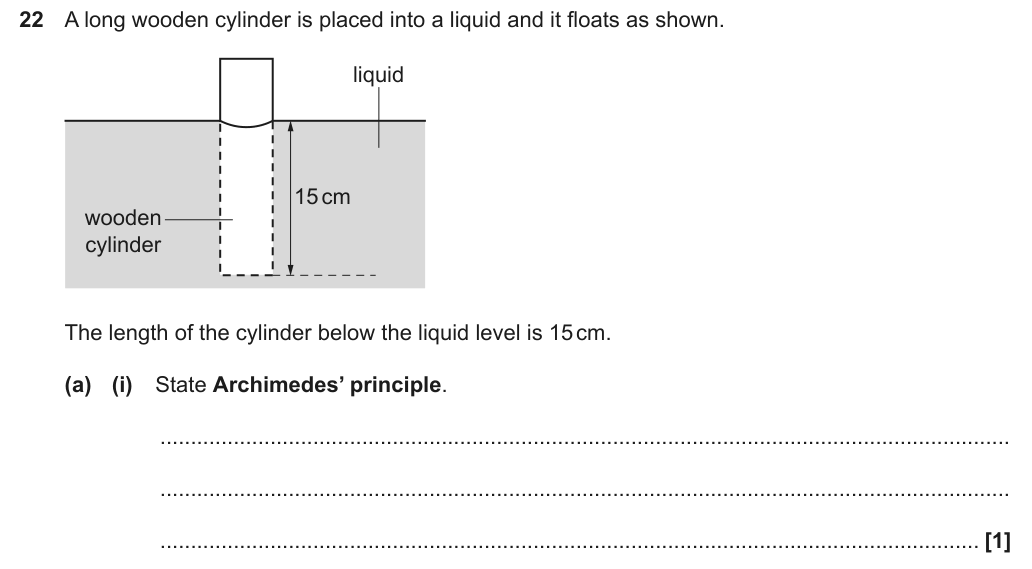
November 2020 · Paper 1 · Q22(a)(i)1 markShort answer
Mark scheme
Notes from the mark scheme and report
fluid or liquid must be mentioned at least once
weight of fluid displaced
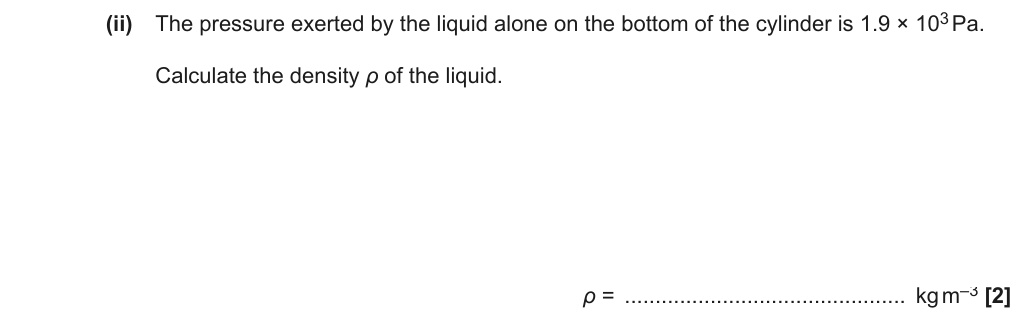
November 2020 · Paper 1 · Q22(a)(ii)2 marksCalculation
Earlier part of question 22 that this part uses
Mark scheme
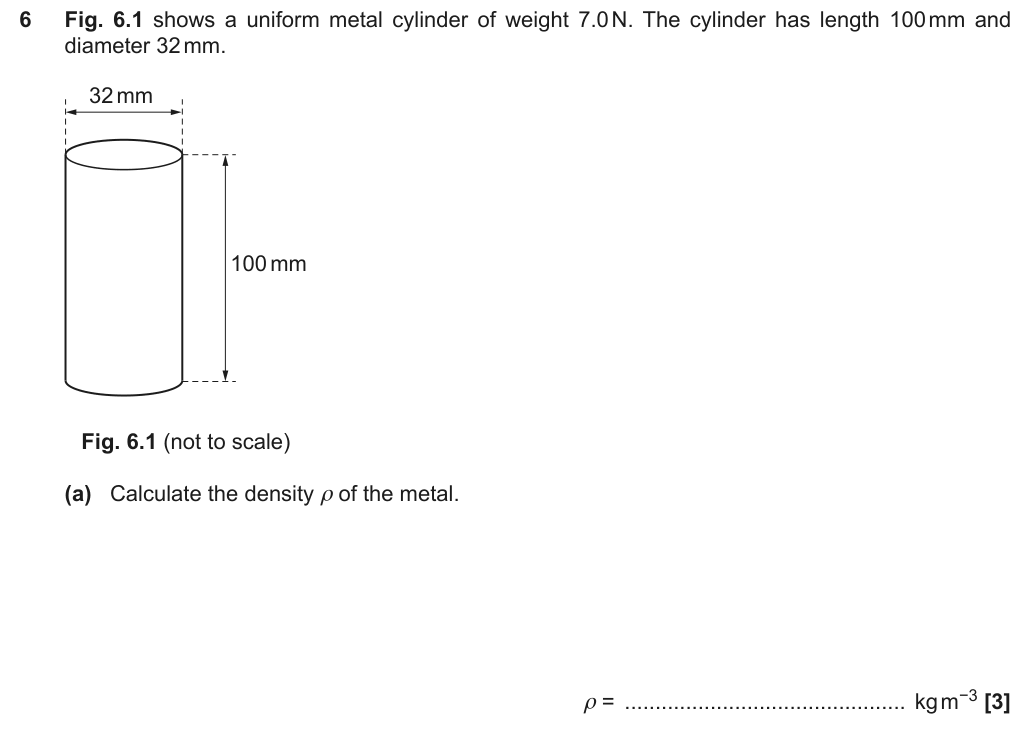
November 2020 · AS Paper 2 · Q6(a)3 marksCalculationMedium
Mark scheme
Examiner's comment
In Question 6 (a), most candidates answered this well although a significant minority confused the calculation of the volume.
Notes from the mark scheme and report
2200 scores two marks
Skills: M0.1 Recognise and make use of appropriate units in calculations; M2.3 Substitute numerical values into algebraic equations using appropriate units for physical quantities; M4.3 Calculate areas of triangles, circumferences and areas of circles, surface areas and volumes of rectangular blocks, cylinders and spheres
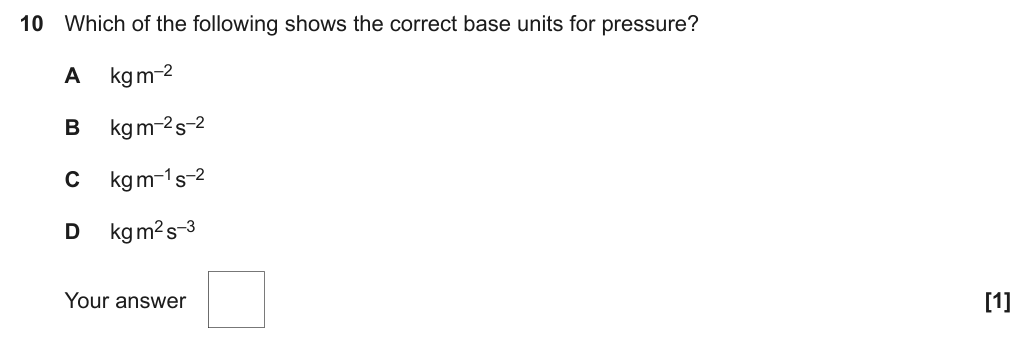
June 2019 · Paper 1 · Q101 markMultiple choiceMedium
Answer
C
Mark scheme
Examiner's comment
Since P = F/A, we need the units of force and area in base units. F = ma, so force has the base units of kg m s-2 . Area’s unit in base units is m2. Hence pressure has the base units kg m s-1/m2 = kg m-1 s-2, which is answer C.
June 2019 · Paper 1 · Q24(b)(ii)1 markShow thatHard
Earlier part of question 24 that this part uses
Mark scheme
Examiner's comment
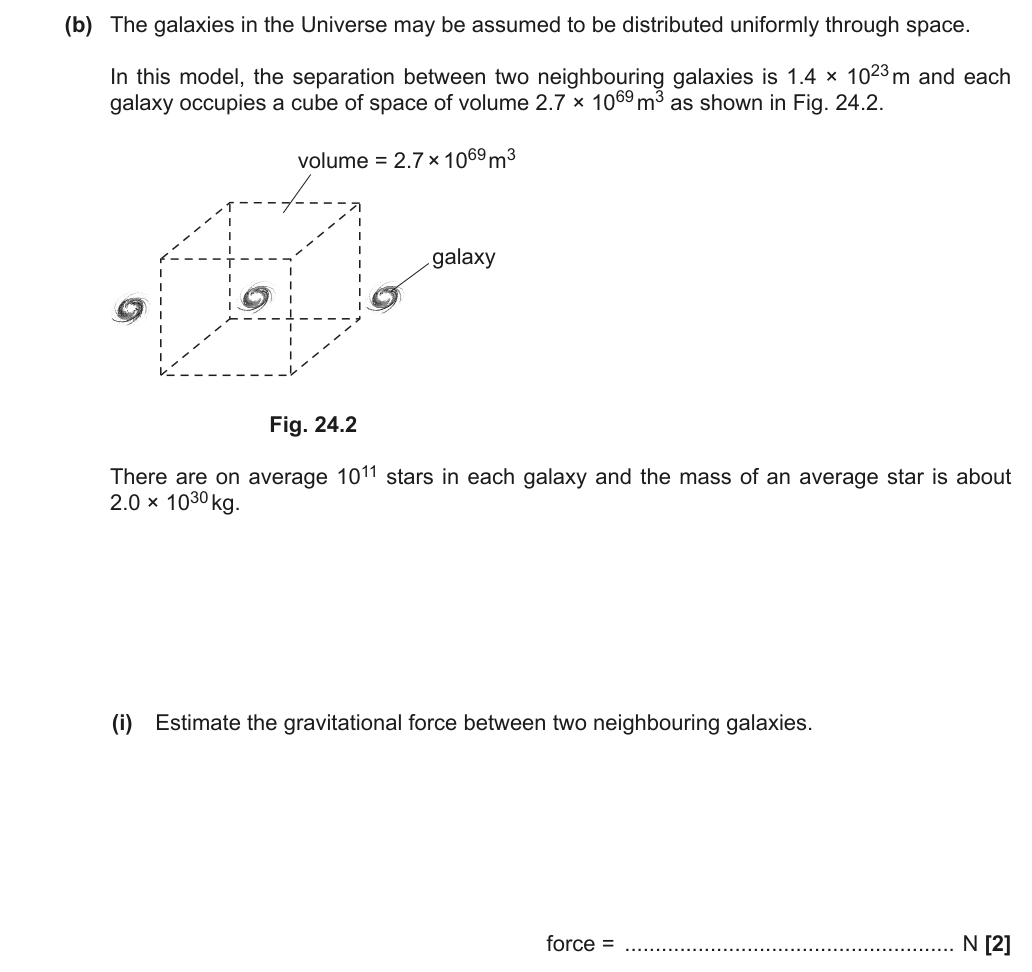
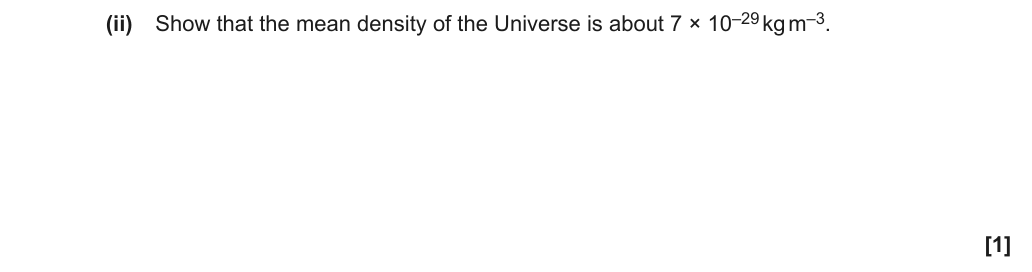
Question 24 (b) (i) While some lower level responses included an attempt to find the gravitational field strength rather than the force most selected the correct formula. Question 24 (b) (iii) This was a question about challenging the model of the universe.
June 2019 · AS Paper 2 · Q3(a)(iv)2 marksCalculationMedium
Earlier part of question 3 that this part uses
Mark scheme
Examiner's comment
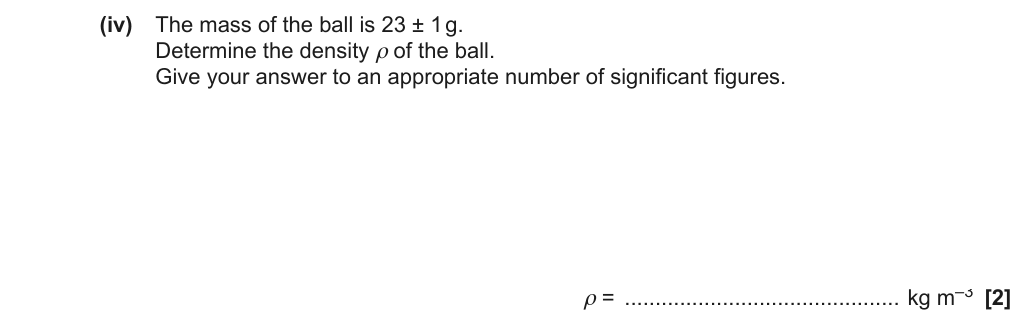
In this question, most candidates were able to determine the density correctly although, a few candidates did not change the mass in gram to kilogram. A large number of candidates did not give their answer to an appropriate number of significant figures; the common answer being 2738 kg m–3. In this case, the mass was given to two significant figures and the volume was calculated from data give to three significant figures, thus the final answer should be given to the same number of significant figures as the least significant data, i.e. to two significant figures.
Notes from the mark scheme and report
must be 2 sf
2.7 x 10^6 scores one mark
Skills: M0.1 Recognise and make use of appropriate units in calculations; M1.1 Use an appropriate number of significant figures; M2.3 Substitute numerical values into algebraic equations using appropriate units for physical quantities
June 2019 · AS Paper 2 · Q3(c)(i)2 marksCalculationMedium
Earlier part of question 3 that this part uses
Mark scheme
Examiner's comment
In this question, many candidates calculated the apparent weight and then incorrectly assumed that this was the upthrust. Other errors included using the incorrect values for length to determine the extension. Some candidates correctly determined the upthrust by determining the change in extension.
Notes from the mark scheme and report
ecf from (b)
allow 0.1 N (1 sf)
Skills: M2.3 Substitute numerical values into algebraic equations using appropriate units for physical quantities
June 2019 · AS Paper 2 · Q3(c)(ii)2 marksCalculationHard
Earlier parts of question 3 that this part uses
Mark scheme
Examiner's comment
Candidates generally found this last question challenging. Some candidates who did less well, attempted to use the equation for liquid pressure. Candidates who did well again clearly showed their reasoning.
Notes from the mark scheme and report
ecf from (c)(i)
Skills: M2.2 Change the subject of an equation, including non-linear equations; M2.3 Substitute numerical values into algebraic equations using appropriate units for physical quantities
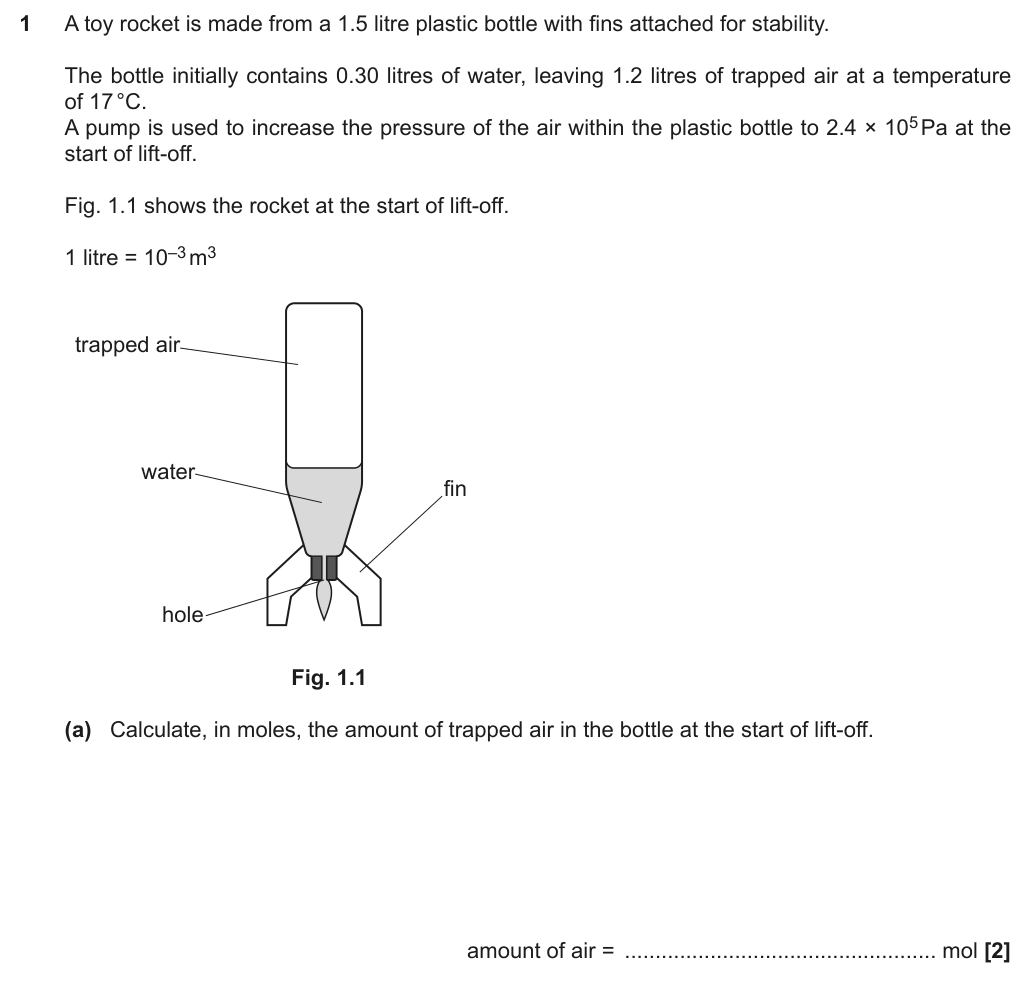
June 2019 · Paper 3 · Q1(c)(i)2 marksShow thatMedium
Mark scheme
Examiner's comment
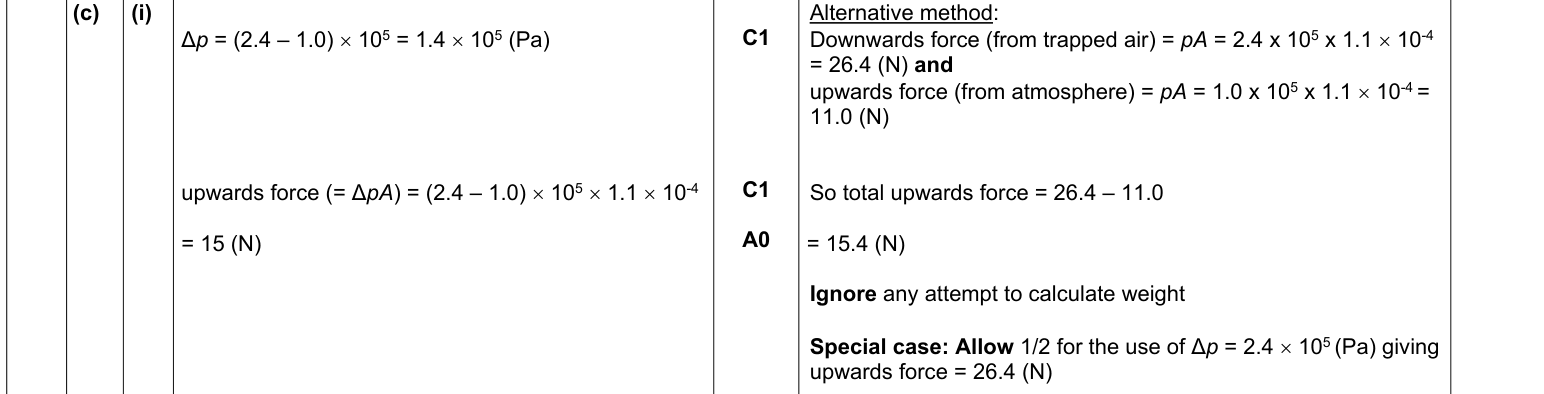
Most candidates realised that a difference in air pressure between the inside and outside of the bottle would force the water downwards, producing an upwards force on the bottle which could be calculated using p = F/A. Common problems in 1(c)(i) • ignoring the pressure of the atmosphere to give an upwards force of 26N • thinking that the upwards force was caused by upthrust and attempting to use the formula p = hρg.
Notes from the mark scheme and report
must use the pressure difference
26.4 N (using 2.4 x 10^5 Pa) scores 1 mark
ignore any attempt to calculate weight
Skills: M0.2 Recognise and use expressions in decimal and standard form; M2.3 Substitute numerical values into algebraic equations using appropriate units for physical quantities
June 2019 · Paper 3 · Q1(c)(ii)3 marksCalculationHard
Earlier parts of question 1 that this part uses
Mark scheme
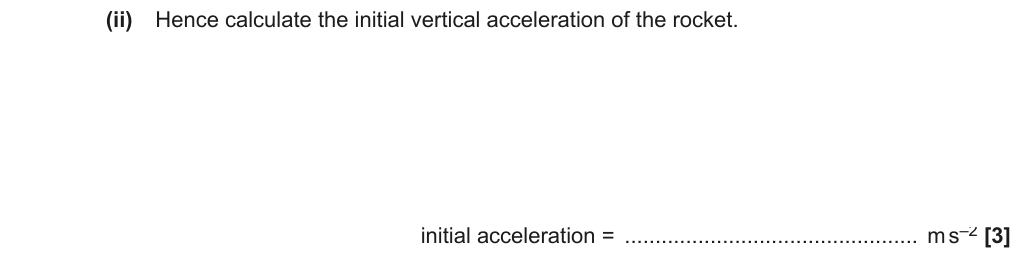
Examiner's comment
This question, although a simple F = ma problem, challenged many candidates. Common problems in 1(c)(ii) • using incorrect mass (either mass of bottle alone = 0.05kg, or mass of water alone = 0.3kg, or POT errors) • using upwards force from 1(c)(i) rather than resultant force in the formula F = ma. been used, but the value for the upwards force (15.4N) rather than the resultant force (15.4 – mg) has been used for F.
Notes from the mark scheme and report
mass must include the 0.30 kg of water
weight must be subtracted
no ecf from (c)(i)
Skills: M0.1 Recognise and make use of appropriate units in calculations; M2.2 Change the subject of an equation, including non-linear equations; M2.3 Substitute numerical values into algebraic equations using appropriate units for physical quantities
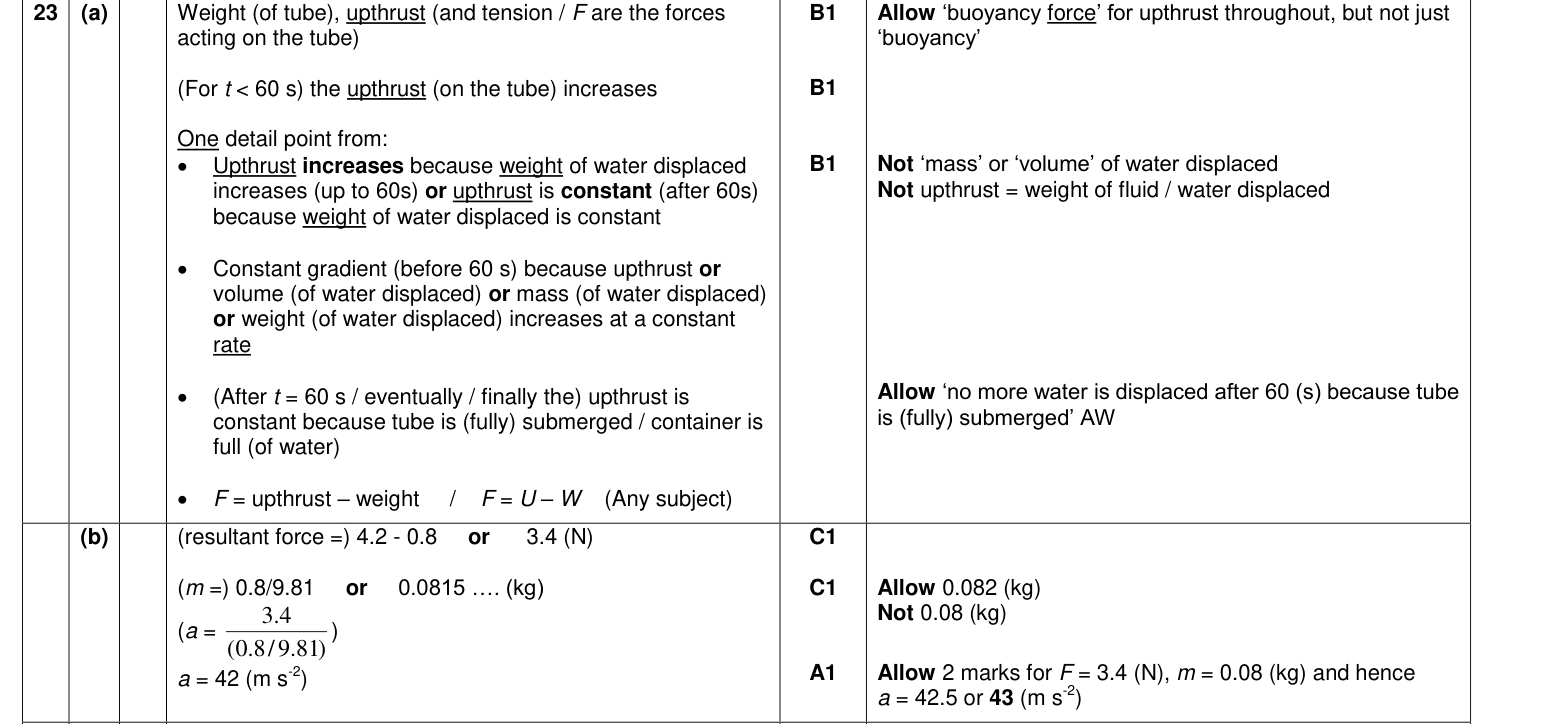
June 2018 · AS Paper 1 · Q23(a)3 marksExplanationHard
Mark scheme
Examiner's comment
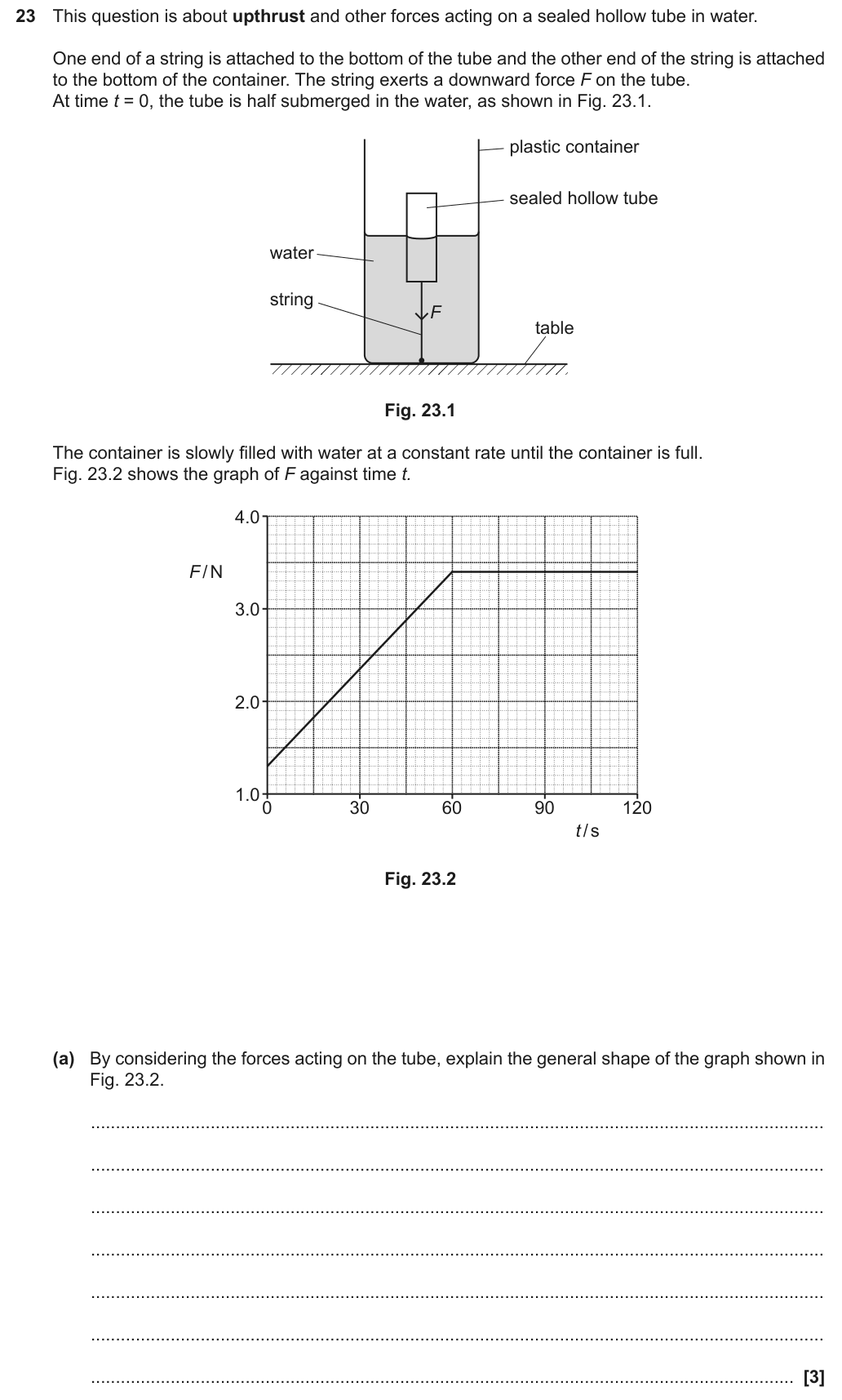
This question required understanding of upthrust and Archimedes principle. Many candidates gave explanation without mentioning any of the forces acting on the tube. Those candidates who read and focussed on the requirements of the question did better, but there were too many misconceptions and missed opportunities. The most common missed opportunities and errors were: • Not mentioning any of the two of the forces from the list of three (upthrust, tension and weight) • Stating Archimedes principle without reference to this specific question • Confusing mass and weight in the description of upthrust • Confusing the tension in the string with upthrust Key This exemplar illustrates how correct use of technical language can score full marks. Here the marks were credited for • Identifying a minimum of two forces acting on the tube (weight and upthrust) • Mentioning that upthrust increases as the water level rises • Explanation that upthrust is equal to the force on the string (tension) and weight (The last mark was the toughest mark to gain, so this candidate has shown good understanding of this difficult topic.)
Notes from the mark scheme and report
Allow buoyancy force but not just buoyancy
Not mass or volume of water displaced
Not upthrust = weight of water displaced
Skills: M3.1 Translate information between graphical, numerical and algebraic forms
June 2017 · Paper 1 · Q61 markMultiple choice
Answer
B
Mark scheme
June 2017 · AS Paper 1 · Q151 markMultiple choice
Answer
C
Mark scheme
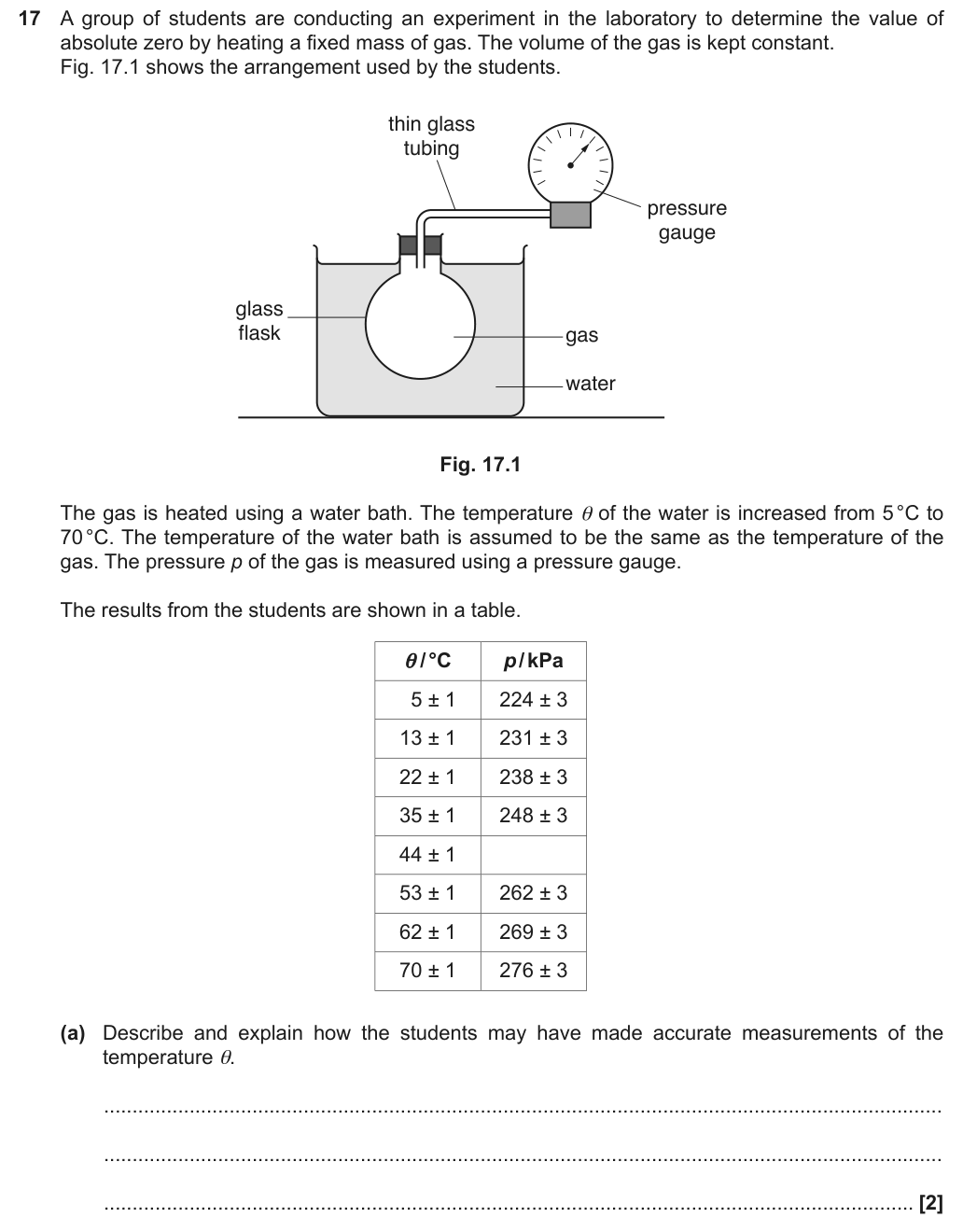
June 2017 · Paper 1 · Q17(b)(ii)2 marksShort answer
Earlier parts of question 17 that this part uses
Mark scheme
Notes from the mark scheme and report
value must be 3 sf (255) and uncertainty 1 sf (3)
Skills: M0.1 Recognise and make use of appropriate units in calculations; M1.1 Use an appropriate number of significant figures; M1.5 Identify uncertainties in measurements and use simple techniques to determine uncertainty when data are combined; M2.3 Substitute numerical values into algebraic equations using appropriate units for physical quantities
June 2017 · Paper 1 · Q18(a)(i)2 marksCalculation
Mark scheme
Notes from the mark scheme and report
no ecf for incorrect volume
1 mark for 230 (r = 1.0 x 10⁻² m used)
Skills: M0.2 Recognise and use expressions in decimal and standard form; M2.3 Substitute numerical values into algebraic equations using appropriate units for physical quantities; M4.3 Calculate areas of triangles, circumferences and areas of circles, surface areas and volumes of rectangular blocks, cylinders and spheres
June 2017 · Paper 1 · Q18(a)(ii)2 marksExplanation
Earlier part of question 18 that this part uses
Mark scheme
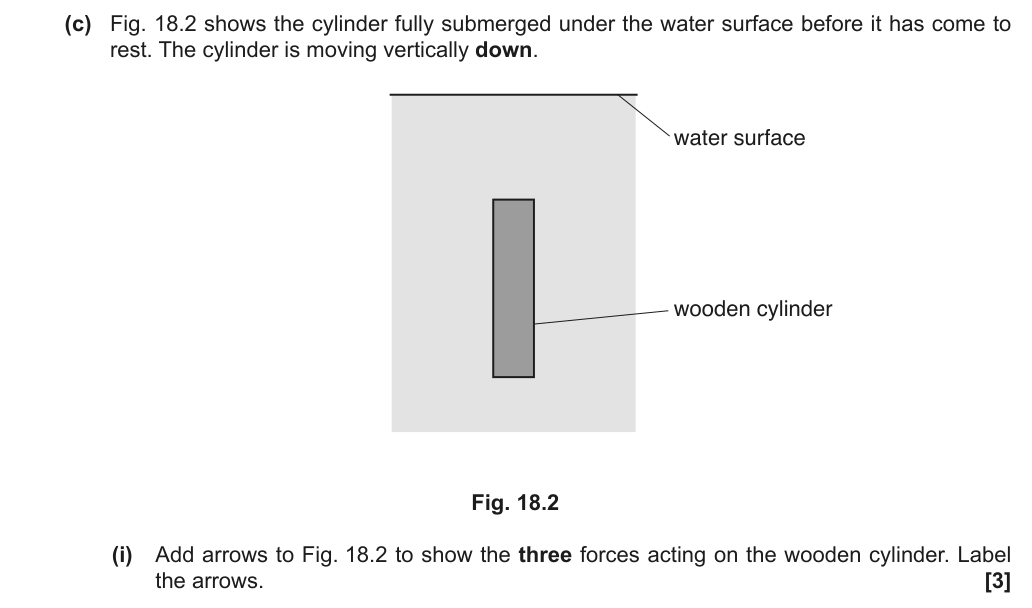
June 2017 · Paper 1 · Q18(c)(i)3 marksDiagram or graph
Mark scheme
Notes from the mark scheme and report
ignore arrow sizes
allow (water) resistance for drag
Skills: M4.2 Visualise and represent 2D and 3D forms, including two-dimensional representations of 3D objects
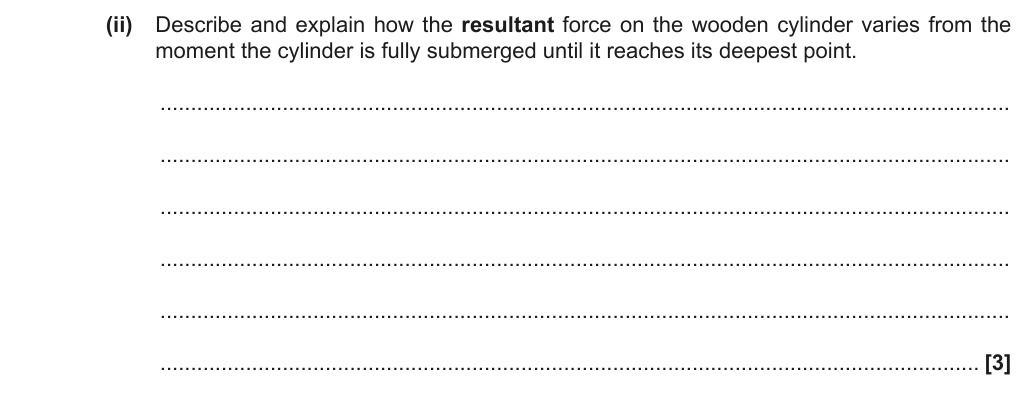
June 2017 · Paper 1 · Q18(c)(ii)3 marksExplanation
Earlier part of question 18 that this part uses
Mark scheme
Notes from the mark scheme and report
Not resultant force = 0
any incorrect statement from the list loses that point
resultant force is always upwards scores 2
June 2017 · AS Paper 2 · Q3(a)(ii)2 marksShow that
Earlier part of question 3 that this part uses
Mark scheme
Notes from the mark scheme and report
correct power of ten must be seen (0.014 m)
Skills: M0.1 Recognise and make use of appropriate units in calculations; M2.3 Substitute numerical values into algebraic equations using appropriate units for physical quantities; M4.3 Calculate areas of triangles, circumferences and areas of circles, surface areas and volumes of rectangular blocks, cylinders and spheres
June 2017 · AS Paper 2 · Q3(a)(iii)2 marksCalculation
Earlier parts of question 3 that this part uses
Mark scheme
Notes from the mark scheme and report
upthrust - weight
ecf from (a)(ii)
allow 0.037 or 0.039
Skills: M2.3 Substitute numerical values into algebraic equations using appropriate units for physical quantities
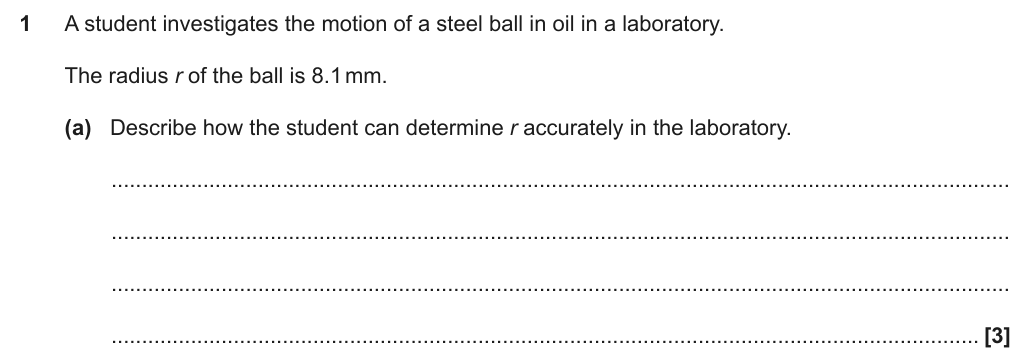
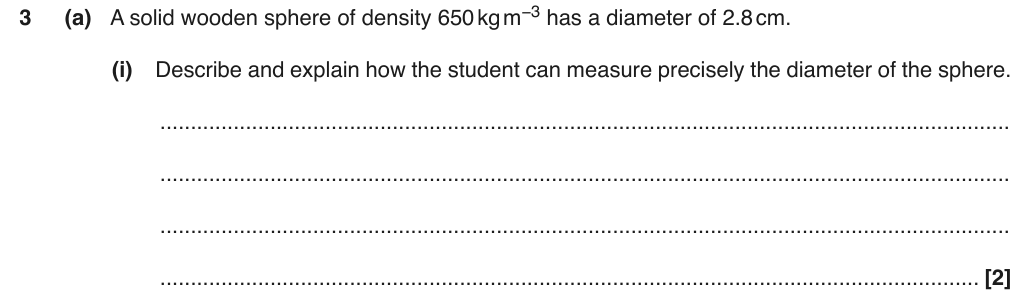
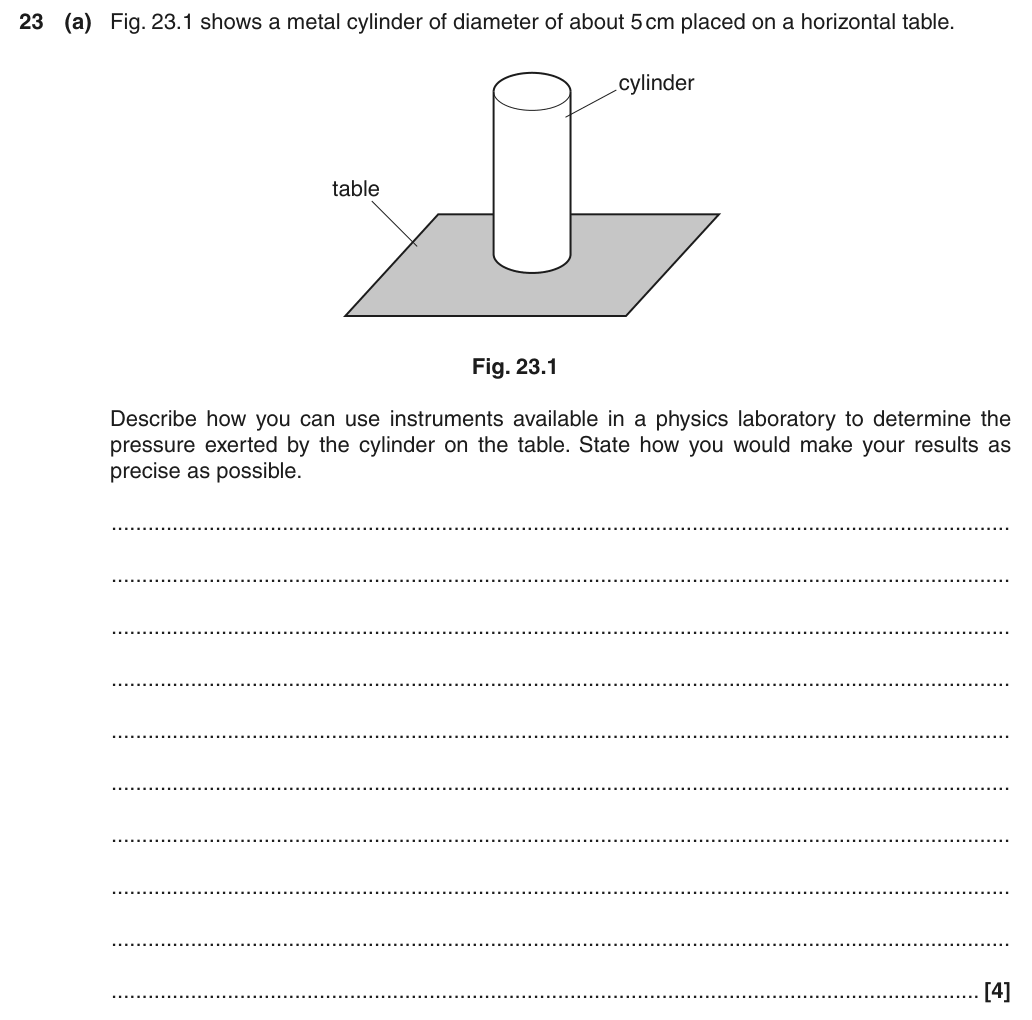
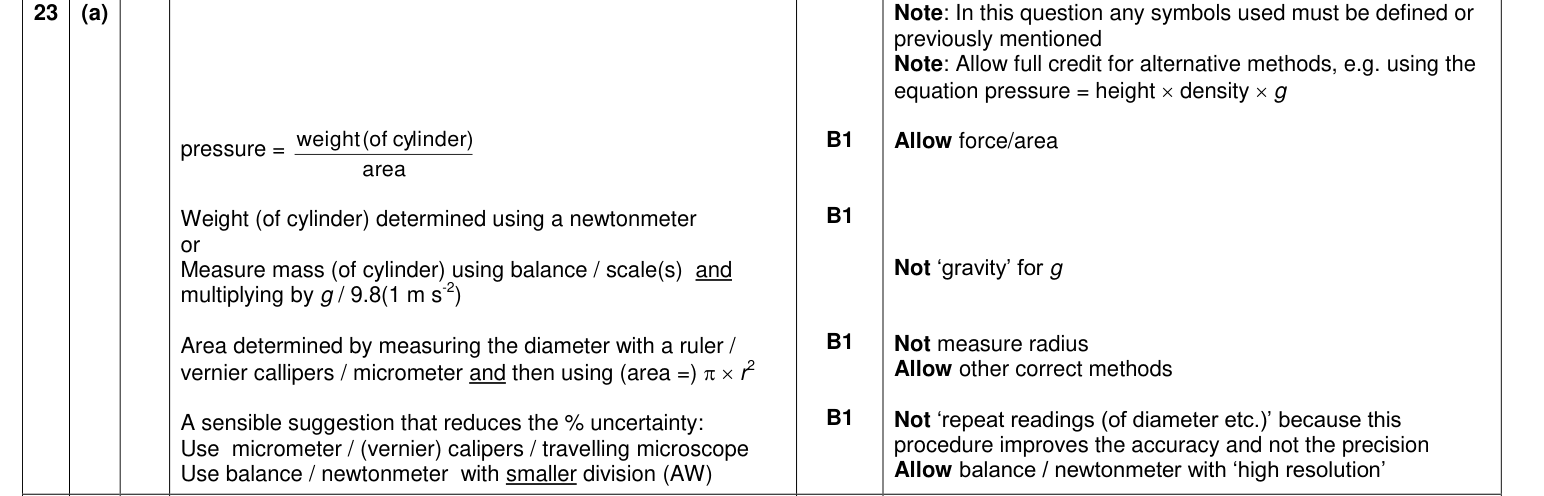
June 2016 · AS Paper 1 · Q23(a)4 marksExplanation
Mark scheme
Notes from the mark scheme and report
symbols must be defined
NOT 'gravity' for g
NOT measure radius
NOT 'repeat readings' (improves accuracy, not precision)
Skills: M4.3 Calculate areas of triangles, circumferences and areas of circles, surface areas and volumes of rectangular blocks, cylinders and spheres
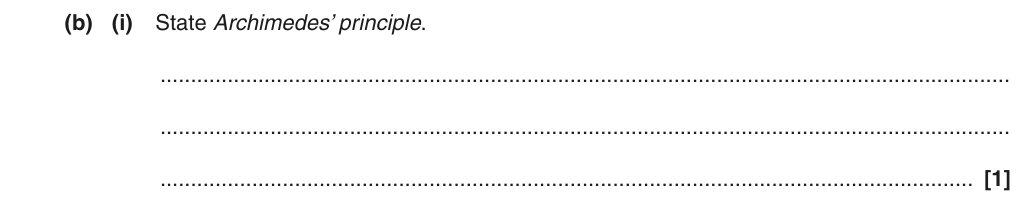
June 2016 · AS Paper 1 · Q23(b)(i)1 markShort answer
Mark scheme
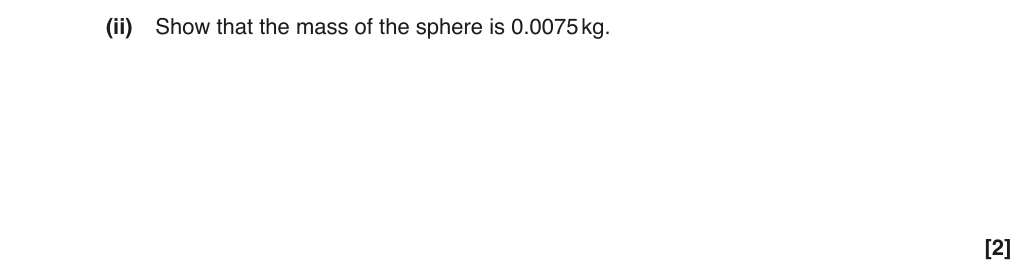
June 2016 · AS Paper 1 · Q23(b)(ii)3 marksCalculation
Mark scheme
June 2016 · AS Paper 2 · Q5(a)1 markShow that
Mark scheme
Notes from the mark scheme and report
mark is for substitution of values
Skills: M0.1 Recognise and make use of appropriate units in calculations; M2.2 Change the subject of an equation, including non-linear equations
Work with an OCR physics tutor
Dropping marks on calculations, practical questions or the six-mark level of response questions? Book a trial session with a specialist OCR physics tutor.