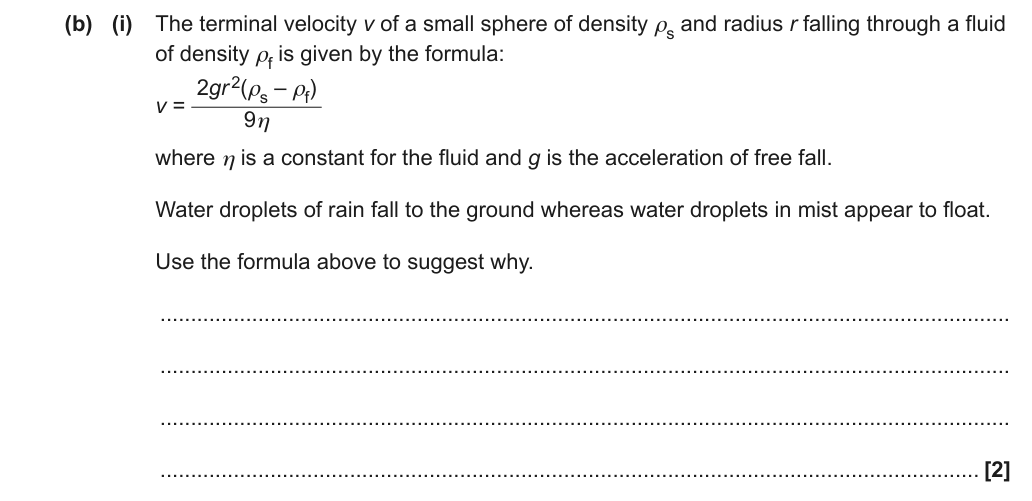
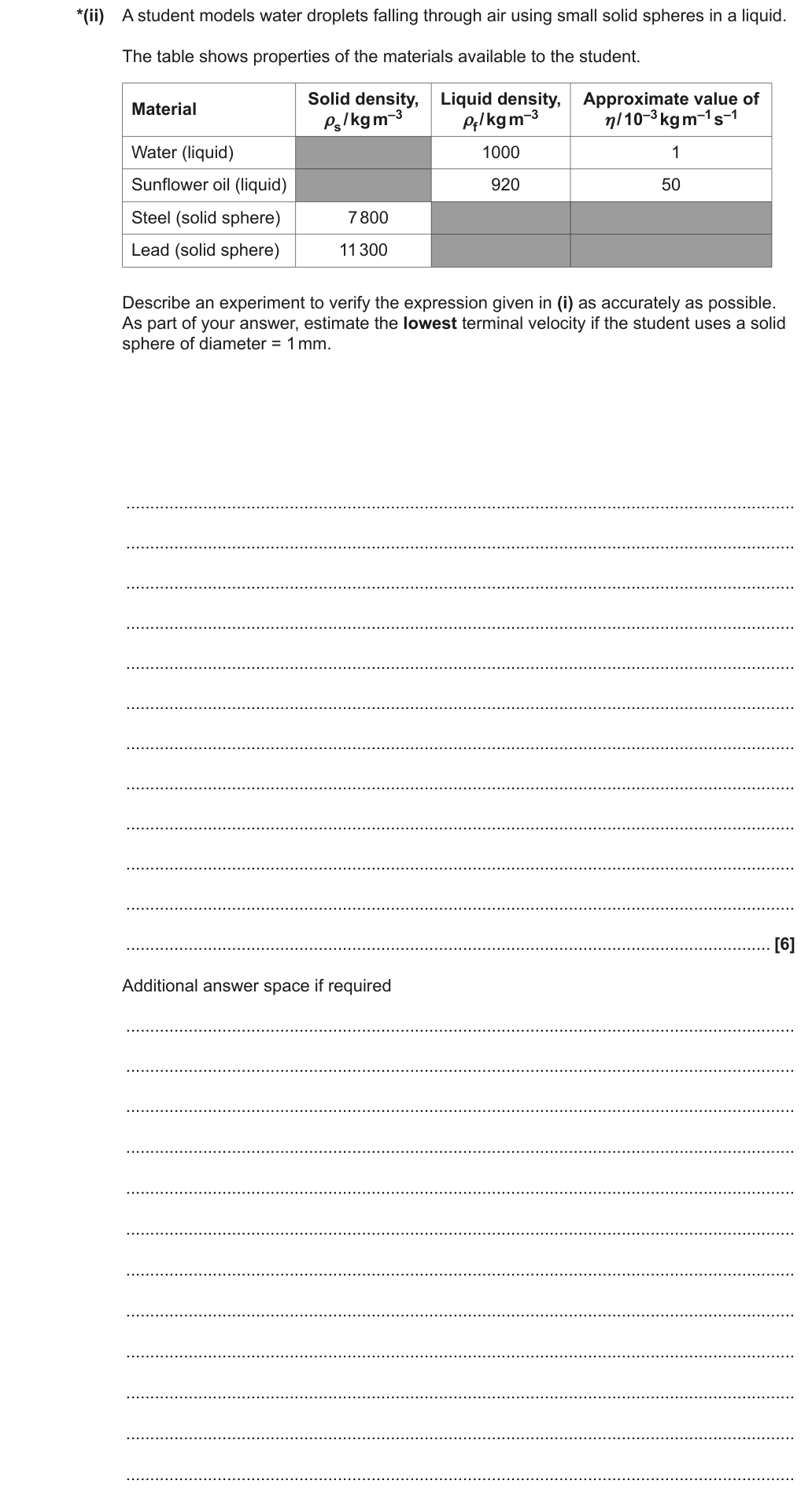
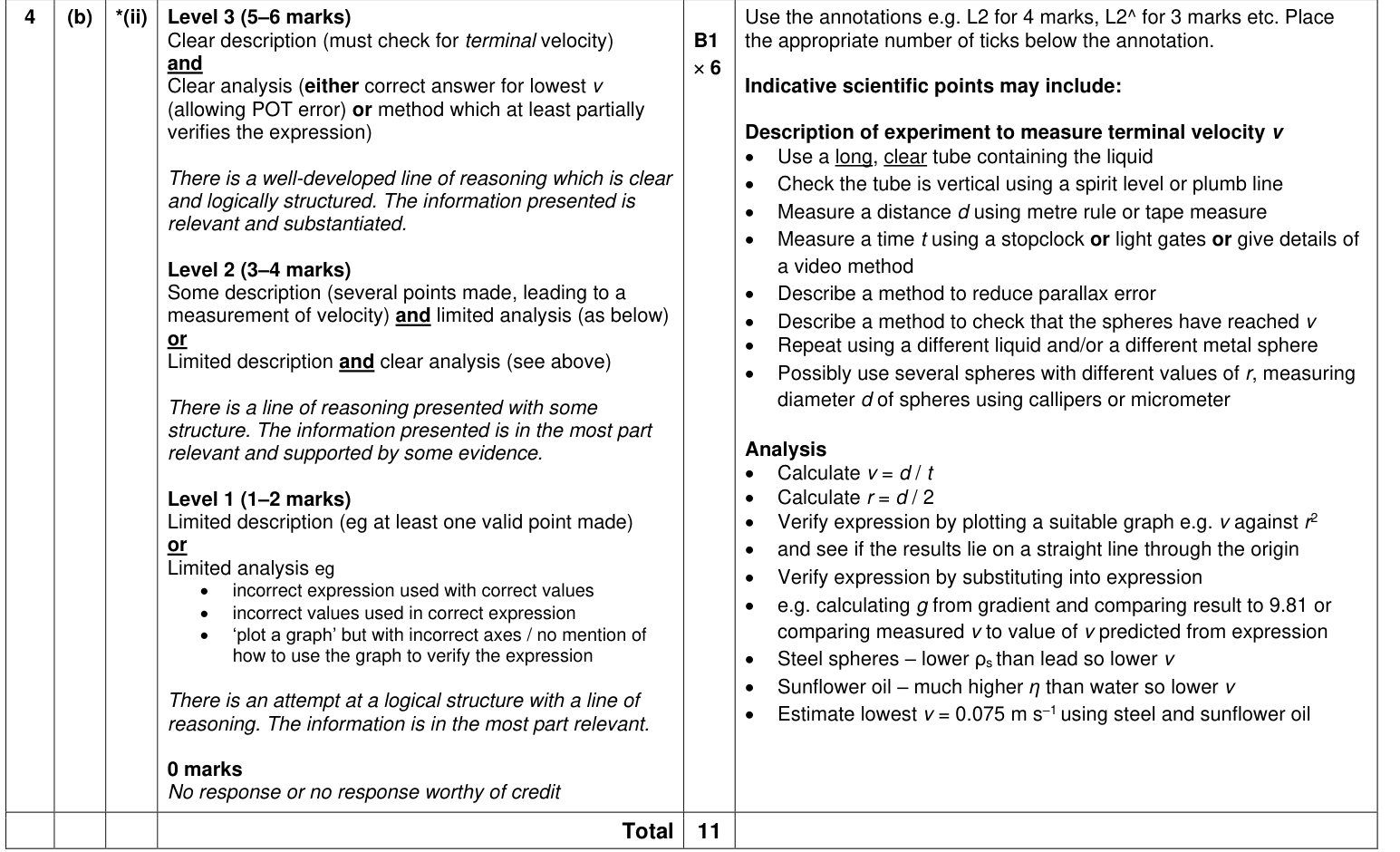
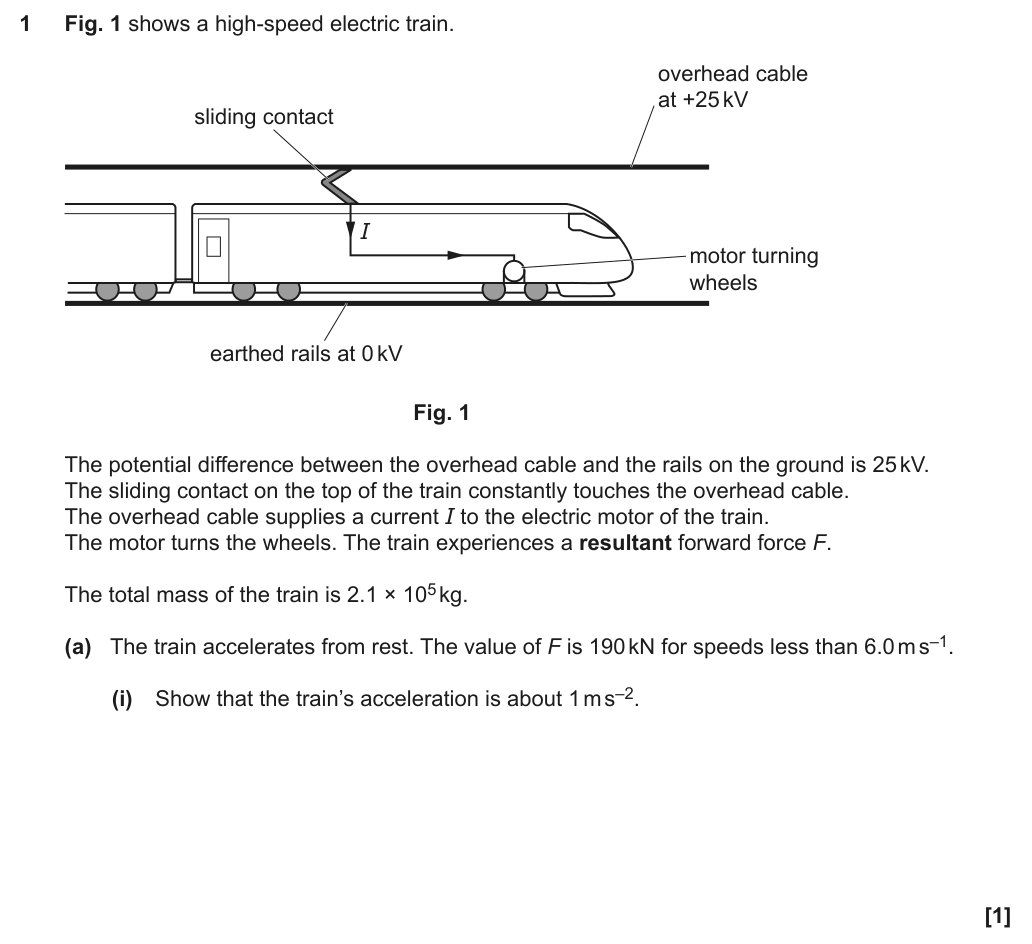
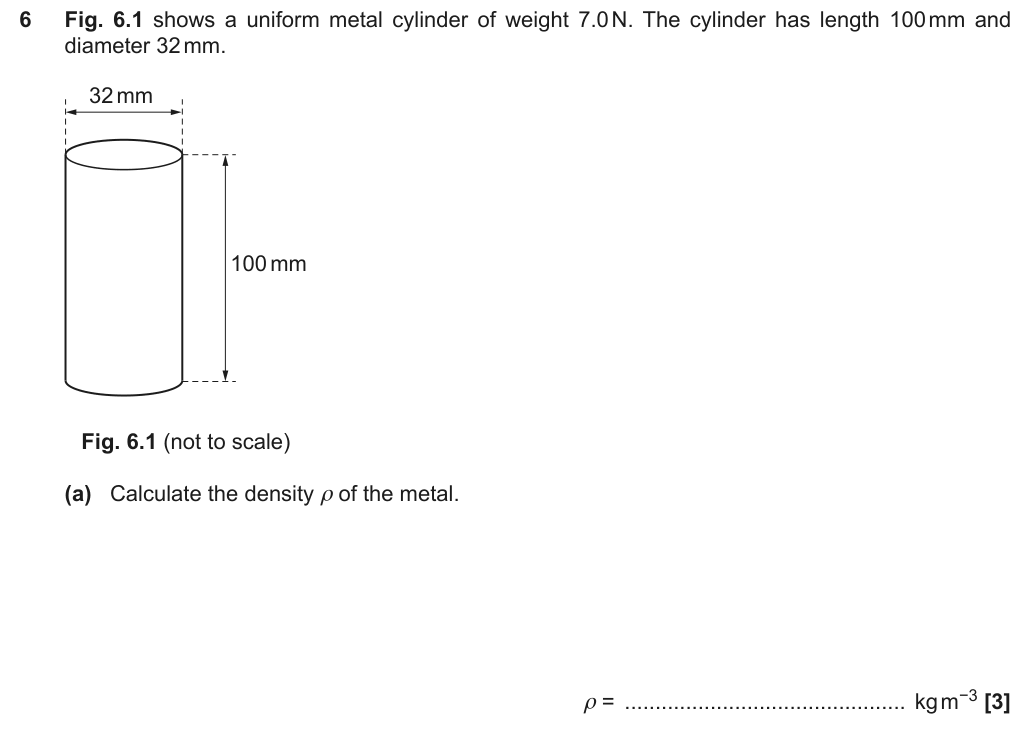
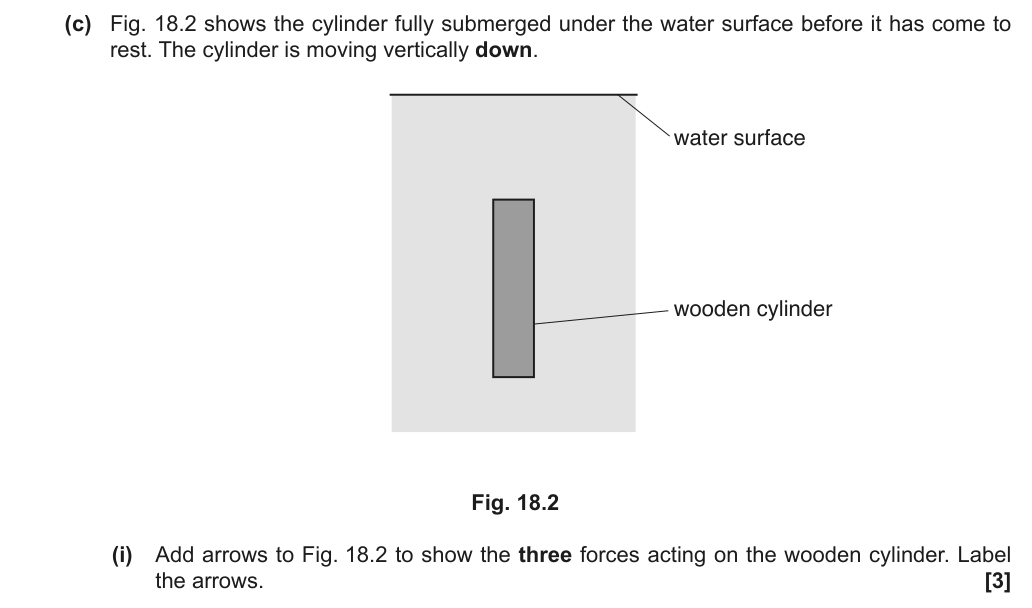
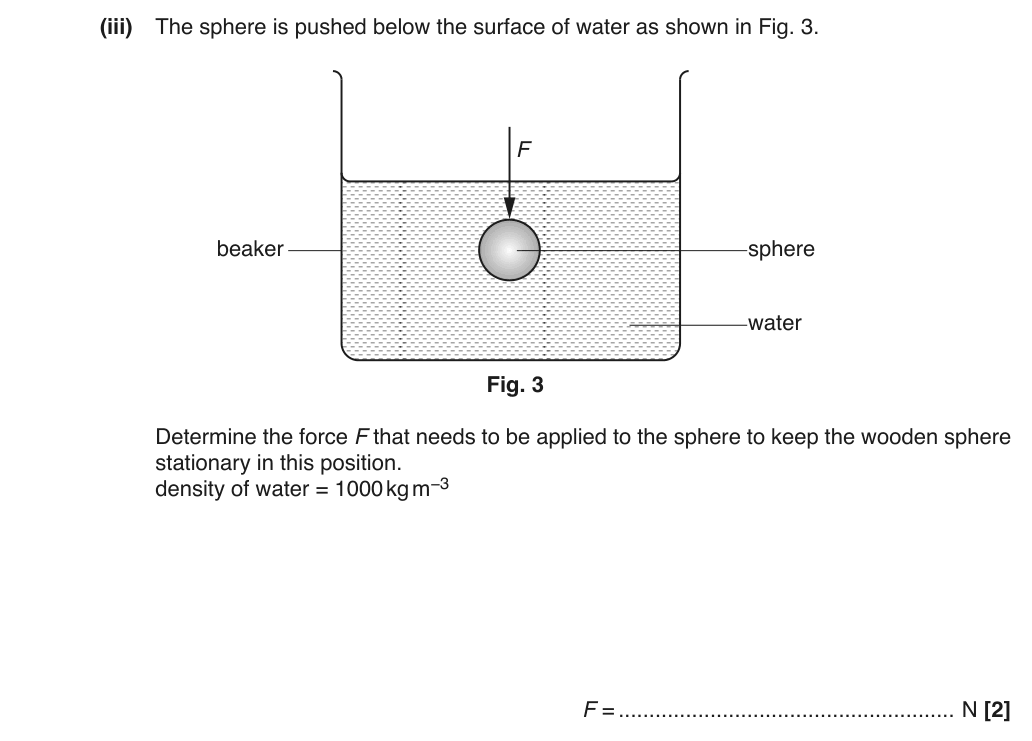
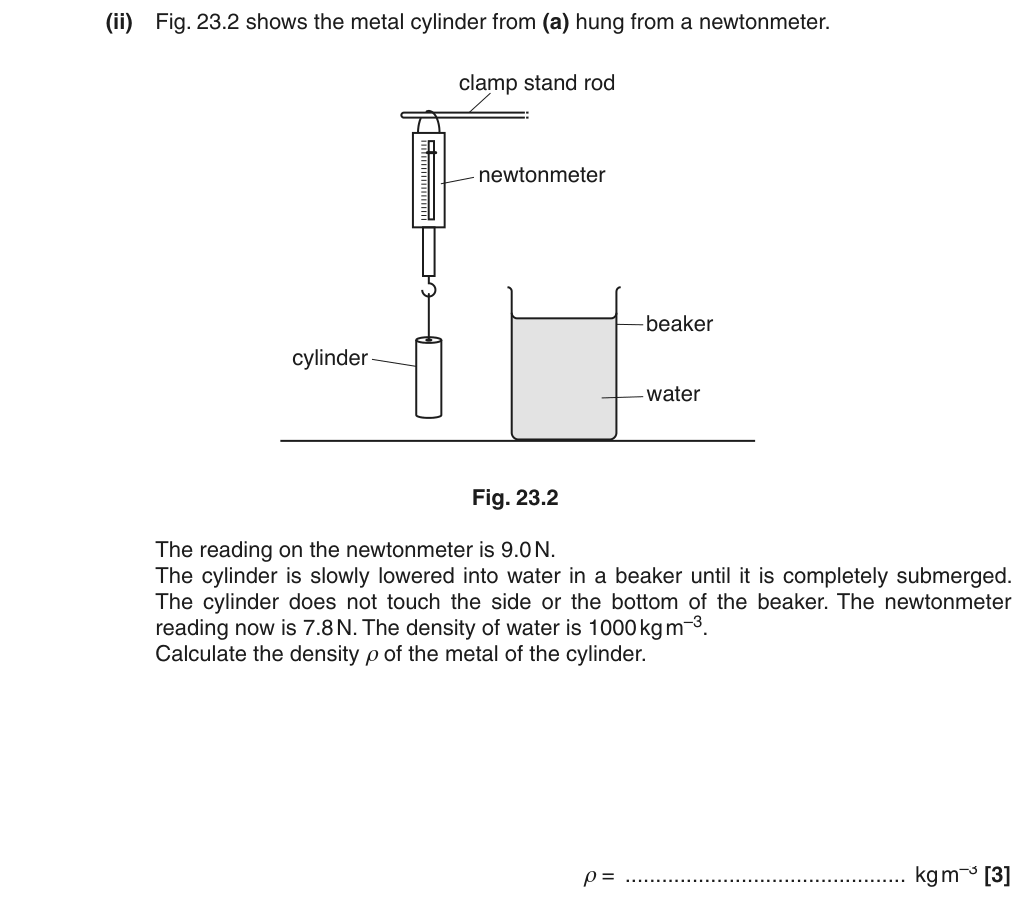
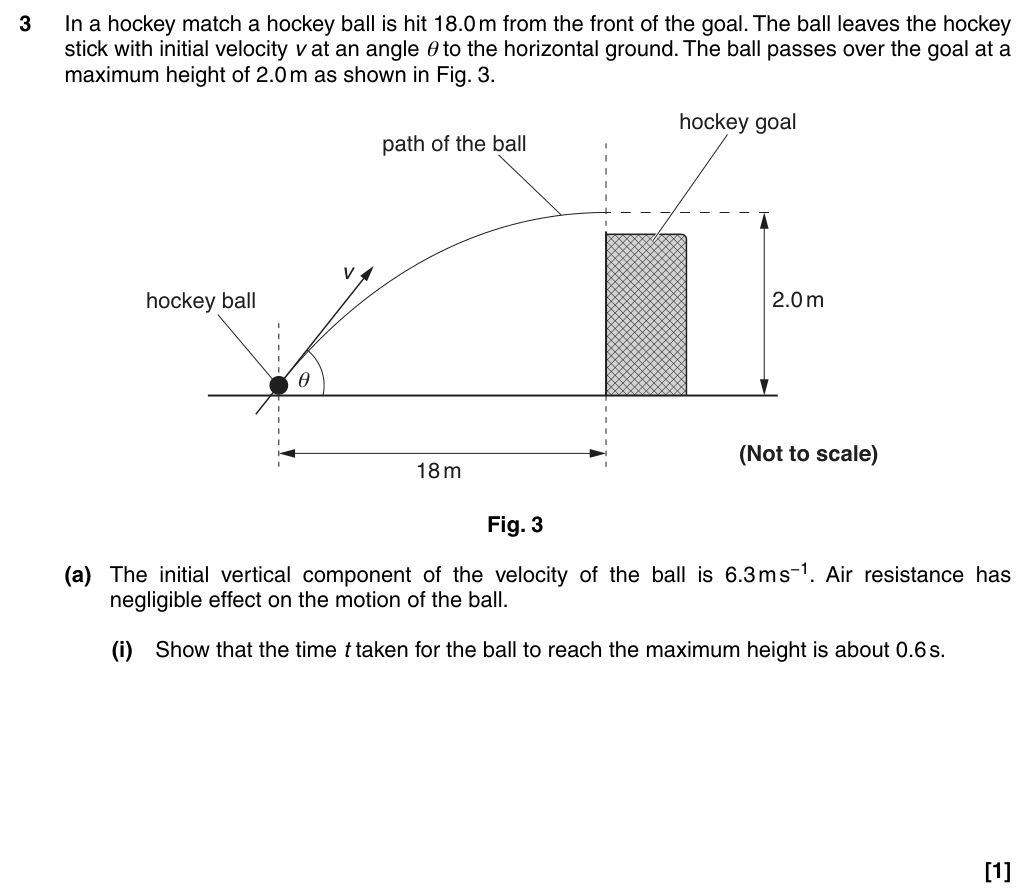
*(ii) A student models water droplets falling through air using small solid spheres in a liquid. Describe an experiment to verify the expression given in (i) as accurately as possible.
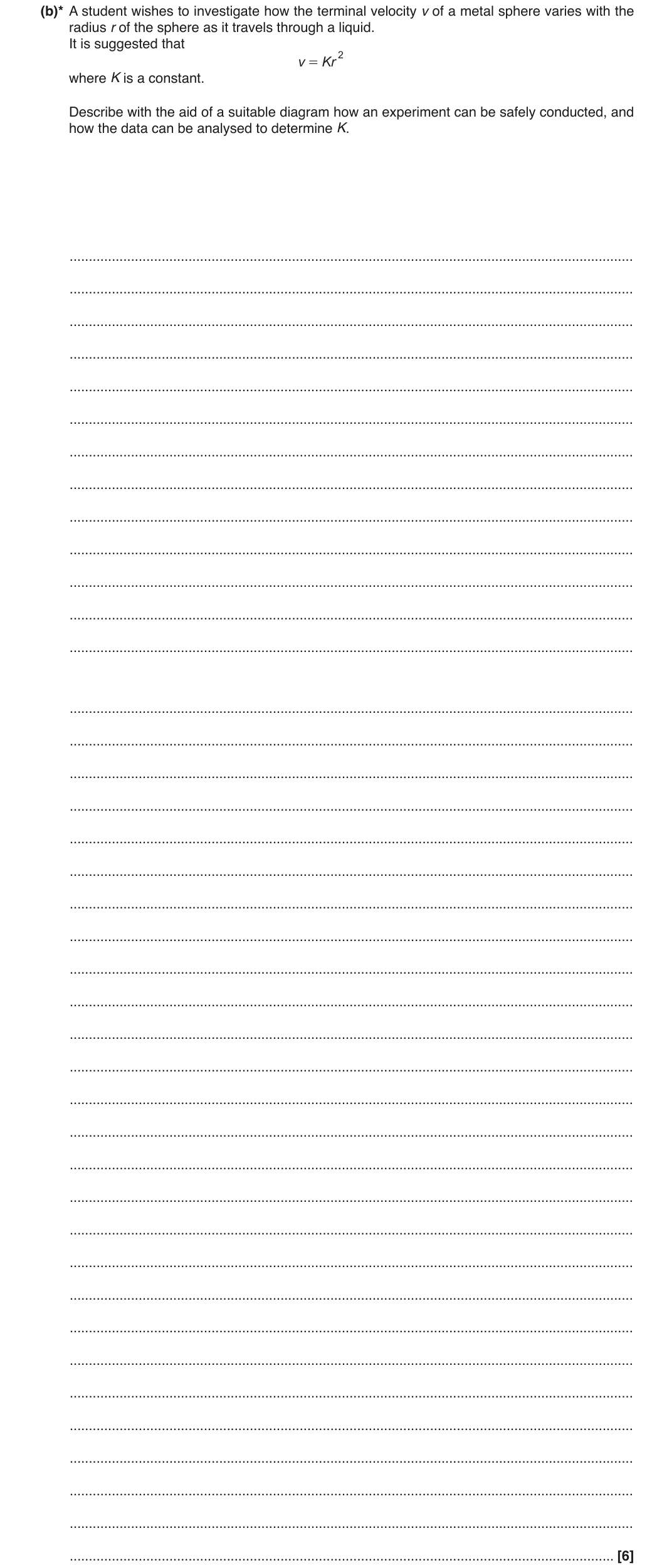
A student wishes to investigate how the terminal velocity v of a metal sphere varies with the Describe with the aid of a suitable diagram how an experiment can be safely conducted, and
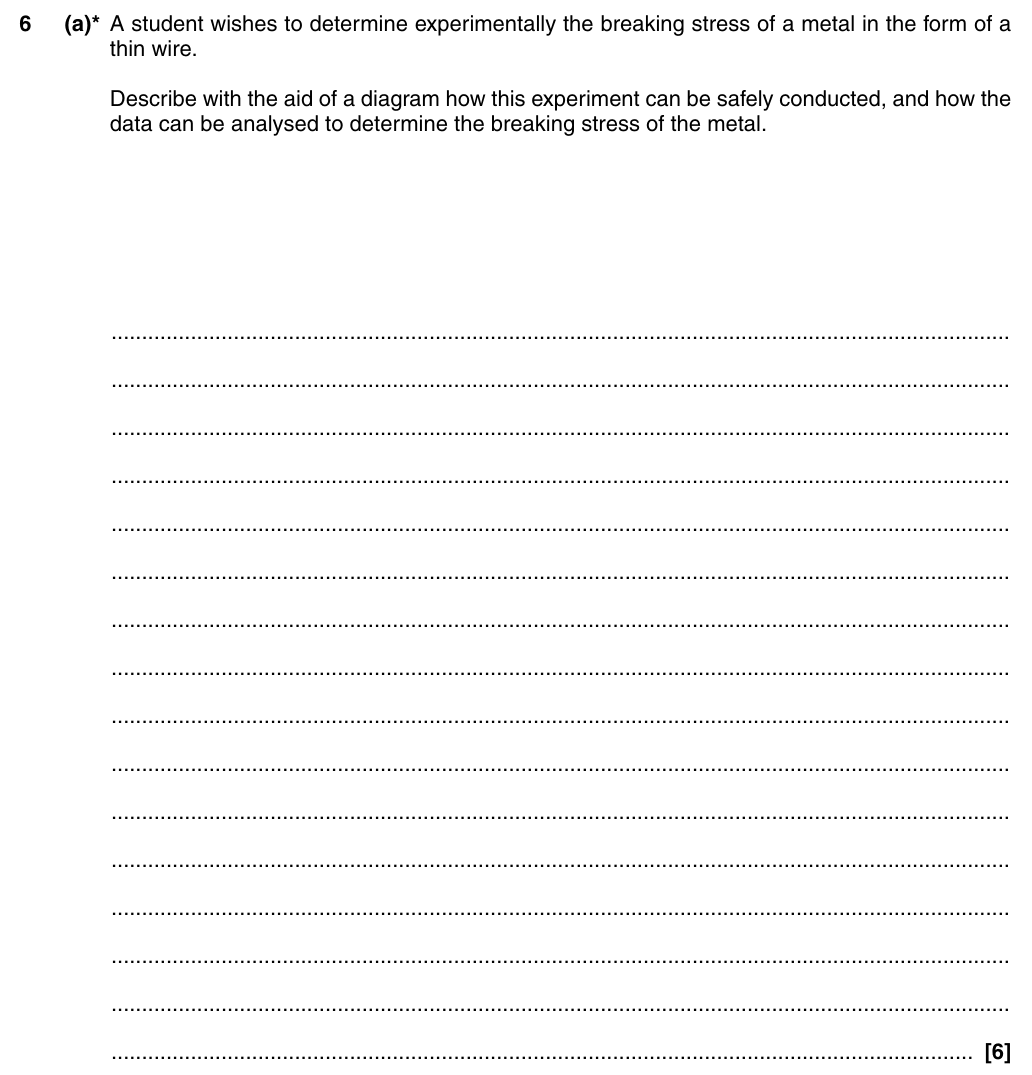
(a)* A student wishes to determine experimentally the breaking stress of a metal in the form of a Describe with the aid of a diagram how this experiment can be safely conducted, and how the
Tap a question to zoom it. Where a part needs a figure, table or graph from earlier in the question, that part folds out above it; the mark scheme and examiner's comment open underneath. Have the OCR Data, Formulae and Relationships Booklet beside you (see the data booklet page).
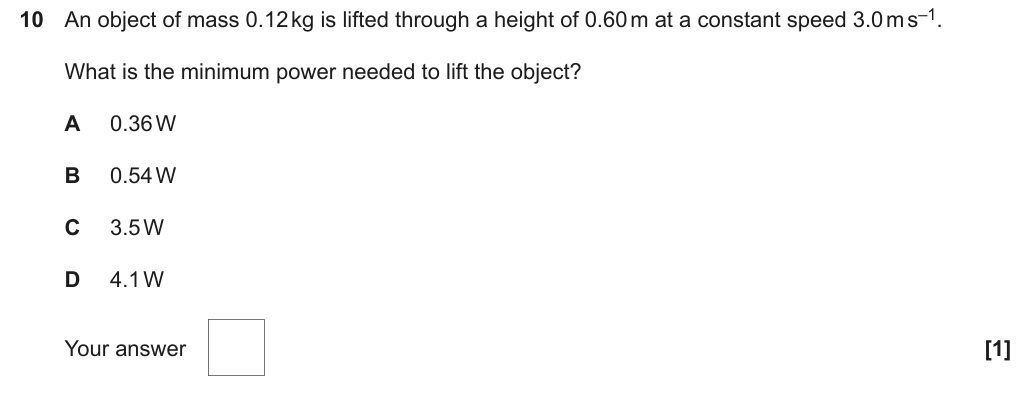
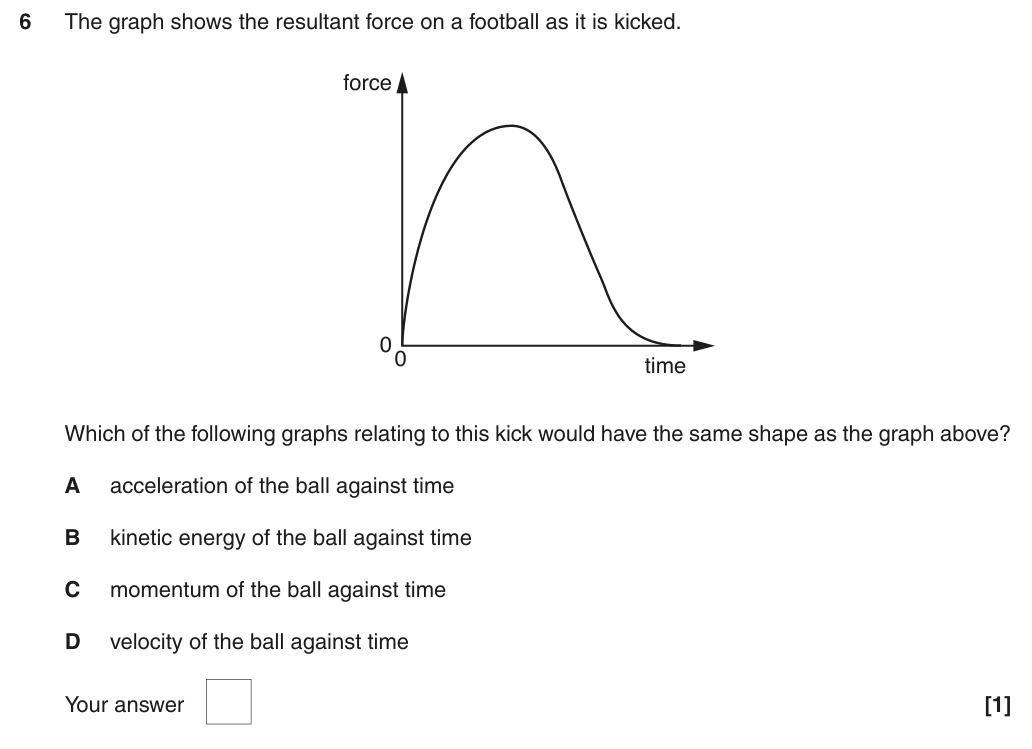
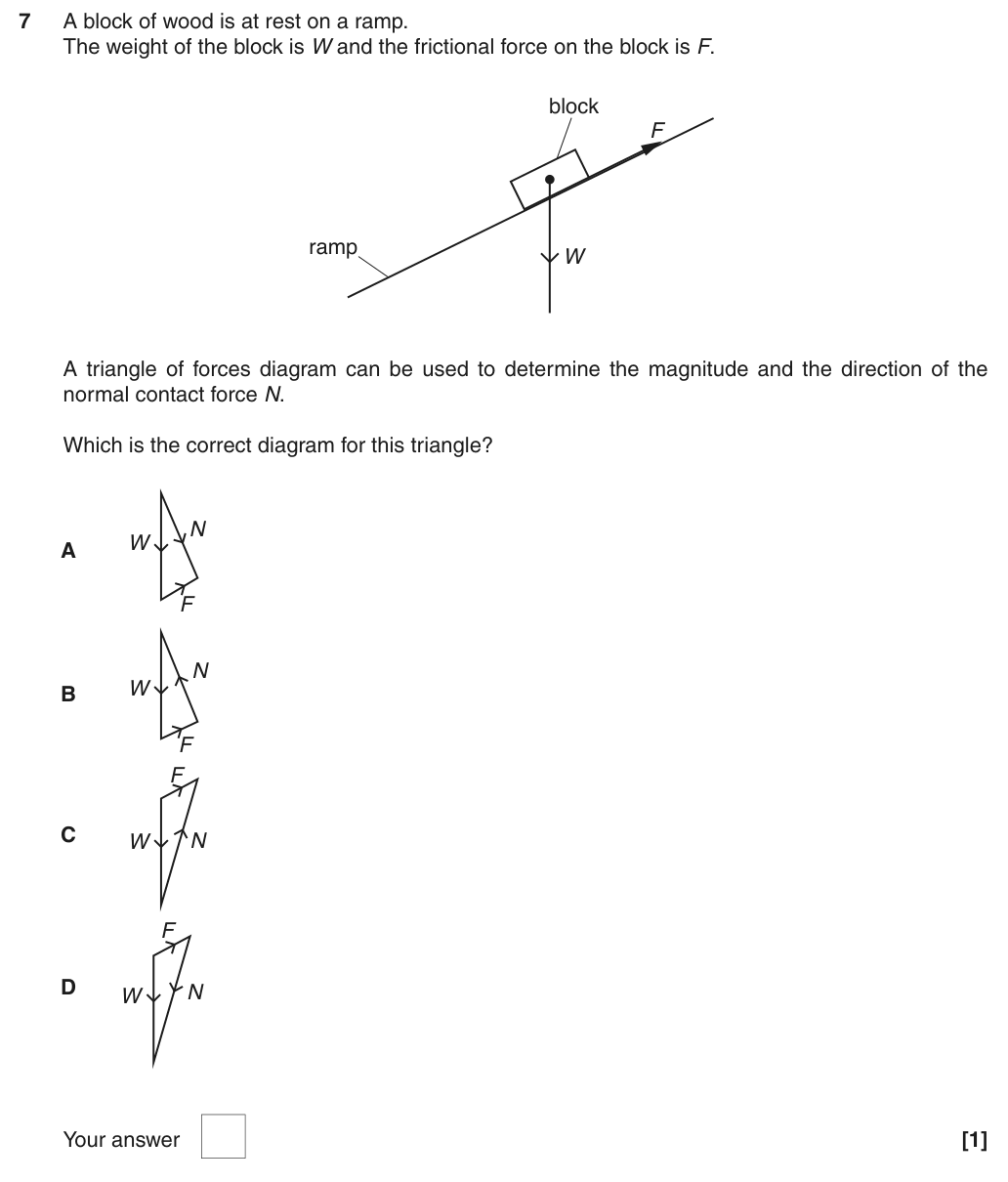
June 2025 · Paper 1 · Q81 markMultiple choiceMedium
Answer
B
Mark scheme
Examiner's comment
The data in the first sentence gives the centripetal force required to make the clothing perform circular motion i.e. 𝑚𝜔2𝑟= 20.25 N, which caused candidates to pick answer A. Those that used a radius of 0.60 m would get answer C at this point. Although, at the bottom of the drum, the centripetal force is given by the contact force from the drum – the weight of the clothing. To find the contact force, we must add the weight of the clothing (2.94 N) to the centripetal force, giving 23.2 N, i.e. answer B is correct. Those that used a radius of 0.60 m would get answer D.
June 2025 · Paper 1 · Q16(b)(i)2 marksExplanationMedium
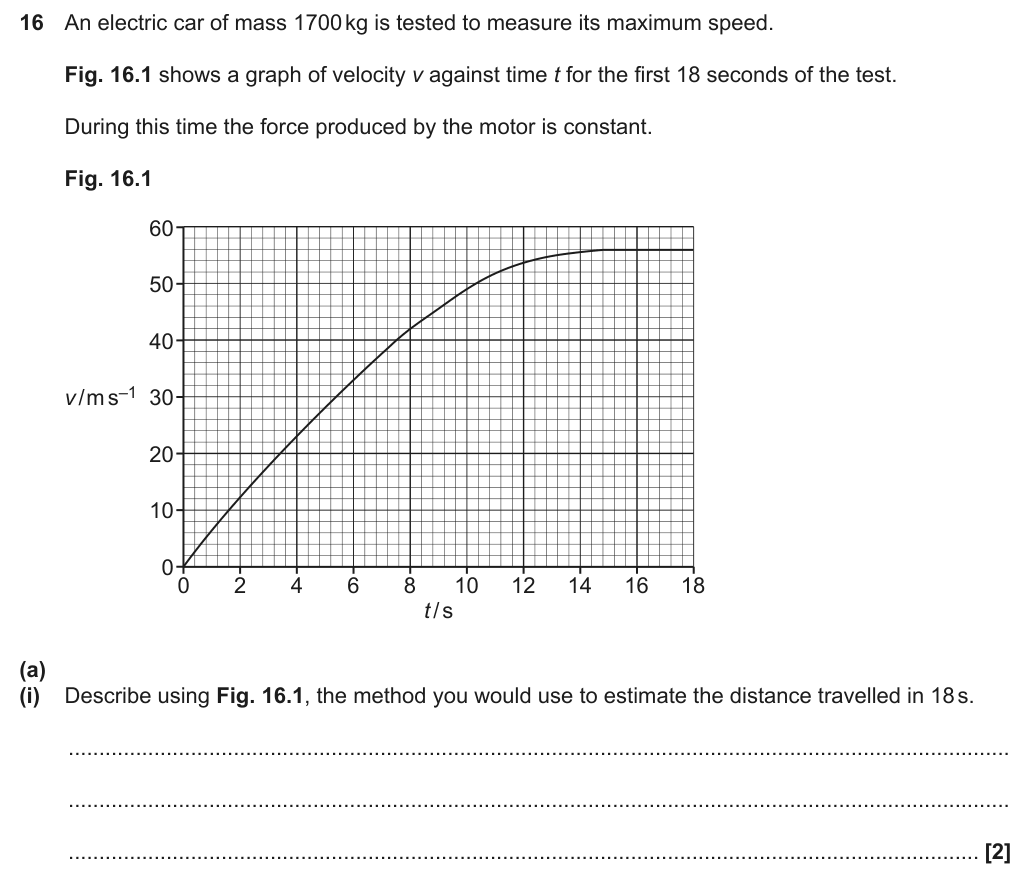
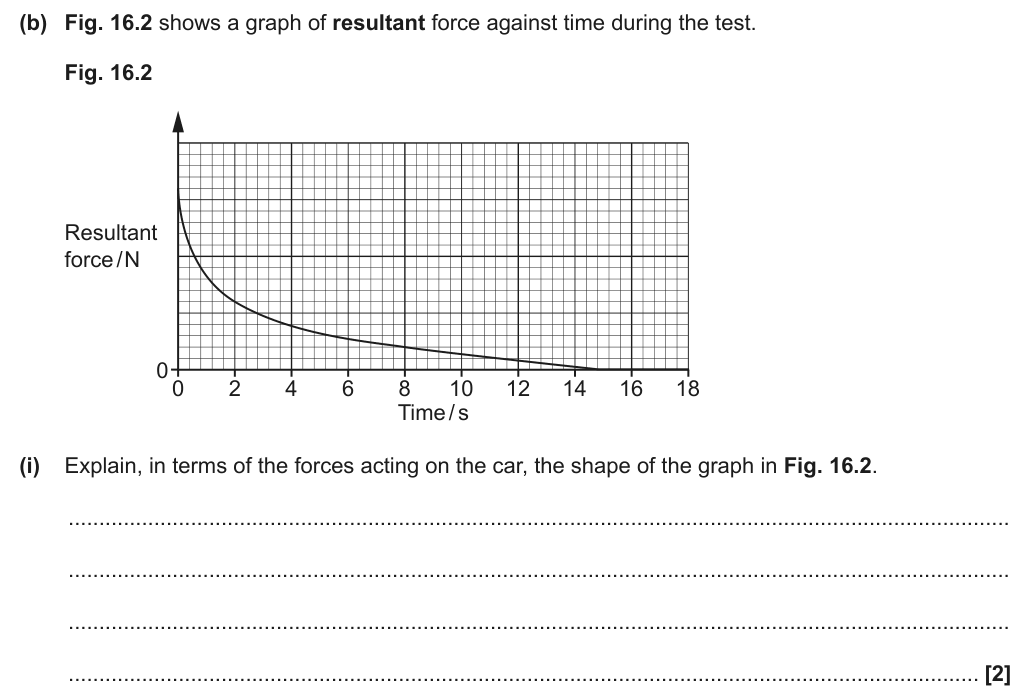
Earlier part of question 16 that this part uses
Mark scheme
Examiner's comment
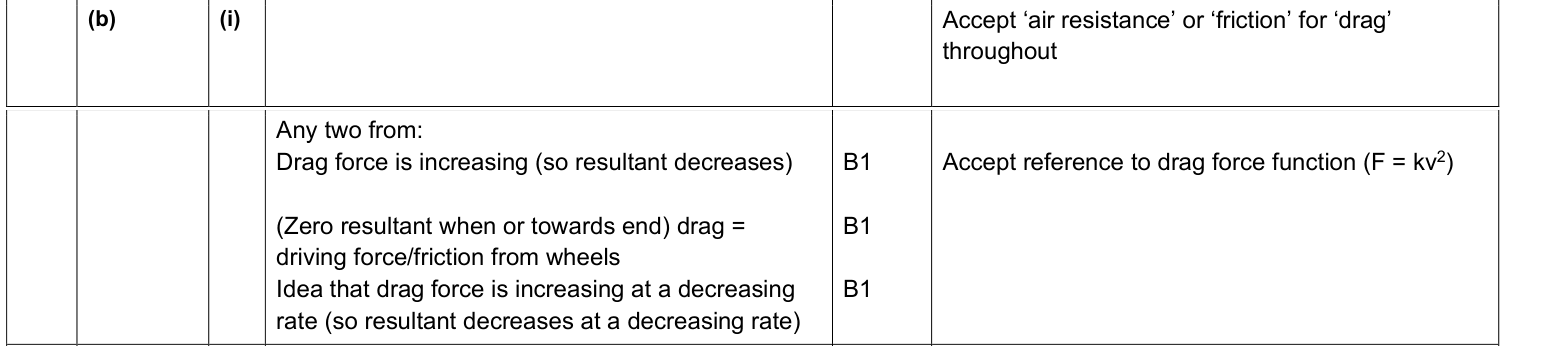
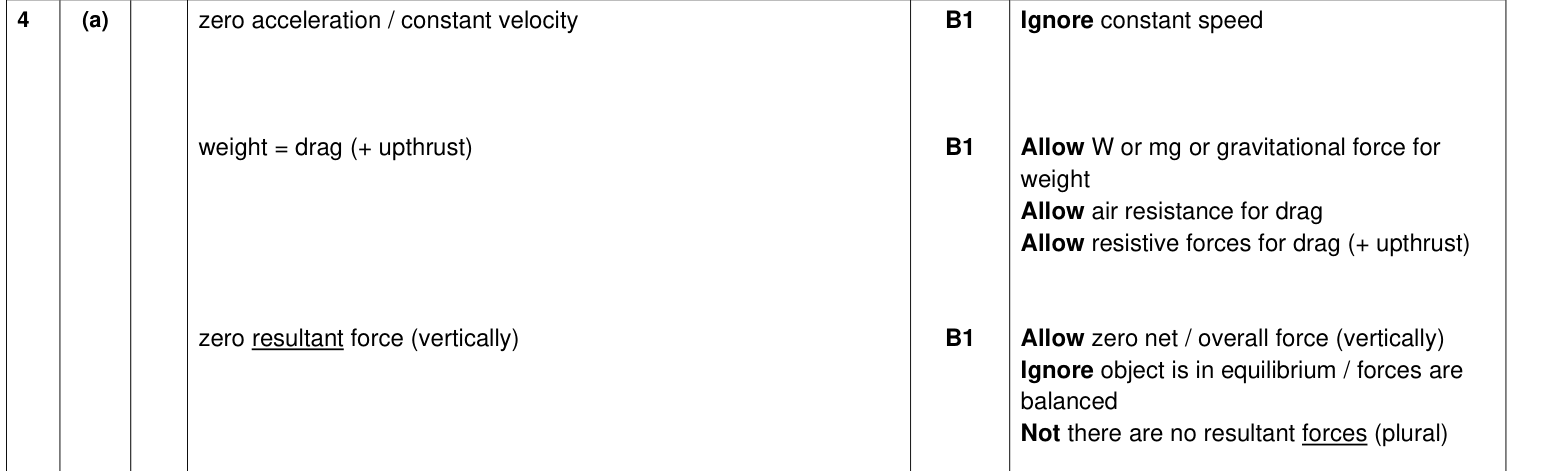
Describing the shape of the curve was not required here and so comments that did that without explanation, such as ‘the curve starts steep, decreases at a decreasing rate and then the resultant becomes zero’ scored no marks. The question required explanations in terms of forces. Successful responses mentioned drag, how that changes with speed and the condition that the drag must equal the thrust.
Notes from the mark scheme and report
drag increases (at a decreasing rate) so the resultant falls
zero resultant when drag = driving force
The Assessment story resource for A Level Physics A makes clear the distinction between different command words as well as providing useful guidance more generally to candidates.
Skills: M3.1 Translate information between graphical, numerical and algebraic forms
June 2025 · Paper 1 · Q16(c)(ii)1 markCalculationMedium
Earlier parts of question 16 that this part uses
Mark scheme
Examiner's comment
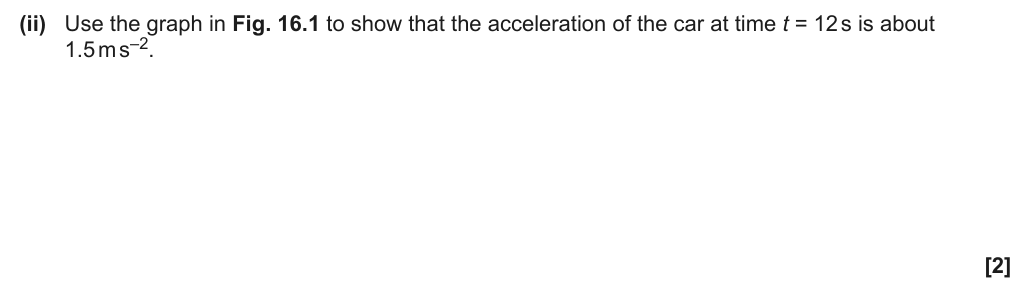
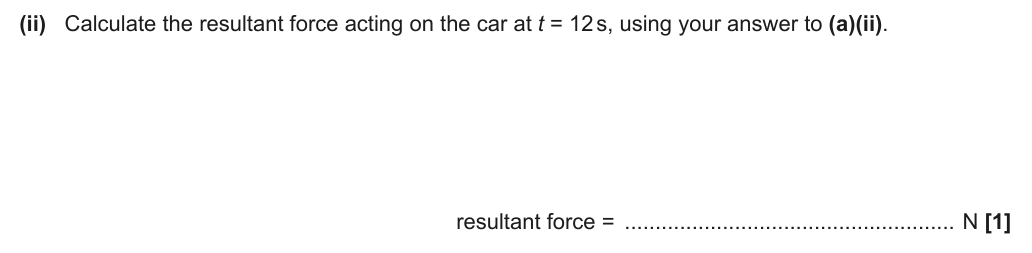
Less successful candidates did not use their answer from part (a) (ii), often by dividing their answer to part (a) (iii) and dividing by either 12 or 18 seconds. This found the average force over that time and so was incorrect. The correct method is simply to multiply the acceleration at t = 12 s by the mass of the car.
Notes from the mark scheme and report
Allow 1.5 from the stem giving 2600 N
acceptable range 2210 to 2720 N
Skills: M2.3 Substitute numerical values into algebraic equations using appropriate units for physical quantities
June 2025 · Paper 1 · Q16(c)(iii)2 marksDiagram or graphMedium
Earlier part of question 16 that this part uses
Mark scheme
Examiner's comment
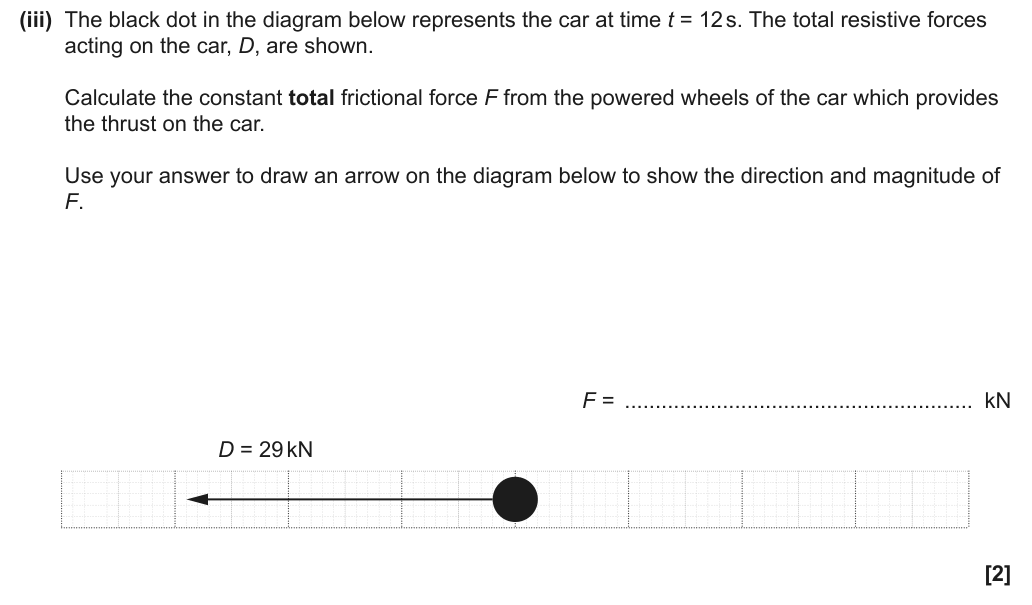
The correct approach here is to make sure that the thrust – drag = resultant force calculated in the previous part of the question. Many candidates still gained full marks even though their previous answer was incorrect as ‘error carried forward’ was applied, as long as the arrow matched the numerical answer. The answer line includes the unit kN – candidates should be careful to give their answer in the required unit.
Notes from the mark scheme and report
ignore power of ten on the answer line
arrow to the right drawn to scale (31 to 32 squares)
ecf from (ii)
Skills: M0.1 Recognise and make use of appropriate units in calculations
June 2025 · Paper 1 · Q17(a)(iv)2 marksExplanationMedium
Earlier part of question 17 that this part uses
Mark scheme
Examiner's comment
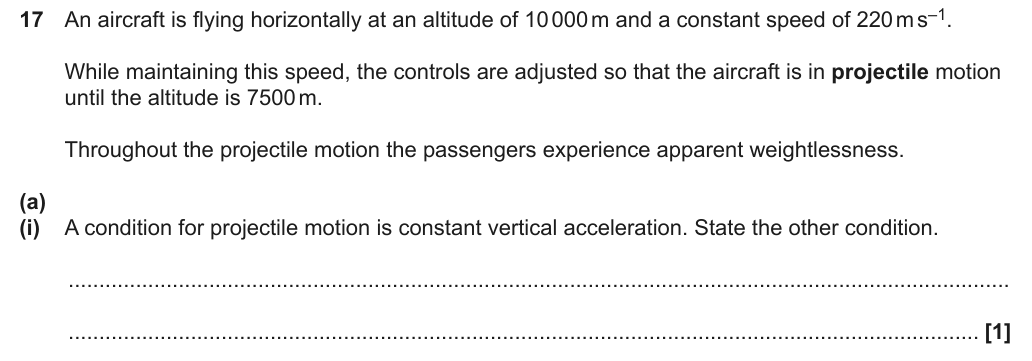
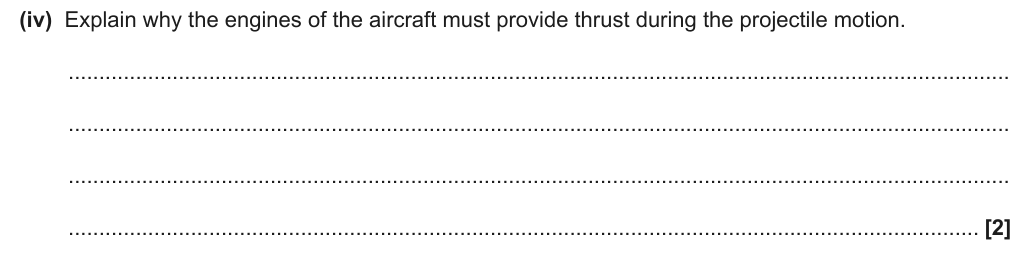
There were lots of ways the candidates used to express the right ideas. As in previous series, phrases such as ‘balanced forces’ were not specific enough. ‘Thrust is required for horizontal net force’ is one example of using more specific language to gain credit here.
Notes from the mark scheme and report
thrust = drag so that horizontal net force is zero
June 2025 · Paper 1 · Q17(b)(ii)2 marksExplanationMedium
Earlier part of question 17 that this part uses
Mark scheme
Examiner's comment
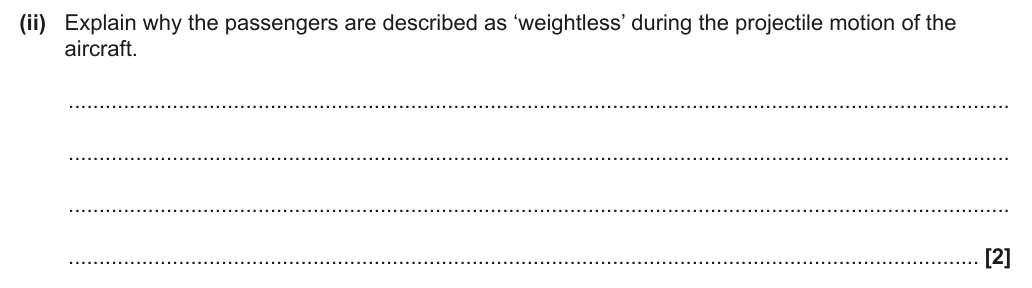
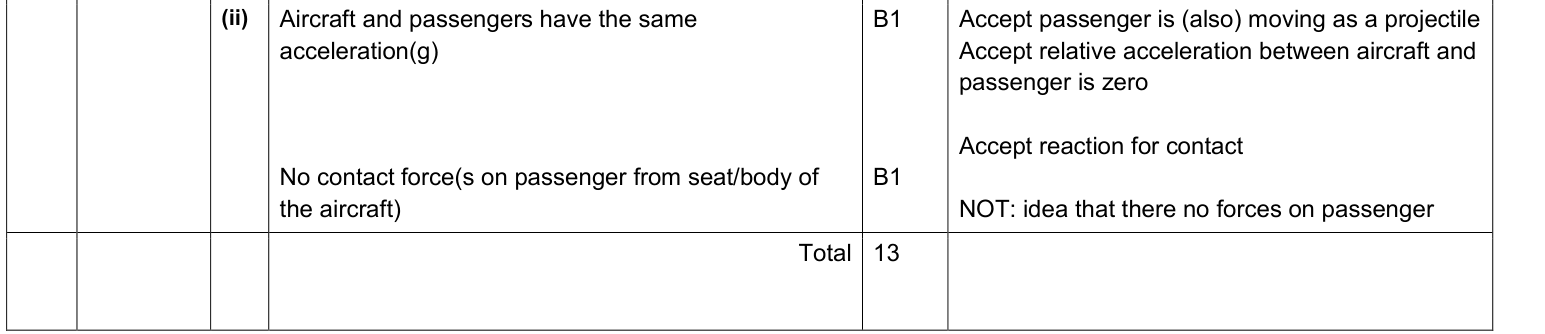
There were two separate ideas here. Firstly that the objects are travelling at the same acceleration (i.e. ‘g’) and the effect this has on the normal contact force between the plane and the passenger (i.e. there is none).
Notes from the mark scheme and report
NOT the idea that there are no forces on the passenger
aircraft and passengers have the same acceleration so no contact force
Candidates often think that because they’ve seen things floating on video coverage of astronauts in space that there is no resultant force acting on them. This is a misconception.
There is no relative motion but both the ISS and the astronauts inside them are travelling very quickly in Low Earth Orbit. They can only do this because of the centripetal force provided by gravitation with the Earth.
June 2025 · Paper 1 · Q18(b)(iii)2 marksCalculationMedium
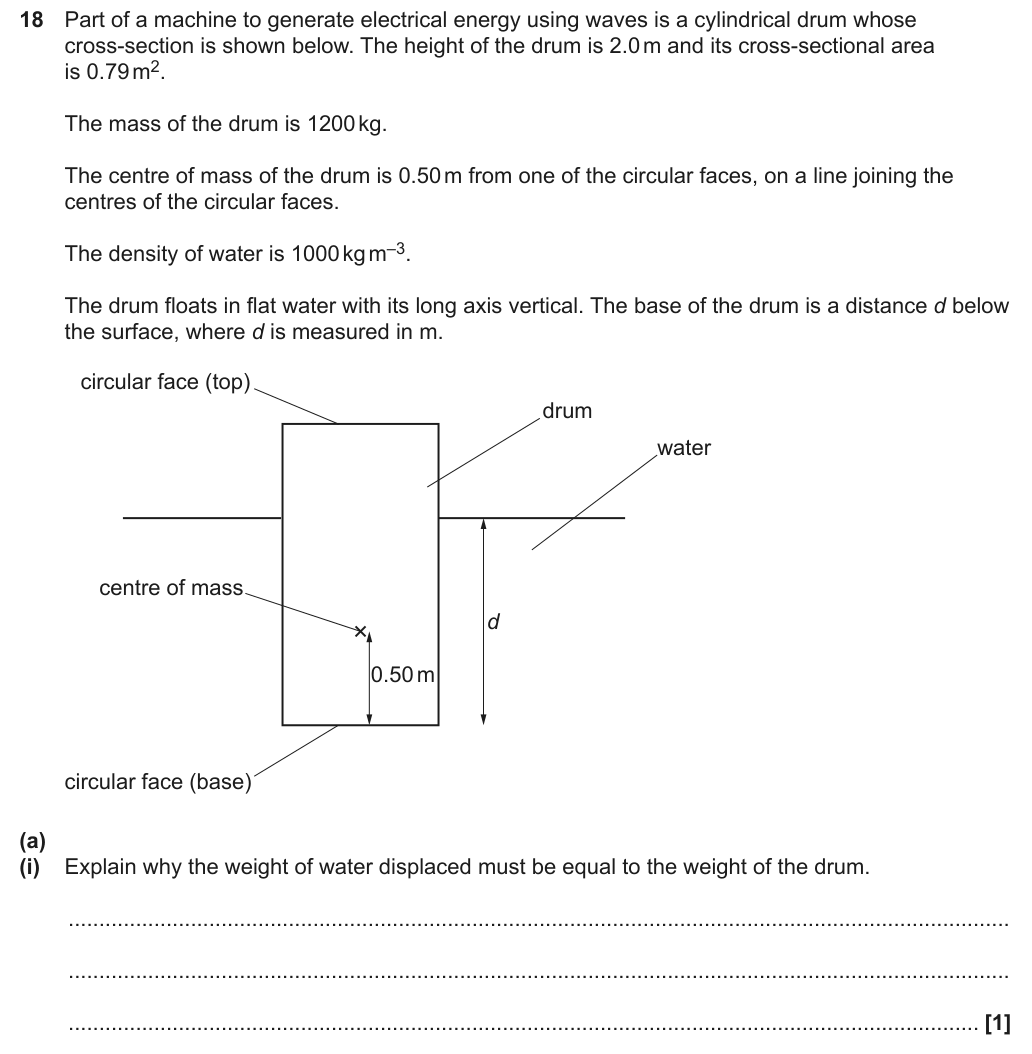
Earlier parts of question 18 that this part uses
Mark scheme
Examiner's comment
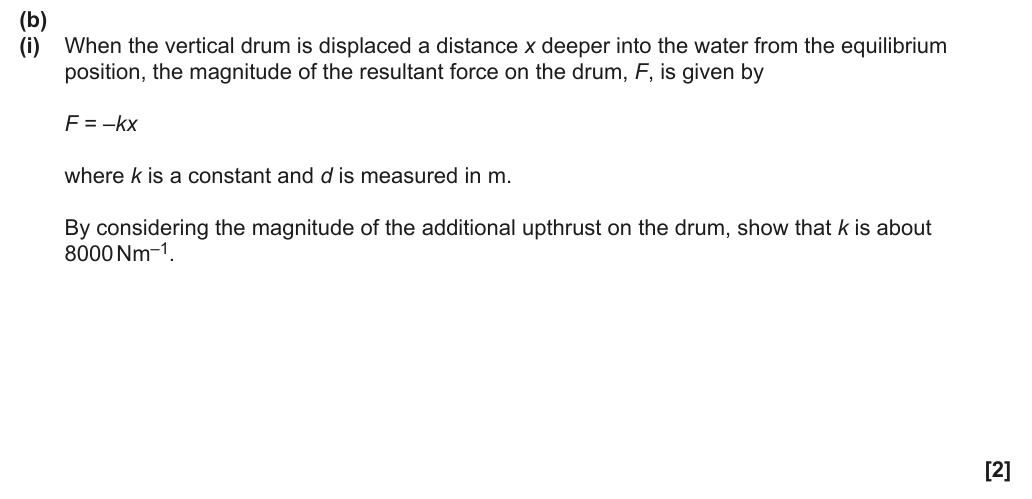
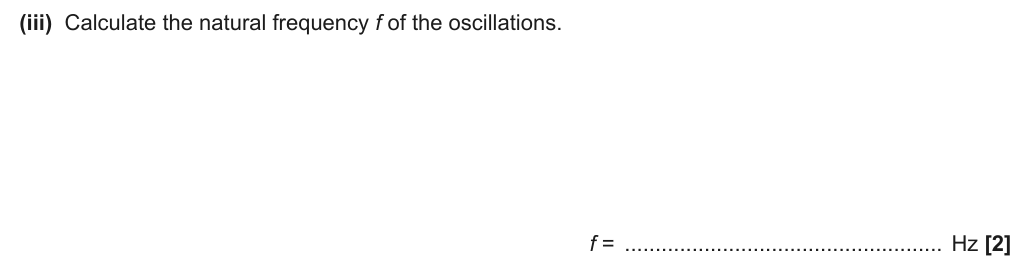
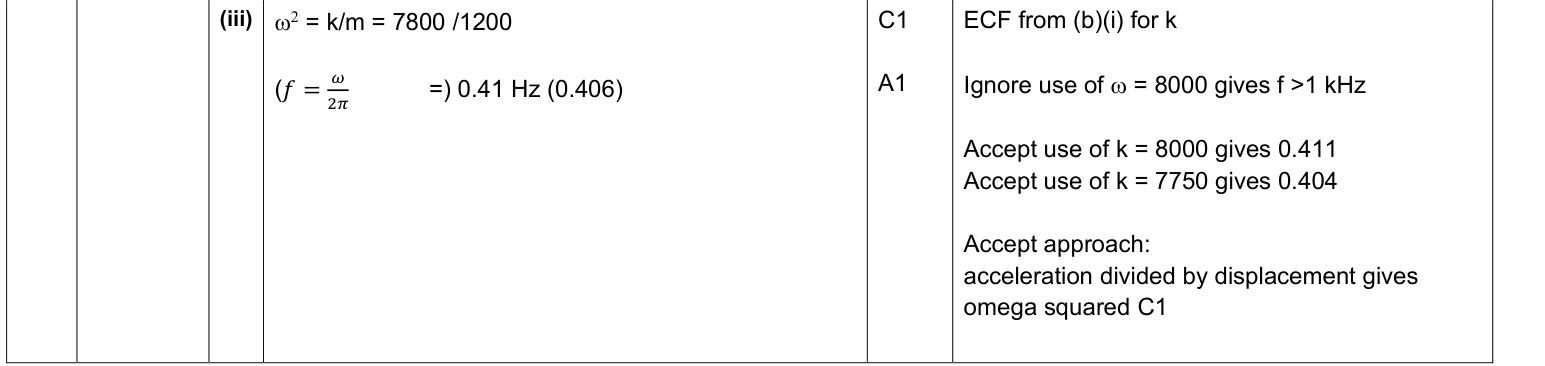
Most candidates completed this calculation correctly. Those who did not did not gain marks for not dividing the value of k by the drum’s mass.
Notes from the mark scheme and report
ω² = k/m
ecf from (b)(i) for k
Skills: M2.2 Change the subject of an equation, including non-linear equations; M2.3 Substitute numerical values into algebraic equations using appropriate units for physical quantities
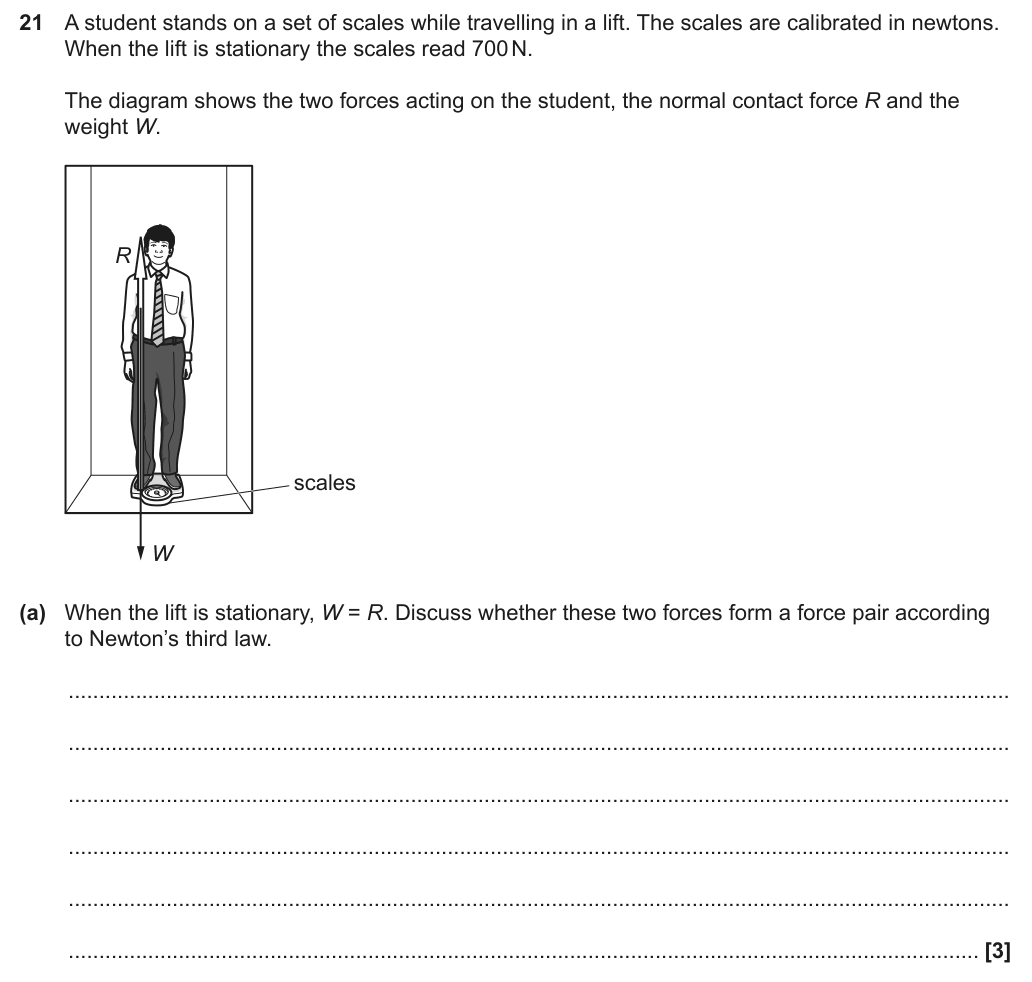
June 2025 · AS Paper 1 · Q21(b)(i)3 marksCalculationMedium
Earlier part of question 21 that this part uses
Mark scheme
Examiner's comment
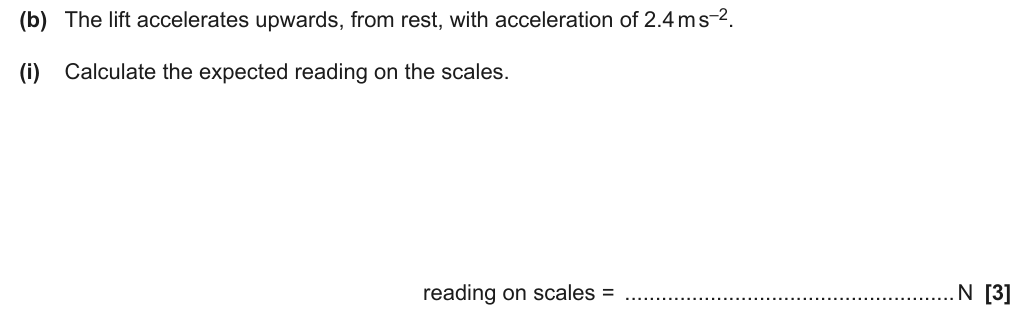
The majority of the candidates correctly calculated the mass of the student and used this value to calculate the resultant force causing the acceleration. Most candidates either gave this resultant force as their final answer or subtracted it from the weight.
Notes from the mark scheme and report
evidence of mass determination needed
530 N or 868 N scores 2 marks
532 N or 168 N scores 1 mark
Candidates should be encouraged to show clear logical working.
This question is a multi-stage calculation question where there were several calculations to complete to gain the final answer.
Skills: M2.2 Change the subject of an equation, including non-linear equations; M2.3 Substitute numerical values into algebraic equations using appropriate units for physical quantities
June 2025 · AS Paper 1 · Q21(c)2 marksExplanationMedium
Earlier part of question 21 that this part uses
Mark scheme
Examiner's comment
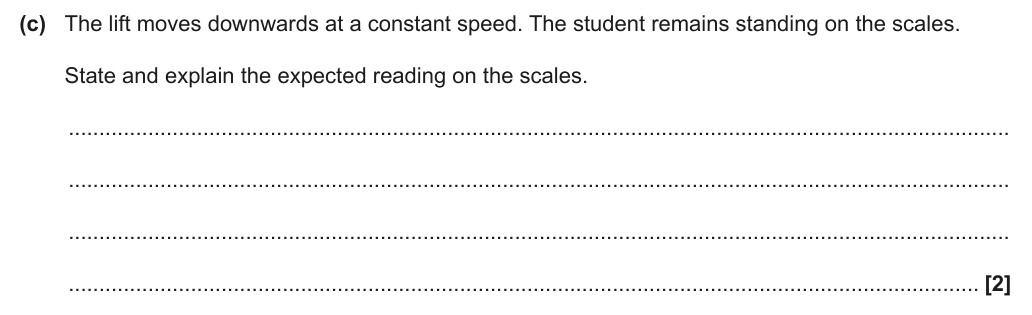
The command word ‘state’ in the question meant that candidates needed to state a value (700 N) for the reading on the scales. It was not good enough to simply state that the reading would be the same. The explanation needed to refer to the resultant force being zero. The term ‘equilibrium’ is not quite enough – it implies that the resultant force is zero but soes not demonstrate that the candidate understand that the resultant force is zero.
Notes from the mark scheme and report
ignore equilibrium
ignore stay the same (too vague)
June 2025 · AS Paper 2 · Q5(a)(i)4 marksDiagram or graphMedium
Mark scheme
Examiner's comment
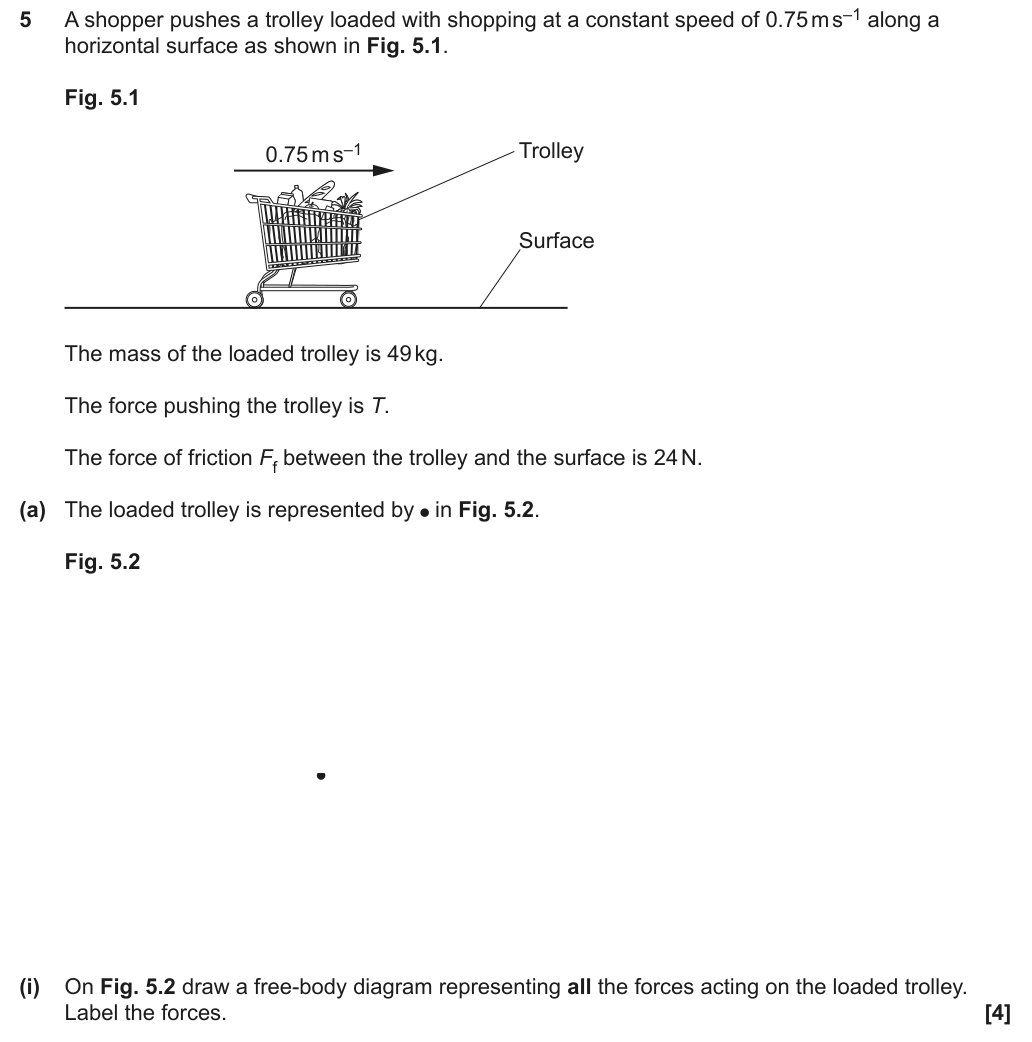
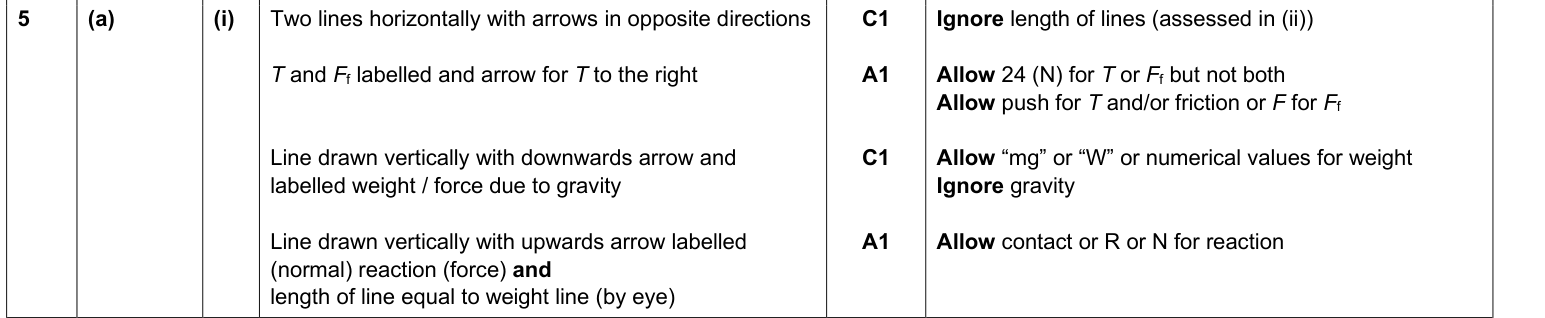
Most candidates were able to draw two horizontal arrows in opposite directions and two vertical arrows in opposite directions. A common error was not taking care to ensure that the vertical arrows were the same length. A few candidates struggled to label the forces correctly. Gravity for weight was not accepted.
Notes from the mark scheme and report
reaction arrow equal in length to the weight arrow
allow 24 N for T or Ff but not both
ignore 'gravity'
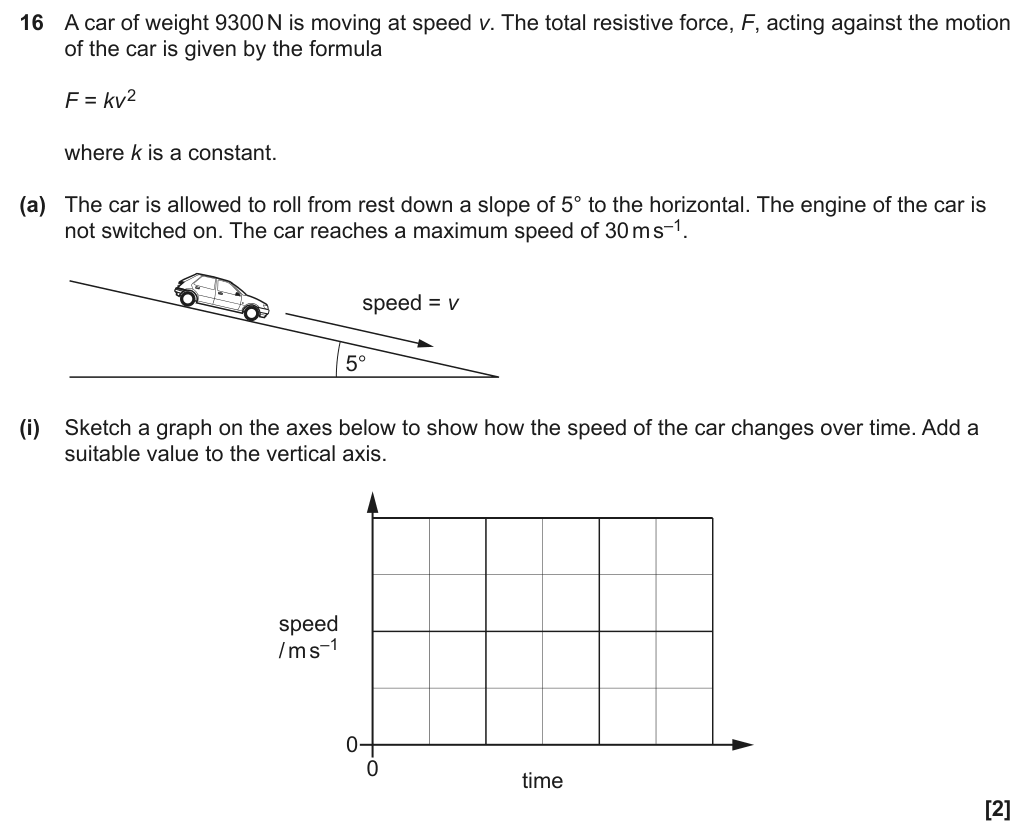
June 2024 · Paper 1 · Q16(a)(i)2 marksDiagram or graphMedium
Mark scheme
Examiner's comment
Most candidates used the grid effectively to put a suitable scale on the speed axis. They also communicated that the maximum speed was 30 m s-1. Many candidates also got the shape of the curve correct, which starts with maximum gradient and then flattens out.
Notes from the mark scheme and report
curve must start at origin with decreasing gradient
30 marked at the maximum
Skills: M3.12 Sketch relationships which are modelled by y = k/x, y = kx², y = k/x², y = kx, y = sin x, y = cos x, y = e^(±x) and y = sin²x, y = cos²x as applied to physical relationships
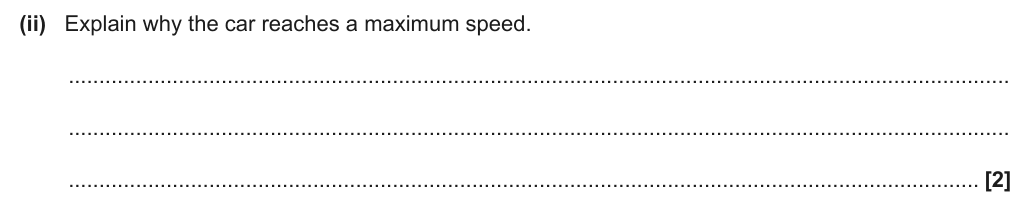
June 2024 · Paper 1 · Q16(a)(ii)2 marksExplanationHard
Earlier part of question 16 that this part uses
Mark scheme
Examiner's comment
While many candidates appreciated that the car reached a maximum speed because the resultant force was zero, some contradicted this by saying that the weight = drag (as it would be in vertical motion) or something else incorrect. Far fewer candidates stated that the drag increases with speed effectively. Quoting the given expression F = kv2 was deemed insufficient. Repeating information given in the question is rarely creditworthy by itself.
Notes from the mark scheme and report
NOT resistive force = weight (must be component of weight down the slope or zero net force)
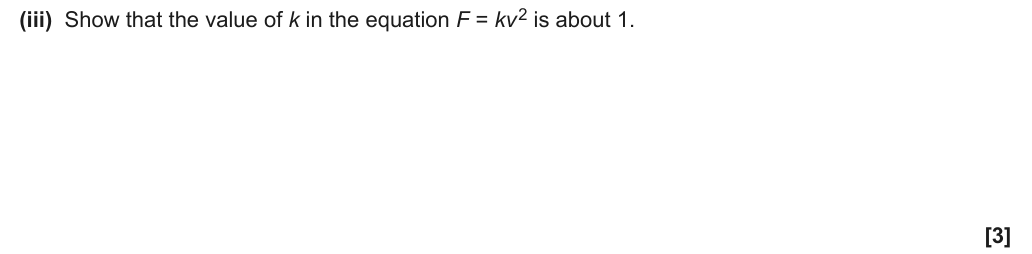
June 2024 · Paper 1 · Q16(a)(iii)3 marksShow thatMedium
Earlier part of question 16 that this part uses
Mark scheme
Examiner's comment
As this question is a ‘show that’, all steps were required. Many candidates omitted the rearrangement stage, restricting their maximum score for this item to 1 mark. This approach was consistent throughout the paper for this type of question. Make sure that all steps of working are presented in ‘show that’ questions, especially the step that shows the relevant quantity as the subject of the equation. Always show your evaluation to at least 1 more significant figure than that shown in the question.
Notes from the mark scheme and report
calculated value (0.9) must be seen
Skills: M0.6 Use calculators to handle sin x, cos x and tan x when x is expressed in degrees or radians; M2.2 Change the subject of an equation, including non-linear equations; M4.5 Use sin, cos and tan in physical problems
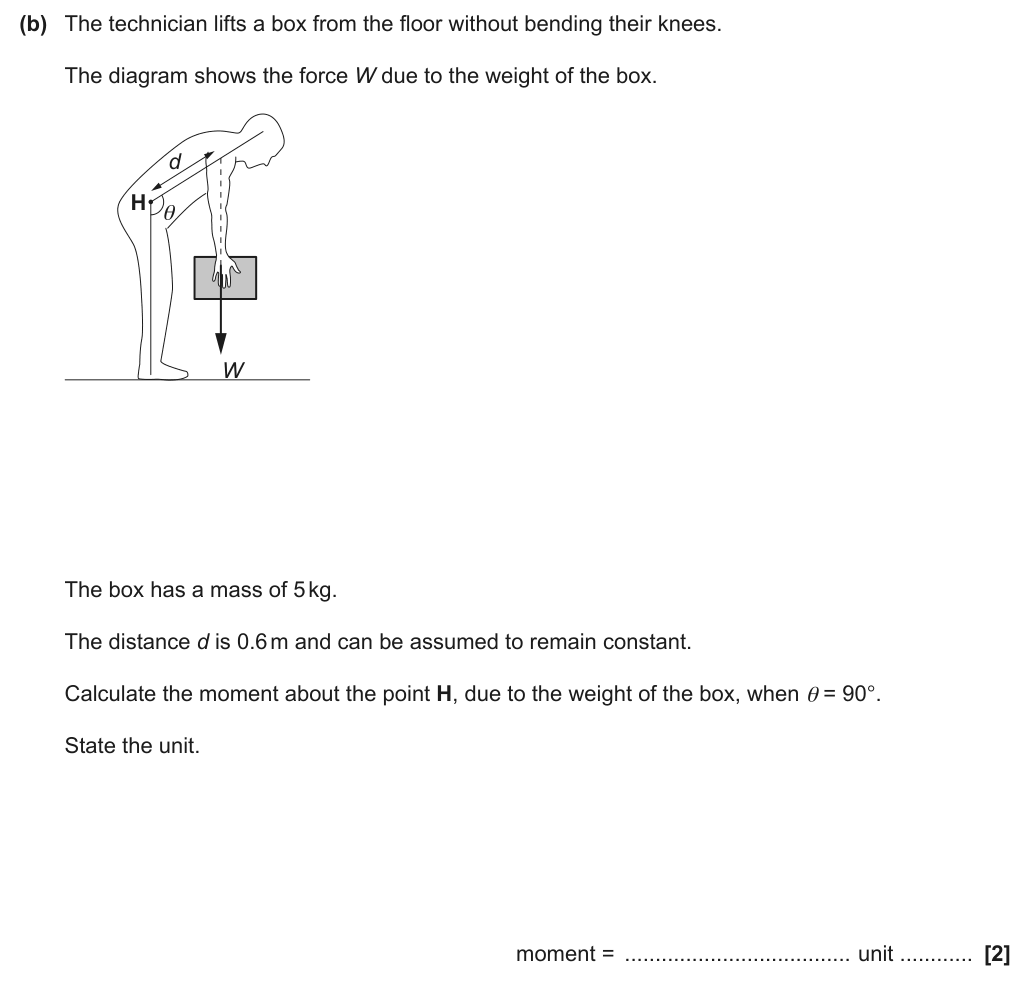
June 2024 · AS Paper 1 · Q22(b)2 marksCalculationMedium
Mark scheme
Examiner's comment
Candidates performed well on this question as they correctly applied the equation moment = force x perpendicular distance from the pivot to calculate the moment as 29.4 Nm and most also gave the correct unit for moment as Nm.
Notes from the mark scheme and report
allow 29 or 30
Skills: M0.1 Recognise and make use of appropriate units in calculations; M2.3 Substitute numerical values into algebraic equations using appropriate units for physical quantities
June 2024 · AS Paper 1 · Q24(a)3 marksExplanationMedium
Mark scheme
Examiner's comment
Candidates generally performed well on this question as many were given 1 or 2 marks for correctly explaining that the feather was falling at a constant speed because the weight acting on the feather was equal to the opposing force of air resistance. Some candidates explained this further by stating that the resultant force acting on the feather was 0.
Notes from the mark scheme and report
ignore forces are balanced
ignore velocity decreases
June 2024 · AS Paper 2 · Q4(c)(ii)3 marksCalculationEasy
Earlier parts of question 4 that this part uses
Mark scheme
Examiner's comment
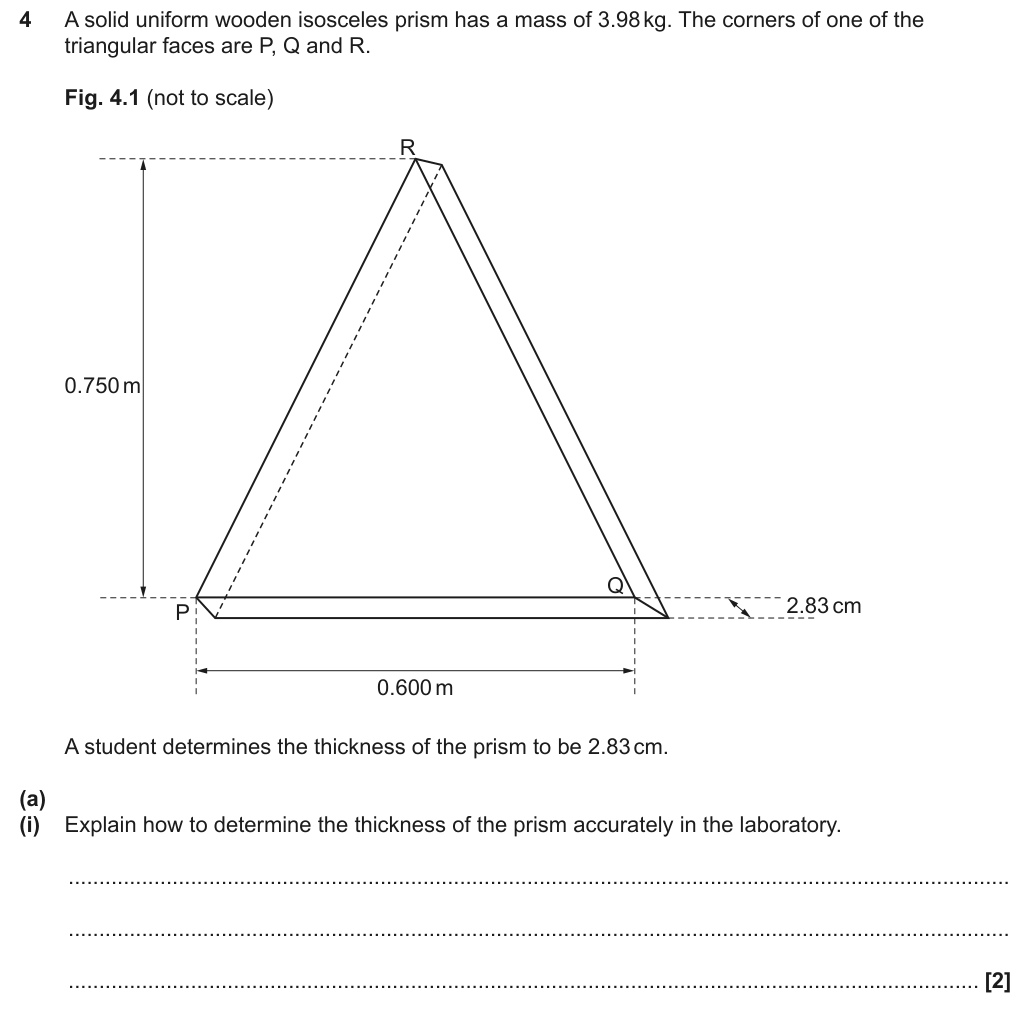
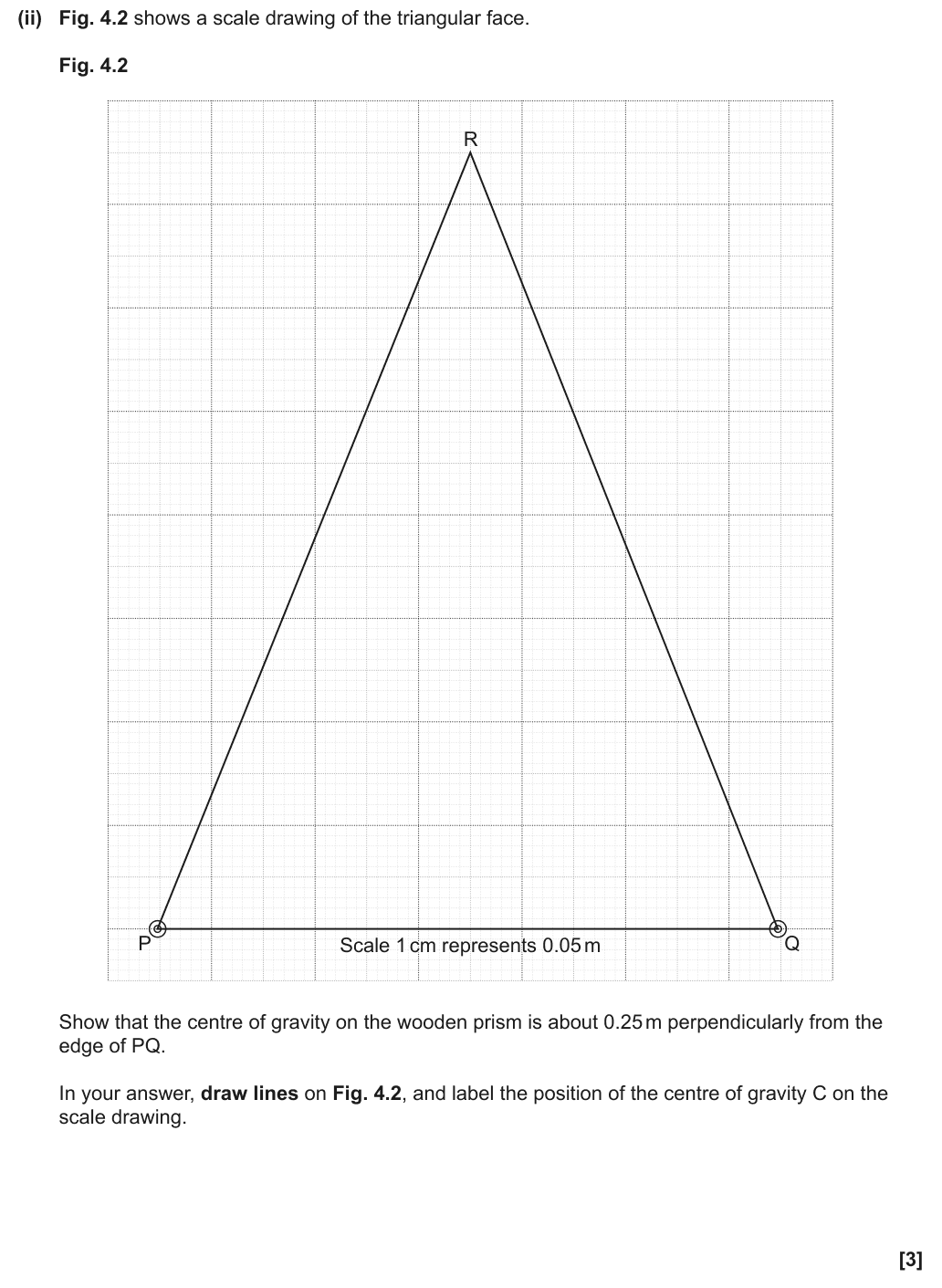
The majority of the candidates correctly calculated the weight of the prism. It is expected that the value of g should be the value given on the data sheet. Using the principle of moments was generally answered well by higher scoring candidates. A number of candidates incorrectly determined a distance of 0.50 m (0.75 − 0.25). High scoring candidates usually showed clear working.
Notes from the mark scheme and report
1.3 (g omitted) scores 2
g = 10 allowed here
Candidates should practise answering calculation type questions.
Candidates should: 1. Write down the equation they are going to use 2. Substitute the data into the equation 3. Consider the units 4. Rearrange the equation 5. Evaluate the answer 6. Check that the answer is sensible.
Skills: M2.2 Change the subject of an equation, including non-linear equations; M2.3 Substitute numerical values into algebraic equations using appropriate units for physical quantities
June 2024 · Paper 3 · Q3(a)3 marksExplanationEasy
Mark scheme
Examiner's comment
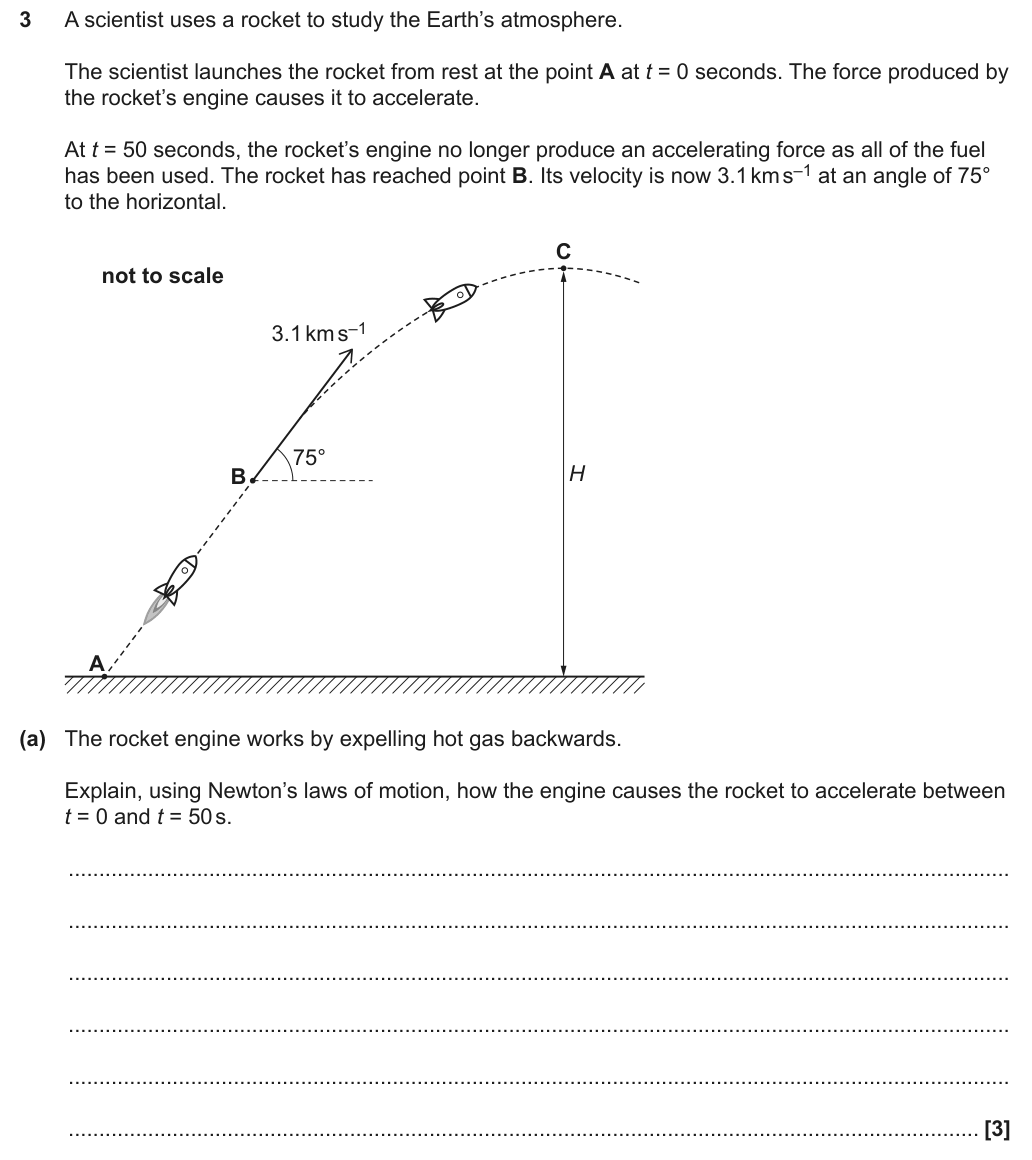
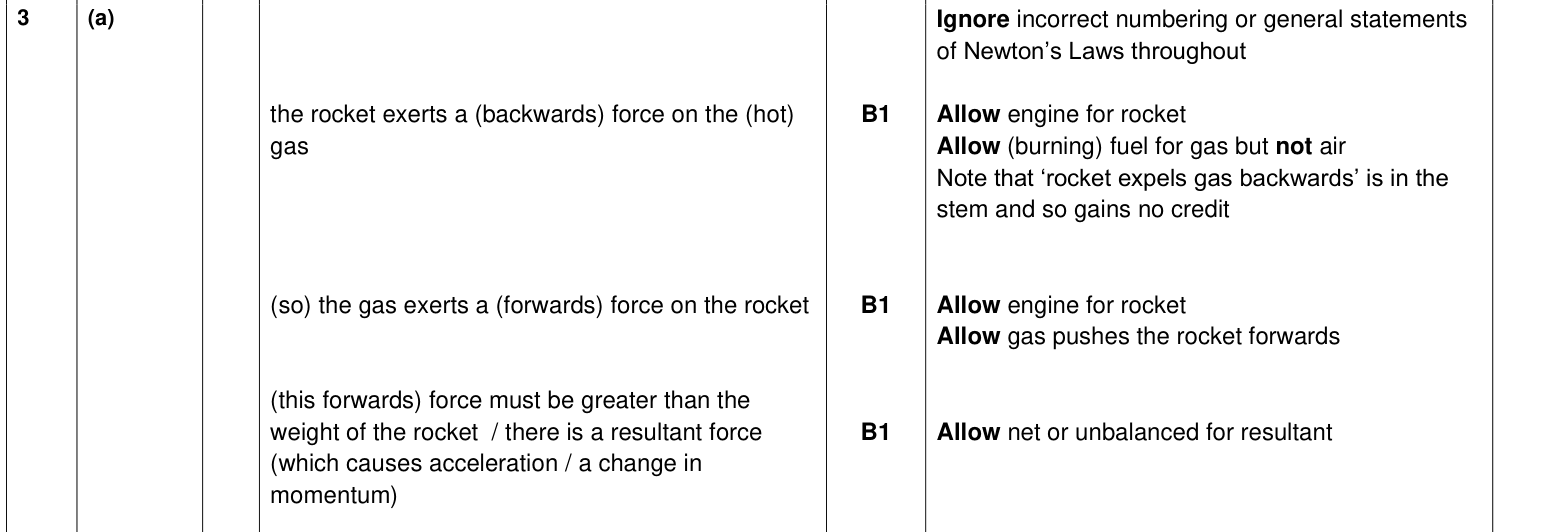
It was expected that candidates would use, rather than simply state, Newton’s laws of motion in order to explain why the rocket accelerates. Most candidates were able to state, ‘for every action there is an equal and opposite reaction’ or even ‘if A exerts a force on B, then B exerts and equal and opposite force on A’. However, few extended that to ‘if the rocket exerts a force on the gas (backwards) then the gas will exert a force on the rocket (forwards)’. Even fewer went on to explain that, in order for the rocket to accelerate, this force must be greater than the weight of the rocket in order for there to be a resultant force (forwards).
Notes from the mark scheme and report
rocket expels gas backwards is in the stem and gains no credit
Not air for gas
ignore incorrect numbering of the laws
June 2024 · Paper 3 · Q4(b)(i)3 marksCalculationMedium
Earlier part of question 4 that this part uses
Mark scheme
Examiner's comment
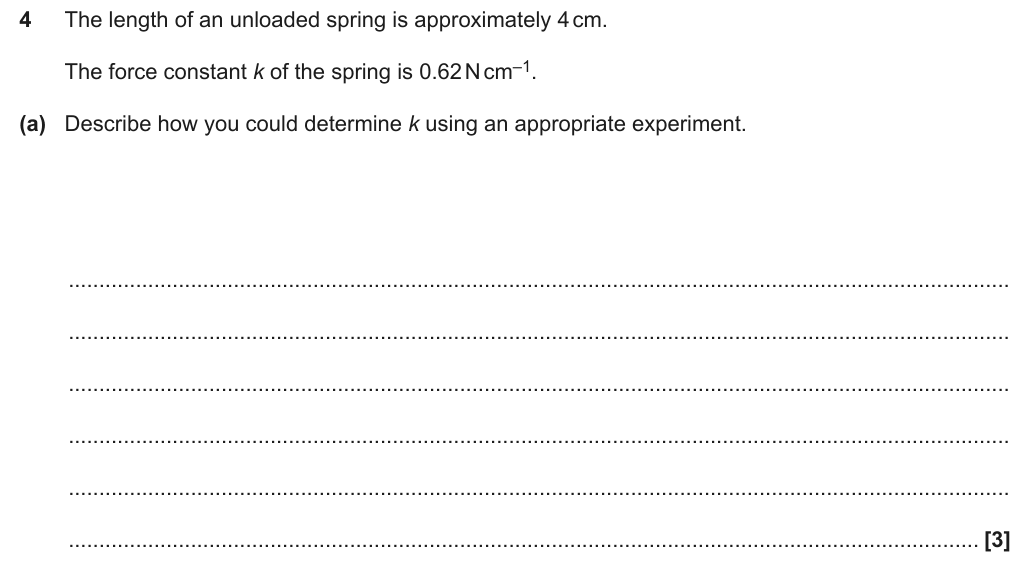
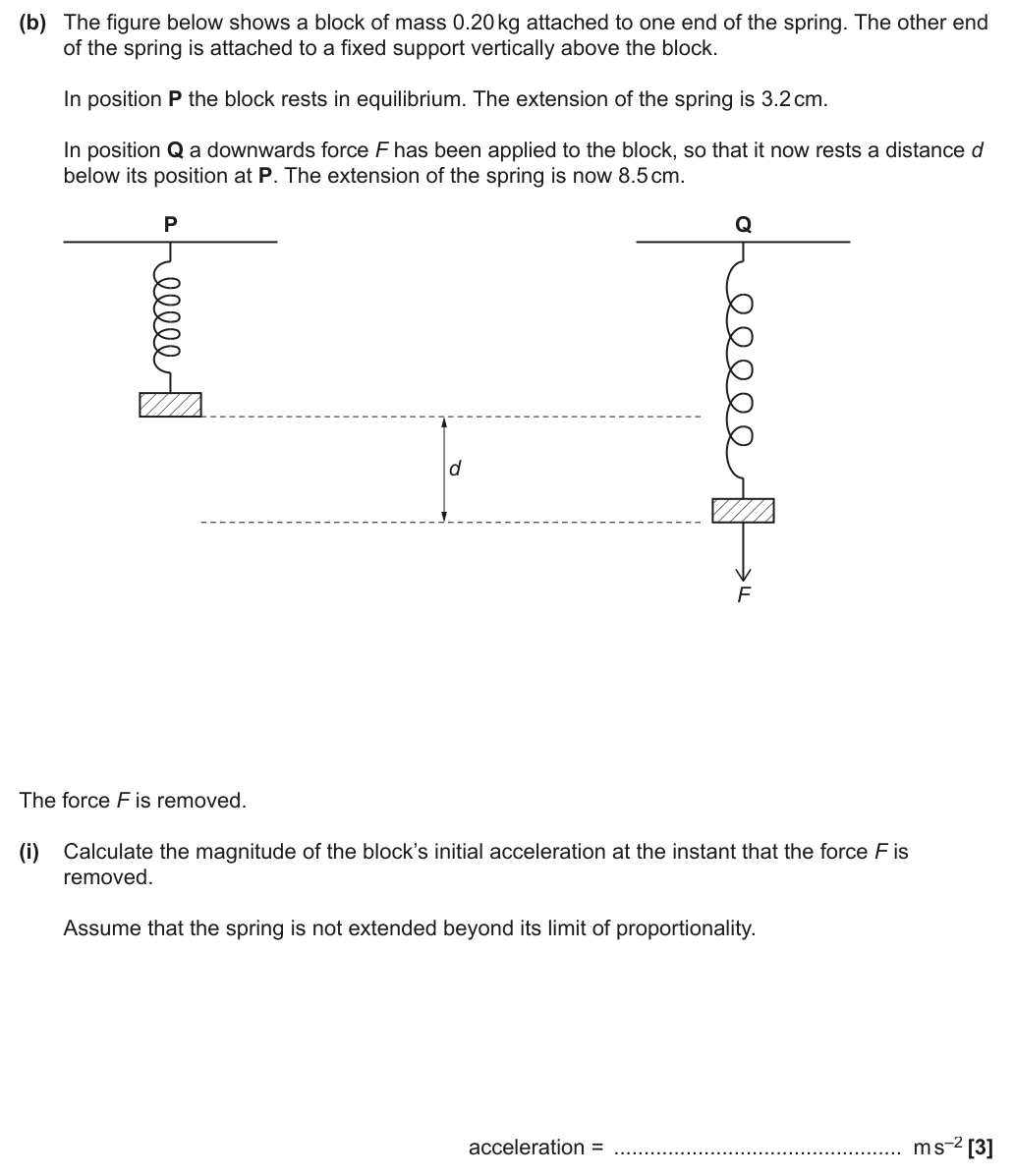
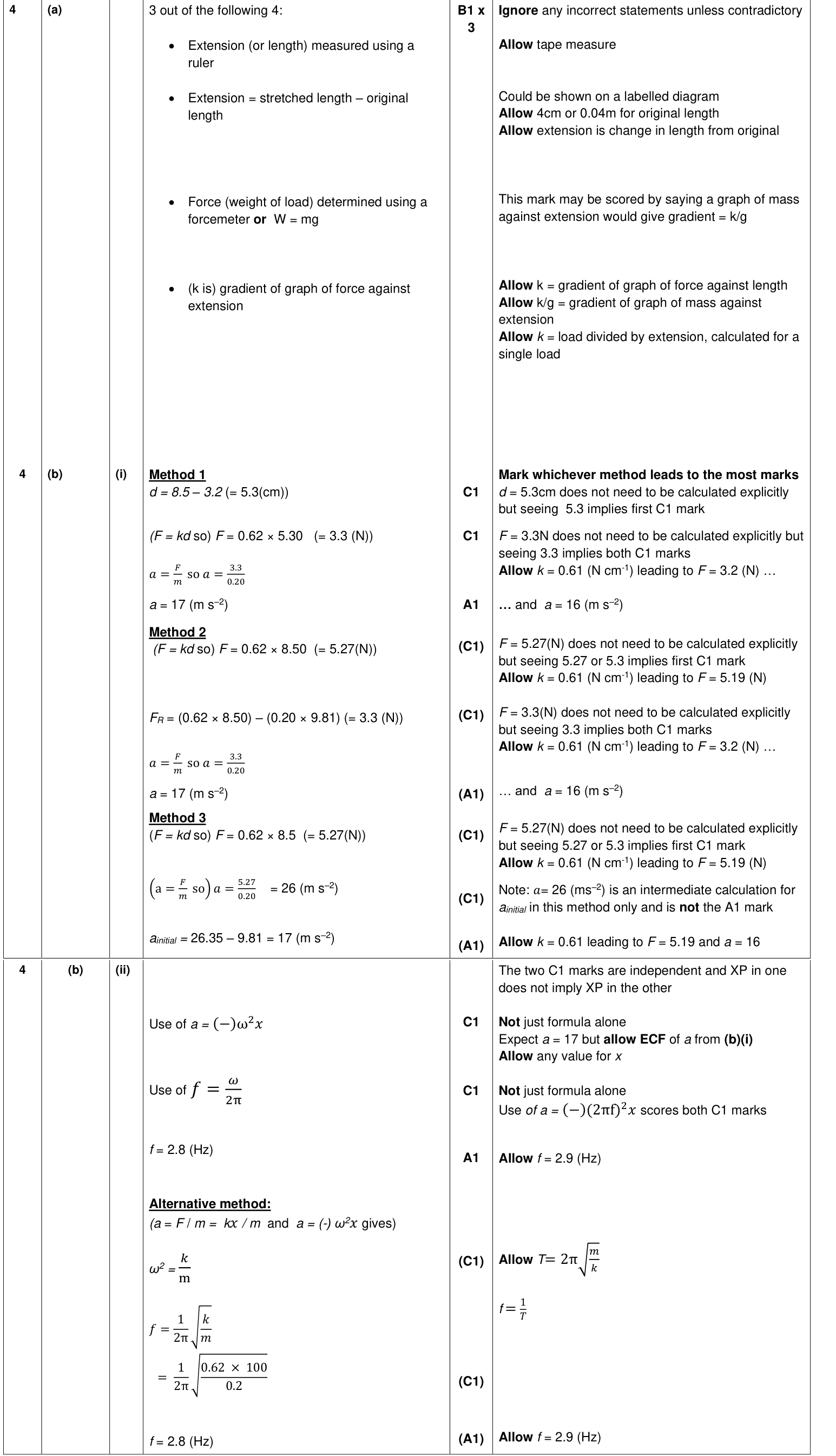
There are two measurements for extension given here: an extension of 3.2cm under a load of (0.2 x 9.81) N and an extension of 8.5cm under a force of F + (0.2 x 9.81) The easiest way to approach the question is to recognise that the extension due to F alone must be (8.5 – 3.2) = 5.3cm. F = kx then becomes F = 0.62 x 5.3 (since k is given in N cm-1) and so we can use F = ma with m = 0.2kg to find the acceleration a. However, other valid methods were also given credit.
Notes from the mark scheme and report
a = 26 m s⁻² (5.27/0.20) is only an intermediate value
allow 16 m s⁻² from k = 0.61
Skills: M0.1 Recognise and make use of appropriate units in calculations; M2.3 Substitute numerical values into algebraic equations using appropriate units for physical quantities
June 2023 · Paper 1 · Q16(b)(i)2 marksCalculationMedium
Earlier part of question 16 that this part uses
Mark scheme
Examiner's comment
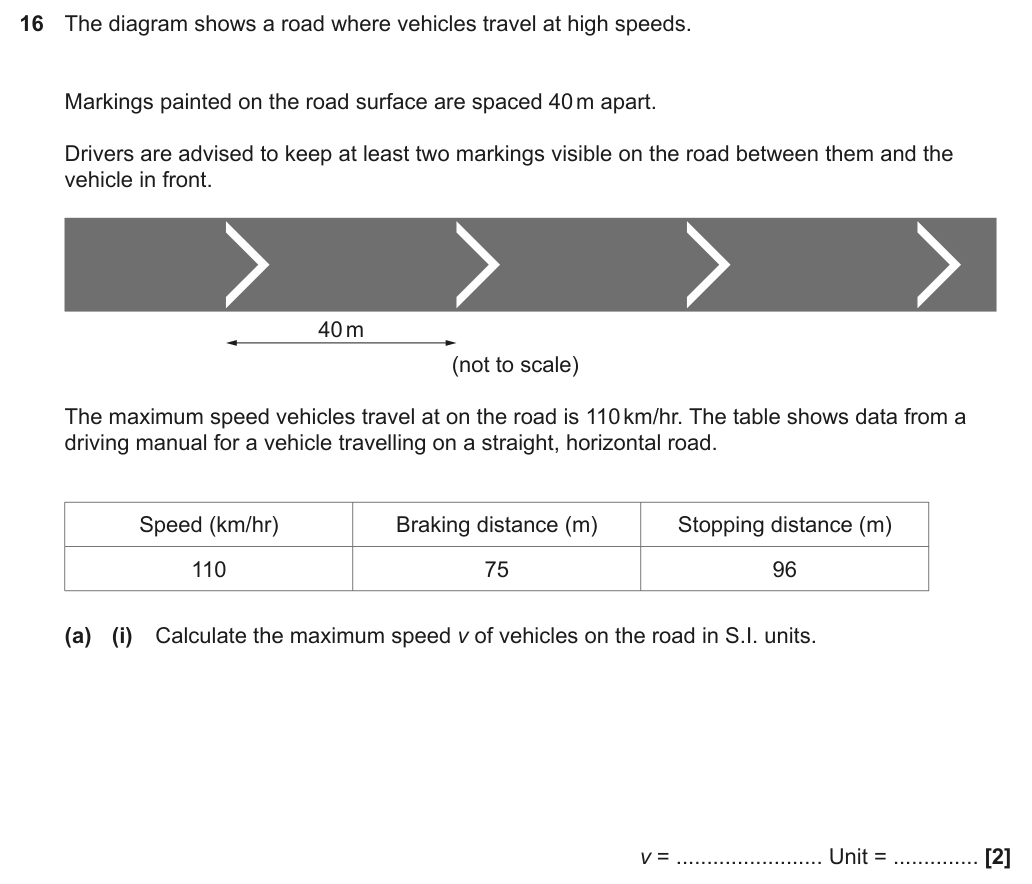
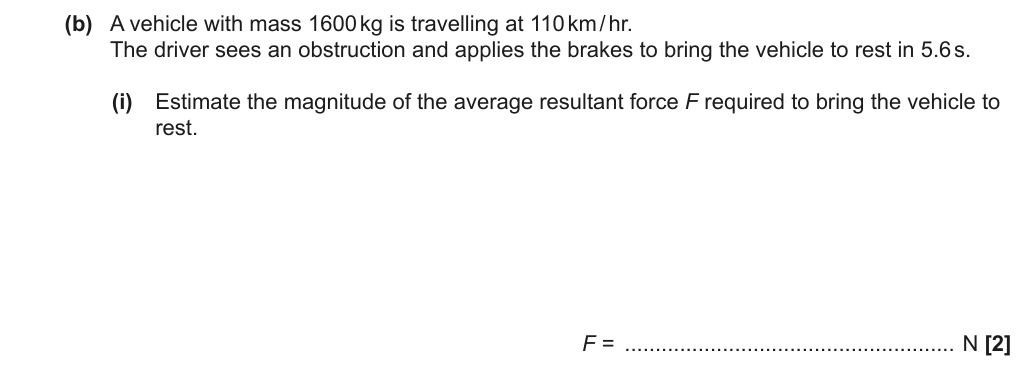
Question 16 (b) (i) Question 16 (b) (ii) In Question 16 (b) (i), most candidates used the data available in the question to calculate an acceleration and hence a resultant force.
Notes from the mark scheme and report
8700 to 8900 N
9950, 10100 or 10250 N from the table data allowed 2 marks
Skills: M0.4 Estimate results; M2.3 Substitute numerical values into algebraic equations using appropriate units for physical quantities
June 2023 · Paper 1 · Q17(a)(i)1 markDiagram or graphHard
Mark scheme
Examiner's comment
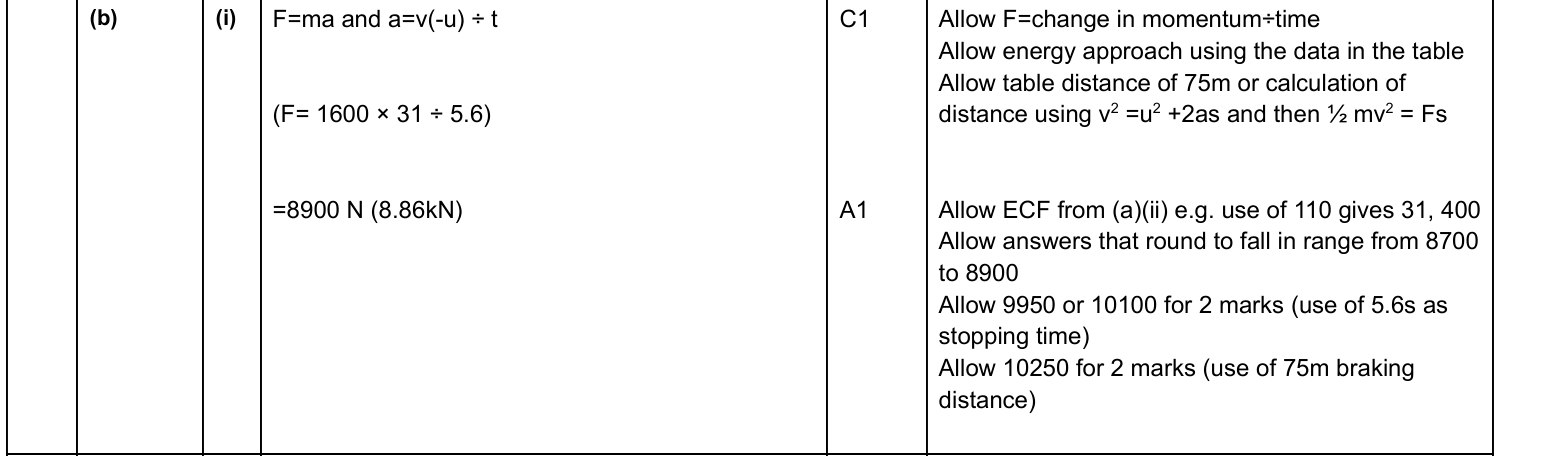
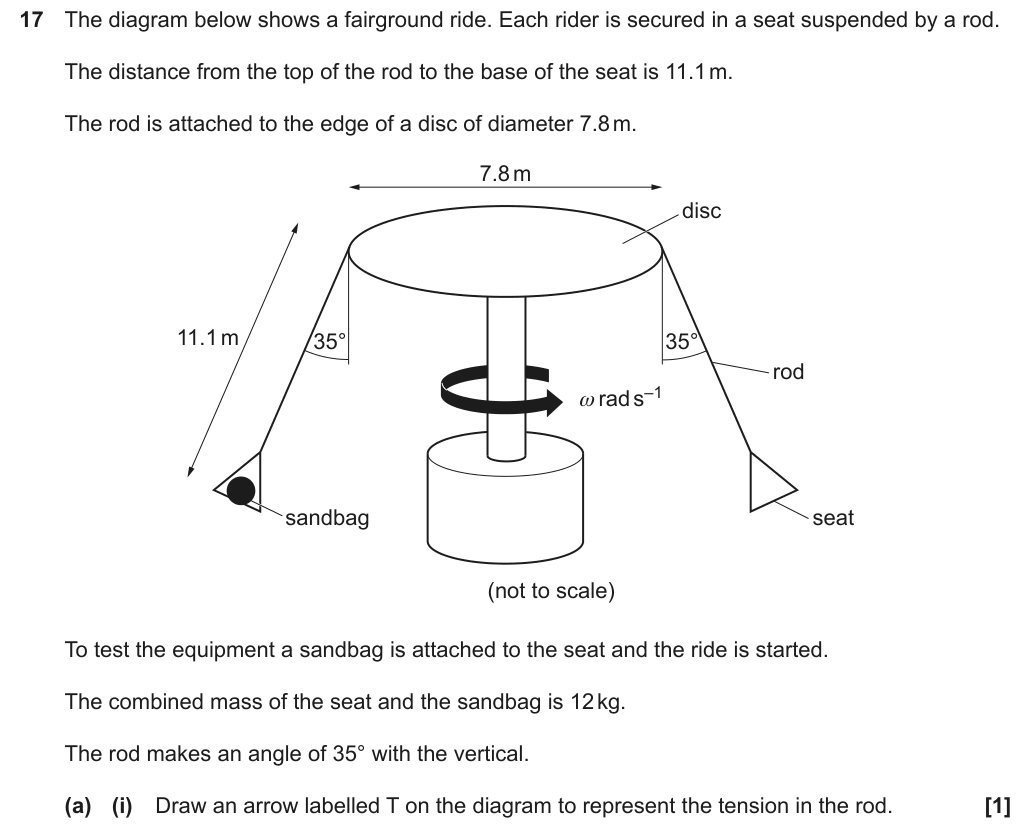
In Question 17 (a) (i) of this question, the phrase ‘tension in the rod’ can mean several different things, all of which were given in the mark scheme. Many candidates approached part (ii) with some confidence, spotting that the horizontal portion of the rod was 11.1 sin(35) and that it should be added to the radius of the disc. Parts (a) (iii) and (iv) were more challenging, requiring good knowledge of both circular motion and how to calculate components of forces. Again there were several legitimate routes to the right answer, all of which were mentioned in the mark scheme. Very logical approaches were in part (a) (iii), to equate the vertical component of the tension with the weight of the sandbag. In part (a) (iv), the quickest approach was to equate the horizontal component of the tension with the centripetal force. The data booklet provides a convenient expression for the centripetal force in terms of the angular velocity, without the need for finding the tangential velocity.
Notes from the mark scheme and report
NOT any contradictory arrows
June 2023 · Paper 1 · Q17(a)(iii)3 marksCalculationHard
Earlier part of question 17 that this part uses
Mark scheme
Examiner's comment
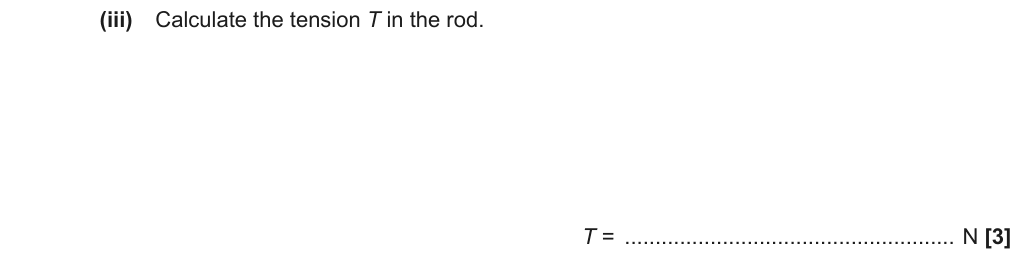
In Question 17 (a) (i) of this question, the phrase ‘tension in the rod’ can mean several different things, all of which were given in the mark scheme. Many candidates approached part (ii) with some confidence, spotting that the horizontal portion of the rod was 11.1 sin(35) and that it should be added to the radius of the disc. Parts (a) (iii) and (iv) were more challenging, requiring good knowledge of both circular motion and how to calculate components of forces. Again there were several legitimate routes to the right answer, all of which were mentioned in the mark scheme. Very logical approaches were in part (a) (iii), to equate the vertical component of the tension with the weight of the sandbag. In part (a) (iv), the quickest approach was to equate the horizontal component of the tension with the centripetal force. The data booklet provides a convenient expression for the centripetal force in terms of the angular velocity, without the need for finding the tangential velocity.
Notes from the mark scheme and report
NOT use of tan 35 or tan 55
Skills: M0.6 Use calculators to handle sin x, cos x and tan x when x is expressed in degrees or radians; M2.2 Change the subject of an equation, including non-linear equations; M4.5 Use sin, cos and tan in physical problems
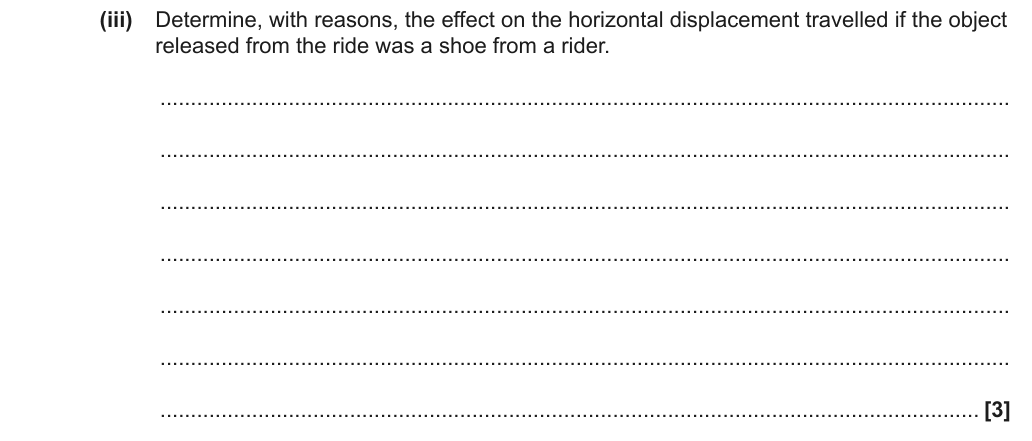
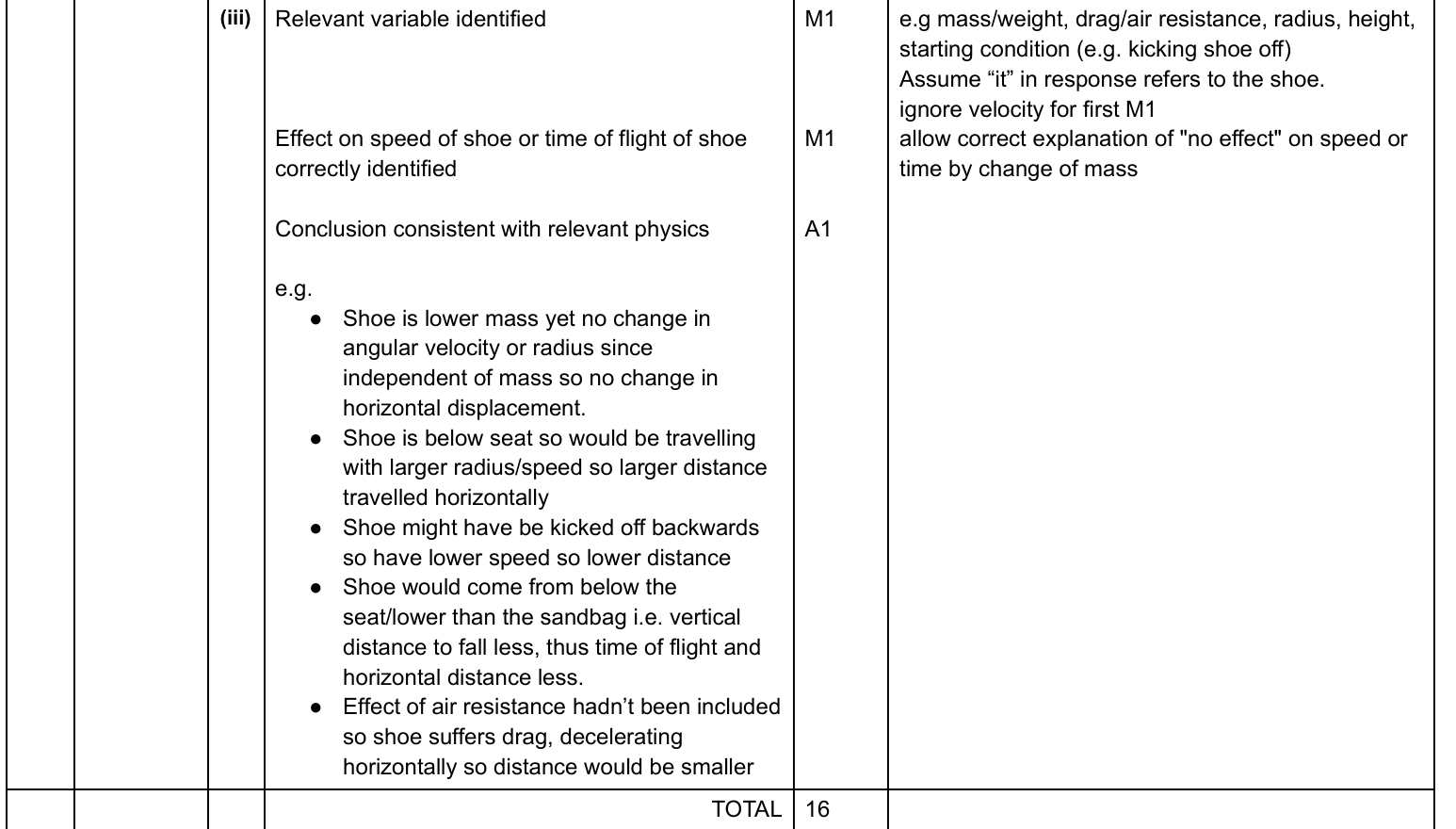
June 2023 · Paper 1 · Q17(b)(iii)3 marksCalculationMedium
Earlier part of question 17 that this part uses
Mark scheme
Examiner's comment
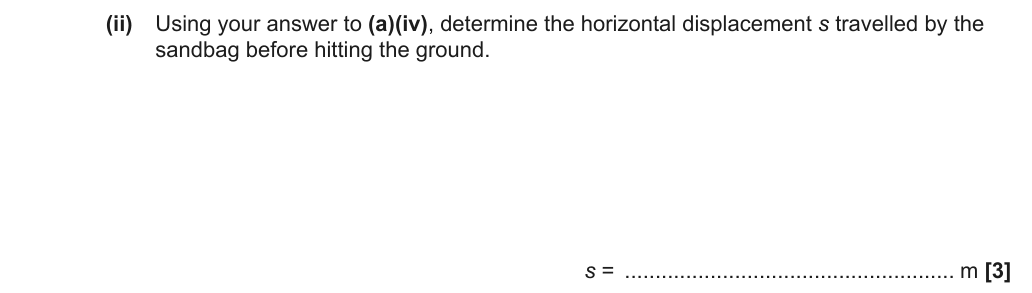
Question 17 (b) explored ideas about parabolic flight due to gravitation. The only force acting on the sandbag and the shoe after they have been released is the weight force, which acts vertically downwards. Many candidates realised that the vertical velocity of the sandbag when it left the swing was zero, enabling them to calculate the time for the bag to fall 17m vertically downwards (using s = ½gt2) To calculate the horizontal distance travelled required both the horizontal velocity (from v = rω) and the time of flight from part (b) (iii). There was lots of scope for applying error carried forward rules as mentioned in the mark scheme.
Notes from the mark scheme and report
relevant variable must be identified (mass, drag, radius, height, starting condition)
ignore velocity for the first M1
no effect of mass allowed with correct explanation
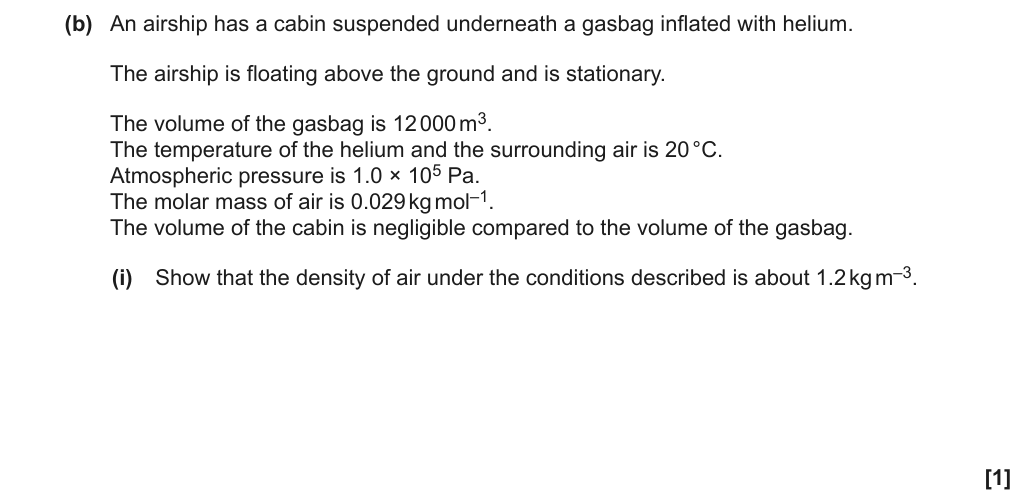
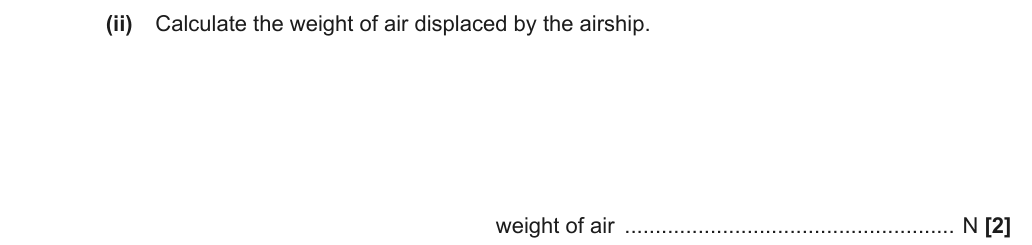
June 2023 · Paper 1 · Q20(b)(ii)2 marksCalculationEasy
Earlier part of question 20 that this part uses
Mark scheme
Examiner's comment
The vast majority of candidates correctly substituted values into the given formula, also remembering to convert the temperature from celsius into kelvin. Good practice for “show that” questions is to calculate the quantity required to at least one more significant figure in the question. In this example, that would mean evaluating the density to 1.19 kg m–3. In part (b) (ii), finding the weight was a matter of finding the mass and then finding the weight, all by using data in the question. Part (b) (iii) required understanding of Archimedes’ principle, rather than merely referring to it. Most candidates successfully related the principle to this context, writing about the upthrust being equal to the weight of fluid or air displaced by the gasbag. This is always true, regardless of the other forces that may be in play. References to displacement of water at this point were rejected. Fewer candidates completed the explanation by mentioning that the upthrust must be equal to the weight of the gas bag because we know that the gas bag is in equilibrium. Most candidates scored a mark in part (b) (iv) because they referred to some sort of structural failure if the pressure increased. Others delved a bit deeper, correctly stating that an increase in mass without an increase in volume (and hence upthrust) would cause the gas bag to sink.
June 2023 · Paper 1 · Q20(d)2 marksExplanationEasy
Earlier parts of question 20 that this part uses
Mark scheme
Examiner's comment
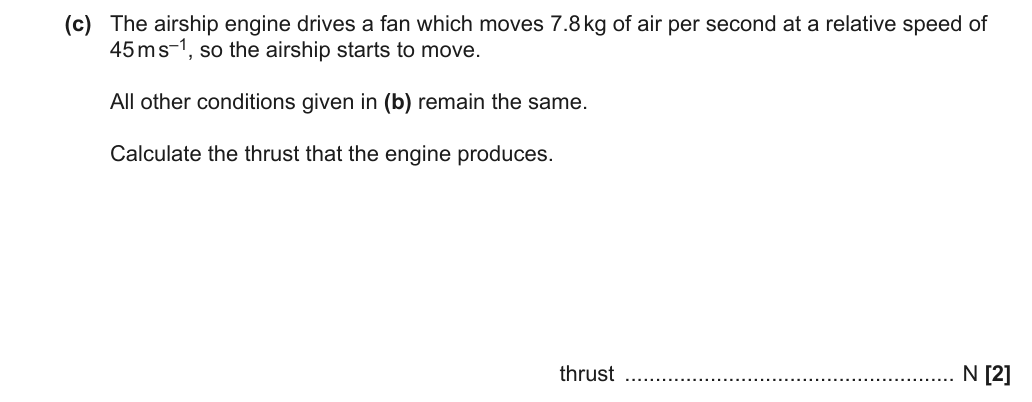
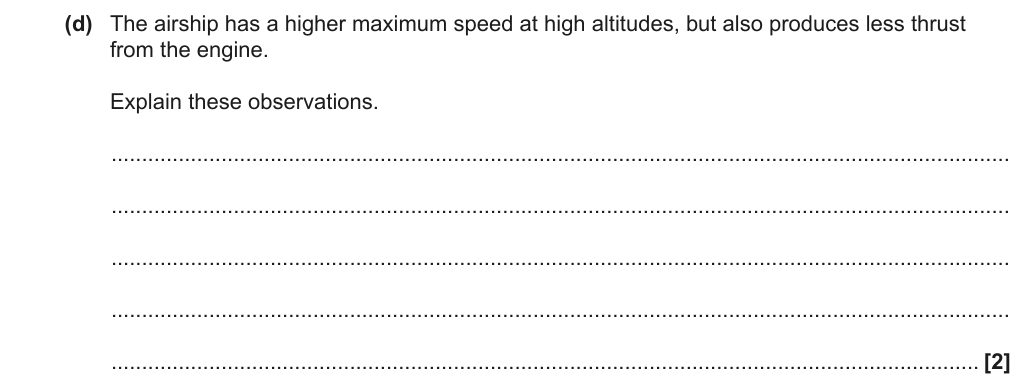
Question 20 parts (c) and (d) group well here. Part (c) is similar in nature to previous questions about rate of change of momentum. We rejected the use of the idea F=ma as it is wrong physics, even though the numerical value is the same. The idea of rate of momentum transfer carries on in part (d). Most candidates correctly assumed that the density of air at high altitudes is much lower than at low altitudes. Many candidates implied that this meant a reduction in drag, which is correct. Far fewer correctly described the reduction of rate of change of momentum, causing less thrust.
Notes from the mark scheme and report
Candidates should take care to use technical language. In this question, responses that included ideas of ‘less air to push’ or ‘less mass moved per second’ are insufficient at A2 Level.
June 2023 · AS Paper 1 · Q25(b)1 markExplanationMedium
Earlier part of question 25 that this part uses
Mark scheme
Examiner's comment
Candidates did not perform well on this question.The most common response was to suggest that repeat readings of the distance were taken to then calculate a mean value. While this was a reasonable and sensible suggestion it is not considered as a precaution as the correct response was to describe a method to avoid parallax error when measuring the distance the soil sample had fallen in the measuring cylinder.
Notes from the mark scheme and report
mark scheme accepts only a method to avoid parallax errors
Please refer to the Practical Skills Handbook for information on practical techniques including definitions of key scientific terminology and methodology.
Skills: PAG1 Investigating motion
June 2023 · AS Paper 1 · Q25(c)2 marksShow thatMedium
Earlier part of question 25 that this part uses
Mark scheme
Examiner's comment
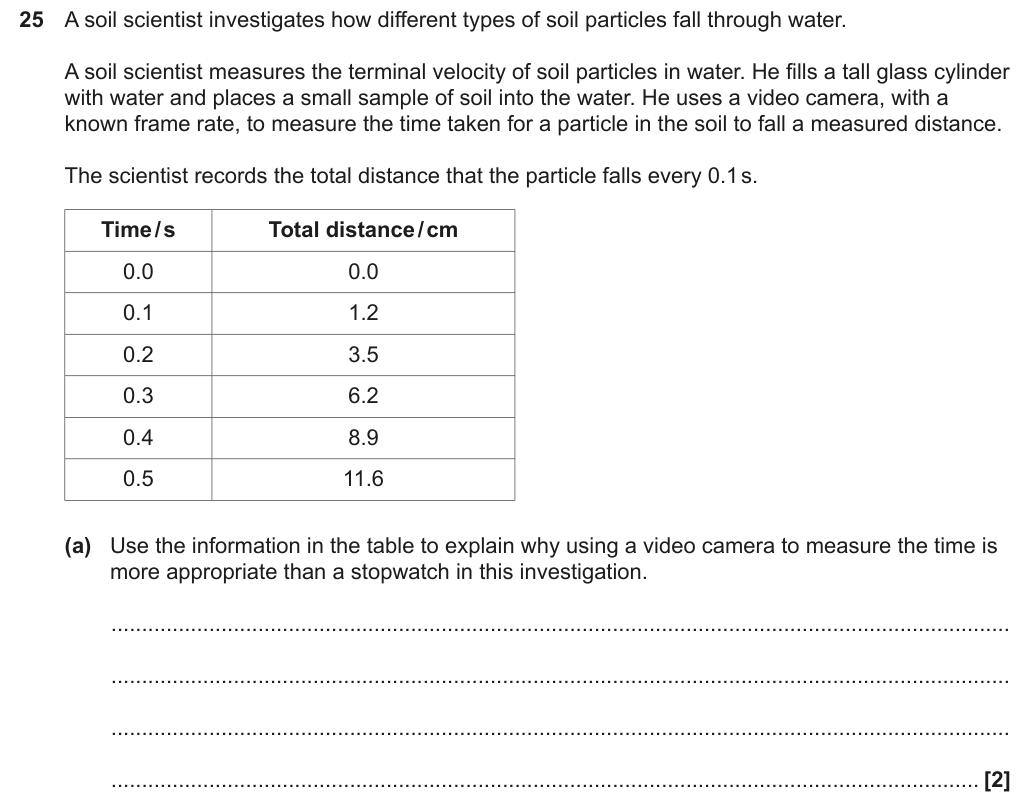
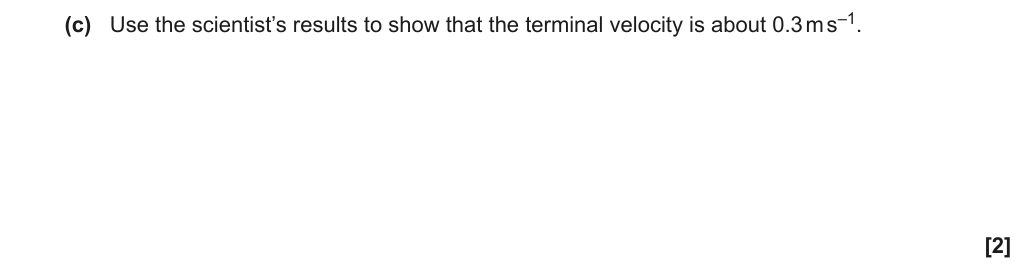
A quarter of candidates correctly gave two calculations above a time of 0.3s to show that the soil sample had reached terminal velocity of 2.7 m s–1. Many candidates calculated the distance that the soil sample had travelled for each 0.1 s interval which showed that the distance that the soil sample had travelled was 2.7 m but did not fully justify these values in relation to the soil sample reaching terminal velocity to secure 2 marks. Some candidates calculated the average velocity over the 0.5 s interval and then rounded it to show that it was about 0.3 m s–1 which did not receive credit.
Notes from the mark scheme and report
must use data from 0.2 s onwards
second calculation or justification that terminal velocity has been reached
Skills: M0.1 Recognise and make use of appropriate units in calculations; M2.3 Substitute numerical values into algebraic equations using appropriate units for physical quantities; PAG1 Investigating motion
June 2023 · AS Paper 1 · Q25(d)3 marksCalculationMedium
Earlier parts of question 25 that this part uses
Mark scheme
Examiner's comment
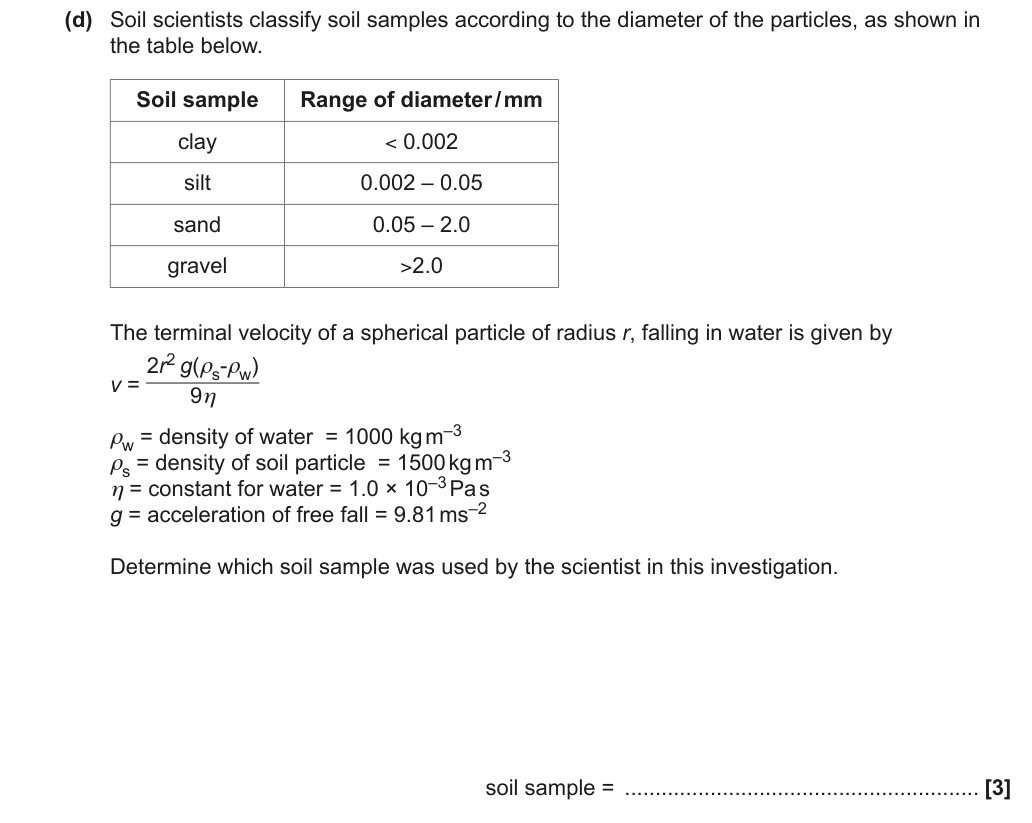
The performance on this question was variable as only just over half of candidates scored marks with only a quarter scoring full marks for determining the soil sample used by the scientist. Many candidates made errors when rearranging the equation of terminal velocity to give the radius, often by not taking the square root to give a value of the radius. In the subsequent step candidates were required to multiply the calculated value of radius by 2 to give the diameter and to convert from mm to m. These steps were often omitted and hence they used the radius value to determine the soil sample with most stating it was clay and as a result their answer was incorrect. Some candidates attempted to calculate the range of terminal velocities for each soil sample to then compare with the value 0.3 m s–1. While this method was valid and given according to the mark scheme candidates did not always calculate the terminal velocity for each sample to then make a correct comparison and hence conclusion that the soil sample used was sand.
Notes from the mark scheme and report
allow v = 0.3 m s-1 giving r = 0.52 mm
radius must be doubled to give the diameter
Skills: M0.1 Recognise and make use of appropriate units in calculations; M0.5 Use calculators to find and use power, exponential and logarithmic functions; M2.2 Change the subject of an equation, including non-linear equations; M2.3 Substitute numerical values into algebraic equations using appropriate units for physical quantities
June 2023 · AS Paper 2 · Q1(a)(ii)1 markCalculationEasy
Earlier part of question 1 that this part uses
Mark scheme
Examiner's comment
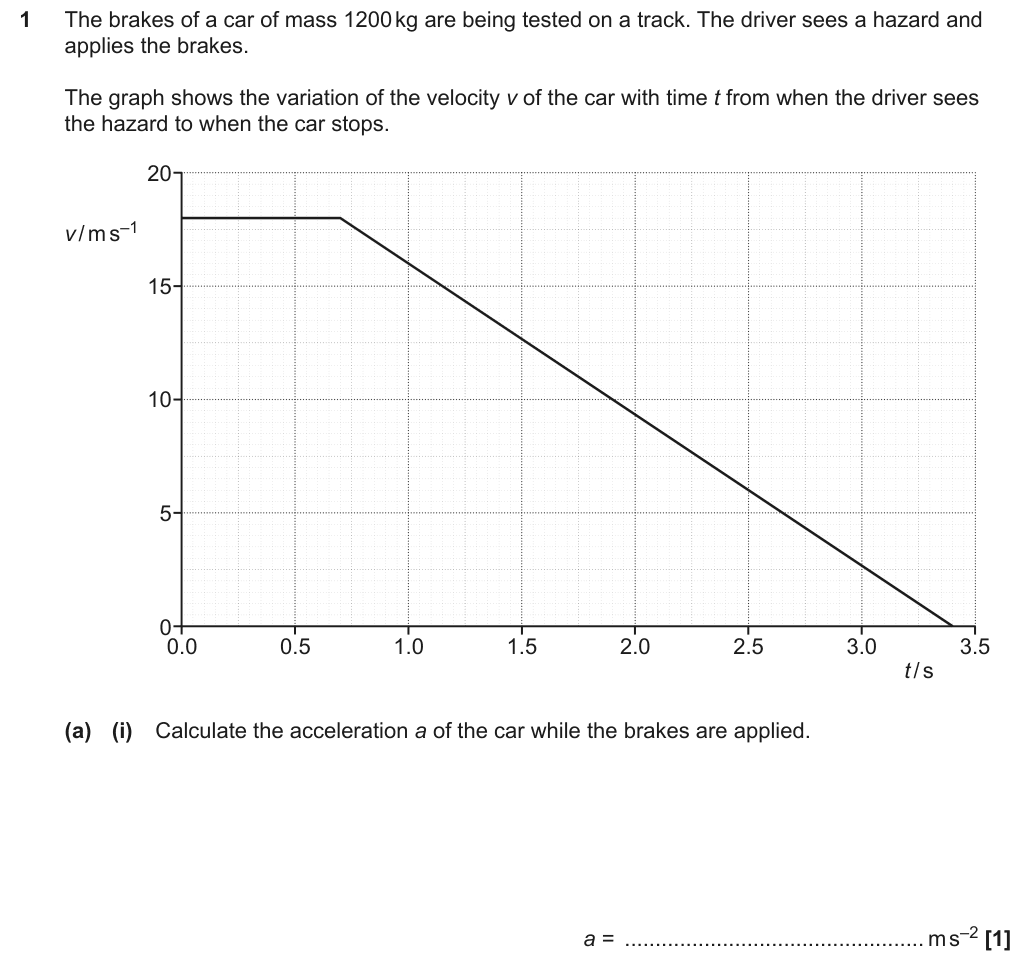
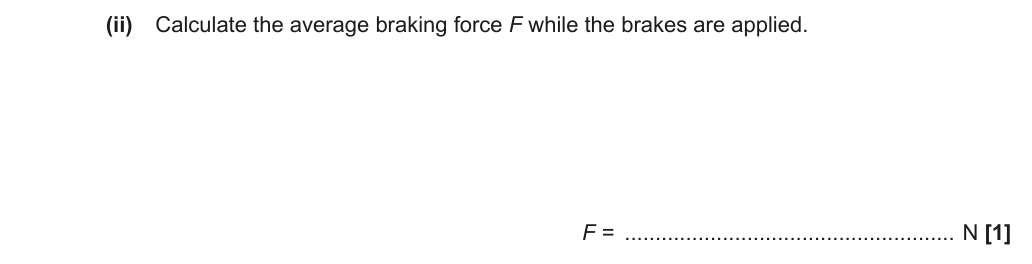
This question was answered well with the majority of candidates multiplying 1200 by the answer to Question 1 (a) (i).
Notes from the mark scheme and report
ecf from (a)(i)
ignore minus sign
Skills: M2.3 Substitute numerical values into algebraic equations using appropriate units for physical quantities
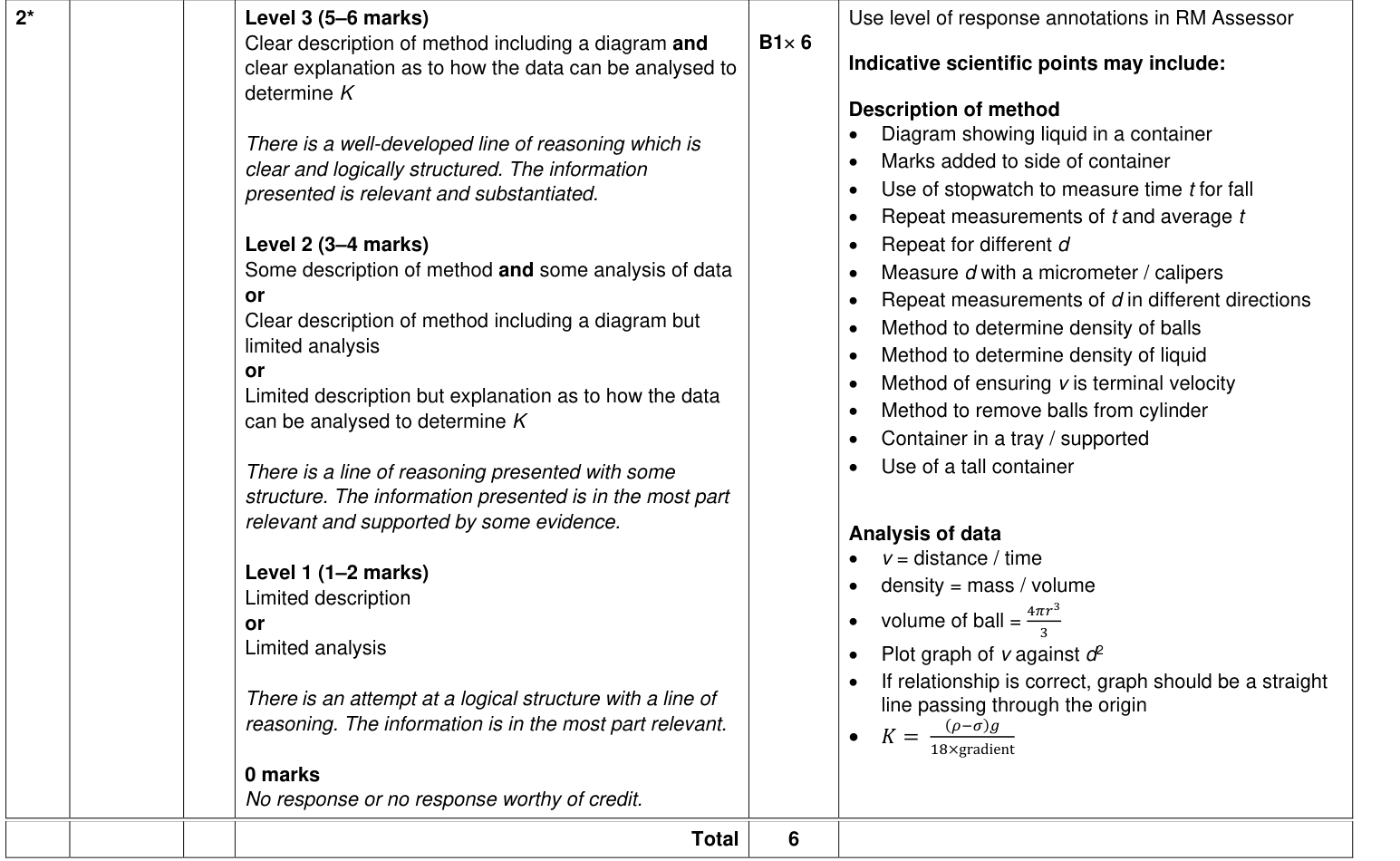
June 2023 · AS Paper 2 · Q26 marks6-mark extended responseMedium
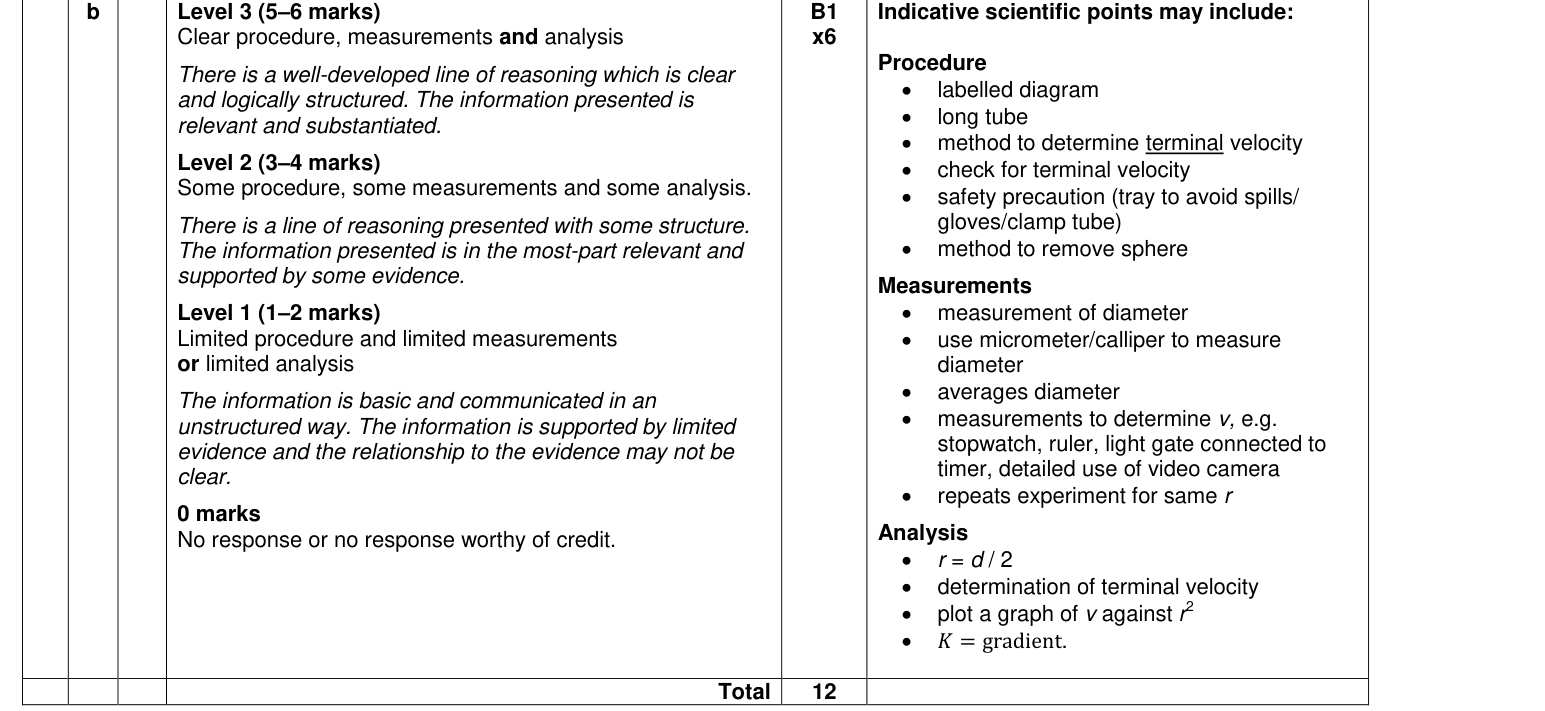
Mark scheme, with the levels and indicative content
Examiner's comment
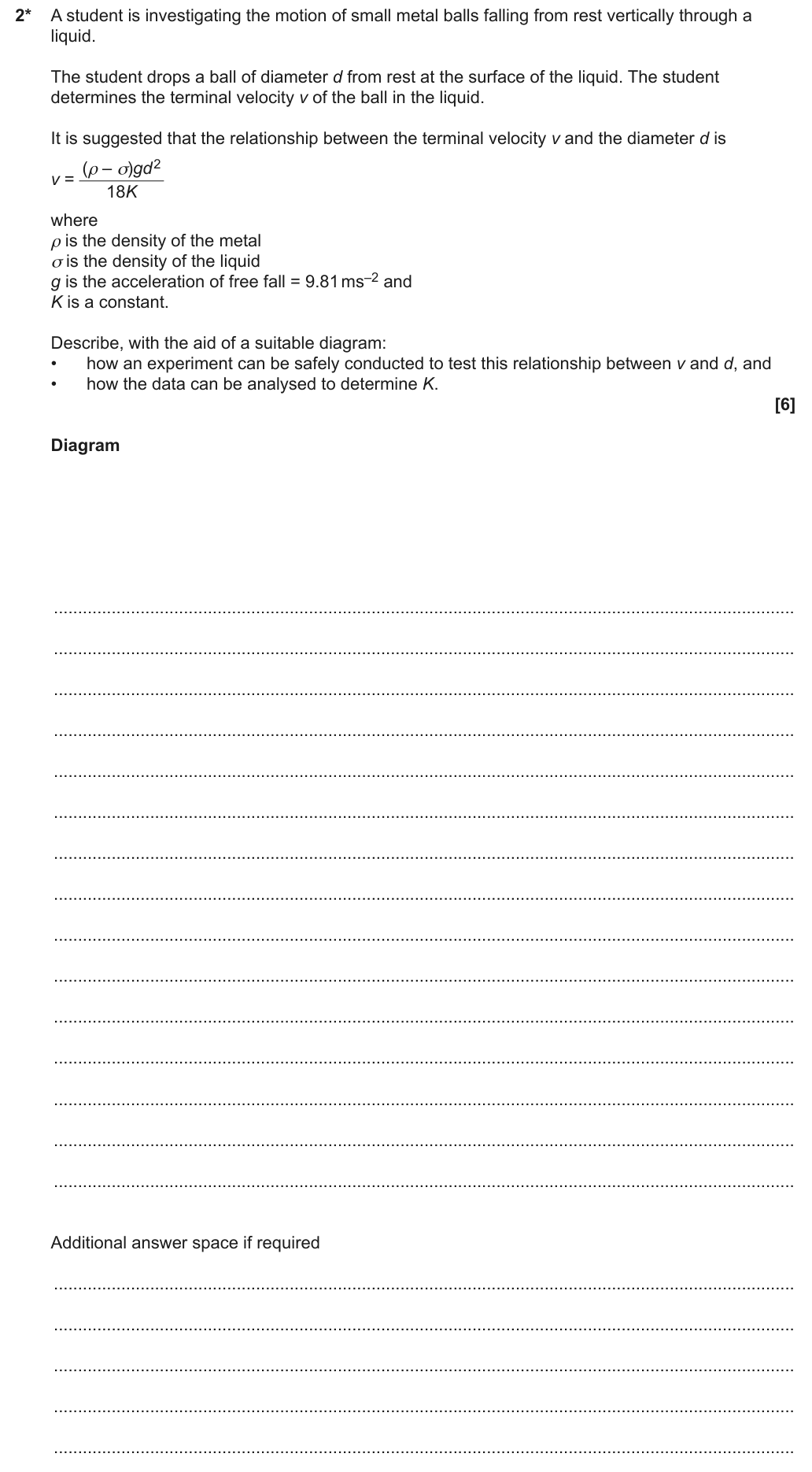
This question enabled candidates to plan an experiment. In candidates’ descriptions it was important to include how the independent and dependent variables were measured. Candidates could also explain how the density of the ball and liquid could be determined. Many candidates did not explain how the terminal velocity could be determined. Often descriptions was just timing the ball leaving the surface to the bottom. Some high scoring candidates discussed the need to check between successive distances that the velocity was constant. To determine the value of constant K it was expected that the axes of an appropriate graph would be suggested with an equation with K as the subject to indicate how the gradient could be used. This candidate starts their response by drawing a sketch diagram with markings on the side of the tube experiment. This diagram could be improved – it would have been helpful to have seen the bench for example. However, it does indicate that the candidate is thinking about terminal velocity. The description of the experiment is logically structured and contains appropriate detail, for example a viscous liquid oil. This candidate has included a method to measure the diameter of the balls. Importantly the candidate explains how terminal velocity is determined using the marks on the side of the tube. There is then a clear section of how the results could be analysed including an appropriate graph and then how K could be determined from the gradient. Overall, this candidate has provided a good description of the method including how terminal velocity is determined and how the data can be analysed. The information is clearly and logically structured and is relevant.
Notes from the mark scheme and report
graph of v against d² is a straight line through the origin
K = (ρ - σ)g / (18 x gradient)
must check terminal velocity reached
Practical techniques Candidates should have experience of describing methods as well as analysing data.
Skills: M3.3 Understand that y = mx + c represents a linear relationship; M3.4 Determine the slope and intercept of a linear graph; PAG1 Investigating motion
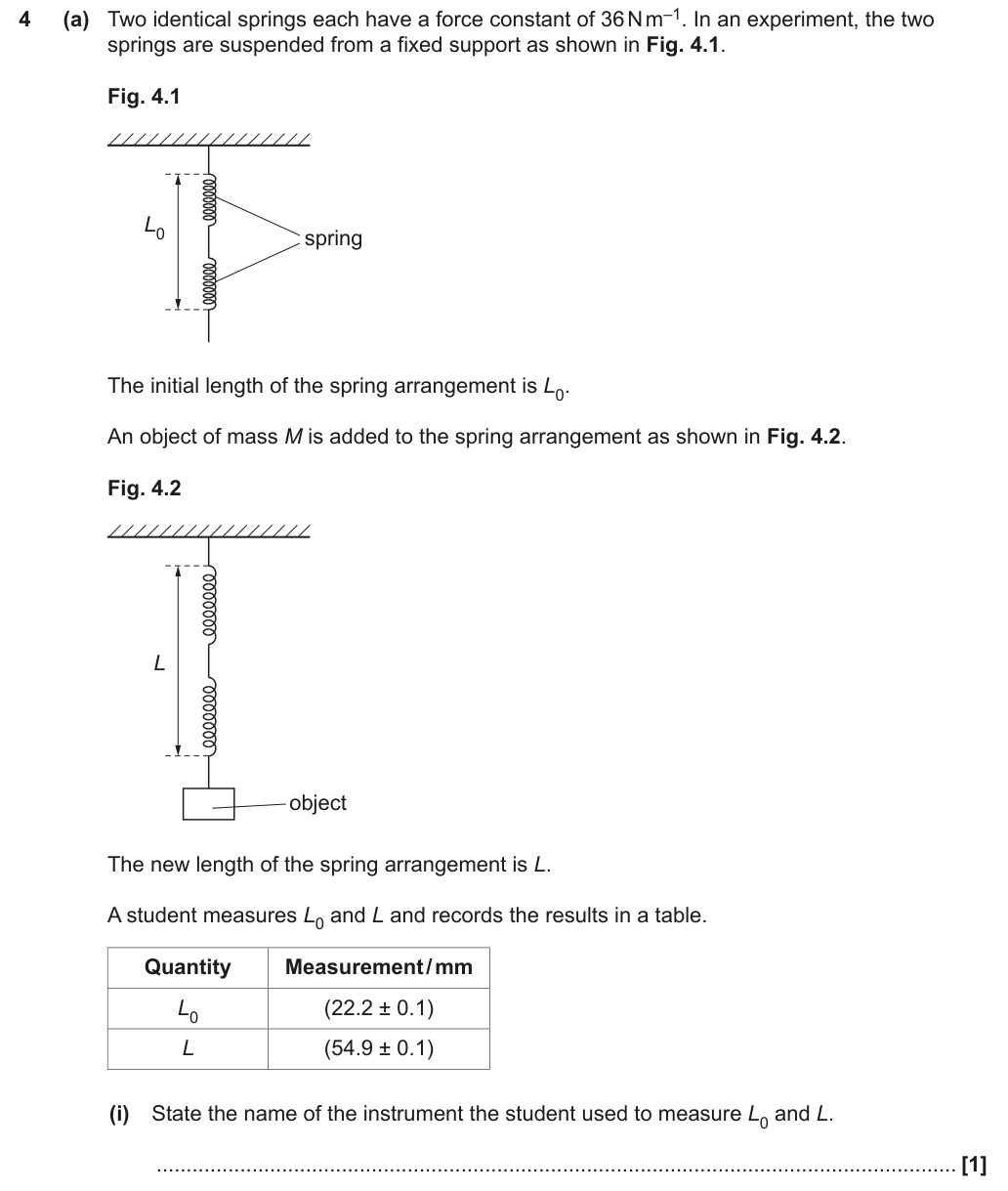
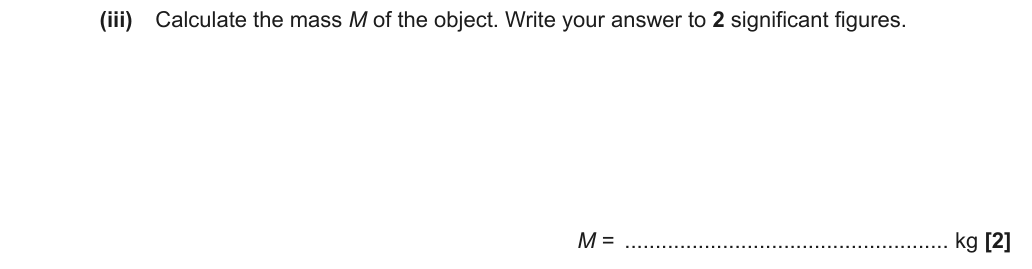
June 2023 · AS Paper 2 · Q4(a)(iii)2 marksCalculationMedium
Earlier parts of question 4 that this part uses
Mark scheme
Examiner's comment
The common error was to use 36 N m–1 as the force constant and 0.0327 m as the extension. Other errors included either rounding the answer to one significant figure (0.06) or not changing the millimetre to metre. Clear working was needed to allow error carried forward marks into the next section.
Notes from the mark scheme and report
springs in series so k = 18 N m-1
answer must be 2 SF (0.06 scores one mark)
60 (power of ten error) one mark
ecf from (a)(ii)
A number of candidates did not understand significant figures.
Candidates should understand the implication of trailing zeros both before and after the decimal place. For example, 0.06 is one significant figure, 0.060 is two significant figures, etc.
Skills: M0.1 Recognise and make use of appropriate units in calculations; M1.1 Use an appropriate number of significant figures; M2.2 Change the subject of an equation, including non-linear equations
June 2023 · Paper 3 · Q4(a)3 marksExplanationMedium
Mark scheme
Examiner's comment
It is important to read the question carefully here. Many candidates spent unnecessary time describing how an object which has been dropped from rest reaches terminal velocity, which was not required. There were several cases of careless terminology. For example, candidates often said that forces were balanced or matched (rather than equal and opposite), or that acceleration of gravity was the same as the drag force, or that acceleration was constant (rather than zero).
Notes from the mark scheme and report
ignore constant speed
ignore 'in equilibrium / forces are balanced'
NOT 'there are no resultant forces'
June 2023 · Paper 3 · Q4(b)(i)2 marksExplanationHard
Mark scheme
Examiner's comment
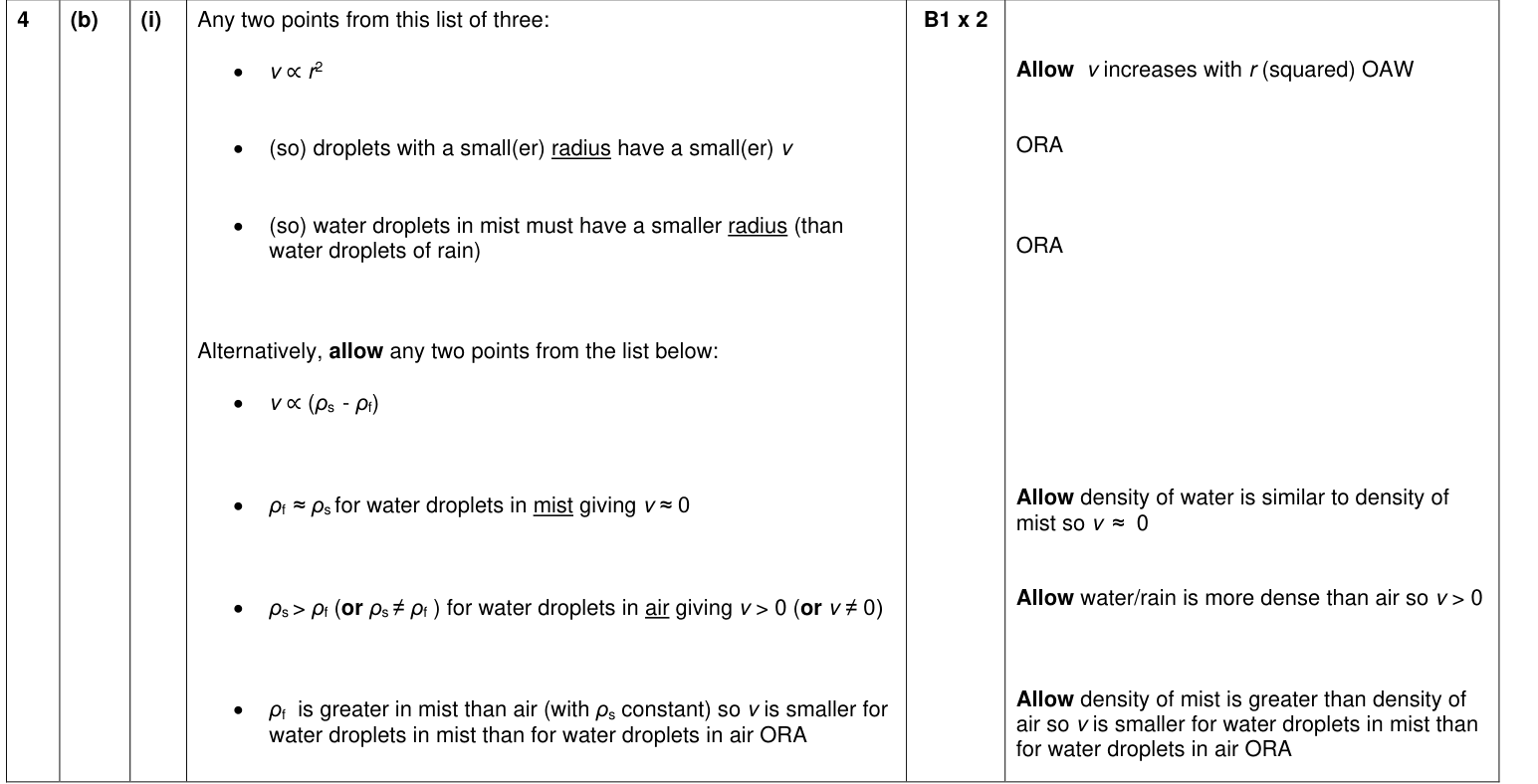
The density of water is the same in mist droplets and in rain droplets, and in both cases the droplets are falling through air. This means that the only variables in the formula are v and r2, with v being proportional to r2. Since mist droplets have a much lower terminal velocity v, this must be because they have a smaller radius than rain droplets. A reasonable suggestion using the formula, however, is that v is proportional to (ρs – ρf) and so this was given credit. Although the density of the water droplet, ρs, remains the same, some candidates argued that the air through which raindrops fall has a lower density to the water vapour through which mist droplets fall. This argument was much more popular than v proportional to r2. Unfortunately, many candidates were too vague and struggled to distinguish between water, rain, mist and air. Some thought that density of air/mist > density of water giving a negative terminal velocity, which is impossible.
Notes from the mark scheme and report
v proportional to r² so mist droplets (smaller radius) have a much smaller v
density argument also allowed
Skills: M0.3 Use ratios, fractions and percentages
June 2023 · Paper 3 · Q4(b)(ii)6 marks6-mark extended responseMedium
Earlier part of question 4 that this part uses
Mark scheme, with the levels and indicative content
Examiner's comment
This experiment is one of the PAGs and it is essential that candidates explain how to verify that the sphere is falling at a constant velocity before v is measured. It is not enough to state that a long cylinder must be used or that v is measured near the bottom. It is important to describe which measuring instruments would be used and how the measurements taken would be combined to calculate v, rather than simply stating ‘v is measured using a light gate’. Some candidates did not read the question carefully and spent precious time explaining how to measure the density of the liquids and the spheres, which had been given in the table. They described carefully how to drop the sphere from exactly the same height each time using exactly the same amount of fluid, not realising that this would have no bearing on the terminal velocity. Candidates were asked to calculate the lowest terminal velocity possible using a sphere of diameter = 1 mm. Most candidates remembered to attempt this and correctly chose a steel sphere in sunflower oil. However, many used η = 50 rather than 50 × 10–3 and the majority used r = 1 mm rather than 0.5 mm. The purpose of the experiment was to verify the expression given in 4b(i) as accurately as possible. The best way to do this was to use a steel sphere in sunflower oil because then the sphere would be travelling more slowly, making it possible to measure v more accurately. The radius of the sphere could be varied and a graph of v against r2 plotted. If the expression given is correct, then the graph would be a straight line through the origin. The gradient should be equal to 2g(ρs – ρf)/9η and, by using the values given in the table, g ≈ 9.81 m s–2 could be verified. It is also possible to use the 4 different combinations of liquid and solid sphere of constant radius and plot a graph of v against (ρs – ρf)/ η. Candidates should make sure that they state very clearly how their experiment can be used to verify the expression. A typical response was along the lines of ‘I would measure v several times and take an average, then plot the results on a graph’. How are you going to get more than one result (you need at least four for a reasonable graph)? What are you going to plot and on which axis? Have you taken all the variables into account? How will you use your graph to show that the expression is correct? This response demonstrates good practice.
Notes from the mark scheme and report
Level 3 needs a check that terminal velocity has been reached and either the lowest v (steel sphere in sunflower oil) or a method that at least partly verifies the expression
Skills: M0.4 Estimate results; M2.3 Substitute numerical values into algebraic equations using appropriate units for physical quantities; PAG1 Investigating motion
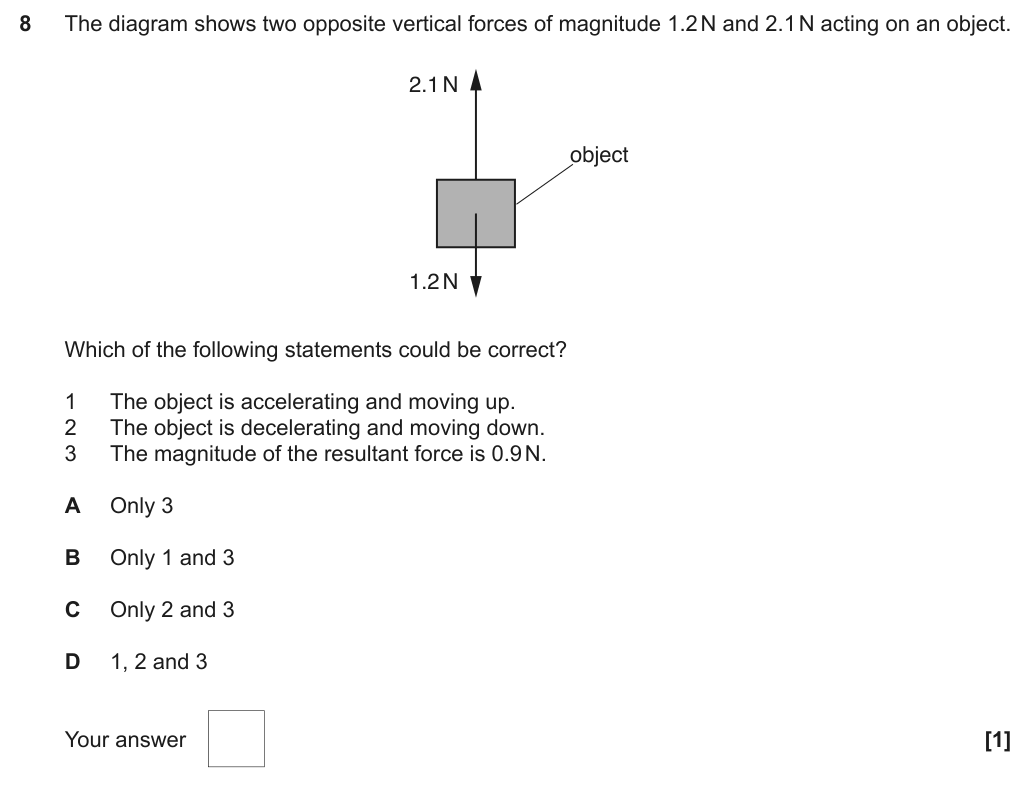
June 2022 · Paper 1 · Q41 markMultiple choiceMedium
Answer
C
Mark scheme
Examiner's comment
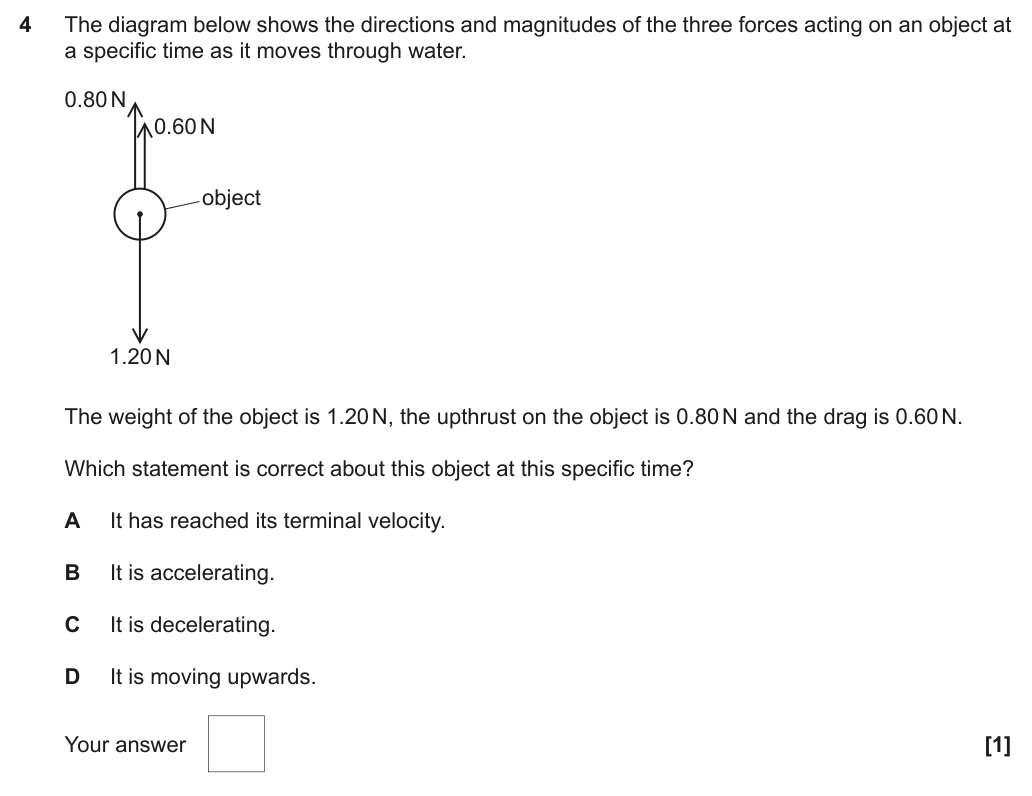
The first step with this question is to calculate the resultant force, which is 0.2 N upwards (eliminating option A). As the drag force is upwards, the direction of motion must be downwards (eliminating option D). Since the resultant is opposite to the direction of travel, this object must be decelerating.
June 2022 · Paper 1 · Q16(b)(iv)2 marksExplanationEasy
Earlier parts of question 16 that this part uses
Mark scheme
Examiner's comment
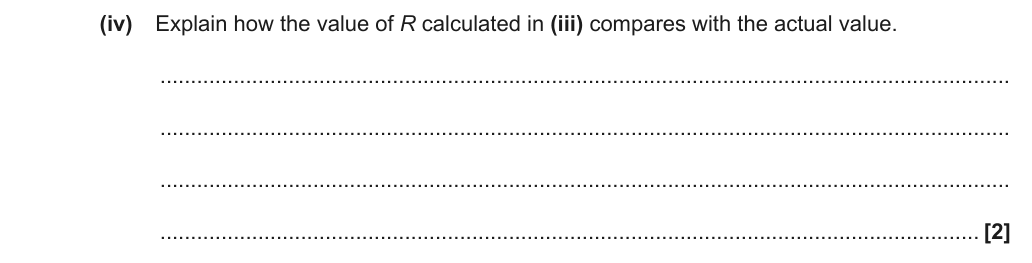
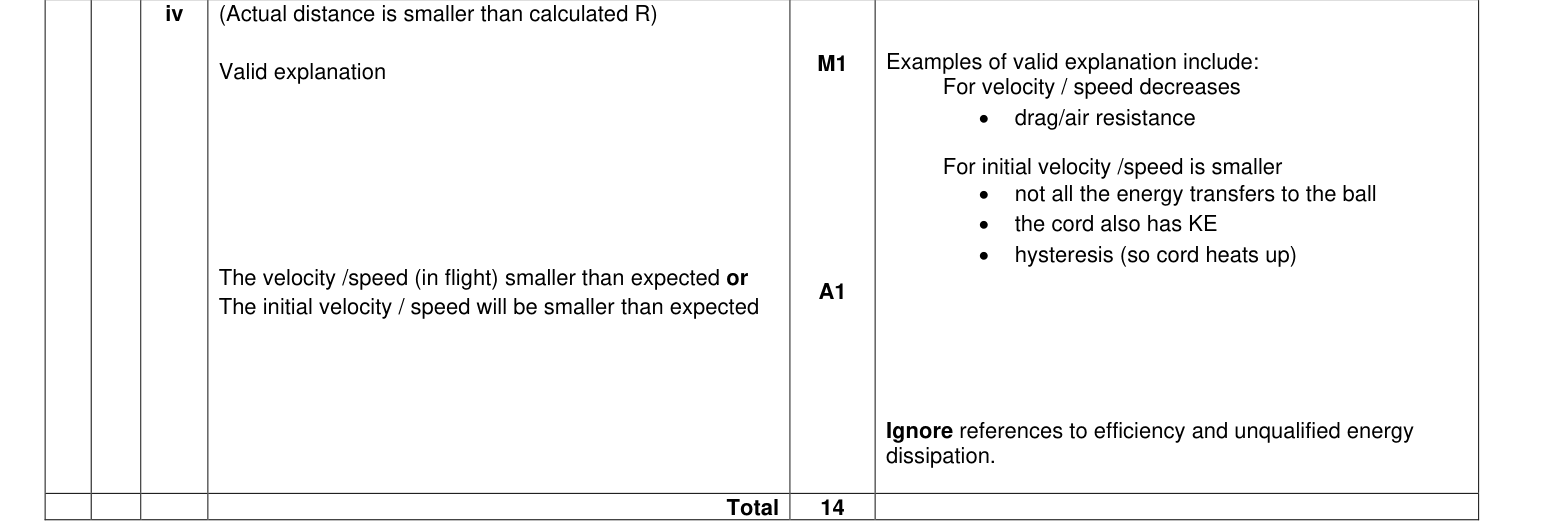
Question 16 (b) (iv) was answered well by candidates that realised the distance in real life would be less and could explain why that was the case.
Notes from the mark scheme and report
actual R smaller with a valid reason
ignore references to efficiency and unqualified energy dissipation
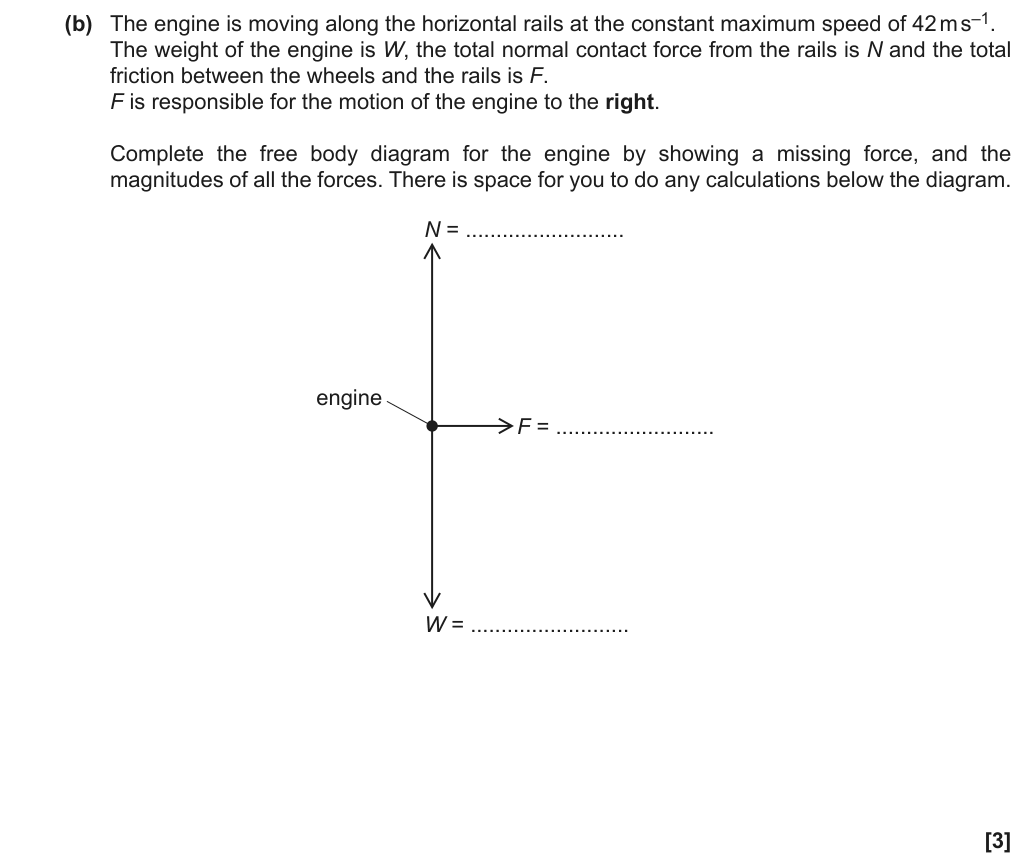
June 2022 · Paper 1 · Q17(b)3 marksDiagram or graphEasy
Earlier part of question 17 that this part uses
Mark scheme
Examiner's comment
This question was answered well, in part. Candidates found the weight of the engine with ease, broadly. The force F, being the value of the power divided by the velocity was less well calculated. Most candidates realised that this object was in equilibrium and so that there should be a force to the left of equal magnitude to force F. This is an example of a frictional force causing an acceleration. The friction force on the rails is to the left. By Newton’s 3rd Law, the friction force on the engine from the rails must therefore be to the right. The force to the left is a drag force, causing equilibrium.
Notes from the mark scheme and report
missing arrow horizontal to the left, same length as F by eye
6700 N
170 000 N
Skills: M2.2 Change the subject of an equation, including non-linear equations
June 2022 · Paper 1 · Q17(c)4 marksShort answerMedium
Earlier part of question 17 that this part uses
Mark scheme
Examiner's comment
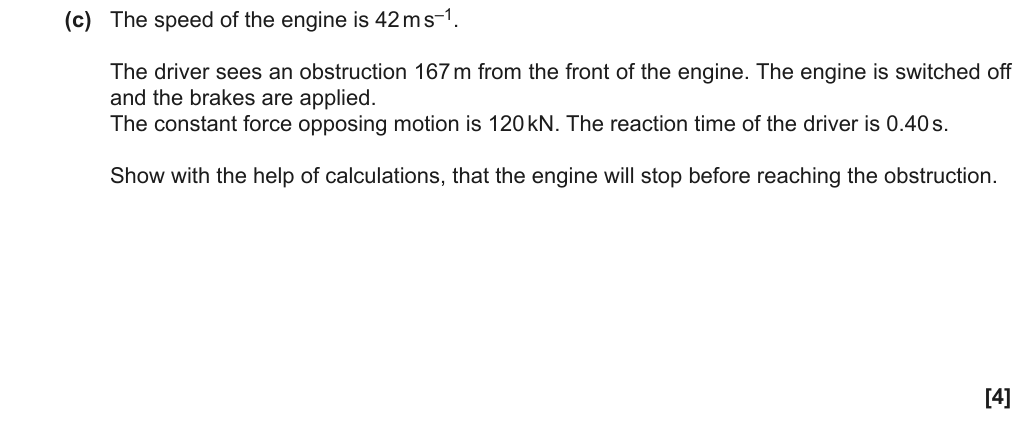
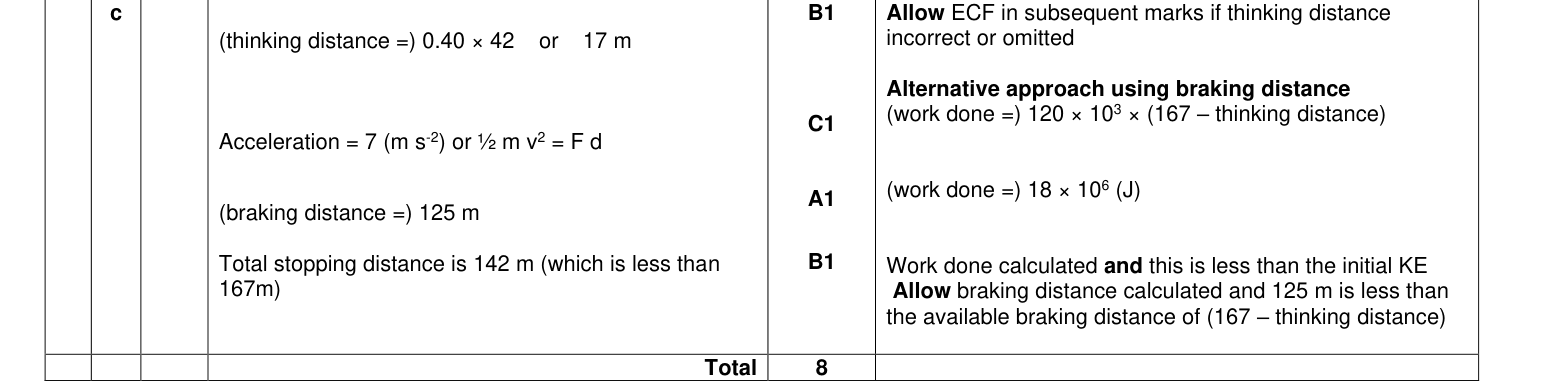
Candidates employed a range of strategies to demonstrate that the engine will stop before the obstruction. Very successful candidates often calculated the deceleration of the engine and then employed an equation of motion to work out first the braking distance and then added the thinking distance. Those candidates also added words to signpost their calculations clearly. Question 18 (a) (i - ii) Candidate’s answers to this part were either jumbled or grounded in incorrect physics. This question is correctly answered by thinking about a cuboid of air that is 36 m long and has a cross- sectional area equal to that of the shaded side of the tent. That cuboid corresponds to the air that hits the tent in the three second period. The force applied will be equal to the rate of momentum change. This means multiplying the mass of air that hits the tent by the velocity change (i.e. 12 m/s) and then dividing by the time taken for that momentum change.
Notes from the mark scheme and report
thinking distance 17 m must be included
alternative work-done method allowed
ecf if thinking distance incorrect or omitted
Skills: M2.3 Substitute numerical values into algebraic equations using appropriate units for physical quantities; M2.4 Solve algebraic equations, including quadratic equations
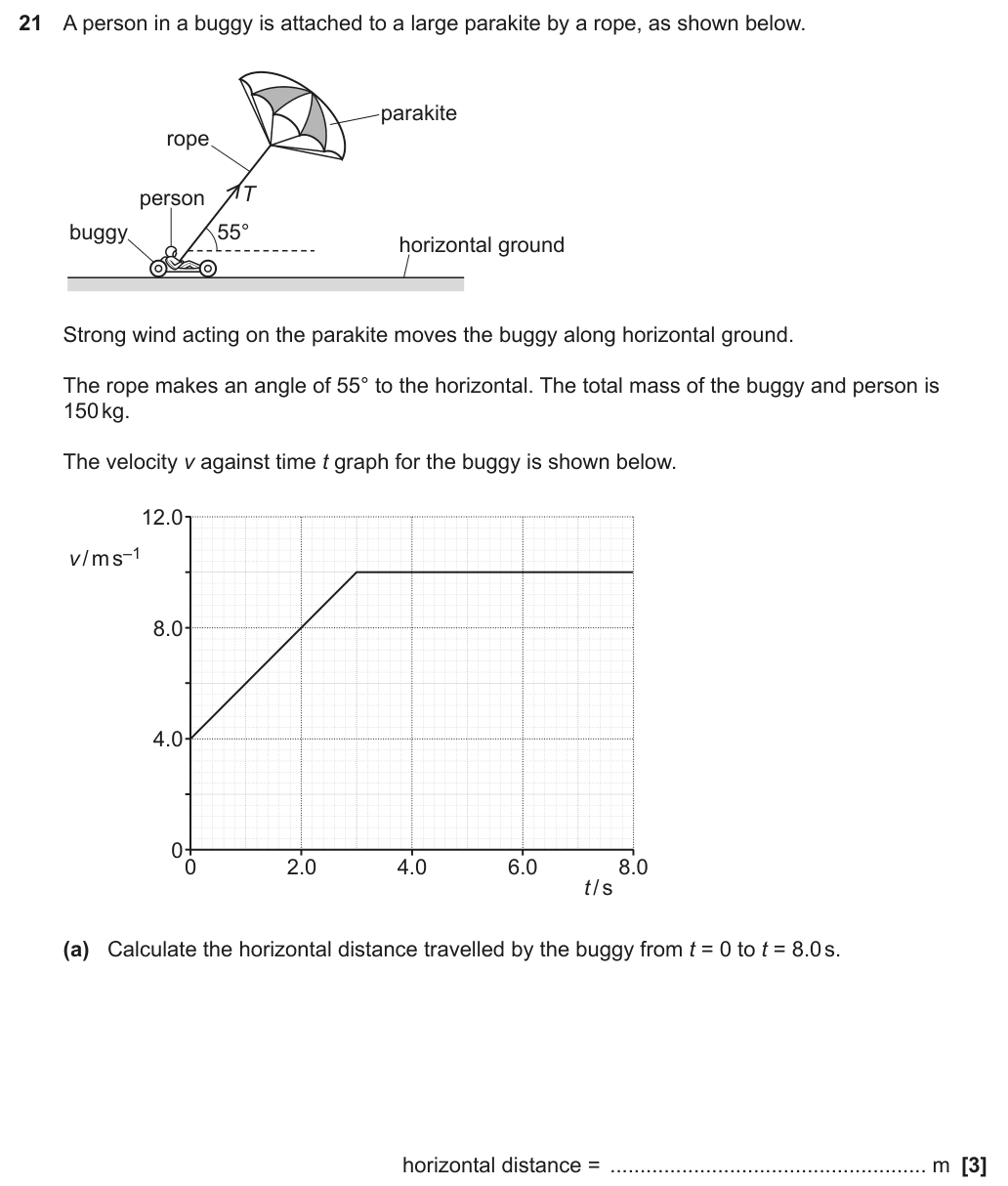
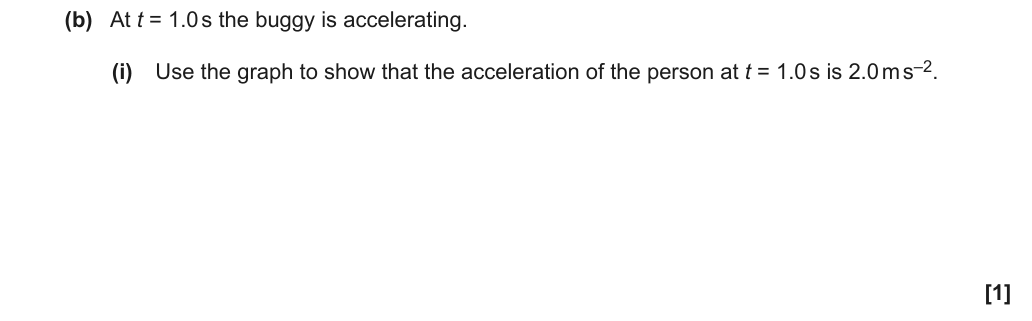
June 2022 · AS Paper 1 · Q21(b)(ii)3 marksCalculationMedium
Earlier parts of question 21 that this part uses
Mark scheme
Examiner's comment
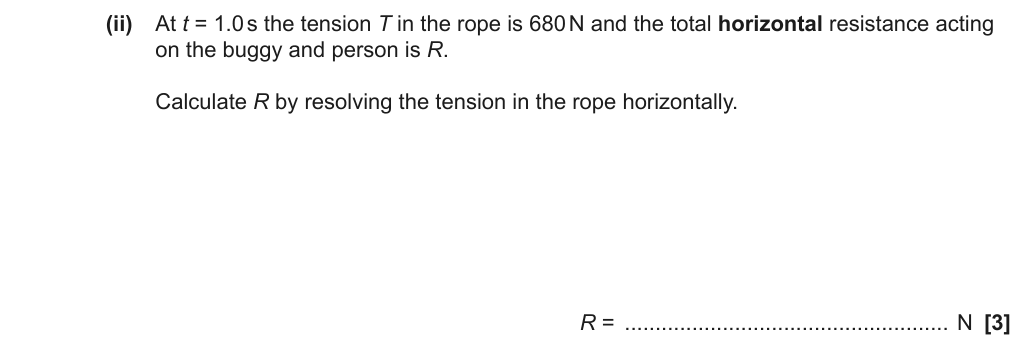
Candidates performed less well on this question as it was mostly only the most successful responses that were given 3 marks for resolving the horizontal component of the tension in the rope to correctly calculate the horizontal resistance R. About 40% of candidates were given 1 mark for either correctly resolving the horizontal component of the tension to give 390 N or calculating the resultant force (F = ma) to give 300 N. It would have helped candidates understand the question to draw a free body force diagram to identify the forces acting on the buggy and direction and magnitude of the resultant force.
Notes from the mark scheme and report
if both components are given it must be clear that 390 N is the horizontal one
Skills: M0.6 Use calculators to handle sin x, cos x and tan x when x is expressed in degrees or radians; M2.3 Substitute numerical values into algebraic equations using appropriate units for physical quantities; M4.5 Use sin, cos and tan in physical problems
June 2022 · AS Paper 2 · Q1(d)(i)3 marksExplanationMedium
Mark scheme
Examiner's comment
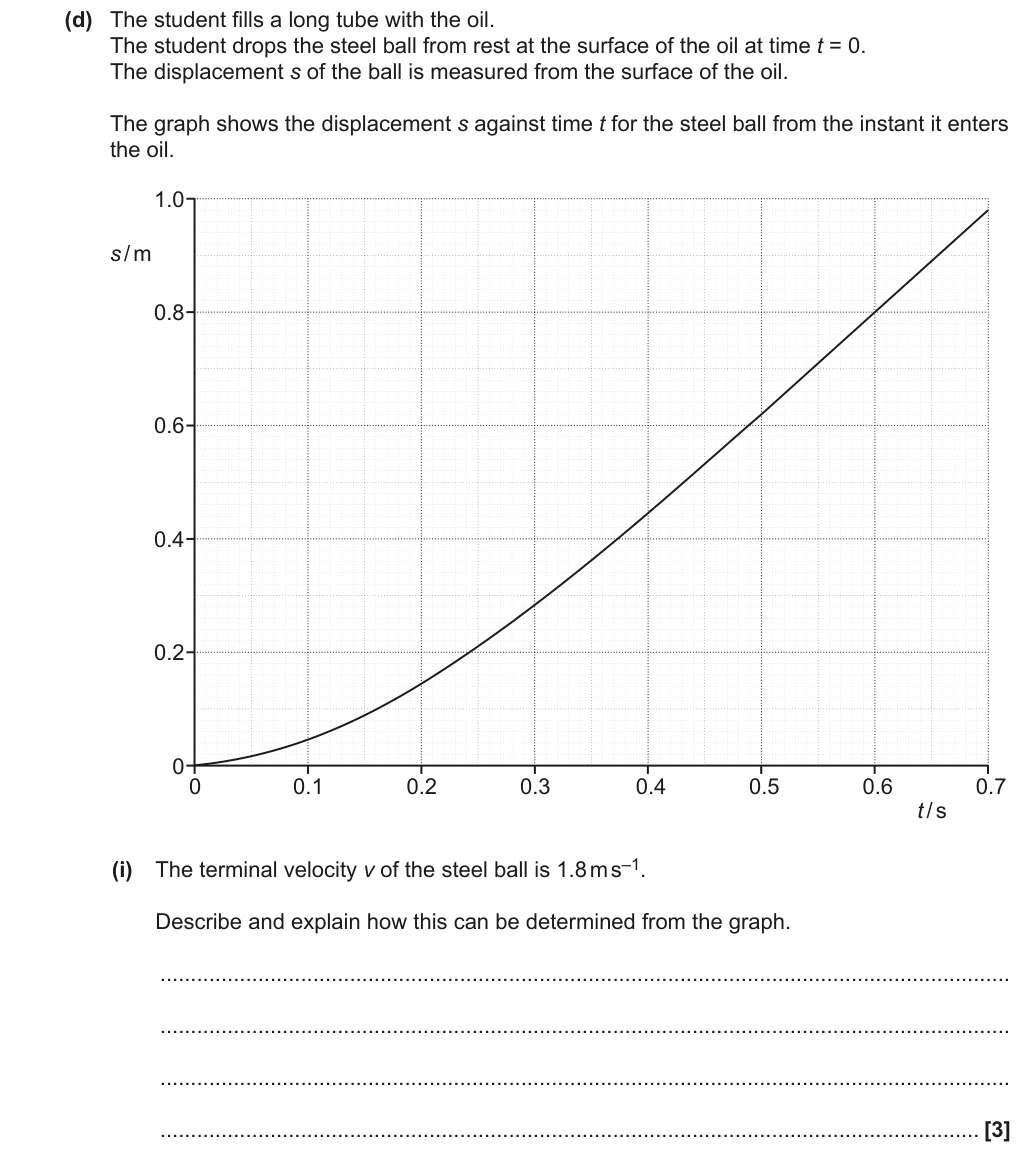
Candidates needed to describe and explain how the terminal velocity was determined from the graph. A good way of answering the question was to state what was meant by terminal velocity, explain how velocity could be determined from the displacement time graph and then state where the velocity was constant. Candidates who were successful demonstrated the gradient calculation of the straight section by substituting numbers into the gradient formula and calculating 1.8 m s-1.
Notes from the mark scheme and report
allow acceleration is zero for velocity is constant
gradient of the straight section
Skills: M3.1 Translate information between graphical, numerical and algebraic forms; M3.4 Determine the slope and intercept of a linear graph; PAG1 Investigating motion
June 2022 · AS Paper 2 · Q1(e)3 marksCalculationHard
Earlier parts of question 1 that this part uses
Mark scheme
Examiner's comment
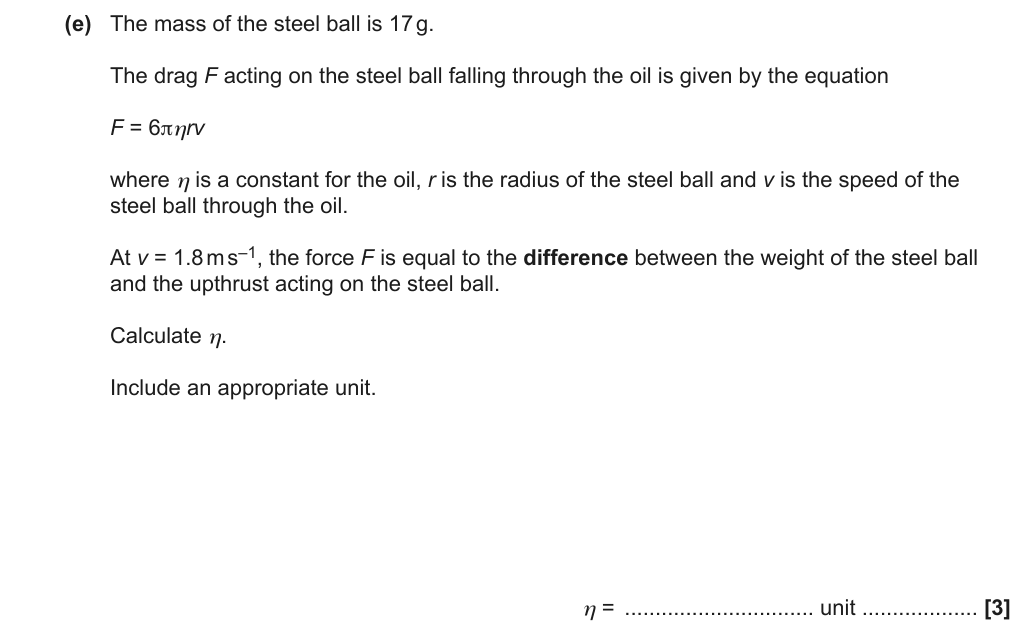
This was a challenging question and as a consequence some candidates only attempted to determine the unit. Common errors included either not allowing for the powers of ten correctly or not determining F as detailed in the question. Candidates also needed to determine the unit of . A common incorrect unit seen was N s-1 m-2.
Notes from the mark scheme and report
allow 0.55
power of ten errors (607, 0.607, 5.4 x 10⁻⁴) score one mark
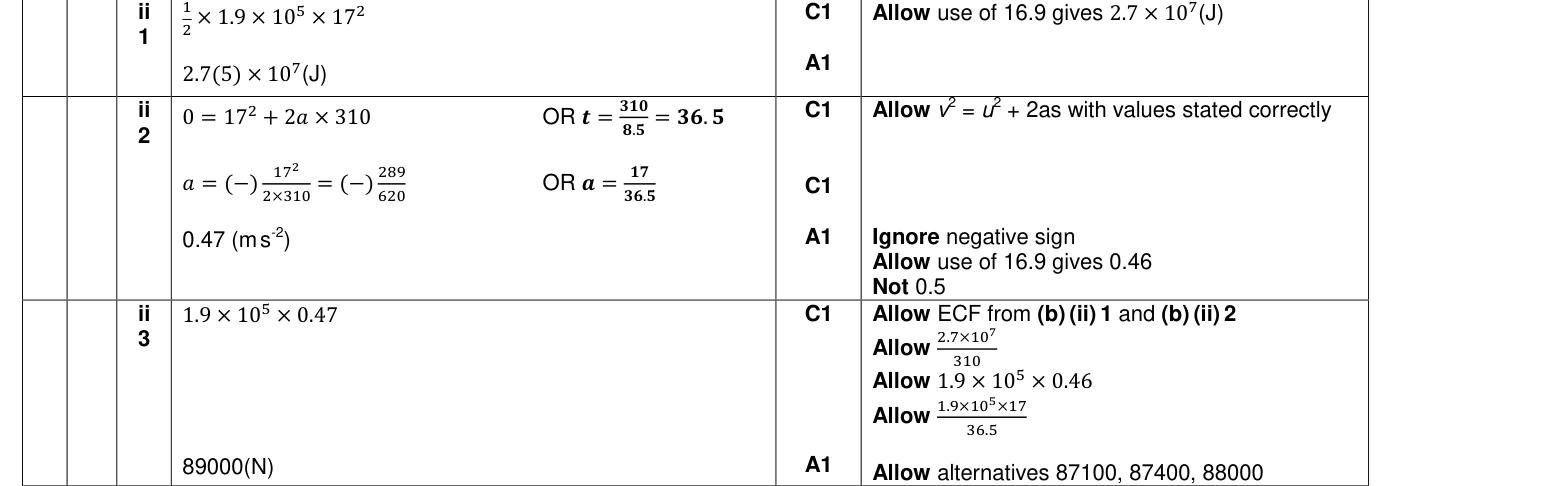
unit kg m-1 s-1 or N s m-2 or Pa s
Candidates should practice determining units in base units and checking the homogeneity of equations.
Skills: M0.1 Recognise and make use of appropriate units in calculations; M2.2 Change the subject of an equation, including non-linear equations; M2.3 Substitute numerical values into algebraic equations using appropriate units for physical quantities
June 2022 · AS Paper 2 · Q3(b)(i)2 marksShow thatMedium
Mark scheme
Examiner's comment
Most successful candidates stated the equilibrium of forces in the vertical direction. Some candidates incorrectly used a value of 10 N kg-1 rather than the value of 9.81 N kg-1 given on the data sheet.
June 2022 · Paper 3 · Q1(b)(iii)3 marksExplanationMedium
Earlier parts of question 1 that this part uses
Mark scheme
Examiner's comment
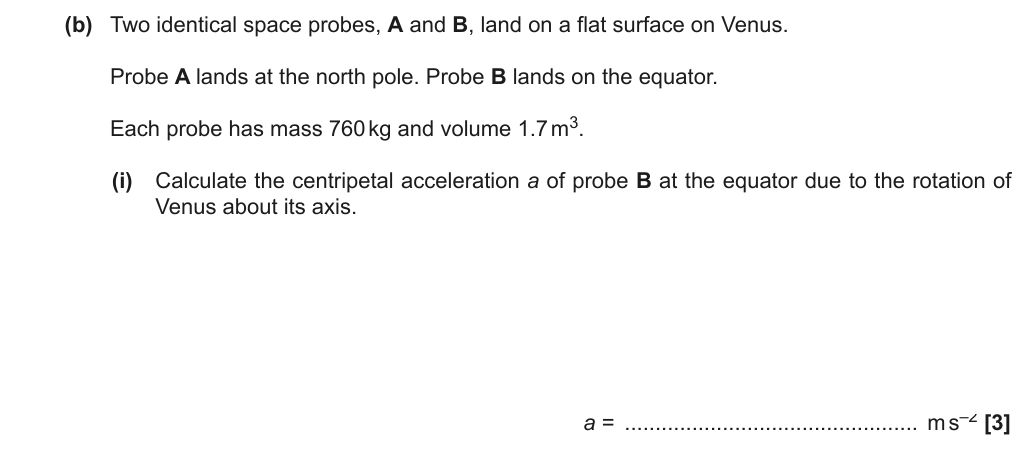
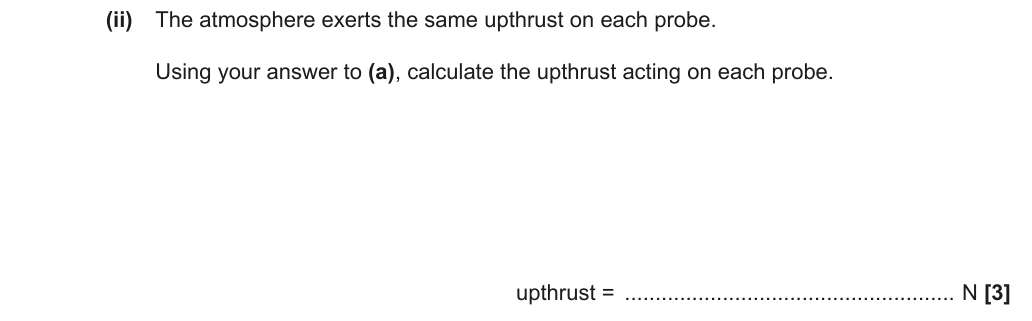
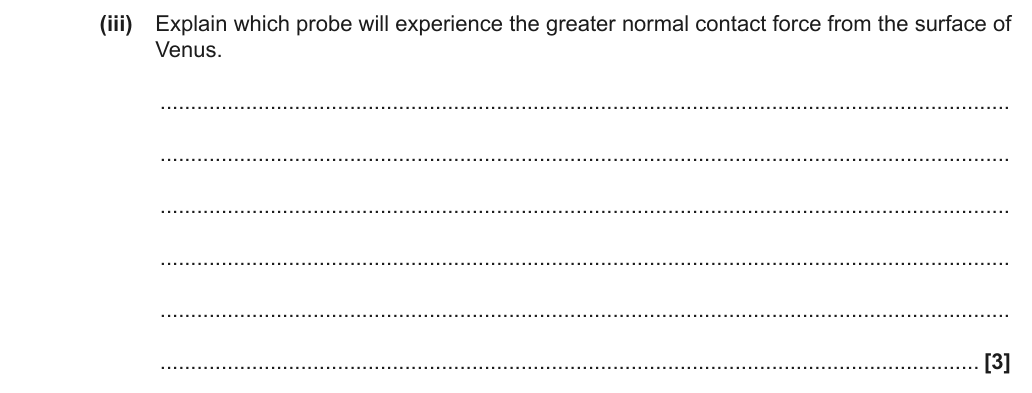
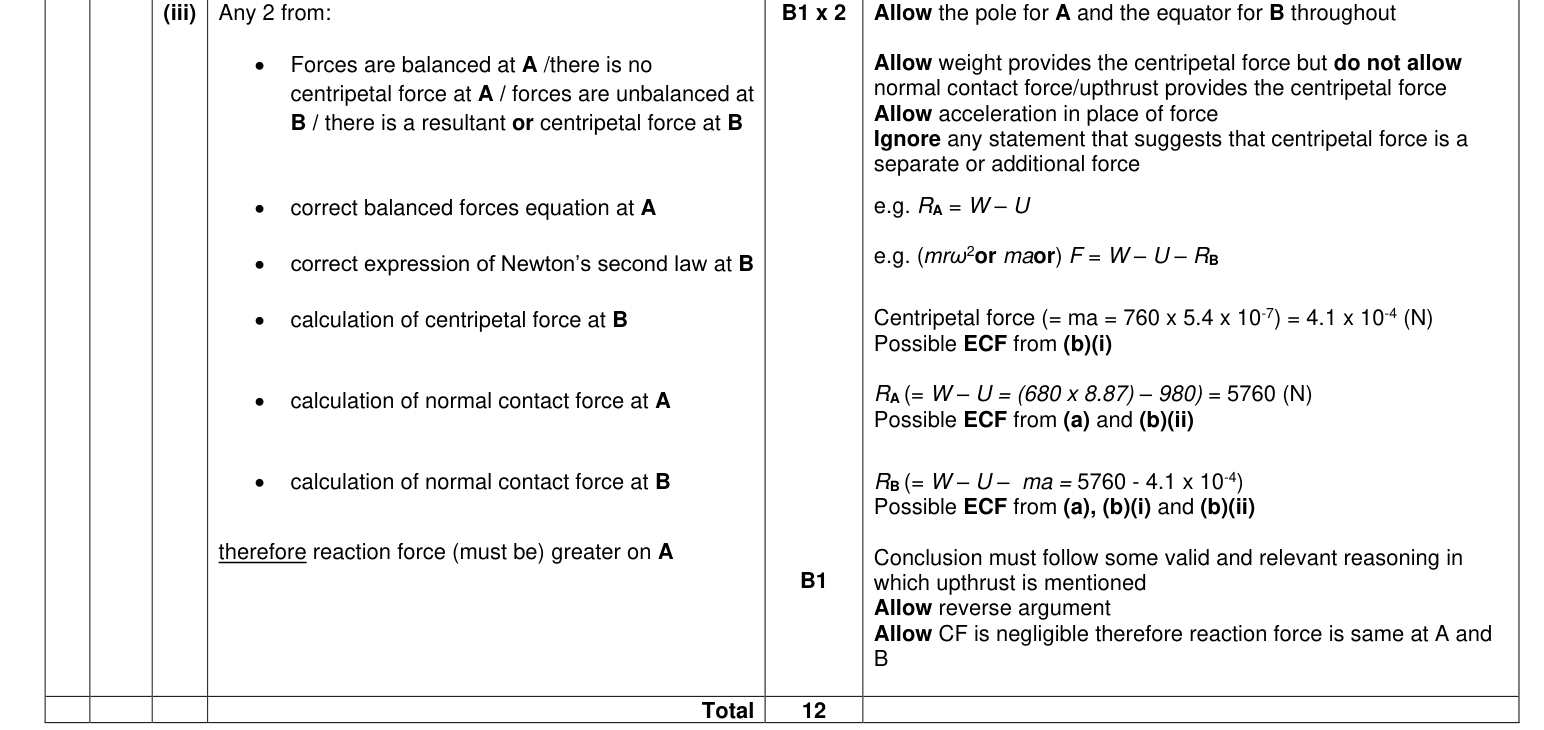
Candidates often struggle to demonstrate a clear understanding of circular motion, and this year was no exception. Most candidates understood that probe B on the equator was acted on by centripetal force whereas probe A at the pole was not. However, some thought that the centripetal force acted outwards, away from the surface. Many thought that the centripetal force was a separate force acting on probe B in addition to its weight. These candidates wrongly concluded that this would increase the force towards the centre, resulting in an increased normal contact force. Whereas the opposite is actually the case; part of the probe’s weight must be used to provide the centripetal force, and so the normal contact force would be smaller. A very common mistake was to ignore the effect of upthrust acting on the probe. Although the upthrust would be the same both at the equator and at the pole, it was worth a mention. Upthrust = 980N (from b(ii)) whereas the centripetal force was only 760 × 5.42 × 10–7N (from b(i)).
Notes from the mark scheme and report
greater on A (pole)
do not allow contact force or upthrust 'provides' the centripetal force
conclusion must follow reasoning that mentions upthrust
Ignore centripetal force treated as an extra force
The author of the examination paper structures questions to support candidates in writing their responses. 1(b)(i) is a calculation of the centripetal acceleration and 1(b)(ii) is a calculation of the upthrust. These provide a logical progression to 1(b)(iii) which involves both centripetal acceleration and upthrust (and not, say, the shape of Venus or its magnetic field).
November 2021 · AS Paper 1 · Q41 markMultiple choice
Answer
C
Mark scheme
November 2021 · Paper 1 · Q101 markMultiple choice
Answer
C
Mark scheme
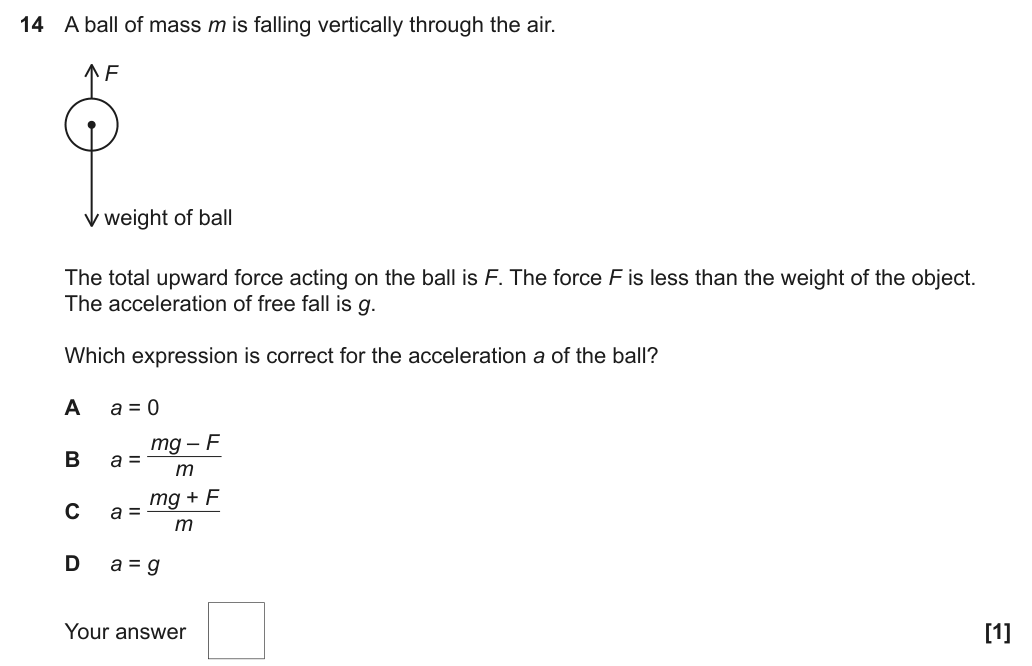
November 2021 · Paper 1 · Q141 markMultiple choice
Answer
B
Mark scheme
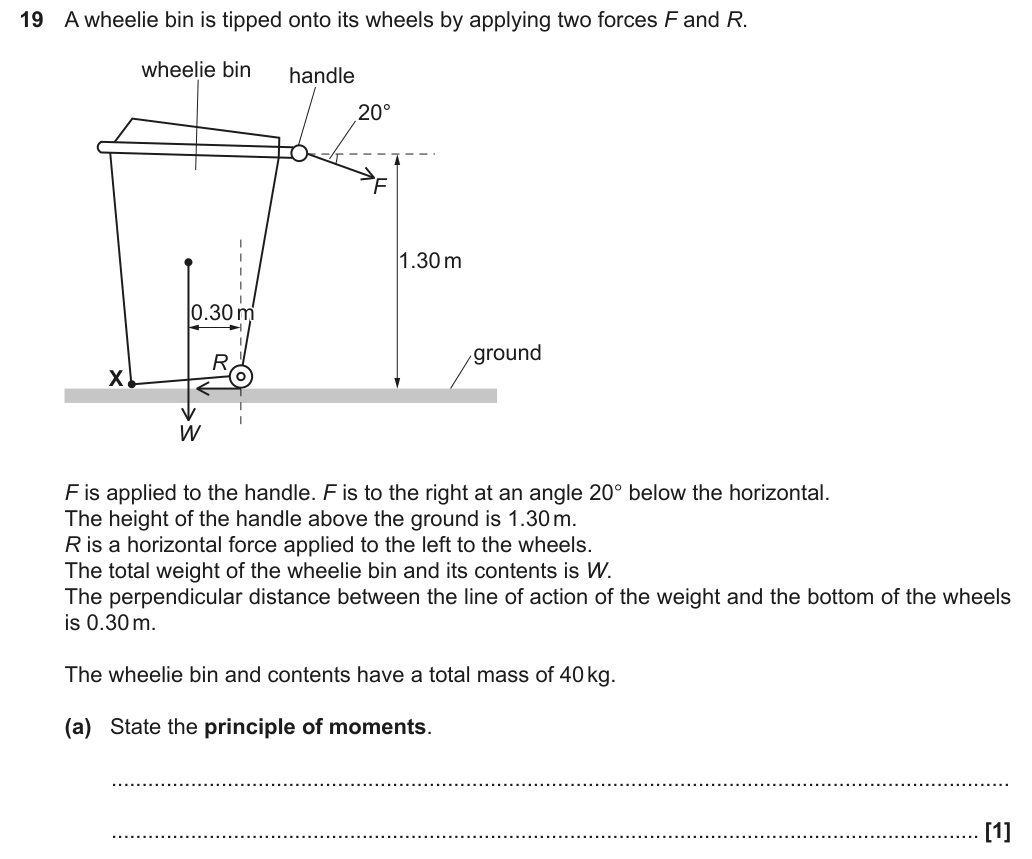
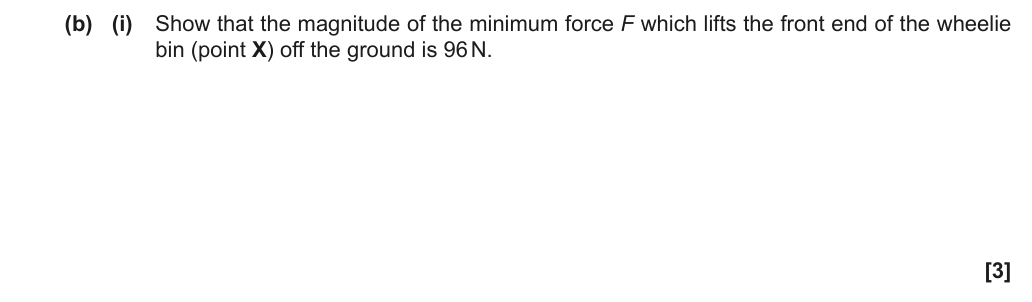
November 2021 · Paper 1 · Q19(b)(i)3 marksShow thatMedium
Earlier part of question 19 that this part uses
Mark scheme
Examiner's comment
The principle of moments only applies when an object is in equilibrium as required in Q19a.
Notes from the mark scheme and report
sine used (265) or calculator in radians (222) scores 2
Skills: M0.6 Use calculators to handle sin x, cos x and tan x when x is expressed in degrees or radians; M2.3 Substitute numerical values into algebraic equations using appropriate units for physical quantities; M4.5 Use sin, cos and tan in physical problems
November 2021 · AS Paper 1 · Q21(b)2 marksExplanation
Mark scheme
Notes from the mark scheme and report
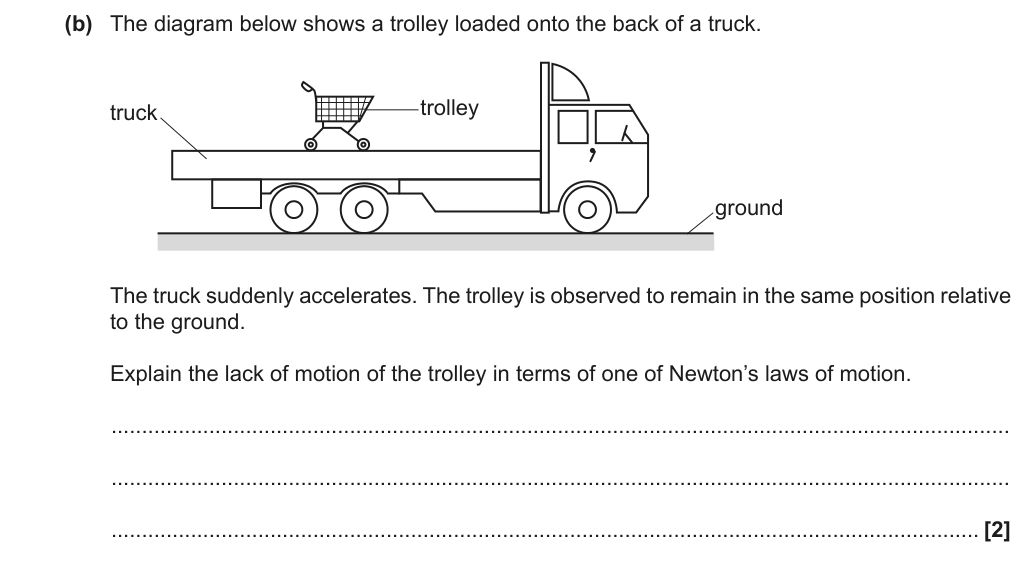
must be in terms of first or second law with no / negligible resultant force on the trolley
November 2021 · AS Paper 1 · Q26(a)2 marksShow that
Mark scheme
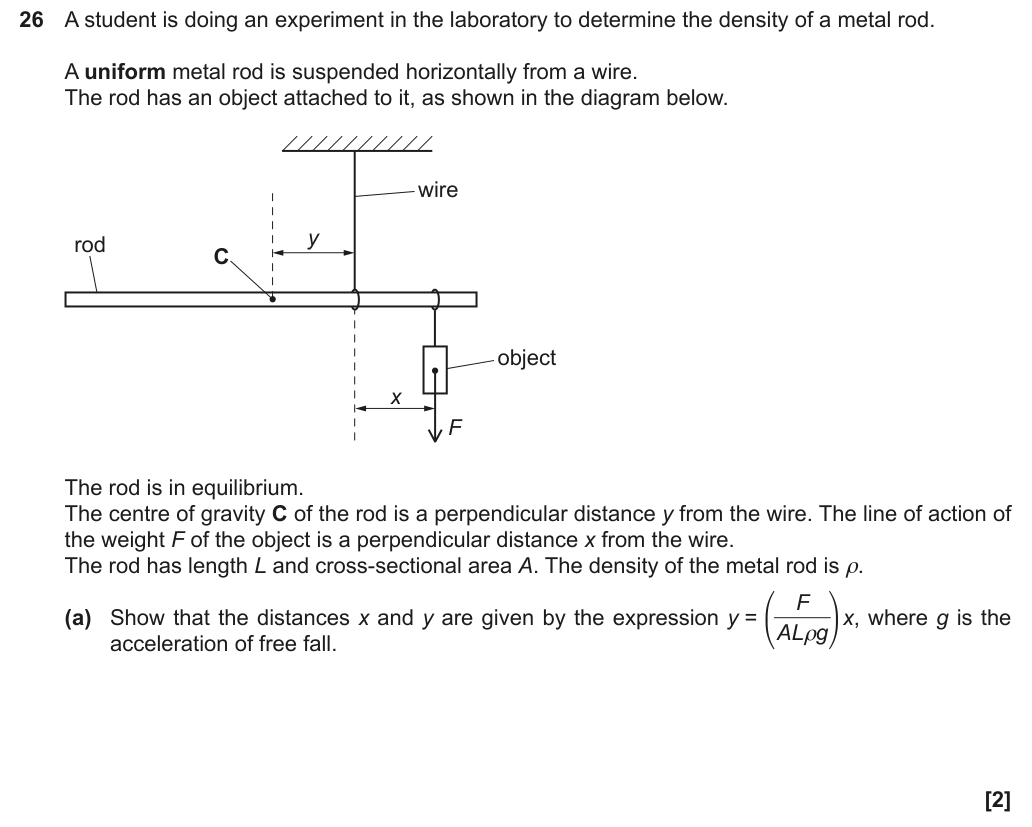
November 2021 · AS Paper 2 · Q4(a)(ii)3 marksCalculation
Earlier part of question 4 that this part uses
Mark scheme
Notes from the mark scheme and report
ignore power-of-ten errors
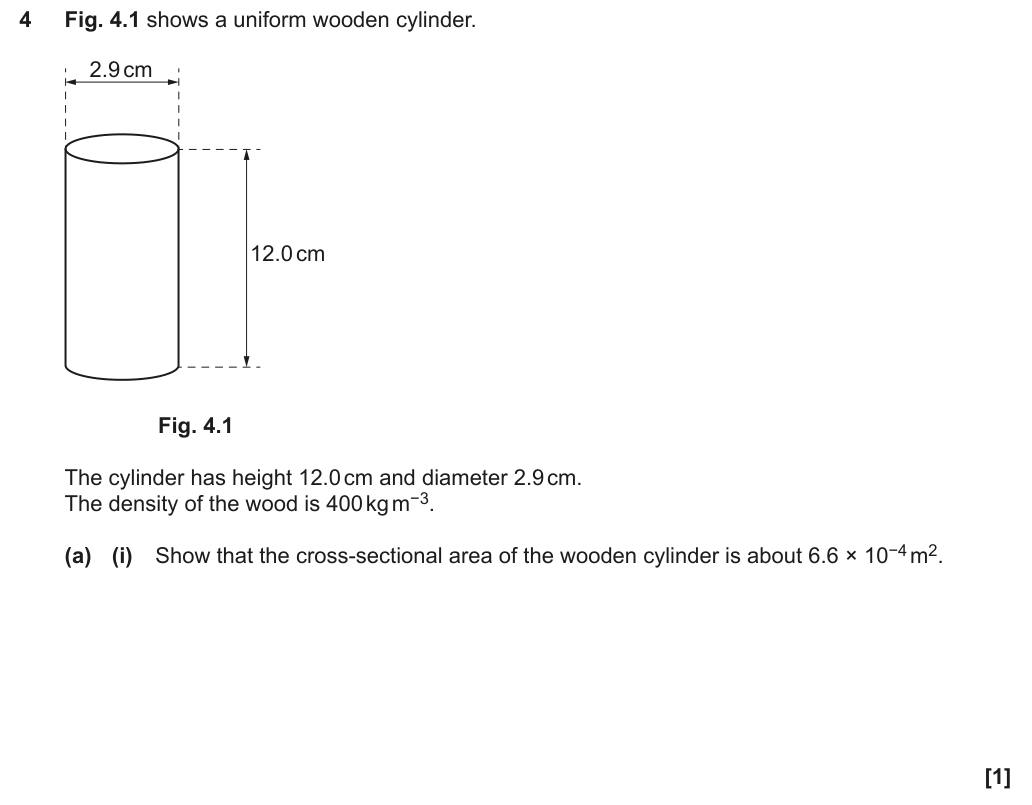
Skills: M0.1 Recognise and make use of appropriate units in calculations; M2.3 Substitute numerical values into algebraic equations using appropriate units for physical quantities; M4.3 Calculate areas of triangles, circumferences and areas of circles, surface areas and volumes of rectangular blocks, cylinders and spheres
November 2021 · Paper 3 · Q1(a)(i)1 markShow that
Mark scheme
Notes from the mark scheme and report
substitution and a = 0.90 (0.905) must be seen
Skills: M0.1 Recognise and make use of appropriate units in calculations; M2.2 Change the subject of an equation, including non-linear equations
November 2021 · Paper 3 · Q6(b)(i)2 marksExplanationMedium
Earlier part of question 6 that this part uses
Mark scheme
Examiner's comment
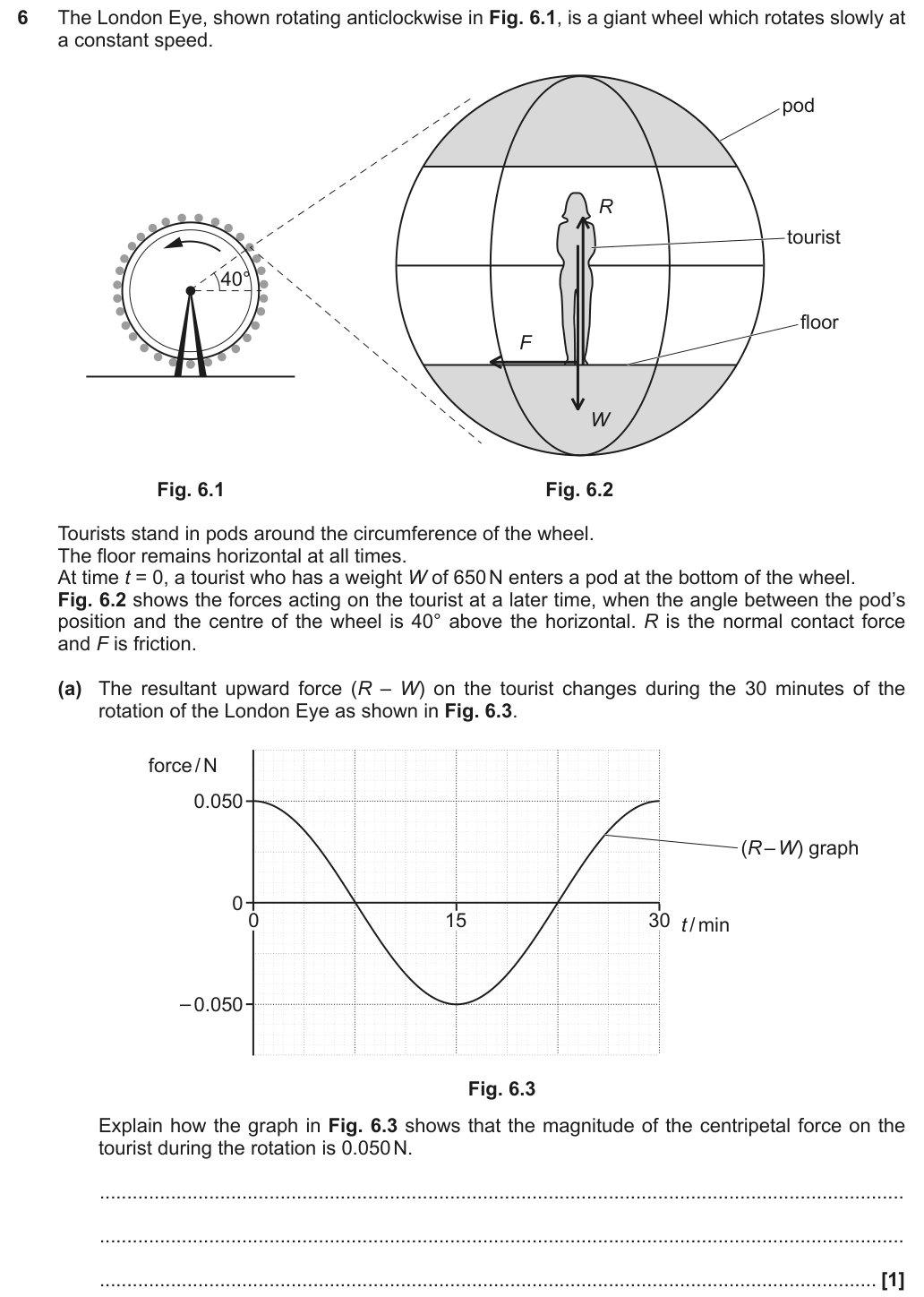
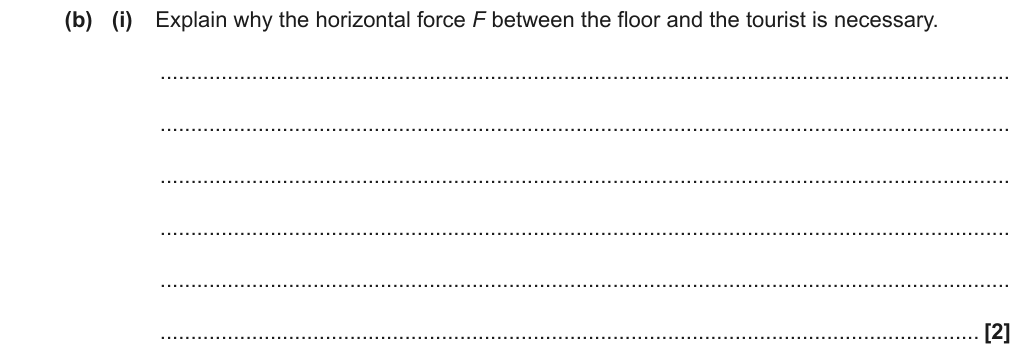
Common misconceptions Candidates often struggle to answer questions on circular motion, and Question 6 threw up the usual misconceptions. In Question 6, the two available forces are R – W, which acts vertically, and F, which acts horizontally.
Notes from the mark scheme and report
any two of three: resultant force always towards the centre
it is not always vertical
R and W are vertical so only friction F can provide the horizontal component
November 2021 · Paper 3 · Q6(c)3 marksCalculationMedium
Earlier part of question 6 that this part uses
Mark scheme
Examiner's comment
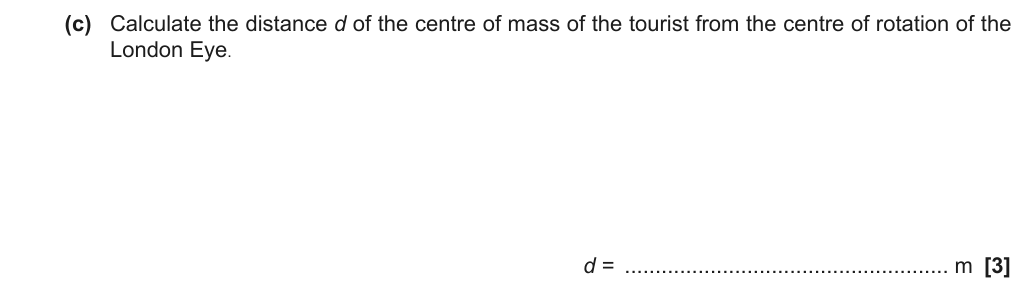
Common misconceptions Candidates often struggle to answer questions on circular motion, and Question 6 threw up the usual misconceptions. In Question 6, the two available forces are R – W, which acts vertically, and F, which acts horizontally.
Notes from the mark scheme and report
NOT m = 650 kg or 65 kg (m = 650 / 9.81)
ω from T = 30 min
Skills: M2.2 Change the subject of an equation, including non-linear equations; M2.3 Substitute numerical values into algebraic equations using appropriate units for physical quantities
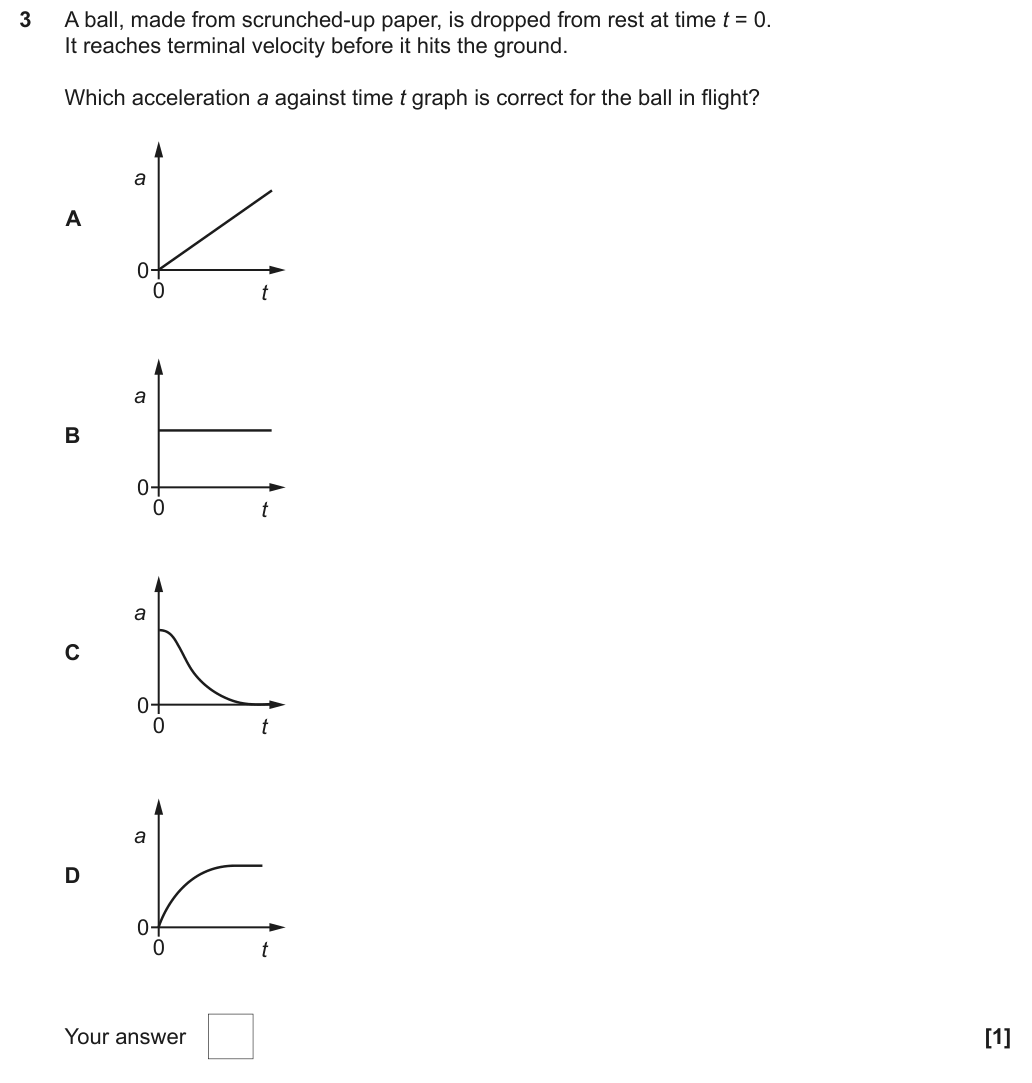
November 2020 · AS Paper 1 · Q31 markMultiple choiceMedium
Answer
C
Mark scheme
Examiner's comment
Question 3 is all about a ball of scrunched-up paper falling towards the ground.
November 2020 · Paper 1 · Q31 markMultiple choice
Answer
A
Mark scheme
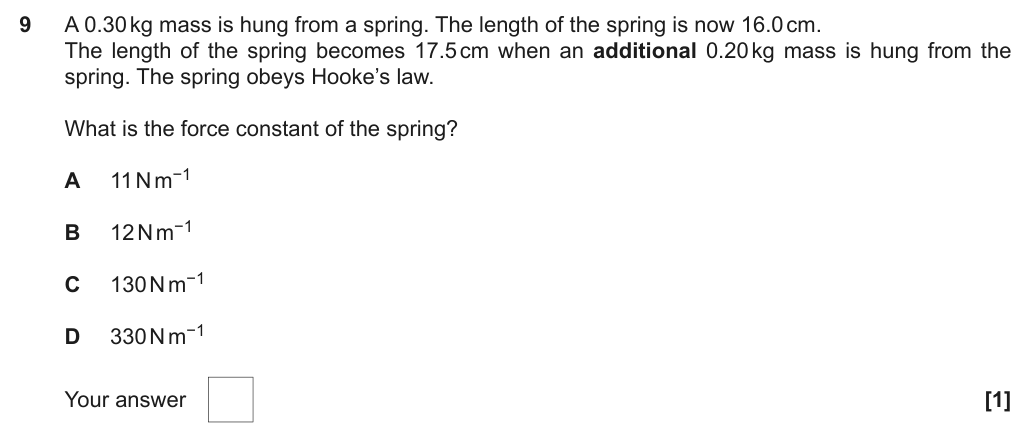
November 2020 · AS Paper 1 · Q91 markMultiple choiceMedium
Answer
C
Mark scheme
Examiner's comment
The same technique can be employed in Questions 9, 12, 13, 15 and 18.
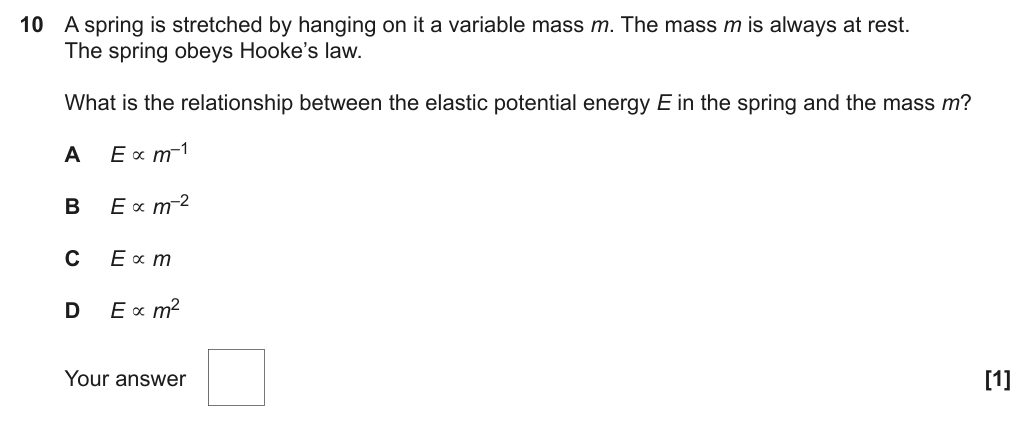
November 2020 · Paper 1 · Q101 markMultiple choiceHard
Answer
D
Mark scheme
Examiner's comment
Candidates had particular difficulty with Question 9 and Question 10.
November 2020 · AS Paper 1 · Q141 markMultiple choice
Answer
B
Mark scheme
November 2020 · Paper 1 · Q16(a)2 marksDiagram or graph
Mark scheme
Notes from the mark scheme and report
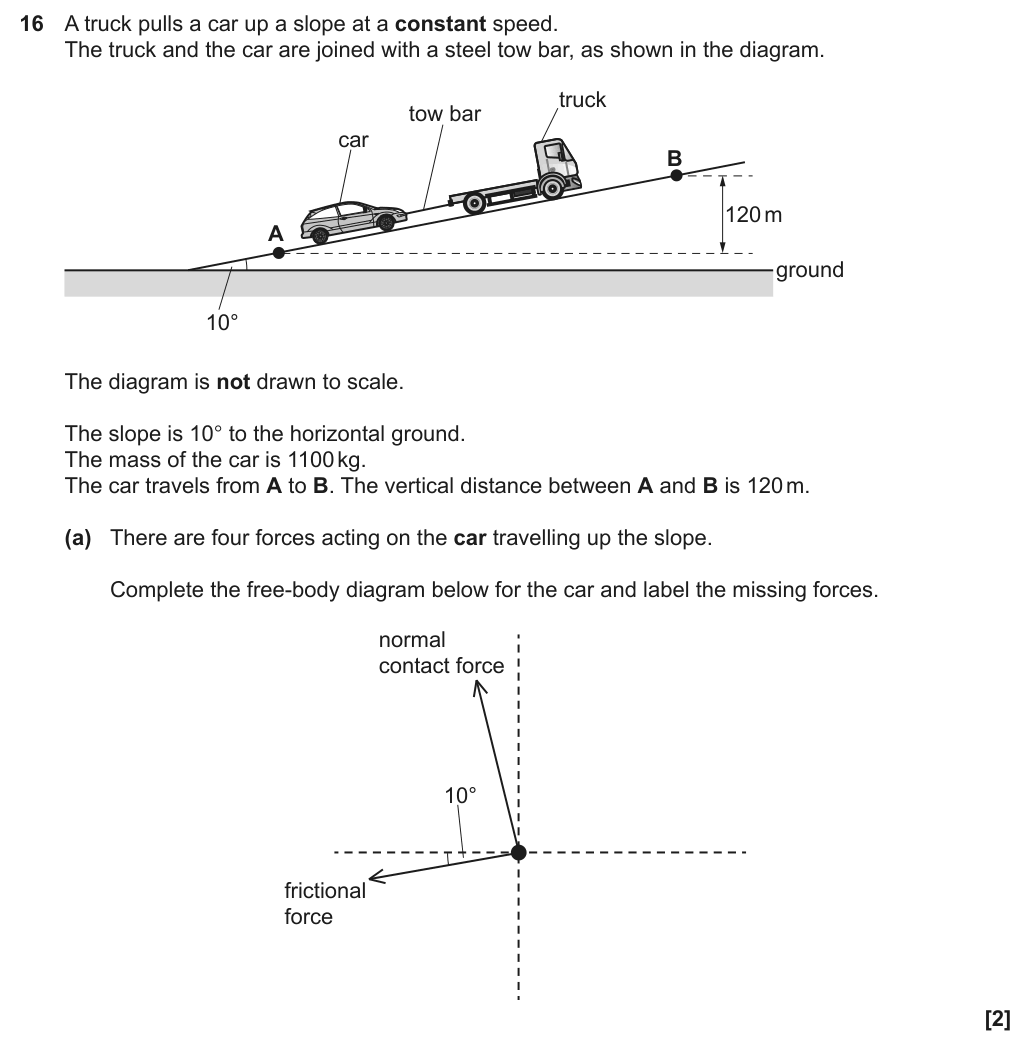
arrow vertically down (weight) and arrow opposite to the frictional force (tension / force in tow bar / driving force)
both must be labelled
Skills: M4.2 Visualise and represent 2D and 3D forms, including two-dimensional representations of 3D objects
November 2020 · Paper 1 · Q16(b)1 markShow that
Earlier part of question 16 that this part uses
Mark scheme
Notes from the mark scheme and report
allow cos 80°
allow g instead of value
Skills: M0.6 Use calculators to handle sin x, cos x and tan x when x is expressed in degrees or radians; M4.5 Use sin, cos and tan in physical problems
November 2020 · AS Paper 1 · Q23(b)(ii)3 marksExplanationMedium
Earlier part of question 23 that this part uses
Mark scheme
Examiner's comment
Questions 23aii, 23bi, 24bii, 27c and 28bi • showed all the steps leading to the correct response in ‘show’ calculations, e.g. Misconception Question 23bii A small number of candidates incorrectly interpreted the velocity–time graph, especially the negatively sloping section of the graph.
Notes from the mark scheme and report
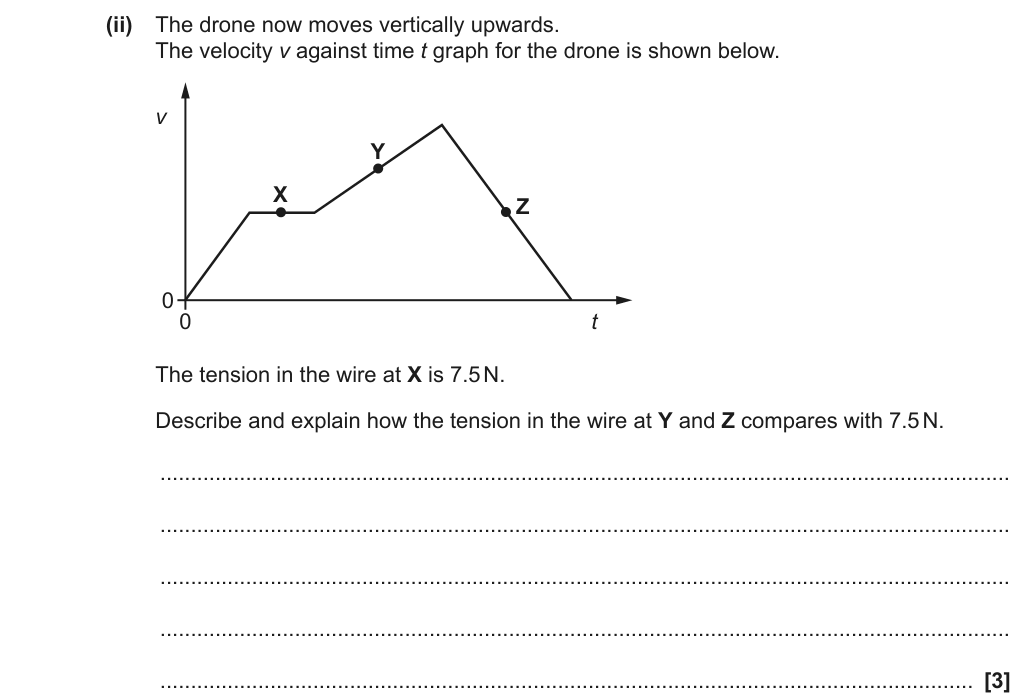
ignore 'downward acceleration' at Z
ignore drag throughout
Skills: M3.1 Translate information between graphical, numerical and algebraic forms
November 2020 · AS Paper 2 · Q5(d)3 marksCalculation
Earlier parts of question 5 that this part uses
Mark scheme
Notes from the mark scheme and report
no ecf for incorrect time
ignore sign
Skills: M2.3 Substitute numerical values into algebraic equations using appropriate units for physical quantities; M3.1 Translate information between graphical, numerical and algebraic forms
November 2020 · AS Paper 2 · Q6(a)3 marksCalculationMedium
Mark scheme
Examiner's comment
In Question 6 (a), most candidates answered this well although a significant minority confused the calculation of the volume.
Notes from the mark scheme and report
2200 scores two marks
Skills: M0.1 Recognise and make use of appropriate units in calculations; M2.3 Substitute numerical values into algebraic equations using appropriate units for physical quantities; M4.3 Calculate areas of triangles, circumferences and areas of circles, surface areas and volumes of rectangular blocks, cylinders and spheres
November 2020 · Paper 3 · Q1(a)(ii)2 marksDiagram or graphMedium
Earlier part of question 1 that this part uses
Mark scheme
Examiner's comment
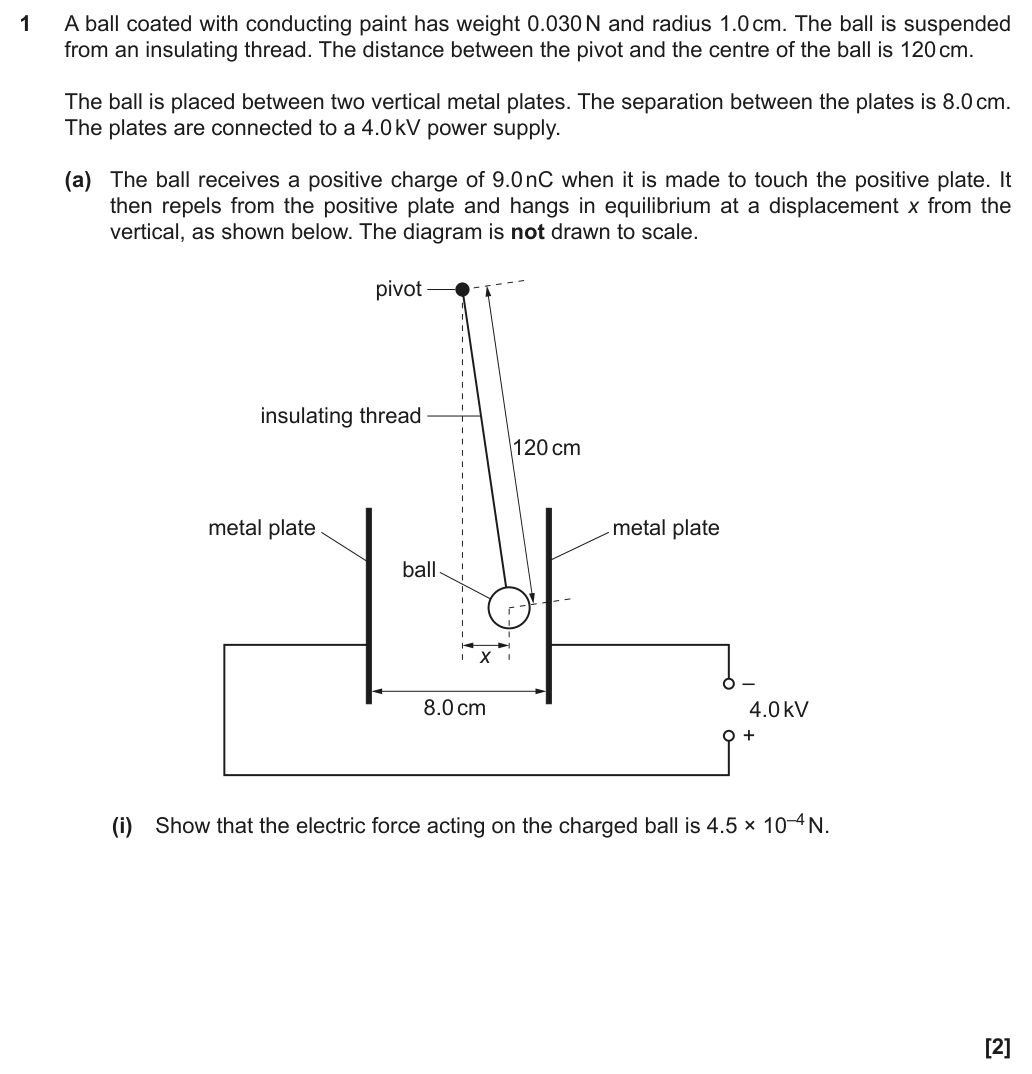
Comments on individual questions Question 1ai Many lower ability candidates did not appreciate the uniform nature of the electric field between the plates and attempted to use Coulomb’s Law. Question 1aii Most candidates scored a mark for showing the weight and tension forces accurately. AfL Do not use the word ‘gravity’ in place of ‘weight’ Question 1aiii Although most candidates knew the principle of moments, many were unable to apply it correctly in this situation. Question 1b The purpose of this question was to challenge the candidates to use their knowledge of electric fields in a novel practical situation.
Notes from the mark scheme and report
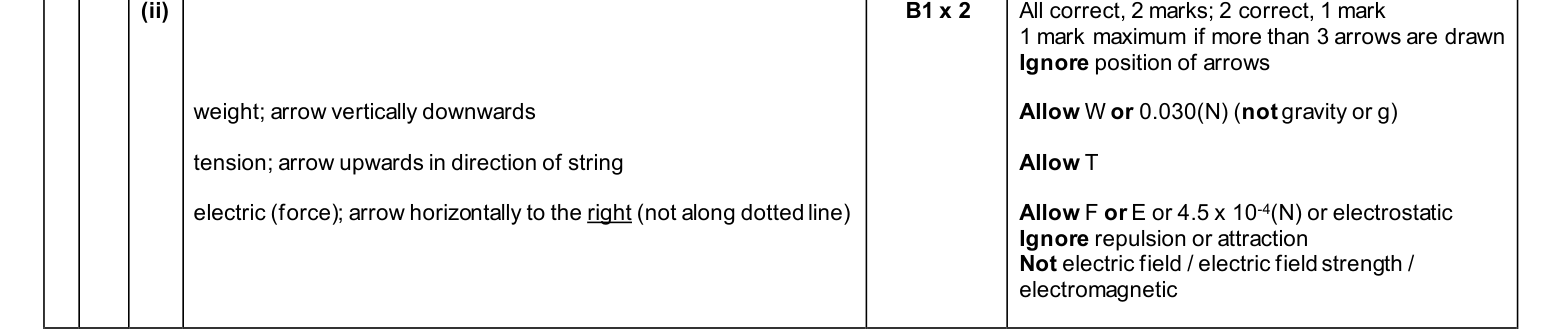
weight (NOT gravity or g), tension, electric force (NOT electric field / field strength)
electric force horizontal to the right
1 mark max if more than 3 arrows
November 2020 · Paper 3 · Q4(a)1 markExplanationMedium
Mark scheme
Examiner's comment
Question 4a Misconception Experiencing weightlessness is not the same as being in freefall There was a lack of understanding of the nature of feeling weightless. Question 4bi The simplest method here was to use the fact that g is inversely proportional to r2, so gr2 = constant. Question 4c The success in this question depended on understanding the meaning of the term m in the formula 2mc2 തതത = 3 2 kT given in the Data, Formulae and Relationship booklet. Question 4d Although this question looked daunting, it was actually quite linear and many candidates who attempted it were able to gain two or three marks even if they did not eventually get to the correct response.
Notes from the mark scheme and report
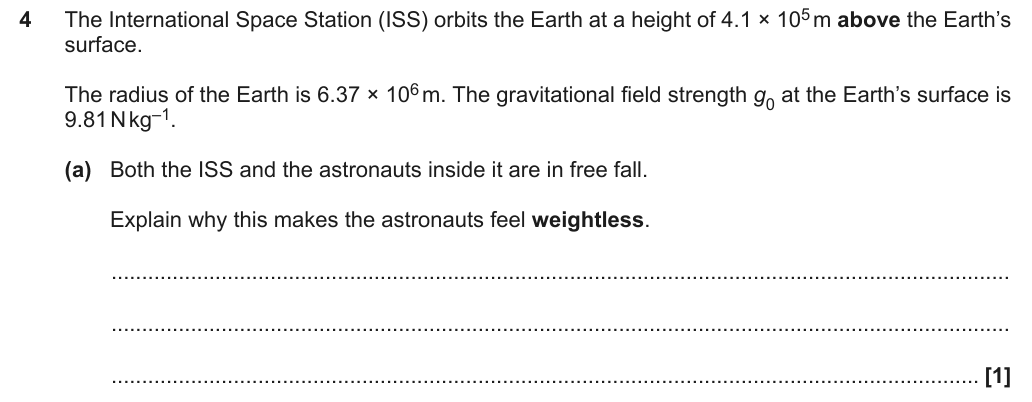
no contact force between astronaut and space station
allow same acceleration towards Earth
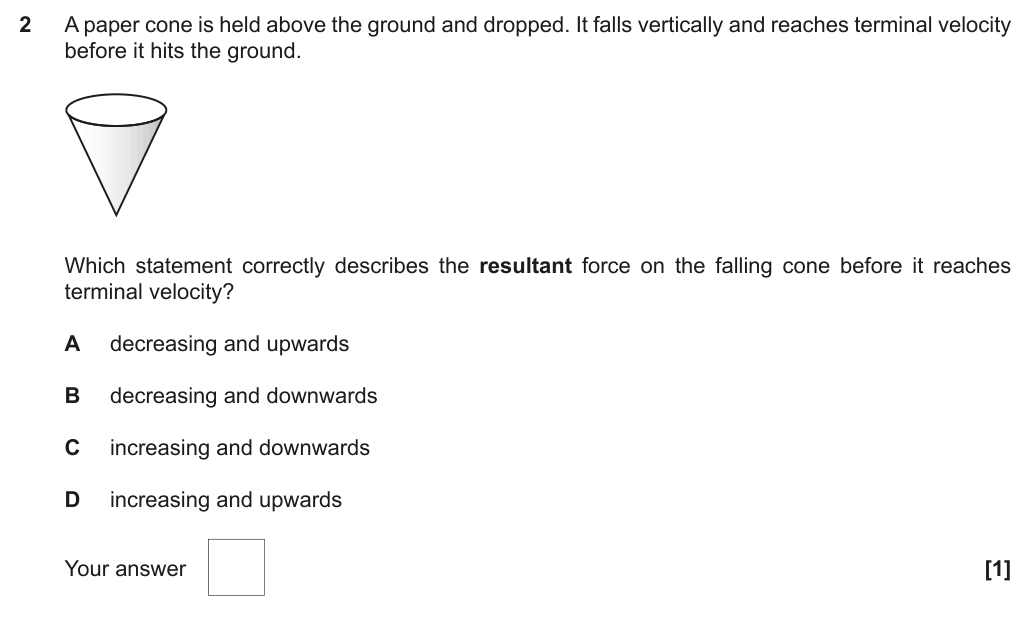
June 2019 · Paper 1 · Q21 markMultiple choiceMedium
Answer
B
Mark scheme
Examiner's comment
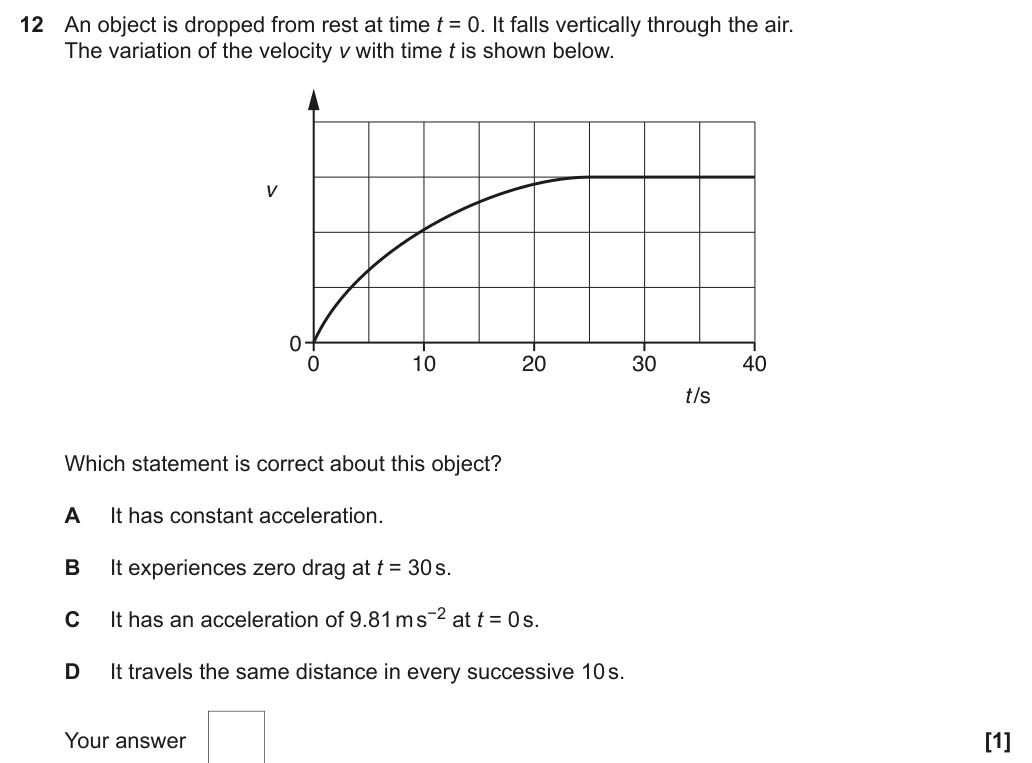
Before the cone reaches terminal velocity, it is still accelerating downwards so there is still a resultant force downwards. Once the cone is at terminal velocity, the resultant force must be zero. This means that the resultant force has decreased, giving the correct answer B.
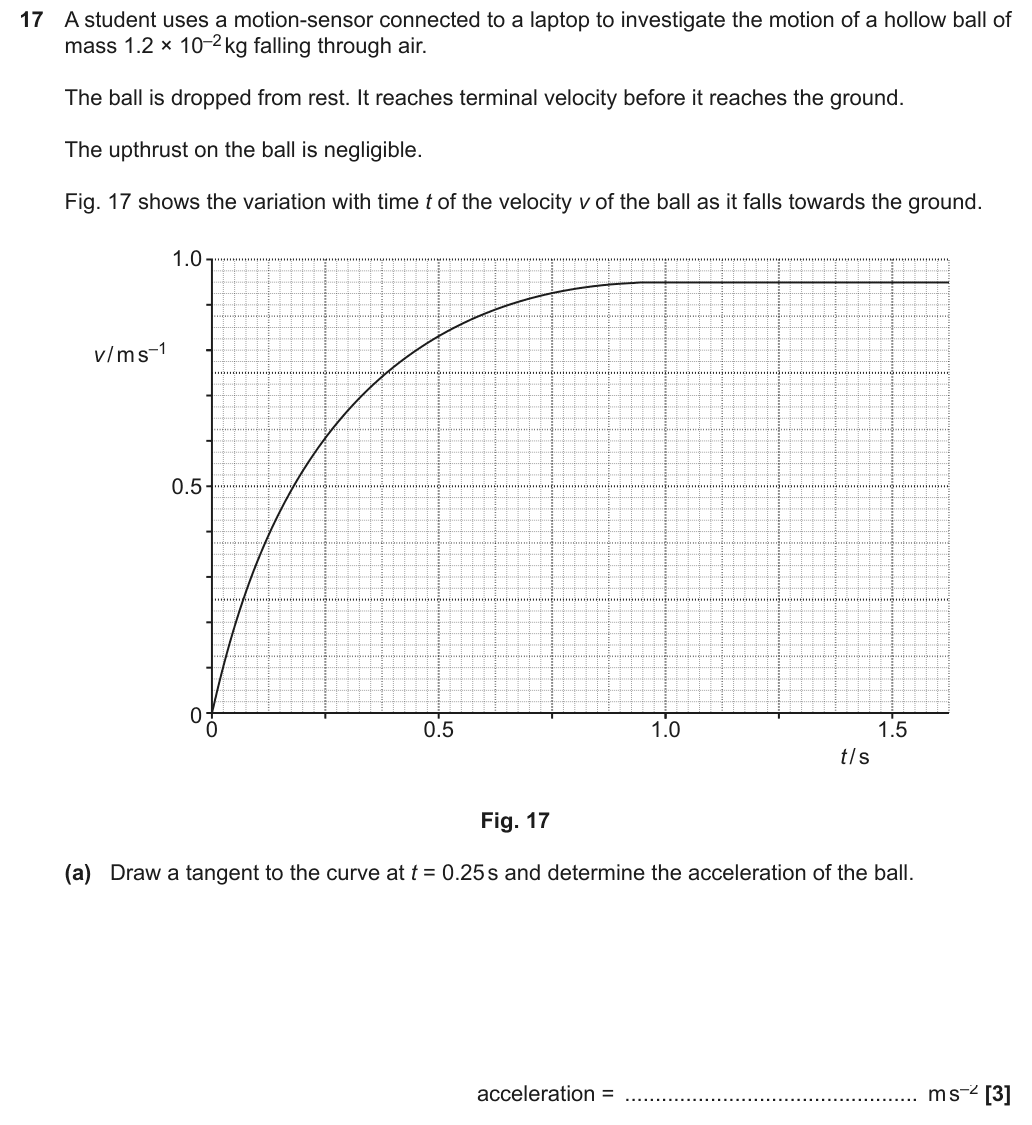
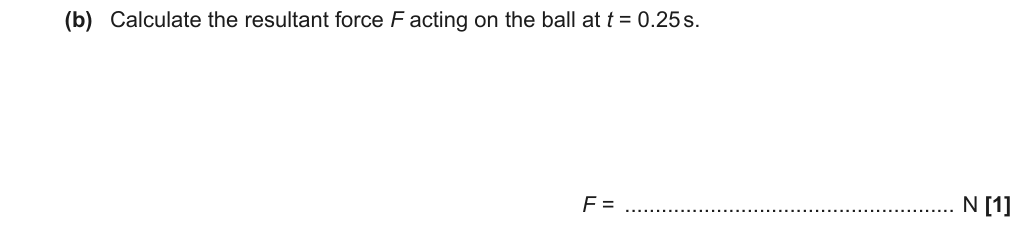
June 2019 · Paper 1 · Q17(b)1 markCalculation
Earlier part of question 17 that this part uses
Mark scheme
Notes from the mark scheme and report
ecf from (a)
Skills: M2.3 Substitute numerical values into algebraic equations using appropriate units for physical quantities
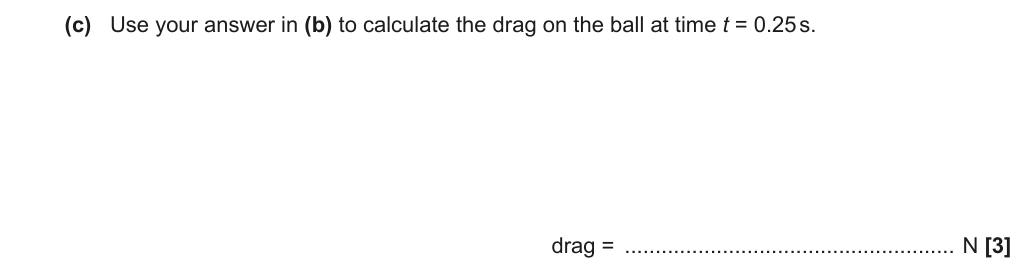
June 2019 · Paper 1 · Q17(c)3 marksCalculationEasy
Earlier parts of question 17 that this part uses
Mark scheme
Examiner's comment
Most candidates correctly calculated the ball’s weight. They had calculated the resultant force on the ball, using F = ma. The resultant force from the previous question was checked, as error carried forward rules applied. Exemplar 3 shows an excellent way of planning out how to answer this sort of question. This candidate has drawn a free-body force diagram to make their intention clear. From it, they know that the resultant force must equal the weight minus the drag. From there they have found the drag force.
Notes from the mark scheme and report
ecf from (b)
allow 0.1
Skills: M2.2 Change the subject of an equation, including non-linear equations; M2.3 Substitute numerical values into algebraic equations using appropriate units for physical quantities
June 2019 · Paper 1 · Q17(d)(i)2 marksExplanationMedium
Earlier part of question 17 that this part uses
Mark scheme
Examiner's comment
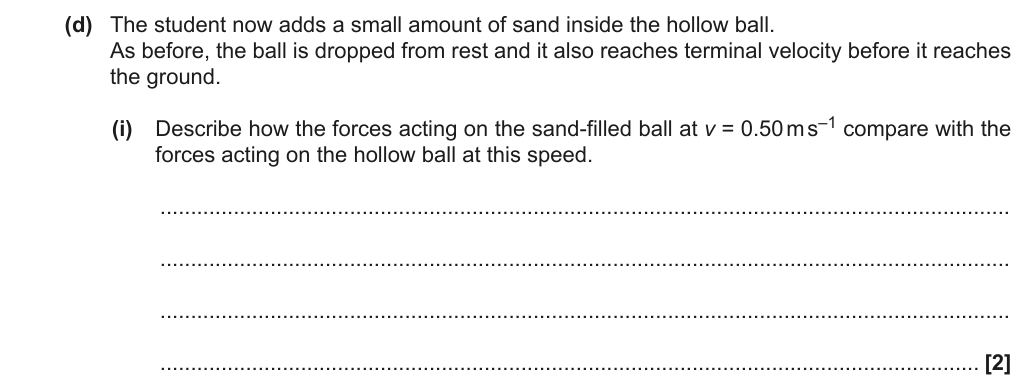
Lots of candidates described the familiar ideas involving drag increasing with speed until the drag equals the weight’s magnitude. The question was constructed to be simpler than this and asks to compare the forces on the 2 balls at a given speed. The weight of the sand-filled ball is larger. The 2 balls are identical in shape so at the same speed will have the same drag force. Know what is coming! Reading through to the end of the whole question is sensible. The answer candidates gave for Question 17(d)(i) would have formed part of the answer for Question 17(d)(ii), so valuable time can be saved by planning your answers for each part.
Notes from the mark scheme and report
drag is the same at the same speed
weight (or resultant force) is greater
June 2019 · Paper 1 · Q17(d)(ii)2 marksExplanationHard
Earlier parts of question 17 that this part uses
Mark scheme
Examiner's comment
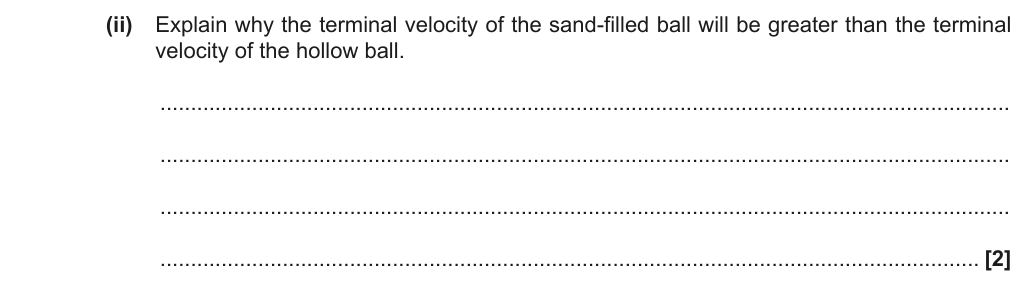
The first mark here was for the knowing that the condition for terminal velocity was required, linked to the idea of the sand-filled ball having a larger weight. The second mark was more difficult to achieve, since a clear link between increased speed and increase drag was required.
Notes from the mark scheme and report
weight = drag at terminal velocity and weight greater
greater speed gives greater drag
June 2019 · Paper 1 · Q20(c)2 marksDiagram or graphMedium
Earlier part of question 20 that this part uses
Mark scheme
Examiner's comment
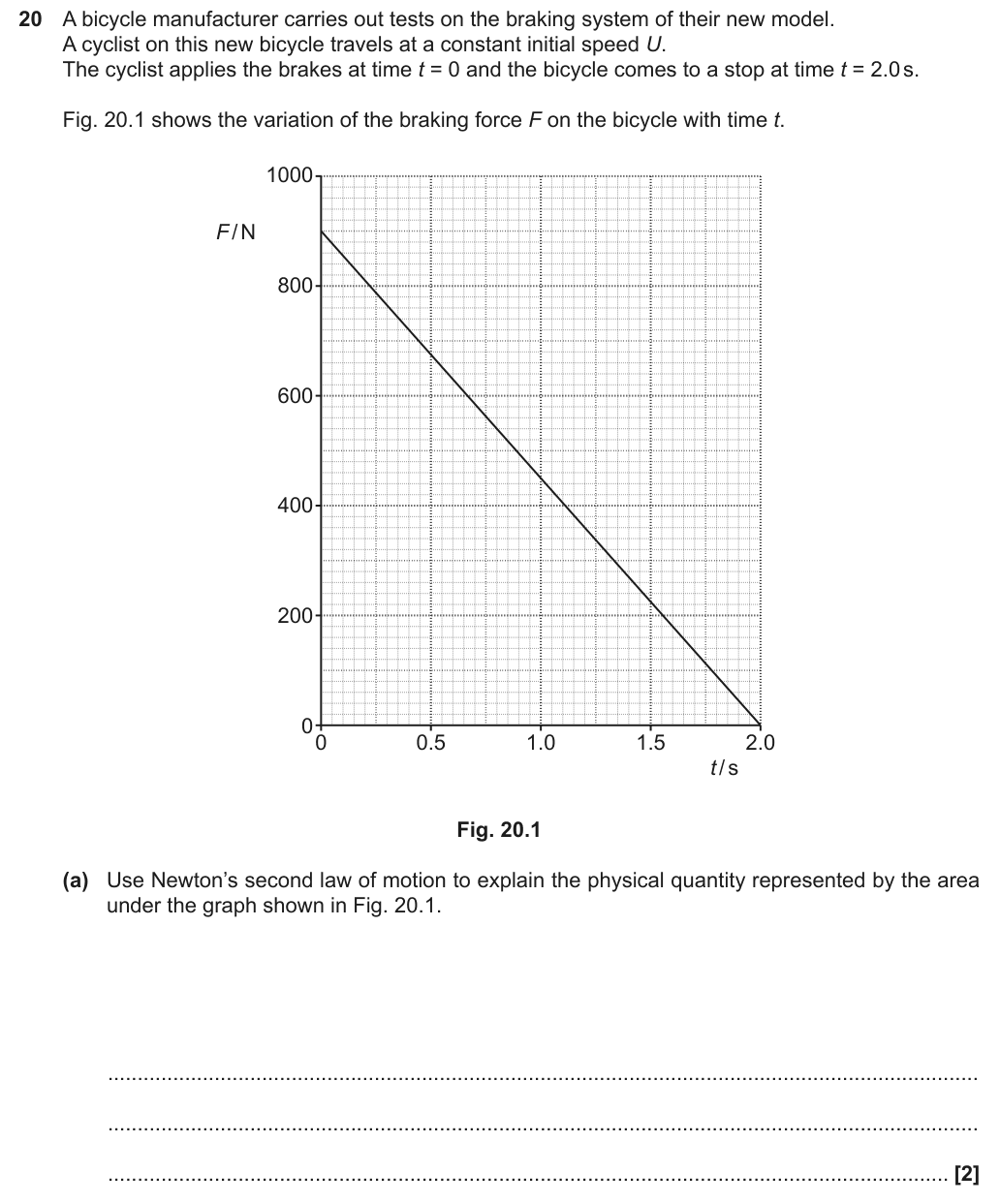
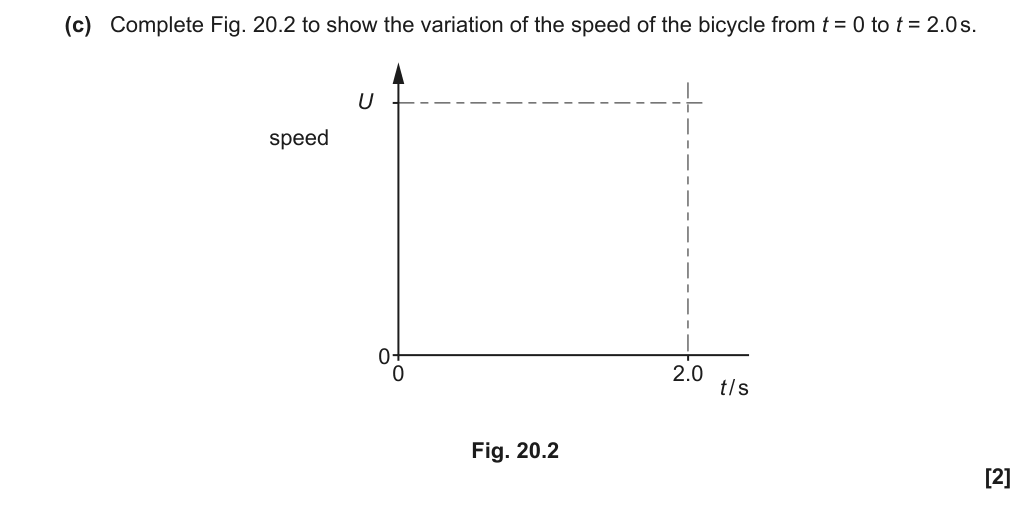
Successful candidates spotted that the resultant force, the acceleration and hence the gradient of this speed- time graph decreased in magnitude with time. A constant gradient, ie a straight line between (0,U) and (2.0,0), can only be achieved by a constant decelerating resultant force. This gives a curve that starts off (0,U) with a steep negative gradient and finishes with a small negative gradient at (2.0,0).
Notes from the mark scheme and report
curve from (0, U) to (2.0, 0) with continuously decreasing magnitude of gradient
must not be asymptotic at either end
Skills: M3.1 Translate information between graphical, numerical and algebraic forms; M3.12 Sketch relationships which are modelled by y = k/x, y = kx², y = k/x², y = kx, y = sin x, y = cos x, y = e^(±x) and y = sin²x, y = cos²x as applied to physical relationships
June 2019 · AS Paper 1 · Q21(c)(ii)2 marksCalculationMedium
Earlier part of question 21 that this part uses
Mark scheme
Examiner's comment
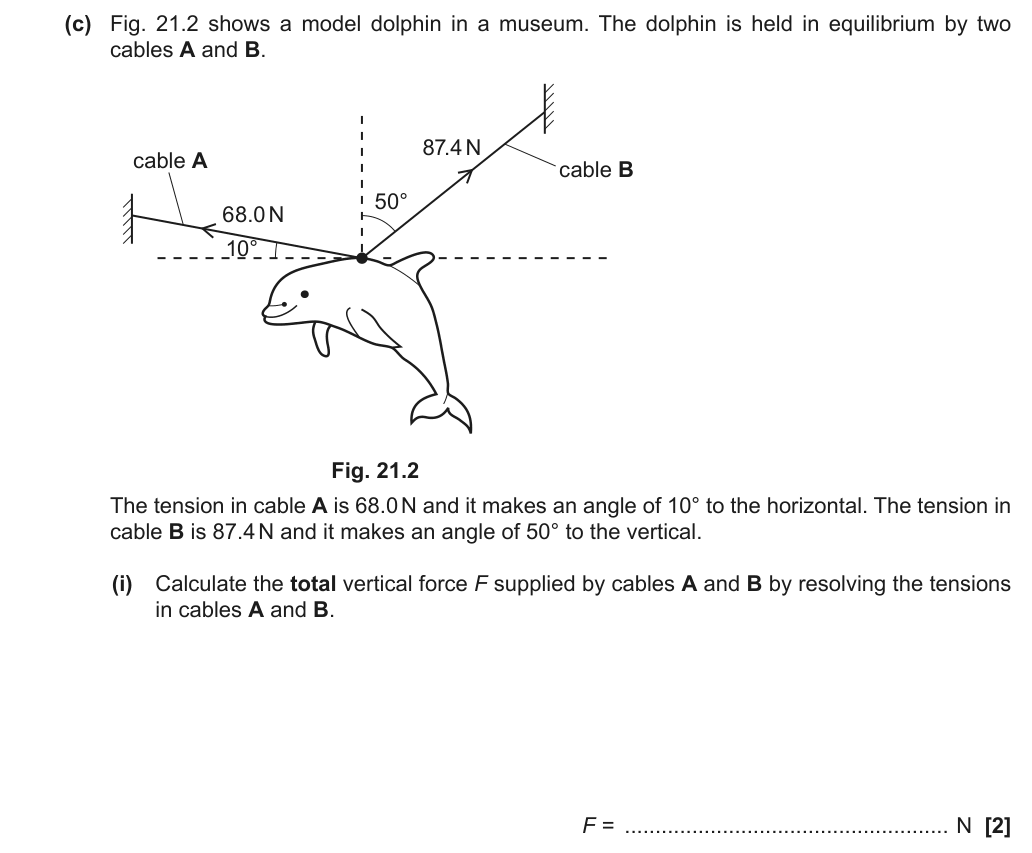
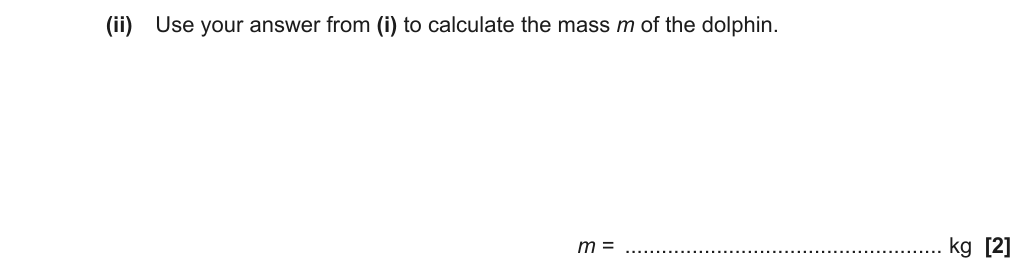
Almost all candidates correctly used W = mg to determine the mass of the dolphin. Full marks were frequently picked up because of error carried forward (ECF) from (c)(i). There were very few cases of g = 10 m s-2 being used; this was penalised because g = 9.81 m s-2 is given in the Data, Formulae and Relationship Booklet.
Notes from the mark scheme and report
ecf from (c)(i)
NOT g = 10 (first C1 only)
Skills: M2.2 Change the subject of an equation, including non-linear equations
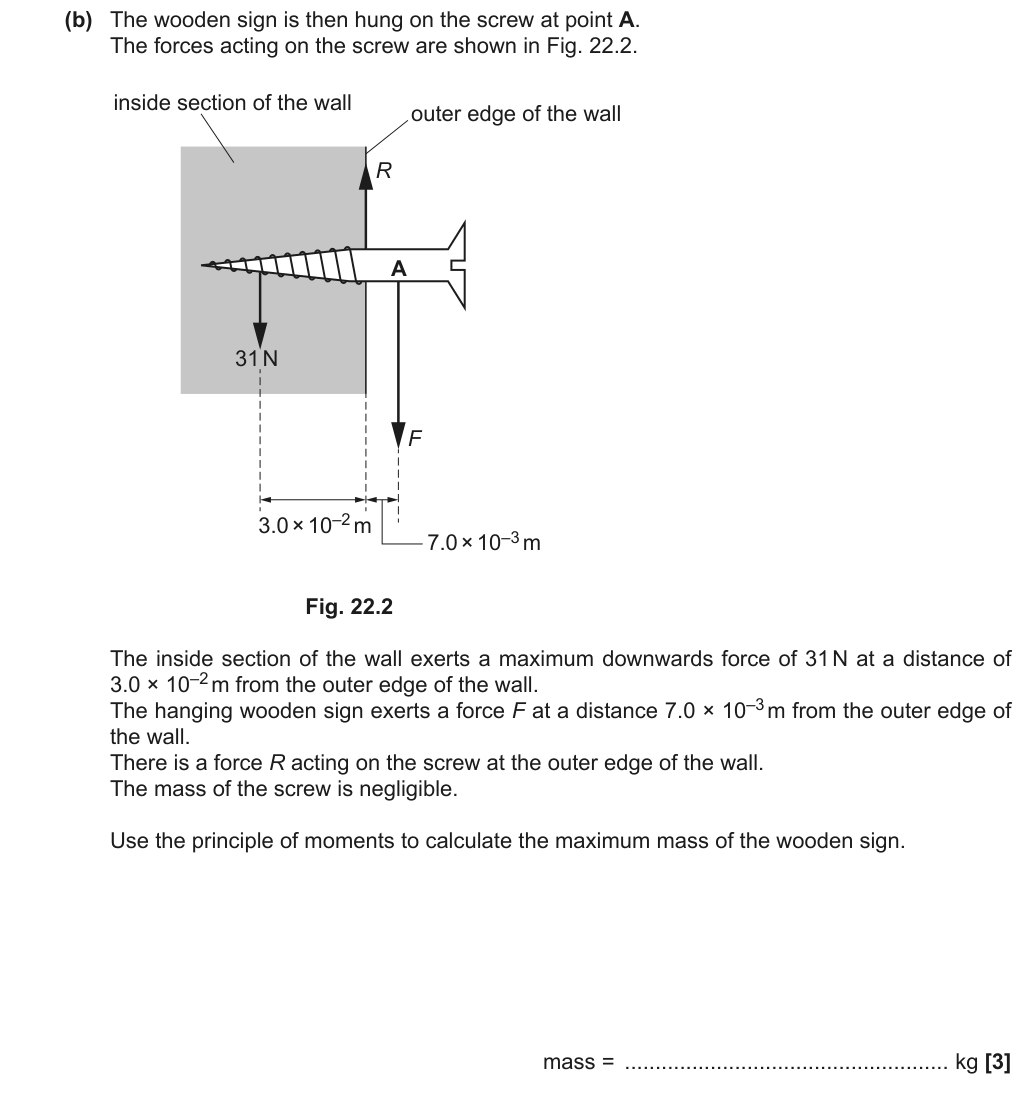
June 2019 · Paper 1 · Q22(b)3 marksCalculation
Mark scheme
Notes from the mark scheme and report
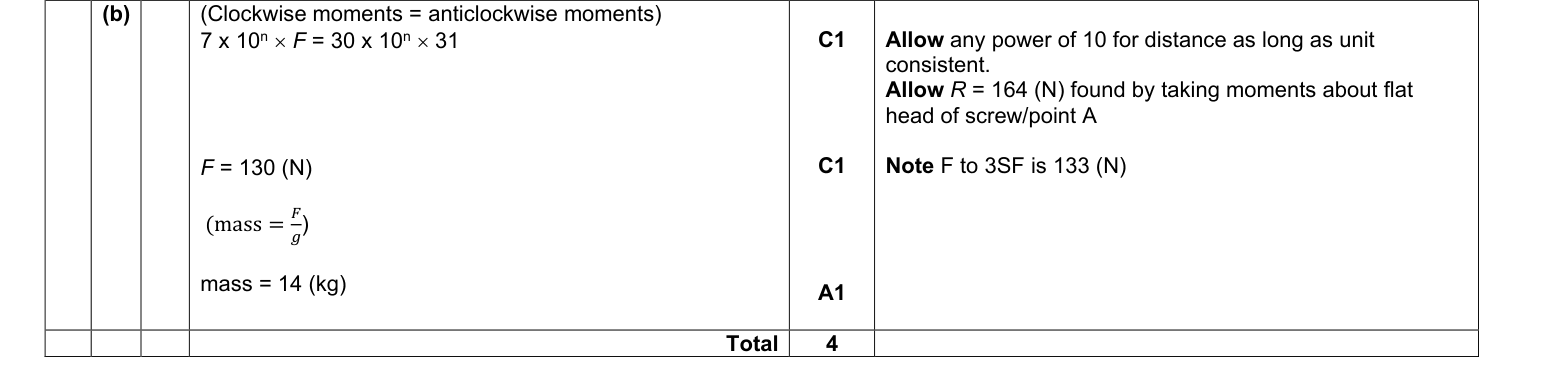
any power of ten for distance if consistent
F = 133 N
Skills: M2.3 Substitute numerical values into algebraic equations using appropriate units for physical quantities; M2.4 Solve algebraic equations, including quadratic equations
June 2019 · AS Paper 2 · Q1(c)2 marksExplanationHard
Earlier part of question 1 that this part uses
Mark scheme
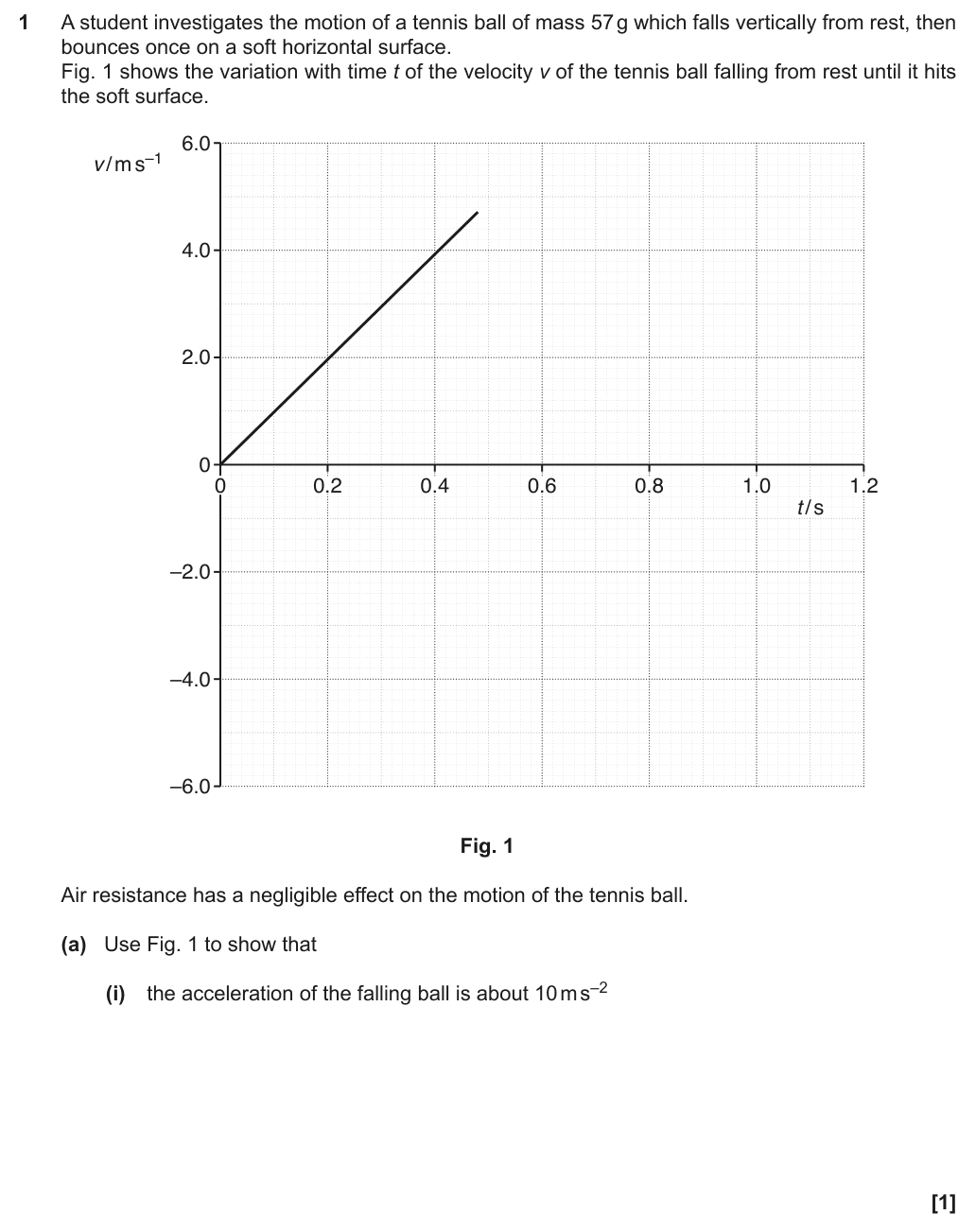
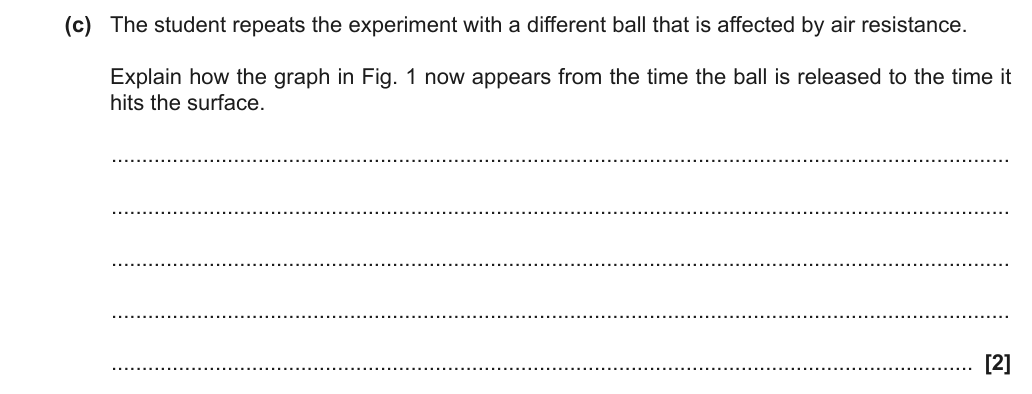
Examiner's comment
Candidates found this question challenging. Many candidates answered the question in terms of air resistance and terminal velocity. The question required candidates to explain how the graph would appear. Several candidates stated that the gradient would be smaller but did not clearly state that the gradient would decrease over time and not indicate that the line would curve. Candidates needed to also indicate that the line would indicate a lower maximum velocity at a longer time.
Notes from the mark scheme and report
NOT gradient is smaller / less steep / shallower (gradient must decrease with time)
Skills: M3.1 Translate information between graphical, numerical and algebraic forms
June 2019 · AS Paper 2 · Q2(b)3 marksCalculationHard
Mark scheme
Examiner's comment
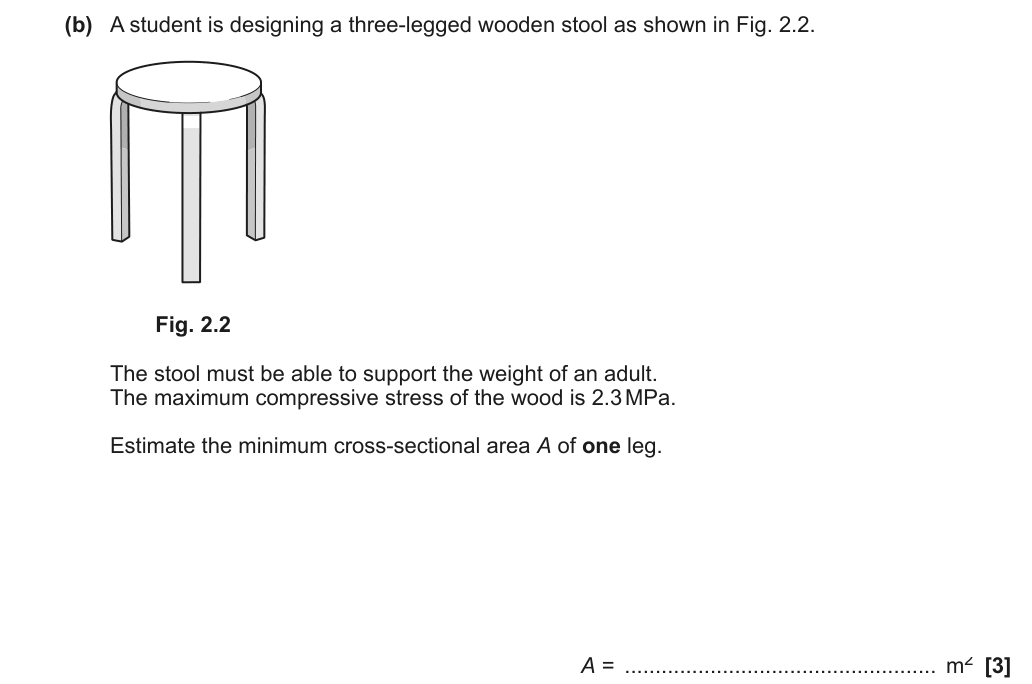
A good proportion of the candidates scored full marks on this question. Some candidates found the total area rather than the area of one leg. A few candidates assumed that the stool had four legs. This question required candidates to estimate the mass or weight of an adult. In general, in this type of question a more generous mass is sensible. Candidates who did well on this question started by stating the mass (or weight) of an adult. Examiners allowed a mass between 50 kg and 150 kg. Candidates then often worked out the total area before working out the area of one of the legs. Some candidates did not correctly understand that 2.3 MPa was equal to 2.3 × 10⁶ Pa. Some candidates incorrectly divided the stress by three. This candidate has clearly identified the average weight of an adult and then indicated how the weight of the adult is determined. The candidate has then clearly stated the equation for stress and shown their working for full marks.
Notes from the mark scheme and report
adult mass 50 kg to 150 kg
weight shared by three legs
allow g = 10
allow 1 sf
ecf for incorrect weight
Skills: M0.1 Recognise and make use of appropriate units in calculations; M0.4 Estimate results; M2.2 Change the subject of an equation, including non-linear equations
June 2019 · AS Paper 2 · Q3(b)3 marksCalculationMedium
Mark scheme
Examiner's comment
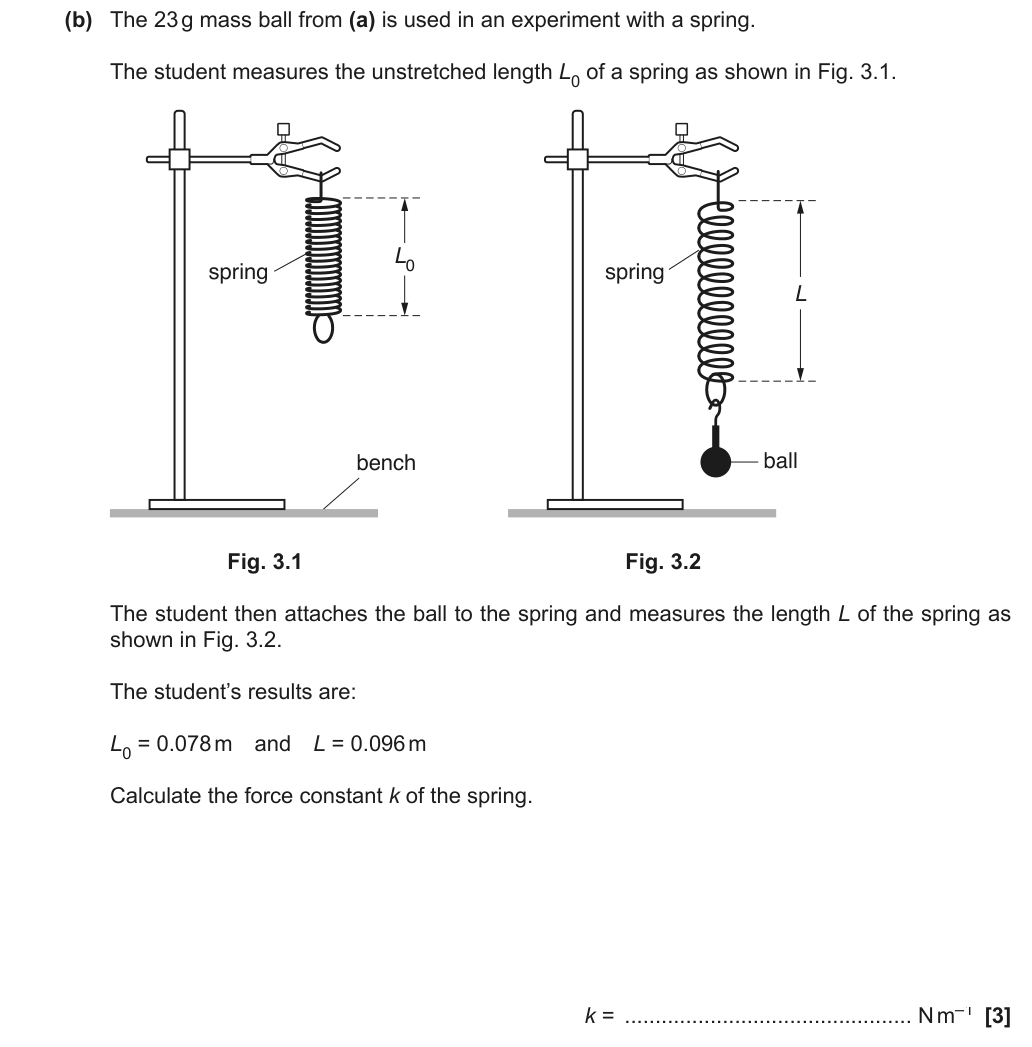
The majority of the candidates clearly showed their working and calculated the force constant correctly. Some incorrectly used the energy stored equation.
Notes from the mark scheme and report
allow 12.6 or 12.5
Skills: M0.1 Recognise and make use of appropriate units in calculations; M2.3 Substitute numerical values into algebraic equations using appropriate units for physical quantities; PAG2 Investigating properties of materials
June 2019 · Paper 3 · Q1(c)(ii)3 marksCalculationHard
Earlier parts of question 1 that this part uses
Mark scheme
Examiner's comment
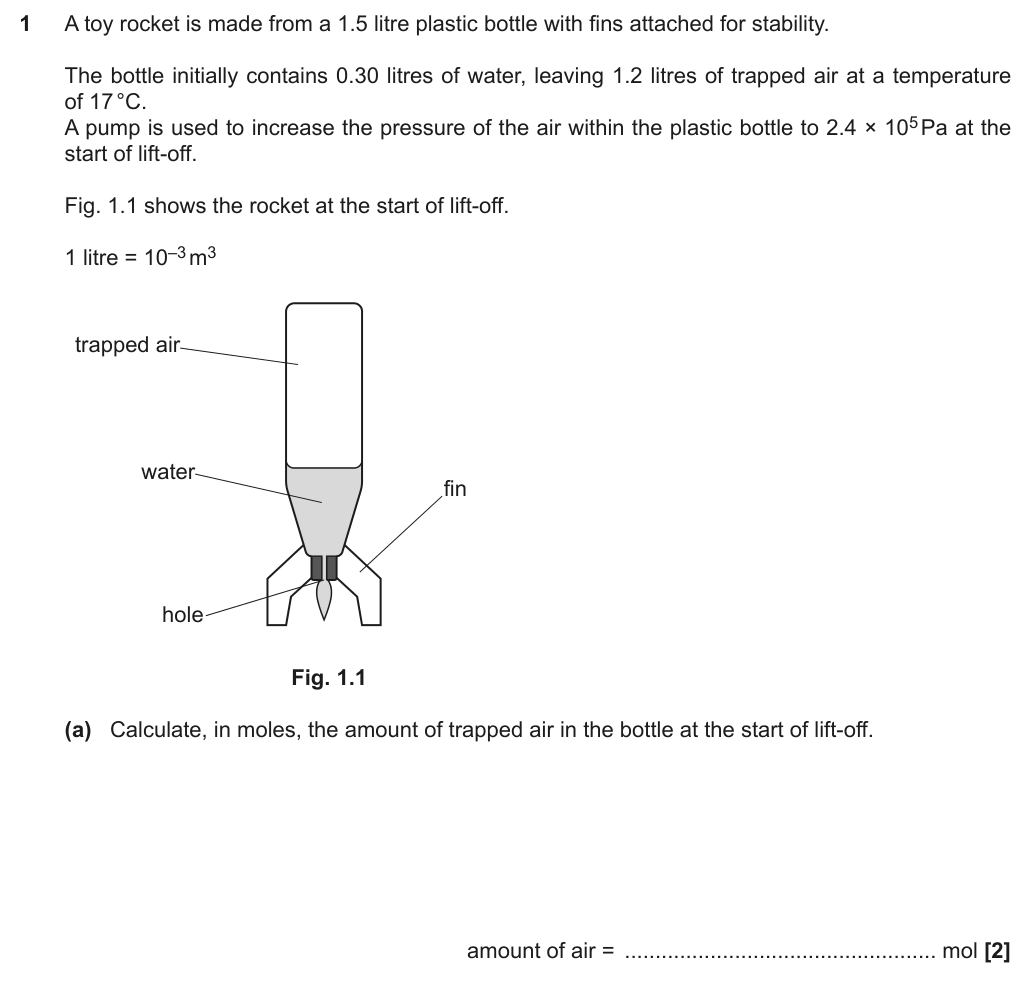
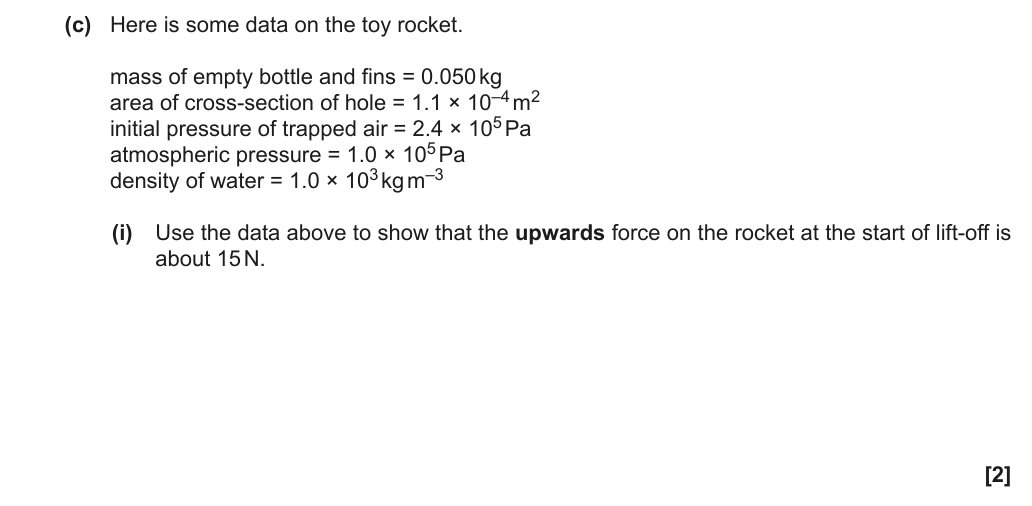
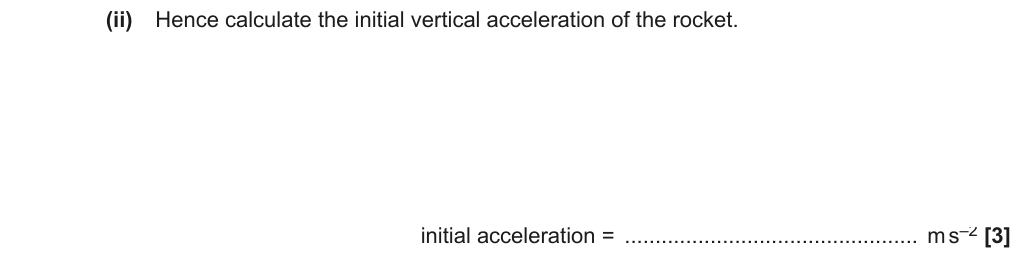
This question, although a simple F = ma problem, challenged many candidates. Common problems in 1(c)(ii) • using incorrect mass (either mass of bottle alone = 0.05kg, or mass of water alone = 0.3kg, or POT errors) • using upwards force from 1(c)(i) rather than resultant force in the formula F = ma. been used, but the value for the upwards force (15.4N) rather than the resultant force (15.4 – mg) has been used for F.
Notes from the mark scheme and report
mass must include the 0.30 kg of water
weight must be subtracted
no ecf from (c)(i)
Skills: M0.1 Recognise and make use of appropriate units in calculations; M2.2 Change the subject of an equation, including non-linear equations; M2.3 Substitute numerical values into algebraic equations using appropriate units for physical quantities
June 2019 · Paper 3 · Q1(d)3 marksExplanationMedium
Earlier parts of question 1 that this part uses
Mark scheme
Examiner's comment
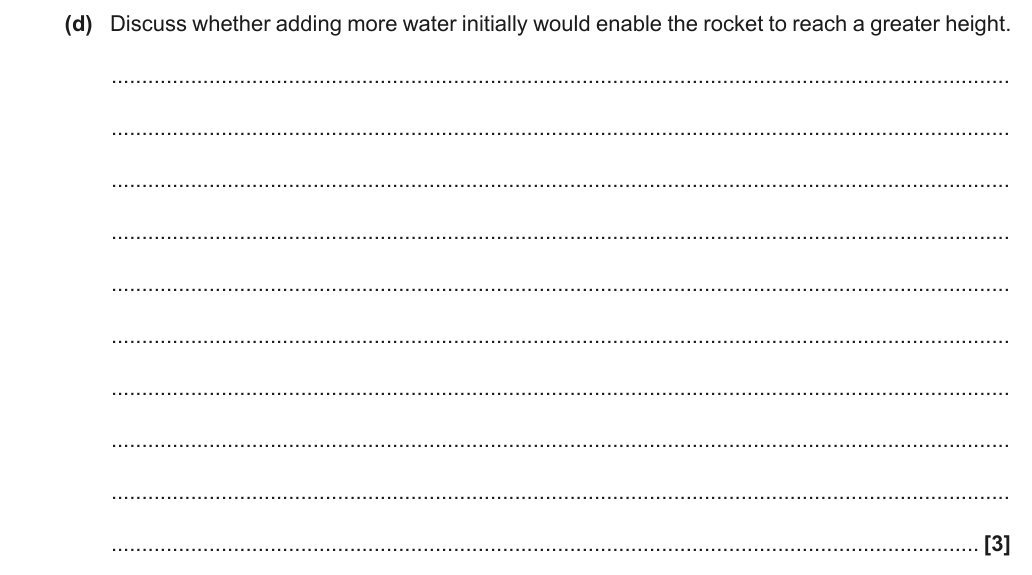
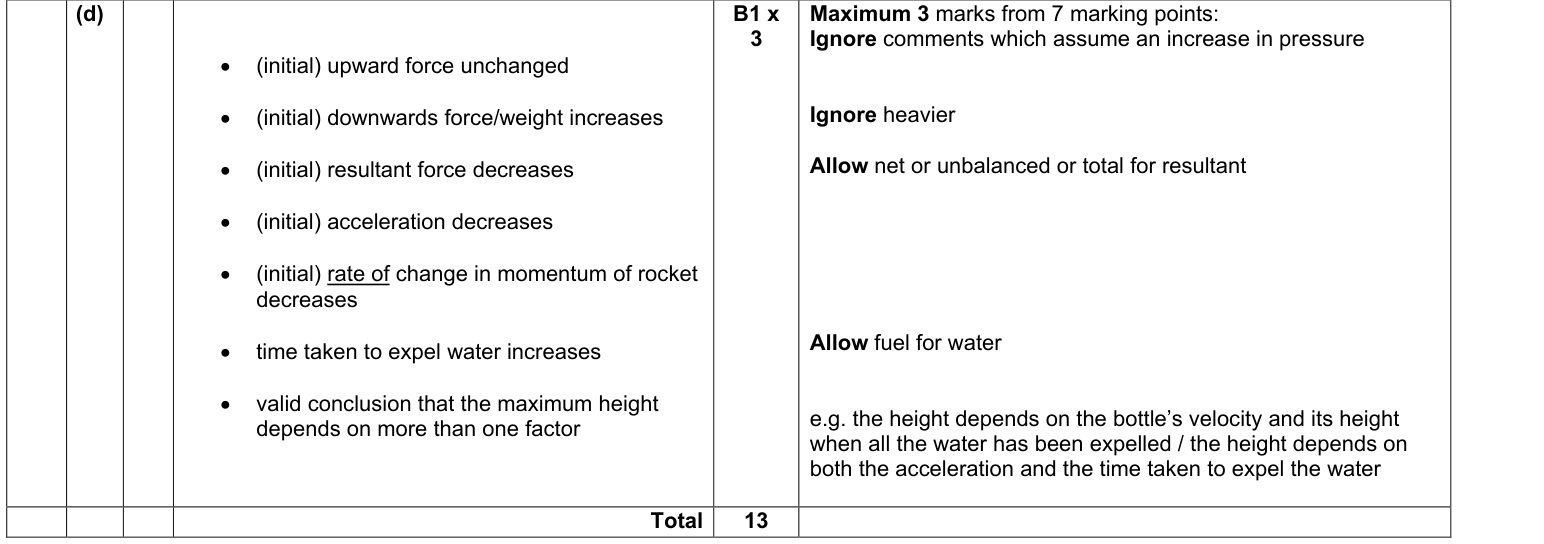
This question involved several factors and a conclusion was not required; hence the word ‘discuss’. Candidates who performed well on this question realised that the weight of the rocket would increase, reducing the resultant force, and m would increase in the formula F = ma. These would both give a reduced initial acceleration and imply a smaller height. However, the time taken to expel the water would increase, meaning that the rocket would accelerate for longer. One common misconception was that the larger volume of water in the bottle would increase the pressure of the trapped air. However, as a pump was used to determine the pressure before lift-off, this argument was not given credit.
Notes from the mark scheme and report
ignore heavier
ignore comments which assume an increase in pressure
max 3 from 7 points
June 2019 · Paper 3 · Q4(a)3 marksCalculationEasy
Mark scheme
Examiner's comment
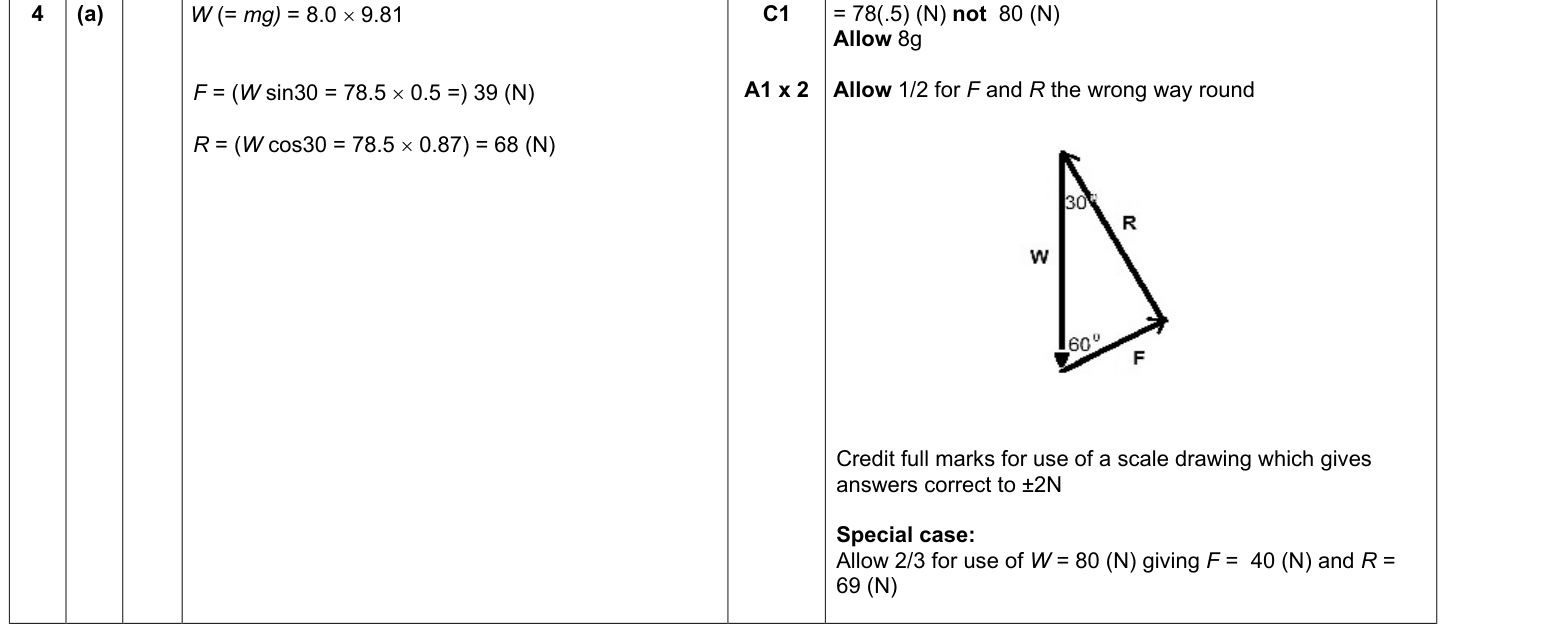
Most candidates were able to answer this question easily, although a few got their answers for F and R the wrong way around.
Notes from the mark scheme and report
F and R the wrong way round scores 1 mark
W = 80 N scores 2 max
Skills: M0.6 Use calculators to handle sin x, cos x and tan x when x is expressed in degrees or radians; M4.5 Use sin, cos and tan in physical problems
June 2019 · Paper 3 · Q4(b)(ii)4 marksExplanationMedium
Earlier parts of question 4 that this part uses
Mark scheme
Examiner's comment
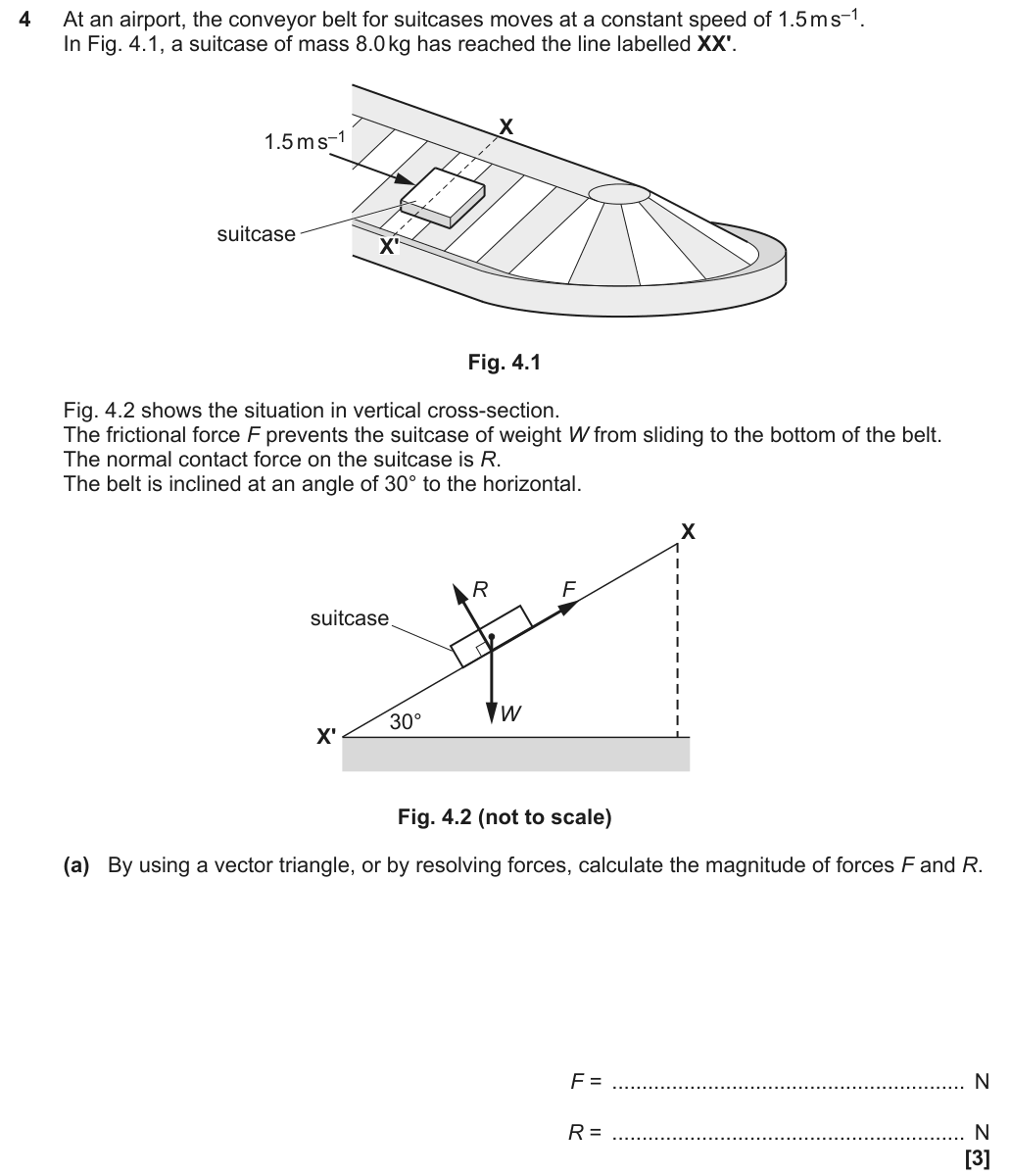
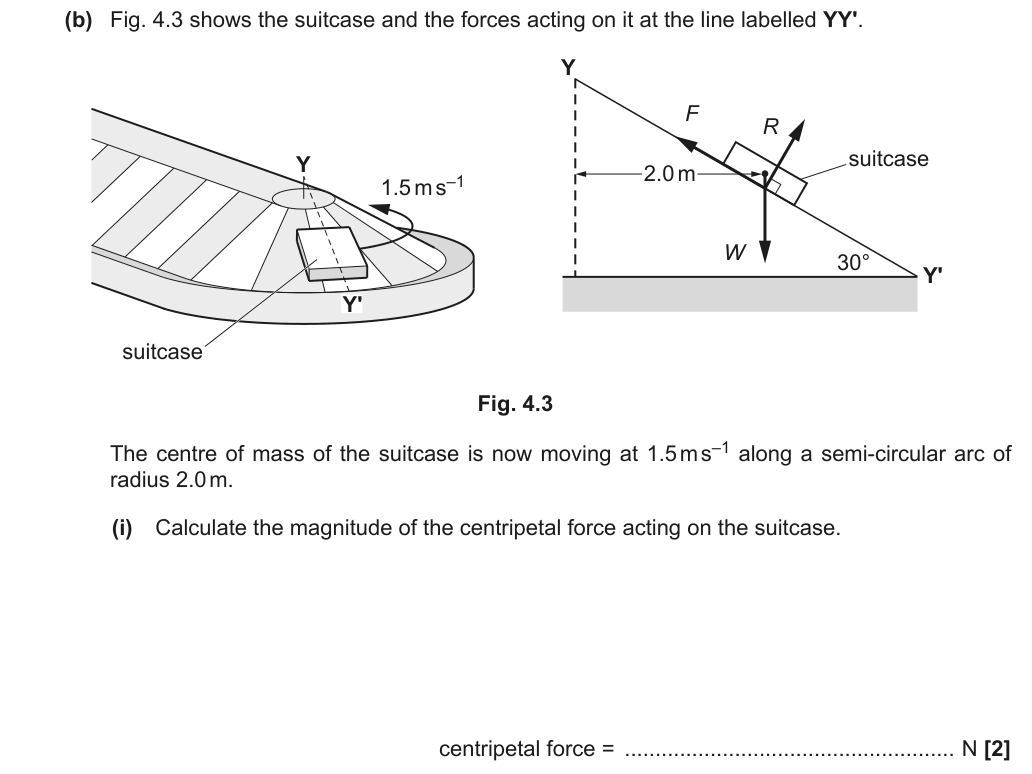
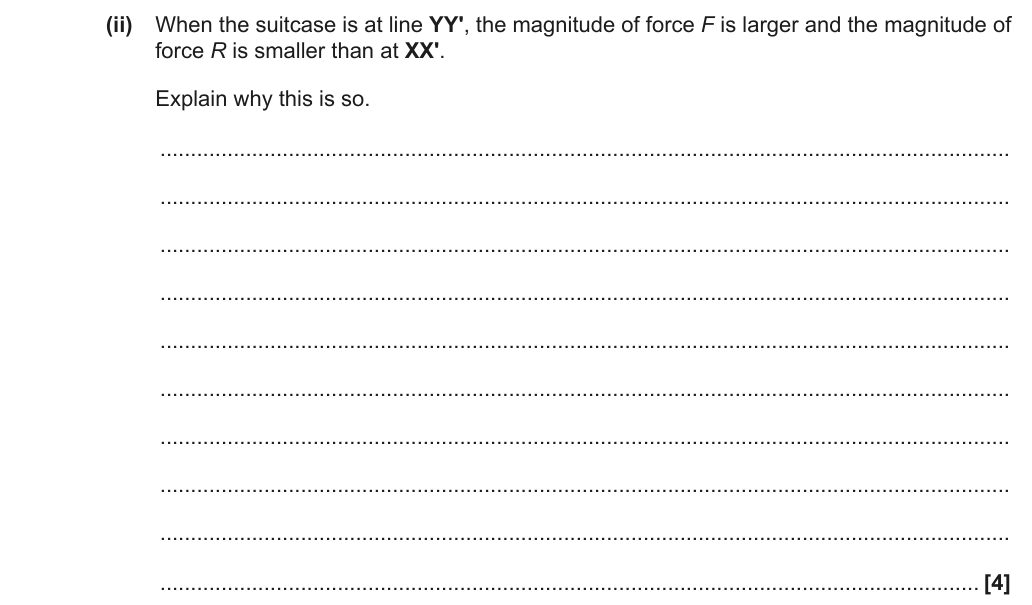
Question 4(b)(ii) proved very difficult and highlighted poor understanding of circular motion. Almost all candidates described the centripetal force as an additional force that had appeared out of nowhere. This centripetal force ‘pulled the suitcase inwards’ (or, in some cases, outwards) or ‘balanced the frictional force’ or ‘added to the frictional force’ and so on. The candidate who gave the response in Exemplar 5 clearly thinks that an additional force, called the centripetal force, now acts on the suitcase. The forces F and R have to adjust in order to keep the suitcase in equilibrium. They have not realised that the suitcase is no longer in equilibrium horizontally but is accelerating. This means that the available forces have to adjust in order to provide a resultant force towards the centre of the circle, while still balancing vertically. In contrast, the candidate who wrote the response in Exemplar 6 has a much better grasp of the situation.
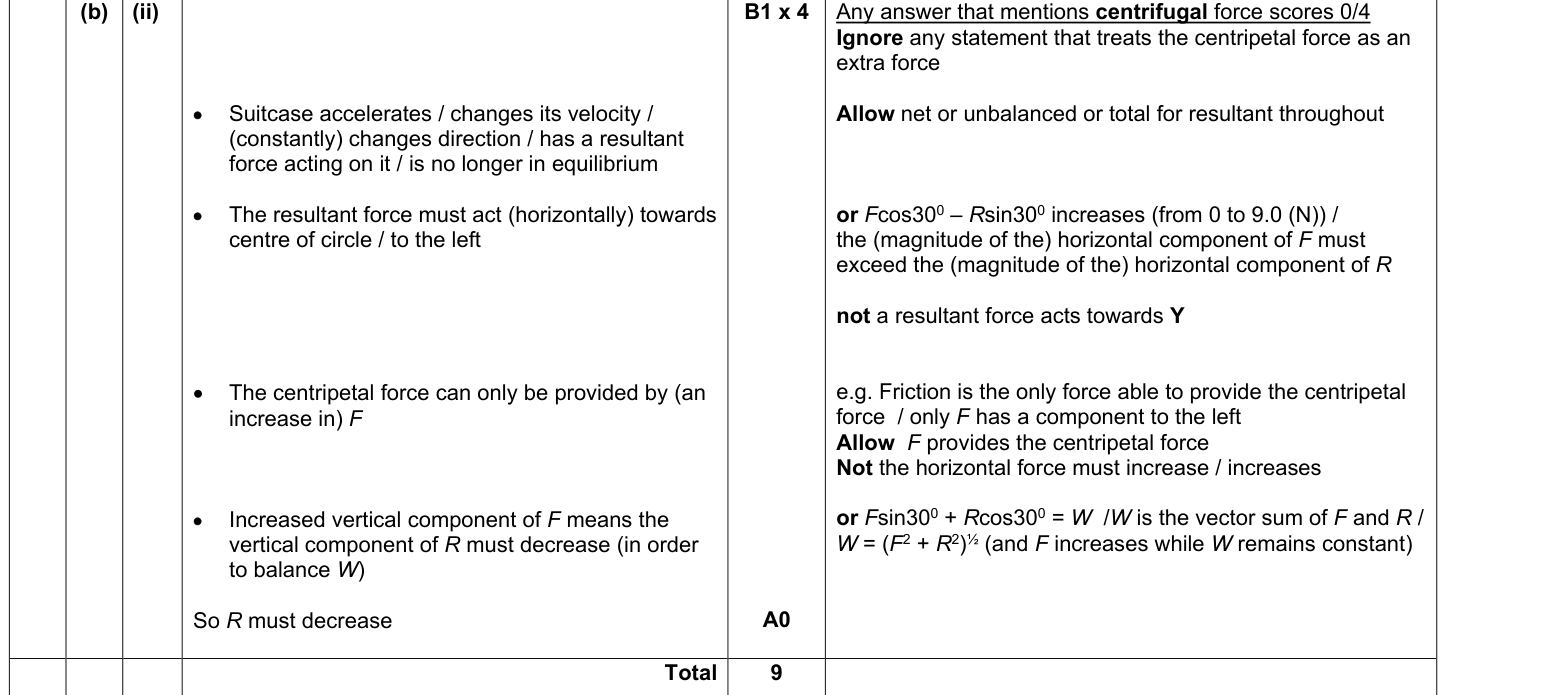
Notes from the mark scheme and report
any answer that mentions centrifugal force scores 0
ignore centripetal force treated as an extra force
NOT a resultant force towards Y
Rather than using the phrase ‘centripetal force’, candidates could be encouraged to think of motion in a circle as a special case of F = ma where the resultant force F points towards the centre of the circle and the acceleration a is given by v2/r. This should hopefully encourage them to think about which of the forces available in the situation could provide the resultant force for this motion to occur.
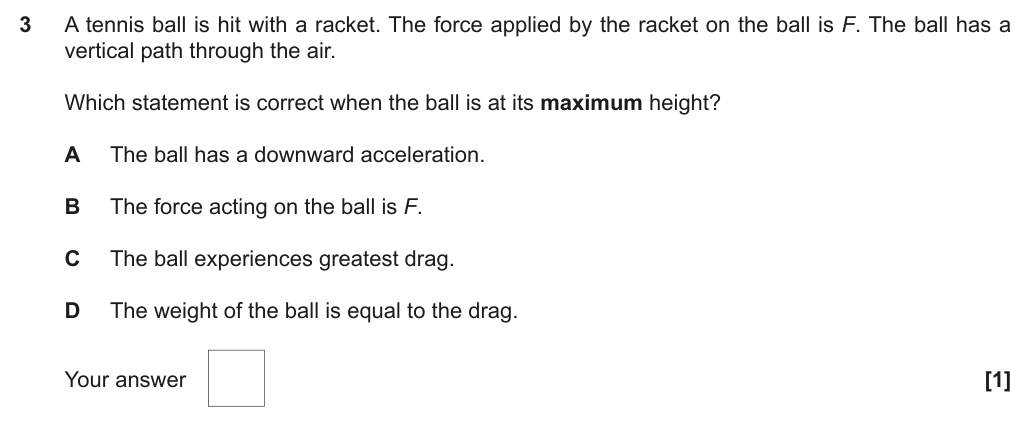
June 2018 · AS Paper 1 · Q31 markMultiple choiceMedium
Answer
B
Mark scheme
Examiner's comment
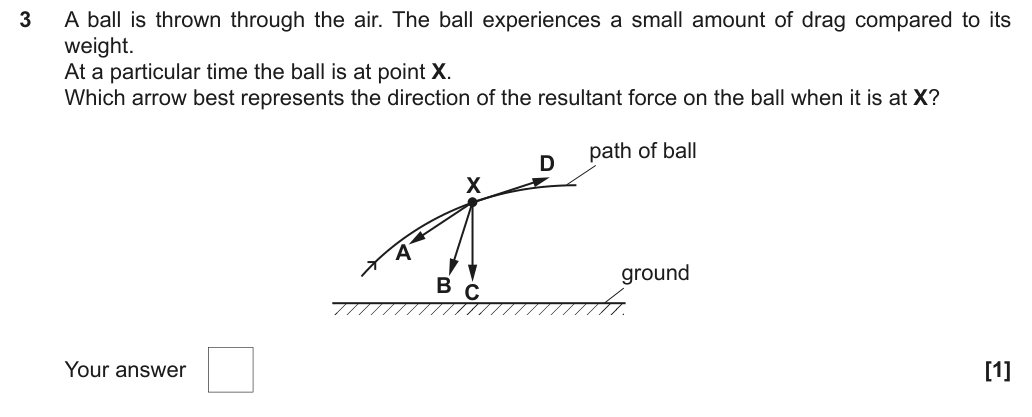
The question requires knowledge and understanding of the forces acting on the ball in flight and resultant force. The path of the ball is shown. At X, the ball is travelling in the direction shown by the D arrow. The drag force will be in the opposite direction. Weight is other force acting on the ball – vertically downwards. Vectorially adding the weight and the small drag will produce a resultant in the direction shown by the B arrow. The answer (key) is therefore is B. The most popular distractors were A and D. The right-hand side of the exemplar has the jottings of a candidate and it does help to visualise the problem. This would certainly not qualify as an acceptable answer in Section B, but here, it demonstrates excellent technique; a vertical line for the weight and a slanting line for the drag and both being added to give the dotted line for the resultant force. This matches the arrow B.
June 2018 · Paper 1 · Q101 markMultiple choiceMedium
Answer
D
Mark scheme
Examiner's comment
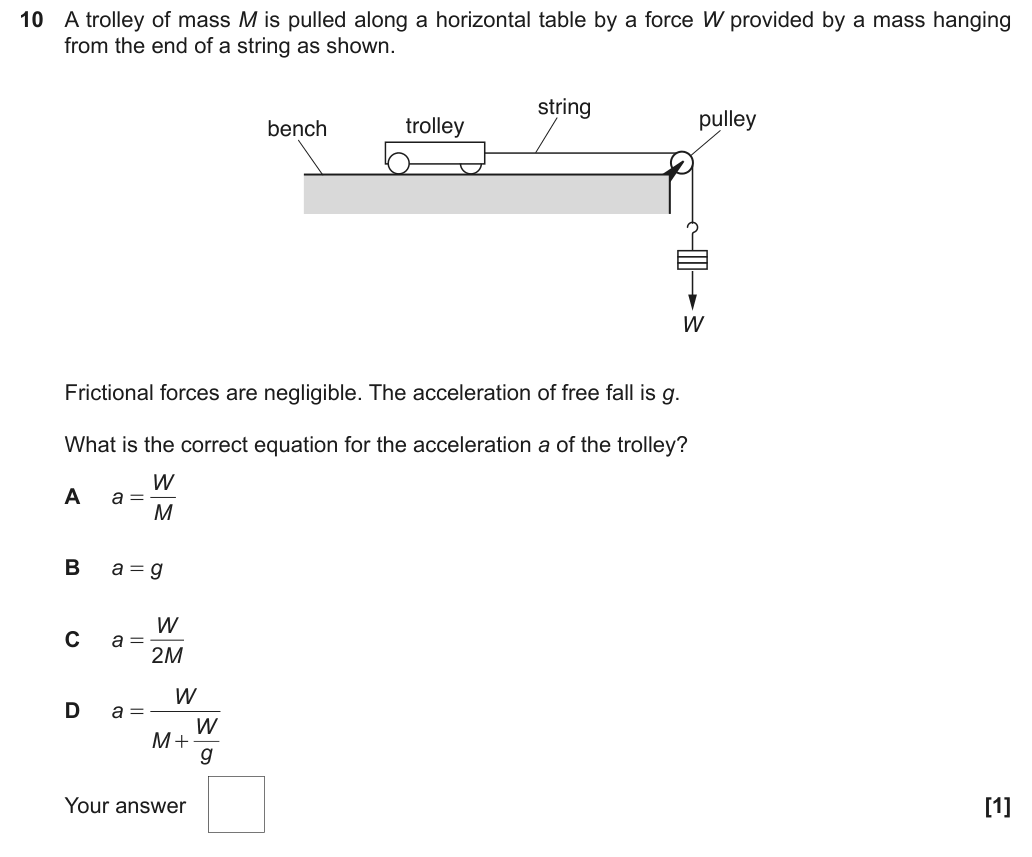
Most candidates did not realise that both the suspended mass and the trolley are moving with acceleration a. The resultant force along for this composite object is W and the total mass is (M + W/g), giving D as the acceleration.
June 2018 · AS Paper 1 · Q121 markMultiple choice
Answer
D
Mark scheme
June 2018 · Paper 1 · Q121 markMultiple choice
Answer
C
Mark scheme
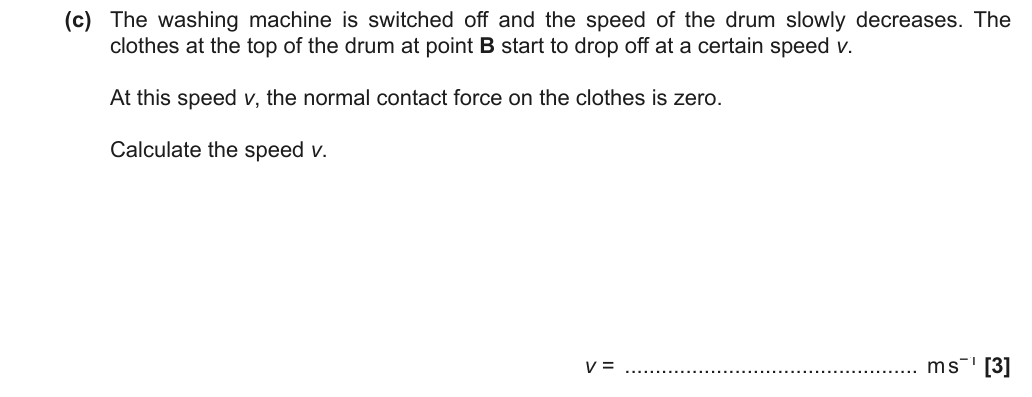
June 2018 · Paper 1 · Q21(c)3 marksCalculationEasy
Earlier parts of question 21 that this part uses
Mark scheme
Examiner's comment
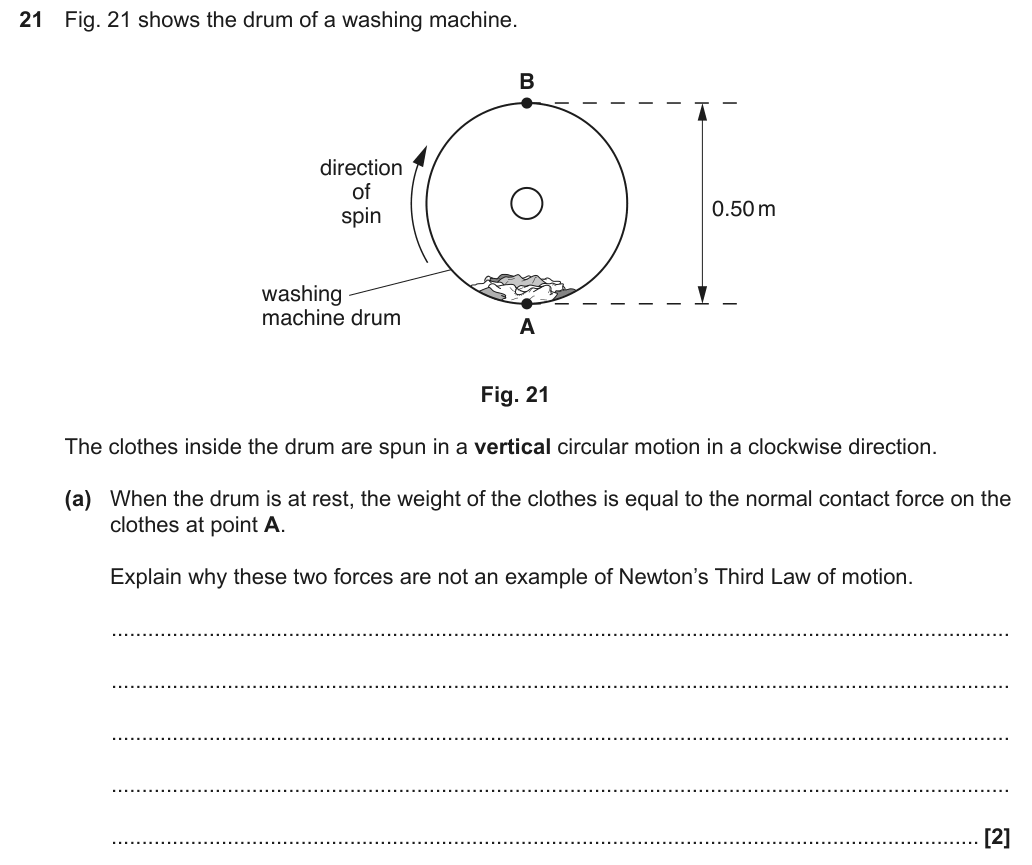
This question was answered well by those above the mean result. When the machine is switched off, the clothes are still in circular motion and at point B, the resultant force is still the weight of the clothes plus the normal contact force. This means at the critical speed when the clothes fall off at point B, the centripetal force will equal the weight of the clothes, since the question states that the normal contact force is zero.
Notes from the mark scheme and report
2.21 m s-1 (diameter used as radius) scores 2 marks
Skills: M2.2 Change the subject of an equation, including non-linear equations
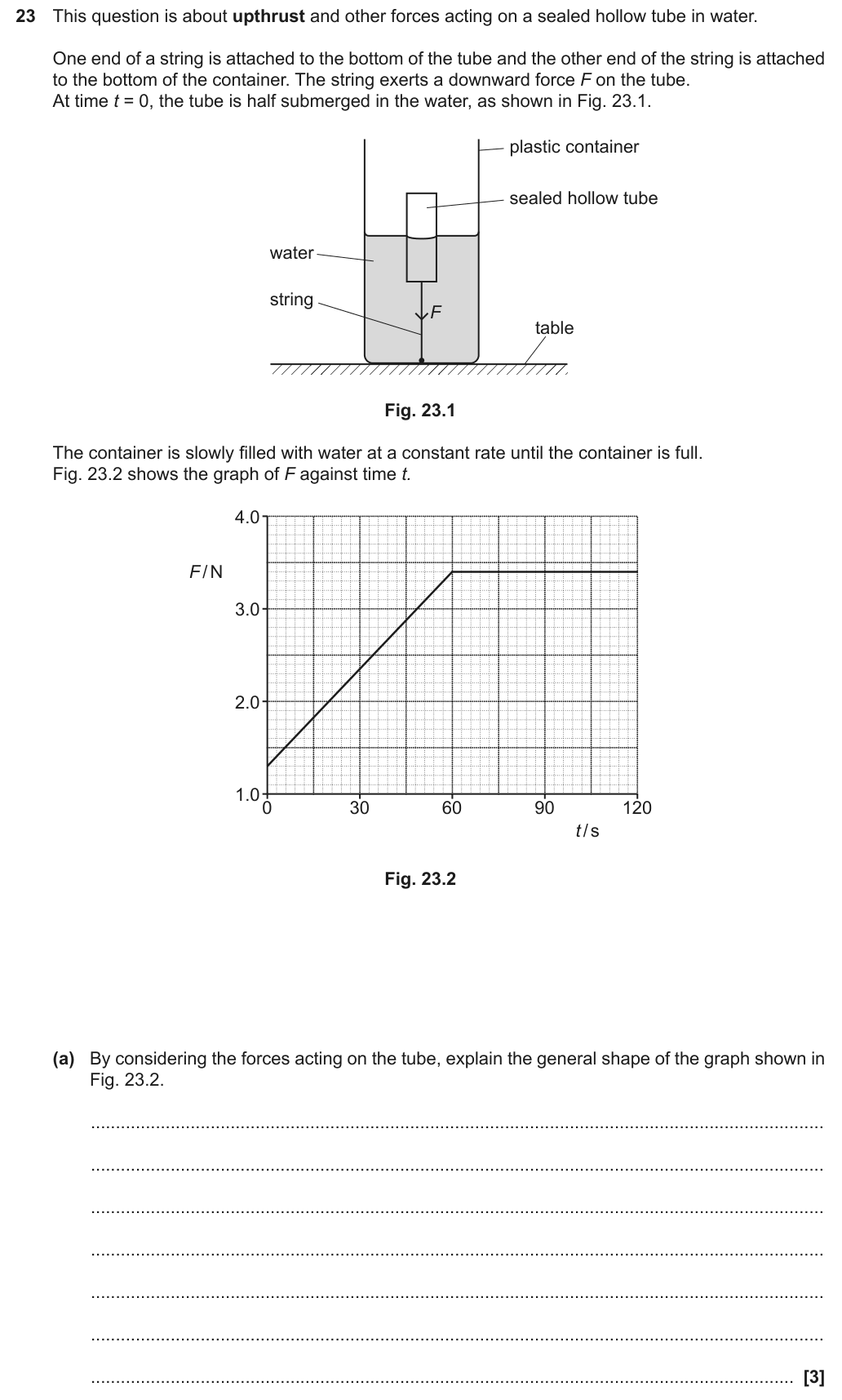
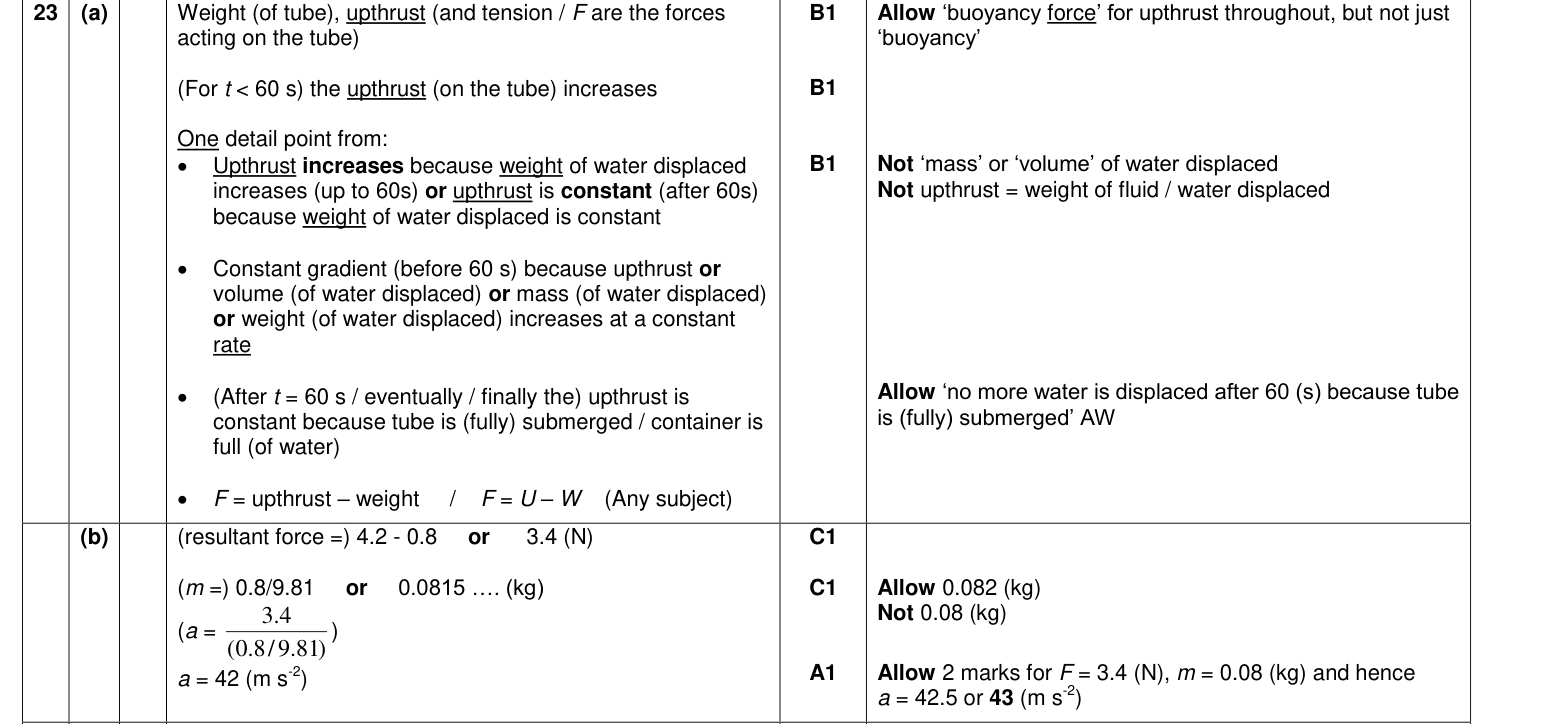
June 2018 · AS Paper 1 · Q23(a)3 marksExplanationHard
Mark scheme
Examiner's comment
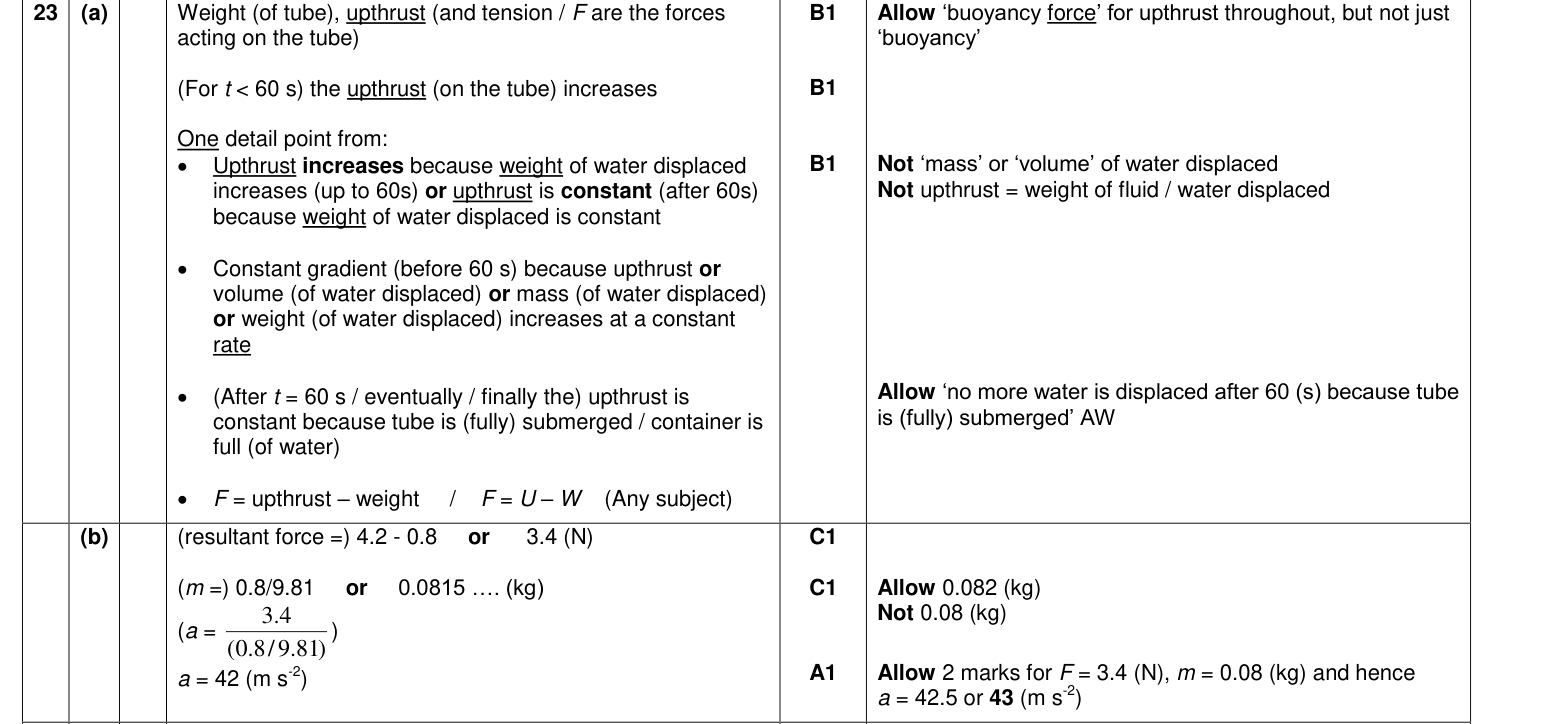
This question required understanding of upthrust and Archimedes principle. Many candidates gave explanation without mentioning any of the forces acting on the tube. Those candidates who read and focussed on the requirements of the question did better, but there were too many misconceptions and missed opportunities. The most common missed opportunities and errors were: • Not mentioning any of the two of the forces from the list of three (upthrust, tension and weight) • Stating Archimedes principle without reference to this specific question • Confusing mass and weight in the description of upthrust • Confusing the tension in the string with upthrust Key This exemplar illustrates how correct use of technical language can score full marks. Here the marks were credited for • Identifying a minimum of two forces acting on the tube (weight and upthrust) • Mentioning that upthrust increases as the water level rises • Explanation that upthrust is equal to the force on the string (tension) and weight (The last mark was the toughest mark to gain, so this candidate has shown good understanding of this difficult topic.)
Notes from the mark scheme and report
Allow buoyancy force but not just buoyancy
Not mass or volume of water displaced
Not upthrust = weight of water displaced
Skills: M3.1 Translate information between graphical, numerical and algebraic forms
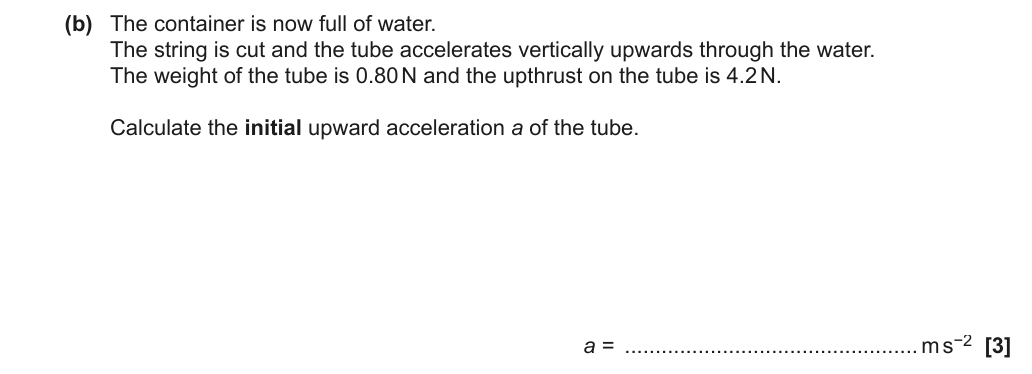
June 2018 · AS Paper 1 · Q23(b)3 marksCalculationMedium
Mark scheme
Examiner's comment
The majority of the candidates scored full marks. Most answers showed good structure and reasoning. The data is given to two significant figures (SF). Answers given to more significant figures were condoned. However, if the answer was given to one SF, then this would have been penalised once only in the entire paper. This exemplar illustrates a decent solution from a grade C candidate. The physics is very easy to follow – resultant force determined, mass calculated from the weight and then the final value for the acceleration. As mentioned earlier, the answer is not given to two SF, but this was allowed in this specific question.
Notes from the mark scheme and report
m = 0.08 kg loses a C1 mark (2 marks max, a = 42.5 or 43)
Skills: M2.2 Change the subject of an equation, including non-linear equations; M2.3 Substitute numerical values into algebraic equations using appropriate units for physical quantities
June 2018 · AS Paper 1 · Q23(c)1 markShort answer
Earlier part of question 23 that this part uses
Mark scheme
Notes from the mark scheme and report
Not drag and upthrust unless upthrust decreasing is qualified (tube leaving the water)
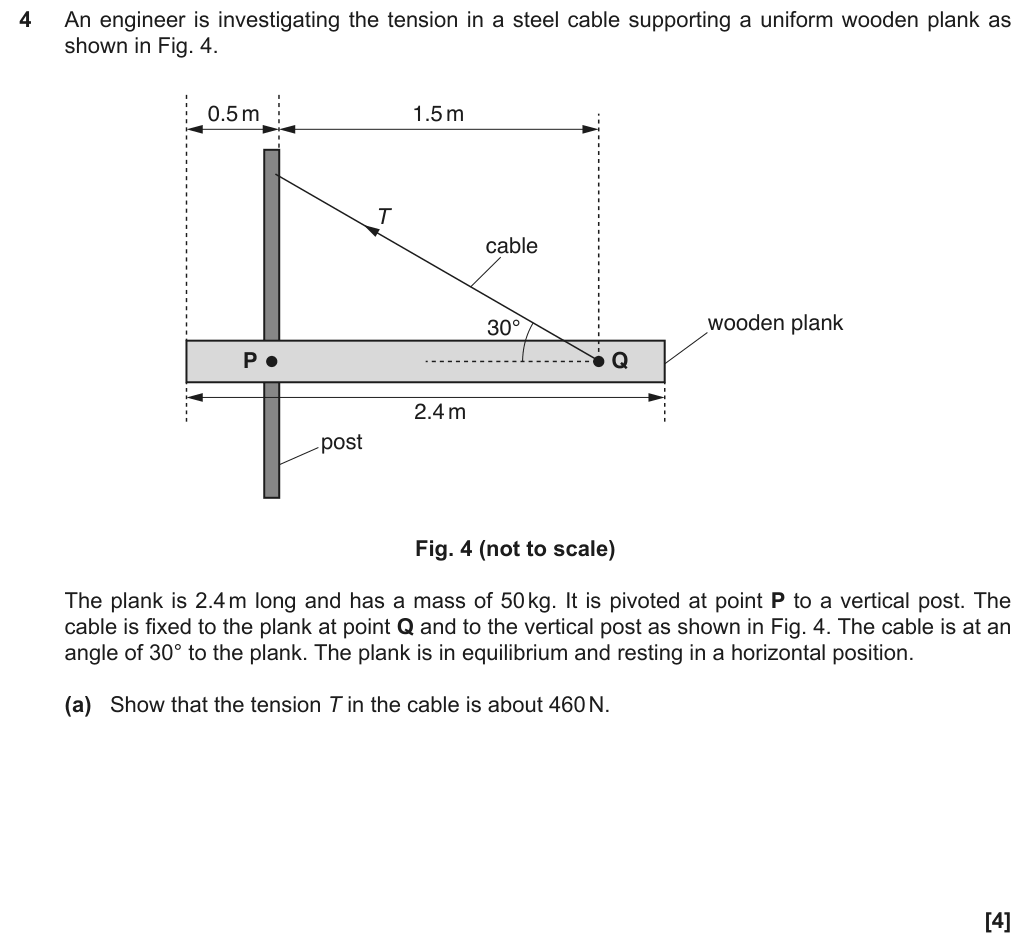
June 2018 · AS Paper 2 · Q4(a)4 marksShow thatEasy
Mark scheme
Examiner's comment
This question was a “show” type question where candidates needed to show that the tension in the cable was about 460 N. Ideally in these type of questions, candidates should have shown their working logically and gained answer of 457.8 (N). Most candidates scored a mark for determining the weight of the beam. Good candidates clearly showed their working. Good candidates stated the principle of moments, indicated how the clockwise moment would be determined, indicated how the anticlockwise moment would be determined and gave an answer of 457.8 (N). To determine the anticlockwise moment candidates needed to resolve the tension T into its vertical component – both Tsin30° and Tcos60° were acceptable. In this exemplar the candidate has clearly shown the working to answer the question. Initially the candidate has calculated the clockwise moment by multiplying the force (mass of 50 (kg) by 9.81) by 0.7 (m). This gains two marks. The candidate’s answer could have better if the candidate had written on the left-hand side “clockwise moment” rather than “m”, however, it is implicit from the candidate’s working the meaning of “m”. The candidate has then clearly shown that the anticlockwise moment is equal to the clockwise moment and determined correctly the perpendicular force or vertical force. The candidate then correctly relates the force T to sin 30° and the vertical force and evaluates the answer as 457.8 N before indicating that this is approximately 460 N. Including the 457.8 is appropriate in these type of show questions.
Notes from the mark scheme and report
weight acts 0.7 m from P
Allow T cos 60° x 1.5
Skills: M0.6 Use calculators to handle sin x, cos x and tan x when x is expressed in degrees or radians; M2.3 Substitute numerical values into algebraic equations using appropriate units for physical quantities; M4.5 Use sin, cos and tan in physical problems
June 2017 · Paper 1 · Q81 markMultiple choice
Answer
D
Mark scheme
June 2017 · AS Paper 1 · Q111 markMultiple choice
Answer
D
Mark scheme
June 2017 · Paper 1 · Q18(c)(i)3 marksDiagram or graph
Mark scheme
Notes from the mark scheme and report
ignore arrow sizes
allow (water) resistance for drag
Skills: M4.2 Visualise and represent 2D and 3D forms, including two-dimensional representations of 3D objects
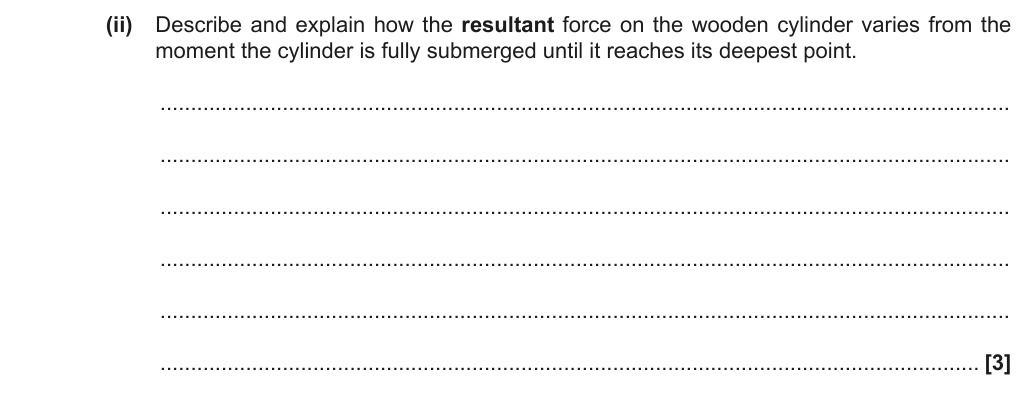
June 2017 · Paper 1 · Q18(c)(ii)3 marksExplanation
Earlier part of question 18 that this part uses
Mark scheme
Notes from the mark scheme and report
Not resultant force = 0
any incorrect statement from the list loses that point
resultant force is always upwards scores 2
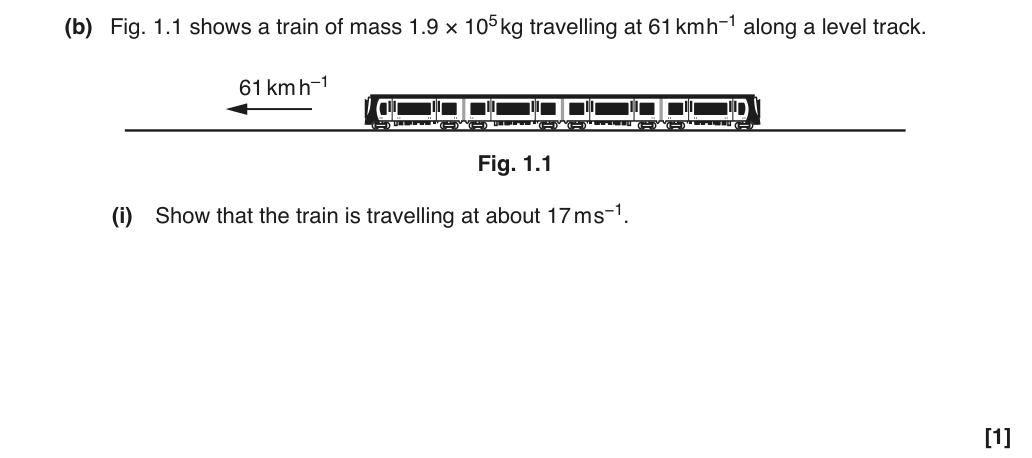
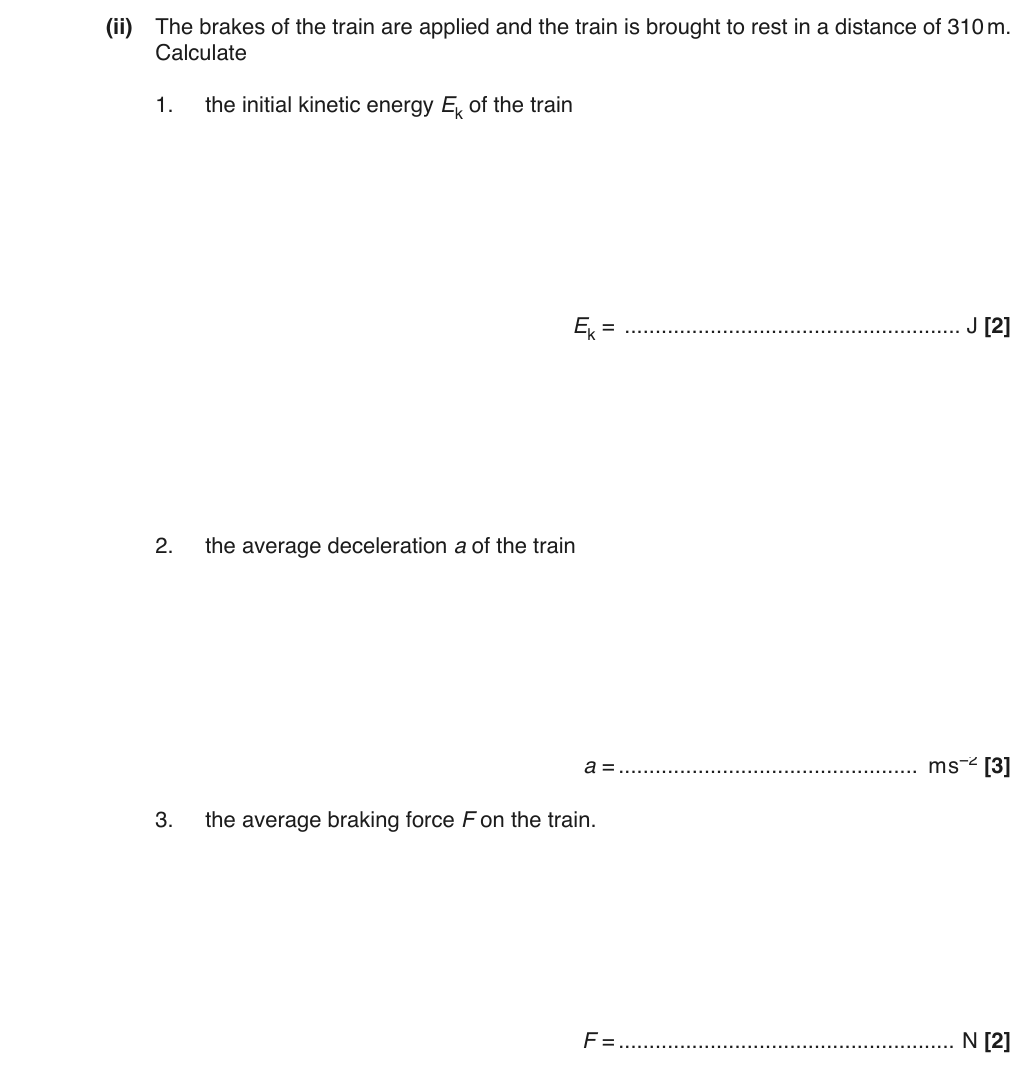
June 2017 · AS Paper 2 · Q1(b)(ii)7 marksCalculation
Earlier part of question 1 that this part uses
Mark scheme
Notes from the mark scheme and report
ignore negative sign on a
NOT 0.5 for a
ecf into part 3
F = Ek / 310 also allowed
Skills: M0.2 Recognise and use expressions in decimal and standard form; M2.2 Change the subject of an equation, including non-linear equations; M2.3 Substitute numerical values into algebraic equations using appropriate units for physical quantities
June 2017 · AS Paper 2 · Q1(b)(iii)2 marksExplanation
Earlier parts of question 1 that this part uses
Mark scheme
Notes from the mark scheme and report
NOT gravity will slow it down
NOT down / parallel alone for the component of weight
June 2017 · AS Paper 2 · Q3(a)(iii)2 marksCalculation
Earlier parts of question 3 that this part uses
Mark scheme
Notes from the mark scheme and report
upthrust - weight
ecf from (a)(ii)
allow 0.037 or 0.039
Skills: M2.3 Substitute numerical values into algebraic equations using appropriate units for physical quantities
June 2017 · AS Paper 2 · Q3(b)6 marks6-mark extended response
Mark scheme, with the levels and indicative content
Notes from the mark scheme and report
needs diagram, safety precaution, check that terminal velocity is reached, graph of v against r² with K = gradient
Skills: M3.3 Understand that y = mx + c represents a linear relationship; M3.4 Determine the slope and intercept of a linear graph; PAG1 Investigating motion
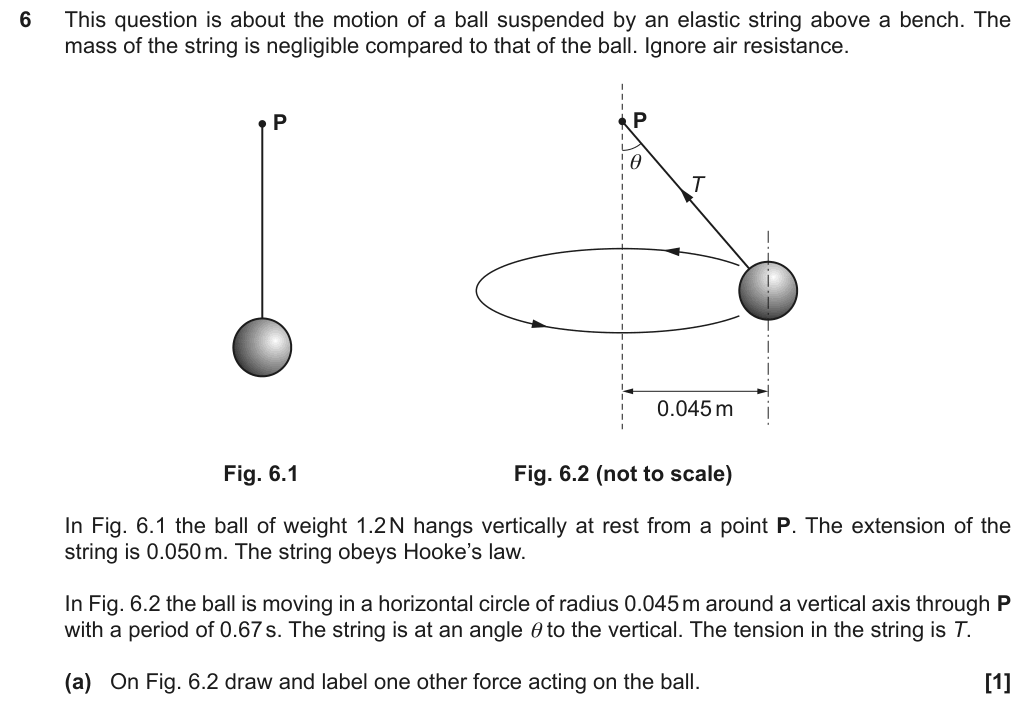
June 2017 · Paper 3 · Q6(a)1 markDiagram or graph
Mark scheme
Notes from the mark scheme and report
arrow down through the centre of the ball labelled weight / W / mg / 1.2 N
zero if any other arrows or forces present
June 2016 · AS Paper 1 · Q61 markMultiple choice
Answer
A
Mark scheme
June 2016 · AS Paper 1 · Q71 markMultiple choice
Answer
B
Mark scheme
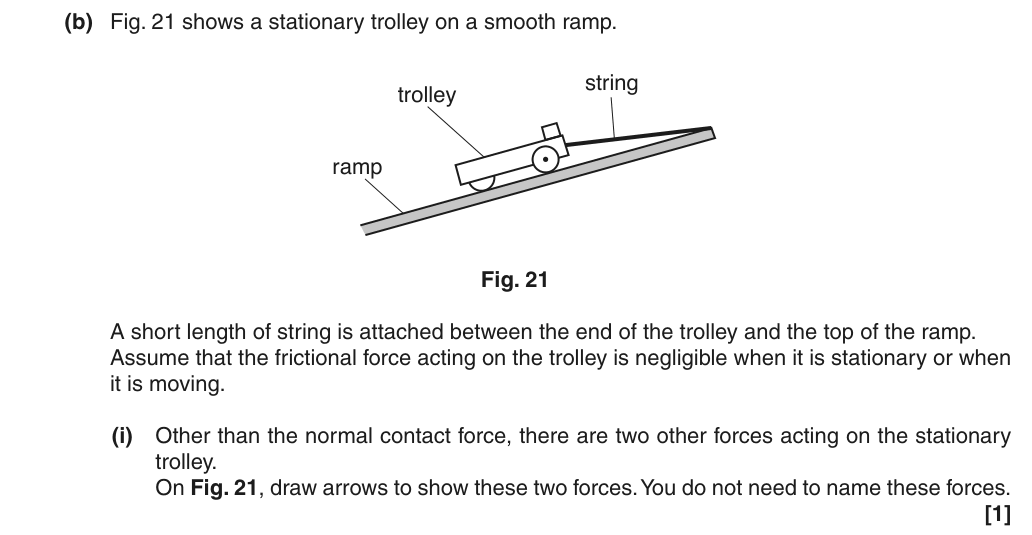
June 2016 · AS Paper 1 · Q21(b)(i)1 markDiagram or graph
Mark scheme
Notes from the mark scheme and report
NOT tension arrow parallel to the ramp
NOT weight arrow perpendicular to the ramp
NOT two arrow heads in opposite directions along the string
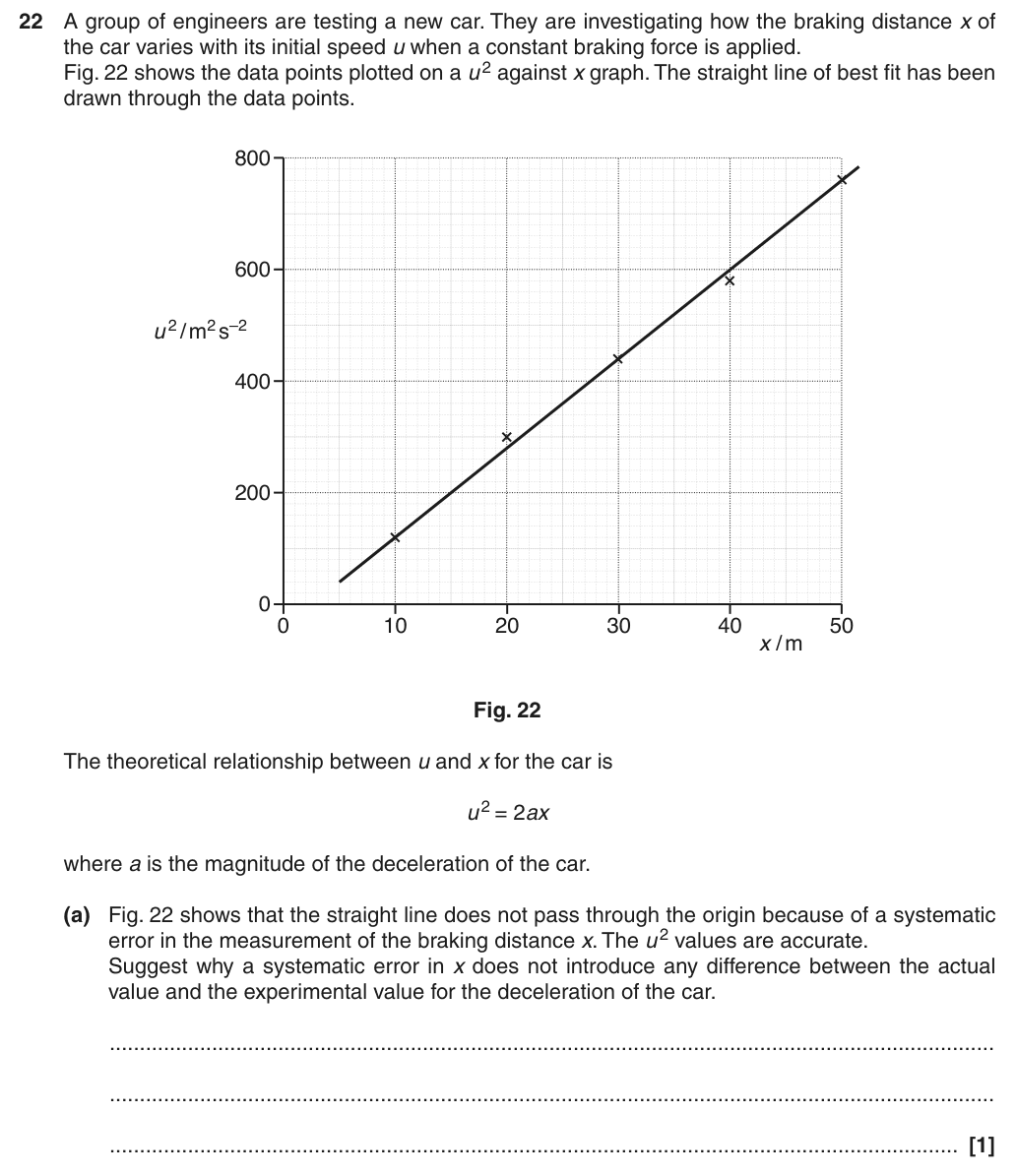
June 2016 · AS Paper 1 · Q22(b)3 marksCalculation
Earlier part of question 22 that this part uses
Mark scheme
Notes from the mark scheme and report
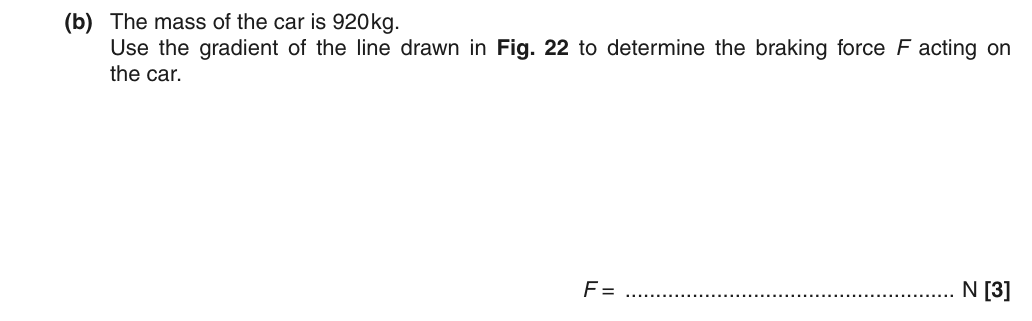
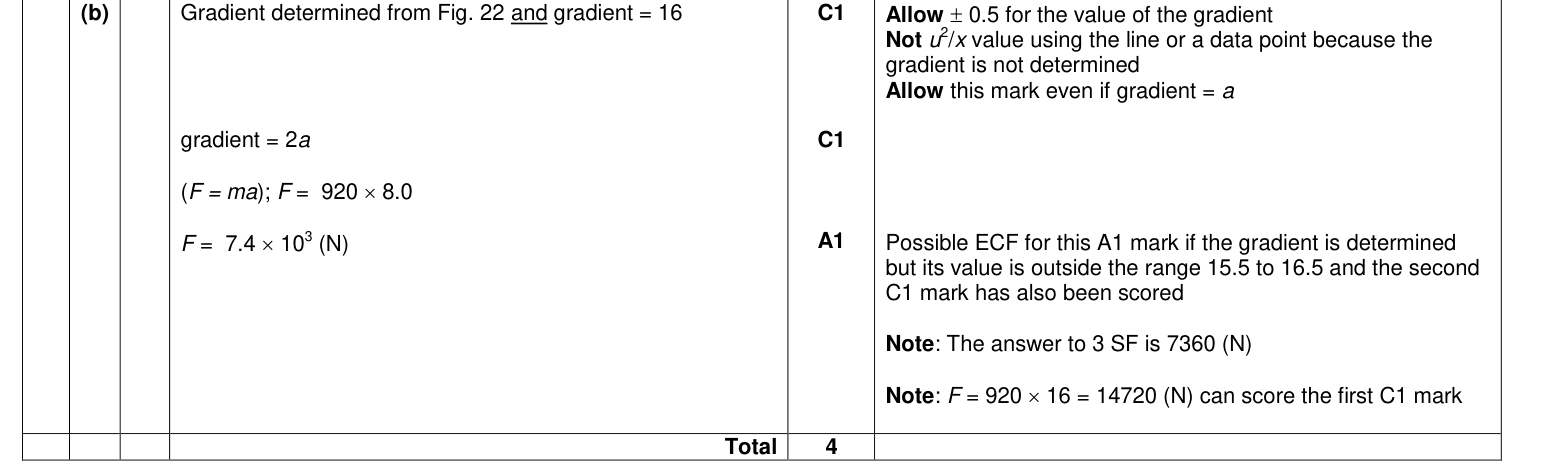
gradient = 2a
u²/x from a single point is NOT a gradient
F = 920 x 16 scores first mark only
Skills: M2.3 Substitute numerical values into algebraic equations using appropriate units for physical quantities; M3.3 Understand that y = mx + c represents a linear relationship; M3.4 Determine the slope and intercept of a linear graph
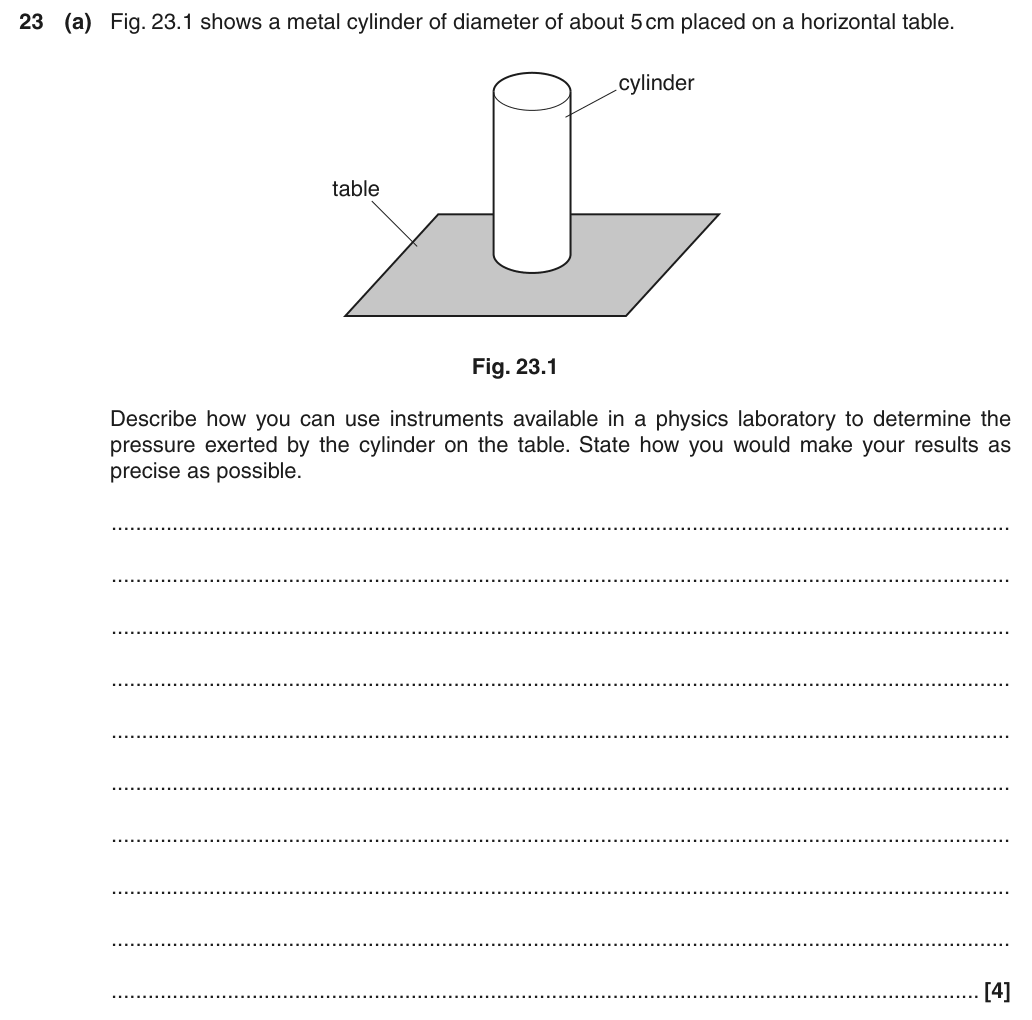
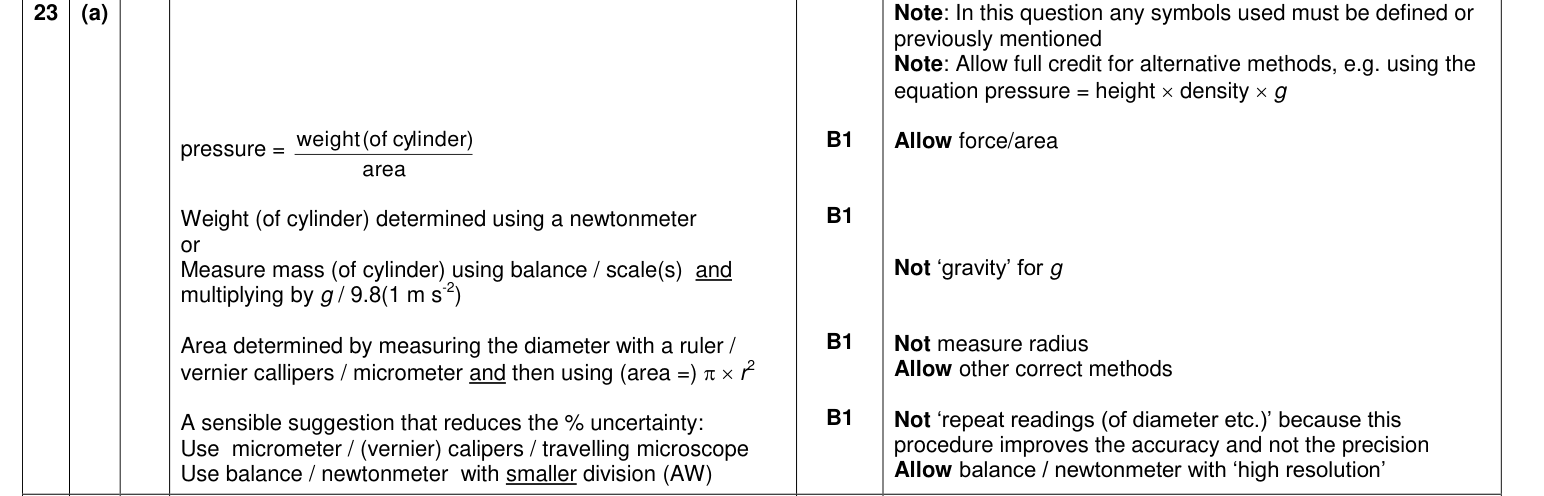
June 2016 · AS Paper 1 · Q23(a)4 marksExplanation
Mark scheme
Notes from the mark scheme and report
symbols must be defined
NOT 'gravity' for g
NOT measure radius
NOT 'repeat readings' (improves accuracy, not precision)
Skills: M4.3 Calculate areas of triangles, circumferences and areas of circles, surface areas and volumes of rectangular blocks, cylinders and spheres
June 2016 · AS Paper 1 · Q23(b)(ii)3 marksCalculation
Mark scheme
June 2016 · AS Paper 2 · Q3(c)2 marksDiagram or graph
Earlier part of question 3 that this part uses
Mark scheme
Notes from the mark scheme and report
path always below the original
maximum height reached before the front of the goal
Skills: M3.12 Sketch relationships which are modelled by y = k/x, y = kx², y = k/x², y = kx, y = sin x, y = cos x, y = e^(±x) and y = sin²x, y = cos²x as applied to physical relationships
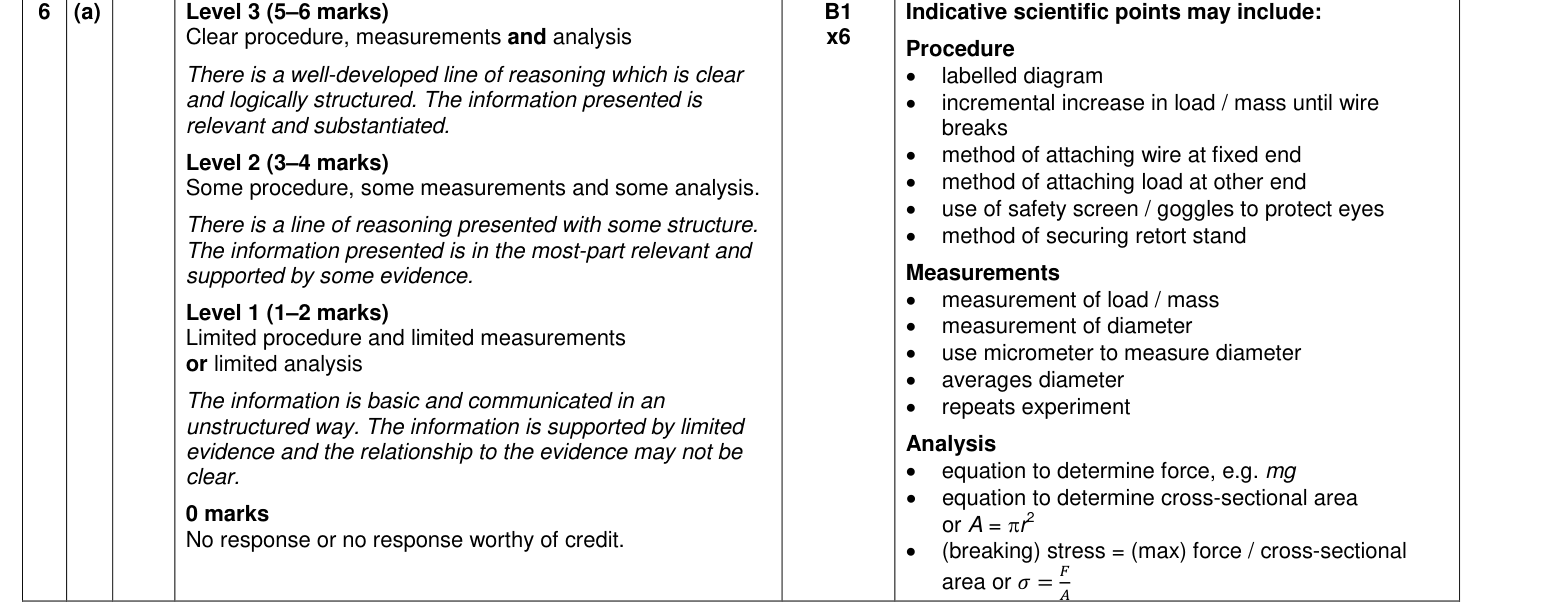
June 2016 · AS Paper 2 · Q6(a)6 marks6-mark extended response
Mark scheme, with the levels and indicative content
Notes from the mark scheme and report
procedure (incl. safety), measurements (load, diameter with micrometer) and analysis (stress = max force / area)
Skills: M4.3 Calculate areas of triangles, circumferences and areas of circles, surface areas and volumes of rectangular blocks, cylinders and spheres; PAG2 Investigating properties of materials
Work with an OCR physics tutor
Dropping marks on calculations, practical questions or the six-mark level of response questions? Book a trial session with a specialist OCR physics tutor.