Notes and key-term cards for this topic are being written by our tutors. The past-paper questions below are ready now.
Specification statements
Show the 16 learning outcomes from the specification
6.2.1(a) electric fields are due to charges
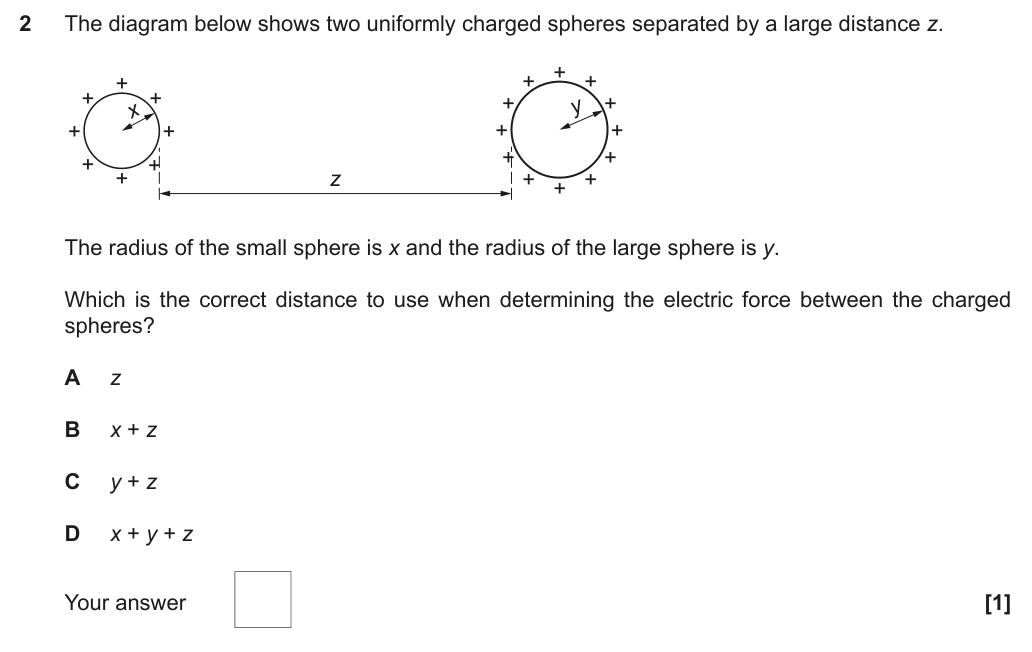
6.2.1(b) modelling a uniformly charged sphere as a point charge at its centre
6.2.1(c) electric field lines to map electric fields
6.2.1(d) electric field strength; E = F/q.
6.2.2(a) Coulomb’s law; F = Qq/(4πε0r²) for the force between two point charges
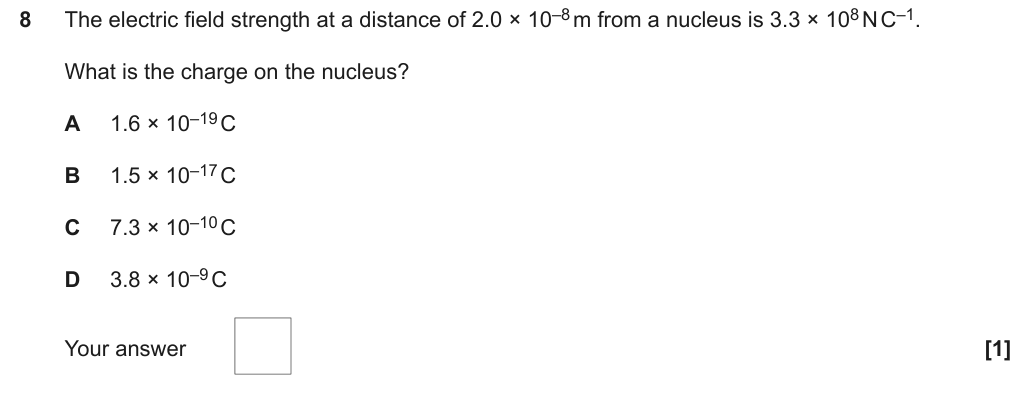
6.2.2(b) electric field strength E = Q/(4πε0r²) for a point charge
6.2.2(c) similarities and differences between the gravitational field of a point mass and the electric field of a point charge
6.2.2(d) the concept of electric fields as being one of a number of forms of field giving rise to a force.
6.2.3(a) uniform electric field strength; E = V/d
6.2.3(b) parallel plate capacitor; permittivity; C = ε0A/d; C = εA/d; ε = εrε0
6.2.3(c) motion of charged particles in a uniform electric field.
6.2.4(a) electric potential at a point as the work done in bringing unit positive charge from infinity to the point; electric potential is zero at infinity
6.2.4(b) electric potential V = Q/(4πε0r) at a distance r from a point charge; changes in electric potential
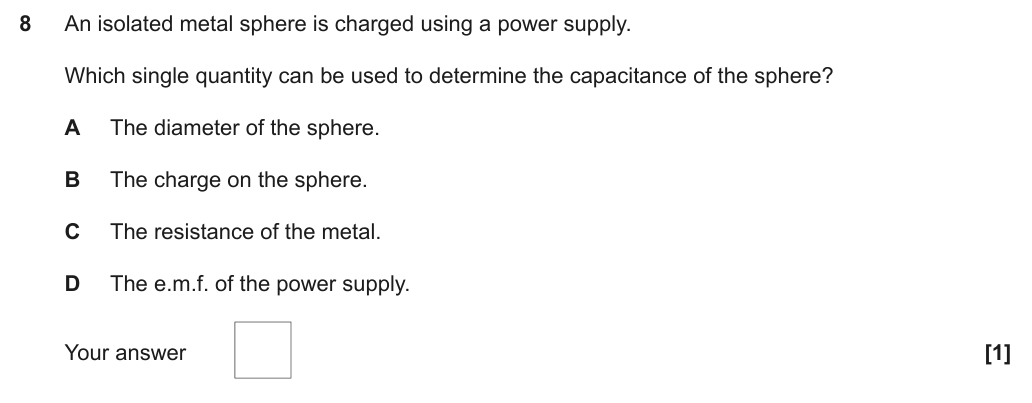
6.2.4(c) capacitance C = 4πε0R for an isolated sphere
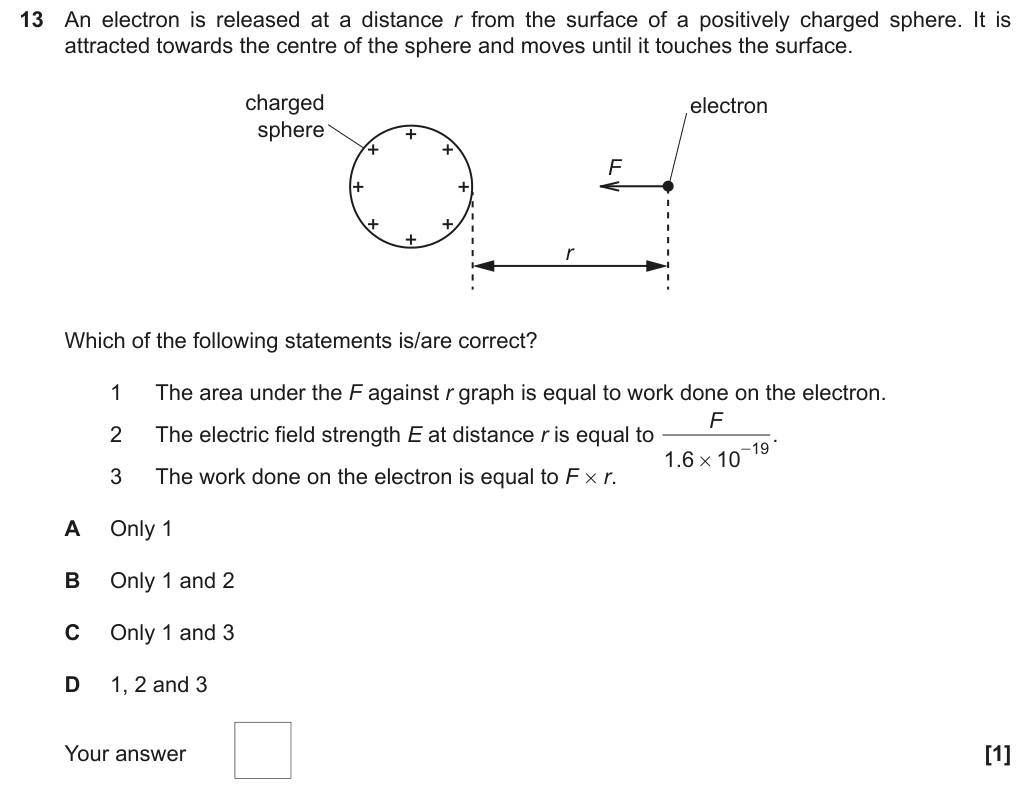
6.2.4(d) force–distance graph for a point or spherical charge; work done is area under graph
6.2.4(e) electric potential energy = Vq = Qq/(4πε0r) a distance r from a point charge Q.
Six-mark level of response questions on this topic
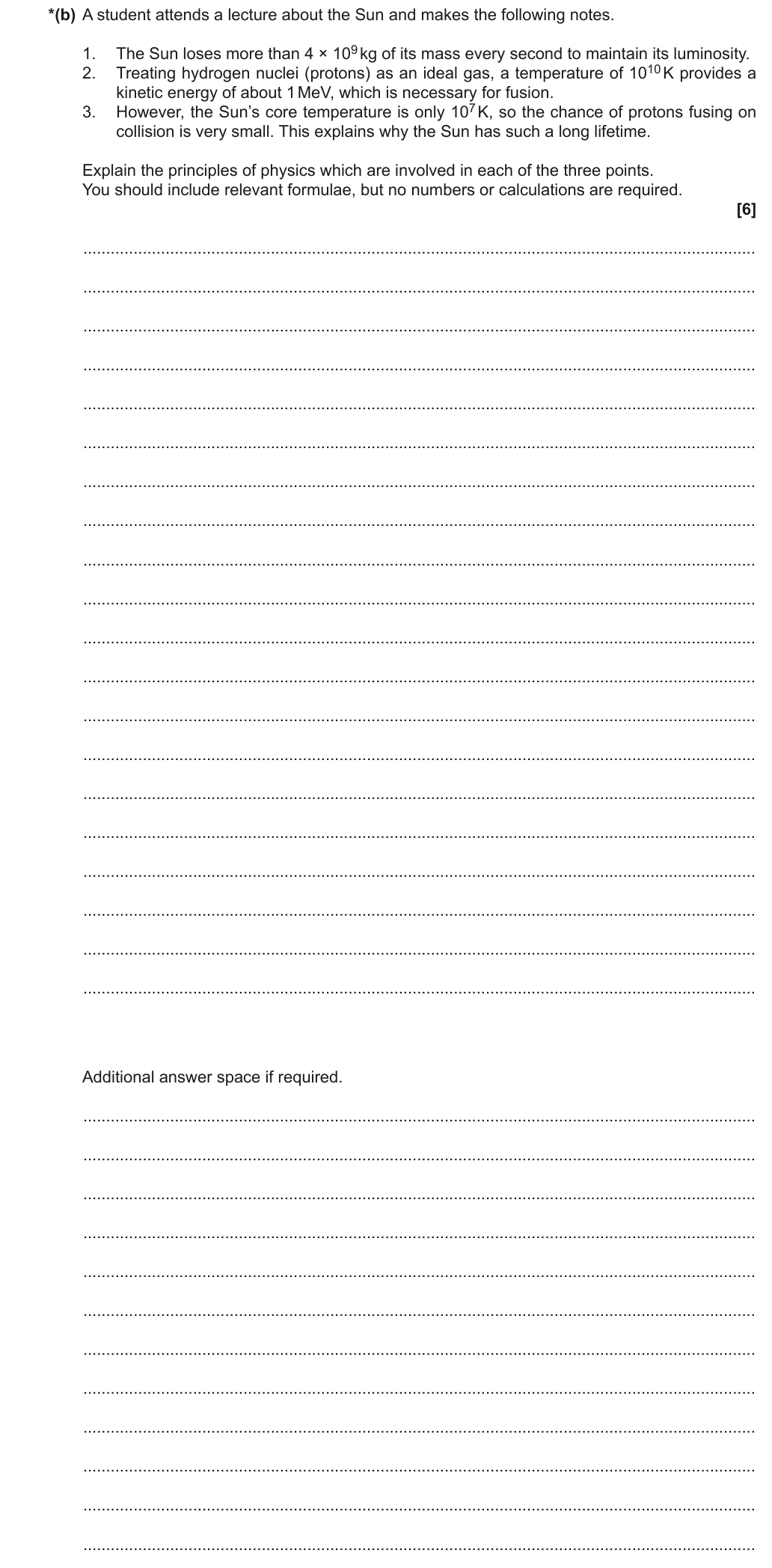
*(b) A student attends a lecture about the Sun and makes the following notes. Explain the principles of physics which are involved in each of the three points.
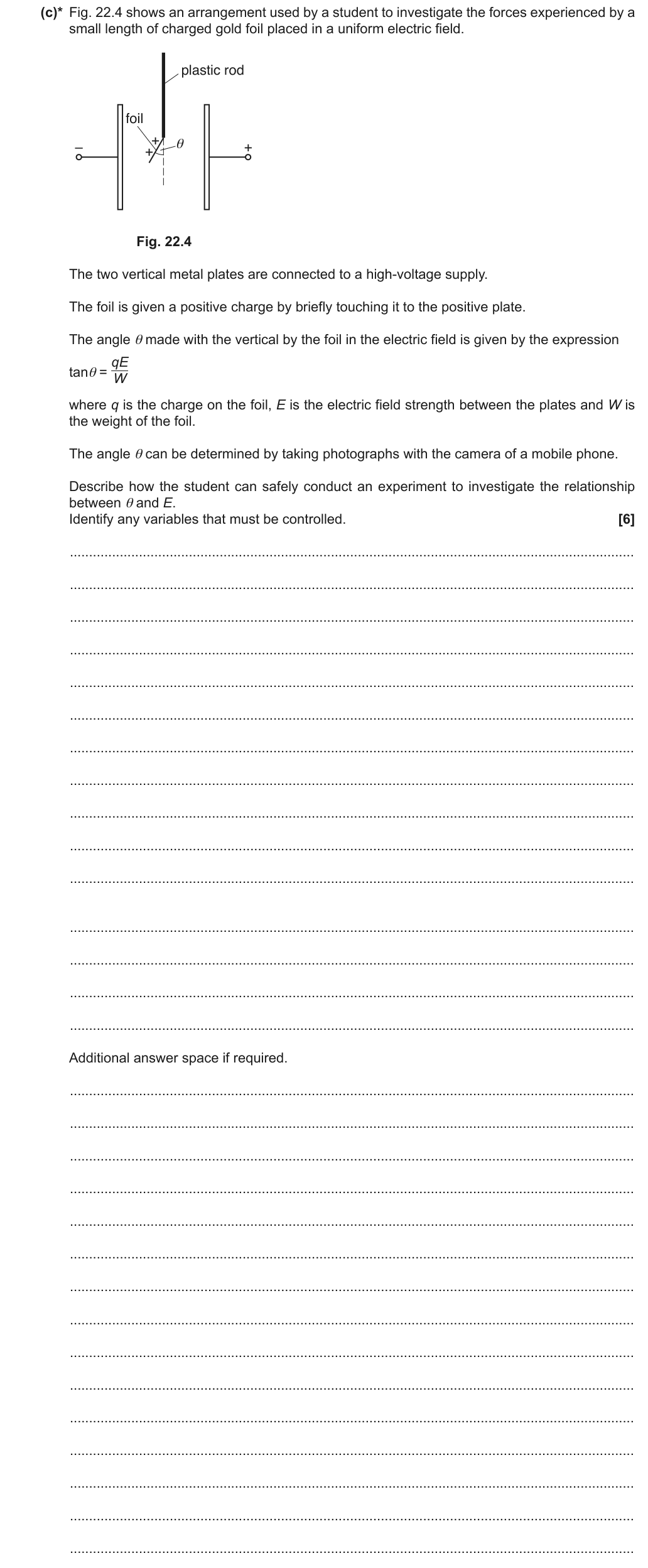
Fig. 22.4 shows an arrangement used by a student to investigate the forces experienced by a Describe how the student can safely conduct an experiment to investigate the relationship
Tap a question to zoom it. Where a part needs a figure, table or graph from earlier in the question, that part folds out above it; the mark scheme and examiner's comment open underneath. Have the OCR Data, Formulae and Relationships Booklet beside you (see the data booklet page).
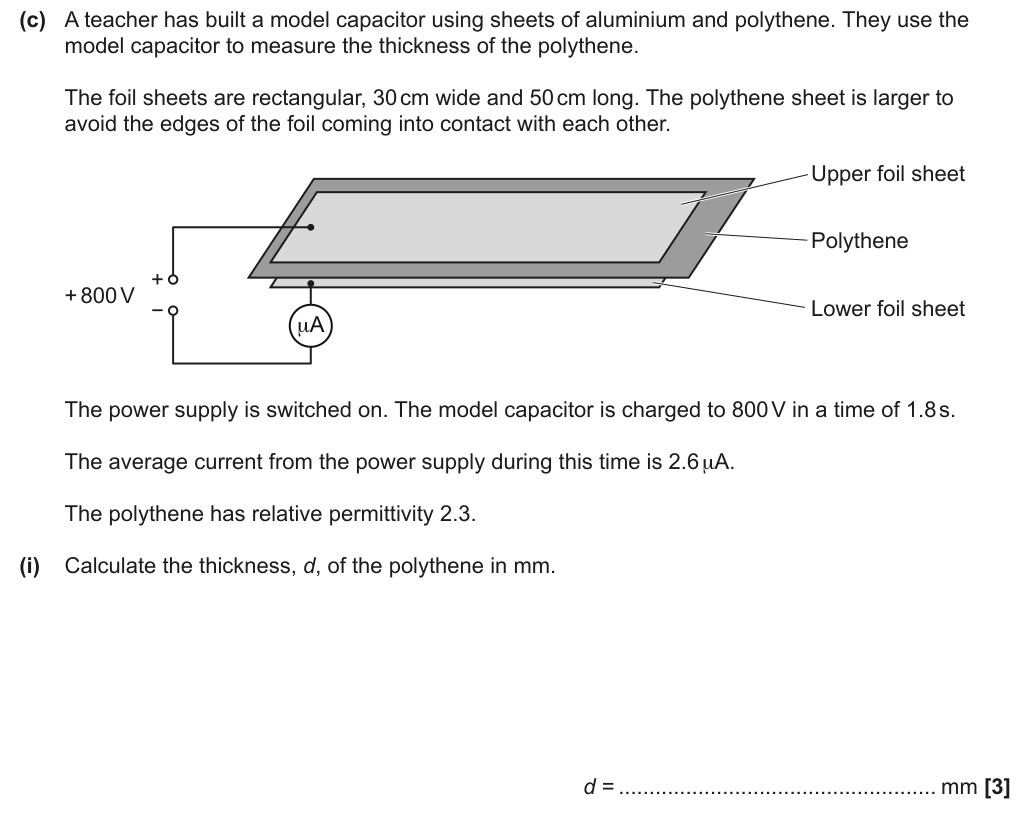
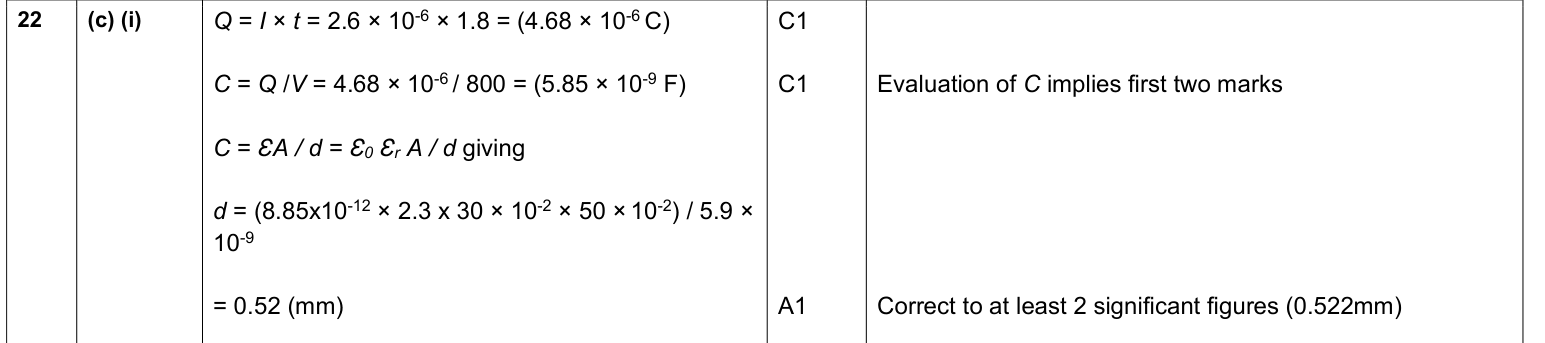
June 2025 · Paper 2 · Q22(c)(i)3 marksCalculationHard
Mark scheme
Examiner's comment
• used calculators effectively with careful consideration of unit conversions, such as in Questions 18 (d) and 22 (c) (i) • demonstrated an ability with logarithms and manipulation of exponential equations, such as in Questions 18 (e) and 19 (c) • gave suitable detail and care in responses to Level of Response questions, paying particular attention to the specifics of the question • had a clear appreciation of command words • gave appropriate use of scientific language and terms, in particular in Questions 22 (c) (ii) and 23 (d) • applied consideration of significant figures in calculations, especially in Question 21 (c) (ii). • did not attempt all of the multiple-choice questions, and this did not appear to be a timing issue • did not show suitable working in extended calculations, such as Question 21 (c) (i), which means that it was not possible to award C marks • only gave limited detail in the Level of Response questions, such as not explaining the description of both models in Question 17 • drew a poor line of best fit in Question 23 (b) (iii), assuming that the line would pass through the false origin • chose too small a range for a gradient calculation in Question 23 (c), or just used a pair of points • were unable to differentiate terms such as precision, resolution and accuracy, especially in Question 23 (d) • did not express scientific knowledge with sufficient accuracy, such as in Question 20 (c). Just under half of candidates were able to calculate the thickness correctly. The most common way was to calculate the capacitance and then use the parallel plate capacitor formula. This allowed clarity in setting up the calculation and generally resulted in the correct answer. Several candidates attempted to carry out the calculation in one go. This often resulted in an error, such as using 2.3 in place of the actual permittivity of the polythene. Another common error was to use the formula for the capacitance for a sphere. There seemed to be little difficulty in converting all the units correctly, either in the initial calculation or by converting to mm at the end. As always with this type of calculation, structuring it carefully allows for intermediate marks to be awarded should the final answer be incorrect. This exemplar shows how clear and careful setting out of a calculation can lead to C (compensatory) marks. This candidate has shown the working for (and then calculated) the charge, Q, separately on the top of the right-hand side. This gains the first mark. The candidate has then re-arranged the equation in the centre, with the capacitance in the denominator. The calculation for the capacitance is clearly shown (4.68 x 10⁻⁶ ÷ 800) which is all that is required for the second C mark. It is almost always the working that gains the C mark, not the evaluation. The evaluation is required for the A (accuracy or answer) mark, and in this case there is an error leading to an incorrect final answer. However, this good structuring of the solution leads to 2 out of the 3 marks.
Notes from the mark scheme and report
answer in mm
Skills: M0.1 Recognise and make use of appropriate units in calculations; M2.2 Change the subject of an equation, including non-linear equations; M2.3 Substitute numerical values into algebraic equations using appropriate units for physical quantities
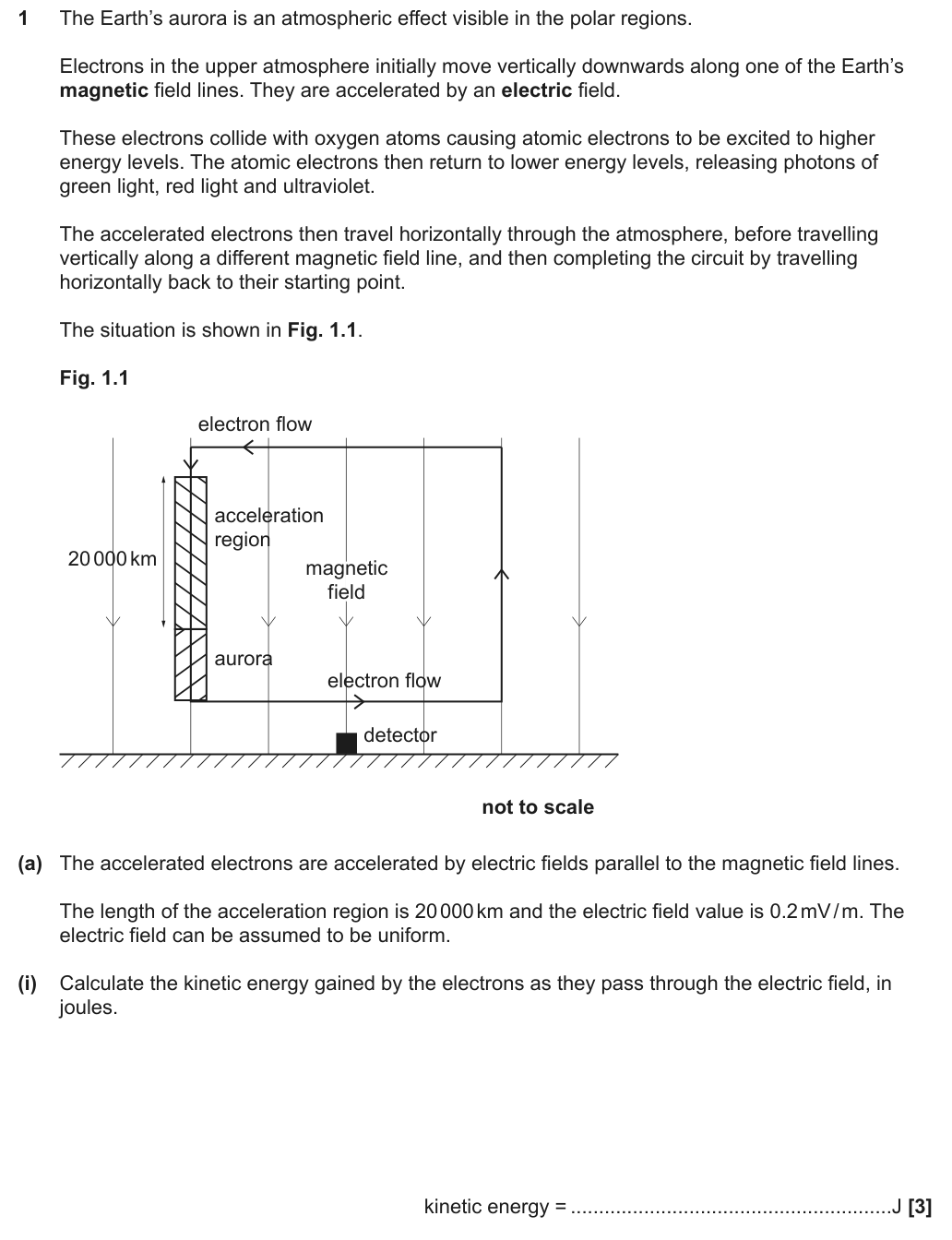
June 2025 · Paper 3 · Q1(a)(i)3 marksCalculationEasy
Mark scheme
Examiner's comment
This question was generally well answered with about half of candidates gaining all 3 marks. Most candidates chose appropriate equations and were able to substitute into and rearrange them correctly. Some candidates made substitutions containing power of ten errors. A significant minority correctly calculated the potential difference as 4000 V but then incorrectly substituted this as velocity, v, into the kinetic energy formula 2 𝑚𝑣2. Other common mistakes were: • incorrectly attempting to use the formula to determine the electric field strength for a point charge • conflating E for electric field strength with energy.
Notes from the mark scheme and report
either V = Ed then W = QV, or F = QE then W = Fd
Skills: M0.1 Recognise and make use of appropriate units in calculations; M0.2 Recognise and use expressions in decimal and standard form; M2.3 Substitute numerical values into algebraic equations using appropriate units for physical quantities
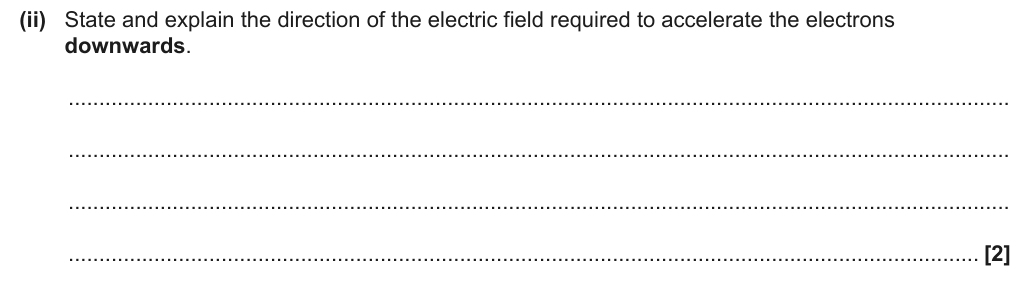
June 2025 · Paper 3 · Q1(a)(ii)2 marksExplanationMedium
Earlier part of question 1 that this part uses
Mark scheme
Examiner's comment
About one third of candidates gained both marks here. Many candidates did not explain that electrons move in the opposite direction to the electric field, or equivalent. Some simply restated information from the stem of the question or diagram. A common mistake was stating that the field was in the same direction as the electron motion. A misconception was stating that the electric field had to be perpendicular to the Earth’s magnetic field. The question stem stated that the electric field was parallel to the magnetic field line. Common issue Candidates should remember to use a formula that contains appropriate variables for the data in the question.
Notes from the mark scheme and report
electrons move opposite to the field direction so the field is upwards
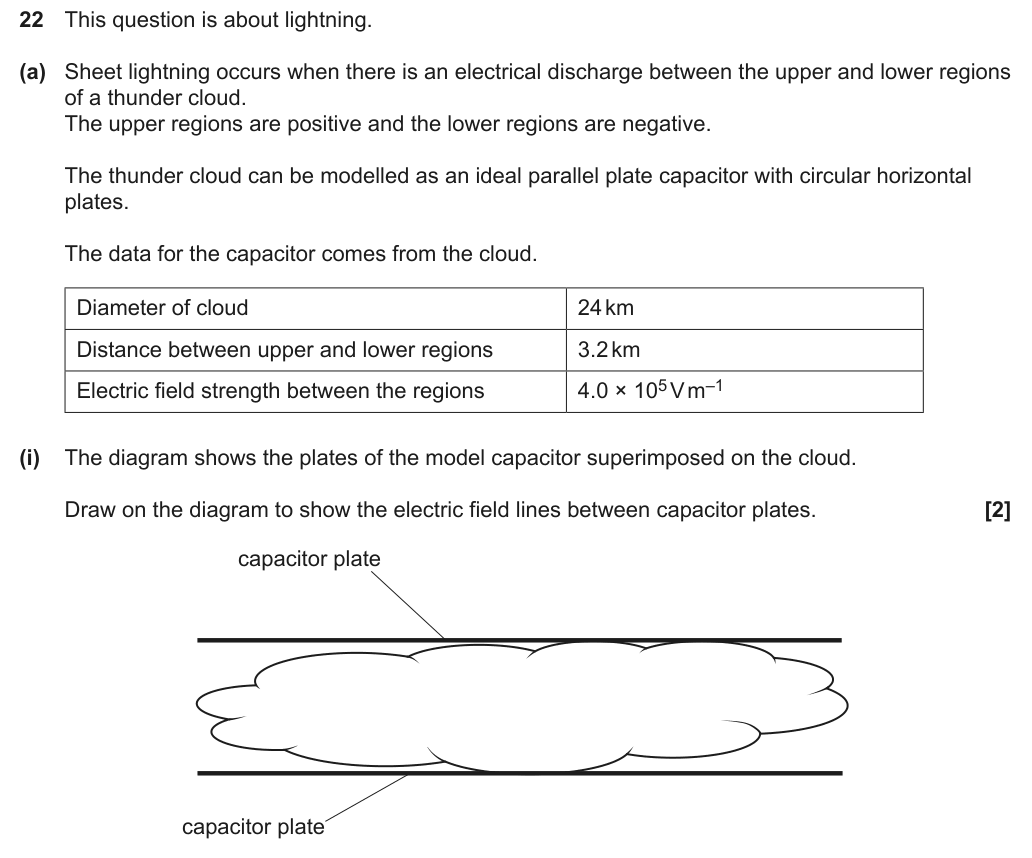
June 2024 · Paper 2 · Q22(a)(i)2 marksDiagram or graphEasy
Mark scheme
Examiner's comment
Most candidates were able to score at least 1 mark on this question. The most common loss of marks was an uneven spacing between the lines. Some candidates (helpfully) wrote on the diagram that the spacing was equal. As it is apparent that most candidates know the spacing should be regular, it would be best to do this with a ruler rather than leave it judgement. Similarly, the lines should be vertical and straight, again best done with a ruler. spacing is regular and this is possible what the candidate meant to do, but those at the right hand side (ignoring those outside of the plates) are definitely not equally spaced by eye. It would have been far better for the candidate to use a ruler to make the spacing equal.
Notes from the mark scheme and report
at least 4 equally spaced vertical straight lines touching the plates, arrows pointing downwards (positive upper region to negative lower)
Skills: M4.2 Visualise and represent 2D and 3D forms, including two-dimensional representations of 3D objects
June 2024 · Paper 2 · Q22(a)(ii)1 markExplanationMedium
Earlier part of question 22 that this part uses
Mark scheme
Examiner's comment
Although there were many ways to obtain this mark, only around half of candidates gave a suitable response. Many answers were vague such as ‘the cloud is not even’ or ‘the cloud contains water vapour’ which really needs more clarity. The best response is based on the distribution of charges, but alternatives relating to uniformity of a variety of factors are perfectly correct.
Notes from the mark scheme and report
top and bottom of the cloud are not parallel / uneven charge distribution
ignore cloud has non-uniform density
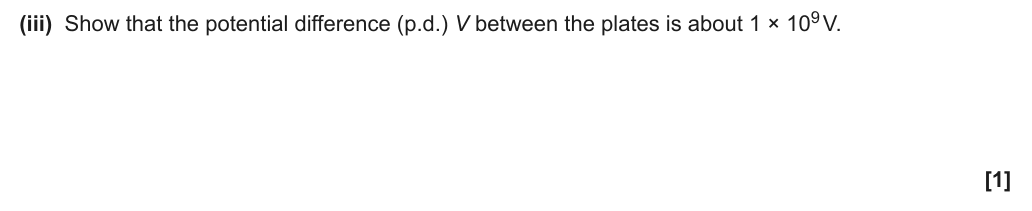
June 2024 · Paper 2 · Q22(a)(iii)1 markShow thatMedium
Earlier part of question 22 that this part uses
Mark scheme
Examiner's comment
Again, a ‘show that’ question needs the calculation to be clear. Here it will involve the multiplication of two quantities using the correct powers. For example, 32k is not a suitable alternative to 32 x 103. The value calculated is not the same as the ‘show that’ value so needs to be given to more significant figures (at least 2) to prove the calculation was carried out. The significant majority of candidates were able to correctly score this mark.
Notes from the mark scheme and report
values with correct powers of ten and evaluation to at least 2 SF (1.28 x 10^9) must be seen
Skills: M0.1 Recognise and make use of appropriate units in calculations; M0.2 Recognise and use expressions in decimal and standard form
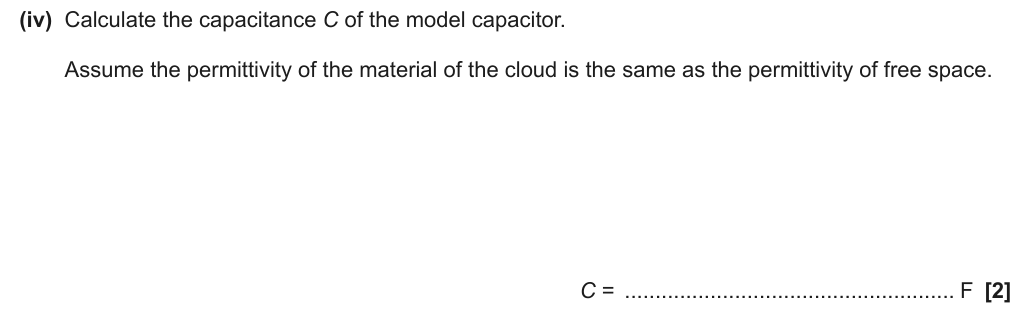
June 2024 · Paper 2 · Q22(a)(iv)2 marksCalculationEasy
Earlier part of question 22 that this part uses
Mark scheme
Examiner's comment
Most candidates were able to select the correct formula and make an attempt at a substitution. The main error came from an incorrect calculation of the area, either by using an incorrect method for the circle or incorrectly calculating it using 24km x 3.2km. Candidates are to be reminded that if the working is correct and the calculation wrong, then marks may still be given. Without this working, there is likely to be no credit. Several candidates used the formula for charge on a sphere which gave the same answer (to 2sf) but is a physics error so scores no marks.
Notes from the mark scheme and report
radius is 12 km (diameter given)
use of C = 4πε0R is wrong physics even though it gives 1.3 x 10⁻⁶
Skills: M0.1 Recognise and make use of appropriate units in calculations; M2.3 Substitute numerical values into algebraic equations using appropriate units for physical quantities; M4.3 Calculate areas of triangles, circumferences and areas of circles, surface areas and volumes of rectangular blocks, cylinders and spheres
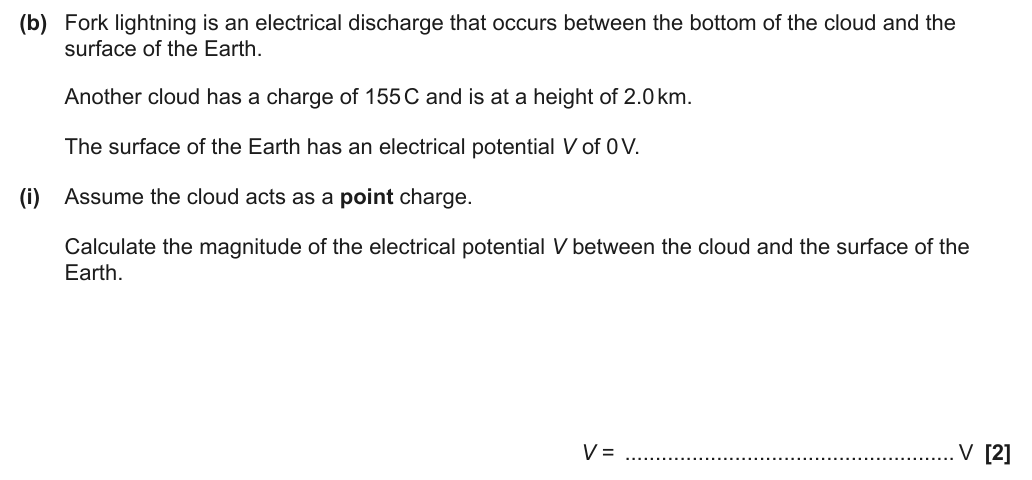
June 2024 · Paper 2 · Q22(b)(i)2 marksCalculationEasy
Mark scheme
Examiner's comment
Most candidates were able to correctly select the equation and evaluate the correct answer. Some chose the field strength equation or wrote the potential equation with a r2. Some selected the wrong value of r, giving it as the radius of the cloud. As with Question 18(b)(iii) candidates are reminded that, in general, answers should be given to the lowest number of significant figures in the question, and that an answer of 7 x 10⁸ will incur the significant figure penalty (applied only once per paper).
Notes from the mark scheme and report
all values substituted correctly including 2.0 x 10^3 m
Skills: M0.2 Recognise and use expressions in decimal and standard form; M2.3 Substitute numerical values into algebraic equations using appropriate units for physical quantities
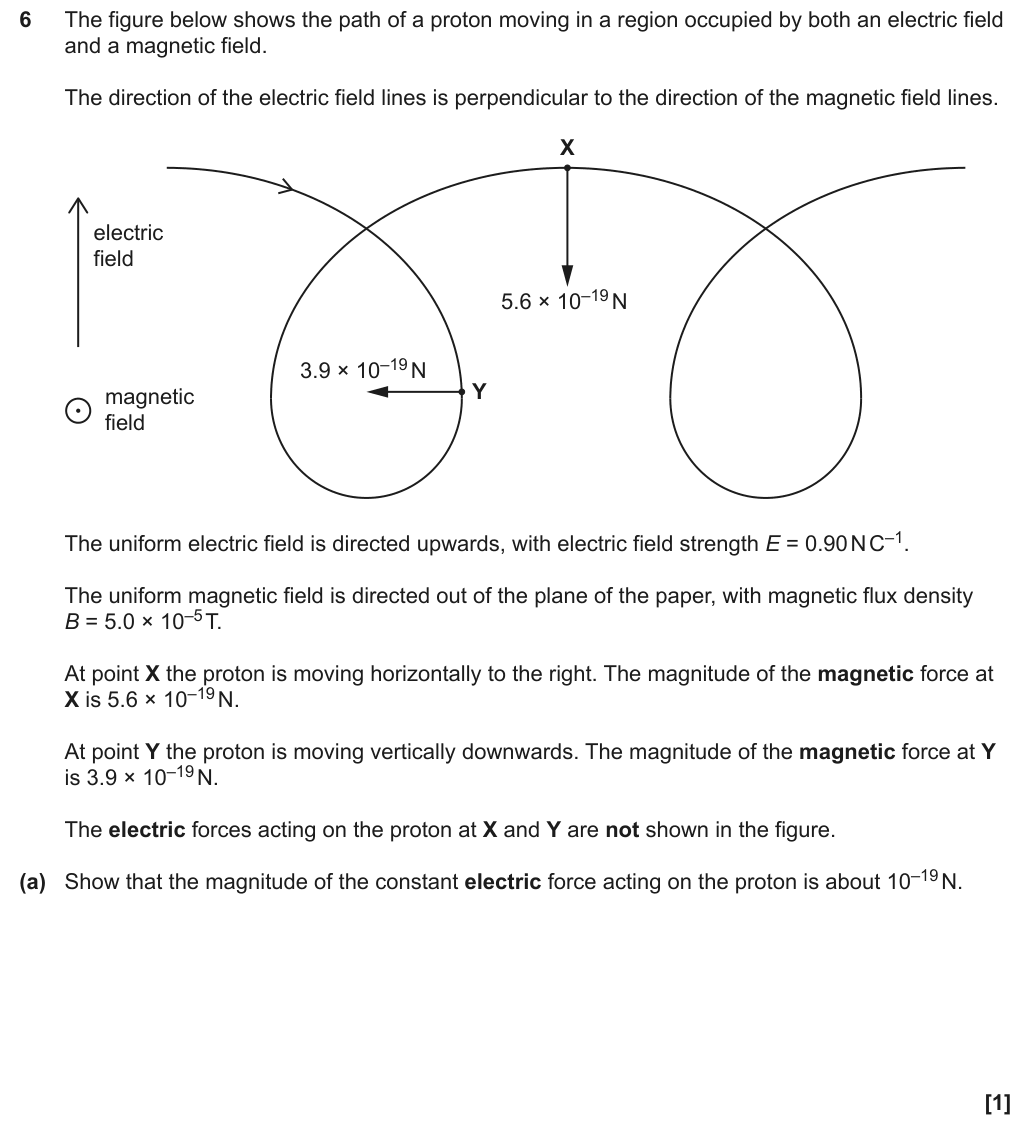
June 2024 · Paper 3 · Q6(a)1 markShow thatMedium
Mark scheme
Examiner's comment
This was an easy introduction to the question, which used the definition of electric field strength; E = FE / Q. Being a ‘show that’ question, candidates needed to show their working in full, including writing the value for the electronic charge (rather than simply ‘e’) and giving the answer to at least 2 s.f.
Notes from the mark scheme and report
working and answer both needed
answer to 2 sf or more
Skills: M0.2 Recognise and use expressions in decimal and standard form; M2.3 Substitute numerical values into algebraic equations using appropriate units for physical quantities
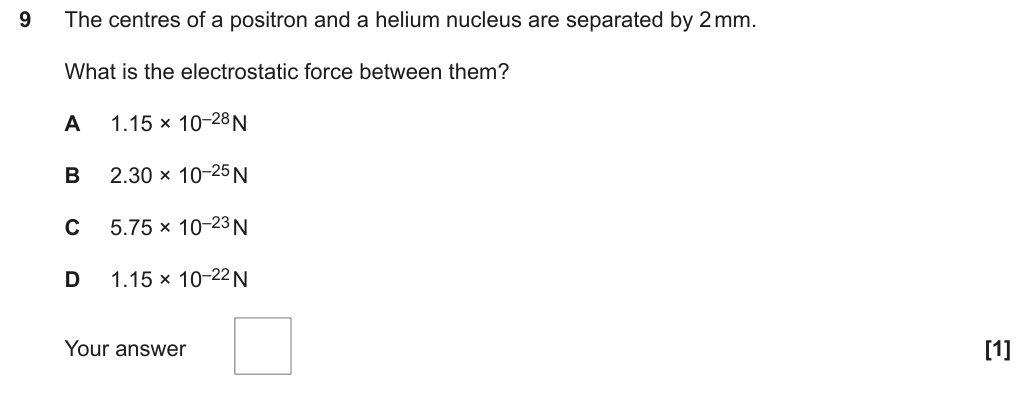
June 2023 · Paper 2 · Q91 markMultiple choiceMedium
Answer
D
Mark scheme
Examiner's comment
Around two thirds of candidates were able to correctly apply Coulomb’s law and obtain the correct response. Response C was a common distractor and this was evident for working as the charge on the helium nucleus was given as a single multiple of the fundamental charge.
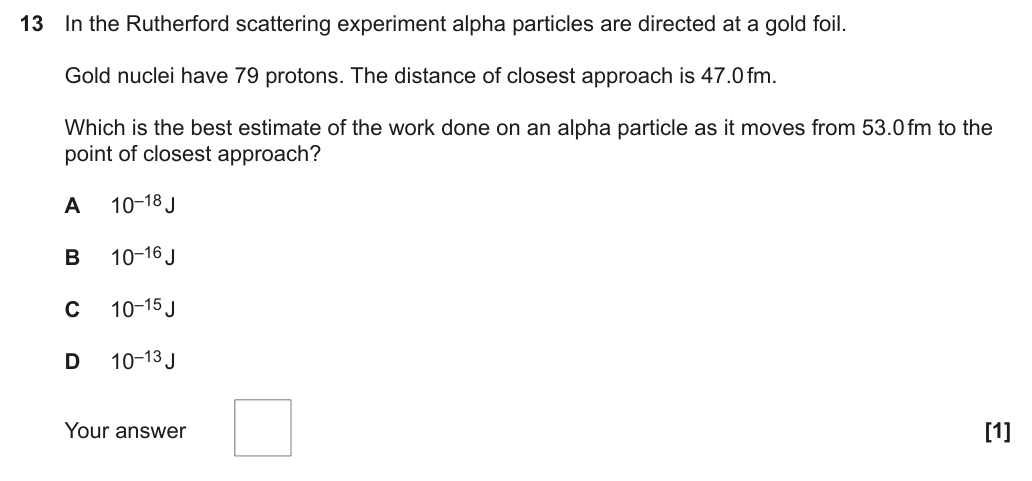
June 2023 · Paper 2 · Q131 markMultiple choiceHard
Answer
D
Mark scheme
Examiner's comment
A little under half of the candidates were able to calculate and select the correct response. The most common incorrect response was B, although it was not entirely clear why this was the case from candidates working. A very small minority of candidates did not answer this question.
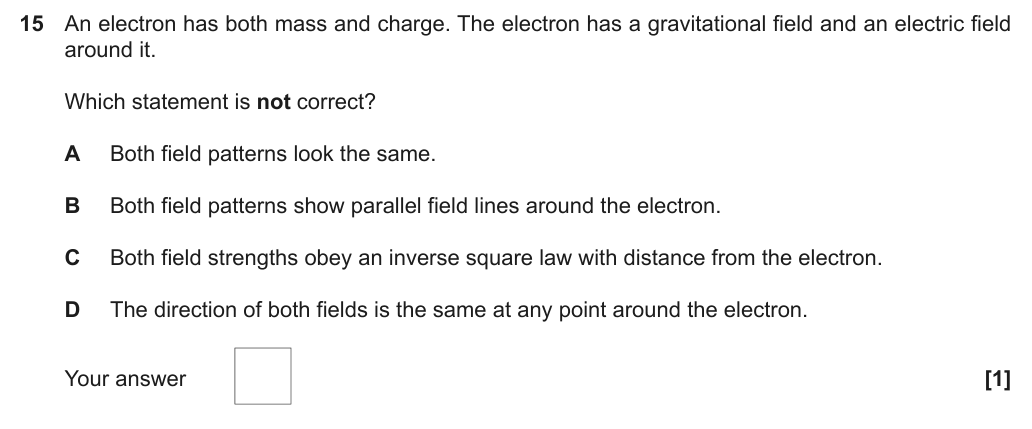
June 2022 · Paper 2 · Q151 markMultiple choiceHard
Answer
B
Mark scheme
Examiner's comment
This was a challenging question; candidates often drew a radial field diagram as a starting point and many candidates helpfully “ticked” the correct responses to help them eliminate these from their response. It is important that candidates read the questions carefully, as it was evident that some were looking for a correct statement.
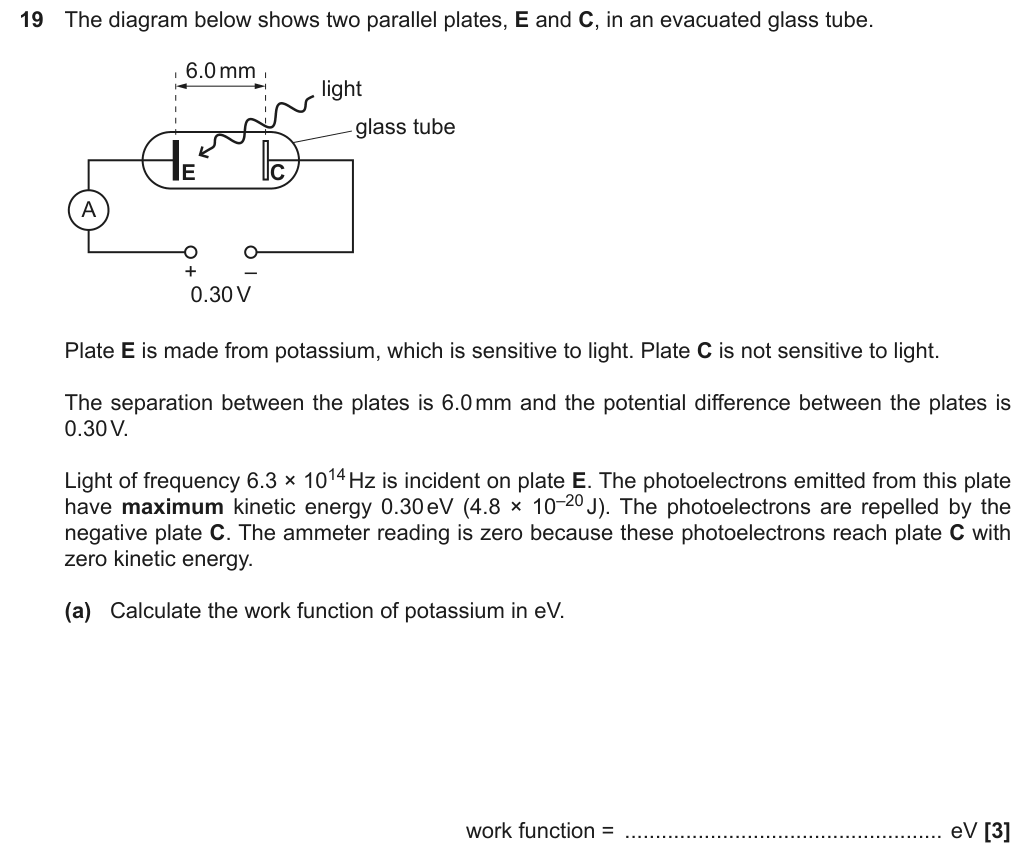
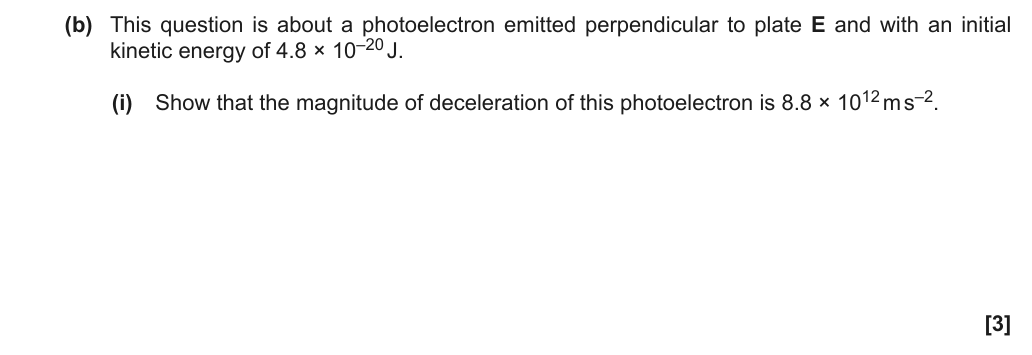
June 2022 · Paper 2 · Q19(b)(i)3 marksShow thatHard
Earlier part of question 19 that this part uses
Mark scheme
Examiner's comment
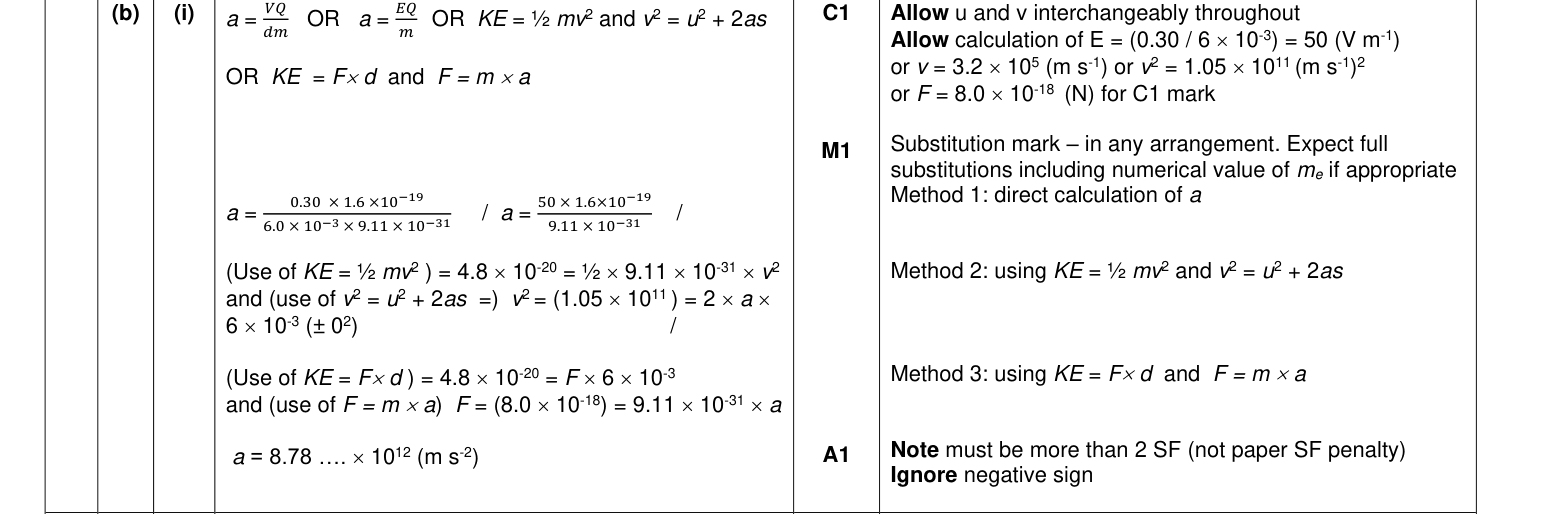
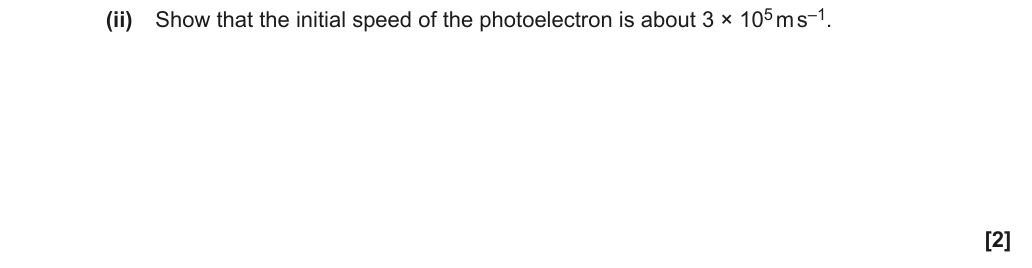
There were many different routes to showing the acceleration, and marks were given for each method or part method. No one method was seen significantly more than others, and some candidates used a variety of pathways to come to their answer. The main principle in the question (and the subsequent one) where the candidate is being asked to “show that” a given value is correct is that the examiner must be convinced that the candidate has clearly demonstrated that they have carried out the calculation and evaluated it on their calculator. The instructions which examiners used was: first marking point for providing one (or two) equations that would lead to the solution, or calculation of an intermediate value; second marking point for a full substitution into one or more equations; third marking point for using this full substitution to produce an answer to more sf than given in the question. As the second marking point was deemed to be an M mark, the full substitution needed to be seen to gain the A mark. A small number of (often higher end) candidates did not show the full substitution, often missing out the value of me in their calculation, and another common error was to not show the extra significant figure. Over half of the candidates were able to achieve full marks on this question and it generally discriminated well. Both of these are evidence that the complete calculation has taken place and that the candidate has not somehow artificially generated the required value. This advice should be viewed as “best practice” rather than a rigid set of rules. Reverse arguments are often possible where a candidate can work backwards from their given value, however this is not the advised approach.
Notes from the mark scheme and report
answer must be shown to more than 2 SF
ignore negative sign
three alternative methods
When a question asks a candidate to “show that” a given value is correct, the following two points should be considered: • Each stage of the calculation should be clearly shown. Preferably setting out any equation first, and then showing a full substitution of all values into that equation • If the value calculated by the candidate would correctly round to the given value, then the candidate should show their calculated value to at least one more significant figure than the given value.
Skills: M0.2 Recognise and use expressions in decimal and standard form; M2.3 Substitute numerical values into algebraic equations using appropriate units for physical quantities
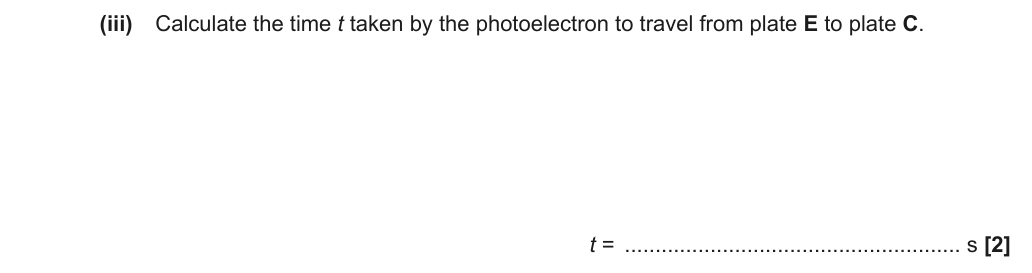
June 2022 · Paper 2 · Q19(b)(iii)2 marksCalculationMedium
Earlier parts of question 19 that this part uses
Mark scheme
Examiner's comment
Only around half of the candidates were able to obtain answers within the required range. Candidates used a variety of rounded or none-rounded values from prior calculations, so a generous range of responses was given to allow for this. A common error among less successful responses was to simply use speed = distance/time usually leading to 2.0 10-8 s. Those using s = ut + ½ at2 often encountered problems in solving the equation as it could lead to imaginary roots and tended to produce solutions way outside of the accepted values. However, marks could be given for setting up the calculation correctly.
Notes from the mark scheme and report
no ecf from (b)(i) or (b)(ii)
values between 3.4 and 3.8 x 10⁻⁸ s
Skills: M0.2 Recognise and use expressions in decimal and standard form; M2.3 Substitute numerical values into algebraic equations using appropriate units for physical quantities
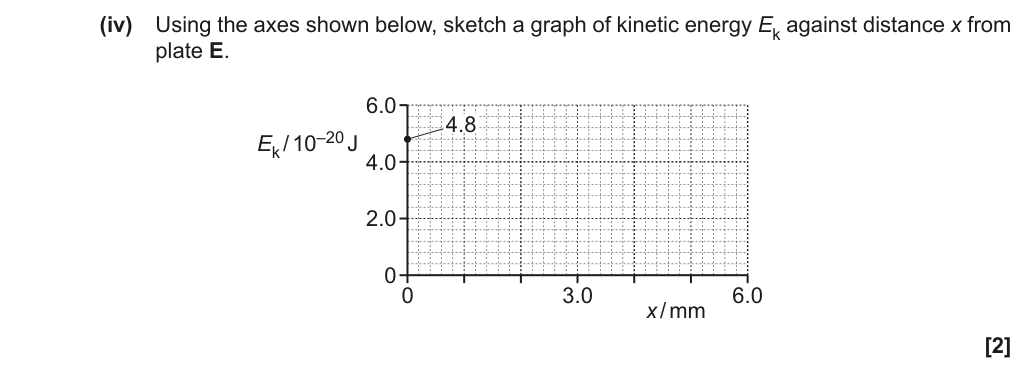
June 2022 · Paper 2 · Q19(b)(iv)2 marksDiagram or graphEasy
Earlier part of question 19 that this part uses
Mark scheme
Examiner's comment
Nearly all candidates appreciated that this line would start at 4.8 10-20 J and decrease to zero at 6.0 mm. However, the vast majority drew a curved line of decreasing gradient. This may well have come from a confusion from KE ∝ v2 and attempting to draw a parabola.
Notes from the mark scheme and report
straight line from (0, 4.8) to (6.0, 0)
a curve with negative gradient scores the M mark only
Skills: M3.12 Sketch relationships which are modelled by y = k/x, y = kx², y = k/x², y = kx, y = sin x, y = cos x, y = e^(±x) and y = sin²x, y = cos²x as applied to physical relationships
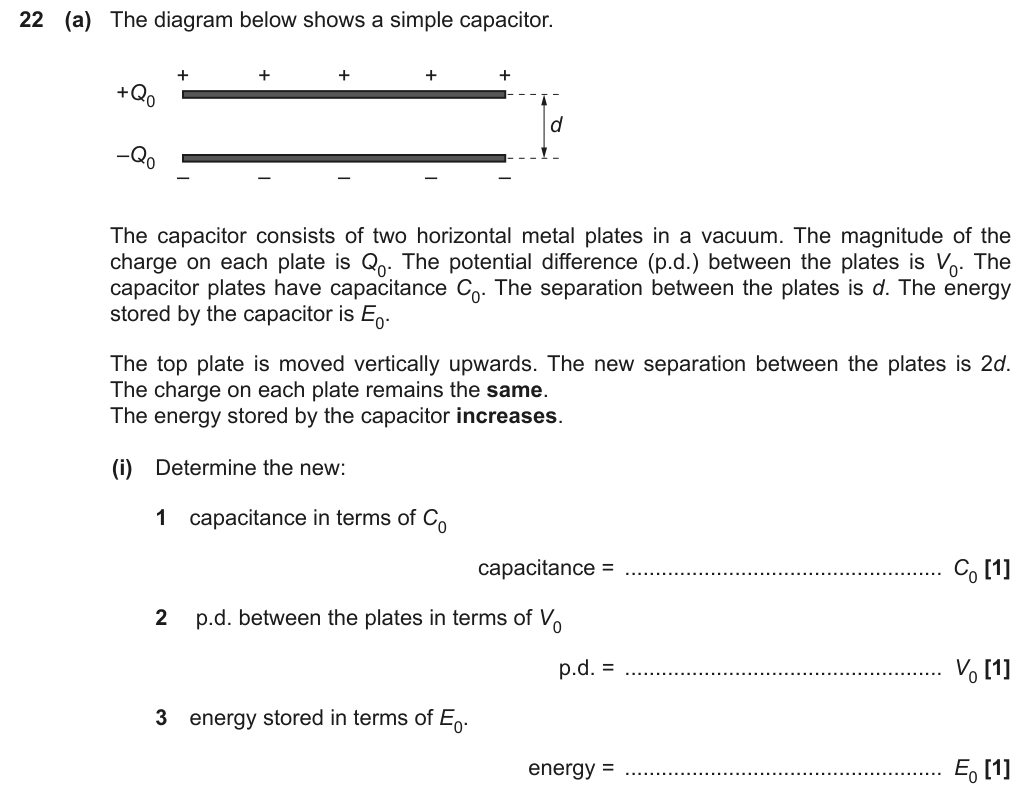
June 2022 · Paper 2 · Q22(a)(i)3 marksCalculationMedium
Mark scheme
Examiner's comment
Around two thirds of candidates were able to score all of these marks. Most showed some limited (but helpful) working, such as writing the equation for the parallel plate capacitor and C = Q/V, to assist them in appreciating how each of the factors change. For this question, there is a quite large amount of introductory text and the bold text is there as a supportive guide. The most common incorrect responses were a simple reversal of the correct responses.
Notes from the mark scheme and report
no ecf between the three answers
Skills: M0.3 Use ratios, fractions and percentages
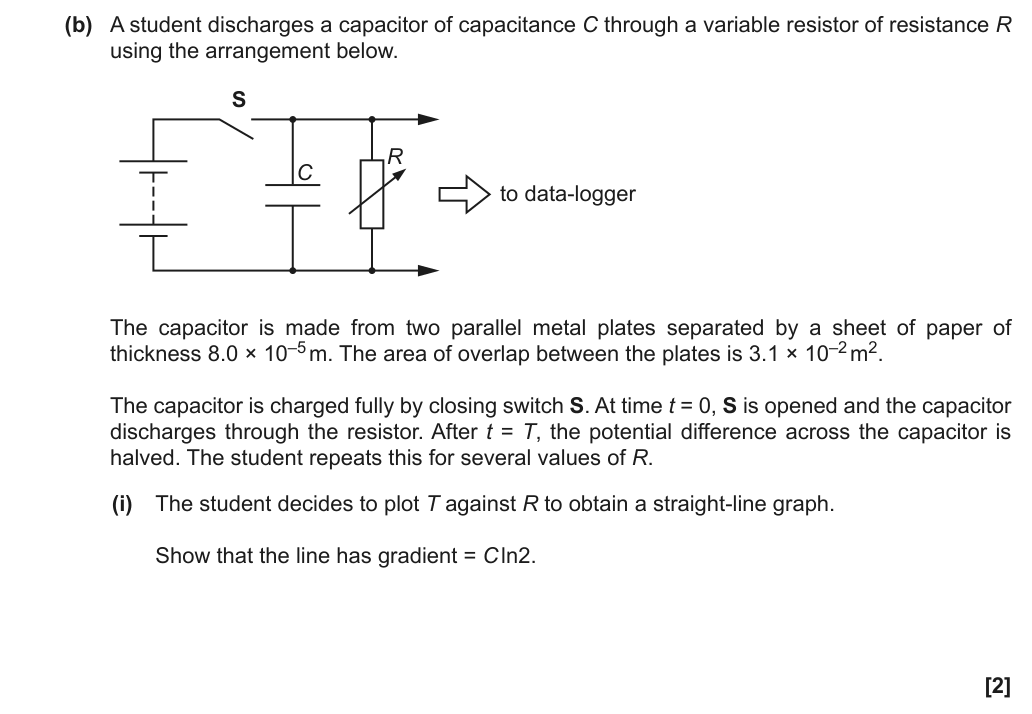
June 2022 · Paper 2 · Q22(b)(ii)5 marksDiagram or graphMedium
Earlier part of question 22 that this part uses
Mark scheme
Examiner's comment
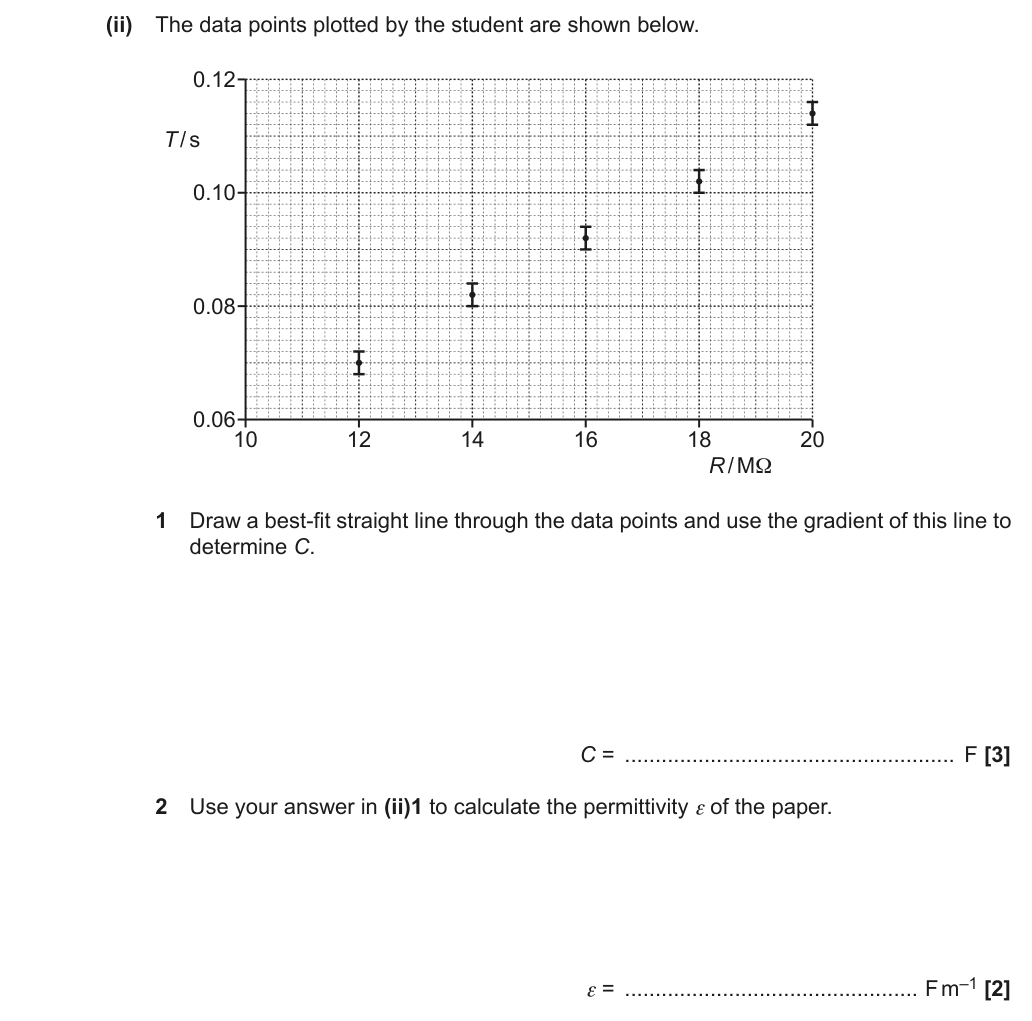
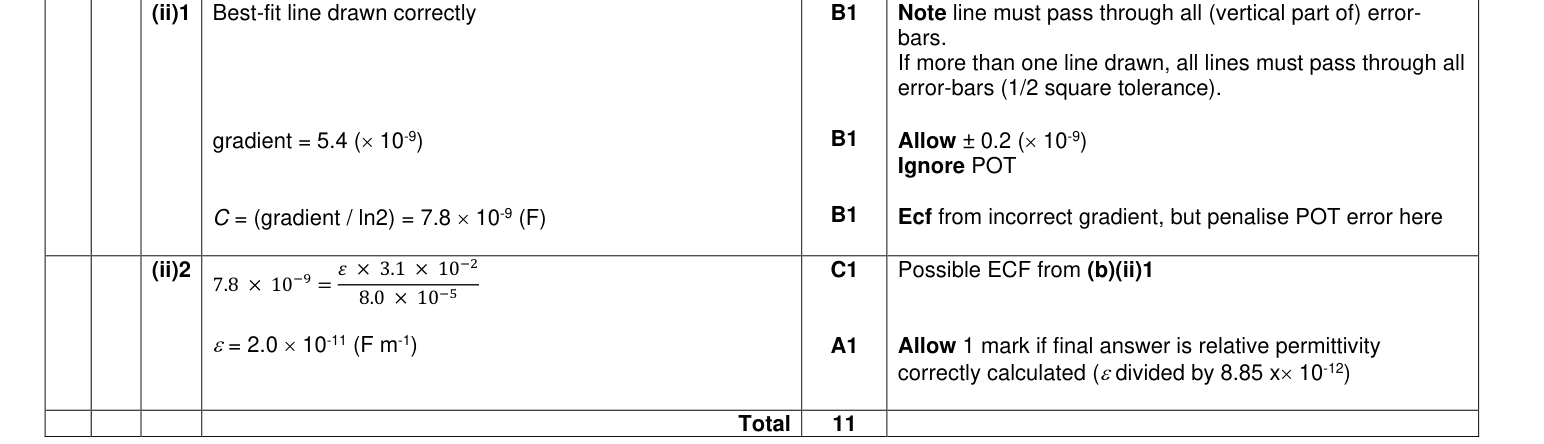
In part 1, nearly all the candidates were able to draw a correct straight best-fit line which passed through all the error bars. It was actually rather difficult not to do this, although several candidates did multiple lines (assuming they were unable to remove an original) and if any fell outside of the error bars, then it could not be given marks. In calculating the gradient, misreads from the graph were common either from the vertical scale or often assuming that the horizontal scale started from zero. A common mistake among the range of abilities was to miss out the 106 in the denominator of the gradient. Several candidates may have interpreted the question as meaning that the gradient was C, as they calculated the gradient but took it no further. Part 2 was generally well done by many candidates. Some of the less successful responses were unable to rearrange the capacitance equation correctly, often swapping over the d and A values. A small proportion calculated the relative permittivity and as long as this was done correctly, it could score the first mark. A common error was to attempt to use C = 4r which proved to be unproductive.
Notes from the mark scheme and report
line must pass through all error bars
gradient 5.4 ± 0.2 (x 10-9)
relative permittivity as final answer scores 1 mark
Good practice for straight best-fit lines includes: • A single straight line – not a line drawn in two or more parts.
• Use of a sharp pencil – once a line is drawn in pen, it is almost impossible to correct.
Skills: M0.1 Recognise and make use of appropriate units in calculations; M2.2 Change the subject of an equation, including non-linear equations; M3.4 Determine the slope and intercept of a linear graph; PAG9 Investigating capacitors
November 2021 · Paper 2 · Q41 markMultiple choiceHard
Answer
C
Mark scheme
Examiner's comment
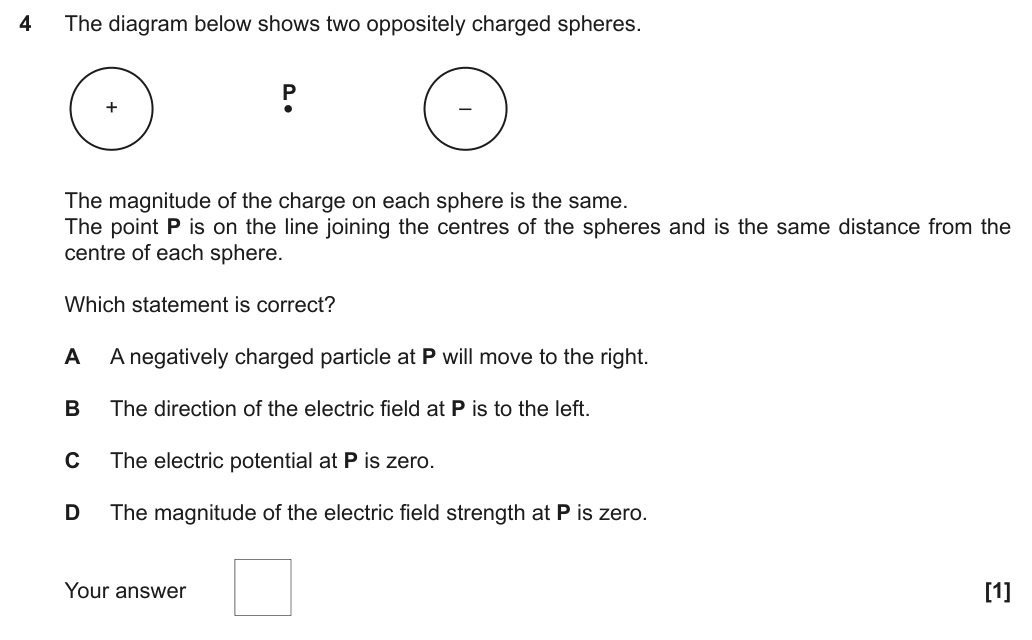
The correct response is C. Candidates often find the electric field questions challenging and this was again the case as this question was correctly answered by only one third of the candidates. Many candidates drew arrows on the diagram to assist them. Response D was the most common distractor; linking this to gravitational fields would produce a zero field strength at P which is likely to be the reason.
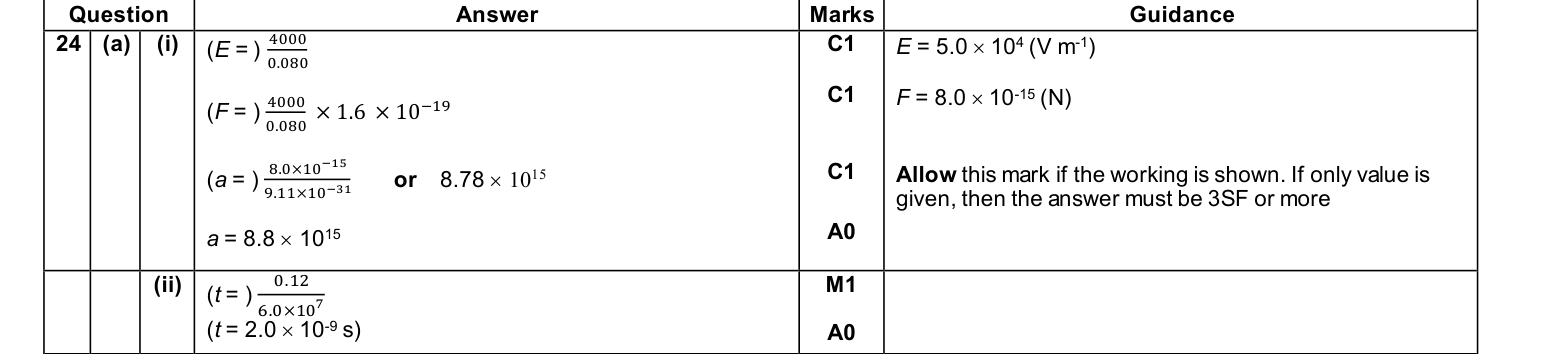
November 2021 · Paper 2 · Q24(a)(i)3 marksShow thatMedium
Mark scheme
Examiner's comment
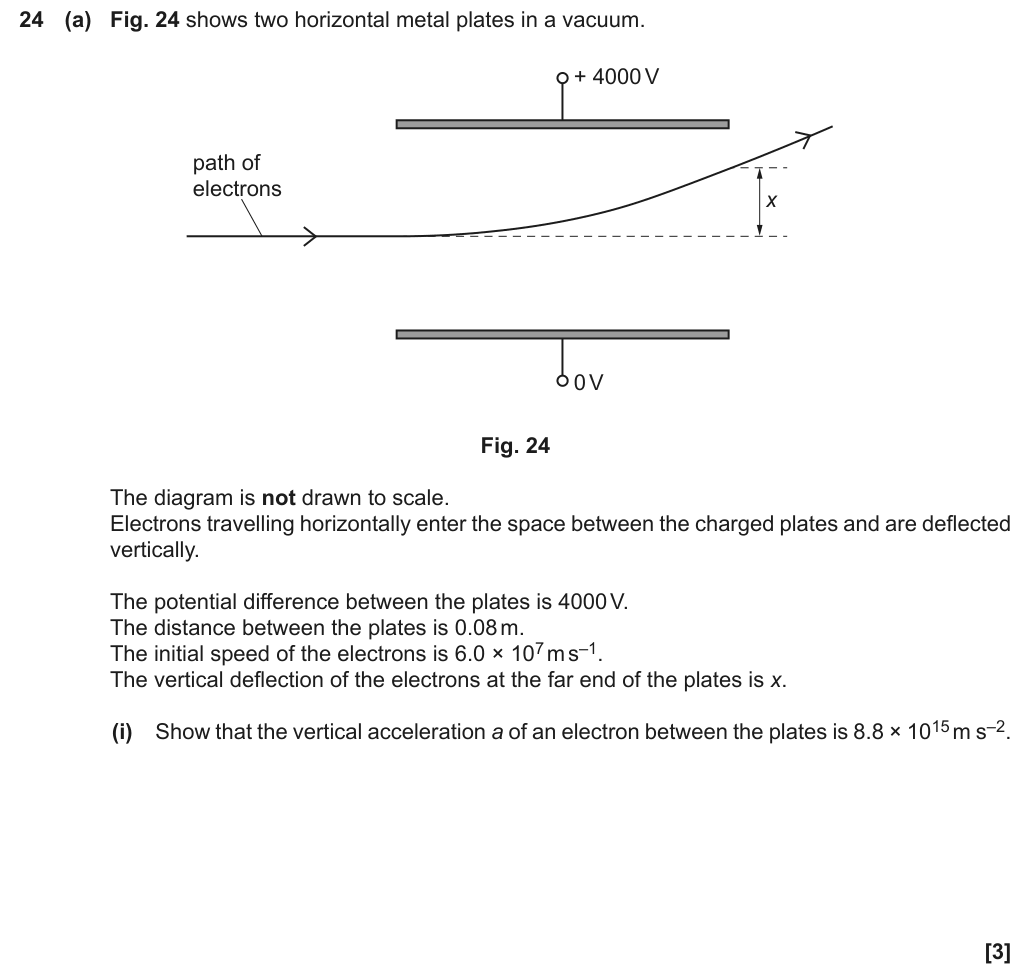
This question asks for a calculation to show the value of the vertical acceleration in an electric field. The magnitude of the electric field strength first needs to be calculated, followed by the acceleration from Newton’s second law. Candidates are reminded that a show question needs to be answered in detail and that each stage should be clear. Roughly equal numbers of candidates scored full marks or zero on this question.
Notes from the mark scheme and report
if only the value is given it must be to 3 SF or more (8.78 x 10¹⁵)
Skills: M0.2 Recognise and use expressions in decimal and standard form; M2.3 Substitute numerical values into algebraic equations using appropriate units for physical quantities
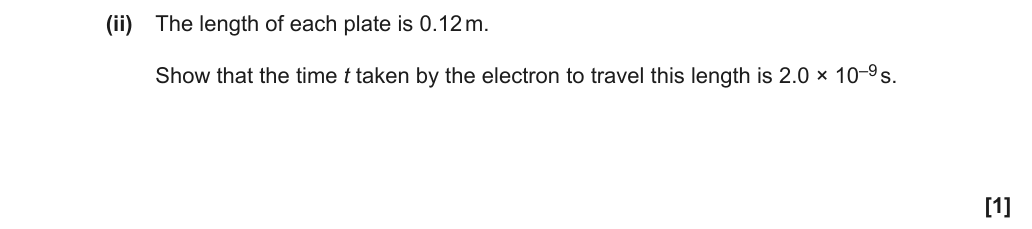
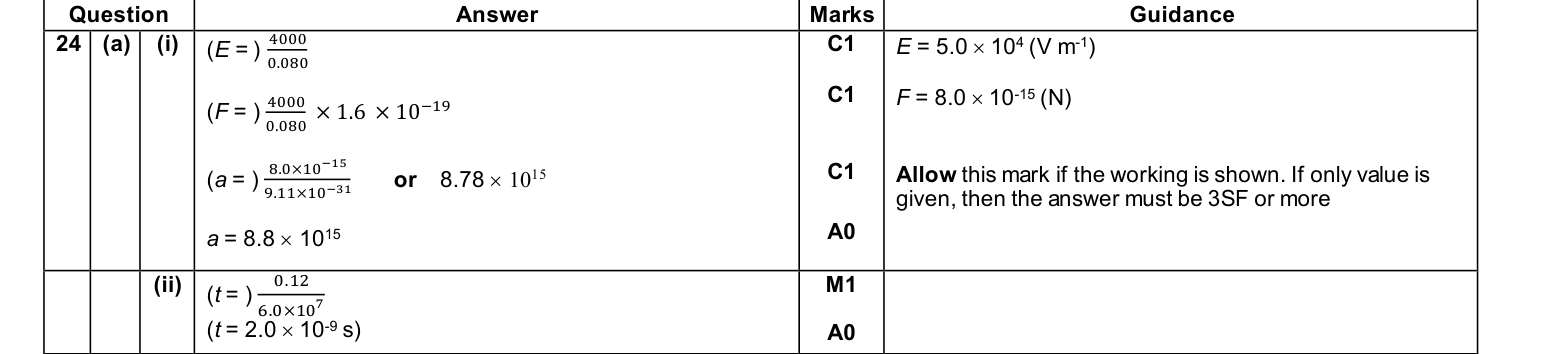
November 2021 · Paper 2 · Q24(a)(ii)1 markShow thatMedium
Earlier part of question 24 that this part uses
Mark scheme
Examiner's comment
As with the previous question, there is the need to make sure that the calculation leading to the given answer is clearly set out.
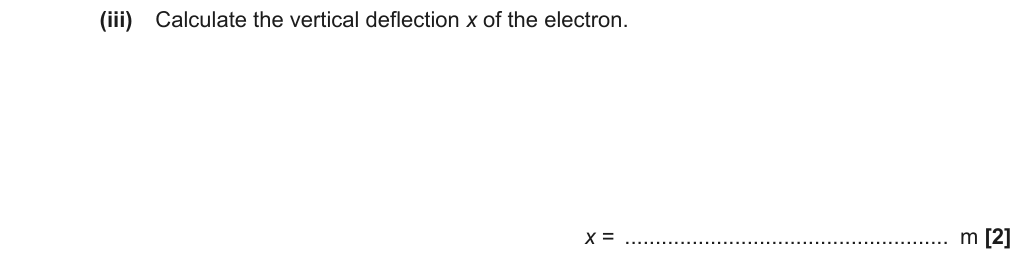
November 2021 · Paper 2 · Q24(a)(iii)2 marksCalculationMedium
Earlier parts of question 24 that this part uses
Mark scheme
Examiner's comment
Most candidates appreciated the need to use an equation of motion in their solution, but a significant number of candidates used an initial horizontal velocity in the expression, leading to an incorrect answer. There were also an unusually large number who gave no response. Candidates should appreciate that if they have been given show questions, then it is likely that these values will be used in alter questions.
Notes from the mark scheme and report
think of this process as analogous to that of projectile motion.
Skills: M2.3 Substitute numerical values into algebraic equations using appropriate units for physical quantities
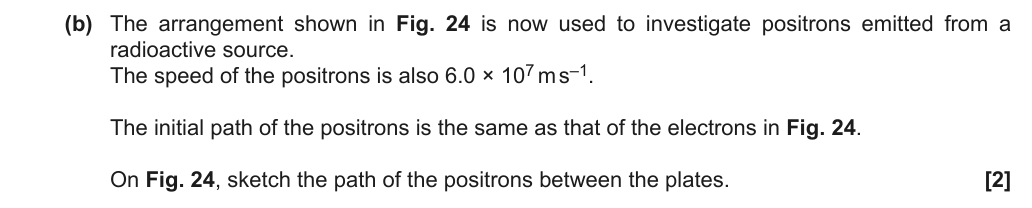
November 2021 · Paper 2 · Q24(b)2 marksDiagram or graphEasy
Earlier part of question 24 that this part uses
Mark scheme
Examiner's comment
Nearly all candidates appreciated that the path should be downwards, but many did not take the care needed for it to be clear that the deflection at the end of the plate should be the same. Some candidates drew an ‘x’ on their sketch, which was helpful in determining if the intention to draw it the same had been made.
Notes from the mark scheme and report
downward curve with the same x (by eye)
ignore any line outside the plates
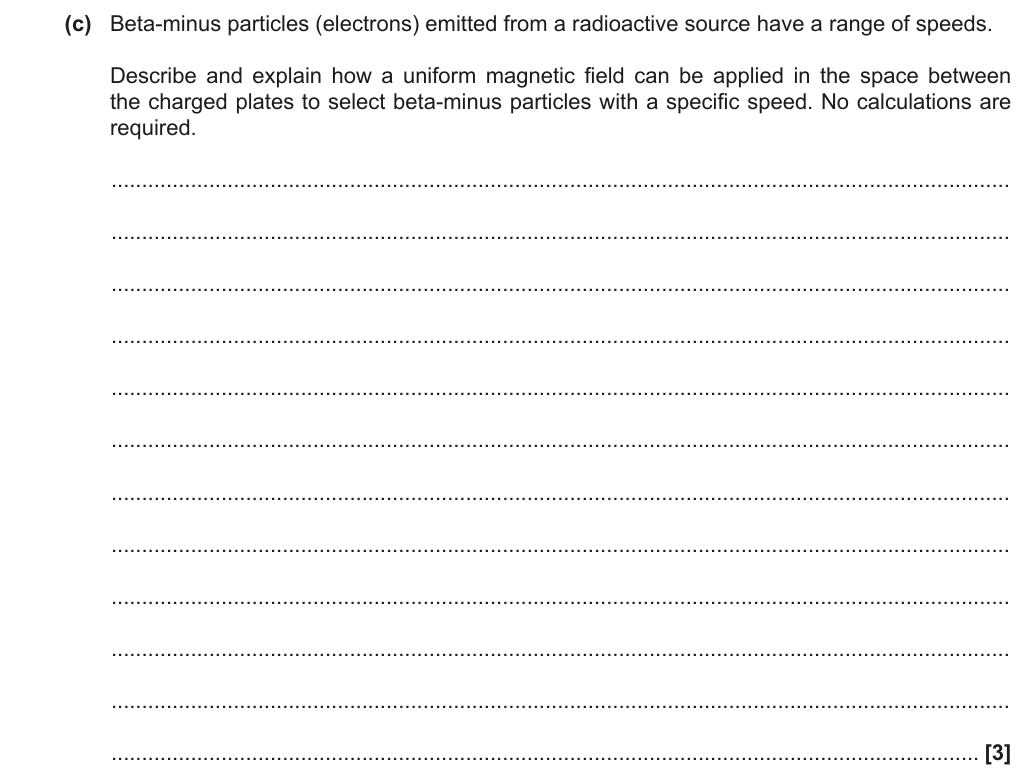
November 2021 · Paper 2 · Q24(c)3 marksExplanationHard
Earlier part of question 24 that this part uses
Mark scheme
Examiner's comment
This question was quite poorly answered, with many candidates not even mentioning the magnetic field. Few appreciated that the magnetic field needs to be placed perpendicularly to the electric field, although most could state the EQ = BQv. However, in a description, there was some confusion about the ‘fields’ being equal rather than the ‘forces’. No candidate gave a suitable description for the last mark but could access it through use of v = E/B.
Notes from the mark scheme and report
B must be at right angles to the electric field
allow Eq = Bqv or v = E/B
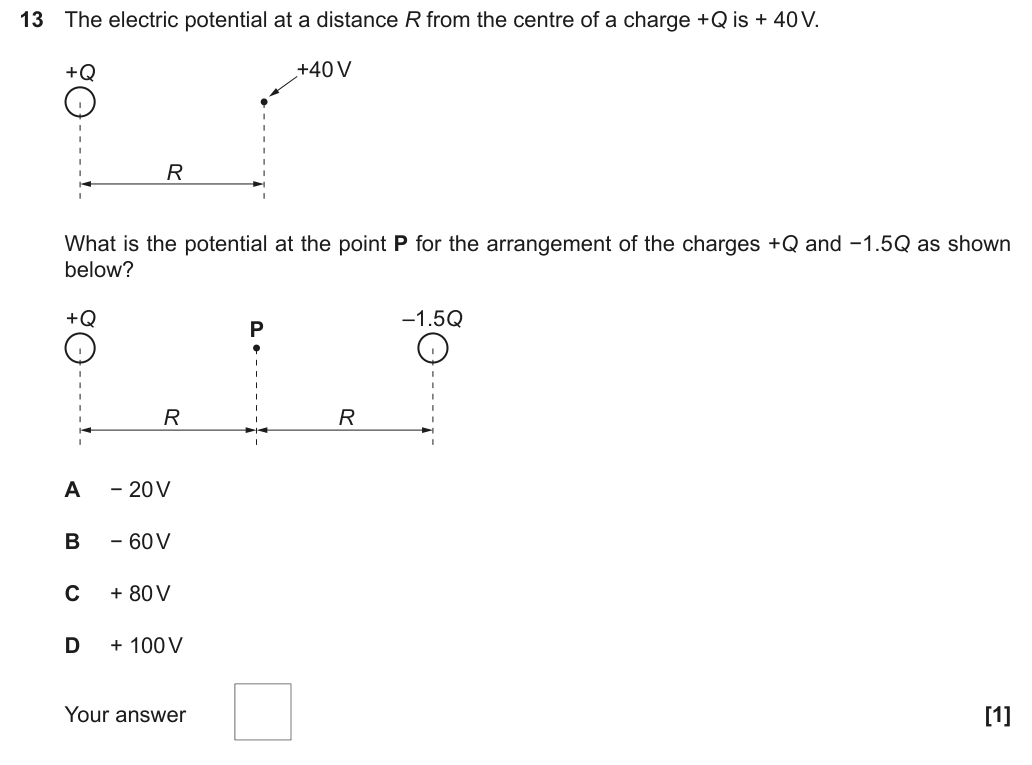
November 2020 · Paper 2 · Q131 markMultiple choiceMedium
Answer
A
Mark scheme
Examiner's comment
Question 13 is all about two key ideas: electric potential is inversely proportional to the distance from the centre of the charge and the scalar nature of electric potential.
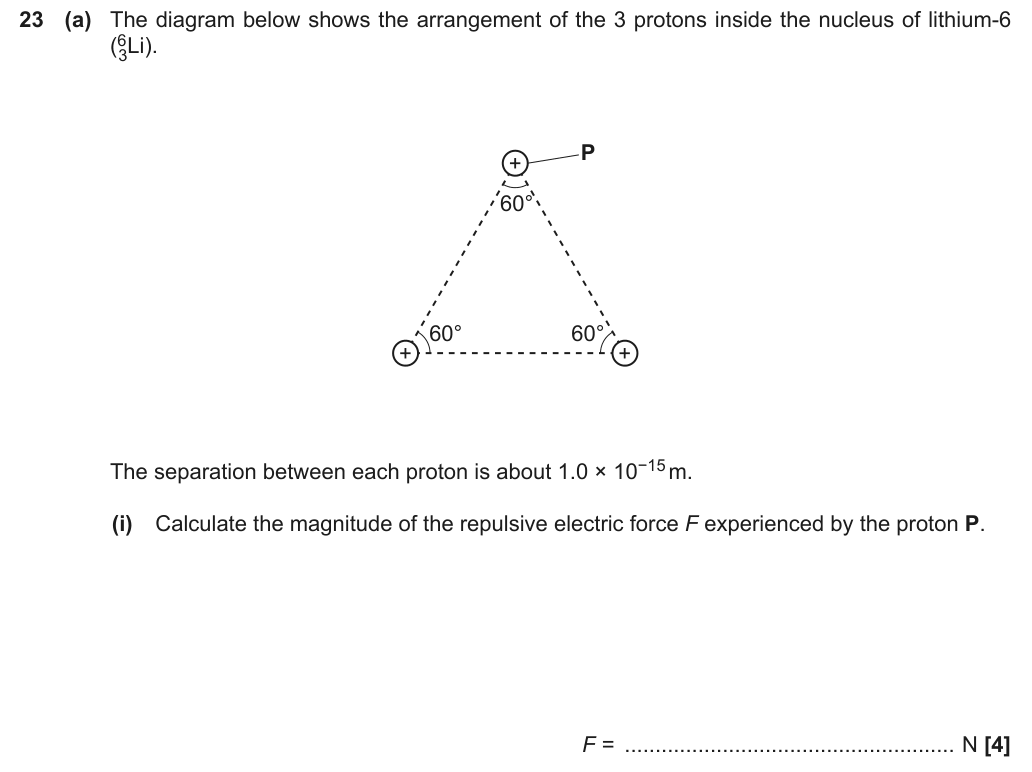
November 2020 · Paper 2 · Q23(a)(i)4 marksCalculation
Mark scheme
Notes from the mark scheme and report
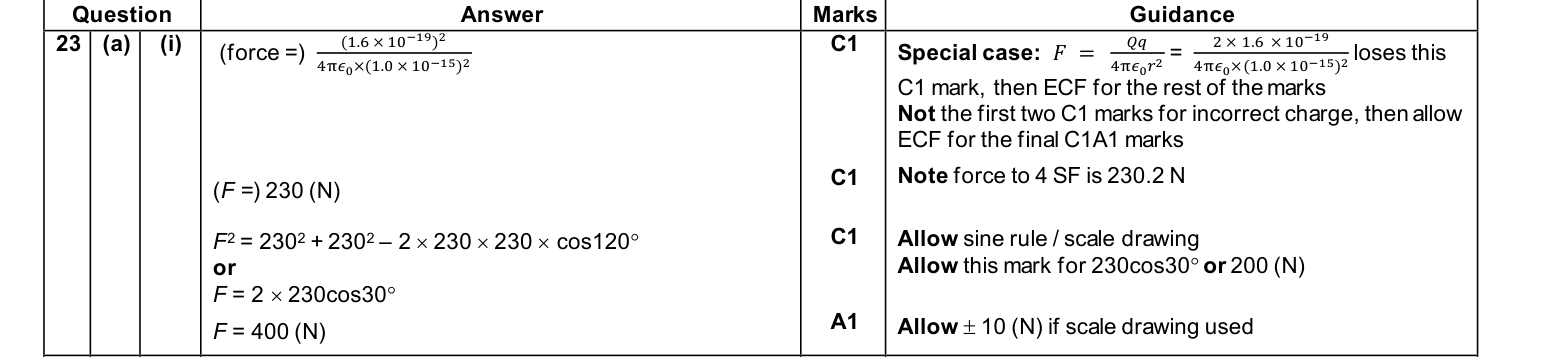
230 N between two protons
doubling the charge in the formula loses the first mark
allow scale drawing ± 10 N
Skills: M0.2 Recognise and use expressions in decimal and standard form; M2.3 Substitute numerical values into algebraic equations using appropriate units for physical quantities; M4.5 Use sin, cos and tan in physical problems
November 2020 · Paper 2 · Q23(a)(ii)1 markDiagram or graph
Earlier part of question 23 that this part uses
Mark scheme
Notes from the mark scheme and report
arrow vertically up the page
Skills: M4.2 Visualise and represent 2D and 3D forms, including two-dimensional representations of 3D objects
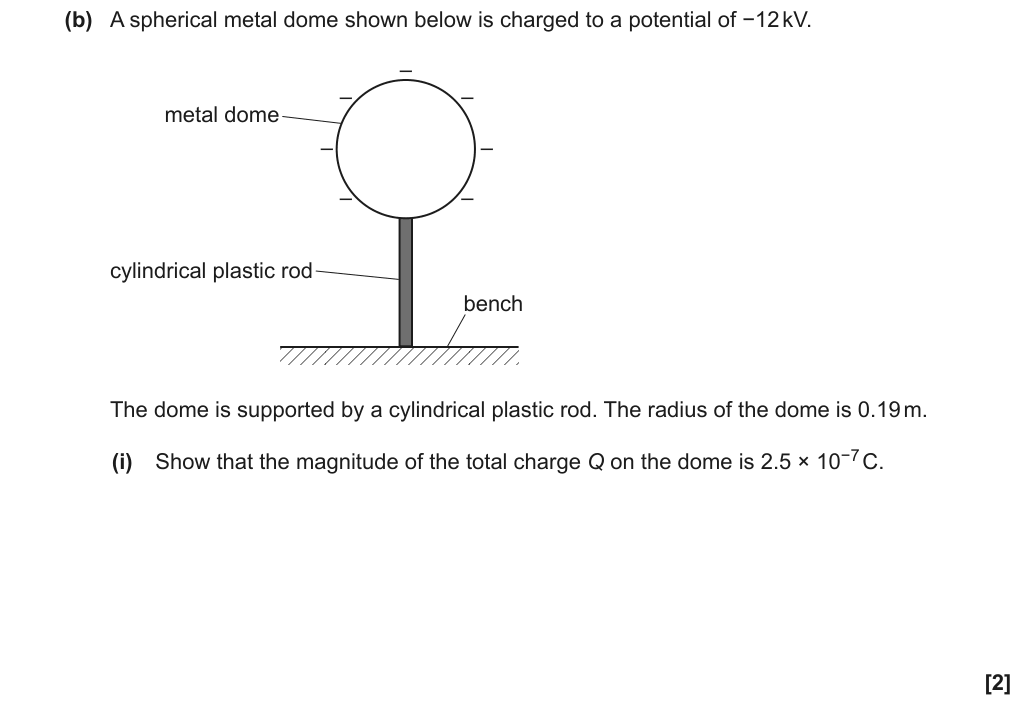
November 2020 · Paper 2 · Q23(b)(i)2 marksShow that
Mark scheme
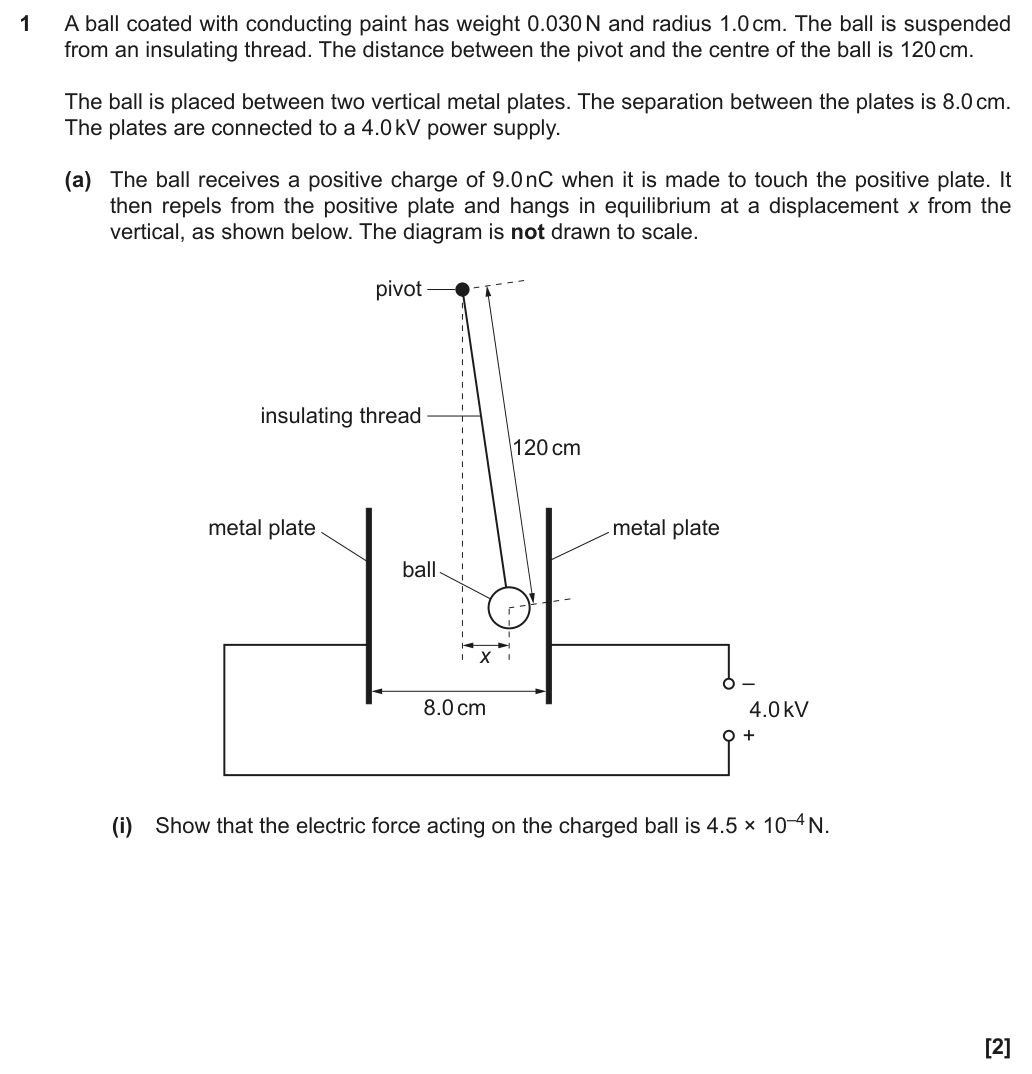
November 2020 · Paper 3 · Q1(a)(i)2 marksShow thatMedium
Mark scheme
Examiner's comment
Comments on individual questions Question 1ai Many lower ability candidates did not appreciate the uniform nature of the electric field between the plates and attempted to use Coulomb’s Law. Question 1aii Most candidates scored a mark for showing the weight and tension forces accurately. AfL Do not use the word ‘gravity’ in place of ‘weight’ Question 1aiii Although most candidates knew the principle of moments, many were unable to apply it correctly in this situation. Question 1b The purpose of this question was to challenge the candidates to use their knowledge of electric fields in a novel practical situation.
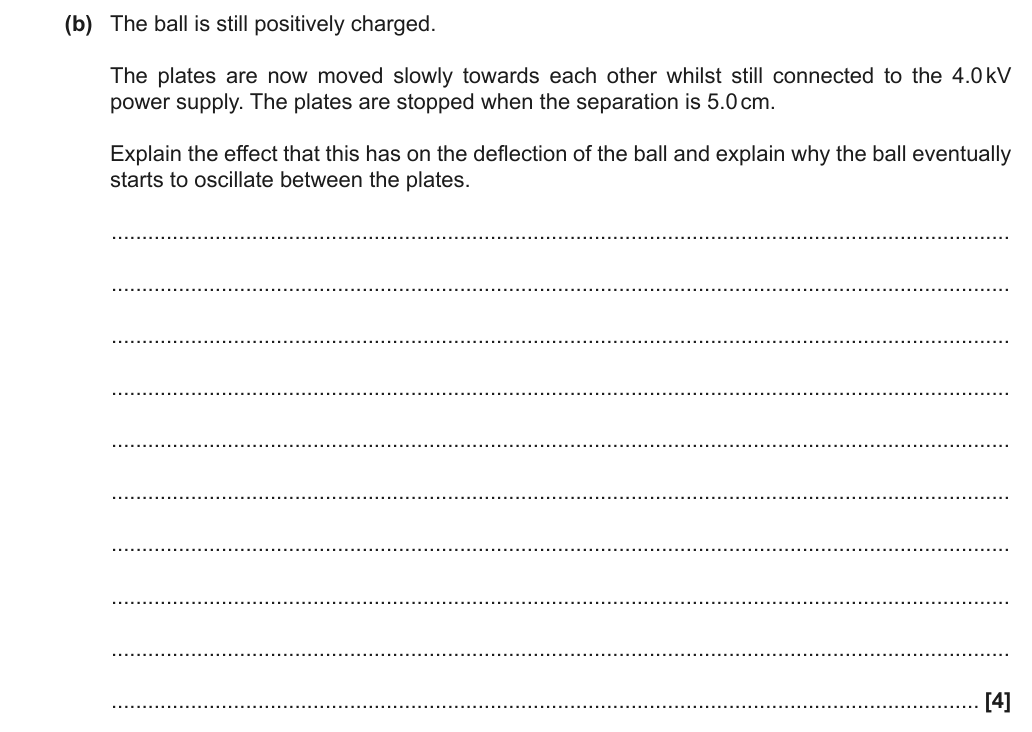
November 2020 · Paper 3 · Q1(b)4 marksExplanationMedium
Earlier part of question 1 that this part uses
Mark scheme
Examiner's comment
Comments on individual questions Question 1ai Many lower ability candidates did not appreciate the uniform nature of the electric field between the plates and attempted to use Coulomb’s Law. Question 1aii Most candidates scored a mark for showing the weight and tension forces accurately. AfL Do not use the word ‘gravity’ in place of ‘weight’ Question 1aiii Although most candidates knew the principle of moments, many were unable to apply it correctly in this situation. Question 1b The purpose of this question was to challenge the candidates to use their knowledge of electric fields in a novel practical situation.
Notes from the mark scheme and report
must be clear which force increases
ball takes the charge of the plate it touches
idea of a repeating cycle needed
November 2020 · Paper 3 · Q3(b)6 marks6-mark extended responseMedium
Mark scheme, with the levels and indicative content
Examiner's comment
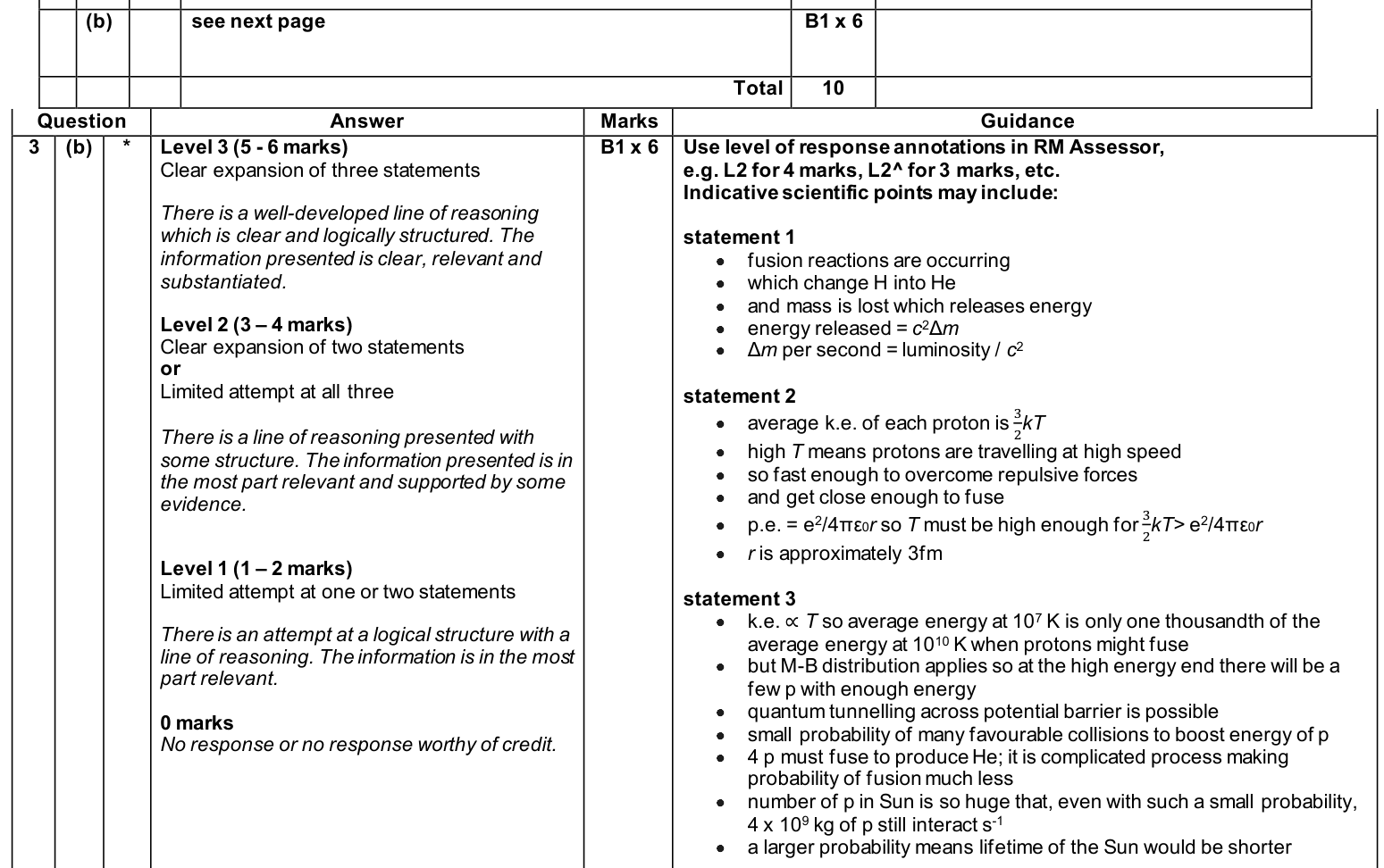
Question 3ai Most candidates successfully used the formula for Stefan’s Law. Question 3aii Higher ability candidates successfully used the more elegant ratios method to reach the correct response. Question 3b This was one of the two LoR questions.
Notes from the mark scheme and report
1: fusion of H to He, energy = c squared x mass loss
2: mean KE = 3/2 kT must exceed electrostatic PE e squared / 4 pi epsilon0 r
3: Maxwell-Boltzmann distribution / quantum tunnelling give a small probability of fusion
November 2020 · Paper 3 · Q6(b)4 marksCalculationMedium
Earlier part of question 6 that this part uses
Mark scheme
Examiner's comment
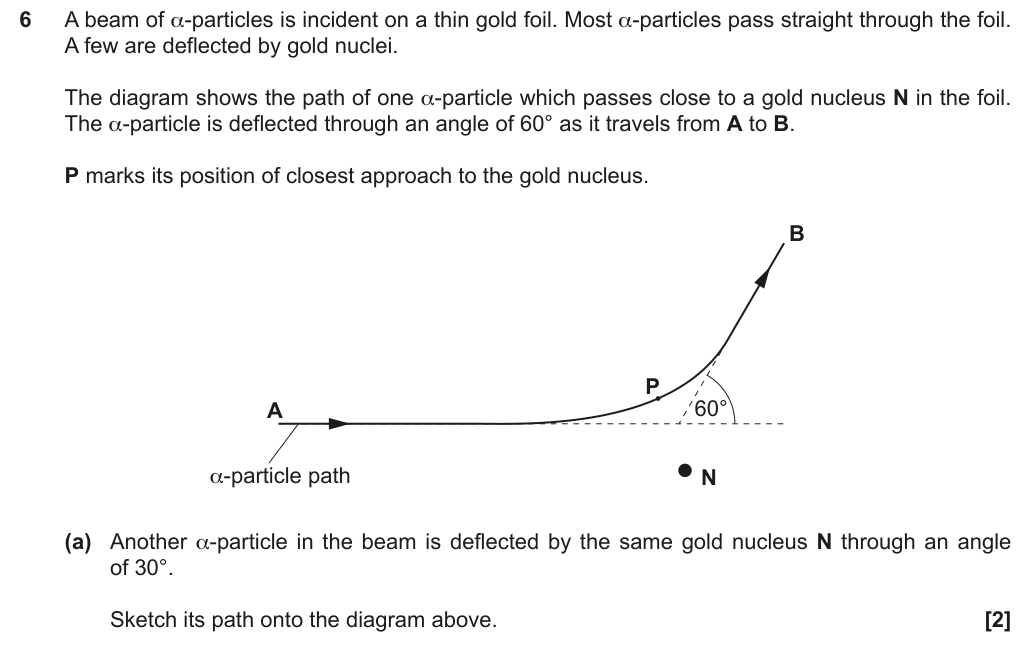
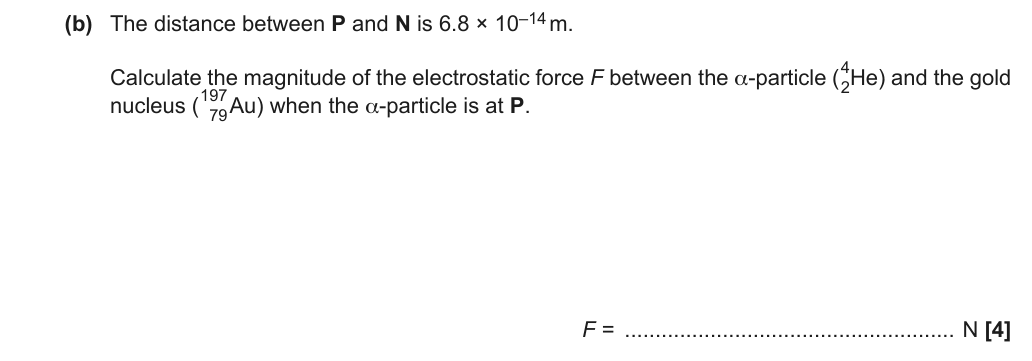
Since this paper is synoptic, candidates need to be able to apply their knowledge and understanding in unfamiliar contexts in order to gain high marks, To do well in this paper, candidates must be able to: • perform and layout calculations logically, showing clear working (such as Question 6c) • produce concise but accurate responses to questions which involve extended writing (such as question 1b) • craft clearly structured and well-reasoned arguments to the Level of Response Questions (3b and 5d) • process and interpret data from an experiment to reach conclusions (Question 2). Question 6a The common errors here were: • not realising that, for the particle to be deflected through a smaller angle, it needed to be travelling further away from N • not labelling the final angle of 30° • not adding arrows to show the direction of travel • drawing a path that continued bending beyond the stated 30° (usually ending up parallel to the original path). Question 6b The most common error here was to use incorrect values for the charges on the two ions. Question 6c This question provided an excellent opportunity for candidates to produce immaculate responses: identify the physics involved, select and write down the correct formula, do the necessary conversion (MeV to J), rearrange the formula, substitute correctly and then write the final response in standard form to a correct number of significant figures. Question 6d This was not an easy question but, even so, a good number of candidates did well.
Notes from the mark scheme and report
ecf for wrong charge(s), e.g. Q or q = e, or 79 and 2 without e
Skills: M0.2 Recognise and use expressions in decimal and standard form; M2.3 Substitute numerical values into algebraic equations using appropriate units for physical quantities
June 2019 · Paper 2 · Q21 markMultiple choiceMedium
Answer
D
Mark scheme
Examiner's comment
This question was assessing the simple learning outcome 6.2.1b from the specification – modelling a uniformly charged sphere as a point charge at its centre. The correct key is D. The most popular distractor was A with distance being measured between the two surfaces of the sphere.
June 2019 · Paper 2 · Q81 markMultiple choiceMedium
Answer
B
Mark scheme
Examiner's comment
This question required knowledge of the equation 𝐸𝐸= 4𝜋𝜋𝜀𝜀0𝑟𝑟2, which is in the Data, Formulae and Relationship Booklet. The key, the correct answer, is B. The most common mistake made by candidates was not squaring r, or the equivalent where the electric potential V equation was used instead. This gave the incorrect answer of 7.3 × 10⁻¹⁰ C for the most recurrent distractor C. The exemplar 2 below shows a plausible method for getting to the correct answer. This middle-grade candidate has shown all the working. A significant number of candidates wrote down the correct expression, circled the key data in the question and did the rest of the work on their calculators. A variety of techniques were use.
June 2019 · Paper 2 · Q22(a)(ii)2 marksShow thatMedium
Earlier part of question 22 that this part uses
Mark scheme
Examiner's comment
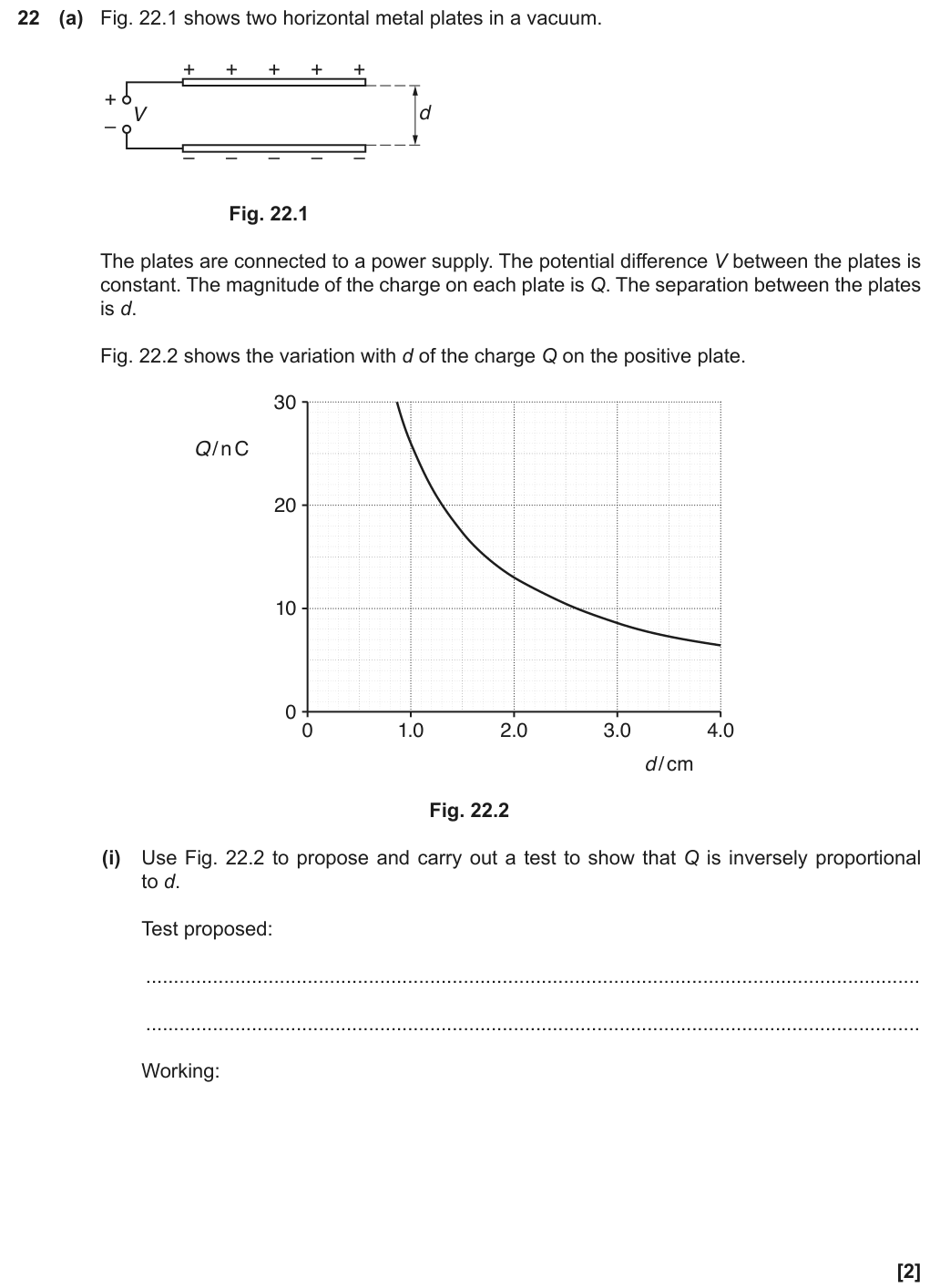
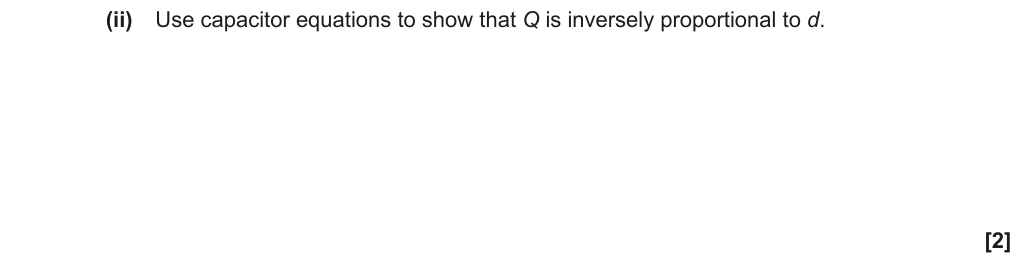
Most candidates successfully, and elegantly, provided the proof for the relationship. Correct answers ranged from the whole space filled with algebra to a couple of succinct lines. A small number of candidates finished off their working by writing 𝑄𝑄= 𝑑𝑑 instead 𝑄𝑄∝ 𝑑𝑑 - the ‘equal’ and the ‘proportionality’ symbols are not equivalent.
Notes from the mark scheme and report
Q or Q/V must be the subject
Skills: M2.2 Change the subject of an equation, including non-linear equations
June 2019 · Paper 2 · Q22(b)(i)1 markCalculationMedium
Mark scheme
Examiner's comment
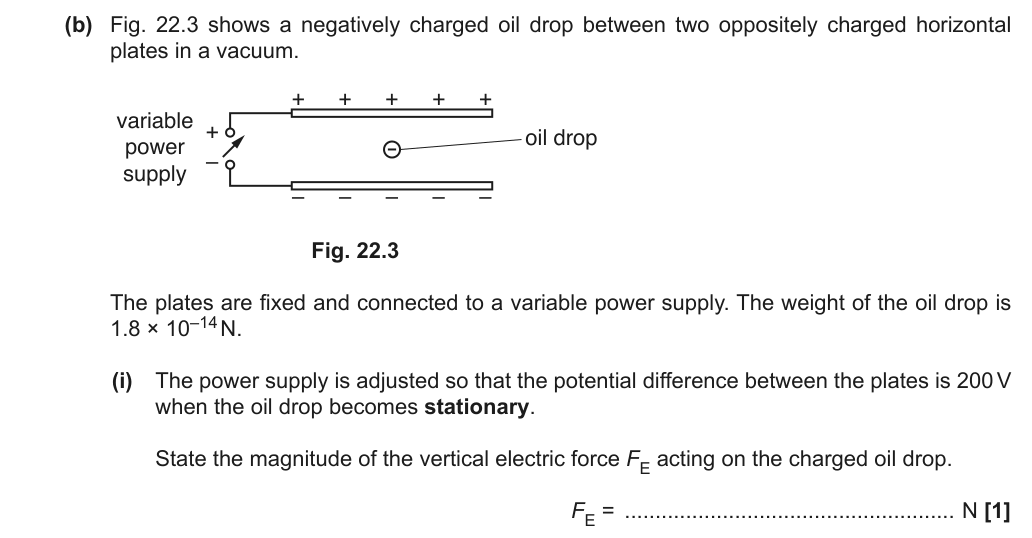
This question was designed to support candidates with the next question. The majority scored 1 mark for quoting the weight of the oil drop. A significant number of candidates, about 1 in 5, focused incorrectly on the term stationary in the question, and wrote 0 N on the answer line.
Notes from the mark scheme and report
Ignore sign
June 2019 · Paper 2 · Q22(b)(ii)3 marksCalculationMedium
Earlier part of question 22 that this part uses
Mark scheme
Examiner's comment
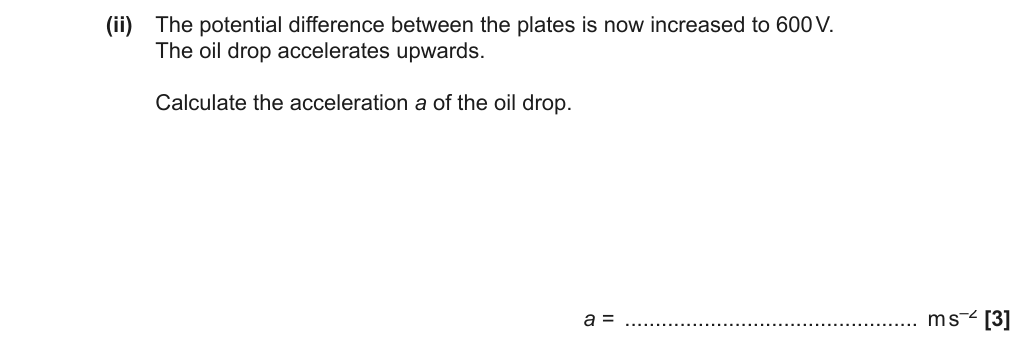
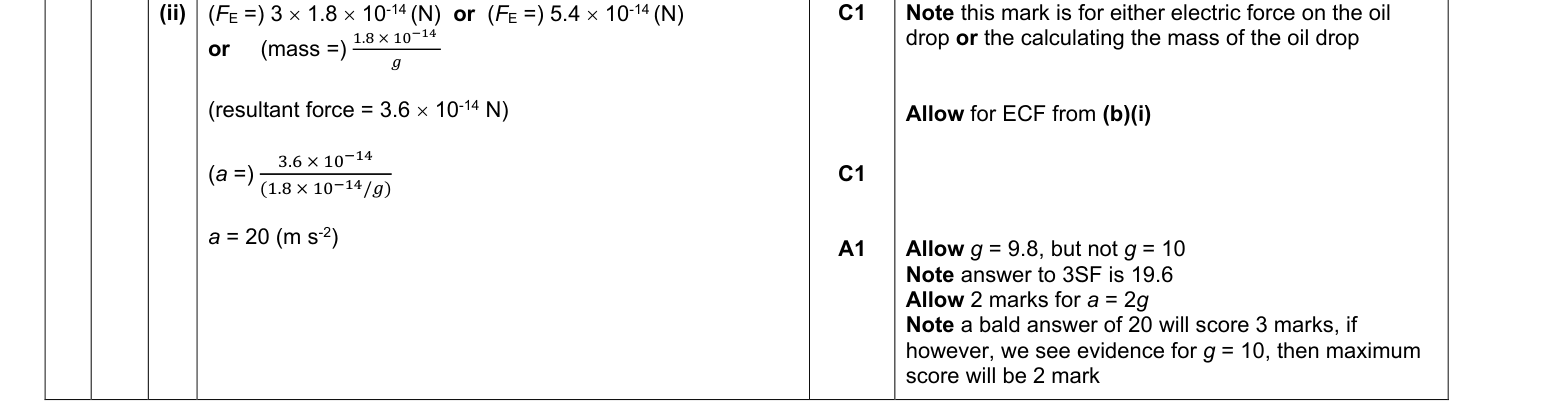
This was a perfect question for the higher and middle ability candidates. Securing full marks was very much dependent on candidates’ understanding of resultant force. The majority of the candidates scored 1 mark for calculating the weight of the oil drop in kg. Subsequent steps required the electric force on the oil drop to be 3 times the weight, or the resultant force being twice the weight. The key to getting the correct answer of 2g, or 19.6 m s-2, was deducing that the resultant force was 3.6 × 10⁻¹⁴ N. The most common incorrect answer was 29.4 m s-2 because the resultant force was taken as 5.6 × 10⁻¹⁴ N. The exemplar 9 below shows the most common incorrect solution. This exemplar from a middle-grade candidate shows how lack of knowledge of resultant force on the oil drop led to just 1 mark. The only mark given was for the mass of the oil drop. Using as 5.6 × 10⁻¹⁴ N as the resultant force led to the incorrect response of 3g or 29.43 m s-2.
Notes from the mark scheme and report
a = 2g
g = 10 loses the final mark
Skills: M0.3 Use ratios, fractions and percentages; M2.3 Substitute numerical values into algebraic equations using appropriate units for physical quantities
June 2019 · Paper 2 · Q22(c)6 marks6-mark extended responseHard
Mark scheme, with the levels and indicative content
Examiner's comment
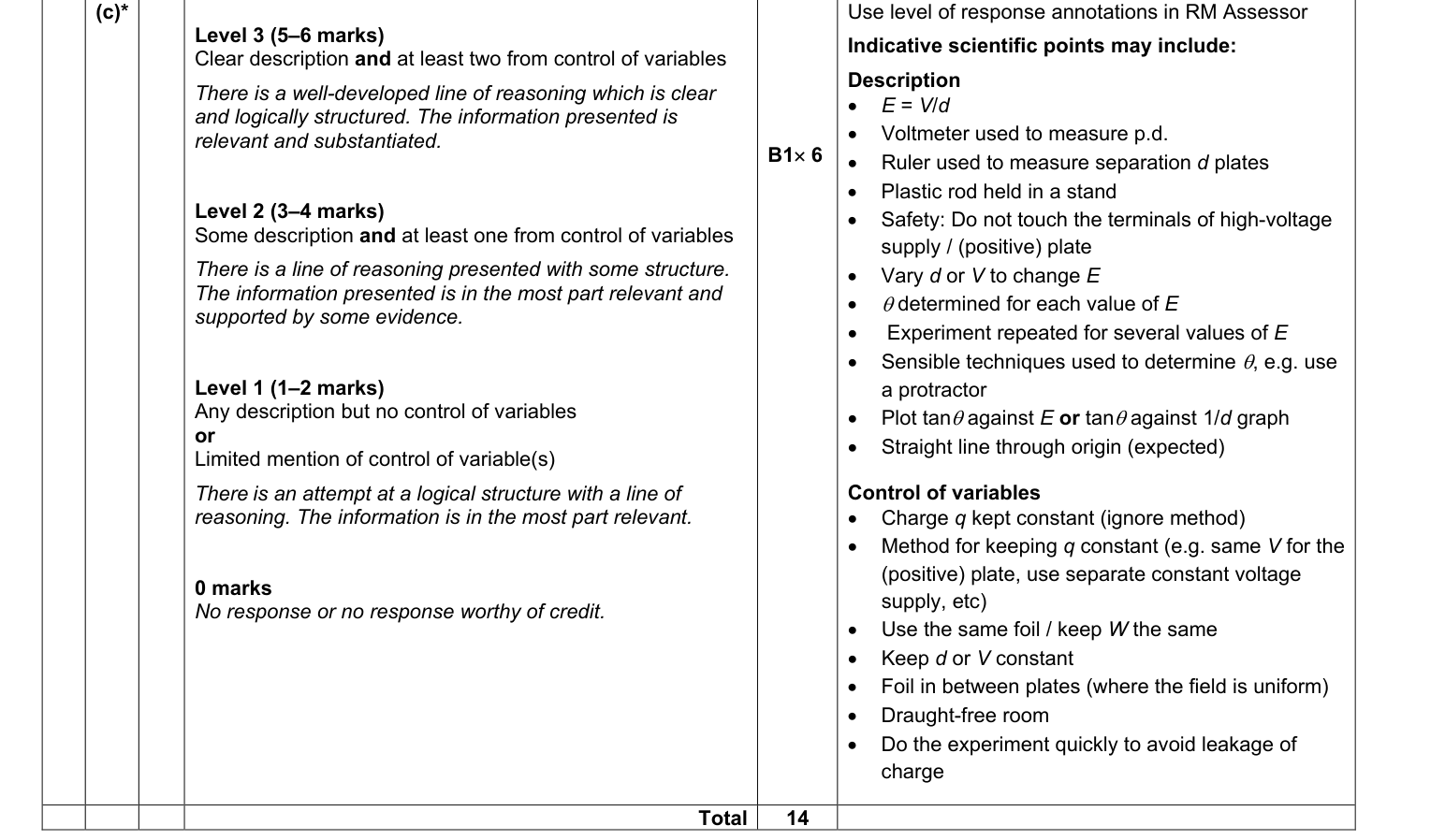
This was the second level of response (LoR) question in this paper. This too was designed to assess practical skills of planning, implementation, analysis and evaluation. The context of the question was force experienced by a charged gold foil in the uniform electric field provided by two parallel plates. Candidates were not expected to have seen such an experiment, but they were expected to use their knowledge of electric field strength and practical skills to present plausible approaches. On occasions, the experimental methods showed poor appreciation of some basic ideas. Some candidates were charging the foil using large current that allegedly would cause heating issues for the foil, while others decided to use Q = It, ammeter and a stopwatch to determine the charge on the foil – failing to appreciate that the time constant will be too small for such a technique. However, on this occasion, such over ambitious techniques were generally overlooked by examiners. As with 16d, a holistic approach to marking was used, with marks given according answers matching the descriptors for the various levels. There is no one perfect answer for this question, examiners were expecting an eclectic approach. The key things examiners were looking for were: - Methods for determining electric field strength E. - Using the right instruments for the measurements. - Plotting the correct graph to show the relationship given in the question was valid. - Correctly identifying the variables that were being controlled (kept constant). Access to higher level marks dependent on fully answering the question – and this included the last statement about control of variables. A significant number of candidates focused on the description and analysis of the data, without ever addressing the last sentence of the question. This question did discriminate well, with L1, L2 and L3 marks roughly distributed in the ratio 1:3:4.
Notes from the mark scheme and report
E = V/d
do not touch high-voltage terminals
keep q and W constant
plot tan θ against E
Skills: M3.3 Understand that y = mx + c represents a linear relationship
June 2018 · Paper 2 · Q81 markMultiple choice
Answer
A
Mark scheme
June 2018 · Paper 2 · Q131 markMultiple choice
Answer
B
Mark scheme
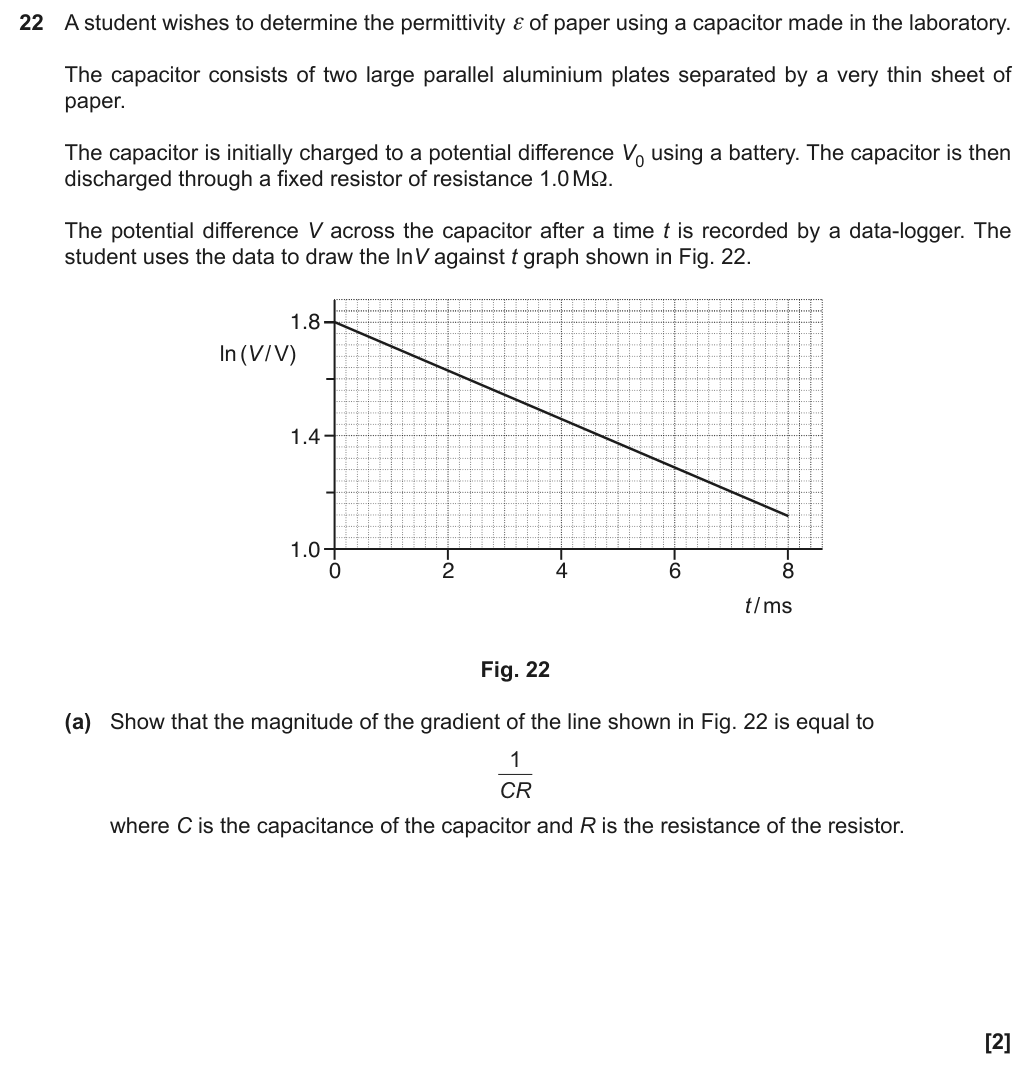
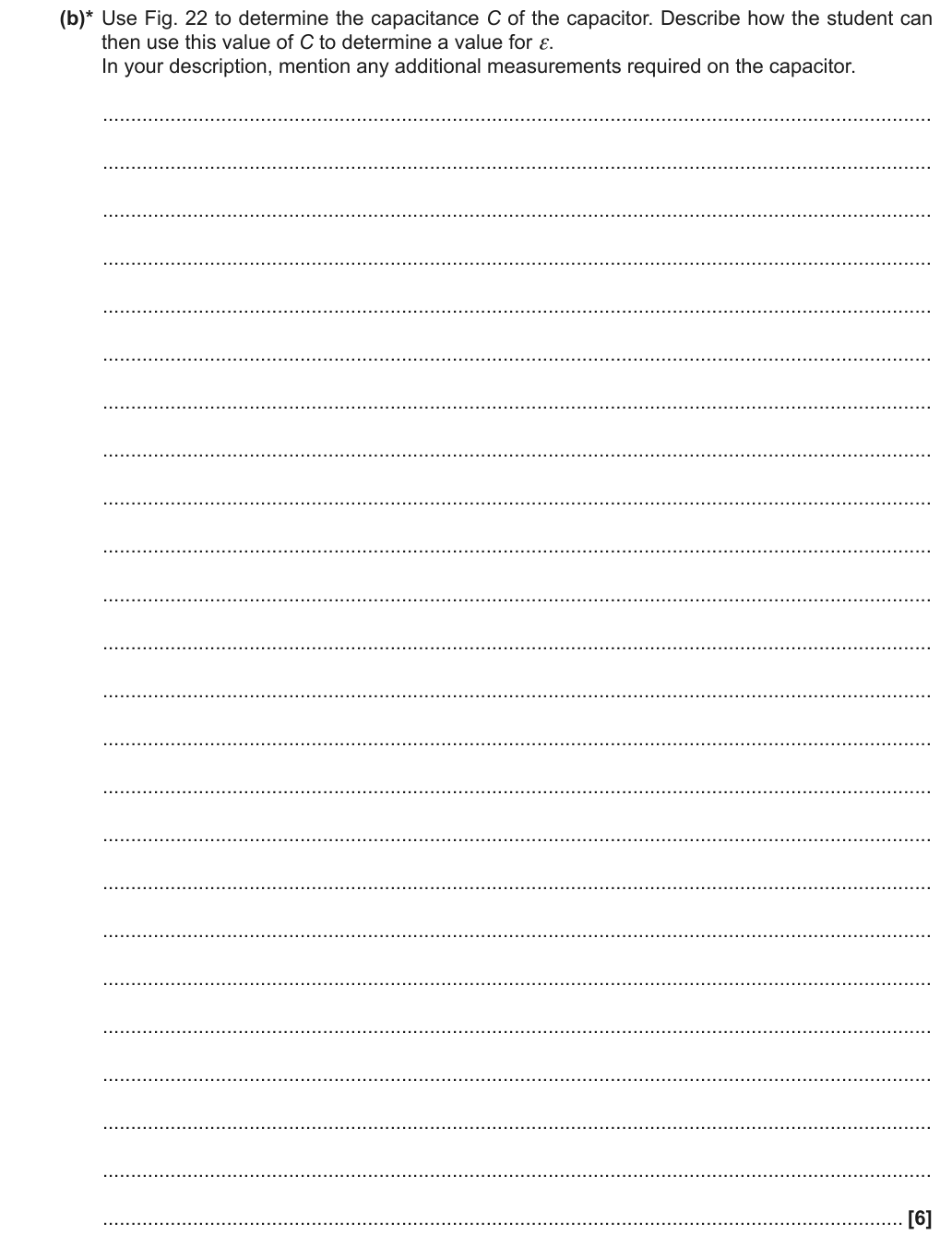
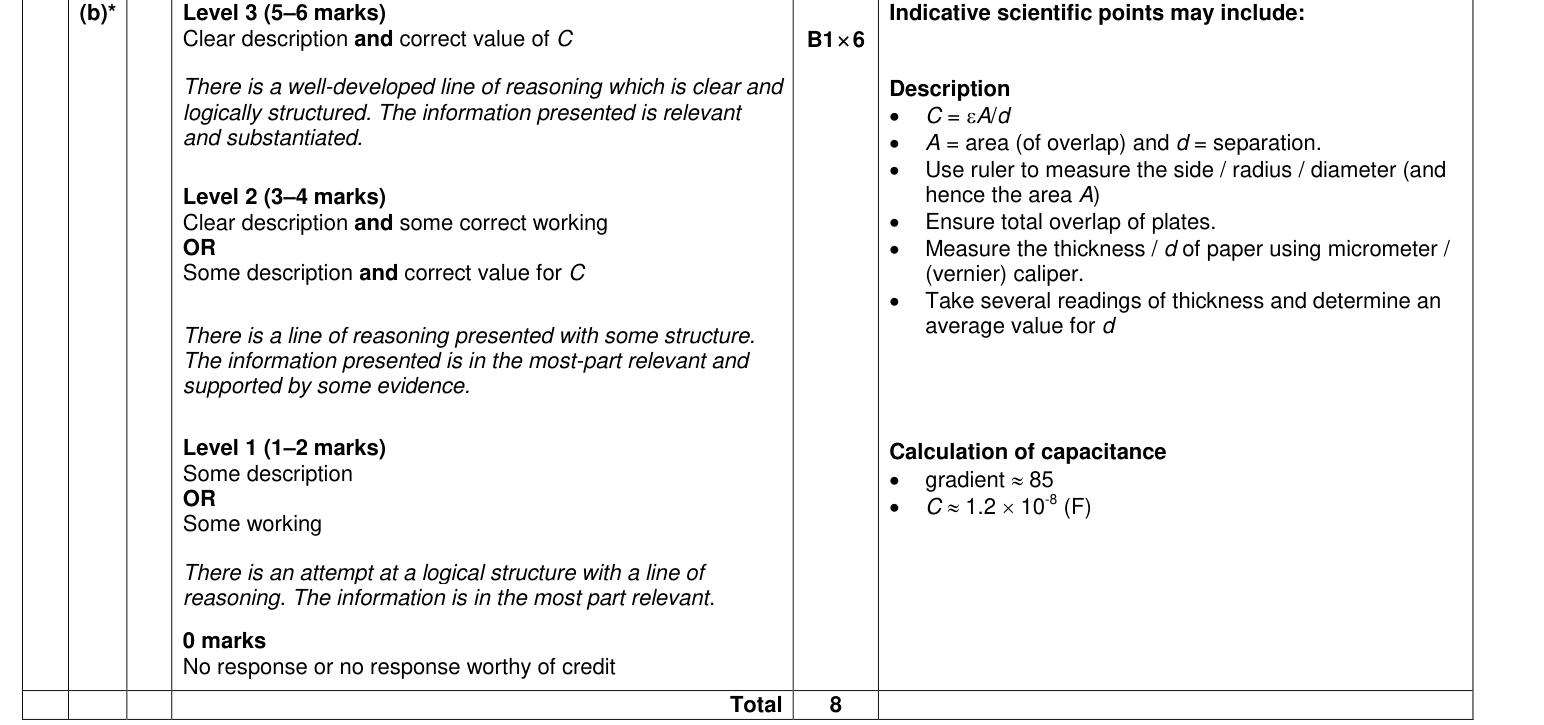
June 2018 · Paper 2 · Q22(b)6 marks6-mark extended responseMedium
Earlier part of question 22 that this part uses
Mark scheme, with the levels and indicative content
Examiner's comment
This was the second of the two LoR questions in this paper. It required application of practical skills from module 1.1 (Development of practical skills), knowledge of parallel plate capacitor and permittivity. As with the other LoR question 17, examiners expect varied responses for the criteria for the three levels to be met. Unlike some of the analytical questions, there is no one perfect model answer for a specific question. For Level 3, correct value of the capacitance C was required together with a clear description of how to do the additional measurements that led to the determination of the permittivity of the paper. For Level 2, it was either clear description with some correct working or some description with the correct value for C. Level 1 required some description or some working. As expected, there were diverse answers which demonstrated adequate experimental and practical skills. The thickness of the paper was invariably measured using a micrometer, but some candidates decided to measure the total thickness of a large number of sheets using a ruler and then calculating the thickness of each sheet. This technique was as good as using a micrometer or using Vernier calipers. Diverse answers are the characteristic of LoR questions. The most common errors made were: • Confusing permittivity with either relative permittivity or the permittivity of free space ε0. • Using C = 4πεR instead of C = εA/d. • Issues with powers of ten when determining the gradient – mainly because of the milli prefix on the time axis. This exemplar illustrates a Level 2 performance from this top-end candidate. The analysis is perfect, but the description is basic and there are no details of the instruments needed to make the measurement. It would have taken a couple more lines to elevate this answer to Level 3. Compare and contrast this with the exemplar below for a Level 3 response. This above is a typical Level 3 answer. Correct calculation and a description that has all the right ingredients. Notice how the appropriate measuring instruments are being used and how the uncertainty in the measurements is reduced.
Notes from the mark scheme and report
gradient about 85 s-1 gives C about 1.2 x 10⁻⁸ F
ε = Cd/A with area of overlap from ruler and paper thickness from micrometer, repeated and averaged
Skills: M2.2 Change the subject of an equation, including non-linear equations; M3.4 Determine the slope and intercept of a linear graph; PAG9 Investigating capacitors
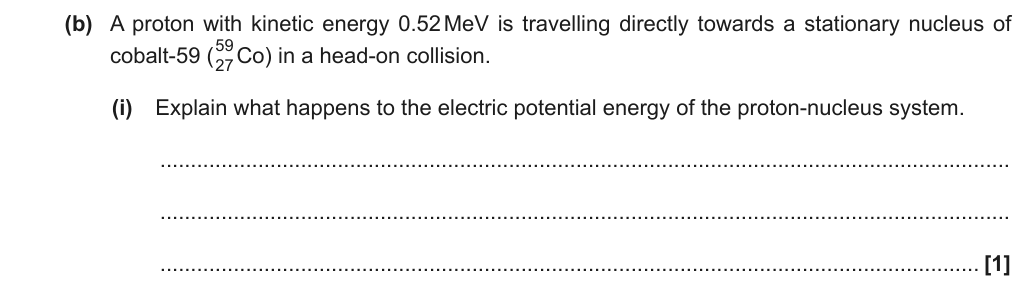
June 2018 · Paper 2 · Q23(b)(i)1 markExplanationHard
Mark scheme
Examiner's comment
Question 23(b)(i) Question 23(b)(ii) The above question on electric potential energy provided excellent discrimination with middle and upper quartile candidates showing how to produce immaculate answers – identify the physics, write down the correct physical equation, do any necessary conversions (e.g.
Notes from the mark scheme and report
kinetic energy of proton transferred to (electric) potential energy
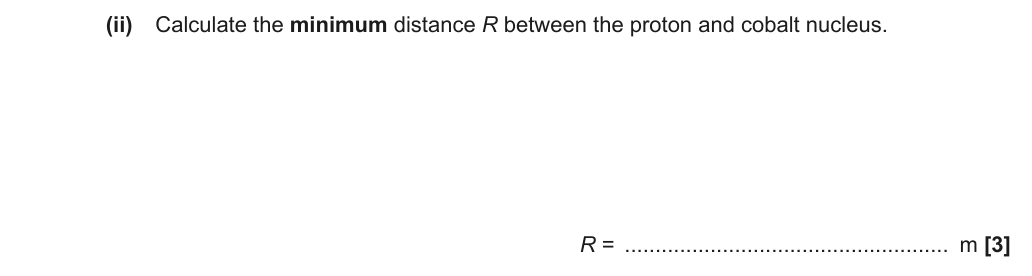
June 2018 · Paper 2 · Q23(b)(ii)3 marksCalculationHard
Earlier part of question 23 that this part uses
Mark scheme
Examiner's comment
The above question on electric potential energy provided excellent discrimination with middle and upper quartile candidates showing how to produce immaculate answers – identify the physics, write down the correct physical equation, do any necessary conversions (e.g. MeV to J), rearrange the equation, substitute correctly and then write the final answer in standard form to the correct number of significant figures. About a third of the candidates scored full marks. Some of the missed opportunities or errors were: • Using an incorrect equation with the distance squared • Not correctly converting the kinetic energy 0.52 MeV into joule (J) • Using the equation r = r0A1/3 for the mean radius of a nucleus to determine the minimum distance
Notes from the mark scheme and report
Z = 27 for cobalt: 1.6 x 10⁻¹³ (Z = 59) or 8.9 x 10⁻¹⁴ (Z = 32) score 2
Z = 1 or energy left in eV score 1
Skills: M0.2 Recognise and use expressions in decimal and standard form; M2.2 Change the subject of an equation, including non-linear equations; M2.3 Substitute numerical values into algebraic equations using appropriate units for physical quantities
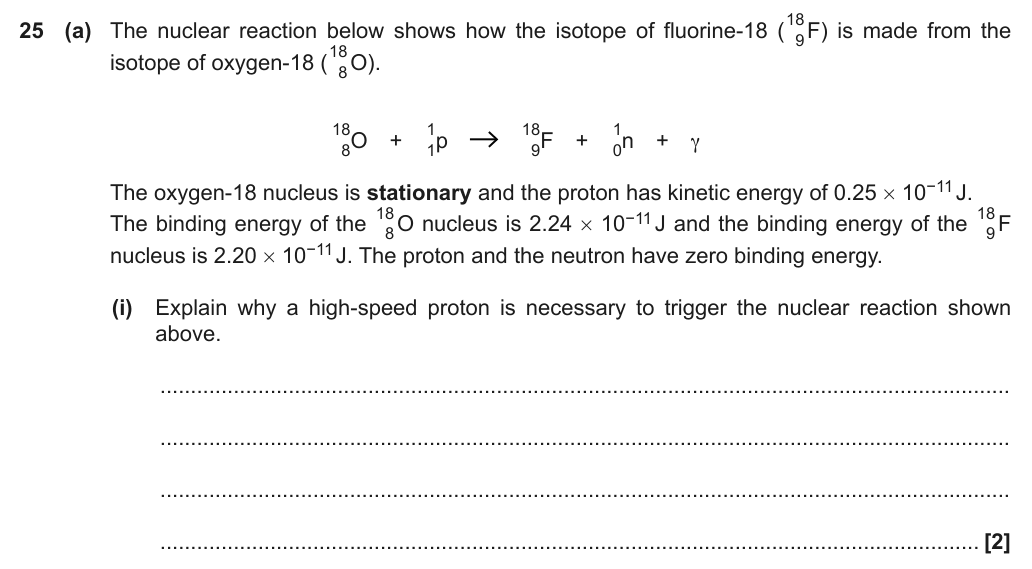
June 2018 · Paper 2 · Q25(a)(i)2 marksExplanation
Mark scheme
Notes from the mark scheme and report
proton is repelled by the nucleus and must get close enough (for the strong nuclear force)
NOT collide / hit nucleus
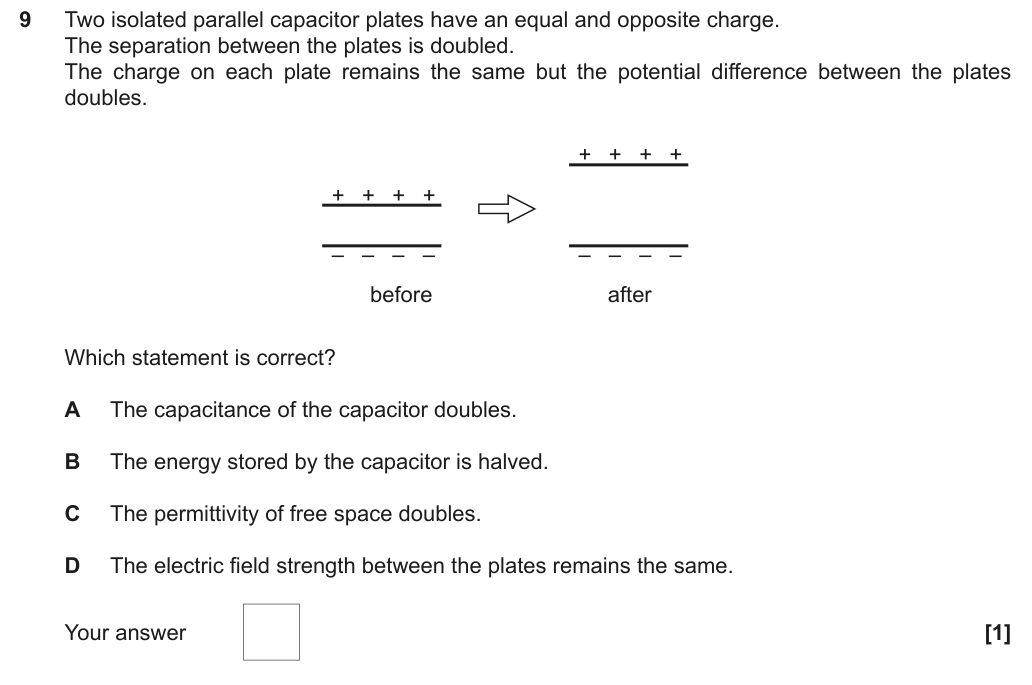
June 2017 · Paper 2 · Q91 markMultiple choice
Answer
D
Mark scheme
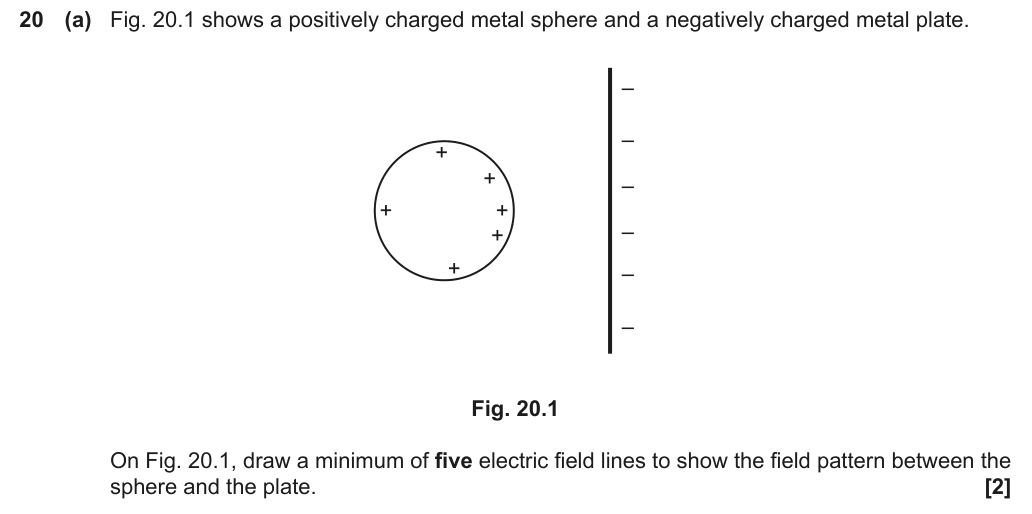
June 2017 · Paper 2 · Q20(a)2 marksDiagram or graph
Mark scheme
Notes from the mark scheme and report
at least five lines
lines must meet sphere and plate at right angles
direction from sphere to plate
Skills: M4.2 Visualise and represent 2D and 3D forms, including two-dimensional representations of 3D objects
June 2017 · Paper 2 · Q20(b)1 markShort answer
Mark scheme
Notes from the mark scheme and report
work done per unit (positive) charge in bringing a positive charge from infinity
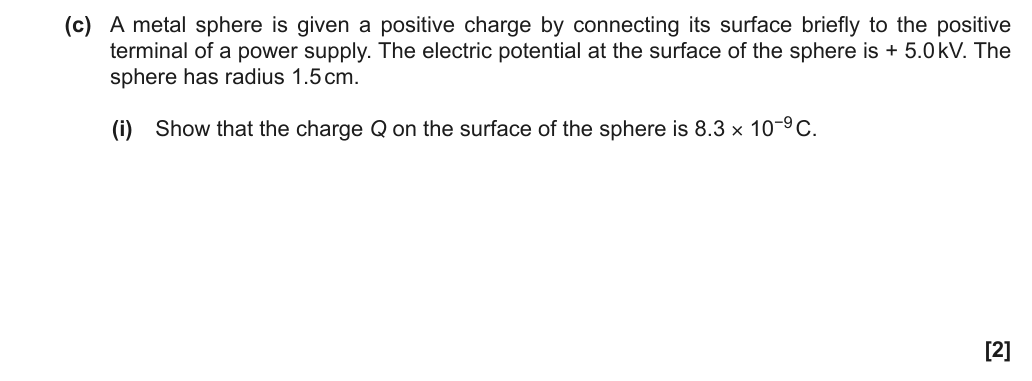
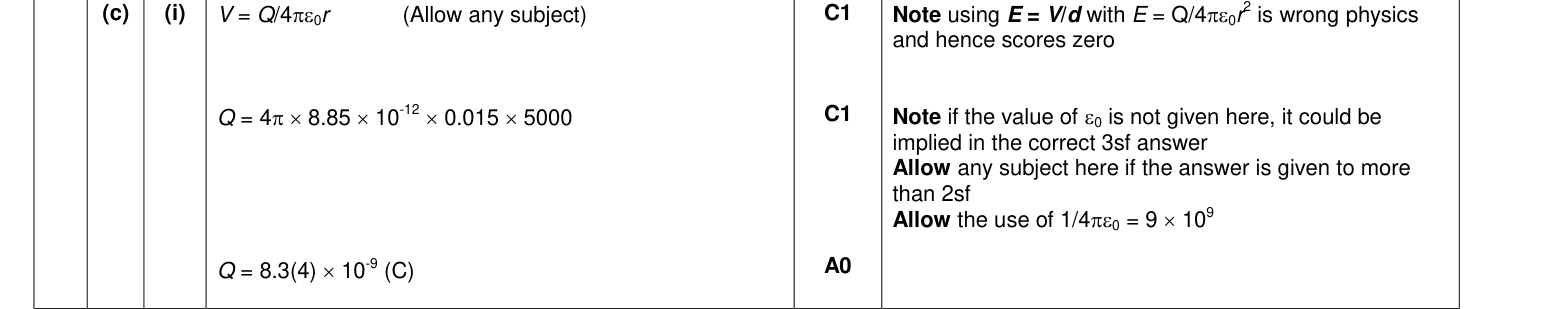
June 2017 · Paper 2 · Q20(c)(i)2 marksShow that
Mark scheme
Notes from the mark scheme and report
using E = V/d with E = Q/4 pi epsilon0 r squared is wrong physics and scores zero
Skills: M0.2 Recognise and use expressions in decimal and standard form; M2.2 Change the subject of an equation, including non-linear equations; M2.3 Substitute numerical values into algebraic equations using appropriate units for physical quantities
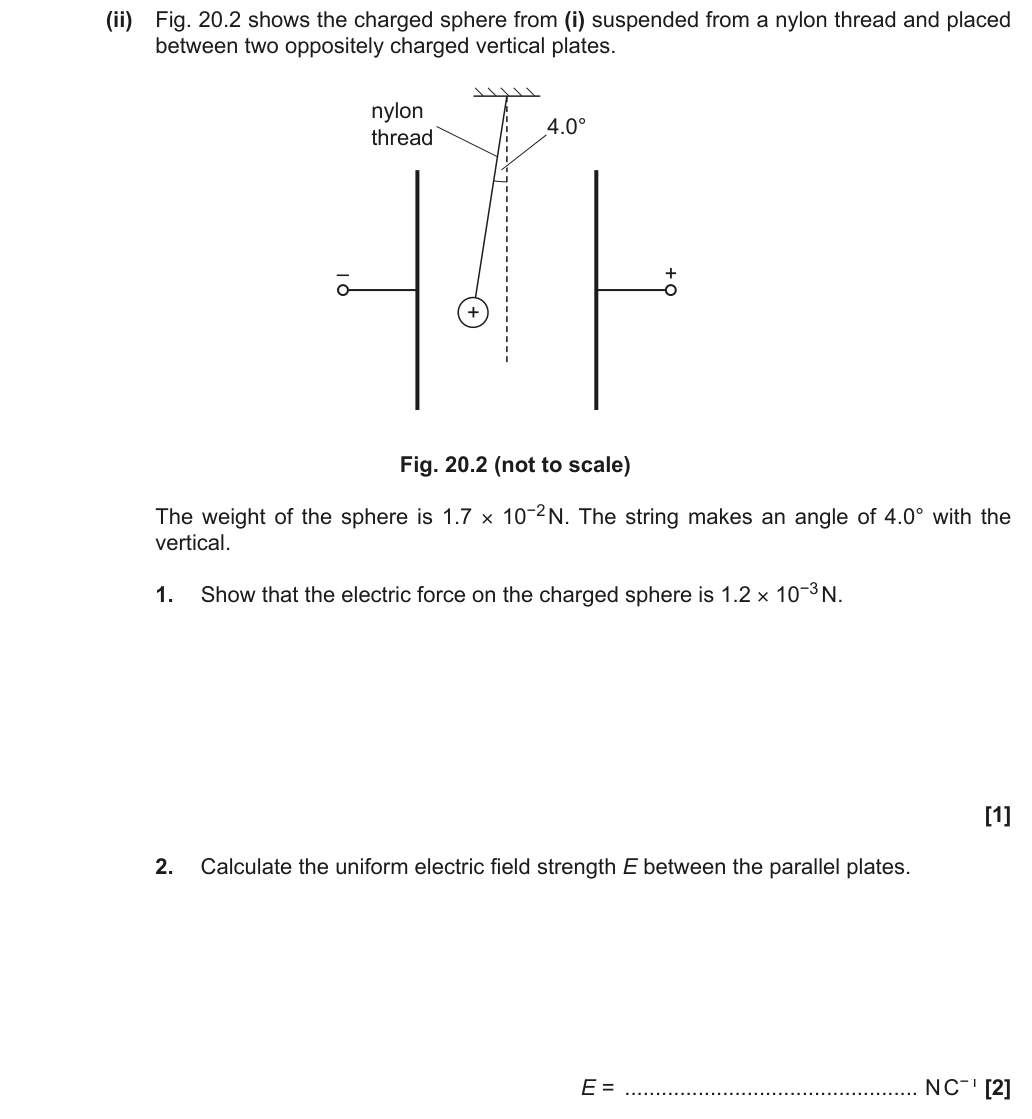
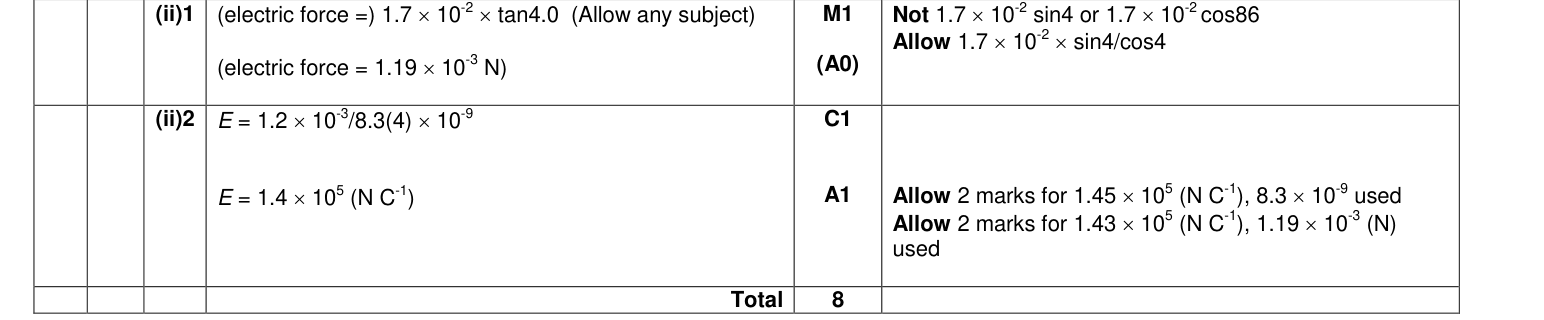
June 2017 · Paper 2 · Q20(c)(ii)3 marksShow that
Earlier part of question 20 that this part uses
Mark scheme
Notes from the mark scheme and report
two sub-parts (1, 2 marks)
force = weight x tan 4.0
NOT weight x sin 4 or cos 86
Skills: M0.6 Use calculators to handle sin x, cos x and tan x when x is expressed in degrees or radians; M2.3 Substitute numerical values into algebraic equations using appropriate units for physical quantities; M4.5 Use sin, cos and tan in physical problems
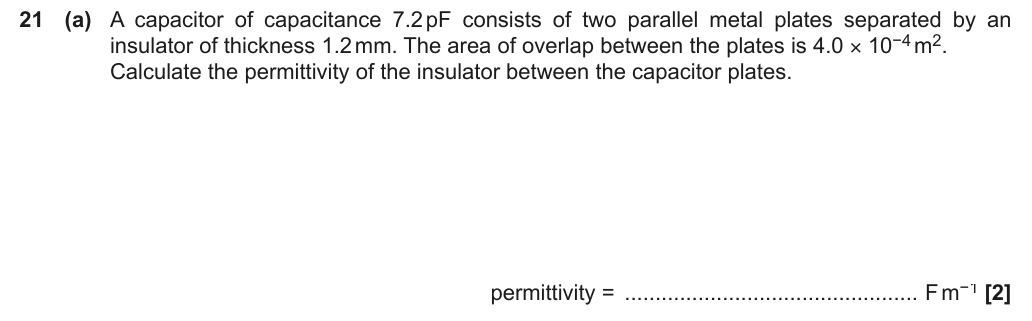
June 2017 · Paper 2 · Q21(a)2 marksCalculation
Mark scheme
Notes from the mark scheme and report
1 mark for bald 2.4 (relative permittivity calculated)
Skills: M0.1 Recognise and make use of appropriate units in calculations; M2.2 Change the subject of an equation, including non-linear equations; M2.3 Substitute numerical values into algebraic equations using appropriate units for physical quantities
June 2017 · Paper 3 · Q2(a)3 marksShow that
Mark scheme
Notes from the mark scheme and report
allow Q or q for e
Skills: M2.2 Change the subject of an equation, including non-linear equations
Work with an OCR physics tutor
Dropping marks on calculations, practical questions or the six-mark level of response questions? Book a trial session with a specialist OCR physics tutor.