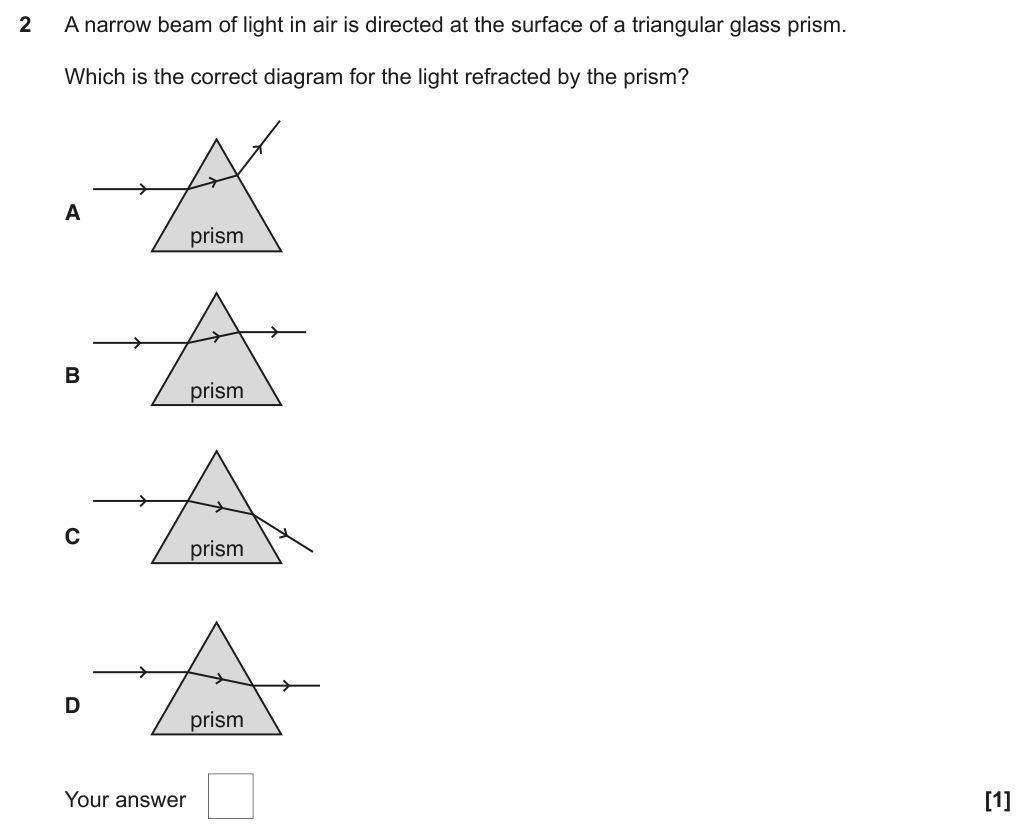
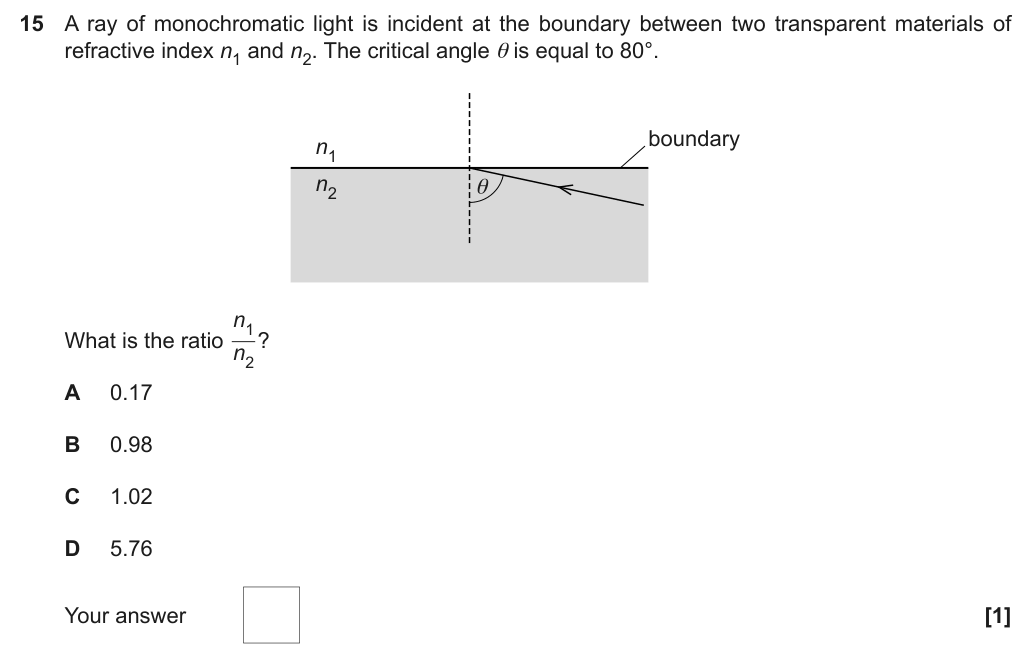
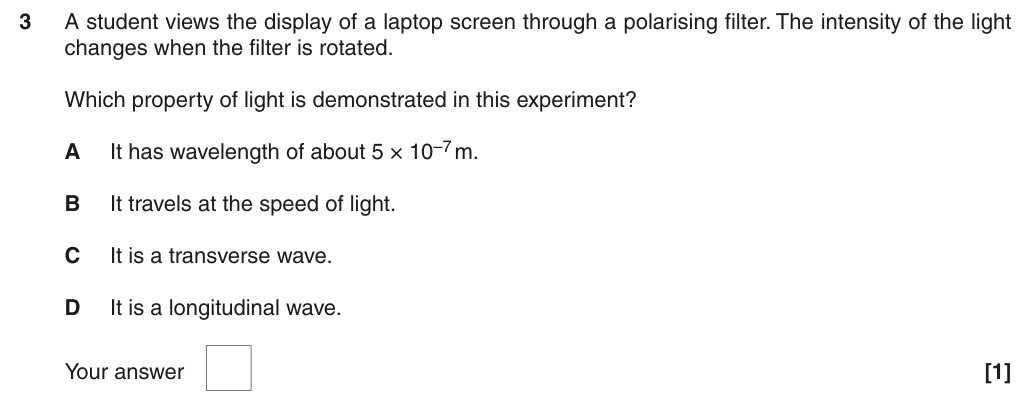
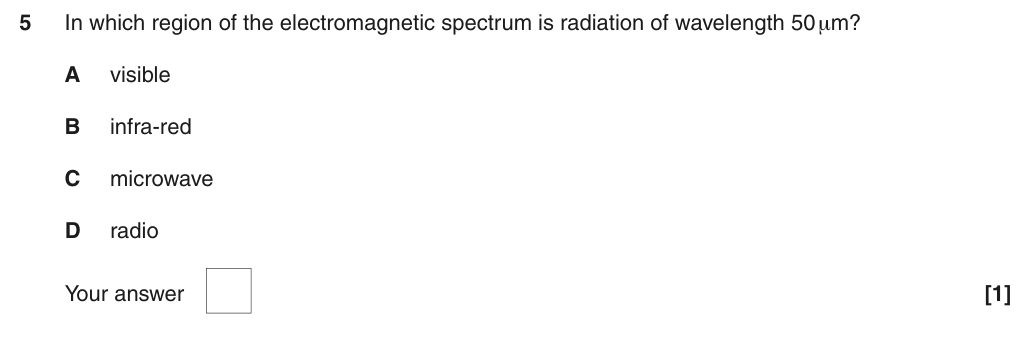
Notes and key-term cards for this topic are being written by our tutors. The past-paper questions below are ready now.
Specification statements
Show the 6 learning outcomes from the specification
4.4.2(a) electromagnetic spectrum; properties of electromagnetic waves
4.4.2(b) orders of magnitude of wavelengths of the principal radiations from radio waves to gamma rays
4.4.2(c) plane polarised waves; polarisation of electromagnetic waves
4.4.2(d)(i) refraction of light; refractive index; n = c/v; n sin θ = constant at a boundary where θ is the angle to the normal
4.4.2(d)(ii) techniques and procedures used to investigate refraction and total internal reflection of light using ray boxes, including transparent rectangular and semi-circular blocks
4.4.2(e) critical angle; sin C = 1/n; total internal reflection for light.
Six-mark level of response questions on this topic
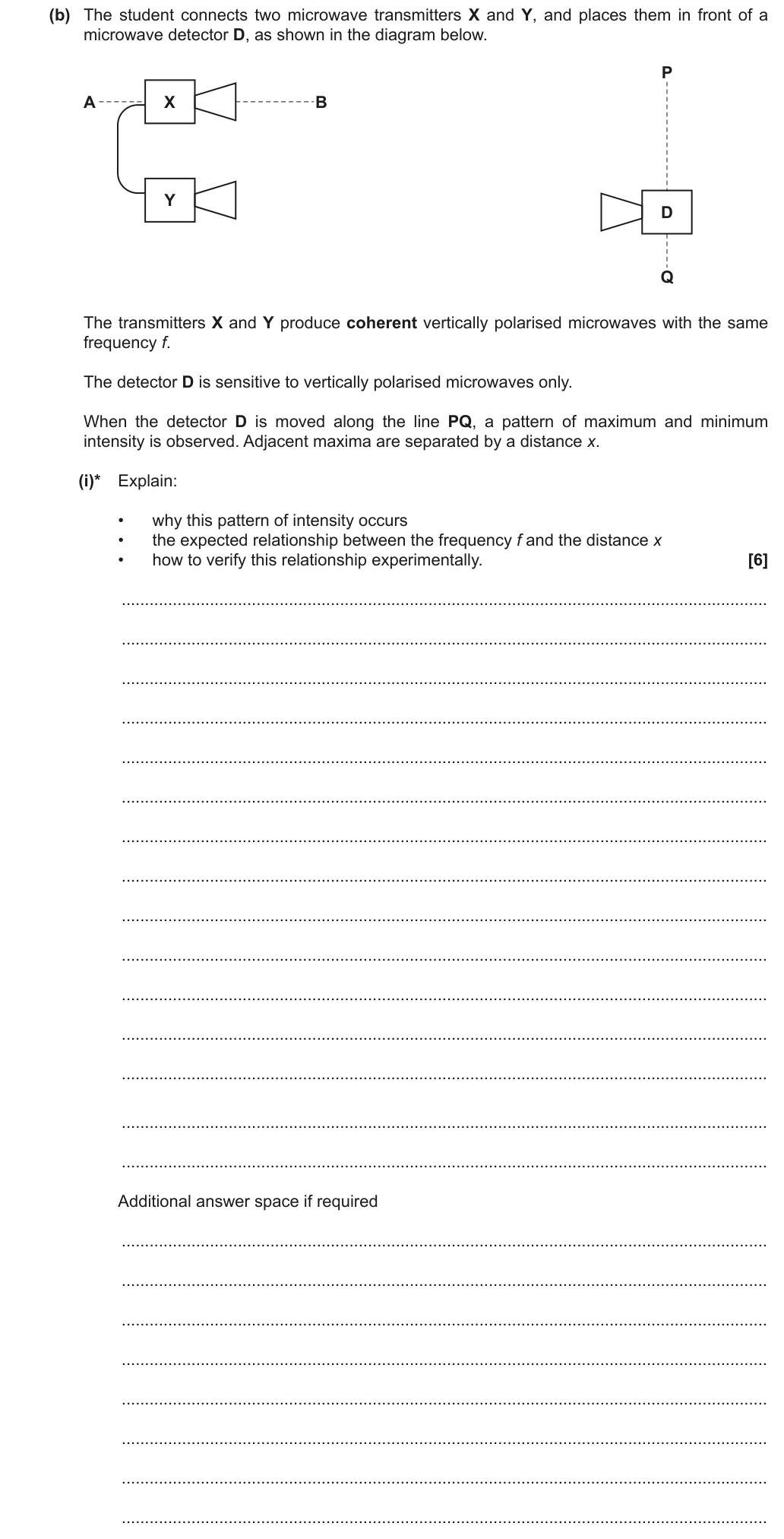
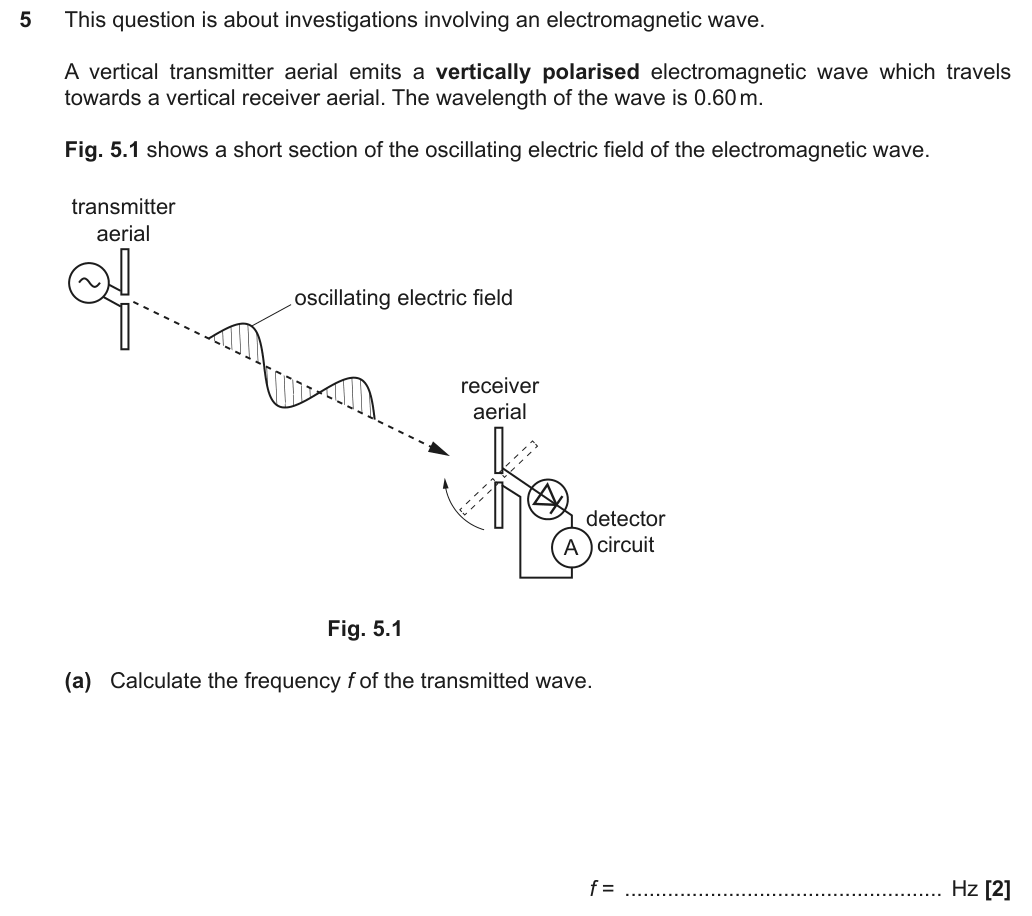
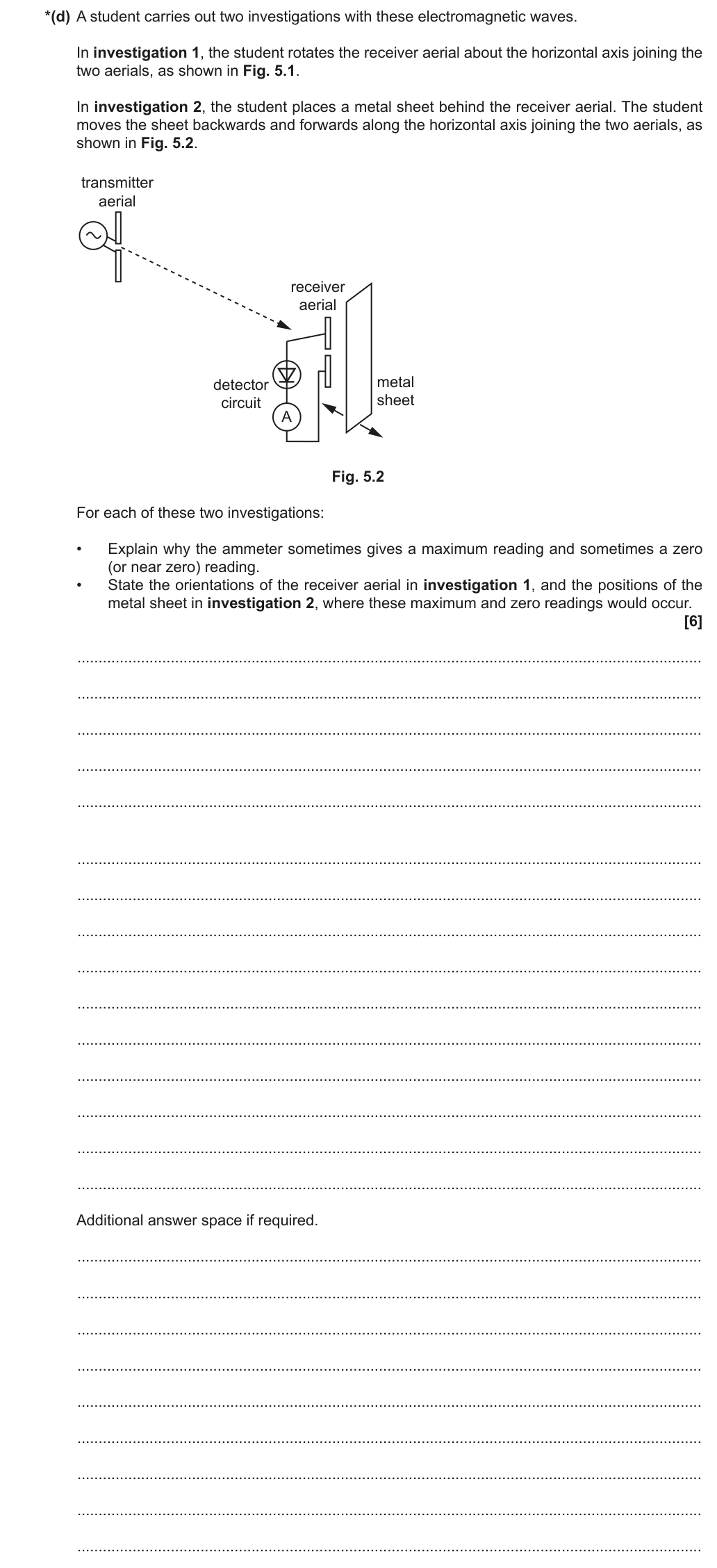
*(d) A student carries out two investigations with these electromagnetic waves. • Explain why the ammeter sometimes gives a maximum reading and sometimes a zero
Tap a question to zoom it. Where a part needs a figure, table or graph from earlier in the question, that part folds out above it; the mark scheme and examiner's comment open underneath. Have the OCR Data, Formulae and Relationships Booklet beside you (see the data booklet page).
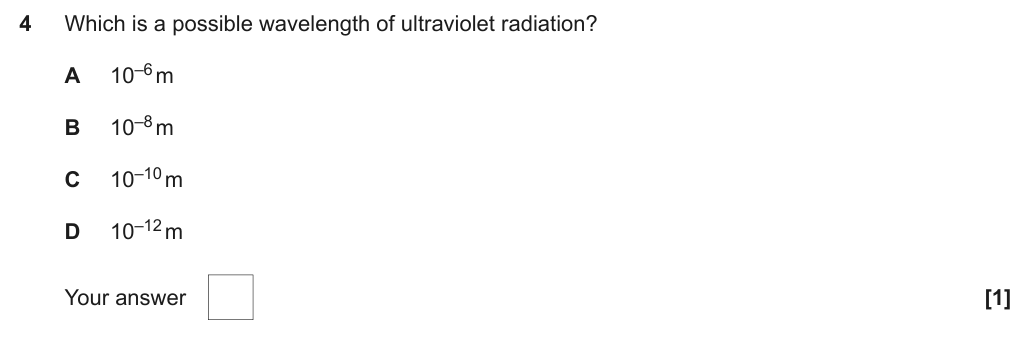
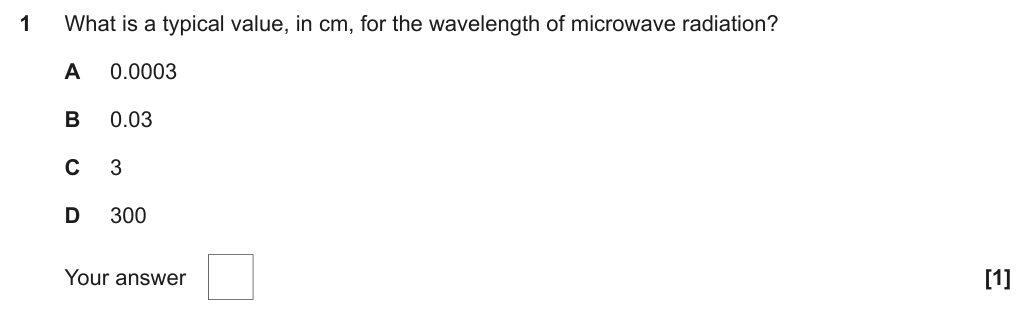
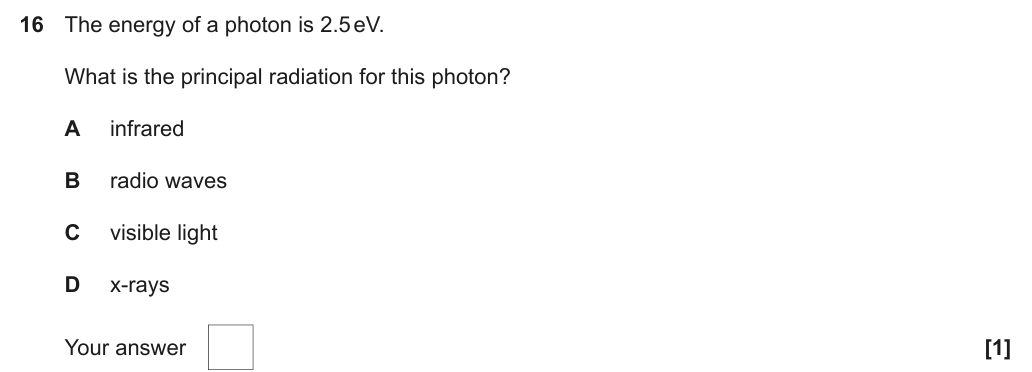
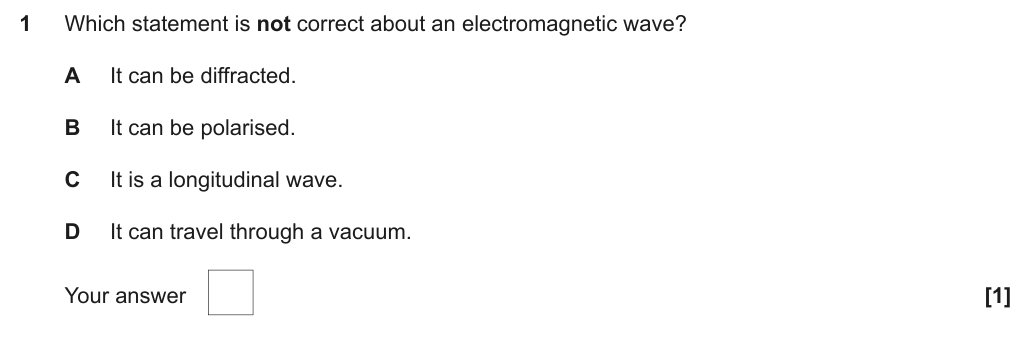
June 2025 · AS Paper 1 · Q41 markMultiple choiceEasy
Answer
B
Mark scheme
Examiner's comment
This question was generally answered well, although across the cohort several incorrect responses were observed. These were usually either A (infra-red) or C (X-rays). Candidates should know the orders of magnitude of the wavelengths of the principal radiations of electromagnetic waves in a vacuum.
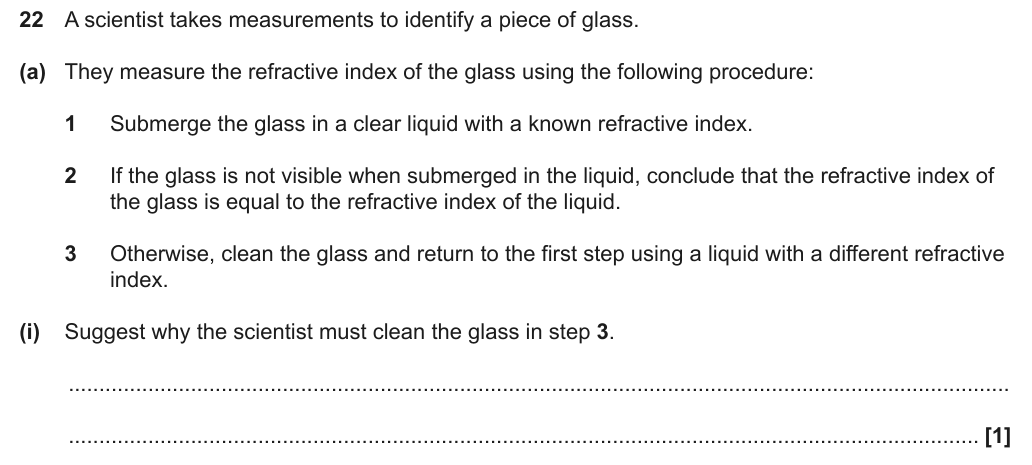
June 2025 · AS Paper 1 · Q22(a)(i)1 markExplanationHard
Mark scheme
Examiner's comment
This was a challenging question in that there were many vague answers that did not state that by not cleaning the glass the refractive index could be different.
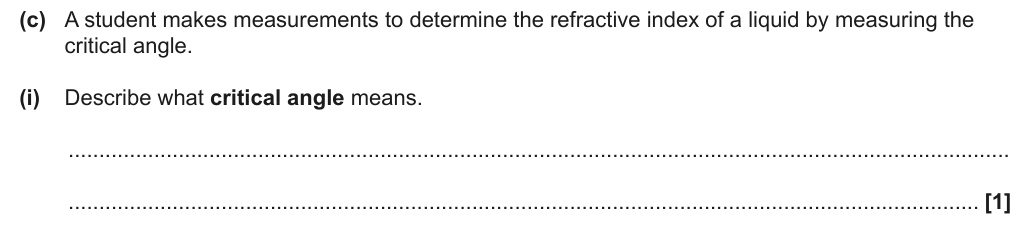
June 2025 · AS Paper 1 · Q22(c)(i)1 markExplanationMedium
Mark scheme
Examiner's comment
Many candidates answered this question by stating that the critical angle is the angle at which total internal reflection occurs. High scoring candidates stated it was the angle of incidence which gives an angle of refraction of 90. Examiners on this occasion allowed where the refracted ray travelled along the boundary. Some candidates were confused with terminology between reflection and refraction.
Notes from the mark scheme and report
ignore (minimum) angle for total internal reflection
Understanding the difference between critical angle and the criteria for total internal reflection.
One of the criteria for total internal reflection is that the angle of incidence has to be greater the than the critical angle.
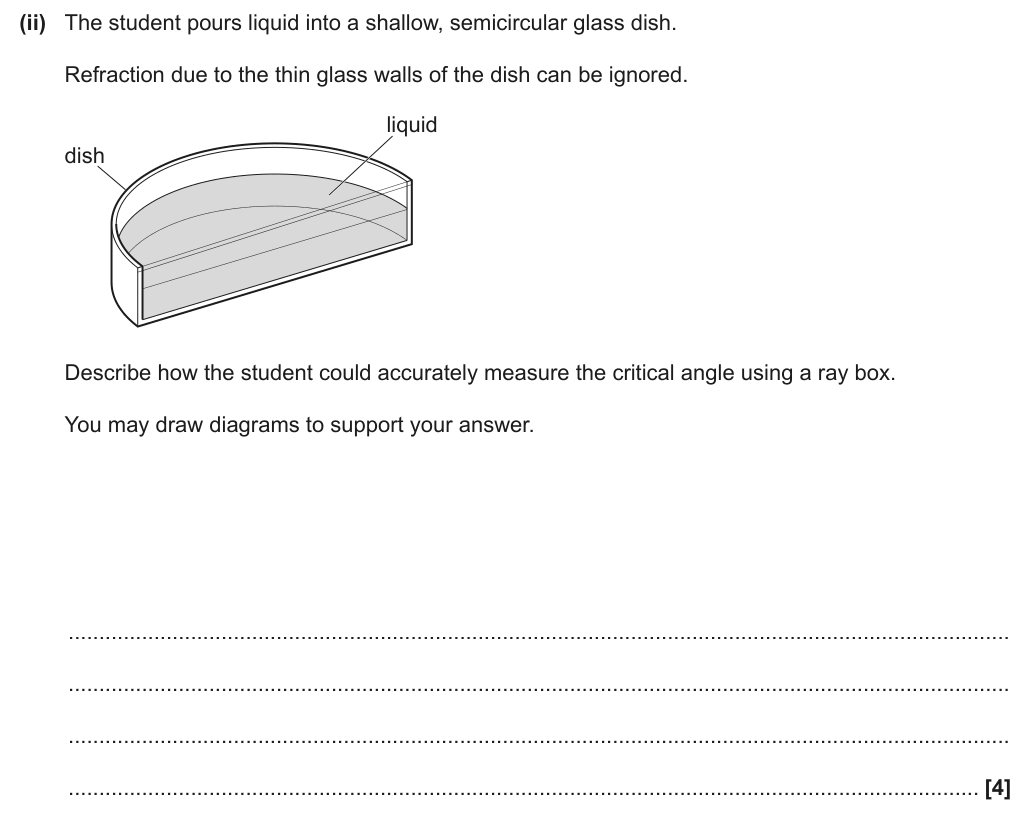
June 2025 · AS Paper 1 · Q22(c)(ii)4 marksExplanationMedium
Mark scheme
Examiner's comment
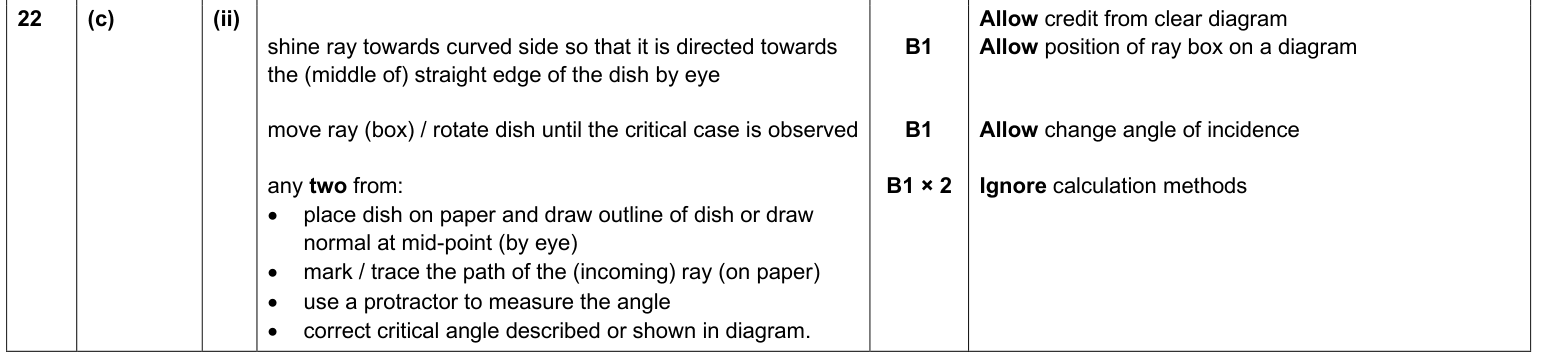
As part of their practical skills candidates should be able to design experiments and describe the techniques to carry out a safe experiment within a school laboratory setting. Most lower scoring candidates drew diagrams where the ray of light either entered the straight edge of the container or was reflected from the curved surface. High scoring candidates drew helpful diagrams, clearly showing an incident ray on the curved surface travelling towards the centre of the straight edge with the ray splitting into a reflected ray and a ray refracted at 90. Other high scoring candidates drew three diagrams showing the three cases of an angle of incidence less than the critical angle, equal to the critical angle and greater than the critical angle. When carrying out the experiment, the angle of incidence needed to be adjusted until the critical case is observed. Candidates needed to state then the critical angle would be measured using a protractor. Further credit was available for discussions of drawing around the container and/or indicating how the rays would be marked. This candidate has stared answering the question by drawing a diagram of the semicircular glass dish. The incident ray of light is indicated entering the curved surface and refracted at 90 at the centre of the curved surface. The text clearly states that the angle needs to be changed until the angle of refraction reaches 90 and that the critical angle will be measured with a protractor. The candidate clearly answers the question set with a practical plan.
Notes from the mark scheme and report
ray must be directed through the curved side towards the middle of the straight edge
ignore calculation methods
credit from a clear diagram
Skills: PAG6 Investigating quantum effects
June 2025 · AS Paper 1 · Q22(c)(iii)2 marksCalculationEasy
Mark scheme
Examiner's comment
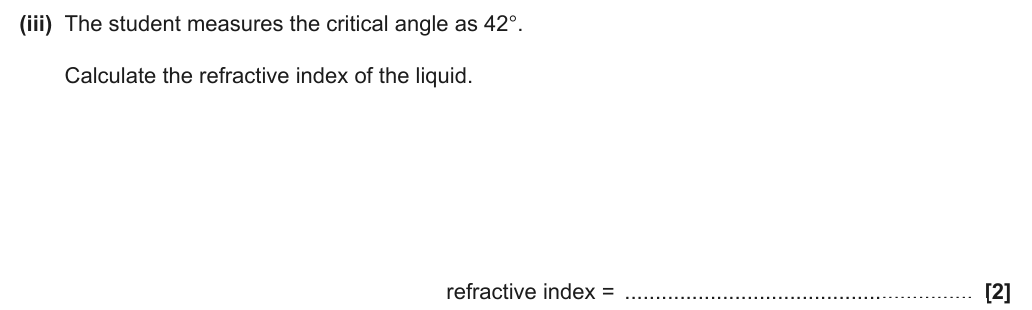
This question was generally well answered. High scoring candidates usually wrote down the equation and substituted data.
June 2025 · AS Paper 1 · Q25(a)2 marksExplanationMedium
Mark scheme
Examiner's comment
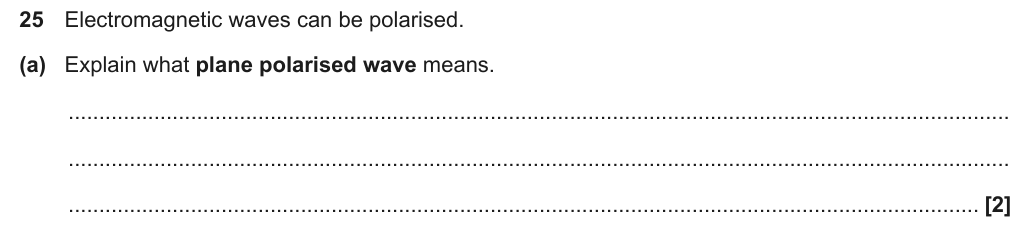
To gain full credit for this question, candidates needed to understand that only transverse waves could be polarised and thus the oscillations of vibrations of the wave were perpendicular to the direction of the wave. The majority of the candidates were able to state that in a plane polarised wave the oscillations are only in one direction or plane .Some candidates omitted any references to the oscillations or vibrations of the wave but instead answered the question in terms of ‘a wave travelling in a single plane’. Other lower scoring candidates stated that ‘polarising blocks some waves’.
Notes from the mark scheme and report
ignore waves (must refer to oscillations / vibrations)
Allow a named direction e.g. vertical
June 2025 · AS Paper 1 · Q25(b)(i)3 marksDiagram or graphEasy
Mark scheme
Examiner's comment
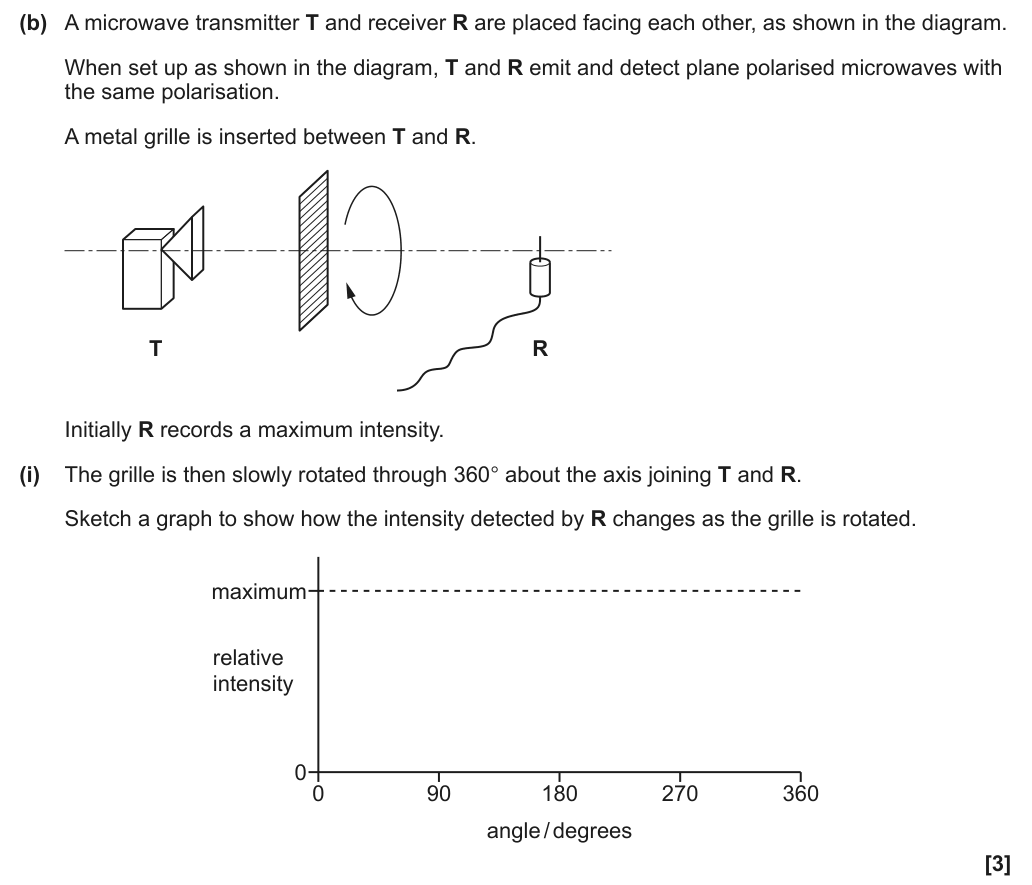
Most candidates correctly understood that maximum intensity occurred at 0 180 360 and that the minimum values would be at 90 and 270. Many candidates incorrectly drew straight lines between the maximum and minimum values. While Malus’ law is not part of the specification a qualitative understanding of the how the intensity changes when a polariser is used is expected.
Notes from the mark scheme and report
maxima at 0, 180 and 360 and minima close to zero at 90 and 270
cos² shape with curved peaks and troughs
Skills: M3.12 Sketch relationships which are modelled by y = k/x, y = kx², y = k/x², y = kx, y = sin x, y = cos x, y = e^(±x) and y = sin²x, y = cos²x as applied to physical relationships; PAG5 Investigating waves
June 2025 · AS Paper 1 · Q25(b)(ii)2 marksExplanationHard
Earlier part of question 25 that this part uses
Mark scheme
Examiner's comment
Most candidates discussed that the pattern would be shifted without realising that the maximum intensity of the pattern would be reduced. Very few candidates explained that the reason for the decrease maximum intensity was due to the detector receiving a smaller component of the transmitted wave.
Notes from the mark scheme and report
ignore angle the pattern shifts
Skills: PAG5 Investigating waves
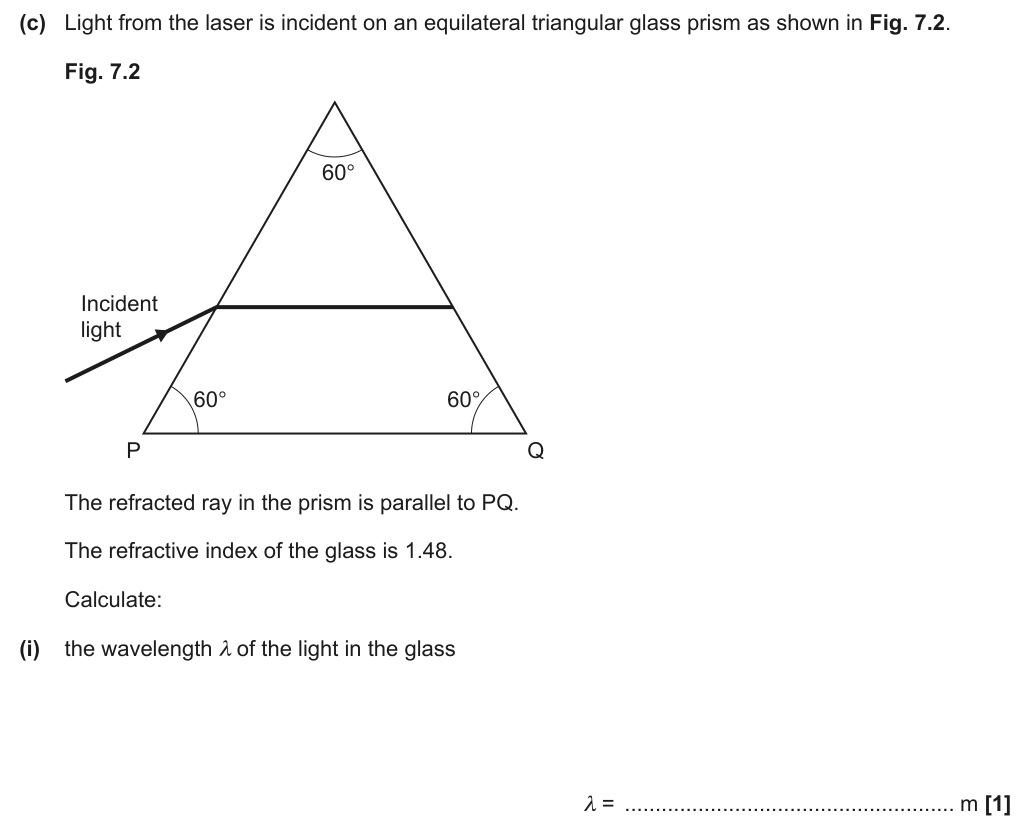
June 2025 · AS Paper 2 · Q7(c)(i)1 markCalculationHard
Earlier part of question 7 that this part uses
Mark scheme
Examiner's comment
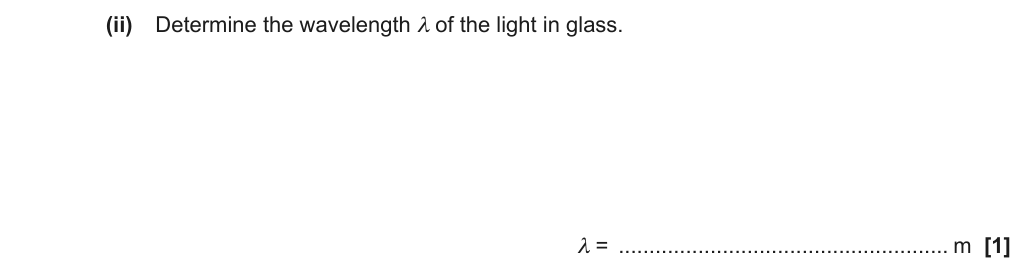
This question appeared to challenge candidates. Some candidates worked out the speed of light in glass but did not then calculate the wavelength.
Notes from the mark scheme and report
allow 3.6 x 10⁻⁷
Skills: M2.3 Substitute numerical values into algebraic equations using appropriate units for physical quantities
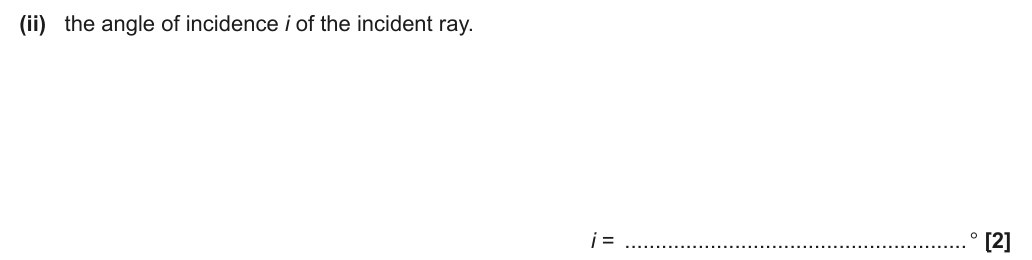
June 2025 · AS Paper 2 · Q7(c)(ii)2 marksCalculationMedium
Earlier part of question 7 that this part uses
Mark scheme
Examiner's comment
High scoring candidates correctly identified that the angle of refraction in this case was 30. Many of these candidates had added a normal to the diagram. These candidates usually then correctly calculated the angle of incidence using the refractive index.
Notes from the mark scheme and report
r = 30° (check diagram for angle marked)
answer 48°
Candidates should be encouraged to add notes to diagrams (or even sketch diagrams) to assist in the answering of a question.
Skills: M0.6 Use calculators to handle sin x, cos x and tan x when x is expressed in degrees or radians; M4.1 Use angles in regular 2D and 3D structures
June 2025 · Paper 2 · Q20(c)3 marksExplanationHard
Mark scheme
Examiner's comment
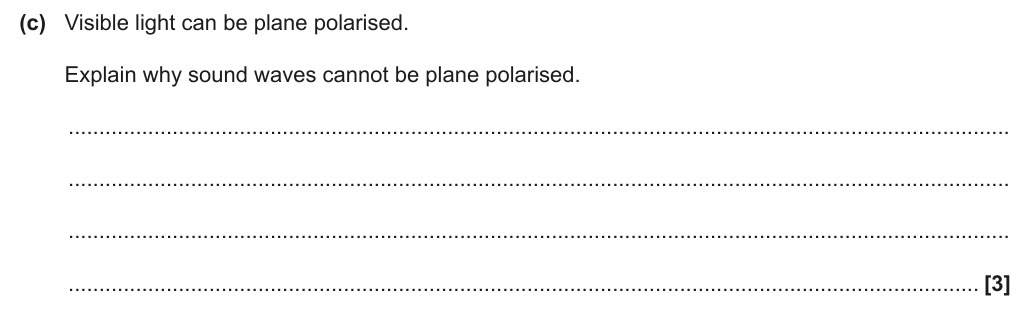
Few candidates were able to clearly explain polarisation in terms of oscillation, however most candidates knew that sound waves were longitudinal and could describe this type of wave. A number of candidates used movement for oscillation and this is not clear enough.
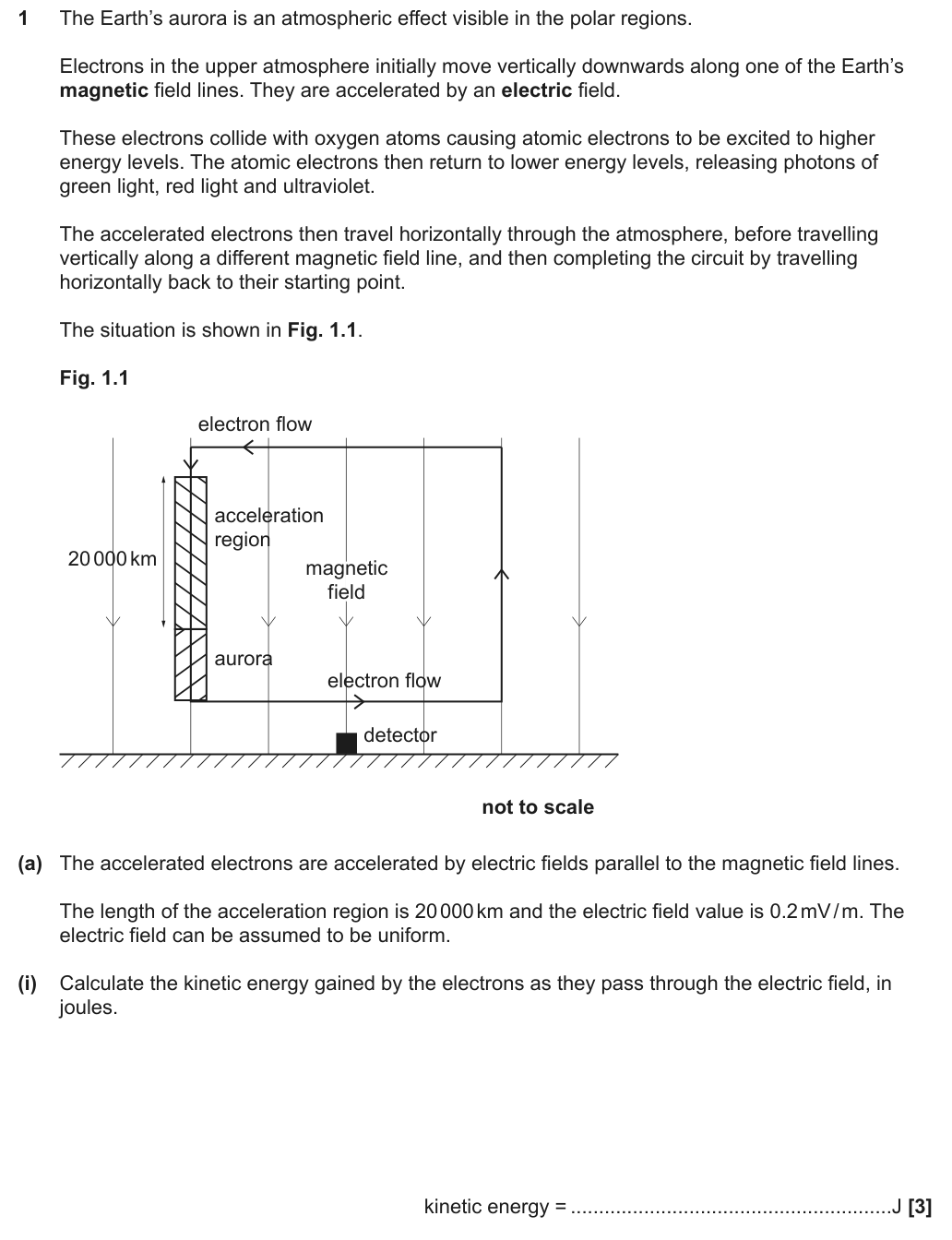
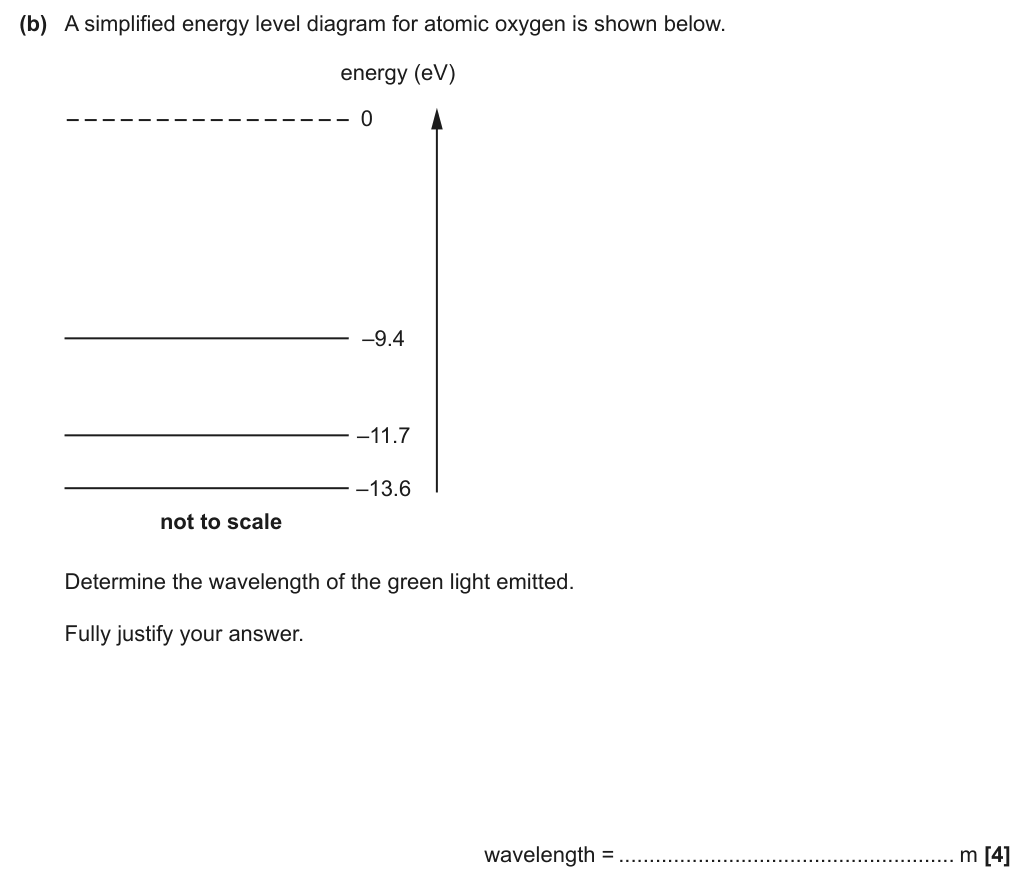
June 2025 · Paper 3 · Q1(b)4 marksCalculationMedium
Earlier part of question 1 that this part uses
Mark scheme
Examiner's comment
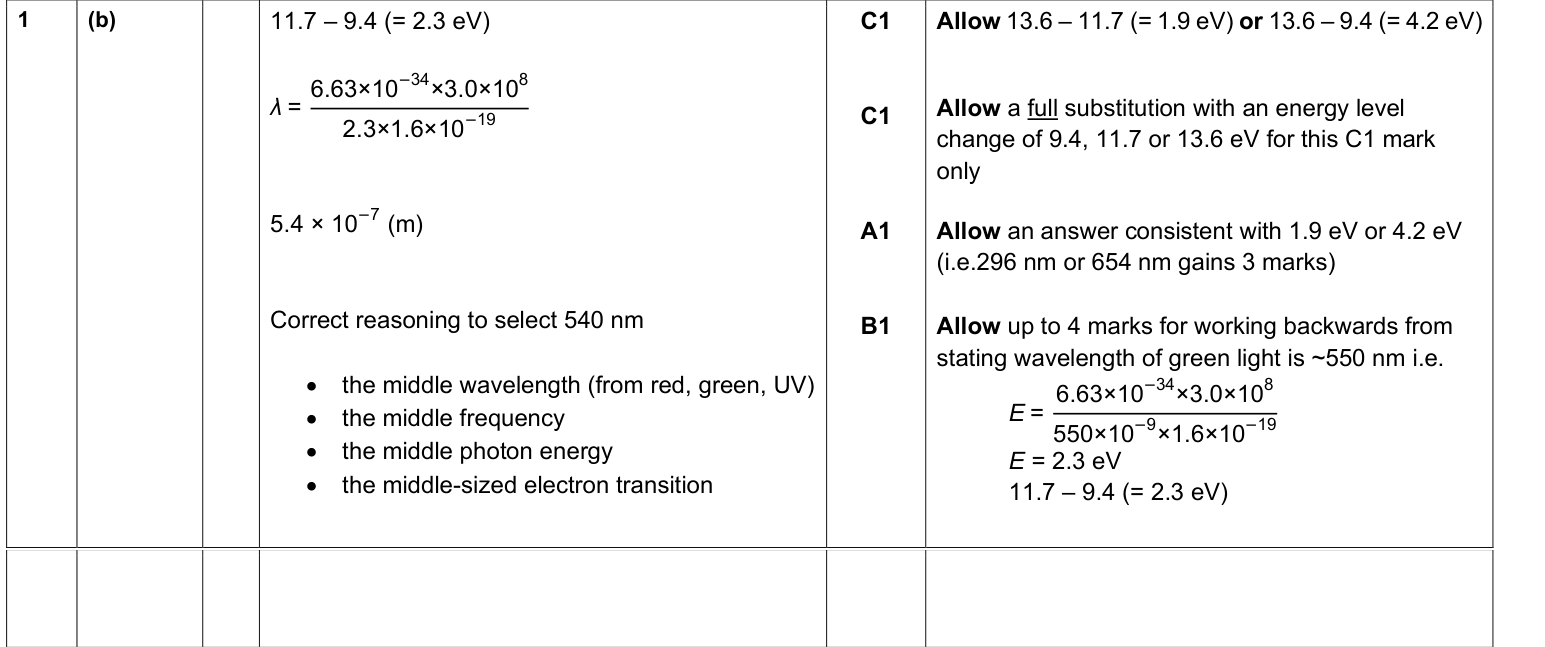
Most candidates attempted to use the correct formula. A common error was using this for an energy level transition to 0, often 9.4 or 11.7 eV. The strongest responses were those where the energy level transition of 11.7 to 9.4 eV was identified and stated at the start of the response.
Notes from the mark scheme and report
fourth mark is for justifying the 2.3 eV transition as the middle wavelength / photon energy of red, green and UV
296 nm or 654 nm gains 3 marks
Skills: M0.2 Recognise and use expressions in decimal and standard form; M2.2 Change the subject of an equation, including non-linear equations; M2.3 Substitute numerical values into algebraic equations using appropriate units for physical quantities
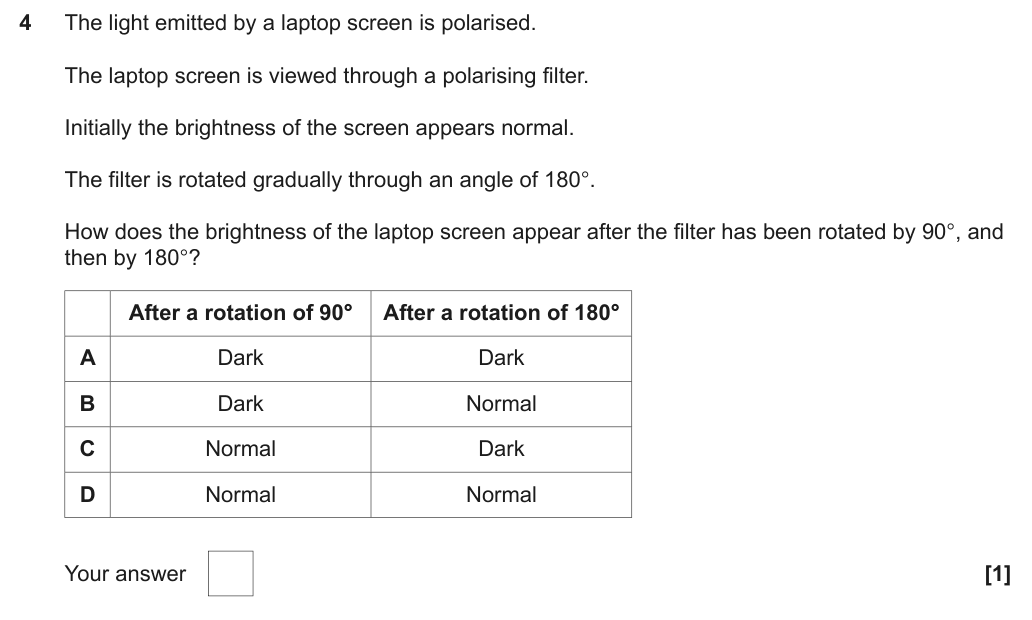
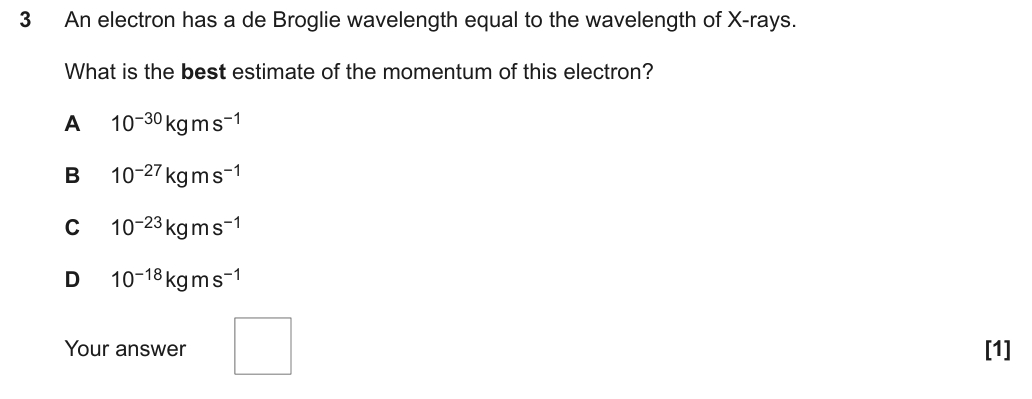
June 2024 · AS Paper 1 · Q41 markMultiple choiceEasy
Answer
B
Mark scheme
Examiner's comment
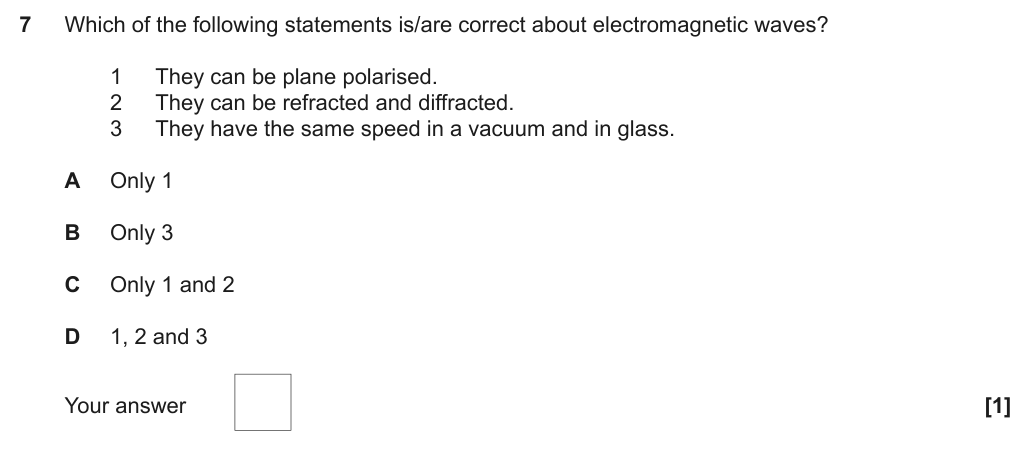
This question was answered well as candidates were able to apply knowledge and understanding of electromagnetic waves passing through a polarising filter to give the correct answer B.
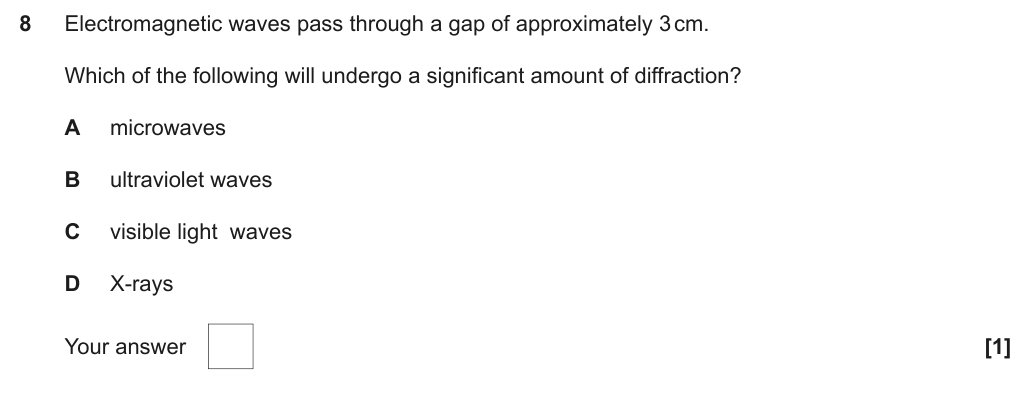
June 2024 · AS Paper 1 · Q81 markMultiple choiceMedium
Answer
A
Mark scheme
Examiner's comment
Candidates performed well on this question as they determined that when a wave passes through a gap with a similar size to its wavelength, it results in greater diffraction to give the response A.
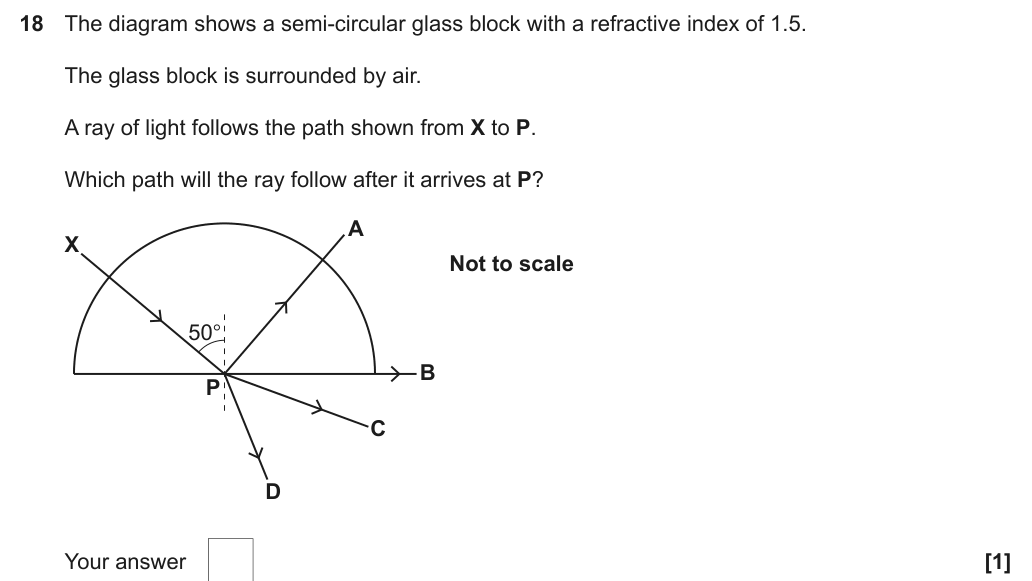
June 2024 · AS Paper 1 · Q181 markMultiple choiceMedium
Answer
A
Mark scheme
Examiner's comment
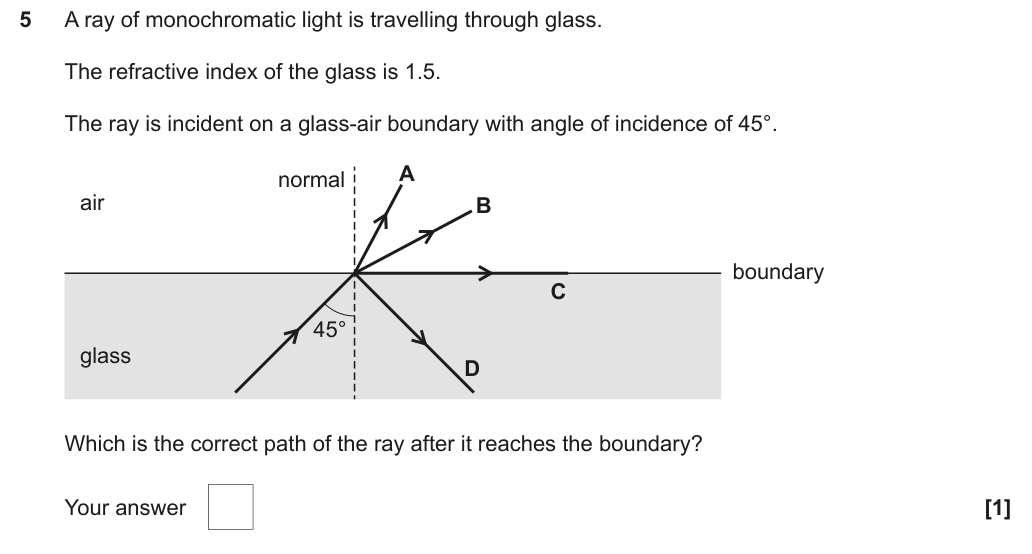
Some candidates correctly identified that the ray would follow path A after arriving at point P. To determine the correct path that the ray of light would follow, candidates were required to calculate the critical angle from the refractive index of the glass block to give 42°. If candidates calculated the critical angle they could determine that Total Internal Reflection would occur (as angle of incidence > critical angle) and hence that the ray would follow path A. The most common distractors were answers C and D.
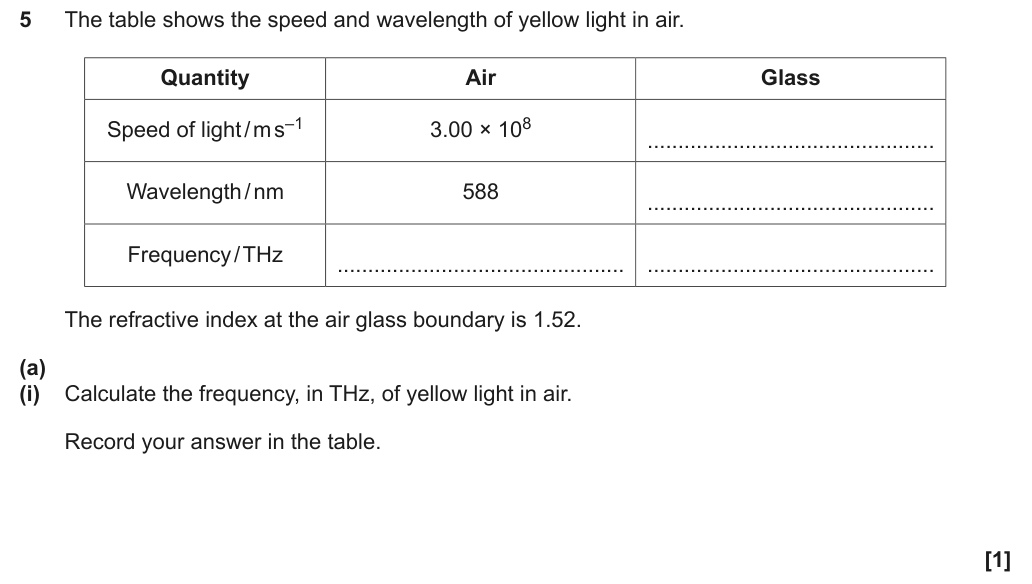
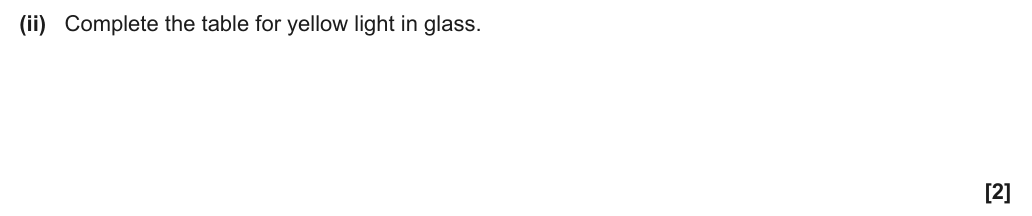
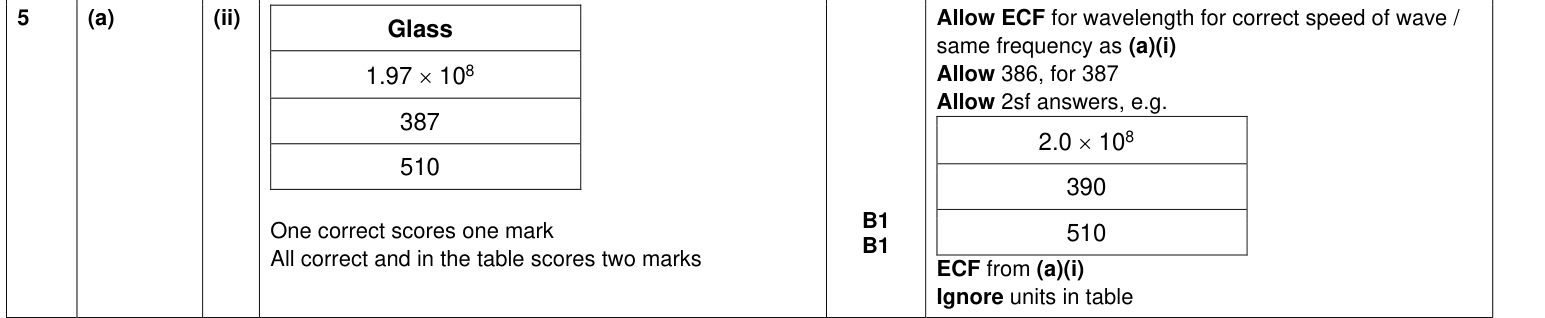
June 2024 · AS Paper 2 · Q5(a)(ii)2 marksShort answerEasy
Earlier part of question 5 that this part uses
Mark scheme
Examiner's comment
Most candidates were able to calculate the speed of light in glass correctly. Lower scoring candidates often incorrectly believed that the frequency (as opposed to the wavelength) decreased in glass.
Notes from the mark scheme and report
frequency unchanged (510)
one correct value scores 1
Allow 386 and 2 sf answers
ecf from (a)(i)
Many candidates did not fully understand effects of refraction on the quantities speed, frequency, and wavelength.
Skills: M0.3 Use ratios, fractions and percentages; M2.3 Substitute numerical values into algebraic equations using appropriate units for physical quantities
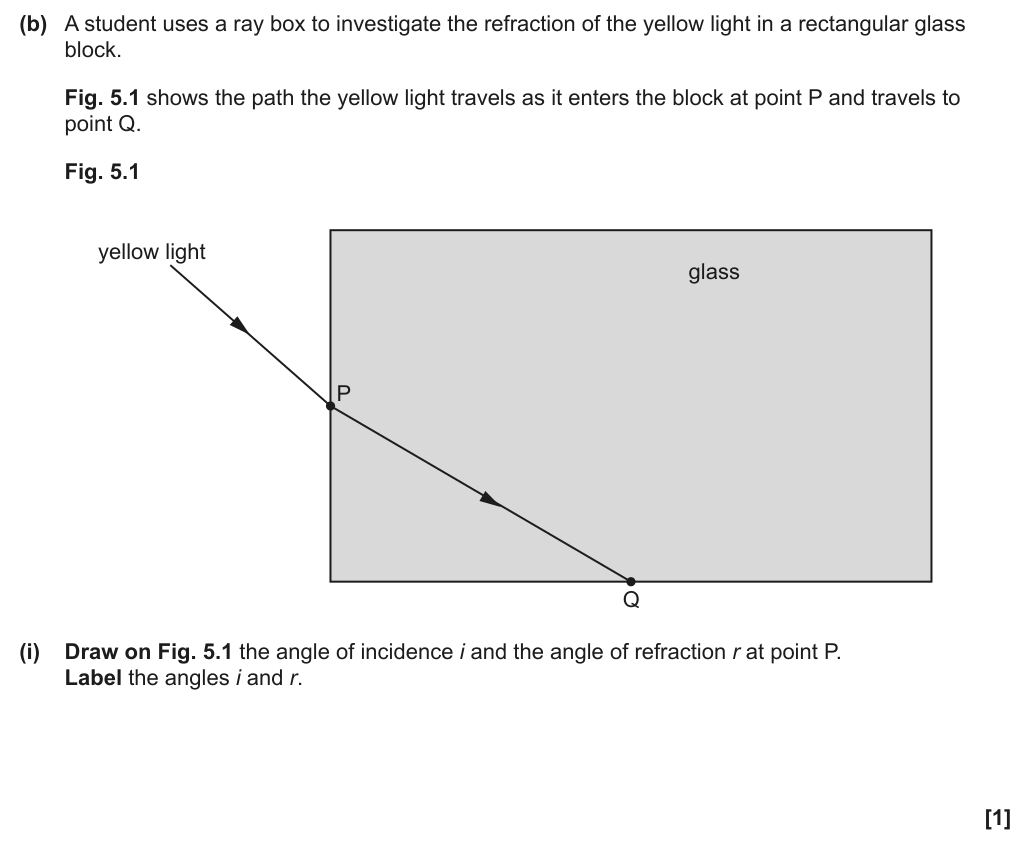
June 2024 · AS Paper 2 · Q5(b)(i)1 markDiagram or graphEasy
Mark scheme
Examiner's comment
This was generally answered well with many candidates adding a labelled normal line. Some lower scoring candidates did not draw a normal and just marked the angles between the rays and the boundary of the two mediums.
Notes from the mark scheme and report
normal at 90° to the surface at P (by eye) required
Skills: PAG6 Investigating quantum effects
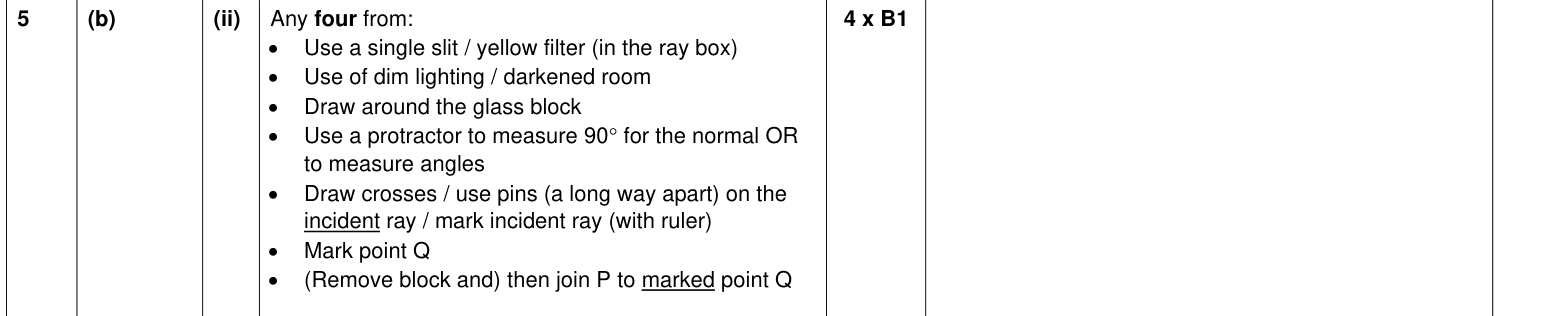
June 2024 · AS Paper 2 · Q5(b)(ii)4 marksExplanationHard
Earlier part of question 5 that this part uses
Mark scheme
Examiner's comment
This question was designed to give candidates the opportunity of describing a practical technique. In this question, the basic set-up required a single slit and a yellow filter in the ray-box to produce the thin ray of yellow light. It is often easier to carry out this experiment in a darkened room. Few candidates gave details of how the rays would be traced and the need to draw the outline of the glass block. High scoring candidates often included detail about placing small crosses on the rays and then using a rule joining them together and removing the block to join points P and Q. Some candidates also discussed the drawing of the normal and using a protractor to measure the angles.
Notes from the mark scheme and report
any four points, e.g. single slit, darkened room, draw round block, mark incident ray and Q, remove block and join P to Q
Students should have the opportunity of developing their practical skills so that they are able to describe methods and suggest improvements to obtain accurate data.
Skills: PAG6 Investigating quantum effects
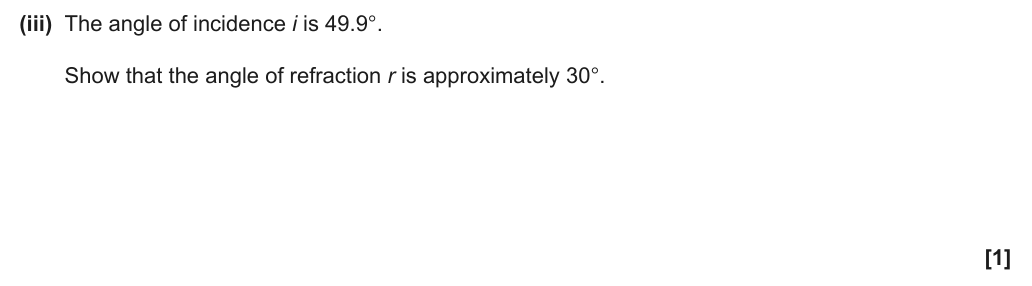
June 2024 · AS Paper 2 · Q5(b)(iii)1 markShow thatMedium
Earlier part of question 5 that this part uses
Mark scheme
Examiner's comment
To gain credit, candidates needed to show the correct substitution of the data into the correct equation and evaluate the answer.
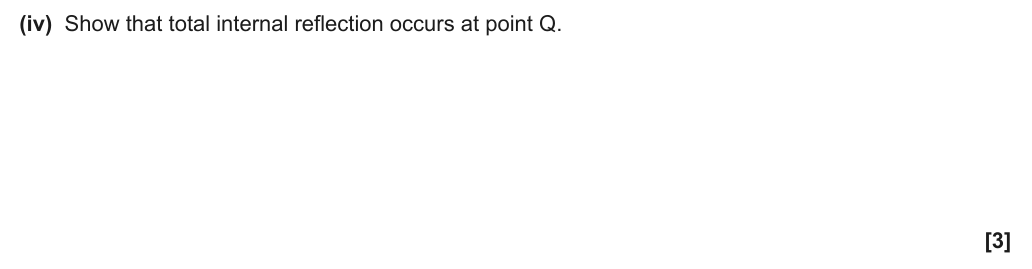
June 2024 · AS Paper 2 · Q5(b)(iv)3 marksShow thatMedium
Earlier parts of question 5 that this part uses
Mark scheme
Examiner's comment
Candidates needed to determine the both the critical angle and the angle of incidence at point Q. Many candidates were able to calculate the critical angle. Since this was a show question it was then expected that there would be an appropriate conclusion that since the angle of incidence (60) was larger than the angle of incidence, total internal reflection would occur. Some candidates showed mathematically that a refracted ray was not possible but did not link this with the criteria for total internal reflection.
Notes from the mark scheme and report
angle of incidence at Q = 60° and C = 41°
Do not allow 49.9 > 41
Candidates should be able to state the conditions for total internal reflection and be able to apply these conditions to practical situations.
Skills: M0.6 Use calculators to handle sin x, cos x and tan x when x is expressed in degrees or radians; M4.4 Use Pythagoras’ theorem, and the angle sum of a triangle
June 2024 · AS Paper 2 · Q5(b)(v)1 markDiagram or graphMedium
Earlier parts of question 5 that this part uses
Mark scheme
Examiner's comment
The majority of candidates did not realise that there should be a mirror image of the diagram. High scoring candidates answered this question well by adding appropriate lines to the diagram and adding where the angles were equal. The candidate has clearly shown the answer with the normal lines aligned and labelled the angles so that it is clear which ones are equal. This candidate has also clearly shown the angle of incidence and the angle of refraction for Question 5 (b) (i).
Notes from the mark scheme and report
reflected ray is mirror image at Q, then bends away from the normal where it leaves the block
June 2023 · AS Paper 1 · Q11 markMultiple choiceEasy
Answer
C
Mark scheme
Examiner's comment
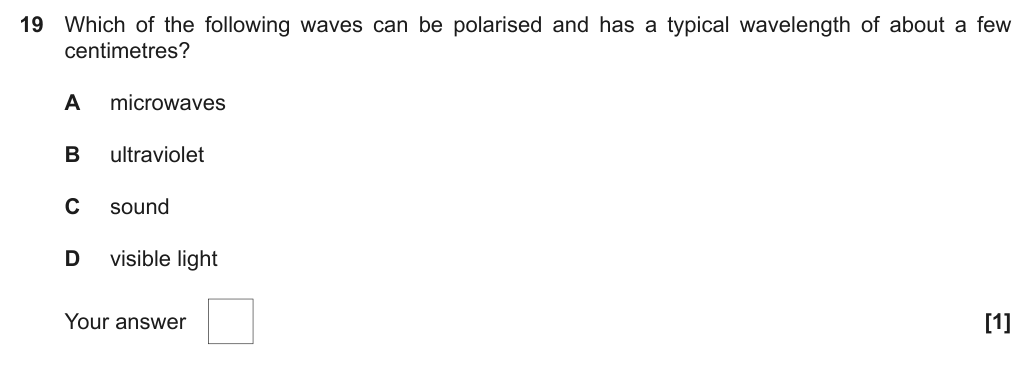
This should have been a straightforward starting question for all the candidates in determining the wavelength of microwaves in cm wavelength but less than half of the candidates got the correct answer C. The most common distractor was D.
June 2023 · AS Paper 1 · Q51 markMultiple choiceMedium
Answer
D
Mark scheme
Examiner's comment
Less than half of candidates answered this question correctly by applying understanding of Total Internal Reflection and the use of sin C = 1/n. The most common distractor was C.
June 2023 · AS Paper 1 · Q131 markMultiple choiceMedium
Answer
D
Mark scheme
Examiner's comment
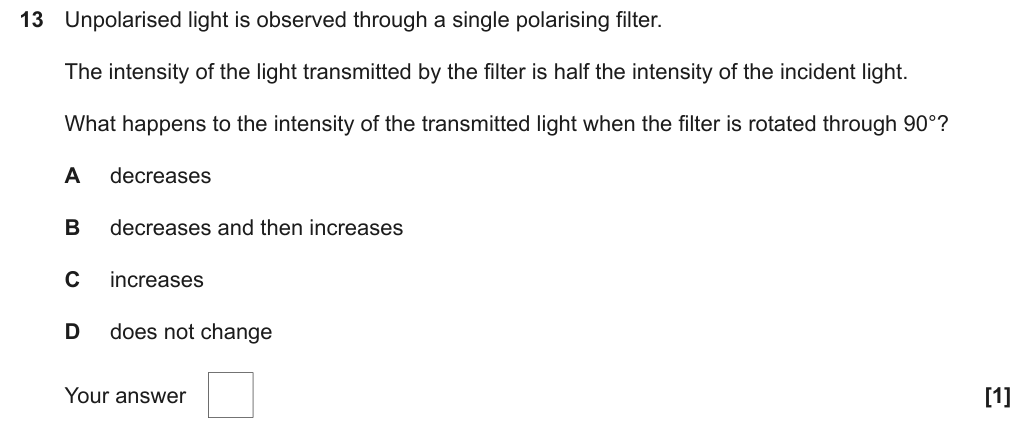
About half of candidates performed well on this question by determining the correct answer of D by understanding the behaviour and intensity of unpolarised light when transmitted through a polarising filter.
June 2023 · AS Paper 2 · Q5(a)(ii)1 markExplanationHard
Earlier part of question 5 that this part uses
Mark scheme
Examiner's comment
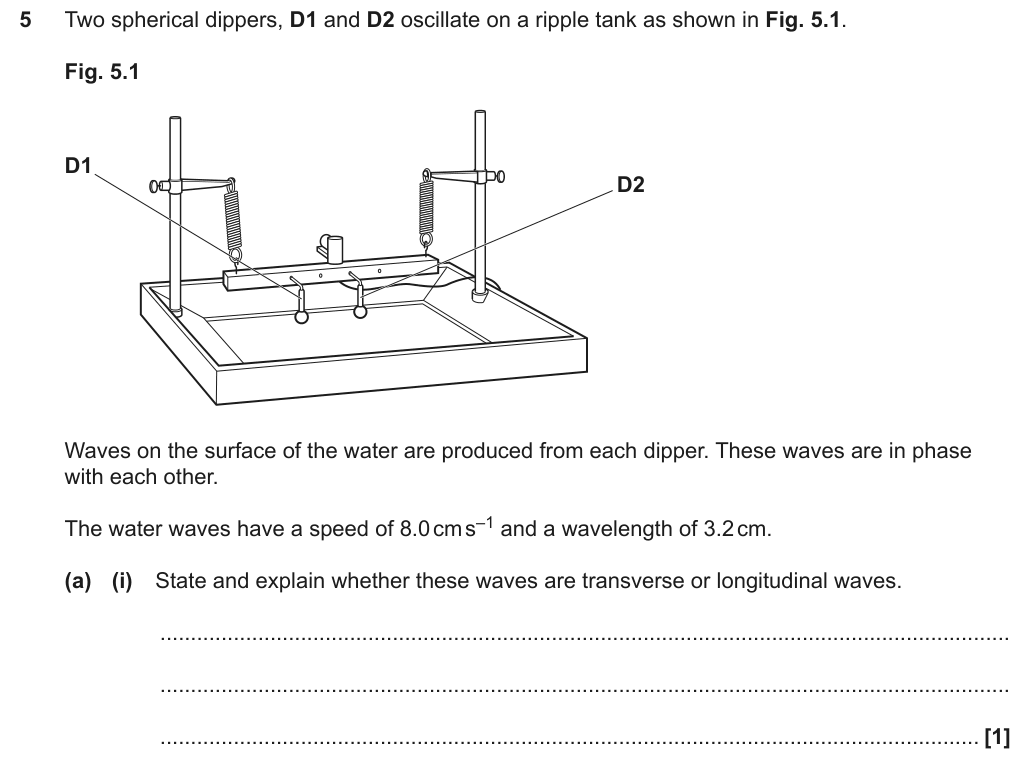
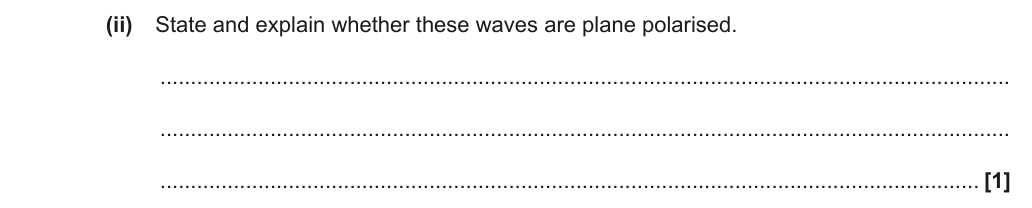
Few candidates were able to explain why the waves were plane polarised. High scoring candidates stated that the oscillations were in the vertical plane only.
Notes from the mark scheme and report
plane polarised because oscillations are all in one (vertical) plane
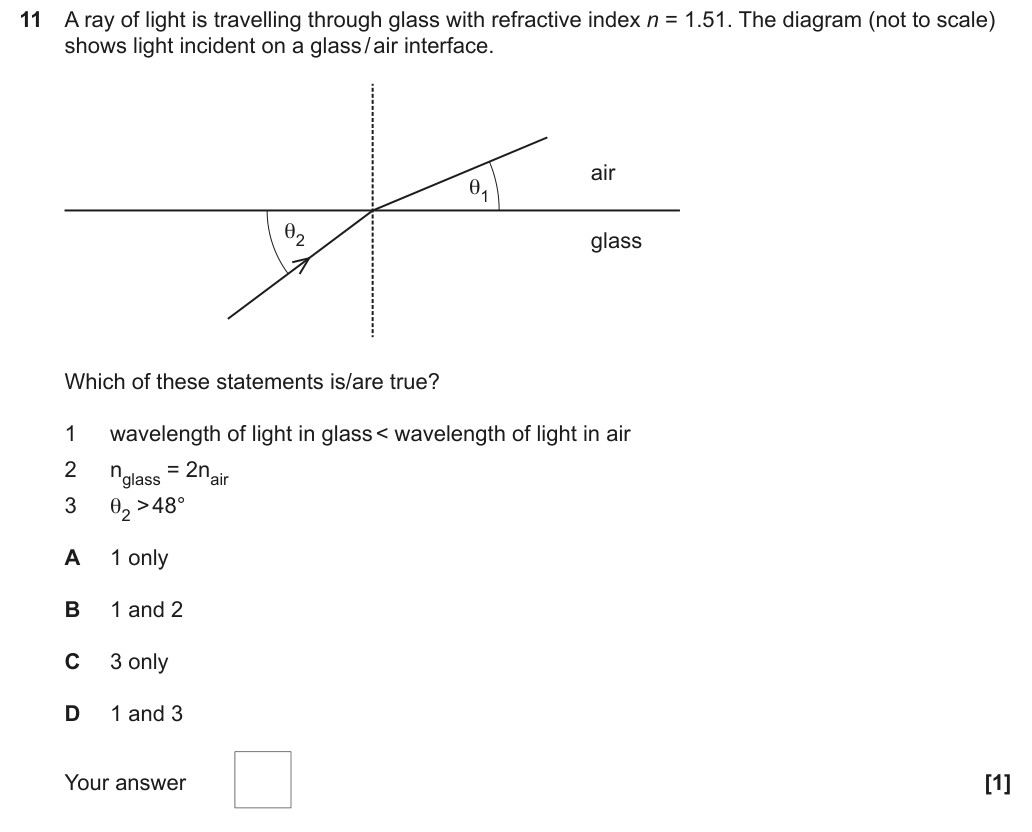
June 2023 · Paper 2 · Q111 markMultiple choiceHard
Answer
D
Mark scheme
Examiner's comment
Around one third of candidates were able to identify the correct response; the main difficulty appeared to be that the given angle in the glass was not given relative to the normal (as is usual) and this meant that a common distractor was A.
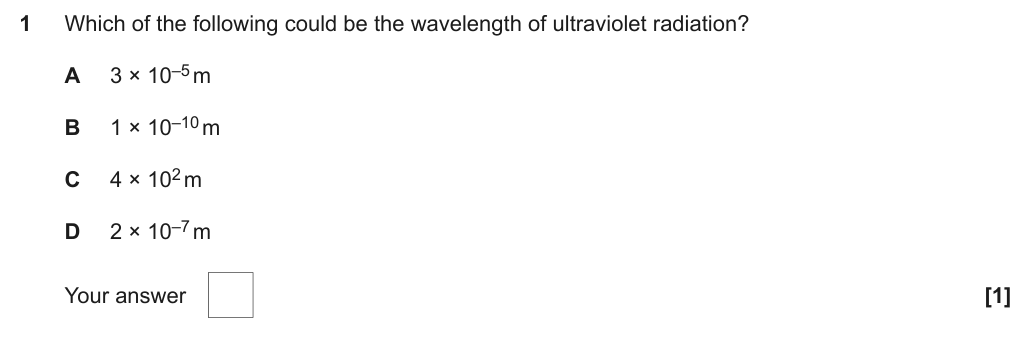
June 2022 · AS Paper 1 · Q11 markMultiple choiceEasy
Answer
D
Mark scheme
Examiner's comment
This should have been a straightforward starting question for all the candidates in determining a possible wavelength for ultraviolet radiation but only half of the candidates got the correct answer D. The most common distractor was B.
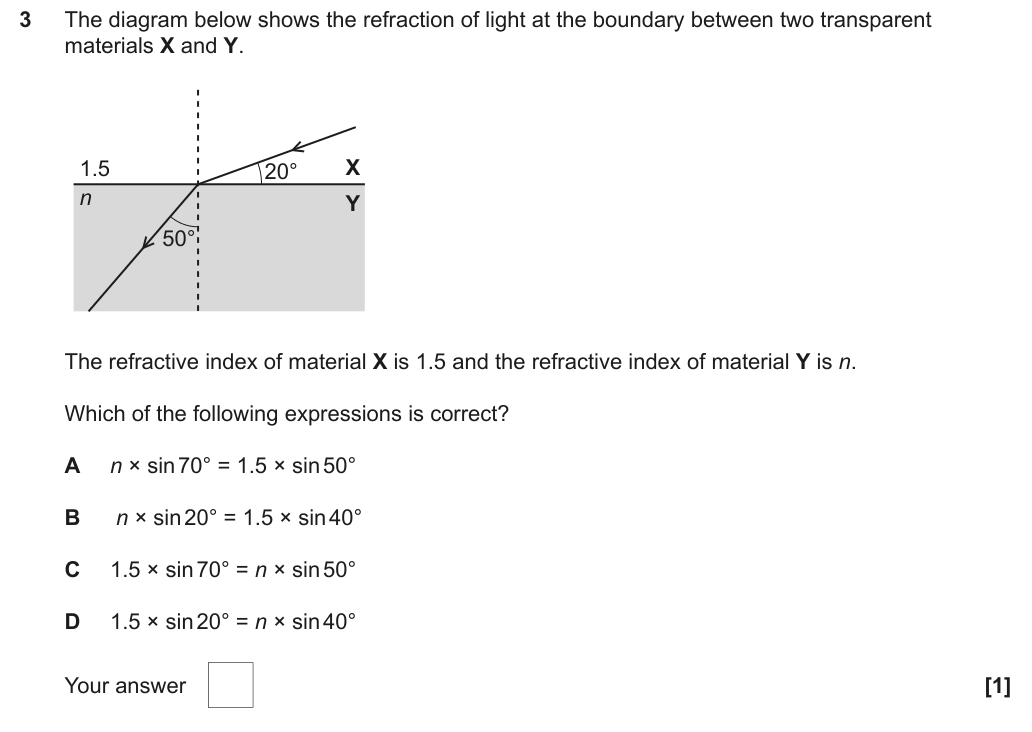
June 2022 · AS Paper 1 · Q31 markMultiple choiceMedium
Answer
C
Mark scheme
Examiner's comment
Most candidates identified the answer as C by correctly applying Snell’s law to the boundary of the two materials X and Y.
Notes from the mark scheme and report
angles must be measured to the normal (70° not 20°)
Skills: M4.5 Use sin, cos and tan in physical problems
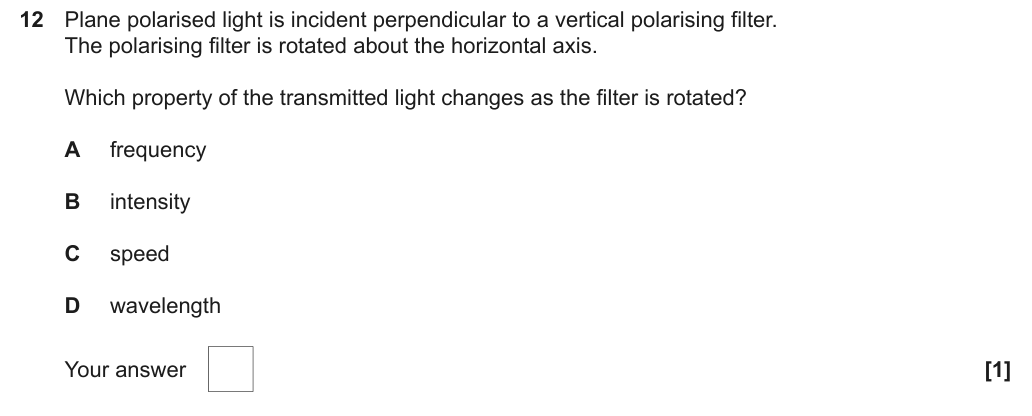
June 2022 · AS Paper 1 · Q121 markMultiple choiceMedium
Answer
B
Mark scheme
Examiner's comment
Most candidates answered this well as they were able to identify that the intensity was the property that changed when the polarising filter was changed which demonstrated their understanding of plane polarised light.
June 2022 · AS Paper 2 · Q5(a)1 markShort answerEasy
Mark scheme
Examiner's comment
This question was well answered with most candidates giving answers correct to three significant figures by using standard form.
Notes from the mark scheme and report
both values needed, in that order (1.97 x 10^8 and 2.05 x 10^8)
Skills: M0.2 Recognise and use expressions in decimal and standard form; M1.1 Use an appropriate number of significant figures; M2.2 Change the subject of an equation, including non-linear equations
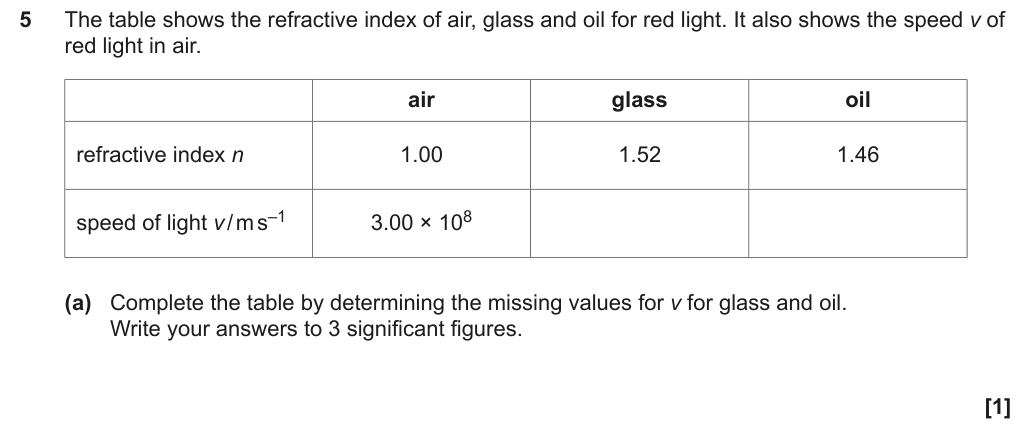
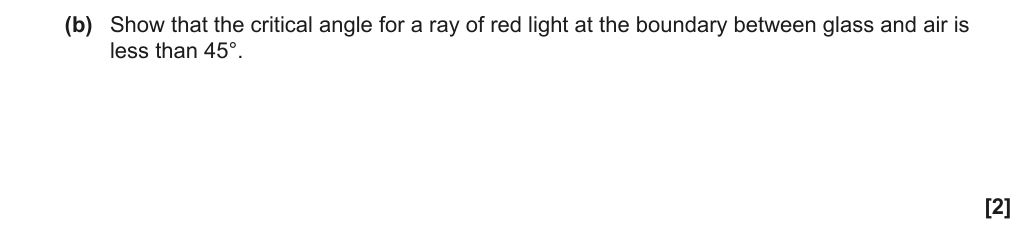
June 2022 · AS Paper 2 · Q5(b)2 marksShow thatMedium
Earlier part of question 5 that this part uses
Mark scheme
Examiner's comment
Most candidates clearly demonstrated the method to determine the critical angle. Some candidates incorrectly used 45 rather than 90.
Notes from the mark scheme and report
To determine the critical angle, the angle of refraction is 90 so sin 90 = 1.
Skills: M0.6 Use calculators to handle sin x, cos x and tan x when x is expressed in degrees or radians; M2.3 Substitute numerical values into algebraic equations using appropriate units for physical quantities
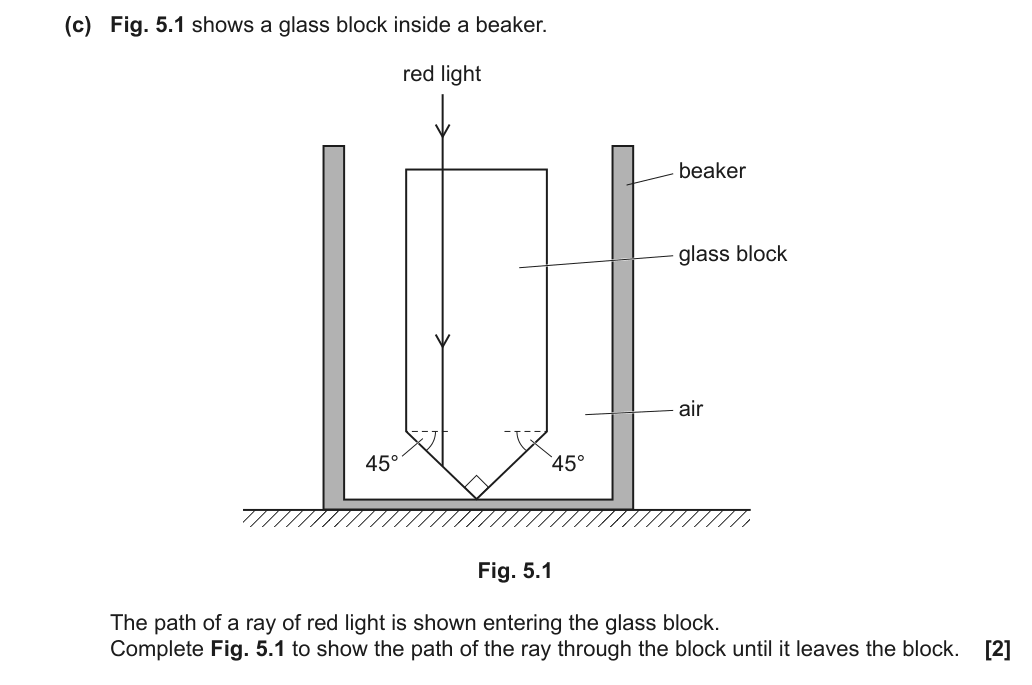
June 2022 · AS Paper 2 · Q5(c)2 marksDiagram or graphMedium
Earlier part of question 5 that this part uses
Mark scheme
Examiner's comment
Candidates needed to realise that the angle of incidence was 45 which was greater than the critical angle. So, the total internal reflection occurs at the first surface. No marks were given for candidates who drew any rays that showed refraction. Candidates who scored the first mark invariably realised that the angle of incidence at the second boundary was also 45 so again drew a totally internally reflect ray parallel to the incident ray. Rays should be straight and therefore drawn with a ruler. A significant number of candidates omitted this question.
Notes from the mark scheme and report
total internal reflection at both 45 degree faces
ray leaves vertically, parallel to the incident ray
Skills: M4.1 Use angles in regular 2D and 3D structures
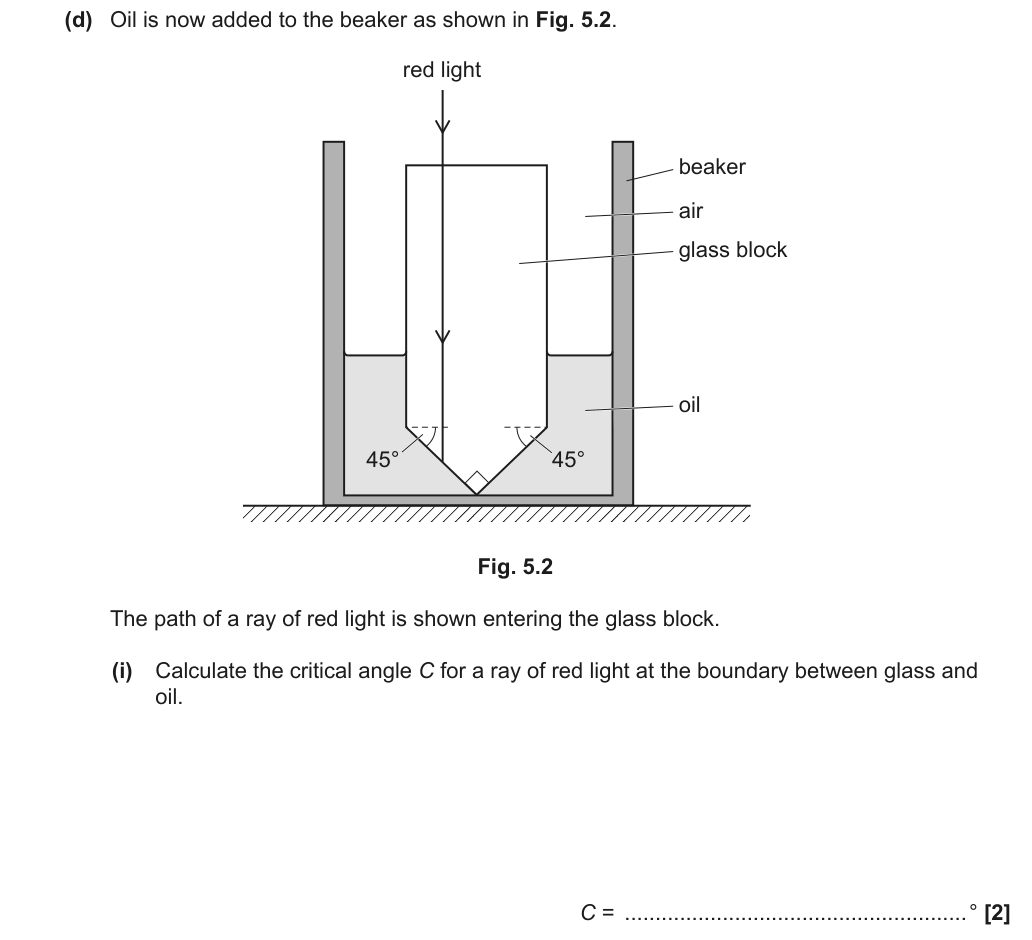
June 2022 · AS Paper 2 · Q5(d)(i)2 marksCalculationHard
Earlier part of question 5 that this part uses
Mark scheme
Examiner's comment
Candidates found this question challenging. Good candidates used the two refractive indexes 1.42 and 1.52 correctly. Many candidates incorrectly used an angle of 45 or 41 rather than 90. A significant number of candidates omitted this question.
June 2022 · AS Paper 2 · Q5(d)(ii)1 markDiagram or graphMedium
Earlier part of question 5 that this part uses
Mark scheme
Examiner's comment
Candidates often did not draw a refracted ray. Of those candidates who gained the answer to the previous part correctly, many did not realise that the ray would bend (slightly) away from the normal. A significant number of candidates omitted this question.
Notes from the mark scheme and report
ray refracts away from the normal into the oil
no ecf from (d)(i)
June 2022 · Paper 2 · Q91 markMultiple choiceMedium
Answer
A
Mark scheme
Examiner's comment
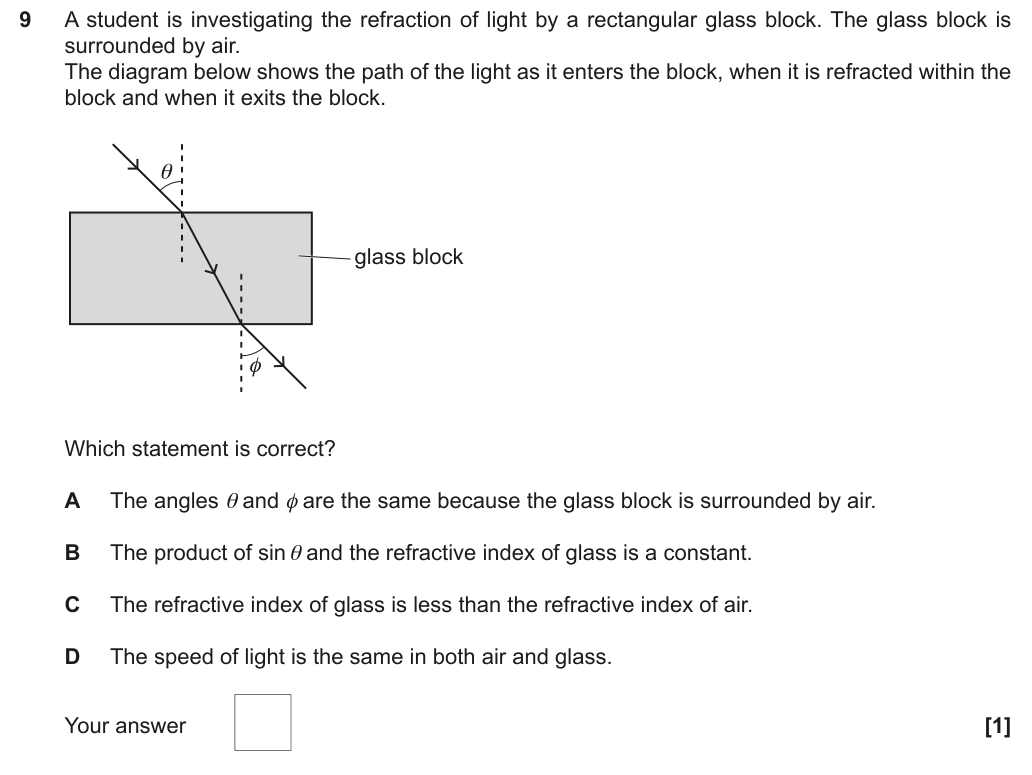
This question was correctly answered by the majority of candidates. The distractor B was the most common incorrect response and several candidates wrote out nsinθ = constant on their diagram.
June 2022 · Paper 3 · Q5(b)(ii)3 marksExplanationHard
Earlier part of question 5 that this part uses
Mark scheme
Examiner's comment
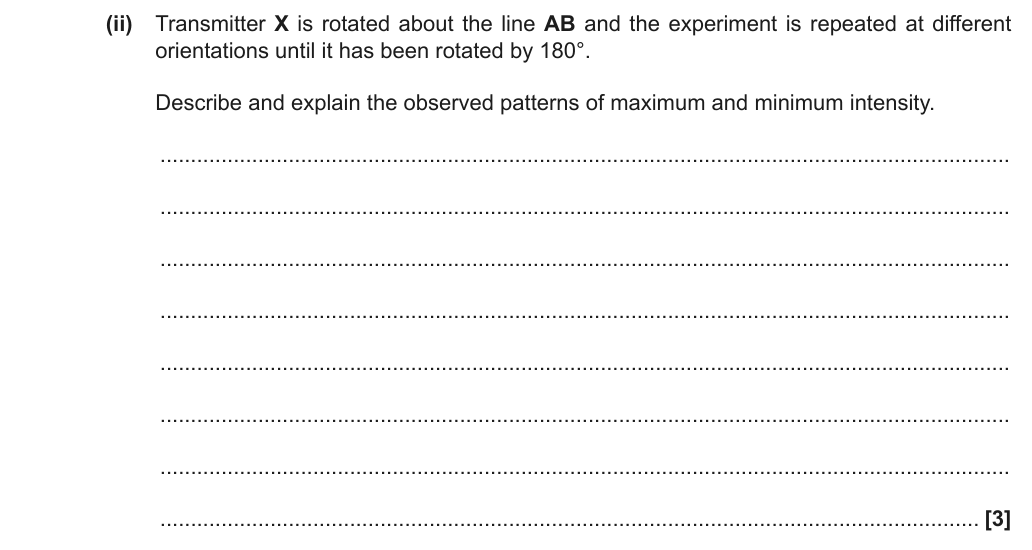
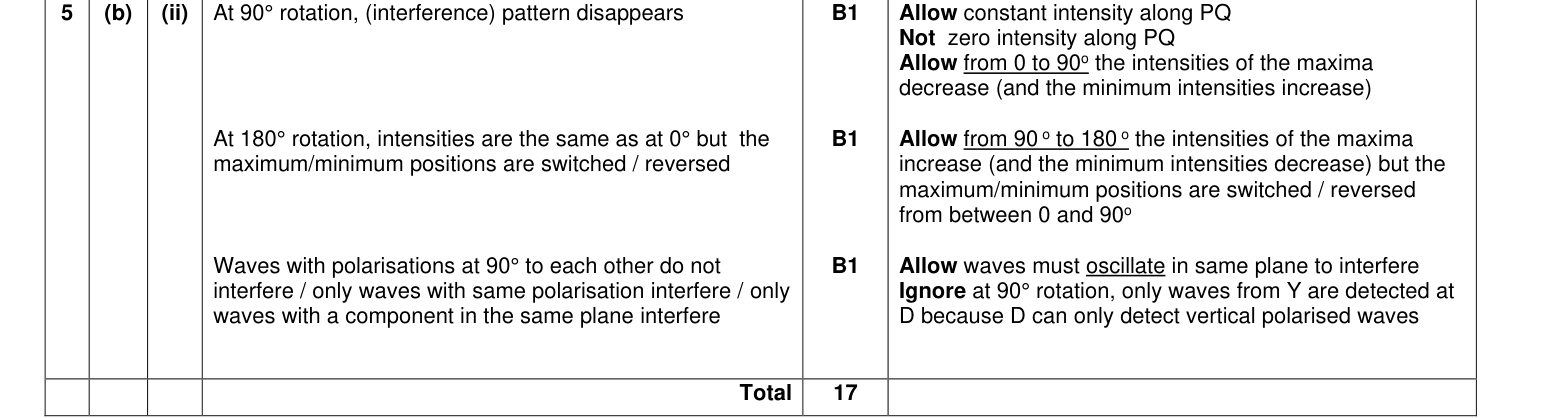
This question was misread by many candidates, who described the variation in overall intensity instead of the variation in the interference pattern. Some candidates thought that transmitter X was rotating away from Y, rather than about the AB axis. Only a few candidates correctly explained the change in pattern in terms of the change in the amount of interference between the waves from X and Y. Many said detector D was receiving less of a signal from X, rather than interference was lessening because of a reduction in the vertical component from X.
Notes from the mark scheme and report
at 90° the pattern disappears (NOT zero intensity along PQ)
at 180° maxima and minima positions are swapped
Ignore 'only Y is detected at 90°'
November 2021 · AS Paper 1 · Q161 markMultiple choice
Answer
C
Mark scheme
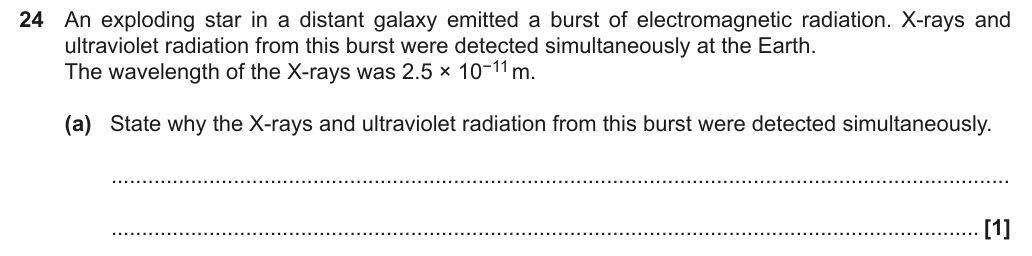
November 2021 · AS Paper 1 · Q24(a)1 markShort answer
Mark scheme
Notes from the mark scheme and report
ignore travels at c
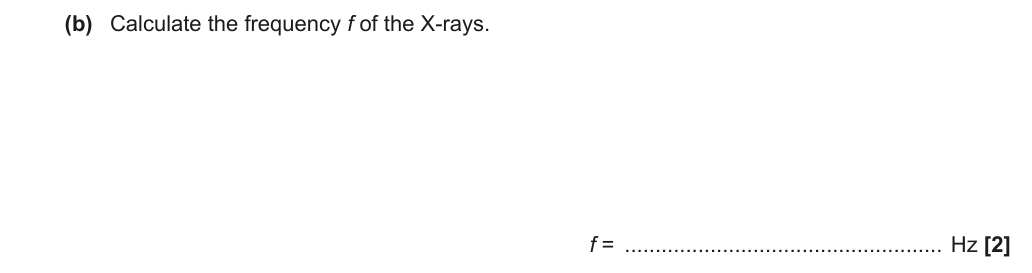
November 2021 · AS Paper 1 · Q24(b)2 marksCalculation
Earlier part of question 24 that this part uses
Mark scheme
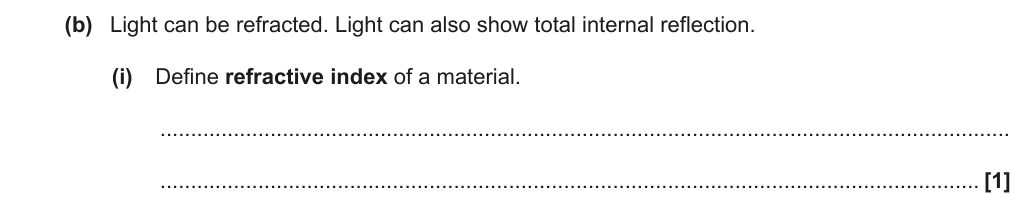
November 2021 · AS Paper 1 · Q25(b)(i)1 markShort answer
Mark scheme
Notes from the mark scheme and report
NOT speed of light in air for c
light must be mentioned
n = c/v only if terms defined
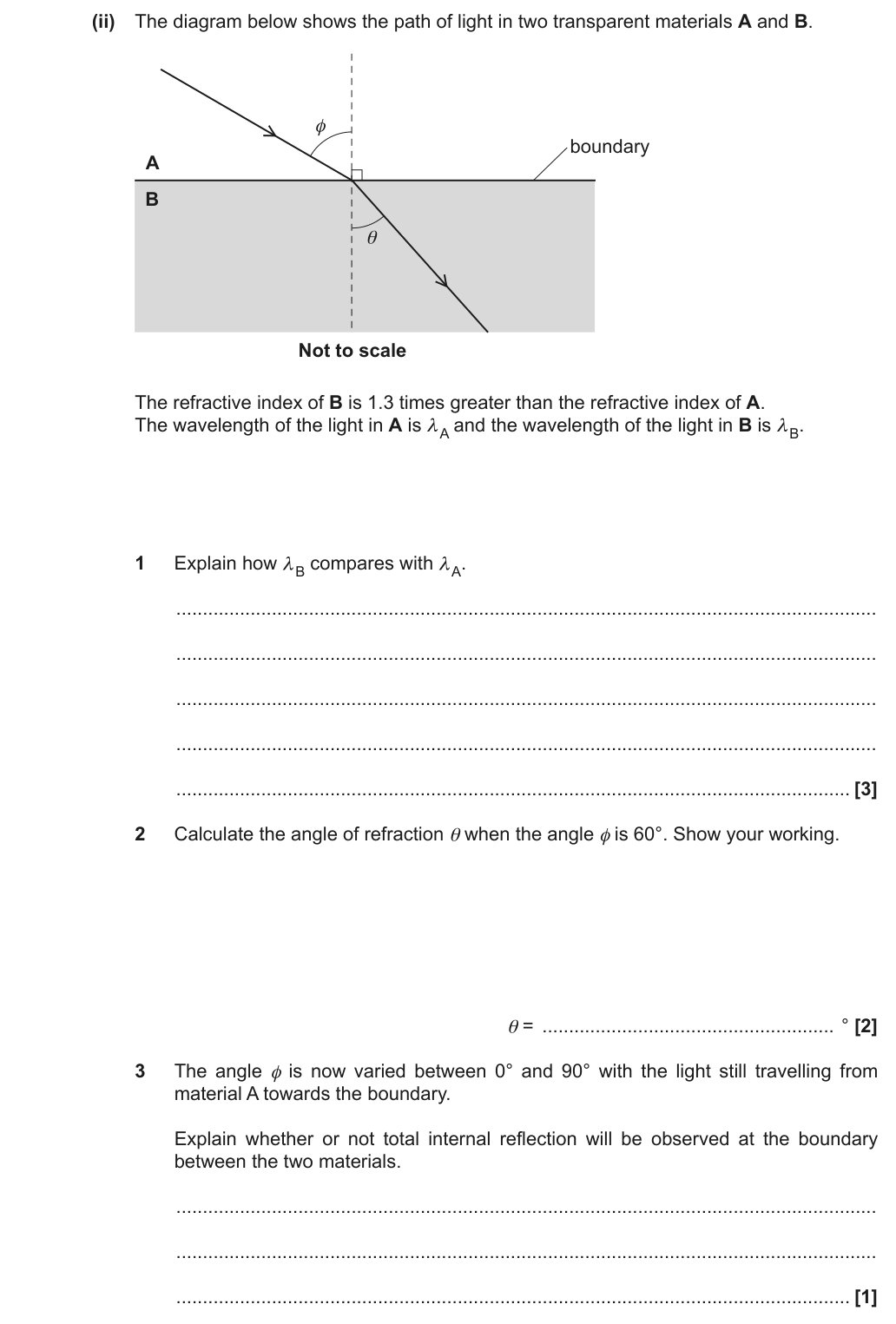
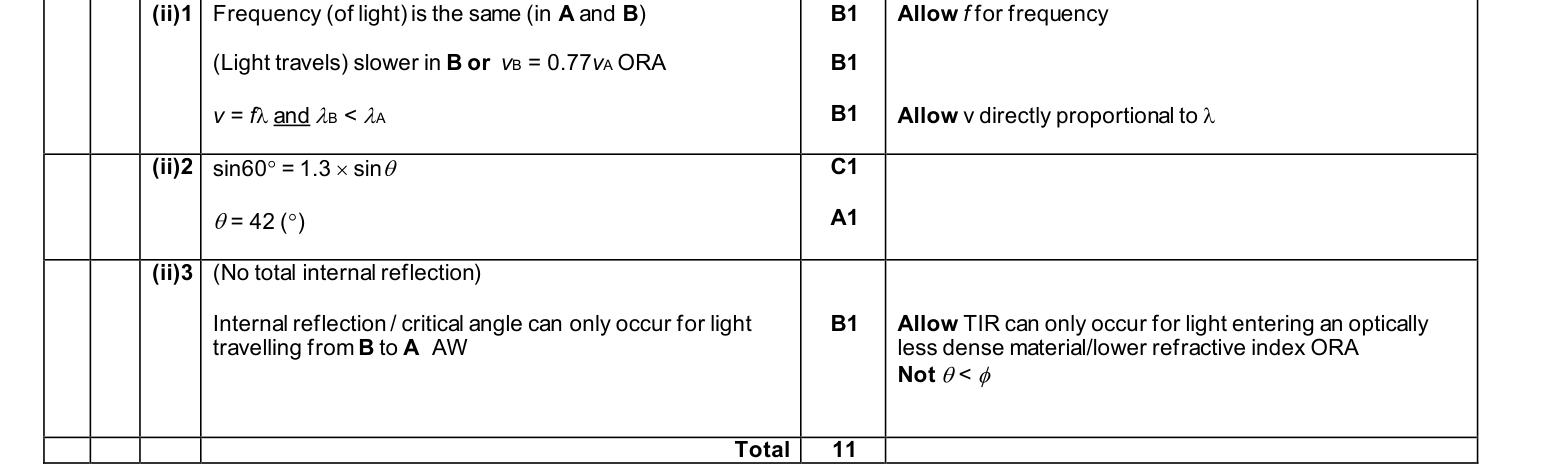
November 2021 · AS Paper 1 · Q25(b)(ii)6 marksCalculation
Mark scheme
Notes from the mark scheme and report
part 3: NOT θ < φ
total internal reflection only for light travelling from B to A
Skills: M0.3 Use ratios, fractions and percentages; M0.6 Use calculators to handle sin x, cos x and tan x when x is expressed in degrees or radians; M2.2 Change the subject of an equation, including non-linear equations
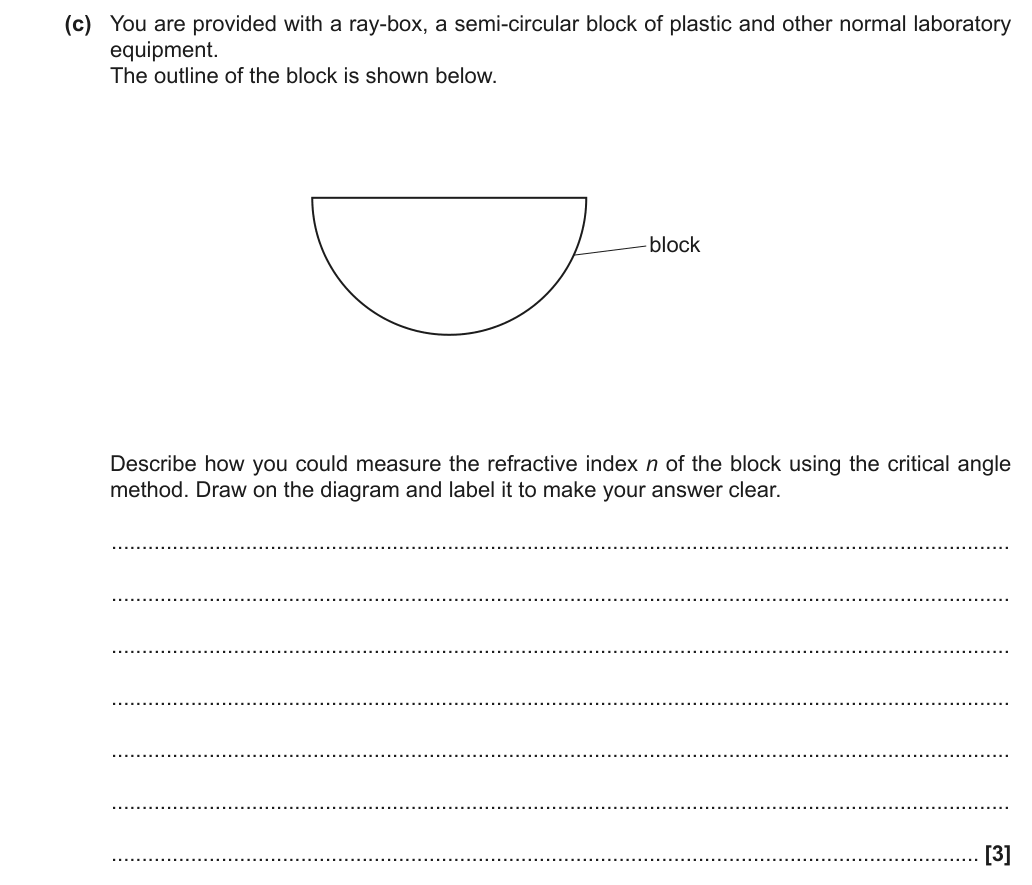
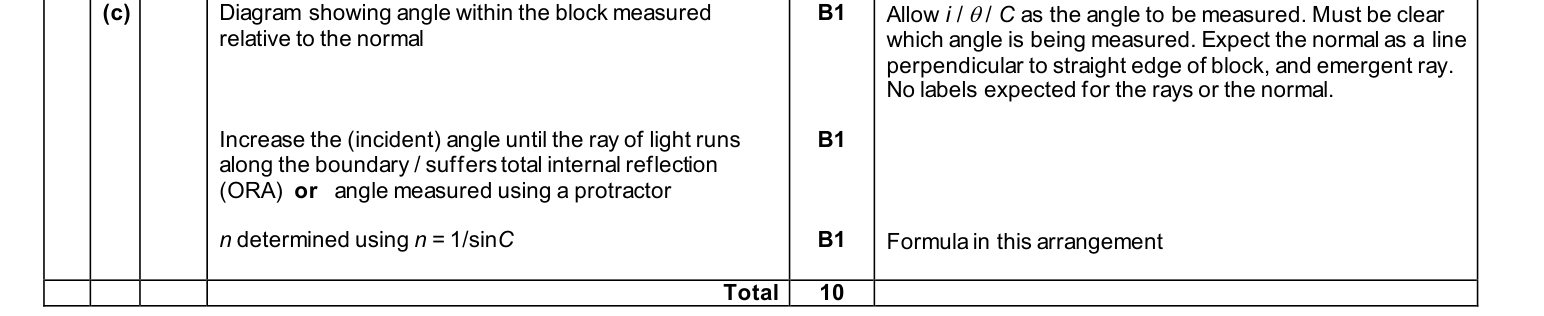
November 2021 · Paper 2 · Q16(c)3 marksDiagram or graphMedium
Mark scheme
Examiner's comment
This question required a knowledge of how to practically determine the refractive index using the given apparatus. It was clear that candidates were not sure how to carry out this experiment correctly and responses often were confusing with a misconception of what the critical angle is. It was often not clear what angle was being measured as many different angles were usually drawn on the diagram. Many candidates showed the ray of light entering the straight face of the block which would make it impossible to determine the critical angle.
Notes from the mark scheme and report
must be clear which angle (to the normal, inside the block) is measured
n = 1/sin C
Skills: PAG6 Investigating quantum effects
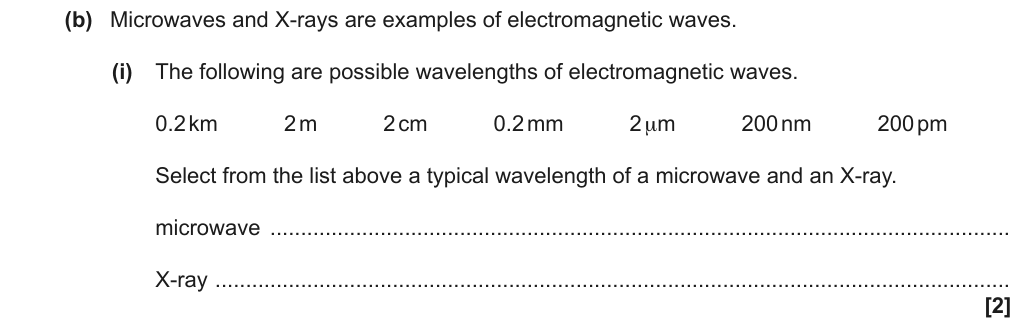
November 2020 · AS Paper 2 · Q1(b)(i)2 marksShort answerMedium
Mark scheme
Examiner's comment
For example, in Question 1 (b)(i) many candidates seemed unsure of the difference between 200 nm and 200 pm.
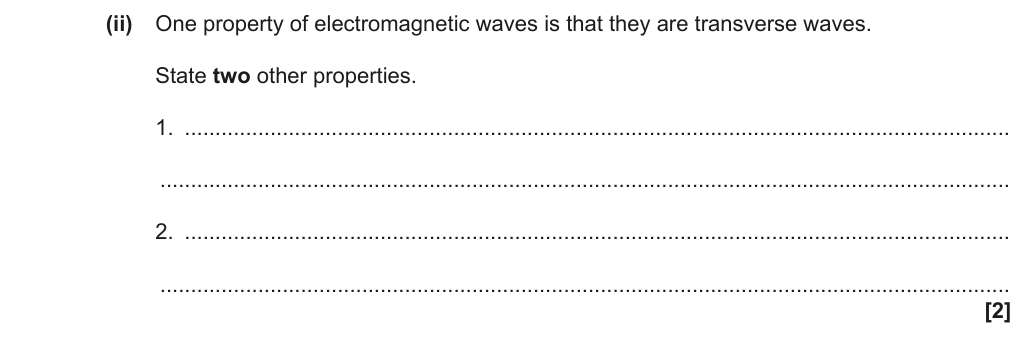
November 2020 · AS Paper 2 · Q1(b)(ii)2 marksShort answer
Mark scheme
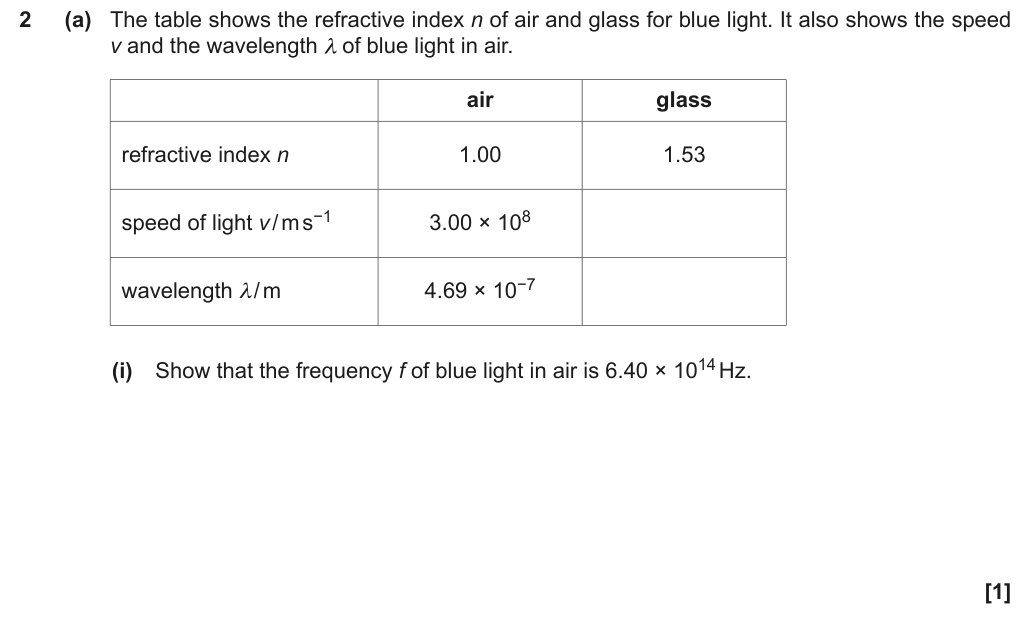
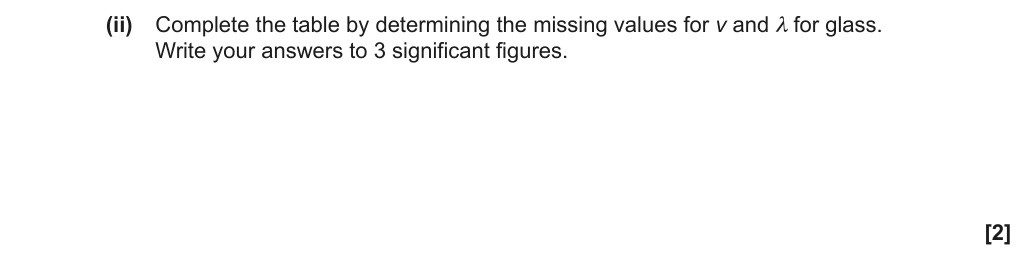
November 2020 · AS Paper 2 · Q2(a)(ii)2 marksShort answerMedium
Earlier part of question 2 that this part uses
Mark scheme
Examiner's comment
For example, in Question 2(a)(ii) answers of 4.59 × 10⁸ m s–1 (larger than the speed of light).
Notes from the mark scheme and report
allow 3.06 x 10⁻⁷ m
no ecf for incorrect speed
Skills: M1.1 Use an appropriate number of significant figures; M2.2 Change the subject of an equation, including non-linear equations; M2.3 Substitute numerical values into algebraic equations using appropriate units for physical quantities
November 2020 · AS Paper 2 · Q2(b)(i)3 marksCalculation
Earlier part of question 2 that this part uses
Mark scheme
Notes from the mark scheme and report
19° does not score
Skills: M0.6 Use calculators to handle sin x, cos x and tan x when x is expressed in degrees or radians; M2.3 Substitute numerical values into algebraic equations using appropriate units for physical quantities
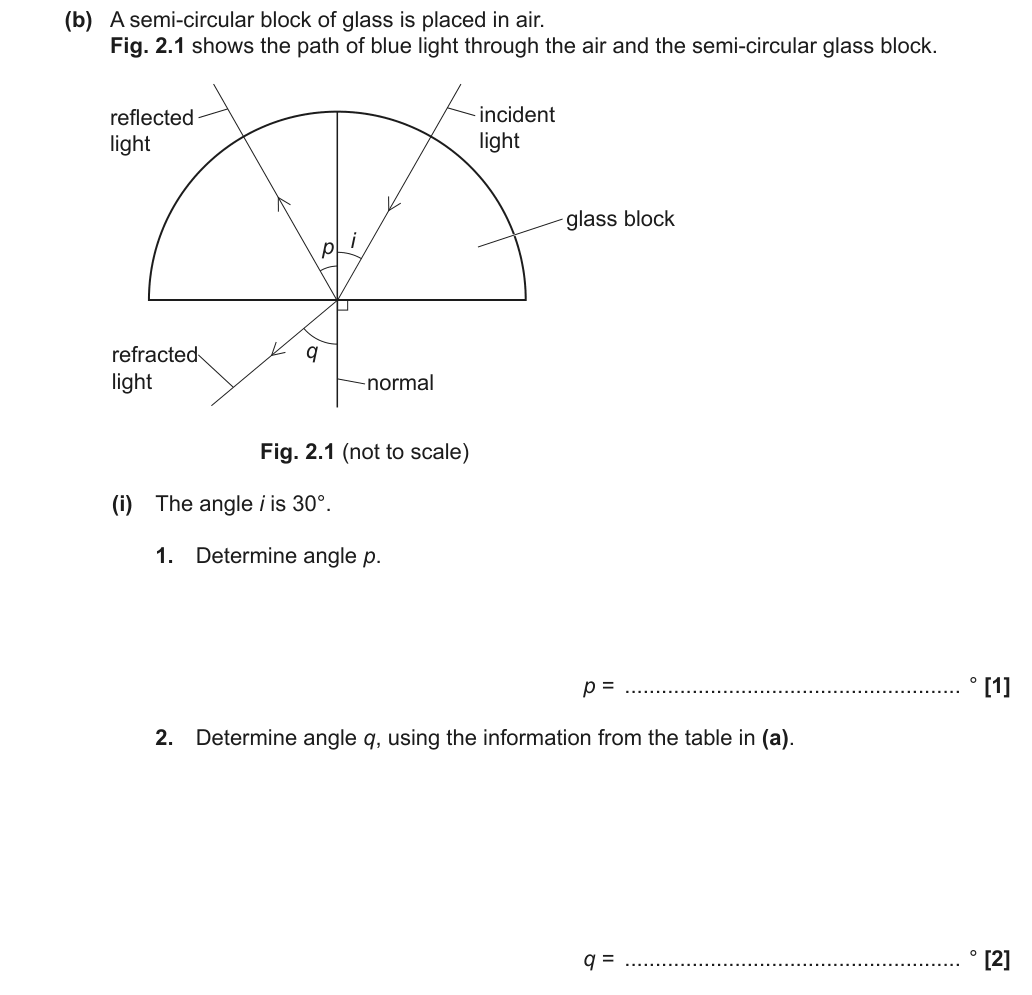
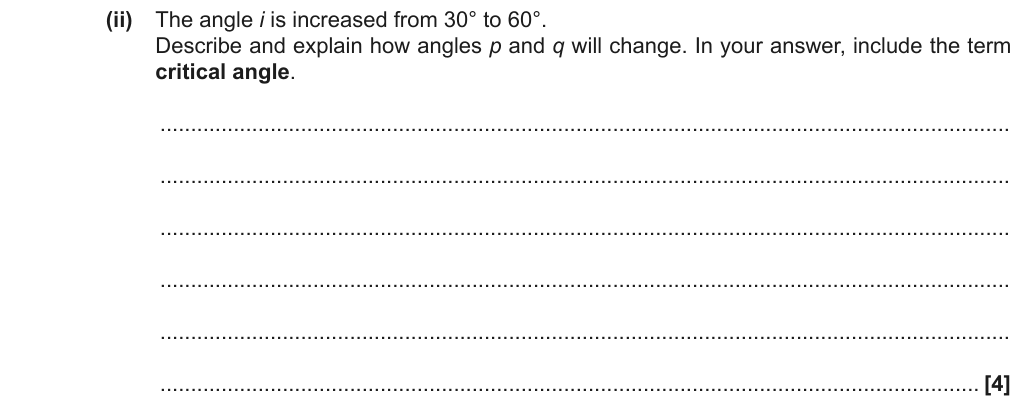
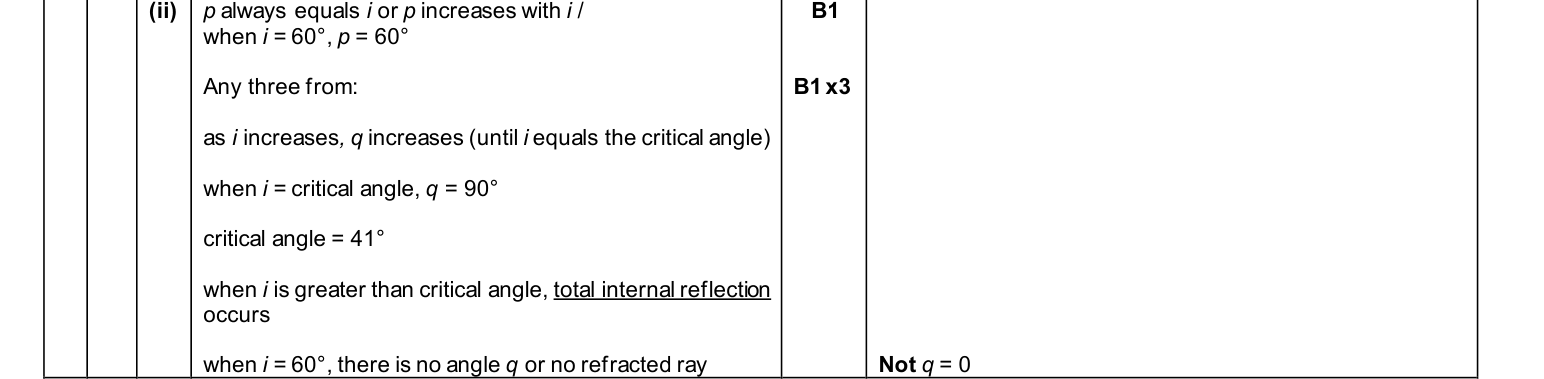
November 2020 · AS Paper 2 · Q2(b)(ii)4 marksExplanation
Earlier parts of question 2 that this part uses
Mark scheme
Notes from the mark scheme and report
Not q = 0
critical angle = 41°
Skills: M0.6 Use calculators to handle sin x, cos x and tan x when x is expressed in degrees or radians
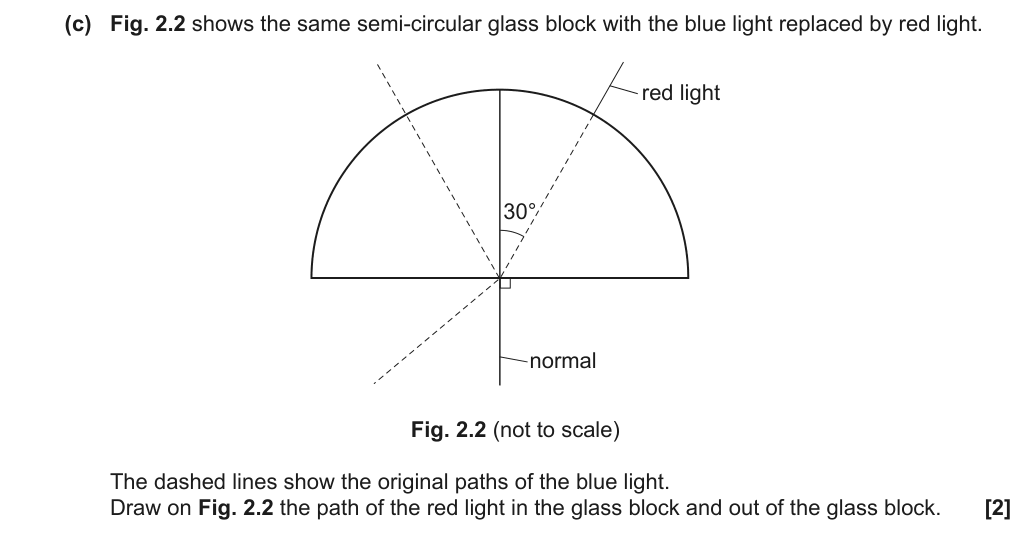
November 2020 · AS Paper 2 · Q2(c)2 marksDiagram or graph
Earlier part of question 2 that this part uses
Mark scheme
Notes from the mark scheme and report
refracted angle must be less than 49.9° but greater than 30°
November 2020 · Paper 3 · Q5(a)2 marksCalculationEasy
Mark scheme
Examiner's comment
Question 5b The words ‘simple harmonic motion’ in the text prompted almost all candidates to use the correct formula here. Question 5c Allowing a mark for the diode only letting current pass in one direction enabled many candidates to score this mark. Question 5d This was the second of the two LoR questions in this paper.
November 2020 · Paper 3 · Q5(d)6 marks6-mark extended responseEasy
Earlier part of question 5 that this part uses
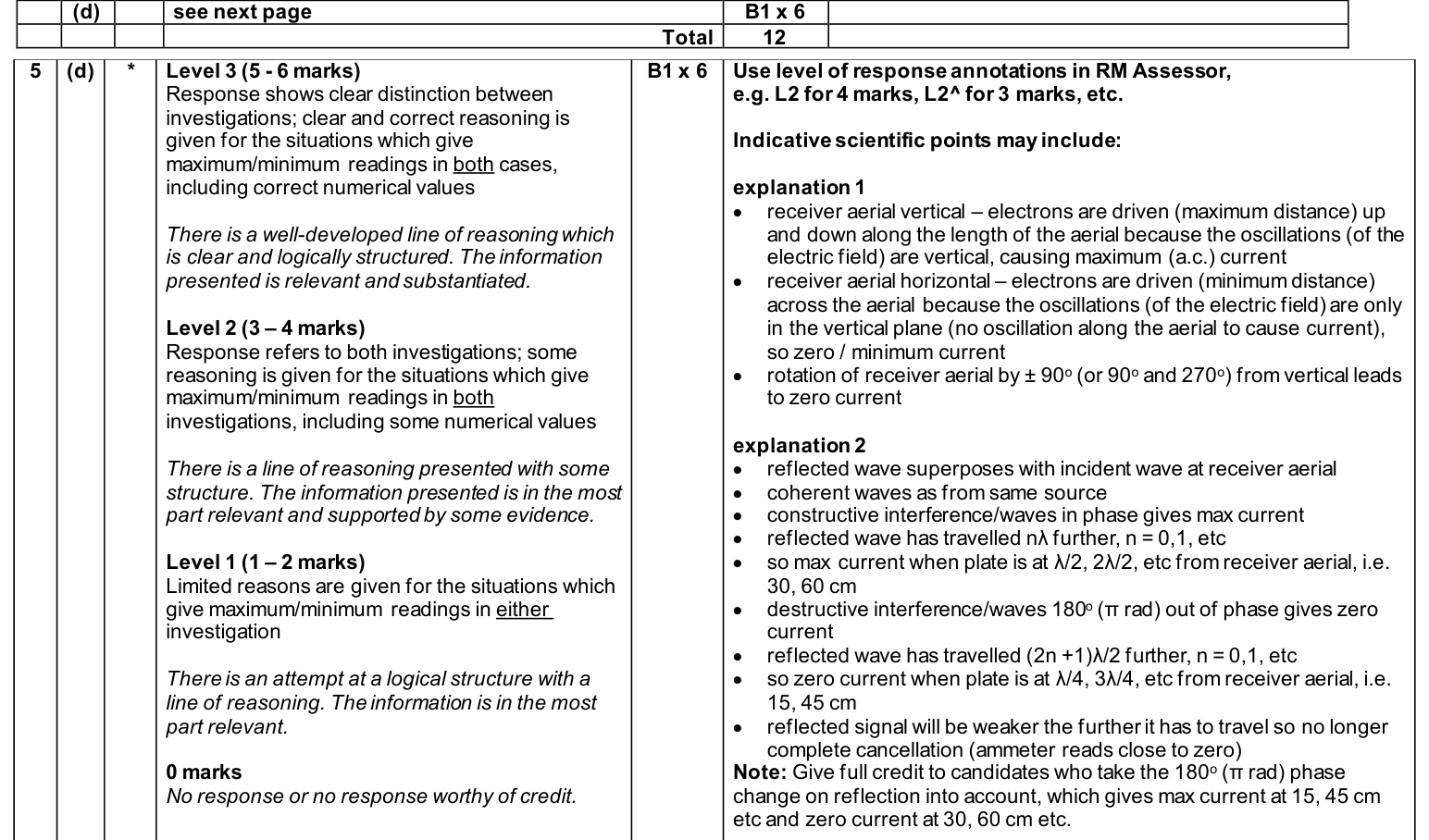
Mark scheme, with the levels and indicative content
Examiner's comment
Question 5b The words ‘simple harmonic motion’ in the text prompted almost all candidates to use the correct formula here. Question 5c Allowing a mark for the diode only letting current pass in one direction enabled many candidates to score this mark. Question 5d This was the second of the two LoR questions in this paper.
Notes from the mark scheme and report
1: maximum with receiver aerial vertical, zero when rotated 90 degrees
2: reflected and incident waves superpose - maximum with sheet at 30, 60 cm and zero at 15, 45 cm from the aerial (full credit for the reverse if the 180 degree phase change on reflection is used)
Skills: PAG5 Investigating waves
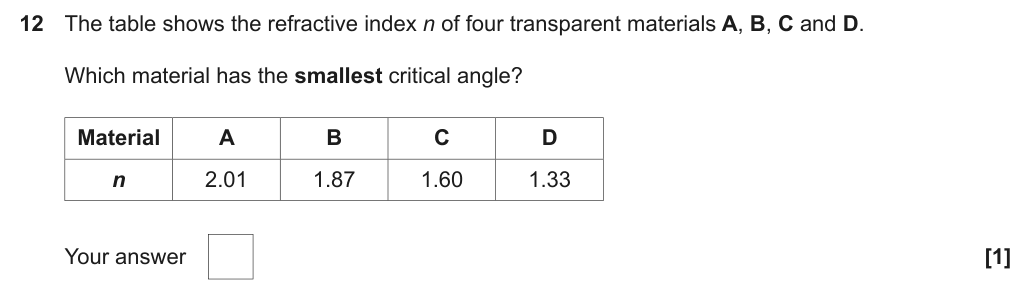
June 2019 · AS Paper 1 · Q121 markMultiple choiceMedium
Answer
A
Mark scheme
Examiner's comment
This question was about the critical angle and refractive index equation sinC = 1/n which appears in the Data, Formulae and Relationship Booklet. The majority of the candidates realised that the largest value of the refractive index would give the smallest critical angle. The answer had to be A. It was good to see the equation above scribbled on many of the scripts.
June 2019 · AS Paper 1 · Q191 markMultiple choice
Answer
A
Mark scheme
June 2019 · AS Paper 1 · Q24(a)3 marksExplanationMedium
Mark scheme
Examiner's comment
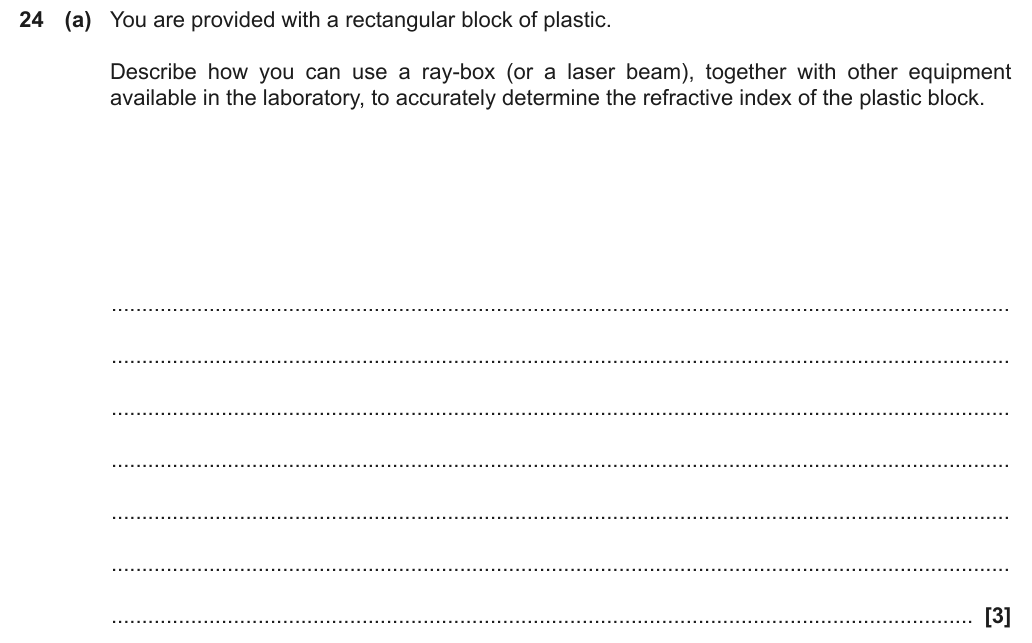
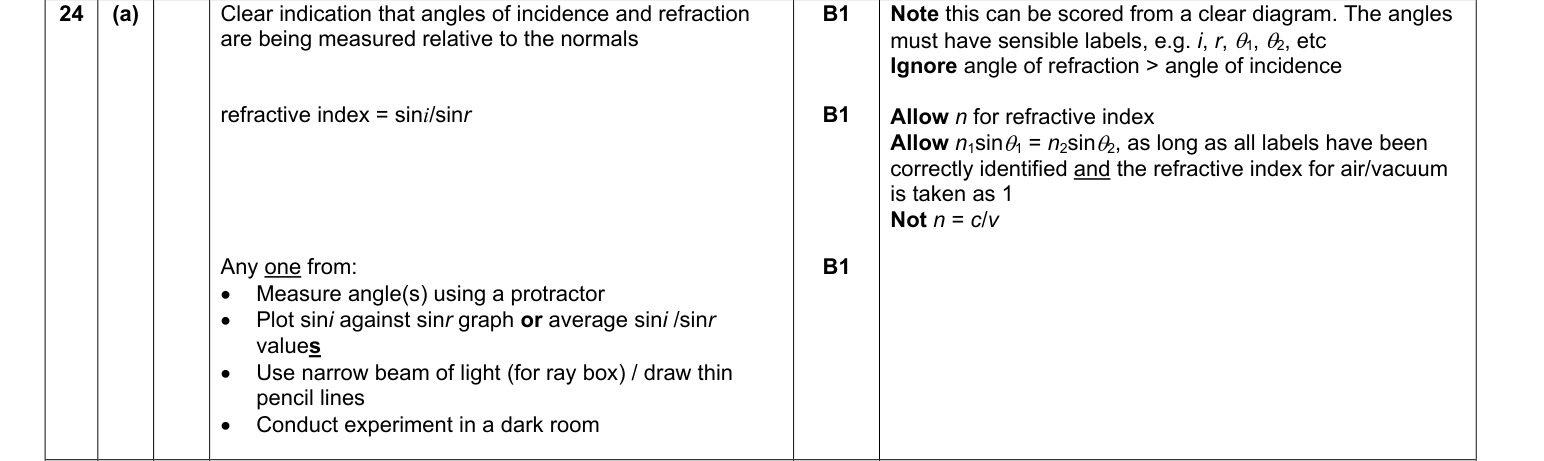
This question produced a wide spectrum of marks, with only the upper quartile of the candidates generally securing 2 or 3 marks. Candidates are reminded that if a diagram is drawn to support an answer, it must be adequately annotated. On many scripts, the normal was missed out and the angles of incidence and refraction were marked incorrectly (often between the light beam and the straight edge of the rectangular block). A significant number of candidates decided to change the block to a semi-circular one, and focused erroneously on determining the refractive index n using the critical angle equation sinC = 1/n.
Notes from the mark scheme and report
angles must be measured relative to the normal
NOT n = c/v
Skills: PAG6 Investigating quantum effects
June 2019 · Paper 2 · Q71 markMultiple choice
Answer
C
Mark scheme
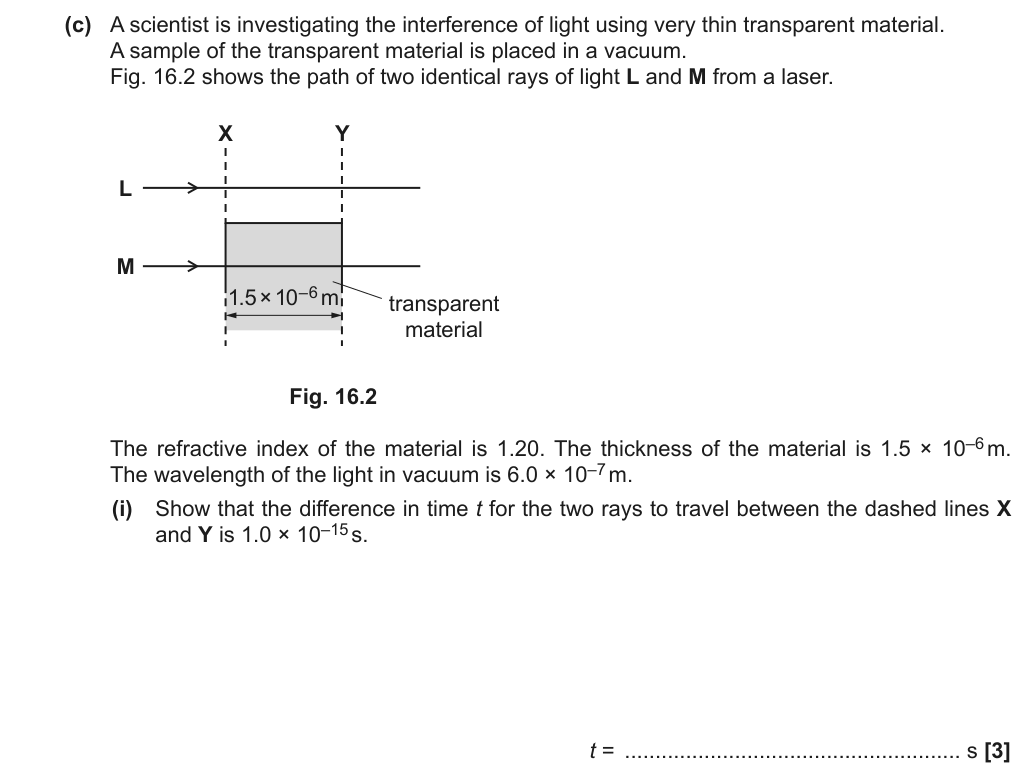
June 2019 · Paper 2 · Q16(c)(i)3 marksShow thatHard
Mark scheme
Examiner's comment
Generally, candidates answered this question extremely well and most scoring full marks In (c)(i), the solutions ranged from being well-structured to an assortment of equations and substitutions filling the entire answer space. Equations for refractive index and speed were easily used to show the answer to be 1.0 × 10⁻¹⁵ s. In (c)(ii), candidates either calculated the frequency of 5.0 × 10¹⁴ Hz and then used T = f-1 or calculated T directly using T = 3.0 × 108 = 2.0 × 10⁻¹⁵ s. (c)(iii) provided some discrimination with middle and top candidates getting the correct answer of 180°. As always, error carried forward (ECF) rules apply in calculations. This helped those candidates who got an incorrect answer of 2.4 × 10⁻¹⁵ s in (c)(ii) to score a mark for 150°.
Notes from the mark scheme and report
omitting or misusing 1.20 is wrong physics
following mistakes.
• In (c)(i) calculating the difference in the time for the two rays by halving the period of 2.0 × 10⁻¹⁵ s.
Skills: M0.2 Recognise and use expressions in decimal and standard form; M2.2 Change the subject of an equation, including non-linear equations; M2.3 Substitute numerical values into algebraic equations using appropriate units for physical quantities
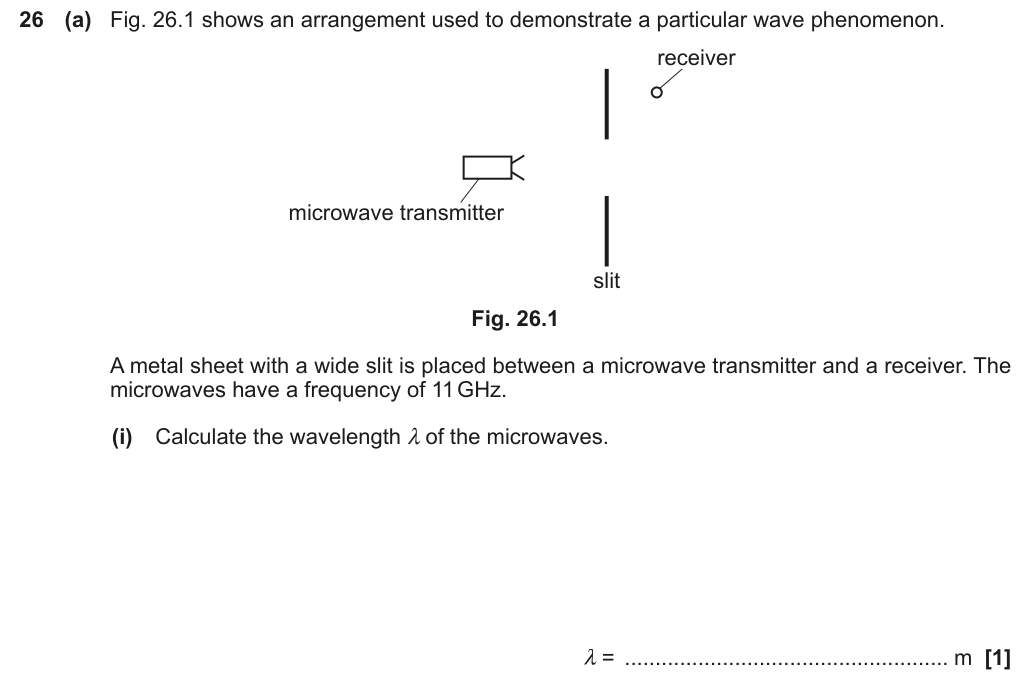
June 2018 · AS Paper 1 · Q26(a)(i)1 markCalculationEasy
Mark scheme
Examiner's comment
Question 26(a)(i) Question 26(b) Most candidates gained two or more marks.
Notes from the mark scheme and report
possible SF penalty for 0.03 m
Skills: M0.1 Recognise and make use of appropriate units in calculations; M0.2 Recognise and use expressions in decimal and standard form; M2.2 Change the subject of an equation, including non-linear equations
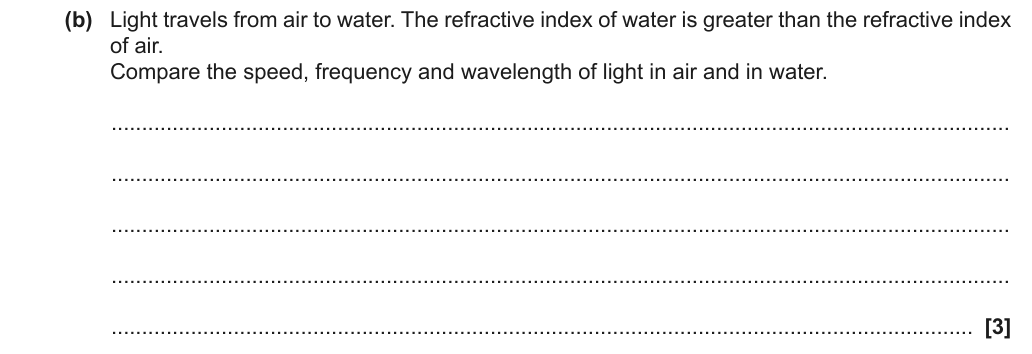
June 2018 · AS Paper 1 · Q26(b)3 marksExplanationEasy
Mark scheme
Examiner's comment
Most candidates gained two or more marks. Many candidates were aware that the speed of light was less in water than in air. A significant number of candidates also knew that the frequency of light remains constant and successfully argued the fate of the wavelength using the wave equation v = fλ. This exemplar illustrates a flawless answer from a top-end candidate. It had all the main ingredients for scoring 3 marks. The answers matched well with the marking points – the examiner had no issues with following the text.
Notes from the mark scheme and report
Not v or c for speed
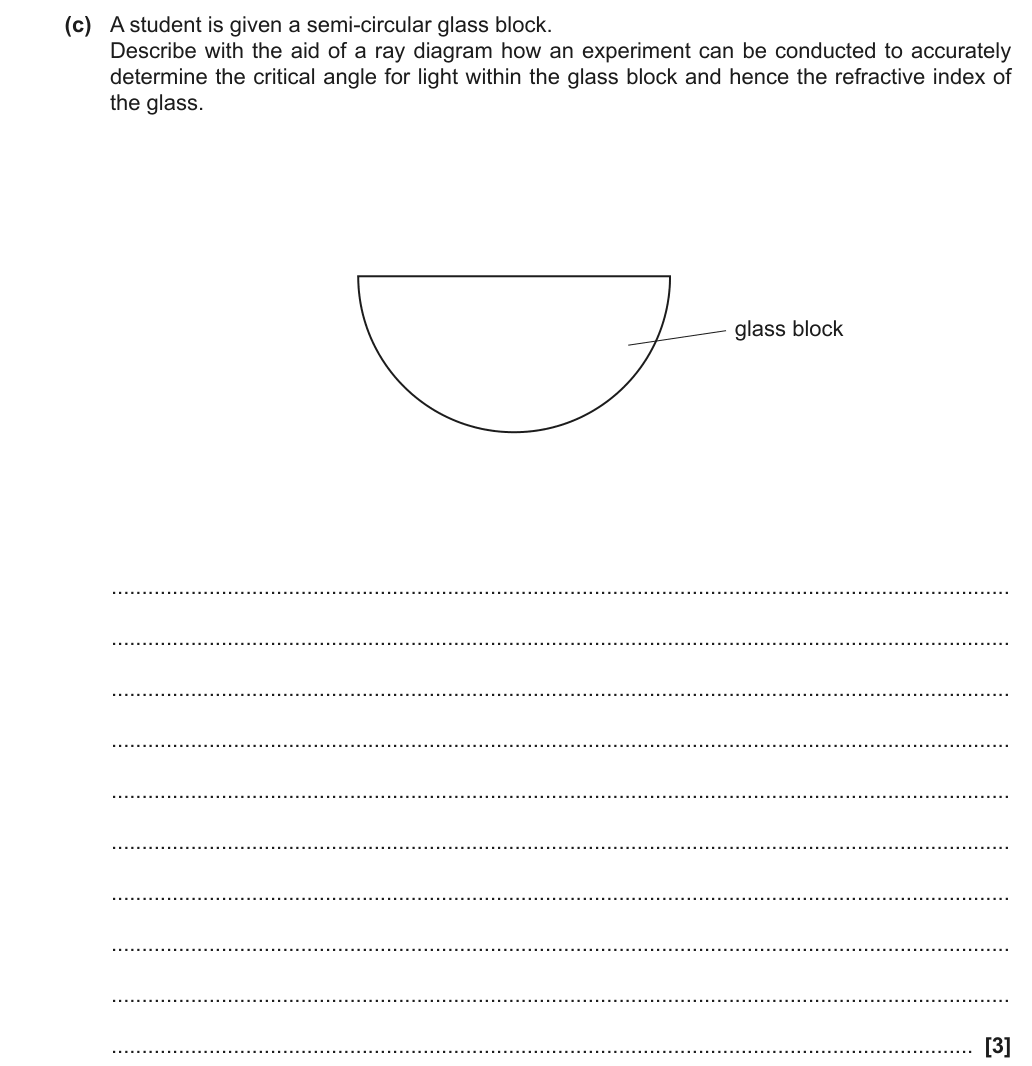
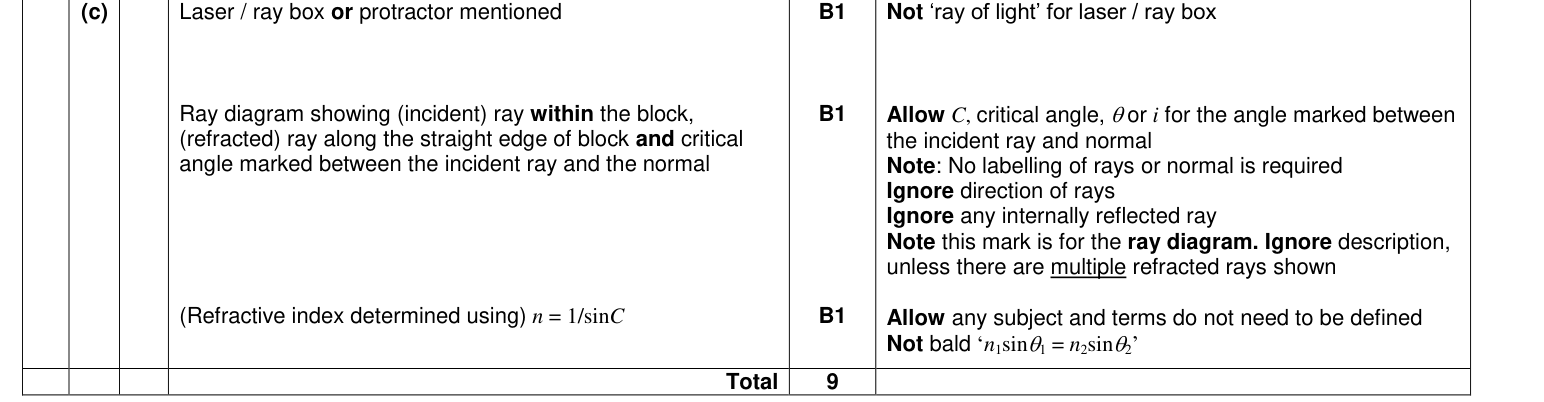
June 2018 · AS Paper 1 · Q26(c)3 marksExplanationMedium
Mark scheme
Examiner's comment
The range of marks was poor in this practical question on refraction and critical angle. Most candidates did score a mark for selecting the correct expression for critical angle and refractive index from the Data, Formulae and Relationships booklet. The ray diagram lacked clarity and often showed incorrect critical angle in the air, rather than within the block. There were many missed opportunities here. No credit could be given for generic PAG-type description involving a rectangular block and plotting sini against sinr graph.
Notes from the mark scheme and report
Not ray of light for laser / ray box
Not bald n1 sin θ1 = n2 sin θ2
Skills: PAG6 Investigating quantum effects
June 2018 · AS Paper 1 · Q27(a)1 markShort answer
Mark scheme
Notes from the mark scheme and report
Not wrong physics e.g. X-rays have longer wavelength
ignore uses
June 2018 · Paper 2 · Q31 markMultiple choiceMedium
Answer
C
Mark scheme
Examiner's comment
Question 3 Question 4 Question 6 There was an erratum issues for this question.
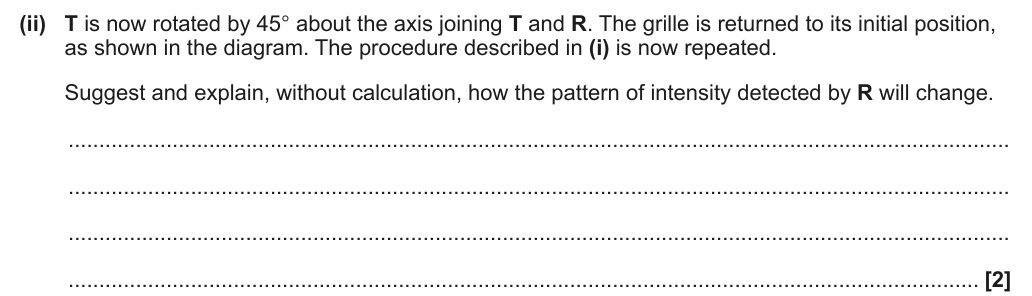
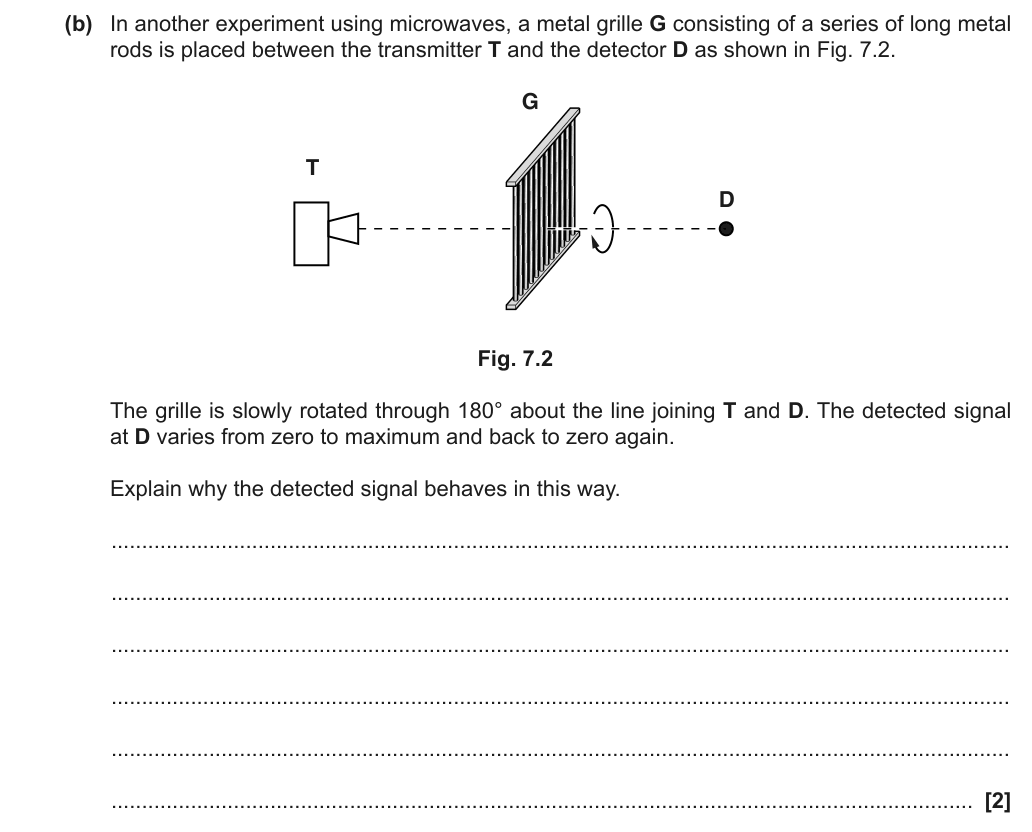
June 2018 · AS Paper 2 · Q7(b)2 marksExplanationHard
Mark scheme
Examiner's comment
Candidates found this question difficult. Candidates often did not state that the microwaves were polarised or mistakenly thought that the grille caused the microwaves to become polarised. Candidates also did not appear to read the question carefully often thinking that the detected signal varied from a maximum initially. Some candidates quoted 𝐼𝐼= 𝐼𝐼0cos2𝜃𝜃 to help explain their answer.
Notes from the mark scheme and report
Allow explanation in terms of I = I0 cos²θ
Skills: PAG5 Investigating waves
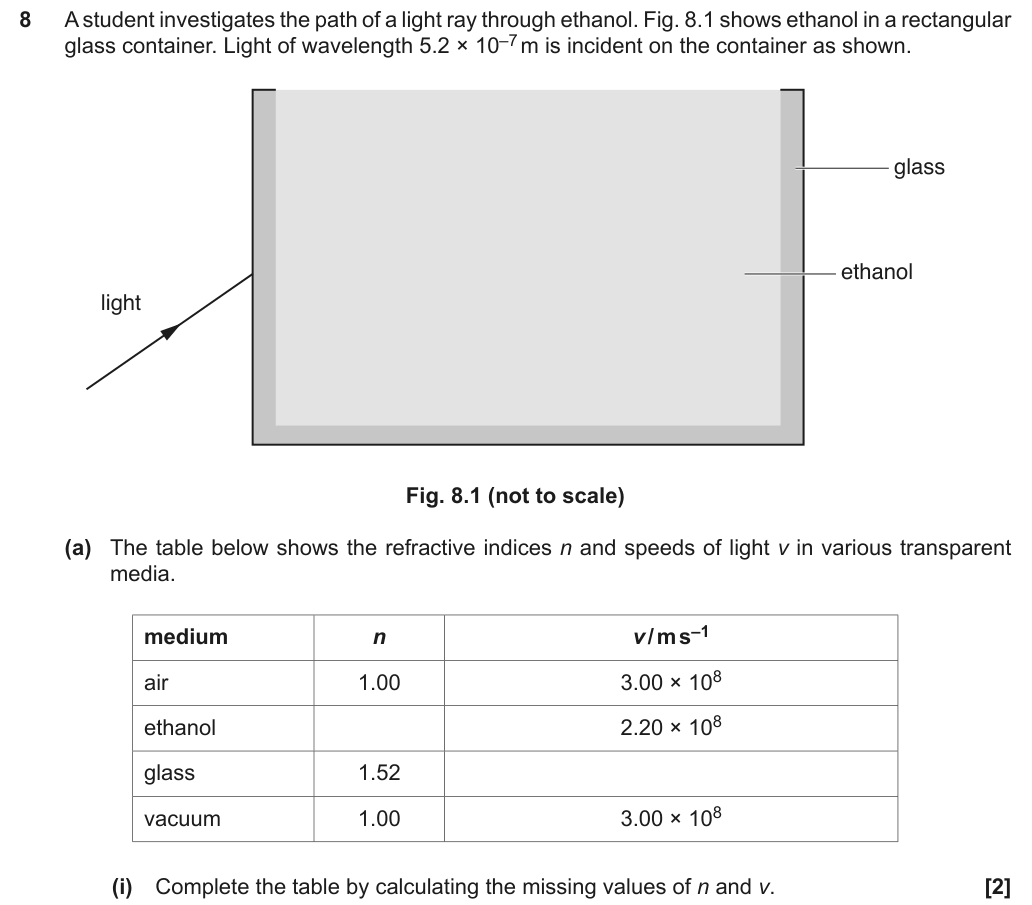
June 2018 · AS Paper 2 · Q8(a)(i)2 marksShort answerEasy
Mark scheme
Examiner's comment
This question was generally well answered. Some lower ability candidates were careless in the calculation of the speed of light in glass and gave their answers as either 1.9 or 2.0 as opposed to 1.97. There were also some candidates who gave an answer of 4.56 x 10⁸ m s-1 – this is where candidates should check the pattern in the table.
Notes from the mark scheme and report
NOT 1.3 or 1.4
NOT 1.9 or 2.0 (x 10^8)
Skills: M1.1 Use an appropriate number of significant figures; M2.2 Change the subject of an equation, including non-linear equations; M2.3 Substitute numerical values into algebraic equations using appropriate units for physical quantities
June 2018 · AS Paper 2 · Q8(a)(ii)1 markCalculationMedium
Earlier part of question 8 that this part uses
Mark scheme
Examiner's comment
Surprisingly, this question did not score highly – many candidates did not realise that the wavelength of light in the glass would be the wavelength of light in air divided by the refractive index of glass.
Notes from the mark scheme and report
NOT ecf from (a)(i)
Allow 3.41 x 10^-7
Skills: M0.3 Use ratios, fractions and percentages
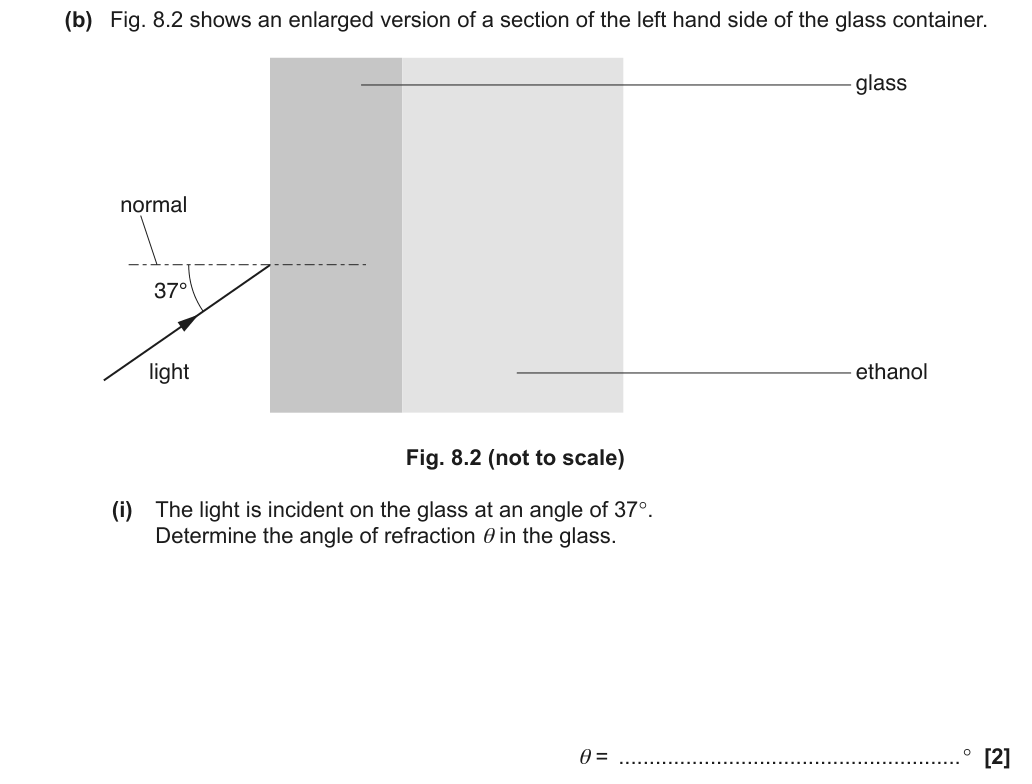
June 2018 · AS Paper 2 · Q8(b)(i)2 marksCalculationMedium
Earlier part of question 8 that this part uses
Mark scheme
Examiner's comment
Many candidates correctly applied Snell’s law. Common mistakes were either using the wrong refractive index or inverting the answer.
June 2018 · AS Paper 2 · Q8(b)(ii)1 markDiagram or graphMedium
Earlier parts of question 8 that this part uses
Mark scheme
Examiner's comment
This question required candidates to apply the previous answers to this question to draw an appropriate ray diagram. Candidates do need to use a ruler. A common error was for the emergent ray in the ethanol to be parallel to the incident ray in the air. This question required candidates to think through their diagram stage by stage using information from the previous part and the table given earlier in the question. This candidate has used a ruler and drawn straight rays. The candidate has marked on the normal and indicated the angle of refraction in the glass. It is clear that the ray in the ethanol is not parallel to the original ray.
Notes from the mark scheme and report
ray in ethanol bends away from normal but at less than 37°, not parallel to incoming ray
NOT angle of refraction zero in glass
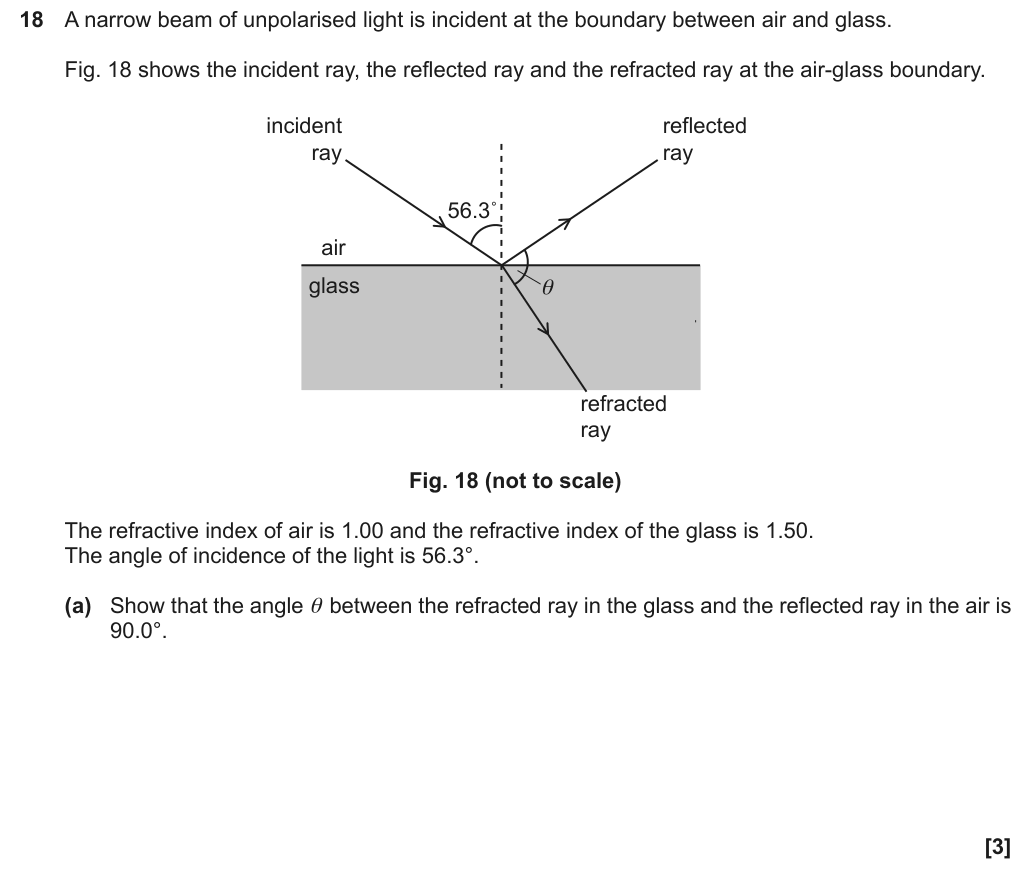
June 2018 · Paper 2 · Q18(a)3 marksShow thatEasy
Mark scheme
Examiner's comment
Generally, candidates answered this question well with most making a good start with the equation nsinθ = constant. Most candidates correctly calculated the angle of refraction to be 33.7°; only a small proportion lost marks because of rounding errors. The final mark was reserved for steps clearly showing that the angle θ marked on the figure was equal to 90.0°. A pleasing number of candidates annotated the figure with angles and labels in order to ensure this last mark was picked up. A very small number of candidates attempted to either use sinC = 1/n or omitted nsinθ = constant altogether.
Notes from the mark scheme and report
r = 33.7° (allow 34°) and reasoning to 90.0° must be shown
Skills: M0.6 Use calculators to handle sin x, cos x and tan x when x is expressed in degrees or radians; M2.2 Change the subject of an equation, including non-linear equations; M4.4 Use Pythagoras’ theorem, and the angle sum of a triangle
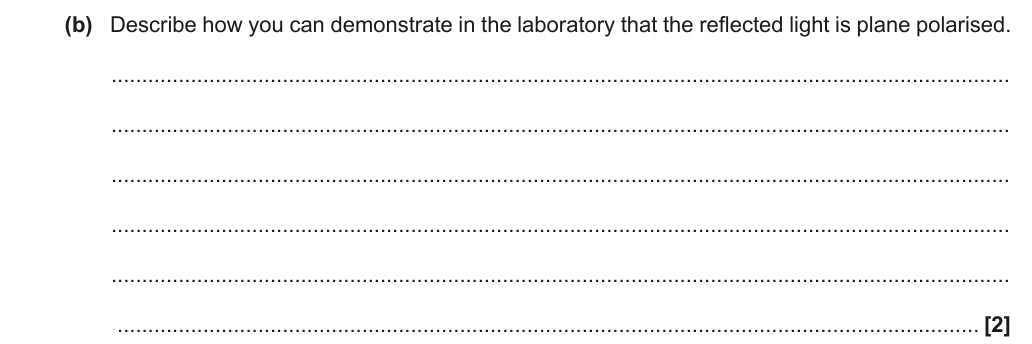
June 2018 · Paper 2 · Q18(b)2 marksExplanationEasy
Earlier part of question 18 that this part uses
Mark scheme
Examiner's comment
Most candidates scored well deserved 2 marks here for opting to use a polarising filter and rotating it to see variation in the intensity of the transmitted light. A small number of candidates chose the wrong equipment – the most common of these were diffraction grating, a single slit and microwave receiver.
Notes from the mark scheme and report
polarising filter rotated
intensity / brightness changes
Skills: PAG5 Investigating waves
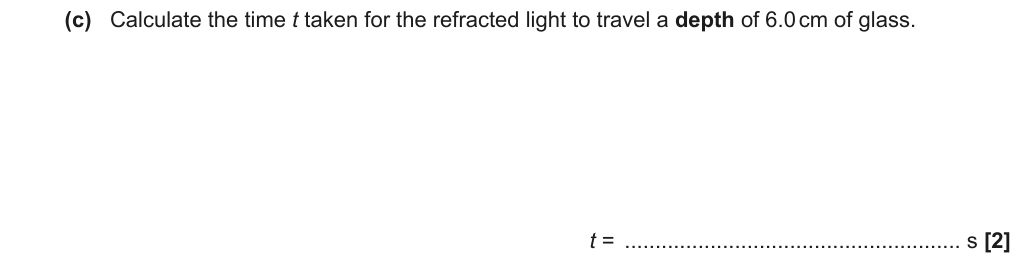
June 2018 · Paper 2 · Q18(c)2 marksCalculation
Earlier part of question 18 that this part uses
Mark scheme
Notes from the mark scheme and report
path length in glass is 6.0 / cos 33.7° = 7.2 cm, not 6.0 cm
v = c / n
Skills: M0.1 Recognise and make use of appropriate units in calculations; M2.3 Substitute numerical values into algebraic equations using appropriate units for physical quantities; M4.5 Use sin, cos and tan in physical problems
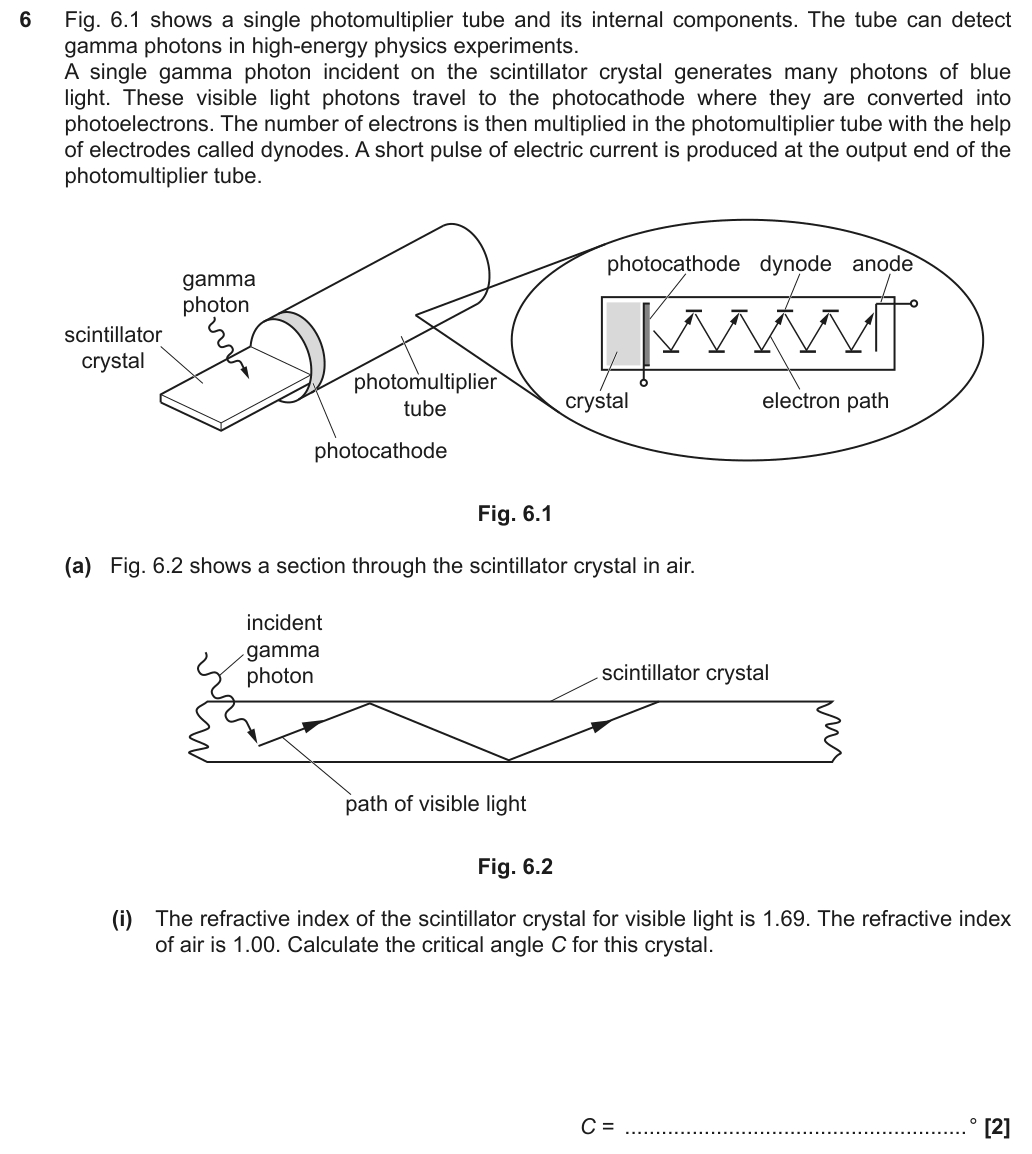
June 2018 · Paper 3 · Q6(a)(i)2 marksCalculationEasy
Mark scheme
Examiner's comment
Exemplar 9 Question 6 (a) (i) Question 6 (a) (ii) Almost all of the candidates managed to calculate the critical angle correctly.
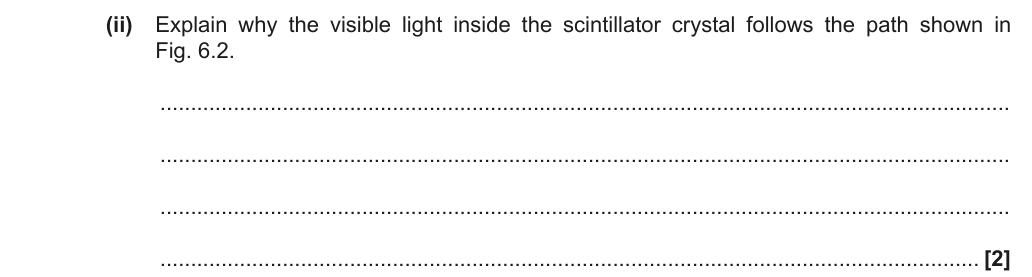
June 2018 · Paper 3 · Q6(a)(ii)2 marksExplanationEasy
Earlier part of question 6 that this part uses
Mark scheme
Examiner's comment
Almost all of the candidates managed to calculate the critical angle correctly. The explanation in part (ii) was not so successful. The majority gained the mark for total internal reflection but most omitted the crucial words of incidence to qualify which angle must be greater than the critical angle. The example here (exemplar 10) shows the perfect succinct answer.
Notes from the mark scheme and report
angle of incidence greater than the critical angle
June 2017 · AS Paper 1 · Q11 markMultiple choice
Answer
C
Mark scheme
June 2017 · AS Paper 1 · Q21 markMultiple choice
Answer
C
Mark scheme
June 2017 · Paper 2 · Q151 markMultiple choice
Answer
B
Mark scheme
June 2016 · AS Paper 1 · Q31 markMultiple choice
Answer
C
Mark scheme
June 2016 · AS Paper 1 · Q51 markMultiple choice
Answer
B
Mark scheme
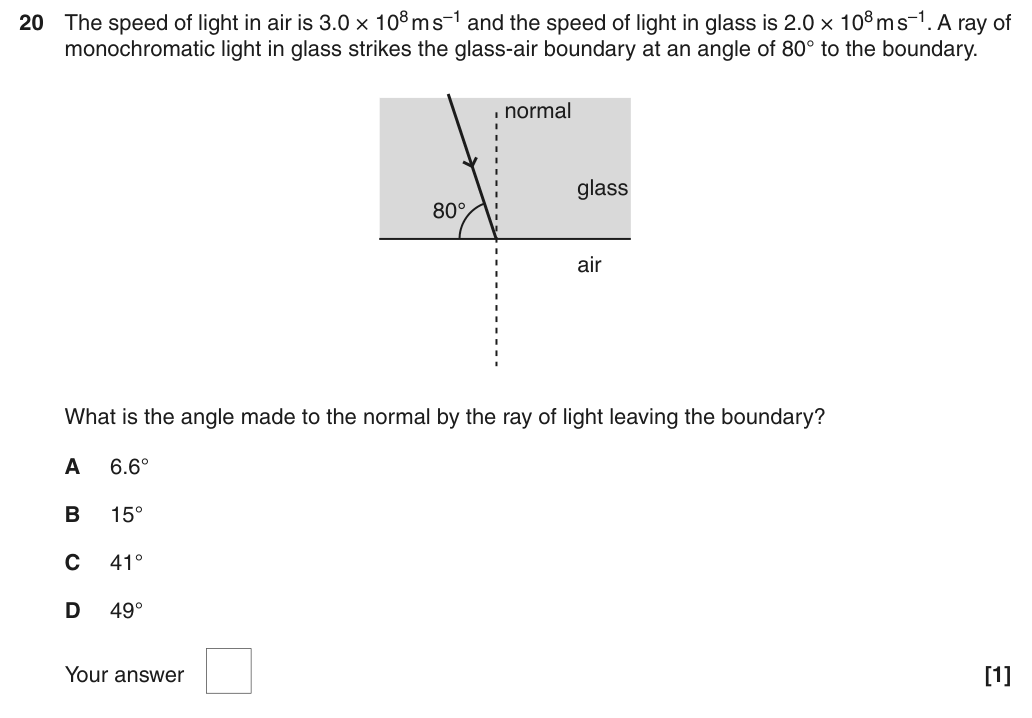
June 2016 · AS Paper 1 · Q201 markMultiple choice
Answer
B
Mark scheme
Notes from the mark scheme and report
angle of incidence is 10° (80° is to the boundary)
Skills: M0.6 Use calculators to handle sin x, cos x and tan x when x is expressed in degrees or radians; M2.3 Substitute numerical values into algebraic equations using appropriate units for physical quantities
Work with an OCR physics tutor
Dropping marks on calculations, practical questions or the six-mark level of response questions? Book a trial session with a specialist OCR physics tutor.