Show the 13 learning outcomes from the specification
5.4.1(a) gravitational fields are due to objects having mass
5.4.1(b) modelling the mass of a spherical object as a point mass at its centre
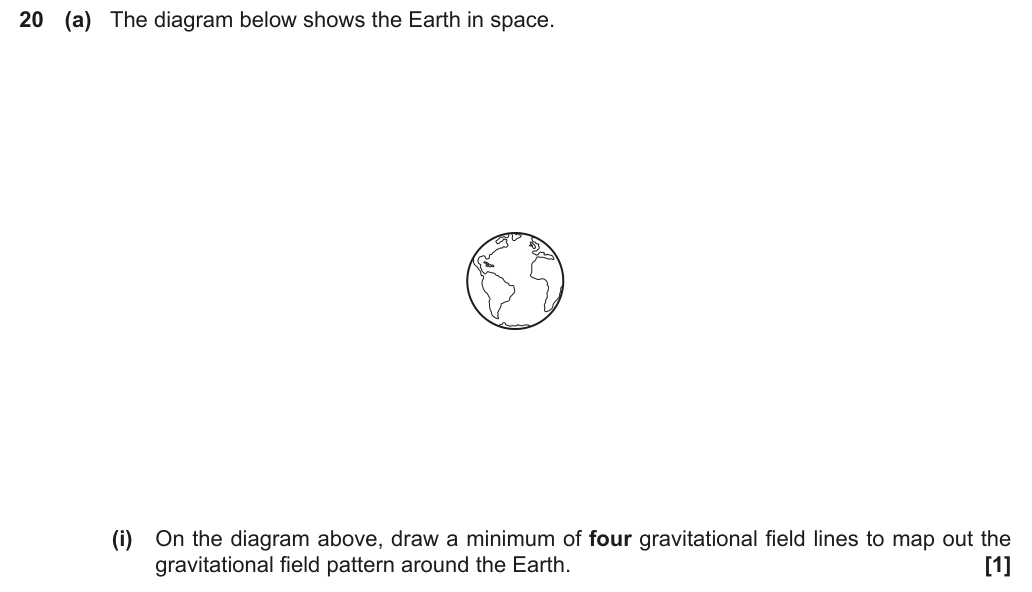
5.4.1(c) gravitational field lines to map gravitational fields
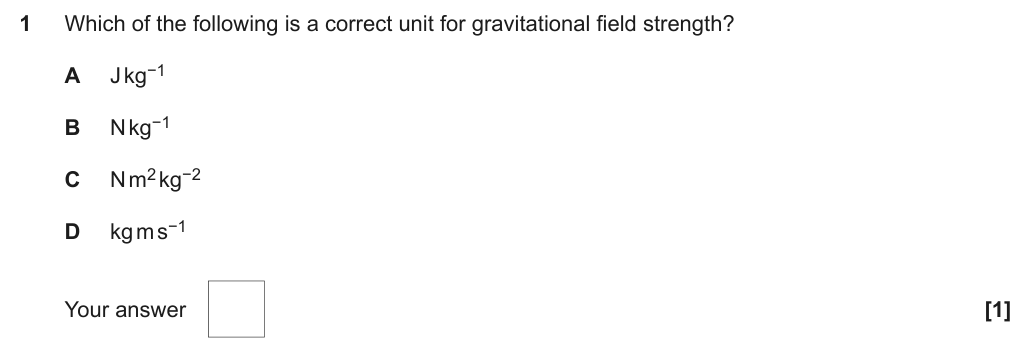
5.4.1(d) gravitational field strength; g = F/m.
5.4.1(e) the concept of gravitational fields as being one of a number of forms of field giving rise to a force.
5.4.2(a) Newton’s law of gravitation; F = –GMm/r² for the force between two point masses
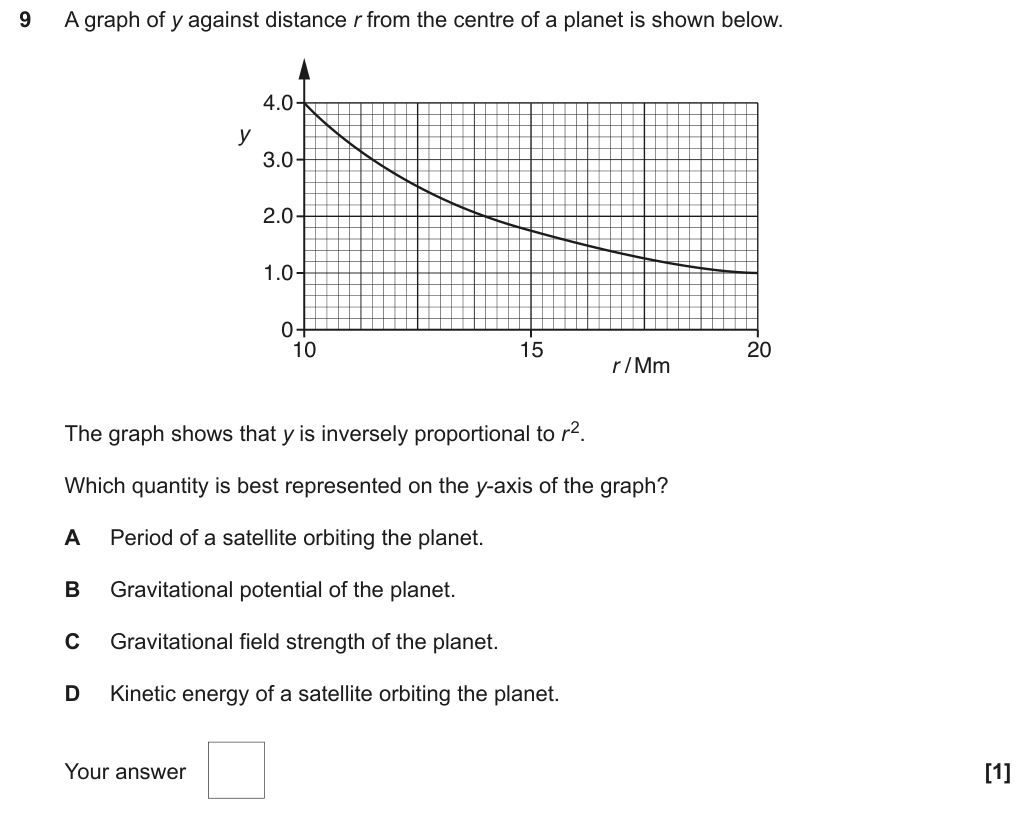
5.4.2(b) gravitational field strength g = –GM/r² for a point mass
5.4.2(c) gravitational field strength is uniform close to the surface of the Earth and numerically equal to the acceleration of free fall.
5.4.4(a) gravitational potential at a point as the work done in bringing unit mass from infinity to the point; gravitational potential is zero at infinity
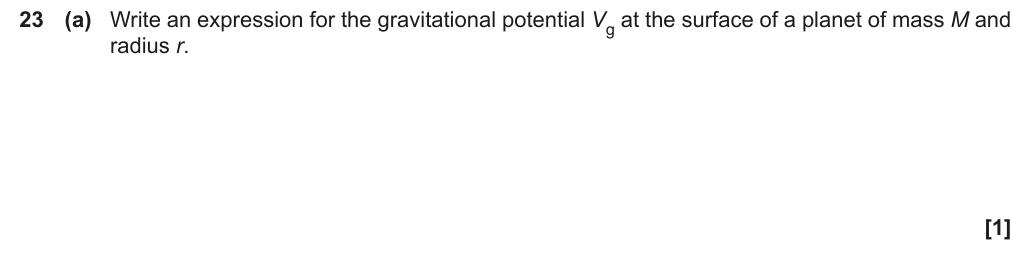
5.4.4(b) gravitational potential Vg = –GM/r at a distance r from a point mass M; changes in gravitational potential
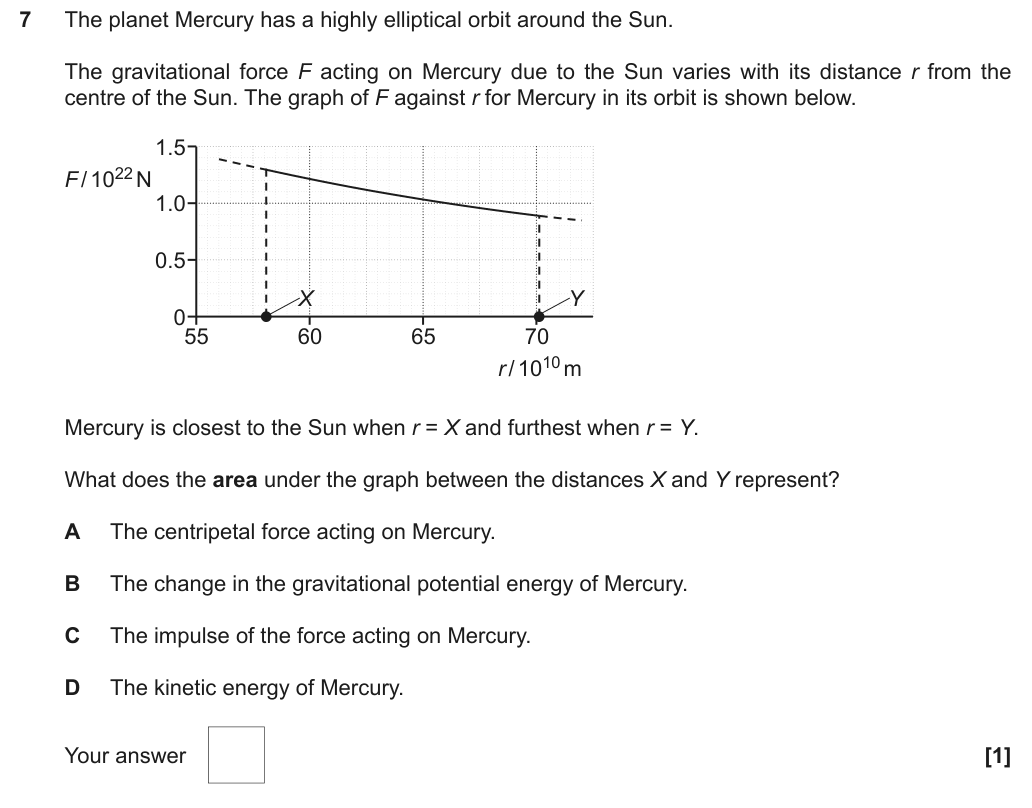
5.4.4(c) force–distance graph for a point or spherical mass; work done is area under graph
5.4.4(d) gravitational potential energy E = mVg = –GMm/r at a distance r from a point mass M
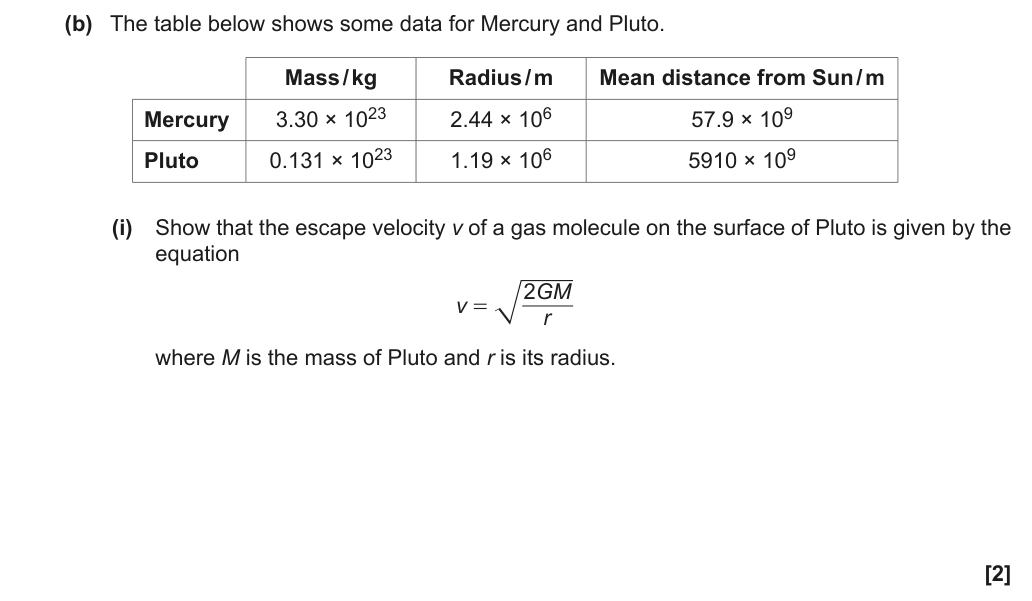
5.4.4(e) escape velocity.
Six-mark level of response questions on this topic
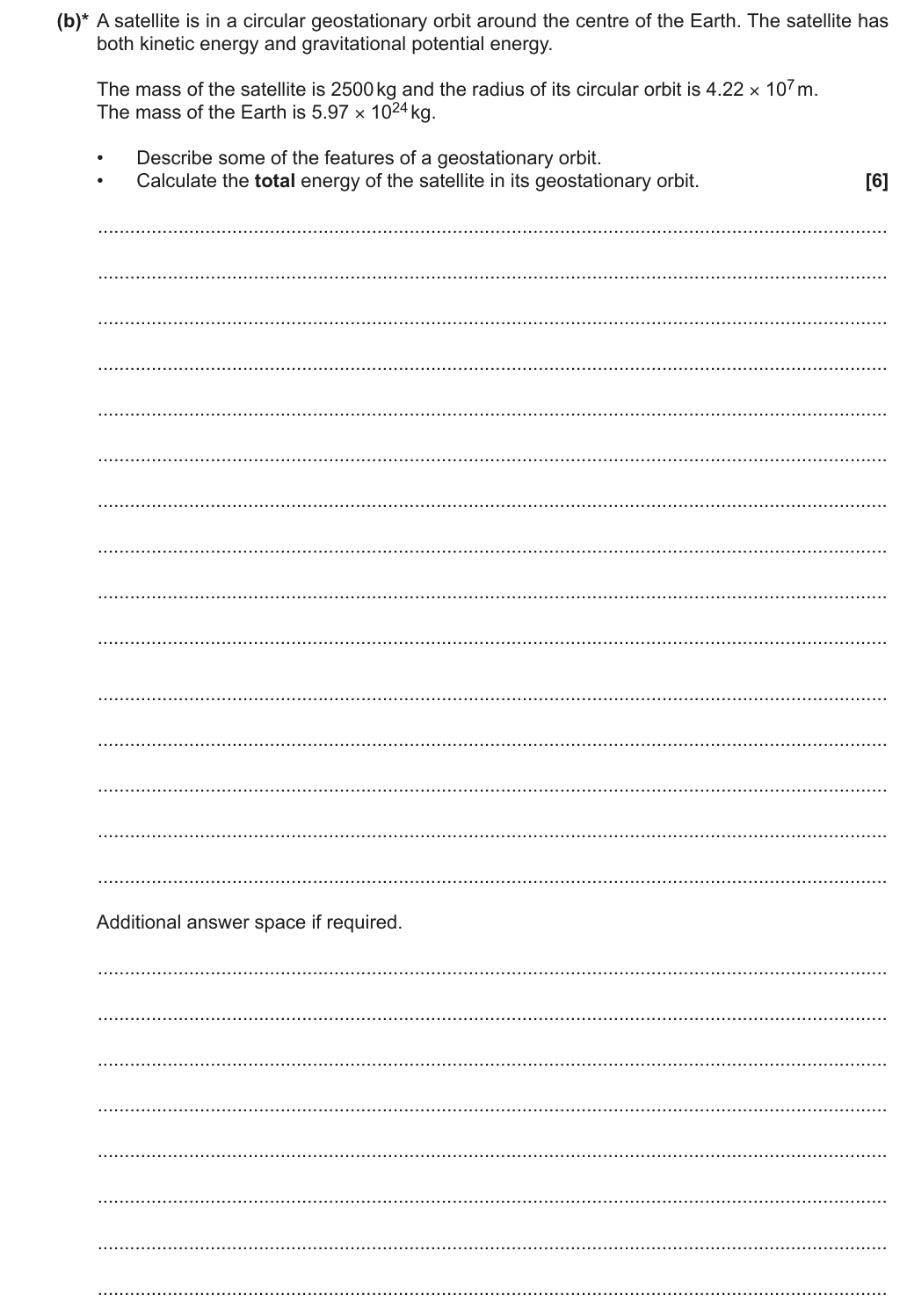
A satellite is in a circular geostationary orbit around the centre of the Earth. The satellite has • Describe some of the features of a geostationary orbit.
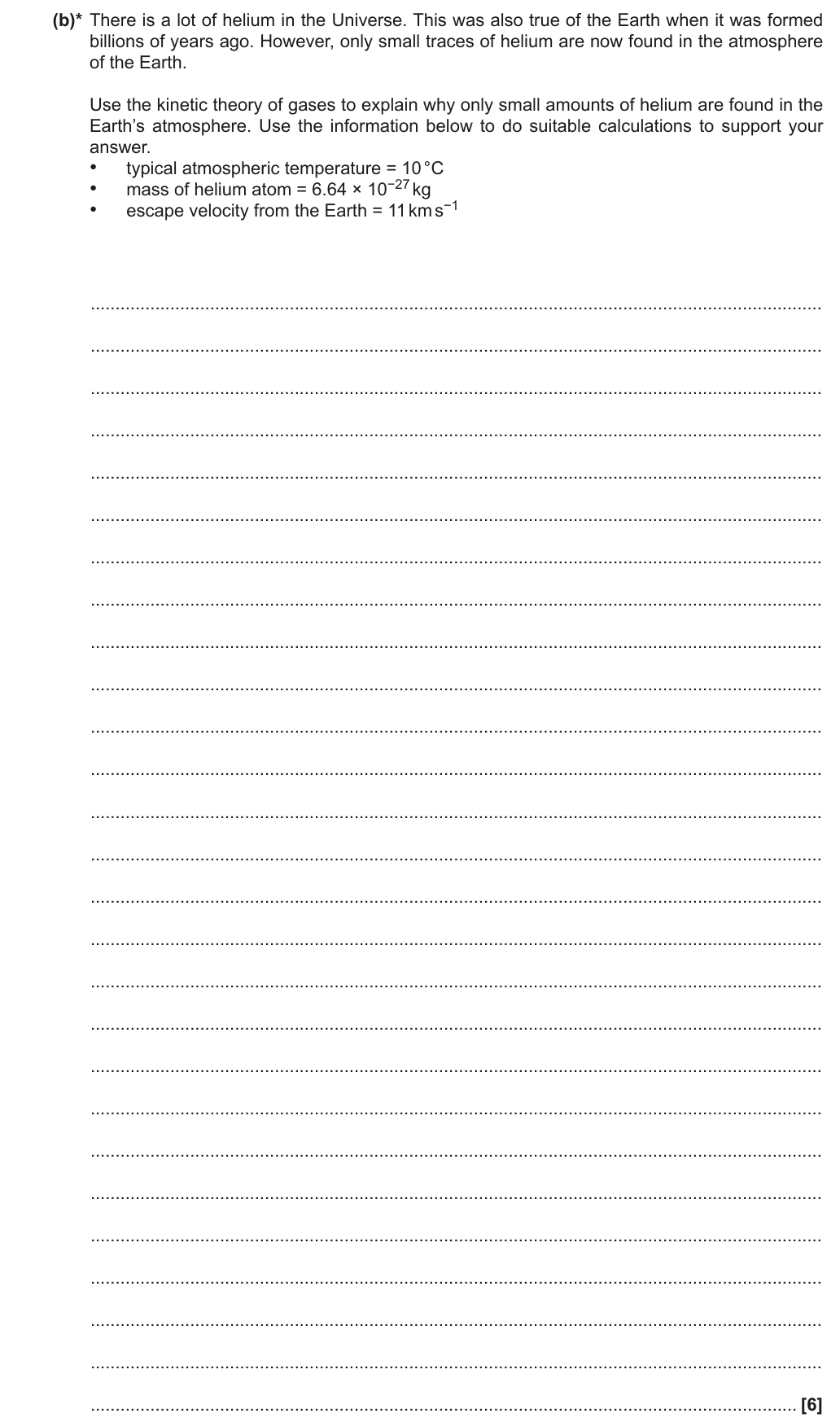
There is a lot of helium in the Universe. This was also true of the Earth when it was formed Use the kinetic theory of gases to explain why only small amounts of helium are found in the
Tap a question to zoom it. Where a part needs a figure, table or graph from earlier in the question, that part folds out above it; the mark scheme and examiner's comment open underneath. Have the OCR Data, Formulae and Relationships Booklet beside you (see the data booklet page).
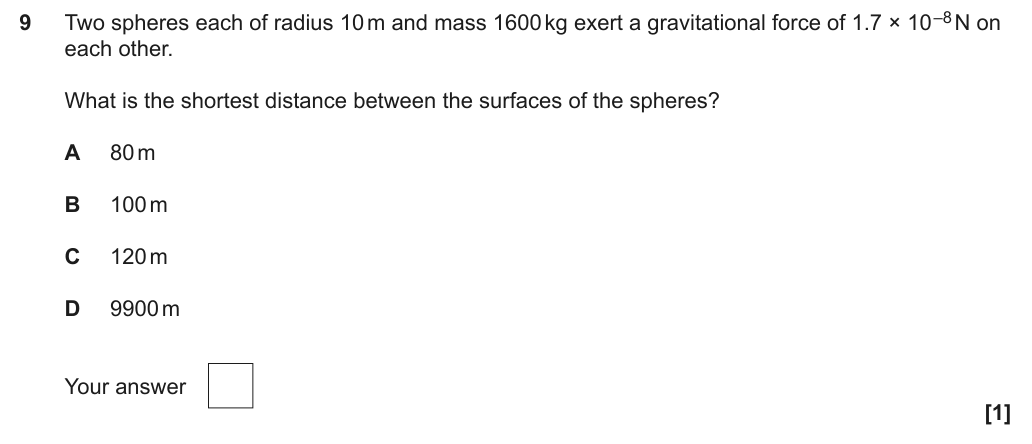
June 2025 · Paper 1 · Q91 markMultiple choiceMedium
Answer
A
Mark scheme
Examiner's comment
The key here is to use the formula for gravitational force (𝐹 = 𝑟2 ) to find the distance between the centres of the spheres. This gives 100.2 m. The question asks for the distance between the surfaces of the two spheres, which is 20 m less than the distance between their centres. Hence A is the correct answer.
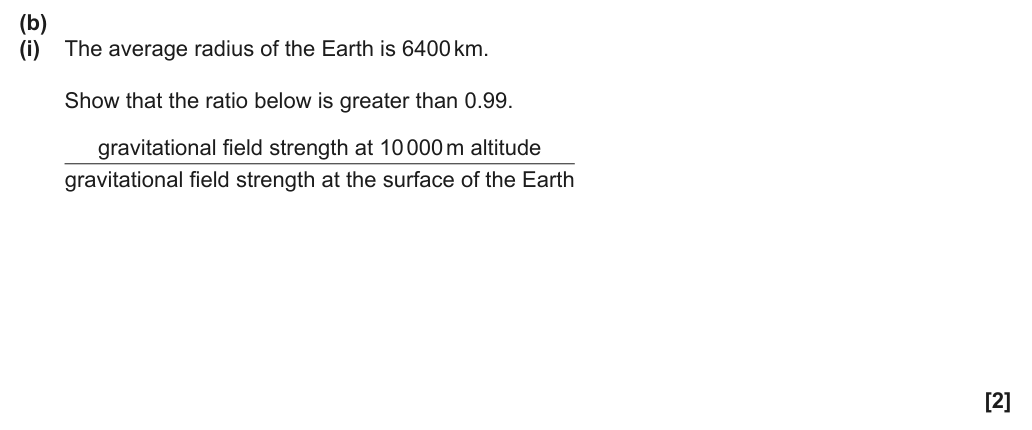
June 2025 · Paper 1 · Q17(b)(i)2 marksShow thatMedium
Mark scheme
Examiner's comment
The mark scheme indicates two alternative approaches to this item, which covered most attempts by candidates. Common errors, however, included missing the ‘squared’ sign off the distance from the centre of the Earth either on paper or on the calculator, or getting the fraction upside-down.
Notes from the mark scheme and report
6400/6410 not squared (0.9984) is wrong physics
Skills: M0.3 Use ratios, fractions and percentages
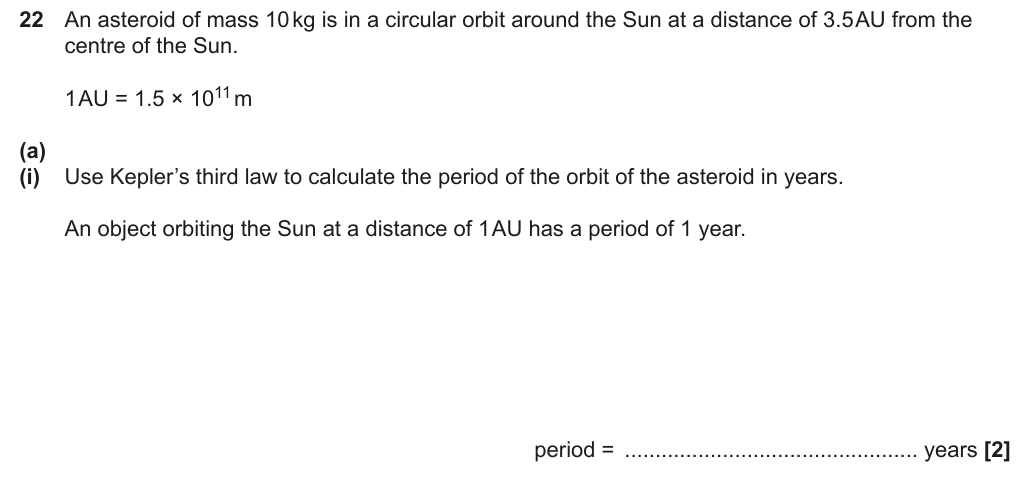
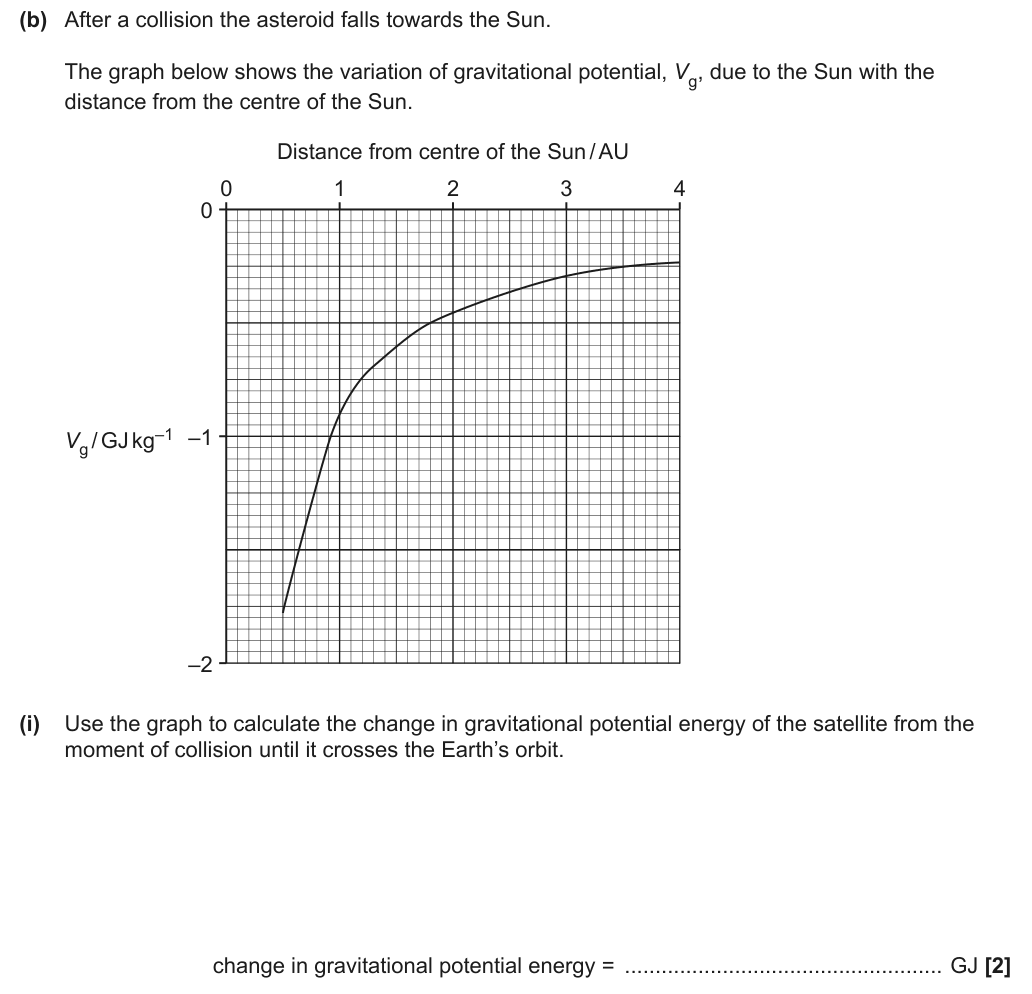
June 2025 · Paper 1 · Q22(b)(i)2 marksCalculationHard
Earlier part of question 22 that this part uses
Mark scheme
Examiner's comment
Candidates found this challenging. The graph gives the gravitational potential. The correct approach is to find the difference in the gravitational potential at 1 AU and at 3.5 AU and then multiply this difference by the mass of the satellite.
Notes from the mark scheme and report
ignore sign
ecf from graph readings
Candidates should learn the difference between gravitational potential, potential energy, force and field strength. They are all similar ideas with only minor differences in their formulae. A similar approach could be taken with the electric field equivalent elsewhere in the specification.
Skills: M0.1 Recognise and make use of appropriate units in calculations; M3.1 Translate information between graphical, numerical and algebraic forms
June 2025 · Paper 3 · Q6(b)(i)1 markCalculationMedium
Mark scheme
Examiner's comment
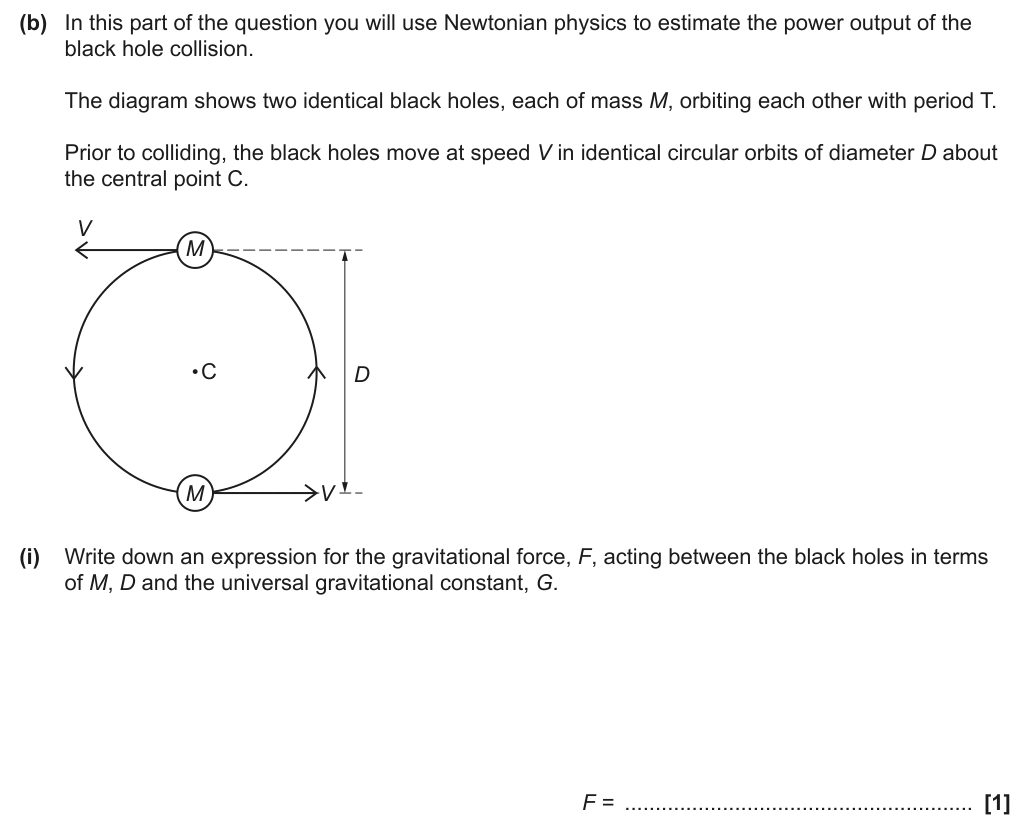
Candidates who realised that the separation D should be used instead of D/2 or r often gained the mark.
Notes from the mark scheme and report
separation is D
negative sign not required
June 2025 · Paper 3 · Q6(b)(ii)3 marksShow thatMedium
Earlier part of question 6 that this part uses
Mark scheme
Examiner's comment
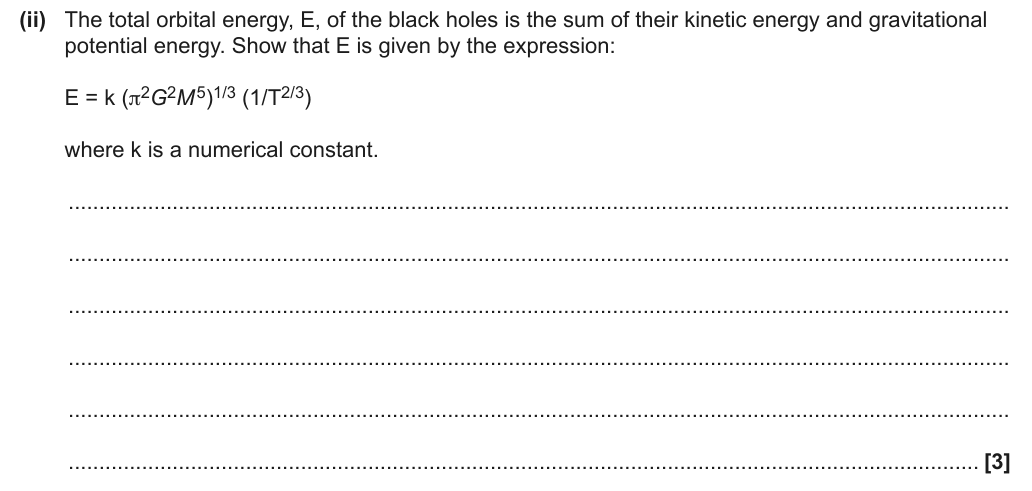
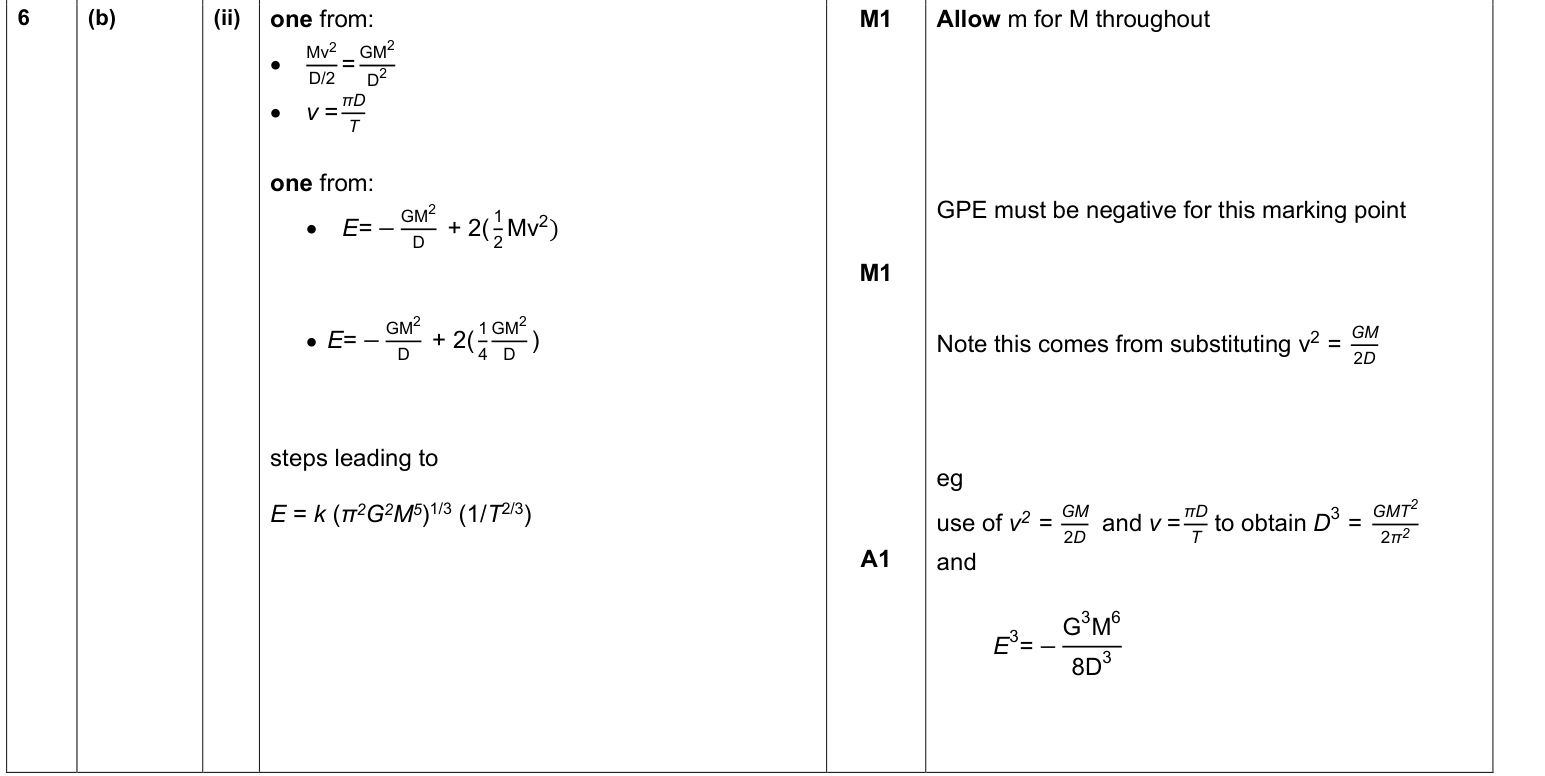
This derivation was designed to challenge the highest scoring candidates although the first two marking points were accessible to students across the mark range. Common issues • omitting the − sign from GPE • using r instead of D in equations • attempting to use Kepler’s laws rather than gravitational potential energy and kinetic energy equations.
Notes from the mark scheme and report
GPE must be negative
radius of each orbit is D/2 and v = πD/T
Skills: M0.5 Use calculators to find and use power, exponential and logarithmic functions; M2.2 Change the subject of an equation, including non-linear equations; M2.4 Solve algebraic equations, including quadratic equations
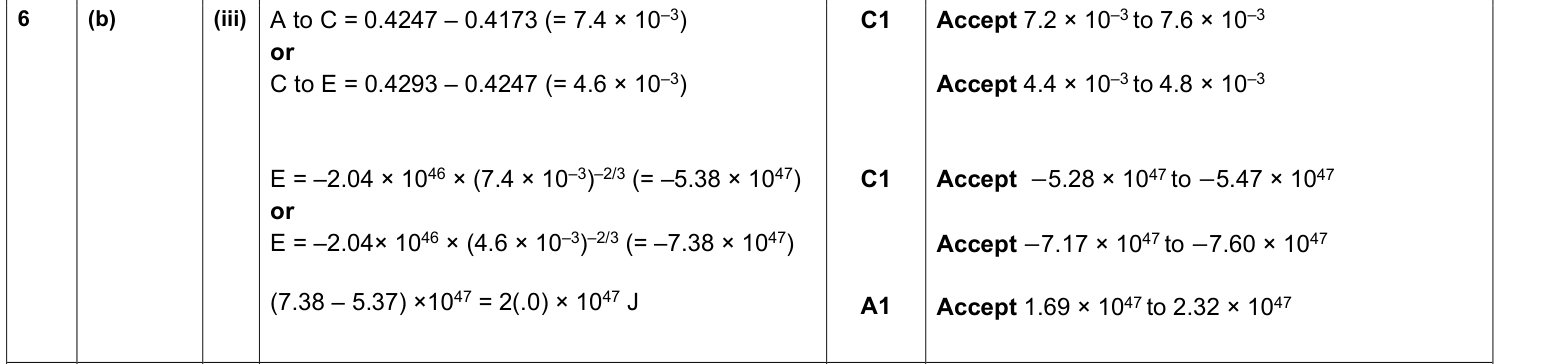
June 2025 · Paper 3 · Q6(b)(iii)3 marksCalculationMedium
Earlier part of question 6 that this part uses
Mark scheme
Examiner's comment
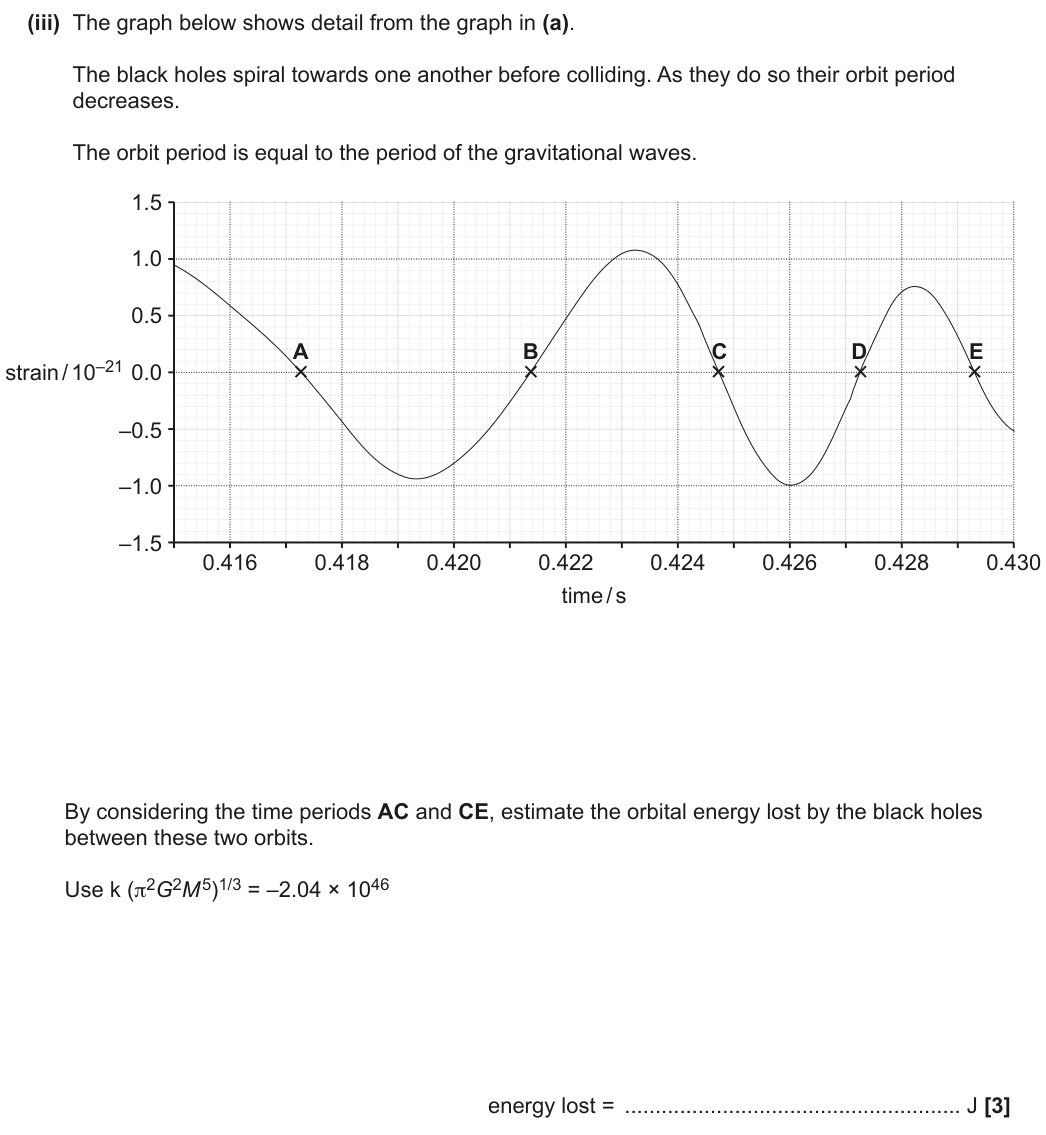
Many candidates were able to gain at least 2 marks on this question. Weaker responses were characterised by inaccurate read offs from the graph, not just values but also selecting incorrect sections, for example AB instead of AC. Some candidates incorrectly substituted the difference between the time periods into the equation for orbital energy rather than calculating two values of orbital energy and then finding the difference. This response shows a well laid out calculation where it is clear what is being evaluated at each step.
Notes from the mark scheme and report
periods 7.2 to 7.6 ms (AC) and 4.4 to 4.8 ms (CE)
answer 1.69 to 2.32 x 10^47 J
Skills: M0.5 Use calculators to find and use power, exponential and logarithmic functions; M2.3 Substitute numerical values into algebraic equations using appropriate units for physical quantities; M3.1 Translate information between graphical, numerical and algebraic forms
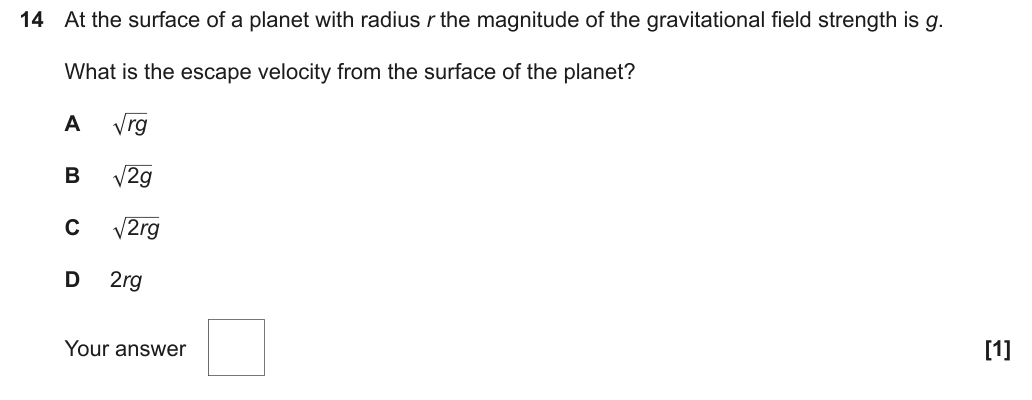
June 2024 · Paper 1 · Q141 markMultiple choiceMedium
Answer
C
Mark scheme
Examiner's comment
By considering the GPE at the planet’s surface of -GMm / r and the KE of ½ m v2, the condition for ‘escape’ is that the total energy is zero at infinity. This gives the condition GMm / r = ½ mv2. The gravitational field strength at the surface of the planet is GMm / r2 i.e. gr, giving gr = ½ mv2. When rearranged this gives answer C.
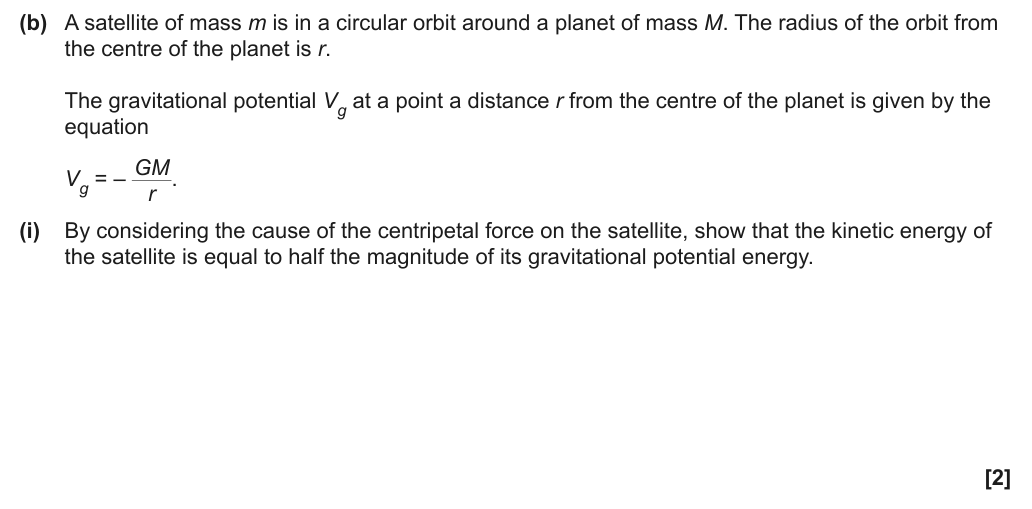
June 2024 · Paper 1 · Q22(b)(i)2 marksShow thatMedium
Mark scheme
Examiner's comment
Many candidates made a good start by equating the formula for gravitational force with the expression for centripetal motion. Others that assumed that g of 9.81 m s-2 did not score any marks. The simplest way to arrive at the correct expression was to identify GM/r in the gravitational force formula, to rearrange and then multiply both sides by ½. Approximately ½ of all candidates that responded got as far as this gaining both marks.
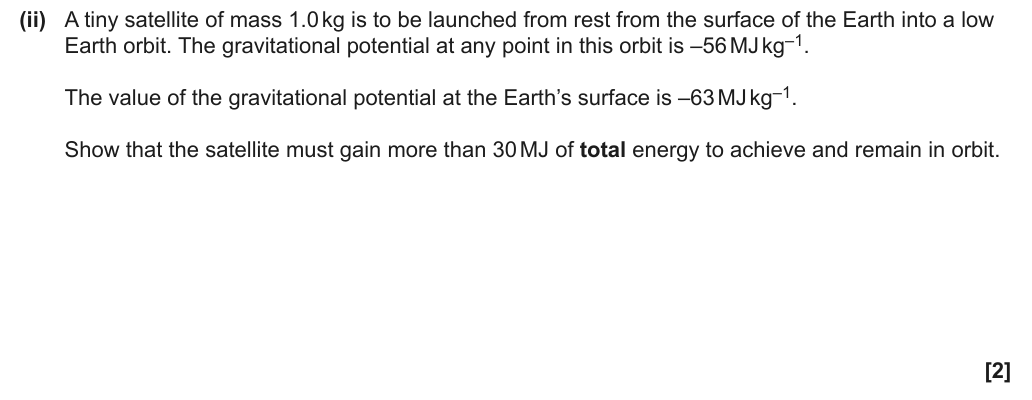
June 2024 · Paper 1 · Q22(b)(ii)2 marksShow thatMedium
Earlier part of question 22 that this part uses
Mark scheme
Examiner's comment
Many candidates correctly determined how much GPE the satellite needed to gain i.e. 7 MJ in order to reach orbit from -63 MJ to -56 MJ. To find the KE when in orbit, candidates needed to use the result from the previous part of the question. This explains why the in orbit, the KE required is ½ of 56 MJ i.e. 28 MJ. A small fraction of candidates successfully accomplished this step. This means the total energy gain is the sum of 28 MJ and 7 MJ i.e. 35 MJ.
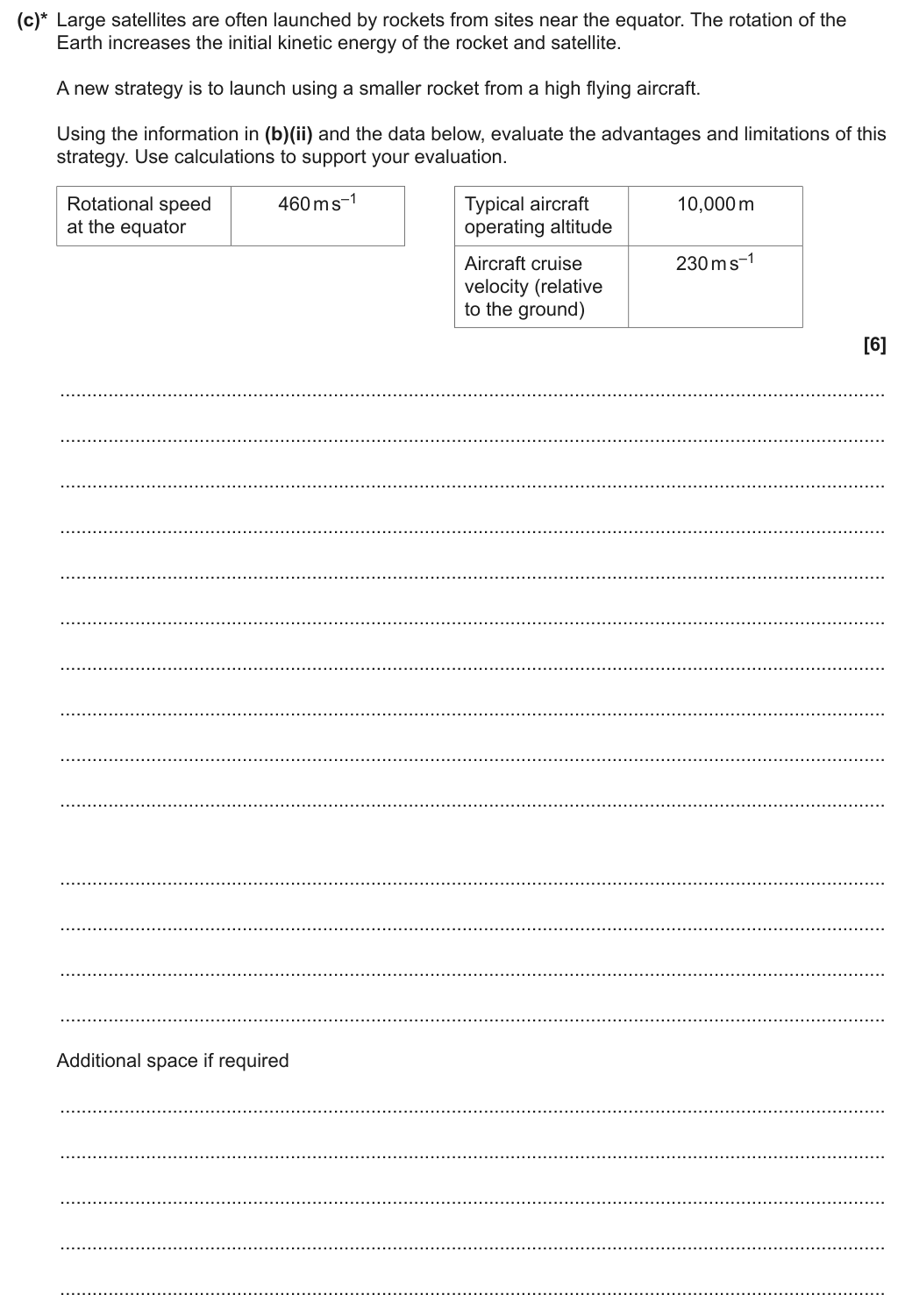
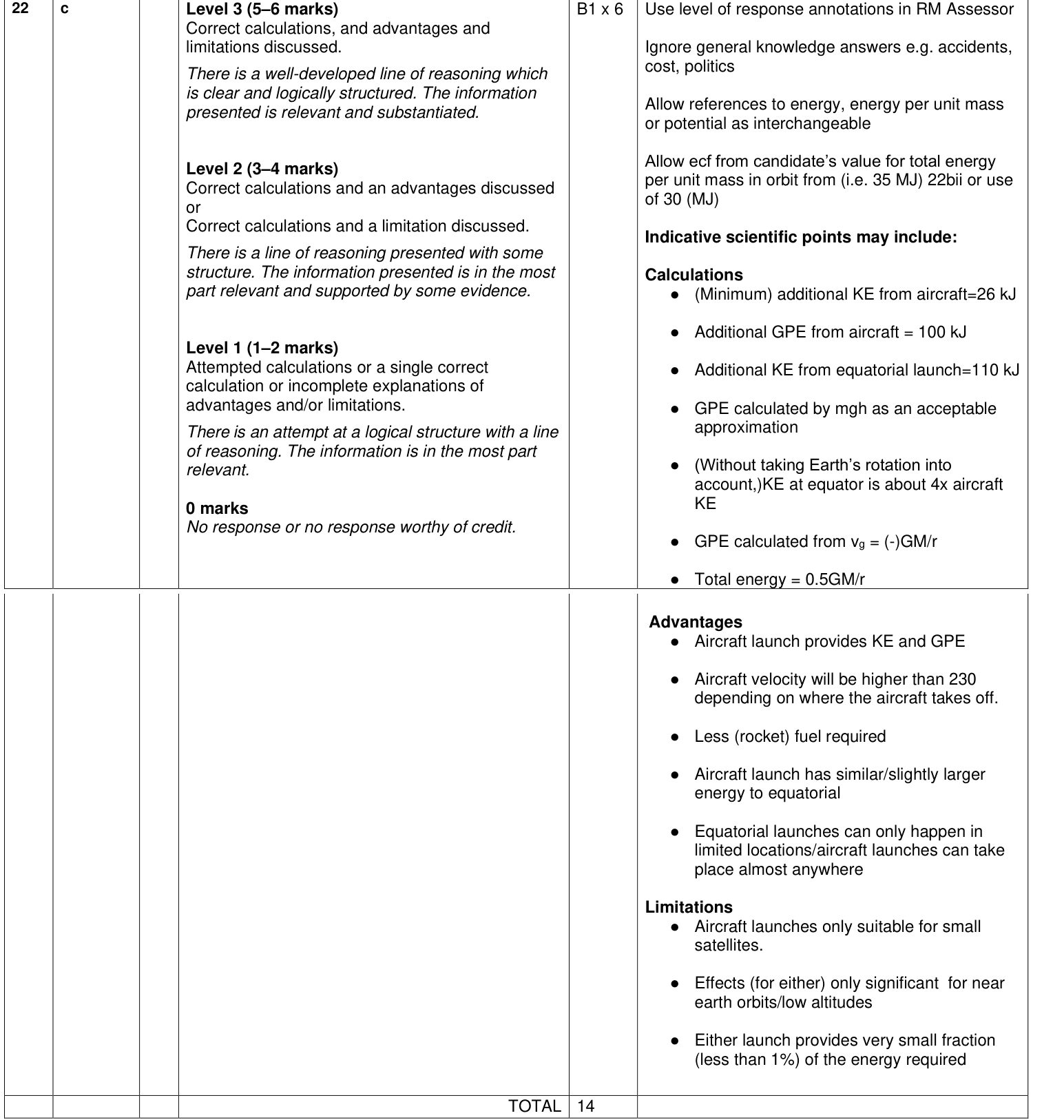
June 2024 · Paper 1 · Q22(c)6 marks6-mark extended responseHard
Earlier parts of question 22 that this part uses
Mark scheme, with the levels and indicative content
Examiner's comment
Many candidates found this difficult to access. A solely qualitative evaluation was limited to level 1 (2 marks). In Exemplar 2, the candidate has completed a small number of calculations comparing the KE the two methods would raise. There is also a statement that these differ by a factor of 4 along with an attempt at calculating the GPE advantage by launching from the aircraft rather than from the ground. Crucially, there is very little mention of limitation and no supporting calculations. Holistically speaking, therefore, there was not enough evidence to award this candidate Level 3, yet sufficient for a Level 2. In Exemplar 3, this candidate makes an excellent attempt at every portion of the question. They have taken great effort to make themselves clear with technical language. They have also performed numerous calculations to compare the GPE and KE in the two different scenarios. A further figure appears right at the bottom of the response. The candidate has correctly calculated the percentage of the overall energy required that is supplied by either method. In conclusion, the candidate has used their many correct calculations to weigh up evidence effectively in terms of the advantages and limitations.
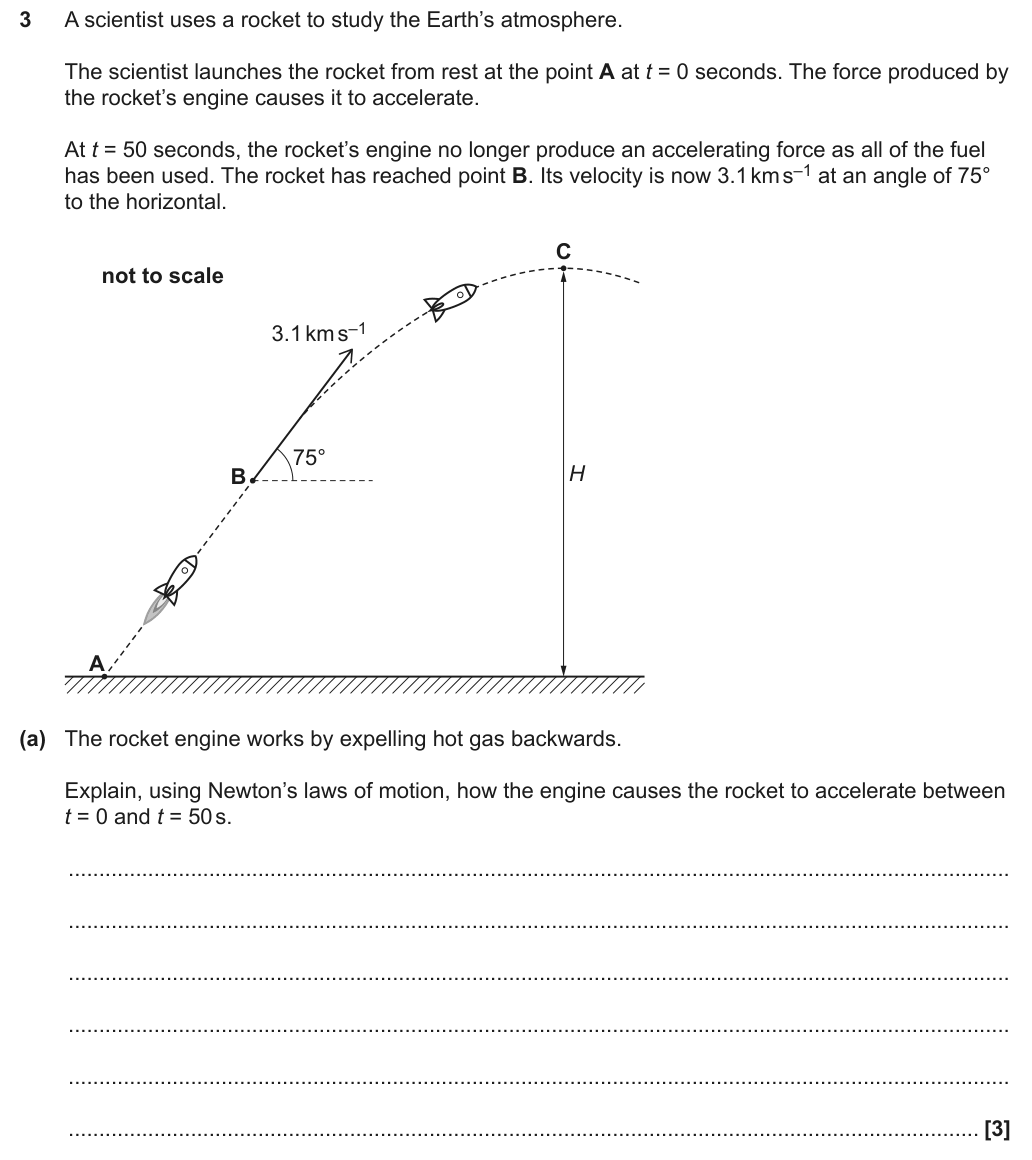
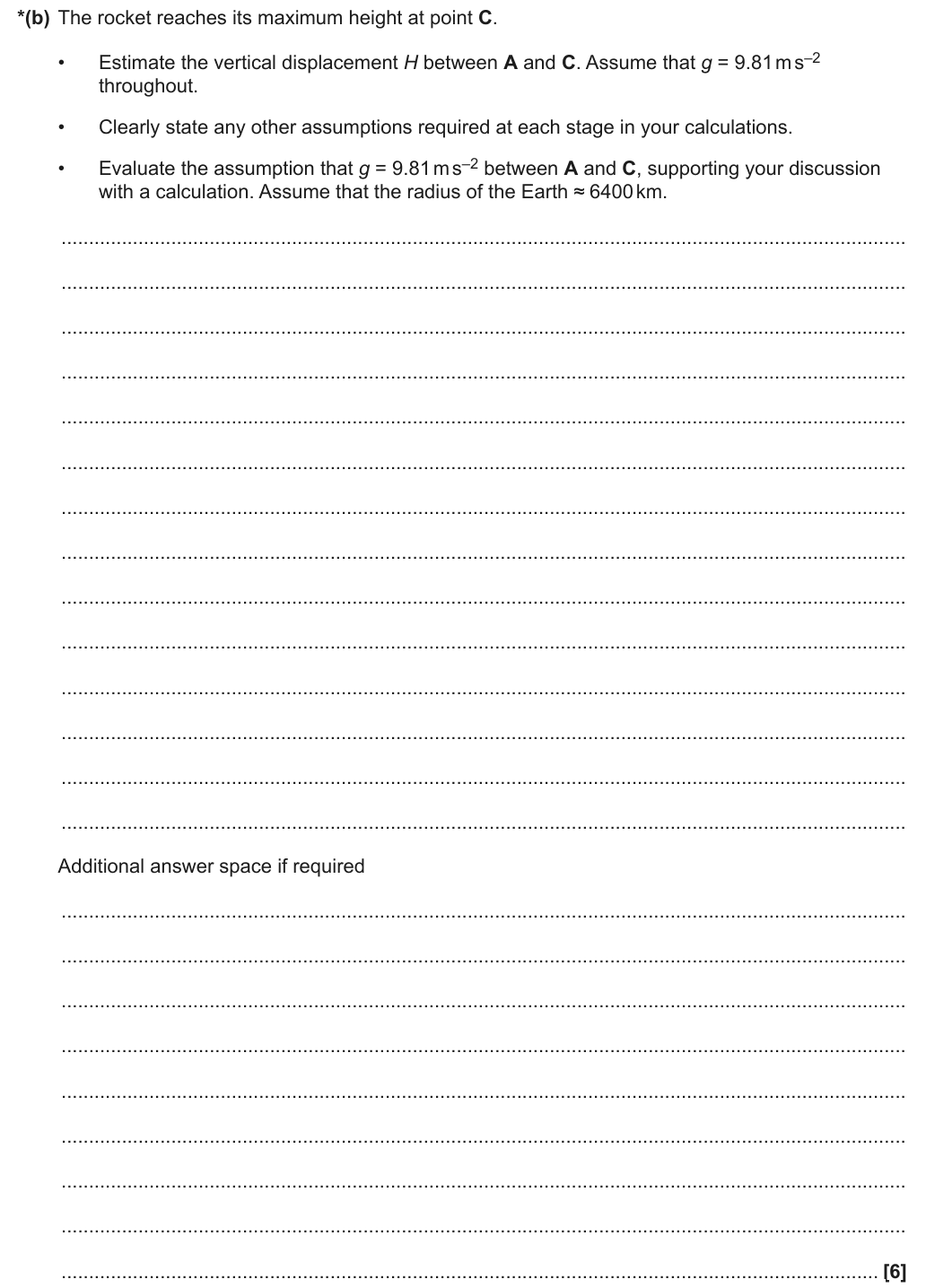
June 2024 · Paper 3 · Q3(b)6 marks6-mark extended responseHard
Earlier part of question 3 that this part uses
Mark scheme, with the levels and indicative content
Examiner's comment
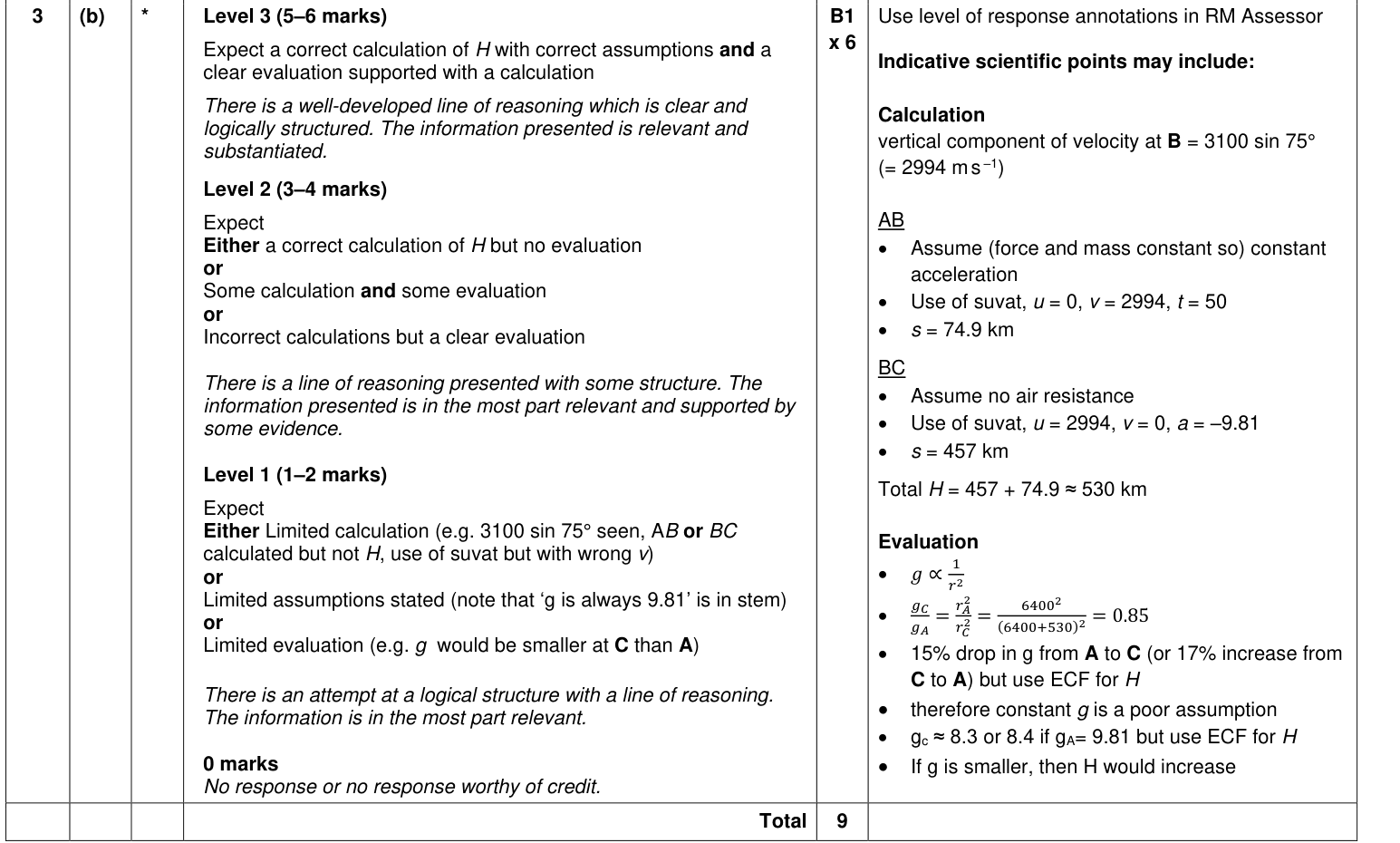
Level 3 candidates set out a correct calculation of H¸ together with the assumptions required at each stage, plus an evaluation of the assumption that g remains constant at 9.81 ms-2 throughout. Level 2 candidates missed out one or more of these three parts, usually the evaluation at the end, which they found quite difficult. Level 1 candidates were often unable to calculate H, or the value of g at height H, correctly Common problems in 3 (b) • omission of sin 75° (or using cos 75°) when calculating velocity • not converting from m to km correctly • not squaring the r term in the calculation for g they have answered each part of the question by using bullet points. Their calculations are clearly set out and so easy to follow, and their handwriting is legible. Instead of just calculating a value for g at height H, they have also given an explicit evaluation: ‘The assumption that g remains constant is not reasonable’. Other candidates went on to say that this means that the rocket would reach an even greater height.
Notes from the mark scheme and report
H ≈ 530 km (75 km + 457 km)
assumptions: constant acceleration A to B, no air resistance B to C
g falls by about 15% so constant g is a poor assumption
OCR has a Guide to Level of Response Questions. This includes guidance on communication and the use of bullet points (page 5).
Skills: M0.3 Use ratios, fractions and percentages; M0.6 Use calculators to handle sin x, cos x and tan x when x is expressed in degrees or radians; M2.3 Substitute numerical values into algebraic equations using appropriate units for physical quantities; M4.5 Use sin, cos and tan in physical problems
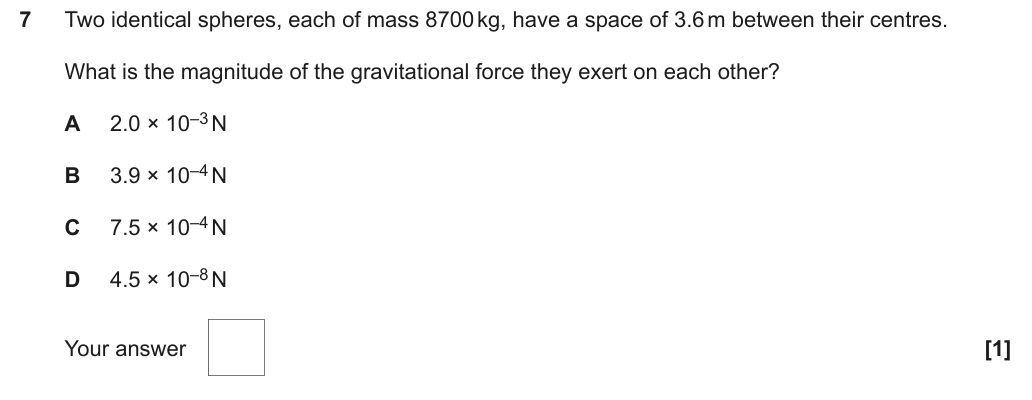
June 2023 · Paper 1 · Q71 markMultiple choice
Answer
B
Mark scheme
June 2023 · Paper 1 · Q23(b)(ii)1 markCalculationMedium
Earlier part of question 23 that this part uses
Mark scheme
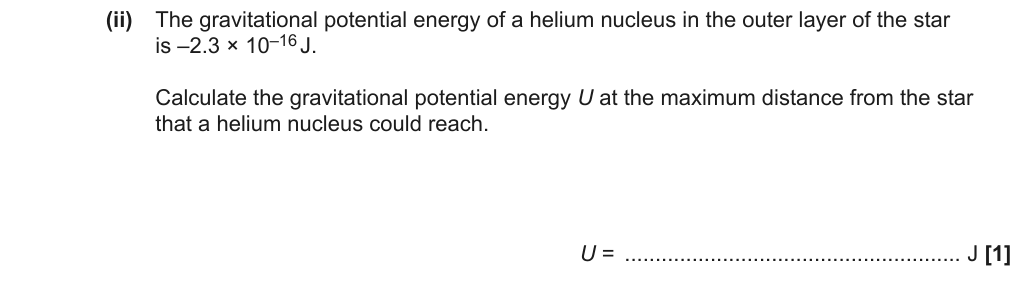
Examiner's comment
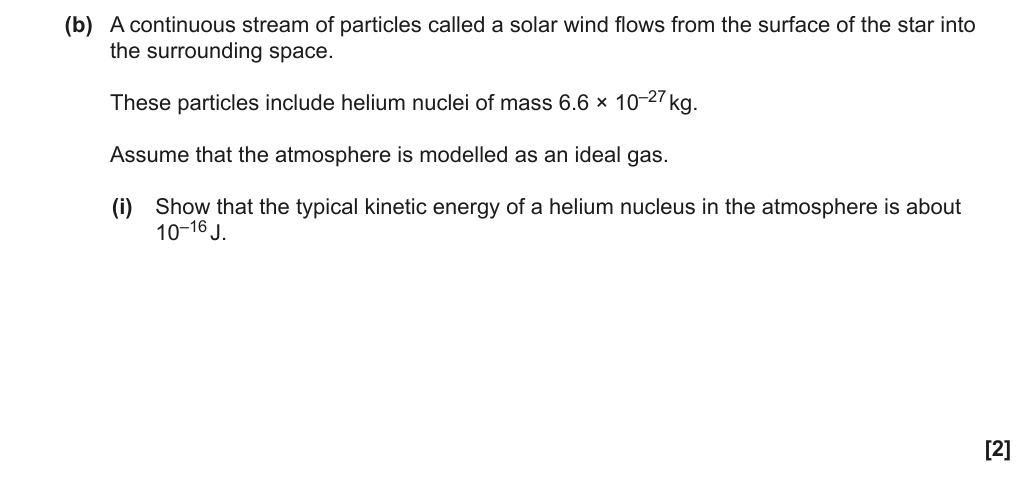
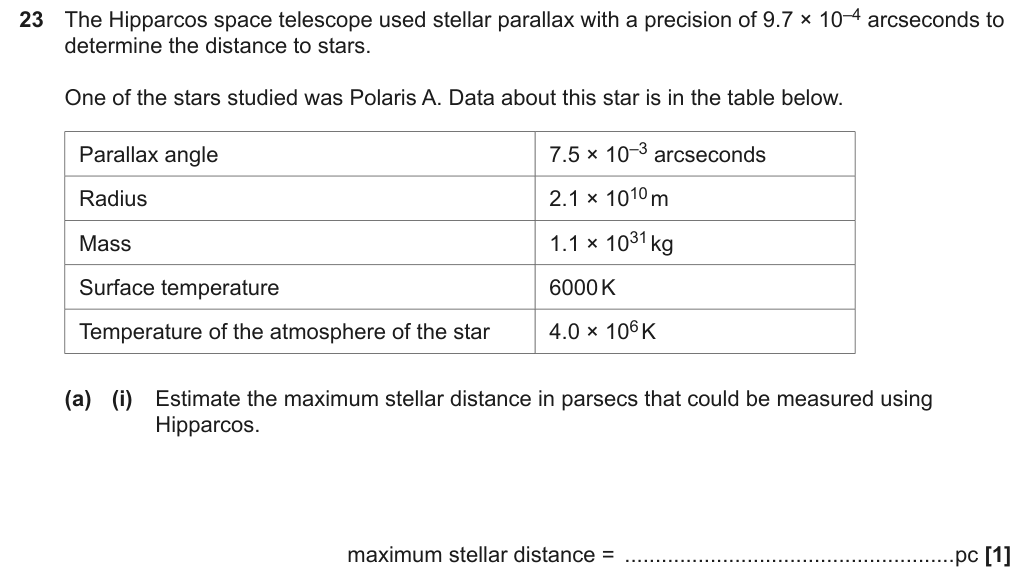
Question 23 (b) (i) Question 23 (b) (ii) Question 23 (b) (iii) Question 23 (b) (iv) Candidates answered Question 23 (b) (i) well, provided that they used the correct temperature i.e. that of the stellar atmosphere and not the surface temperature. Question 23 (b) (iv) has several acceptable responses yet the predominant correct candidate answers were that the solar wind particles might be lighter (i.e. hydrogen) or that the Maxwell-Boltzmann distribution of KE values in a gas of particles would mean that some particles would have greater than average KE.
Notes from the mark scheme and report
reject response without the negative sign
June 2023 · Paper 1 · Q23(b)(iii)3 marksCalculationMedium
Earlier parts of question 23 that this part uses
Mark scheme
Examiner's comment
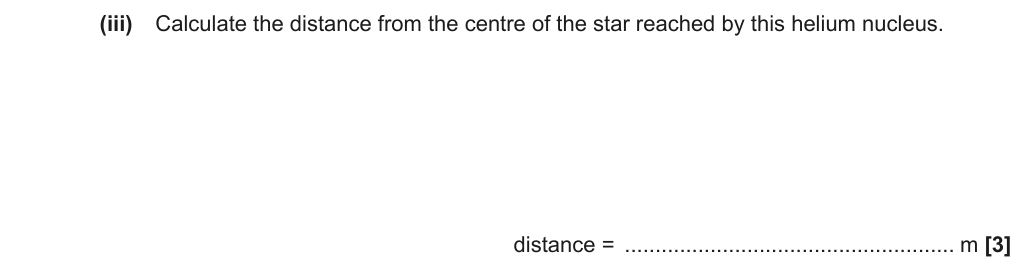
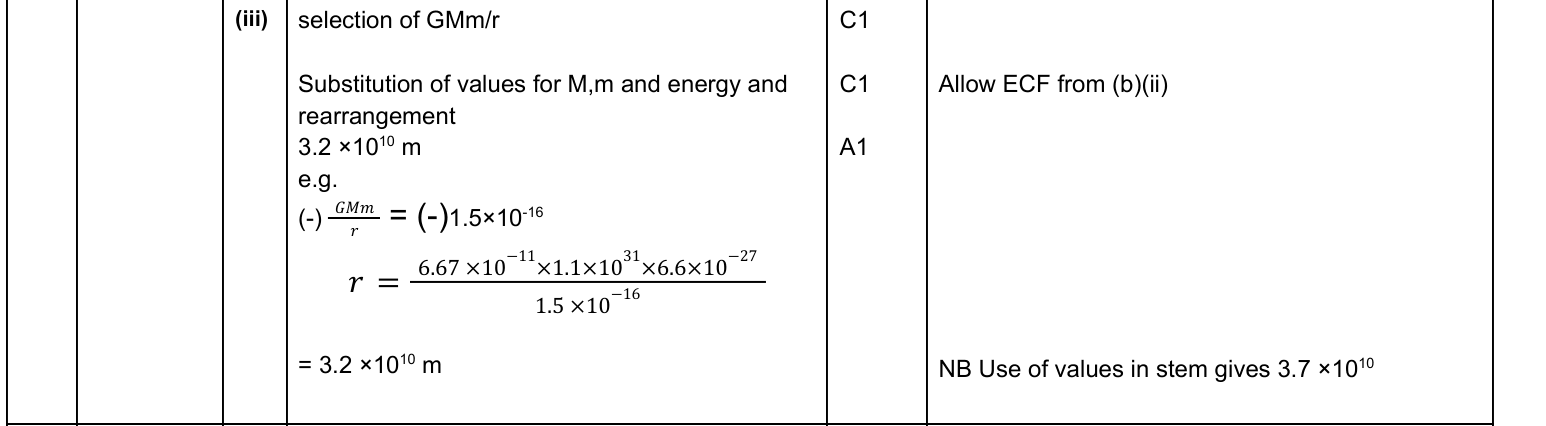
Question 23 (b) (i) Question 23 (b) (ii) Question 23 (b) (iii) Question 23 (b) (iv) Candidates answered Question 23 (b) (i) well, provided that they used the correct temperature i.e. that of the stellar atmosphere and not the surface temperature. Question 23 (b) (iv) has several acceptable responses yet the predominant correct candidate answers were that the solar wind particles might be lighter (i.e. hydrogen) or that the Maxwell-Boltzmann distribution of KE values in a gas of particles would mean that some particles would have greater than average KE.
Notes from the mark scheme and report
ecf from (b)(ii)
stem values give 3.7 x 10¹⁰ m
Skills: M0.2 Recognise and use expressions in decimal and standard form; M2.2 Change the subject of an equation, including non-linear equations; M2.3 Substitute numerical values into algebraic equations using appropriate units for physical quantities
June 2023 · Paper 3 · Q1(a)(i)1 markShort answerMedium
Mark scheme
Examiner's comment
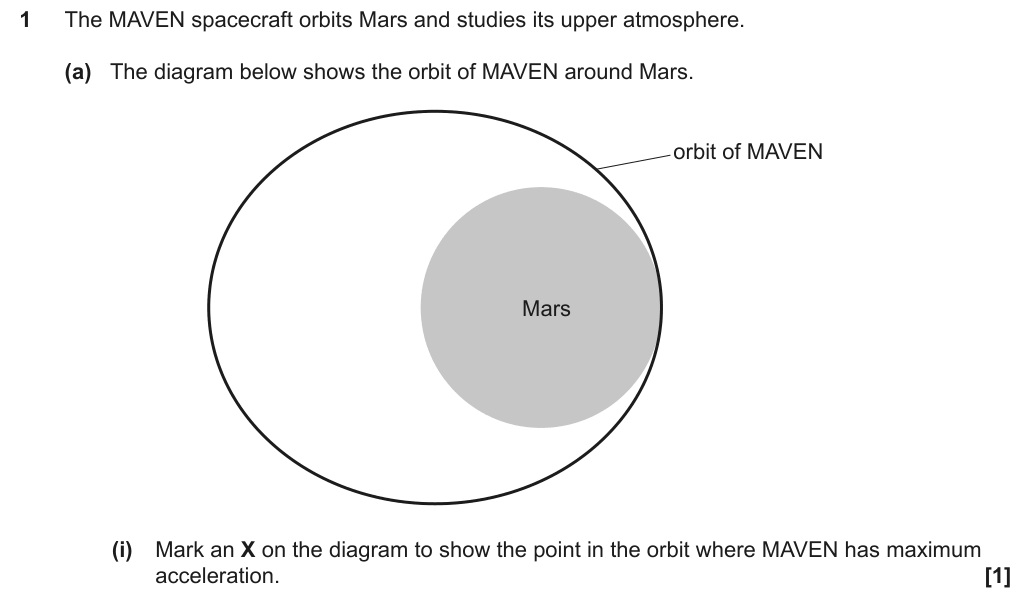
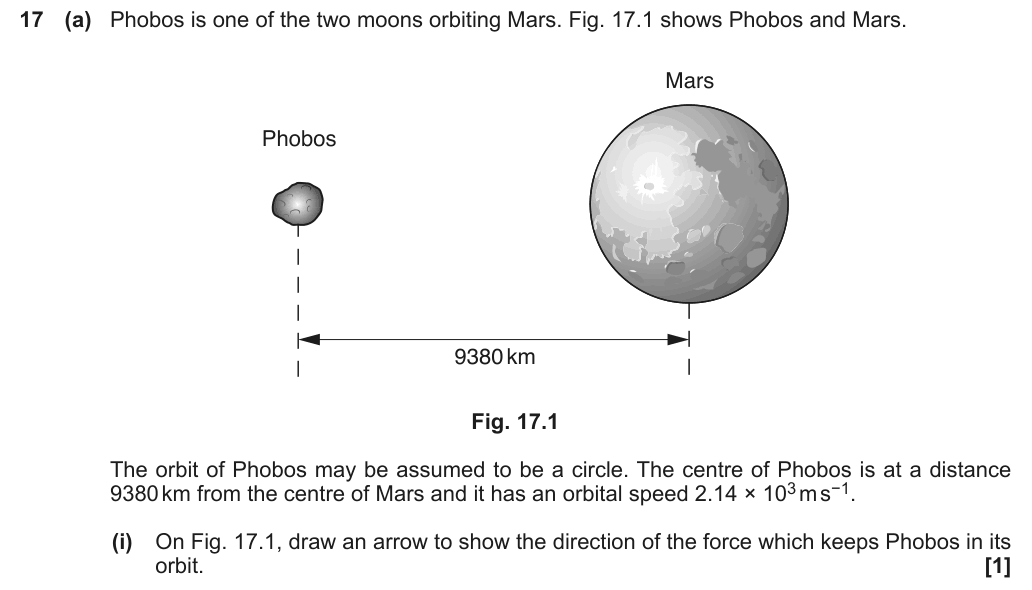
Most candidates put their cross in the correct place. The most common wrong response was to place a cross placed at the furthest point from Mars.
Notes from the mark scheme and report
X on the orbit at the closest point to Mars
allow a single dot / circle
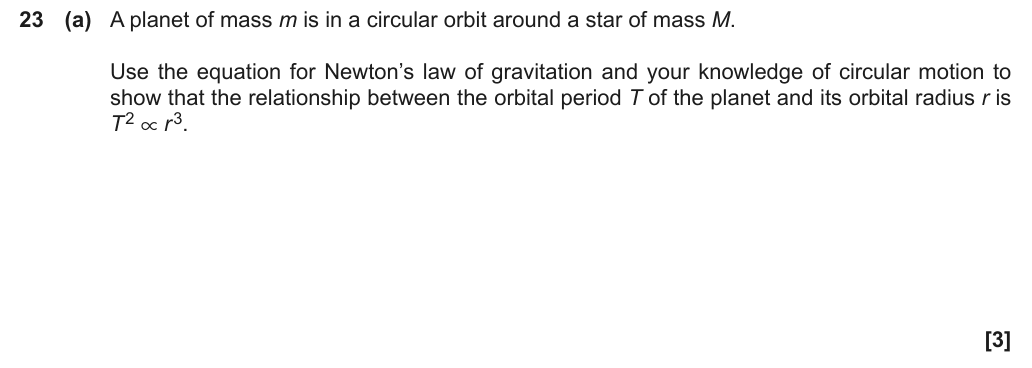
June 2022 · Paper 1 · Q23(a)3 marksShow thatEasy
Mark scheme
Examiner's comment
The demonstration of Kepler’s 3rd Law was well-remembered by the vast majority of candidates.
Notes from the mark scheme and report
must state 4π²/GM is constant
Skills: M2.2 Change the subject of an equation, including non-linear equations
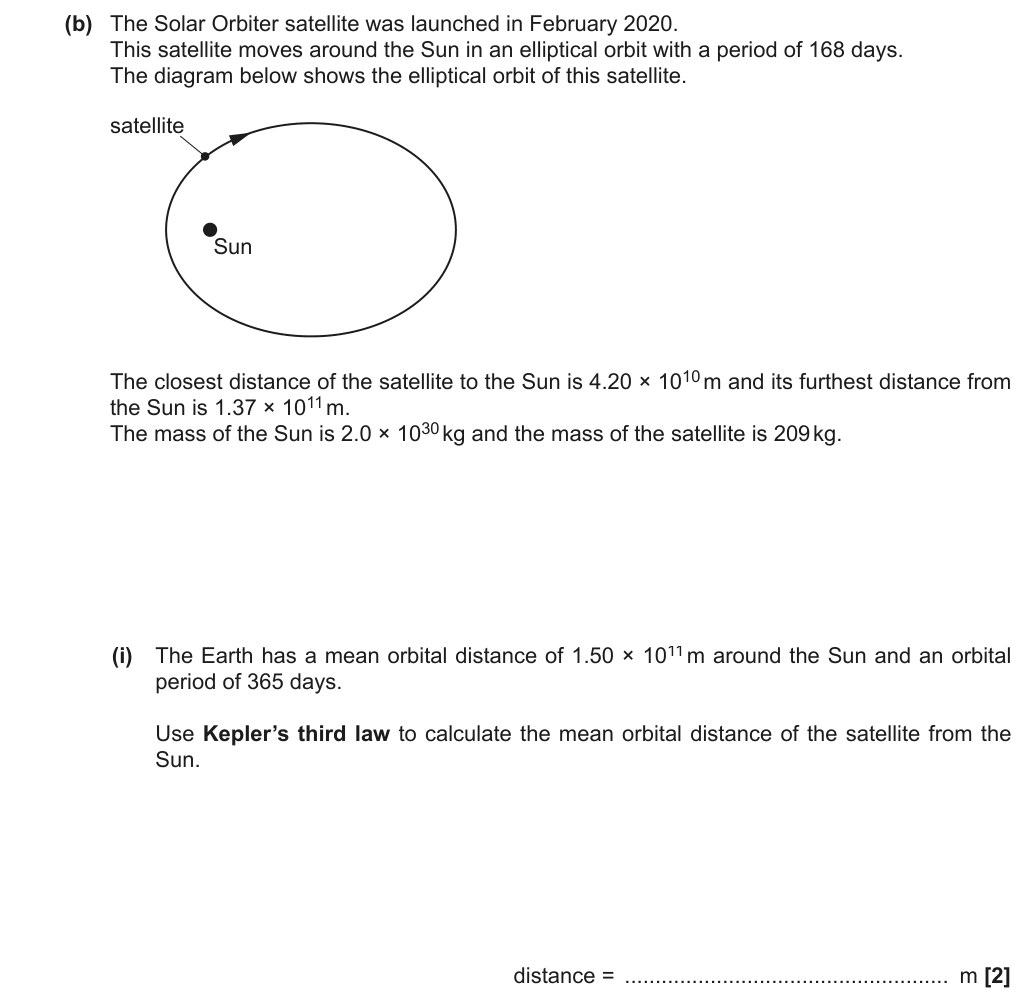
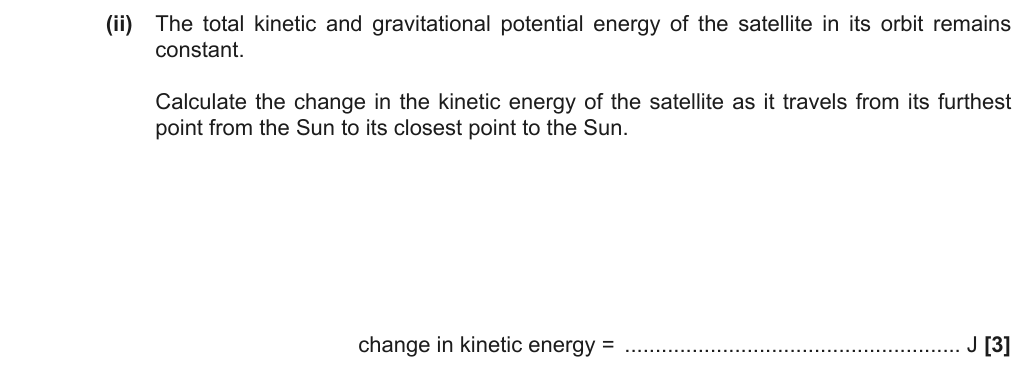
June 2022 · Paper 1 · Q23(b)(ii)3 marksCalculationMedium
Earlier part of question 23 that this part uses
Mark scheme
Examiner's comment
Previous examiner’s reports have stated the importance of understanding how gravitational potential energy differences are calculated using the appropriate formula. More candidates got this idea right in this series, which was excellent. This candidate has understood that the gravitational potential energy at both extremes of the orbit should be calculated and then the difference calculated.
Notes from the mark scheme and report
2.2 x 10^9 scores 2 marks (potential calculated, mass omitted)
ignore sign
Skills: M0.2 Recognise and use expressions in decimal and standard form; M2.3 Substitute numerical values into algebraic equations using appropriate units for physical quantities
June 2022 · Paper 1 · Q23(b)(iii)1 markExplanationHard
Earlier part of question 23 that this part uses
Mark scheme
Examiner's comment
This question provides one of the ‘stretch and challenge’ marks in this paper. The idea is that the satellite needs first to climb out of the Earth’s gravitational well before it can be a satellite of the Sun. If any of your students’ results are not as expected, you may wish to consider one of our post-results services. For full information about the options available visit the OCR website. We send a weekly roundup to tell you about important updates. You can also sign up for your subject specific updates. If you haven’t already, sign up here. Attend one of our popular CPD courses to hear directly from a senior assessor or drop in to a Q&A session. Most of our courses are delivered live via an online platform, so you can attend from any location. Please find details for all our courses on the relevant subject page on our website or visit OCR professional development. ExamBuilder is the question builder platform for a range of our GCSE, A Level, Cambridge Nationals and Cambridge Technicals qualifications. Find out more. ExamBuilder is free for all OCR centres with an Interchange account and gives you unlimited users per centre. We need an Interchange username to validate the identity of your centre's first user account for ExamBuilder. If you do not have an Interchange account please contact your centre administrator (usually the Exams Officer) to request a username, or nominate an existing Interchange user in your department. Review students' exam performance with our free online results analysis tool. It is available for all GCSEs, AS and A Levels and Cambridge Nationals. It allows you to: • review and run analysis reports on exam performance • analyse results at question and/or topic level • compare your centre with OCR national averages • identify trends across the centre • facilitate effective planning and delivery of courses • identify areas of the curriculum where students excel or struggle • help pinpoint strengths and weaknesses of students and teaching departments. Find out more. Post-results services Keep up-to-date OCR Professional Development Signed up for ExamBuilder?
Notes from the mark scheme and report
effect of the Earth ignored / work done by fuel / atmosphere
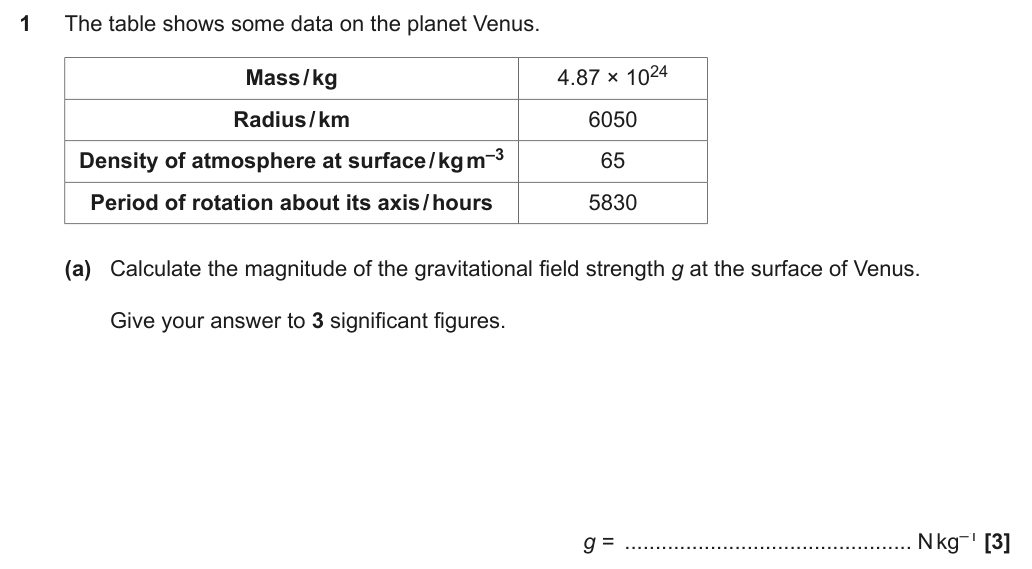
June 2022 · Paper 3 · Q1(a)3 marksCalculationMedium
Mark scheme
Examiner's comment
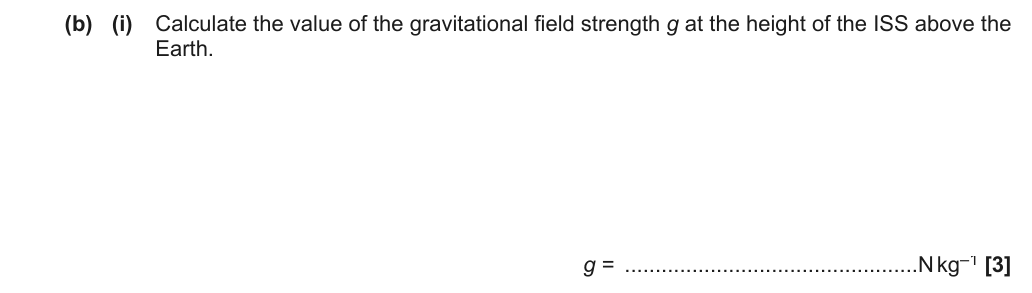
This was a gentle start to the paper, with the formula g = GM/r2 being provided in the data, formulae and relationships booklet. Common problems in 1(a) • omitting to convert r from km to m and so incurring a power of ten (POT) error • using a value of G from a calculator or from memory rather than copying the 3 significant figure (3sf) value given in the formula sheet • writing the answer to more (or less) than the 3sf specified in the question
Notes from the mark scheme and report
answer must be to exactly 3 sf
full substitution needed
negative answer allowed
Skills: M0.1 Recognise and make use of appropriate units in calculations; M1.1 Use an appropriate number of significant figures; M2.3 Substitute numerical values into algebraic equations using appropriate units for physical quantities
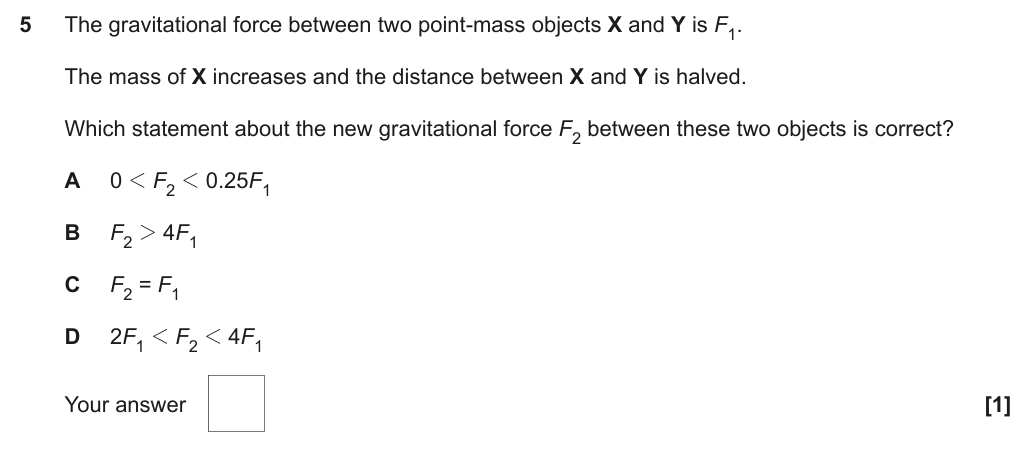
November 2021 · Paper 1 · Q71 markMultiple choice
Answer
B
Mark scheme
November 2021 · Paper 1 · Q20(a)(i)1 markDiagram or graph
Mark scheme
Notes from the mark scheme and report
straight, symmetrical, radial, arrows towards Earth
Ignore field lines inside the Earth
November 2021 · Paper 1 · Q20(a)(ii)1 markDiagram or graph
Earlier part of question 20 that this part uses
Mark scheme
Notes from the mark scheme and report
X and Y equal distances from the centre of the Earth (by eye)
both on the surface allowed
November 2021 · Paper 1 · Q20(b)6 marks6-mark extended responseEasy
Mark scheme, with the levels and indicative content
Examiner's comment
Common misconceptions Almost all candidates forgot that Gravitational Potential Energy is negative in Q20(b).
Notes from the mark scheme and report
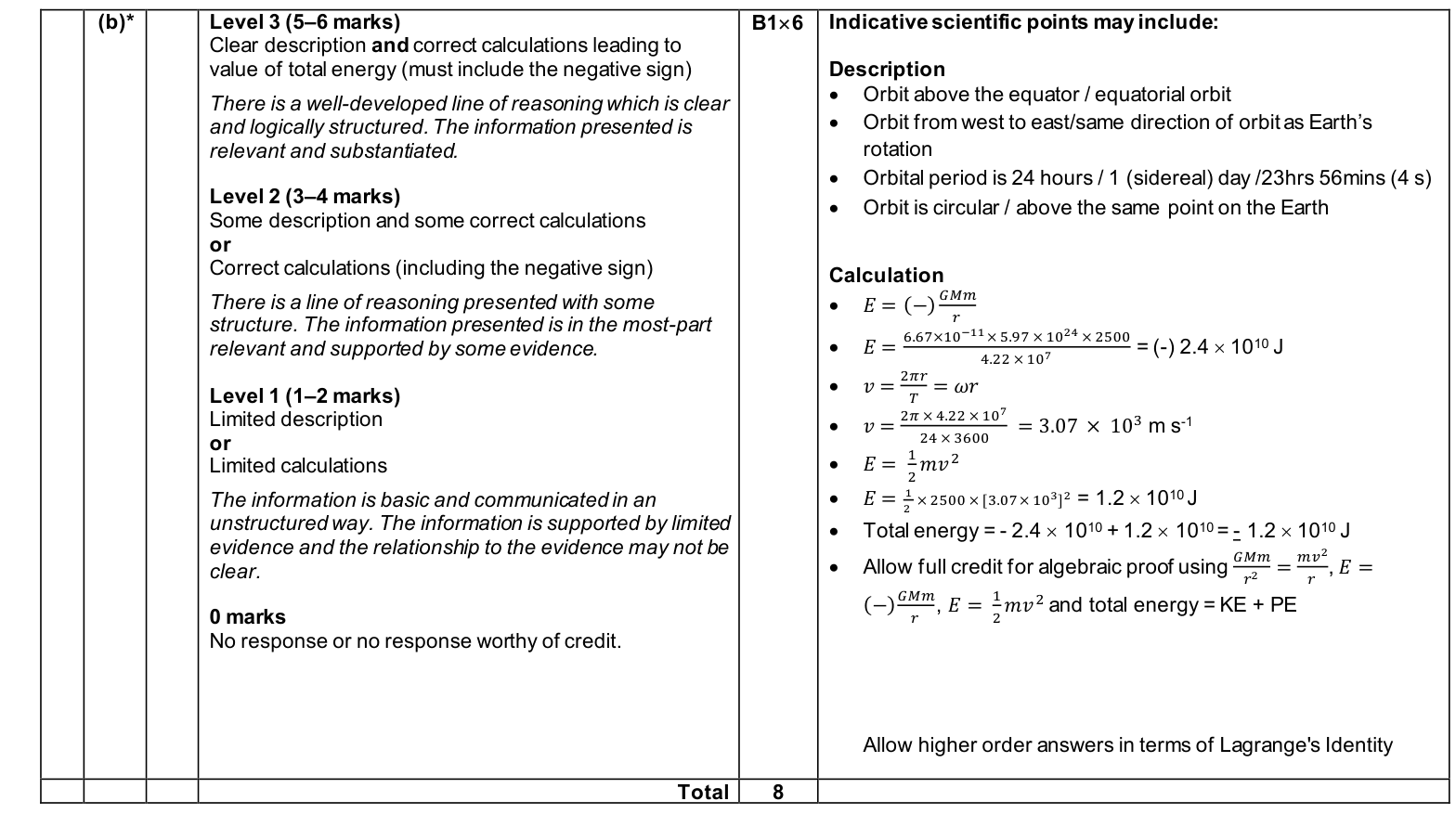
total energy must include the negative sign (-1.2 x 10^10 J)
algebraic route from GMm/r² = mv²/r gets full credit
Skills: M0.2 Recognise and use expressions in decimal and standard form; M2.3 Substitute numerical values into algebraic equations using appropriate units for physical quantities
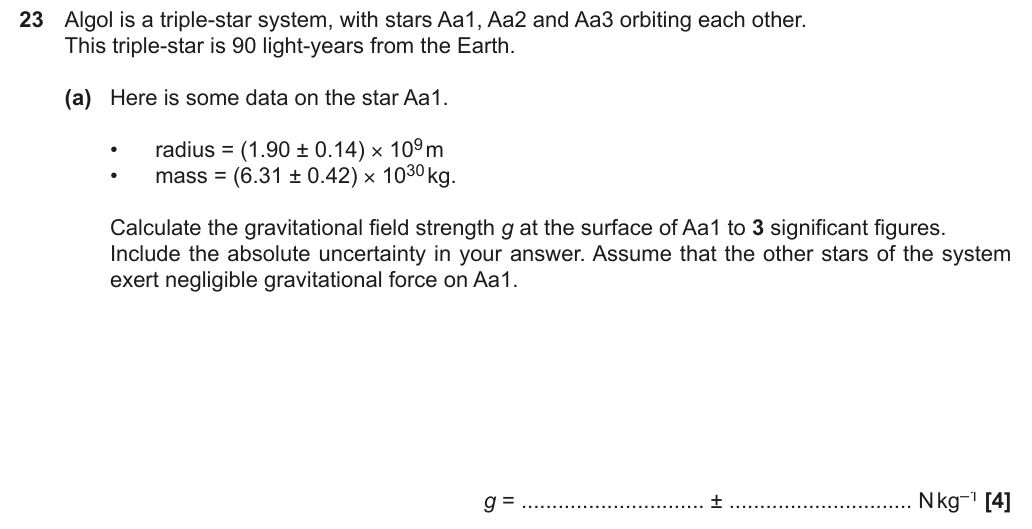
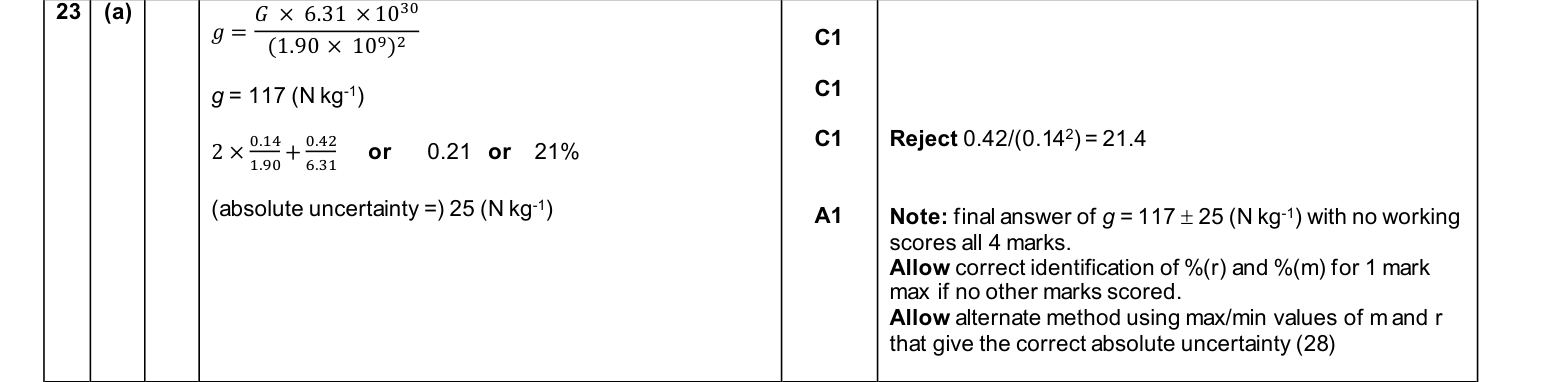
November 2021 · Paper 1 · Q23(a)4 marksCalculation
Mark scheme
Notes from the mark scheme and report
percentage uncertainty in r must be doubled
Reject 0.42/(0.14²)
max/min method (28) allowed
Skills: M1.1 Use an appropriate number of significant figures; M1.5 Identify uncertainties in measurements and use simple techniques to determine uncertainty when data are combined; M2.3 Substitute numerical values into algebraic equations using appropriate units for physical quantities
November 2021 · Paper 3 · Q3(a)1 markShort answer
Mark scheme
Notes from the mark scheme and report
work done in bringing the object from infinity to that point
ignore any equations
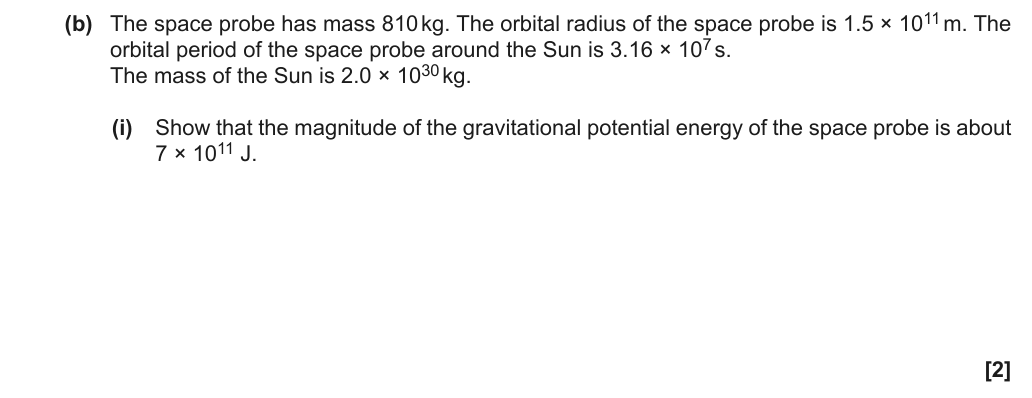
November 2021 · Paper 3 · Q3(b)(i)2 marksShow thatMedium
Mark scheme
Examiner's comment
Key teaching and learning point Question 3(b) was a question designed to test candidates’ knowledge that gravitational potential energy is always negative.
Notes from the mark scheme and report
mark is for full substitution including 6.67 x 10⁻¹¹ for G
Skills: M0.2 Recognise and use expressions in decimal and standard form; M2.3 Substitute numerical values into algebraic equations using appropriate units for physical quantities
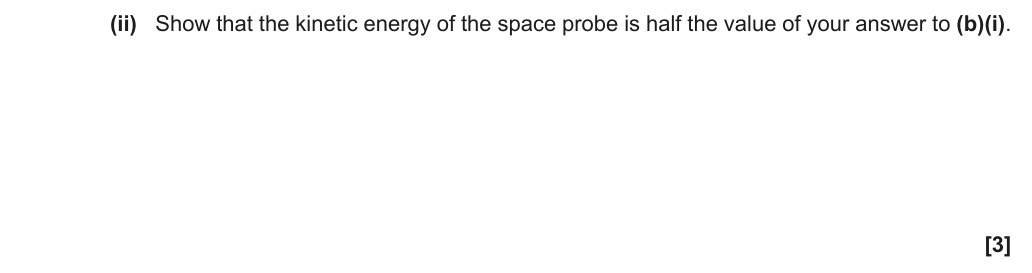
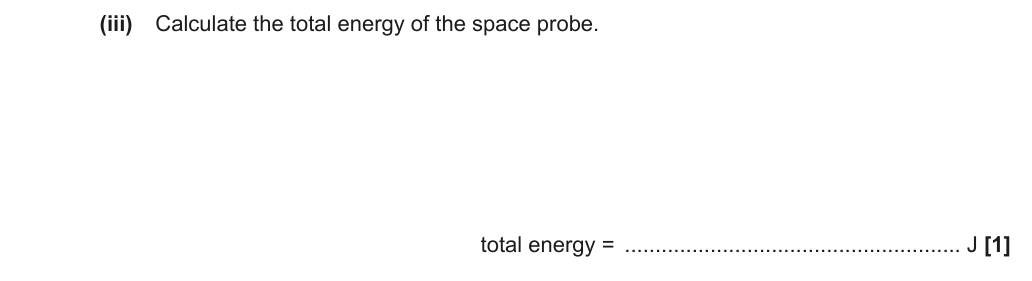
November 2021 · Paper 3 · Q3(b)(iii)1 markCalculationMedium
Earlier parts of question 3 that this part uses
Mark scheme
Examiner's comment
Key teaching and learning point Question 3(b) was a question designed to test candidates’ knowledge that gravitational potential energy is always negative.
Notes from the mark scheme and report
total energy is negative (KE + GPE)
working must be shown
ecf from (i) and (ii)
November 2020 · Paper 1 · Q51 markMultiple choice
Answer
B
Mark scheme
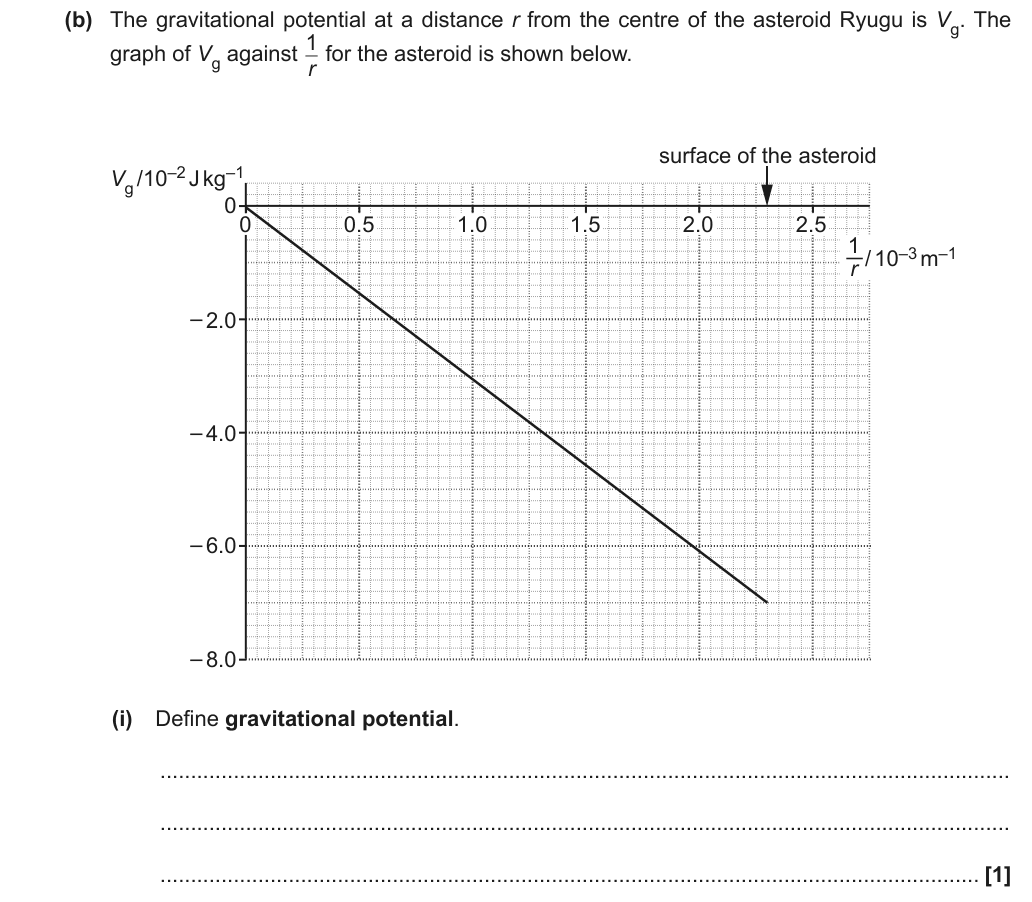
November 2020 · Paper 1 · Q23(b)(i)1 markShort answerMedium
Mark scheme
Examiner's comment
Question 23c showed that candidates were unfamiliar with the idea of finding a difference in potentials between two points in order to find the change in potential energy.
Notes from the mark scheme and report
NOT work done on 1 kg
from infinity
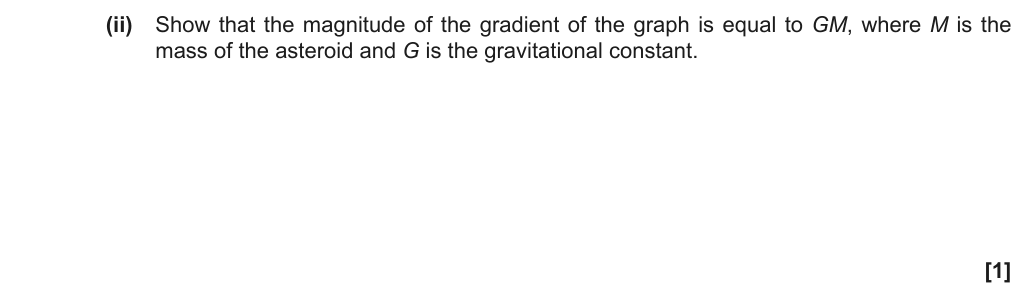
November 2020 · Paper 1 · Q23(b)(ii)1 markShow thatMedium
Earlier part of question 23 that this part uses
Mark scheme
Examiner's comment
Question 23c showed that candidates were unfamiliar with the idea of finding a difference in potentials between two points in order to find the change in potential energy.
November 2020 · Paper 1 · Q23(b)(iii)2 marksShow thatMedium
Earlier parts of question 23 that this part uses
Mark scheme
Examiner's comment
Question 23c showed that candidates were unfamiliar with the idea of finding a difference in potentials between two points in order to find the change in potential energy.
Notes from the mark scheme and report
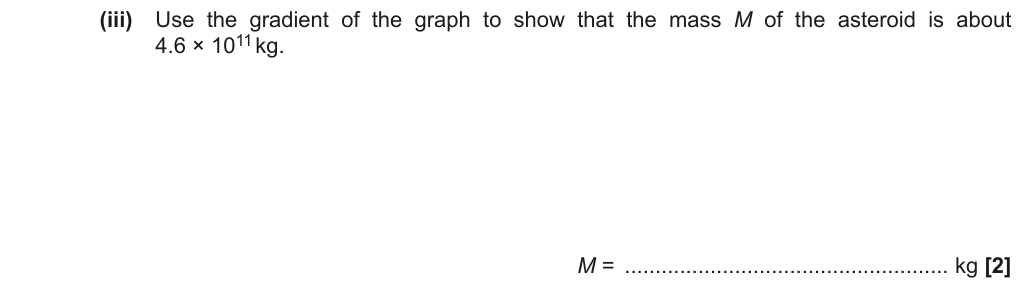
gradient (-)30.4 ± 2
M must be calculated correctly from the candidate's gradient
Skills: M0.2 Recognise and use expressions in decimal and standard form; M2.2 Change the subject of an equation, including non-linear equations; M3.4 Determine the slope and intercept of a linear graph
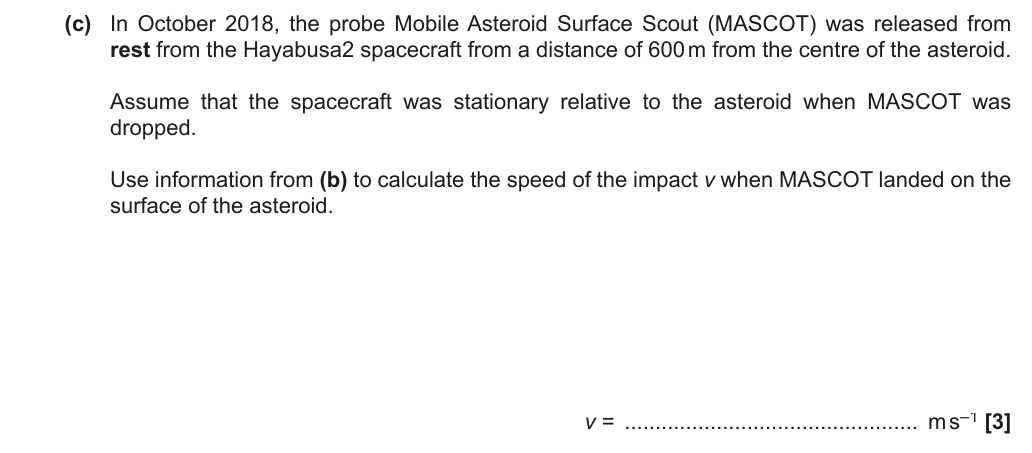
November 2020 · Paper 1 · Q23(c)3 marksCalculationMedium
Earlier parts of question 23 that this part uses
Mark scheme
Examiner's comment
Question 23c showed that candidates were unfamiliar with the idea of finding a difference in potentials between two points in order to find the change in potential energy.
Notes from the mark scheme and report
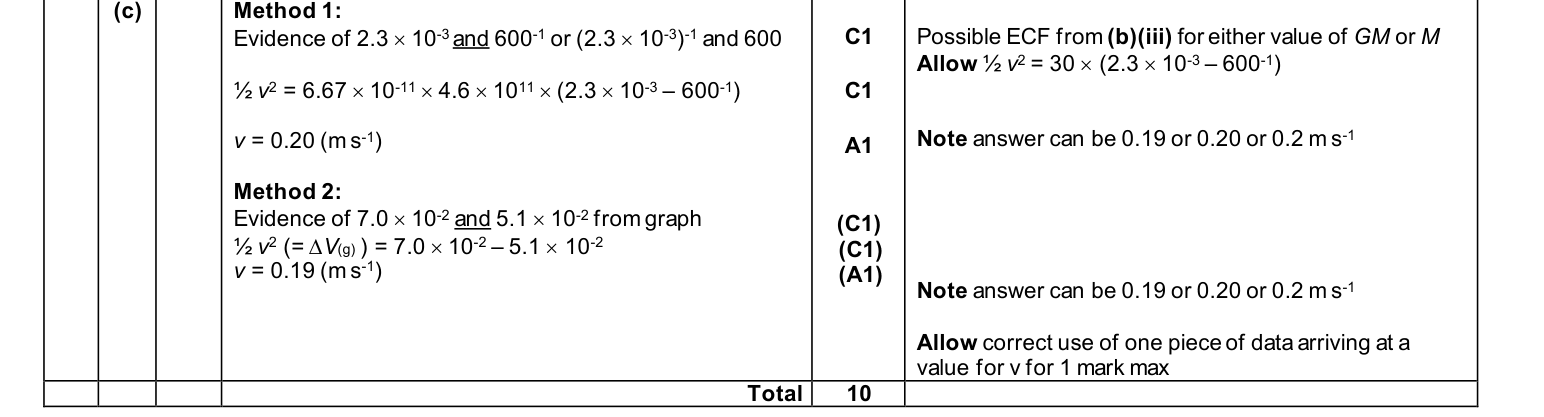
change in potential between r = 600 m and the surface (1/r = 2.3 x 10⁻³ m-1)
answer 0.19 or 0.20 m s-1
correct use of one value only scores 1 mark max
Skills: M2.2 Change the subject of an equation, including non-linear equations; M2.3 Substitute numerical values into algebraic equations using appropriate units for physical quantities; M3.1 Translate information between graphical, numerical and algebraic forms
November 2020 · Paper 3 · Q4(b)(i)3 marksCalculationMedium
Earlier part of question 4 that this part uses
Mark scheme
Examiner's comment
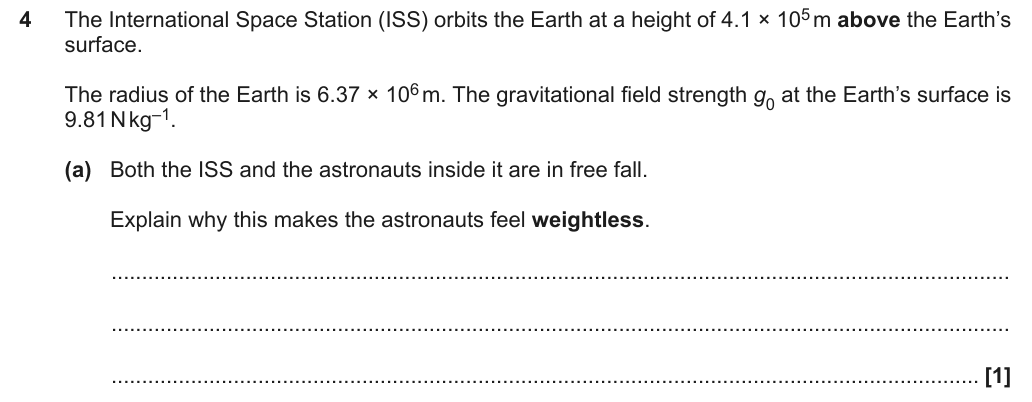
Question 4a Misconception Experiencing weightlessness is not the same as being in freefall There was a lack of understanding of the nature of feeling weightless. Question 4bi The simplest method here was to use the fact that g is inversely proportional to r2, so gr2 = constant. Question 4c The success in this question depended on understanding the meaning of the term m in the formula 2mc2 തതത = 3 2 kT given in the Data, Formulae and Relationship booklet. Question 4d Although this question looked daunting, it was actually quite linear and many candidates who attempted it were able to gain two or three marks even if they did not eventually get to the correct response.
Notes from the mark scheme and report
allow 8.7
ratio method or GM/R squared
Skills: M0.3 Use ratios, fractions and percentages; M2.3 Substitute numerical values into algebraic equations using appropriate units for physical quantities
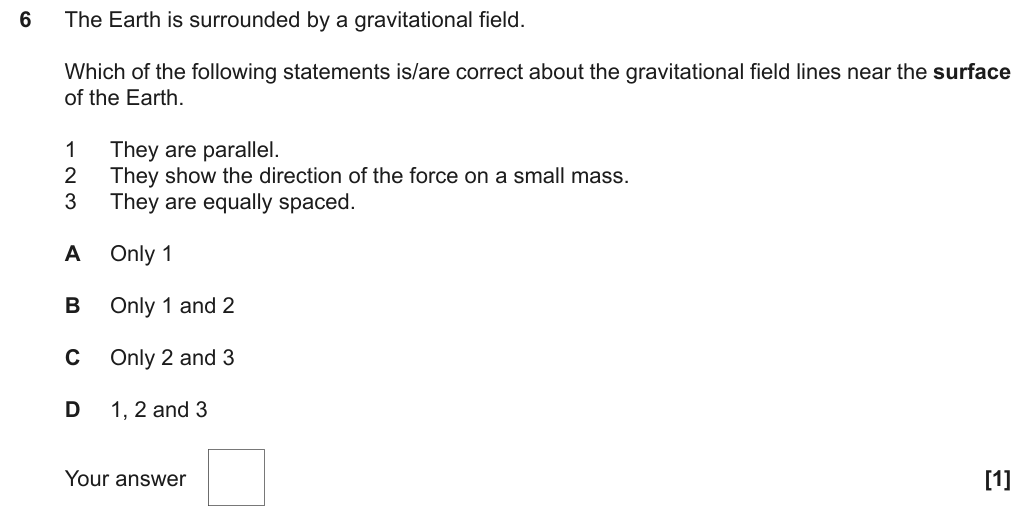
June 2019 · Paper 1 · Q61 markMultiple choiceMedium
Answer
D
Mark scheme
Examiner's comment
Near to the surface of the Earth, the gravitational field is approximately uniform. This means that they are parallel and equally spaced. Gravitational field lines in general show the direction of the force on a small mass. This makes all 3 statements are correct, giving the answer D.
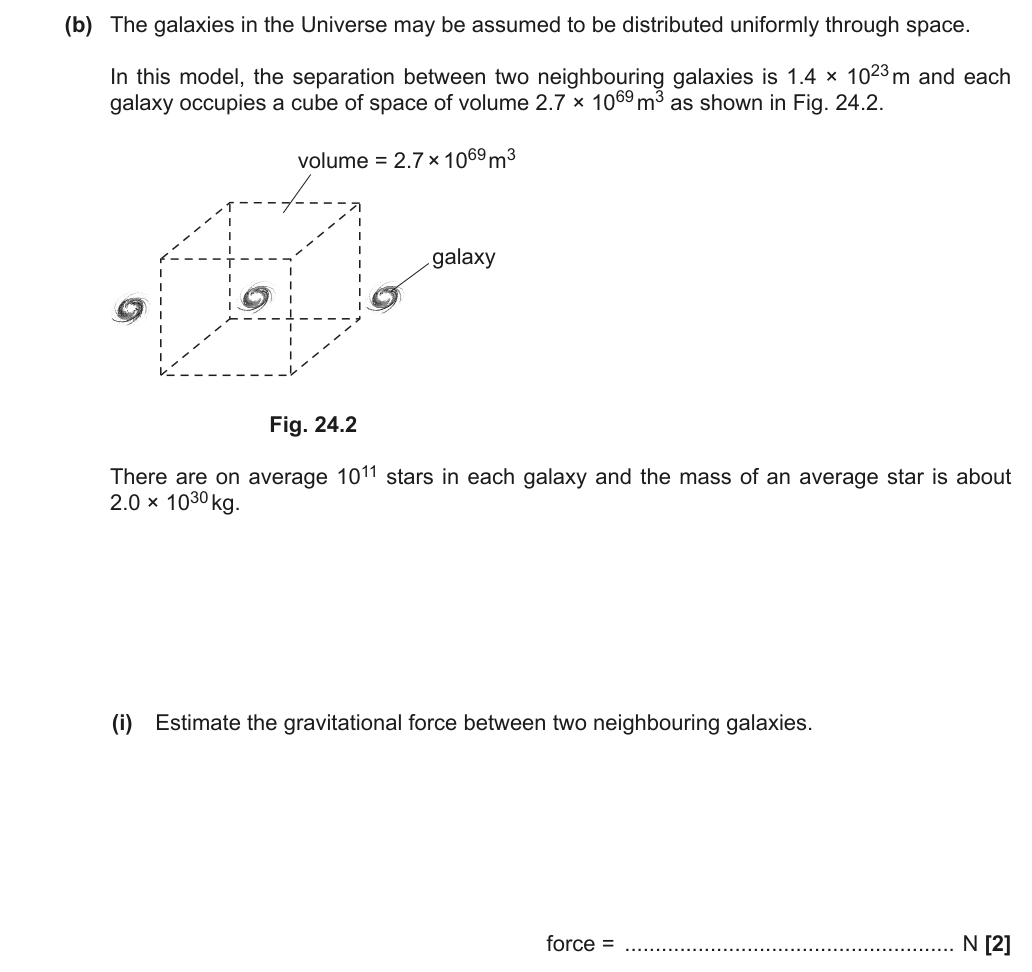
June 2019 · Paper 1 · Q24(b)(i)2 marksCalculationMedium
Mark scheme
Examiner's comment
While some lower level responses included an attempt to find the gravitational field strength rather than the force most selected the correct formula. After selecting the correct relationship, most candidates could then correctly find the force, provided that they remembered to multiply the masses and square the distance of separation.
Notes from the mark scheme and report
1 mark for 1.4 x 10^4 N (mass of a star used instead of mass of galaxy)
ignore minus sign
Skills: M0.2 Recognise and use expressions in decimal and standard form; M1.4 Make order of magnitude calculations; M2.3 Substitute numerical values into algebraic equations using appropriate units for physical quantities
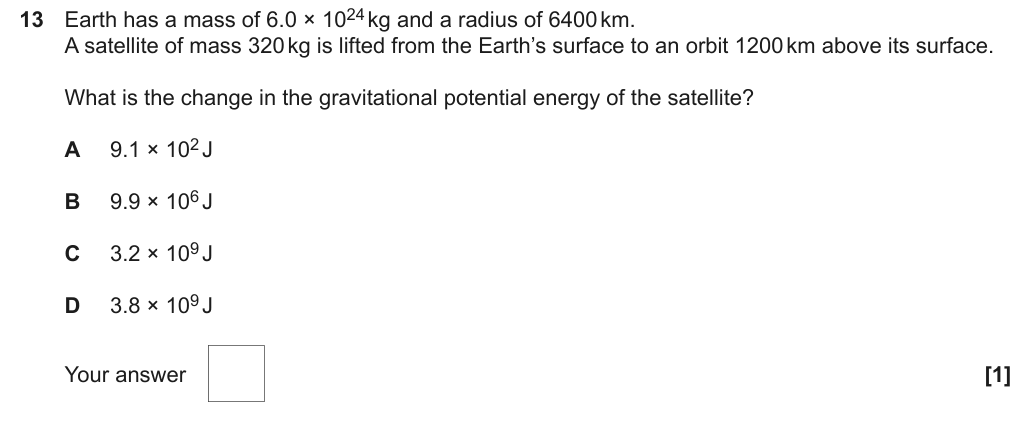
June 2018 · Paper 1 · Q131 markMultiple choiceMedium
Answer
C
Mark scheme
Examiner's comment
This question requires the candidate to calculate the gravitational potential energy when r = 6.4 x 10³ m and again when r = 7.6 x 10³ m. The difference of those two energies gives answer C. About two thirds of all candidates got this correct.
June 2018 · Paper 1 · Q17(a)(iii)3 marksCalculationMedium
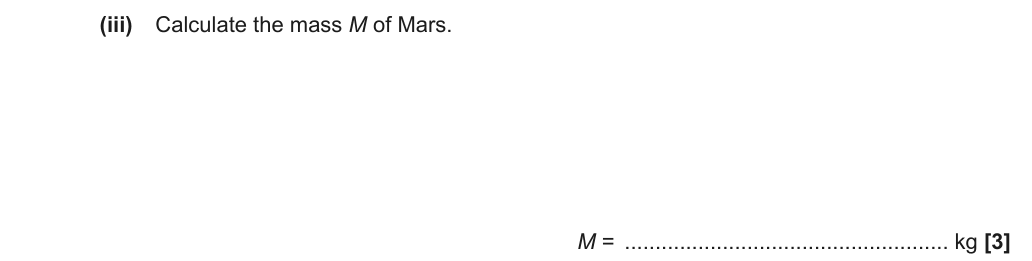
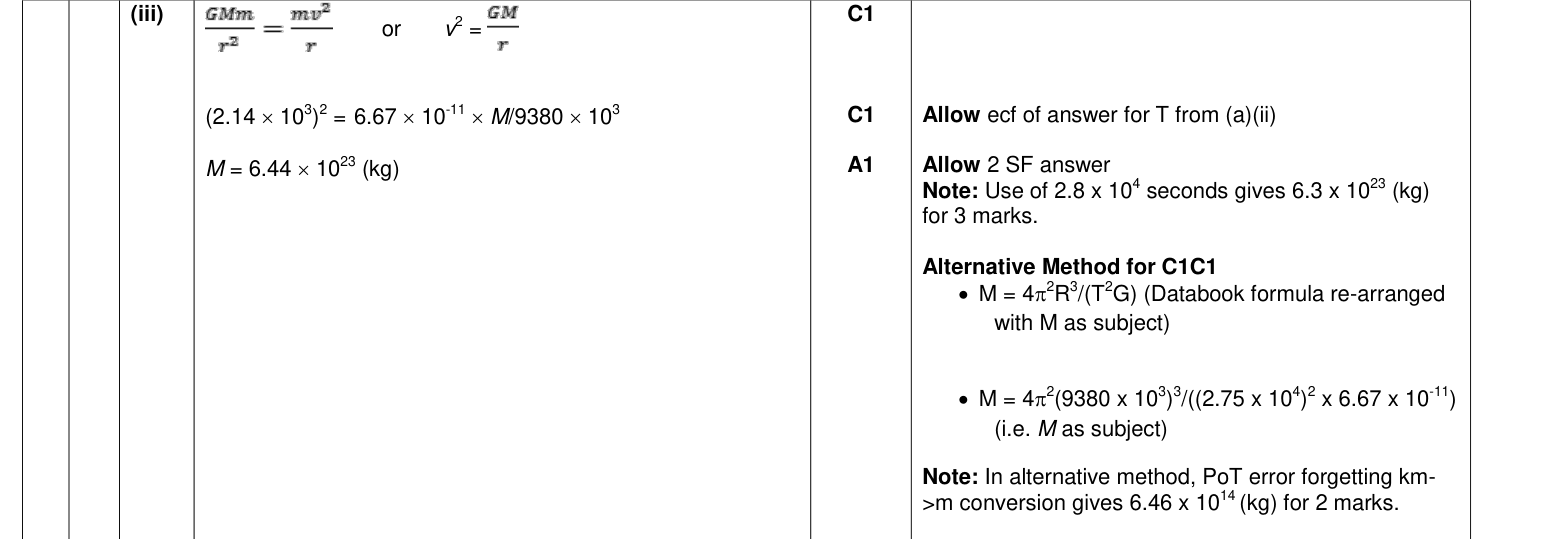
Earlier part of question 17 that this part uses
Mark scheme
Examiner's comment
Many candidates successfully used the equation for Kepler’s Third Law, which is encouraging. A quicker route was to find the Phobos’s acceleration (from v2/r) and equating that to the gravitational field strength at Phobos from Mars (GMmars/r2) and then rearranging to find the mass of Mars.
Notes from the mark scheme and report
either GMm/r² = mv²/r or T² = 4π²r³/GM
km not converted gives 6.46 x 10^14 kg for 2 marks
ecf from (a)(ii)
Skills: M0.2 Recognise and use expressions in decimal and standard form; M2.2 Change the subject of an equation, including non-linear equations; M2.3 Substitute numerical values into algebraic equations using appropriate units for physical quantities
June 2018 · Paper 1 · Q17(b)(ii)5 marksShow thatEasy
Earlier part of question 17 that this part uses
Mark scheme
Examiner's comment
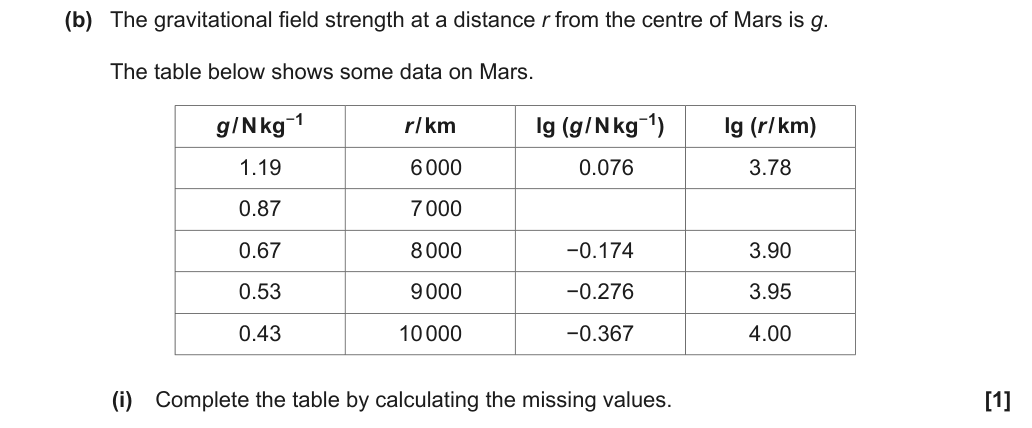
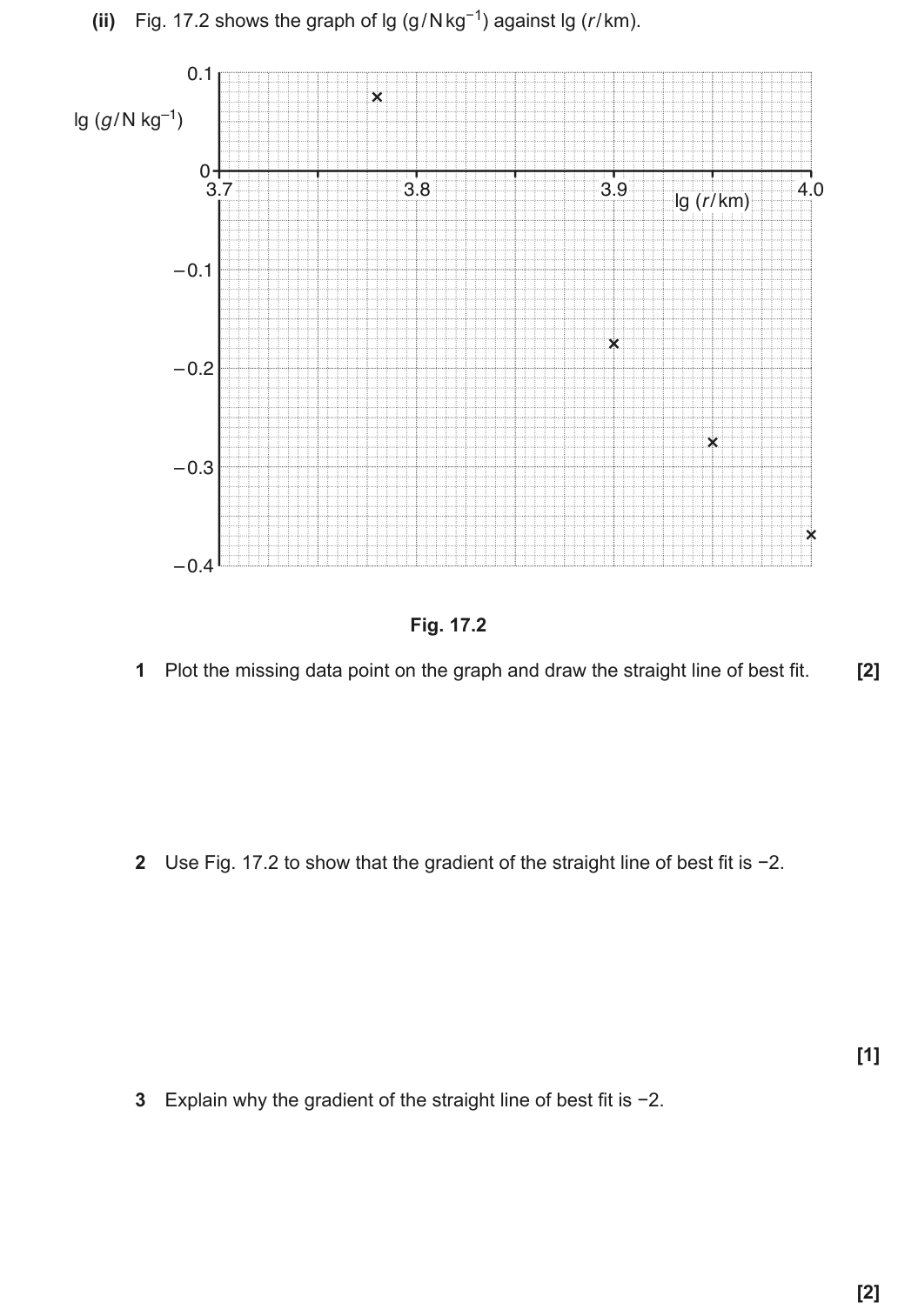
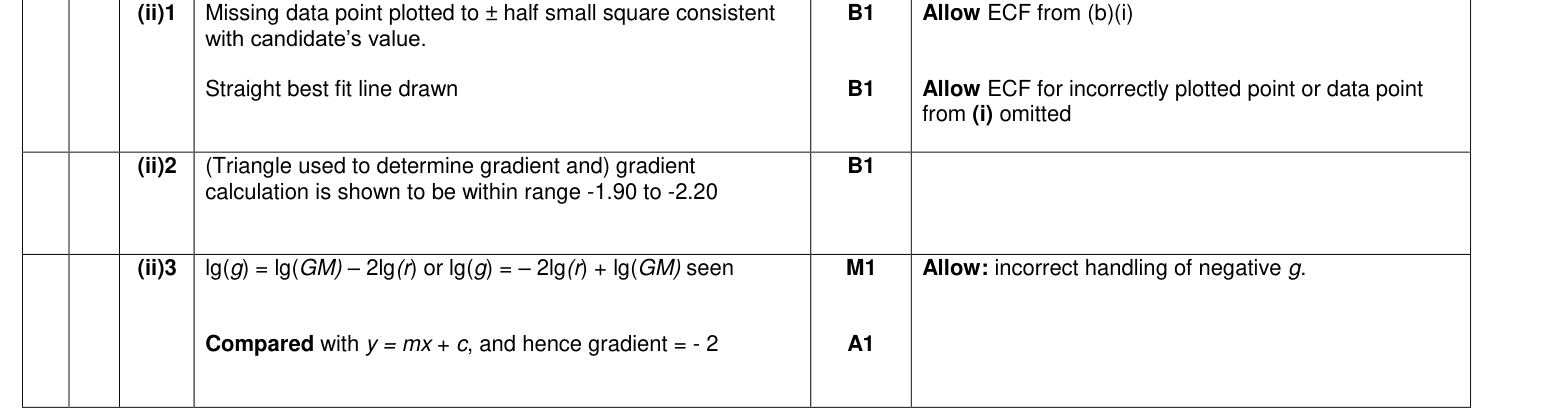
Providing the candidate had entered values in the tables, the data point was almost always plotted correctly. The best fit line caused slightly more problems. Candidates should take a ruler into the examination and be careful about the positioning of the ruler for the fairest best fit straight line. The Practical Skills Handbook is helpful on this topic. In this example, the candidate’s line has missed the final data point. The line of best fit for this item should just graze each of the given points. Most candidates correctly found the gradient of their best fit straight line. The exemplar shows both an unsuccessful and a successful approach. The crossed-out working was typical across many candidates, with incorrect maths and no handling of the ‘GM’ term. The successful approach was very clear mathematically, as well as making a clear comparison with the general equation for a straight line. Some candidates decided to find the gradient of their best fit line again, showing that they did not see the distinction between these two questions, despite the change in command verb.
Notes from the mark scheme and report
gradient shown within -1.90 to -2.20
lg g = lg(GM) - 2 lg r compared with y = mx + c
ecf from (b)(i) for plotting
Skills: M2.5 Use logarithms in relation to quantities that range over several orders of magnitude; M3.11 Use logarithmic plots to test exponential and power law variations; M3.2 Plot two variables from experimental or other data; M3.4 Determine the slope and intercept of a linear graph
June 2018 · Paper 1 · Q17(c)(i)2 marksExplanationMedium
Mark scheme
Examiner's comment
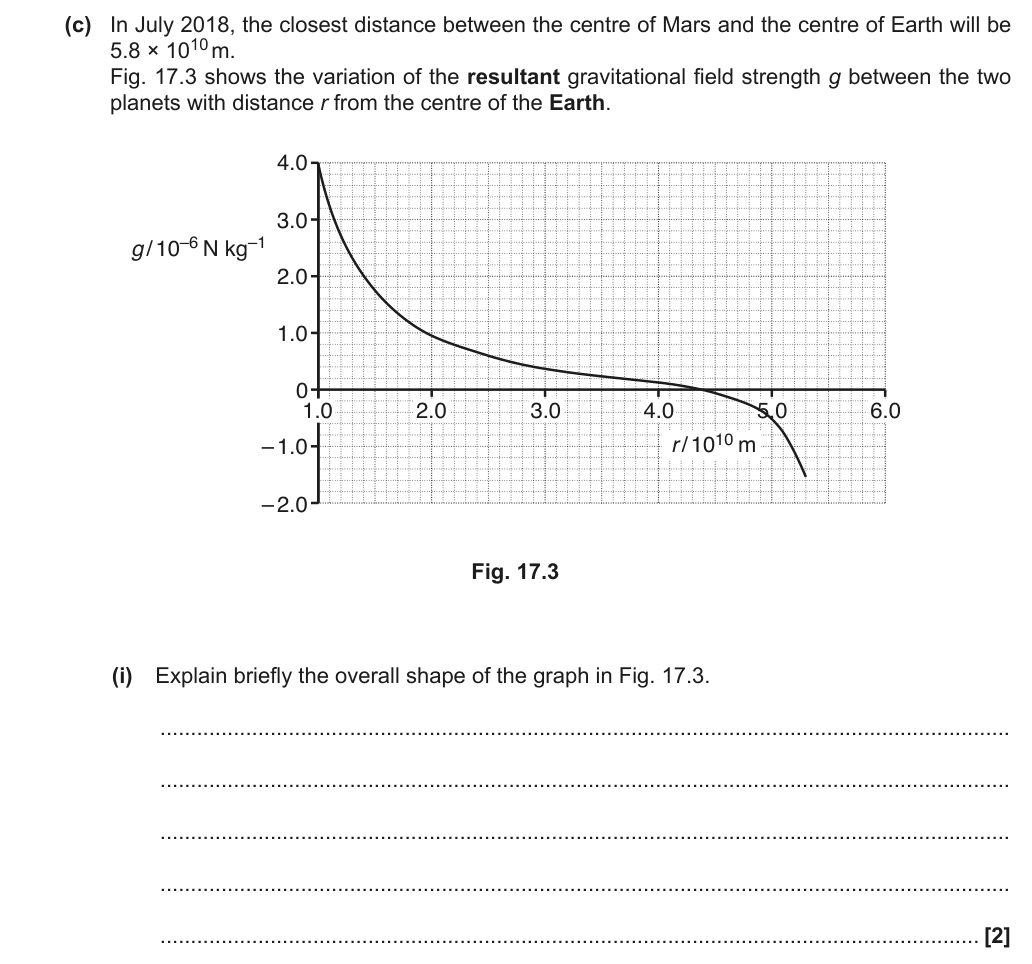
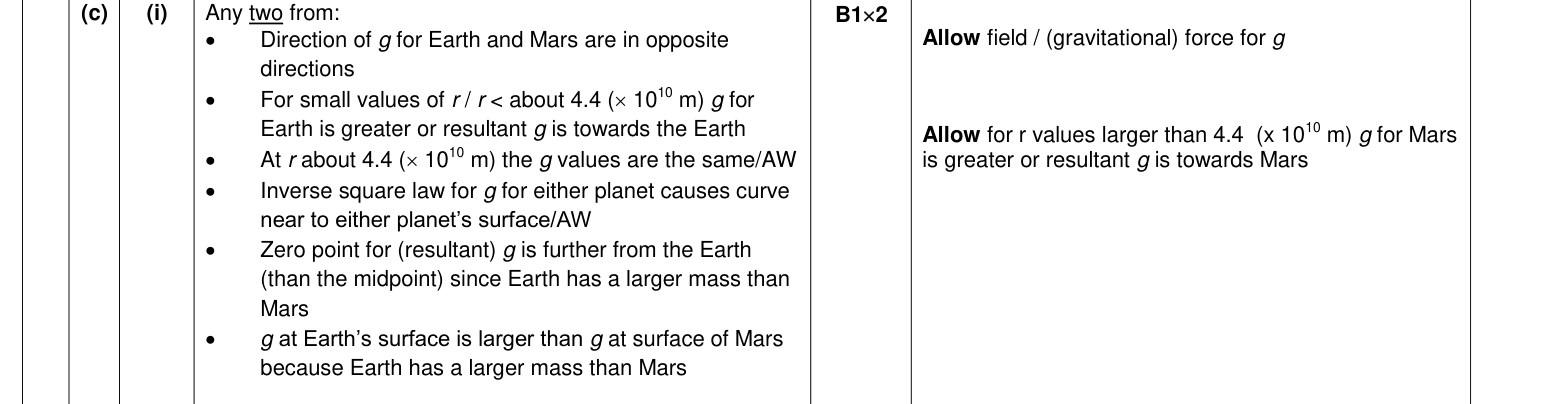
Most candidates mis-read the question and tried to describe the shape of the curve, rather than explain why the curve has that shape. Many candidates also mis-used the term ‘exponential’ to describe a curve that is related to 1/r2. Others thought that the graph showed the effect of Mars and the Earth on each other, rather than on a small mass between them. They went on to describe what happened when Mars and Earth were separated by an increasingly large distance. It is good practice to be specific about which section of the graph you are talking about. ‘When r is below 2.0 x 10¹⁰ m’ is much clearer than ‘At the start’. Potential, potential difference, potential energy, field strength and force These terms are all very similar yet subtly different and with differing formula. Be careful you know which is which.
Notes from the mark scheme and report
fields of Earth and Mars are in opposite directions
zero point is nearer Mars because Earth has the larger mass
Skills: M3.1 Translate information between graphical, numerical and algebraic forms
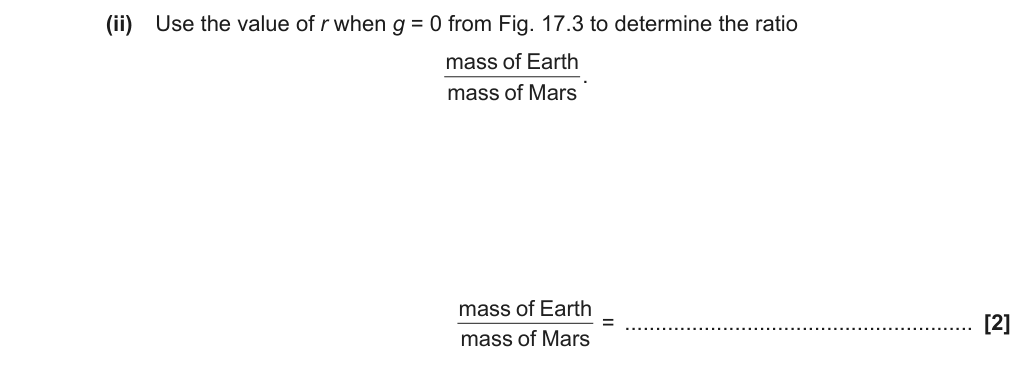
June 2018 · Paper 1 · Q17(c)(ii)2 marksCalculationMedium
Earlier part of question 17 that this part uses
Mark scheme
Examiner's comment
To correctly answer this question, the candidate should equate the gravitational field strength from Earth (GMEarth/x2 where x is the distance to the point where g=0 from the centre of Earth) and the gravitational field strength from Mars (GMMars/y2 where y is the distance to the point where g=0 from the centre of Mars). Many candidates did not get this far, yet some that did substituted and re-arranged correctly get a value in the correct range. Errors occurred when candidates were unsure of which distances to use in the equation. The commonest error was to use 0.9 x 10¹⁰ m for the distance of the zero-point since the graph stops at 5.3 x 10¹⁰ m, rather than using the data provided that the distance between the centres of the two planets was 5.8 x 10¹⁰ m and so the correct value for r was 1.4 x 10¹⁰ m.
Notes from the mark scheme and report
ratio in range 8.2 to 12 for r = 4.4 ± 0.1 (x 10^10 m)
Skills: M0.3 Use ratios, fractions and percentages; M2.2 Change the subject of an equation, including non-linear equations; M3.1 Translate information between graphical, numerical and algebraic forms
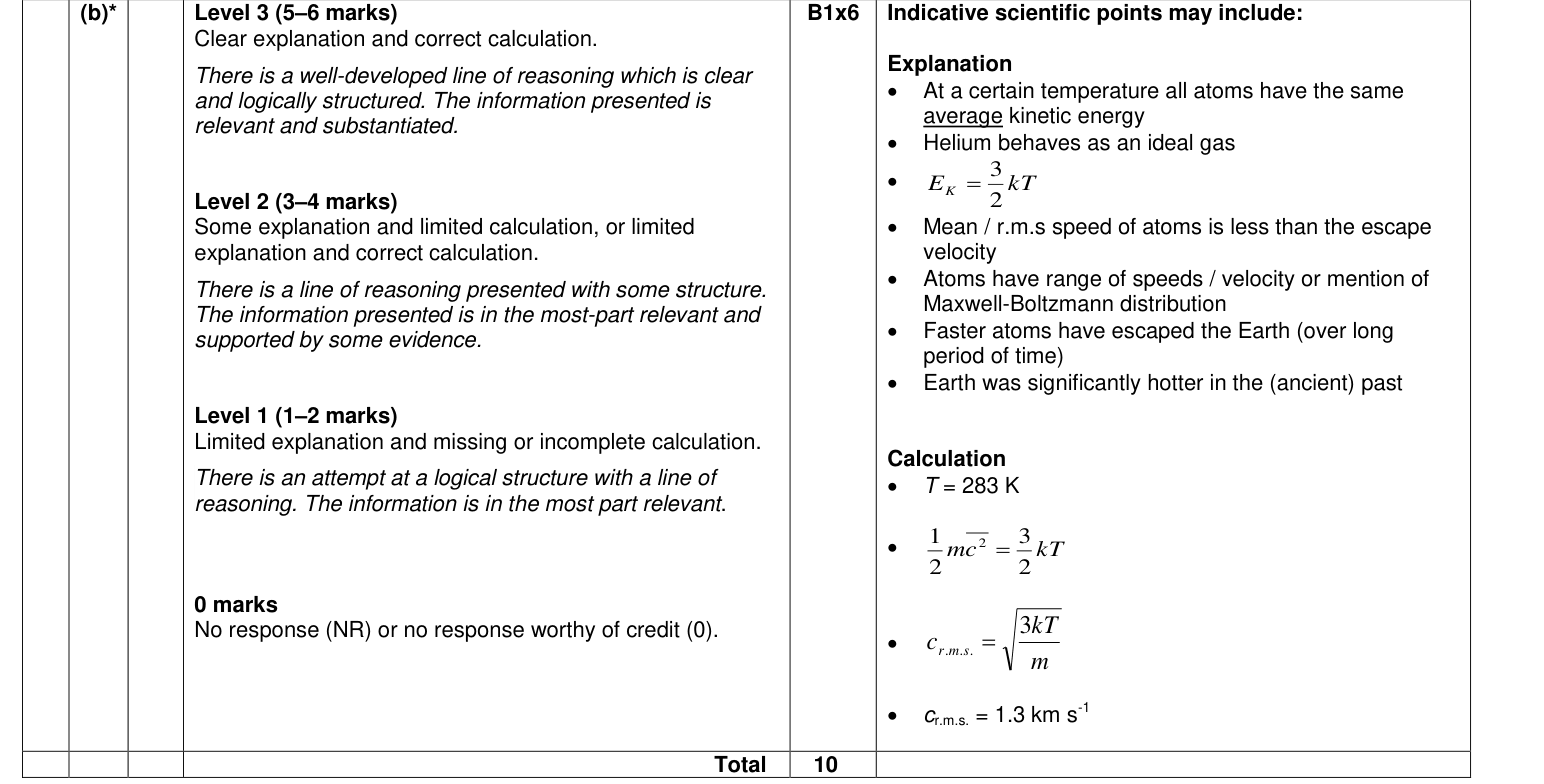
June 2018 · Paper 1 · Q22(b)6 marks6-mark extended responseMedium
Mark scheme, with the levels and indicative content
Examiner's comment
In correctly calculating the root means square speed and by being clear about how that has been calculated, this candidate has gained L2 already. There is a correct comparison of this speed with the escape velocity. There is also reference to the Boltzmann distribution of speeds, suggesting that even though a small fraction will have a sufficient velocity, over time those particles will escape. Most candidates made good progress with the calculation or provided an alternative by calculating the mean KE of a particle and comparing that with the KE a particle with escape velocity would have. A significant fraction made a poor comparison of their value with escape velocity (e.g. that 1300 ms-1 was greater than 11 km s-1) or compared the mean squared speed with the escape velocity.
Notes from the mark scheme and report
r.m.s. speed 1.3 km s-1 is less than escape velocity but atoms have a range of speeds so the fastest escape
Skills: M0.5 Use calculators to find and use power, exponential and logarithmic functions; M2.2 Change the subject of an equation, including non-linear equations; M2.3 Substitute numerical values into algebraic equations using appropriate units for physical quantities
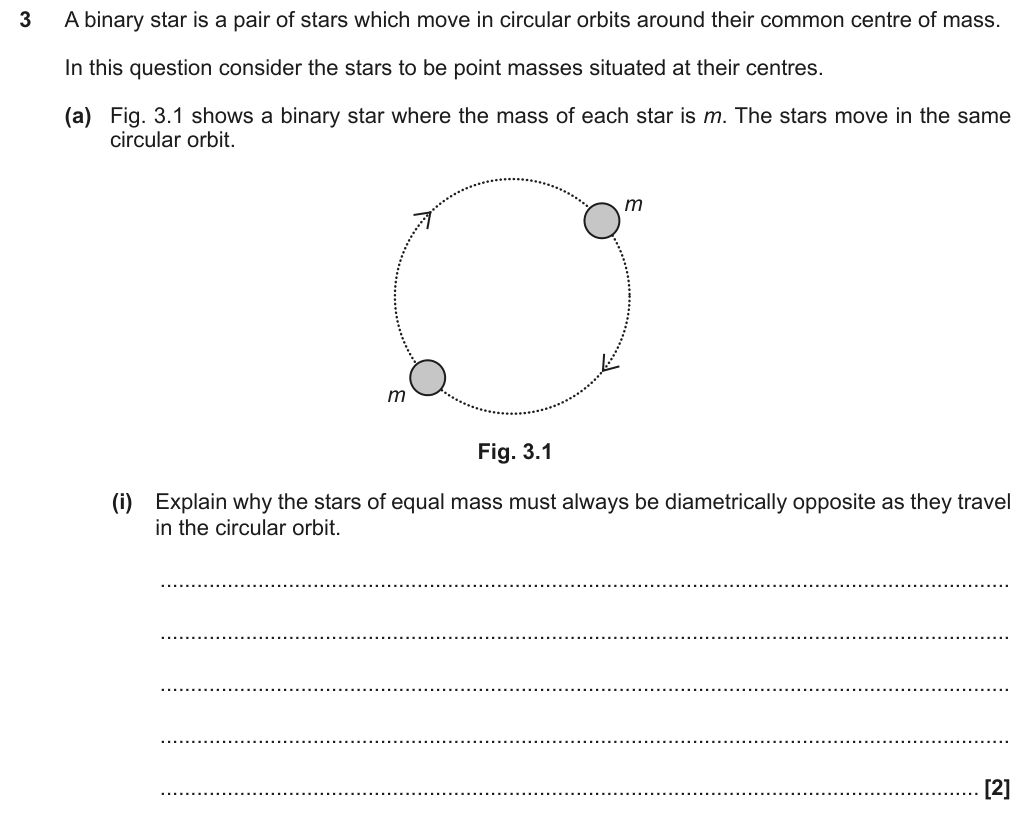
June 2018 · Paper 3 · Q3(a)(i)2 marksExplanationHard
Mark scheme
Examiner's comment
Only a minority of candidates related the gravitational force between the stars to the centripetal force required for circular motion to occur. This candidate has written the perfect answer (exemplar 5). There were two popular insufficient answers; that if the stars were not diametrically opposite they would collide and that the centre of mass of the system had to be at the centre of the orbit.
June 2017 · Paper 1 · Q11 markMultiple choice
Answer
B
Mark scheme
June 2017 · Paper 1 · Q91 markMultiple choice
Answer
C
Mark scheme
June 2017 · Paper 1 · Q23(a)1 markShort answer
Mark scheme
June 2017 · Paper 1 · Q23(b)(i)2 marksShow that
Mark scheme
Notes from the mark scheme and report
allow m = 1 kg if clearly defined
Skills: M2.2 Change the subject of an equation, including non-linear equations
June 2017 · Paper 1 · Q23(b)(ii)1 markCalculation
Earlier part of question 23 that this part uses
Mark scheme
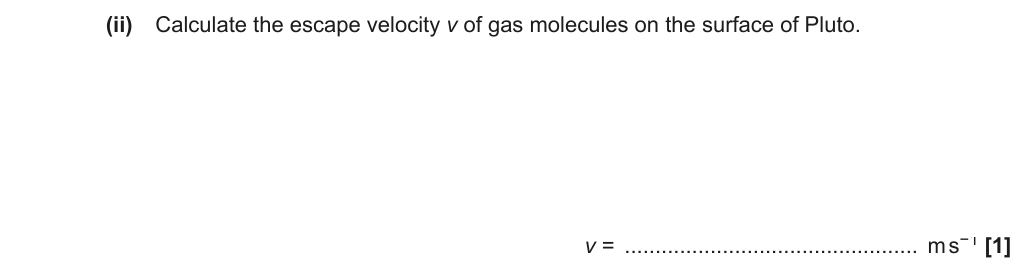
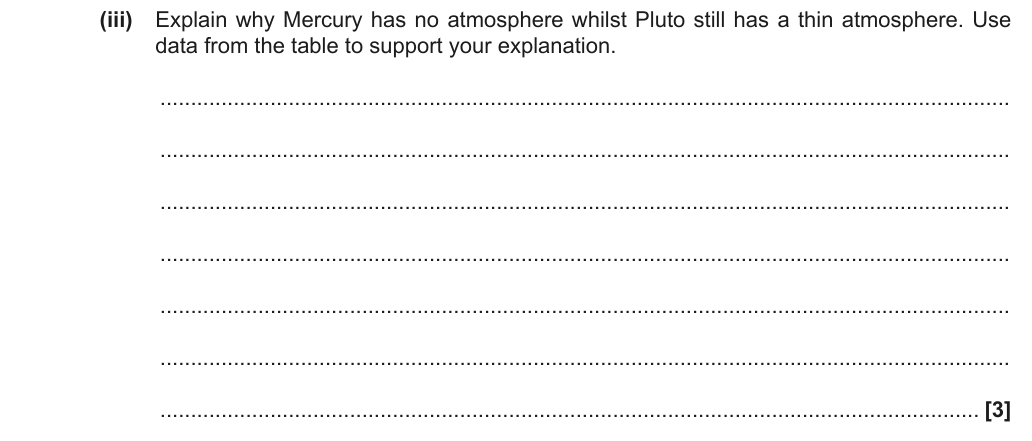
June 2017 · Paper 1 · Q23(b)(iii)3 marksPractical and data analysis
Earlier parts of question 23 that this part uses
Mark scheme
Notes from the mark scheme and report
Mercury has the higher escape velocity, so the argument must rest on temperature / molecular speed
Skills: M0.3 Use ratios, fractions and percentages
Work with an OCR physics tutor
Dropping marks on calculations, practical questions or the six-mark level of response questions? Book a trial session with a specialist OCR physics tutor.