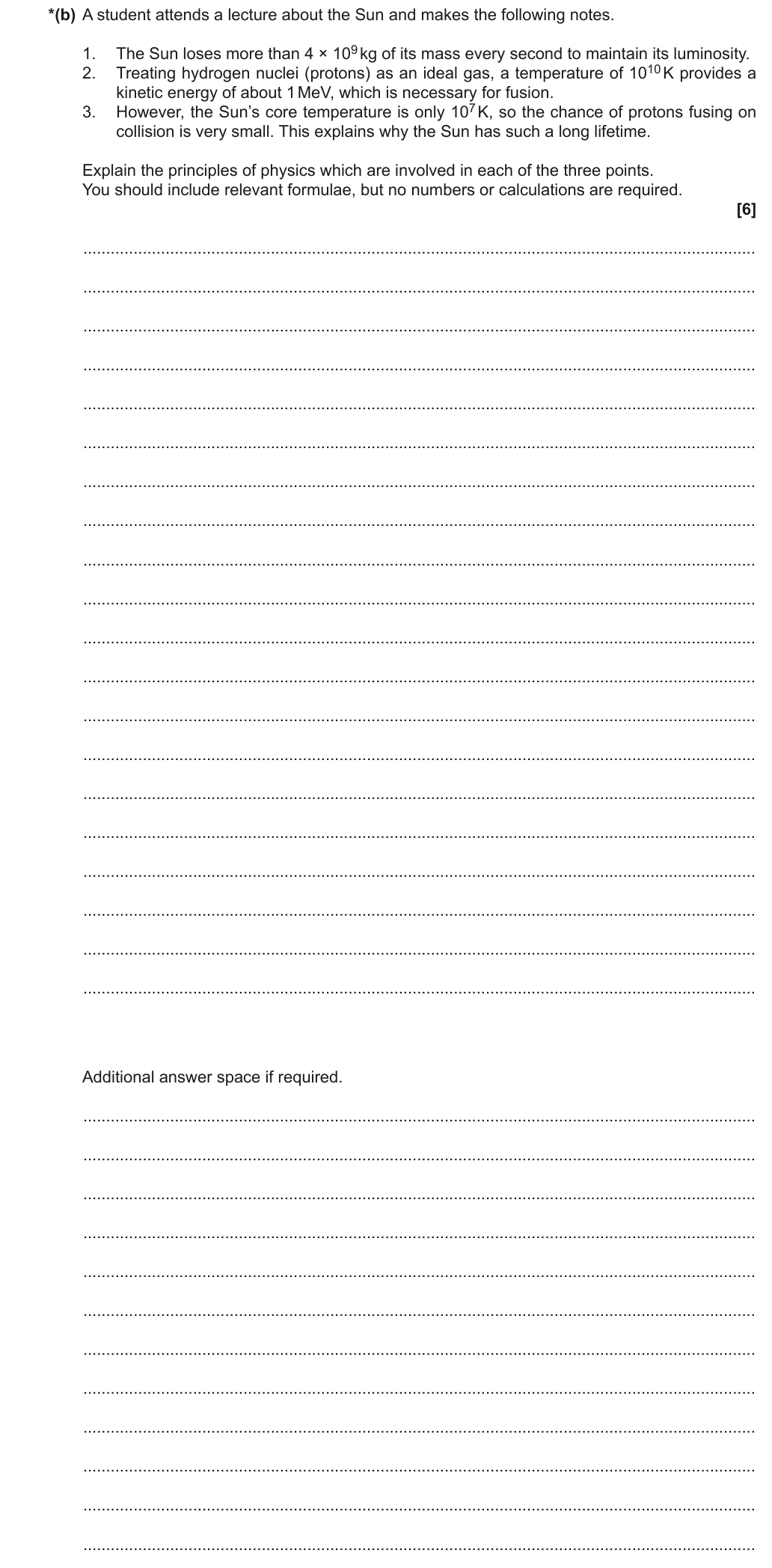
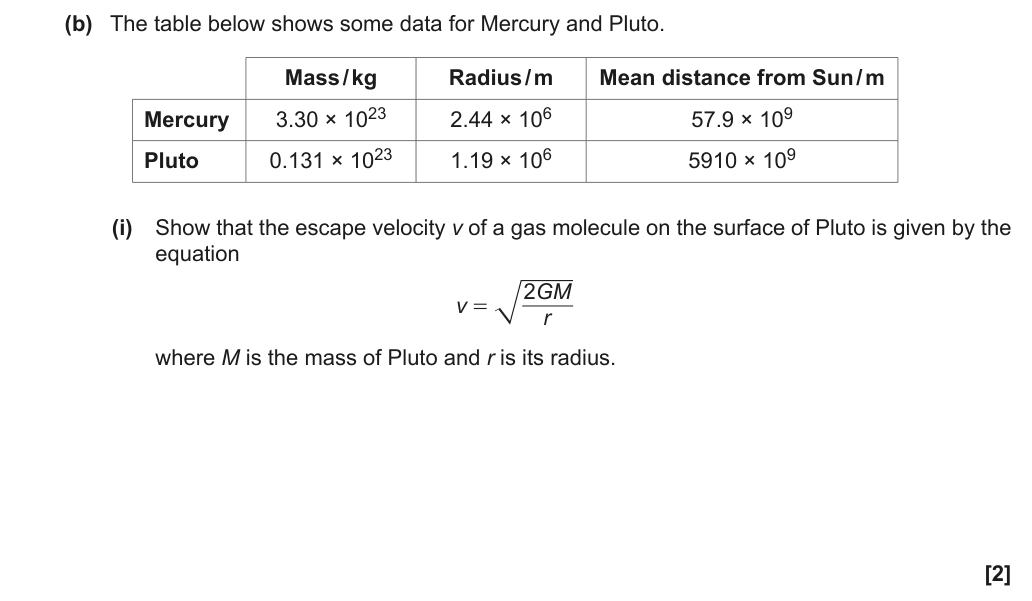
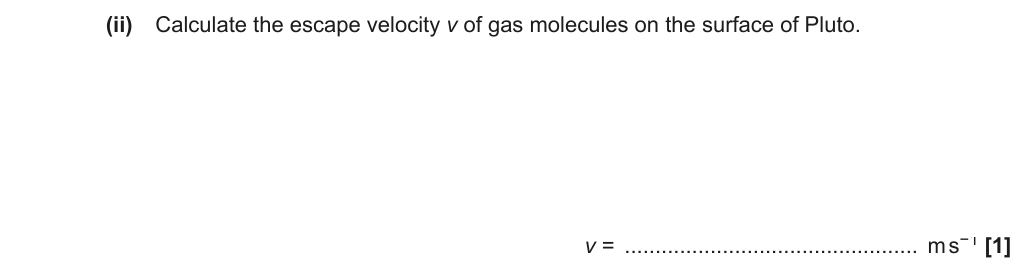
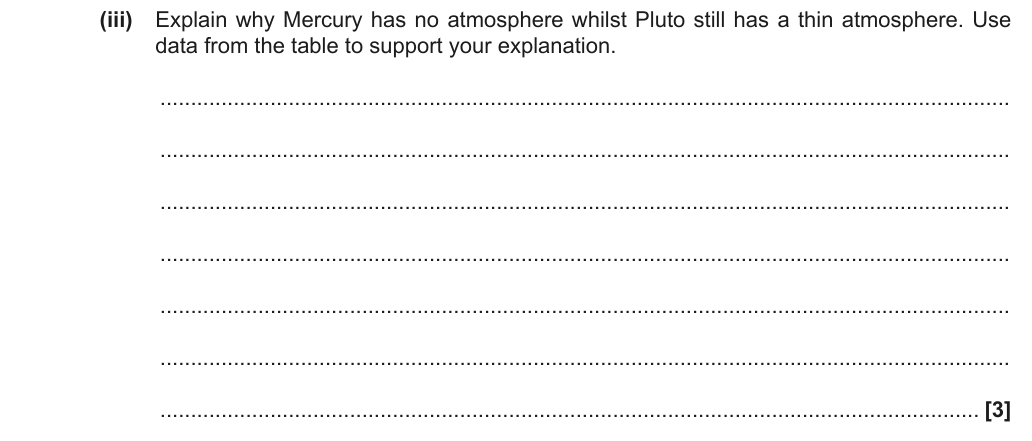
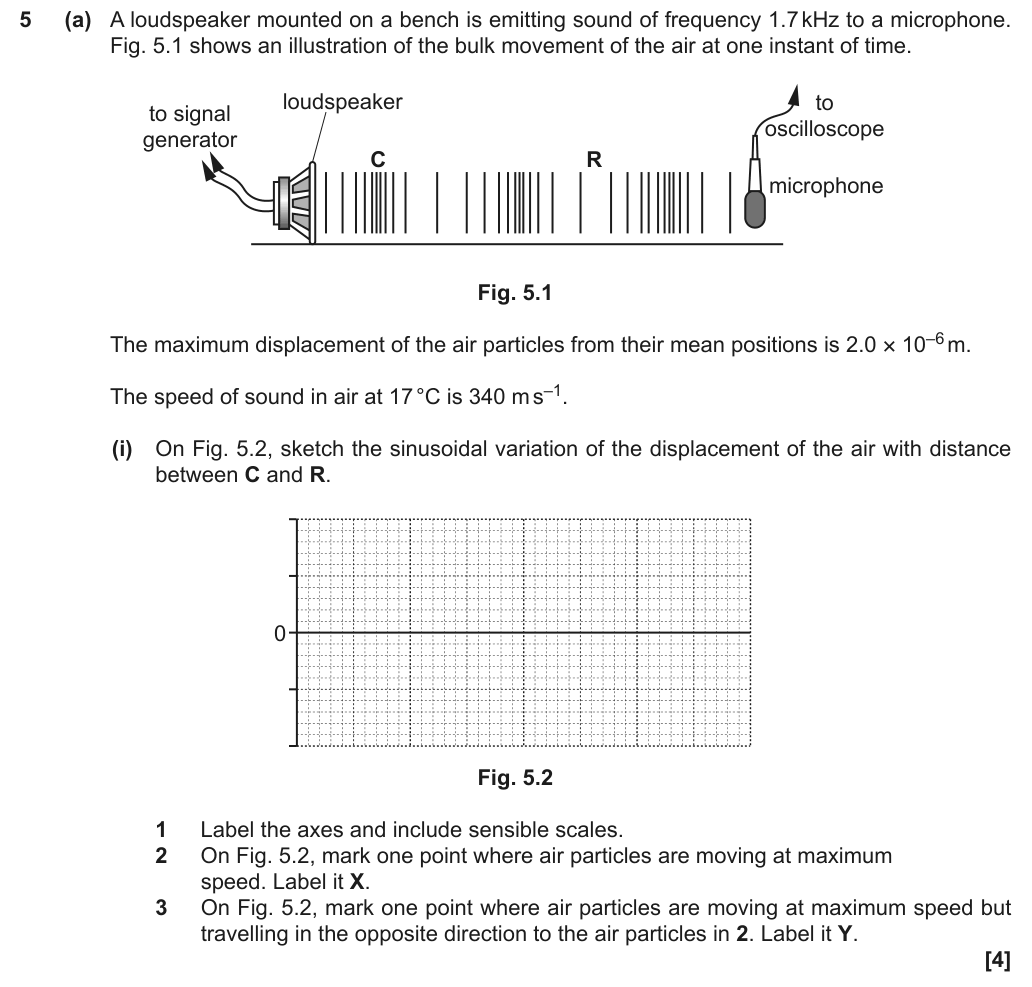
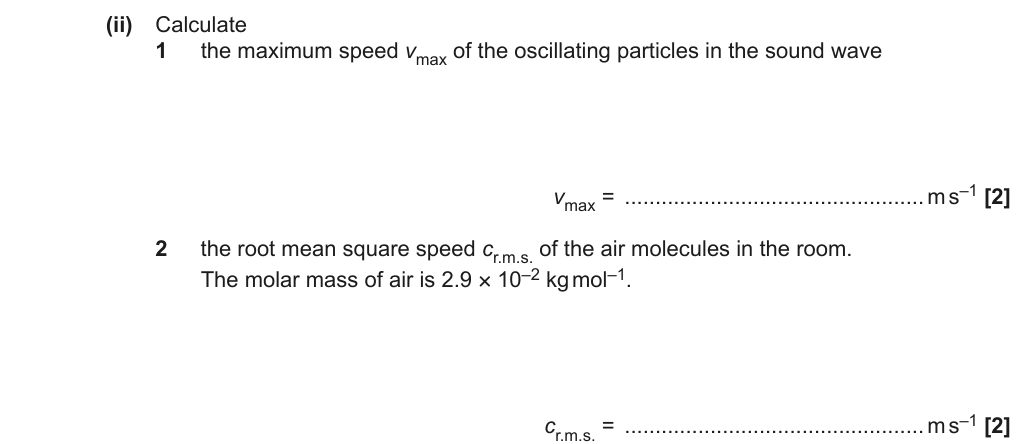
*(b) A student attends a lecture about the Sun and makes the following notes. Explain the principles of physics which are involved in each of the three points.
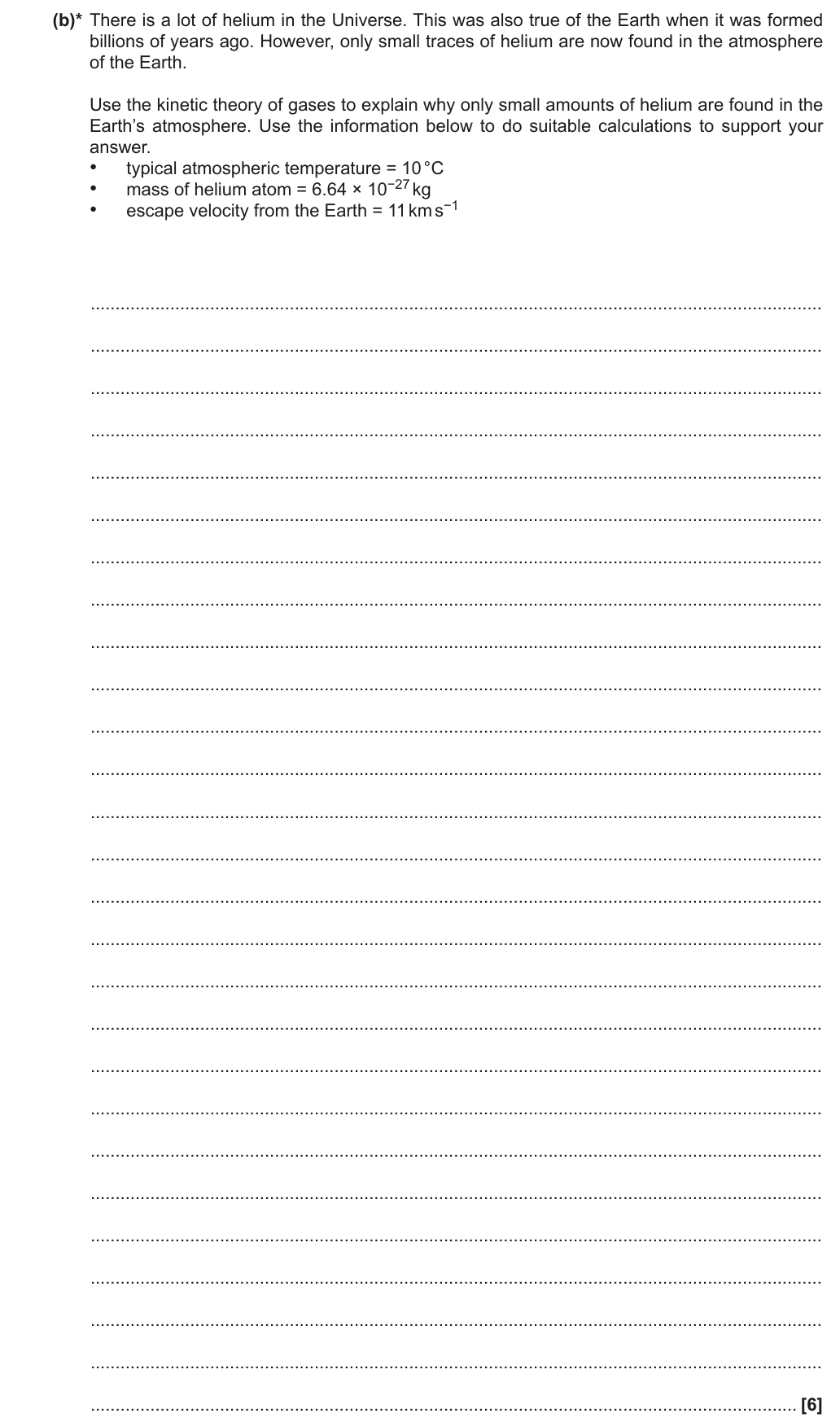
There is a lot of helium in the Universe. This was also true of the Earth when it was formed Use the kinetic theory of gases to explain why only small amounts of helium are found in the
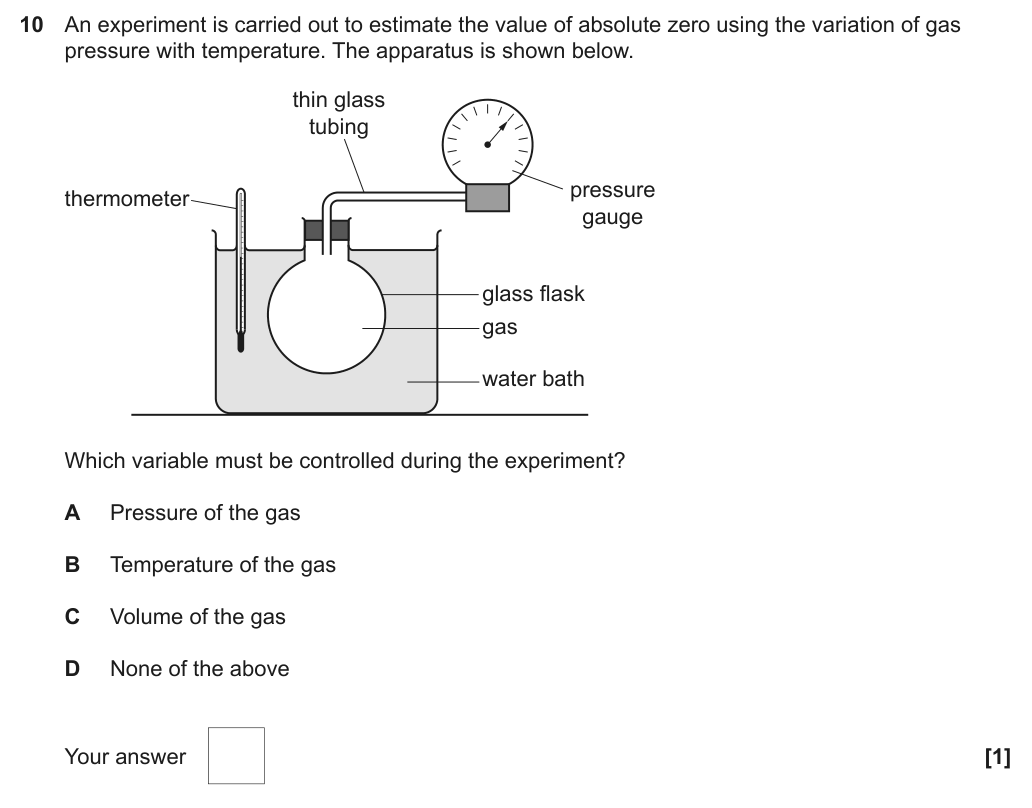
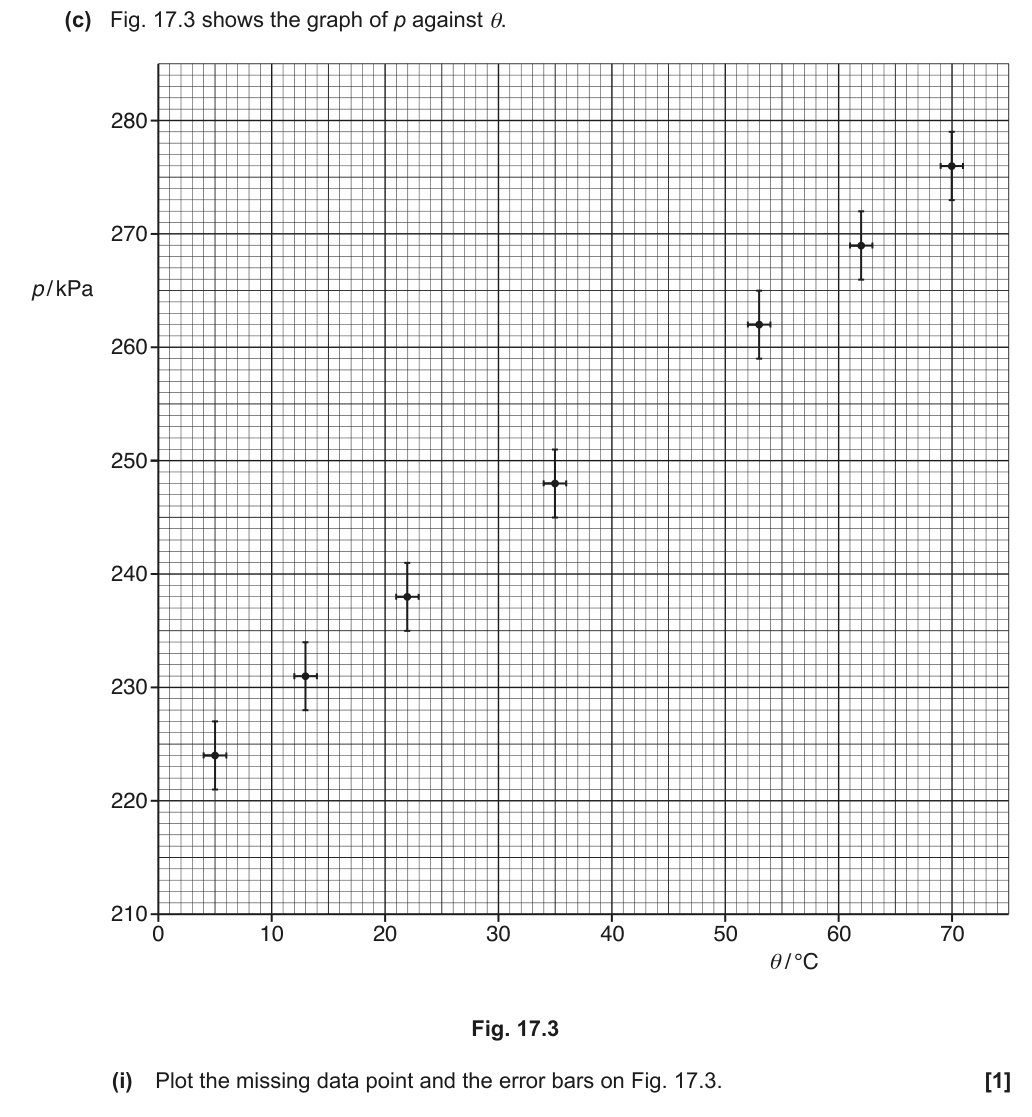
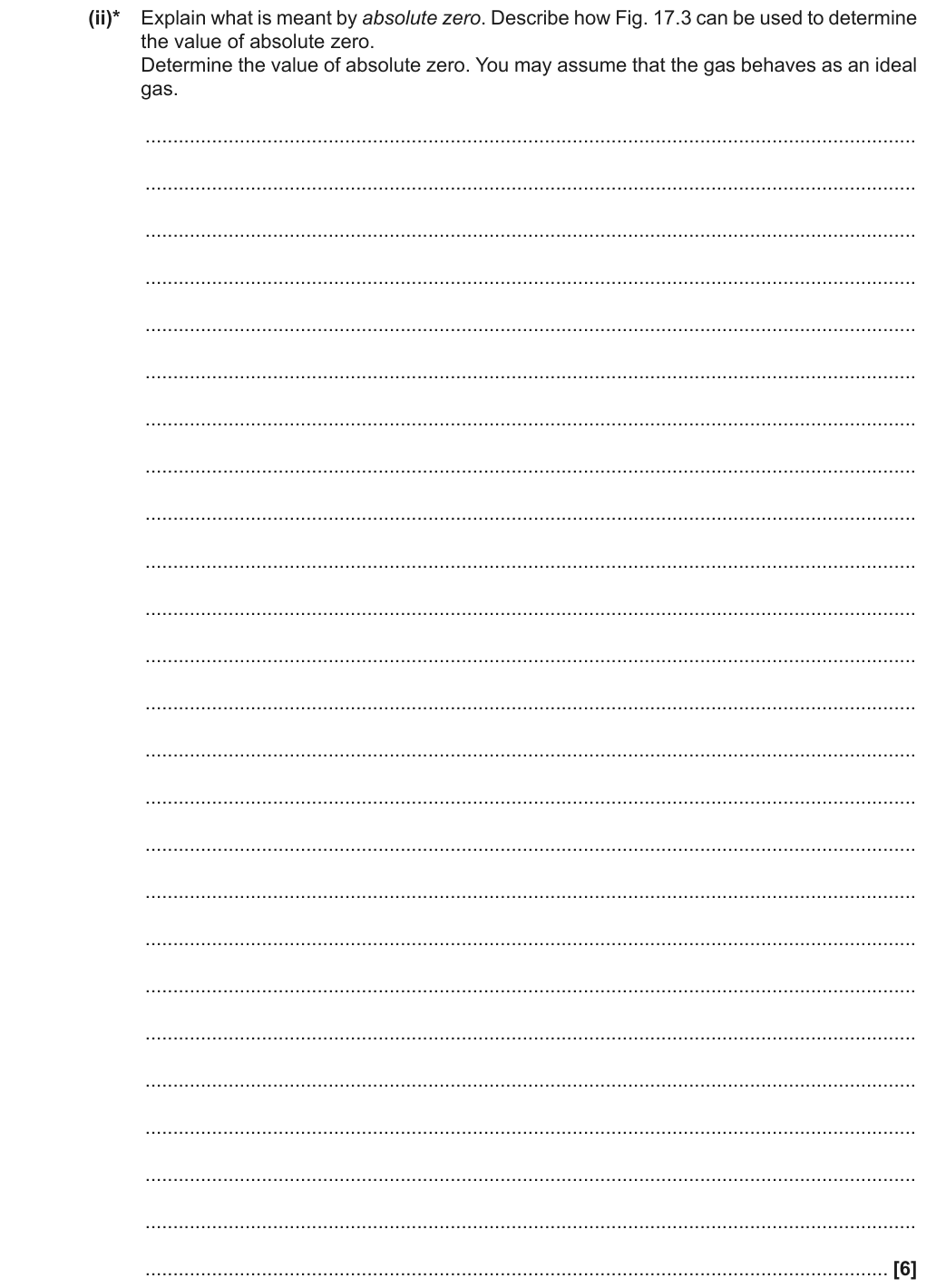
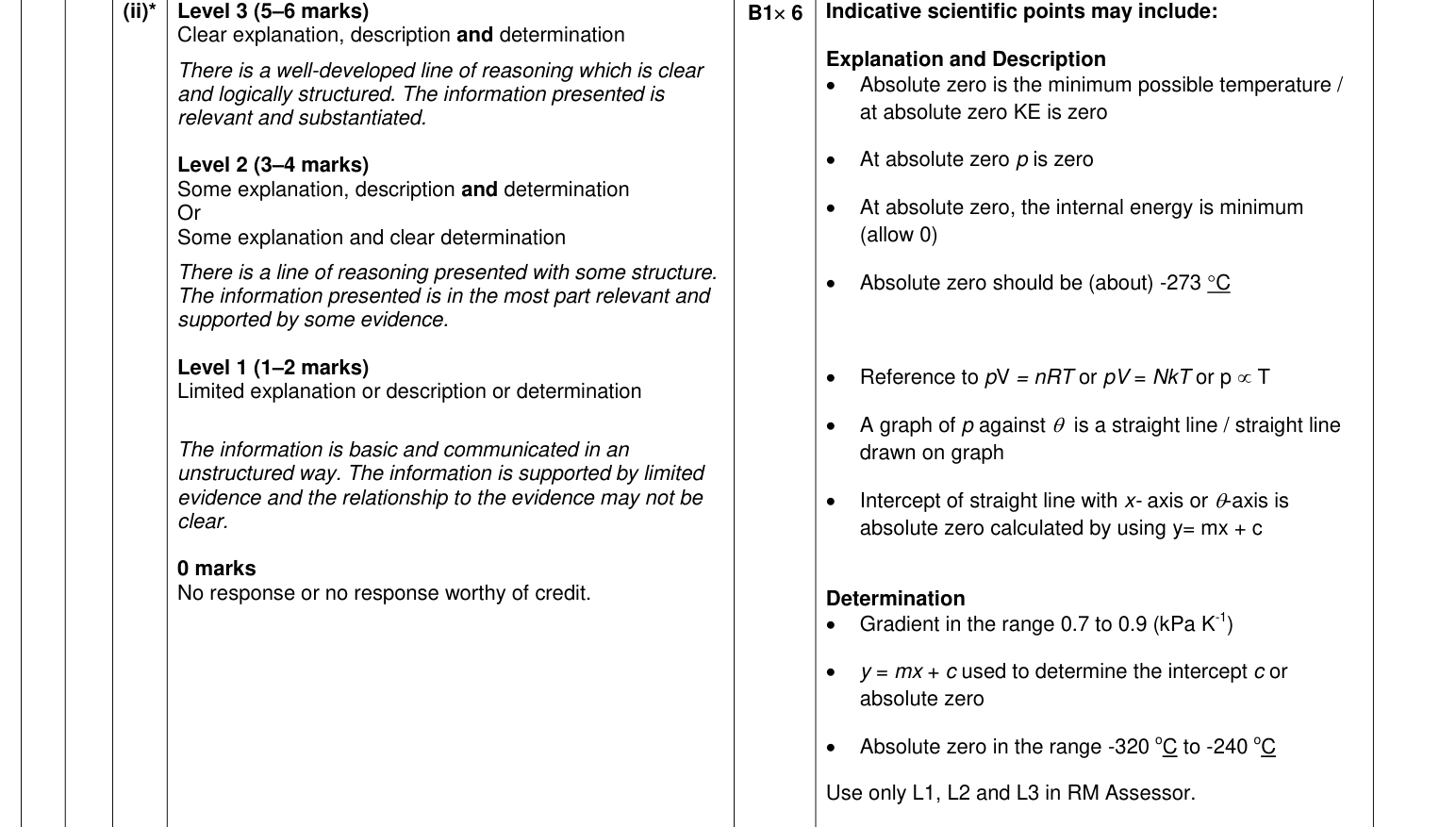
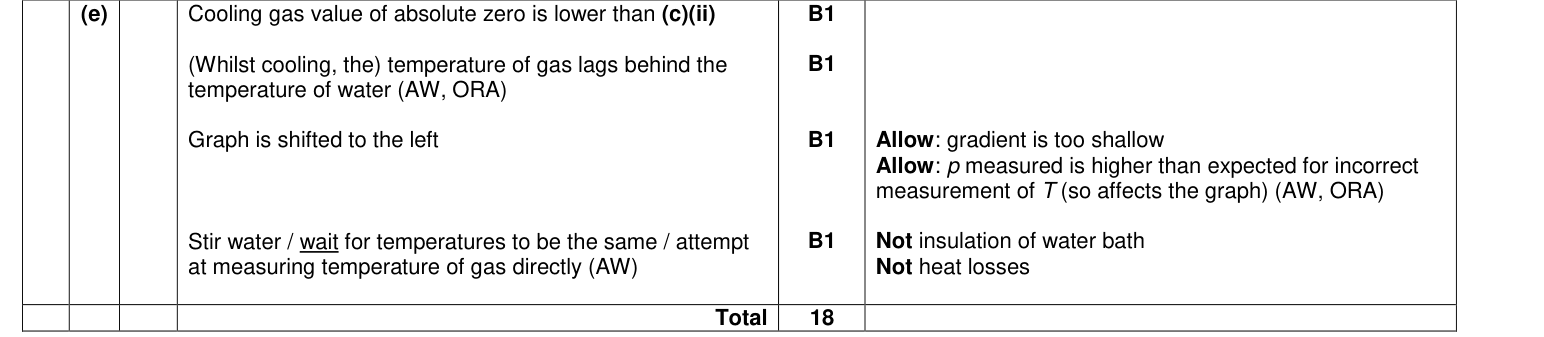
Explain what is meant by absolute zero. Describe how Fig. 17.3 can be used to determine Determine the value of absolute zero. You may assume that the gas behaves as an ideal
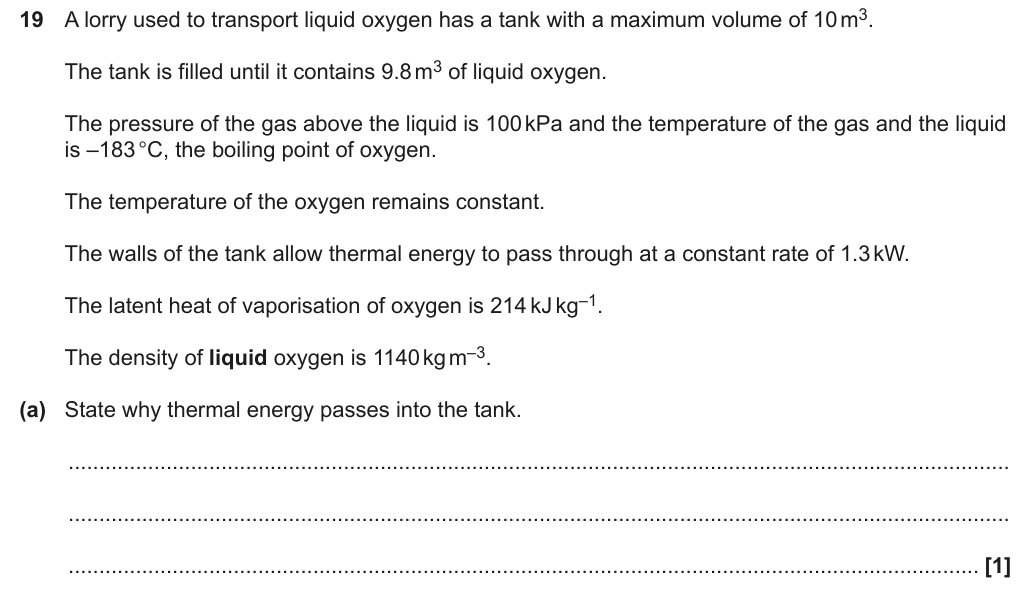
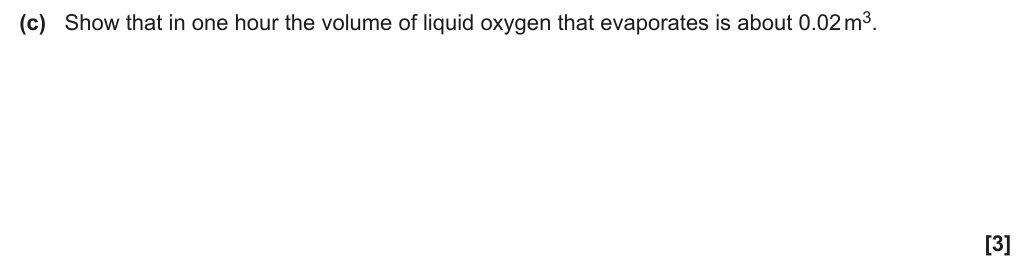
Tap a question to zoom it. Where a part needs a figure, table or graph from earlier in the question, that part folds out above it; the mark scheme and examiner's comment open underneath. Have the OCR Data, Formulae and Relationships Booklet beside you (see the data booklet page).
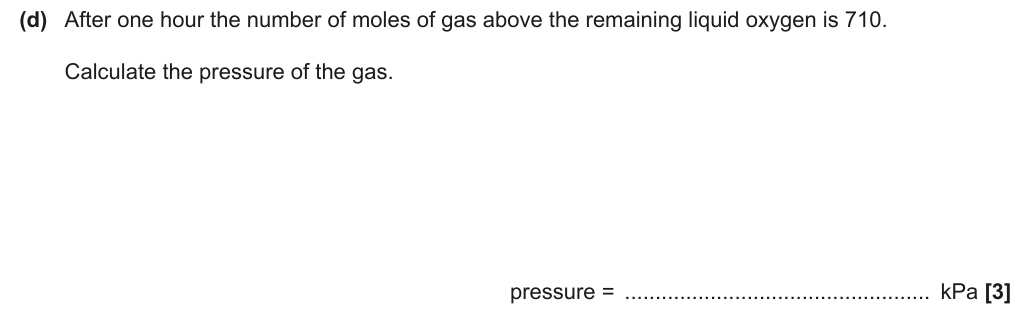
June 2025 · Paper 1 · Q19(d)3 marksCalculationEasy
Earlier parts of question 19 that this part uses
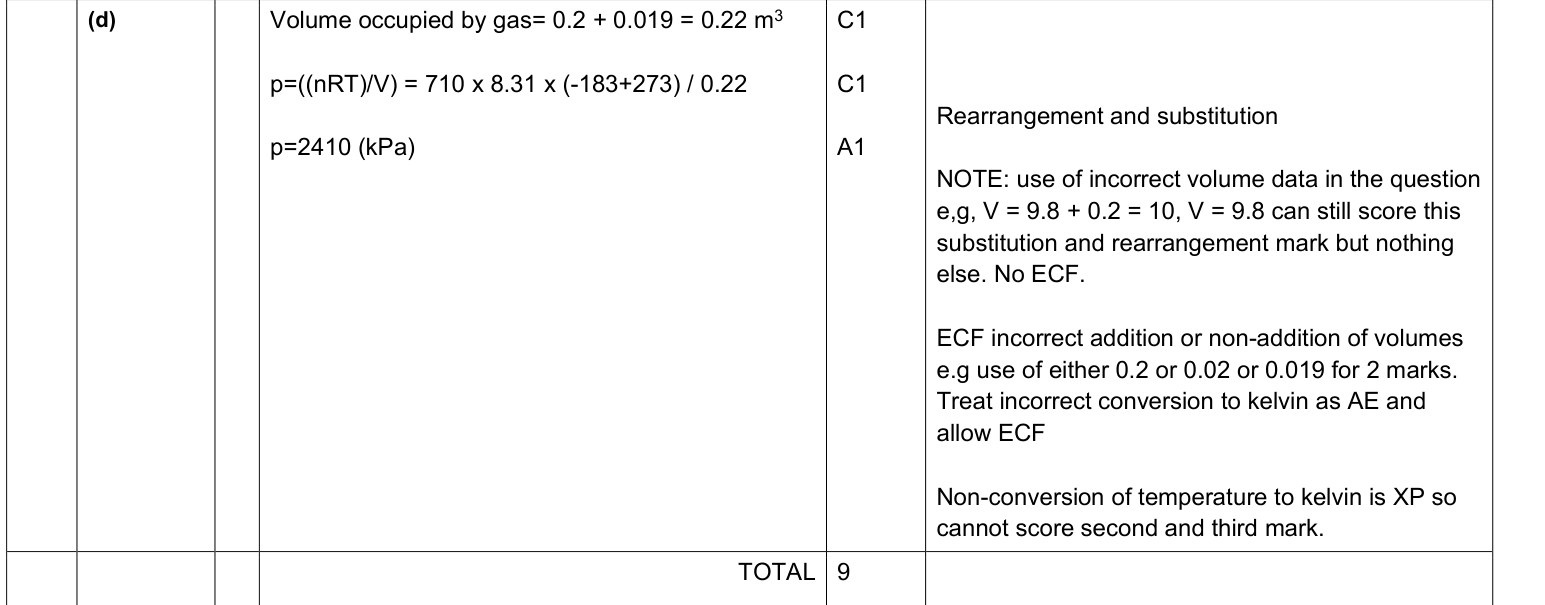
Mark scheme
Examiner's comment
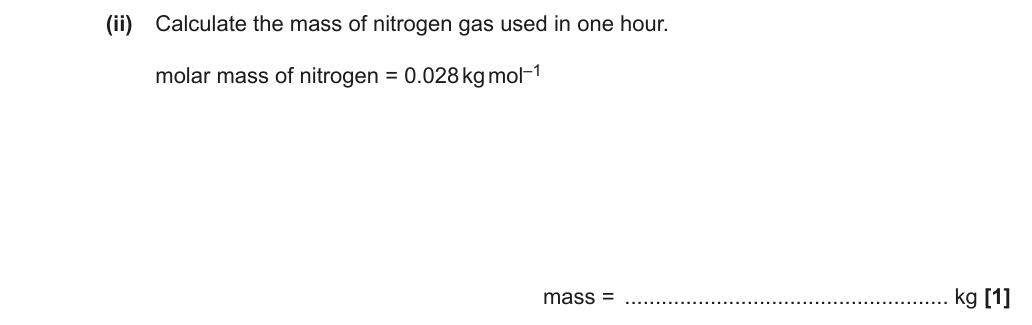
Candidates used a wide variety of volumes in the ideal gas equation to arrive at pressure values that were all broadly sensible. The correct volume was the original volume of the gas (0.2 m3) added to the volume of liquid oxygen that had evaporated after 1 hour (0.02 m3) giving a volume of 0.22 m3. There was still some credit available for volumes that were incorrect as shown in the mark scheme. Almost all candidates remembered to convert the temperature of the gas into kelvin and then rearrange the ideal gas equation correctly.
Notes from the mark scheme and report
gas volume = 0.2 + 0.019 m³
non-conversion to kelvin is wrong physics
wrong volume (0.2 or 0.02) can score 2
Skills: M0.1 Recognise and make use of appropriate units in calculations; M2.2 Change the subject of an equation, including non-linear equations; M2.3 Substitute numerical values into algebraic equations using appropriate units for physical quantities
June 2025 · Paper 1 · Q20(a)1 markShort answerMedium
Mark scheme
Examiner's comment
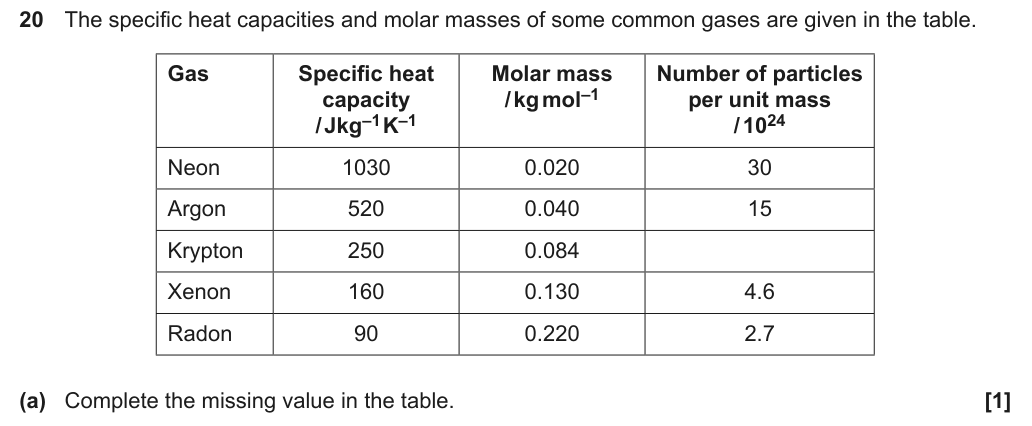
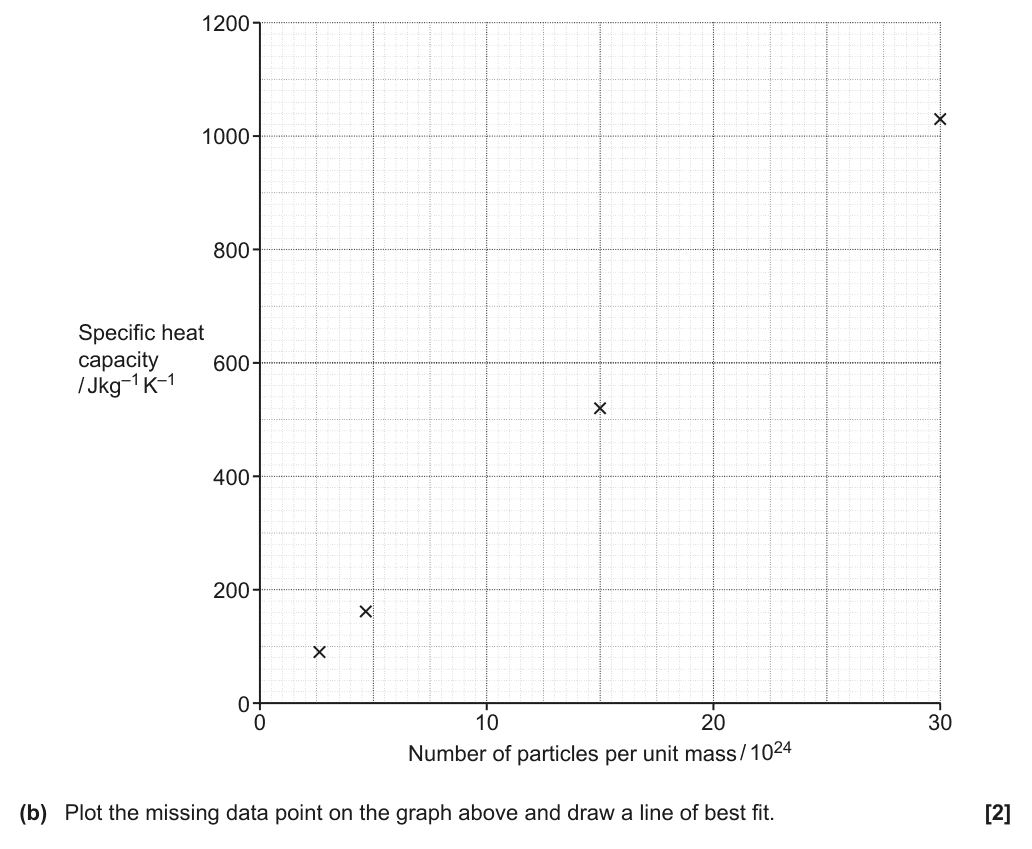
Most candidates recorded a correct value in the table. Question (20) (b) Most candidates plotted their data point correctly and drew a line of best fit that was consistent with the data. Some lines were incorrect as they did not have sufficient points either side of the line.
Notes from the mark scheme and report
2 sf answer required (7.1 or 7.2)
Skills: M0.2 Recognise and use expressions in decimal and standard form; M1.1 Use an appropriate number of significant figures
June 2025 · Paper 1 · Q20(c)4 marksExplanationMedium
Earlier parts of question 20 that this part uses
Mark scheme
Examiner's comment
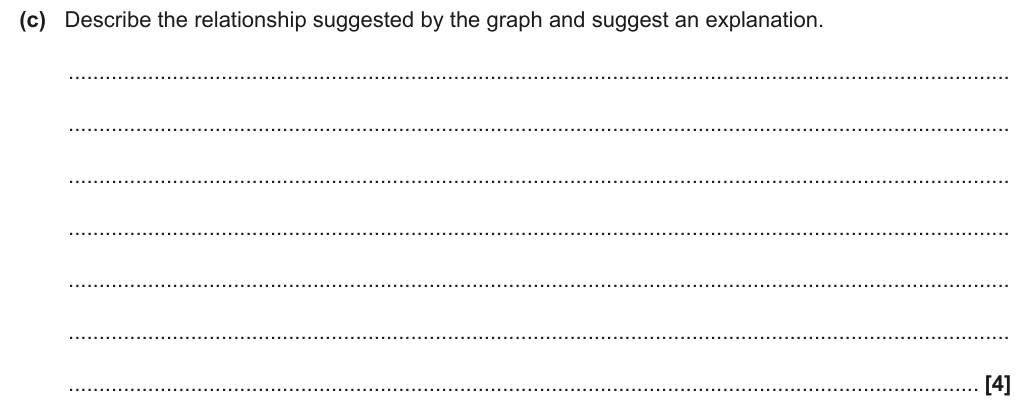
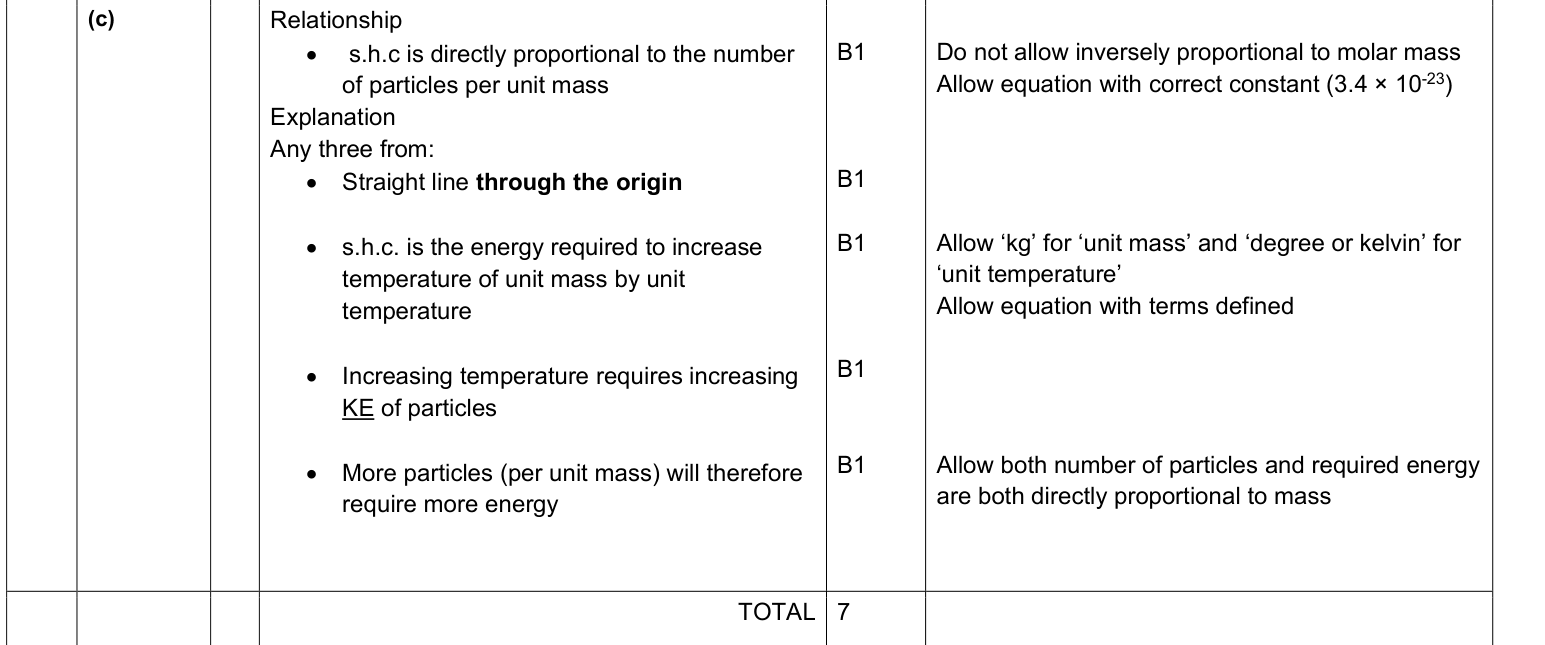
Candidates produced excellent answers here. Most scored two marks straight away by stating the directly proportional nature of the relationship and justifying that with a statement about a straight line of best fit passing through the origin. Although a small number of candidates incorrectly asserted that the mass of each of the particles would change depending on the number density, many correctly suggested that there was a link to the average kinetic energy of the particles.
Notes from the mark scheme and report
Do not allow inversely proportional to molar mass
directly proportional needs a straight line through the origin
Skills: M3.1 Translate information between graphical, numerical and algebraic forms; M3.3 Understand that y = mx + c represents a linear relationship
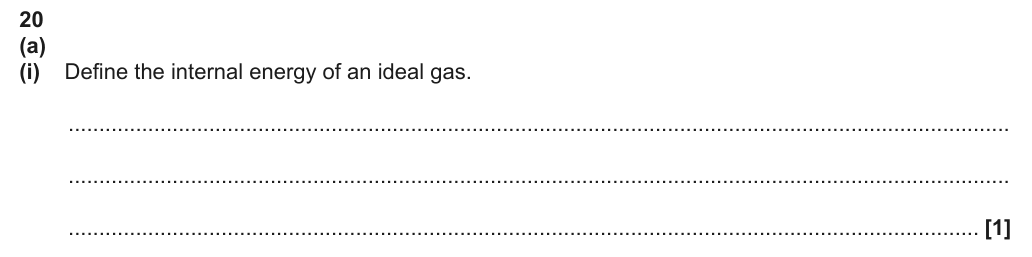
June 2024 · Paper 1 · Q20(a)(i)1 markShort answerEasy
Mark scheme
Examiner's comment
This definition did not trouble the vast majority of candidates, although some did forget to mention about particles. References to potential energy were ignored.
Notes from the mark scheme and report
ignore potential energy
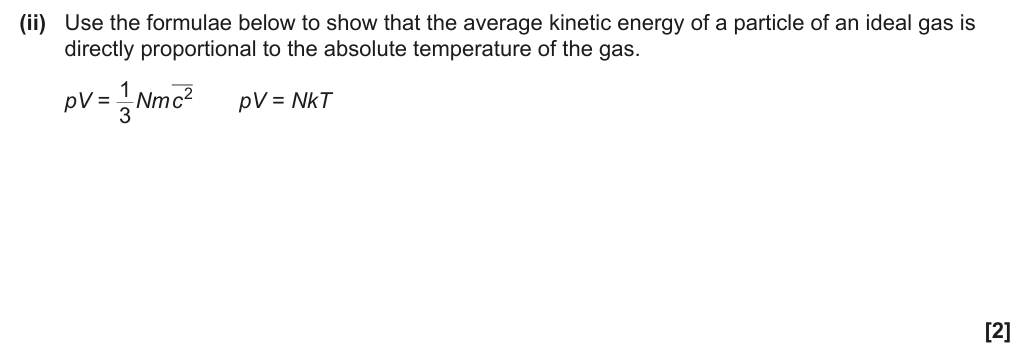
June 2024 · Paper 1 · Q20(a)(ii)2 marksShow thatEasy
Mark scheme
Examiner's comment
Almost all candidates that responded successfully equated the two expressions here. Many then went on to successfully manipulate the equation to give the familiar relationship given in the Mark Scheme and in the formula sheet.
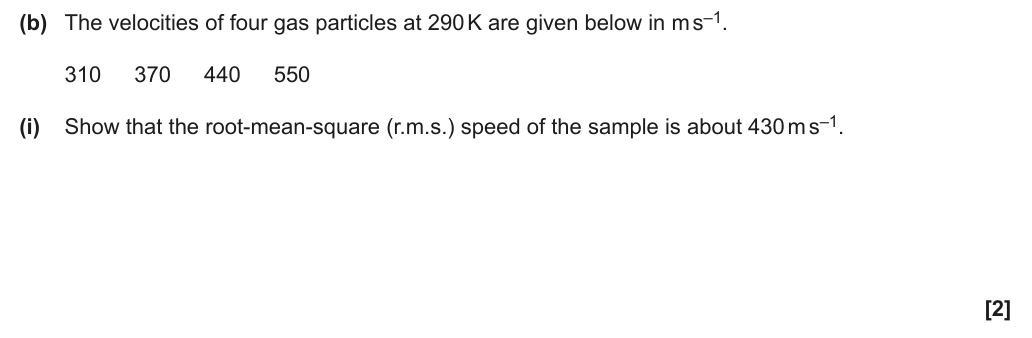
June 2024 · Paper 1 · Q20(b)(i)2 marksShow thatMedium
Mark scheme
Examiner's comment
Most candidates completed this item successfully by squaring each number, adding those four results, dividing that by four and square rooting as shown in the Mark Scheme. Those that did not either made a numerical slip or calculated the simple mean of the four numbers.
Notes from the mark scheme and report
arithmetic mean (418) scores zero
Skills: M0.5 Use calculators to find and use power, exponential and logarithmic functions; M1.2 Find arithmetic means
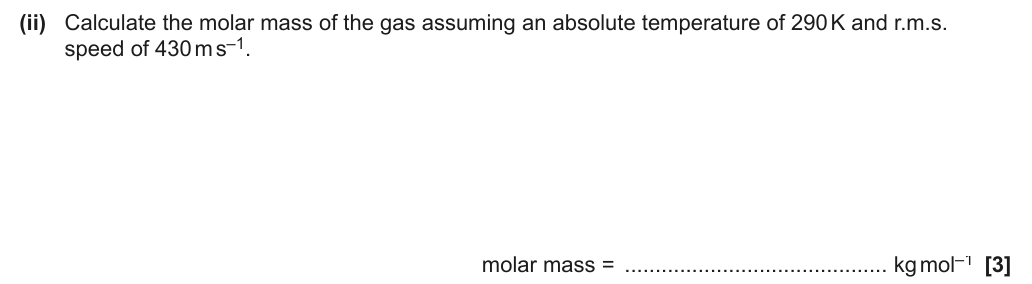
June 2024 · Paper 1 · Q20(b)(ii)3 marksCalculationHard
Mark scheme
Examiner's comment
This question proved rather more challenging than the 20(a)(ii), even though the formula was included in the formula booklet. The most common error was omitting the ‘square’ on the mean-squared-speed. The conversion from the mass of a single particle to the molar mass proved challenging. Quantities and units in Physics can be of either or mixed case. In this question, n, N, m and M are all valid quantities and can be muddled easily. Also, as a check, the mass of a mole of a substance in grams is equal to the relative formula mass, i.e. one mole of iodine-128 has a mass of 128 g or 0.128 kg.
Notes from the mark scheme and report
common error: omitting the square on the mean square speed
Skills: M2.2 Change the subject of an equation, including non-linear equations; M2.3 Substitute numerical values into algebraic equations using appropriate units for physical quantities
June 2024 · Paper 1 · Q20(c)(ii)2 marksCalculationMedium
Earlier part of question 20 that this part uses
Mark scheme
Examiner's comment
Most candidates used the directly proportional relationship of pressure to absolute temperature successfully here.
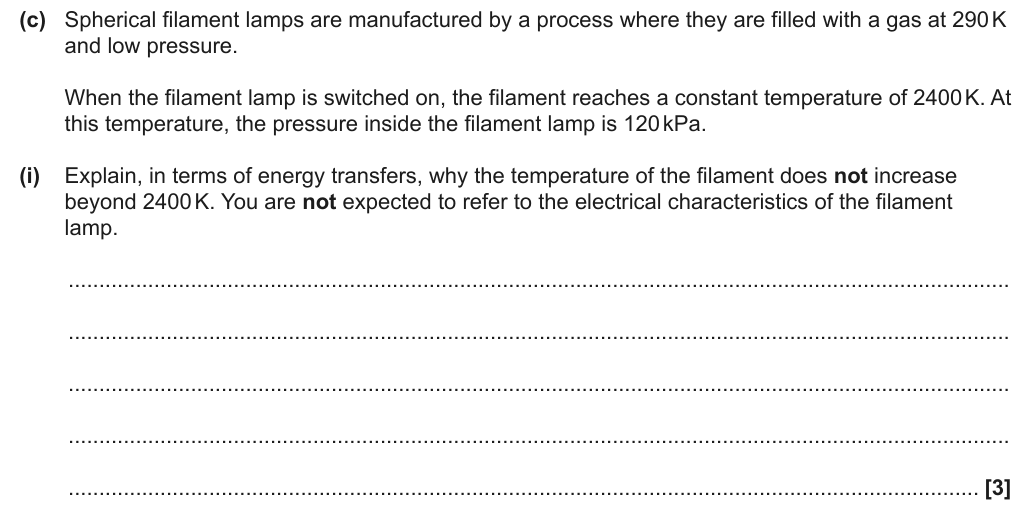
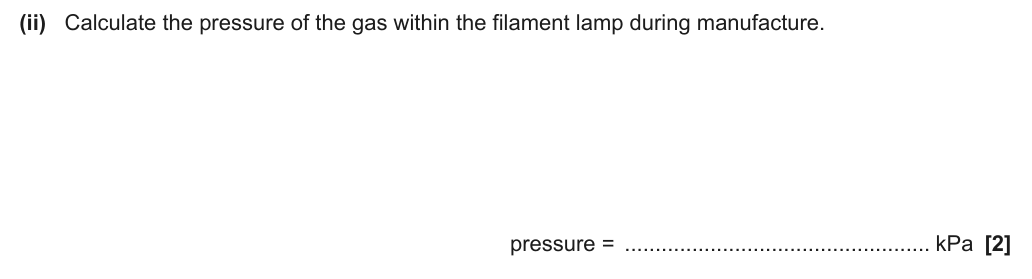
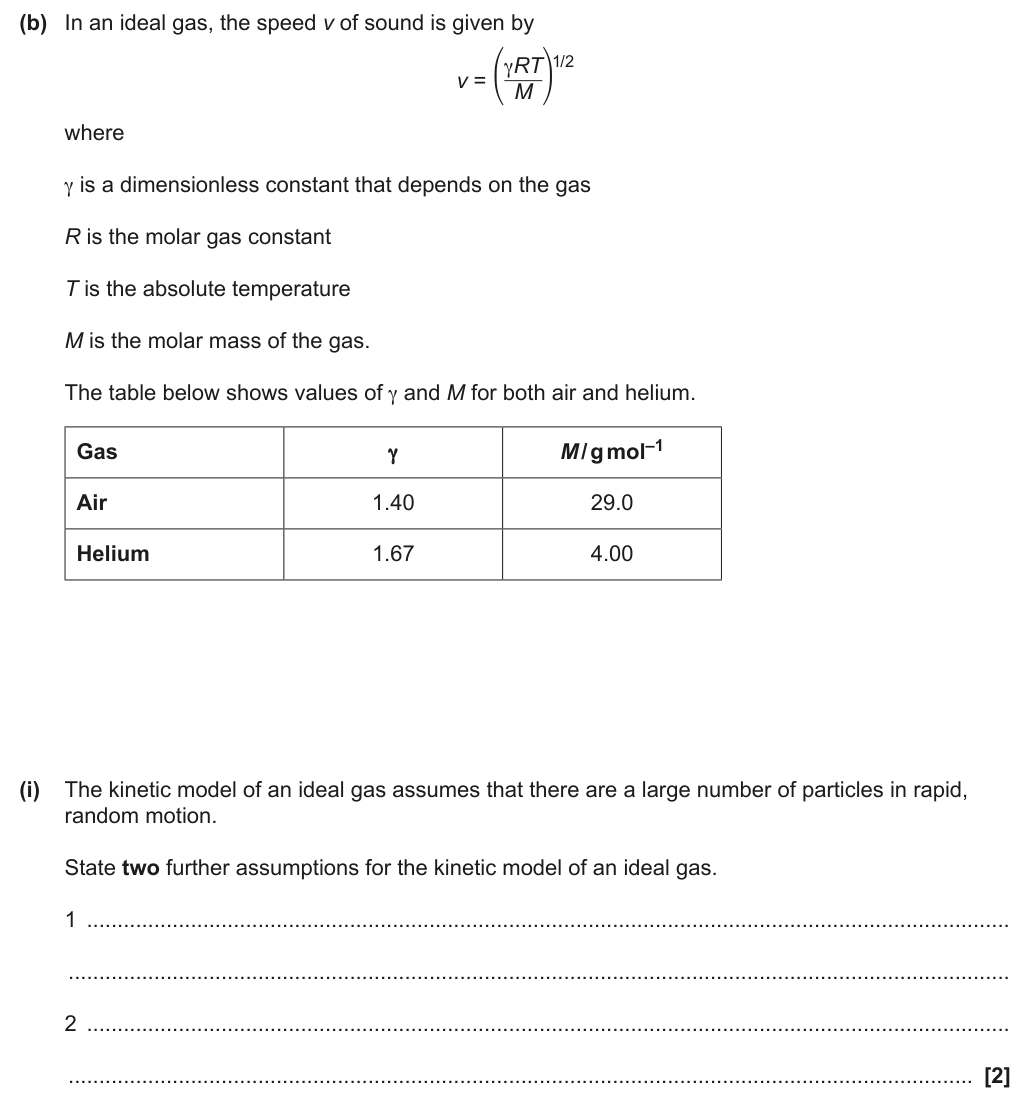
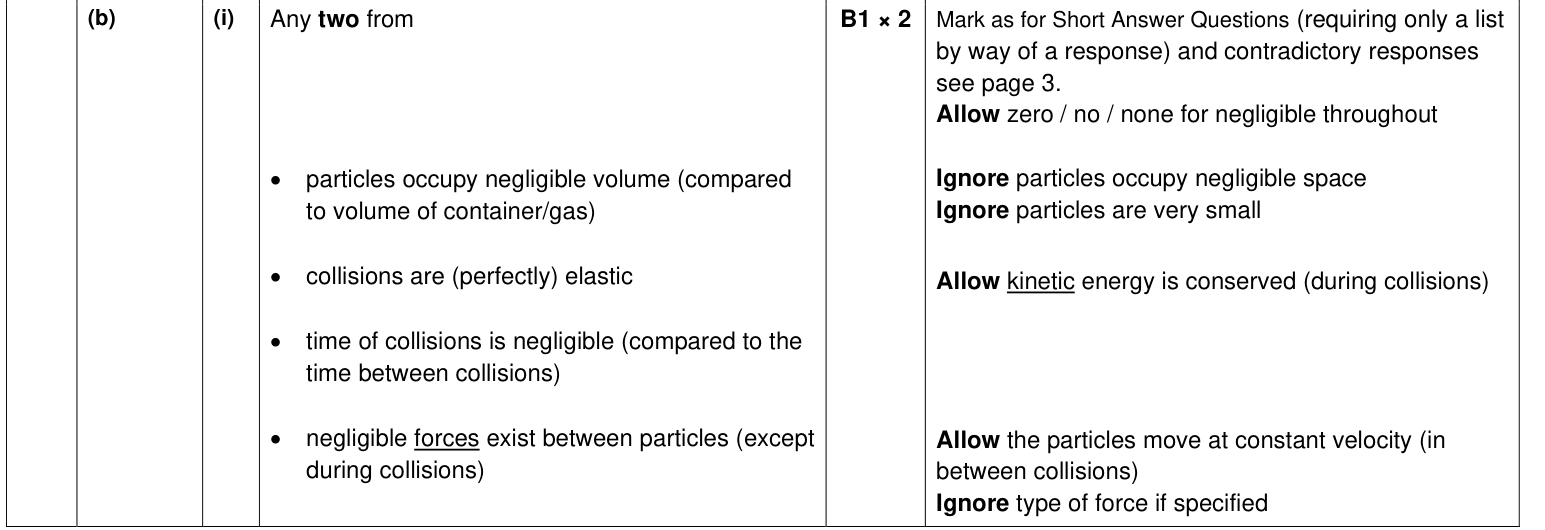
June 2024 · Paper 3 · Q1(b)(i)2 marksShort answerMedium
Mark scheme
Examiner's comment
Most candidates confidently wrote two correct assumptions. Errors most often came about through careless wording, such as ‘the time between collisions is negligible’ (rather than the time of collisions) or ‘the particles take up negligible space’ (rather than volume).
Notes from the mark scheme and report
ignore particles occupy negligible space / particles are very small
allow zero for negligible
June 2023 · Paper 1 · Q101 markMultiple choice
Answer
C
Mark scheme
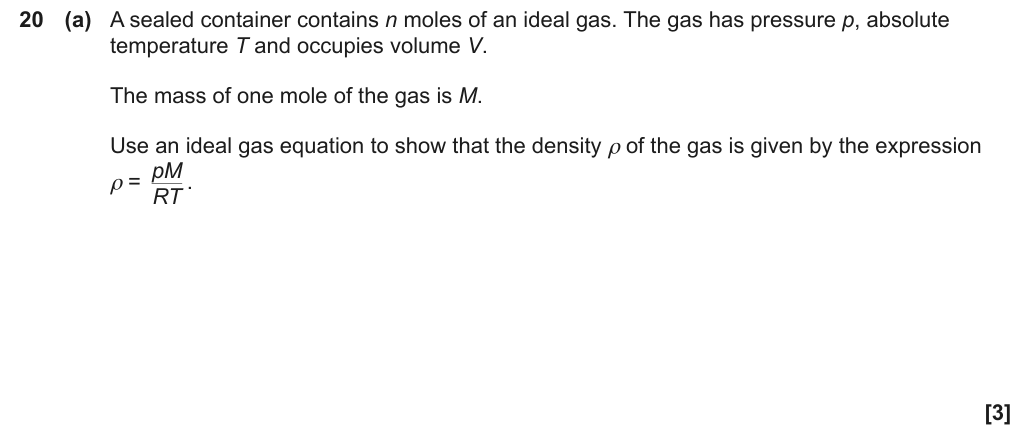
June 2023 · Paper 1 · Q20(a)3 marksShow thatMedium
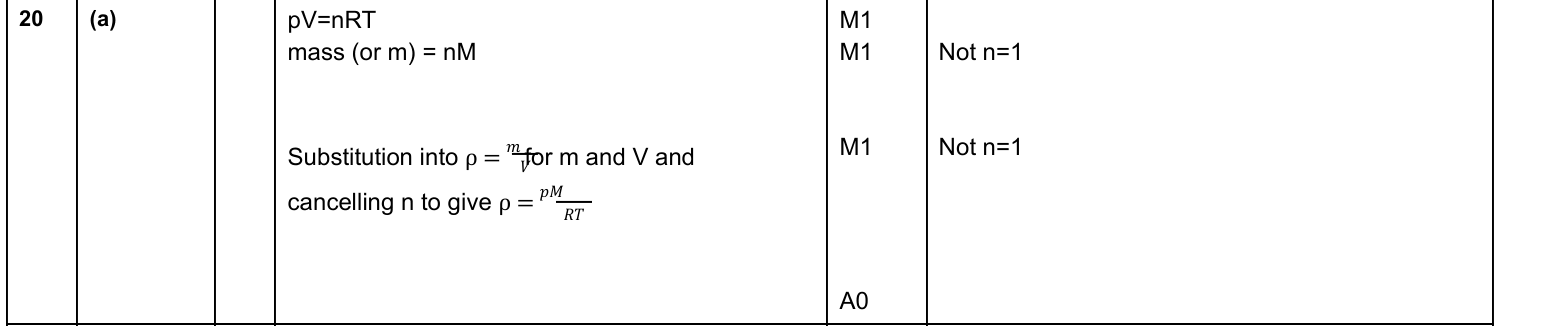
Mark scheme
Examiner's comment
Successful candidates correctly identified the starting point for this question as the ideal gas equation, pV = nRT. Many candidates took the approach that n = 1 which was not sufficient. A more sufficient proof used the idea that the total mass of the gas was n × M, allowing cancelling of the n in the ideal gas equation.
Notes from the mark scheme and report
Not n = 1
Skills: M2.2 Change the subject of an equation, including non-linear equations
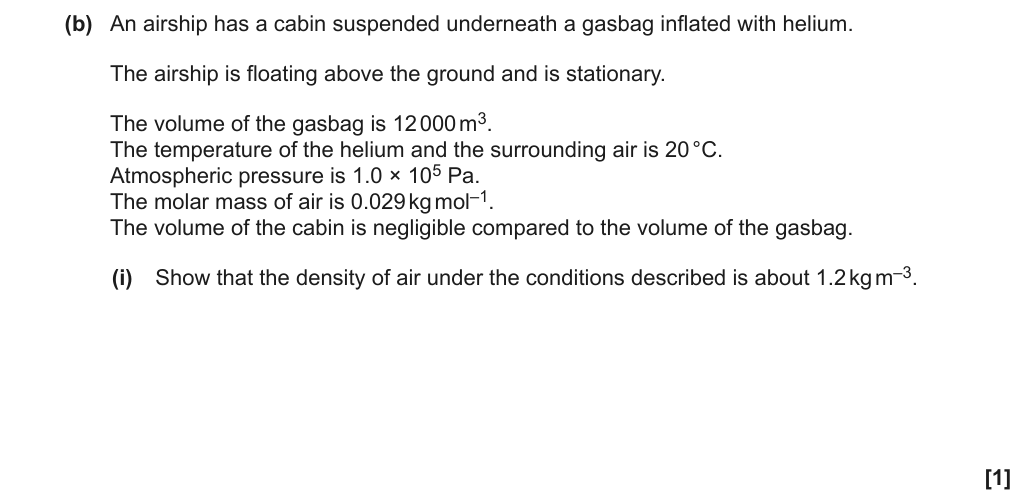
June 2023 · Paper 1 · Q20(b)(i)1 markShow thatEasy
Earlier part of question 20 that this part uses
Mark scheme
Examiner's comment
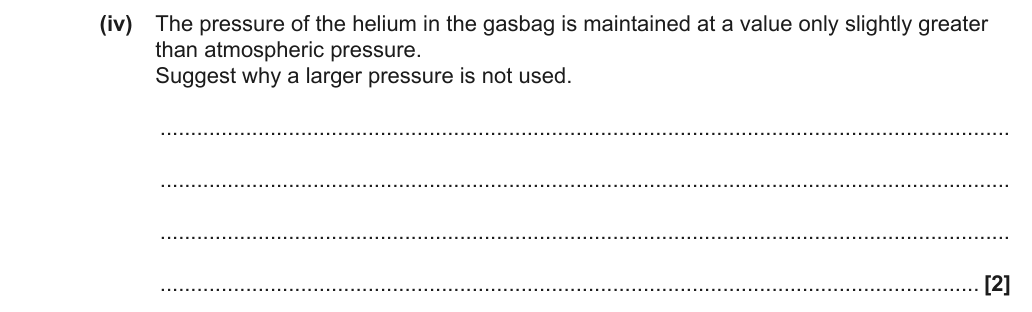
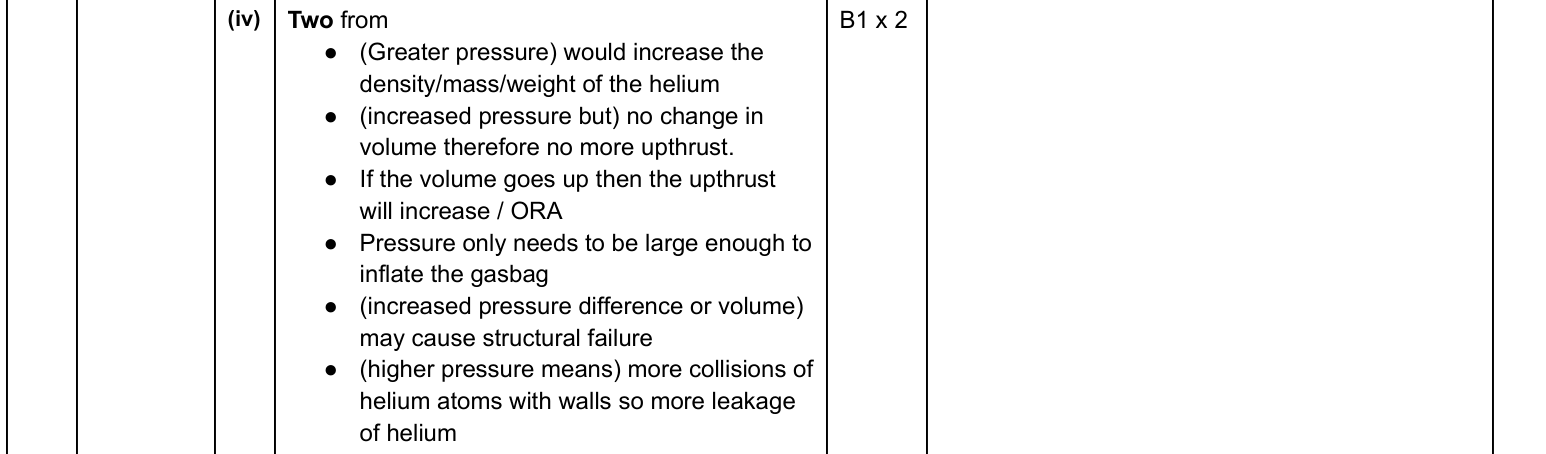
The vast majority of candidates correctly substituted values into the given formula, also remembering to convert the temperature from celsius into kelvin. Good practice for “show that” questions is to calculate the quantity required to at least one more significant figure in the question. In this example, that would mean evaluating the density to 1.19 kg m–3. In part (b) (ii), finding the weight was a matter of finding the mass and then finding the weight, all by using data in the question. Part (b) (iii) required understanding of Archimedes’ principle, rather than merely referring to it. Most candidates successfully related the principle to this context, writing about the upthrust being equal to the weight of fluid or air displaced by the gasbag. This is always true, regardless of the other forces that may be in play. References to displacement of water at this point were rejected. Fewer candidates completed the explanation by mentioning that the upthrust must be equal to the weight of the gas bag because we know that the gas bag is in equilibrium. Most candidates scored a mark in part (b) (iv) because they referred to some sort of structural failure if the pressure increased. Others delved a bit deeper, correctly stating that an increase in mass without an increase in volume (and hence upthrust) would cause the gas bag to sink.
Notes from the mark scheme and report
Reject 20 for T
Skills: M2.3 Substitute numerical values into algebraic equations using appropriate units for physical quantities
June 2023 · Paper 1 · Q20(b)(iv)2 marksExplanationEasy
Earlier part of question 20 that this part uses
Mark scheme
Examiner's comment
The vast majority of candidates correctly substituted values into the given formula, also remembering to convert the temperature from celsius into kelvin. Good practice for “show that” questions is to calculate the quantity required to at least one more significant figure in the question. In this example, that would mean evaluating the density to 1.19 kg m–3. In part (b) (ii), finding the weight was a matter of finding the mass and then finding the weight, all by using data in the question. Part (b) (iii) required understanding of Archimedes’ principle, rather than merely referring to it. Most candidates successfully related the principle to this context, writing about the upthrust being equal to the weight of fluid or air displaced by the gasbag. This is always true, regardless of the other forces that may be in play. References to displacement of water at this point were rejected. Fewer candidates completed the explanation by mentioning that the upthrust must be equal to the weight of the gas bag because we know that the gas bag is in equilibrium. Most candidates scored a mark in part (b) (iv) because they referred to some sort of structural failure if the pressure increased. Others delved a bit deeper, correctly stating that an increase in mass without an increase in volume (and hence upthrust) would cause the gas bag to sink.
June 2023 · Paper 1 · Q23(b)(i)2 marksShow thatMedium
Earlier part of question 23 that this part uses
Mark scheme
Examiner's comment
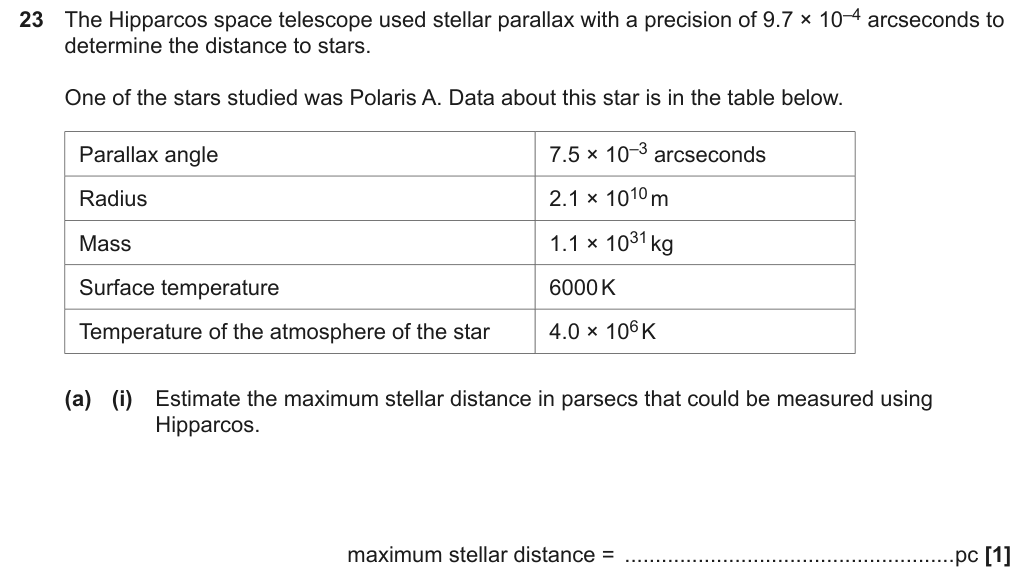
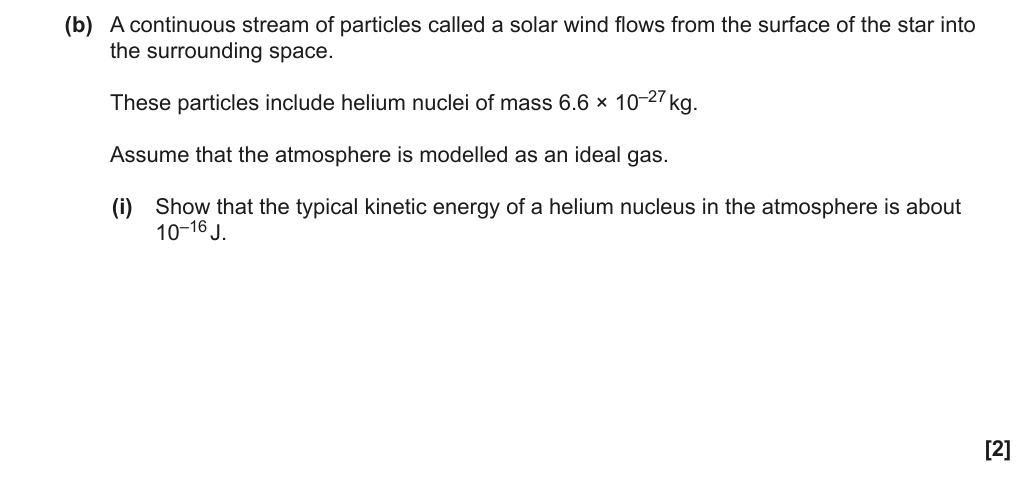
Question 23 (b) (i) Question 23 (b) (ii) Question 23 (b) (iii) Question 23 (b) (iv) Candidates answered Question 23 (b) (i) well, provided that they used the correct temperature i.e. that of the stellar atmosphere and not the surface temperature. Question 23 (b) (iv) has several acceptable responses yet the predominant correct candidate answers were that the solar wind particles might be lighter (i.e. hydrogen) or that the Maxwell-Boltzmann distribution of KE values in a gas of particles would mean that some particles would have greater than average KE.
June 2023 · Paper 1 · Q23(b)(iv)1 markExplanationMedium
Earlier parts of question 23 that this part uses
Mark scheme
Examiner's comment
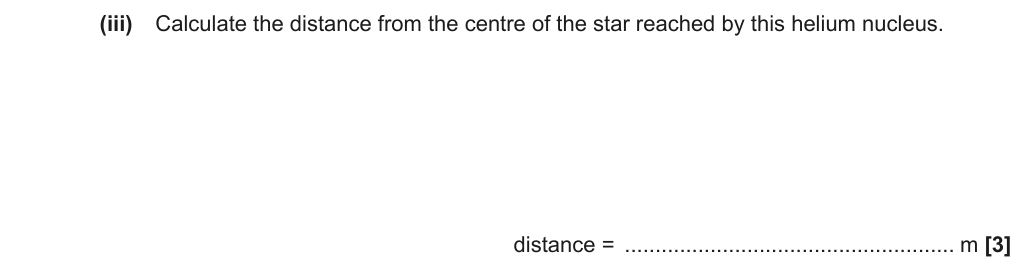
Candidates answered Question 23 (b) (i) well, provided that they used the correct temperature i.e. that of the stellar atmosphere and not the surface temperature. The helium nucleus in parts (b) (ii) and (b) (iii) has a KE of 10–16 J and a GPE of -2.3 × 10⁻¹⁶ J. This helium nucleus cannot therefore escape and so the GPE at the further possible point of the helium nucleus must be negative. The GPE at this furthest possible point is where the KE is zero and there has been a gain of 10–16 J of GPE, giving the GPE = –1.3 × 10⁻¹⁶ J, using the values in the question. Of course, we used the exact value calculated in part (b) (i) instead of 10–16 J, giving U = –1.5 × 10⁻¹⁶ J as the ‘correct’ answer. Question 23 (b) (iv) has several acceptable responses yet the predominant correct candidate answers were that the solar wind particles might be lighter (i.e. hydrogen) or that the Maxwell-Boltzmann distribution of KE values in a gas of particles would mean that some particles would have greater than average KE.
Notes from the mark scheme and report
reference to the (Maxwell-)Boltzmann distribution: some particles have greater kinetic energies
Usually in physics calculations, we use the calculator value all the way through the calculation. Any rounding should take place at the very end of the calculation.
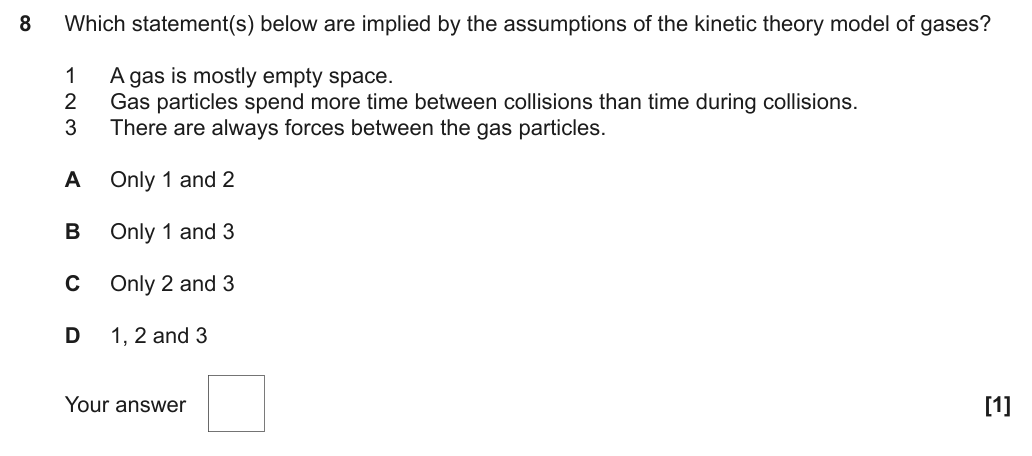
June 2022 · Paper 1 · Q81 markMultiple choiceMedium
Answer
A
Mark scheme
Examiner's comment
Three-quarters of all candidates could recall that statement three is not true, leaving only the first two statements to be implied by the assumption of the kinetic theory of gases.
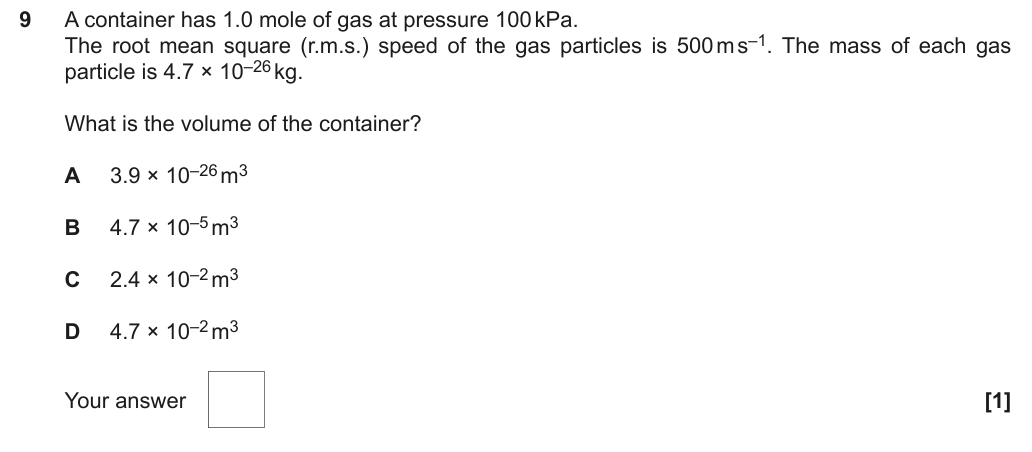
June 2022 · Paper 1 · Q91 markMultiple choiceMedium
Answer
C
Mark scheme
Examiner's comment
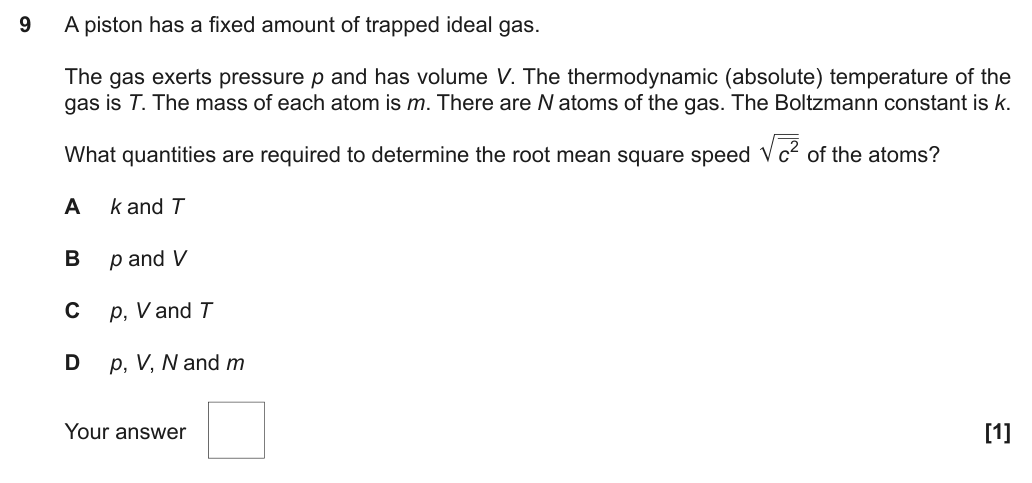
A sensible approach here is to use the equation p = 1/3 ρ c2 and ρ = M /V where M is the total mass of the gas. Given that there is 1.0 mole of gas, the total mass of gas is Avagadro’s number multiplied by the mass of each gas particle. By suitable rearrangement, the volume can be found.
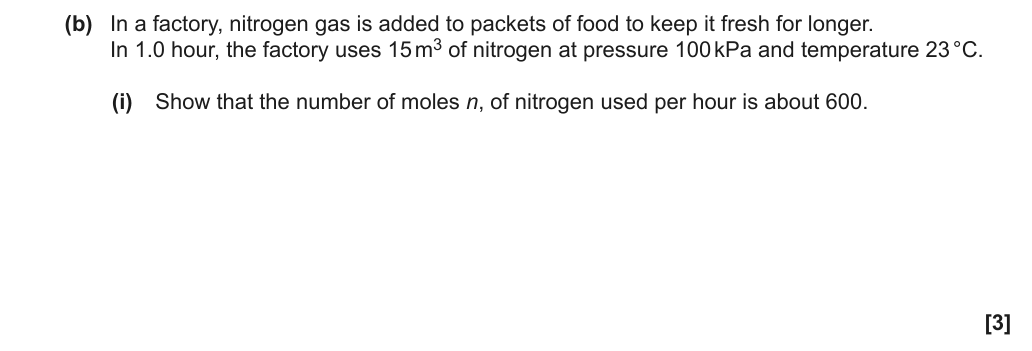
June 2022 · Paper 1 · Q19(b)(i)3 marksShow thatEasy
Mark scheme
Examiner's comment
Almost all candidates could show this well, by using the ideal gas equation carefully. Those that scored less than full marks often did so because they forgot to convert the temperature from Celsius to kelvin.
Notes from the mark scheme and report
7850 scores 1 mark (23 used instead of 296 K)
Skills: M0.1 Recognise and make use of appropriate units in calculations; M2.2 Change the subject of an equation, including non-linear equations; M2.3 Substitute numerical values into algebraic equations using appropriate units for physical quantities
June 2022 · Paper 1 · Q19(b)(ii)1 markCalculationEasy
Earlier part of question 19 that this part uses
Mark scheme
Examiner's comment
Question 19 (b) (i) Almost all candidates could show this well, by using the ideal gas equation carefully. Question 19 (b) (iii) This question asks the candidate to rearrange the ideal gas equation and think how to reduce the value for n. Question 19 (b) (iv) Most candidates calculated the energy loss for either the vapour to liquid change or the liquid to ice change for the water.
Notes from the mark scheme and report
ecf from (b)(i)
Skills: M2.3 Substitute numerical values into algebraic equations using appropriate units for physical quantities
June 2022 · Paper 1 · Q19(b)(iii)1 markShort answerMedium
Earlier part of question 19 that this part uses
Mark scheme
Examiner's comment
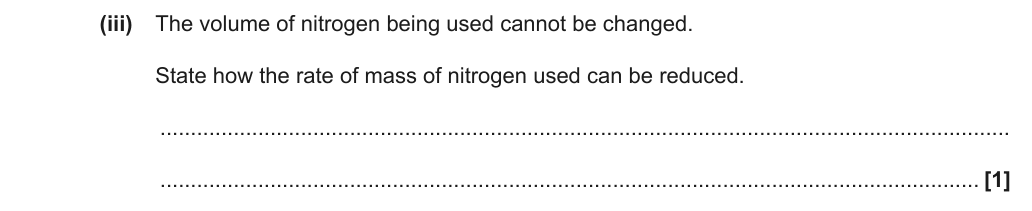
This question asks the candidate to rearrange the ideal gas equation and think how to reduce the value for n. If V is constant, the only two ways of reducing the expression pV/T is to either reduce the pressure or increase the temperature.
Notes from the mark scheme and report
reduce the pressure or increase the temperature
June 2022 · Paper 1 · Q21(b)(ii)3 marksCalculationHard
Earlier part of question 21 that this part uses
Mark scheme
Examiner's comment
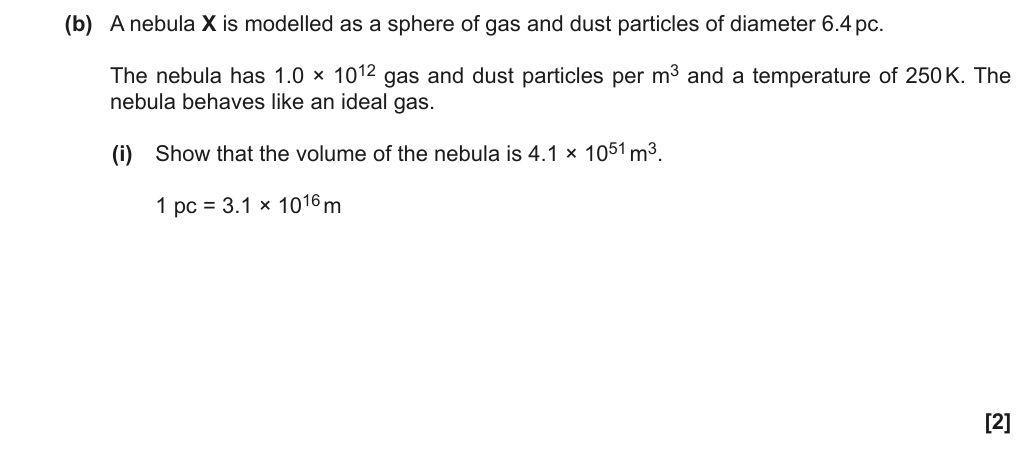
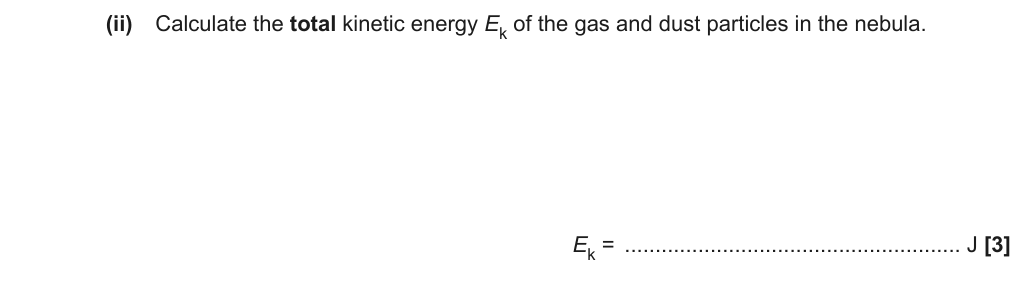
This brief yet multi-stage question proved relatively challenging. The correct approach here was to find the average kinetic energy of a single particle (using Ek = 3/2 kT ) and then multiplying this by the number of particles in the nebula. The number of particles in the nebula was found by multiplying the number density by the volume of the nebula.
November 2021 · Paper 1 · Q91 markMultiple choice
Answer
D
Mark scheme
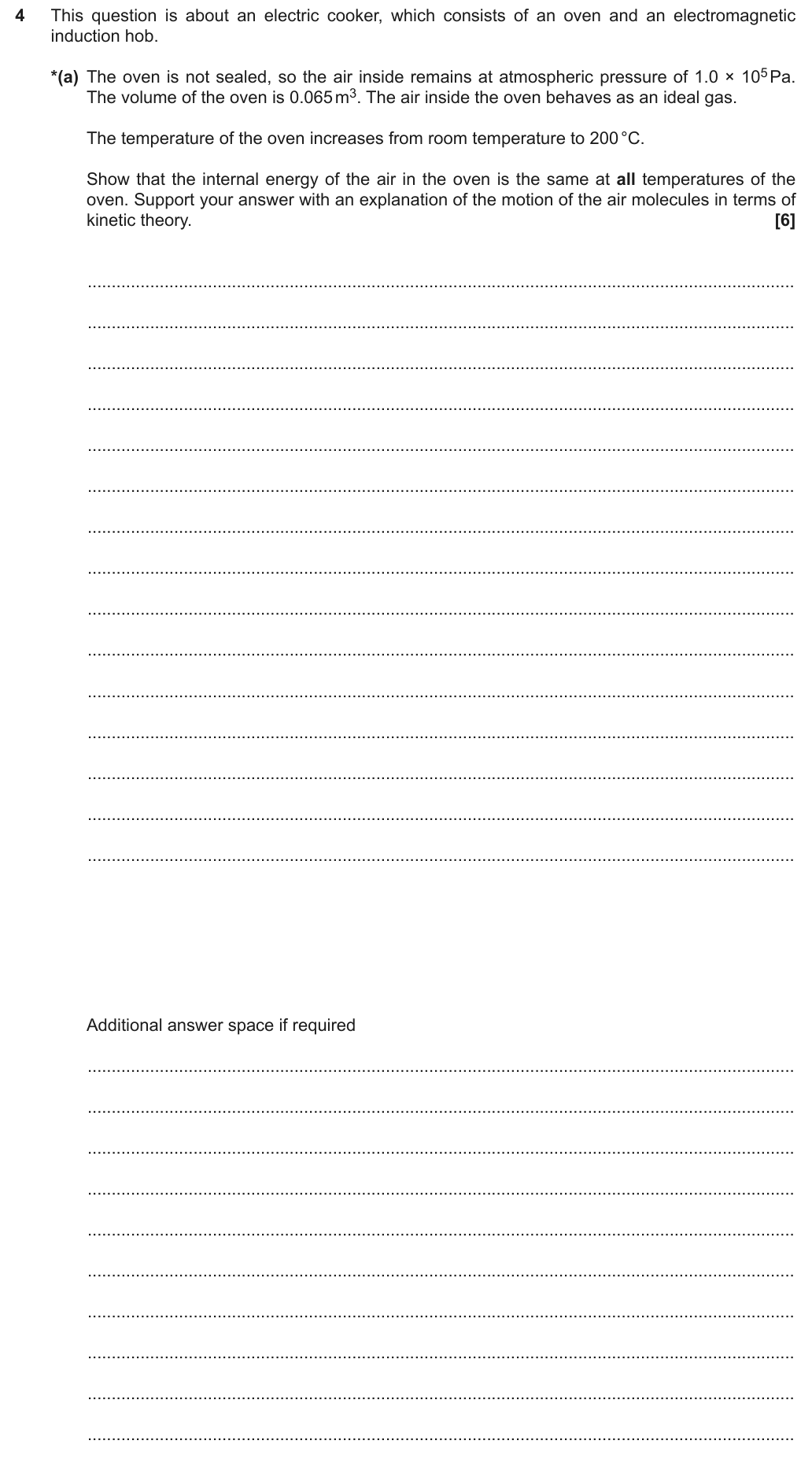
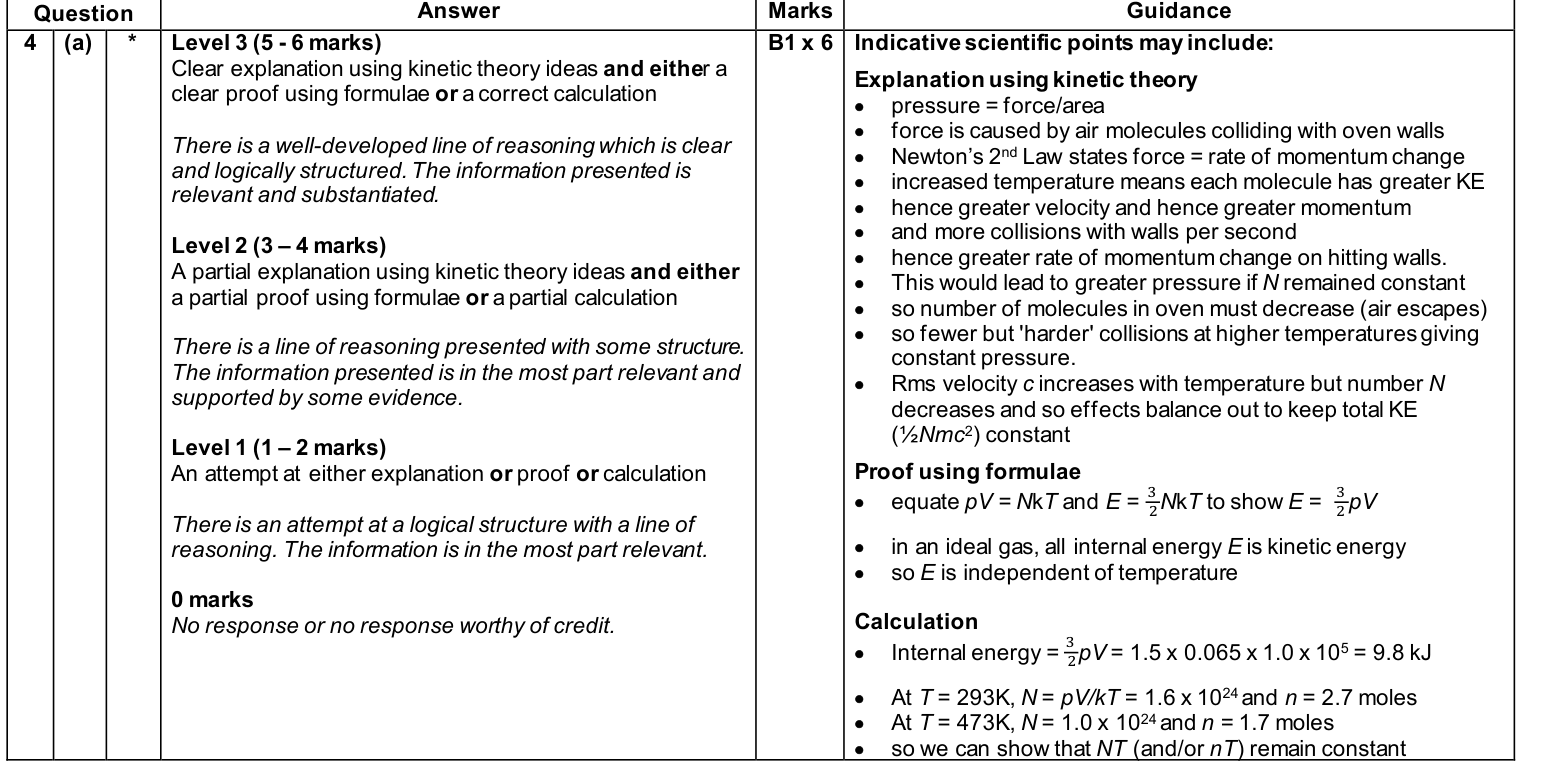
November 2021 · Paper 3 · Q4(a)6 marks6-mark extended response
Mark scheme, with the levels and indicative content
Notes from the mark scheme and report
E = (3/2)NkT and pV = NkT give E = (3/2)pV = 9.8 kJ, independent of T
number of molecules falls as air escapes (NT constant)
needs kinetic theory explanation plus proof or calculation
Skills: M2.2 Change the subject of an equation, including non-linear equations; M2.3 Substitute numerical values into algebraic equations using appropriate units for physical quantities
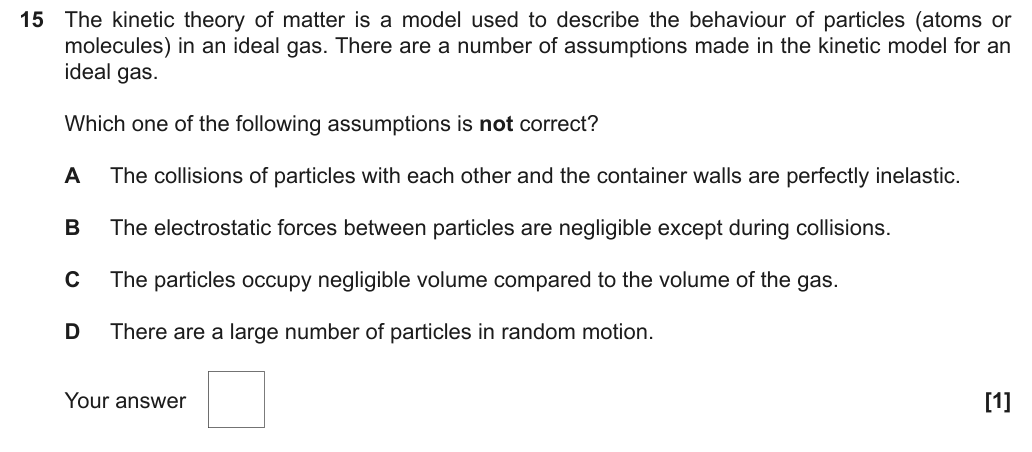
November 2020 · Paper 1 · Q151 markMultiple choiceEasy
Answer
A
Mark scheme
Examiner's comment
Candidates found Question 1, Question 2 and Question 15 very straightforward.
November 2020 · Paper 1 · Q21(a)(i)2 marksCalculationMedium
Mark scheme
Examiner's comment
Some candidates used degrees centigrade rather than kelvin as the unit of temperature for Question 21.
Notes from the mark scheme and report
T = 20 scores zero for the calculation
NOT 1 SF answer of 4
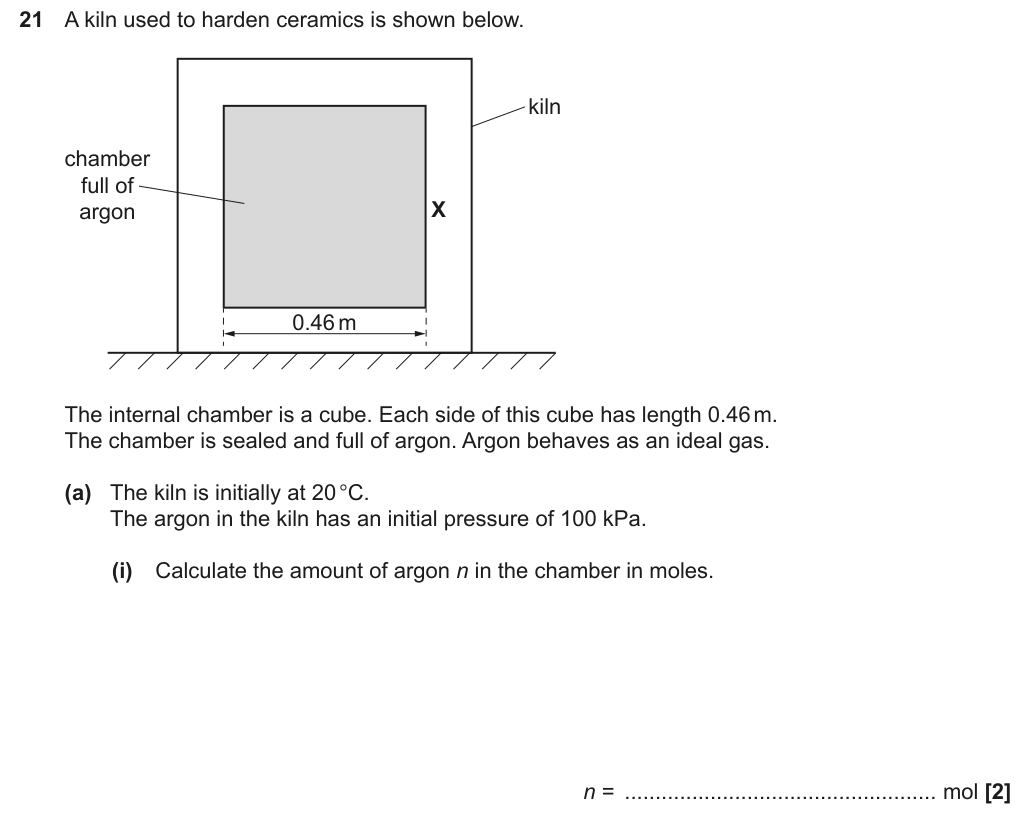
Skills: M0.1 Recognise and make use of appropriate units in calculations; M2.2 Change the subject of an equation, including non-linear equations; M4.3 Calculate areas of triangles, circumferences and areas of circles, surface areas and volumes of rectangular blocks, cylinders and spheres
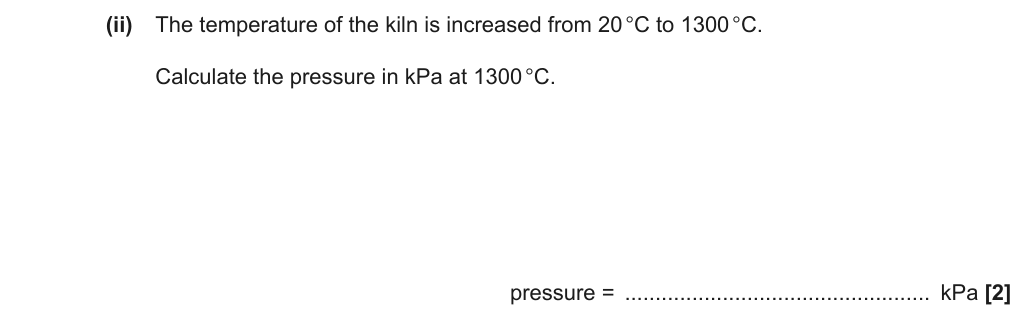
November 2020 · Paper 1 · Q21(a)(ii)2 marksCalculationMedium
Earlier part of question 21 that this part uses
Mark scheme
Examiner's comment
Some candidates used degrees centigrade rather than kelvin as the unit of temperature for Question 21.
Notes from the mark scheme and report
T = 1300 (not in kelvin) scores zero
p / T = constant or pV = nRT with unrounded n
Skills: M0.3 Use ratios, fractions and percentages; M2.3 Substitute numerical values into algebraic equations using appropriate units for physical quantities
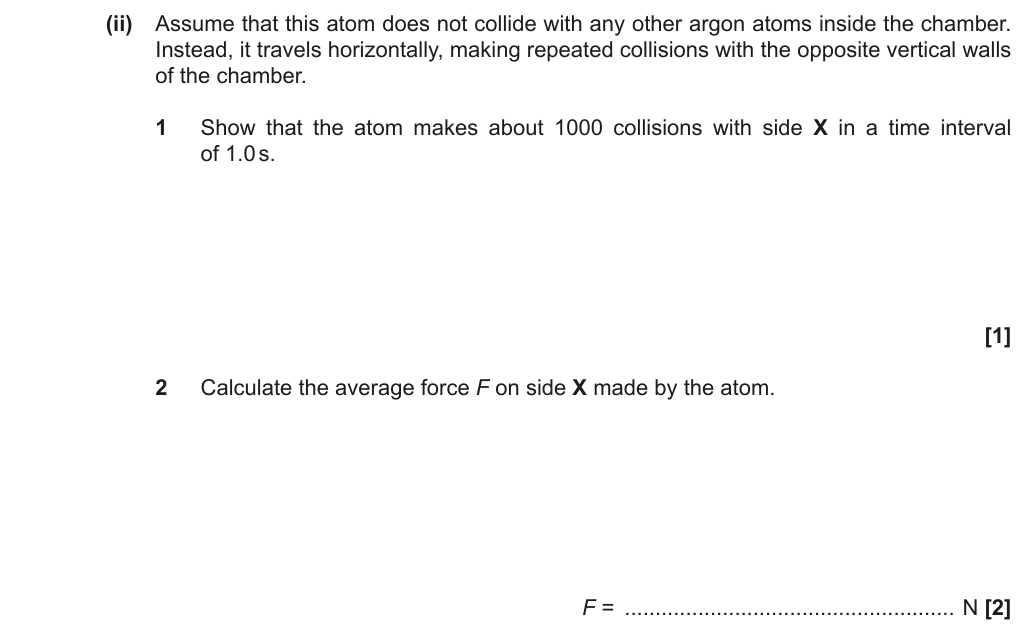
November 2020 · Paper 1 · Q21(b)(ii)3 marksShow thatMedium
Earlier parts of question 21 that this part uses
Mark scheme
Examiner's comment
Some candidates used degrees centigrade rather than kelvin as the unit of temperature for Question 21.
Notes from the mark scheme and report
distance between collisions with X is 2 x 0.46 m
1080 gives 1.4 x 10⁻¹⁹ N
ecf from (b)(i)
Skills: M2.3 Substitute numerical values into algebraic equations using appropriate units for physical quantities
November 2020 · Paper 1 · Q21(b)(iii)2 marksExplanationMedium
Earlier parts of question 21 that this part uses
Mark scheme
Examiner's comment
Some candidates used degrees centigrade rather than kelvin as the unit of temperature for Question 21.
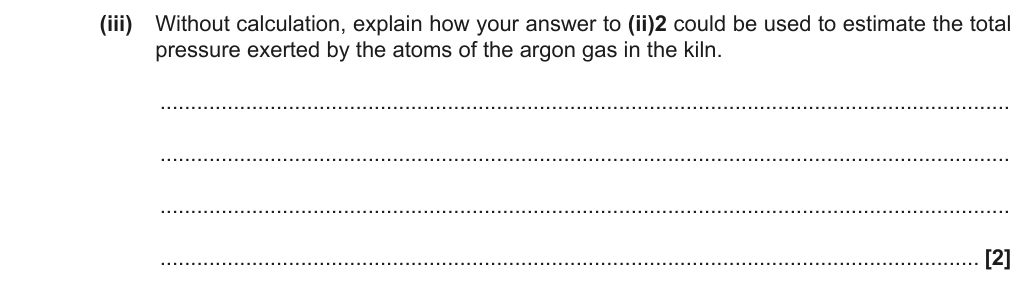
Notes from the mark scheme and report
pressure = total force / area AND multiply by the total number of atoms
November 2020 · Paper 3 · Q3(b)6 marks6-mark extended responseMedium
Mark scheme, with the levels and indicative content
Examiner's comment
Question 3ai Most candidates successfully used the formula for Stefan’s Law. Question 3aii Higher ability candidates successfully used the more elegant ratios method to reach the correct response. Question 3b This was one of the two LoR questions.
Notes from the mark scheme and report
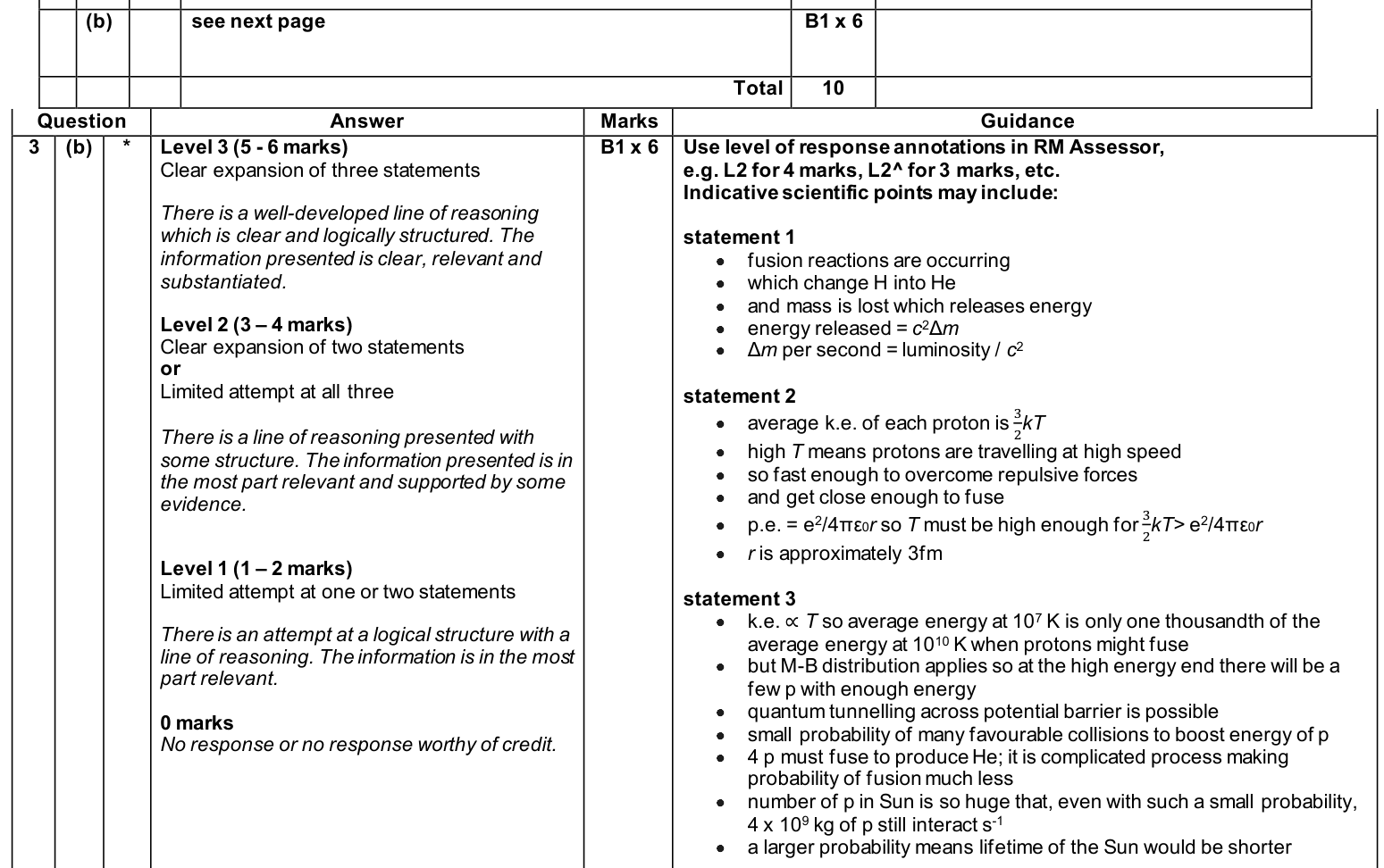
1: fusion of H to He, energy = c squared x mass loss
2: mean KE = 3/2 kT must exceed electrostatic PE e squared / 4 pi epsilon0 r
3: Maxwell-Boltzmann distribution / quantum tunnelling give a small probability of fusion
November 2020 · Paper 3 · Q4(c)3 marksShow thatMedium
Earlier part of question 4 that this part uses
Mark scheme
Examiner's comment
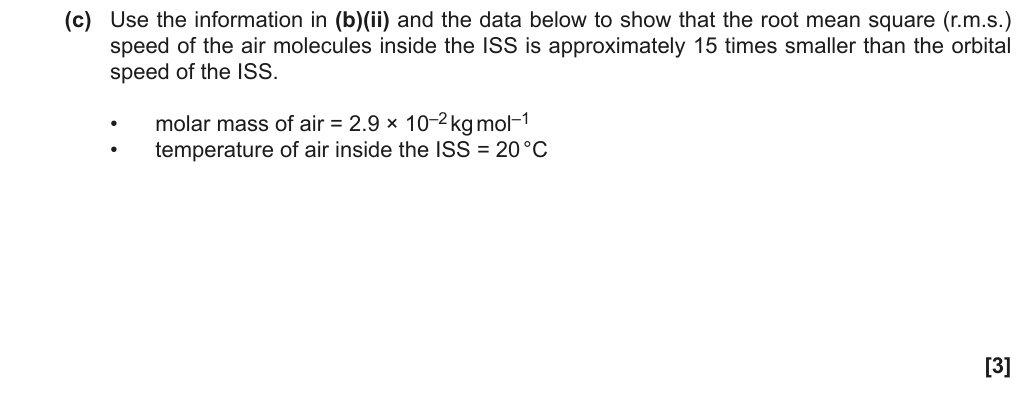
Question 4a Misconception Experiencing weightlessness is not the same as being in freefall There was a lack of understanding of the nature of feeling weightless. Question 4bi The simplest method here was to use the fact that g is inversely proportional to r2, so gr2 = constant. Question 4c The success in this question depended on understanding the meaning of the term m in the formula 2mc2 തതത = 3 2 kT given in the Data, Formulae and Relationship booklet. Question 4d Although this question looked daunting, it was actually quite linear and many candidates who attempted it were able to gain two or three marks even if they did not eventually get to the correct response.
Notes from the mark scheme and report
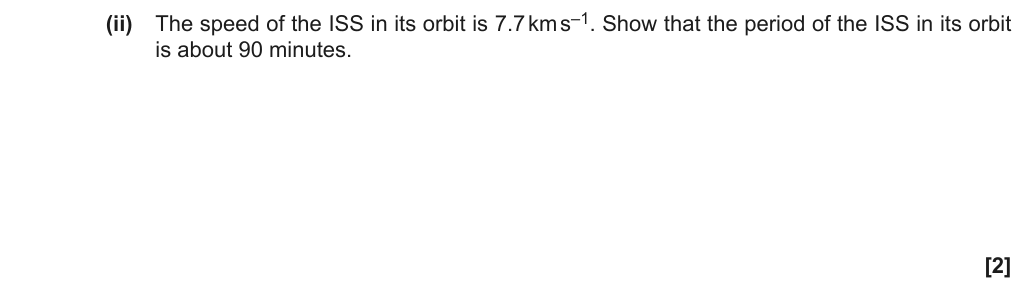
r.m.s. speed (500 m s-1) must be calculated
NOT just 7.7 x 10^3 / 15 = 510
Skills: M0.3 Use ratios, fractions and percentages; M0.5 Use calculators to find and use power, exponential and logarithmic functions; M2.2 Change the subject of an equation, including non-linear equations
June 2019 · Paper 1 · Q21(d)(i)3 marksCalculationMedium
Mark scheme
Examiner's comment
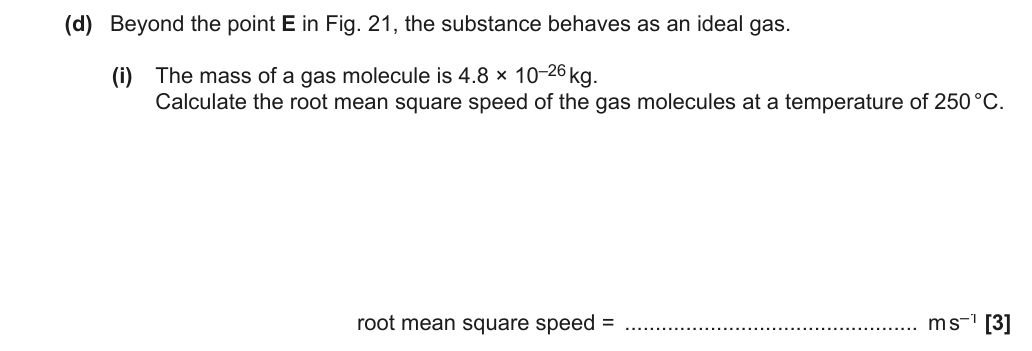
The key to this question is equating 2 formulae. The first is the familiar ½ m v2 for kinetic energy. In this case, the squared speed will be the mean squared speed of the particles. The second is the connection between average kinetic energy of a particle at absolute temperature, T, Ek = 3/2 k T. If candidates did that, then they not only scored the first mark but also could go on to complete the question. A common error was to forget to find the square root, as the question asks for the root mean square speed.
Notes from the mark scheme and report
1 mark for 464 (no conversion to kelvin)
2 marks for 4.5 x 10^5 (mean square speed)
Skills: M0.5 Use calculators to find and use power, exponential and logarithmic functions; M2.2 Change the subject of an equation, including non-linear equations; M2.3 Substitute numerical values into algebraic equations using appropriate units for physical quantities
June 2019 · Paper 1 · Q21(d)(ii)3 marksCalculationMedium
Earlier part of question 21 that this part uses
Mark scheme
Examiner's comment
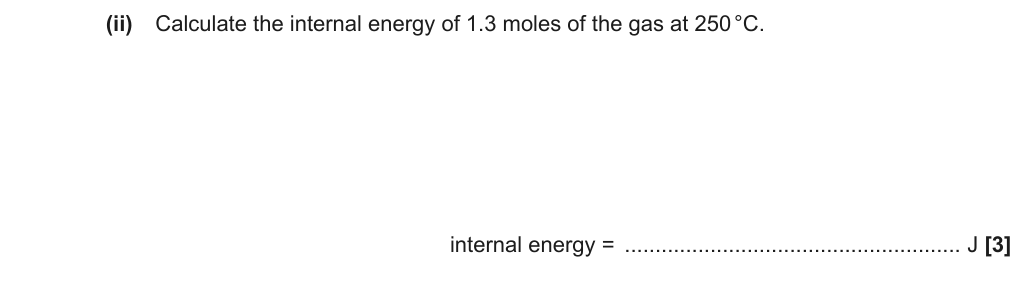
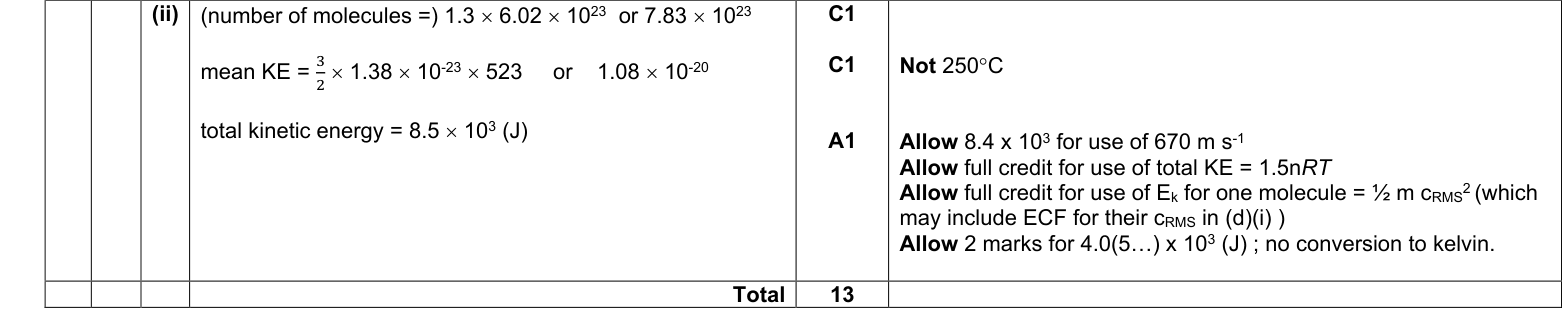
There were 2 ways to answer this question. The first was to find the kinetic of one particle using the mean square speed and the second was to find the kinetic energy of one particle using the absolute temperature. Lower level responses stopped at that point, or there was misunderstanding how to scale that value up to the whole gas. For either route, the value for one particle needed to be multiplied by the number of particles in the gas. This can be found by multiplying the number of moles by the Avagadro constant given in the data, formulae and relationship booklet.
Notes from the mark scheme and report
2 marks for 4.05 x 10^3 (no conversion to kelvin)
allow 1.5nRT
allow 8.4 x 10^3 using 670 m s-1
Skills: M0.2 Recognise and use expressions in decimal and standard form; M2.3 Substitute numerical values into algebraic equations using appropriate units for physical quantities
June 2019 · Paper 3 · Q1(a)2 marksCalculationMedium
Mark scheme
Examiner's comment
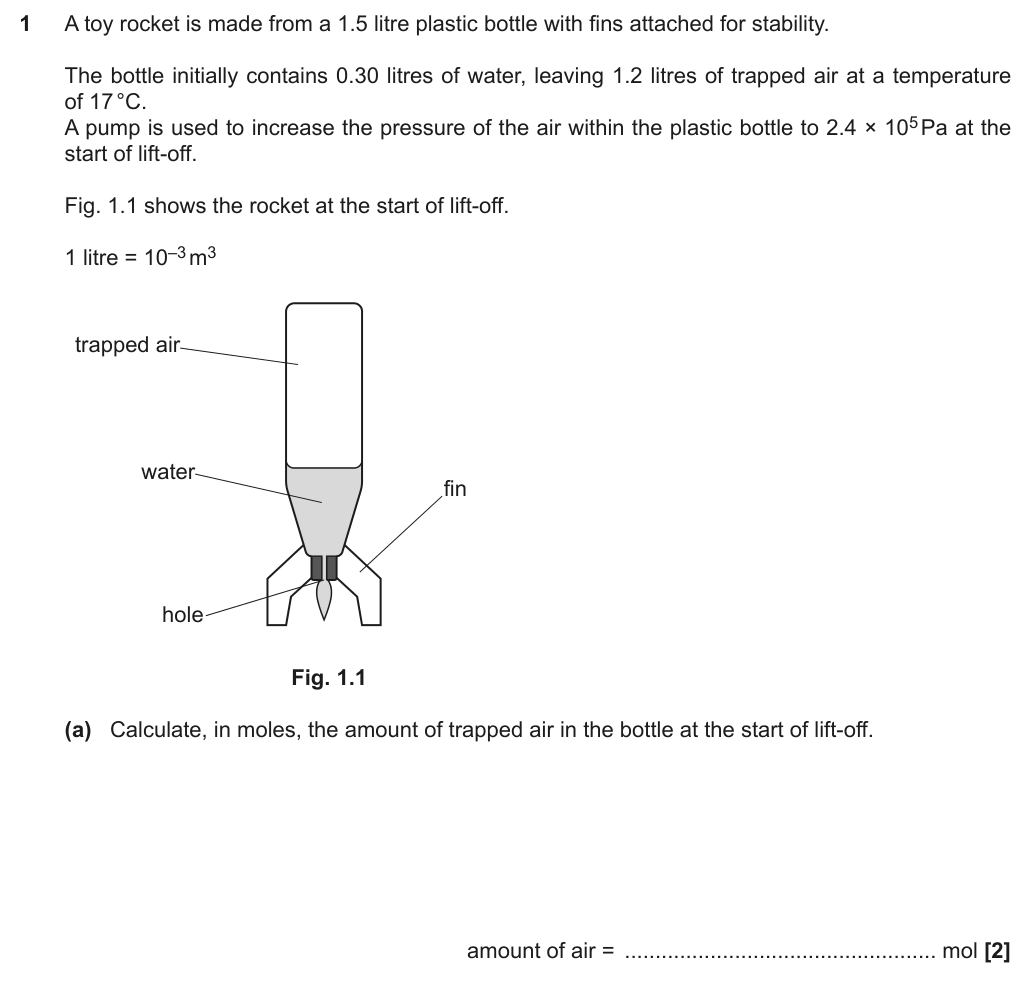
Questions 1(a) and 1(b) took the ideal gas equation and applied it to an unfamiliar situation, that of a toy rocket. Most candidates answered these questions well, remembering to convert the temperature from 17oC to 290K. Common problems in 1(a) and 1(b) • confusing N (number of molecules) with n (number of moles) • using an incorrect power of ten (POT) value for the volume, by either failing to convert litres correctly or simply omitting the 10-3.
Notes from the mark scheme and report
Allow pV = NkT route
Skills: M0.1 Recognise and make use of appropriate units in calculations; M2.2 Change the subject of an equation, including non-linear equations; M2.3 Substitute numerical values into algebraic equations using appropriate units for physical quantities
June 2019 · Paper 3 · Q1(b)3 marksCalculationMedium
Earlier part of question 1 that this part uses
Mark scheme
Examiner's comment
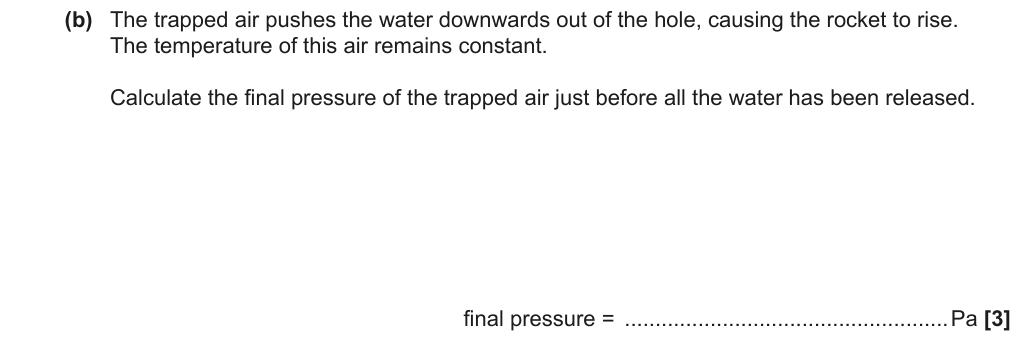
Questions 1(a) and 1(b) took the ideal gas equation and applied it to an unfamiliar situation, that of a toy rocket. Most candidates answered these questions well, remembering to convert the temperature from 17oC to 290K. Common problems in 1(a) and 1(b) • confusing N (number of molecules) with n (number of moles) • using an incorrect power of ten (POT) value for the volume, by either failing to convert litres correctly or simply omitting the 10-3.
Notes from the mark scheme and report
final volume of air is 1.5 litres
ecf from (a) if pV = nRT used
Skills: M0.3 Use ratios, fractions and percentages; M2.2 Change the subject of an equation, including non-linear equations
June 2018 · Paper 1 · Q61 markMultiple choice
Answer
B
Mark scheme
June 2018 · Paper 1 · Q141 markMultiple choiceMedium
Answer
D
Mark scheme
Examiner's comment
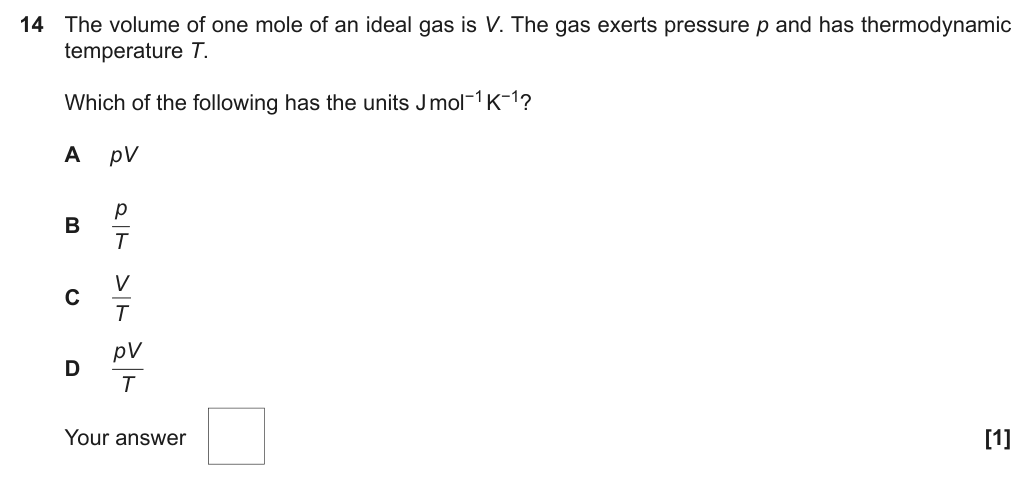
The unit J mol-1 K-1 is the same unit as the molar gas constant, such that pV = nRT. It follows that the unit of R must be the same as the unit of pV/T as ‘n’ has no units.
June 2018 · Paper 1 · Q22(b)6 marks6-mark extended responseMedium
Mark scheme, with the levels and indicative content
Examiner's comment
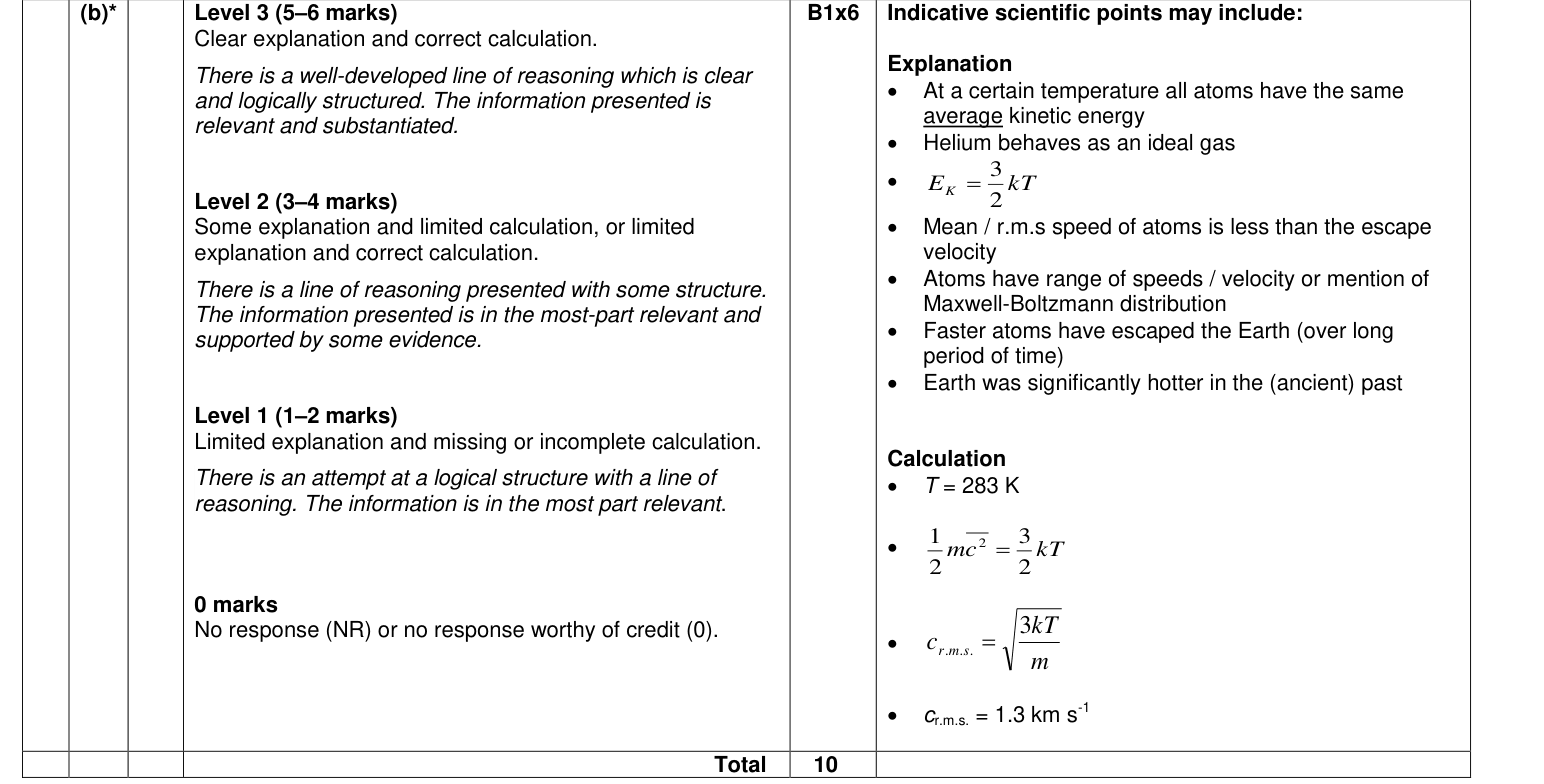
In correctly calculating the root means square speed and by being clear about how that has been calculated, this candidate has gained L2 already. There is a correct comparison of this speed with the escape velocity. There is also reference to the Boltzmann distribution of speeds, suggesting that even though a small fraction will have a sufficient velocity, over time those particles will escape. Most candidates made good progress with the calculation or provided an alternative by calculating the mean KE of a particle and comparing that with the KE a particle with escape velocity would have. A significant fraction made a poor comparison of their value with escape velocity (e.g. that 1300 ms-1 was greater than 11 km s-1) or compared the mean squared speed with the escape velocity.
Notes from the mark scheme and report
r.m.s. speed 1.3 km s-1 is less than escape velocity but atoms have a range of speeds so the fastest escape
Skills: M0.5 Use calculators to find and use power, exponential and logarithmic functions; M2.2 Change the subject of an equation, including non-linear equations; M2.3 Substitute numerical values into algebraic equations using appropriate units for physical quantities
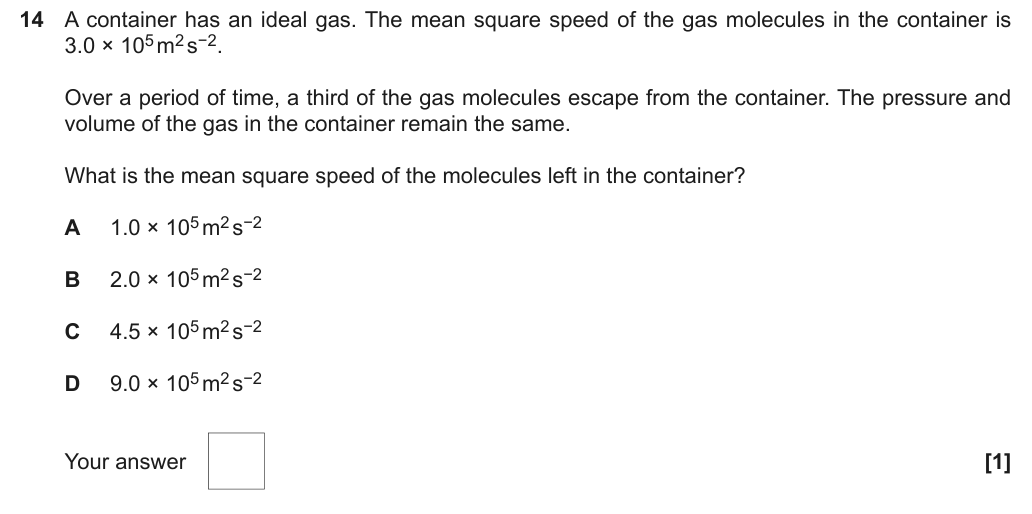
June 2017 · Paper 1 · Q141 markMultiple choice
Answer
C
Mark scheme
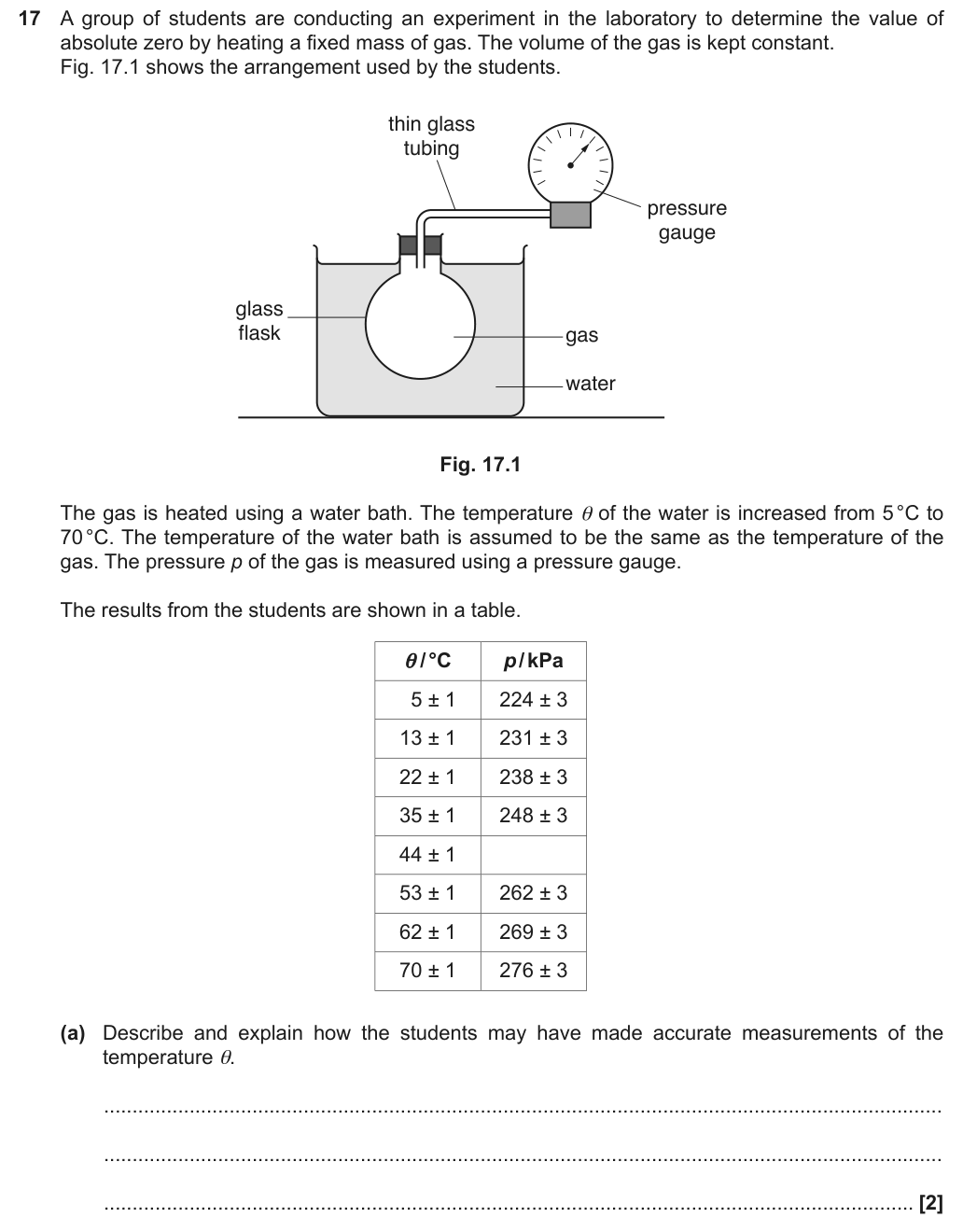
June 2017 · Paper 1 · Q17(c)(ii)6 marks6-mark extended response
Earlier part of question 17 that this part uses
Mark scheme, with the levels and indicative content
Notes from the mark scheme and report
gradient 0.7 to 0.9 kPa K⁻¹
absolute zero in the range −320 °C to −240 °C
Skills: M3.3 Understand that y = mx + c represents a linear relationship; M3.4 Determine the slope and intercept of a linear graph; PAG8 Investigating gases
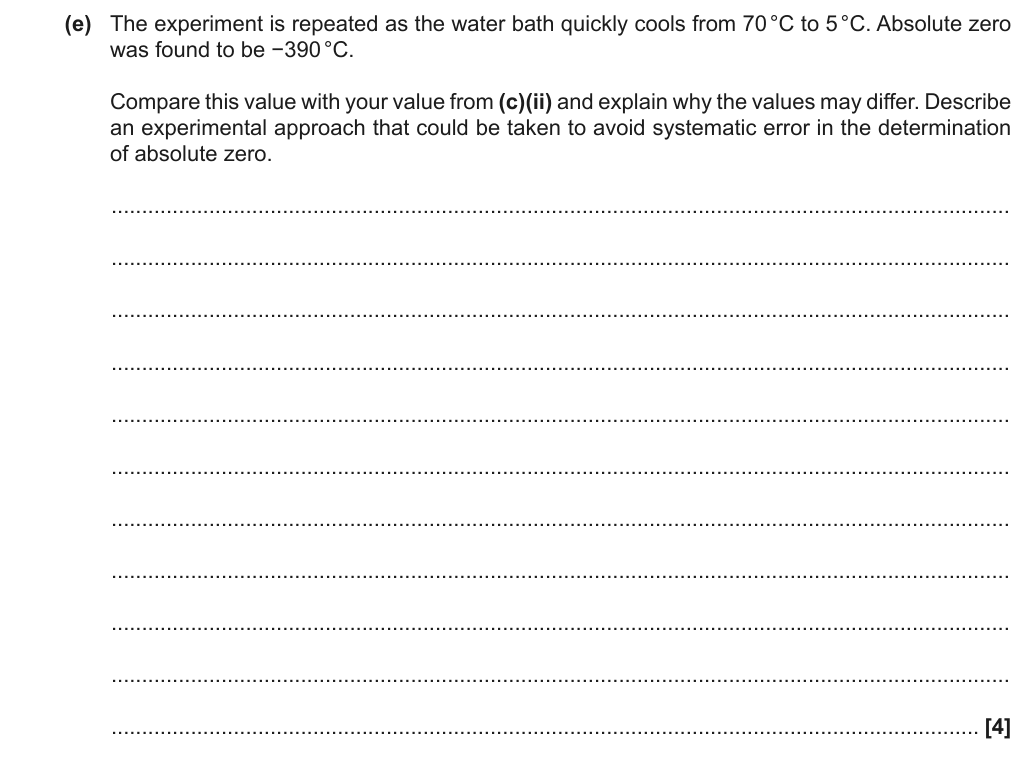
June 2017 · Paper 1 · Q17(e)4 marksExplanation
Earlier parts of question 17 that this part uses
Mark scheme
Notes from the mark scheme and report
Not insulation of the water bath
Not heat losses
Skills: PAG8 Investigating gases
June 2017 · Paper 1 · Q23(b)(iii)3 marksPractical and data analysis
Earlier parts of question 23 that this part uses
Mark scheme
Notes from the mark scheme and report
Mercury has the higher escape velocity, so the argument must rest on temperature / molecular speed
Skills: M0.3 Use ratios, fractions and percentages
June 2017 · Paper 3 · Q5(a)(ii)4 marksCalculation
Earlier part of question 5 that this part uses
Mark scheme
Notes from the mark scheme and report
T = 290 K
allow ½Mv² = 3/2 RT
Skills: M0.1 Recognise and make use of appropriate units in calculations; M2.2 Change the subject of an equation, including non-linear equations; M2.3 Substitute numerical values into algebraic equations using appropriate units for physical quantities
Work with an OCR physics tutor
Dropping marks on calculations, practical questions or the six-mark level of response questions? Book a trial session with a specialist OCR physics tutor.