Answer
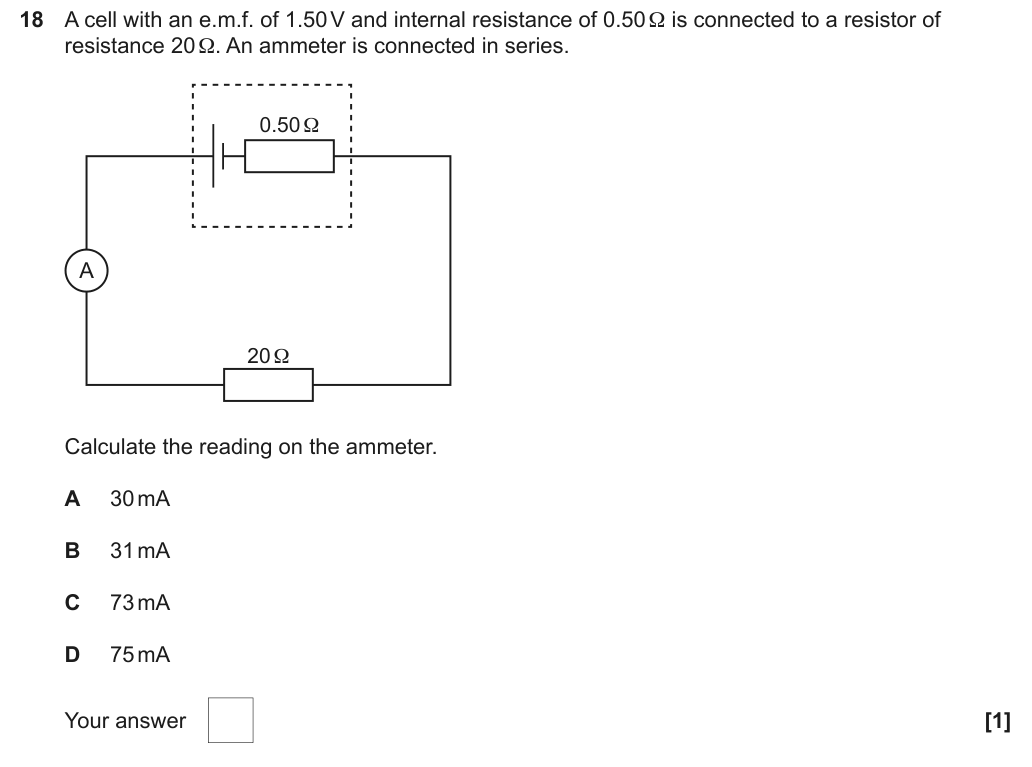
C
Mark scheme

Examiner's comment
A significant minority of lower scoring candidates correctly calculated the total resistance of 20.5 but then incorrectly multiplied by 1.5 to give answer B.
| Series | Paper | Q | What it asks |
|---|---|---|---|
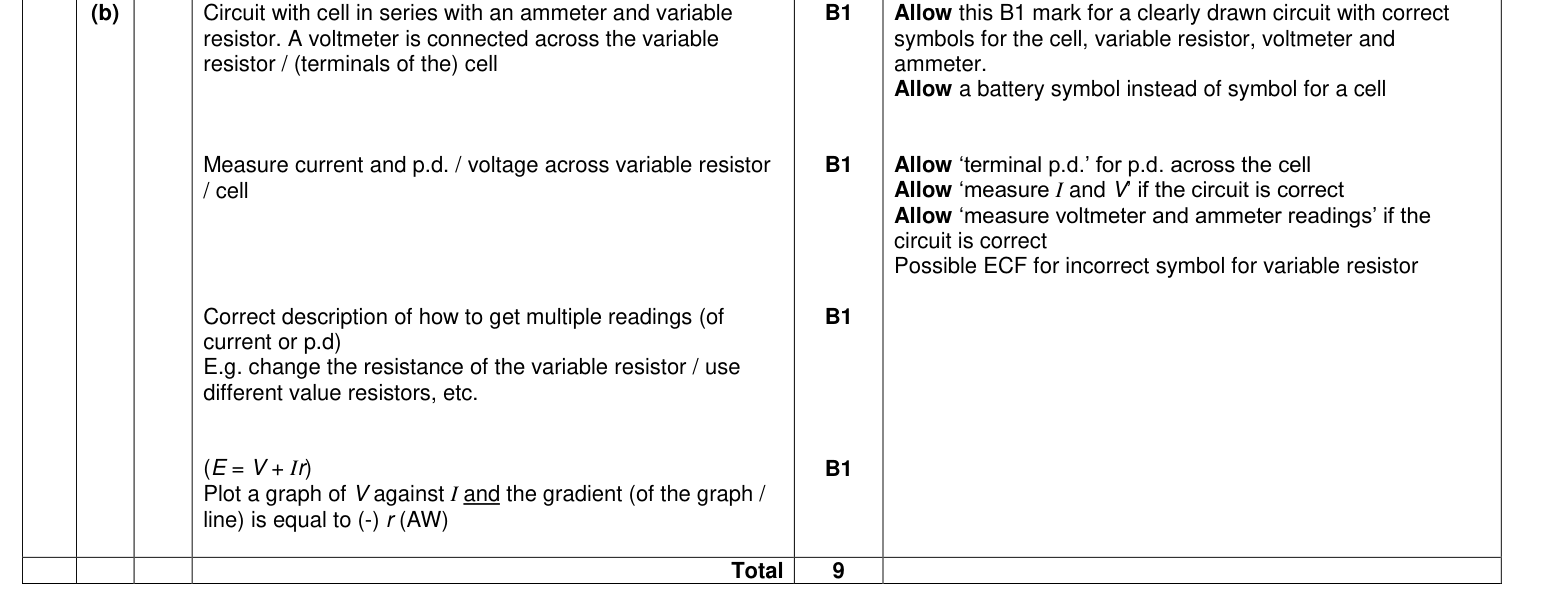
| June 2024 | Paper 3 | 5(c) | *(c) A student wants to determine the internal resistance r and the e.m.f. ε of a different cell. Describe how the student can determine r and ε for the cell. |
| November 2021 | Paper 2 | 18(b) | A student is doing an experiment to determine the e.m.f. E of a cell and its internal resistance r. • Use the graph to determine E and r. Explain your reasoning. |
| June 2017 | Paper 2 | 18(b) | A group of students are investigating the power dissipated in a variable resistor connected Describe, with the help of a suitable circuit diagram, how the students may have determined |
C
A significant minority of lower scoring candidates correctly calculated the total resistance of 20.5 but then incorrectly multiplied by 1.5 to give answer B.
B
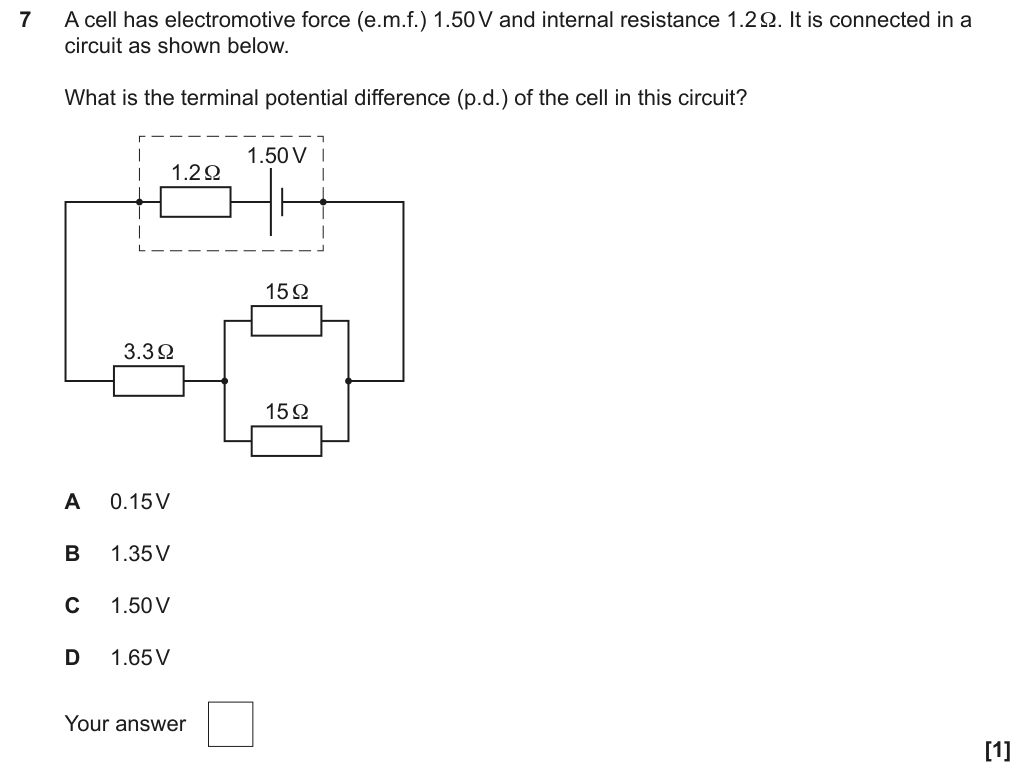
Most candidates were able to correctly identify the terminal p.d. Notably, many answers which did not show the correct response showed no, or little relevant, working.. Some candidates chose D, possibly showing an issue understanding of the relationship between e.m.f. and terminal p.d..
D
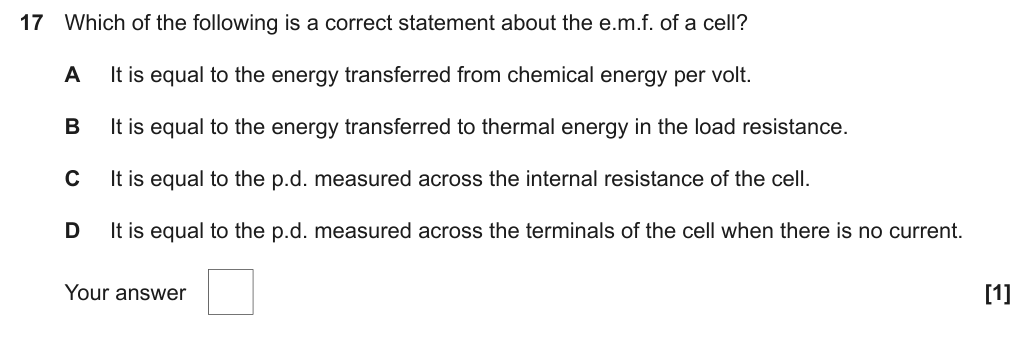
Some candidates correctly identified the statement defining e.m.f as answer D. The most common distractor was answer A, as candidates confused the definition of e.m.f as the energy transferred per coulomb of charge with per volt.
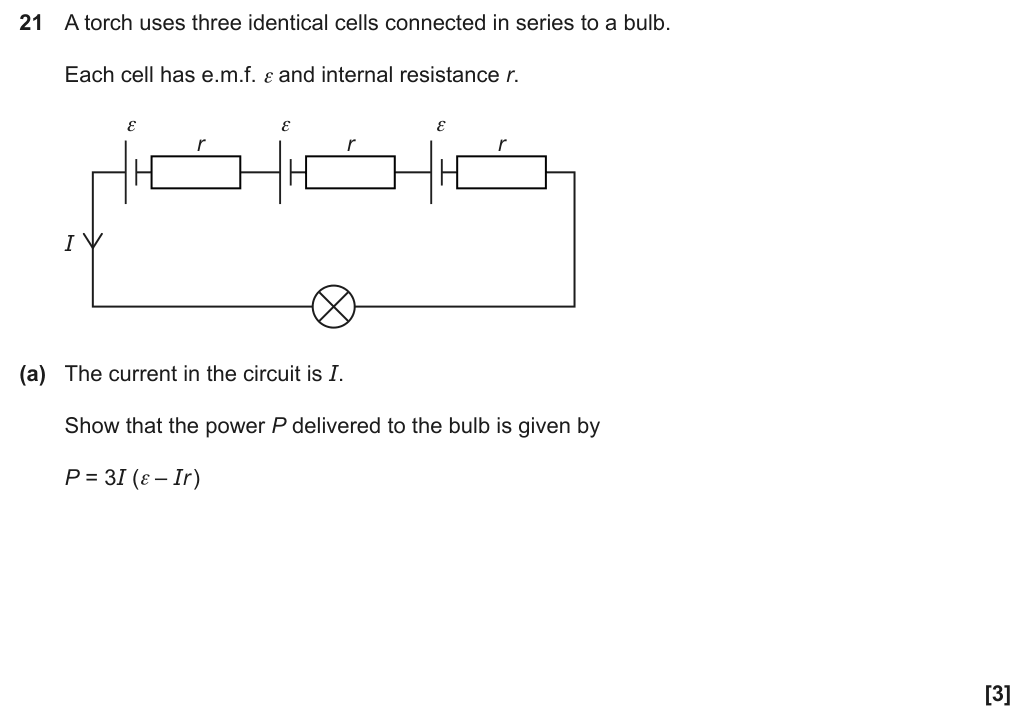
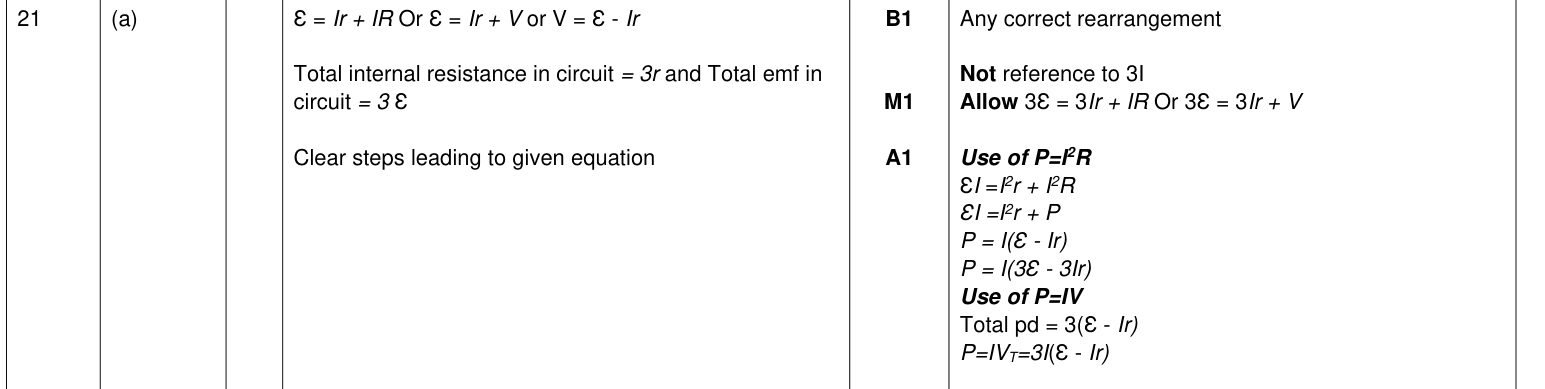
Most candidates achieved 1 mark for this question, for stating the correct expression for e.m.f, ɛ, e.g. ɛ = Ir + V with some candidates showing clearly that the power, P delivered to the bulb is given by the expression P = 3I(ɛ - Ir). Responses that were given 1 mark did not give clear working to express their understanding that the e.m.f. ɛ and internal resistance, r, were increased by 3. Often, candidates would just give an unqualified expression for P, e.g. P = 3 x I(ɛ - Ir), but from this expression it was not clear whether the factor of 3 was for current I or ɛ and r despite the correct application of P=IV. The responses that achieved 3 marks showed a clear rationale in their working and that for the 3 cells in series the total e.m.f. was 3ɛ, and the total internal resistance was 3r. These candidates then showed clear steps in finding an expression for the potential difference across the bulb using ɛ = Ir + V to be, e.g. V = 3ɛ - 3Ir. By showing clear working, it was evident that candidates understood that the potential difference across the bulb was equal to the total terminal potential difference across the three cells in series. These candidates then correctly substituted their expression for the potential difference into an equation for power, e.g. P=IV to show the power P delivered to the bulb given in the stem of the question. delivered to the bulb. The response is given 3 marks.
Skills: M2.2 Change the subject of an equation, including non-linear equations
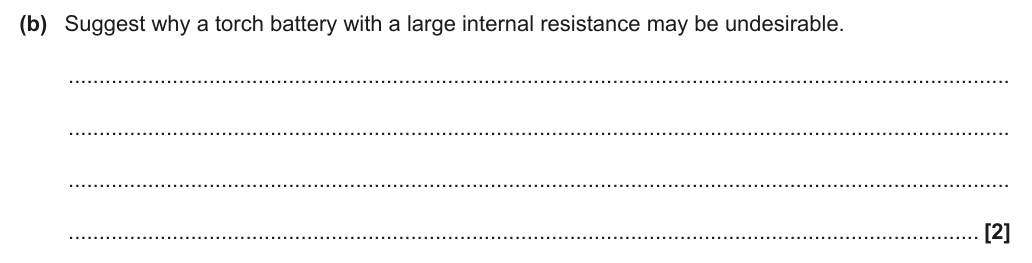
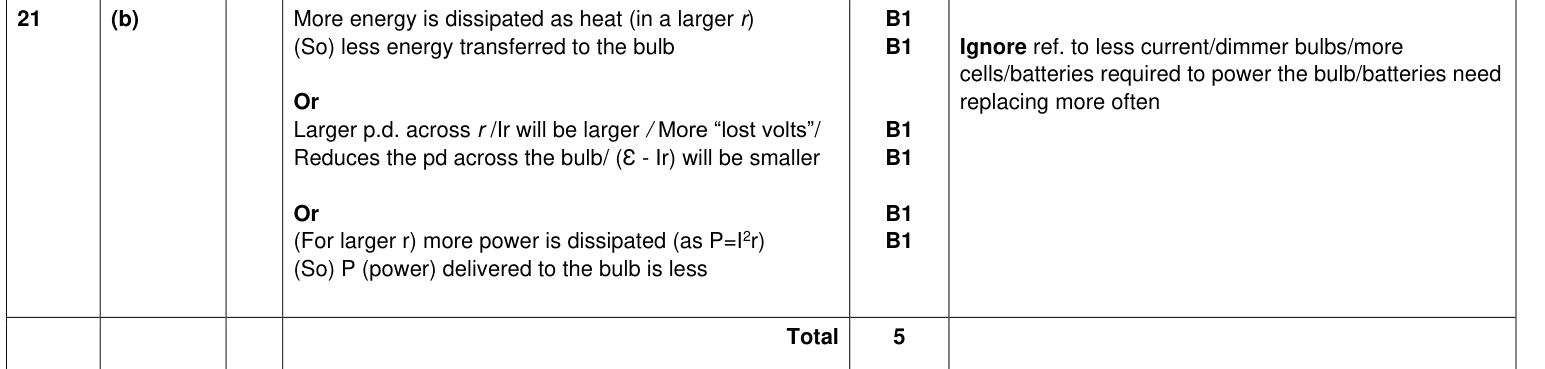
Some candidates achieved 1 mark for this question for suggesting the most common response that the potential difference across the bulb would decrease or that there would be more lost volts across the cells but only a few linked these suggestions to achieve 2 marks. Most candidates mixed suggestions by referencing energy transfer and potential difference which meant that they only achieved 1 mark. Some candidates gave suggestions in terms of current and efficiency, which did not link to the undesirability of a large internal resistance and so were not given any marks.
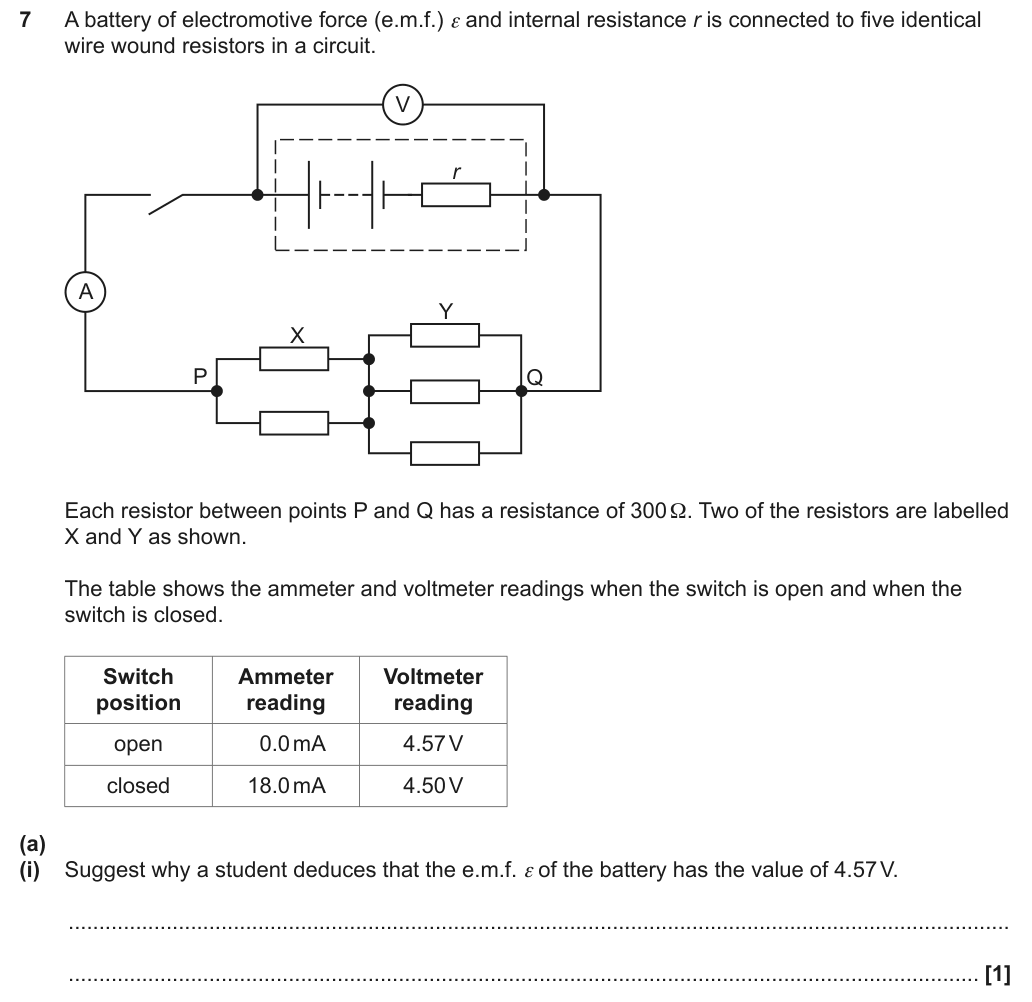
There were many vague answers given. Candidates needed to state the reading of 4.57 V occurs when the current was zero. An open switch was not good enough.

This was another show question where the method needed to be clearly stated. High scoring candidates stated the circuit equation, substituted the data and evaluated answer before rounding it to 3.9 . The majority of the candidates gained credit. The candidate has stated an equation, substituted in the data and evaluated the answer (3.889) which has then clearly been rounded to 3.9 .
Skills: M2.2 Change the subject of an equation, including non-linear equations; M2.3 Substitute numerical values into algebraic equations using appropriate units for physical quantities

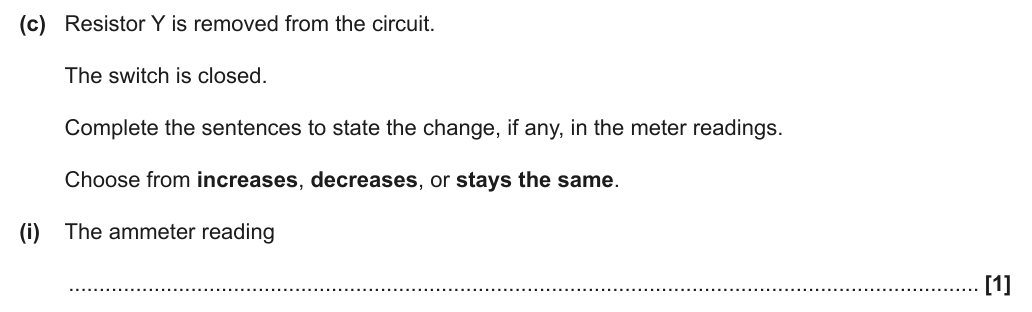
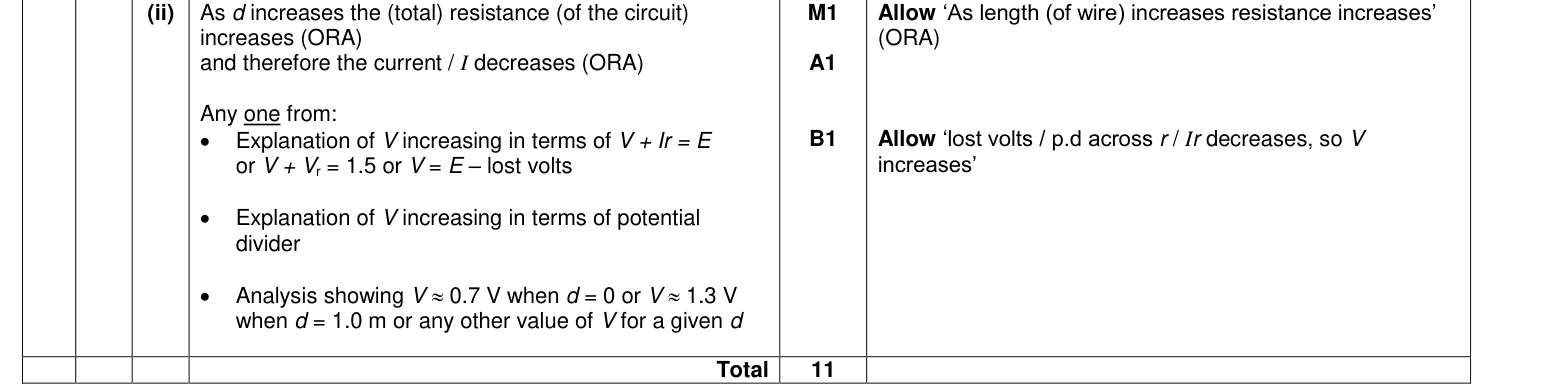
This question was very challenging. Since the current has decreased, there would be less ‘lost volts’ across r so the voltmeter reading would increase. May candidates thought incorrectly that the voltmeter reading would remain the same.
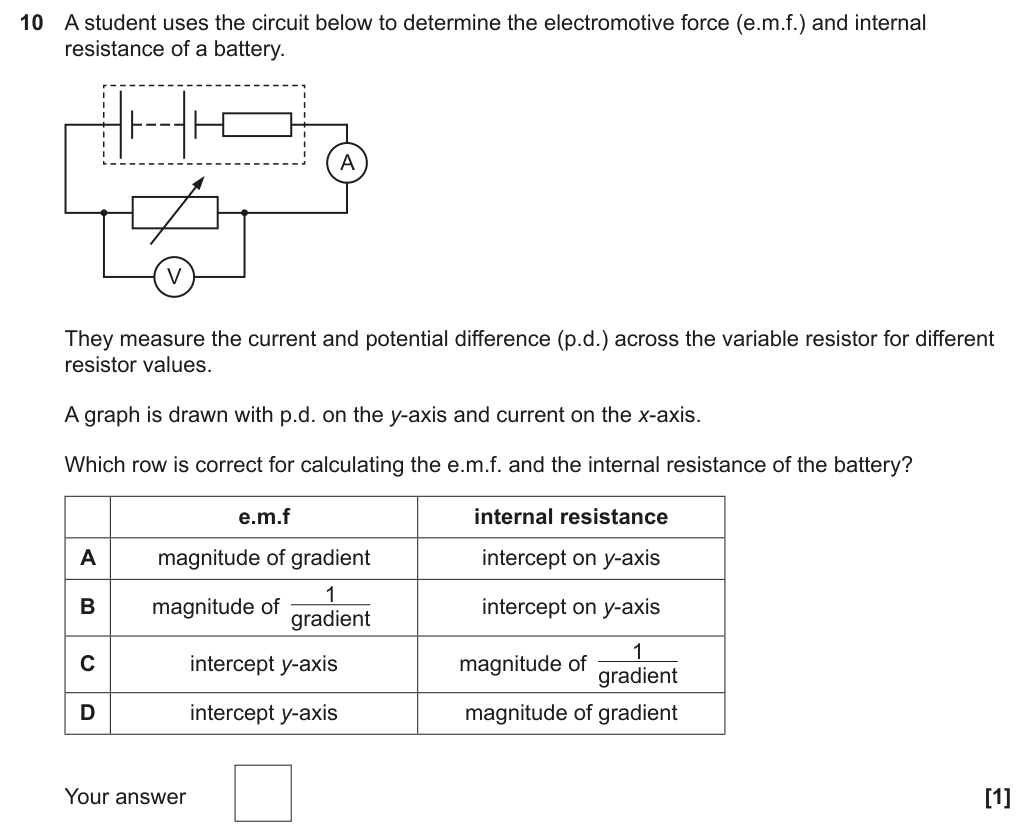
D
This was correctly answered by most candidates. They were able to identify how to obtain the emf correctly but less certain on the internal resistance, which led to C being my far the most common incorrect response.
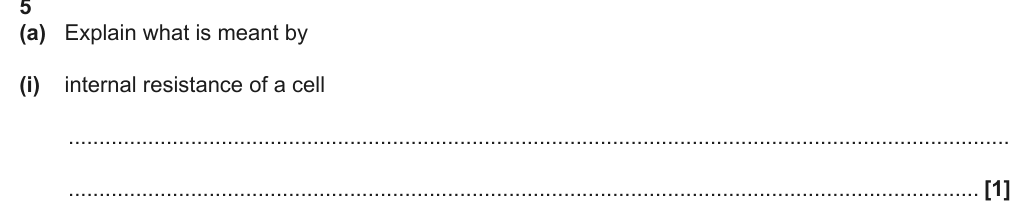
For example, for the graph in this question, when V = 4.0V, the gradient of the graph is approximately 0.5 Ω-1, but I/V = 4.0/4.0 = 1.0 Ω-1 Question 5 *(c) Although it was clear that many candidates had performed an experiment to determine r and ε for a cell, they were sometimes thrown by the need to use a thermistor rather than a variable resistor.
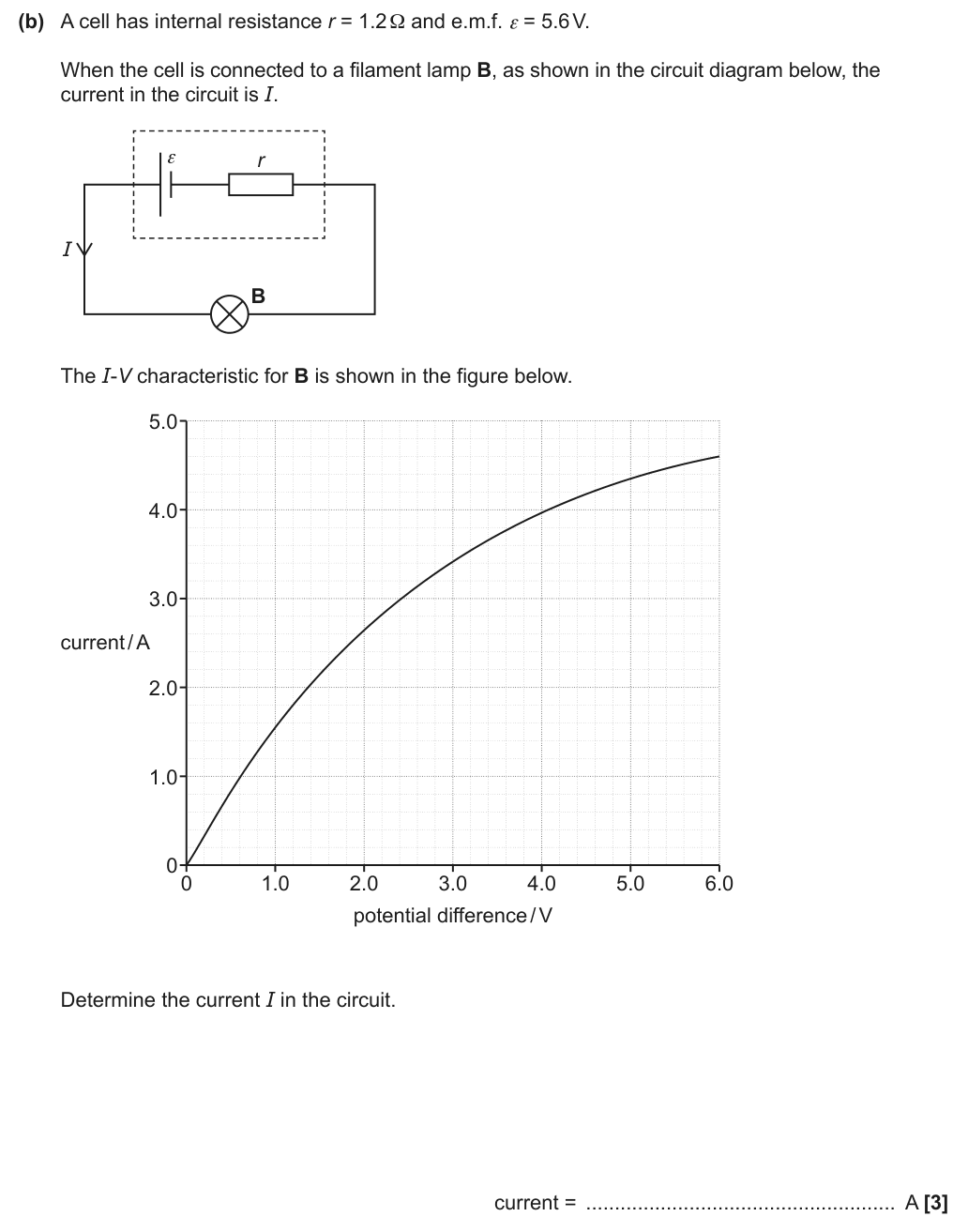
5 (b) (ii) was a question aimed at stretch and challenge level candidates with good problem-solving abilities.. Voltage V and current I are related through the formula ε = V + Ir so, given the values in the question, 5.6 = V + 1.2I. The relationship between V and I is also shown graphically. The problem is to find a pair of corresponding values for V and I which match both relationships. One way of solving this problem is to draw the relationship 5.6 = V + 1.2I onto the graph. This can be done by arranging it into a y = mx + c form i.e. I = 4.7 – 0.83V. The solution to the problem can then be found where the two lines cross, which is the point (2.2, 2.8). So, the values I = 2.8A (and V = 2.2V) fit both relationships. This method of solution is shown in Exemplar 2. An alternative method of solution is trial and improvement. Pick a point on the V-I graph; say (1.2, 1.8). Calculate ε = V + 1.2I = 1.2 + 2.16 = 3.36V. This is lower than the 5.6V we need for the emf. So, try a point higher on the graph: say (3.0, 3.4). Calculate ε = = 3.0 + 4.08 = 7.08V. This value is too high. In this way we can eventually reach the correct point at (2.2, 2.8). There are, of course, other methods of solving this problem. The majority of candidates attempted to work out the resistance of an arbitrary point on the graph (often by finding the gradient, or 1/gradient, at a tangent) and then evaluated a current using 5.6 = I(R + 1.2). If they ended up with I = 2.8A, it was usually by luck rather than by good judgment.
Skills: M2.2 Change the subject of an equation, including non-linear equations; M3.1 Translate information between graphical, numerical and algebraic forms; M3.3 Understand that y = mx + c represents a linear relationship
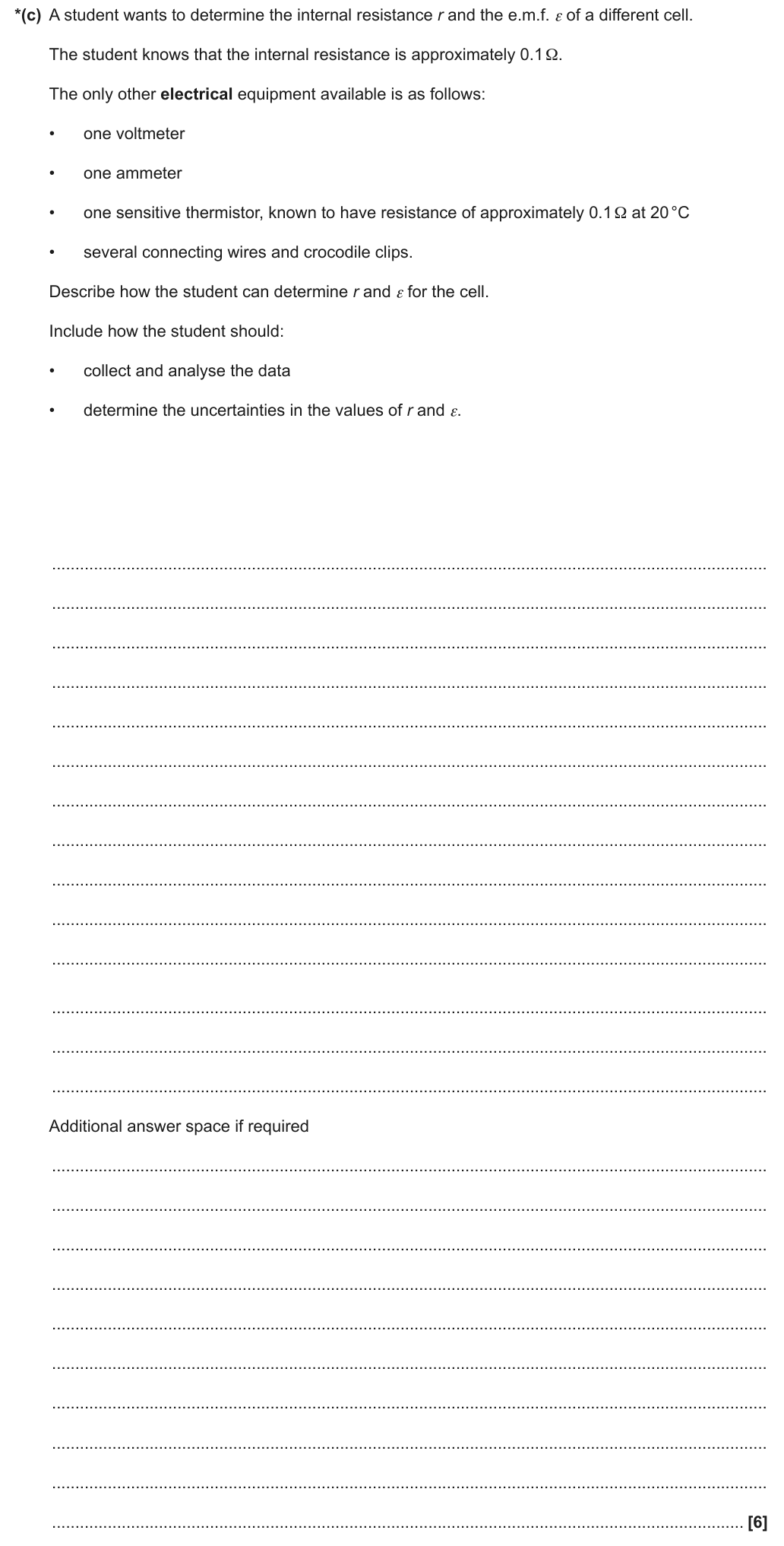
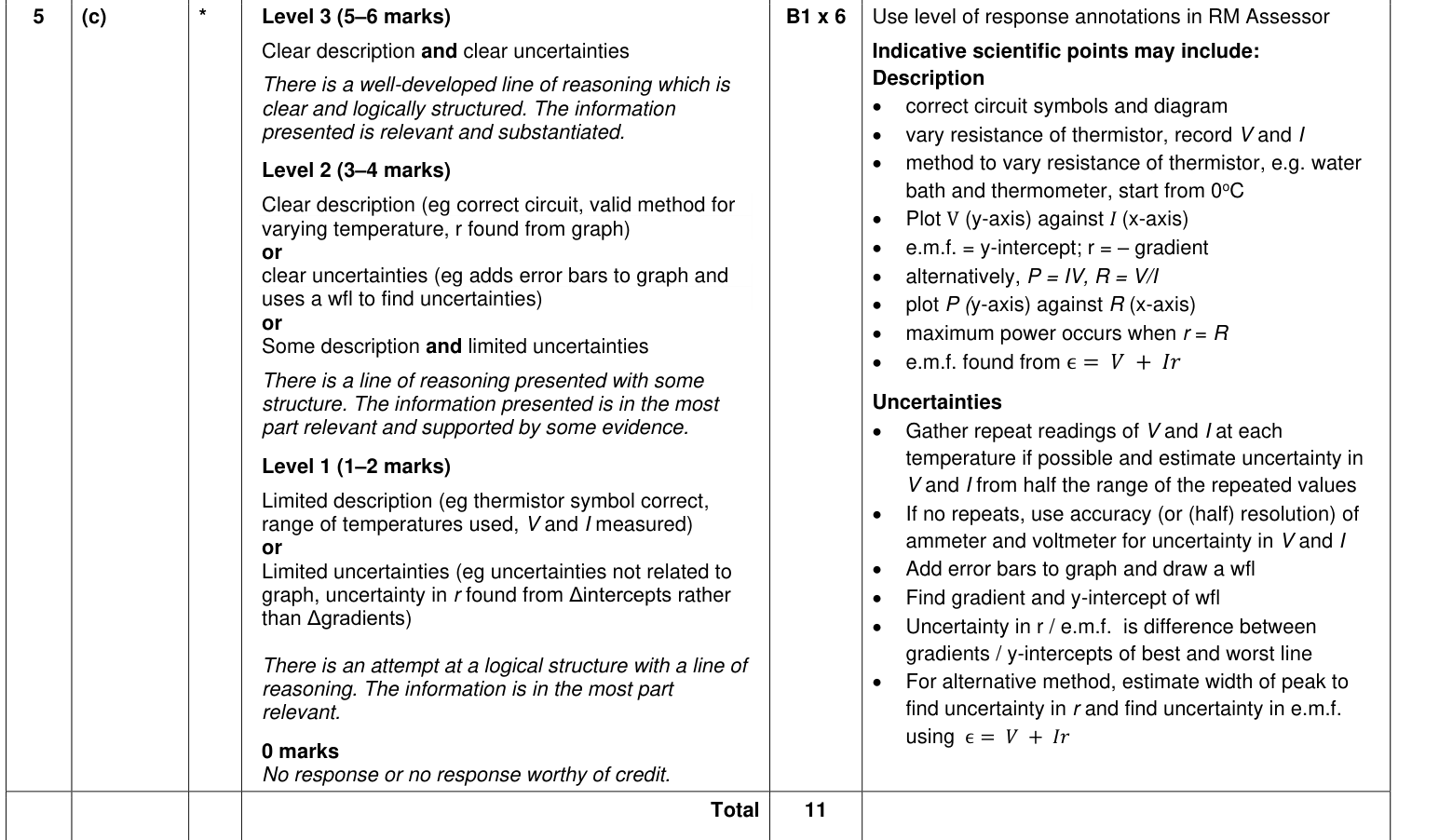
Although it was clear that many candidates had performed an experiment to determine r and ε for a cell, they were sometimes thrown by the need to use a thermistor rather than a variable resistor. Many candidates drew the symbol for a variable resistor anyway instead of a thermistor, and others put the variable resistor into the circuit alongside the thermistor. Some suggestions for varying the temperature of the thermistor were impractical. Although it would be practically difficult to take several values of V and I at exactly the same temperature, candidates were allowed to use error bars found from half the range of repeated values, rather than by using the resolution of the ammeter and voltmeter. Often candidates were rather vague when trying to describe how to determine the uncertainties; ‘Use the worst fit line’ was often all the instruction that was given.
Skills: M1.5 Identify uncertainties in measurements and use simple techniques to determine uncertainty when data are combined; M3.3 Understand that y = mx + c represents a linear relationship; M3.4 Determine the slope and intercept of a linear graph; PAG3 Investigating electrical properties
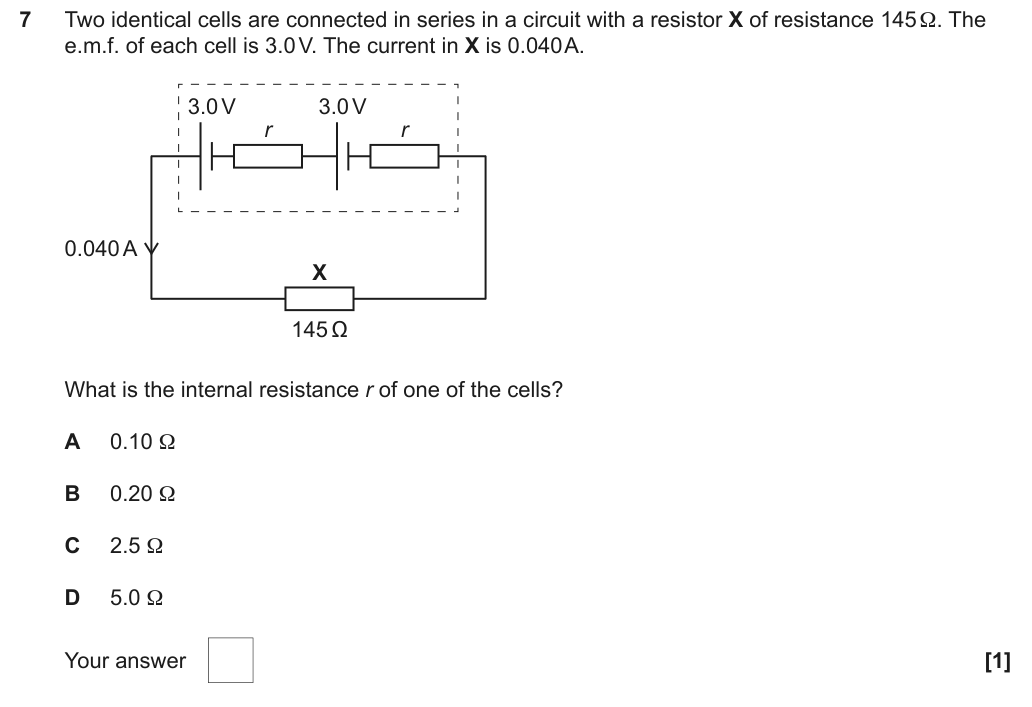
C
Most of the candidates gave the answer C by correctly applying the equation ℰ = I(R + r).
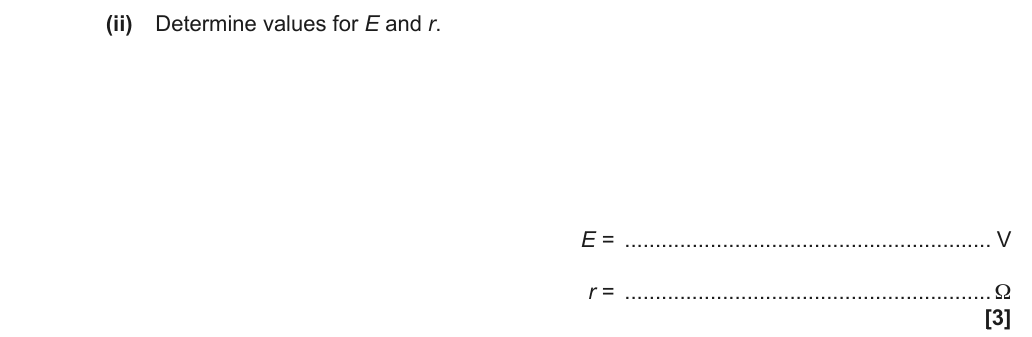
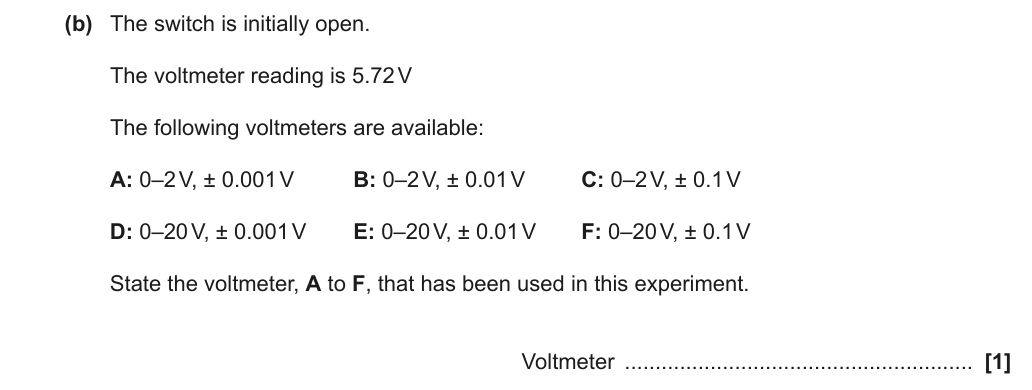
Candidates struggled with this question. Few candidates realised that when the switch was open, the voltmeter reading of 5.72 V was the terminal p.d. and equal to the e.m.f. of the battery. Some candidates did manage to determine the internal resistance without specifically stating the e.m.f.
Skills: M2.2 Change the subject of an equation, including non-linear equations
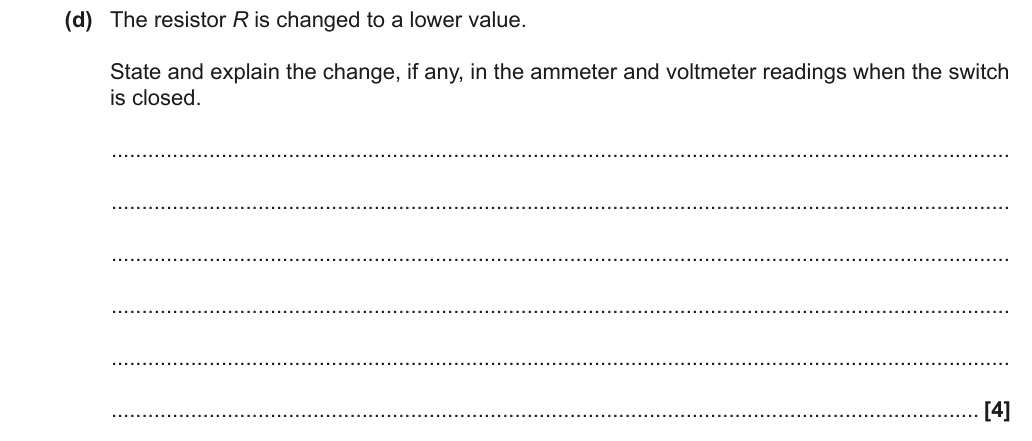
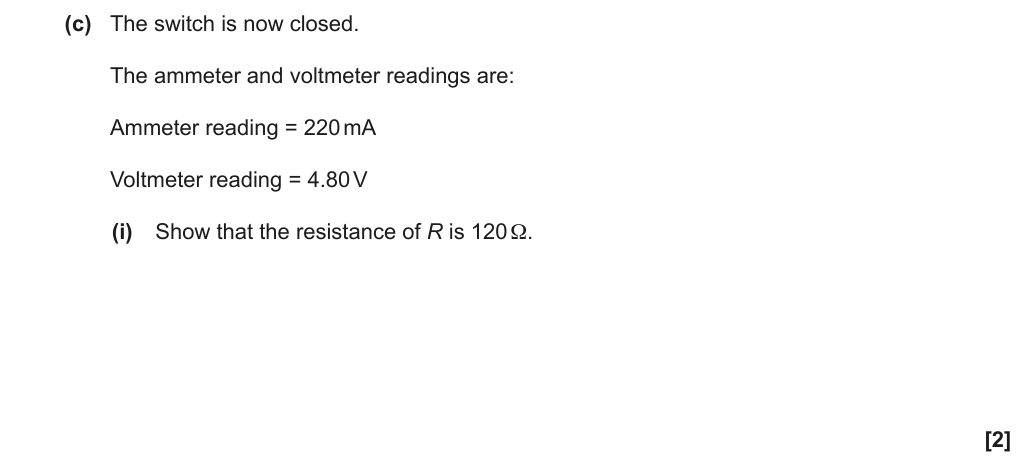
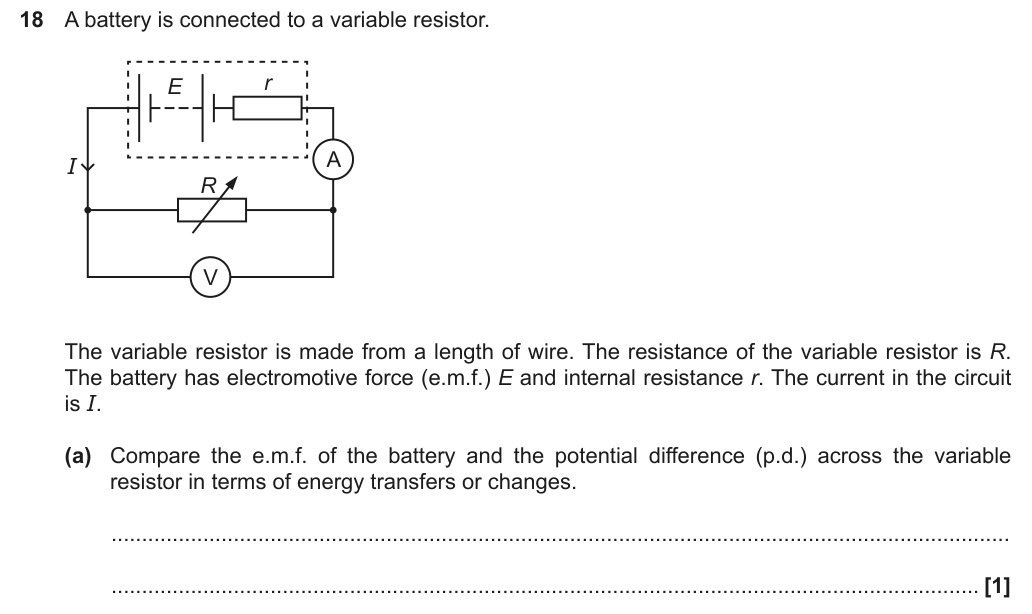
This question allowed candidates the opportunity of structuring their answer. The majority of candidates stated that the current in the circuit and thus the ammeter reading would increase. Fewer candidates were able to state that the total resistance of the circuit decreased – many just referred to R. Fewer candidates were able to explain the change in the voltmeter. Many stated it would stay the same since it was a parallel circuit. Other candidates stated that the p.d. would increase since p.d. is proportional to current. Ideally candidates would explain their answer by relating the increase in current to a greater p.d. across the internal resistance (‘lost volts’) and then stating that the p.d. across the parallel network decreases so the voltmeter reading decreases. Some candidates gave a good explanation by applying potential divider arguments.
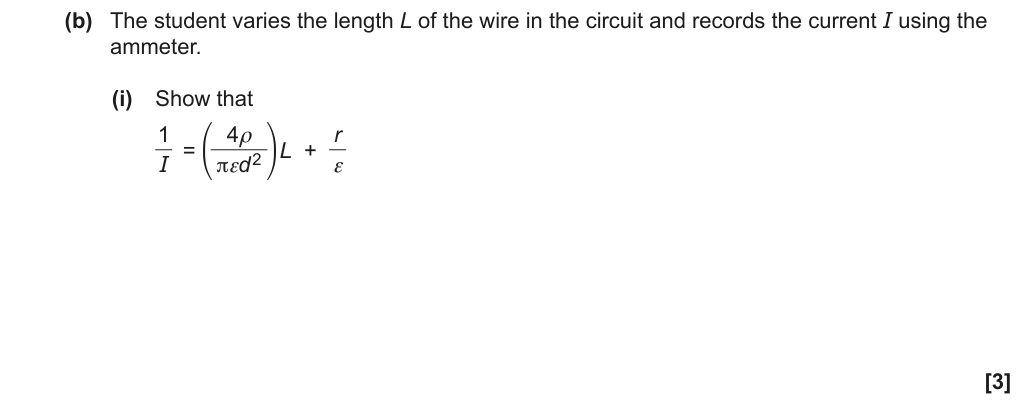
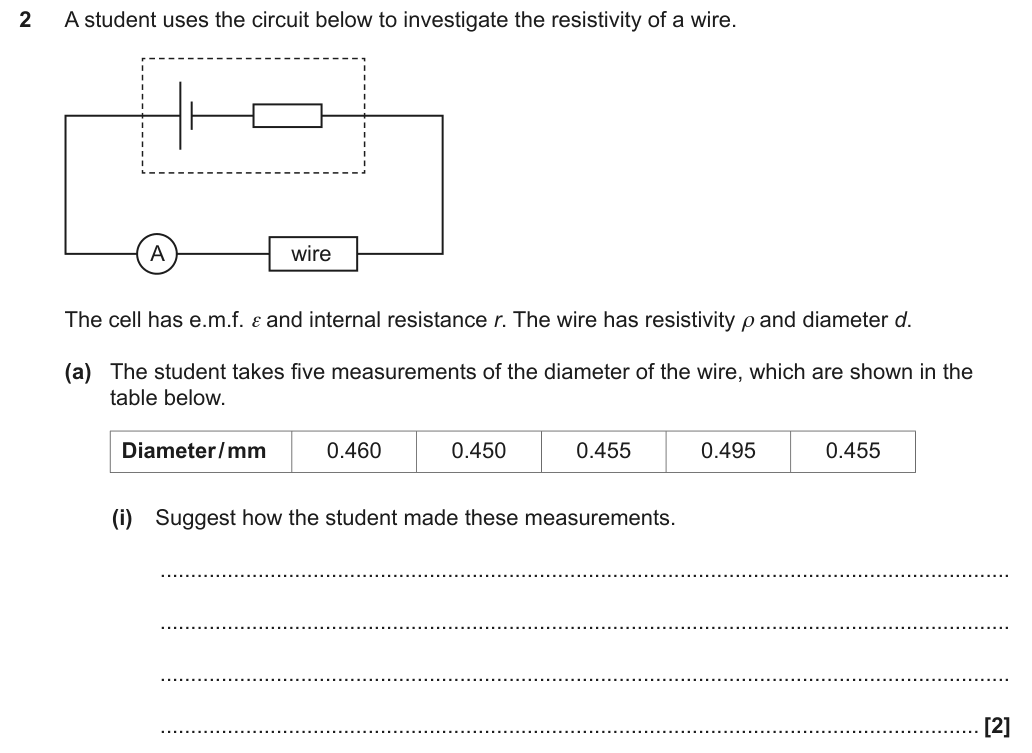
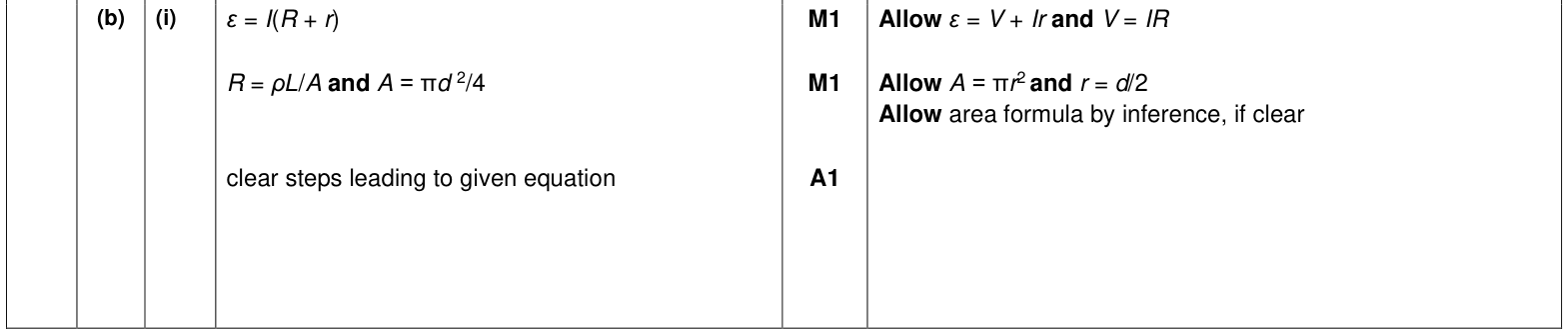
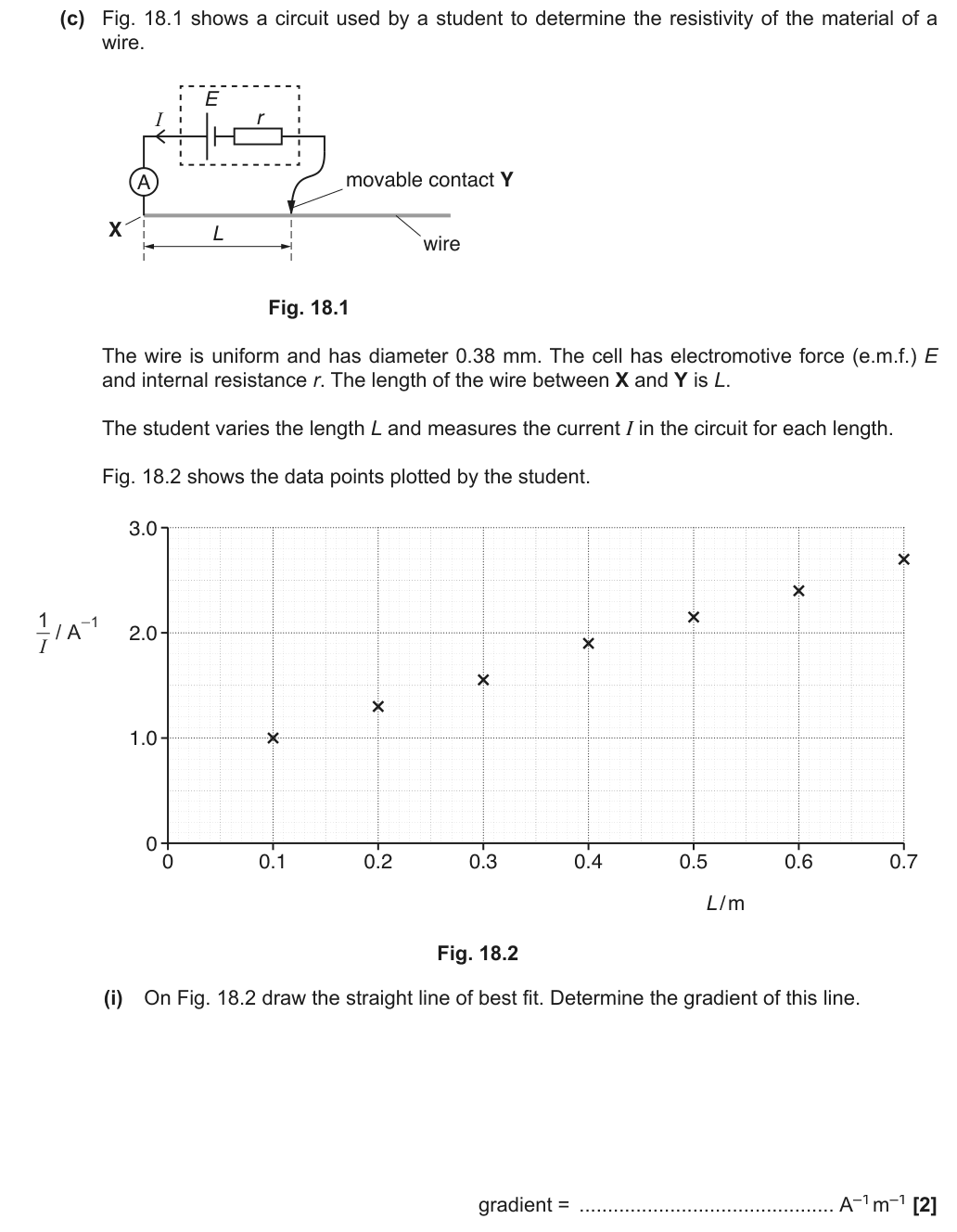
Almost all candidates showed excellent ability in substituting and rearranging equations. The starting point was ε = I(R + r) where R = ρL/A. Some candidates rearranged ε = I(R + r) before writing it down, starting with R = ε / I – r or similar. Centres should encourage starting a proof with the standard form of the equations. The main difficulty was in substituting A = r2 = (d/2)2 into the formula for R. Poor presentation occasionally made responses difficult to mark.
Skills: M2.2 Change the subject of an equation, including non-linear equations; M4.3 Calculate areas of triangles, circumferences and areas of circles, surface areas and volumes of rectangular blocks, cylinders and spheres
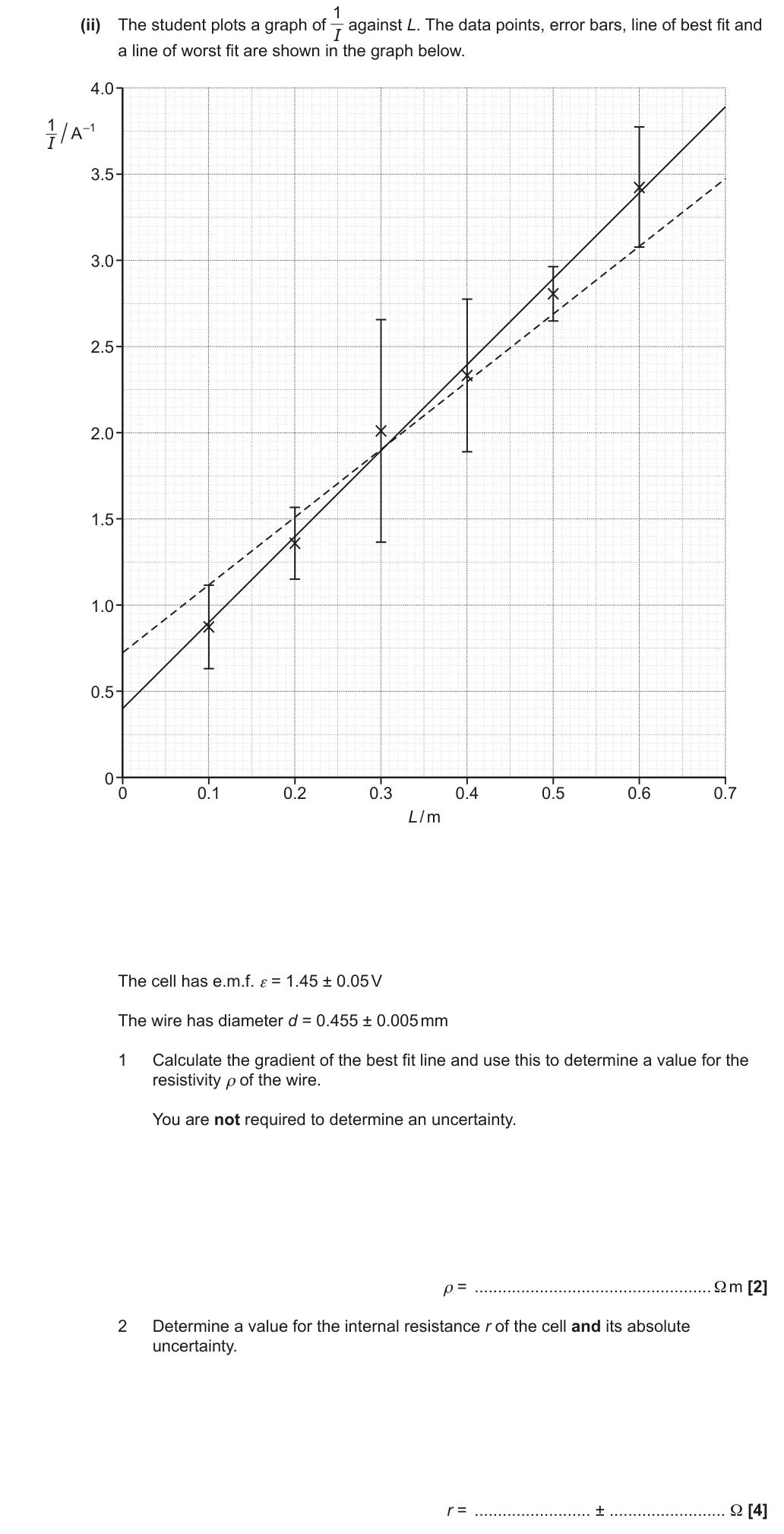
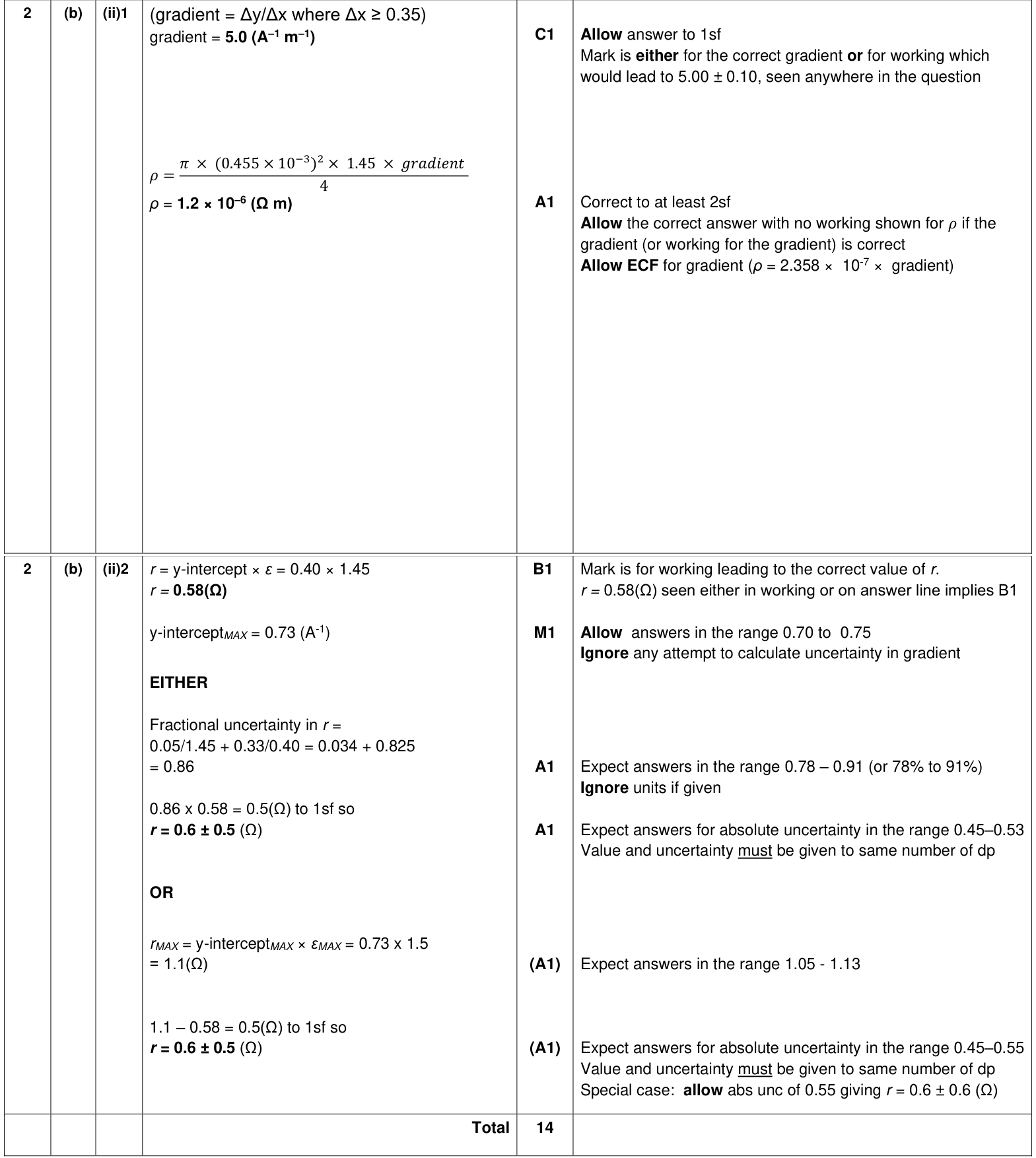
A gradient of 5 was chosen here deliberately to make the question as accessible as possible. Most candidates were able to see from the equation that the gradient would be equal to 4ρ/εd2. However, a significant number did not remember that d was measured in mm and so they had a power of ten error in their value for ρ. The question asks, ‘Calculate the gradient … and use this to determine … the resistivity ρ’. It was helpful when candidates wrote down ‘gradient = ….’ to make their working clear. From the equation, y-intercept = r/ε and so r = y-intercept × ε. This was a relatively simple calculation. From the question stem, ε = 1.45 ± 0.05 V and, from the graph, y-intercept = 0.40 ± 0.33. Since r is found by multiplying y-intercept and ε, we can apply the rule: % uncertainty in r = % uncertainty in y- intercept + % uncertainty in ε. An alternative approach is to find the upper bound for r, which is the greatest value of y-intercept (0.73 from graph) × greatest value of ε (1.45 + 0.05 = 1.5V). Candidates should be reminded to quote the uncertainty to the same number of decimal places as their value for the internal resistance. Once again, poor presentation often made responses difficult to mark. For example, it is much easier to award a mark for the statement ‘intercept of worst line = 0.7’ or ‘intercept = 0.4 ± 0.3’ than to try and spot it mid-calculation.
Skills: M1.5 Identify uncertainties in measurements and use simple techniques to determine uncertainty when data are combined; M3.3 Understand that y = mx + c represents a linear relationship; M3.4 Determine the slope and intercept of a linear graph; PAG3 Investigating electrical properties
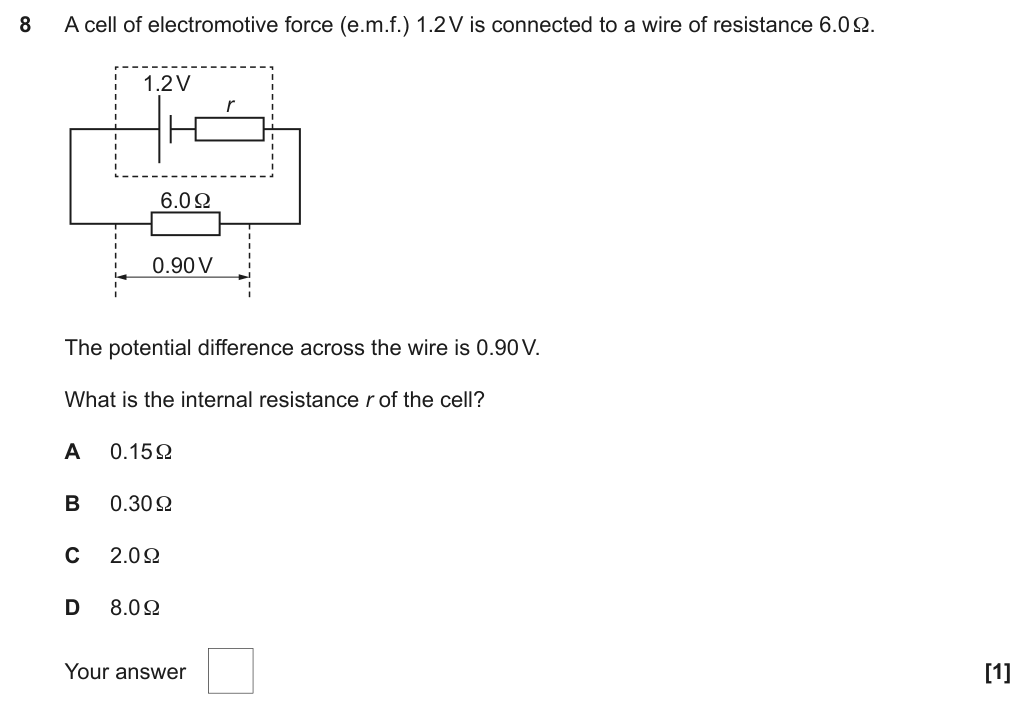
C
Most candidates performed well and correctly selected the equation; ℰ = V + Ir and applied Ohm’s Law to give the answer C. The most common distractor was answer D where candidates had correctly calculated the current but carried out the calculation for the internal resistance r = 1.2 V / 0.15 A = 8 Ω.
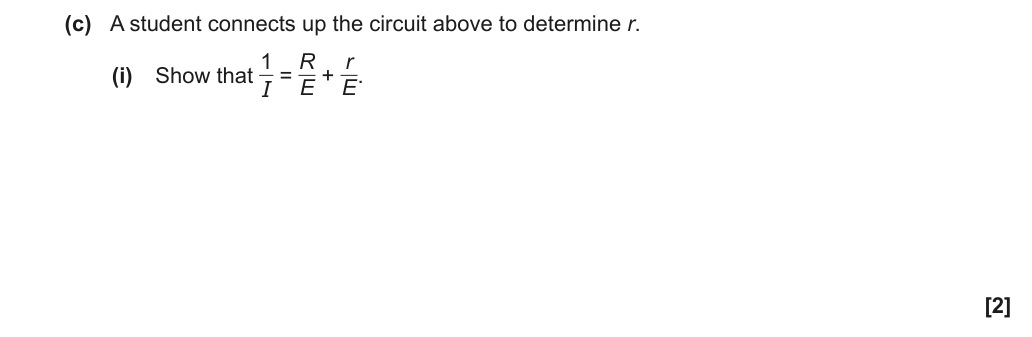
Many candidates were able to do this relatively simple manipulation. The circuit diagram should alert the candidates that this question is based on internal resistance and allow them to select one of the appropriate starting points. Some less successful responses chose other routes, such as I = I1 + I2, but then quickly found themselves unable to go further, unless by using incorrect algebra.
Skills: M2.2 Change the subject of an equation, including non-linear equations
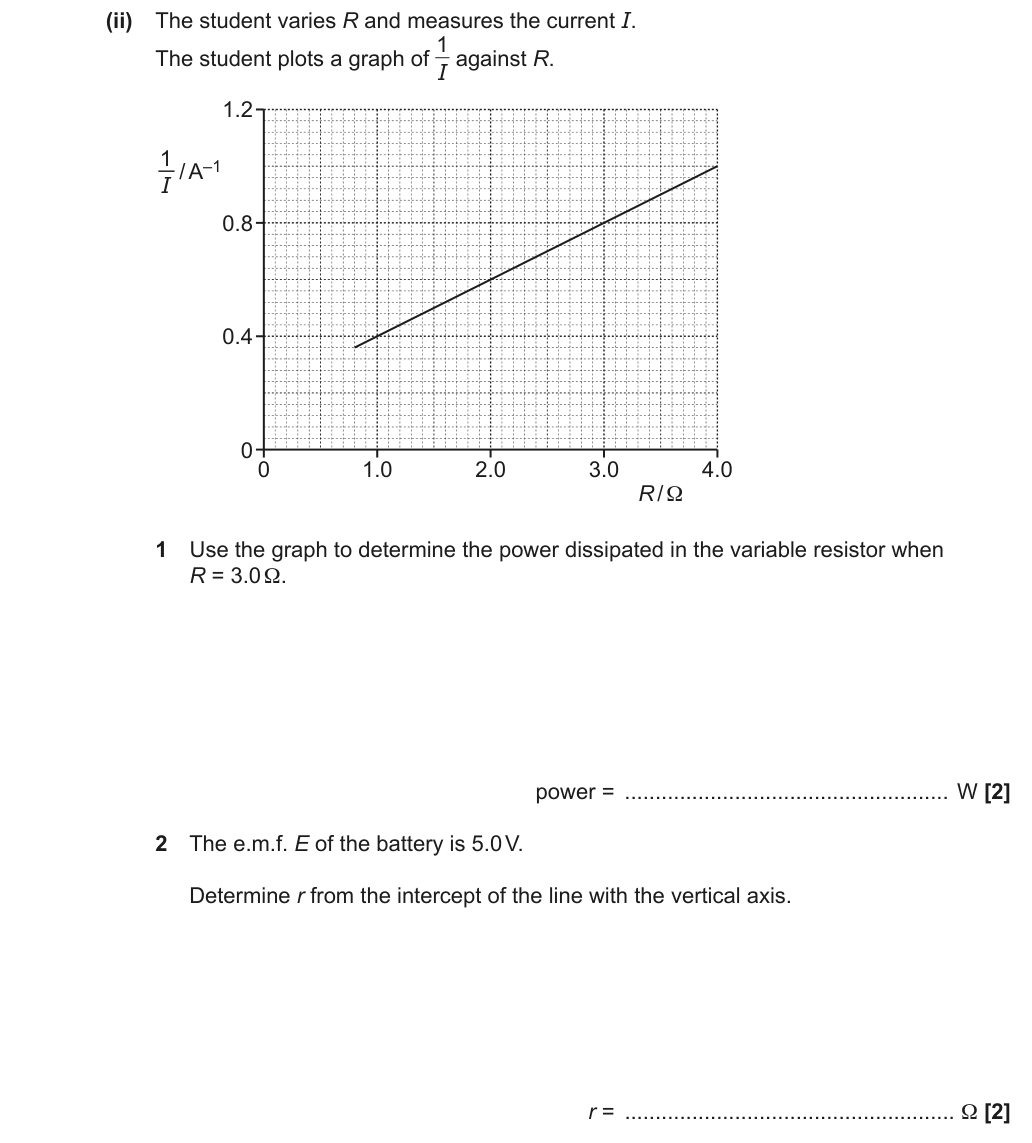
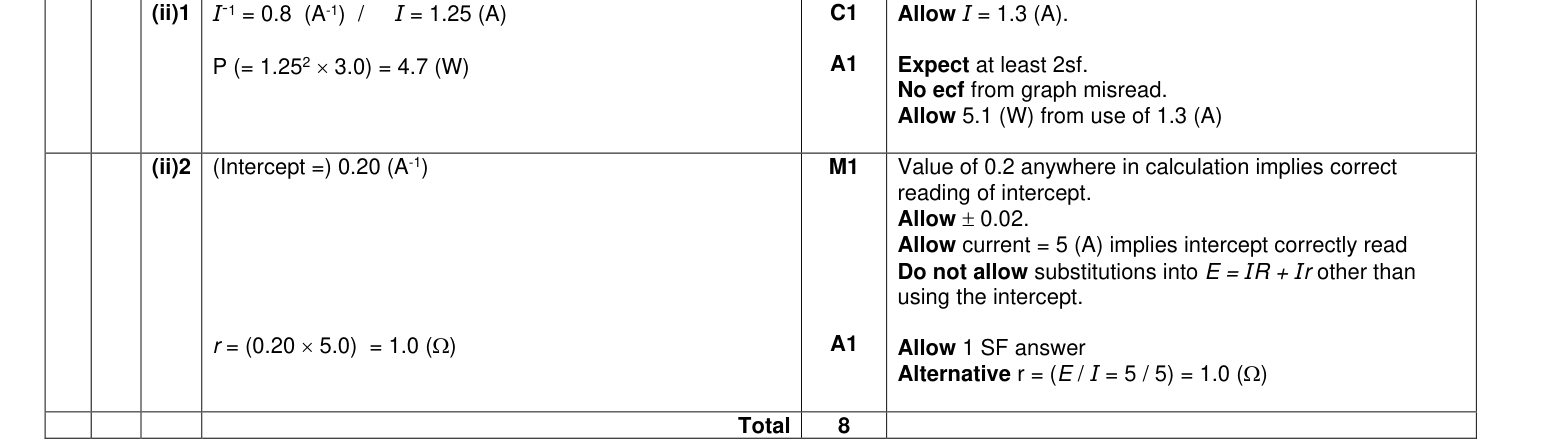
The vast majority of candidates were able to complete 1 correctly – there were few misreads from the graph, although some candidates took the reading of 0.8 as the current rather than the inverse of the current. There were also a few arithmetic slips with some candidates correctly setting out their calculation, such as P = 1.252 3.0, but then not squaring the current. 2 was answered slightly less successfully and although the reading of the intercept was taken, some candidates could go no further.
Skills: M3.1 Translate information between graphical, numerical and algebraic forms; M3.4 Determine the slope and intercept of a linear graph; PAG3 Investigating electrical properties
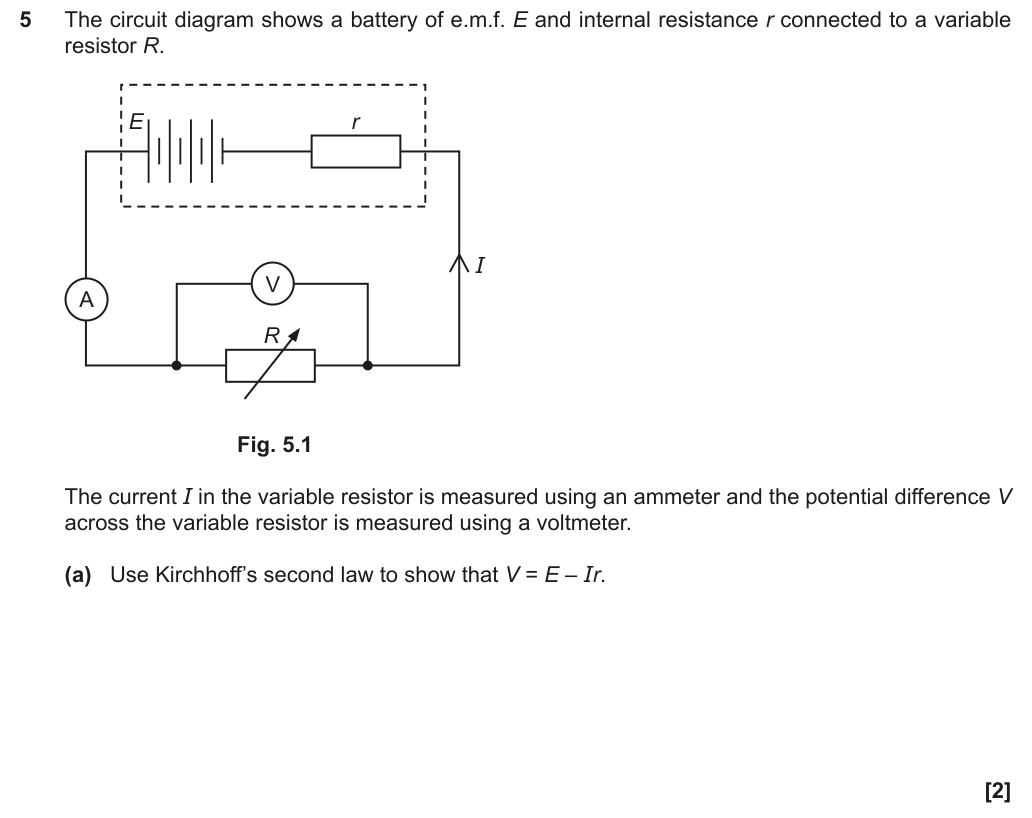
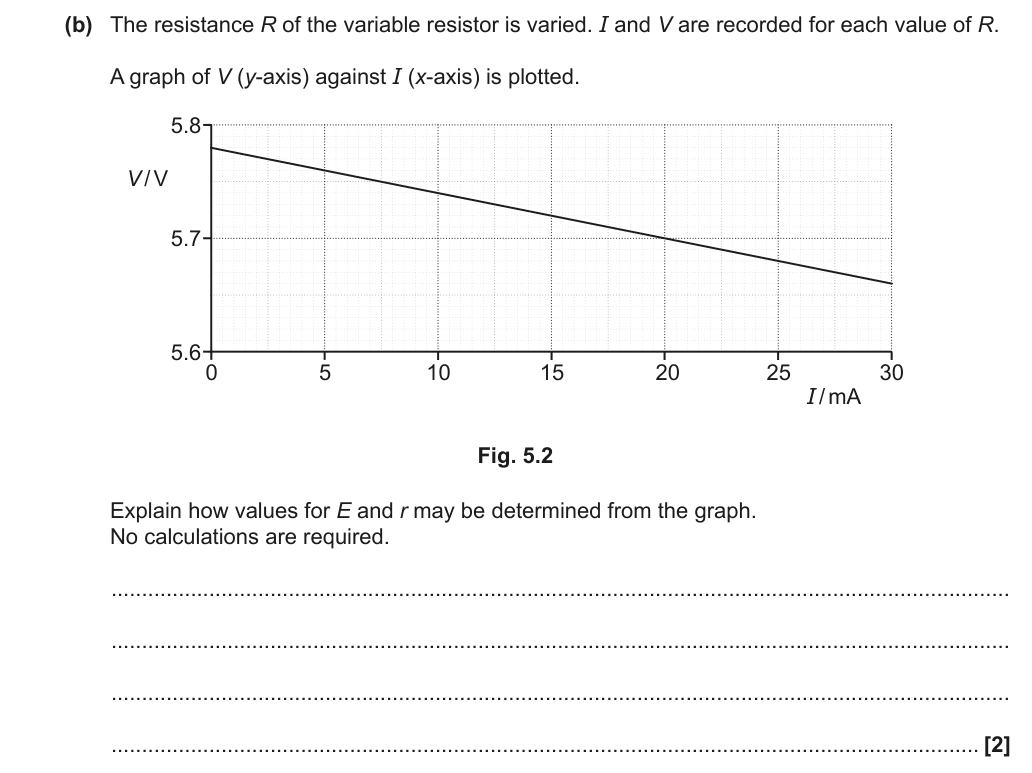
Skills: M3.3 Understand that y = mx + c represents a linear relationship; M3.4 Determine the slope and intercept of a linear graph; PAG3 Investigating electrical properties
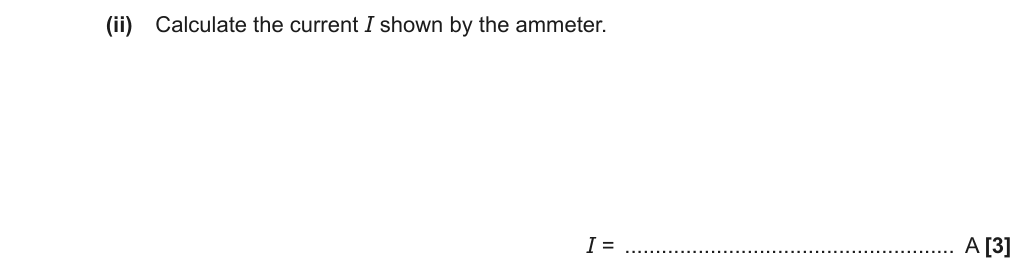
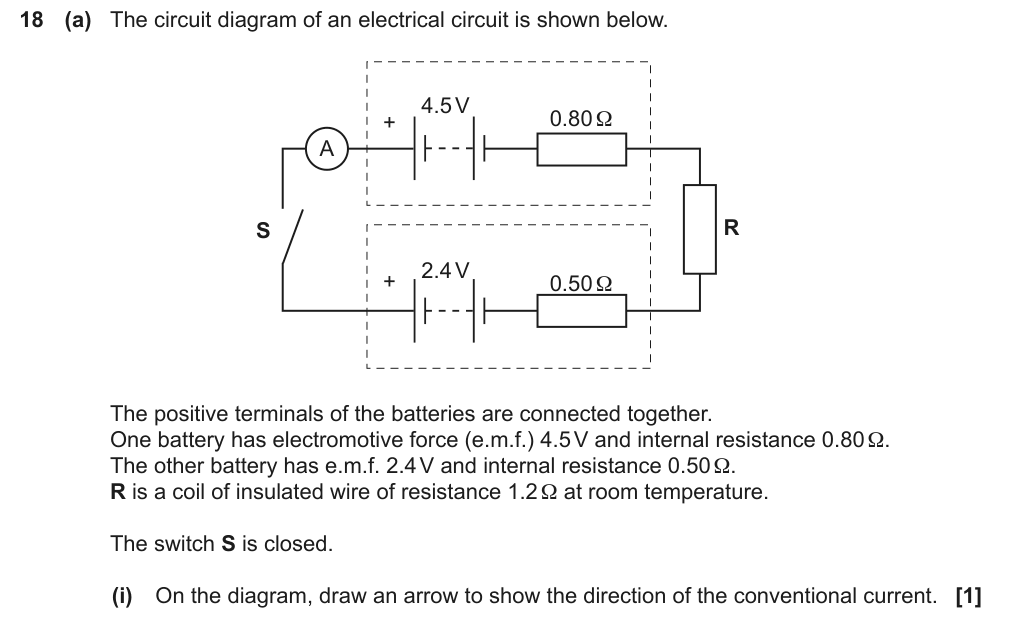
This calculation required the candidate to set out the whole circuit in one. Around one third did not score any marks on this question as they attempted to treat each cell individually and then produce some form of average. Other common misunderstandings included treating the 0.5 ohm and 0.8 ohm resistors as if they were in parallel, and adding the emfs.
Skills: M2.3 Substitute numerical values into algebraic equations using appropriate units for physical quantities
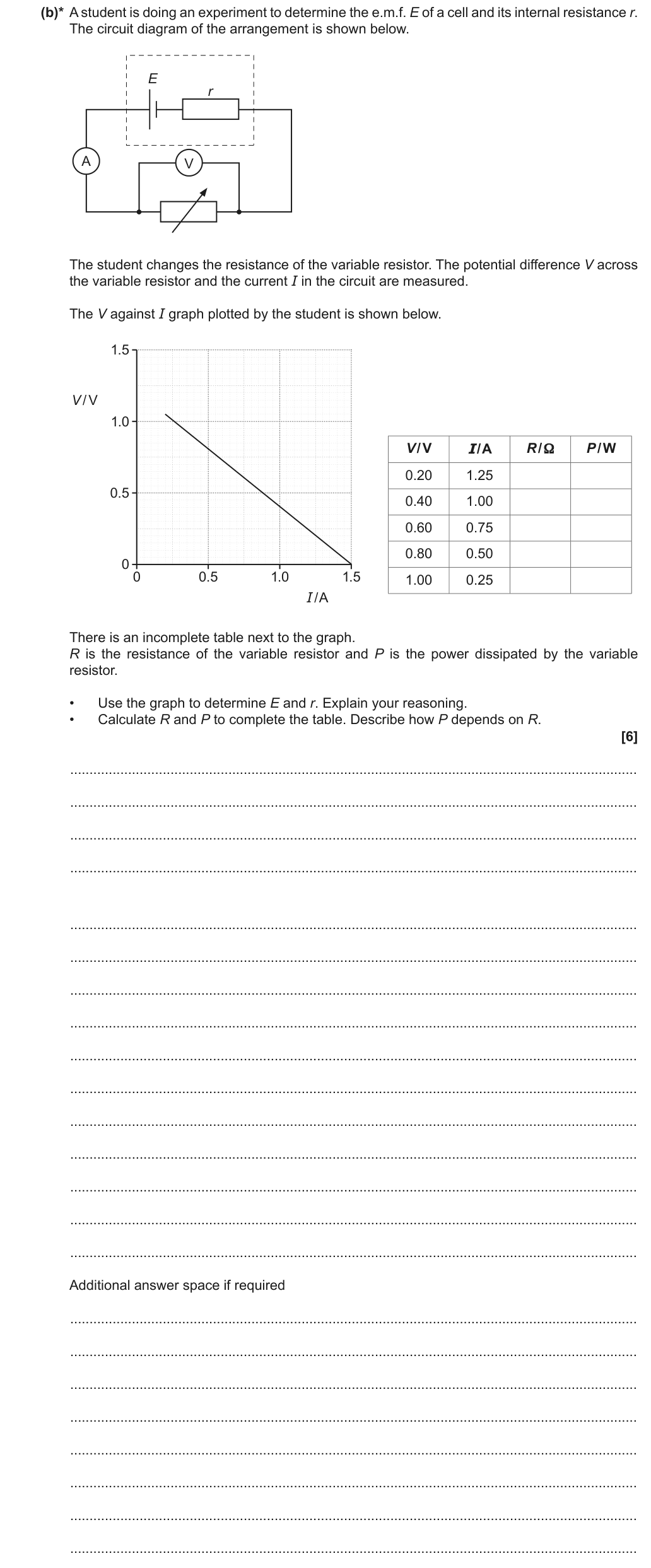
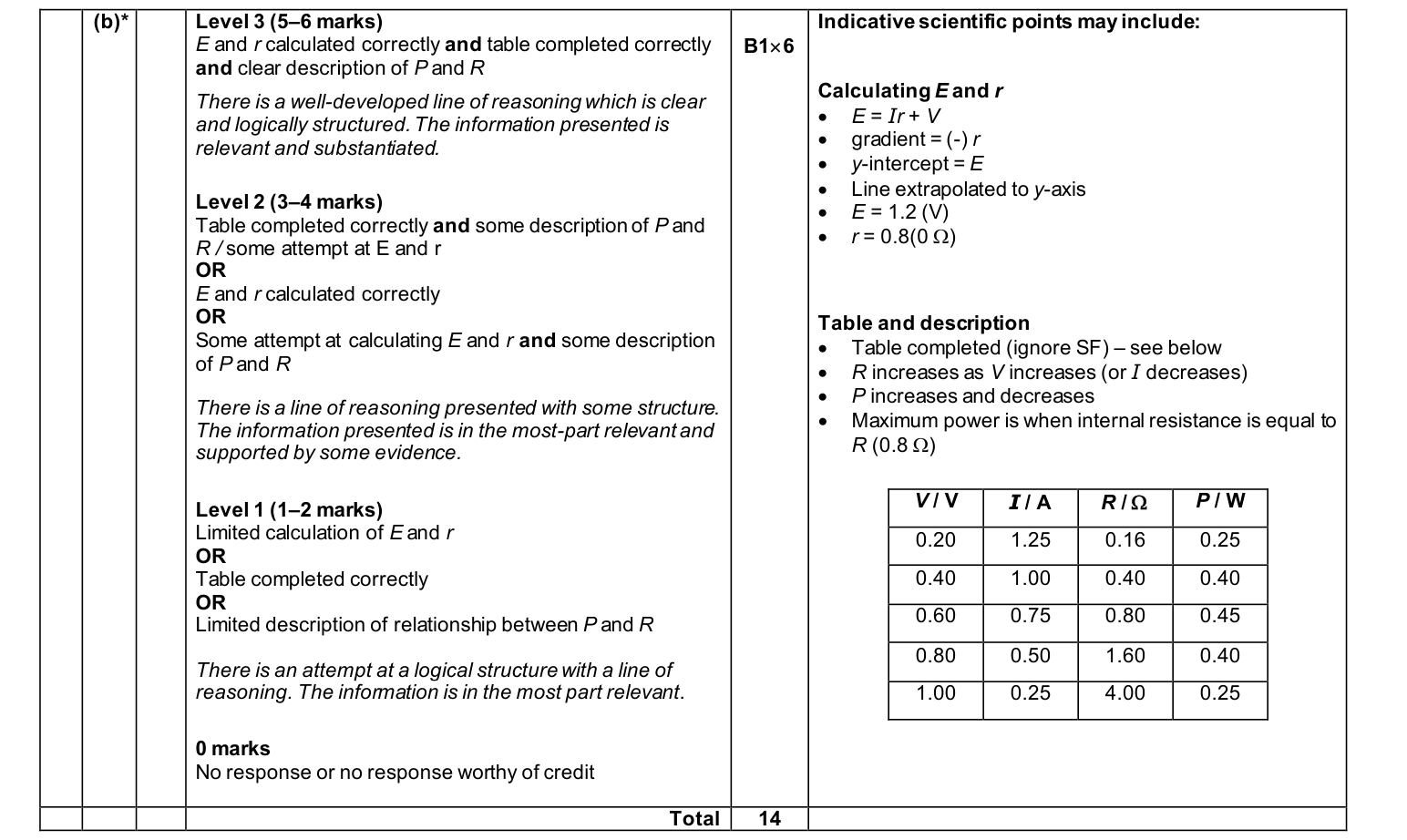
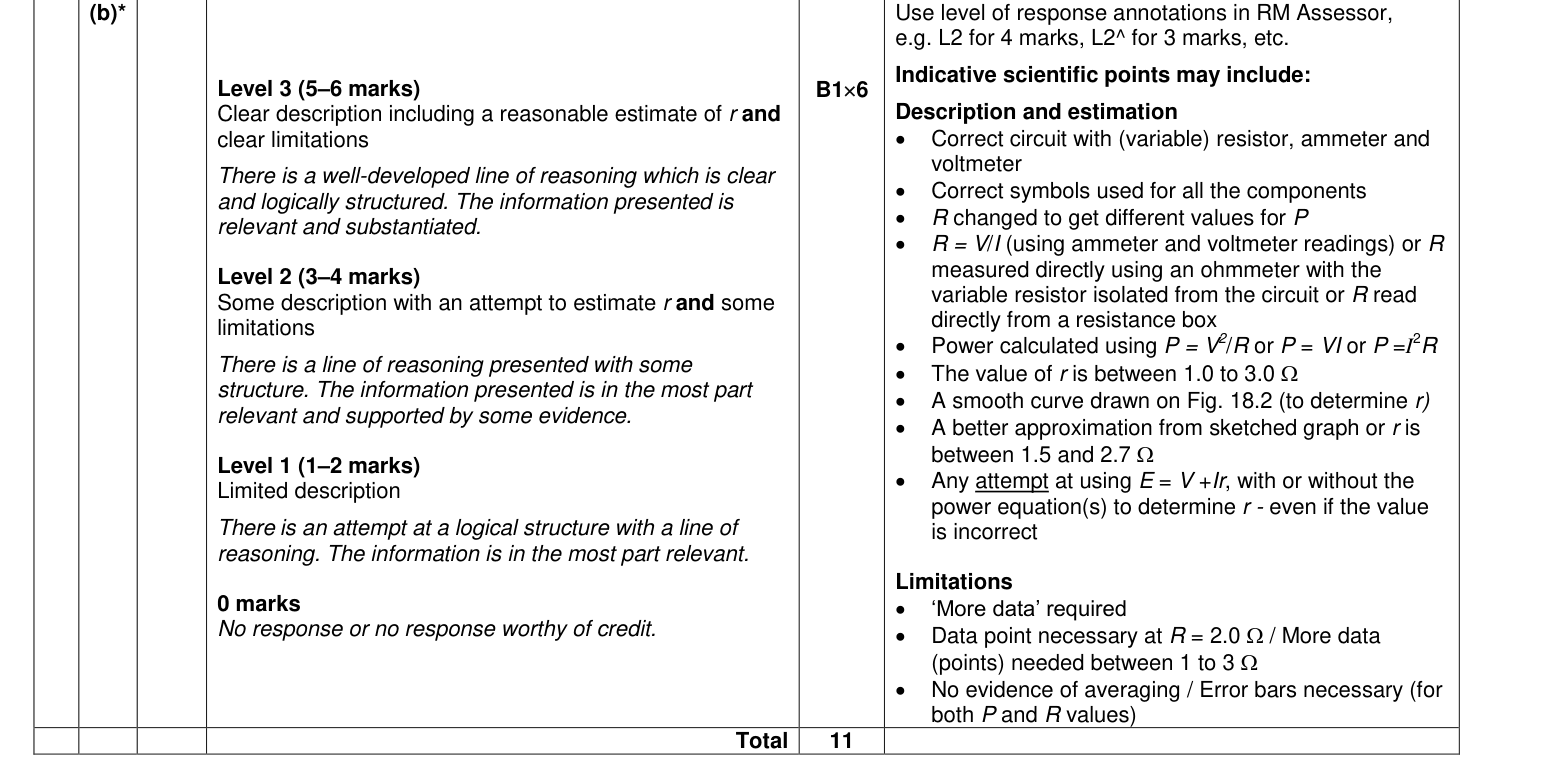
This is the first LoR question on the paper. This question is based on a standard physics practical, so the experimental set up should have been familiar to many candidates. While a holistic approach is taken to the marking, there are key points which should be present for the award of given levels. The question is structured in two main parts: the determination of E and r, and then the calculation of R and P for the table. However, each of these parts contain additional instructions which were often ignored by the candidates. For the emf and internal resistance, an explanation of the method used was required, the most usual way would be based around a rearrangement of E = V + Ir. For the resistance and power, a qualitative description of how they are related is needed, along with an appreciation that when the internal resistance equals the load resistance the power is at its maximum. For the most part, candidates carried out the calculations well, completing the table and identifying E and r correctly, but did not give suitable and detailed descriptions leading to them being limited to lower levels. Very few discussed the resistance and power relationship at all, despite it being a reasonably simple pattern. It is very important that candidates make note of all that is required in a LoR question if they are to access the higher levels. The vast majority of candidates did sufficient work to place them in Level 2.
Skills: M2.3 Substitute numerical values into algebraic equations using appropriate units for physical quantities; M3.3 Understand that y = mx + c represents a linear relationship; M3.4 Determine the slope and intercept of a linear graph; PAG3 Investigating electrical properties
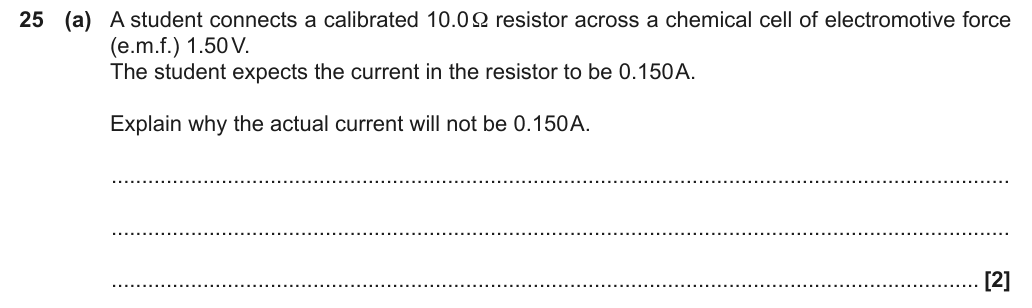
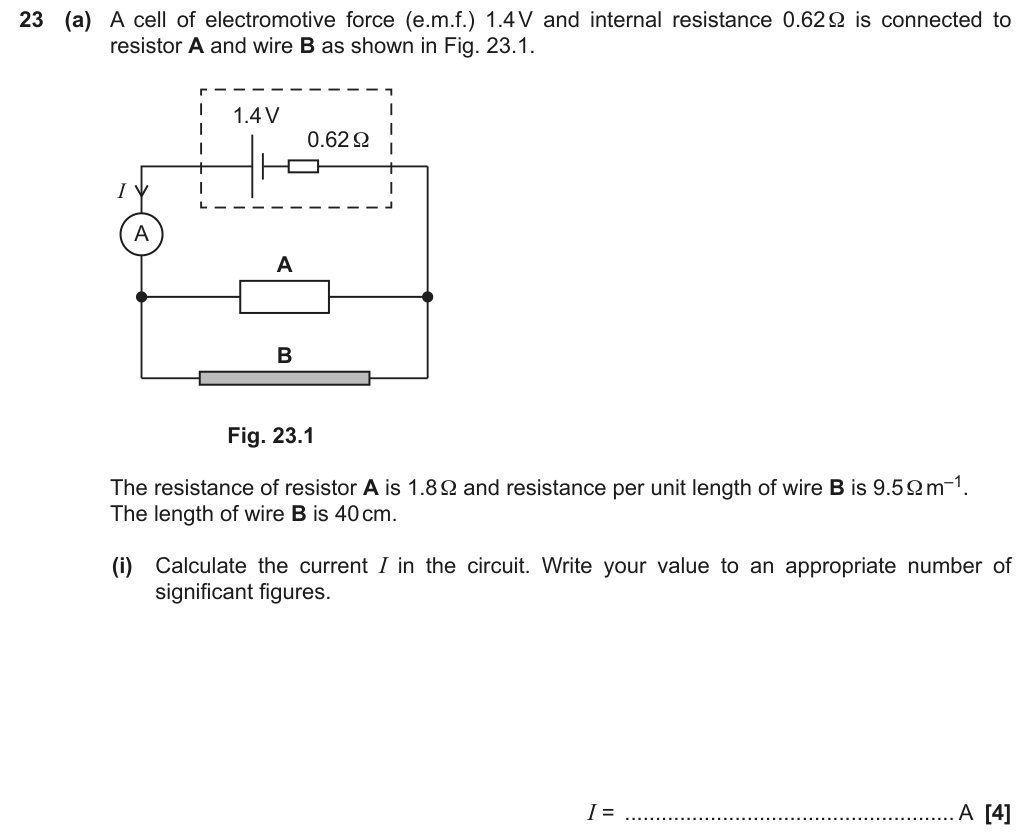
This circuit question required multiple steps to calculate the current I in the circuit. Firstly, the candidates had to determine the resistance of wire B, then sort out the parallel combination of resistors A and wire B, and eventually deal with the whole circuit which included the internal resistance of 0.62 Ω. The question discriminated well, with almost half of the candidates securing full marks. The responses were often well-structured and demonstrated skilled use of calculators. Some responses were spoilt by premature rounding of numbers, but generally, candidates were sensible in retaining numbers on their calculators for subsequent stages of the calculation. Exemplar 10 below shows an immaculate response from a middle-grade candidate. All the stages of the calculations are easy to see in this well-structured response. This candidate has not rounded any of the numbers between stages – a very admirable strategy. The final response is quoted to 2 significant figures as required.
Skills: M1.1 Use an appropriate number of significant figures; M2.3 Substitute numerical values into algebraic equations using appropriate units for physical quantities
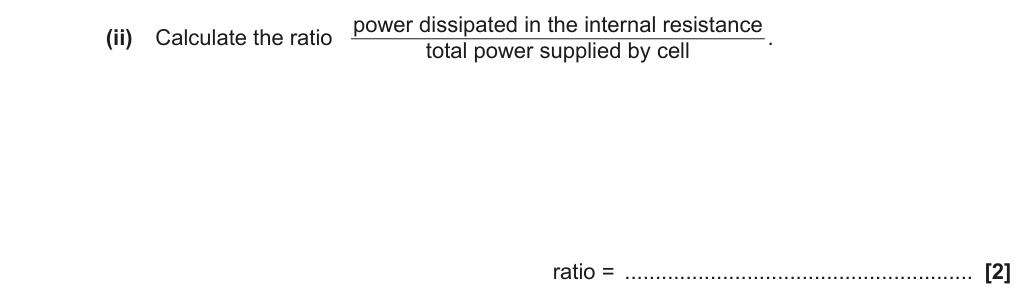
Most candidates scored 1 mark for using an appropriate power equation. The main obstacle here for the candidates was what quantities to use for the total power supplied by the cell. Quite often, the internal resistance was omitted and 0.762 × 1.22 was used for calculating the total power. Top-end candidates used the easier alternative of 1.4 × 0.76.
Skills: M0.3 Use ratios, fractions and percentages; M2.3 Substitute numerical values into algebraic equations using appropriate units for physical quantities
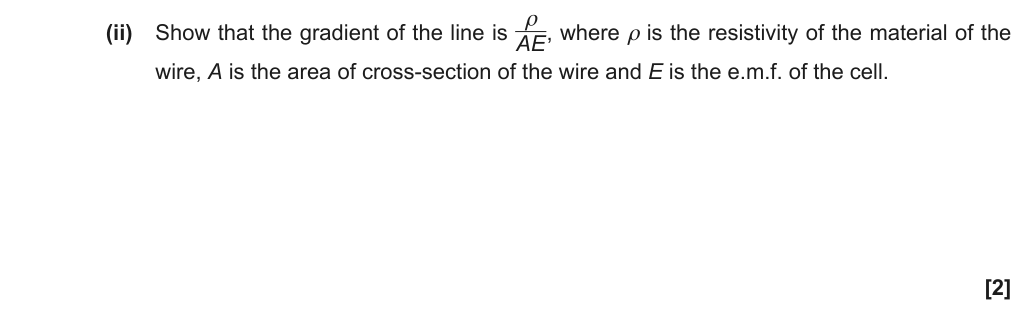
Most candidates struggled with (c)(ii). Less than 1 in 10 candidates successfully used the equations E = V + Ir and R = 𝐴𝐴 to derive the expression 𝐼𝐼= 𝐴𝐴𝐴𝐴𝐿𝐿+ 𝐸𝐸, and then identified the gradient as 𝐴𝐴𝐴𝐴 by comparison with the equation for a straight-line y = mx + c.
Skills: M2.2 Change the subject of an equation, including non-linear equations; M3.3 Understand that y = mx + c represents a linear relationship
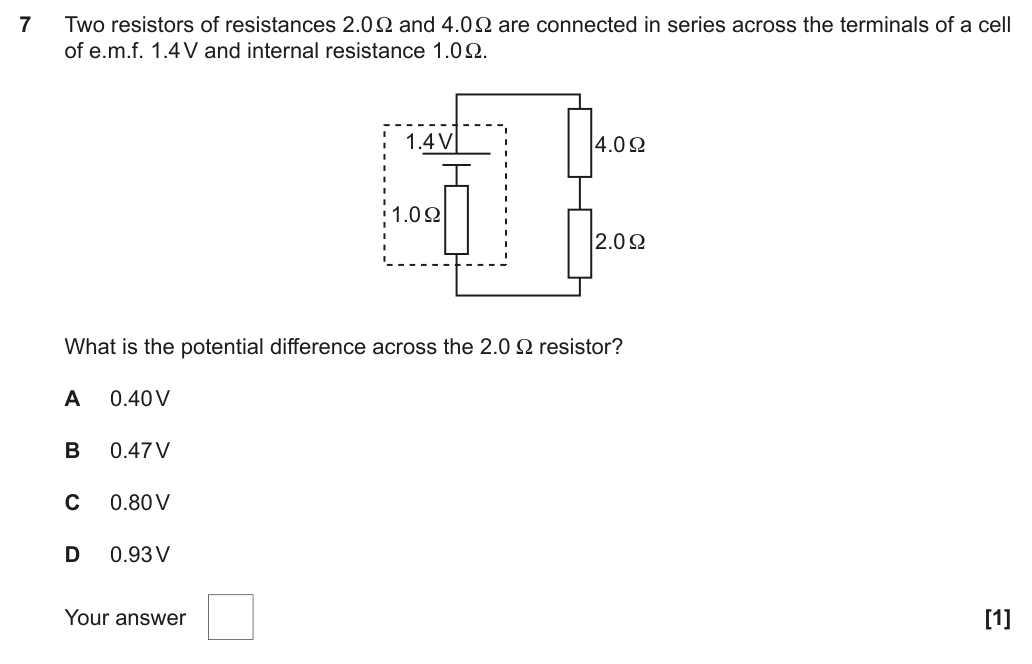
A
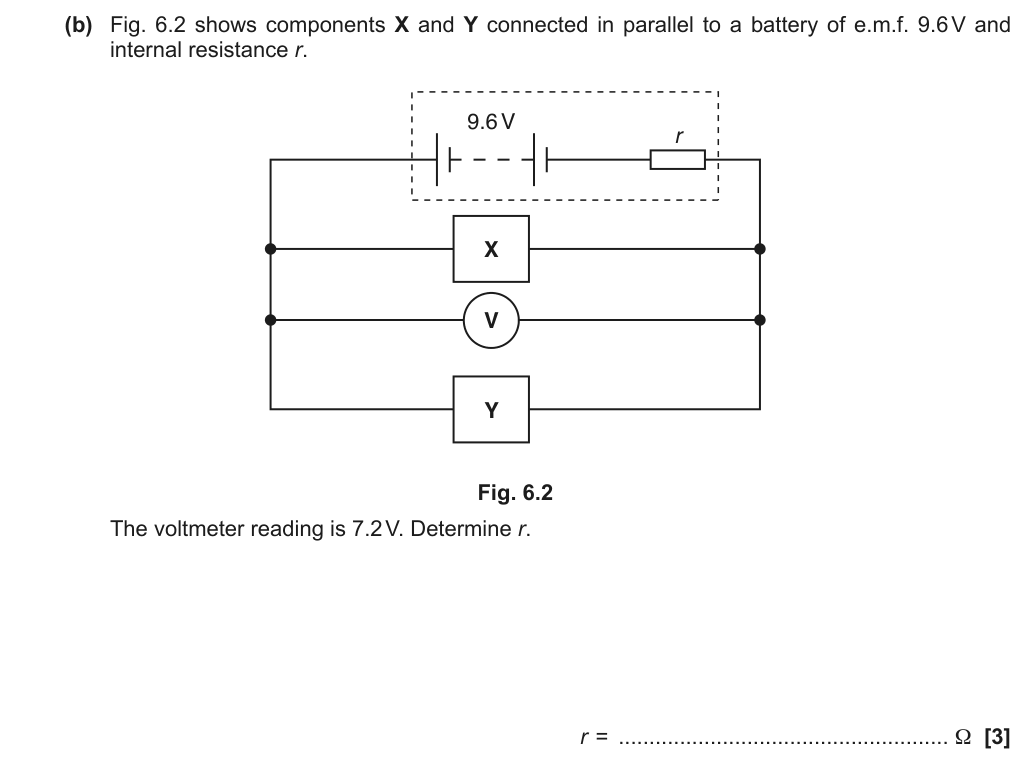
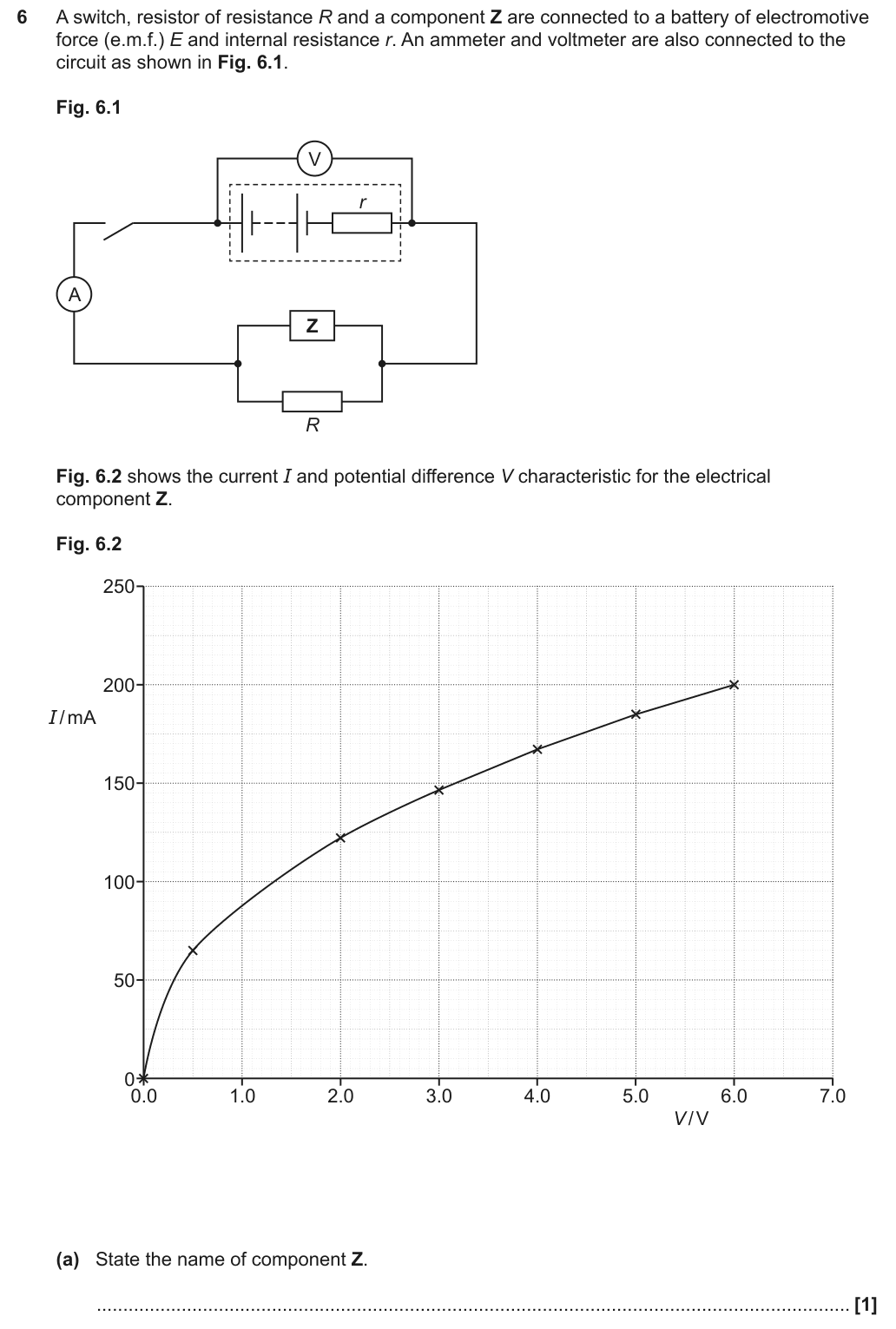
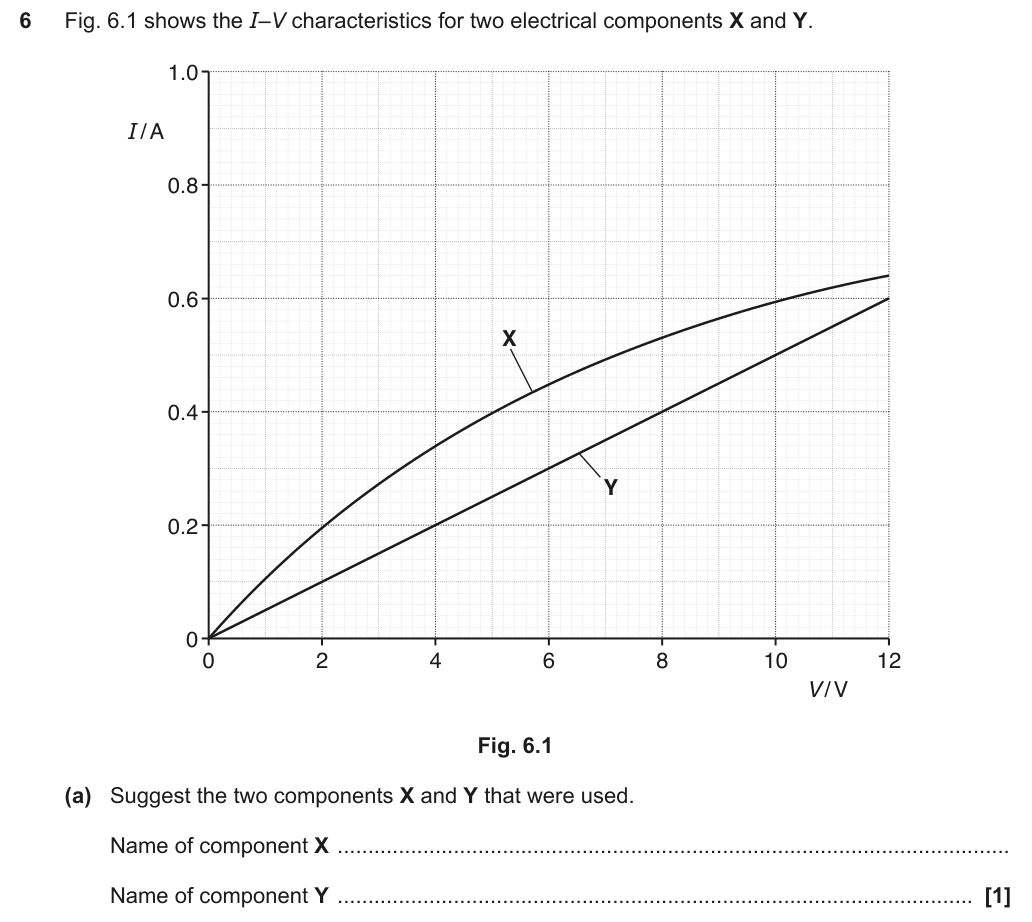
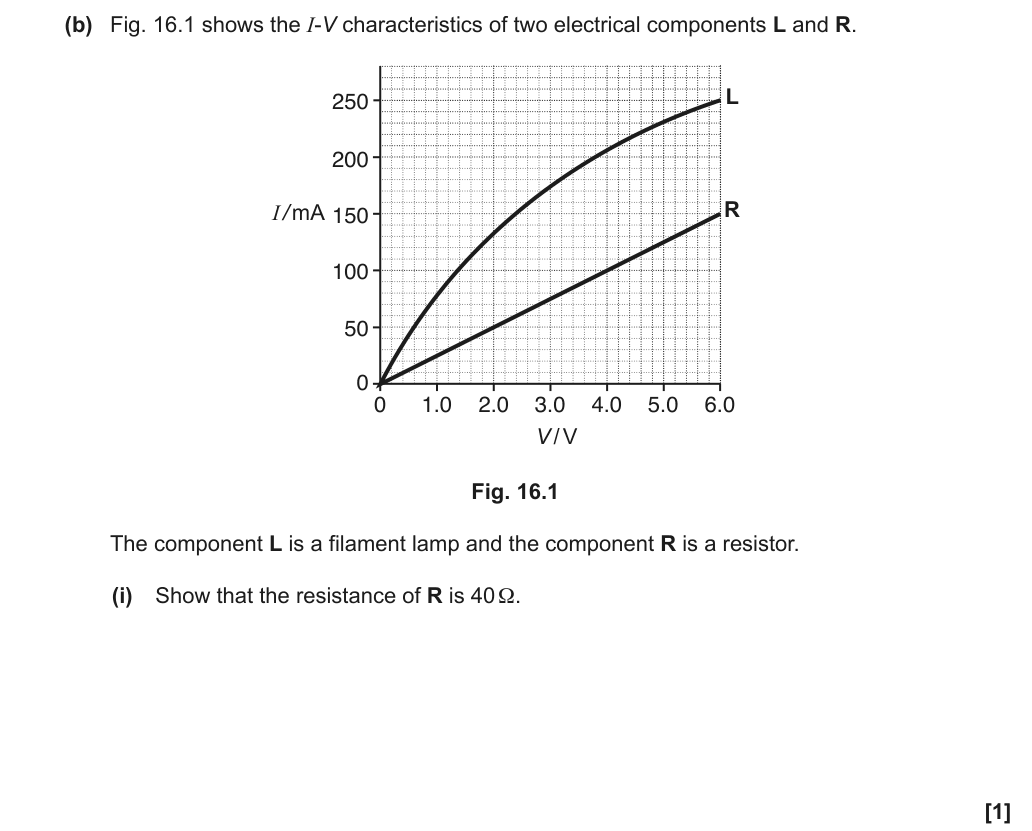
This question assessed candidates’ knowledge of internal resistance as well as their understanding of series and parallel circuits. Many candidates correctly determined that the ‘lost volts’ was 2.4 V. Unfortunately, the total current in the circuit was more difficult for candidates to determine. Candidates needed to identify that the potential difference across each component was 7.2 V and use the graphs to determine the two current values. Again, good candidates clearly show their working. The advantage would be in that an error in reading information from the graph would still allow further credit. The candidate has clearly state the method and at the top stated that Ir = 2.4 V. The candidate has then clearly read the currents for each component at a potential difference of 7.2 V to then determine the total current. There is then a correct calculation to determine the internal resistance r.
Skills: M2.2 Change the subject of an equation, including non-linear equations; M3.1 Translate information between graphical, numerical and algebraic forms
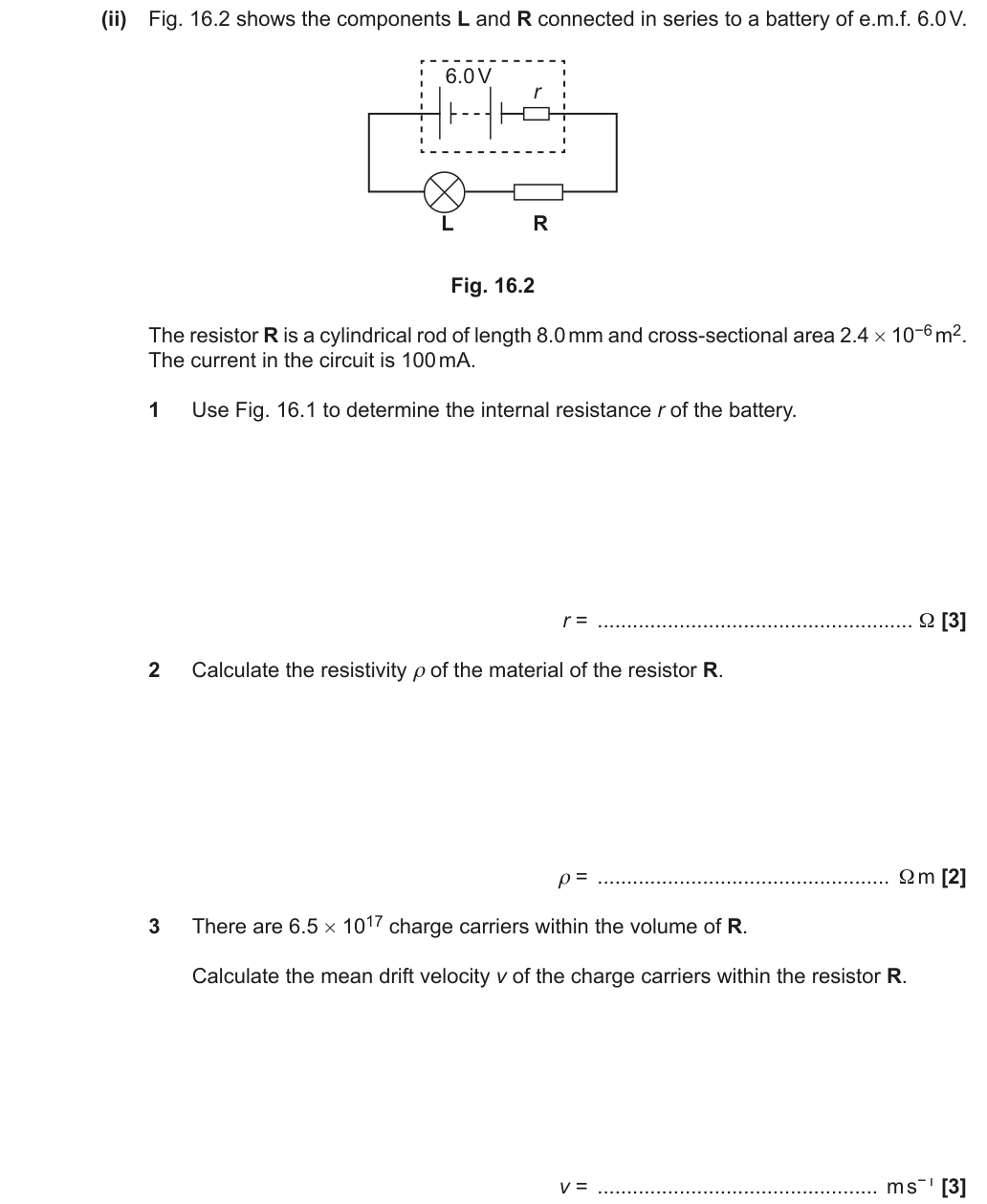
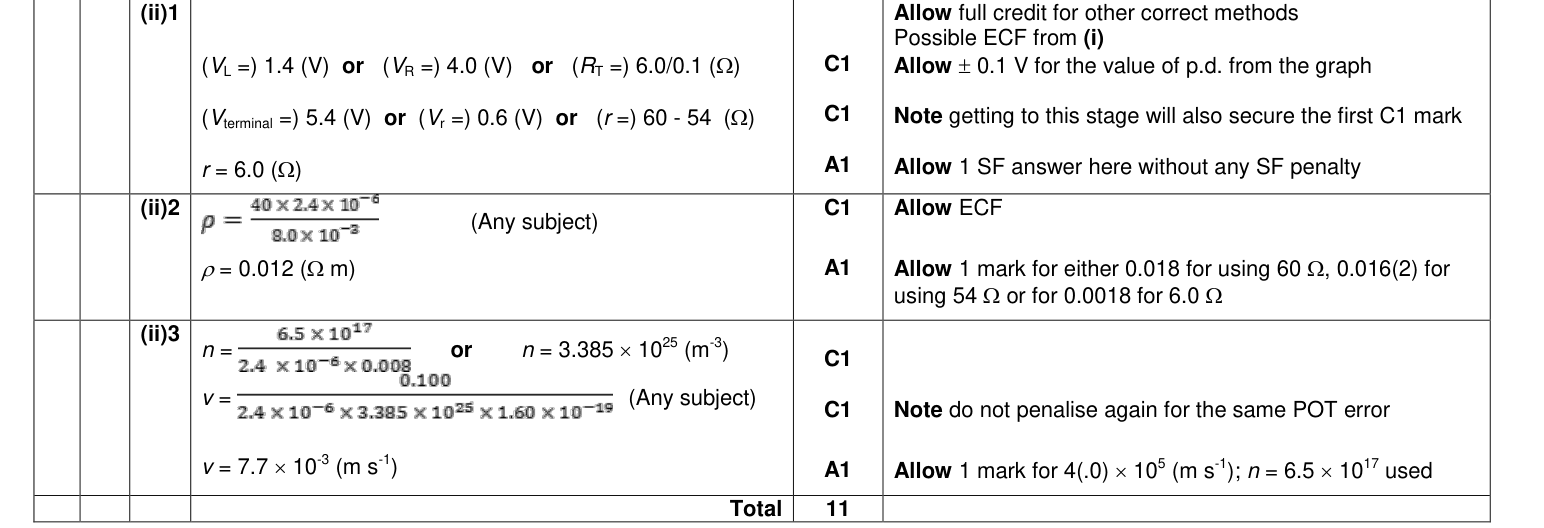
This was a discriminating question with many of the top-end candidates effortless getting the correct answer of 6.0 Ω for the internal resistance r. The most common error was omitting the resistance of the filament lamp in the calculation. This gave an incorrect value of 20 Ω for the internal resistance. Candidates doing this still managed to pick up 1 mark for the total resistance of 60 Ω. The success in this question depended on understanding the term n in the equation I = Anev given in the Data, Formulae and Relationship booklet. A significant number of candidates took n to be the total number of charge carriers within the volume of R, instead of the number of charge carriers per unit volume (number density). Those who appreciated this had no problems coping with prefixes and powers of ten. The correct answer was 7.7 × 10⁻³ m s-1. Using 6.5 × 10¹⁷ for the number density, gave an answer of 4.0 × 10⁵ m s-1; examiners credited 1 mark for this incorrect answer, mainly for the manipulating and using the equation I = Anev. This exemplar illustrates a perfect answer from a C-grade candidate. The equation has been rearranged correctly and the substitution is all correct and easy to follow. The number density n has not been calculated separately – it forms an integral part of the whole calculation. The one big benefit of this is that you do not end up with rounding errors. A decent technique demonstrated here. All correct for 3 marks.
Skills: M0.2 Recognise and use expressions in decimal and standard form; M2.2 Change the subject of an equation, including non-linear equations; M2.3 Substitute numerical values into algebraic equations using appropriate units for physical quantities; M3.1 Translate information between graphical, numerical and algebraic forms
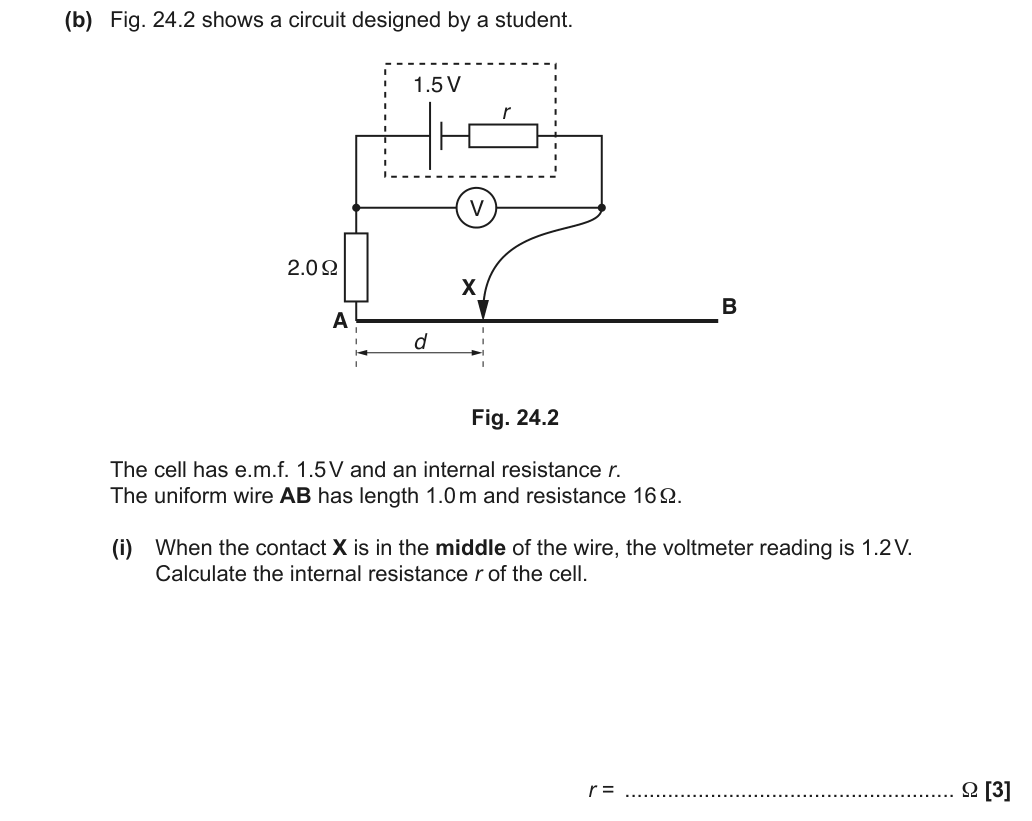
Skills: M2.3 Substitute numerical values into algebraic equations using appropriate units for physical quantities; M2.4 Solve algebraic equations, including quadratic equations
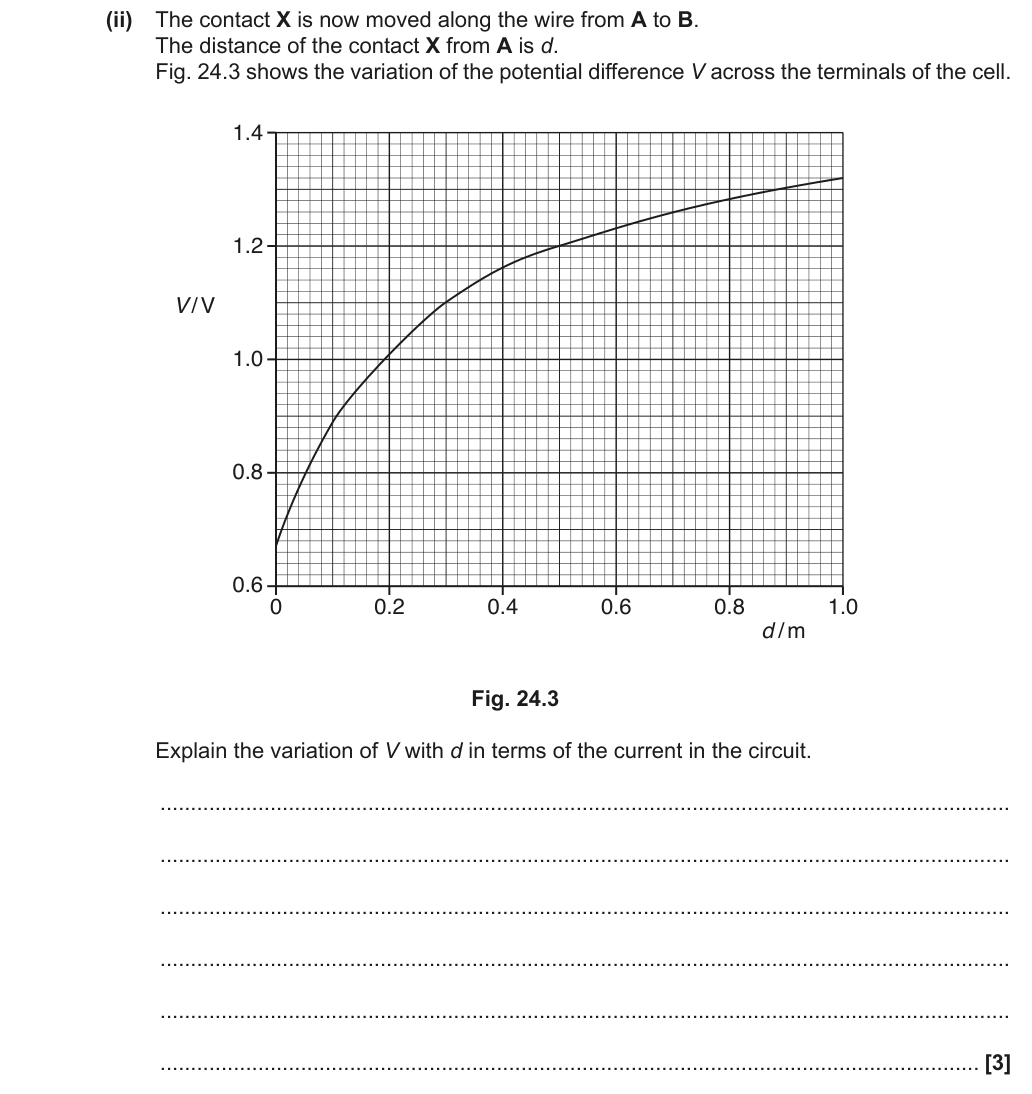
Skills: M3.1 Translate information between graphical, numerical and algebraic forms
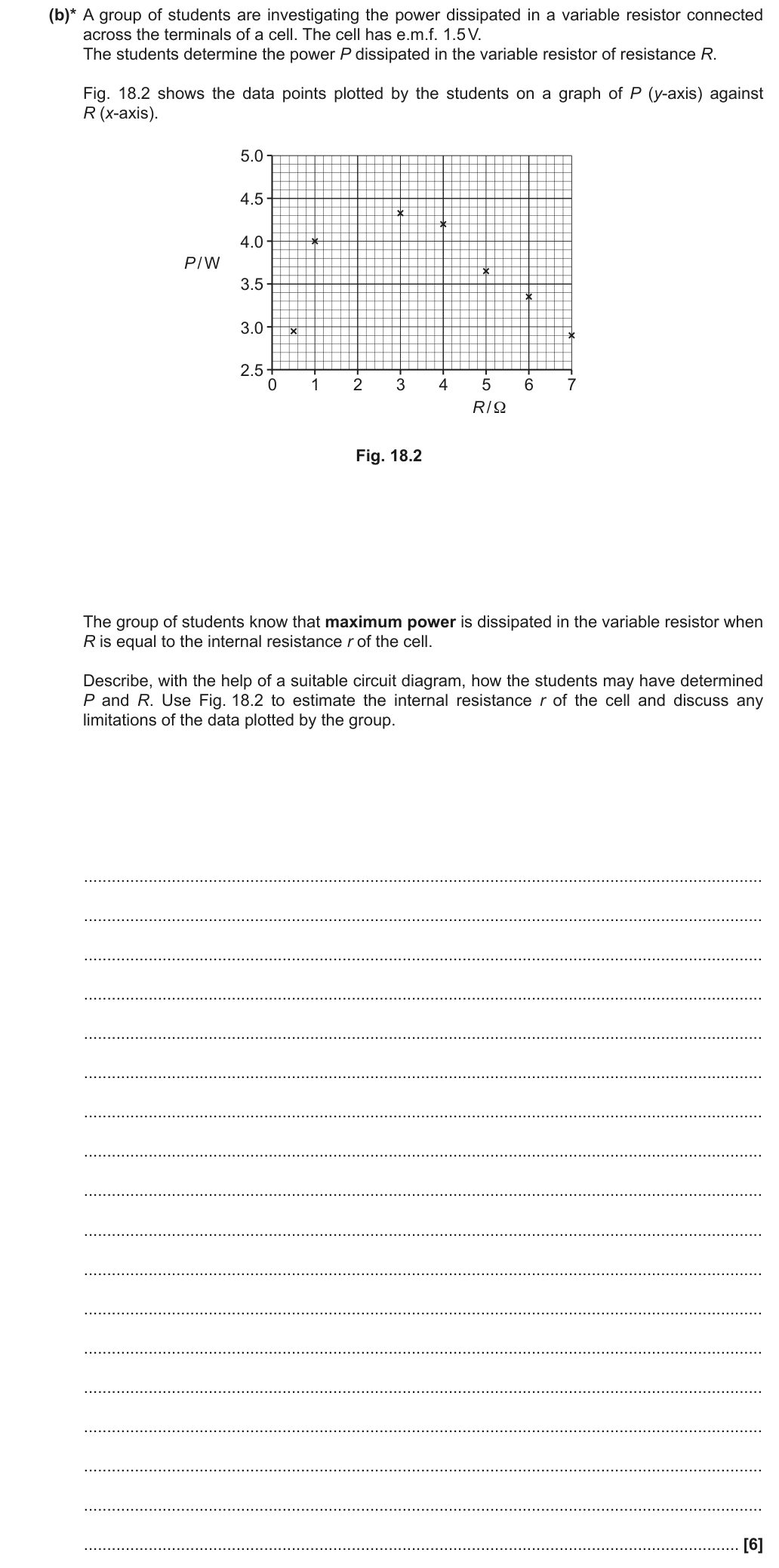
Skills: M3.1 Translate information between graphical, numerical and algebraic forms; PAG3 Investigating electrical properties
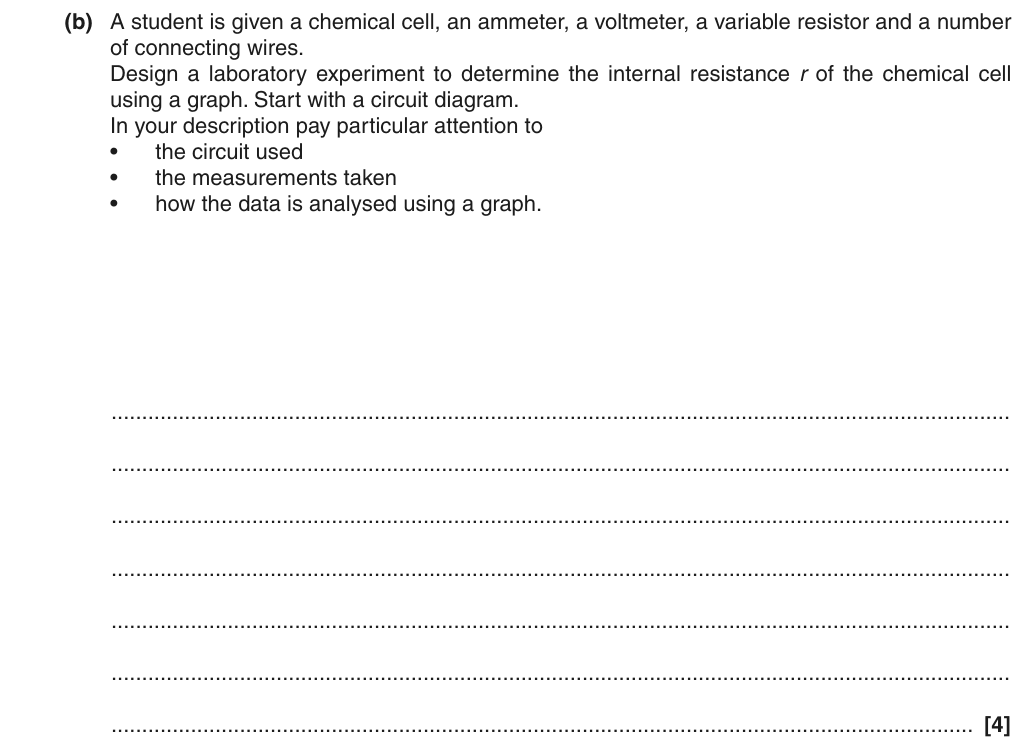
Skills: M3.3 Understand that y = mx + c represents a linear relationship; M3.4 Determine the slope and intercept of a linear graph; PAG3 Investigating electrical properties
Dropping marks on calculations, practical questions or the six-mark level of response questions? Book a trial session with a specialist OCR physics tutor.