Notes and key-term cards for this topic are being written by our tutors. The past-paper questions below are ready now.
Specification statements
Show the 5 learning outcomes from the specification
3.1.2(a)(i) the equations of motion for constant acceleration in a straight line, including motion of bodies falling in a uniform gravitational field without air resistance: v = u + at; s = ½(u + v)t; s = ut + ½at²; v² = u² + 2as
3.1.2(a)(ii) techniques and procedures used to investigate the motion and collisions of objects
3.1.2(b)(i) acceleration g of free fall
3.1.2(b)(ii) techniques and procedures used to determine the acceleration of free fall, to include using trapdoor and electromagnet arrangement and light gates and timer arrangement
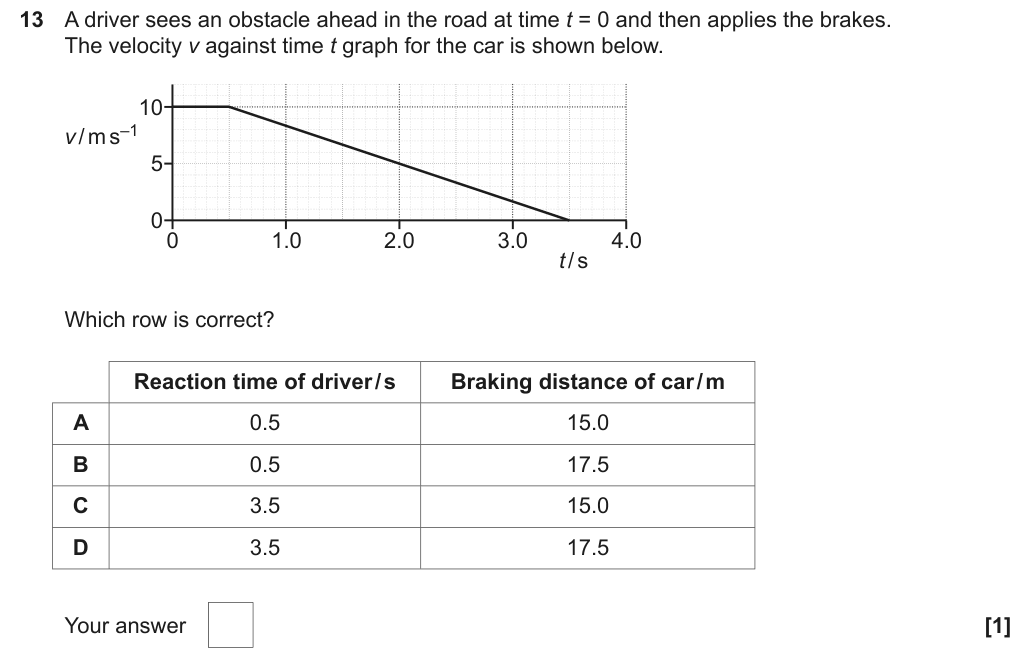
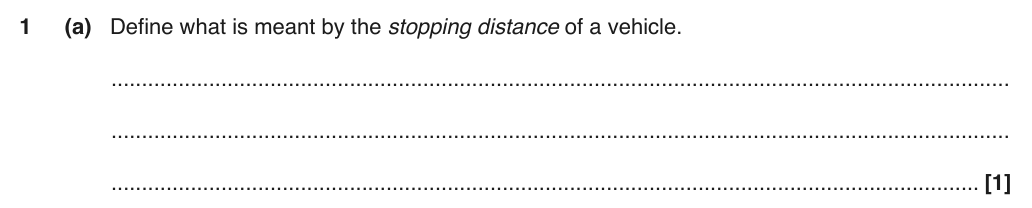
3.1.2(c) reaction time and thinking distance; braking distance and stopping distance for a vehicle.
Six-mark level of response questions on this topic
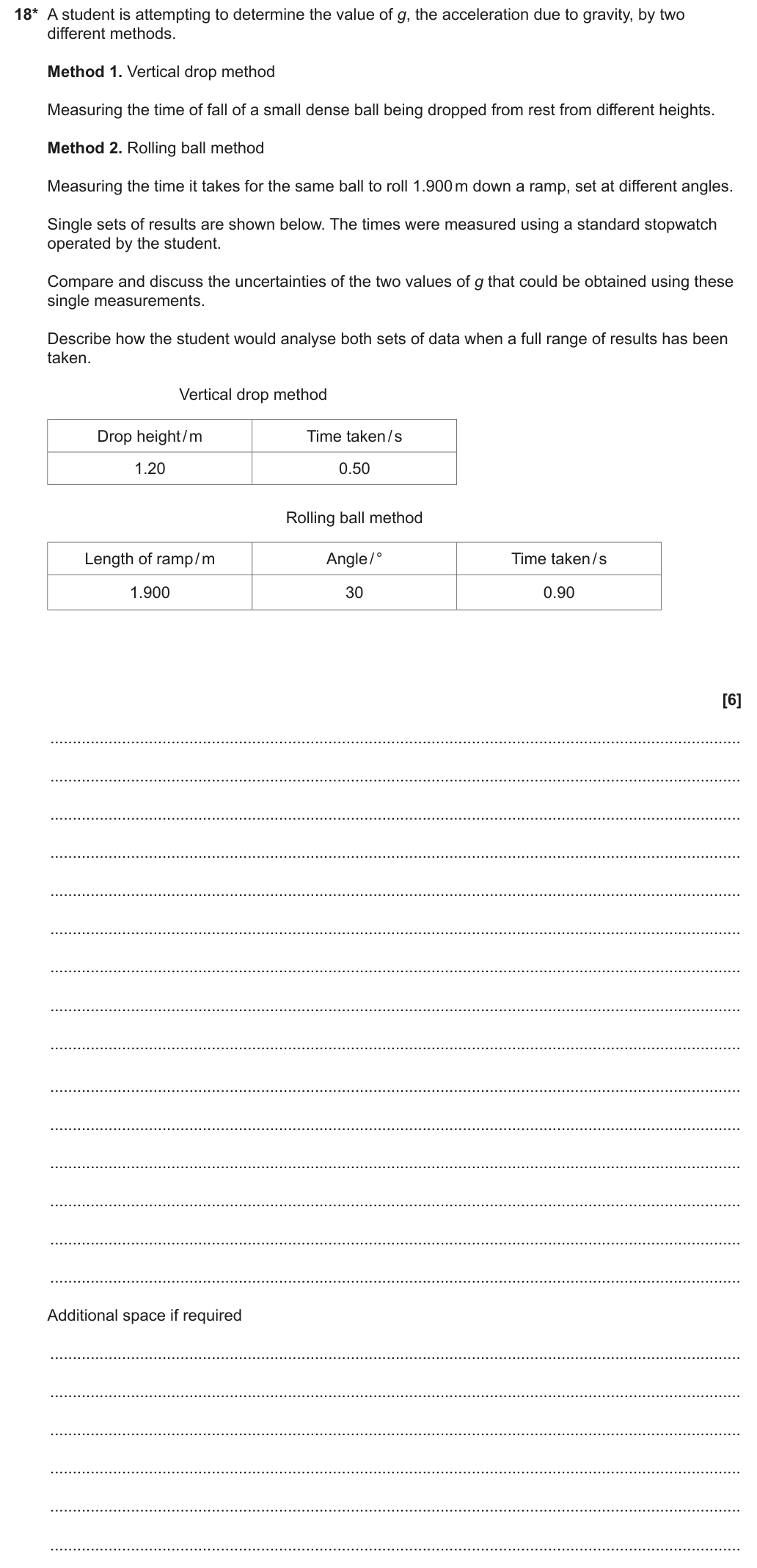
A student is attempting to determine the value of g, the acceleration due to gravity, by two Compare and discuss the uncertainties of the two values of g that could be obtained using these
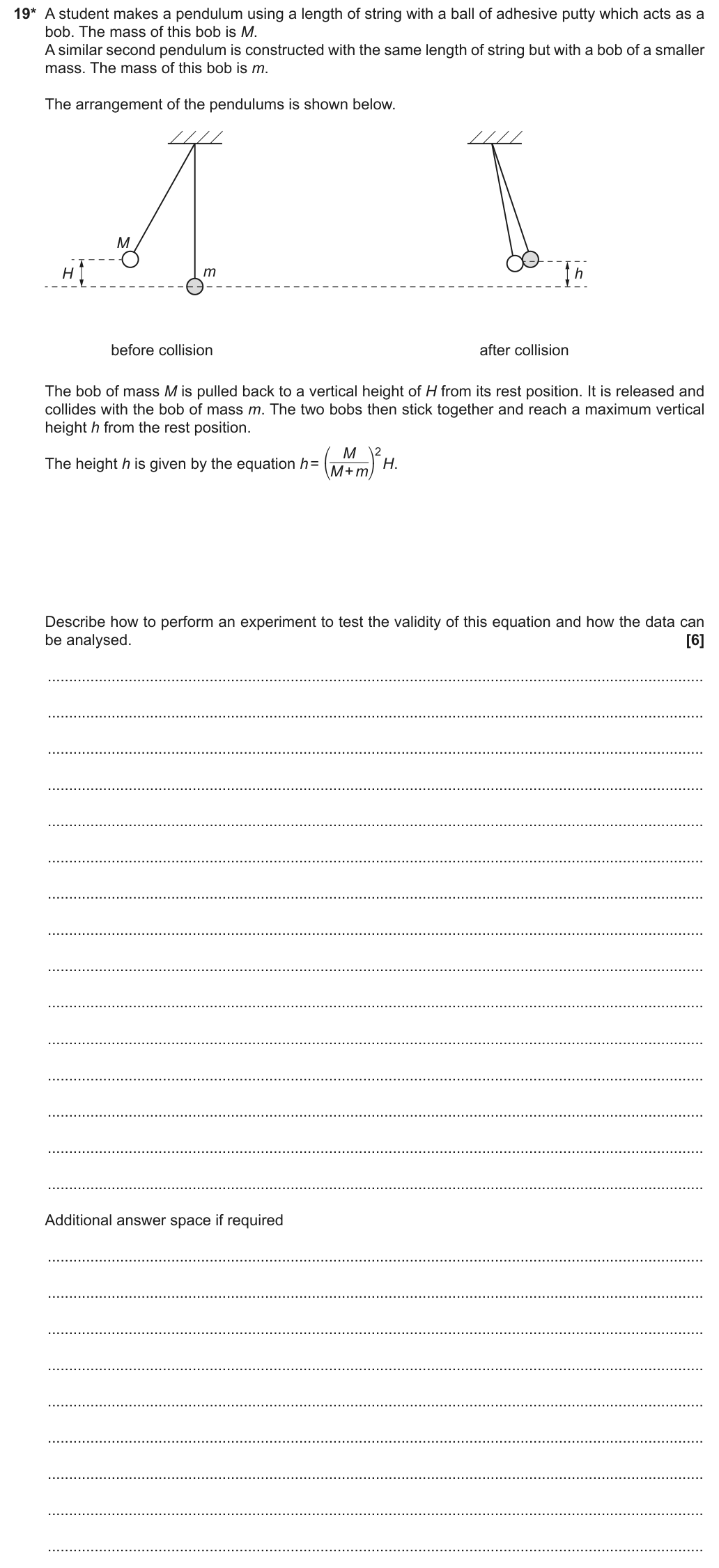
A student makes a pendulum using a length of string with a ball of adhesive putty which acts as a Describe how to perform an experiment to test the validity of this equation and how the data can
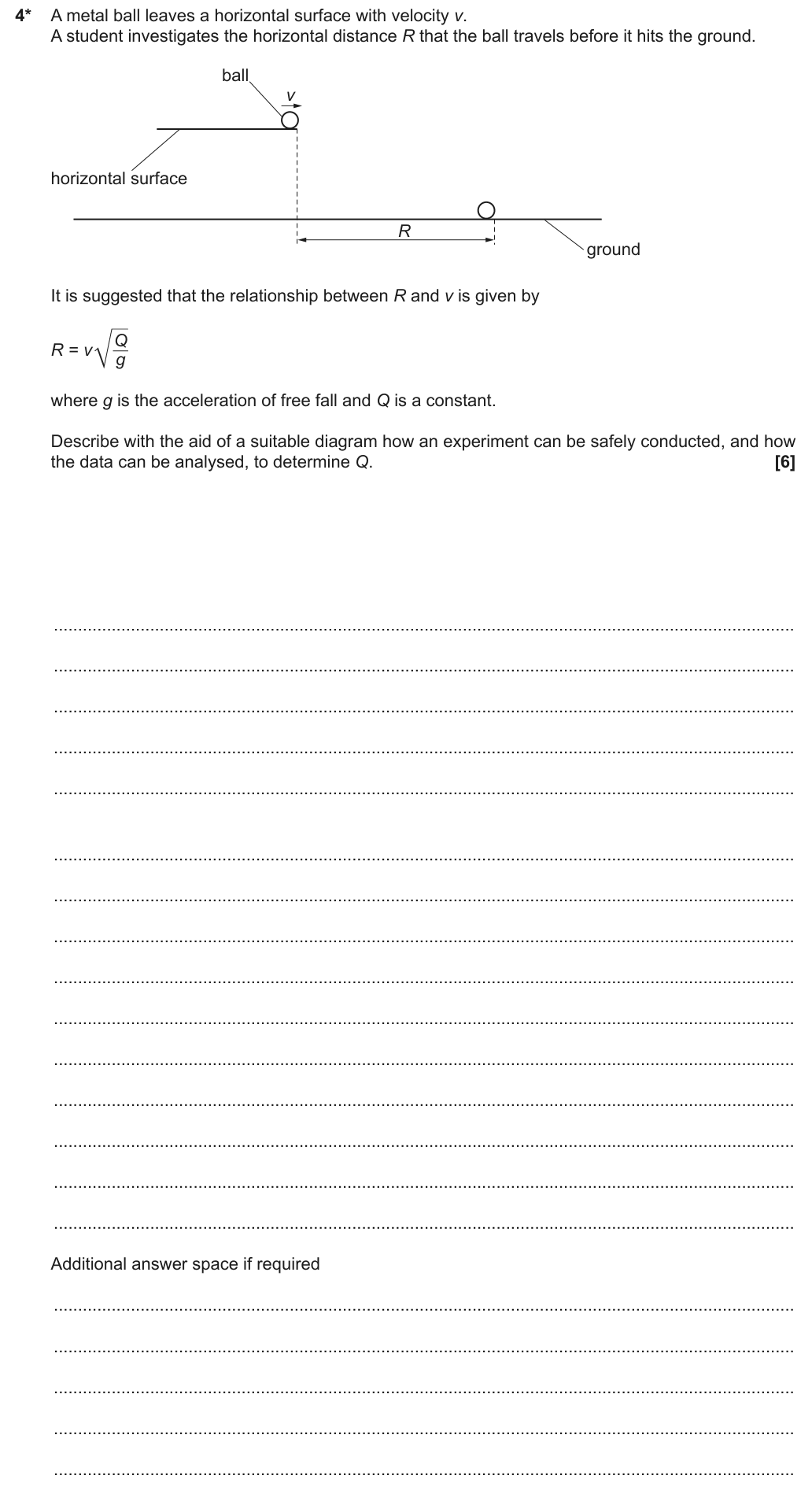
A metal ball leaves a horizontal surface with velocity v. Describe with the aid of a suitable diagram how an experiment can be safely conducted, and how
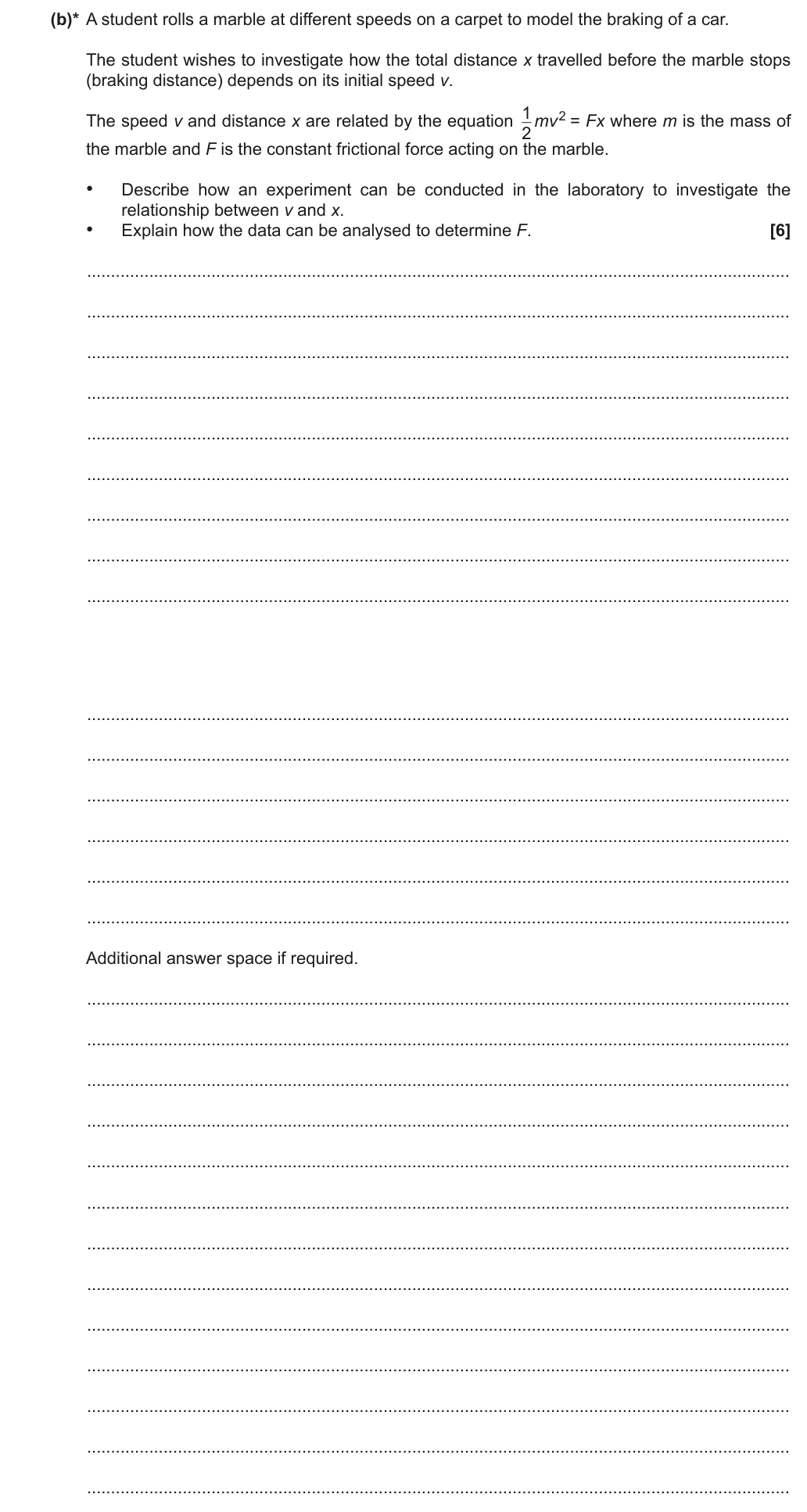
A student rolls a marble at different speeds on a carpet to model the braking of a car. • Describe how an experiment can be conducted in the laboratory to investigate the
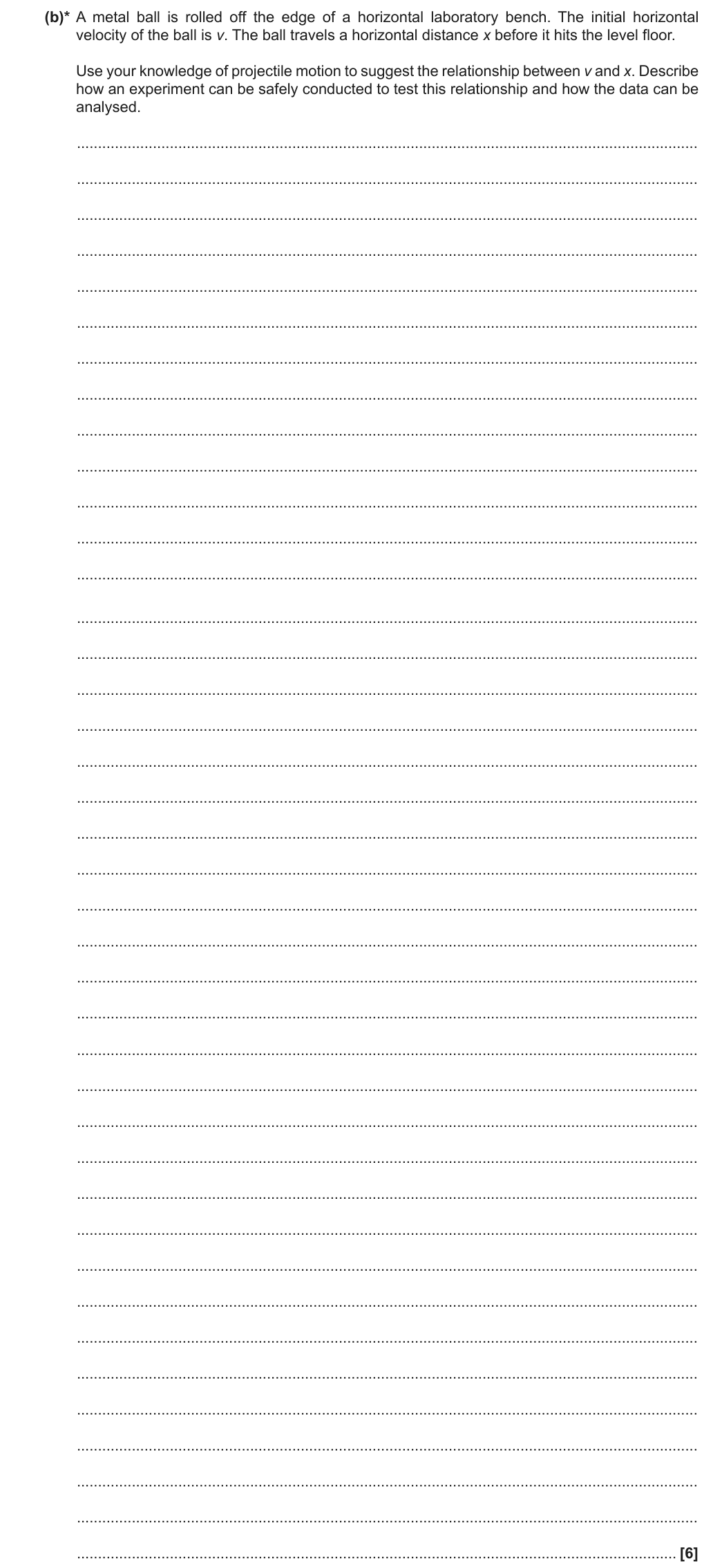
A metal ball is rolled off the edge of a horizontal laboratory bench. The initial horizontal Use your knowledge of projectile motion to suggest the relationship between v and x. Describe
Tap a question to zoom it. Where a part needs a figure, table or graph from earlier in the question, that part folds out above it; the mark scheme and examiner's comment open underneath. Have the OCR Data, Formulae and Relationships Booklet beside you (see the data booklet page).
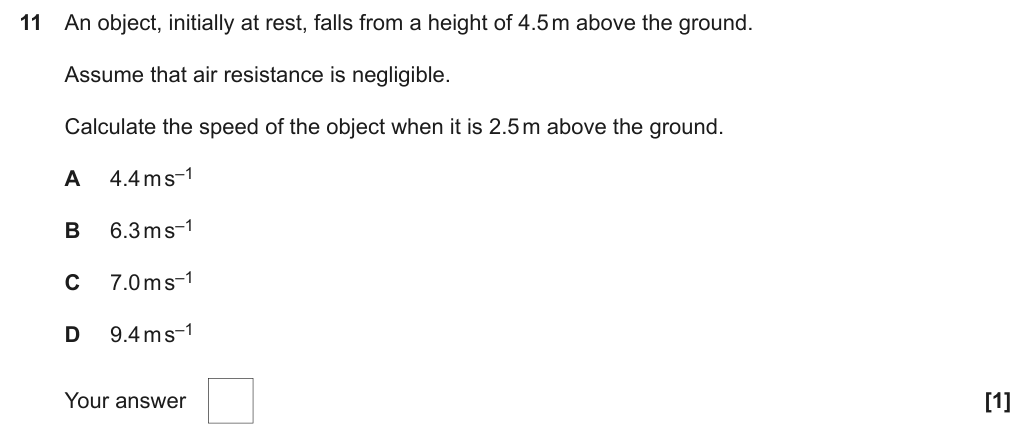
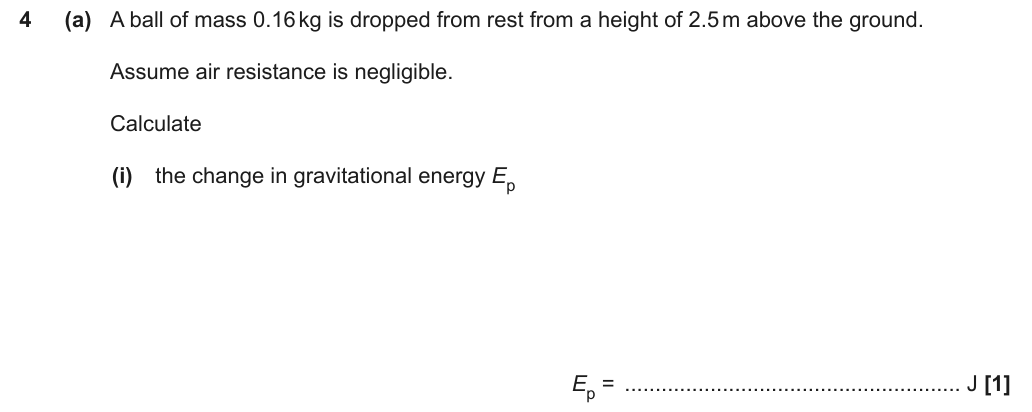
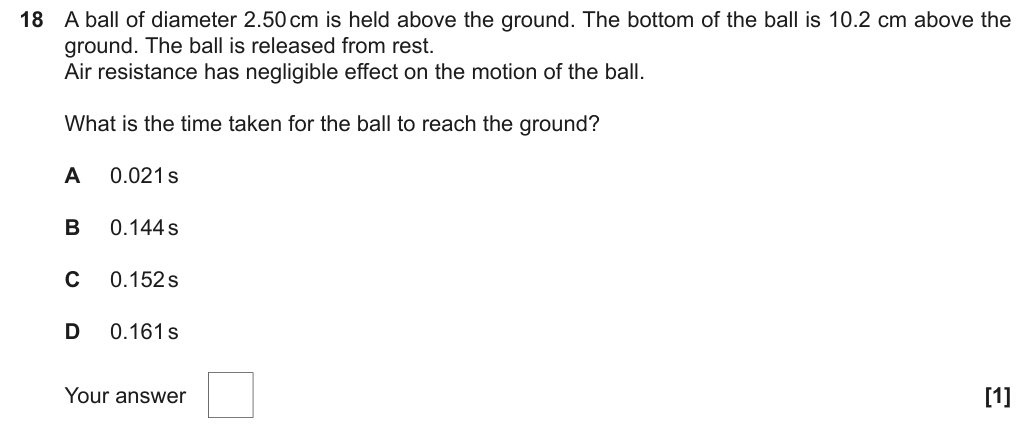
June 2025 · AS Paper 1 · Q111 markMultiple choiceMedium
Answer
B
Mark scheme
Examiner's comment
The majority of the candidates correctly identified B as the correct answer. The two common errors from lower scoring candidates were to choose D (ignoring the 2.5 m) or to select C where candidates had found the speed after 2.5 m rather than the speed at 2.5 m. Some candidates usefully sketched a diagram to show the arrangement of the ball falling which then enabled these candidates to identify the correct distance.
Notes from the mark scheme and report
When answering questions, it is often useful for candidates to underline the key data and sketch diagrams. In this question underlining ‘2.5 m above the ground’ with a sketch would help determine the correct distance.
Skills: M2.3 Substitute numerical values into algebraic equations using appropriate units for physical quantities
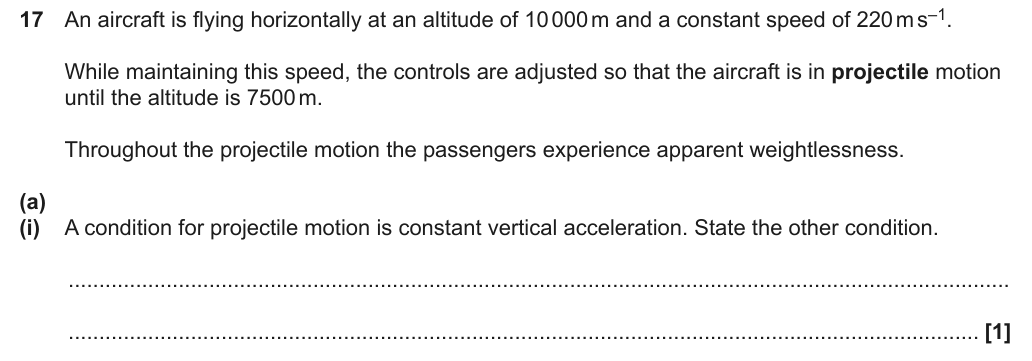
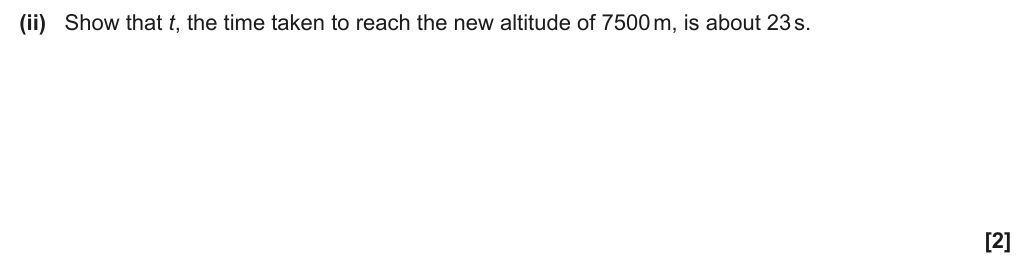
June 2025 · Paper 1 · Q17(a)(ii)2 marksShow thatMedium
Earlier part of question 17 that this part uses
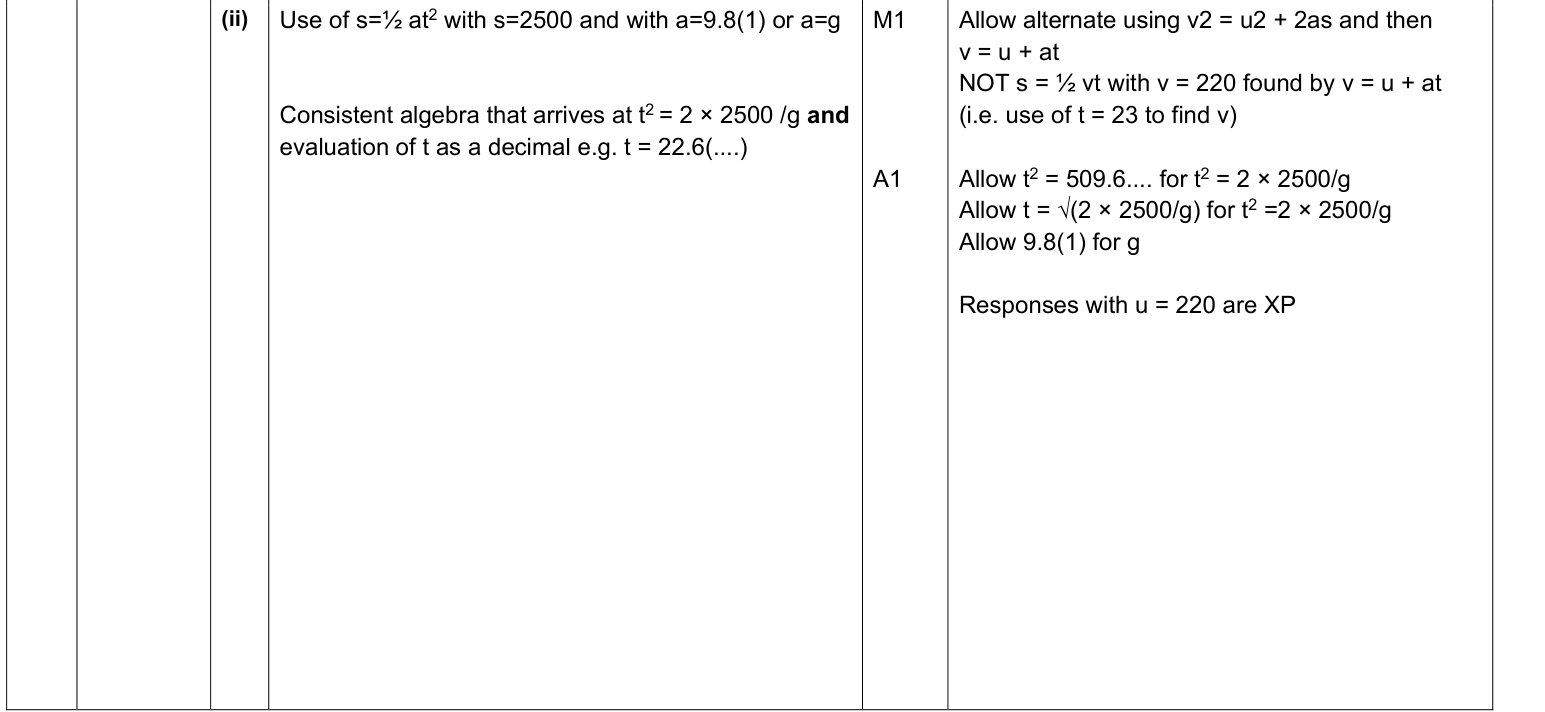
Mark scheme
Examiner's comment
This question tests the idea of independence of horizontal and vertical motion. There are lots of letters involved in the algebra that are applicable to both motions, e.g. u, v, a, and s. Successful candidates made the distinction between horizontal and vertical motion as clear as possible, either by using a two- column table with the headings ‘vertical’ and ‘horizontal’ or by using V and H subscripts on the relevant letters. Once candidates got to the starting point of a displacement of 2500 m with zero initial vertical velocity and an acceleration of ‘g’, they often arrived at the correct answer.
Notes from the mark scheme and report
responses with u = 220 are wrong physics
NOT s = ½vt using t = 23 to find v
Skills: M2.2 Change the subject of an equation, including non-linear equations; M2.3 Substitute numerical values into algebraic equations using appropriate units for physical quantities
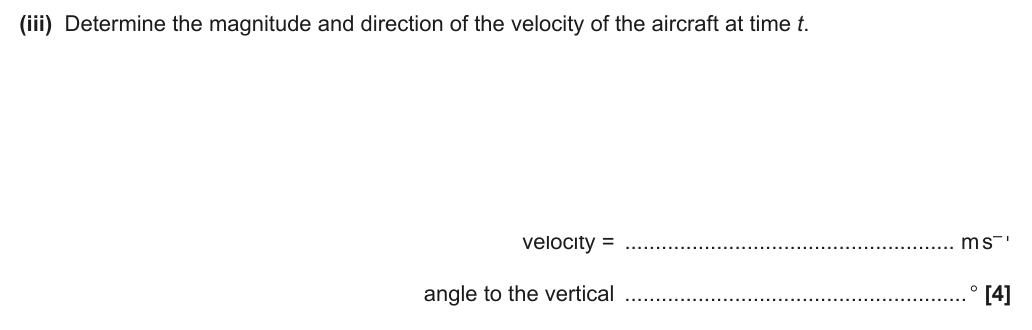
June 2025 · Paper 1 · Q17(a)(iii)4 marksCalculationHard
Earlier parts of question 17 that this part uses
Mark scheme
Examiner's comment
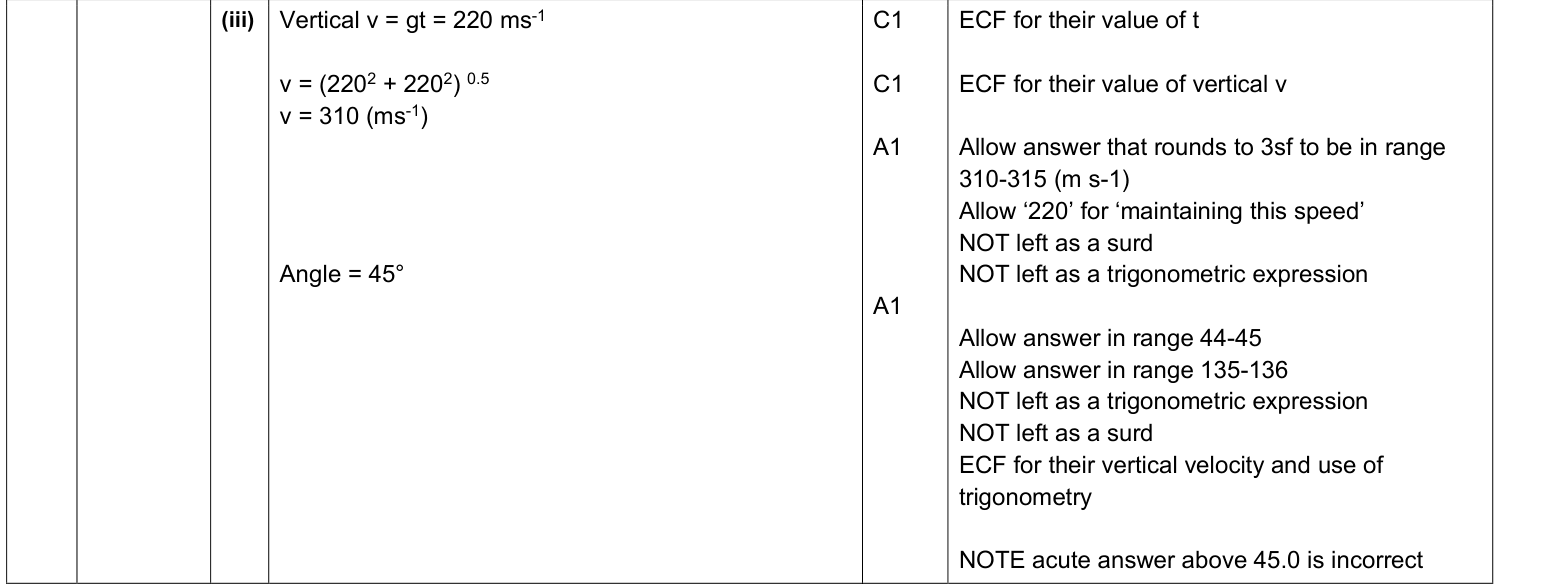
A diagram of the two components of the velocity here was not mandatory; however, it makes it clear in the mind of the candidate what they are doing. The most successful candidates drew a triangle with the two components of velocity with an angle indicated between the vertical and the resultant velocity. They were then clear about how to work out the resultant velocity (Pythagoras) and the required angle. Both acute and obtuse angles to the vertical were acceptable. Acute angles over 45 degrees indicated an error in the trigonometry and so the last mark was unavailable. Few candidates were able to correctly interpret the question’s description of ‘maintaining this speed’ to suggest that the velocity of the plane was 220 m s-1 throughout.
Notes from the mark scheme and report
NOT left as a surd or a trigonometric expression
acute angle above 45.0 is incorrect
ecf for t
Skills: M0.6 Use calculators to handle sin x, cos x and tan x when x is expressed in degrees or radians; M4.4 Use Pythagoras’ theorem, and the angle sum of a triangle; M4.5 Use sin, cos and tan in physical problems
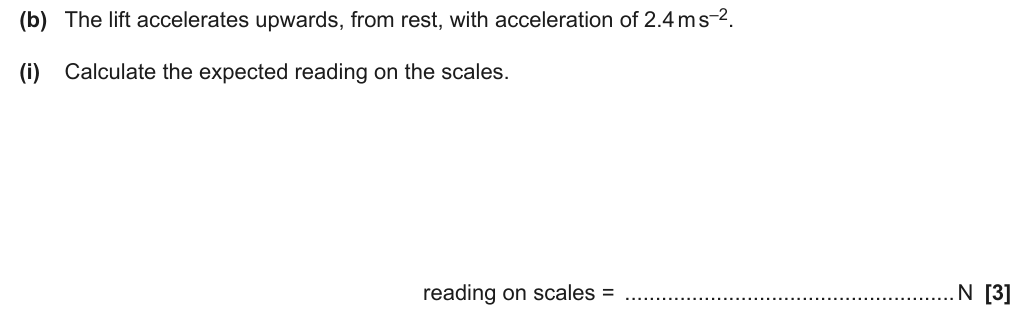
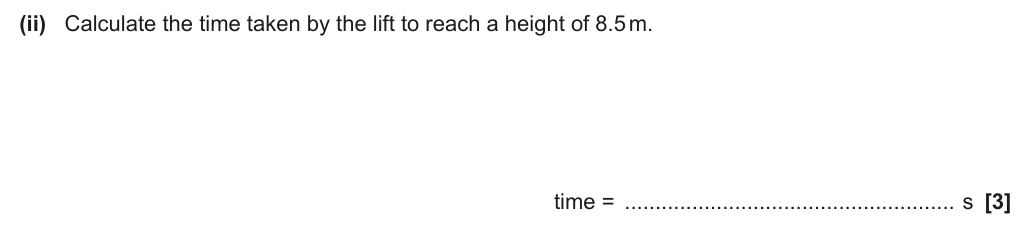
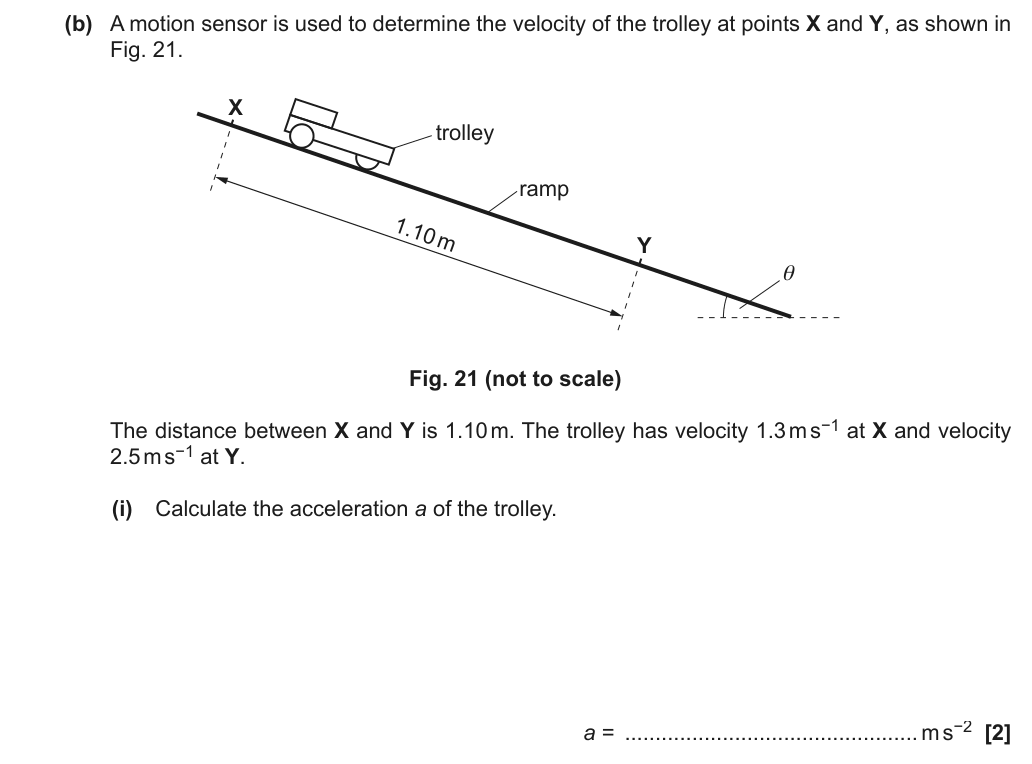
June 2025 · AS Paper 1 · Q21(b)(ii)3 marksCalculationEasy
Earlier part of question 21 that this part uses
Mark scheme
Examiner's comment
This question was generally well answered. High scoring candidates correctly stated the appropriate equation of uniform motion and then substituted in the data. Some candidates were confused as to when to use the acceleration of 2.4 m s−2 and when to use 9.81 m s−2.
Notes from the mark scheme and report
use of 9.81 for the acceleration is wrong physics
Skills: M2.2 Change the subject of an equation, including non-linear equations; M2.3 Substitute numerical values into algebraic equations using appropriate units for physical quantities
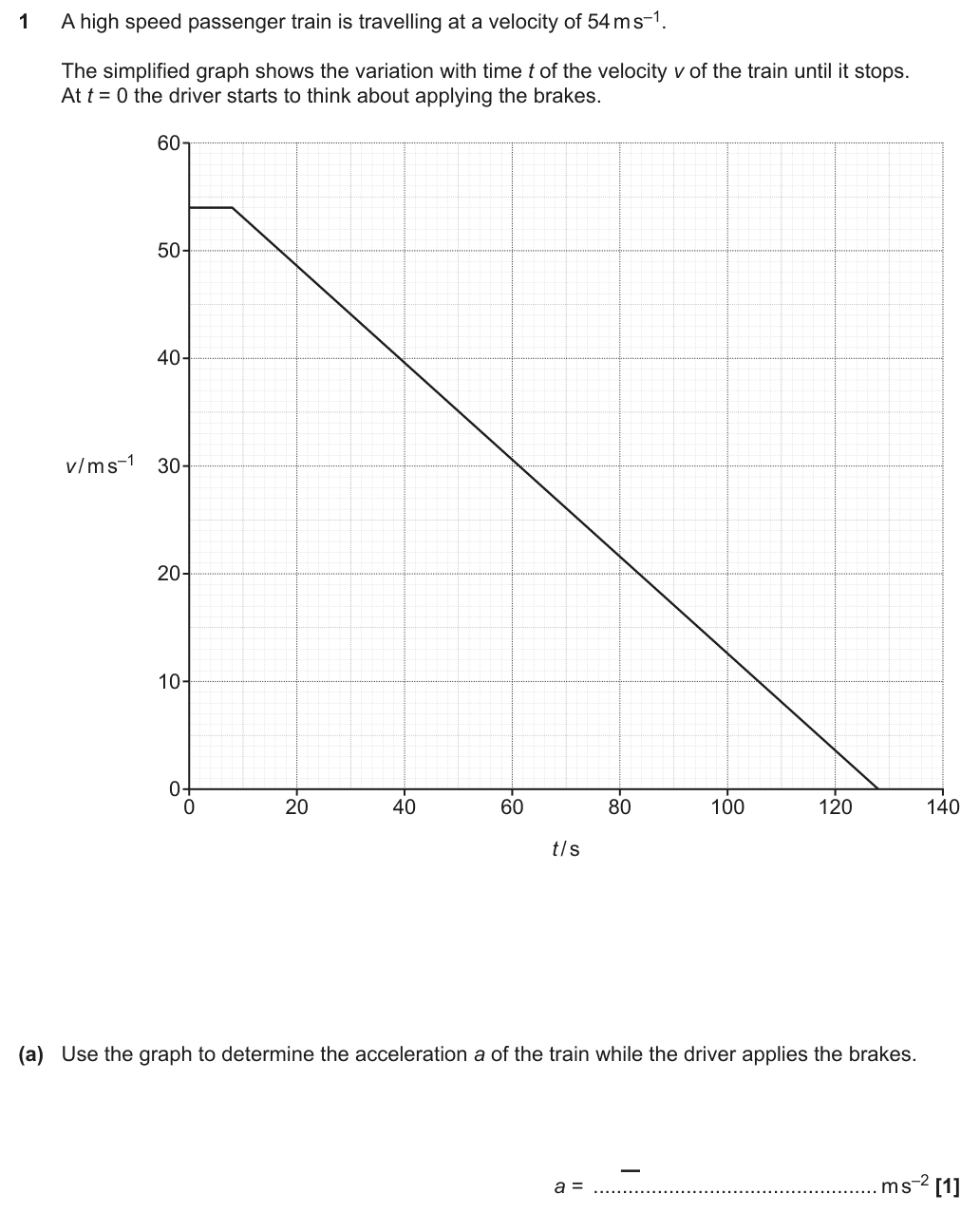
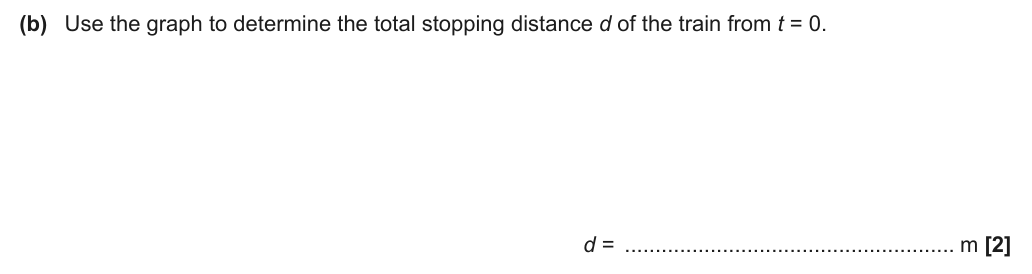
June 2025 · AS Paper 2 · Q1(b)2 marksCalculationMedium
Earlier part of question 1 that this part uses
Mark scheme
Examiner's comment
Most candidates correctly identified that the area under a velocity time graph is equal to displacement of distance travelled. A small minority of candidates did not use appropriate numbers. A few candidates used their answers from part (a) and the equations of motion to determine the answer – this gained full credit.
Notes from the mark scheme and report
area must include the 8 s at constant velocity (thinking distance)
ecf from (a)
Skills: M3.8 Understand the possible physical significance of the area between a curve and the x axis and be able to calculate it or estimate it by graphical methods as appropriate; M4.3 Calculate areas of triangles, circumferences and areas of circles, surface areas and volumes of rectangular blocks, cylinders and spheres
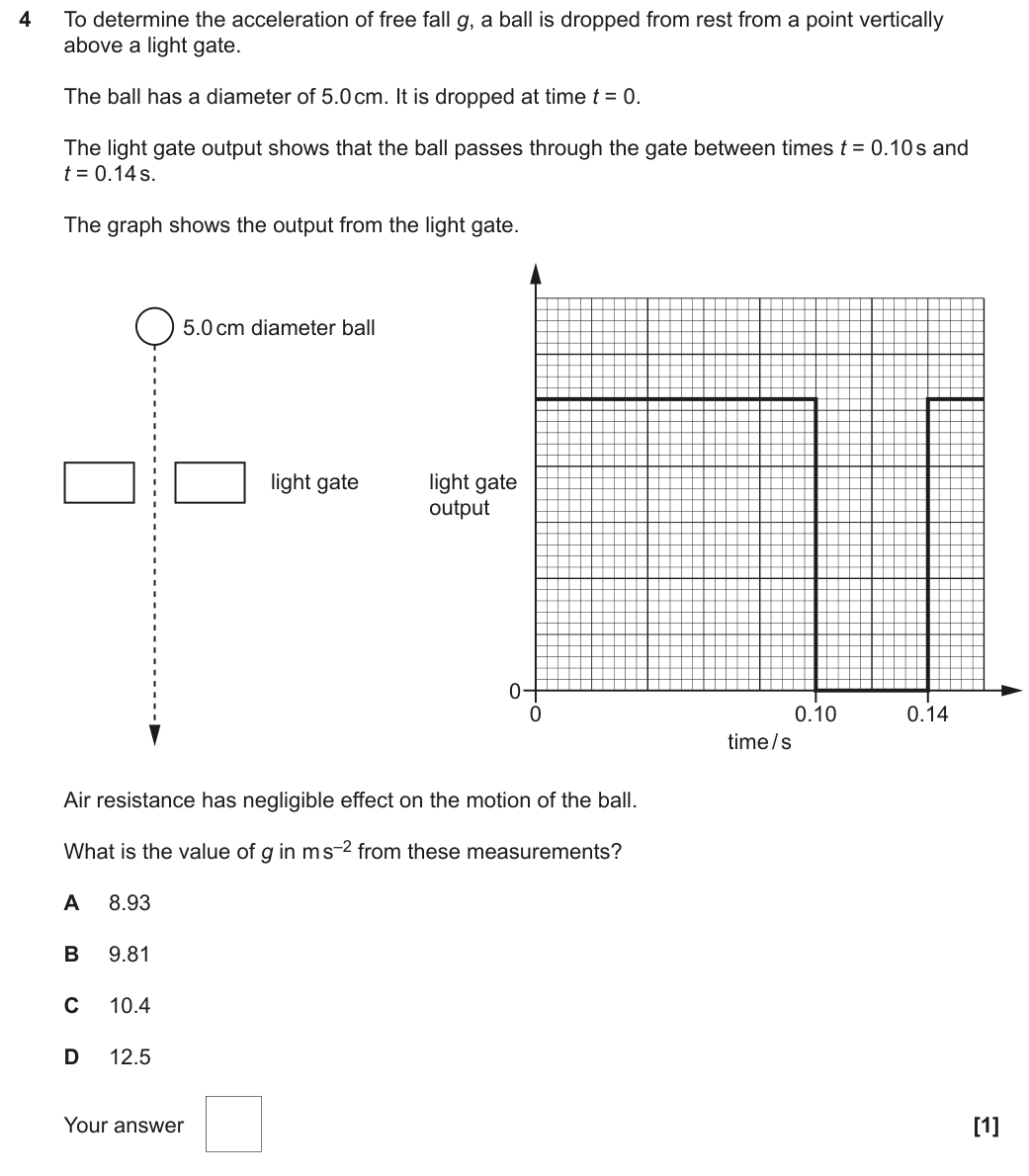
June 2024 · Paper 1 · Q41 markMultiple choiceMedium
Answer
C
Mark scheme
Examiner's comment
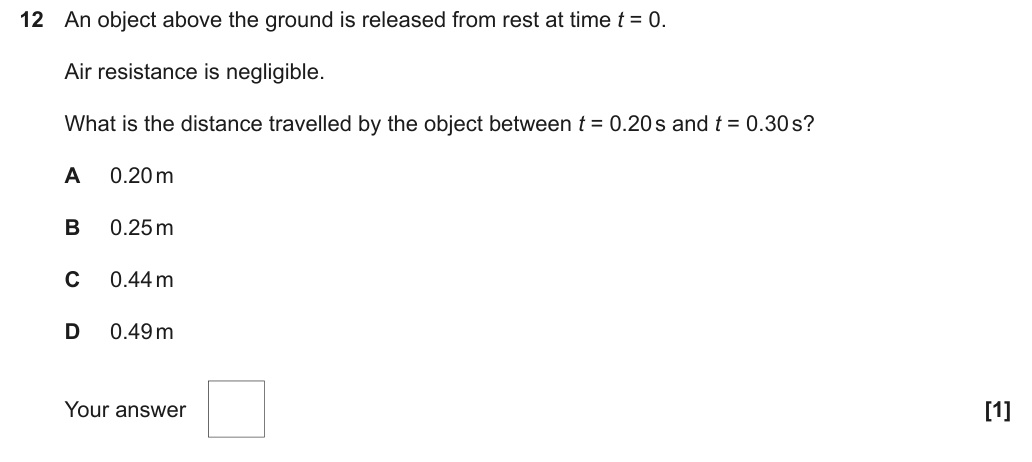
This question boils down to what acceleration is required for a displacement of 0.05 m between t = 0.10 s and 0.14 s. i.e. 0.05 = ½ a (0.14)2 - ½ a (0.10)2 from which the acceleration can be calculated.
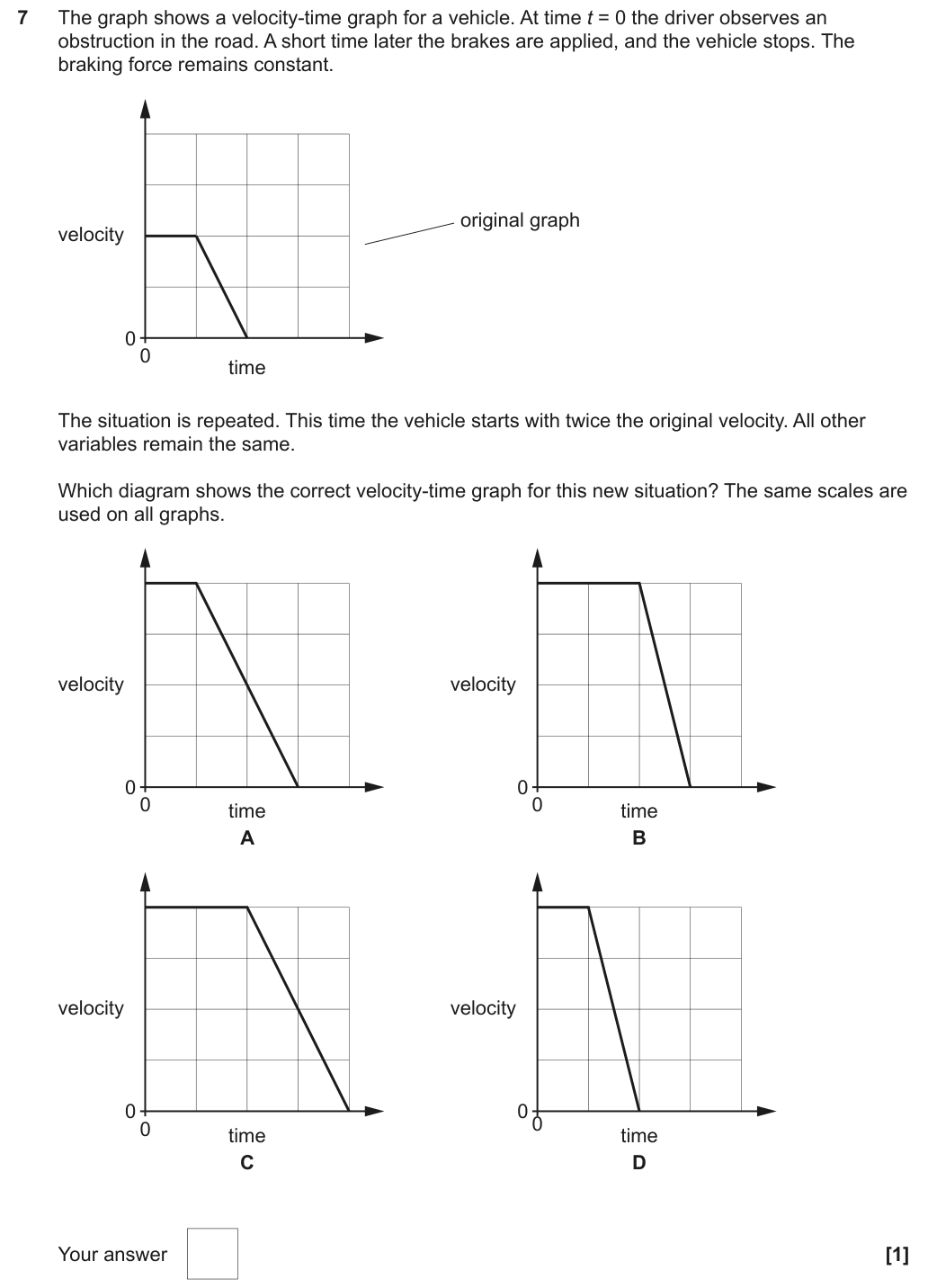
June 2024 · Paper 1 · Q71 markMultiple choiceMedium
Answer
A
Mark scheme
Examiner's comment
With all variables the same apart from the initial speed, there should only be one change to the graph, i.e. the initial speed. The gradient of the second phase should be the same, as the mass and braking force are the same. This gives option A.
June 2024 · AS Paper 1 · Q24(b)3 marksCalculationEasy
Mark scheme
Examiner's comment
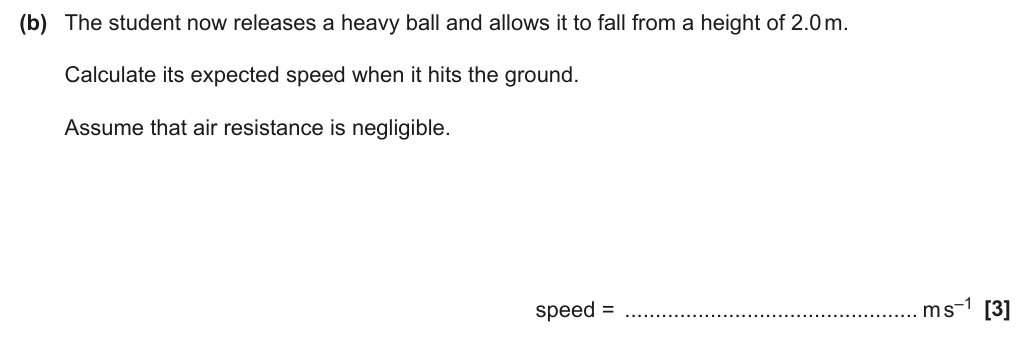
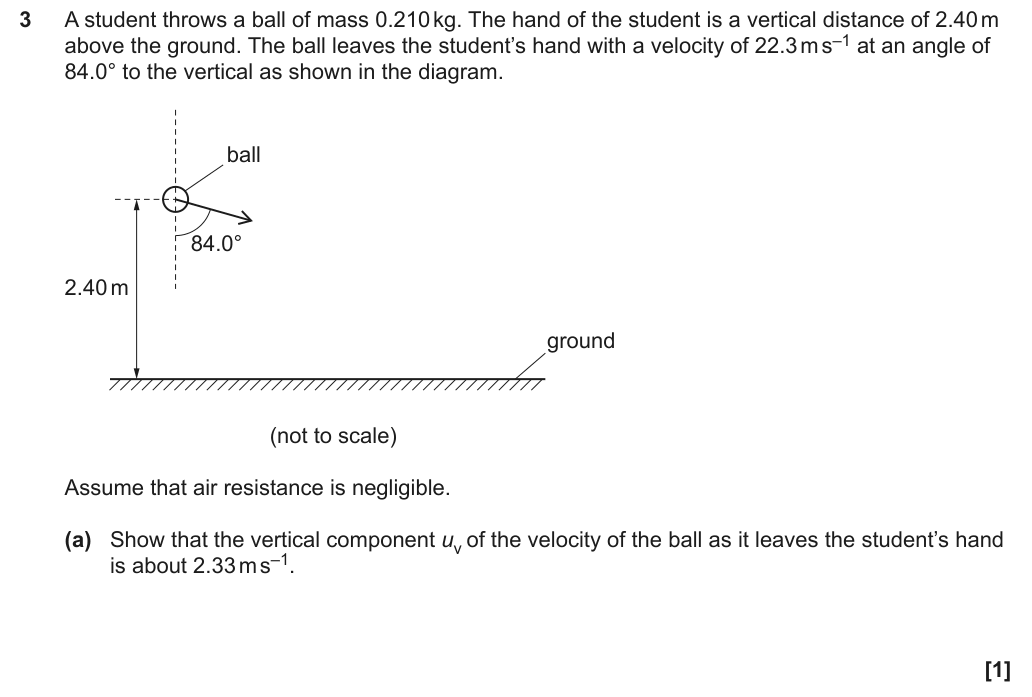
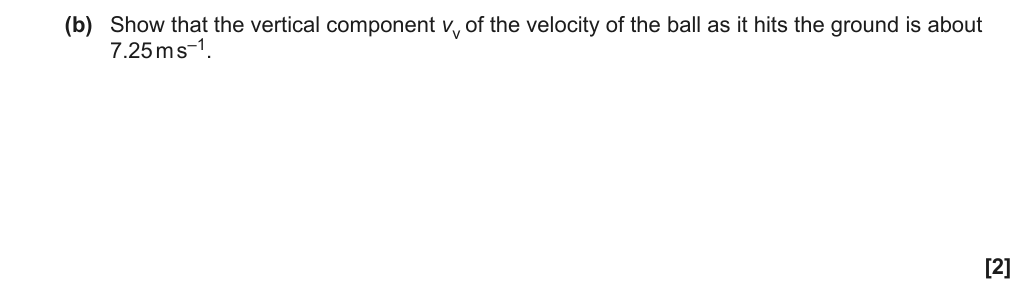
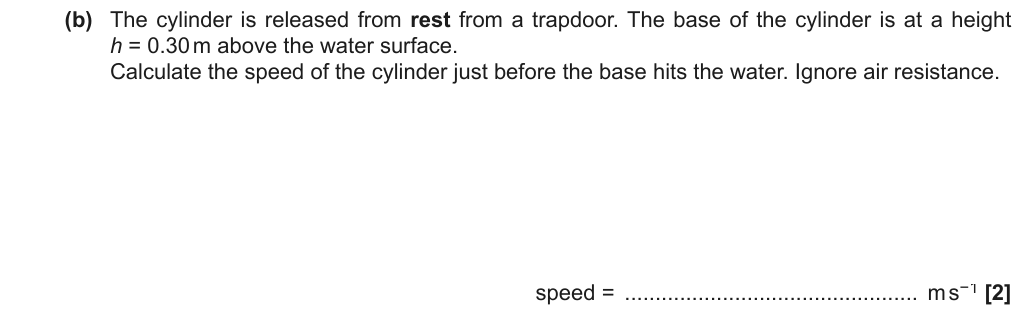
Candidates performed very well on this question by selecting and applying the correct equation of motion to calculate the speed of the ball when it hit the ground. Selection and application of formulae Candidates performed well on the selection and application of equations of motion from Module 3: Forces and motion.
June 2024 · AS Paper 1 · Q24(c)3 marksCalculationMedium
Earlier part of question 24 that this part uses
Mark scheme
Examiner's comment
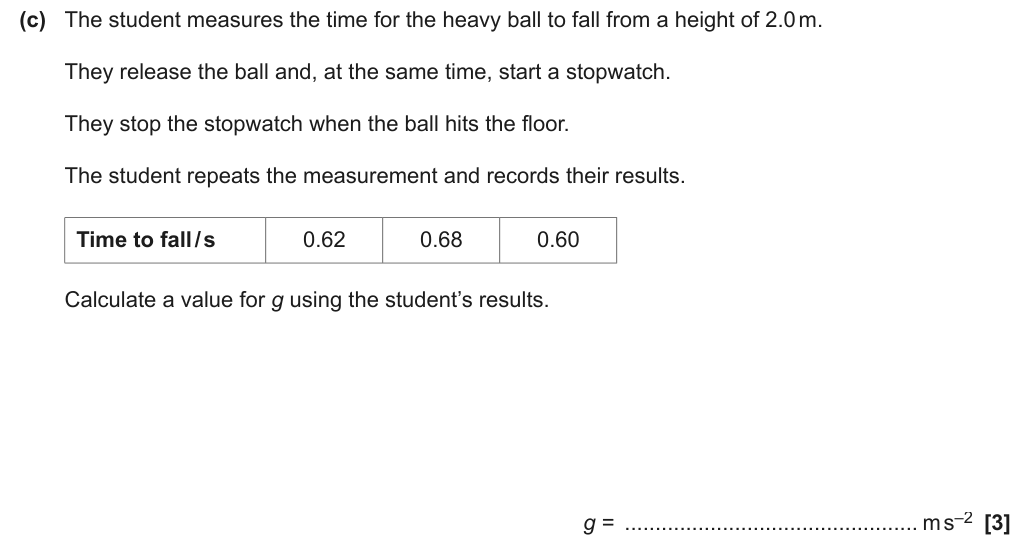
Candidates performed well on this question as many candidates correctly calculated the mean time to fall/s and then selected and applied the equation of motion s = ut + ½at 2 to calculate a value of g for the falling ball. Some candidates calculated a mean from the time values 0.62 s and 0.60 s, by omitting the result 0.68 s and this was given marks if they clearly identified the omittance of this value by identifying the result as anomalous.
Notes from the mark scheme and report
0.68 may be omitted only if clearly identified as anomalous
allow 9.97 and 10
Skills: M1.2 Find arithmetic means; M2.2 Change the subject of an equation, including non-linear equations; M2.3 Substitute numerical values into algebraic equations using appropriate units for physical quantities; PAG1 Investigating motion
June 2024 · AS Paper 1 · Q24(d)2 marksExplanationMedium
Earlier part of question 24 that this part uses
Mark scheme
Examiner's comment
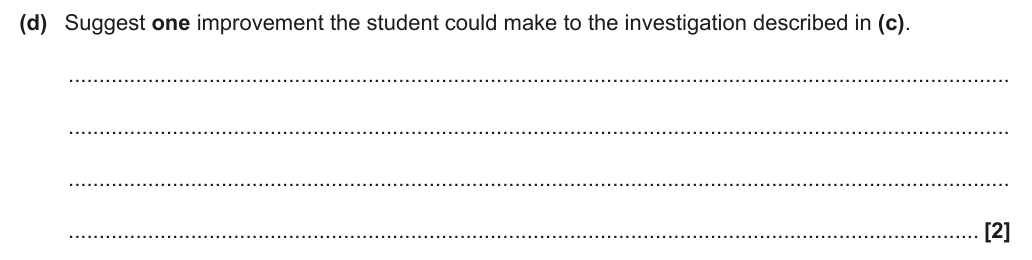
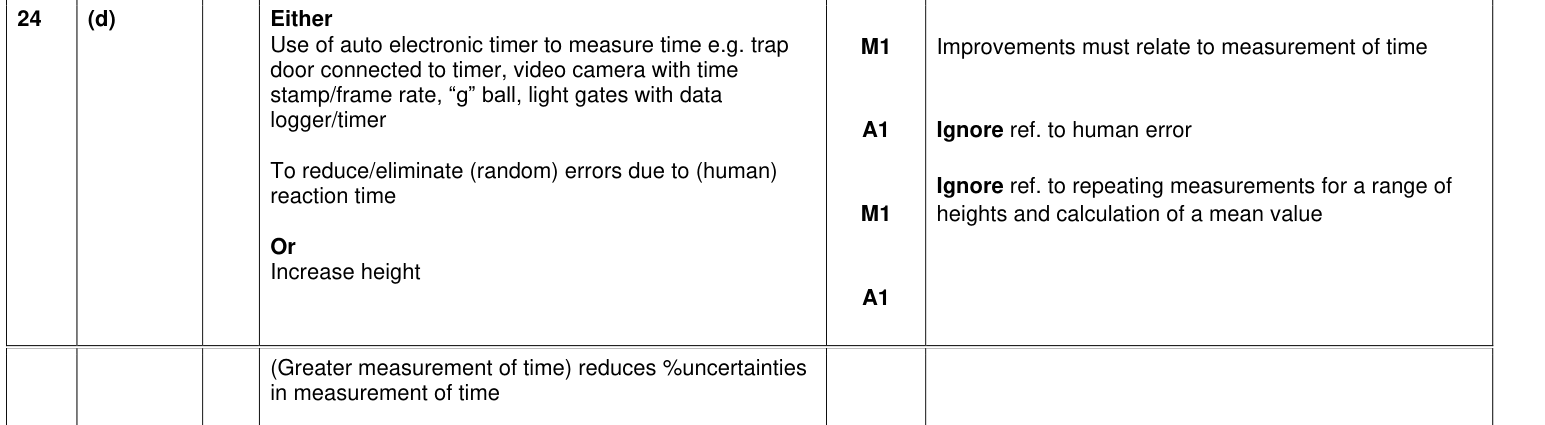
There were not many successful responses to this question, with most given 0 marks. Many candidates made attempts to suggest suitable improvements, but these were often vague and unspecific, e.g. use light gates but without any reference on how this piece of equipment would be used to time (such as by connecting to a data logger or (electronic) timer). To be given 2 marks, candidates had to achieve the first method mark for a correct improvement. Therefore, most candidates were not able to access the second mark as they had not achieved the first method mark for a correct improvement. Many candidates attempted to give reasons for their improvement but again these explanations were superficial as they were expressed without relating to the error due to reaction time. Some candidates did give a suggested improvement in terms of increasing the height of the fall of the ball, which meant they were given the first method mark but corresponding explanations linked to reducing the percentage uncertainty was not always fully developed to award the second mark.
Notes from the mark scheme and report
improvement must relate to the measurement of time
ignore human error
ignore repeats and mean
Please refer to the Practical Skills Handbook for information on practical techniques including definitions of key scientific terminology and methodology
Skills: M1.5 Identify uncertainties in measurements and use simple techniques to determine uncertainty when data are combined; PAG1 Investigating motion
June 2024 · AS Paper 2 · Q36 marks6-mark extended responseMedium
Mark scheme, with the levels and indicative content
Examiner's comment
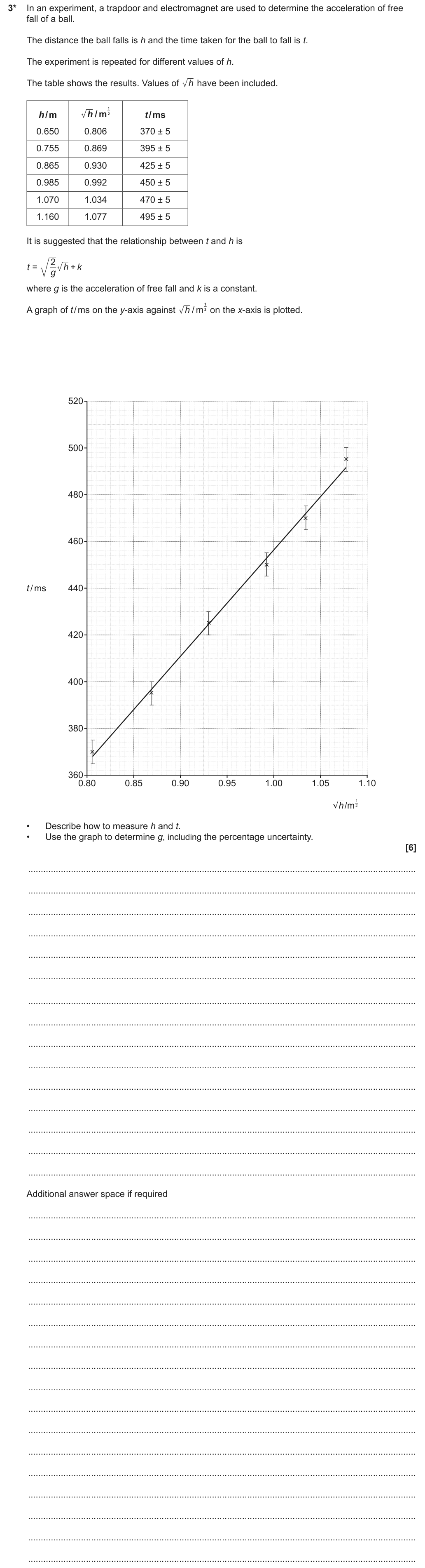
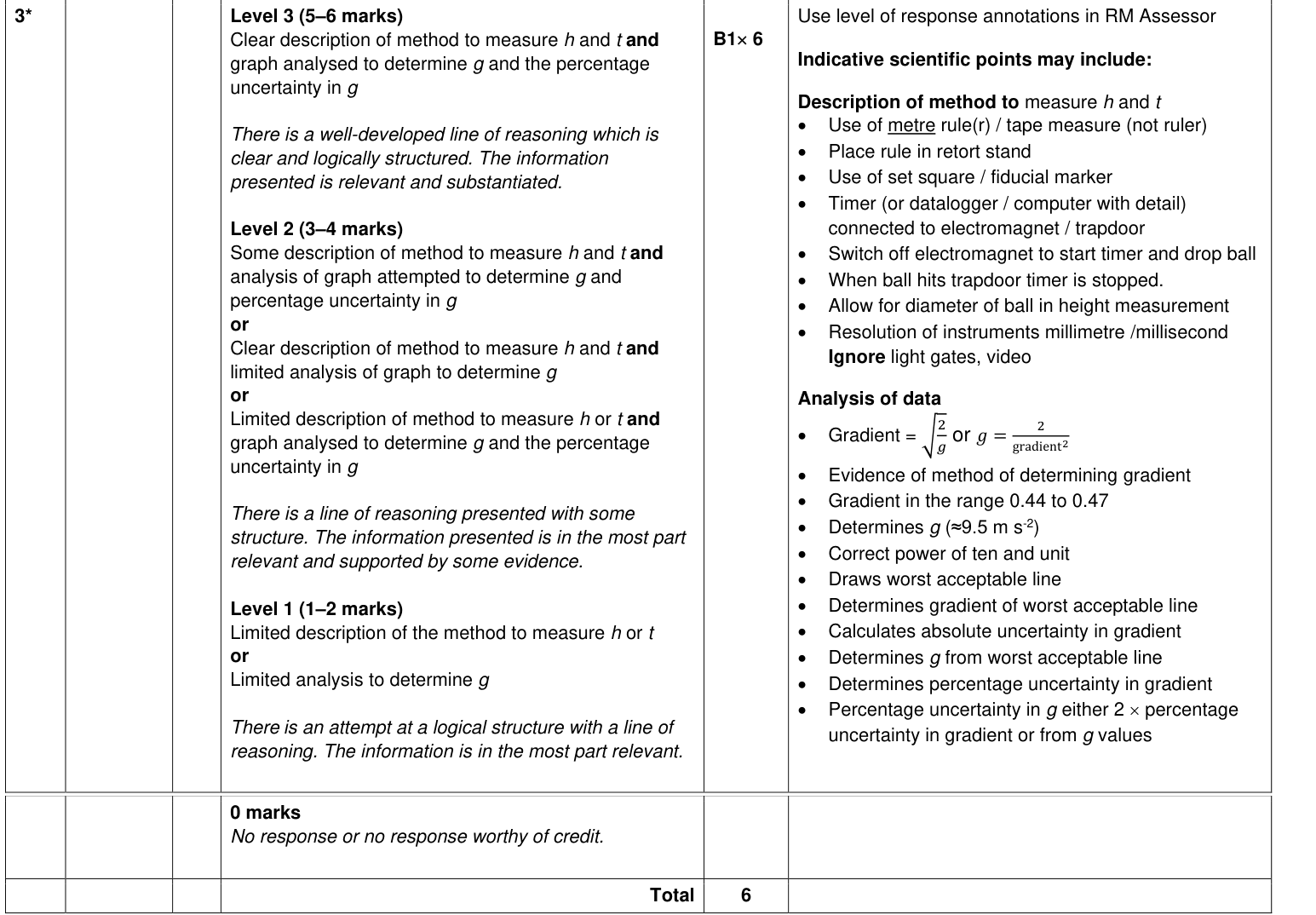
This question was designed to test candidates’ understanding of practical techniques both designing an experiment and analysing results. High scoring candidates described measuring h using a metre rule or tape measure and allowed for the diameter of the ball. Many candidates were unable to explain the use of the electromagnet to release the ball. Some low scoring candidates suggested using a stopwatch. Since the time measurements were recorded to the nearest millisecond it was expected that candidates would describe how the electromagnet and light gate would connect to an electronic timer or datalogger. For the analysis, candidates were expected to link the given equation to the equation of a straight line and thus identify how g was related to the gradient. The next logical step would then be to calculate the gradient. For this, it was expected that candidates would demonstrate substituting values from the line on the graph (not data points from the table) to determine the gradient and thus calculate a value of g with an appropriate unit. To determine percentage uncertainty, candidate needed to draw the worst acceptable line. This should be either the steepest or shallowest line that passes within all the error bars. Candidates then needed to calculate the worst acceptable gradient. Candidates gained credit for either calculating the percentage uncertainty in g from twice the percentage uncertainty in the gradient or from calculating worst value of g and then determining the percentage uncertainty.
Notes from the mark scheme and report
metre rule or tape measure (not ruler)
Ignore light gates / video
gradient = √(2/g), in the range 0.44 to 0.47 with correct power of ten (t in ms)
g ≈ 9.5 m s-2
worst acceptable line for uncertainty
Candidates should have the opportunity to practise determining values for constants using the gradient and y-intercept of straight-line graphs.
Candidates should have the opportunity to practise drawing worst acceptable straight lines through error bars and understand the techniques to determine uncertainties in calculated constants using the worst acceptable gradient and/or y-intercept.
Skills: M1.5 Identify uncertainties in measurements and use simple techniques to determine uncertainty when data are combined; M3.3 Understand that y = mx + c represents a linear relationship; M3.4 Determine the slope and intercept of a linear graph; PAG1 Investigating motion
June 2024 · Paper 3 · Q3(b)6 marks6-mark extended responseHard
Earlier part of question 3 that this part uses
Mark scheme, with the levels and indicative content
Examiner's comment
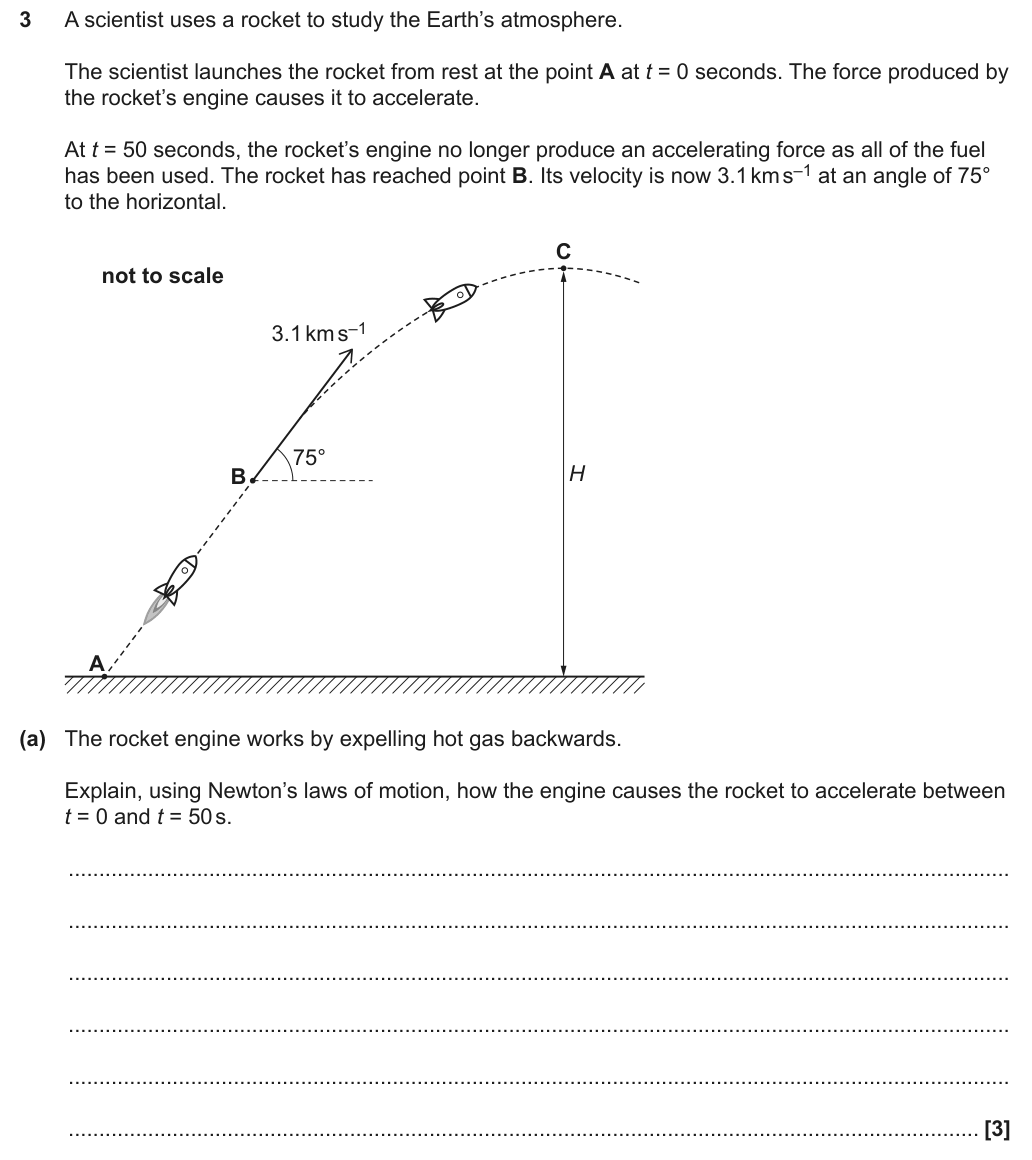
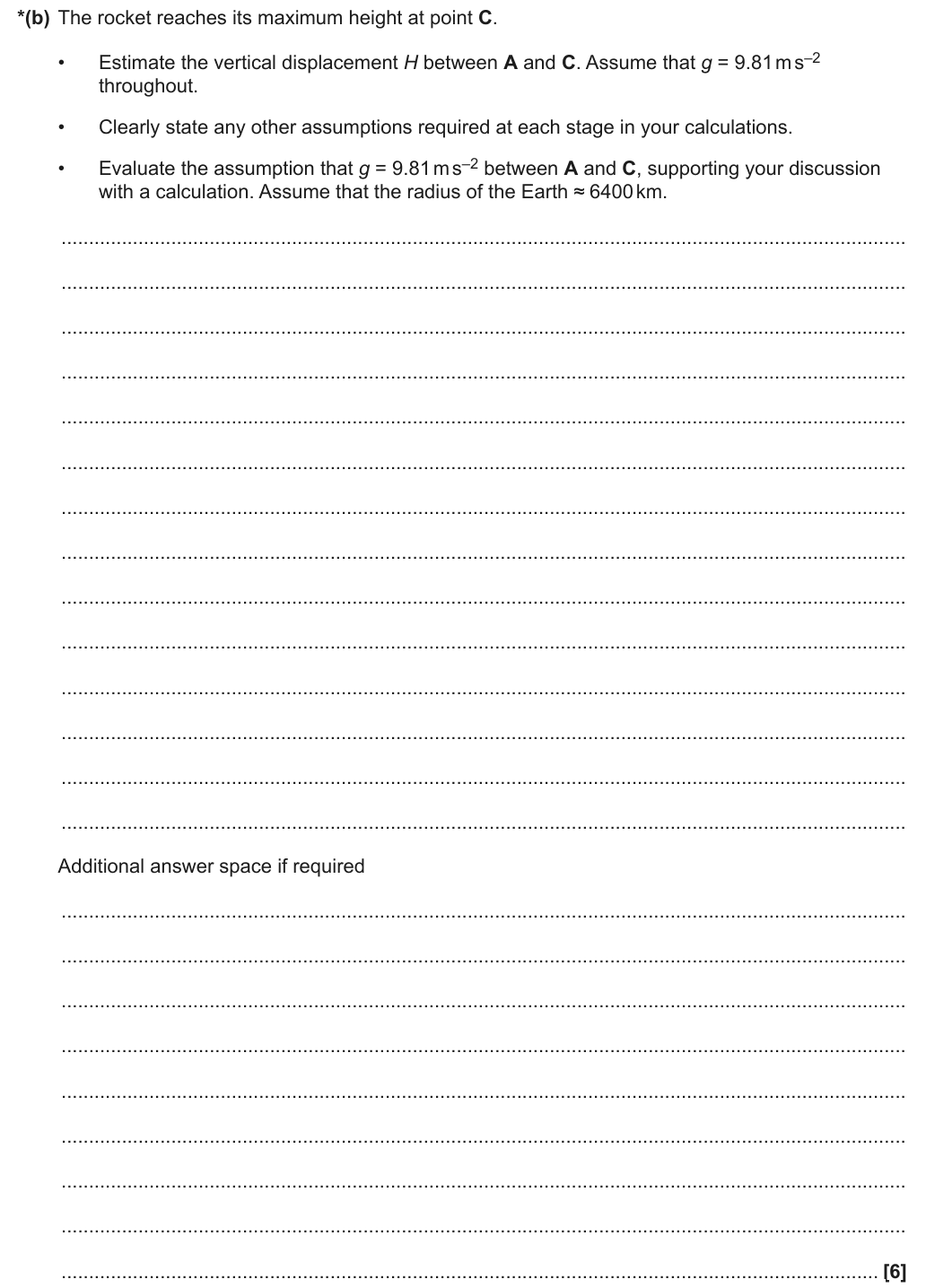
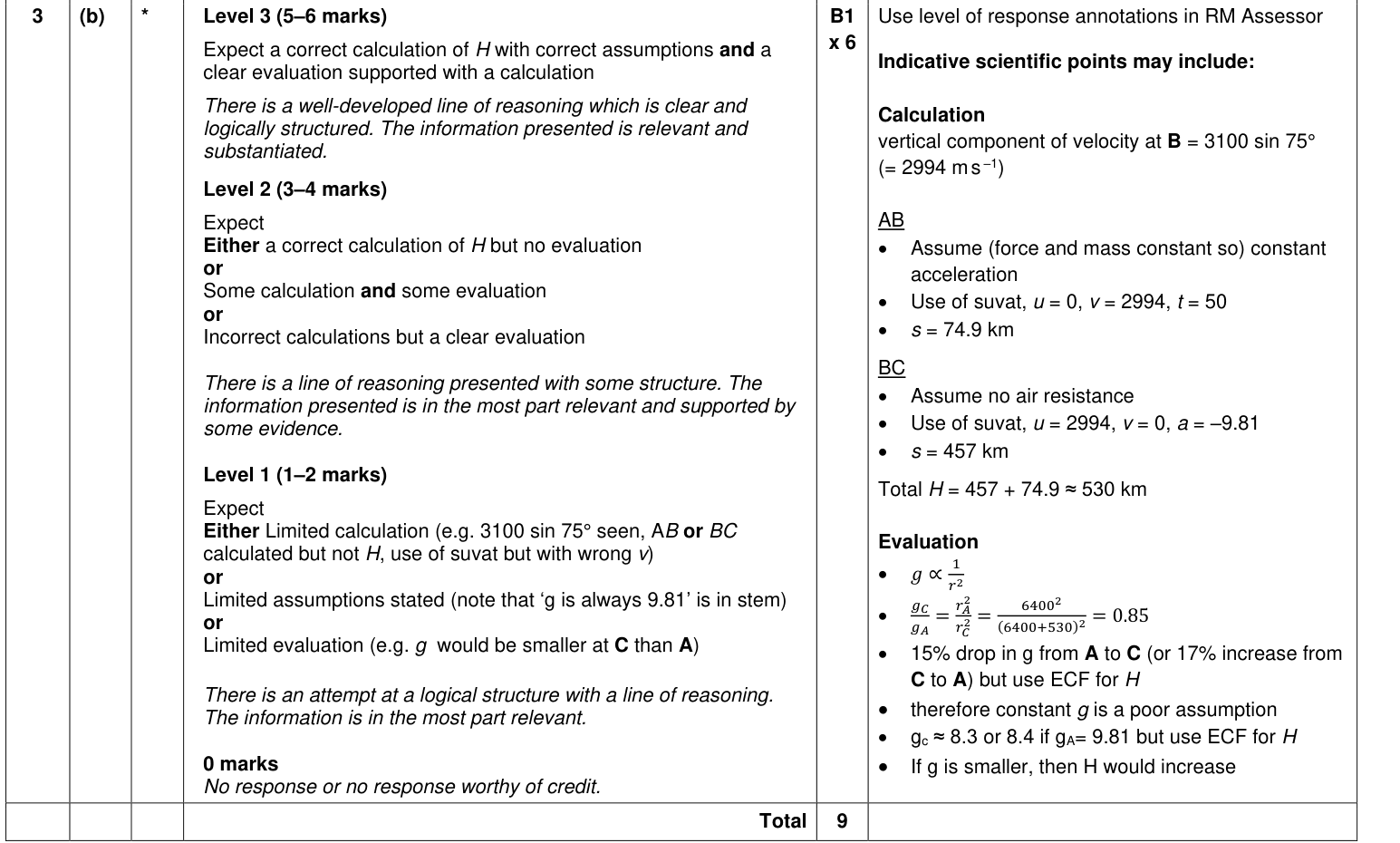
Level 3 candidates set out a correct calculation of H¸ together with the assumptions required at each stage, plus an evaluation of the assumption that g remains constant at 9.81 ms-2 throughout. Level 2 candidates missed out one or more of these three parts, usually the evaluation at the end, which they found quite difficult. Level 1 candidates were often unable to calculate H, or the value of g at height H, correctly Common problems in 3 (b) • omission of sin 75° (or using cos 75°) when calculating velocity • not converting from m to km correctly • not squaring the r term in the calculation for g they have answered each part of the question by using bullet points. Their calculations are clearly set out and so easy to follow, and their handwriting is legible. Instead of just calculating a value for g at height H, they have also given an explicit evaluation: ‘The assumption that g remains constant is not reasonable’. Other candidates went on to say that this means that the rocket would reach an even greater height.
Notes from the mark scheme and report
H ≈ 530 km (75 km + 457 km)
assumptions: constant acceleration A to B, no air resistance B to C
g falls by about 15% so constant g is a poor assumption
OCR has a Guide to Level of Response Questions. This includes guidance on communication and the use of bullet points (page 5).
Skills: M0.3 Use ratios, fractions and percentages; M0.6 Use calculators to handle sin x, cos x and tan x when x is expressed in degrees or radians; M2.3 Substitute numerical values into algebraic equations using appropriate units for physical quantities; M4.5 Use sin, cos and tan in physical problems
June 2023 · AS Paper 1 · Q141 markMultiple choiceMedium
Answer
A
Mark scheme
Examiner's comment
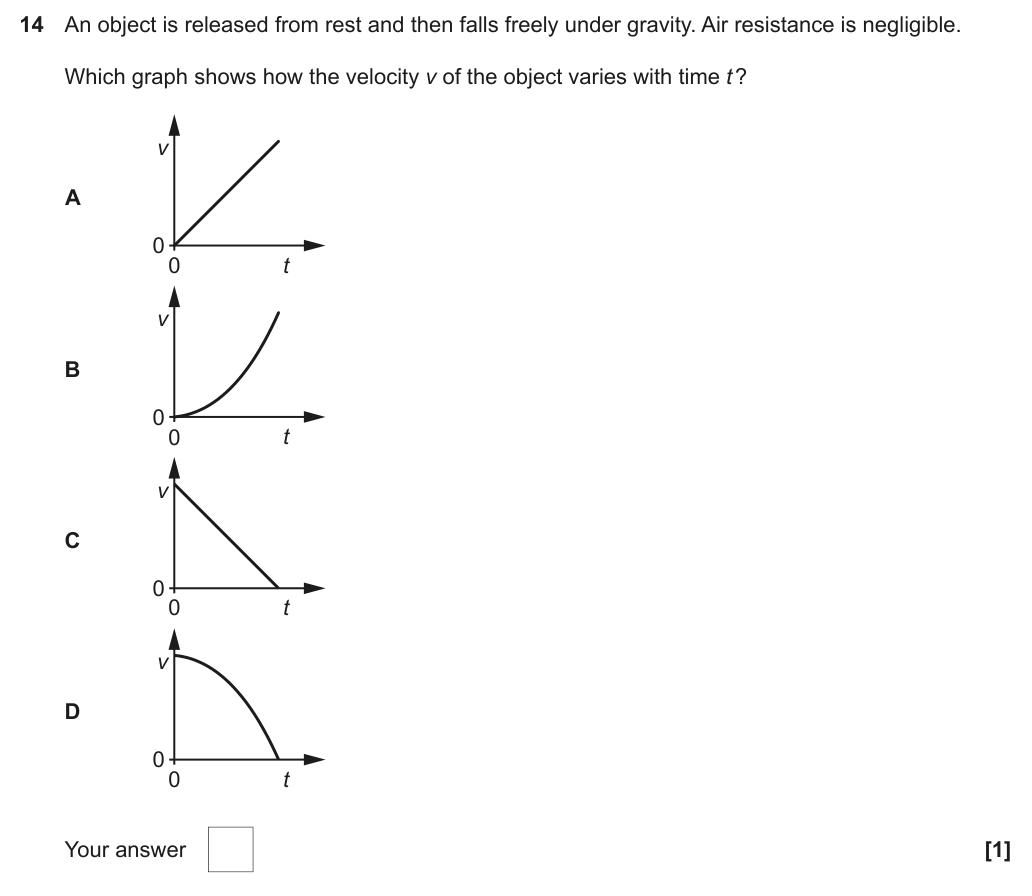
Just over half of the candidates correctly interpreted the graph to understand that the object was falling with constant acceleration due to gravity to give the answer A. The most common distractor was B.
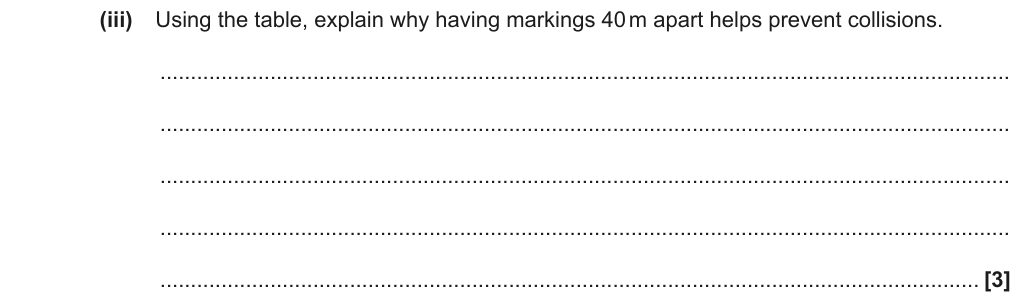
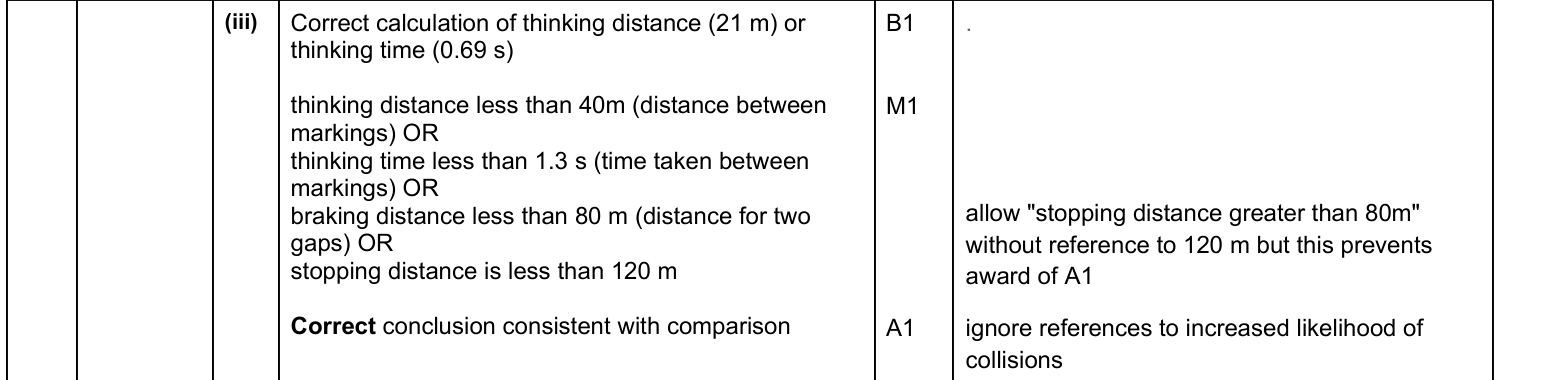
June 2023 · Paper 1 · Q16(a)(iii)3 marksExplanation
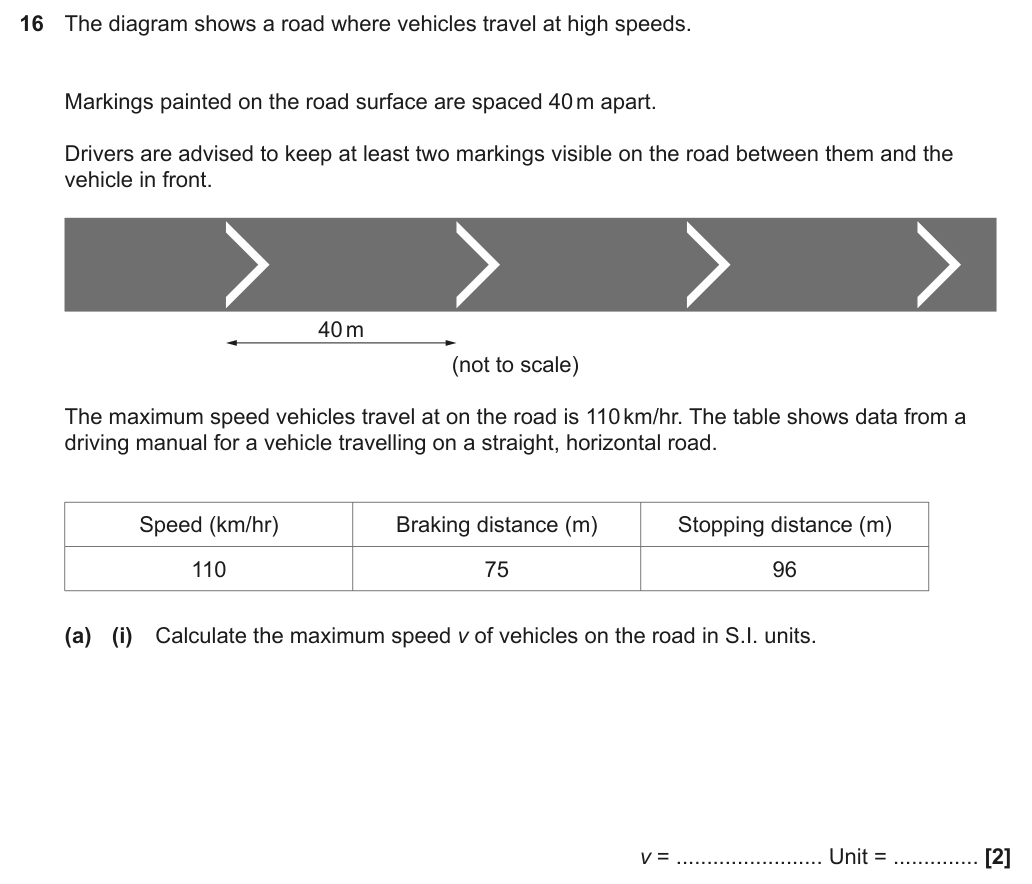
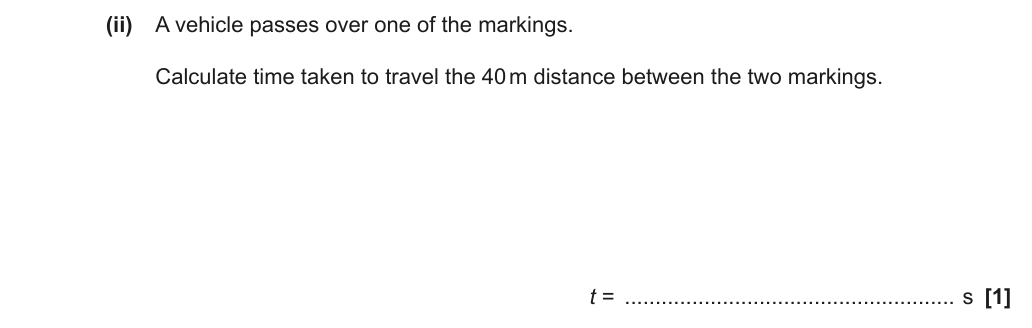
Earlier parts of question 16 that this part uses
Mark scheme
Notes from the mark scheme and report
thinking distance 21 m or thinking time 0.69 s must be calculated
stopping distance greater than 80 m without reference to 120 m prevents the A1
Skills: M0.3 Use ratios, fractions and percentages
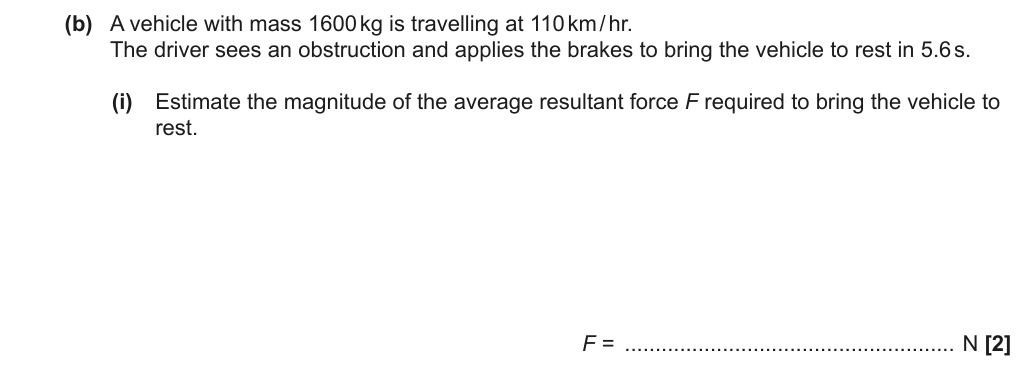
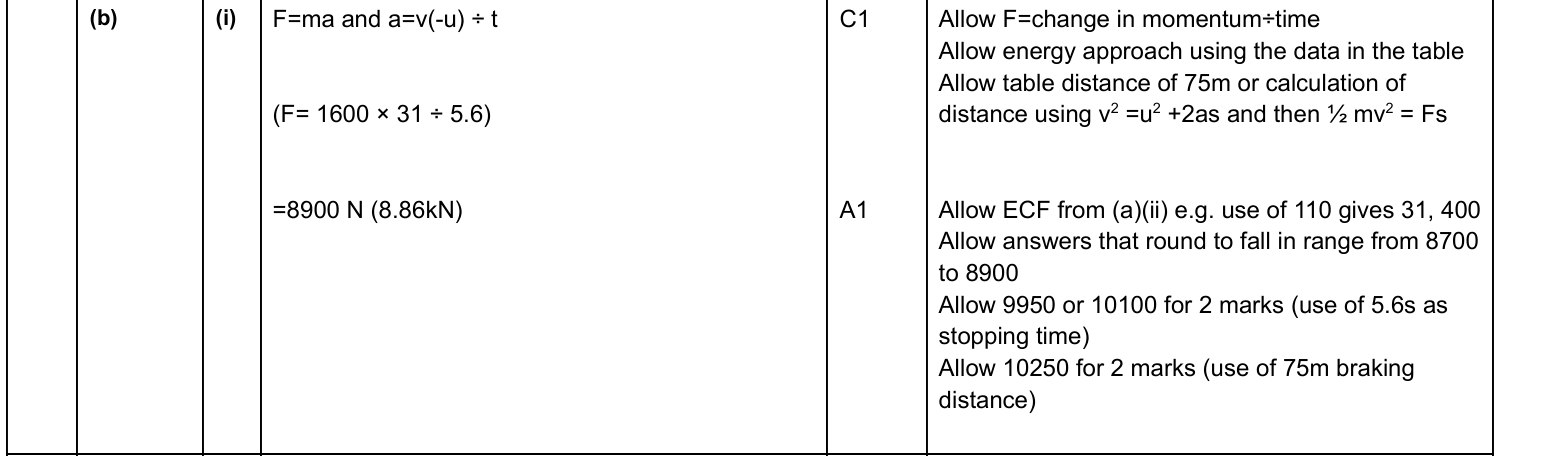
June 2023 · Paper 1 · Q16(b)(i)2 marksCalculationMedium
Earlier part of question 16 that this part uses
Mark scheme
Examiner's comment
Question 16 (b) (i) Question 16 (b) (ii) In Question 16 (b) (i), most candidates used the data available in the question to calculate an acceleration and hence a resultant force.
Notes from the mark scheme and report
8700 to 8900 N
9950, 10100 or 10250 N from the table data allowed 2 marks
Skills: M0.4 Estimate results; M2.3 Substitute numerical values into algebraic equations using appropriate units for physical quantities
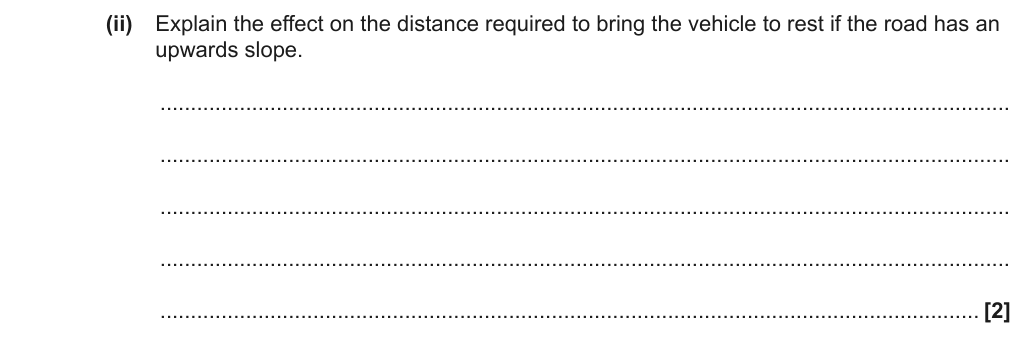
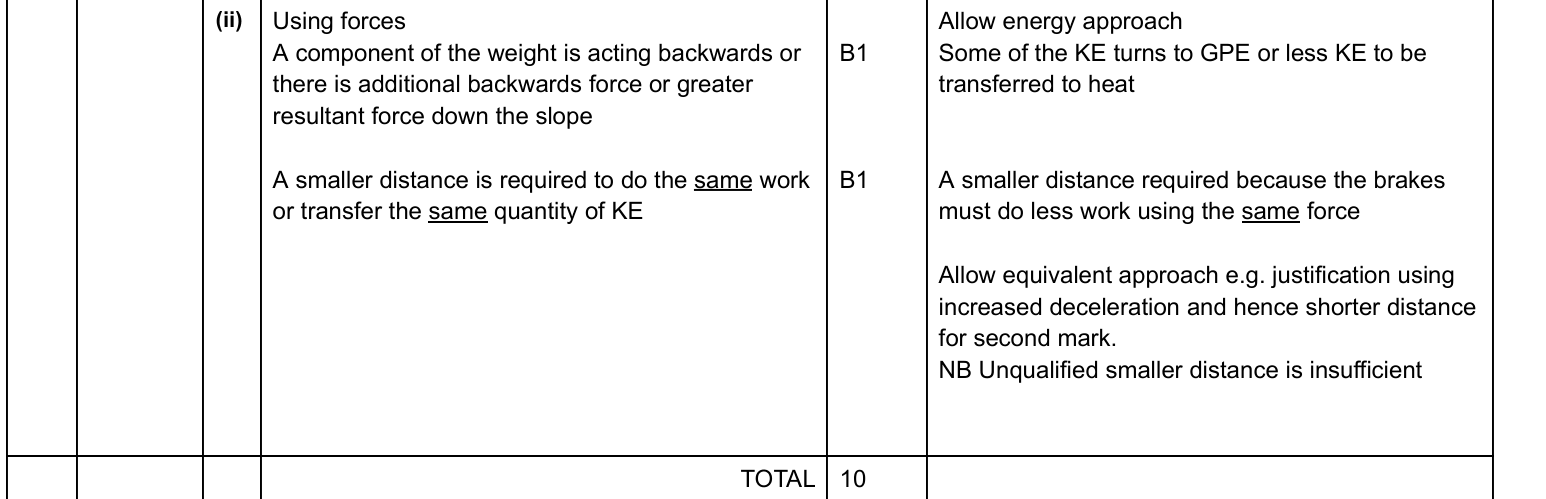
June 2023 · Paper 1 · Q16(b)(ii)2 marksExplanationMedium
Earlier part of question 16 that this part uses
Mark scheme
Examiner's comment
In Question 16 (b) (i), most candidates used the data available in the question to calculate an acceleration and hence a resultant force. In part (b) (ii), rather fewer used acceptable technical language to communicate their ideas. Useful phrases for explanations on this idea were ‘resultant force’ and ‘component of weight parallel to the slope’ rather than ‘extra force’ or ‘some of the vehicle’s gravity helped’.
Notes from the mark scheme and report
unqualified smaller distance is insufficient
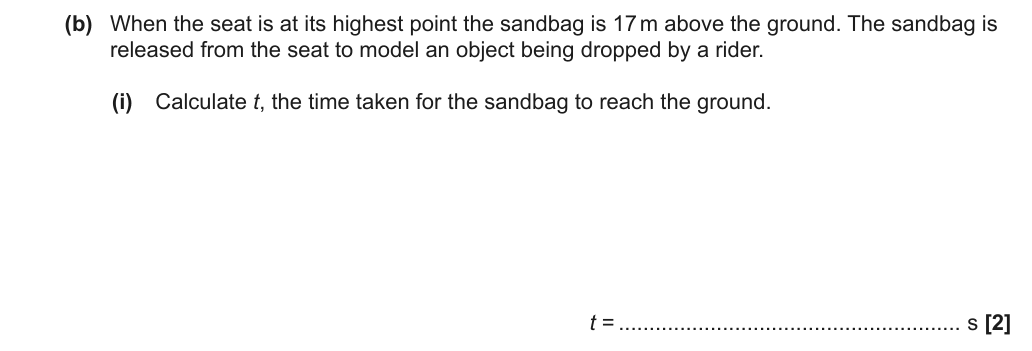
June 2023 · Paper 1 · Q17(b)(i)2 marksCalculationMedium
Mark scheme
Examiner's comment
Question 17 (b) explored ideas about parabolic flight due to gravitation. The only force acting on the sandbag and the shoe after they have been released is the weight force, which acts vertically downwards. Many candidates realised that the vertical velocity of the sandbag when it left the swing was zero, enabling them to calculate the time for the bag to fall 17m vertically downwards (using s = ½gt2) To calculate the horizontal distance travelled required both the horizontal velocity (from v = rω) and the time of flight from part (b) (iii). There was lots of scope for applying error carried forward rules as mentioned in the mark scheme.
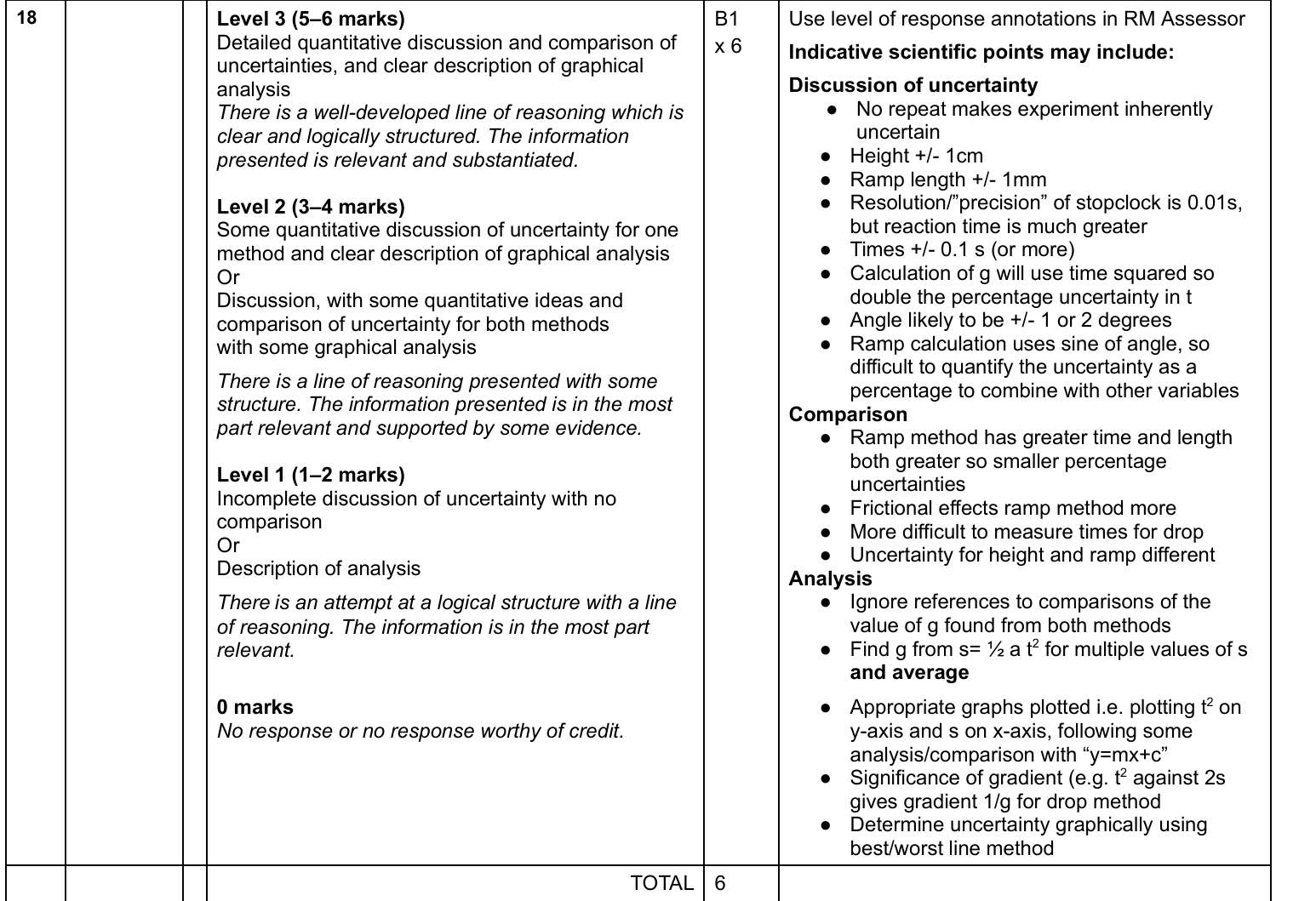
June 2023 · Paper 1 · Q186 marks6-mark extended responseEasy
Mark scheme, with the levels and indicative content
Examiner's comment
The easiest way to score well on this question was to look carefully at what was required. There is no mention of calculating g using either set of data nor any mention of steps the candidate could take to minimise the uncertainties. It is largely a question of what analysis would be used if there was a full range of results and how the uncertainties in both experiments can be compared. Almost all experiments and investigations at A2 Level require the use of an appropriate graph to represent and analyse data. Here there are two graphs: s against t2 for the falling object and t2 against sinθ for the rolling object. By rearranging the equations relating the variables, it is possible to work out the relevance of the gradient in both graphs. The data tables gave significant clues about how uncertain these experiments are, such as the number of significant figures for the raw data and the instruments with which these measurements would have been taken. Very successful candidates took the information and correctly propagated the instrumental uncertainties, even remembering to double the uncertainty in the time measurement because of the appearance of t2 in the analysis. Once they did this, they had a valid way of comparing the uncertainties in both experiments, coming to a valid conclusion. The exemplar 1 response came from an otherwise successful candidate. Their first statement about the uncertainty in the time values is true yet not true regarding the uncertainty in the distance measurements. There is some discussion about the percentage uncertainties in the length due to the differences in size of those length measurements and extra uncertainty due to the use of a protractor. Crucially, there is not much discussion about the actual values of those uncertainties. The candidate proceeds to calculate g from the single data points provided in the question. While this has been done correctly, it does not answer the question. There is no reference to graphical analysis at all. This resulted in this response being marked as a Level 1 response. This candidate has gone to great trouble to calculate the uncertainties each measurement would contribute to the overall uncertainty in the value of g for both methods, allowing a valid comparison of the two. In contrast to exemplar 1, there is a full description of the required graphical analysis, justifying which variable should be plotted on which axis and how a value of g could be obtained from such a graph in each case. This response was therefore marked as a Level 3 response.
Notes from the mark scheme and report
t is squared so its percentage uncertainty doubles
reaction time (about 0.1 s) dominates
ignore comparisons of the values of g
Candidates in this paper mistook the percentage difference for the percentage uncertainty in this question. To calculate the percentage difference here required an experimental value for g and the ‘accepted’ value of g, namely 9.81 m s–2.
Teachers and candidates all have access to the Practical Skills handbook which includes techniques and ideas that prove useful in answering Level of Response and other questions that check practical experience.
Skills: M1.5 Identify uncertainties in measurements and use simple techniques to determine uncertainty when data are combined; M3.3 Understand that y = mx + c represents a linear relationship; M3.4 Determine the slope and intercept of a linear graph; PAG1 Investigating motion
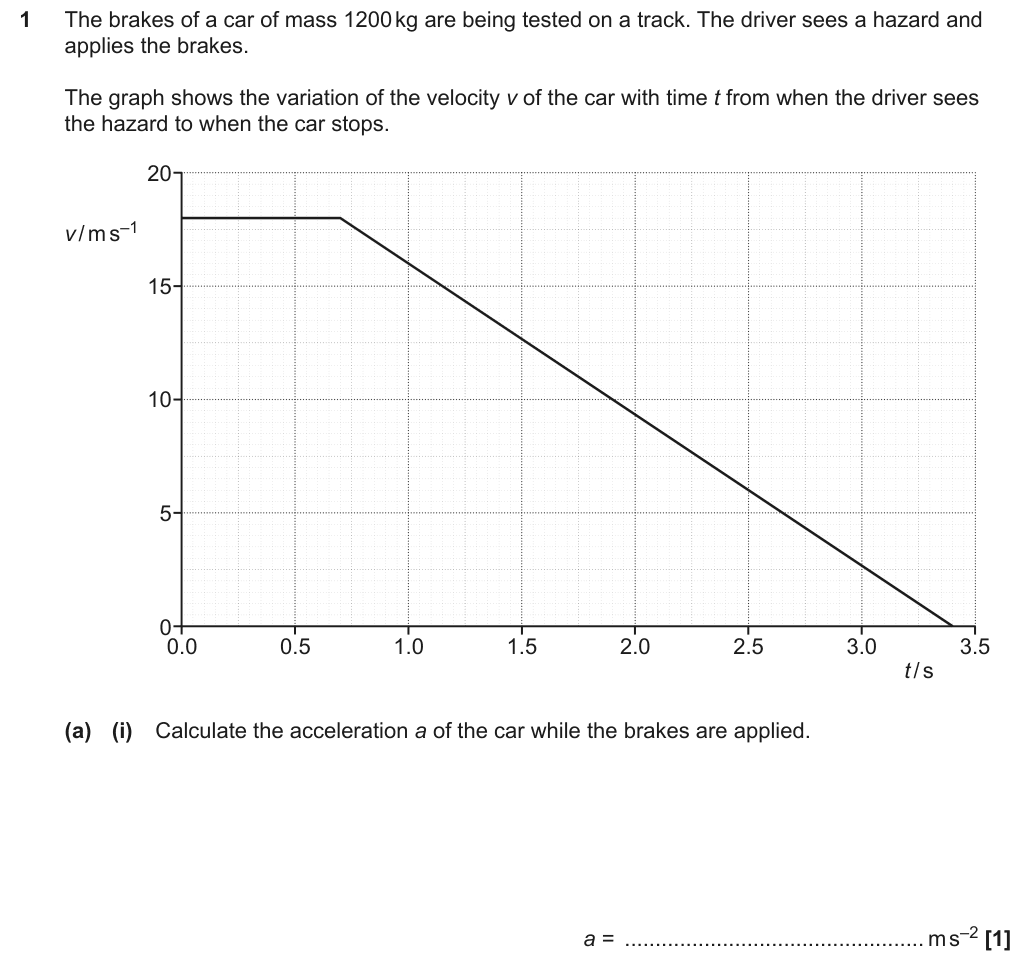
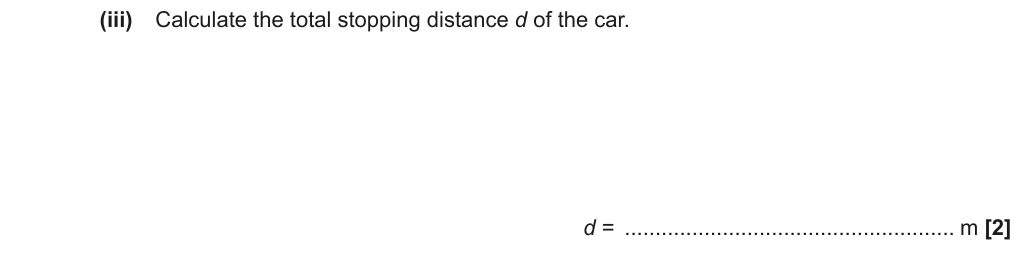
June 2023 · AS Paper 2 · Q1(a)(iii)2 marksCalculationMedium
Earlier part of question 1 that this part uses
Mark scheme
Examiner's comment
Candidates who showed working usually gained credit. A common error was to calculate the distance travelled while braking rather than the stopping distance.
Notes from the mark scheme and report
one mark for braking distance only (24.3 m)
must include the thinking distance 18 x 0.7
Understand the meaning of the terms thinking distance, braking distance and stopping distance.
Skills: M3.8 Understand the possible physical significance of the area between a curve and the x axis and be able to calculate it or estimate it by graphical methods as appropriate; M4.3 Calculate areas of triangles, circumferences and areas of circles, surface areas and volumes of rectangular blocks, cylinders and spheres
June 2023 · AS Paper 2 · Q1(b)2 marksDiagram or graphEasy
Earlier part of question 1 that this part uses
Mark scheme
Examiner's comment
Most candidates correctly realised that the horizontal section of the line would now start at 9.0 m s–1. Many candidates also realised that the thinking time remained constant and that the acceleration (deceleration) remained constant. Errors usually occurred when drawing the sloping line either so that it ended on the x-axis at 3.4 s or it was a much shorter time (implying a larger acceleration).
Notes from the mark scheme and report
horizontal line at 9 m s-1 to 0.7 s, then straight line reaching zero between 2.0 and 2.1 s (same gradient)
Skills: M3.1 Translate information between graphical, numerical and algebraic forms
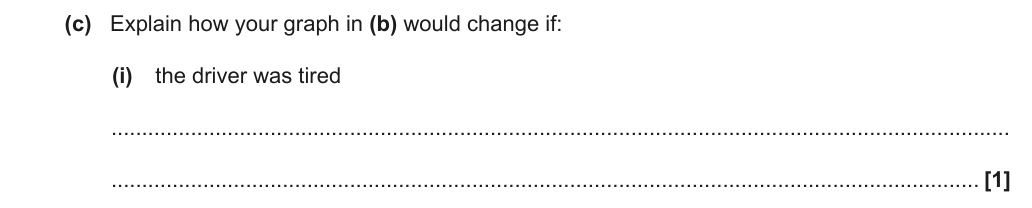
June 2023 · AS Paper 2 · Q1(c)(i)1 markExplanationMedium
Earlier parts of question 1 that this part uses
Mark scheme
Examiner's comment
Many candidates stated the change in thinking time rather than explaining how the horizontal line on the graph would change. More successful candidates explained that the horizontal line would be longer.
Notes from the mark scheme and report
ignore thinking time / distance
ignore tired driver braking differently
June 2023 · AS Paper 2 · Q1(c)(ii)1 markExplanationMedium
Earlier parts of question 1 that this part uses
Mark scheme
Examiner's comment
Many candidates stated the change in the braking time rather explaining how the sloping line on the graph would change. More successful candidates explained that the sloping line would be steeper.
Notes from the mark scheme and report
ignore braking time / distance
ignore gradient is lower
June 2023 · AS Paper 2 · Q3(b)2 marksShow thatMedium
Earlier part of question 3 that this part uses
Mark scheme
Examiner's comment
For this part of the question it was necessary for candidates to clearly show the substitution of the data into the equation. This includes the value of g (as 9.81 m s–2) from the data sheet. It was also necessary for candidates to show that having determined v2, this value needed to have the square root taken. Higher performing candidates wrote the final answer as 7.247 or 7.24685 ≈ 7.25 (m s–1).
Notes from the mark scheme and report
ecf from (a)
7.247 or square root of 52.517 to be seen
Skills: M2.3 Substitute numerical values into algebraic equations using appropriate units for physical quantities
June 2022 · Paper 1 · Q16(b)(iii)3 marksCalculationEasy
Earlier parts of question 16 that this part uses
Mark scheme
Examiner's comment
Question 16 (b) (iv) was answered well by candidates that realised the distance in real life would be less and could explain why that was the case.
Notes from the mark scheme and report
allow 8 or 8.2 m s-1 giving 4.4 or 4.5 m
possible ecf from (b)(ii)
Skills: M2.2 Change the subject of an equation, including non-linear equations; M2.3 Substitute numerical values into algebraic equations using appropriate units for physical quantities
June 2022 · Paper 1 · Q17(c)4 marksShort answerMedium
Earlier part of question 17 that this part uses
Mark scheme
Examiner's comment
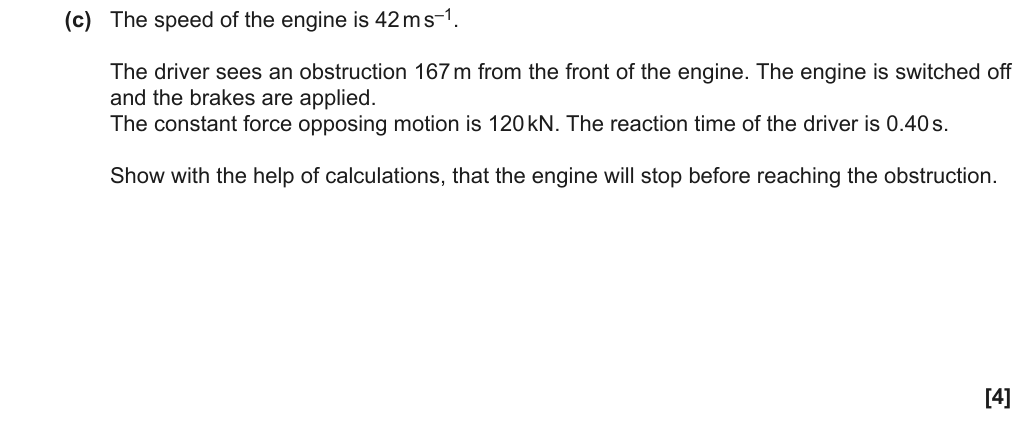
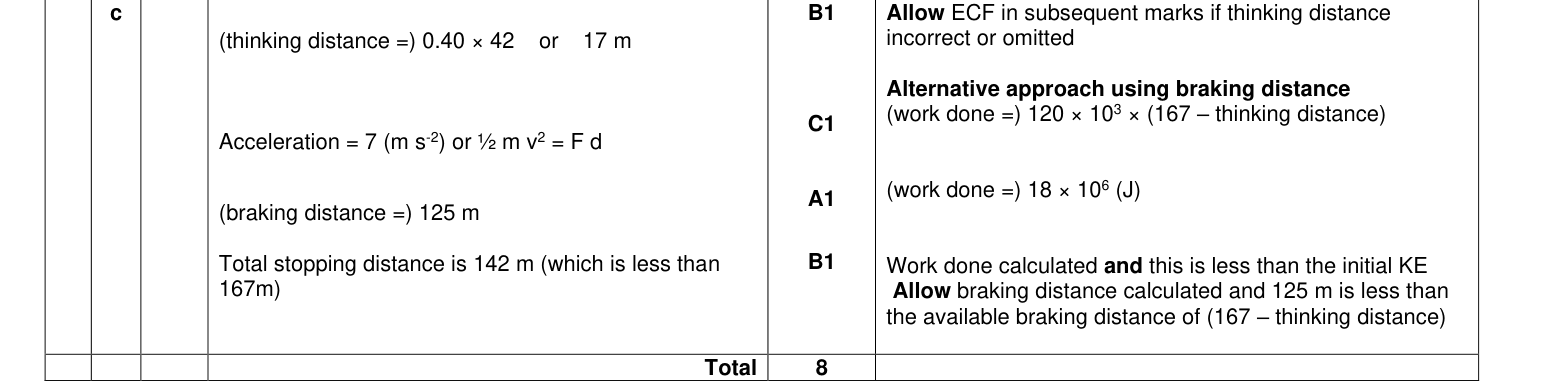
Candidates employed a range of strategies to demonstrate that the engine will stop before the obstruction. Very successful candidates often calculated the deceleration of the engine and then employed an equation of motion to work out first the braking distance and then added the thinking distance. Those candidates also added words to signpost their calculations clearly. Question 18 (a) (i - ii) Candidate’s answers to this part were either jumbled or grounded in incorrect physics. This question is correctly answered by thinking about a cuboid of air that is 36 m long and has a cross- sectional area equal to that of the shaded side of the tent. That cuboid corresponds to the air that hits the tent in the three second period. The force applied will be equal to the rate of momentum change. This means multiplying the mass of air that hits the tent by the velocity change (i.e. 12 m/s) and then dividing by the time taken for that momentum change.
Notes from the mark scheme and report
thinking distance 17 m must be included
alternative work-done method allowed
ecf if thinking distance incorrect or omitted
Skills: M2.3 Substitute numerical values into algebraic equations using appropriate units for physical quantities; M2.4 Solve algebraic equations, including quadratic equations
June 2022 · AS Paper 1 · Q23(d)3 marksCalculationMedium
Earlier part of question 23 that this part uses
Mark scheme
Examiner's comment
Candidates at the higher end performed better on this question as they were able to identify and apply the correct equation of motion and determine that the initial vertical component of the velocity was zero. Candidates at the lower end tended to either omit the question or make an incorrect attempt to use an equation of motion using a value for the initial velocity (usually the velocity calculated from part c).
Notes from the mark scheme and report
Allow 4.95
NOT 5.0
Candidates did not realise that horizontal and vertical motion are independent to each other and hence that the initial vertical component of velocity for the falling objects was zero.
Skills: M2.2 Change the subject of an equation, including non-linear equations; M2.3 Substitute numerical values into algebraic equations using appropriate units for physical quantities
June 2022 · AS Paper 2 · Q26 marks6-mark extended responseMedium
Mark scheme, with the levels and indicative content
Examiner's comment
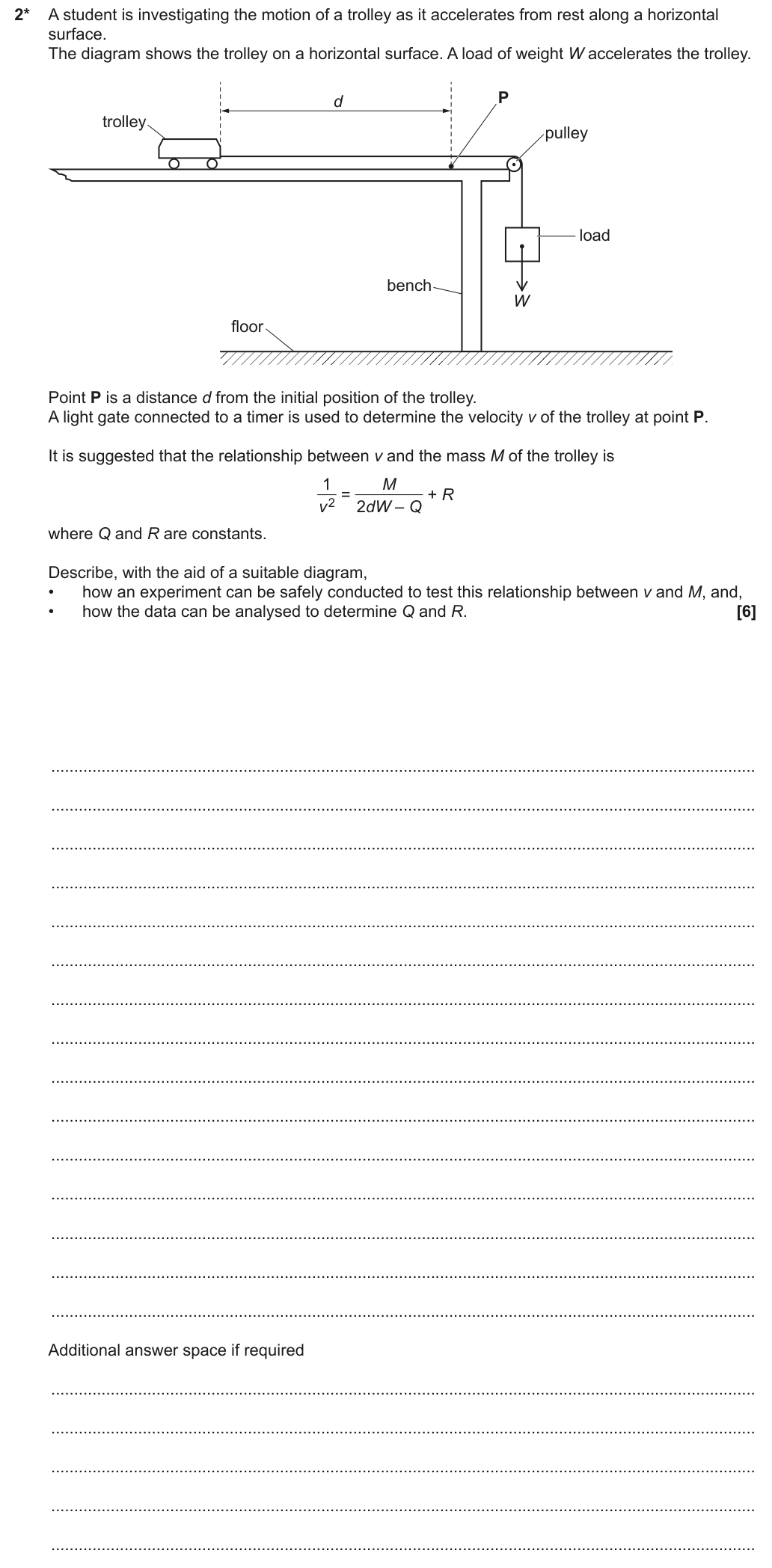
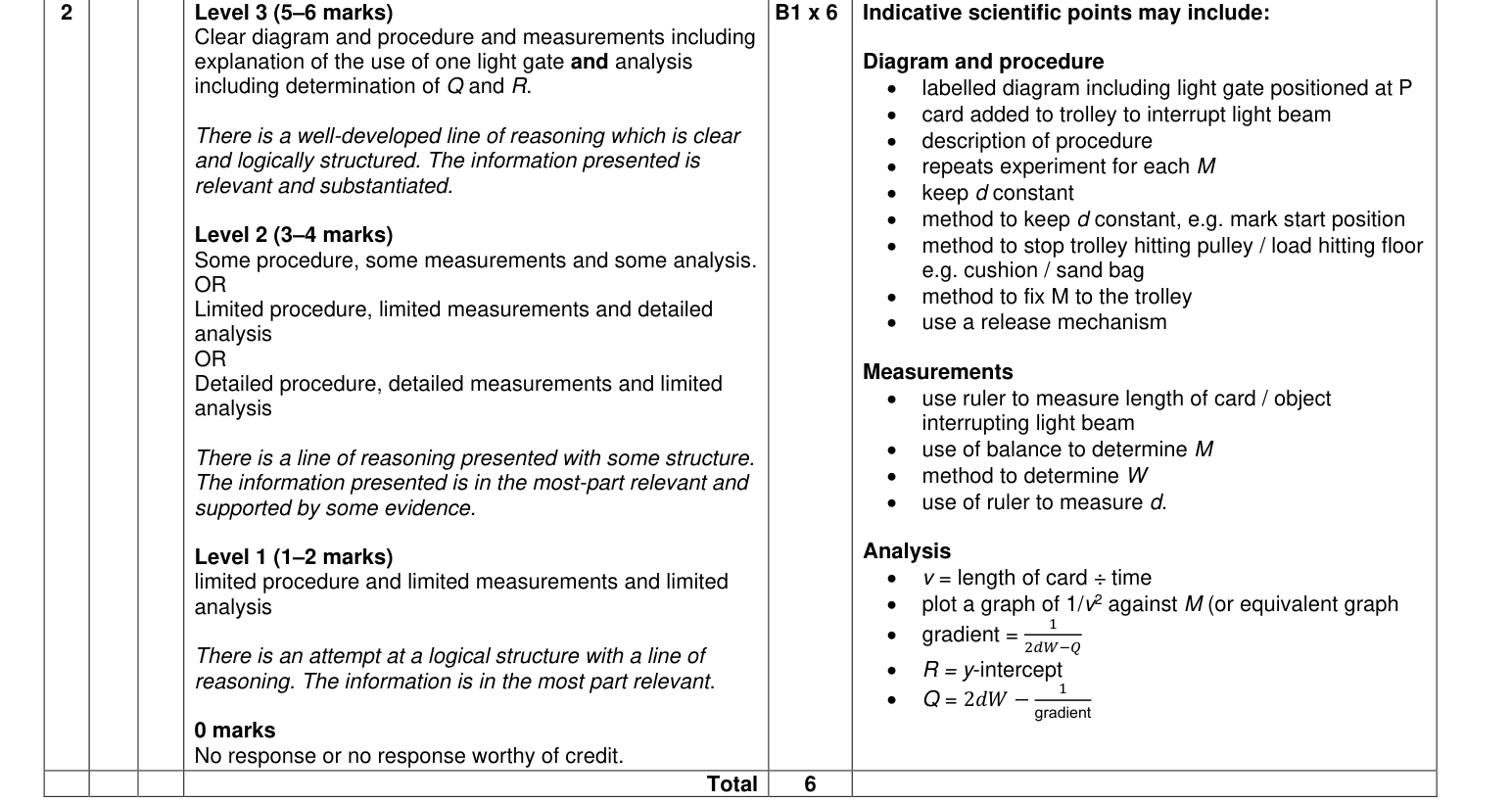
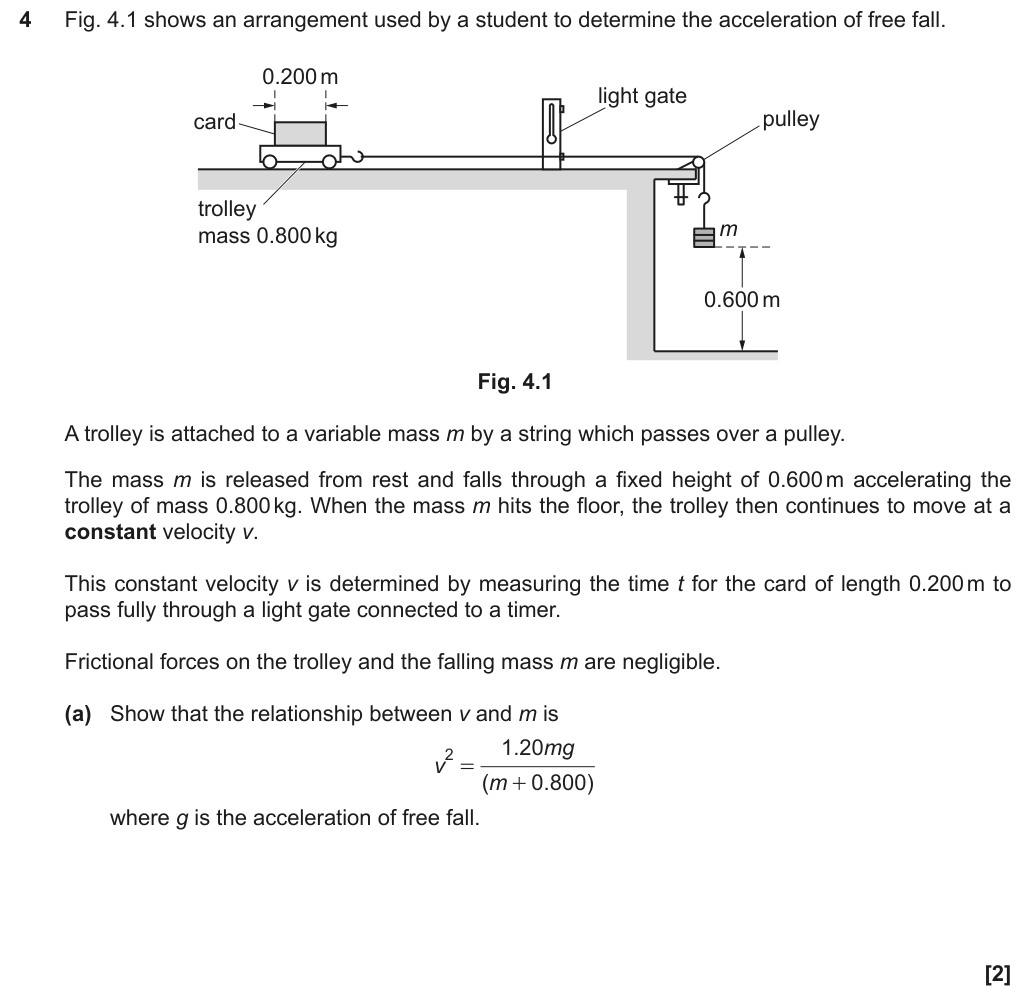
The question was designed to assess candidates’ practical skills. Candidates were advised to draw a ‘suitable diagram’, it was anticipated that they would draw a diagram with one light gate positioned at point P and a rectangular card added to the trolley to interrupt the light beam. To gain a Level 3 mark on this question candidates needed to explain both the procedure and measurements that needed to be taken. In particular candidates needed to explain how the velocity v was determined at P. Many candidates incorrectly used two light gates and determine the average speed to travel distance d. Appropriate measuring instruments should be specified to determine the other constants. The analysis of the data should include an appropriate graph to plot and an explanation of how Q and R could be determined from the gradient and intercept. Q and R should be the subject of the equation. Level 2 descriptors and the communication statement is also satisfied. The candidate structures the response by initially determining the graph that would need to be plotted to determine the constant Q and R. The candidate then explains how the gradient and y-intercept is used to determine Q and R. The candidate describes a brief procedure and includes the use of a cushion, repeating results and keeping d and W constant. To gain Level 3, the candidate needed to have included a diagram showing the position of the light gate and explained the measurements that would need to be taken to determine v from a light gate connected to a timer.
Notes from the mark scheme and report
plot 1/v2 against M: gradient = 1/(2dW - Q), R = y-intercept
v = length of card / time
keep d constant
Candidates should understand how light gates attached to a timer can be used to determine velocity and acceleration. In particular, candidates should understand the distance measurements and shape of the interrupt card.
Other data logging methods such as a motion sensor should also be understood.
Skills: M3.3 Understand that y = mx + c represents a linear relationship; M3.4 Determine the slope and intercept of a linear graph; PAG1 Investigating motion
June 2022 · AS Paper 2 · Q4(a)(ii)2 marksCalculationEasy
Earlier part of question 4 that this part uses
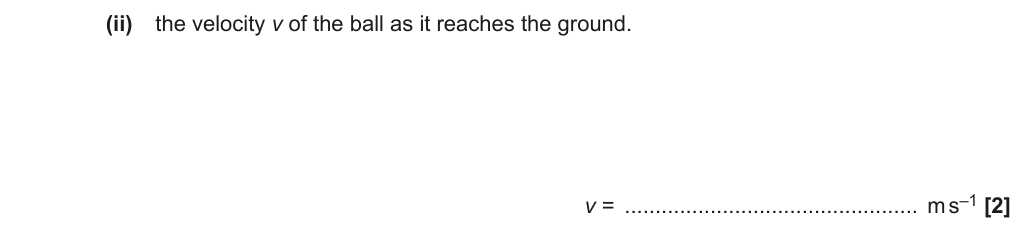
Mark scheme
Examiner's comment
Most candidates correctly equated the change in gravitational potential energy to kinetic energy and gained the correct answer. Other candidates correctly used v2 = 2 gh. A number of candidates gave the answer as 7 (m s-1) – since the data in the question was given to two significant figures the answers should also be given to two significant figures. Ideally the substitution of data into appropriate equations should be shown.
Notes from the mark scheme and report
ecf from (a)(i)
allow 1 sf
Skills: M2.2 Change the subject of an equation, including non-linear equations; M2.3 Substitute numerical values into algebraic equations using appropriate units for physical quantities
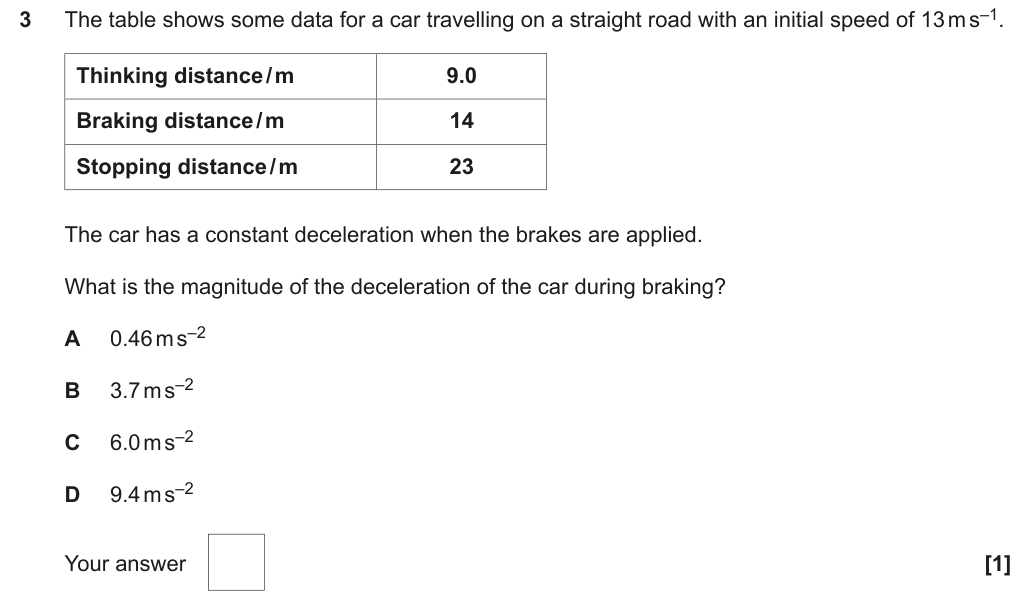
November 2021 · Paper 1 · Q31 markMultiple choice
Answer
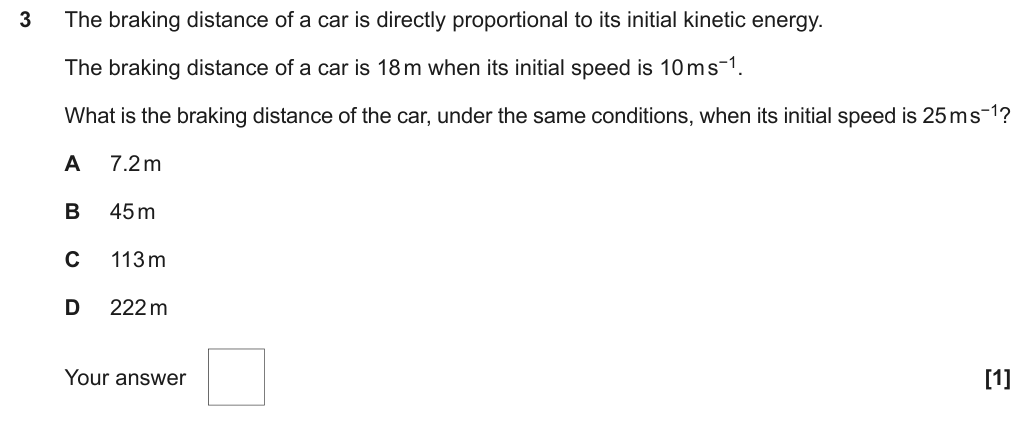
C
Mark scheme
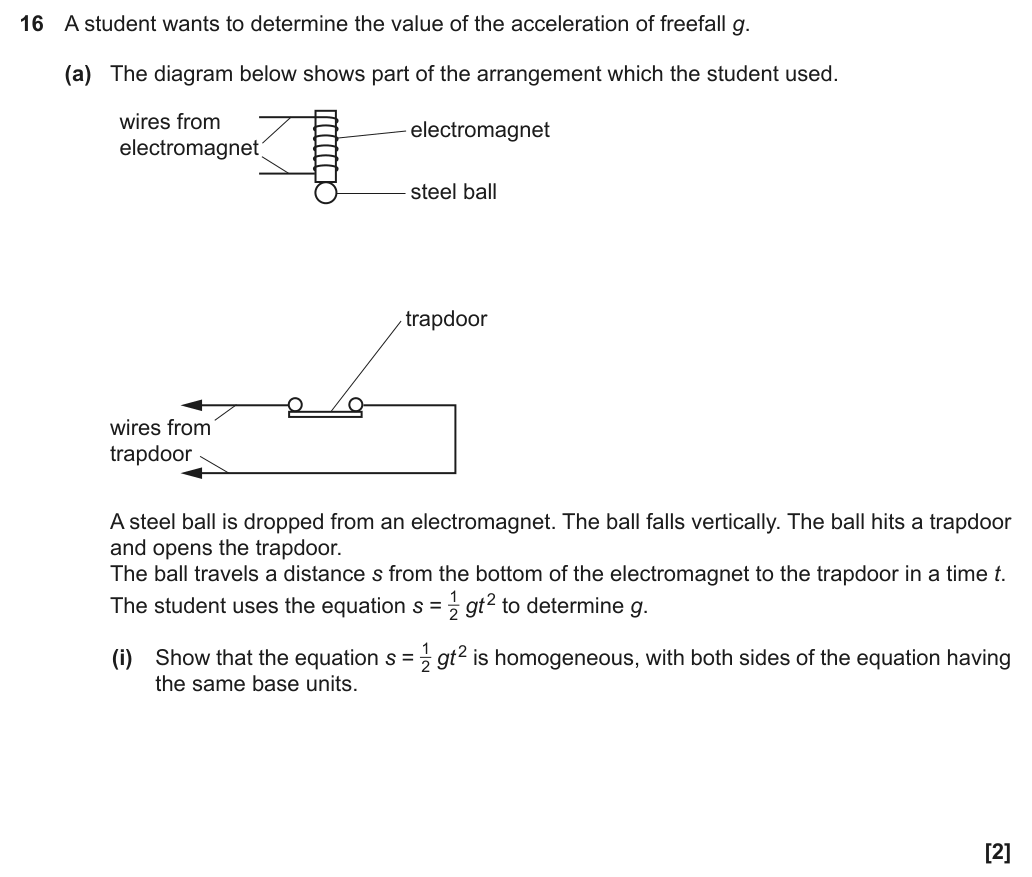
November 2021 · Paper 1 · Q16(a)(ii)4 marksExplanation
Earlier part of question 16 that this part uses
Mark scheme
Notes from the mark scheme and report
distance from bottom of ball to top of trapdoor
fourth mark for repeats to average t or avoiding parallax
Skills: PAG1 Investigating motion
November 2021 · AS Paper 1 · Q21(c)(i)3 marksShow that
Mark scheme
Notes from the mark scheme and report
working required (show that)
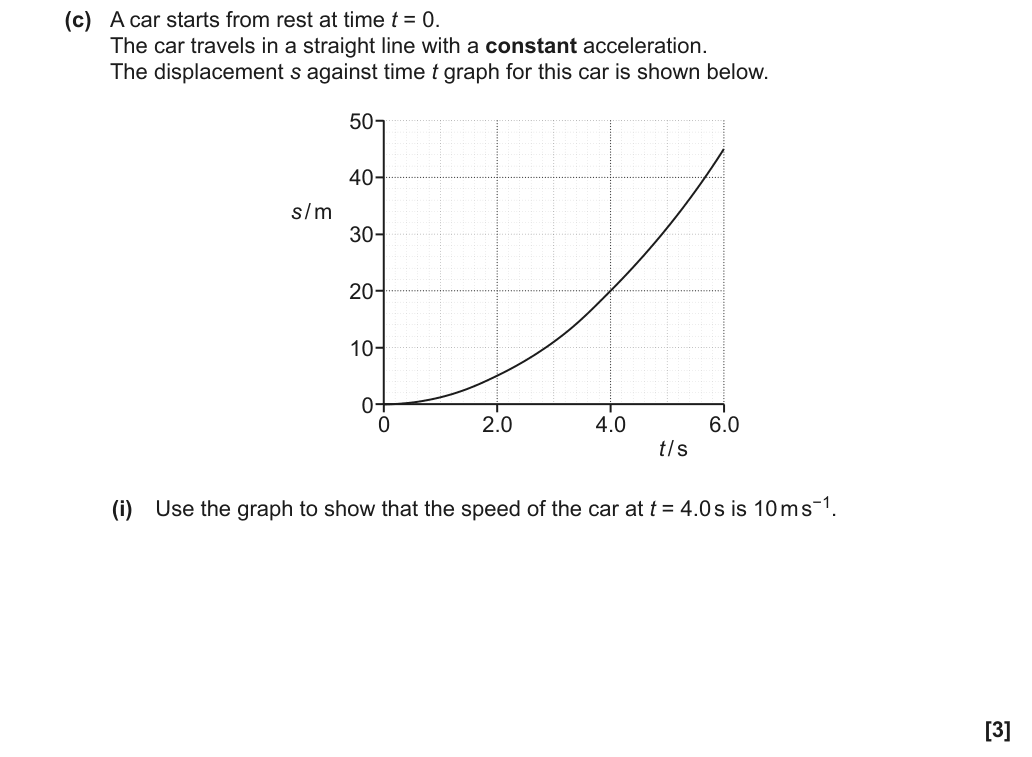
gradient value must be between 9.50 and 10.50
s = 20 m with equations of motion also allowed
Skills: M3.4 Determine the slope and intercept of a linear graph; M3.6 Draw and use the slope of a tangent to a curve as a measure of rate of change
November 2021 · Paper 3 · Q1(a)(ii)2 marksCalculation
Earlier part of question 1 that this part uses
Mark scheme
Notes from the mark scheme and report
ecf from (a)(i)
using a = 1 gives 18 m
Skills: M2.2 Change the subject of an equation, including non-linear equations; M2.3 Substitute numerical values into algebraic equations using appropriate units for physical quantities
November 2020 · AS Paper 1 · Q131 markMultiple choice
Answer
A
Mark scheme
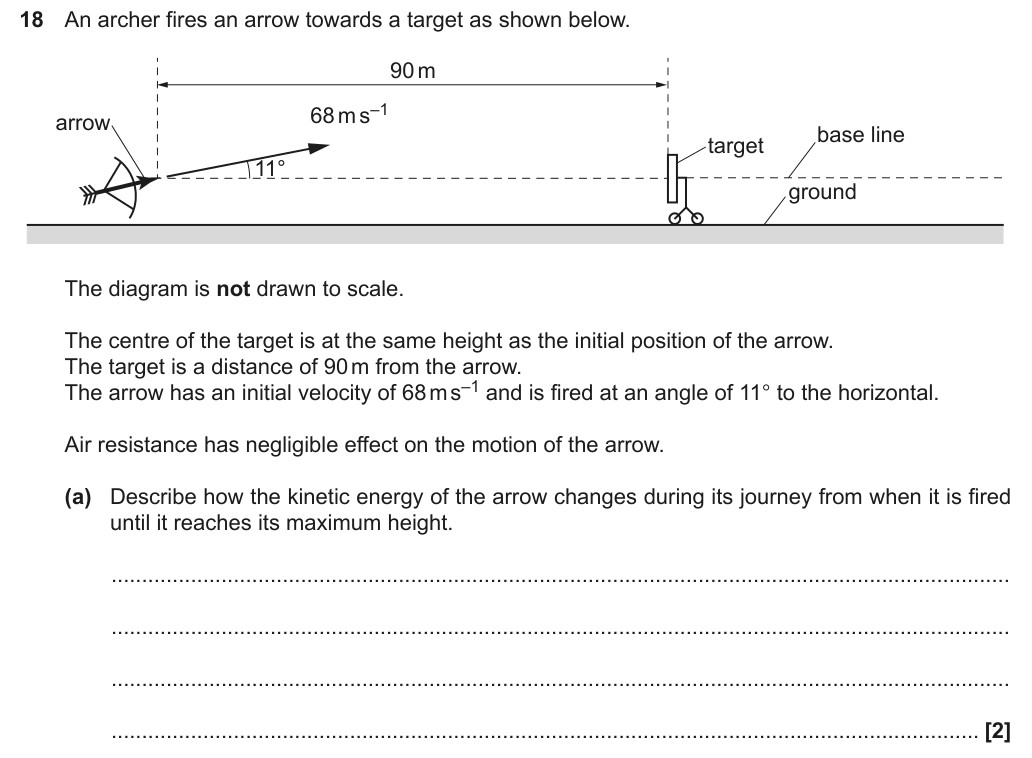
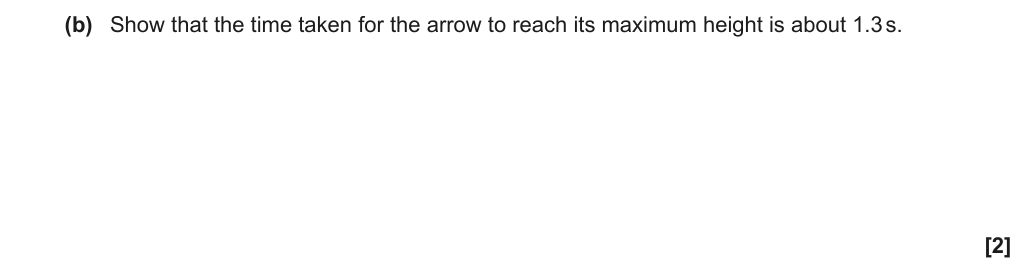
November 2020 · Paper 1 · Q18(b)2 marksShow that
Earlier part of question 18 that this part uses
Mark scheme
Notes from the mark scheme and report
NOT t = 90 / (68 cos 11°) = 1.35, zero marks
Skills: M0.6 Use calculators to handle sin x, cos x and tan x when x is expressed in degrees or radians; M2.2 Change the subject of an equation, including non-linear equations; M4.5 Use sin, cos and tan in physical problems
November 2020 · Paper 1 · Q196 marks6-mark extended responseMedium
Mark scheme, with the levels and indicative content
Examiner's comment
Data analysis was better than in previous series for the equivalent to Question 19.
Notes from the mark scheme and report
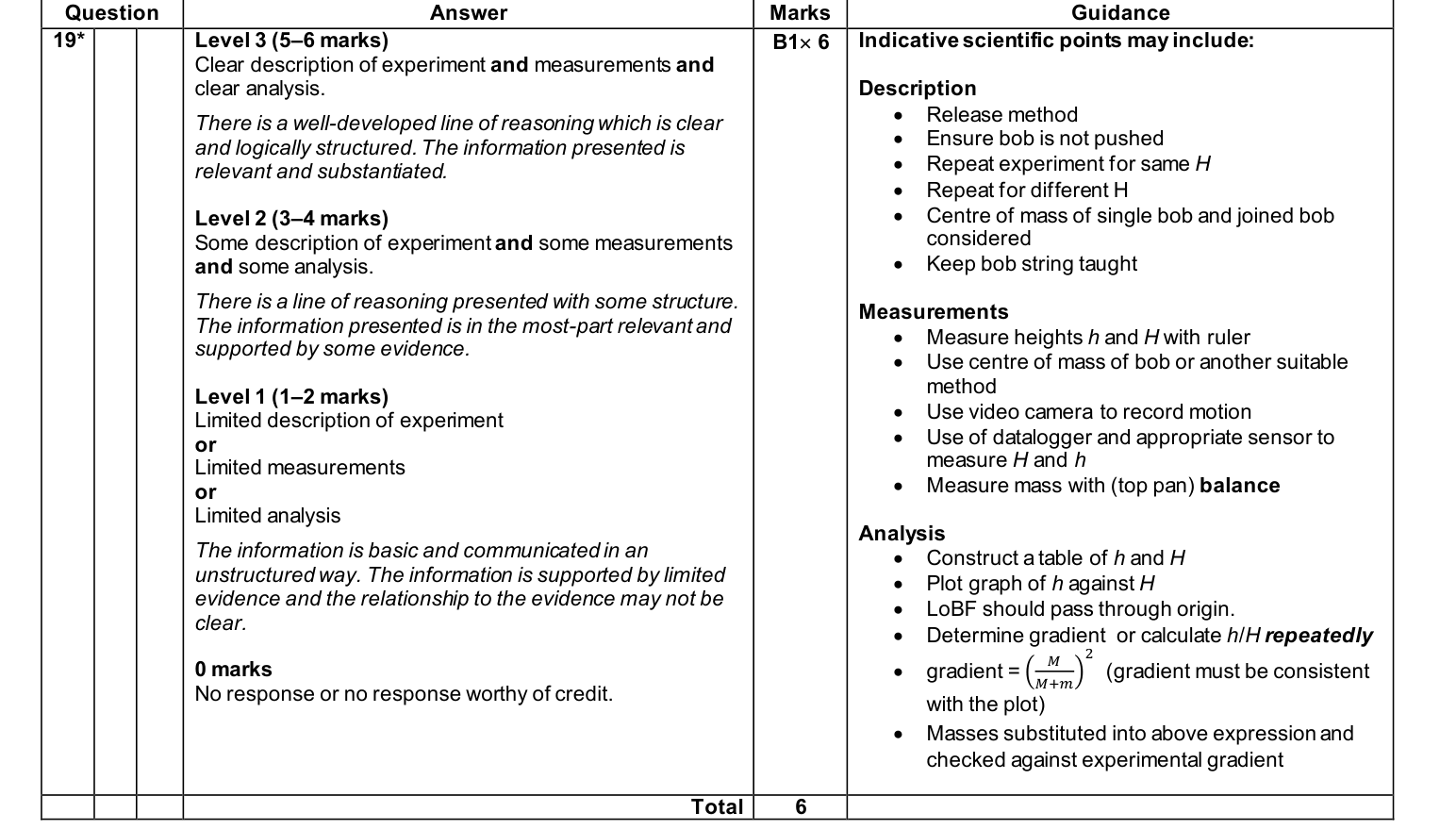
plot h against H, straight line through origin, gradient compared with (M/(M+m))²
heights measured to centre of mass of bob
Skills: M3.3 Understand that y = mx + c represents a linear relationship; M3.4 Determine the slope and intercept of a linear graph; PAG1 Investigating motion
November 2020 · AS Paper 2 · Q46 marks6-mark extended responseMedium
Mark scheme, with the levels and indicative content
Examiner's comment
Comments on responses by question type Level of response questions The two LoR questions were Question 4 and Question 8. In Question 4, candidates were required to plan an experiment.
Notes from the mark scheme and report
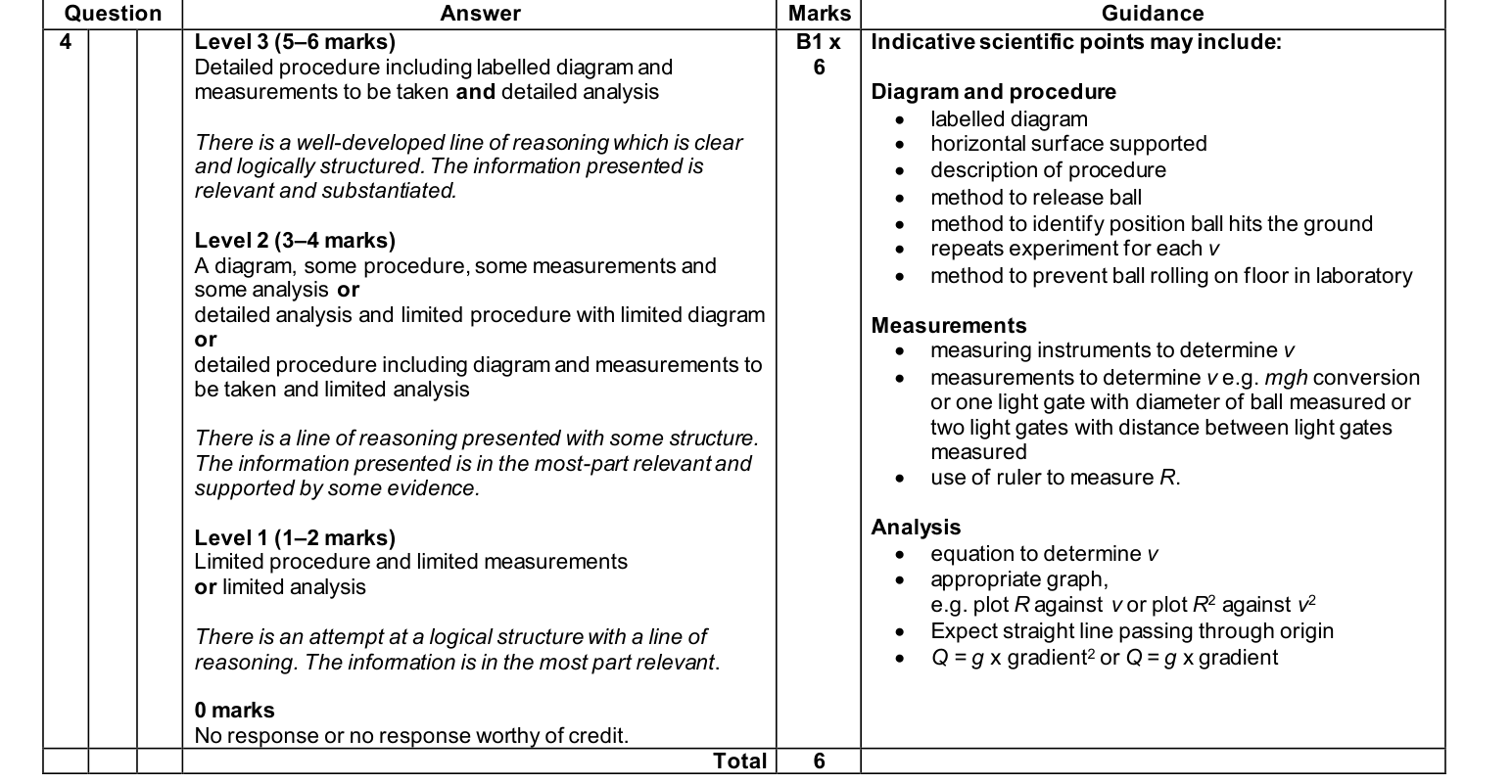
expect straight line through the origin: Q = g x gradient² (R against v) or Q = g x gradient (R² against v²)
Skills: M3.3 Understand that y = mx + c represents a linear relationship; M3.4 Determine the slope and intercept of a linear graph; PAG1 Investigating motion
November 2020 · AS Paper 2 · Q5(b)2 marksExplanationMedium
Earlier part of question 5 that this part uses
Mark scheme
Examiner's comment
In Question 5 (b) some candidates were vague in their responses, for example, stating that the gradient changes rather than stating that the gradient decreases.
Notes from the mark scheme and report
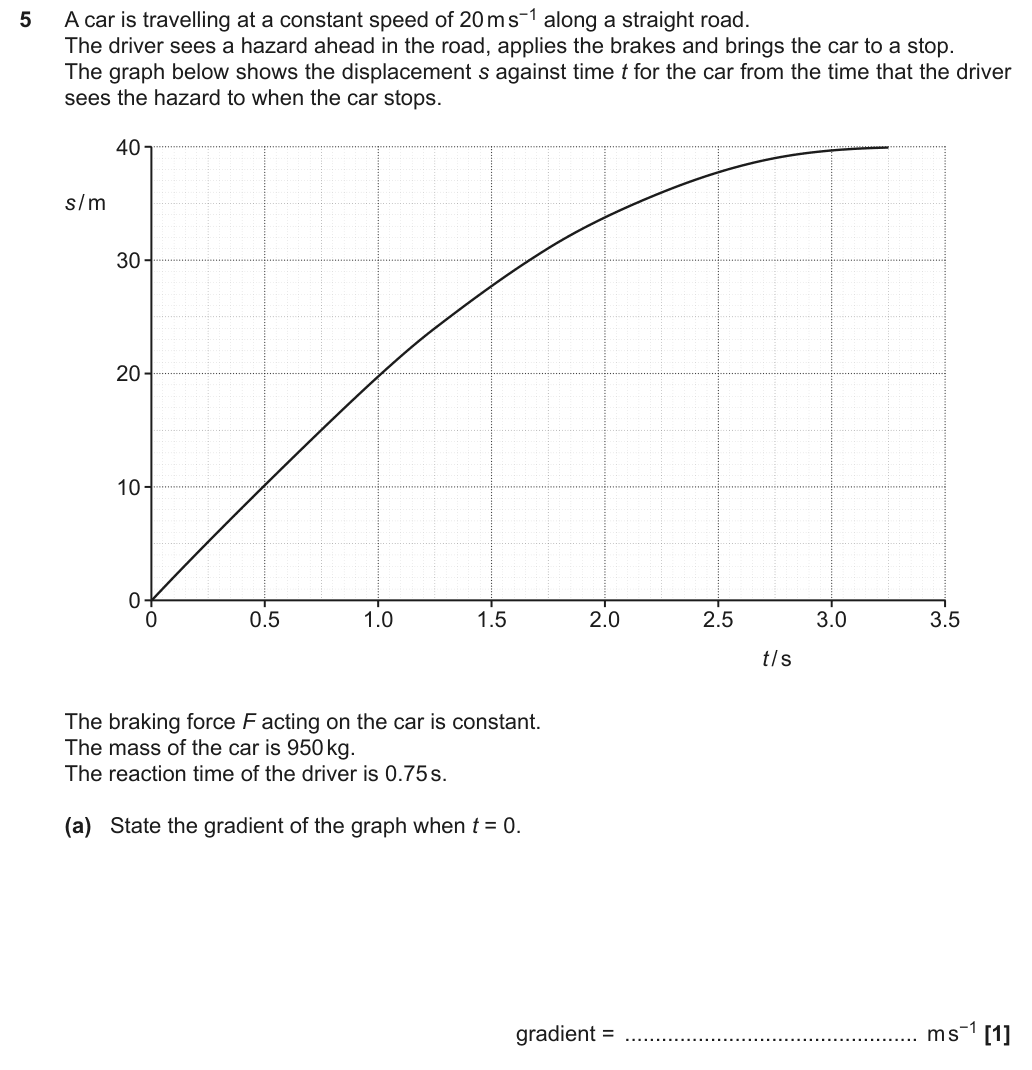
gradient decreases after 0.75 s, indicating deceleration
Skills: M3.1 Translate information between graphical, numerical and algebraic forms
November 2020 · AS Paper 2 · Q5(d)3 marksCalculation
Earlier parts of question 5 that this part uses
Mark scheme
Notes from the mark scheme and report
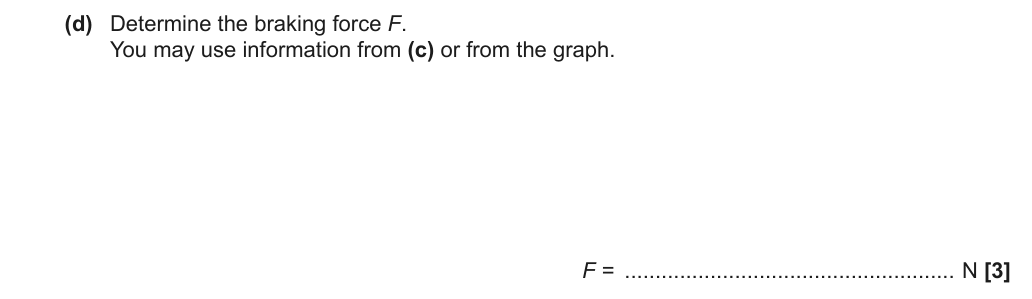
no ecf for incorrect time
ignore sign
Skills: M2.3 Substitute numerical values into algebraic equations using appropriate units for physical quantities; M3.1 Translate information between graphical, numerical and algebraic forms
November 2020 · AS Paper 2 · Q5(e)3 marksExplanationMedium
Earlier part of question 5 that this part uses
Mark scheme
Examiner's comment
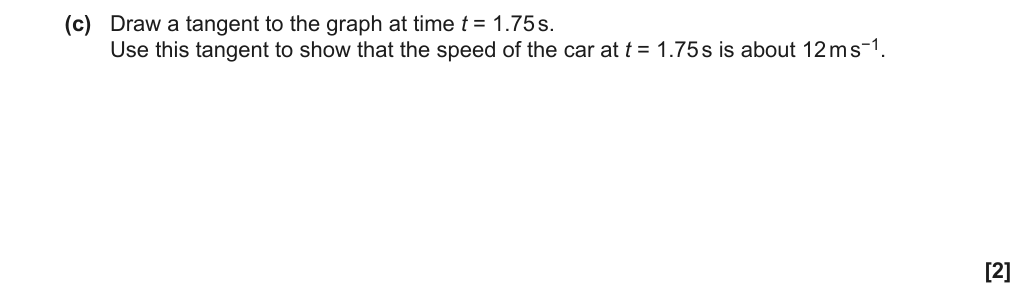
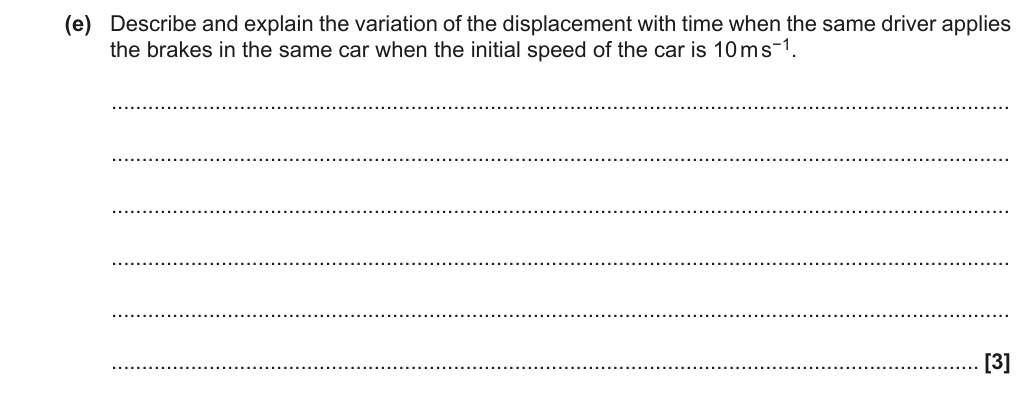
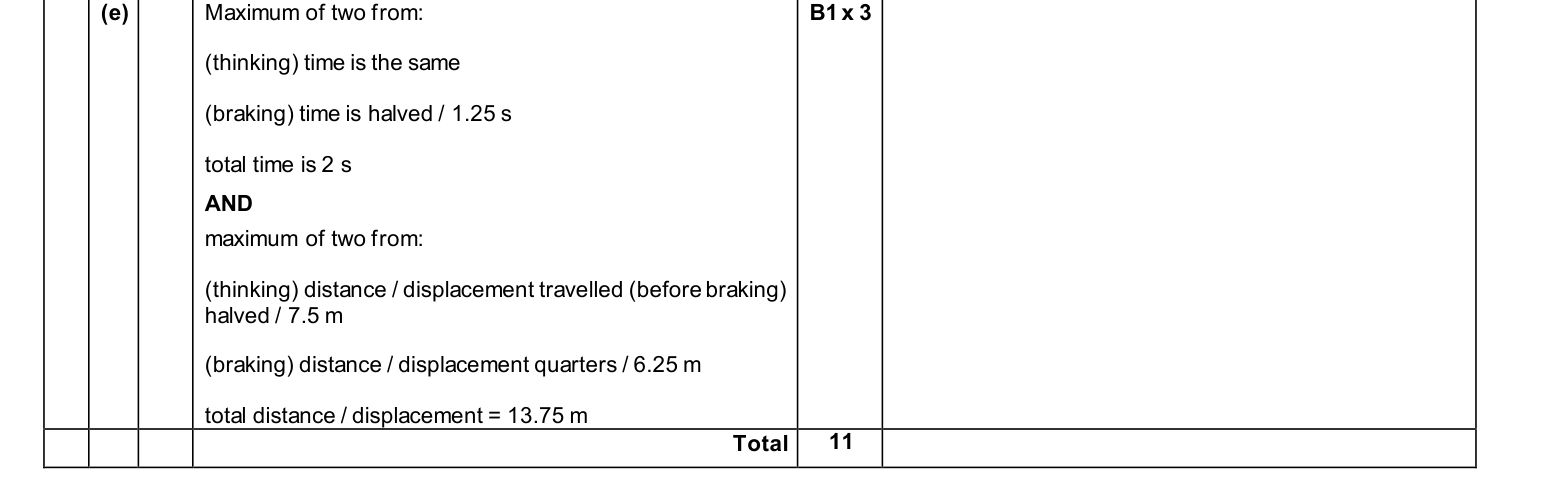
In Question 5 (e) the distances and times should have been calculated or compared in terms of halving/quartering.
Notes from the mark scheme and report
maximum two marks for times and two for distances
braking distance quarters
Skills: M0.3 Use ratios, fractions and percentages
June 2019 · AS Paper 1 · Q181 markMultiple choiceMedium
Answer
B
Mark scheme
Examiner's comment
This question required knowledge and understanding of equations of motions. The simplest route to getting the correct answer was the equation s = ½ at2 with the displacement s = 0.102 m. About two thirds of the candidates got the correct answer B. All the other distractors were based on using incorrect values for s. For example, the answer would have been D for s = 12.7 cm. The exemplar 3 below shows a typical working for a correct answer. This exemplar illustrates relevant scribbling in a multiple choice answer can lead to the correct response. It is good to see that the candidate has focused on the correct distance of 0.102 m. The equation is there, as are the key numbers. The candidate had saved some time by finishing off the calculation on his/her calculator. A perfect technique from this candidate.
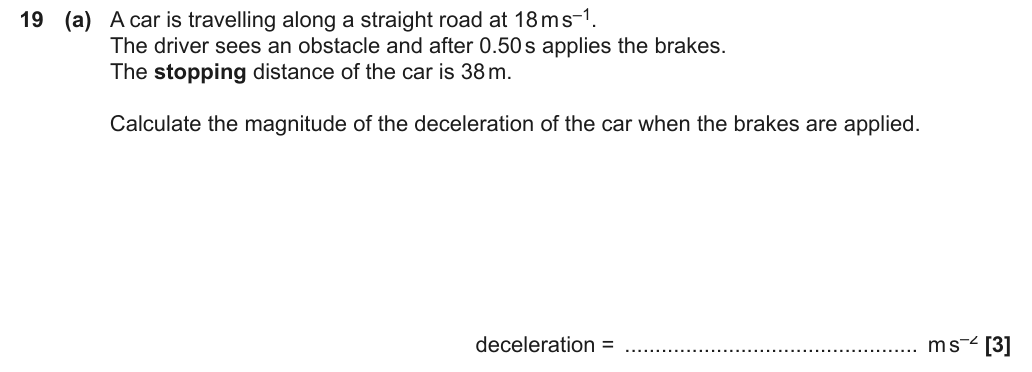
June 2019 · Paper 1 · Q19(a)3 marksCalculationMedium
Mark scheme
Examiner's comment
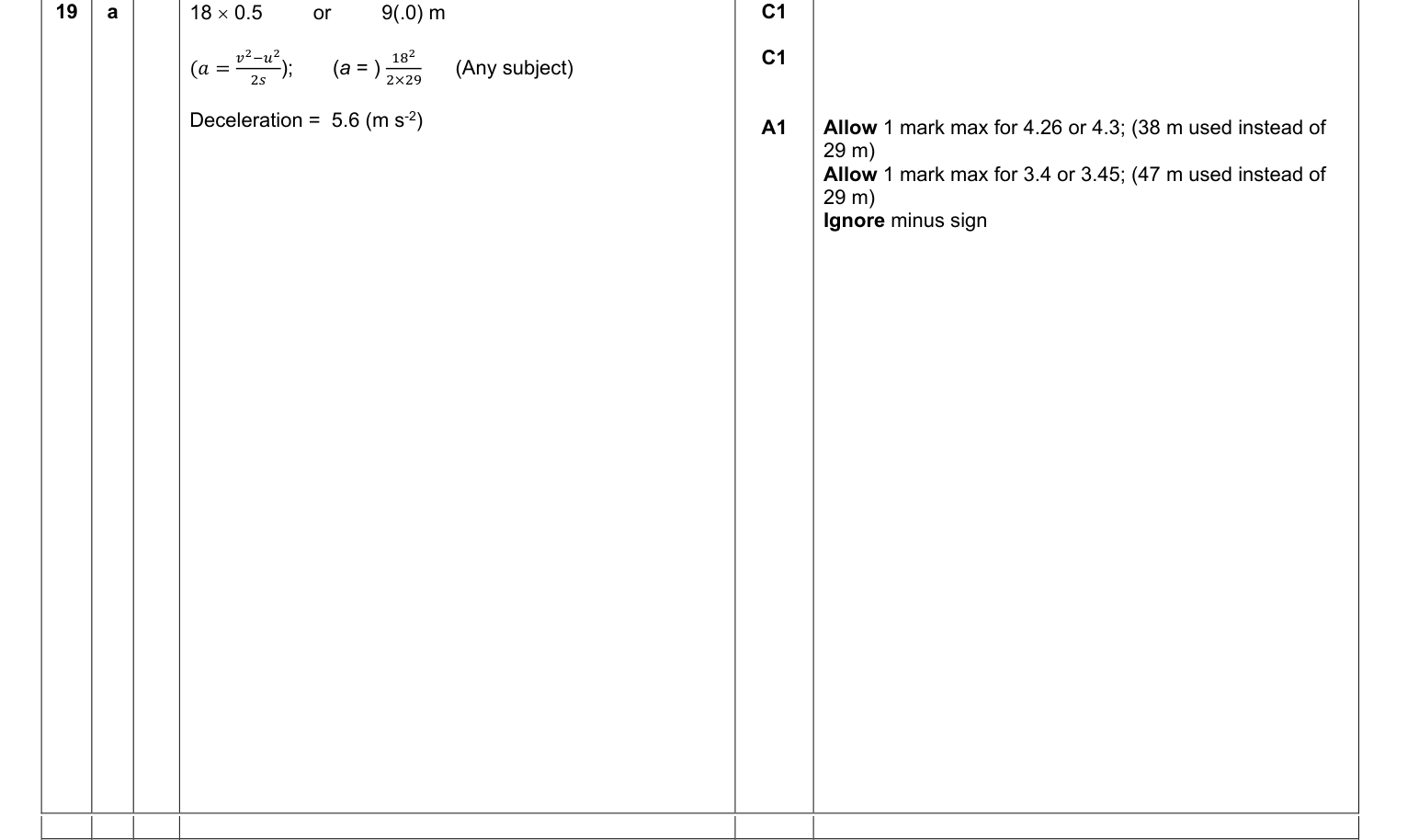
Many candidates use the stopping distance for the braking distance of the car, giving a deceleration that was too low and scoring 1 mark only. More successful candidates remembered to calculate the thinking distance involved (9 m) and subtract this from the stopping distance to give a braking distance of 29 m. Algebraic rearrangement, substitution and evaluation from then on was excellent.
Notes from the mark scheme and report
1 mark max for 4.3 (38 m used) or 3.4 (47 m used)
ignore minus sign
Skills: M2.2 Change the subject of an equation, including non-linear equations; M2.3 Substitute numerical values into algebraic equations using appropriate units for physical quantities
June 2019 · Paper 1 · Q19(b)6 marks6-mark extended responseEasy
Mark scheme, with the levels and indicative content
Examiner's comment
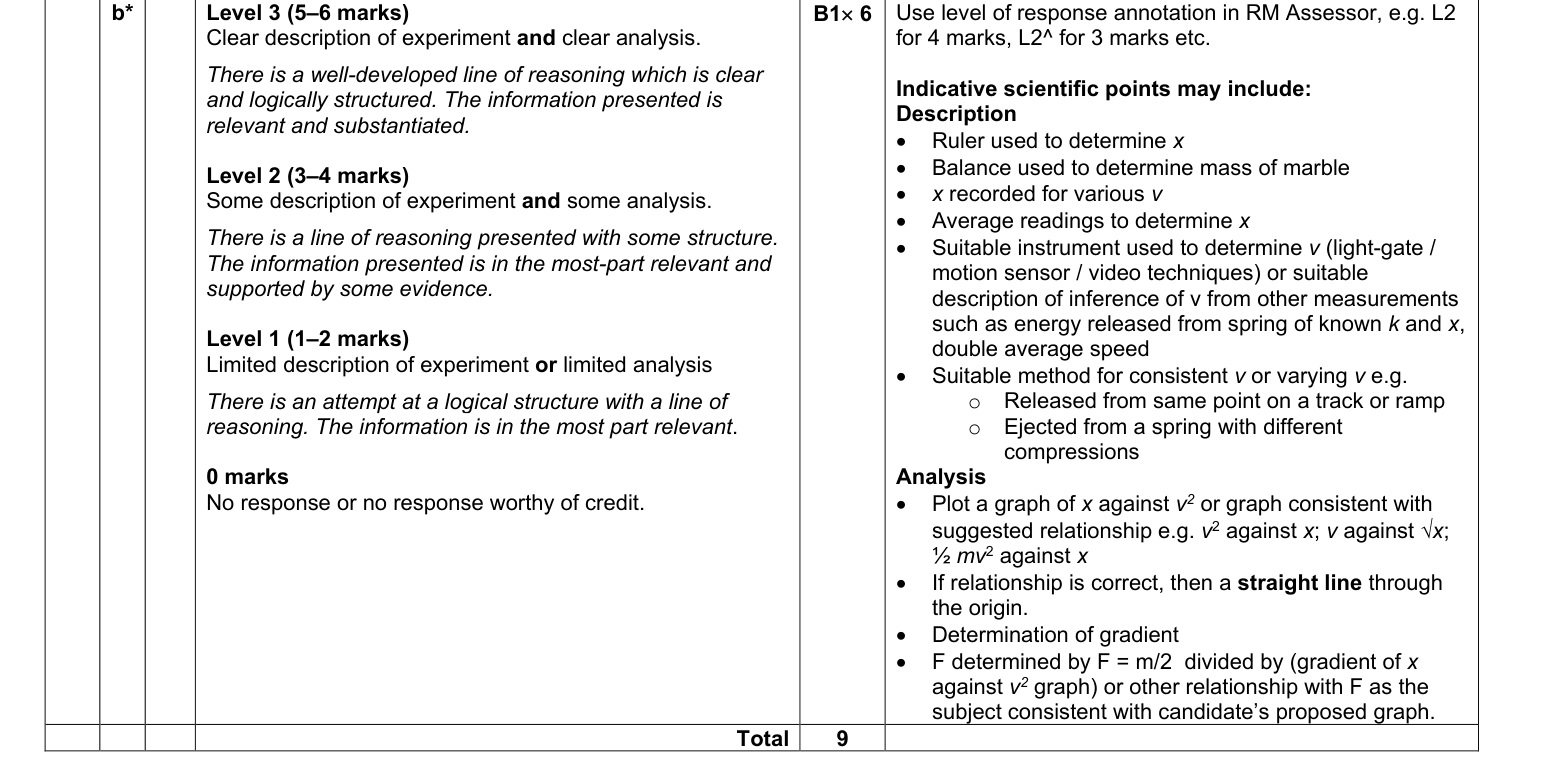
Most candidates made excellent attempts at describing this investigation. The analysis section was particularly well completed compared with previous sessions. Many of these investigations would have been successful had they been given as instructions to year 12 students as shown by Exemplar 6. The higher ability candidates distinguished themselves by being clear about how they were going to measure or calculate the speed of the marble and do that in a predictable way. This is shown best by exemplar 7. This response is a very good attempt. They have employed a light gate to measure the speed, without much explanation of how that device would calculate the speed itself. The analysis is sound, with a clear indication of what they would do with the data and how the relationship in the question matched up to a straight line of best fit. The candidate has made sure that they have explained how to calculate F from the gradient, rather than leaving it to the reader to work it out for themselves. This response scored Level 2. This response is similar in many ways to the previous exemplar. The difference is that the candidate has explained carefully how they will achieve different speeds and equally, how 2 light gates connected to a datalogger will measure the time of transit between the gates. The calculation of the speed v is easy to spot as the distance between the light gates divided by the time between them. Furthermore, there is reference to repeat readings for given v and an average distance for x. The analysis to find F is not quite as explicit as that in the previous exemplar, yet it is easily sufficient for a Level 3 response.
Notes from the mark scheme and report
plot x against v squared (straight line through origin)
F = m / (2 x gradient)
method for measuring v needed
Skills: M3.3 Understand that y = mx + c represents a linear relationship; M3.4 Determine the slope and intercept of a linear graph; PAG1 Investigating motion
June 2019 · AS Paper 1 · Q22(b)2 marksShow thatMedium
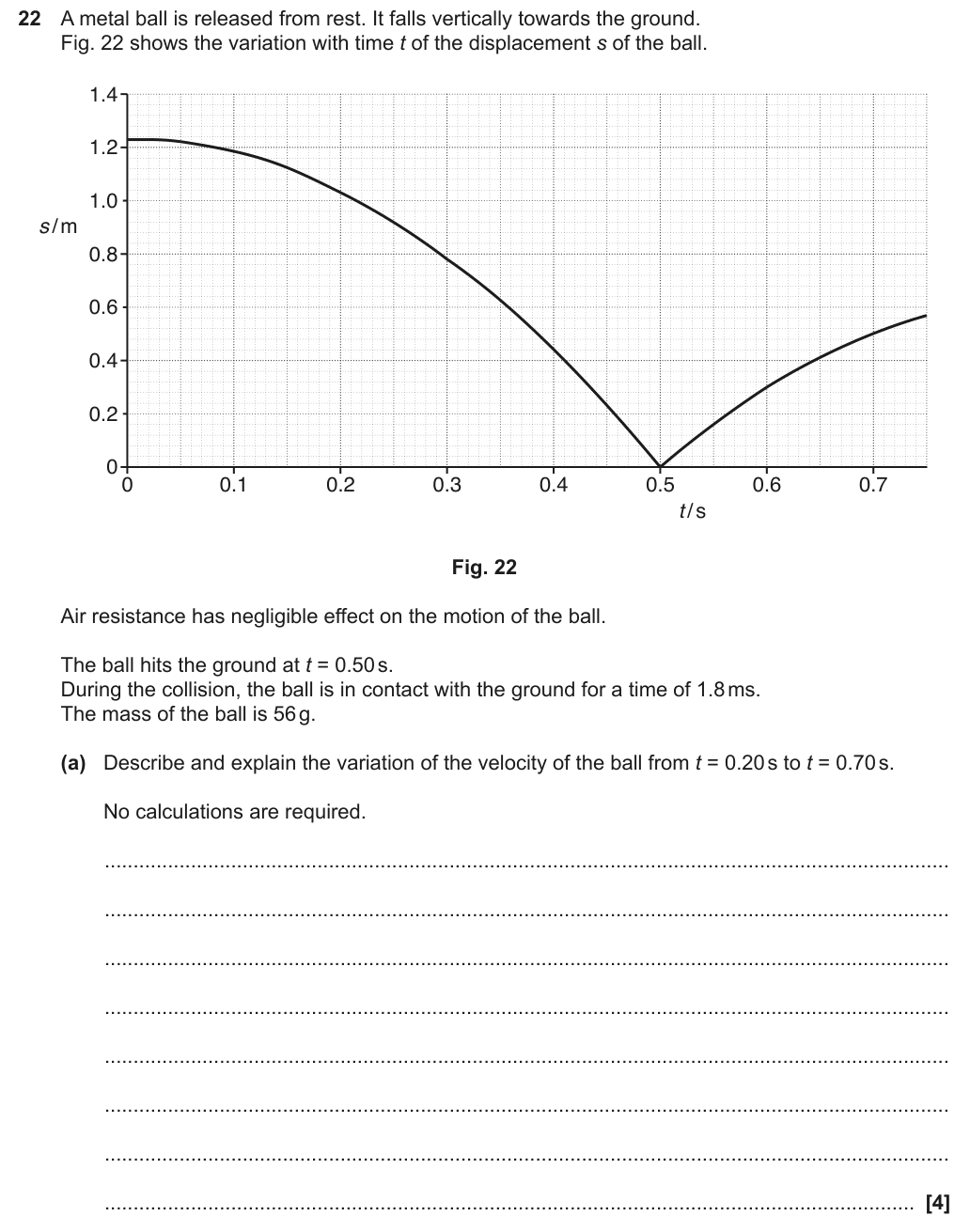
Earlier part of question 22 that this part uses
Mark scheme
Examiner's comment
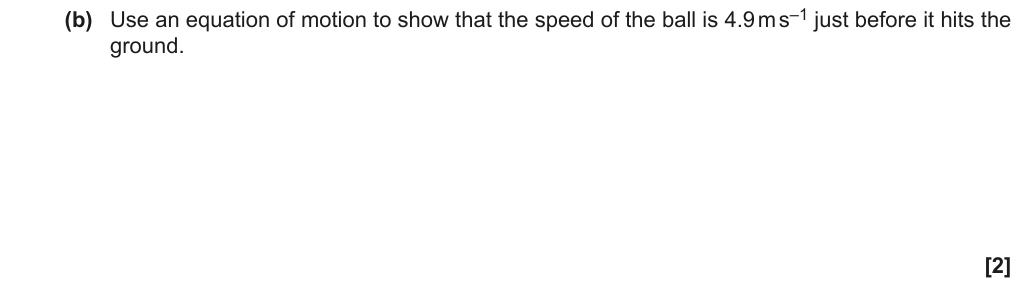
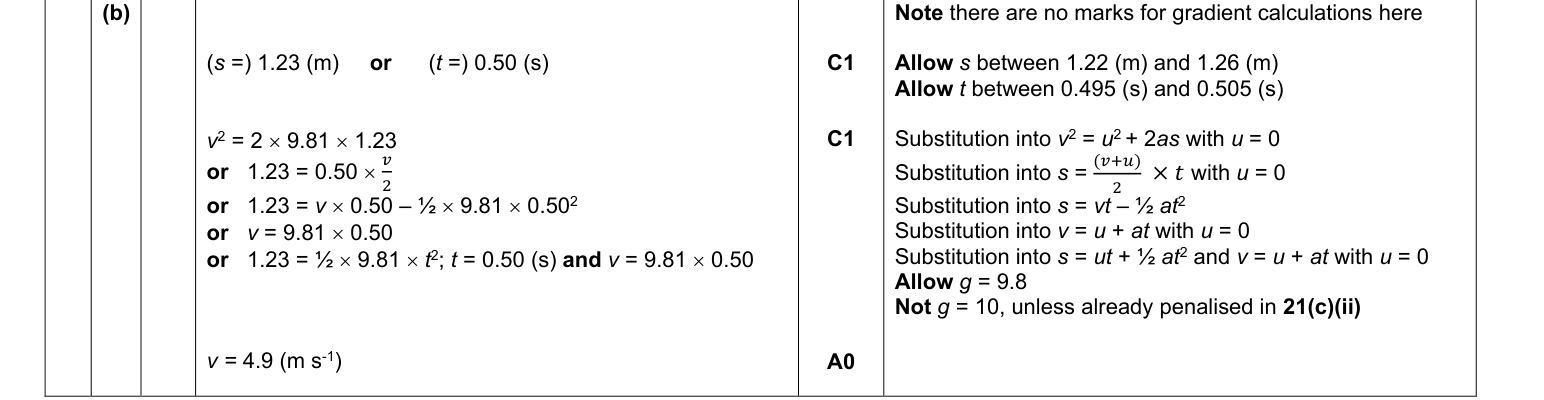
This question was generally well-answered with candidates using a range of equations of motion to show the speed to be 4.9 m s-1. The most popular route was: v = 0 + (9.81 × 0.50) = 4.905 m s-1.
Notes from the mark scheme and report
no marks for gradient calculations
NOT g = 10
Skills: M2.3 Substitute numerical values into algebraic equations using appropriate units for physical quantities; M3.1 Translate information between graphical, numerical and algebraic forms
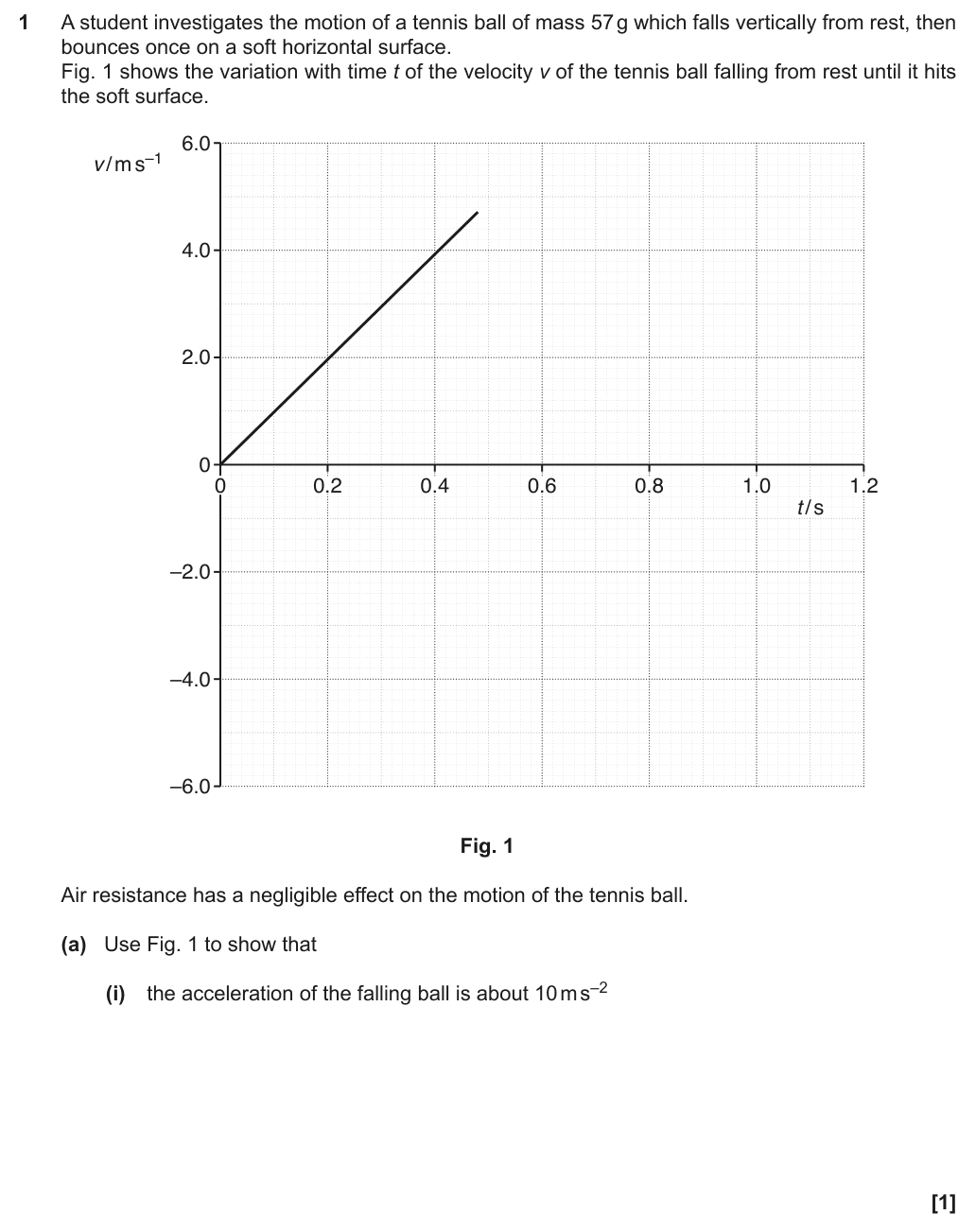
June 2019 · AS Paper 2 · Q1(a)(i)1 markShow thatMedium
Mark scheme
Examiner's comment
This question was a “show” type question. Candidates needed to show their working logically. Ideally candidates would state that that the acceleration was equal to the gradient, and then show the substitution of the data values for the gradient calculation. It was expected that candidates would have gained an answer of 9.79 m s–2. This candidate has clearly demonstrated from Δy / Δx that the gradient is to be determined. Co-ordinates are substituted into the gradient expression and it is clear that the candidate has used more than half the hypotenuse. The candidate then correctly evaluated the expression to give of 9.79 m s–2. and then states that this is about 10 m s–2.
Notes from the mark scheme and report
gradient with Δt of at least 0.20 s
tolerance ±½ small square
9.8 must be shown
Determining a gradient.
Candidates should clearly demonstrate the co-ordinates that are used to calculate the gradient. The co-ordinates must lie on the line. A common error is when a candidate uses a data point from a table of results.
Skills: M3.4 Determine the slope and intercept of a linear graph; M3.5 Calculate rate of change from a graph showing a linear relationship
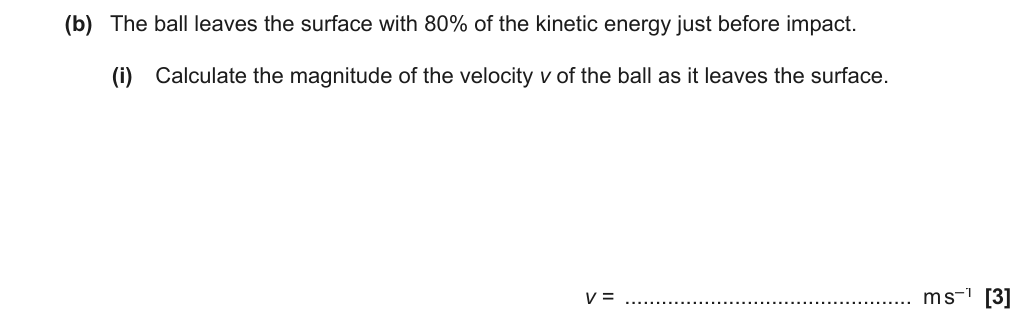
June 2019 · AS Paper 2 · Q1(b)(ii)2 marksDiagram or graphMedium
Earlier parts of question 1 that this part uses
Mark scheme
Examiner's comment
In this question, a large number of candidates did not understand that velocity is a vector quantity and drew a line with a negative gradient back towards the x-axis. The velocity of the ball as it leaves the surface is in the opposite direction and is therefore – 4.2 m s–1. Candidates then needed to draw a parallel line to the initial line (since the acceleration is still the same).
Notes from the mark scheme and report
straight line from (0.48, –4.2) to the time axis at 0.91 ± 0.03 s
velocity must be negative
ecf from (b)(i)
Skills: M3.1 Translate information between graphical, numerical and algebraic forms; M3.2 Plot two variables from experimental or other data
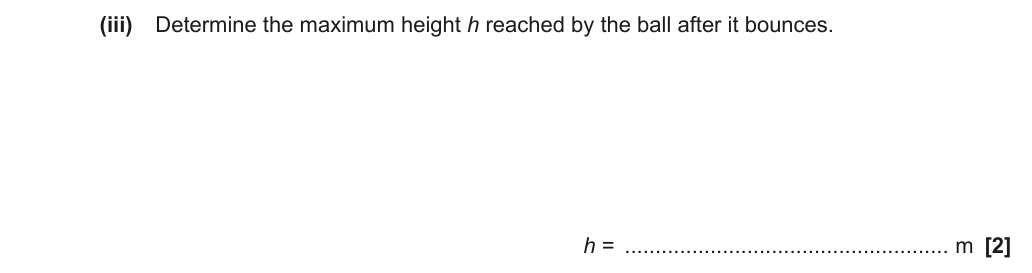
June 2019 · AS Paper 2 · Q1(b)(iii)2 marksCalculationMedium
Earlier parts of question 1 that this part uses
Mark scheme
Examiner's comment
There were many methods in which candidates could gain the marks in this question. It was helpful for clear methods to be demonstrated. The simplest was to determine the area under the velocity-time graph. Candidates also used the equations of uniform motion. Common errors seen included the incorrect velocity and when using the equations of motion but being confused about negative signs. Examiners on this occasion allowed an answer of 0.9 m which is one significant figure. Since the data used is to two significant figures, the final answer should also be to two significant figures.
Notes from the mark scheme and report
allow suvat or loss of KE = gain in PE
allow 1 sf
ecf from (b)(i) and (b)(ii)
Vector quantities have both a magnitude and a direction.
The area under a velocity-time graph is displacement.
Skills: M2.3 Substitute numerical values into algebraic equations using appropriate units for physical quantities; M3.8 Understand the possible physical significance of the area between a curve and the x axis and be able to calculate it or estimate it by graphical methods as appropriate
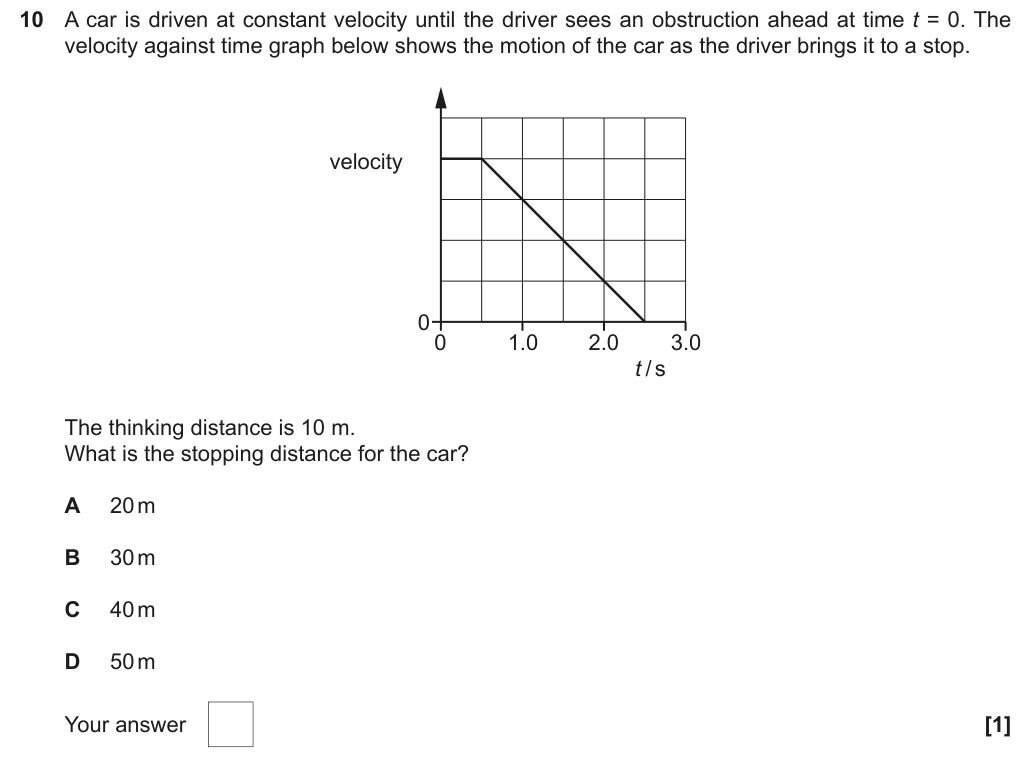
June 2018 · AS Paper 1 · Q101 markMultiple choiceMedium
Answer
B
Mark scheme
Examiner's comment
This question required understanding of thinking, braking and stopping distances together with an appreciation of the learning outcome 3.1.1(d). The total area under this velocity-time graph is equal to stopping distance. The area of the ‘rectangle’ is equal to thinking distance and the area of the ‘triangle’ is equal to the braking distance. The correct answer is B. The popular distractor was A, which just represented the braking distance. This exemplar illustrates how minimal work in a multiple-choice answer can produce dividends. The candidate has used the thinking distance and the ‘reaction time’ of 0.5 s to determine the initial speed of the car (20 m s-1). This has then been used to calculate the braking distance. No interim values of distances are shown, but the candidate has done all the hard work by the substitution shown and labelling the vertical axis. A model answer from this high performing candidate.
June 2018 · Paper 1 · Q16(a)(ii)2 marksShow thatEasy
Earlier part of question 16 that this part uses
Mark scheme
Examiner's comment
Question 16 (a) (i) Examiners’ report Question 16 (a) (ii) Question 16 (a) (iii) Question 16 (a) (iv) Part (i) was particularly well answered by 95% of all candidates.
Notes from the mark scheme and report
no ecf from (a)(i) for the second mark
Skills: M2.2 Change the subject of an equation, including non-linear equations; M2.3 Substitute numerical values into algebraic equations using appropriate units for physical quantities
June 2018 · Paper 1 · Q16(b)6 marks6-mark extended responseMedium
Mark scheme, with the levels and indicative content
Examiner's comment
Many candidates had plenty to say that was sensible. There was plenty of evidence that candidates had seen this experiment or had performed a similar one themselves. A few confused the question, instead describing how to find the time of flight or that the ball was falling vertically. Others described what they thought would happen to the vertical component of velocity when they changed the vertical distance that the ball dropped. In the first paragraph, the candidate has made clear that the time of flight is constant and goes on to explain why towards the end of the response. This supports the prediction that 𝑣𝑣∝𝑥𝑥. In addition, the candidate takes time to explain how to obtain data for both the horizontal velocity and horizontal distance. It was pleasing to see light gates and motion sensors being employed, with the best answers explaining how to use the data provided by the sensors to calculate the velocity of projection. The exemplar response also includes the correct analysis. There is a graph of v against x and the resulting best fit straight line through the origin supports the idea that these two variables are directly proportional. Too many candidates did not mention the crucial statement about the line going through the origin, limiting their response to a high L1 or low L2.
Notes from the mark scheme and report
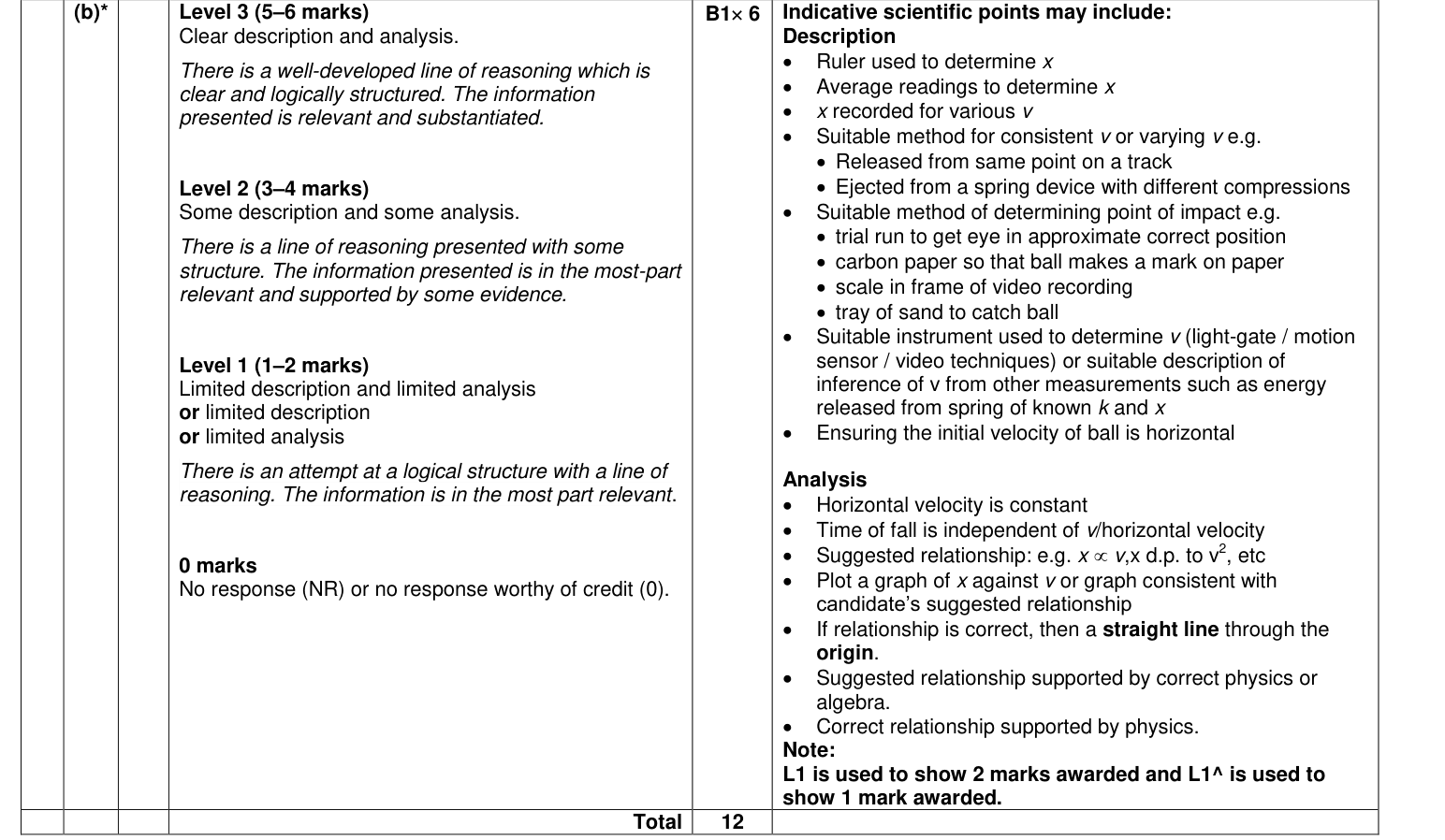
x directly proportional to v because time of fall is independent of v
graph of x against v a straight line through the origin
Skills: M3.2 Plot two variables from experimental or other data; M3.3 Understand that y = mx + c represents a linear relationship; PAG1 Investigating motion
June 2018 · Paper 1 · Q20(b)(iii)4 marksCalculationMedium
Earlier part of question 20 that this part uses
Mark scheme
Examiner's comment
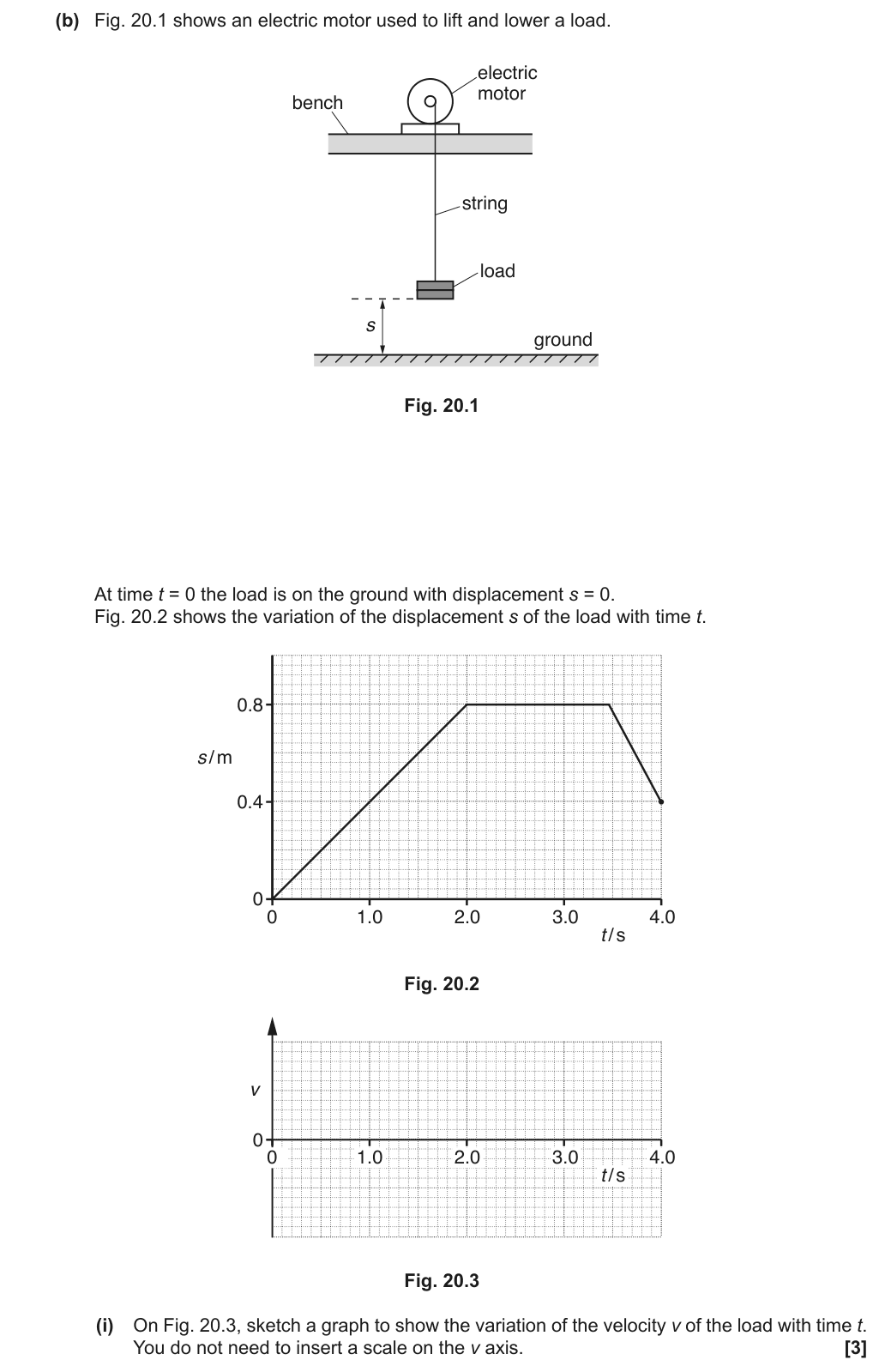
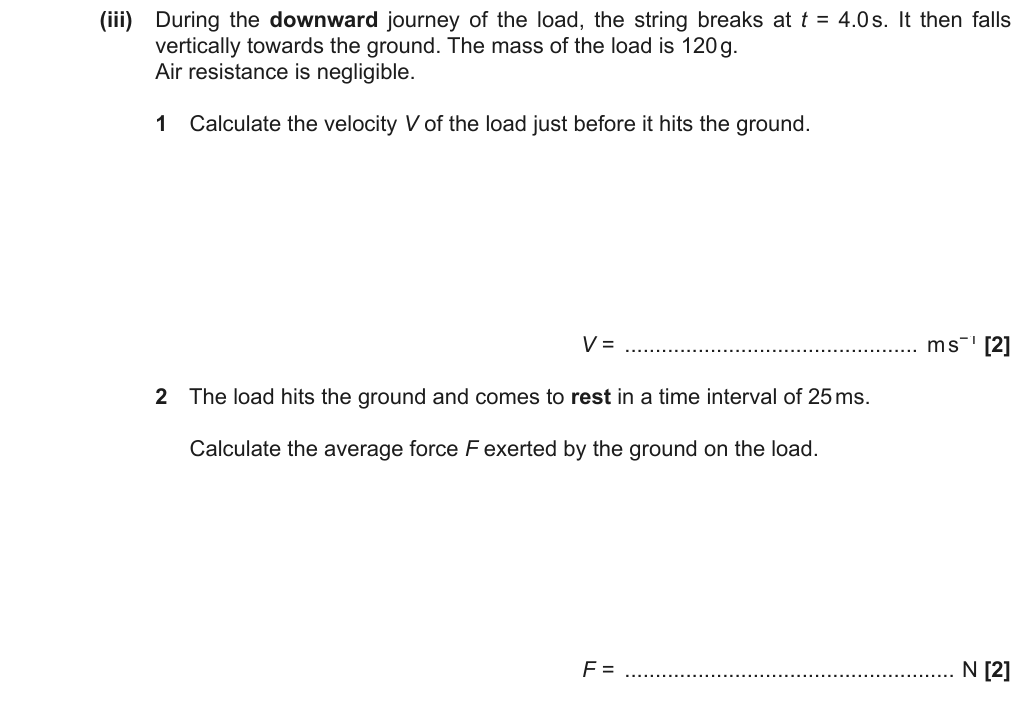
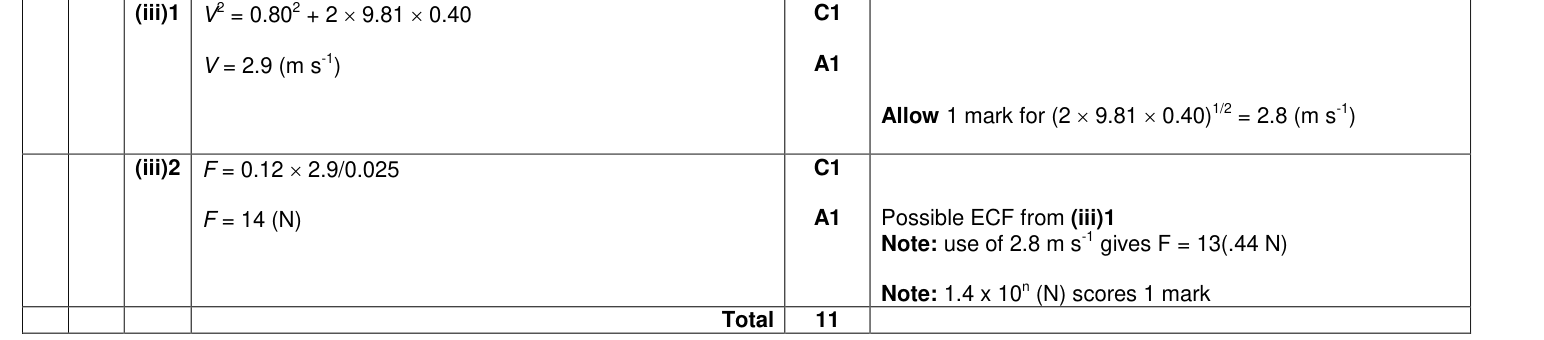
Many candidates selected the correct equation, although did not realise that the load was not at rest when it was released. The initial velocity was found from the graph on page 22 of the paper and was 0.80 ms-1. Nearly three quarters of the candidates used the correct method for finding the average force acting on the load by considering the rate of change of momentum.
Notes from the mark scheme and report
initial velocity 0.80 m s-1 from the gradient
2.8 m s-1 (falling from rest) scores 1 mark
ecf into part 2
power-of-ten error 1 mark
Skills: M0.1 Recognise and make use of appropriate units in calculations; M2.3 Substitute numerical values into algebraic equations using appropriate units for physical quantities; M3.4 Determine the slope and intercept of a linear graph
June 2018 · AS Paper 1 · Q21(a)2 marksExplanationHard
Mark scheme
Examiner's comment
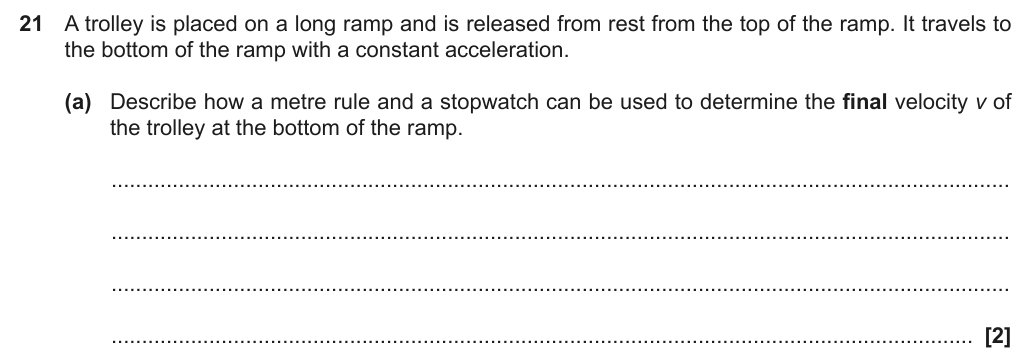
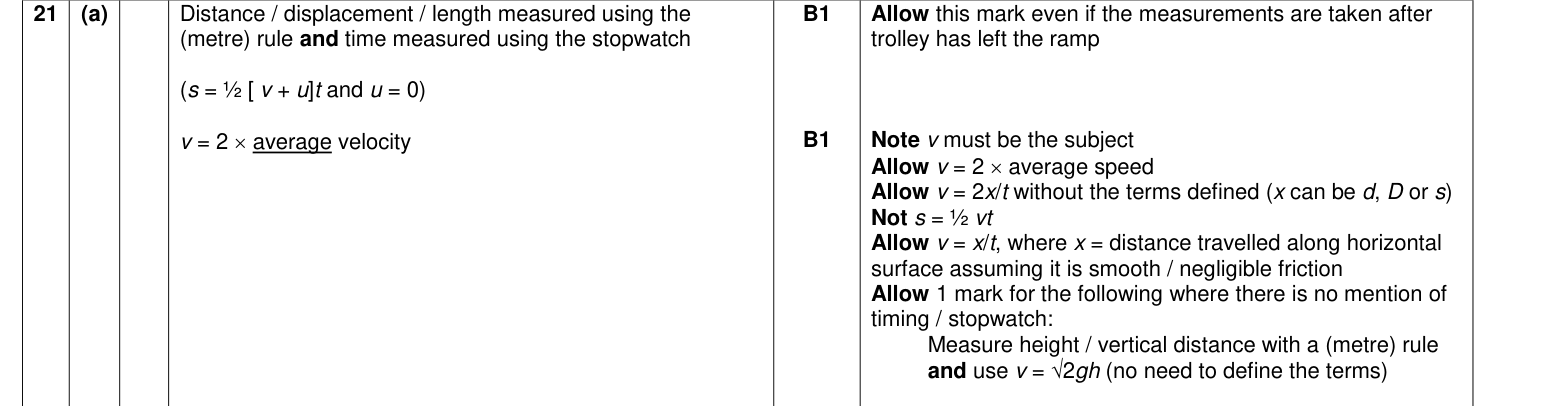
Most candidates struggled to gain full marks in this opening question. The first mark, for using a ruler to measure the length of the ramp and the stopwatch for the time taken to travel the length of the ramp, was gained by just over half of the candidates. The second mark required a clear statement that the final velocity was twice the mean velocity of the trolley. Equivalent statements were allowed. Unfortunately, many candidates opted to describe light-gates arrangements or using inappropriate equations of motion.
Notes from the mark scheme and report
v must be the subject (v = 2 x average velocity)
Not s = ½vt
1 mark max for height and v² = 2gh with no timing
Skills: M2.2 Change the subject of an equation, including non-linear equations; PAG1 Investigating motion
June 2018 · AS Paper 1 · Q21(b)(i)2 marksCalculationMedium
Mark scheme
Examiner's comment
Most candidates demonstrated excellent understanding and application of equations of motion. The solutions were often well represented, calculations done correctly and the answer written to the correct number of significant figures (SF). A variety of routes were possible, but the most popular method was using the equation v2 = u2 + 2as. This exemplar from a grade E candidate shows flawless technique. The known and unknown quantities are written on the left-hand side. The equation is clear, as is the substitution and the final answer for the acceleration.
Notes from the mark scheme and report
allow t = 0.58 s for the C1 mark
Skills: M2.2 Change the subject of an equation, including non-linear equations; M2.3 Substitute numerical values into algebraic equations using appropriate units for physical quantities
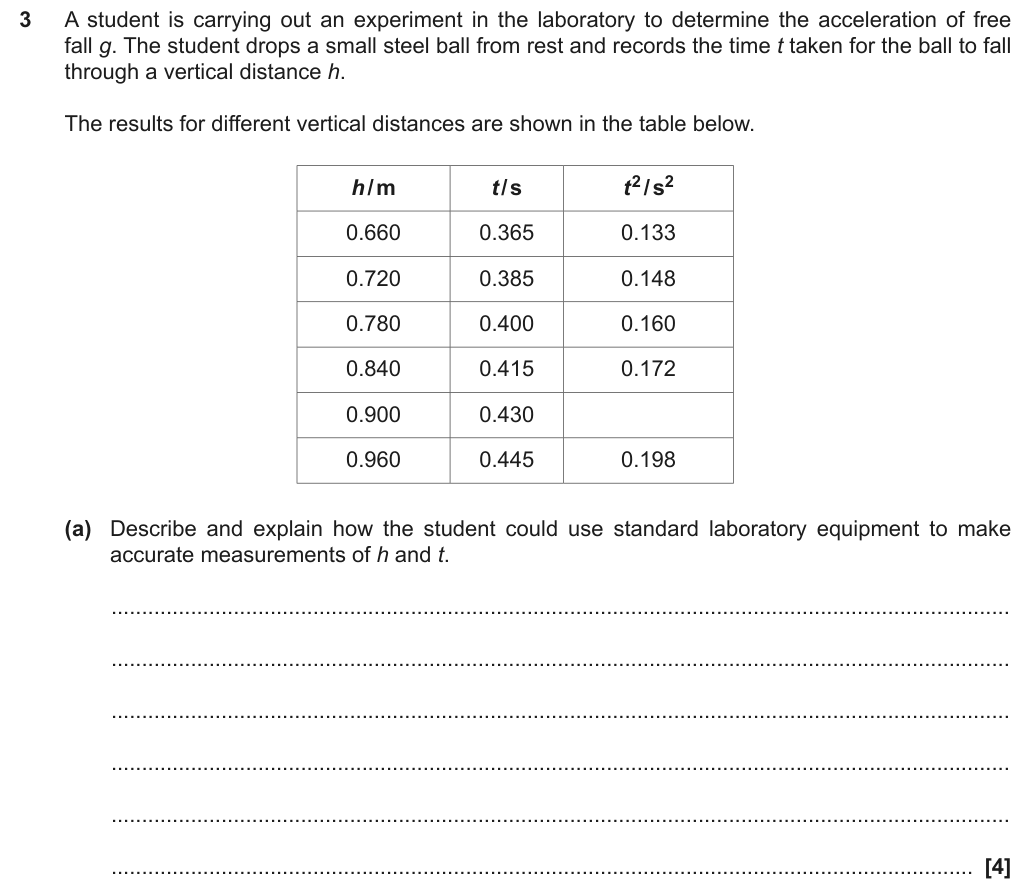
June 2018 · AS Paper 2 · Q3(a)4 marksExplanationEasy
Mark scheme
Examiner's comment
This question assessed candidates’ knowledge and understanding of the techniques and procedures used to determine the acceleration of freefall. Most candidates were able to explain how the vertical distance could be measured using a metre rule. To measure the time, to the nearest 0.001 s, it was expected that candidates would describe either a method using an electromagnet and trap door or the use of light gates with a timer. Many candidates did not realise that the times were recorded to the nearest 0.001 s. Many candidates were vague in their responses, e.g. “use light gates” without an explanation. It was expected that candidates would state that the light gates would be connected to a timer or datalogger or computer and that the timer would start when the ball interrupts the first light beam and stops when the second light beam is crossed. Candidates should experience and be able to describe the techniques to determine velocity and acceleration using light gates
Notes from the mark scheme and report
NOT stopwatch
light gates with no reference to timer / starting / stopping scores 1
Skills: PAG1 Investigating motion
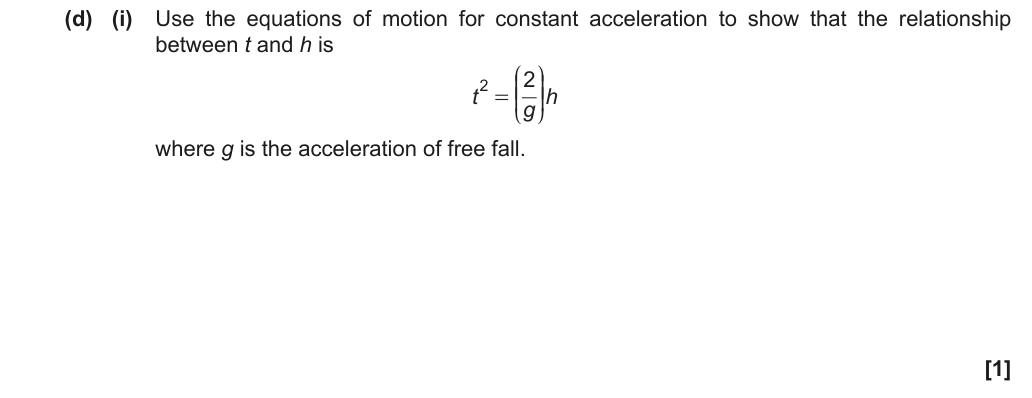
June 2018 · AS Paper 2 · Q3(d)(i)1 markShow thatMedium
Mark scheme
Examiner's comment
For this type of question, candidates should start the answer by quoting the relevant equation of motion. It was then expected that candidates would state that u (or ut) = 0, that a = g and s = h. Some lower ability candidates did not clearly rearrange the equation correctly. This shows a reasoned answer with the relevant terms defined and clear working to demonstrate the rearrangement.
Notes from the mark scheme and report
needs s = ut + ½at² with u = 0
Skills: M2.2 Change the subject of an equation, including non-linear equations
June 2018 · AS Paper 2 · Q3(d)(ii)1 markCalculationMedium
Earlier parts of question 3 that this part uses
Mark scheme
Examiner's comment
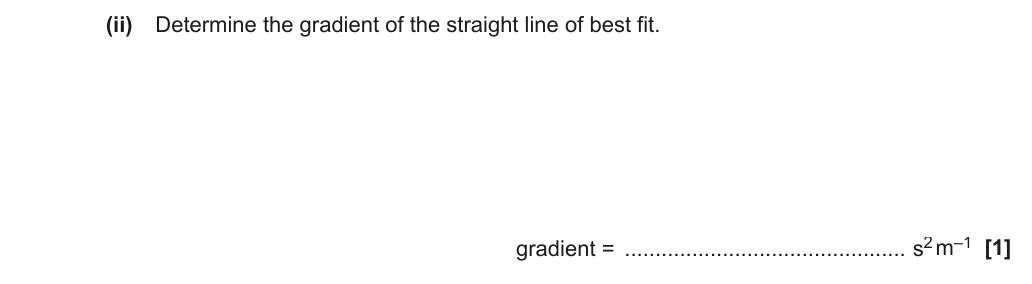
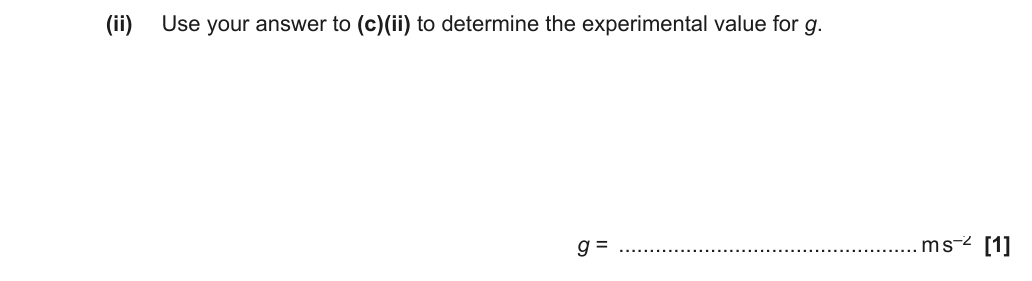
Candidates were required to identify from the equation given at the beginning of 3 (d) (i) that the gradient was equal to 2/g. Candidates then needed to use the gradient value they calculated in 2 (c) (ii) to determine g. Some candidates incorrectly substituted data points from the table of results. To improve this skill candidates should practise comparing the x and y values from graphs with the equation of a straight line and then identifying the gradient and y-intercept values.
Notes from the mark scheme and report
g = 2 / gradient, given to 2 or 3 sf
ecf from (c)(ii)
Skills: M2.2 Change the subject of an equation, including non-linear equations; M3.3 Understand that y = mx + c represents a linear relationship; M3.4 Determine the slope and intercept of a linear graph; PAG1 Investigating motion
June 2018 · Paper 3 · Q4(c)(ii)4 marksDiagram or graphMedium
Earlier parts of question 4 that this part uses
Mark scheme
Examiner's comment
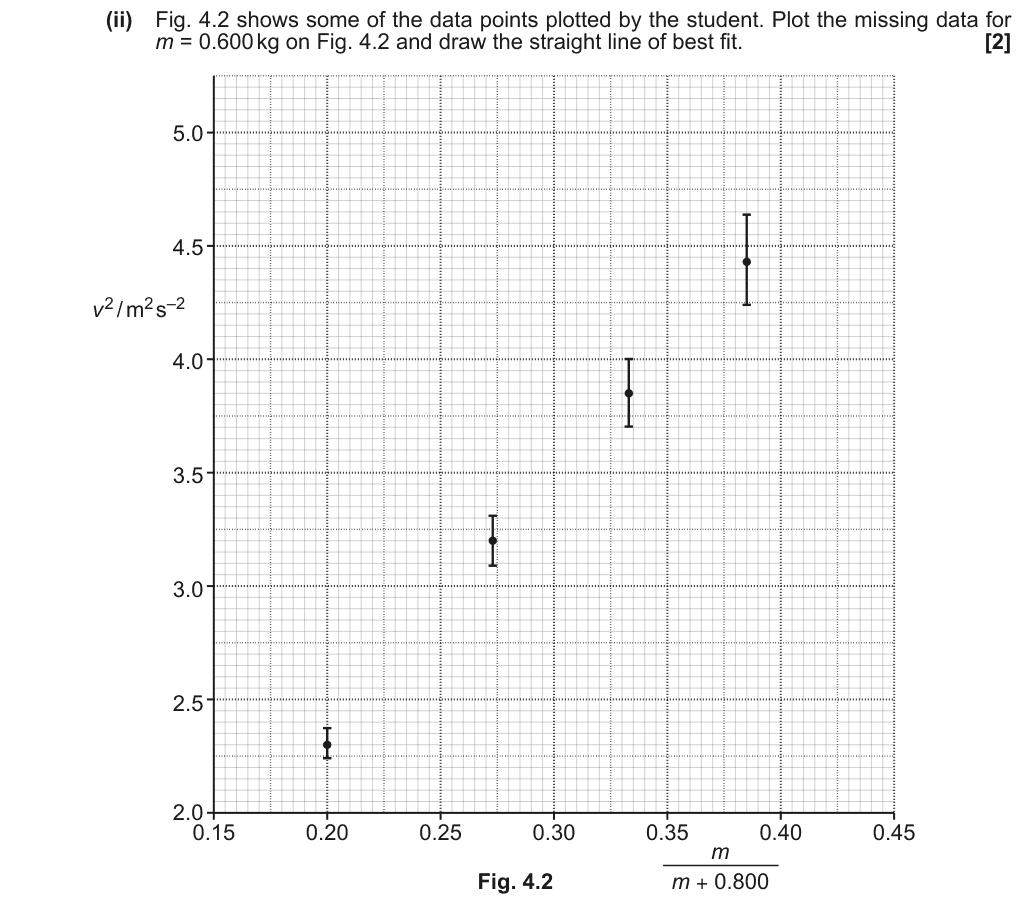
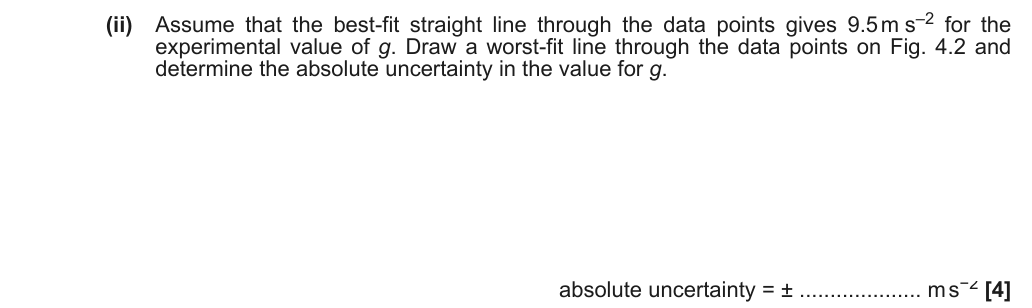
To avoid the problem of various lengths of error bar, candidates were judged to have drawn an acceptable worst fit line if it passed through opposite ends of the top and bottom bars on their graphs. Almost all gained the mark for using a triangle to determine the gradient of the line which spanned more than 0.13 on the x – scale. Most candidates were able to gain credit for finding the gradient of their graph correctly. The determination of the absolute uncertainty to one decimal place then proved to be too difficult a challenge for the majority.
Notes from the mark scheme and report
large triangle (Δx > 0.13)
absolute uncertainty to one decimal place, ± 0.8 to 1.1 m s⁻²
Skills: M1.5 Identify uncertainties in measurements and use simple techniques to determine uncertainty when data are combined; M3.4 Determine the slope and intercept of a linear graph; PAG1 Investigating motion
June 2018 · Paper 3 · Q4(d)4 marksExplanationMedium
Earlier parts of question 4 that this part uses
Mark scheme
Examiner's comment
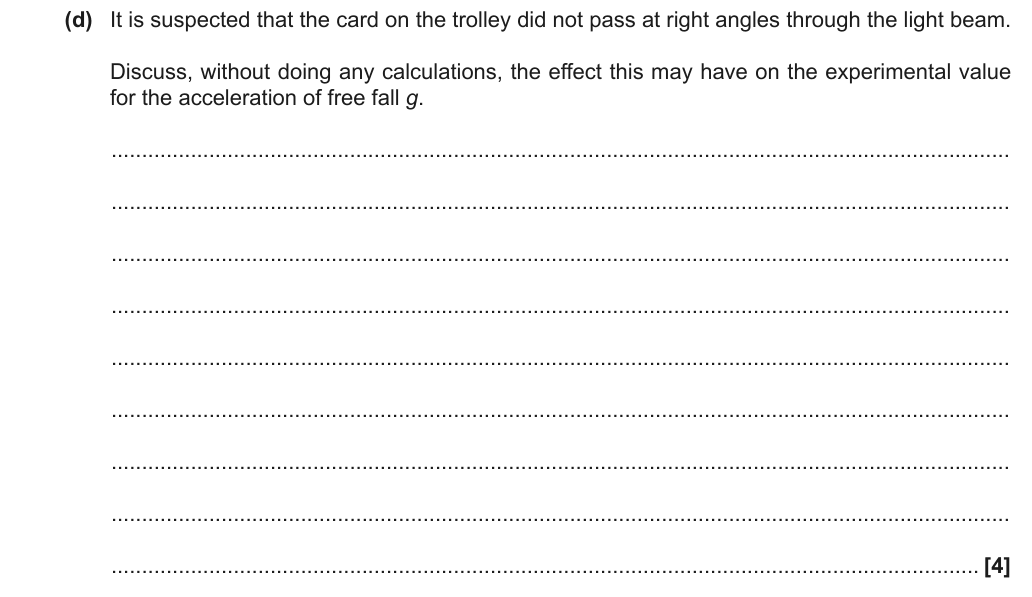
Candidates gave full and usually clear answers to this part. There were four consequential marking points in this answer. Each candidate was given credit for every point that followed logically from the previous one, even when that previous one was incorrect. In the example (exemplar 8) shown here the candidate stated that the card appeared longer, which is incorrect. There were still three marks available for stating that the speed would appear lower and deducing that g would appear smaller. By this method most candidates were credited with at least half of the available marks.
Notes from the mark scheme and report
each mark is consequential on the previous statement
max 3 for correct consequences of card appears longer
Skills: PAG1 Investigating motion
June 2017 · Paper 1 · Q31 markMultiple choice
Answer
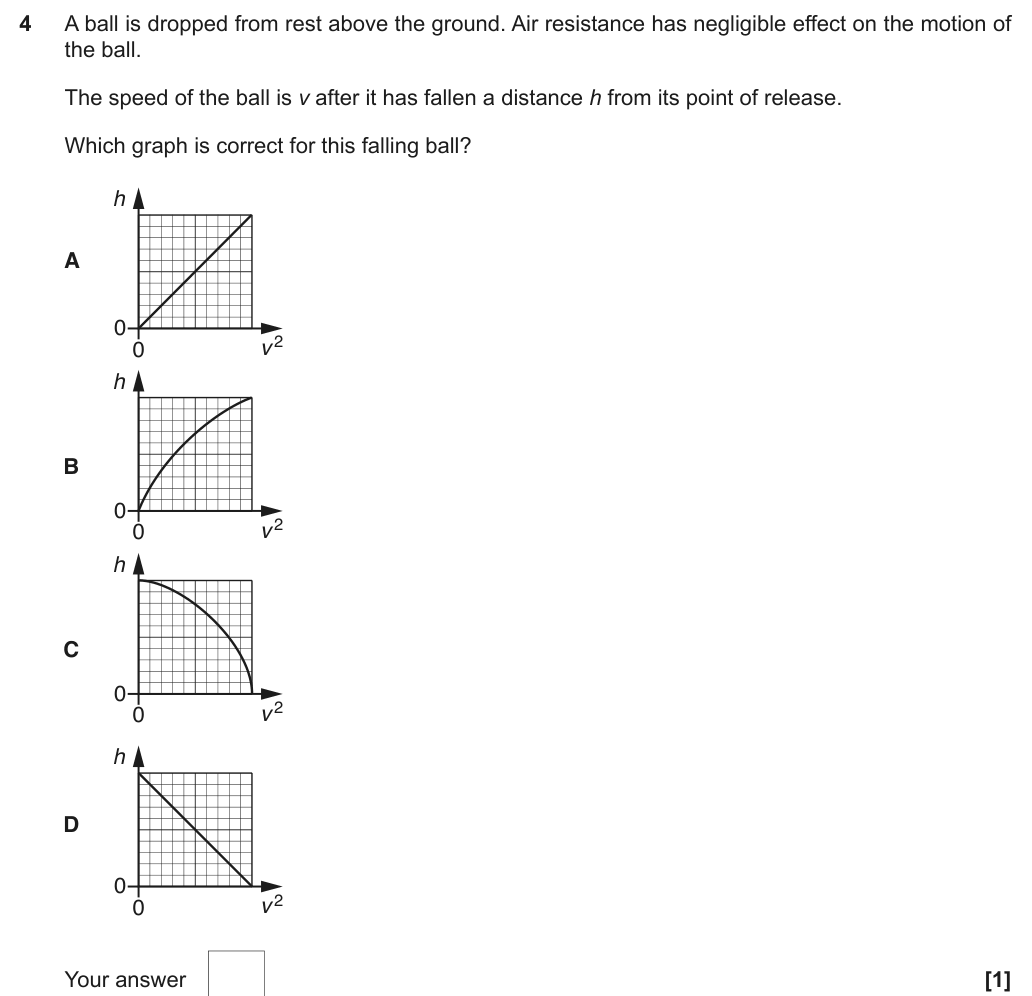
C
Mark scheme
June 2017 · Paper 1 · Q41 markMultiple choice
Answer
A
Mark scheme
June 2017 · Paper 1 · Q121 markMultiple choice
Answer
B
Mark scheme
June 2017 · Paper 1 · Q18(b)2 marksCalculation
Mark scheme
June 2017 · AS Paper 1 · Q21(c)2 marksCalculation
Earlier part of question 21 that this part uses
Mark scheme
Notes from the mark scheme and report
ignore sign
allow 1 sf answer
possible ecf from (b)
Skills: M2.3 Substitute numerical values into algebraic equations using appropriate units for physical quantities; M3.1 Translate information between graphical, numerical and algebraic forms; PAG1 Investigating motion
June 2017 · AS Paper 2 · Q1(a)1 markShort answer
Mark scheme
Notes from the mark scheme and report
allow total distance travelled from when the driver sees the hazard to the vehicle stopping
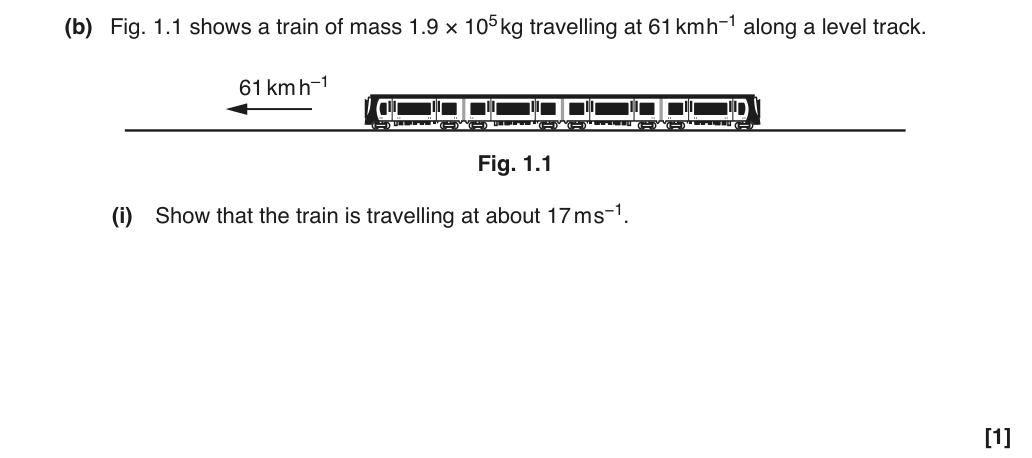
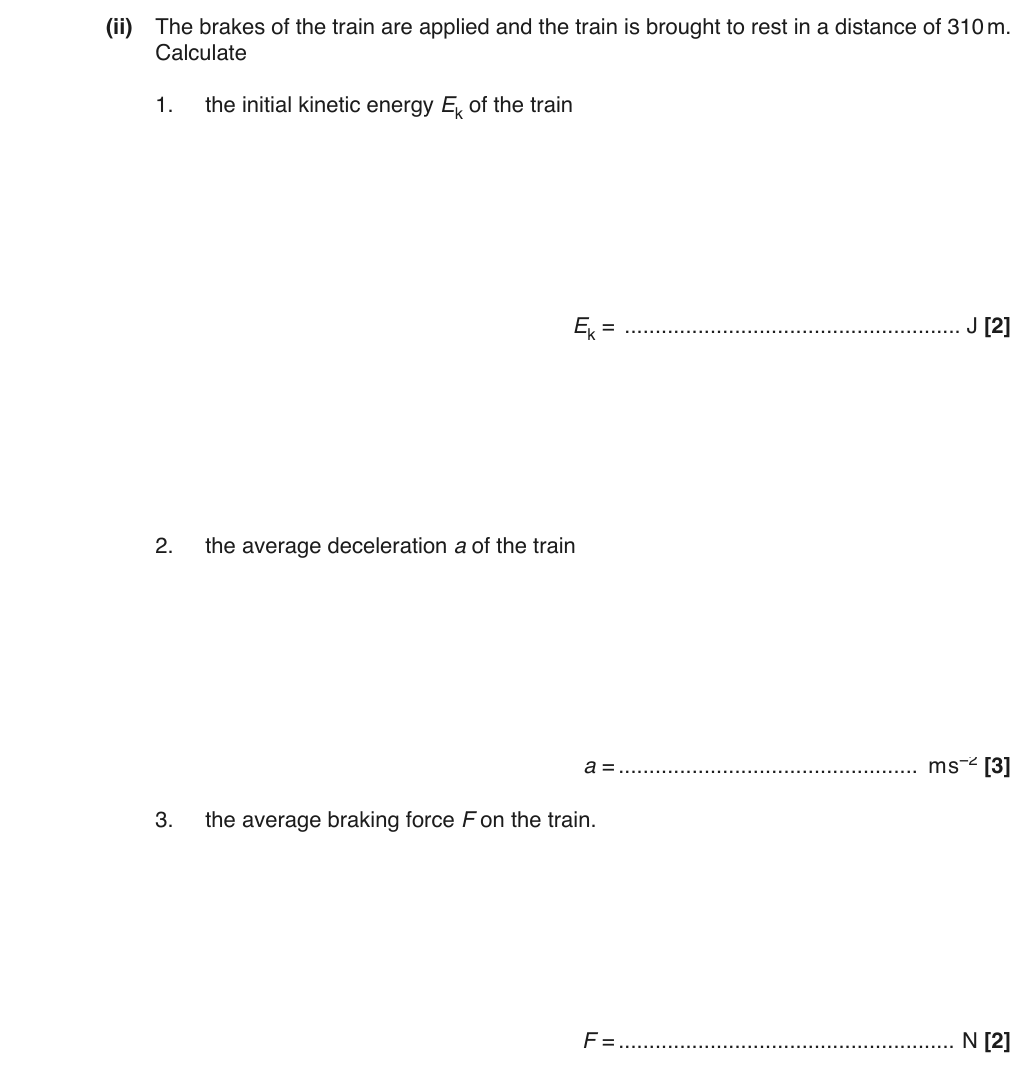
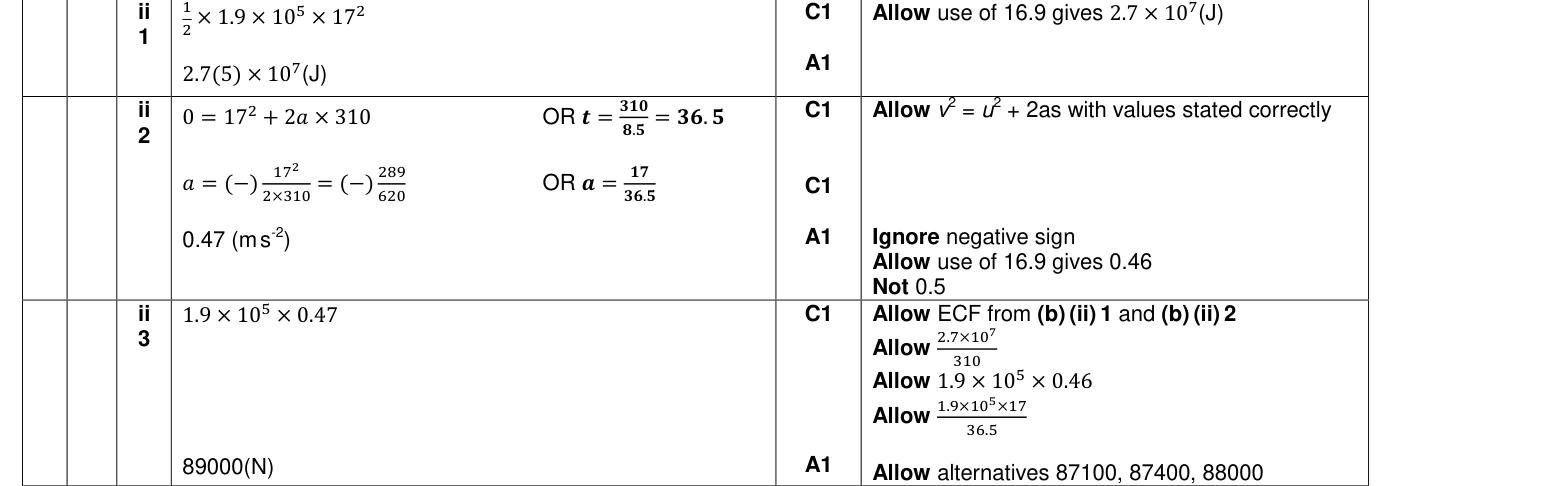
June 2017 · AS Paper 2 · Q1(b)(ii)7 marksCalculation
Earlier part of question 1 that this part uses
Mark scheme
Notes from the mark scheme and report
ignore negative sign on a
NOT 0.5 for a
ecf into part 3
F = Ek / 310 also allowed
Skills: M0.2 Recognise and use expressions in decimal and standard form; M2.2 Change the subject of an equation, including non-linear equations; M2.3 Substitute numerical values into algebraic equations using appropriate units for physical quantities
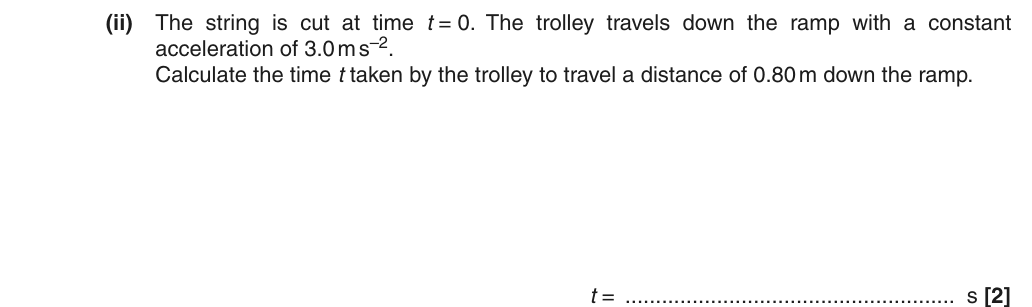
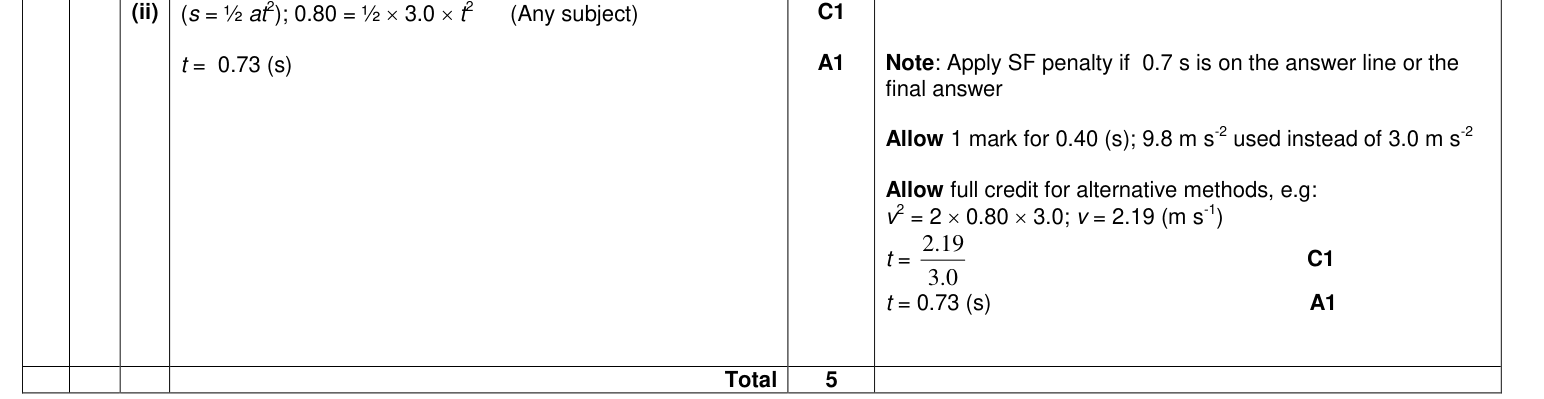
June 2016 · AS Paper 1 · Q21(b)(ii)2 marksCalculation
Mark scheme
Notes from the mark scheme and report
SF penalty if 0.7 s given
0.40 s (9.8 used instead of 3.0) scores 1
Skills: M1.1 Use an appropriate number of significant figures; M2.2 Change the subject of an equation, including non-linear equations; M2.3 Substitute numerical values into algebraic equations using appropriate units for physical quantities
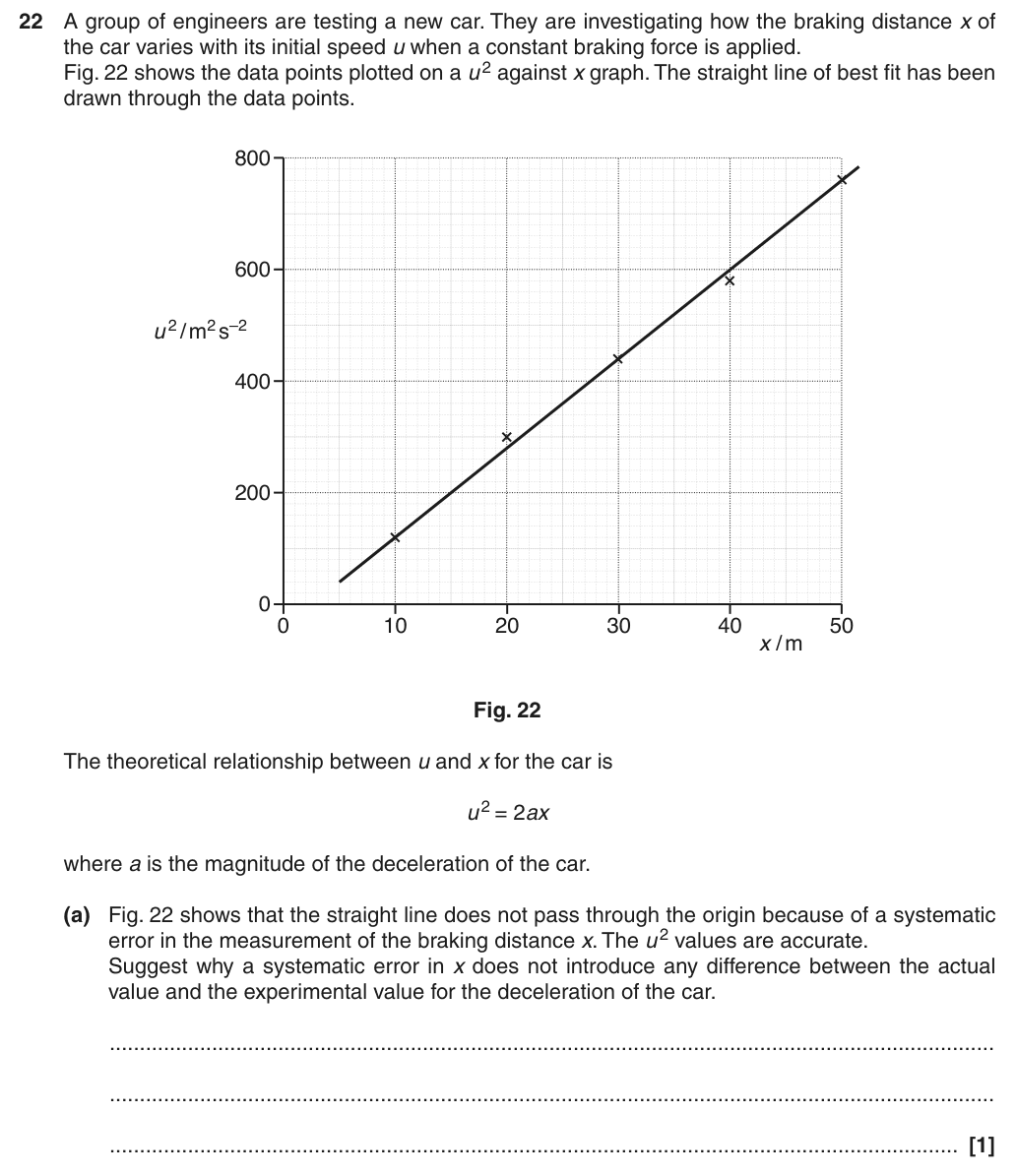
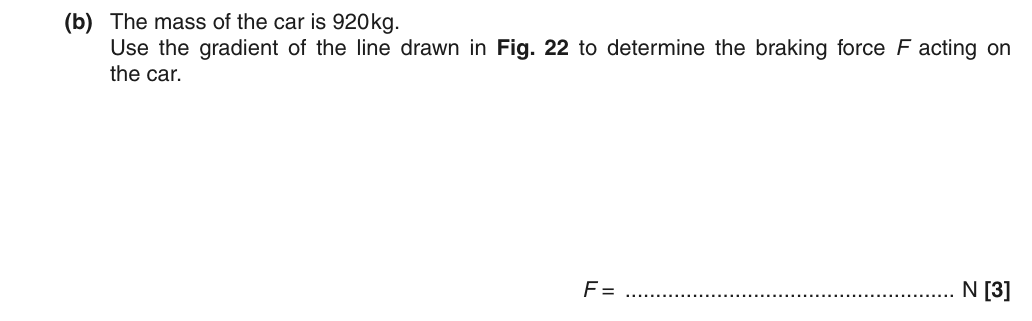
June 2016 · AS Paper 1 · Q22(b)3 marksCalculation
Earlier part of question 22 that this part uses
Mark scheme
Notes from the mark scheme and report
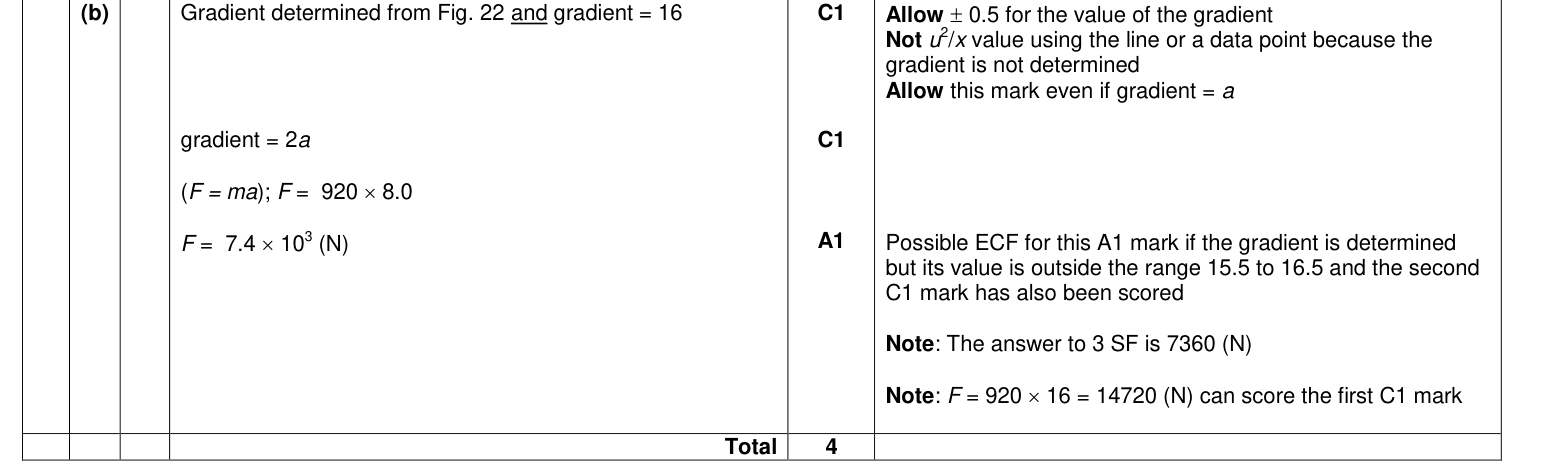
gradient = 2a
u²/x from a single point is NOT a gradient
F = 920 x 16 scores first mark only
Skills: M2.3 Substitute numerical values into algebraic equations using appropriate units for physical quantities; M3.3 Understand that y = mx + c represents a linear relationship; M3.4 Determine the slope and intercept of a linear graph
June 2016 · AS Paper 2 · Q3(a)(i)1 markShow that
Mark scheme
Notes from the mark scheme and report
NOT a = 10 m s-2
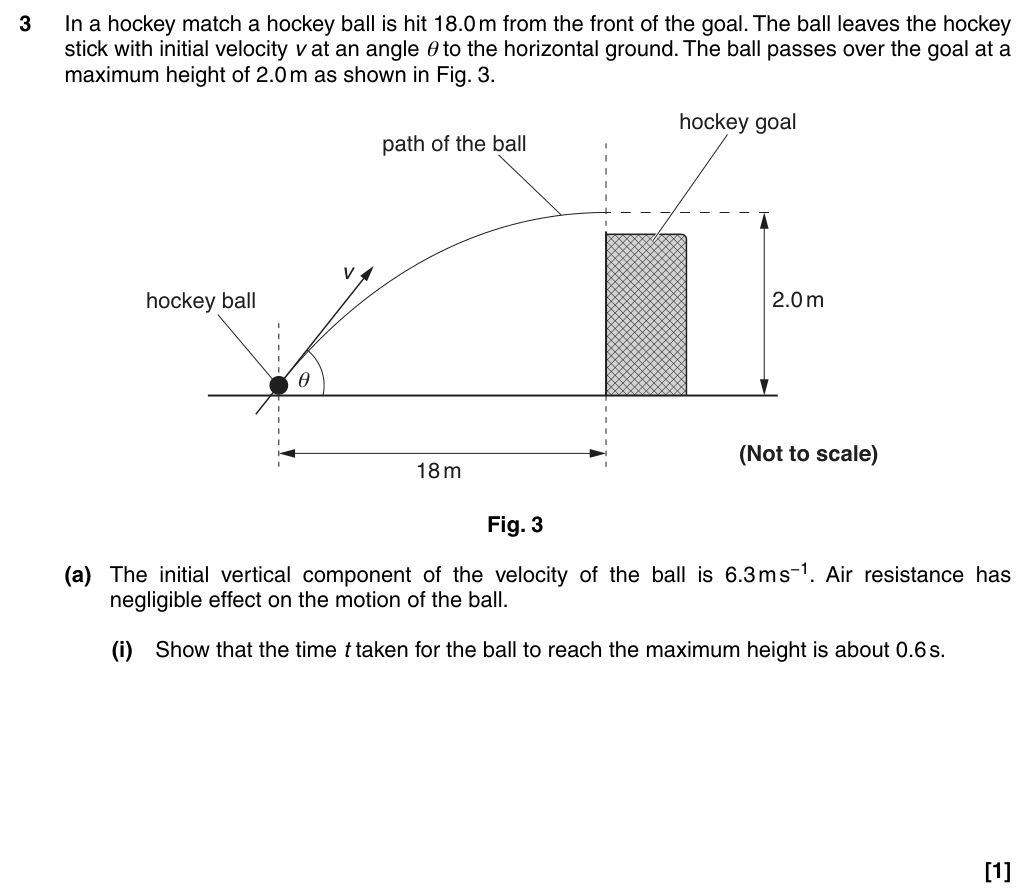
t must be the unknown
Skills: M2.2 Change the subject of an equation, including non-linear equations; M2.3 Substitute numerical values into algebraic equations using appropriate units for physical quantities
Work with an OCR physics tutor
Dropping marks on calculations, practical questions or the six-mark level of response questions? Book a trial session with a specialist OCR physics tutor.