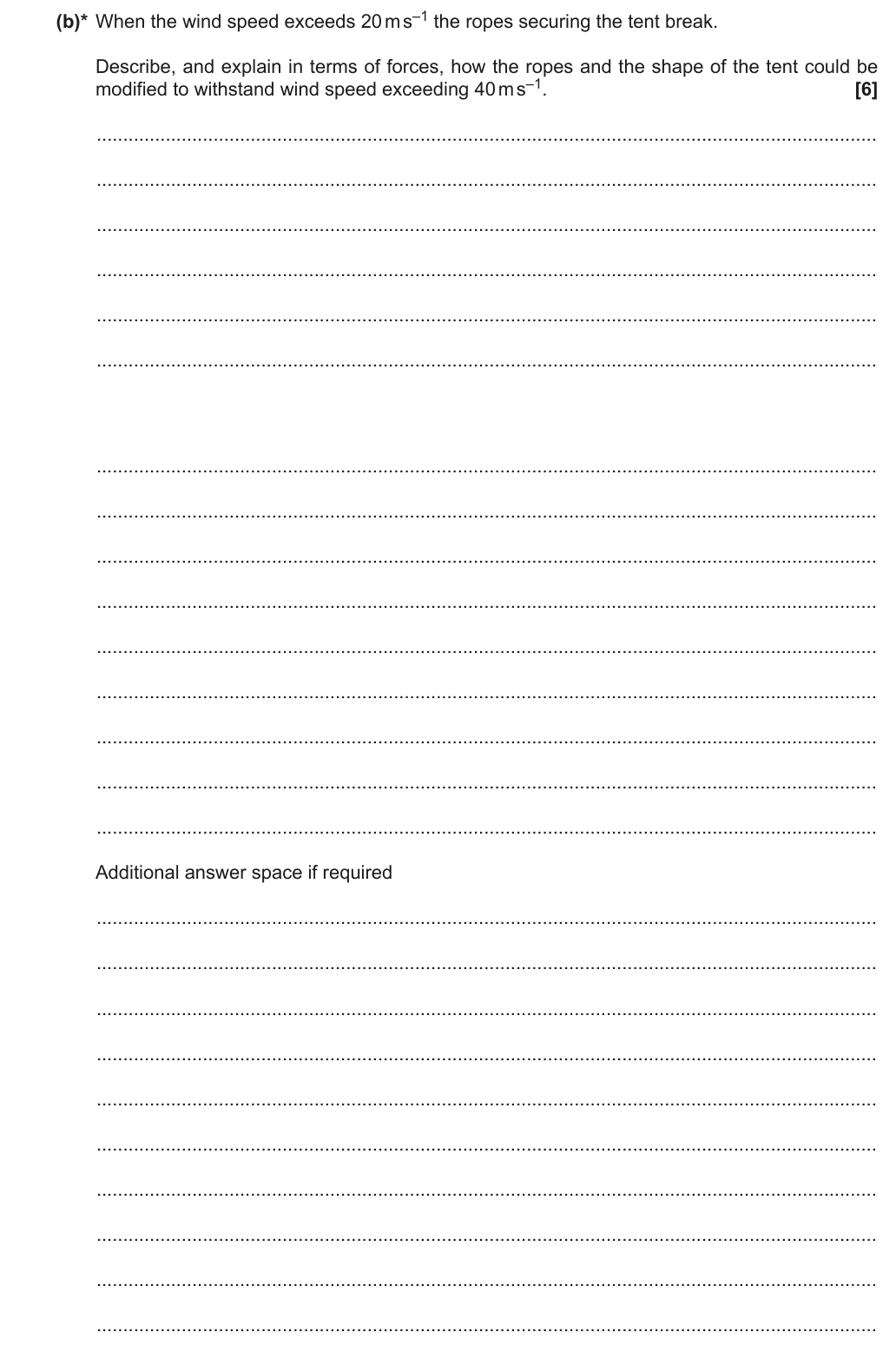
When the wind speed exceeds 20 m s–1 the ropes securing the tent break. Describe, and explain in terms of forces, how the ropes and the shape of the tent could be
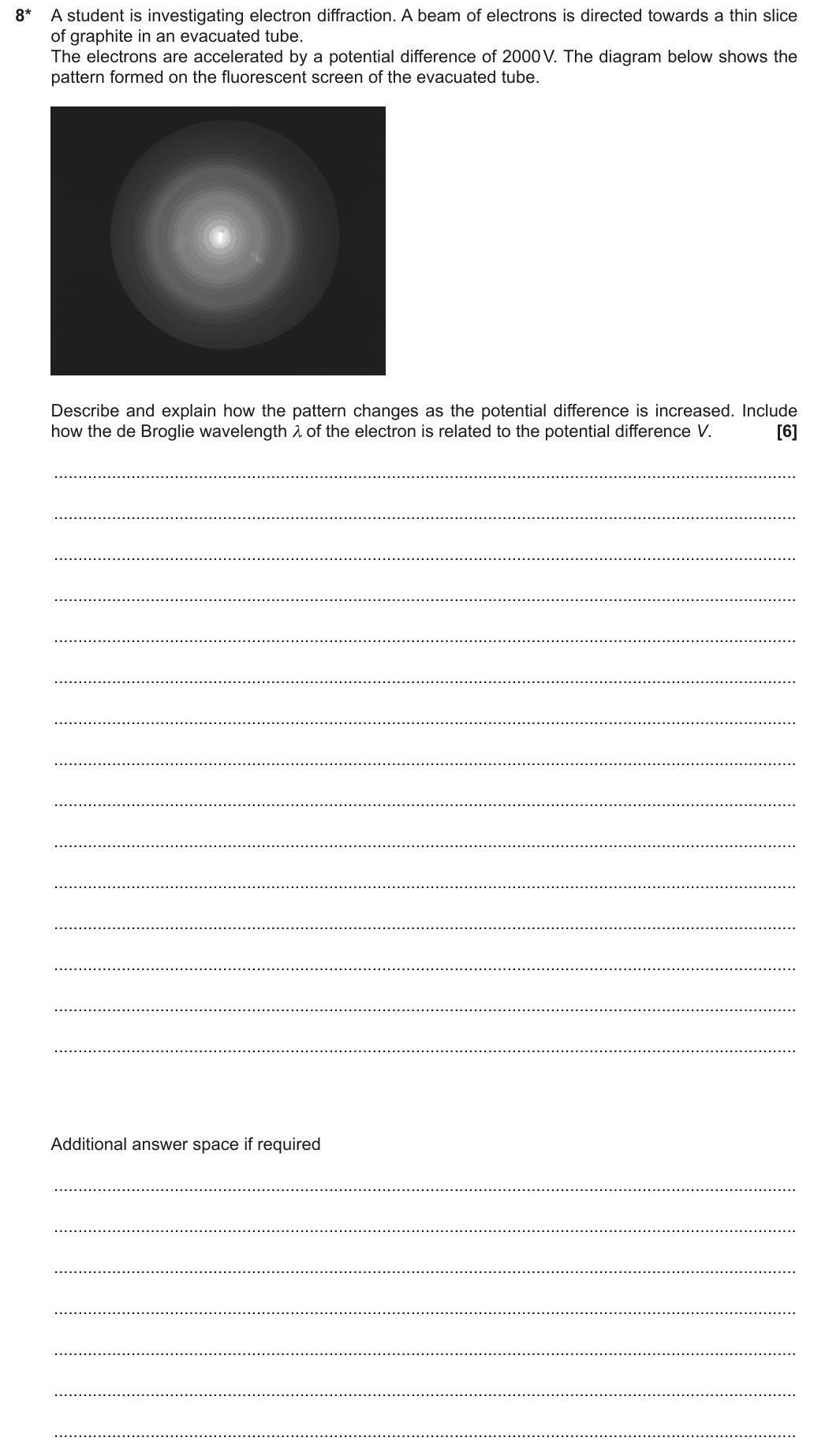
A student is investigating electron diffraction. A beam of electrons is directed towards a thin slice Describe and explain how the pattern changes as the potential difference is increased. Include
Tap a question to zoom it. Where a part needs a figure, table or graph from earlier in the question, that part folds out above it; the mark scheme and examiner's comment open underneath. Have the OCR Data, Formulae and Relationships Booklet beside you (see the data booklet page).
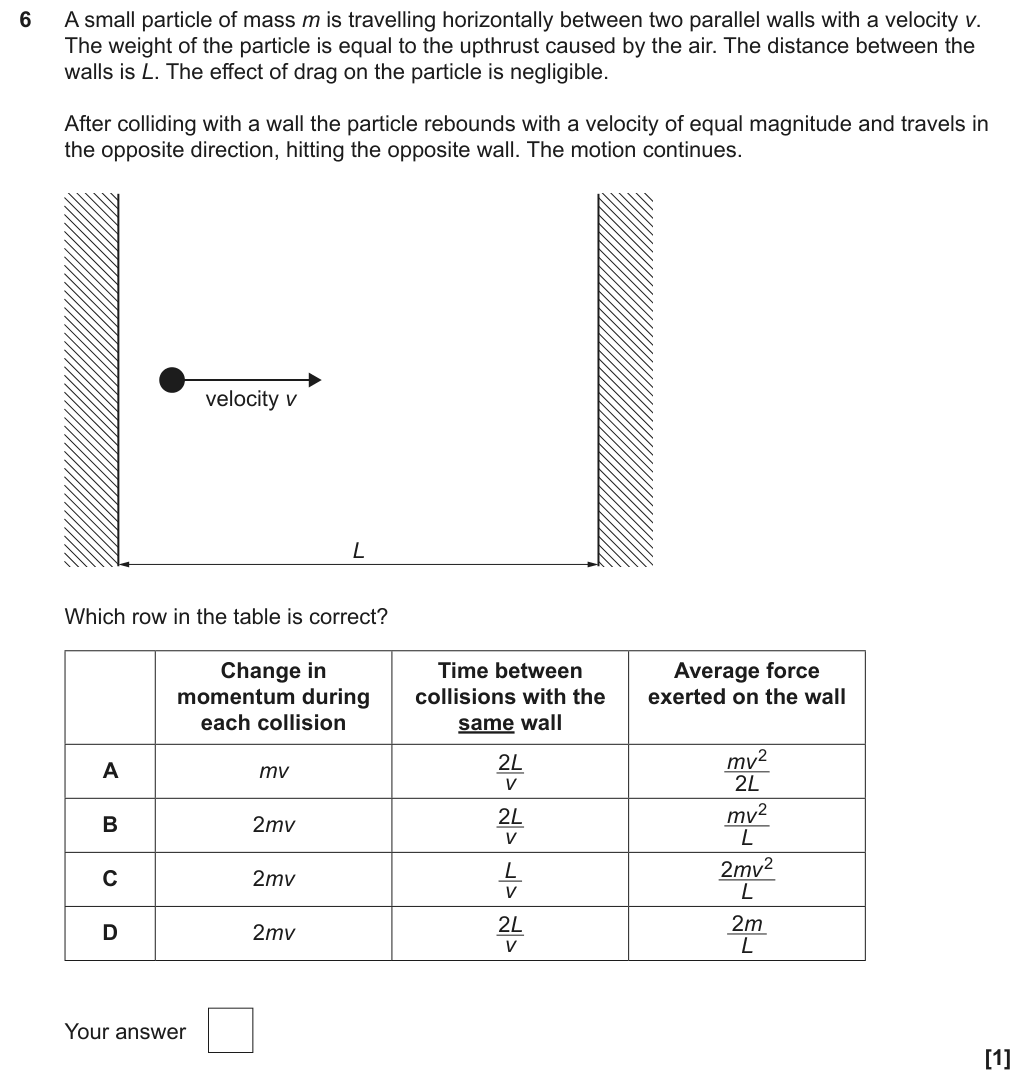
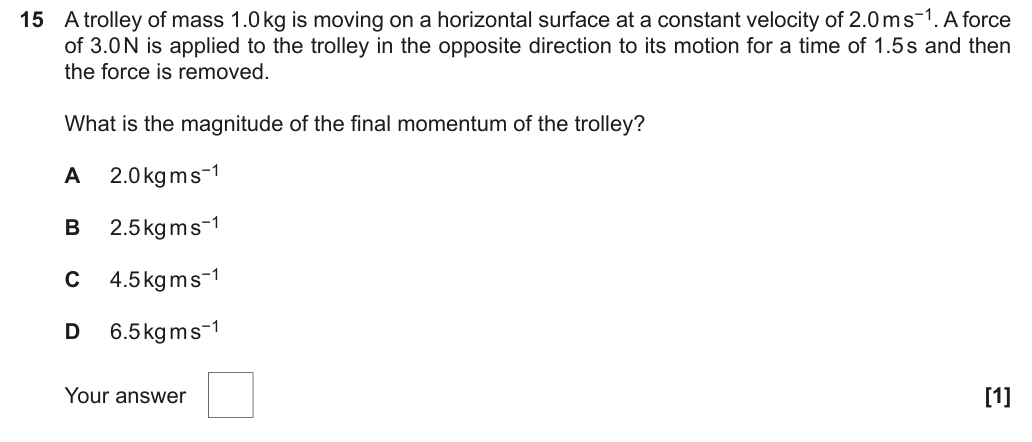
June 2025 · Paper 1 · Q61 markMultiple choiceMedium
Answer
B
Mark scheme
Examiner's comment
This question is the introduction to the derivation of the ideal gas equation. The particle changes direction after the elastic collision with the wall, so that the momentum change is 2𝑚𝑣. If the particle starts having just collided with the left wall, the time taken to return to that wall is the distance divided by the speed i.e. 2 𝑣. Average force exerted on the wall must be the change in momentum ÷ time between collisions so the final column must be calculated accordingly. The only row that satisfies this and the two previous conditions is answer B.
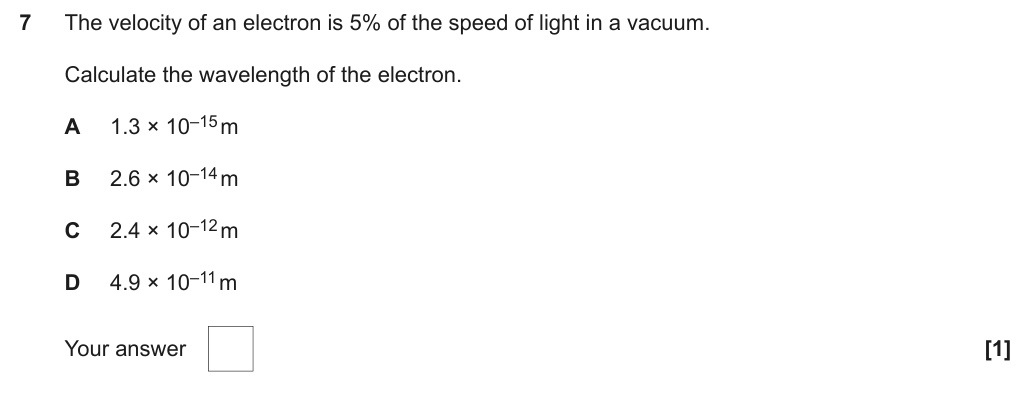
June 2025 · AS Paper 1 · Q71 markMultiple choiceMedium
Answer
D
Mark scheme
Examiner's comment
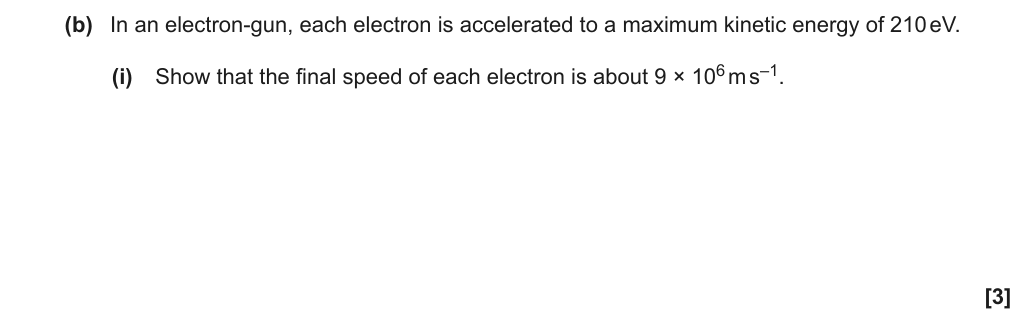
A range of answers were observed. High scoring candidates effectively used the white space to work out the speed of the electron and then wrote the equation and substituted the data.
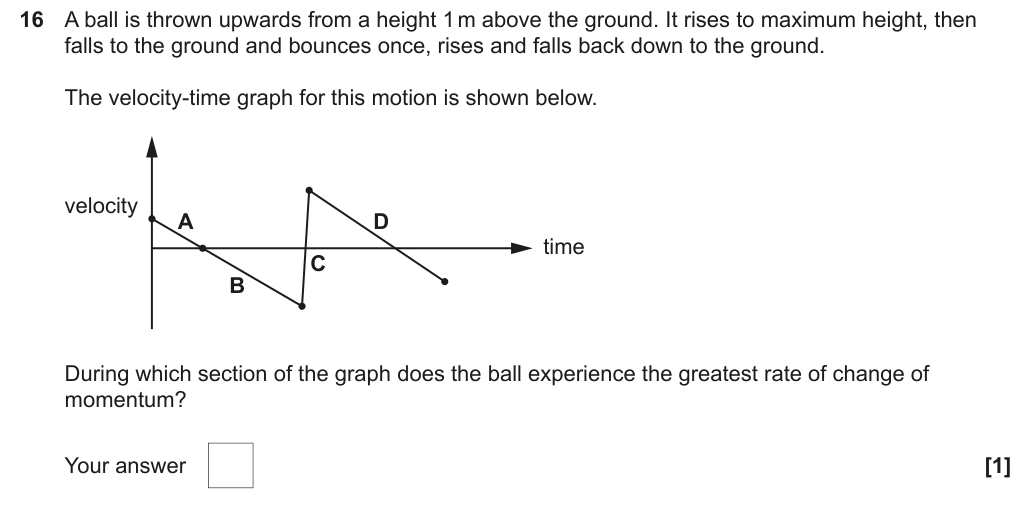
June 2025 · AS Paper 1 · Q161 markMultiple choiceMedium
Answer
C
Mark scheme
Examiner's comment
When this question was answered incorrectly, it was often either B or D selected.
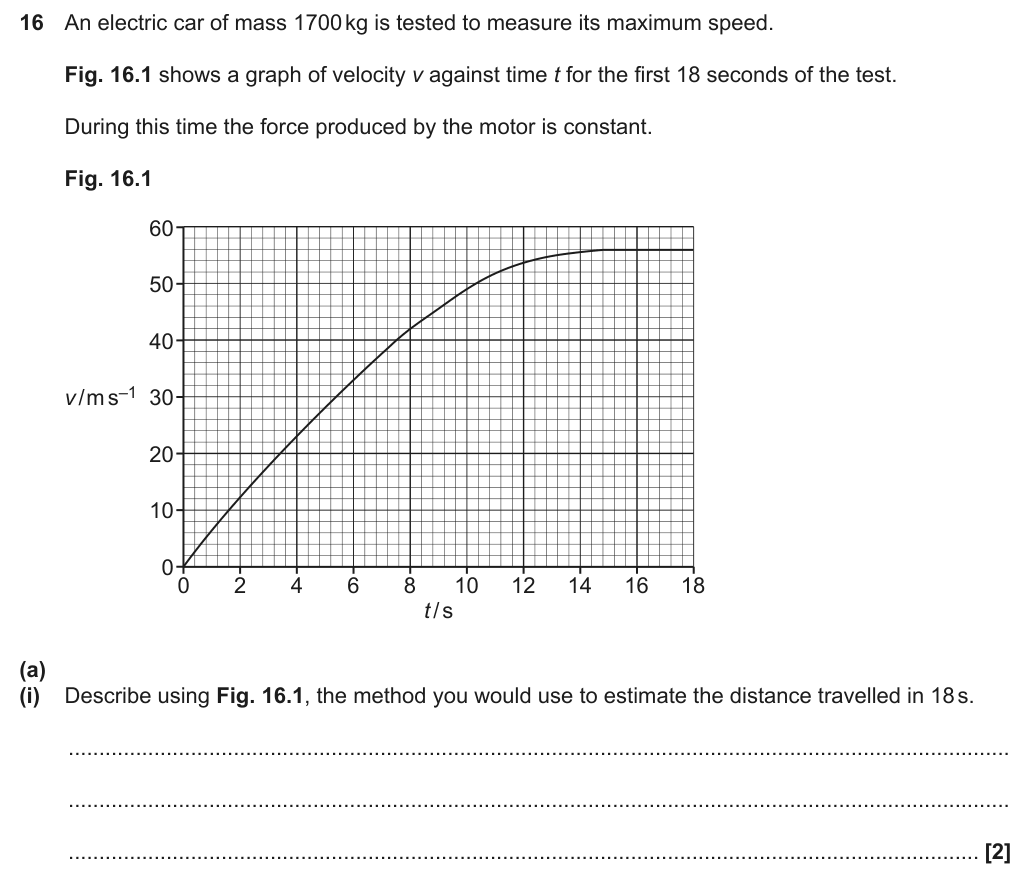
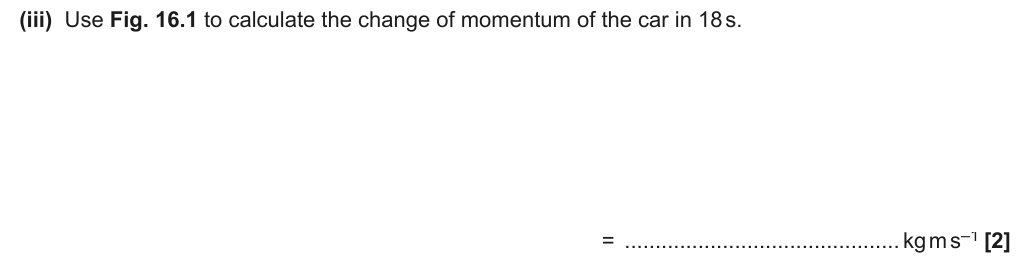
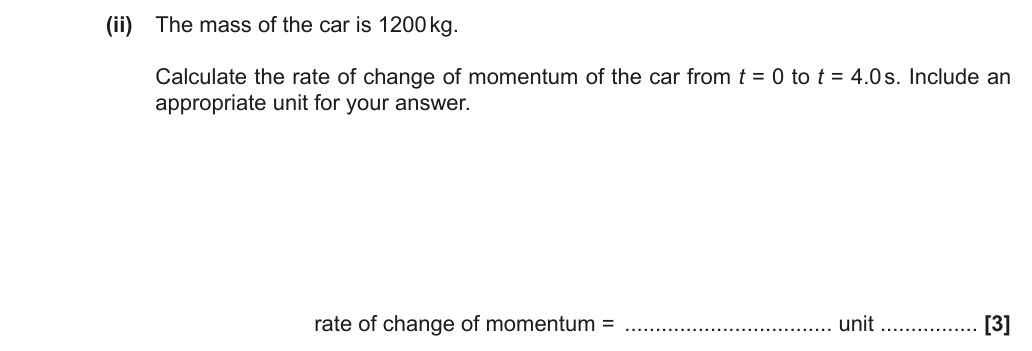
June 2025 · Paper 1 · Q16(a)(iii)2 marksCalculationEasy
Earlier part of question 16 that this part uses
Mark scheme
Examiner's comment
Almost all candidates read the velocity at 18 s correctly and then multiplied by the mass of the car. A small number misread the question and calculated the average rate of change of momentum by dividing the correct answer by 18 seconds.
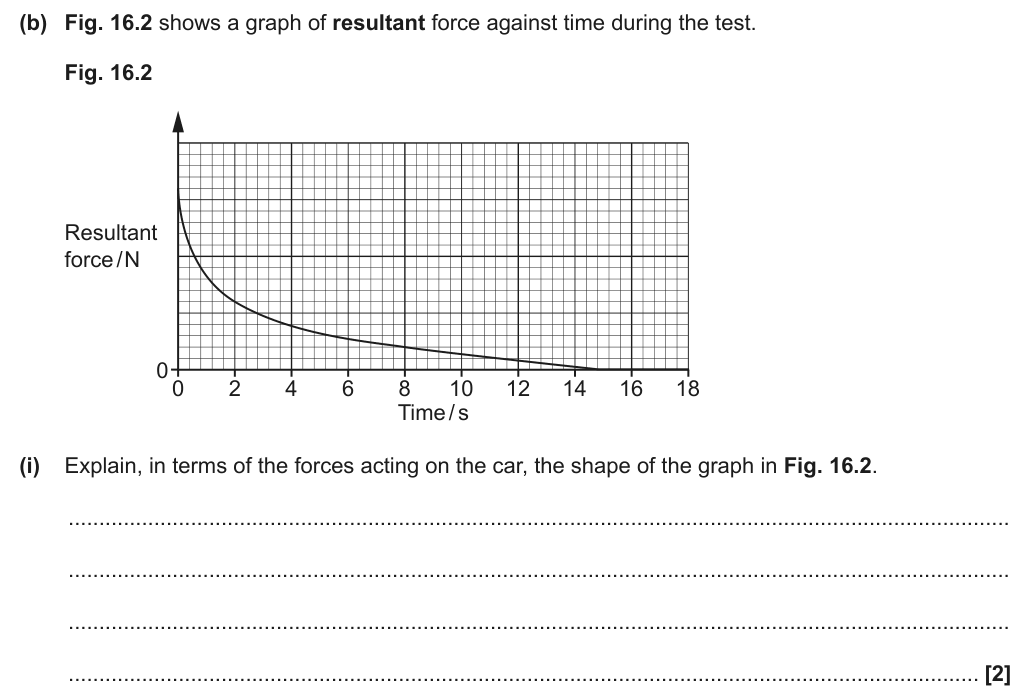
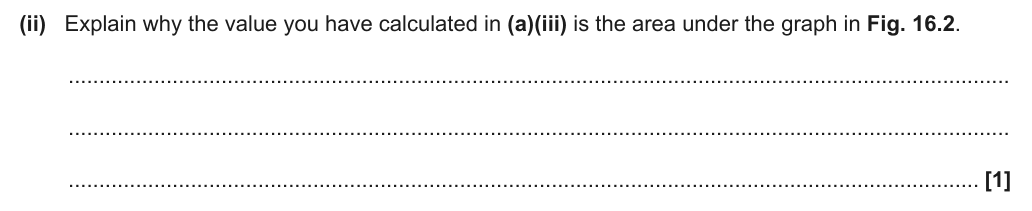
June 2025 · Paper 1 · Q16(b)(ii)1 markExplanationMedium
Earlier parts of question 16 that this part uses
Mark scheme
Examiner's comment
Many candidates used the correct term of ‘impulse’ here, often by referring to the product of average force and time taken as representative of the area of a small square.
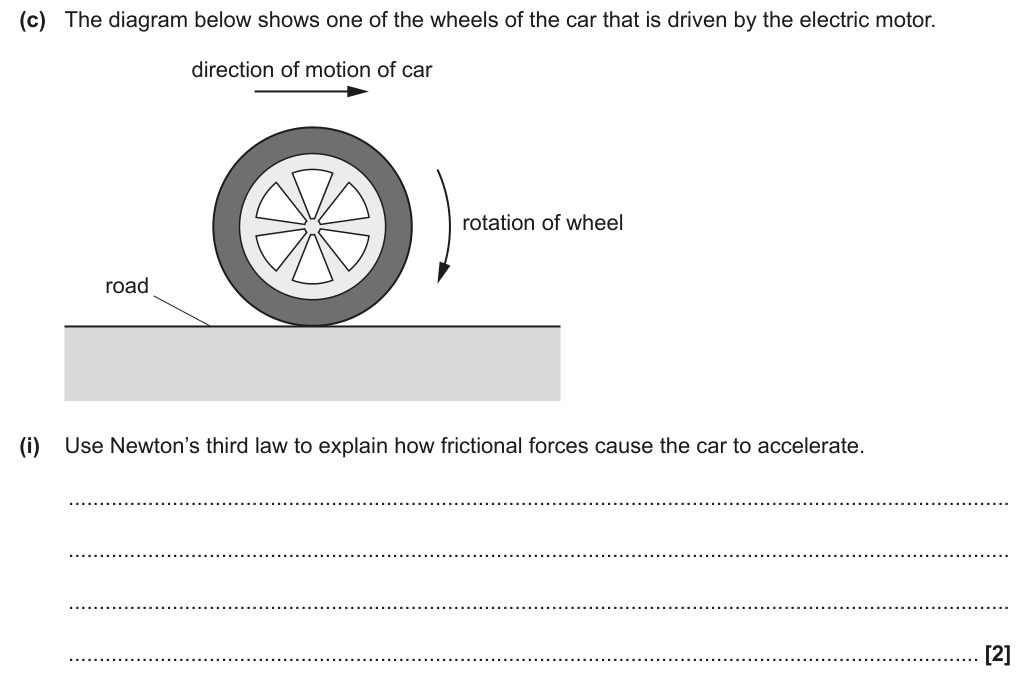
June 2025 · Paper 1 · Q16(c)(i)2 marksExplanationMedium
Mark scheme
Examiner's comment
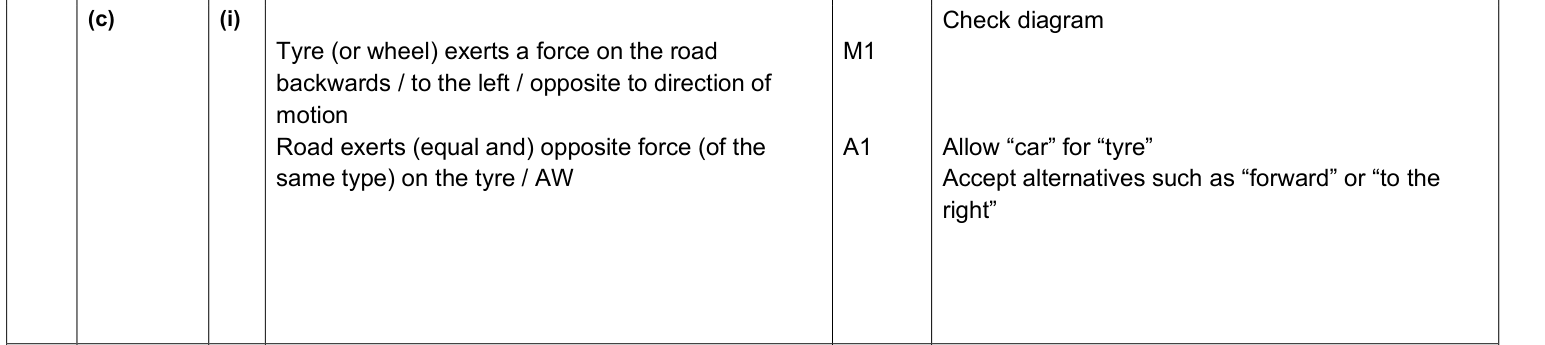
Candidates often described Newton’s Third Law in generic terms. The question requires application to this specific context such as ‘There’s a force on the road to the left from the wheel’ or ‘There’s a force on the wheel from the road to the right’.
Notes from the mark scheme and report
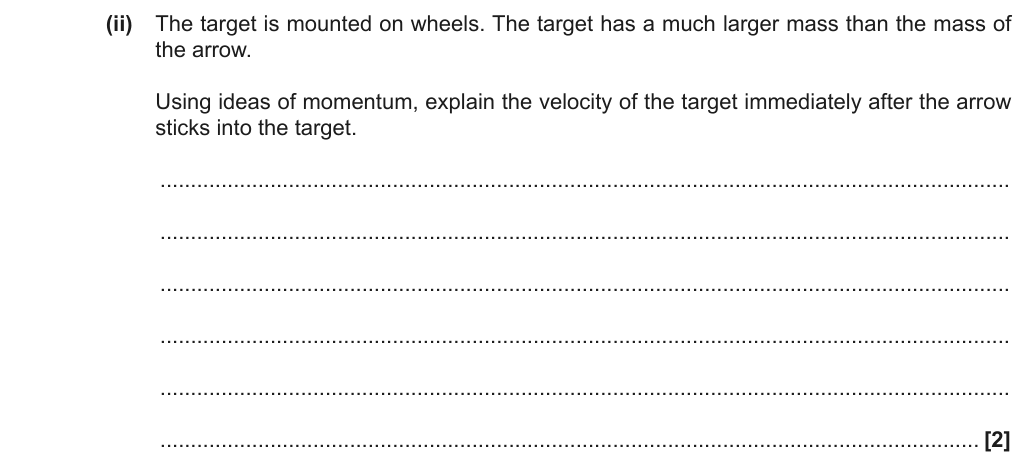
tyre pushes backwards on the road
road exerts the equal and opposite force on the tyre
June 2025 · AS Paper 1 · Q171 markMultiple choiceHard
Answer
A
Mark scheme
Examiner's comment
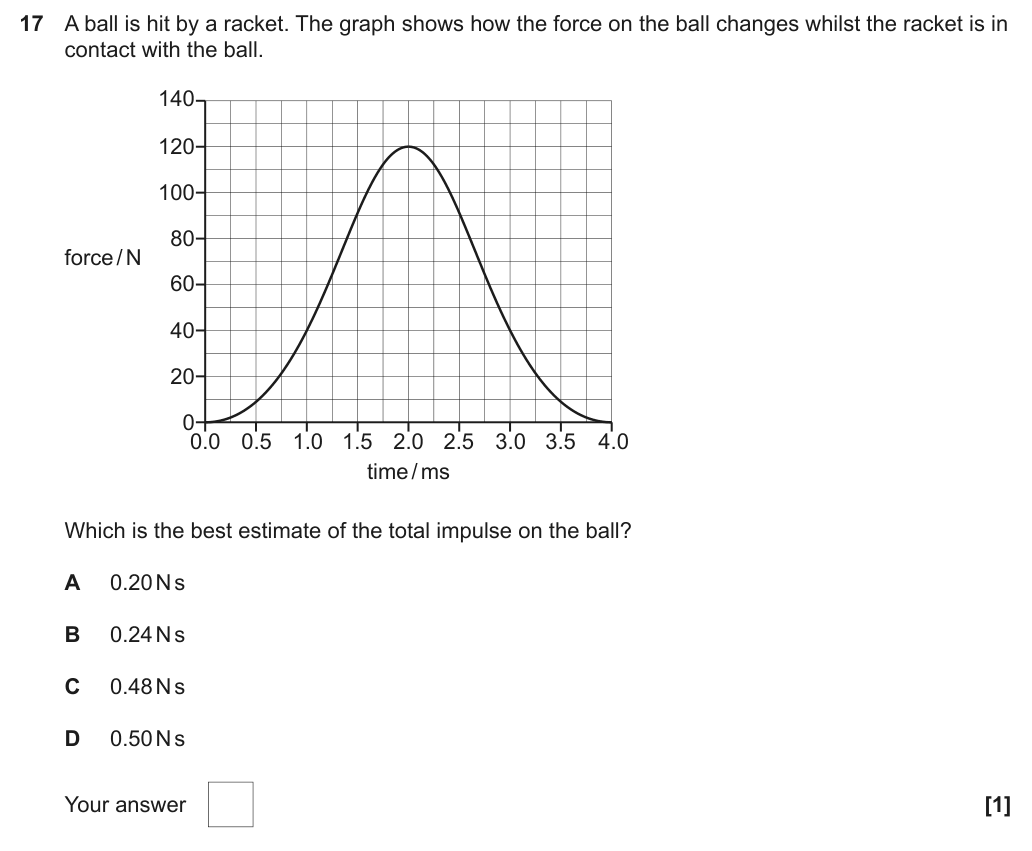
Candidates found this question more challenging. Some candidates realised that the total impulse was given from the area under the graph but then did not calculate the area correctly. Some clearly drew a triangle and gained an answer of 0.24 N s without allowing for the area inside the triangle. Other candidates multiplied.
Notes from the mark scheme and report
Candidates should understand how to calculate the area under a graph: • work out the physical significance of one small square • calculate a value for the one small square considering the units • count the number of whole small squares • estimate the total number of whole squares by allowing for the part squares • multiplying the total number of squares by the physical significance of one small square.
Skills: M0.1 Recognise and make use of appropriate units in calculations; M3.8 Understand the possible physical significance of the area between a curve and the x axis and be able to calculate it or estimate it by graphical methods as appropriate
June 2025 · AS Paper 1 · Q21(a)3 marksExplanationHard
Mark scheme
Examiner's comment
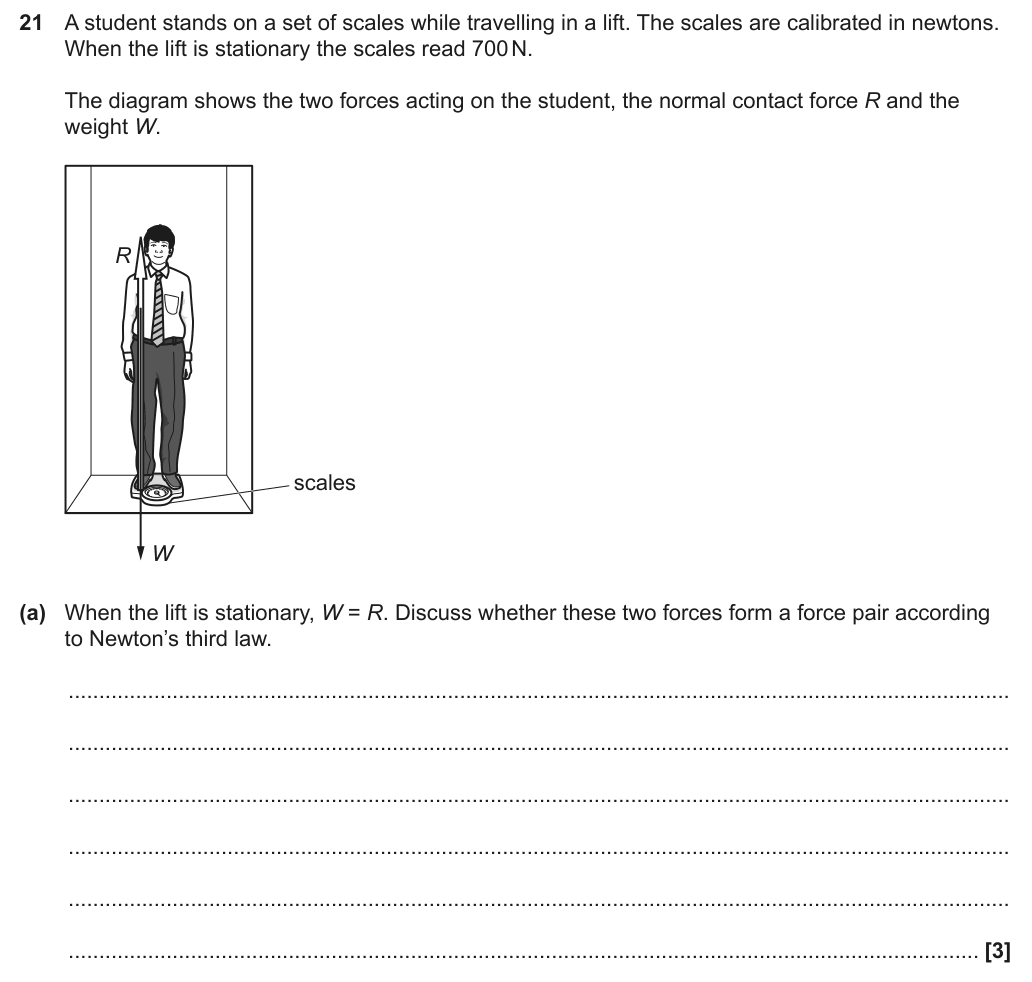
Many candidates understand the basic detail of Newton’s third law but do not appreciate the finer detail that it applies to two bodies and that the forces have to be of the same type. The states that there are two forces are acting on the student, so therefore only one body. Candidates should also have realised that the force of gravity or weight is a non-contact force and that the normal contact force is a contact force. A significant minority of candidates gave an incomplete answer where they referred to one of the two reasons as why the forces did not form a force pair without thinking about the answer space or the number of marks for the question. A few candidates did not state whether or not a force pair was formed. Candidates should be encouraged to think about the space to answer and the number of marks for each question. In this case there were 3 marks available so three distinct points should be included in their discussion.
Notes from the mark scheme and report
ignore named forces
ignore reference to direction / same size
at least one M mark needed for the A1
Many candidates can quote the basic Newton’s third law.
Candidates should understand how the law applies to two bodies and how the law applies to forces of the same type.
June 2025 · AS Paper 1 · Q21(c)2 marksExplanationMedium
Earlier part of question 21 that this part uses
Mark scheme
Examiner's comment
The command word ‘state’ in the question meant that candidates needed to state a value (700 N) for the reading on the scales. It was not good enough to simply state that the reading would be the same. The explanation needed to refer to the resultant force being zero. The term ‘equilibrium’ is not quite enough – it implies that the resultant force is zero but soes not demonstrate that the candidate understand that the resultant force is zero.
Notes from the mark scheme and report
ignore equilibrium
ignore stay the same (too vague)
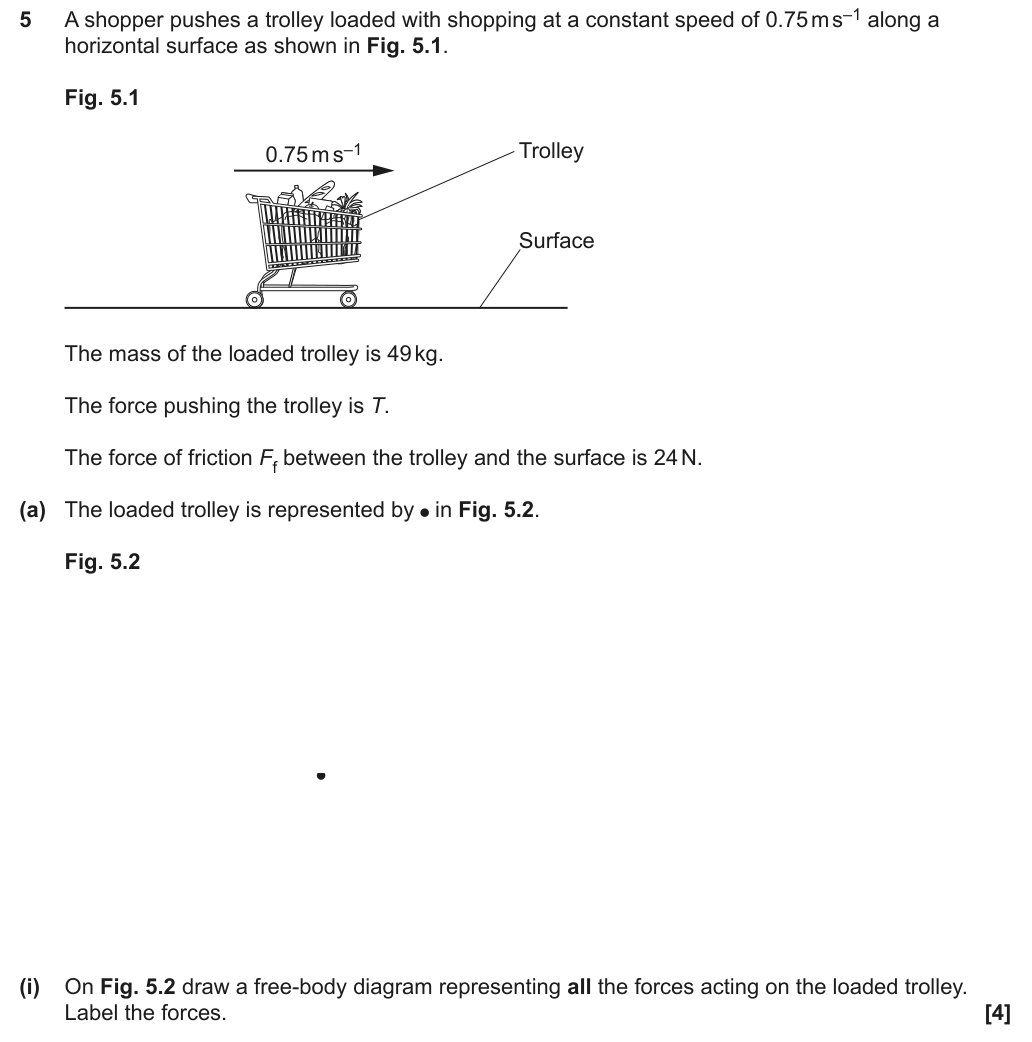
June 2025 · AS Paper 2 · Q5(a)(ii)1 markCalculationMedium
Earlier part of question 5 that this part uses
Mark scheme
Examiner's comment
The majority of the candidates understood that since the trolley was travelling at constant speed, there would be no resultant force acting on the trolley so the value of T would be equal to 24 N. A common error was to multiply the mass by the velocity and give an answer of 37 (N).
Notes from the mark scheme and report
ignore minus sign
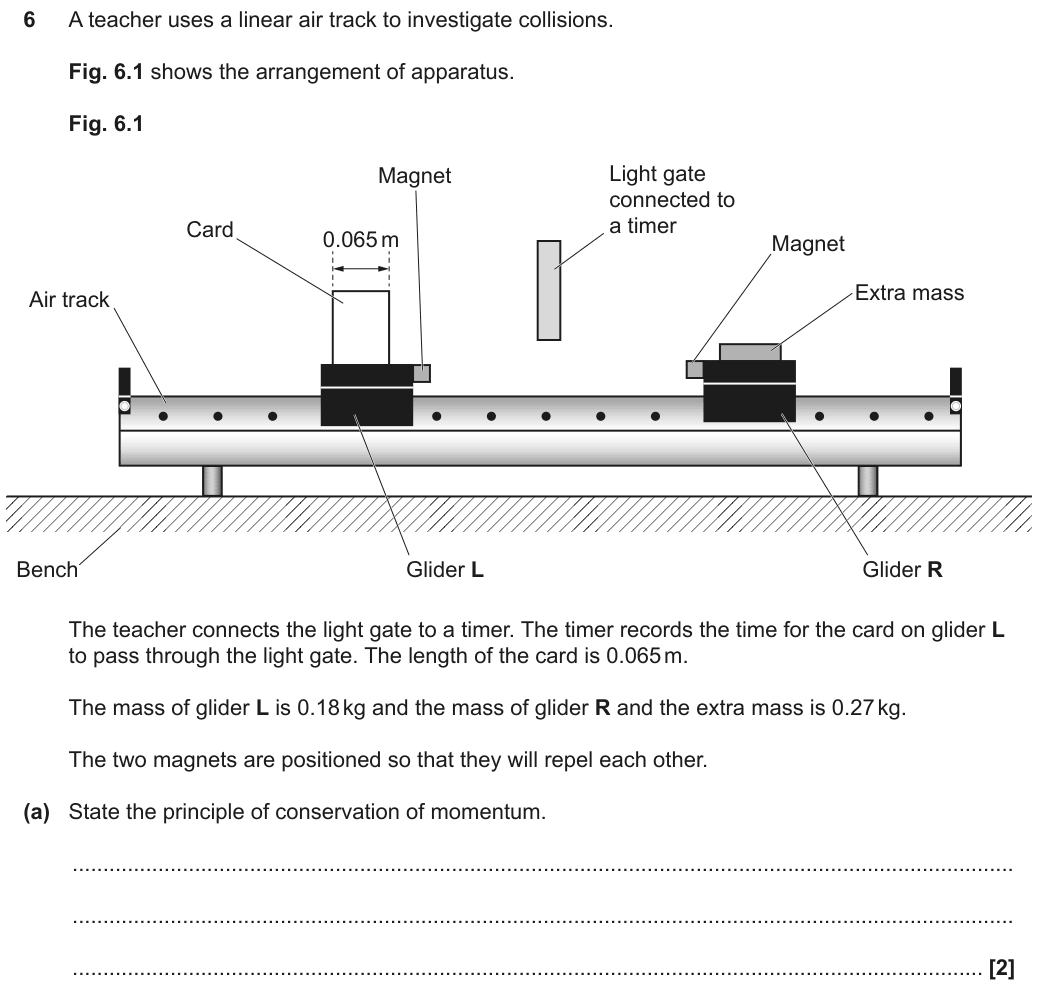
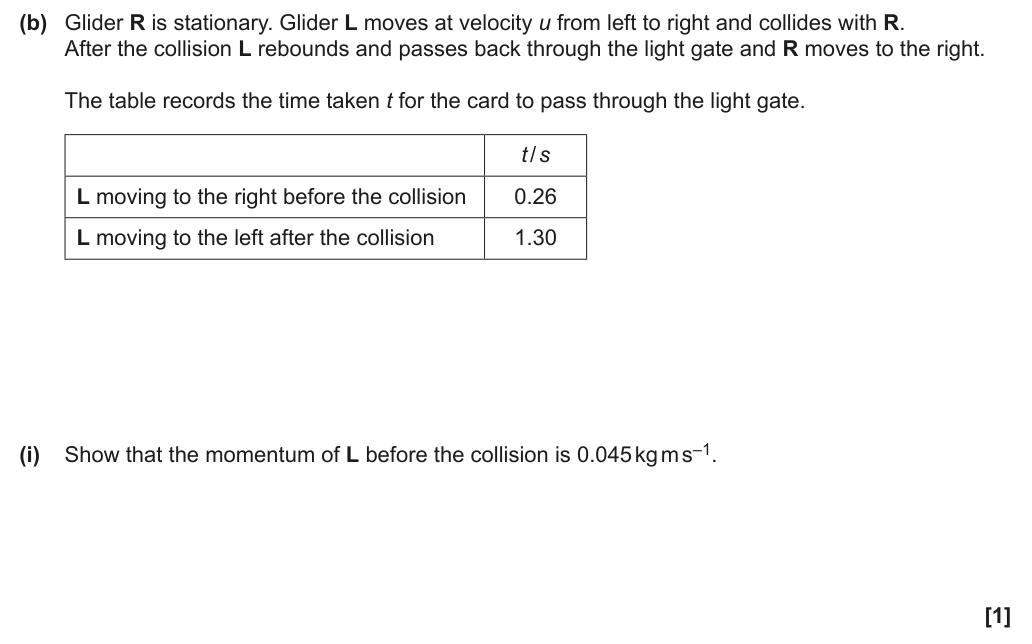
June 2025 · AS Paper 2 · Q6(b)(i)1 markShow thatMedium
Earlier part of question 6 that this part uses
Mark scheme
Examiner's comment
This was another show question where candidates needed to show initially that the velocity of the glider was 0.065 0.26 = 0.25 m s−1 before showing that momentum is mass × velocity. This candidate has multiplied the mass by the time and then rounded the answer to two significant figures. They then stated that this is the same as the given answer to two significant figures.
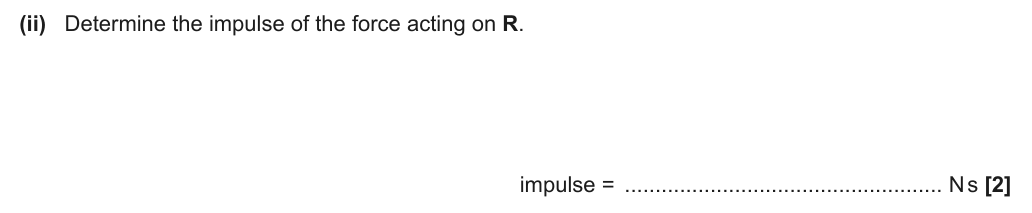
June 2025 · AS Paper 2 · Q6(b)(ii)2 marksCalculationMedium
Earlier parts of question 6 that this part uses
Mark scheme
Examiner's comment
Many candidates correctly worked out that the momentum after the collision of glider L was 0.0090 kg m s-1. However, they did not understand the vector nature of momentum and incorrectly determined the impulse as 0.036 N s.
Notes from the mark scheme and report
0.036 scores one mark (rebound direction ignored)
Skills: M2.3 Substitute numerical values into algebraic equations using appropriate units for physical quantities; PAG1 Investigating motion
June 2025 · AS Paper 2 · Q6(b)(iii)1 markCalculationMedium
Earlier parts of question 6 that this part uses
Mark scheme
Examiner's comment
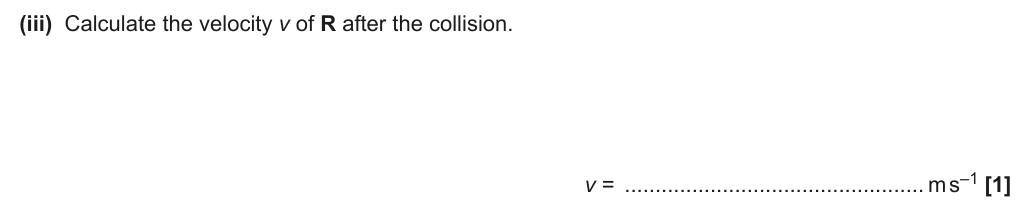
Many candidates did not understand that impulse is equal to the change in momentum and thus the impulse divided by the mass of R would give v.
Notes from the mark scheme and report
allow 0.2 (1 sf)
ecf from (b)(ii): impulse 0.036 gives 0.13
Skills: M2.2 Change the subject of an equation, including non-linear equations
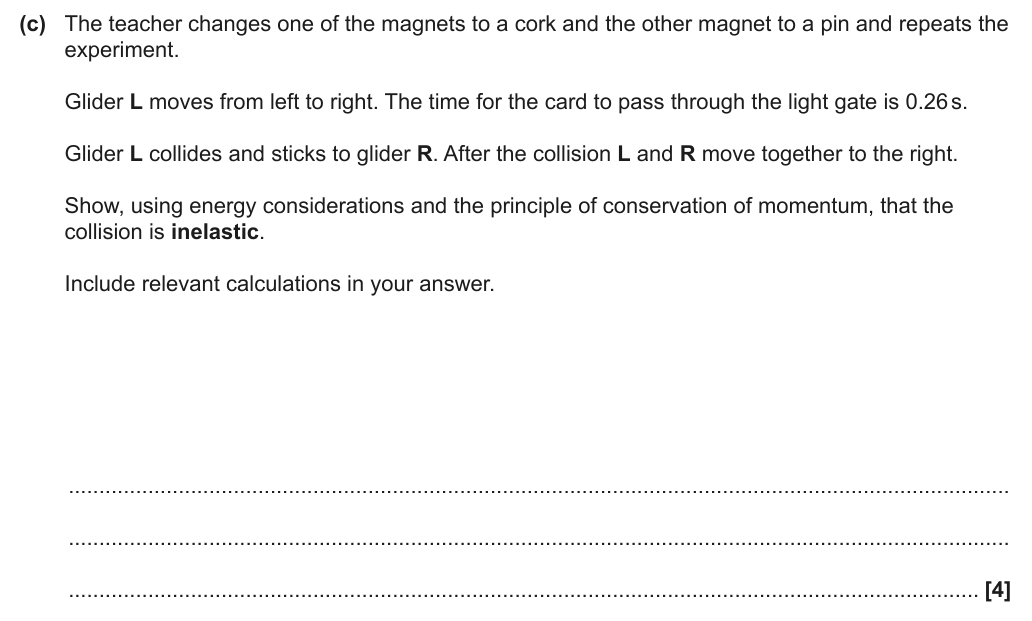
June 2025 · AS Paper 2 · Q6(c)4 marksShort answerMedium
Earlier parts of question 6 that this part uses
Mark scheme
Examiner's comment
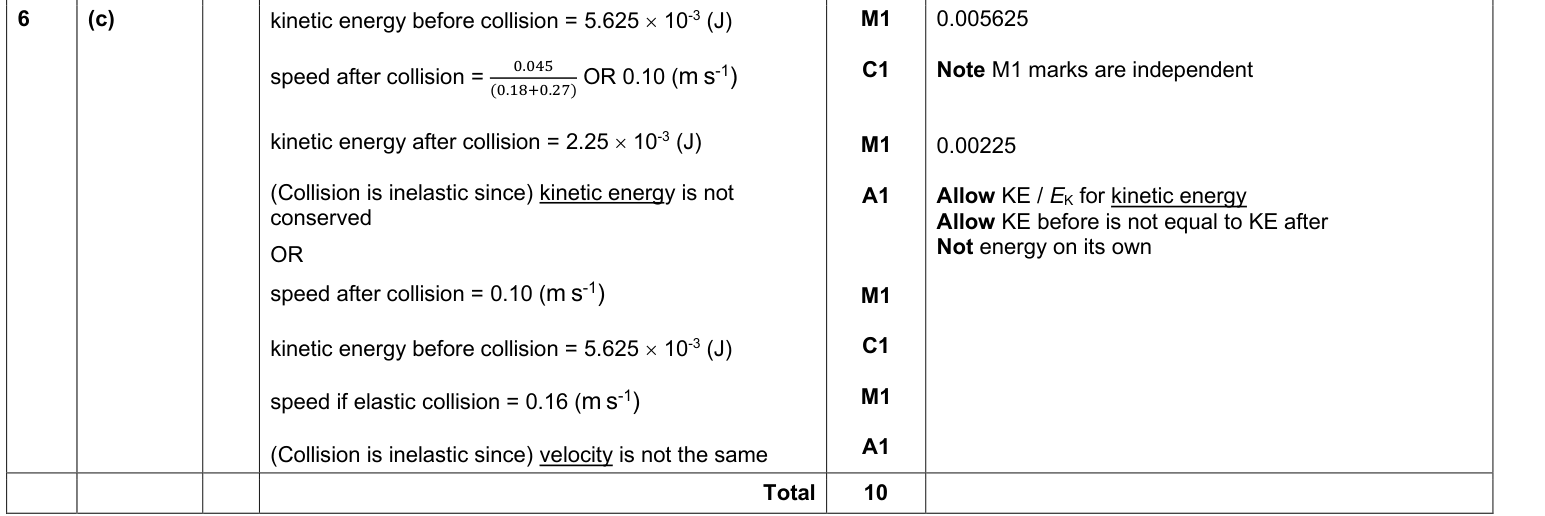
This question gave candidates the opportunity of structuring their answer for several calculations. High performing candidates clearly showed their working, firstly working out the initial kinetic energy before then working out the speed of both gliders after the collision, using the principle of conservation of momentum and then the kinetic energy after the collision. A conclusion in terms of the kinetic energy not being conserved was needed for the final mark.
Notes from the mark scheme and report
conclusion must refer to kinetic energy
NOT 'energy' on its own
Candidates should be encouraged to practise answering multiple step calculations with clear working.
Skills: M2.3 Substitute numerical values into algebraic equations using appropriate units for physical quantities; PAG1 Investigating motion
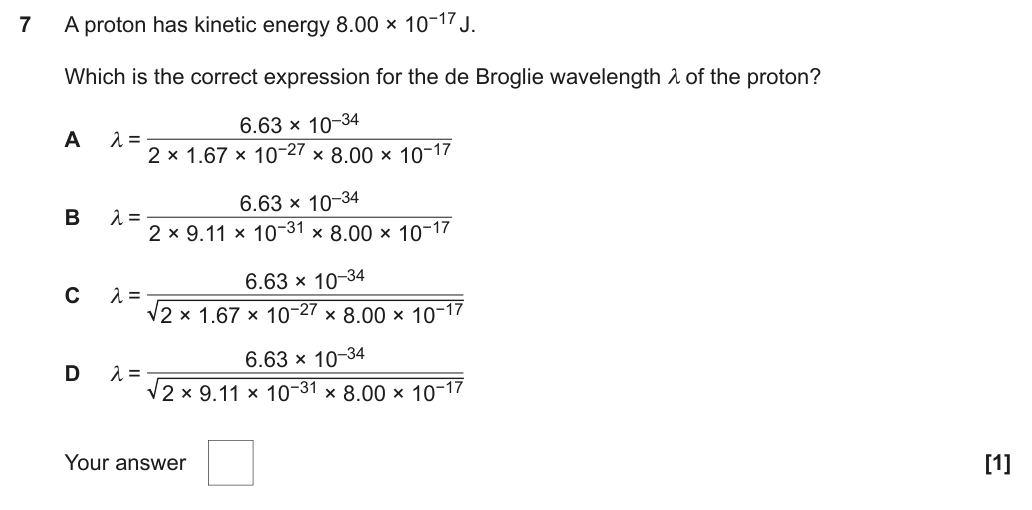
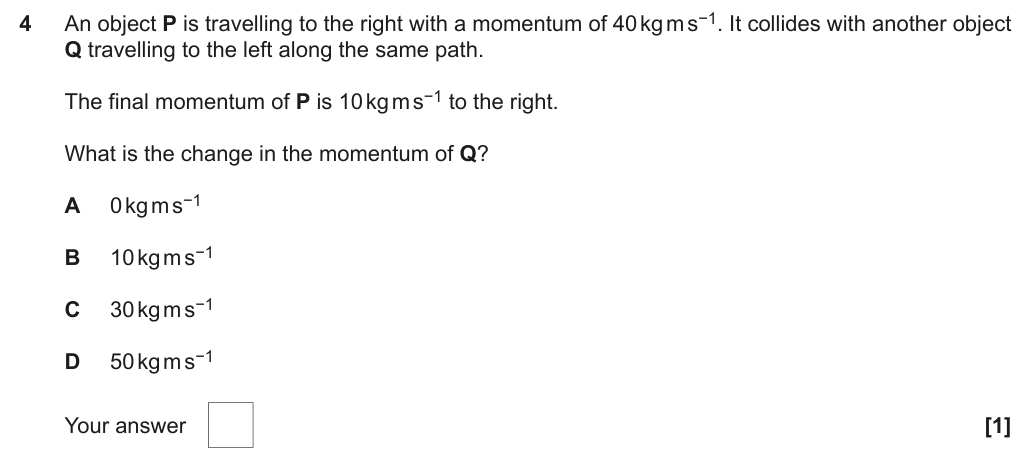
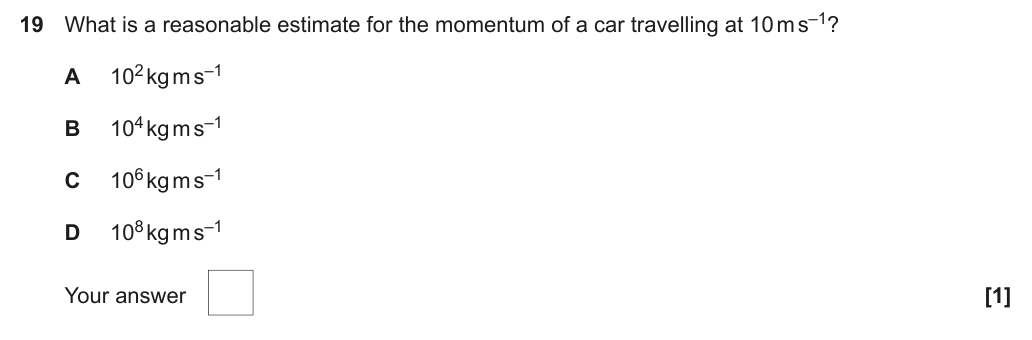
June 2024 · AS Paper 1 · Q91 markMultiple choiceMedium
Answer
B
Mark scheme
Examiner's comment
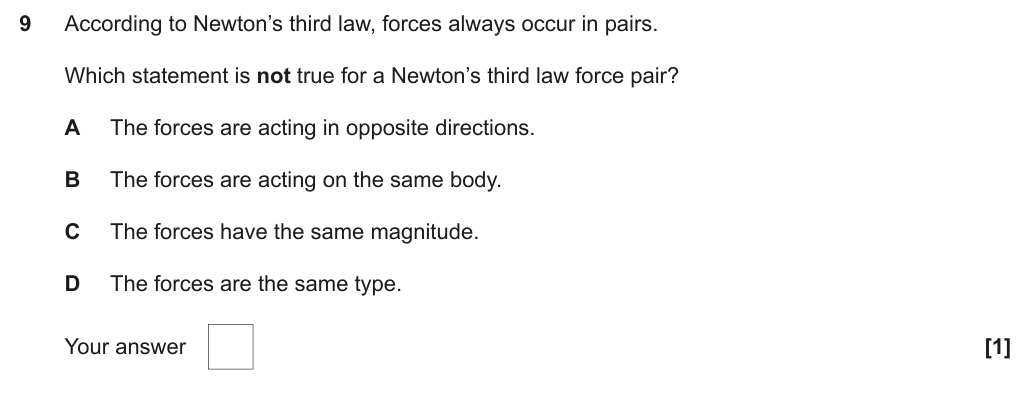
Many candidates correctly identified the correct response, B, by applying their understanding that an interaction pair of forces according to Newton’s third law do not act on the same body. The most common distractor answer was D.
Notes from the mark scheme and report
A common misconception when applying Newton’s third law of motion is that the interaction pair of forces are acting on the same body and/or that the pair of forces are different types of forces. Newton’s third law states: Whenever two bodies interact, the forces they exert on each other are equal in size, act in opposite directions, and are of the same type.
For example, if object A exerts a force on object B, then object B exerts an equal and opposite force on object A and if object A exerts a gravitational force on object B, then object B exerts an equal and opposite gravitational force on object A.
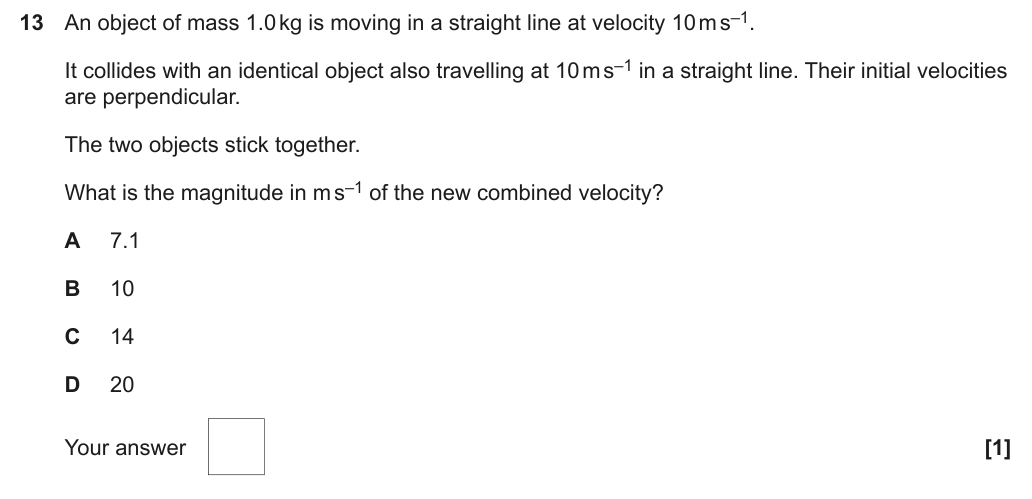
June 2024 · Paper 1 · Q131 markMultiple choiceMedium
Answer
A
Mark scheme
Examiner's comment
This is a conservation of momentum question. The momentum of each object is 10 kg m s-1. The combined momentum has two components at right angles to each other of 10 kg ms-1. The magnitude of this momentum is √ (200). To find the speed, divide this by 2.0 kg, giving 7.1 m s-1, so the answer is A.
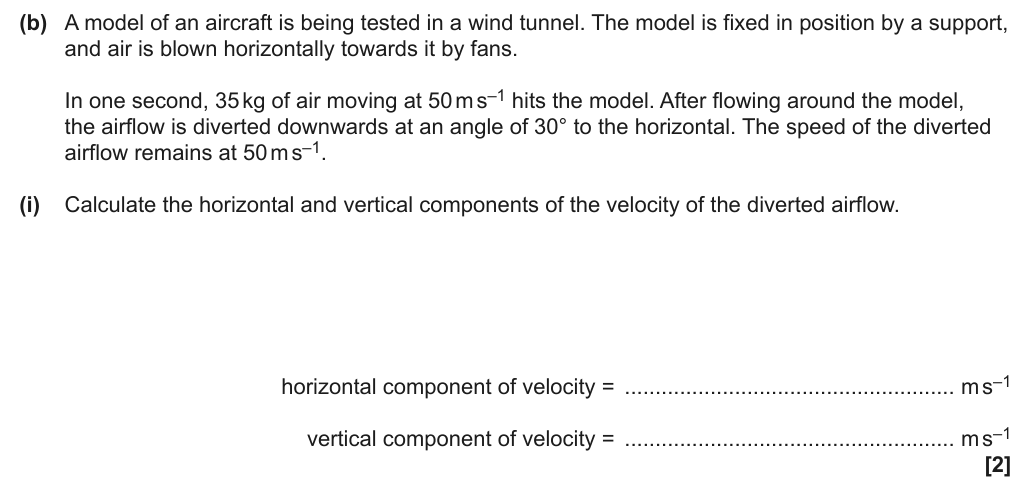
June 2024 · Paper 1 · Q17(a)1 markShort answerMedium
Mark scheme
Examiner's comment
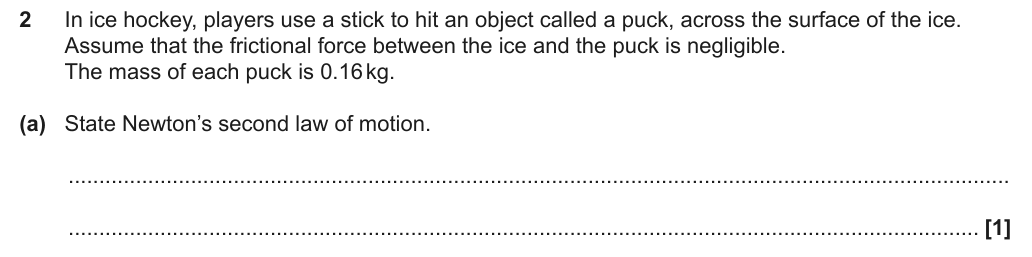
Most candidates selected the right law of motion to state although a reasonable fraction missed out something vital. Often than was that the idea of resultant force.
Notes from the mark scheme and report
NOT force = mass x acceleration
Common misconception that F = ma is Newton’s second law, whereas it’s a special case.
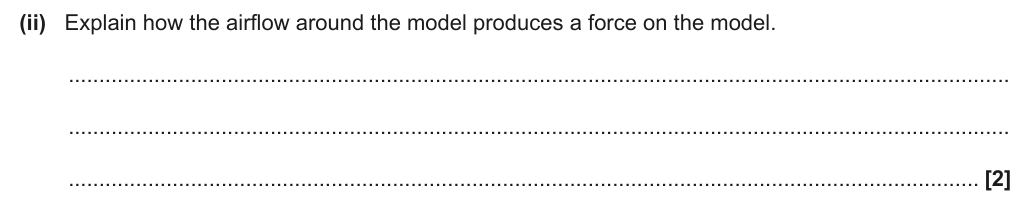
June 2024 · Paper 1 · Q17(b)(ii)2 marksExplanationMedium
Earlier part of question 17 that this part uses
Mark scheme
Examiner's comment
The key idea here was Newton’s third law, with credit for some supporting information.
Notes from the mark scheme and report
must apply Newton's third law
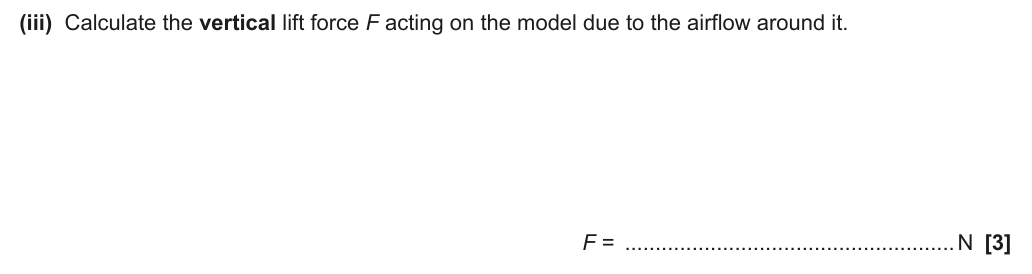
June 2024 · Paper 1 · Q17(b)(iii)3 marksCalculationMedium
Earlier part of question 17 that this part uses
Mark scheme
Examiner's comment
Answers that clearly used F = ma with the acceleration of 25 ms-2 were deemed wrong Physics (as in previous series). Error Carried Forward (ECF) was clearly applied here also.
Notes from the mark scheme and report
ecf from vertical velocity in (b)(i)
Skills: M2.3 Substitute numerical values into algebraic equations using appropriate units for physical quantities
June 2024 · AS Paper 2 · Q2(a)1 markShort answerMedium
Mark scheme
Examiner's comment
The majority of high scoring candidates stated that the net force is directly proportional to the rate of change of momentum. Some candidates gave the definition in symbols – this approach gained credit provided each symbol was identified. Lower scoring candidates often gave the special case of Newton’s second law (force = mass × acceleration) which did not gain credit.
Notes from the mark scheme and report
Ignore F = ma (special case)
Allow F = Δp/Δt with symbols defined
June 2024 · AS Paper 2 · Q2(b)(i)2 marksCalculationMedium
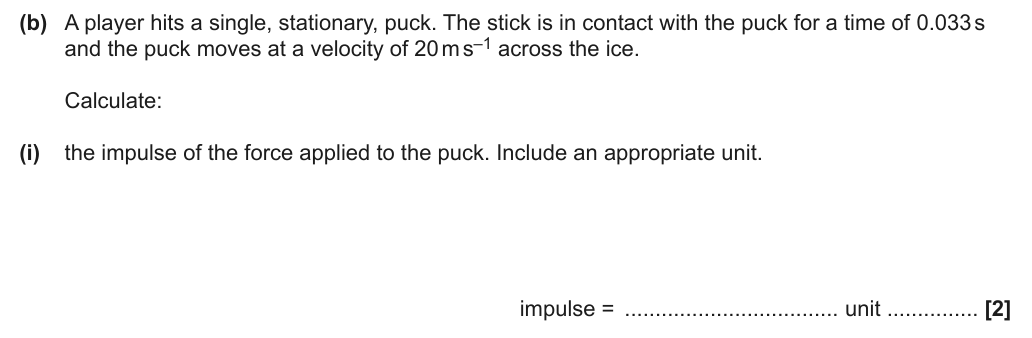
Earlier part of question 2 that this part uses
Mark scheme
Examiner's comment
This was generally well answered. Candidates who calculated the impulse correctly usually gave the correct unit. Both N s and kg m s-1 were given. A significant minority of candidates calculated the force (97).
Notes from the mark scheme and report
unit N s or kg m s-1
Skills: M0.1 Recognise and make use of appropriate units in calculations; M2.3 Substitute numerical values into algebraic equations using appropriate units for physical quantities
June 2024 · AS Paper 2 · Q2(b)(ii)1 markCalculationMedium
Earlier part of question 2 that this part uses
Mark scheme
Examiner's comment
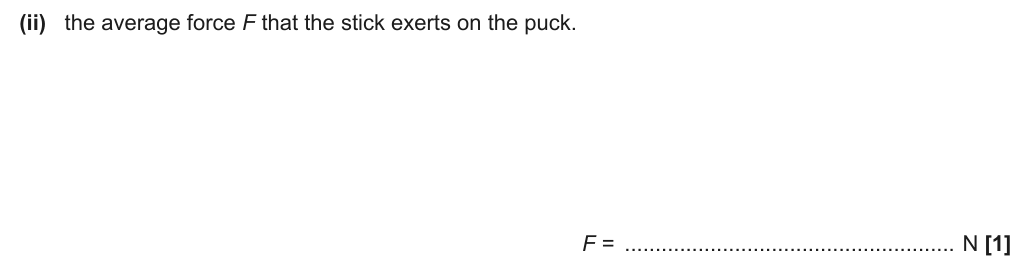
The majority of candidates understood that impulse = change in momentum and correctly divided their answer to Question 2 (b) (i) by 0.033 s.
Notes from the mark scheme and report
ecf from (b)(i)
Skills: M2.2 Change the subject of an equation, including non-linear equations
June 2024 · AS Paper 2 · Q2(c)(ii)3 marksCalculationHard
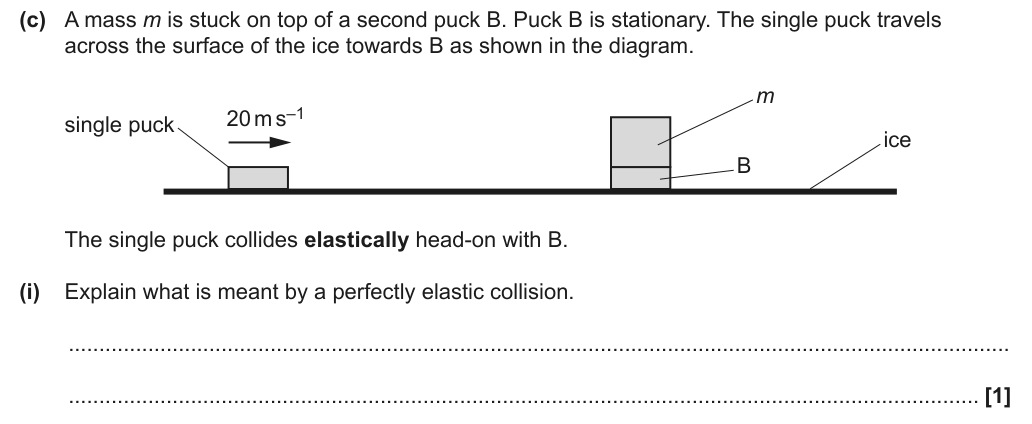
Earlier parts of question 2 that this part uses
Mark scheme
Examiner's comment
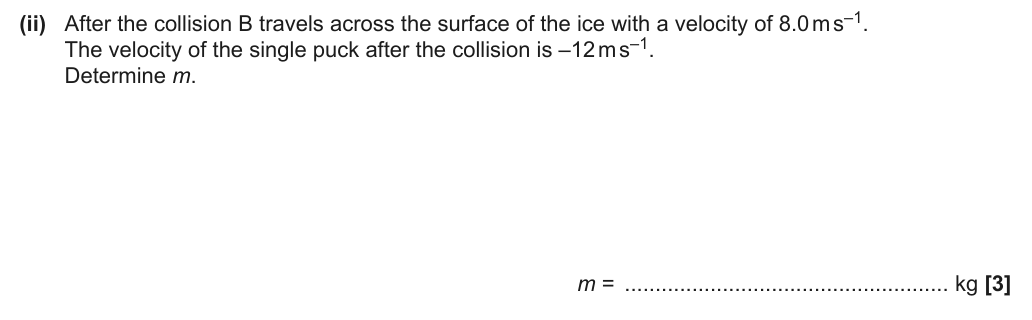
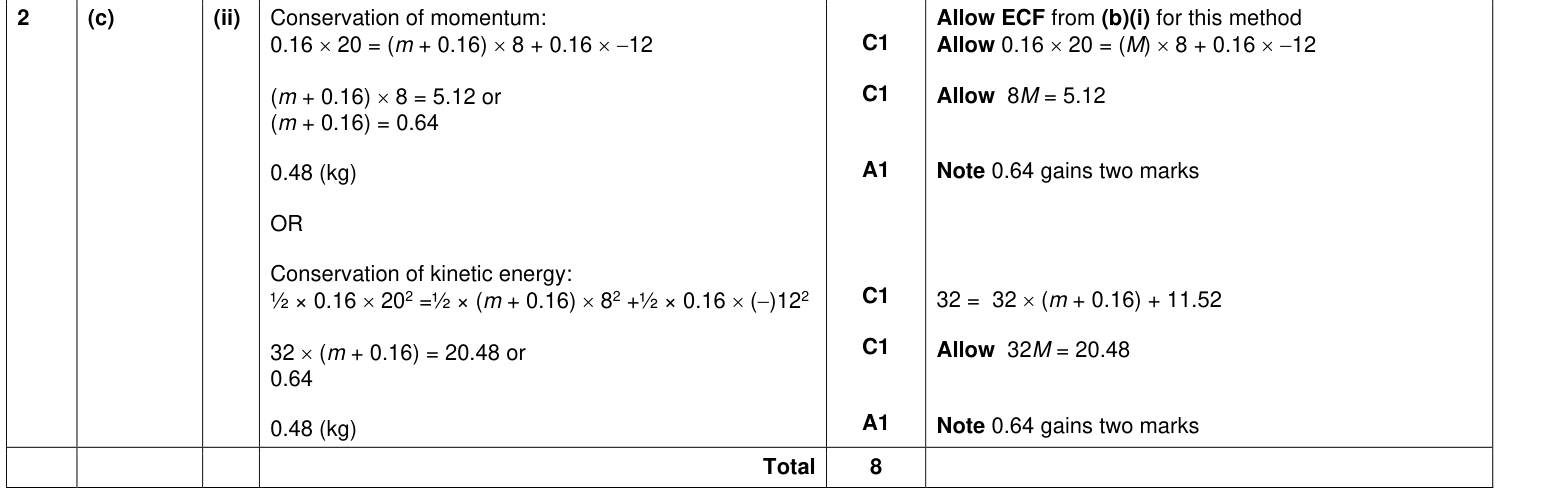
High scoring candidates generally scored well on this question. Most candidates attempted to determine m by using a conservation of momentum method. A small minority correctly used a conservation of kinetic energy method. The common error for the conservation of momentum method was to have an incorrect sign. A few candidates did not allow for the original mass of the puck.
Notes from the mark scheme and report
0.64 (0.16 kg of puck B not subtracted) scores 2
conservation of kinetic energy method also accepted
Skills: M2.2 Change the subject of an equation, including non-linear equations; M2.4 Solve algebraic equations, including quadratic equations
June 2024 · AS Paper 2 · Q86 marks6-mark extended responseMedium
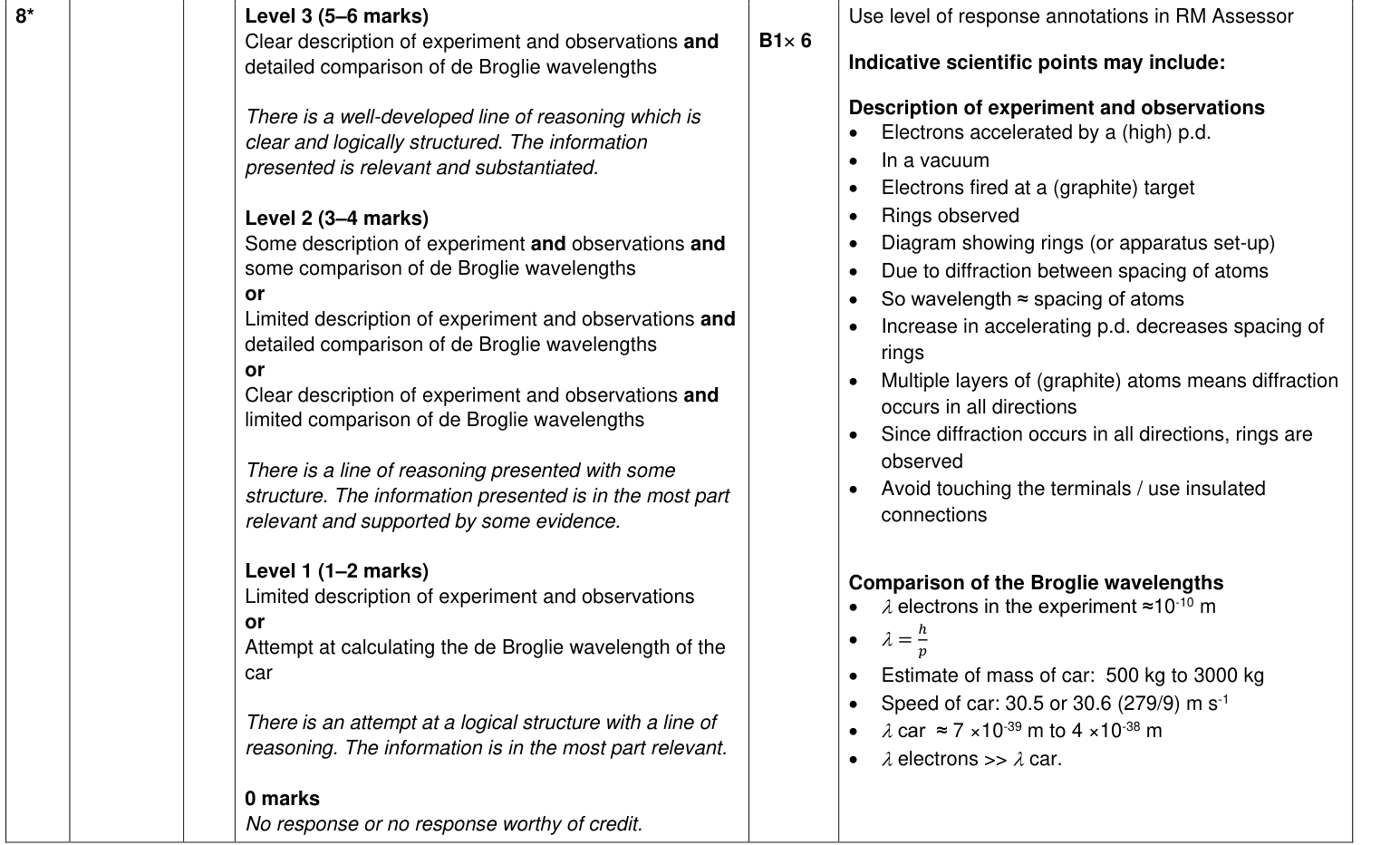
Mark scheme, with the levels and indicative content
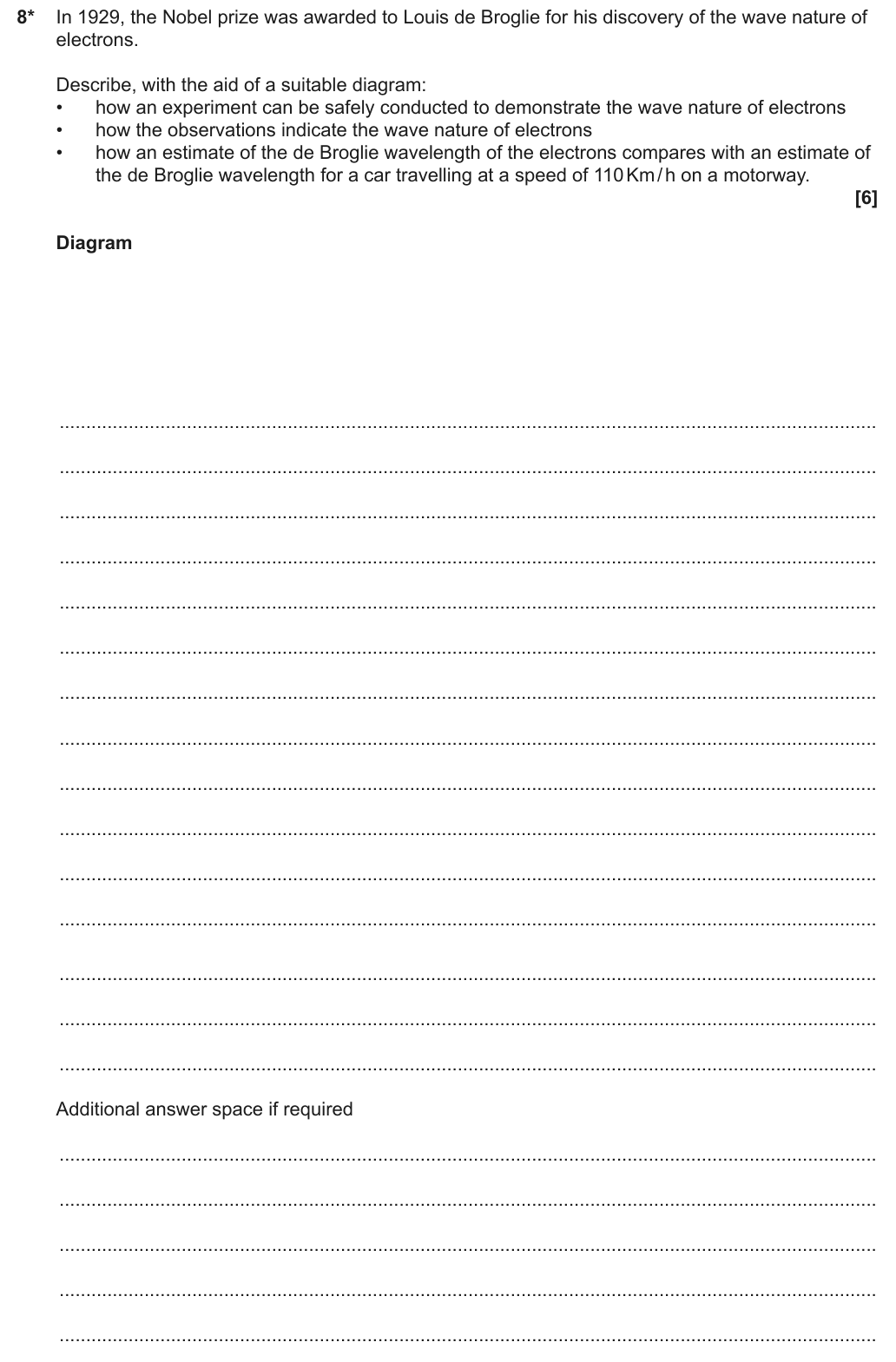
Examiner's comment
Many candidates appeared not to understand an experiment to demonstrate the wave nature of electrons often drawing a diagram of a double slit and using a screen, in effect the Young slit experiment for light. High scoring candidates often either stated an estimate of the de Broglie wavelength of electrons or used their knowledge and calculated a value for an estimated value of the accelerating potential difference. Ther were some very good answers working out the de Broglie wavelength of a car. The best answers clearly showed the working.
Skills: M0.1 Recognise and make use of appropriate units in calculations; M0.4 Estimate results; M1.4 Make order of magnitude calculations
June 2024 · Paper 3 · Q3(a)3 marksExplanationEasy
Mark scheme
Examiner's comment
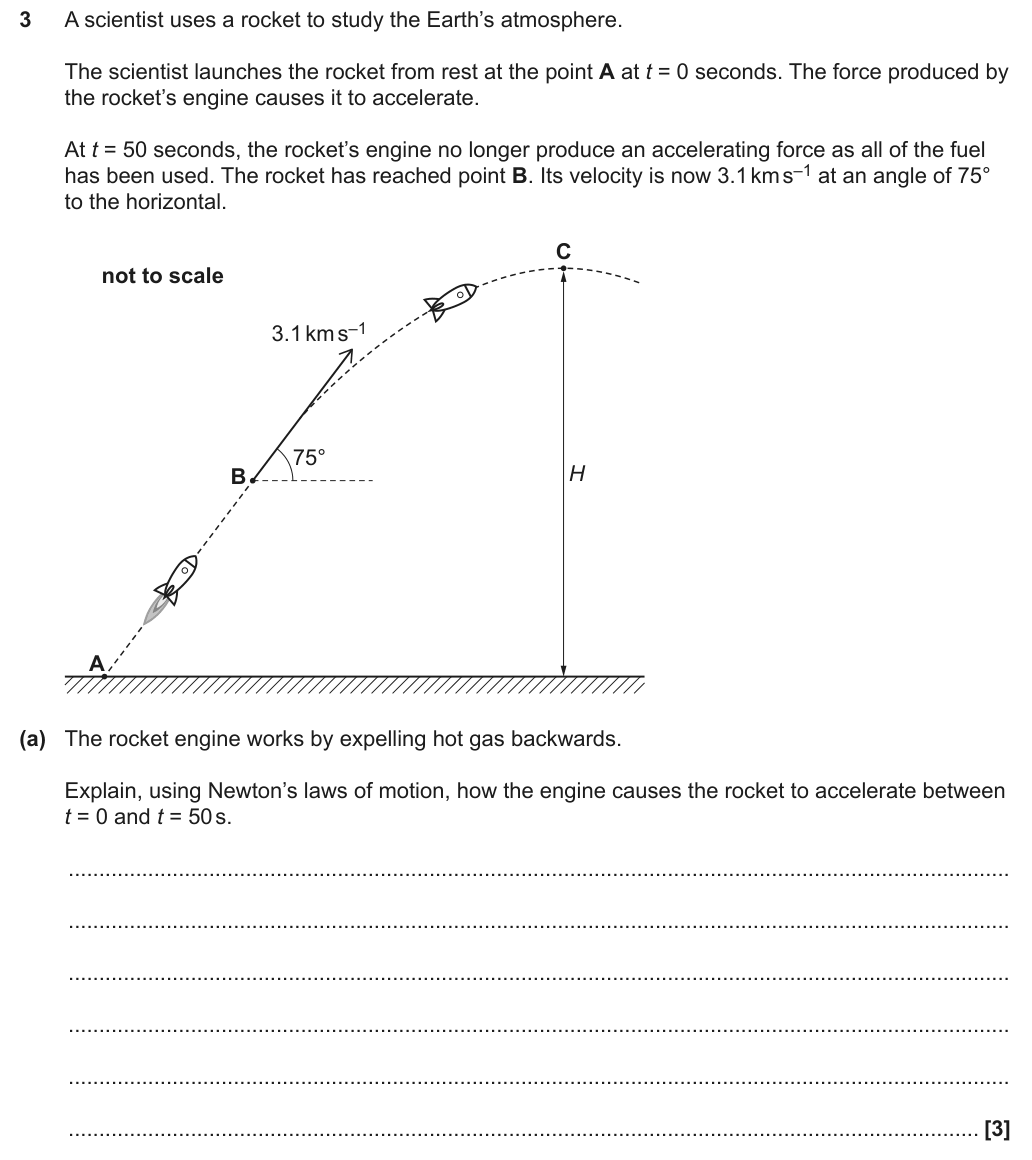
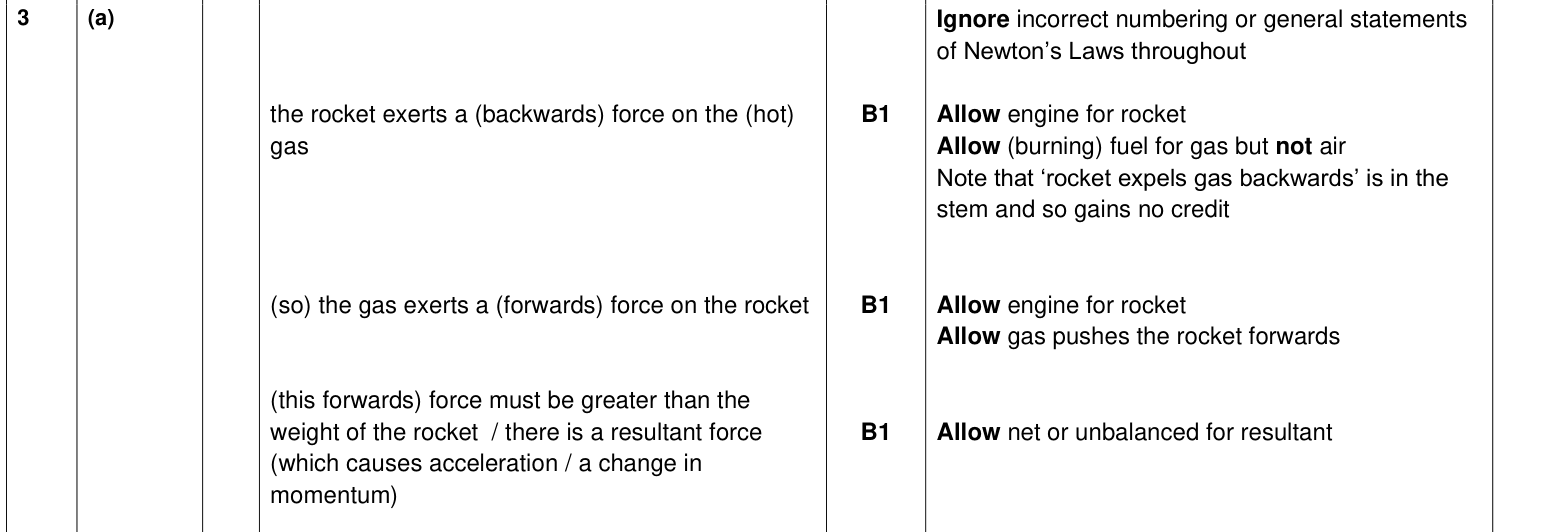
It was expected that candidates would use, rather than simply state, Newton’s laws of motion in order to explain why the rocket accelerates. Most candidates were able to state, ‘for every action there is an equal and opposite reaction’ or even ‘if A exerts a force on B, then B exerts and equal and opposite force on A’. However, few extended that to ‘if the rocket exerts a force on the gas (backwards) then the gas will exert a force on the rocket (forwards)’. Even fewer went on to explain that, in order for the rocket to accelerate, this force must be greater than the weight of the rocket in order for there to be a resultant force (forwards).
Notes from the mark scheme and report
rocket expels gas backwards is in the stem and gains no credit
Not air for gas
ignore incorrect numbering of the laws
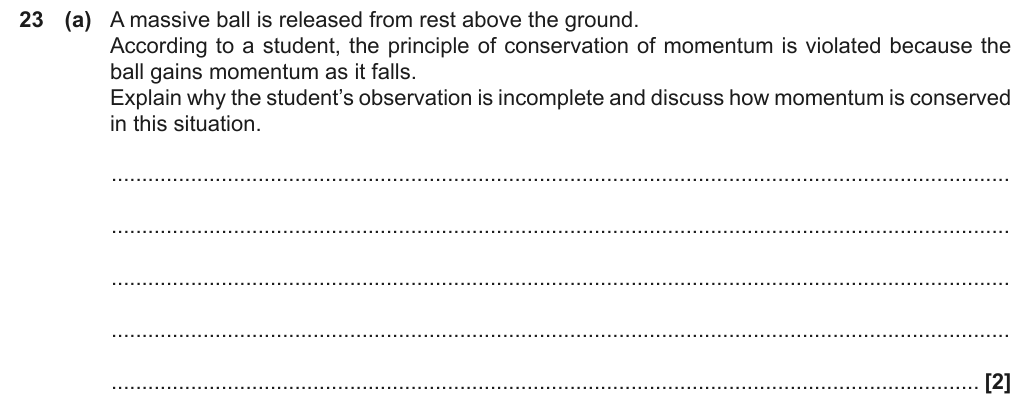
June 2023 · Paper 1 · Q31 markMultiple choice
Answer
A
Mark scheme
June 2023 · Paper 1 · Q61 markMultiple choiceMedium
Answer
B
Mark scheme
Examiner's comment
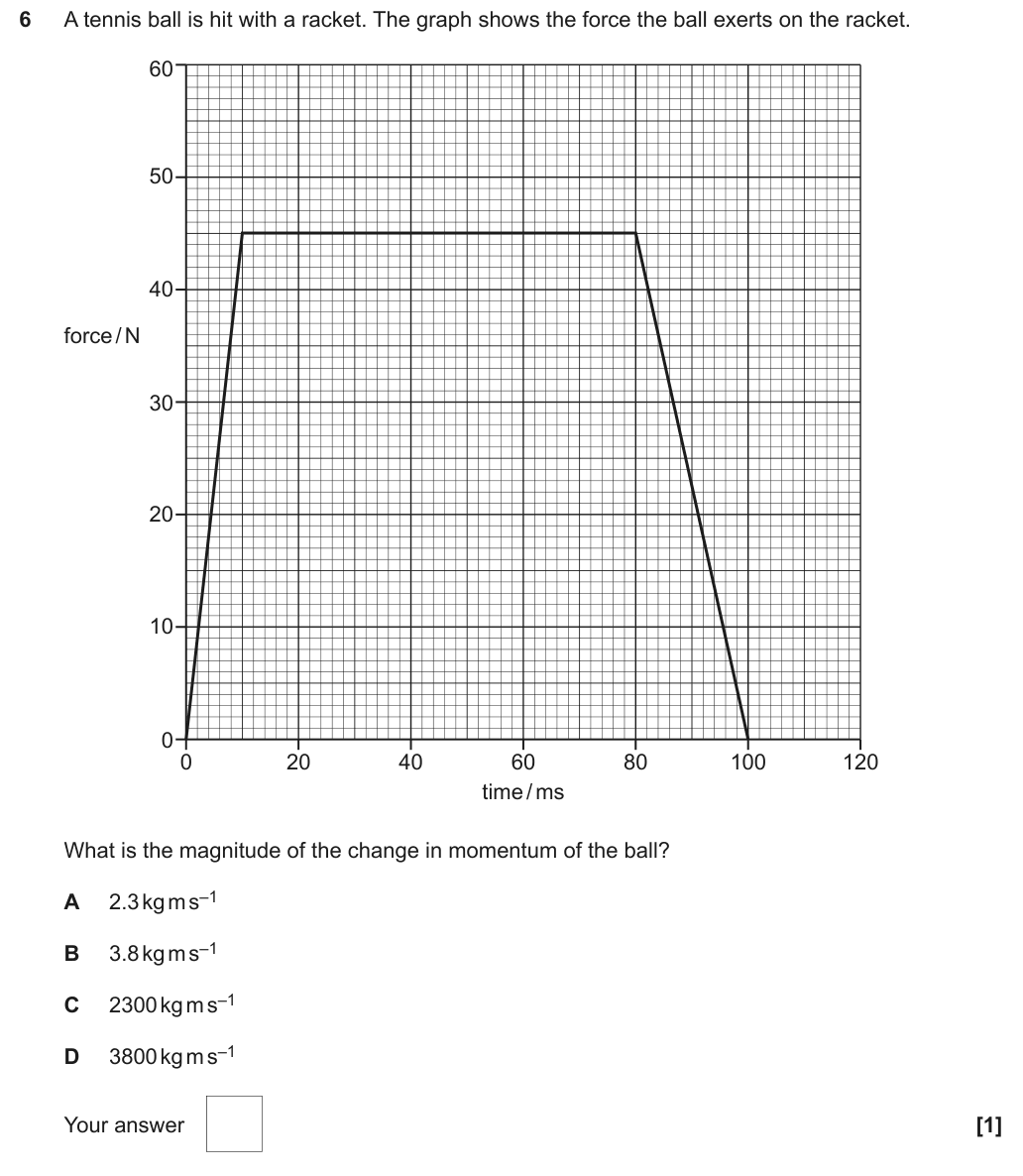
While virtually all candidates calculated the area of the trapezium correctly, candidates that forget that the time was measured in milliseconds picked answer D rather than the correct answer, B.
June 2023 · AS Paper 1 · Q161 markMultiple choiceMedium
Answer
A
Mark scheme
Examiner's comment
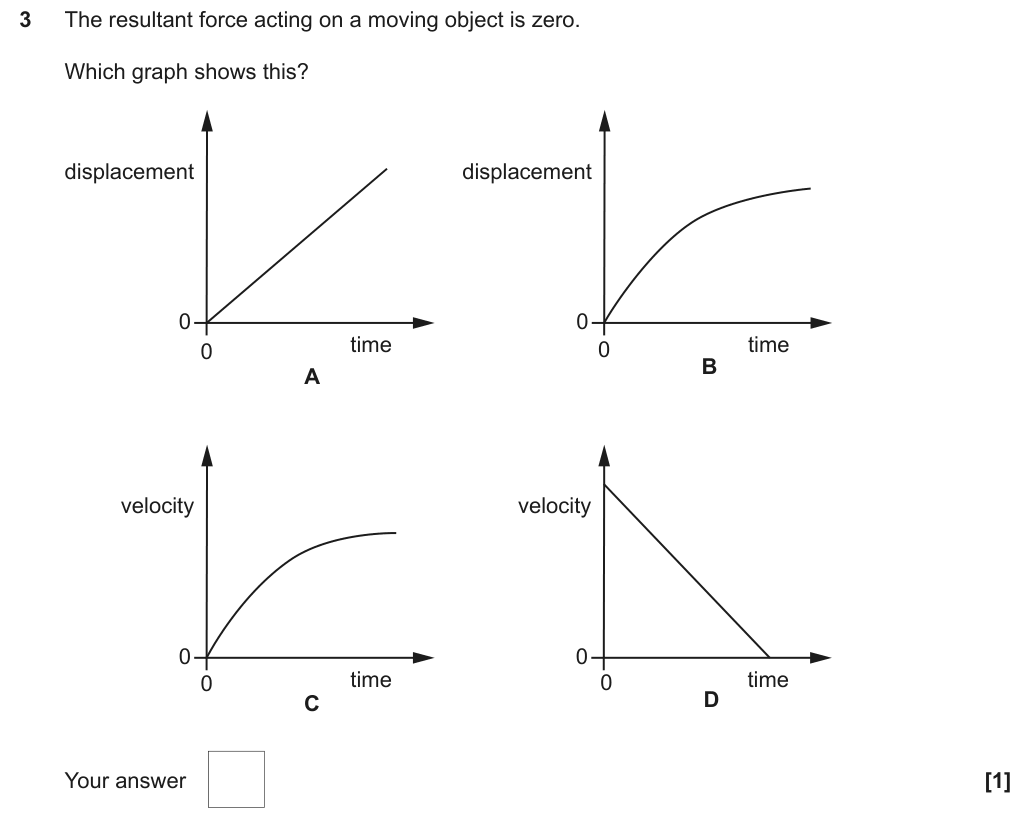
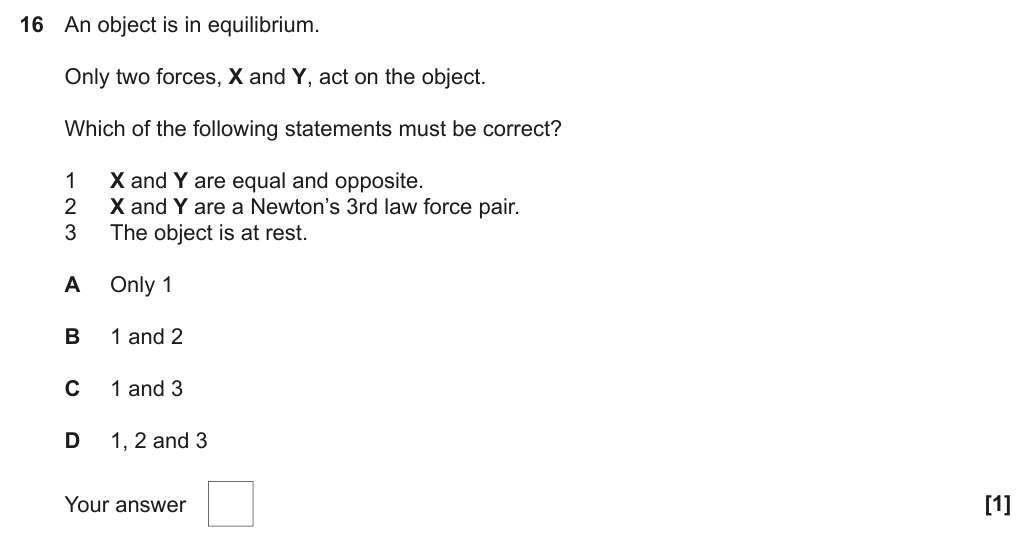
Candidates performed less well on this question as they either interpreted that since the forces acting on the object in equilibrium were equal and opposite the object was at rest, or that the pair of forces were an interaction pair of forces, so B and C were the most common distractors.
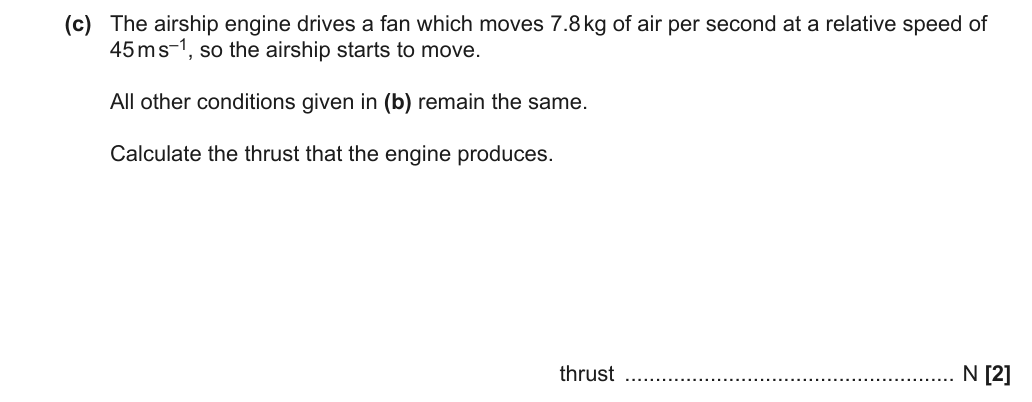
June 2023 · Paper 1 · Q20(c)2 marksCalculationMedium
Mark scheme
Examiner's comment
Question 20 (c) Question 20 (d) Question 20 parts (c) and (d) group well here.
Notes from the mark scheme and report
F = ma = 7.8 x 45 scores zero
Skills: M2.3 Substitute numerical values into algebraic equations using appropriate units for physical quantities
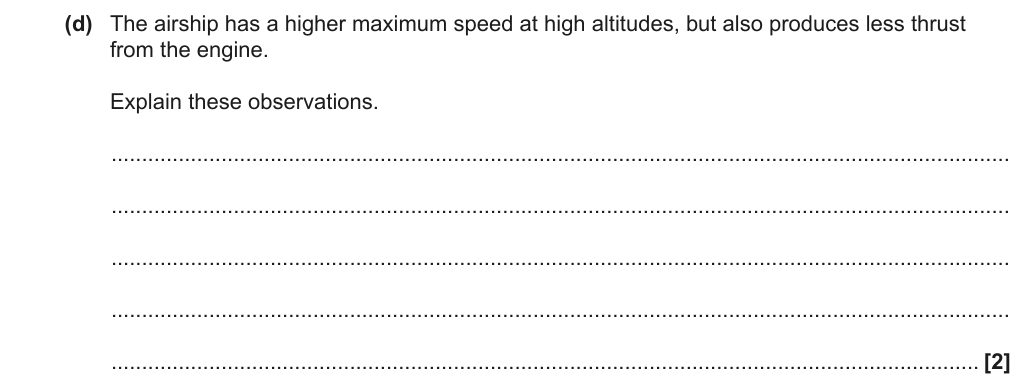
June 2023 · Paper 1 · Q20(d)2 marksExplanationEasy
Earlier parts of question 20 that this part uses
Mark scheme
Examiner's comment
Question 20 parts (c) and (d) group well here. Part (c) is similar in nature to previous questions about rate of change of momentum. We rejected the use of the idea F=ma as it is wrong physics, even though the numerical value is the same. The idea of rate of momentum transfer carries on in part (d). Most candidates correctly assumed that the density of air at high altitudes is much lower than at low altitudes. Many candidates implied that this meant a reduction in drag, which is correct. Far fewer correctly described the reduction of rate of change of momentum, causing less thrust.
Notes from the mark scheme and report
Candidates should take care to use technical language. In this question, responses that included ideas of ‘less air to push’ or ‘less mass moved per second’ are insufficient at A2 Level.
June 2023 · AS Paper 1 · Q24(a)3 marksCalculationMedium
Mark scheme
Examiner's comment
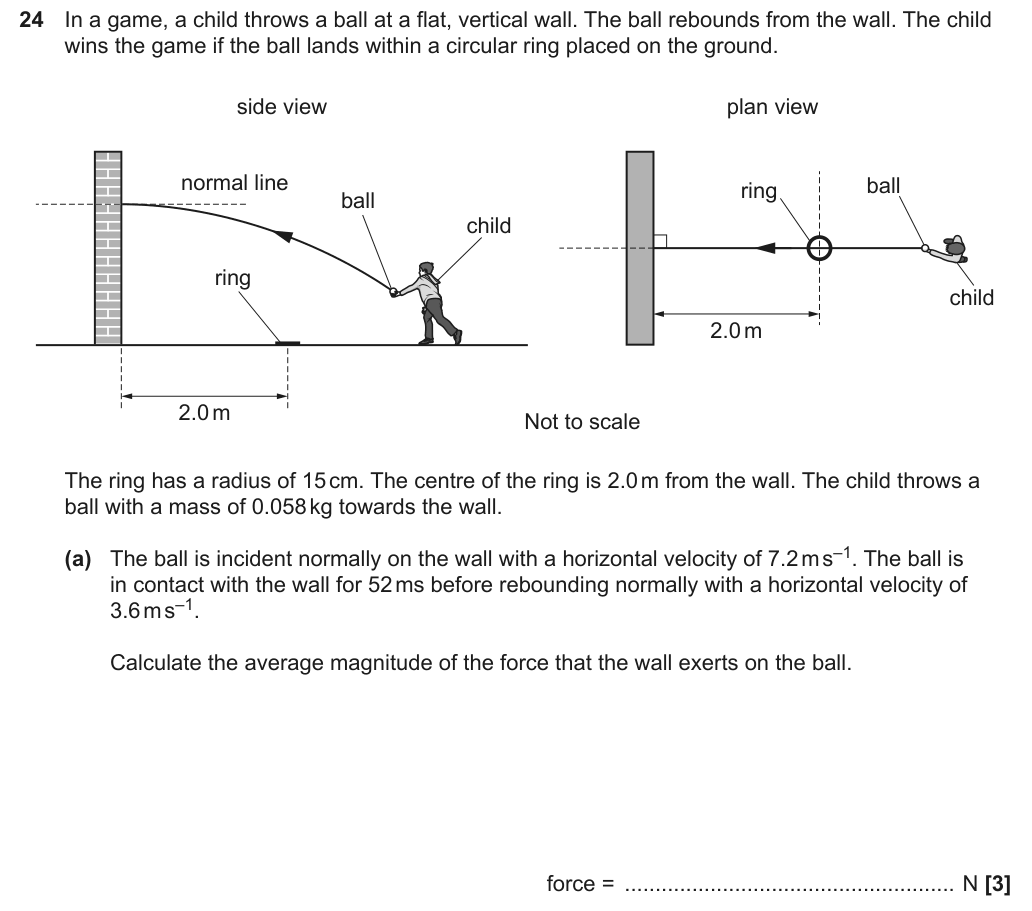
Over half of candidates correctly selected the equations F = p/t and p = mv to calculate the average magnitude of the force but about a third of candidates did not understand vector notation and that the rebounding horizontal velocity 3.6 m s–1 was in the opposite direction to the incident horizontal velocity 7.2 m s–1. As a result they calculated the change in momentum as 0.058 × (7.2 – 3.6) leading to an incorrect value for the average magnitude of the force of 4.0 N.
Notes from the mark scheme and report
0.058 x (7.2 – 3.6)/0.052 = 4.0 N scores 1 mark (direction change ignored)
This question demonstrated a common misconception to apply vector notation for the quantity of momentum. To correctly answer this question candidates needed to apply understanding that momentum is a vector and hence the change in momentum was 0.058 × (7.2 – (-3.6).
Skills: M0.1 Recognise and make use of appropriate units in calculations; M2.3 Substitute numerical values into algebraic equations using appropriate units for physical quantities
June 2023 · AS Paper 2 · Q3(d)2 marksExplanationMedium
Earlier part of question 3 that this part uses
Mark scheme
Examiner's comment
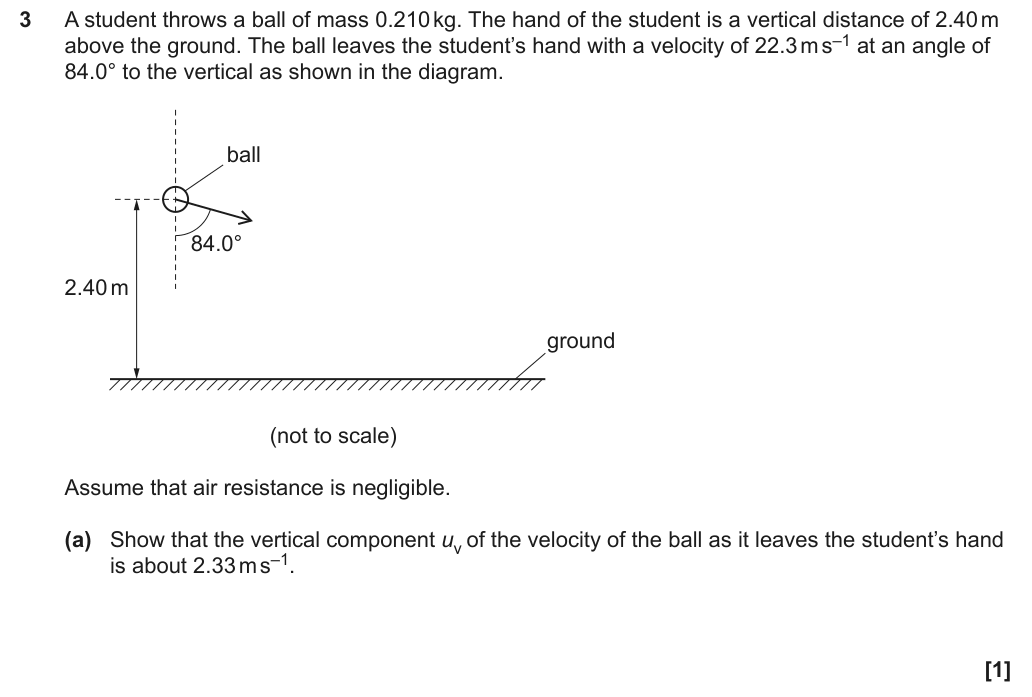
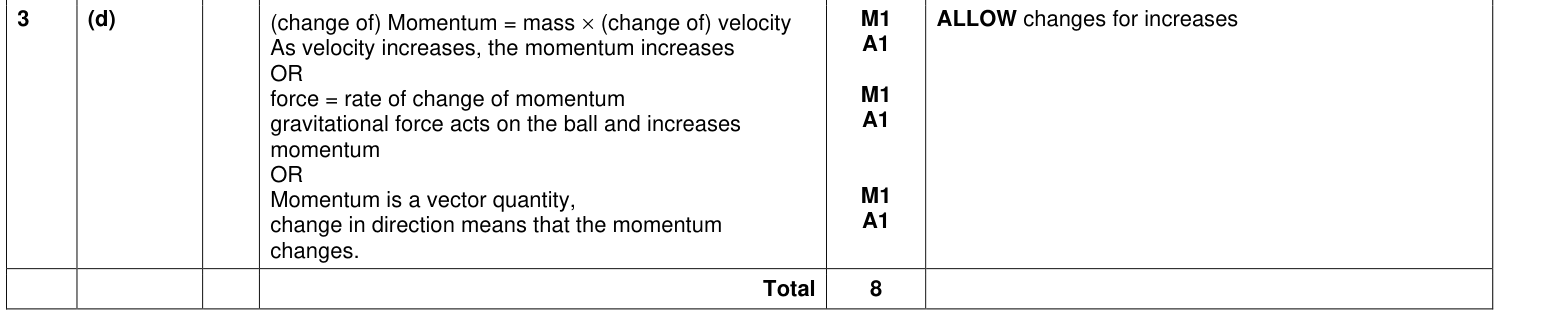
There are many possible explanations as to why the momentum of the ball changes. To score full marks candidates needed to state a property of momentum, e.g. momentum = mass velocity before then explaining why the momentum would change, e.g. as the ball falls, velocity increases so for constant mass the momentum increases.
Notes from the mark scheme and report
allow changes for increases
velocity increases, or weight is a resultant force, or direction changes (vector)
June 2023 · Paper 3 · Q4(a)3 marksExplanationMedium
Mark scheme
Examiner's comment
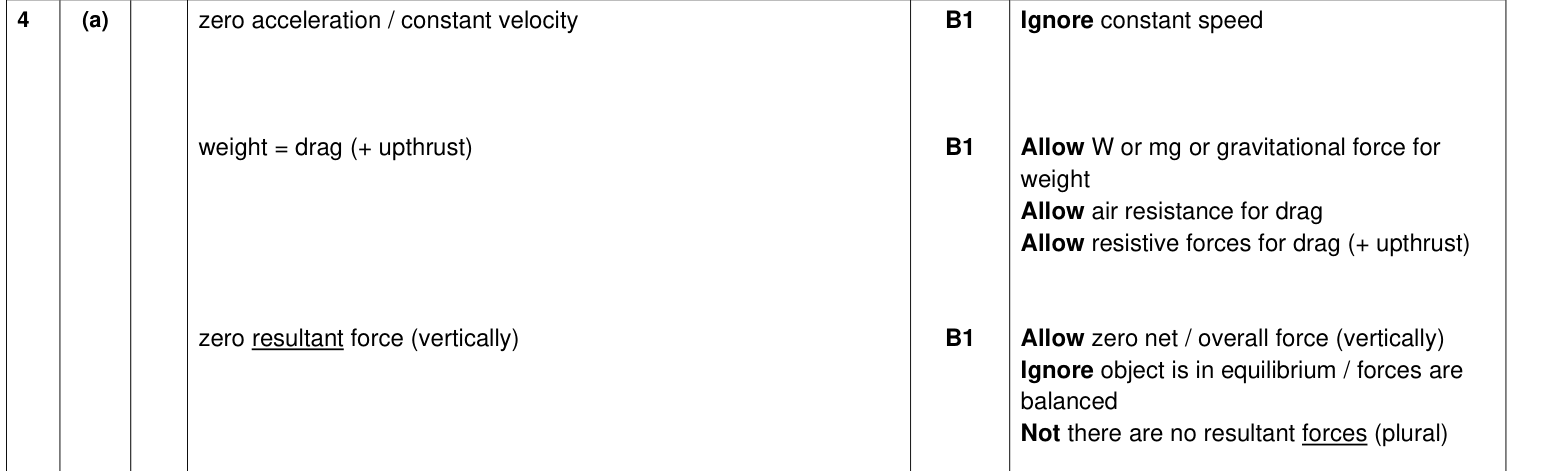
It is important to read the question carefully here. Many candidates spent unnecessary time describing how an object which has been dropped from rest reaches terminal velocity, which was not required. There were several cases of careless terminology. For example, candidates often said that forces were balanced or matched (rather than equal and opposite), or that acceleration of gravity was the same as the drag force, or that acceleration was constant (rather than zero).
Notes from the mark scheme and report
ignore constant speed
ignore 'in equilibrium / forces are balanced'
NOT 'there are no resultant forces'
June 2022 · Paper 1 · Q18(a)(ii)2 marksCalculationMedium
Earlier part of question 18 that this part uses
Mark scheme
Examiner's comment
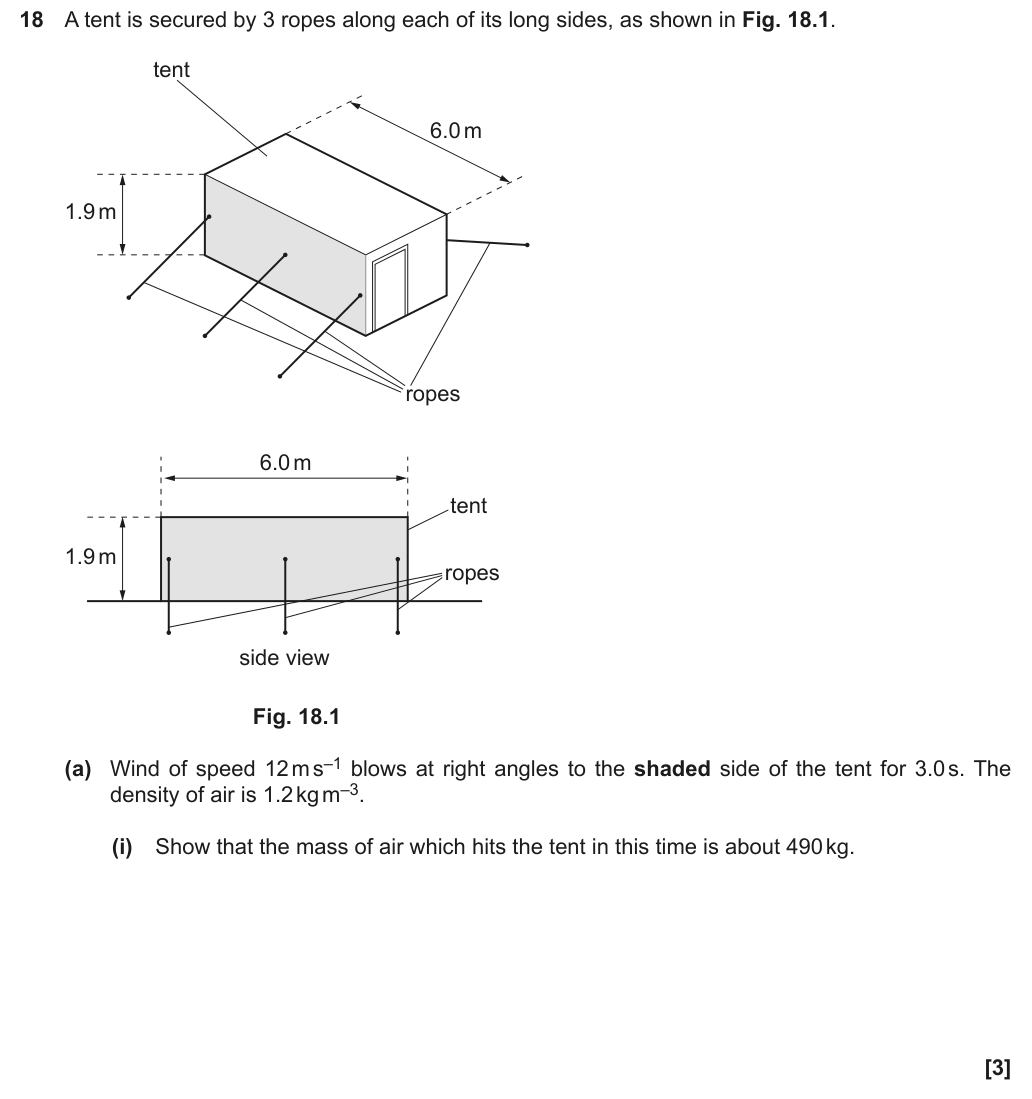
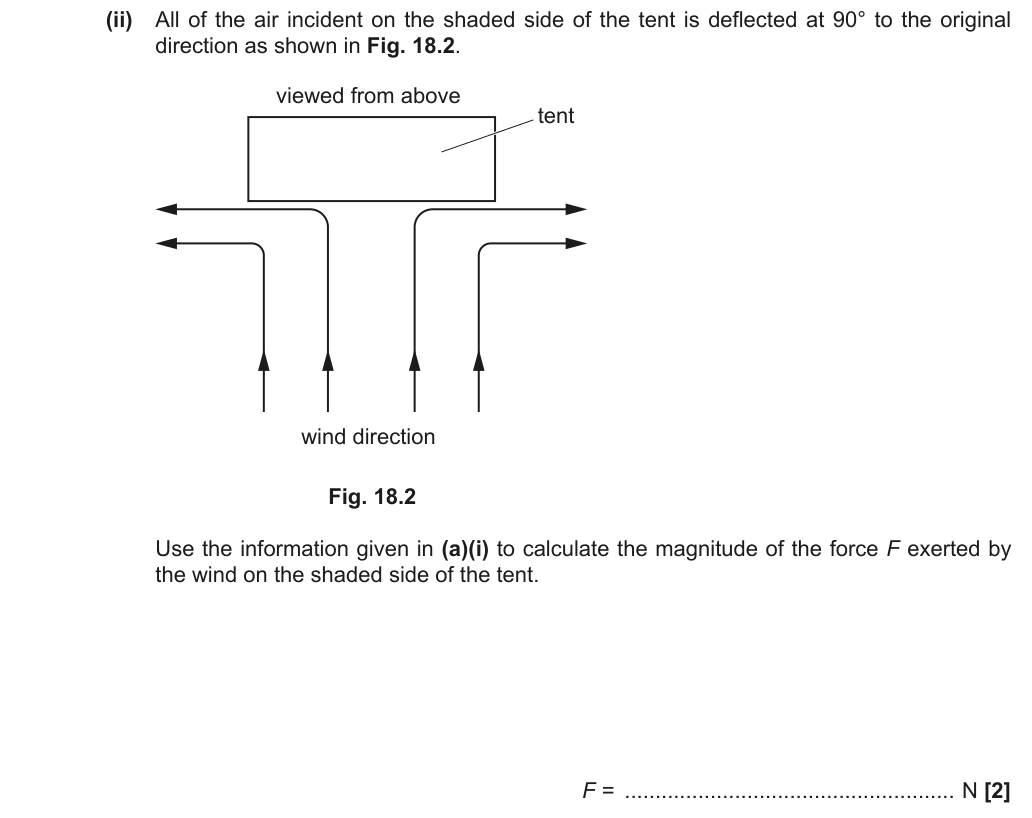
Question 18 (a) (i - ii) Candidate’s answers to this part were either jumbled or grounded in incorrect physics.
Notes from the mark scheme and report
answer 1970 or 1960 to 3 sf
Skills: M2.3 Substitute numerical values into algebraic equations using appropriate units for physical quantities
June 2022 · Paper 1 · Q18(b)6 marks6-mark extended responseMedium
Earlier parts of question 18 that this part uses
Mark scheme, with the levels and indicative content
Examiner's comment
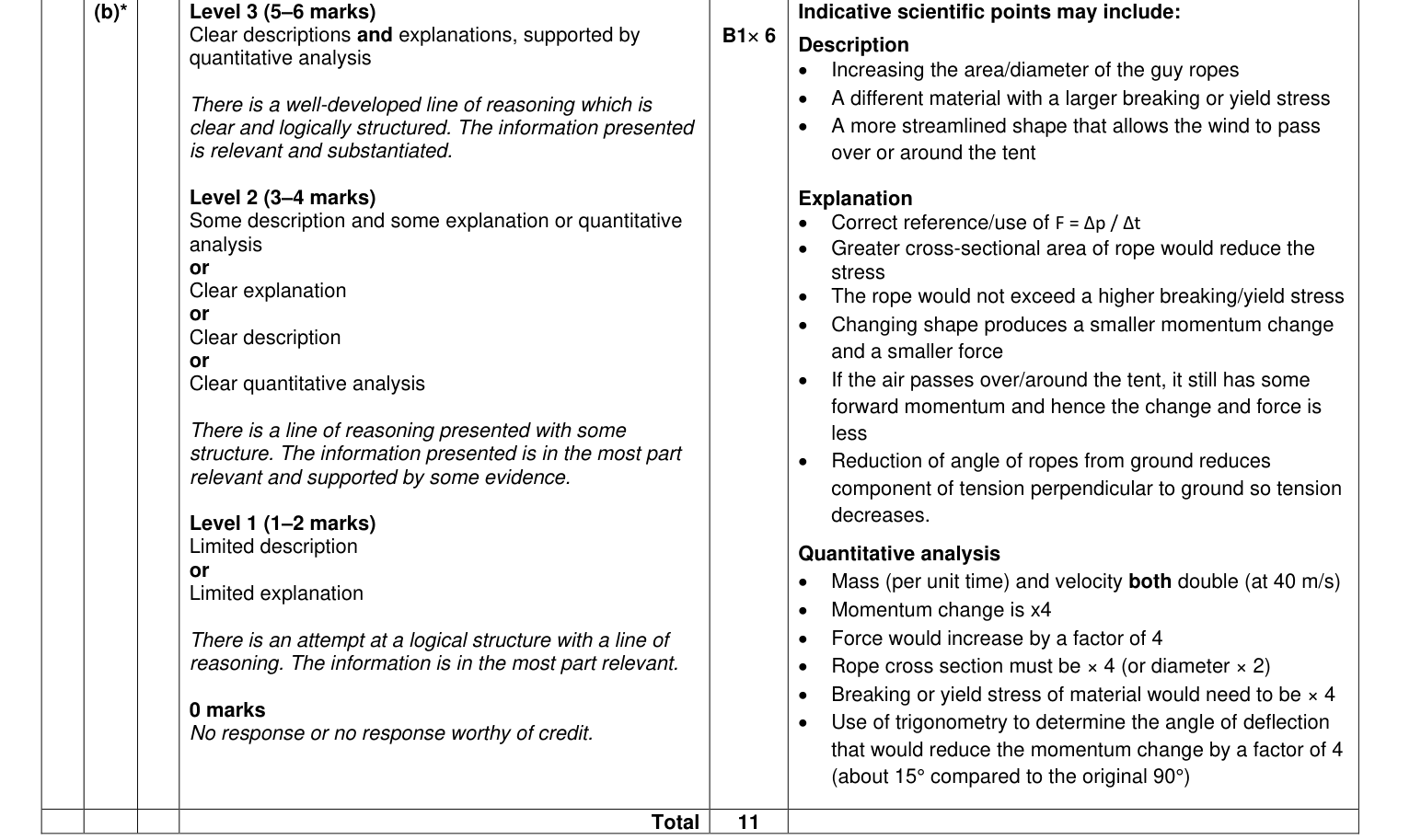
This question tested ideas about forces, resolution of forces, behaviour of materials under stress and rate of change of momentum transfer. Level 1 answers were restricted to merely suggestions of what could be done to make the support of the tent stronger. Level 2 answers developed at least one of those suggestions by referring, qualitatively, to the underlying physics. Level 3 answers were rare, as the requirement was for some quantitative physics. Candidates that attempted a quantitative answer often believed that the force would be doubled, when in fact it is quadrupled. This is because both the mass of the air depends on the velocity of air, so doubling the speed will also double the mass, thus quadrupling the momentum transfer. This candidate clearly states, on lines 3-5, that the force is directly proportional to the square of the speed by thinking about their answers to previous parts of the question. The statements following this, after the page break, are sensible and grounded in physics in topics typically covered in the first year of study. The candidate mentions about quadrupling the number of ropes and reducing the area presented to the wind by a factor of four. The candidate goes on, in the additional answer space, to refer to the thickness of the ropes and how the radius would need to double. Level 3 response.
Notes from the mark scheme and report
force is x4 at 40 m s-1 (mass per second and velocity both double), so rope area x4 or breaking stress x4
Skills: M0.3 Use ratios, fractions and percentages
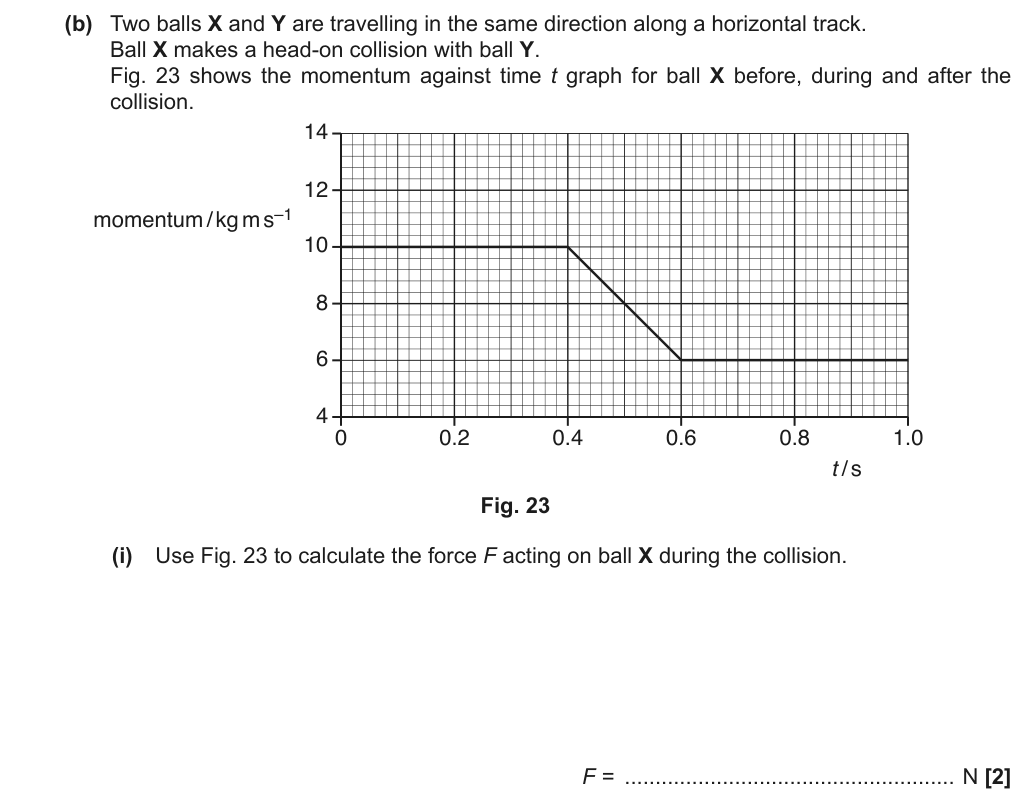
June 2022 · AS Paper 1 · Q23(a)2 marksExplanationHard
Mark scheme
Examiner's comment
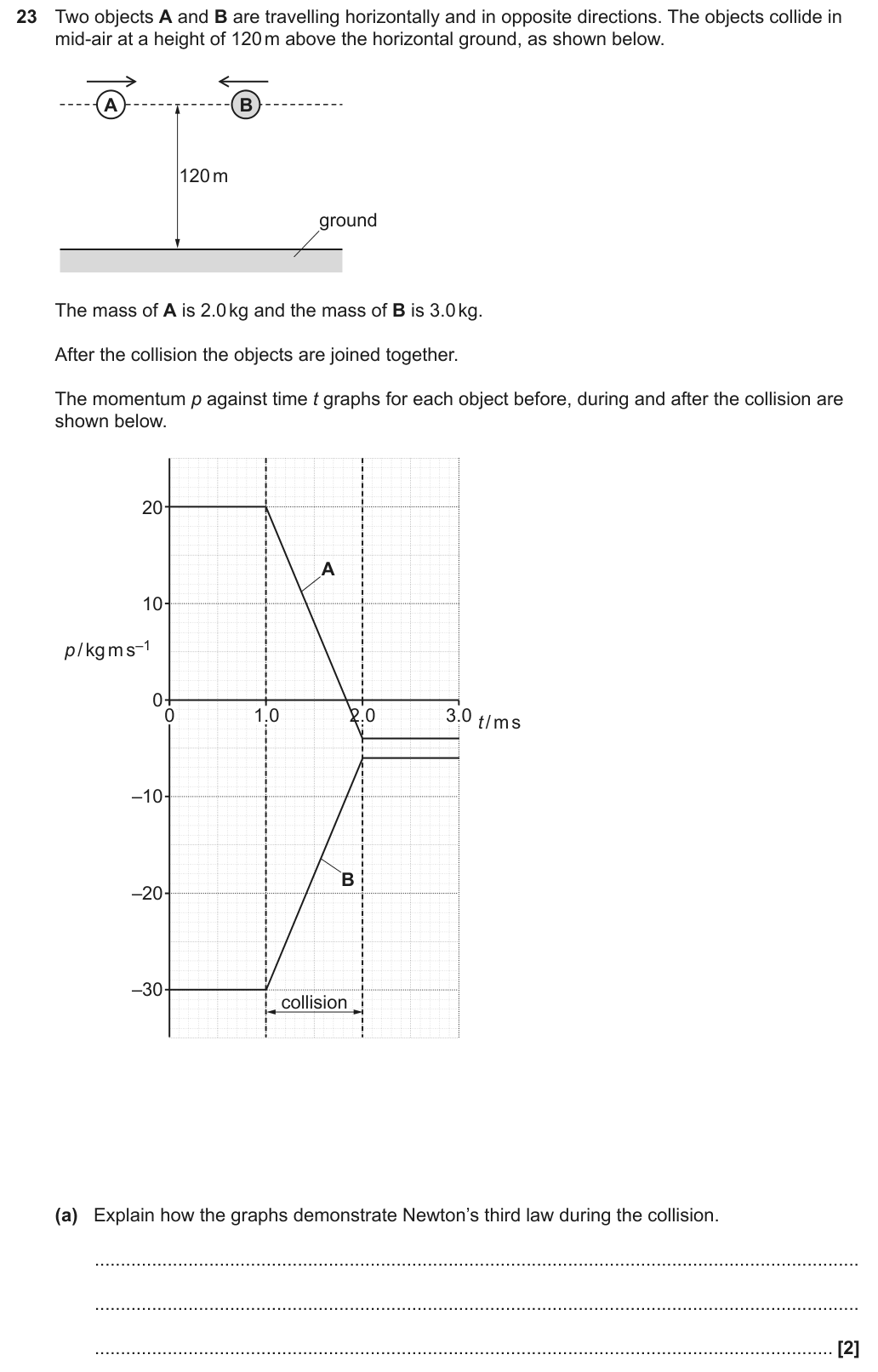
Candidates performed less well on this question as half of candidates were not given any marks. To access both marks candidates had to refer to the graph but very few candidates applied their knowledge of Newton’s Laws to determine that the gradient of the graph represented the force acting on objects A and B during the collision. Some candidates referred to the graph but only in terms of the change in momentum with no reference to time. If candidates made no reference to the graph, they could access 1 mark for giving a correct definition of Newton’s 3rd Law for the two objects but quite often the definition was vague and incomplete (see misconceptions) so no marks were given. This response demonstrates a clear understanding of Newton’s 3rd Law and that the force acting during the collision is the gradient of the graph. This exemplar demonstrates a middle range and higher end response from candidates.
Notes from the mark scheme and report
Ignore 'change in momentum is the same for A and B'
1 mark max if no reference to the graph
Ignore POT in gradient calculations
The most common definition for Newton’s 3rd Law was ‘every action has an equal and opposite reaction.’
Skills: M3.4 Determine the slope and intercept of a linear graph; M3.5 Calculate rate of change from a graph showing a linear relationship
June 2022 · AS Paper 1 · Q23(b)2 marksShow thatMedium
Earlier part of question 23 that this part uses
Mark scheme
Examiner's comment
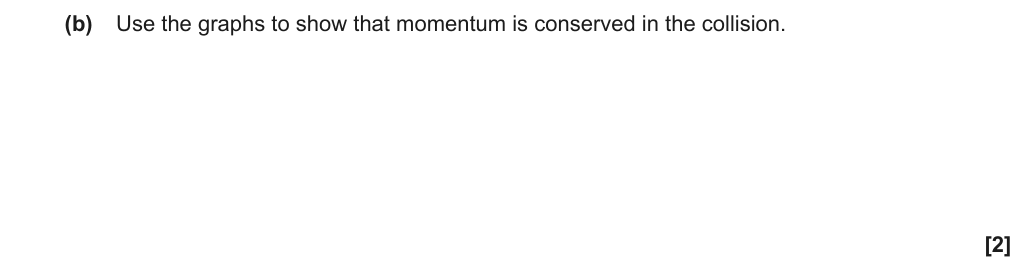
Most candidates performed well on this question as they used the graph to show that the total momentum before and after the collision for objects A and B was conserved and that the values were the same. If marks were not given it was generally because candidates had not followed on with and carried out a simple calculation even though they had read the correct momentum values from the graph.
June 2022 · AS Paper 1 · Q23(c)2 marksCalculationMedium
Earlier part of question 23 that this part uses
Mark scheme
Examiner's comment
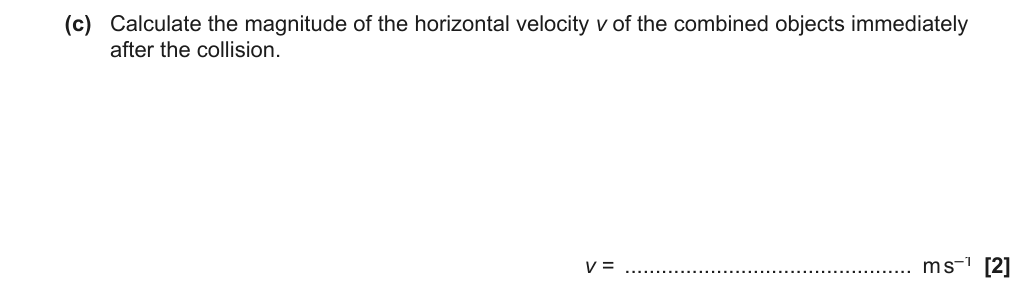
About half of candidates were given 2 marks for correctly calculating the velocity of objects A and B combined after the collision. Most candidates used an expression for the momentum of the combined objects (5v) and equated this to the total momentum of the two objects before the collision (10 kg m s–1). A significant number of candidates did not apply the conservation of momentum correctly and used a momentum value from the graph or didn’t use the combined mass of the objects A and B.
Notes from the mark scheme and report
Ignore sign
2 (1 sf) allowed
Skills: M2.3 Substitute numerical values into algebraic equations using appropriate units for physical quantities; M3.1 Translate information between graphical, numerical and algebraic forms
November 2021 · AS Paper 1 · Q141 markMultiple choice
Answer
B
Mark scheme
November 2021 · Paper 1 · Q16(b)(i)1 markCalculation
Mark scheme
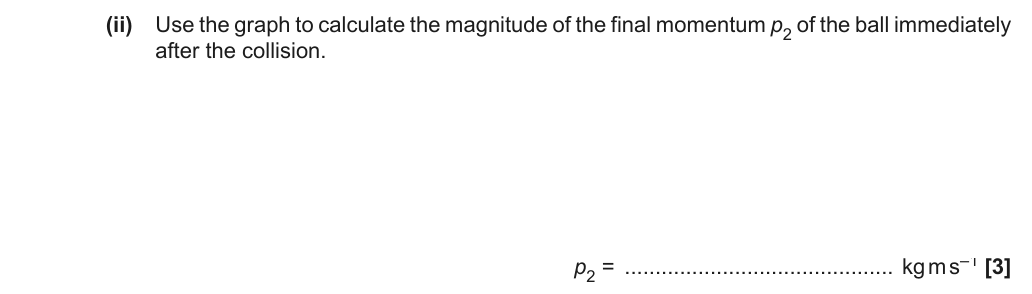
November 2021 · Paper 1 · Q16(b)(ii)3 marksCalculation
Earlier part of question 16 that this part uses
Mark scheme
Notes from the mark scheme and report
Ignore sign
0.52 scores 2
ecf from (b)(i)
Skills: M2.2 Change the subject of an equation, including non-linear equations; M3.8 Understand the possible physical significance of the area between a curve and the x axis and be able to calculate it or estimate it by graphical methods as appropriate; M4.3 Calculate areas of triangles, circumferences and areas of circles, surface areas and volumes of rectangular blocks, cylinders and spheres
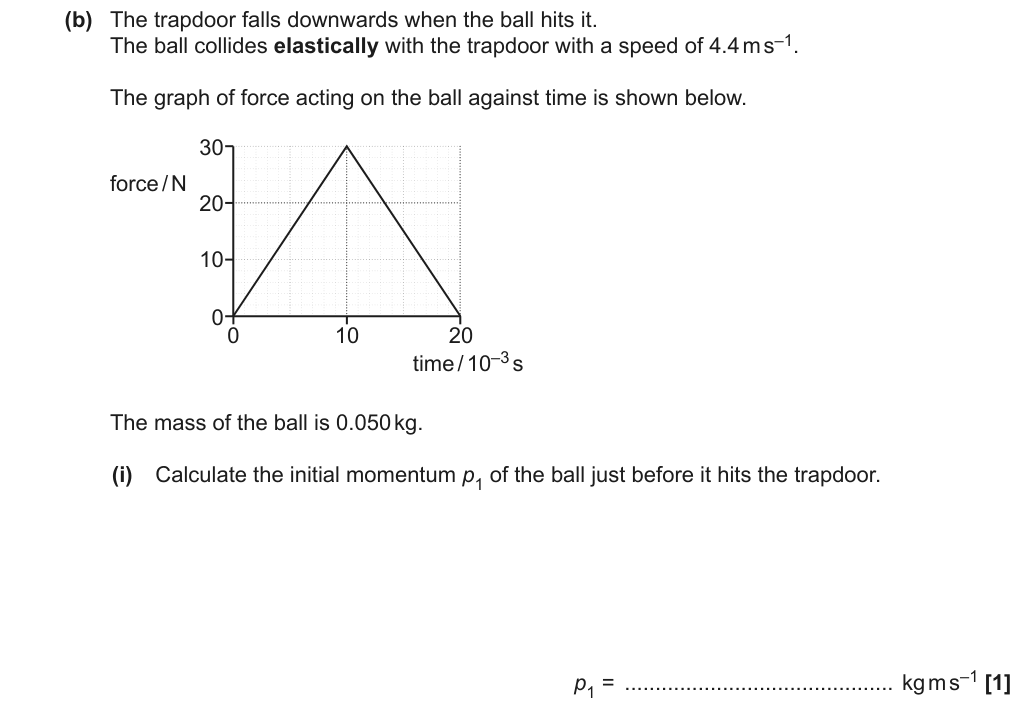
November 2021 · Paper 1 · Q16(b)(iii)2 marksCalculationMedium
Earlier parts of question 16 that this part uses
Mark scheme
Examiner's comment
In Q16(b)(iii), the momentum of the trapdoor is not equal to the final momentum of the ball but is equal to the impulse provided to the ball by the trapdoor (albeit in the opposite direction to that of the rebounding ball).
Notes from the mark scheme and report
momentum gained by trapdoor = 0.30 kg m s-1
conservation of energy methods (2.9) allowed
1 sf answer allowed
Skills: M2.3 Substitute numerical values into algebraic equations using appropriate units for physical quantities
November 2021 · AS Paper 1 · Q201 markMultiple choice
Answer
C
Mark scheme
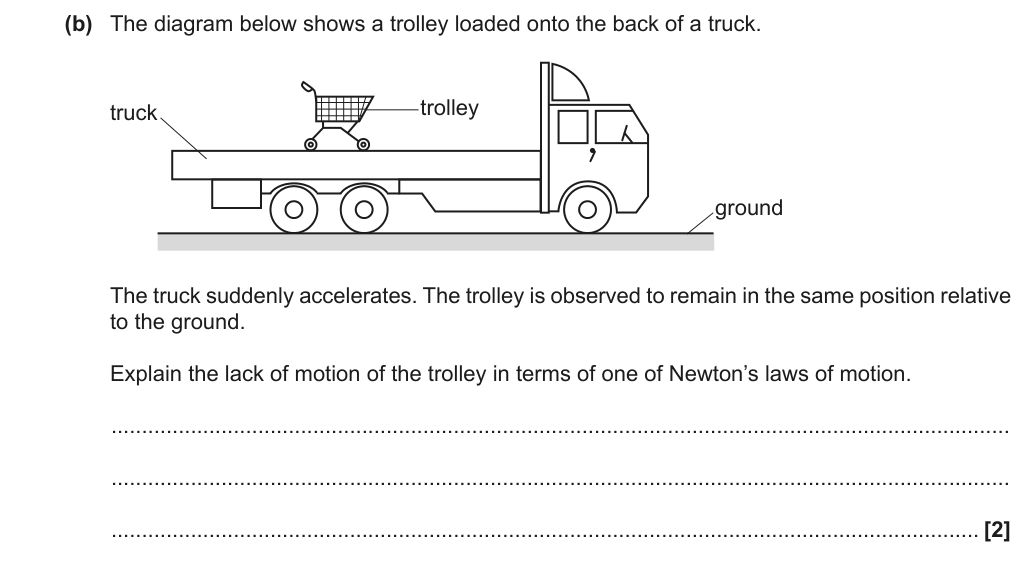
November 2021 · AS Paper 1 · Q21(b)2 marksExplanation
Mark scheme
Notes from the mark scheme and report
must be in terms of first or second law with no / negligible resultant force on the trolley
November 2021 · AS Paper 1 · Q21(c)(ii)3 marksCalculation
Earlier part of question 21 that this part uses
Mark scheme
Notes from the mark scheme and report
ecf from (c)(i)
allow 2850 to 3150
unit kg m s-2 or N
Skills: M0.1 Recognise and make use of appropriate units in calculations; M2.3 Substitute numerical values into algebraic equations using appropriate units for physical quantities
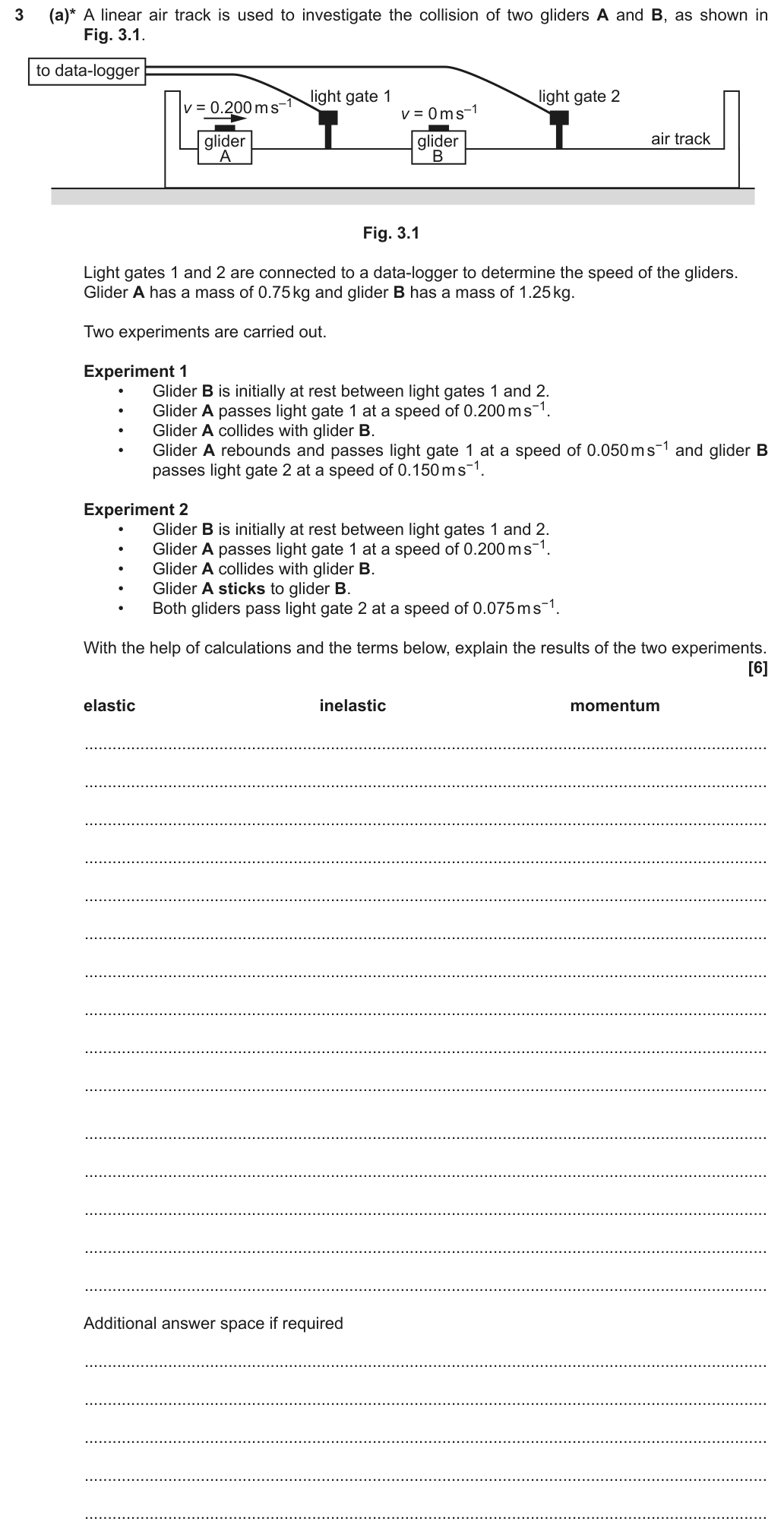
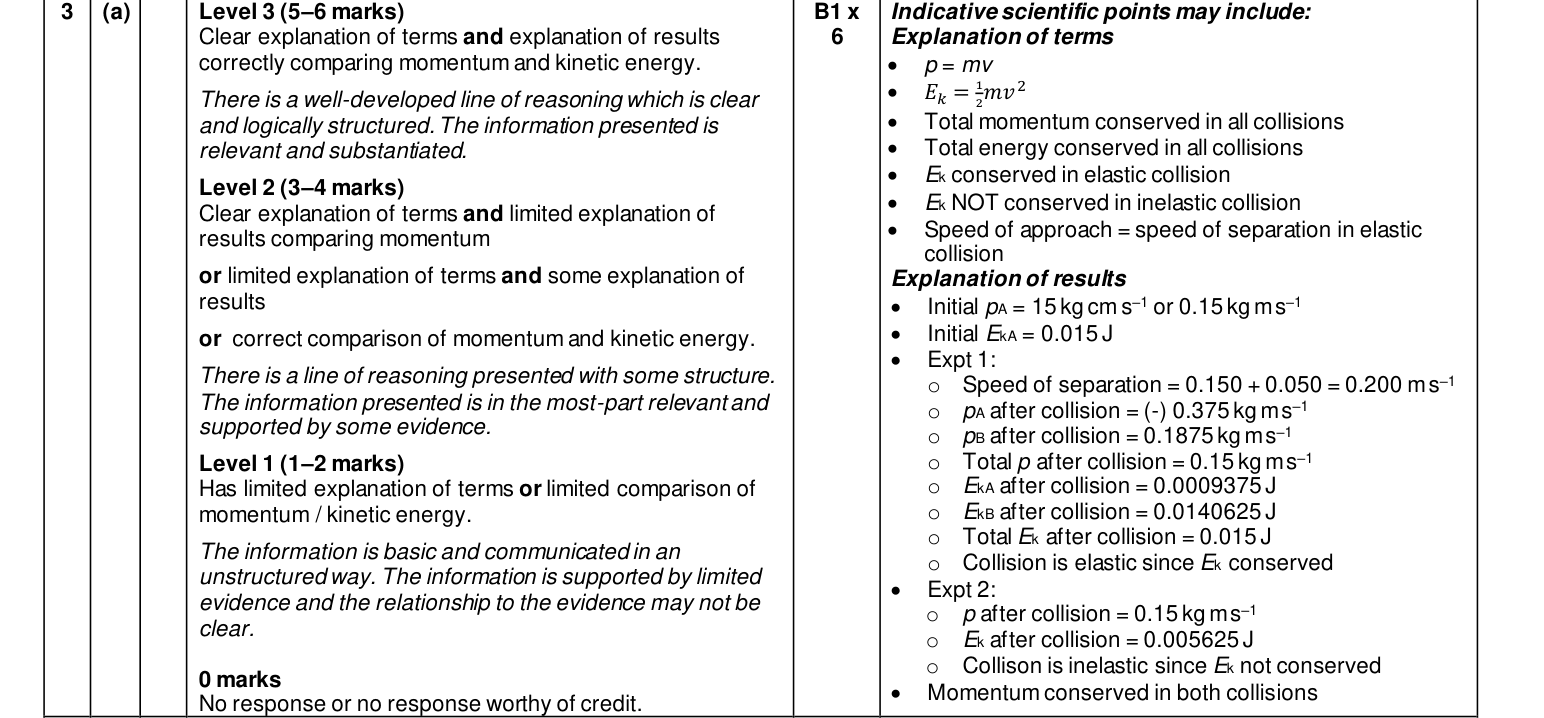
November 2021 · AS Paper 2 · Q3(a)6 marks6-mark extended response
Mark scheme, with the levels and indicative content
Notes from the mark scheme and report
momentum conserved in both collisions
kinetic energy conserved only in experiment 1 (elastic)
Skills: M2.3 Substitute numerical values into algebraic equations using appropriate units for physical quantities; PAG1 Investigating motion
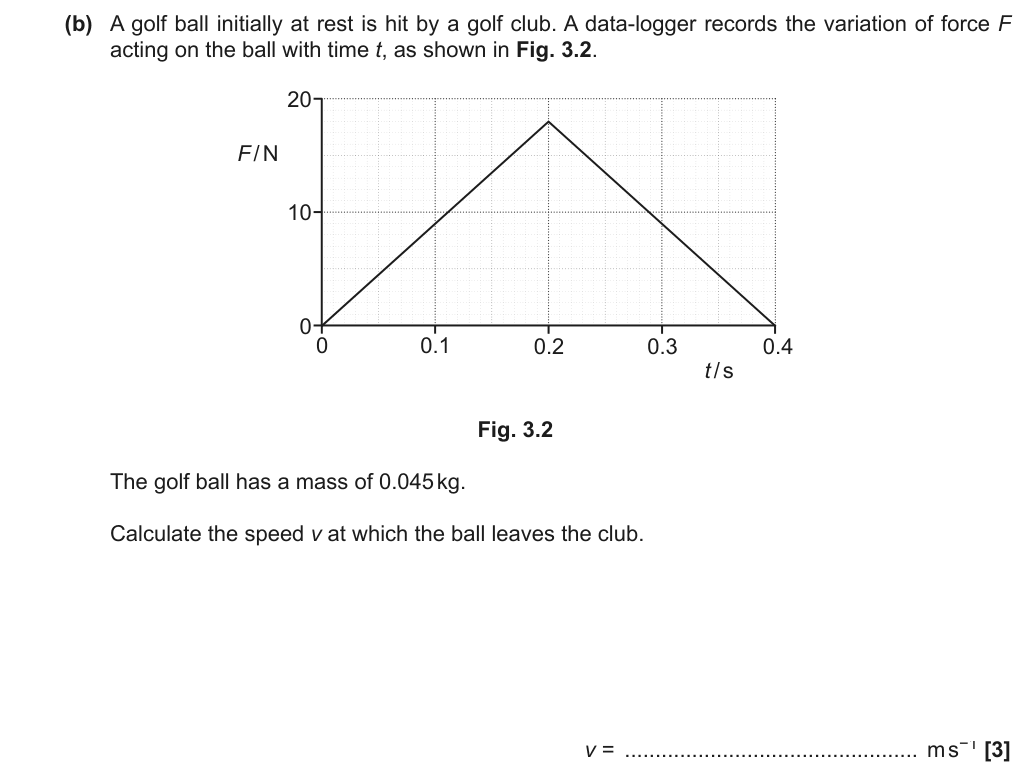
November 2021 · AS Paper 2 · Q3(b)3 marksCalculation
Mark scheme
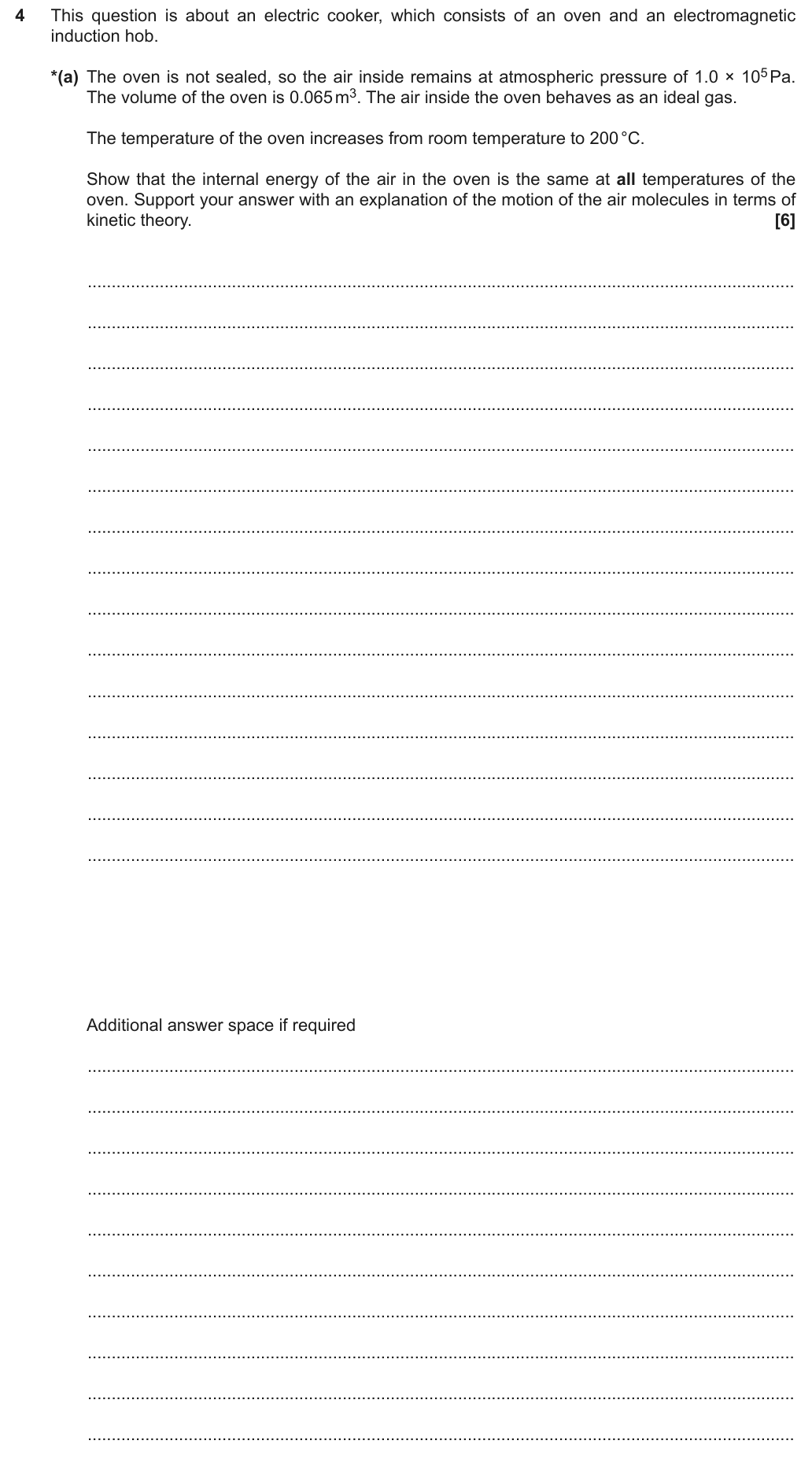
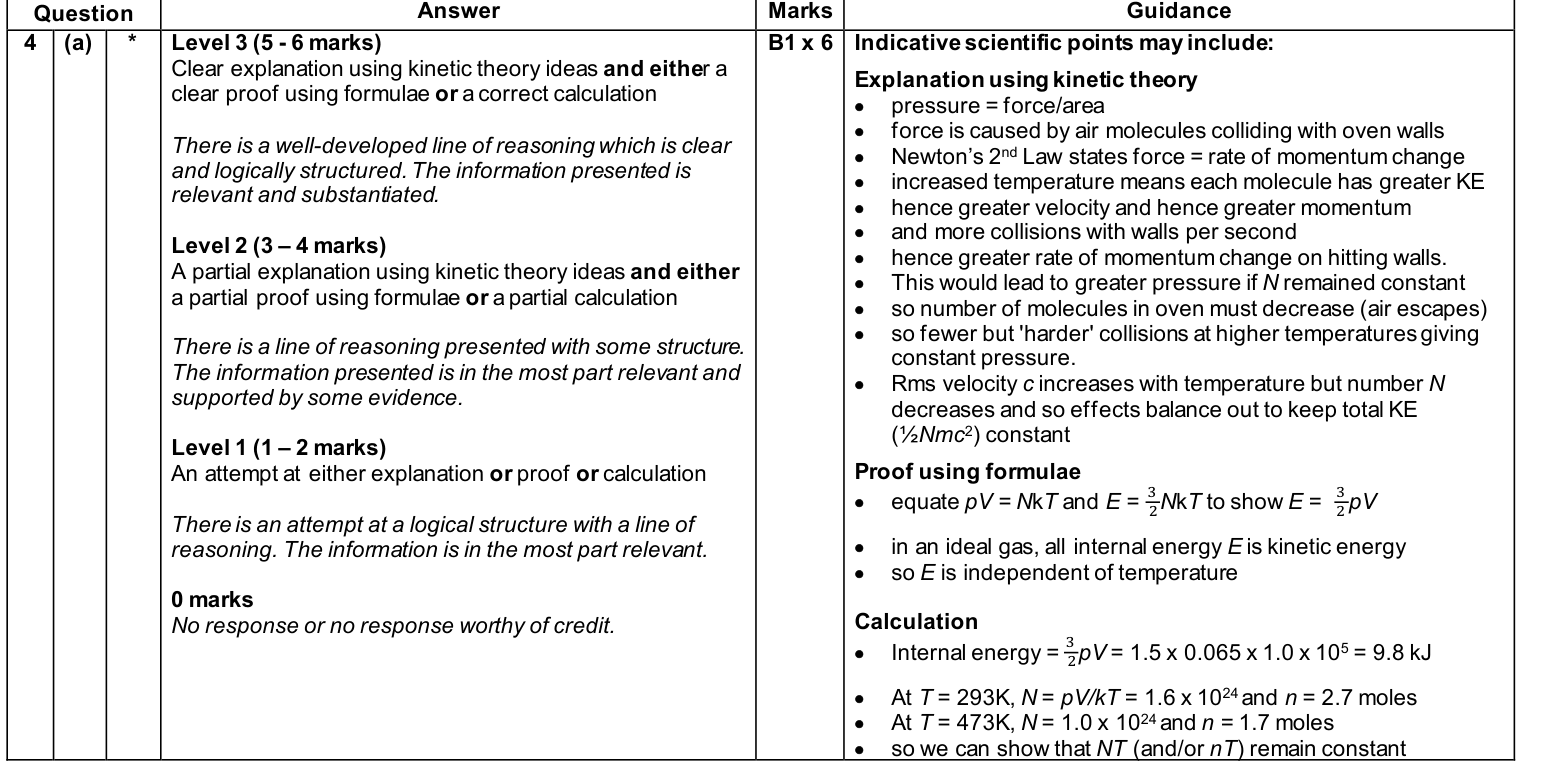
November 2021 · Paper 3 · Q4(a)6 marks6-mark extended response
Mark scheme, with the levels and indicative content
Notes from the mark scheme and report
E = (3/2)NkT and pV = NkT give E = (3/2)pV = 9.8 kJ, independent of T
number of molecules falls as air escapes (NT constant)
needs kinetic theory explanation plus proof or calculation
Skills: M2.2 Change the subject of an equation, including non-linear equations; M2.3 Substitute numerical values into algebraic equations using appropriate units for physical quantities
November 2020 · AS Paper 1 · Q71 markMultiple choice
Answer
C
Mark scheme
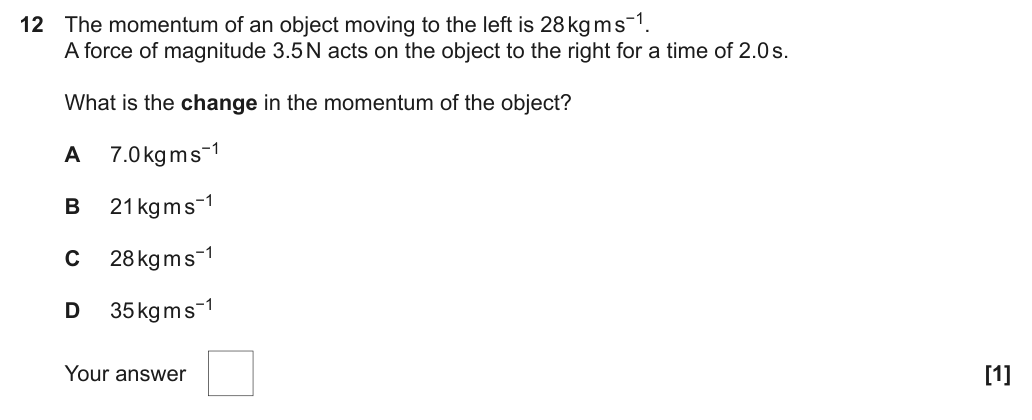
November 2020 · AS Paper 1 · Q121 markMultiple choiceMedium
Answer
A
Mark scheme
Examiner's comment
Other questions, such as Question 12 on impulse = change in momentum, requires a bit more thinking and solving time.
November 2020 · Paper 1 · Q16(c)1 markCalculation
Earlier parts of question 16 that this part uses
Mark scheme
Notes from the mark scheme and report
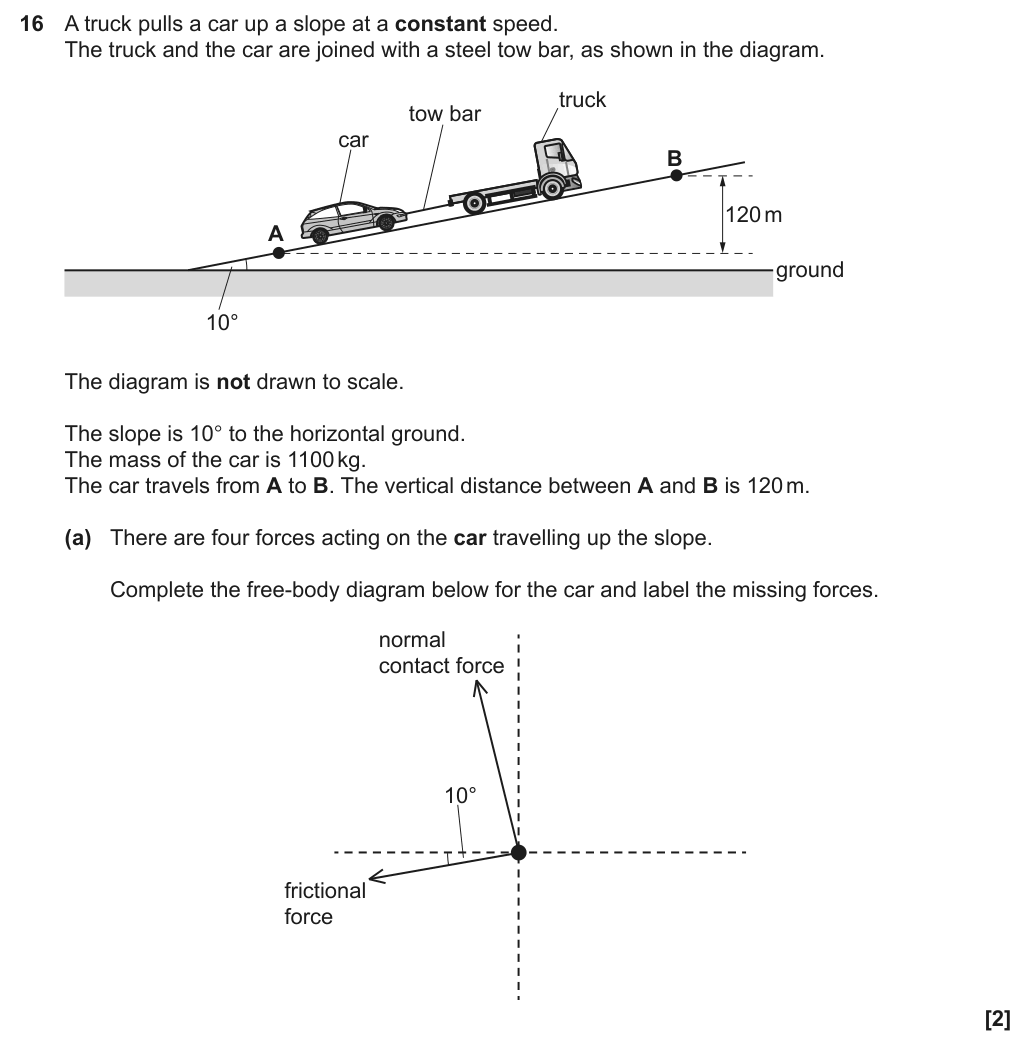
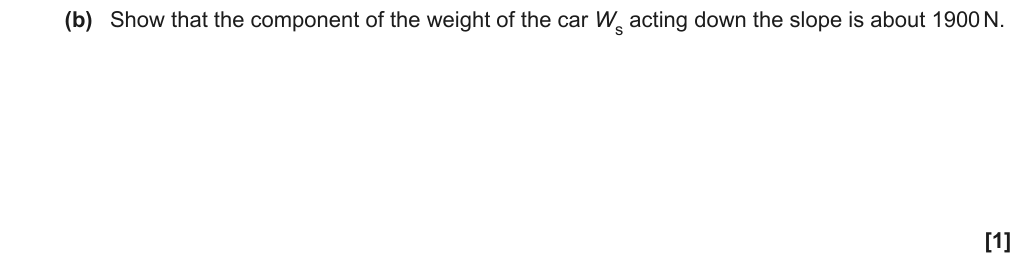
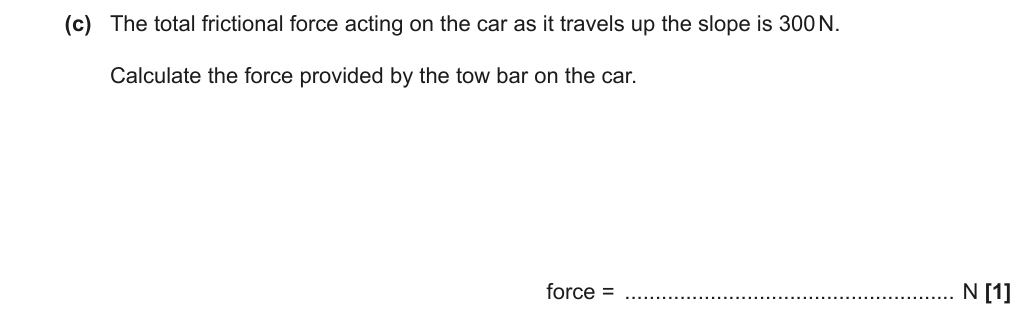
allow 1870 + 300 = 2170 N
November 2020 · Paper 1 · Q18(d)(ii)2 marksExplanation
Earlier part of question 18 that this part uses
Mark scheme
Notes from the mark scheme and report
NOT goes backwards
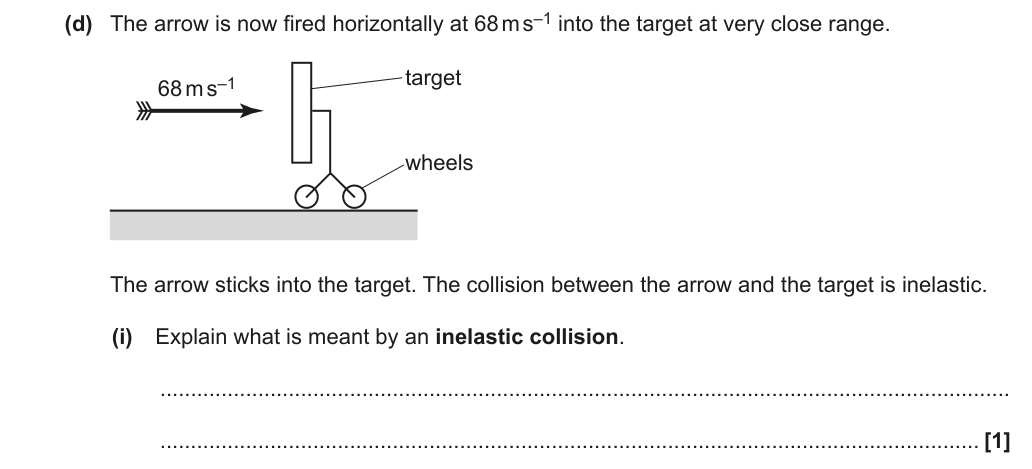
velocity in direction of arrow and much smaller than 68 m s-1
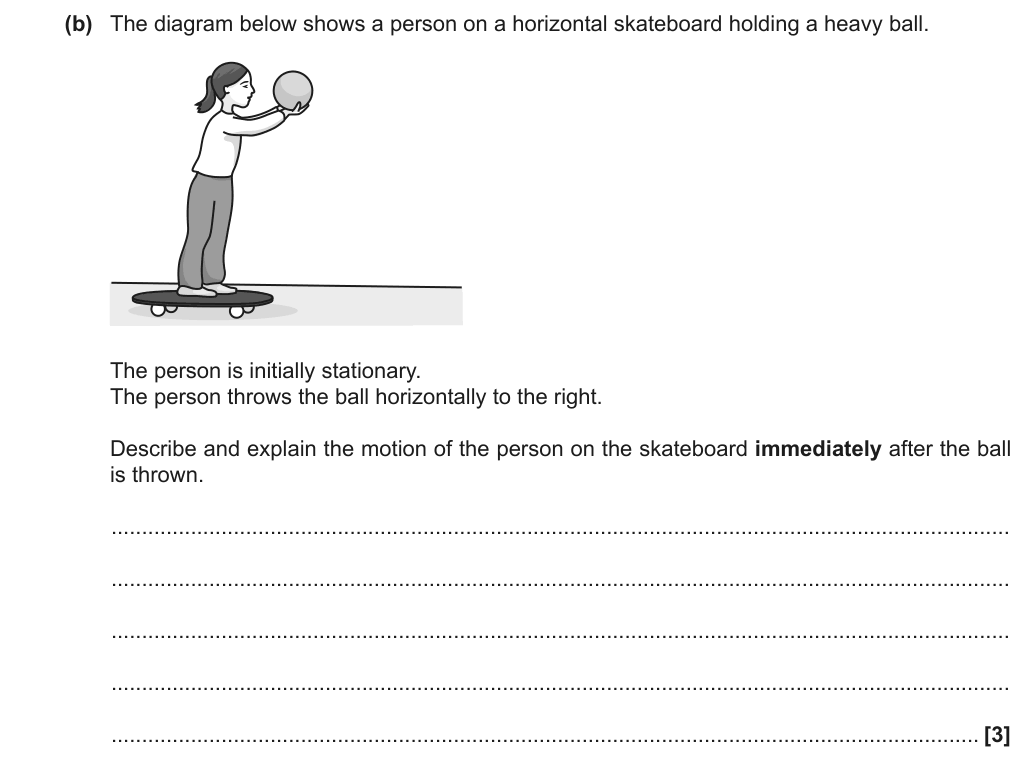
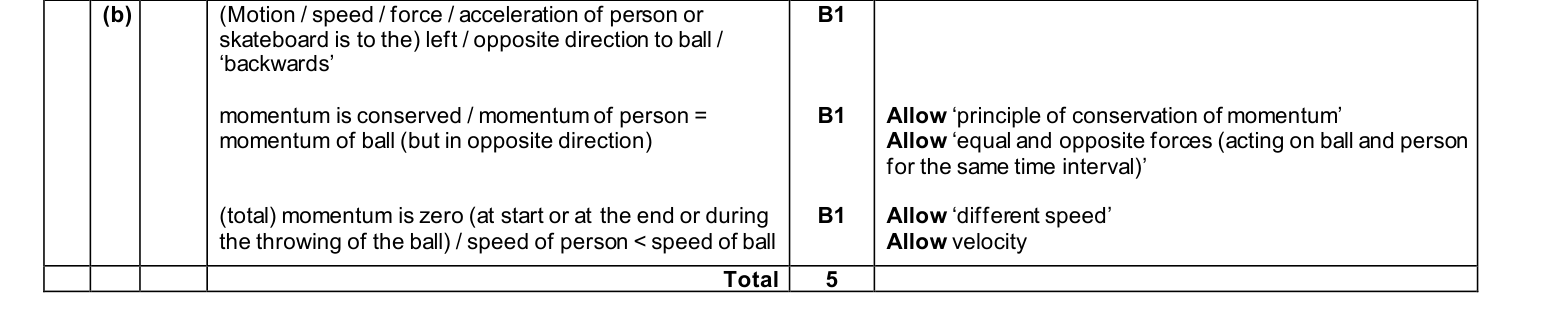
November 2020 · AS Paper 1 · Q21(b)3 marksExplanationMedium
Mark scheme
Examiner's comment
Questions 21b, 23bii, 27b and 28a. • showed too much detail when answering numerical MCQs – this was both time- consuming, and unnecessary when most calculations could have been done on calculators • demonstrated poor recall of basic definitions and misunderstood key concepts, e.g. confusing work function and threshold frequency in the description of the photoelectric effect in 28a • did not define labels, or letters used in descriptive responses • truncated or rounded numbers prematurely within calculations, which led to incorrect final responses, e.g. Question 21b is all about the principle of conservation of momentum.
Notes from the mark scheme and report
allow equal and opposite forces acting on ball and person for the same time
allow 'different speed'
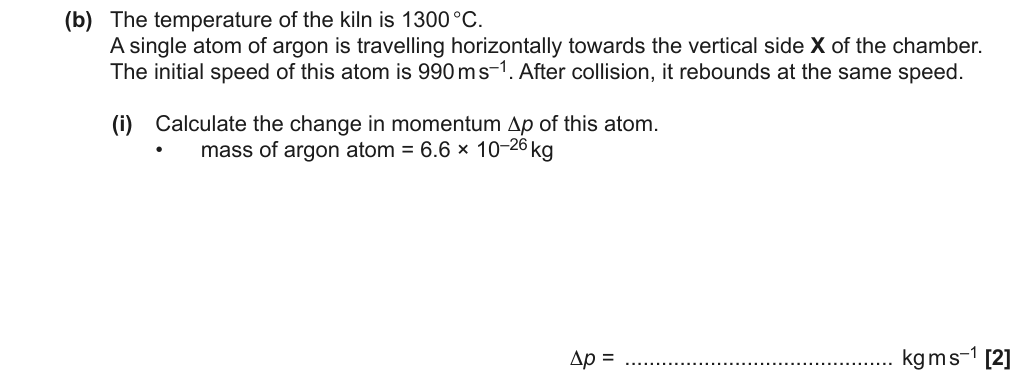
November 2020 · Paper 1 · Q21(b)(i)2 marksCalculationMedium
Mark scheme
Examiner's comment
Some candidates used degrees centigrade rather than kelvin as the unit of temperature for Question 21.
Notes from the mark scheme and report
change is 2mv (rebounds at same speed)
ignore sign
Skills: M0.2 Recognise and use expressions in decimal and standard form; M2.3 Substitute numerical values into algebraic equations using appropriate units for physical quantities
November 2020 · Paper 1 · Q21(b)(ii)3 marksShow thatMedium
Earlier parts of question 21 that this part uses
Mark scheme
Examiner's comment
Some candidates used degrees centigrade rather than kelvin as the unit of temperature for Question 21.
Notes from the mark scheme and report
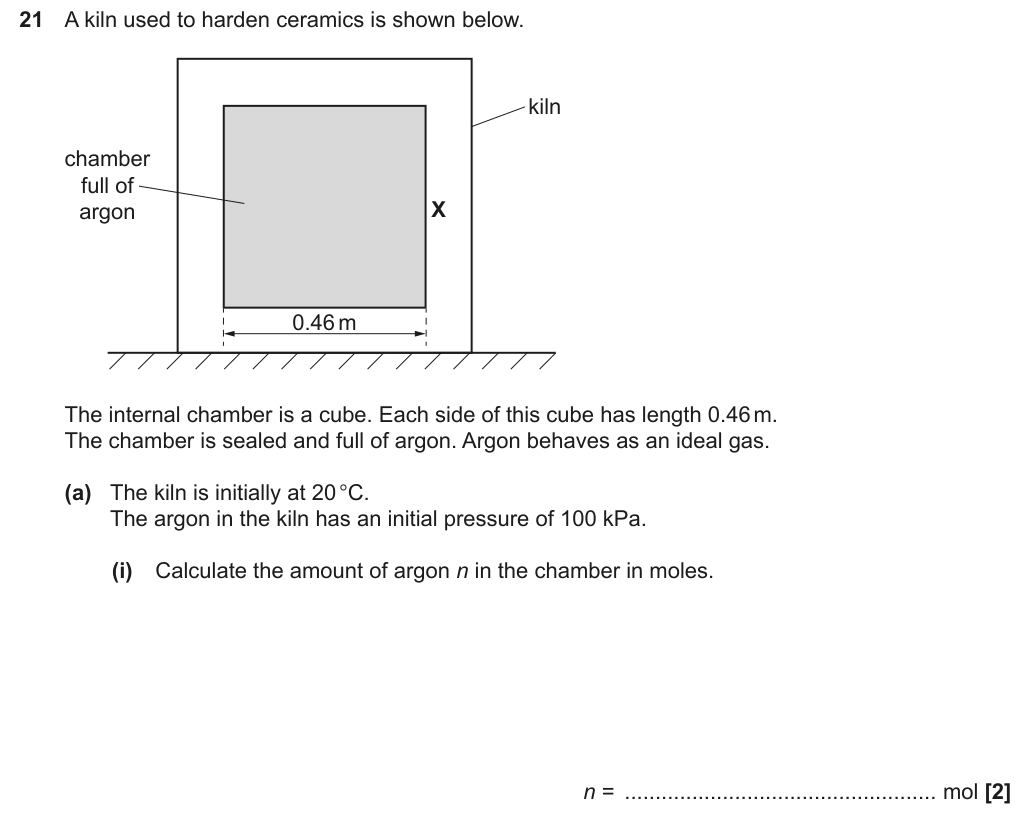
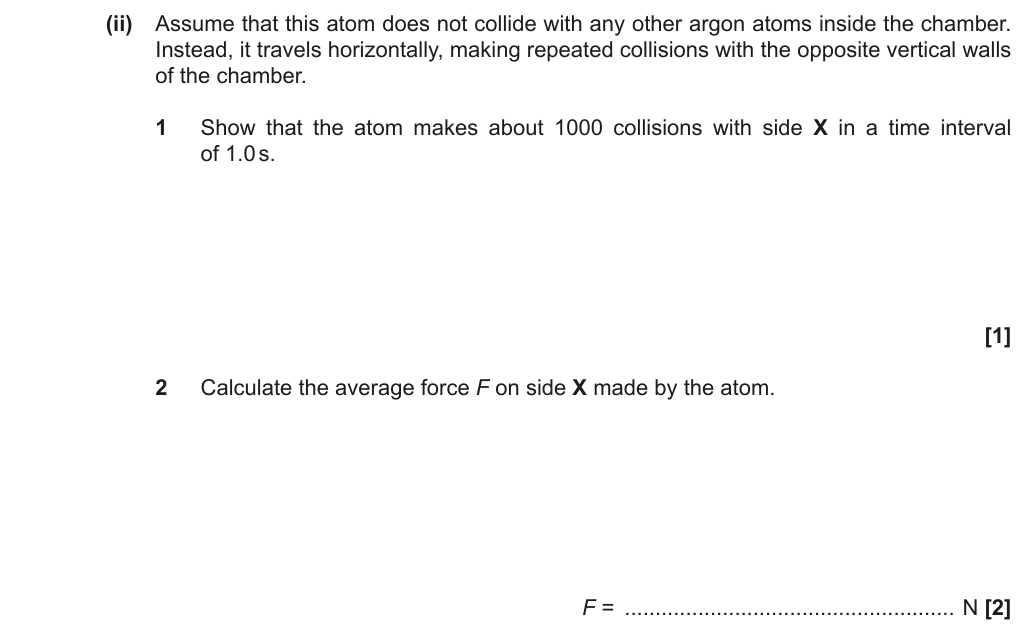
distance between collisions with X is 2 x 0.46 m
1080 gives 1.4 x 10⁻¹⁹ N
ecf from (b)(i)
Skills: M2.3 Substitute numerical values into algebraic equations using appropriate units for physical quantities
November 2020 · AS Paper 2 · Q86 marks6-mark extended responseMedium
Mark scheme, with the levels and indicative content
Examiner's comment
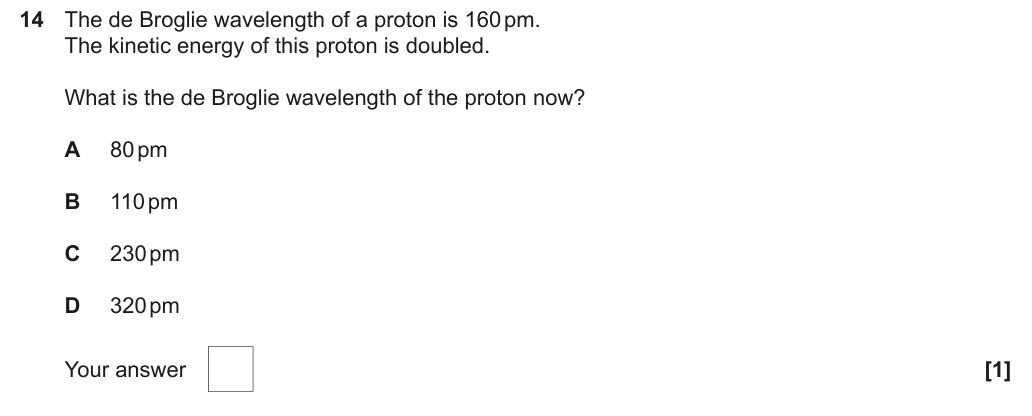
Comments on responses by question type Level of response questions The two LoR questions were Question 4 and Question 8. Question 8 tested an understanding of electron diffraction.
Notes from the mark scheme and report
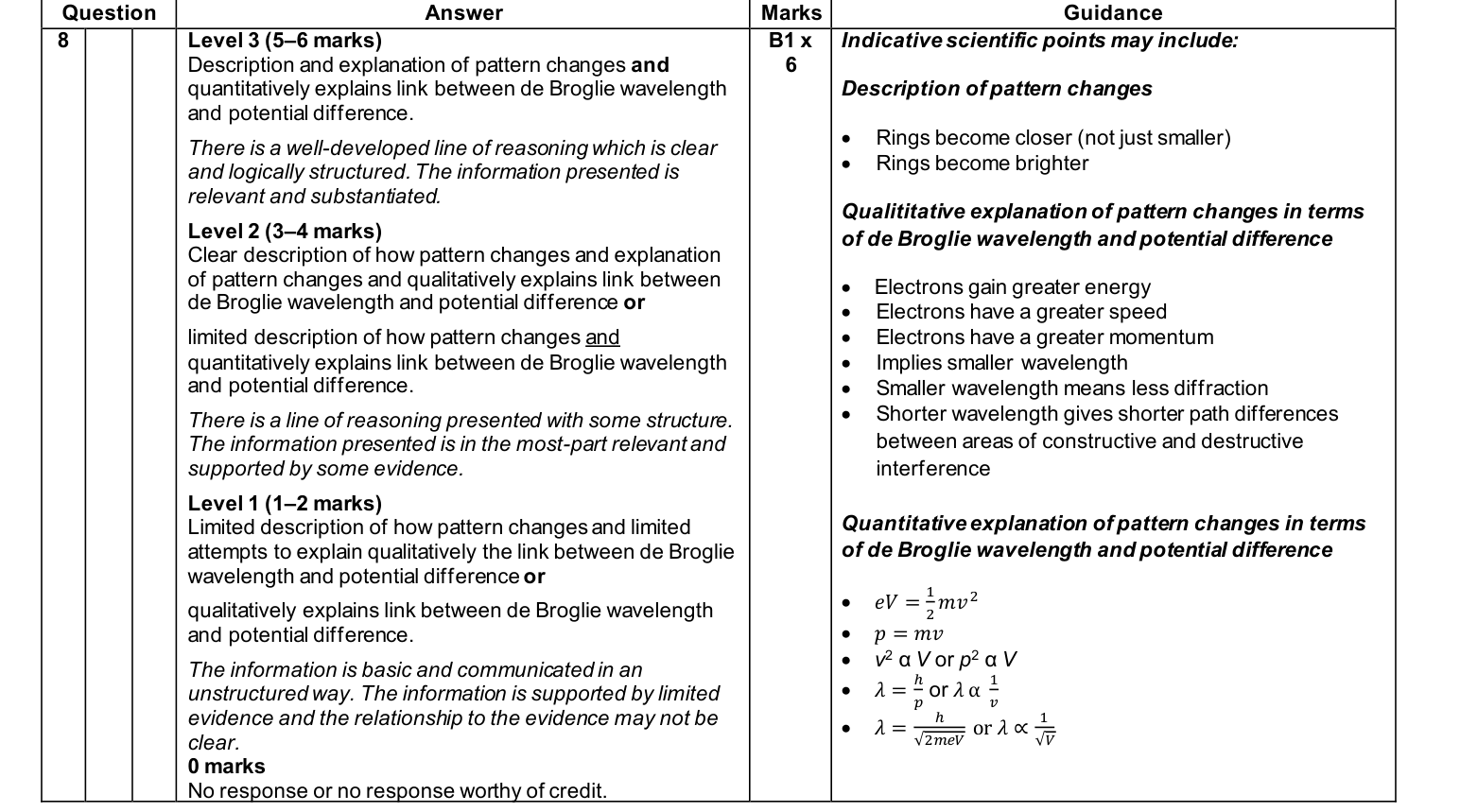
rings become closer (not just smaller) and brighter
λ = h/√(2meV)
Skills: M0.3 Use ratios, fractions and percentages; M2.2 Change the subject of an equation, including non-linear equations
November 2020 · Paper 3 · Q6(c)3 marksShow thatMedium
Mark scheme
Examiner's comment
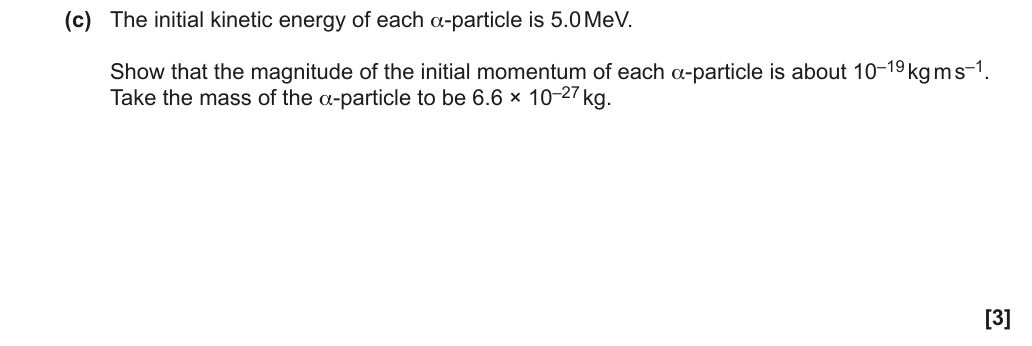
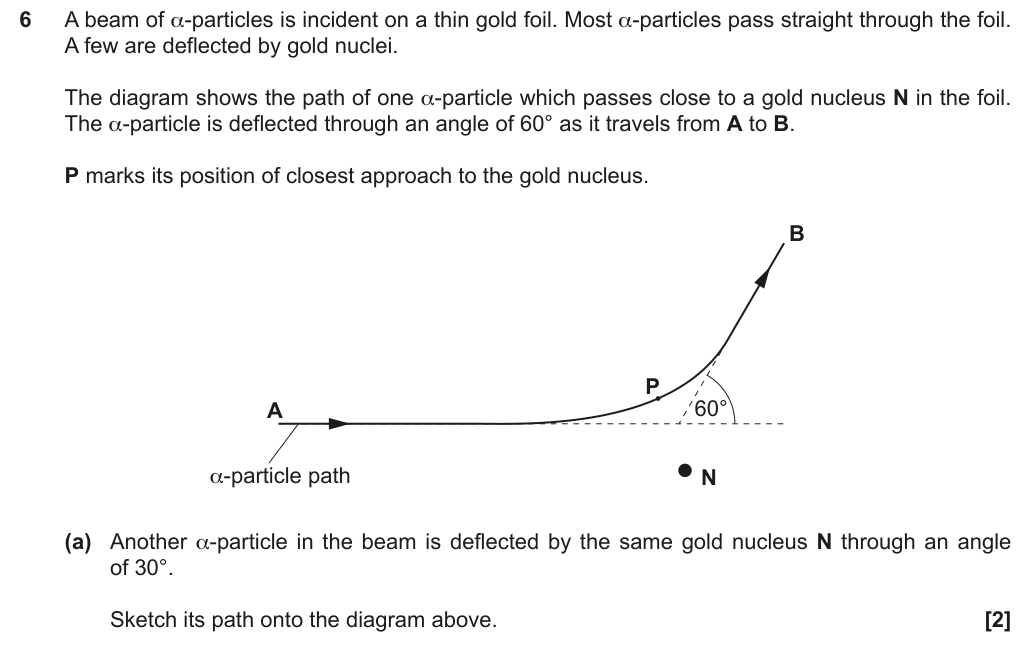
Since this paper is synoptic, candidates need to be able to apply their knowledge and understanding in unfamiliar contexts in order to gain high marks, To do well in this paper, candidates must be able to: • perform and layout calculations logically, showing clear working (such as Question 6c) • produce concise but accurate responses to questions which involve extended writing (such as question 1b) • craft clearly structured and well-reasoned arguments to the Level of Response Questions (3b and 5d) • process and interpret data from an experiment to reach conclusions (Question 2). Question 6a The common errors here were: • not realising that, for the particle to be deflected through a smaller angle, it needed to be travelling further away from N • not labelling the final angle of 30° • not adding arrows to show the direction of travel • drawing a path that continued bending beyond the stated 30° (usually ending up parallel to the original path). Question 6b The most common error here was to use incorrect values for the charges on the two ions. Question 6c This question provided an excellent opportunity for candidates to produce immaculate responses: identify the physics involved, select and write down the correct formula, do the necessary conversion (MeV to J), rearrange the formula, substitute correctly and then write the final response in standard form to a correct number of significant figures. Question 6d This was not an easy question but, even so, a good number of candidates did well.
Notes from the mark scheme and report
full substitution must be shown
v = 1.6 x 10^7 m s-1 scores both C marks
Skills: M0.2 Recognise and use expressions in decimal and standard form; M0.5 Use calculators to find and use power, exponential and logarithmic functions; M2.2 Change the subject of an equation, including non-linear equations
November 2020 · Paper 3 · Q6(d)(i)2 marksDiagram or graphMedium
Earlier part of question 6 that this part uses
Mark scheme
Examiner's comment
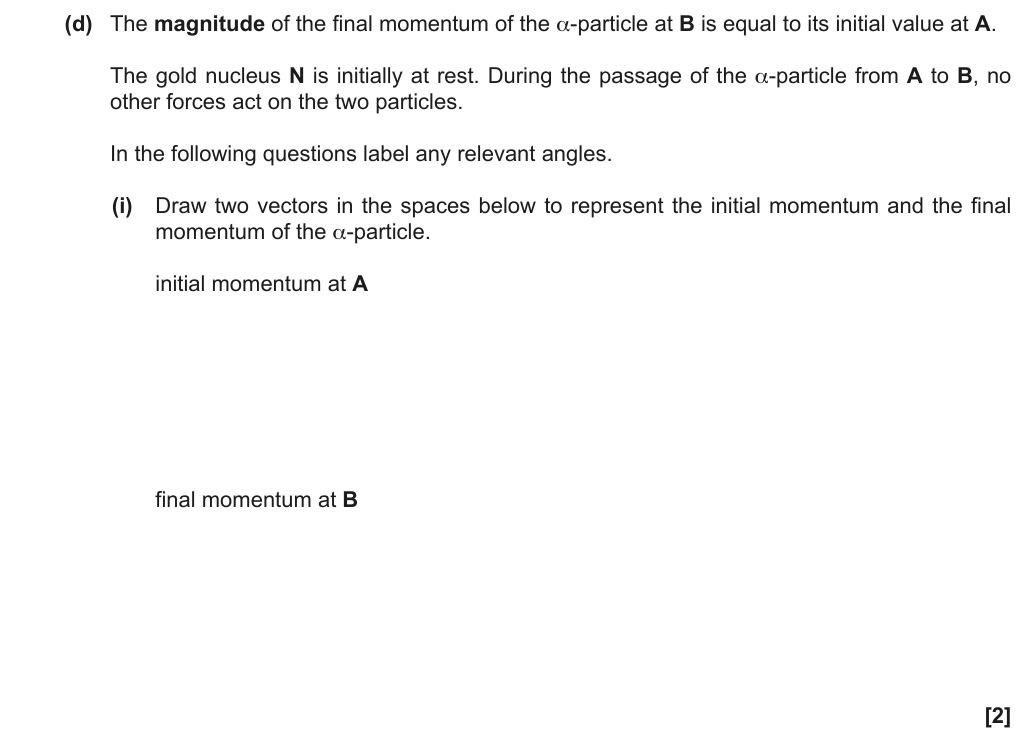
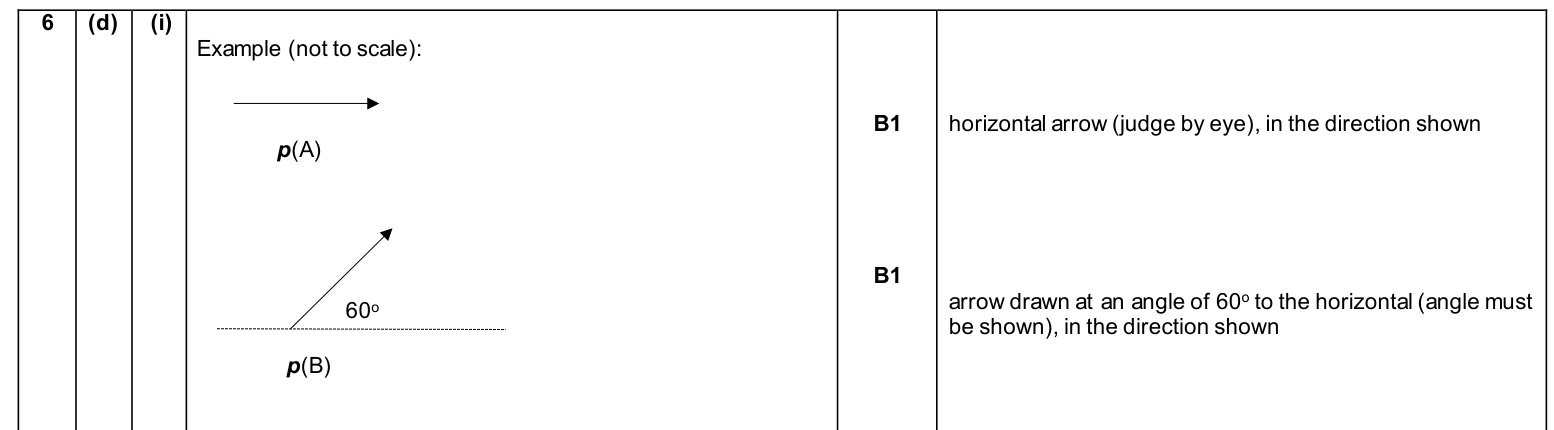
Since this paper is synoptic, candidates need to be able to apply their knowledge and understanding in unfamiliar contexts in order to gain high marks, To do well in this paper, candidates must be able to: • perform and layout calculations logically, showing clear working (such as Question 6c) • produce concise but accurate responses to questions which involve extended writing (such as question 1b) • craft clearly structured and well-reasoned arguments to the Level of Response Questions (3b and 5d) • process and interpret data from an experiment to reach conclusions (Question 2). Question 6a The common errors here were: • not realising that, for the particle to be deflected through a smaller angle, it needed to be travelling further away from N • not labelling the final angle of 30° • not adding arrows to show the direction of travel • drawing a path that continued bending beyond the stated 30° (usually ending up parallel to the original path). Question 6b The most common error here was to use incorrect values for the charges on the two ions. Question 6c This question provided an excellent opportunity for candidates to produce immaculate responses: identify the physics involved, select and write down the correct formula, do the necessary conversion (MeV to J), rearrange the formula, substitute correctly and then write the final response in standard form to a correct number of significant figures. Question 6d This was not an easy question but, even so, a good number of candidates did well.
Notes from the mark scheme and report
horizontal arrow for A
arrow at 60 degrees above the horizontal for B with the angle shown
Skills: M4.2 Visualise and represent 2D and 3D forms, including two-dimensional representations of 3D objects
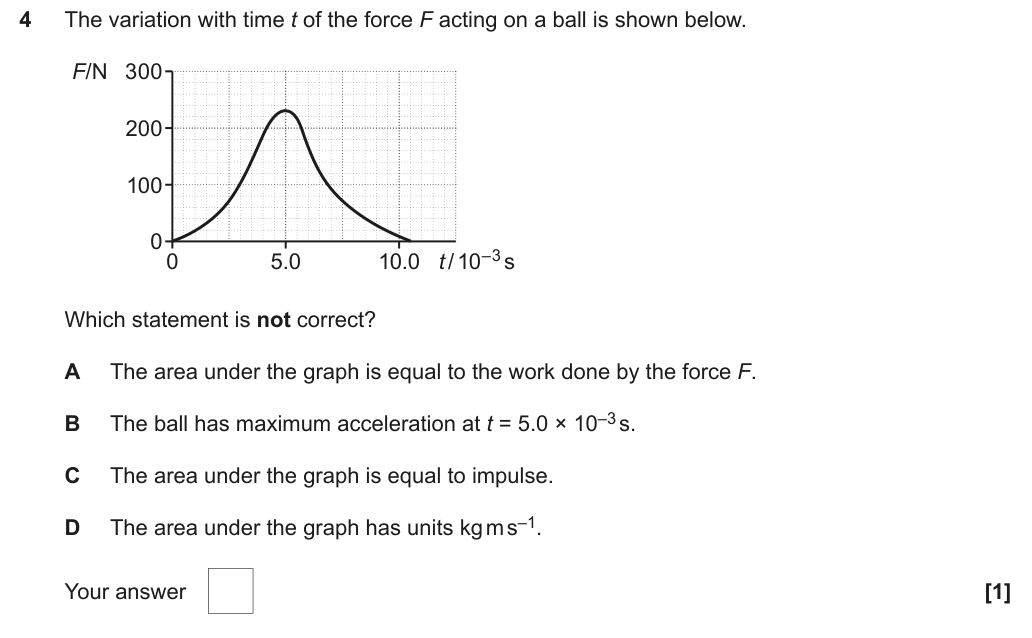
June 2019 · AS Paper 1 · Q41 markMultiple choiceMedium
Answer
A
Mark scheme
Examiner's comment
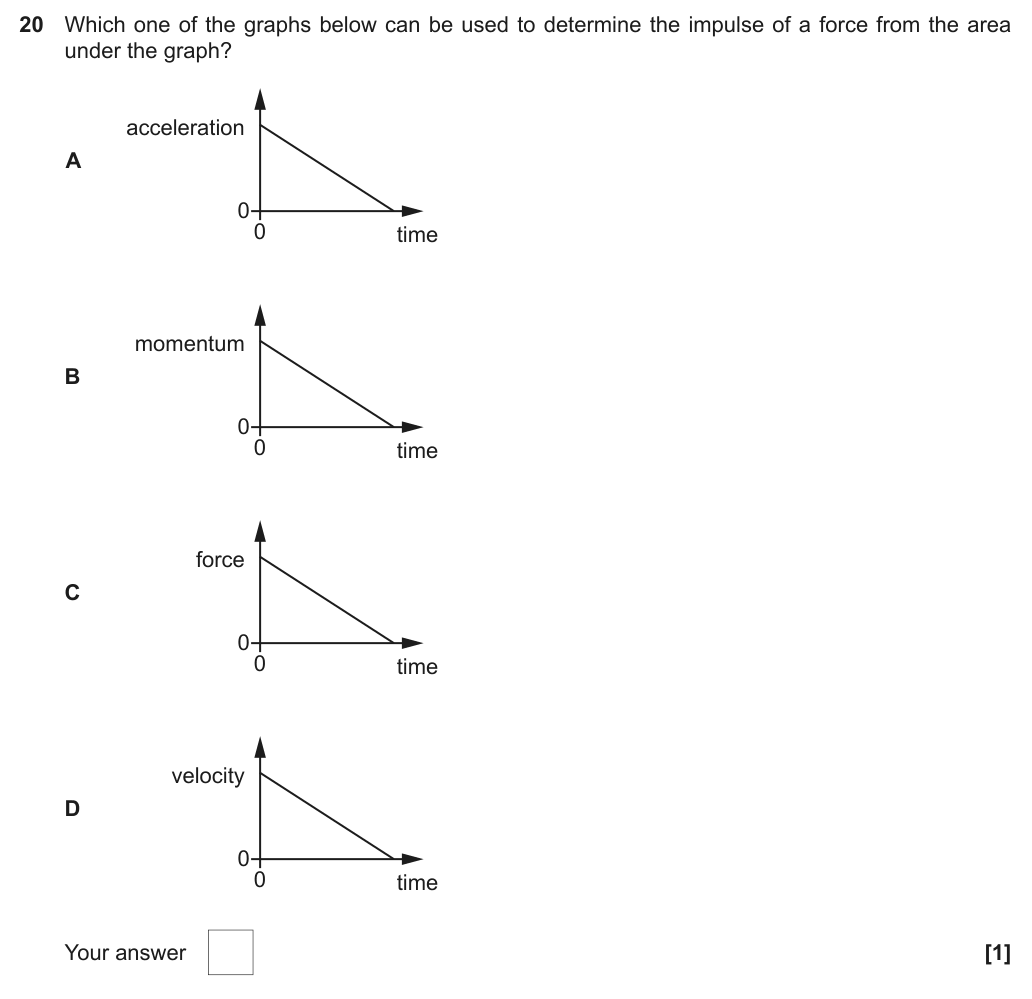
This question was based on a force-time graph for a ball. All the information that can be extracted from the graph. The majority of the candidates inserted A in the answer box, and secured 1 mark. All the other statements are correct. The statement B is correct, because the maximum acceleration of the ball is proportional to the maximum force. The area under a force-time graph is impulse, so statement C is correct. The area under the graph is also equal to change in momentum, therefore the area under the graph does have the unit’s kg m s-1. So, statement D is also correct. Statement A is incorrect. Work done is the area under a force-distance graph, but here the horizontal axis has time, and not distance.
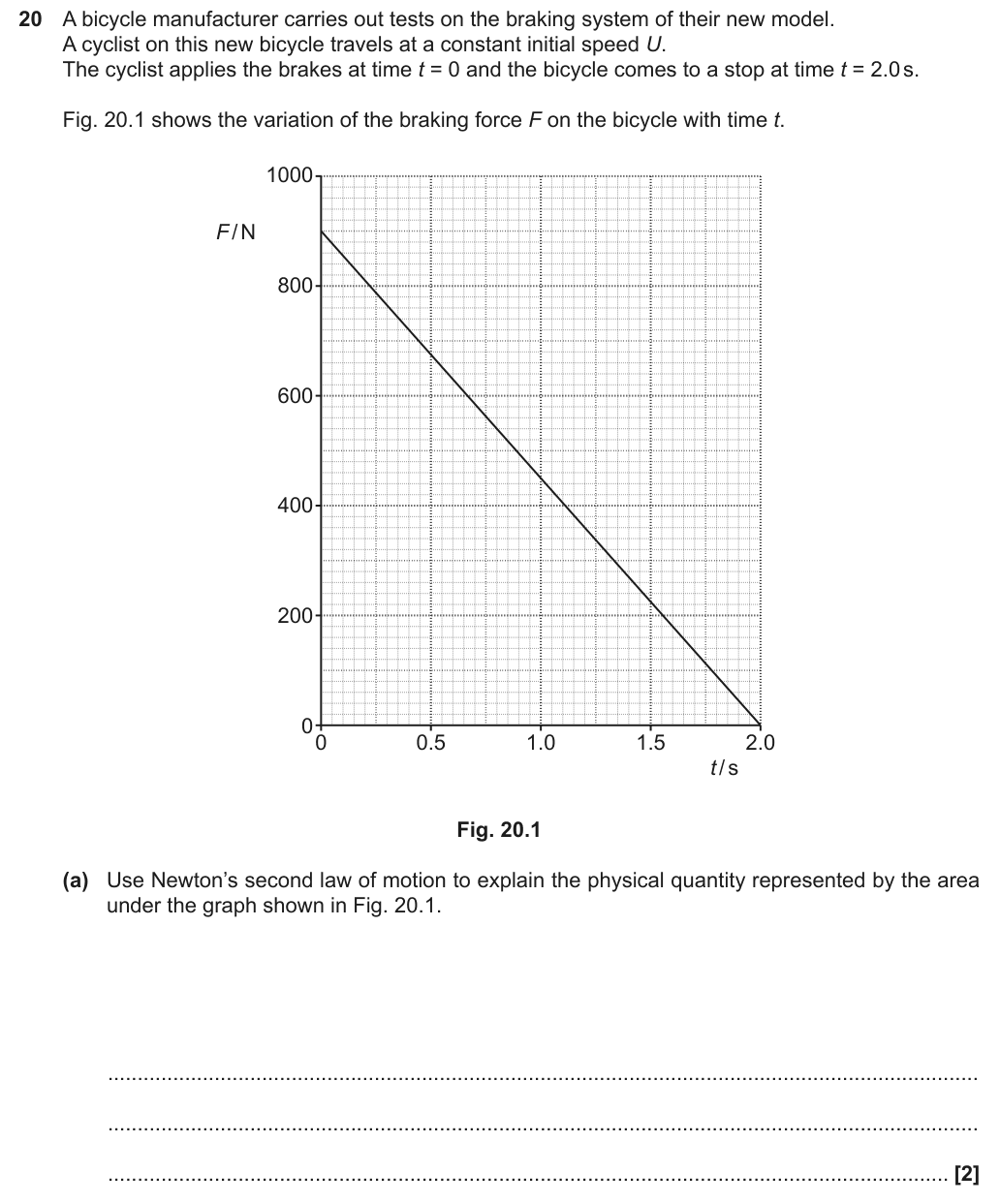
June 2019 · Paper 1 · Q20(a)2 marksPractical and data analysisMedium
Mark scheme
Examiner's comment
It was good to see that most candidates understood that Newton’s second law of motion is more than the statement that F=ma. Many had successful attempts with some candidates missing that it is the rate of change of momentum, rather than the change of momentum that is required. About two-thirds of candidates also correctly indicated that the area under the graph represents the impulse or the change in momentum. In Question 20(b), some candidates assumed, incorrectly, that the maximum force multiplied by the time taken would give the change in momentum and so scored zero marks. Rather more simply divided the maximum force by the mass, which gave the right answer yet with incorrect physics. This approach also scored zero. In fact, more successful responses made it clear that the area of the triangle on the graph was the impulse and that that area gave a change in momentum of 900 Ns.
Notes from the mark scheme and report
area = change in momentum (impulse)
allow proportional for equals in rate of change of momentum
Skills: M3.8 Understand the possible physical significance of the area between a curve and the x axis and be able to calculate it or estimate it by graphical methods as appropriate
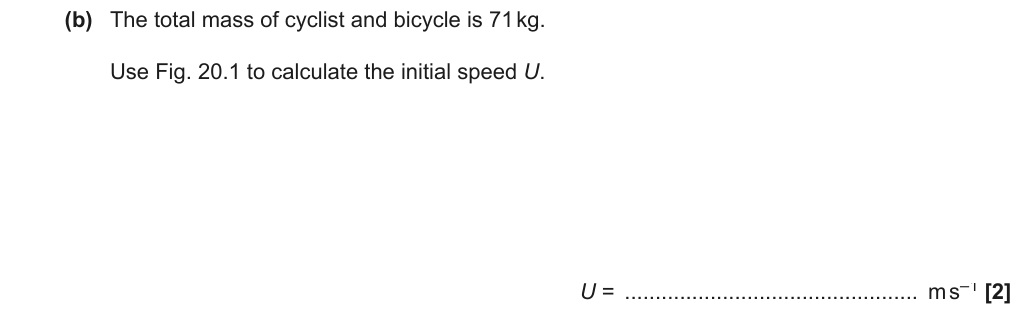
June 2019 · Paper 1 · Q20(b)2 marksCalculationMedium
Earlier part of question 20 that this part uses
Mark scheme
Examiner's comment
It was good to see that most candidates understood that Newton’s second law of motion is more than the statement that F=ma. Many had successful attempts with some candidates missing that it is the rate of change of momentum, rather than the change of momentum that is required. About two-thirds of candidates also correctly indicated that the area under the graph represents the impulse or the change in momentum. In Question 20(b), some candidates assumed, incorrectly, that the maximum force multiplied by the time taken would give the change in momentum and so scored zero marks. Rather more simply divided the maximum force by the mass, which gave the right answer yet with incorrect physics. This approach also scored zero. In fact, more successful responses made it clear that the area of the triangle on the graph was the impulse and that that area gave a change in momentum of 900 Ns.
Notes from the mark scheme and report
NOT initial force / mass
Skills: M2.3 Substitute numerical values into algebraic equations using appropriate units for physical quantities; M3.8 Understand the possible physical significance of the area between a curve and the x axis and be able to calculate it or estimate it by graphical methods as appropriate; M4.3 Calculate areas of triangles, circumferences and areas of circles, surface areas and volumes of rectangular blocks, cylinders and spheres
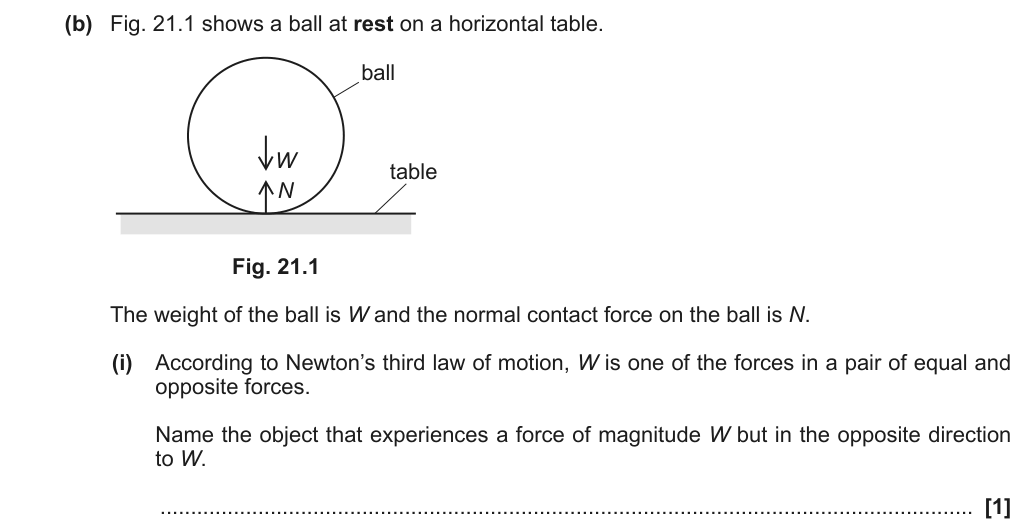
June 2019 · AS Paper 1 · Q21(b)(i)1 markShort answerHard
Mark scheme
Examiner's comment
This question was poorly answered, with only the very top candidates realising that it was the Earth experiencing the force W in the opposite direction. ‘Ground’ instead of the Earth was allowed by examiners – but such answers were extremely rare. Newton’s third law remains enigmatic to many candidates. The most popular incorrect answers were ‘ball’ and ‘table’.
June 2019 · AS Paper 1 · Q21(b)(ii)1 markShort answerMedium
Earlier part of question 21 that this part uses
Mark scheme
Examiner's comment
Examiners were looking for the idea that in Newton’s third law, the pair of forces were of the same type and had to act on two separate objects. The force W is a gravitational force and N is the normal contact force is an electrostatic force between the base of the ball and the top of the table. The variety of incorrect answers demonstrated the lack of comprehension of this law. The two exemplars below show answers from a top-end candidate and a candidate securing a middle-grade. In this exemplar from a top-end candidate, the response is half of the total response, but it was given 1 mark by the examiners. Some candidates went a step further by mentioning that W is a gravitational force and N is an electrostatic force. This illustrates a strange response from a low-grade candidate. It shows poor understanding of this important law. There is nothing worthy here for credit.
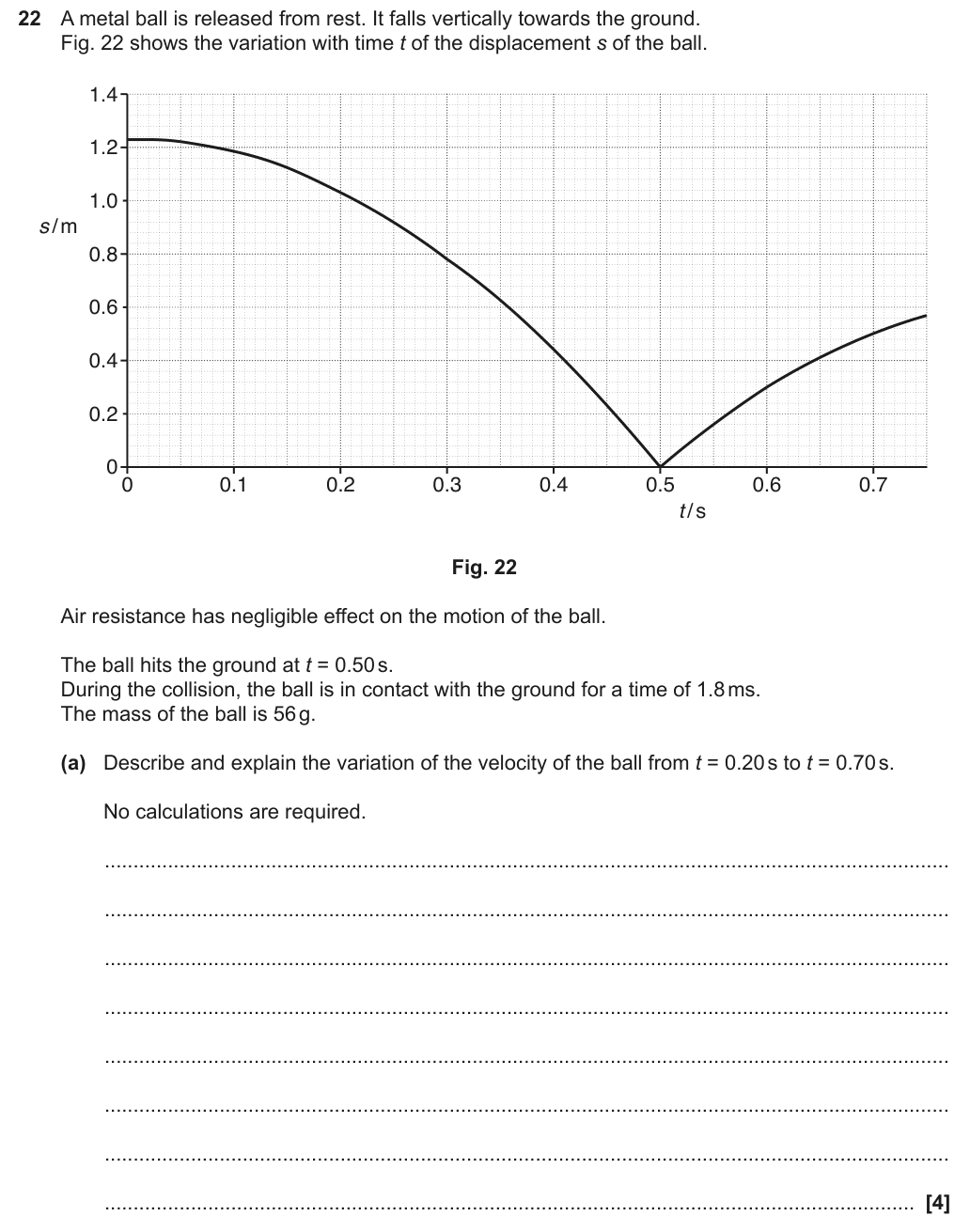
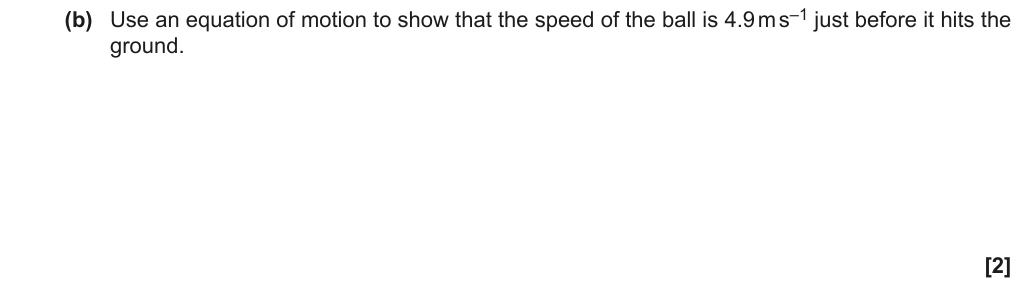
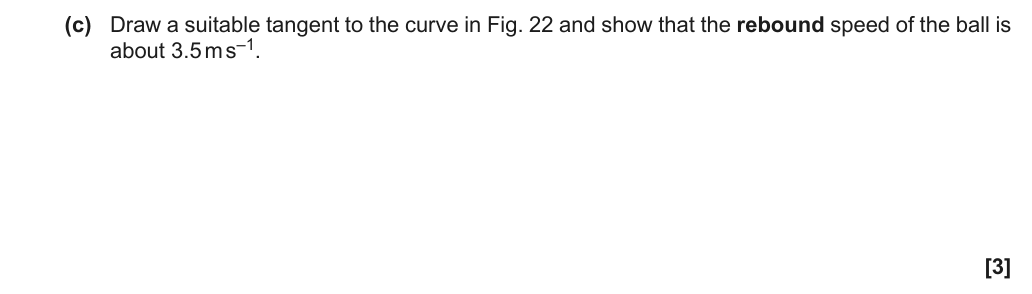
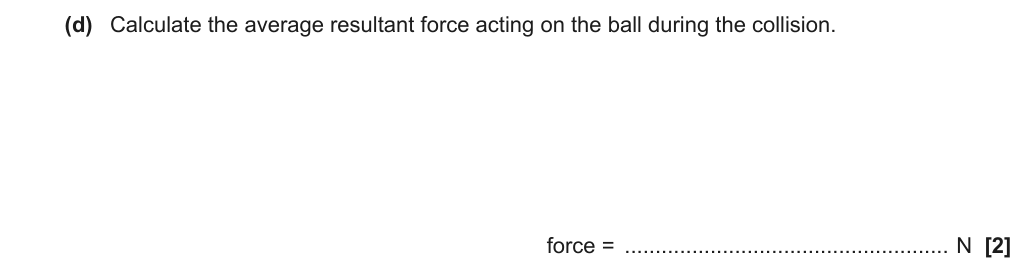
June 2019 · AS Paper 1 · Q22(d)2 marksCalculationMedium
Earlier parts of question 22 that this part uses
Mark scheme
Examiner's comment
The correct answer of 260 N eluded even many of the top-end candidates. The vector nature of velocity, or momentum, was overlooked, with many candidates calculating the magnitude of the force as follows: force = ∆𝑡𝑡= = 44 N The magnitude of the change in the velocity of the ball 0.056(4.5 + 3.5), which would have given the correct answer of 260 N.
Notes from the mark scheme and report
44 N (velocities subtracted) scores 1 mark
ecf from (c)
• force = weight of the ball = 0.056 × 9.81 • Using ∆t = 0.50 s instead of 1.8 ms.
• Using either 4.9 m s-1 or 3.5 m s-1 to calculate the force.
Skills: M0.1 Recognise and make use of appropriate units in calculations; M2.3 Substitute numerical values into algebraic equations using appropriate units for physical quantities
June 2019 · AS Paper 1 · Q25(b)(ii)2 marksCalculationMedium
Earlier part of question 25 that this part uses
Mark scheme
Examiner's comment
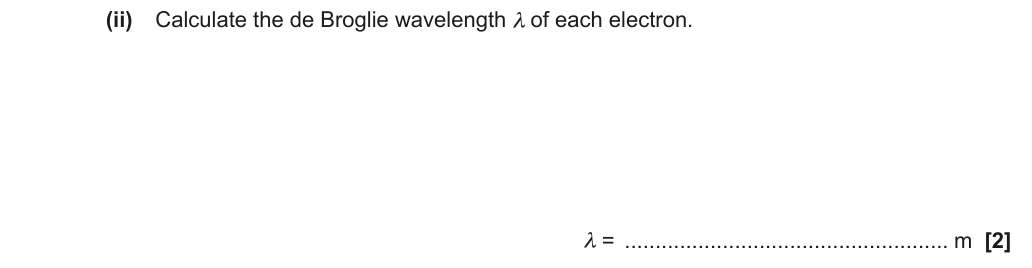
The majority of the candidates effortlessly used the de Broglie equation and their answer from (b)(i), or 9 × 10⁶ m s-1, to calculate the wavelength λ of the electron.
Notes from the mark scheme and report
ecf from (i)
8.1 x 10⁻¹¹ m (v = 9 x 10^6 used) scores 2 marks
• Using 3.0 × 10⁸ m s-1 for the speed instead of 8.6 × 10⁶ m s-1.
• Using the energy of the photon equation 𝐸𝐸= 𝜆𝜆 instead of 𝜆𝜆= 𝑚𝑚𝑚𝑚.
Skills: M0.2 Recognise and use expressions in decimal and standard form; M2.3 Substitute numerical values into algebraic equations using appropriate units for physical quantities
June 2019 · Paper 3 · Q1(d)3 marksExplanationMedium
Earlier parts of question 1 that this part uses
Mark scheme
Examiner's comment
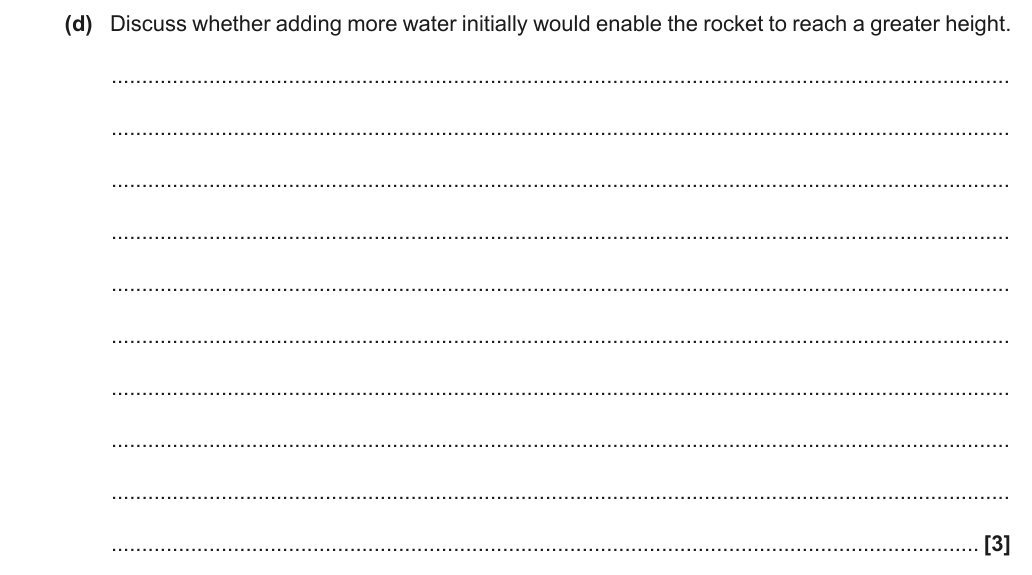
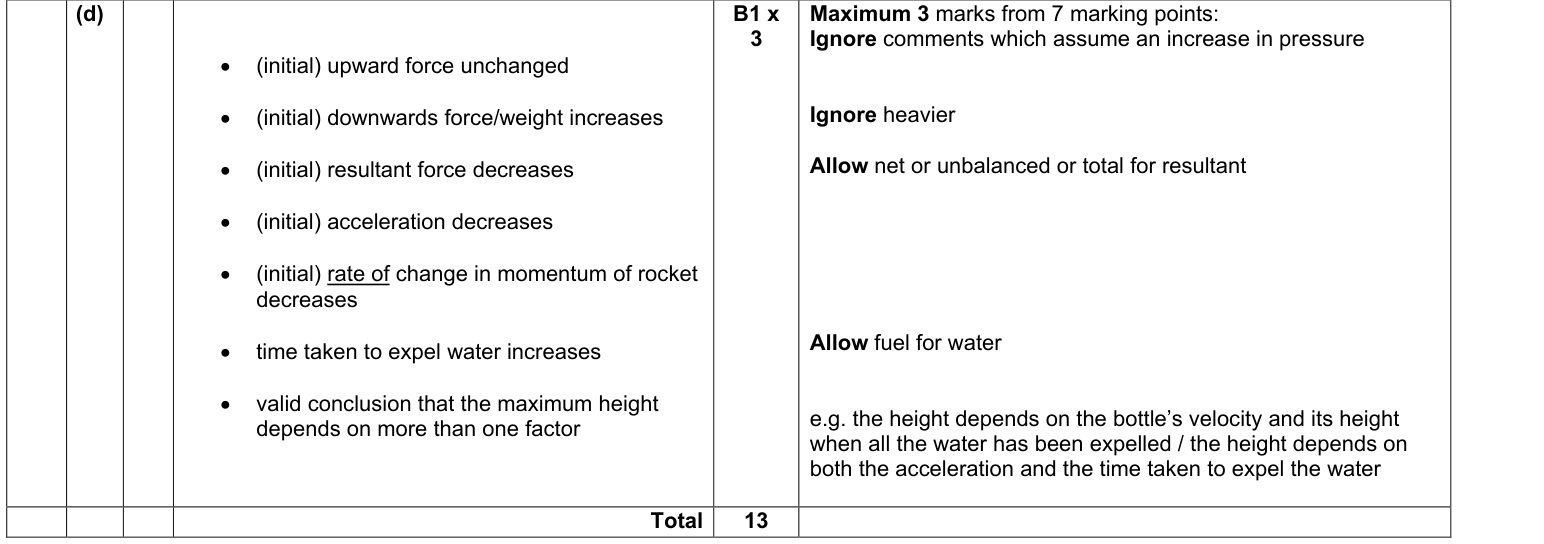
This question involved several factors and a conclusion was not required; hence the word ‘discuss’. Candidates who performed well on this question realised that the weight of the rocket would increase, reducing the resultant force, and m would increase in the formula F = ma. These would both give a reduced initial acceleration and imply a smaller height. However, the time taken to expel the water would increase, meaning that the rocket would accelerate for longer. One common misconception was that the larger volume of water in the bottle would increase the pressure of the trapped air. However, as a pump was used to determine the pressure before lift-off, this argument was not given credit.
Notes from the mark scheme and report
ignore heavier
ignore comments which assume an increase in pressure
max 3 from 7 points
June 2018 · AS Paper 1 · Q41 markMultiple choiceMedium
Answer
C
Mark scheme
Examiner's comment
Question 4 Question 6 Candidates answered this question well.
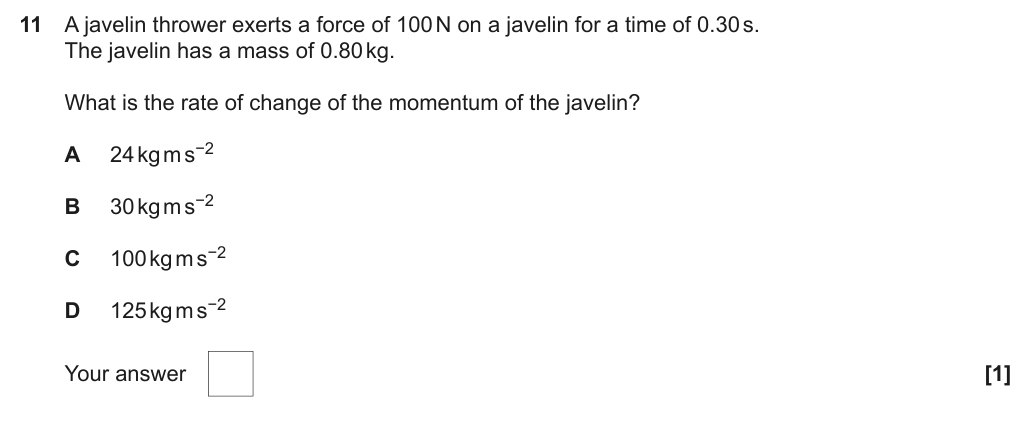
June 2018 · AS Paper 1 · Q111 markMultiple choiceMedium
Answer
C
Mark scheme
Examiner's comment
There was a significant amount of working shown by candidates across the ability spectrum. Most of the time, the answers put down were the distractors. This question is about Newton’s second law of motion. The force on the javelin is equal to the rate of change of its momentum. Therefore, the answer is simply C. The kg m s-2 is equivalent to the newton N.
June 2018 · AS Paper 1 · Q151 markMultiple choice
Answer
B
Mark scheme
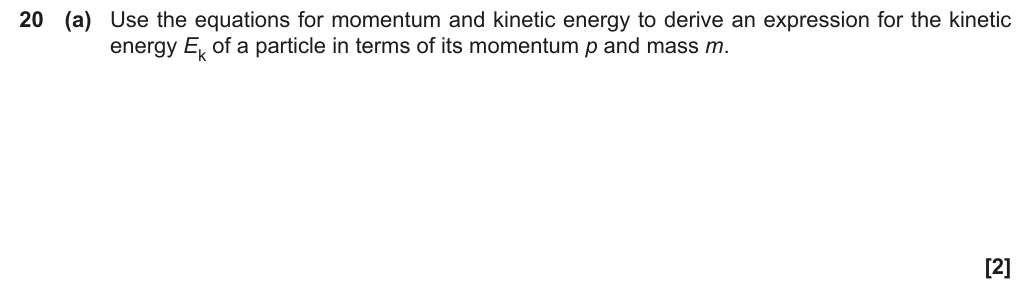
June 2018 · Paper 1 · Q20(a)2 marksShort answerMedium
Mark scheme
Examiner's comment
Question 20 (a) Examiners’ report Question 20 (b) (i) Examiners’ report Question 20 (b) (ii) Nearly four fifths of candidates completed 20a well, especially if they clearly stated the equations for momentum and kinetic energy.
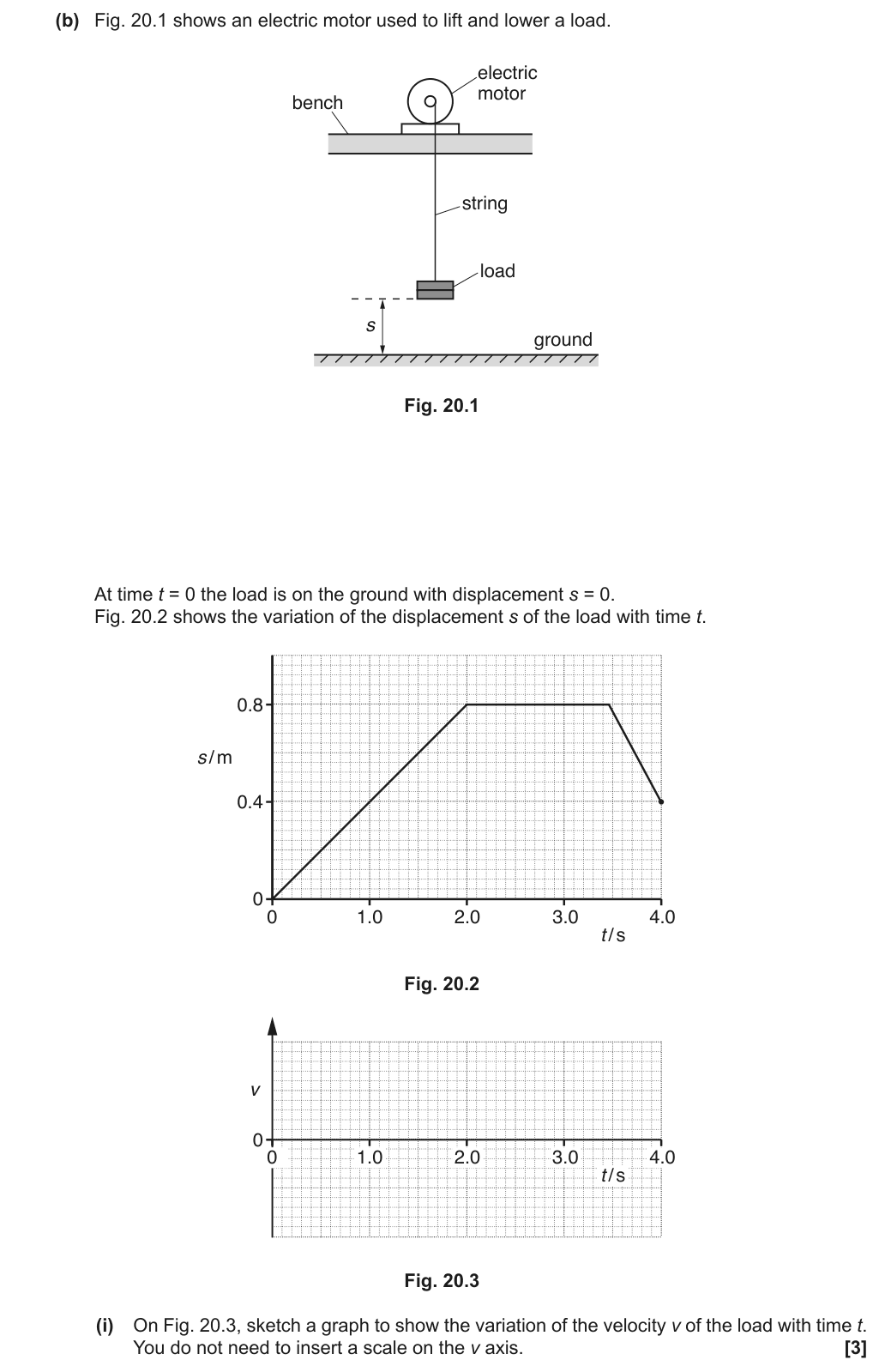
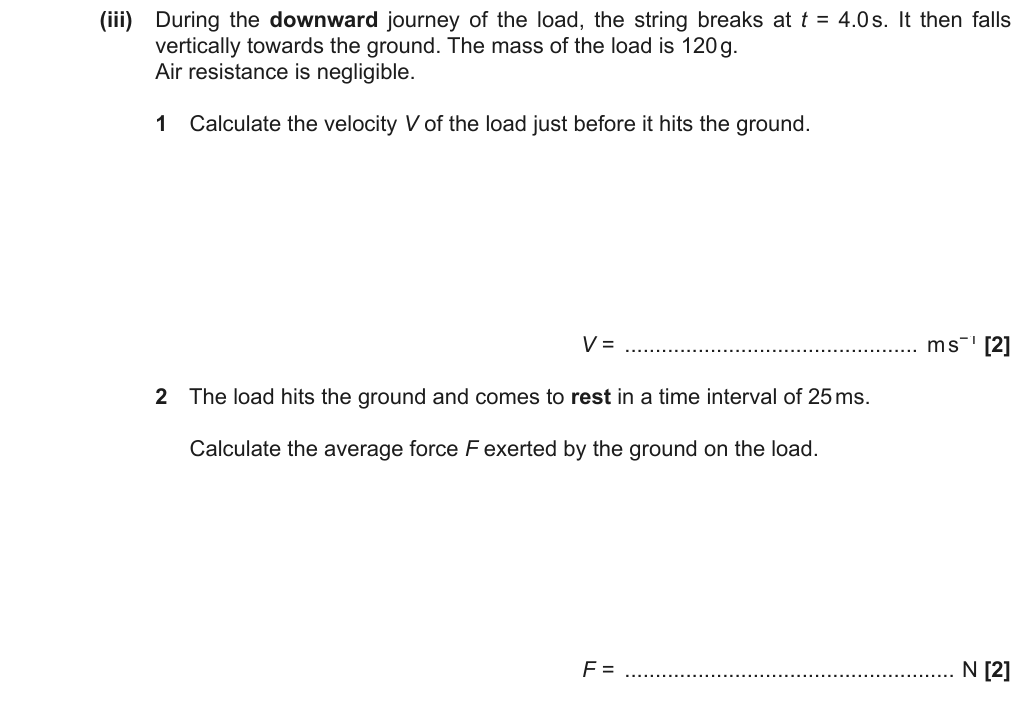
June 2018 · Paper 1 · Q20(b)(iii)4 marksCalculationMedium
Earlier part of question 20 that this part uses
Mark scheme
Examiner's comment
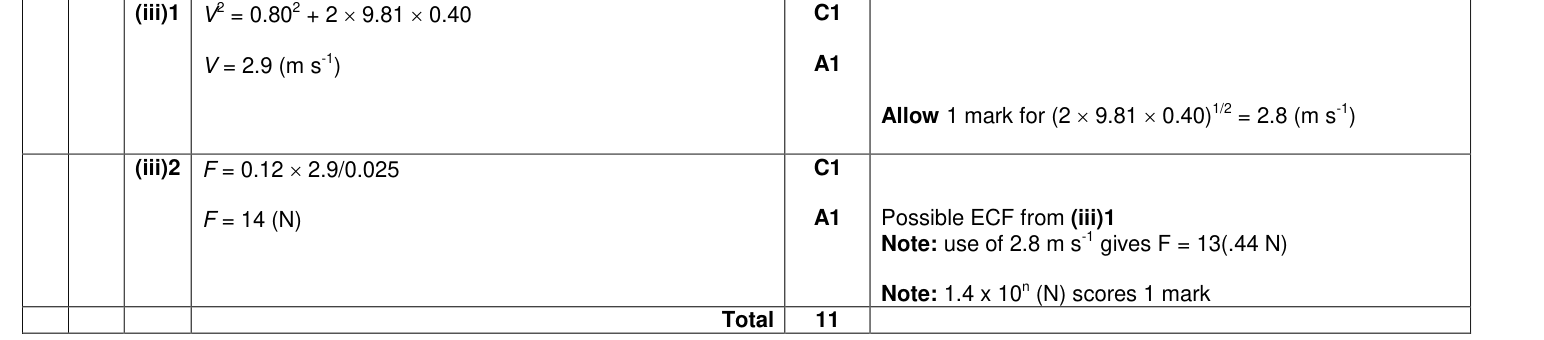
Many candidates selected the correct equation, although did not realise that the load was not at rest when it was released. The initial velocity was found from the graph on page 22 of the paper and was 0.80 ms-1. Nearly three quarters of the candidates used the correct method for finding the average force acting on the load by considering the rate of change of momentum.
Notes from the mark scheme and report
initial velocity 0.80 m s-1 from the gradient
2.8 m s-1 (falling from rest) scores 1 mark
ecf into part 2
power-of-ten error 1 mark
Skills: M0.1 Recognise and make use of appropriate units in calculations; M2.3 Substitute numerical values into algebraic equations using appropriate units for physical quantities; M3.4 Determine the slope and intercept of a linear graph
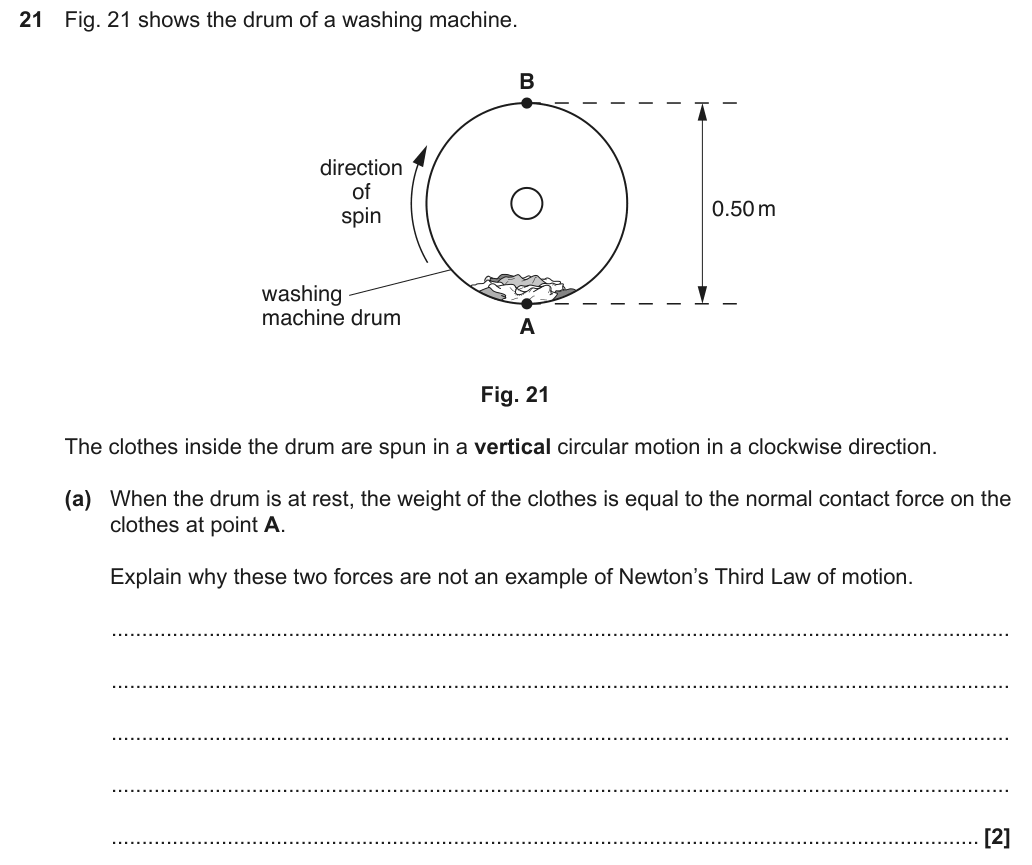
June 2018 · Paper 1 · Q21(a)2 marksExplanationMedium
Mark scheme
Examiner's comment
Many candidates incorrectly quoted Newtons’ Third Law (N3L) or did not realise that a pair of N3L forces must be of the same type. The two forces in the question are acting on the same object, whereas N3L forces must act on different objects. Some candidates thought that the clothes were in motion, while the question states that the clothes are at rest. Normal Contact Force Normal contact force is essentially an electrostatic force between the two objects in contact.
June 2018 · Paper 1 · Q22(a)(ii)3 marksCalculationEasy
Earlier part of question 22 that this part uses
Mark scheme
Examiner's comment
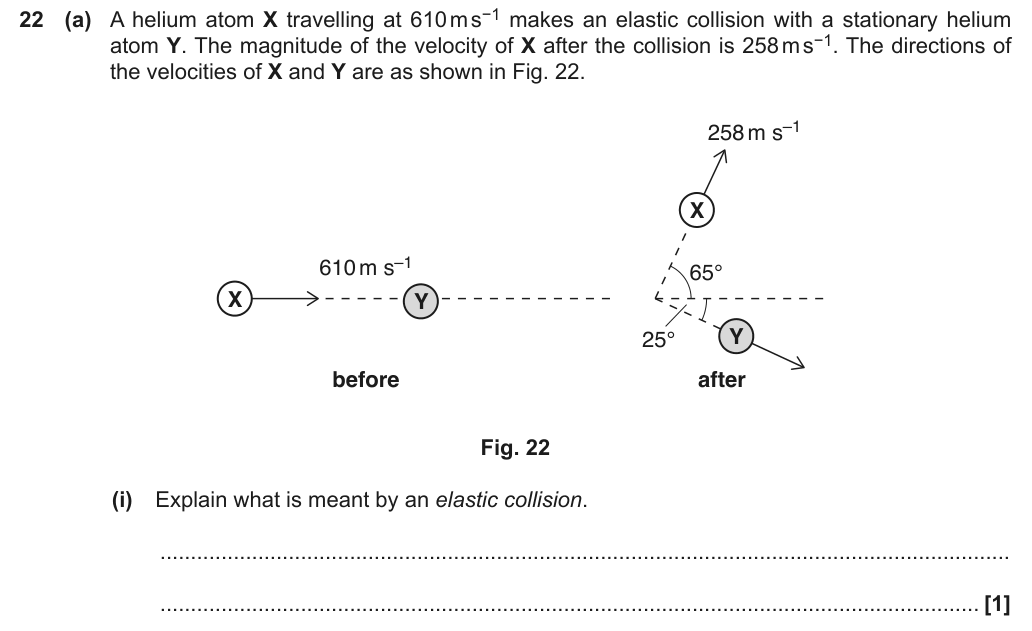
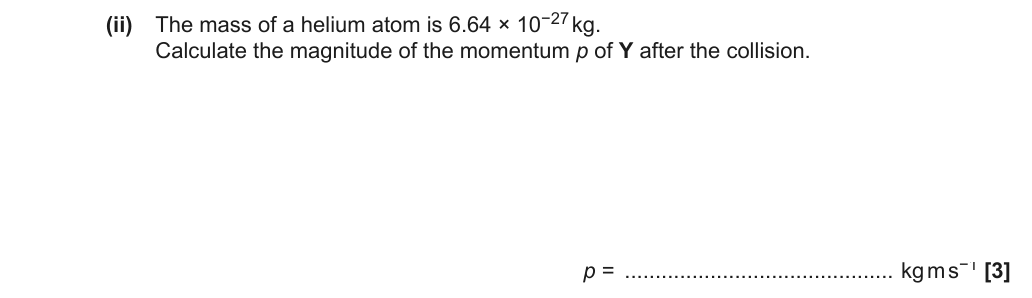
Most candidates correctly remembered that an elastic collision is one in which KE is conserved. In this series, it was acceptable to refer to ‘no loss of KE’. Using the idea that the KE was conserved would have made calculating the velocity of particle Y straightforward. Most candidates preferred a conservation of momentum approach, which of course still works. Many candidates remembered that momentum is conserved in both the x- and y-directions independently and consideration of either was enough. Some candidates forgot that trigonometry was necessary to complete this step, or made errors with which of sine or cosine was required.
Notes from the mark scheme and report
conservation of momentum in x or y direction (or conservation of KE)
Skills: M0.6 Use calculators to handle sin x, cos x and tan x when x is expressed in degrees or radians; M2.3 Substitute numerical values into algebraic equations using appropriate units for physical quantities; M4.5 Use sin, cos and tan in physical problems
June 2018 · AS Paper 2 · Q5(a)1 markShort answerMedium
Mark scheme
Examiner's comment
Less than half of the candidates could state Newton’s second law correctly. A significant number of candidates wrote force = mass x acceleration. Another common error was stating the principle of conservation of momentum. Some candidates were confused by the term impulse and incorrectly gave the answer as change of momentum as opposed to stating that the resultant force is directly proportional to the rate of change of momentum. Examiners allowed “equal” for proportional. For these type of questions, if a candidate gives an equation, then all the symbols must be defined.
Notes from the mark scheme and report
Ignore F = ma
Allow 'equal' for 'proportional'
Allow equation with symbols defined
June 2018 · AS Paper 2 · Q5(b)(i)1 markCalculationEasy
Mark scheme
Examiner's comment
This question was well answered. Many candidates helpfully showed their working.
June 2018 · AS Paper 2 · Q5(b)(ii)3 marksCalculationHard
Earlier part of question 5 that this part uses
Mark scheme
Examiner's comment
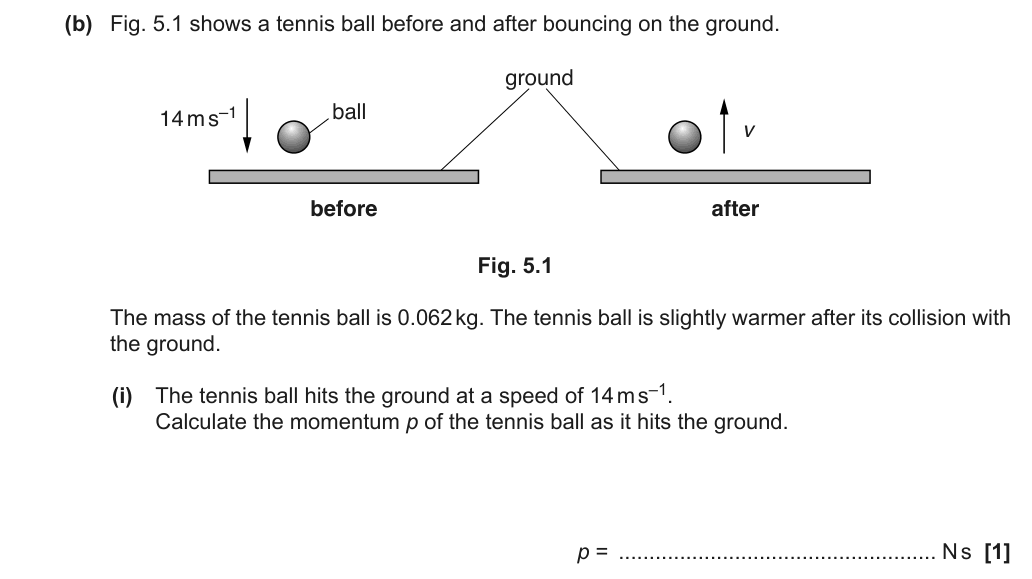
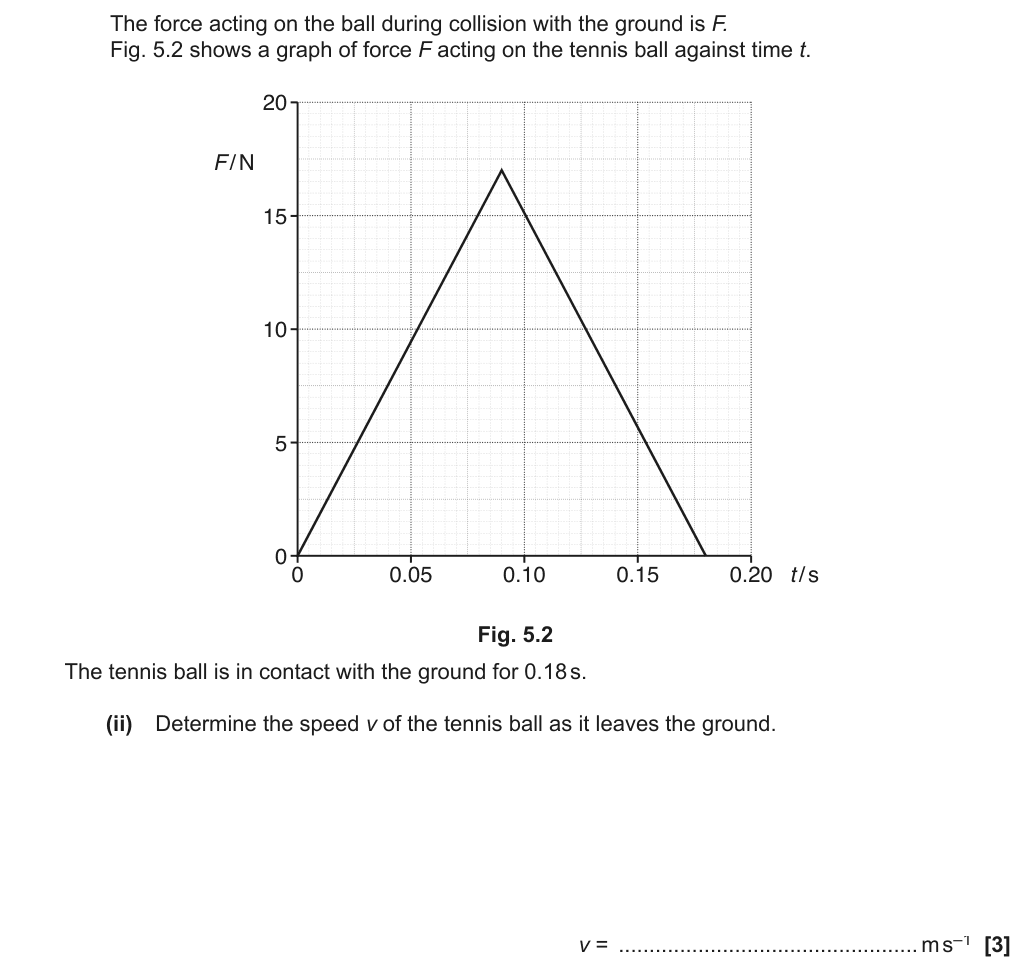
Candidates found this question difficult. Candidates needed to realise the importance of Fig. 5.2 and understand that the area under the graph was equal to the change of momentum of the ball. It is important that candidates show their working so that if the graph is misread they may still obtain credit later. Having determined the change in momentum correctly, candidates then needed to determine the momentum of the ball leaves the ground. This exemplar demonstrates that the candidate understands that the area under the graph is the impulse. The method to calculate the area is shown and although the candidate has not used the answer to (b)(i), the method in terms of the change of velocity is correct and clearly indicated.
Notes from the mark scheme and report
24.7 or 38.7 m s-1 scores 1
ecf from (b)(i)
Skills: M2.3 Substitute numerical values into algebraic equations using appropriate units for physical quantities; M3.8 Understand the possible physical significance of the area between a curve and the x axis and be able to calculate it or estimate it by graphical methods as appropriate; M4.3 Calculate areas of triangles, circumferences and areas of circles, surface areas and volumes of rectangular blocks, cylinders and spheres
June 2017 · AS Paper 1 · Q61 markMultiple choice
Answer
C
Mark scheme
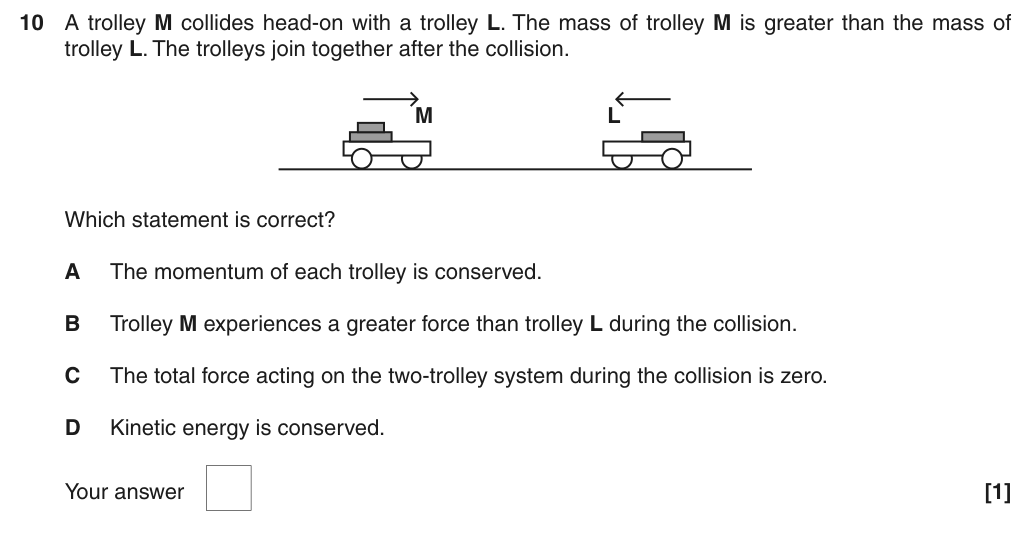
June 2017 · Paper 1 · Q131 markMultiple choice
Answer
A
Mark scheme
June 2017 · AS Paper 1 · Q191 markMultiple choice
Answer
B
Mark scheme
June 2017 · AS Paper 1 · Q23(a)2 marksExplanation
Mark scheme
Notes from the mark scheme and report
Earth must be mentioned as part of the system
NOT ground
June 2017 · AS Paper 1 · Q23(b)(i)2 marksCalculation
Mark scheme
Notes from the mark scheme and report
ignore sign
(10 + 6)/0.2 = 80 N scores zero
Skills: M3.1 Translate information between graphical, numerical and algebraic forms; M3.5 Calculate rate of change from a graph showing a linear relationship
June 2017 · AS Paper 1 · Q23(b)(ii)3 marksDiagram or graph
Earlier part of question 23 that this part uses
Mark scheme
Notes from the mark scheme and report
ignore omission of label Y
Skills: M3.1 Translate information between graphical, numerical and algebraic forms
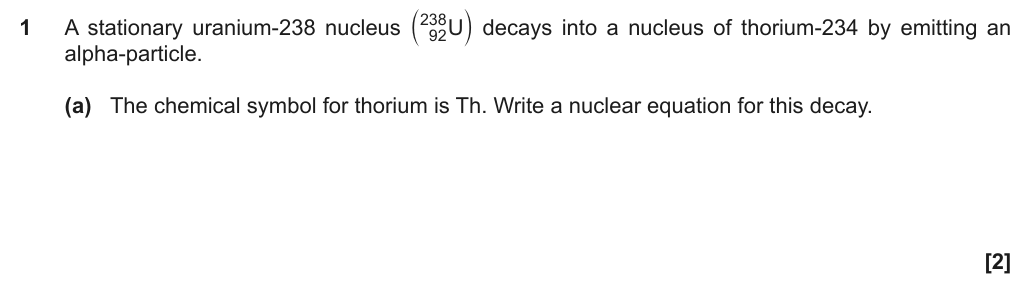
June 2017 · Paper 3 · Q1(b)4 marksCalculation
Earlier part of question 1 that this part uses
Mark scheme
Notes from the mark scheme and report
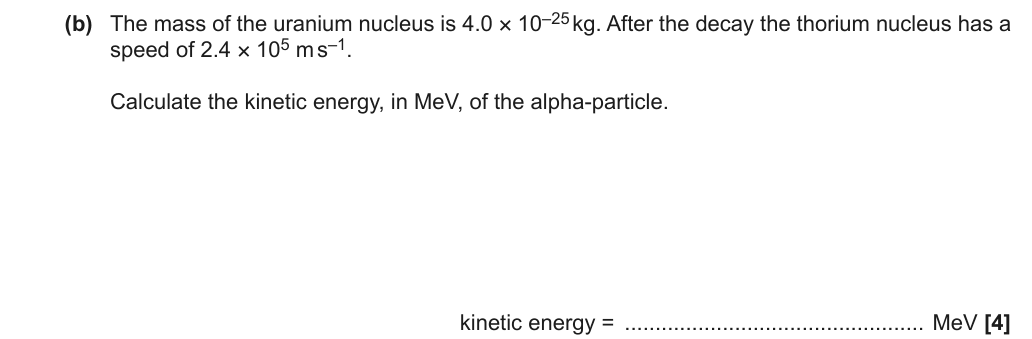
max 3 if 4.00 used instead of 3.93 for the thorium mass in the momentum equation
accept 4.0 to 4.2 MeV
allow mass ratio 234 : 4
Skills: M0.1 Recognise and make use of appropriate units in calculations; M2.2 Change the subject of an equation, including non-linear equations; M2.3 Substitute numerical values into algebraic equations using appropriate units for physical quantities
June 2016 · AS Paper 1 · Q101 markMultiple choice
Answer
C
Mark scheme
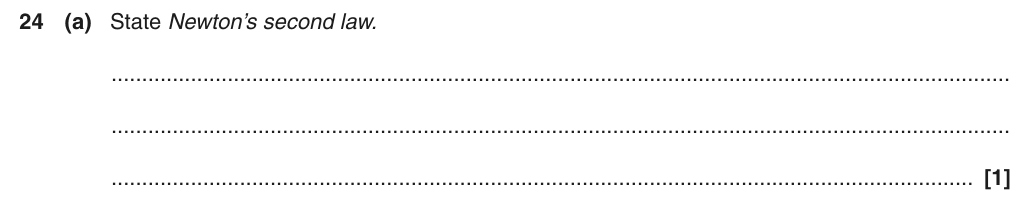
June 2016 · AS Paper 1 · Q24(a)1 markShort answer
Mark scheme
Notes from the mark scheme and report
NOT force = mass x acceleration
NOT 'force ∝ change in momentum over time'
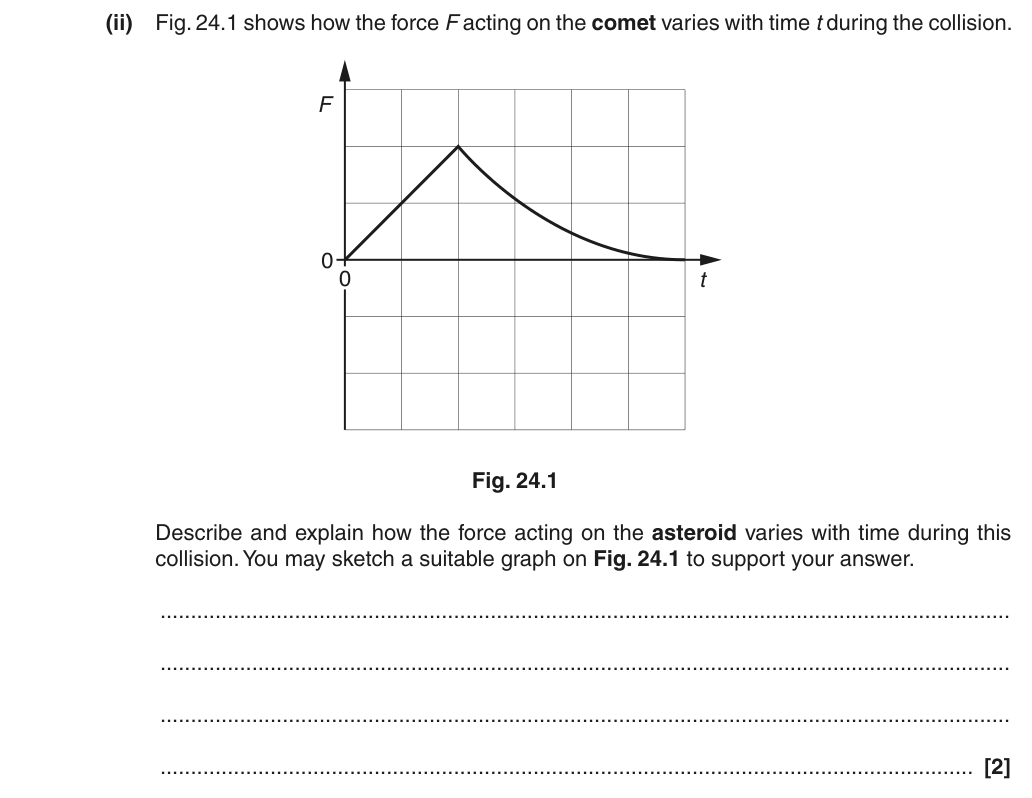
June 2016 · AS Paper 1 · Q24(b)(ii)2 marksDiagram or graph
Mark scheme
Notes from the mark scheme and report
NOT 'action = reaction'
NOT Newton's third law on its own
1 mark for a correct graph with no description
Skills: M3.1 Translate information between graphical, numerical and algebraic forms
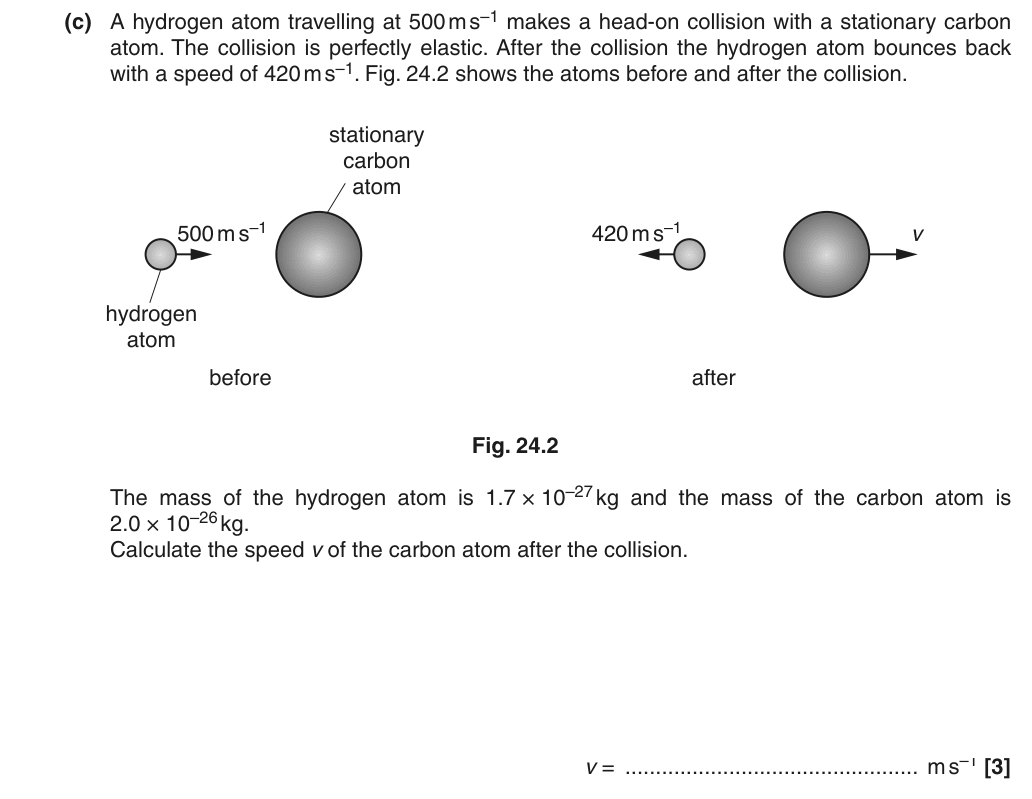
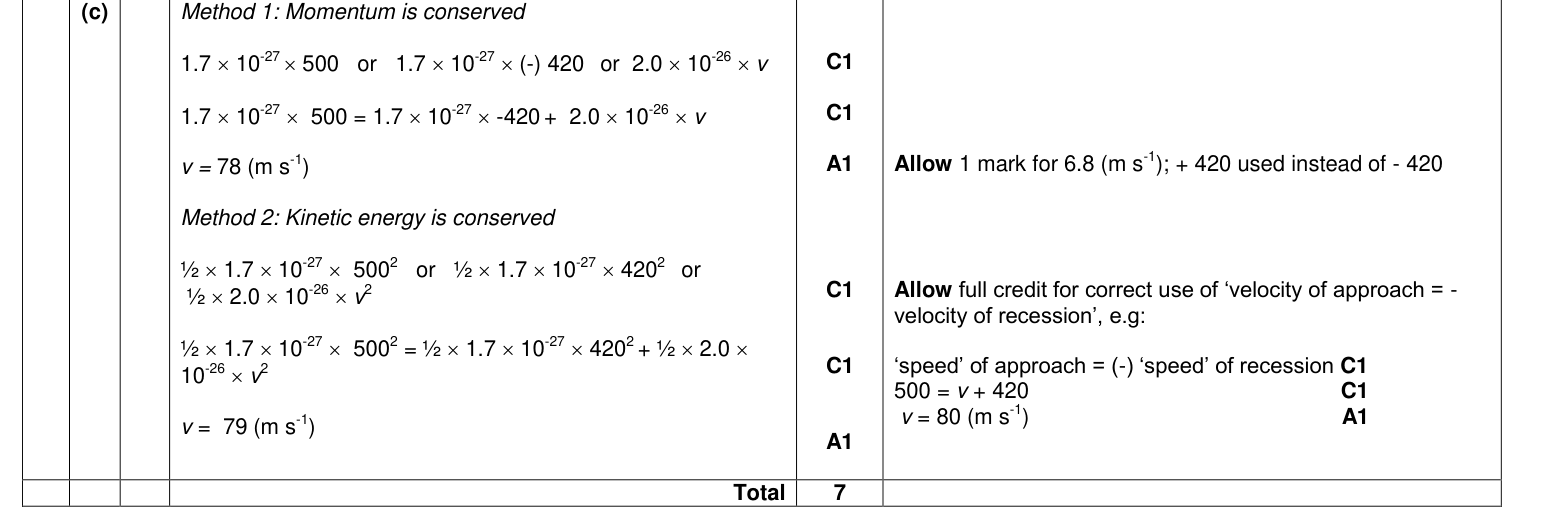
June 2016 · AS Paper 1 · Q24(c)3 marksCalculation
Mark scheme
Notes from the mark scheme and report
6.8 m s-1 (+420 used instead of -420) scores 1
kinetic energy method (79) or speed of approach = speed of recession (80) also full credit
Skills: M0.2 Recognise and use expressions in decimal and standard form; M2.2 Change the subject of an equation, including non-linear equations; M2.3 Substitute numerical values into algebraic equations using appropriate units for physical quantities
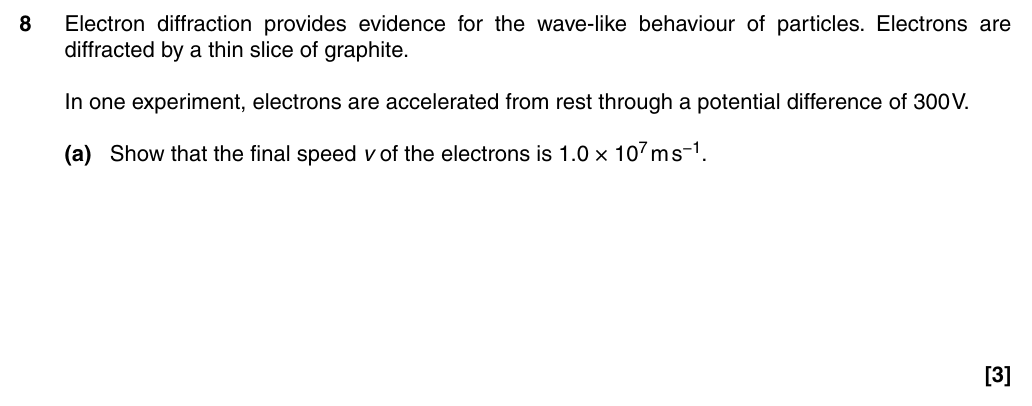
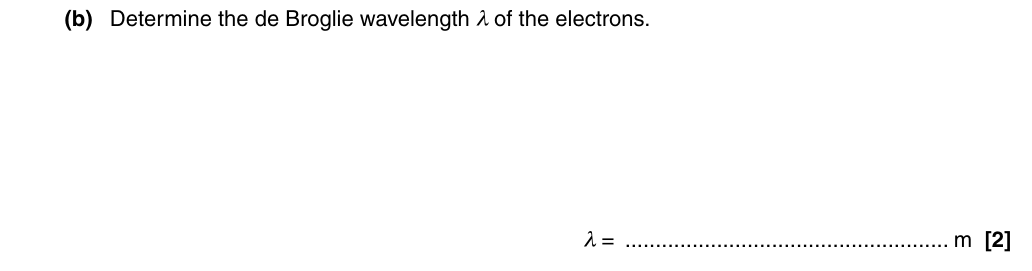
June 2016 · AS Paper 2 · Q8(b)2 marksCalculation
Earlier part of question 8 that this part uses
Mark scheme
Notes from the mark scheme and report
ecf from (a)
7.1 x 10⁻¹¹ if 1.03 x 10^7 used
Skills: M0.2 Recognise and use expressions in decimal and standard form; M2.3 Substitute numerical values into algebraic equations using appropriate units for physical quantities
Work with an OCR physics tutor
Dropping marks on calculations, practical questions or the six-mark level of response questions? Book a trial session with a specialist OCR physics tutor.