Show the 19 learning outcomes from the specification
6.4.1(a) alpha-particle scattering experiment; evidence of a small charged nucleus
6.4.1(b) simple nuclear model of the atom; protons, neutrons and electrons
6.4.1(c) relative sizes of atom and nucleus
6.4.1(d) proton number; nucleon number; isotopes; notation ᴬZX (nucleon number A above proton number Z, before the symbol X) for the representation of nuclei
6.4.1(e) strong nuclear force; short-range nature of the force; attractive to about 3 fm and repulsive below about 0.5 fm
6.4.1(f) radius of nuclei; R = r0A^(1/3) where r0 is a constant and A is the nucleon number
6.4.1(g) mean densities of atoms and nuclei.
6.4.2(a) particles and antiparticles; electron–positron, proton-antiproton, neutron-antineutron and neutrino-antineutrino
6.4.2(b) particle and its corresponding antiparticle have same mass; electron and positron have opposite charge; proton and antiproton have opposite charge
6.4.2(c) classification of hadrons; proton and neutron as examples of hadrons; all hadrons are subject to both the strong nuclear force and the weak nuclear force
6.4.2(d) classification of leptons; electron and neutrino as examples of leptons; all leptons are subject to the weak nuclear force but not the strong nuclear force
6.4.2(e) simple quark model of hadrons in terms of up (u), down (d) and strange (s) quarks and their respective anti-quarks
6.4.2(f) quark model of the proton (uud) and the neutron (udd)
6.4.2(g) charges of the up (u), down (d), strange (s), anti-up, anti-down and anti-strange quarks as fractions of the elementary charge e
Tap a question to zoom it. Where a part needs a figure, table or graph from earlier in the question, that part folds out above it; the mark scheme and examiner's comment open underneath. Have the OCR Data, Formulae and Relationships Booklet beside you (see the data booklet page).
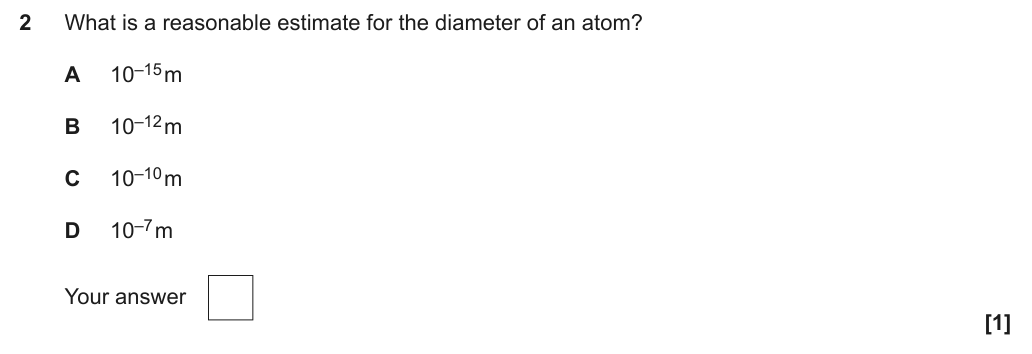
June 2025 · Paper 2 · Q21 markMultiple choiceHard
Answer
C
Mark scheme
Examiner's comment
Only a few candidates were able to correctly identify the estimate for the diameter. Section 2.1.1 (b) of the specification requires candidates to be able to make estimates of physical quantities. B was the most common incorrect answer.
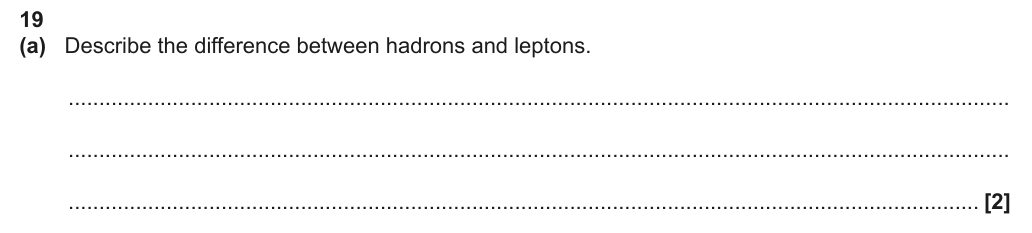
June 2025 · Paper 2 · Q19(a)2 marksExplanationHard
Mark scheme
Examiner's comment
The two main answers to this were either in terms of the strong force, or in terms of the composition. Several candidates gave both of these, although a wrong answer could negate a correct one. Responses in terms of mass, charge, location, etc were ignored. A few candidates confused leptons for baryons and stated that they were formed from a quark and an antiquark
Notes from the mark scheme and report
Ignore references to mass and number of quarks
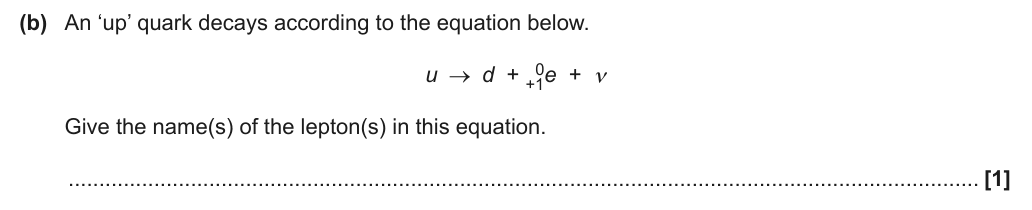
June 2025 · Paper 2 · Q19(b)1 markShort answerEasy
Mark scheme
Examiner's comment
Most candidates were able to correct name both leptons. A significant number called the positron an electron, and many incorrect answers only gave one particle. A small number gave the symbols which would not score the mark.
Notes from the mark scheme and report
both positron and neutrino required
Ignore symbols
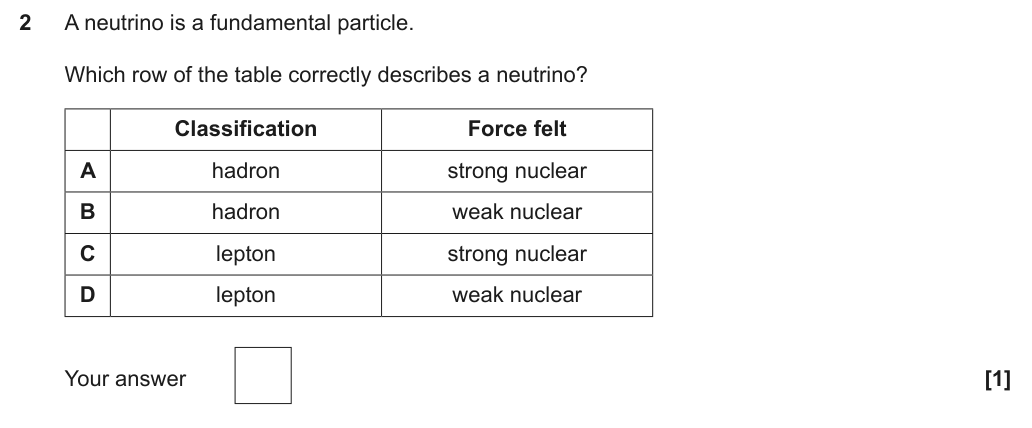
June 2024 · Paper 2 · Q21 markMultiple choiceEasy
Answer
D
Mark scheme
Examiner's comment
Most candidates were able to correctly identify the classification and force. To reduce their options, many candidates circled the correct force.
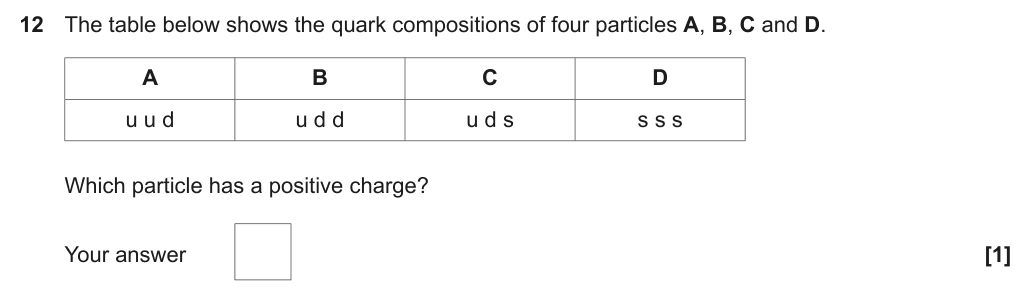
June 2024 · Paper 2 · Q121 markMultiple choiceEasy
Answer
C
Mark scheme
Examiner's comment
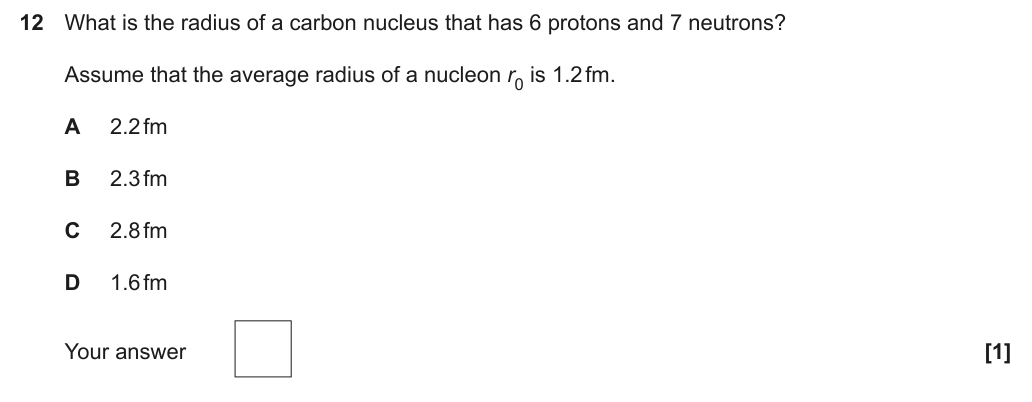
Most candidates were able to correctly calculate the radius and it was clear that most knew how to correctly apply the formula.
June 2024 · Paper 2 · Q131 markMultiple choiceEasy
Answer
D
Mark scheme
Examiner's comment
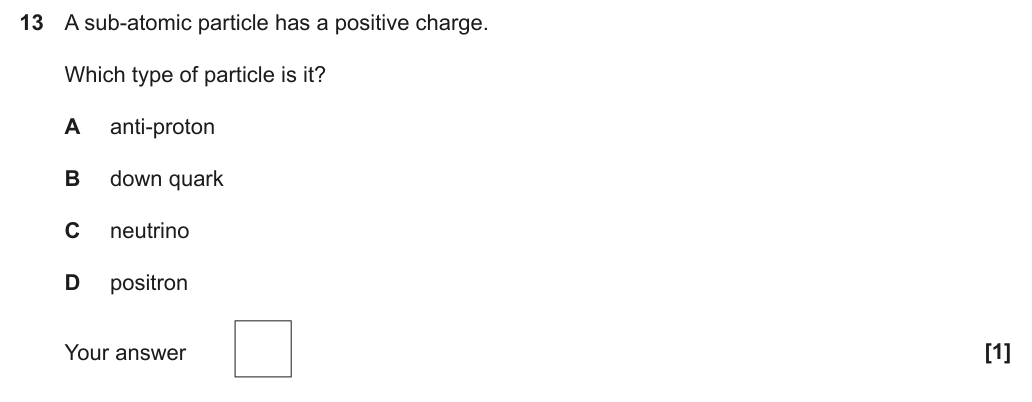
This relatively simple question was correctly answered by of the vast majority of candidates. The most common distractor was B which was presumably due to a lack of certainty of quark charges.
June 2024 · Paper 2 · Q20(b)1 markExplanationMedium
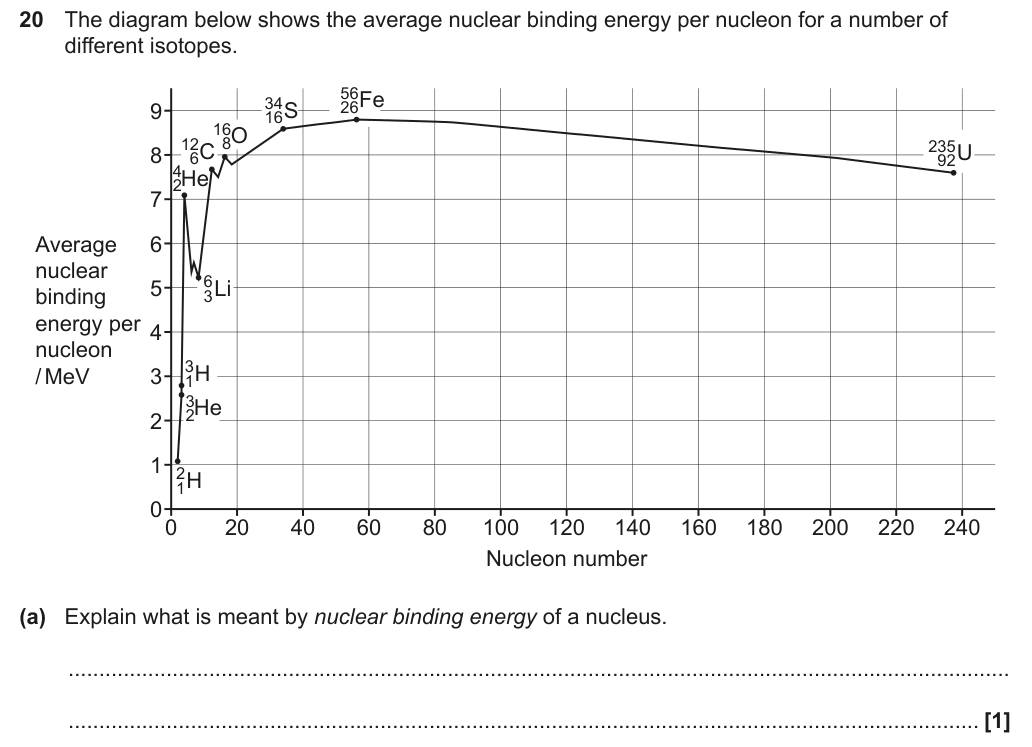
Earlier part of question 20 that this part uses
Mark scheme
Examiner's comment
Around half of candidates gave a clear suggestion why hydrogen was not included. Many appreciated that the single nucleon had no binding energy although not all made a link. Several candidates described a hydrogen atom instead of the nucleus causing confusion over electron binding energy.
Notes from the mark scheme and report
single proton AND so no binding energy
both needed
June 2024 · Paper 2 · Q20(d)(i)1 markCalculationEasy
Mark scheme
Examiner's comment
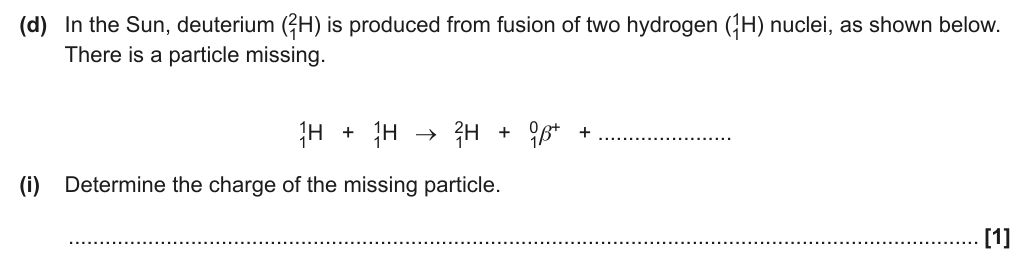
Most candidates were able to identify the charge. Most who gave incorrect responses answered a charge of -1, presumably due to the +.
Notes from the mark scheme and report
0 / neutral
penalise an incorrect unit
June 2024 · Paper 2 · Q20(d)(ii)1 markShort answerMedium
Earlier part of question 20 that this part uses
Mark scheme
Examiner's comment
Most candidates appreciated that this was a neutrino, with some giving the symbol in the equation too. There were relatively few antineutrino responses with electron being the most common incorrect answer. There seemed to be little connection between this and the previous question for several candidates who correctly gave the charge in (d)(i) but then named a charged particle here, or vice versa.
Notes from the mark scheme and report
do not allow antineutrino
June 2024 · Paper 2 · Q20(d)(iii)1 markCalculationEasy
Earlier part of question 20 that this part uses
Mark scheme
Examiner's comment
Most candidates were able to determine the correct number of quarks; the most common incorrect response was six, being the total number of quarks.
Notes from the mark scheme and report
two protons, each uud, so 4
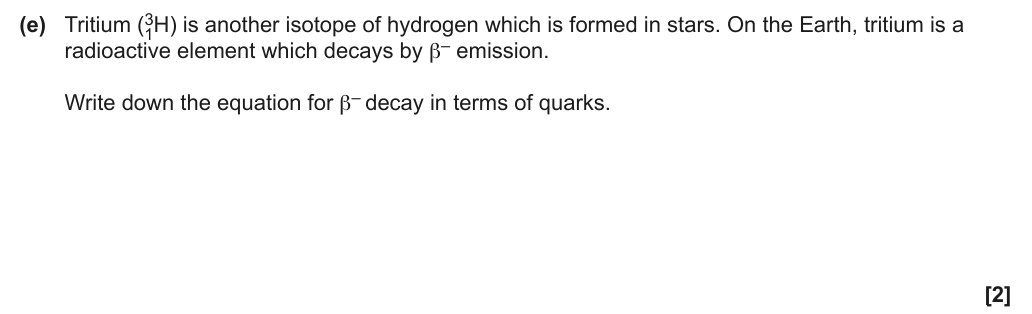
June 2024 · Paper 2 · Q20(e)2 marksShort answerMedium
Mark scheme
Examiner's comment
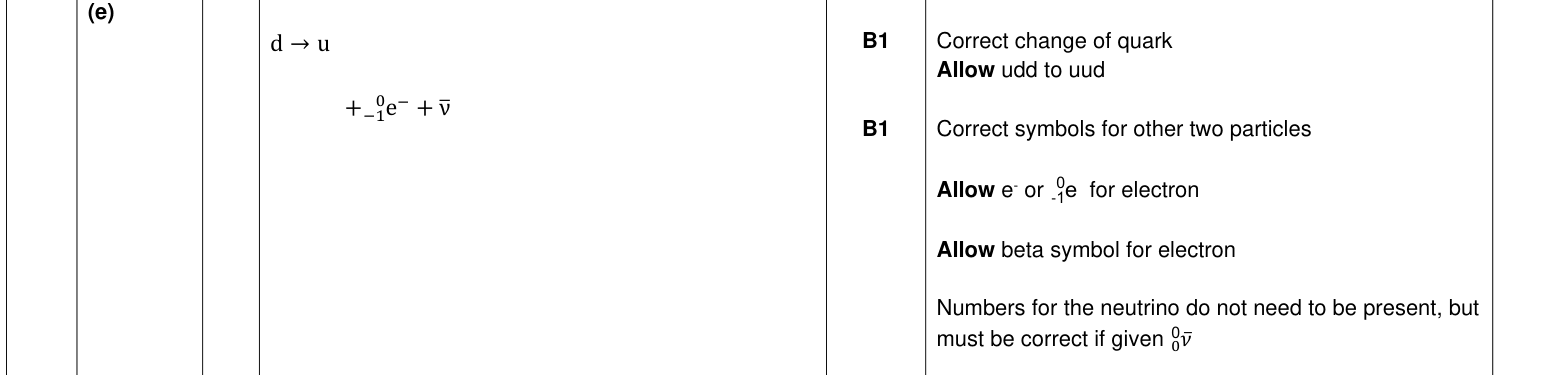
Candidates needed to show the quark change for a single mark, being a down quark to an up quark. This could be done in a number of ways, as long as there was one fewer d and one more u on the right hand side of the equation. This was done fairly well but the other particles were less clear. A neutrino was often given instead of an antineutrino and even though a beta-minus was given in the question, this was often written as a beta plus. A significant number of candidates gave no response to this question. This did not seem to be an issue of time.
Notes from the mark scheme and report
d to u (allow udd to uud)
electron and antineutrino with correct symbols
neutrino numbers must be correct if given
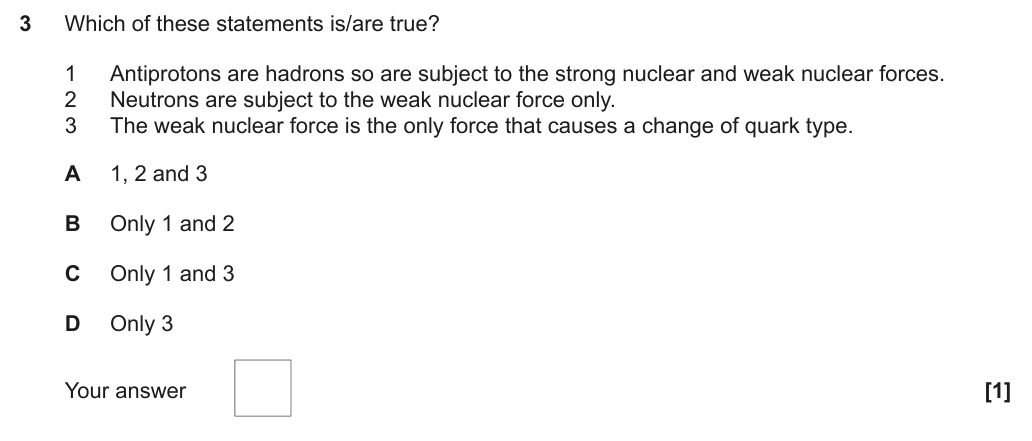
June 2023 · Paper 2 · Q31 markMultiple choiceMedium
Answer
C
Mark scheme
Examiner's comment
A good proportion of candidates were able to answer this correctly. Good practice in this style of questions is to tick the statements that the candidates are sure is correct and try a ‘best fit’. Most candidates knew statement 3 was correct and so response B was fairly uncommon as an incorrect response.
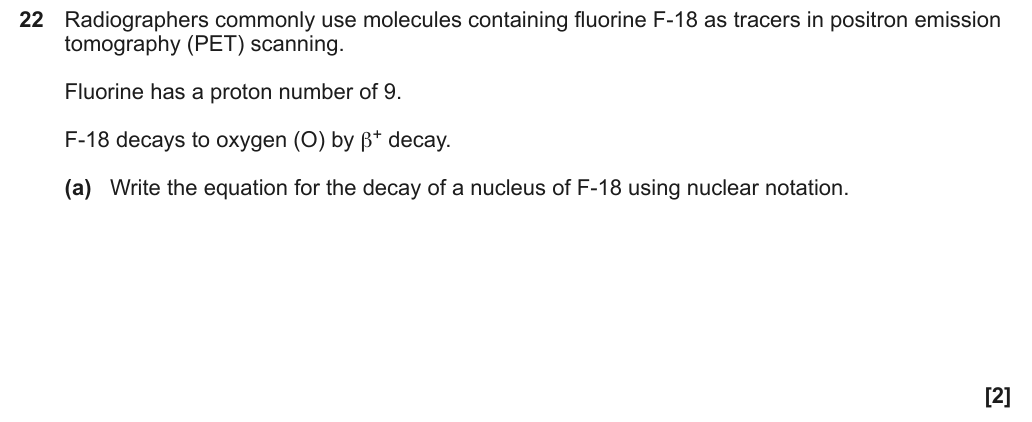
June 2023 · Paper 2 · Q22(a)2 marksShort answerMedium
Mark scheme
Examiner's comment
Most candidates will have gained the first mark for the correct isotope of fluorine. Those who didn’t likely reversed the positions of the nucleon and proton number. It was noticeable that a large number of candidates were unable to balance the equation and while they had the correct values for the positron, the oxygen isotope was incorrect.
Notes from the mark scheme and report
correct fluorine isotope for C1
neutrino not required
ignore gamma in products
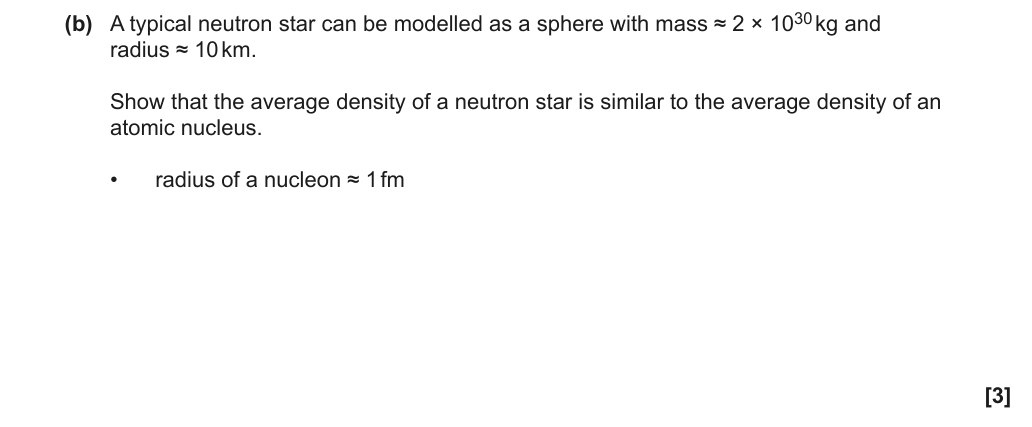
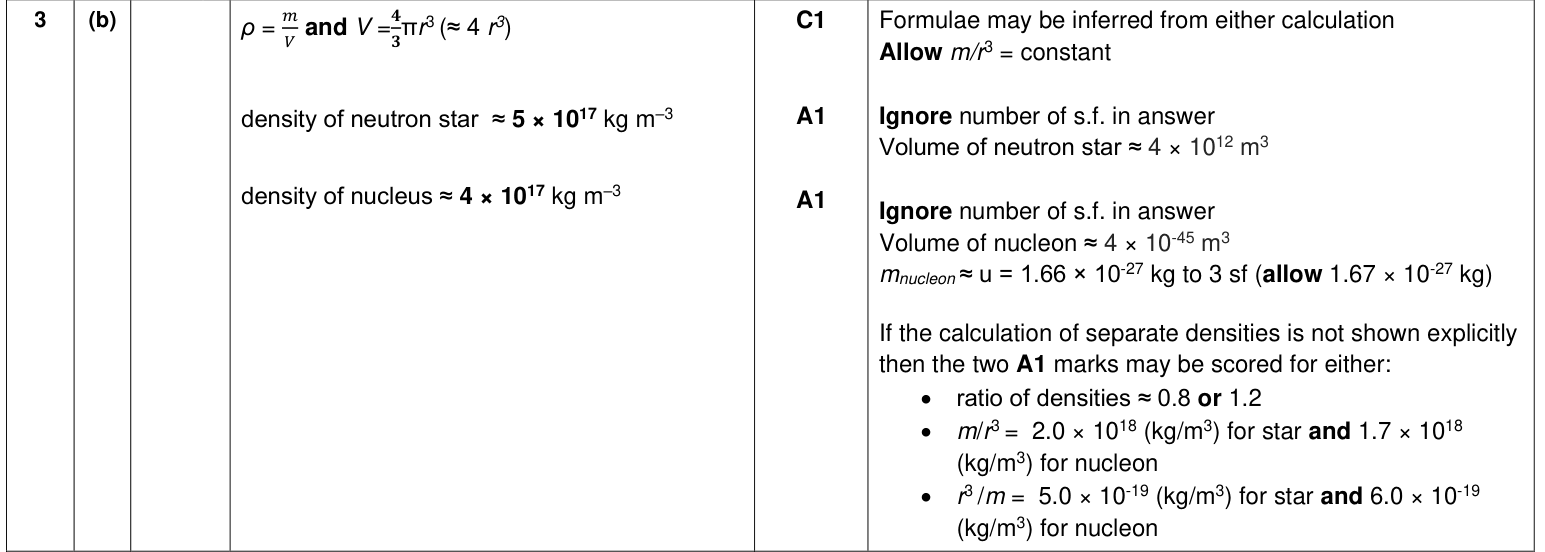
June 2023 · Paper 3 · Q3(b)3 marksShow thatEasy
Mark scheme
Examiner's comment
Most candidates were able to apply the correct formulae for density and for volume of a sphere. The calculation for the density of a neutron star was performed easily. However, rather than calculating the density of a single nucleon (whose radius had been given), many candidates tried to calculate the density of a different nucleus (such as deuteron or helium) whose radius had not been given. Some candidates lost marks through not stating the units in which their calculated densities were measured.
Notes from the mark scheme and report
about 5 x 10^17 and 4 x 10^17 kg m-3
nucleon mass about 1.66 x 10⁻²⁷ kg
Skills: M0.4 Estimate results; M2.3 Substitute numerical values into algebraic equations using appropriate units for physical quantities; M4.3 Calculate areas of triangles, circumferences and areas of circles, surface areas and volumes of rectangular blocks, cylinders and spheres
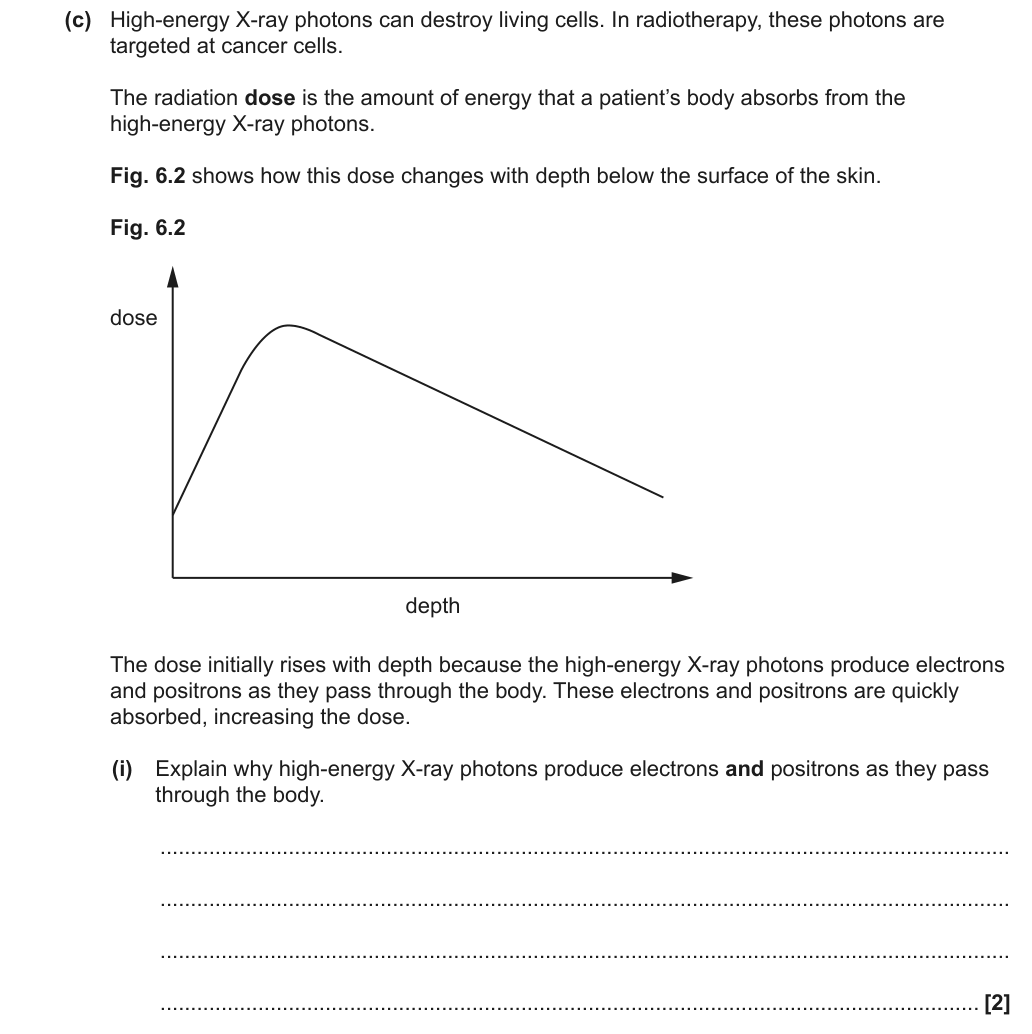
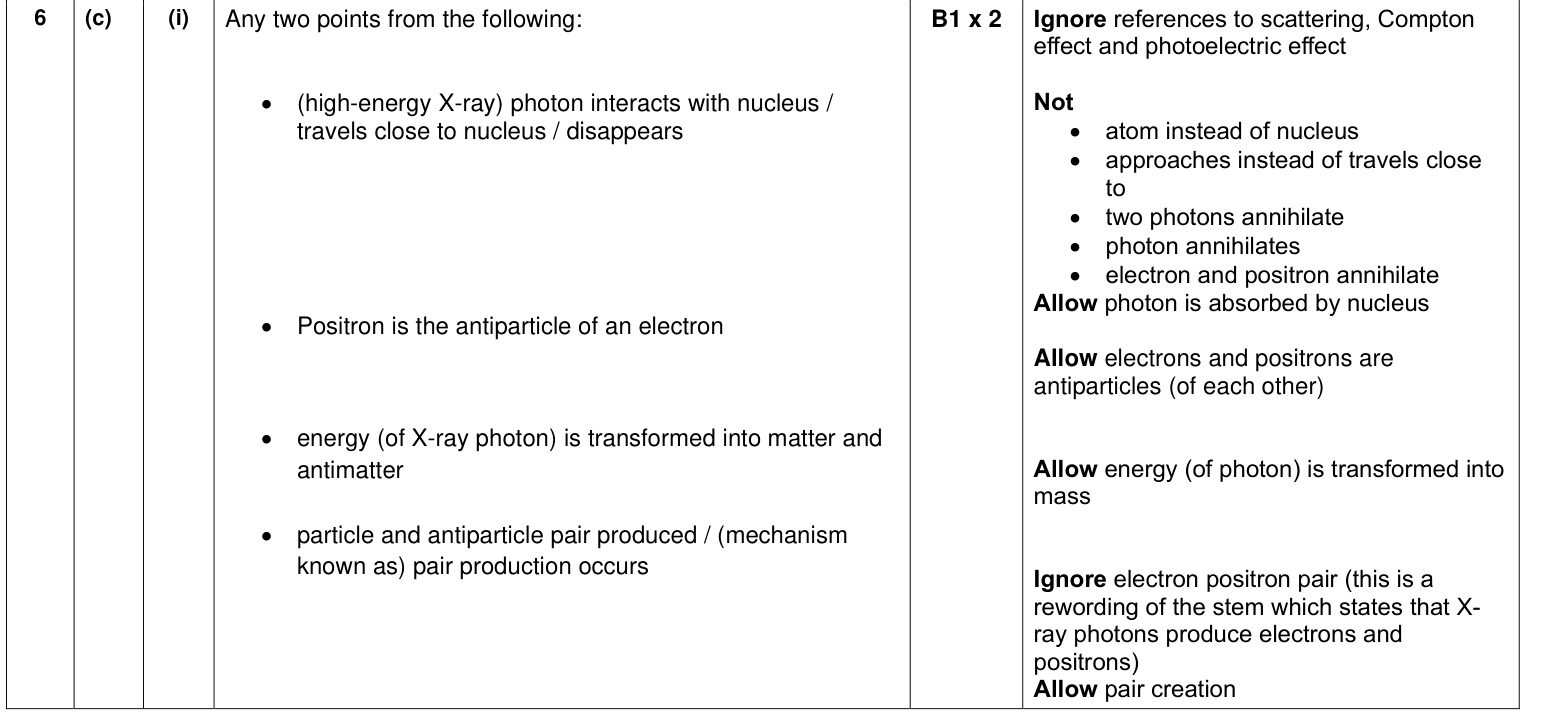
June 2023 · Paper 3 · Q6(c)(i)2 marksExplanationMedium
Mark scheme
Examiner's comment
The most common correct responses related to photons interacting with nuclei and to “pair production”. Candidates who scored no marks often simply reworded the stem of the question, or referred to photons interacting with atoms or electrons.
Notes from the mark scheme and report
pair production near a nucleus (NOT atom)
ignore scattering, Compton and photoelectric effect
NOT annihilation
June 2022 · Paper 2 · Q131 markMultiple choiceMedium
Answer
D
Mark scheme
Examiner's comment
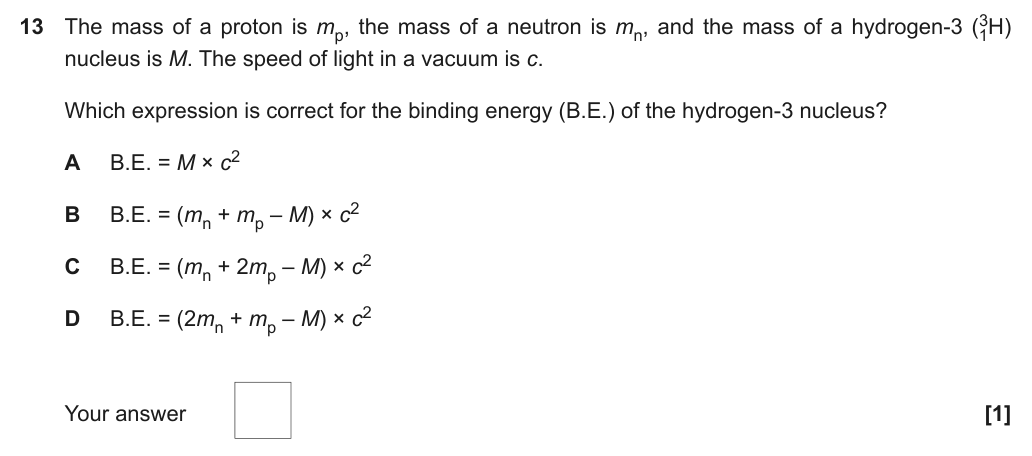
This question can correctly be answered by over three quarters of the candidates. Most appeared to be able to evaluate the composition of the nucleus correctly and then work forward from that. A was the most common incorrect response, presumably as less successful responses were able to recognise a variation of E = mc2.
June 2022 · Paper 2 · Q20(a)4 marksExplanationEasy
Mark scheme
Examiner's comment
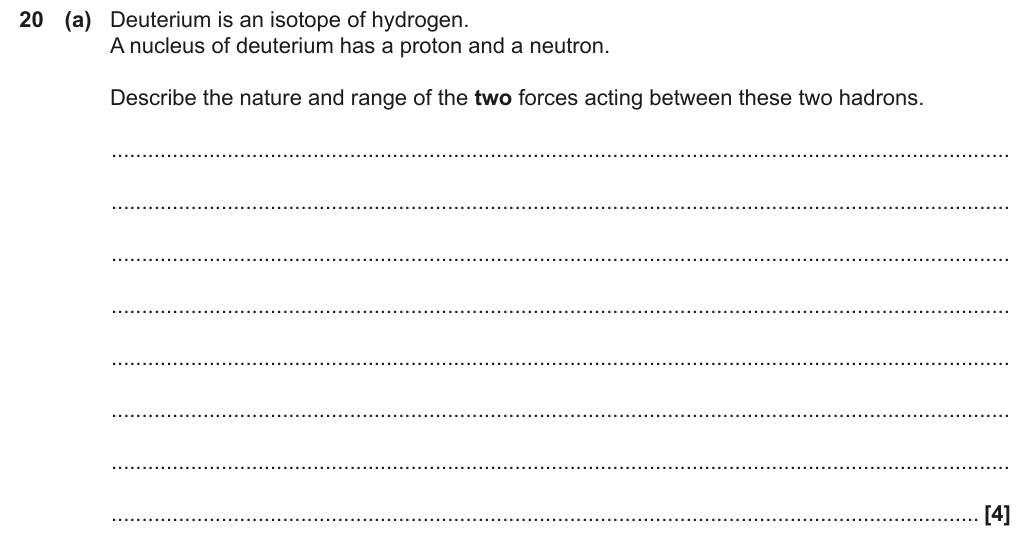
There were many superb answers to this question, with candidates giving plenty of correct detail in describing these forces. The vast majority appreciated the strong nuclear force was one of the forces and were able to give correct numerical values in terms of attractive and repulsive distances. Some stated that it was a purely attractive force, up to about 3fm, which could not be given the nature/range mark. Those who selected gravitational force as their second force were generally able to score the nature/range mark as this was simpler than that required for the strong force. A number of candidates stated that the electromagnetic force acted on the two hadrons and tried to justify the charge of the neutron in terms of its quarks.
Notes from the mark scheme and report
mark first two named forces only
implying strong force is always attractive loses the A mark
ignore weak nuclear force
June 2022 · Paper 2 · Q20(b)6 marks6-mark extended responseMedium
Mark scheme, with the levels and indicative content
Examiner's comment
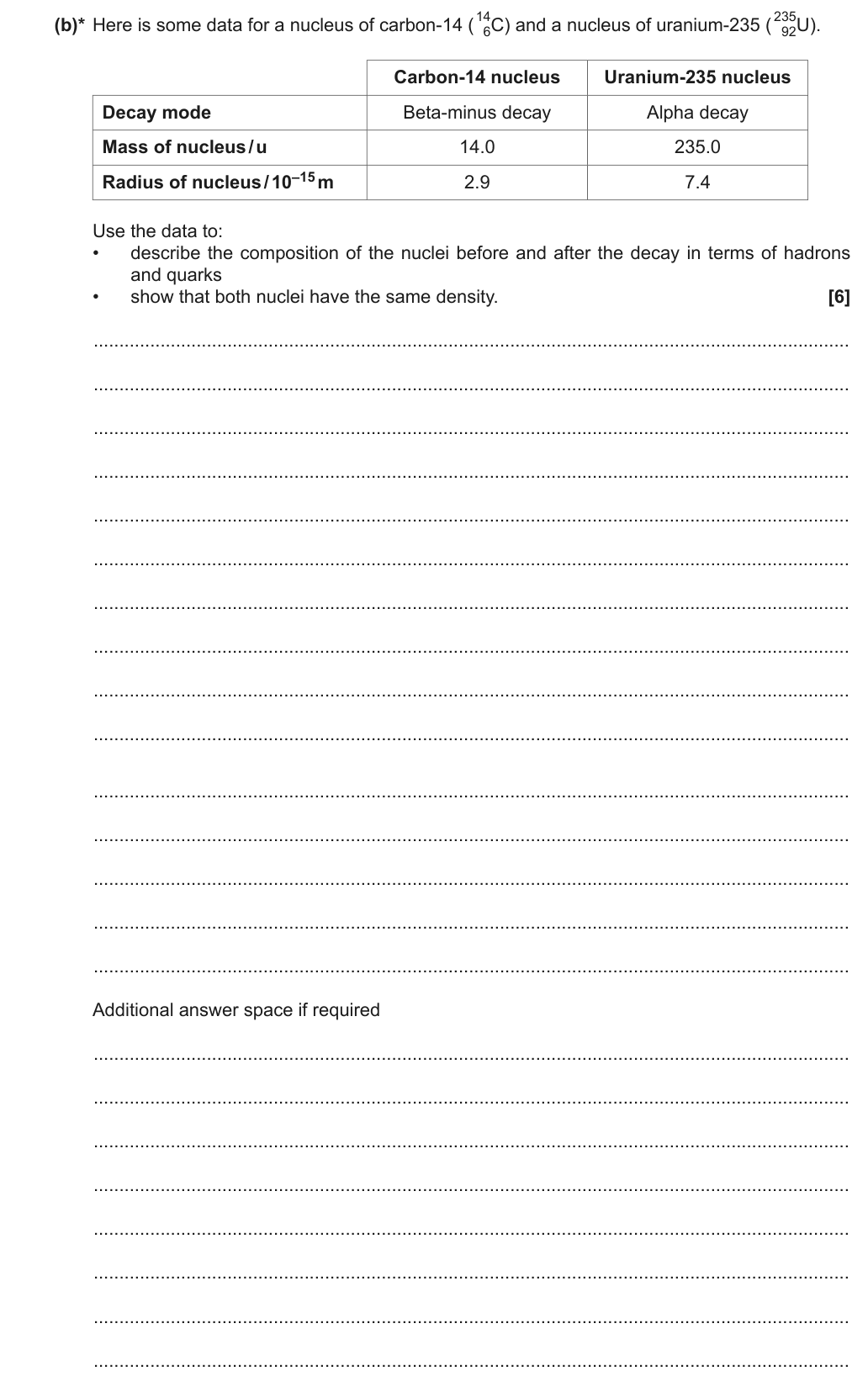
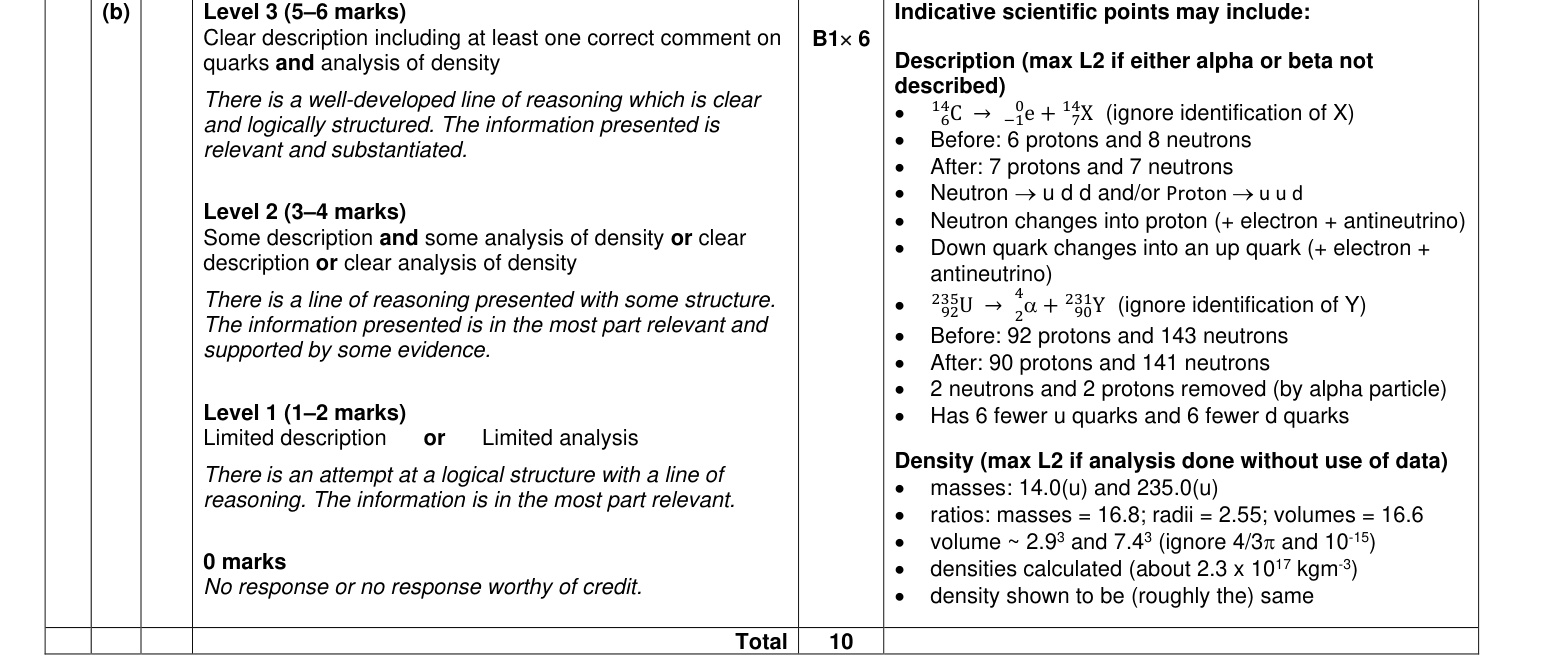
This is the second level of response (LoR) question in this paper, and was designed to assess nuclear and particle physics, specifically sections 6.4.1 and 6.4.2 of the specification. In particular, there are two parts (description and analysis) relating to two radioisotopes, and some given data. As previous, there are no specific marking points and examiners use a “best-fit” approach to the marking. Indicative scientific points are given in the mark scheme as a guidance what to expect, but not all need to be satisfied to be given full marks. Incorrect physics can be expected to be penalised however. Candidates should always be encouraged to structure their answers carefully and in calculations aim to give explanation of each stage rather than just producing a number. The two separate sections can be separated into a description of the decays, and an analysis of the data to show the two nuclear densities are the same. The key points in the description that examiners were looking for were: - numbers of protons before and after each decay – a description of the change in quark structure during beta decay – correctly balanced equations for alpha and beta-minus decay – the nature of the emissions in each decay. The key points in the analysis that examiners were looking for were: - calculation of volumes of nuclei, using (4/3) r3 – correct use of the density formula – numerical evaluation of the densities of the nuclei and a comparison. The descriptions of the decays varied hugely both in quality and quantity. Most candidates were aware that a beta particle is an electron, but several seemed to think it was an orbiting one which had no structural changes on the nucleus. Those who did know it was from a neutron to proton change often mixed up the nucleon numbers afterwards. Alpha decay was generally done better with most candidates knowing the nature of an alpha particle and correctly stating the structure of the remaining nucleus. Attempts were generally made to changes in quark structures (mostly for beta decay) and the structure of a neutron and proton were known, although strangely several candidates stated the change was from an up quark to a down quark. Candidates who did not give any descriptions of the quark structures were limited to Level 2. For the most part, the analysis was done better than the description and candidates were generally able to correctly evaluate the two densities and make a suitable comparison. Units of density were not penalised here, with many candidates using the mass (in u) in the calculation but giving the units of density as kg m-3, although many stating u m-3. However, many did correctly calculate the mass of the nucleus using the correct factor coming out with densities of approximately 2.3 1017 kg m-3. Those who took an approach to algebraically show that the density of every nucleus is independent of the nucleon number (using a standard method to get to some variation of 3u/4r3) alone were unable to reach Level 3 as they had not used the data. The use of r0 as 1.2 10-15 m was commonly seen. A candidate who provides some description and analysis which places it in Level 2, but the confusion over alpha decay and general lack of clarity means it would be at the lower point (3 marks).
Notes from the mark scheme and report
max L2 if either alpha or beta decay not described
max L2 if density analysis does not use the data
Skills: M0.3 Use ratios, fractions and percentages; M2.3 Substitute numerical values into algebraic equations using appropriate units for physical quantities; M4.3 Calculate areas of triangles, circumferences and areas of circles, surface areas and volumes of rectangular blocks, cylinders and spheres
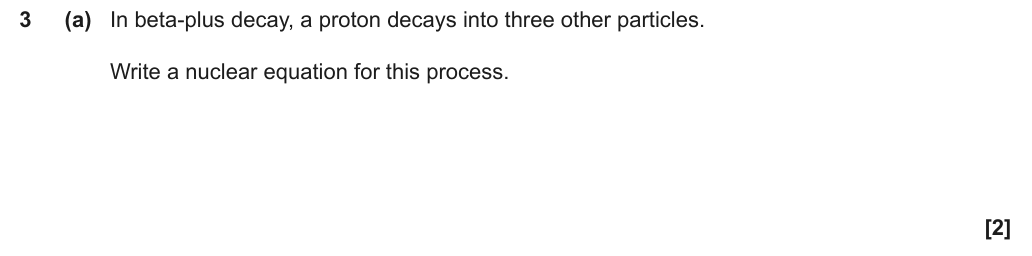
June 2022 · Paper 3 · Q3(a)2 marksShort answerMedium
Mark scheme
Examiner's comment
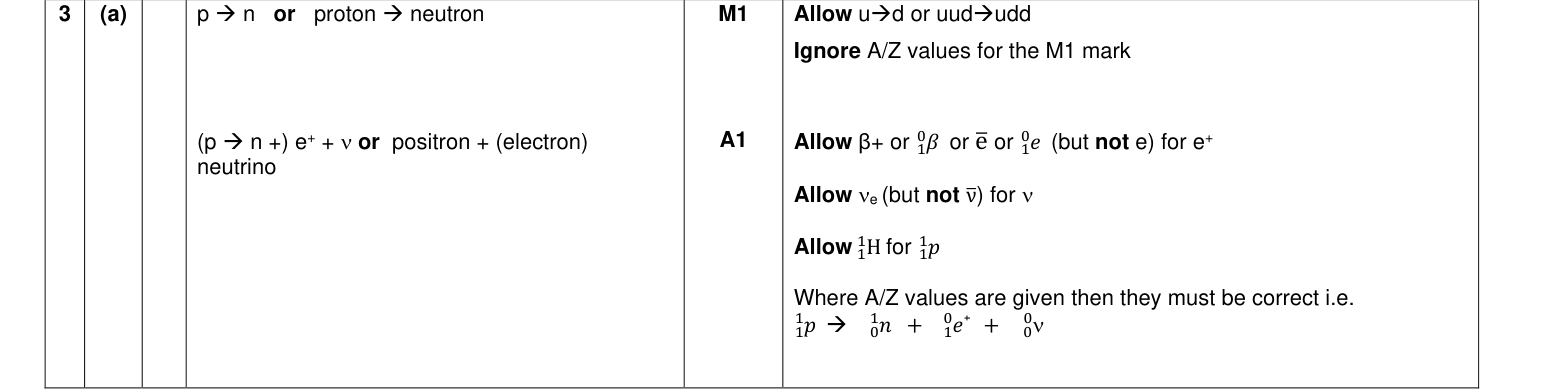
The question did not specify what type of equation was needed, and the simple word equation proton → neutron + positron + neutrino was sufficient for full marks. Common problems in 3(a) • using the symbol N instead of n for neutron (N is the symbol for nitrogen) • using incorrect A/Z values such as 𝑛𝑛 for neutron and/or 𝑒𝑒 0 for positron • using an incorrect symbol for the neutrino
Notes from the mark scheme and report
NOT e for e+
NOT antineutrino
Allow u → d
any A/Z values given must be correct
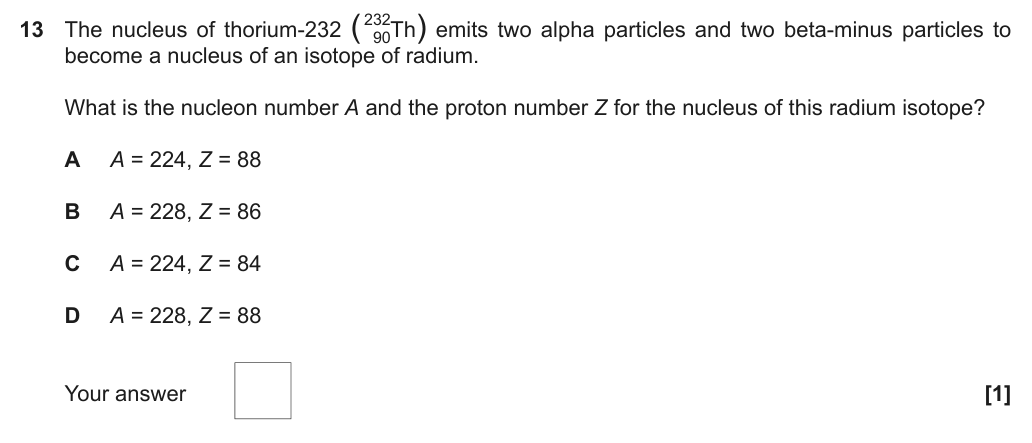
November 2021 · Paper 2 · Q131 markMultiple choiceHard
Answer
A
Mark scheme
Examiner's comment
The correct response is A. Around half of candidates were able to select the correct response. Although it would seem appropriate to write out some simple decay sequence, many candidates showed little working here. Some were able to get the correct response (probably through mental arithmetic) but incorrect responses may simply have been down to a lack of knowledge of nuclear changes, most likely in the beta decay. Incorrect responses were spread fairly evenly among the distractors, again suggesting that this topic was not well understood.
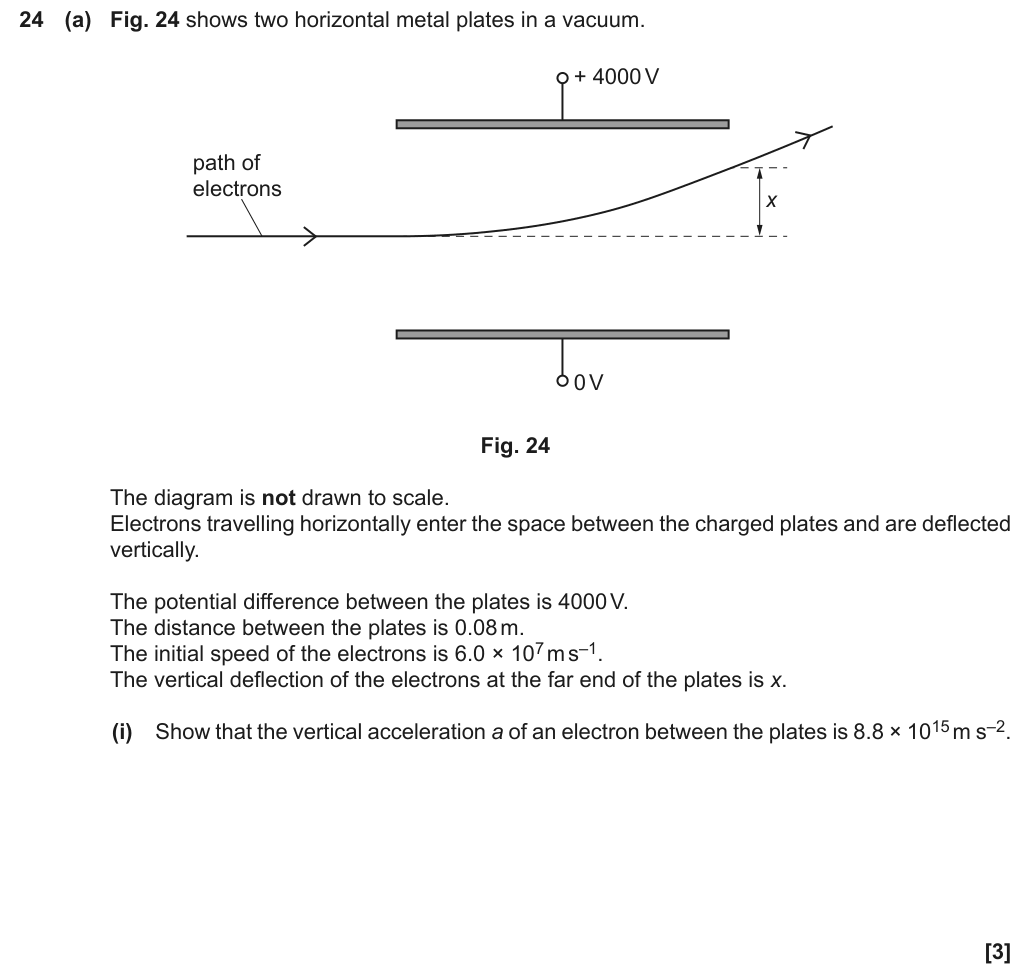
November 2021 · Paper 2 · Q24(b)2 marksDiagram or graphEasy
Earlier part of question 24 that this part uses
Mark scheme
Examiner's comment
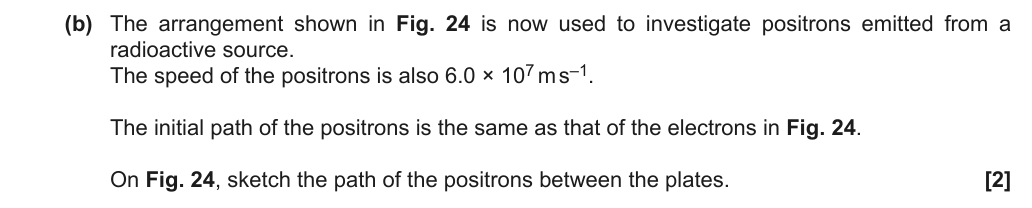
Nearly all candidates appreciated that the path should be downwards, but many did not take the care needed for it to be clear that the deflection at the end of the plate should be the same. Some candidates drew an ‘x’ on their sketch, which was helpful in determining if the intention to draw it the same had been made.
Notes from the mark scheme and report
downward curve with the same x (by eye)
ignore any line outside the plates
November 2020 · Paper 2 · Q121 markMultiple choice
Answer
A
Mark scheme
November 2020 · Paper 2 · Q21(a)4 marksExplanationMedium
Mark scheme
Examiner's comment
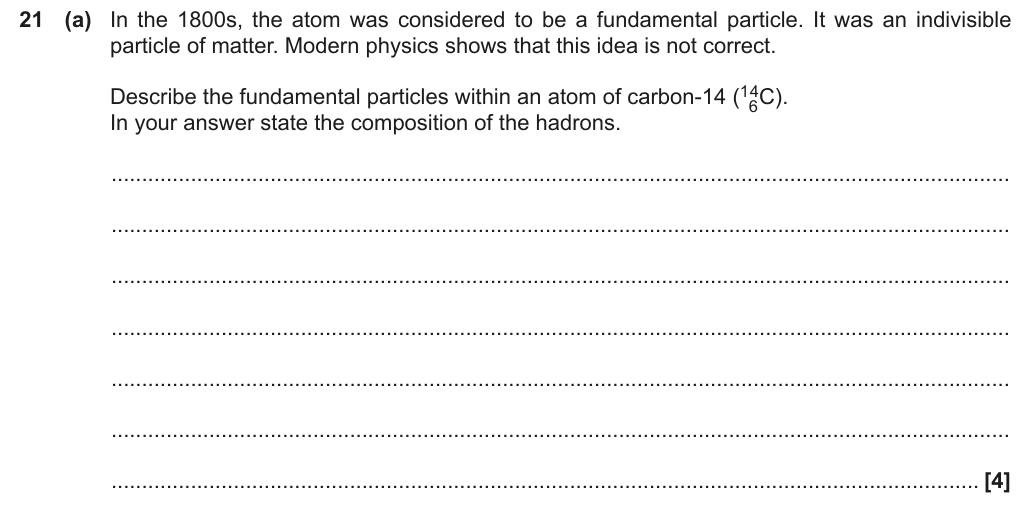
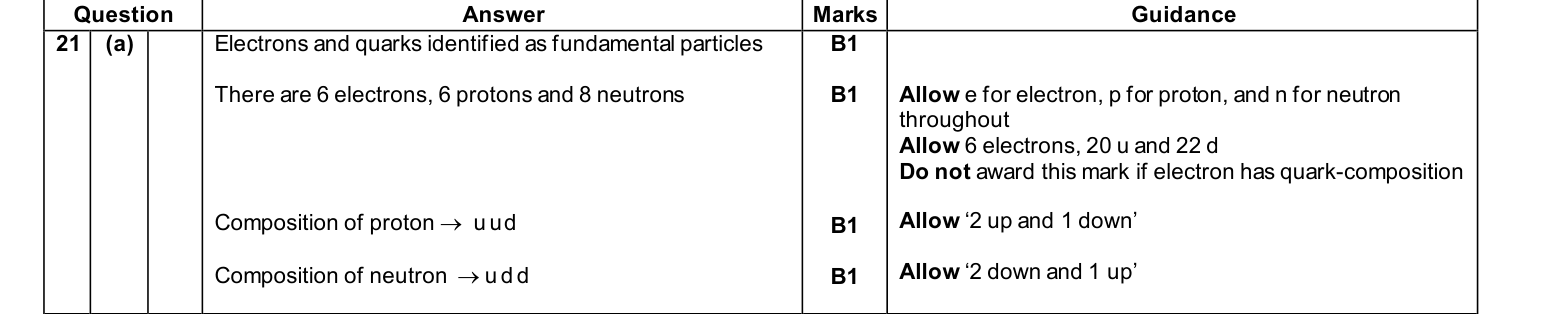
In Question 21c, candidates had to analyse and evaluate data, and estimate the density of nuclei using the information provided. Question 21a is all about the composition of a carbon-14 atom, with the question specifically mentioning fundamental particles and hadrons.
Notes from the mark scheme and report
electrons and quarks named as the fundamental particles
no mark for nucleon numbers if the electron is given a quark composition
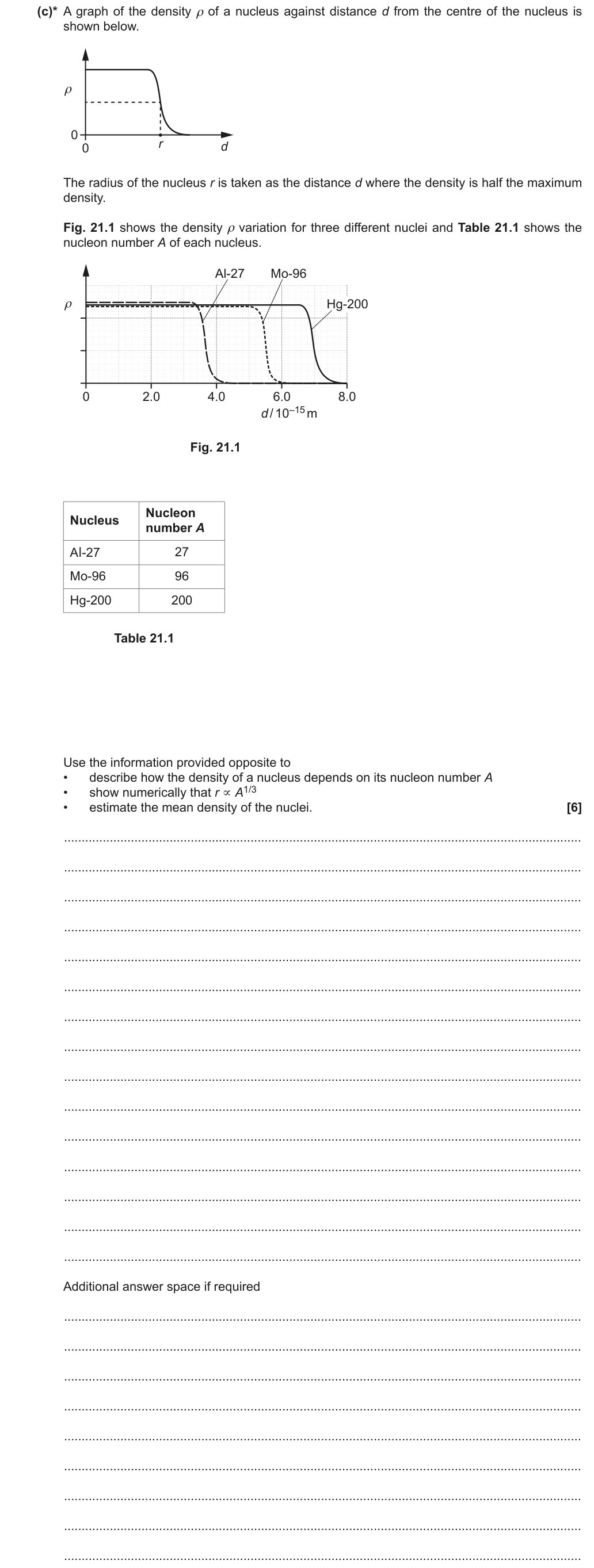
November 2020 · Paper 2 · Q21(c)6 marks6-mark extended responseMedium
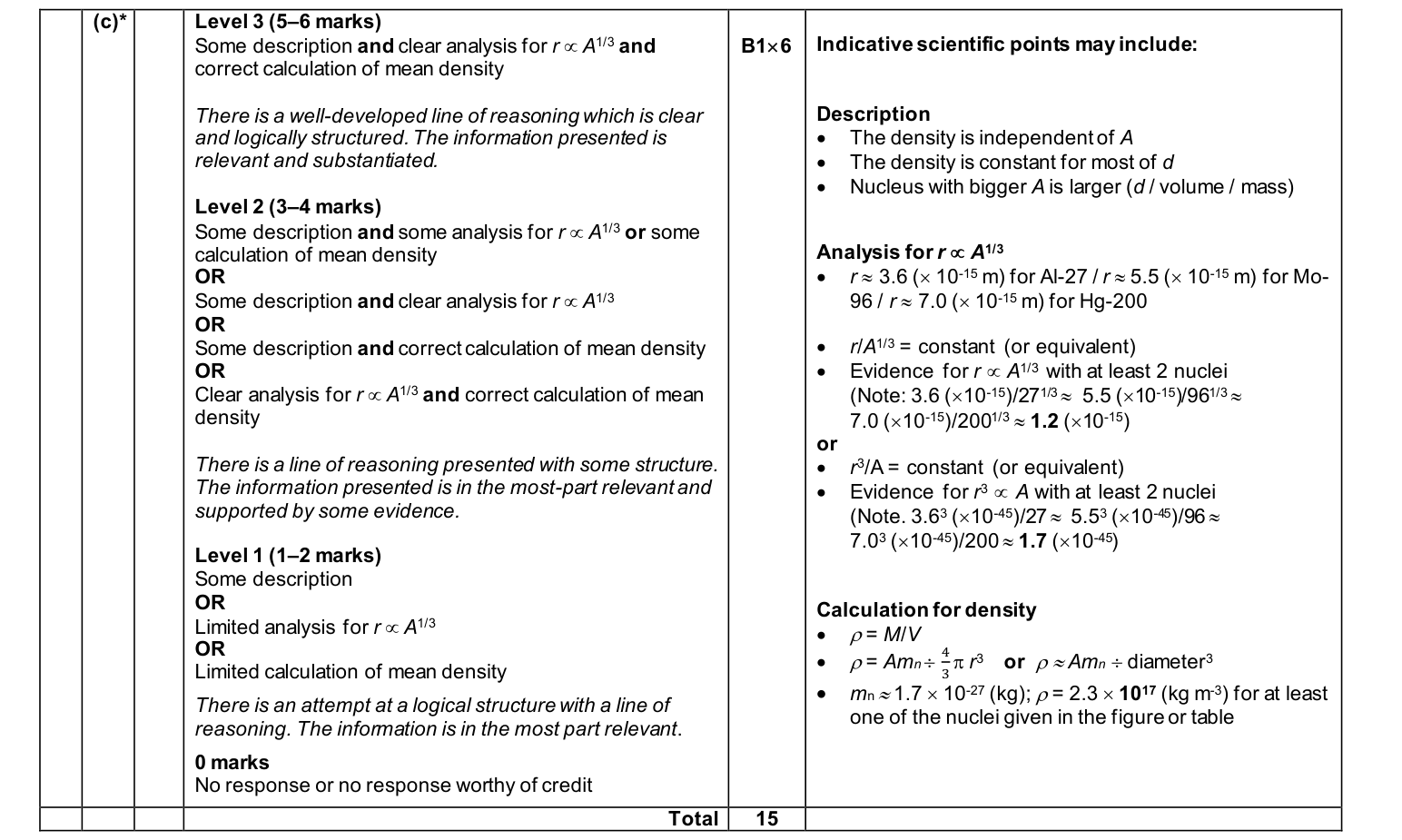
Mark scheme, with the levels and indicative content
Examiner's comment
In Question 21c, candidates had to analyse and evaluate data, and estimate the density of nuclei using the information provided. Question 21a is all about the composition of a carbon-14 atom, with the question specifically mentioning fundamental particles and hadrons.
Notes from the mark scheme and report
density independent of A
r/A^(1/3) about 1.2 x 10⁻¹⁵ m for at least two nuclei
density about 2.3 x 10^17 kg m-3
Skills: M0.4 Estimate results; M3.1 Translate information between graphical, numerical and algebraic forms; M4.3 Calculate areas of triangles, circumferences and areas of circles, surface areas and volumes of rectangular blocks, cylinders and spheres
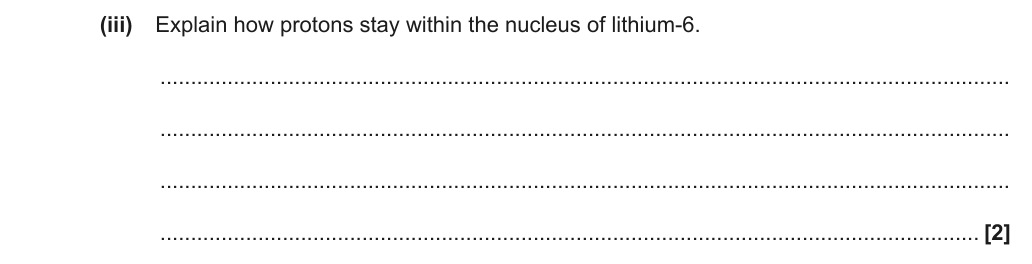
November 2020 · Paper 2 · Q23(a)(iii)2 marksExplanation
Mark scheme
Notes from the mark scheme and report
strong nuclear force and attractive
ignore gravitational force
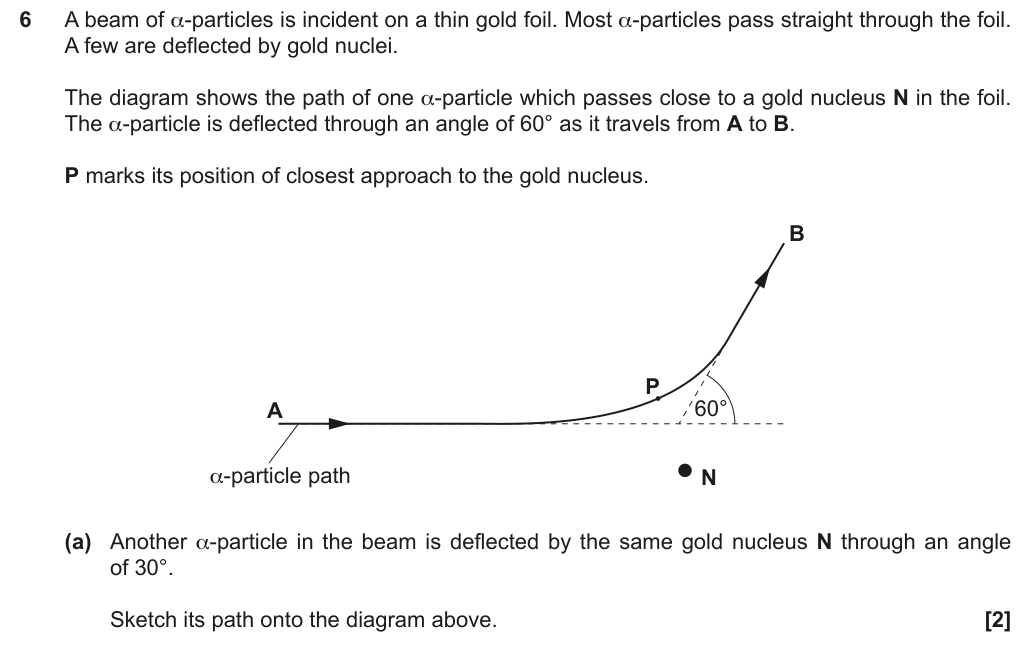
November 2020 · Paper 3 · Q6(a)2 marksDiagram or graphMedium
Mark scheme
Examiner's comment
Since this paper is synoptic, candidates need to be able to apply their knowledge and understanding in unfamiliar contexts in order to gain high marks, To do well in this paper, candidates must be able to: • perform and layout calculations logically, showing clear working (such as Question 6c) • produce concise but accurate responses to questions which involve extended writing (such as question 1b) • craft clearly structured and well-reasoned arguments to the Level of Response Questions (3b and 5d) • process and interpret data from an experiment to reach conclusions (Question 2). Question 6a The common errors here were: • not realising that, for the particle to be deflected through a smaller angle, it needed to be travelling further away from N • not labelling the final angle of 30° • not adding arrows to show the direction of travel • drawing a path that continued bending beyond the stated 30° (usually ending up parallel to the original path). Question 6b The most common error here was to use incorrect values for the charges on the two ions. Question 6c This question provided an excellent opportunity for candidates to produce immaculate responses: identify the physics involved, select and write down the correct formula, do the necessary conversion (MeV to J), rearrange the formula, substitute correctly and then write the final response in standard form to a correct number of significant figures. Question 6d This was not an easy question but, even so, a good number of candidates did well.
Notes from the mark scheme and report
path initially horizontal and further up the page (further from N) than the original
ends at 30 degrees to the horizontal with the angle labelled
November 2020 · Paper 3 · Q6(b)4 marksCalculationMedium
Earlier part of question 6 that this part uses
Mark scheme
Examiner's comment
Since this paper is synoptic, candidates need to be able to apply their knowledge and understanding in unfamiliar contexts in order to gain high marks, To do well in this paper, candidates must be able to: • perform and layout calculations logically, showing clear working (such as Question 6c) • produce concise but accurate responses to questions which involve extended writing (such as question 1b) • craft clearly structured and well-reasoned arguments to the Level of Response Questions (3b and 5d) • process and interpret data from an experiment to reach conclusions (Question 2). Question 6a The common errors here were: • not realising that, for the particle to be deflected through a smaller angle, it needed to be travelling further away from N • not labelling the final angle of 30° • not adding arrows to show the direction of travel • drawing a path that continued bending beyond the stated 30° (usually ending up parallel to the original path). Question 6b The most common error here was to use incorrect values for the charges on the two ions. Question 6c This question provided an excellent opportunity for candidates to produce immaculate responses: identify the physics involved, select and write down the correct formula, do the necessary conversion (MeV to J), rearrange the formula, substitute correctly and then write the final response in standard form to a correct number of significant figures. Question 6d This was not an easy question but, even so, a good number of candidates did well.
Notes from the mark scheme and report
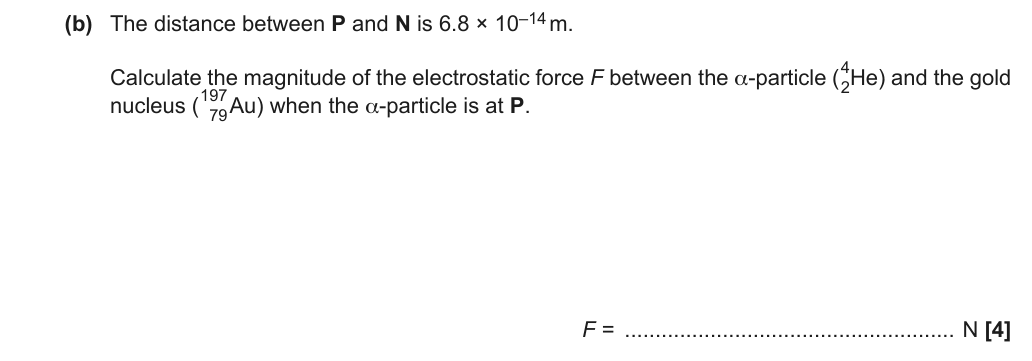
ecf for wrong charge(s), e.g. Q or q = e, or 79 and 2 without e
Skills: M0.2 Recognise and use expressions in decimal and standard form; M2.3 Substitute numerical values into algebraic equations using appropriate units for physical quantities
June 2019 · Paper 2 · Q111 markMultiple choice
Answer
B
Mark scheme
Notes from the mark scheme and report
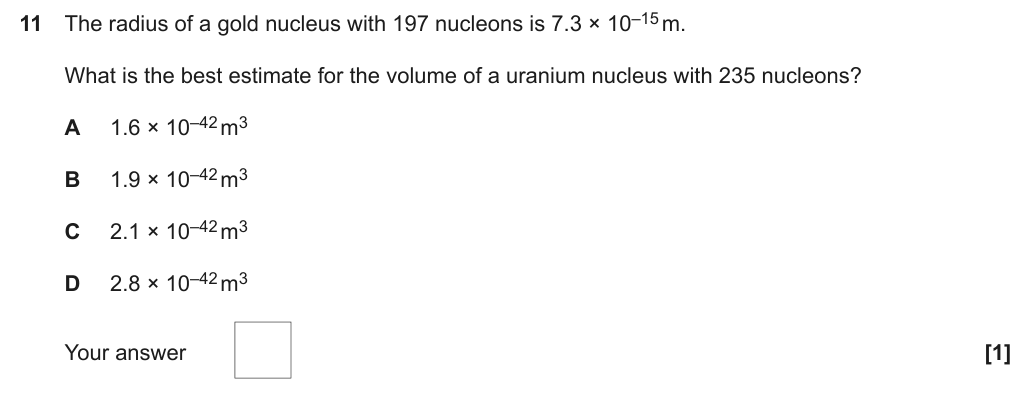
volume is proportional to nucleon number
Skills: M0.3 Use ratios, fractions and percentages; M4.3 Calculate areas of triangles, circumferences and areas of circles, surface areas and volumes of rectangular blocks, cylinders and spheres
June 2019 · Paper 2 · Q20(b)(i)1 markShort answerMedium
Mark scheme
Examiner's comment
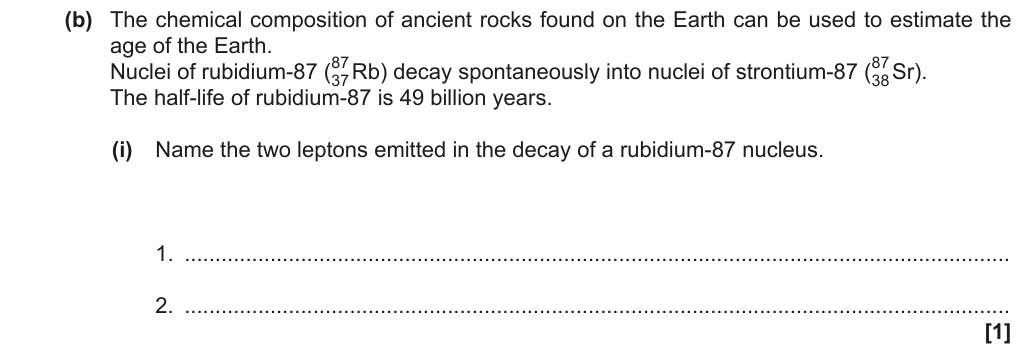
The majority of the candidates scored a mark for electron and antineutrino as the two leptons. The most common incorrect answers were neutrino, positron, proton and neutron. The pairing of electron and positron also appeared on some scripts.
Notes from the mark scheme and report
both needed for the mark
June 2019 · Paper 2 · Q21(a)(i)1 markExplanationEasy
Mark scheme
Examiner's comment
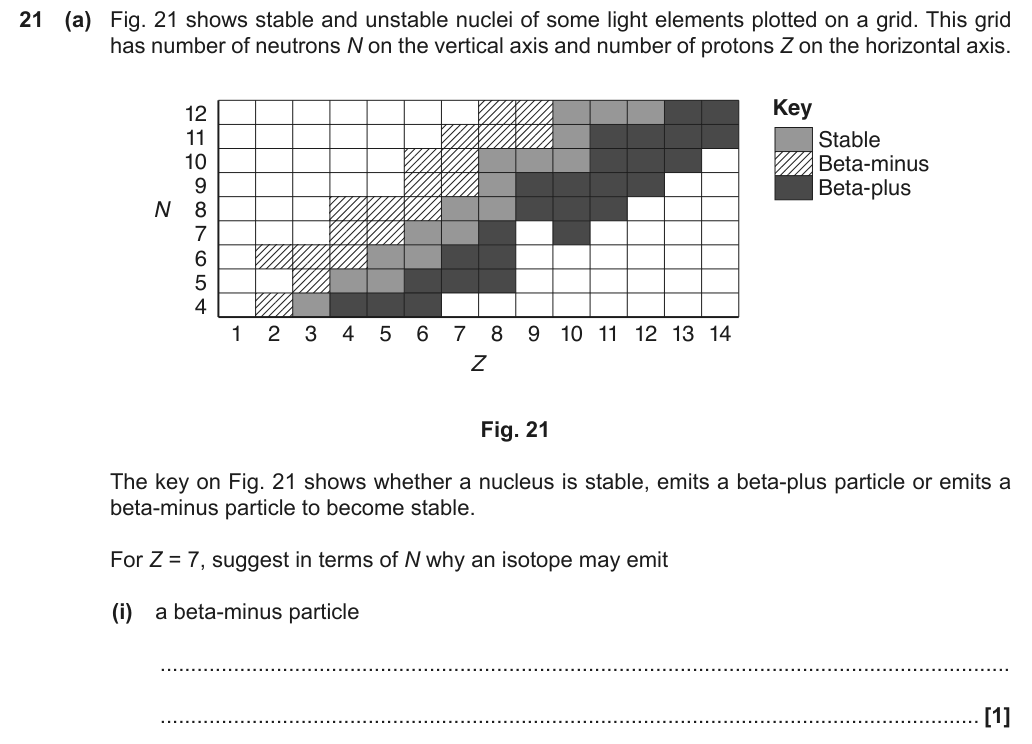
This question required analysis of the information provided in Fig. 21. Most candidates scored a mark for either recognising that the isotope had too many neutrons or a neutron had to decay into a proton in order to provide stability.
Notes from the mark scheme and report
Allow 'too few protons'
Skills: M3.1 Translate information between graphical, numerical and algebraic forms
June 2019 · Paper 2 · Q21(a)(ii)1 markExplanationEasy
Earlier part of question 21 that this part uses
Mark scheme
Examiner's comment
A range of answers were allowed in this question requiring analysis of Fig. 21. Most candidates scored a mark for either recognising that the isotope had too few neutrons or a proton had to decay into a neutron in order to provide stability.
Notes from the mark scheme and report
Allow 'too many protons'
Skills: M3.1 Translate information between graphical, numerical and algebraic forms
June 2019 · Paper 3 · Q2(a)3 marksShort answerMedium
Mark scheme
Examiner's comment
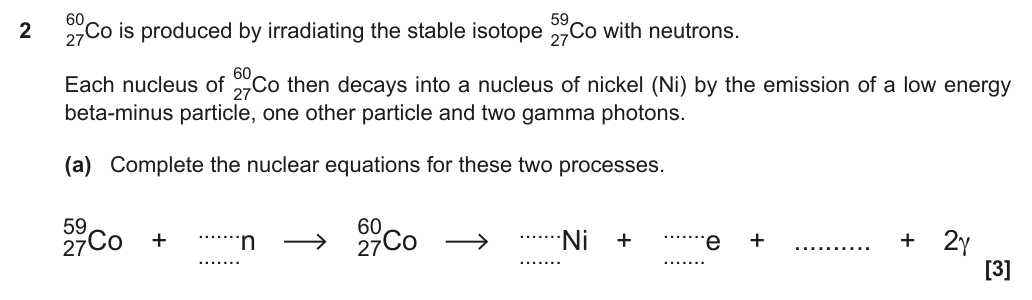
The correct symbol for the ‘one other particle’ in this question was ( ,)( _e ) or ((_0^0) ), all being acceptable. Common problems in 2(a) • some attempts for the symbol ‘nu’ could not be given because they were indecipherable or looked more like ‘gamma’ • balancing the bottom row proved more troublesome than balancing the top row, presumably because of the ‘-1’ for the electron
Notes from the mark scheme and report
recognisable antineutrino symbol required
superscripts 1, 60, 0 and subscripts 0, 28, -1
Centres should give candidates plenty of practice in balancing equations that involve beta minus decay.
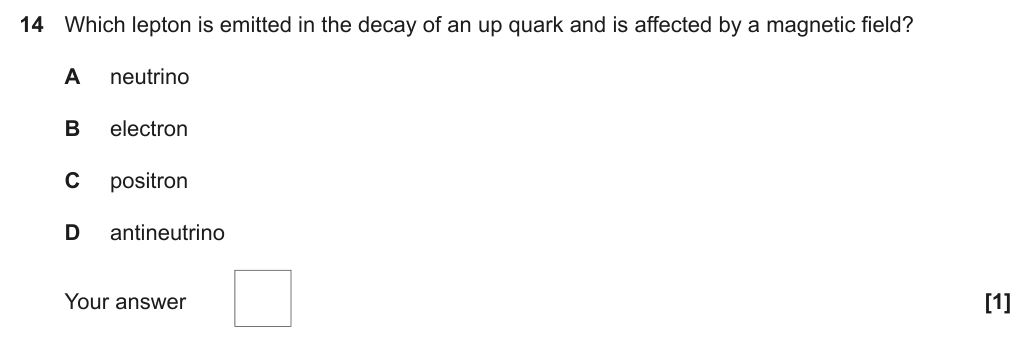
June 2018 · Paper 2 · Q141 markMultiple choice
Answer
C
Mark scheme
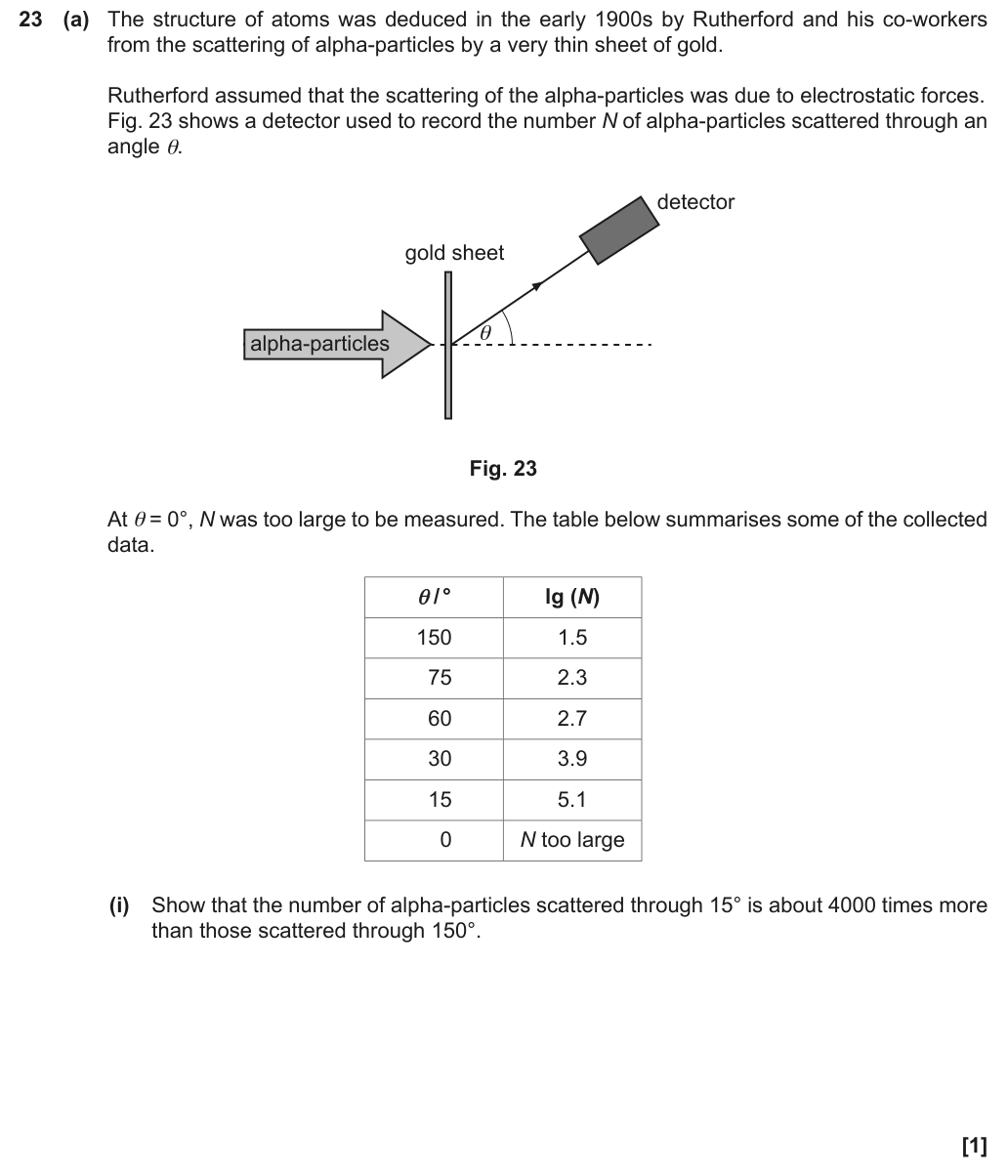
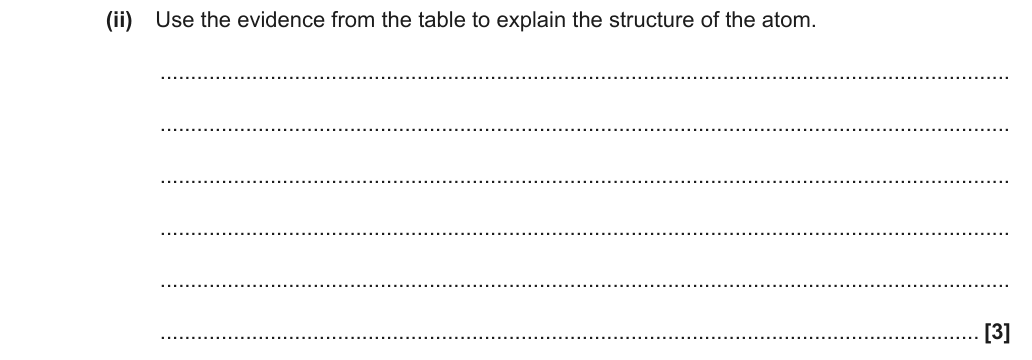
June 2018 · Paper 2 · Q23(a)(ii)3 marksExplanationHard
Earlier part of question 23 that this part uses
Mark scheme
Examiner's comment
This question provided good discrimination. It is worth 3-marks, so the examiners were broadly looking for three key disparate points. The exemplar below, from a top-end candidate, illustrates a model answer. There is no ambiguity – full marks scored. It would be difficult to provide an improved answer. However, it is worth pointing out that the same ideas can also be presented in bullet-point form – three distinct points for the 3 available marks.
Notes from the mark scheme and report
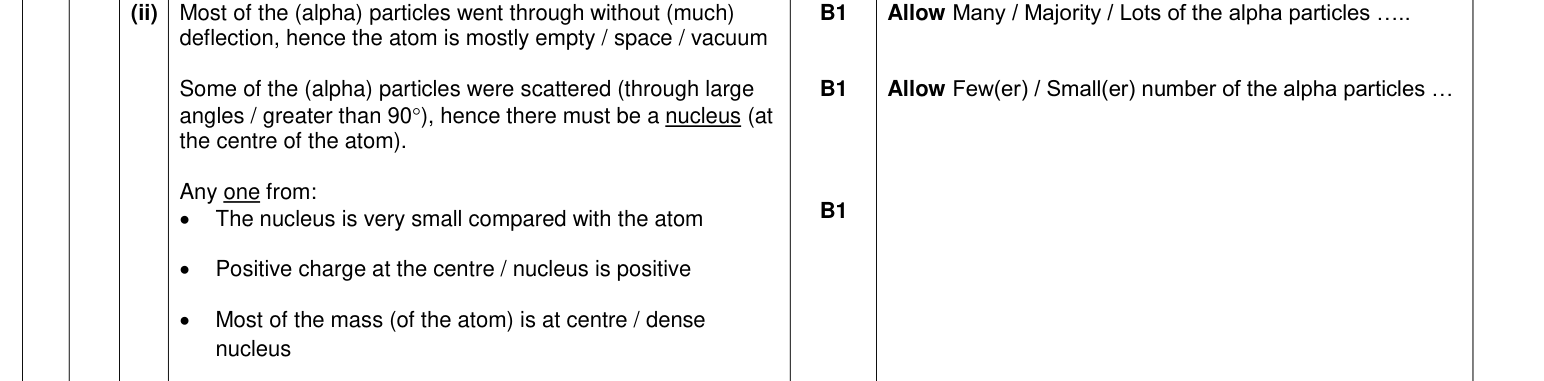
each conclusion must be linked to the evidence (most undeflected so mostly empty space
few scattered through large angles so a nucleus)
June 2018 · Paper 2 · Q23(b)(ii)3 marksCalculationHard
Earlier part of question 23 that this part uses
Mark scheme
Examiner's comment
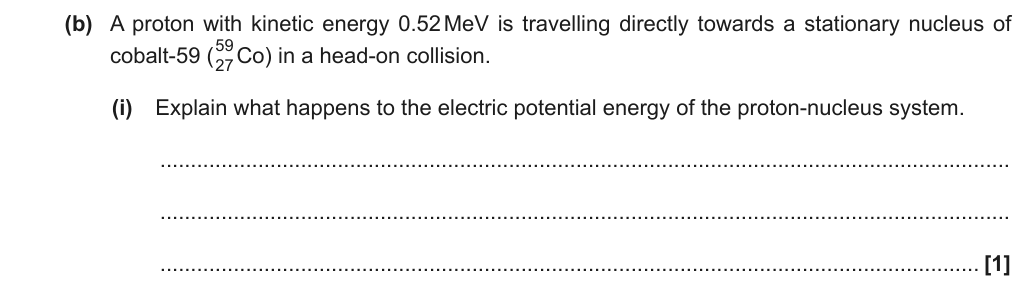
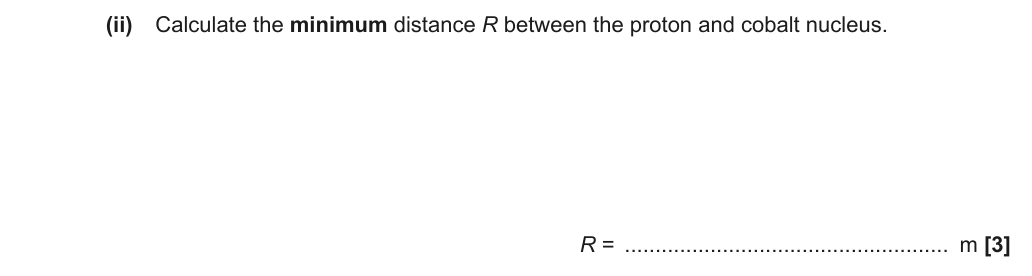
The above question on electric potential energy provided excellent discrimination with middle and upper quartile candidates showing how to produce immaculate answers – identify the physics, write down the correct physical equation, do any necessary conversions (e.g. MeV to J), rearrange the equation, substitute correctly and then write the final answer in standard form to the correct number of significant figures. About a third of the candidates scored full marks. Some of the missed opportunities or errors were: • Using an incorrect equation with the distance squared • Not correctly converting the kinetic energy 0.52 MeV into joule (J) • Using the equation r = r0A1/3 for the mean radius of a nucleus to determine the minimum distance
Notes from the mark scheme and report
Z = 27 for cobalt: 1.6 x 10⁻¹³ (Z = 59) or 8.9 x 10⁻¹⁴ (Z = 32) score 2
Z = 1 or energy left in eV score 1
Skills: M0.2 Recognise and use expressions in decimal and standard form; M2.2 Change the subject of an equation, including non-linear equations; M2.3 Substitute numerical values into algebraic equations using appropriate units for physical quantities
June 2018 · Paper 2 · Q24(a)(ii)2 marksShort answerMedium
Earlier part of question 24 that this part uses
Mark scheme
Examiner's comment
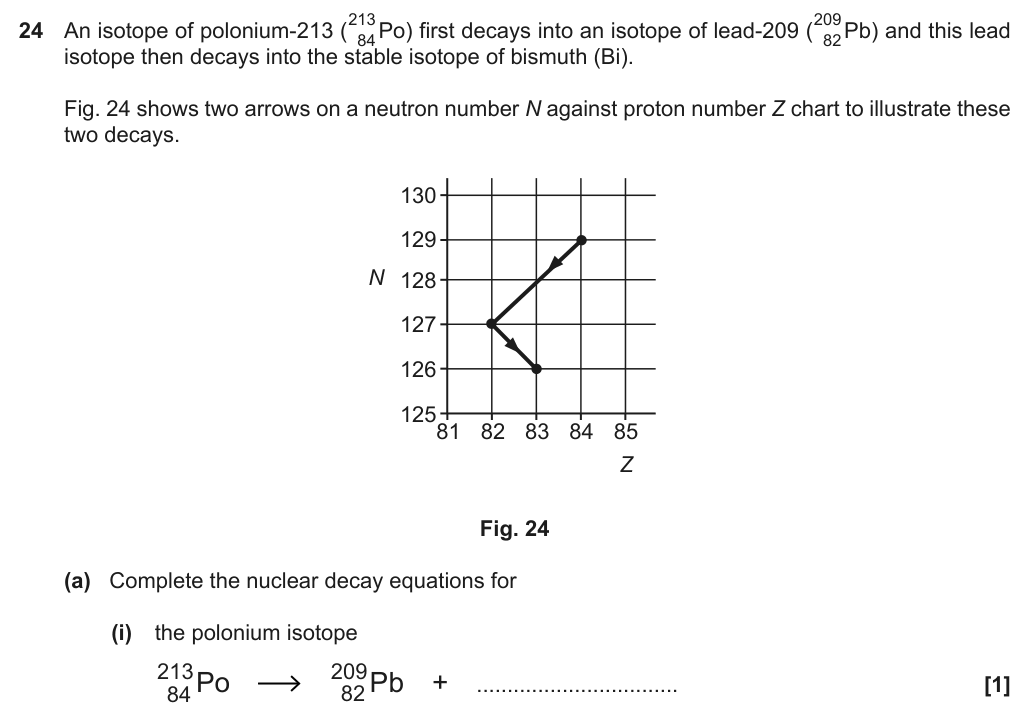
Some of the missed opportunities or errors were: • Using an incorrect equation with the distance squared • Not correctly converting the kinetic energy 0.52 MeV into joule (J) • Using the equation r = r0A1/3 for the mean radius of a nucleus to determine the minimum distance Question 24(a)(ii) Question 24(b)(i) This turned out to be a low-scoring question from candidates across the ability spectrum.
Notes from the mark scheme and report
nucleon number of Bi = 209 and (electron) antineutrino
do not allow incorrect subscript and superscript
June 2018 · Paper 2 · Q25(a)(i)2 marksExplanation
Mark scheme
Notes from the mark scheme and report
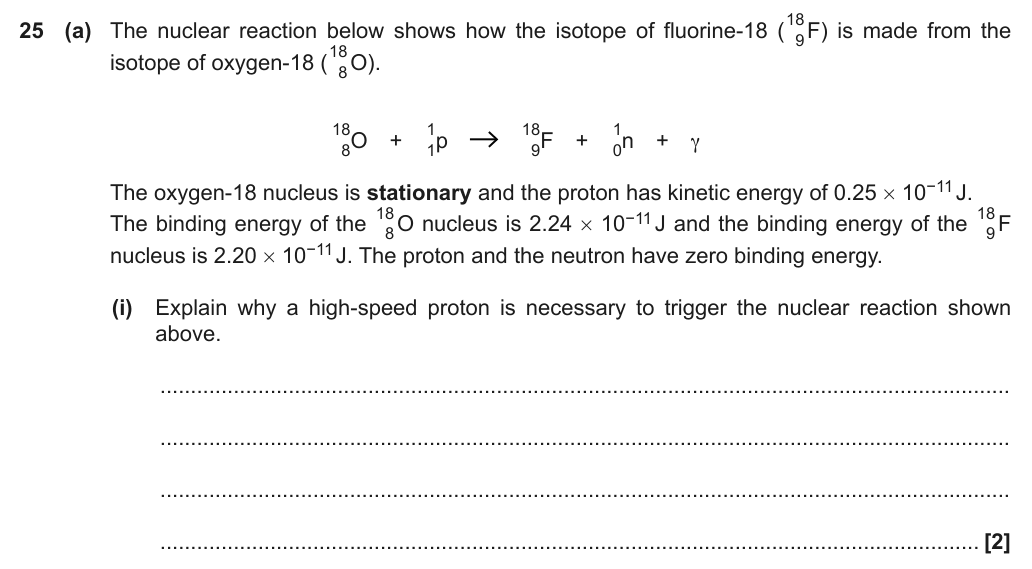
proton is repelled by the nucleus and must get close enough (for the strong nuclear force)
NOT collide / hit nucleus
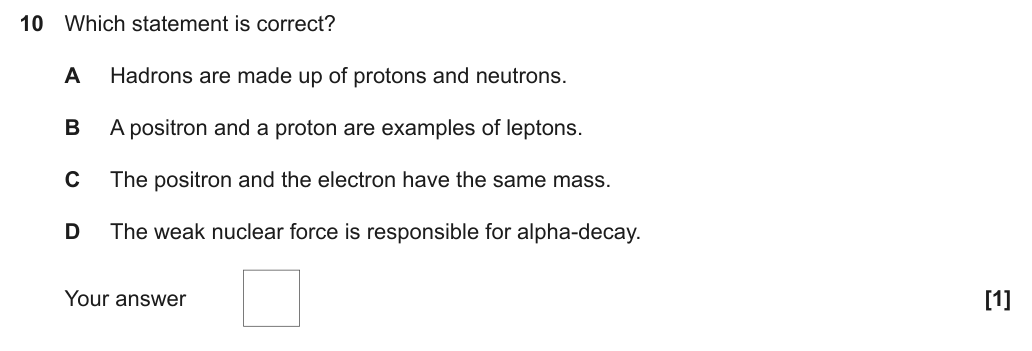
June 2017 · Paper 2 · Q101 markMultiple choice
Answer
C
Mark scheme
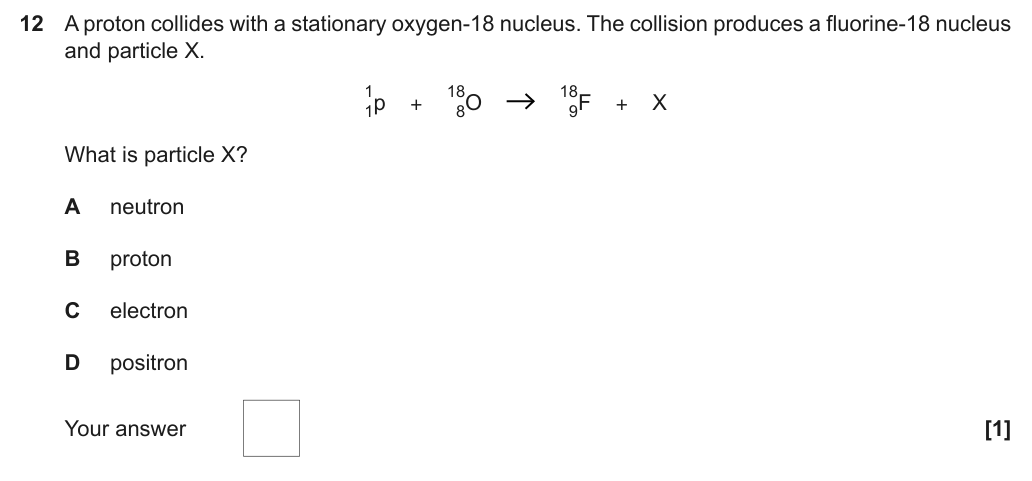
June 2017 · Paper 2 · Q121 markMultiple choice
Answer
A
Mark scheme
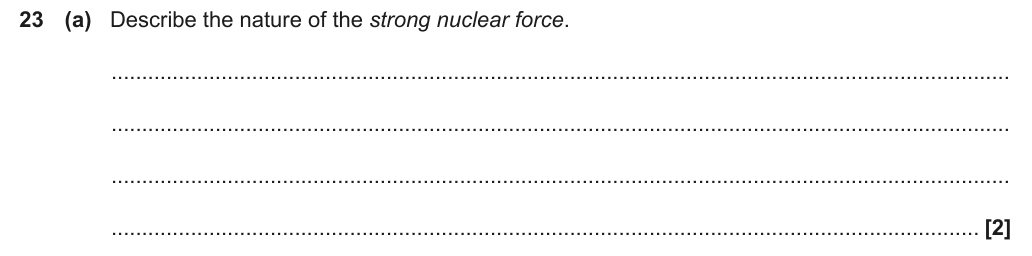
June 2017 · Paper 2 · Q23(a)2 marksExplanation
Mark scheme
Notes from the mark scheme and report
any two: acts between nucleons / quarks
short range
repulsive below about 0.5 fm
attractive up to about 3 fm
June 2017 · Paper 2 · Q23(b)(i)1 markShort answer
Mark scheme
Notes from the mark scheme and report
proton uud or neutron udd
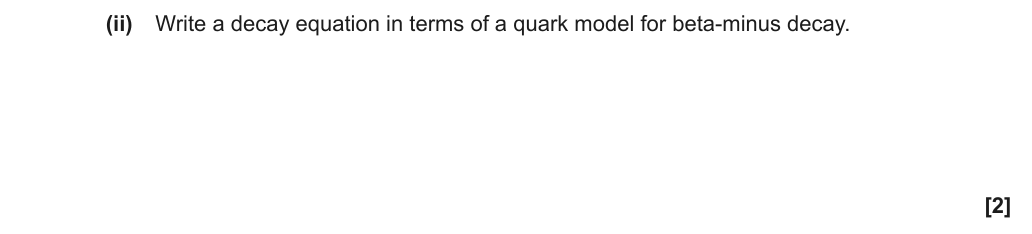
June 2017 · Paper 2 · Q23(b)(ii)2 marksShort answer
Mark scheme
Notes from the mark scheme and report
d -> u + electron for M1, electron antineutrino for A1
allow udd -> uud form or equation in words
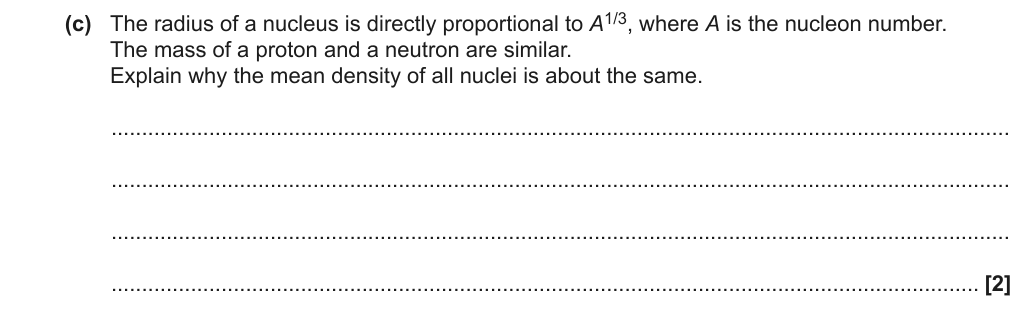
June 2017 · Paper 2 · Q23(c)2 marksExplanation
Mark scheme
Notes from the mark scheme and report
mass proportional to A and volume proportional to r cubed proportional to A, with clear steps using density = m/V
Skills: M0.3 Use ratios, fractions and percentages; M2.2 Change the subject of an equation, including non-linear equations
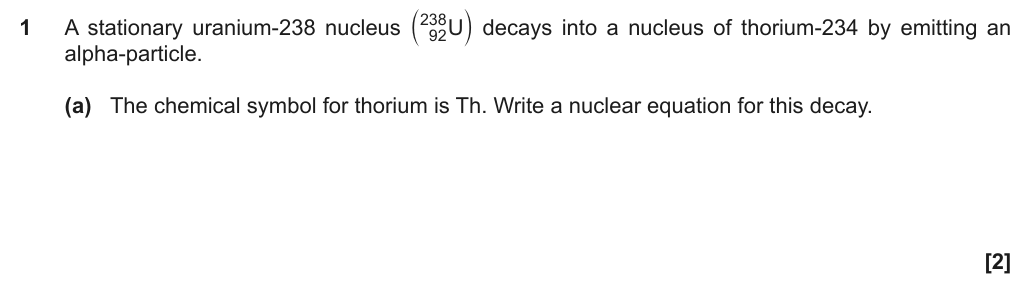
June 2017 · Paper 3 · Q1(a)2 marksShort answer
Mark scheme
Notes from the mark scheme and report
allow a γ photon
zero for any other extra particle
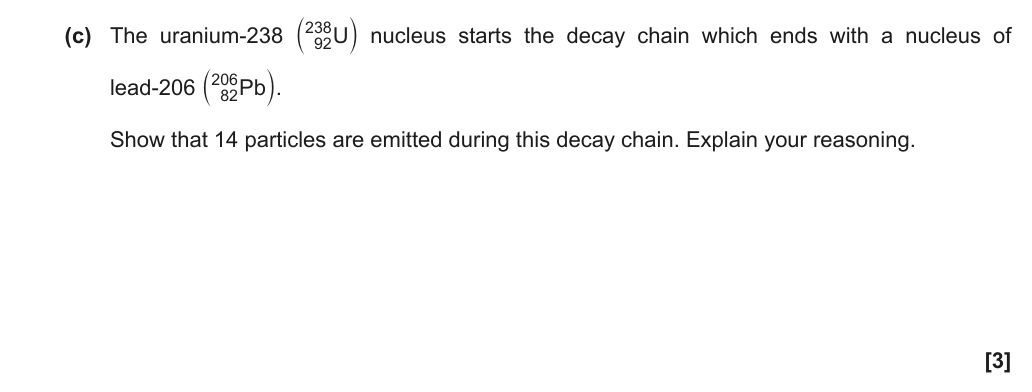
June 2017 · Paper 3 · Q1(c)3 marksShow that
Mark scheme
Notes from the mark scheme and report
8 alpha and 6 beta-minus with reasoning for both
NOT 14 – 8 = 6
must state β– particles
Skills: M2.4 Solve algebraic equations, including quadratic equations
Work with an OCR physics tutor
Dropping marks on calculations, practical questions or the six-mark level of response questions? Book a trial session with a specialist OCR physics tutor.