Answer
D
Mark scheme

Examiner's comment
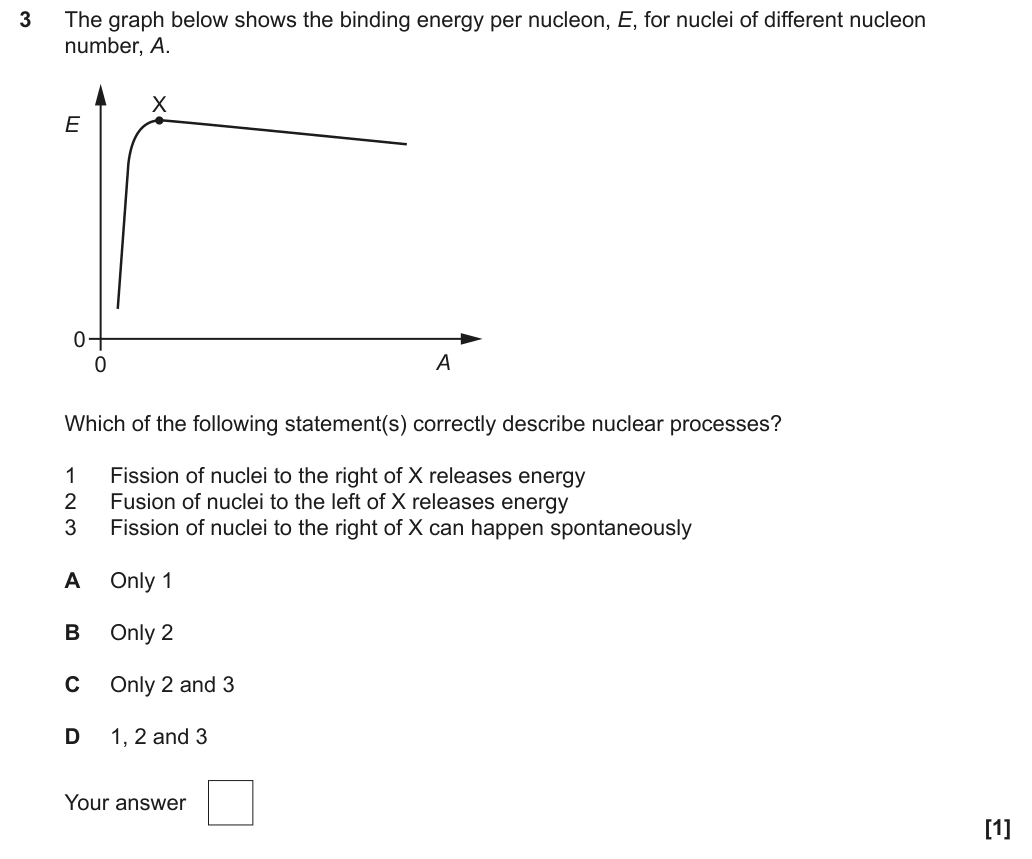
Most candidates were able to select the correct combination. Working by candidates often indicated that they knew that 1 and 2 were correct and so the only correct combination would be response D.
Notes and key-term cards for this topic are being written by our tutors. The past-paper questions below are ready now.
| Series | Paper | Q | What it asks |
|---|---|---|---|
| June 2023 | Paper 2 | 21(b) | Describe how fission of nuclei is induced and controlled in the nuclear reactor. |
| November 2021 | Paper 2 | 23(b) | Some nuclear fission reactors use uranium-235 as fuel. In the future, there is possibility of • Describe the similarities and the differences between fission and fusion reactions. |
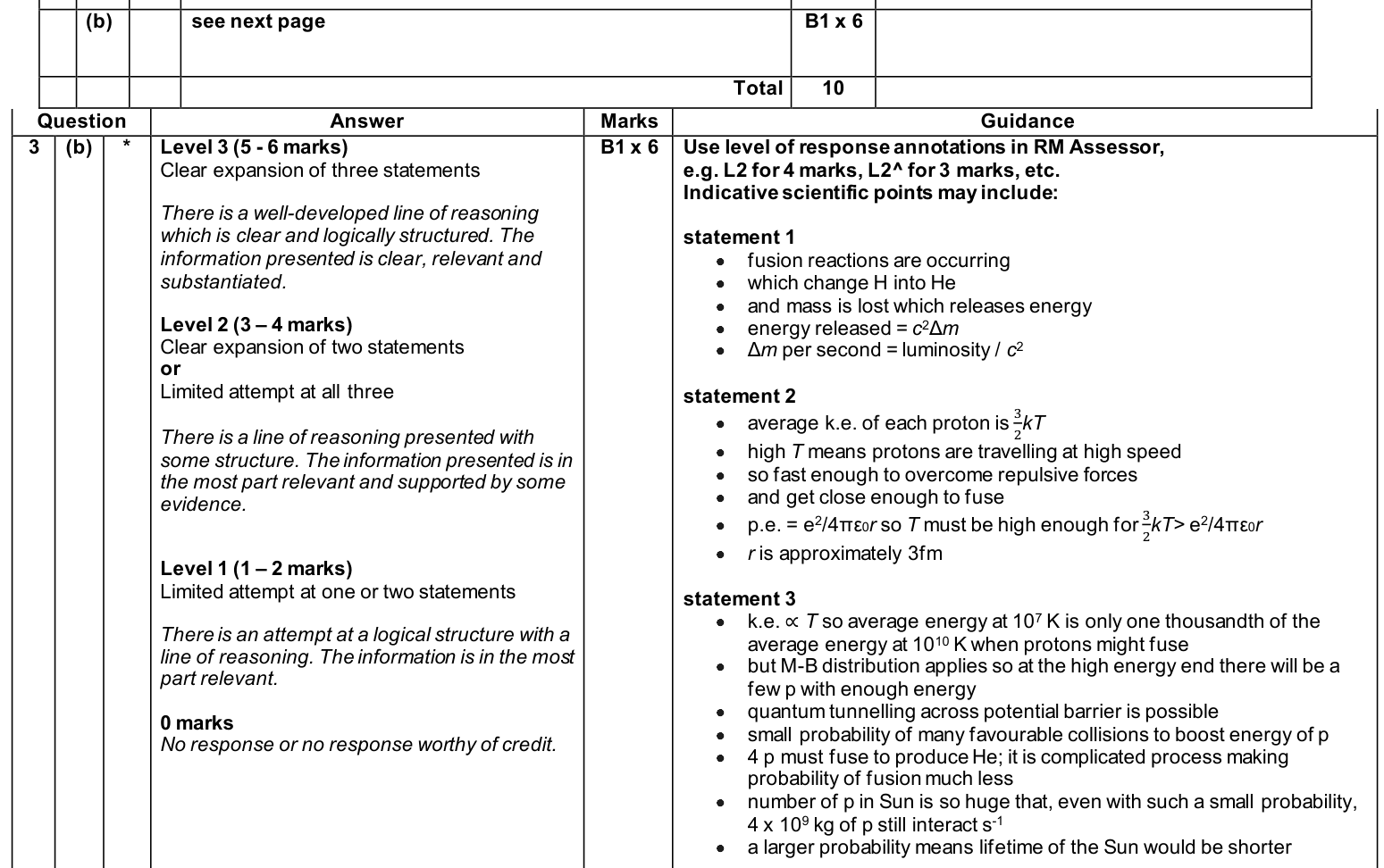
| November 2020 | Paper 3 | 3(b) | *(b) A student attends a lecture about the Sun and makes the following notes. Explain the principles of physics which are involved in each of the three points. |
D
Most candidates were able to select the correct combination. Working by candidates often indicated that they knew that 1 and 2 were correct and so the only correct combination would be response D.
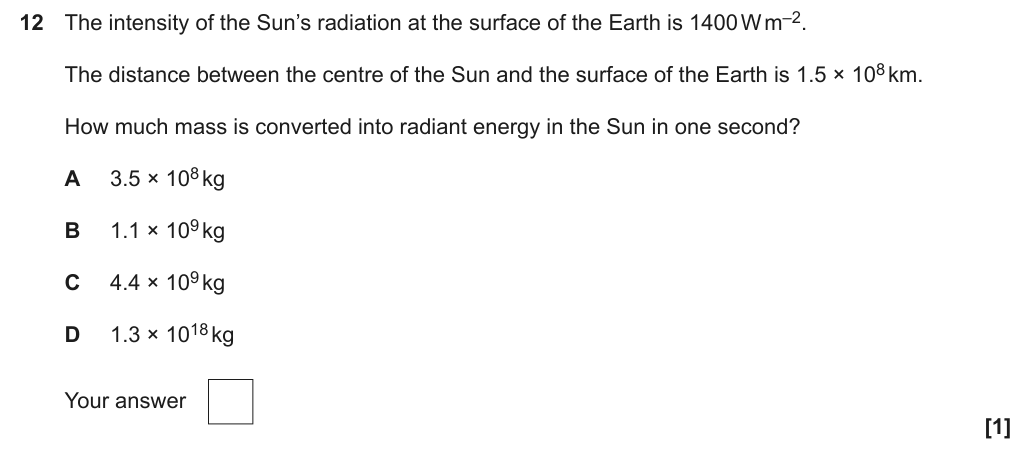
C
A little under half of candidates were able to correctly calculate the mass. While many were able to appreciate that 𝐼 = 𝐴 should be used, it was common not to be able to correctly calculate the area. A was the most popular incorrect response.
Skills: M0.1 Recognise and make use of appropriate units in calculations; M0.2 Recognise and use expressions in decimal and standard form; M4.3 Calculate areas of triangles, circumferences and areas of circles, surface areas and volumes of rectangular blocks, cylinders and spheres
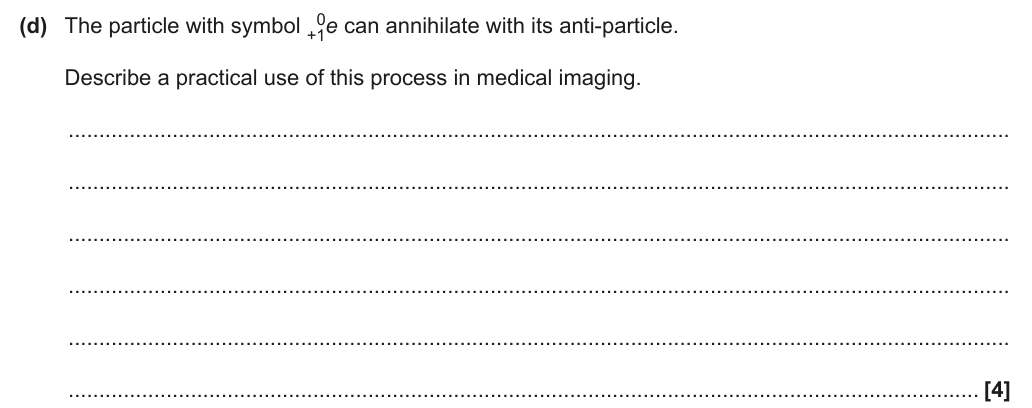
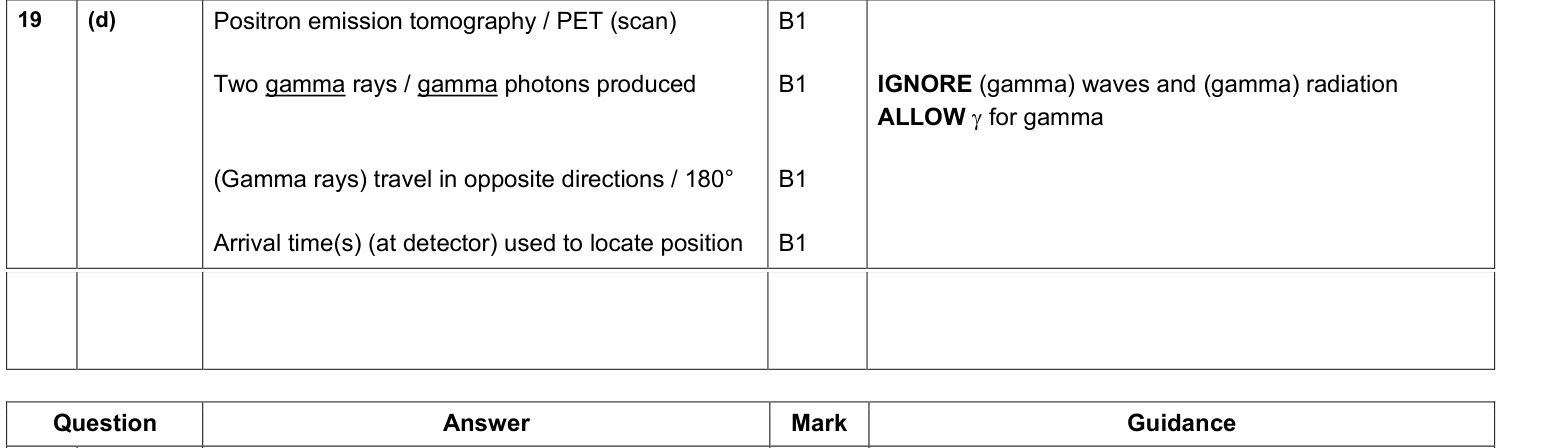
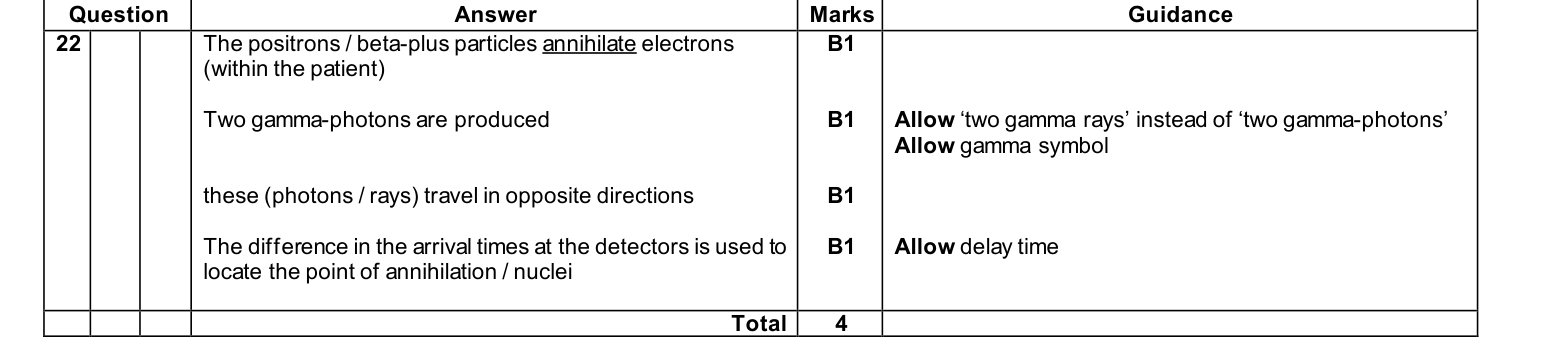
Most candidates appreciated that the use required in this question was a PET scanner, although a small number incorrectly called it a CAT scanner. The general principles were given, but detail is required for clarity. Such as, there need to be two gamma photons, they need to travel in opposite (not different) directions and the time delay needs to be recorded at the detector. There was some confusion that the positron-electron pair were being detected.
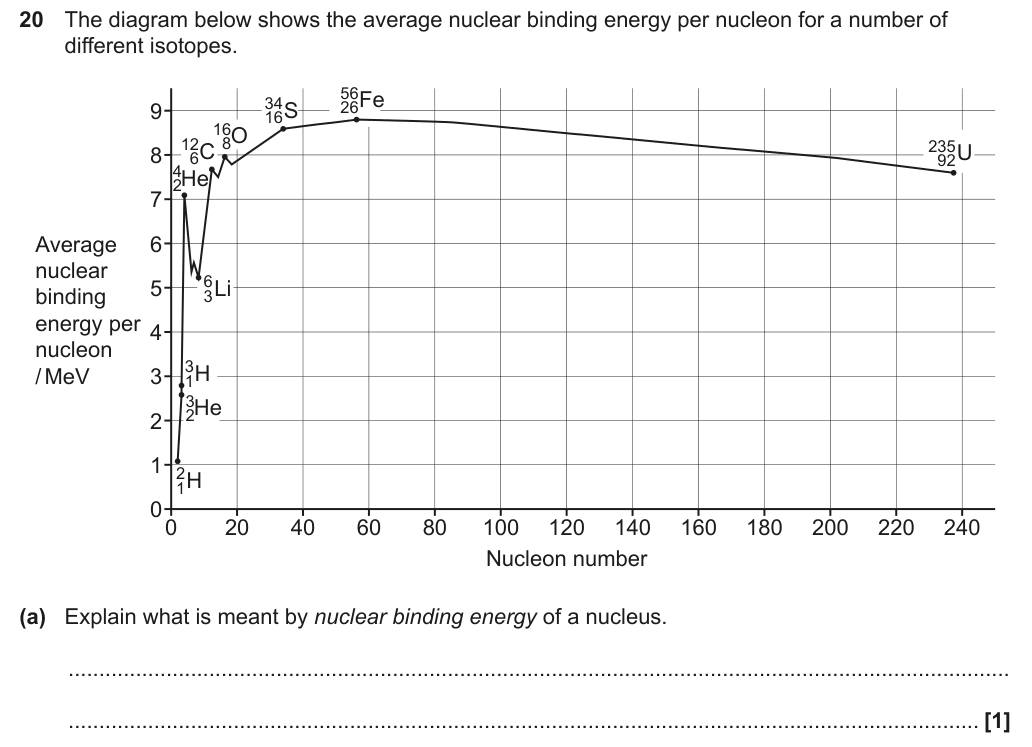
A little less than half gave a suitable explanation for the binding energy; many incorrect responses were based on the idea that it was the energy holding the nucleus together. Several responses correctly stated the relationship between binding energy and mass defect although this did not answer the question.

Around half of candidates gave a clear suggestion why hydrogen was not included. Many appreciated that the single nucleon had no binding energy although not all made a link. Several candidates described a hydrogen atom instead of the nucleus causing confusion over electron binding energy.
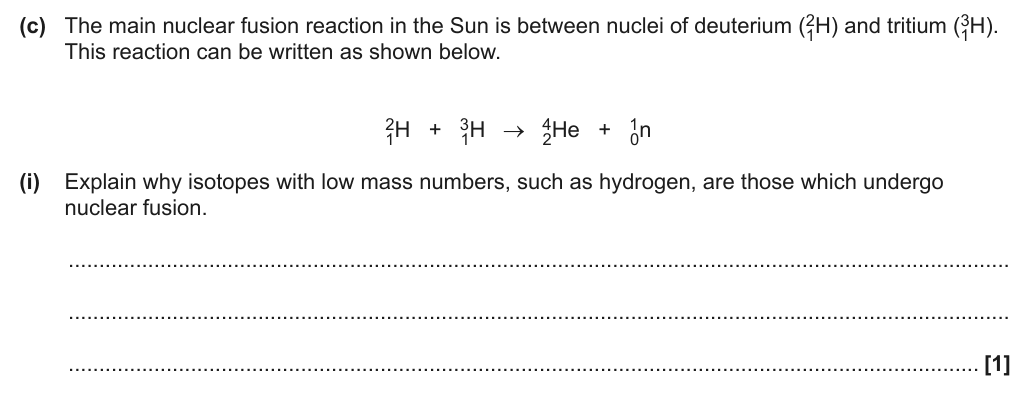
This question was quite poorly answered with few candidates appreciating the idea that an increase in binding energy per nucleon would result in energy given out. Many candidates simply restated the question, by saying low mass would join to give higher mass or stated that iron was the most stable isotope.
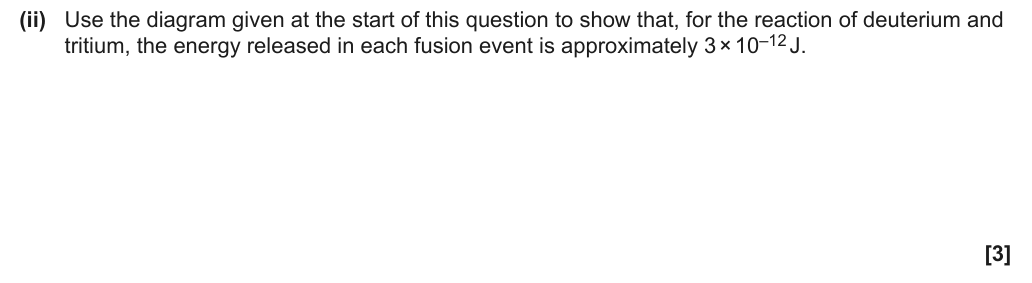
As always with a ‘show that’ question, it is vital to include as many steps as possible, the key to this question involved reading from the graph and then including the number of nucleons in the calculation. A fair number of candidates correctly read the point but did not multiply this with the nucleon number. There were relatively few misreads from the graph and the tolerance allowed some variation. Many simple (and incorrect) methods would give a value fairly close to 3 x 10-12 and so candidates would feel that they had correctly answered the question. Very few candidates struggled with the conversion from MeV to joules, although this may have been supported by having the power of ten given to them. It is also important to make sure that any value is given to a greater number of significant figures than that asked for, if appropriate. Around a third of candidates were able to obtain all 3 marks on what a potentially challenging calculation is.
Skills: M0.2 Recognise and use expressions in decimal and standard form; M2.3 Substitute numerical values into algebraic equations using appropriate units for physical quantities; M3.1 Translate information between graphical, numerical and algebraic forms
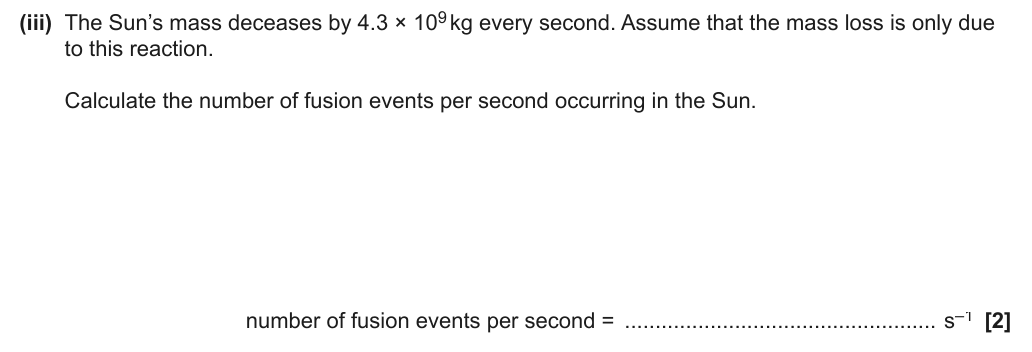
There are several routes to obtain the correct answer and credit is always given to any correct method. Neatly two thirds of candidates scored both marks on this question, even if they had not completed the previous part by using the ‘show that’ value. Candidates should always be aware that a ‘show that’ value is likely to be used in subsequent calculations.
Skills: M0.2 Recognise and use expressions in decimal and standard form; M2.3 Substitute numerical values into algebraic equations using appropriate units for physical quantities
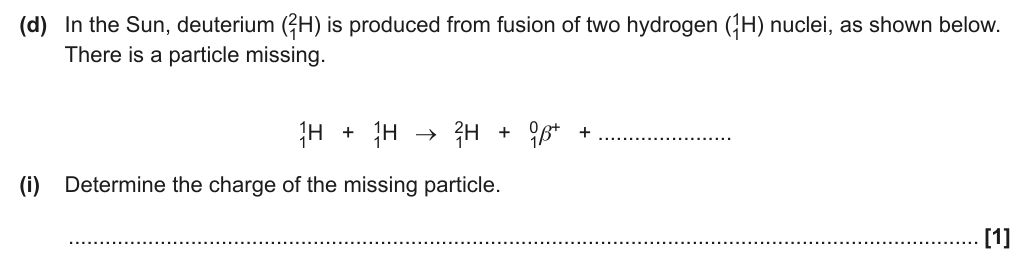
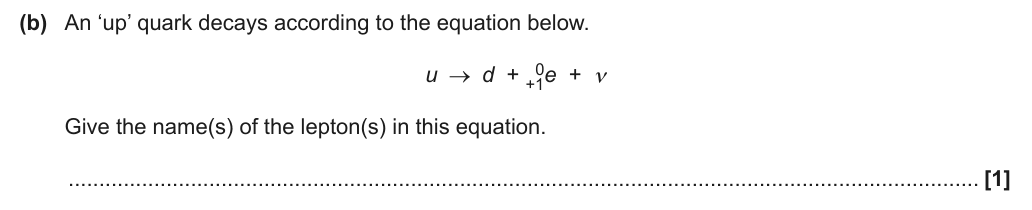
Most candidates were able to identify the charge. Most who gave incorrect responses answered a charge of -1, presumably due to the +.
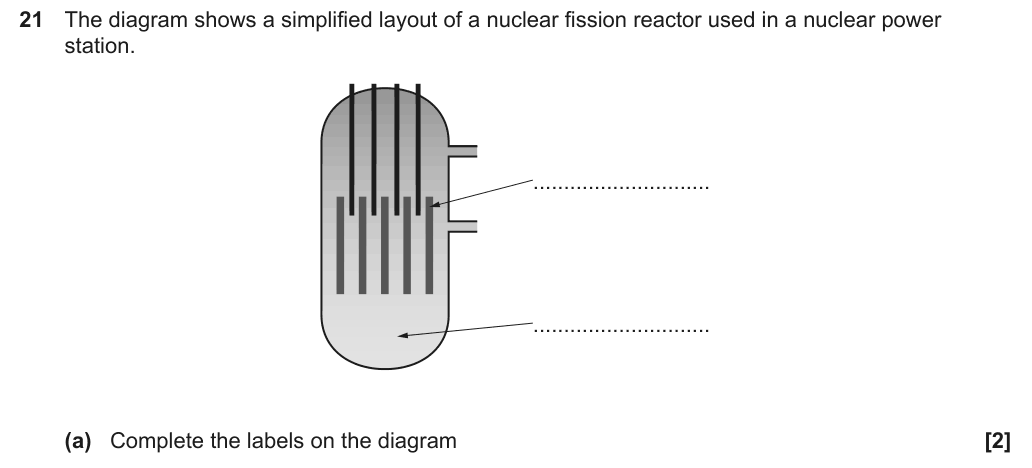
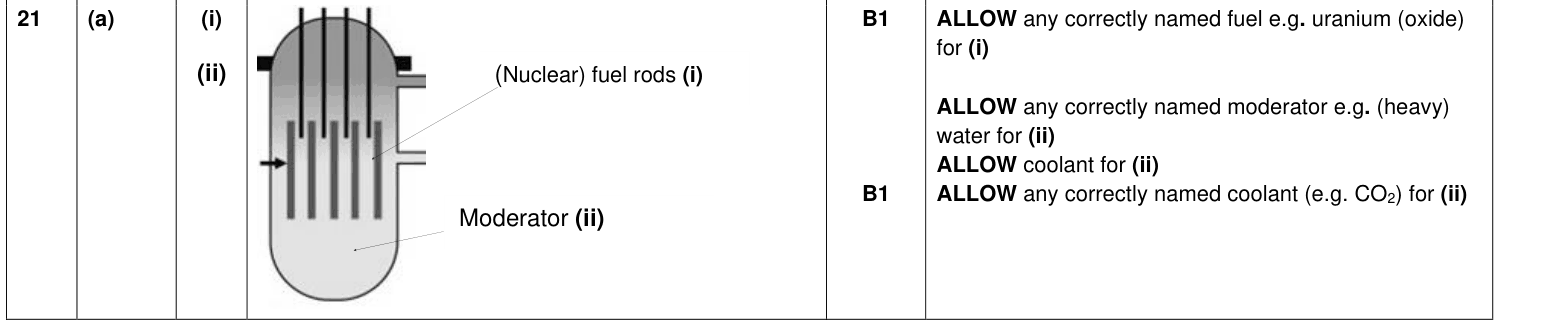
Many candidates were able to demonstrate their knowledge of the internal structure of a fission reactor and correctly label the components or the material they are made from. Simple answers such as ‘reactor core’ or ‘fluid’ are not sufficient at this level.
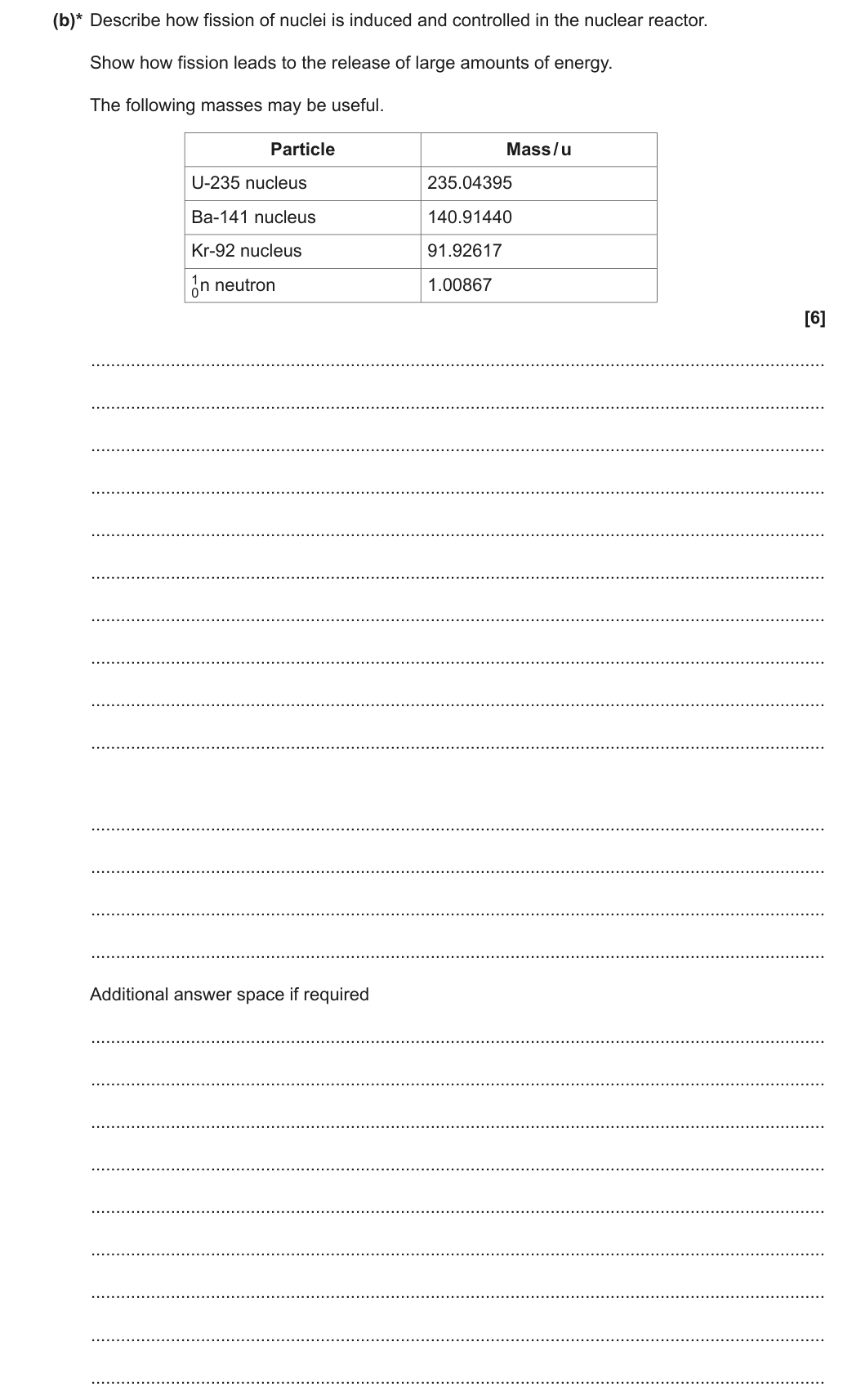
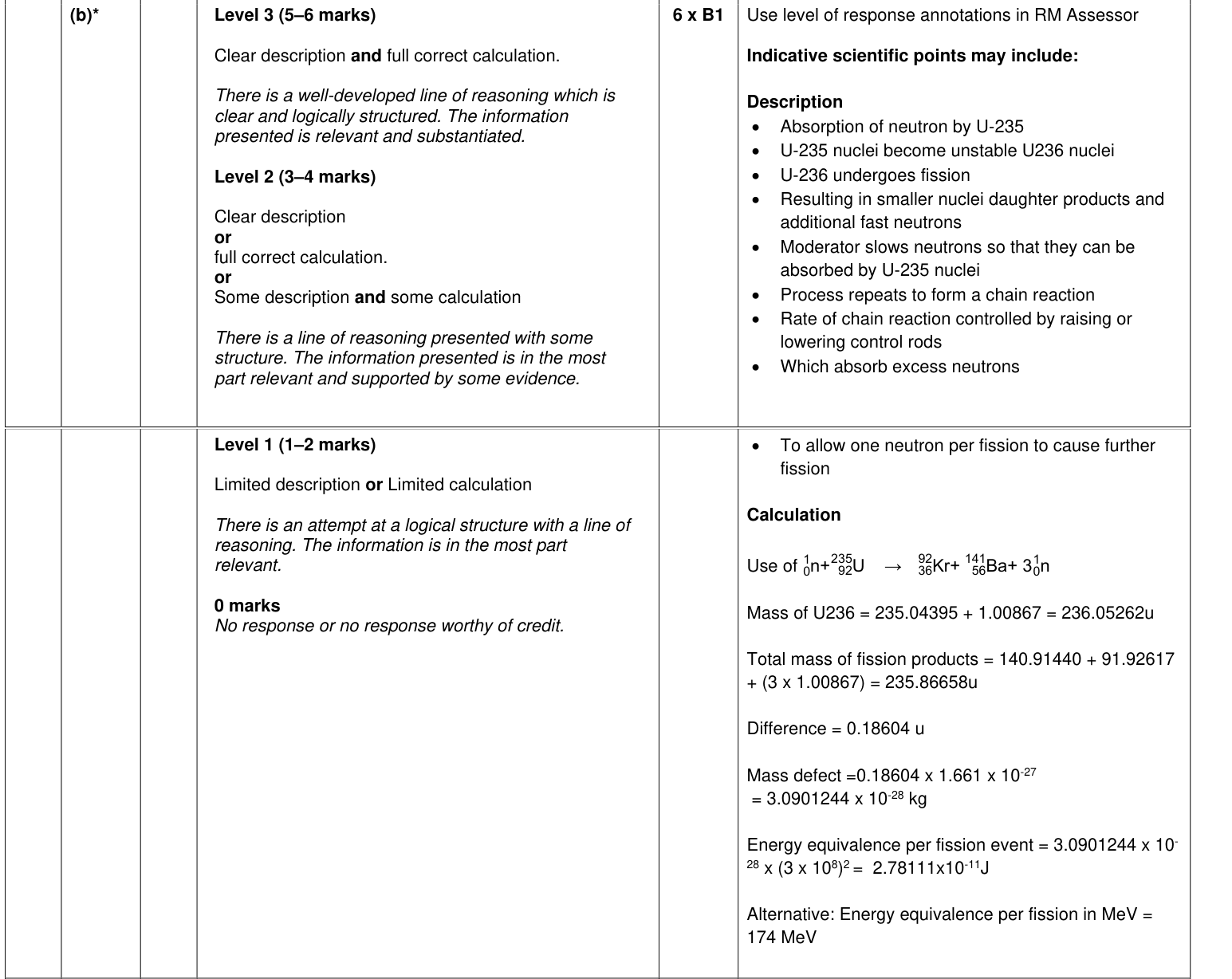
This is the second level of response (LoR) question in this paper, and was designed to assess nuclear physics, specifically Sections 6.4.4 (a), (b), (g) and (h). In particular, there are two parts (description and calculation) both of which need to be answered to obtain a Level 3. As previous, there are no specific marking points and examiners use a ‘best fit’ approach to the marking. Indicative scientific points are given in the mark scheme as a guidance to what to expect, but not all need to be satisfied for full credit, however for full credit for the calculation, the energy released per fission is the minimum end point. Incorrect physics can be expected to be penalised, however. Candidates should always be encouraged to structure their answers carefully and in calculations aim to give explanation of each stage rather than just produce a number. The two separate sections can be separated into a description of the induction and control, and calculation of the energy released. The key points in the description that examiners were looking for were: - idea of induced fission by a thermal neutron– the chain reaction leading to more neutrons released - a description of the role of the moderator – a description of the role of the control rods. The key points in the calculation that examiners were looking for were: - calculation of the mass before fission – calculation of the mass after the fission – difference between these two masses – calculation of the energy equivalent (hence released) from this mass difference. The descriptions of the induction and control varied hugely both in quality and quantity. Many candidates did not start from U-235 but went straight into the fission. Most candidates were aware that extra neutrons were released in fission and had a good idea of the absorption of the extra neutrons by the control rods, but there was often confusion about the role of the moderator (by explaining that it simply ‘controlled the reaction’) and a significant number did not appreciate why a slower neutron was needed. However, there were many excellent explanations covering all of the indicative points and going beyond. The calculations were attempted well by many candidates and obtaining the energy equivalence of one fission was a suitable point to stop the calculation. A comment supporting the size of the energy compared to this number of fissions per second helped to confirm the large release of energy. Several candidates took this further and calculated the energy per kg, showing how large this was. The main source of error was in not accounting for the mass of the initial neutron in the reaction and so the energy calculated was one ‘neutron mass equivalence’ too high. Several candidates ended their calculation with a mass difference, or even attempted to calculate the mass defect in the formation of U-235, but this led nowhere. There was a fair number of candidates who made no attempt on the calculation despite having given a good description and it can be assumed that they hadn’t fully read what they were asked to do. Similarly there were some excellent calculations but no with no description. Candidates are always encouraged to consider both parts of any LoR question. This is an example of a Level 2 response to a LoR question. The candidate has given a clear calculation with a good structure but has forgotten to add the neutron mass to the uranium mass to give the initial mass. The remainder of the calculation is correct, giving a final value for the energy per fission which is incorrect by a value of the neutron mass-energy. The explanation of the induction and control is good, if a little brief and lacking in real detail. On the holistic approach taken to the LoR questions, this is a clear Level 2. The communication is good and the setting out of the response is clear.
Skills: M0.1 Recognise and make use of appropriate units in calculations; M0.2 Recognise and use expressions in decimal and standard form; M2.3 Substitute numerical values into algebraic equations using appropriate units for physical quantities
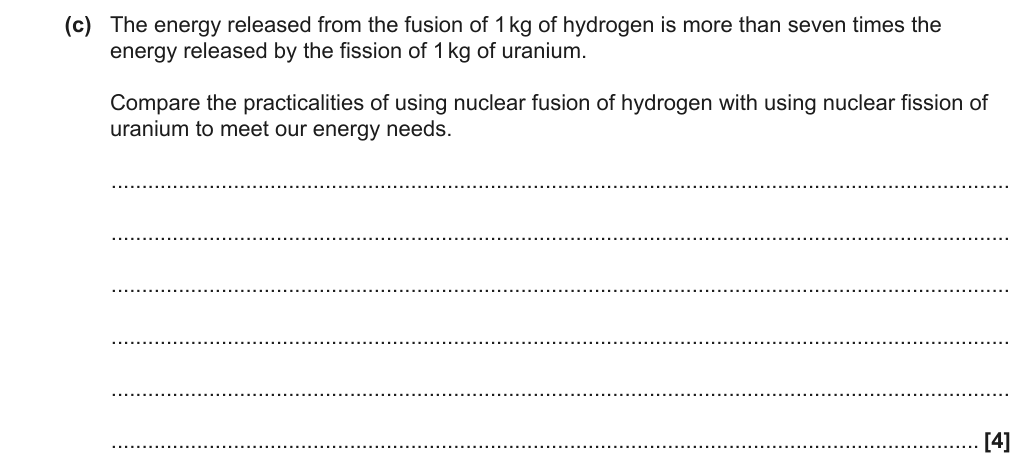
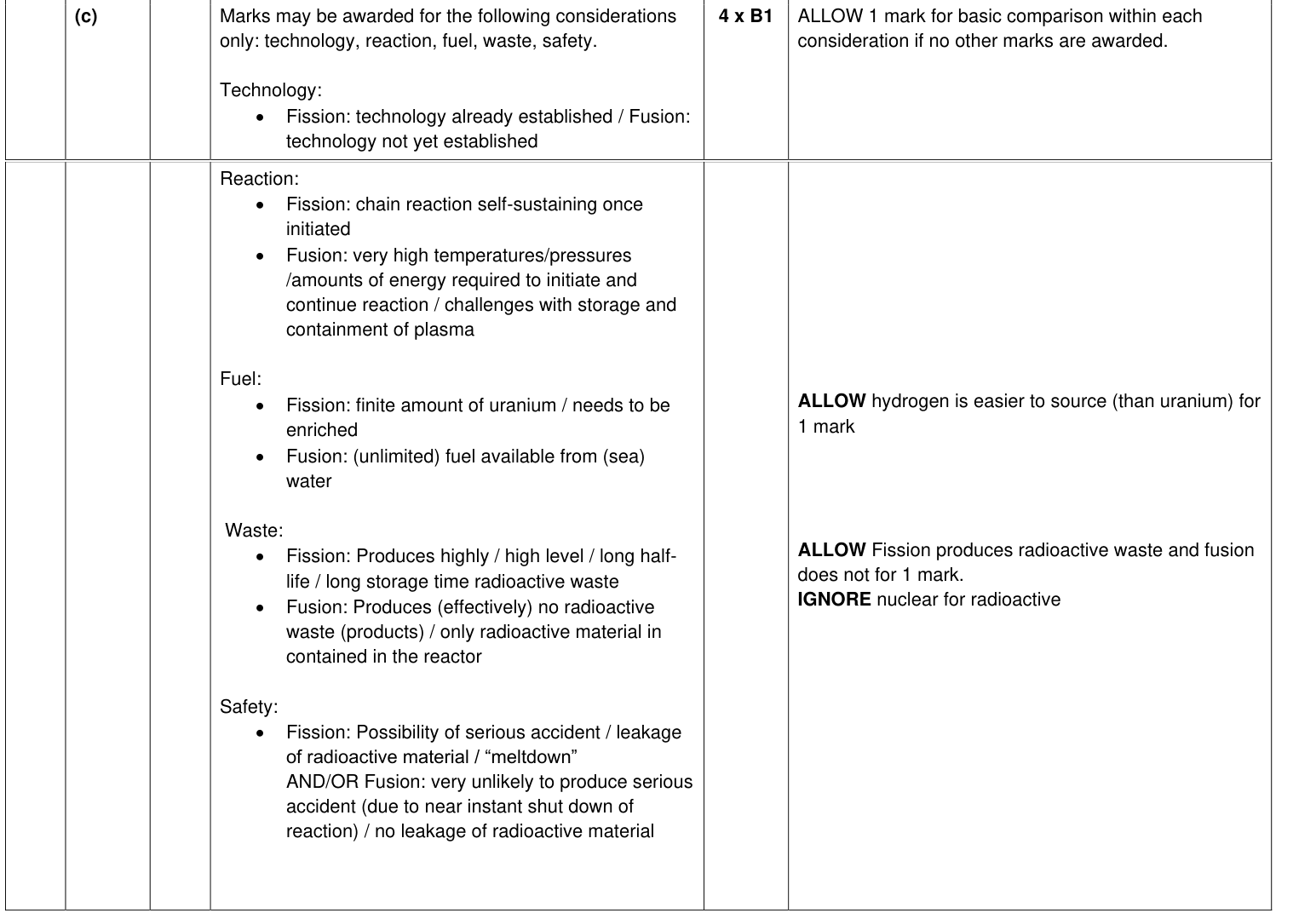
This question needed candidates to use appropriate scientific knowledge and understanding to discuss the differences between fission and fusion in terms of the practicalities. Many candidates were able to give good responses to several of the main points with careful comparisons. One of the key features of this question is to avoid social and economic arguments and base the points on ideas from the course. It is not a ‘compare and contrast’ question, but many of the marking points can be gained that way. A relatively small number of candidates gained full marks on this, as may be expected, however a good fraction gained 2 or more marks. Responses which could not be credited were simple statements like ‘safer’, ‘easier to use’, ‘no toxic waste’ and ‘renewable’. Examiners will have worked strictly to the mark scheme, and so given marks consistently.
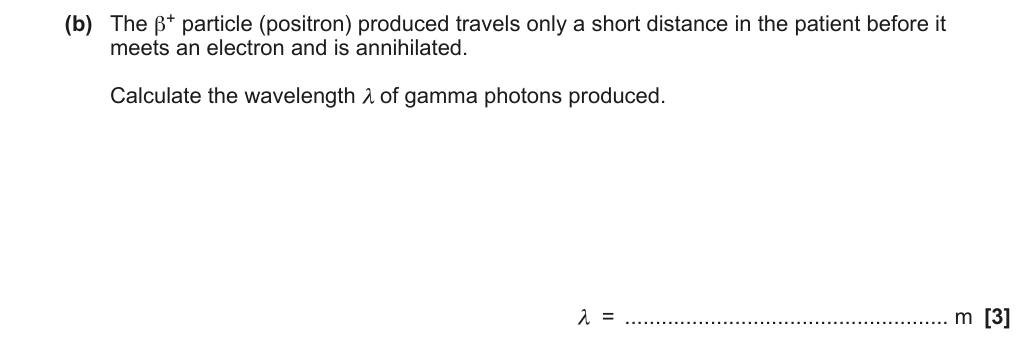
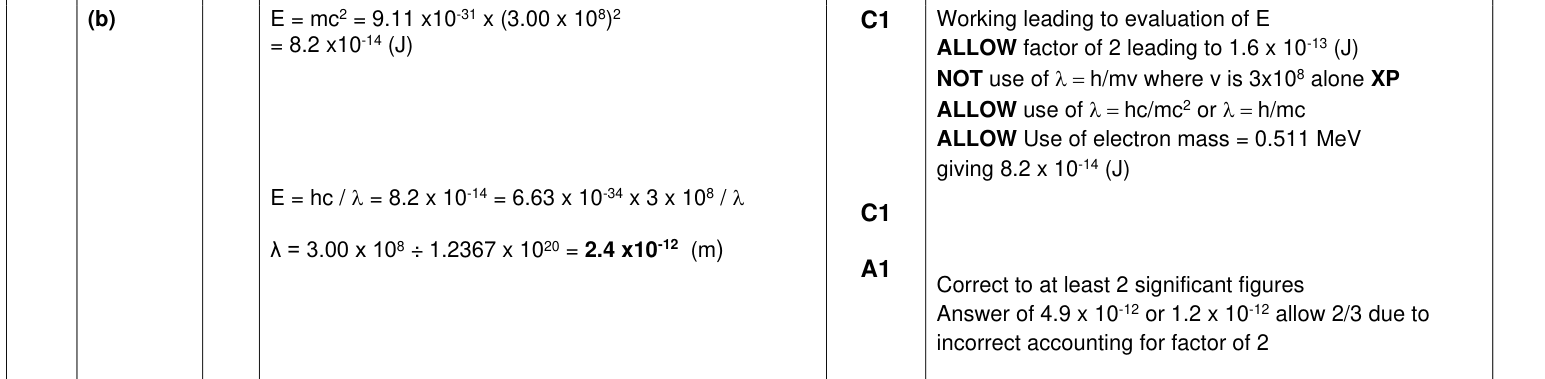
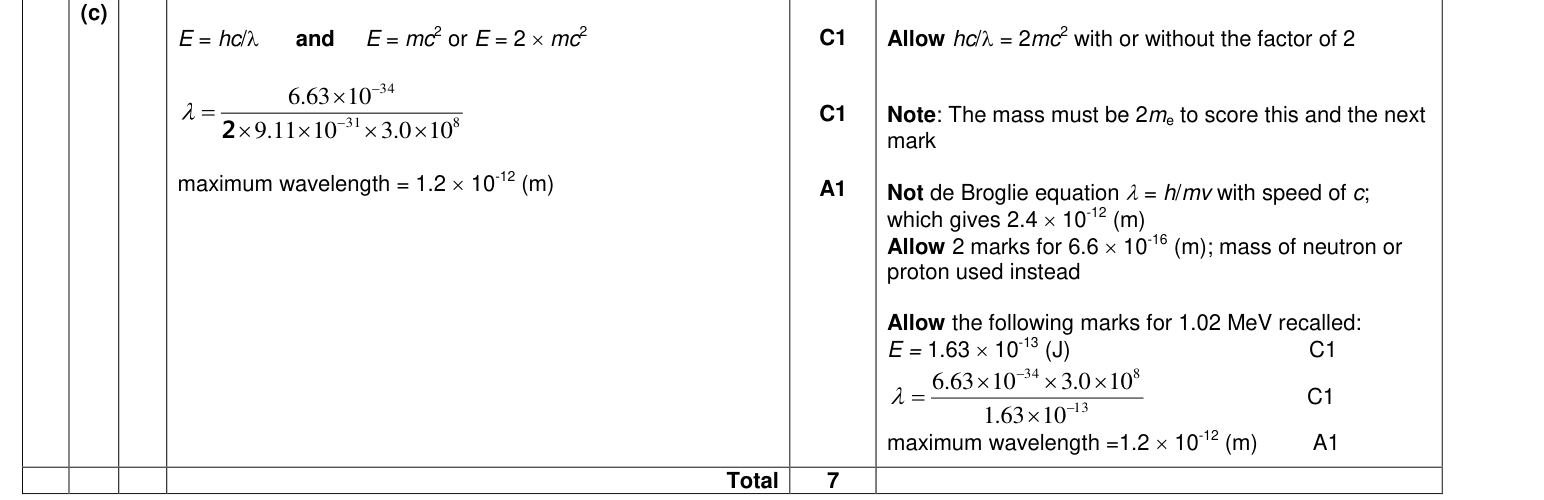
Well over half of the candidates were able to score 2 or more marks on this question. A great deal scored 2 marks due to the inclusion of a factor of two, which was then not removed (or vice versa). Some candidates used the formula for kinetic energy – which by coincidence may give the correct answer – however this was not credited, nor was the more common use of the de Broglie formula. Examiners sometimes had a difficult decision on this question, whether the response was a physics error or not, and if in doubt a candidate would be awarded the marks.
Skills: M0.2 Recognise and use expressions in decimal and standard form; M2.2 Change the subject of an equation, including non-linear equations; M2.3 Substitute numerical values into algebraic equations using appropriate units for physical quantities
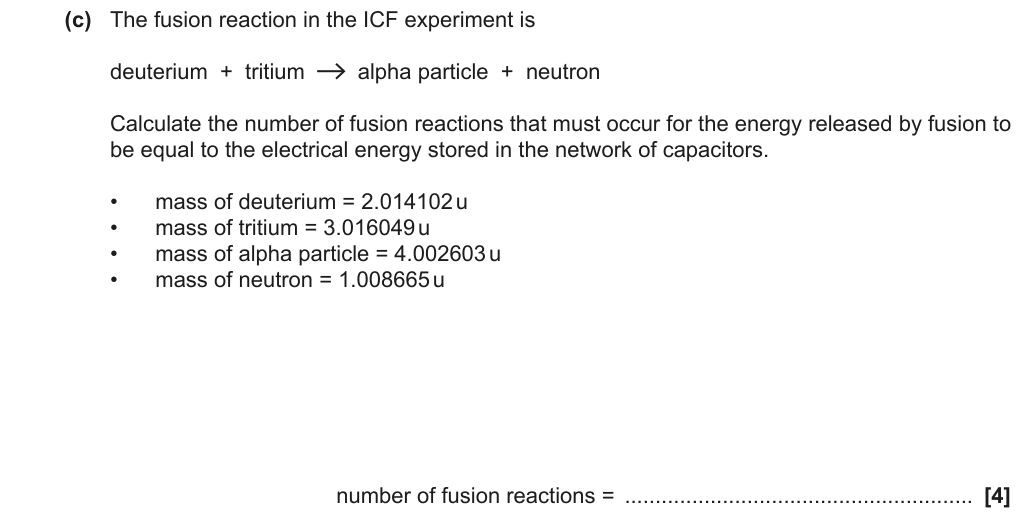
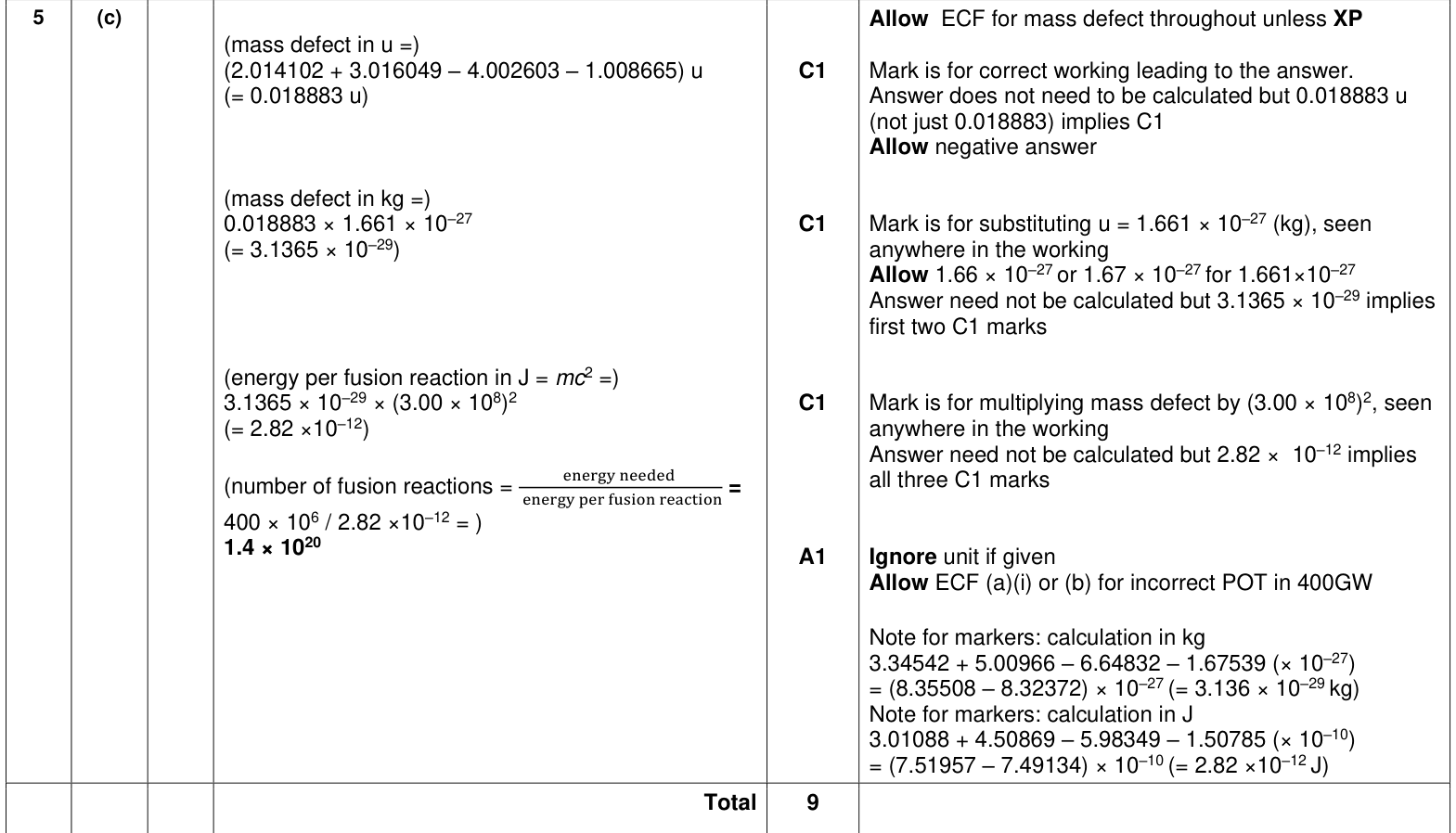
Most candidates seemed to have a very good understanding of this question, suggesting good preparation by centres. Those who dropped marks often made arithmetical errors in calculating mass defect or forgot to convert atomic mass units into kilograms. A lack of clarity in setting out mathematical procedures made some candidates’ thought processes difficult to follow.
Skills: M0.2 Recognise and use expressions in decimal and standard form; M2.3 Substitute numerical values into algebraic equations using appropriate units for physical quantities
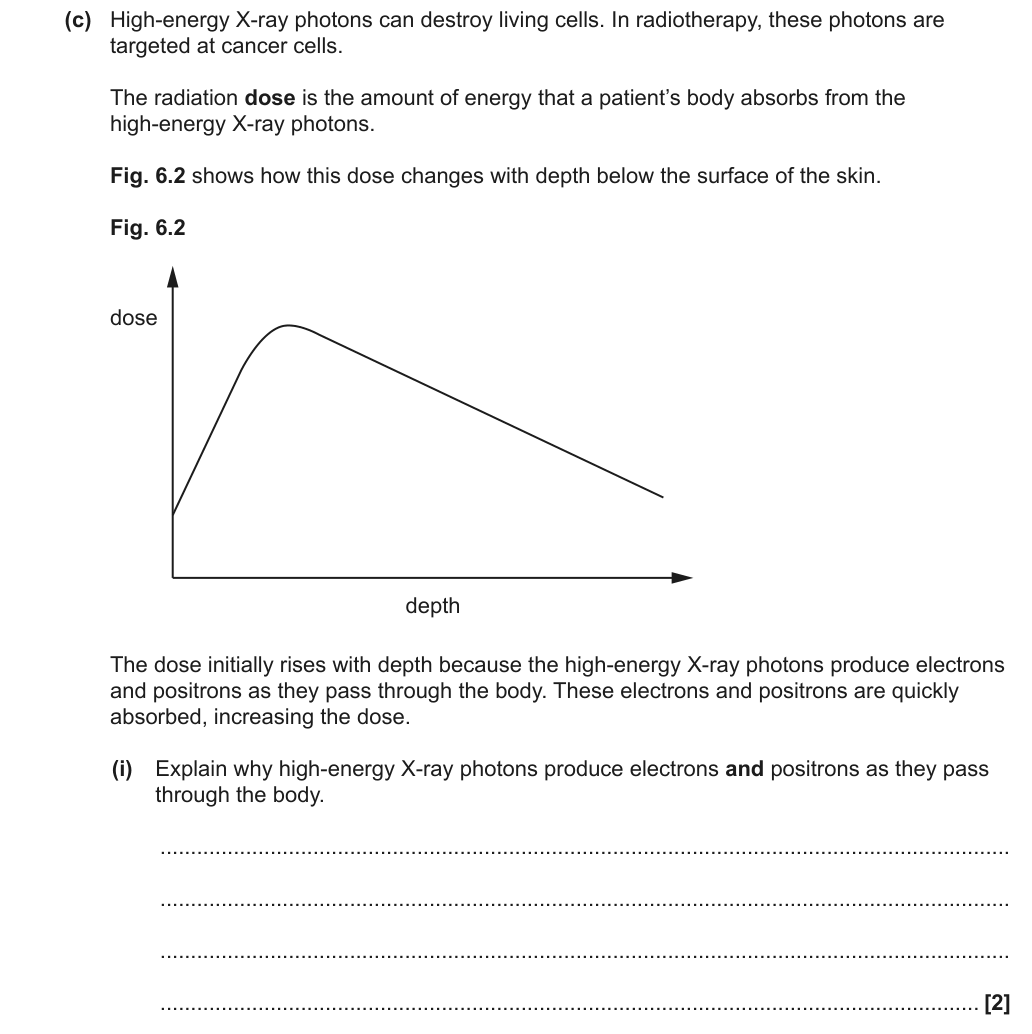
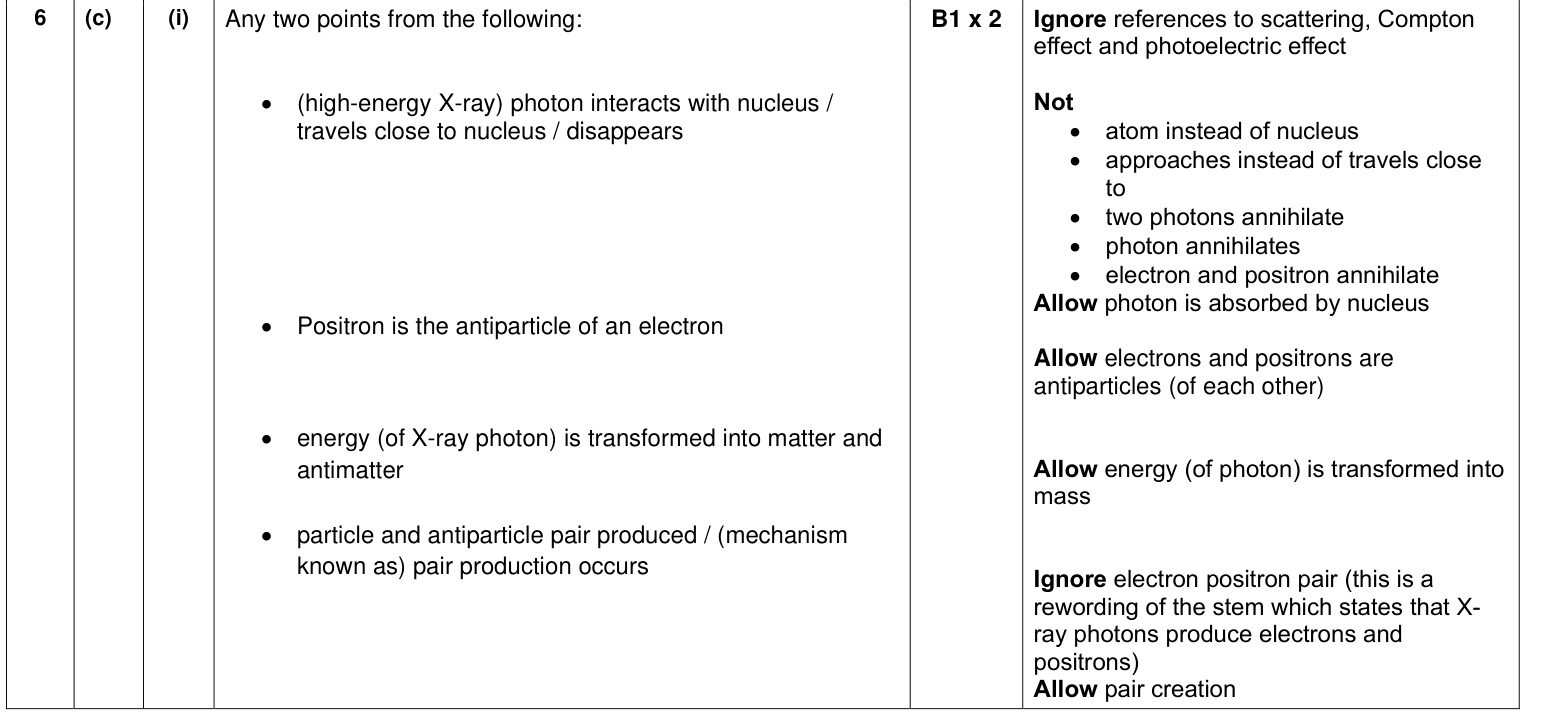
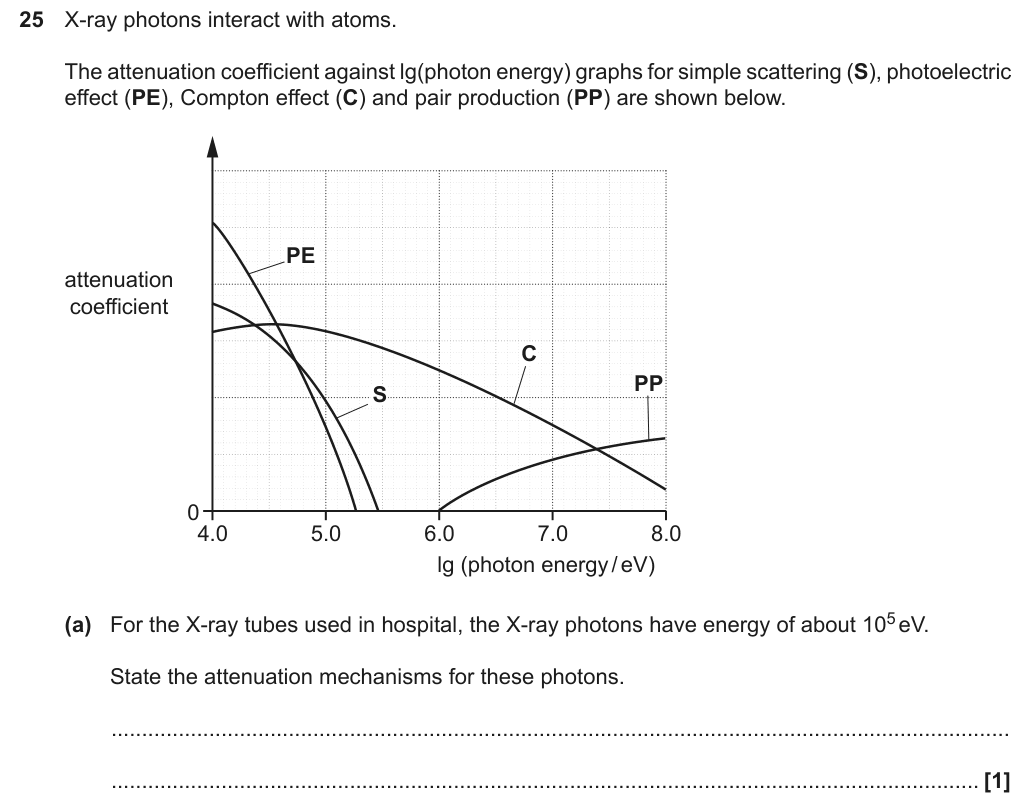
The most common correct responses related to photons interacting with nuclei and to “pair production”. Candidates who scored no marks often simply reworded the stem of the question, or referred to photons interacting with atoms or electrons.
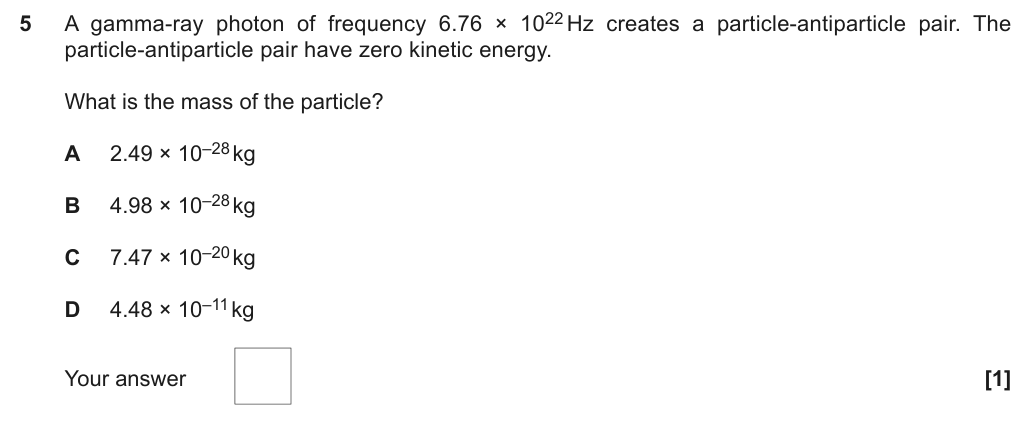
A
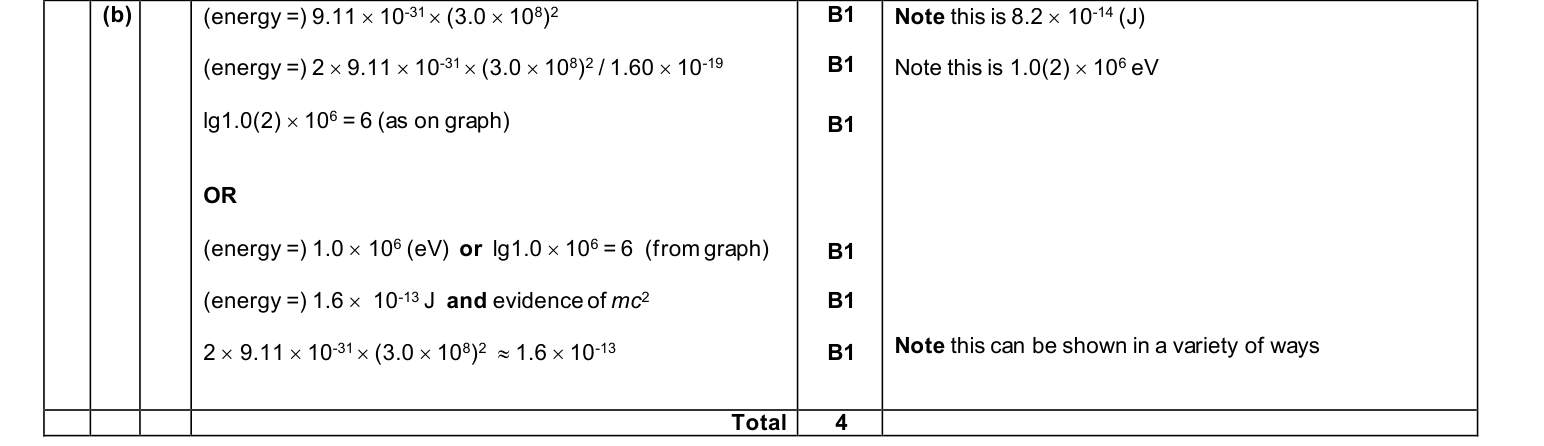
This question was answered correctly by approximately half of the candidates. Most showed written working, often as hf = 2mc2 or the equivalent in numerical form. B was by far the most common incorrect response, and it is clear from candidates working that the factor of 2 had simply been missed out.
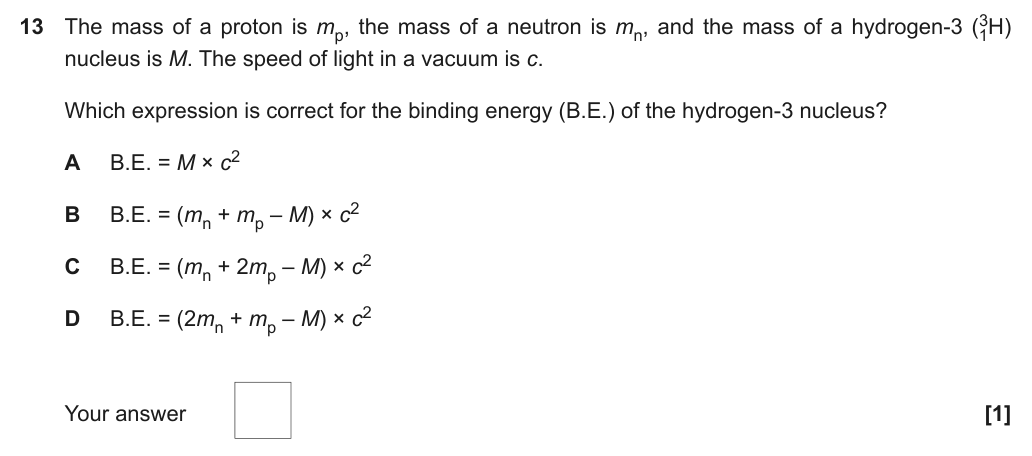
D
This question can correctly be answered by over three quarters of the candidates. Most appeared to be able to evaluate the composition of the nucleus correctly and then work forward from that. A was the most common incorrect response, presumably as less successful responses were able to recognise a variation of E = mc2.
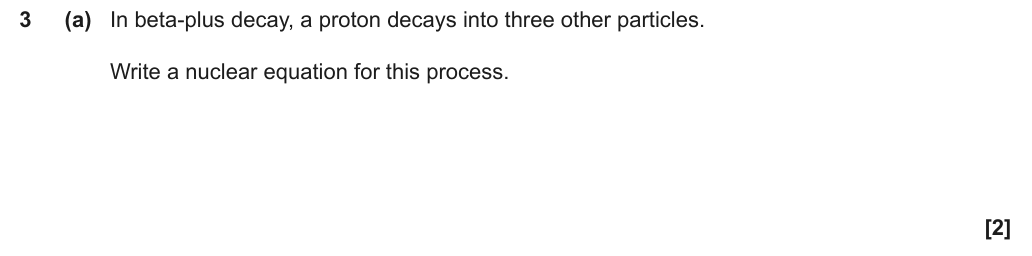
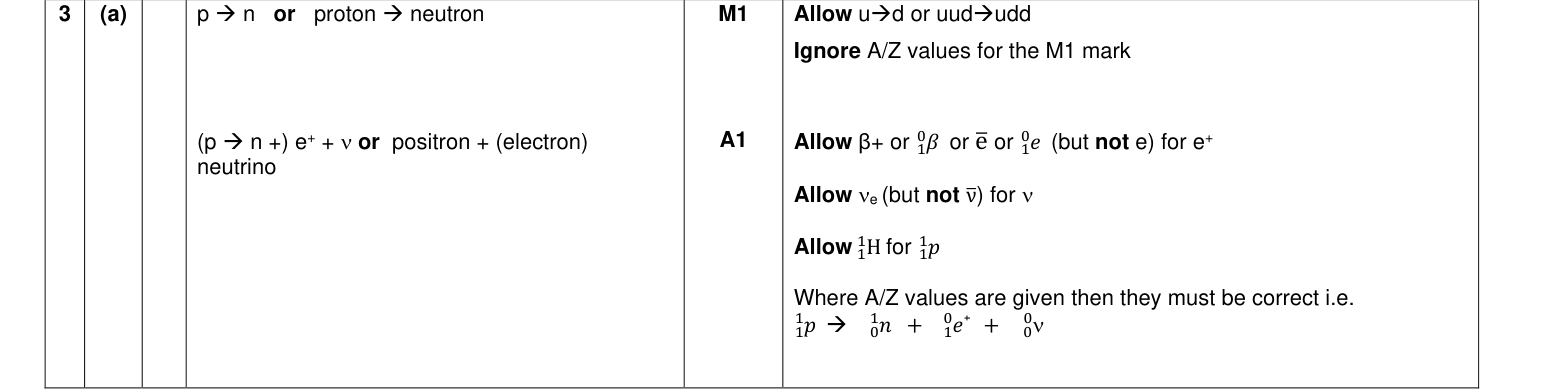
The question did not specify what type of equation was needed, and the simple word equation proton → neutron + positron + neutrino was sufficient for full marks. Common problems in 3(a) • using the symbol N instead of n for neutron (N is the symbol for nitrogen) • using incorrect A/Z values such as 𝑛𝑛 for neutron and/or 𝑒𝑒 0 for positron • using an incorrect symbol for the neutrino
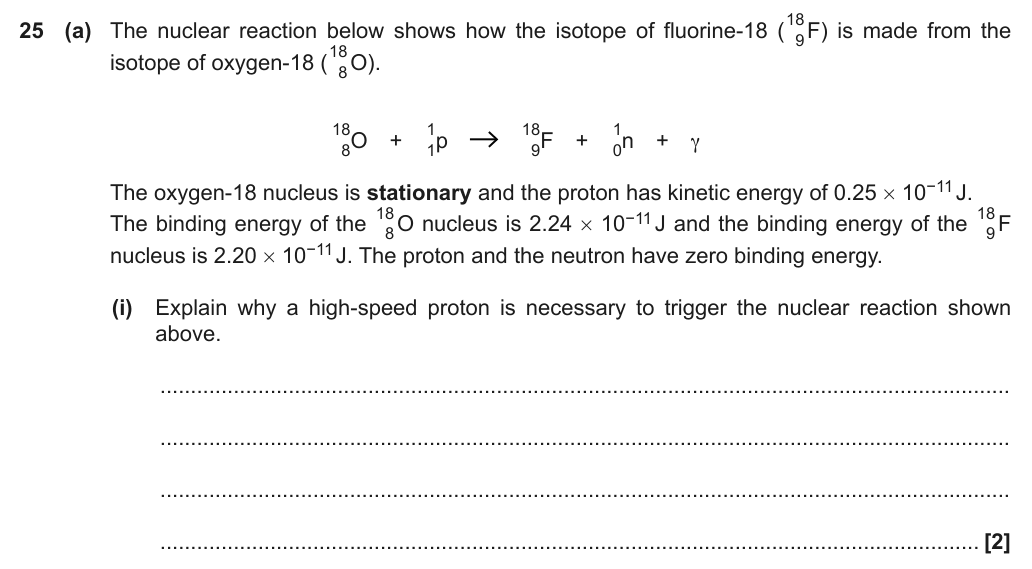
This question covers part of the diagnostic methods in the diagnostic methods in medicine topic from module 6. This question is directly from the learning outcome 6.5.2(e). Candidates were expected to describe the basic principles of the PET scanner and use this to describe how to locate fluorine-18 nuclei. This question was poorly answered by many candidates and over half scored zero marks. Of that, there were a significant number who gave no response. However, there were some excellent responses that demonstrated a genuine understanding of the process. Several candidates thought that the beta-plus particles were electrons and from that point would have difficulty in making progress. The short half-life seemed to cause some confusion, and several candidates felt that this was a key part of the question. Of the candidates who explained the principles of operation clearly, some were unable to explain that it is a time difference between the arrival of the gamma rays at the detectors that is used for location.
For this question, the candidates need to explain the role of these components in terms of their interactions with neutrons and those who did not mention neutrons at all in their responses could not score any marks. Many candidates went beyond what was required and explained what effect this has on the reactor, such as controlling the rate of reaction. In general, this question was not answered well.
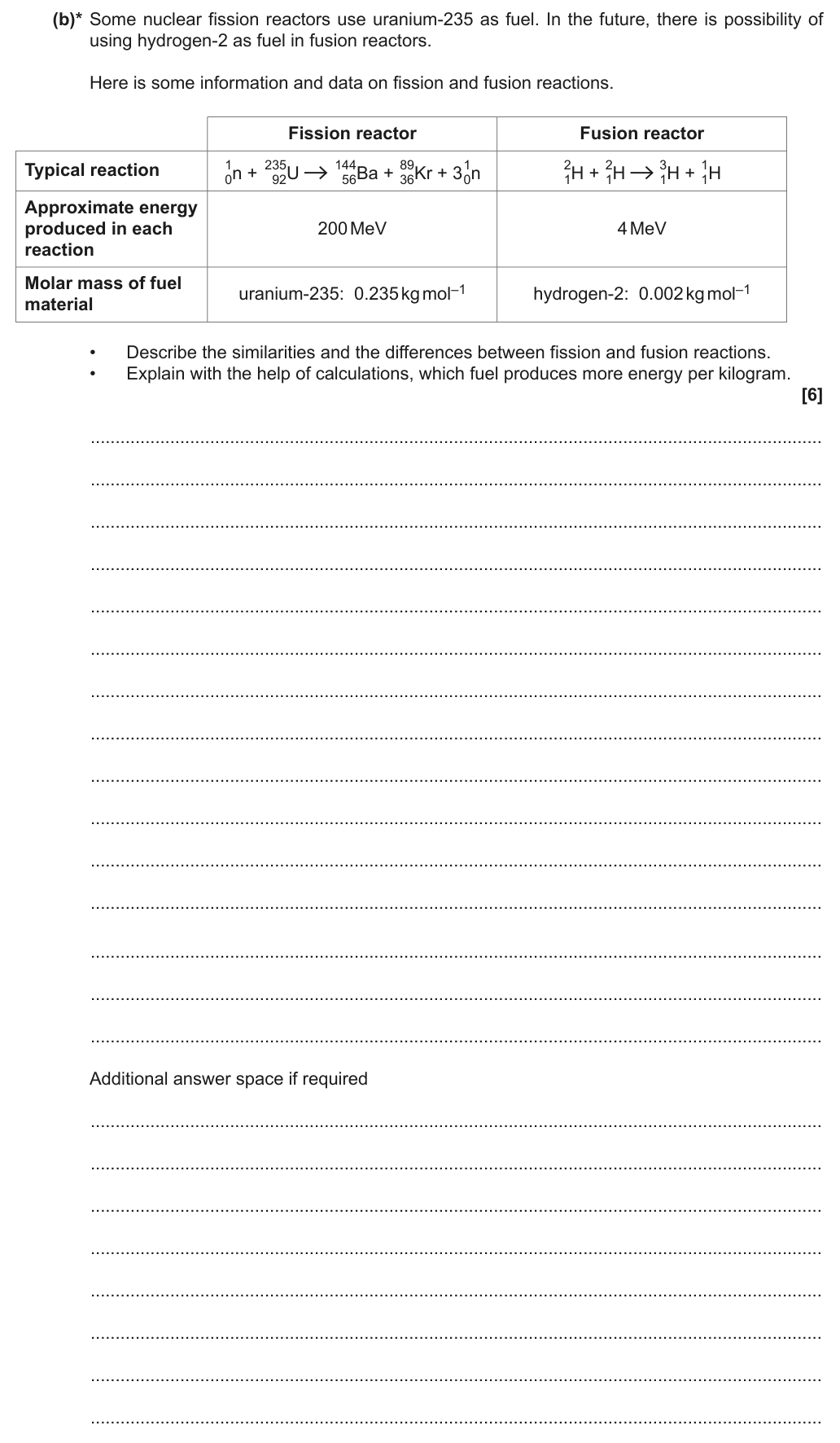
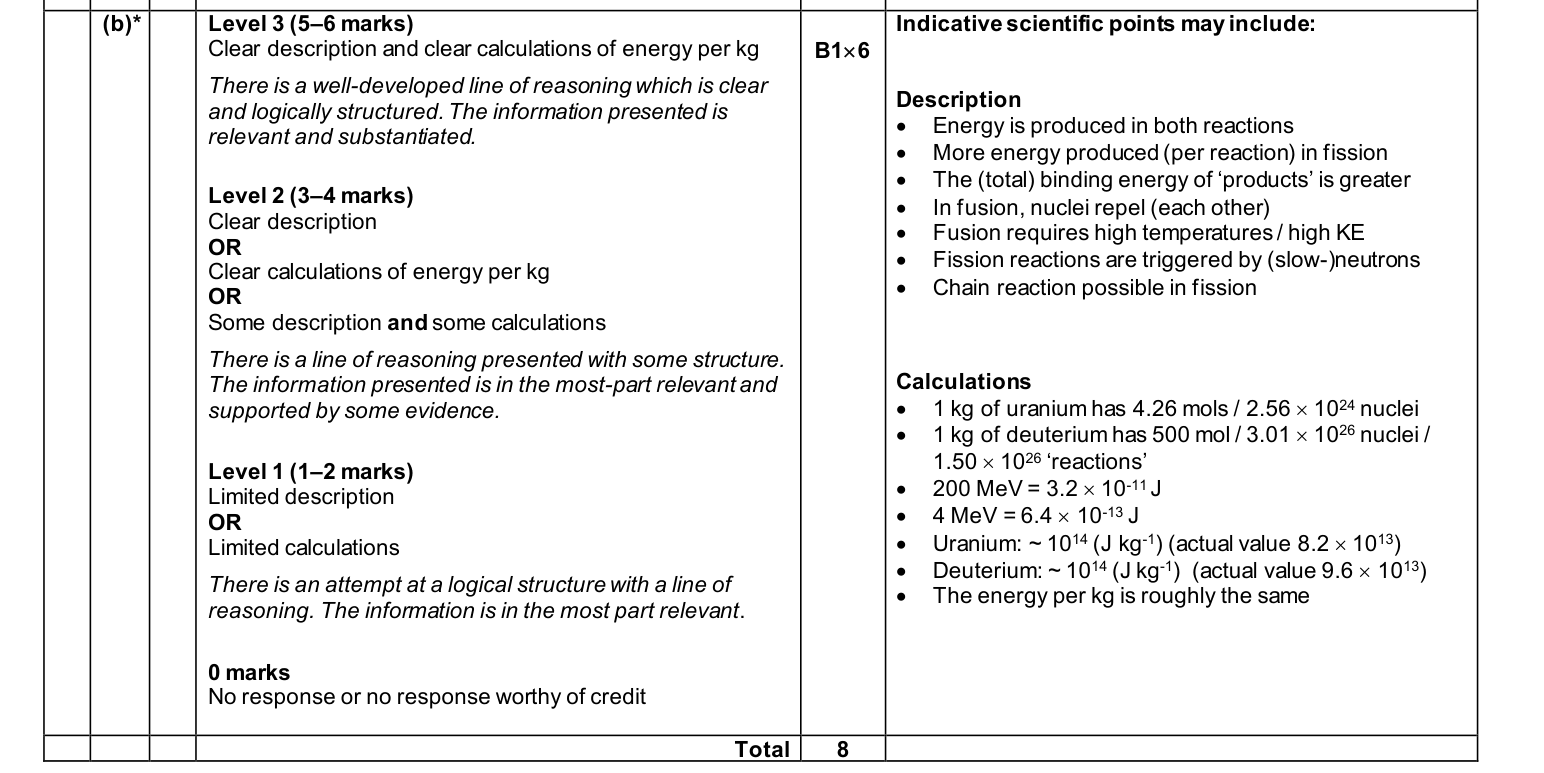
This is the second LoR question. This is designed to assess knowledge of the two nuclear energy reactions and to calculate energy release using some given data. The differences between the fission and fusion reactions were generally well answered although many candidates explained differences in design, operation and waste more than the reactions. The similarities were often not as clear however several candidates gave excellent responses in terms of binding energies and mass differences. Candidates were also expected to complete a calculation to show which produces more energy output per kilogram. This is challenging calculation to follow through fully, but most candidates were able to make some attempt, even if it was only converting MeV to J. Only better candidates realised 2 nuclei of deuterium were used for one fusion reaction. While a small number of candidates did correctly calculate the energy per kilogram, they tended to state that fusion produced more energy rather than a feeling that they are basically equivalent. As usual with LoR questions, a holistic approach is taken to the marking and candidates can access higher levels without necessarily reaching all the marking points. Even so, relatively few candidates were able to access Level 3, generally due to poor calculations and/or descriptions.
Skills: M0.2 Recognise and use expressions in decimal and standard form; M0.3 Use ratios, fractions and percentages; M1.4 Make order of magnitude calculations
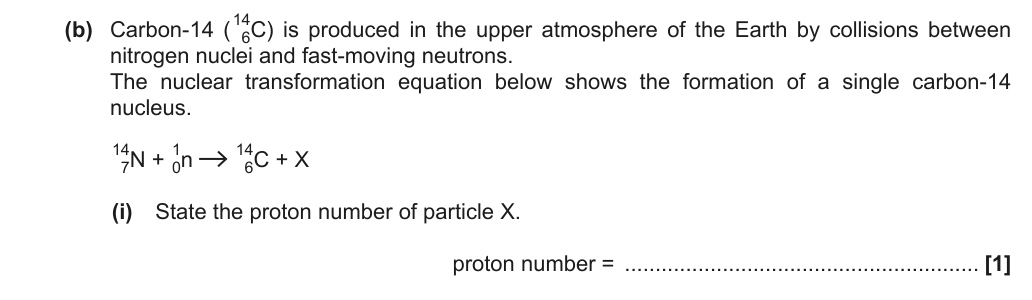
This question was correctly answered by the vast majority of candidates.
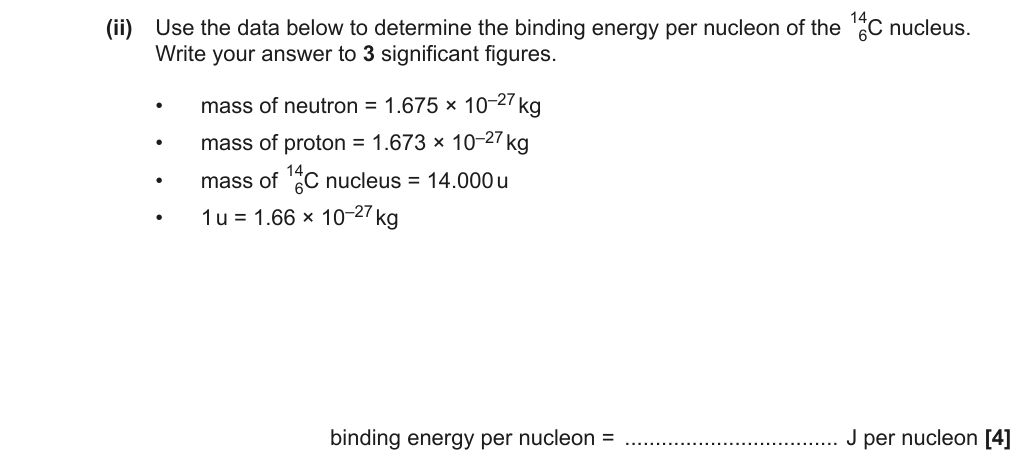
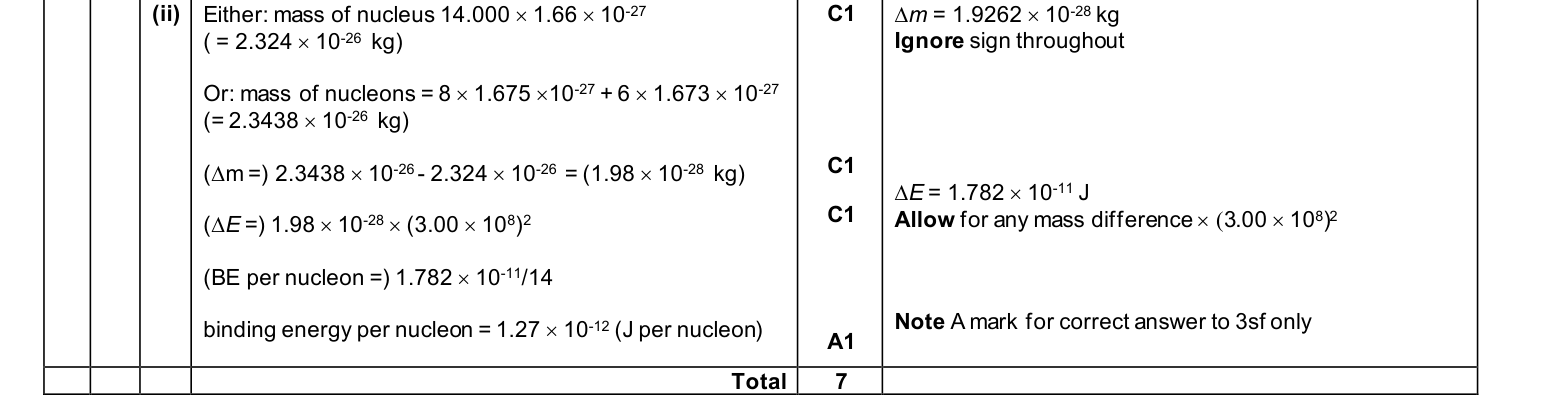
This final calculation required some careful structure and several stages. An encouraging number were able to work through the solution to its conclusion. Some rounded intermediate calculations too early and so lost the final 3 significant figures mark. Several candidates also missed the division by the nucleon number, either as a slip or perhaps they did not appreciate that this was what was required. Even the weakest candidates realised the need to apply E = mc2, but would only gain credit here if they had calculated a mass difference. Some candidates also miscalculated the number of protons and neutrons in the carbon nucleus, which meant that they were limited to a maximum of 2 marks. Key teaching and learning points – comments on improving performance • Encourage the use of underlining or highlighting terms in questions. • For questions with extended writing, consider the use of bullet points for clarity and to avoid contradiction. • Keep the number of significant figures high during intermediate stages of a calculation. • Make note of requests for significant figures in final answers for calculations. • Learn definitions for common physical quantities. • Aim to use clear scientific terminology. If any of your students’ results are not as expected, you may wish to consider one of our review of results services. For full information about the options available visit the OCR website. Our priority is supporting you and your students this autumn and to support you as you prepare for summer 2022 exams. We’ll update our website information regularly with resources, guidance and key information. • Teachers • Students • Exams officers We are sending a weekly roundup to tell you about important updates. You can also sign up for your subject specific updates. If you haven’t already, sign up here. Attend one of our popular CPD courses to hear directly from a senior assessor or drop in to a Q&A session. All our courses for the academic year 2021-2022 are being delivered live via an online platform, so you can attend from any location. Please find details for all our courses on the relevant subject page on our website or visit OCR professional development. ExamBuilder is the question builder platform for a range of our GCSE, A Level, Cambridge Nationals, Cambridge Technicals and Functional Skills qualifications. See the full list of available qualifications in the sign up form. ExamBuilder is free for all OCR centres with an Interchange account and gives you unlimited users per centre. We need an Interchange username to validate the identity of your centre's first user account for ExamBuilder. If you do not have an Interchange account please contact your centre administrator (usually the Exams Officer) to request a username, or nominate an existing Interchange user in your department. Review of results
Skills: M0.2 Recognise and use expressions in decimal and standard form; M1.1 Use an appropriate number of significant figures; M2.3 Substitute numerical values into algebraic equations using appropriate units for physical quantities
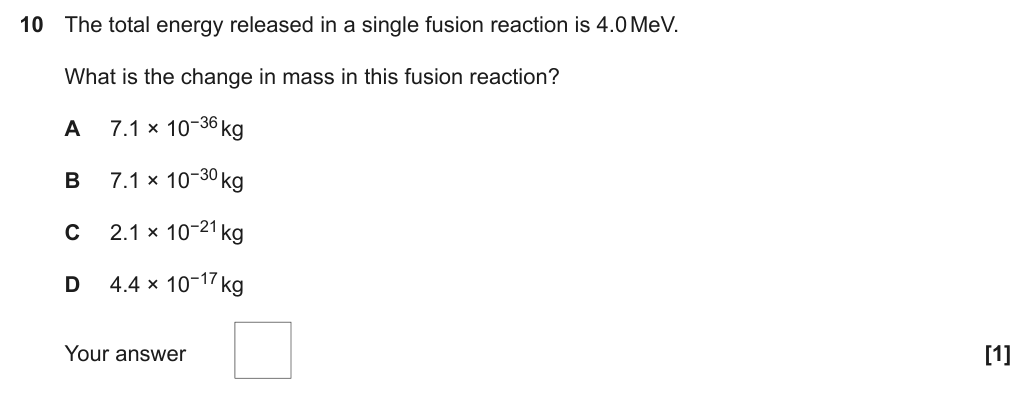
B
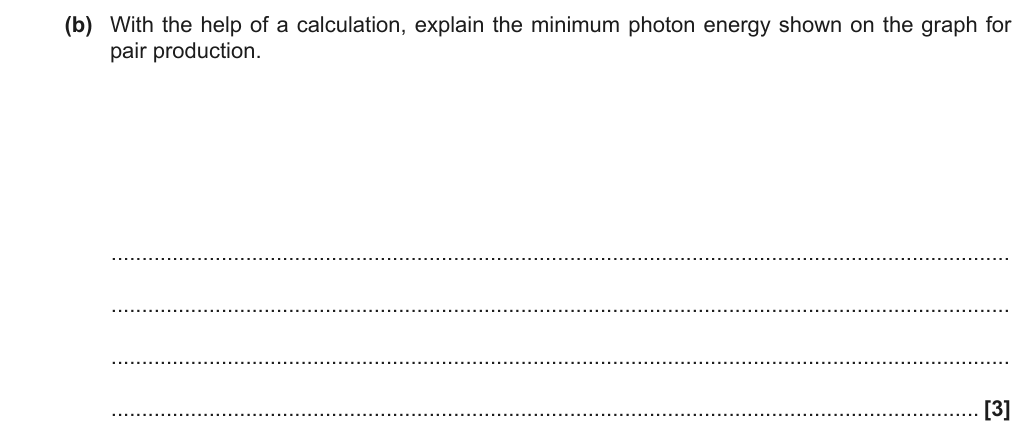
Misconception Question 25b A small number of candidates were perplexed by the lg(photon energy / eV) on the horizontal axis of the graph.
Skills: M0.5 Use calculators to find and use power, exponential and logarithmic functions; M2.5 Use logarithms in relation to quantities that range over several orders of magnitude; M3.10 Interpret logarithmic plots
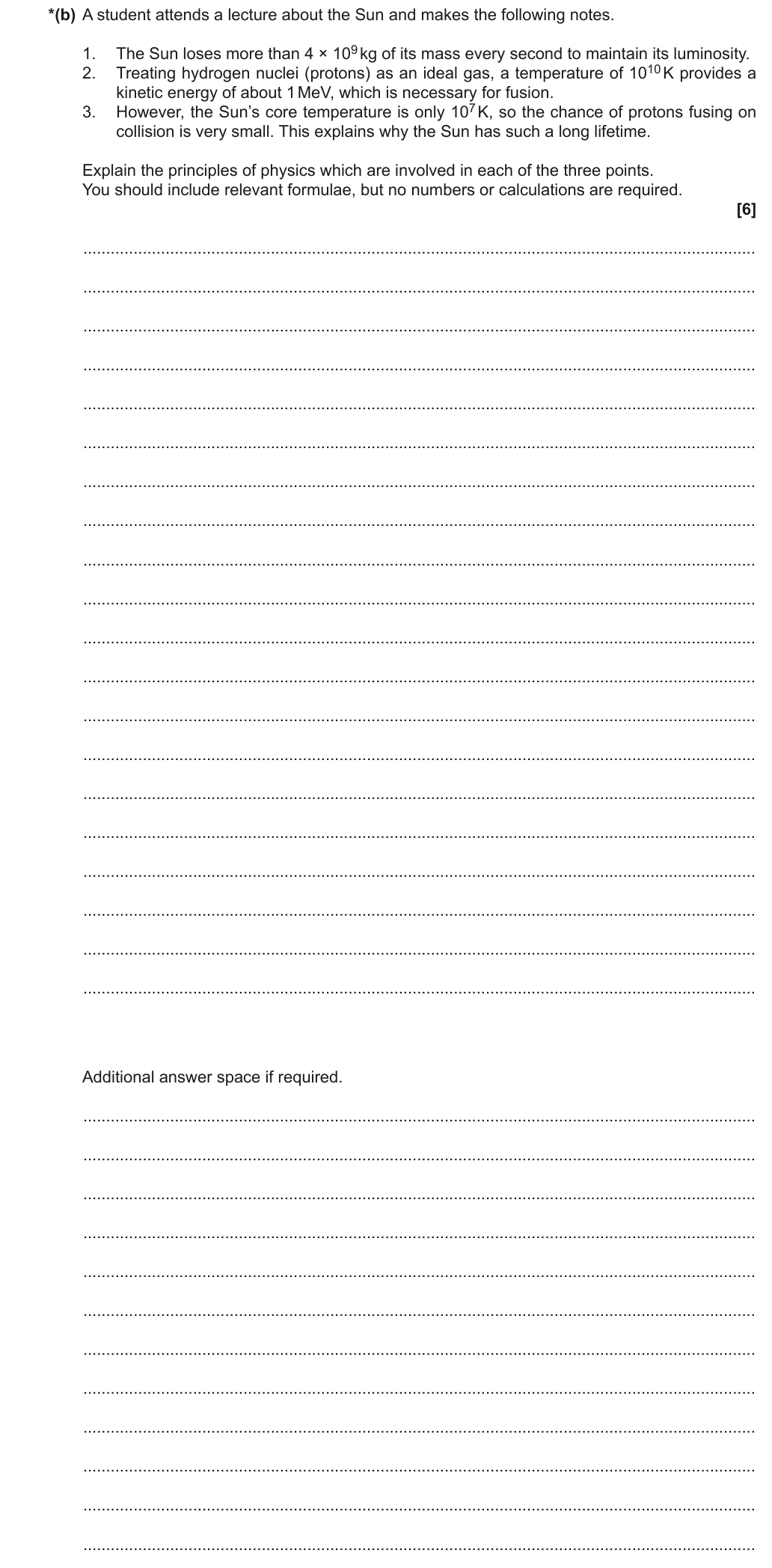
Question 3ai Most candidates successfully used the formula for Stefan’s Law. Question 3aii Higher ability candidates successfully used the more elegant ratios method to reach the correct response. Question 3b This was one of the two LoR questions.
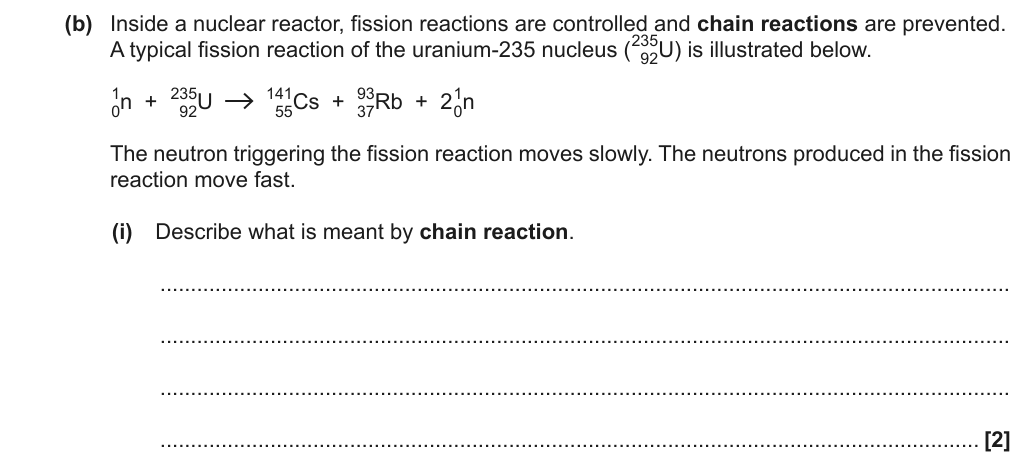
Most candidates scored 1 mark for the general idea of a chain reaction, but the important role played by the neutrons was often omitted in the descriptions. Only a small number of candidates misunderstood fission as a reaction in which the Cs and Rb nuclei themselves were responsible for triggering subsequent reactions of the uranium nuclei.

The mechanism of preventing uncontrolled chain reaction within a nuclear reactor was generally well understood. Having given perfect answers with control rods absorbing the excess neutrons, a significant number of candidates confusing their answers by also mentioning the moderator. It many cases it was impossible for examiners to decide from the candidates response if the control rods, or the moderators, were responsible for preventing chain reactions. Some candidates mentioned ‘boron rods’, this was an acceptable alternative for the ‘control rods’.
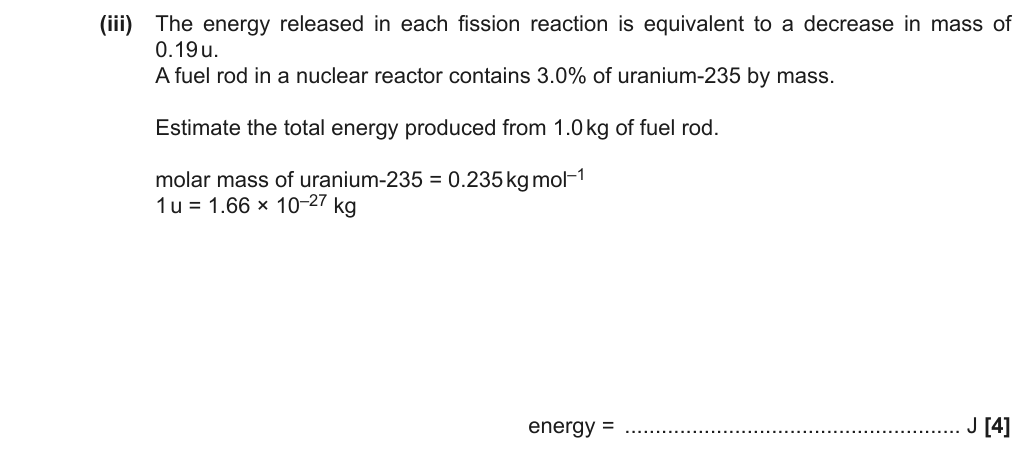
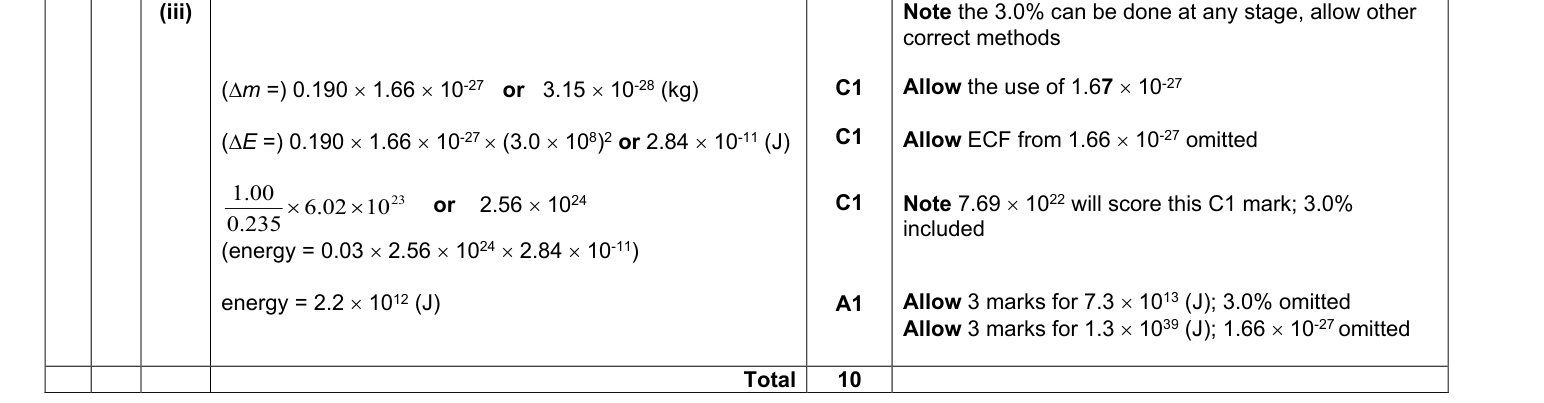
This proved to be an excellent discriminator with top end candidates showing excellent skills to get to the correct answer of 2.2 × 10¹² J. The majority of the candidates correctly converted the 0.19u into kilograms, and then successfully used Einstein’s mass-energy equation to calculate the equivalent energy of 2.8 × 10⁻¹¹ J. The main obstacle in this question was the determination of the number of uranium nuclei in the fuel rods. Avogadro constant, given in the data booklet, was either omitted or the incorrect mass used to determine the number of uranium nuclei.
Skills: M0.2 Recognise and use expressions in decimal and standard form; M0.3 Use ratios, fractions and percentages; M2.3 Substitute numerical values into algebraic equations using appropriate units for physical quantities
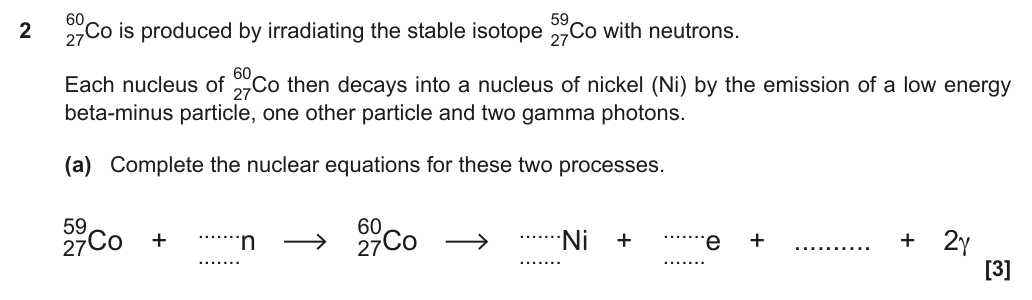
The correct symbol for the ‘one other particle’ in this question was ( ,)( _e ) or ((_0^0) ), all being acceptable. Common problems in 2(a) • some attempts for the symbol ‘nu’ could not be given because they were indecipherable or looked more like ‘gamma’ • balancing the bottom row proved more troublesome than balancing the top row, presumably because of the ‘-1’ for the electron
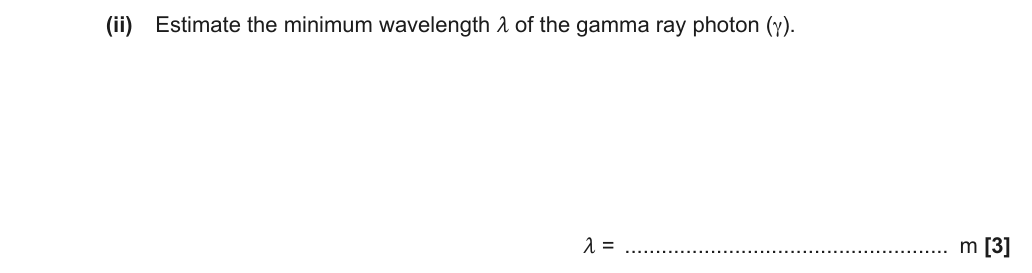
Skills: M0.2 Recognise and use expressions in decimal and standard form; M2.2 Change the subject of an equation, including non-linear equations; M2.3 Substitute numerical values into algebraic equations using appropriate units for physical quantities
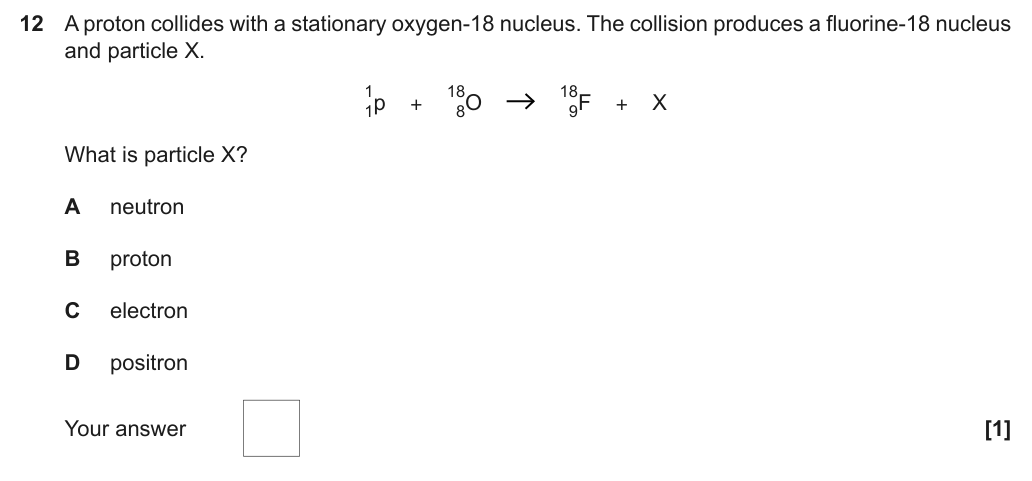
A
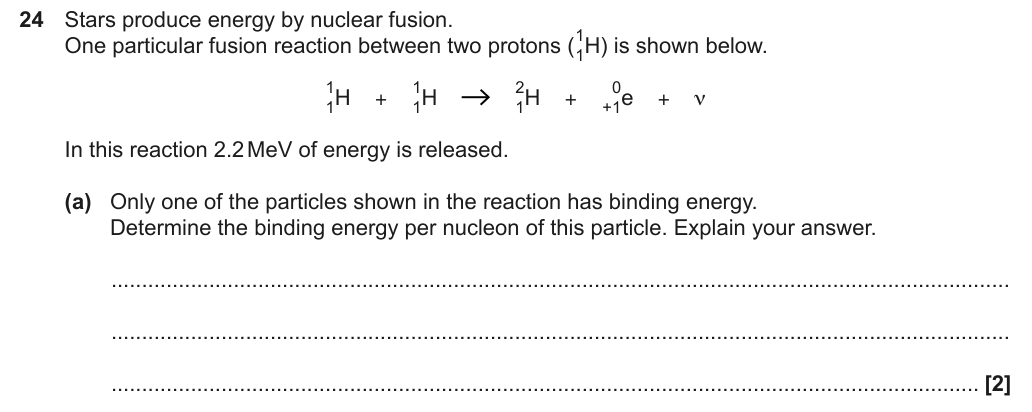
Skills: M0.3 Use ratios, fractions and percentages
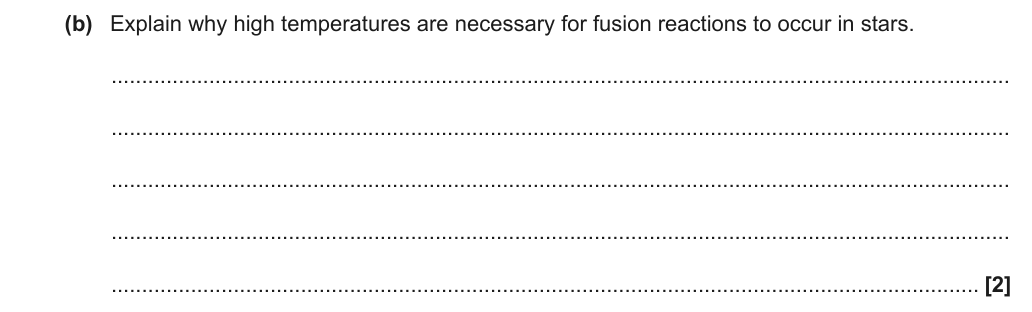
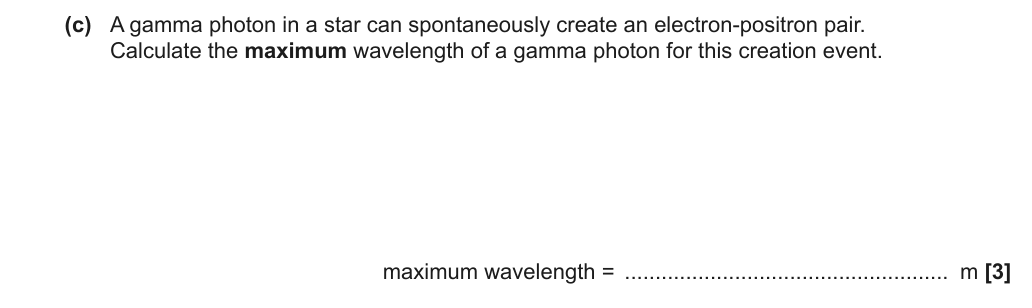
Skills: M0.2 Recognise and use expressions in decimal and standard form; M2.2 Change the subject of an equation, including non-linear equations; M2.3 Substitute numerical values into algebraic equations using appropriate units for physical quantities
Dropping marks on calculations, practical questions or the six-mark level of response questions? Book a trial session with a specialist OCR physics tutor.