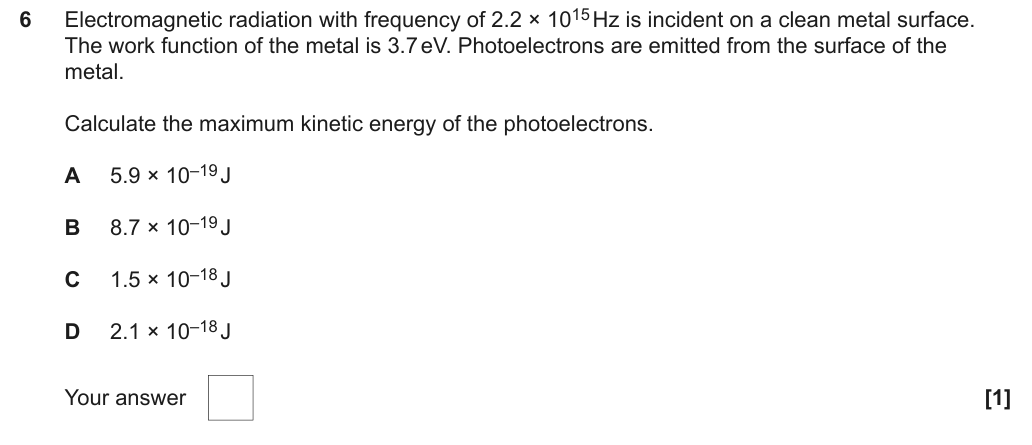
Answer
B
Mark scheme

Examiner's comment
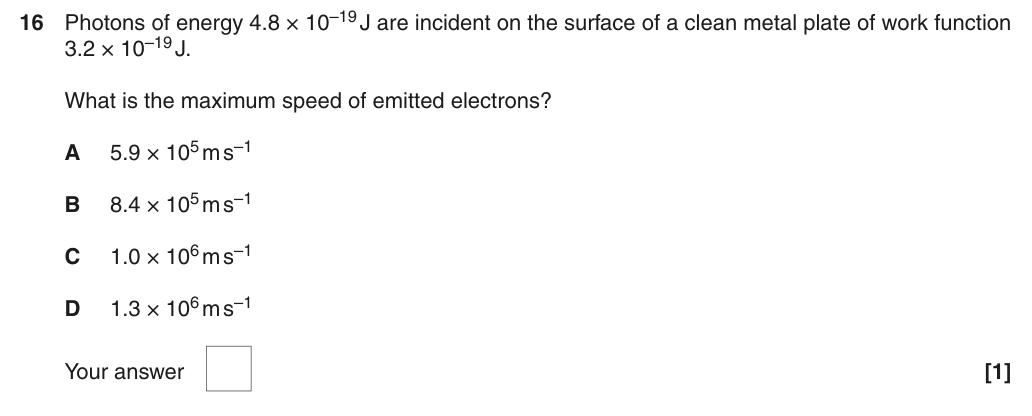
A common incorrect answer was A, where candidates had converted 3.7 eV to joule.
| Series | Paper | Q | What it asks |
|---|---|---|---|
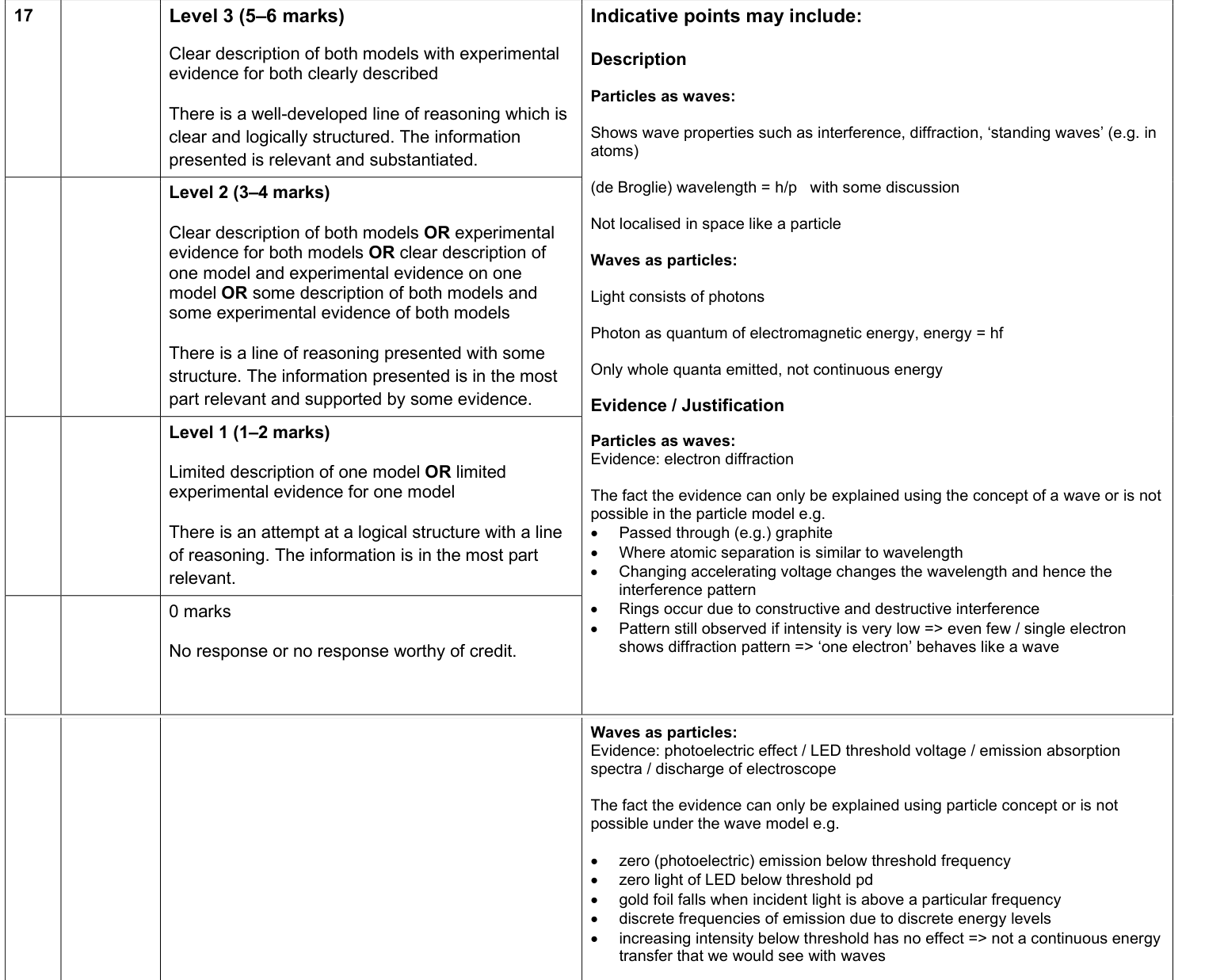
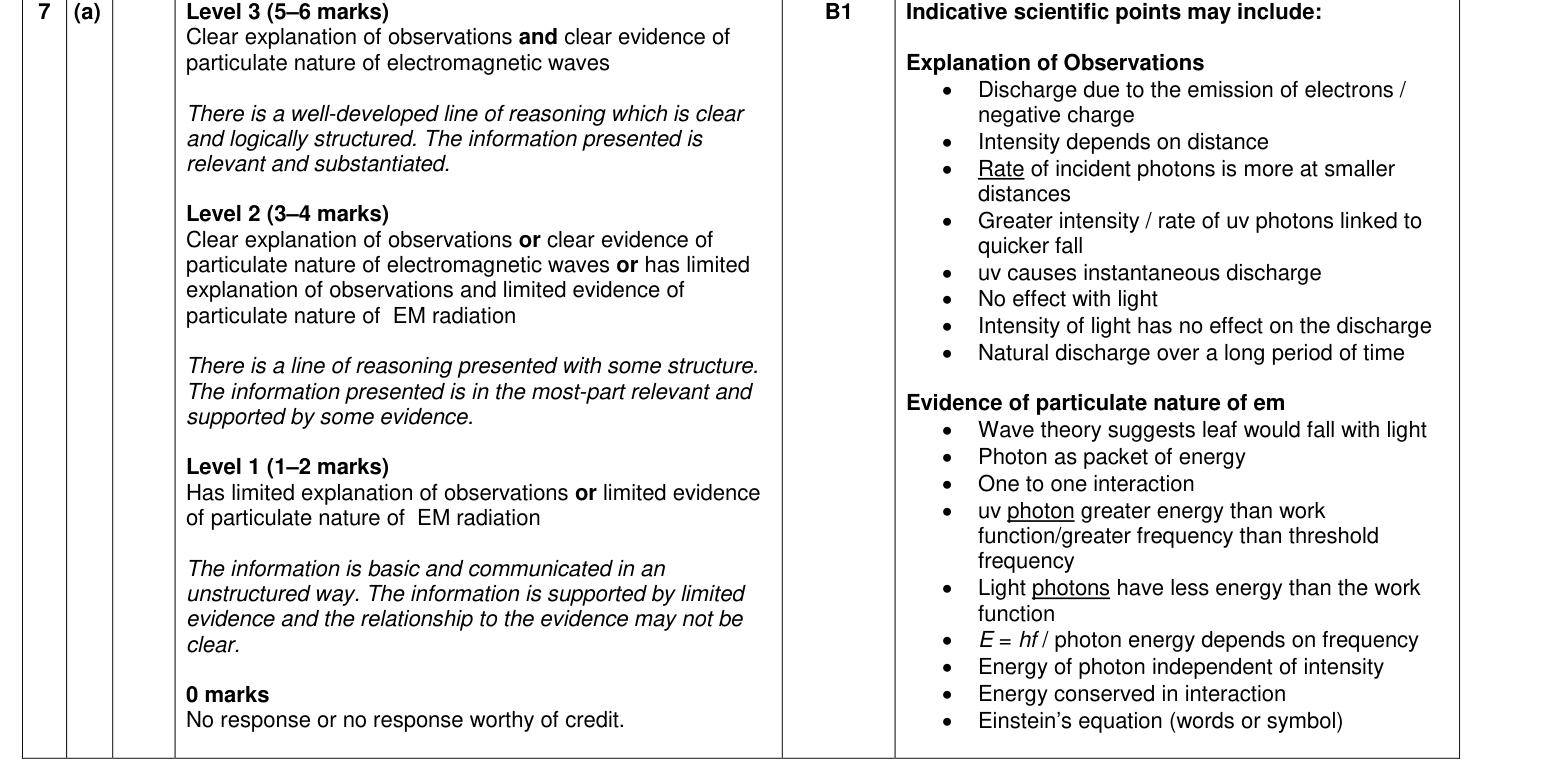
| June 2025 | Paper 2 | 17 | ‘Wave-particle duality’ refers to the idea that: Describe each model. |
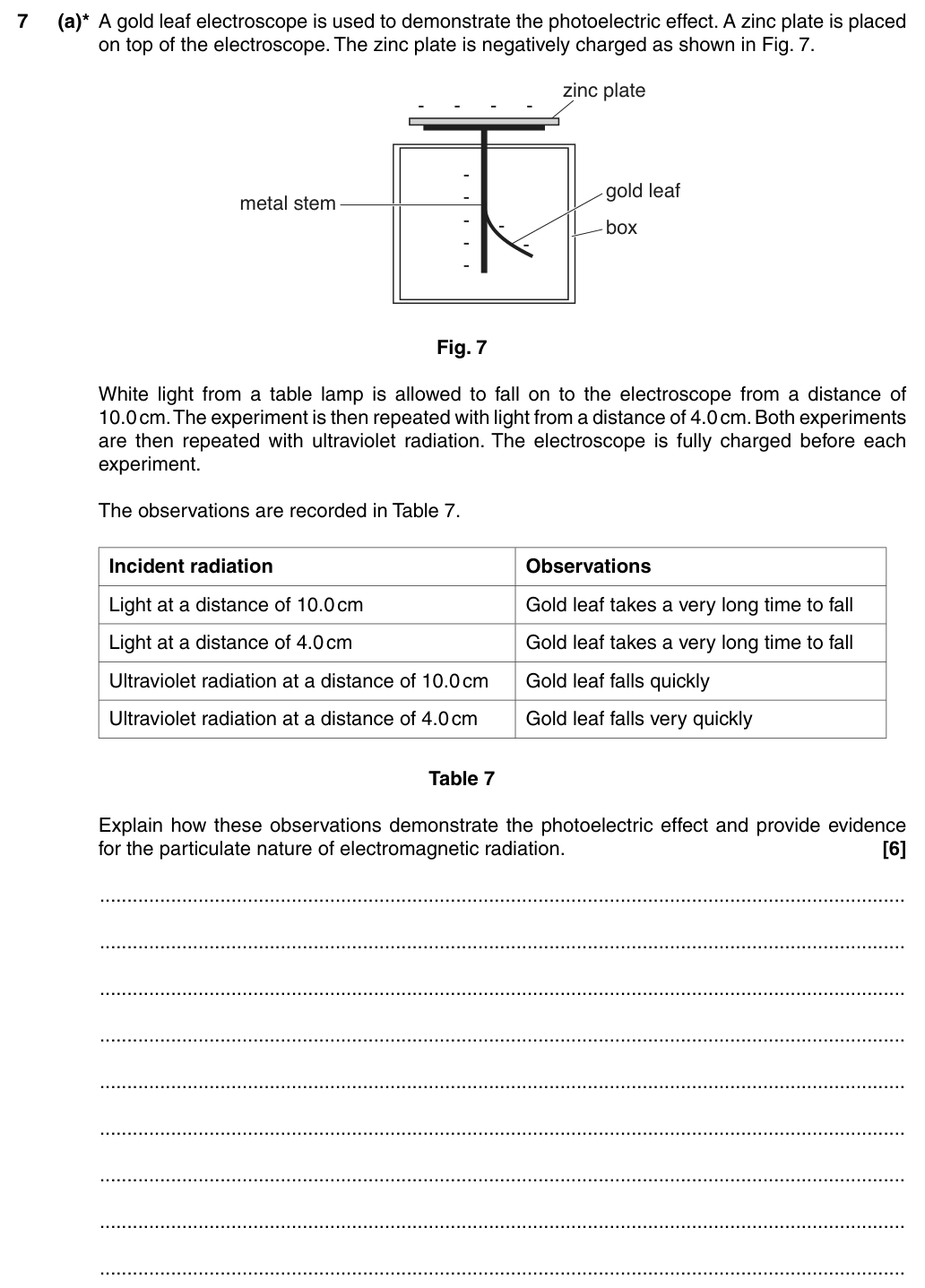
| June 2016 | AS Paper 2 | 7(a) | (a)* A gold leaf electroscope is used to demonstrate the photoelectric effect. A zinc plate is placed Explain how these observations demonstrate the photoelectric effect and provide evidence |
B
A common incorrect answer was A, where candidates had converted 3.7 eV to joule.
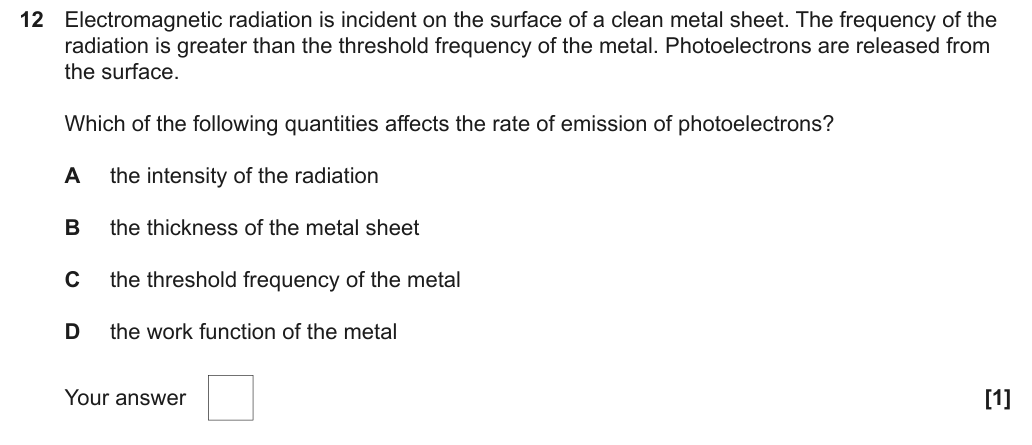
A
This question was assessing a standard learning outcome from the specification. Low scoring candidates often selected either C or D without reference to Einstein’s photelectric equation.
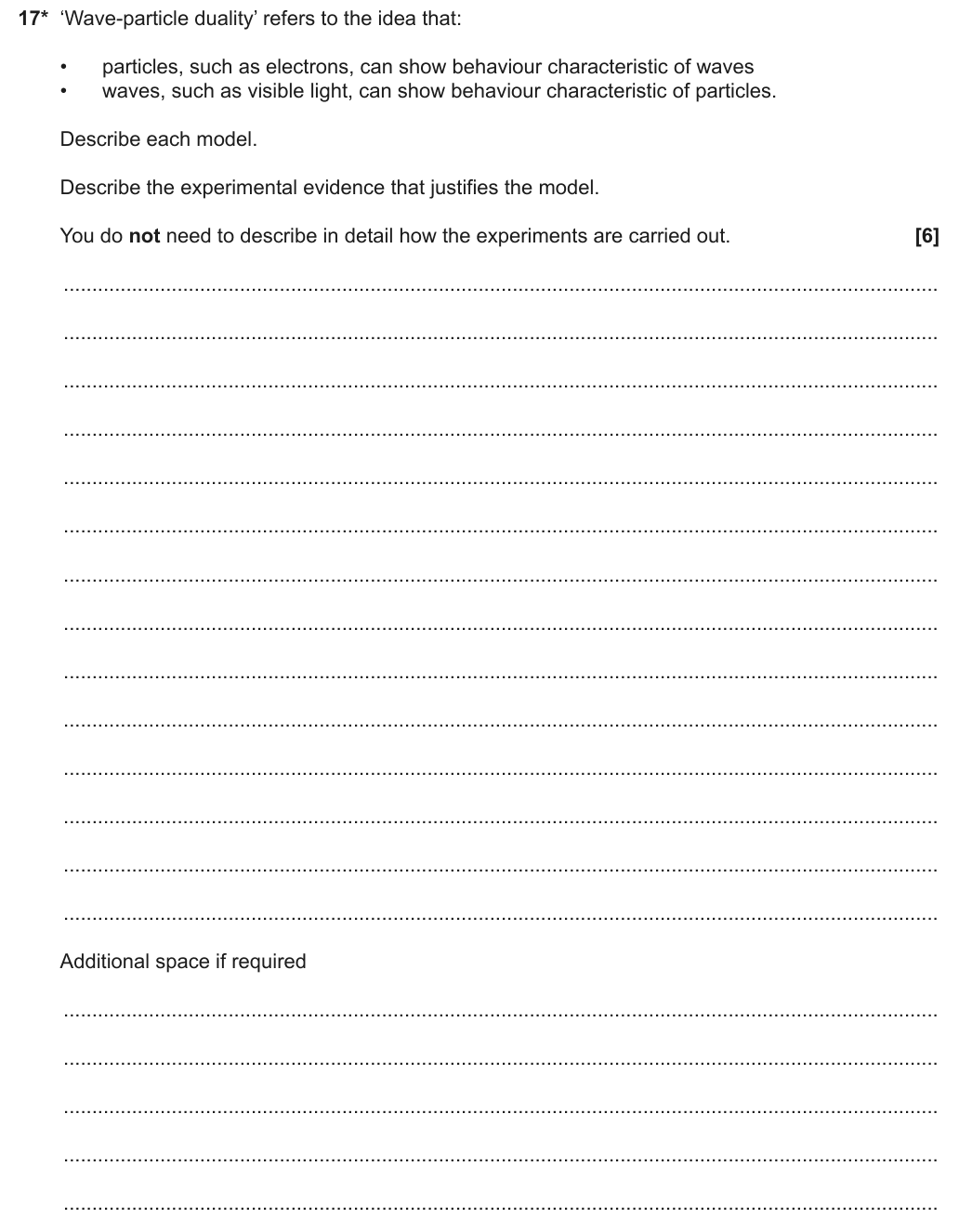
This Level of Response question was designed to assess the candidates’ knowledge of various aspects of wave-particle duality, in particular each model and experimental evidence. The key points in the description that examiners were looking for were: • a description of a model of how particles can be described as waves, and some experimental evidece to support this • a description of how waves can be described as particles, and some experimental evidence to support this. To obtain Level 3, it is important that all four aspects of this are approached. For the most part, it was clear that candidates had a general knowledge of this topic. Many were able to give some descriptions of electron diffraction and ‘the gold leaf experiment’, but not all gave sufficient detail in terms of the requirements of the question. Although not always required, it would be expected that candidates may use an equation in their description (the de Broglie relationship and E = hf) to support how the particle can be considered to act as a wave, and vice versa. More successful candidates used this in conjunction with the experimental evidence to draw their conclusions. The most common experimental evidence, which could achieve Level 3 if approached correctly, were electron diffraction through graphite and some form of the photoelectric effect. Anticipated detail for experimental evidence would be to explain how a diffraction pattern leads to the idea of waves, and with the idea of a threshold frequency. These can only be explained by use of the correct model and would support the response. Common weak points were to describe the electrons passing through a double slit, describing the interference pattern as fringes rather than concentric rings and explaining the photoelectric effect theoretically without any evidence. The question stated that there was no requirement to explain the experimental detail (as evidence was required) but several candidates used time doing so. Using the gold leaf electroscope (which many candidates had seen) is a good way to demonstrate the photoelectric effect, however there seemed to be some confusion about whether it was initially charged, and if so whether it was positive or negative, The statement ‘one to one interaction’ was common, although was often used without support and it was clearly something that had been learnt. Most candidates used the space, including the additional space, to answer this question. It is always possible to obtain a Level 3 in the given space by carefully answering the question rather than giving superfluous information and candidates are encouraged to think a little about their response before starting. This exemplar shows a good response, but not sufficient to reach Level 3. The candidate has given a fair, yet brief, description of the experimental evidence for electron diffraction, showing particles acting as waves. Similarly, the photoelectric effect is explained to some level of detail about how it demonstrates where a wave acts like a particle. There is little in terms of the descriptions of the model in either of these. There is a reference to diffraction for the wave model and use of the term ‘photon’ for the particle model. Considering the level guidance, this has some description of both model and experimental evidence so falls into Level 2. The experimental evidence has some valid details, so can be awarded the top of this level, 4 marks.
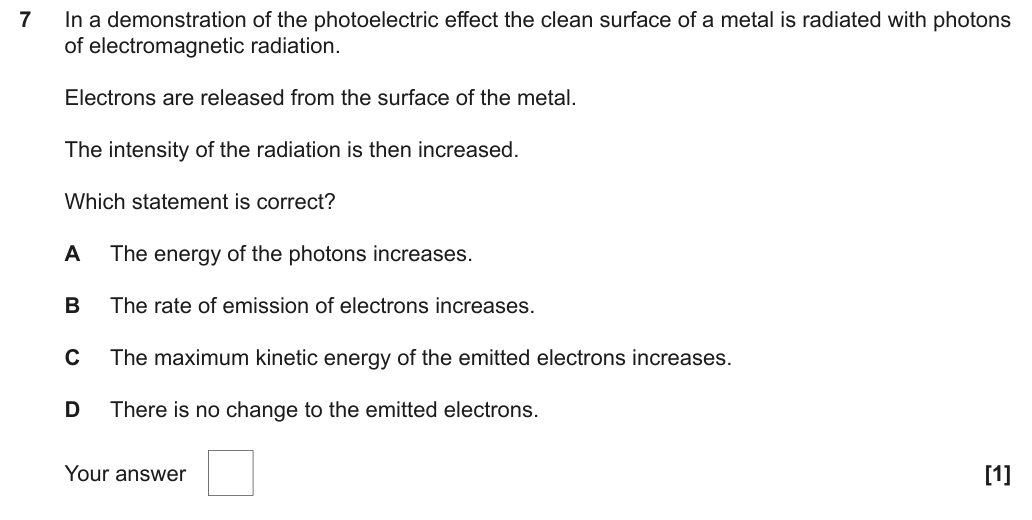
B
Candidates performed well on this question with many correctly relating an increase in intensity of radiation to an increase in the rate of emission of electrons.
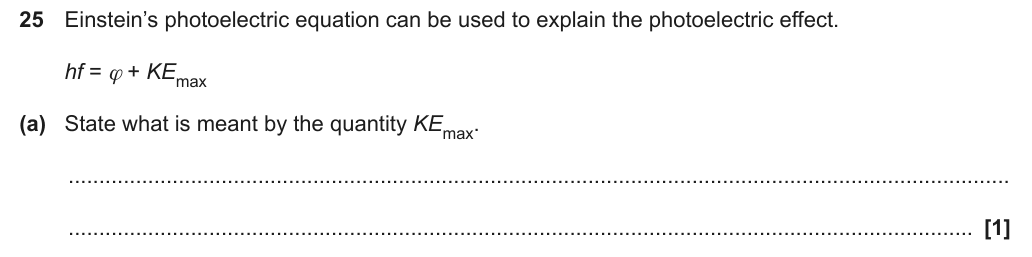
This should have been a straightforward definition of the maximum kinetic energy of electrons when they are emitted from the surface of a metal but many candidates were not given the mark as their definitions lacked specific scientific language.
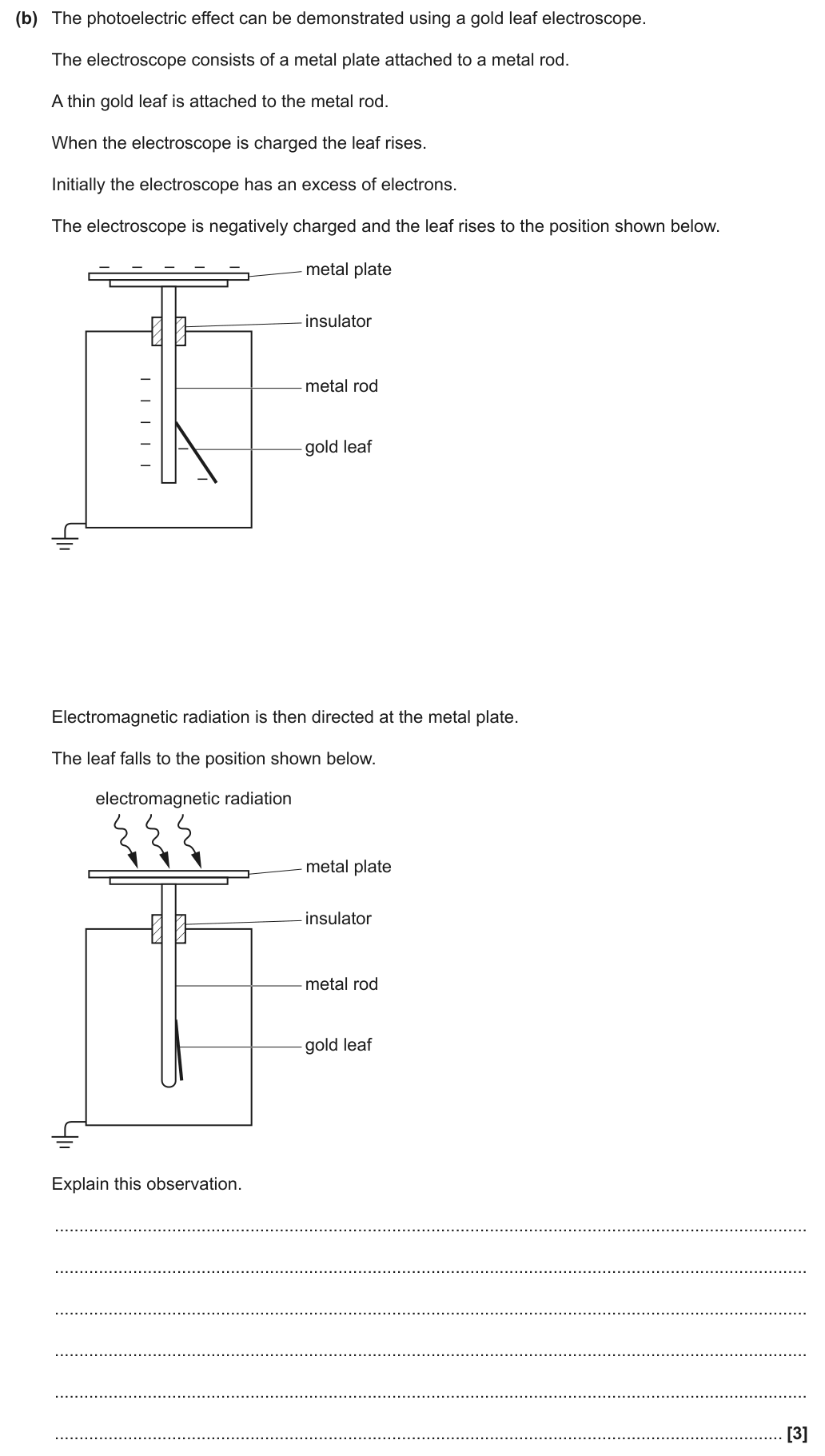
Most candidates were given at least 1 mark for this question for the explanation that when electromagnetic radiation is incident on the metal plate electrons are emitted. Some candidates were then given a further mark for explaining that the gold leaf fell due to losing negative charge but there were a significant number of responses that referred to positive charge and that as the leaf was losing negative charge it became positively charged. While candidates may not have observed a demonstration of a gold leaf electroscope, the question assessed their understanding and explanation of the photoelectric effect and that is only the removal of excess electrons when there is a one-to-one interaction with a photon.
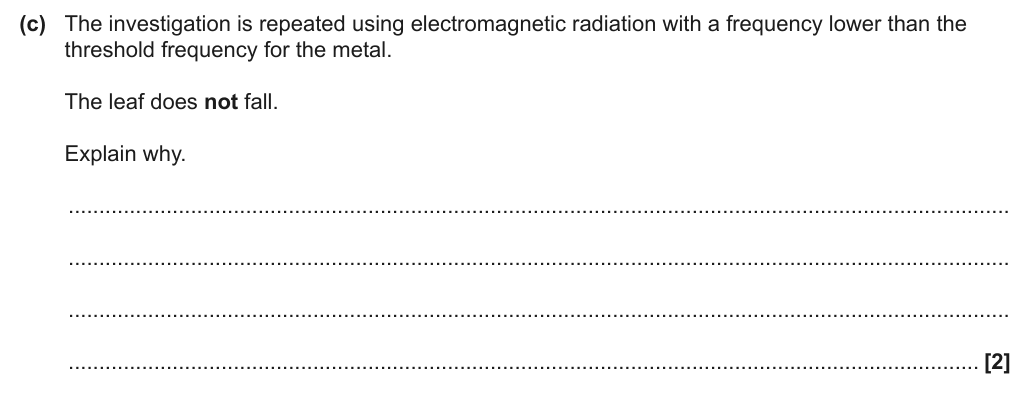
There were not many successful responses for this question and many responses were given 0 marks. These responses did not explain the reason for the leaf not falling in relation to photon energy and the work function, and hence that the electron does not receive enough energy to be emitted. Typical responses that were not given marks were for a description of threshold frequency as the minimum frequency required for electrons to be emitted and/or for simple stating that the leaf does not fall as electrons are not emitted. While these descriptions were valid, candidates had not applied Ep=hf and Φ=hfo to explain that the energy of the photon was less than the work function required for electrons to be emitted.
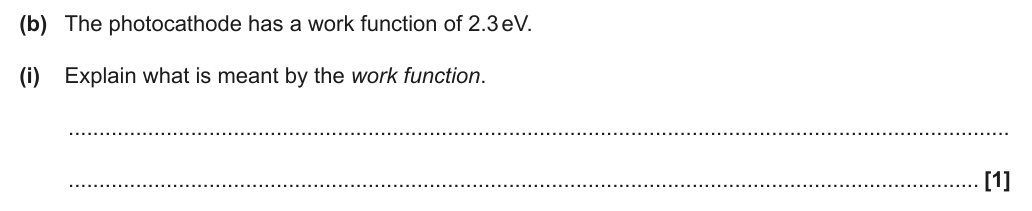
This explanation requires some specific detail; that it is a minimum energy and that it is not being applied to an atom. Nearly two thirds of candidates gave an explanation clear enough for credit and most of those who missed out on the mark simply weren’t detailed enough rather than being wholly wrong. Responses such as ‘the minimum energy for the photoelectric effect to occur’ are not quite detailed enough.
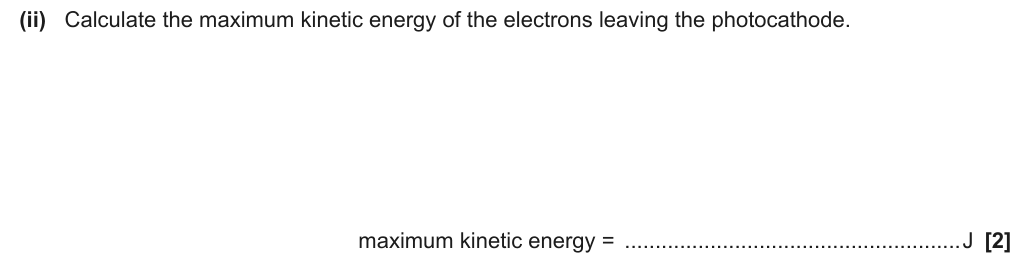
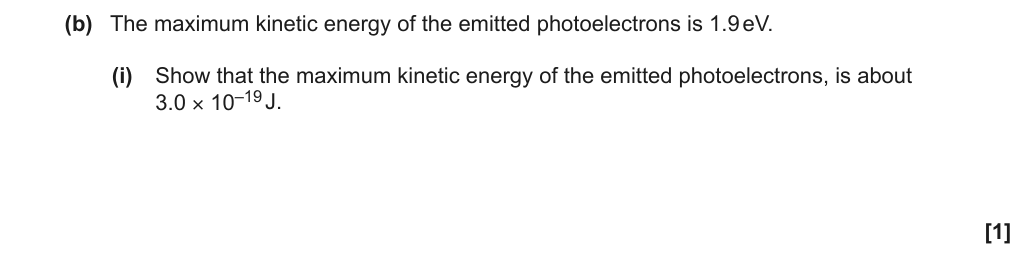
Most candidates were able to obtain at least 1 mark by correctly converting the work function into joules. As always, correct working is very helpful in obtaining the intermediate marks. Several arranged the equation incorrectly, by adding on the work function, but well over half of the candidates correctly evaluated the maximum kinetic energy.
Skills: M0.2 Recognise and use expressions in decimal and standard form; M2.2 Change the subject of an equation, including non-linear equations; M2.3 Substitute numerical values into algebraic equations using appropriate units for physical quantities

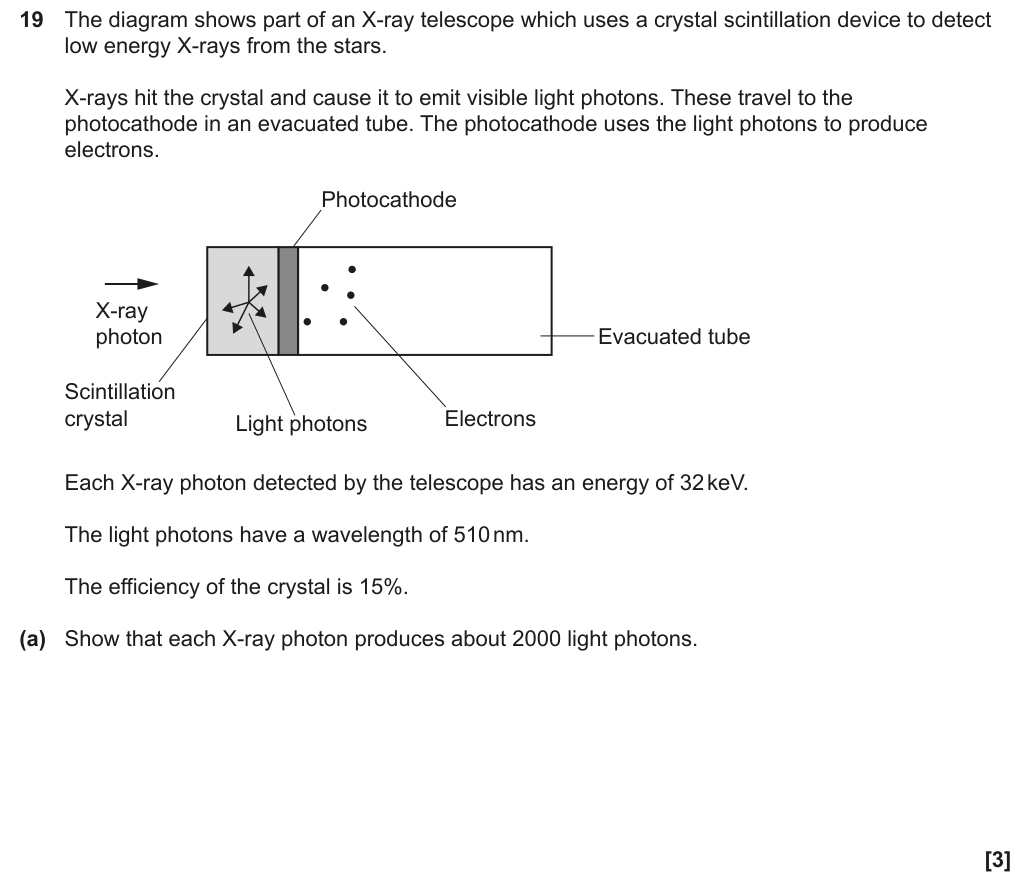
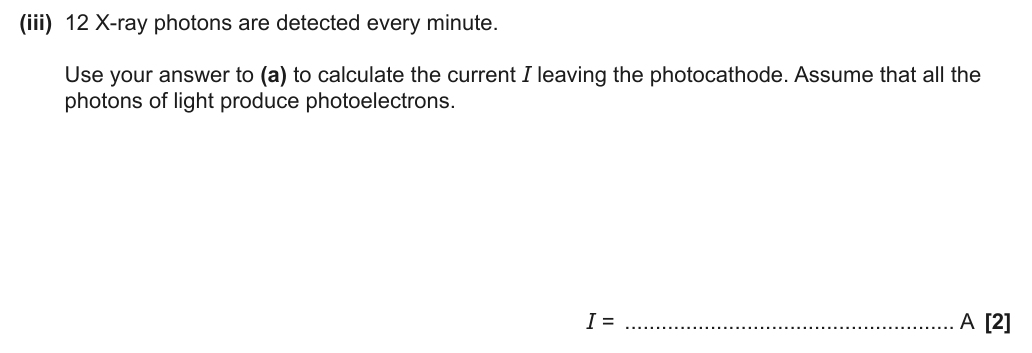
The main expectation for this question was to appreciate the one-to-one relation between the photon and the electron, although other valid answers were given. Ideas about efficiency are a little too limited for credit, along with statements like ‘there are exactly 2000 photons’. Information in the question has to be treated as correct in any case, so is not an assumption.
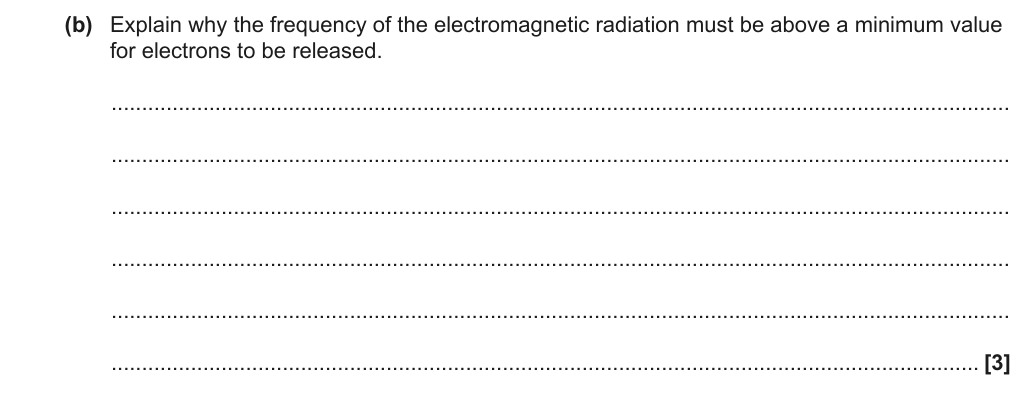
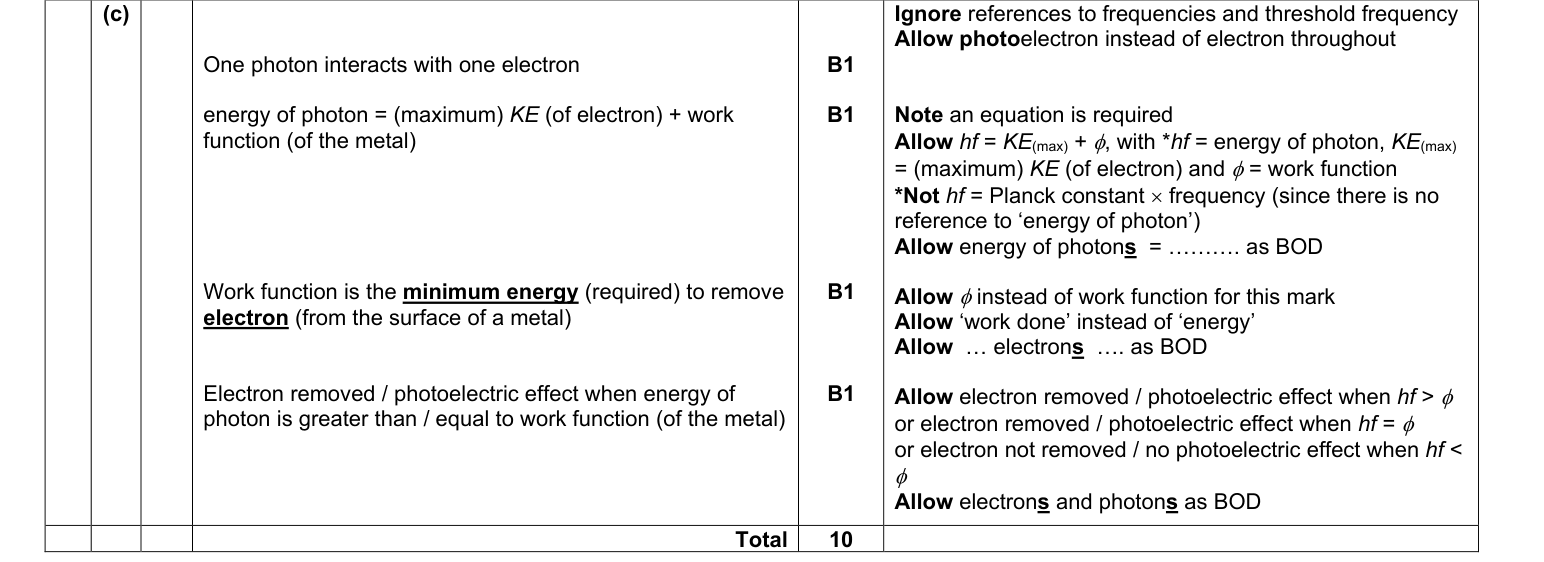
Just under two thirds of the candidates achieved 1 or more marks for correctly explaining the minimum energy required to emit electrons from incident photons related to the photoelectric effect. The most common response where candidates were given 1 mark was for relating the energy of radiation to the frequency by applying hf = E but without referencing photons in their explanation and hence were not given any further marks. About 40% of candidates did reference photons in their response with 20% of candidates directly relating it to the work function as the minimum amount of energy required to release an electron to gain all 3 mark points.
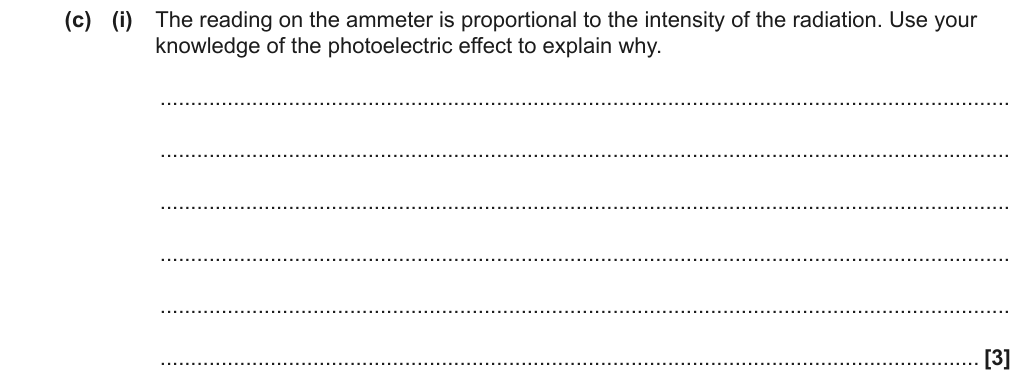
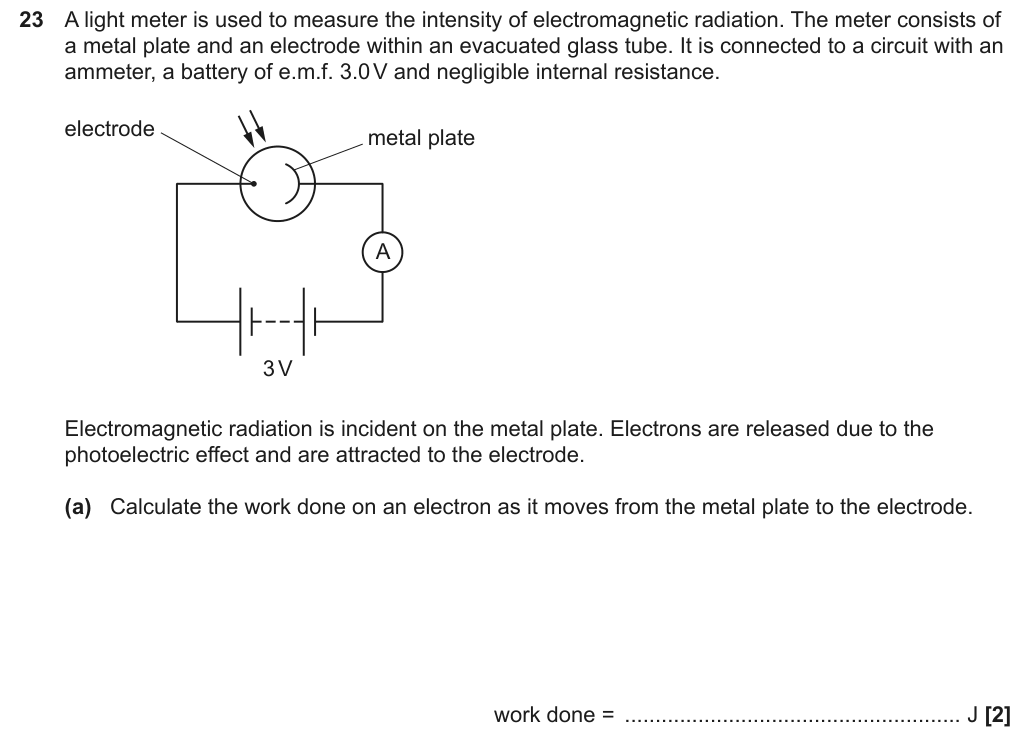
Candidates did not perform well on this question as 60% of candidates achieved no marks. A common response was to describe that greater intensity leads to more photoelectrons which was not given, and few made the important connection between intensity and ‘rate of photons hitting the plate’. Also, many candidates did not apply the 1:1 correlation between photons and electrons in the photoelectric effect as they simple stated that more electrons were released without applying knowledge of the individual interaction between incident photons to the release of electrons. Many took the reverse view that greater current led to greater intensity or simply referred to the ammeter reading rather than referencing current. This exemplar demonstrates a typical response from candidates where a simple statement is made in relation to the intensity of electrons emitted and corresponding current reading on the ammeter. As in many similar responses the intensity of radiation is not linked to the ‘rate of incident photons’ resulting in a similar ‘rate of electron emission’ due to the 1:1 interaction between photons and electrons. Candidates were then required to link the rate of electron emission to the equation Q = It to conclude that current is equal to the rate of flow of charge and hence the ammeter reading is proportional to the intensity of the radiation.
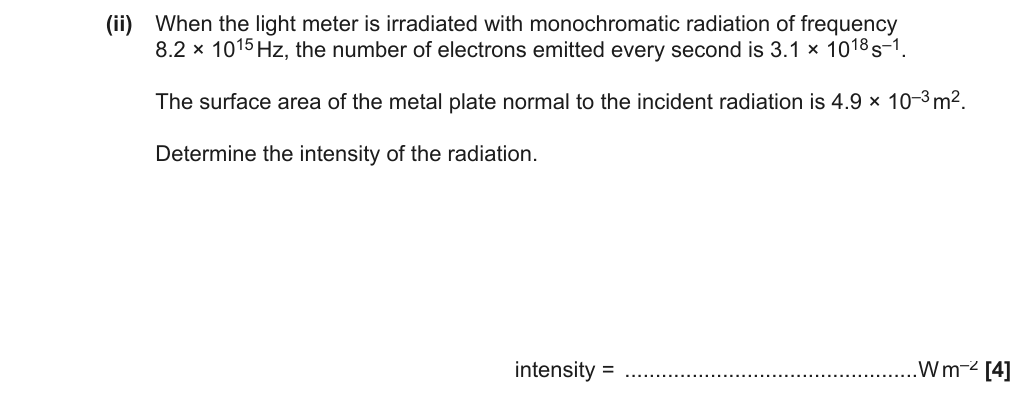
Candidates did not perform well on this question as just over half of candidates scored 0 marks. Candidates had to select the equations hf = E and I = P/A from the Data, Formulae and Relationship booklet and then apply that the power was equal to the energy as the rate of emission of electrons was in a time of 1 second. Many candidates would select the correct equation I = P/A but would then try and calculate power by using the equation P = VI and Q = It by using the charge of an electron to calculate the current and using the battery e.m.f. of 3 V given in the circuit diagram. This demonstrated for a majority of candidates a lack of a confident understanding of the photoelectric effect that the energy of incident photons results in the release of electrons. This response demonstrates the correct and clear selection and application of formulae to calculate the intensity of the incident radiation.
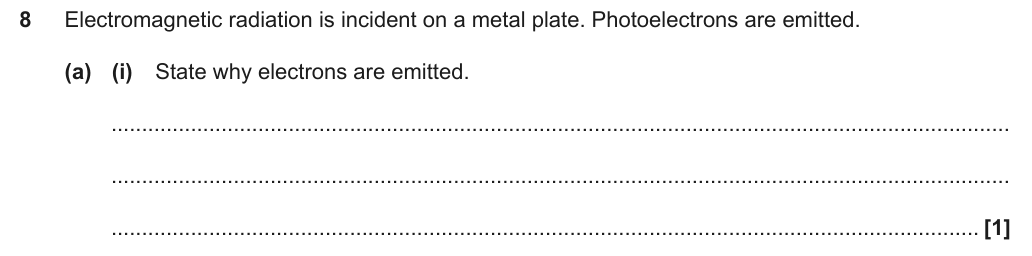
Many candidates did not mention photons in their answers. High performing candidates’ answers were detailed and included the one-to-one interaction between one photon and one electron and the transfer of energy.
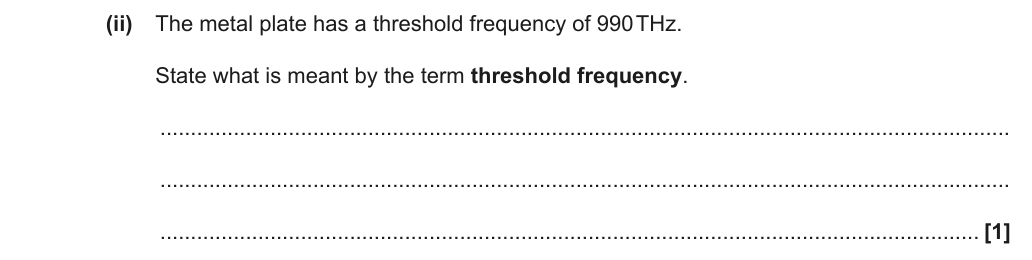
The majority of candidates gained a mark in this question. Candidates who did not gain the mark often referred to the minimum energy as opposed to the minimum frequency.
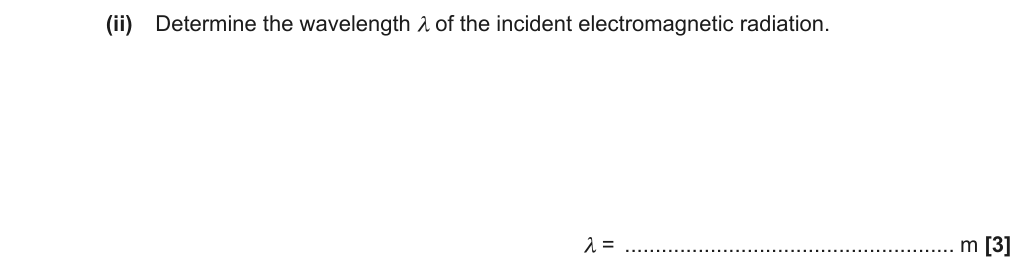
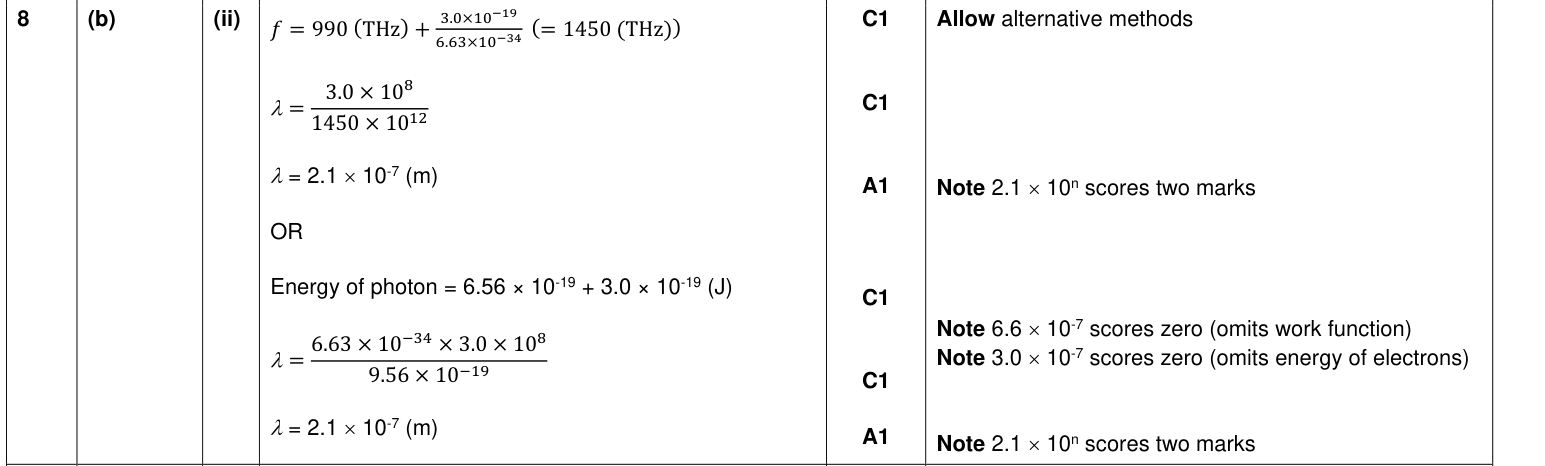
Candidates found this question challenging. The common error was to omit the work function of the metal. Other candidates determined the energy but omitted the energy of the electrons. A significant minority of candidates attempted to answer this question by determining the momentum of the electrons.
Skills: M0.2 Recognise and use expressions in decimal and standard form; M2.2 Change the subject of an equation, including non-linear equations; M2.3 Substitute numerical values into algebraic equations using appropriate units for physical quantities
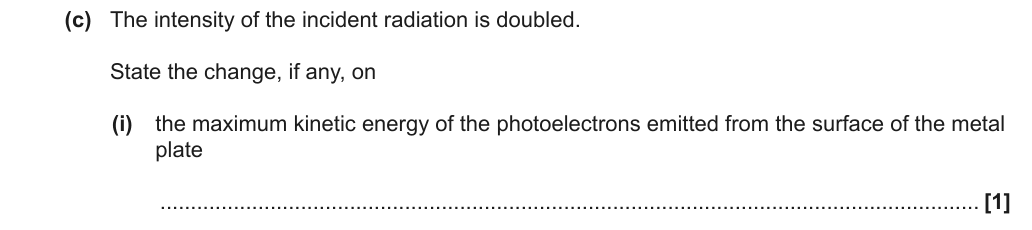
The majority of the candidates correctly stated that there would be no change. Some candidates then added good reasons to explain their answer.

Most candidates correctly realised that the rate of emission would increase but many did not give a quantitative answer (double) to match the stem of the question.
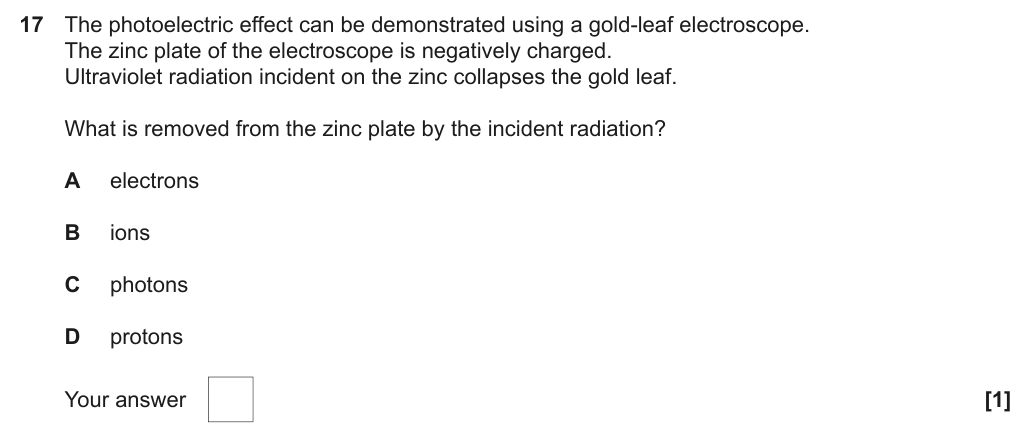
A
Candidates performed well on this question as most gave the correct answer A as they identified that electrons are removed from the zinc plate.
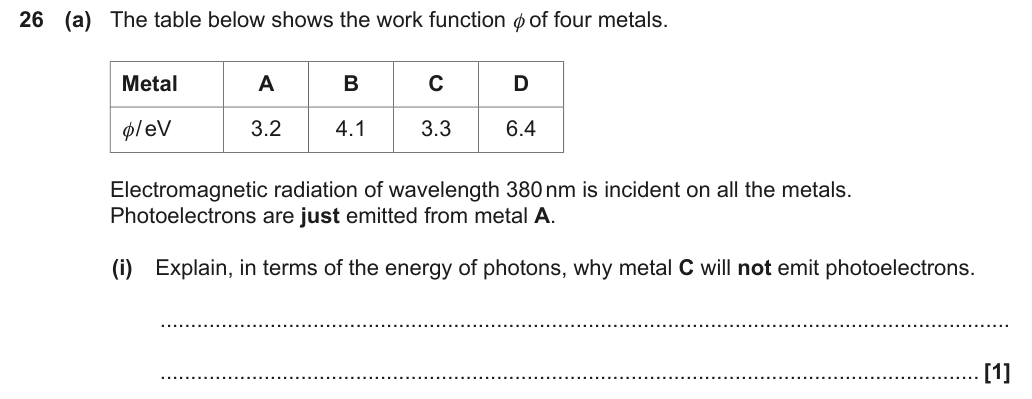
The highest 50% of candidates performed well on this question as they correctly referred to the ‘energy of photons’ while the bottom half tended to make vague and incomplete statements and hence did not compare the energy of photons to the work function of C.
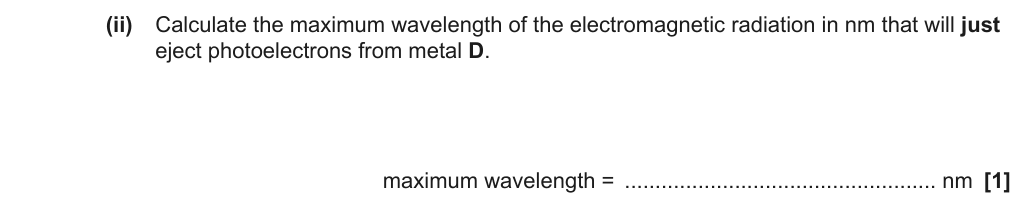
Very few candidates realised that no use of E = hc/λ was required to calculate the maximum wavelength as the work function of D was double of A so the maximum wavelength was half of 380 nm. Therefore, most candidates attempted to calculate the wavelength from the work function with a common error of not converting eV to J.
Skills: M0.3 Use ratios, fractions and percentages; M2.2 Change the subject of an equation, including non-linear equations
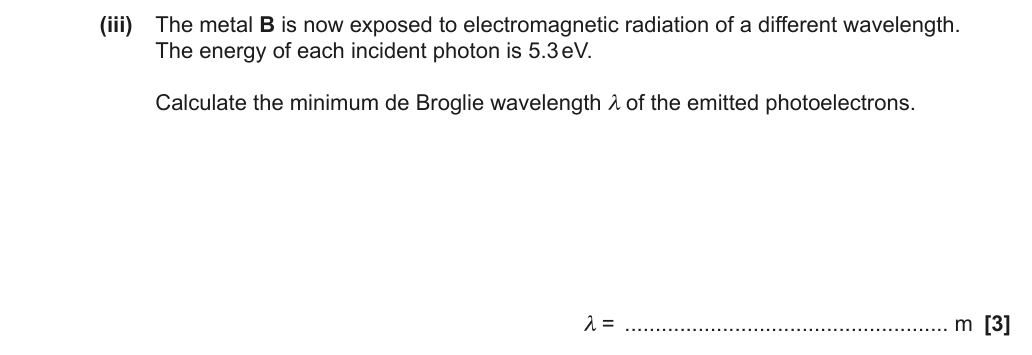
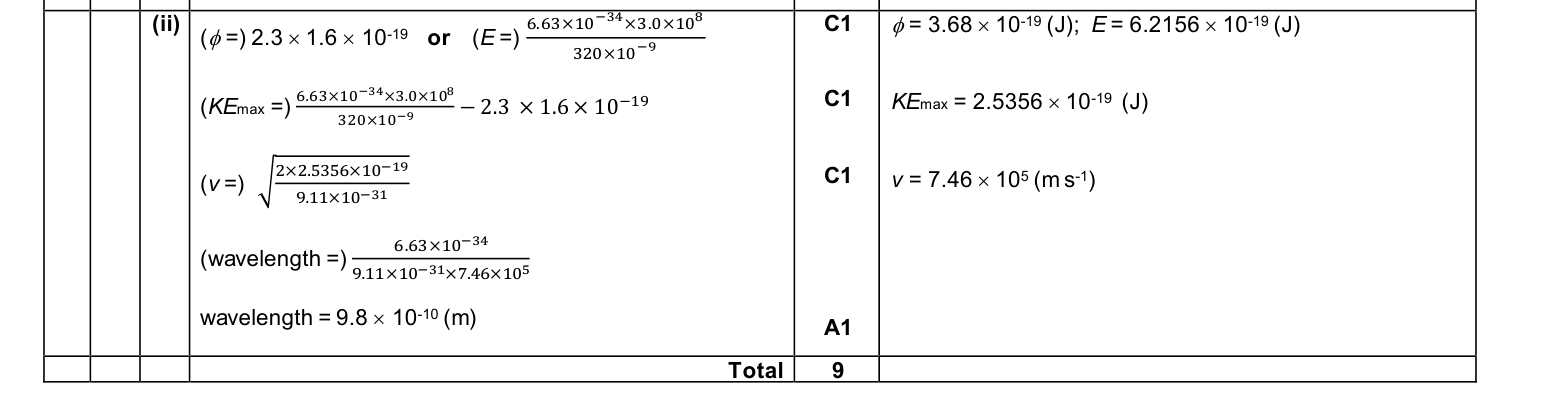
Most candidates were able to convert eV to J but did not correctly use this to calculate the velocity of the photoelectrons as they did not apply the formula λ = h/p to calculate the momentum. Only a few candidates correctly applied both formulae hf = φ + KEmax and λ = h/p to calculate the de Broglie wavelength. This response demonstrates a lack of understanding of the photoelectric effect and use and application of the formula hf = φ + KEmax. Candidates have selected the correct formula to calculate the de Broglie wavelength and have converted eV to J but have not understood that p is required to be calculated using v from the correct KE.
Skills: M0.2 Recognise and use expressions in decimal and standard form; M2.2 Change the subject of an equation, including non-linear equations; M2.3 Substitute numerical values into algebraic equations using appropriate units for physical quantities
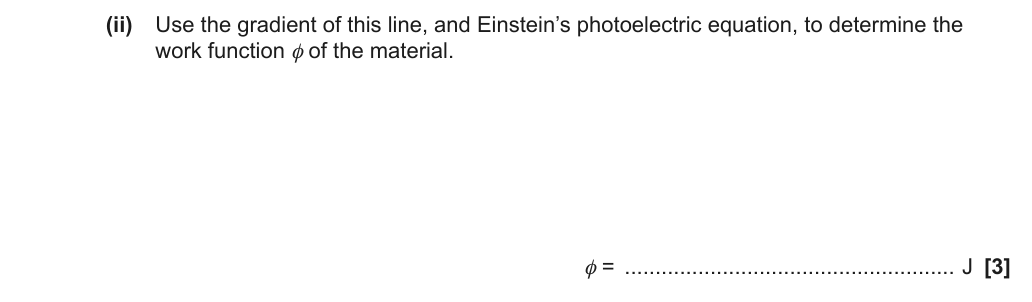
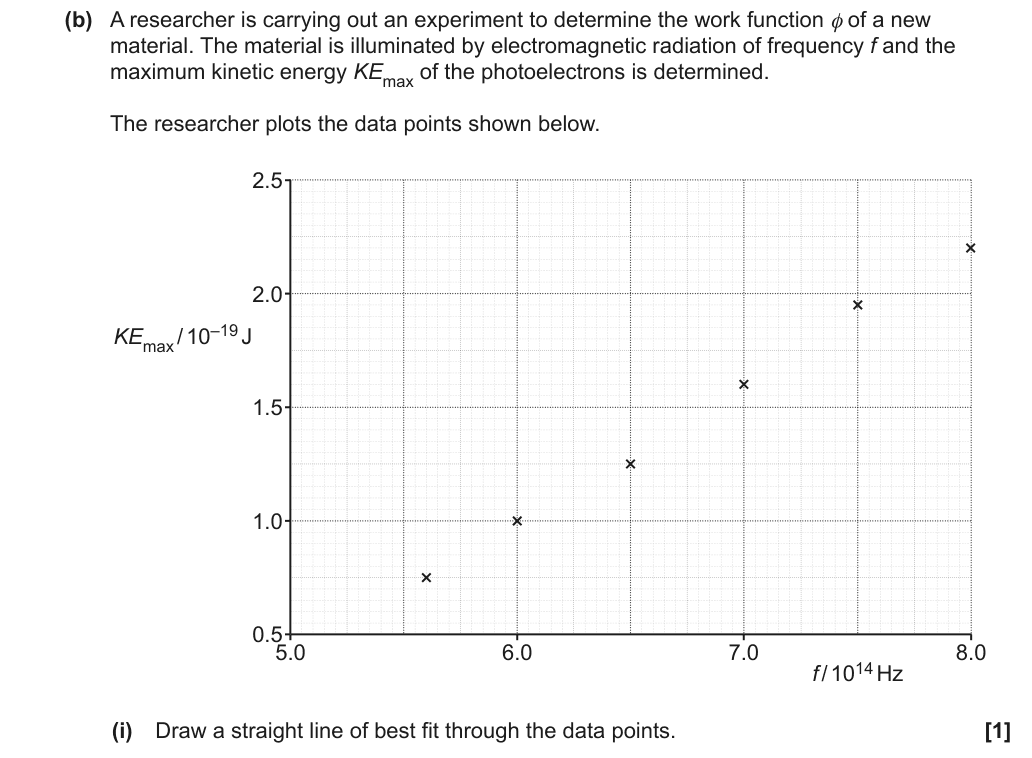
This question was assessing candidates’ skill to calculate a gradient value from the graph and use this value in an expression for the equation of a straight line to determine a value for the work function of the material which was the y-intercept, therefore few candidates correctly calculated a value within a stated range. Candidates were not given marks for using the stated value of h = 6.63 × 10⁻³⁴ J s as this did not assess the skill required by the question. Some candidates attempted to calculate a gradient value, so marks were given if they applied it in a correct expression of an equation for the straight line. If any of your students’ results are not as expected, you may wish to consider one of our post-results services. For full information about the options available visit the OCR website. We send a weekly roundup to tell you about important updates. You can also sign up for your subject specific updates. If you haven’t already, sign up here. Attend one of our popular CPD courses to hear directly from a senior assessor or drop in to a Q&A session. Most of our courses are delivered live via an online platform, so you can attend from any location. Please find details for all our courses on the relevant subject page on our website or visit OCR professional development. ExamBuilder is the question builder platform for a range of our GCSE, A Level, Cambridge Nationals and Cambridge Technicals qualifications. Find out more. ExamBuilder is free for all OCR centres with an Interchange account and gives you unlimited users per centre. We need an Interchange username to validate the identity of your centre's first user account for ExamBuilder. If you do not have an Interchange account please contact your centre administrator (usually the Exams Officer) to request a username, or nominate an existing Interchange user in your department. Review students' exam performance with our free online results analysis tool. It is available for all GCSEs, AS and A Levels and Cambridge Nationals. It allows you to: • review and run analysis reports on exam performance • analyse results at question and/or topic level • compare your centre with OCR national averages • identify trends across the centre • facilitate effective planning and delivery of courses • identify areas of the curriculum where students excel or struggle • help pinpoint strengths and weaknesses of students and teaching departments. Find out more. Post-results services Keep up-to-date OCR Professional Development Signed up for ExamBuilder?
Skills: M3.3 Understand that y = mx + c represents a linear relationship; M3.4 Determine the slope and intercept of a linear graph
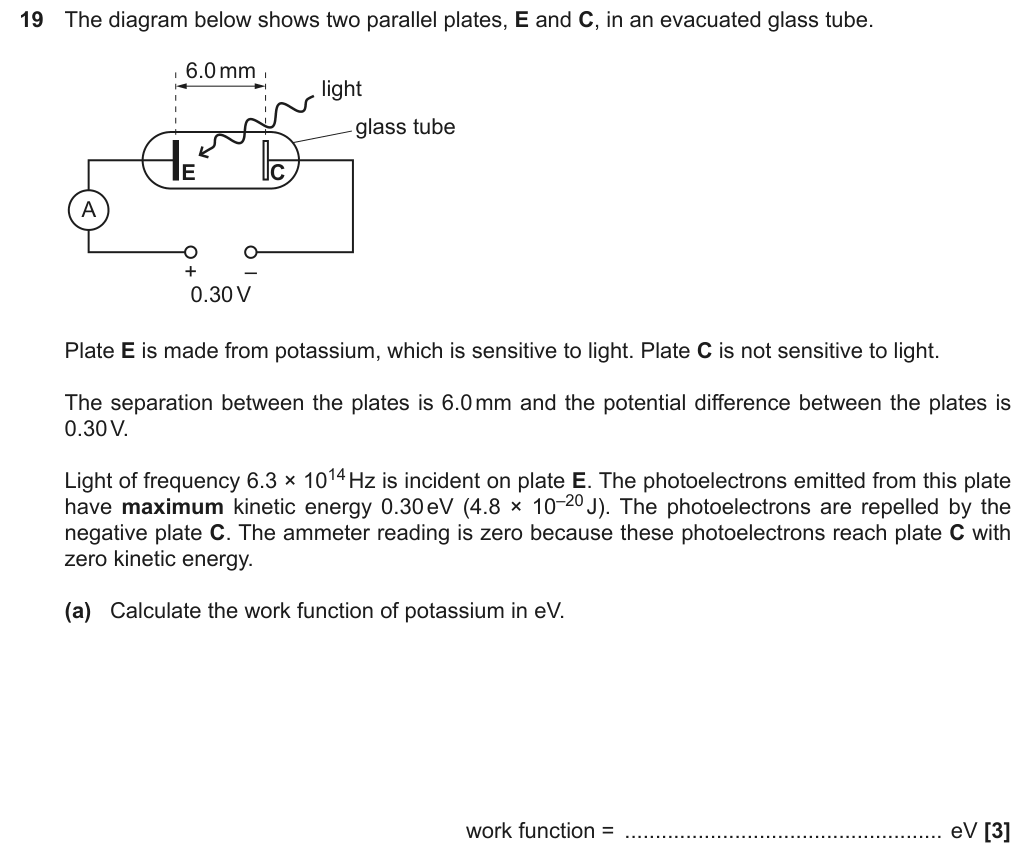
This question was successfully completed by many candidates. It was clear that the use of Einstein’s equation was well known, and the conversion to eV (generally done at the end) only caused a few candidates difficulties, mostly by multiplying their work function (in J) by e. Several candidates wrote down the answer with no working – while this will score full marks here, it is a risky tactic should an arithmetic error occur on their calculator.
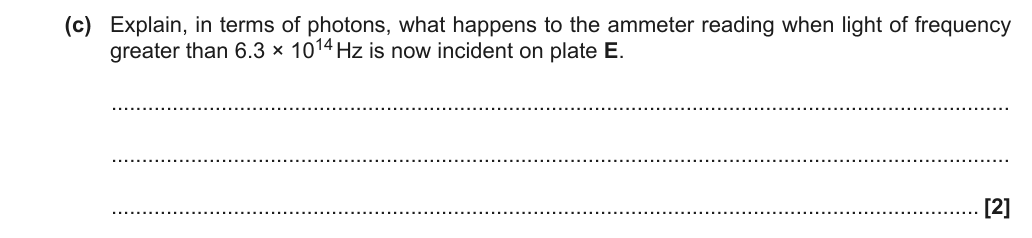
There were several misconceptions in candidates’ responses to this question. Many candidates did not appreciate that the increased frequency would result in electrons of greater KE and thought that it was the increased energy of the photons crossing the 6.0mm gap that caused an ammeter reading. A significant number of candidates also described increasing frequency causing an increase in kinetic energy of photons, and some also linked the increasing frequency to a greater number of photons or photoelectrons.
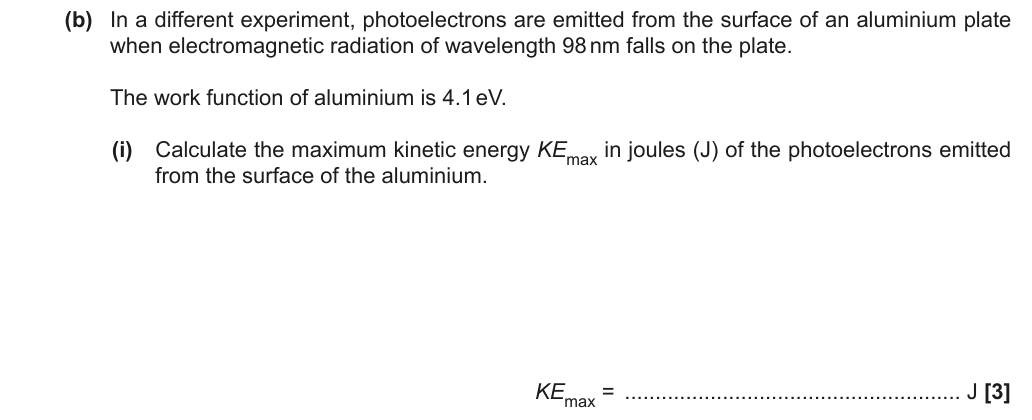
Skills: M0.2 Recognise and use expressions in decimal and standard form; M2.3 Substitute numerical values into algebraic equations using appropriate units for physical quantities
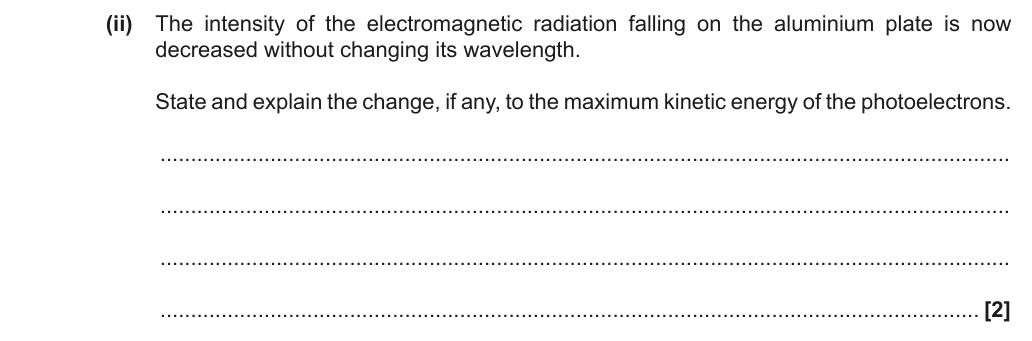

This is a standard definition which candidates should be able to state. Candidates should remember that the work function is a minimum energy. There is occasionally a misconception regarding ionisation, and also some careless use of language for the removal of the electron. Words such as escape and eject are acceptable, but terms such as dislocation are not clear enough. The definition does not require the statement that it is from the surface of the metal this time, but that does not mean that it will not be required in the future. 17(b)(i) The question is clear that the response needs to be given in terms of photons and energies. Many candidates discussed threshold frequencies, and although often correct, does not answer the question. The link between photon energy and frequency needs to be clear and not just a simple dependency – the simple solution for this is to state the equation. The final marking point requires the candidate to appreciate that only one photon can be absorbed by one electron. Standalone statements such as “there is a 1:1 relation” is meaningless in this context unless qualified. Many good candidates were able to score at least 3 marks on this question and it was clear that this is a well understood aspect. There is sufficient space for a fully clear answer and candidates are always to be reminded of the need for conciseness in such a response. This is a novel development on what is a common calculation of kinetic energy and as such created some challenge for some candidates. Many were able to score the first marking point, either by converting from eV to joules, or by the calculation of the photon energy. Few candidates scored 2 or 3 marks, as generally an error such as using the speed of light for the electrons occurred. However, a good number of stronger candidates were able to achieve all 4 marks and set out their solutions clearly. It should be noted that the first 3 marks are for setting up the calculations and not the evaluations. This is to not penalise candidates too early for calculational errors and as always highlights the clear need for setting out working as well as possible.
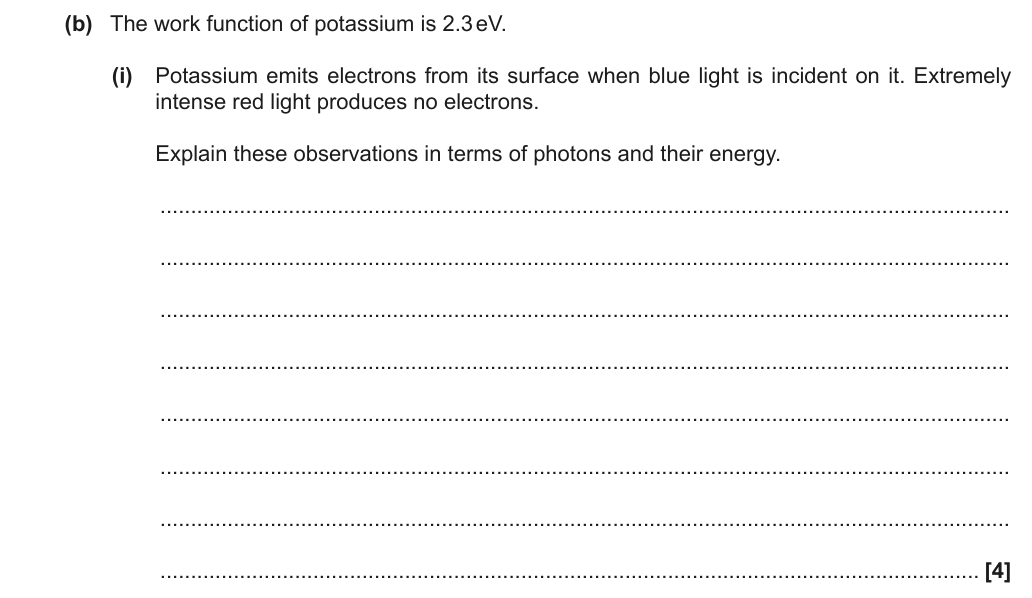
This question covers part of the quantum physics topic from module 4.
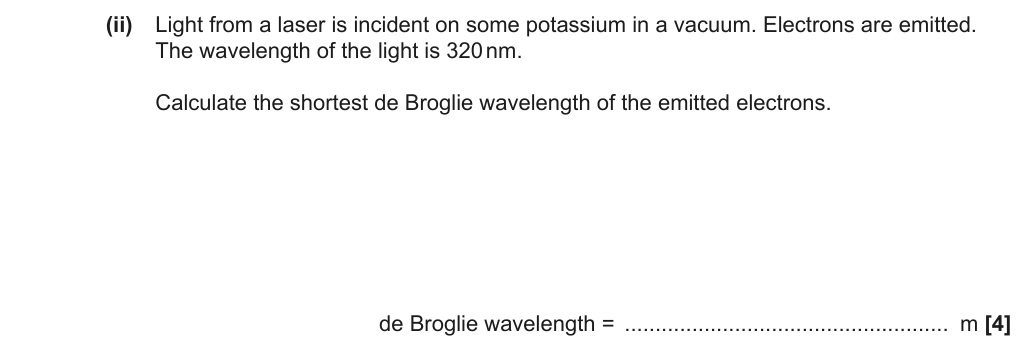
This question covers part of the quantum physics topic from module 4.
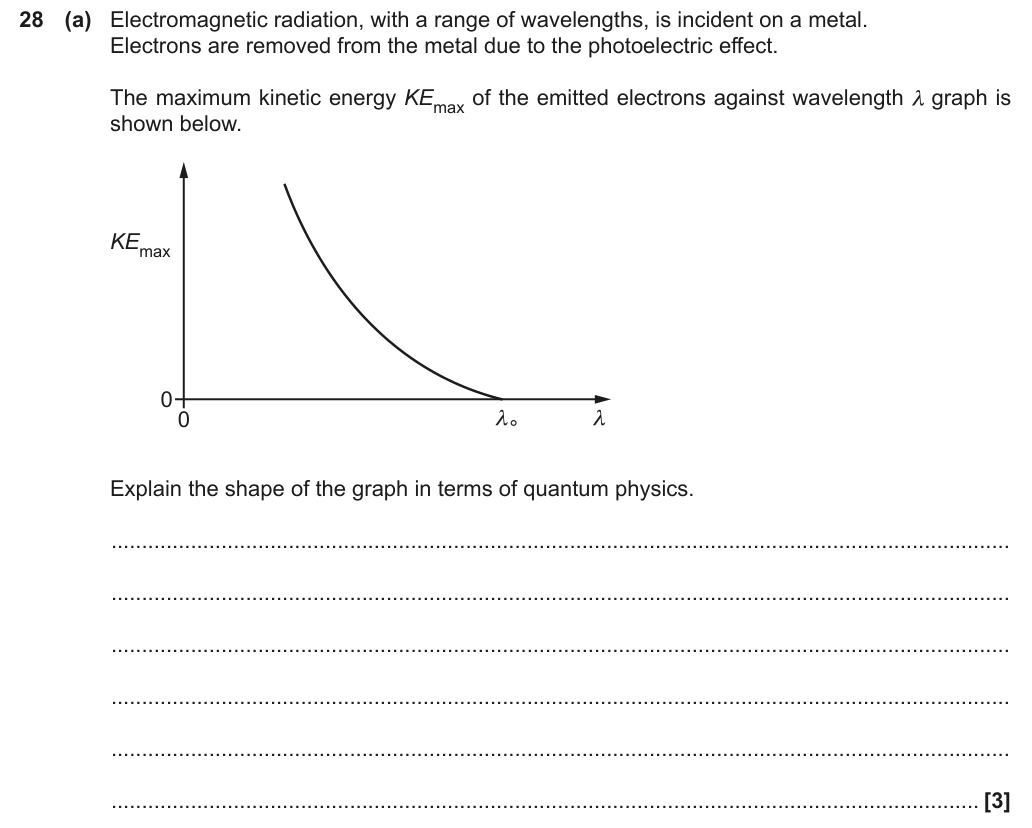
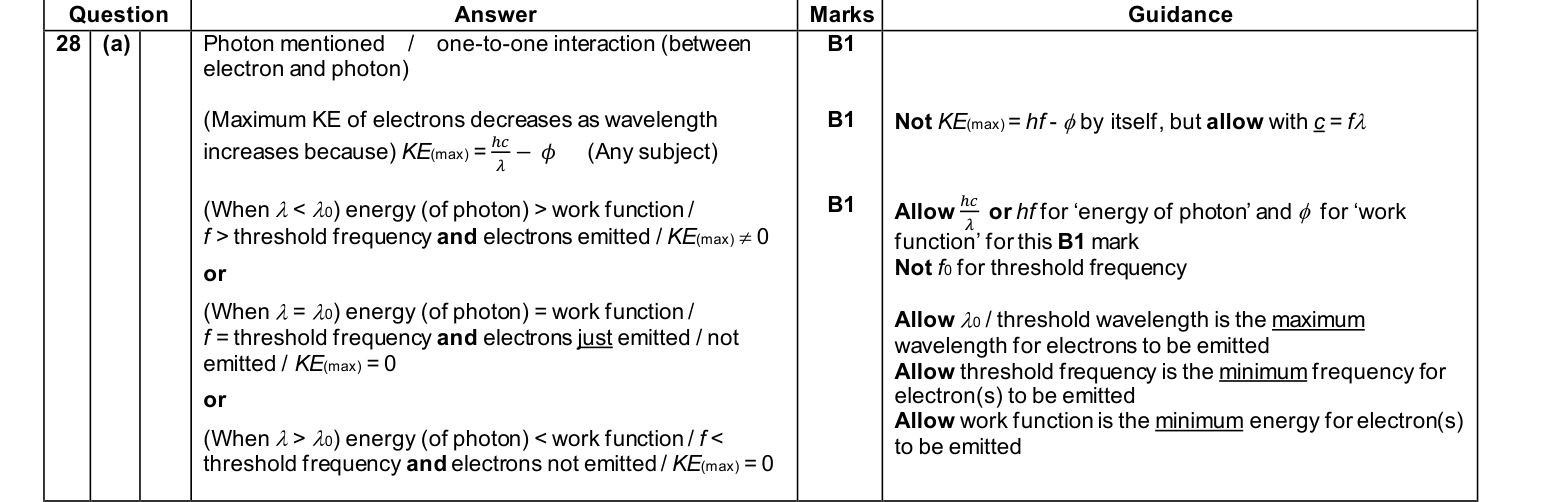
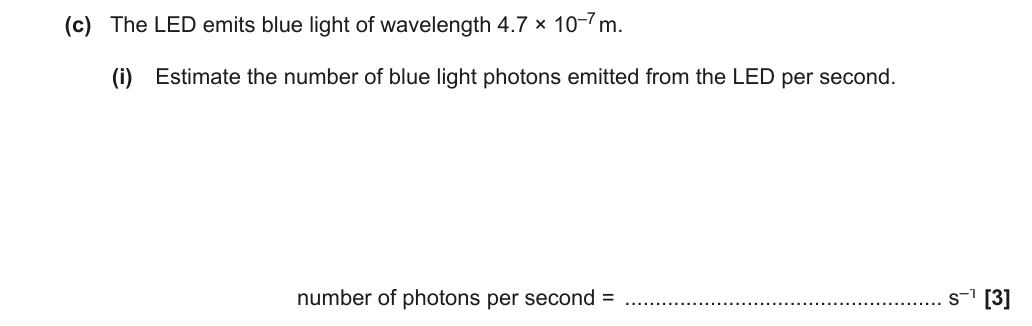
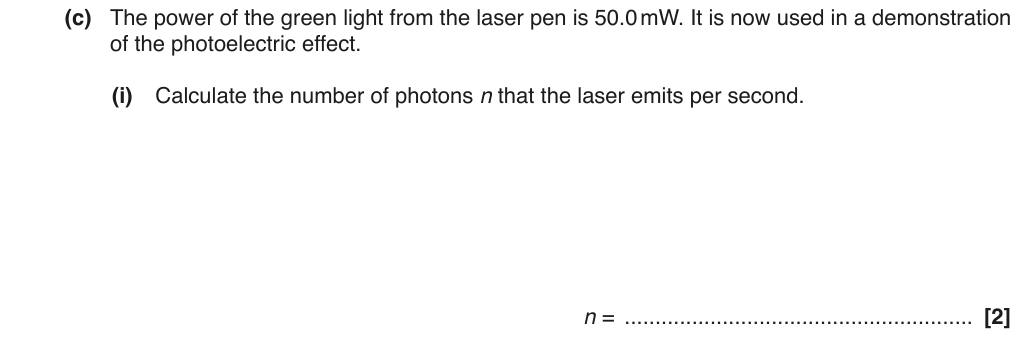
Questions 22b and 23bi • showed poor recall of prefixes, e.g. nano (n) in Question 28b • did not underline (or circle) key data and terms in the questions, notably in the MCQs. Most of the candidates finished the paper in the allotted time, with about 1 in 10 omitting the last Question 28bii. For example, in Question 28a, it was important to understand that photoemission cannot take place when the wavelength λ of the incident electromagnetic radiation is greater than λ0 because the energy of each photon is less than the work function of the metal, or the frequency of the incident radiation is less than the threshold frequency. Misconception Question 28bii The most frequent error here was to divide the power of the laser beam by 1.60 × 10⁻¹⁹ J instead of the energy of a single photon 4.06 × 10⁻¹⁹ J.
Skills: M3.1 Translate information between graphical, numerical and algebraic forms
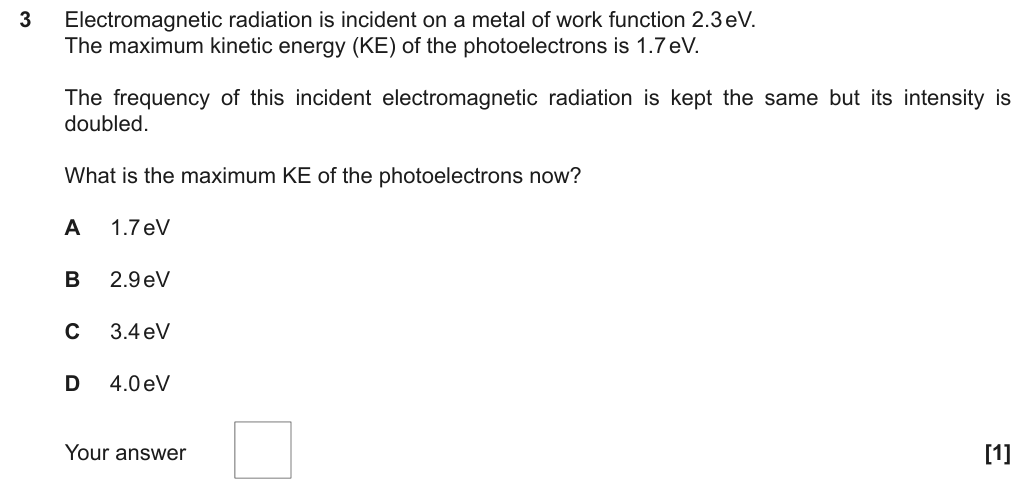
A
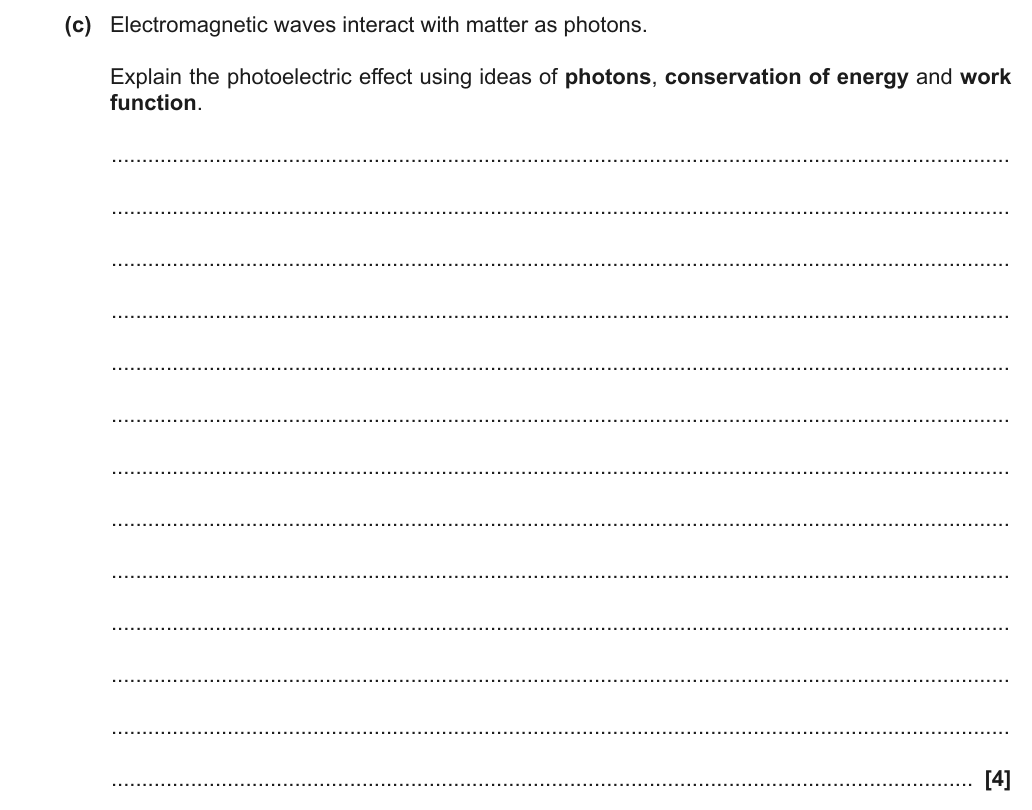
This question on the photoelectric effect provided excellent discrimination with most candidates demonstrating good knowledge of the photoelectric effect. The work function was well defined and the key idea of the one-to-one interaction between a photon and an electron was communicated well. Some candidates took work function and threshold frequency to be synonymous, and the Einstein’s photoelectric equation was quoted without much interpretation. Candidates are once again reminded that in descriptions it is important to define any terms used. Rather than just writing hf = φ + KEmax (which appears on the Data, Formulae and Relationship booklet), it would have would have been better to write energy of photon = work function of the metal + maximum kinetic energy of the electron as an alternative to annotating the formula with “where h is , f is , φ is, KEmax is ” Overall, the terms highlighted in the question helped candidates to provide focused responses. Many candidates continue to show knowledge of the quantum physics.
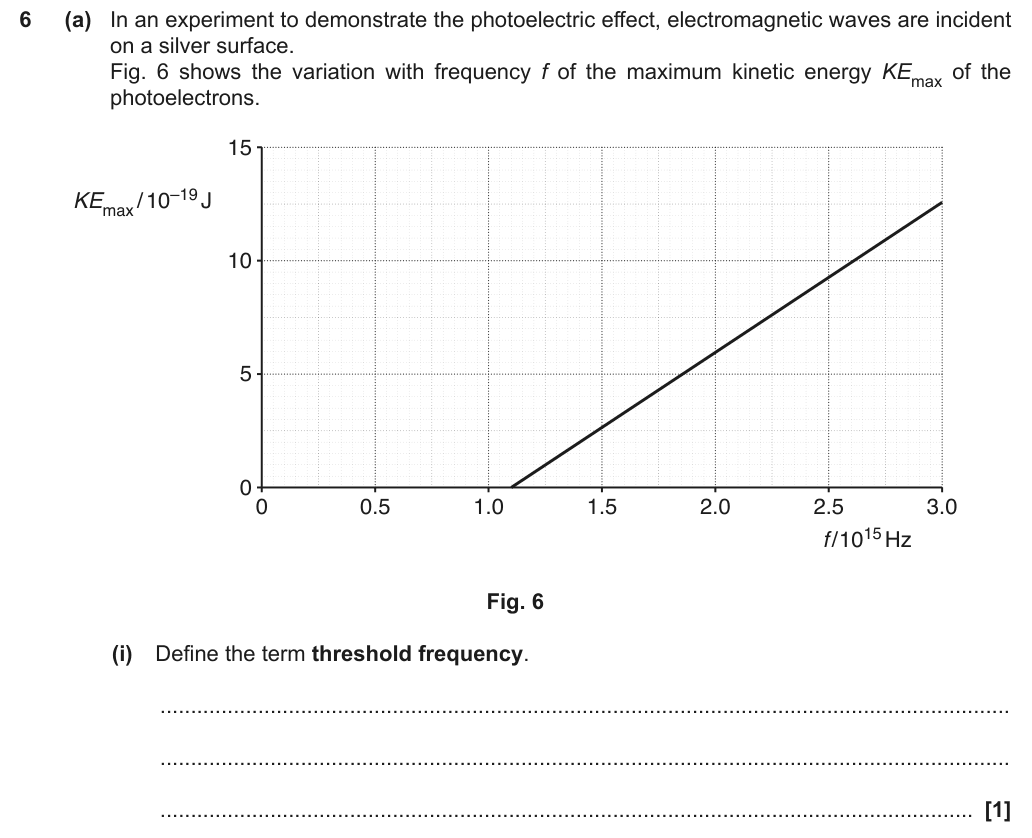
The majority of the candidates gained a mark for this question. When the mark was not scored, it was often due to candidates not realising it was the “minimum” frequency or answering the question in terms of energy.

Most candidates were able to read the threshold frequency from the graph. Where errors were made it was for either mis-reading the scale as 1.2 or omitting the 1015 Hz.
Skills: M3.1 Translate information between graphical, numerical and algebraic forms
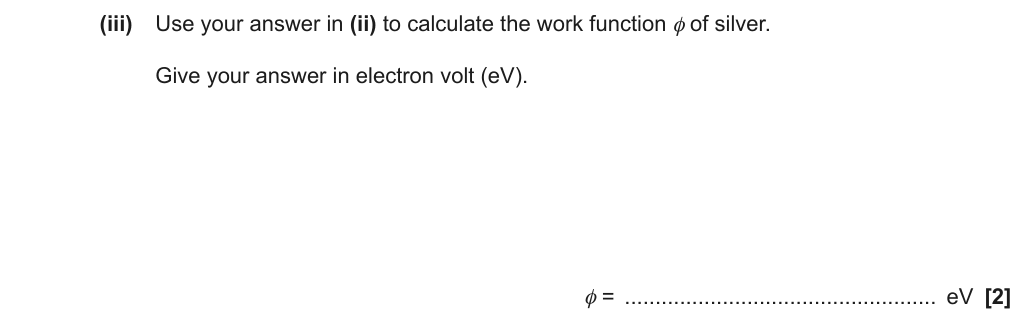
The majority of the candidates scored two marks on this question. Again, clear working assists candidates with appropriate units being included in intermediate stages of the calculation. Most candidates calculated the work function from the threshold frequency, their answer to the previous part. Some candidates correctly took a data point from the graph and substituted it into Einstein’s photoelectric equation which also gained credit. The candidate states the condition for the threshold frequency, indicates clearly the calculation of the work function in joule, before clearly demonstrating the conversion to electron volt so gained both marks.
Skills: M0.1 Recognise and make use of appropriate units in calculations; M2.3 Substitute numerical values into algebraic equations using appropriate units for physical quantities
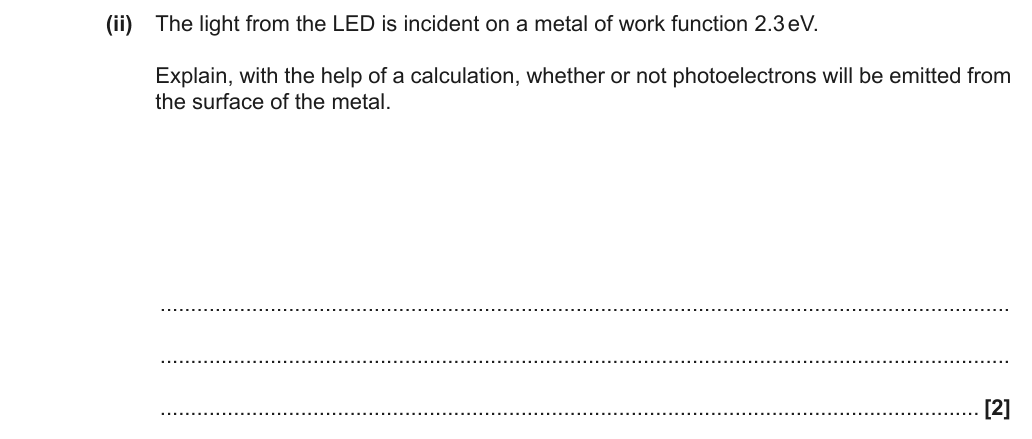
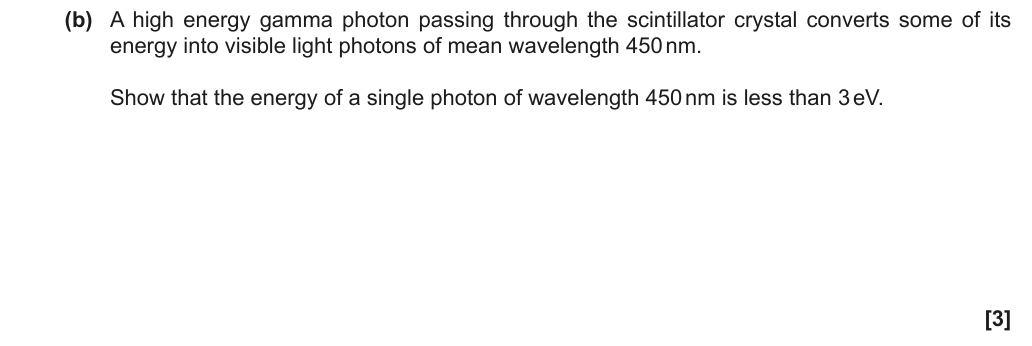
Most candidates showed excellent knowledge and understanding of electronvolts and the photoelectric equation. A variety of answers were accepted. The most common approach was to calculate the energy of the photon in eV, and then either show that this was greater than the work function of the metal or to calculate the kinetic energy of the emitted photoelectron. A lot of confidence in the topic of quantum physics was evident in the answers from the candidates. This is illustrated by exemplar 8 below from a middle-grade candidate. This exemplar shows the right blend of calculations and scientific text to support the response. Good command of quantum physics earned this candidate full marks.
Skills: M0.2 Recognise and use expressions in decimal and standard form
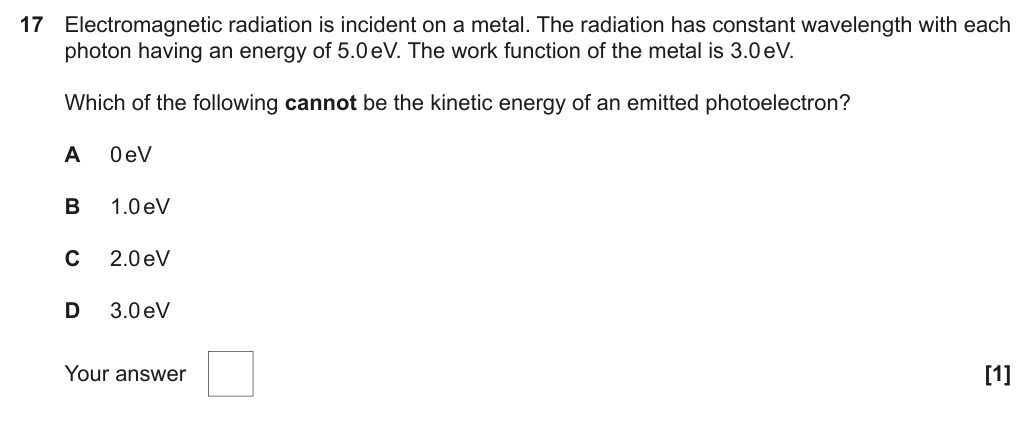
D
Slightly more than half of the candidates got the correct answer D in this question on the photoelectric equation. No detailed calculations were necessary here. The maximum kinetic energy of a photoelectron had to be 2.0 eV (difference between photon energy of 5.0 eV and the work function of the metal 3.0 eV), which made the value of 3.0 eV impossible. The most popular distractor was A.
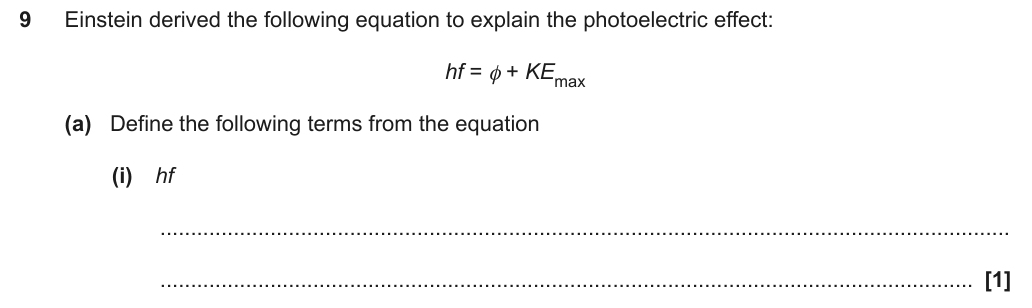
Many candidates simply defined the symbols as opposed to the term. It was expected that candidates would state that hf was the energy of a photon.

Again, a common answer was to state that φ represented the work function rather than defining what is meant by work function. Good candidates stated that the work function was the minimum energy needed to remove an electron from a metal surface.
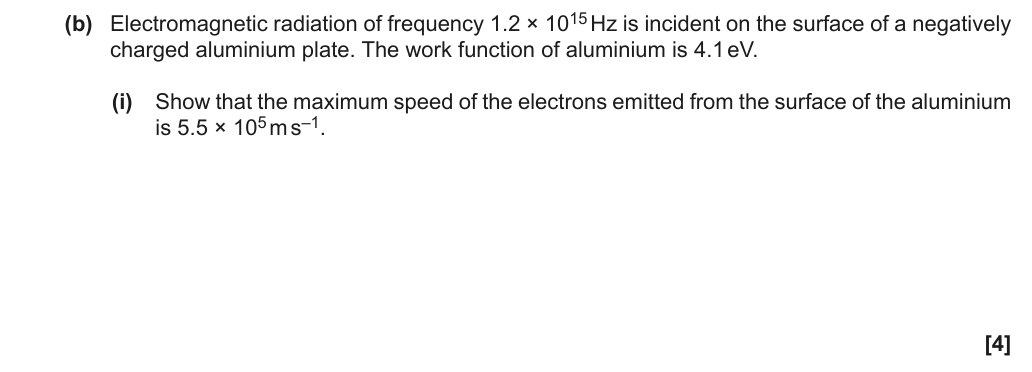
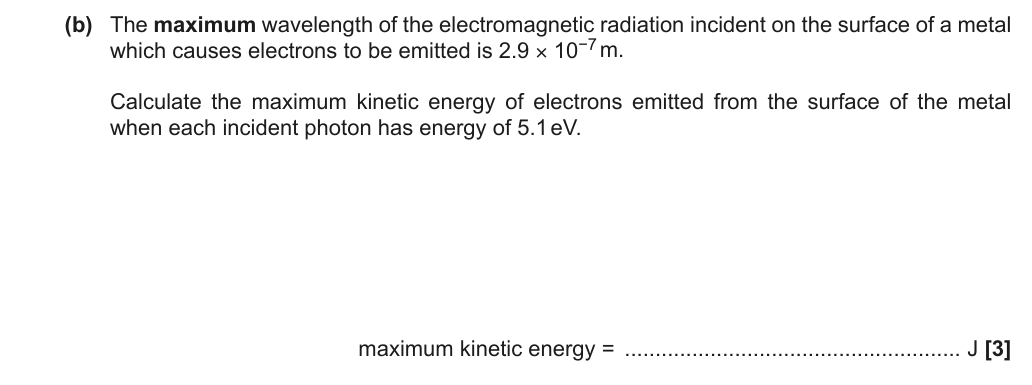
Good candidates clearly showed the individual steps in this calculation, e.g. the conversion of electron- volt to joule for the work function, the energy of the photon calculated. It was important that candidates demonstrated that they had substituted the mass of the electron from the data booklet and correctly evaluated the square root term. Examiners expected to see 5.536 x 10⁵ (m s-1) for full credit so that it was clear that candidates had correctly calculated the powers of ten. In line 3 of the candidate’s working, there is a rearrangement of the equation given at the beginning of the question. There is then clear substitution of the energy of a photon which was calculated in line 1 and the work function which had been converted from electron volt to joule in line 2 to give a value for the maximum kinetic energy of the electrons. This scores three marks. In the final part the candidate correctly shows the rearrangement of the kinetic energy equation to give v as the subject and then correctly substitutes in the values including the mass of the electron from the data and formulae sheet. The final answer is given as 5.527 x 10⁵ which is then shown to be approximately equal to 5.5 x 10⁵ (ms- 1). This last part is essential in these show type questions.
Skills: M0.2 Recognise and use expressions in decimal and standard form; M2.2 Change the subject of an equation, including non-linear equations; M2.3 Substitute numerical values into algebraic equations using appropriate units for physical quantities
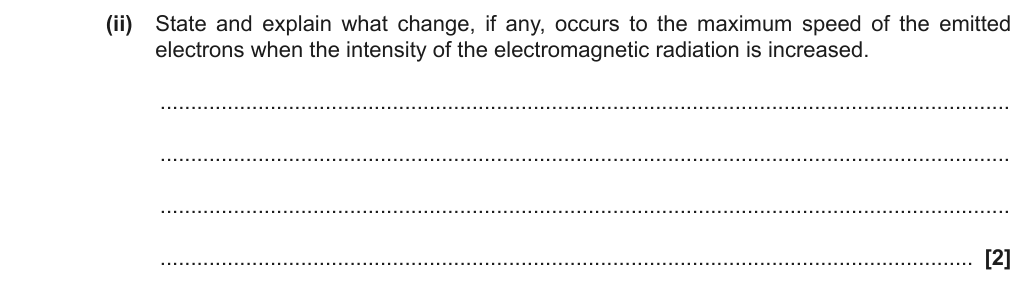
For this type of question, a clear explanation is needed before the mark for stating the change, if any. Candidates’ descriptions were often vague, and few stated that the maximum energy was independent of intensity.
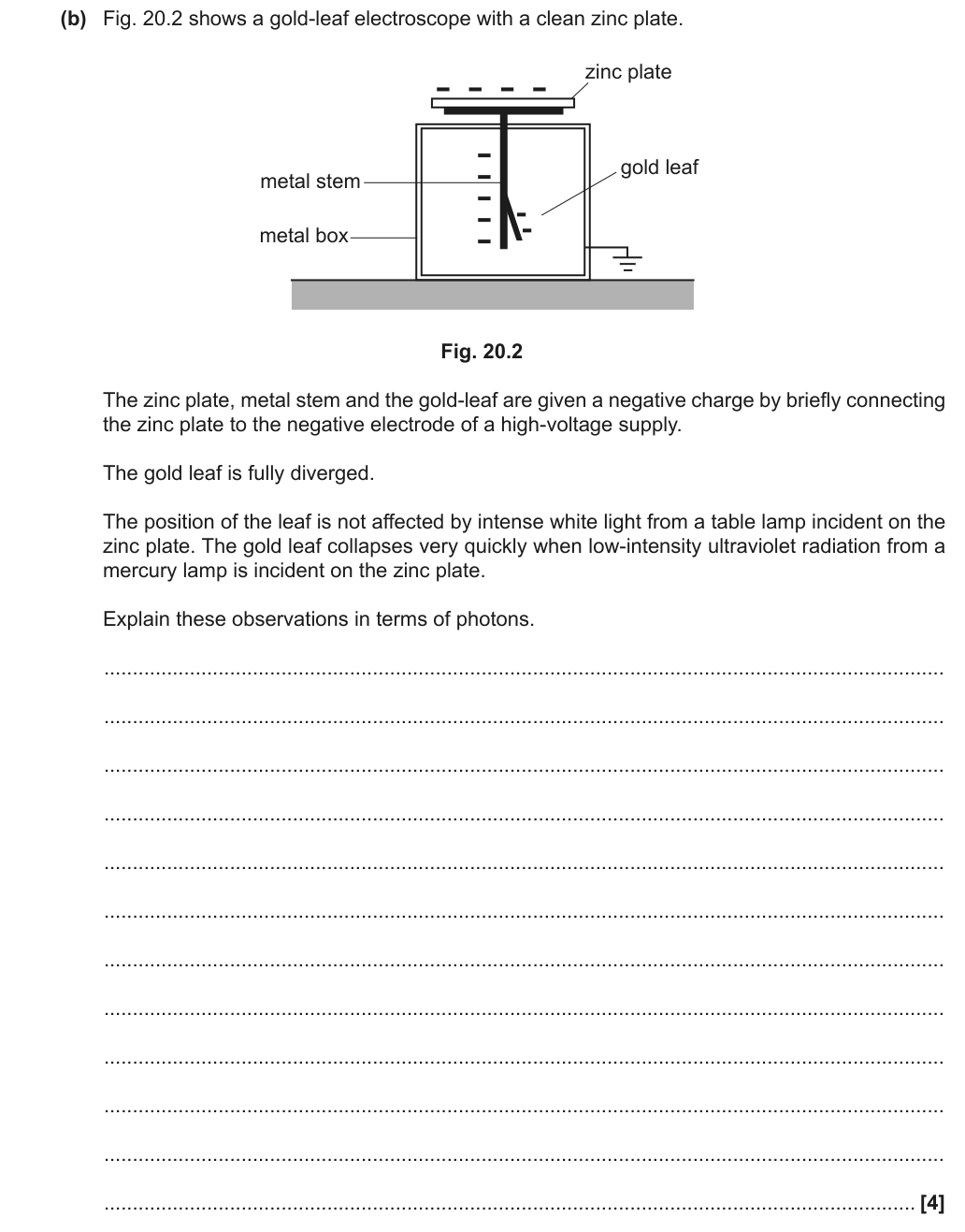
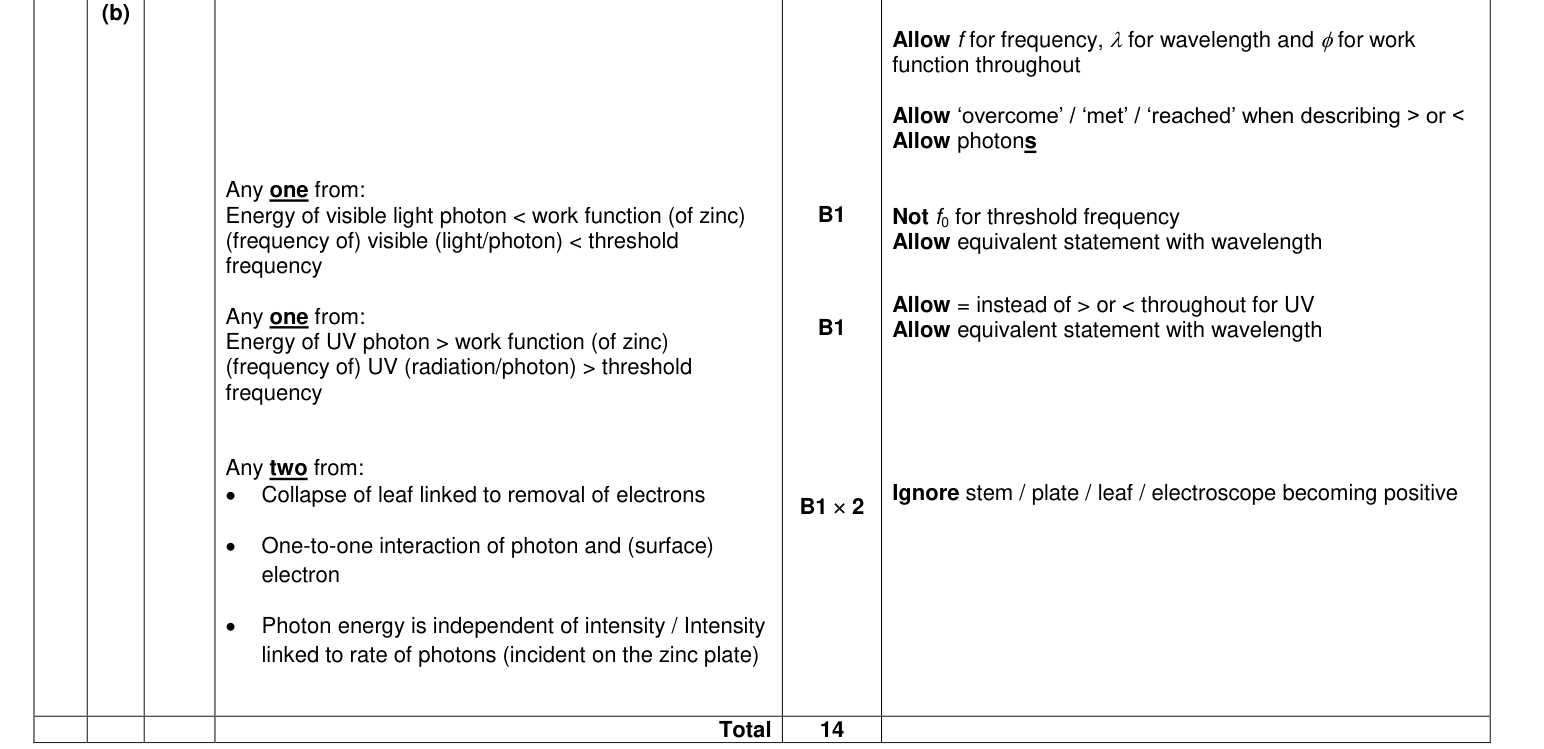
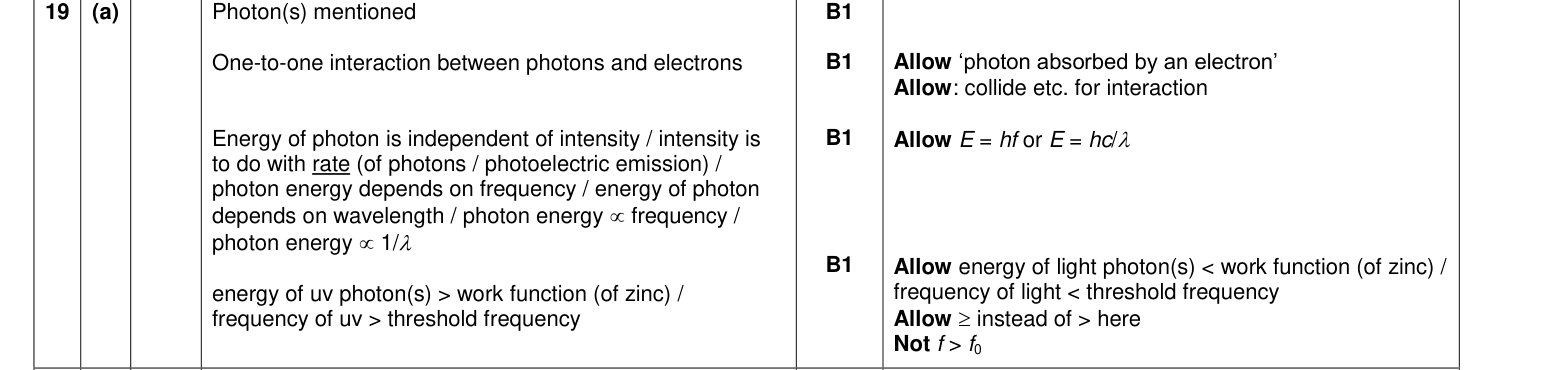
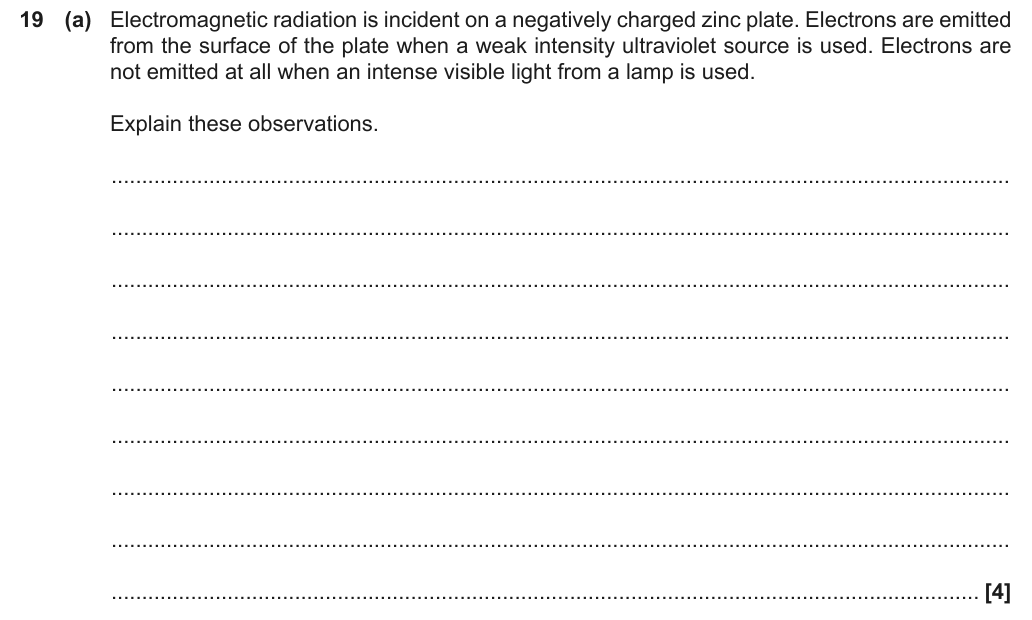
This question on the photoelectric effect was enthusiastically answered by candidates. Good discrimination enabled many of the top-end candidates to score full marks. The question was scrutinised well with many candidates explaining why the leaf fell with the ultraviolet radiation. The one-to-one interaction between UV photons and surface electrons was nicely embedded in the descriptions. Some of the candidates would have benefitted by writing their answers in bullet points. There were a few missed opportunities and misconceptions, these are outlined below: • Photons were emitted from the zinc plate (rather than electrons) • Threshold frequency and work function were properties of the photons or electrons (and not zinc) • Threshold frequency and work function were synonymous • Intensity was linked to number of photons (rather than to the rate of photons) • Referring to ‘not enough energy’ instead of work function of the metal in the description
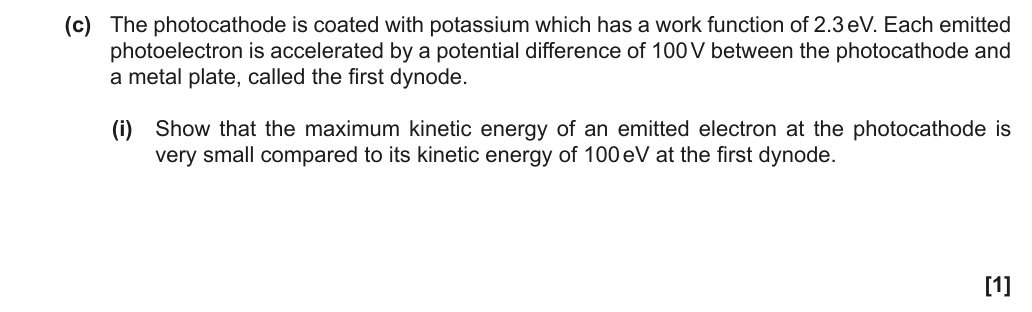
Exemplar 10 Question 6 (b) Question 6 (c) (i) Question 6 (c) (ii) Almost all of the candidates attempted this last section of the paper with some success.
Skills: M0.3 Use ratios, fractions and percentages
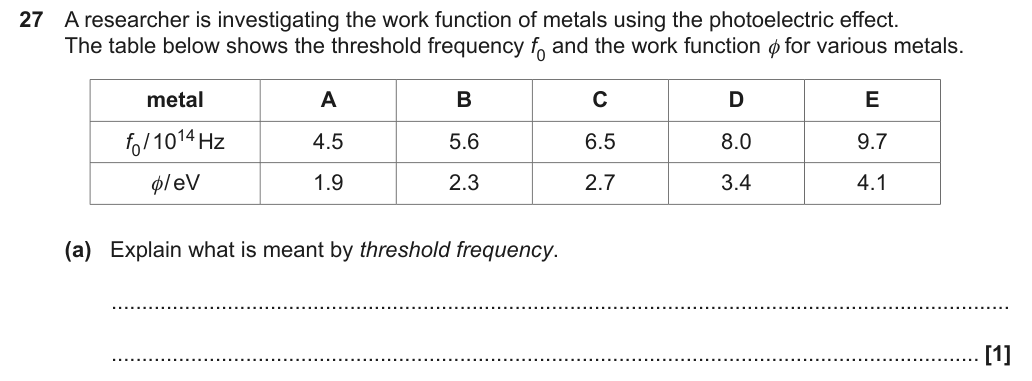
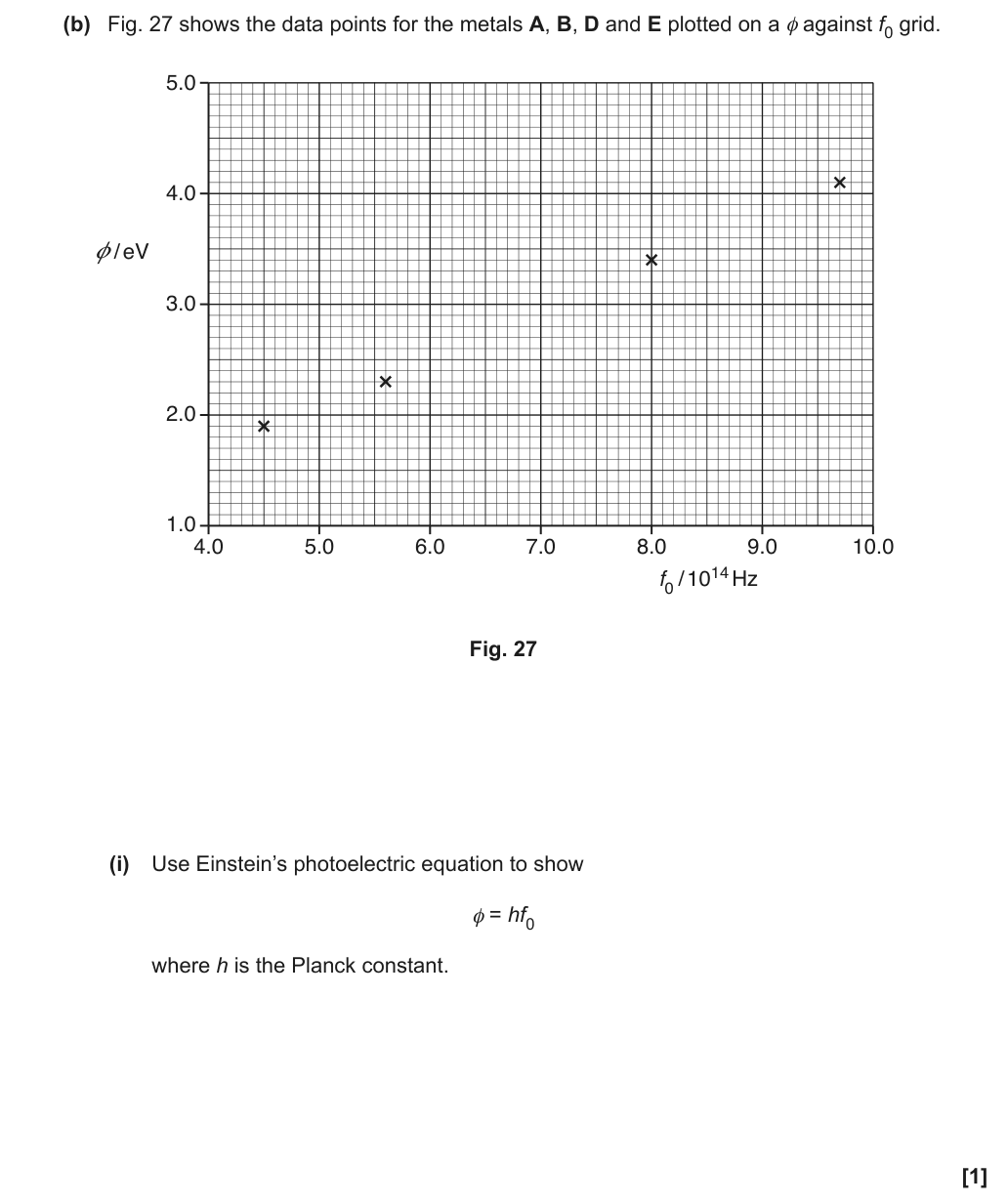
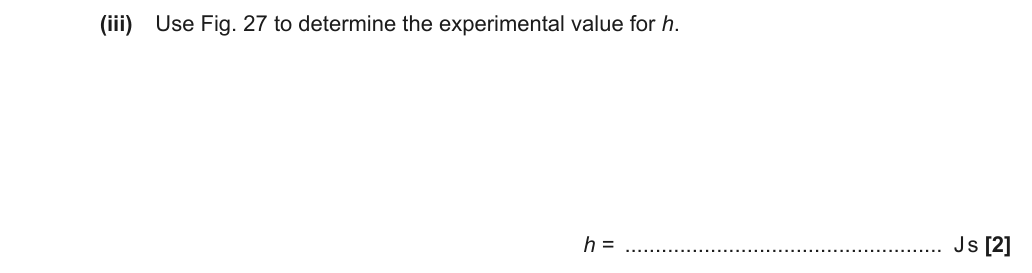
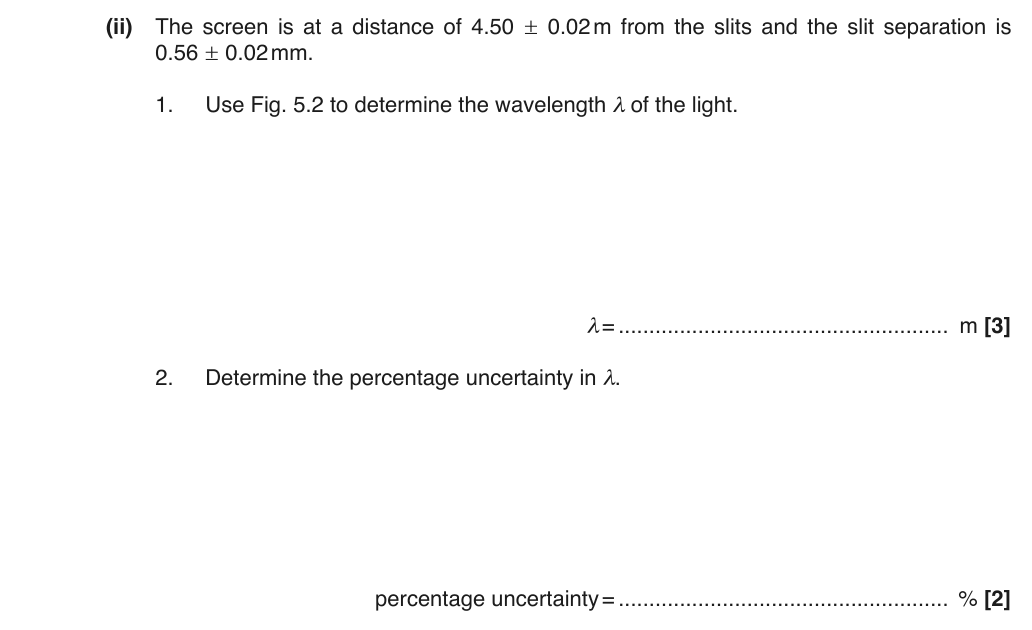
Skills: M0.1 Recognise and make use of appropriate units in calculations; M1.1 Use an appropriate number of significant figures; M3.4 Determine the slope and intercept of a linear graph
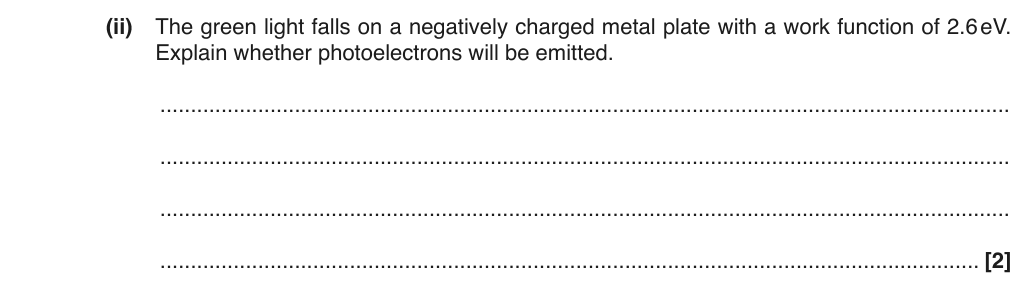
Skills: M0.1 Recognise and make use of appropriate units in calculations
Skills: M0.1 Recognise and make use of appropriate units in calculations; M0.2 Recognise and use expressions in decimal and standard form; M2.3 Substitute numerical values into algebraic equations using appropriate units for physical quantities
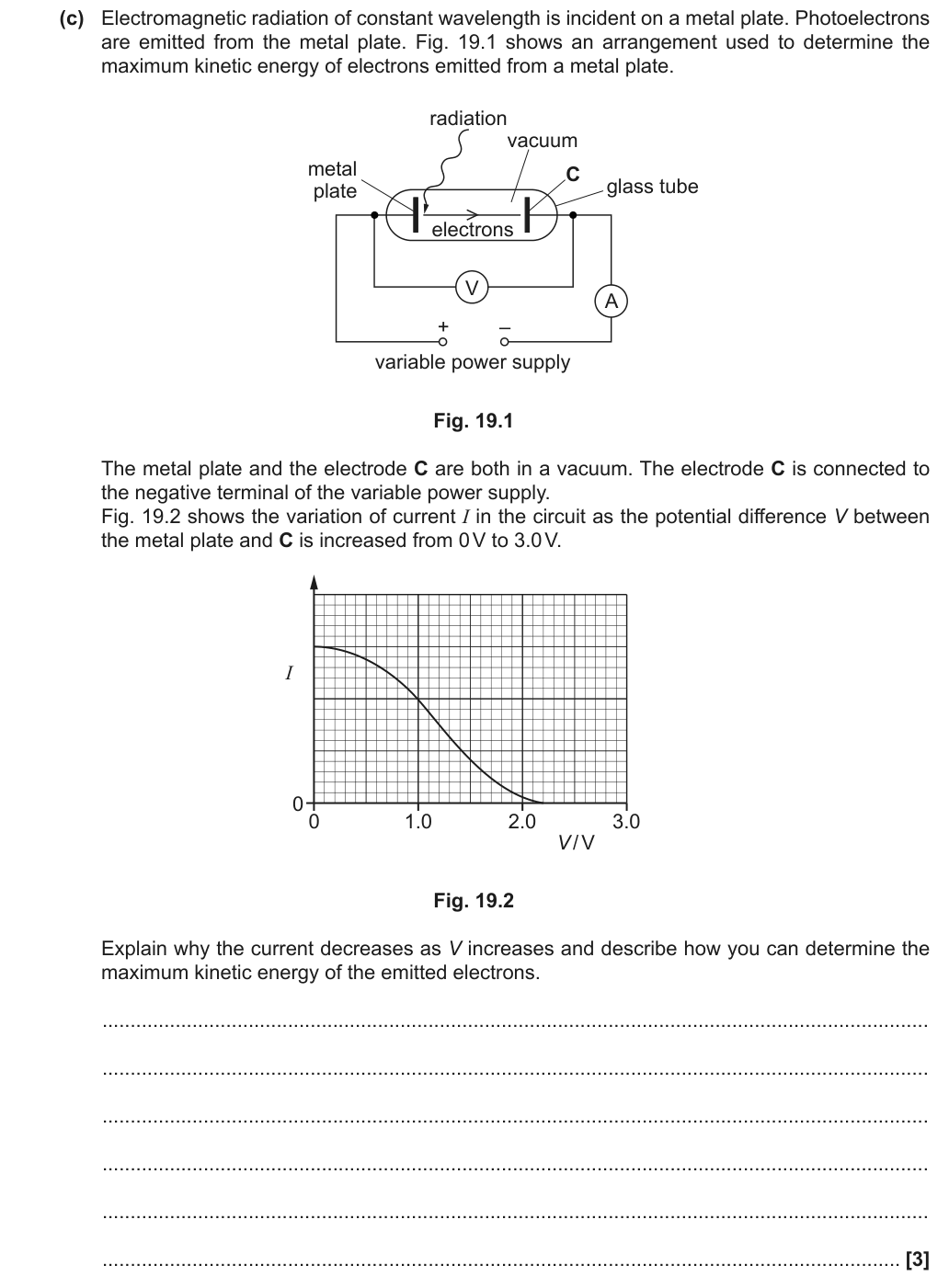
Skills: M3.1 Translate information between graphical, numerical and algebraic forms
A
Dropping marks on calculations, practical questions or the six-mark level of response questions? Book a trial session with a specialist OCR physics tutor.