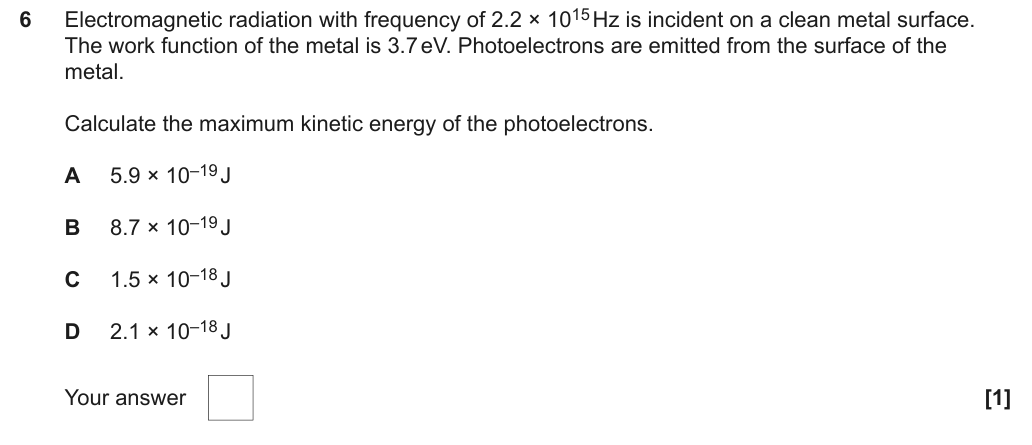
Answer
B
Mark scheme

Examiner's comment
A common incorrect answer was A, where candidates had converted 3.7 eV to joule.
Notes and key-term cards for this topic are being written by our tutors. The past-paper questions below are ready now.
| Series | Paper | Q | What it asks |
|---|---|---|---|
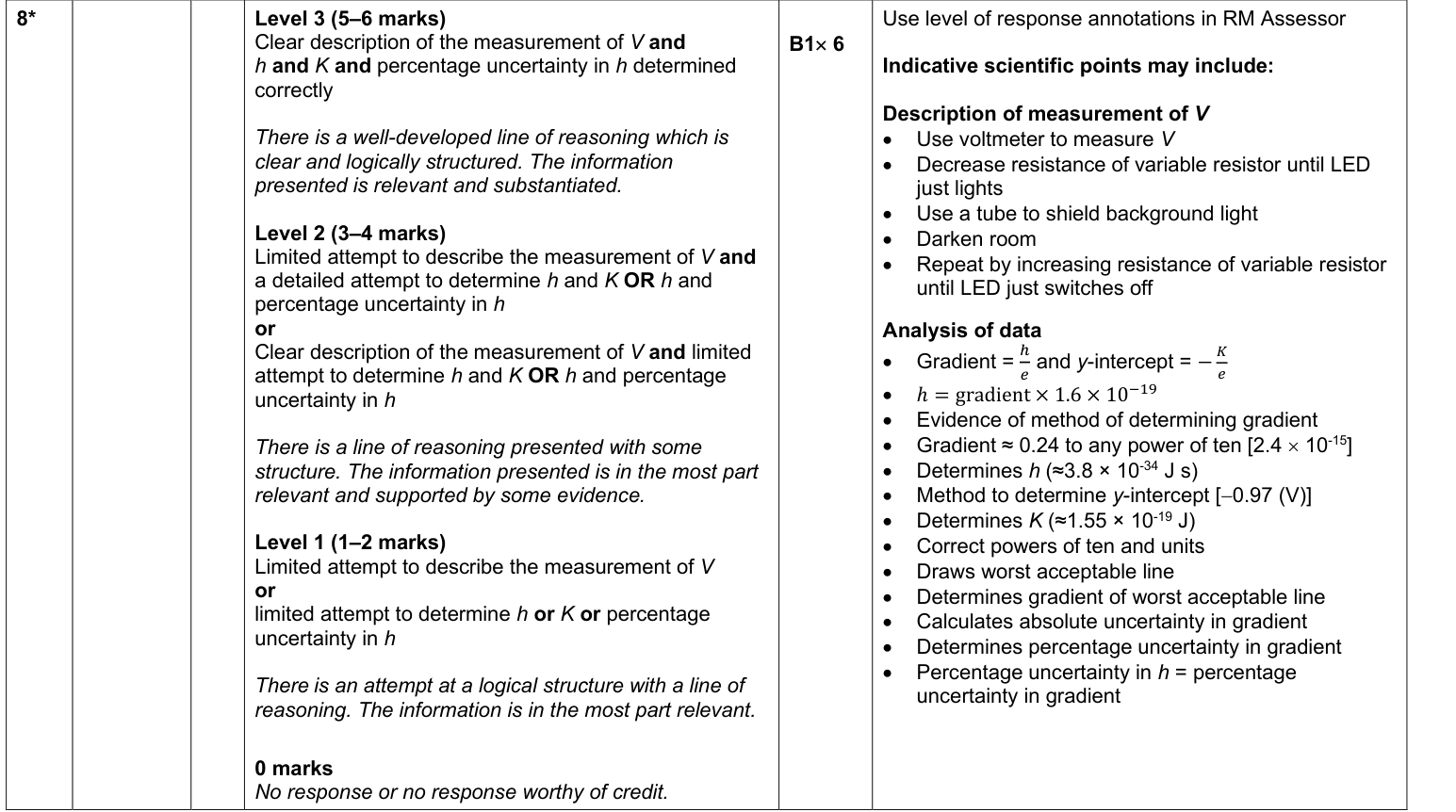
| June 2025 | AS Paper 2 | 8 | A student carries out an experiment to determine the Planck constant. They use the circuit Describe how to measure V accurately and use the graph to determine h and K. |
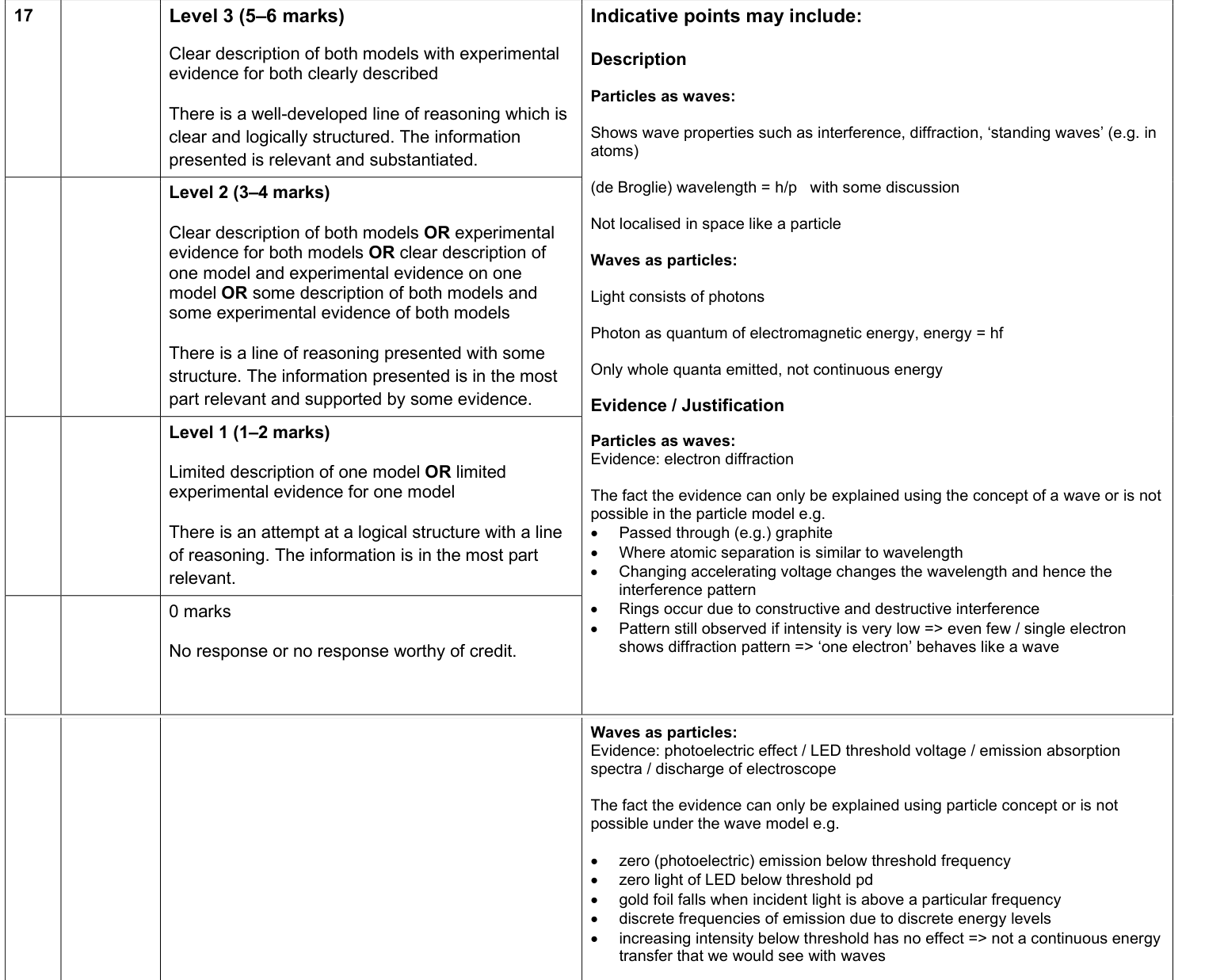
| June 2025 | Paper 2 | 17 | ‘Wave-particle duality’ refers to the idea that: Describe each model. |
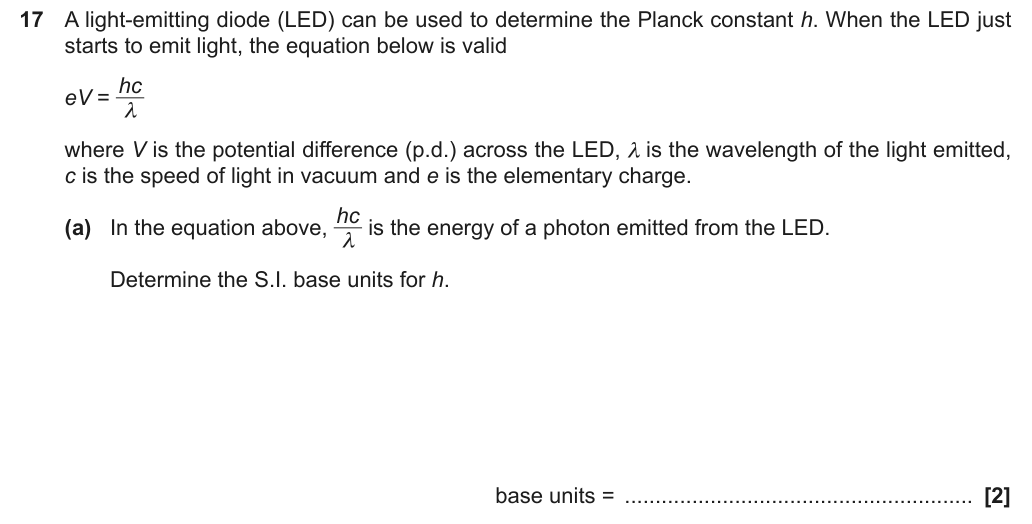
| June 2022 | Paper 2 | 17(b) | Describe how an experiment can be carried out in the laboratory to determine h from a graph. |
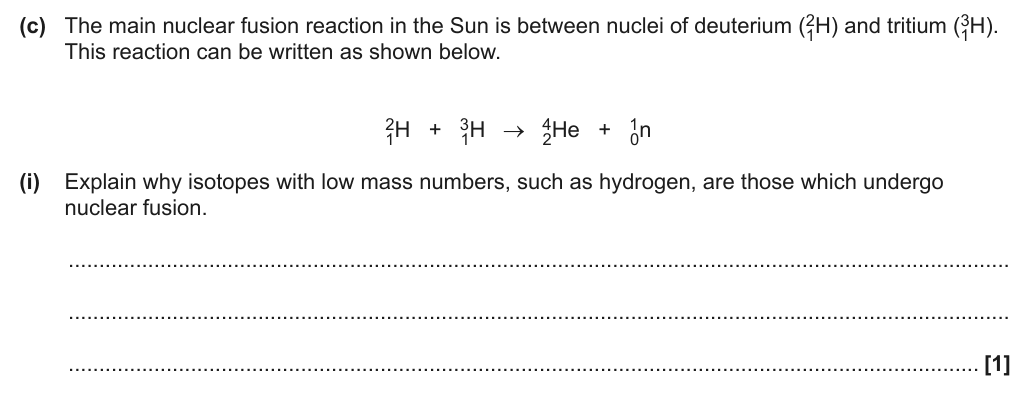
| November 2021 | Paper 2 | 23(b) | Some nuclear fission reactors use uranium-235 as fuel. In the future, there is possibility of • Describe the similarities and the differences between fission and fusion reactions. |
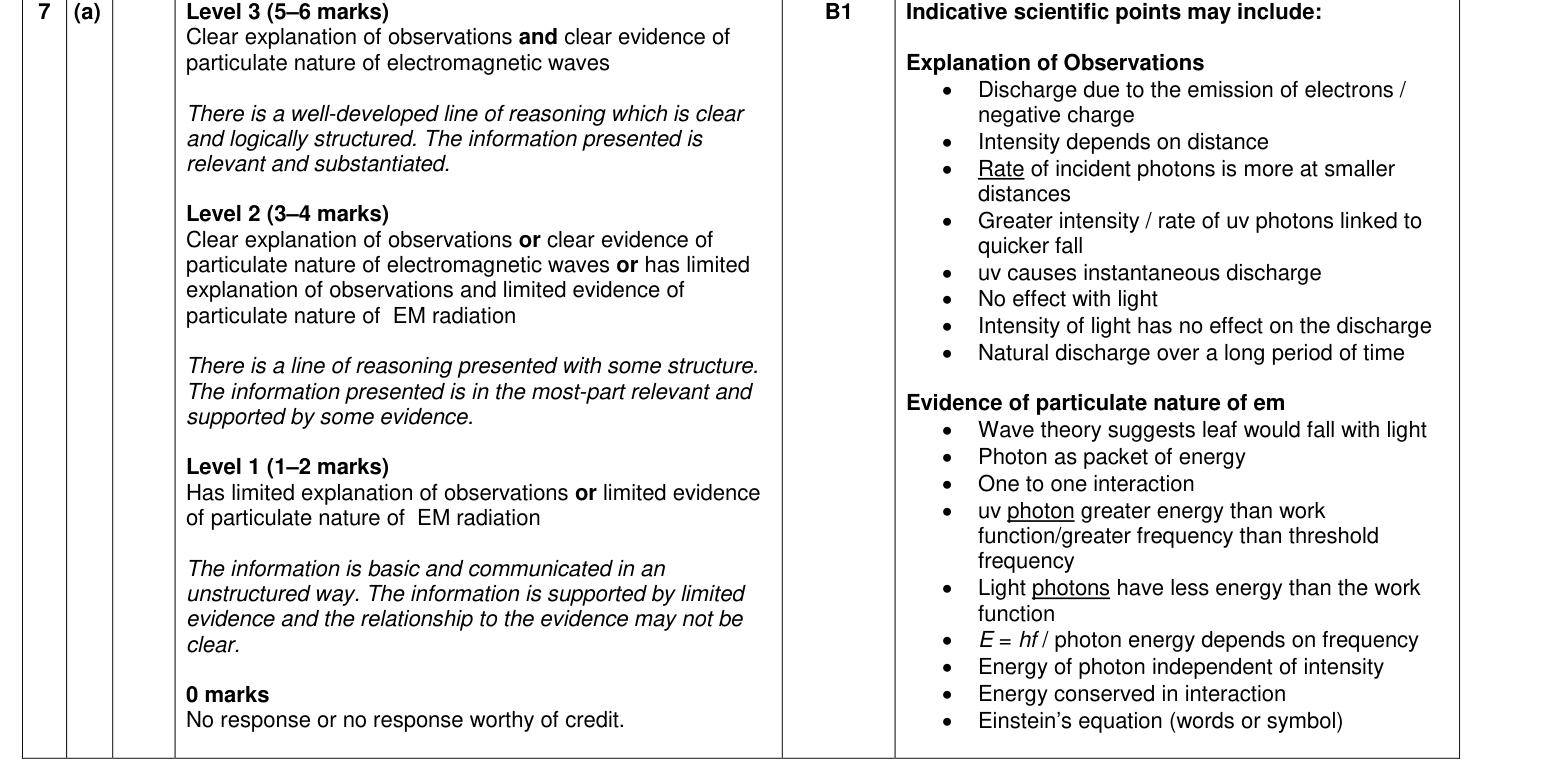
| June 2016 | AS Paper 2 | 7(a) | (a)* A gold leaf electroscope is used to demonstrate the photoelectric effect. A zinc plate is placed Explain how these observations demonstrate the photoelectric effect and provide evidence |
B
A common incorrect answer was A, where candidates had converted 3.7 eV to joule.
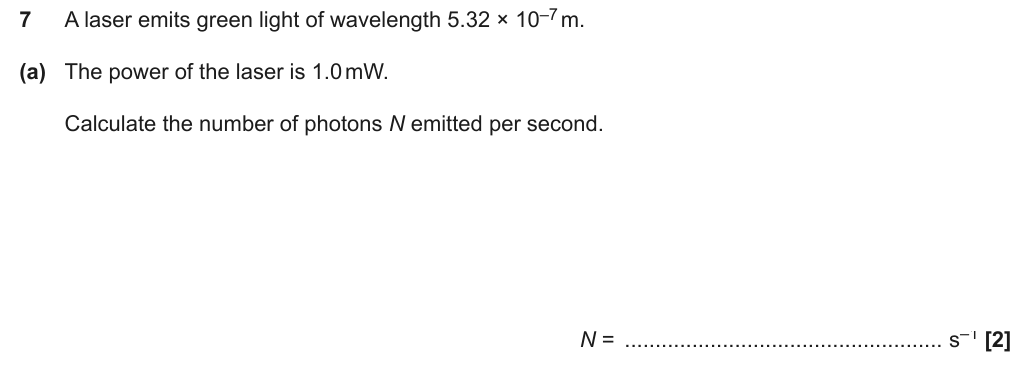
High performing candidates determined the energy of one photon before determining the number of photons emitted. Some low performing candidates tried to guess the answer by dividing 1.0 mW by the wavelength.
Skills: M0.1 Recognise and make use of appropriate units in calculations; M0.2 Recognise and use expressions in decimal and standard form; M2.3 Substitute numerical values into algebraic equations using appropriate units for physical quantities
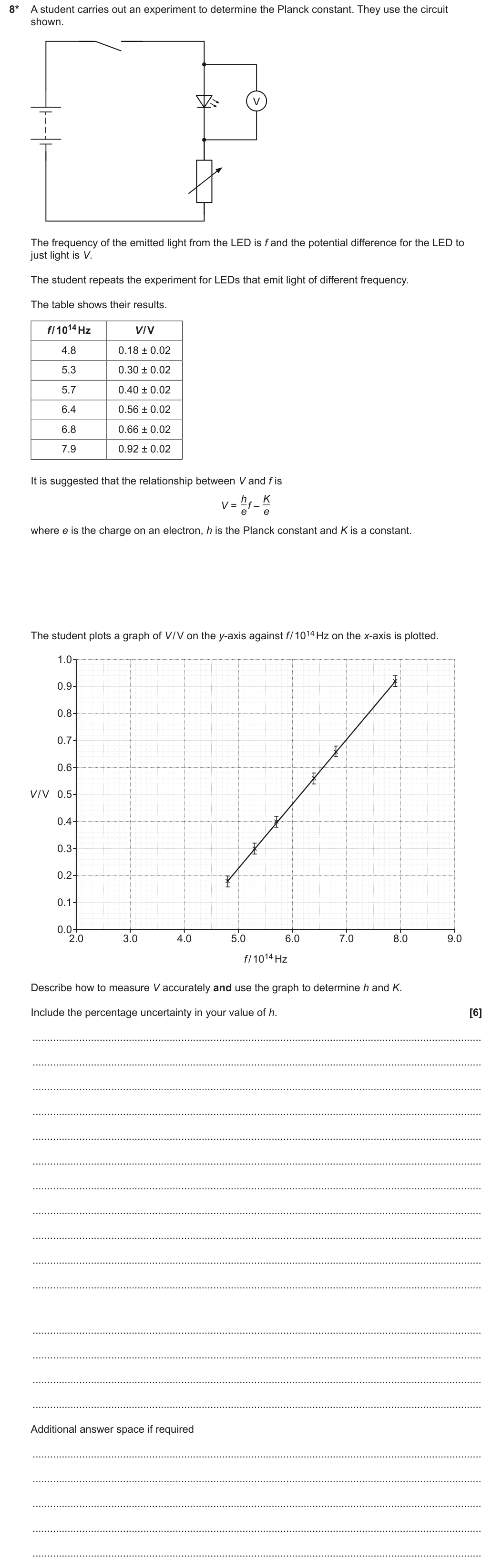
This question was designed to test candidates’ understanding of practical techniques in both designing an experiment and analysing results. A basic description of how V was measured needed to be described. Many higher performing candidates discussed the use of a tube to shield background light and repeating the experiment by increasing the resistance. A simple repeat the experiment and take an average was not credit worthy. For the analysis, candidates were expected to link the given equation to the equation of a straight line and thus identify how h was related to the gradient and how K was related to the y-intercept. The next logical step would then be to calculate the gradient and y-intercept. For this it was expected that candidates would demonstrate substituting values from the line on the graph (not data points from the table) to determine the gradient and thus calculate a value of h with an appropriate unit. Similarly since the y-intercept could not be read off the graph, candidates needed to substitute a data point from their line into y = mx + c. To determine percentage uncertainty, candidate needed to draw the worst acceptable line. This should be either the steepest or shallowest line that passes within all the error bars. Candidates then needed to calculate the worst acceptable gradient. Candidates gained credit for either calculating the percentage uncertainty in the gradient or from calculating worst value of h and then determining the percentage uncertainty.
Skills: M1.5 Identify uncertainties in measurements and use simple techniques to determine uncertainty when data are combined; M3.3 Understand that y = mx + c represents a linear relationship; M3.4 Determine the slope and intercept of a linear graph; PAG6 Investigating quantum effects

This Level of Response question was designed to assess the candidates’ knowledge of various aspects of wave-particle duality, in particular each model and experimental evidence. The key points in the description that examiners were looking for were: • a description of a model of how particles can be described as waves, and some experimental evidece to support this • a description of how waves can be described as particles, and some experimental evidence to support this. To obtain Level 3, it is important that all four aspects of this are approached. For the most part, it was clear that candidates had a general knowledge of this topic. Many were able to give some descriptions of electron diffraction and ‘the gold leaf experiment’, but not all gave sufficient detail in terms of the requirements of the question. Although not always required, it would be expected that candidates may use an equation in their description (the de Broglie relationship and E = hf) to support how the particle can be considered to act as a wave, and vice versa. More successful candidates used this in conjunction with the experimental evidence to draw their conclusions. The most common experimental evidence, which could achieve Level 3 if approached correctly, were electron diffraction through graphite and some form of the photoelectric effect. Anticipated detail for experimental evidence would be to explain how a diffraction pattern leads to the idea of waves, and with the idea of a threshold frequency. These can only be explained by use of the correct model and would support the response. Common weak points were to describe the electrons passing through a double slit, describing the interference pattern as fringes rather than concentric rings and explaining the photoelectric effect theoretically without any evidence. The question stated that there was no requirement to explain the experimental detail (as evidence was required) but several candidates used time doing so. Using the gold leaf electroscope (which many candidates had seen) is a good way to demonstrate the photoelectric effect, however there seemed to be some confusion about whether it was initially charged, and if so whether it was positive or negative, The statement ‘one to one interaction’ was common, although was often used without support and it was clearly something that had been learnt. Most candidates used the space, including the additional space, to answer this question. It is always possible to obtain a Level 3 in the given space by carefully answering the question rather than giving superfluous information and candidates are encouraged to think a little about their response before starting. This exemplar shows a good response, but not sufficient to reach Level 3. The candidate has given a fair, yet brief, description of the experimental evidence for electron diffraction, showing particles acting as waves. Similarly, the photoelectric effect is explained to some level of detail about how it demonstrates where a wave acts like a particle. There is little in terms of the descriptions of the model in either of these. There is a reference to diffraction for the wave model and use of the term ‘photon’ for the particle model. Considering the level guidance, this has some description of both model and experimental evidence so falls into Level 2. The experimental evidence has some valid details, so can be awarded the top of this level, 4 marks.
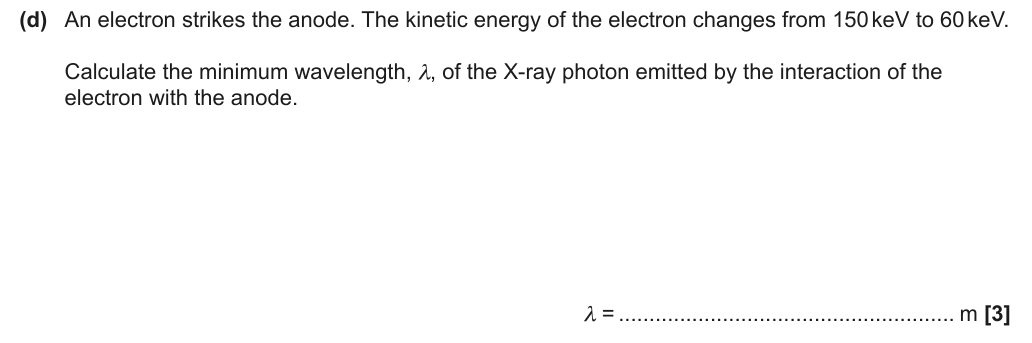
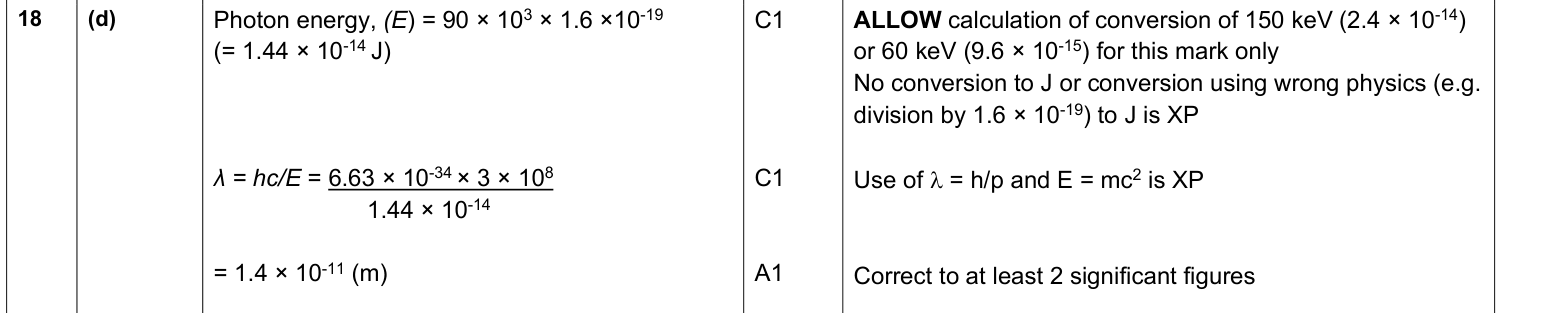
This two-step calculation was correctly carried out by nearly three quarters of candidates. Most appreciated that the change in kinetic energy was needed, and so correctly determined 90 keV as the required energy and were able to use this in determining the wavelength. Few candidates determined the frequency first and then went on to calculate the wavelength separately. Common errors included missing that the photon energy was in keV, rather than eV, and using the wrong energy. A mark was available for correct conversion of either 150 keV or 60 keV to joules, but there could be no further credit.
Skills: M0.2 Recognise and use expressions in decimal and standard form; M2.2 Change the subject of an equation, including non-linear equations; M2.3 Substitute numerical values into algebraic equations using appropriate units for physical quantities
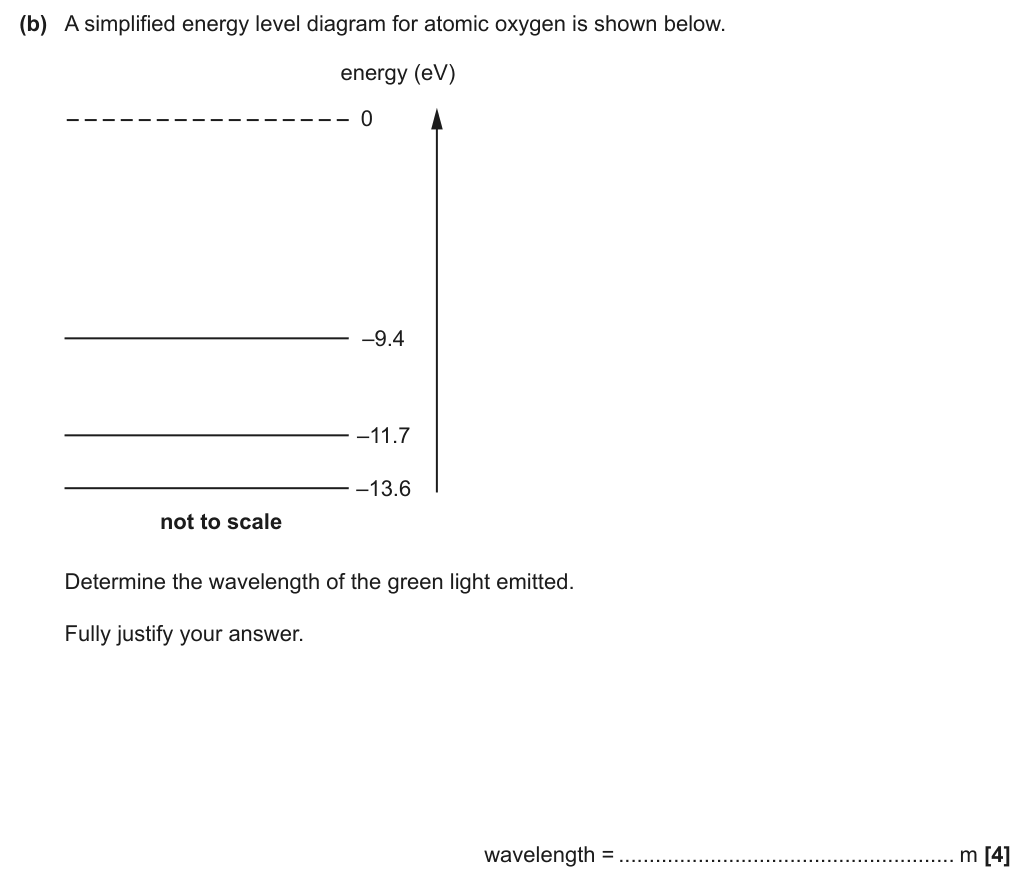
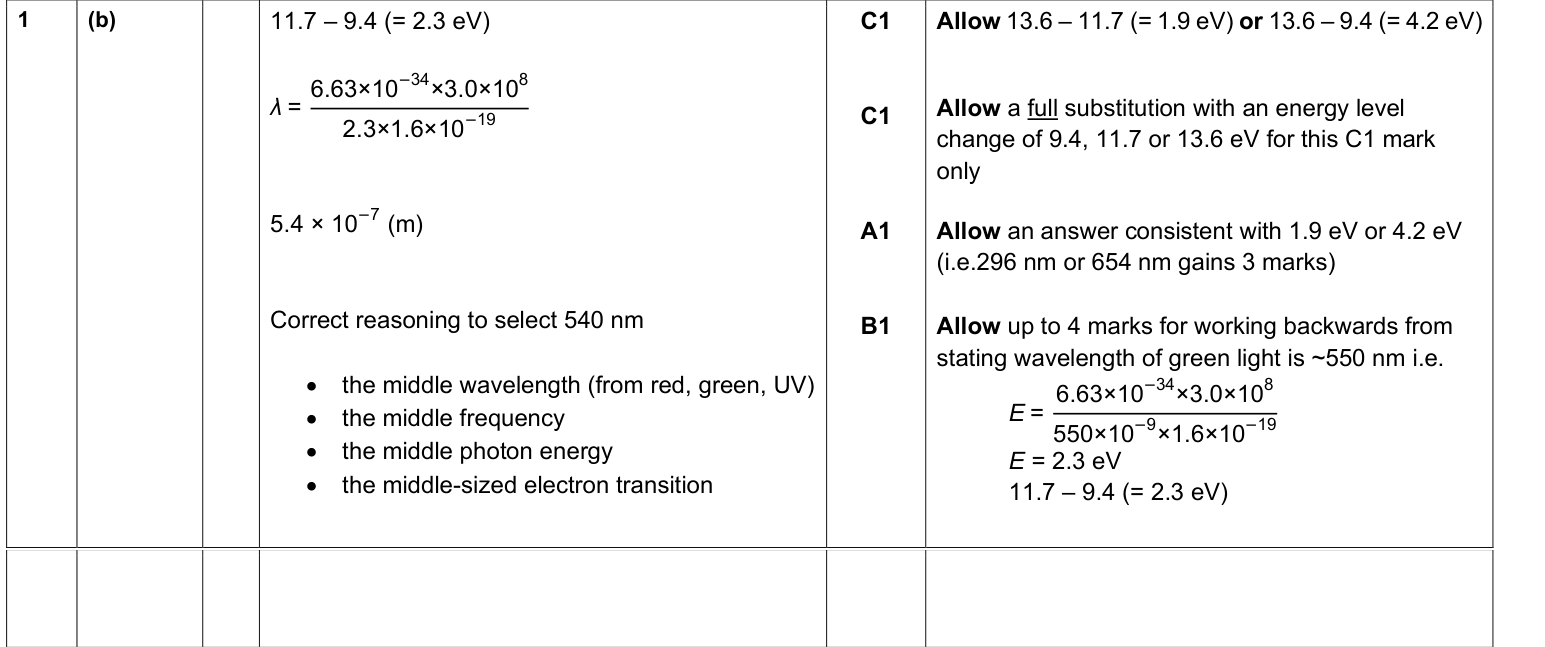
Most candidates attempted to use the correct formula. A common error was using this for an energy level transition to 0, often 9.4 or 11.7 eV. The strongest responses were those where the energy level transition of 11.7 to 9.4 eV was identified and stated at the start of the response.
Skills: M0.2 Recognise and use expressions in decimal and standard form; M2.2 Change the subject of an equation, including non-linear equations; M2.3 Substitute numerical values into algebraic equations using appropriate units for physical quantities
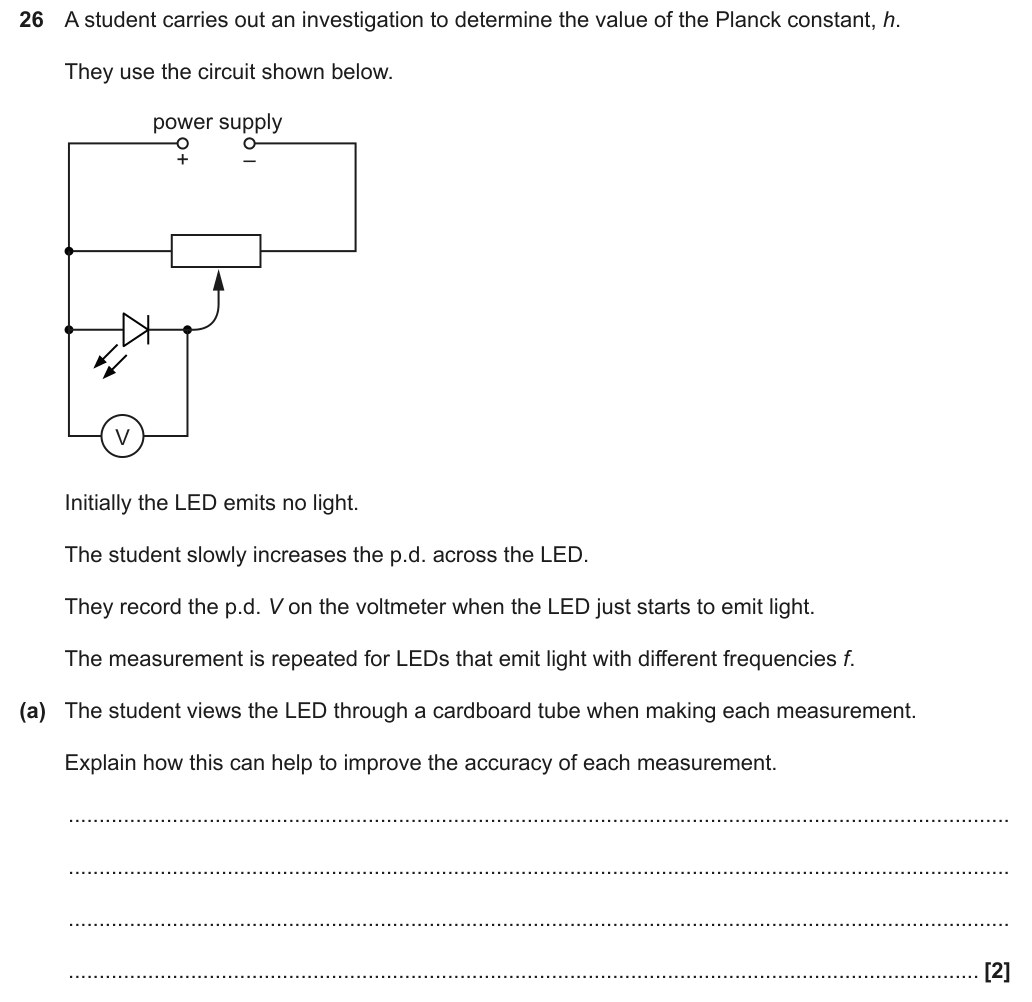
There were many successful responses for this question. Many responses were given 2 marks because they explained why a cardboard tube improves the accuracy of each measurement due to removing light from the surroundings, which enabled the light from the LED to be observed when it was first emitted.
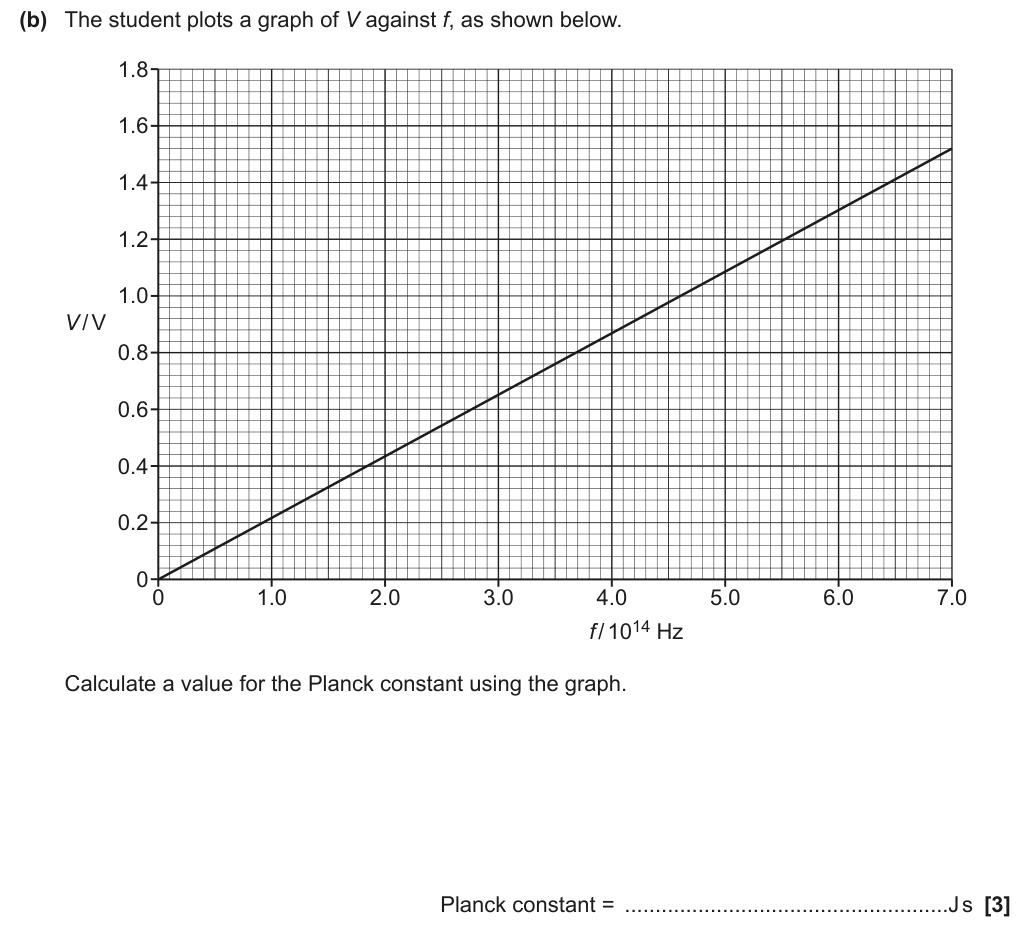
There was some variability in performance with this question, but many responses achieved 3 marks for a correct calculation and value for the Planck constant using data from the graph. The most common reason for responses being given 0 marks were for an error in their gradient calculations for either taking readings from less than half the graph, or for not including the correct power for frequency 10 14. Some candidates did correctly calculate the gradient from the graph, but then did not select and apply eV=hf to calculate a value of the Planck constant.
Skills: M0.2 Recognise and use expressions in decimal and standard form; M2.2 Change the subject of an equation, including non-linear equations; M3.4 Determine the slope and intercept of a linear graph; PAG6 Investigating quantum effects
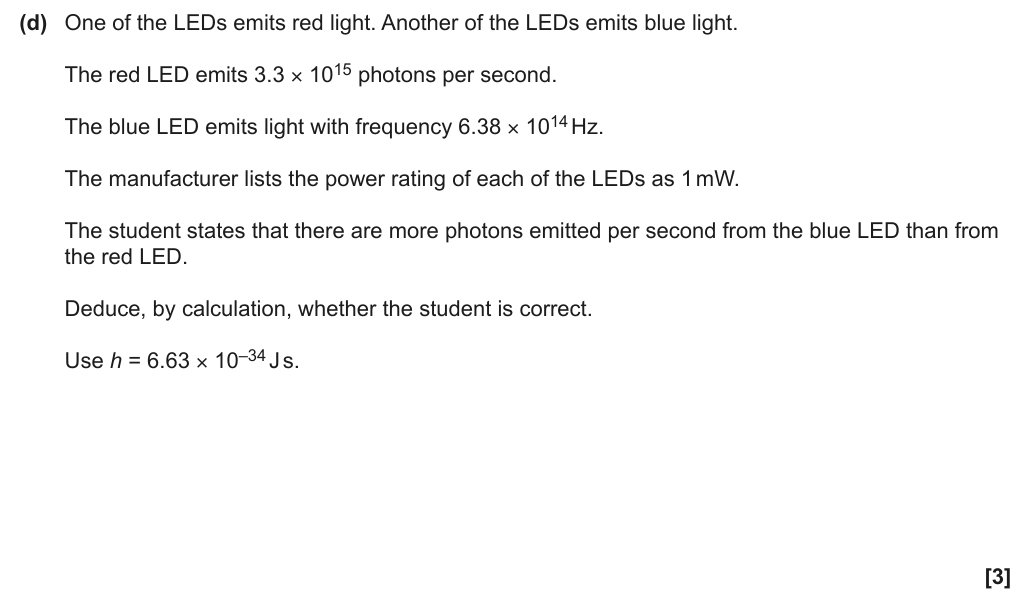
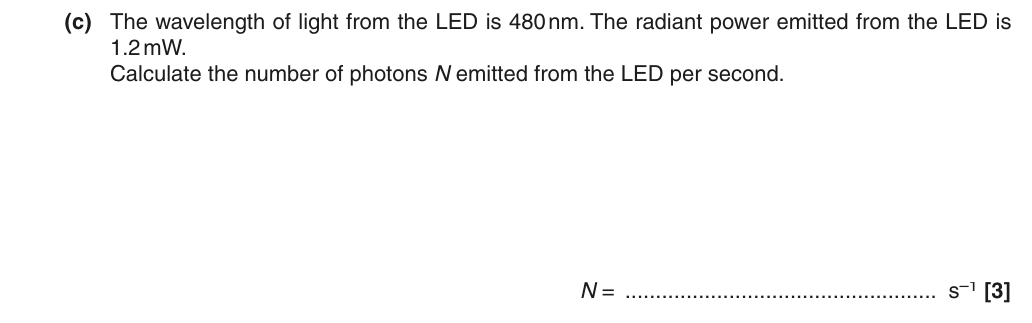
Most candidates were given 1 mark for correctly calculating the energy of one photon of blue light by selecting and applying E=hf. Some candidates correctly converted the power of the LED to calculate the number of blue photons emitted in 1 second by using and applying P=E/t. Where candidates did not achieve any further marks, this was for selecting an incorrect equation and not applying P=E/t.
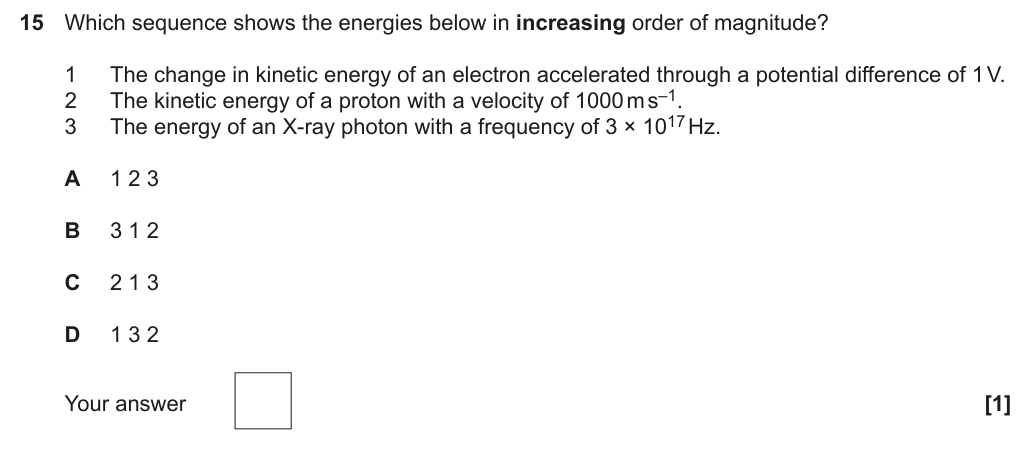
C
Approximately half of the candidates were able to correctly identify the order. Many set out the calculations to the side before putting them in rank order and this generally proved successful. Most of the incorrect responses showed little or no working, leading to the assumption that there may have been some guesswork involved.
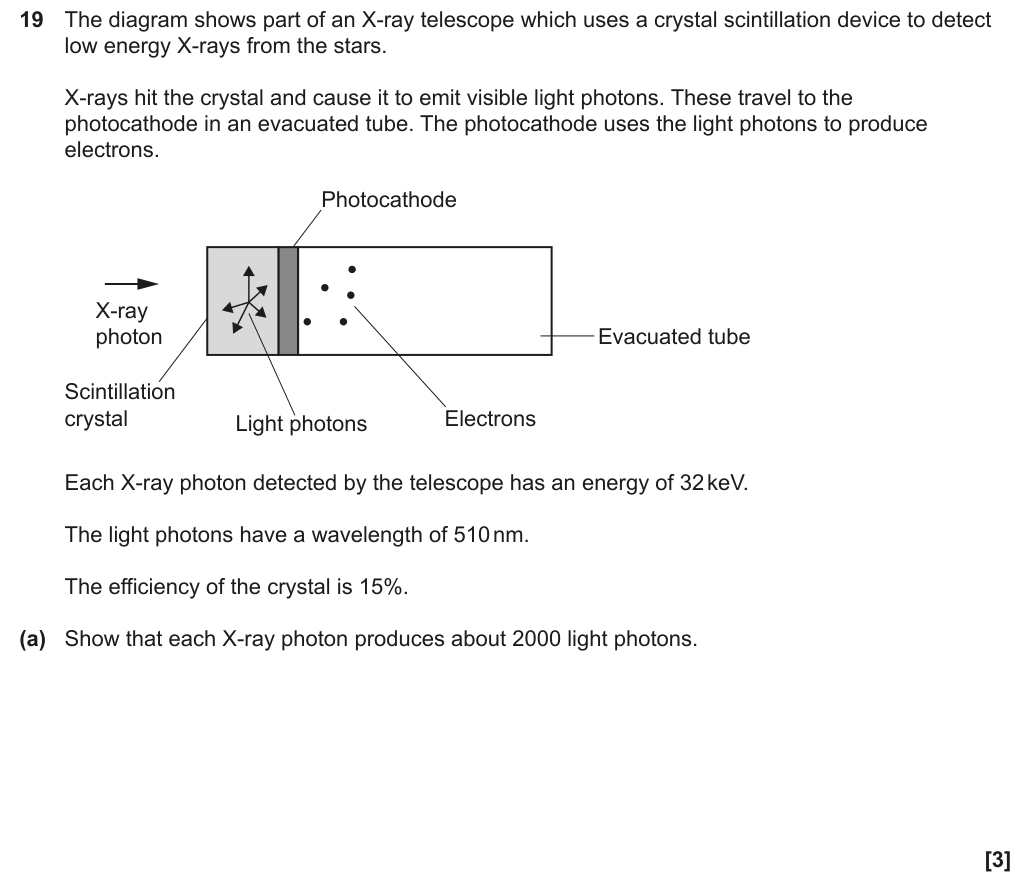
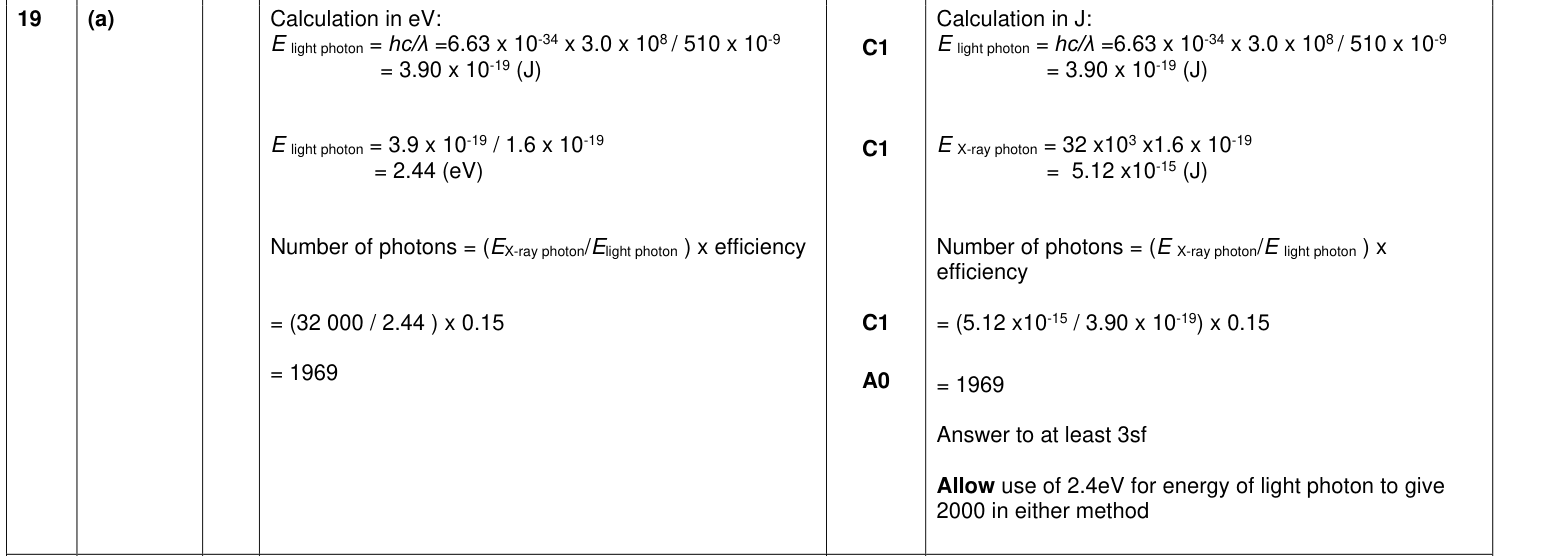
Most candidates were able to correctly show that the number of light photons was close to 1970. There were a number of methods and units that could be used and the inclusion of the 15% factor could be done at several points. Examiners were aware of these various routes and gave credit to working at each point where appropriate. The conversion of the keV to joules and the conversion of nm seemed to cause no difficulties.
Skills: M0.2 Recognise and use expressions in decimal and standard form; M0.3 Use ratios, fractions and percentages; M2.3 Substitute numerical values into algebraic equations using appropriate units for physical quantities
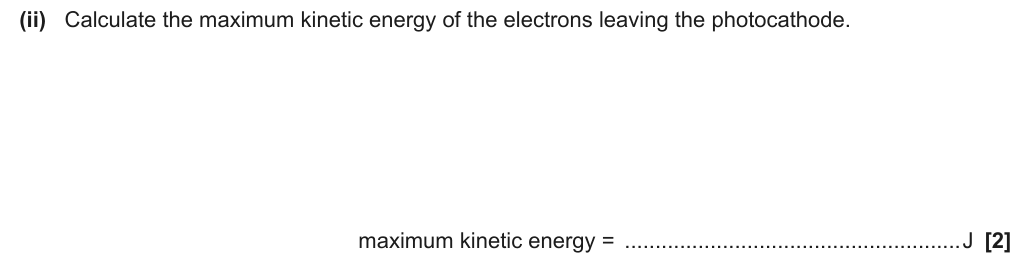
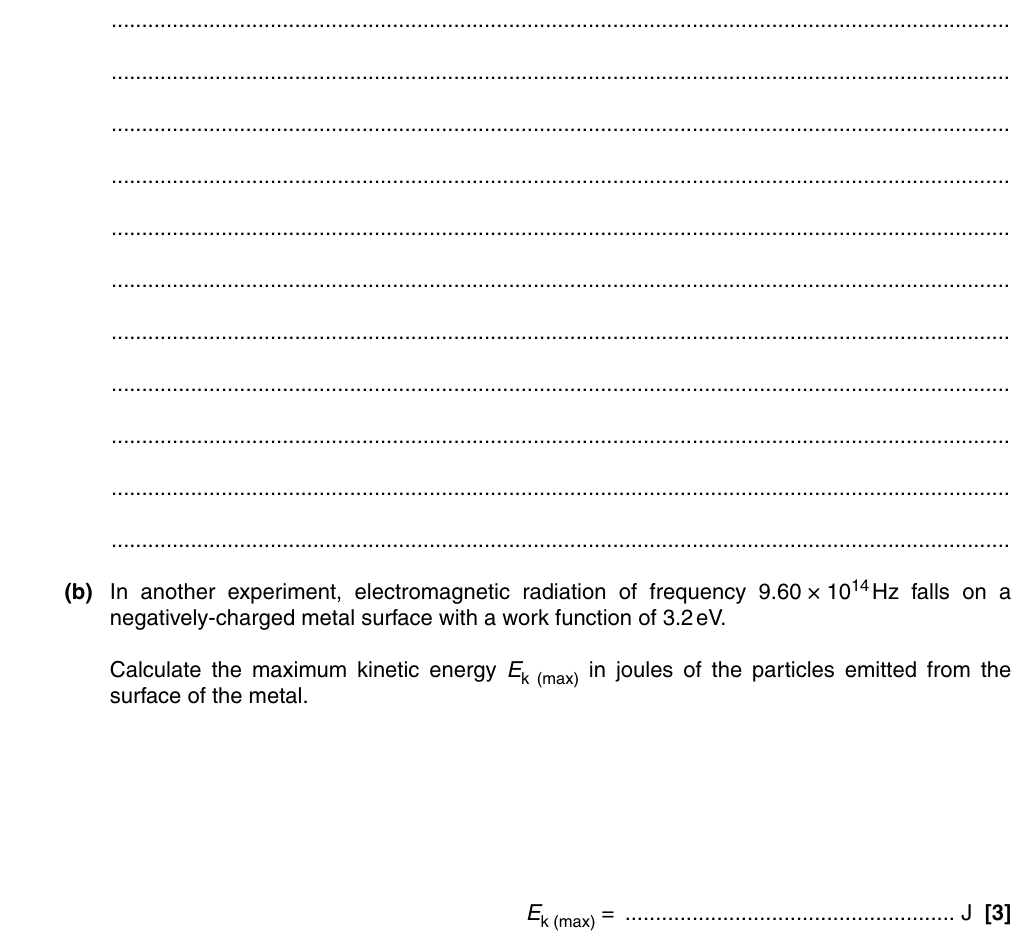
Most candidates were able to obtain at least 1 mark by correctly converting the work function into joules. As always, correct working is very helpful in obtaining the intermediate marks. Several arranged the equation incorrectly, by adding on the work function, but well over half of the candidates correctly evaluated the maximum kinetic energy.
Skills: M0.2 Recognise and use expressions in decimal and standard form; M2.2 Change the subject of an equation, including non-linear equations; M2.3 Substitute numerical values into algebraic equations using appropriate units for physical quantities
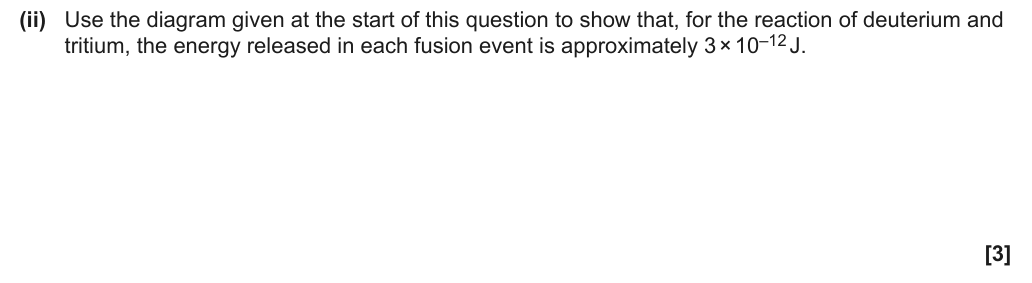
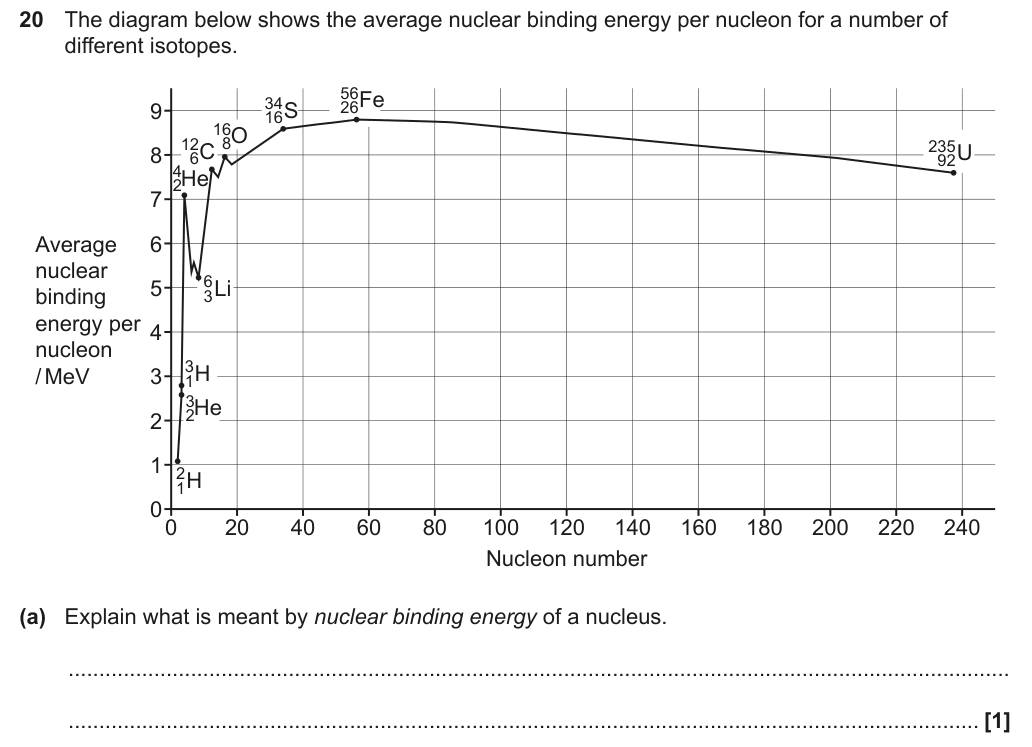
As always with a ‘show that’ question, it is vital to include as many steps as possible, the key to this question involved reading from the graph and then including the number of nucleons in the calculation. A fair number of candidates correctly read the point but did not multiply this with the nucleon number. There were relatively few misreads from the graph and the tolerance allowed some variation. Many simple (and incorrect) methods would give a value fairly close to 3 x 10-12 and so candidates would feel that they had correctly answered the question. Very few candidates struggled with the conversion from MeV to joules, although this may have been supported by having the power of ten given to them. It is also important to make sure that any value is given to a greater number of significant figures than that asked for, if appropriate. Around a third of candidates were able to obtain all 3 marks on what a potentially challenging calculation is.
Skills: M0.2 Recognise and use expressions in decimal and standard form; M2.3 Substitute numerical values into algebraic equations using appropriate units for physical quantities; M3.1 Translate information between graphical, numerical and algebraic forms
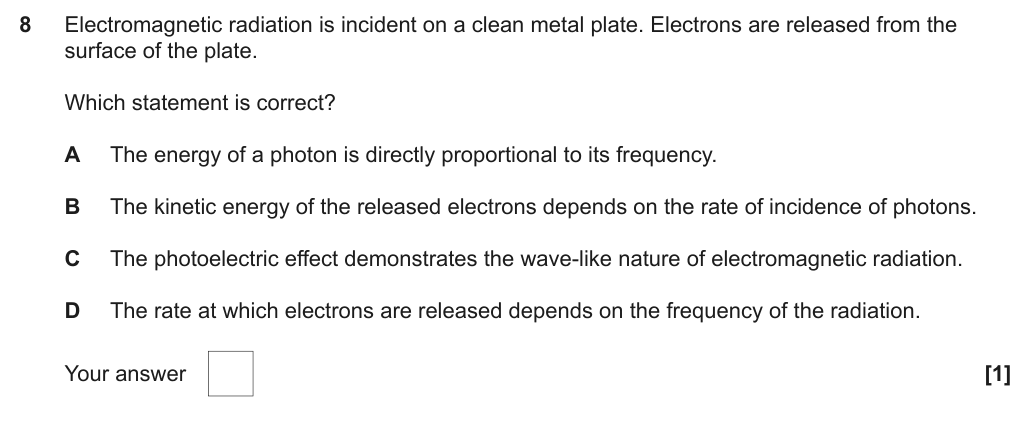
A
This question was answered well with the most candidates applying the equation E = hf to give the correct answer A.
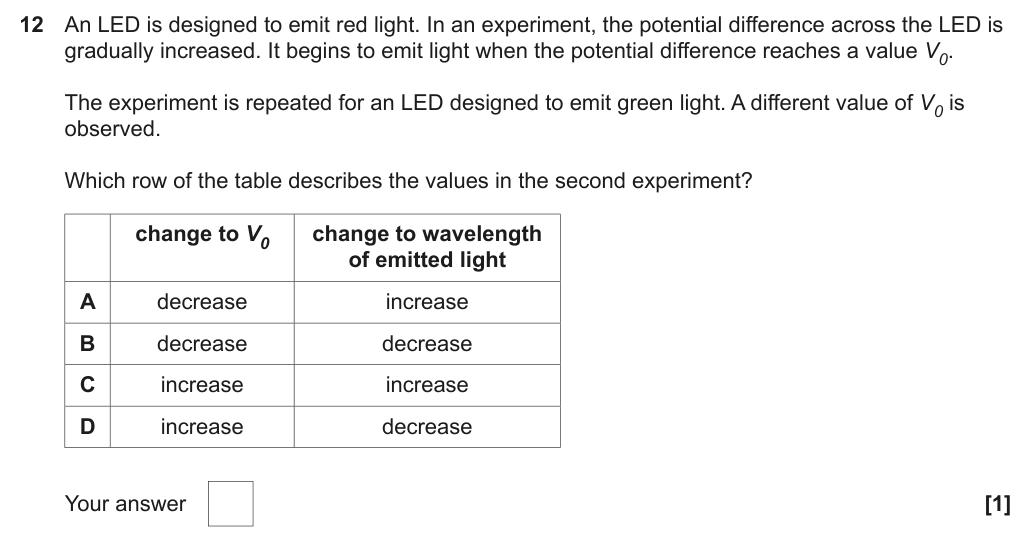
D
About half of candidates performed well on this question by determining the correct answer of D by understanding that green light has a shorter wavelength and increased energy (due to having a greater frequency) compared to red light. The most common distractors were B and C.
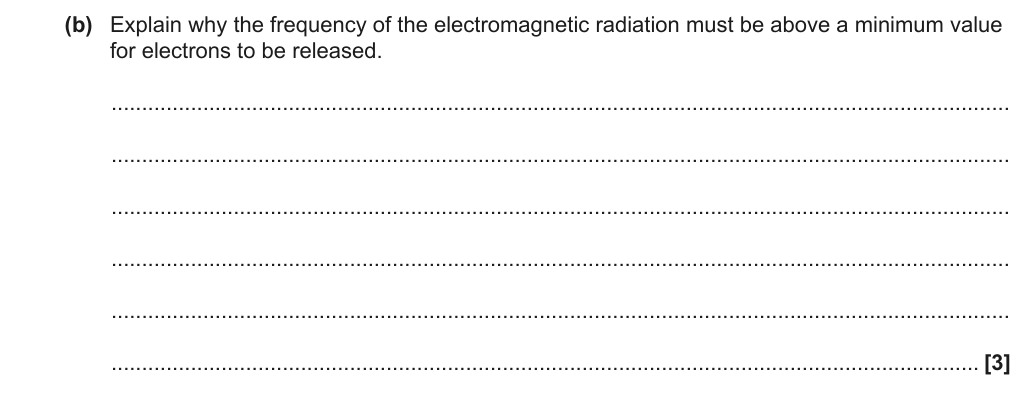
Just under two thirds of the candidates achieved 1 or more marks for correctly explaining the minimum energy required to emit electrons from incident photons related to the photoelectric effect. The most common response where candidates were given 1 mark was for relating the energy of radiation to the frequency by applying hf = E but without referencing photons in their explanation and hence were not given any further marks. About 40% of candidates did reference photons in their response with 20% of candidates directly relating it to the work function as the minimum amount of energy required to release an electron to gain all 3 mark points.
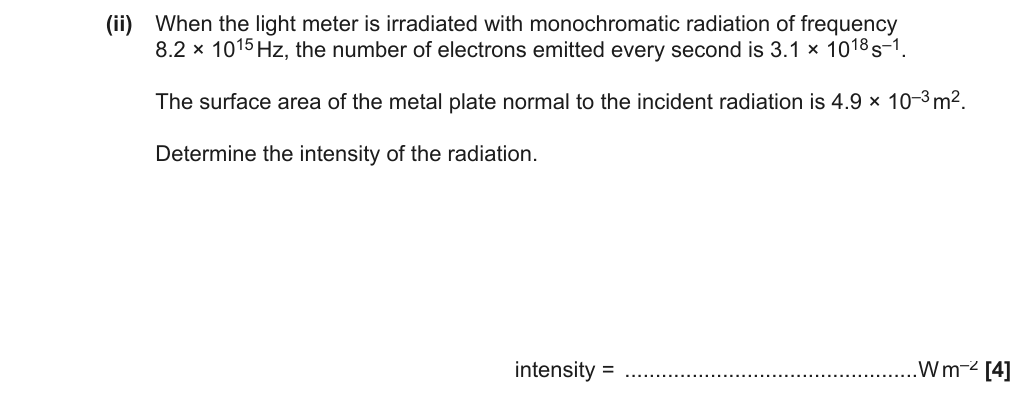
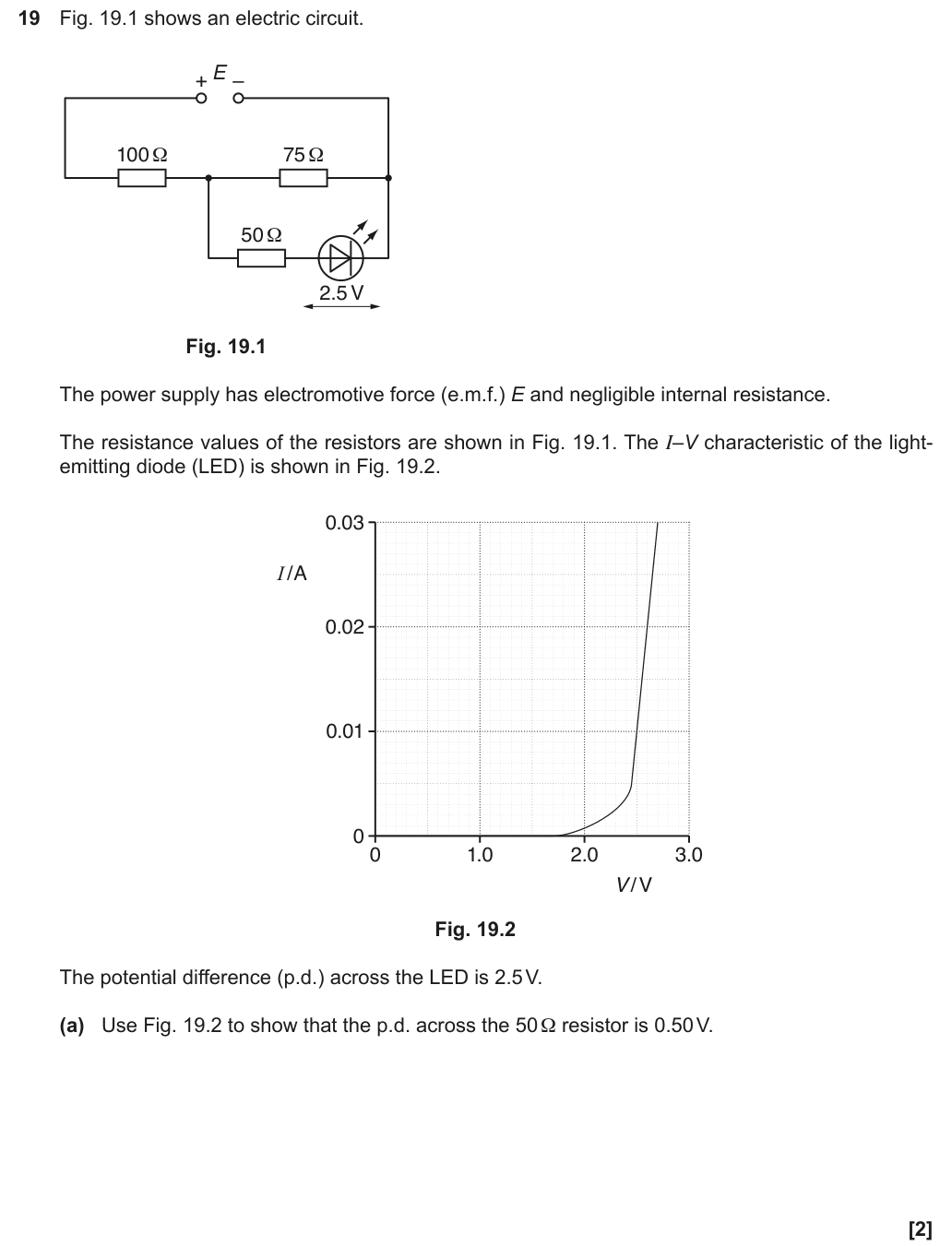
Candidates did not perform well on this question as just over half of candidates scored 0 marks. Candidates had to select the equations hf = E and I = P/A from the Data, Formulae and Relationship booklet and then apply that the power was equal to the energy as the rate of emission of electrons was in a time of 1 second. Many candidates would select the correct equation I = P/A but would then try and calculate power by using the equation P = VI and Q = It by using the charge of an electron to calculate the current and using the battery e.m.f. of 3 V given in the circuit diagram. This demonstrated for a majority of candidates a lack of a confident understanding of the photoelectric effect that the energy of incident photons results in the release of electrons. This response demonstrates the correct and clear selection and application of formulae to calculate the intensity of the incident radiation.
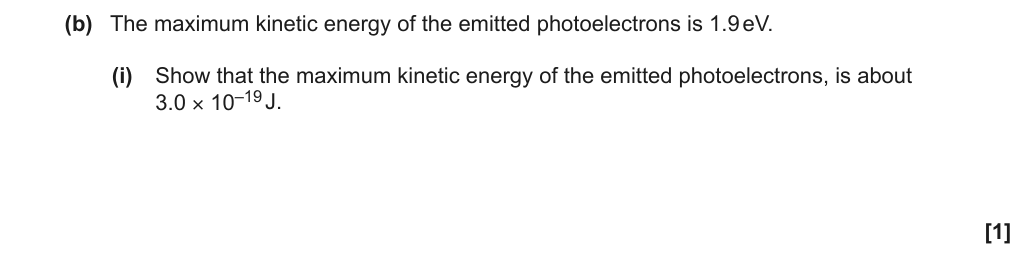
This question was well answered with the majority of candidates clearly writing 1.9 1.60 10-19 = 3.04 10-19 (J). This is exactly how a show type question should be answered.
Skills: M0.2 Recognise and use expressions in decimal and standard form
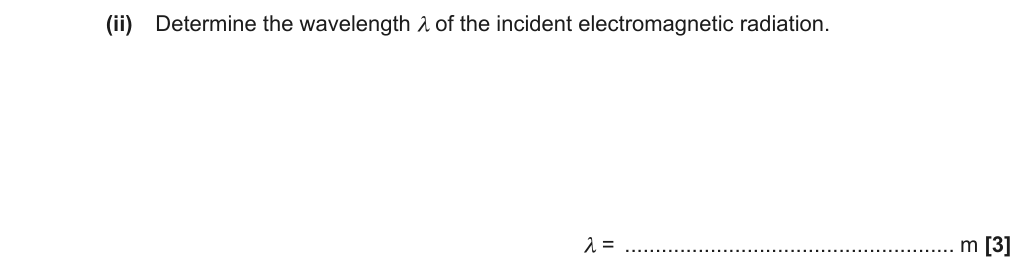
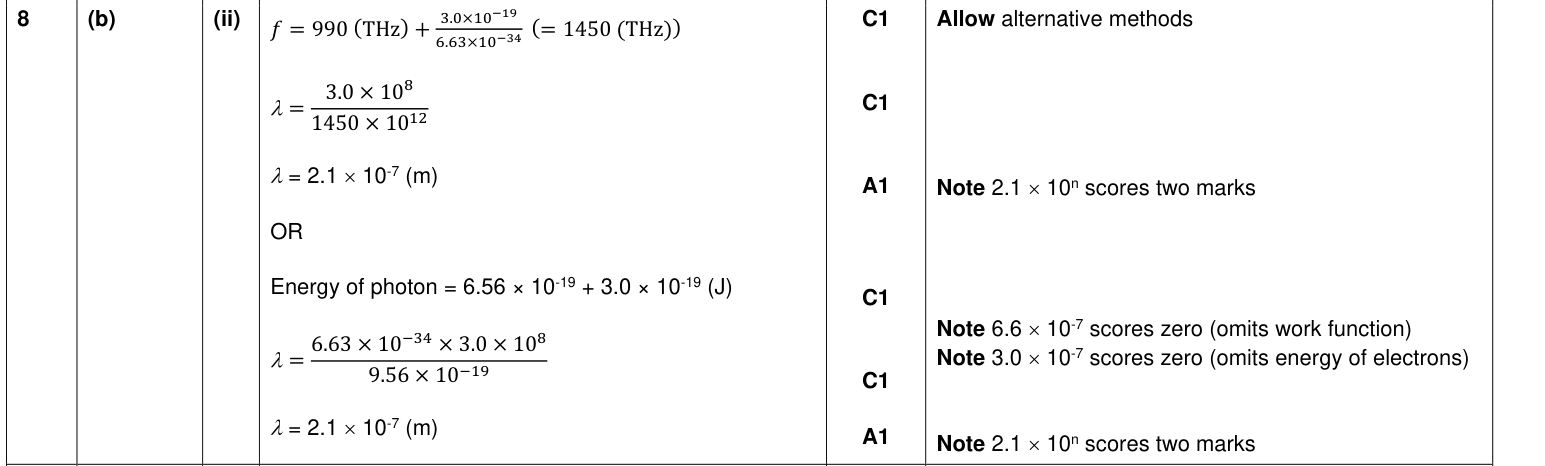
Candidates found this question challenging. The common error was to omit the work function of the metal. Other candidates determined the energy but omitted the energy of the electrons. A significant minority of candidates attempted to answer this question by determining the momentum of the electrons.
Skills: M0.2 Recognise and use expressions in decimal and standard form; M2.2 Change the subject of an equation, including non-linear equations; M2.3 Substitute numerical values into algebraic equations using appropriate units for physical quantities
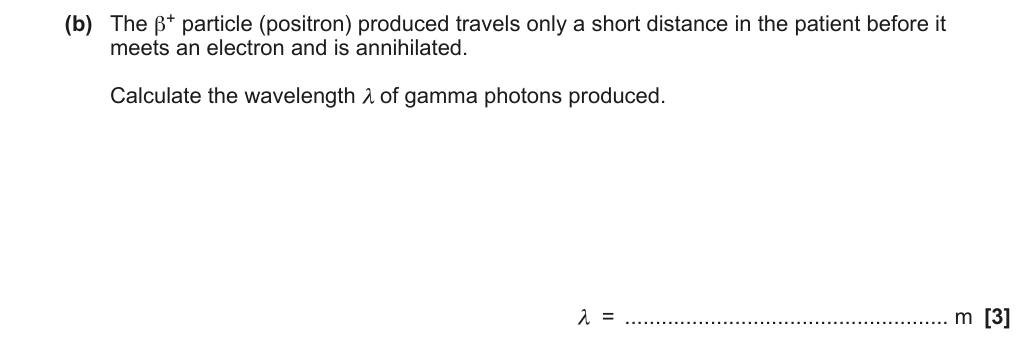
Well over half of the candidates were able to score 2 or more marks on this question. A great deal scored 2 marks due to the inclusion of a factor of two, which was then not removed (or vice versa). Some candidates used the formula for kinetic energy – which by coincidence may give the correct answer – however this was not credited, nor was the more common use of the de Broglie formula. Examiners sometimes had a difficult decision on this question, whether the response was a physics error or not, and if in doubt a candidate would be awarded the marks.
Skills: M0.2 Recognise and use expressions in decimal and standard form; M2.2 Change the subject of an equation, including non-linear equations; M2.3 Substitute numerical values into algebraic equations using appropriate units for physical quantities
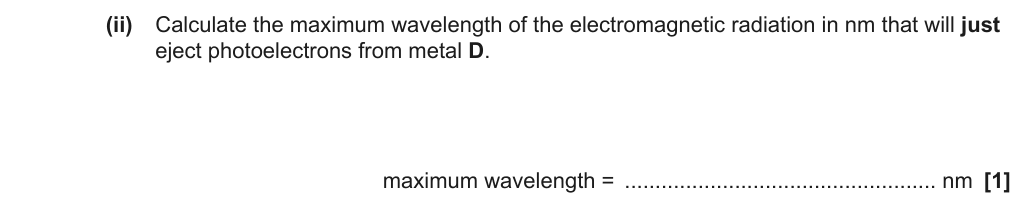
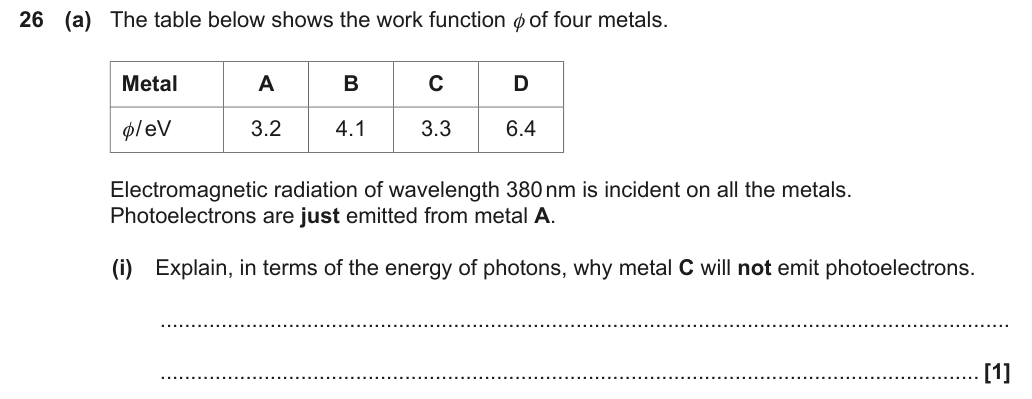
Very few candidates realised that no use of E = hc/λ was required to calculate the maximum wavelength as the work function of D was double of A so the maximum wavelength was half of 380 nm. Therefore, most candidates attempted to calculate the wavelength from the work function with a common error of not converting eV to J.
Skills: M0.3 Use ratios, fractions and percentages; M2.2 Change the subject of an equation, including non-linear equations
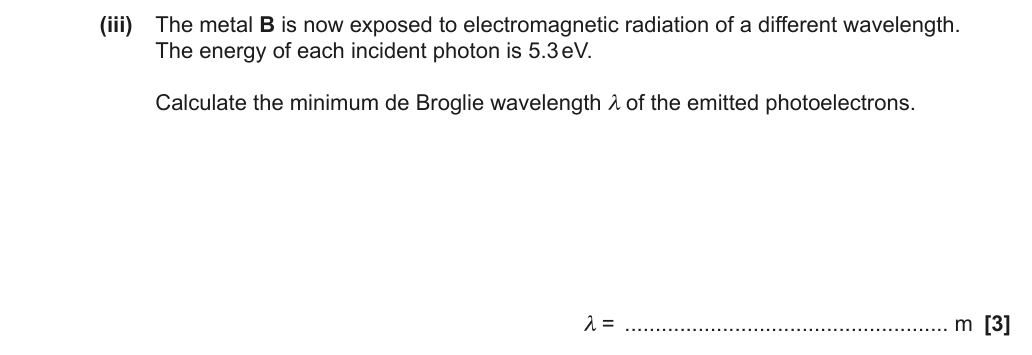
Most candidates were able to convert eV to J but did not correctly use this to calculate the velocity of the photoelectrons as they did not apply the formula λ = h/p to calculate the momentum. Only a few candidates correctly applied both formulae hf = φ + KEmax and λ = h/p to calculate the de Broglie wavelength. This response demonstrates a lack of understanding of the photoelectric effect and use and application of the formula hf = φ + KEmax. Candidates have selected the correct formula to calculate the de Broglie wavelength and have converted eV to J but have not understood that p is required to be calculated using v from the correct KE.
Skills: M0.2 Recognise and use expressions in decimal and standard form; M2.2 Change the subject of an equation, including non-linear equations; M2.3 Substitute numerical values into algebraic equations using appropriate units for physical quantities
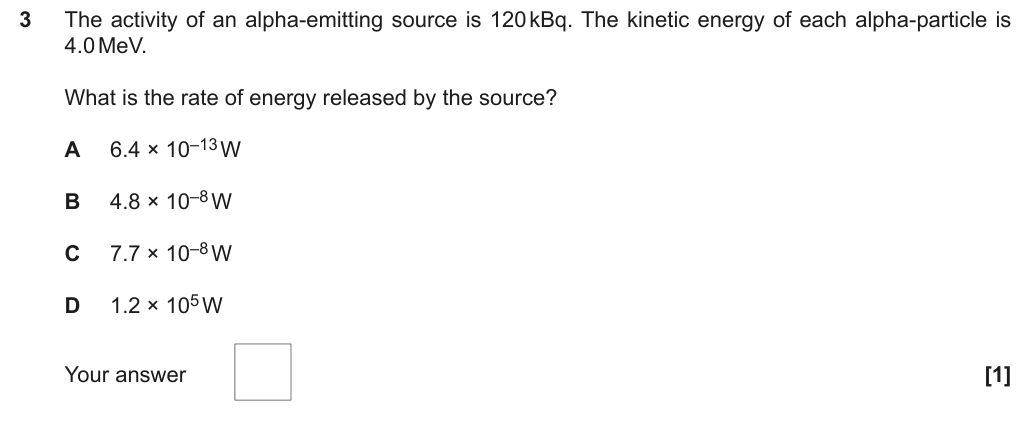
C
Although a little over two thirds of candidates selected the correct response, this question discriminated well between candidates of differing abilities. Potential errors in this question included two unit prefix conversions and the conversion between eV and joules. Incorrect responses were fairly well spread across the other distractors.
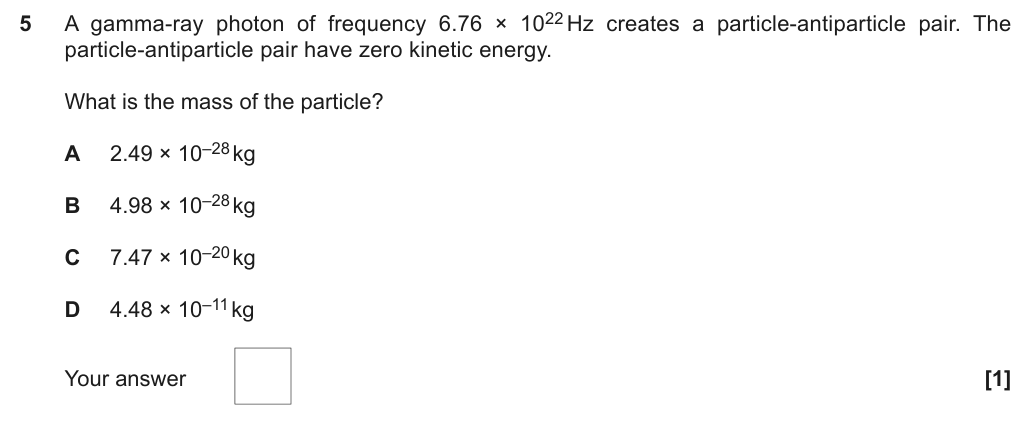
A
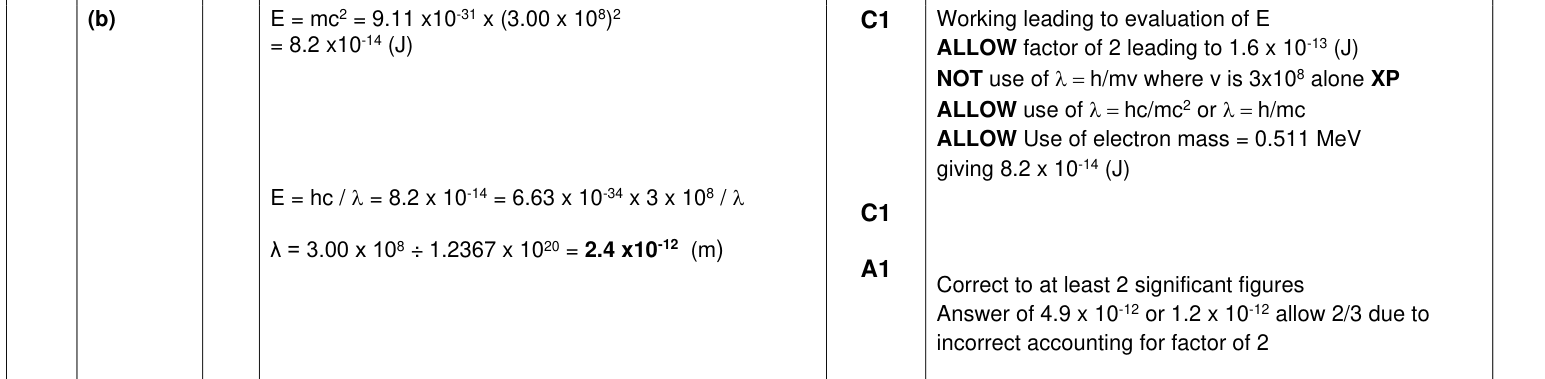
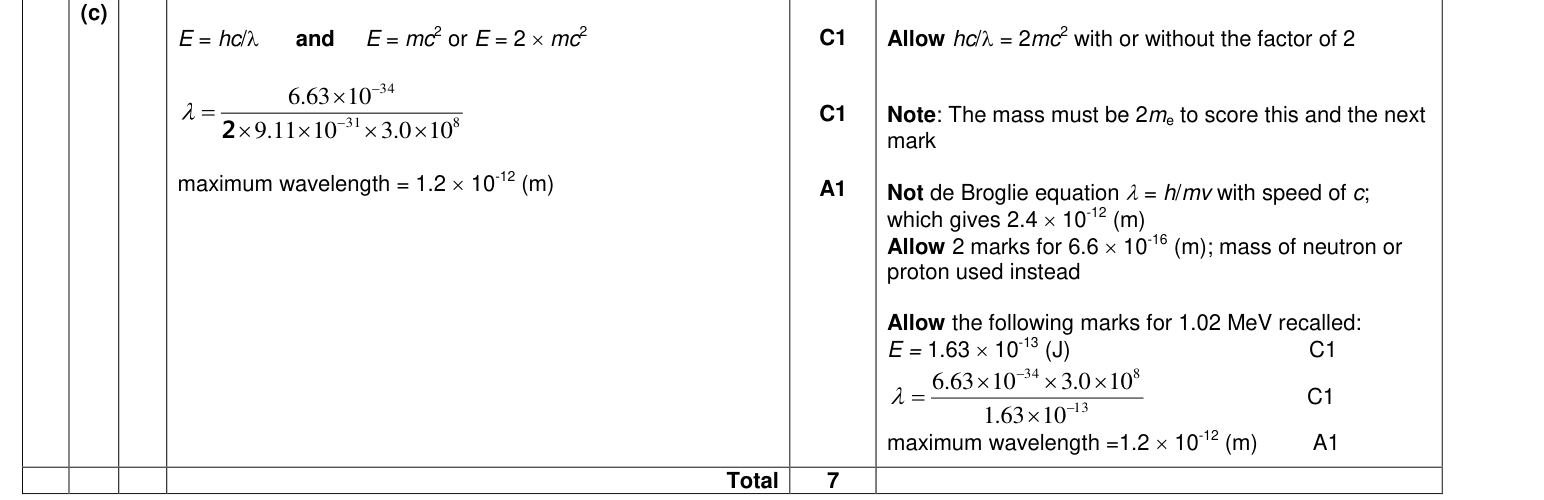
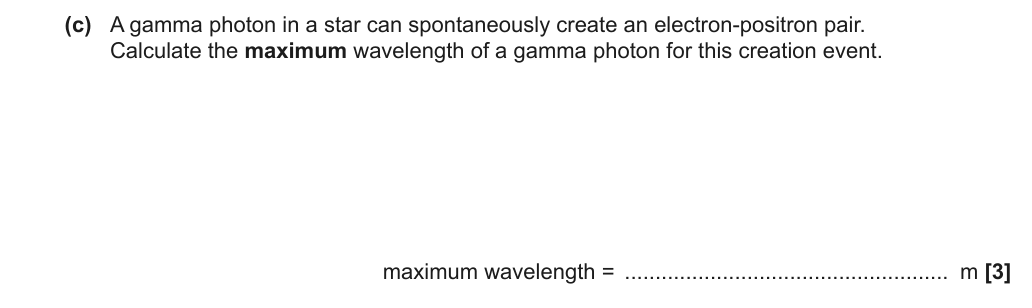
This question was answered correctly by approximately half of the candidates. Most showed written working, often as hf = 2mc2 or the equivalent in numerical form. B was by far the most common incorrect response, and it is clear from candidates working that the factor of 2 had simply been missed out.

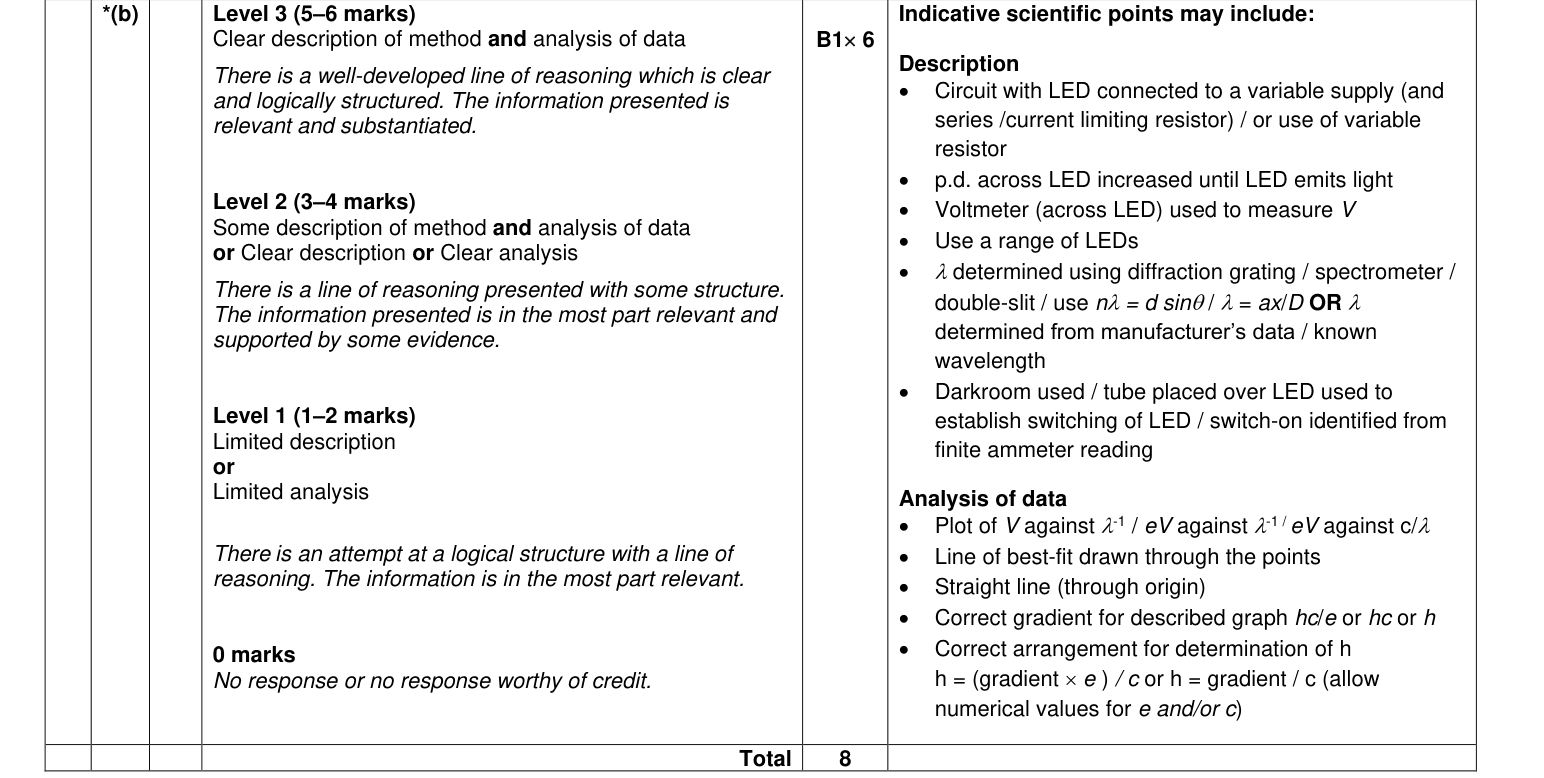
This level of response (LoR) question was designed to assess practical skills of planning, implementation, analysis and evaluation from module 4 of the specification, specifically 4.5.1(e). A holistic approach to marking is used, with marks given according to answers matching the descriptors for the various levels. No one answer is perfect for this question, examiners were expecting a varied approach which would lead to a correct determination of h. The nature of the question is such that it can be conveniently separated into a description of the experiment and an analysis of it. The key points in the description that examiners were looking for were: - a suitable circuit diagram allowing the potential difference across the LED to be both varied and measured – a description of the method used, specifically measuring the potential difference across the LED at the point at which it just lights – a statement or description of how the wavelength of the emitted light is determined or measured – use of a range of different wavelengths (or colours) of LEDs. The key points in the analysis that examiners were looking for were: - a suitable graph with appropriate variables on the correct axes – a description of how the graph will appear and what the gradient corresponds to – how the value of h can be determined from the gradient. It was clear that many candidates had carried out this experiment and were able to give good descriptions and analysis. The very best was detailed and well-structured and made every attempt to fully answer each section of the question. It was anticipated that the determination of the wavelength would come from an experimental method, but it was evident that many candidates who had carried this experiment out had used the manufacturer’s data which is a perfectly acceptable response. It was important that candidates described how the potential difference across the LED was to be measured as this was specifically asked in the question and several candidates drew circuit diagrams which would not have worked in the required way, often with the variable resistor across the LED. Many candidates gave extra experimental details, such as using a darkroom, to help build up a detailed response. For the most part, the analysis was done better than the description and candidates were generally able to describe the correct graph and how to determine h. Several candidates plotted an incorrect graph, such as V against , which meant that they would not be able to determine h. Some of the responses were brief and used symbols with little explanation about how the analysis was to be carried out.
Skills: M3.3 Understand that y = mx + c represents a linear relationship; M3.4 Determine the slope and intercept of a linear graph; PAG6 Investigating quantum effects
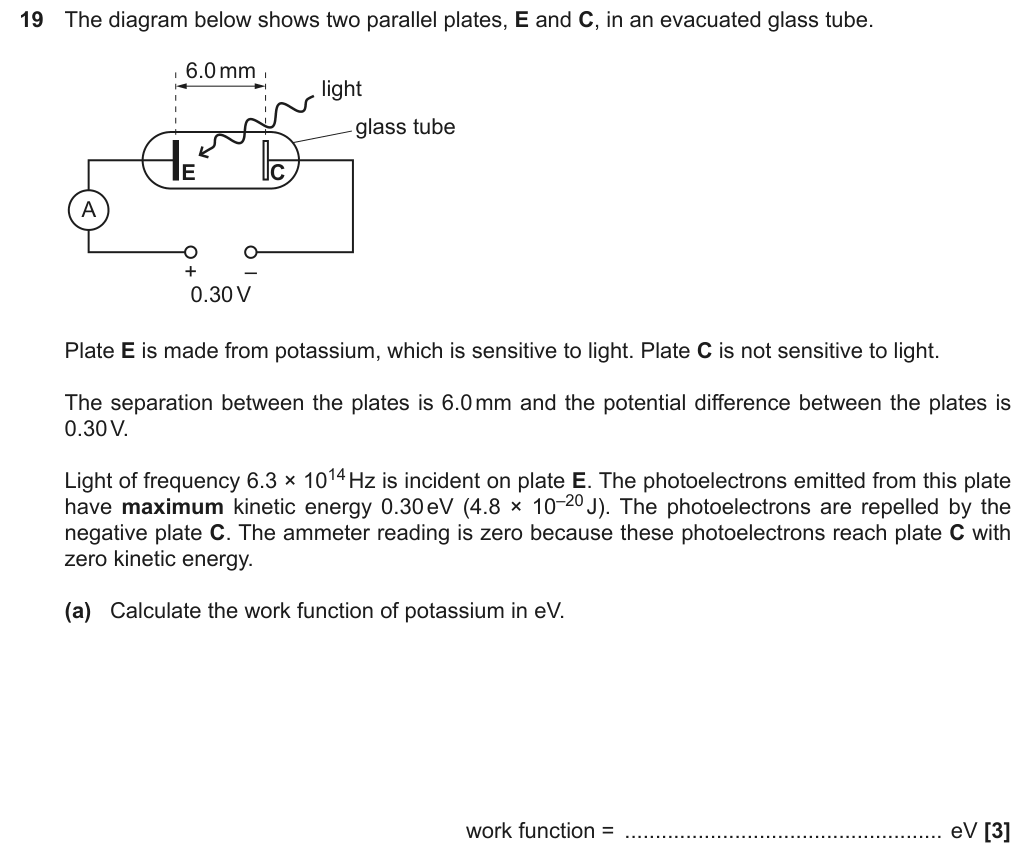
This question was successfully completed by many candidates. It was clear that the use of Einstein’s equation was well known, and the conversion to eV (generally done at the end) only caused a few candidates difficulties, mostly by multiplying their work function (in J) by e. Several candidates wrote down the answer with no working – while this will score full marks here, it is a risky tactic should an arithmetic error occur on their calculator.
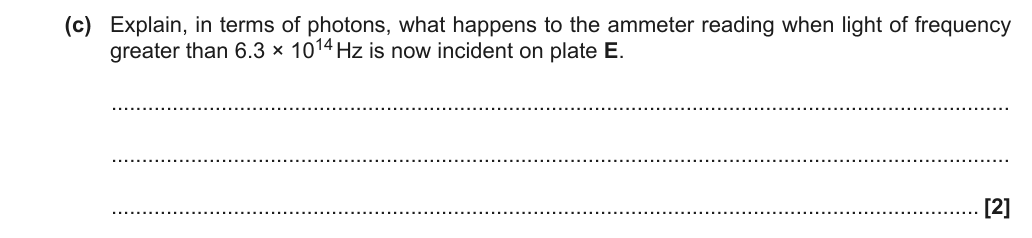
There were several misconceptions in candidates’ responses to this question. Many candidates did not appreciate that the increased frequency would result in electrons of greater KE and thought that it was the increased energy of the photons crossing the 6.0mm gap that caused an ammeter reading. A significant number of candidates also described increasing frequency causing an increase in kinetic energy of photons, and some also linked the increasing frequency to a greater number of photons or photoelectrons.
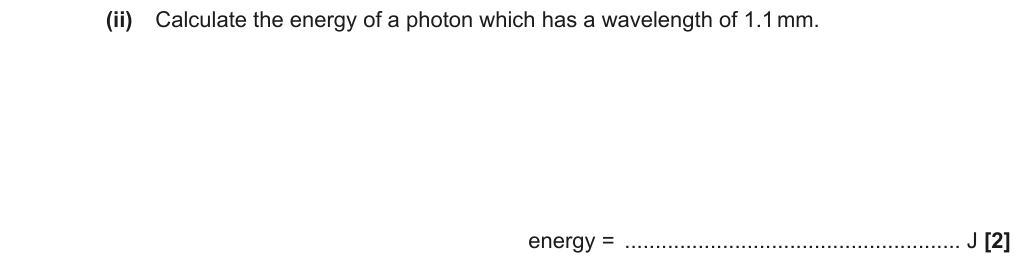
This was a straightforward question and most candidates correctly chose and applied the formula E = 𝜆𝜆 Common problems in 4(b)(ii) • not converting mm to m • trying to convert the answer to or from MeV
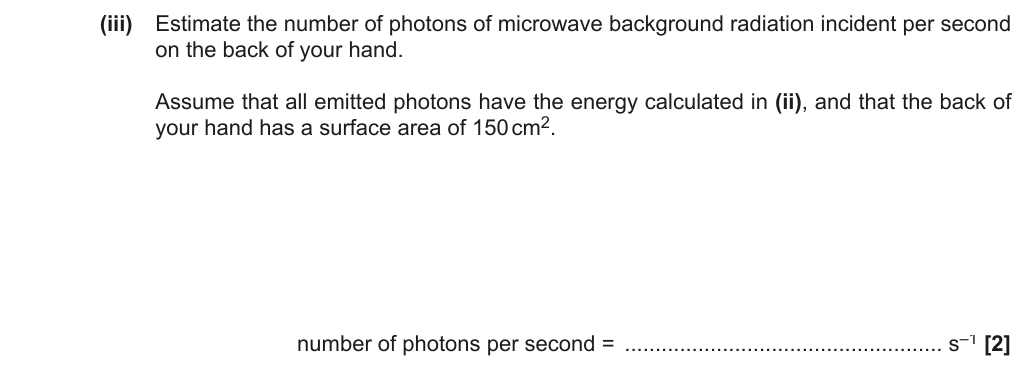
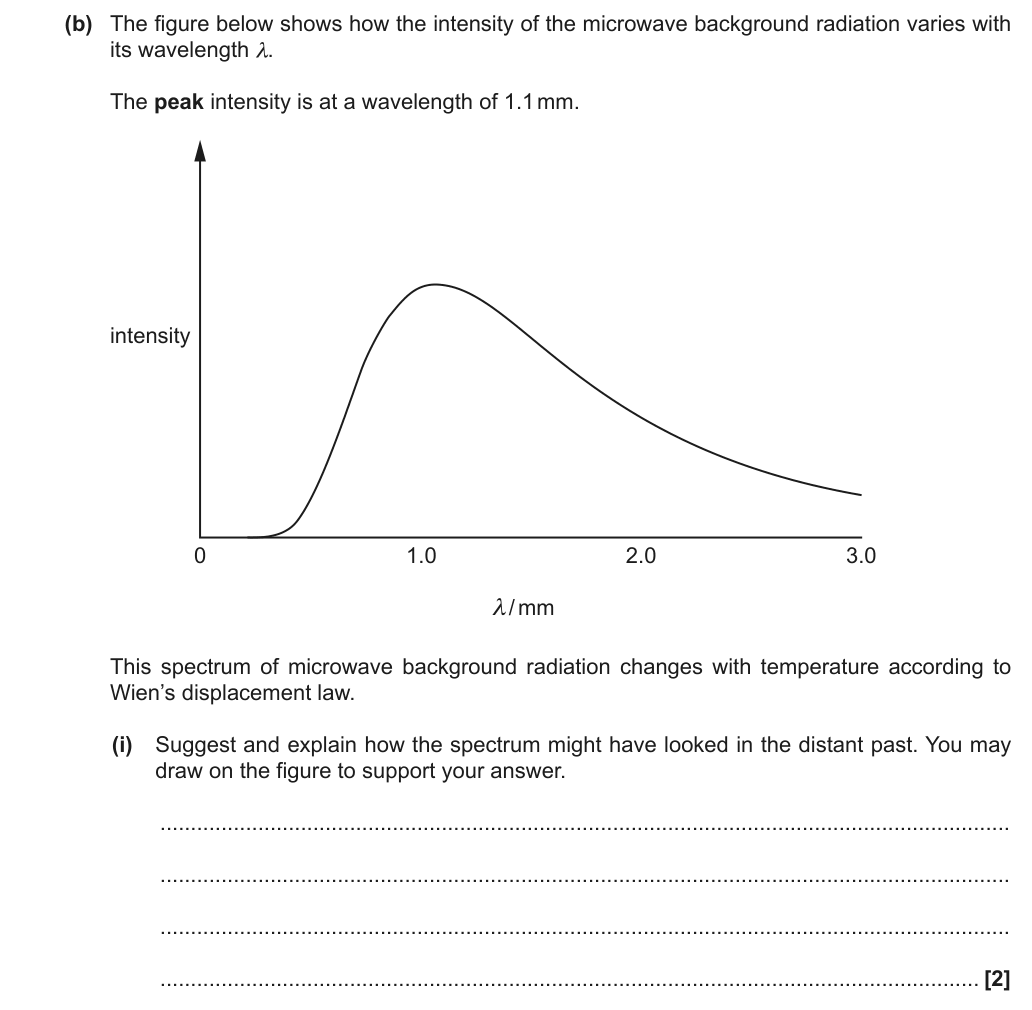
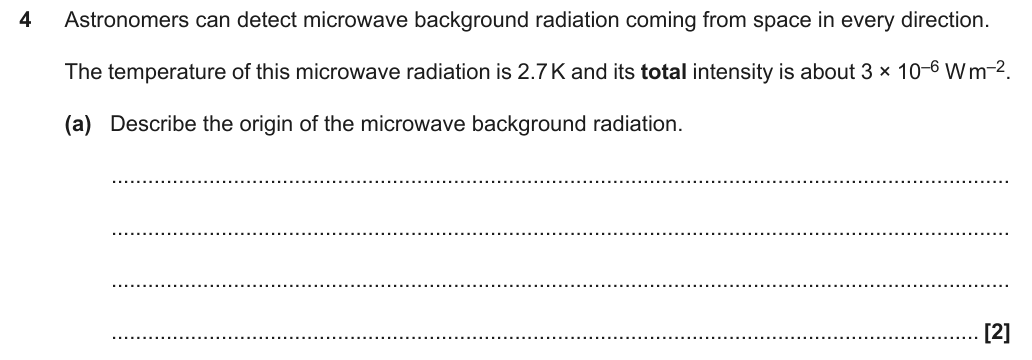
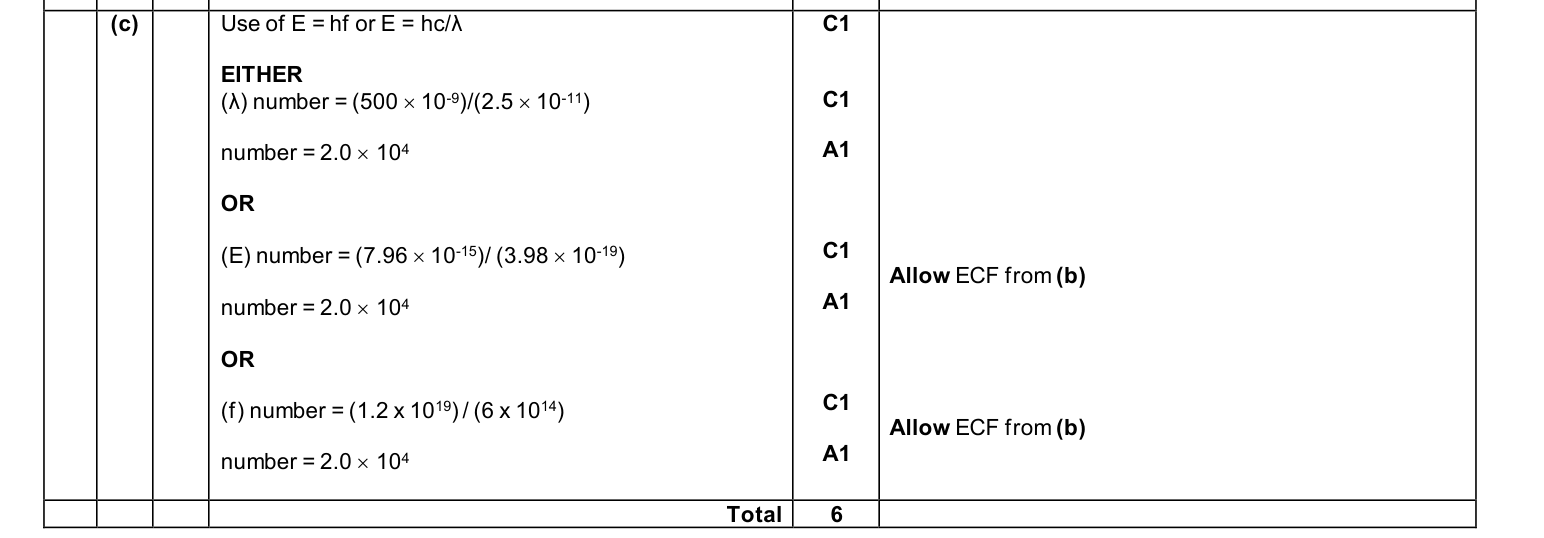
This is a complex, multi-stage calculation. A good approach was to use: number of photons per second × energy of each photon = amount of energy per second = power = intensity × area The total intensity of the microwave background radiation was given at the start of the question as 3 × 10⁻⁶ W m–2. Converting cm2 into m2 proved difficult for many.
Skills: M0.1 Recognise and make use of appropriate units in calculations; M0.2 Recognise and use expressions in decimal and standard form; M2.3 Substitute numerical values into algebraic equations using appropriate units for physical quantities
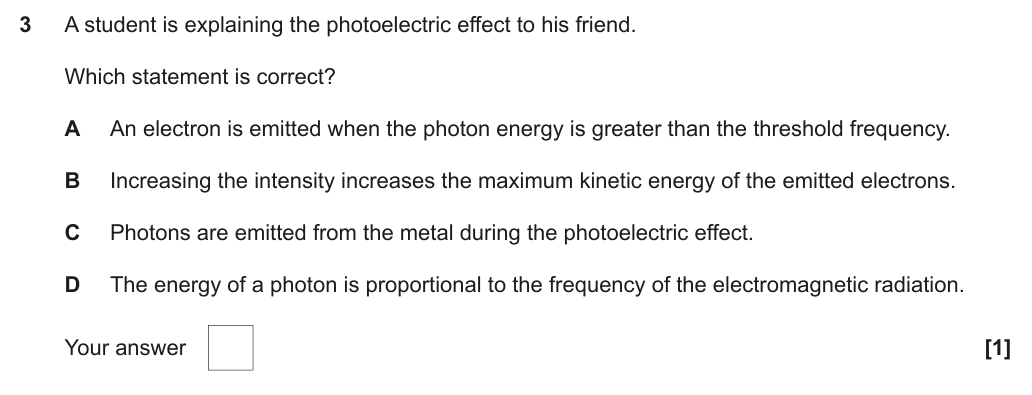
D
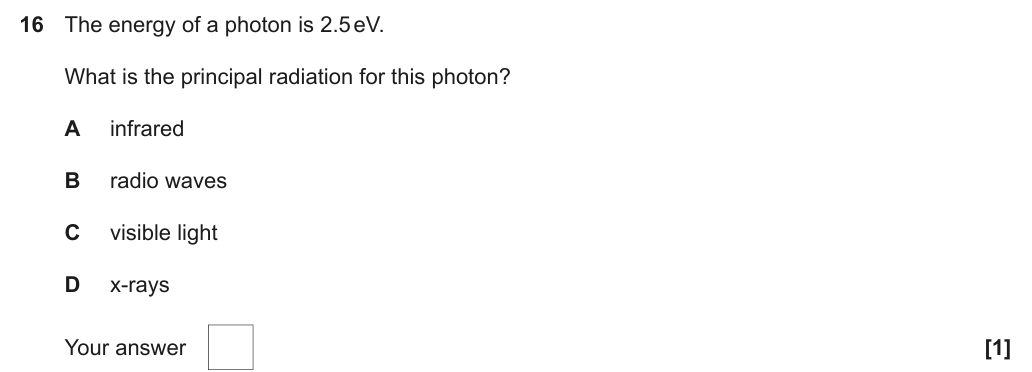
C
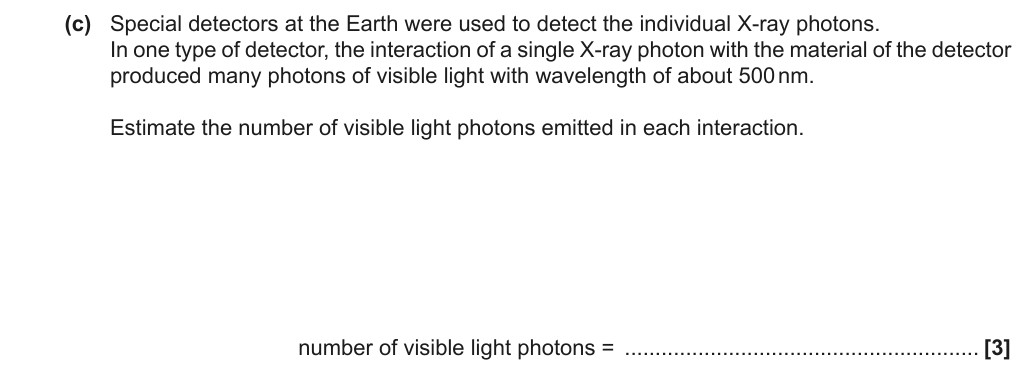
Skills: M0.2 Recognise and use expressions in decimal and standard form; M0.3 Use ratios, fractions and percentages; M0.4 Estimate results
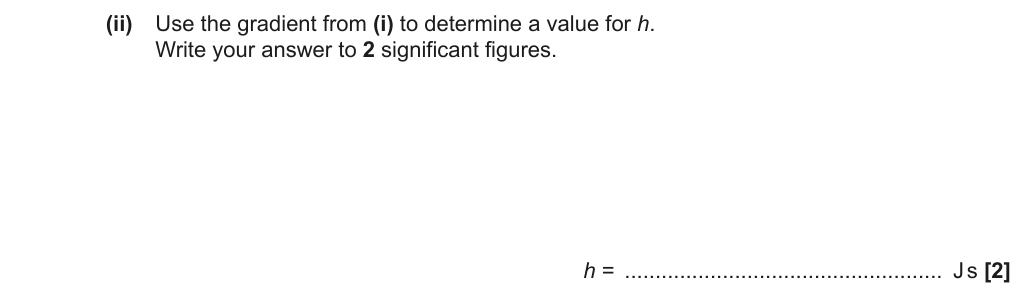
Skills: M1.1 Use an appropriate number of significant figures; M2.2 Change the subject of an equation, including non-linear equations; M3.3 Understand that y = mx + c represents a linear relationship; PAG6 Investigating quantum effects
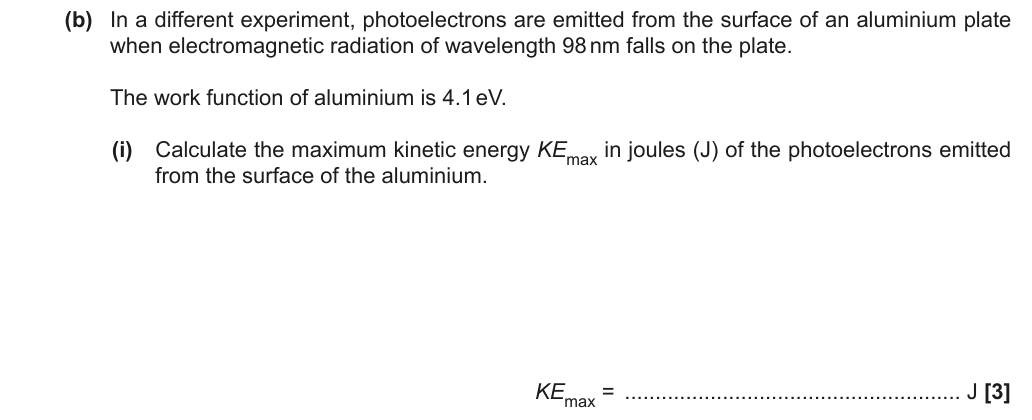
Skills: M0.2 Recognise and use expressions in decimal and standard form; M2.3 Substitute numerical values into algebraic equations using appropriate units for physical quantities
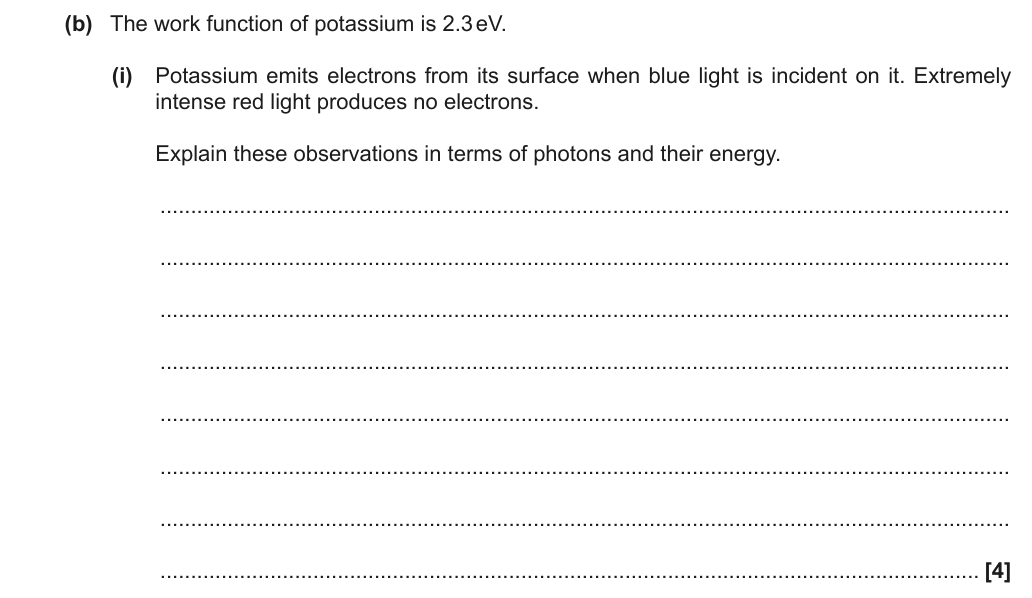
This question covers part of the quantum physics topic from module 4.
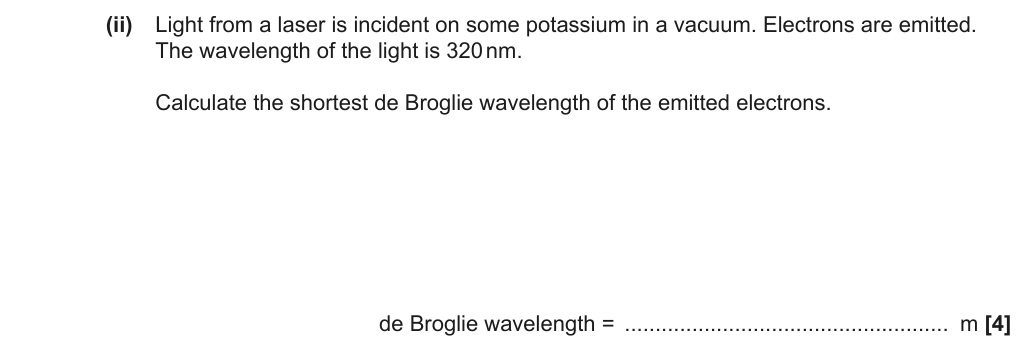
This question covers part of the quantum physics topic from module 4.
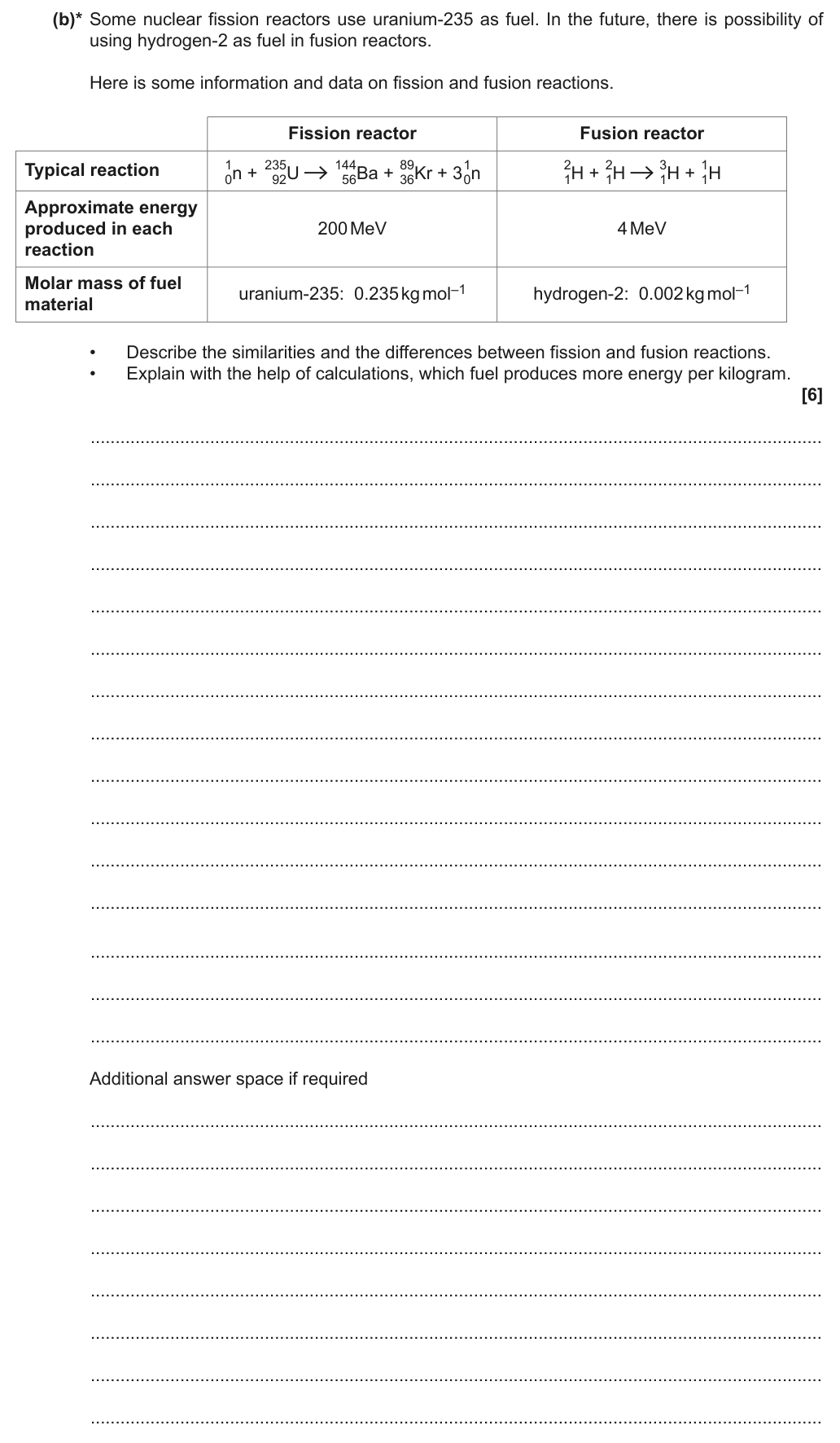
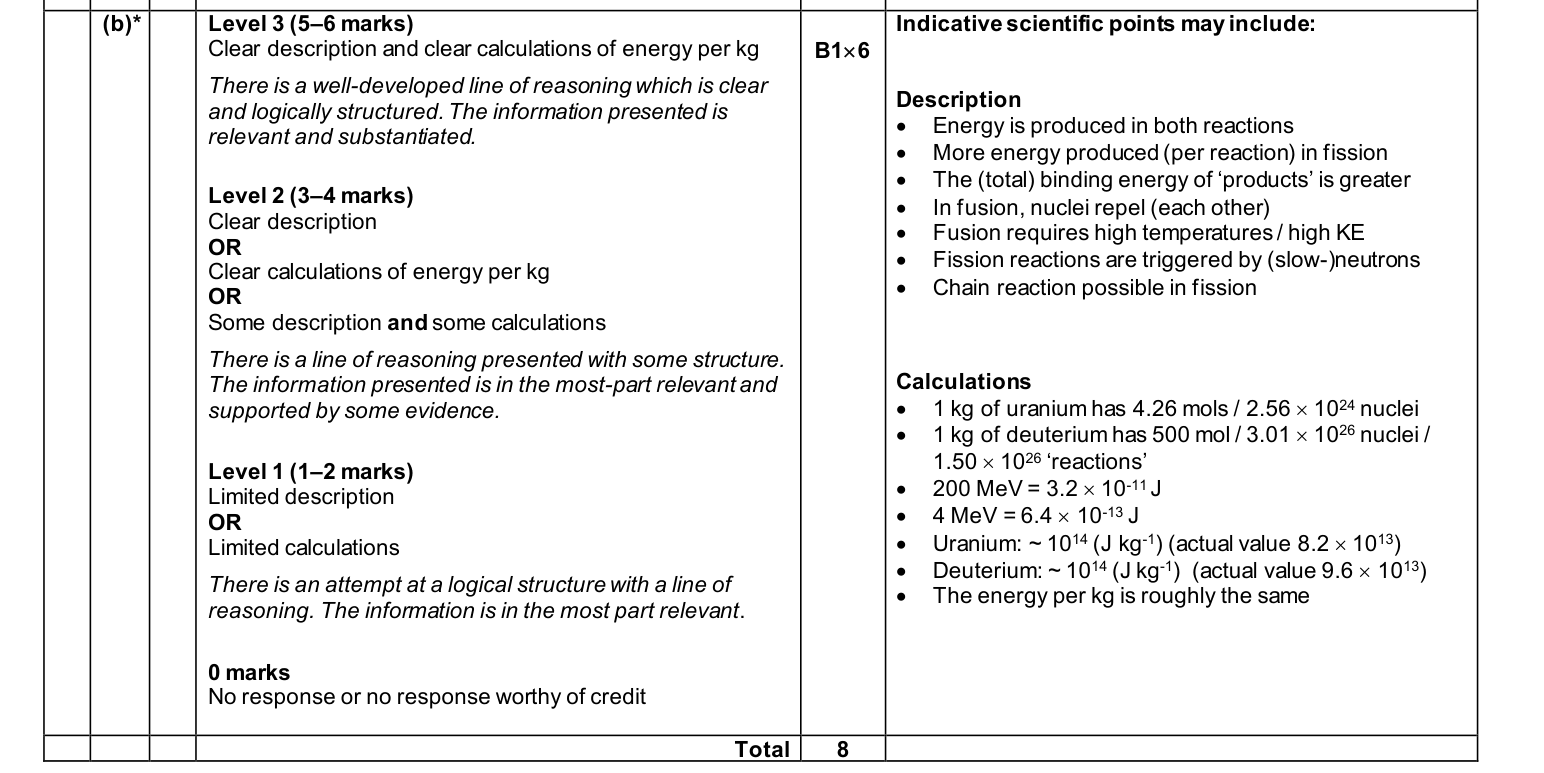
This is the second LoR question. This is designed to assess knowledge of the two nuclear energy reactions and to calculate energy release using some given data. The differences between the fission and fusion reactions were generally well answered although many candidates explained differences in design, operation and waste more than the reactions. The similarities were often not as clear however several candidates gave excellent responses in terms of binding energies and mass differences. Candidates were also expected to complete a calculation to show which produces more energy output per kilogram. This is challenging calculation to follow through fully, but most candidates were able to make some attempt, even if it was only converting MeV to J. Only better candidates realised 2 nuclei of deuterium were used for one fusion reaction. While a small number of candidates did correctly calculate the energy per kilogram, they tended to state that fusion produced more energy rather than a feeling that they are basically equivalent. As usual with LoR questions, a holistic approach is taken to the marking and candidates can access higher levels without necessarily reaching all the marking points. Even so, relatively few candidates were able to access Level 3, generally due to poor calculations and/or descriptions.
Skills: M0.2 Recognise and use expressions in decimal and standard form; M0.3 Use ratios, fractions and percentages; M1.4 Make order of magnitude calculations
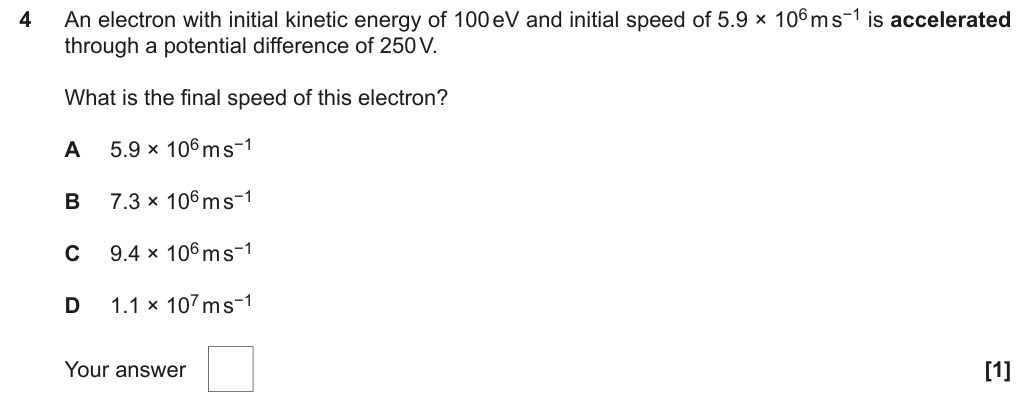
D
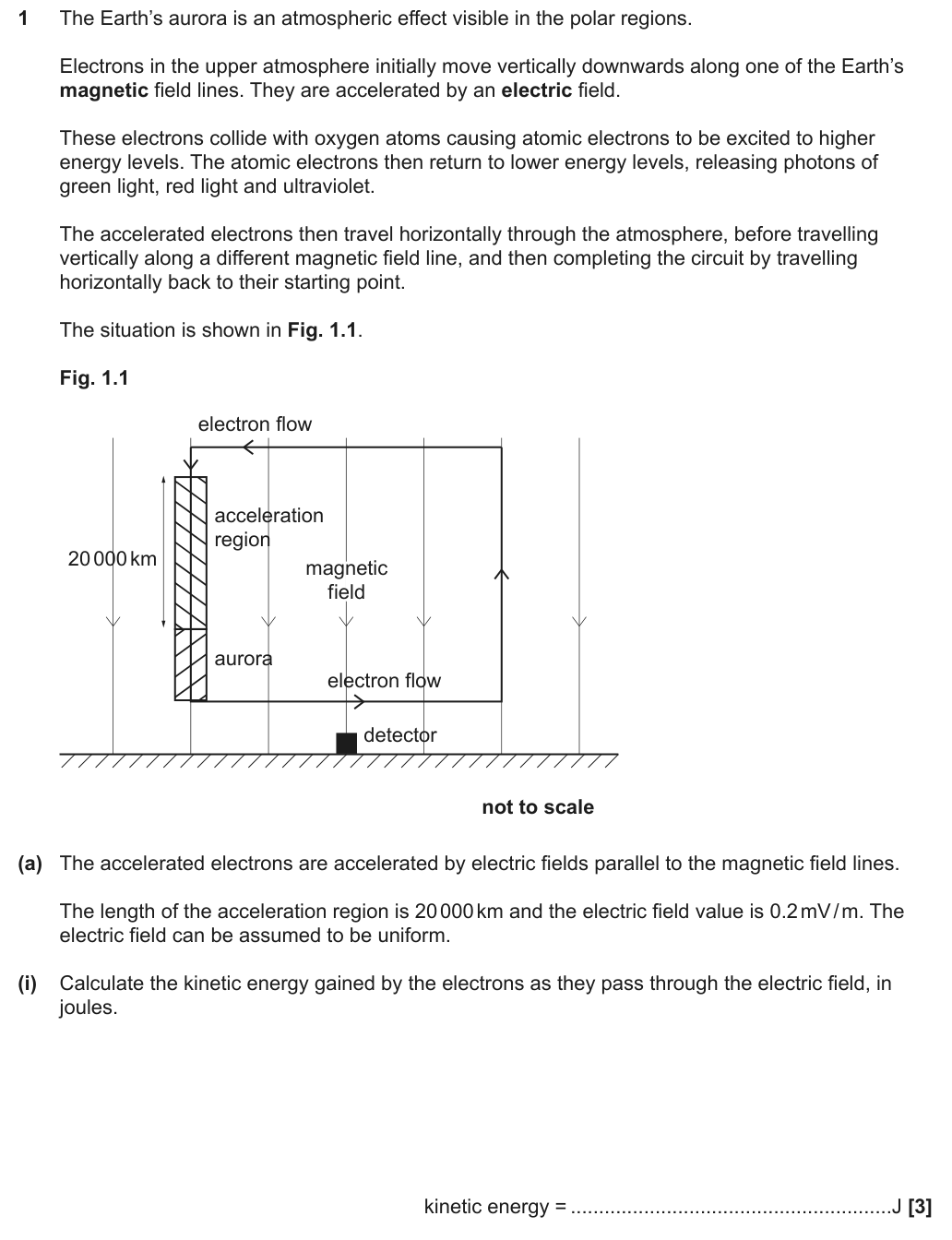
At the diametric end, Questions 4 and 14, were more challenging, and accessible only to the top-end candidates. Question 4 is all about two key ideas: KE = ½ mv2 and energy gained by the electron = Ve.
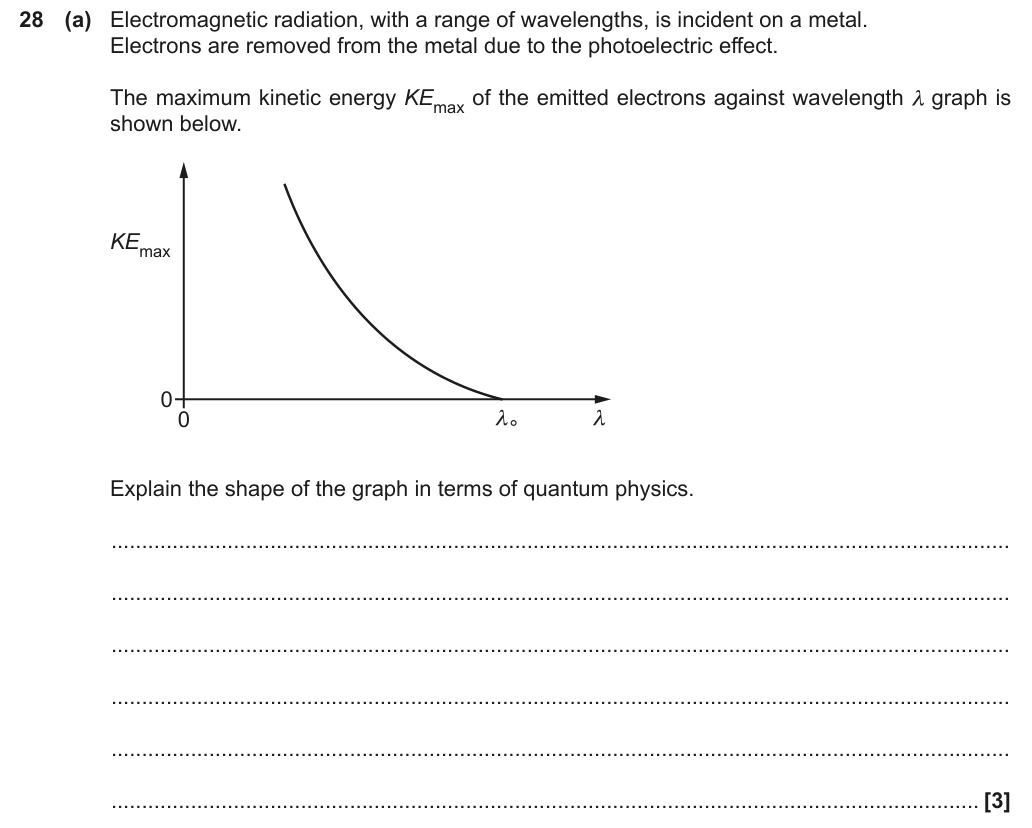
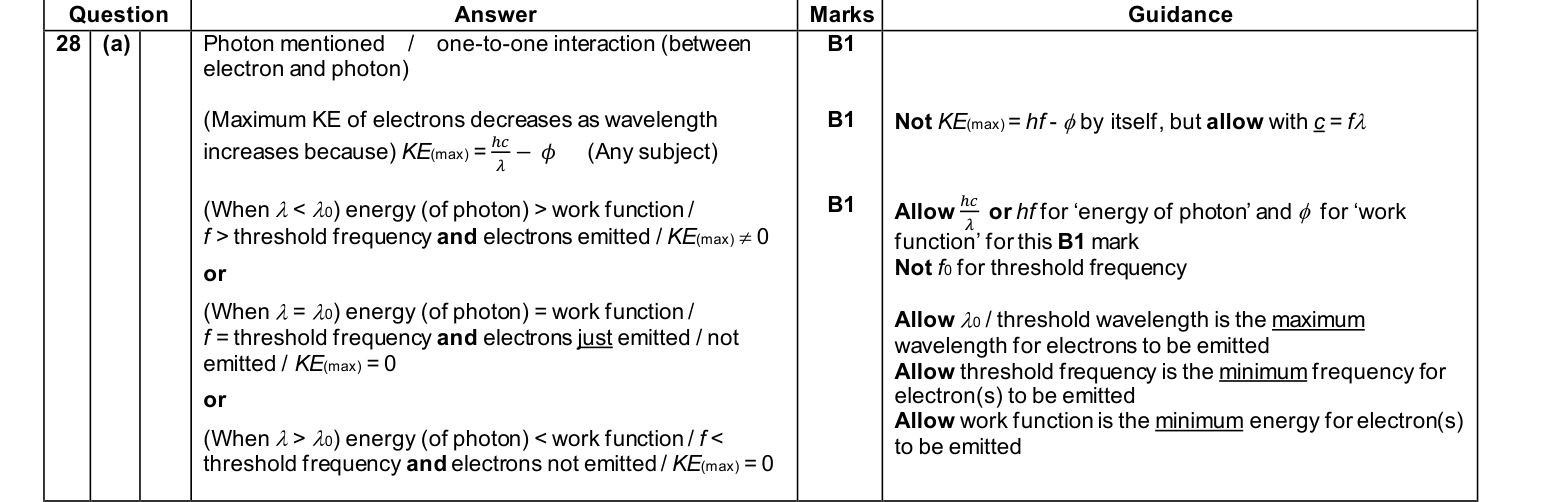
Questions 22b and 23bi • showed poor recall of prefixes, e.g. nano (n) in Question 28b • did not underline (or circle) key data and terms in the questions, notably in the MCQs. Most of the candidates finished the paper in the allotted time, with about 1 in 10 omitting the last Question 28bii. For example, in Question 28a, it was important to understand that photoemission cannot take place when the wavelength λ of the incident electromagnetic radiation is greater than λ0 because the energy of each photon is less than the work function of the metal, or the frequency of the incident radiation is less than the threshold frequency. Misconception Question 28bii The most frequent error here was to divide the power of the laser beam by 1.60 × 10⁻¹⁹ J instead of the energy of a single photon 4.06 × 10⁻¹⁹ J.
Skills: M3.1 Translate information between graphical, numerical and algebraic forms
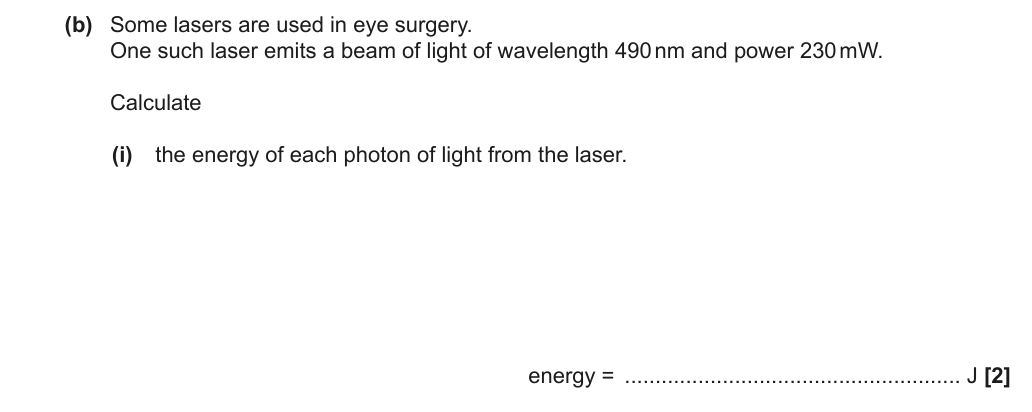
Questions 22b and 23bi • showed poor recall of prefixes, e.g. nano (n) in Question 28b • did not underline (or circle) key data and terms in the questions, notably in the MCQs. Most of the candidates finished the paper in the allotted time, with about 1 in 10 omitting the last Question 28bii. For example, in Question 28a, it was important to understand that photoemission cannot take place when the wavelength λ of the incident electromagnetic radiation is greater than λ0 because the energy of each photon is less than the work function of the metal, or the frequency of the incident radiation is less than the threshold frequency. Misconception Question 28bii The most frequent error here was to divide the power of the laser beam by 1.60 × 10⁻¹⁹ J instead of the energy of a single photon 4.06 × 10⁻¹⁹ J.
Questions 22b and 23bi • showed poor recall of prefixes, e.g. nano (n) in Question 28b • did not underline (or circle) key data and terms in the questions, notably in the MCQs. Most of the candidates finished the paper in the allotted time, with about 1 in 10 omitting the last Question 28bii. For example, in Question 28a, it was important to understand that photoemission cannot take place when the wavelength λ of the incident electromagnetic radiation is greater than λ0 because the energy of each photon is less than the work function of the metal, or the frequency of the incident radiation is less than the threshold frequency. Misconception Question 28bii The most frequent error here was to divide the power of the laser beam by 1.60 × 10⁻¹⁹ J instead of the energy of a single photon 4.06 × 10⁻¹⁹ J.
Skills: M0.2 Recognise and use expressions in decimal and standard form; M2.3 Substitute numerical values into algebraic equations using appropriate units for physical quantities
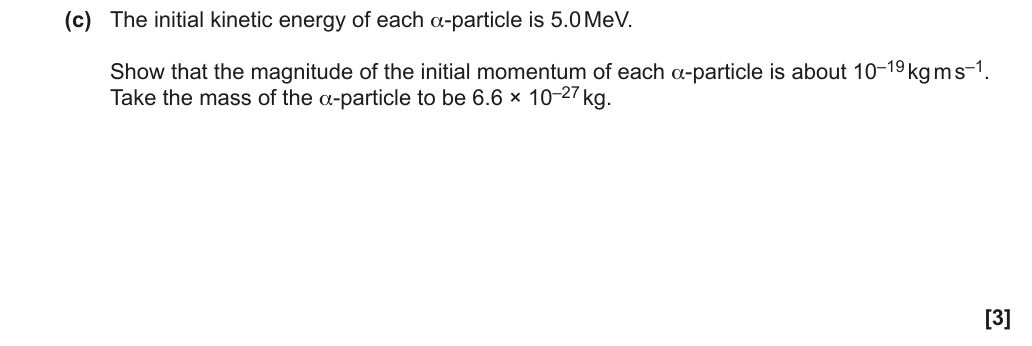
Since this paper is synoptic, candidates need to be able to apply their knowledge and understanding in unfamiliar contexts in order to gain high marks, To do well in this paper, candidates must be able to: • perform and layout calculations logically, showing clear working (such as Question 6c) • produce concise but accurate responses to questions which involve extended writing (such as question 1b) • craft clearly structured and well-reasoned arguments to the Level of Response Questions (3b and 5d) • process and interpret data from an experiment to reach conclusions (Question 2). Question 6a The common errors here were: • not realising that, for the particle to be deflected through a smaller angle, it needed to be travelling further away from N • not labelling the final angle of 30° • not adding arrows to show the direction of travel • drawing a path that continued bending beyond the stated 30° (usually ending up parallel to the original path). Question 6b The most common error here was to use incorrect values for the charges on the two ions. Question 6c This question provided an excellent opportunity for candidates to produce immaculate responses: identify the physics involved, select and write down the correct formula, do the necessary conversion (MeV to J), rearrange the formula, substitute correctly and then write the final response in standard form to a correct number of significant figures. Question 6d This was not an easy question but, even so, a good number of candidates did well.
Skills: M0.2 Recognise and use expressions in decimal and standard form; M0.5 Use calculators to find and use power, exponential and logarithmic functions; M2.2 Change the subject of an equation, including non-linear equations
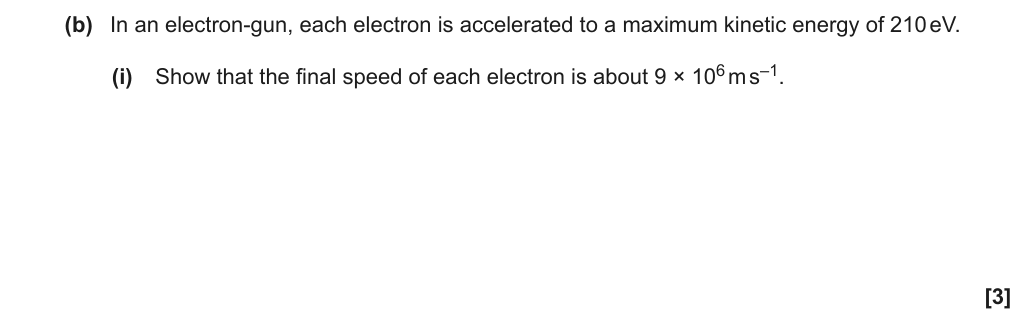
This was not a straight forward question but most candidates demonstrated excellent knowledge and application of physics here. The conversion of 210 eV was often done correctly. The K.E. equation was used successfully to show the final speed of the electrons to be about 8.6 × 10⁶ m s-1. The exemplar 11 below shows a model response from a top-end candidate. This exemplar shows a typical response produced by most of the candidates. The conversion from eV to J is very clear. The correct mass of the electron has been used to get the response of 8.6 × 10⁶ m s-1. It is good to report that very few candidates used 210 J to get the impossible response of 2.1 × 10¹⁶ m s-1.
Skills: M0.2 Recognise and use expressions in decimal and standard form; M2.2 Change the subject of an equation, including non-linear equations; M2.3 Substitute numerical values into algebraic equations using appropriate units for physical quantities
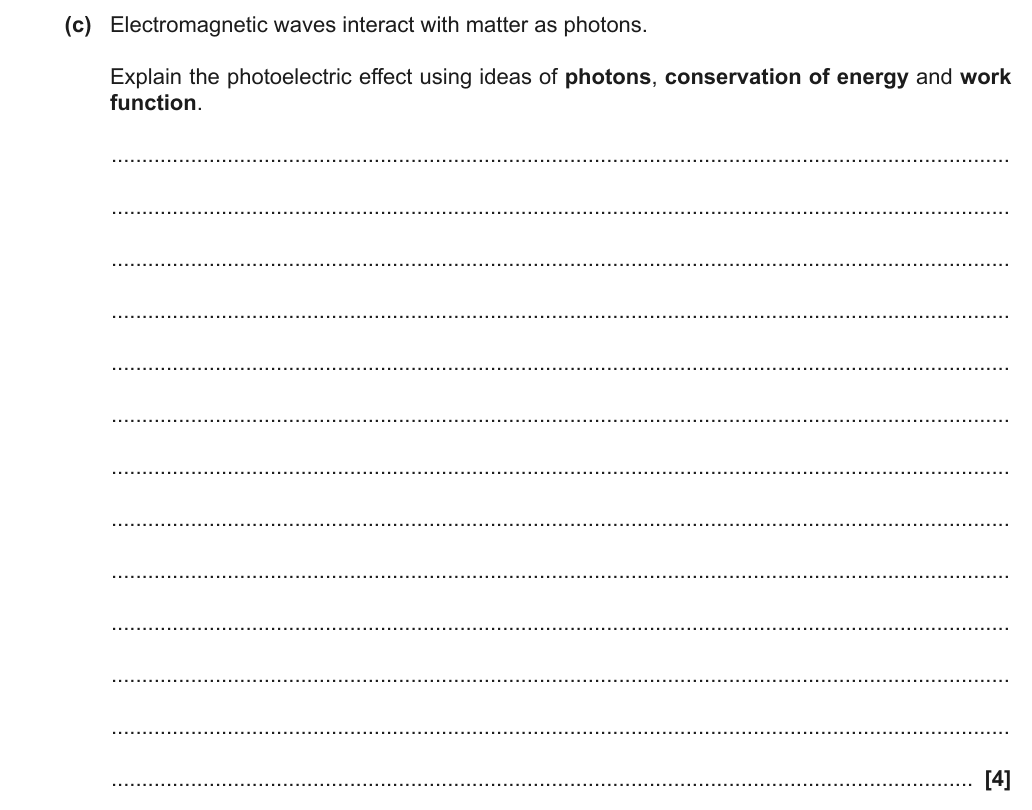
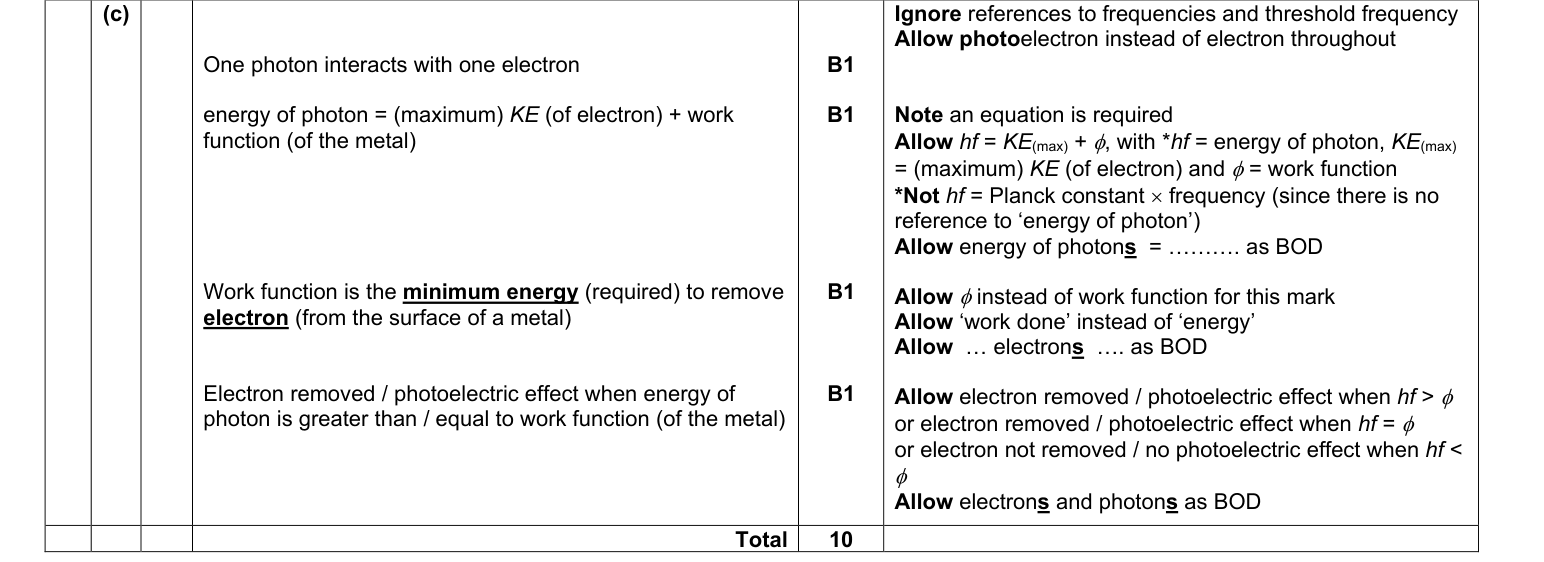
This question on the photoelectric effect provided excellent discrimination with most candidates demonstrating good knowledge of the photoelectric effect. The work function was well defined and the key idea of the one-to-one interaction between a photon and an electron was communicated well. Some candidates took work function and threshold frequency to be synonymous, and the Einstein’s photoelectric equation was quoted without much interpretation. Candidates are once again reminded that in descriptions it is important to define any terms used. Rather than just writing hf = φ + KEmax (which appears on the Data, Formulae and Relationship booklet), it would have would have been better to write energy of photon = work function of the metal + maximum kinetic energy of the electron as an alternative to annotating the formula with “where h is , f is , φ is, KEmax is ” Overall, the terms highlighted in the question helped candidates to provide focused responses. Many candidates continue to show knowledge of the quantum physics.
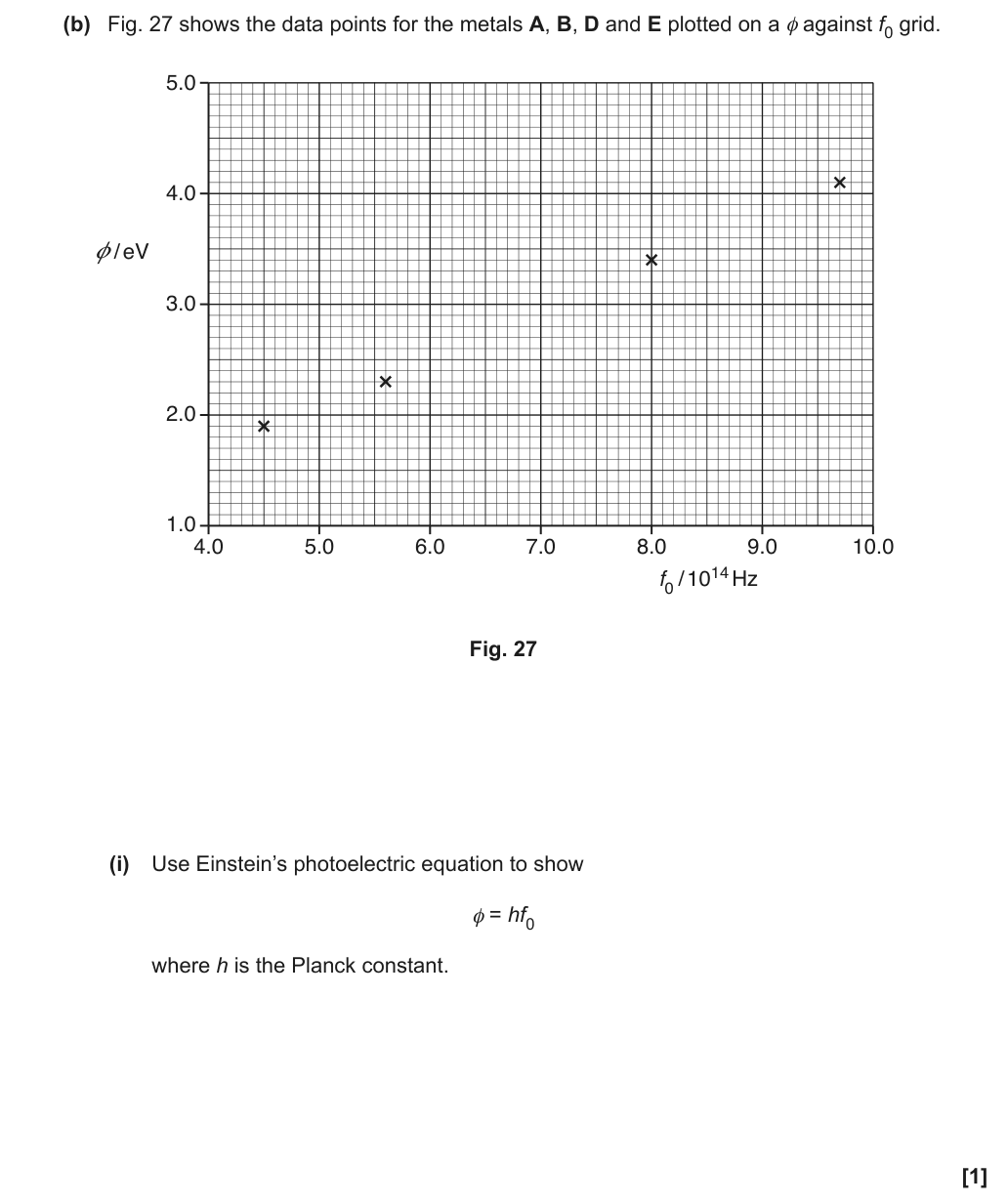
The majority of the candidates scored two marks on this question. Again, clear working assists candidates with appropriate units being included in intermediate stages of the calculation. Most candidates calculated the work function from the threshold frequency, their answer to the previous part. Some candidates correctly took a data point from the graph and substituted it into Einstein’s photoelectric equation which also gained credit. The candidate states the condition for the threshold frequency, indicates clearly the calculation of the work function in joule, before clearly demonstrating the conversion to electron volt so gained both marks.
Skills: M0.1 Recognise and make use of appropriate units in calculations; M2.3 Substitute numerical values into algebraic equations using appropriate units for physical quantities
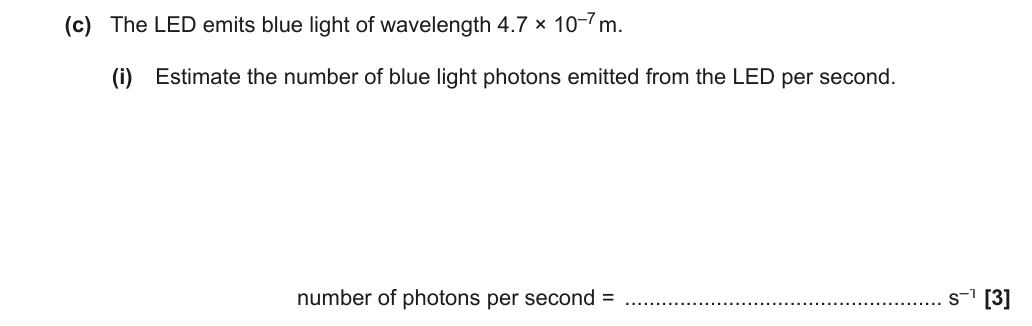
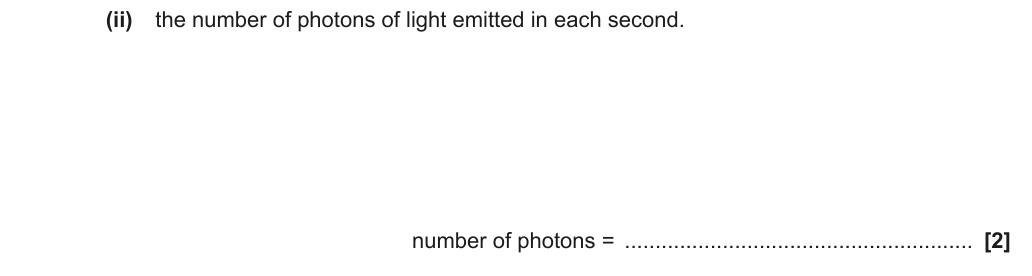
This question required knowledge of both power and energy of photons. It discriminated well with many of the top end candidates getting the correct of 5.9 × 10¹⁶ s-1. A significant number of candidates scored 1 mark for the energy of the photons. Using the power of 0.025 W in the final step of the calculation proved to be the main obstacle in this calculation. Alternative answers using the energy of a photon as 2.5 eV were allowed. This gave the rate of photons emission to be 4.0 × 10¹⁶ s-1.
Skills: M0.2 Recognise and use expressions in decimal and standard form; M2.3 Substitute numerical values into algebraic equations using appropriate units for physical quantities
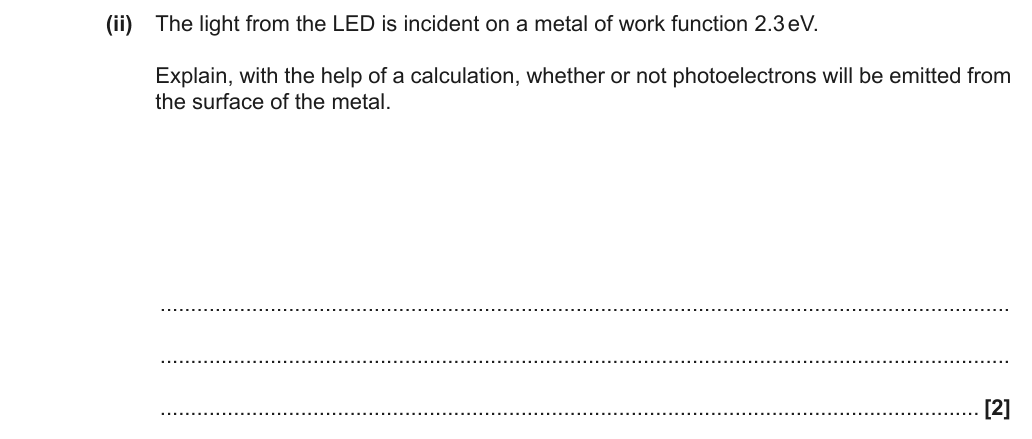
Most candidates showed excellent knowledge and understanding of electronvolts and the photoelectric equation. A variety of answers were accepted. The most common approach was to calculate the energy of the photon in eV, and then either show that this was greater than the work function of the metal or to calculate the kinetic energy of the emitted photoelectron. A lot of confidence in the topic of quantum physics was evident in the answers from the candidates. This is illustrated by exemplar 8 below from a middle-grade candidate. This exemplar shows the right blend of calculations and scientific text to support the response. Good command of quantum physics earned this candidate full marks.
Skills: M0.2 Recognise and use expressions in decimal and standard form
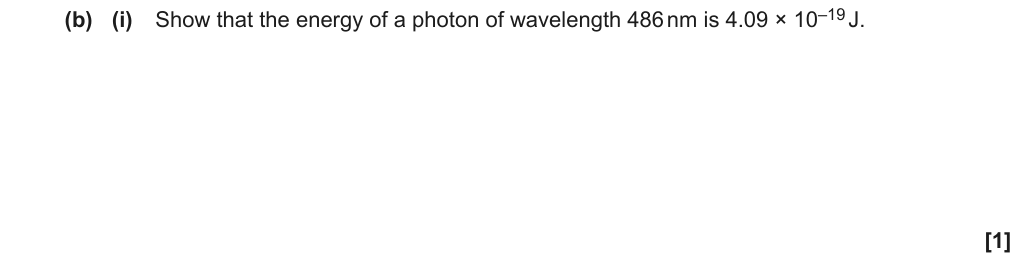
This question was successfully attempted by the majority of candidates. that’ question, an equation, full substitution and calculated response are all required. This includes inserting numerical values for the constants h and c.
Skills: M0.2 Recognise and use expressions in decimal and standard form; M2.3 Substitute numerical values into algebraic equations using appropriate units for physical quantities
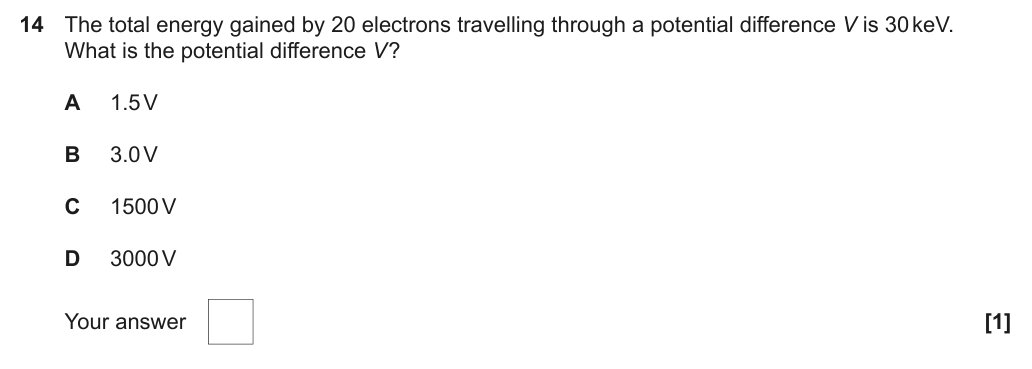
C
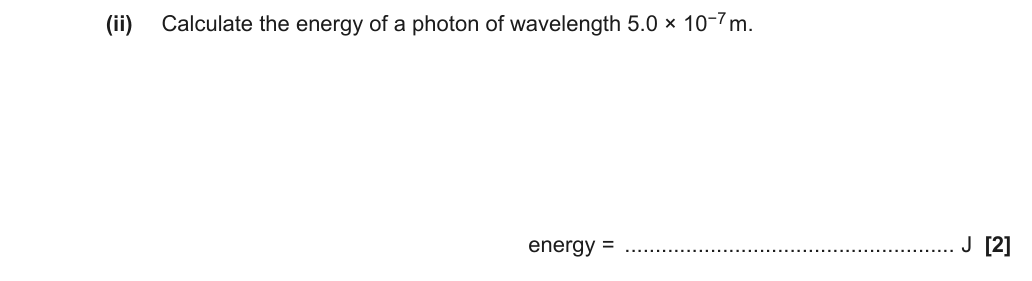
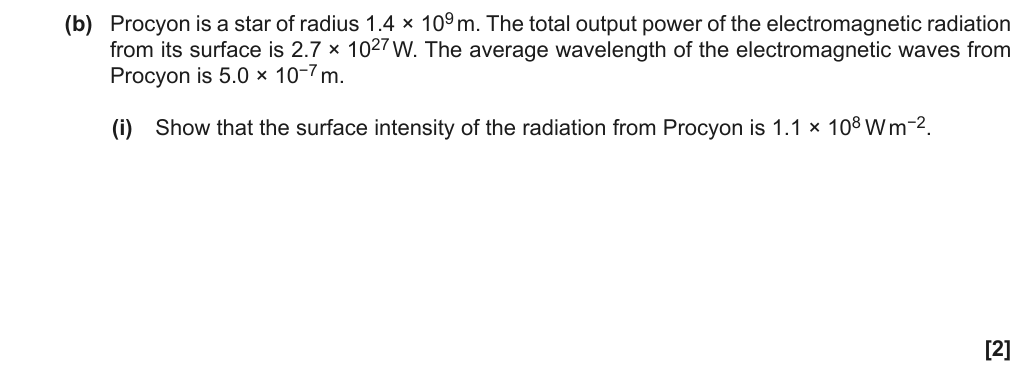
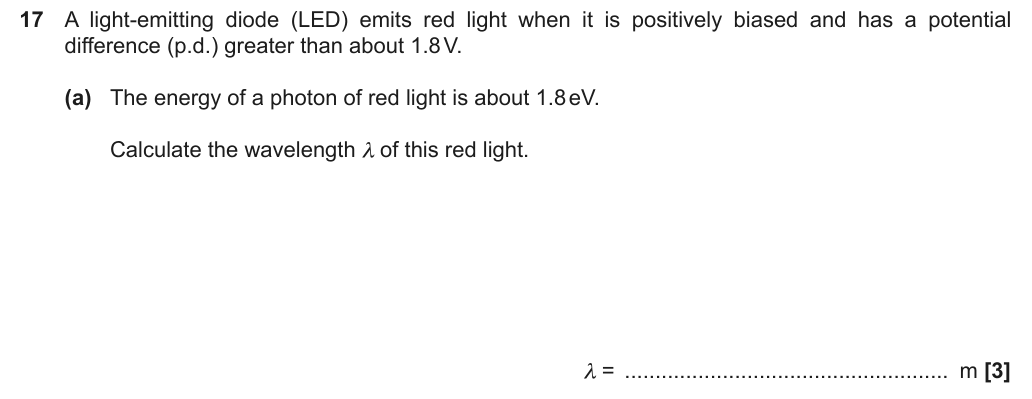
Most candidates were familiar with the equation for the energy of the photon. Answers were generally well-structured and calculations were undertaken without much error in either rearranging the equation or powers of ten. The answer to two significant figures was 4.0 × 10⁻¹⁹ J, as in the general rule with such answers, 4 × 10-19 J was acceptable without any significant figure penalty.
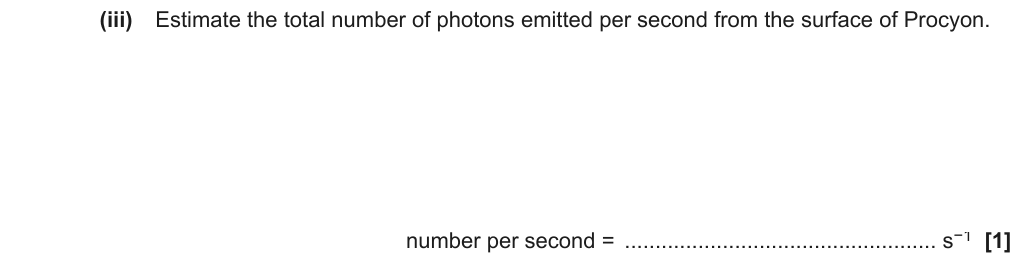
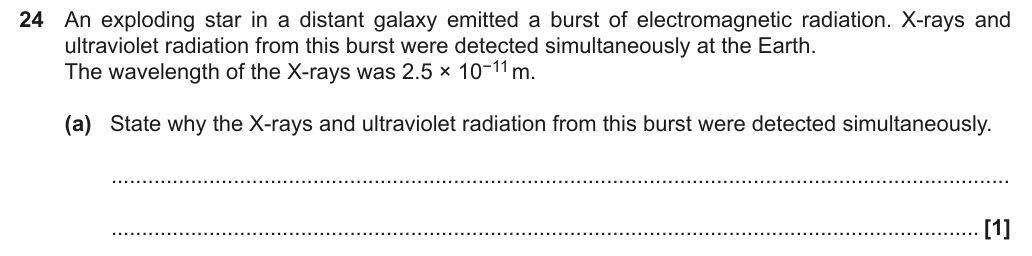
This was a successful end for the top-end candidates, who correctly divided the total output power of Procyon of 2.7 × 1027 W by the energy of each photon from (b)(ii). The two common errors were dividing the intensity by the photon energy and changing the photon energy from joule (J) to electron-volt (eV).
Skills: M0.2 Recognise and use expressions in decimal and standard form; M0.3 Use ratios, fractions and percentages
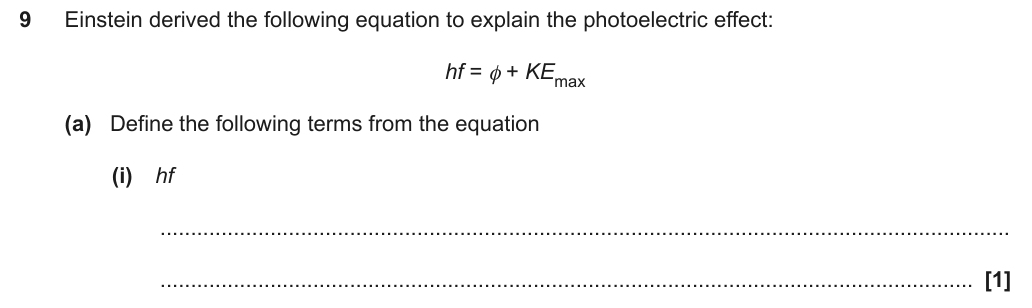
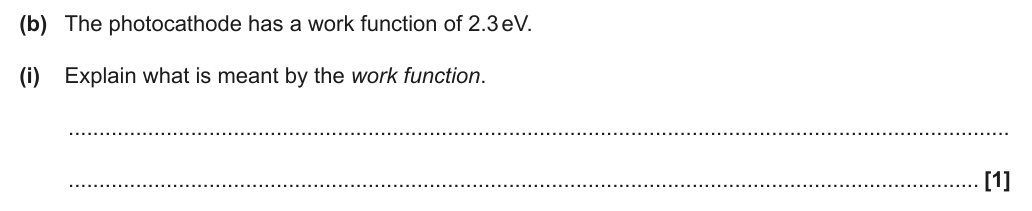
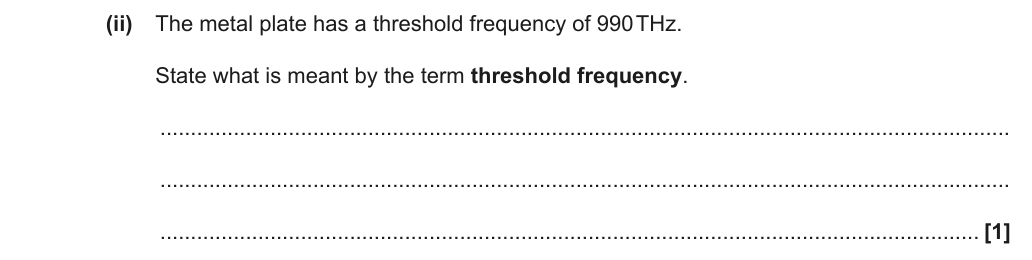
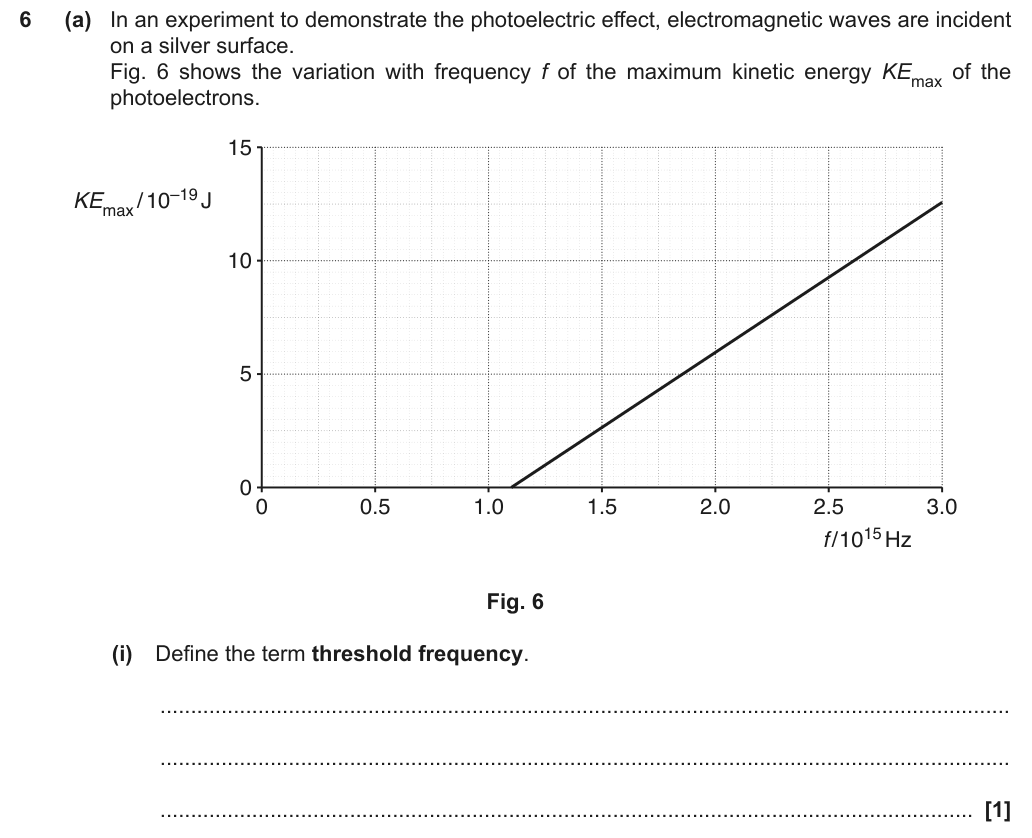
Many candidates simply defined the symbols as opposed to the term. It was expected that candidates would state that hf was the energy of a photon.
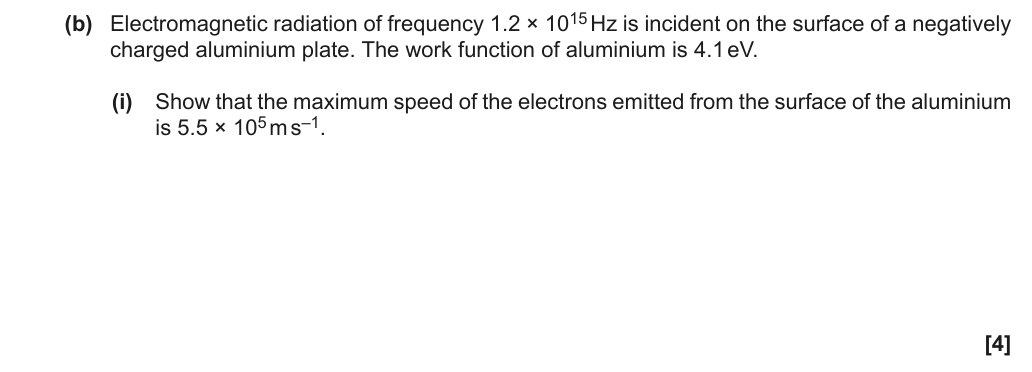
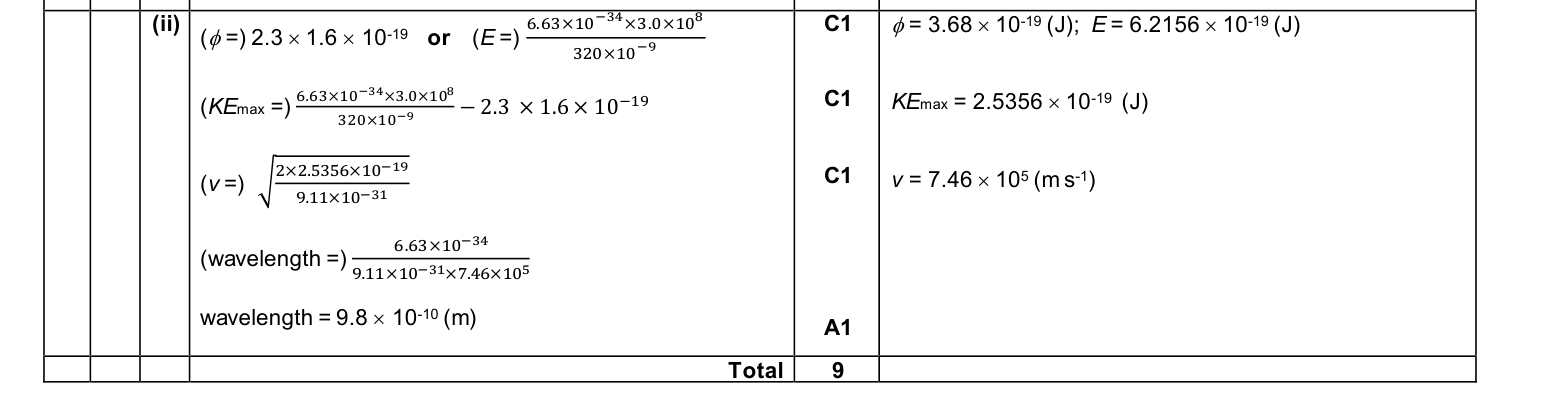
Good candidates clearly showed the individual steps in this calculation, e.g. the conversion of electron- volt to joule for the work function, the energy of the photon calculated. It was important that candidates demonstrated that they had substituted the mass of the electron from the data booklet and correctly evaluated the square root term. Examiners expected to see 5.536 x 10⁵ (m s-1) for full credit so that it was clear that candidates had correctly calculated the powers of ten. In line 3 of the candidate’s working, there is a rearrangement of the equation given at the beginning of the question. There is then clear substitution of the energy of a photon which was calculated in line 1 and the work function which had been converted from electron volt to joule in line 2 to give a value for the maximum kinetic energy of the electrons. This scores three marks. In the final part the candidate correctly shows the rearrangement of the kinetic energy equation to give v as the subject and then correctly substitutes in the values including the mass of the electron from the data and formulae sheet. The final answer is given as 5.527 x 10⁵ which is then shown to be approximately equal to 5.5 x 10⁵ (ms- 1). This last part is essential in these show type questions.
Skills: M0.2 Recognise and use expressions in decimal and standard form; M2.2 Change the subject of an equation, including non-linear equations; M2.3 Substitute numerical values into algebraic equations using appropriate units for physical quantities
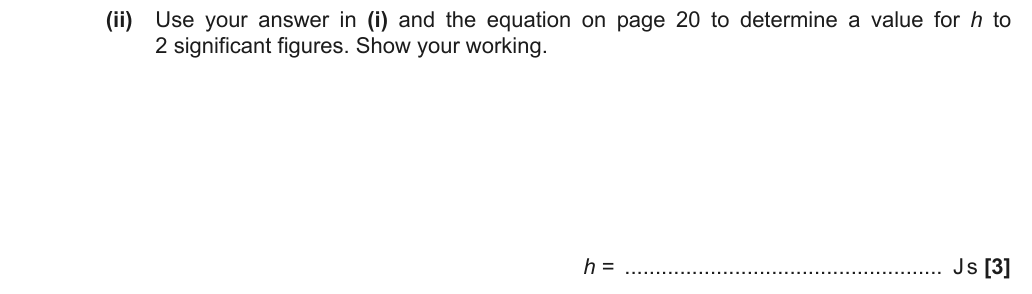
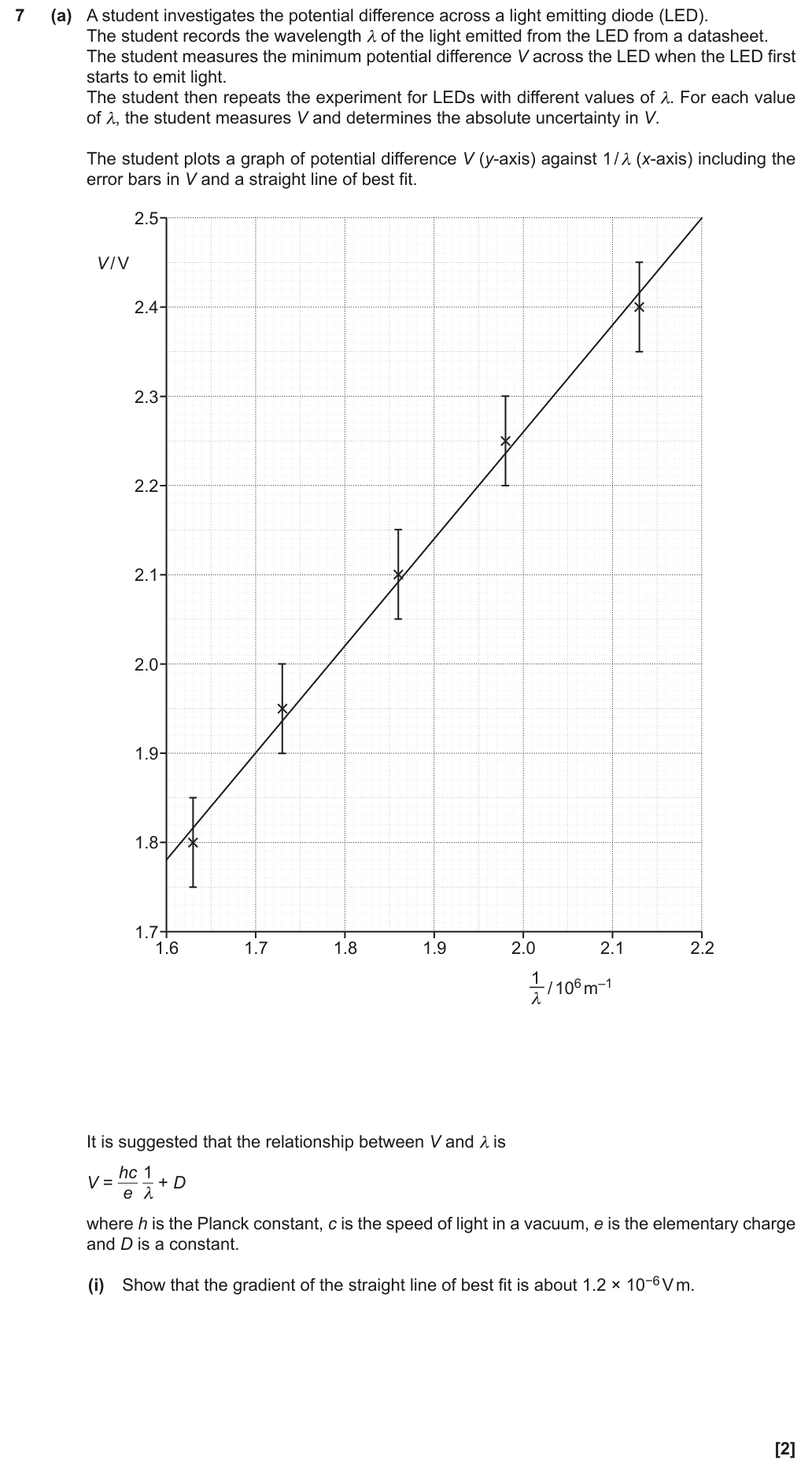
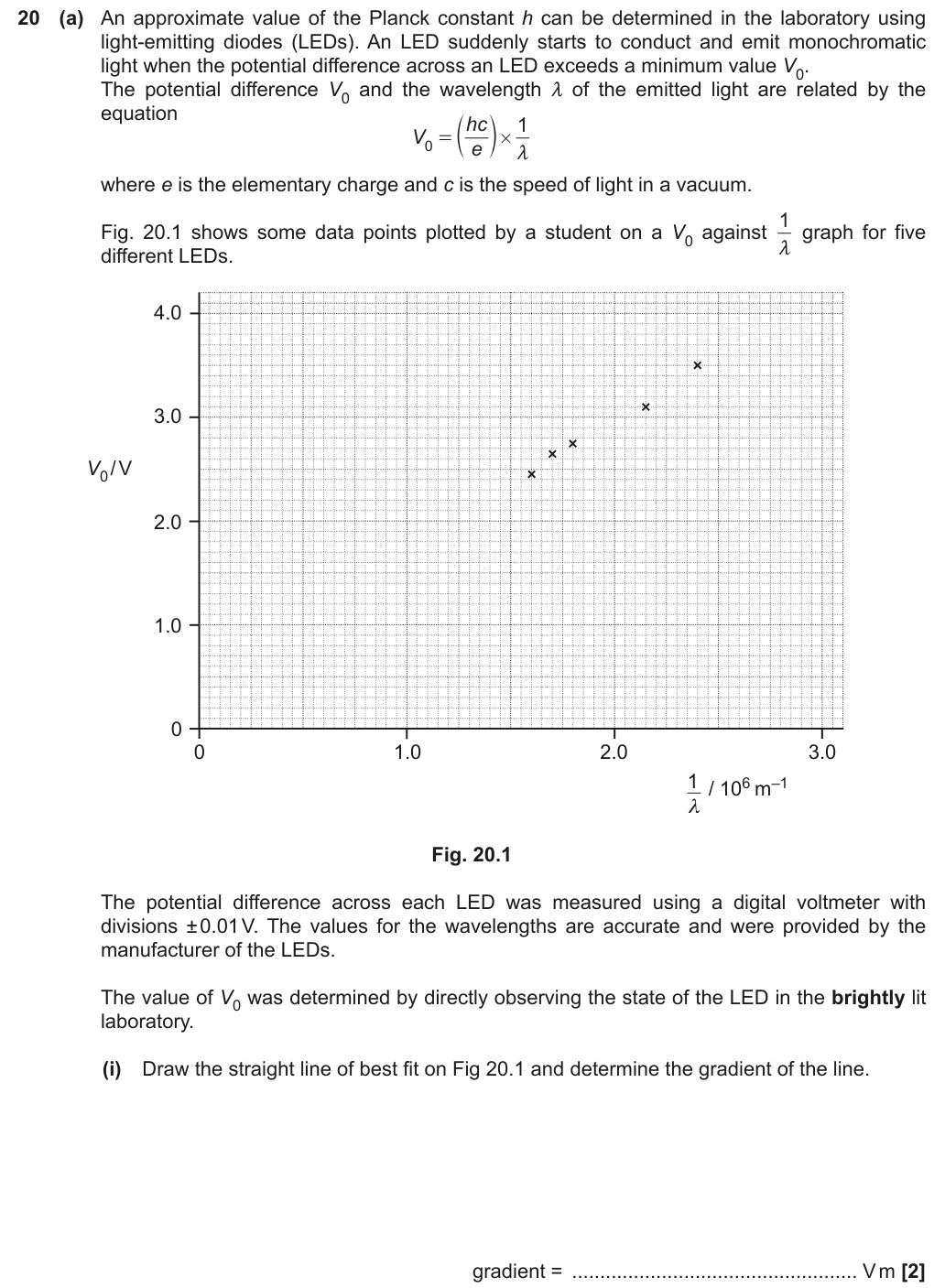
This was not an easy question, but a good number of candidates did exceptionally well on this practical- style question. The first mark was for correctly identifying ‘gradient = hc/e’, and subsequent marks were for correct substitution and writing the final to 2 significant figures (SF). A significant number of candidates quoted their correct h value to more than the required SF. Many candidates were scoring full marks through the error carried forward rule. This exemplar illustrates how full marks can always be scored from error carried forward (ECF) rule. The gradient of 1.08 × 10⁻⁵ was well outside the range allowed. This had already been penalised in the earlier part 20(b)(i). This erroneous value has been used correctly in this section. The answer is nowhere close to the Planck constant, but this is irrelevant – the physics has been applied correctly here, the answer is correctly written with 2 SF, so well deserved 3 marks for this E-grade candidate.
Skills: M1.1 Use an appropriate number of significant figures; M2.2 Change the subject of an equation, including non-linear equations; M3.3 Understand that y = mx + c represents a linear relationship; PAG6 Investigating quantum effects
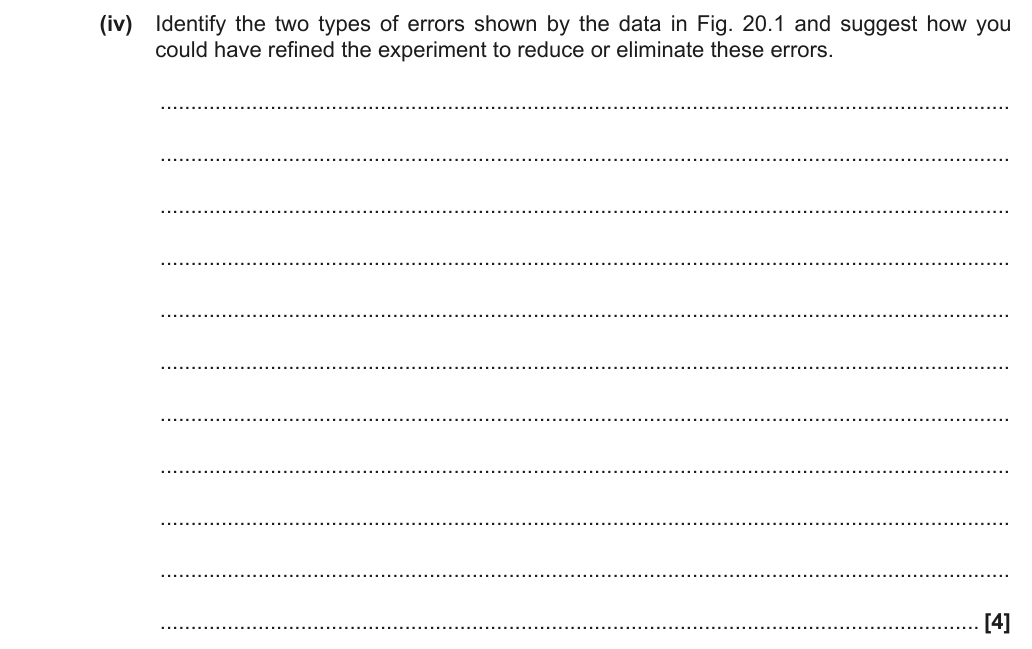
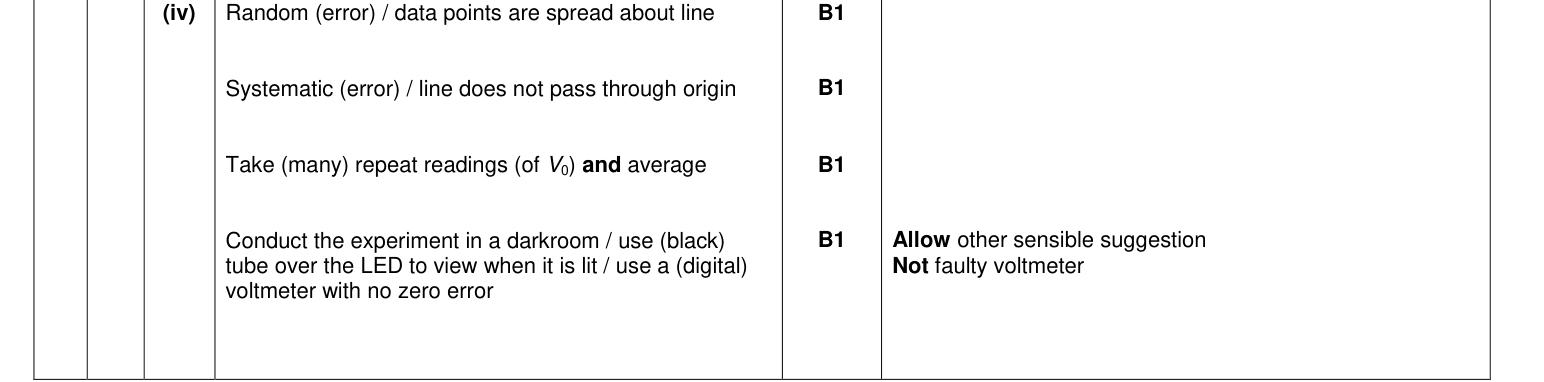
The two errors in this experiment were systematic and random errors (see learning outcome 2.2.1a in the H556 specification). Many candidates did not name these two errors, instead focussing on nebulous terms such as human error, equipment error, etc. Appropriate descriptions of these two errors were allowed. Only a small number of candidates appreciated that taking multiple readings of V0 and averaging will lead to reduction in the random error. A pleasing number of candidates realised that the main reason for the non-zero intercept (systematic error) was the ambient light and switching off the lights would improve matters. Sorting out the zero-error on the voltmeter was an acceptable alternative. Descriptions about using ‘precise instruments’ for measuring potential difference or light intensity often led to no credit.
Skills: PAG6 Investigating quantum effects
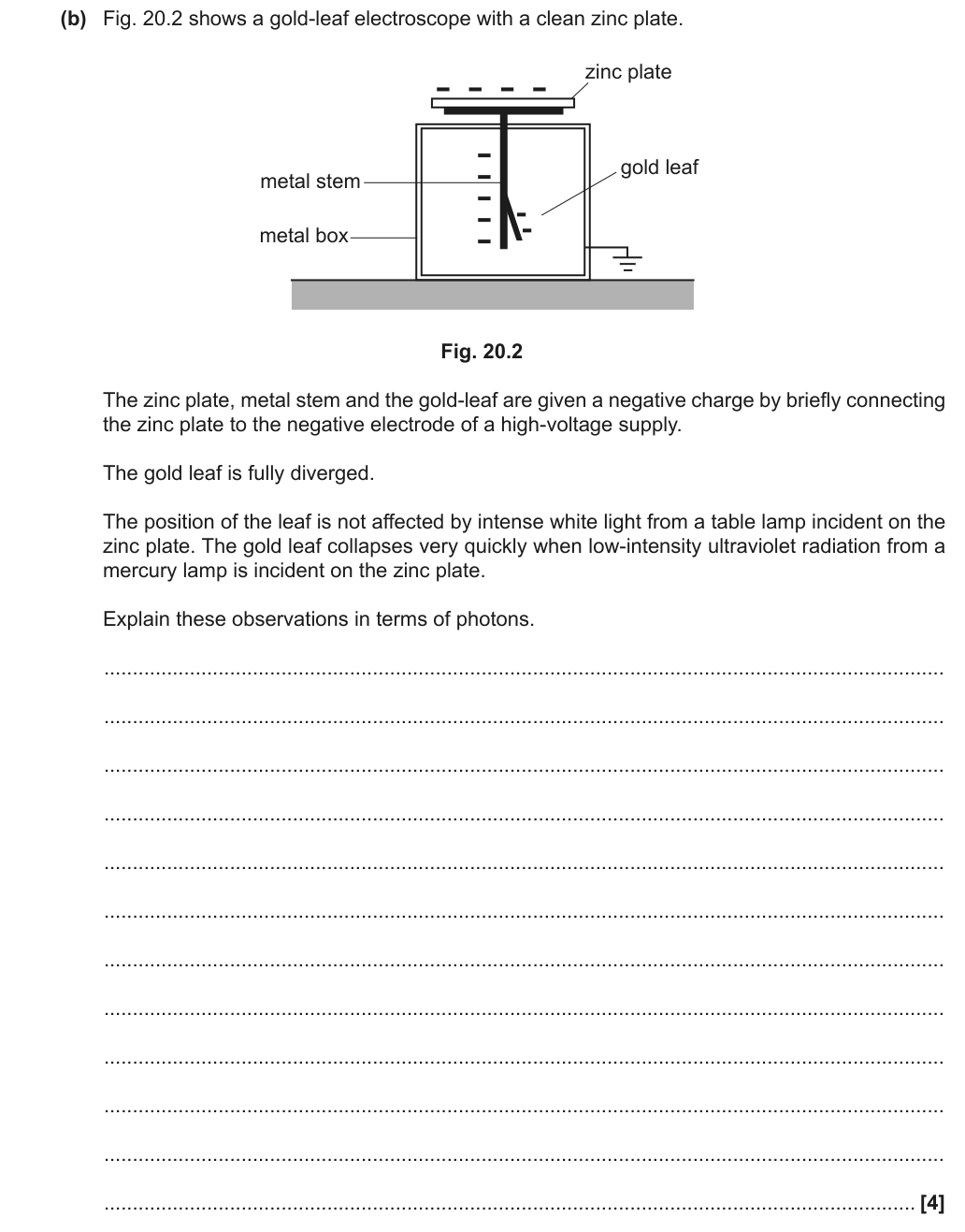
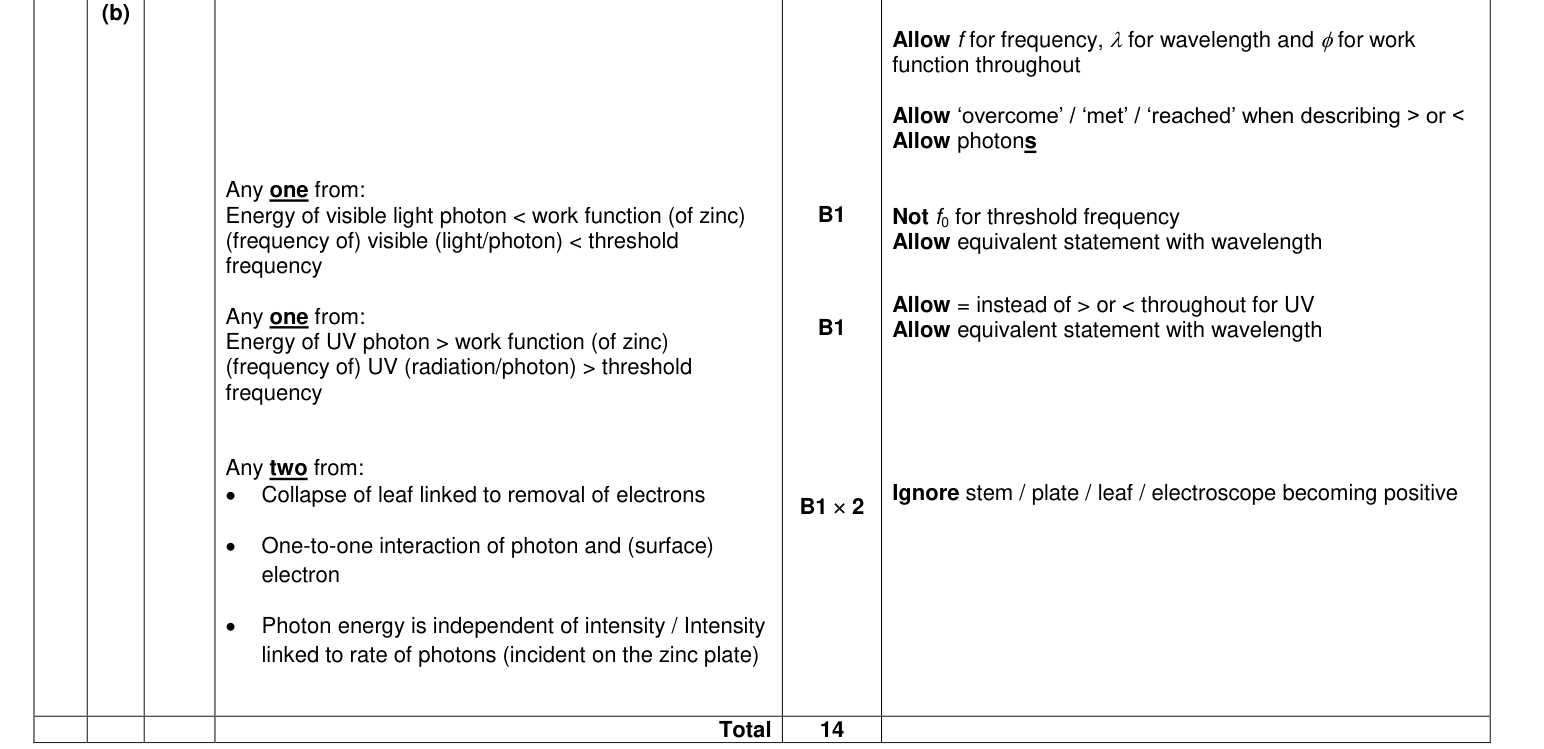
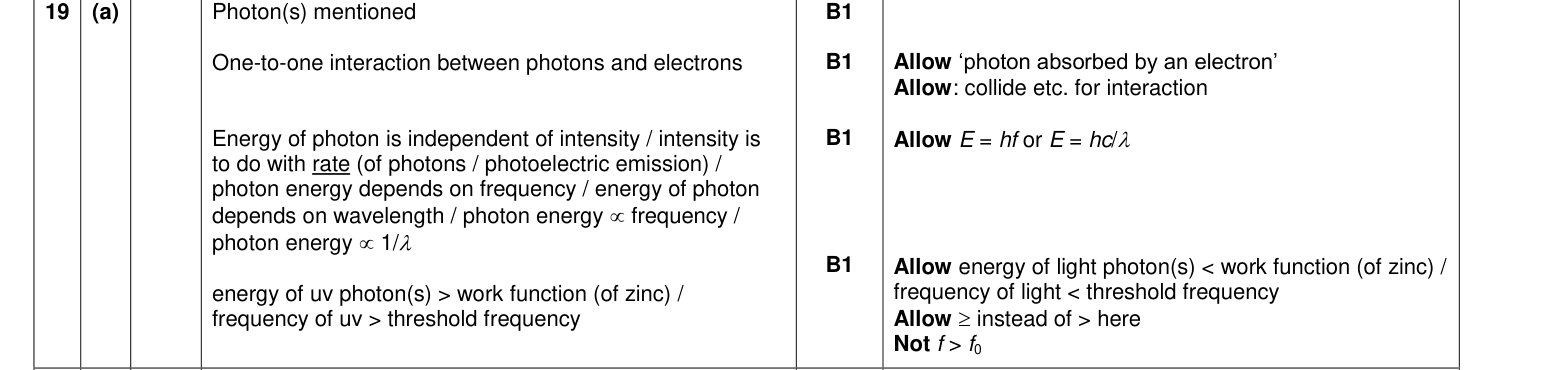
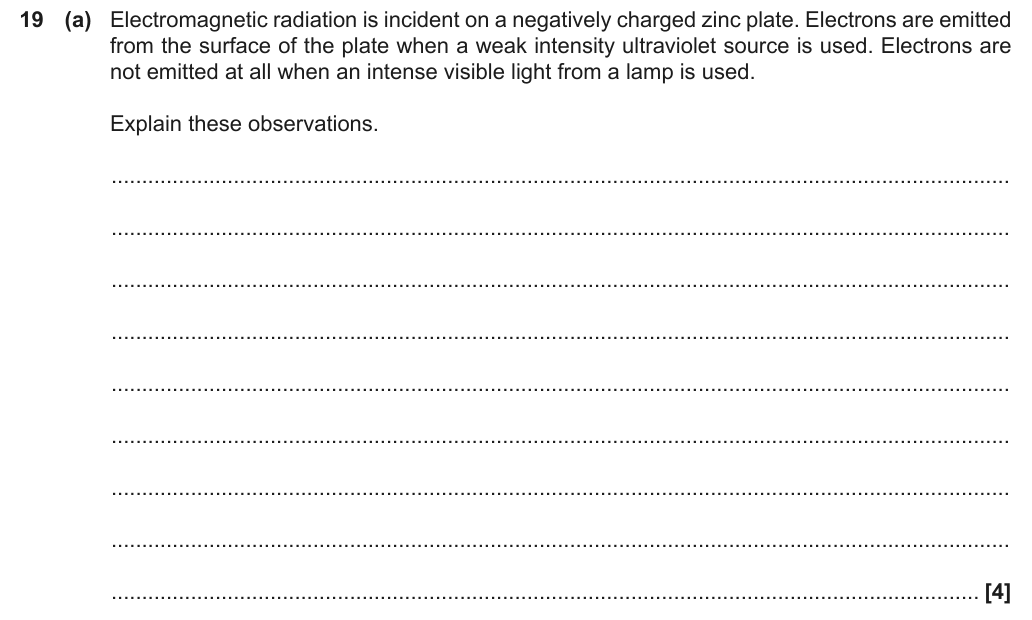
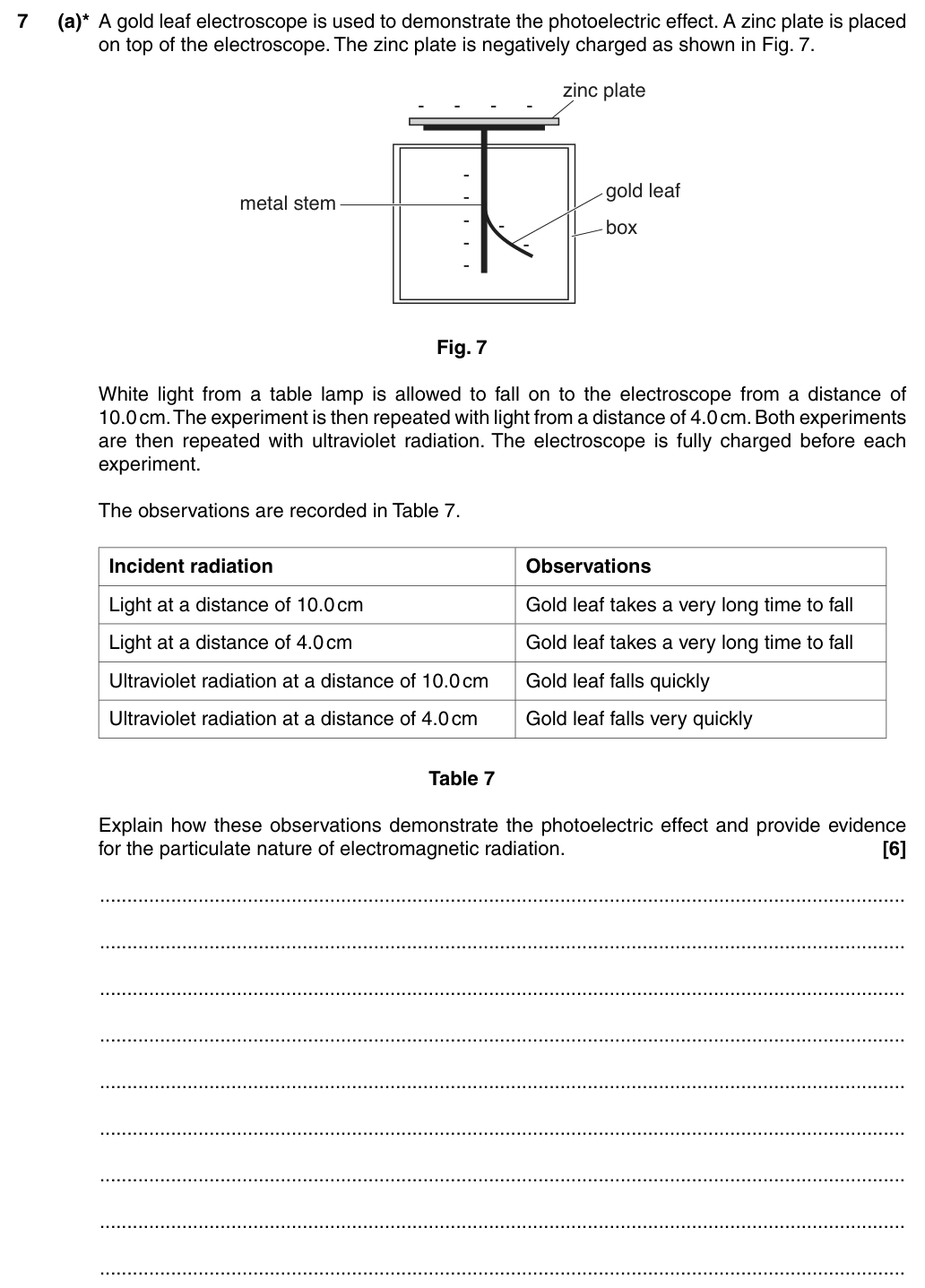
This question on the photoelectric effect was enthusiastically answered by candidates. Good discrimination enabled many of the top-end candidates to score full marks. The question was scrutinised well with many candidates explaining why the leaf fell with the ultraviolet radiation. The one-to-one interaction between UV photons and surface electrons was nicely embedded in the descriptions. Some of the candidates would have benefitted by writing their answers in bullet points. There were a few missed opportunities and misconceptions, these are outlined below: • Photons were emitted from the zinc plate (rather than electrons) • Threshold frequency and work function were properties of the photons or electrons (and not zinc) • Threshold frequency and work function were synonymous • Intensity was linked to number of photons (rather than to the rate of photons) • Referring to ‘not enough energy’ instead of work function of the metal in the description
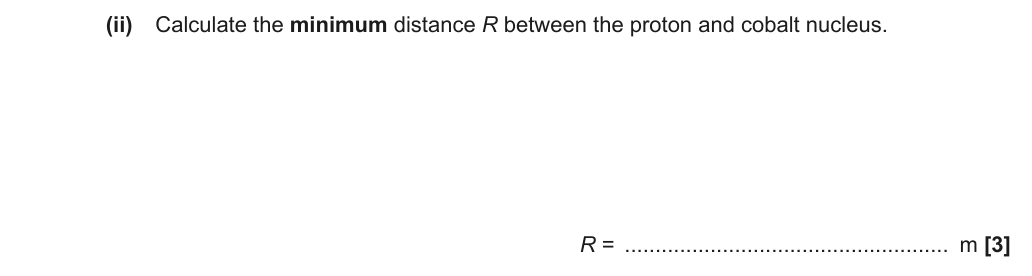
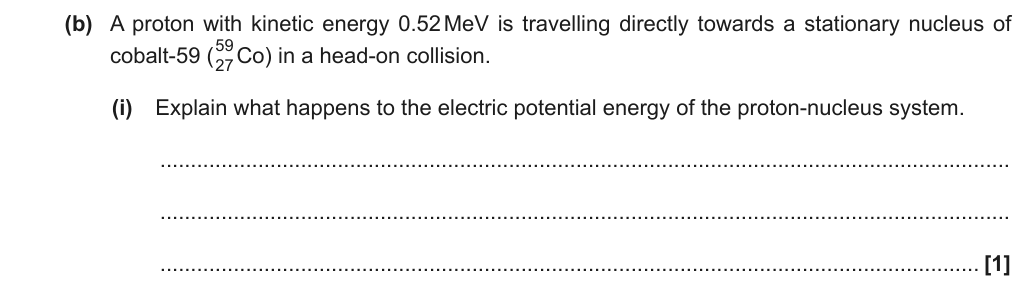
The above question on electric potential energy provided excellent discrimination with middle and upper quartile candidates showing how to produce immaculate answers – identify the physics, write down the correct physical equation, do any necessary conversions (e.g. MeV to J), rearrange the equation, substitute correctly and then write the final answer in standard form to the correct number of significant figures. About a third of the candidates scored full marks. Some of the missed opportunities or errors were: • Using an incorrect equation with the distance squared • Not correctly converting the kinetic energy 0.52 MeV into joule (J) • Using the equation r = r0A1/3 for the mean radius of a nucleus to determine the minimum distance
Skills: M0.2 Recognise and use expressions in decimal and standard form; M2.2 Change the subject of an equation, including non-linear equations; M2.3 Substitute numerical values into algebraic equations using appropriate units for physical quantities
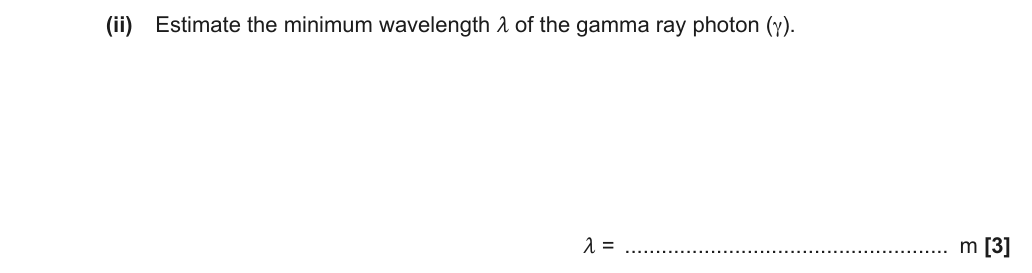
Skills: M0.2 Recognise and use expressions in decimal and standard form; M2.2 Change the subject of an equation, including non-linear equations; M2.3 Substitute numerical values into algebraic equations using appropriate units for physical quantities
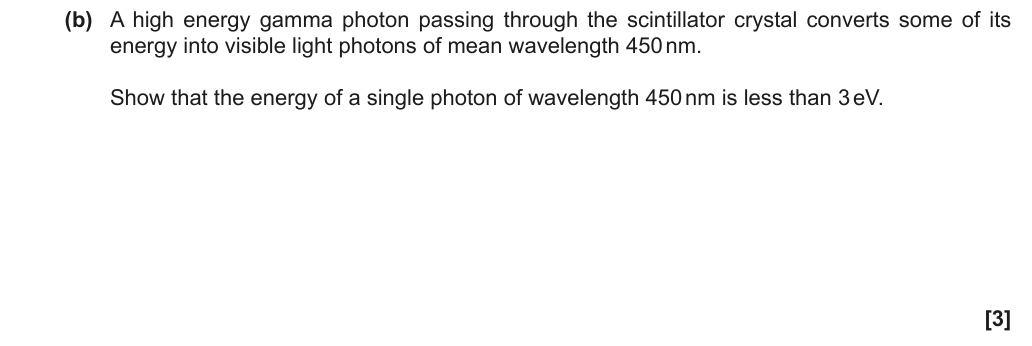
Exemplar 10 Question 6 (b) Question 6 (c) (i) Question 6 (c) (ii) Almost all of the candidates attempted this last section of the paper with some success.
Skills: M0.1 Recognise and make use of appropriate units in calculations; M0.2 Recognise and use expressions in decimal and standard form; M2.3 Substitute numerical values into algebraic equations using appropriate units for physical quantities
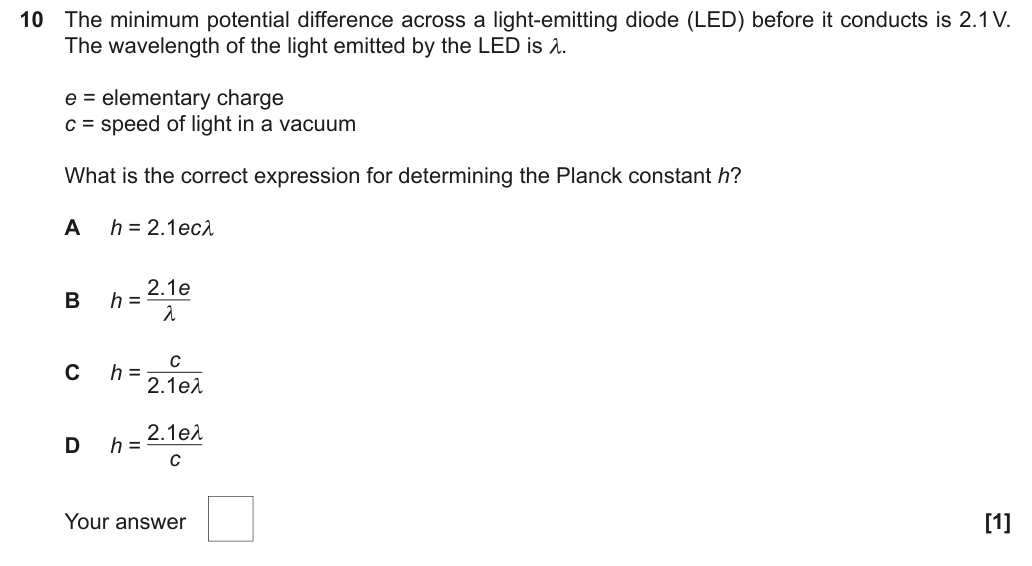
D
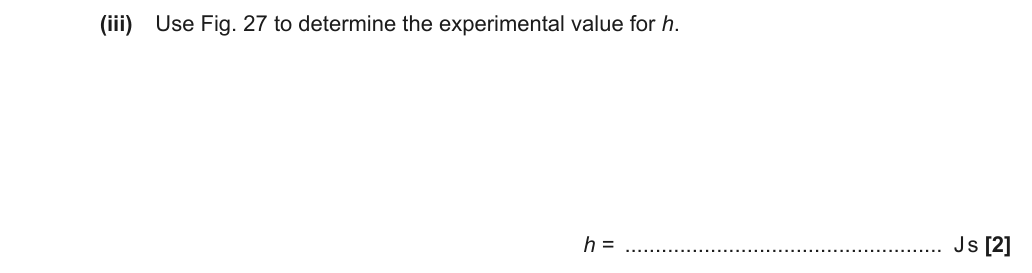
Skills: M0.1 Recognise and make use of appropriate units in calculations; M1.1 Use an appropriate number of significant figures; M3.4 Determine the slope and intercept of a linear graph
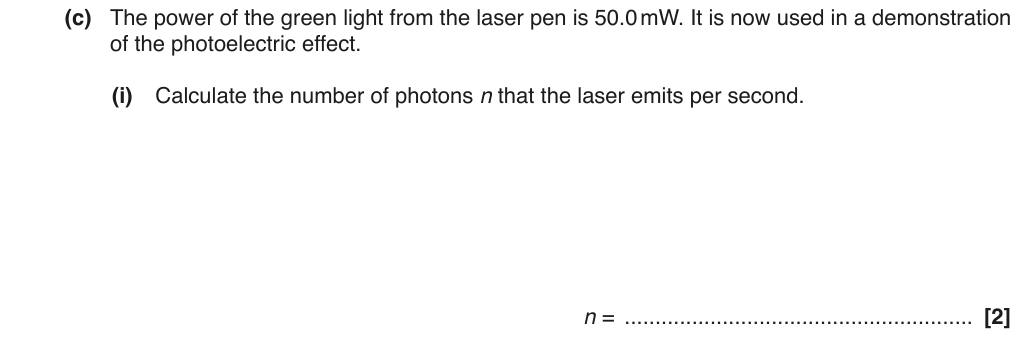
Skills: M0.2 Recognise and use expressions in decimal and standard form; M2.3 Substitute numerical values into algebraic equations using appropriate units for physical quantities
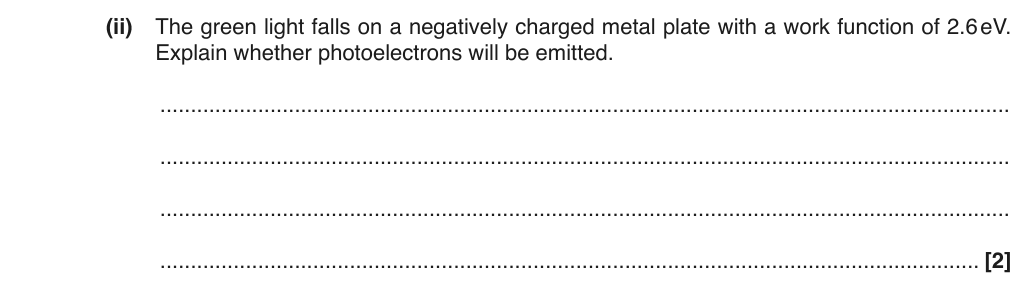
Skills: M0.1 Recognise and make use of appropriate units in calculations
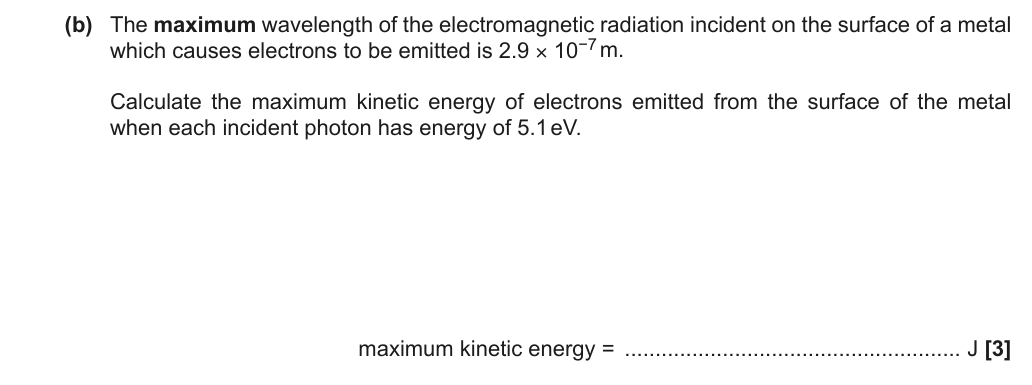
Skills: M0.1 Recognise and make use of appropriate units in calculations; M0.2 Recognise and use expressions in decimal and standard form; M2.3 Substitute numerical values into algebraic equations using appropriate units for physical quantities
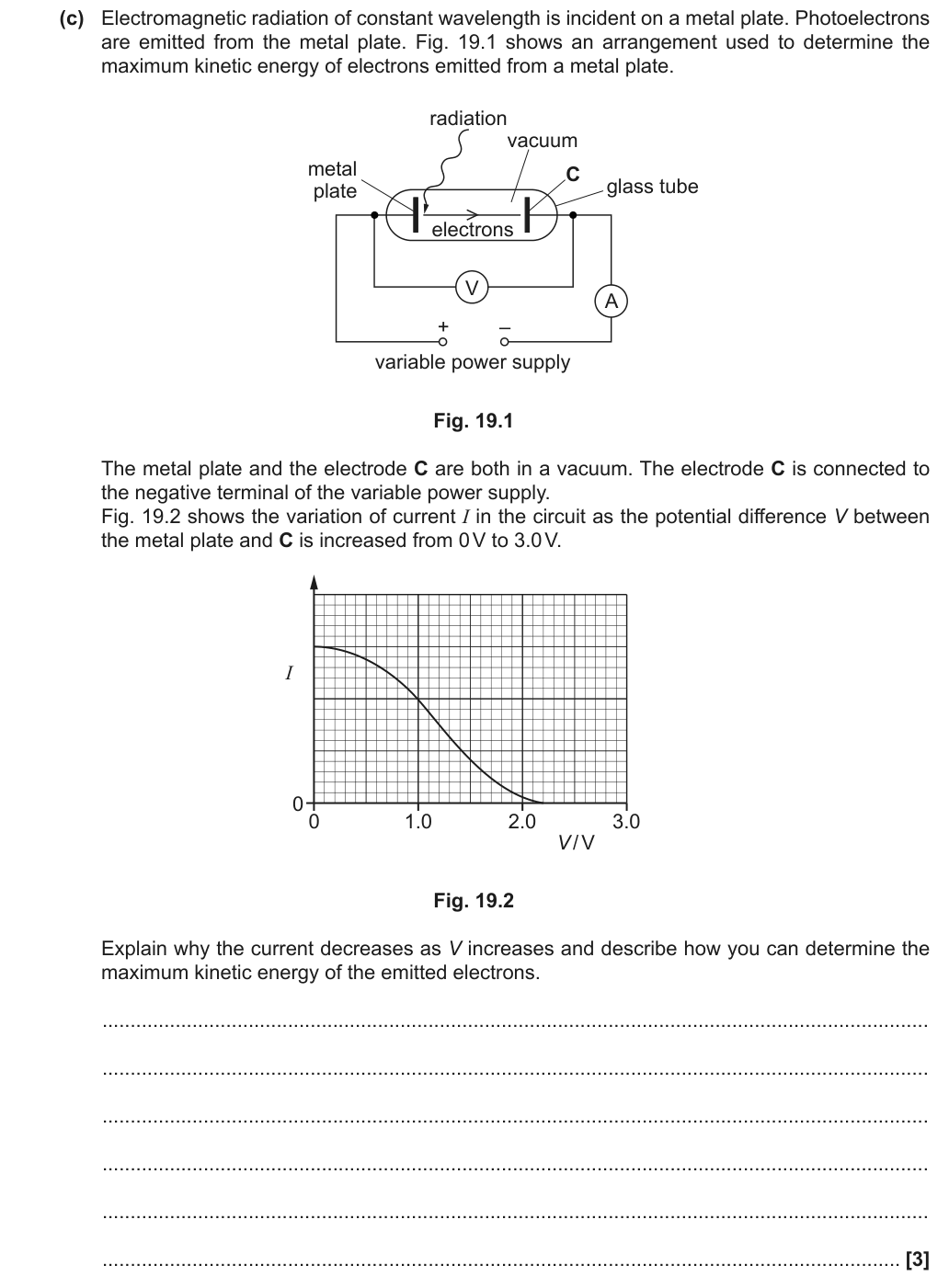
Skills: M3.1 Translate information between graphical, numerical and algebraic forms
Skills: M0.2 Recognise and use expressions in decimal and standard form; M2.2 Change the subject of an equation, including non-linear equations; M2.3 Substitute numerical values into algebraic equations using appropriate units for physical quantities
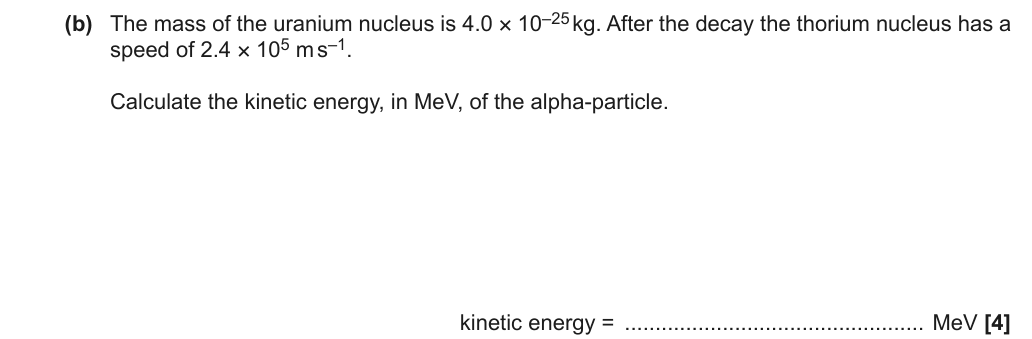
Skills: M0.1 Recognise and make use of appropriate units in calculations; M2.2 Change the subject of an equation, including non-linear equations; M2.3 Substitute numerical values into algebraic equations using appropriate units for physical quantities
Dropping marks on calculations, practical questions or the six-mark level of response questions? Book a trial session with a specialist OCR physics tutor.