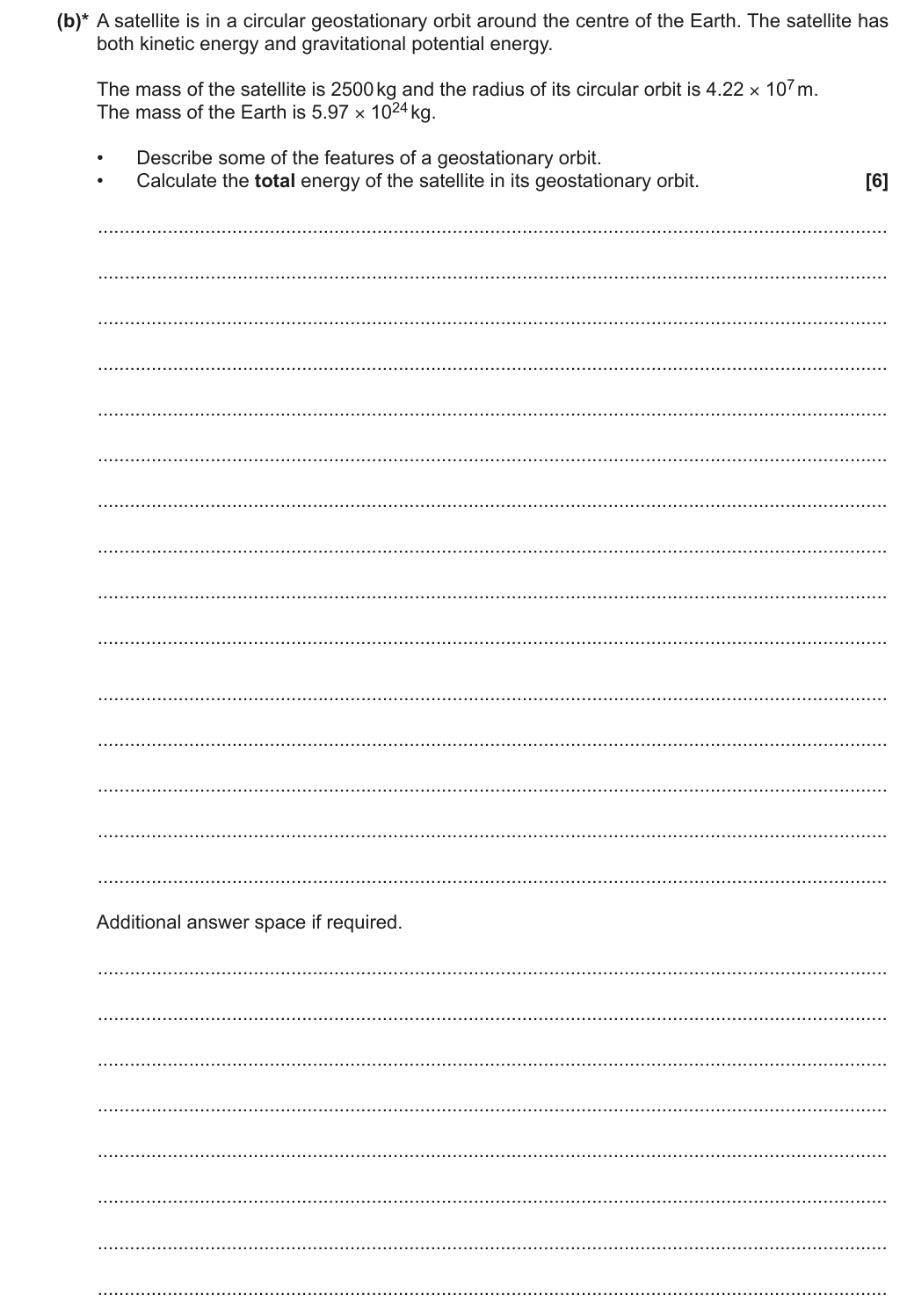
A satellite is in a circular geostationary orbit around the centre of the Earth. The satellite has • Describe some of the features of a geostationary orbit.
Tap a question to zoom it. Where a part needs a figure, table or graph from earlier in the question, that part folds out above it; the mark scheme and examiner's comment open underneath. Have the OCR Data, Formulae and Relationships Booklet beside you (see the data booklet page).
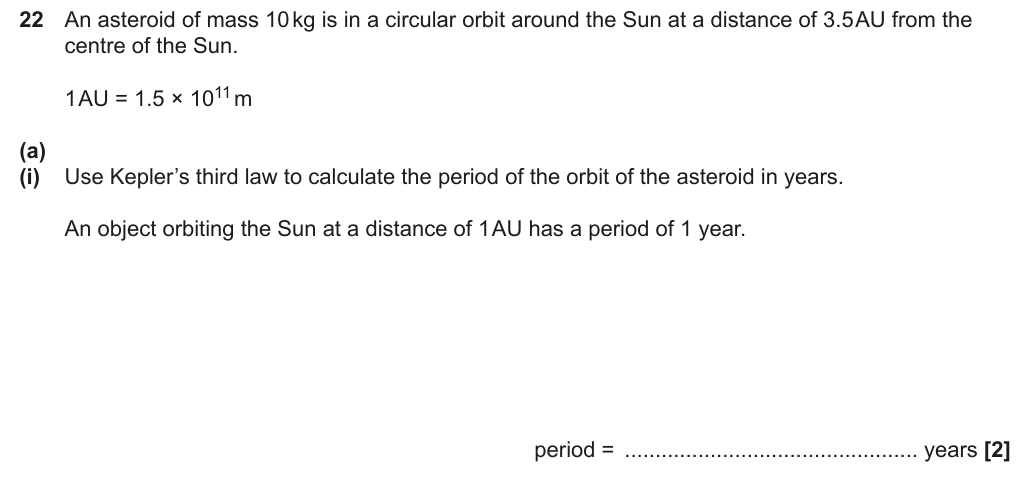
June 2025 · Paper 1 · Q22(a)(i)2 marksCalculationMedium
Mark scheme
Examiner's comment
While some candidates missed off the correct power for either time or orbital radius, many knew which relationship to use. The challenge here was to get the right units for both time and orbital radius. By using the units of AU and years, it was possible simply to write that 𝑇2 = 𝑅3 and to work from there. The full relationship involving the mass of the Sun and working in SI units was less straightforward; however, many candidates managed to complete this correctly. Errors were made with the mass (using 10 kg instead of the mass of the Sun) or the radius (which needed to be in metres) for the time to be calculated in seconds (requiring a further conversion to be able to give the period in the required unit of years.)
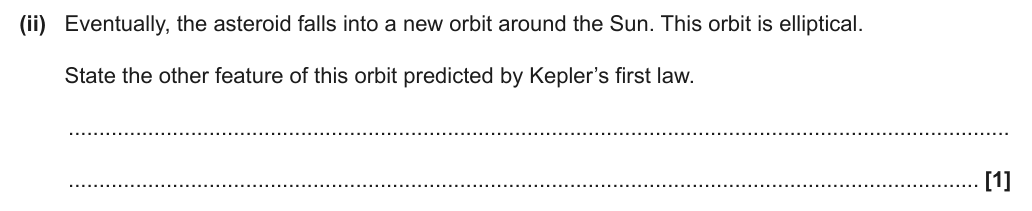
June 2025 · Paper 1 · Q22(b)(ii)1 markShort answerMedium
Mark scheme
Examiner's comment
A large proportion of candidates successfully identified that the other feature was that the Sun lay at one of the foci of an orbit.
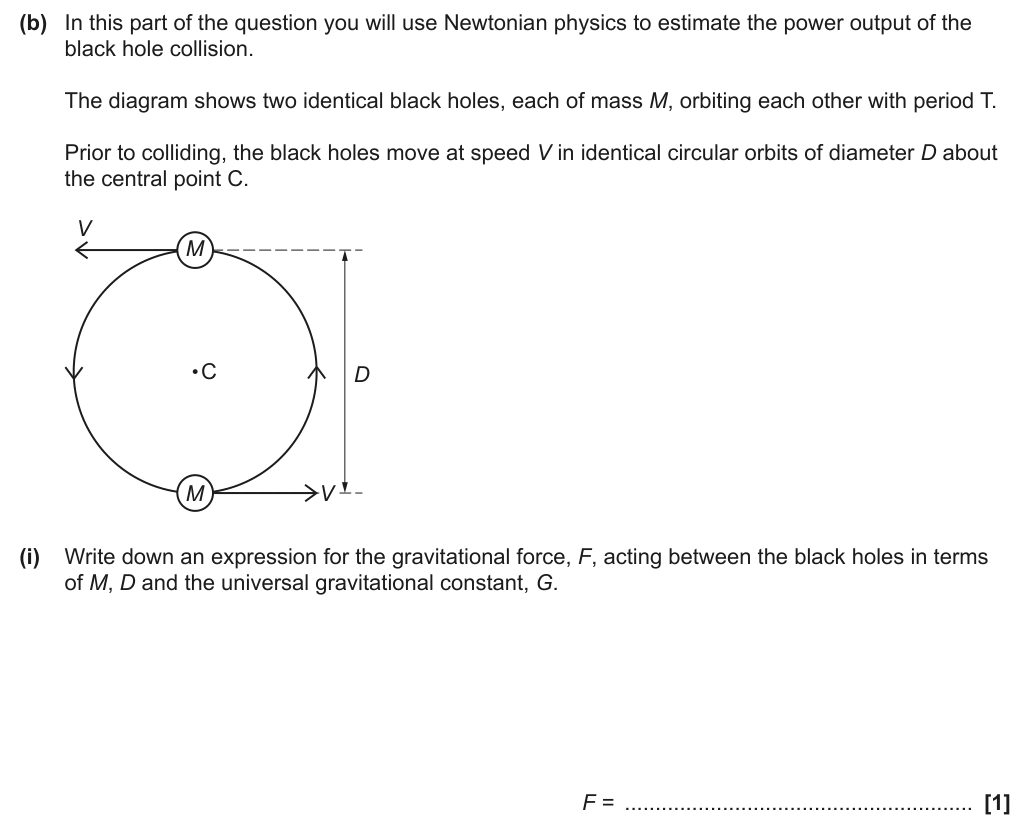
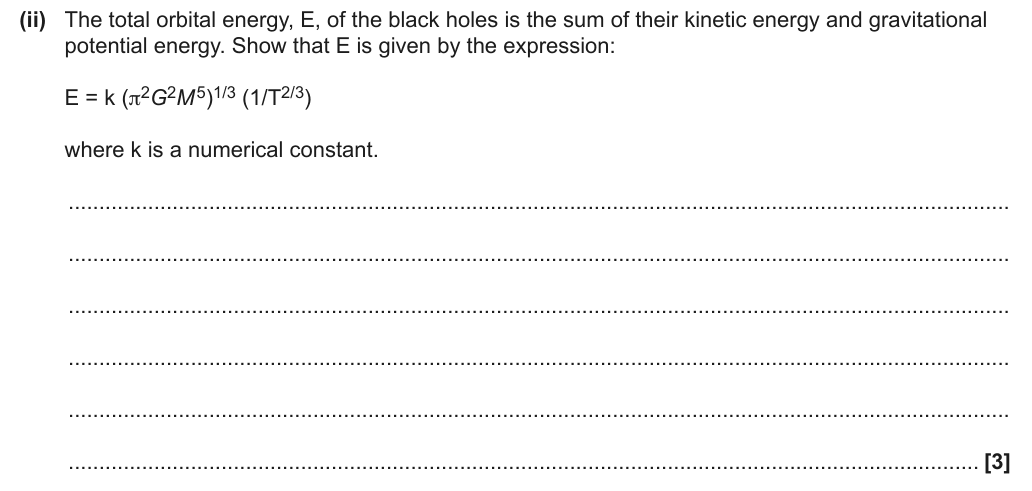
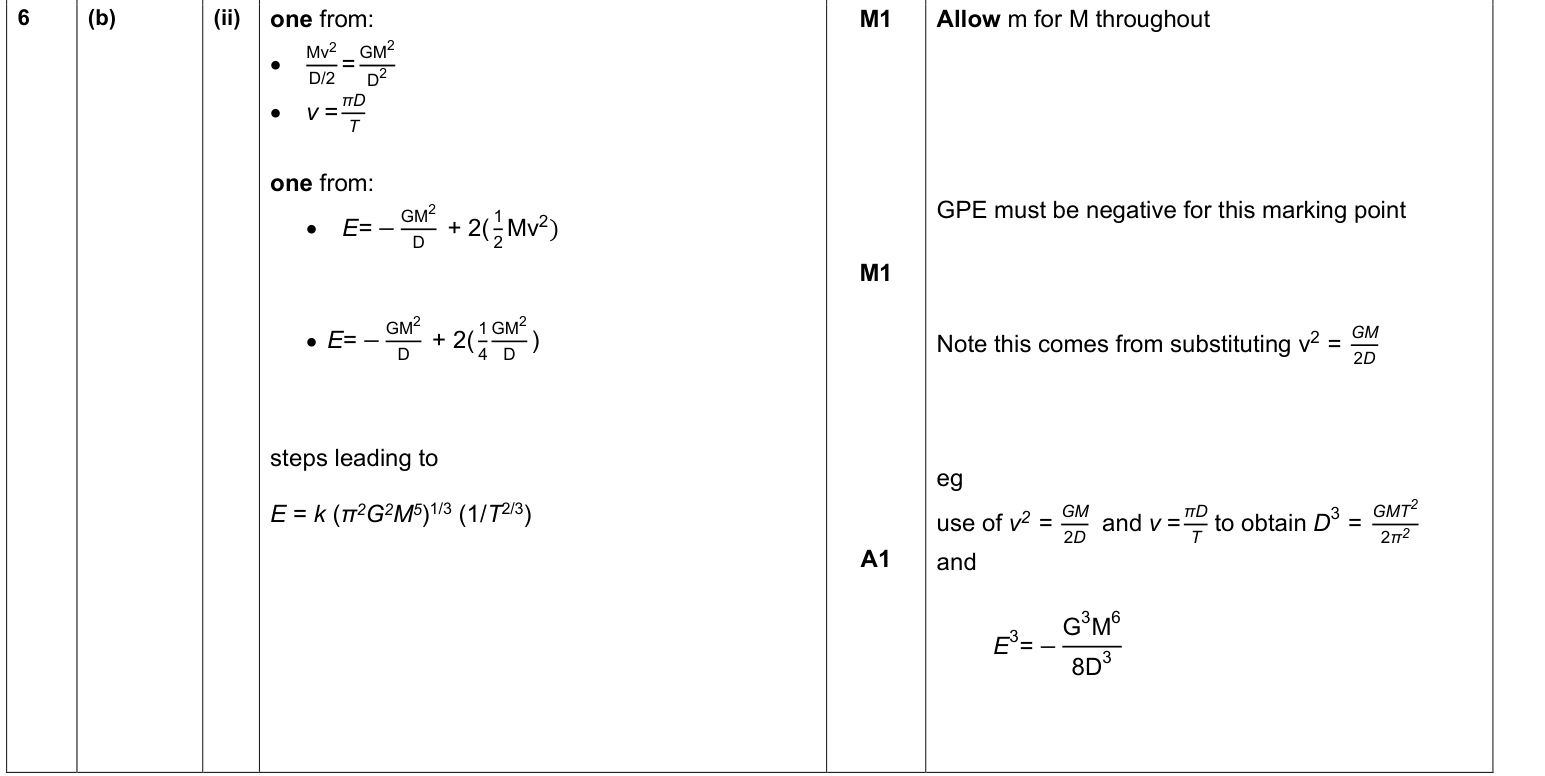
June 2025 · Paper 3 · Q6(b)(ii)3 marksShow thatMedium
Earlier part of question 6 that this part uses
Mark scheme
Examiner's comment
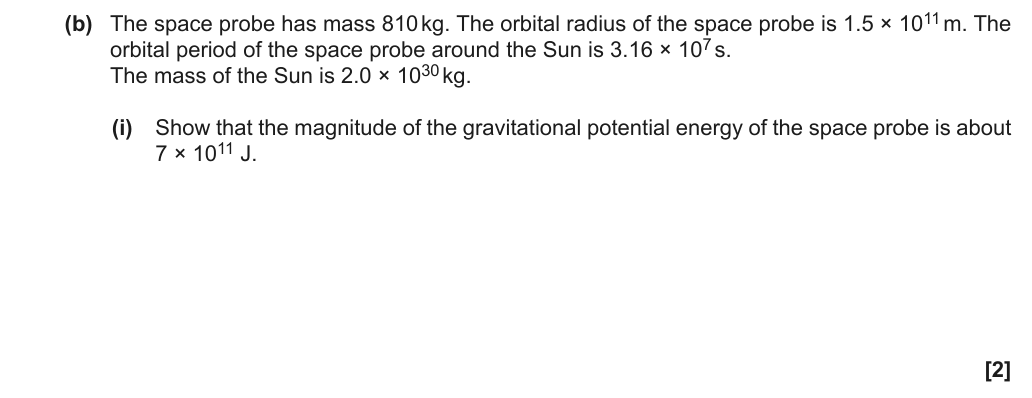
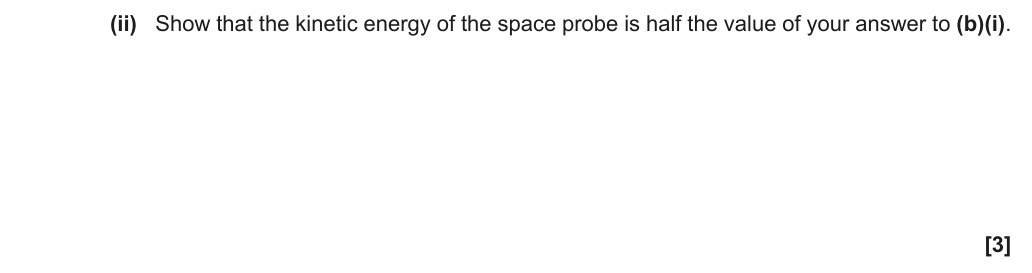
This derivation was designed to challenge the highest scoring candidates although the first two marking points were accessible to students across the mark range. Common issues • omitting the − sign from GPE • using r instead of D in equations • attempting to use Kepler’s laws rather than gravitational potential energy and kinetic energy equations.
Notes from the mark scheme and report
GPE must be negative
radius of each orbit is D/2 and v = πD/T
Skills: M0.5 Use calculators to find and use power, exponential and logarithmic functions; M2.2 Change the subject of an equation, including non-linear equations; M2.4 Solve algebraic equations, including quadratic equations
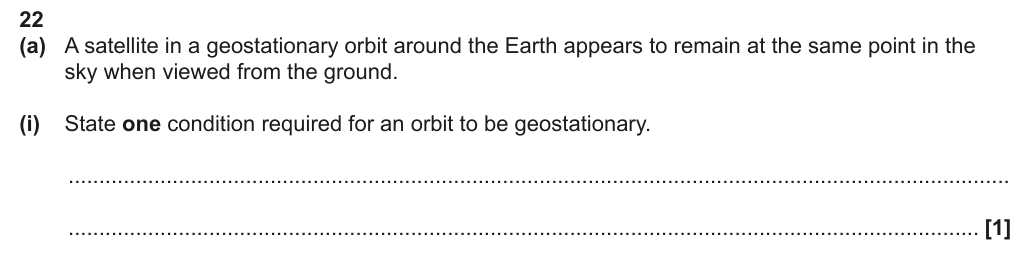
June 2024 · Paper 1 · Q22(a)(i)1 markShort answerEasy
Mark scheme
Examiner's comment
In previous series, candidates needed to explain at least three conditions for a geostationary orbit for complete credit. This item, though, is considerably simpler: most candidates scored a mark here. There was some confusion about terminology with those candidates that did not score the mark. Often this was muddling up the time of orbit, the time of rotation of the Earth and the time of an orbit of the Earth around the Sun.
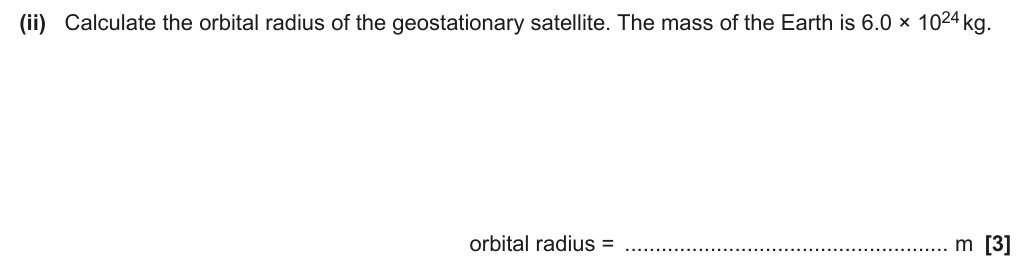
June 2024 · Paper 1 · Q22(a)(ii)3 marksCalculationEasy
Mark scheme
Examiner's comment
Most candidates correctly used the equation representing Kepler’s Third Law to find the orbital radius. Common errors included mis-converting or mis-remembering the time for one complete orbit.
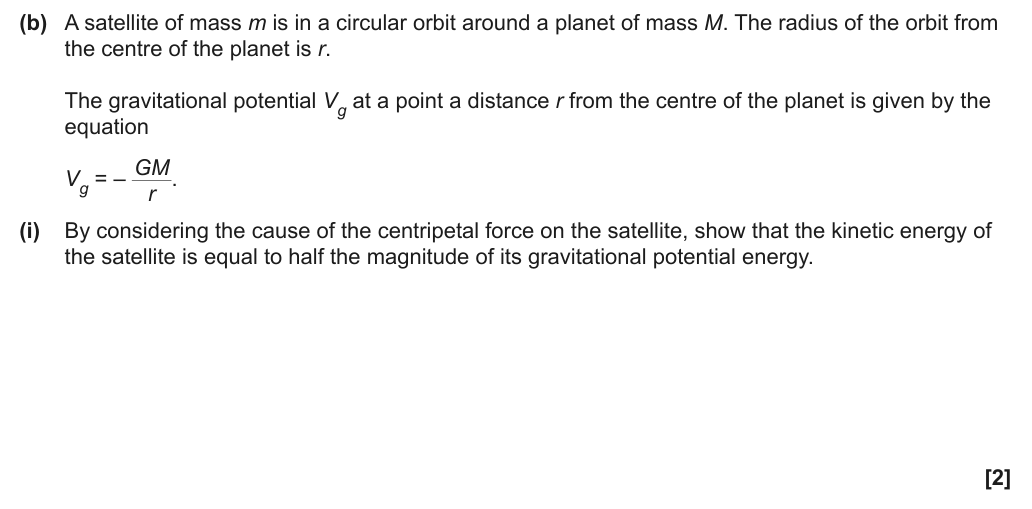
June 2024 · Paper 1 · Q22(b)(i)2 marksShow thatMedium
Mark scheme
Examiner's comment
Many candidates made a good start by equating the formula for gravitational force with the expression for centripetal motion. Others that assumed that g of 9.81 m s-2 did not score any marks. The simplest way to arrive at the correct expression was to identify GM/r in the gravitational force formula, to rearrange and then multiply both sides by ½. Approximately ½ of all candidates that responded got as far as this gaining both marks.
June 2023 · Paper 1 · Q111 markMultiple choiceMedium
Answer
D
Mark scheme
Examiner's comment
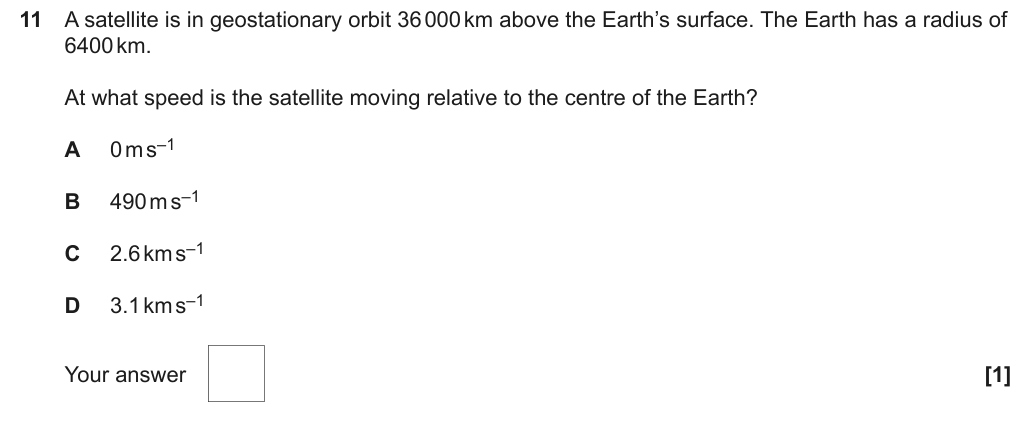
The question is asking for the candidate to calculate the speed of an object in a circular orbit with radius 42 400 km, i.e. 42.4 × 10⁶ m. To do this, the candidate equates the gravitational force, FG = GMm/r2. with the centripetal force required for that orbit, FC = mv2/r, where M is the mass of the Earth and m is the mass of the satellite. Rearranging gives v = √GM/r. Substituting the correct values for G, M and r will give answer D.
June 2023 · Paper 3 · Q1(a)(i)1 markShort answerMedium
Mark scheme
Examiner's comment
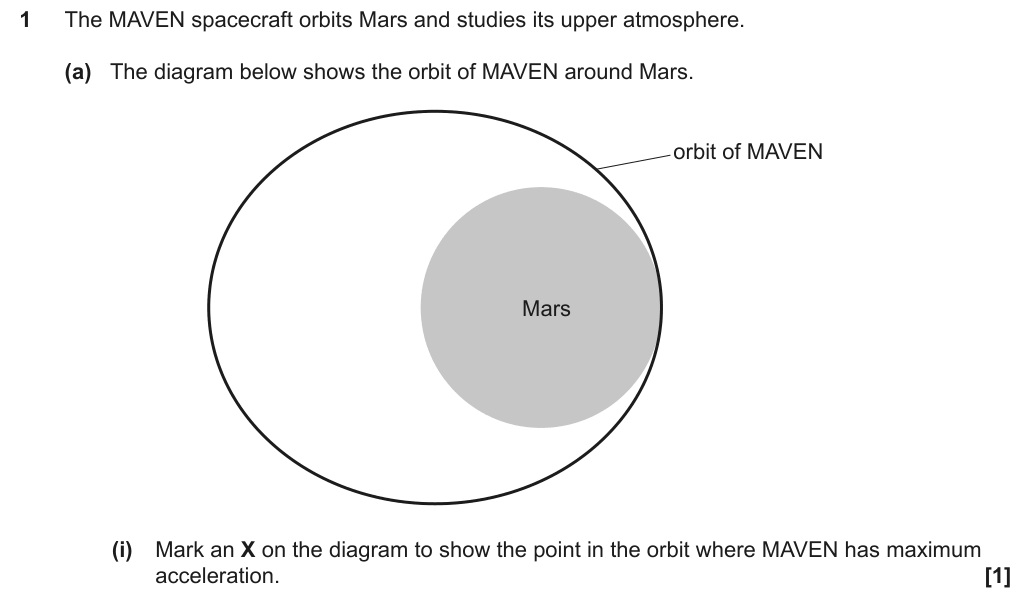
Most candidates put their cross in the correct place. The most common wrong response was to place a cross placed at the furthest point from Mars.
Notes from the mark scheme and report
X on the orbit at the closest point to Mars
allow a single dot / circle
June 2023 · Paper 3 · Q1(a)(ii)2 marksExplanationHard
Earlier part of question 1 that this part uses
Mark scheme
Examiner's comment
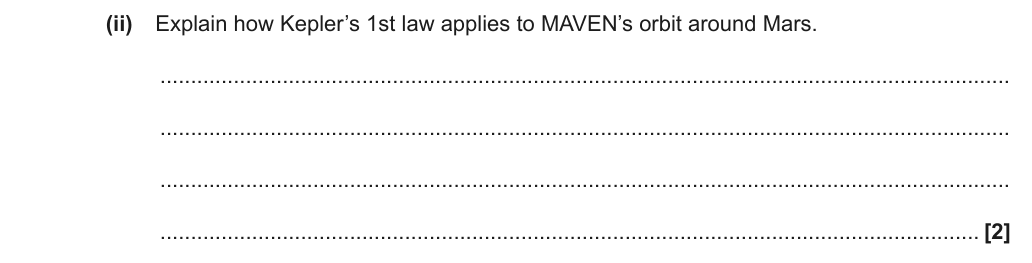
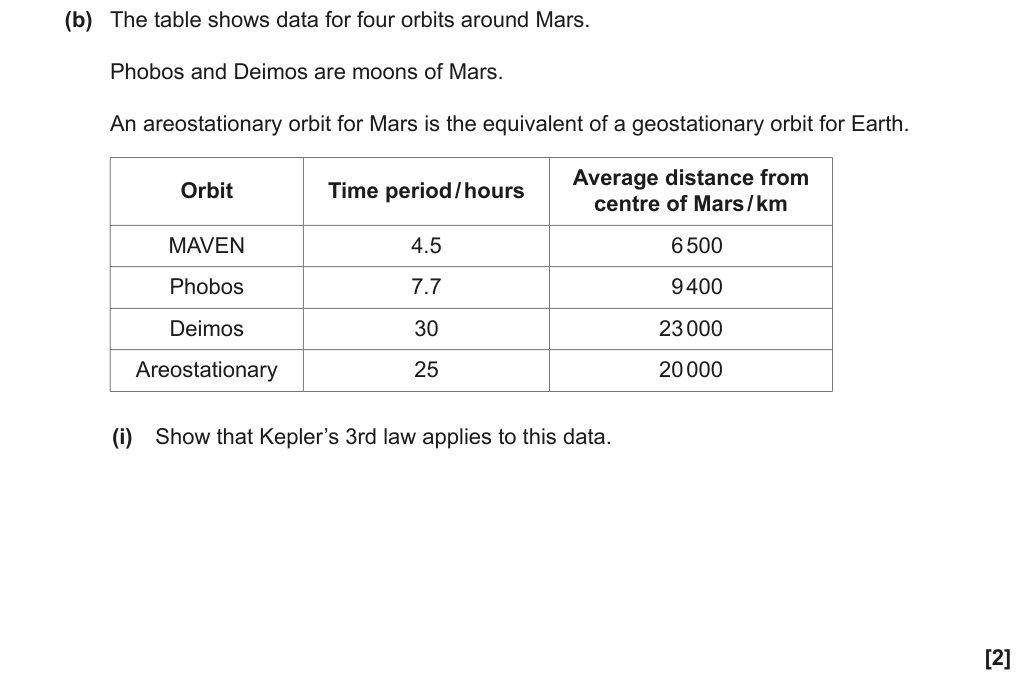
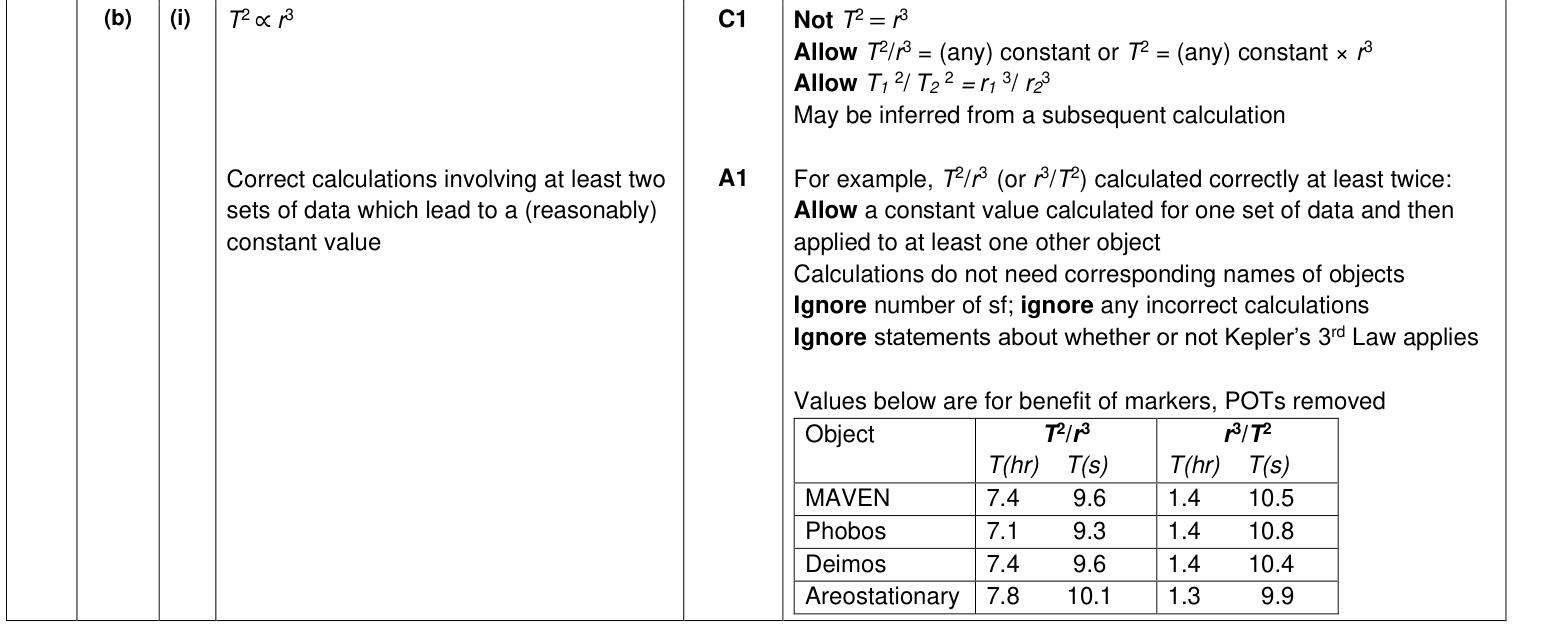
The main difficulty here was remembering which was Kepler’s 1st Law. Many candidates described how a line between Mars and MAVEN would sweep out equal areas in equal times. Sometimes valuable time was spent describing planetary orbits before restating the salient points for MAVEN. Question1 (b) (i) The majority of candidates remembered Kepler’s 3rd Law correctly. There were a number of different approaches which could gain credit here. The main one used was to find the ratio of T2/r3 for corresponding pairs of values, showing that this ratio was approximately constant. Another common approach was calculating the constant k in T2= kr3 using the data for MAVEN and then applying it to the distance of Phobos, for example, to show that it gave the correct value for the time period. The best responses were those where candidates thought carefully about how they were going to set out their calculations, naming the orbits under consideration or tabulating their values, whereas other responses were characterised by a sprawl of figures leaving the examiner to hunt for appropriate values.
Notes from the mark scheme and report
ellipse with Mars at one focus
NOT the Sun at one focus
June 2023 · Paper 3 · Q1(b)(i)2 marksShow thatMedium
Mark scheme
Examiner's comment
Question 1 (b) (ii) The strongest responses were given in terms of the function of MAVEN, which was to study the upper atmosphere of Mars.
Notes from the mark scheme and report
NOT T² = r³
T²/r³ calculated correctly for at least two sets of data
Skills: M0.3 Use ratios, fractions and percentages; M0.5 Use calculators to find and use power, exponential and logarithmic functions; M2.3 Substitute numerical values into algebraic equations using appropriate units for physical quantities
June 2023 · Paper 3 · Q1(b)(ii)2 marksExplanationHard
Earlier parts of question 1 that this part uses
Mark scheme
Examiner's comment
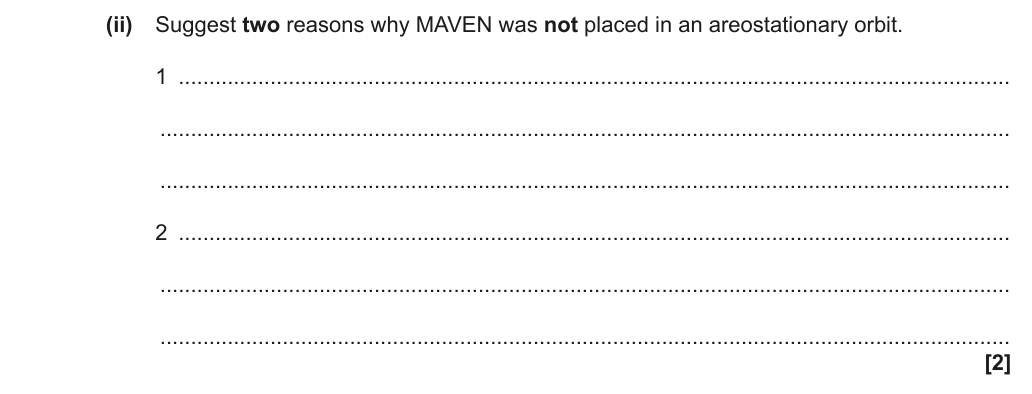
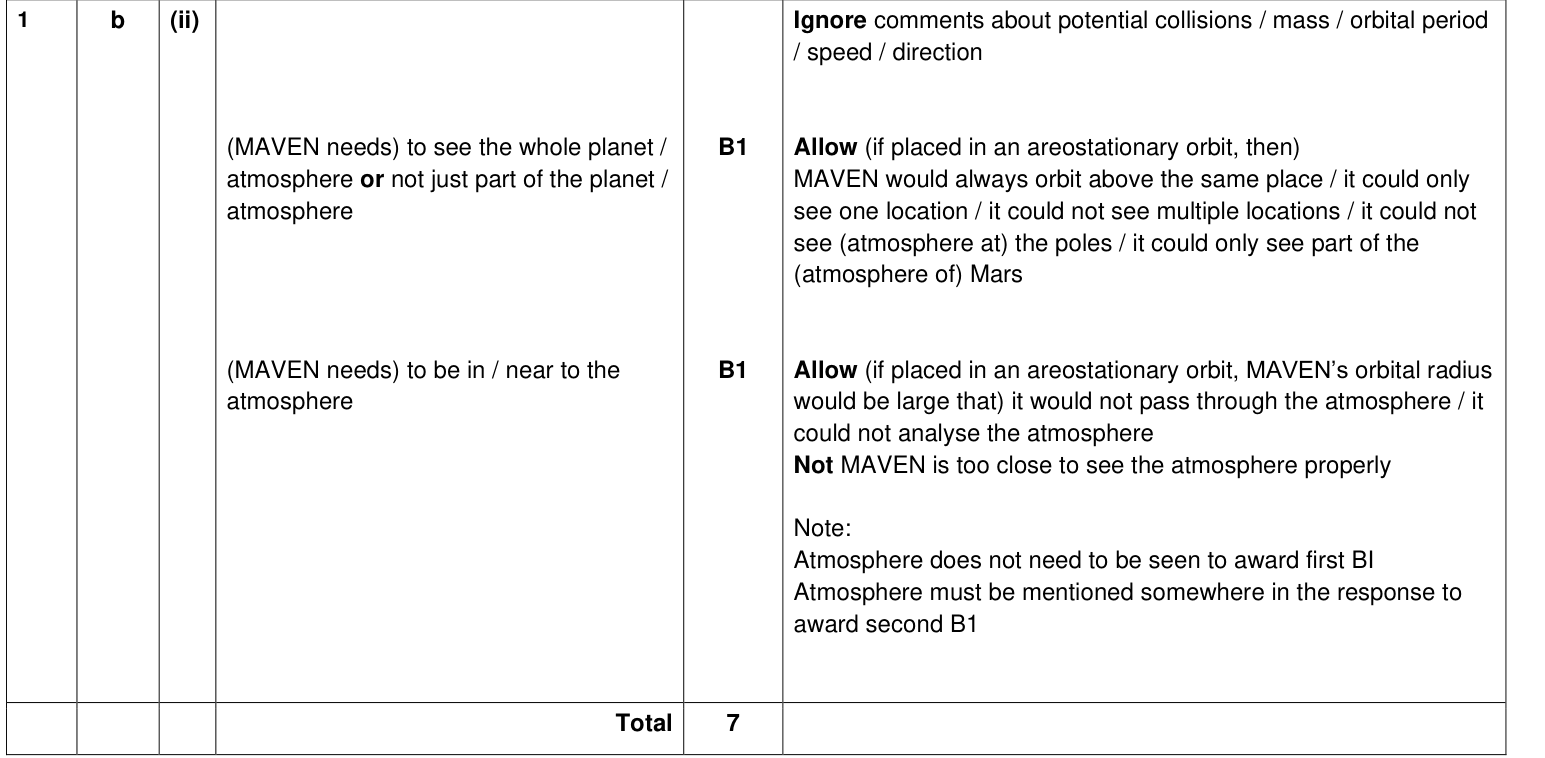
The strongest responses were given in terms of the function of MAVEN, which was to study the upper atmosphere of Mars. An areostationary orbit would be too far from Mars for this purpose, plus it would only allow MAVEN to sample one small part of its atmosphere. A common approach was to make partial statements such as ‘MAVEN would be too far away…’ and such responses were often too vague to be creditworthy. A few candidates misread the question and were obviously attempting to answer the question. ‘How do we know that MAVEN is not in an areostationary orbit?’.
Notes from the mark scheme and report
needs to see the whole planet / atmosphere
needs to be in or near the atmosphere (atmosphere must be mentioned for the second mark)
ignore collisions, mass, period, speed
June 2022 · Paper 1 · Q23(a)3 marksShow thatEasy
Mark scheme
Examiner's comment
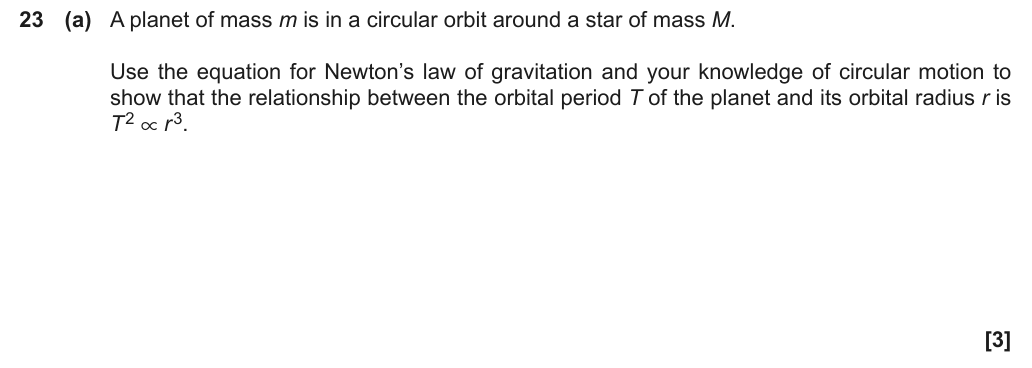
The demonstration of Kepler’s 3rd Law was well-remembered by the vast majority of candidates.
Notes from the mark scheme and report
must state 4π²/GM is constant
Skills: M2.2 Change the subject of an equation, including non-linear equations
June 2022 · Paper 1 · Q23(b)(i)2 marksCalculationMedium
Mark scheme
Examiner's comment
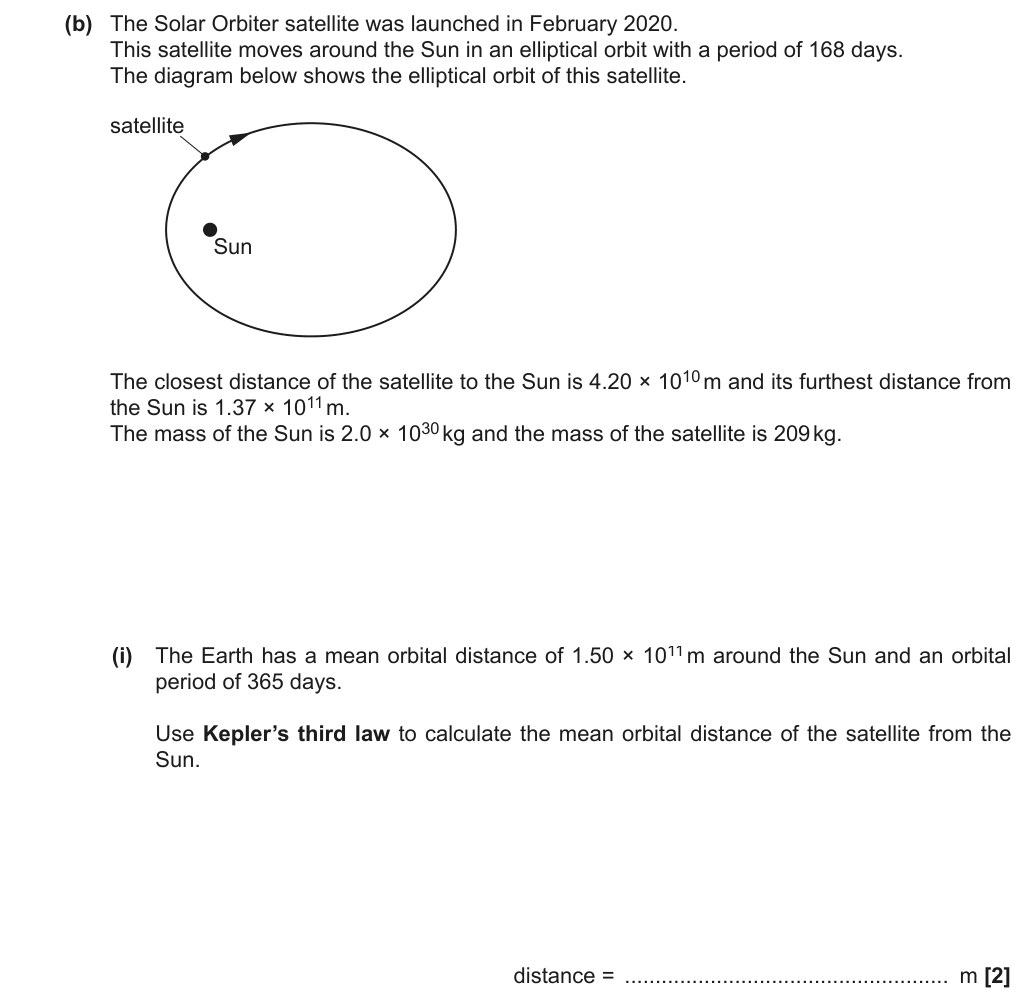
Fortunately, most candidates saw the reference to Kepler’s third law in bold and used it successfully. Only a small fraction found the mean orbital distance by finding the mean of the maximum and minimum distance. While this is mathematically sound, it does not use Kepler’s third law and so was not deemed an acceptable answer to the question.
Notes from the mark scheme and report
NOT 8.95 or 9.0 x 10^10 m (arithmetic mean of the two distances)
Skills: M0.3 Use ratios, fractions and percentages; M0.5 Use calculators to find and use power, exponential and logarithmic functions; M2.2 Change the subject of an equation, including non-linear equations
November 2021 · Paper 1 · Q111 markMultiple choice
Answer
C
Mark scheme
November 2021 · Paper 1 · Q20(b)6 marks6-mark extended responseEasy
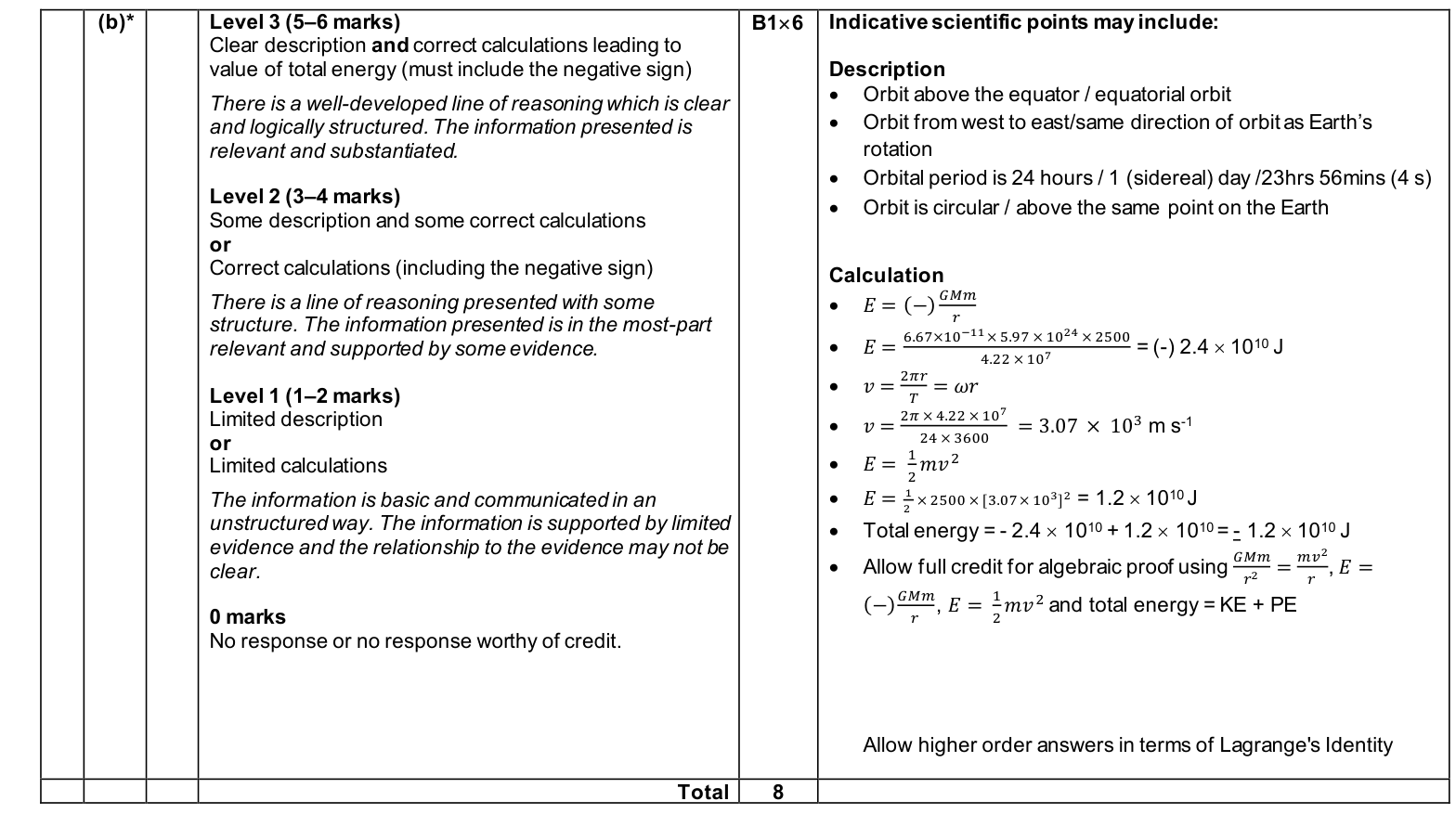
Mark scheme, with the levels and indicative content
Examiner's comment
Common misconceptions Almost all candidates forgot that Gravitational Potential Energy is negative in Q20(b).
Notes from the mark scheme and report
total energy must include the negative sign (-1.2 x 10^10 J)
algebraic route from GMm/r² = mv²/r gets full credit
Skills: M0.2 Recognise and use expressions in decimal and standard form; M2.3 Substitute numerical values into algebraic equations using appropriate units for physical quantities
November 2021 · Paper 3 · Q3(b)(ii)3 marksShow thatMedium
Earlier part of question 3 that this part uses
Mark scheme
Examiner's comment
Key teaching and learning point Question 3(b) was a question designed to test candidates’ knowledge that gravitational potential energy is always negative.
Notes from the mark scheme and report
v = 2πr/T then KE
algebraic proof (mv²/r = GMm/r²) allowed for full marks
Skills: M0.2 Recognise and use expressions in decimal and standard form; M2.3 Substitute numerical values into algebraic equations using appropriate units for physical quantities
November 2020 · Paper 1 · Q23(a)(i)1 markShort answerMedium
Mark scheme
Examiner's comment
Question 23c showed that candidates were unfamiliar with the idea of finding a difference in potentials between two points in order to find the change in potential energy.
Notes from the mark scheme and report
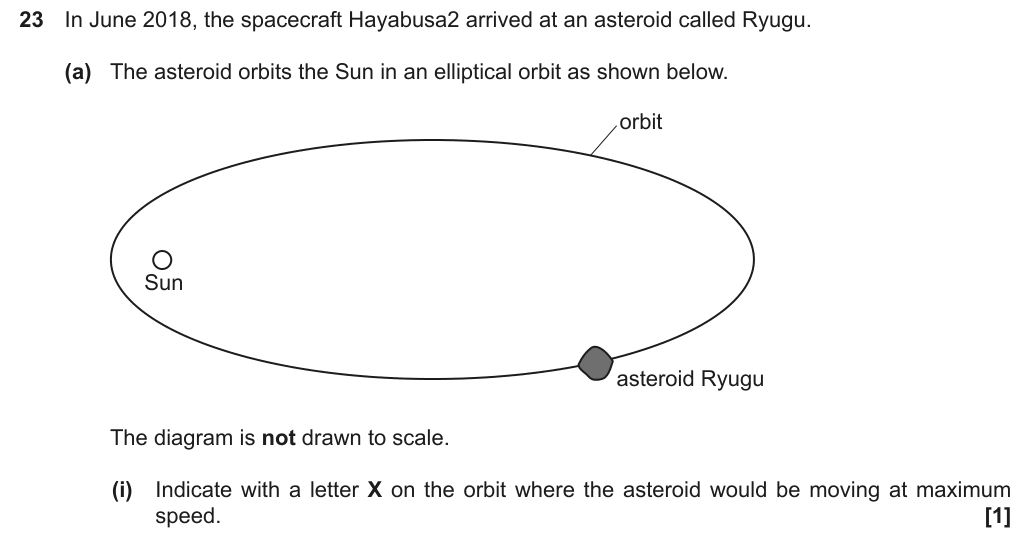
X at the point on the orbit closest to the Sun
November 2020 · Paper 1 · Q23(a)(ii)2 marksExplanationMedium
Earlier part of question 23 that this part uses
Mark scheme
Examiner's comment
Question 23c showed that candidates were unfamiliar with the idea of finding a difference in potentials between two points in order to find the change in potential energy.
Notes from the mark scheme and report
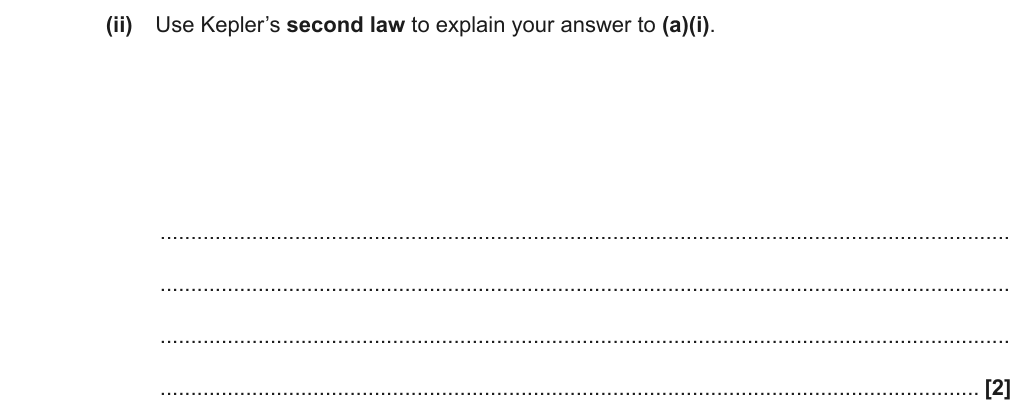
line joining asteroid to Sun sweeps out equal areas in equal times AND longer distance along orbit in the same time
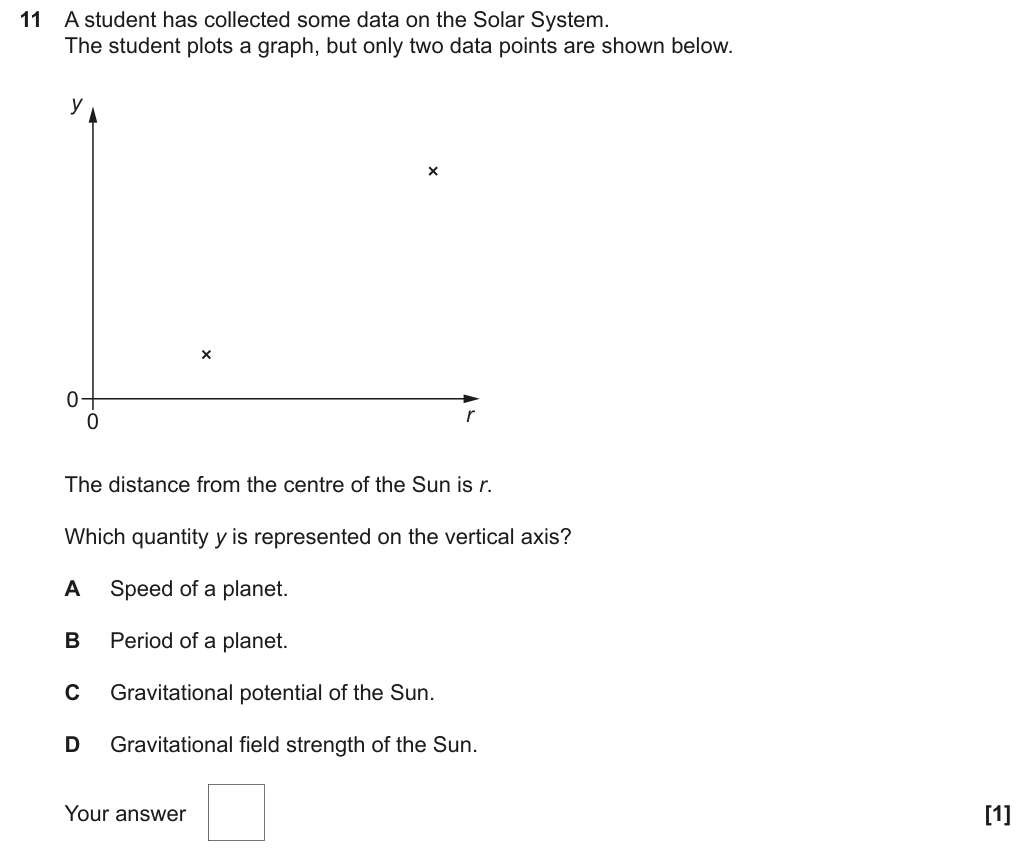
June 2019 · Paper 1 · Q111 markMultiple choiceMedium
Answer
B
Mark scheme
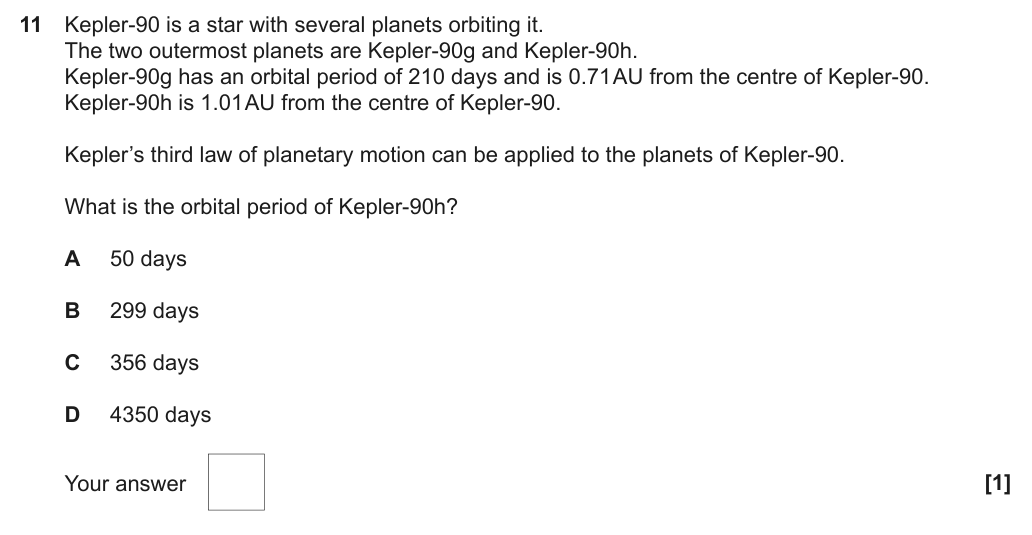
Examiner's comment
Answering this question needs knowledge of Kepler’s Third Law and the formulae for gravitational potential and gravitational field strength, all of which are given in the data, formulae and relationships booklet. This relationship cannot be gravitational potential or gravitational field strength, as quantity y increases with distance from the Sun. By equating the gravitational force on a planet with the centripetal force, it can be shown also that (orbital speed)2 and orbital radius are inversely proportional. This graph does not show an inversely proportional relationship. The formula sheet says that the square of a planet’s period is directly proportional to the cube of the planet’s orbital radius. In other words, the relationship shows that as orbital radius increases, so does the period, but not directly proportionally. This is the relationship shown on the graph, giving answer B.
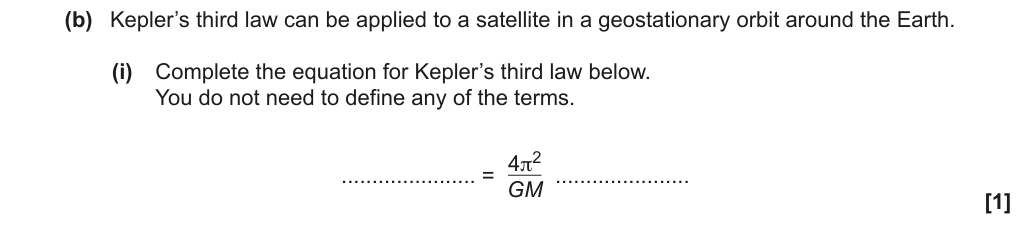
June 2019 · Paper 1 · Q23(b)(i)1 markShort answerMedium
Mark scheme
Examiner's comment
Question 23 (b) (ii) The radius of the orbit of a geostationary satellite was found with ease by the majority of candidates by using the formula in the data book or by looking at their response for part 23(b)(i).
Notes from the mark scheme and report
T squared on the left and r cubed on the right
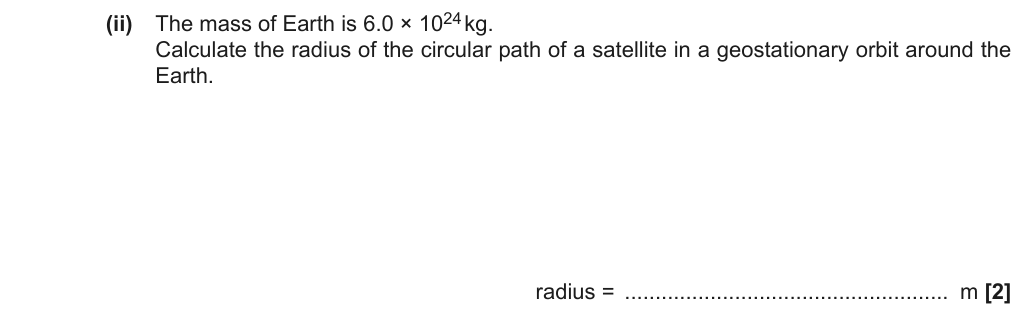
June 2019 · Paper 1 · Q23(b)(ii)2 marksCalculationMedium
Earlier part of question 23 that this part uses
Mark scheme
Examiner's comment
The radius of the orbit of a geostationary satellite was found with ease by the majority of candidates by using the formula in the data book or by looking at their response for part 23(b)(i). There were a few ways of generating an arithmetical error, such as using the square root instead of the cube root for the final step, getting the wrong power for the time or by using a time equal to one year instead of one day.
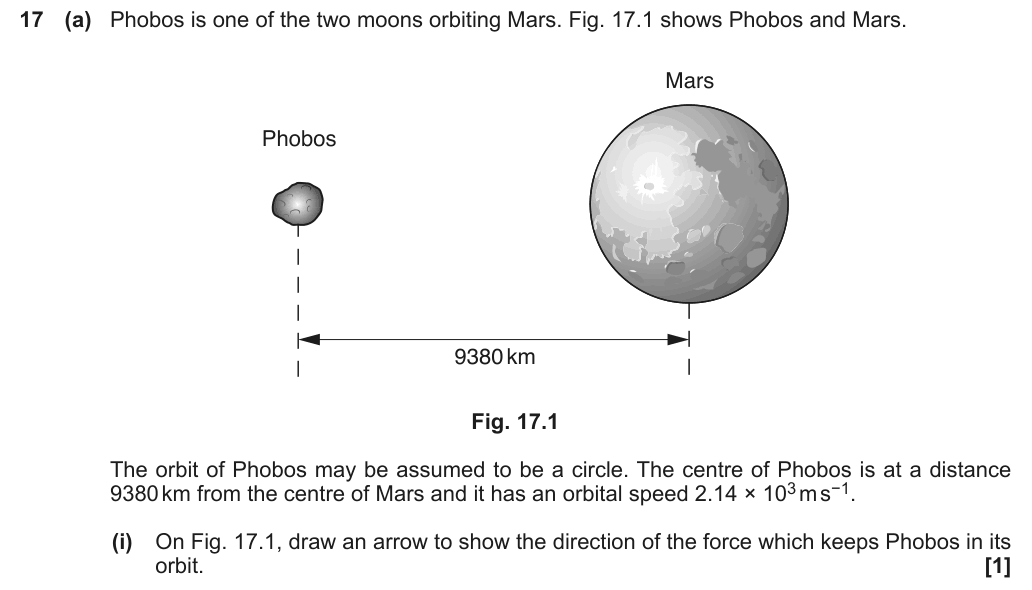
June 2018 · Paper 1 · Q17(a)(i)1 markDiagram or graphMedium
Mark scheme
Examiner's comment
The examiners were quite lenient in this series in terms of the precise direction of the arrow, which should point towards the centre of Mars.
Notes from the mark scheme and report
arrow towards Mars
judged by eye
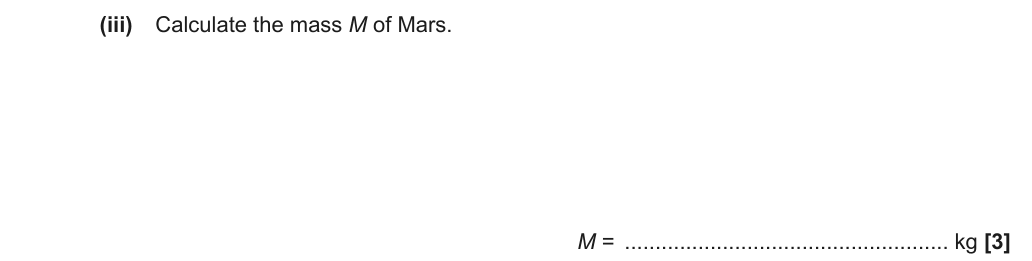
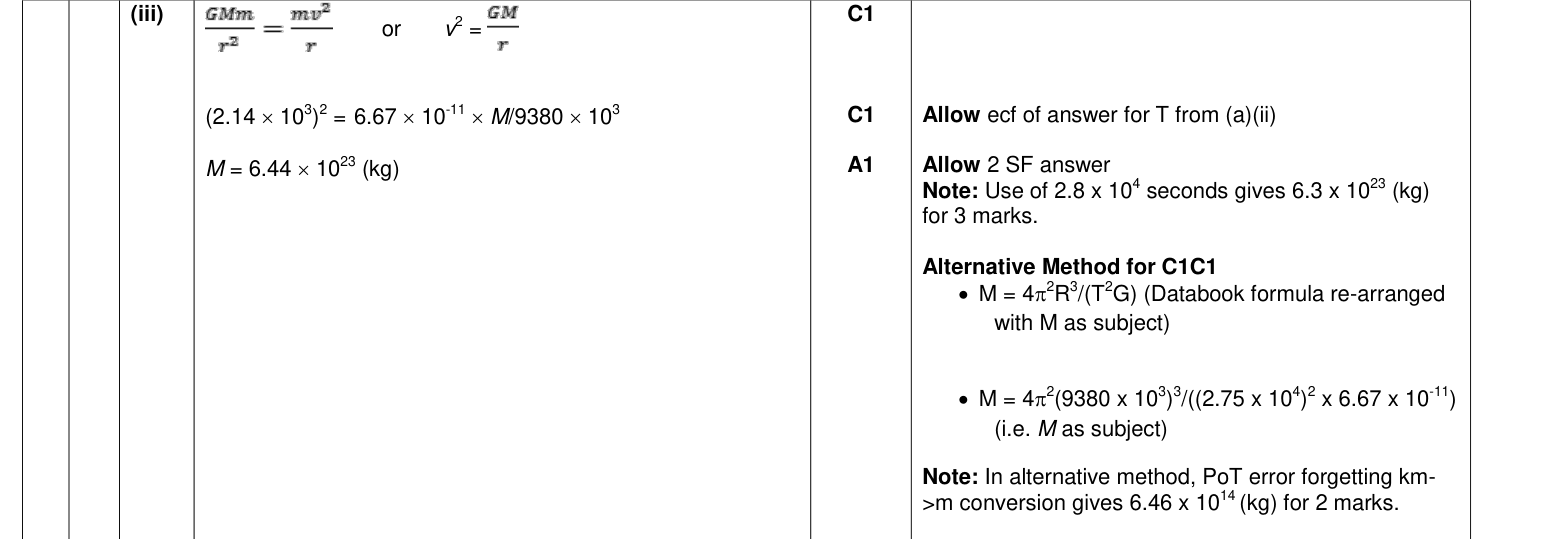
June 2018 · Paper 1 · Q17(a)(iii)3 marksCalculationMedium
Earlier part of question 17 that this part uses
Mark scheme
Examiner's comment
Many candidates successfully used the equation for Kepler’s Third Law, which is encouraging. A quicker route was to find the Phobos’s acceleration (from v2/r) and equating that to the gravitational field strength at Phobos from Mars (GMmars/r2) and then rearranging to find the mass of Mars.
Notes from the mark scheme and report
either GMm/r² = mv²/r or T² = 4π²r³/GM
km not converted gives 6.46 x 10^14 kg for 2 marks
ecf from (a)(ii)
Skills: M0.2 Recognise and use expressions in decimal and standard form; M2.2 Change the subject of an equation, including non-linear equations; M2.3 Substitute numerical values into algebraic equations using appropriate units for physical quantities
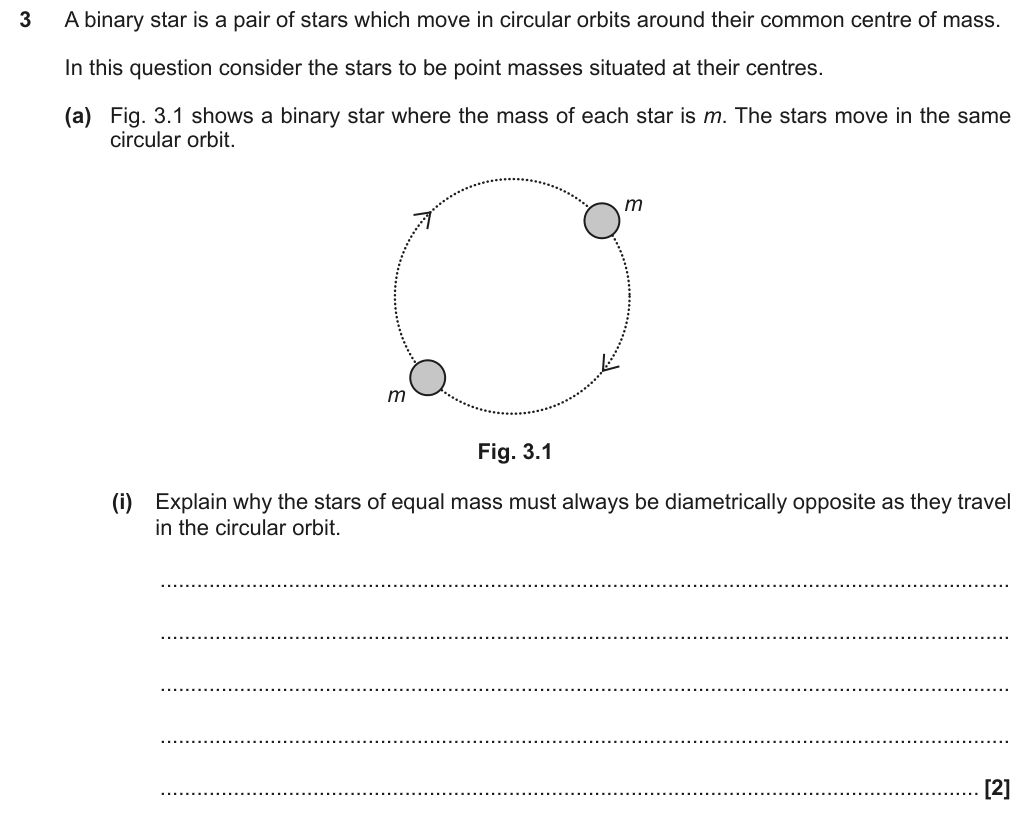
June 2018 · Paper 3 · Q3(a)(i)2 marksExplanationHard
Mark scheme
Examiner's comment
Only a minority of candidates related the gravitational force between the stars to the centripetal force required for circular motion to occur. This candidate has written the perfect answer (exemplar 5). There were two popular insufficient answers; that if the stars were not diametrically opposite they would collide and that the centre of mass of the system had to be at the centre of the orbit.
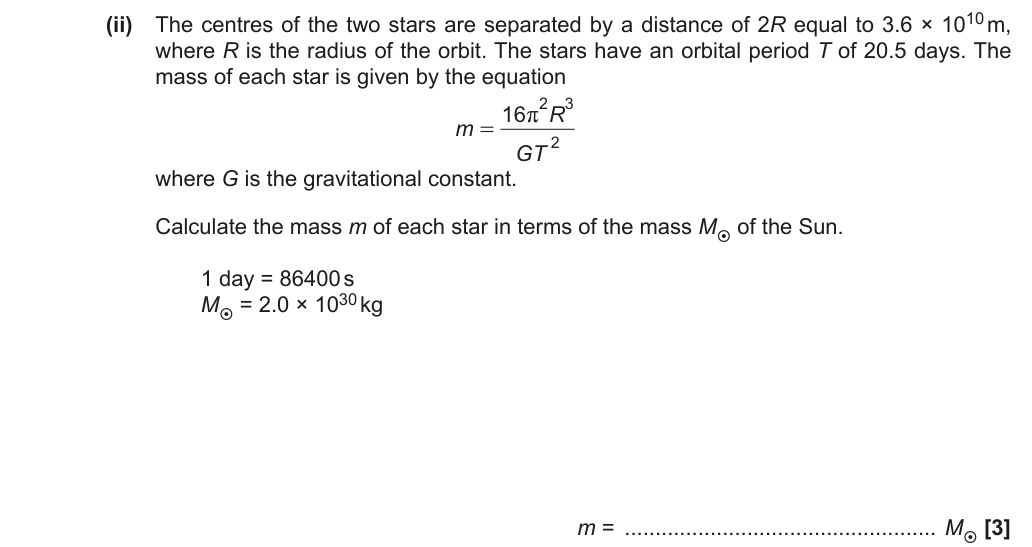
June 2018 · Paper 3 · Q3(a)(ii)3 marksCalculationMedium
Earlier part of question 3 that this part uses
Mark scheme
Examiner's comment
This question tested the candidates' ability to interpret and substitute data into an elaborate formula and then evaluate it. The most common error was to write the formula with the correct substitutions but then to omit the square symbol against T. Candidates should be encouraged to consider whether their answers are reasonable before moving on to the next question. In the calculation (exemplar 6) shown here, is it possible that these stars could be four million times the mass of the Sun? The correct answer of 2.2 Sun masses seems very plausible and should give candidates confidence.
Notes from the mark scheme and report
using 2R (17.6 M) or T = 1 day (930 M): 2/3
Skills: M0.1 Recognise and make use of appropriate units in calculations; M0.2 Recognise and use expressions in decimal and standard form; M2.3 Substitute numerical values into algebraic equations using appropriate units for physical quantities
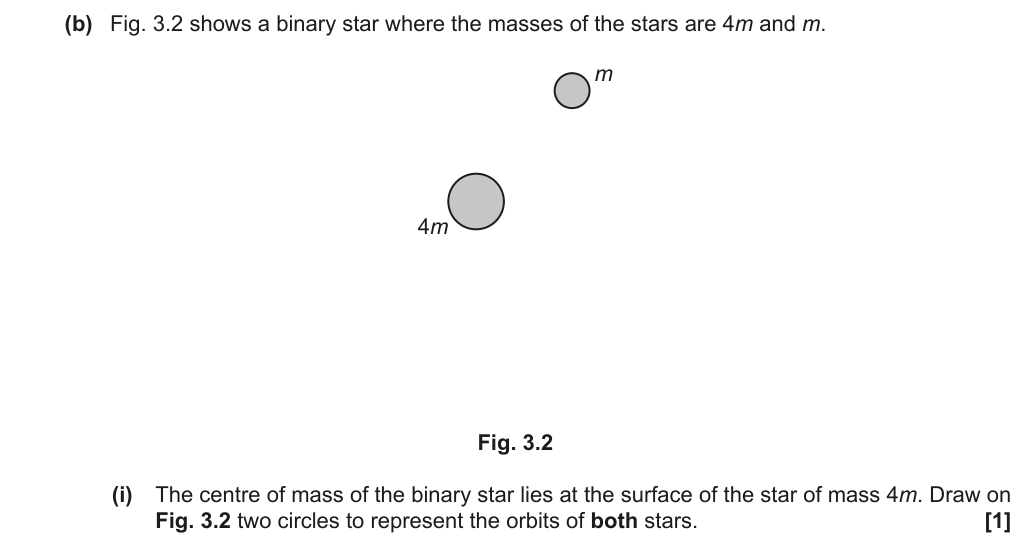
June 2018 · Paper 3 · Q3(b)(i)1 markDiagram or graphMedium
Earlier part of question 3 that this part uses
Mark scheme
Examiner's comment
Question 3 (b) (i) Question 3 (b) (ii) Candidates should be encouraged to draw diagrams such as part (i) as accurately as they can.
Notes from the mark scheme and report
two full circles centred on the centre of mass with radii in ratio 4 : 1
ignore arrows
Skills: M0.3 Use ratios, fractions and percentages; M4.2 Visualise and represent 2D and 3D forms, including two-dimensional representations of 3D objects
Work with an OCR physics tutor
Dropping marks on calculations, practical questions or the six-mark level of response questions? Book a trial session with a specialist OCR physics tutor.