Answer
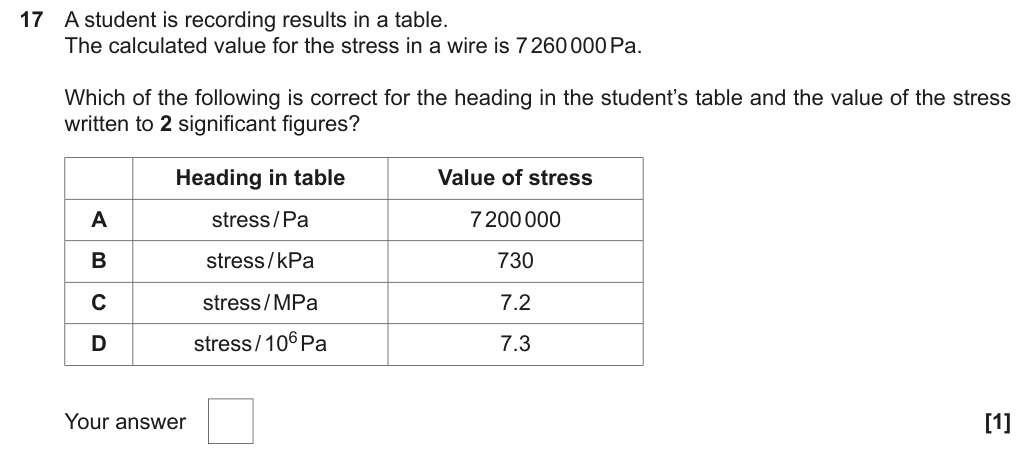
D
Mark scheme

Examiner's comment
Candidates got the right answer often by writing relevant formulas with these constants in them and performing ‘unit algebra’.
Notes and key-term cards for this topic are being written by our tutors. The past-paper questions below are ready now.
| Series | Paper | Q | What it asks |
|---|---|---|---|
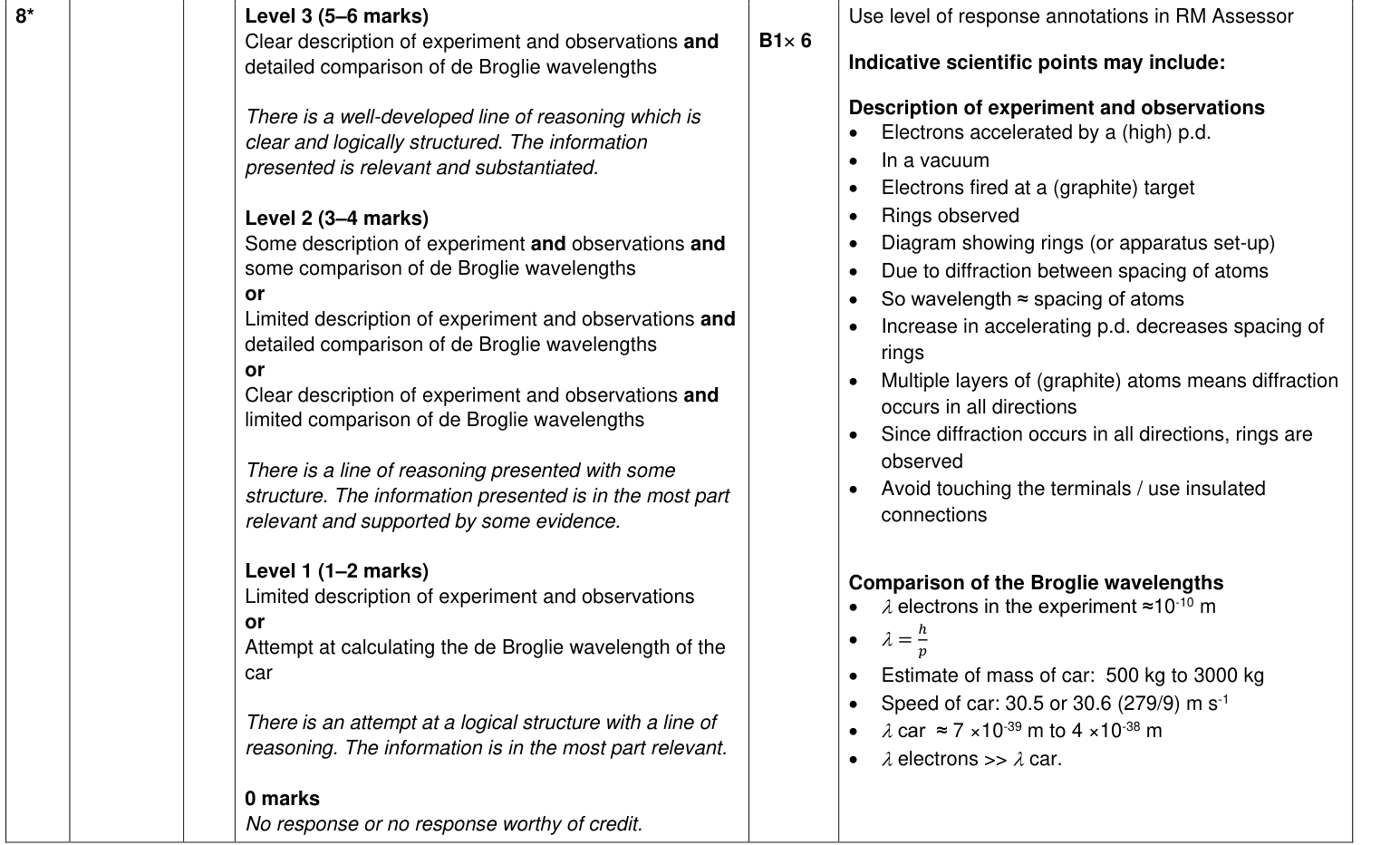
| June 2024 | AS Paper 2 | 8 | In 1929, the Nobel prize was awarded to Louis de Broglie for his discovery of the wave nature of Describe, with the aid of a suitable diagram: |
D
Candidates got the right answer often by writing relevant formulas with these constants in them and performing ‘unit algebra’.
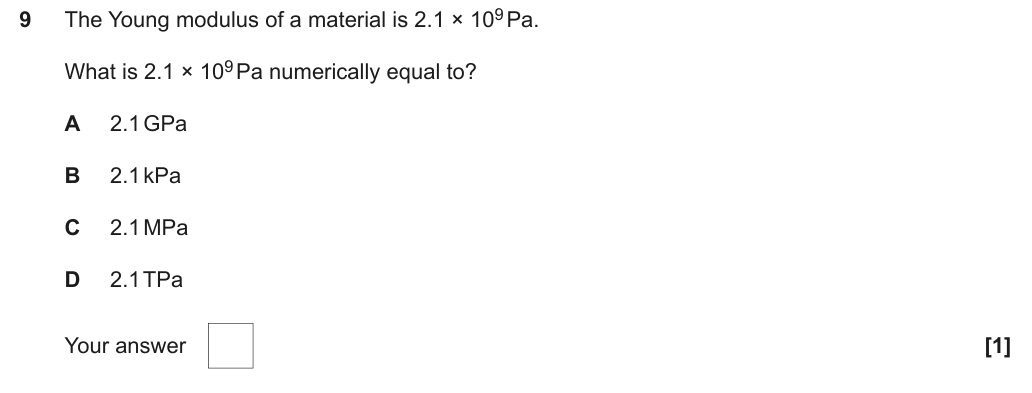
A
Where errors were made it was usually selecting D or to a lesser extent C.
Skills: M0.2 Recognise and use expressions in decimal and standard form
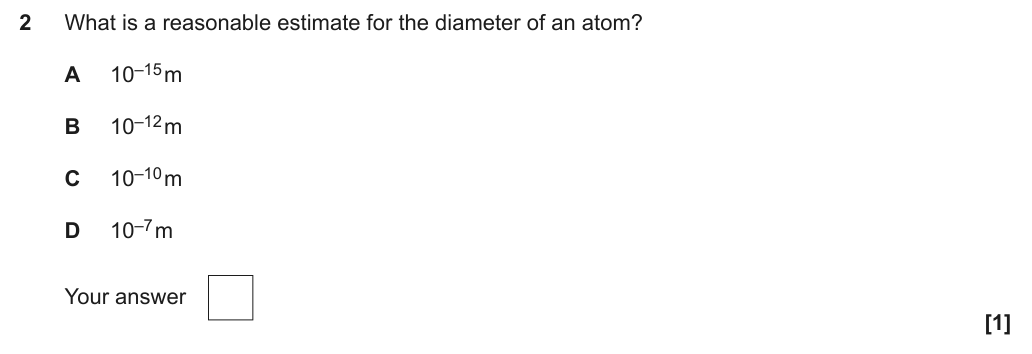
C
Only a few candidates were able to correctly identify the estimate for the diameter. Section 2.1.1 (b) of the specification requires candidates to be able to make estimates of physical quantities. B was the most common incorrect answer.
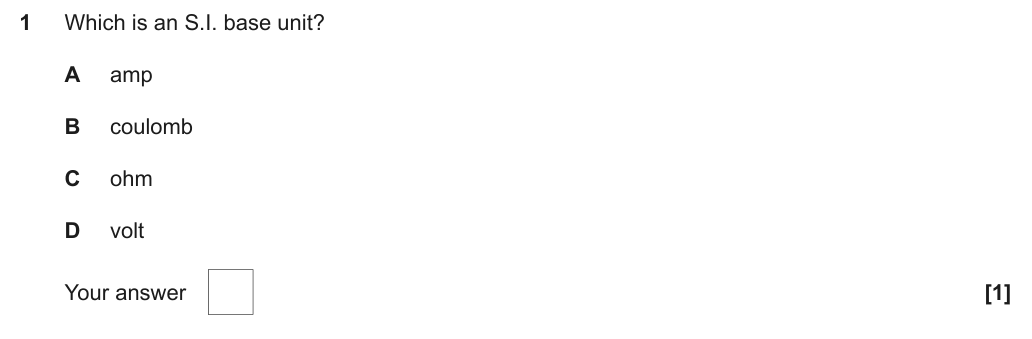
A
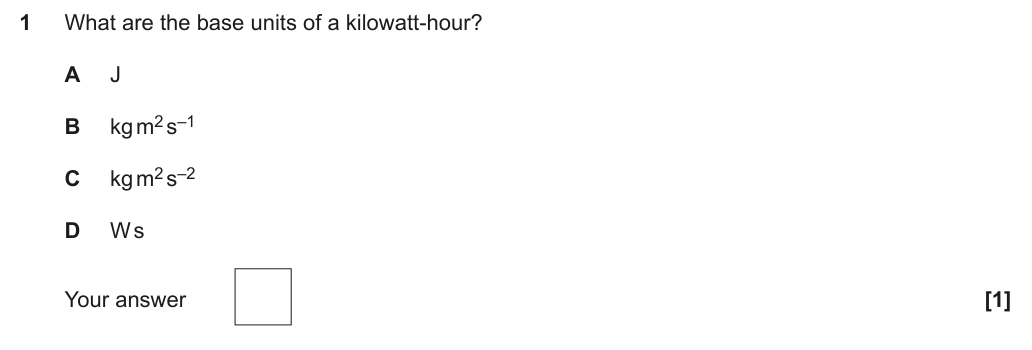
This should have been a straightforward starting question for all the candidates in identifying the correct S.I. base unit but only some gave the correct response of A. The most common distractor was B.
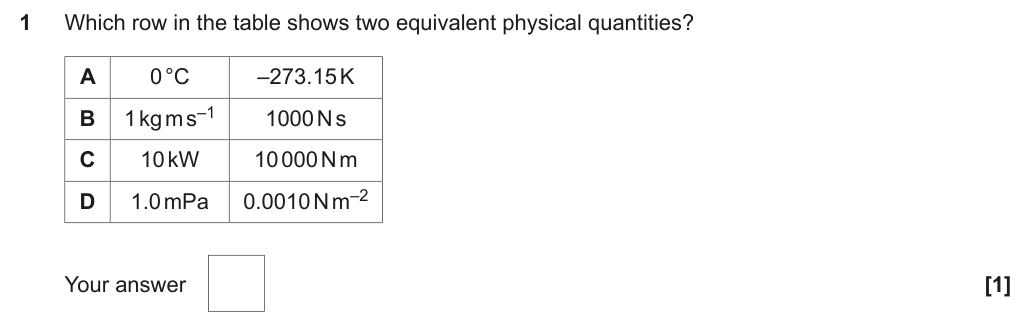
D
Option C can be eliminated here because N m is equivalent to the joule, which is not equivalent to kW, the unit of power. Option A cannot be correct as it has a negative absolute temperature. Option B cannot be correct - the units are equivalent however 1 kg m s-1 and 1 N s are equivalent.
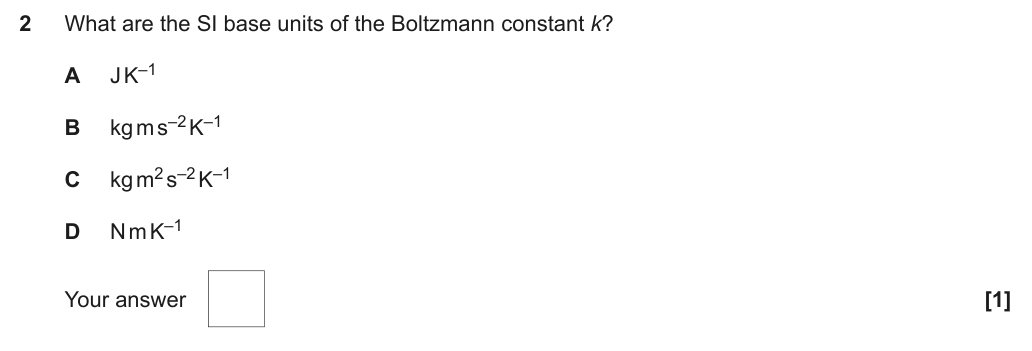
C
Neither option A nor option D can be correct since they contain units that are not base units. Option B cannot be correct as kg m s-2 is equivalent to the newton, not the joule.
C
A little over half of candidates were able to identify the correct response. Many candidates showed working to obtain their answer. D was a common incorrect response.
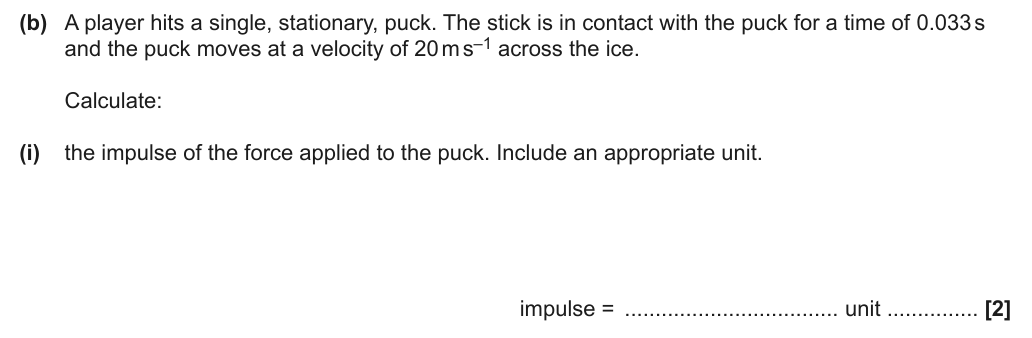
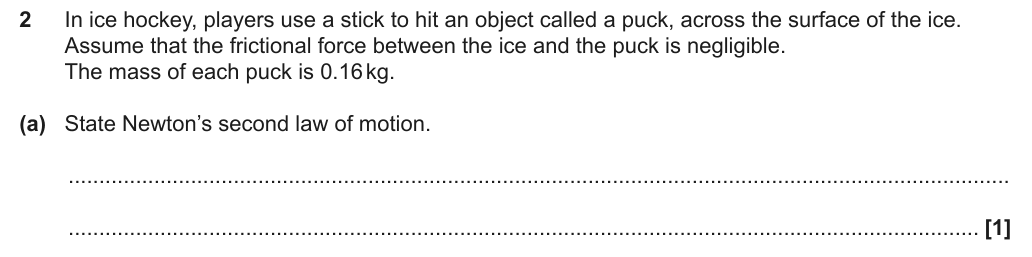
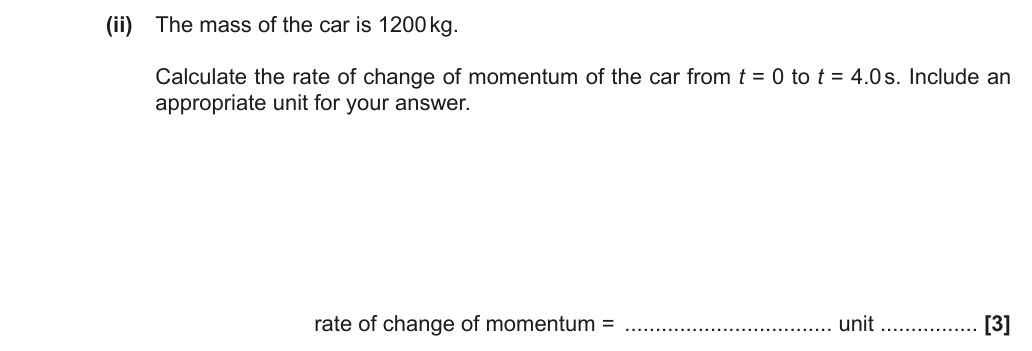
This was generally well answered. Candidates who calculated the impulse correctly usually gave the correct unit. Both N s and kg m s-1 were given. A significant minority of candidates calculated the force (97).
Skills: M0.1 Recognise and make use of appropriate units in calculations; M2.3 Substitute numerical values into algebraic equations using appropriate units for physical quantities
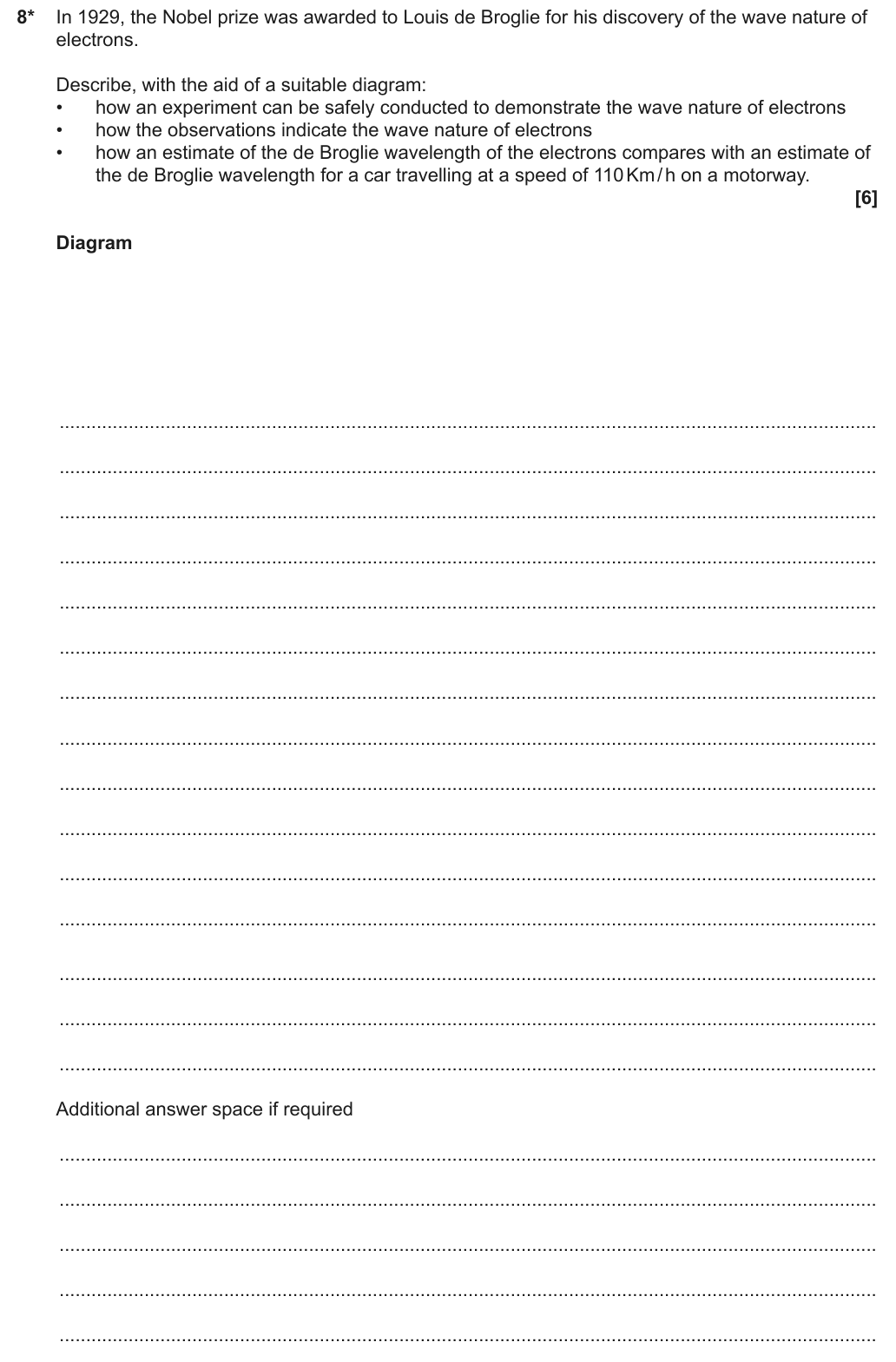
Many candidates appeared not to understand an experiment to demonstrate the wave nature of electrons often drawing a diagram of a double slit and using a screen, in effect the Young slit experiment for light. High scoring candidates often either stated an estimate of the de Broglie wavelength of electrons or used their knowledge and calculated a value for an estimated value of the accelerating potential difference. Ther were some very good answers working out the de Broglie wavelength of a car. The best answers clearly showed the working.
Skills: M0.1 Recognise and make use of appropriate units in calculations; M0.4 Estimate results; M1.4 Make order of magnitude calculations
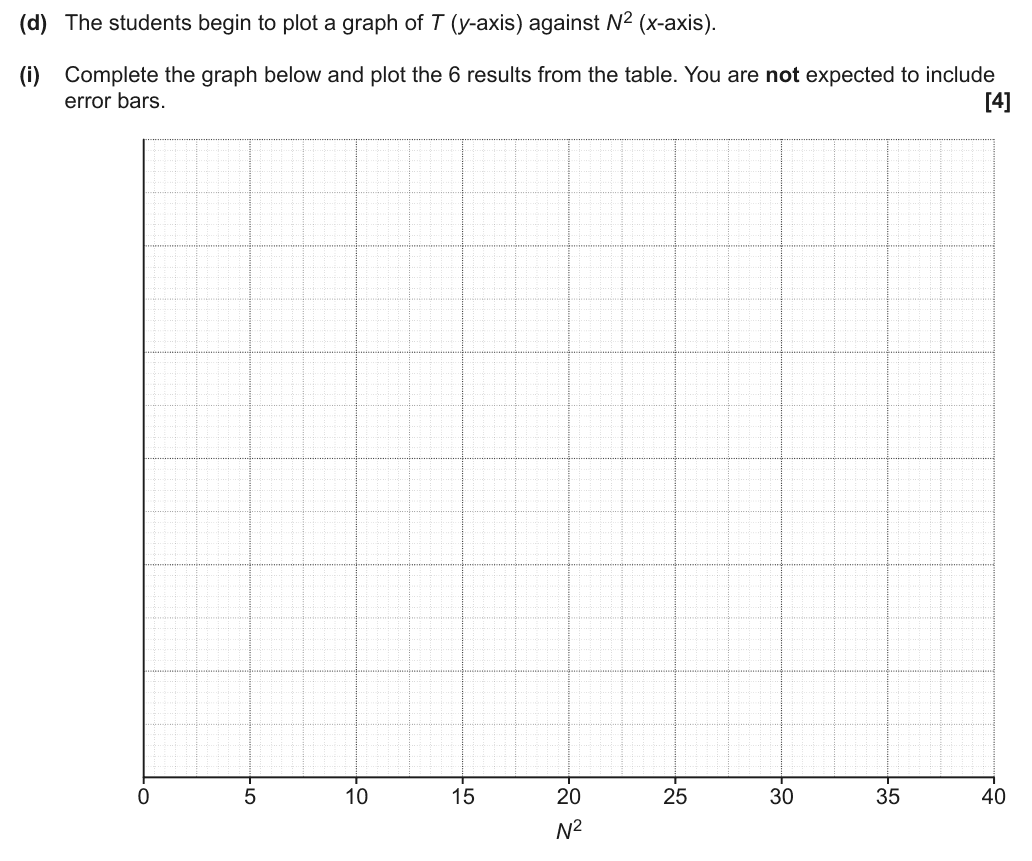
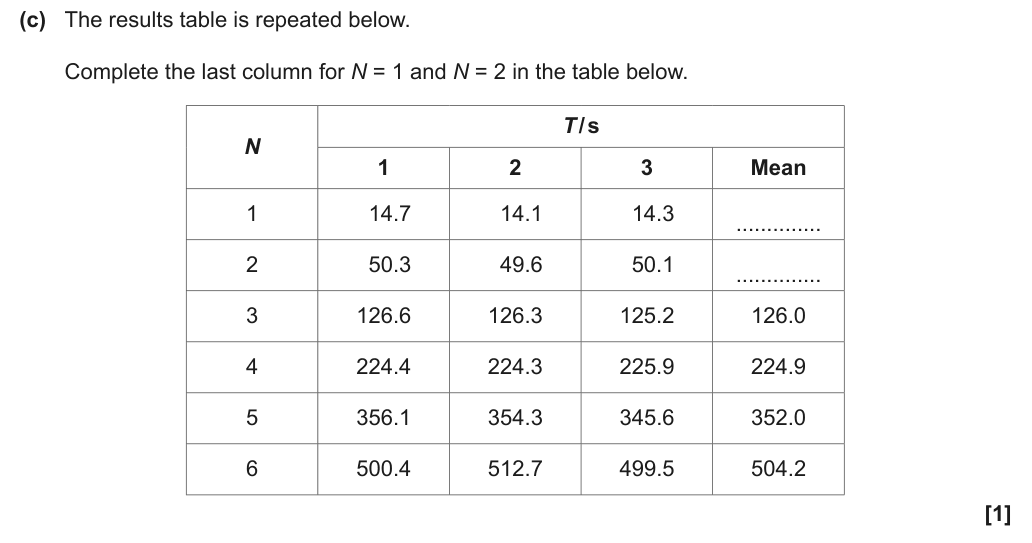
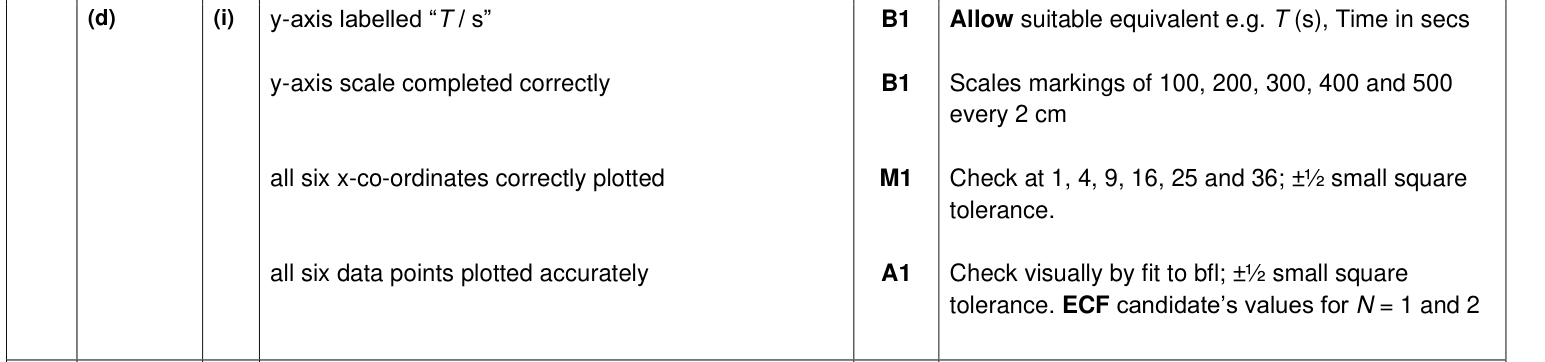
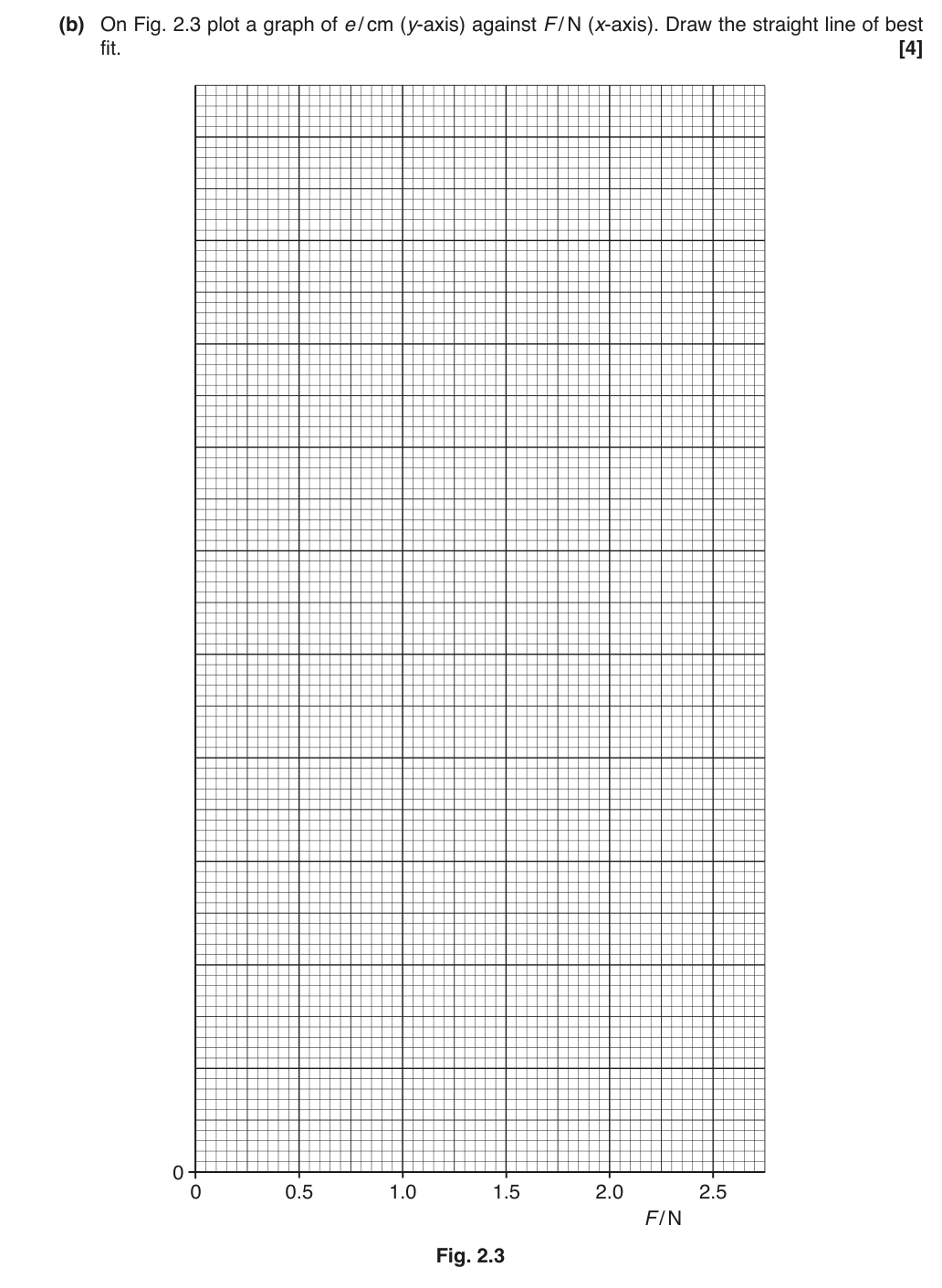
It was easy to put a scale onto this graph, and very few candidates used a non-linear scale or one with a poor choice of intervals. Some candidates, however, forgot to add units to their time axis. Most plotted the points easily, although the first point often proved tricky.
Skills: M0.5 Use calculators to find and use power, exponential and logarithmic functions; M3.2 Plot two variables from experimental or other data; PAG9 Investigating capacitors
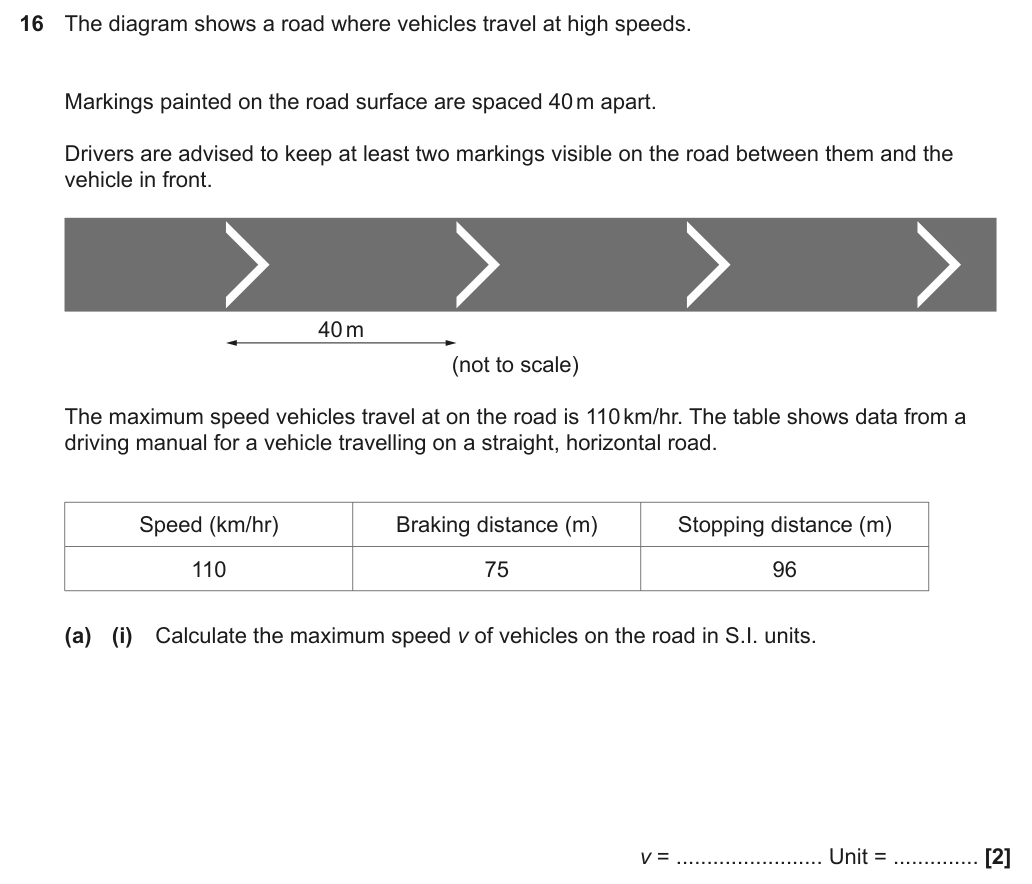
Skills: M0.1 Recognise and make use of appropriate units in calculations
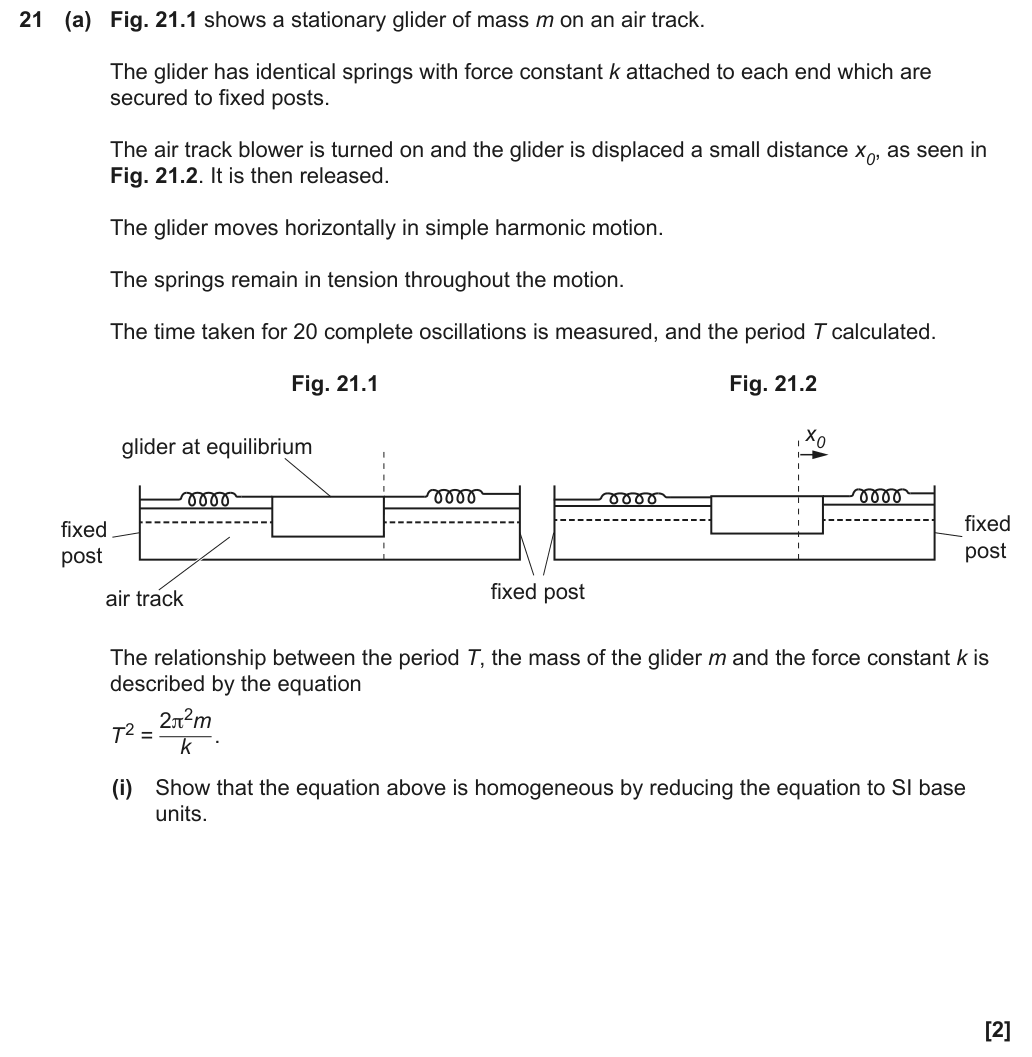
Many candidates successfully derived or remembered how to express the newton in SI base units. From there, working out the base units for the spring constant and cancelling kilograms proved straightforward for many. Question 21 (a) (ii) is considerably more challenging. The two springs are not in series nor are they in parallel. When there is a displacement x one spring is extended by an extra amount x i.e. an extension of (e + x) and the other is extended by a reduced amount x i.e. an extension of (e – x) where e is the equilibrium extension. This meant that the resultant force was k(e + x) – k(e – x), which is clearly 2kx. Neither spring goes into compression, although we condoned candidates who suggested that a reduction in extension meant the same as a compression.
Skills: M0.1 Recognise and make use of appropriate units in calculations
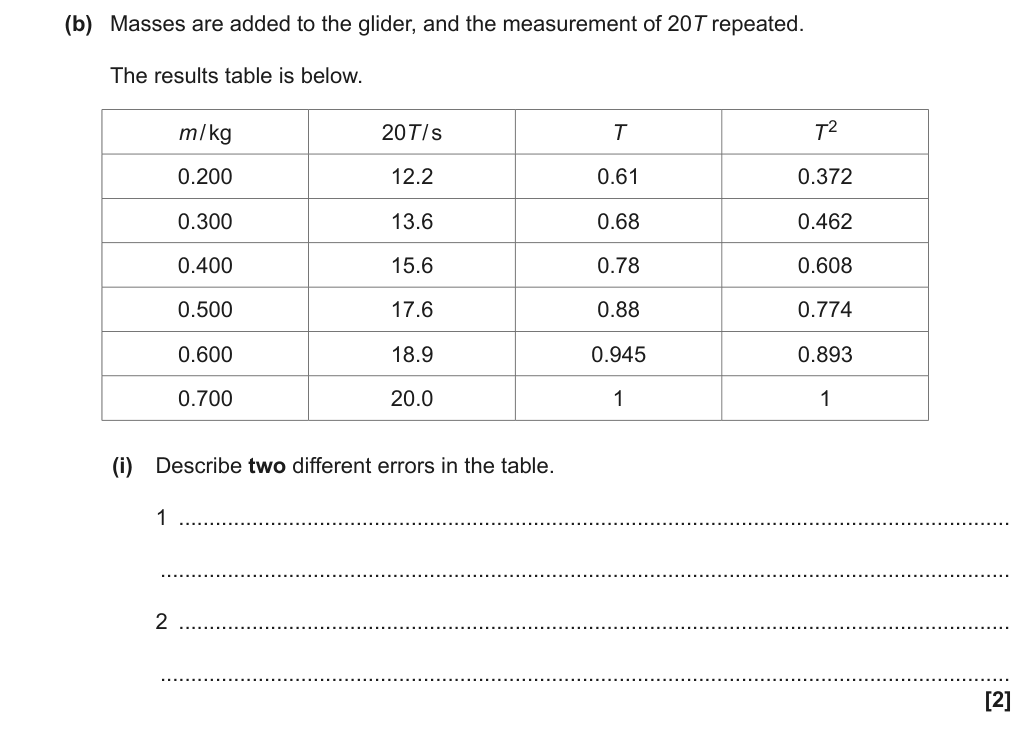
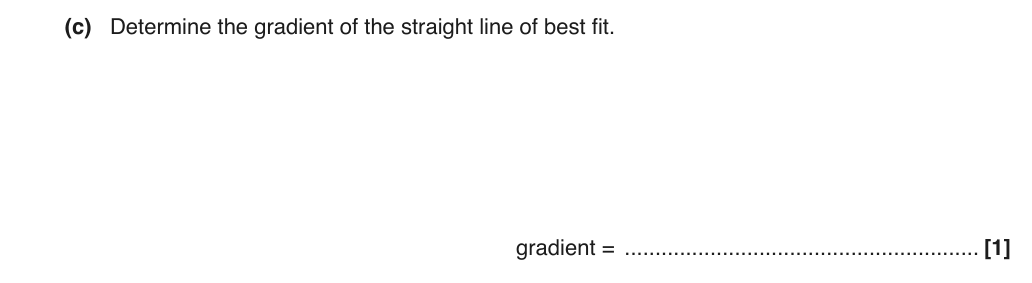
Most candidates spotted the two different errors namely the lack of units for both T and T2 and the inconsistent presentation of the digits in the data. Almost all candidates correctly plotted the data point at (0.200, 0.372). Most candidates constructed an acceptable line of best fit with a minority insisting that the best fit line should go through the origin. Best fit lines are judged on two criteria: the number of points above and below the proposed line and a fair distribution of points away from the line. Consider the line that starts at the origin and has three points above and below it. The first and last points are some distance away from the line and the points get progressively closer towards the middle. This cannot happen with the best fit line. Most candidates used the relationship correctly, recognising that the gradient = 2π2/k. Nearly all candidates correctly calculated the gradient, going on to evaluate k. Gradients from incorrect best fit lines were acceptable under error carried forward rules for all 3 marks. A minority of candidates misread their graphs or made algebraic errors.
Skills: M1.1 Use an appropriate number of significant figures; PAG10 Investigating simple harmonic motion
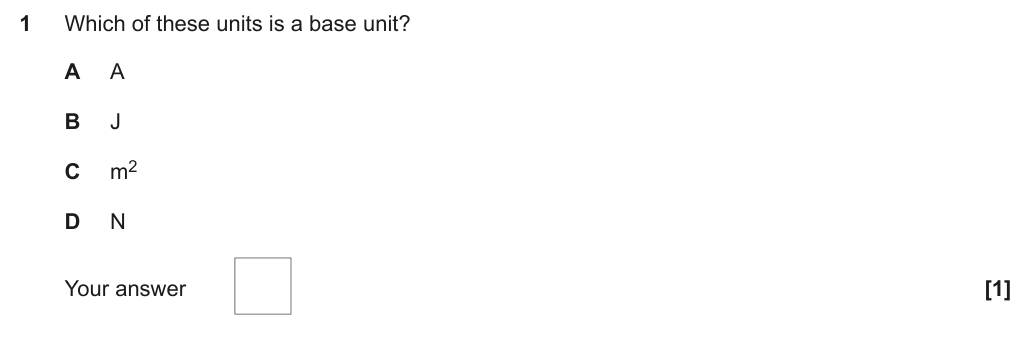
A
The majority of candidates were able to correctly recall the ampere as the correct base unit. C was a common distractor, most likely as it contains the obvious metre.
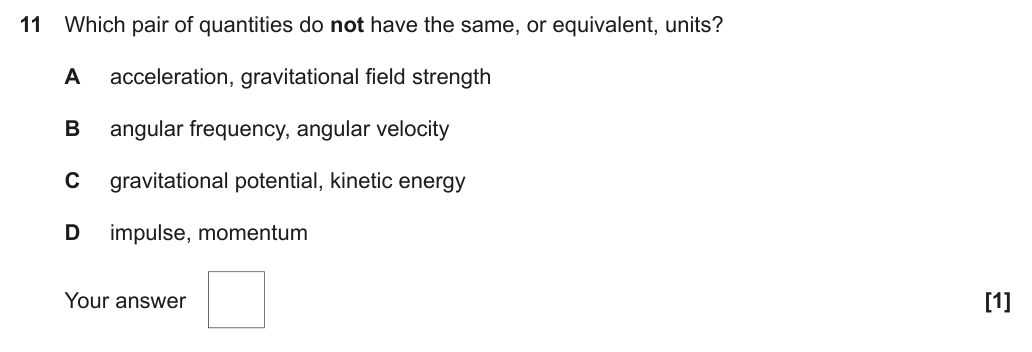
C
Most candidates suggested that angular frequency and angular velocity do not have the same or equivalent units. The correct answer is C, because gravitational potential is measured in J kg–1 and kinetic energy is measured in J.
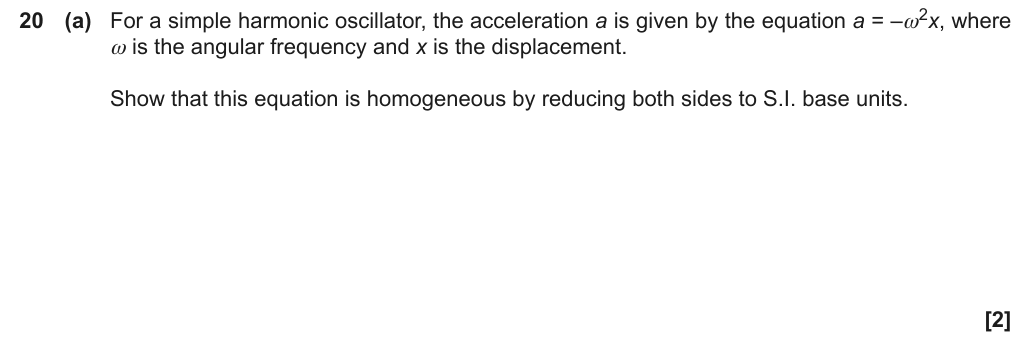
A large majority of candidates showed clearly that the units for acceleration were m s–2 and that the unit for angular frequency, in base units, was s–1. Showing the resulting unit algebra clearly was often the only barrier to scoring both marks.
Skills: M0.1 Recognise and make use of appropriate units in calculations
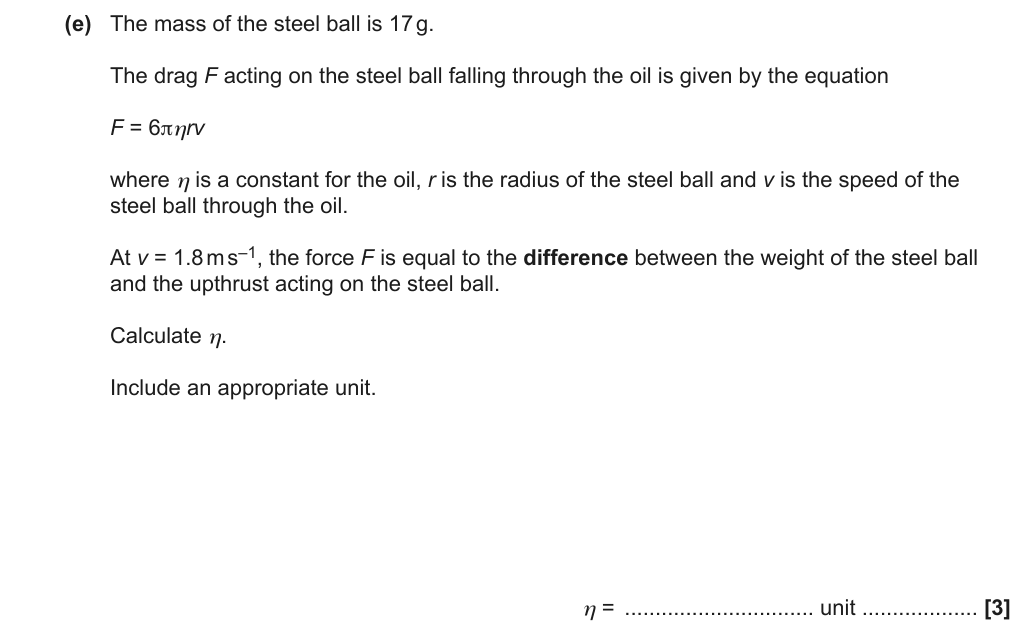
This was a challenging question and as a consequence some candidates only attempted to determine the unit. Common errors included either not allowing for the powers of ten correctly or not determining F as detailed in the question. Candidates also needed to determine the unit of . A common incorrect unit seen was N s-1 m-2.
Skills: M0.1 Recognise and make use of appropriate units in calculations; M2.2 Change the subject of an equation, including non-linear equations; M2.3 Substitute numerical values into algebraic equations using appropriate units for physical quantities
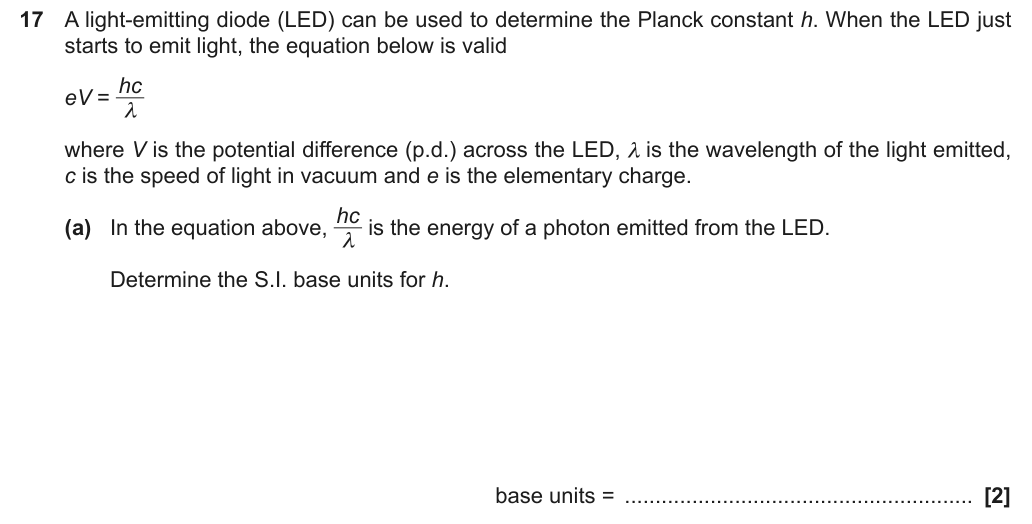
This question was done correctly by around half of the candidates. The most common method was to use an equation for energy or work to give the base units of the joule. From this, multiplying it by s would lead to the correct response. Most candidates used KE = ½ mv2 to determine the base units of the joule directly, although others used work done = force distance and force = mass acceleration. Encouragingly, there were relatively few arithmetic errors even with the negative indices. Some candidates got into difficulties attempting to use the given equation and struggled with the volt, attempting to use V = IR in a variety of ways. A very common error was to give the units simply as Js, often using h = E/c to show [J m / m s–1] gives J s. There was a clear misconception (see below) about what constitutes a base unit.
Skills: M0.1 Recognise and make use of appropriate units in calculations
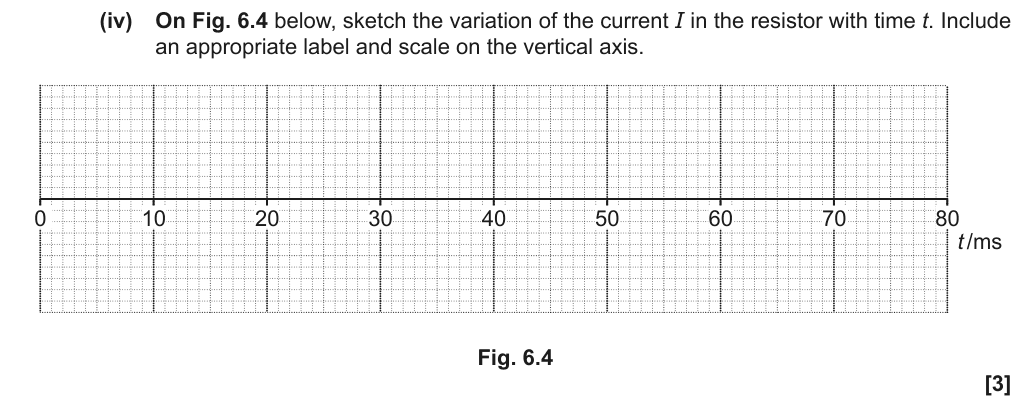
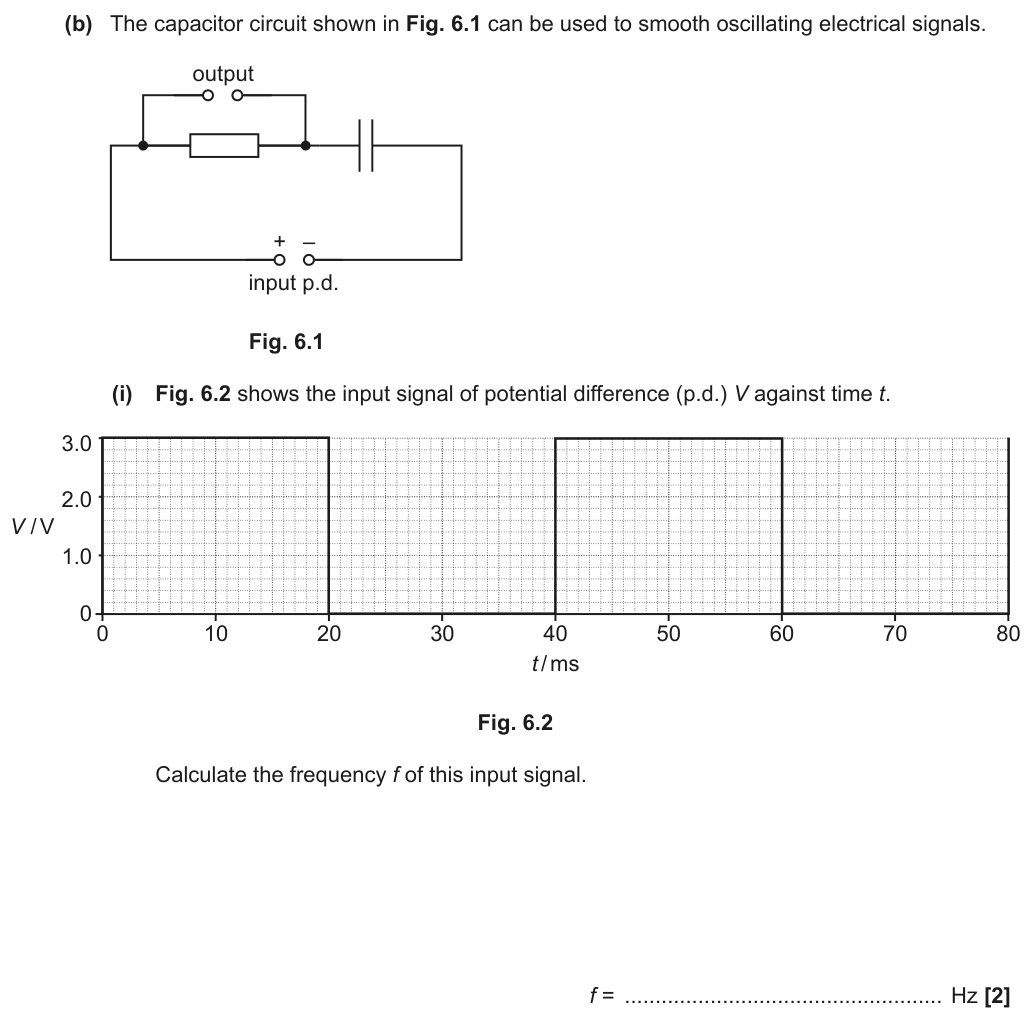
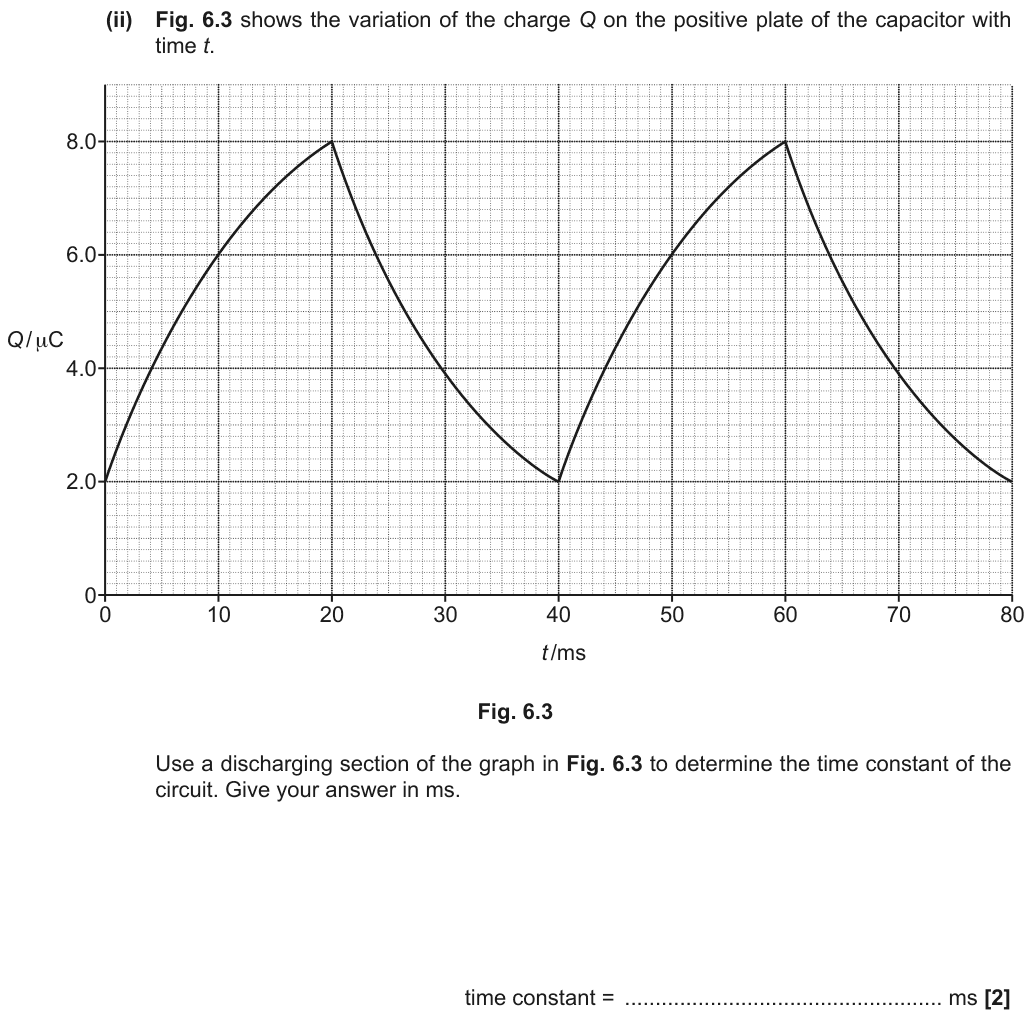
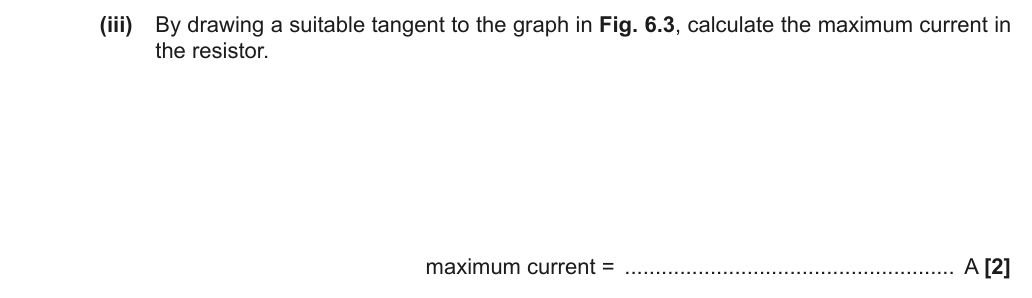
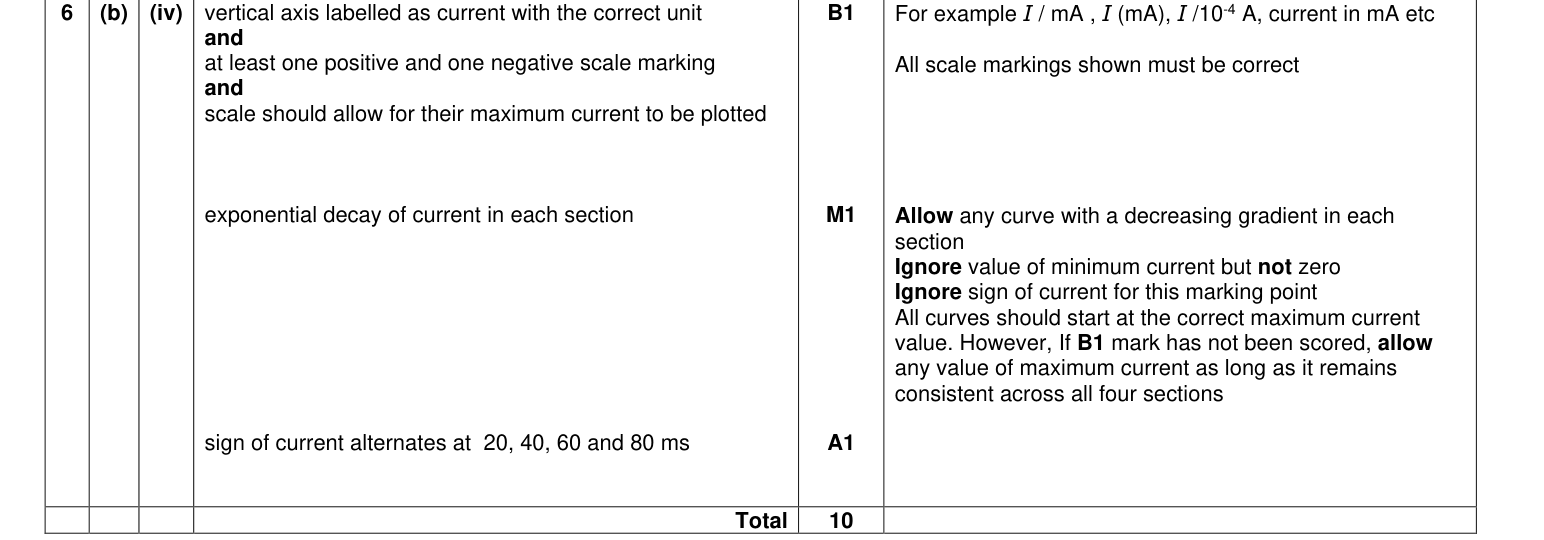
Since I = ΔQ/Δt, the graph of I against t can be found from the gradient of the graph of Q against t. The gradient is positive from 0 – 20 ms and negative from 20 – 40ms; this represents the current flowing one way around the circuit while the capacitor charges and then the opposite way while it discharges. Since the gradient is never zero, the value of the current is never zero either. Tasks that caused problems in 6(b)(iv) • drawing an exponential decay, particularly in the negative section of the graph (most drew a sinusoidal curve). • converting the maximum current into mA or µA. • labelling the vertical axis and drawing on a sensible scale. If any of your students’ results are not as expected, you may wish to consider one of our post-results services. For full information about the options available visit the OCR website. We send a weekly roundup to tell you about important updates. You can also sign up for your subject specific updates. If you haven’t already, sign up here. Attend one of our popular CPD courses to hear directly from a senior assessor or drop in to a Q&A session. Most of our courses are delivered live via an online platform, so you can attend from any location. Please find details for all our courses on the relevant subject page on our website or visit OCR professional development. ExamBuilder is the question builder platform for a range of our GCSE, A Level, Cambridge Nationals and Cambridge Technicals qualifications. Find out more. ExamBuilder is free for all OCR centres with an Interchange account and gives you unlimited users per centre. We need an Interchange username to validate the identity of your centre's first user account for ExamBuilder. If you do not have an Interchange account please contact your centre administrator (usually the Exams Officer) to request a username, or nominate an existing Interchange user in your department. Review students' exam performance with our free online results analysis tool. It is available for all GCSEs, AS and A Levels and Cambridge Nationals. It allows you to: • review and run analysis reports on exam performance • analyse results at question and/or topic level • compare your centre with OCR national averages • identify trends across the centre • facilitate effective planning and delivery of courses • identify areas of the curriculum where students excel or struggle • help pinpoint strengths and weaknesses of students and teaching departments. Find out more. Post-results services Keep up-to-date OCR Professional Development Signed up for ExamBuilder?
Skills: M3.12 Sketch relationships which are modelled by y = k/x, y = kx², y = k/x², y = kx, y = sin x, y = cos x, y = e^(±x) and y = sin²x, y = cos²x as applied to physical relationships
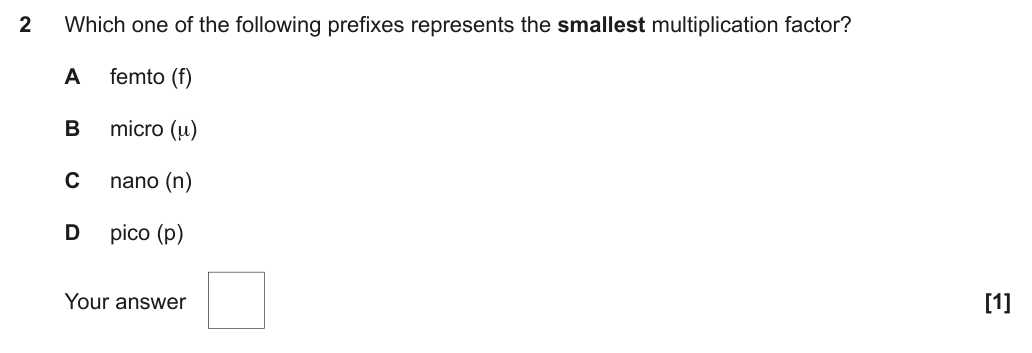
A
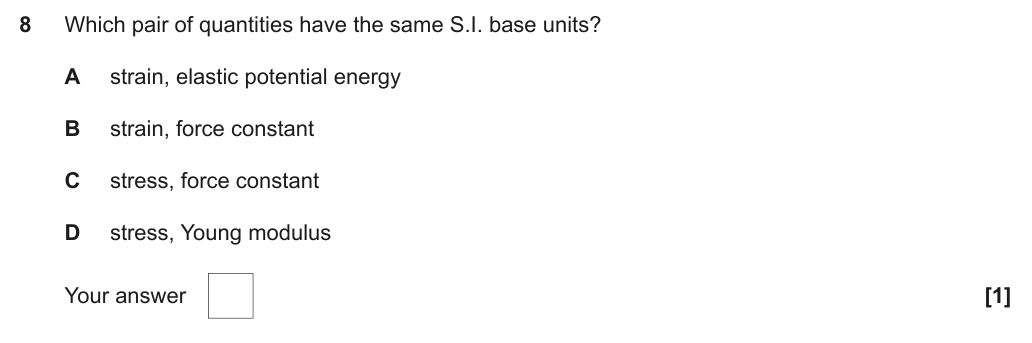
D
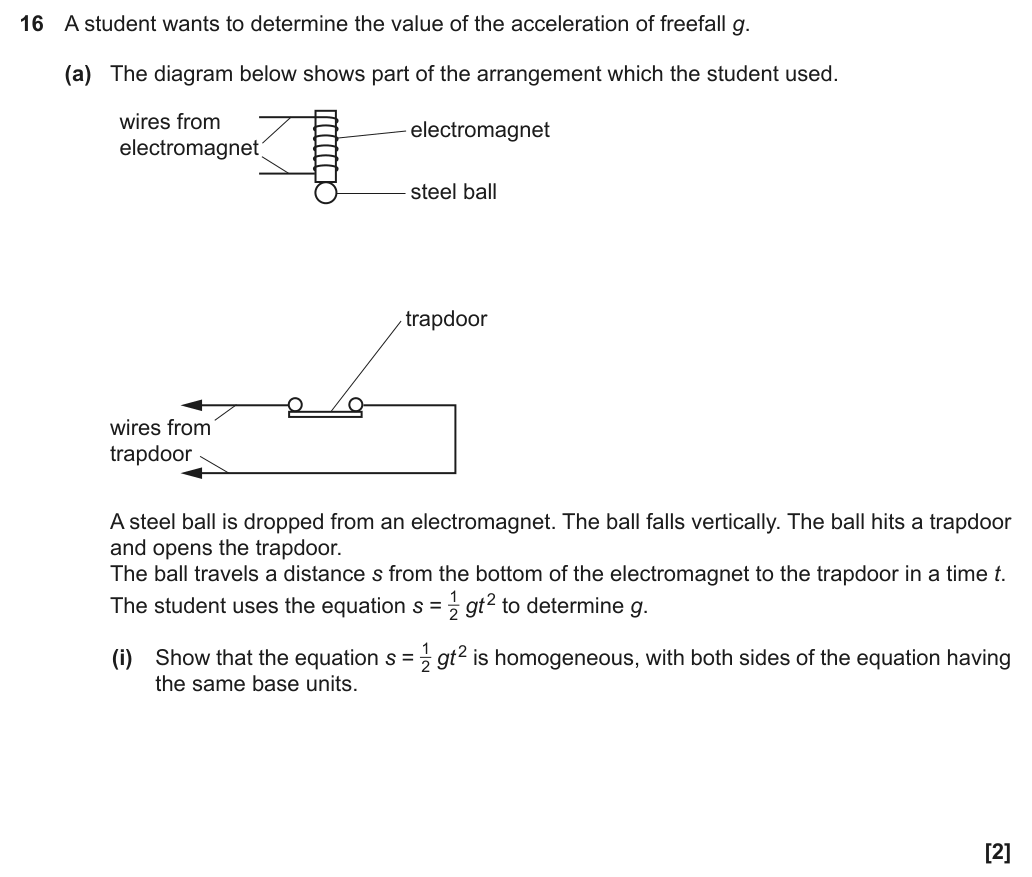
Skills: M0.1 Recognise and make use of appropriate units in calculations
D
Skills: M0.1 Recognise and make use of appropriate units in calculations; M2.3 Substitute numerical values into algebraic equations using appropriate units for physical quantities
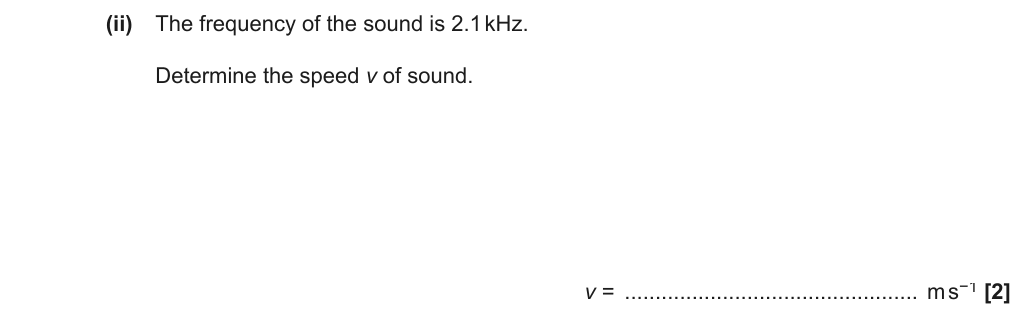
Skills: M0.1 Recognise and make use of appropriate units in calculations; M2.3 Substitute numerical values into algebraic equations using appropriate units for physical quantities
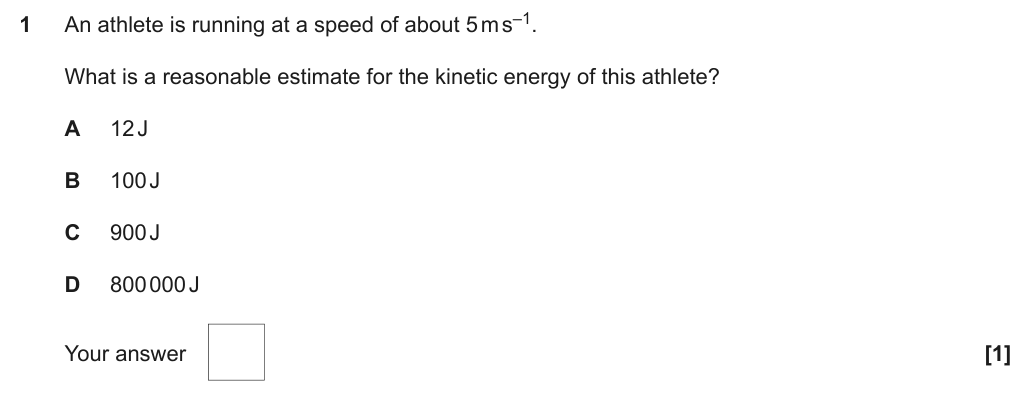
C
Candidates found Question 1, Question 2 and Question 15 very straightforward.
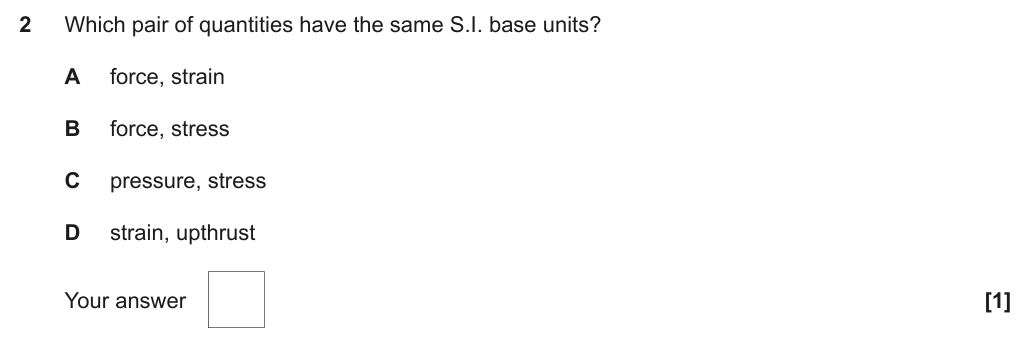
C
Candidates found Question 1, Question 2 and Question 15 very straightforward.
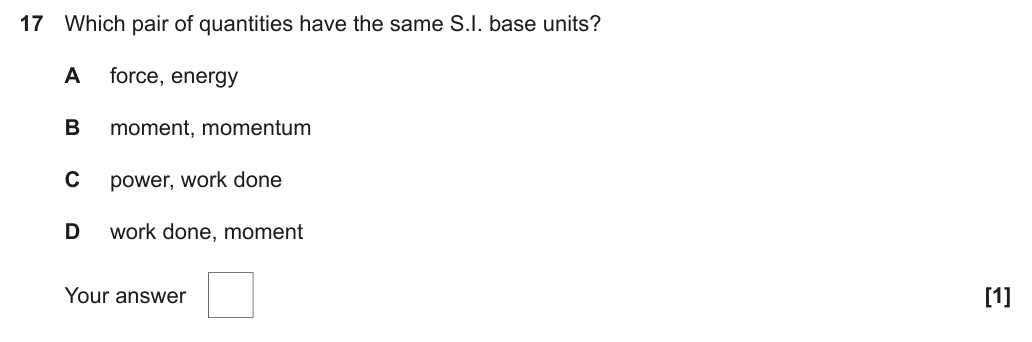
D
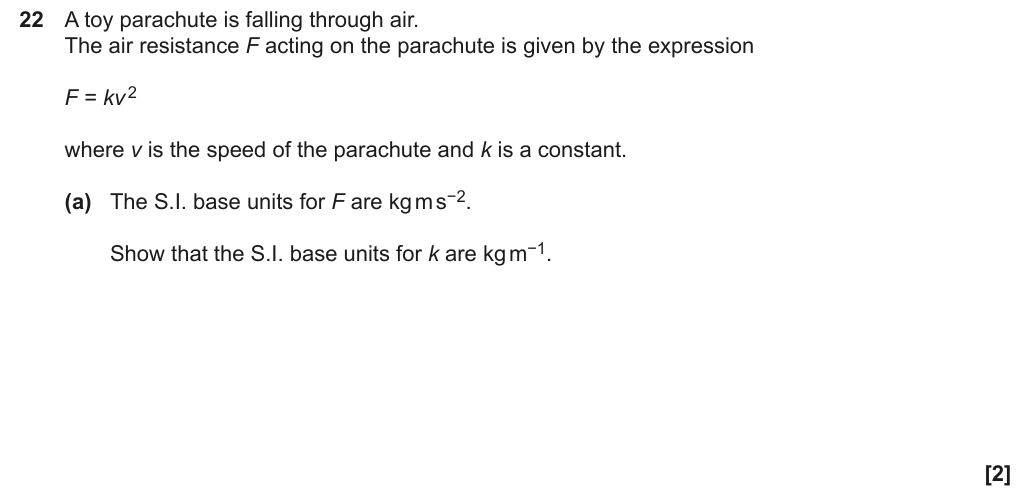
Question 22b • made excellent use of information provided in the Data, Formulae and Relationships booklet when doing calculations, e.g. Question 22a • had well-structured solutions with clear manipulation of equations, good substitution and wrote the final answers to appropriate significant figures • demonstrated good use of calculators, especially handling powers of ten • demonstrated good comprehension of command words such as describe, explain, show, etc • wrote numerical and textual responses that were aligned to the number of marks given • correctly used scientific vocabulary and key concepts, e.g. Questions 22b and 23bi • showed poor recall of prefixes, e.g. nano (n) in Question 28b • did not underline (or circle) key data and terms in the questions, notably in the MCQs.
Skills: M0.1 Recognise and make use of appropriate units in calculations; M2.2 Change the subject of an equation, including non-linear equations
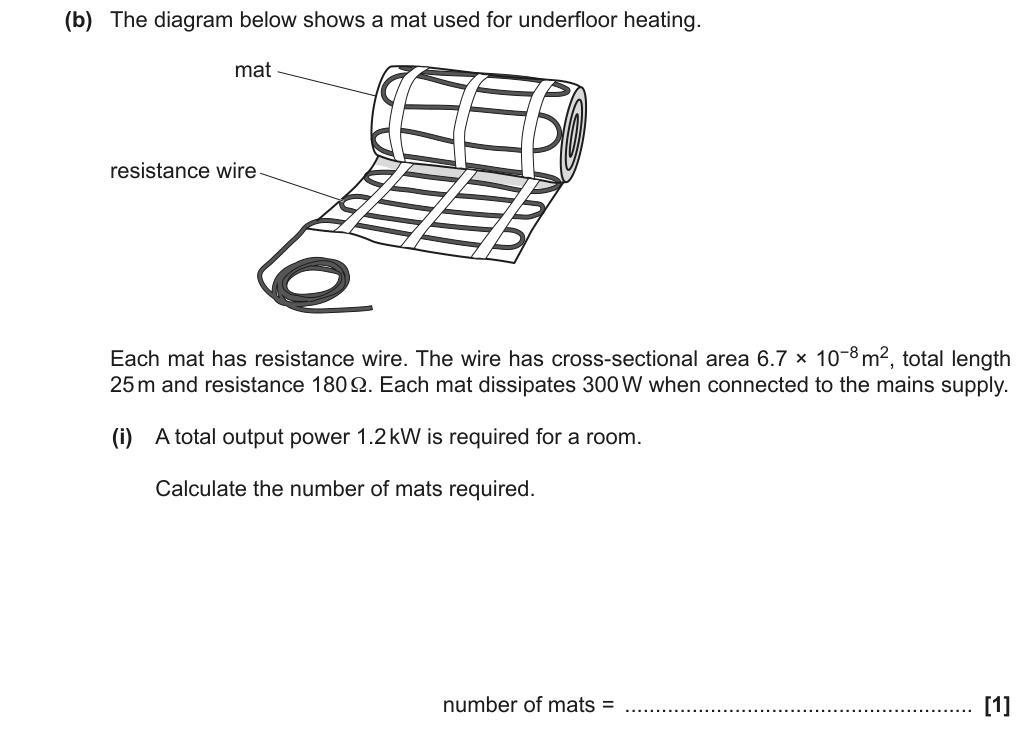
Question 24a • made judgements and reached conclusions based on experimental data by calculating absolute uncertainty, e.g.
Skills: M0.3 Use ratios, fractions and percentages
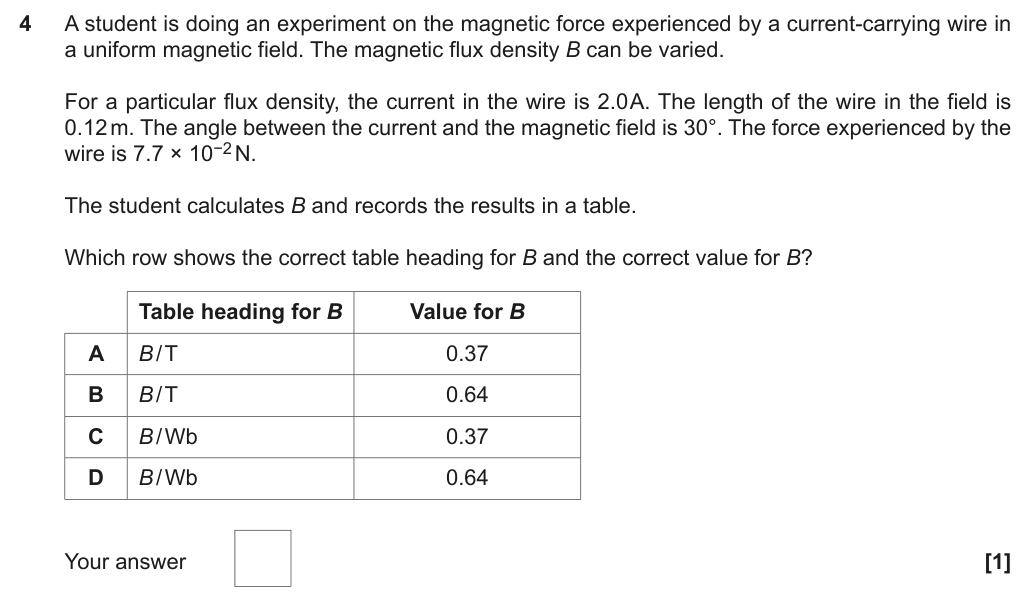
B
Questions 4, 5, 18 and 19bii • made judgements and reached conclusions based on experimental data by calculating percentage uncertainty, e.g.
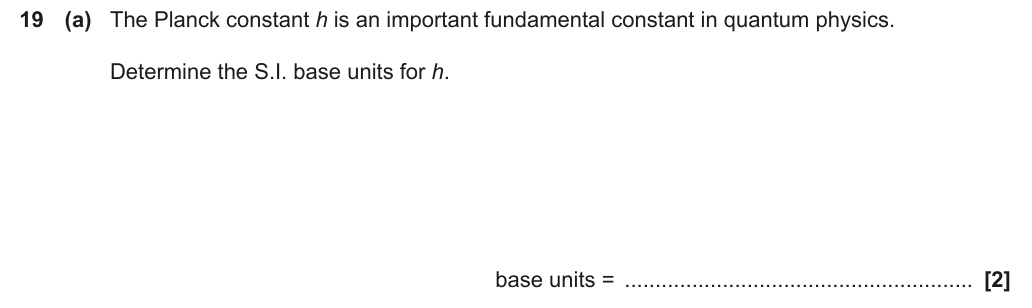
Question 19bi1 • made excellent use of information provided in the Data, Formulae and Relationship booklet when doing calculations, e.g. Questions 19bii3, 20cii and 23bii2 • did not underline (or circle) key data and terms in the questions, particularly in the MCQs.
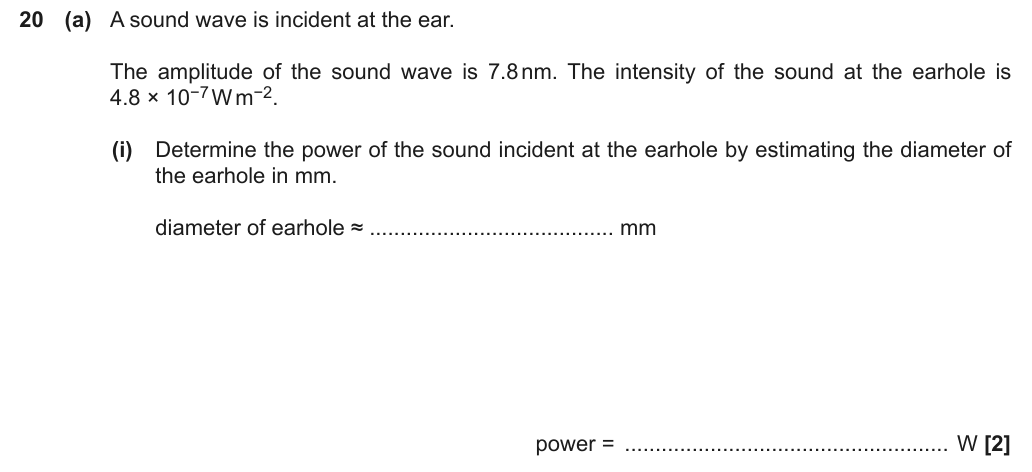
Questions 16b, 17c, 18, 20ci, 21a, 21c, 22bii and 24b. • wrote all the steps and calculations when answering numerical multiple choice questions - this was unnecessary and time- consuming because most calculations could have been done on calculators • demonstrated poor recall of basic definitions and misunderstood key concepts, e.g. confusing phase difference and path difference in Question 20ci • truncated or rounded numbers prematurely within calculations, which led to incorrect final responses, e.g. Misconception Question 20aii The intensity of a sound wave is directly proportional to amplitude2. Question 20c is all about superposition of light from a double-slit and explanation of the fringes in terms of phase difference.
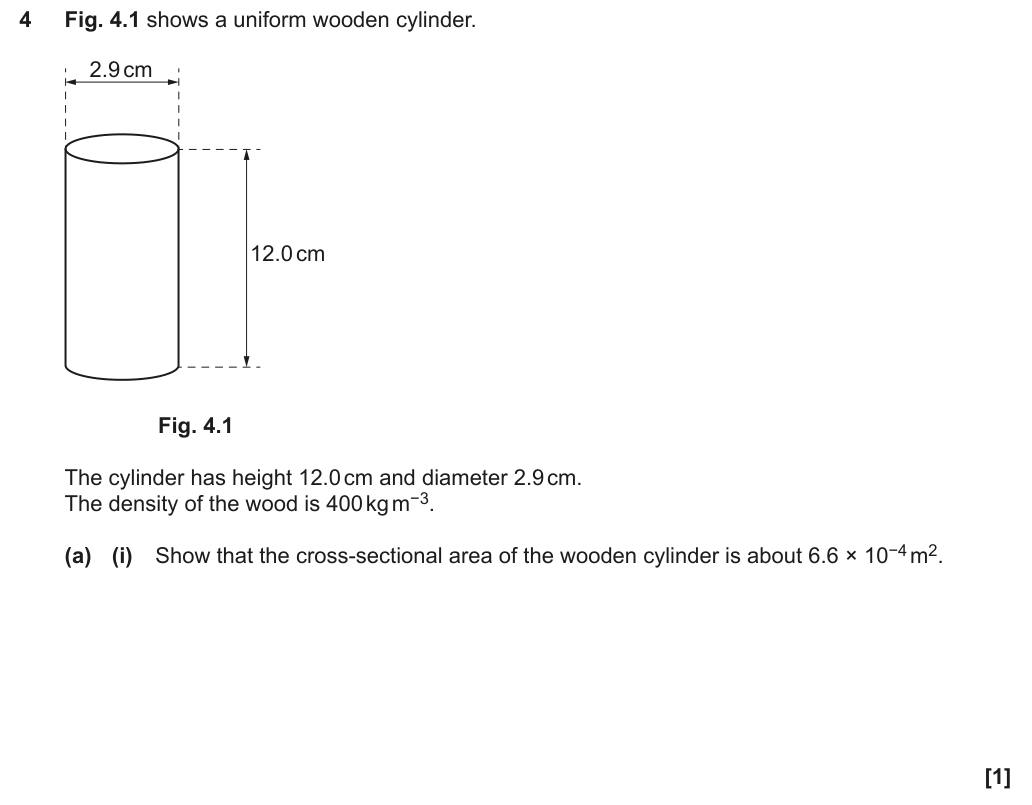
Skills: M0.4 Estimate results; M2.2 Change the subject of an equation, including non-linear equations; M4.3 Calculate areas of triangles, circumferences and areas of circles, surface areas and volumes of rectangular blocks, cylinders and spheres
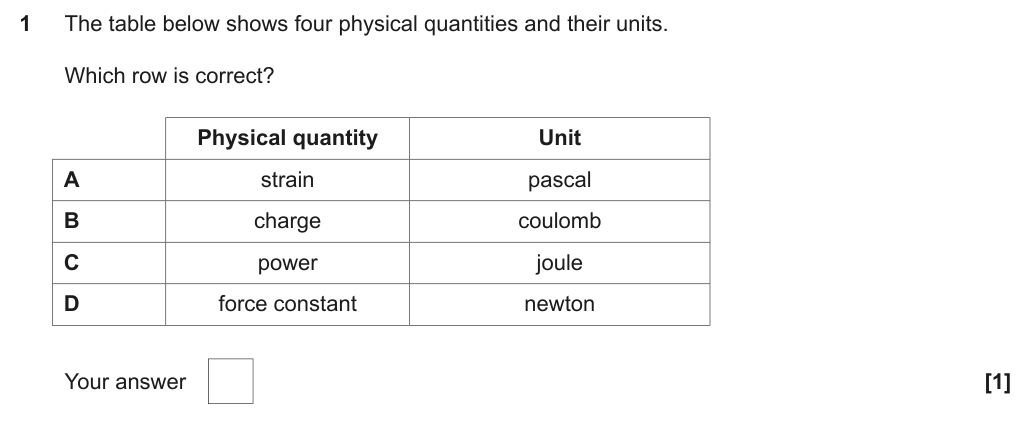
B
This was an easy starting question for all the candidates. It was testing knowledge of S.I. units used in a range of topics. The majority of the candidates got the correct answer B. The most popular distractor was D, followed closely by A.
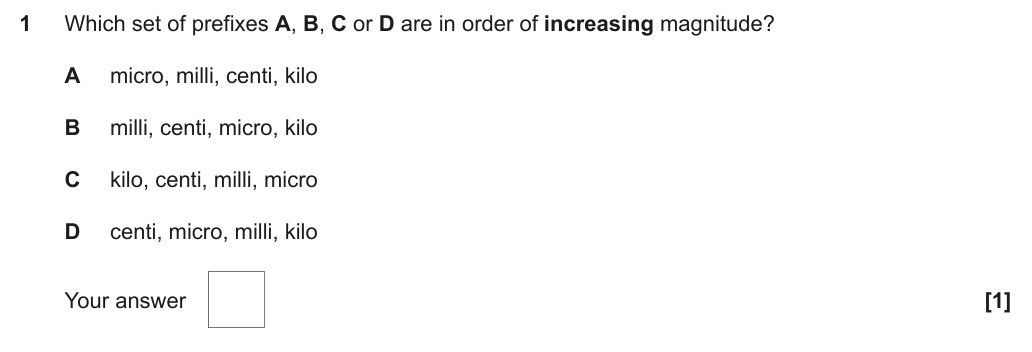
A
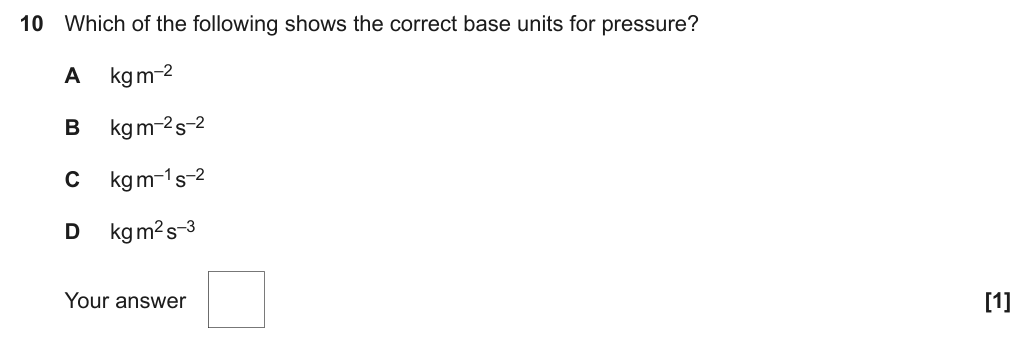
C
Since P = F/A, we need the units of force and area in base units. F = ma, so force has the base units of kg m s-2 . Area’s unit in base units is m2. Hence pressure has the base units kg m s-1/m2 = kg m-1 s-2, which is answer C.
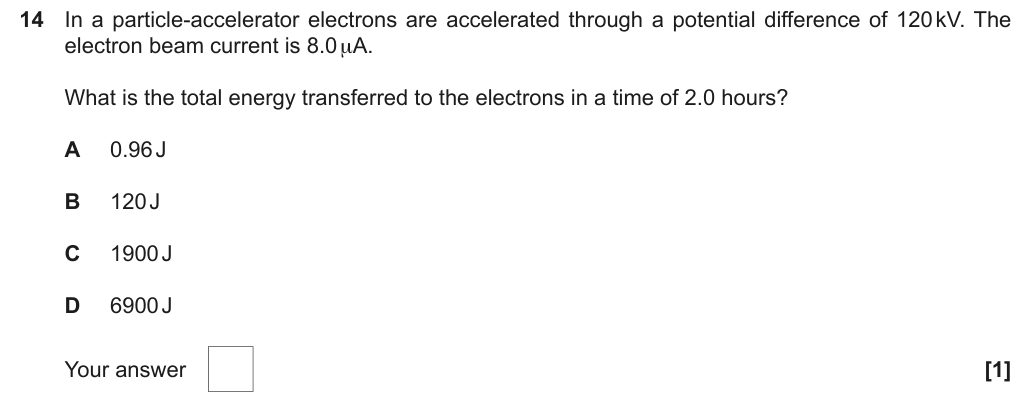
D
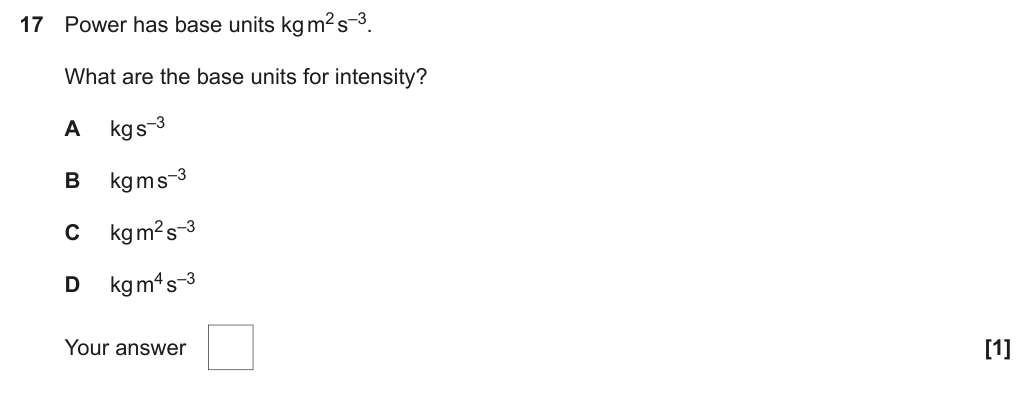
A
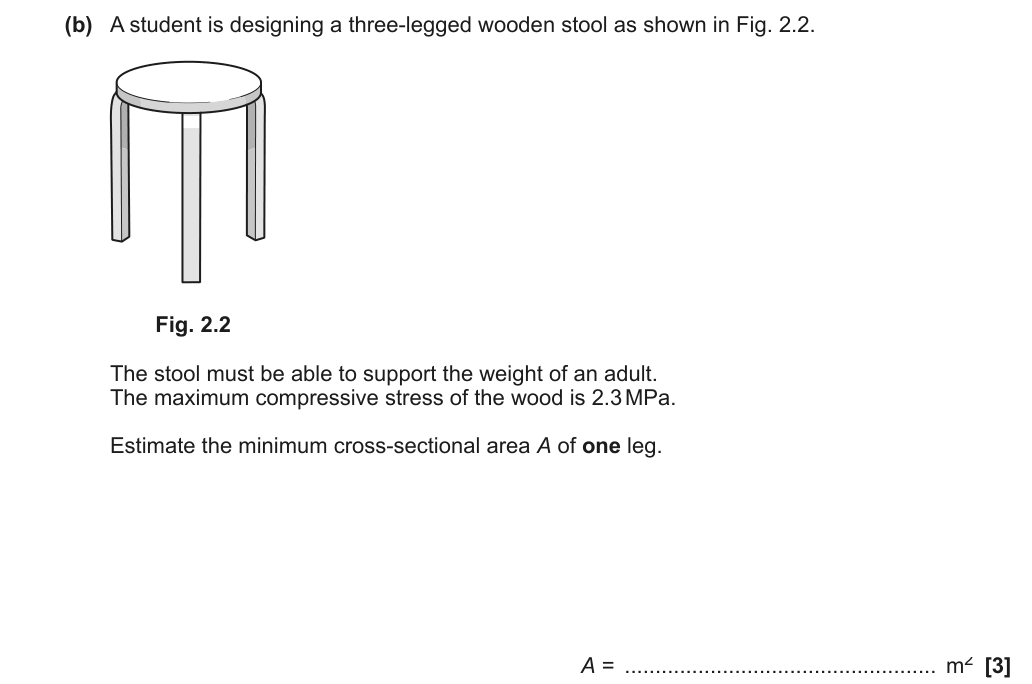
A good proportion of the candidates scored full marks on this question. Some candidates found the total area rather than the area of one leg. A few candidates assumed that the stool had four legs. This question required candidates to estimate the mass or weight of an adult. In general, in this type of question a more generous mass is sensible. Candidates who did well on this question started by stating the mass (or weight) of an adult. Examiners allowed a mass between 50 kg and 150 kg. Candidates then often worked out the total area before working out the area of one of the legs. Some candidates did not correctly understand that 2.3 MPa was equal to 2.3 × 10⁶ Pa. Some candidates incorrectly divided the stress by three. This candidate has clearly identified the average weight of an adult and then indicated how the weight of the adult is determined. The candidate has then clearly stated the equation for stress and shown their working for full marks.
Skills: M0.1 Recognise and make use of appropriate units in calculations; M0.4 Estimate results; M2.2 Change the subject of an equation, including non-linear equations
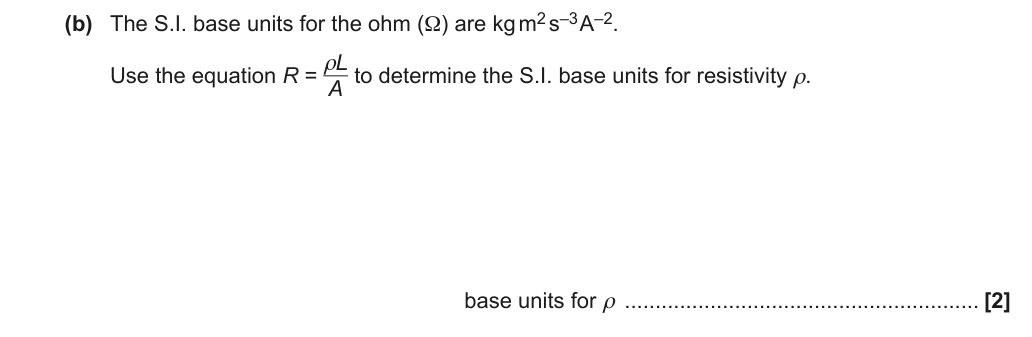
The majority of the candidates effortlessly showed the base units for resistivity to be kg m3 s-3 A-2. The structure from most was immaculate. It was good to see shortcuts being used too. Some candidates went straight to the units for resistivity (Ω m), and then multiplied the units given for resistance multiplied by m.
Skills: M0.1 Recognise and make use of appropriate units in calculations; M2.2 Change the subject of an equation, including non-linear equations
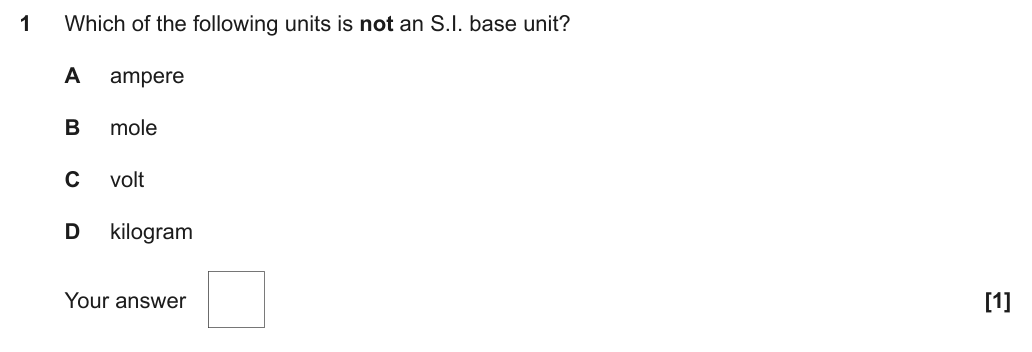
C
About three quarters of all candidates recognised that the volt is not an S.I. base unit.
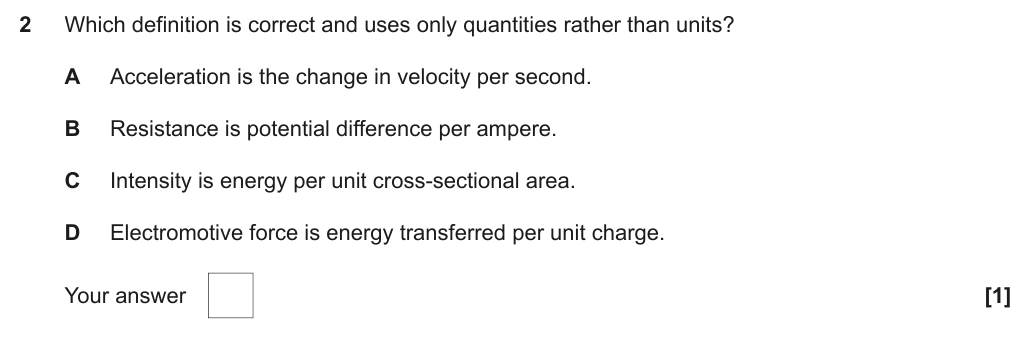
D
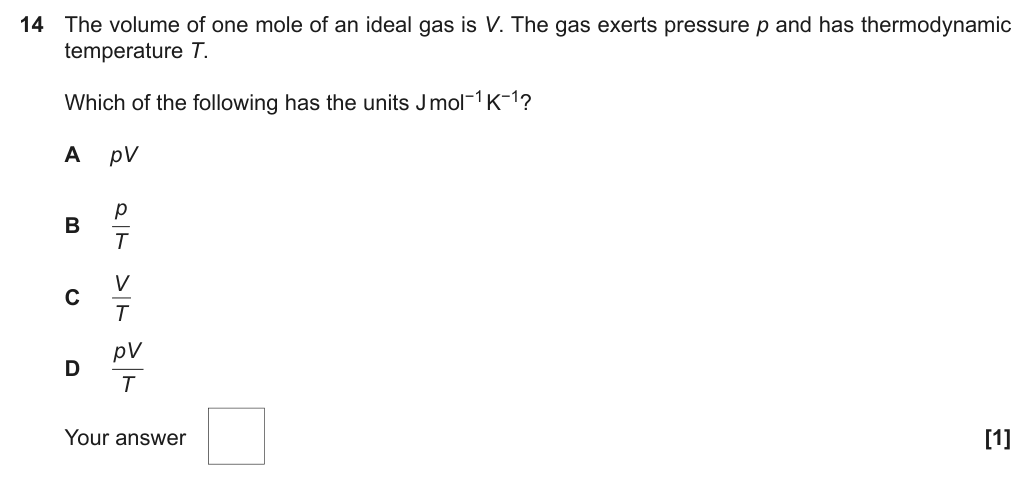
D
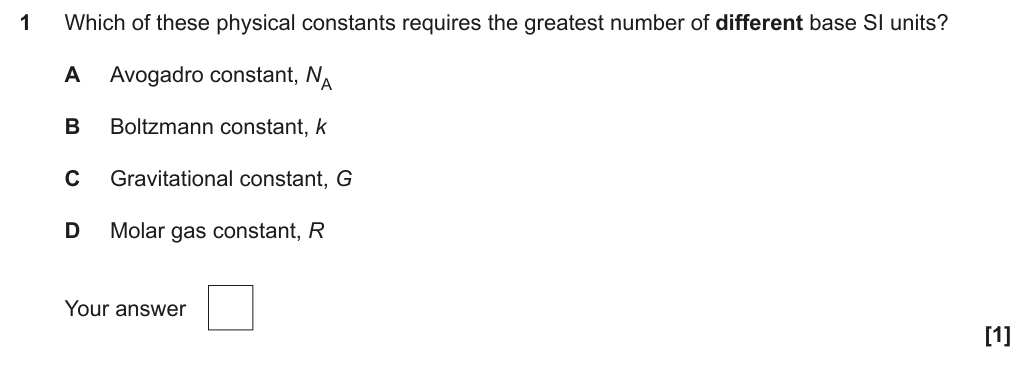
The unit J mol-1 K-1 is the same unit as the molar gas constant, such that pV = nRT. It follows that the unit of R must be the same as the unit of pV/T as ‘n’ has no units.
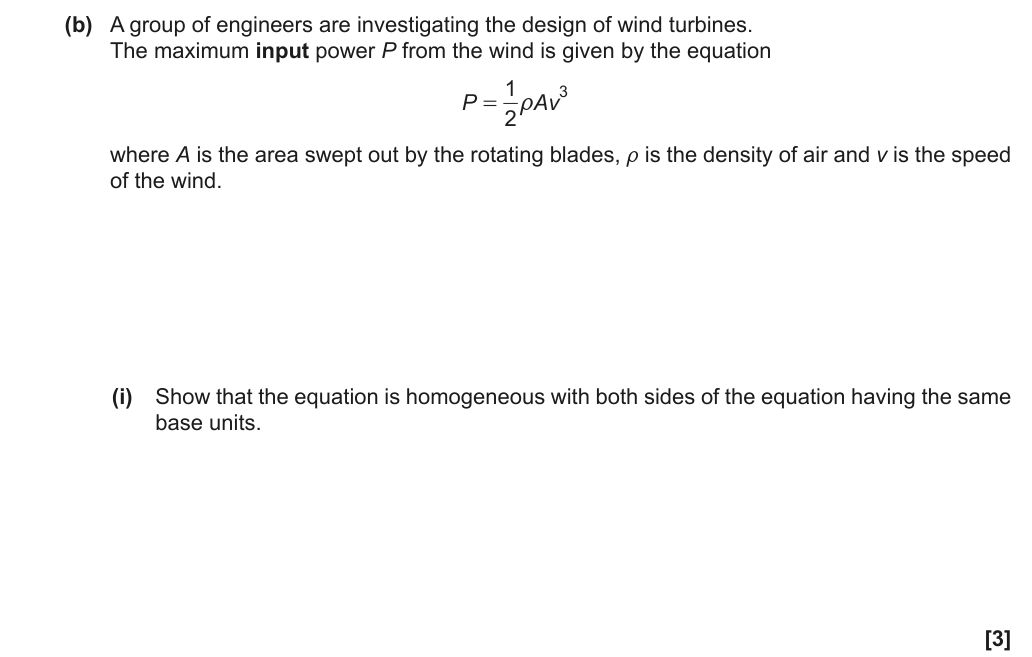
Candidates generally made an excellent attempt at this question, although for many the working was difficult to follow. In the exemplar, the candidate has made it very clear that they are considering the two sides of the equation separately and have reduced each unit to its S.I. base units as required by the question. The use of square brackets to distinguish between a quantity rather than a base unit was helpful.
Skills: M0.1 Recognise and make use of appropriate units in calculations
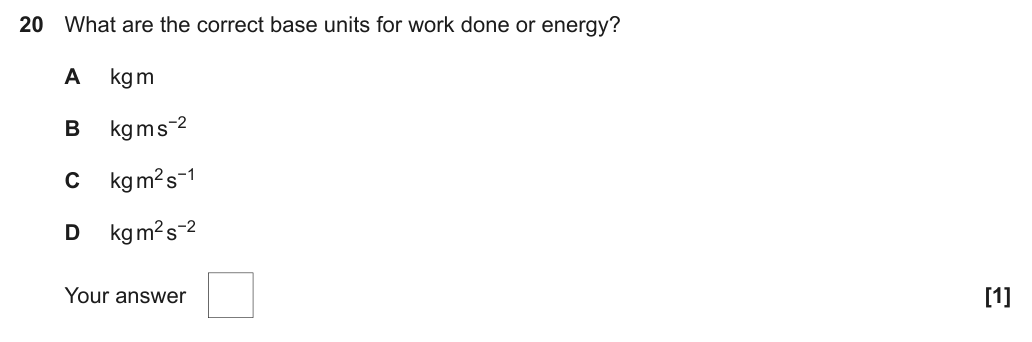
D
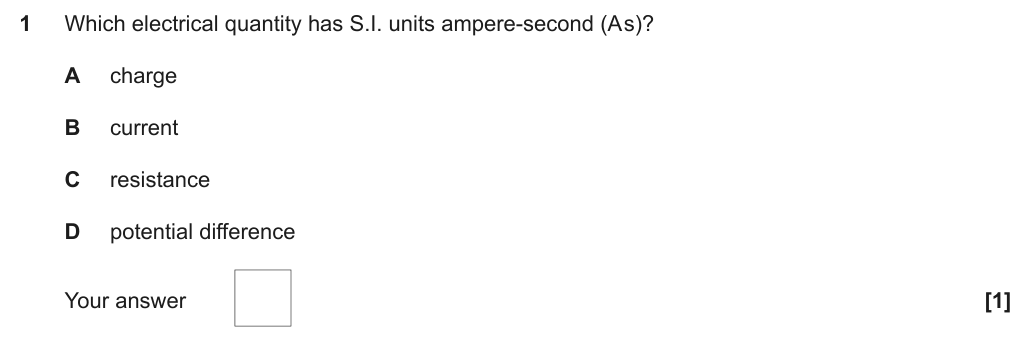
A
Questions 1, 2 and 6 proved to be particularly straightforward, allowing most of the candidates to demonstrate their knowledge and understanding of physics. Question 1 Question 2 This was a well-answered question with most candidates demonstrating excellent knowledge of resistors in series and parallel combination.
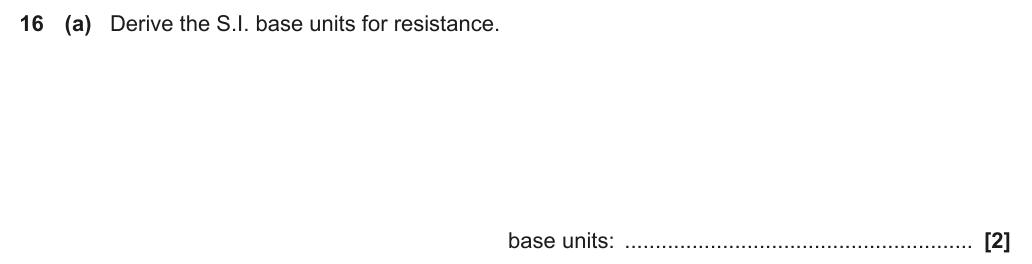
This was a challenging question, which provided the ideal opportunity for top-end candidates to use a variety of methods to get the correct S.I. base units of kg m2 A-2 s-3 for resistance. A significant number of candidates secured 1 mark for a partial answer with either charge → A s, or energy → kg m2 s-2. The rules for exponents were a bit perplexing for the low-scoring candidates. Many also misunderstood S.I. units. This exemplar illustrates a flawless answer from a top-end candidate. The equations are clear to see and follow. The units of each physical quantities are clearly identified and the appropriate S.I. units for the quantities have been successfully manipulated to give the correct answer. Compare this with the exemplar below which illustrates a common misconception. This exemplar illustrates a common error made by some candidates across the ability spectrum. The resistivity ρ in the equation for resistance has been mistaken for density (which unfortunately has the same label). There can be no credit for wrong physics. It is vital to know your equations. Key:
Skills: M0.1 Recognise and make use of appropriate units in calculations; M2.2 Change the subject of an equation, including non-linear equations
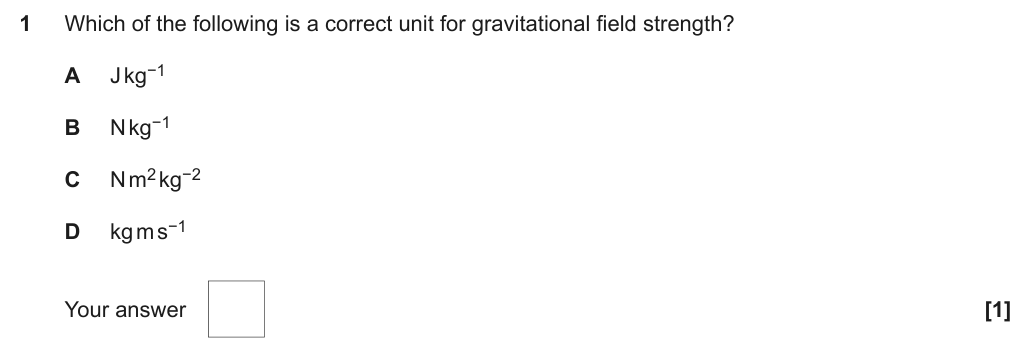
B
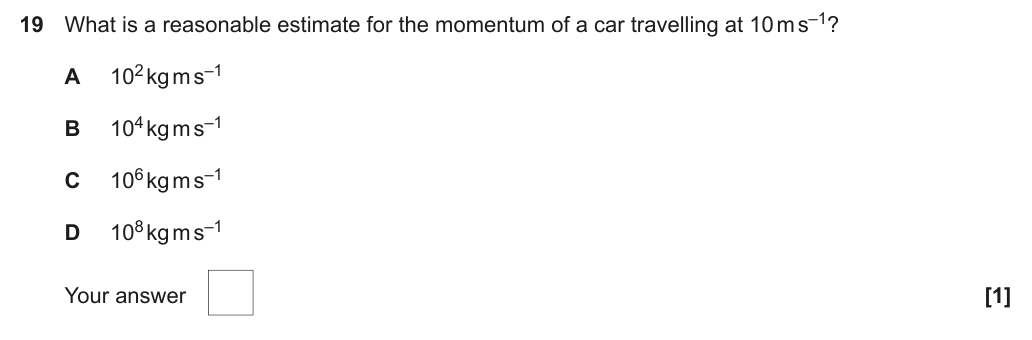
B
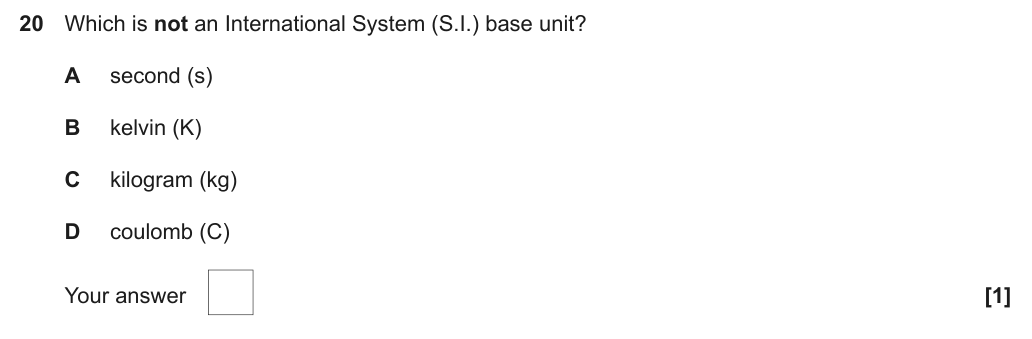
D
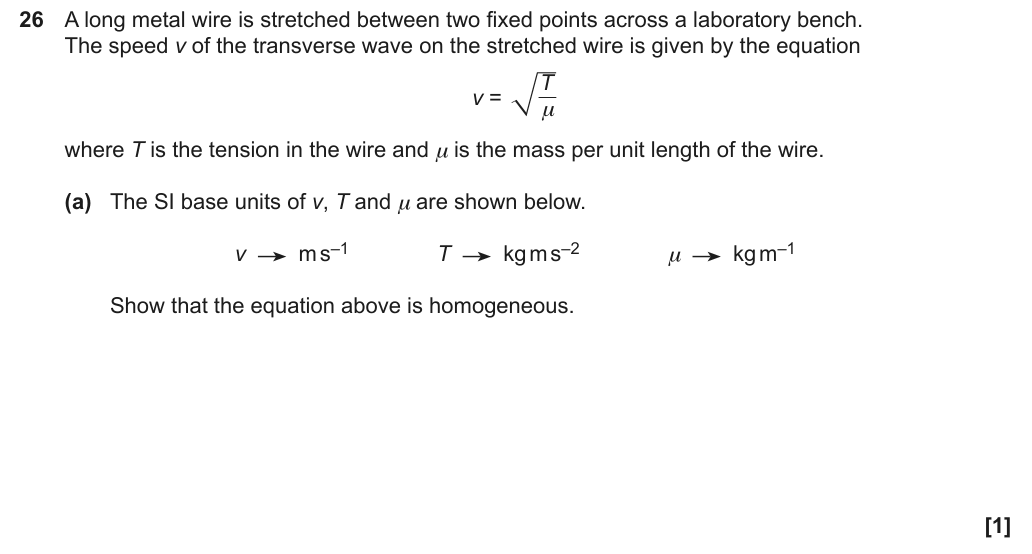
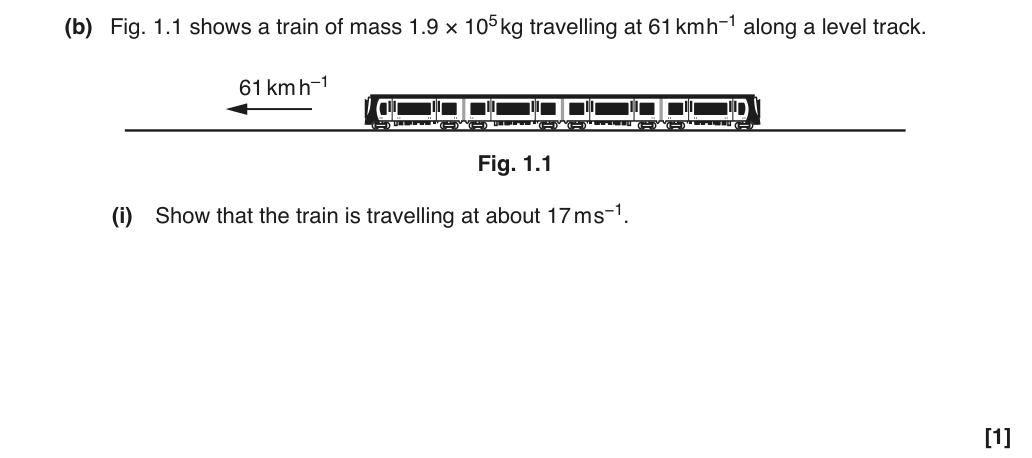
Skills: M0.1 Recognise and make use of appropriate units in calculations
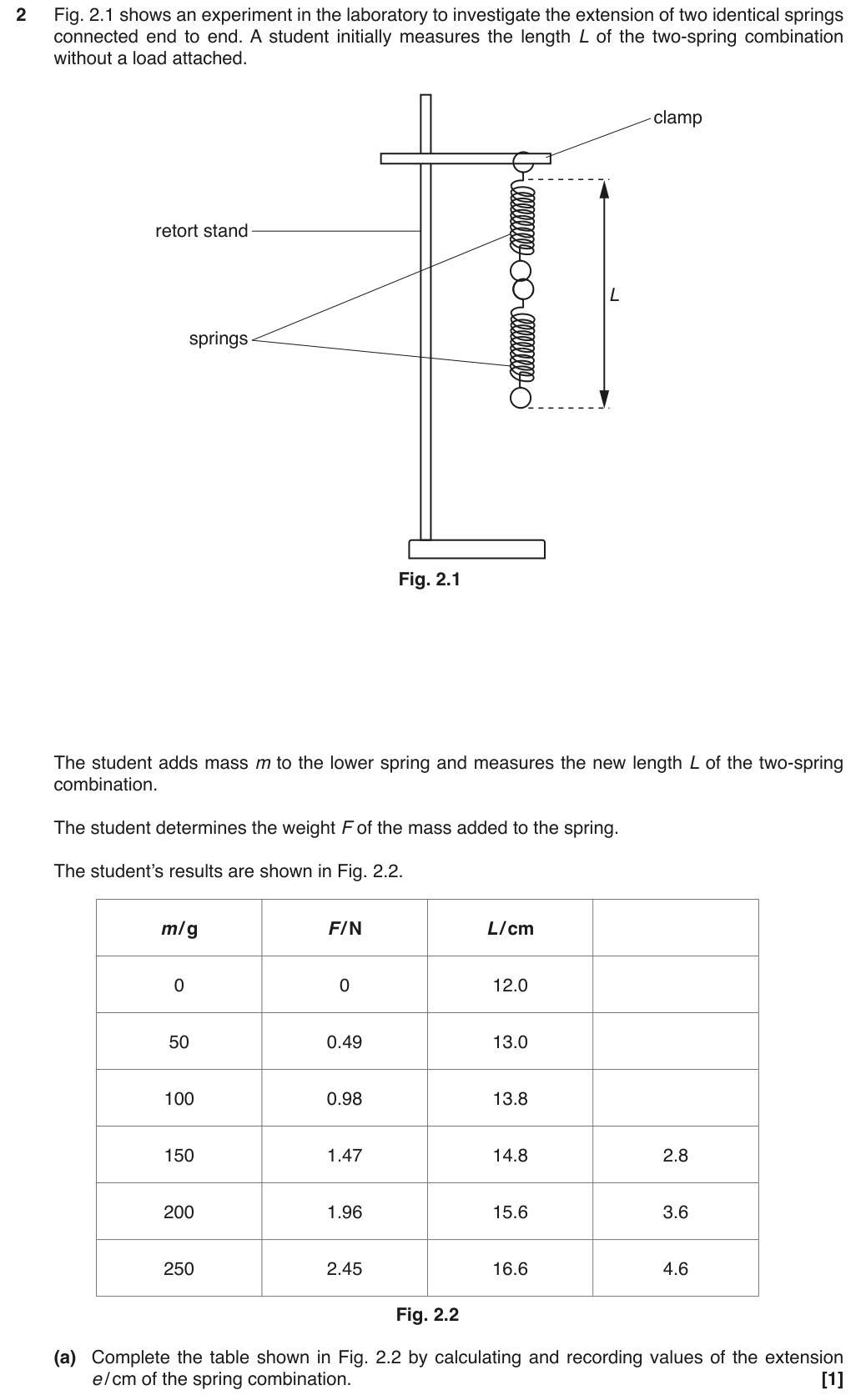
Skills: PAG2 Investigating properties of materials
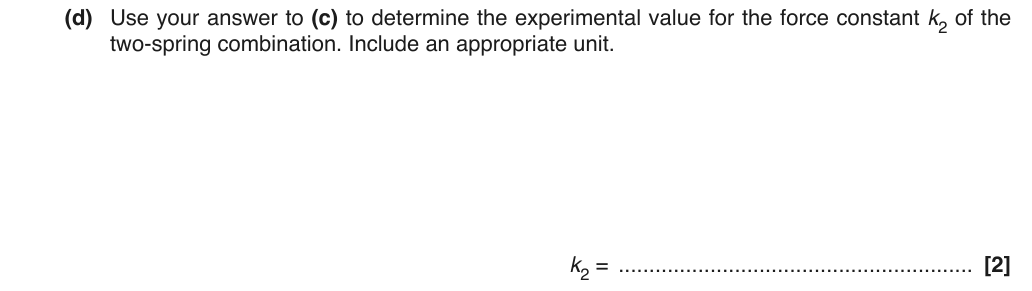
Skills: M0.1 Recognise and make use of appropriate units in calculations; M1.1 Use an appropriate number of significant figures; M3.4 Determine the slope and intercept of a linear graph; PAG2 Investigating properties of materials
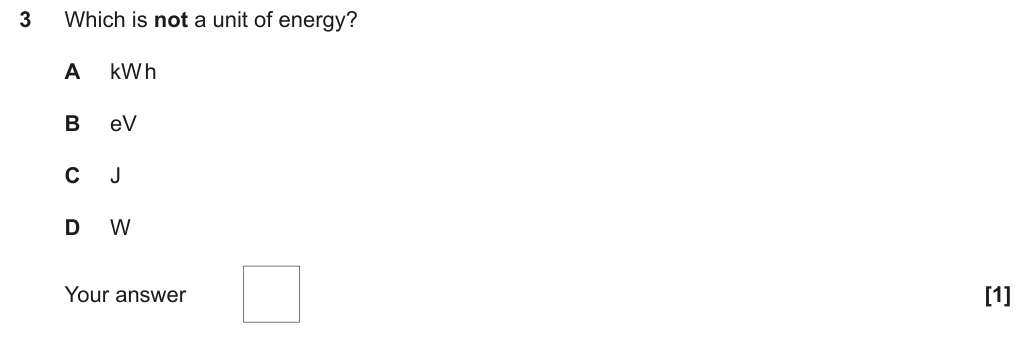
D

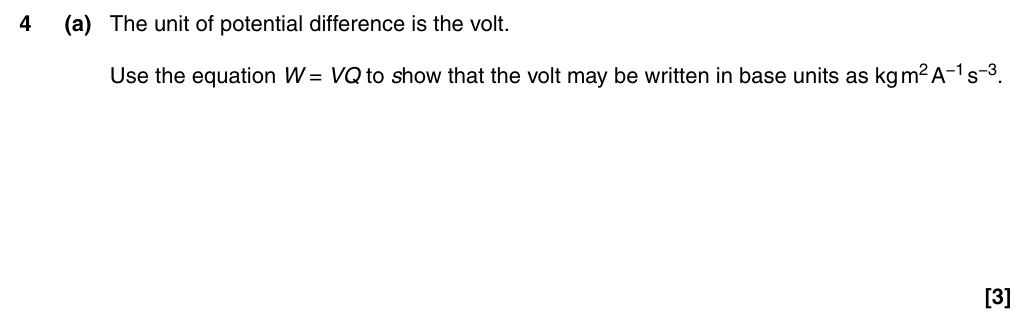
Skills: M0.1 Recognise and make use of appropriate units in calculations; M2.2 Change the subject of an equation, including non-linear equations
Dropping marks on calculations, practical questions or the six-mark level of response questions? Book a trial session with a specialist OCR physics tutor.