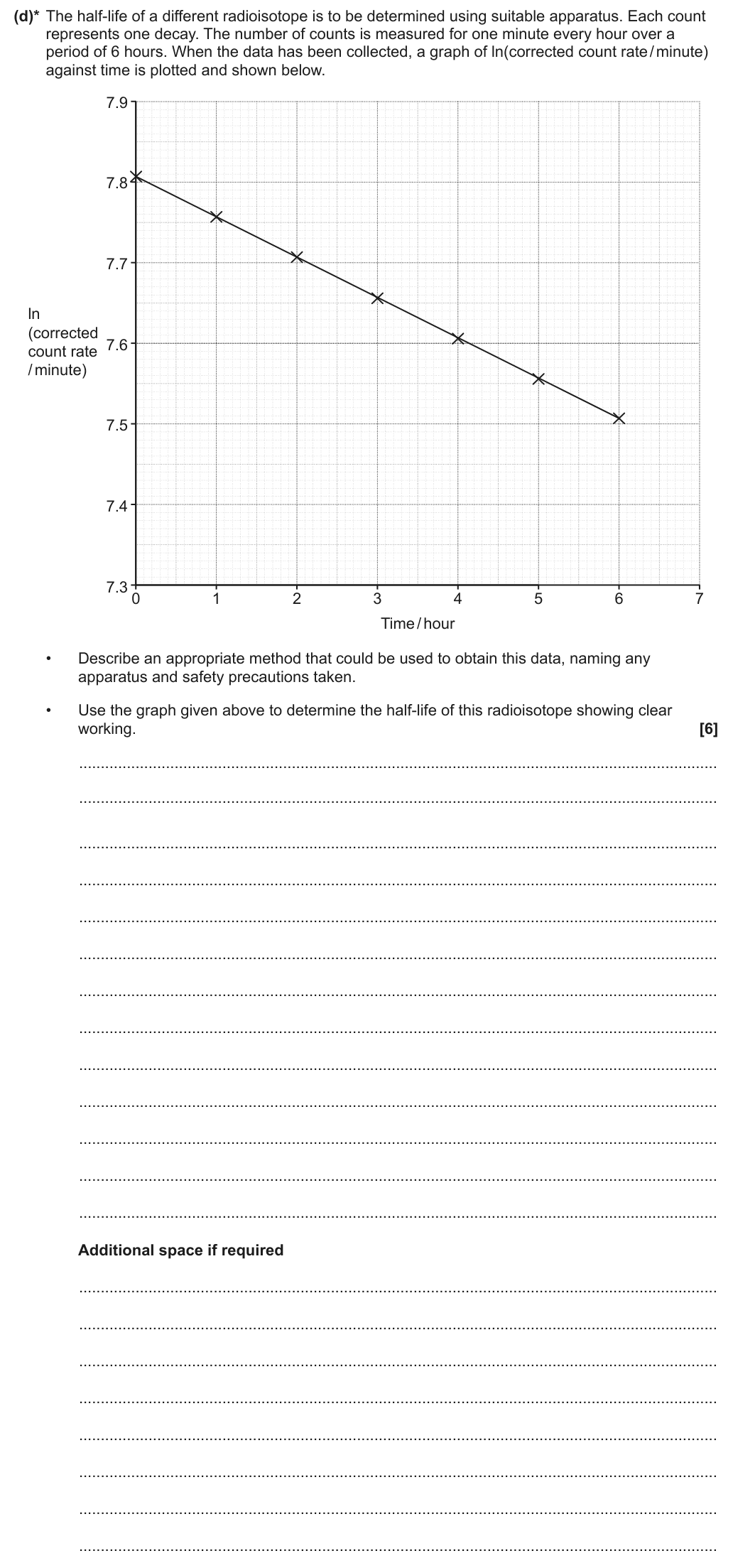
The half‑life of a different radioisotope is to be determined using suitable apparatus. Each count • Describe an appropriate method that could be used to obtain this data, naming any
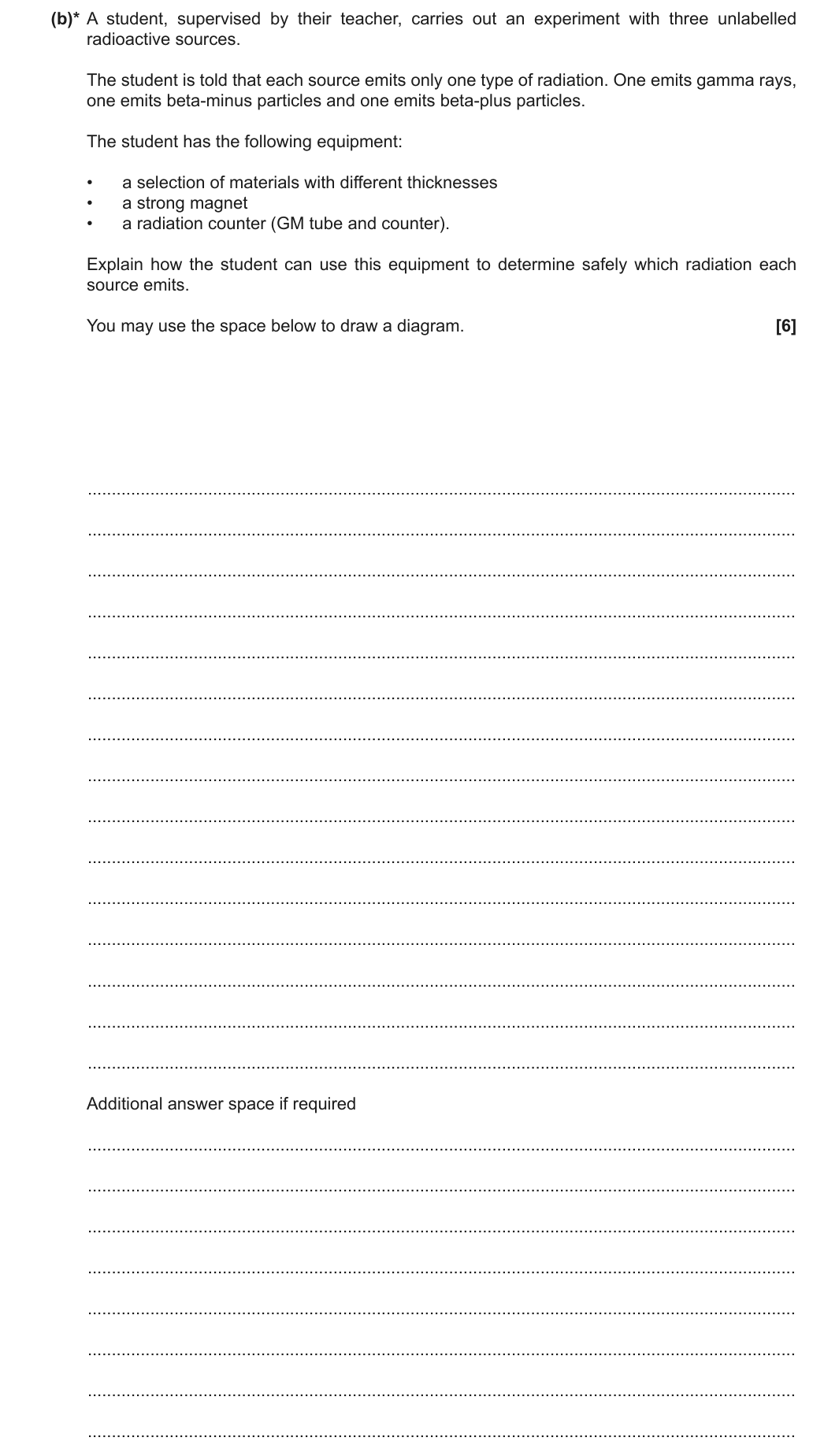
A student, supervised by their teacher, carries out an experiment with three unlabelled Explain how the student can use this equipment to determine safely which radiation each
Tap a question to zoom it. Where a part needs a figure, table or graph from earlier in the question, that part folds out above it; the mark scheme and examiner's comment open underneath. Have the OCR Data, Formulae and Relationships Booklet beside you (see the data booklet page).
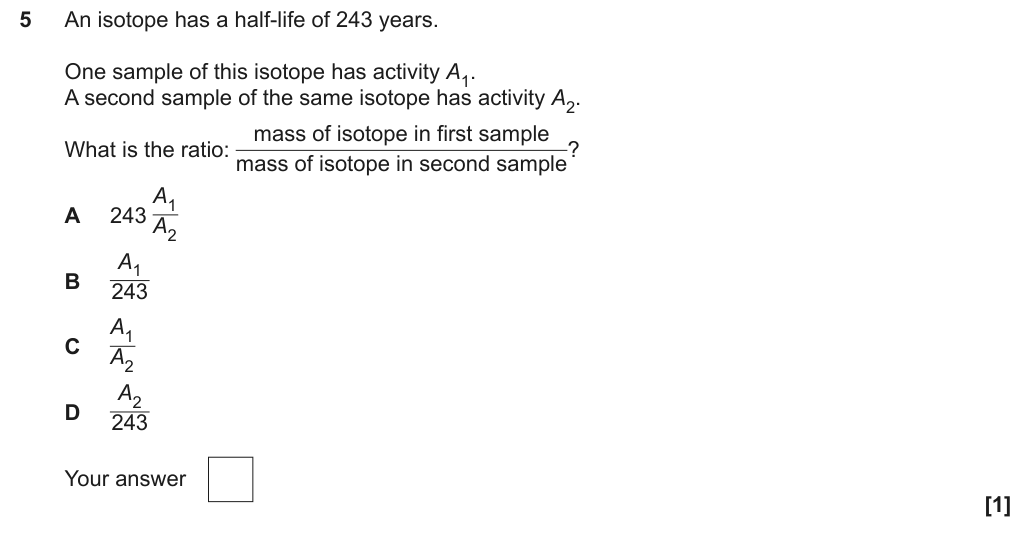
June 2025 · Paper 2 · Q51 markMultiple choiceEasy
Answer
C
Mark scheme
Examiner's comment
Most candidates were able to correctly identify the ratio. Many candidates worked the answer from first principles, clearly showing that the factor 243 would cancel in their calculation.
Notes from the mark scheme and report
same decay constant, so mass ratio equals activity ratio
half-life is a distractor
Skills: M0.3 Use ratios, fractions and percentages
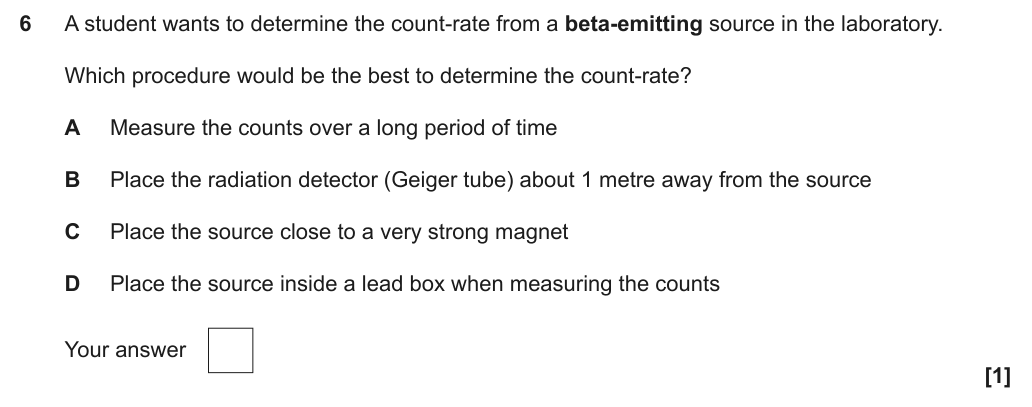
June 2025 · Paper 2 · Q61 markMultiple choiceHard
Answer
A
Mark scheme
Examiner's comment
Correctly identifying the best procedure proved challenging for candidates. Many incorrect responses were given as B.
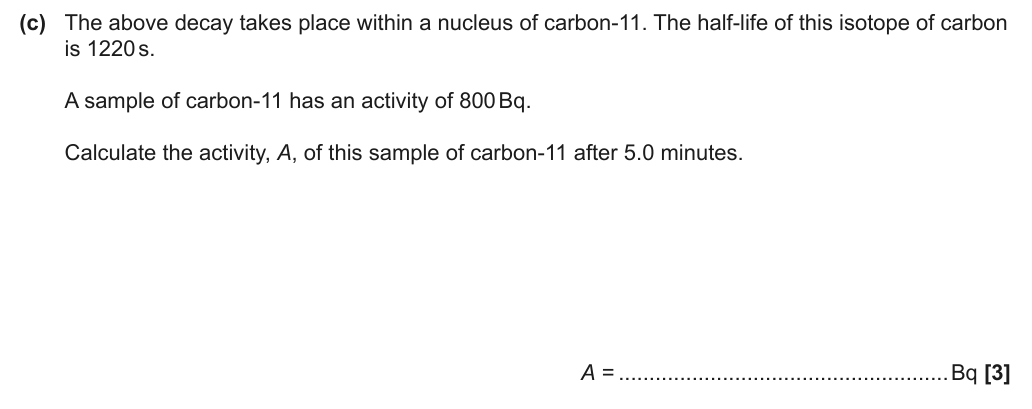
June 2025 · Paper 2 · Q19(c)3 marksCalculationMedium
Earlier part of question 19 that this part uses
Mark scheme
Examiner's comment
The majority of the candidates were correctly able to calculate the activity. Setting out of the working was helpful to the candidates, especially with a separate calculation of the decay constant. There was little confusion over time units, and most candidate chose to work in seconds. The data is given to 2 significant figures and the expected answer should be correct to 2 significant figures also (670 Bq). With some intermediate rounding, several candidates ended up at 680 Bq which will lose the final mark. Candidate are encouraged to store any intermediate calculations in calculator memory to maintain the full significant figures.
Notes from the mark scheme and report
mixing t in minutes with λ in s-1 (798 Bq) scores 2 max
Skills: M0.1 Recognise and make use of appropriate units in calculations; M0.5 Use calculators to find and use power, exponential and logarithmic functions; M2.3 Substitute numerical values into algebraic equations using appropriate units for physical quantities
June 2025 · Paper 3 · Q5(a)1 markExplanationEasy
Mark scheme
Examiner's comment
Most candidates were able to gain credit for stating that ionising radiation damages DNA or cells.
Notes from the mark scheme and report
ignore cancer or damage to organs / tissues
must be damage to cells / DNA
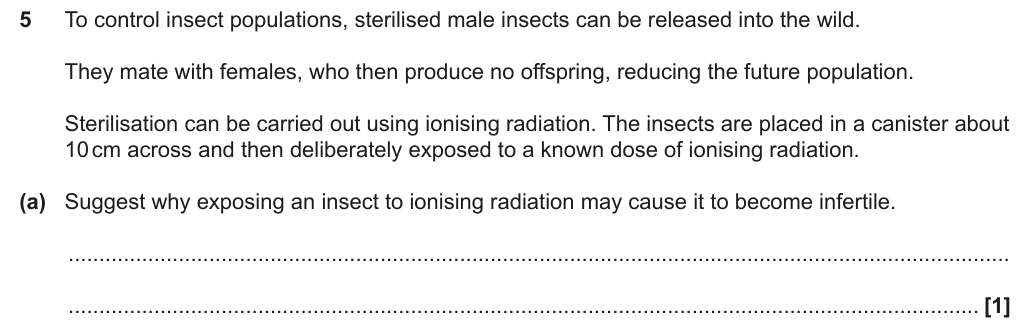
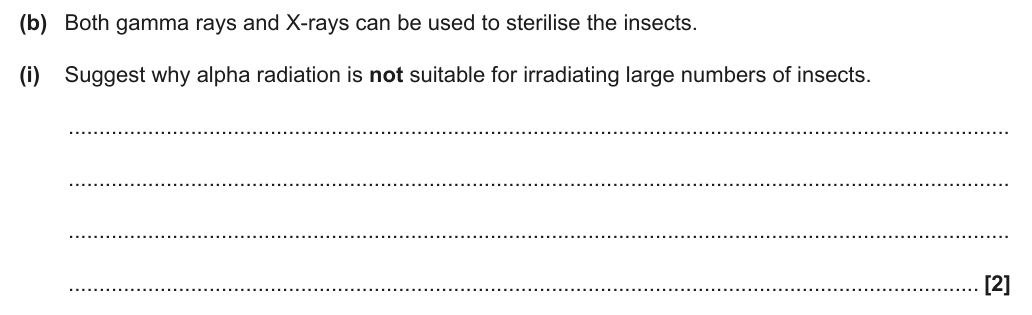
June 2025 · Paper 3 · Q5(b)(i)2 marksExplanationMedium
Earlier part of question 5 that this part uses
Mark scheme
Examiner's comment
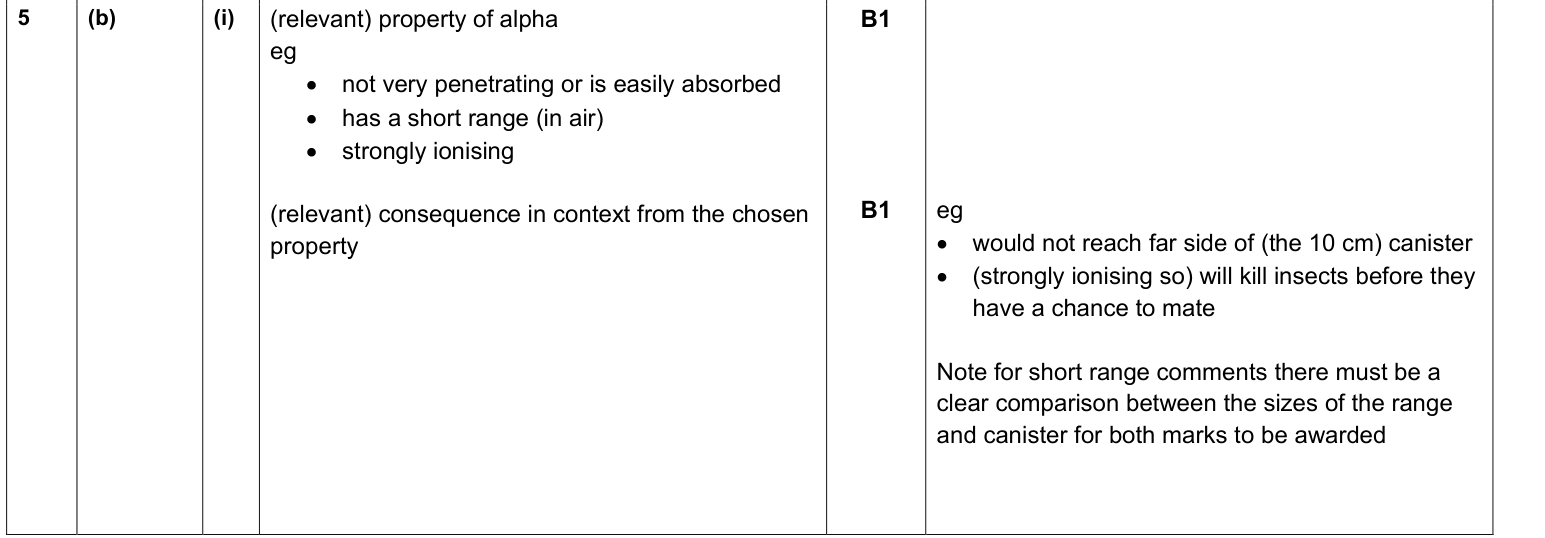
Candidates who did well on this question were able to clearly state a property of alpha radiation and then link that property to the context. A number of responses were vague or confused, for example mixing and matching properties and consequences or stating that alpha can’t get through paper. A significant minority gave contradictory properties stating, for example, that alpha was weakly ionising and short range. Some candidates described why X-rays or gamma were more suitable rather than addressing their response to alpha or gave a consequence which simply restated the stem of the question.
Notes from the mark scheme and report
property of alpha plus its consequence in context
short-range answers must compare the range with the size of the canister
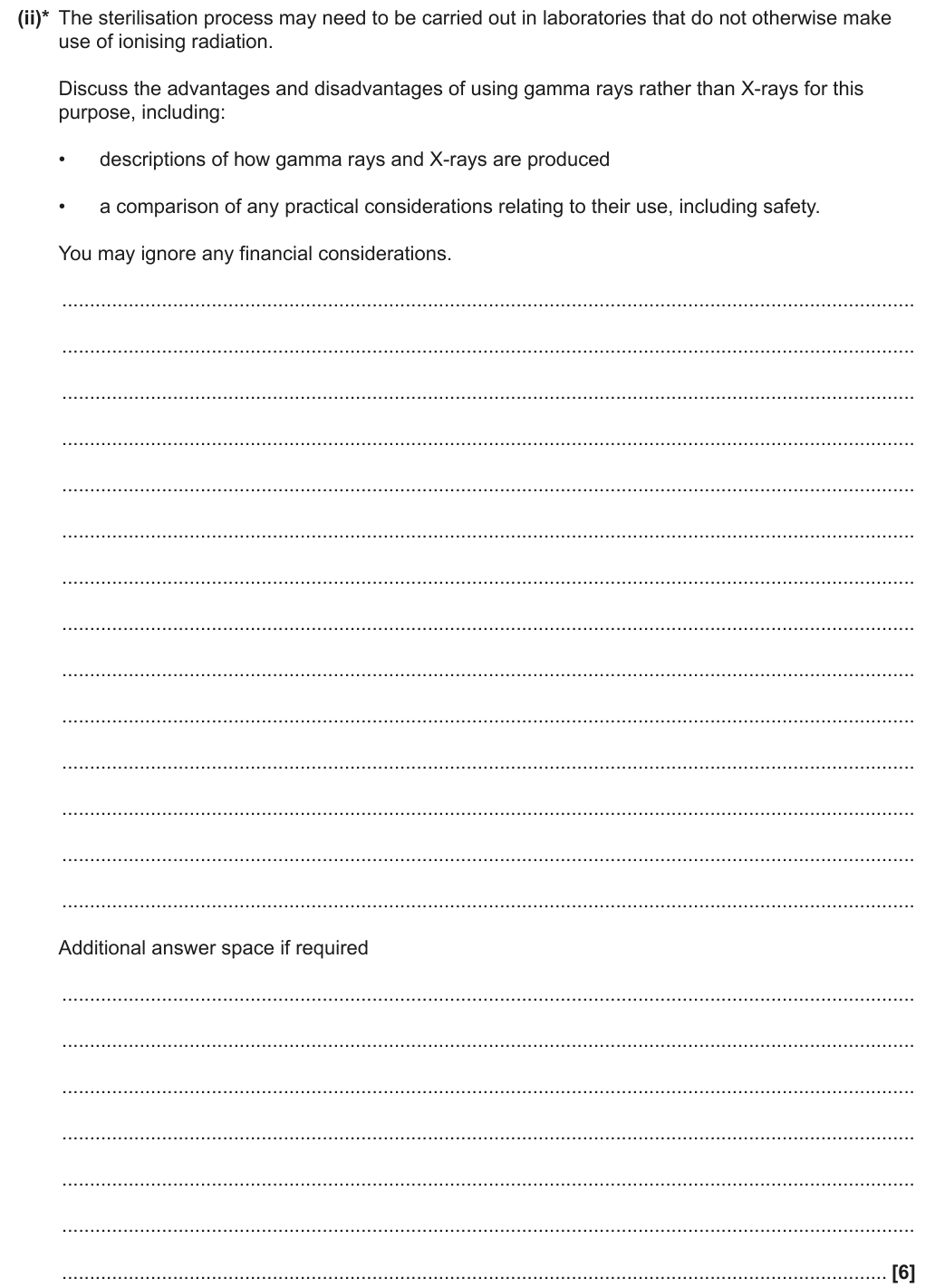
June 2025 · Paper 3 · Q5(b)(ii)6 marks6-mark extended responseMedium
Earlier part of question 5 that this part uses
Mark scheme, with the levels and indicative content
Examiner's comment
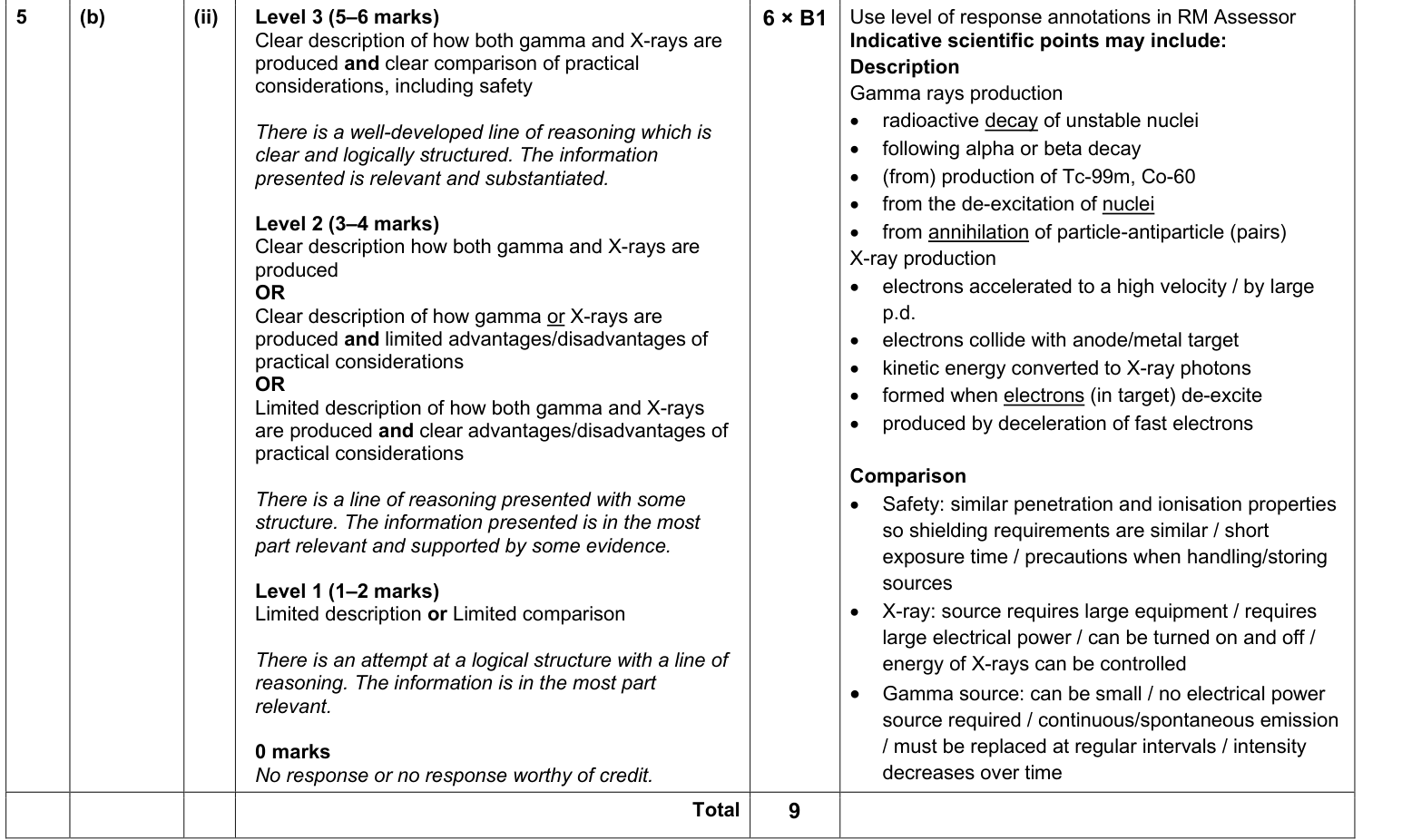
This Level of Response produced the full range of marks with the majority of candidates gaining Level 1 or 2. The question stem clearly referred to the context of irradiating insects but many candidates gave descriptions of gamma and X-ray use and dangers related to people in clinical settings. Candidates were able to describe X-ray production well and these descriptions were often clear and detailed. Gamma production was less well described with the majority not referring to radioactive decay but only annihilation of particle-antiparticle pairs which was not suitable for the context. Many candidates referred to injecting individual insects with radioactive beta plus tracers despite the context of irradiating them in canisters seen in parts (a) and (b) (i). Weak gamma discussions or lack of attention to the context often resulted in many responses gaining Level 2 instead of Level 3. Many candidates attempted to discuss differences between ionisation and penetration properties rather than focussing on the practical considerations such as being able to turn X-ray machines off, radioactive sources not requiring power supplies, etc. Safety considerations were generally well discussed with the highest scoring responses often referring to exposure time as well as storage and shielding.
Notes from the mark scheme and report
X-ray tube can be switched off and its photon energy controlled but needs high-voltage equipment
gamma source emits continuously and needs shielded storage
Centres could prepare candidates for Level of Response questions by asking groups of students to give answers for generic questions, for example ‘describe methods of gamma ray production’ and then introducing a context and asking students to decide which parts of their response would be relevant to the scenario and why.
A key skill with context-based questions is deciding what to leave out from an answer as well as knowing what to include.
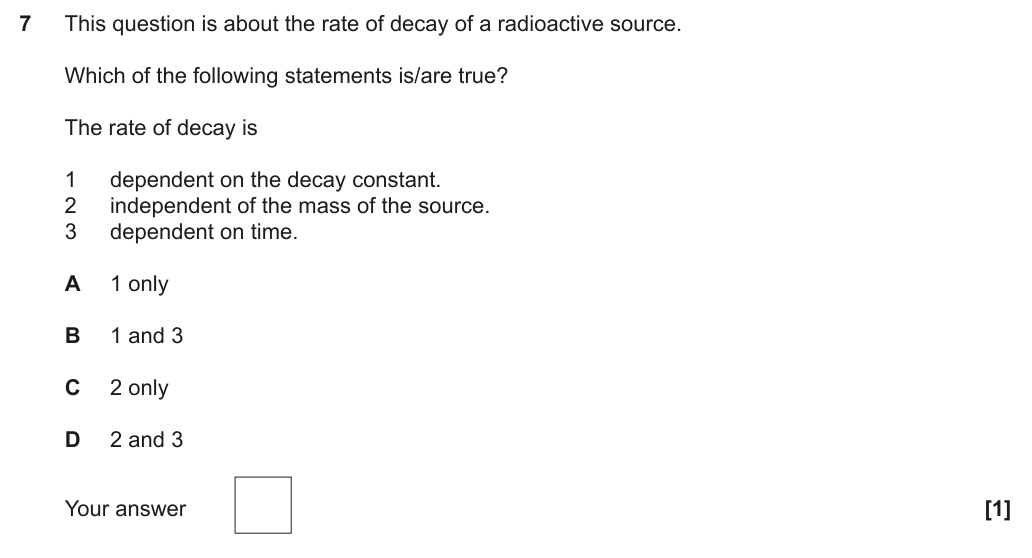
June 2024 · Paper 2 · Q71 markMultiple choiceMedium
Answer
B
Mark scheme
Examiner's comment
A little under half of the candidates were able to correctly identify the correct statements. A helpful approach to this type of question is to ‘tick’ the statements which the candidate is certain of, which then reduces the options available.
June 2024 · Paper 2 · Q21(a)(ii)2 marksShort answerMedium
Earlier part of question 21 that this part uses
Mark scheme
Examiner's comment
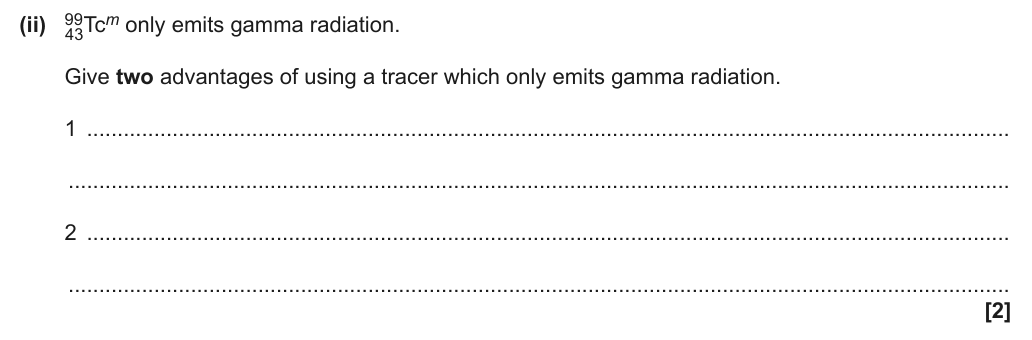
This relatively simple question was correctly answered by the majority of candidates. There was no additional detail required apart from the two simple facts although it was good to see many candidates putting these into context. Candidates should be reminded that in a question like this, only two responses should be given. Including a third runs the risk of a contradiction. Common misconceptions included the idea that the half-life of a source of gamma radiation was shorter (or longer) than alpha and beta, and that gamma radiation was ‘safer’.
Notes from the mark scheme and report
do not allow zero ionisation
gamma passes out of the body to be detected
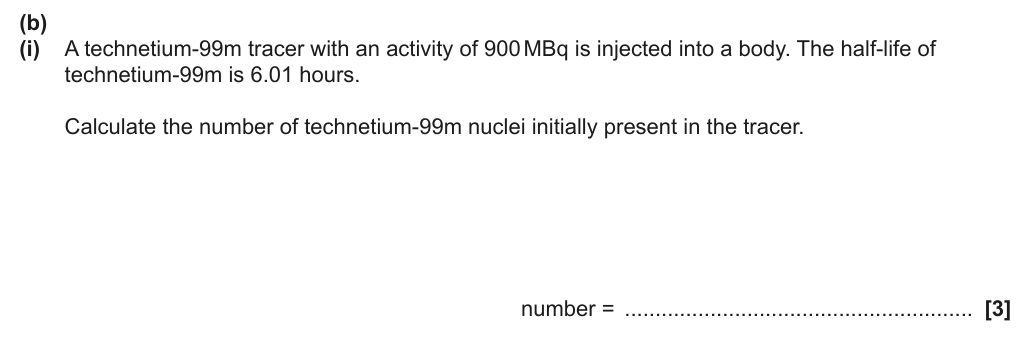
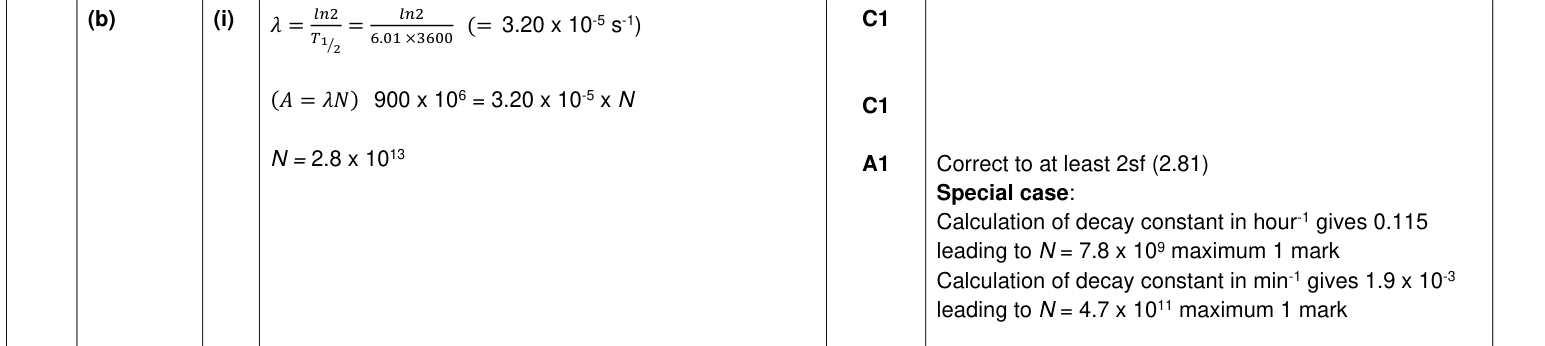
June 2024 · Paper 2 · Q21(b)(i)3 marksCalculationHard
Earlier part of question 21 that this part uses
Mark scheme
Examiner's comment
It was very encouraging to see that nearly two thirds of candidates were able to score all 3 marks on this question. Logarithms can challenge candidates but it was clear that many understood how to carry this out and were able to effectively. There were relatively few who were confused by the time units, but credit could be given even when the unit was used incorrectly.
Notes from the mark scheme and report
half-life must be converted to seconds: decay constant in hour-1 (7.8 x 10^9) or min-1 (4.7 x 10^11) scores max 1
Skills: M0.1 Recognise and make use of appropriate units in calculations; M0.2 Recognise and use expressions in decimal and standard form; M2.2 Change the subject of an equation, including non-linear equations; M2.3 Substitute numerical values into algebraic equations using appropriate units for physical quantities
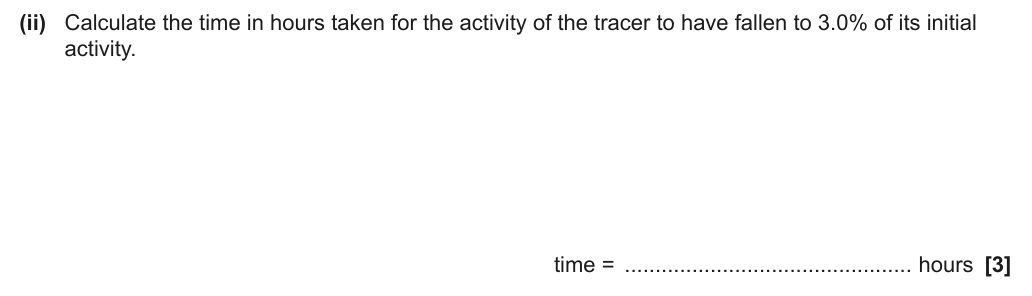
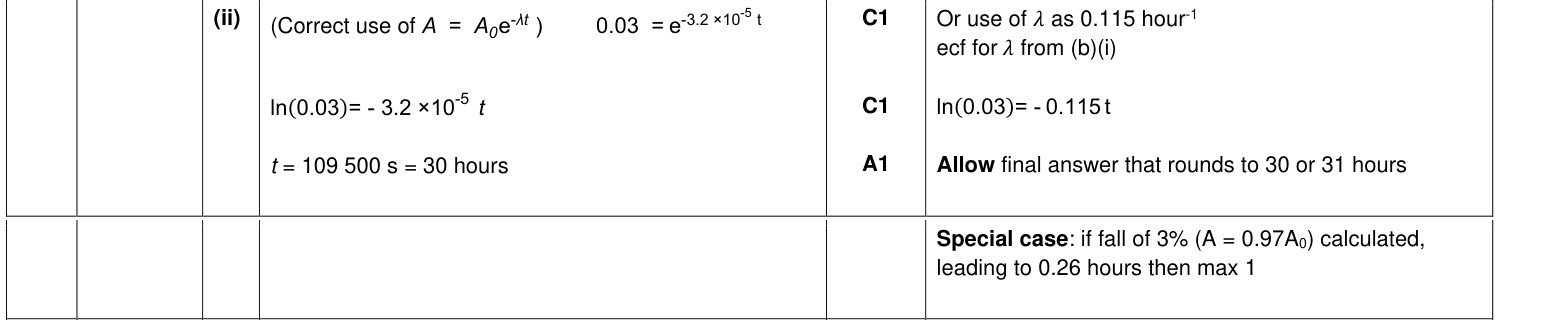
June 2024 · Paper 2 · Q21(b)(ii)3 marksCalculationEasy
Earlier part of question 21 that this part uses
Mark scheme
Examiner's comment
This calculation was also carried out very well, with many gaining full marks. There are several different ways to obtain the correct answer and part credit can be given for any method which will use the decay equation correctly. Most candidates calculated what 35 of the initial activity would be, putting both A and A0 into the calculation, rather than just using 0.03 as the ratio.
Notes from the mark scheme and report
fallen TO 3.0 per cent: a fall OF 3 per cent (A = 0.97 A0, 0.26 hours) scores max 1
ecf decay constant from (b)(i)
30 or 31 hours
Skills: M0.5 Use calculators to find and use power, exponential and logarithmic functions; M2.2 Change the subject of an equation, including non-linear equations; M2.5 Use logarithms in relation to quantities that range over several orders of magnitude
June 2024 · Paper 2 · Q21(c)1 markExplanationMedium
Earlier part of question 21 that this part uses
Mark scheme
Examiner's comment
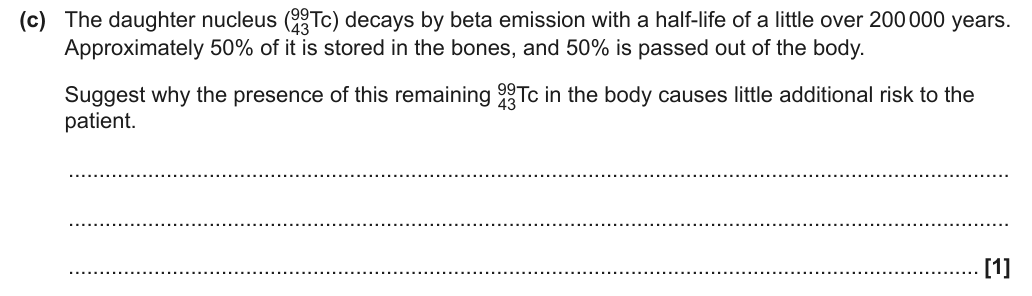
The required response here was to do with the activity of the remaining Tc. It needed to be clear that the activity was very low, or that it was low compared to any background count. Using the half-life alone as the response would not be worth any credit. A noticeable number of candidates misinterpreted the question and answered why the presence of the Tc does continue to cause a risk. Many also gave responses relating to the beta emission, stating that it was safe or wouldn’t affect bones.
Notes from the mark scheme and report
activity is very low (compared to background) / decays very slowly
ignore references to long half-life alone
June 2024 · Paper 2 · Q21(d)6 marks6-mark extended responseHard
Mark scheme, with the levels and indicative content
Examiner's comment
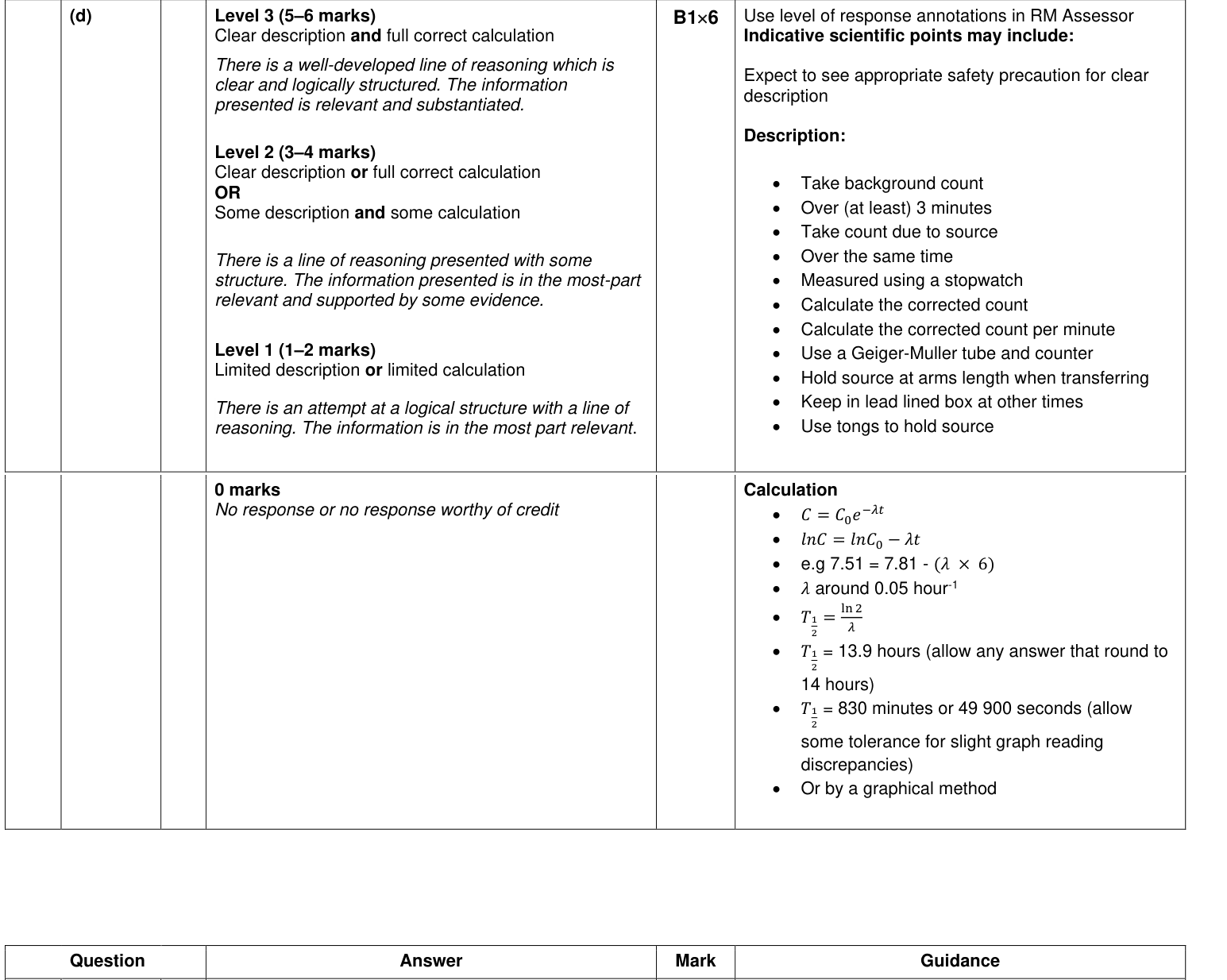
This is the second Level of Response (LoR) question in this paper, and was designed to assess nuclear and particle physics, specifically sections 6.4.3e of the specification. In particular, there are two parts (description and calculation) relating to a method and graphical data. As previous, there are no specific marking points and examiners use a ‘best-fit’ approach to the marking. Indicative scientific points are given in the mark scheme as a guidance what to expect, but not all need to be satisfied to be given full marks. Incorrect physics can be expected to be penalised, however. Candidates should always be encouraged to structure their answers carefully and in calculations aim to give explanation of each stage rather than just producing a number. The two separate sections can be separated into a description of the method for obtaining the data, and a calculation using the graph to determine the half-life. The key points in the description that examiners were looking for were: - named apparatus - measurement of background radiation – calculation of corrected count rate – safety requirements. The key points in the calculation that examiners were looking for were: - arrangement of decay equation having taken logs – demonstration that the gradient is the decay constant - calculation of the gradient – use of the gradient to determine the half-life. The descriptions of the method varied significantly. Some were extensive and detailed and others a very limited response despite being a procedure that candidates are likely to have come across. Most candidates gave a simple safety precaution, such as holding at arm’s length, but there were plenty of vague responses such as wearing coats. Not all candidates could explain how, or why, the background was taken and a fair number missed this out completely. Quite a few candidates gave extensive detail about storing the source, which although is relevant, is not the key point to the question. The analysis was done better and in general well-structured and clear. The working was set out well for the most part and it was simple to follow the candidates working. Not all gave a clear reason for how they were obtaining the half-life, but this was not fully necessary as long as the answer was correct. One common error was to take logs of the data on the y-axis rather than appreciating that they are already log values. There were not many misreads, but the nature of the data meant that any could have a significant impact on their answer and would likely be penalised. Some candidates got into difficulties with time units and attempted to convert the decay constant to s-1 without success.
Notes from the mark scheme and report
safety precaution expected for a clear description
Skills: M2.5 Use logarithms in relation to quantities that range over several orders of magnitude; M3.10 Interpret logarithmic plots; M3.4 Determine the slope and intercept of a linear graph; PAG7 Investigating ionising radiation
June 2023 · Paper 2 · Q22(a)2 marksShort answerMedium
Mark scheme
Examiner's comment
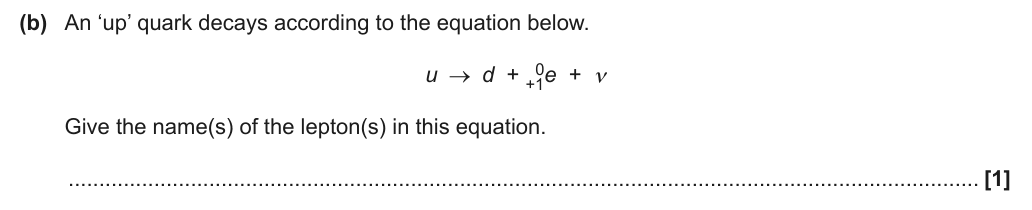
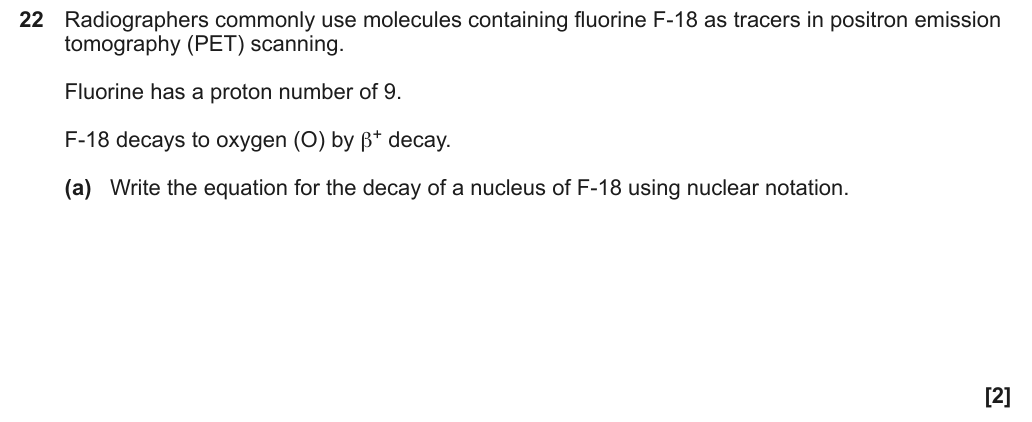
Most candidates will have gained the first mark for the correct isotope of fluorine. Those who didn’t likely reversed the positions of the nucleon and proton number. It was noticeable that a large number of candidates were unable to balance the equation and while they had the correct values for the positron, the oxygen isotope was incorrect.
Notes from the mark scheme and report
correct fluorine isotope for C1
neutrino not required
ignore gamma in products
June 2023 · Paper 2 · Q22(c)2 marksExplanationHard
Mark scheme
Examiner's comment
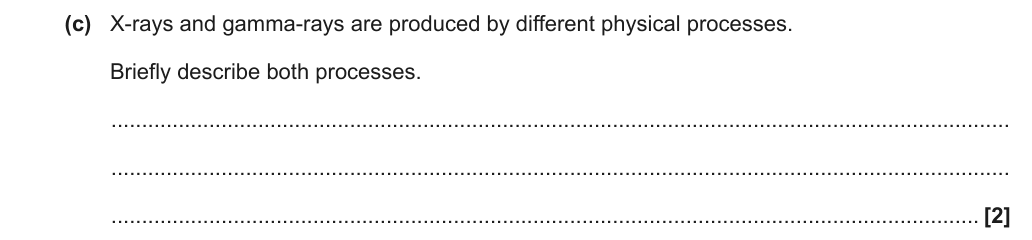
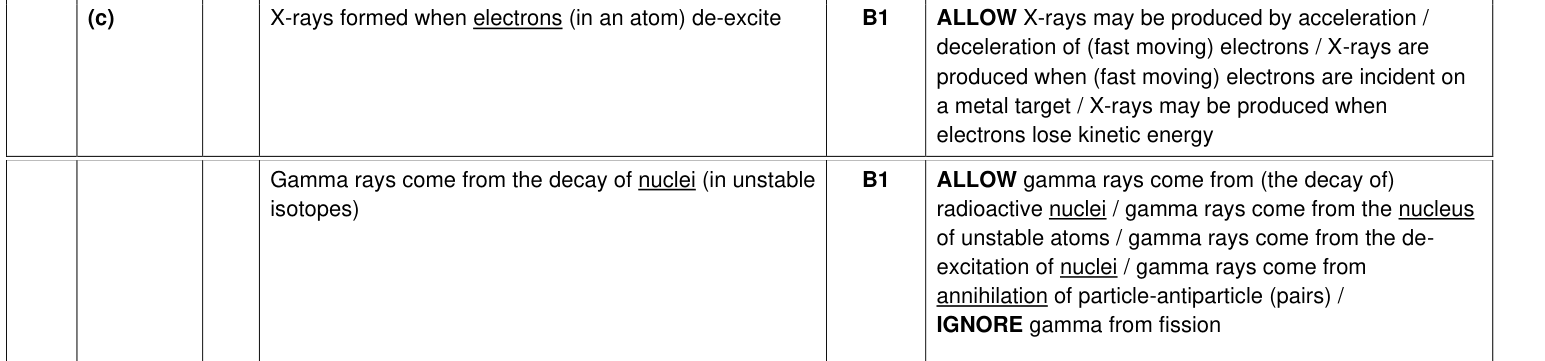
The main principle behind this question was to distinguish between the X-ray production by electrons and gamma ray production by nuclei. Fairly specific details were required for each, although a wide range of answers were accepted. This question discriminated well among the candidates with roughly equal fractions getting 0, 1 and 2 marks.
Notes from the mark scheme and report
X-rays from electrons (de-excitation, or decelerated at a metal target)
gamma rays from nuclei
ignore gamma from fission
June 2023 · Paper 2 · Q22(d)3 marksExplanationMedium
Mark scheme
Examiner's comment
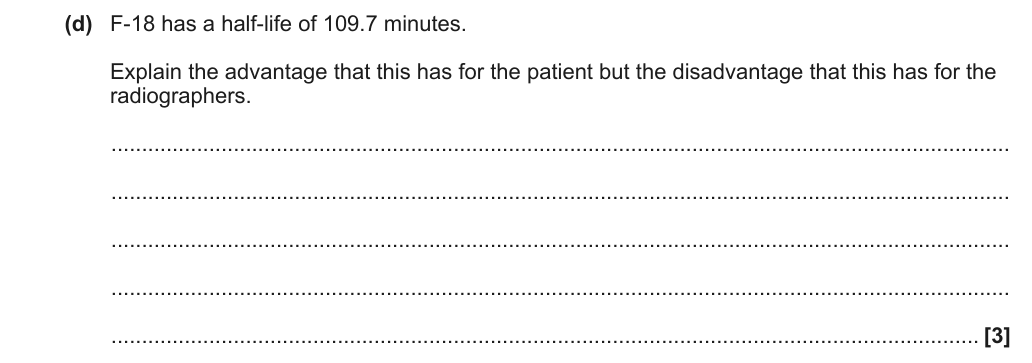
Although apparently a simple set of ideas, the detail required for this question meant that only a small fraction of candidates were able to gain full marks. It was necessary to state that the half-life was (relatively) short, which many of the stronger candidates did not do. The advantage to the patient requires the use of the term ‘ionising’ as this is the fundamental issue with the radiation. Similarly, candidates had to make it clear that the disadvantage was due to the short time to carry out the scan rather than just a statement of needing to work quickly.
Notes from the mark scheme and report
half-life is short (ignore 'it decays quickly')
low exposure for patient
short time to scan / must be made on site
ignore short time to treat
June 2022 · Paper 2 · Q21 markMultiple choiceMedium
Answer
C
Mark scheme
Examiner's comment
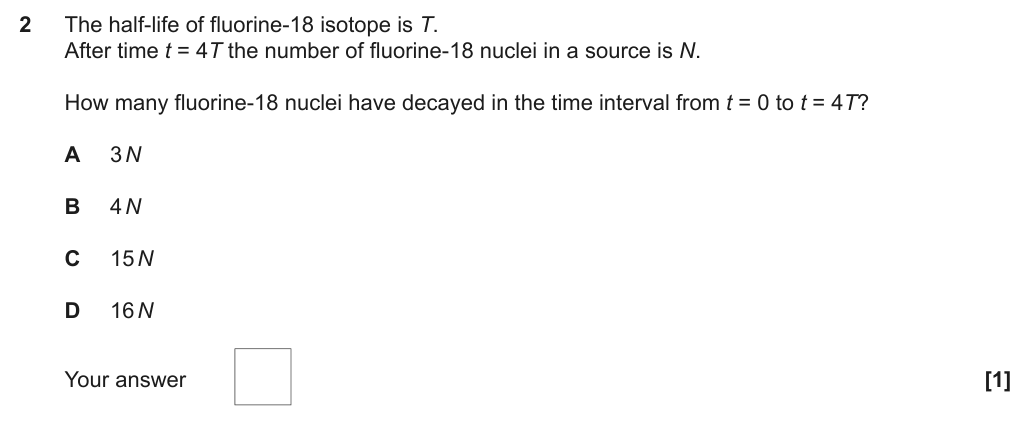
Only around one third of candidates were able to give the correct response of C. Many candidates showed a variety of correct working to produce the correct initial number of nuclei as 16 N, however then gave the incorrect response of D. This highlights the need to read each question carefully.
June 2022 · Paper 2 · Q31 markMultiple choiceHard
Answer
C
Mark scheme
Examiner's comment
Although a little over two thirds of candidates selected the correct response, this question discriminated well between candidates of differing abilities. Potential errors in this question included two unit prefix conversions and the conversion between eV and joules. Incorrect responses were fairly well spread across the other distractors.
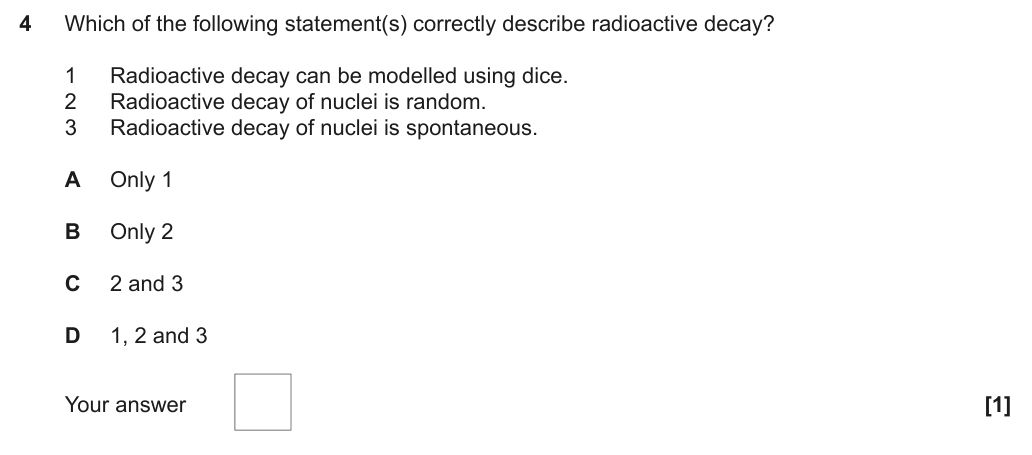
June 2022 · Paper 2 · Q41 markMultiple choiceEasy
Answer
D
Mark scheme
Examiner's comment
This question proved to be relatively straightforward with most candidates selecting the correct response. By far the most common incorrect response was C, suggesting that the idea of modelling using dice was not known, despite it being specification point 6.4.3f(ii).
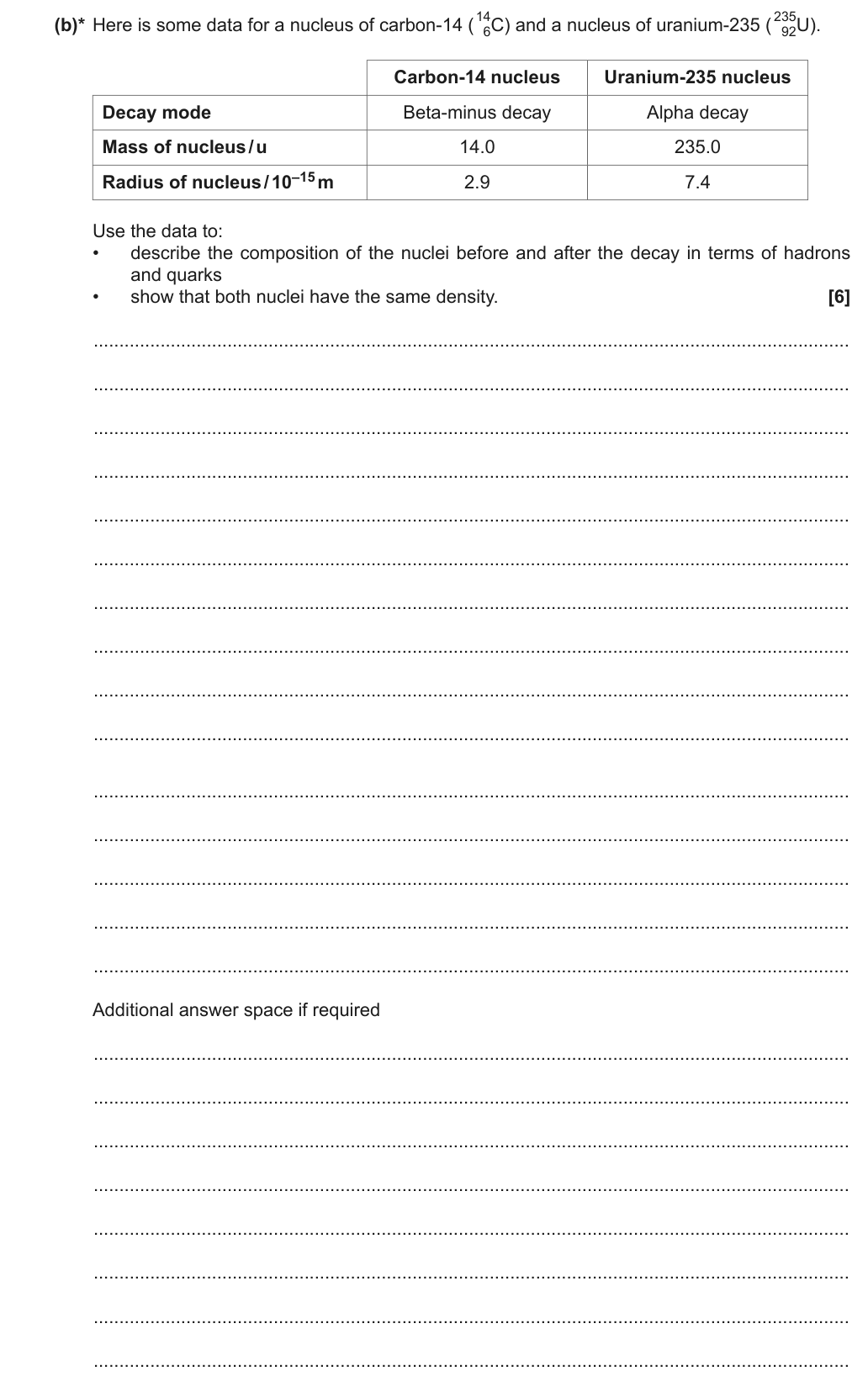
June 2022 · Paper 2 · Q20(b)6 marks6-mark extended responseMedium
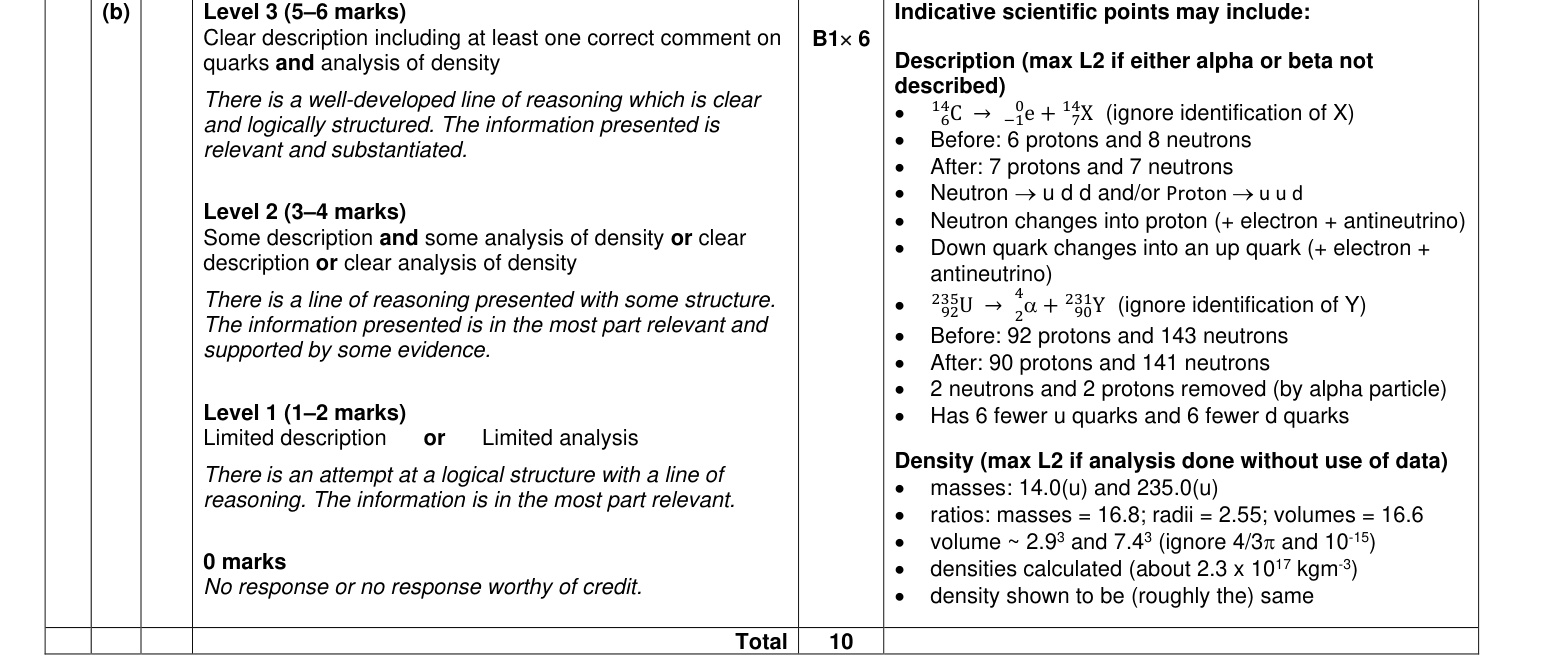
Mark scheme, with the levels and indicative content
Examiner's comment
This is the second level of response (LoR) question in this paper, and was designed to assess nuclear and particle physics, specifically sections 6.4.1 and 6.4.2 of the specification. In particular, there are two parts (description and analysis) relating to two radioisotopes, and some given data. As previous, there are no specific marking points and examiners use a “best-fit” approach to the marking. Indicative scientific points are given in the mark scheme as a guidance what to expect, but not all need to be satisfied to be given full marks. Incorrect physics can be expected to be penalised however. Candidates should always be encouraged to structure their answers carefully and in calculations aim to give explanation of each stage rather than just producing a number. The two separate sections can be separated into a description of the decays, and an analysis of the data to show the two nuclear densities are the same. The key points in the description that examiners were looking for were: - numbers of protons before and after each decay – a description of the change in quark structure during beta decay – correctly balanced equations for alpha and beta-minus decay – the nature of the emissions in each decay. The key points in the analysis that examiners were looking for were: - calculation of volumes of nuclei, using (4/3) r3 – correct use of the density formula – numerical evaluation of the densities of the nuclei and a comparison. The descriptions of the decays varied hugely both in quality and quantity. Most candidates were aware that a beta particle is an electron, but several seemed to think it was an orbiting one which had no structural changes on the nucleus. Those who did know it was from a neutron to proton change often mixed up the nucleon numbers afterwards. Alpha decay was generally done better with most candidates knowing the nature of an alpha particle and correctly stating the structure of the remaining nucleus. Attempts were generally made to changes in quark structures (mostly for beta decay) and the structure of a neutron and proton were known, although strangely several candidates stated the change was from an up quark to a down quark. Candidates who did not give any descriptions of the quark structures were limited to Level 2. For the most part, the analysis was done better than the description and candidates were generally able to correctly evaluate the two densities and make a suitable comparison. Units of density were not penalised here, with many candidates using the mass (in u) in the calculation but giving the units of density as kg m-3, although many stating u m-3. However, many did correctly calculate the mass of the nucleus using the correct factor coming out with densities of approximately 2.3 1017 kg m-3. Those who took an approach to algebraically show that the density of every nucleus is independent of the nucleon number (using a standard method to get to some variation of 3u/4r3) alone were unable to reach Level 3 as they had not used the data. The use of r0 as 1.2 10-15 m was commonly seen. A candidate who provides some description and analysis which places it in Level 2, but the confusion over alpha decay and general lack of clarity means it would be at the lower point (3 marks).
Notes from the mark scheme and report
max L2 if either alpha or beta decay not described
max L2 if density analysis does not use the data
Skills: M0.3 Use ratios, fractions and percentages; M2.3 Substitute numerical values into algebraic equations using appropriate units for physical quantities; M4.3 Calculate areas of triangles, circumferences and areas of circles, surface areas and volumes of rectangular blocks, cylinders and spheres
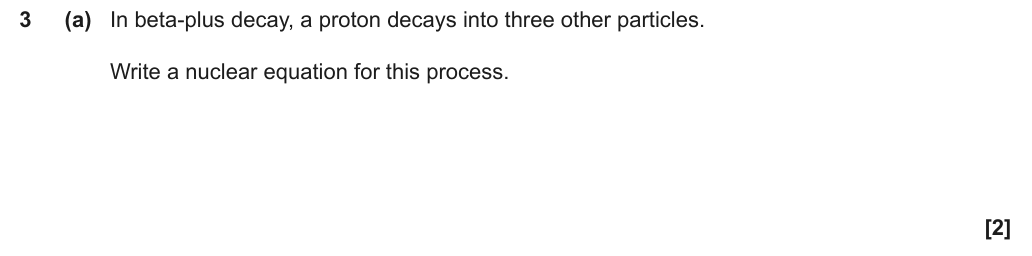
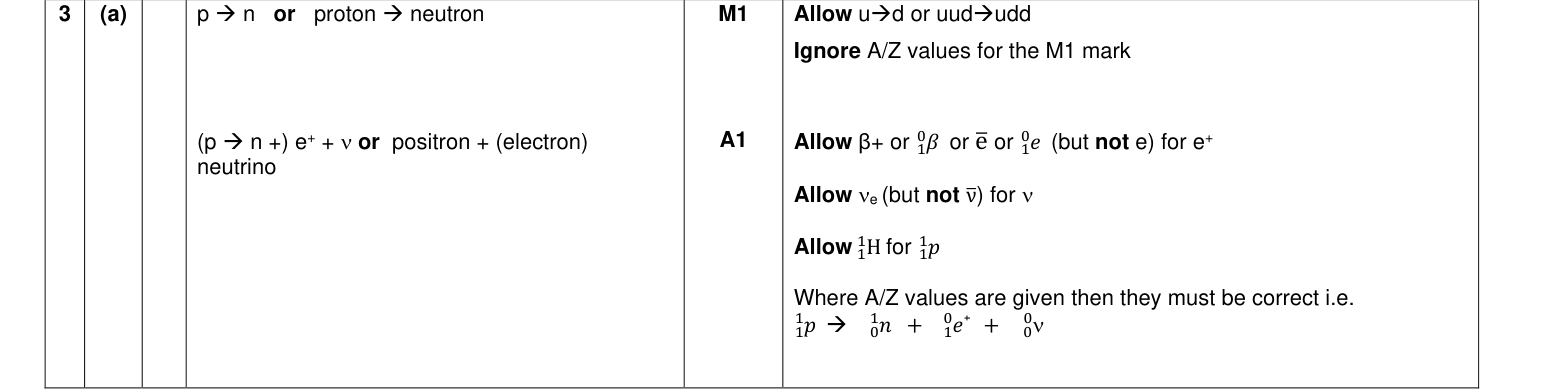
June 2022 · Paper 3 · Q3(a)2 marksShort answerMedium
Mark scheme
Examiner's comment
The question did not specify what type of equation was needed, and the simple word equation proton → neutron + positron + neutrino was sufficient for full marks. Common problems in 3(a) • using the symbol N instead of n for neutron (N is the symbol for nitrogen) • using incorrect A/Z values such as 𝑛𝑛 for neutron and/or 𝑒𝑒 0 for positron • using an incorrect symbol for the neutrino
Notes from the mark scheme and report
NOT e for e+
NOT antineutrino
Allow u → d
any A/Z values given must be correct
June 2022 · Paper 3 · Q3(b)6 marks6-mark extended responseHard
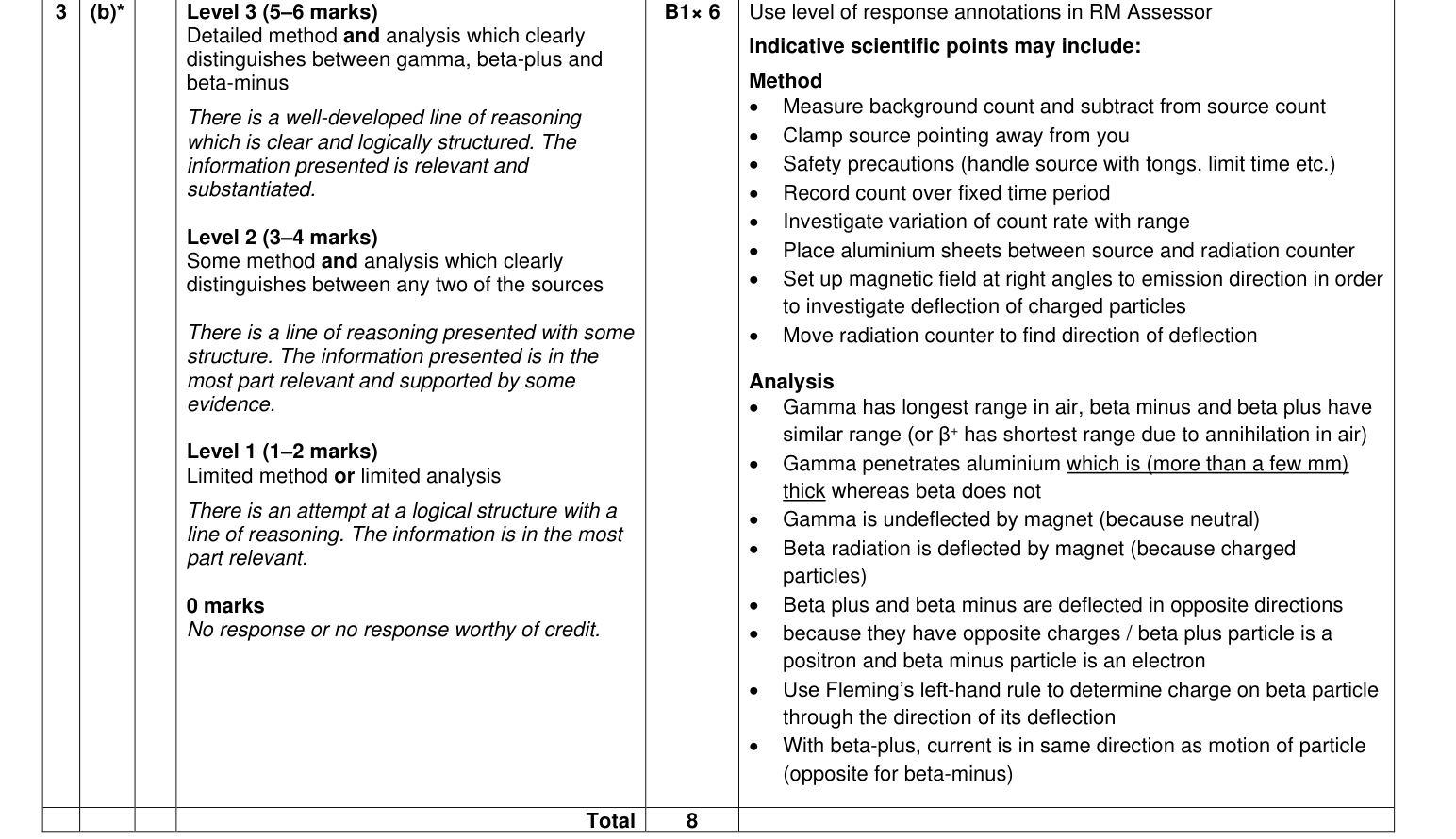
Mark scheme, with the levels and indicative content
Examiner's comment
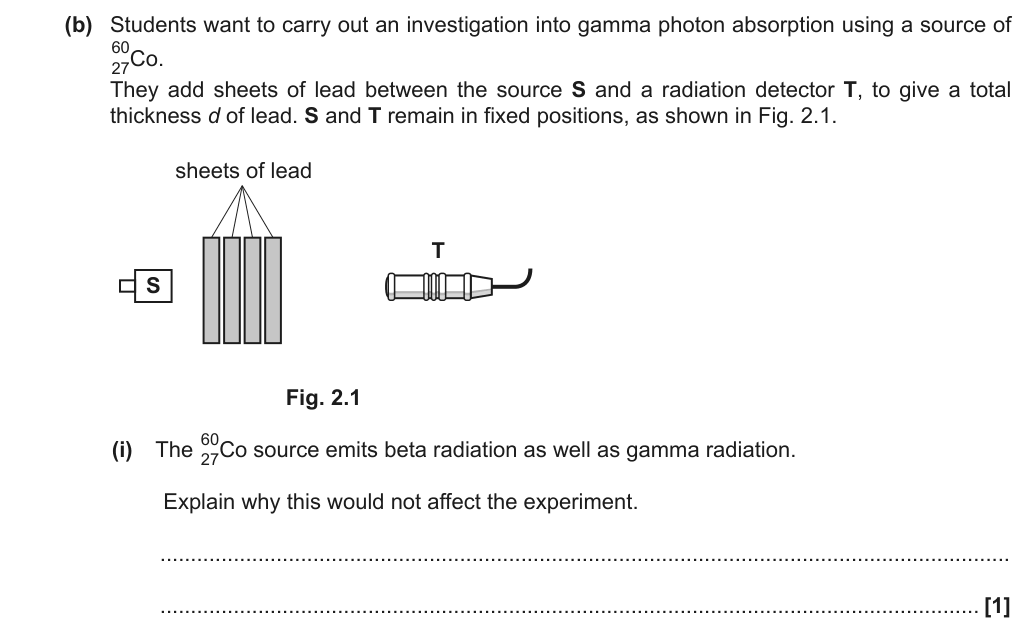
When marking a LoR question, the examiner first decides the level of response (1, 2 or 3) by considering the quality of the physics. The examiner then decides whether to award the top of the level (for a well- structured and relevant response) or the bottom of the level (for a poorly structured and mostly irrelevant response). In this LoR question, responses in Level 1 often contained insufficient key physics. The experiment described was extremely safe and painstaking but, at the end of the day, the three sources were not clearly distinguishable. Low level responses frequently included instructions on how to test for an alpha source. The magnet was often used either to pick up the sources or to attract/repel charged particles. In a typical top level response, the thickness of aluminium used to block beta (but not gamma) was specified. A perpendicular magnetic field was used to separate the charged particles and the direction of their travel was predicted using an accurate diagram and Fleming’s left hand rule. There were three possible approaches: 1. Investigate the range in air. Gamma has the largest range and beta-plus the smallest (due to annihilation). (The answer ‘both beta-plus and beta-minus have a similar range in air’ was also accepted). 2. Investigate the path through a perpendicular magnetic field. Gamma is undeflected; beta-plus and beta-minus would deflect in opposite directions. 3. Investigate the penetrative power. Since the materials and thicknesses available were not specified, it was easiest to keep increasing the thickness and density of the materials until all but one of the sources was blocked, thus identifying the gamma source. Many candidates were unable to distinguish clearly between the two beta sources because they did not understand how beta-plus and beta-minus particles would travel in a magnetic field. Many candidates erroneously thought that a magnet had a positive pole (which would attract beta-minus) and a negative pole (which would attract beta-plus). Misconceptions • A bar magnet does not have positive and negative poles – it has north and south poles • A magnet does not attract or repel charges – it exerts a force on charged particles moving at right angles to its magnetic field
Notes from the mark scheme and report
subtract background count
magnet deflects beta-plus and beta-minus in opposite directions, gamma undeflected
safety: tongs, source pointing away, limit time
Skills: PAG7 Investigating ionising radiation
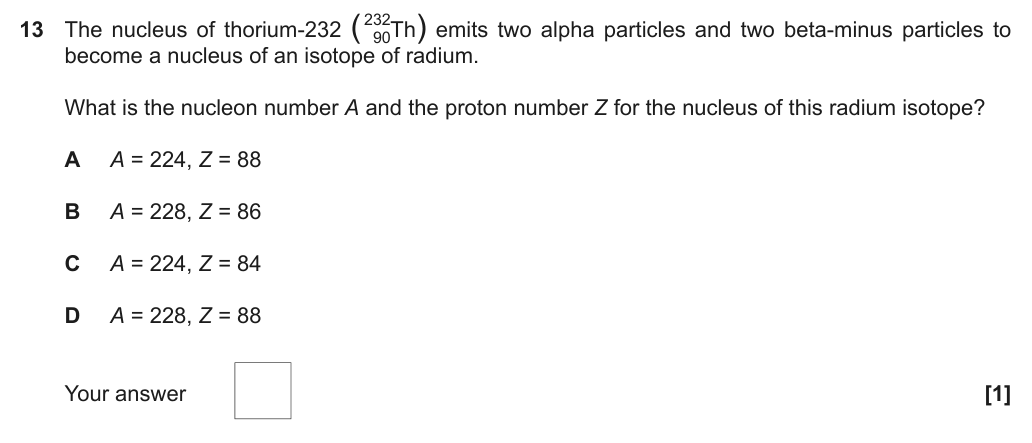
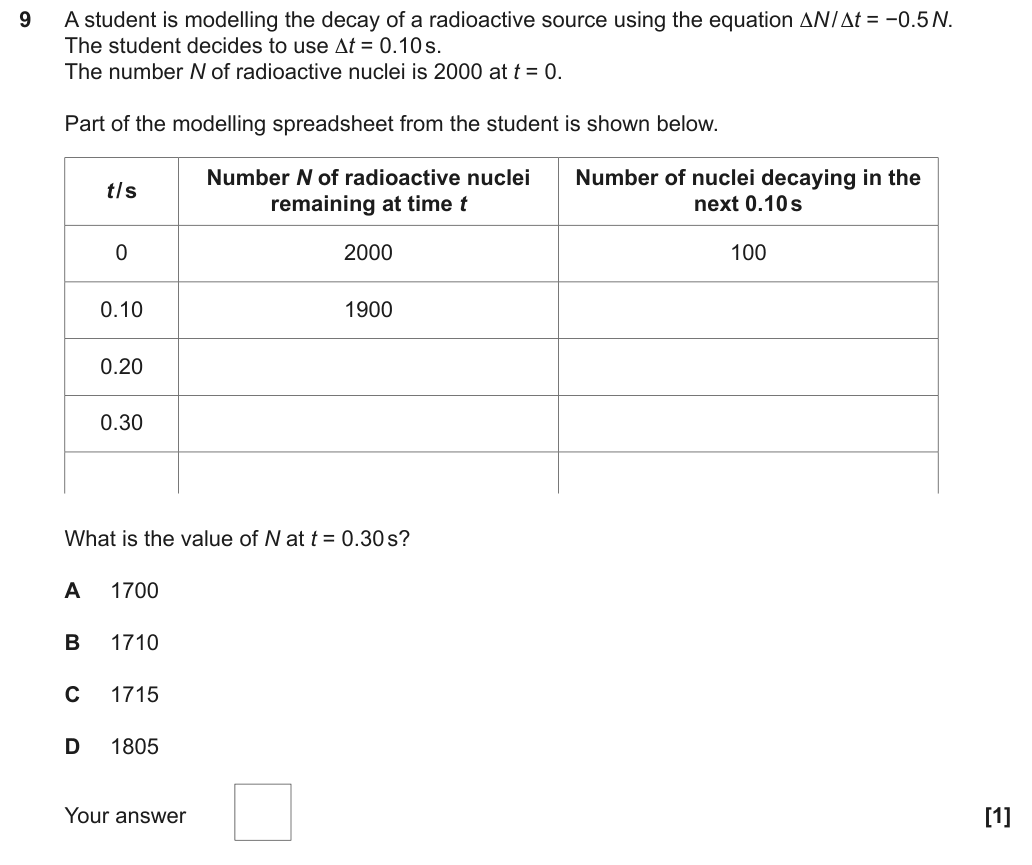
November 2021 · Paper 2 · Q131 markMultiple choiceHard
Answer
A
Mark scheme
Examiner's comment
The correct response is A. Around half of candidates were able to select the correct response. Although it would seem appropriate to write out some simple decay sequence, many candidates showed little working here. Some were able to get the correct response (probably through mental arithmetic) but incorrect responses may simply have been down to a lack of knowledge of nuclear changes, most likely in the beta decay. Incorrect responses were spread fairly evenly among the distractors, again suggesting that this topic was not well understood.
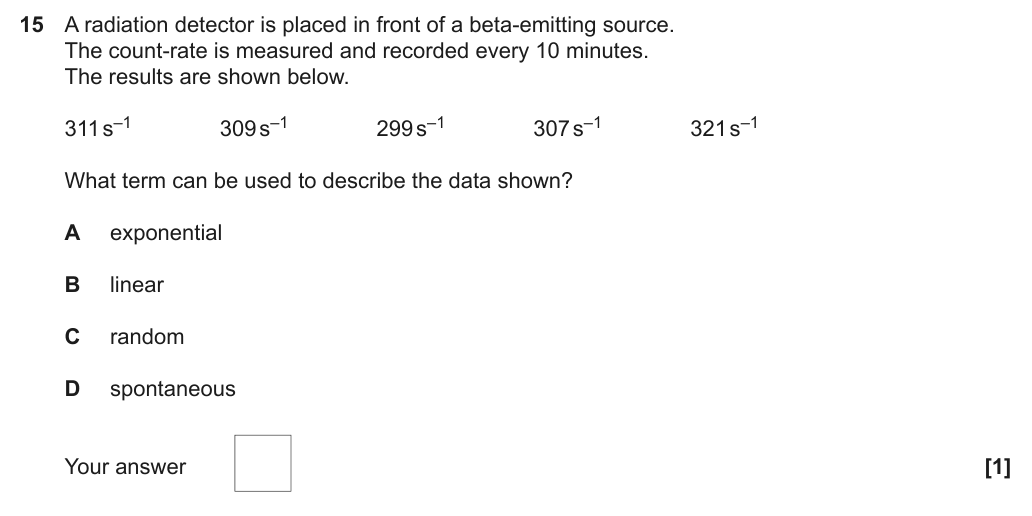
November 2021 · Paper 2 · Q151 markMultiple choiceHard
Answer
C
Mark scheme
Examiner's comment
The correct response is C. The responses are terms used frequently when studying data, but as around only one half of the candidates were able to get the correct response, it is clear that they are not fully understood. A little perplexingly, the most common incorrect response was B, as it is difficult to see how this data could be considered linear. This does show how easy it is to assume that candidates are confident in their use of terminology, just because they are frequently used.
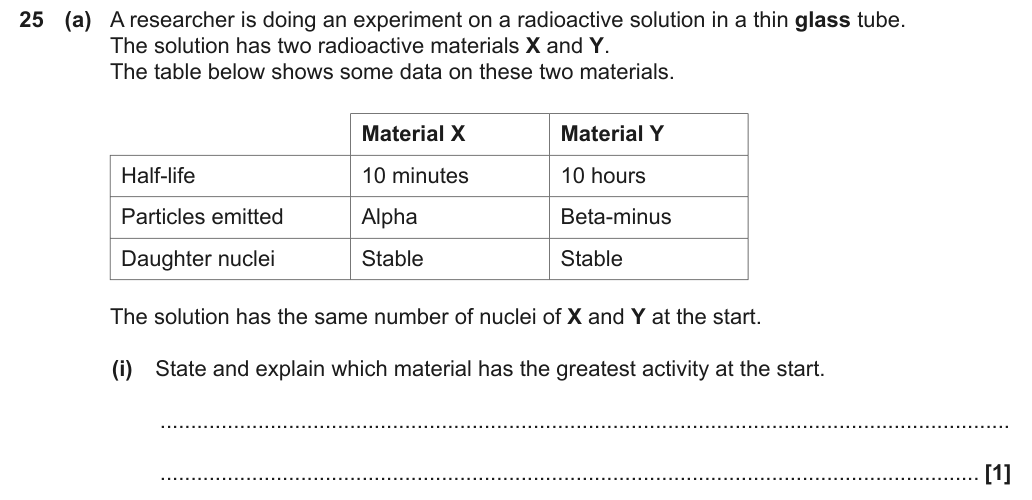
November 2021 · Paper 2 · Q25(a)(i)1 markExplanationMedium
Mark scheme
Examiner's comment
This question expects the candidates to appreciate that the activity is related to the half-life. The majority of candidates were able to successfully answer this question although a number did not make it comparative and simply said that X had a short half-life.
Notes from the mark scheme and report
must be comparative
November 2021 · Paper 2 · Q25(a)(ii)1 markShort answerMedium
Earlier part of question 25 that this part uses
Mark scheme
Examiner's comment
Not many candidates recognised that the penetrating powers of the radiations through glass were required for the response; most referred to the ionising (and so harmful to health) properties of both sources.
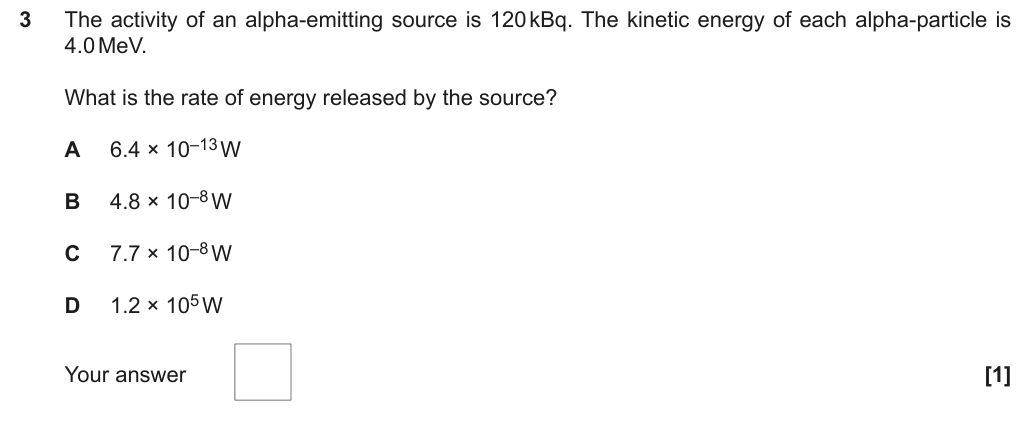
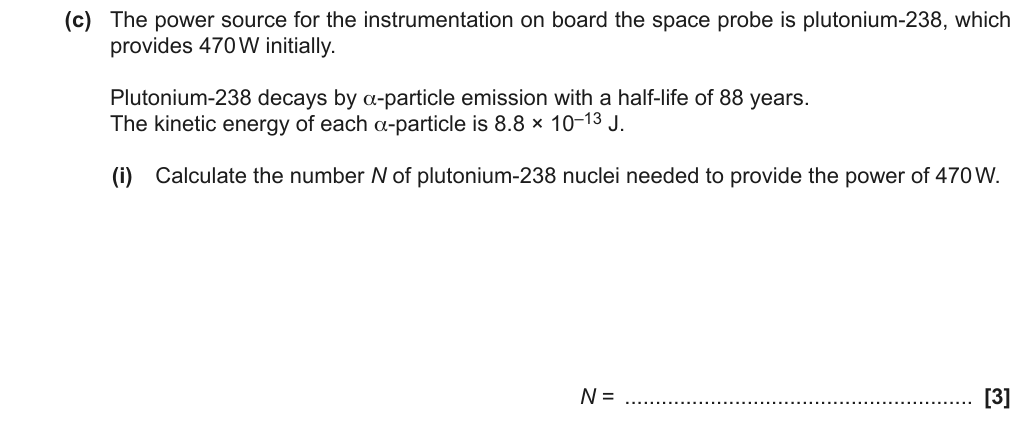
November 2021 · Paper 3 · Q3(c)(i)3 marksCalculation
Earlier part of question 3 that this part uses
Mark scheme
Notes from the mark scheme and report
activity = power / energy per alpha particle
half-life must be converted to seconds (88 x 3.16 x 10^7)
Skills: M0.1 Recognise and make use of appropriate units in calculations; M0.2 Recognise and use expressions in decimal and standard form; M2.2 Change the subject of an equation, including non-linear equations; M2.3 Substitute numerical values into algebraic equations using appropriate units for physical quantities
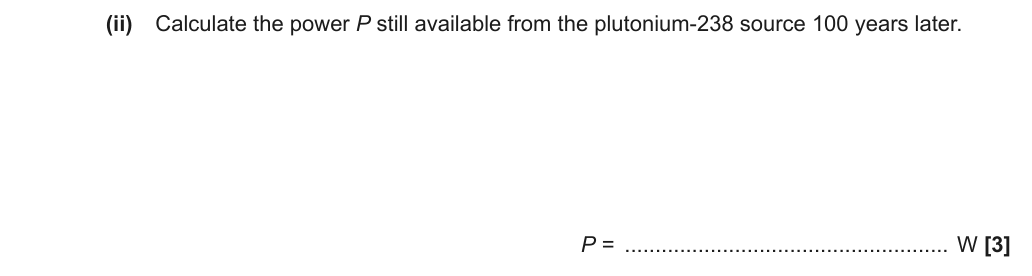
November 2021 · Paper 3 · Q3(c)(ii)3 marksCalculation
Earlier part of question 3 that this part uses
Mark scheme
Notes from the mark scheme and report
power is proportional to activity
calculation in terms of N or A allowed with ecf
Skills: M0.5 Use calculators to find and use power, exponential and logarithmic functions; M2.3 Substitute numerical values into algebraic equations using appropriate units for physical quantities
November 2020 · Paper 2 · Q91 markMultiple choiceMedium
Answer
C
Mark scheme
Examiner's comment
At the opposite end, Questions 9 and 11 were more challenging, and as such, were accessible to the top-end candidates.
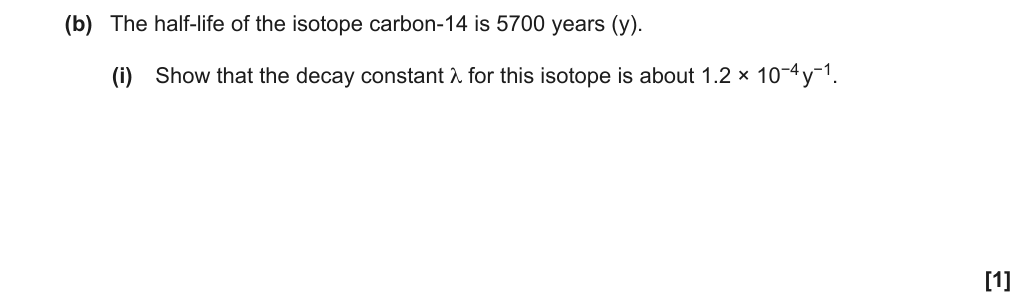
November 2020 · Paper 2 · Q21(b)(i)1 markShow thatMedium
Mark scheme
Examiner's comment
In Question 21c, candidates had to analyse and evaluate data, and estimate the density of nuclei using the information provided. Question 21a is all about the composition of a carbon-14 atom, with the question specifically mentioning fundamental particles and hadrons.
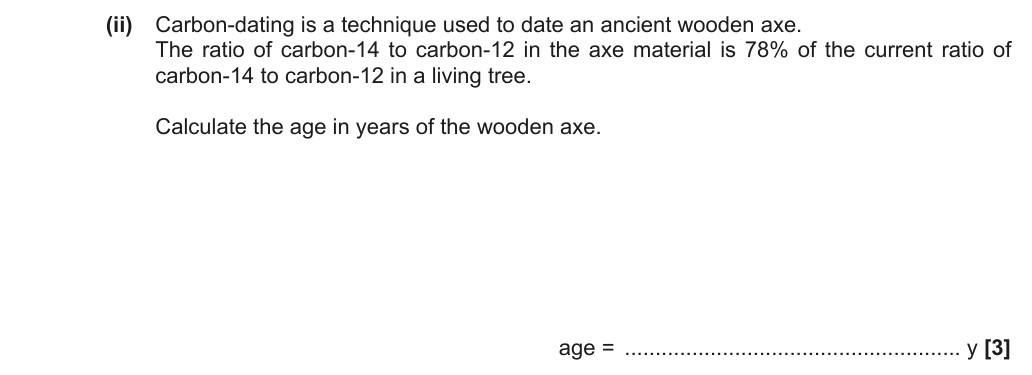
November 2020 · Paper 2 · Q21(b)(ii)3 marksCalculationMedium
Earlier part of question 21 that this part uses
Mark scheme
Examiner's comment
In Question 21c, candidates had to analyse and evaluate data, and estimate the density of nuclei using the information provided. Question 21a is all about the composition of a carbon-14 atom, with the question specifically mentioning fundamental particles and hadrons.
Notes from the mark scheme and report
1 = 0.78e^(–λt) is wrong physics (answer –2100 y)
no ecf from (b)(i)
1.22 x 10⁻⁴ gives 2040 y
Skills: M0.5 Use calculators to find and use power, exponential and logarithmic functions; M2.2 Change the subject of an equation, including non-linear equations; M2.5 Use logarithms in relation to quantities that range over several orders of magnitude
November 2020 · Paper 2 · Q21(b)(iii)1 markShort answerMedium
Earlier part of question 21 that this part uses
Mark scheme
Examiner's comment
In Question 21c, candidates had to analyse and evaluate data, and estimate the density of nuclei using the information provided. Question 21a is all about the composition of a carbon-14 atom, with the question specifically mentioning fundamental particles and hadrons.
Notes from the mark scheme and report
ratio of carbon-14 to carbon-12 has remained constant
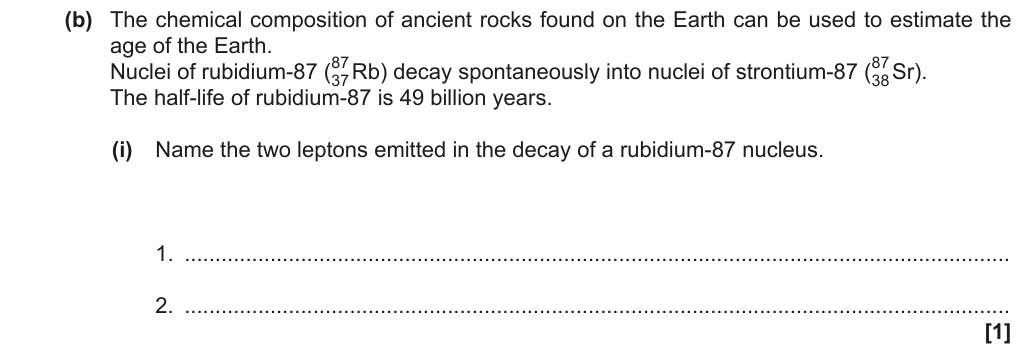
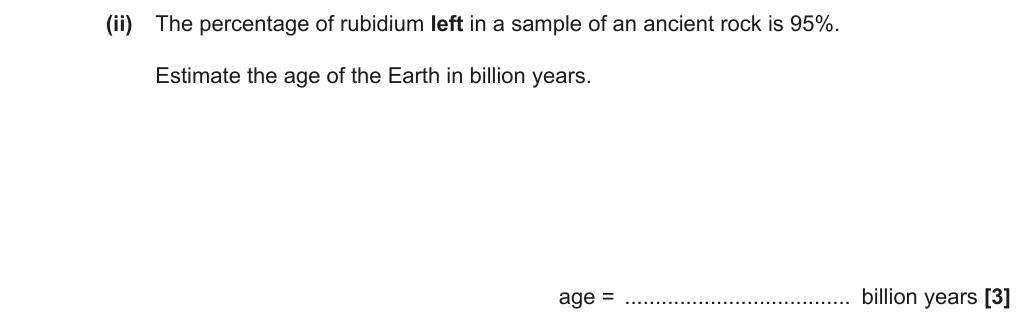
June 2019 · Paper 2 · Q20(b)(ii)3 marksCalculationMedium
Earlier part of question 20 that this part uses
Mark scheme
Examiner's comment
Many of the top-half candidates demonstrated how the age of the Earth could be calculated in just a few lines. The use of natural logs (ln) was faultless. Most candidates calculated the decay constant and then used the equation 0.95 = e-λt, or its equivalent ln0.95 = -λt, to calculate the age t. Candidates are reminded not to round numbers in long calculations – it is good practice to keep all the digits on your calculator. A significant number of candidates rounded the decay constant to 2 SF (0.014 billion y-1), and this gave an answer of 3.7 billion years. The correct answer, without rounding ln2/49, was 3.6 billion years. On this occasion, examiners allowed the 3.7 billion years answer. The command term ‘estimate’ in the question made a small number of candidates to use the equation Δ𝑡𝑡≈−𝜆𝜆𝜆𝜆. This was allowed, and it gave an estimated age of 3.5 billion years.
Notes from the mark scheme and report
age in seconds (1.15 x 10^17) scores 2
summarised below.
• Incorrect conversion of billion years into seconds. (Most candidates calculated the decay constant in billion year-1, which easily led to the correct answer in billion years.) • Using ln0.05 instead of ln0.95 when calculating the age of the Earth.
Skills: M0.5 Use calculators to find and use power, exponential and logarithmic functions; M2.3 Substitute numerical values into algebraic equations using appropriate units for physical quantities; M2.5 Use logarithms in relation to quantities that range over several orders of magnitude
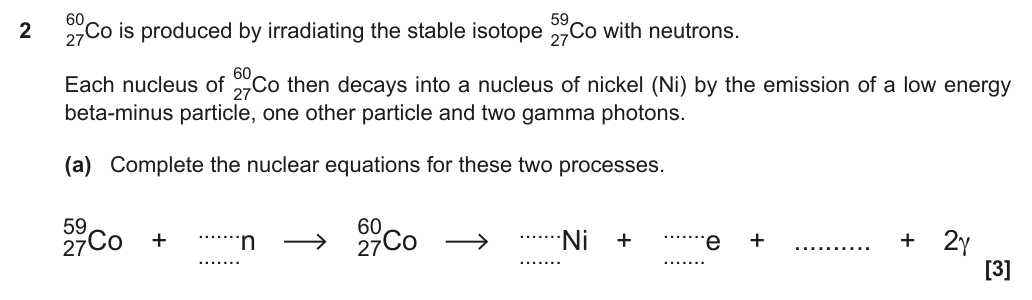
June 2019 · Paper 3 · Q2(a)3 marksShort answerMedium
Mark scheme
Examiner's comment
The correct symbol for the ‘one other particle’ in this question was ( ,)( _e ) or ((_0^0) ), all being acceptable. Common problems in 2(a) • some attempts for the symbol ‘nu’ could not be given because they were indecipherable or looked more like ‘gamma’ • balancing the bottom row proved more troublesome than balancing the top row, presumably because of the ‘-1’ for the electron
Notes from the mark scheme and report
recognisable antineutrino symbol required
superscripts 1, 60, 0 and subscripts 0, 28, -1
Centres should give candidates plenty of practice in balancing equations that involve beta minus decay.
June 2019 · Paper 3 · Q2(b)(i)1 markExplanationMedium
Mark scheme
Examiner's comment
Candidates were clearly familiar with the penetrative powers of beta and gamma radiation. Common problems in 2(b)(i) • saying that beta would be absorbed by air/paper/aluminium, but not mentioning the lead • saying that gamma would also be absorbed by the lead.
Notes from the mark scheme and report
NOT gamma radiation would be stopped
ignore reference to alpha
Skills: PAG7 Investigating ionising radiation
June 2019 · Paper 3 · Q2(b)(ii)11 marksShow thatMedium
Earlier part of question 2 that this part uses
Mark scheme
Examiner's comment
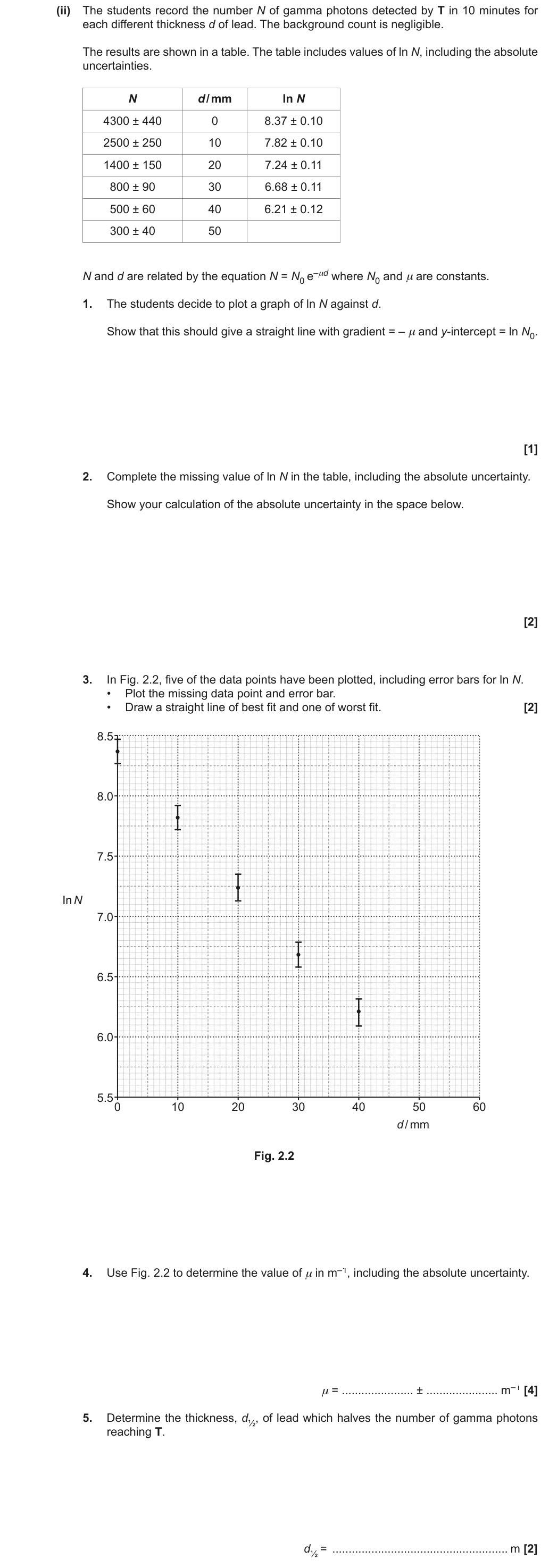
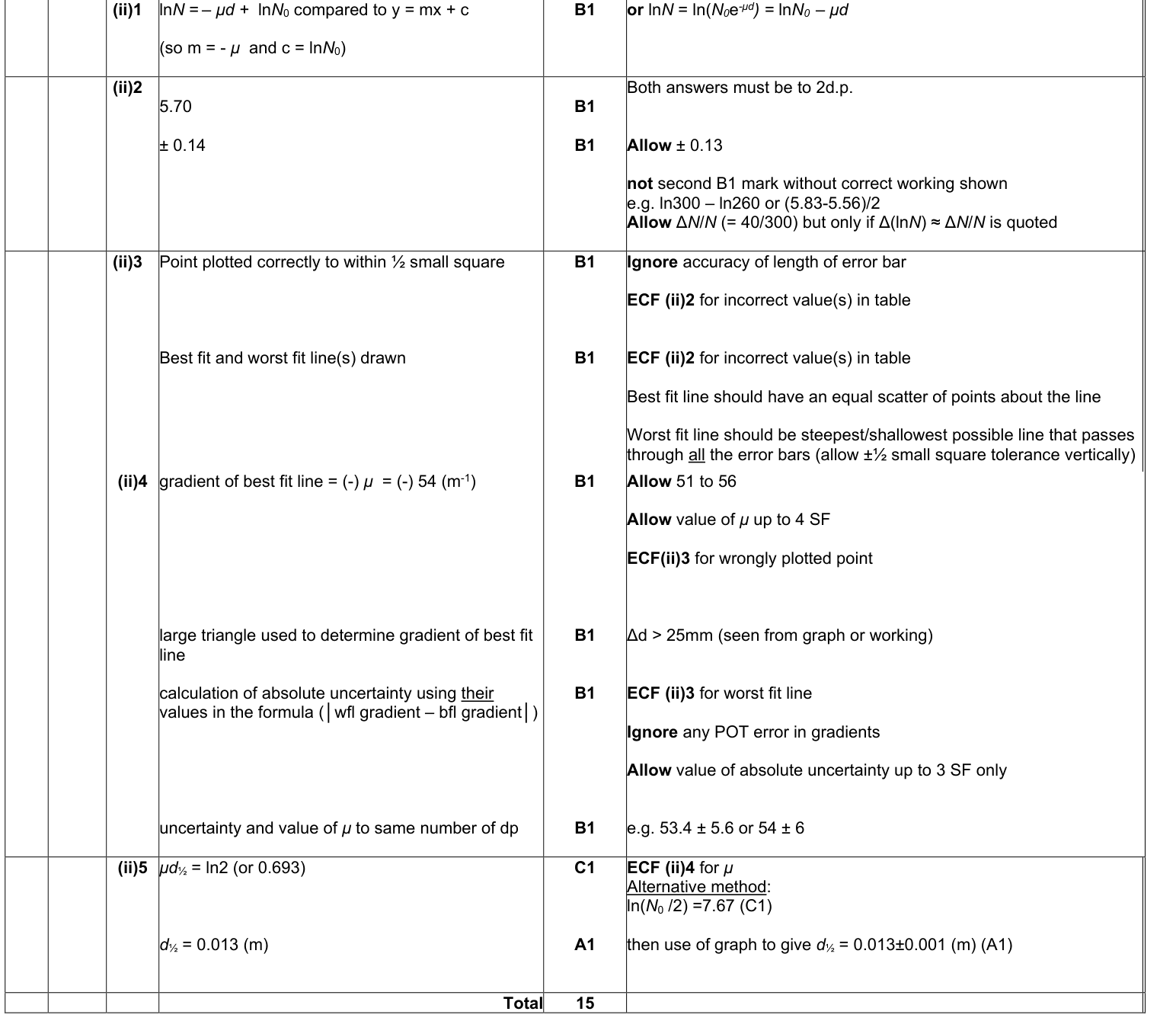
Most candidates were obviously very familiar with this and gave a clear response. Credit was given for either Gradient of best fit line: • a clear comparison of ln N = – μd + lnN0 with y = mx + c • using log rules to give ln(N0e-μd) = – μd + lnN0 Candidates who gained the uncertainty mark mostly used the standard method of finding half the range i.e. (ln340– ln260)/2. However, a very common response was to calculate the fractional uncertainty in N (i.e. 40/300) rather than the absolute uncertainty in lnN. This was not given without mathematical justification e.g. Δ(lnN) ≈ (ΔN)/N. Question 2 (b) (ii) (3) and (4) The majority of candidates had no difficulty in plotting the point (50, 5.70) correctly. Both best and worst fit lines were usually drawn well enough, although some had very thick pencil lines and a surprising number had not been extended to the lnN axis. Almost all candidates gained the mark for using a sufficiently large triangle (Δd > 25mm) for calculating the gradient of their best fit line. Common problems in 2(b)(ii)4 Gradient of best fit line • Power of ten (POT) errors due to not converting mm to m • Failure to notice the false origin of the lnN axis • Taking the natural logarithm of the lnN axis data • Calculation of absolute uncertainty • Calculating the fractional or percentage uncertainty in μ instead of its absolute uncertainty • Not giving the values of the gradient and its absolute uncertainty to the same number of d.p. Most mathematically able candidates quickly obtained the result µd1/2 = ln2 and then used it with their value of µ. Other candidates used a variety of (usually correct) graphical methods with Fig. 2.2.
Notes from the mark scheme and report
ln N = 5.70 ± 0.14 to 2 dp with working for the uncertainty
μ in range 51 to 56 m-1 with Δd greater than 25 mm in the gradient triangle
uncertainty and μ to the same number of dp
ecf through the parts
Skills: M2.5 Use logarithms in relation to quantities that range over several orders of magnitude; M3.11 Use logarithmic plots to test exponential and power law variations; M3.2 Plot two variables from experimental or other data; M3.4 Determine the slope and intercept of a linear graph; PAG7 Investigating ionising radiation
June 2018 · Paper 2 · Q24(a)(i)1 markShort answer
Mark scheme
Notes from the mark scheme and report
alpha-particle or helium-4 nucleus with correct numbers
June 2018 · Paper 2 · Q24(a)(ii)2 marksShort answerMedium
Earlier part of question 24 that this part uses
Mark scheme
Examiner's comment
Some of the missed opportunities or errors were: • Using an incorrect equation with the distance squared • Not correctly converting the kinetic energy 0.52 MeV into joule (J) • Using the equation r = r0A1/3 for the mean radius of a nucleus to determine the minimum distance Question 24(a)(ii) Question 24(b)(i) This turned out to be a low-scoring question from candidates across the ability spectrum.
Notes from the mark scheme and report
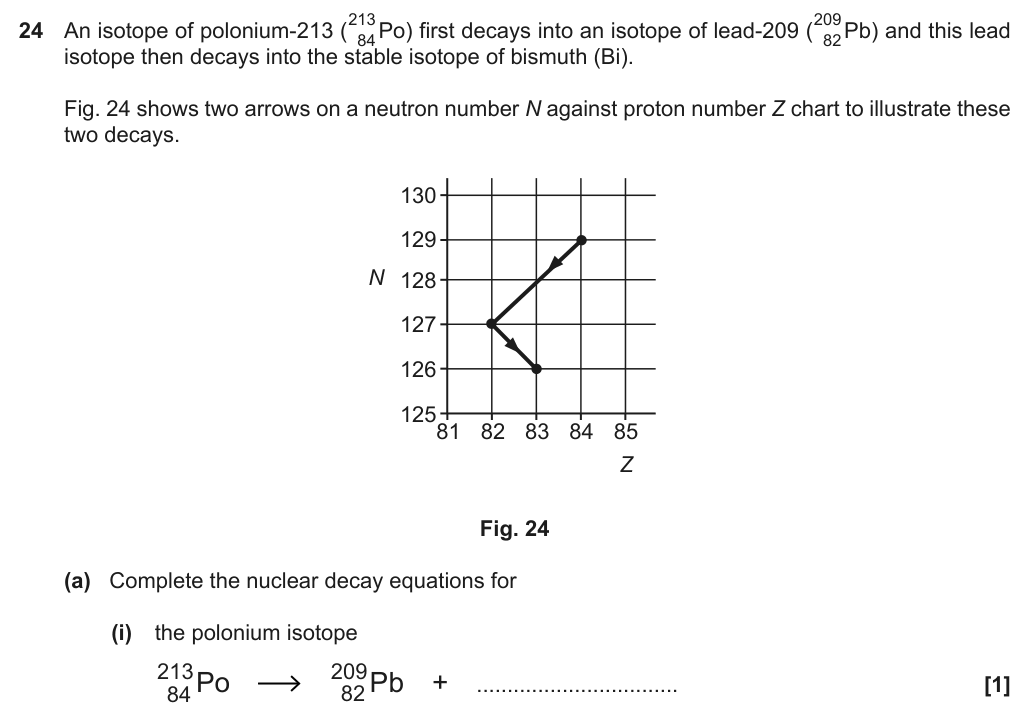
nucleon number of Bi = 209 and (electron) antineutrino
do not allow incorrect subscript and superscript
June 2018 · Paper 2 · Q24(b)(i)2 marksExplanationMedium
Mark scheme
Examiner's comment
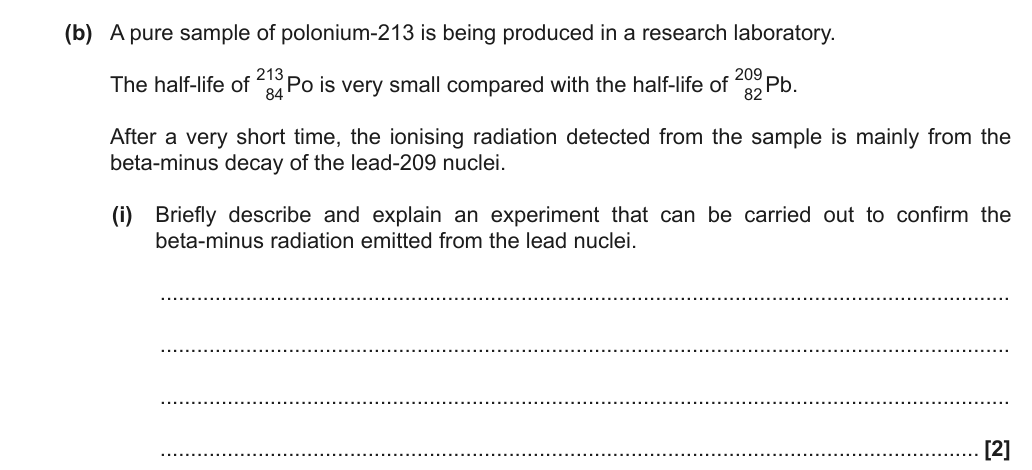
This turned out to be a low-scoring question from candidates across the ability spectrum. Only a quarter of the candidates gained 2 marks for identifying aluminium as the absorber for the beta-minus radiation (electrons) and providing adequate description in terms of reduction in the count-rate. A small number of candidates opted for charged parallel plates and identified the electrons curving towards the positive plate. There were some baffling descriptions involving pointing the source at ‘wires and measuring the current’. Fluorescent screens and cloud chambers were not allowed as acceptable answers because both can be used to detect the presence of gamma-photons and alpha-particles.
Notes from the mark scheme and report
aluminium sheet and count rate reduces, or deflection in a magnetic / electric field
range in air of a few metres scores 2
Skills: PAG7 Investigating ionising radiation
June 2018 · Paper 2 · Q24(b)(ii)4 marksCalculationMedium
Mark scheme
Examiner's comment
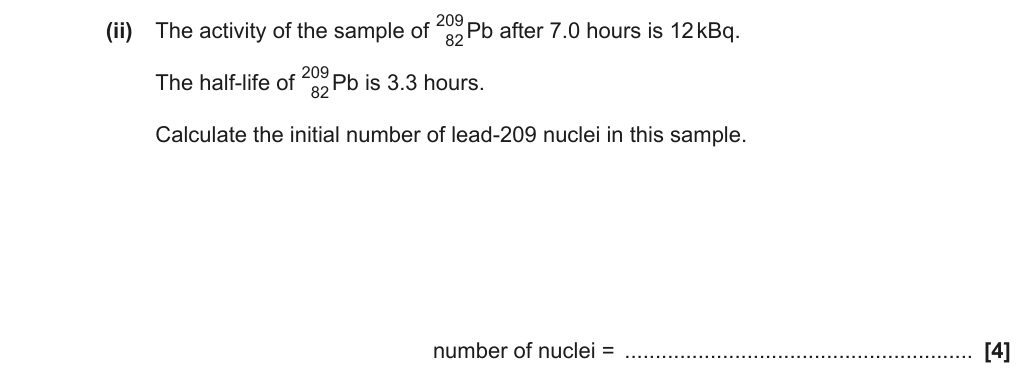
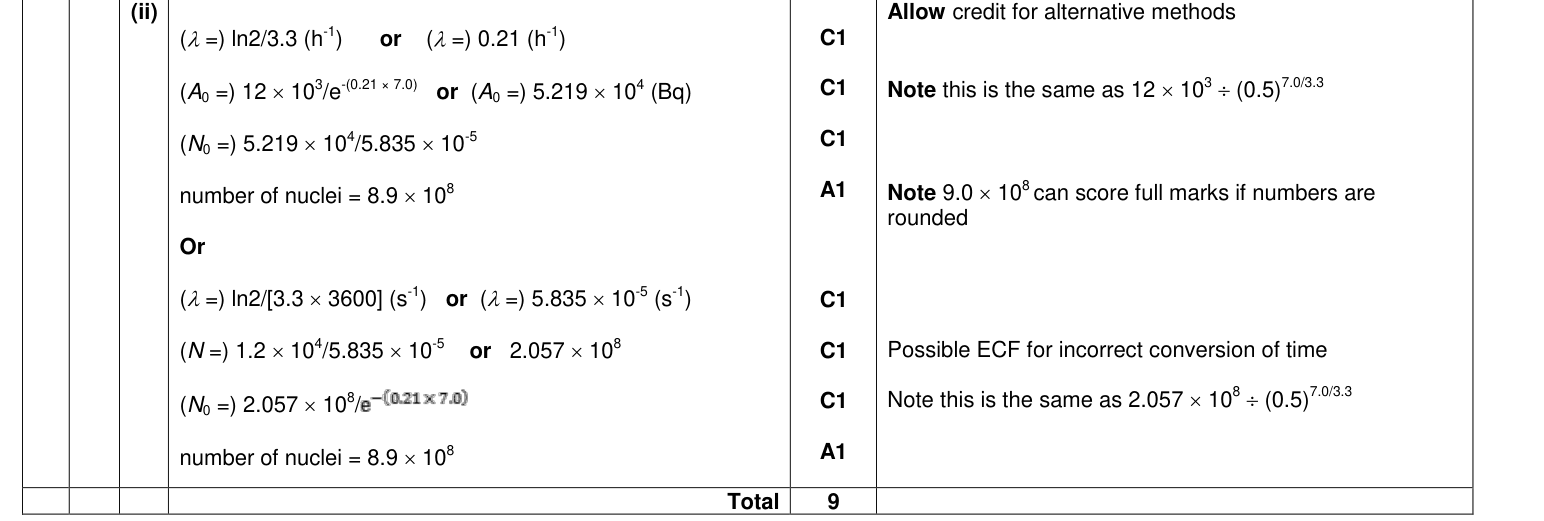
The question was multi-stepped calculation, requiring knowledge of radioactive decay equations, half- time and activity. The final stage of the calculation was dependent on the equation A = λN and working consistently in Bq for the activity and in s-1 for the decay constant. The number of nuclei N could not be calculated with the activity in Bq and the decay constant in either h-1 or min-1. About half of the candidates scored full marks. Those working with inconsistent units invariably ended up with the incorrect value 2.5 × 10⁵ nuclei, but this still earned them 2 marks for the preceding steps.
Notes from the mark scheme and report
decay constant must be in s-1 when used in A = λN
ecf for incorrect conversion of time
9.0 x 10^8 can score full marks
Skills: M0.1 Recognise and make use of appropriate units in calculations; M0.5 Use calculators to find and use power, exponential and logarithmic functions; M2.2 Change the subject of an equation, including non-linear equations; M2.3 Substitute numerical values into algebraic equations using appropriate units for physical quantities
June 2017 · Paper 2 · Q25(b)3 marksCalculation
Mark scheme
Notes from the mark scheme and report
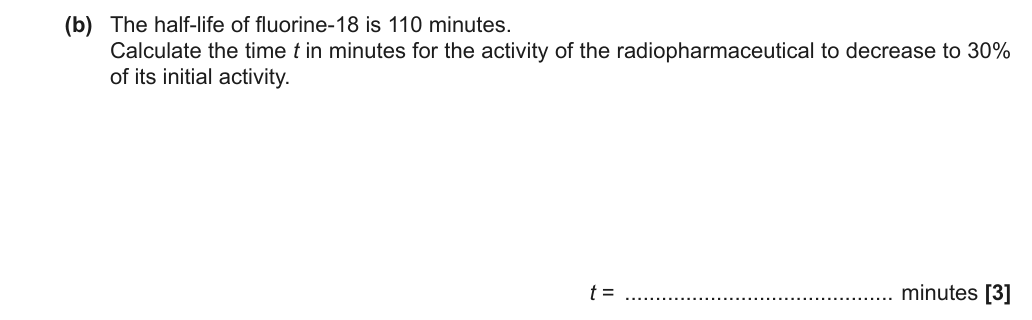
2 marks for 1.15 x 10^4 (answer in seconds)
Skills: M0.5 Use calculators to find and use power, exponential and logarithmic functions; M2.2 Change the subject of an equation, including non-linear equations; M2.5 Use logarithms in relation to quantities that range over several orders of magnitude
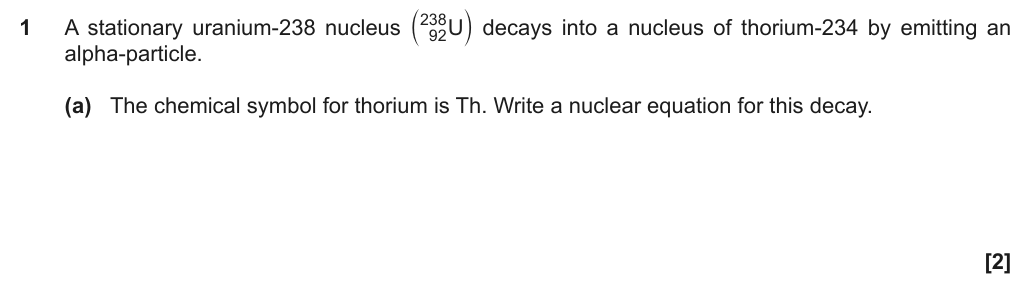
June 2017 · Paper 3 · Q1(a)2 marksShort answer
Mark scheme
Notes from the mark scheme and report
allow a γ photon
zero for any other extra particle
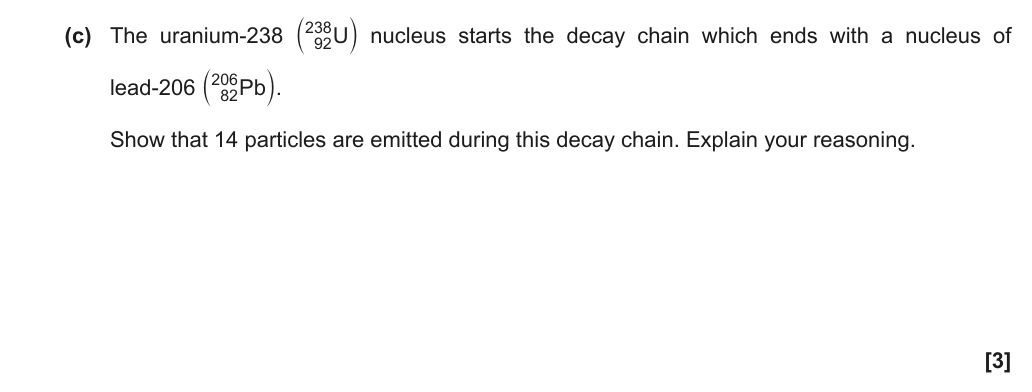
June 2017 · Paper 3 · Q1(c)3 marksShow that
Mark scheme
Notes from the mark scheme and report
8 alpha and 6 beta-minus with reasoning for both
NOT 14 – 8 = 6
must state β– particles
Skills: M2.4 Solve algebraic equations, including quadratic equations
Work with an OCR physics tutor
Dropping marks on calculations, practical questions or the six-mark level of response questions? Book a trial session with a specialist OCR physics tutor.