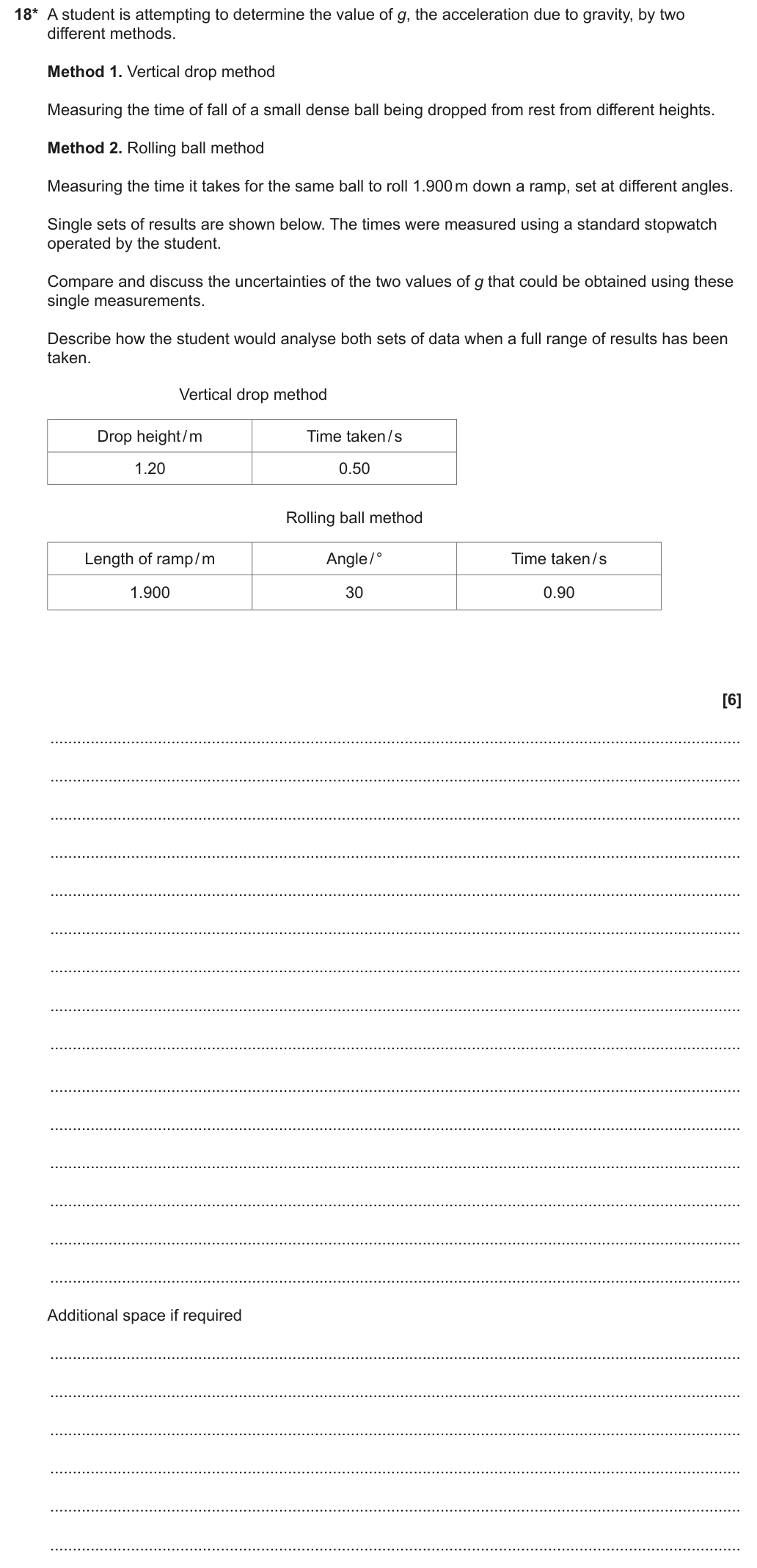
A student is attempting to determine the value of g, the acceleration due to gravity, by two Compare and discuss the uncertainties of the two values of g that could be obtained using these
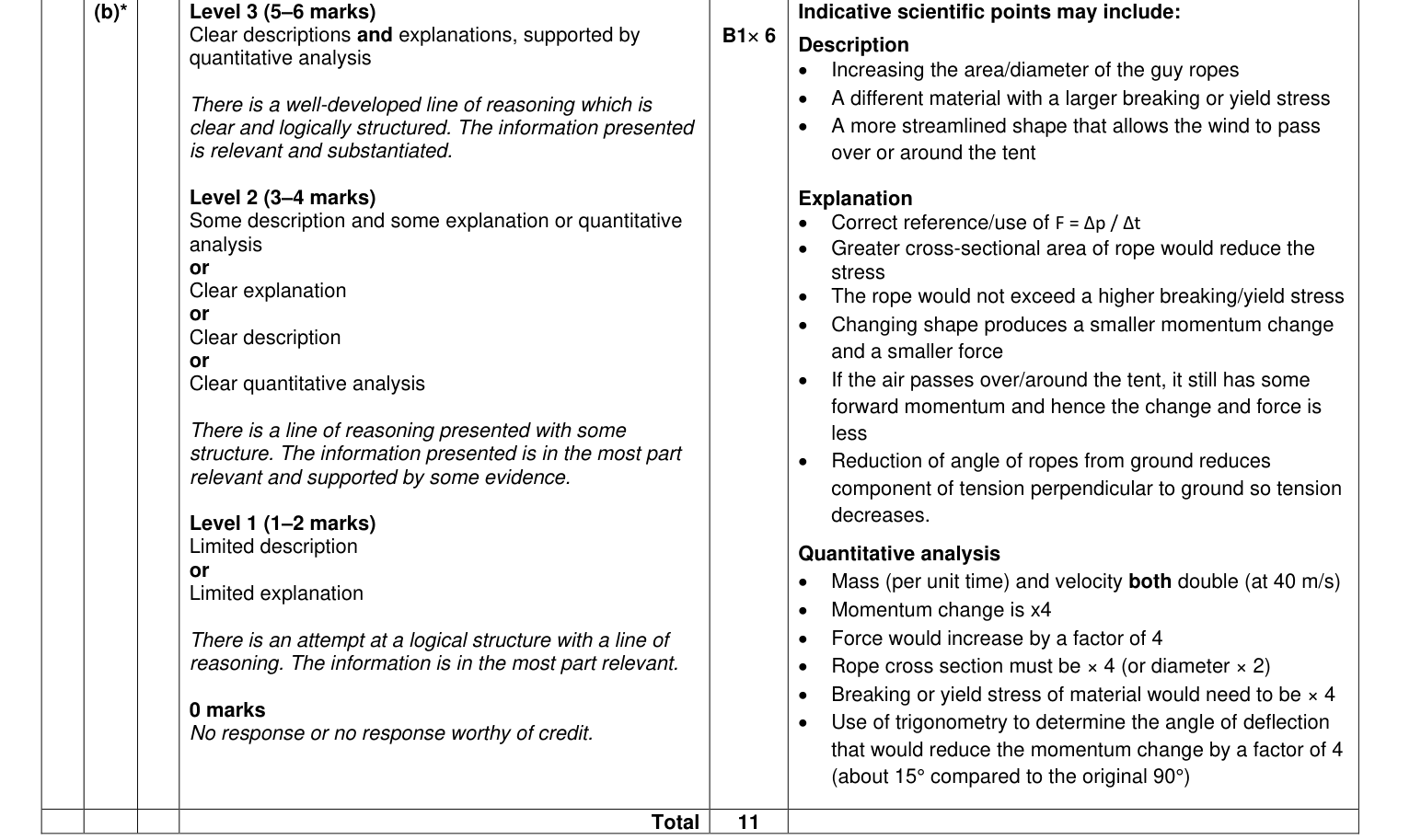
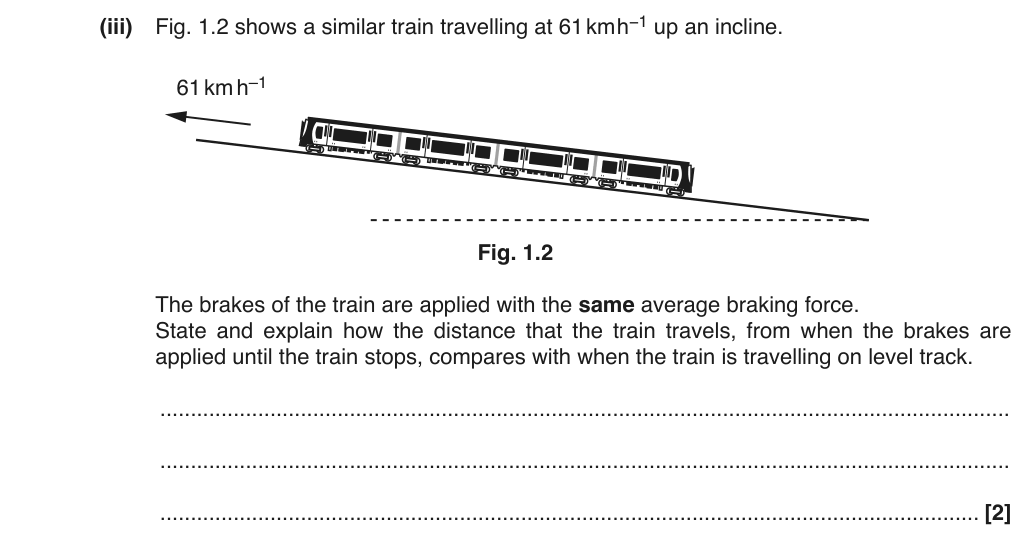
When the wind speed exceeds 20 m s–1 the ropes securing the tent break. Describe, and explain in terms of forces, how the ropes and the shape of the tent could be
Tap a question to zoom it. Where a part needs a figure, table or graph from earlier in the question, that part folds out above it; the mark scheme and examiner's comment open underneath. Have the OCR Data, Formulae and Relationships Booklet beside you (see the data booklet page).
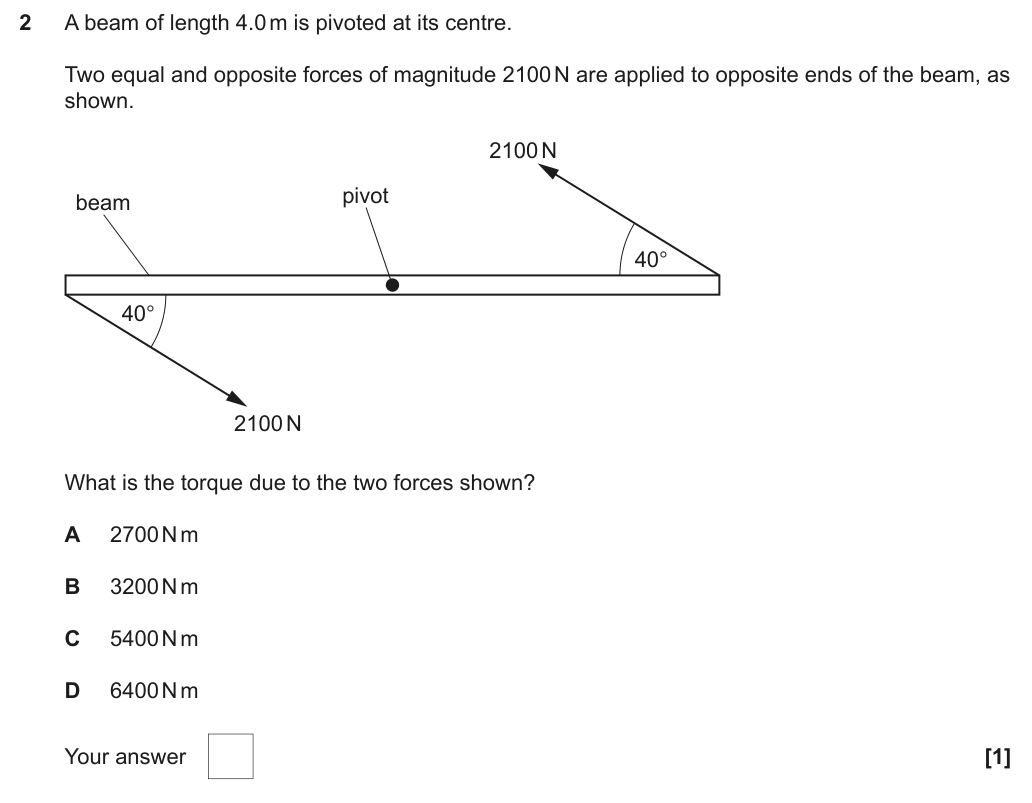
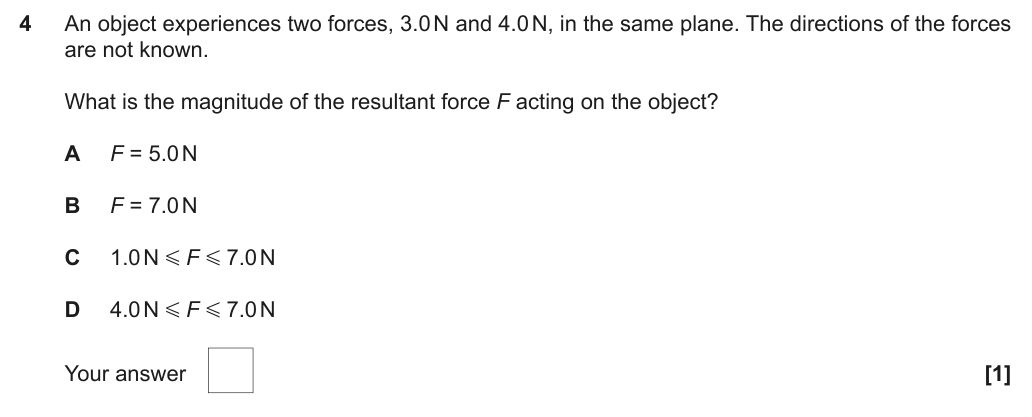
June 2025 · AS Paper 1 · Q21 markMultiple choiceMedium
Answer
C
Mark scheme
Examiner's comment
The majority of the candidates who did not gain the correct answer, selected answer A. These candidates correctly calculated the force but found the moment of the pivot for one of the forces rather than the torque of the two forces shown.
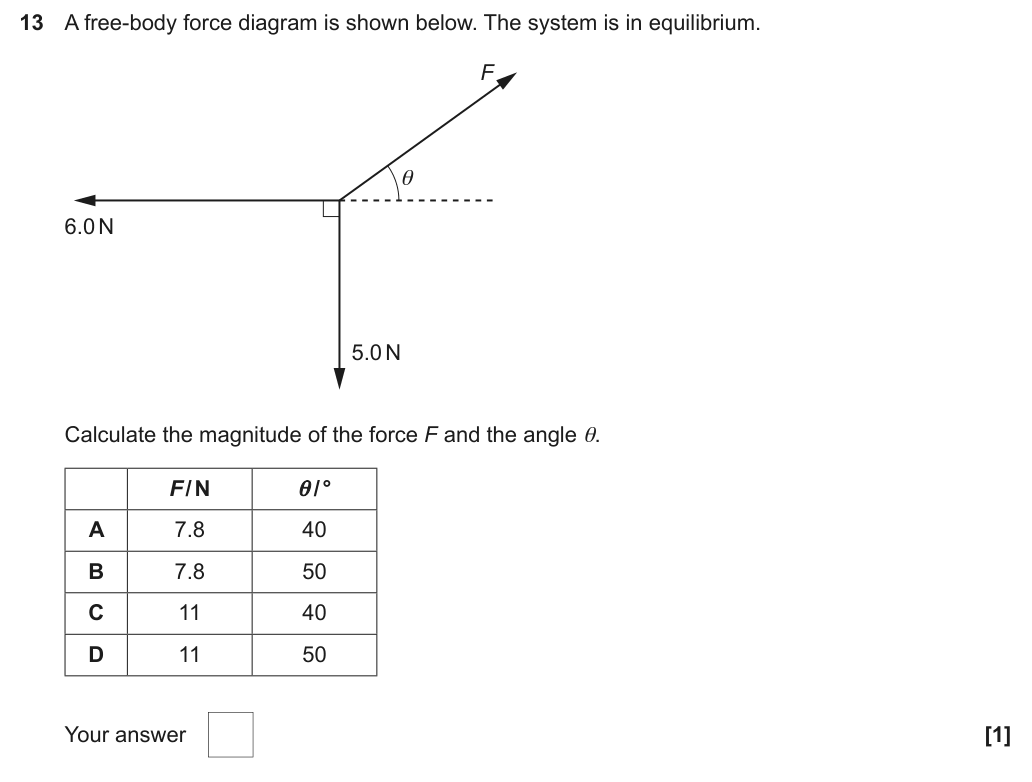
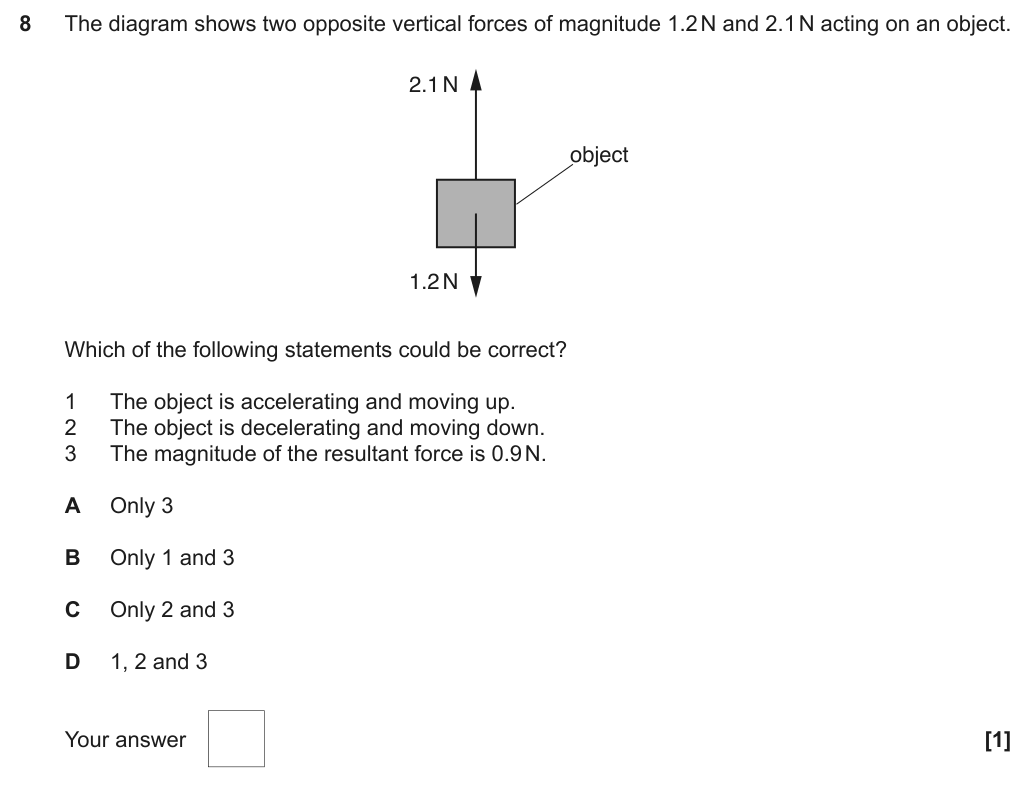
June 2025 · AS Paper 1 · Q131 markMultiple choiceHard
Answer
A
Mark scheme
Examiner's comment
A few candidates incorrectly selected C – adding the two forces 5.0 N and 6.0 N to equal11 N.
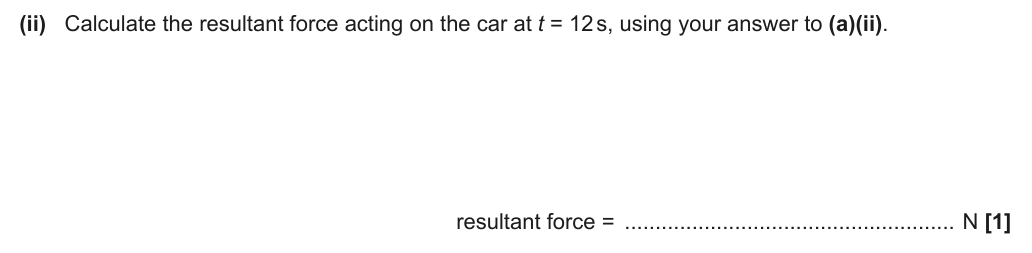
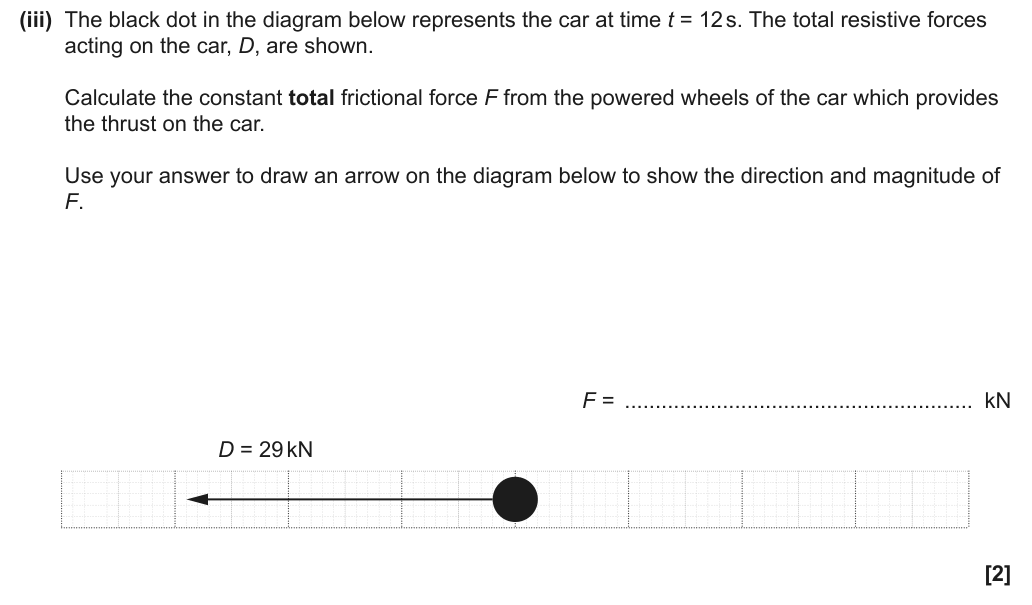
June 2025 · Paper 1 · Q16(c)(iii)2 marksDiagram or graphMedium
Earlier part of question 16 that this part uses
Mark scheme
Examiner's comment
The correct approach here is to make sure that the thrust – drag = resultant force calculated in the previous part of the question. Many candidates still gained full marks even though their previous answer was incorrect as ‘error carried forward’ was applied, as long as the arrow matched the numerical answer. The answer line includes the unit kN – candidates should be careful to give their answer in the required unit.
Notes from the mark scheme and report
ignore power of ten on the answer line
arrow to the right drawn to scale (31 to 32 squares)
ecf from (ii)
Skills: M0.1 Recognise and make use of appropriate units in calculations
June 2025 · Paper 1 · Q17(a)(iii)4 marksCalculationHard
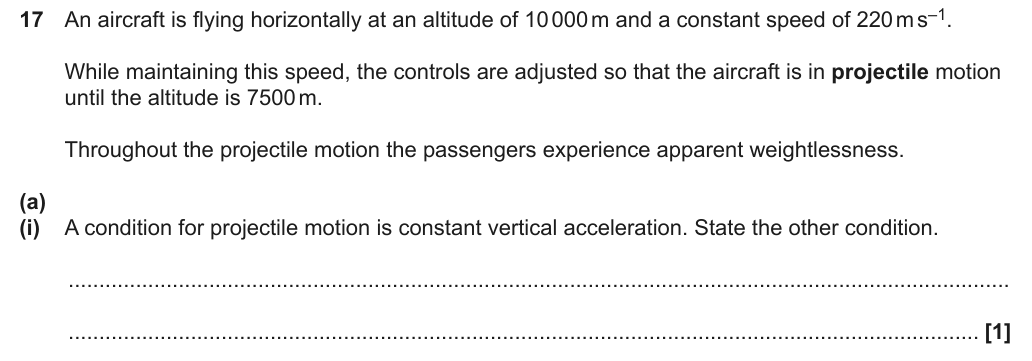
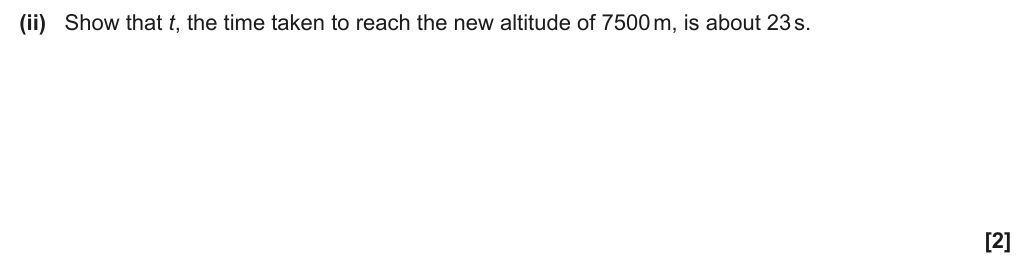
Earlier parts of question 17 that this part uses
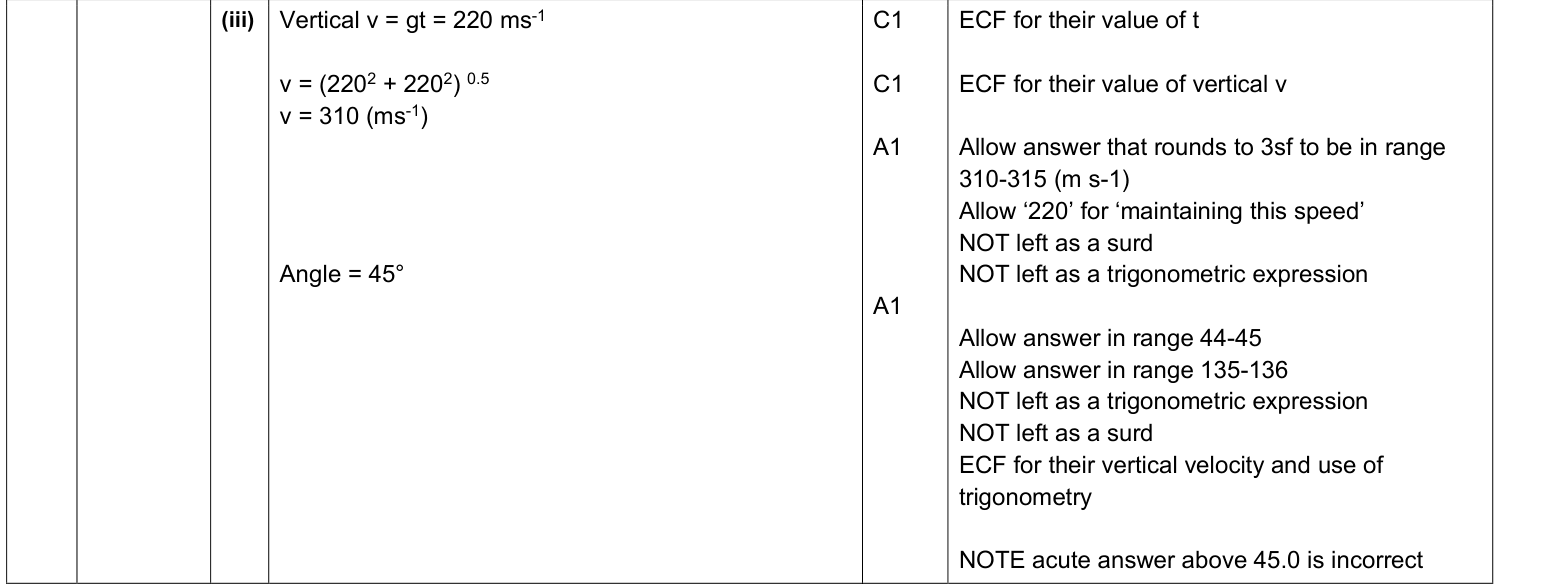
Mark scheme
Examiner's comment
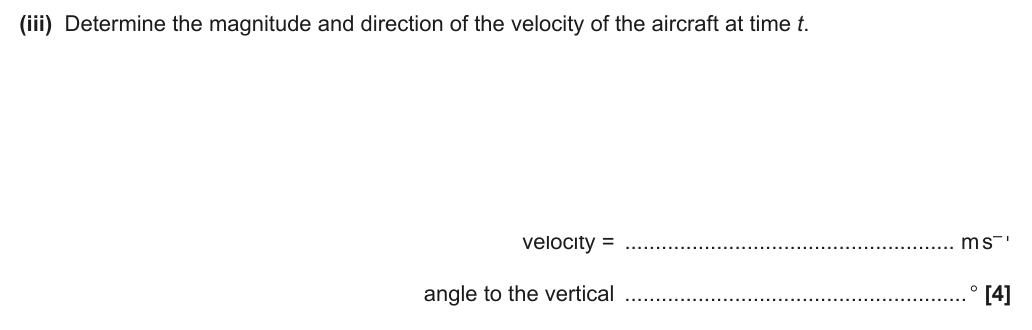
A diagram of the two components of the velocity here was not mandatory; however, it makes it clear in the mind of the candidate what they are doing. The most successful candidates drew a triangle with the two components of velocity with an angle indicated between the vertical and the resultant velocity. They were then clear about how to work out the resultant velocity (Pythagoras) and the required angle. Both acute and obtuse angles to the vertical were acceptable. Acute angles over 45 degrees indicated an error in the trigonometry and so the last mark was unavailable. Few candidates were able to correctly interpret the question’s description of ‘maintaining this speed’ to suggest that the velocity of the plane was 220 m s-1 throughout.
Notes from the mark scheme and report
NOT left as a surd or a trigonometric expression
acute angle above 45.0 is incorrect
ecf for t
Skills: M0.6 Use calculators to handle sin x, cos x and tan x when x is expressed in degrees or radians; M4.4 Use Pythagoras’ theorem, and the angle sum of a triangle; M4.5 Use sin, cos and tan in physical problems
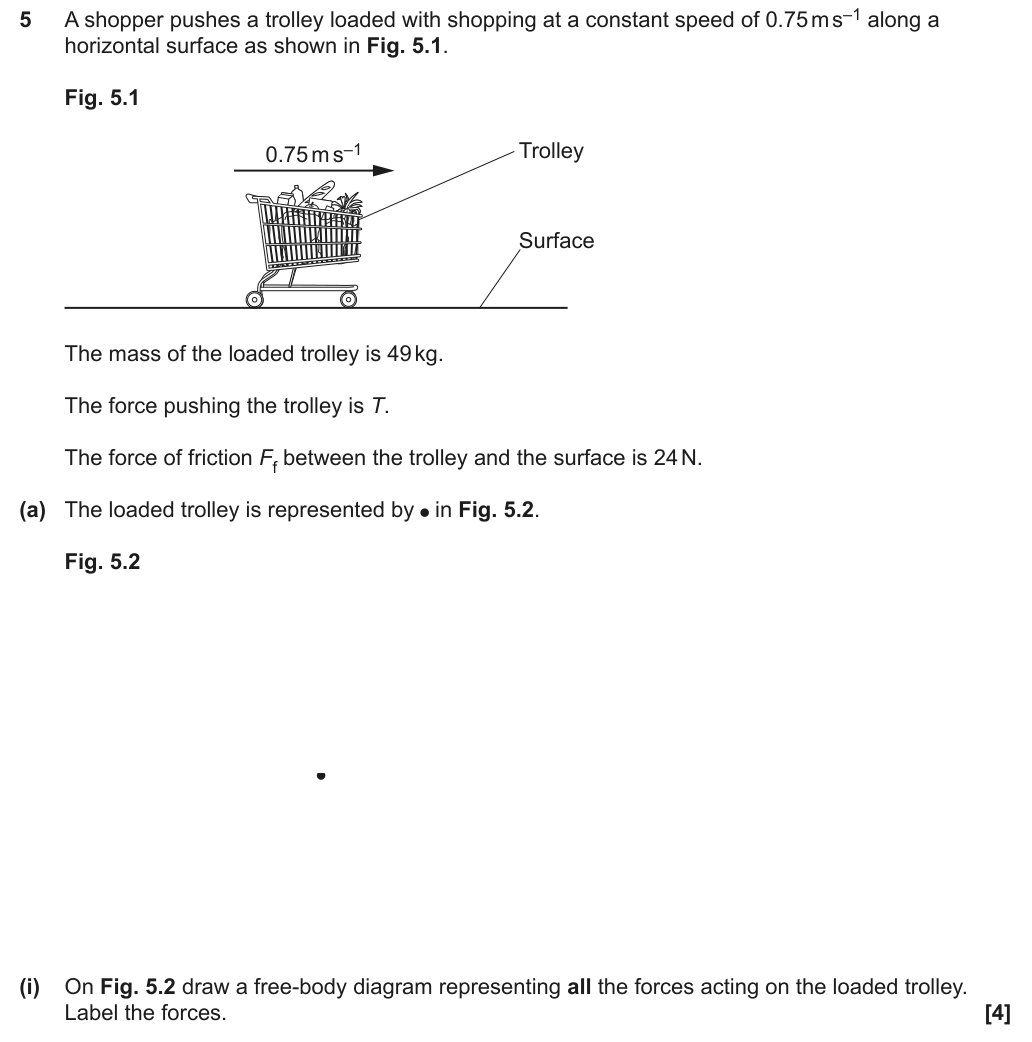
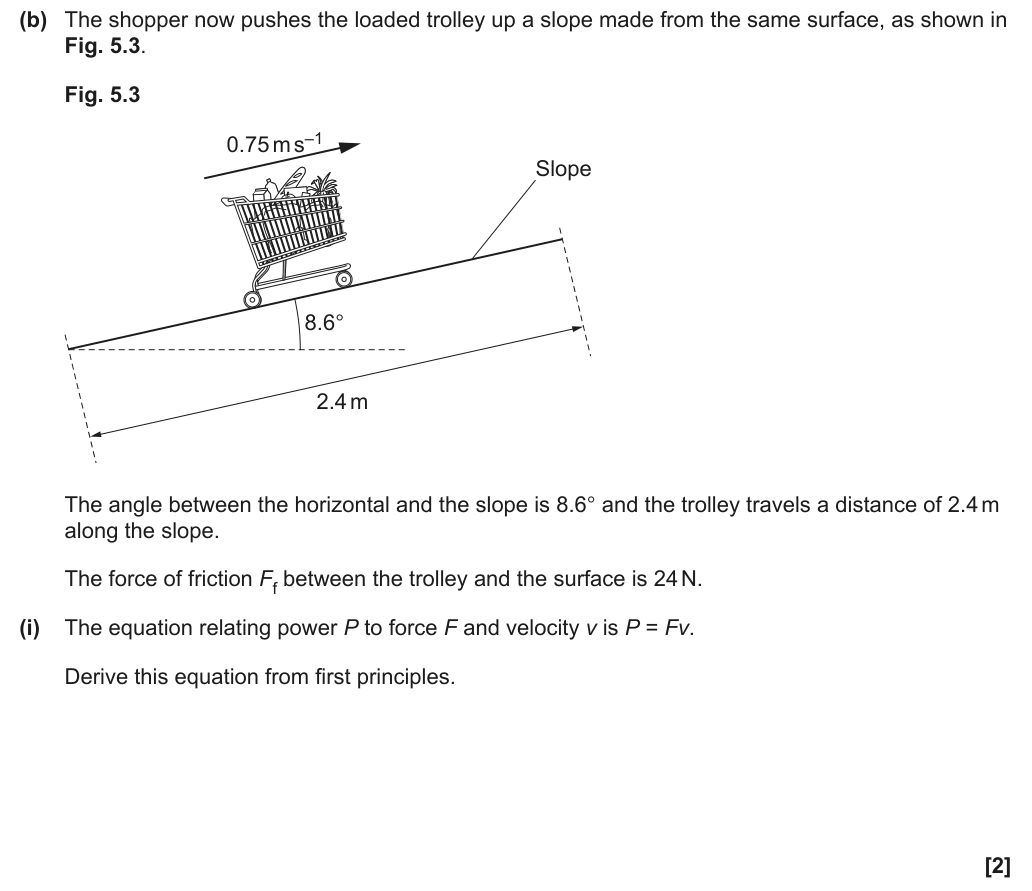
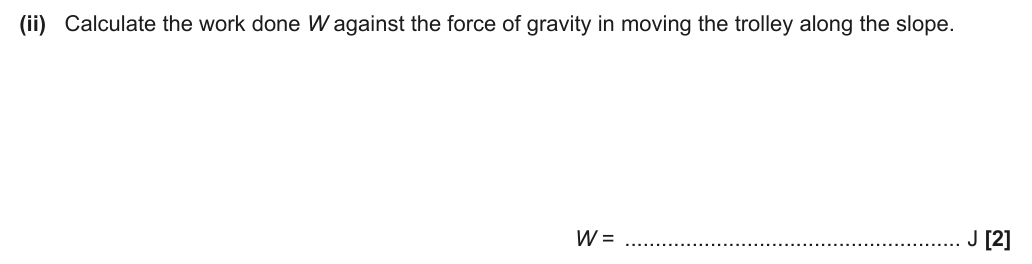
June 2025 · AS Paper 2 · Q5(b)(ii)2 marksCalculationMedium
Earlier parts of question 5 that this part uses
Mark scheme
Examiner's comment
There were two possible methods of calculating W. One method was using the equation W = Fxcosθ and the other was to use the vertical component of the distance. Some candidates for both methods did not use the correct angle.
Notes from the mark scheme and report
1140 J scores one mark (sin / cos confused)
Skills: M0.6 Use calculators to handle sin x, cos x and tan x when x is expressed in degrees or radians; M4.5 Use sin, cos and tan in physical problems
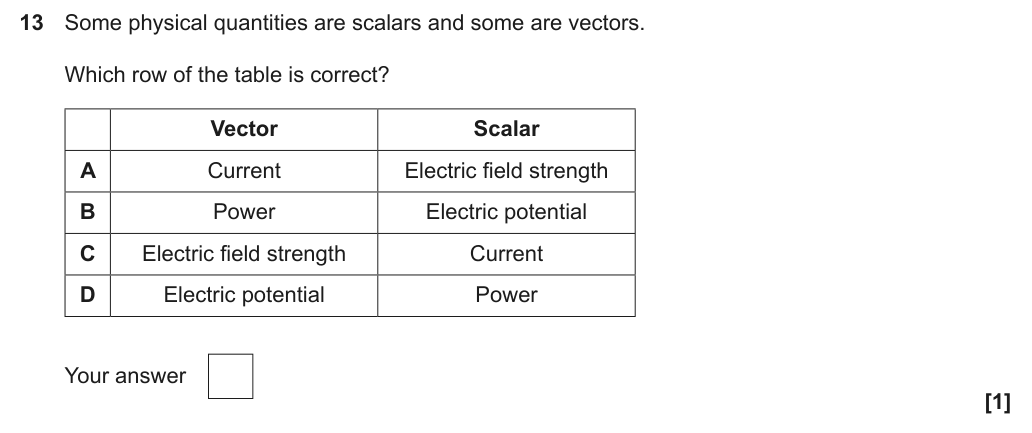
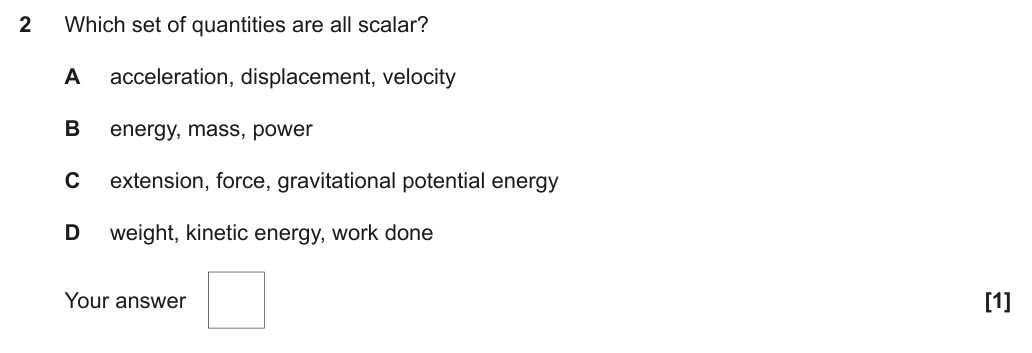
June 2025 · Paper 2 · Q131 markMultiple choiceHard
Answer
C
Mark scheme
Examiner's comment
This was a challenging question. As is common in this style of question, candidates tick and cross those they know to be correct (or incorrect) but the inclusion of potential and field strength clearly made this more challenging. D was by far the most common incorrect response as candidates seemed to know that power was a scalar.
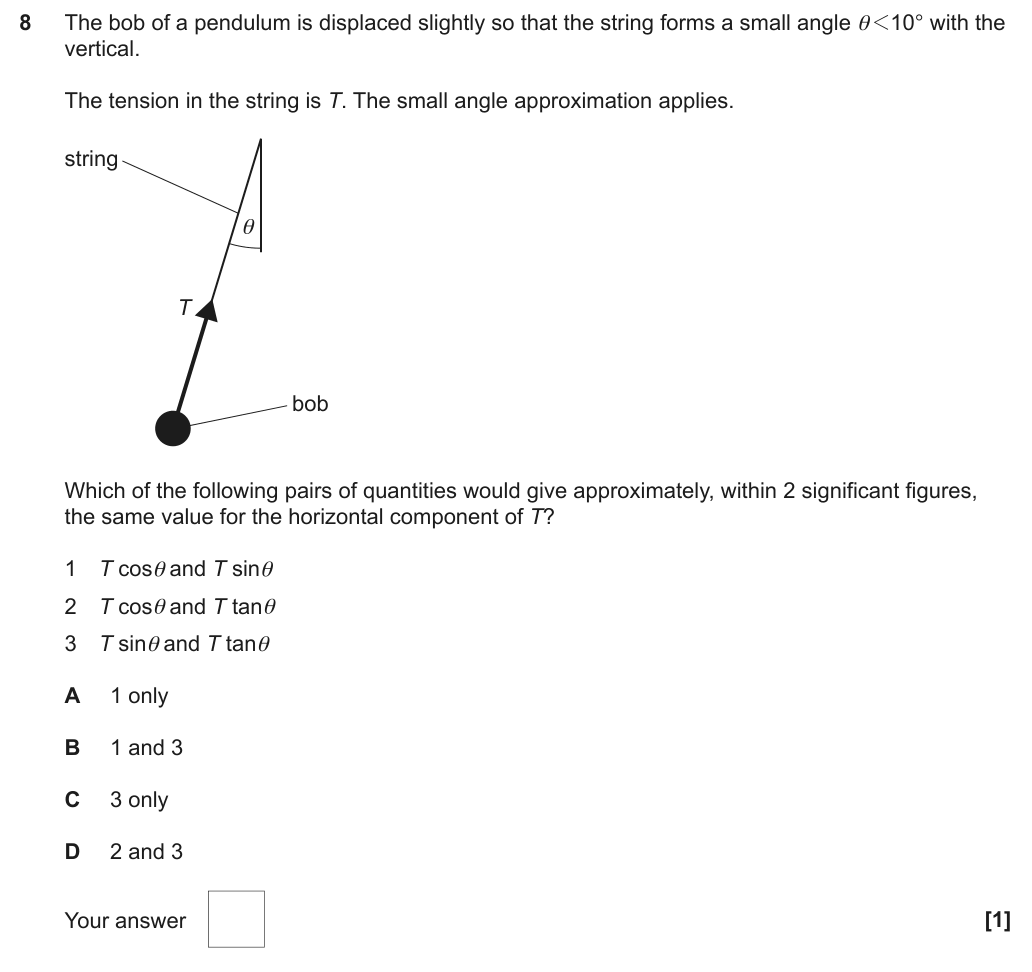
June 2024 · Paper 1 · Q81 markMultiple choiceMedium
Answer
C
Mark scheme
Examiner's comment
For small angles, sinθ and tanθ are relatively close to each other and small. cosθ, however, is close to 1, which eliminates options 1 and 2. The only correct pair is option 3, making C the correct answer.
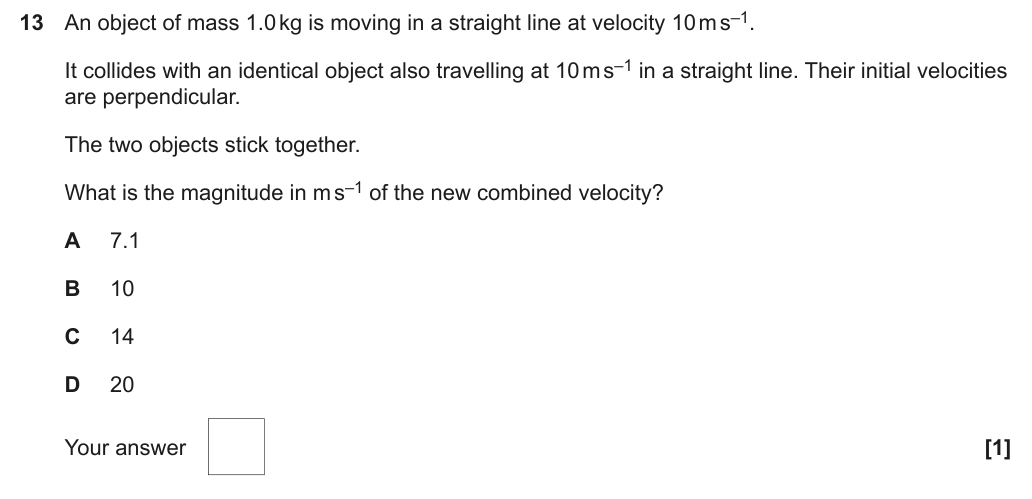
June 2024 · Paper 1 · Q131 markMultiple choiceMedium
Answer
A
Mark scheme
Examiner's comment
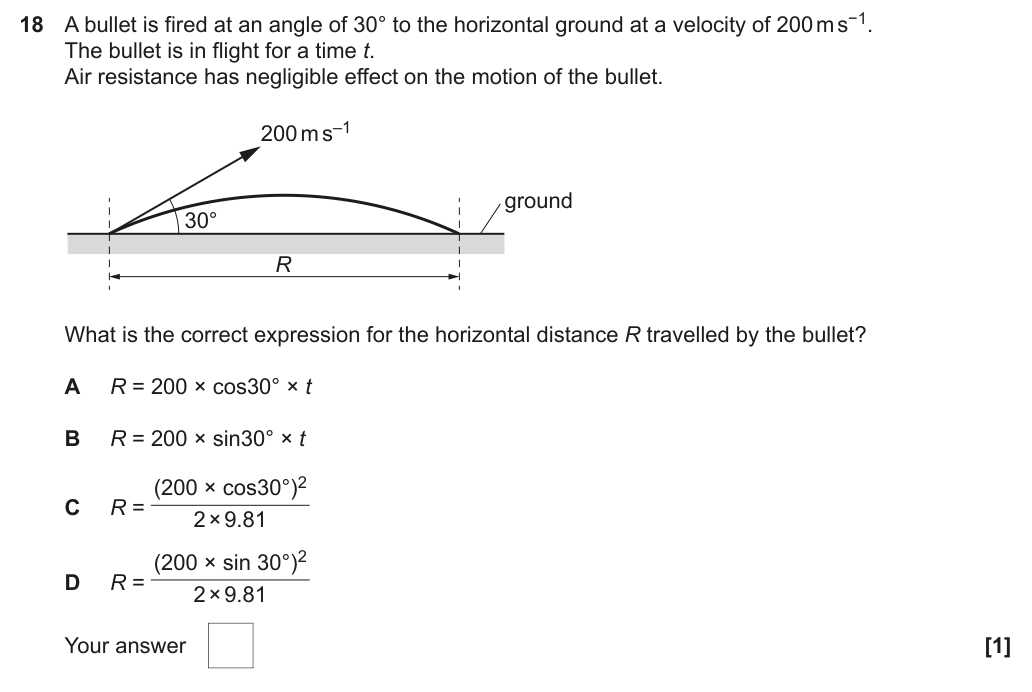
This is a conservation of momentum question. The momentum of each object is 10 kg m s-1. The combined momentum has two components at right angles to each other of 10 kg ms-1. The magnitude of this momentum is √ (200). To find the speed, divide this by 2.0 kg, giving 7.1 m s-1, so the answer is A.
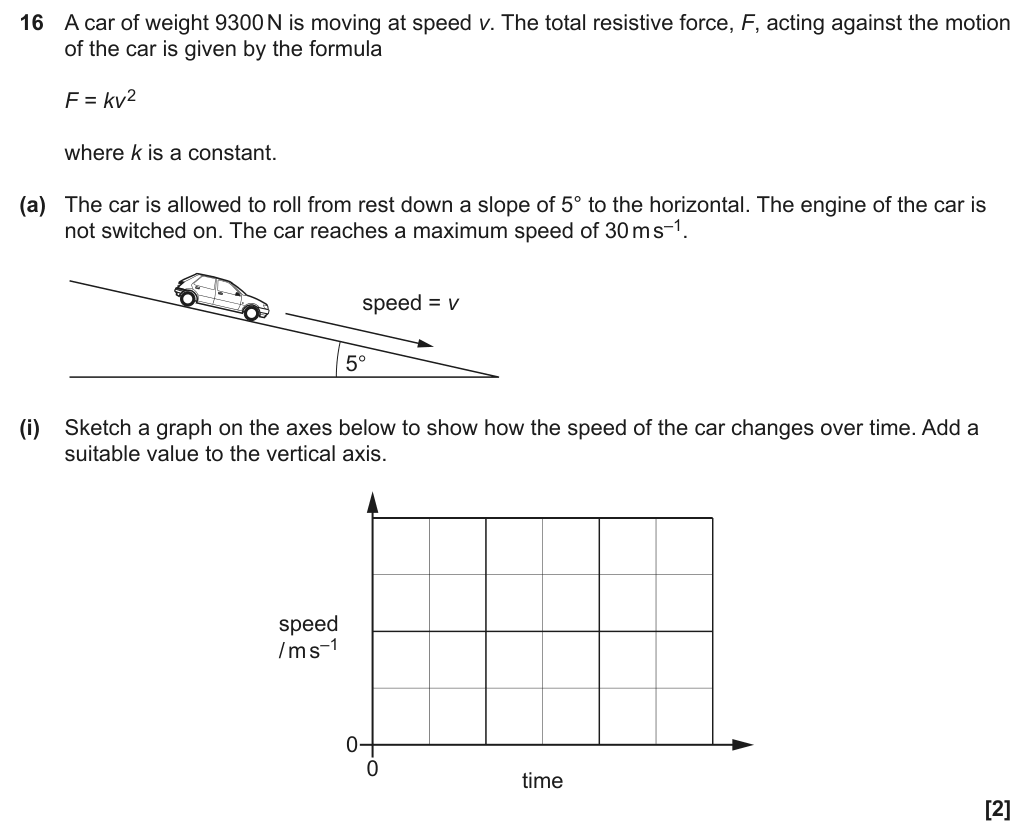
June 2024 · Paper 1 · Q16(a)(iii)3 marksShow thatMedium
Earlier part of question 16 that this part uses
Mark scheme
Examiner's comment
As this question is a ‘show that’, all steps were required. Many candidates omitted the rearrangement stage, restricting their maximum score for this item to 1 mark. This approach was consistent throughout the paper for this type of question. Make sure that all steps of working are presented in ‘show that’ questions, especially the step that shows the relevant quantity as the subject of the equation. Always show your evaluation to at least 1 more significant figure than that shown in the question.
Notes from the mark scheme and report
calculated value (0.9) must be seen
Skills: M0.6 Use calculators to handle sin x, cos x and tan x when x is expressed in degrees or radians; M2.2 Change the subject of an equation, including non-linear equations; M4.5 Use sin, cos and tan in physical problems
June 2024 · Paper 1 · Q17(b)(i)2 marksCalculationMedium
Mark scheme
Examiner's comment
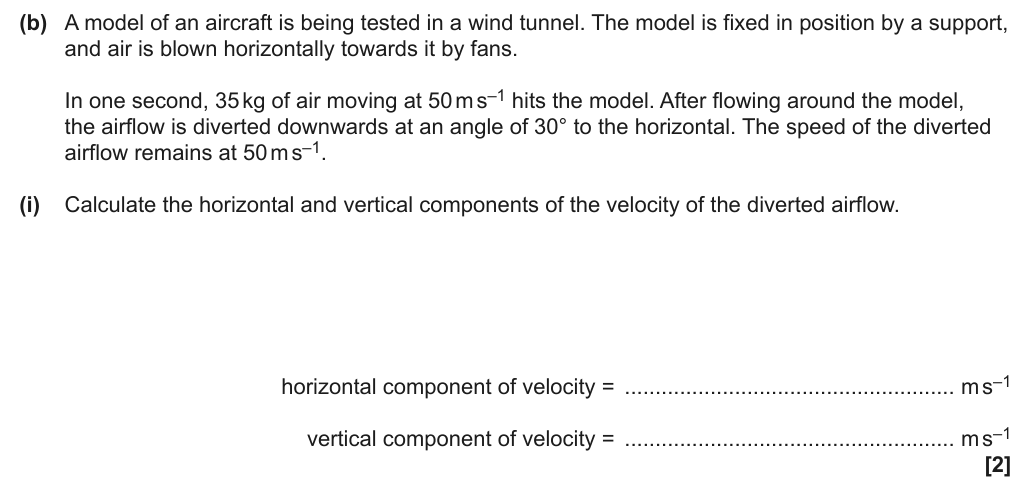
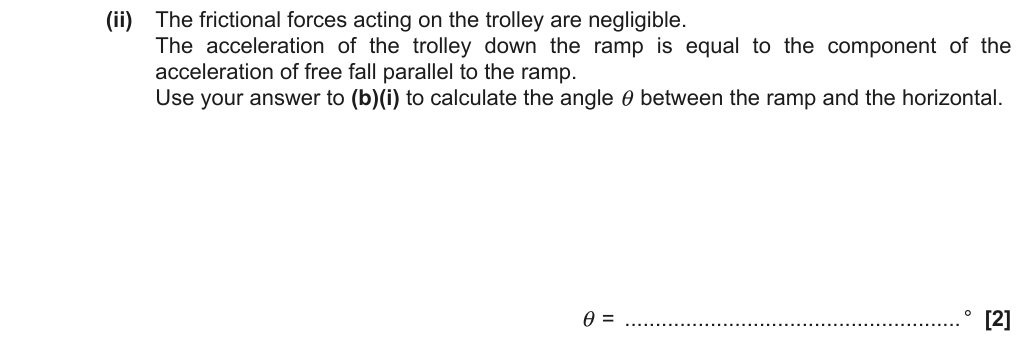
Most candidates got this correct. Some scored a single mark for confusing sine and cosine but otherwise completing the calculation correctly. Make sure to check whether your calculator should be in degrees or radians mode. Also, practise which trigonometric function to use. If in doubt, draw a labelled right-angled triangle to help identify the correct function.
Notes from the mark scheme and report
answers in the wrong order 1 mark max
Skills: M0.6 Use calculators to handle sin x, cos x and tan x when x is expressed in degrees or radians; M4.5 Use sin, cos and tan in physical problems
June 2024 · AS Paper 2 · Q1(b)2 marksExplanationMedium
Earlier part of question 1 that this part uses
Mark scheme
Examiner's comment
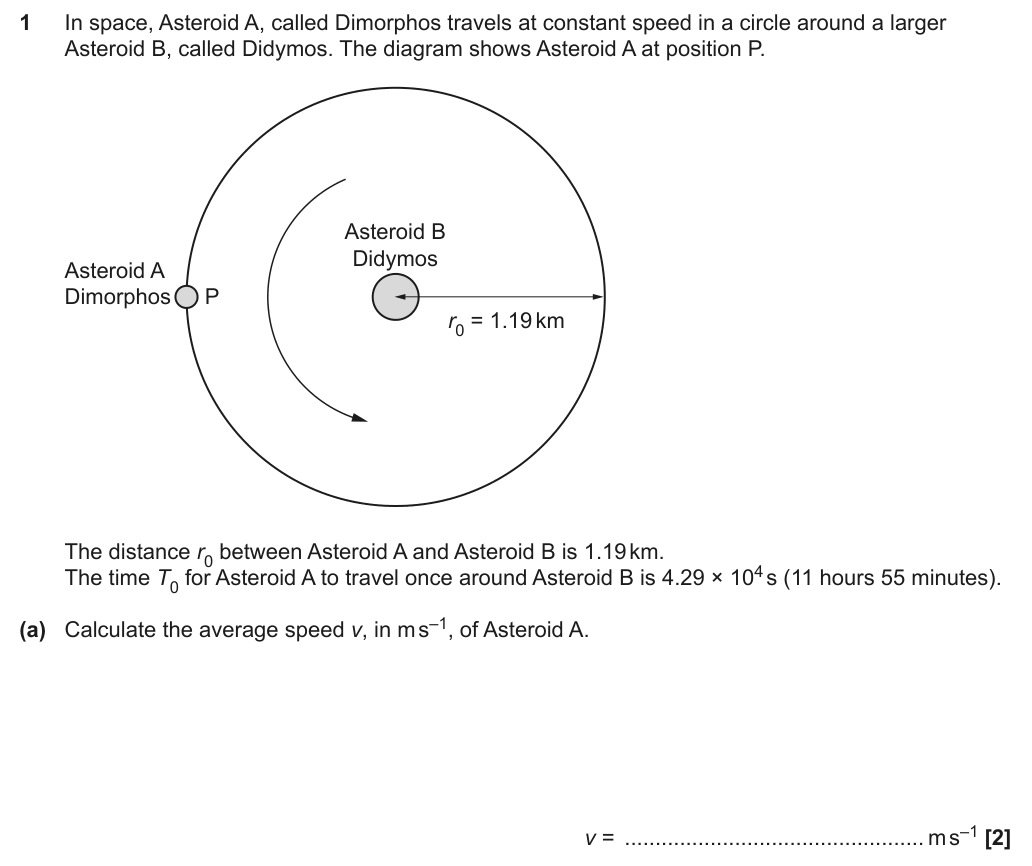
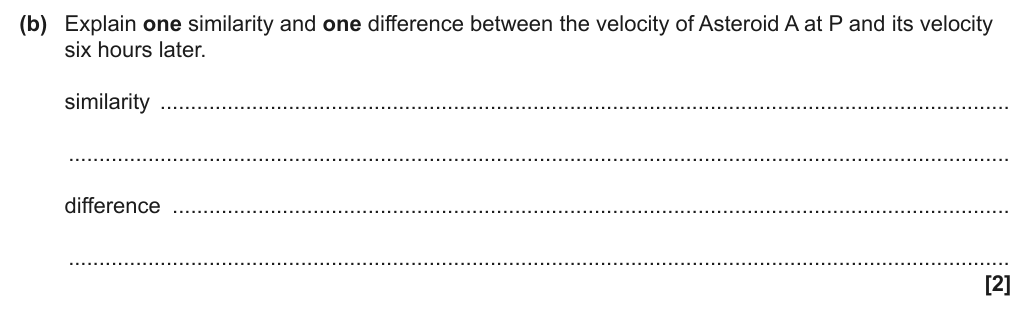
Most candidates understood that velocity was a vector quantity and there were many correct answers explaining the similarity in that the magnitude of the velocity was the same and the difference was the direction. Lower scoring candidates often stated that the velocity was the same. This suggests that there was not the full understanding of the physical quantities speed and velocity.
Notes from the mark scheme and report
NOT 'same velocity'
same speed / magnitude, opposite direction
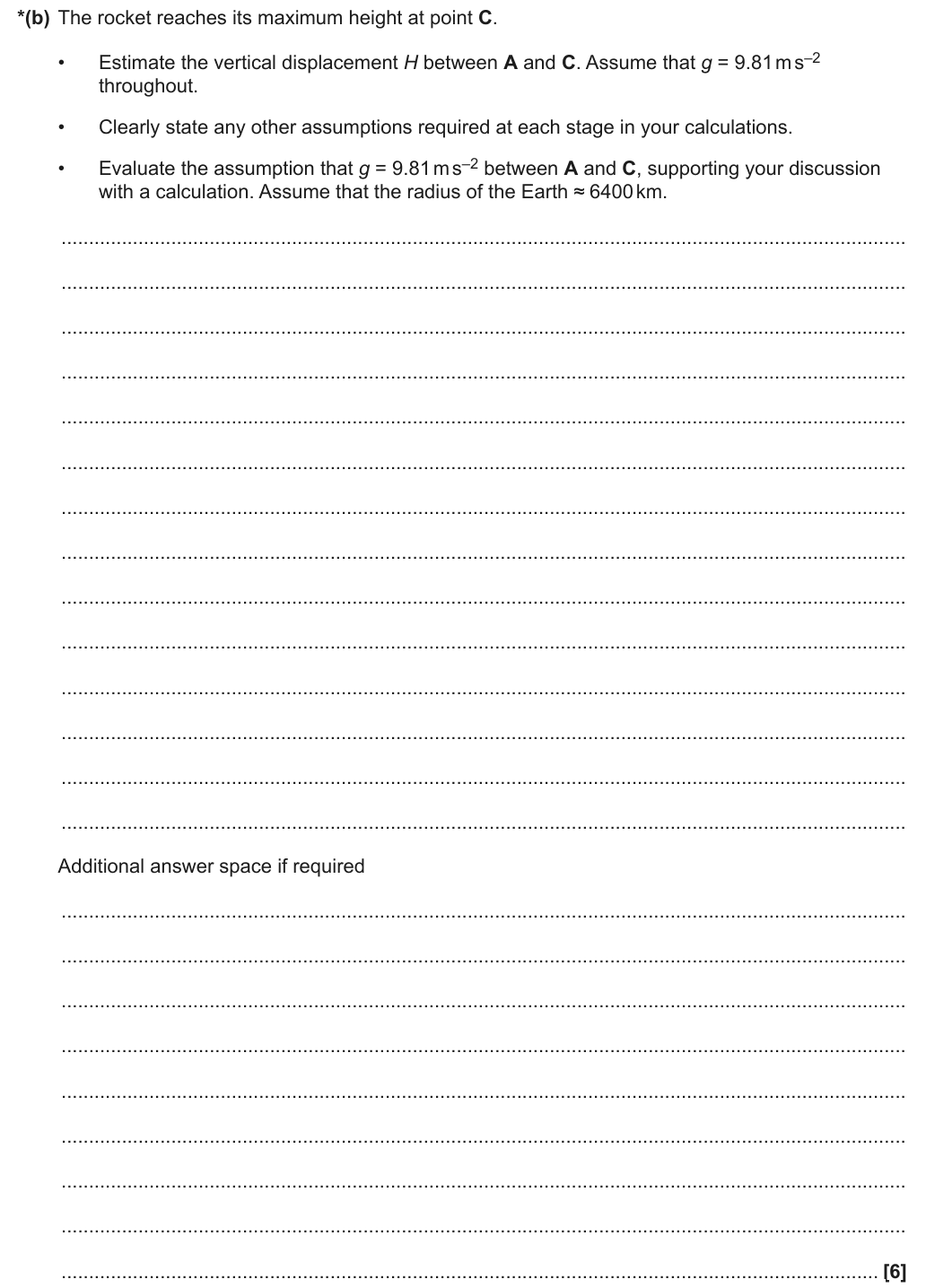
June 2024 · Paper 3 · Q3(b)6 marks6-mark extended responseHard
Earlier part of question 3 that this part uses
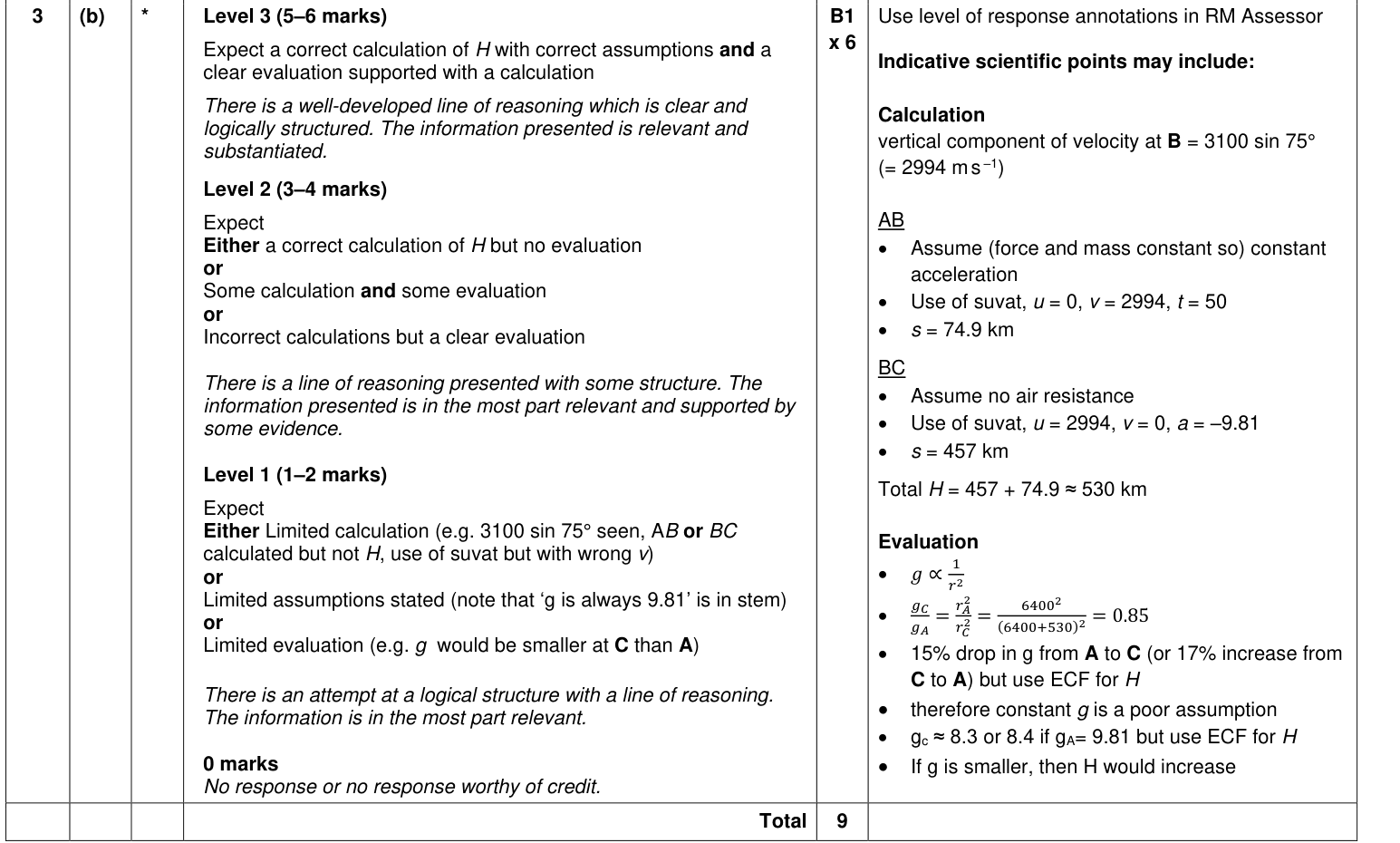
Mark scheme, with the levels and indicative content
Examiner's comment
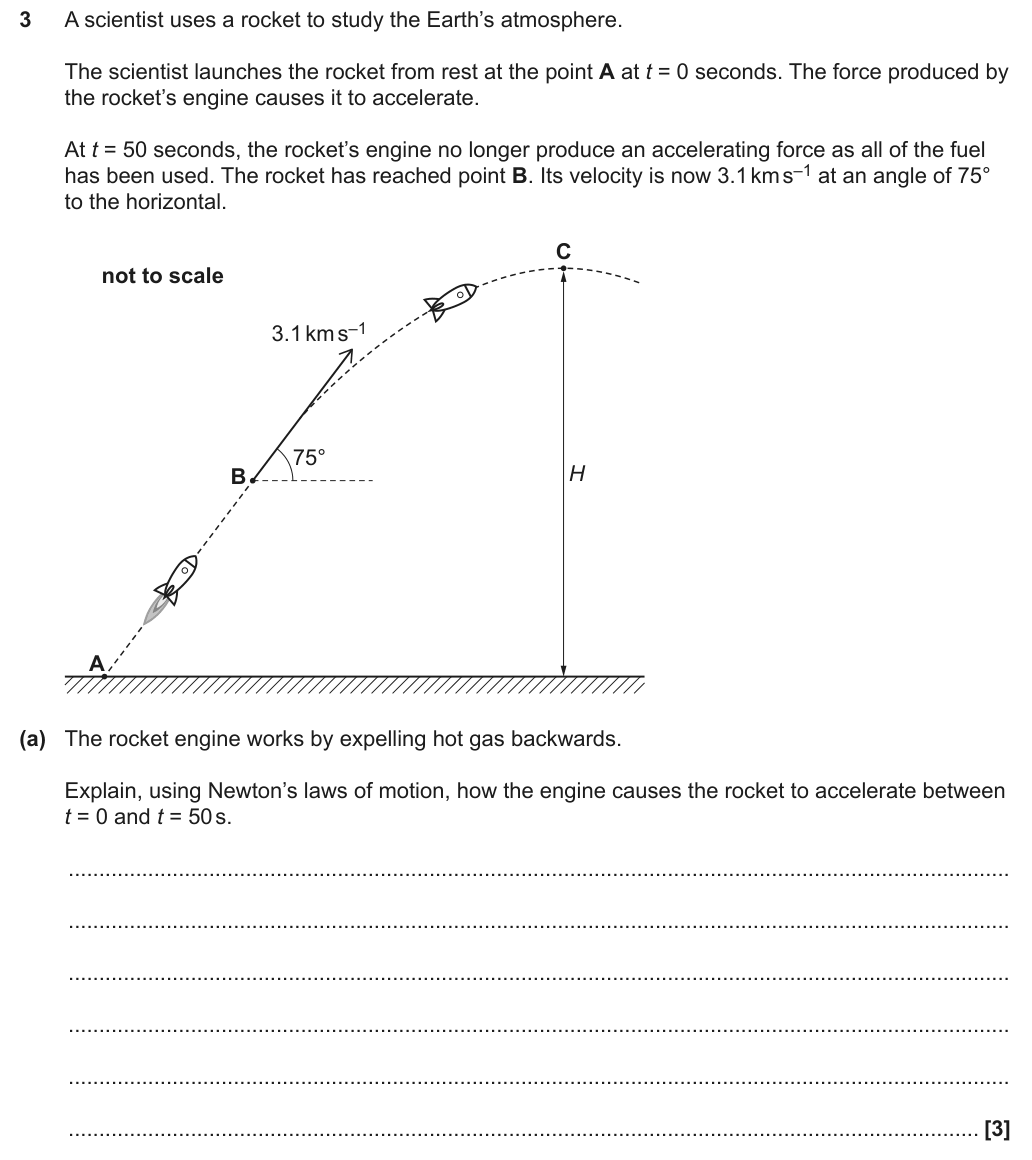
Level 3 candidates set out a correct calculation of H¸ together with the assumptions required at each stage, plus an evaluation of the assumption that g remains constant at 9.81 ms-2 throughout. Level 2 candidates missed out one or more of these three parts, usually the evaluation at the end, which they found quite difficult. Level 1 candidates were often unable to calculate H, or the value of g at height H, correctly Common problems in 3 (b) • omission of sin 75° (or using cos 75°) when calculating velocity • not converting from m to km correctly • not squaring the r term in the calculation for g they have answered each part of the question by using bullet points. Their calculations are clearly set out and so easy to follow, and their handwriting is legible. Instead of just calculating a value for g at height H, they have also given an explicit evaluation: ‘The assumption that g remains constant is not reasonable’. Other candidates went on to say that this means that the rocket would reach an even greater height.
Notes from the mark scheme and report
H ≈ 530 km (75 km + 457 km)
assumptions: constant acceleration A to B, no air resistance B to C
g falls by about 15% so constant g is a poor assumption
OCR has a Guide to Level of Response Questions. This includes guidance on communication and the use of bullet points (page 5).
Skills: M0.3 Use ratios, fractions and percentages; M0.6 Use calculators to handle sin x, cos x and tan x when x is expressed in degrees or radians; M2.3 Substitute numerical values into algebraic equations using appropriate units for physical quantities; M4.5 Use sin, cos and tan in physical problems
June 2024 · Paper 3 · Q6(b)(ii)4 marksCalculationMedium
Earlier part of question 6 that this part uses
Mark scheme
Examiner's comment
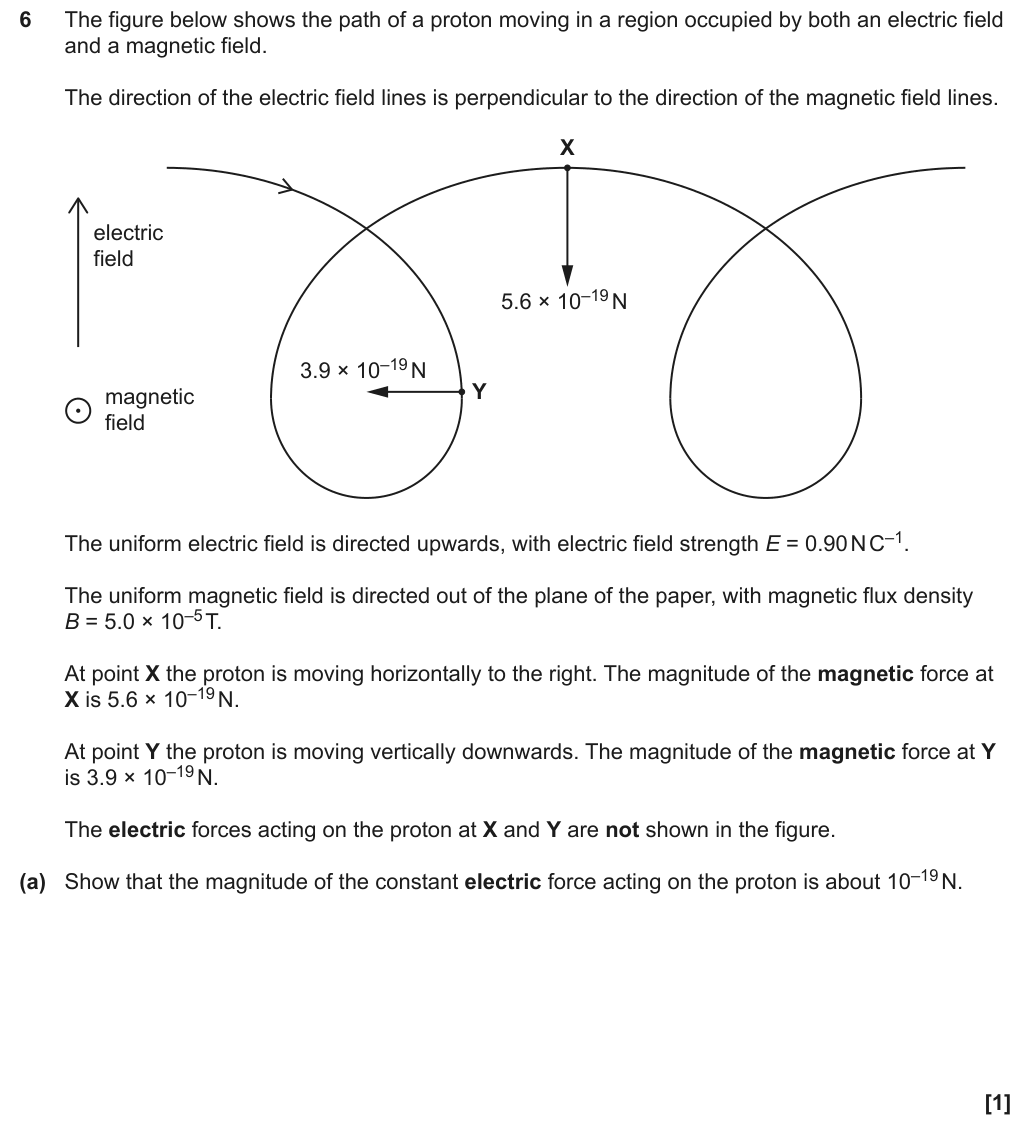
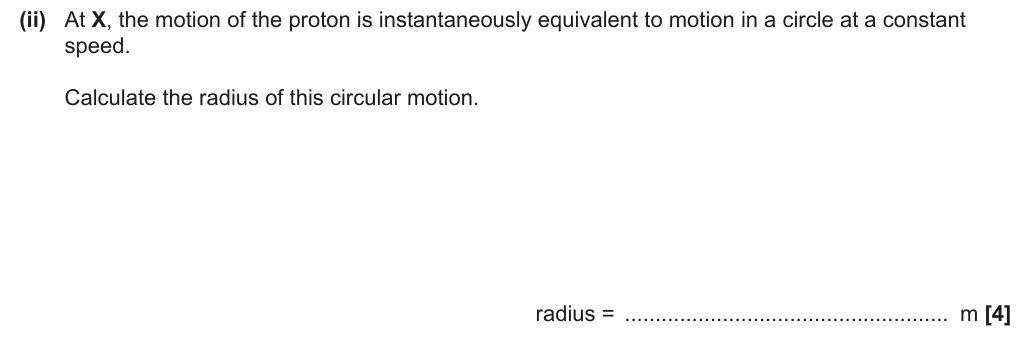
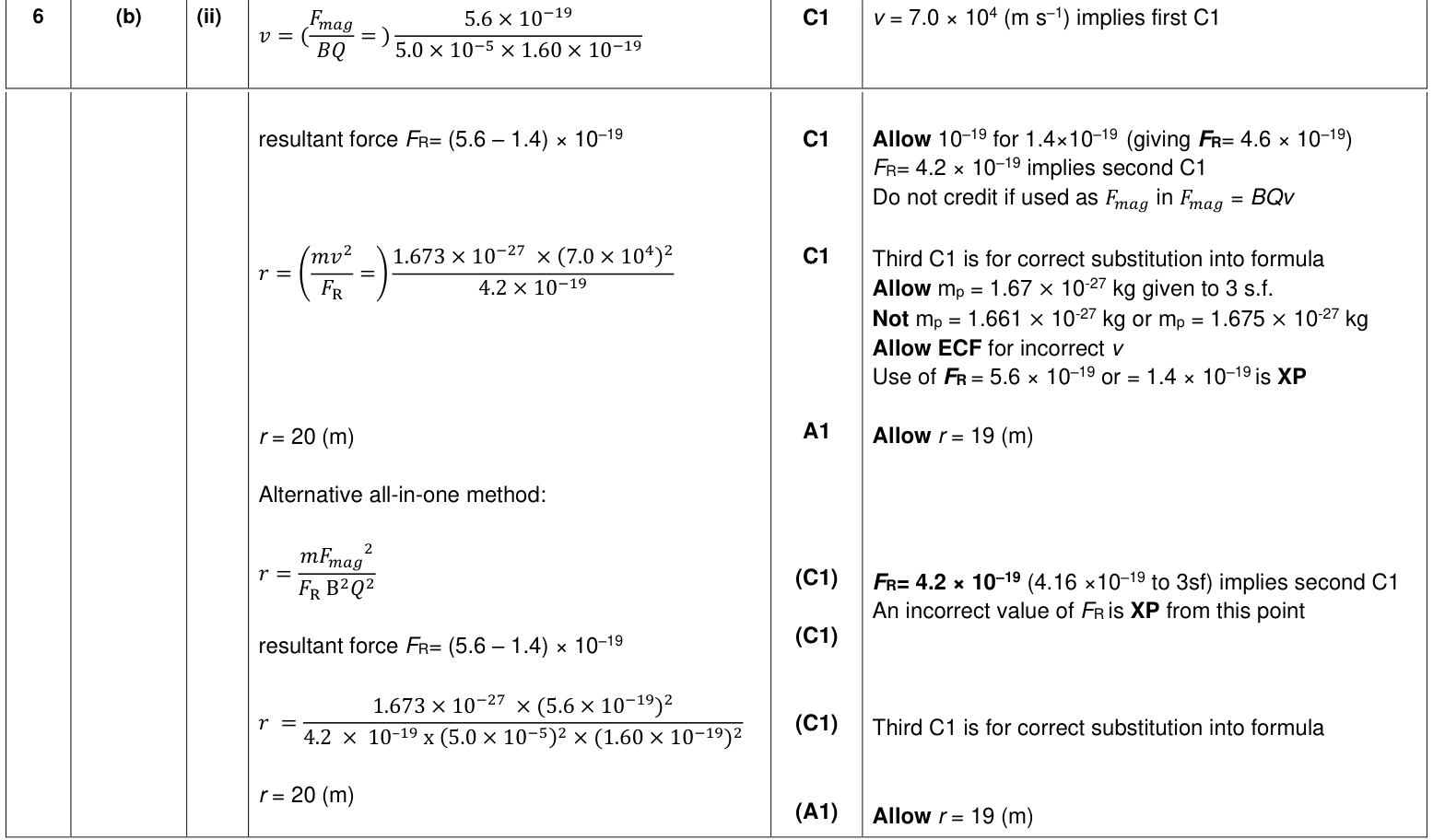
This question could not be done in one step, by equating the magnetic force to the centripetal force. This is because, at X, the centripetal force is being provided by a combination of forces from both the electric and the magnetic field. The easiest approach is to find the velocity of the proton using Fmag = BQv (the value for Fmag is given in the diagram as 5.6 x 10¹⁹ N). This velocity v can then be used in the formula F = mv2/r in order to calculate the radius, r. F here is the resultant force towards the centre of the circle, which is found from magnetic force downwards – electric force upwards (the electric force having been calculated in part (a)).
Notes from the mark scheme and report
resultant force (5.6 − 1.4) x 10⁻¹⁹ N must be used
using 5.6 x 10⁻¹⁹ or 1.4 x 10⁻¹⁹ as the centripetal force scores no further marks
Not proton mass 1.661 or 1.675 x 10⁻²⁷ kg
Skills: M0.2 Recognise and use expressions in decimal and standard form; M2.2 Change the subject of an equation, including non-linear equations; M2.3 Substitute numerical values into algebraic equations using appropriate units for physical quantities
June 2024 · Paper 3 · Q6(b)(iii)4 marksCalculationMedium
Earlier part of question 6 that this part uses
Mark scheme
Examiner's comment
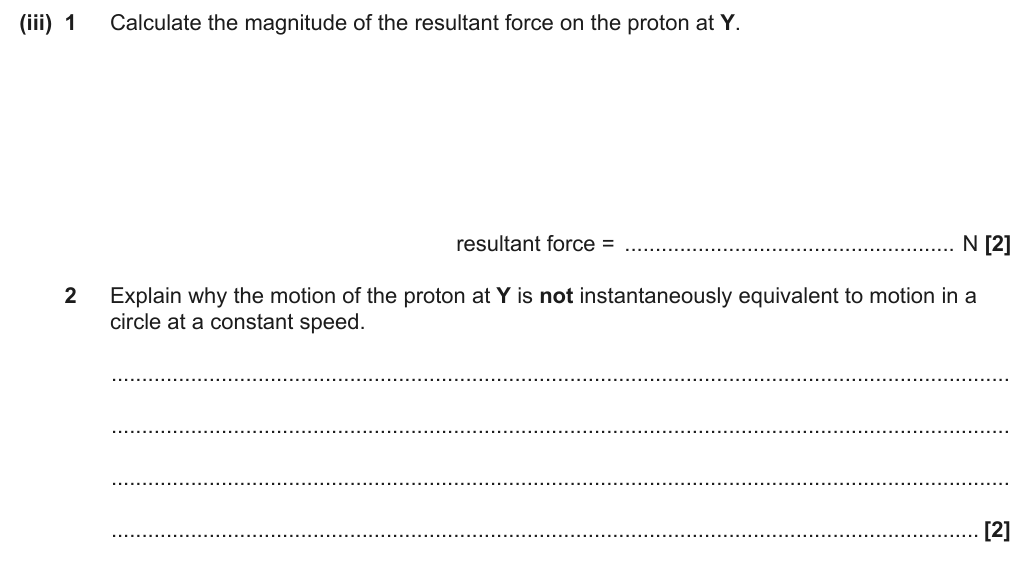
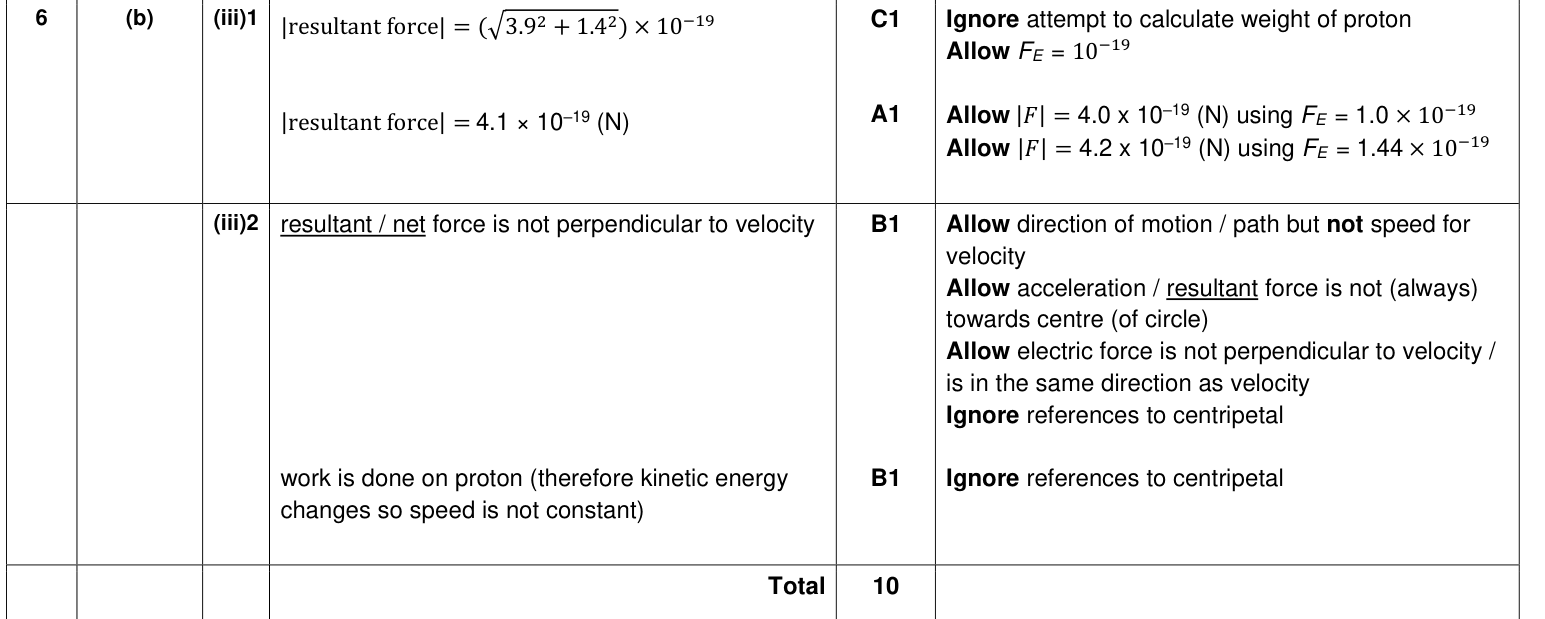
There are two forces acting on the proton at Y: an electric force upwards (given in (a)) and a magnetic force to the left (shown on the diagram). These two forces act at right angles to each other, and so the magnitude of their resultant can be found using Pythagoras’s Theorem. Credit was given for using a value for the electric force to 1, 2 or more significant figures. At Y, the proton is moving downwards, with a resultant force being the combination of an electric force upwards and a magnetic force to the left (calculated in part 1). The resultant force cannot be at right angles to the velocity, so we cannot have circular motion. The component of the resultant force acting in the direction of the proton’s motion will do work on the proton and change its speed. So, the proton cannot be travelling at a constant speed.
Notes from the mark scheme and report
ignore references to centripetal
allow 4.0 to 4.2 x 10⁻¹⁹ N
Skills: M4.4 Use Pythagoras’ theorem, and the angle sum of a triangle
June 2023 · Paper 1 · Q11 markMultiple choice
Answer
C
Mark scheme
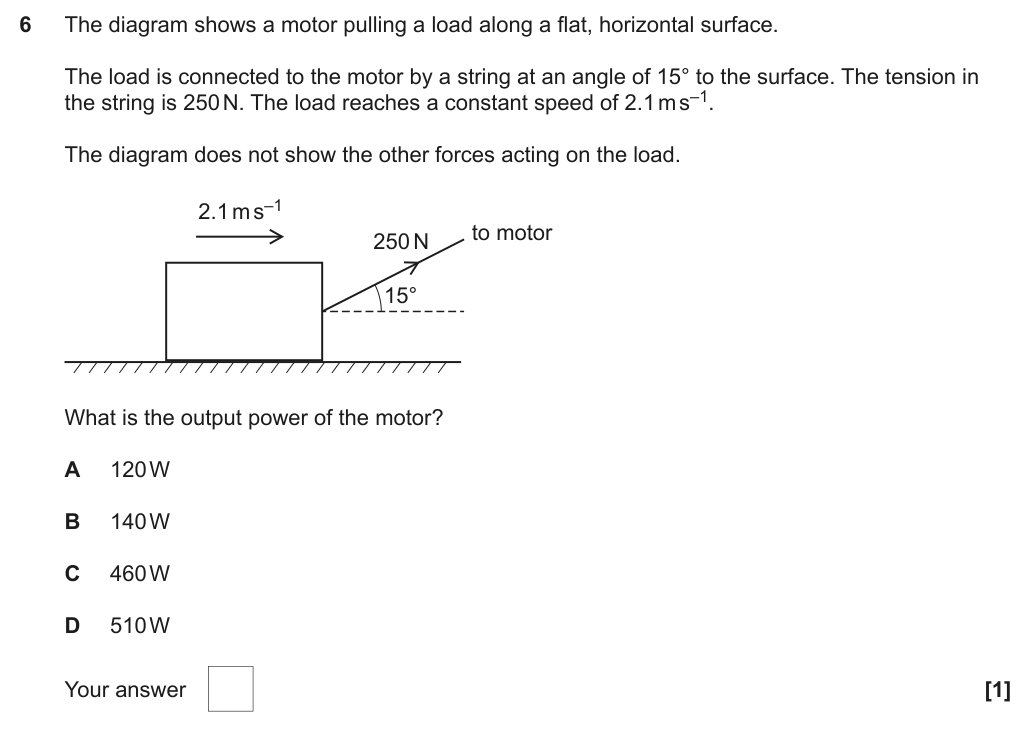
June 2023 · AS Paper 1 · Q61 markMultiple choiceEasy
Answer
D
Mark scheme
Examiner's comment
This question was answered well as candidates were able to calculate the correct output power by applying the equation P = Fv and resolving the 250 N to give its horizontal component.
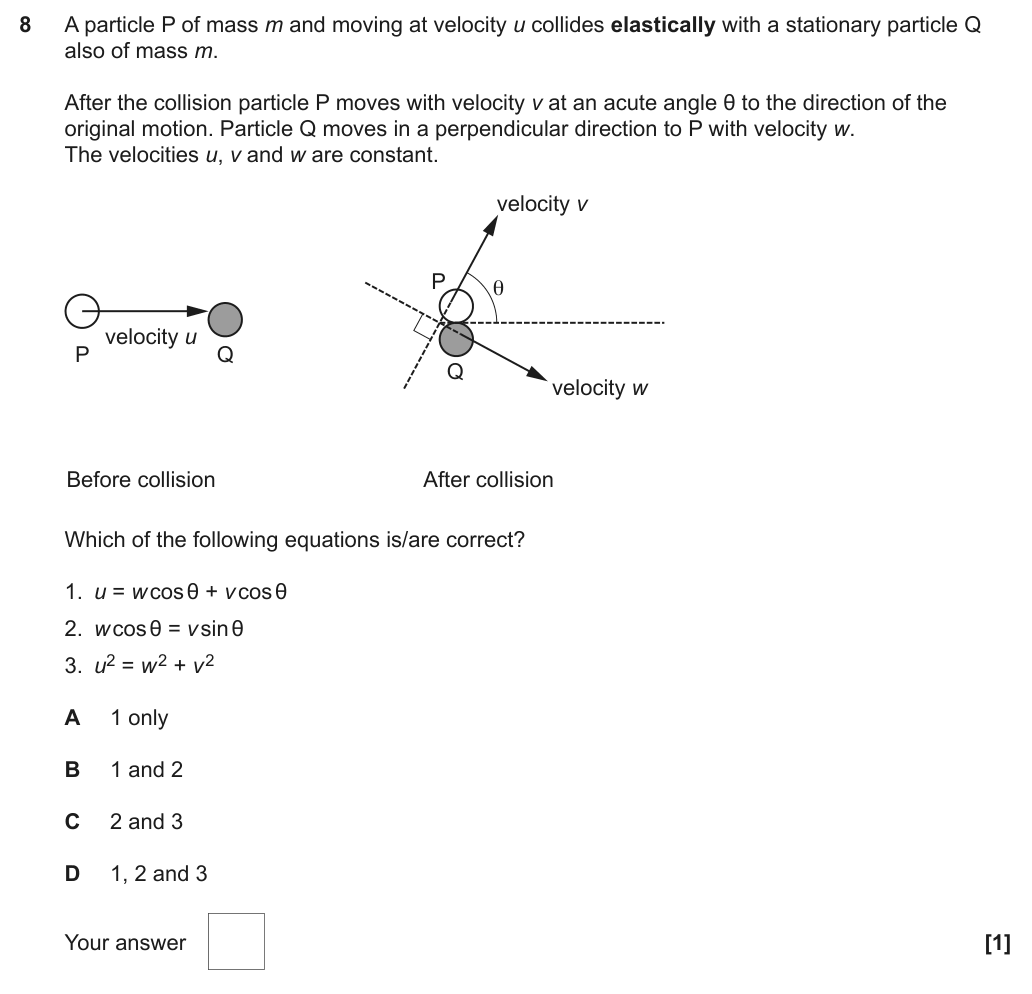
June 2023 · Paper 1 · Q81 markMultiple choiceMedium
Answer
C
Mark scheme
Examiner's comment
A good number of candidates answered this correctly. As this collision is elastic, the total kinetic energy (KE) for the collision, ½mu2 remains unchanged. The total KE after the collision is ½mv2 + ½mw2. Equating these expressions gives statement 3 as correct, eliminating answers A and B. Statement 2 must also be correct and comes from conservation of momentum at right angles to the dashed line. Looking along the dashed line, the momentum is mu before the collision. After the collision, the component of momentum along the dashed line for P is mvcosθ. The angle Q makes with the dashed line is not θ, so the component of momentum along that dashed line for Q cannot be mwcosθ. This makes statement 1 false and so the correct answer is C.
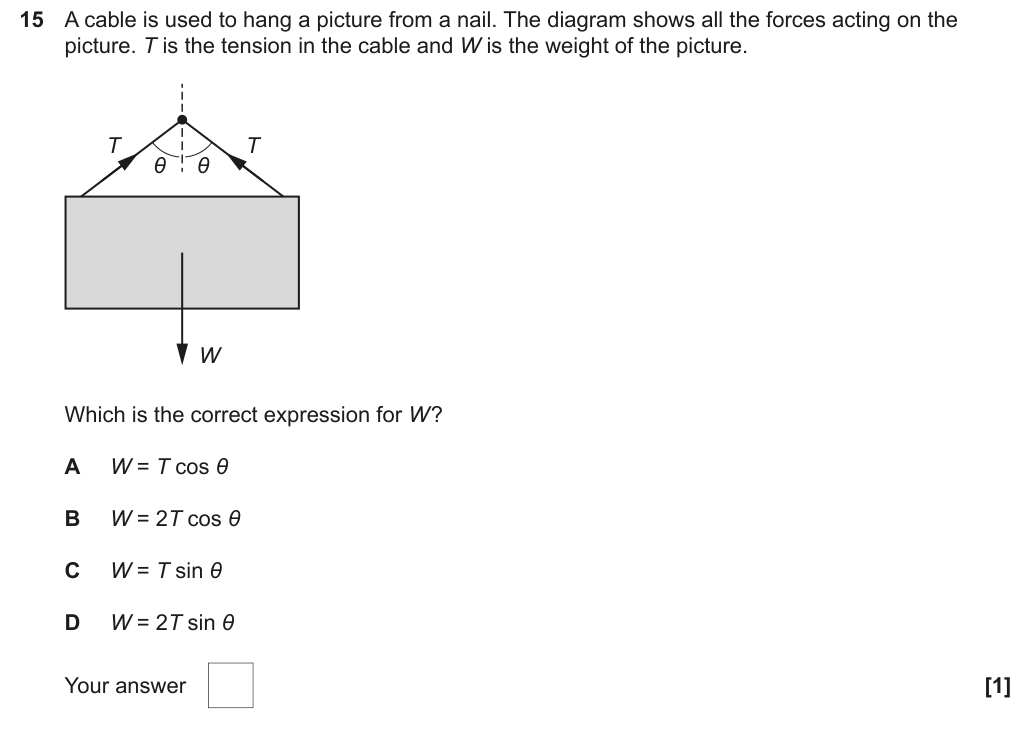
June 2023 · AS Paper 1 · Q151 markMultiple choiceEasy
Answer
B
Mark scheme
Examiner's comment
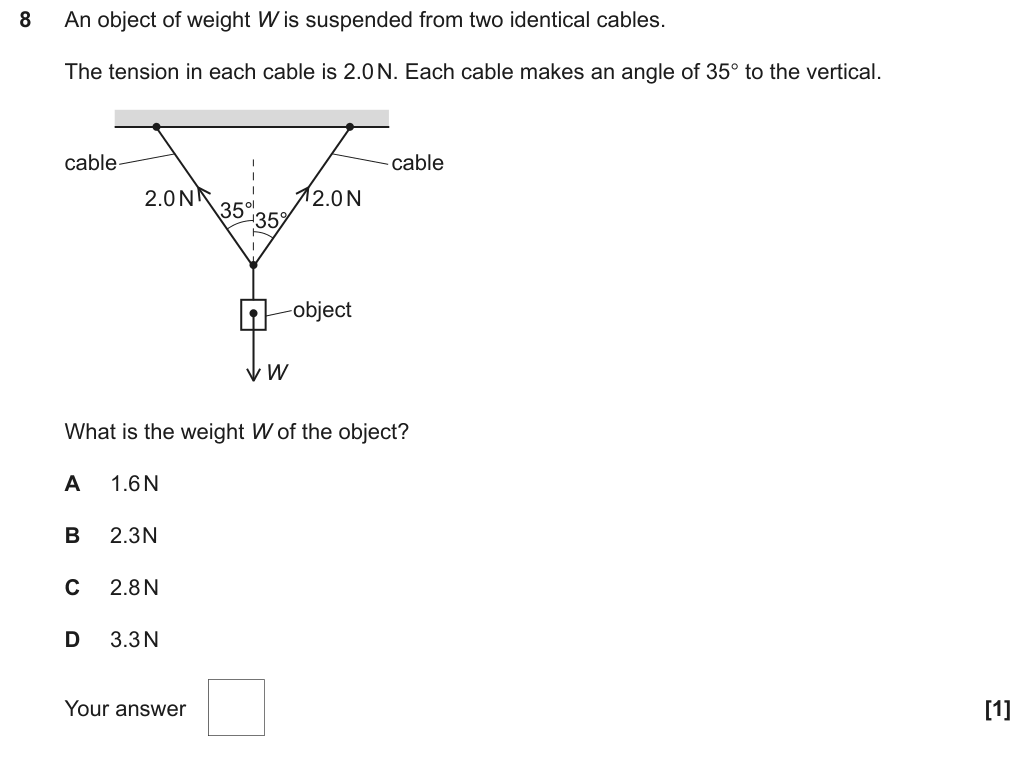
This question was generally answered well as most candidates correctly resolved T, tension to determine an expression for W.
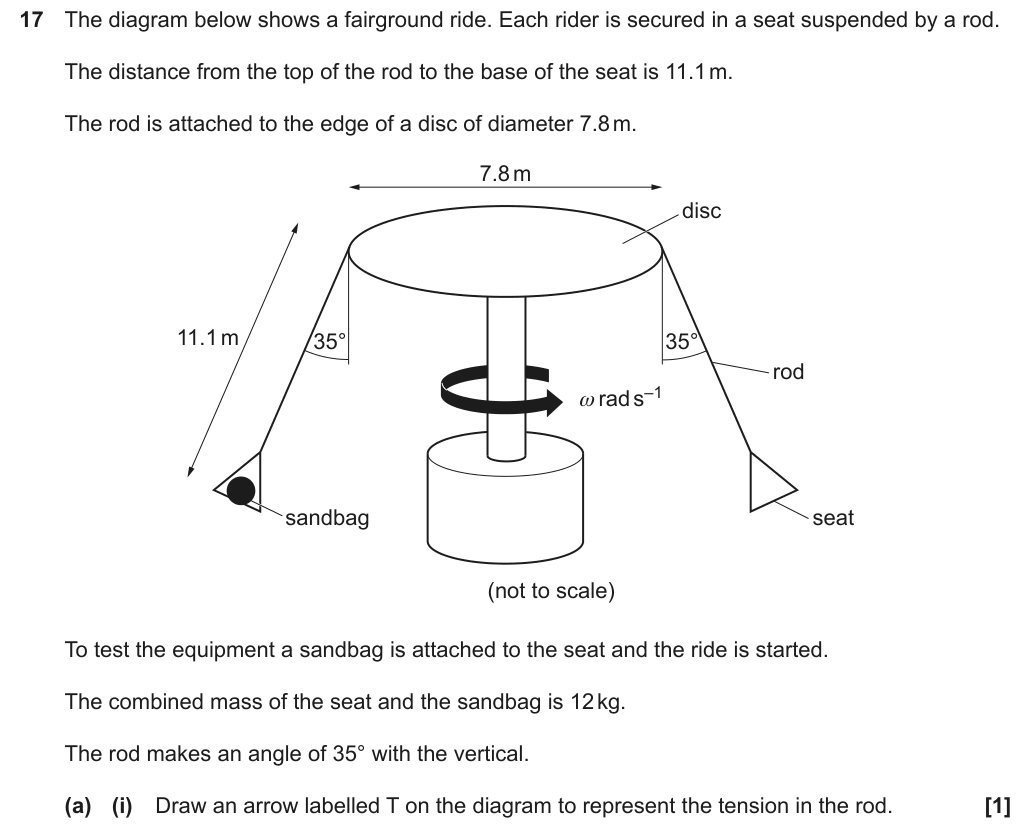
June 2023 · Paper 1 · Q17(a)(ii)2 marksShow thatHard
Earlier part of question 17 that this part uses
Mark scheme
Examiner's comment
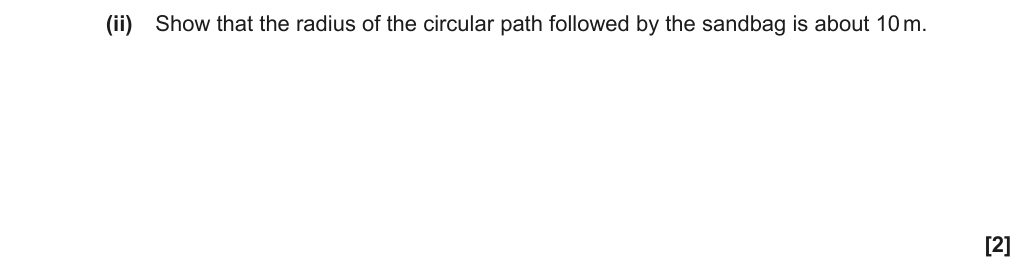
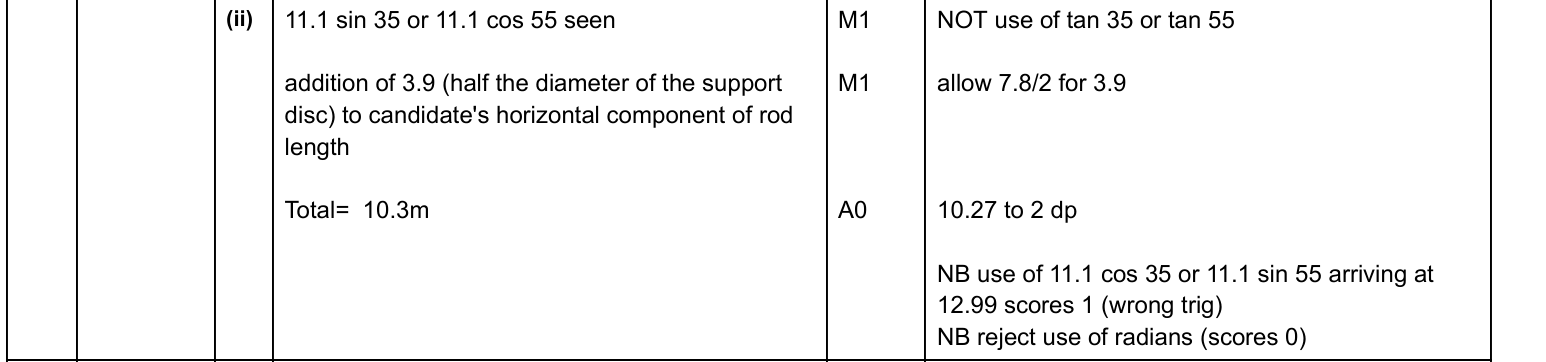
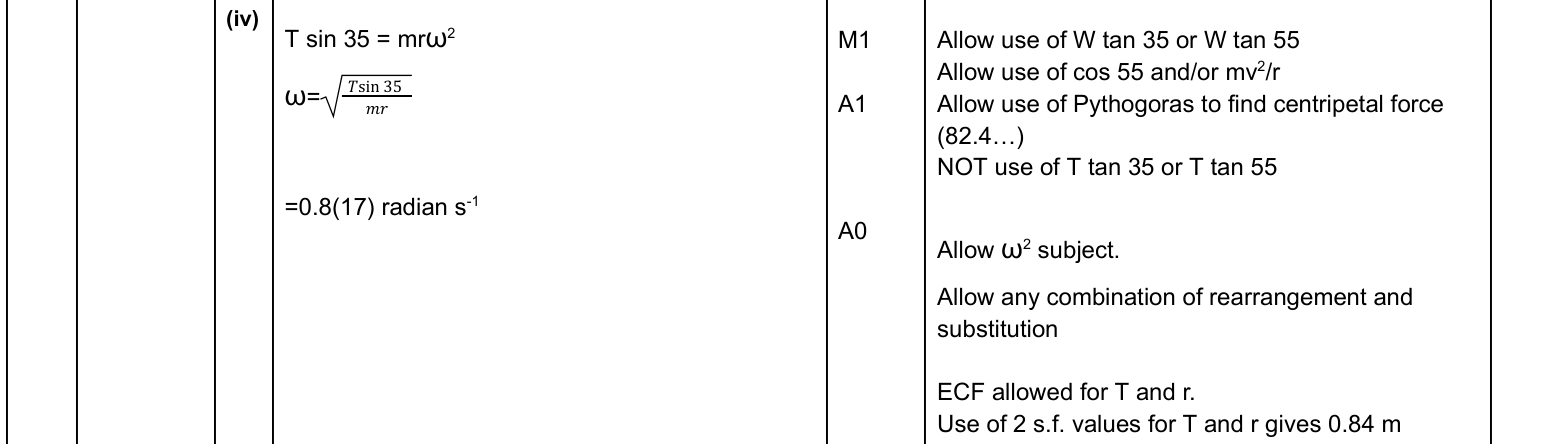
In Question 17 (a) (i) of this question, the phrase ‘tension in the rod’ can mean several different things, all of which were given in the mark scheme. Many candidates approached part (ii) with some confidence, spotting that the horizontal portion of the rod was 11.1 sin(35) and that it should be added to the radius of the disc. Parts (a) (iii) and (iv) were more challenging, requiring good knowledge of both circular motion and how to calculate components of forces. Again there were several legitimate routes to the right answer, all of which were mentioned in the mark scheme. Very logical approaches were in part (a) (iii), to equate the vertical component of the tension with the weight of the sandbag. In part (a) (iv), the quickest approach was to equate the horizontal component of the tension with the centripetal force. The data booklet provides a convenient expression for the centripetal force in terms of the angular velocity, without the need for finding the tangential velocity.
Notes from the mark scheme and report
NOT use of tan 35 or tan 55
11.1 cos 35 scores 1 (wrong trig)
use of radians scores 0
Skills: M0.6 Use calculators to handle sin x, cos x and tan x when x is expressed in degrees or radians; M4.5 Use sin, cos and tan in physical problems
June 2023 · Paper 1 · Q17(a)(iii)3 marksCalculationHard
Earlier part of question 17 that this part uses
Mark scheme
Examiner's comment
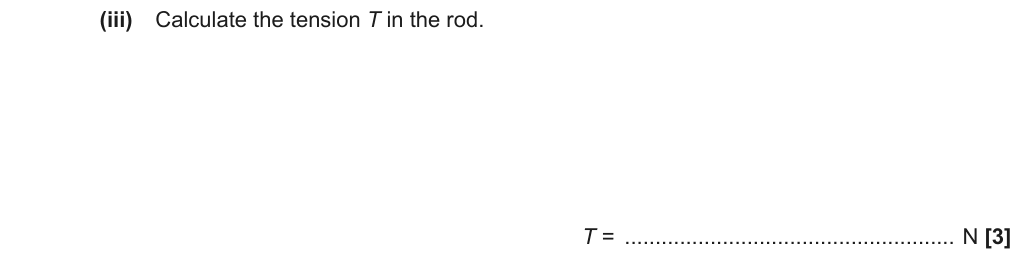
In Question 17 (a) (i) of this question, the phrase ‘tension in the rod’ can mean several different things, all of which were given in the mark scheme. Many candidates approached part (ii) with some confidence, spotting that the horizontal portion of the rod was 11.1 sin(35) and that it should be added to the radius of the disc. Parts (a) (iii) and (iv) were more challenging, requiring good knowledge of both circular motion and how to calculate components of forces. Again there were several legitimate routes to the right answer, all of which were mentioned in the mark scheme. Very logical approaches were in part (a) (iii), to equate the vertical component of the tension with the weight of the sandbag. In part (a) (iv), the quickest approach was to equate the horizontal component of the tension with the centripetal force. The data booklet provides a convenient expression for the centripetal force in terms of the angular velocity, without the need for finding the tangential velocity.
Notes from the mark scheme and report
NOT use of tan 35 or tan 55
Skills: M0.6 Use calculators to handle sin x, cos x and tan x when x is expressed in degrees or radians; M2.2 Change the subject of an equation, including non-linear equations; M4.5 Use sin, cos and tan in physical problems
June 2023 · Paper 1 · Q17(a)(iv)2 marksShow thatHard
Earlier parts of question 17 that this part uses
Mark scheme
Examiner's comment
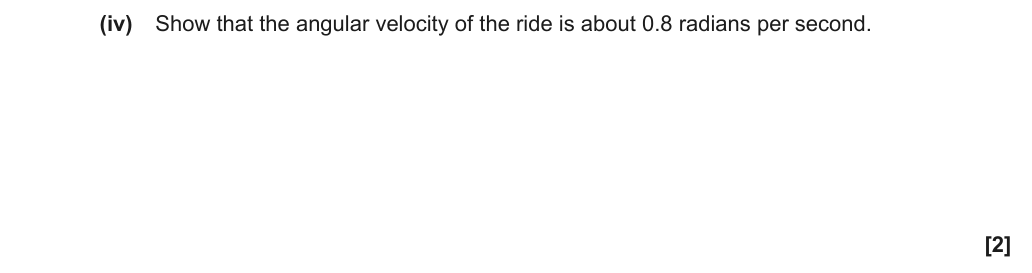
In Question 17 (a) (i) of this question, the phrase ‘tension in the rod’ can mean several different things, all of which were given in the mark scheme. Many candidates approached part (ii) with some confidence, spotting that the horizontal portion of the rod was 11.1 sin(35) and that it should be added to the radius of the disc. Parts (a) (iii) and (iv) were more challenging, requiring good knowledge of both circular motion and how to calculate components of forces. Again there were several legitimate routes to the right answer, all of which were mentioned in the mark scheme. Very logical approaches were in part (a) (iii), to equate the vertical component of the tension with the weight of the sandbag. In part (a) (iv), the quickest approach was to equate the horizontal component of the tension with the centripetal force. The data booklet provides a convenient expression for the centripetal force in terms of the angular velocity, without the need for finding the tangential velocity.
Notes from the mark scheme and report
NOT use of T tan 35 or T tan 55
allow W tan 35
ecf for T and r
Skills: M0.6 Use calculators to handle sin x, cos x and tan x when x is expressed in degrees or radians; M2.2 Change the subject of an equation, including non-linear equations; M2.3 Substitute numerical values into algebraic equations using appropriate units for physical quantities
June 2023 · Paper 1 · Q186 marks6-mark extended responseEasy
Mark scheme, with the levels and indicative content
Examiner's comment
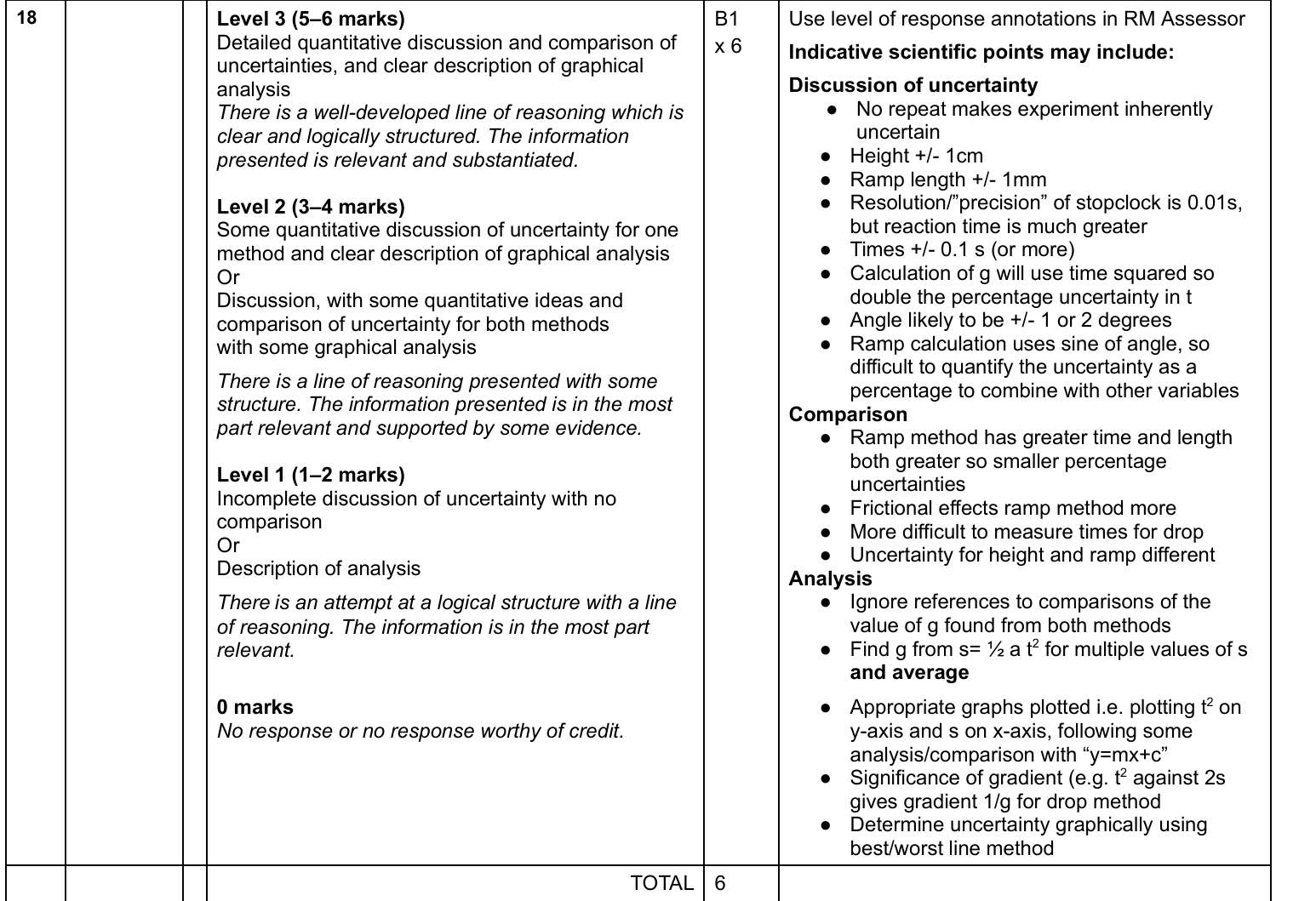
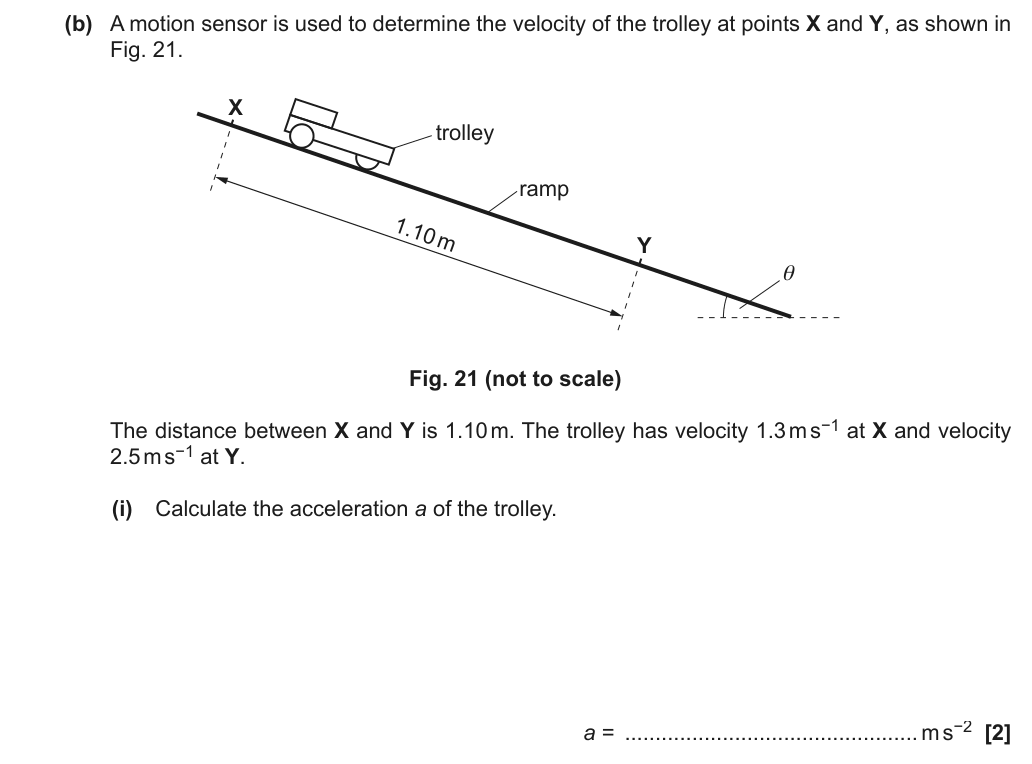
The easiest way to score well on this question was to look carefully at what was required. There is no mention of calculating g using either set of data nor any mention of steps the candidate could take to minimise the uncertainties. It is largely a question of what analysis would be used if there was a full range of results and how the uncertainties in both experiments can be compared. Almost all experiments and investigations at A2 Level require the use of an appropriate graph to represent and analyse data. Here there are two graphs: s against t2 for the falling object and t2 against sinθ for the rolling object. By rearranging the equations relating the variables, it is possible to work out the relevance of the gradient in both graphs. The data tables gave significant clues about how uncertain these experiments are, such as the number of significant figures for the raw data and the instruments with which these measurements would have been taken. Very successful candidates took the information and correctly propagated the instrumental uncertainties, even remembering to double the uncertainty in the time measurement because of the appearance of t2 in the analysis. Once they did this, they had a valid way of comparing the uncertainties in both experiments, coming to a valid conclusion. The exemplar 1 response came from an otherwise successful candidate. Their first statement about the uncertainty in the time values is true yet not true regarding the uncertainty in the distance measurements. There is some discussion about the percentage uncertainties in the length due to the differences in size of those length measurements and extra uncertainty due to the use of a protractor. Crucially, there is not much discussion about the actual values of those uncertainties. The candidate proceeds to calculate g from the single data points provided in the question. While this has been done correctly, it does not answer the question. There is no reference to graphical analysis at all. This resulted in this response being marked as a Level 1 response. This candidate has gone to great trouble to calculate the uncertainties each measurement would contribute to the overall uncertainty in the value of g for both methods, allowing a valid comparison of the two. In contrast to exemplar 1, there is a full description of the required graphical analysis, justifying which variable should be plotted on which axis and how a value of g could be obtained from such a graph in each case. This response was therefore marked as a Level 3 response.
Notes from the mark scheme and report
t is squared so its percentage uncertainty doubles
reaction time (about 0.1 s) dominates
ignore comparisons of the values of g
Candidates in this paper mistook the percentage difference for the percentage uncertainty in this question. To calculate the percentage difference here required an experimental value for g and the ‘accepted’ value of g, namely 9.81 m s–2.
Teachers and candidates all have access to the Practical Skills handbook which includes techniques and ideas that prove useful in answering Level of Response and other questions that check practical experience.
Skills: M1.5 Identify uncertainties in measurements and use simple techniques to determine uncertainty when data are combined; M3.3 Understand that y = mx + c represents a linear relationship; M3.4 Determine the slope and intercept of a linear graph; PAG1 Investigating motion
June 2023 · AS Paper 2 · Q3(a)1 markShow thatMedium
Mark scheme
Examiner's comment
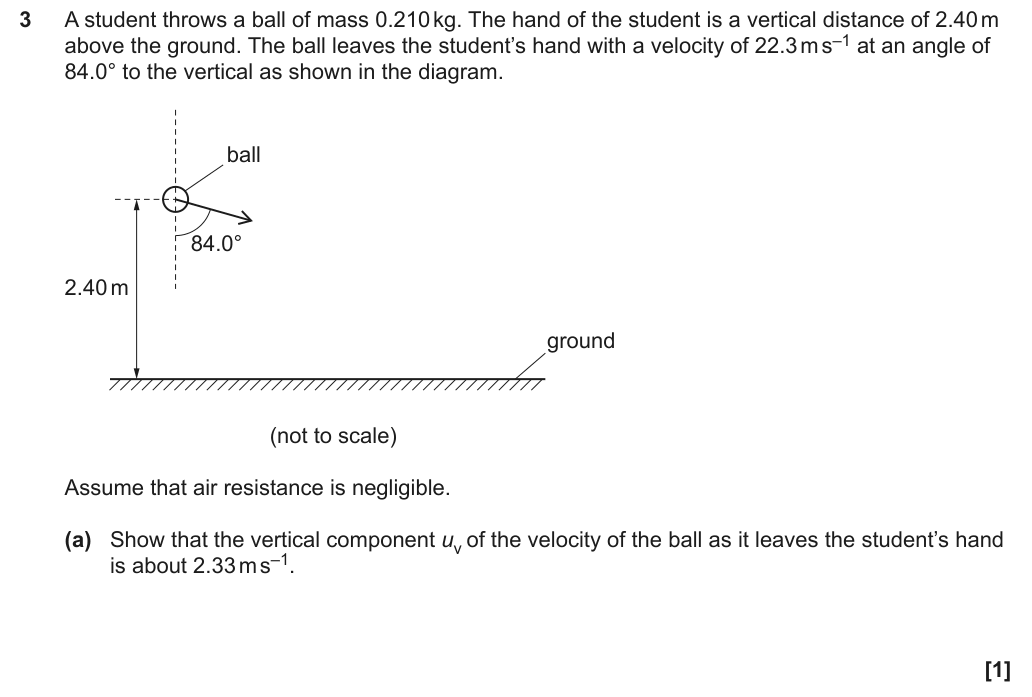
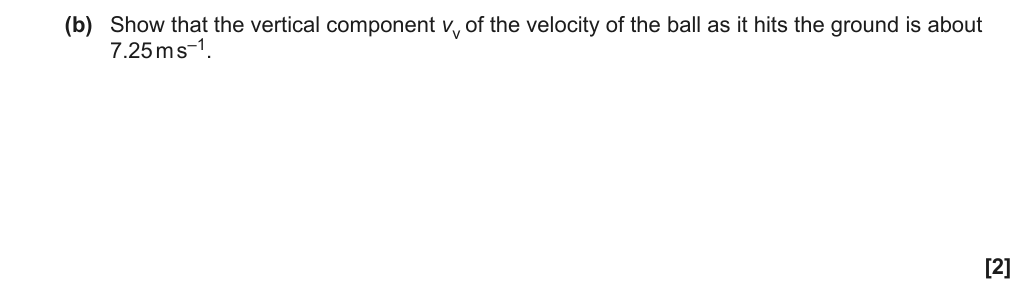
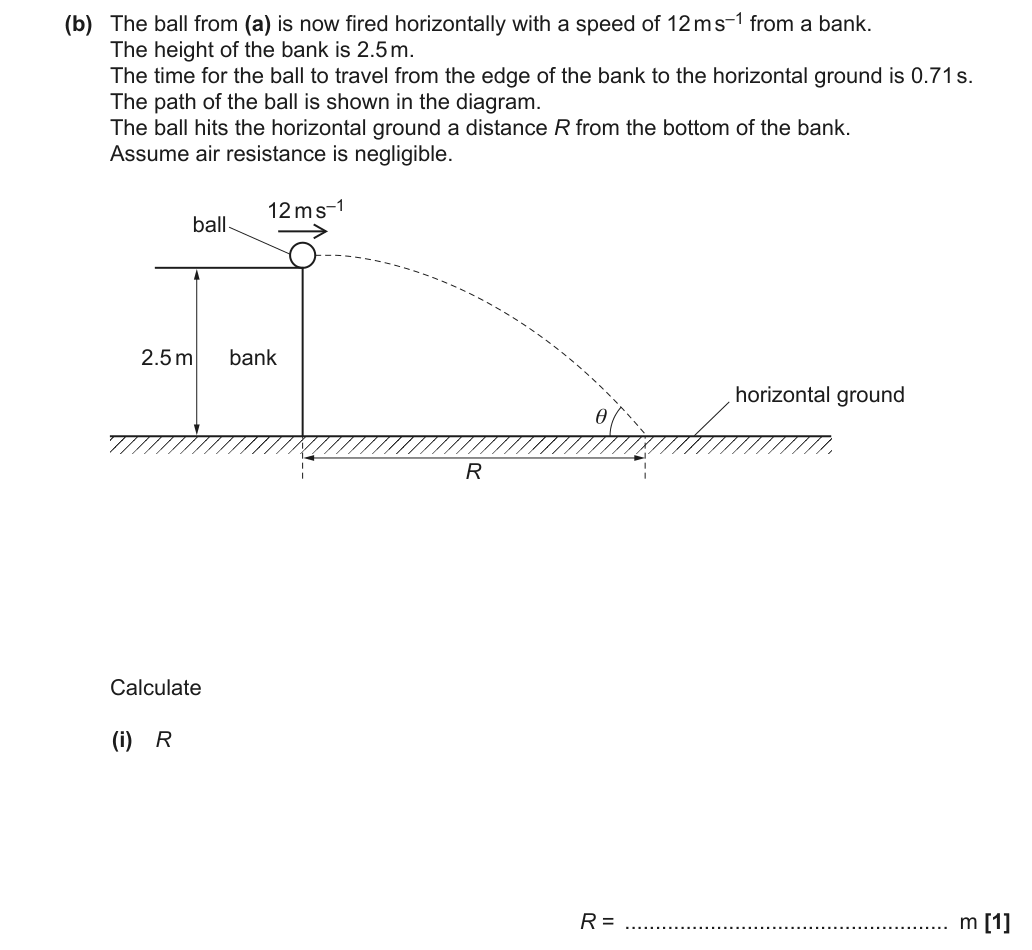
Most candidates clearly showed how the initial velocity of the ball could be resolved into its horizontal component. Most candidates used cos 84° although there was a significant minority who correctly used sin 6°.
Notes from the mark scheme and report
allow 22.3 sin 6
Skills: M0.6 Use calculators to handle sin x, cos x and tan x when x is expressed in degrees or radians; M4.5 Use sin, cos and tan in physical problems
June 2023 · AS Paper 2 · Q3(c)3 marksCalculationHard
Earlier parts of question 3 that this part uses
Mark scheme
Examiner's comment
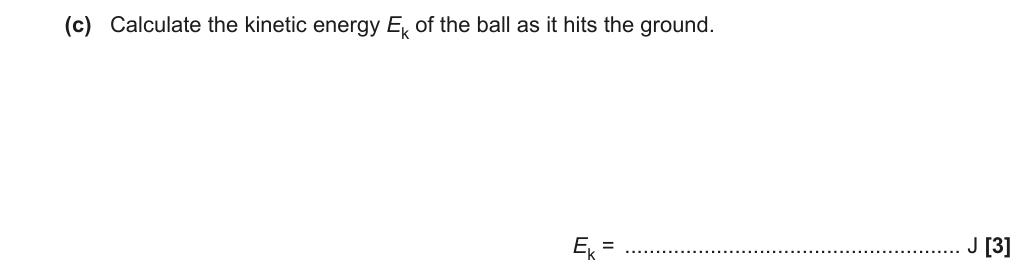
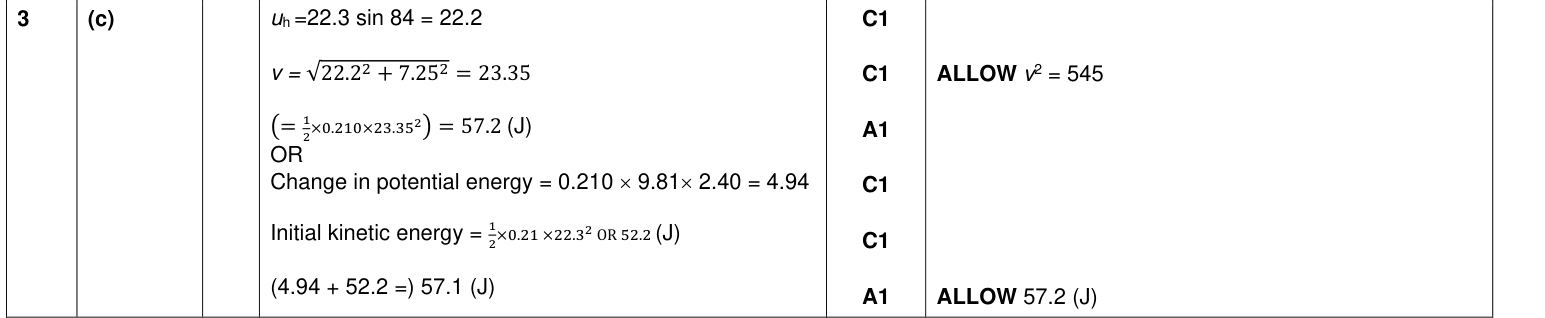
This question proved challenging to candidates. The common error was to calculate the kinetic energy using a value of 7.25 m s–1. There were two main methods of answering this question: Either: determining the horizontal component of the velocity of the ball, (which remains constant) then working out the resultant velocity of the ball as it hits the ground and then calculate the kinetic energy. Or: Calculate the change in gravitational potential energy Calculate the initial kinetic energy of the ball And then add the two values together.
Notes from the mark scheme and report
either combine components (v = 23.35) or initial KE plus loss of GPE
allow 57.1 or 57.2
Omitting the kinetic energy in the horizontal direction when calculating the kinetic energy of the ball.
Candidates should be able to compare the motion of a projectile in two perpendicular directions and also confirm that similar results are obtained by considering energy transfers.
Skills: M2.3 Substitute numerical values into algebraic equations using appropriate units for physical quantities; M4.4 Use Pythagoras’ theorem, and the angle sum of a triangle
June 2022 · Paper 1 · Q11 markMultiple choiceMedium
Answer
D
Mark scheme
Examiner's comment
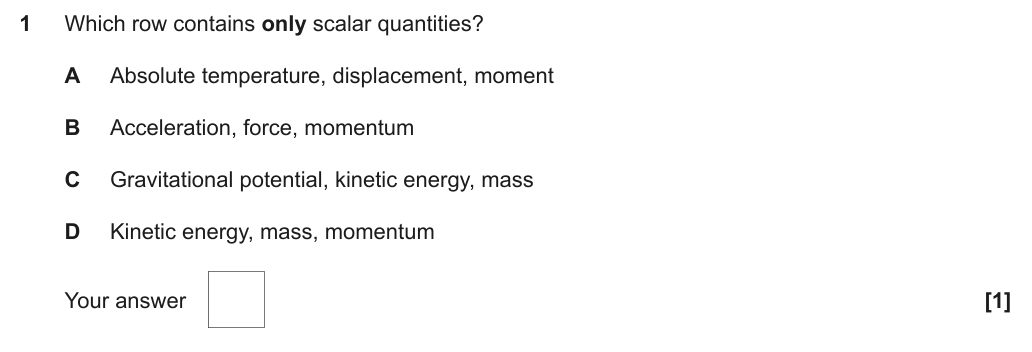
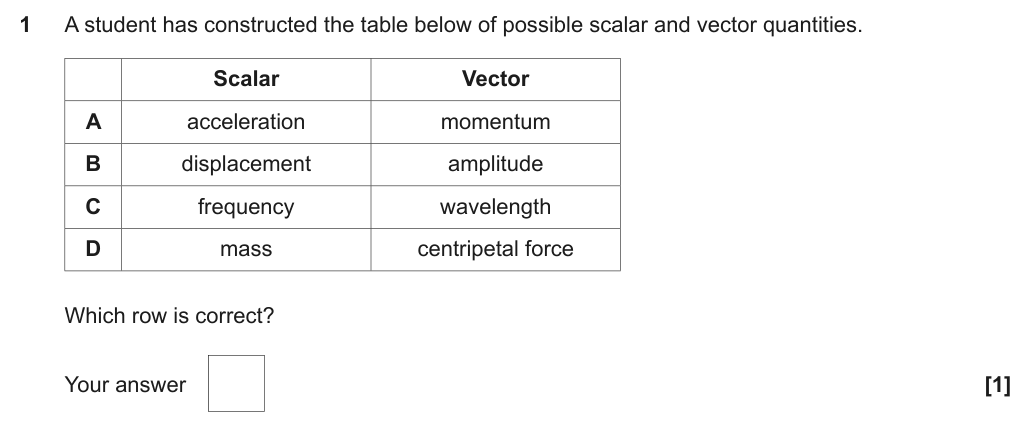
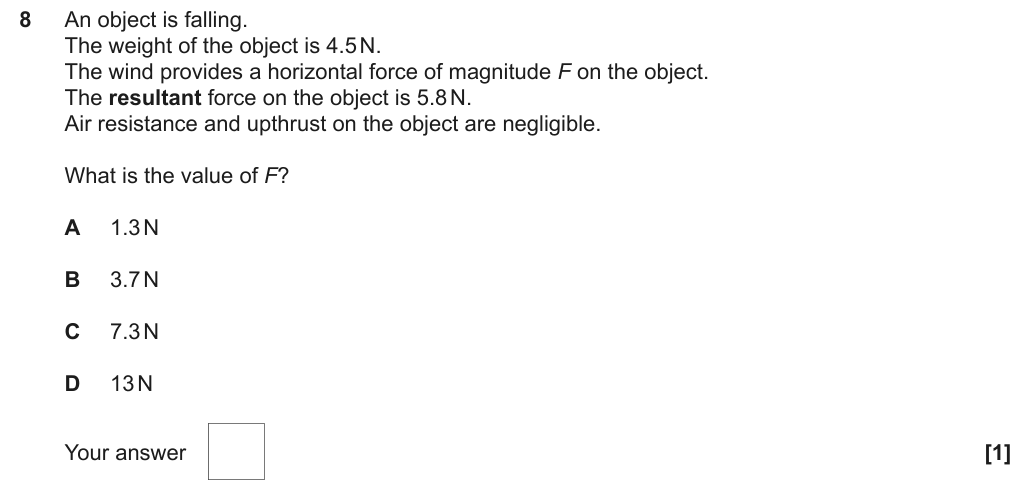
Most candidates got this correct by correctly identifying mass as a scalar and force as a vector. The most likely incorrect answer was C.
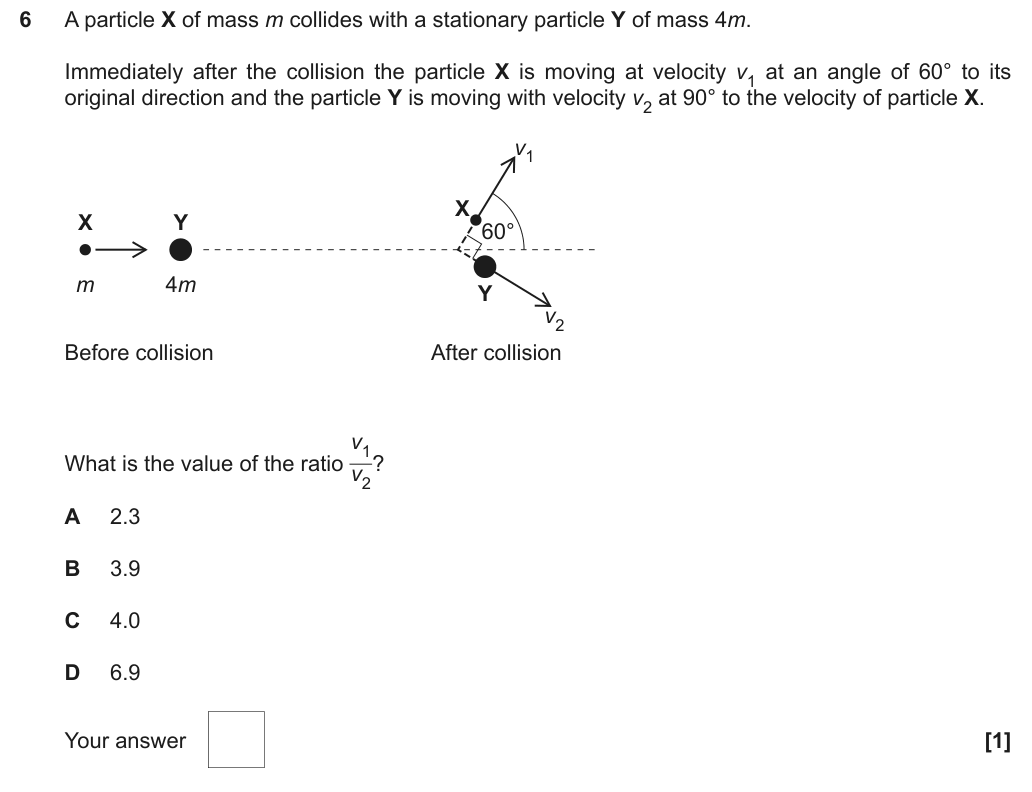
June 2022 · Paper 1 · Q61 markMultiple choiceHard
Answer
A
Mark scheme
Examiner's comment
Candidates found this question challenging. Conservation of momentum applies both horizontally and vertically here. This means that the vertical upwards component of the momentum of X must equal the vertical downwards component of the momentum of Y. So m v1 sin(60o) = 4m v2 sin(30o). Rearranging this expression will give the correct answer of v1 / v2.
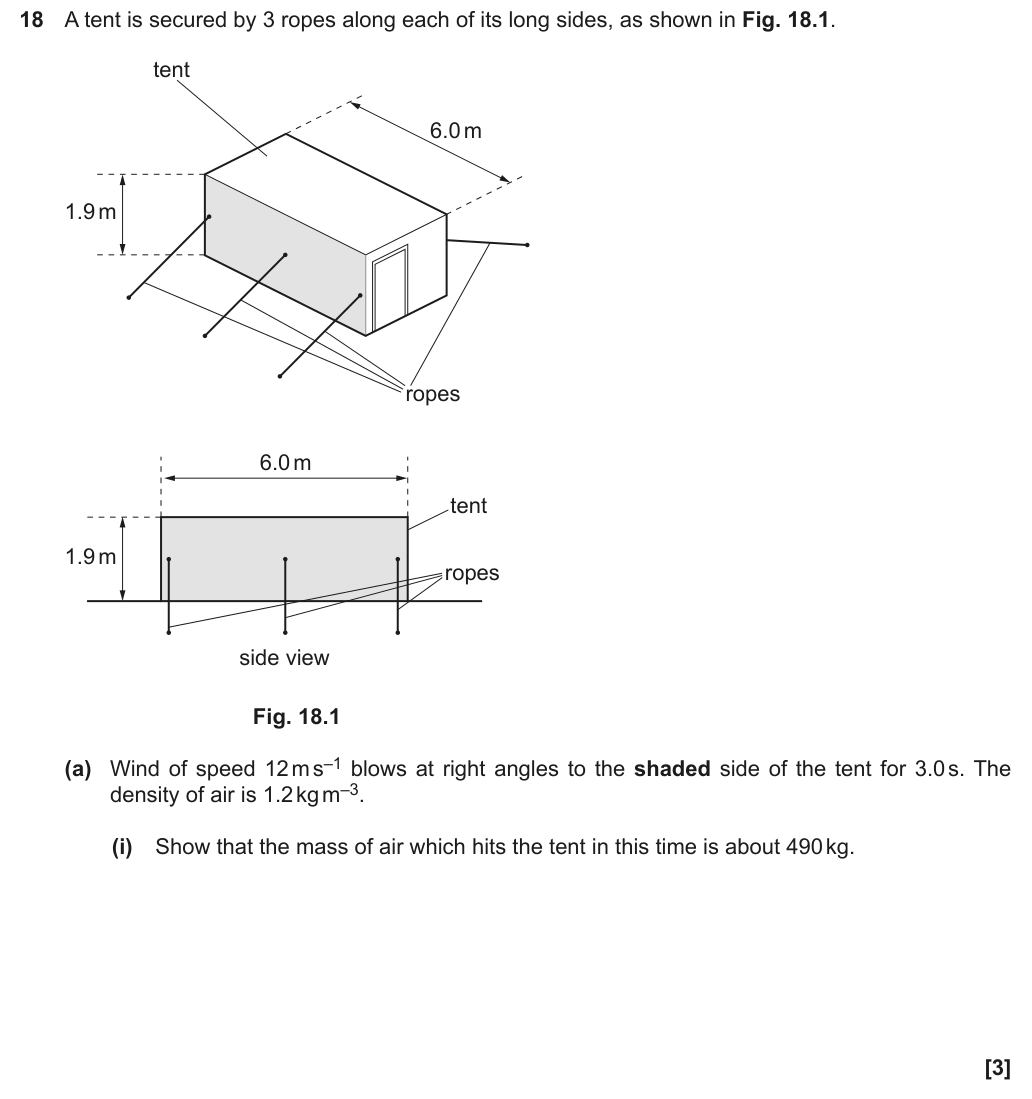
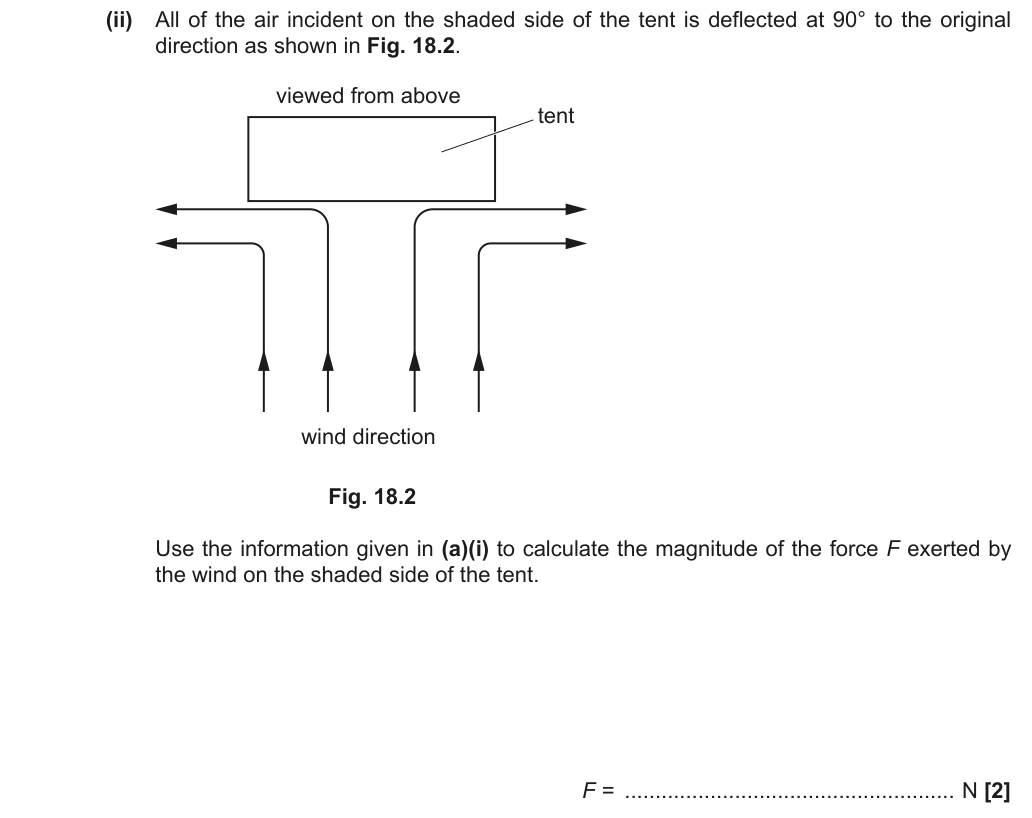
June 2022 · Paper 1 · Q18(b)6 marks6-mark extended responseMedium
Earlier parts of question 18 that this part uses
Mark scheme, with the levels and indicative content
Examiner's comment
This question tested ideas about forces, resolution of forces, behaviour of materials under stress and rate of change of momentum transfer. Level 1 answers were restricted to merely suggestions of what could be done to make the support of the tent stronger. Level 2 answers developed at least one of those suggestions by referring, qualitatively, to the underlying physics. Level 3 answers were rare, as the requirement was for some quantitative physics. Candidates that attempted a quantitative answer often believed that the force would be doubled, when in fact it is quadrupled. This is because both the mass of the air depends on the velocity of air, so doubling the speed will also double the mass, thus quadrupling the momentum transfer. This candidate clearly states, on lines 3-5, that the force is directly proportional to the square of the speed by thinking about their answers to previous parts of the question. The statements following this, after the page break, are sensible and grounded in physics in topics typically covered in the first year of study. The candidate mentions about quadrupling the number of ropes and reducing the area presented to the wind by a factor of four. The candidate goes on, in the additional answer space, to refer to the thickness of the ropes and how the radius would need to double. Level 3 response.
Notes from the mark scheme and report
force is x4 at 40 m s-1 (mass per second and velocity both double), so rope area x4 or breaking stress x4
Skills: M0.3 Use ratios, fractions and percentages
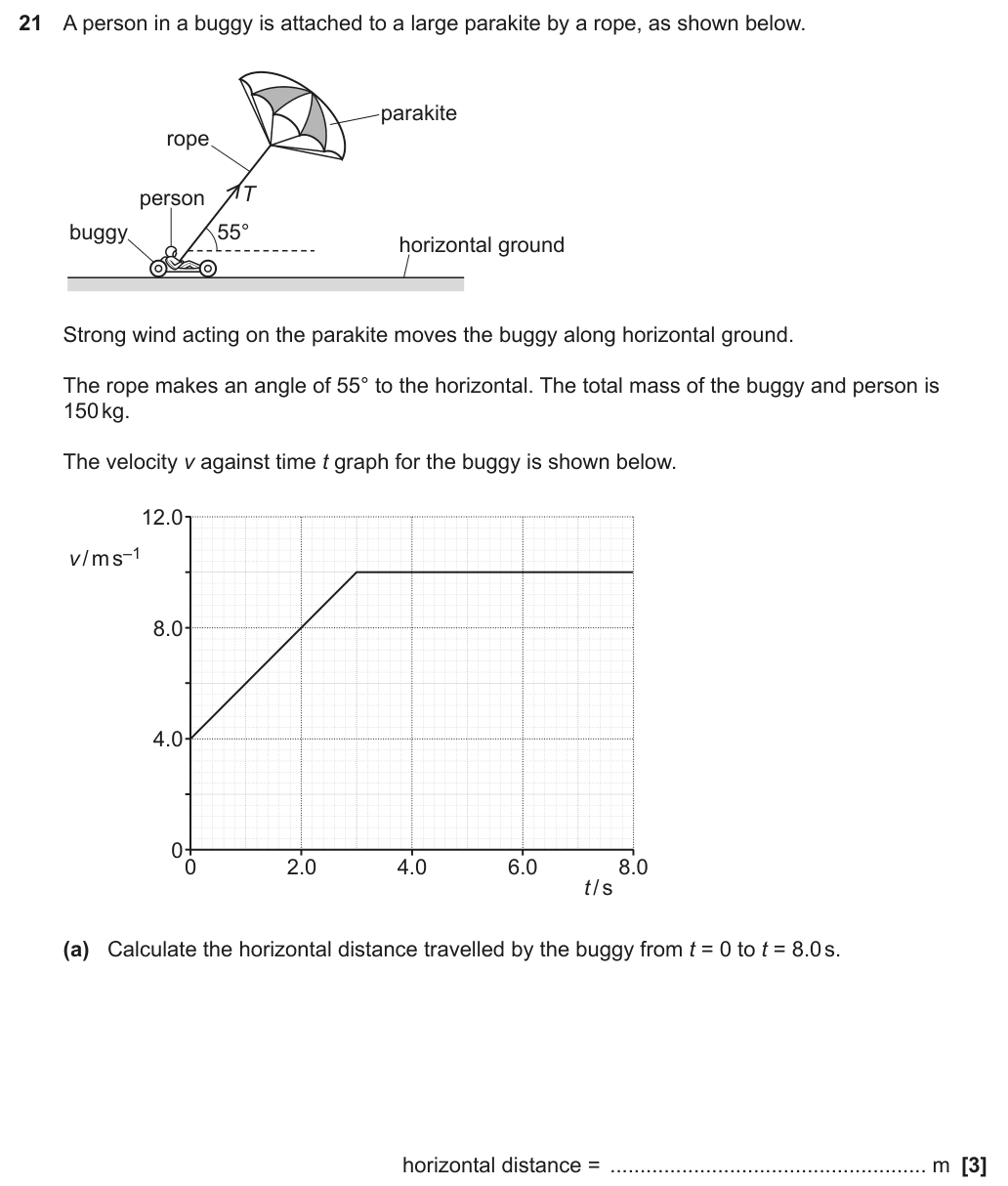
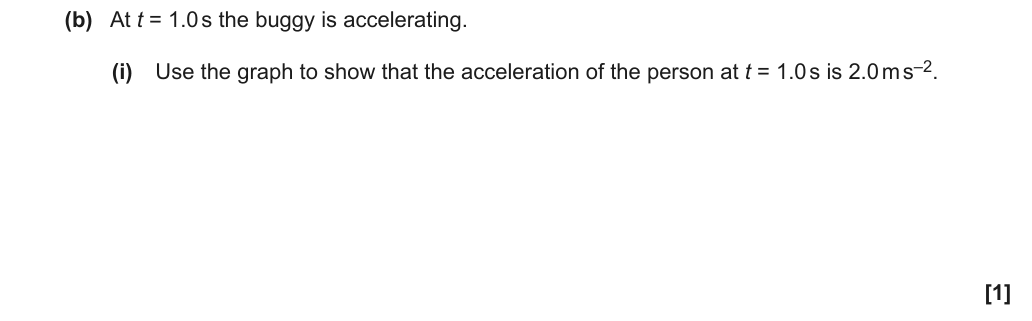
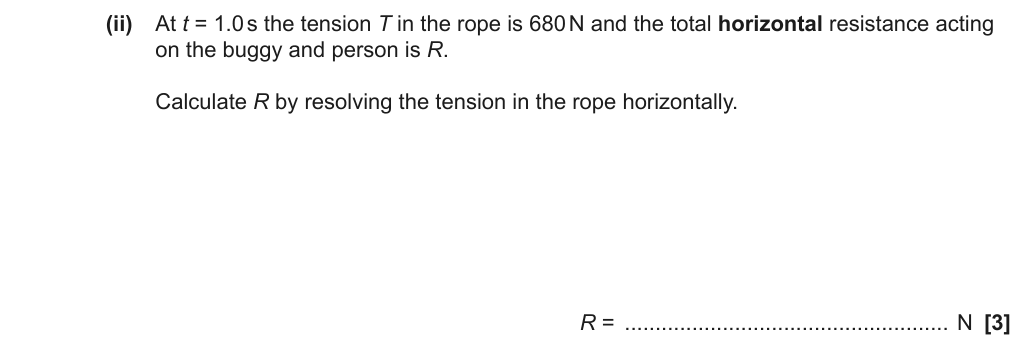
June 2022 · AS Paper 1 · Q21(b)(ii)3 marksCalculationMedium
Earlier parts of question 21 that this part uses
Mark scheme
Examiner's comment
Candidates performed less well on this question as it was mostly only the most successful responses that were given 3 marks for resolving the horizontal component of the tension in the rope to correctly calculate the horizontal resistance R. About 40% of candidates were given 1 mark for either correctly resolving the horizontal component of the tension to give 390 N or calculating the resultant force (F = ma) to give 300 N. It would have helped candidates understand the question to draw a free body force diagram to identify the forces acting on the buggy and direction and magnitude of the resultant force.
Notes from the mark scheme and report
if both components are given it must be clear that 390 N is the horizontal one
Skills: M0.6 Use calculators to handle sin x, cos x and tan x when x is expressed in degrees or radians; M2.3 Substitute numerical values into algebraic equations using appropriate units for physical quantities; M4.5 Use sin, cos and tan in physical problems
June 2022 · AS Paper 2 · Q4(b)(iii)1 markCalculationMedium
Earlier parts of question 4 that this part uses
Mark scheme
Examiner's comment
Candidates achieving on this question correctly determined the angle using the horizontal and vertical velocities. Where the response was incorrect, candidates had used either energies or distances.
Notes from the mark scheme and report
ecf from (a)(ii)
Skills: M0.6 Use calculators to handle sin x, cos x and tan x when x is expressed in degrees or radians; M4.5 Use sin, cos and tan in physical problems
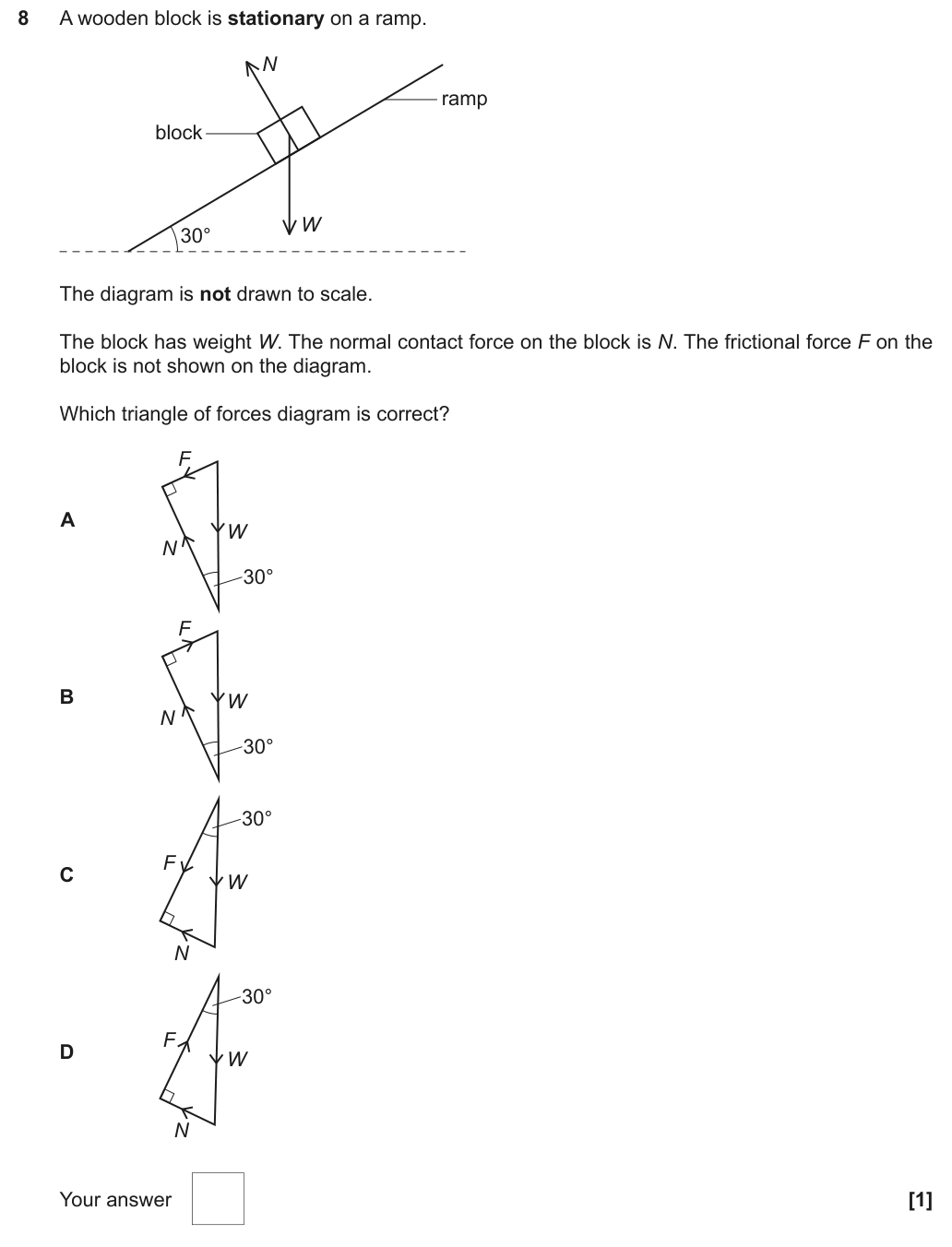
November 2021 · Paper 1 · Q81 markMultiple choice
Answer
D
Mark scheme
November 2021 · AS Paper 1 · Q181 markMultiple choice
Answer
A
Mark scheme
November 2021 · Paper 1 · Q19(b)(i)3 marksShow thatMedium
Earlier part of question 19 that this part uses
Mark scheme
Examiner's comment
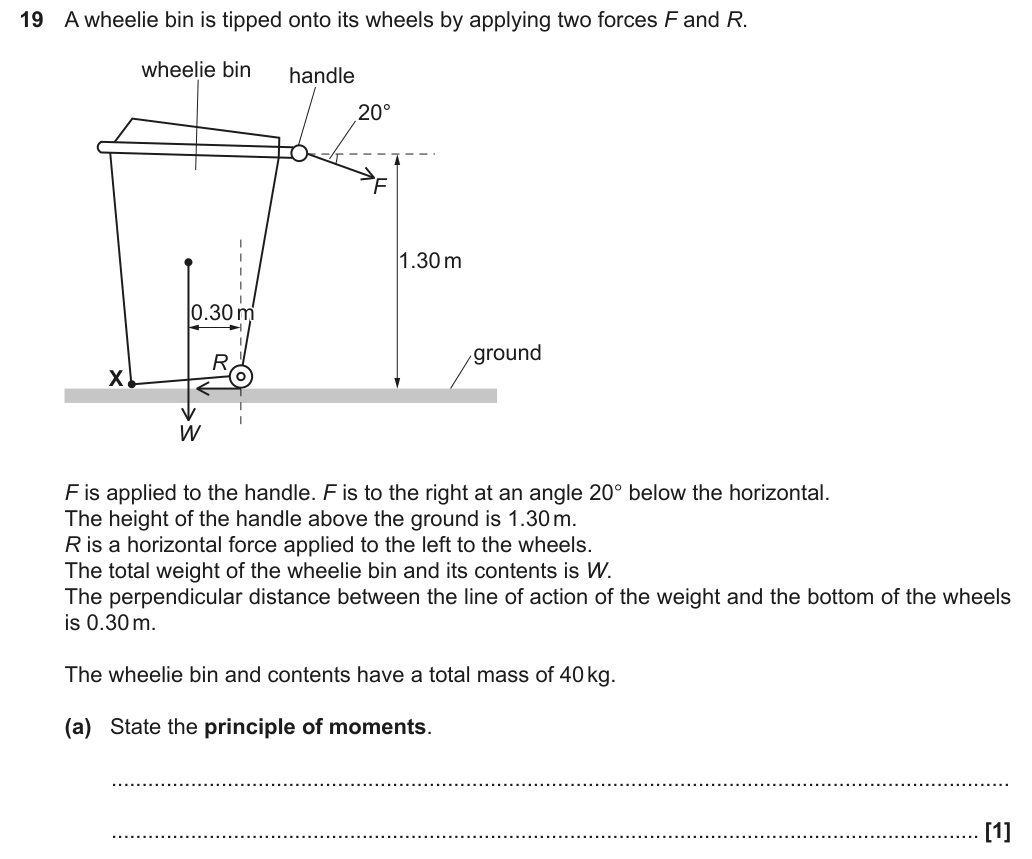
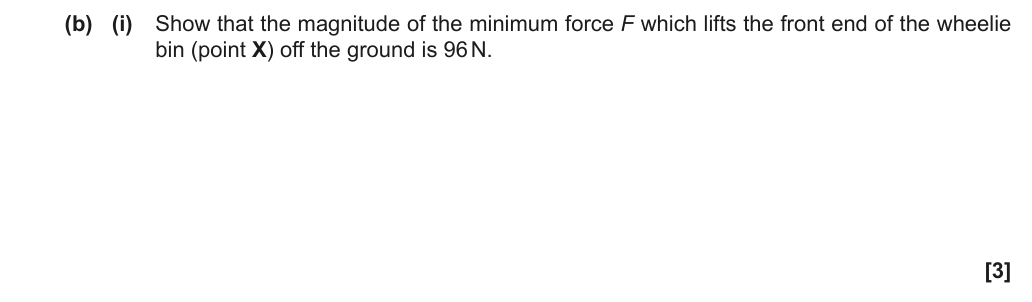
The principle of moments only applies when an object is in equilibrium as required in Q19a.
Notes from the mark scheme and report
sine used (265) or calculator in radians (222) scores 2
Skills: M0.6 Use calculators to handle sin x, cos x and tan x when x is expressed in degrees or radians; M2.3 Substitute numerical values into algebraic equations using appropriate units for physical quantities; M4.5 Use sin, cos and tan in physical problems
November 2021 · Paper 1 · Q19(b)(ii)2 marksCalculationMedium
Earlier parts of question 19 that this part uses
Mark scheme
Examiner's comment
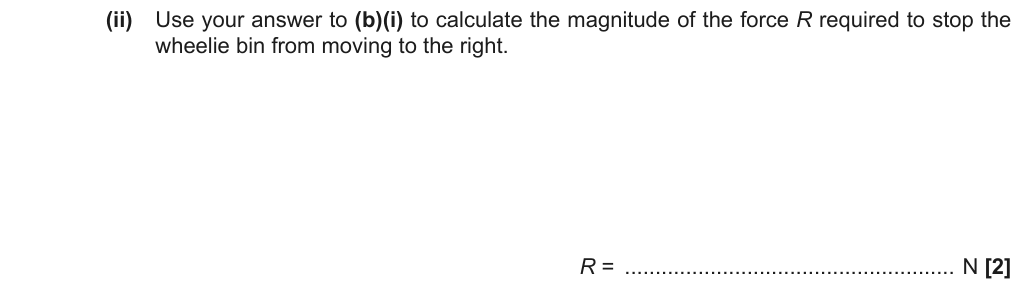
The principle of moments only applies when an object is in equilibrium as required in Q19a.
Notes from the mark scheme and report
ecf from (b)(i)
Skills: M0.6 Use calculators to handle sin x, cos x and tan x when x is expressed in degrees or radians; M4.5 Use sin, cos and tan in physical problems
November 2021 · Paper 3 · Q6(b)(ii)4 marksDiagram or graphMedium
Earlier parts of question 6 that this part uses
Mark scheme
Examiner's comment
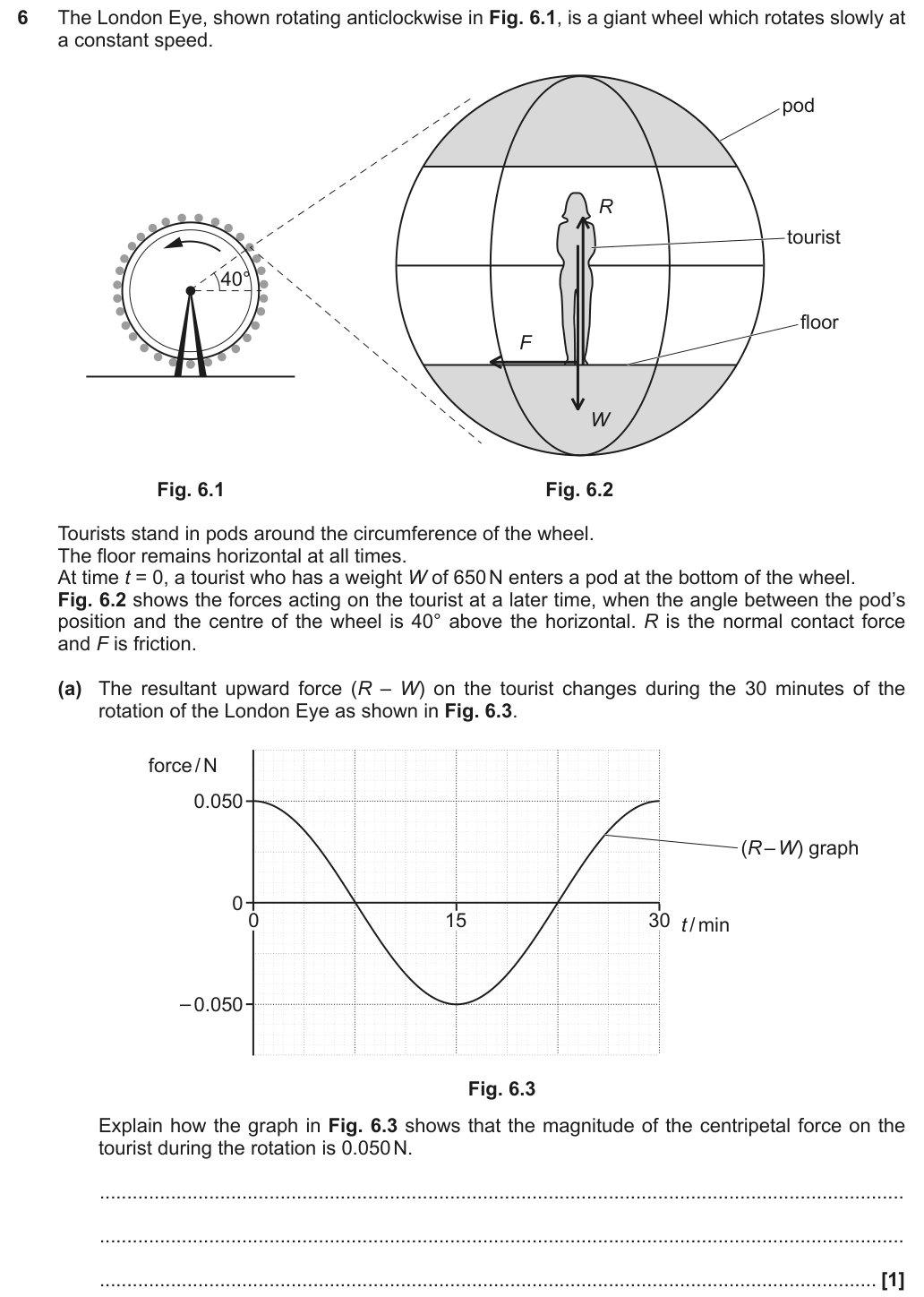
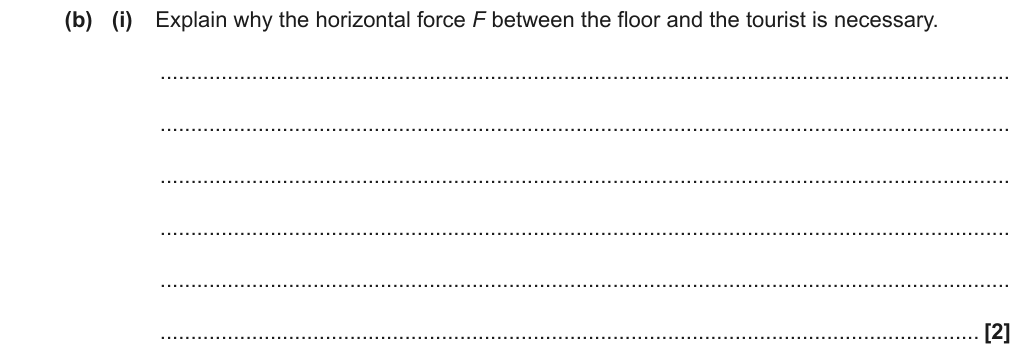
Common misconceptions Candidates often struggle to answer questions on circular motion, and Question 6 threw up the usual misconceptions. In Question 6, the two available forces are R – W, which acts vertically, and F, which acts horizontally.
Notes from the mark scheme and report
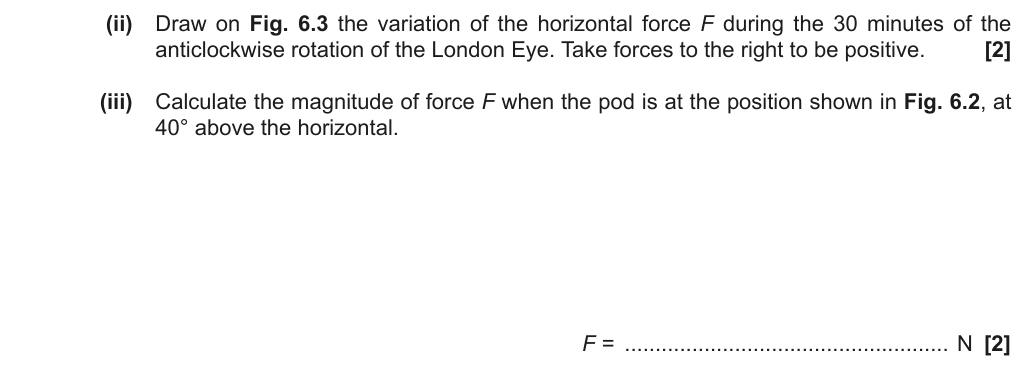
label covers (ii) and (iii): (ii) negative sine curve, amplitude 0.050 N, period 30 min, must start at the origin
(iii) F = 0.050 cos 40° = 0.038 N (ecf from graph if used)
Skills: M0.6 Use calculators to handle sin x, cos x and tan x when x is expressed in degrees or radians; M3.12 Sketch relationships which are modelled by y = k/x, y = kx², y = k/x², y = kx, y = sin x, y = cos x, y = e^(±x) and y = sin²x, y = cos²x as applied to physical relationships; M4.5 Use sin, cos and tan in physical problems
November 2020 · AS Paper 1 · Q21 markMultiple choice
Answer
A
Mark scheme
November 2020 · Paper 1 · Q81 markMultiple choice
Answer
B
Mark scheme
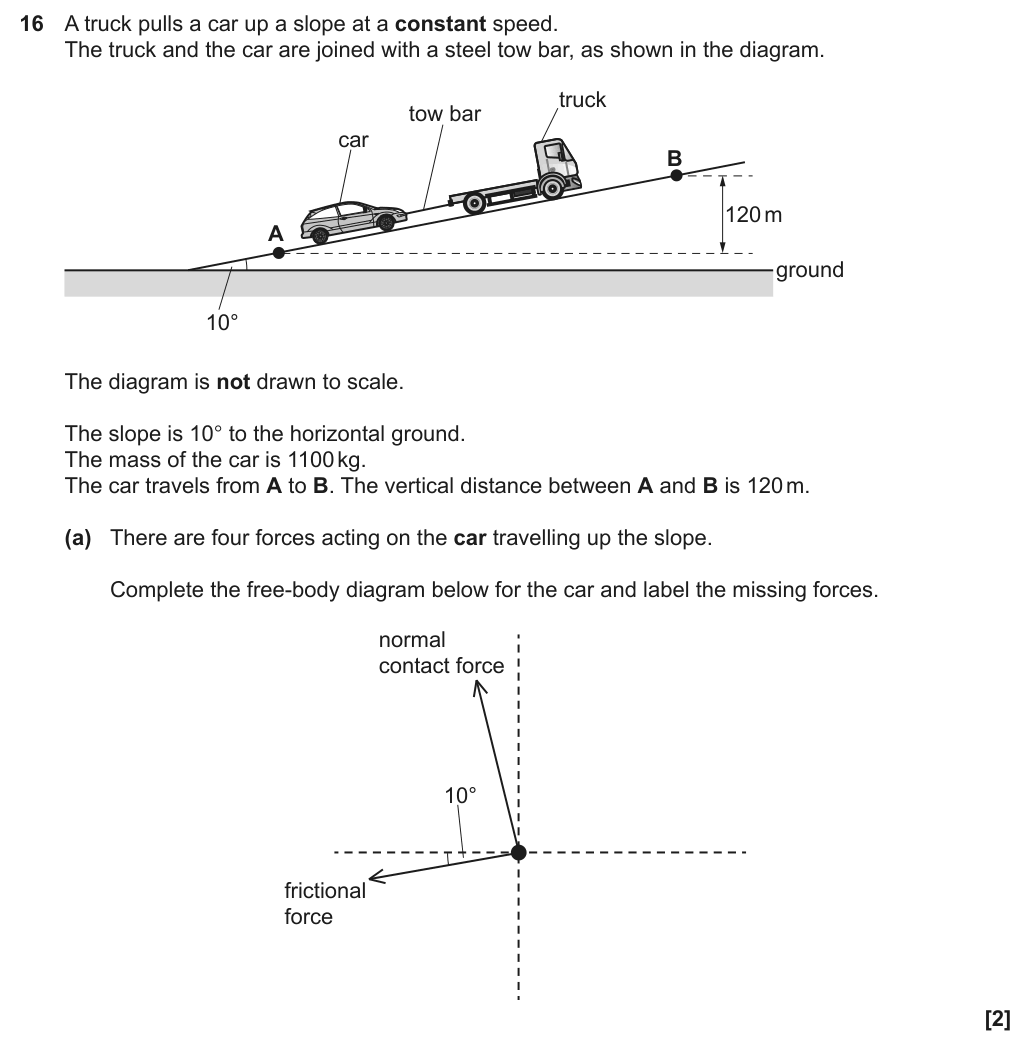
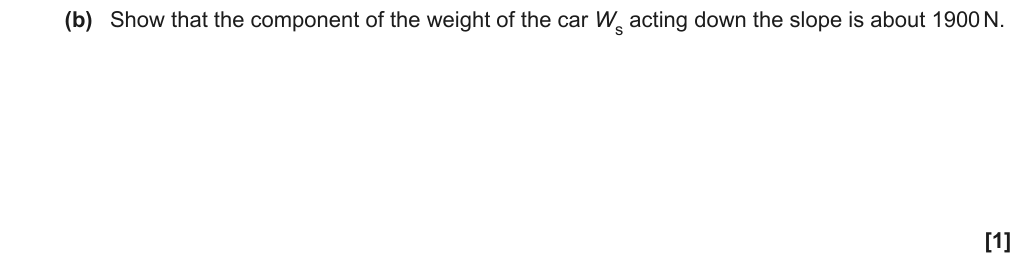
November 2020 · Paper 1 · Q16(b)1 markShow that
Earlier part of question 16 that this part uses
Mark scheme
Notes from the mark scheme and report
allow cos 80°
allow g instead of value
Skills: M0.6 Use calculators to handle sin x, cos x and tan x when x is expressed in degrees or radians; M4.5 Use sin, cos and tan in physical problems
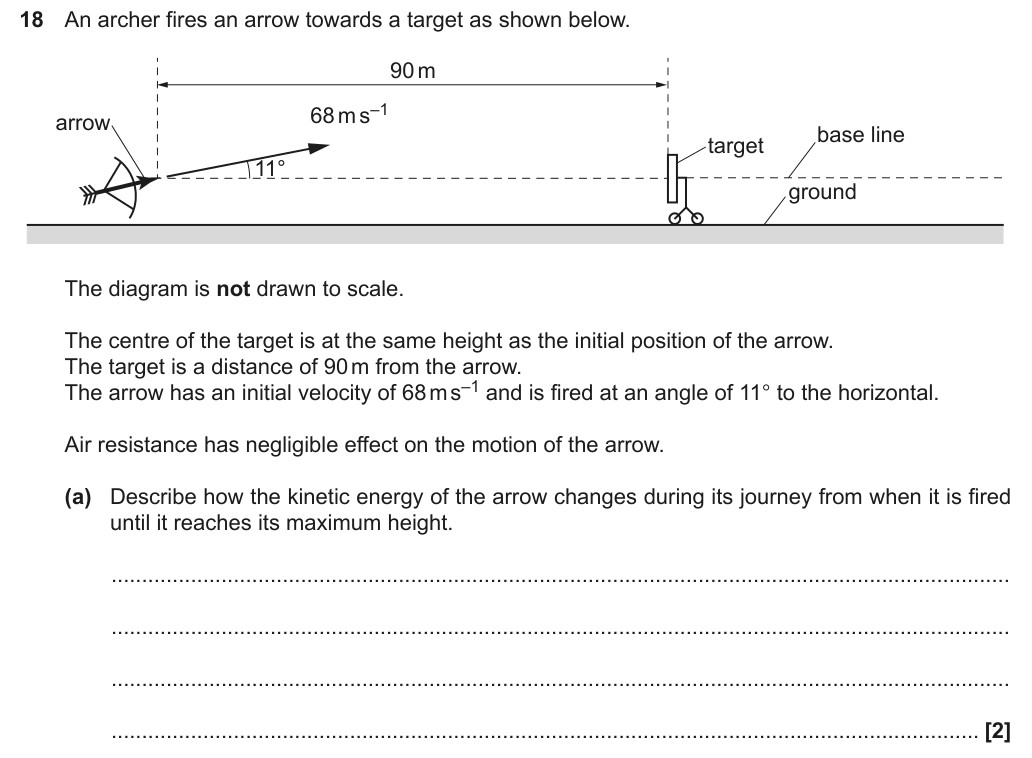
November 2020 · Paper 1 · Q18(b)2 marksShow that
Earlier part of question 18 that this part uses
Mark scheme
Notes from the mark scheme and report
NOT t = 90 / (68 cos 11°) = 1.35, zero marks
Skills: M0.6 Use calculators to handle sin x, cos x and tan x when x is expressed in degrees or radians; M2.2 Change the subject of an equation, including non-linear equations; M4.5 Use sin, cos and tan in physical problems
November 2020 · Paper 1 · Q18(c)3 marksCalculation
Earlier parts of question 18 that this part uses
Mark scheme
Notes from the mark scheme and report
total flight time is 2 x 1.3 s
1.3 x 68 cos 11° scores 1 mark
answers 84, 86 or 87 m depending on rounding of t
Skills: M2.3 Substitute numerical values into algebraic equations using appropriate units for physical quantities; M4.5 Use sin, cos and tan in physical problems
November 2020 · AS Paper 1 · Q23(a)(i)1 markDiagram or graphMedium
Mark scheme
Examiner's comment
Questions 23aii, 23bi, 24bii, 27c and 28bi • showed all the steps leading to the correct response in ‘show’ calculations, e.g. Misconception Question 23bii A small number of candidates incorrectly interpreted the velocity–time graph, especially the negatively sloping section of the graph.
Notes from the mark scheme and report
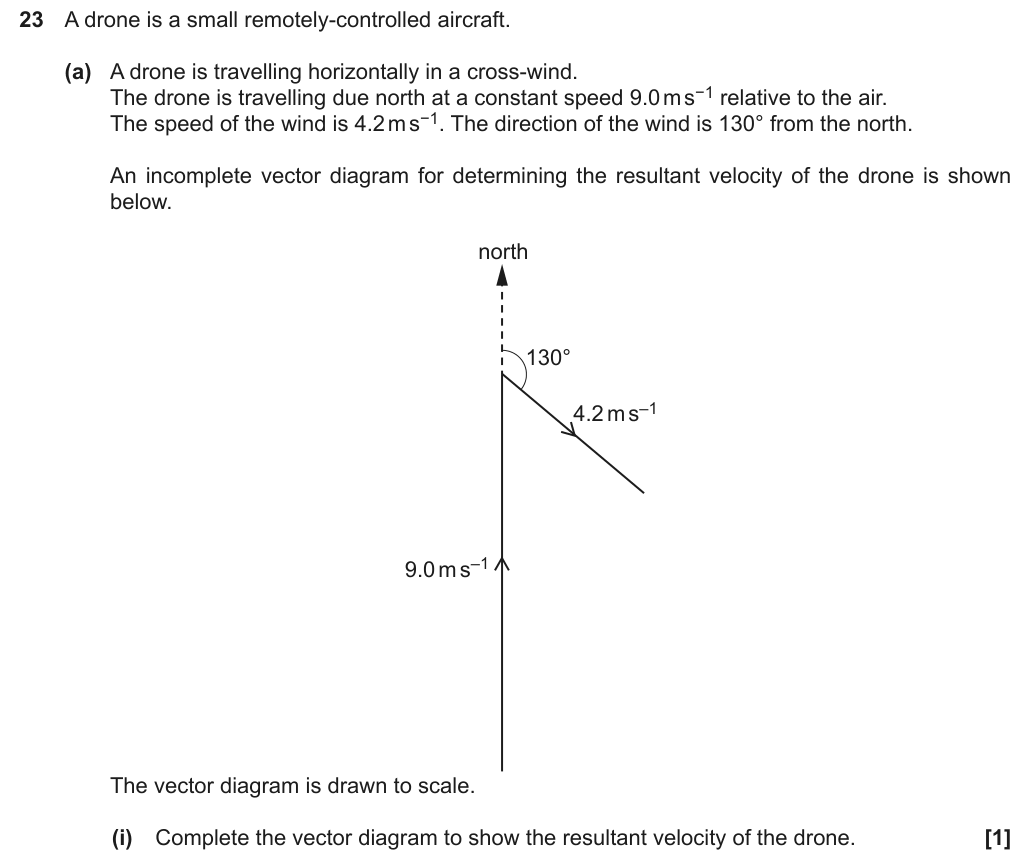
ignore incorrect or omitted direction of the resultant
Skills: M4.2 Visualise and represent 2D and 3D forms, including two-dimensional representations of 3D objects
November 2020 · AS Paper 1 · Q23(a)(ii)2 marksCalculationMedium
Earlier part of question 23 that this part uses
Mark scheme
Examiner's comment
Questions 23aii, 23bi, 24bii, 27c and 28bi • showed all the steps leading to the correct response in ‘show’ calculations, e.g. Misconception Question 23bii A small number of candidates incorrectly interpreted the velocity–time graph, especially the negatively sloping section of the graph.
Notes from the mark scheme and report
cosine rule or scale drawing (length 5.4 to 5.6 cm
allow ±0.20 m s-1)
Skills: M0.6 Use calculators to handle sin x, cos x and tan x when x is expressed in degrees or radians; M4.2 Visualise and represent 2D and 3D forms, including two-dimensional representations of 3D objects; M4.5 Use sin, cos and tan in physical problems
November 2020 · AS Paper 2 · Q6(b)(i)1 markCalculation
Mark scheme
Notes from the mark scheme and report
4.4 to 4.6 N
Skills: M0.3 Use ratios, fractions and percentages; M4.2 Visualise and represent 2D and 3D forms, including two-dimensional representations of 3D objects
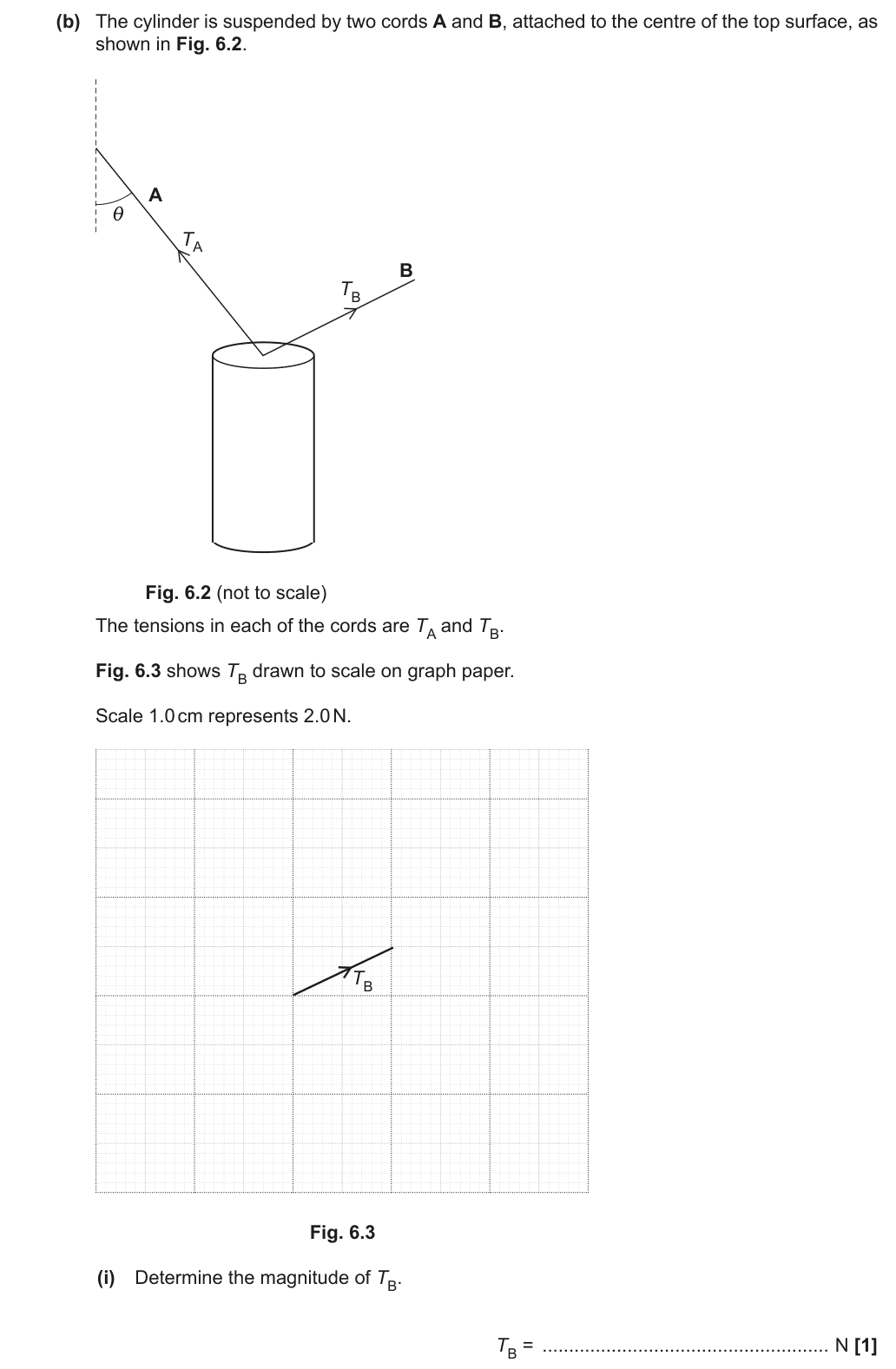
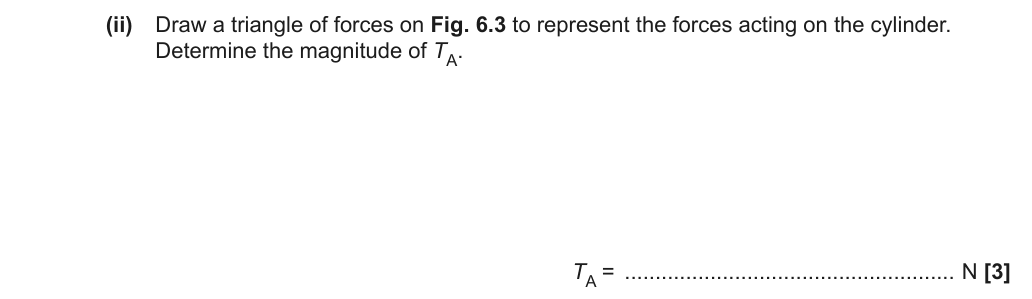
November 2020 · AS Paper 2 · Q6(b)(ii)3 marksDiagram or graph
Earlier parts of question 6 that this part uses
Mark scheme
Notes from the mark scheme and report
weight drawn 3.5 cm vertically
closed triangle with correct directions
TA = 6.4 ± 0.2 N
Skills: M4.2 Visualise and represent 2D and 3D forms, including two-dimensional representations of 3D objects
November 2020 · AS Paper 2 · Q6(b)(iii)1 markCalculation
Earlier parts of question 6 that this part uses
Mark scheme
Notes from the mark scheme and report
39 ± 1°
ecf from (b)(ii) for trigonometry methods
Skills: M4.5 Use sin, cos and tan in physical problems
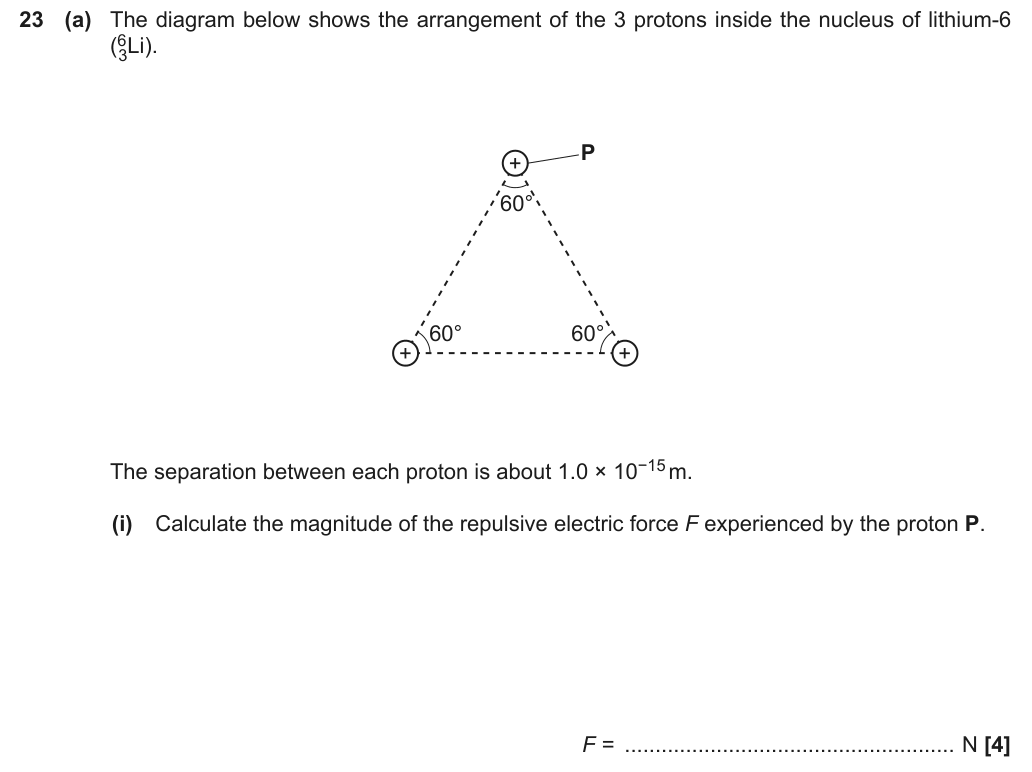
November 2020 · Paper 2 · Q23(a)(i)4 marksCalculation
Mark scheme
Notes from the mark scheme and report
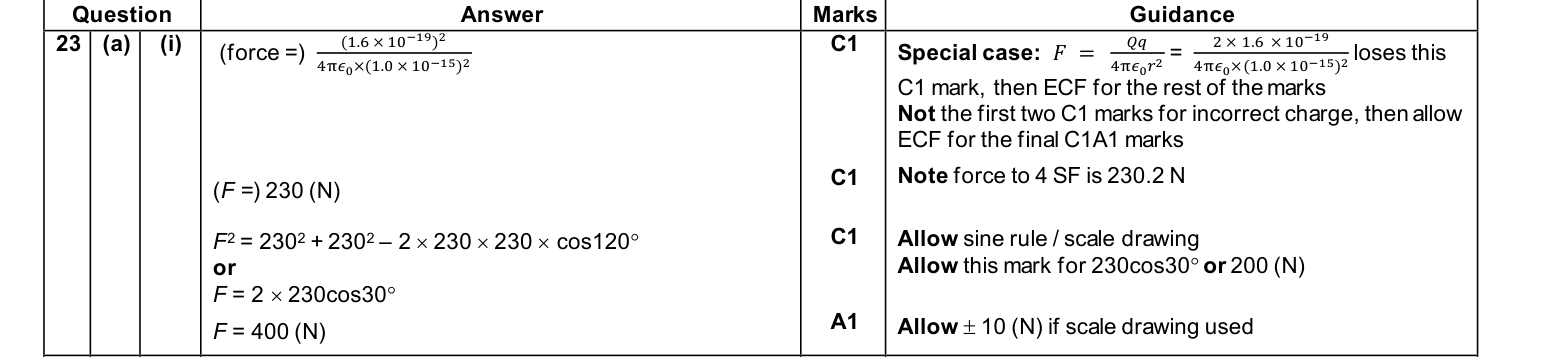
230 N between two protons
doubling the charge in the formula loses the first mark
allow scale drawing ± 10 N
Skills: M0.2 Recognise and use expressions in decimal and standard form; M2.3 Substitute numerical values into algebraic equations using appropriate units for physical quantities; M4.5 Use sin, cos and tan in physical problems
November 2020 · Paper 2 · Q23(a)(ii)1 markDiagram or graph
Earlier part of question 23 that this part uses
Mark scheme
Notes from the mark scheme and report
arrow vertically up the page
Skills: M4.2 Visualise and represent 2D and 3D forms, including two-dimensional representations of 3D objects
November 2020 · Paper 3 · Q6(d)(ii)2 marksDiagram or graphMedium
Earlier parts of question 6 that this part uses
Mark scheme
Examiner's comment
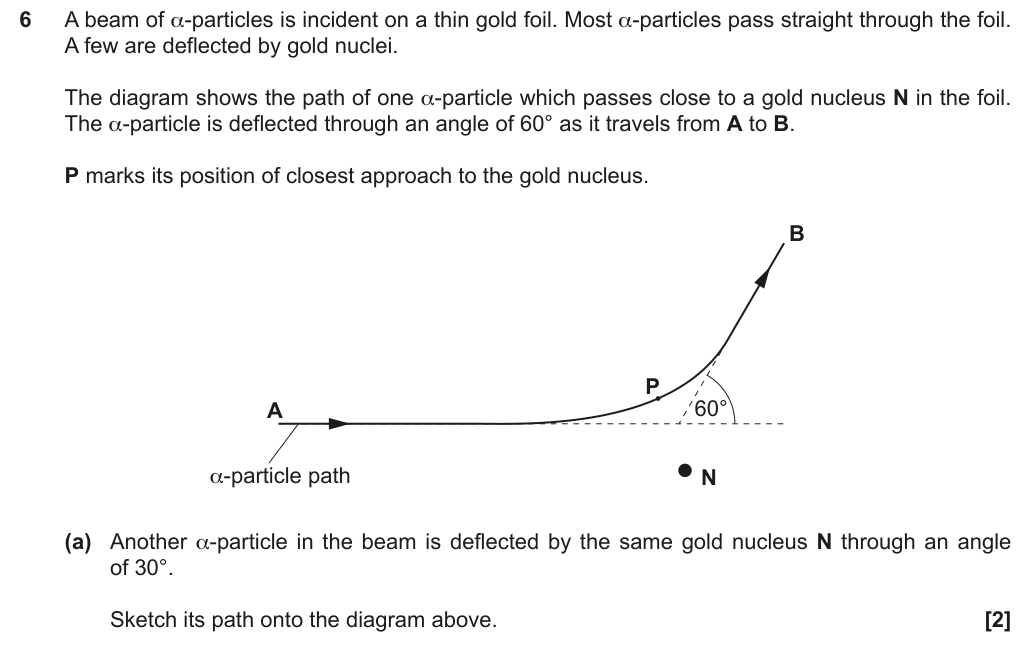
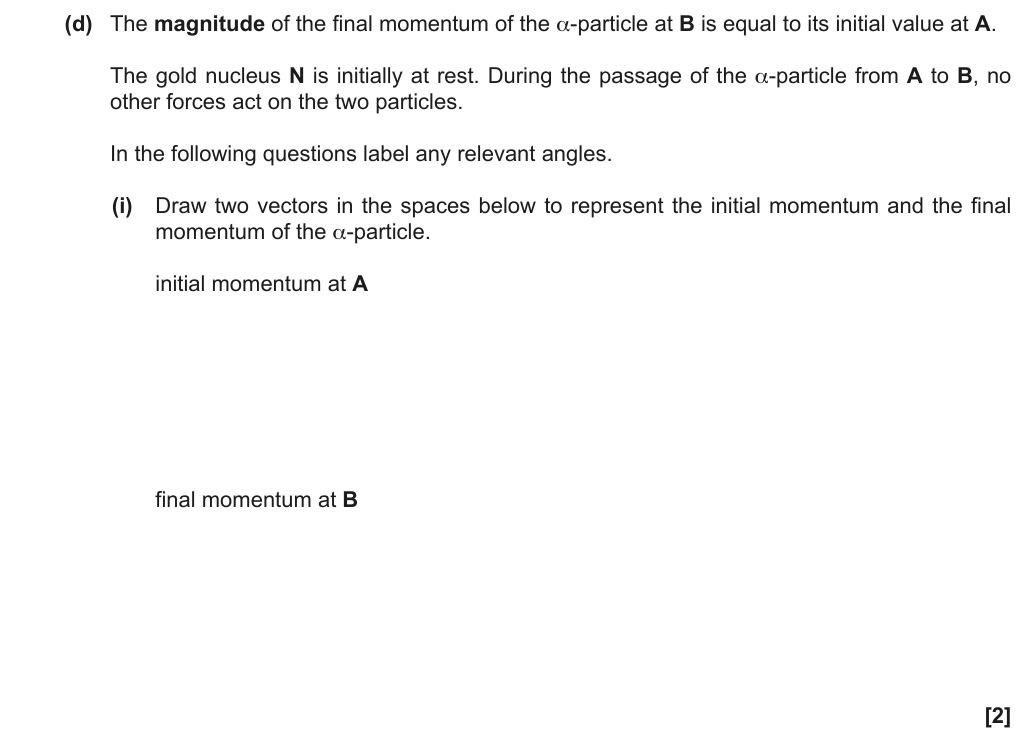
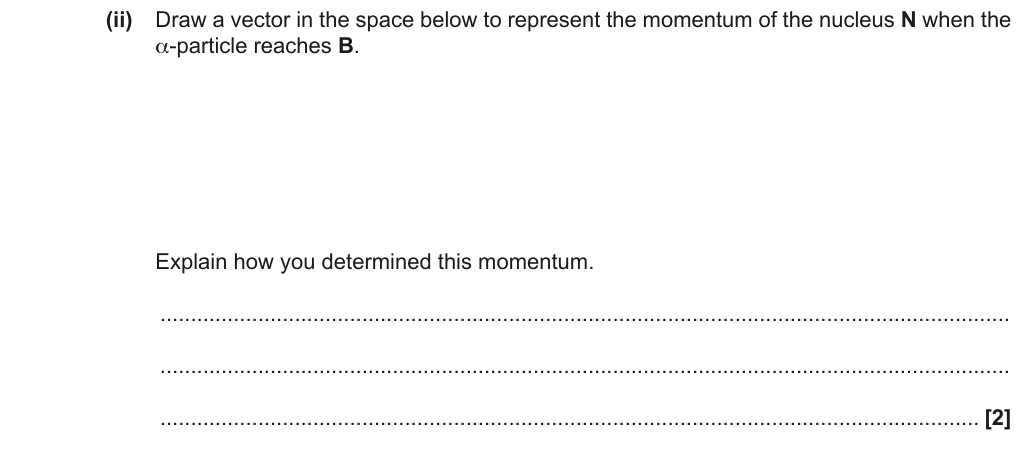
Since this paper is synoptic, candidates need to be able to apply their knowledge and understanding in unfamiliar contexts in order to gain high marks, To do well in this paper, candidates must be able to: • perform and layout calculations logically, showing clear working (such as Question 6c) • produce concise but accurate responses to questions which involve extended writing (such as question 1b) • craft clearly structured and well-reasoned arguments to the Level of Response Questions (3b and 5d) • process and interpret data from an experiment to reach conclusions (Question 2). Question 6a The common errors here were: • not realising that, for the particle to be deflected through a smaller angle, it needed to be travelling further away from N • not labelling the final angle of 30° • not adding arrows to show the direction of travel • drawing a path that continued bending beyond the stated 30° (usually ending up parallel to the original path). Question 6b The most common error here was to use incorrect values for the charges on the two ions. Question 6c This question provided an excellent opportunity for candidates to produce immaculate responses: identify the physics involved, select and write down the correct formula, do the necessary conversion (MeV to J), rearrange the formula, substitute correctly and then write the final response in standard form to a correct number of significant figures. Question 6d This was not an easy question but, even so, a good number of candidates did well.
Notes from the mark scheme and report
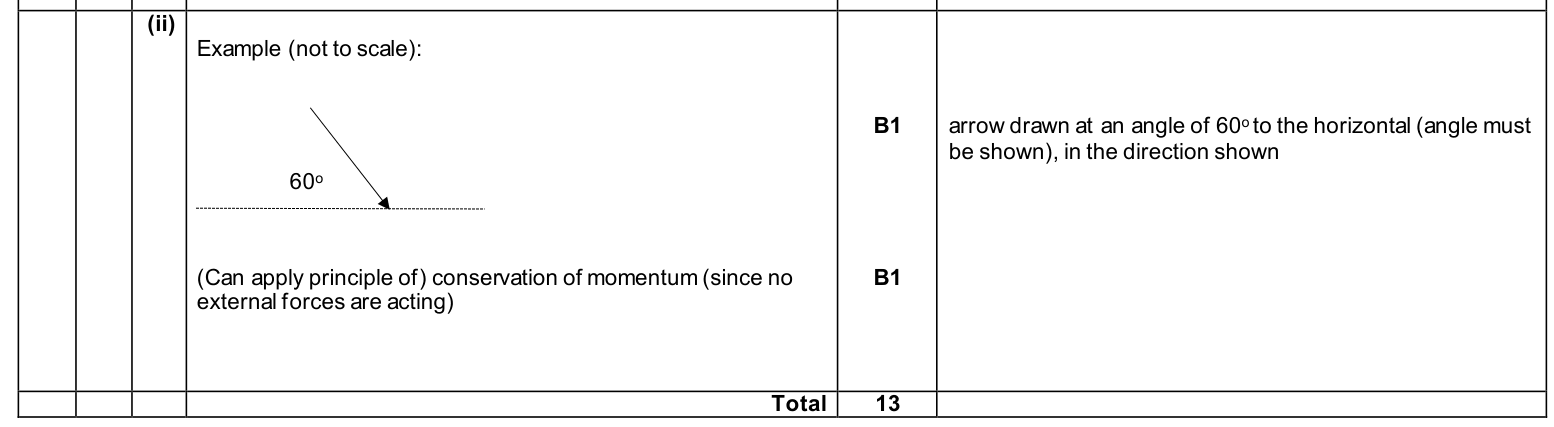
arrow at 60 degrees below the horizontal (angle must be shown)
conservation of momentum as no external forces act
Skills: M4.2 Visualise and represent 2D and 3D forms, including two-dimensional representations of 3D objects
June 2019 · Paper 1 · Q81 markMultiple choice
Answer
B
Mark scheme
June 2019 · AS Paper 1 · Q161 markMultiple choice
Answer
A
Mark scheme
June 2019 · AS Paper 1 · Q21(c)(i)2 marksCalculationEasy
Mark scheme
Examiner's comment
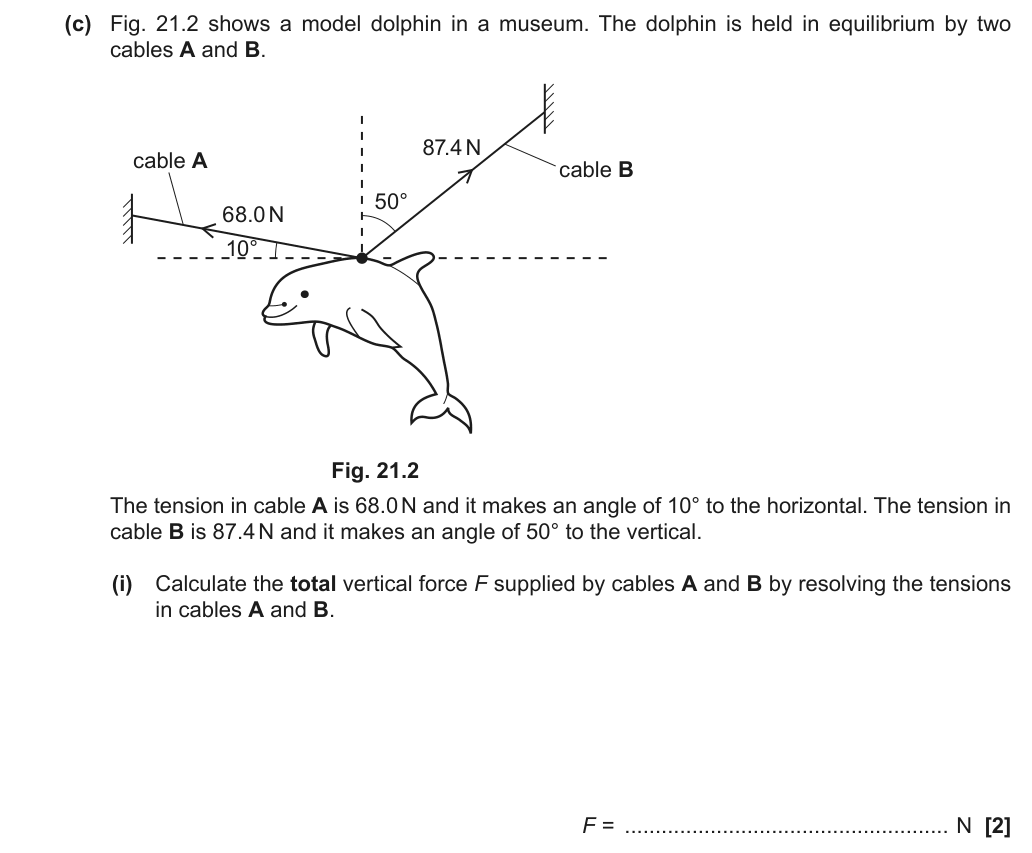
The question has a clue for making a start on this question. Most candidates did resolve the two tensions in the cables vertically. The majority of the responses were well-structured and demonstrated excellent understanding of vectors. Although not straightforward, many candidates used the correct angle when determining the vertical components of the forces. The correct answer of 68.0 N appeared on most scripts. A small number of candidates got 1 mark for just getting one of the components correct. A very small number of candidates got the correct answer by using trigonometry and triangle of forces. This is not what was expected, but full credit was given for this alternative approach. Correct responses will always score marks, even when the candidates choose not to go along the path designed by the examiners. This different approach is illustrated in the exemplar 6 below. The candidate has used a triangle of forces and the cosine rule to determine the net downward. As it happens, the F in this calculation is the weight of the dolphin. However, it is numerically equal to the total upward vertical force. This concise and perfect alternative technique picked up the maximum marks.
Notes from the mark scheme and report
Allow 2 SF answer
sine or cosine rule allowed
Skills: M0.6 Use calculators to handle sin x, cos x and tan x when x is expressed in degrees or radians; M4.5 Use sin, cos and tan in physical problems
June 2019 · Paper 3 · Q4(a)3 marksCalculationEasy
Mark scheme
Examiner's comment
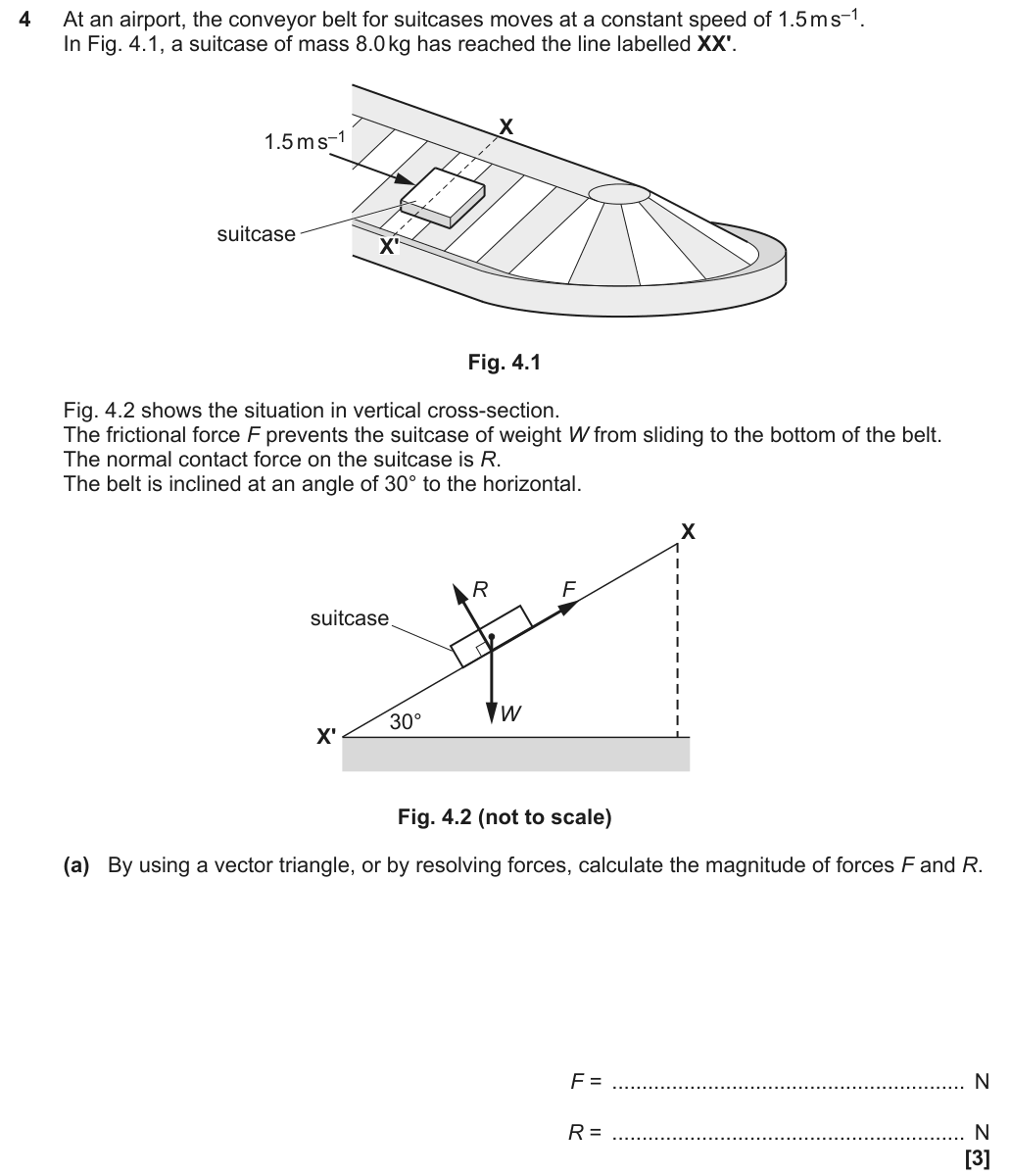
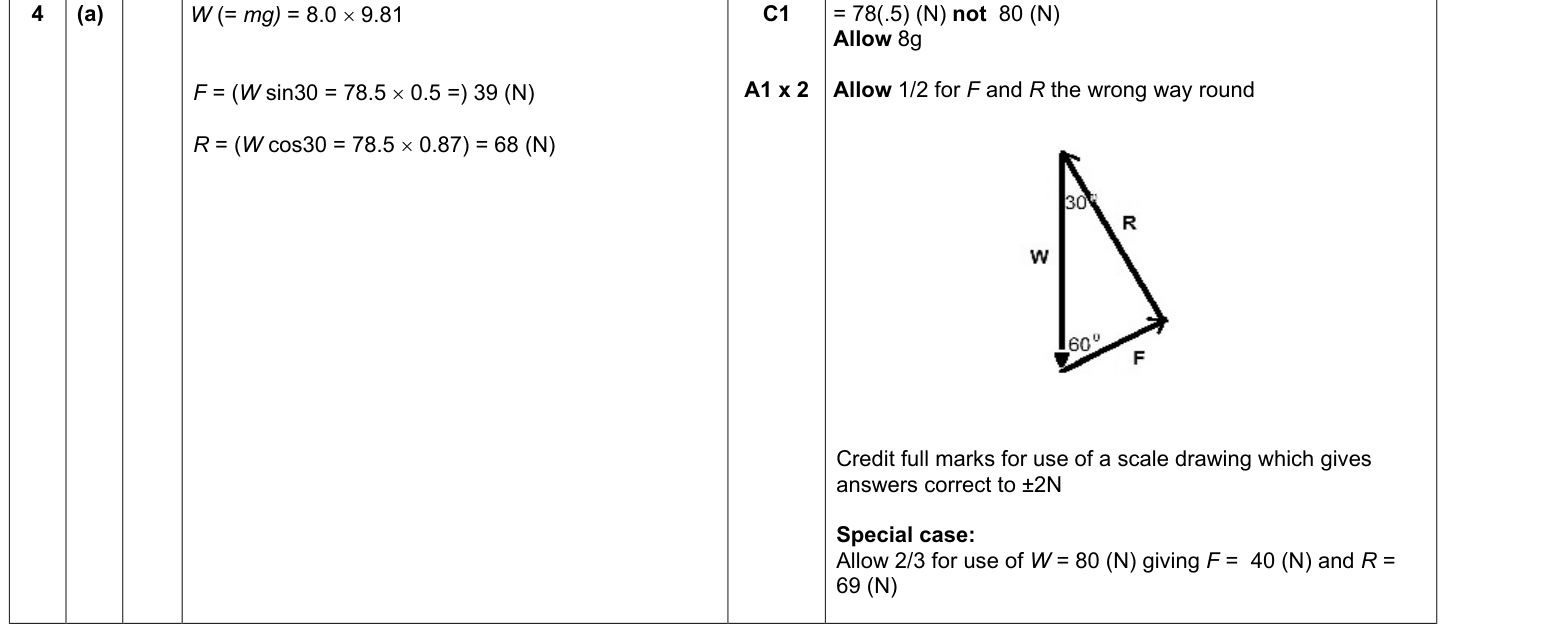
Most candidates were able to answer this question easily, although a few got their answers for F and R the wrong way around.
Notes from the mark scheme and report
F and R the wrong way round scores 1 mark
W = 80 N scores 2 max
Skills: M0.6 Use calculators to handle sin x, cos x and tan x when x is expressed in degrees or radians; M4.5 Use sin, cos and tan in physical problems
June 2019 · Paper 3 · Q4(b)(ii)4 marksExplanationMedium
Earlier parts of question 4 that this part uses
Mark scheme
Examiner's comment
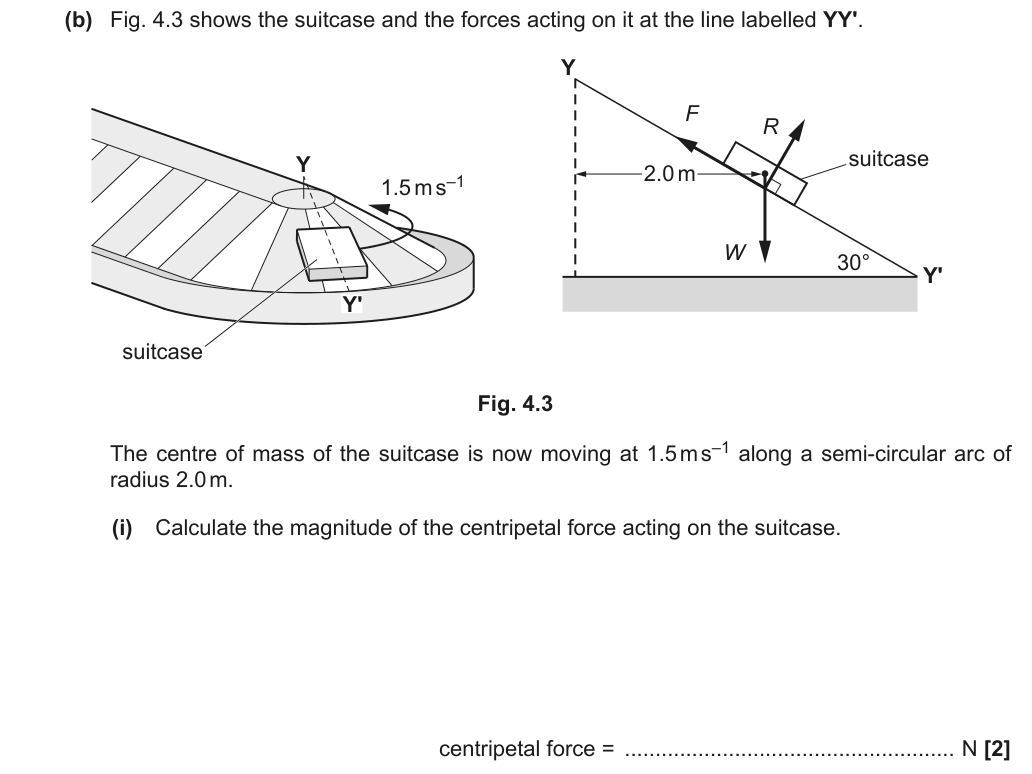
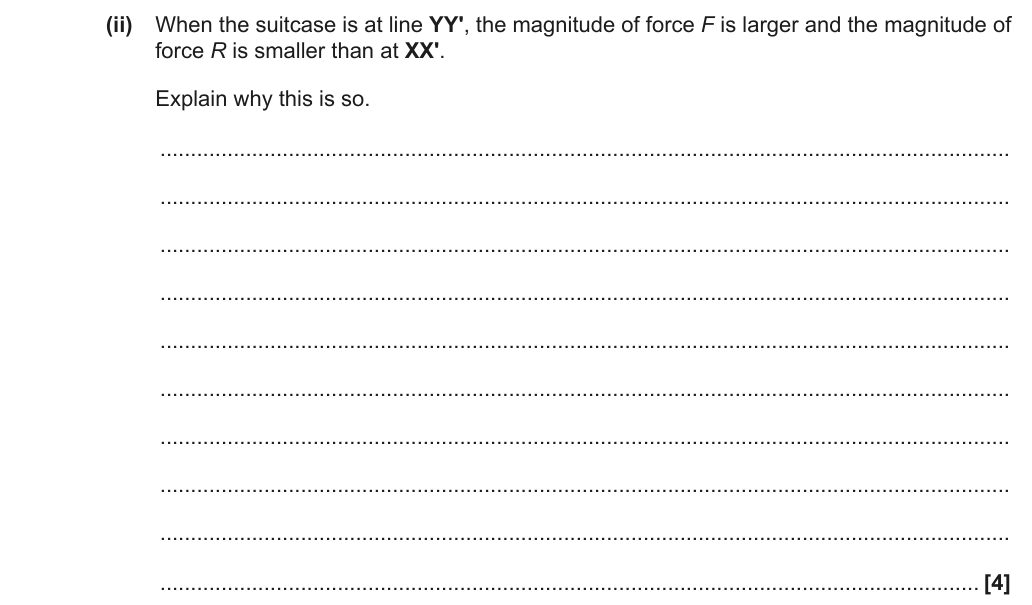
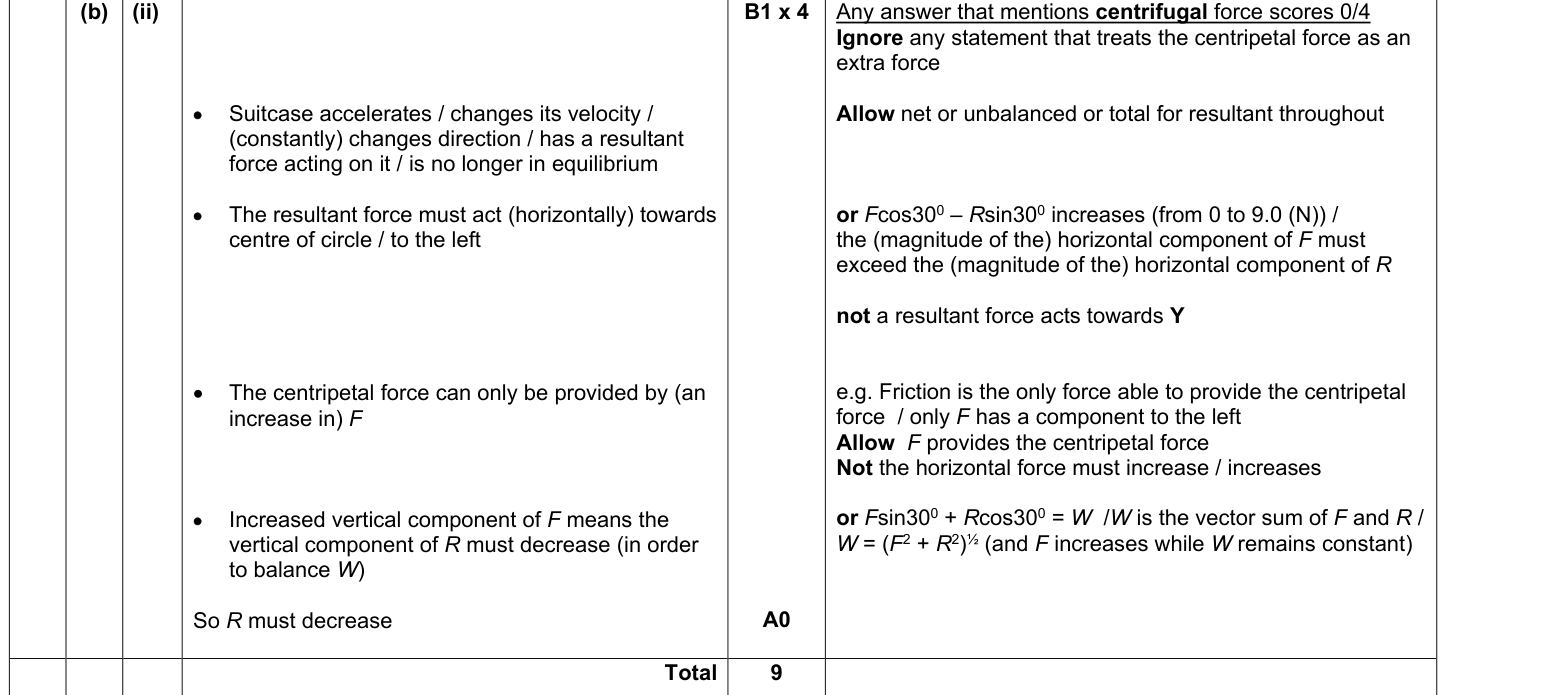
Question 4(b)(ii) proved very difficult and highlighted poor understanding of circular motion. Almost all candidates described the centripetal force as an additional force that had appeared out of nowhere. This centripetal force ‘pulled the suitcase inwards’ (or, in some cases, outwards) or ‘balanced the frictional force’ or ‘added to the frictional force’ and so on. The candidate who gave the response in Exemplar 5 clearly thinks that an additional force, called the centripetal force, now acts on the suitcase. The forces F and R have to adjust in order to keep the suitcase in equilibrium. They have not realised that the suitcase is no longer in equilibrium horizontally but is accelerating. This means that the available forces have to adjust in order to provide a resultant force towards the centre of the circle, while still balancing vertically. In contrast, the candidate who wrote the response in Exemplar 6 has a much better grasp of the situation.
Notes from the mark scheme and report
any answer that mentions centrifugal force scores 0
ignore centripetal force treated as an extra force
NOT a resultant force towards Y
Rather than using the phrase ‘centripetal force’, candidates could be encouraged to think of motion in a circle as a special case of F = ma where the resultant force F points towards the centre of the circle and the acceleration a is given by v2/r. This should hopefully encourage them to think about which of the forces available in the situation could provide the resultant force for this motion to occur.
June 2018 · Paper 1 · Q21 markMultiple choice
Answer
B
Mark scheme
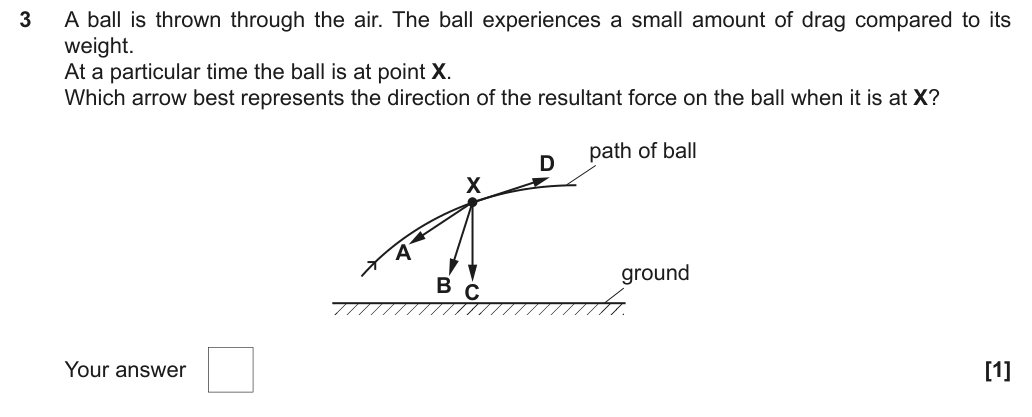
June 2018 · AS Paper 1 · Q31 markMultiple choiceMedium
Answer
B
Mark scheme
Examiner's comment
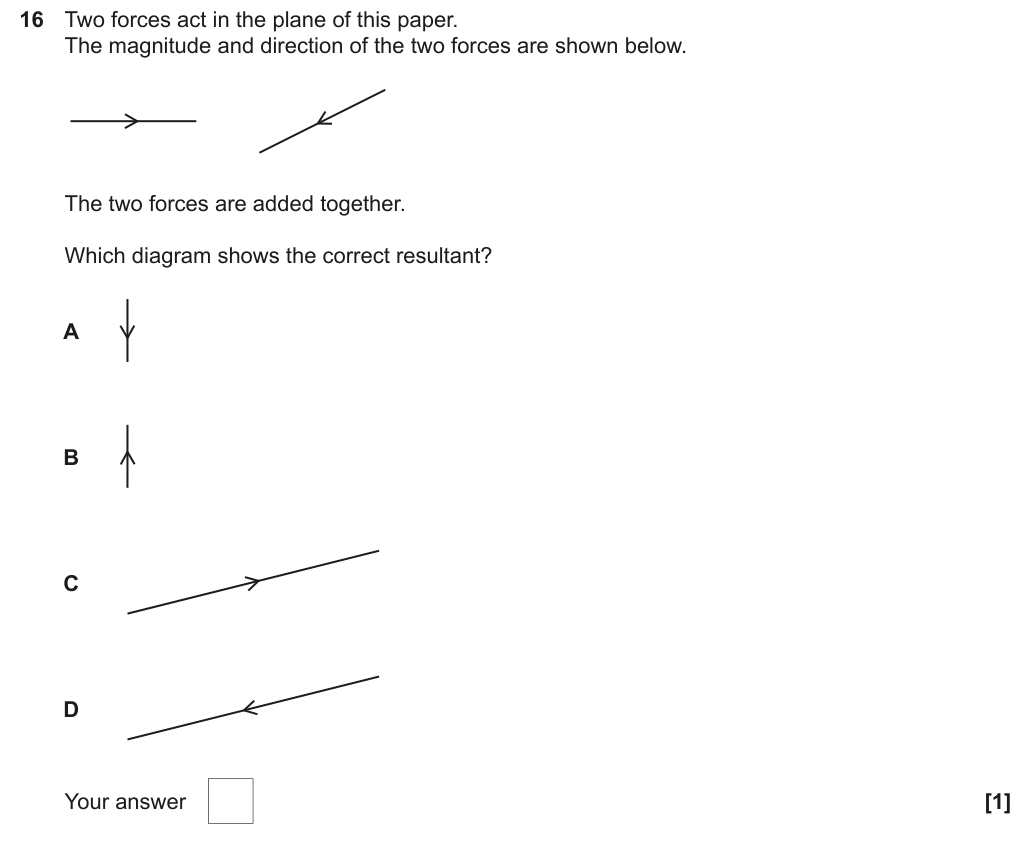
The question requires knowledge and understanding of the forces acting on the ball in flight and resultant force. The path of the ball is shown. At X, the ball is travelling in the direction shown by the D arrow. The drag force will be in the opposite direction. Weight is other force acting on the ball – vertically downwards. Vectorially adding the weight and the small drag will produce a resultant in the direction shown by the B arrow. The answer (key) is therefore is B. The most popular distractors were A and D. The right-hand side of the exemplar has the jottings of a candidate and it does help to visualise the problem. This would certainly not qualify as an acceptable answer in Section B, but here, it demonstrates excellent technique; a vertical line for the weight and a slanting line for the drag and both being added to give the dotted line for the resultant force. This matches the arrow B.
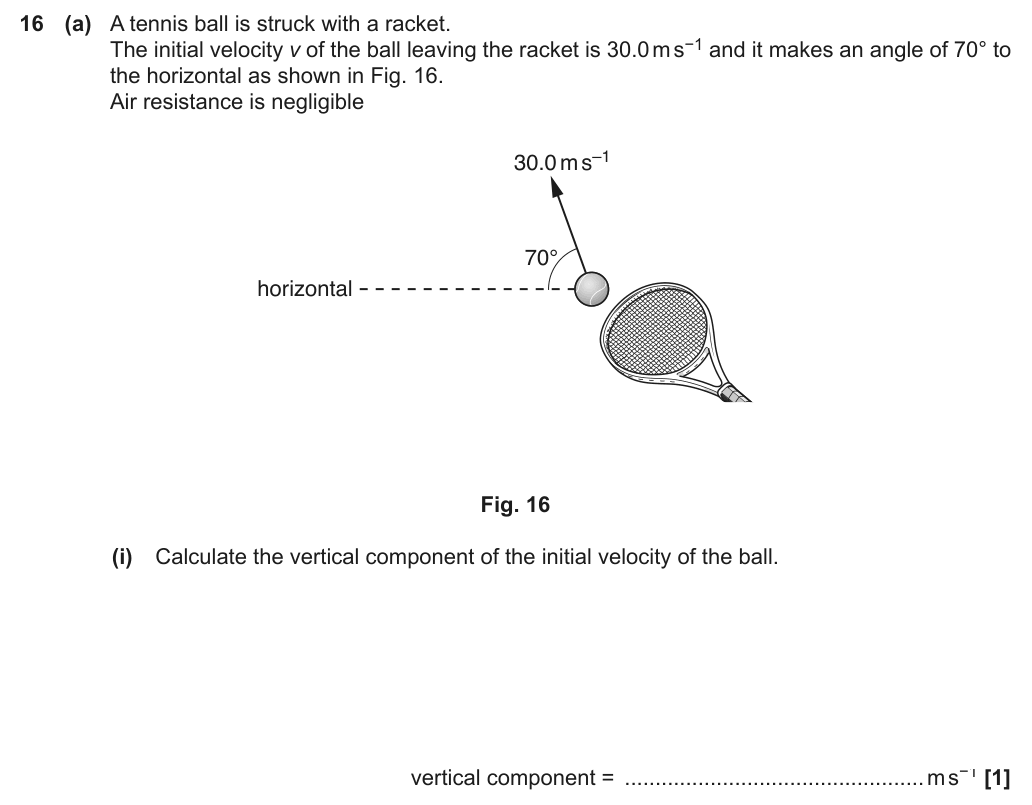
June 2018 · Paper 1 · Q16(a)(i)1 markCalculationEasy
Mark scheme
Examiner's comment
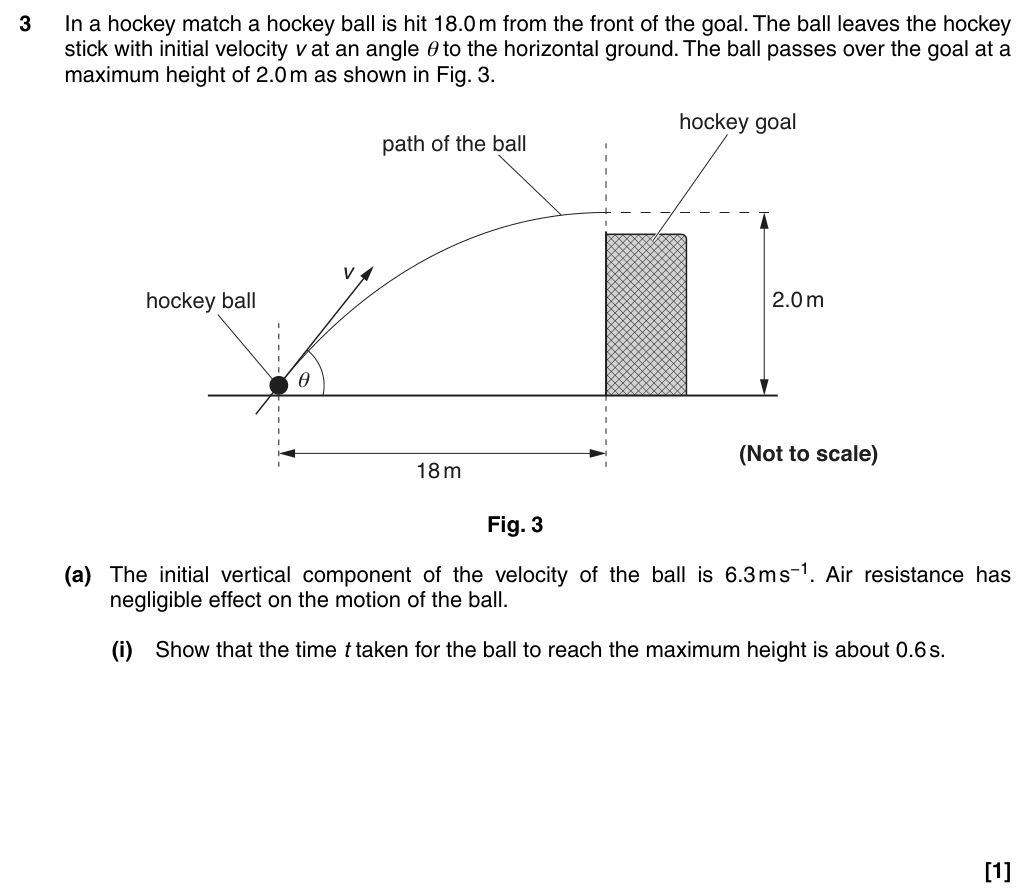
Question 16 (a) (i) Examiners’ report Question 16 (a) (ii) Question 16 (a) (iii) Question 16 (a) (iv) Part (i) was particularly well answered by 95% of all candidates.
Notes from the mark scheme and report
Allow 2 SF answer of 28
Skills: M0.6 Use calculators to handle sin x, cos x and tan x when x is expressed in degrees or radians; M4.5 Use sin, cos and tan in physical problems
June 2018 · Paper 1 · Q16(a)(iv)2 marksCalculationEasy
Earlier part of question 16 that this part uses
Mark scheme
Examiner's comment
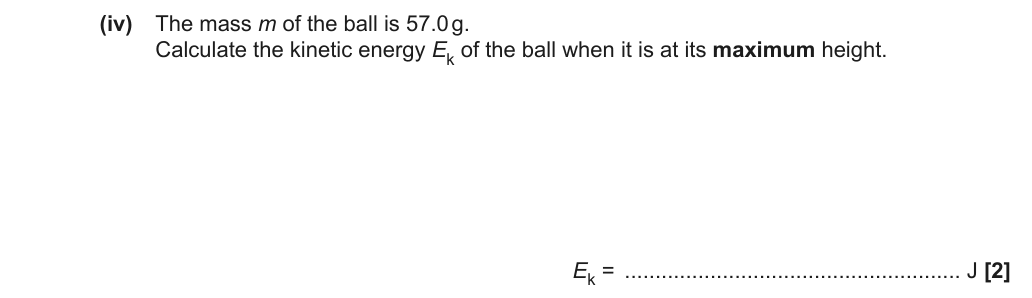
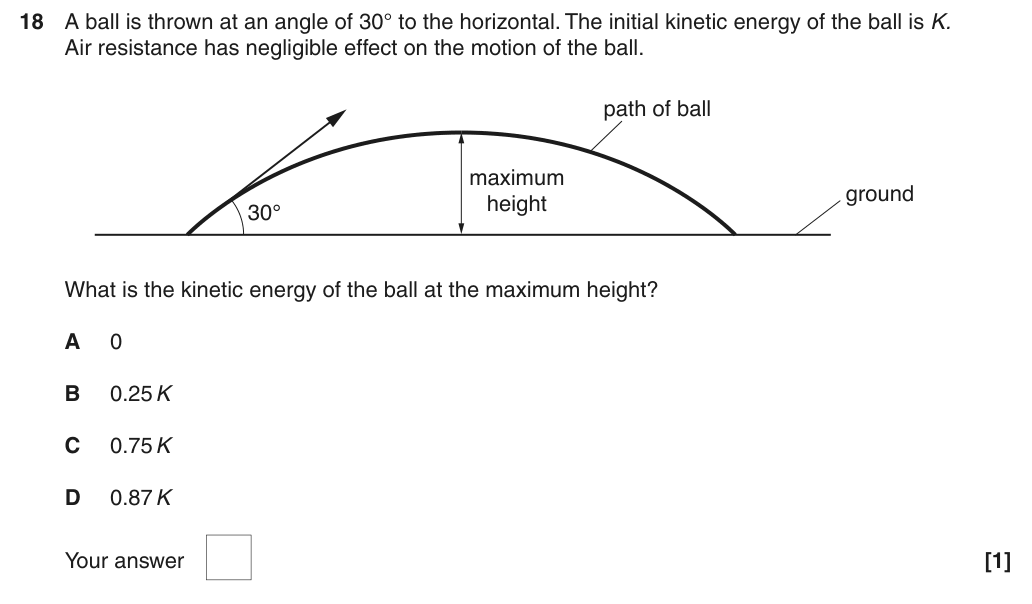
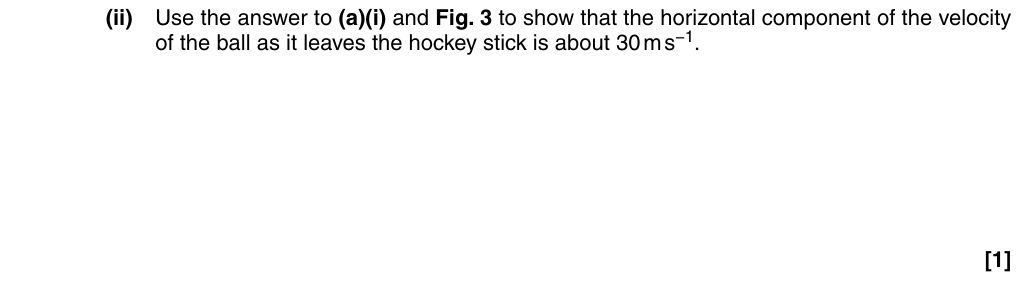
Part (i) was particularly well answered by 95% of all candidates. Nine out of ten candidates scored full marks in part (a)(ii), as they remembered that the question asks to show that the maximum height is around 40m. Working for this type of question is essential. In part (a)(iii), three quarters of all candidates correctly talked about the ball still having a horizontal velocity (which wasn’t zero) and therefore still possessing some KE. The key to this part (a)(iv), remembered by most candidates, was to use the horizontal component of velocity to find the KE at the maximum height. Some used the initial speed and others used the initial vertical velocity component found in part (a)(i).
Notes from the mark scheme and report
NOT 22 J or 23 J (vertical component used)
NOT 140 J (v = 70 used)
Allow 1 SF answer
Skills: M0.1 Recognise and make use of appropriate units in calculations; M0.6 Use calculators to handle sin x, cos x and tan x when x is expressed in degrees or radians; M2.3 Substitute numerical values into algebraic equations using appropriate units for physical quantities
June 2018 · Paper 1 · Q17(c)(i)2 marksExplanationMedium
Mark scheme
Examiner's comment
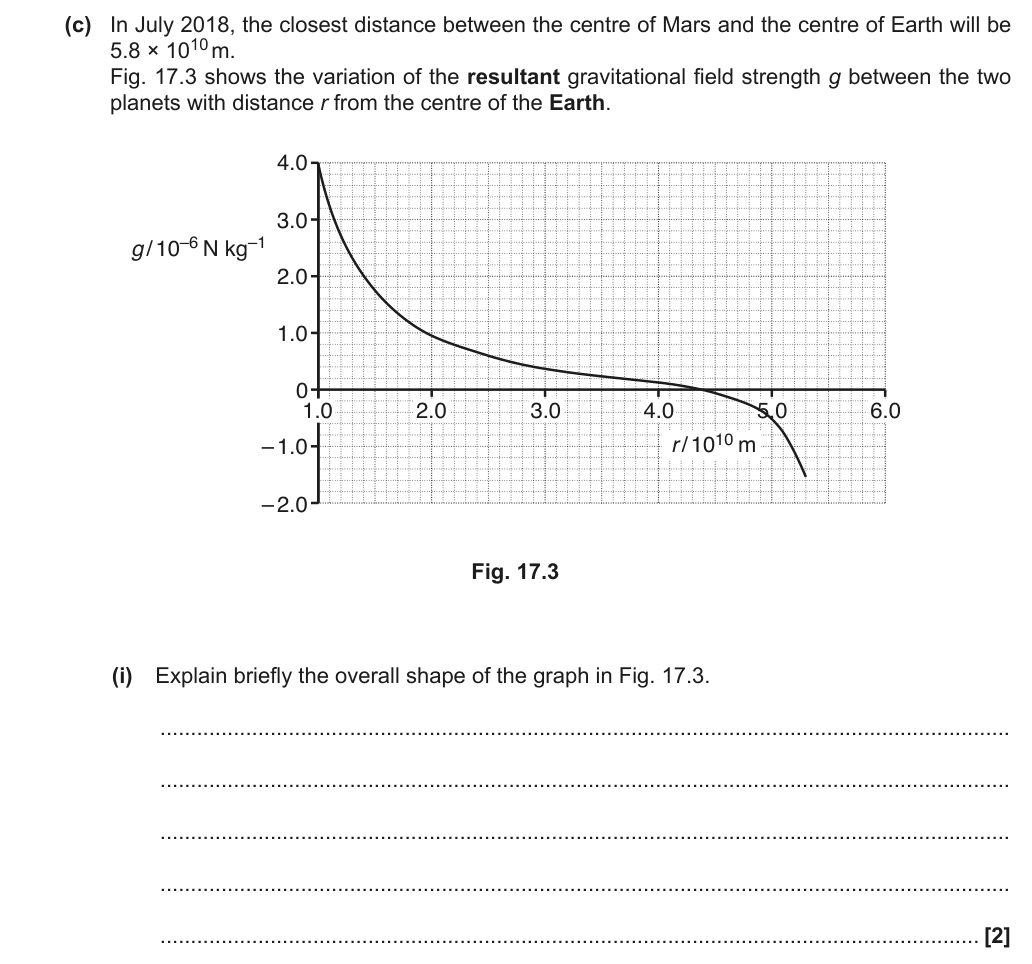
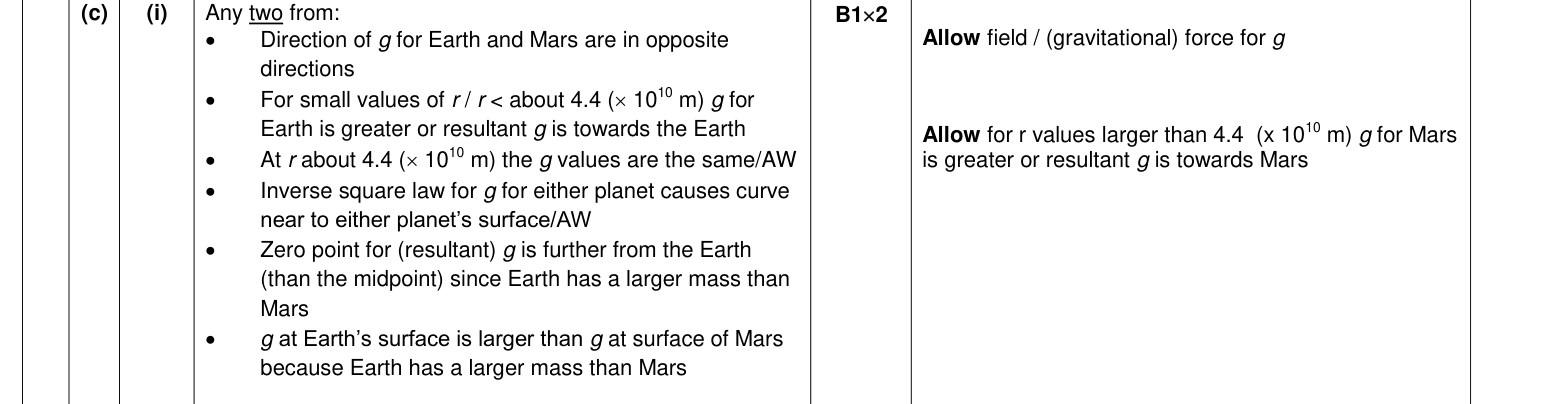
Most candidates mis-read the question and tried to describe the shape of the curve, rather than explain why the curve has that shape. Many candidates also mis-used the term ‘exponential’ to describe a curve that is related to 1/r2. Others thought that the graph showed the effect of Mars and the Earth on each other, rather than on a small mass between them. They went on to describe what happened when Mars and Earth were separated by an increasingly large distance. It is good practice to be specific about which section of the graph you are talking about. ‘When r is below 2.0 x 10¹⁰ m’ is much clearer than ‘At the start’. Potential, potential difference, potential energy, field strength and force These terms are all very similar yet subtly different and with differing formula. Be careful you know which is which.
Notes from the mark scheme and report
fields of Earth and Mars are in opposite directions
zero point is nearer Mars because Earth has the larger mass
Skills: M3.1 Translate information between graphical, numerical and algebraic forms
June 2018 · AS Paper 1 · Q21(b)(ii)2 marksCalculation
Earlier part of question 21 that this part uses
Mark scheme
Notes from the mark scheme and report
using tan⁻¹(2.07/9.81) is wrong physics
allow 1 mark for 78
ecf from (b)(i)
Skills: M0.6 Use calculators to handle sin x, cos x and tan x when x is expressed in degrees or radians; M2.2 Change the subject of an equation, including non-linear equations; M4.5 Use sin, cos and tan in physical problems
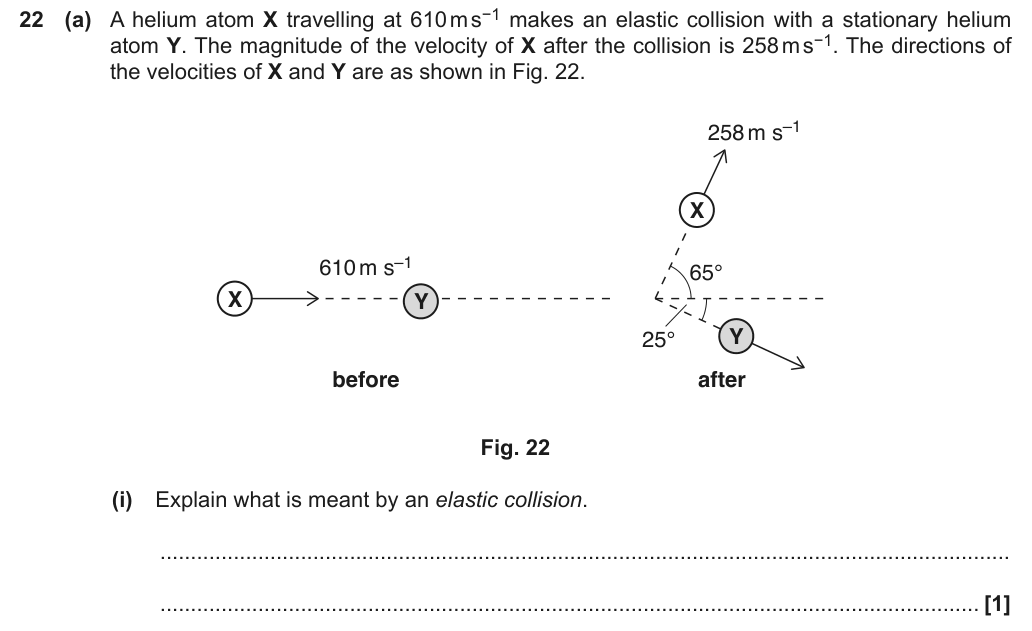
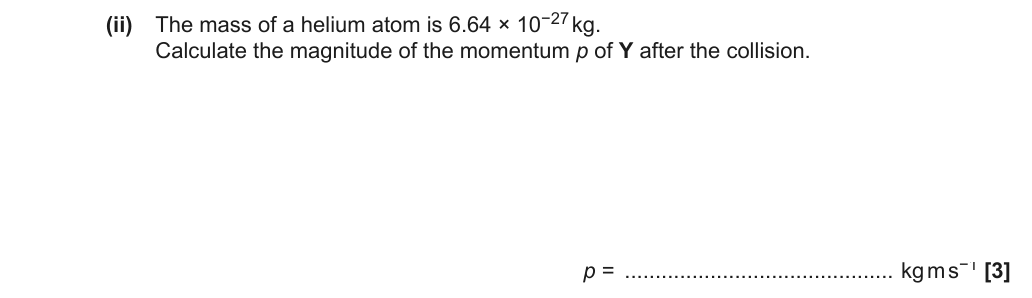
June 2018 · Paper 1 · Q22(a)(ii)3 marksCalculationEasy
Earlier part of question 22 that this part uses
Mark scheme
Examiner's comment
Most candidates correctly remembered that an elastic collision is one in which KE is conserved. In this series, it was acceptable to refer to ‘no loss of KE’. Using the idea that the KE was conserved would have made calculating the velocity of particle Y straightforward. Most candidates preferred a conservation of momentum approach, which of course still works. Many candidates remembered that momentum is conserved in both the x- and y-directions independently and consideration of either was enough. Some candidates forgot that trigonometry was necessary to complete this step, or made errors with which of sine or cosine was required.
Notes from the mark scheme and report
conservation of momentum in x or y direction (or conservation of KE)
Skills: M0.6 Use calculators to handle sin x, cos x and tan x when x is expressed in degrees or radians; M2.3 Substitute numerical values into algebraic equations using appropriate units for physical quantities; M4.5 Use sin, cos and tan in physical problems
June 2018 · AS Paper 1 · Q22(b)2 marksDiagram or graphHard
Earlier part of question 22 that this part uses
Mark scheme
Examiner's comment
Question 22(a) Question 22(b) Question 22(c) This question was good discriminator, where the top-end candidates could demonstrate their powers of analysis.
Notes from the mark scheme and report
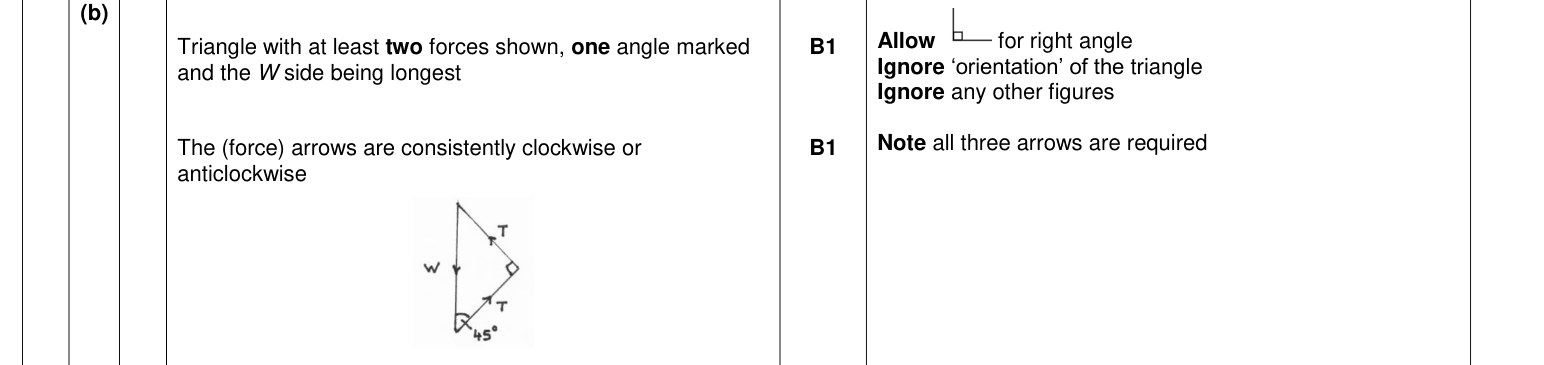
W side must be longest with one angle marked
all three arrows consistently clockwise or anticlockwise
Skills: M4.2 Visualise and represent 2D and 3D forms, including two-dimensional representations of 3D objects
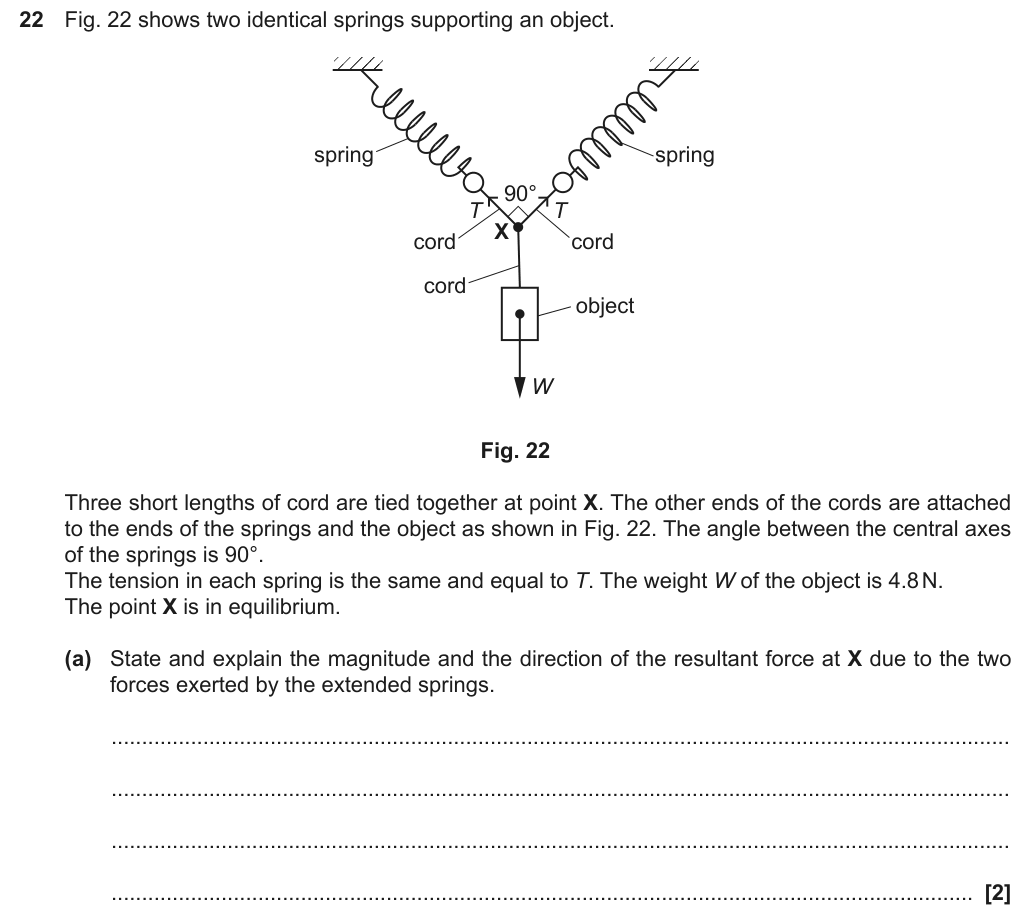
June 2018 · AS Paper 1 · Q22(c)2 marksShow thatHard
Earlier part of question 22 that this part uses
Mark scheme
Examiner's comment
This question was good discriminator, where the top-end candidates could demonstrate their powers of analysis. The success in (c) was very much dependent on a well-annotated triangle of forces in (b). Most triangle of forces were workable but lacked detail. Missing labels and incorrect direction of the force arrows were the main misdemeanours. As expected, candidates used a range of methods to show the force in the extended spring was 3.4 N. In order of popularity, the techniques were using Pythagoras’ theorem, using trigonometry, resolving forces in the vertical direction and sine (or cosine) rule. It is sensible to show the final answer to more significant figures than required in a ‘show’ question. This exemplar illustrates a flawless answer from a top-end candidate. The triangle of forces of perfect – all labels clear and the pivotal angle 90° between the two tensions marked. The calculation in (c) makes an excellent use of this triangle to show that the force is 3.39 N and hence 3.4 N. Contrast the above excellent solution with the exemplar shown below from a grade C candidate. The triangle of forces in (b) is simply not right. However, in (c), the analysis is correct and shows another plausible method for securing the 2 marks. Again, it is good to see the penultimate value for the force given to more than two significant figures.
Notes from the mark scheme and report
T must be given to at least 3 SF (3.39)
Skills: M0.6 Use calculators to handle sin x, cos x and tan x when x is expressed in degrees or radians; M4.4 Use Pythagoras’ theorem, and the angle sum of a triangle; M4.5 Use sin, cos and tan in physical problems
June 2018 · AS Paper 2 · Q4(a)4 marksShow thatEasy
Mark scheme
Examiner's comment
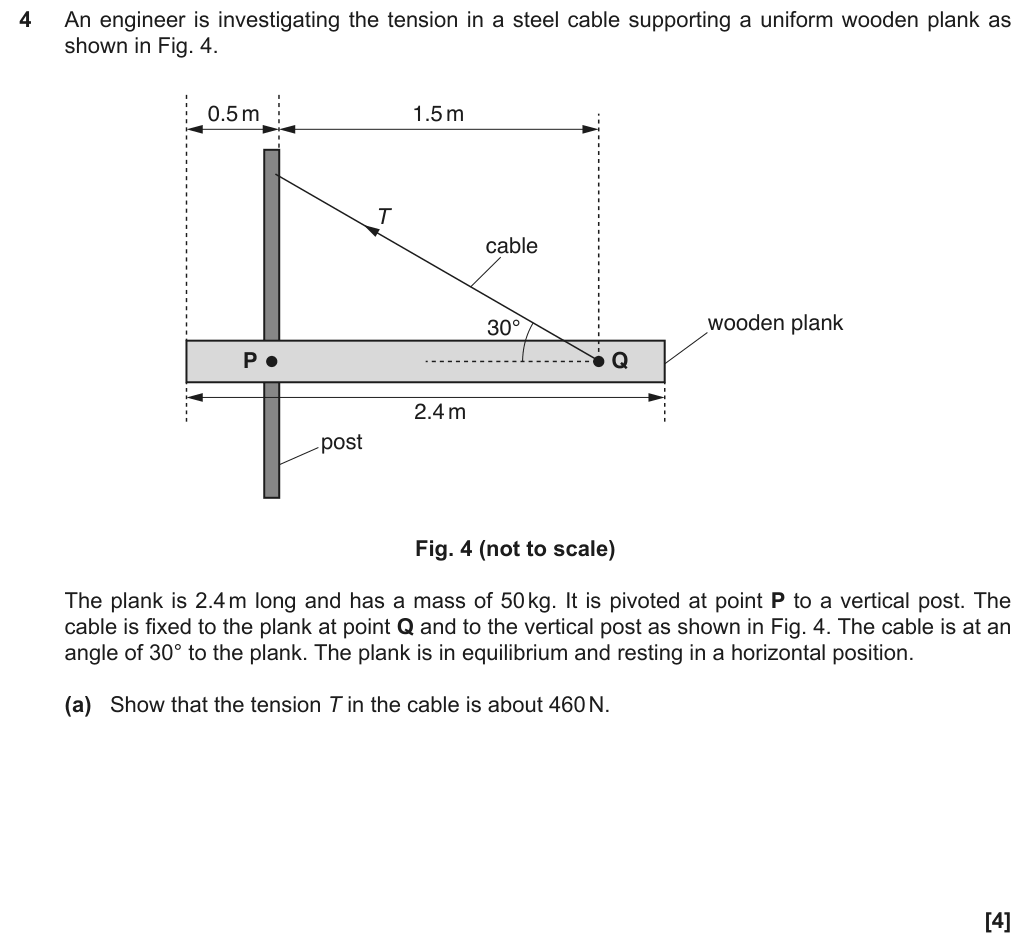
This question was a “show” type question where candidates needed to show that the tension in the cable was about 460 N. Ideally in these type of questions, candidates should have shown their working logically and gained answer of 457.8 (N). Most candidates scored a mark for determining the weight of the beam. Good candidates clearly showed their working. Good candidates stated the principle of moments, indicated how the clockwise moment would be determined, indicated how the anticlockwise moment would be determined and gave an answer of 457.8 (N). To determine the anticlockwise moment candidates needed to resolve the tension T into its vertical component – both Tsin30° and Tcos60° were acceptable. In this exemplar the candidate has clearly shown the working to answer the question. Initially the candidate has calculated the clockwise moment by multiplying the force (mass of 50 (kg) by 9.81) by 0.7 (m). This gains two marks. The candidate’s answer could have better if the candidate had written on the left-hand side “clockwise moment” rather than “m”, however, it is implicit from the candidate’s working the meaning of “m”. The candidate has then clearly shown that the anticlockwise moment is equal to the clockwise moment and determined correctly the perpendicular force or vertical force. The candidate then correctly relates the force T to sin 30° and the vertical force and evaluates the answer as 457.8 N before indicating that this is approximately 460 N. Including the 457.8 is appropriate in these type of show questions.
Notes from the mark scheme and report
weight acts 0.7 m from P
Allow T cos 60° x 1.5
Skills: M0.6 Use calculators to handle sin x, cos x and tan x when x is expressed in degrees or radians; M2.3 Substitute numerical values into algebraic equations using appropriate units for physical quantities; M4.5 Use sin, cos and tan in physical problems
June 2017 · AS Paper 1 · Q41 markMultiple choice
Answer
C
Mark scheme
June 2017 · Paper 1 · Q81 markMultiple choice
Answer
D
Mark scheme
June 2017 · AS Paper 2 · Q1(b)(iii)2 marksExplanation
Earlier parts of question 1 that this part uses
Mark scheme
Notes from the mark scheme and report
NOT gravity will slow it down
NOT down / parallel alone for the component of weight
June 2017 · Paper 2 · Q20(c)(ii)3 marksShow that
Earlier part of question 20 that this part uses
Mark scheme
Notes from the mark scheme and report
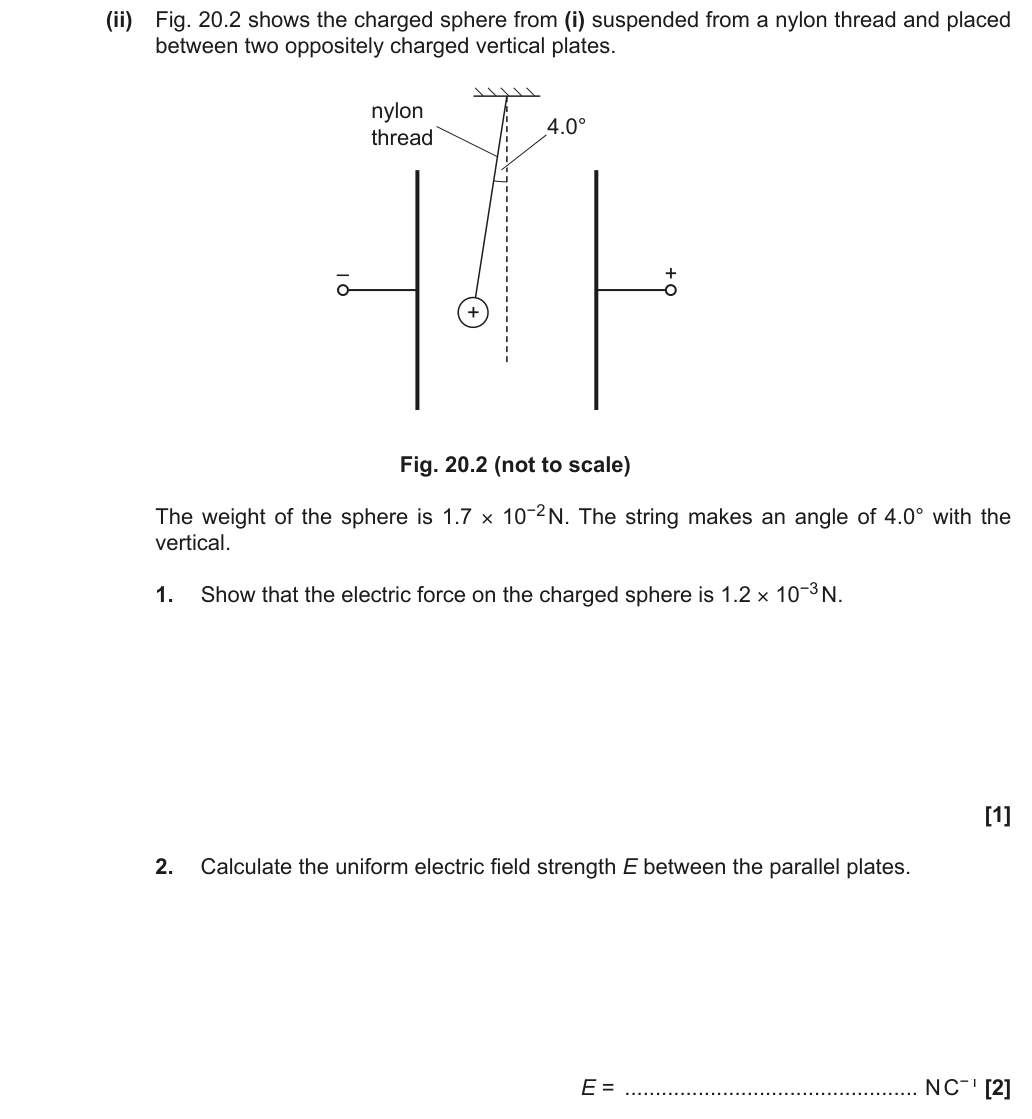
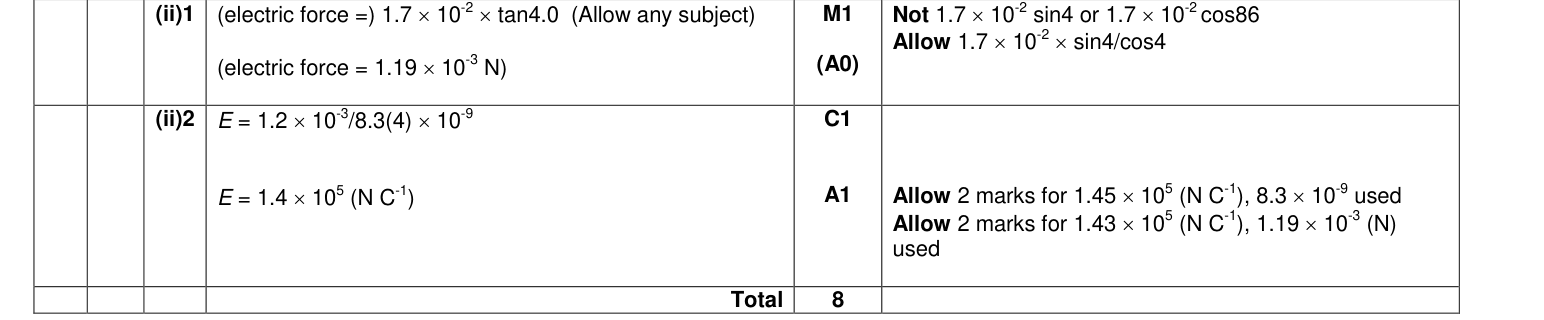
two sub-parts (1, 2 marks)
force = weight x tan 4.0
NOT weight x sin 4 or cos 86
Skills: M0.6 Use calculators to handle sin x, cos x and tan x when x is expressed in degrees or radians; M2.3 Substitute numerical values into algebraic equations using appropriate units for physical quantities; M4.5 Use sin, cos and tan in physical problems
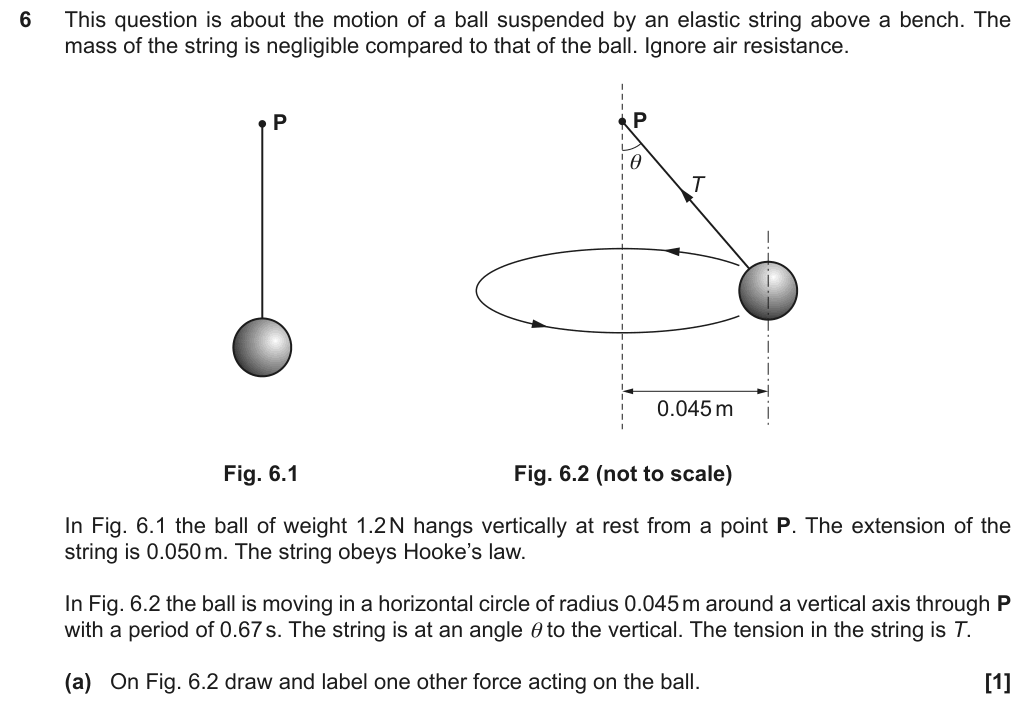
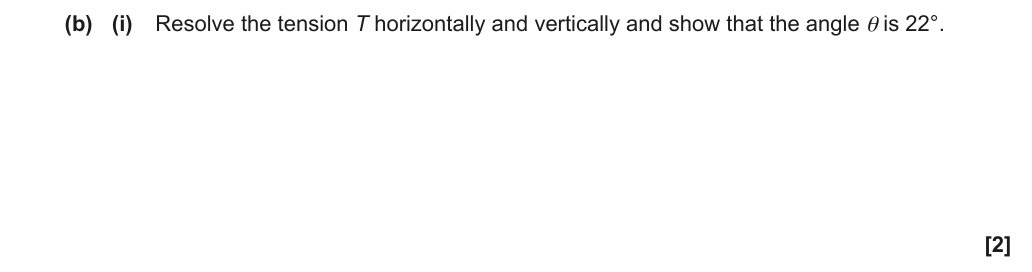
June 2017 · Paper 3 · Q6(b)(i)2 marksShow that
Earlier part of question 6 that this part uses
Mark scheme
Notes from the mark scheme and report
show-that: enough calculation needed to show the candidate has not worked back from 22°
Skills: M0.6 Use calculators to handle sin x, cos x and tan x when x is expressed in degrees or radians; M2.2 Change the subject of an equation, including non-linear equations; M4.5 Use sin, cos and tan in physical problems
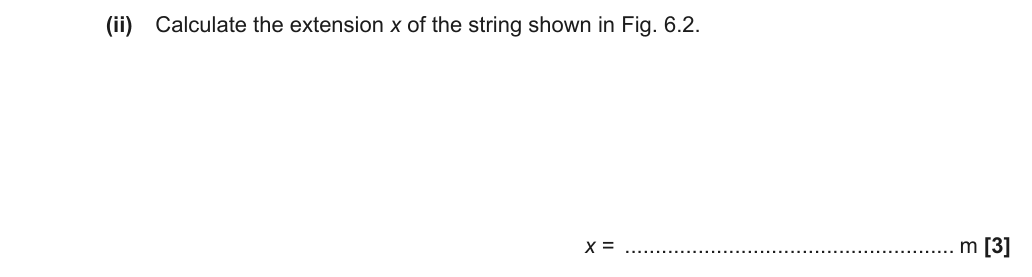
June 2017 · Paper 3 · Q6(b)(ii)3 marksCalculation
Earlier parts of question 6 that this part uses
Mark scheme
Notes from the mark scheme and report
or solution by ratios
Skills: M0.6 Use calculators to handle sin x, cos x and tan x when x is expressed in degrees or radians; M2.3 Substitute numerical values into algebraic equations using appropriate units for physical quantities
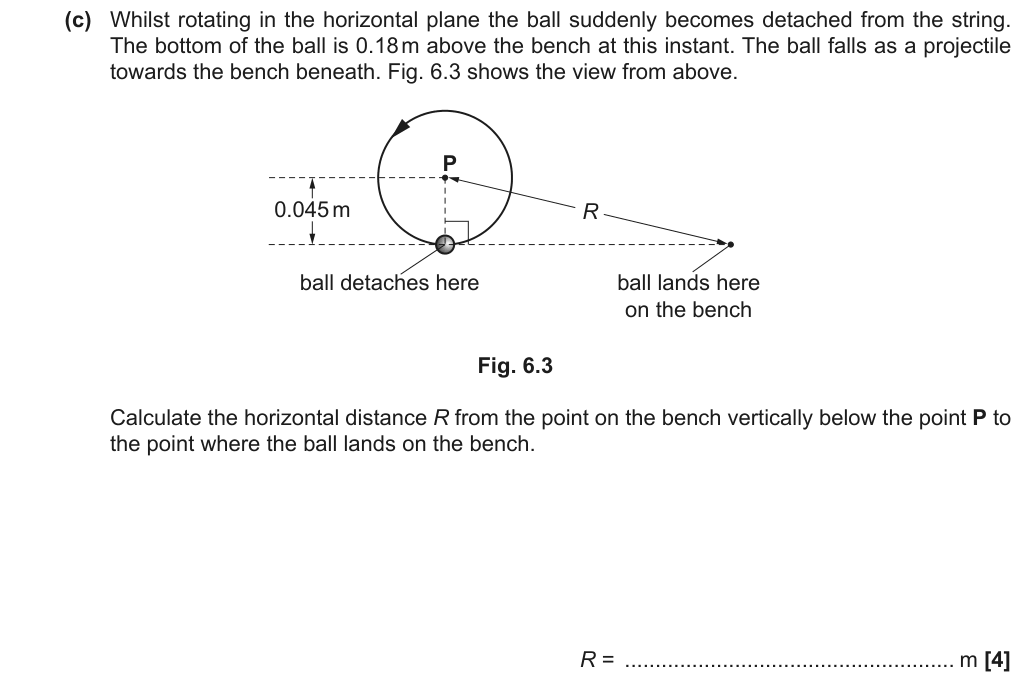
June 2017 · Paper 3 · Q6(c)4 marksCalculation
Earlier part of question 6 that this part uses
Mark scheme
Notes from the mark scheme and report
Pythagoras with r = 0.045 m needed for the final answer
ecf (b)(i) for v
Skills: M2.3 Substitute numerical values into algebraic equations using appropriate units for physical quantities; M4.4 Use Pythagoras’ theorem, and the angle sum of a triangle
June 2016 · AS Paper 1 · Q181 markMultiple choice
Answer
C
Mark scheme
June 2016 · AS Paper 1 · Q21(a)2 marksExplanation
Mark scheme
Notes from the mark scheme and report
Allow 'velocity can be cancelled out'
June 2016 · AS Paper 2 · Q3(a)(iii)2 marksCalculation
Earlier parts of question 3 that this part uses
Mark scheme
Notes from the mark scheme and report
940 scores one mark (square root omitted)
allow trigonometry methods
Skills: M4.4 Use Pythagoras’ theorem, and the angle sum of a triangle
Work with an OCR physics tutor
Dropping marks on calculations, practical questions or the six-mark level of response questions? Book a trial session with a specialist OCR physics tutor.