Answer
D
Mark scheme

Examiner's comment
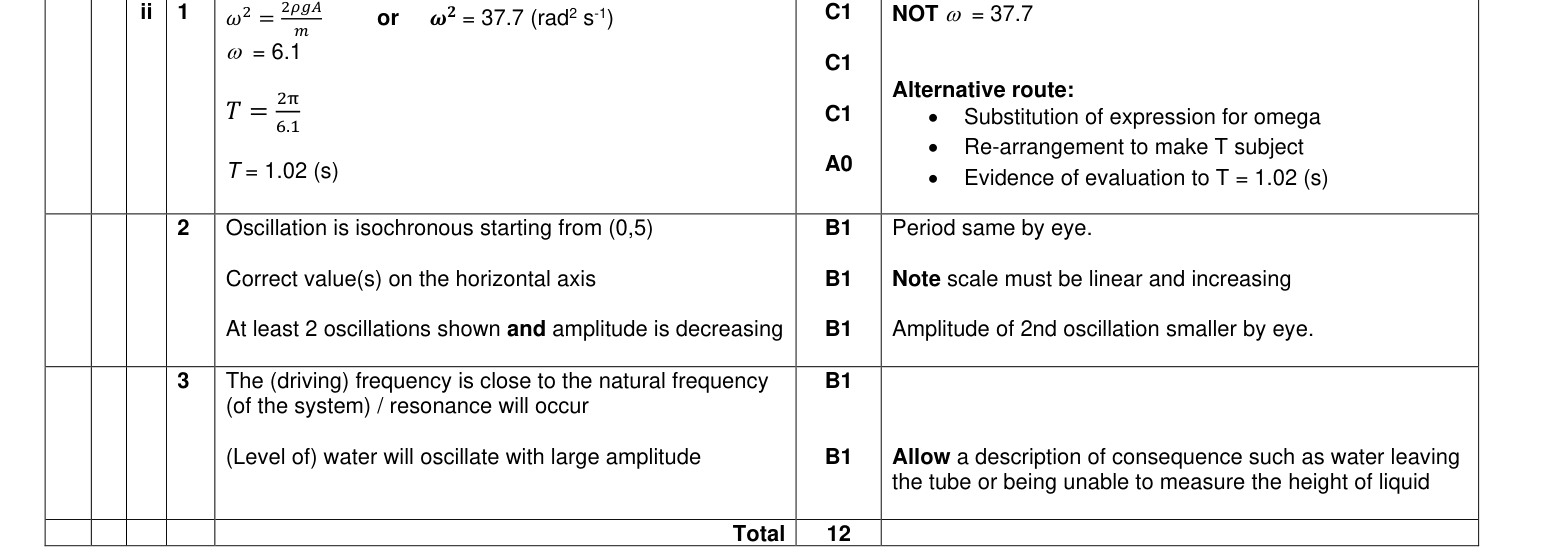
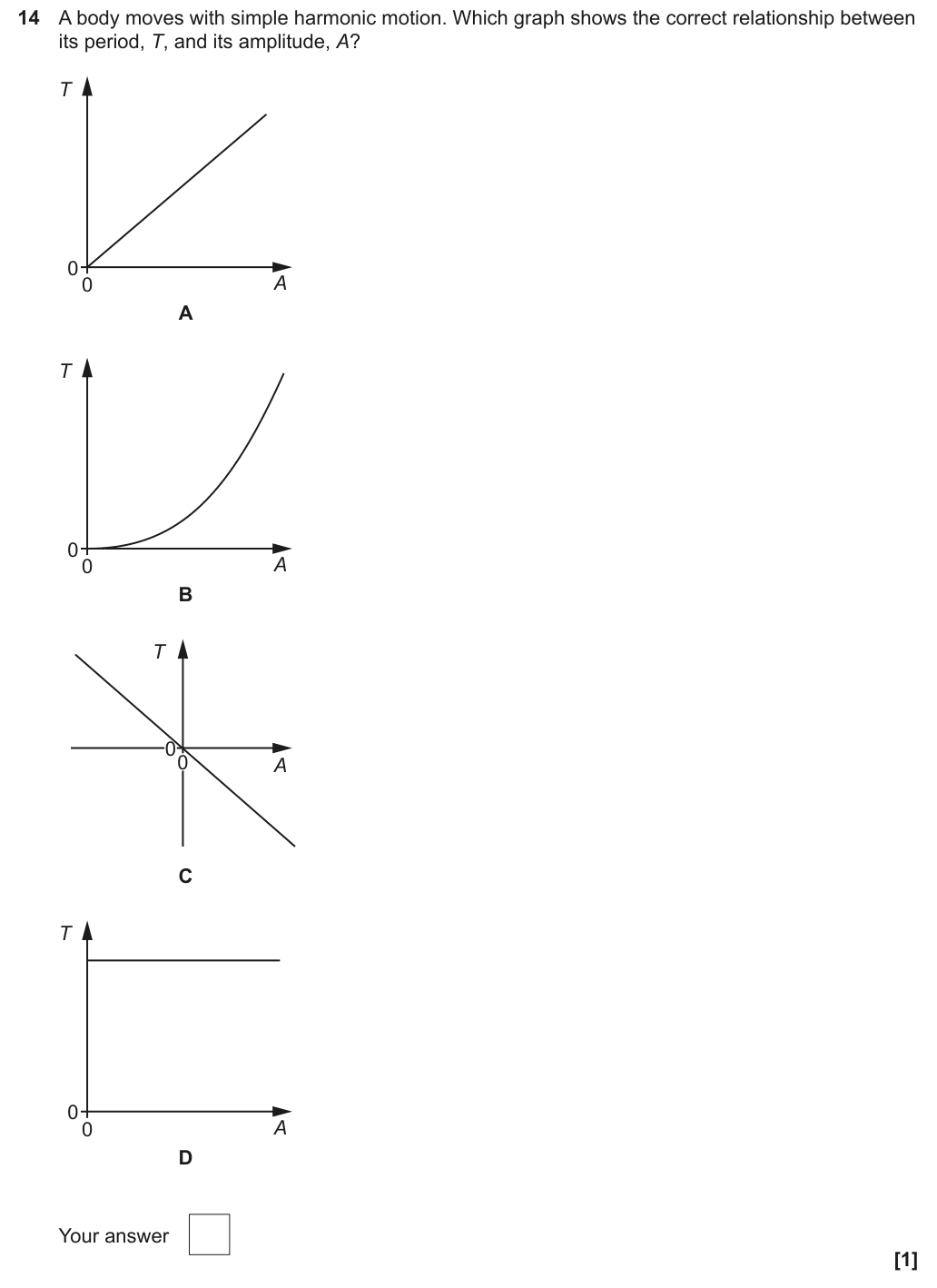
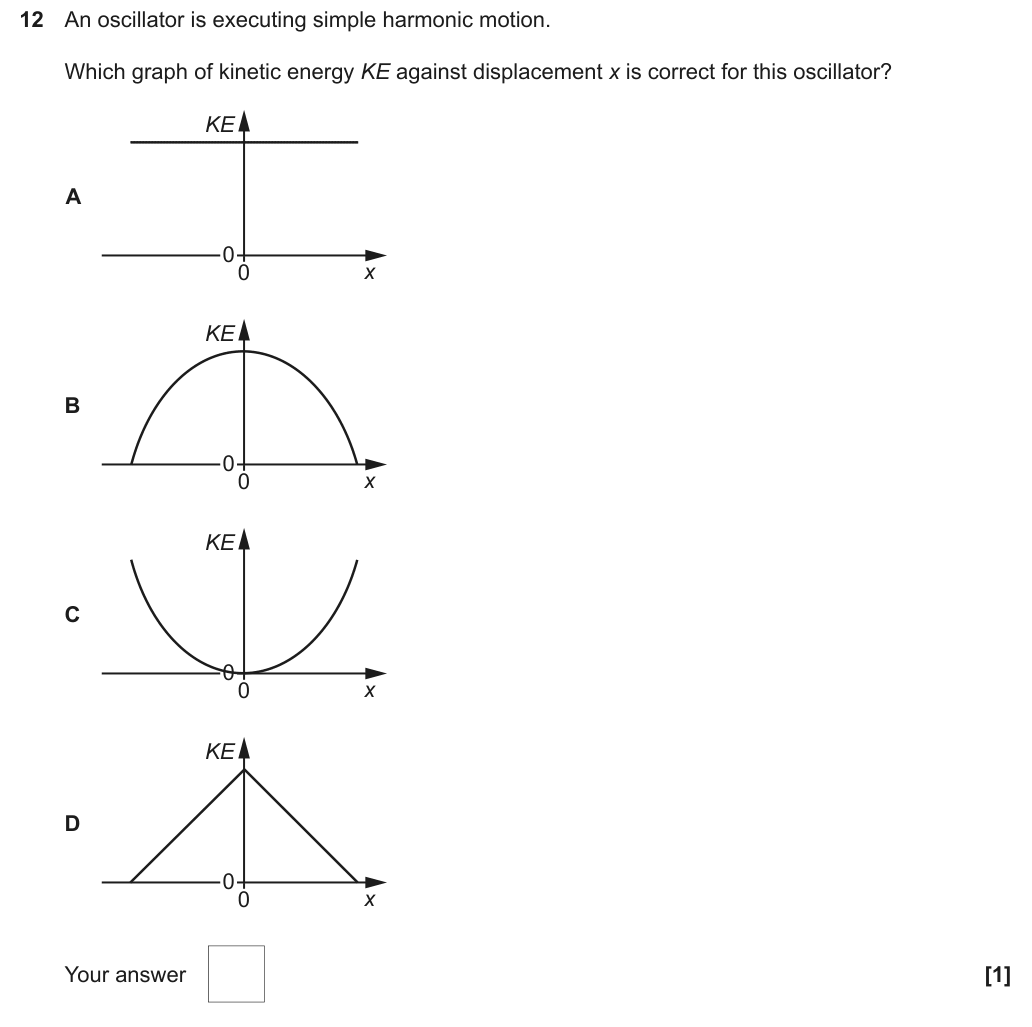
Any object performing simple harmonic motion is isochronous, which means that the period is independent of the amplitude of motion. The only graph that shows this is graph D.
Notes and key-term cards for this topic are being written by our tutors. The past-paper questions below are ready now.
| Series | Paper | Q | What it asks |
|---|---|---|---|
| June 2025 | Paper 1 | 18(c) | Two designs, A and B, of the machine are tested in a large ripple tank. • Describe how the amplitude of the machine could be measured at each frequency tested. |
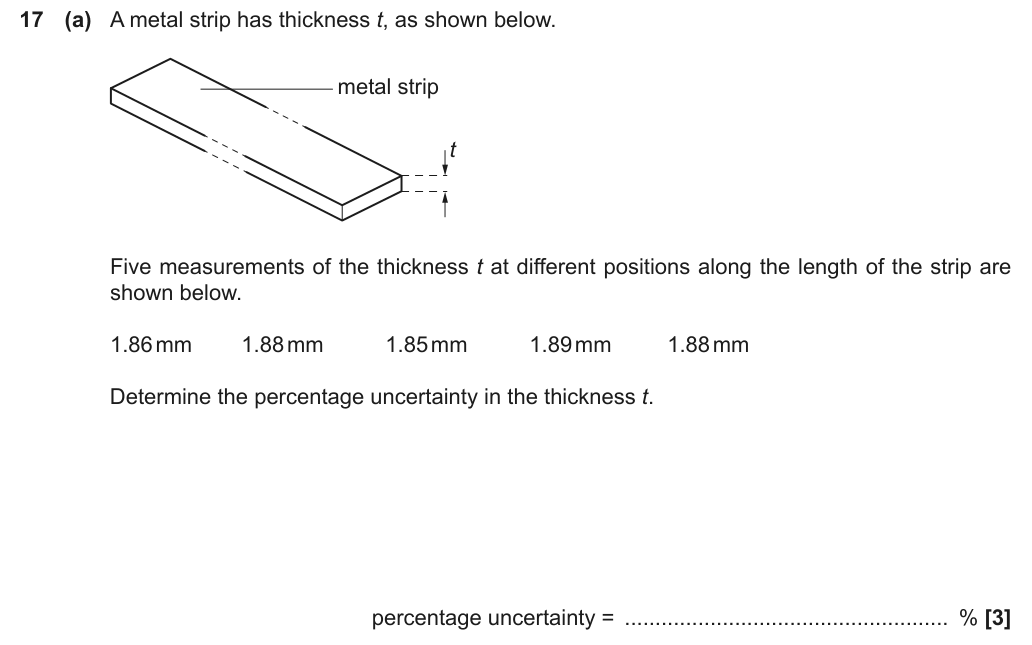
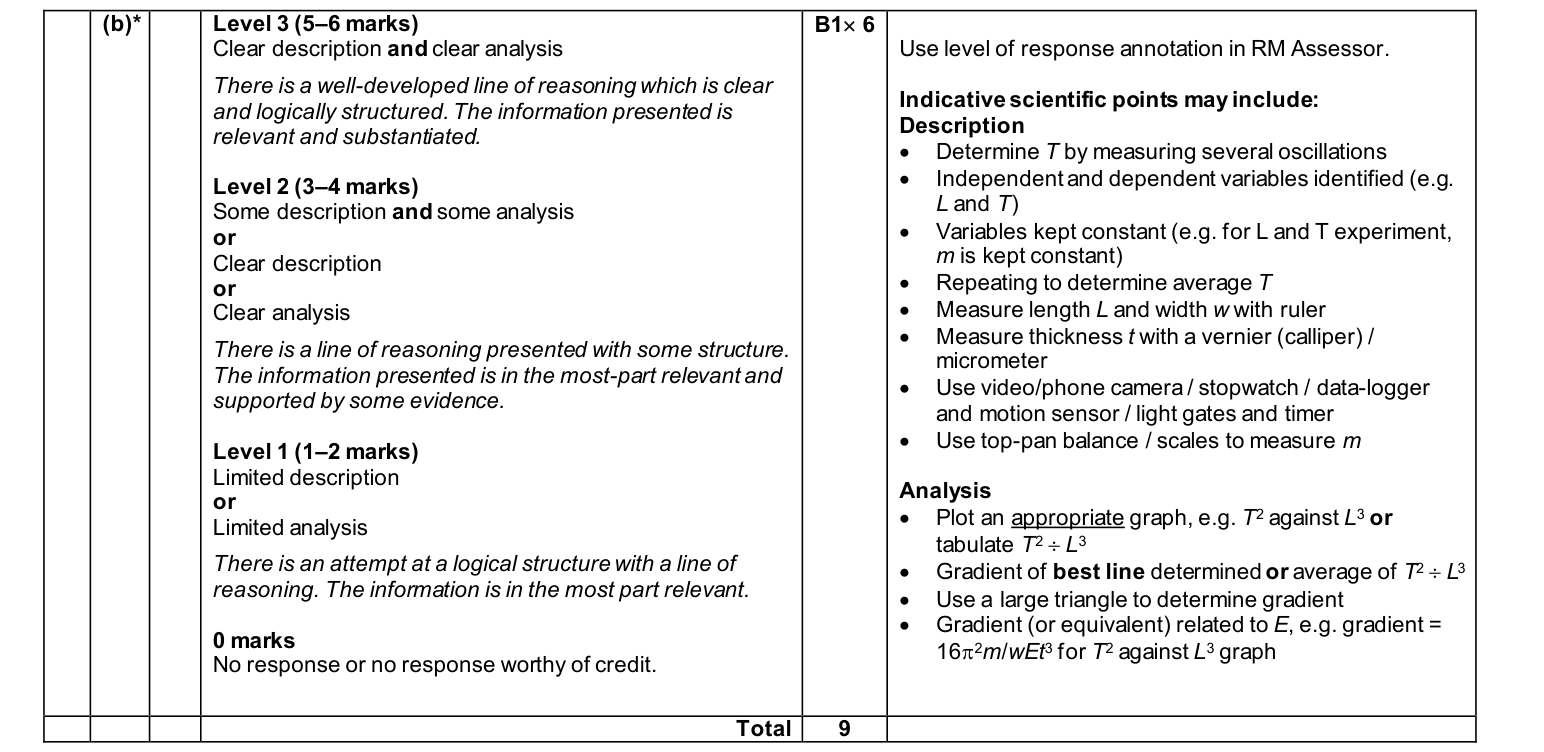
| November 2021 | Paper 1 | 17(b) | A student wants to determine the Young modulus E of the metal of the strip in (a). Describe how an experiment may be safely conducted, and how the data can be analysed to |
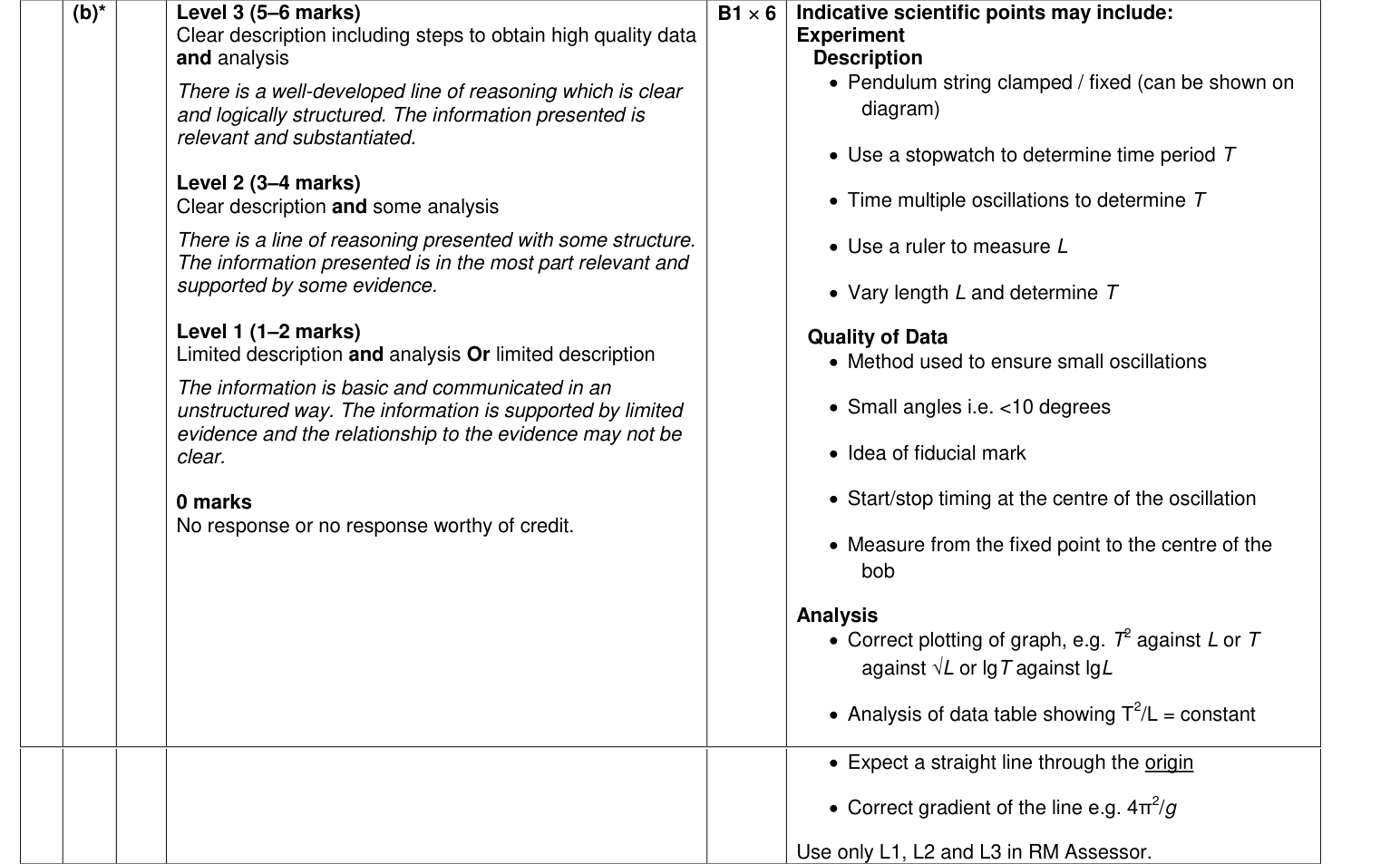
| June 2017 | Paper 1 | 19(b) | Describe with the aid of a labelled diagram how an experiment can be conducted and how |
D
Any object performing simple harmonic motion is isochronous, which means that the period is independent of the amplitude of motion. The only graph that shows this is graph D.
Successful candidates related the conditions for simple harmonic motion i.e. that the force or acceleration is directly proportional to the displacement and that the force or acceleration is acting towards a fixed point. The idea that the acceleration is opposite to the direction of motion is incorrect. Any reference to ‘negative displacement’ was insufficient – there needed to be an interpretation of what that minus sign meant.
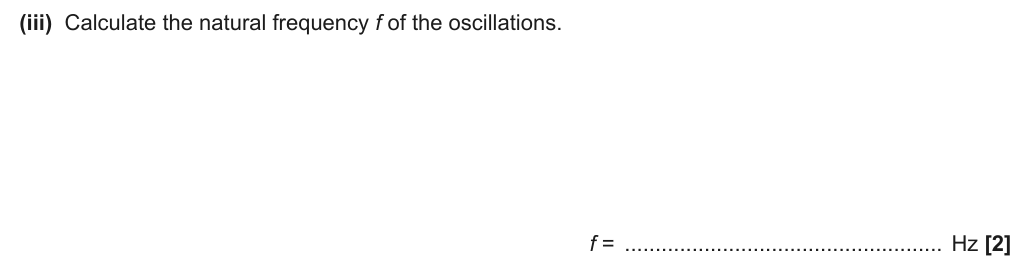
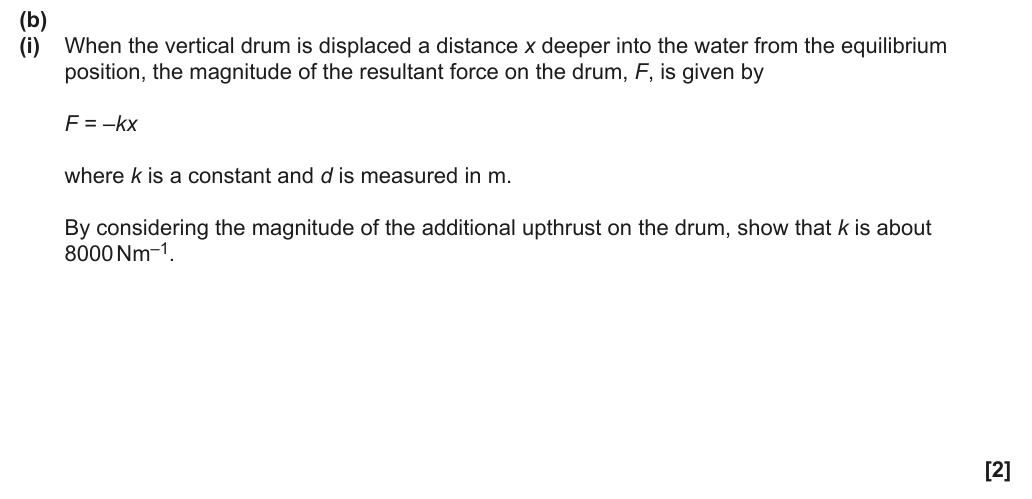
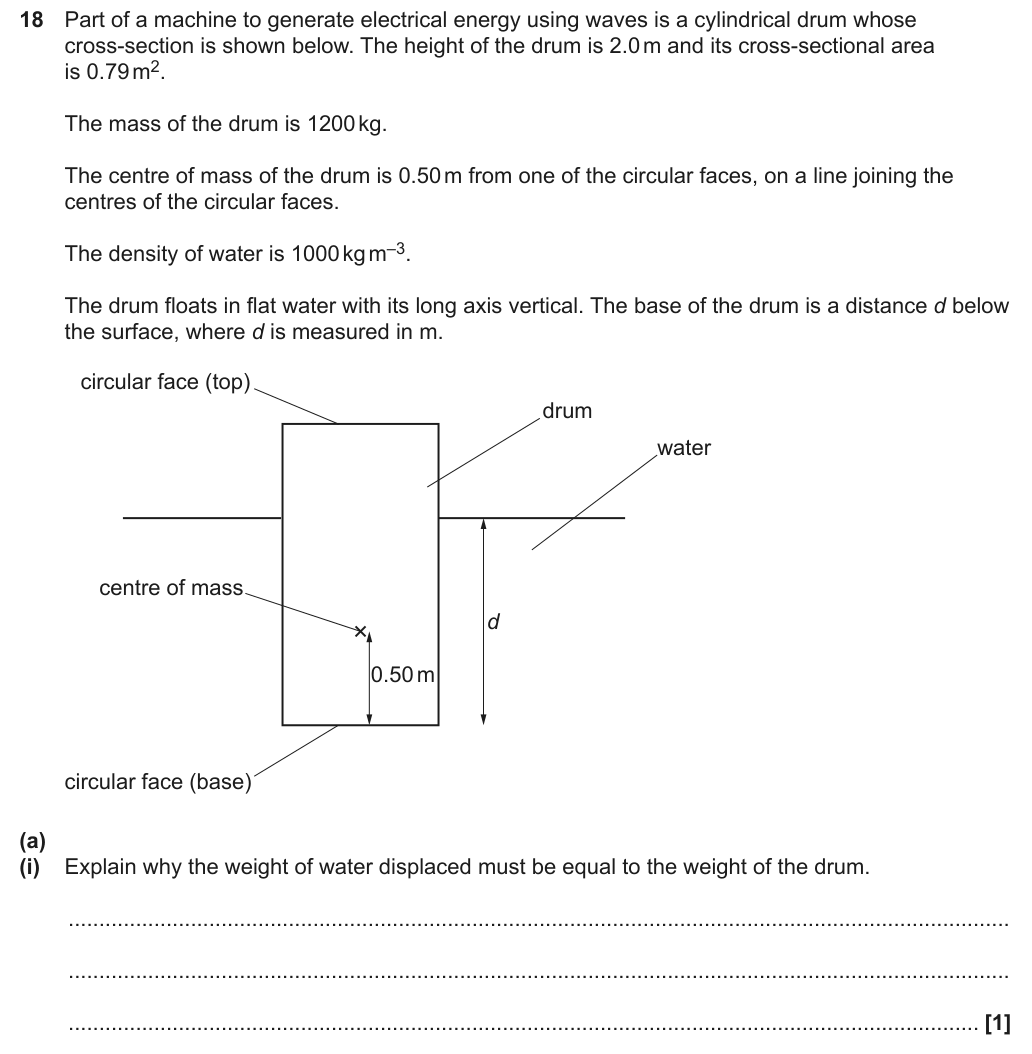
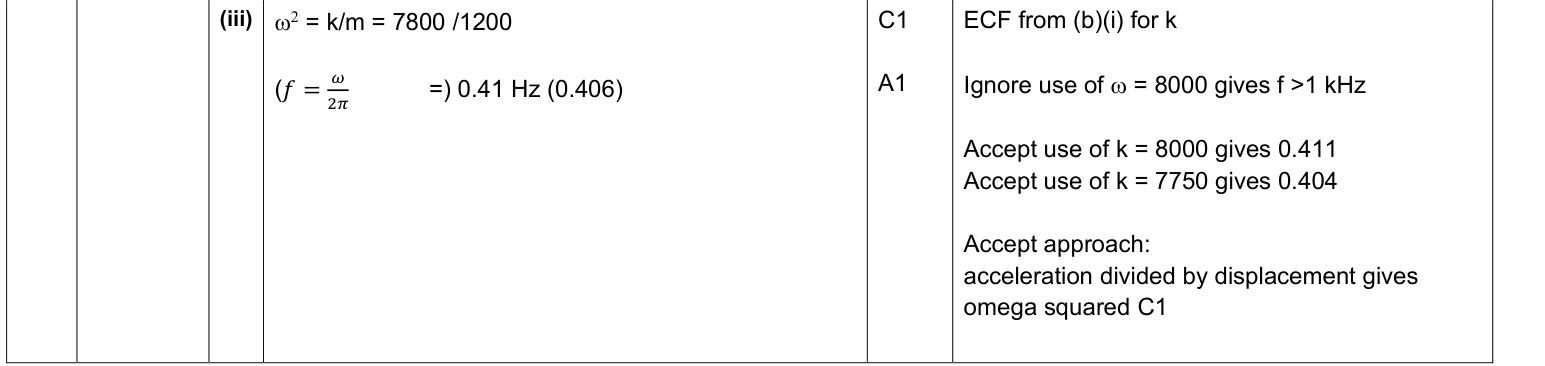
Most candidates completed this calculation correctly. Those who did not did not gain marks for not dividing the value of k by the drum’s mass.
Skills: M2.2 Change the subject of an equation, including non-linear equations; M2.3 Substitute numerical values into algebraic equations using appropriate units for physical quantities
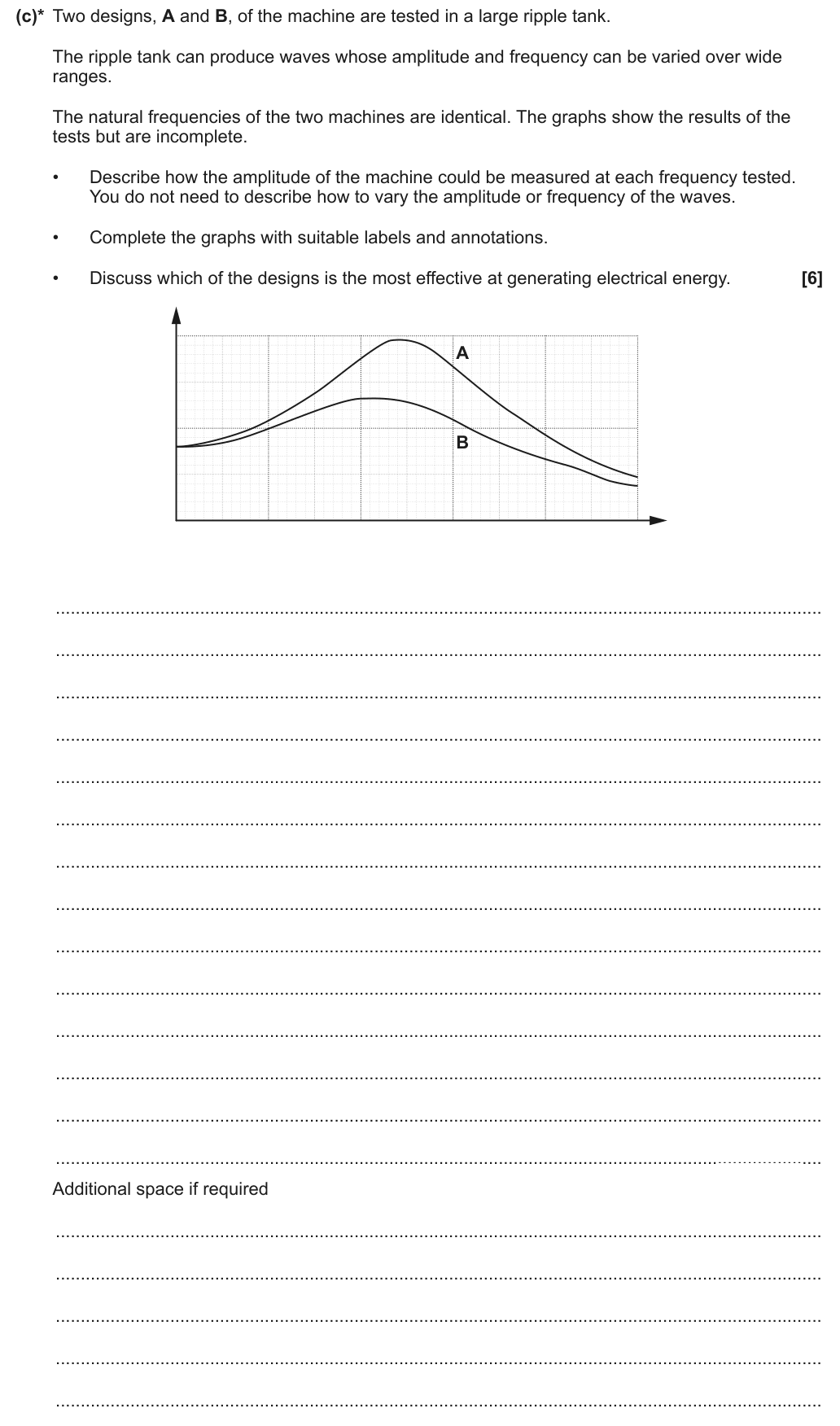
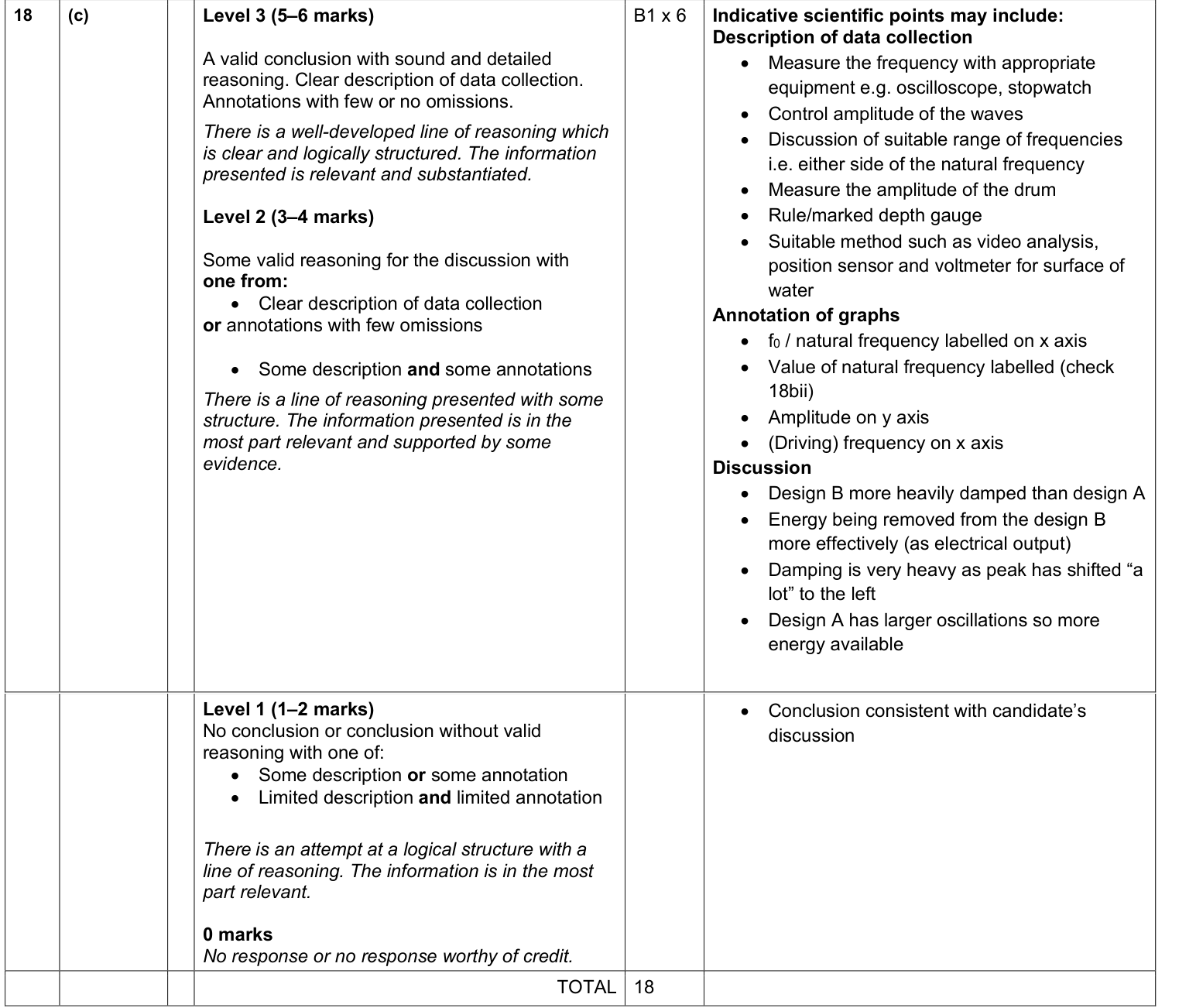
Many candidates gave themselves the best chance of scoring well on this question by ensuring that they attempted responses to each of the three bullet points outlining what to cover. Most candidates kept answers suitably simple by suggesting a vertically mounted ruler and some way of capturing the largest displacement of the wave from the undisturbed water. Finding the speed of the wave horizontally and relating that to the wave’s angular frequency to arrive at the amplitude was incorrect. Those candidates confused the horizontal speed of the wave and maximum vertical speed of particles that made up the wave. Most candidates correctly annotated the graph up to a point – perfection was not required (e.g. there is a distinction between ‘natural’ and ‘resonant’ frequency) yet in some cases labels were contradictory or simply unphysical. The real challenge here was the analysis and interpretation of the graphs. As the mark scheme indicates, there are valid arguments for either design A or design B. Provided that the conclusion was consistent with the candidate’s discussion, either answer was acceptable. This candidate has fulfilled the rubric of the question by completing all three tasks, namely annotating the graph, describing how to find the amplitude and then discussed which of the designs would be most effective. The annotations are clearly imperfect – the x-axis is labelled as power, rather than the crossed-out ‘frequency’. The crossed-out ‘natural frequency’ labels for curves A and B would have been acceptable if they had been ‘resonant’ frequency. The method for the amplitude would work, despite its simplicity. There is an attempt to link the higher amplitude of curve A for all frequencies to a larger power draw although the link isn’t explained in any depth. Overall, this was awarded at the lower end of Level 2. This candidate has made a more complete and accurate attempt at annotating the graph and curves. The method for finding the amplitude of the motion is more sophisticated that in exemplar 1 and would probably yield better quality results. The analysis and discussion uses much more technical language in an organised and logical fashion. The candidate has connected the idea to larger amplitude of motion to a larger induced e.m.f. Overall, this was awarded Level 3, 6 marks.
Skills: M3.1 Translate information between graphical, numerical and algebraic forms; PAG10 Investigating simple harmonic motion
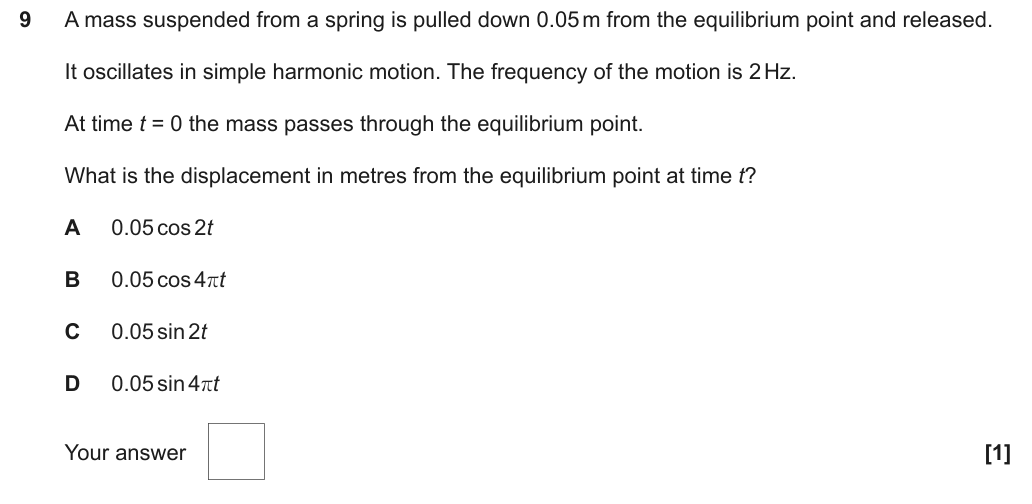
D
Many candidates missed the third line of the question which states that the mass passes through the equilibrium point when t=0. This would indicate the correct function here is sine, rather than cosine. The argument of the function here (the expression inside the brackets) must be omega-t or 2πft. f here is 2 Hz, so the correct expression is 4πt.
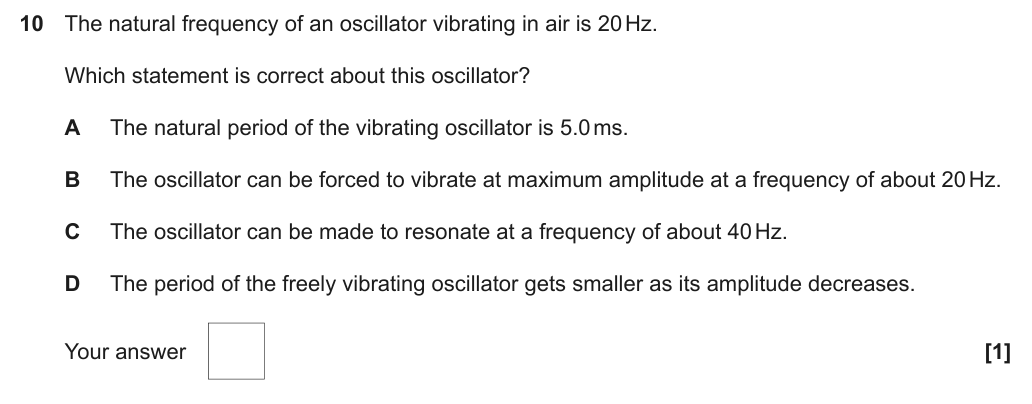
B
Option D is plainly false. Option A here is wrong by a factor of 10, as the correct period is 50 ms. Option C applies to stationary waves not in forced oscillations as in this case.
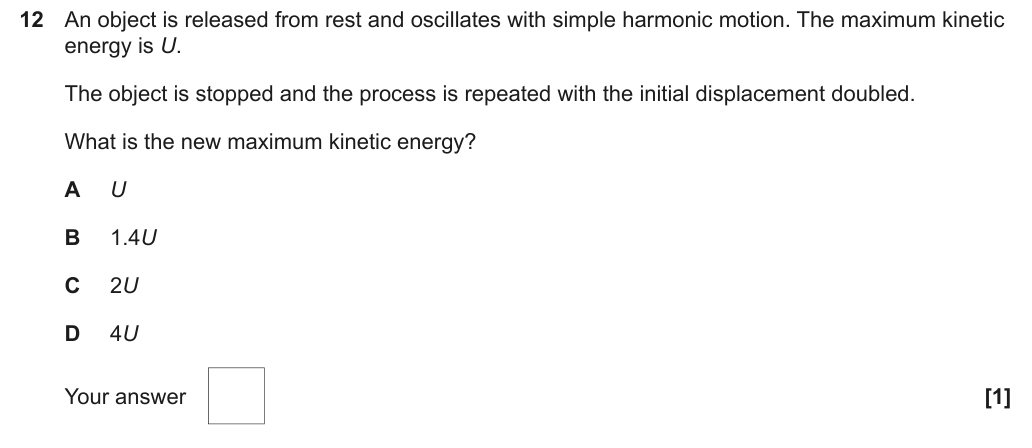
D
When the initial displacement is doubled, then the amplitude and hence maximum speed is also doubled. If the maximum speed is doubles, the maximum KE is quadrupled, since KE = ½ m v2.
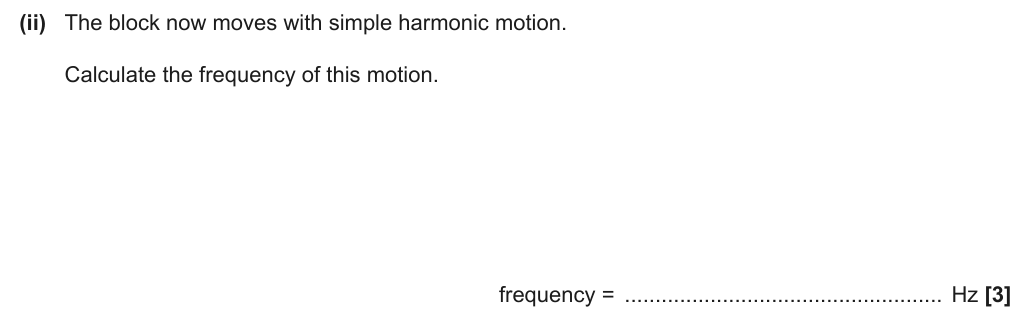
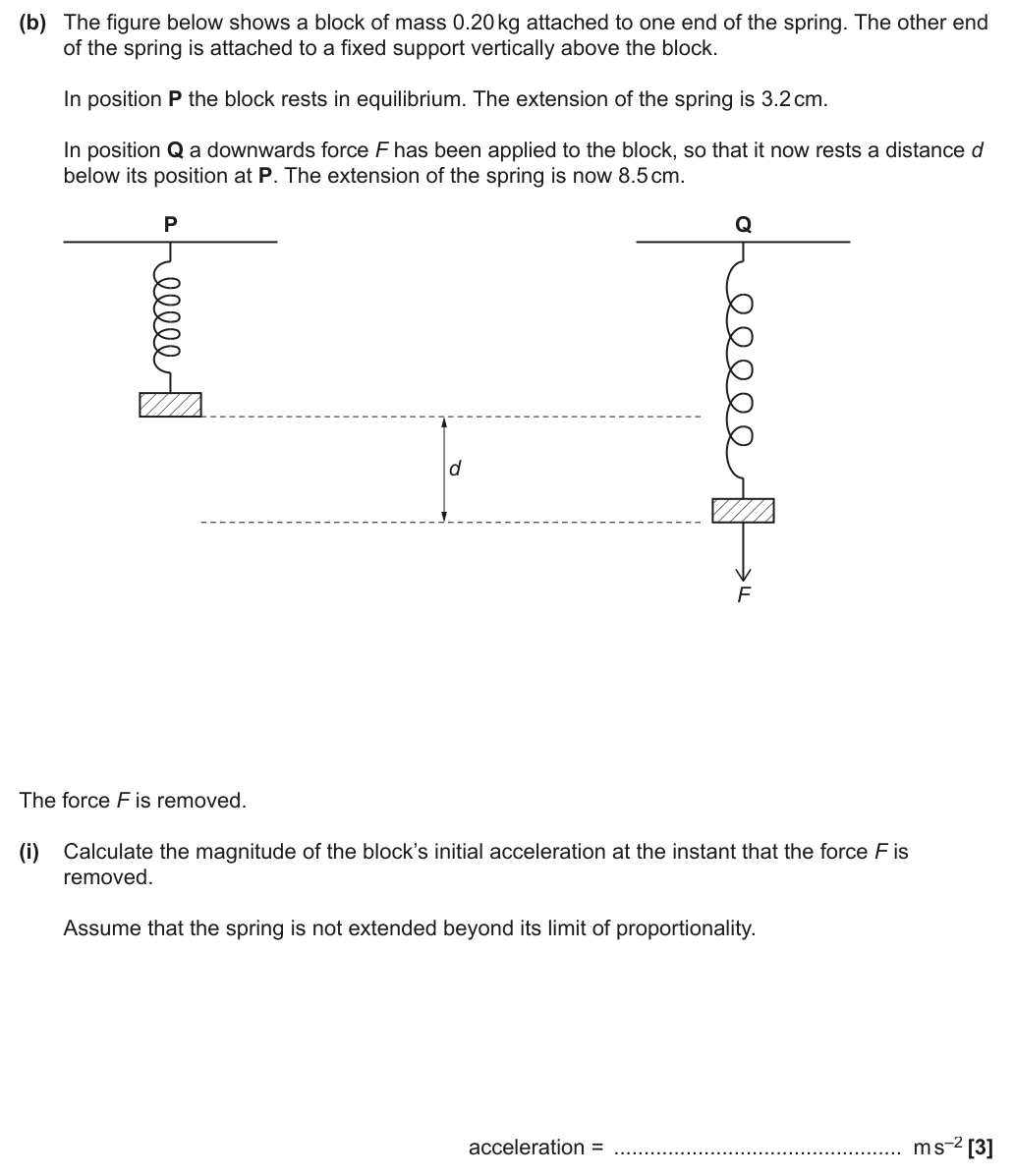
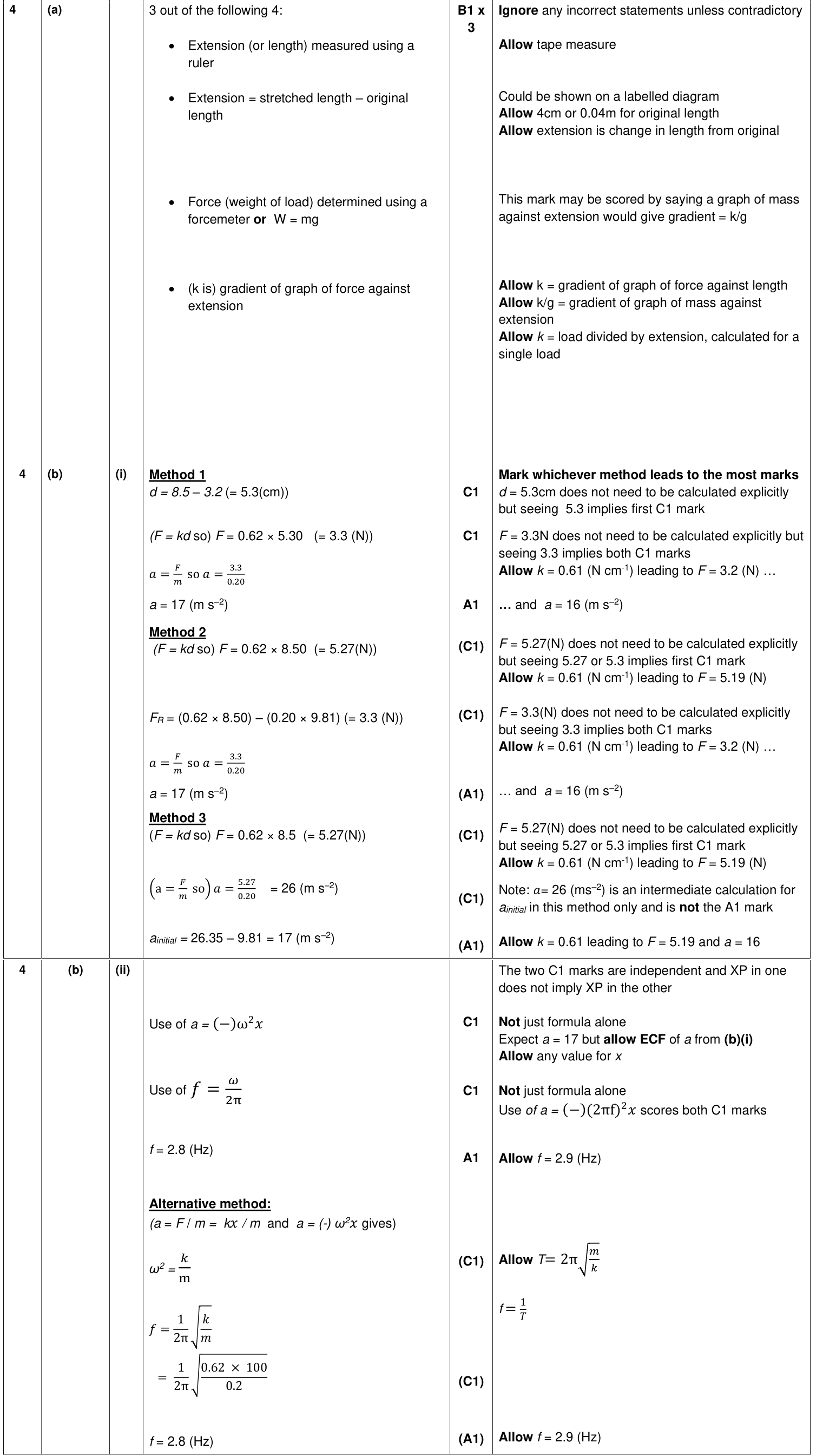
The answer to this question is frequency = 2.8Hz, since ω depends only on k and m (ω2 = k/m). However, most candidates used the formula a = (-)ω2x together with appropriate values for a and x.
Skills: M2.2 Change the subject of an equation, including non-linear equations; M2.3 Substitute numerical values into algebraic equations using appropriate units for physical quantities
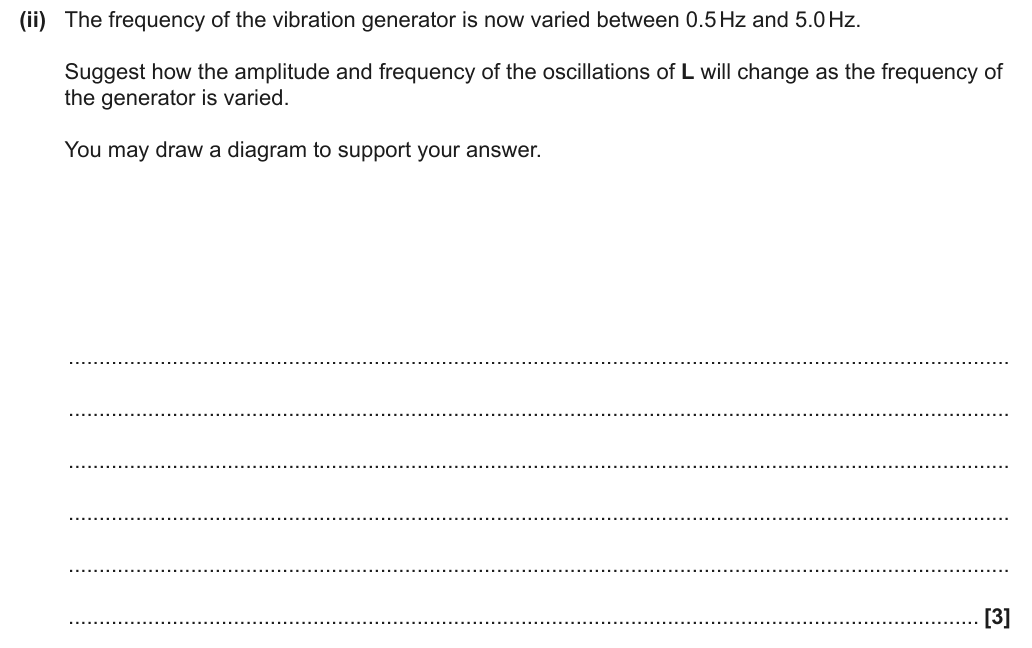
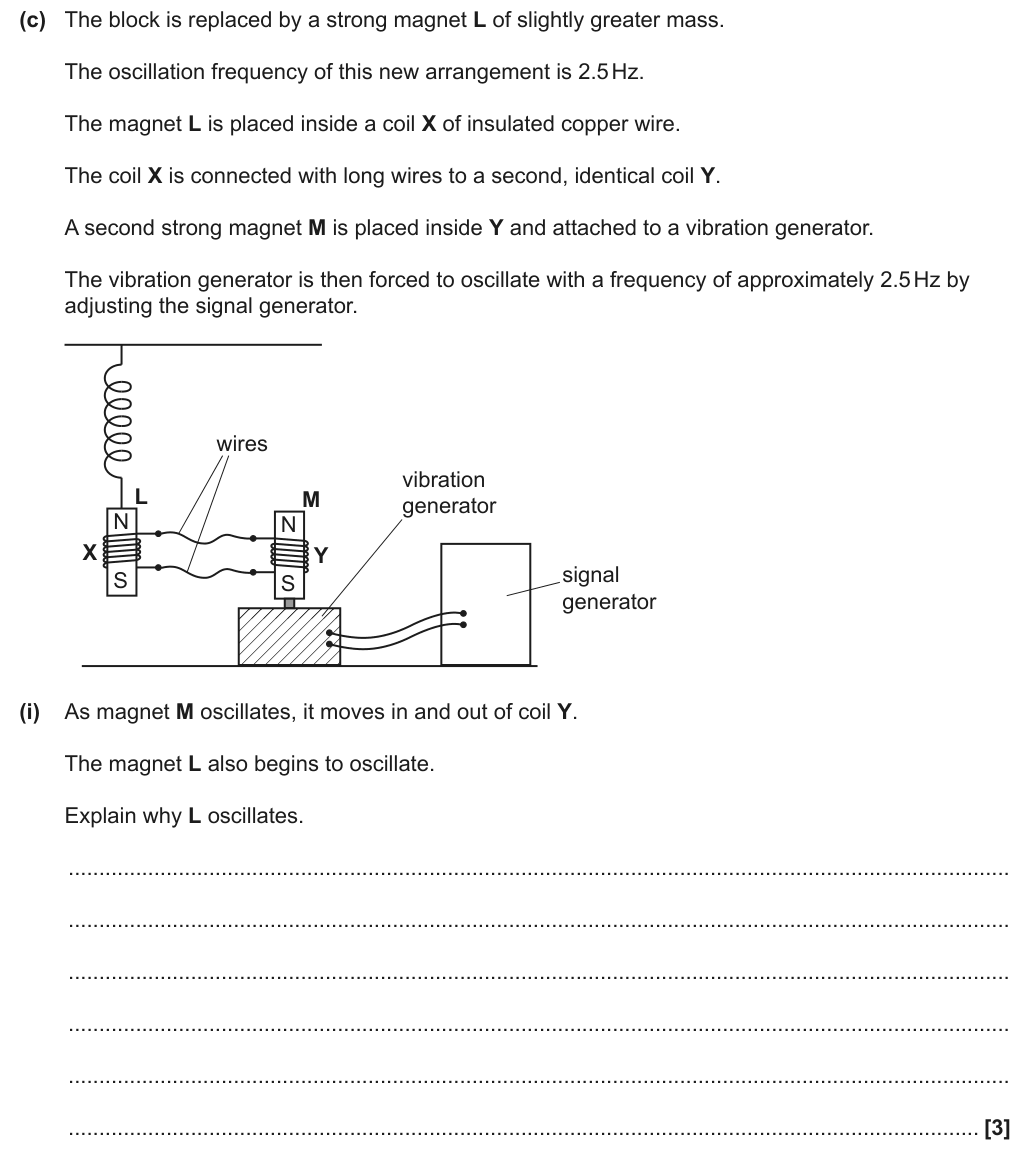
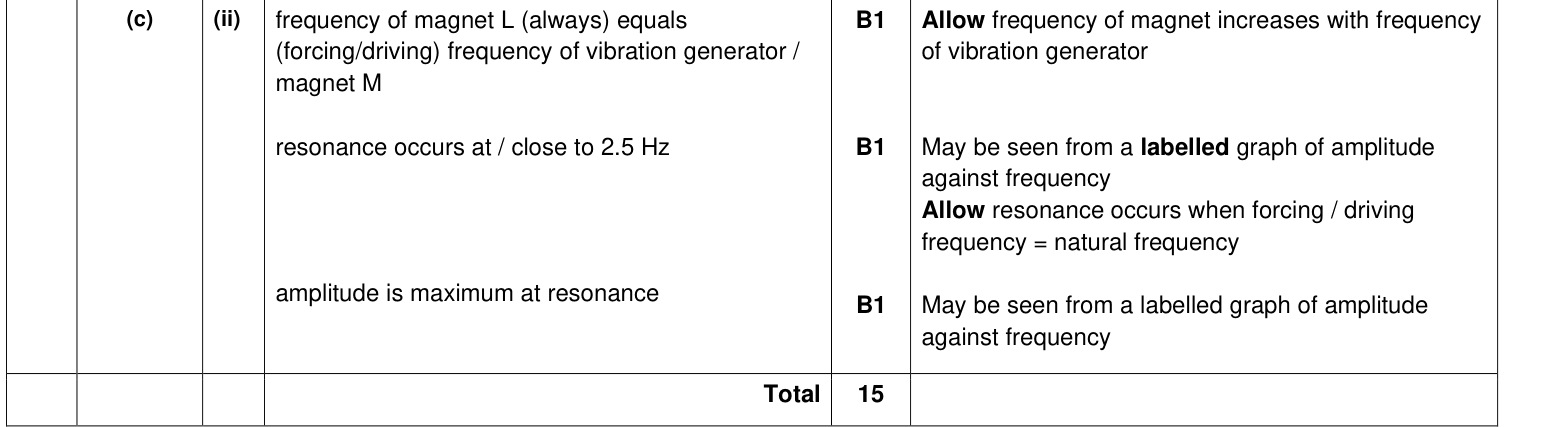
Many candidates did not realise that this was a question about resonance, presumably because of the unfamiliar context of the question. Common problems in 4(c)(ii) • not answering every part of the question: most candidates forgot to describe how the frequency varied as well as the amplitude • not realising that the vibration generator is driving the oscillation of L, and that this is a question about resonance • not labelling the scales on the graph of amplitude against frequency (or just using letters such as A and f) • failing to mark the resonance frequency as 2.5Hz (instead calling it fo)
Skills: M3.12 Sketch relationships which are modelled by y = k/x, y = kx², y = k/x², y = kx, y = sin x, y = cos x, y = e^(±x) and y = sin²x, y = cos²x as applied to physical relationships
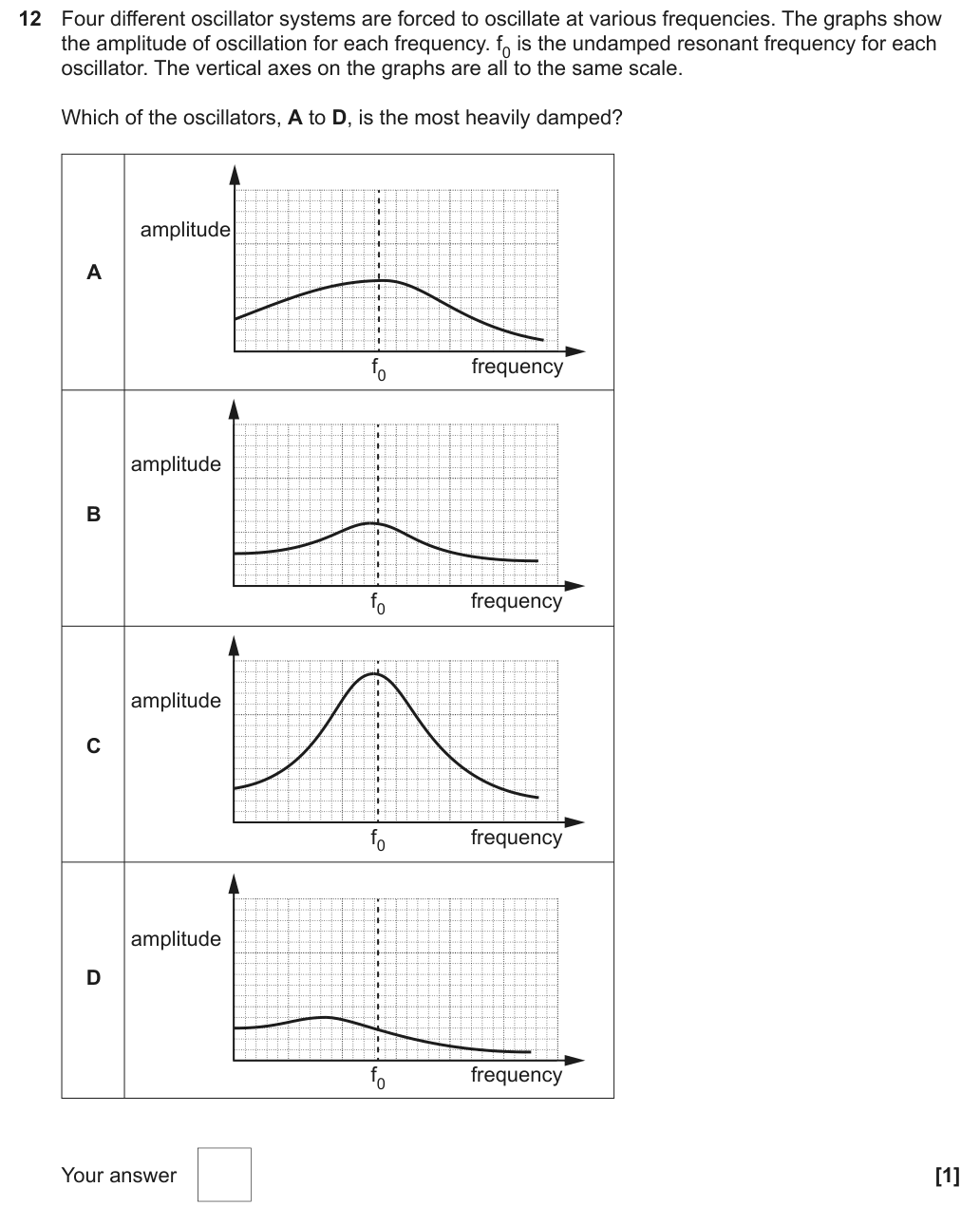
D

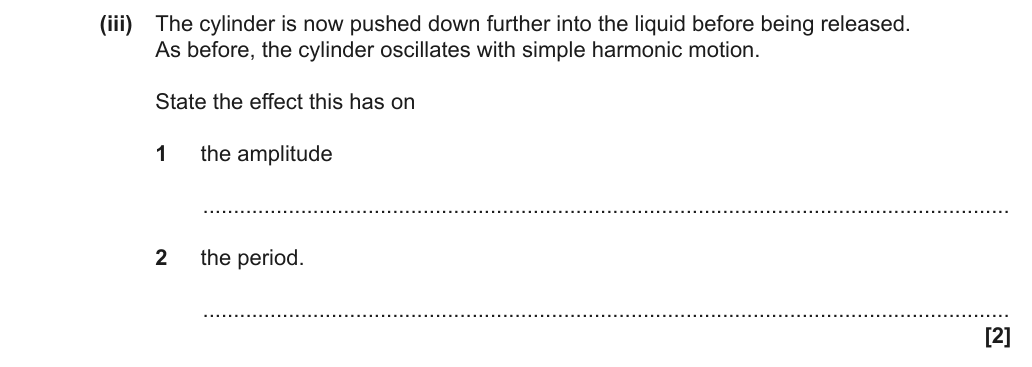
A reasonably large proportion of candidates did not link the idea of initial displacement to the amplitude of this motion. Those that did often scored both marks as they also recalled that SHM is isochronous.
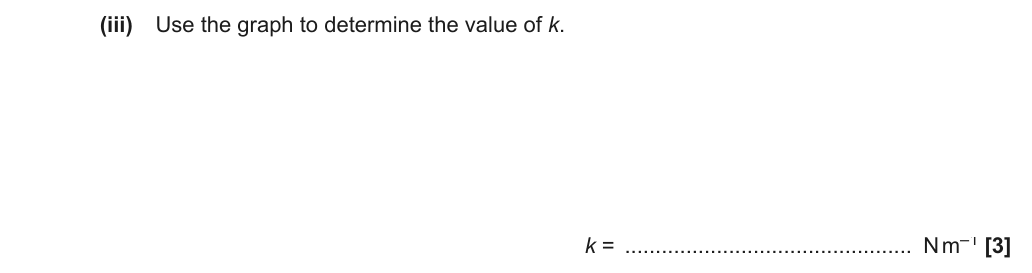
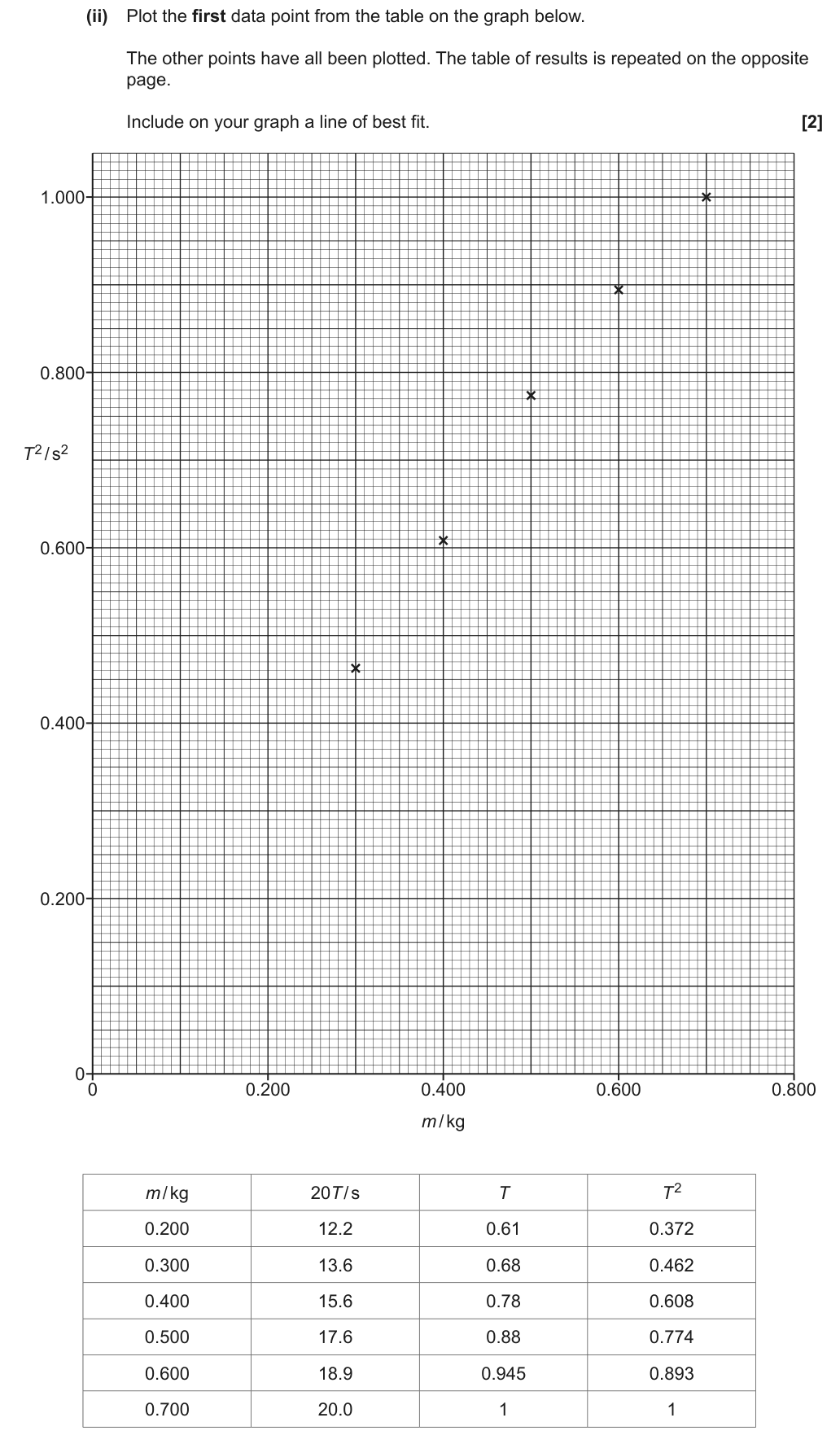
Question 21 (b) (i) Most candidates spotted the two different errors namely the lack of units for both T and T2 and the inconsistent presentation of the digits in the data.
Skills: M2.2 Change the subject of an equation, including non-linear equations; M3.3 Understand that y = mx + c represents a linear relationship; M3.4 Determine the slope and intercept of a linear graph; PAG10 Investigating simple harmonic motion
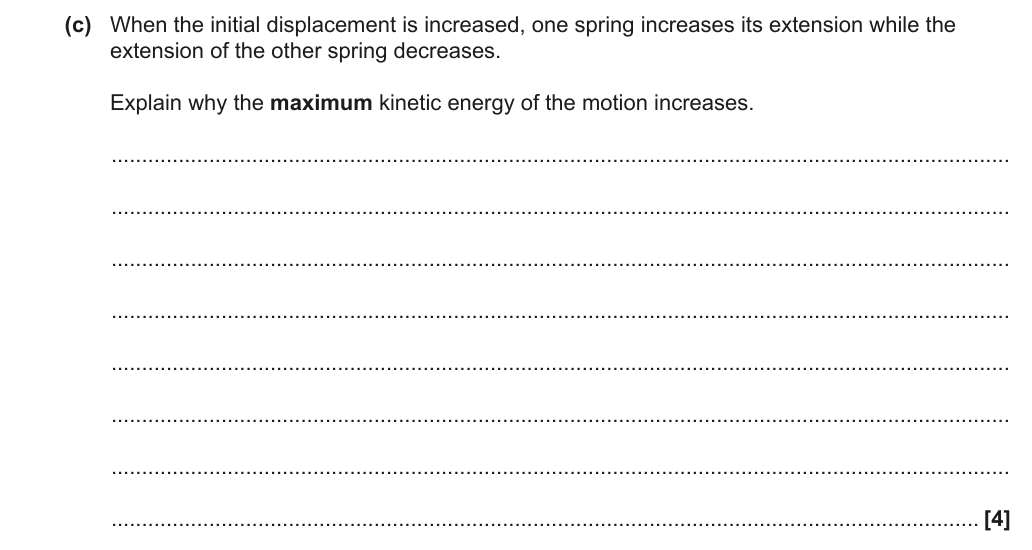
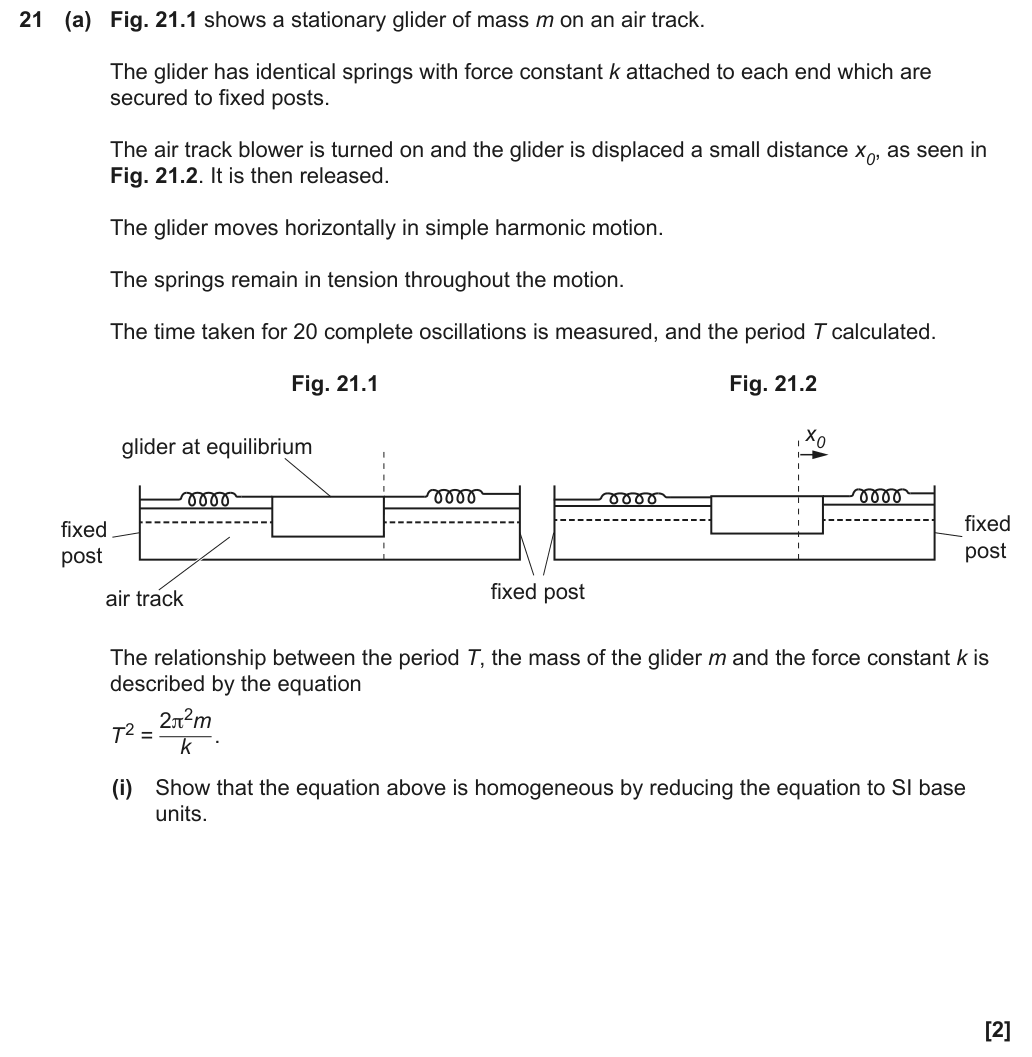
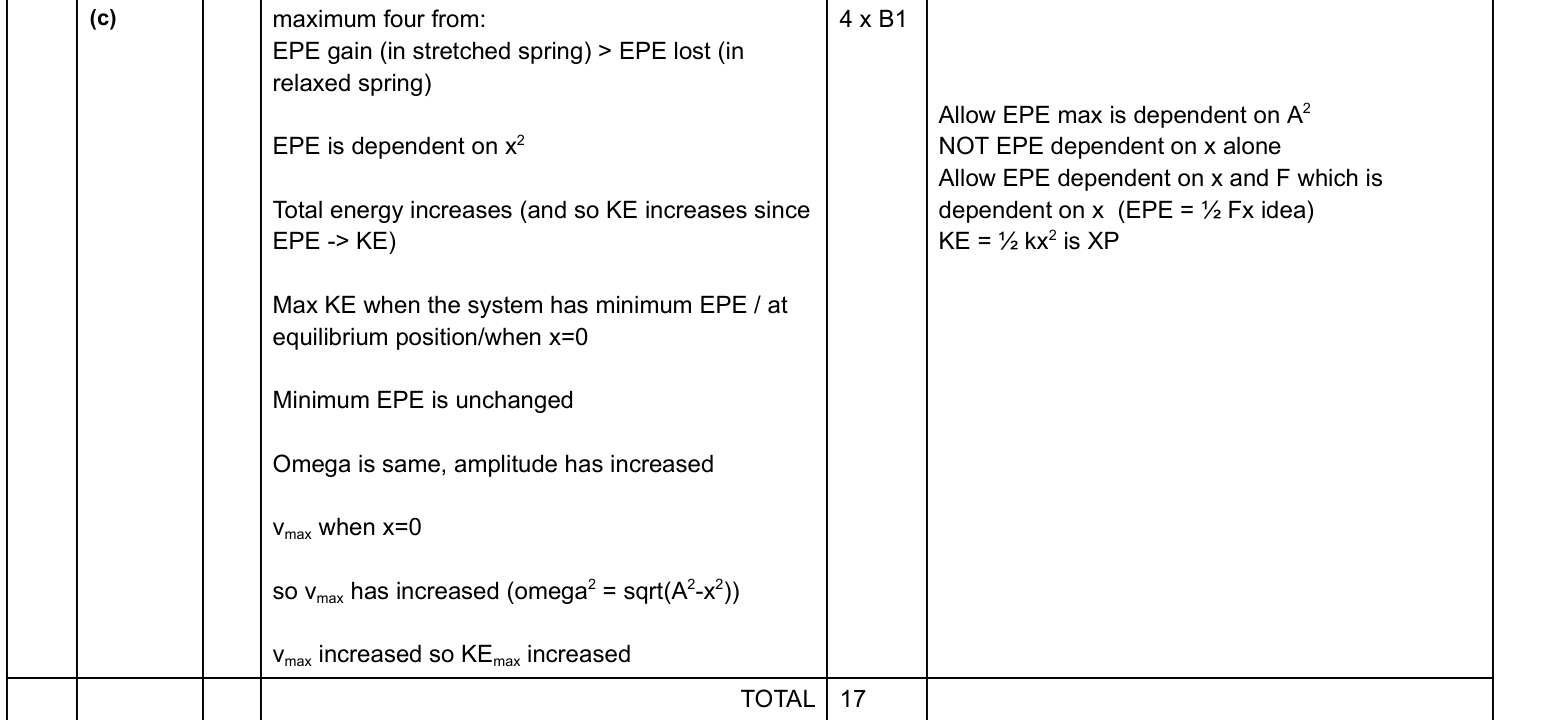
The language around energy and energy transfers is challenging and this question was pitched as a high demand question. Once more, the technical language needed to be relatively accurate for marks to be given. As soon as the glider is displaced, the total elastic potential energy (EPE) is increased. The spring that is longer than at equilibrium stores more energy than before and the spring that is shorter than at equilibrium stores less. Since the amount of EPE is given by ½kx2, the increase in EPE in the longer spring is larger than the decrease in EPE for the shorter spring. A few candidates attempted to prove this algebraically which was not required. Finally, the EPE at equilibrium position is not zero but a minimum. This is why the maximum KE occurs at this point. Some candidates attempted the slightly more accessible route of comparing vmax with the amplitude yet did not mention that the angular velocity was the same, although there was still some credit available.
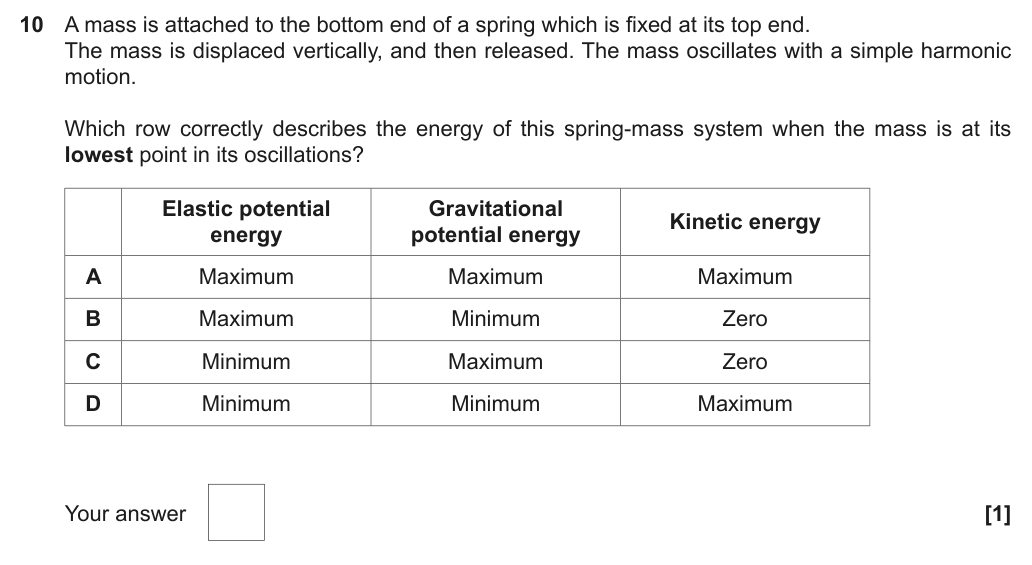
B
Most students answered this question correctly. Those that did not tended to refer to the mass at a point other than at the lowest point in its oscillations.
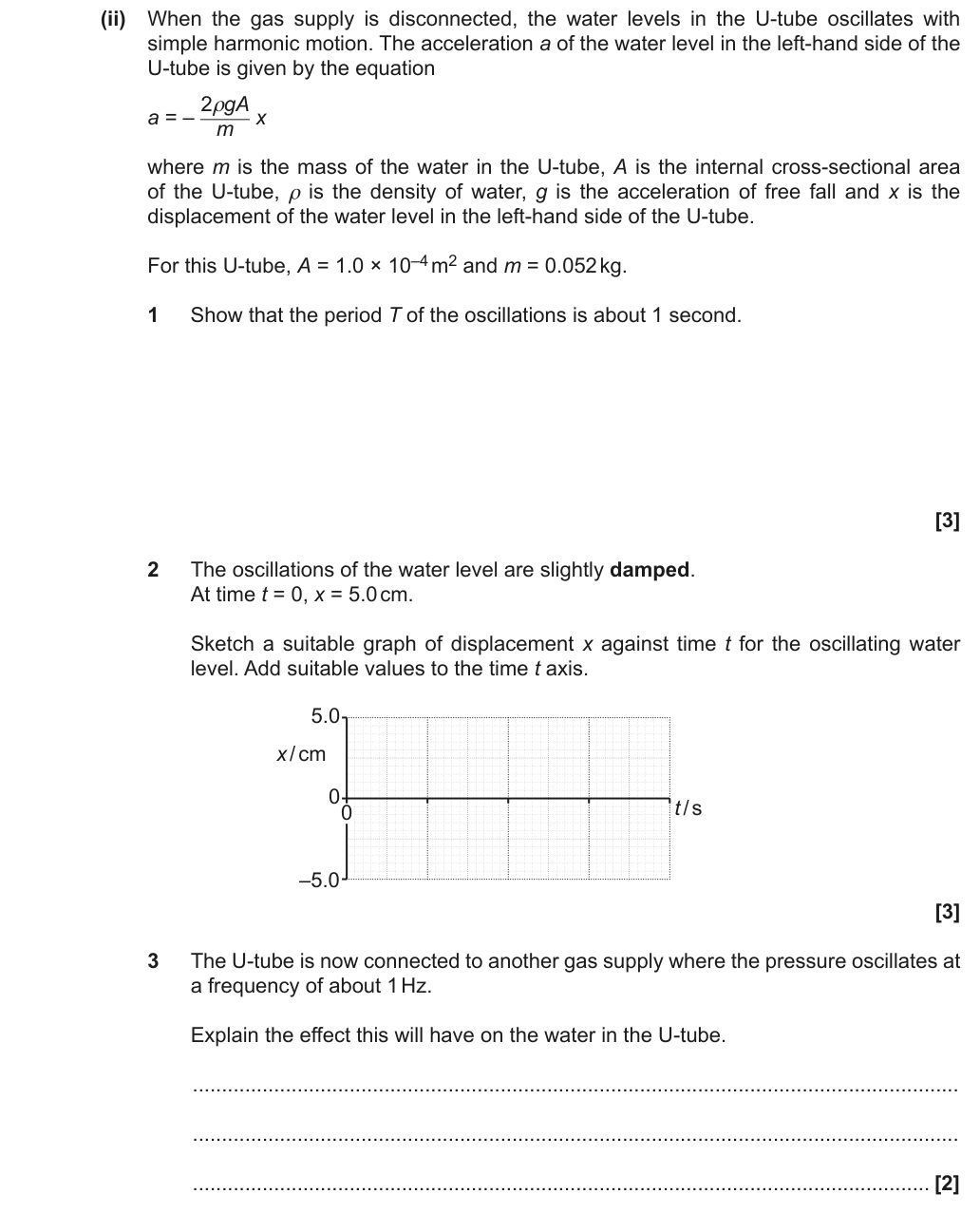
Very few candidates made the link that the gas pressure oscillating would cause a periodic force and so this would become a resonant system. The best way to describe a resonating system in this context is that the amplitude of vibrations becomes significantly larger.
Skills: M2.2 Change the subject of an equation, including non-linear equations; M2.3 Substitute numerical values into algebraic equations using appropriate units for physical quantities; M3.12 Sketch relationships which are modelled by y = k/x, y = kx², y = k/x², y = kx, y = sin x, y = cos x, y = e^(±x) and y = sin²x, y = cos²x as applied to physical relationships

When asked to describe how to measure a physical quantity, it is important to include the correct measuring instrument as part of the response. A stopwatch or stop clock is the simplest, but any method is acceptable as long as a timer is mentioned. For example, ‘I measured the time using my phone’ would not be accepted, but ‘I used my phone to record the event with a timer in view and then played it back/viewed it frame by frame’ would be fine. Measuring the number of oscillations in a fixed time period (10 seconds, say) and then calculating T from the frequency was not accepted as it is a less accurate method than the one described in the mark scheme.
Skills: PAG10 Investigating simple harmonic motion
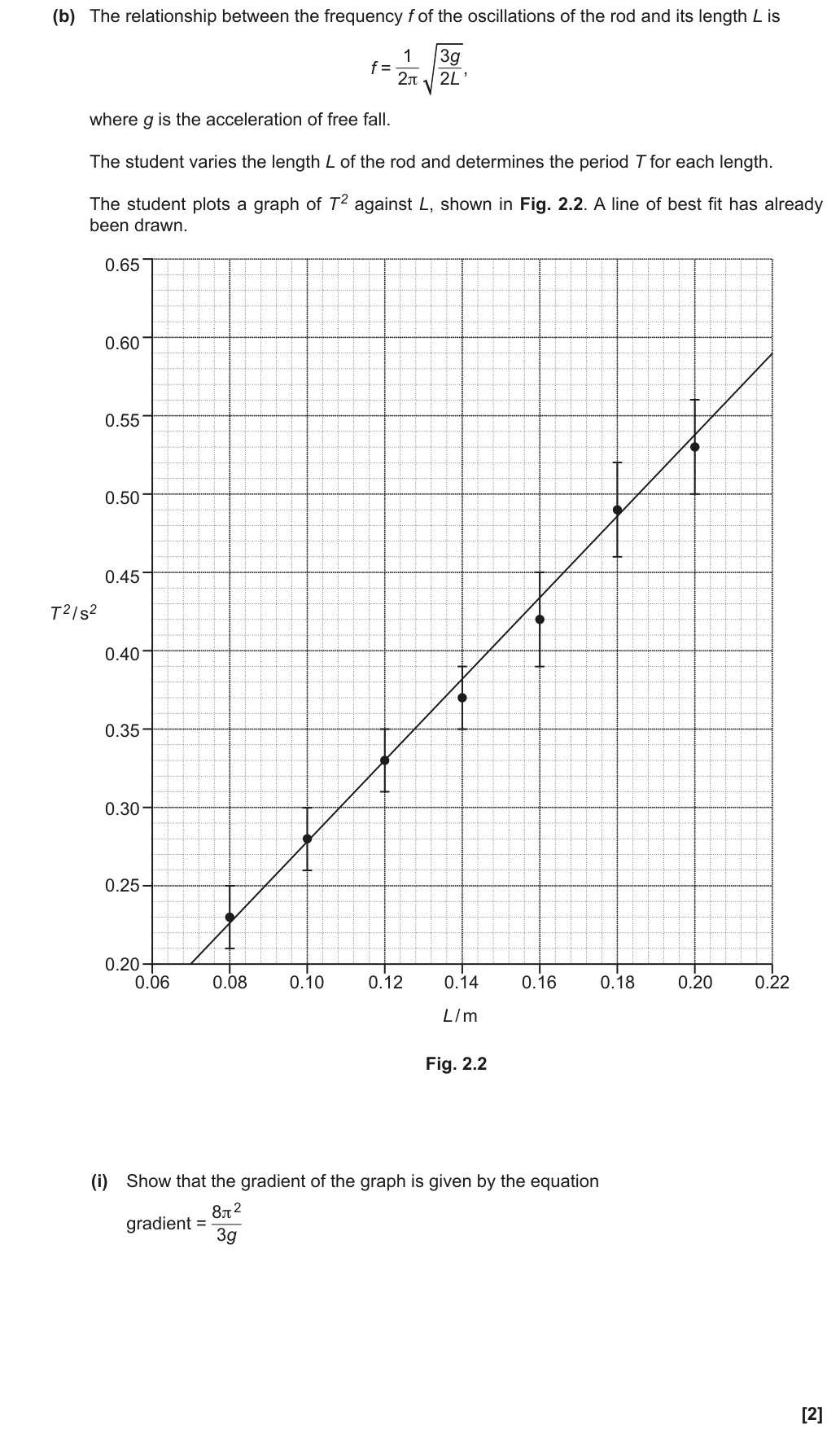
The expected response here was to start from the given relationship and then use T = 1/f to manipulate the expression into the form y = mx + c. Candidates who recognised this generally had sufficient skill in algebra to arrive at the correct answer.
Skills: M2.2 Change the subject of an equation, including non-linear equations; M3.3 Understand that y = mx + c represents a linear relationship
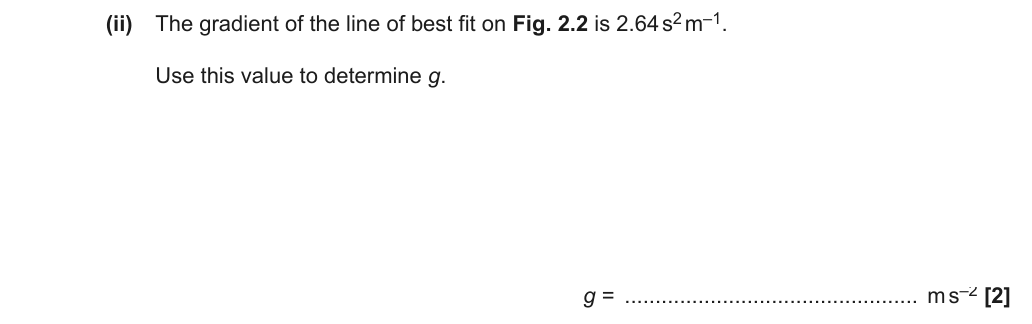
Candidates needed to substitute gradient = 2.64 into the formula g = 3 x gradient . This was arguably the easiest question on the paper. Although almost all candidates scored both marks, a few lost a mark through thinking that 9.97 = 10.0 to 3sf.
Skills: M2.2 Change the subject of an equation, including non-linear equations; M3.3 Understand that y = mx + c represents a linear relationship; PAG10 Investigating simple harmonic motion
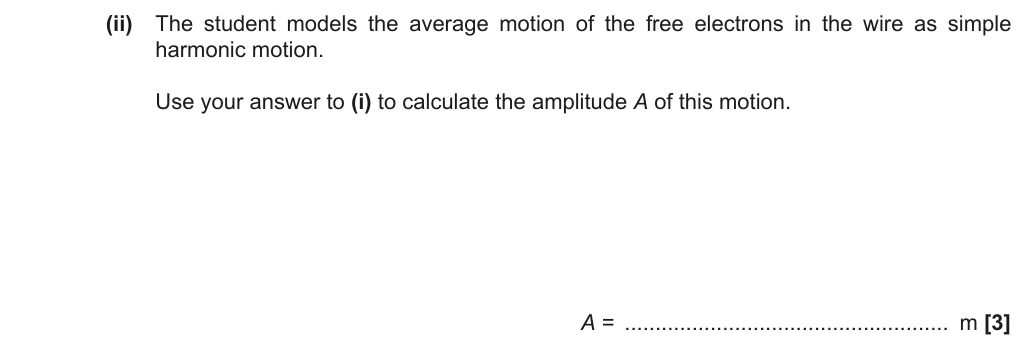
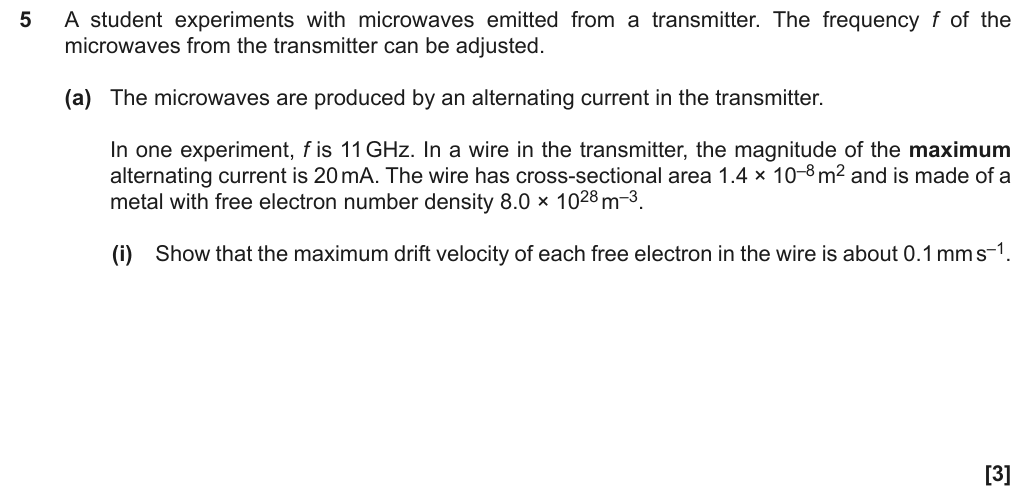
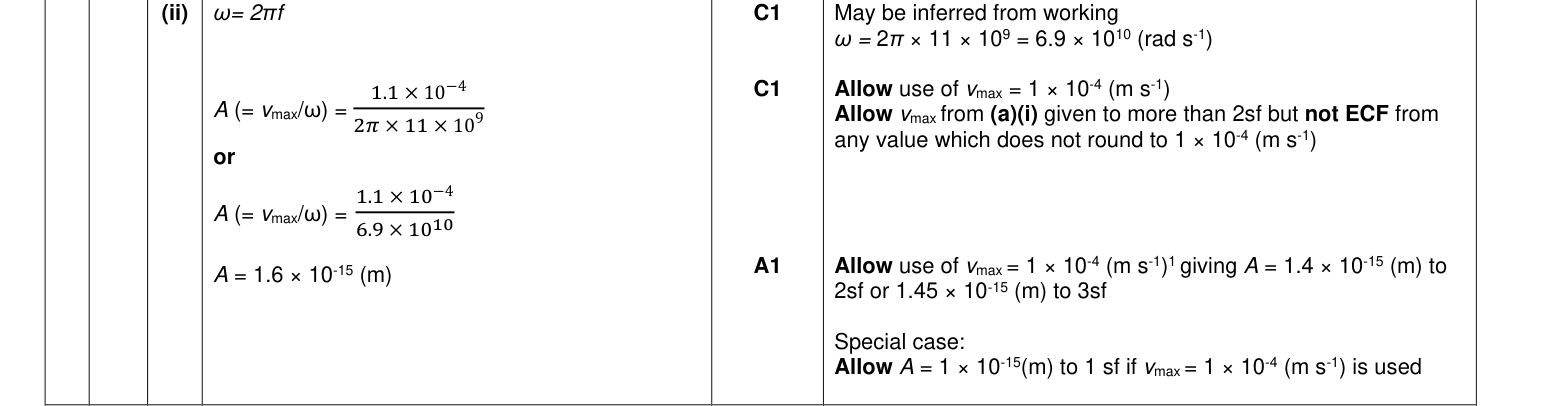
The formula sheet gives v = ±ω(A2 – x2)½ as a starting point. The maximum velocity of the electrons has been given in (i) as 0.1 mm s–1. The electrons are moving in simple harmonic motion, and so their maximum velocity occurs as they pass equilibrium i.e. when x = 0. This simplifies the formula to vMAX = ωA. Equal marks were given for using either the given value for vMAX of 0.1 mm s–1 or the candidate’s own value from (a)(i). The exemplar above shows the type of response that gained full marks.
Skills: M0.2 Recognise and use expressions in decimal and standard form; M2.2 Change the subject of an equation, including non-linear equations
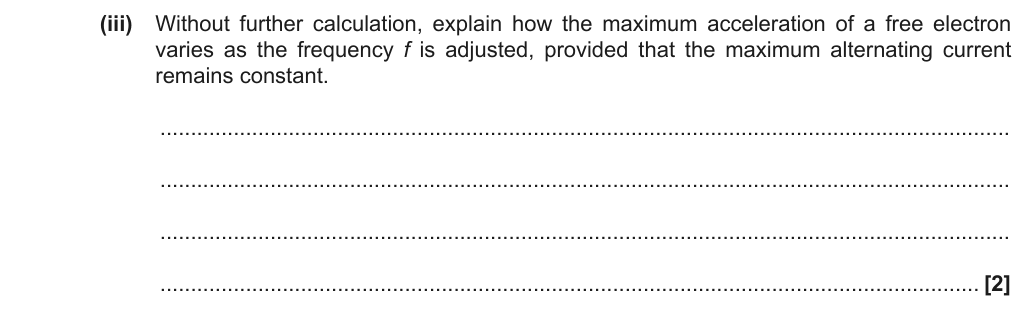
This was a difficult question; hard to visualise and involving some challenging algebra. Most candidates did not notice that the question specified the maximum acceleration of a free electron. Therefore the most common response was that a = (2πf)2x, showing that a ∝ f 2. This gained no marks. Other candidates went further and said that the maximum acceleration occurs when x = A. This means that aMAX = (2πf)2A and so aMAX ∝ f 2, since A is constant. However, the amplitude A of the oscillation is itself dependent on the frequency. If the maximum current remains constant then the maximum velocity vMAX of the electron must also remain constant. In (a)(ii), we used the fact that vMAX = 2πfA, so fA must remain constant. aMAX = (2πf)2A = (2π)2fA x f = constant × f. So we conclude that aMAX ∝ f. An easy way to see this algebraically is: aMAX = (2πf)2A and vMAX = 2πfA Therefore aMAX = (2πf) vMAX vMAX remains constant and so aMAX ∝ f
Skills: M2.2 Change the subject of an equation, including non-linear equations
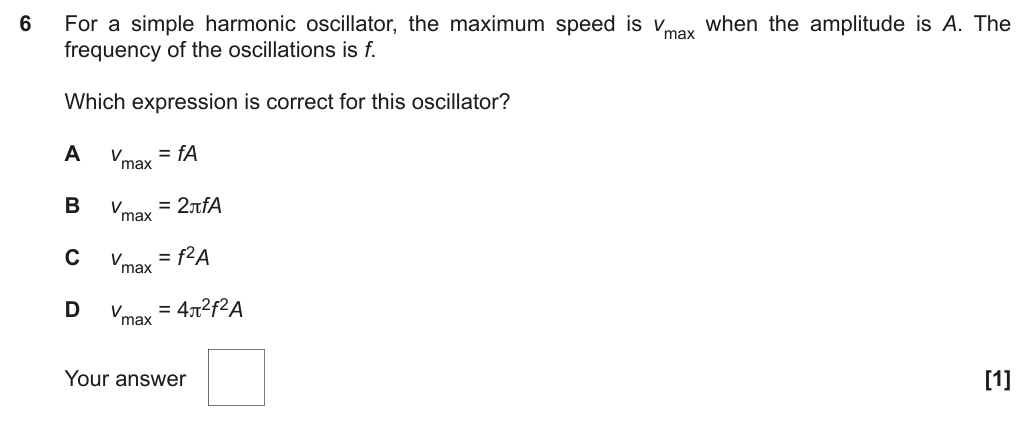
B
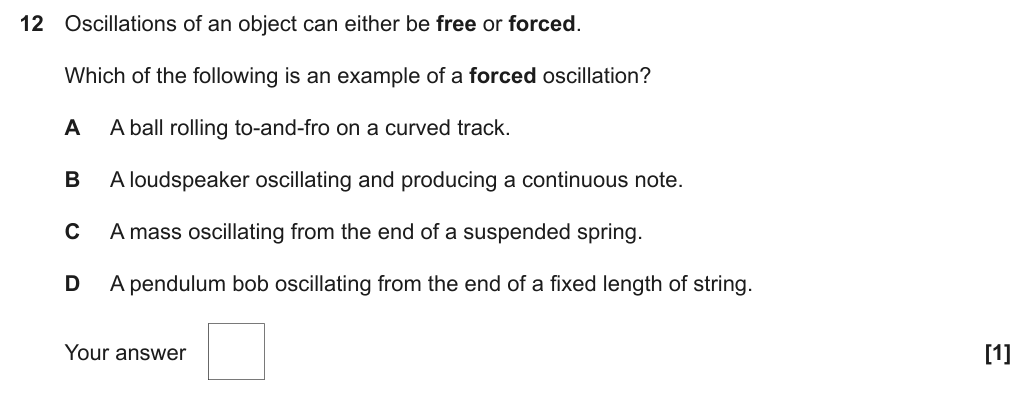
B

Skills: M3.3 Understand that y = mx + c represents a linear relationship; M3.4 Determine the slope and intercept of a linear graph; PAG10 Investigating simple harmonic motion
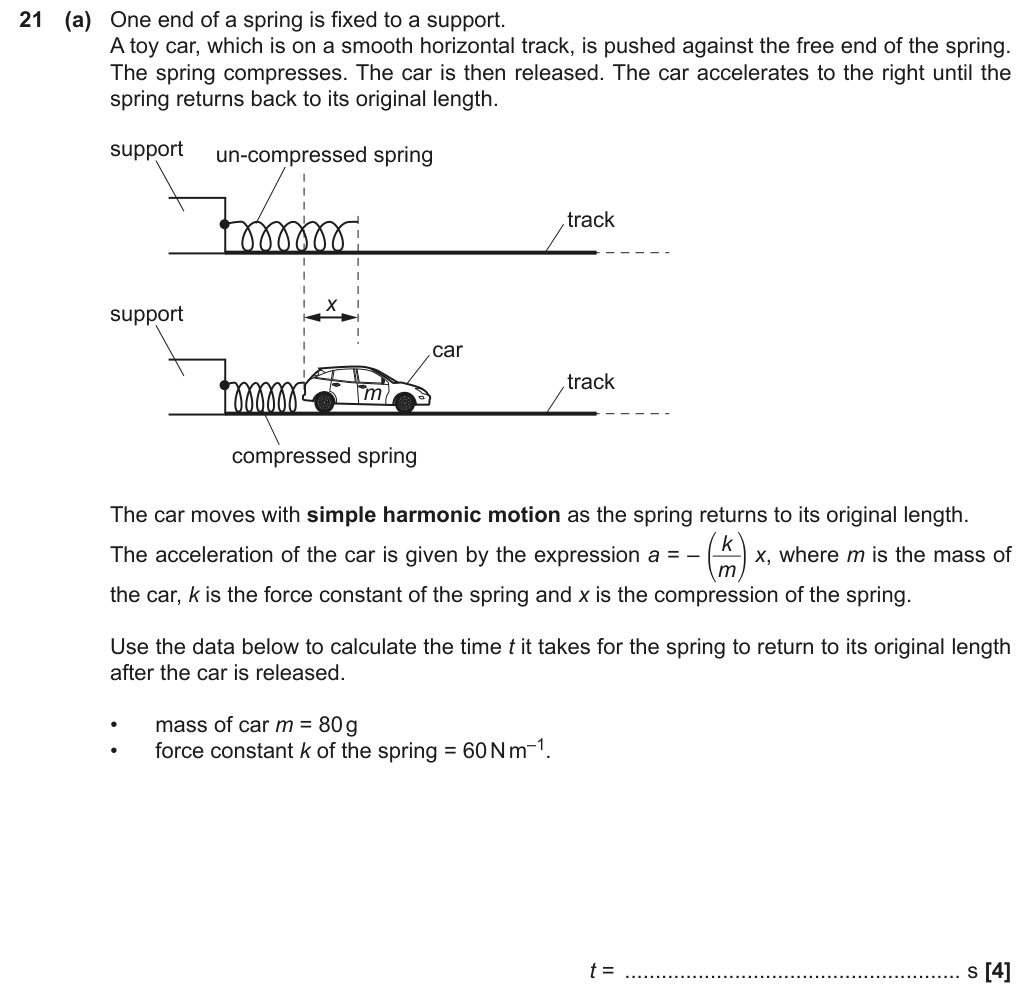
Skills: M0.1 Recognise and make use of appropriate units in calculations; M2.2 Change the subject of an equation, including non-linear equations; M2.3 Substitute numerical values into algebraic equations using appropriate units for physical quantities
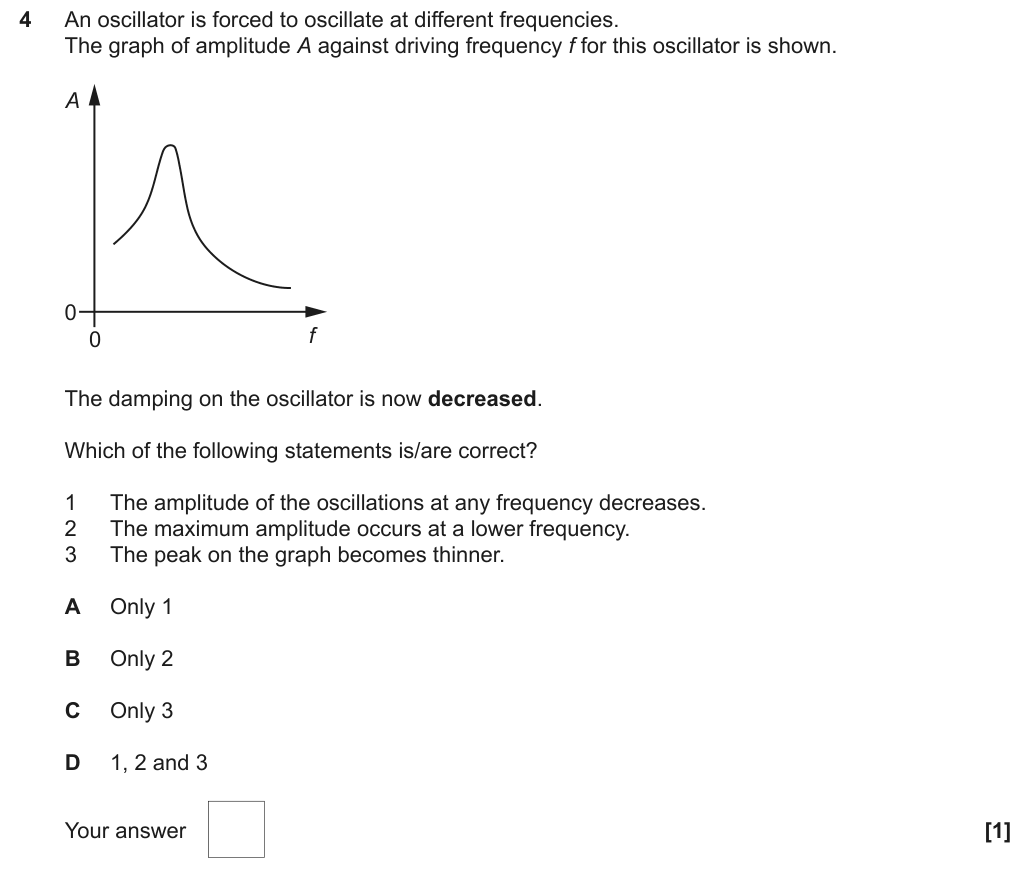
C
B
Skills: M0.6 Use calculators to handle sin x, cos x and tan x when x is expressed in degrees or radians; M2.3 Substitute numerical values into algebraic equations using appropriate units for physical quantities; M4.7 Understand the relationship between degrees and radians and translate from one to the other
Skills: M0.1 Recognise and make use of appropriate units in calculations; M2.3 Substitute numerical values into algebraic equations using appropriate units for physical quantities
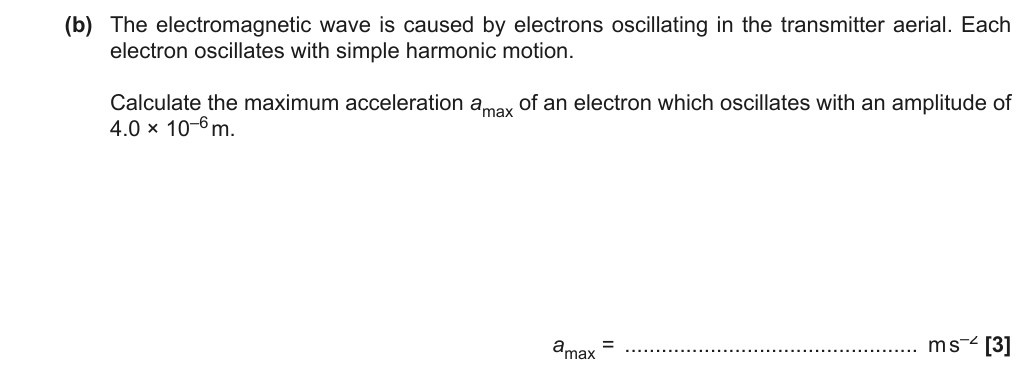
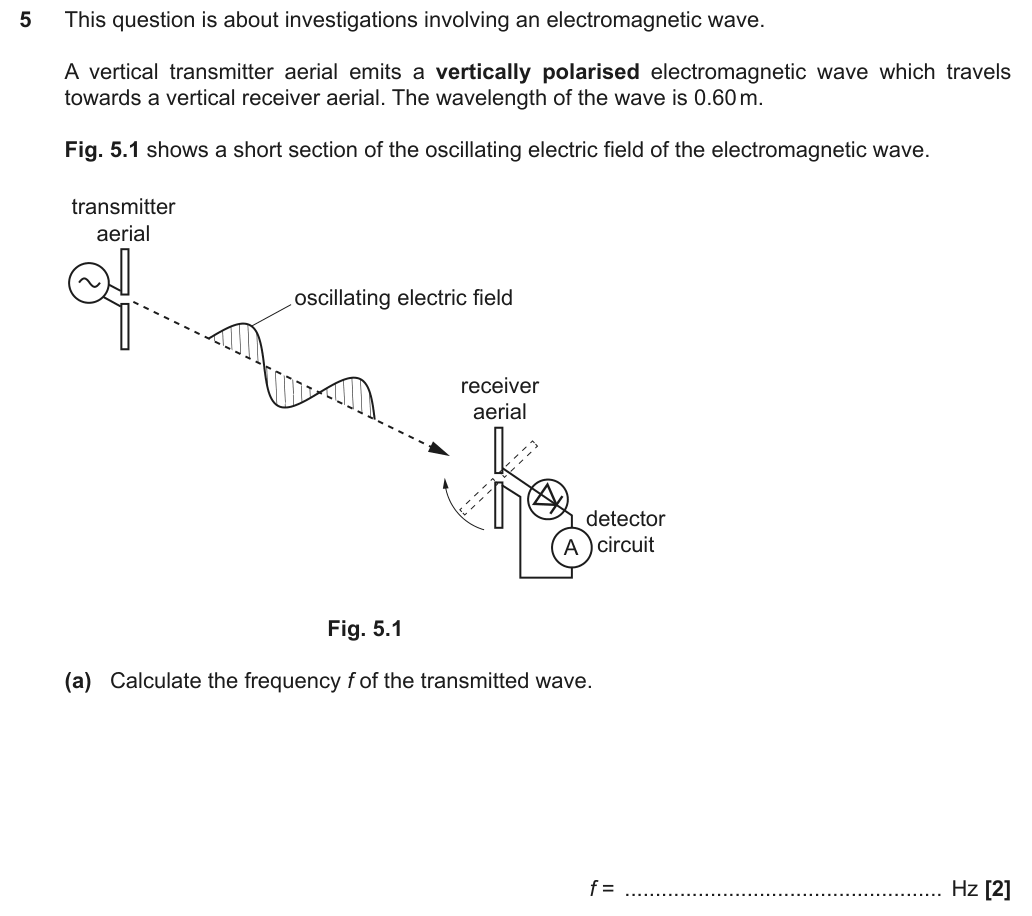
Question 5b The words ‘simple harmonic motion’ in the text prompted almost all candidates to use the correct formula here. Question 5c Allowing a mark for the diode only letting current pass in one direction enabled many candidates to score this mark. Question 5d This was the second of the two LoR questions in this paper.
Skills: M0.5 Use calculators to find and use power, exponential and logarithmic functions; M2.3 Substitute numerical values into algebraic equations using appropriate units for physical quantities
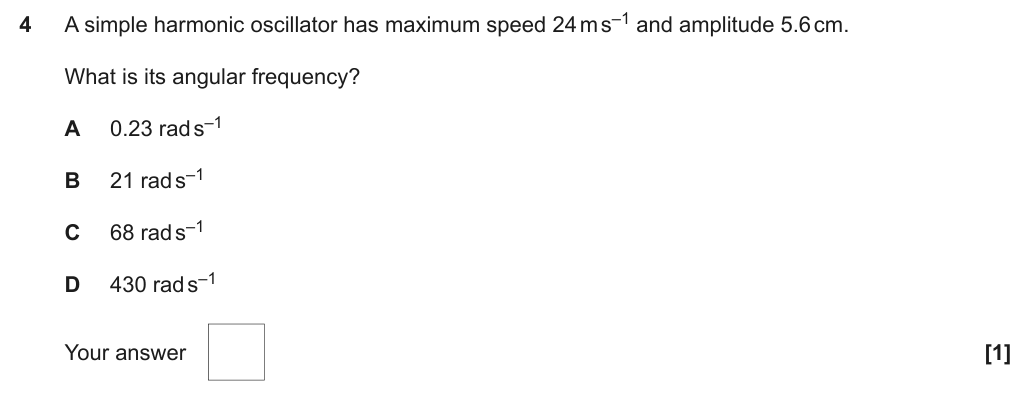
D
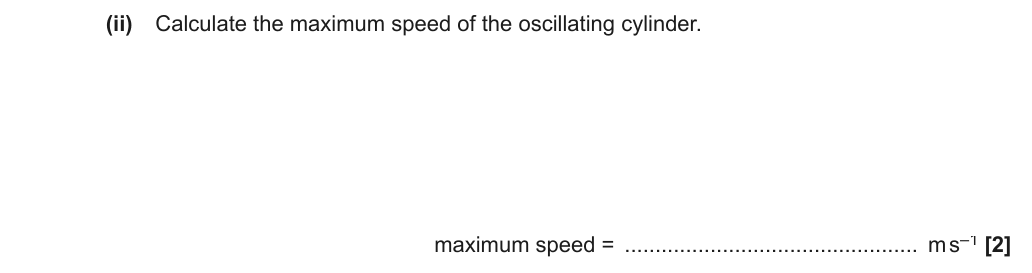
The correct formula here is vmax = Aω. This means that to find the angular frequency, ω, you must divide the maximum speed by the amplitude. The amplitude is given in centimetres so that needs to be converted to metres. This gives 24/0.056 = 429 rad s-1, giving the answer D.
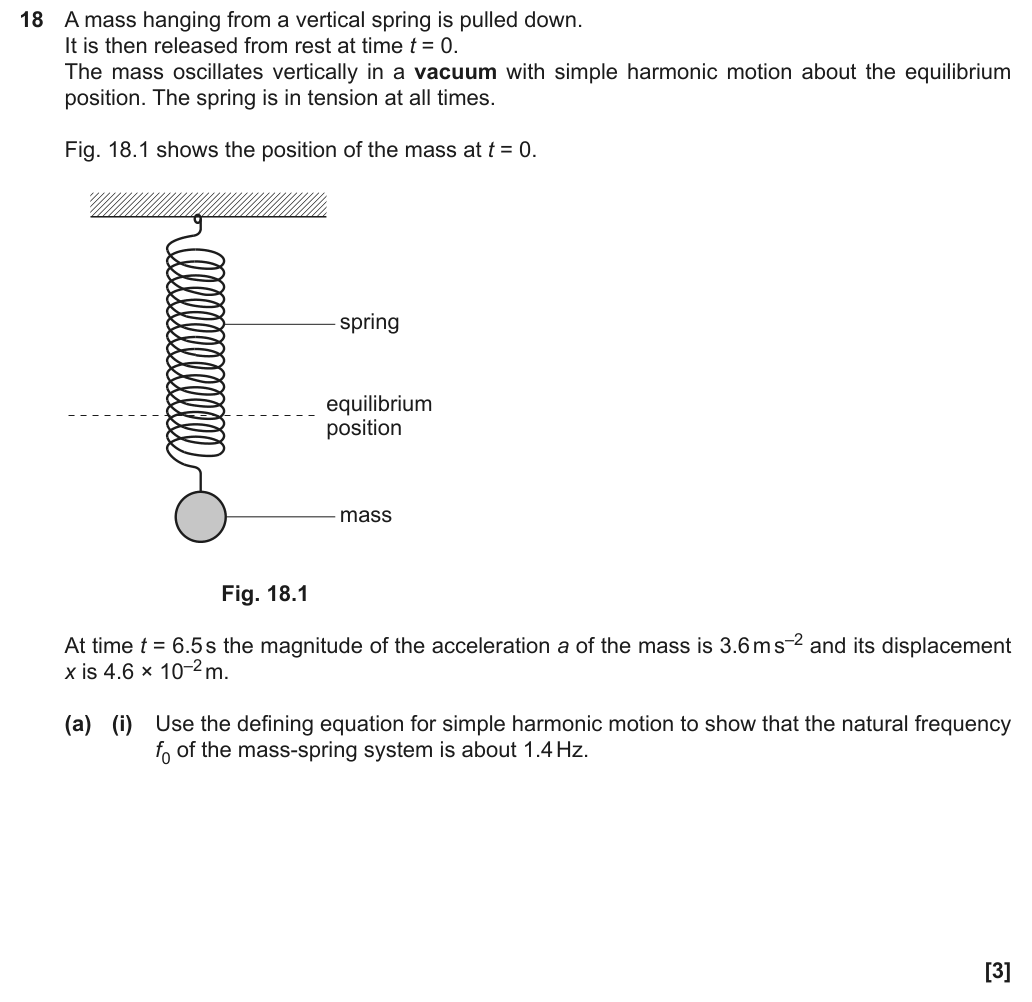
Question 18 (a) (ii) As the mass is pulled down before release, the mass is away from the equilibrium position. The natural frequency of this system is 1.4 Hz, as stated in Question 18(a).
Skills: M2.2 Change the subject of an equation, including non-linear equations; M2.3 Substitute numerical values into algebraic equations using appropriate units for physical quantities
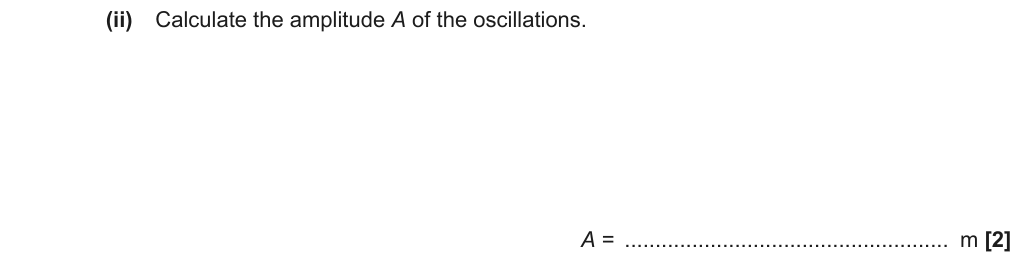
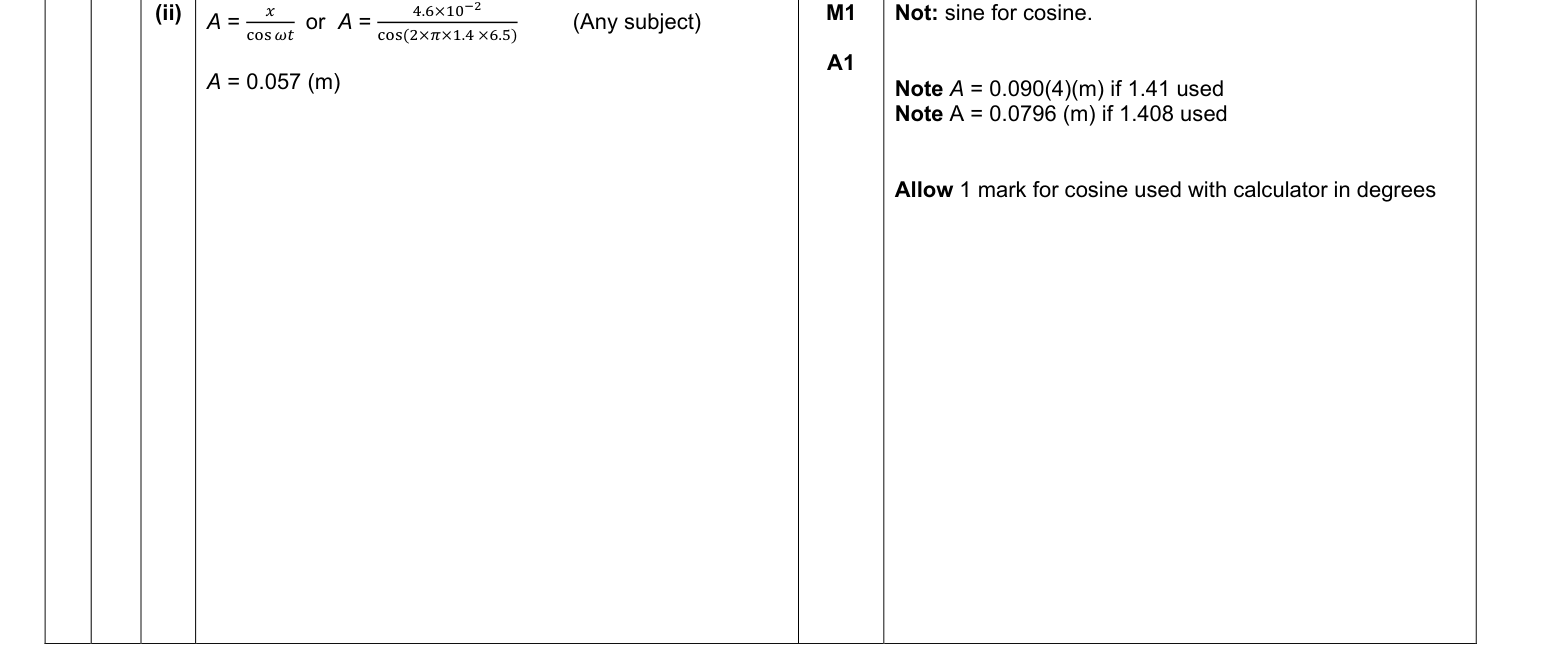
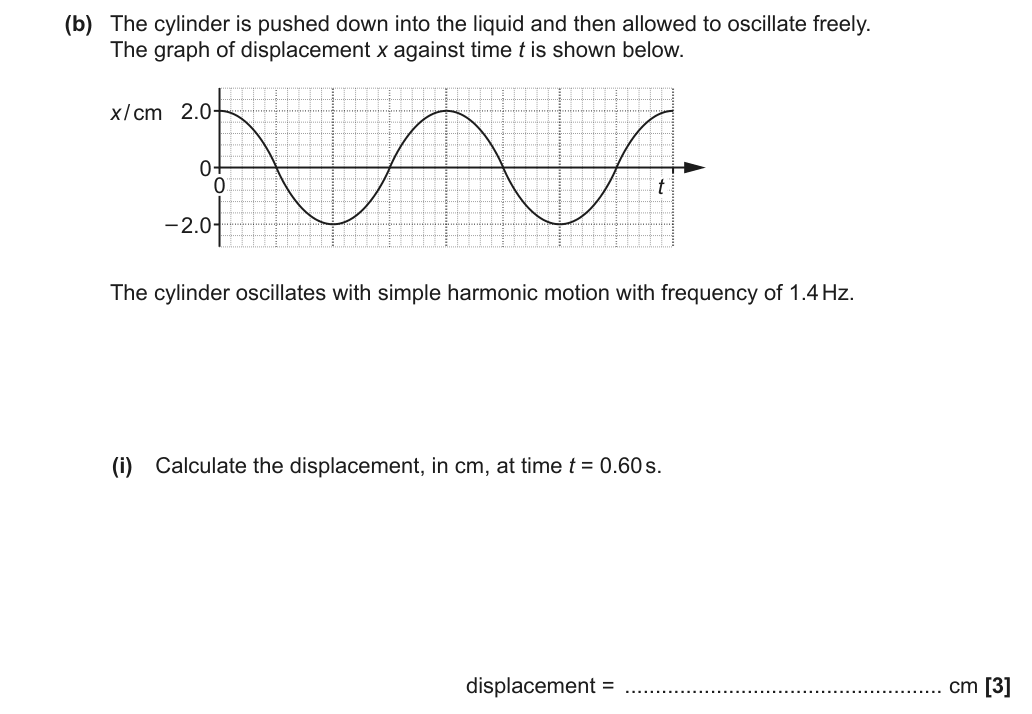
As the mass is pulled down before release, the mass is away from the equilibrium position. This means that the sine relationship between displacement and time cannot be correct. Many candidates got this idea correct. The relationship x = A cos(ωt) requires that the value of ωt is expressed in radians. This meant that to calculate the amplitude correctly, the calculator has to be in radians mode, rather than degrees mode.
Skills: M2.2 Change the subject of an equation, including non-linear equations; M2.3 Substitute numerical values into algebraic equations using appropriate units for physical quantities; M4.7 Understand the relationship between degrees and radians and translate from one to the other
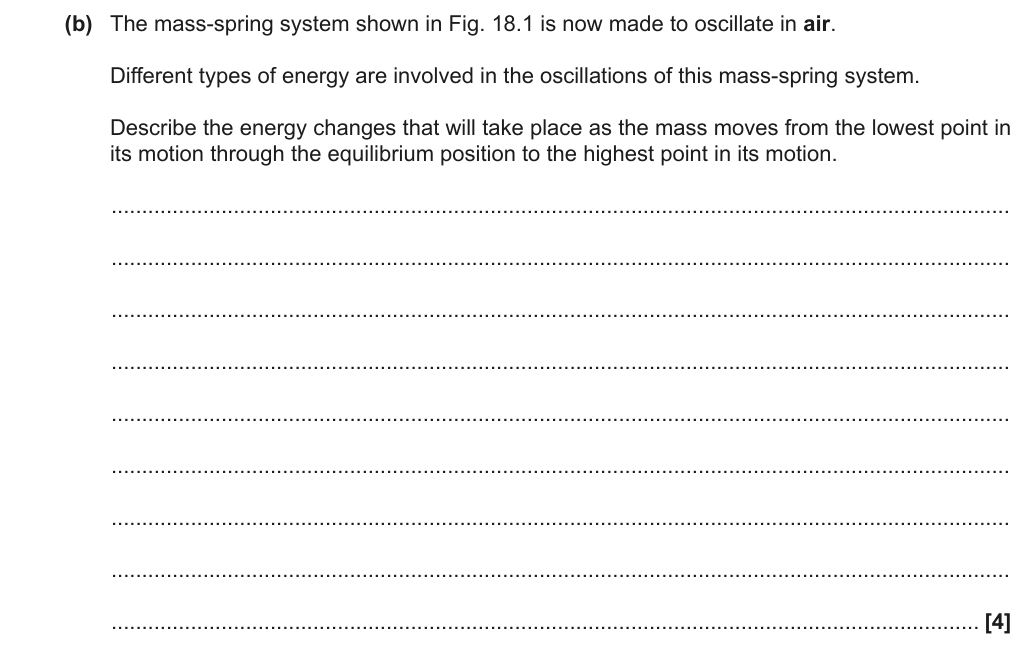
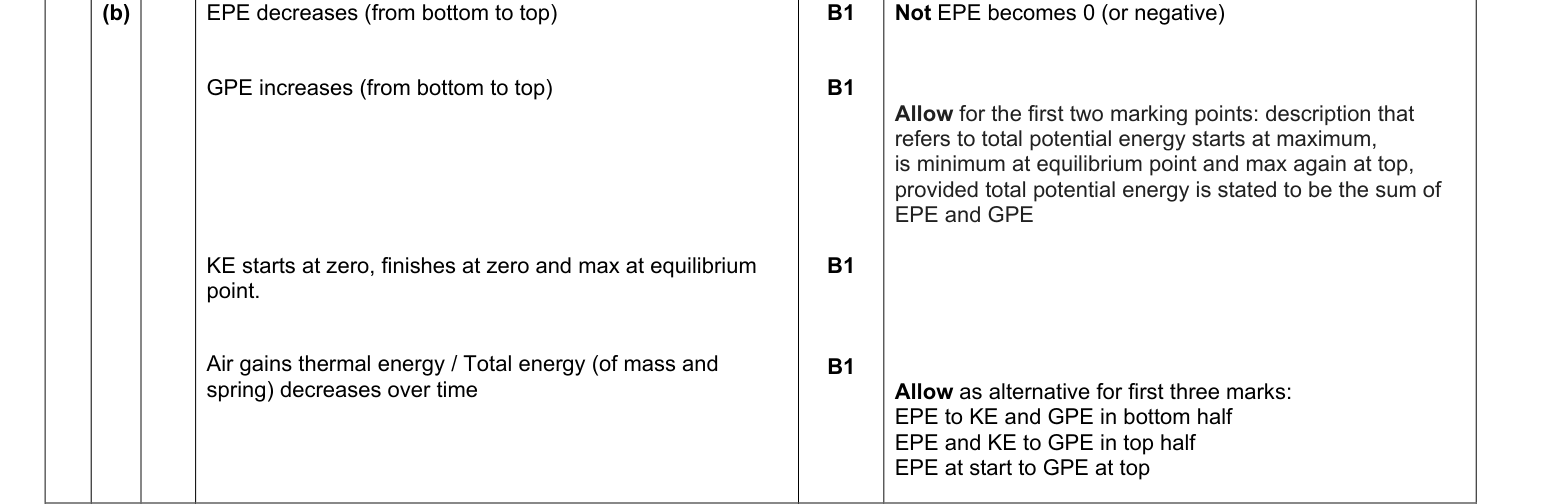
The best way to answer this question is to plan out what happens to each of the relevant energy types. In this case the relevant energy types are elastic potential, gravitational potential and kinetic energy. Candidates often carefully recalled the details of energy changes for a horizontal mass-spring system, which was incorrect. Earlier in the question, the candidates were told that the spring is always under tension. This means that the elastic potential energy cannot be zero or indeed negative. At the bottom and the top of the motion, the kinetic energy of the system is zero, as the objects have zero velocity. At the equilibrium position, the kinetic energy of the system is maximum. Responses that included merely ‘potential energy’ were too vague, unless it was clear that the potential energy of this system is the sum of both the gravitational and elastic potential energies. The first 2 statements in this response are true yet not enough. The third statement is untrue, as it implies that GPE is decreasing (and so contradicts the second statement) and also states that the elastic potential energy is increasing. Zero marks. This response is separated out into the 3 main energy types. The changes for each of the types is correct. The only thing they haven’t mentioned is that the total energy of the system will decrease because of the damping effect of the air. 3 marks. Question 18 (c) (i) and (c) (ii) The correct shape for Question 18(c)(i) is a standard resonance curve. The natural frequency of this system is 1.4 Hz, as stated in Question 18(a). This means that the peak of the curve should come at 1.4 Hz. The curve for Question 18(c) needed to be of lower amplitude throughout the frequency range (not including at 0 Hz). Some candidates put the peak of curve D at the same frequency as curve K and others put the peak of curve D slightly to the left. Both were given the mark.
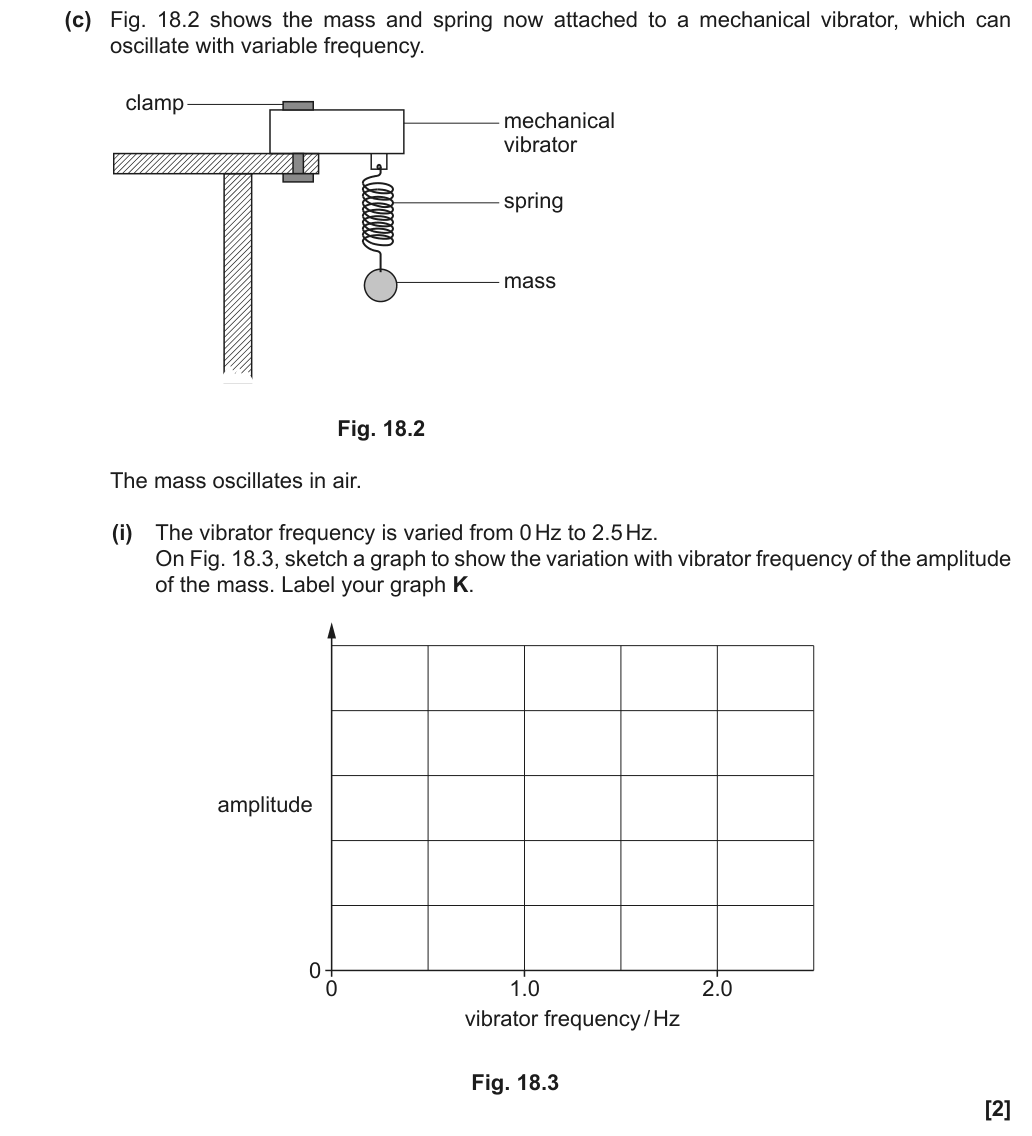
Question 18 (c) (i) and (c) (ii) The correct shape for Question 18(c)(i) is a standard resonance curve.
Skills: M3.12 Sketch relationships which are modelled by y = k/x, y = kx², y = k/x², y = kx, y = sin x, y = cos x, y = e^(±x) and y = sin²x, y = cos²x as applied to physical relationships

Question 18 (c) (i) and (c) (ii) The correct shape for Question 18(c)(i) is a standard resonance curve. Question 18 (c) (iii) Many candidates linked the possibility of a driving force, such as footsteps or the wind, giving a driver frequency at or near the natural frequency of a bridge and that this phenomenon is known as resonance.
Skills: M3.12 Sketch relationships which are modelled by y = k/x, y = kx², y = k/x², y = kx, y = sin x, y = cos x, y = e^(±x) and y = sin²x, y = cos²x as applied to physical relationships
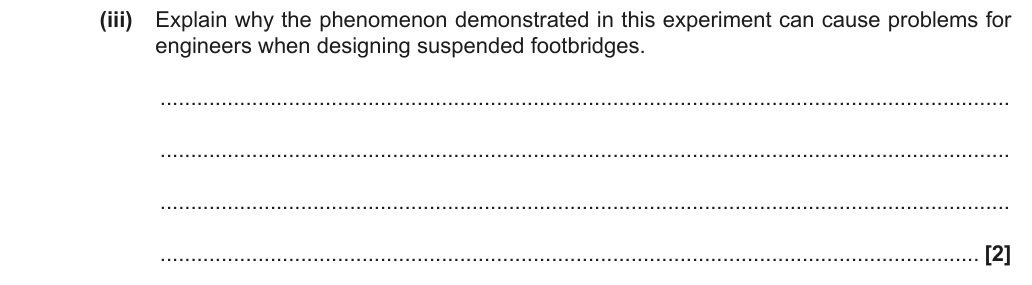
Many candidates linked the possibility of a driving force, such as footsteps or the wind, giving a driver frequency at or near the natural frequency of a bridge and that this phenomenon is known as resonance. The second mark was for a link of the resonance idea of maximum amplitude to a consequence, such as a bridge shaking itself apart or being too unstable for use.
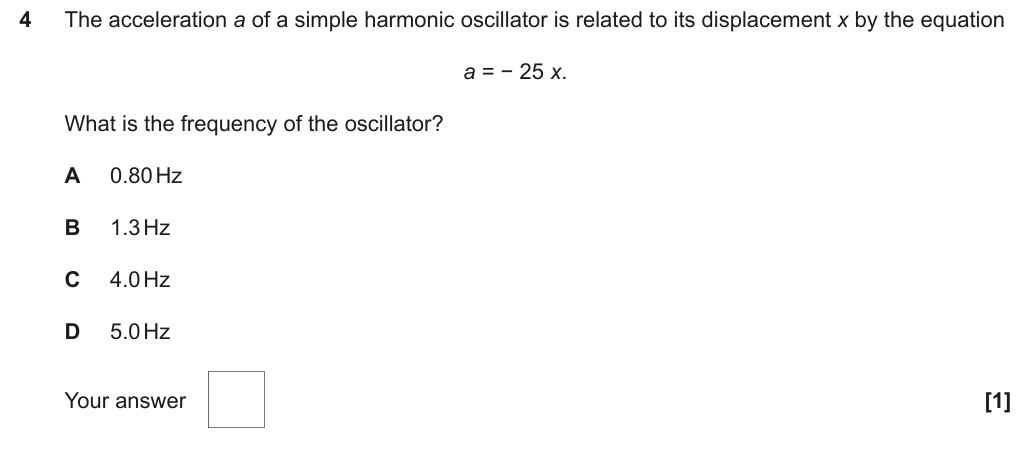
A
About three quarters of all candidates recognised that since = −𝜔𝜔2𝑥𝑥 , the angular frequency of this motion was 5. Also, since 𝜔𝜔= 2𝜋𝜋𝜋𝜋, the frequency must be equal to 5/(2𝜋𝜋) .
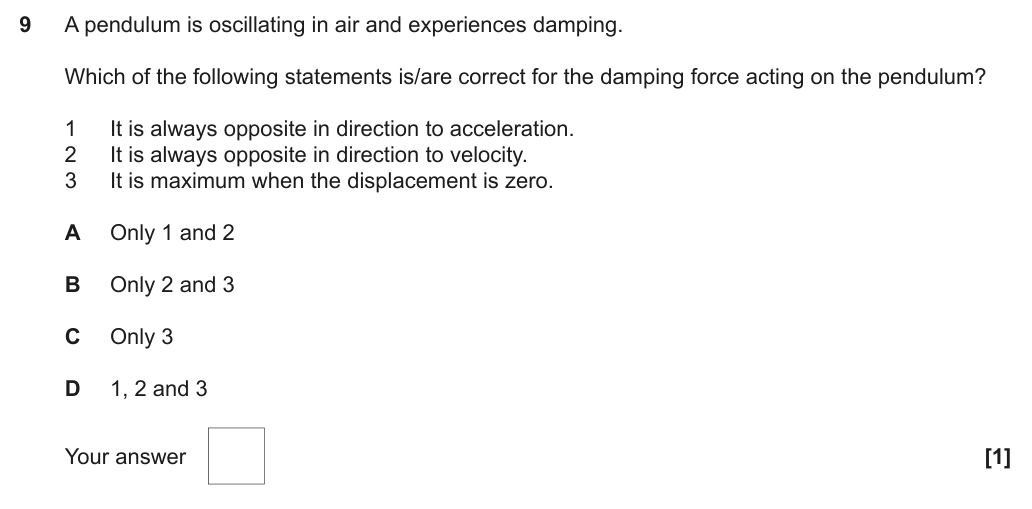
B
The damping force is always opposite in direction to velocity. If the displacement is zero, then the speed is greatest and hence the damping force is also greatest in magnitude. The damping force is not always opposite in direction to acceleration, although the displacement must be, according to the definition of SHM.
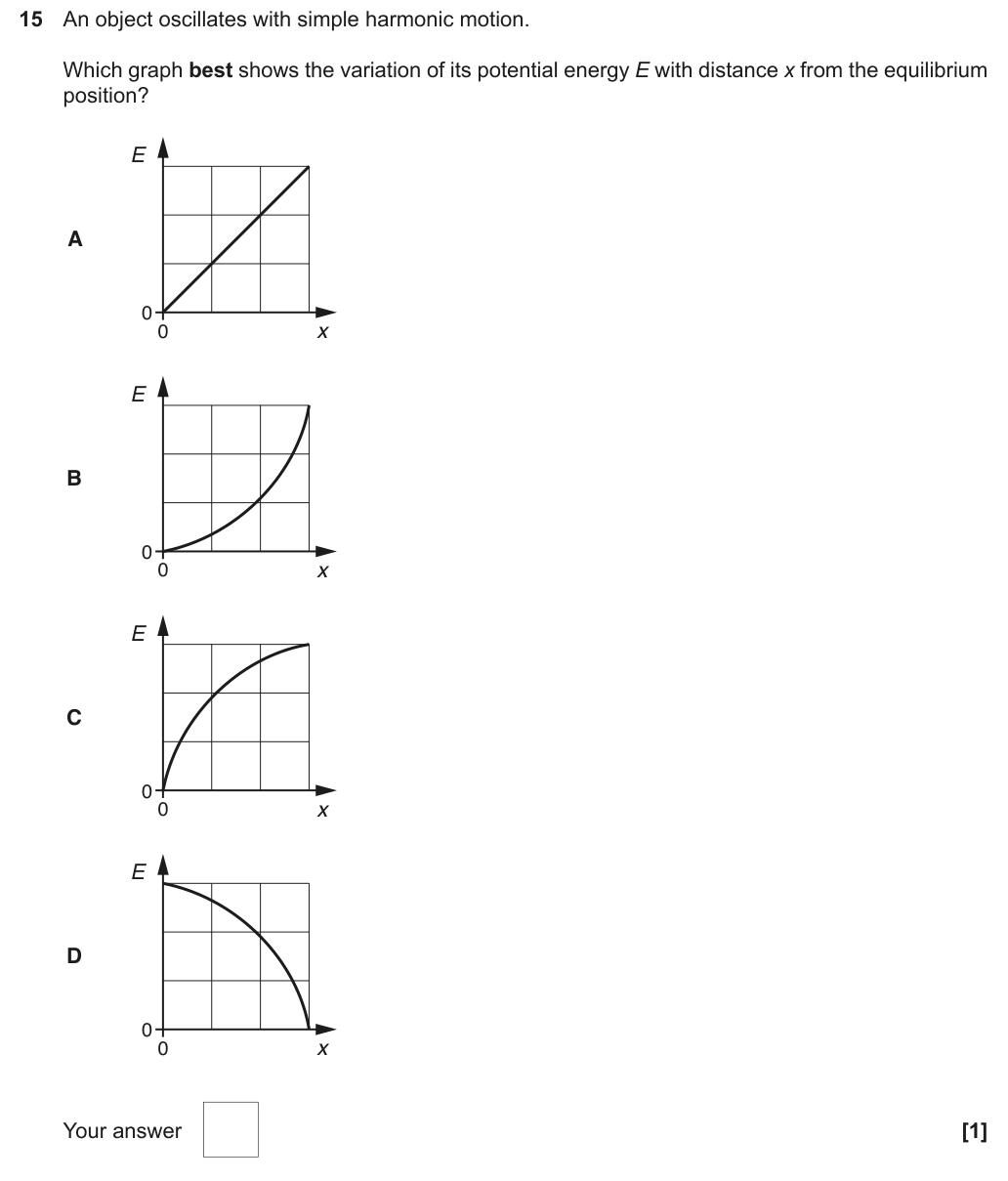
B
In SHM, when x = 0, the object is moving at its fastest and so has maximum KE. This in turn means that the PE must be minimum, eliminating option D. The speed of the object slightly away from the point where x=0 does not increase rapidly nor linearly. This only leaves option B.
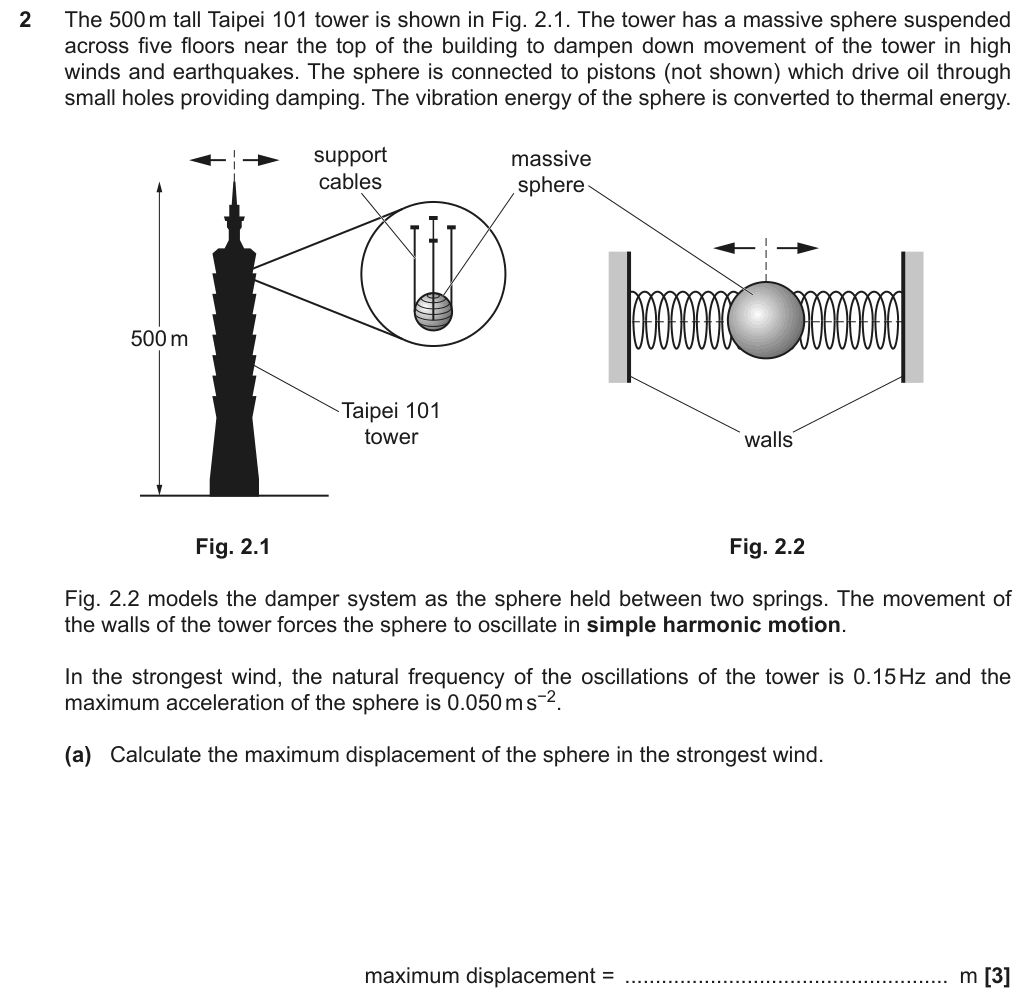
The words simple harmonic motion in the text pointed almost all candidates to use the correct formula. The angular frequency was calculated correctly. Two common errors were to forget to square the value or to give the final answer to only one significant figure rather than a minimum of two.
Skills: M2.2 Change the subject of an equation, including non-linear equations; M2.3 Substitute numerical values into algebraic equations using appropriate units for physical quantities
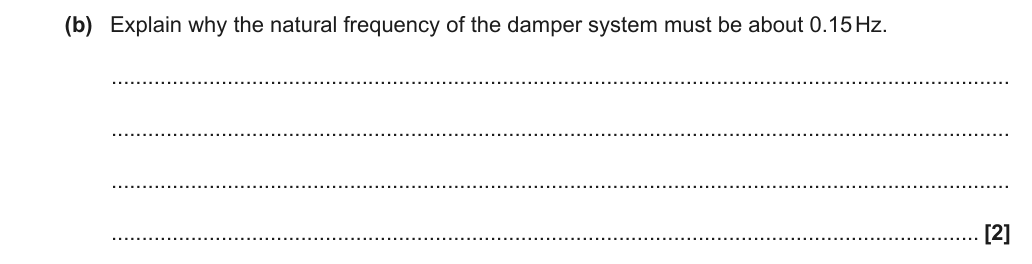
The answers gave a clear indication as to how well the candidates understood a resonance situation. Many omitted to explain which of the three oscillating elements were acting as drivers and which were driven. The candidate who wrote the answer (exemplar 3) shown here has some understanding of the situation but has failed to communicate it clearly to the reader. The ball was often quoted as just acting against the tower to reduce the amplitude rather than using the clue at the end of the initial paragraph about the energy drawn from the tower being absorbed by the dampers. Hence the requirement for the ball to be given a large amplitude or absorb the maximum amount of energy.
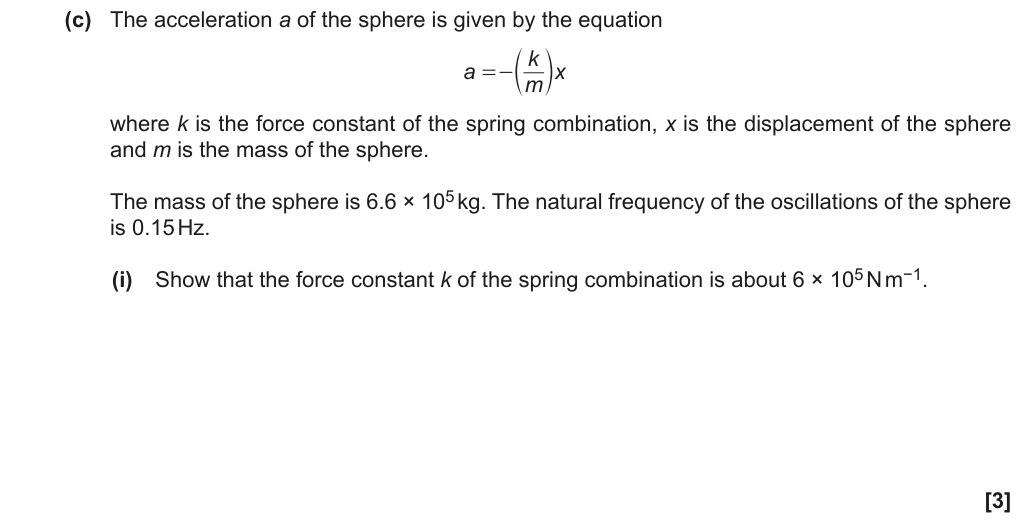
Question 2 (c) (i) Question 2 (c) (ii) The exercise in this section completed successfully by most candidates was to perform standard calculations stating correct formulae and showing clear working to determine the required quantities.
Skills: M2.2 Change the subject of an equation, including non-linear equations; M2.3 Substitute numerical values into algebraic equations using appropriate units for physical quantities
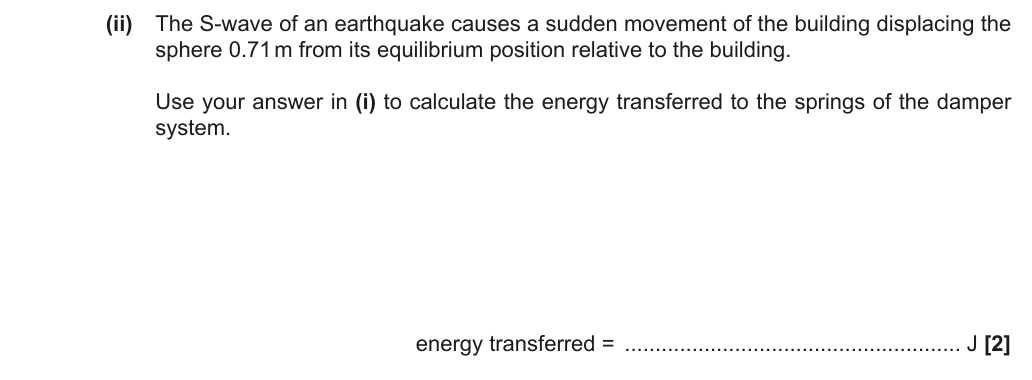
The exercise in this section completed successfully by most candidates was to perform standard calculations stating correct formulae and showing clear working to determine the required quantities. The example (exemplar 4) shown here is of a typical neat script. The most common error was to forget to square quantities in part (ii) or to use the amplitude calculated part (a) rather than the figure given in the stem of this part.
Skills: M2.3 Substitute numerical values into algebraic equations using appropriate units for physical quantities
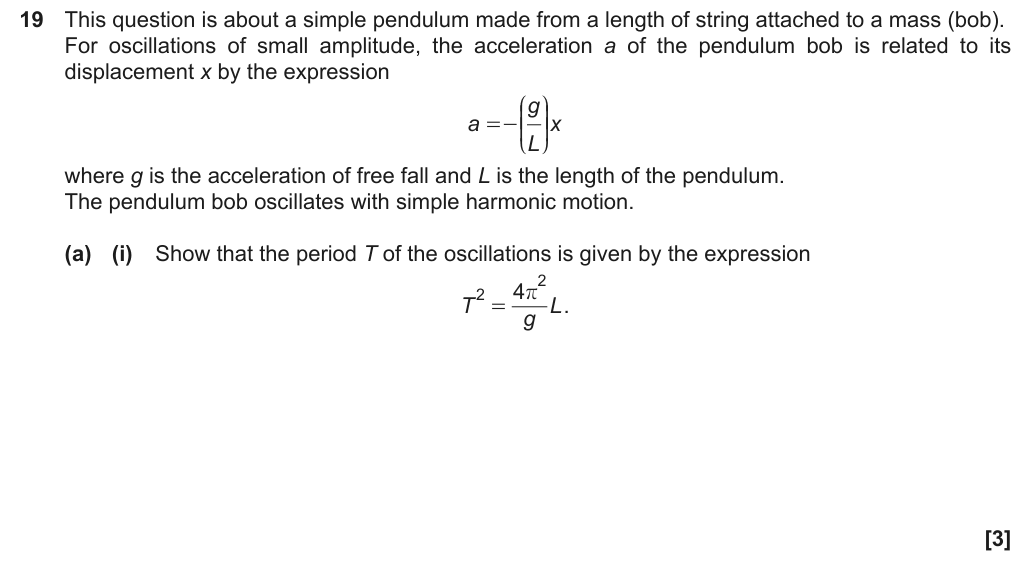
Skills: M2.2 Change the subject of an equation, including non-linear equations
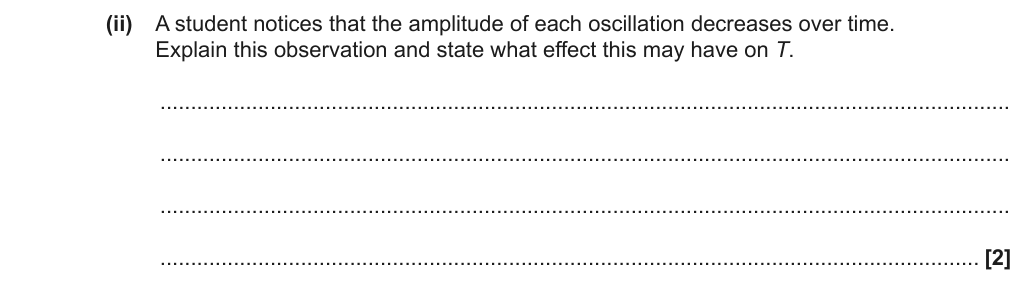

Skills: M3.3 Understand that y = mx + c represents a linear relationship; M3.4 Determine the slope and intercept of a linear graph; PAG10 Investigating simple harmonic motion
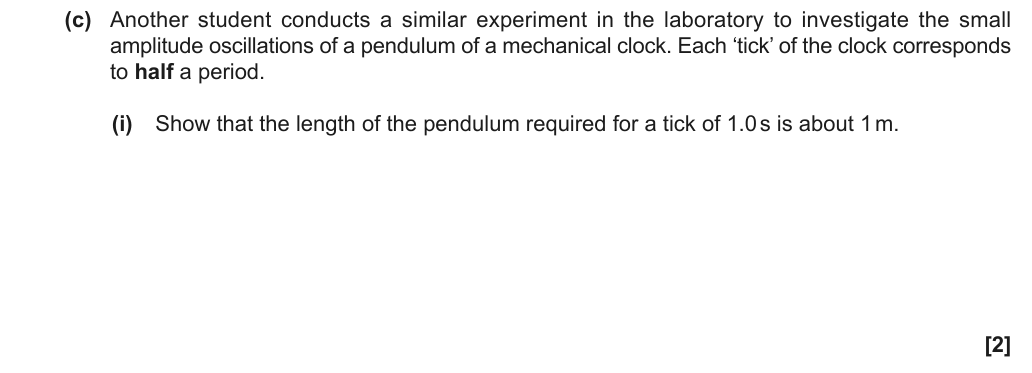
Skills: M2.2 Change the subject of an equation, including non-linear equations; M2.3 Substitute numerical values into algebraic equations using appropriate units for physical quantities
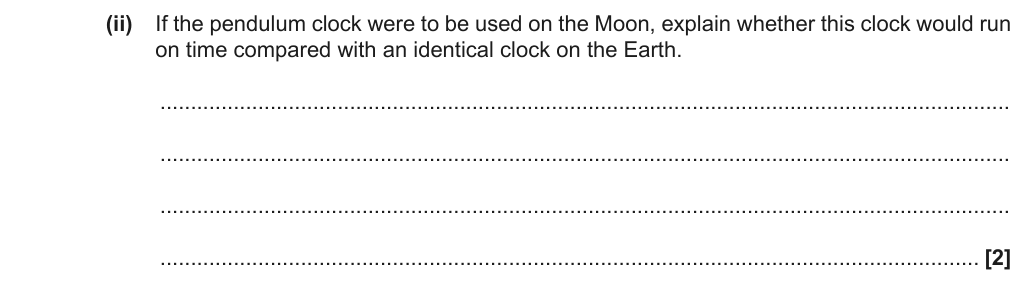
Skills: M0.3 Use ratios, fractions and percentages
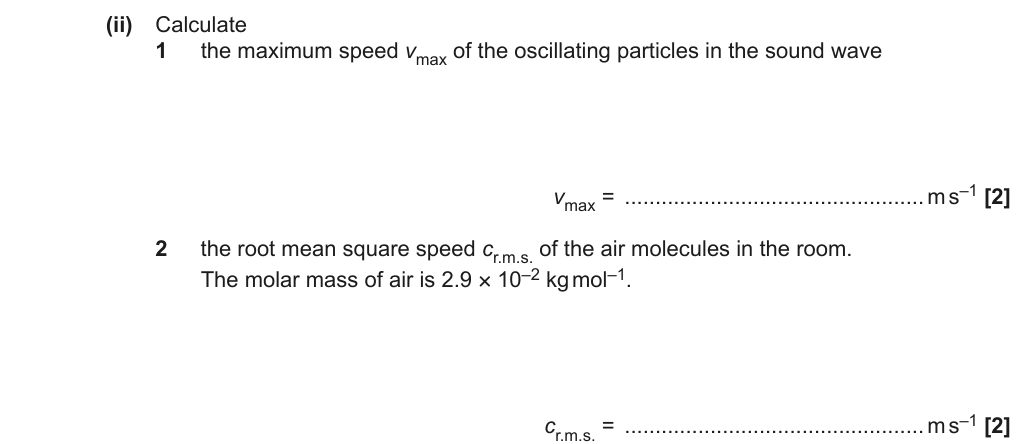
Skills: M0.1 Recognise and make use of appropriate units in calculations; M2.2 Change the subject of an equation, including non-linear equations; M2.3 Substitute numerical values into algebraic equations using appropriate units for physical quantities
Dropping marks on calculations, practical questions or the six-mark level of response questions? Book a trial session with a specialist OCR physics tutor.