Notes and key-term cards for this topic are being written by our tutors. The past-paper questions below are ready now.
Specification statements
Show the 5 learning outcomes from the specification
3.4.1(a) tensile and compressive deformation; extension and compression
3.4.1(b) Hooke’s law
3.4.1(c) force constant k of a spring or wire; F = kx
3.4.1(d)(i) force–extension (or compression) graphs for springs and wires
3.4.1(d)(ii) techniques and procedures used to investigate force–extension characteristics for arrangements which may include springs, rubber bands, polythene strips.
Tap a question to zoom it. Where a part needs a figure, table or graph from earlier in the question, that part folds out above it; the mark scheme and examiner's comment open underneath. Have the OCR Data, Formulae and Relationships Booklet beside you (see the data booklet page).
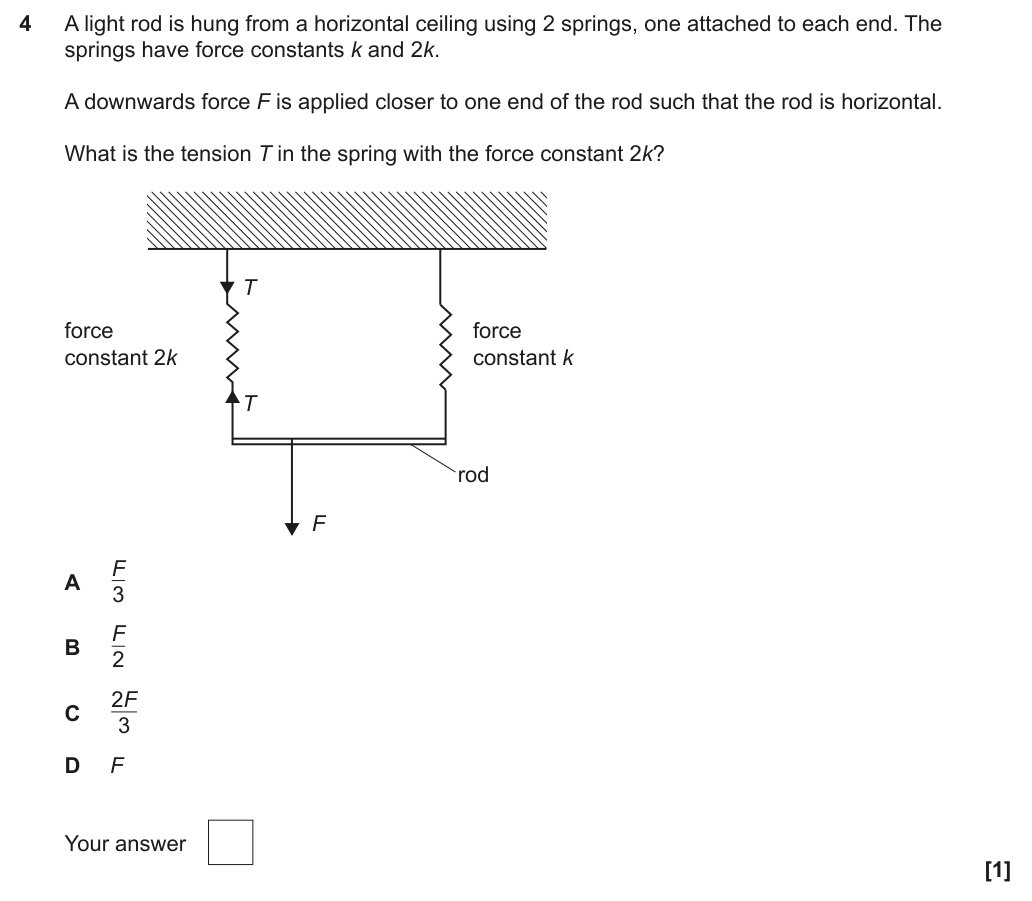
June 2025 · Paper 1 · Q41 markMultiple choiceMedium
Answer
C
Mark scheme
Examiner's comment
The rod ensures that the extension of both springs is the same. This means that the tension in the left spring must be twice the tension in the right spring. This in turn means that F must equal three times the tension of the right spring, since the sum of the two tensions must equal F. Finally, this gives the tension in the right spring as 3 and hence the tension in the left spring must be 2 3.
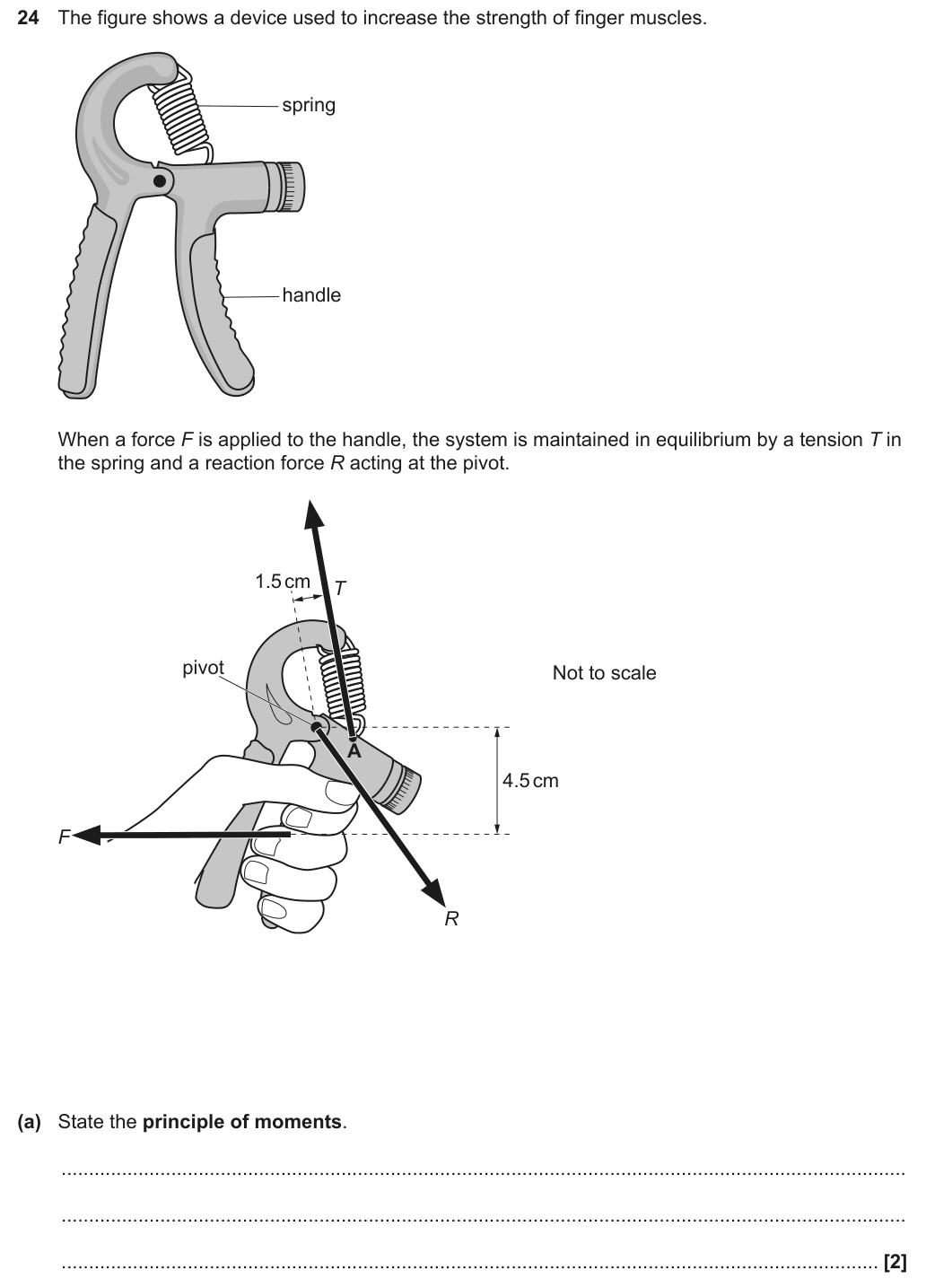
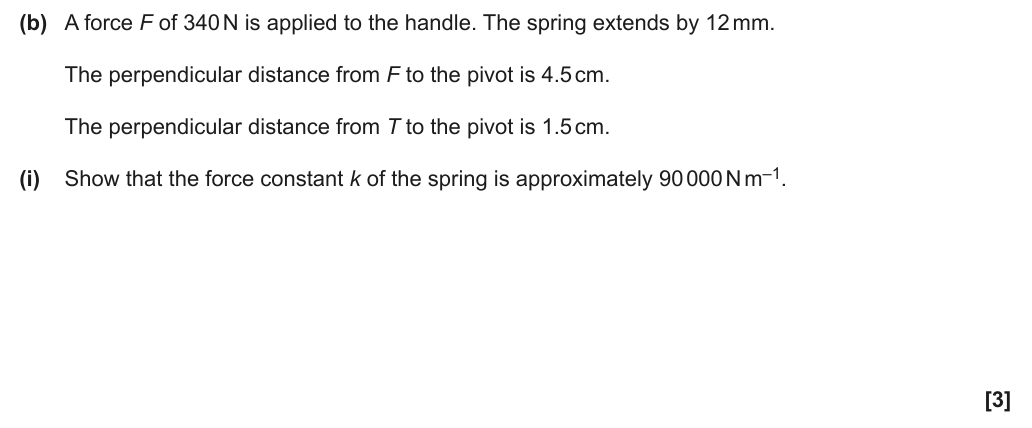
June 2025 · AS Paper 1 · Q24(b)(i)3 marksShow thatMedium
Earlier part of question 24 that this part uses
Mark scheme
Examiner's comment
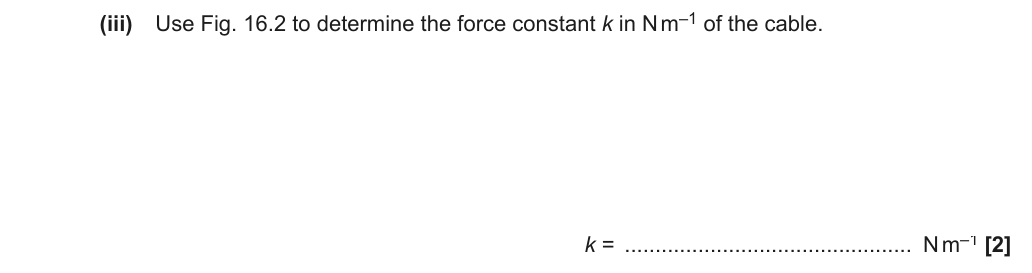
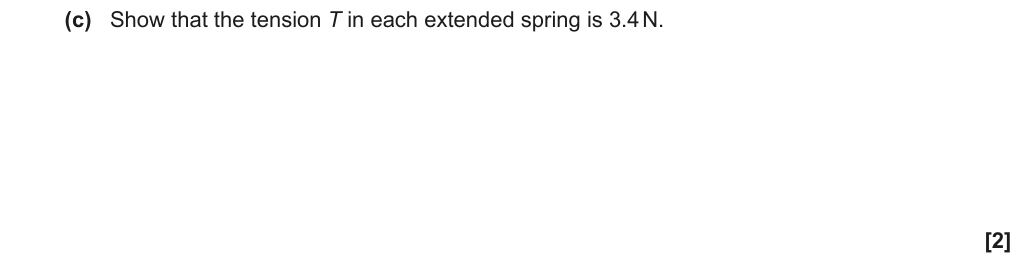
In this calculation it is essential that candidates show all stages of the calculation. Candidates needed to apply the principle of moments using the distances to give a value for the tension T. This value was then used in the equation to determine the force constant k. To gain full credit the value of 85000 needed to be seen. High scoring candidates clearly wrote down relevant equations and substituted into the equations the data provided. A common error made by some low scoring candidates was to subtract the distances. This candidate has clearly demonstrated knowledge and understanding. They have stated the principle of moments, substituted in the data and converted the distances correctly to metres to determine a value for the tension in the spring. The candidate has then stated an equation relating the force constant to the force and extension, rearranged the equation and substituted in the data to calculate an answer. This answer has then been used to get to the value given in the question.
Notes from the mark scheme and report
NOT 4.5 - 1.5 (wrong physics, no further credit)
Skills: M0.1 Recognise and make use of appropriate units in calculations; M2.2 Change the subject of an equation, including non-linear equations
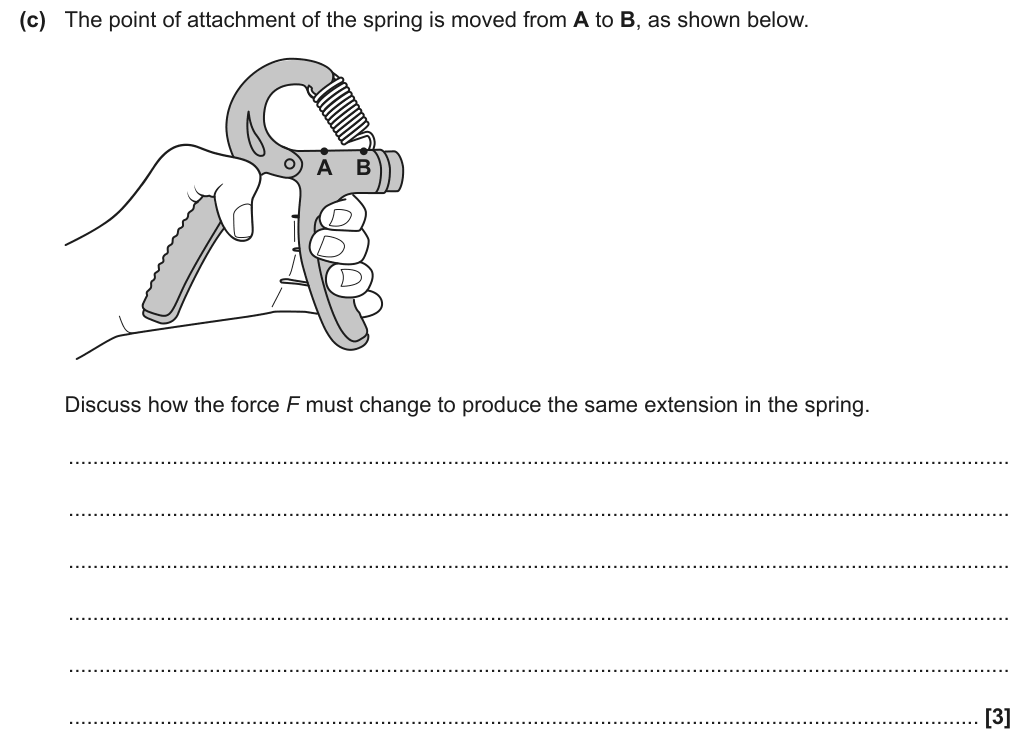
June 2025 · AS Paper 1 · Q24(c)3 marksExplanationHard
Earlier part of question 24 that this part uses
Mark scheme
Examiner's comment
This question was challenging. Candidates needed to identify that for the extension to remain constant, the tension needed to remain the same but the perpendicular distance between the pivot and the line of action of T had increased so that the moment due to T increases. Thus, the moment for F needs to increase. Since the perpendicular distance between the pivot and the line of action of F has stayed the same, the force F must be larger. Many candidates did not refer to T remaining constant. Other candidates did not refer to perpendicular distances. This candidate has clearly explained their answer and included relevant equations. A step-by-step approach has been included and at each stage there is a clear explanation of the physics.
Notes from the mark scheme and report
T unchanged for the same extension
perpendicular distance to T increases so F must increase
June 2024 · Paper 1 · Q18(a)(i)1 markShort answerMedium
Mark scheme
Examiner's comment
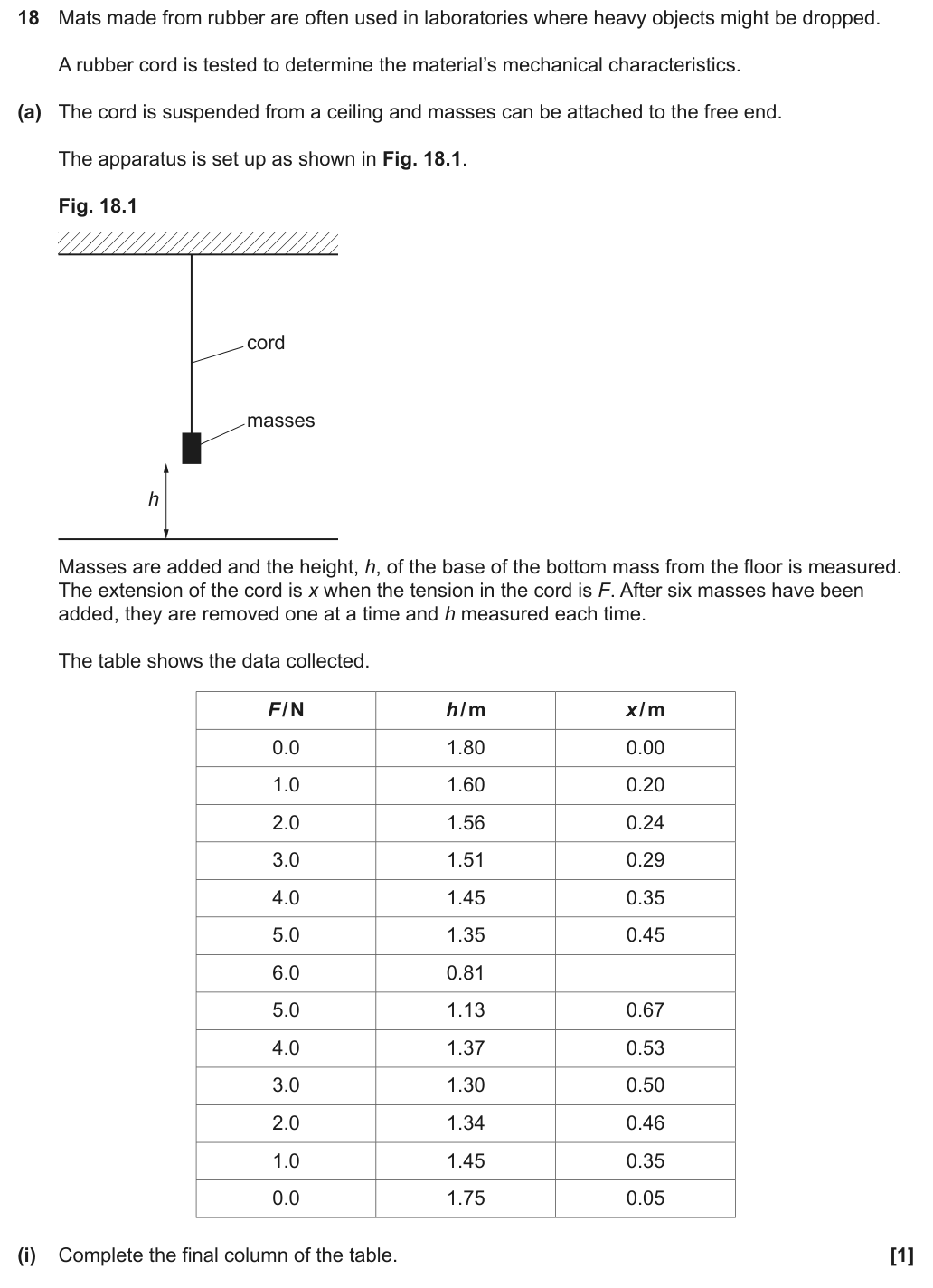
As stated in the Mark Scheme, it was unclear whether all candidates had seen the erratum. As a result, all candidates were awarded this mark. Erratum notice
Notes from the mark scheme and report
mark awarded to all candidates (erratum)
Skills: PAG2 Investigating properties of materials
June 2024 · Paper 1 · Q18(a)(ii)3 marksDiagram or graphEasy
Earlier part of question 18 that this part uses
Mark scheme
Examiner's comment
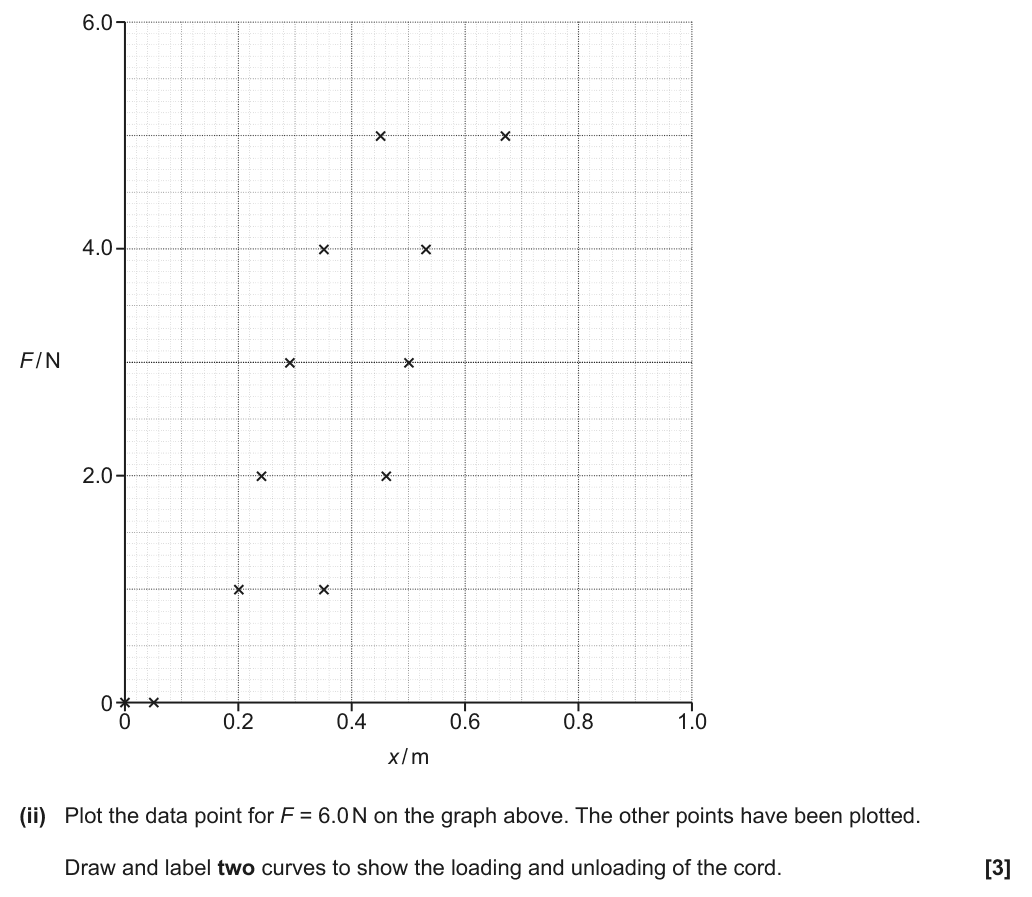
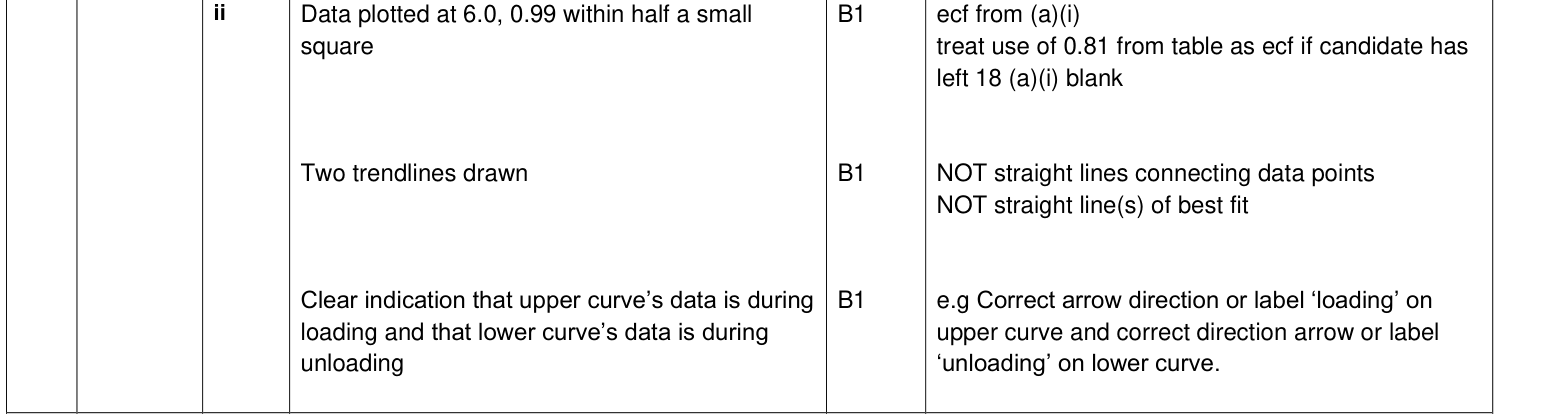
Almost all candidates scored the first mark here, correctly converting the data point they’d calculated in the previous part into graphical form. Candidates drew very good curves, although many lost the final mark for not indicating which curve was which.
Notes from the mark scheme and report
NOT straight lines
loading and unloading curves must be labelled
Skills: M3.2 Plot two variables from experimental or other data; PAG2 Investigating properties of materials
June 2024 · Paper 1 · Q18(a)(iii)2 marksExplanationMedium
Earlier parts of question 18 that this part uses
Mark scheme
Examiner's comment
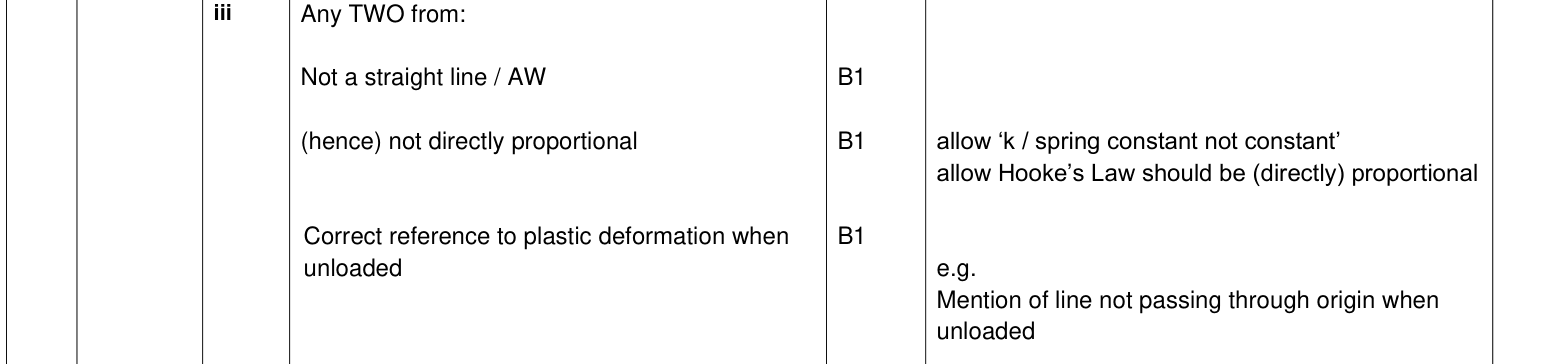
The best way of answering this sort of question is to link what evidence there is in the question - in this case the graph - to what the candidate knows about Hooke’s Law. Here, the lines are clearly not straight, so cannot support an idea that the extension and loading force are directly proportional. When answering questions of this nature, a good start is to describe the trend line (or the relevant graphical feature) and then move on to how this either supports or rejects a particular theory or relationship.
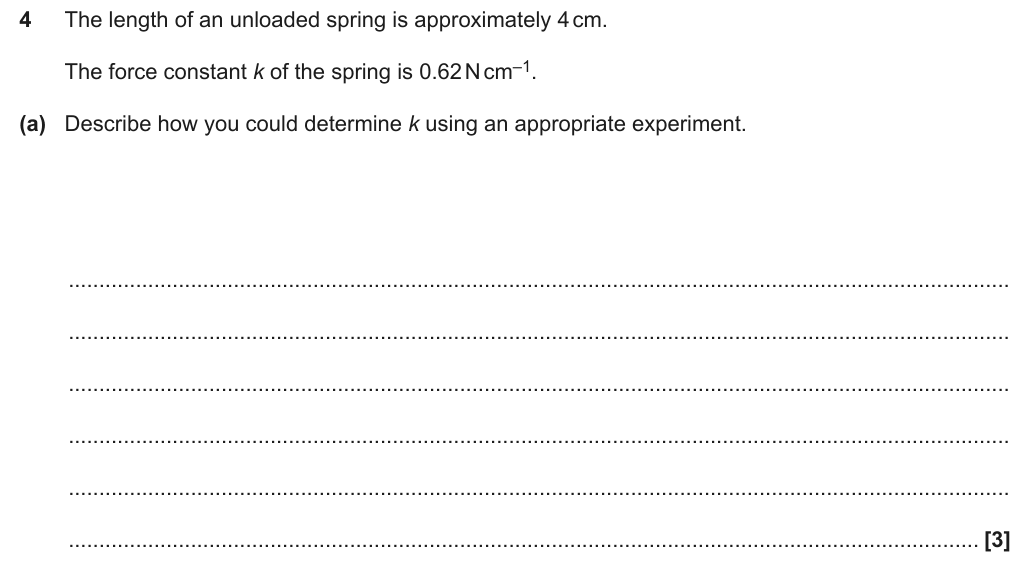
June 2024 · Paper 3 · Q4(a)3 marksExplanationMedium
Mark scheme
Examiner's comment
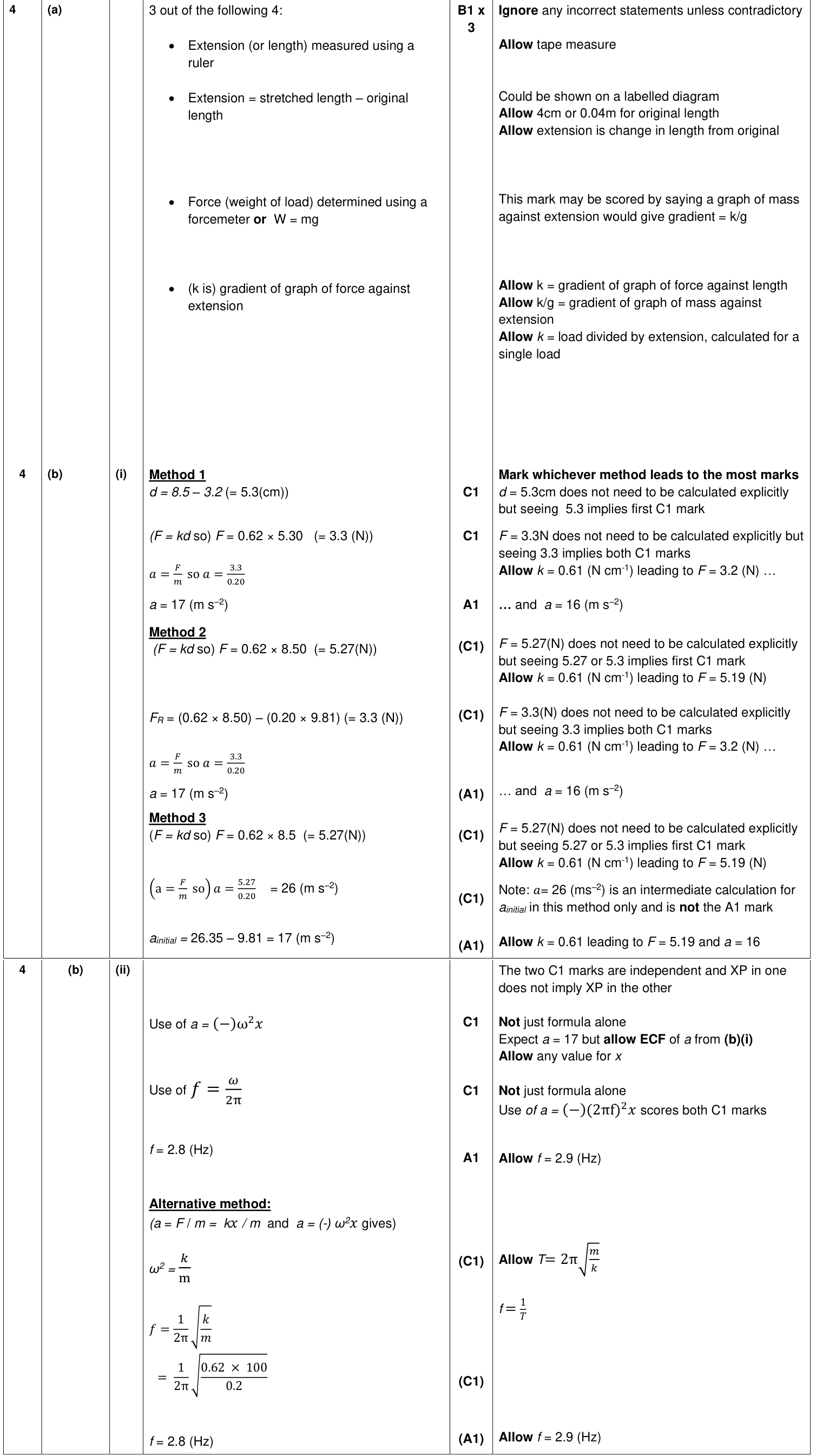
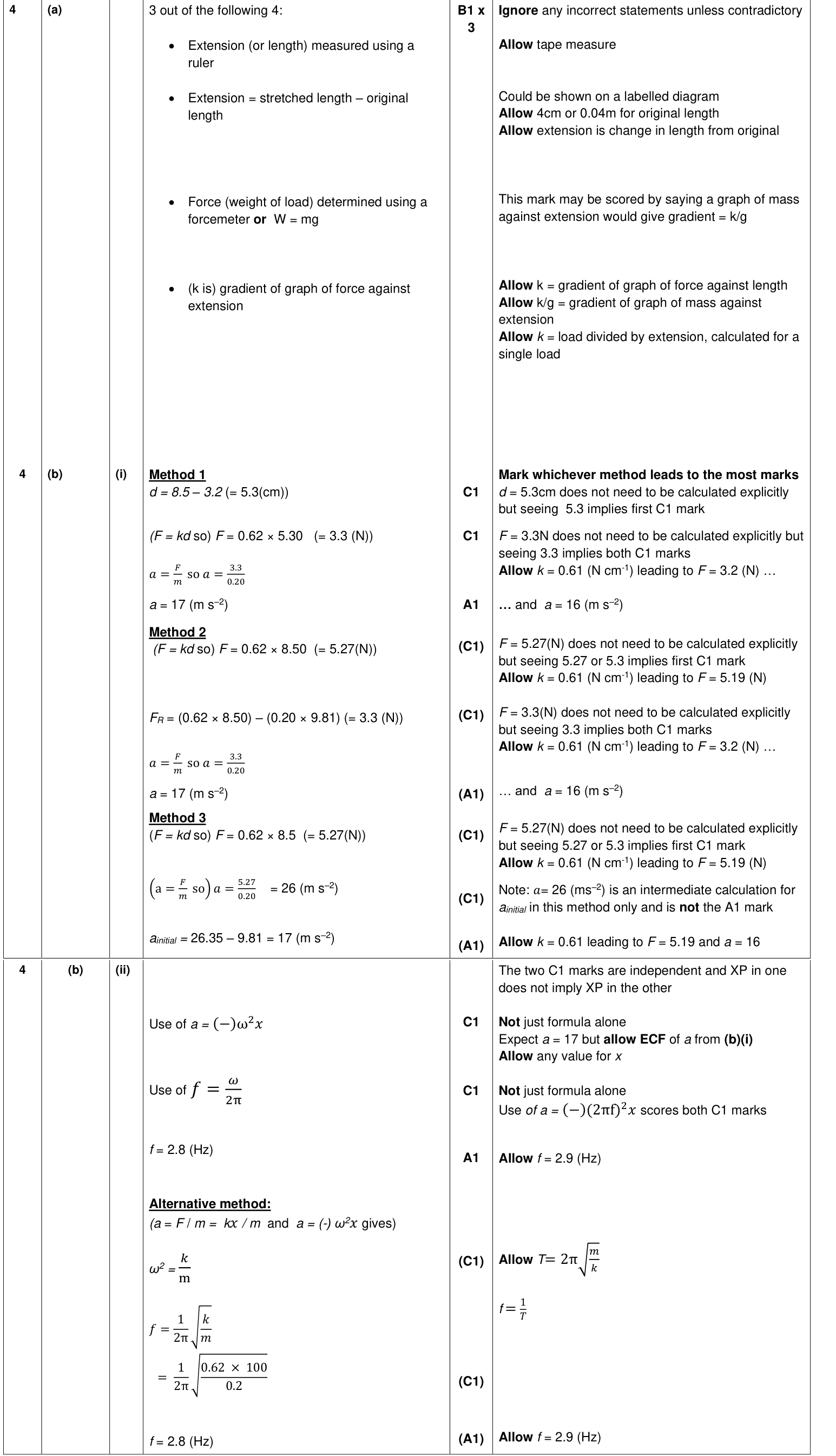
In general, when asked to describe an experiment, it is good practice to describe which variables are being measured and what instruments are being used to measure them. In this case, we are measuring force (using a newton meter, or a top pan balance for mass plus F = mg) and extension (using a rule or tape measure). It is important to define extension, since it involves two measurements (extended length – initial length). It is also good practice to describe a graphical method for measuring k rather than just carrying out a simple calculation. Candidates who said, ‘I would plot a graph of F against x’ or ‘I would divide F by x’ (without stating what F and x represented in terms of this experiment) gained no credit.
Notes from the mark scheme and report
any 3 of 4 points
allow k = load / extension for a single load
Skills: M3.4 Determine the slope and intercept of a linear graph; PAG2 Investigating properties of materials
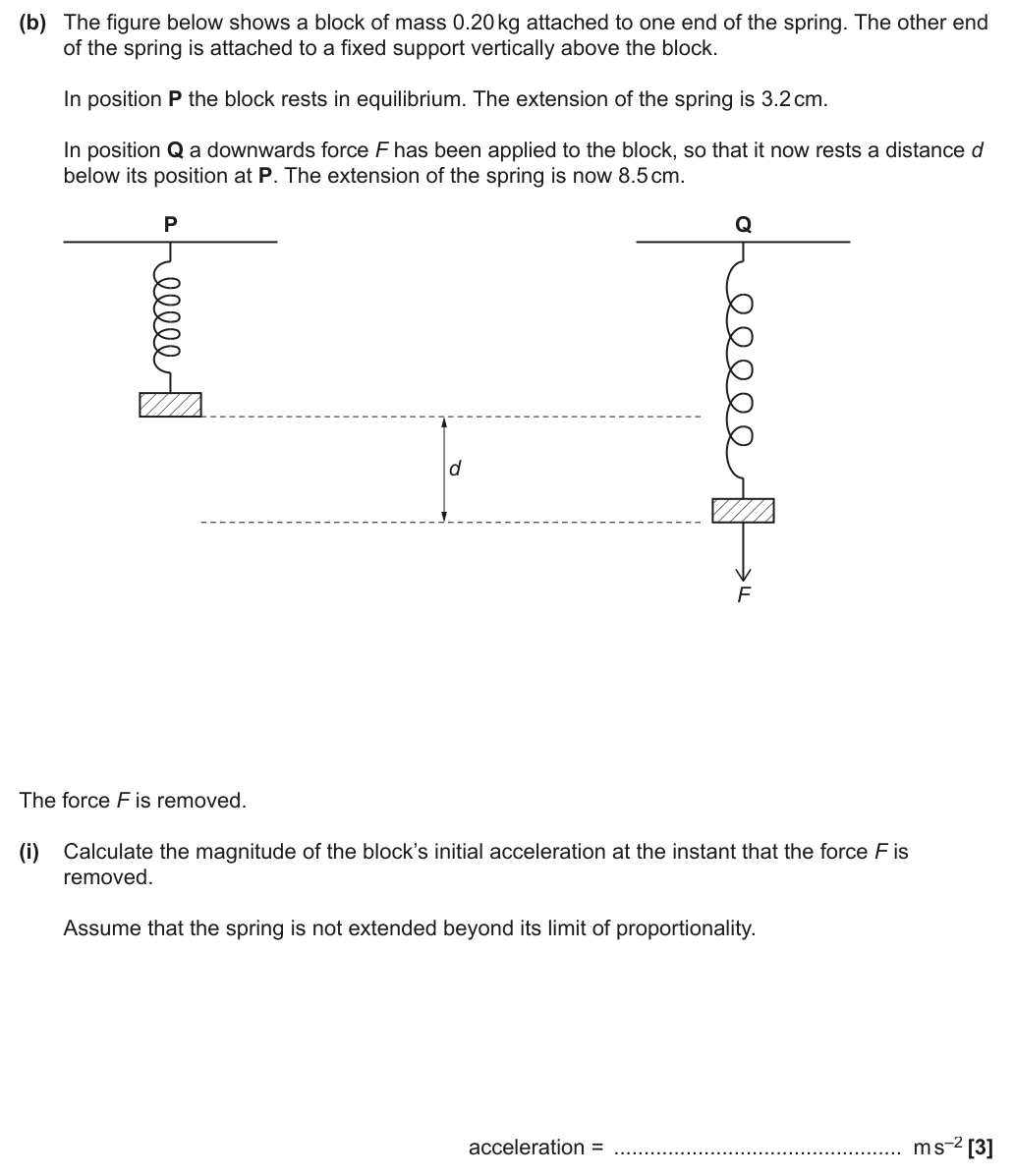
June 2024 · Paper 3 · Q4(b)(i)3 marksCalculationMedium
Earlier part of question 4 that this part uses
Mark scheme
Examiner's comment
There are two measurements for extension given here: an extension of 3.2cm under a load of (0.2 x 9.81) N and an extension of 8.5cm under a force of F + (0.2 x 9.81) The easiest way to approach the question is to recognise that the extension due to F alone must be (8.5 – 3.2) = 5.3cm. F = kx then becomes F = 0.62 x 5.3 (since k is given in N cm-1) and so we can use F = ma with m = 0.2kg to find the acceleration a. However, other valid methods were also given credit.
Notes from the mark scheme and report
a = 26 m s⁻² (5.27/0.20) is only an intermediate value
allow 16 m s⁻² from k = 0.61
Skills: M0.1 Recognise and make use of appropriate units in calculations; M2.3 Substitute numerical values into algebraic equations using appropriate units for physical quantities
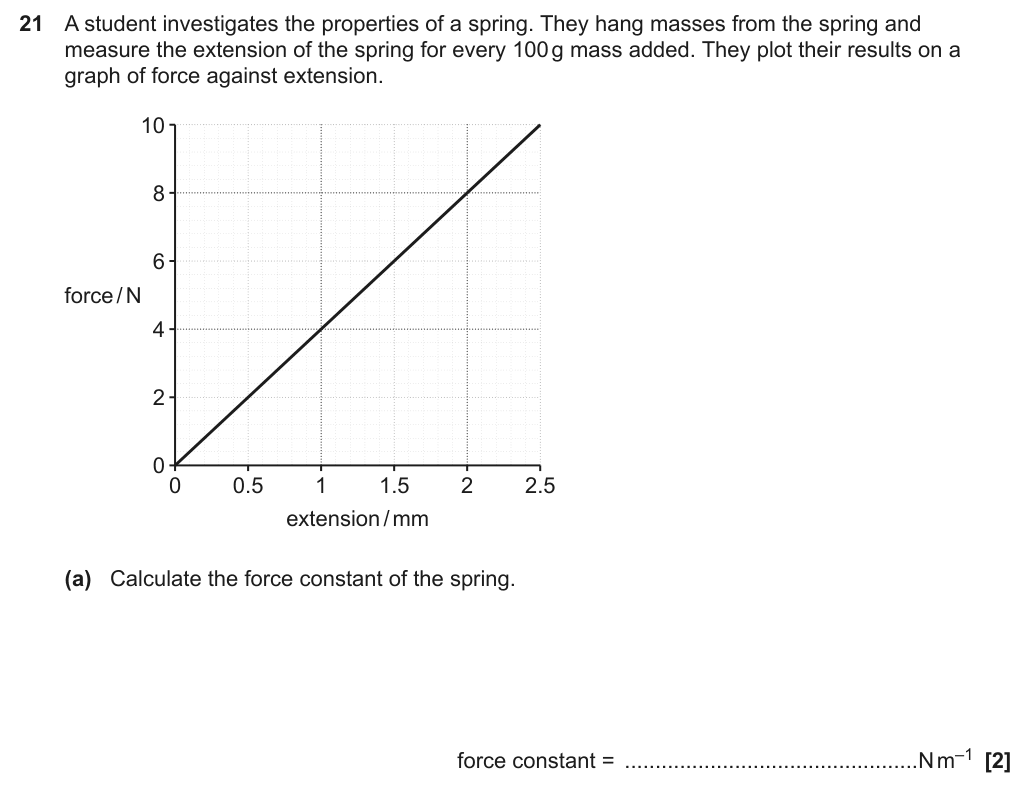
June 2023 · AS Paper 1 · Q21(a)2 marksCalculationMedium
Mark scheme
Examiner's comment
Candidates performed well on this question as they correctly applied F = kx to determine the gradient of the graph to give the force constant. Most candidates converted mm to m but about a quarter of candidates did not recognise that a unit conversion was required so gave an answer of 4 (N m–1) which was given 1 mark.
Notes from the mark scheme and report
4 (N m-1) scores 1 mark (mm not converted)
Skills: M0.1 Recognise and make use of appropriate units in calculations; M3.4 Determine the slope and intercept of a linear graph; PAG2 Investigating properties of materials
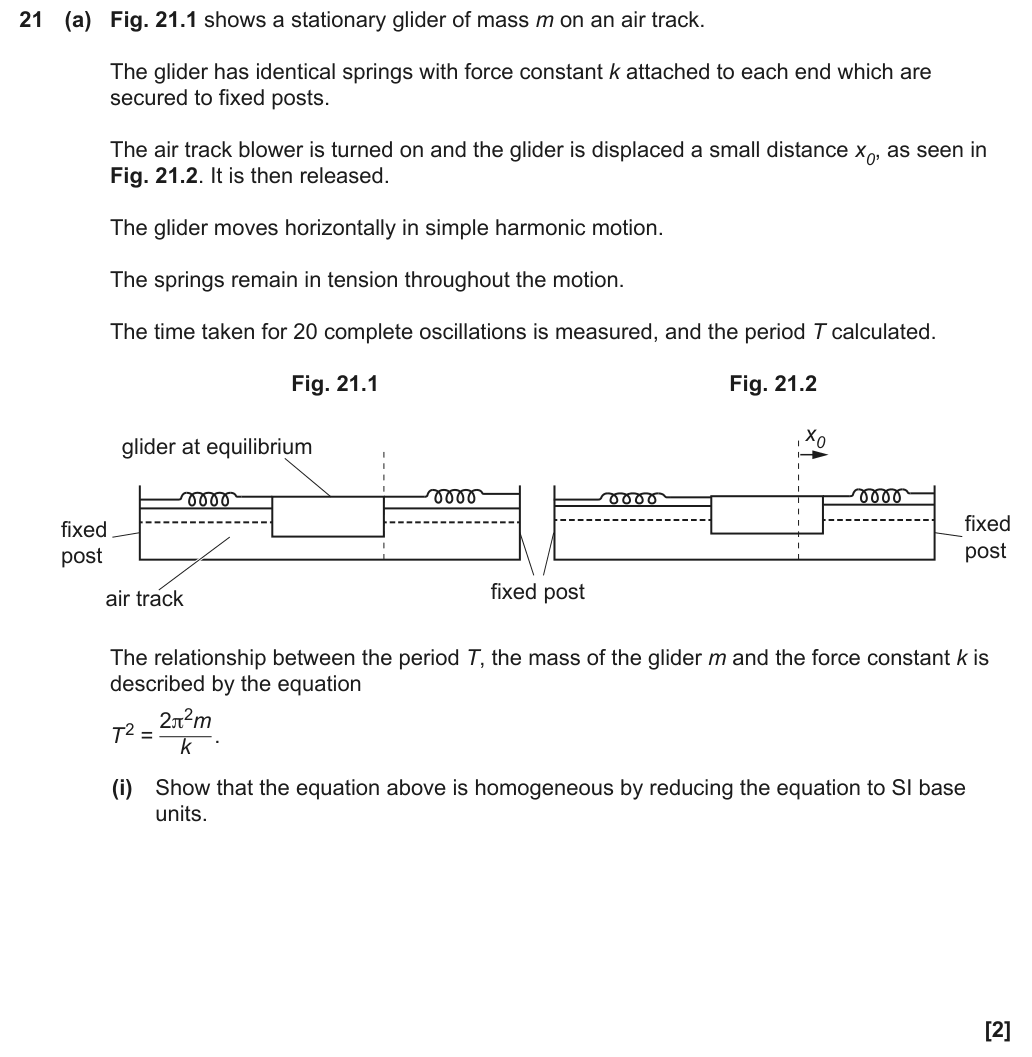
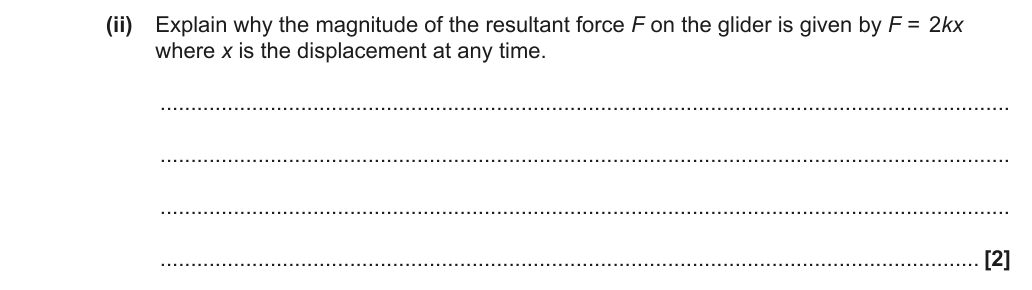
June 2023 · Paper 1 · Q21(a)(ii)2 marksExplanationMedium
Earlier part of question 21 that this part uses
Mark scheme
Examiner's comment
Many candidates successfully derived or remembered how to express the newton in SI base units. From there, working out the base units for the spring constant and cancelling kilograms proved straightforward for many. Question 21 (a) (ii) is considerably more challenging. The two springs are not in series nor are they in parallel. When there is a displacement x one spring is extended by an extra amount x i.e. an extension of (e + x) and the other is extended by a reduced amount x i.e. an extension of (e – x) where e is the equilibrium extension. This meant that the resultant force was k(e + x) – k(e – x), which is clearly 2kx. Neither spring goes into compression, although we condoned candidates who suggested that a reduction in extension meant the same as a compression.
Notes from the mark scheme and report
reject springs in series / parallel idea
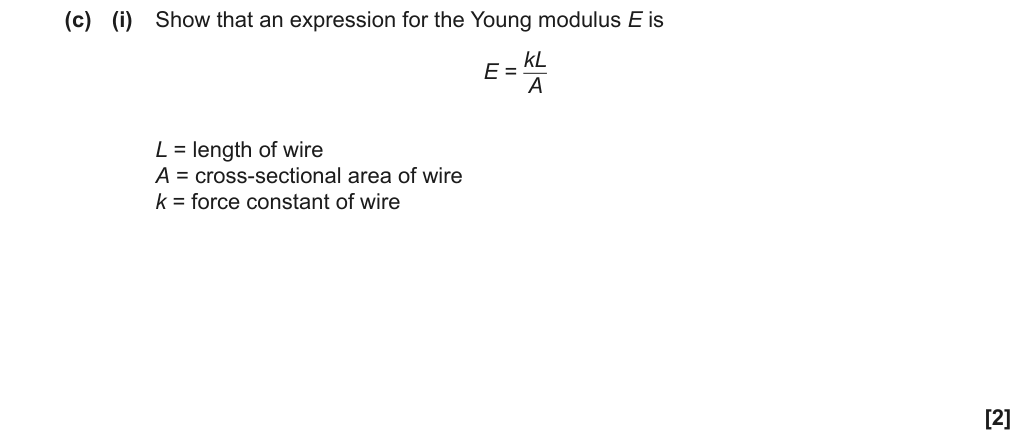
June 2023 · AS Paper 1 · Q21(c)(i)2 marksShow thatMedium
Mark scheme
Examiner's comment
Over half of candidates correctly selected the equations E = σ/ε, ε = x/L, σ = F/A and F = kx and showed clear substitution to give the expression for the Young modulus E. Some candidates did confuse the quantity of E and selected the incorrect equation E = ½ Fx ; E = ½kx2 from the Data, Formulae and Relationships booklet.
Notes from the mark scheme and report
clear substitution needed
Skills: M2.2 Change the subject of an equation, including non-linear equations
June 2023 · AS Paper 2 · Q4(a)(ii)1 markCalculationMedium
Earlier part of question 4 that this part uses
Mark scheme
Examiner's comment
Most candidates correctly determined x but a significant minority of candidates did not realise that the uncertainty in the measurements needed to be added. For this question it was essential that candidates showed their working. Many candidates incorrectly used the extension for a force of 3.5 N and substituted it into an equation. More able candidates stated that the area under the line would be equal to the work done and then clearly showed the method used to work out the area under the line.
Notes from the mark scheme and report
absolute uncertainties add: 32.7 ± 0.2
Candidates should understand that when quantities are added or subtracted the absolute uncertainties are added.
In the Practical Skills Handbook there is a section on uncertainties.
Skills: M1.5 Identify uncertainties in measurements and use simple techniques to determine uncertainty when data are combined
June 2023 · AS Paper 2 · Q4(a)(iii)2 marksCalculationMedium
Earlier parts of question 4 that this part uses
Mark scheme
Examiner's comment
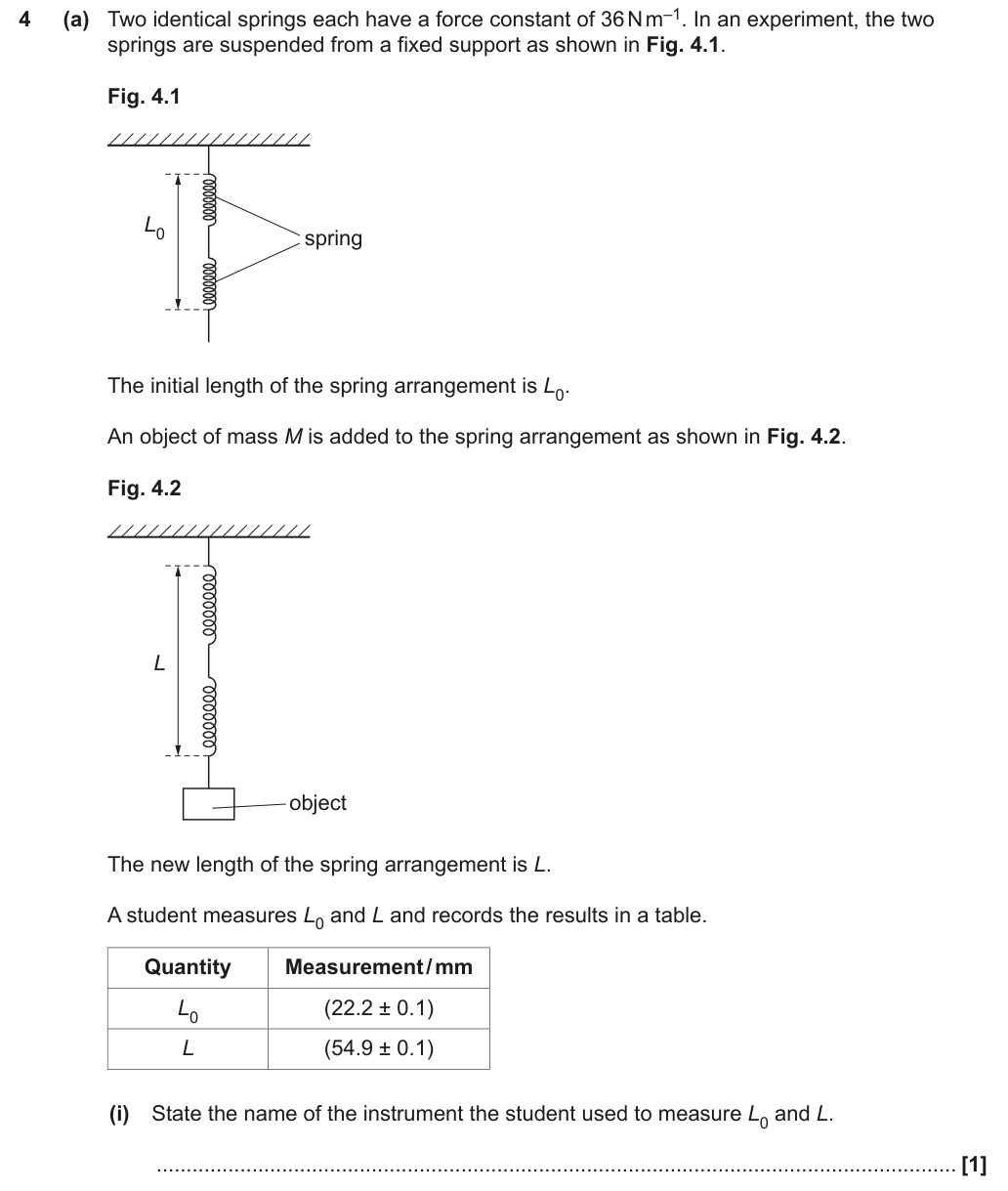
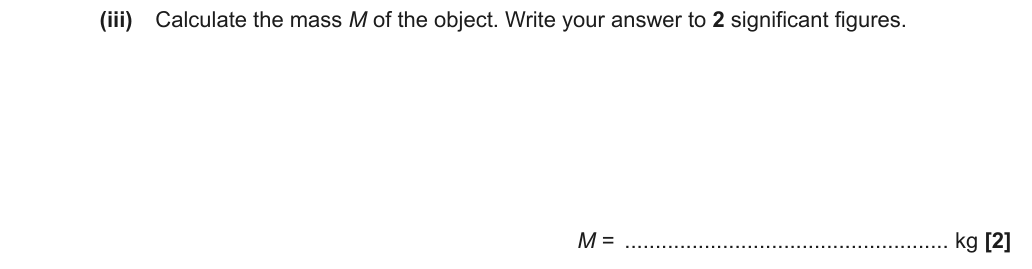
The common error was to use 36 N m–1 as the force constant and 0.0327 m as the extension. Other errors included either rounding the answer to one significant figure (0.06) or not changing the millimetre to metre. Clear working was needed to allow error carried forward marks into the next section.
Notes from the mark scheme and report
springs in series so k = 18 N m-1
answer must be 2 SF (0.06 scores one mark)
60 (power of ten error) one mark
ecf from (a)(ii)
A number of candidates did not understand significant figures.
Candidates should understand the implication of trailing zeros both before and after the decimal place. For example, 0.06 is one significant figure, 0.060 is two significant figures, etc.
Skills: M0.1 Recognise and make use of appropriate units in calculations; M1.1 Use an appropriate number of significant figures; M2.2 Change the subject of an equation, including non-linear equations
June 2023 · AS Paper 2 · Q4(b)(i)3 marksCalculationMedium
Mark scheme
Examiner's comment
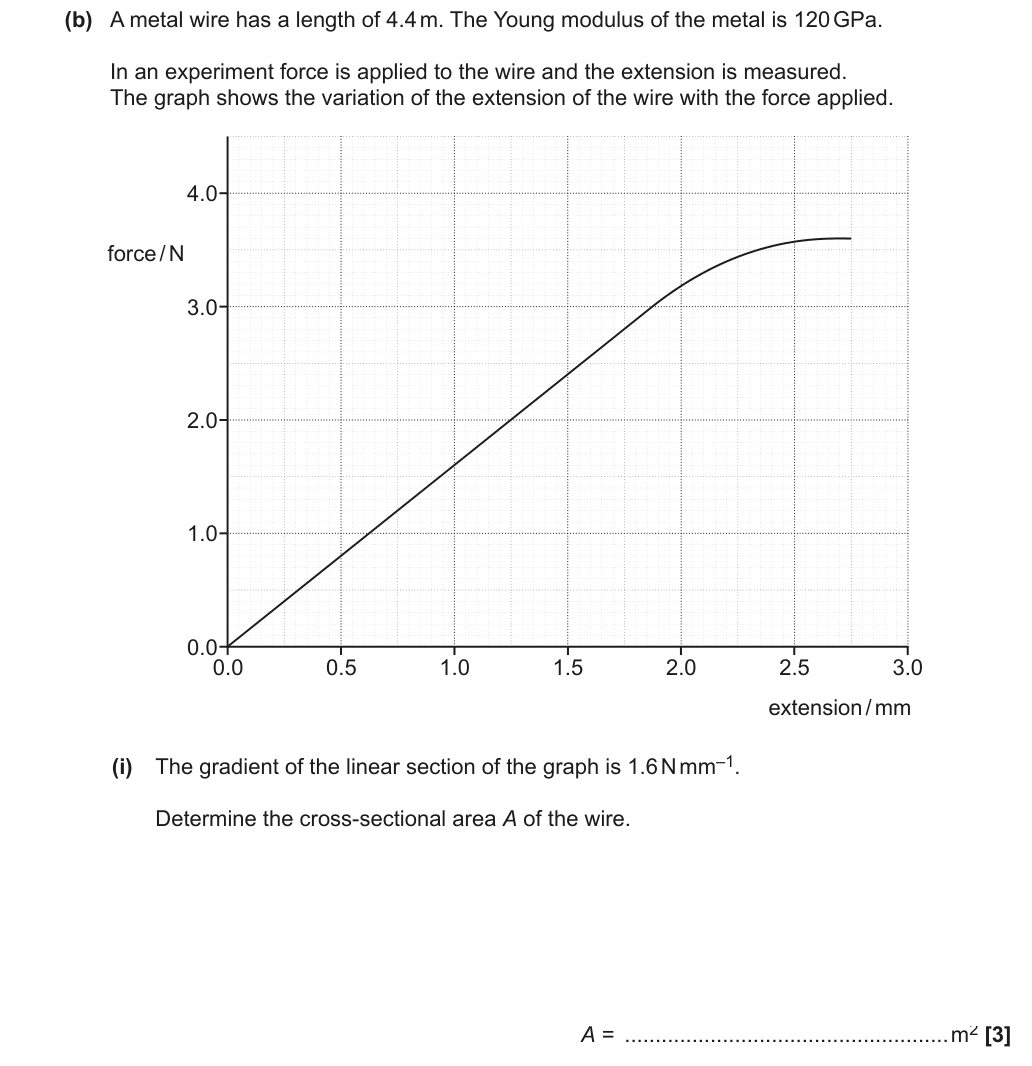
Many candidates did not understand the significance of the gradient. More able candidates derived an equation into a y = mx format and then successful calculated an answer. A number of candidates did not use an appropriate power of ten for the Young modulus or convert the gradient to be consistent with the length of the wire. Candidates who read a value of force and extension directly from the graph could still gain full credit – often the read-offs were from the non-linear section of the graph.
Notes from the mark scheme and report
gradient = AE / L
5.9 x 10^n scores two marks
Candidates should make sure that they are using consistent units when calculating quantities and should know the common prefixes for units.
Skills: M0.1 Recognise and make use of appropriate units in calculations; M2.2 Change the subject of an equation, including non-linear equations; M3.4 Determine the slope and intercept of a linear graph; PAG2 Investigating properties of materials
June 2022 · Paper 1 · Q16(a)4 marksExplanationEasy
Mark scheme
Examiner's comment
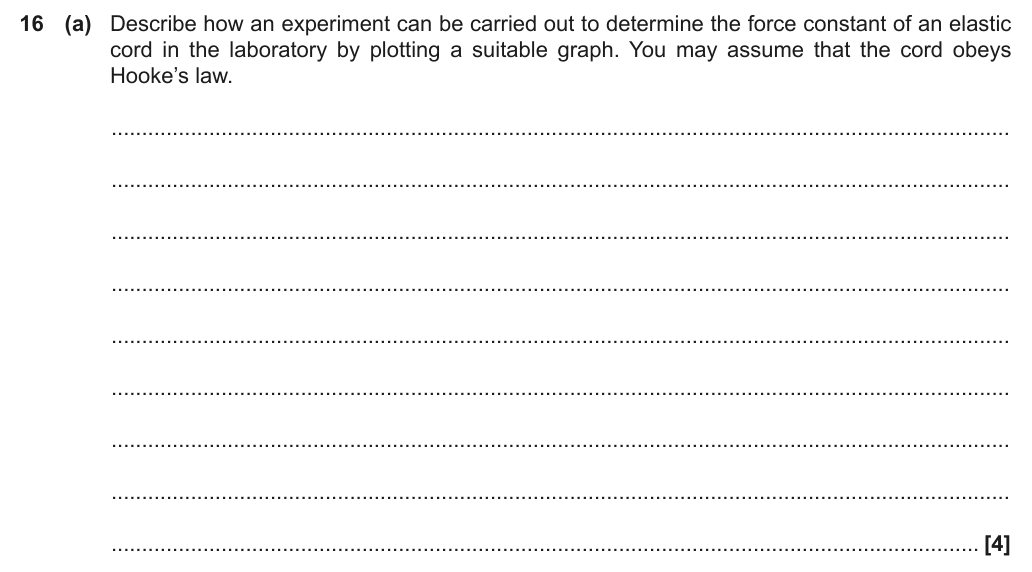
Questions 16 (a), (b) (i) and (ii) were answered very well indeed.
Notes from the mark scheme and report
allow length measured
if axes are swapped force constant must be 1/gradient
Skills: M3.4 Determine the slope and intercept of a linear graph; PAG2 Investigating properties of materials
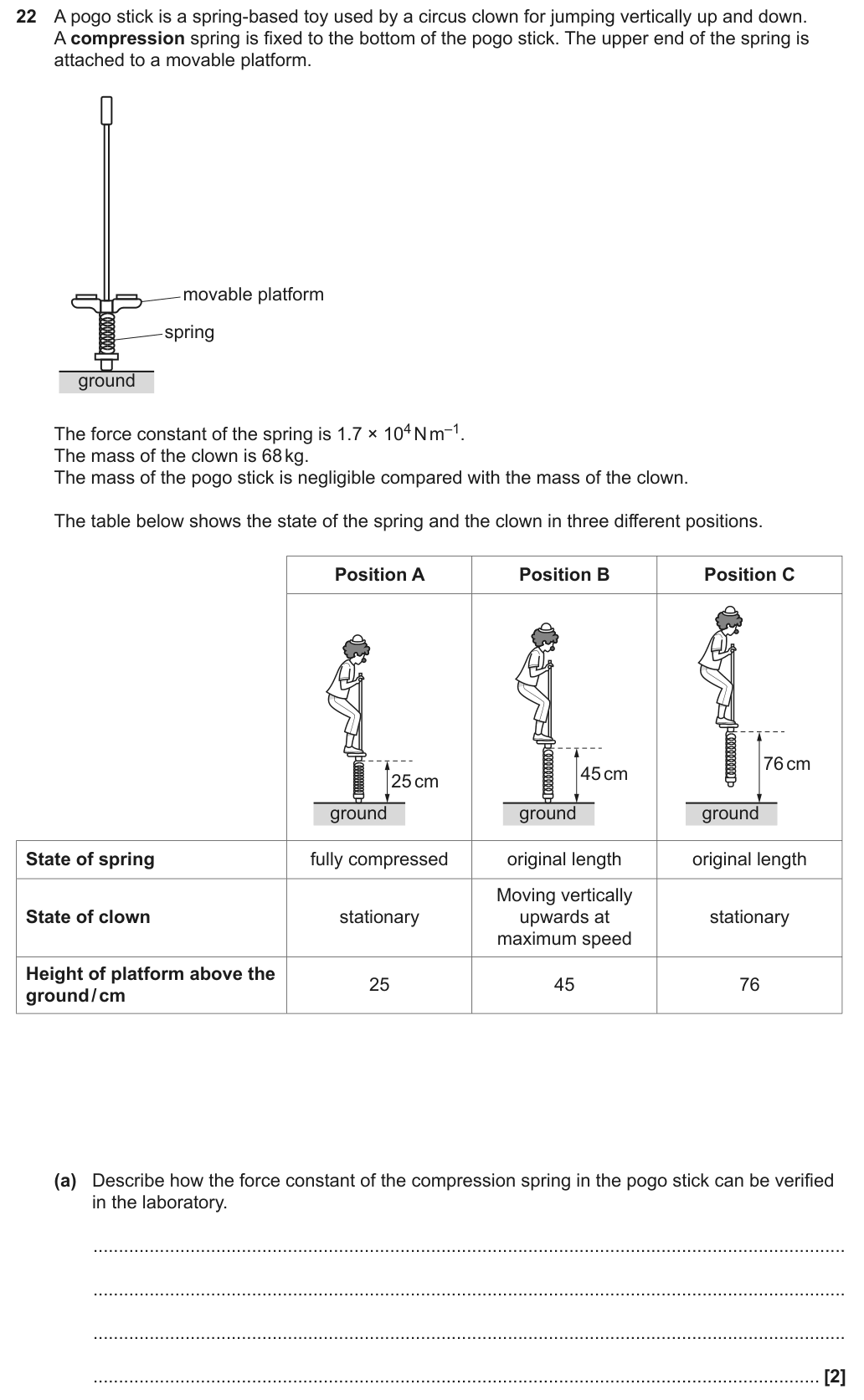
June 2022 · AS Paper 1 · Q22(a)2 marksExplanationMedium
Mark scheme
Examiner's comment
Most candidates accessed this question and were given 1 mark for either describing a method to measure the compression (extension) of a spring or using these measurements to determine the spring constant either from the gradient of a force–extension graph or manipulation of F = kx. Candidates often were not given the first marking point as even though they described a correct practical procedure in adding masses they did not qualify this by multiplying the mass by g to obtain the weight compressing the spring as it is this quantity along with the compression that is used to verify the force constant. Also, candidates did not always describe their method that could suitably be carried out in the lab as they described adding the ‘clown’ or a ‘person’ to the spring and then measuring the compression (extension).
Notes from the mark scheme and report
NOT length for compression
Allow extension for compression
for k = F/x, k must be the subject
Skills: M3.4 Determine the slope and intercept of a linear graph; PAG2 Investigating properties of materials
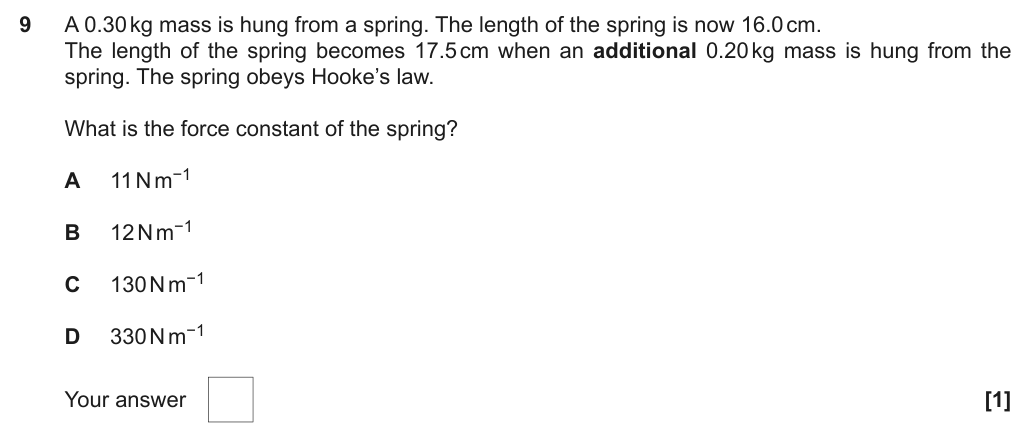
November 2020 · AS Paper 1 · Q91 markMultiple choiceMedium
Answer
C
Mark scheme
Examiner's comment
The same technique can be employed in Questions 9, 12, 13, 15 and 18.
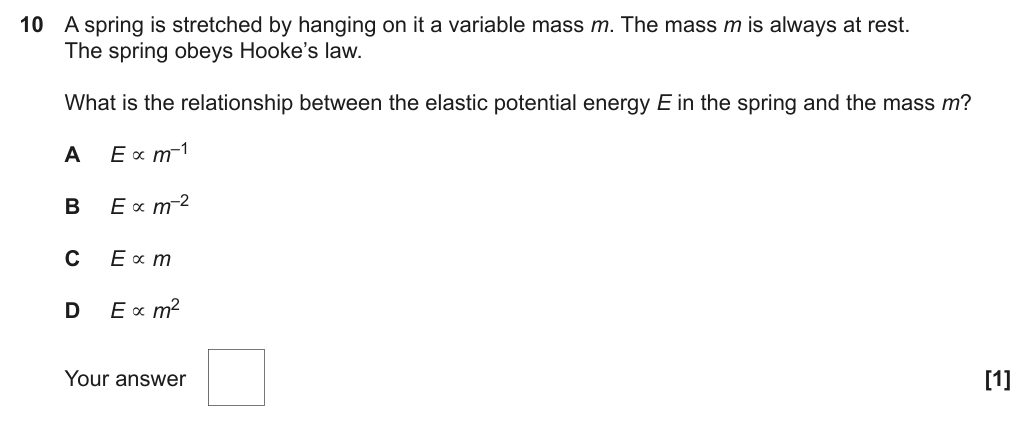
November 2020 · Paper 1 · Q101 markMultiple choiceHard
Answer
D
Mark scheme
Examiner's comment
Candidates had particular difficulty with Question 9 and Question 10.
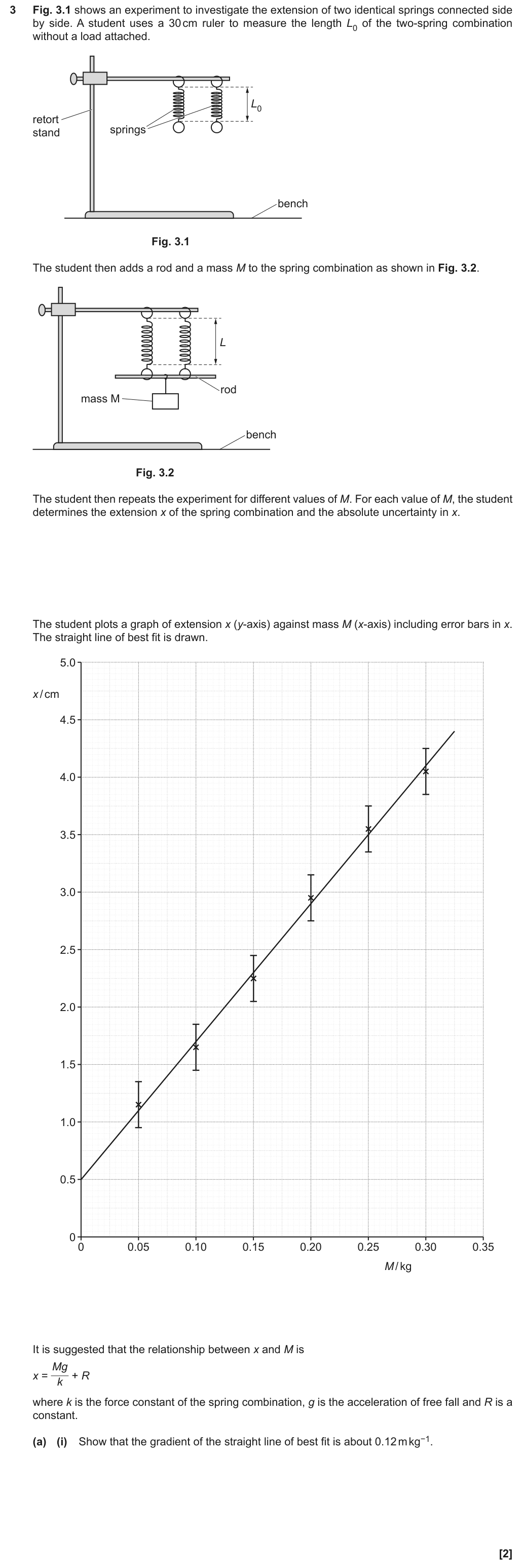
November 2020 · AS Paper 2 · Q3(a)(ii)2 marksCalculationMedium
Earlier part of question 3 that this part uses
Mark scheme
Examiner's comment
In Question 3, most candidates clearly identified the points on the line that were to be used for the gradient calculation.
Notes from the mark scheme and report
2 or 3 significant figures
POT must be correct for the given unit
allow kg s⁻²
Skills: M0.1 Recognise and make use of appropriate units in calculations; M1.1 Use an appropriate number of significant figures; M3.3 Understand that y = mx + c represents a linear relationship; PAG2 Investigating properties of materials
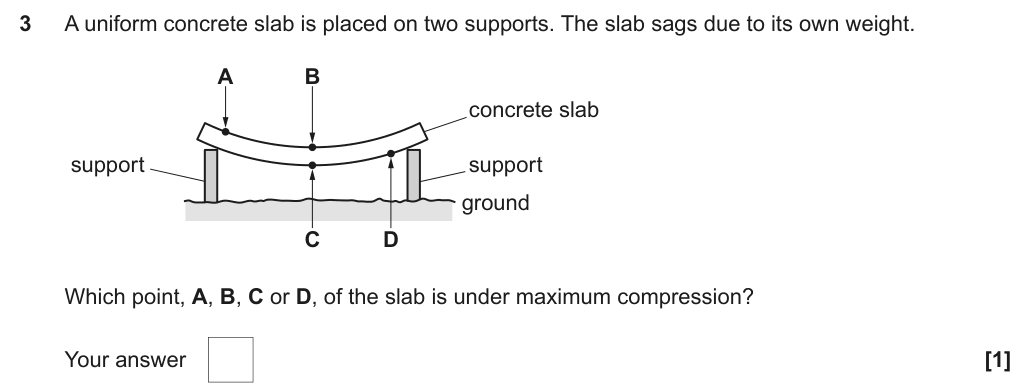
June 2019 · AS Paper 1 · Q31 markMultiple choiceMedium
Answer
B
Mark scheme
Examiner's comment
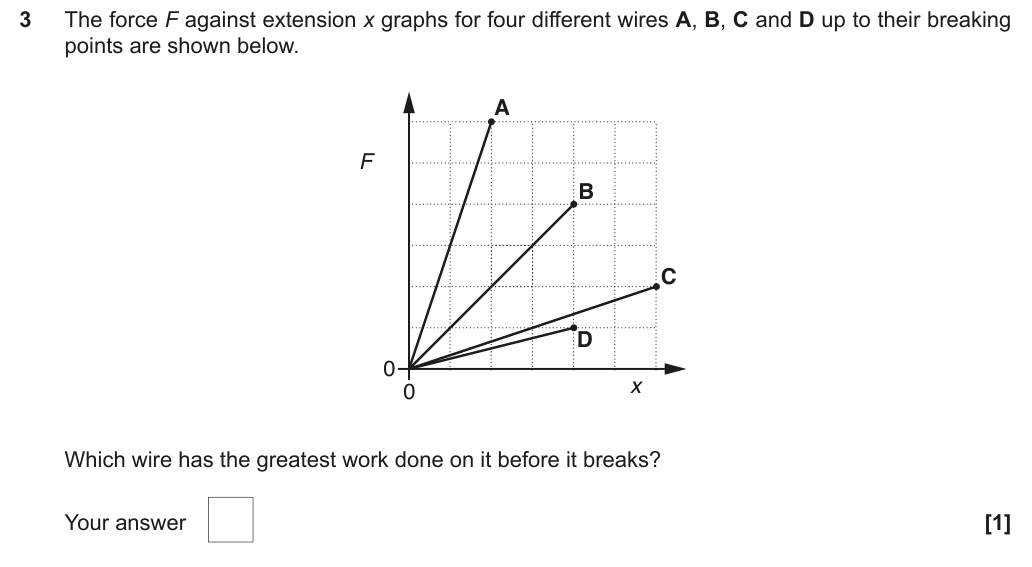
This question was based on the simple understanding of compression of material in the form of a concrete slab. About two thirds of the candidates opted for the correct answer B. The majority of the remaining candidates opted for C. Point C of the slab would be under maximum tension. Only a very small number of candidates, mainly from the lower quartile, went for either A or D.
June 2019 · Paper 1 · Q16(b)(ii)2 marksCalculation
Earlier part of question 16 that this part uses
Mark scheme
Notes from the mark scheme and report
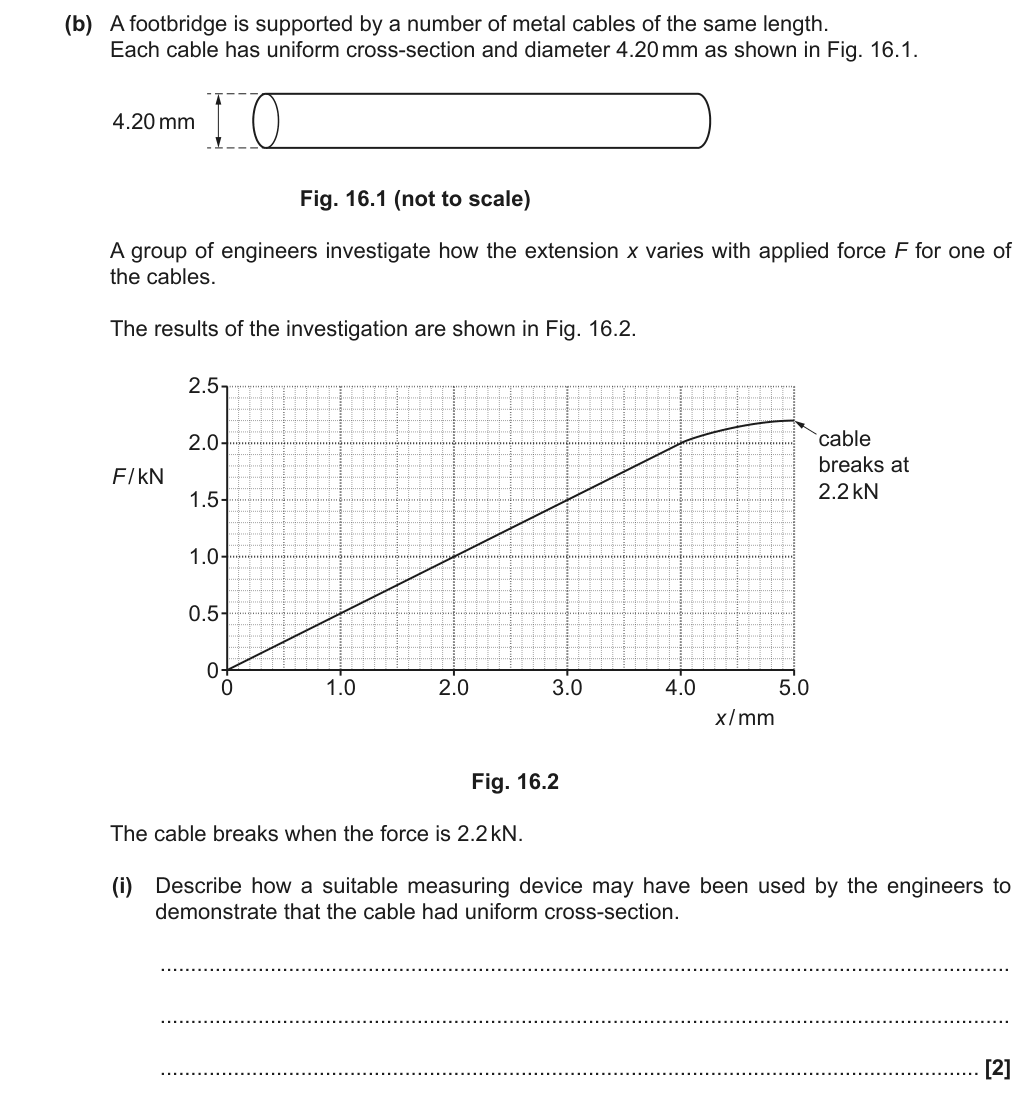
elastic: any value 0 to 2.0 kN
plastic: any value 2.0 to 2.2 kN
Skills: M3.1 Translate information between graphical, numerical and algebraic forms
June 2019 · Paper 1 · Q16(b)(iii)2 marksCalculation
Earlier part of question 16 that this part uses
Mark scheme
Notes from the mark scheme and report
1 mark for 5.0 x 10^n with n not 5
Skills: M0.1 Recognise and make use of appropriate units in calculations; M3.4 Determine the slope and intercept of a linear graph
June 2019 · AS Paper 2 · Q3(b)3 marksCalculationMedium
Mark scheme
Examiner's comment
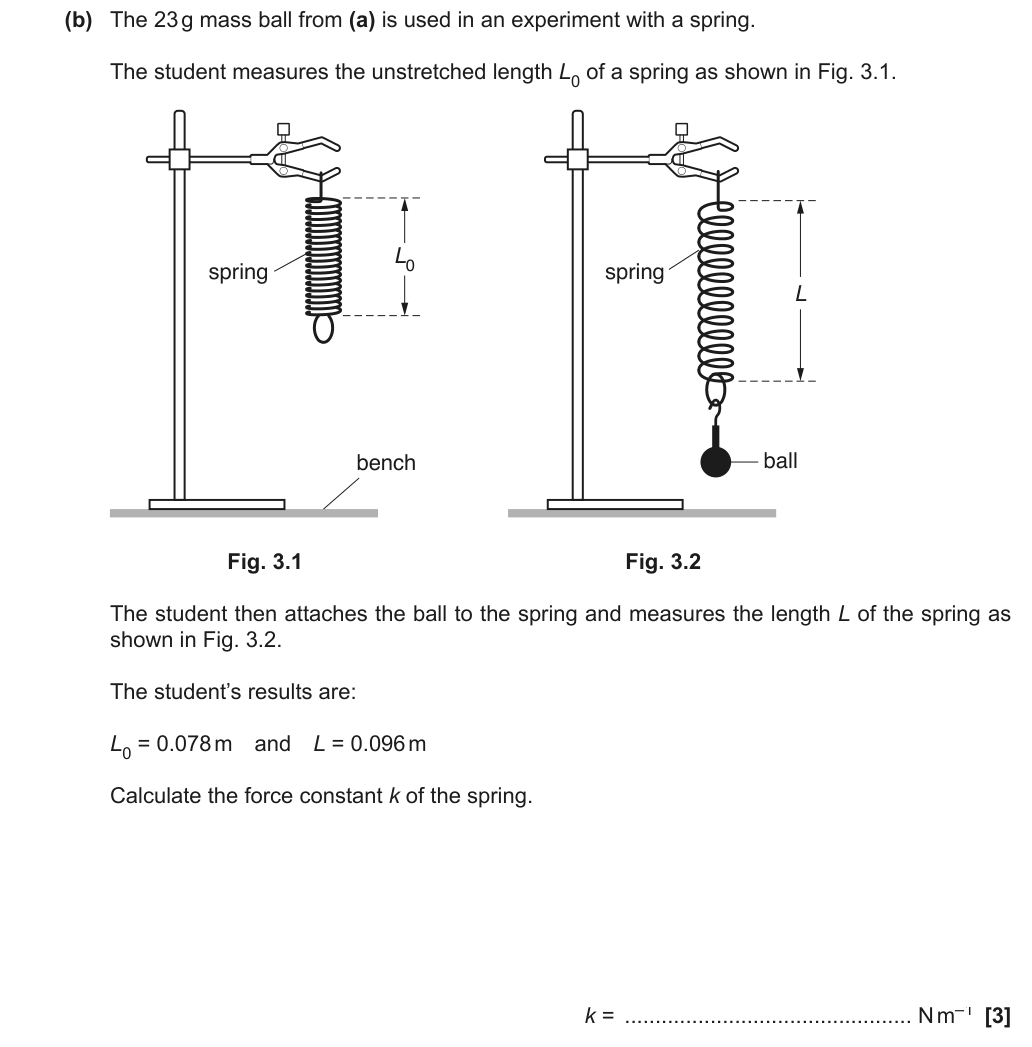
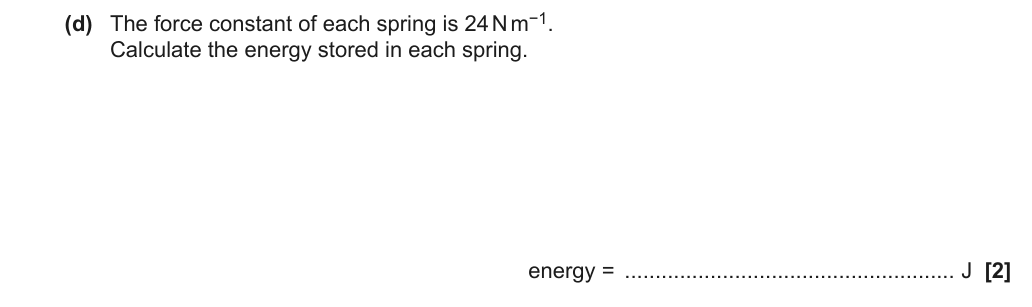
The majority of the candidates clearly showed their working and calculated the force constant correctly. Some incorrectly used the energy stored equation.
Notes from the mark scheme and report
allow 12.6 or 12.5
Skills: M0.1 Recognise and make use of appropriate units in calculations; M2.3 Substitute numerical values into algebraic equations using appropriate units for physical quantities; PAG2 Investigating properties of materials
June 2019 · AS Paper 2 · Q3(c)(i)2 marksCalculationMedium
Earlier part of question 3 that this part uses
Mark scheme
Examiner's comment
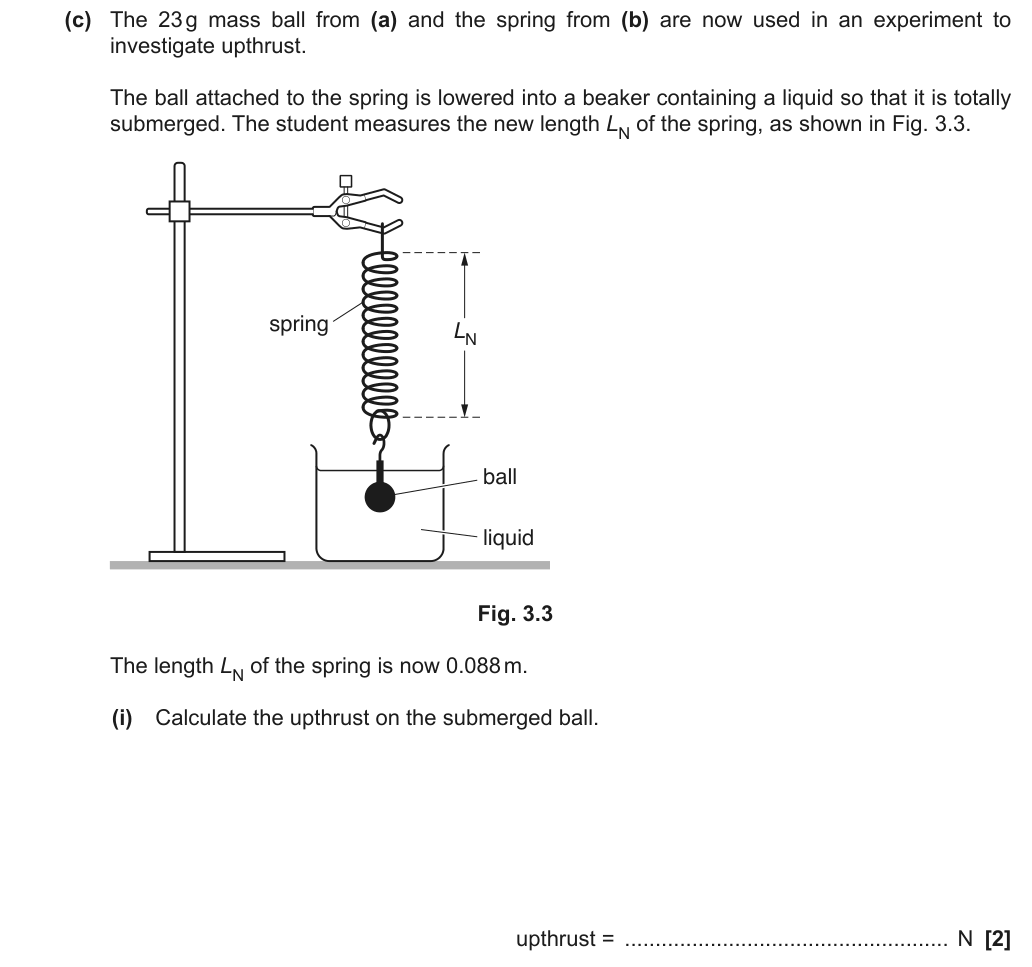
In this question, many candidates calculated the apparent weight and then incorrectly assumed that this was the upthrust. Other errors included using the incorrect values for length to determine the extension. Some candidates correctly determined the upthrust by determining the change in extension.
Notes from the mark scheme and report
ecf from (b)
allow 0.1 N (1 sf)
Skills: M2.3 Substitute numerical values into algebraic equations using appropriate units for physical quantities
June 2018 · AS Paper 1 · Q22(d)2 marksCalculation
Earlier part of question 22 that this part uses
Mark scheme
Notes from the mark scheme and report
no ecf from (c)
Skills: M2.2 Change the subject of an equation, including non-linear equations; M2.3 Substitute numerical values into algebraic equations using appropriate units for physical quantities
June 2017 · AS Paper 1 · Q31 markMultiple choice
Answer
B
Mark scheme
June 2017 · AS Paper 2 · Q2(a)1 markShort answer
Mark scheme
Notes from the mark scheme and report
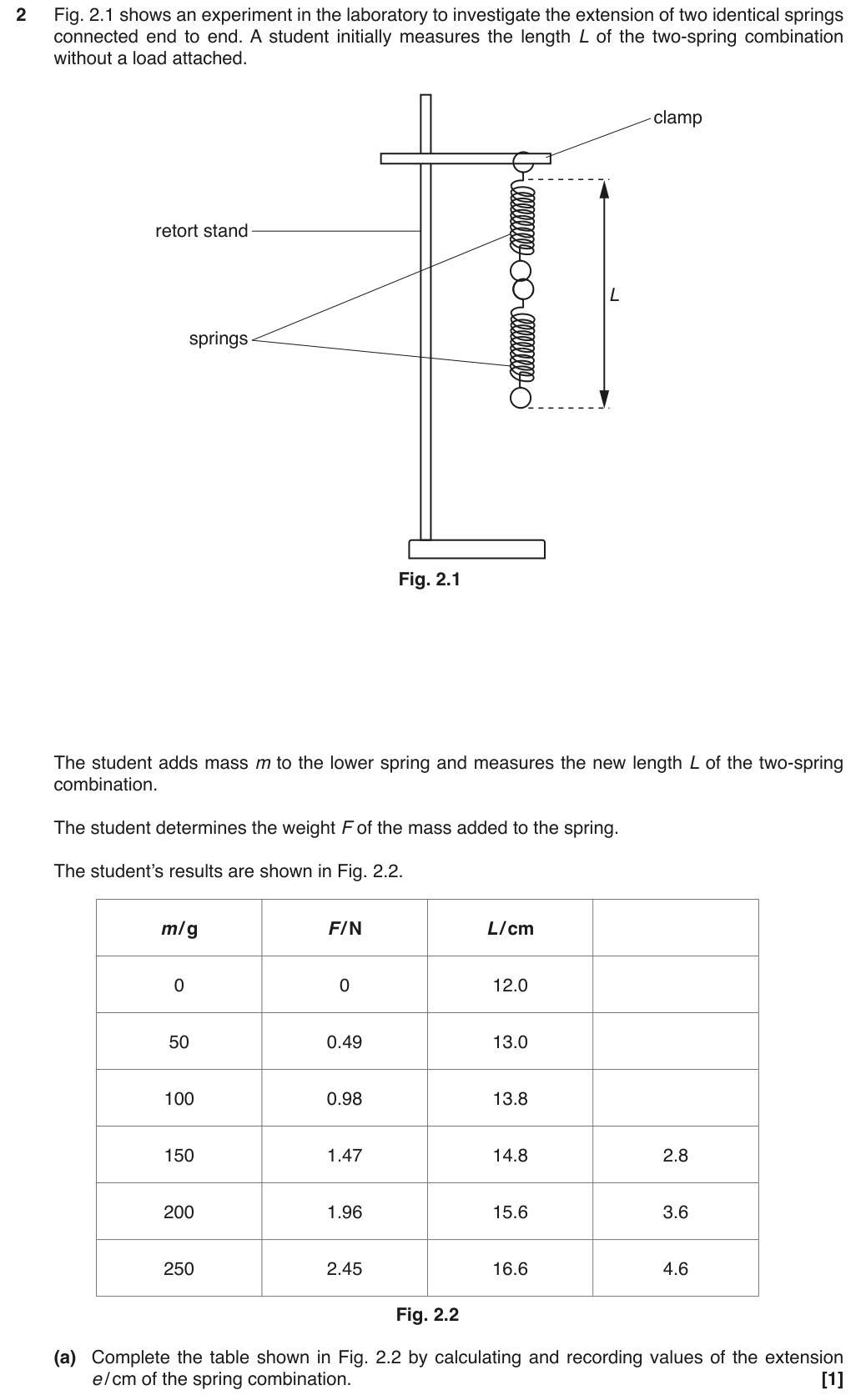
column heading e / cm required
allow 0 for 0.0
NOT 1 for 1.0
Skills: PAG2 Investigating properties of materials
June 2017 · AS Paper 2 · Q2(b)4 marksDiagram or graph
Earlier part of question 2 that this part uses
Mark scheme
Notes from the mark scheme and report
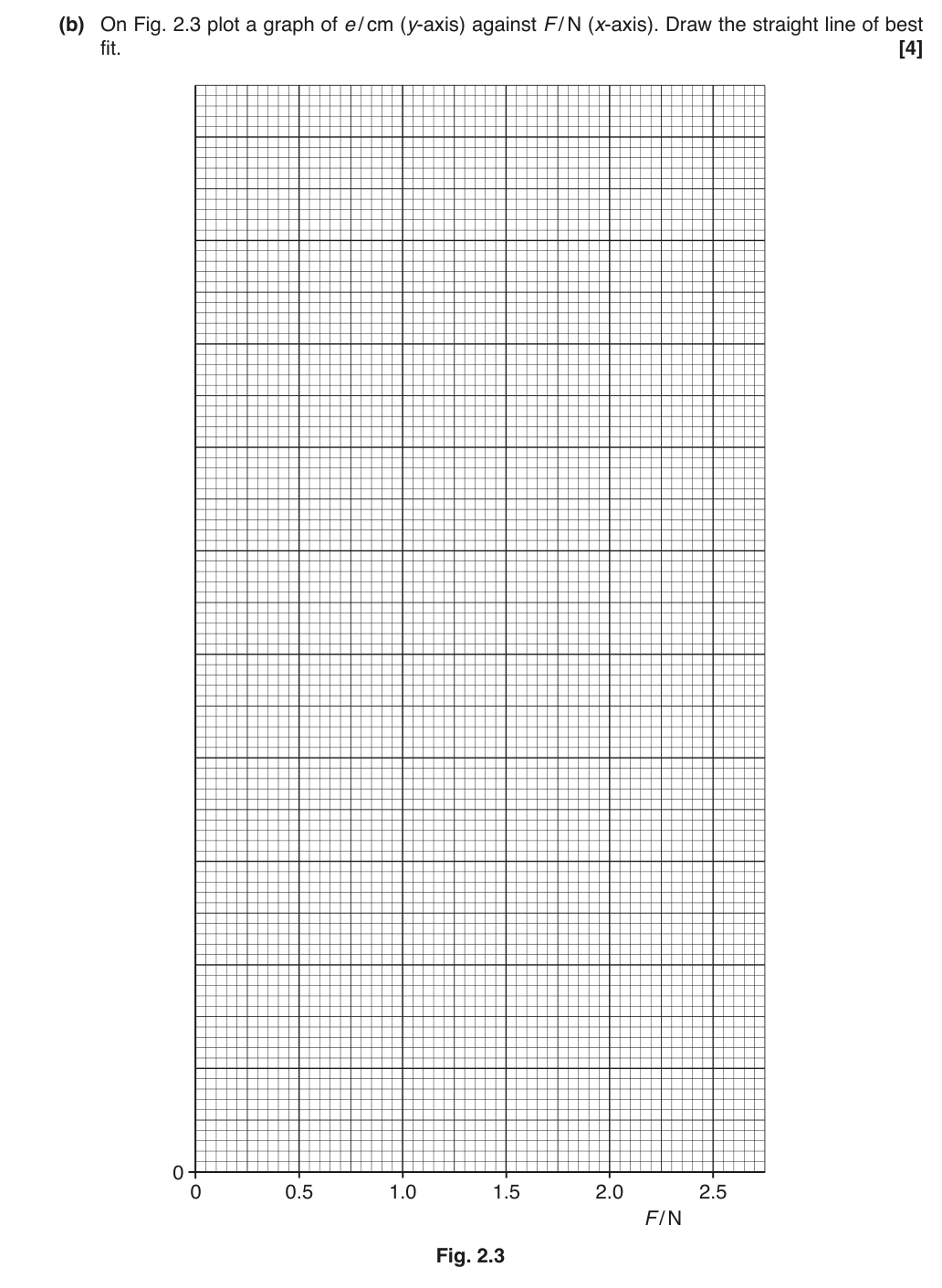
y-axis scale must use at least half the grid
points less than half a small square thick
NOT freehand / wobbly line
Skills: M3.2 Plot two variables from experimental or other data; PAG2 Investigating properties of materials
June 2017 · AS Paper 2 · Q2(d)2 marksCalculation
Earlier parts of question 2 that this part uses
Mark scheme
Notes from the mark scheme and report
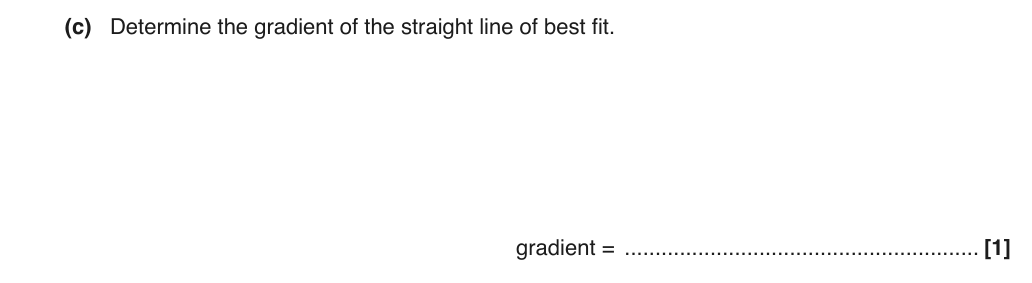
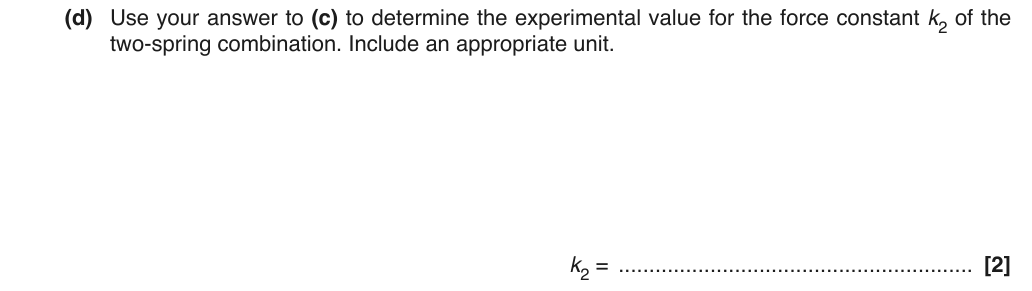
k = 1 / gradient
answer to 2 or 3 SF
unit N cm-1 or N m-1 must match the power of ten
Skills: M0.1 Recognise and make use of appropriate units in calculations; M1.1 Use an appropriate number of significant figures; M3.4 Determine the slope and intercept of a linear graph; PAG2 Investigating properties of materials
June 2017 · AS Paper 2 · Q2(e)2 marksExplanation
Earlier part of question 2 that this part uses
Mark scheme
Notes from the mark scheme and report
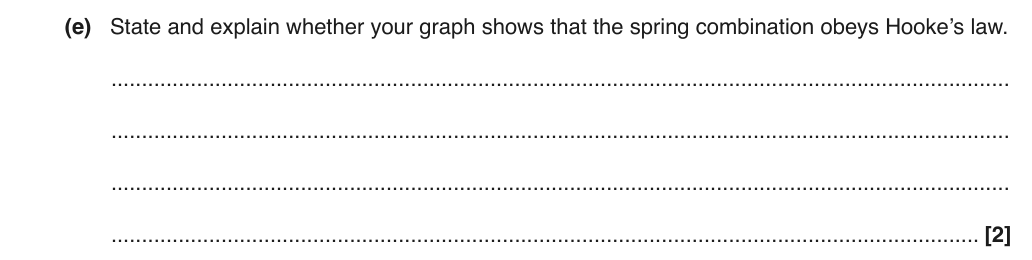
must state Hooke's law AND refer to straight line through the origin
Skills: M3.3 Understand that y = mx + c represents a linear relationship; PAG2 Investigating properties of materials
June 2017 · AS Paper 2 · Q2(f)2 marksCalculation
Earlier parts of question 2 that this part uses
Mark scheme
Notes from the mark scheme and report
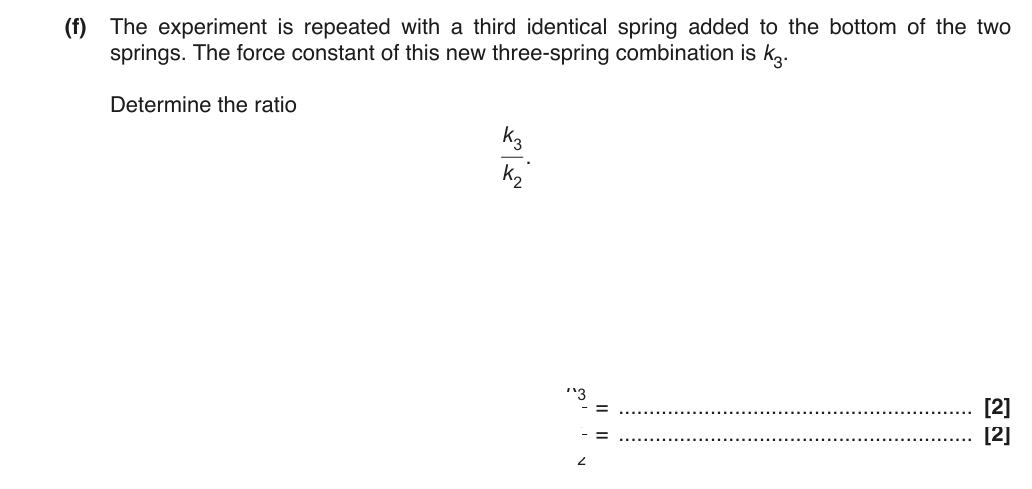
springs in series (k/n)
2:3 scores one mark
allow 0.66, 0.67
Skills: M0.3 Use ratios, fractions and percentages
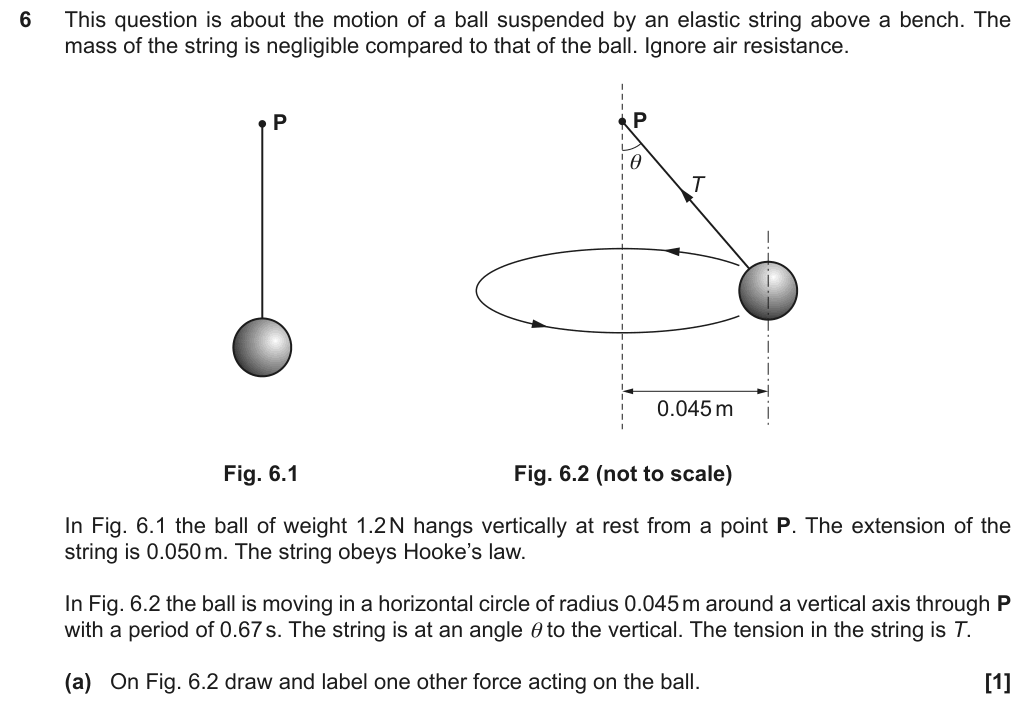
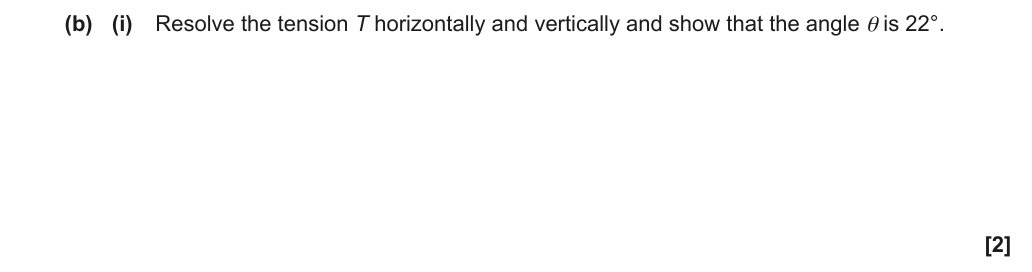
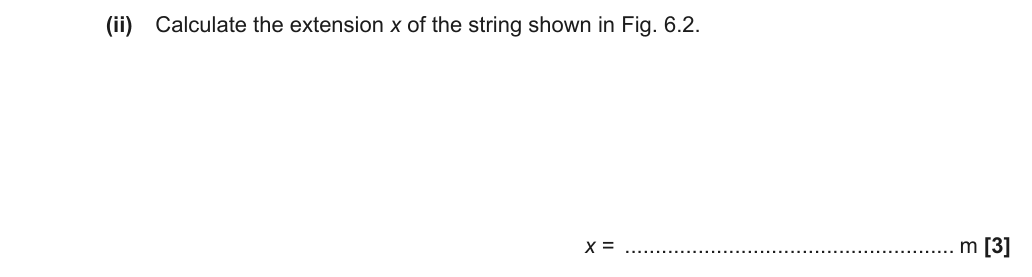
June 2017 · Paper 3 · Q6(b)(ii)3 marksCalculation
Earlier parts of question 6 that this part uses
Mark scheme
Notes from the mark scheme and report
or solution by ratios
Skills: M0.6 Use calculators to handle sin x, cos x and tan x when x is expressed in degrees or radians; M2.3 Substitute numerical values into algebraic equations using appropriate units for physical quantities
Work with an OCR physics tutor
Dropping marks on calculations, practical questions or the six-mark level of response questions? Book a trial session with a specialist OCR physics tutor.