A student carries out an experiment to determine the speed v of sound in air. The student forms Explain how the apparatus is used to determine f and use the graph to determine v. Include the
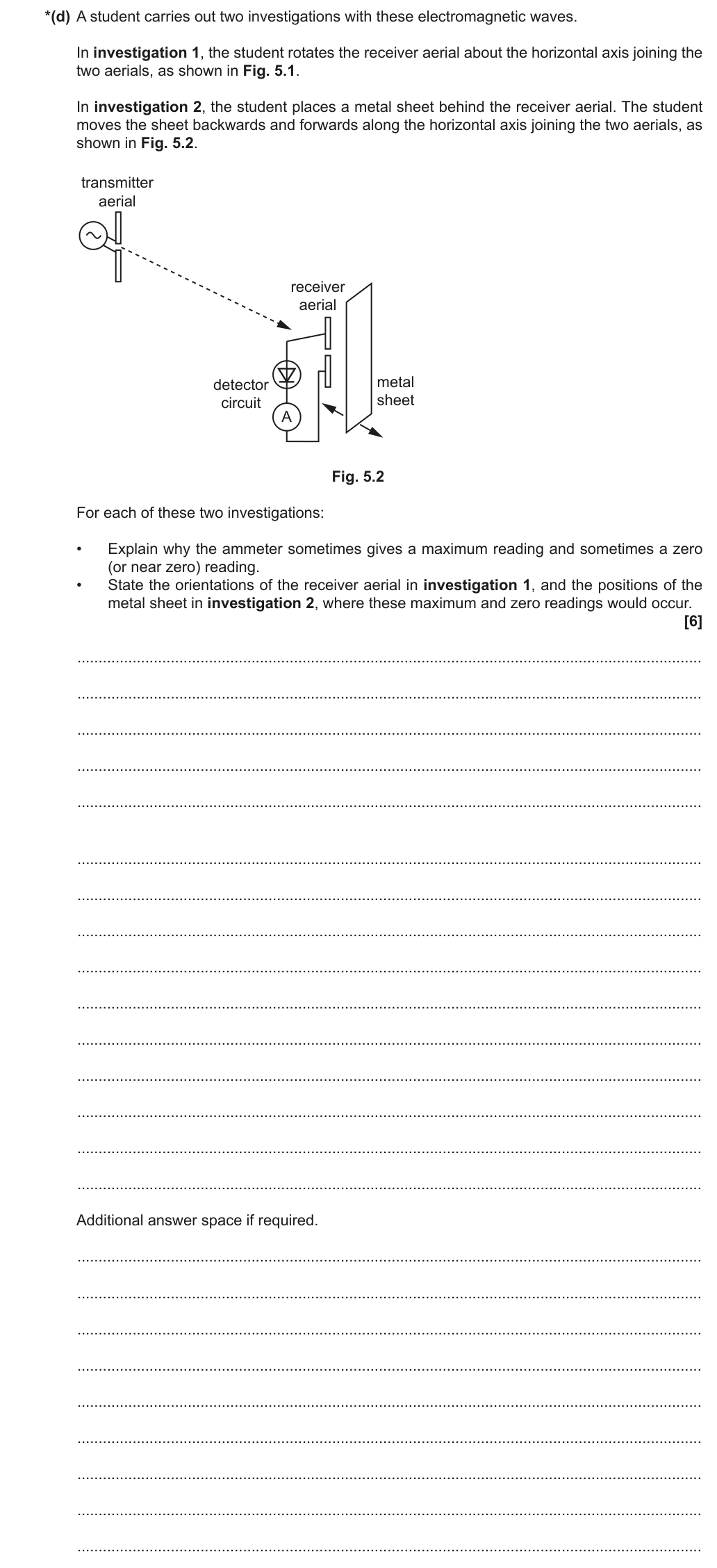
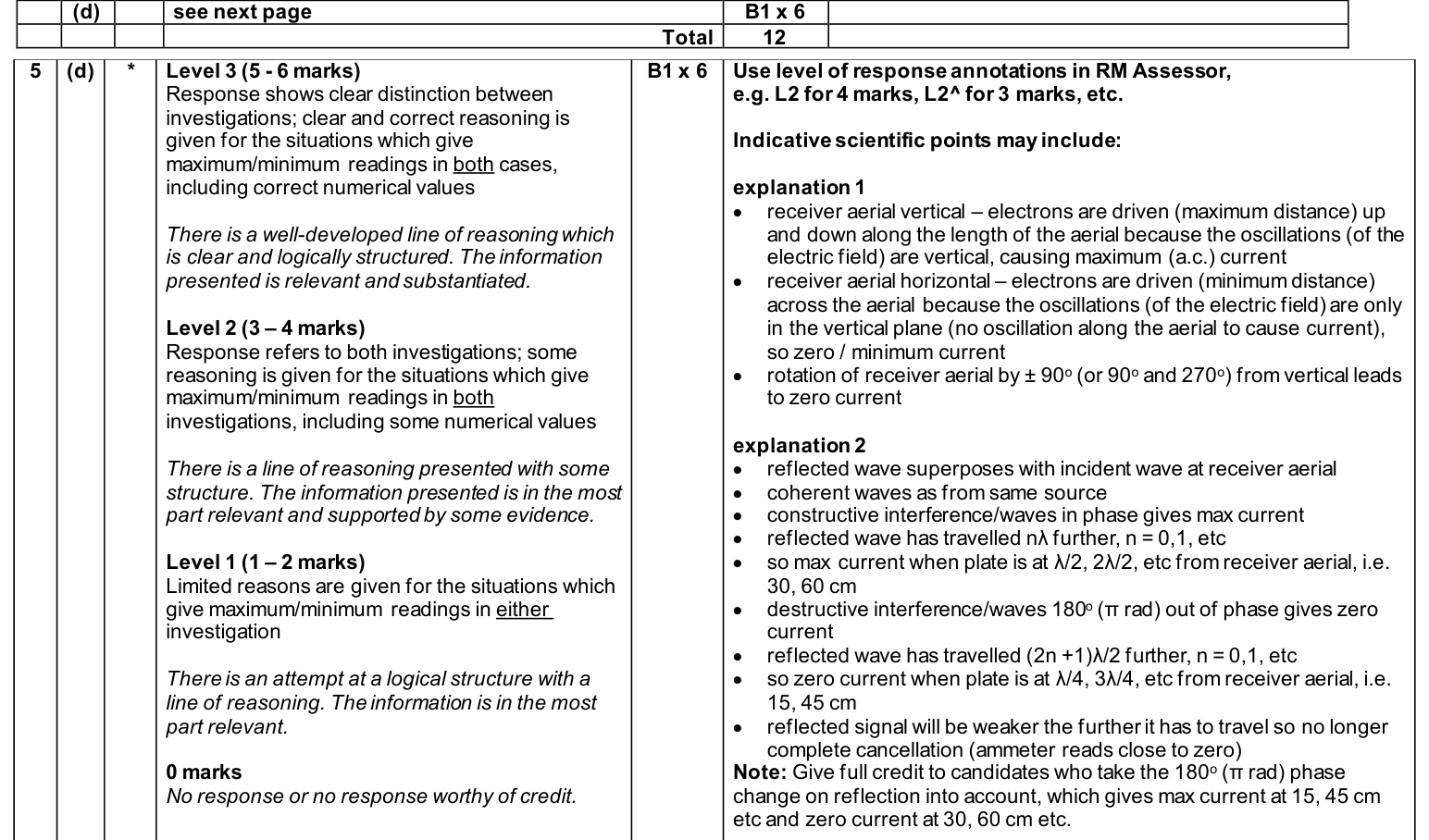
*(d) A student carries out two investigations with these electromagnetic waves. • Explain why the ammeter sometimes gives a maximum reading and sometimes a zero
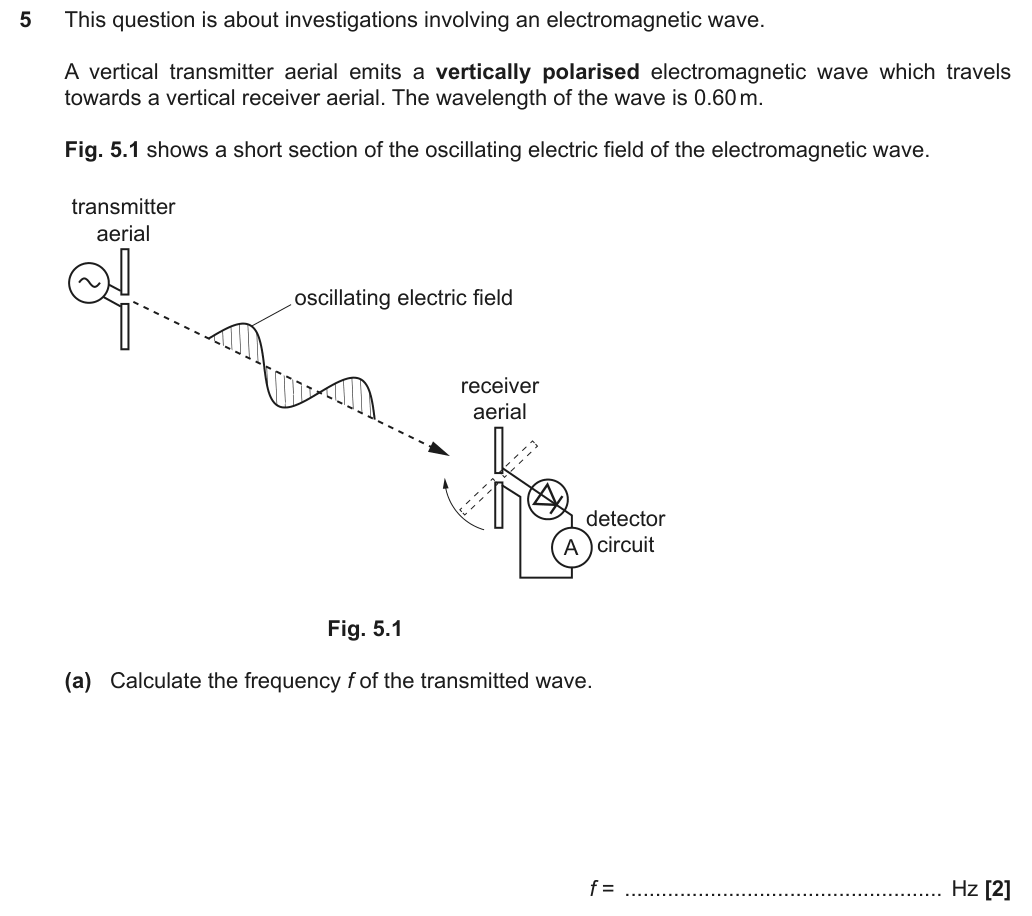
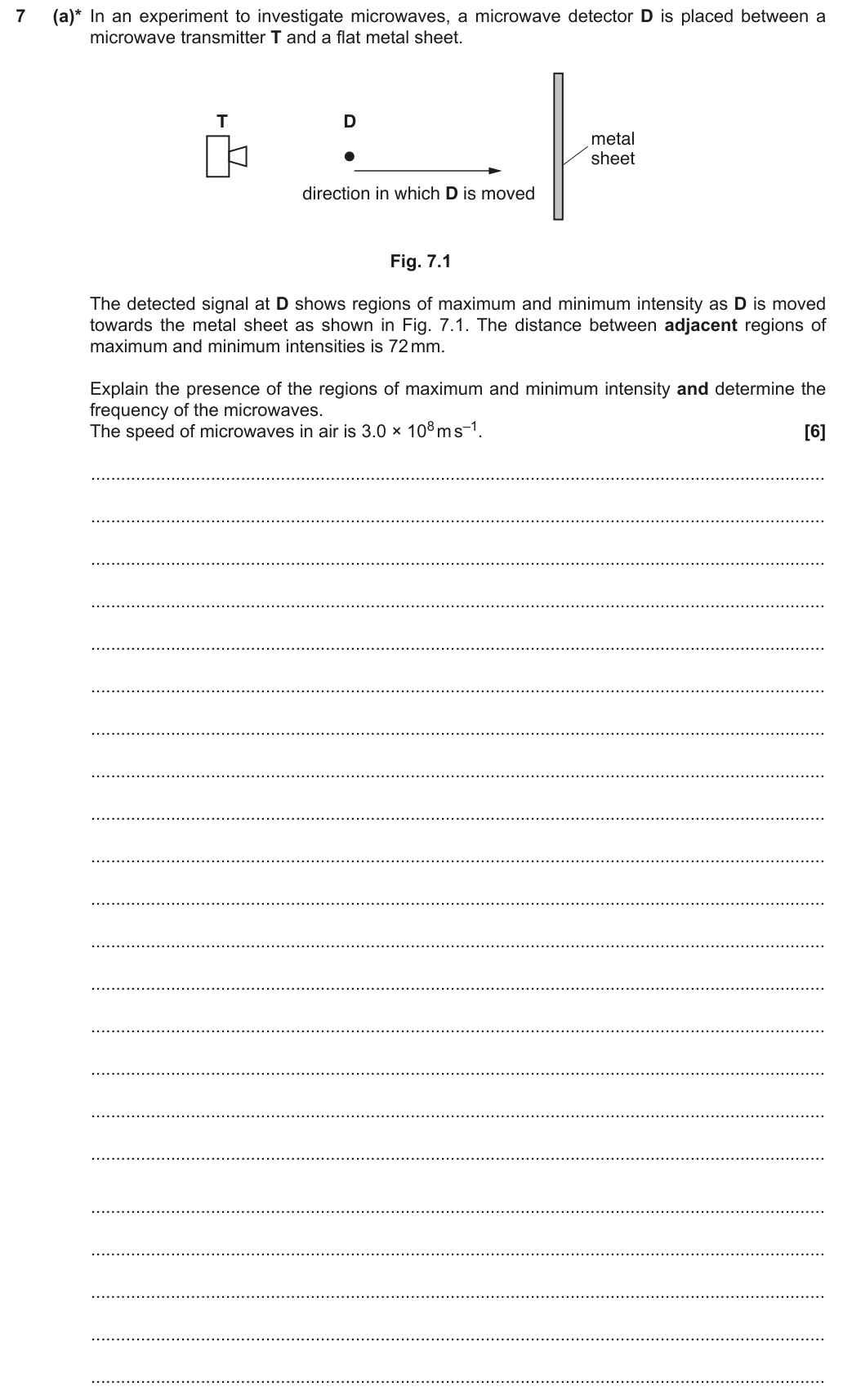
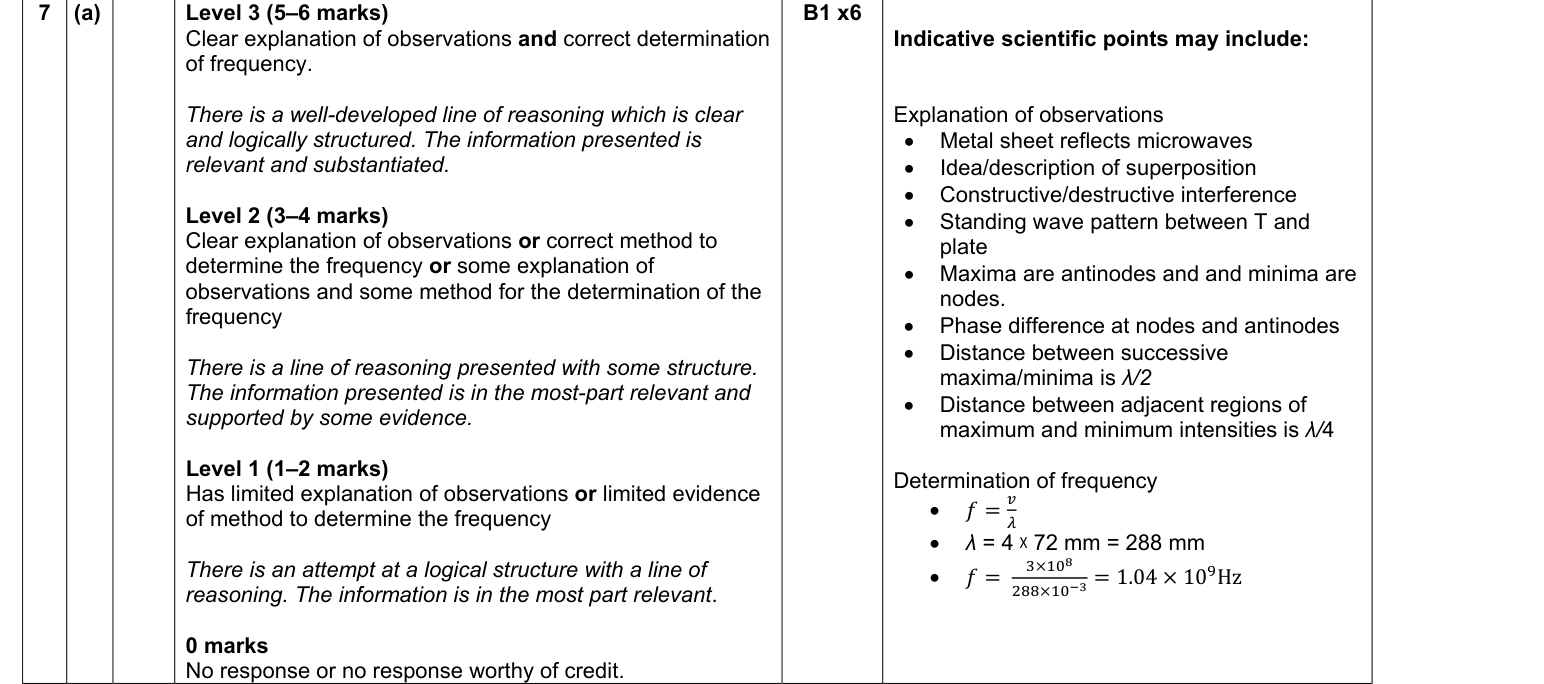
(a)* In an experiment to investigate microwaves, a microwave detector D is placed between a Explain the presence of the regions of maximum and minimum intensity and determine the
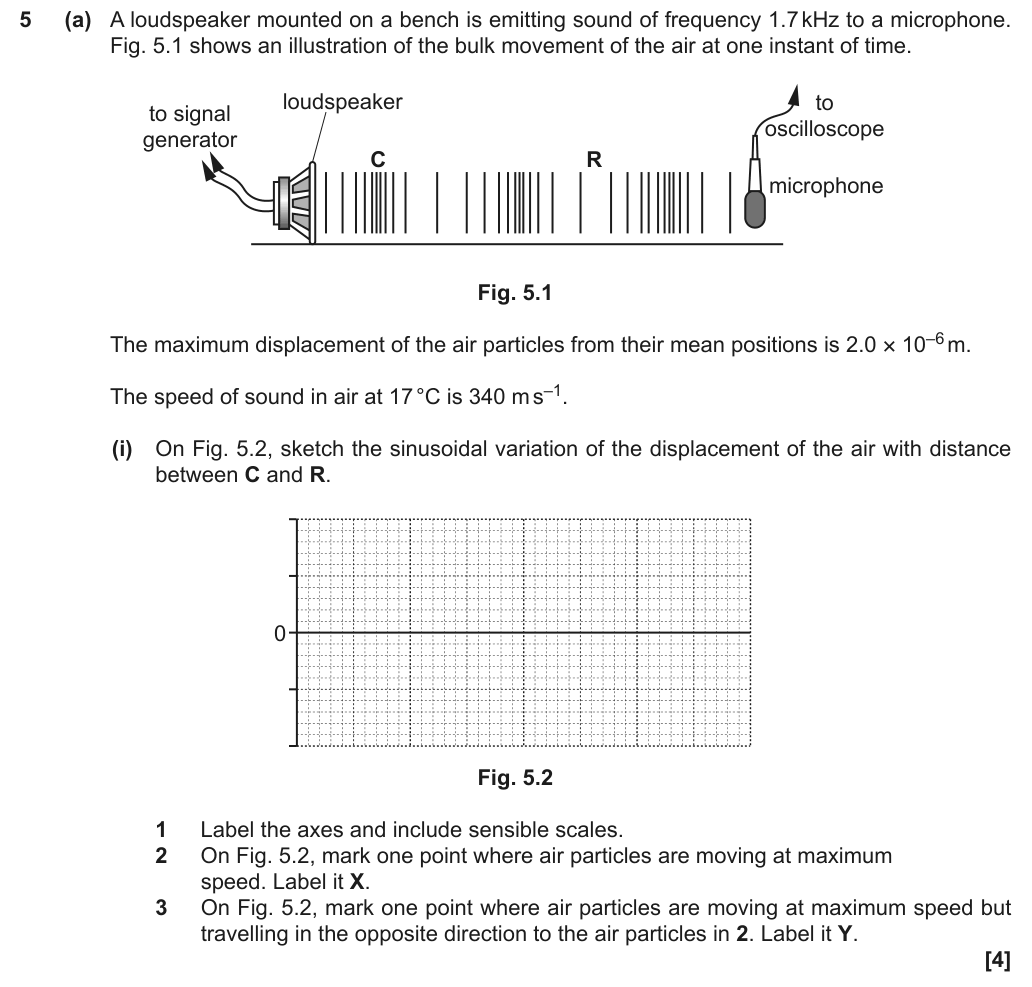
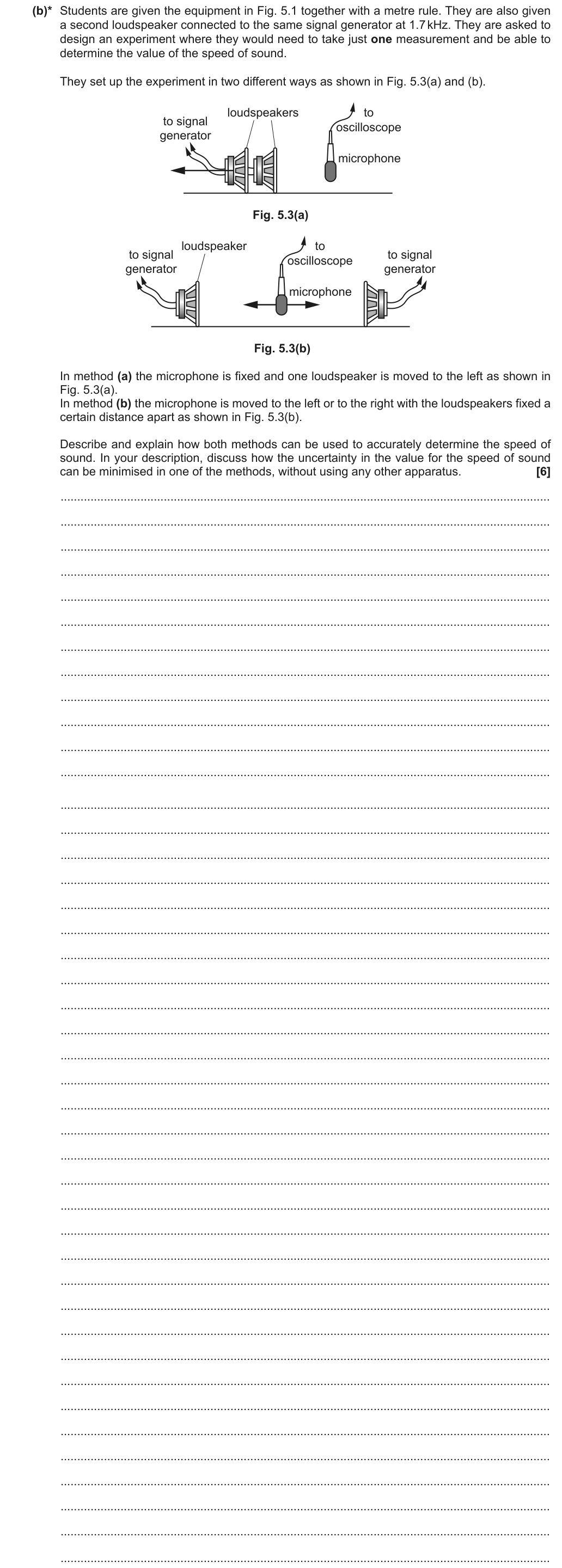
Students are given the equipment in Fig. 5.1 together with a metre rule. They are also given Describe and explain how both methods can be used to accurately determine the speed of
Tap a question to zoom it. Where a part needs a figure, table or graph from earlier in the question, that part folds out above it; the mark scheme and examiner's comment open underneath. Have the OCR Data, Formulae and Relationships Booklet beside you (see the data booklet page).
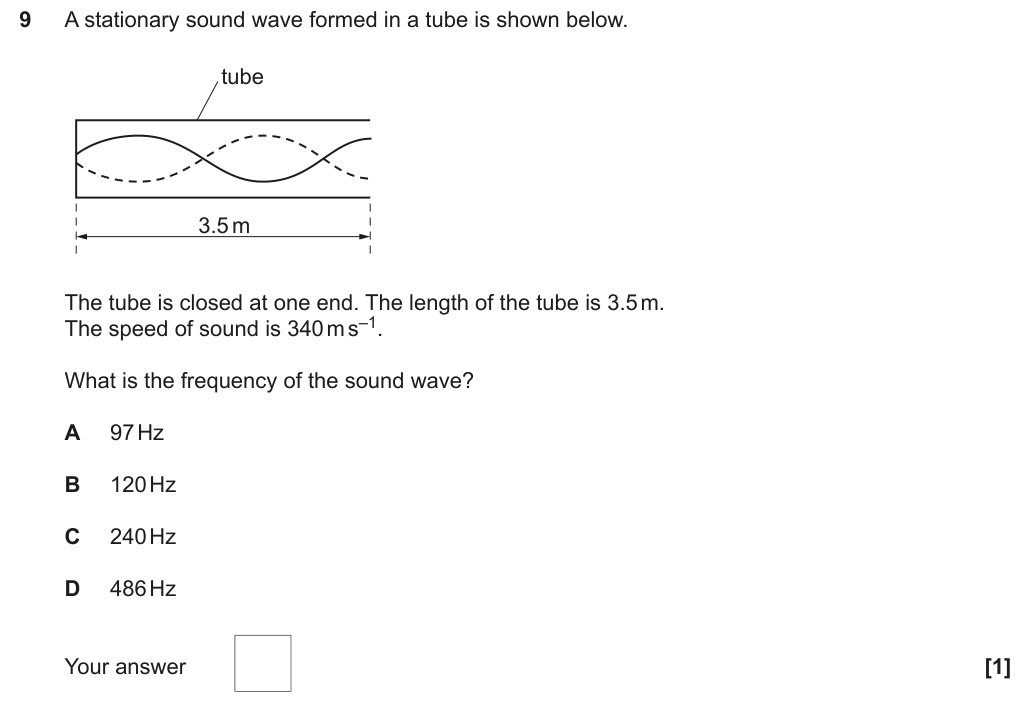
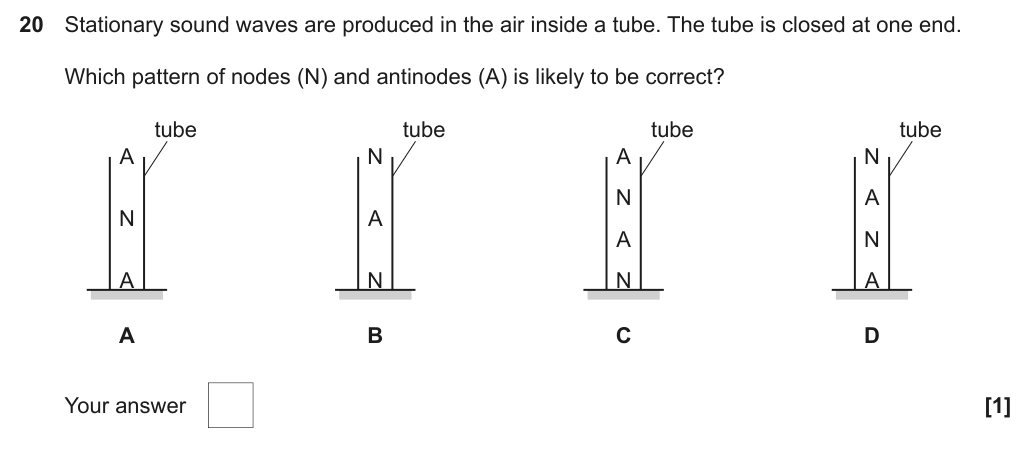
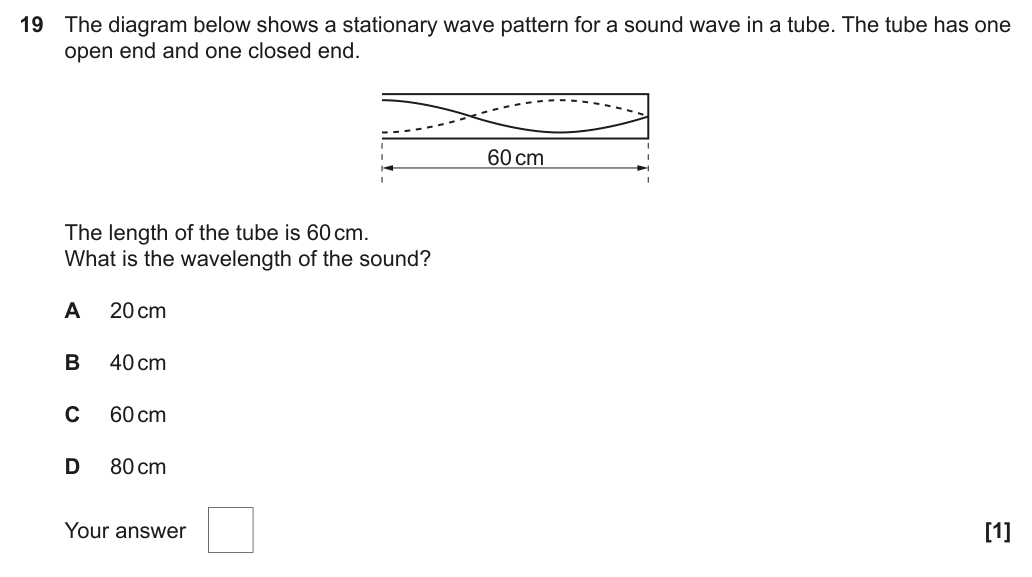
June 2025 · AS Paper 1 · Q51 markMultiple choiceEasy
Answer
C
Mark scheme
Examiner's comment
Most candidates correctly understood that the length of the tube was 1.5 wavelengths and gained the correct answer. Low scoring candidates often assumed that the length of the tube was equal to the wavelength and selected B as their answer.
June 2025 · AS Paper 1 · Q23(c)(i)2 marksExplanationMedium
Mark scheme
Examiner's comment
Many candidates discussed the general conditions for stationary waves or described stationary waves. High scoring candidates related their answers to the microwave oven by stating that the emitted microwaves would reflect from the metal walls of the oven and that the emitted and reflected waves would interfere or superpose. Lower scoring candidates did not always use correct terms.
Notes from the mark scheme and report
ignore reference to coherence
June 2025 · AS Paper 1 · Q23(c)(ii)2 marksExplanationMedium
Earlier part of question 23 that this part uses
Mark scheme
Examiner's comment
Candidates needed to relate their answers to nodes and antinodes. To gain full credit candidates needs to explain what was meant by a node and an antinode in terms of amplitude or intensity and then relate the nodes and antinodes to whether there was transfer of energy to the soup.
Notes from the mark scheme and report
Allow intensity for amplitude
ignore maxima and minima points
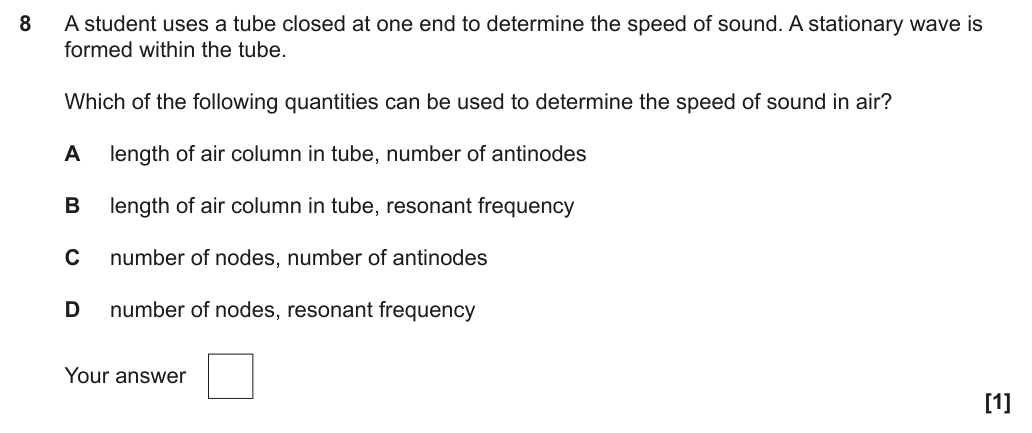
June 2025 · Paper 2 · Q81 markMultiple choiceMedium
Answer
B
Mark scheme
Examiner's comment
Most candidates gave the correct response. Many candidates drew helpful diagrams of a standing wave in a tube to help them identify relevant quantities.
June 2025 · Paper 3 · Q2(a)2 marksExplanationMedium
Mark scheme
Examiner's comment
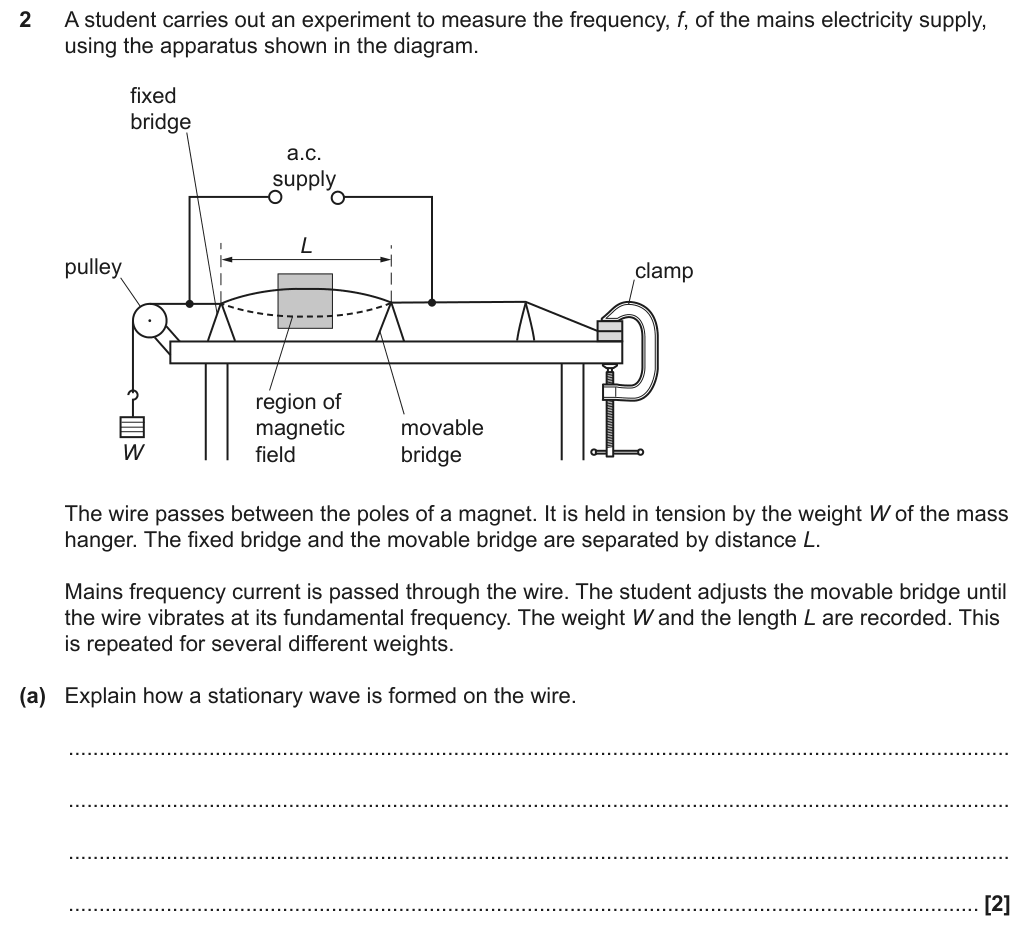
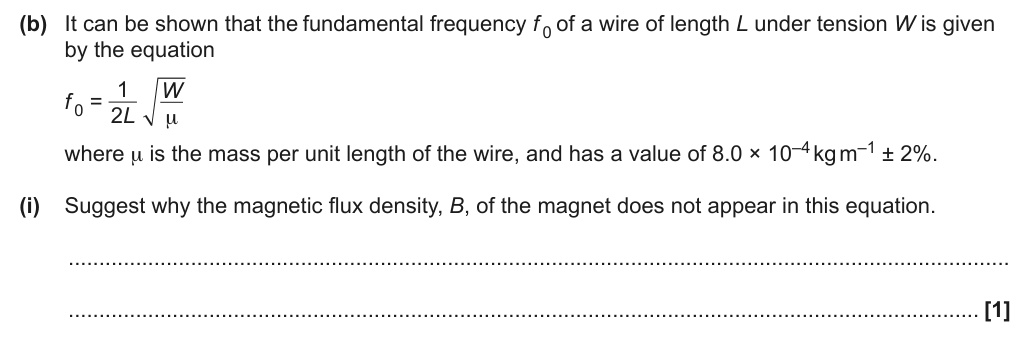
To gain full credit, candidates had to refer to both the force producing the vibration and the principle of superposition of waves. It was common for candidates to address one but not both points in their response. Approximately half of the candidates gained 1 mark, usually for explaining superposition in context. The strongest responses were often the most succinct. These usually described the incident and reflected waves interfering or superposing. Responses that did not gain marks often simply described what the nodes and antinodes seen in the diagram represented or referred to magnets attracting wires.
Notes from the mark scheme and report
ignore F = BIl sin θ unless quantities defined
ignore wire moves / oscillates
waves in opposite directions (reflection at a bridge) superpose
June 2025 · Paper 3 · Q2(c)(iii)3 marksCalculationMedium
Earlier parts of question 2 that this part uses
Mark scheme
Examiner's comment
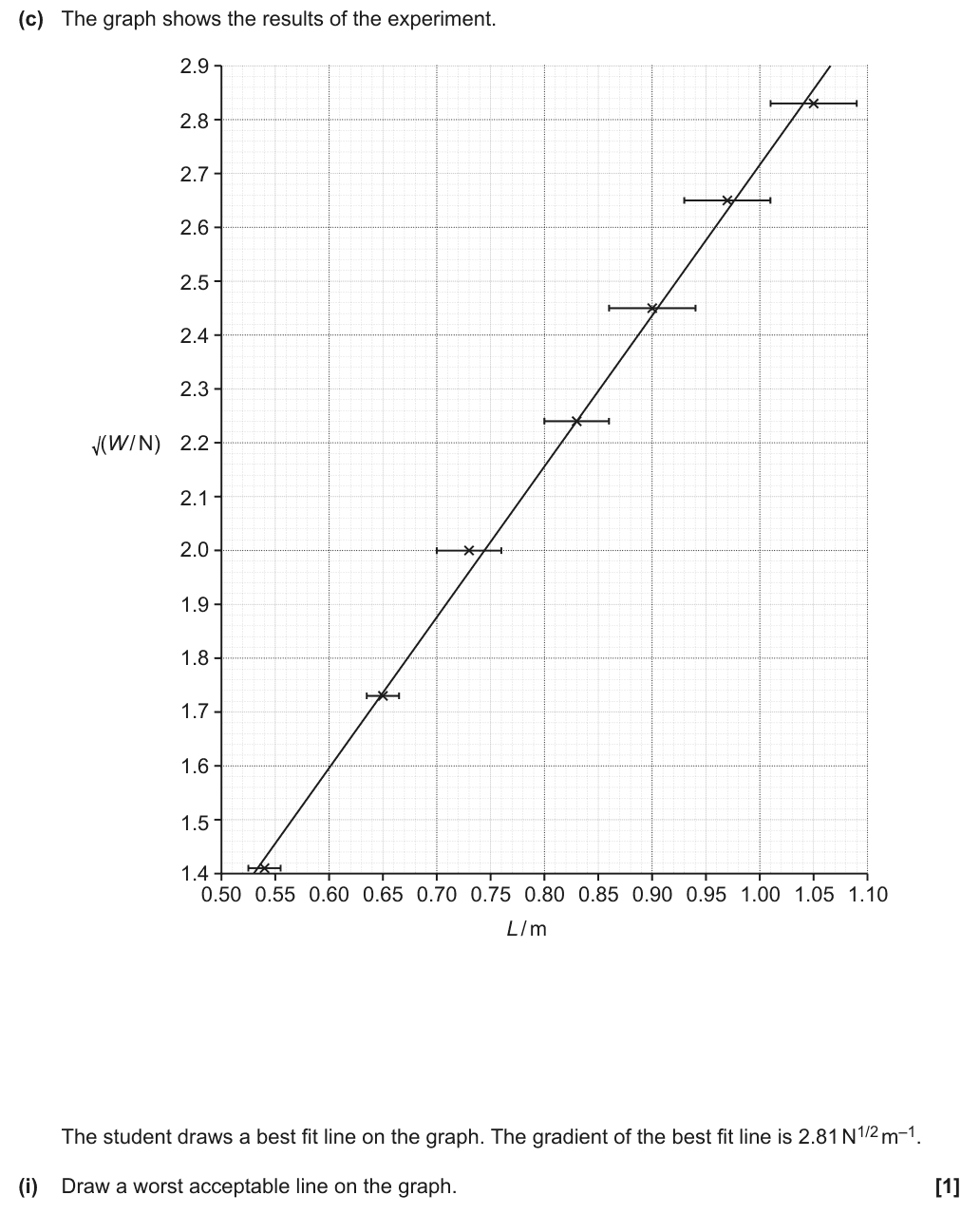
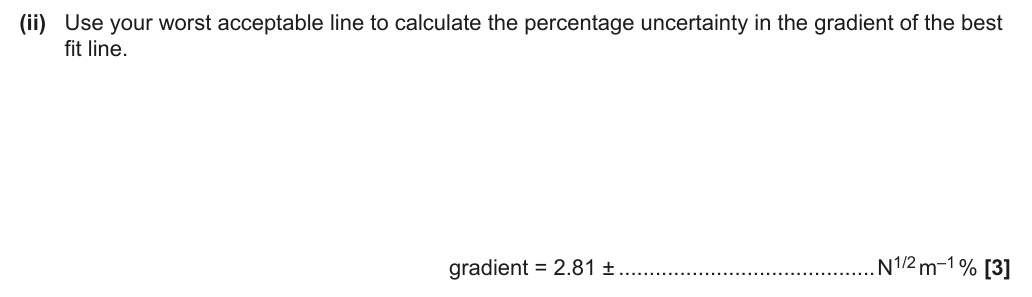
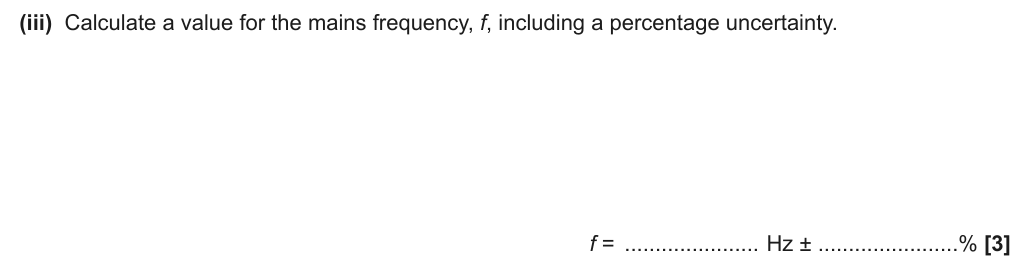
Many candidates were able to gain all 3 marks by substituting the gradient for the line of best fit into the equation and correctly evaluating the frequency and percentage uncertainty. Common errors were ones where candidates incorrectly rearranged the equation or tried to use data from the graph. Some candidates rounded their answer to two significant figures and credit was given if the value was seen to three or more significant figures in their working.
Notes from the mark scheme and report
f = gradient / 2√μ
percentage uncertainty = answer to (c)(ii) + 1 (half of the 2 % in μ)
50 Hz on the answer line needs 49.7 seen in working
Skills: M1.5 Identify uncertainties in measurements and use simple techniques to determine uncertainty when data are combined; M2.2 Change the subject of an equation, including non-linear equations; M3.3 Understand that y = mx + c represents a linear relationship; PAG5 Investigating waves
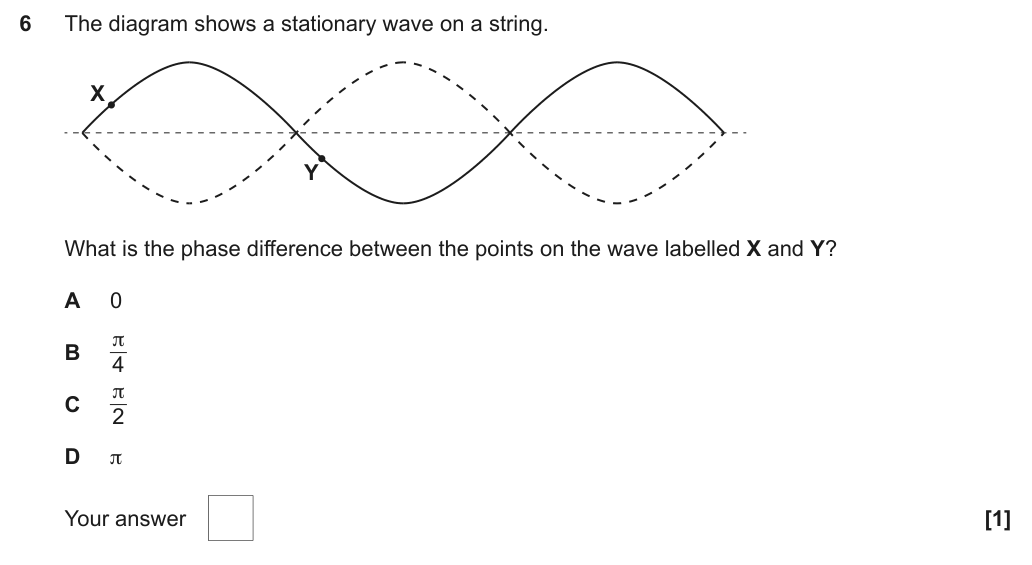
June 2024 · AS Paper 1 · Q61 markMultiple choiceMedium
Answer
D
Mark scheme
Examiner's comment
Many candidates correctly determined the correct phase difference as π between points X and Y as they interpretated that the fraction of the wave between points X and Y was the equivalent to λ/2. The most common distractor was C.
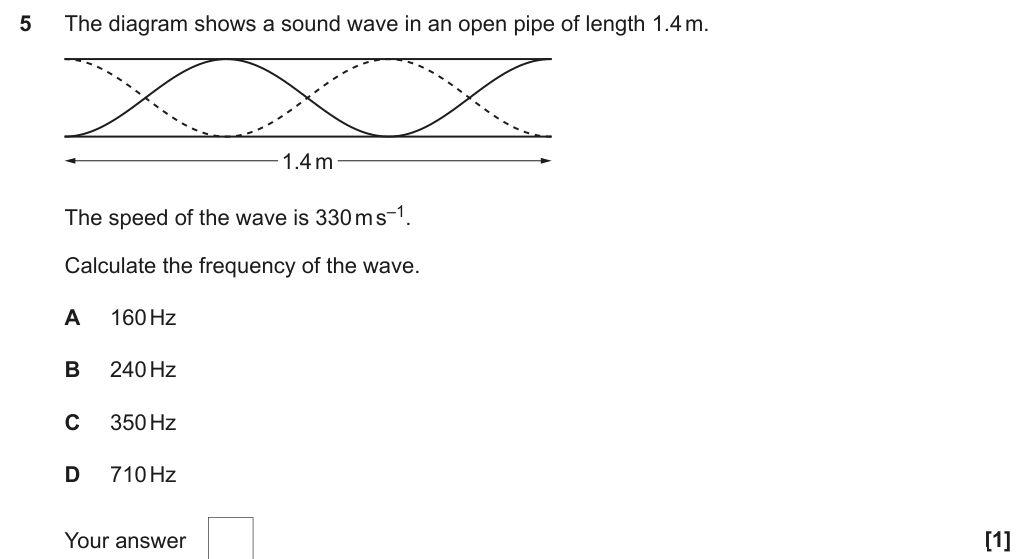
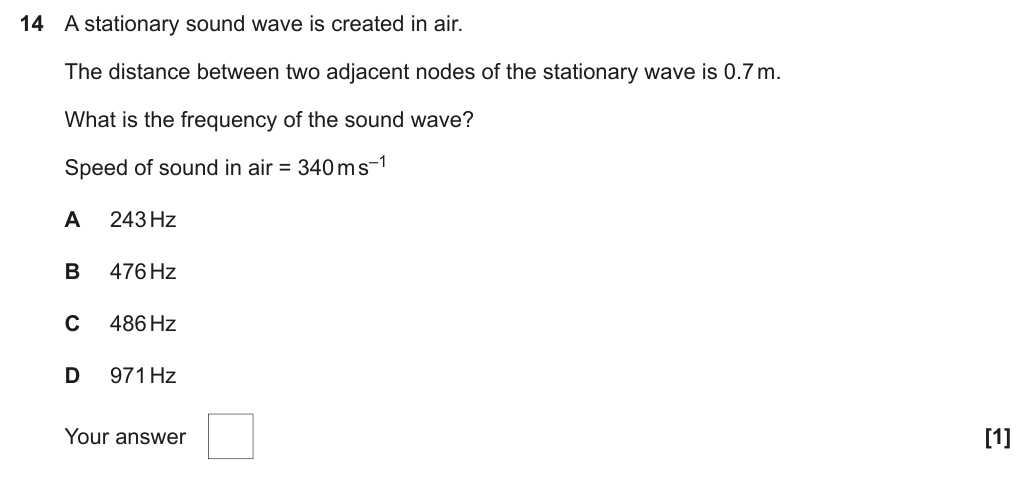
June 2024 · AS Paper 1 · Q141 markMultiple choiceMedium
Answer
A
Mark scheme
Examiner's comment
Candidates performed well on this question with many candidates correctly determining the wavelength of the standing wave as 1.4 m to then use this value to calculate the frequency of the wave as 243 Hz. This demonstrated understanding that the distance between adjacent nodes is λ/2 and not λ which was indicative of the most common distractor given by the answer B.
June 2024 · AS Paper 2 · Q6(b)2 marksDiagram or graphMedium
Earlier part of question 6 that this part uses
Mark scheme
Examiner's comment
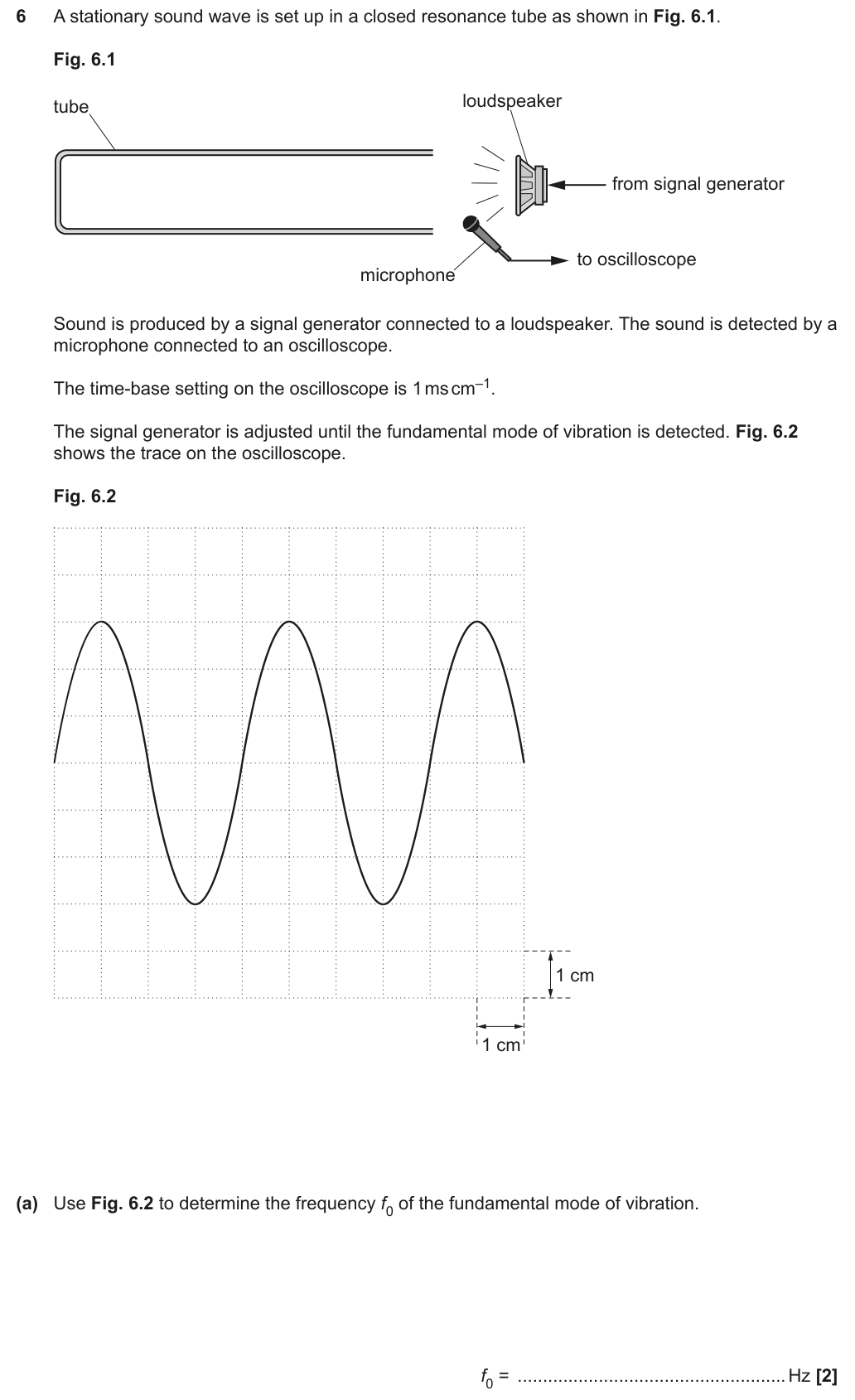
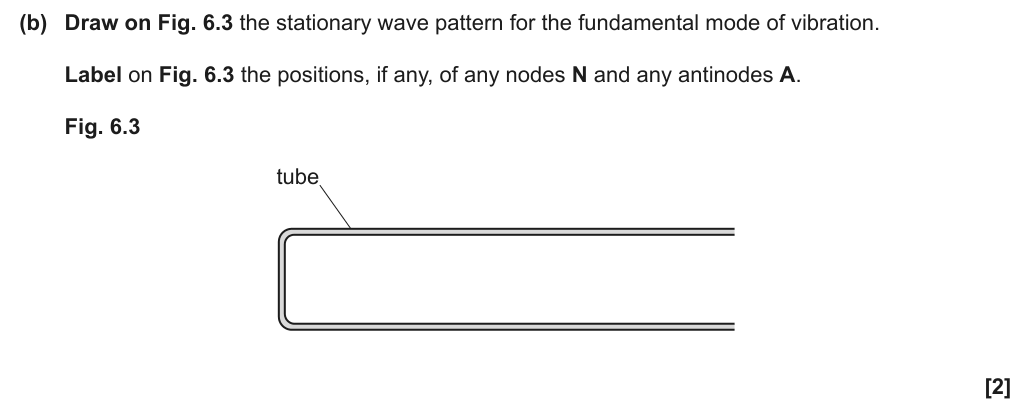
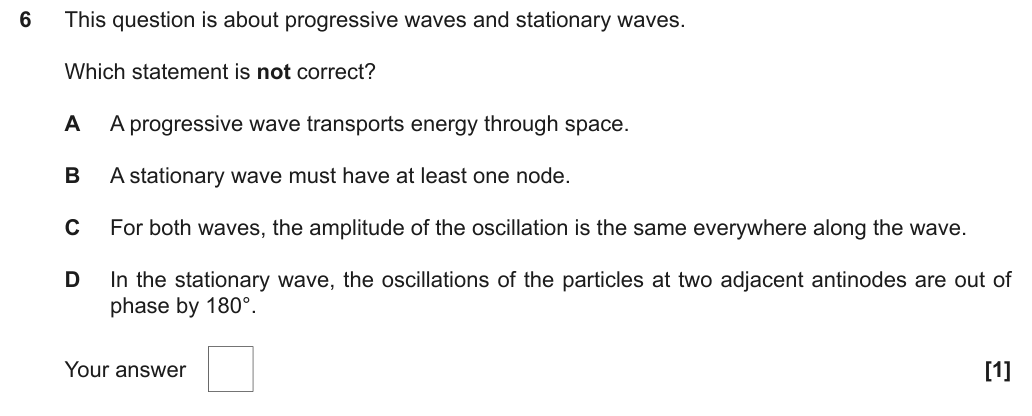
Many candidates understood what was meant by an antinode and a node but did not understand that for the fundamental mode of vibration a node was formed at the closed end and one antinode was formed at the open end.
Notes from the mark scheme and report
node at closed end and antinode at open end
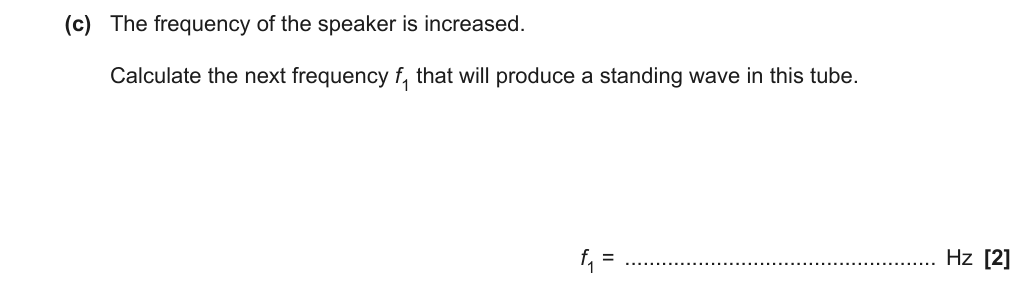
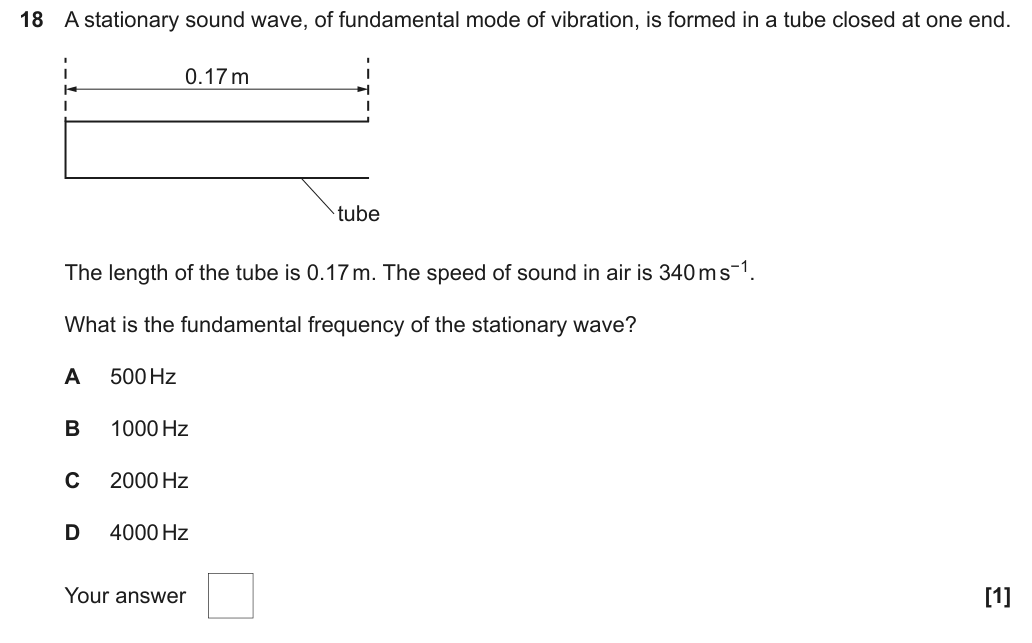
June 2024 · AS Paper 2 · Q6(c)1 markCalculationHard
Earlier part of question 6 that this part uses
Mark scheme
Examiner's comment
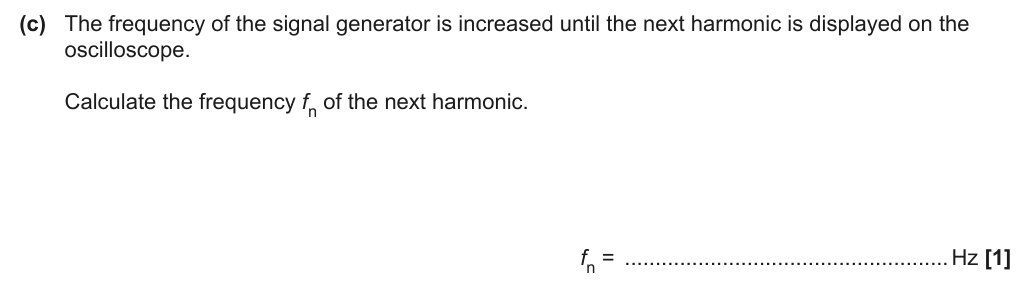
This question was challenging. A value of 500 Hz was the common incorrect answer. Other incorrect answers included candidates who thought that the frequencies decreased.
Notes from the mark scheme and report
closed tube: next harmonic is 3f0
ecf from (a), NOT ecf from (b)
Many candidates did not fully understand the formation of stationary waves in closed tubes and the effect on the harmonics.
Candidates should have the opportunity of drawing stationary waves in both open and closed tubes and determining the wavelength and frequency for each pattern.
Skills: M0.3 Use ratios, fractions and percentages
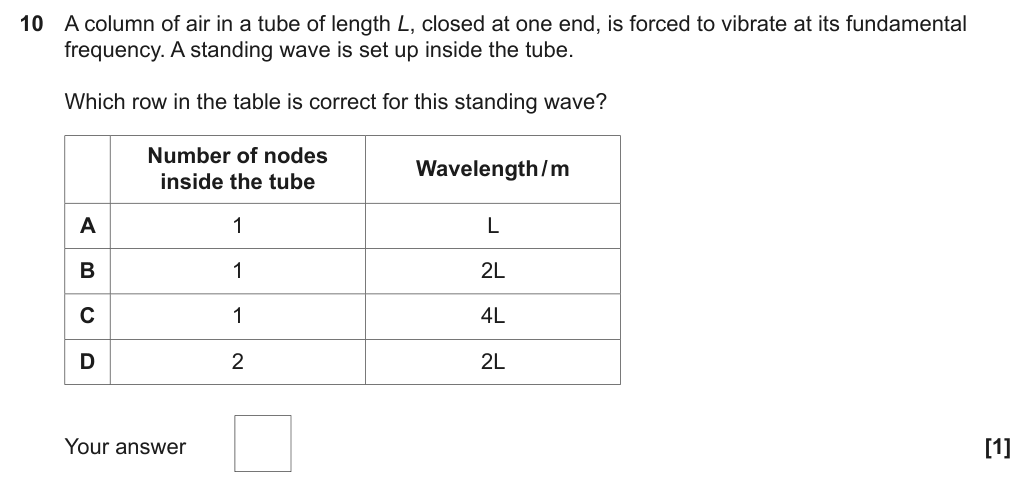
June 2024 · Paper 2 · Q91 markMultiple choiceHard
Answer
A
Mark scheme
Examiner's comment
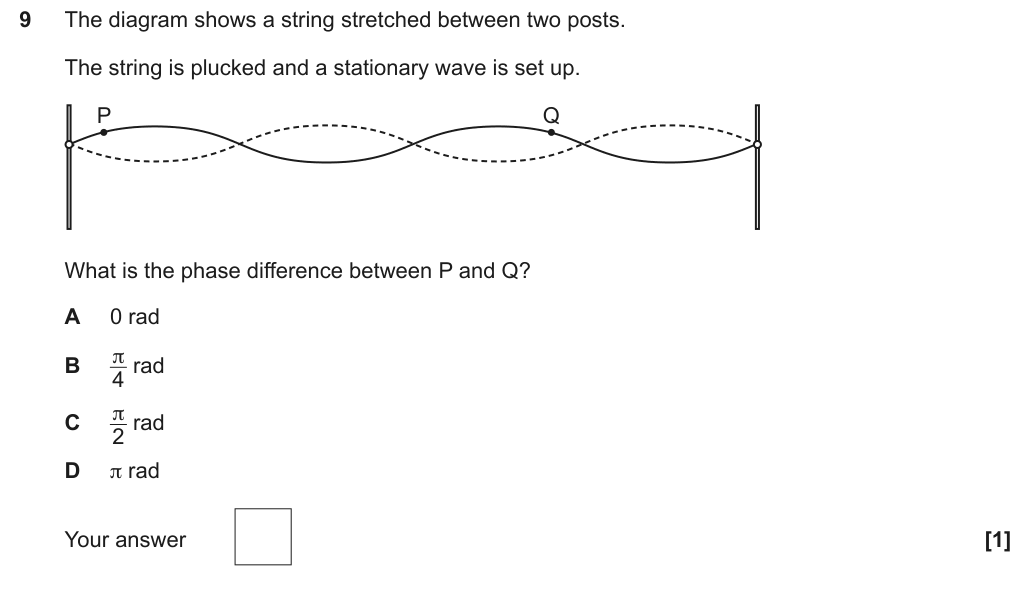
Relatively few candidates got this phase difference correct; it was clear from many that they thought that it was a progressive wave as they attempted to add on fractions of cycles. It may also be the case that candidates are unfamiliar with phase differences in stationary waves.
June 2024 · Paper 3 · Q1(a)3 marksShow thatMedium
Mark scheme
Examiner's comment
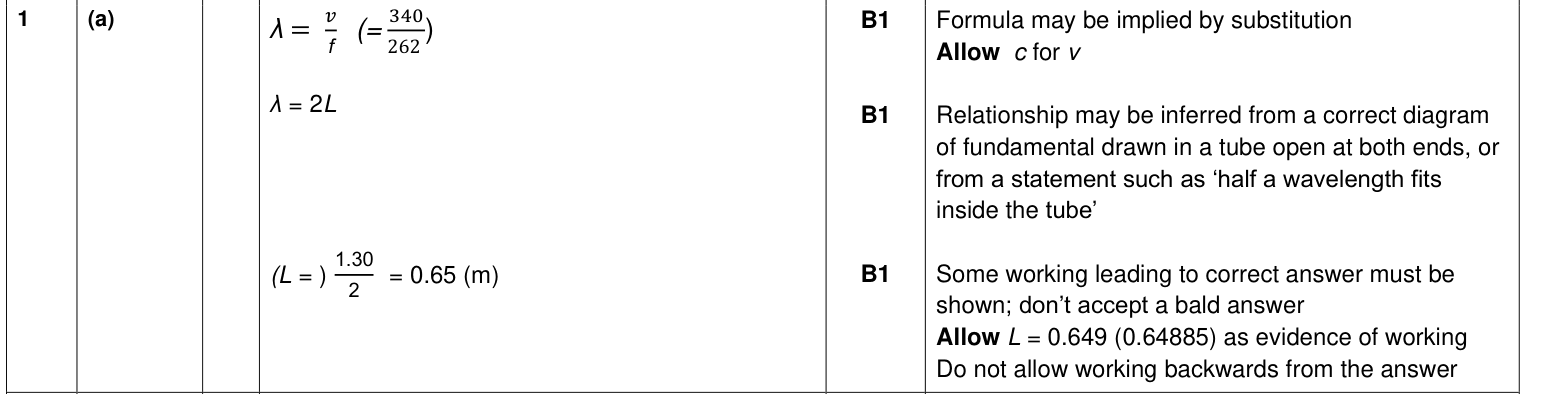
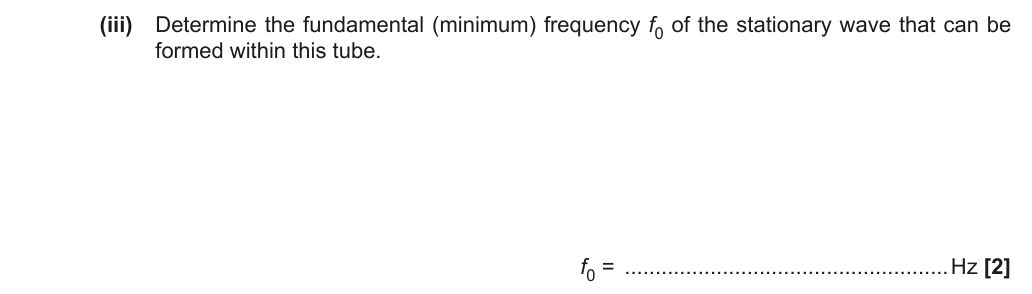
This is a ‘show that’ question and so every step of the calculation needs to be made clear. It is not enough to point out that 340 / (2 x 262) = 0.65: the examiner needs to know why the data is being combined in this particular way. The step that was most often omitted was saying that, for the fundamental (lowest) frequency, half a wavelength fits inside the flute. This could be demonstrated using a diagram, showing an open tube containing half a wavelength with antinodes at both ends. However, a written statement (length is half of a wavelength) or a mathematical statement (L = 𝜆/2) are just as good.
Notes from the mark scheme and report
working must be shown: no bald answer and no working backwards from 0.65 m
Skills: M2.2 Change the subject of an equation, including non-linear equations; M2.3 Substitute numerical values into algebraic equations using appropriate units for physical quantities
June 2024 · Paper 3 · Q1(b)(ii)4 marksCalculationMedium
Earlier parts of question 1 that this part uses
Mark scheme
Examiner's comment
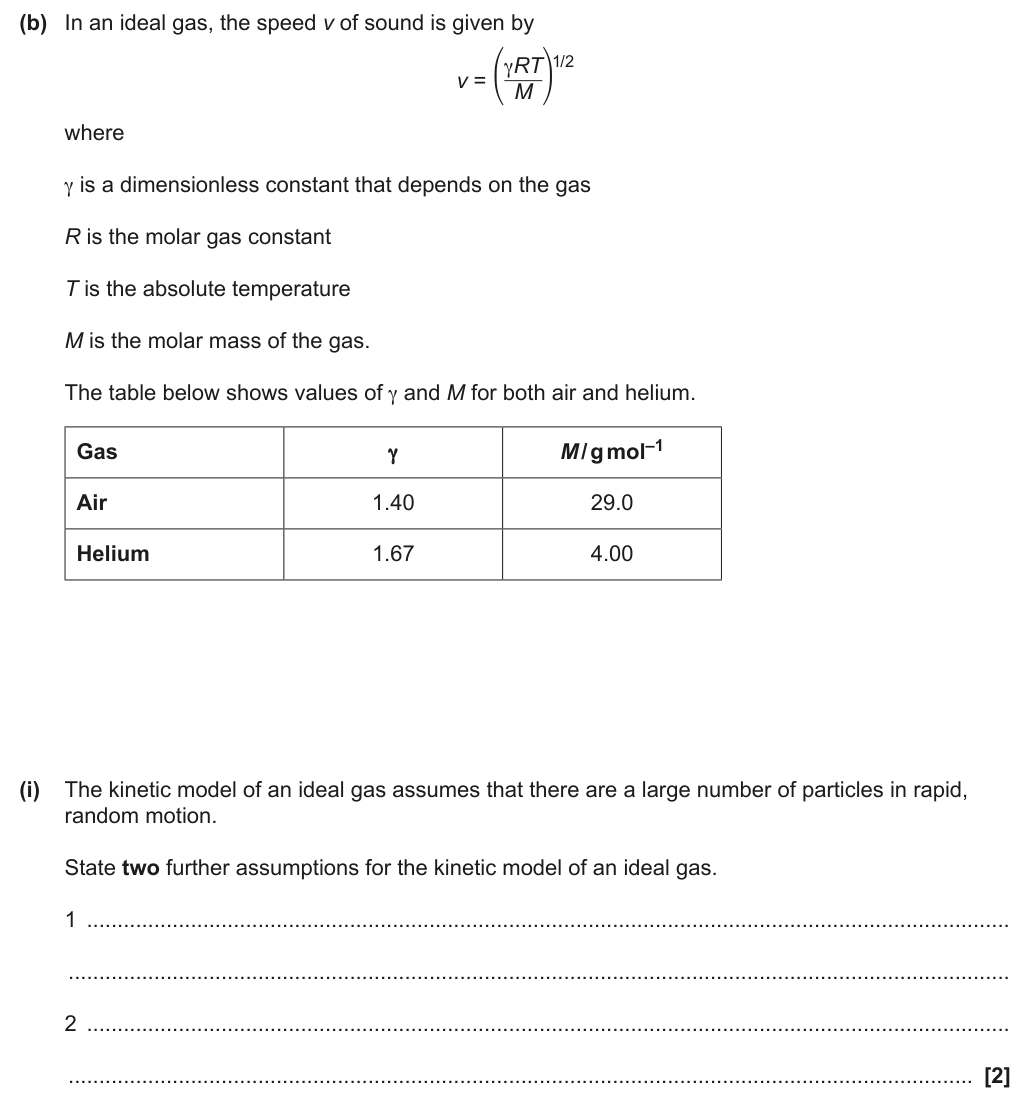
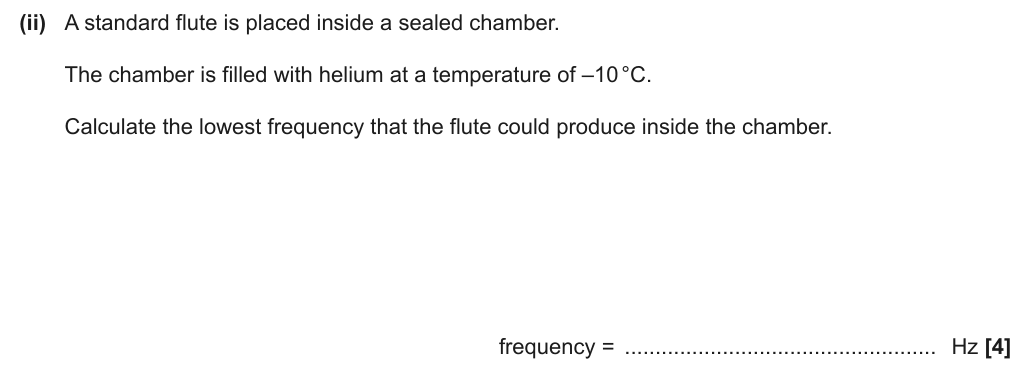
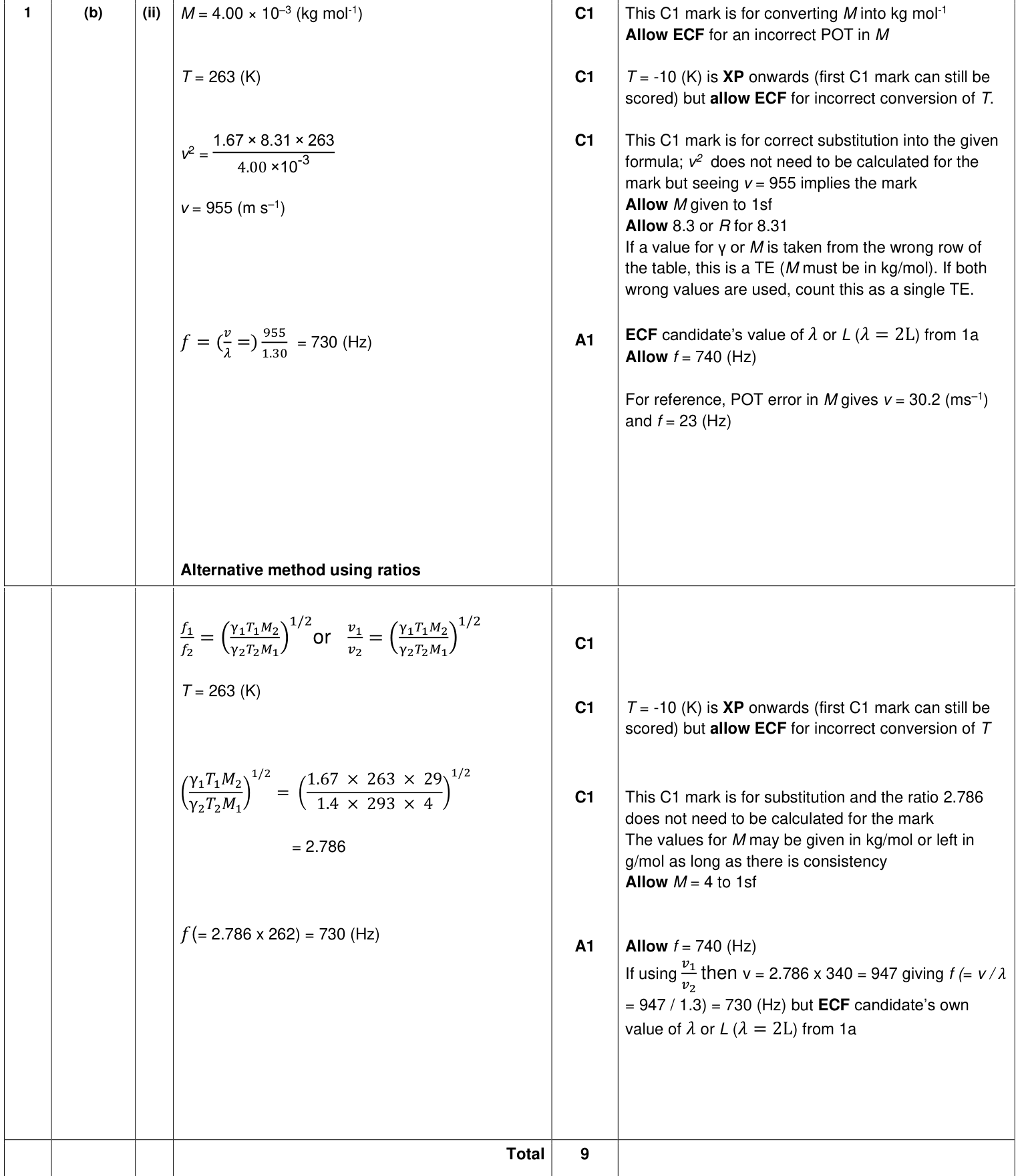
Common problems in 1 (b) (ii) • failing to convert the molar mass M into units of kg mol-1 • substituting the length of the flute (0.65m) instead of 1.30m for the wavelength. Question2(a) The initial step in this question is to use the equation I = Io𝑒−𝑡/𝑅𝐶 together with the fact that N resistors in series have a total resistance of NR and N capacitors in parallel have a total capacitance of NC.T is the time taken for Io to fall to Io/2 and so ½ = 𝑒−𝑇/𝑁𝑅.𝑁𝐶. Many candidates were able to navigate the tricky mathematics and were aware that ln(½) = -ln(2) It is important in this question to distinguish clearly between t, the general variable for time, and T, the time taken for Io to fall to Io/2. The statement ½ = 𝑒−𝑡/𝑁𝑅.𝑁𝐶 is not generally true; it is only true when t = T.
Notes from the mark scheme and report
M must be converted to kg mol⁻¹
T = −10 K scores no further marks
ecf λ or L from (a)
allow 740 Hz
Skills: M0.1 Recognise and make use of appropriate units in calculations; M0.3 Use ratios, fractions and percentages; M0.5 Use calculators to find and use power, exponential and logarithmic functions; M2.3 Substitute numerical values into algebraic equations using appropriate units for physical quantities
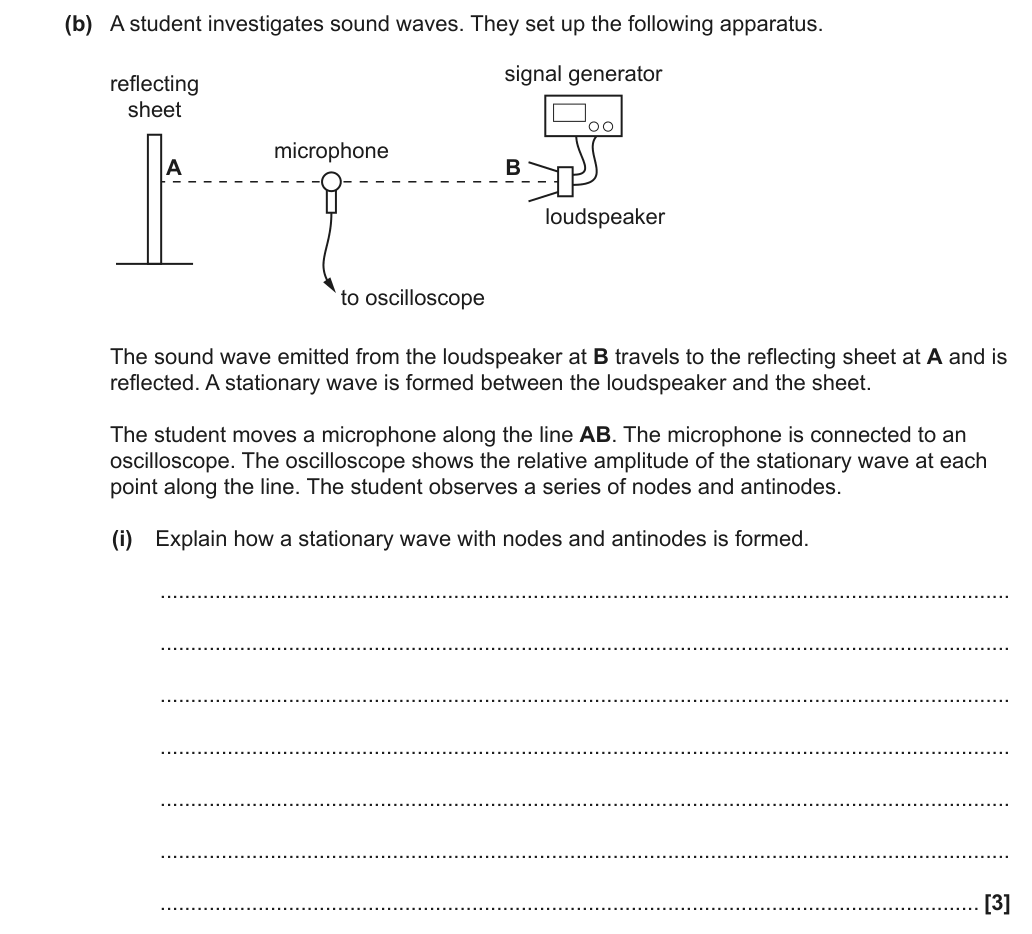
June 2023 · AS Paper 1 · Q22(b)(i)3 marksExplanationEasy
Mark scheme
Examiner's comment
About a third of candidates achieved no marks on this question but most candidates were able to correctly explain that a stationary wave is formed from the superposition of the incident and reflected wave. Often descriptions of nodes and antinodes was confused and lacked effective and correct use of scientific language by referring to constructive and destructive interference and explaining how these formed antinodes and nodes respectively.
Notes from the mark scheme and report
ignore 'superimpose'
Skills: PAG5 Investigating waves
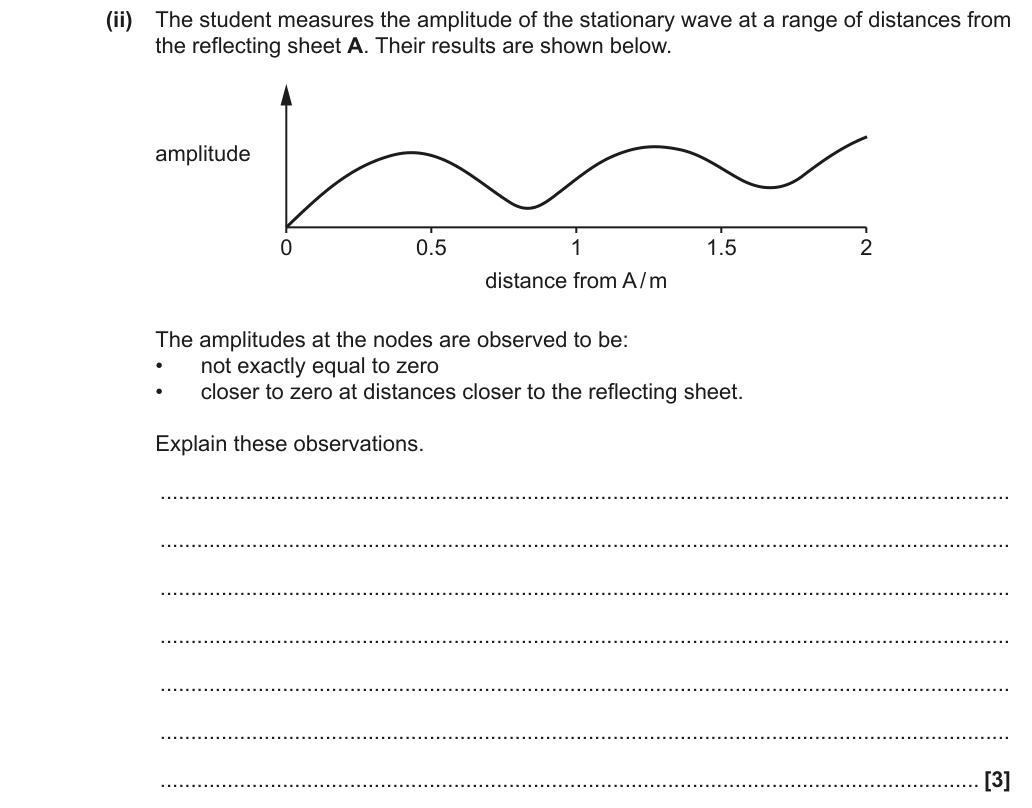
June 2023 · AS Paper 1 · Q22(b)(ii)3 marksExplanationMedium
Earlier part of question 22 that this part uses
Mark scheme
Examiner's comment
Candidates performed less well on this question with only about a third of candidates achieving 1 or more marks. Candidates had to explain both observations regarding the amplitudes of the nodes to fully access the question by interpreting that the change in amplitude was related to the decrease in intensity/amplitude of the reflected wave as it travelled a greater distance from the reflecting sheet A. This response is an example of a typical response where candidates have confused the change in amplitude of the nodes to either a change in frequency or phase difference due to the reflected wave being ‘out of phase’ with the incident wave. There was also a common misconception that the reflected wave from the reflecting sheet A had experienced interference from either background noise or from further reflections of the wave in the room. The candidates had assumed that the two waves were no longer coherent, and this resulted in a difference in the amplitude of the nodes further from the reflecting sheet A.
Notes from the mark scheme and report
allow energy absorbed when the wave is incident on the plate
Skills: M3.1 Translate information between graphical, numerical and algebraic forms; PAG5 Investigating waves
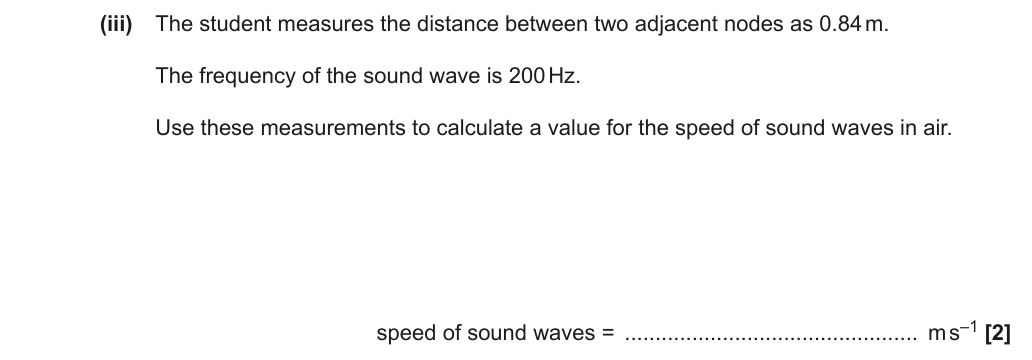
June 2023 · AS Paper 1 · Q22(b)(iii)2 marksCalculationMedium
Mark scheme
Examiner's comment
Candidates performed well in this question as two thirds correctly determined that the wavelength of the sound wave was twice the distance between the adjacent nodes and then applied the wave speed equation v = f to calculate the speed of sound waves as 336 m s–1.
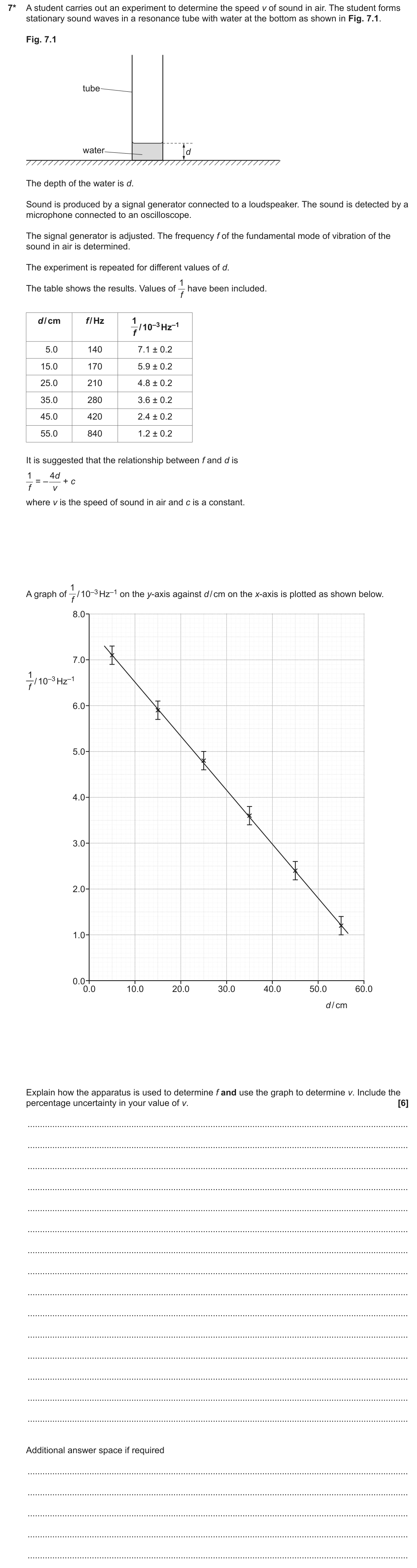
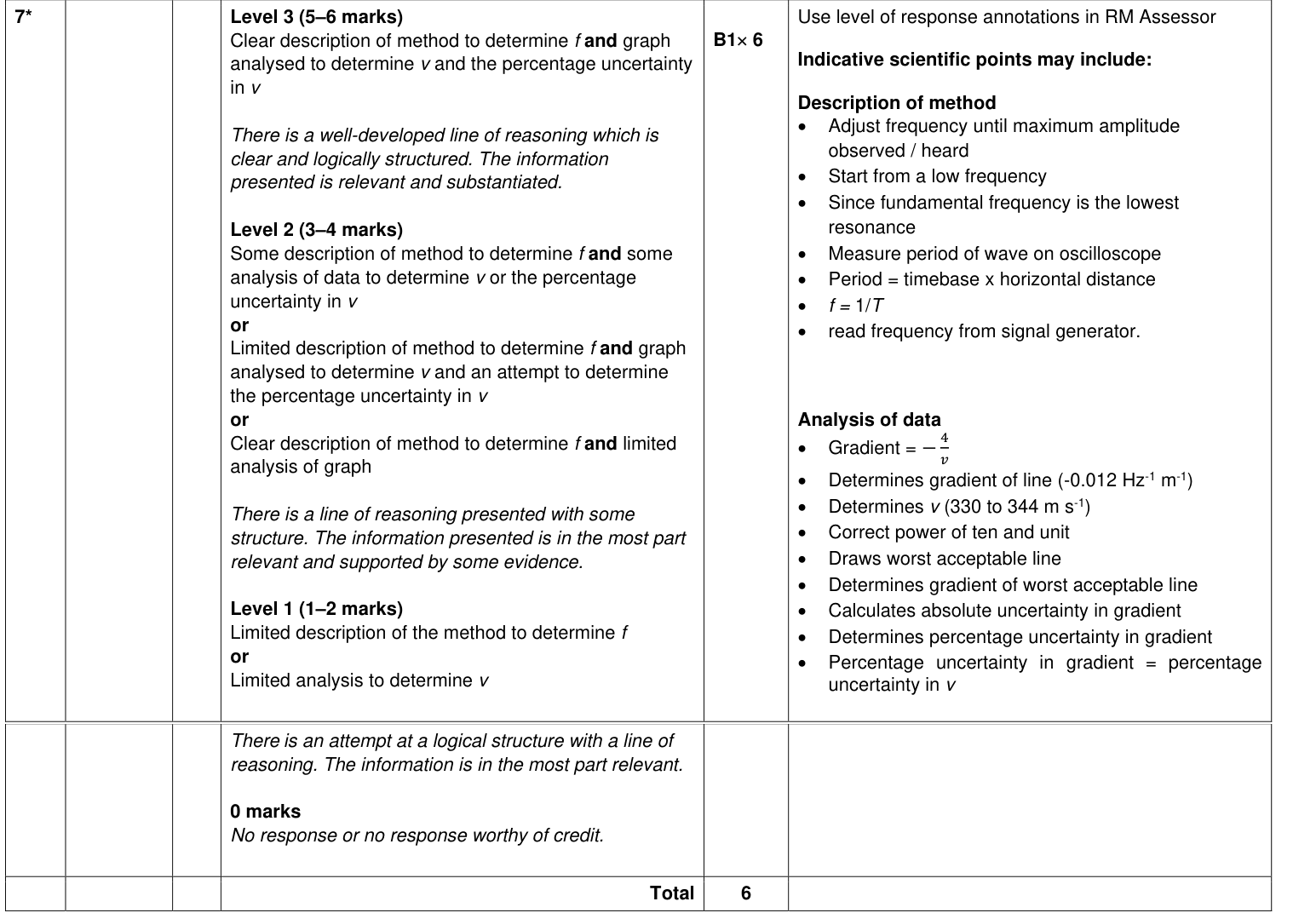
June 2023 · AS Paper 2 · Q76 marks6-mark extended responseMedium
Mark scheme, with the levels and indicative content
Examiner's comment
The second level of response question gave candidates the opportunity of drawing conclusions from an experiment as well as explaining how the fundamental frequency f may be determined experimentally. For good answers to these type of questions, candidates need to structure their answers logically so that all parts of the question are answered. An explanation to determine f should include the adjustment of the frequency and how to determine the fundamental frequency with the idea of the loudest sound. More successful candidates discussed the peak on the oscilloscope and starting from a low frequency. It was also expected that candidates could describe how to determine the frequency from an oscilloscope. Ideally reference would be made to the time-base. To determine the value of v with the percentage uncertainty, candidates needed to show their working clearly, taking into account the powers of ten and units from the graph. This candidate’s response is structured and detailed. Firstly, this candidate has added the steepest worst acceptable line to the graph which passes through all the error bars. The candidate then identifies how the gradient is related to the frequency of the wave before calculating the gradient. The calculation of the gradient is demonstrated and the candidate has also clearly taken into account the powers of ten on each axis of the graph before determining v with a correct unit. This process is repeated for the worst acceptable line with each of the steps shown before percentage uncertainty is calculated. Throughout this section, it is easy to follow the candidate’s method. It is clear that the candidate has used a large triangle to calculate the gradient. The candidate then explains how f is determined by adjusting the signal generator until a loud sound is heard and then explaining how the frequency is determined by the oscilloscope.
Notes from the mark scheme and report
gradient = -4/v (about -0.012 Hz-1 m-1) gives v 330 to 344 m s-1
worst acceptable line for percentage uncertainty
correct power of ten needed
Skills: M1.5 Identify uncertainties in measurements and use simple techniques to determine uncertainty when data are combined; M3.3 Understand that y = mx + c represents a linear relationship; M3.4 Determine the slope and intercept of a linear graph; PAG5 Investigating waves
June 2023 · Paper 2 · Q101 markMultiple choiceMedium
Answer
C
Mark scheme
Examiner's comment
A large number of candidates were able to correctly identify the correct response and many drew a diagram to support their answer.
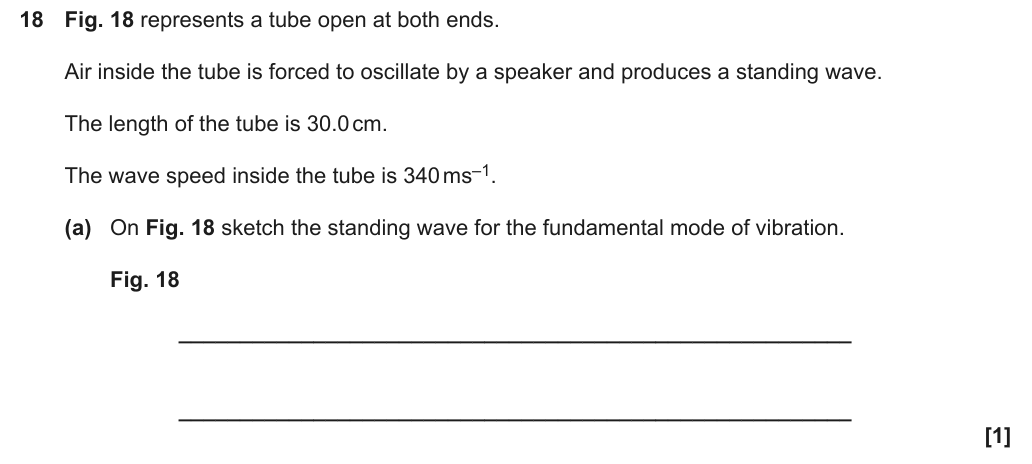
June 2023 · Paper 2 · Q18(a)1 markDiagram or graphMedium
Mark scheme
Examiner's comment
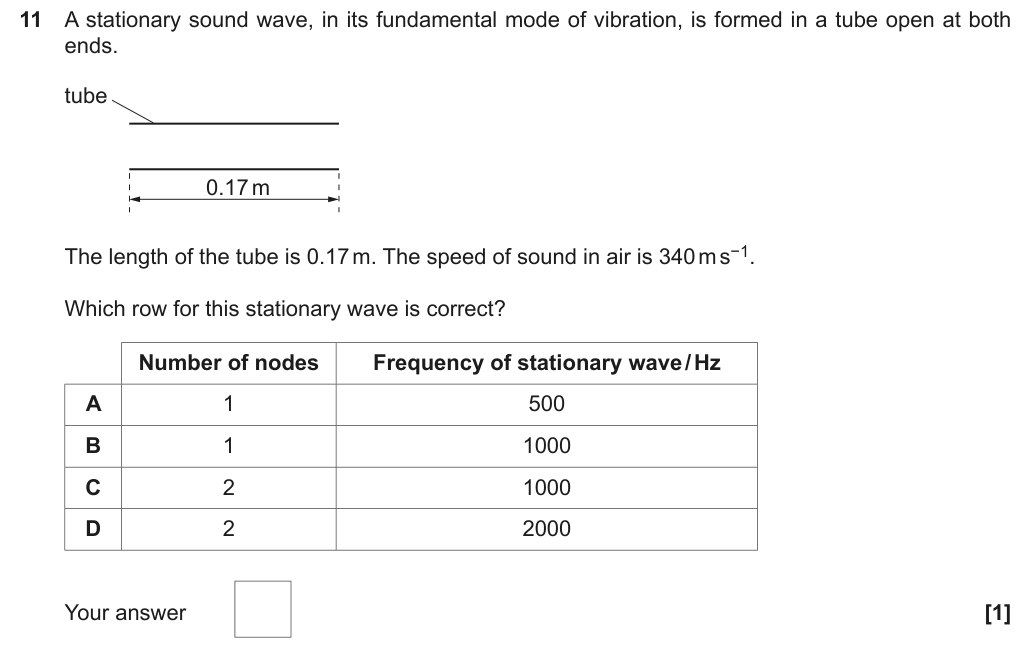
The majority of candidates were able to correctly identify and draw the fundamental mode in between the two given lines. Examiners were fairly generous on this; however the following would be penalised: not drawing the node in the centre, having the wrong curvature, and drawing straight lines. This is a relatively simple sketch, but candidates must take care. Some candidates attempted a longitudinal wave sketch and several others just drew a large number of waves, indicating they had not really appreciated the question. As always, it is recommended that candidates use pencil; those who made mistakes often drew another set of a parallel lines and then put in their answer. Examiners will always consider this; however it is better to use the original question image.
Notes from the mark scheme and report
antinode at each end and node in the middle
both curves needed
ignore lines outside the tube
Skills: M3.12 Sketch relationships which are modelled by y = k/x, y = kx², y = k/x², y = kx, y = sin x, y = cos x, y = e^(±x) and y = sin²x, y = cos²x as applied to physical relationships
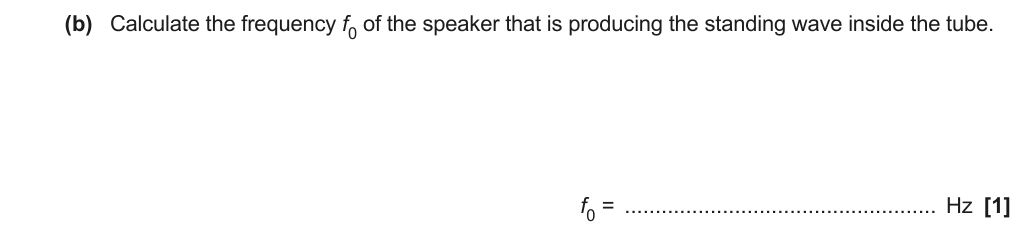
June 2023 · Paper 2 · Q18(b)1 markCalculationHard
Earlier part of question 18 that this part uses
Mark scheme
Examiner's comment
Around two thirds of candidates were able to calculate this correctly. The majority of incorrect responses were naturally when using 0.30 m as the wavelength. Relatively few candidates did not change their wavelength into metres, but a significant number were unable to rearrange the formula correctly.
Notes from the mark scheme and report
no ecf from 18(a)
Skills: M0.1 Recognise and make use of appropriate units in calculations; M2.3 Substitute numerical values into algebraic equations using appropriate units for physical quantities
June 2023 · Paper 2 · Q18(c)2 marksCalculationHard
Earlier parts of question 18 that this part uses
Mark scheme
Examiner's comment
Most candidates appreciated that the wavelength would be smaller (and many drew a sketch) to produce the next frequency. However, it was difficult to score marks on this if the previous answers were incorrect. Error carried forward is often applied, but in this case major errors will compound and it is not possible to work through the candidates thinking.
Notes from the mark scheme and report
ecf from (b) if wavelength 0.600 m used
special case: full credit for 1700 Hz if 0.300 m drawn in (a) and 1130 Hz in (b)
Skills: M2.3 Substitute numerical values into algebraic equations using appropriate units for physical quantities
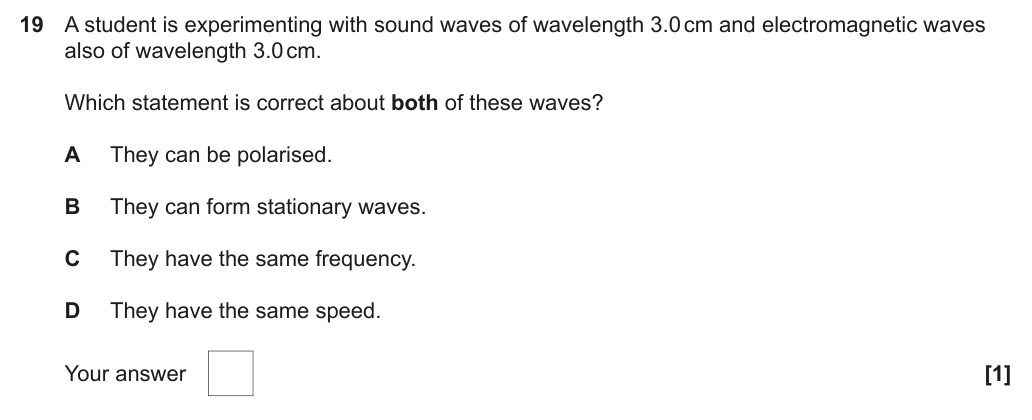
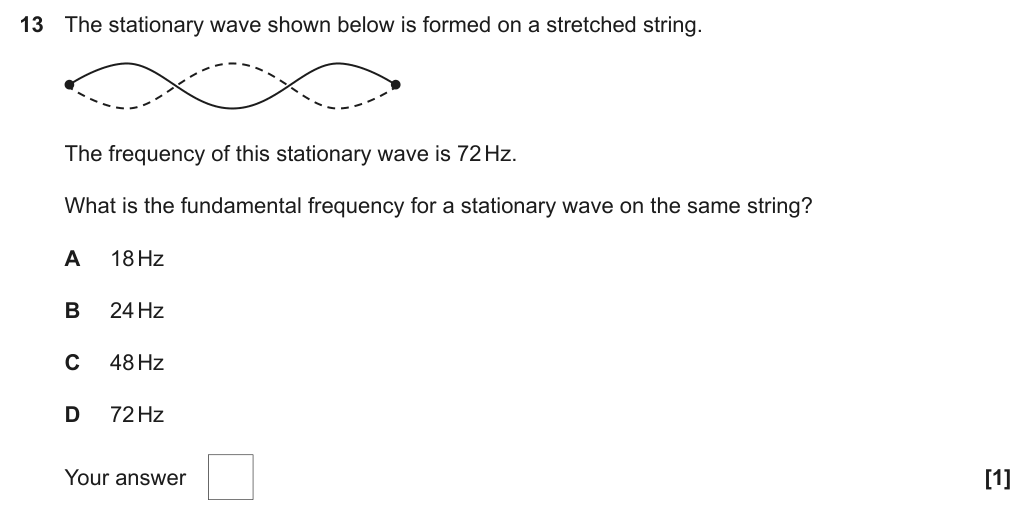
June 2022 · AS Paper 1 · Q191 markMultiple choiceMedium
Answer
B
Mark scheme
Examiner's comment
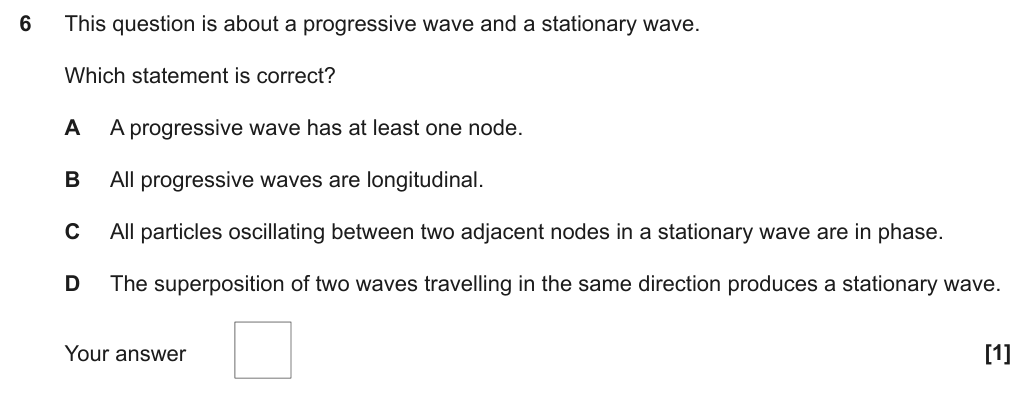
Candidates performed well on this question as most gave the correct answer B by recognising that sound is an example of a longitudinal wave and electromagnetic waves are an example of transverse waves but that they can both form stationary waves.
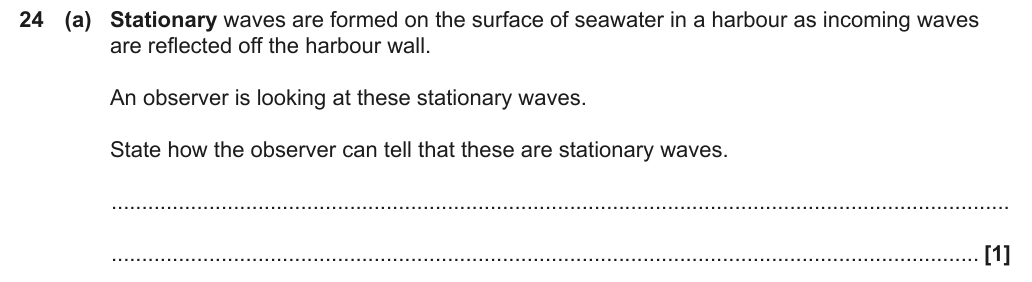
June 2022 · AS Paper 1 · Q24(a)1 markShort answerMedium
Mark scheme
Examiner's comment
Most candidates did not perform well on this question as they did not use correct scientific terminology to state an observation of stationary waves and used simplistic and superficial language such as ‘the waves were not moving’ or they lacked the understanding and knowledge of the properties of a stationary wave and described the wave in terms of other properties, e.g. frequency and wave speed which were not credit worthy.
Notes from the mark scheme and report
Ignore 'the waves don't move'
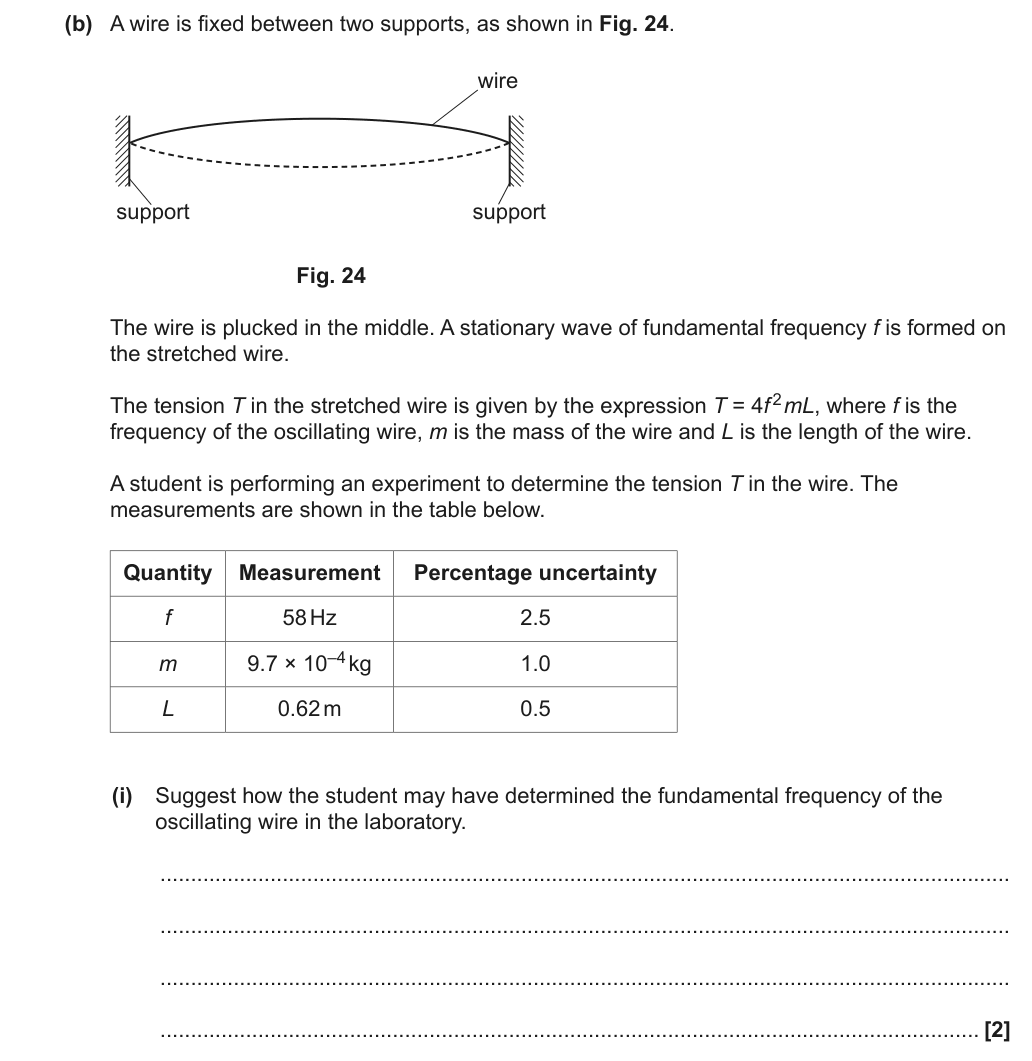
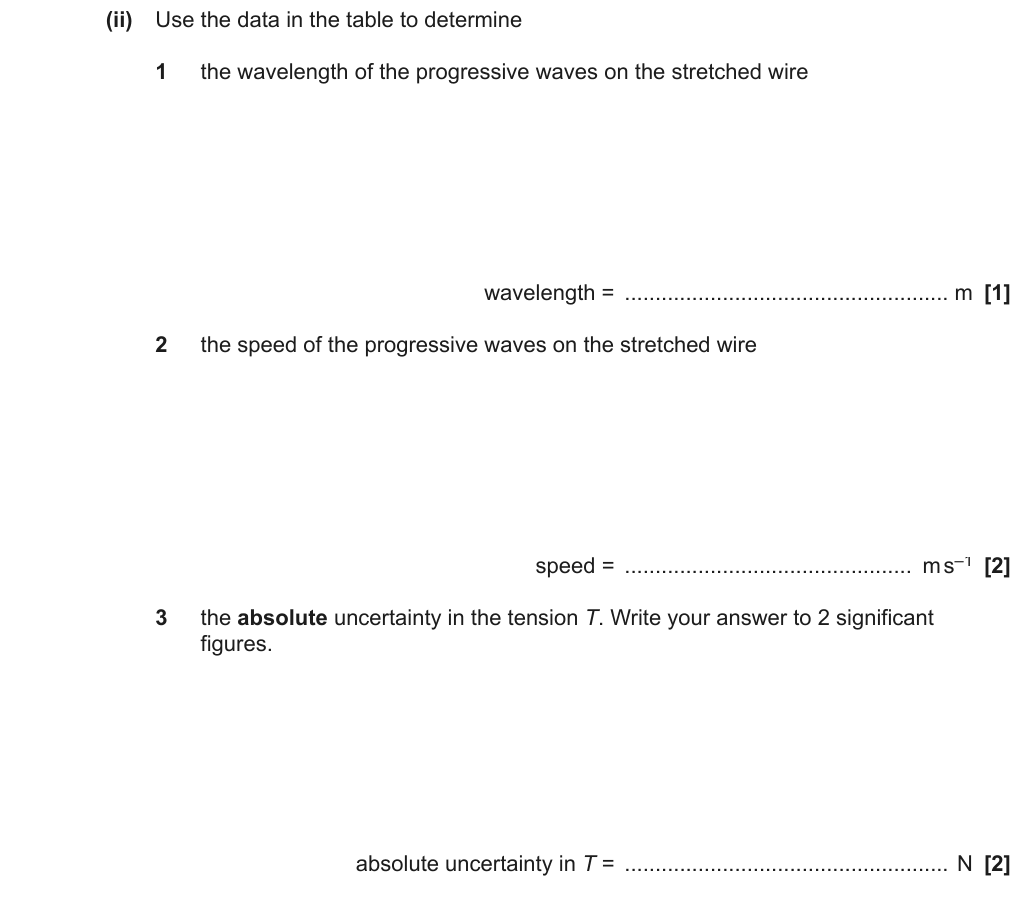
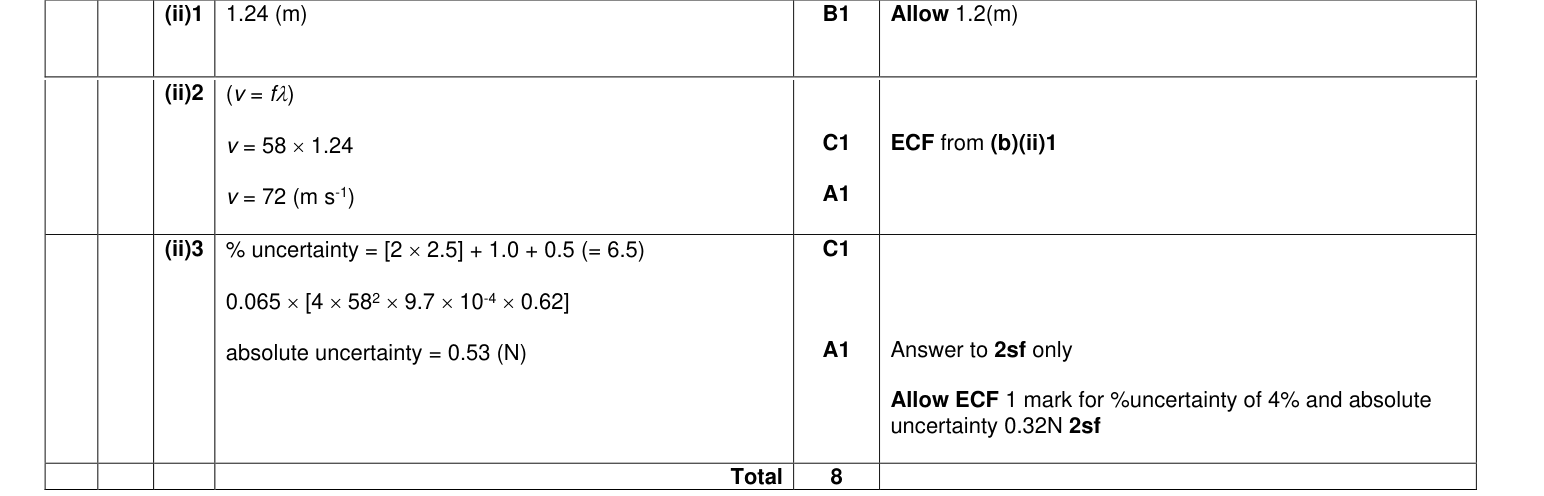
June 2022 · AS Paper 1 · Q24(b)(ii)5 marksCalculationEasy
Earlier part of question 24 that this part uses
Mark scheme
Examiner's comment
Most candidates performed well on this question as they correctly applied that at the fundamental frequency λ = 2L. Candidates at the lower end did not recall the wavelength of the stationary wave in terms of the length of wire. Nearly 80% of candidates correctly selected and applied the formula v = fλ. Where candidates had incorrectly determined the wavelength at the fundamental frequency, they were given marks for carrying out a correct calculation using their value. About a third of candidates used the information given in the question to determine the percentage uncertainty of 6.5% and used this to find the absolute uncertainty. Some candidates used the maximum and minimum values of the tension to find the absolute uncertainty. Some candidates correctly calculated a value for the absolute uncertainty but did not give their answer to 2 significant figures as the question requested.
Notes from the mark scheme and report
Allow 1.2 m
ecf from wavelength
uncertainty answer to 2 sf only
4% (f not doubled) giving 0.32 N scores 1
Skills: M1.1 Use an appropriate number of significant figures; M1.5 Identify uncertainties in measurements and use simple techniques to determine uncertainty when data are combined; M2.3 Substitute numerical values into algebraic equations using appropriate units for physical quantities
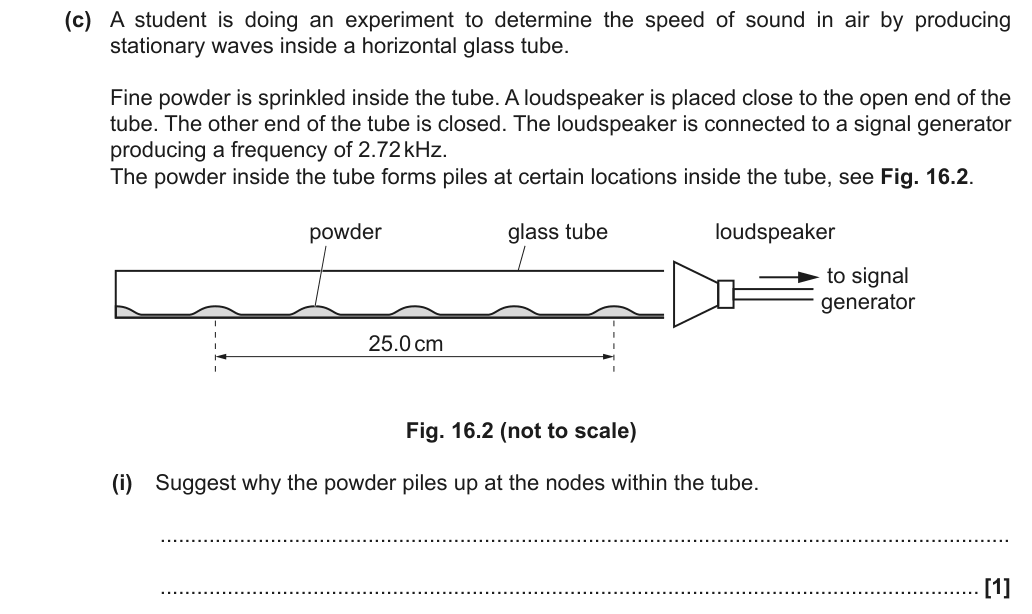
June 2022 · Paper 2 · Q16(c)(i)1 markExplanationEasy
Mark scheme
Examiner's comment
Most candidates were able to appreciate that the stationary wave has nodes and antinodes and correctly relate them to the movement of the particles. Candidates were expected to give their responses in terms of the nodes, and responses in terms of the antinodes – such as powder is displaced from the antinodes – does not really answer the question. Several candidates drew a stationary wave on the diagram, with nodes and antinodes at the correct places. As the exemplar below shows, this helps confirm in the candidates mind the variation of the oscillations of the stationary wave. It also helps with subsequent questions; although cannot be given marks itself, candidates are always to be encouraged to make additions to diagrams to help them in supporting their responses. A candidate drawing on the diagram to assist them to appreciate the vibrations at the nodes and antinodes.
Notes from the mark scheme and report
ignore references to pressure
incorrect statements about antinodes are penalised
Skills: PAG5 Investigating waves
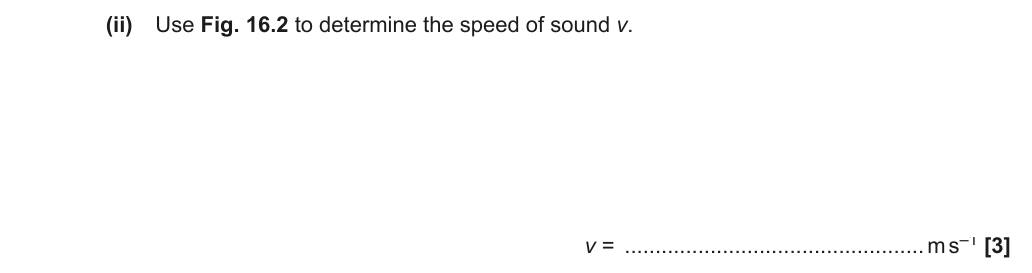
June 2022 · Paper 2 · Q16(c)(ii)3 marksCalculationMedium
Earlier part of question 16 that this part uses
Mark scheme
Examiner's comment
This question was well answered by most candidates who were able to correctly appreciate that the given distance of 25cm corresponded to two complete wavelengths of the stationary wave. Encouragingly, very few candidates did not make the cm to m conversion. A small number of candidates thought that the wavelength was the distance between two nodes resulting in an answer of 170 m s–1. Many candidates structured their responses clearly and were able to explain their reasoning.
Notes from the mark scheme and report
170 m s-1 from λ = 6.25 cm scores 2 marks
bare 340 with no working scores 1
one power-of-ten error max
Skills: M0.1 Recognise and make use of appropriate units in calculations; M2.3 Substitute numerical values into algebraic equations using appropriate units for physical quantities; PAG5 Investigating waves
June 2022 · Paper 2 · Q16(c)(iii)2 marksCalculationHard
Earlier parts of question 16 that this part uses
Mark scheme
Examiner's comment
This proved to be a challenging question and only around one fifth of the candidates were able to score any marks. Most successful candidates appreciated that there were 11 quarter wavelengths of the initial wave in the tube and used this to determine the length of the tube, from which they were able to determine the fundamental wavelength and hence the frequency. There are many potential errors in this question, however a common incorrect response was 680Hz, calculated from treating the wavelength of the fundamental wave as twice the given distance of 25cm.
Notes from the mark scheme and report
2.72 kHz is the 11th harmonic (11 quarter-wavelengths in the tube)
ecf on v from (c)(ii)
Allow 250 Hz
Skills: M0.3 Use ratios, fractions and percentages; M2.2 Change the subject of an equation, including non-linear equations
November 2021 · AS Paper 1 · Q131 markMultiple choice
Answer
B
Mark scheme
November 2021 · Paper 2 · Q91 markMultiple choiceEasy
Answer
B
Mark scheme
Examiner's comment
The correct response is B. Around two thirds of candidates were able to correctly calculate the frequency; this question relies on the candidate appreciating that there is more than one complete cycle in the tube and then evaluating the correct wavelength. It is then a straightforward calculation. As expected, most of the incorrect responses were A, where the wave equation had simply been used with the given numbers. Several candidates drew on the diagram to help in their calculation of the wavelength, although some thought that the wavelength was two thirds of the tube length, rather than four fifths.
November 2021 · Paper 2 · Q16(b)2 marksShort answerHard
Mark scheme
Examiner's comment
This question is clear that the differences and similarities should be based on the oscillations. Few candidates did this, but other routes could be used to gain credit. Candidates should be careful not to create lists in this style of question and simply produce a single response, as contradictions can be penalised.
Notes from the mark scheme and report
may be described in terms of net energy transfer, phase or amplitude
November 2021 · Paper 3 · Q5(a)4 marksExplanationMedium
Mark scheme
Examiner's comment
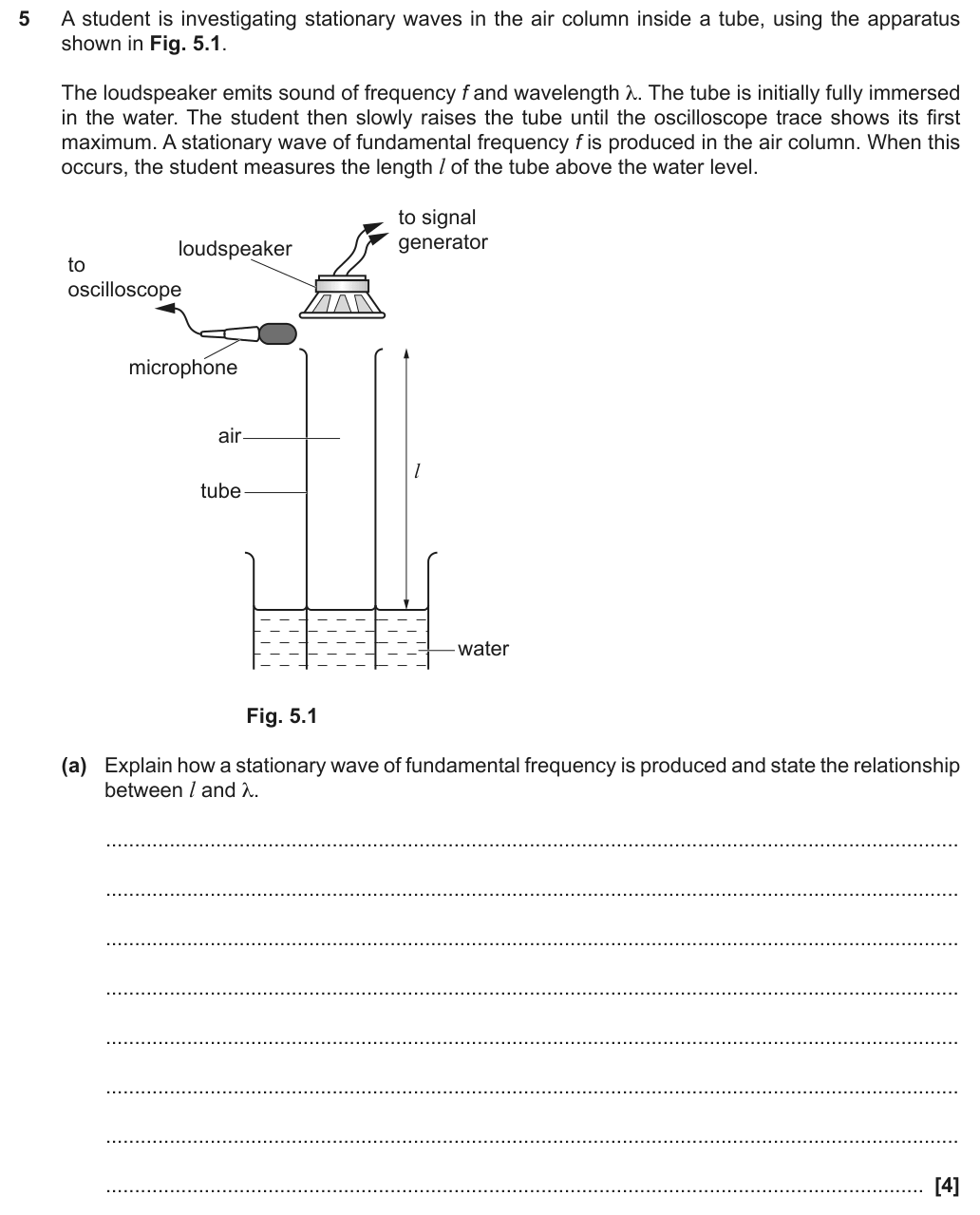
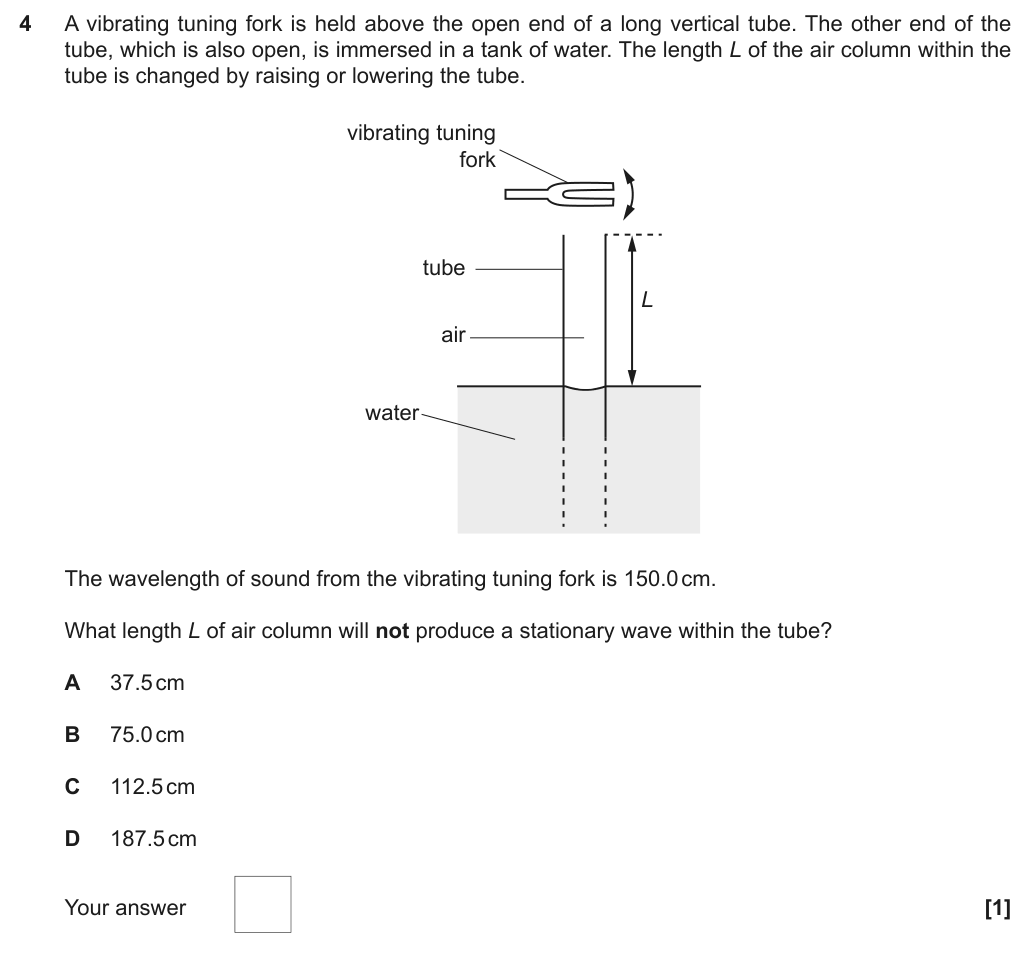
A good example where this approach would help is for Question 5(a), where many candidates either explained how a stationary wave is produced in general, with no reference to the fundamental frequency or l = ¼, or drew diagrams of several different harmonics, or gave the general equation l = (2n – 1)/4 × .
Notes from the mark scheme and report
reflection at the water surface
do not allow waves interact / combine (interfere / superpose needed)
node at water surface and antinode at top of tube
l = λ/4
Skills: PAG5 Investigating waves
November 2021 · Paper 3 · Q5(b)(ii)3 marksCalculationMedium
Earlier part of question 5 that this part uses
Mark scheme
Examiner's comment
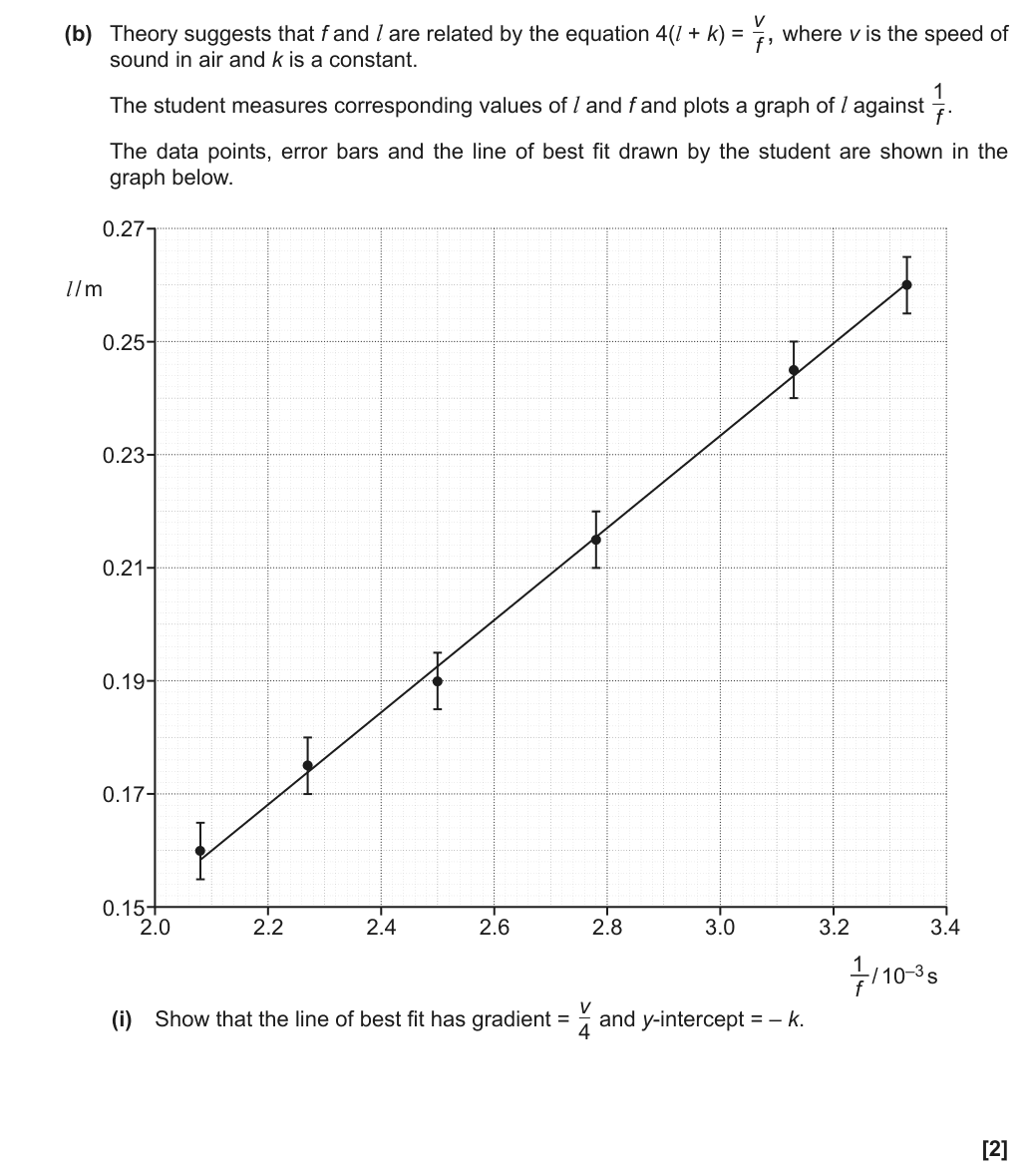
For example, they are asked to analyse and interpret experimental data, as in Question 5(b), or to design an experiment in order to test a conclusion, as in Question 2(b). Spotlight on Question 5(b) as an example A good illustrative example is the data analysis question, 5(b).
Notes from the mark scheme and report
large triangle (Δx > 0.6 x 10⁻³ s)
gradient 80 to 82 m s-1
v = 320 ± 20
ecf from an incorrect gradient
Skills: M3.4 Determine the slope and intercept of a linear graph; PAG5 Investigating waves
November 2021 · Paper 3 · Q5(c)(i)2 marksCalculation
Earlier part of question 5 that this part uses
Mark scheme
Notes from the mark scheme and report
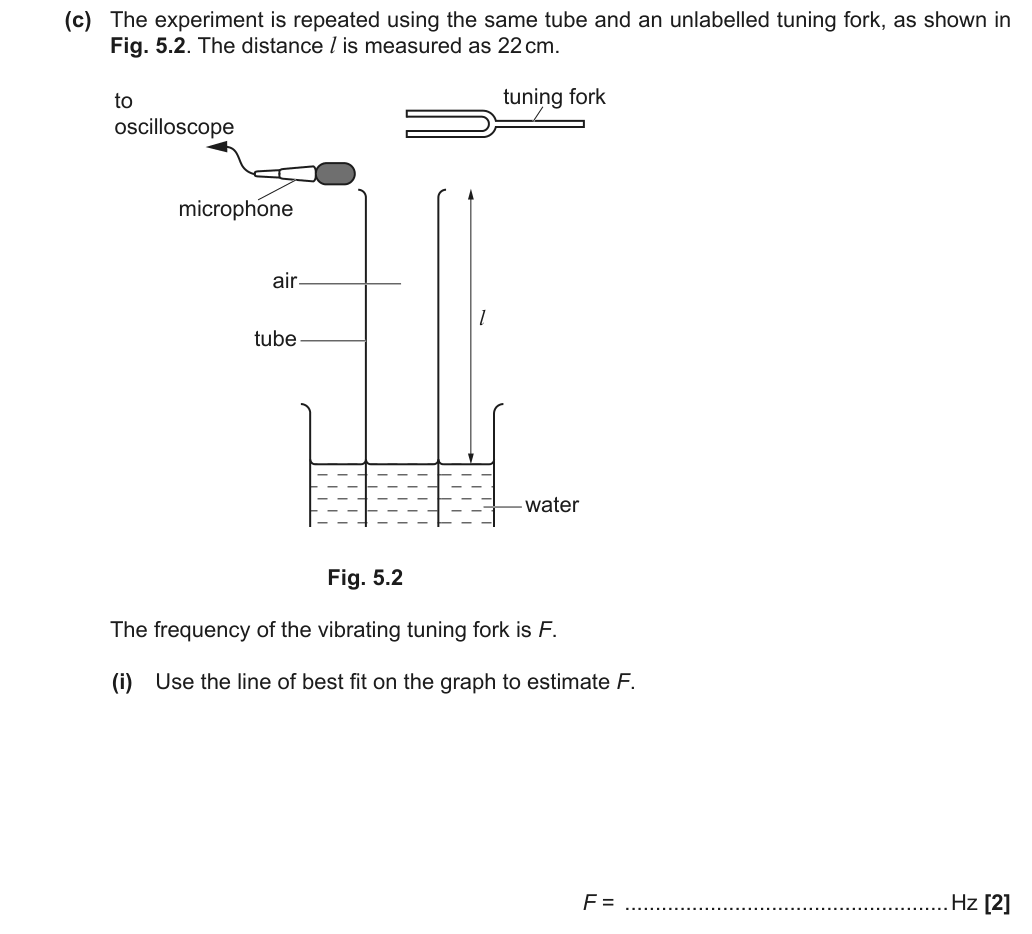
1/F read from the line of best fit at l = 0.22 m (2.83 to 2.84 x 10⁻³ s)
only methods using the line of best fit allowed
Skills: M3.1 Translate information between graphical, numerical and algebraic forms; PAG5 Investigating waves
November 2020 · AS Paper 1 · Q61 markMultiple choice
Answer
C
Mark scheme
November 2020 · AS Paper 1 · Q181 markMultiple choice
Answer
A
Mark scheme
November 2020 · Paper 2 · Q61 markMultiple choice
Answer
C
Mark scheme
November 2020 · Paper 2 · Q111 markMultiple choice
Answer
B
Mark scheme
November 2020 · Paper 3 · Q5(d)6 marks6-mark extended responseEasy
Earlier part of question 5 that this part uses
Mark scheme, with the levels and indicative content
Examiner's comment
Question 5b The words ‘simple harmonic motion’ in the text prompted almost all candidates to use the correct formula here. Question 5c Allowing a mark for the diode only letting current pass in one direction enabled many candidates to score this mark. Question 5d This was the second of the two LoR questions in this paper.
Notes from the mark scheme and report
1: maximum with receiver aerial vertical, zero when rotated 90 degrees
2: reflected and incident waves superpose - maximum with sheet at 30, 60 cm and zero at 15, 45 cm from the aerial (full credit for the reverse if the 180 degree phase change on reflection is used)
Skills: PAG5 Investigating waves
June 2019 · AS Paper 1 · Q201 markMultiple choice
Answer
C
Mark scheme
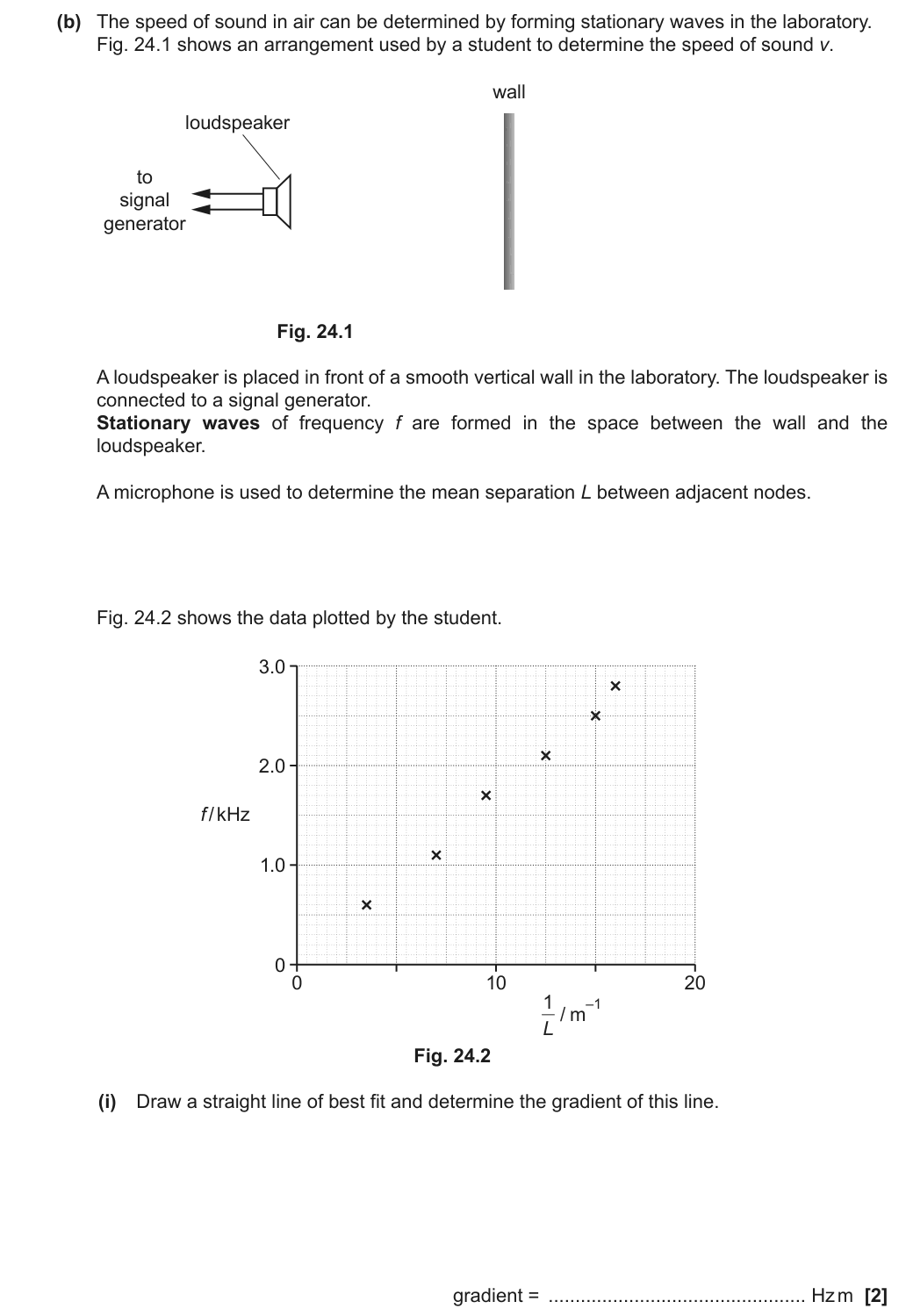
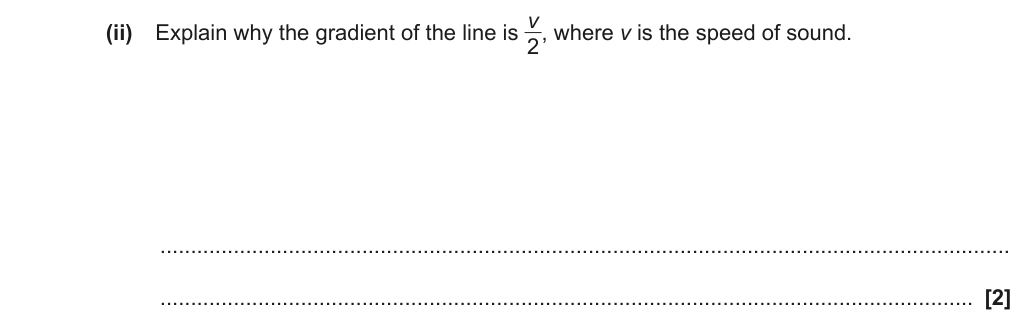
June 2019 · AS Paper 1 · Q24(b)(ii)2 marksExplanationEasy
Earlier part of question 24 that this part uses
Mark scheme
Examiner's comment
Most candidates scored 1 mark for either quoting the wave equation v = fλ or the wavelength being twice inter-nodal distance L. The analysis leading to the gradient = v/2 proved to be quite demanding for most of the candidates. The most frequent incorrect reasoning was that speed v was divided by 2 because the sound waves are reflected from the wall, and they had to travel twice the distance there and back. Only the most able of the candidates scored full marks.
June 2019 · AS Paper 1 · Q24(b)(iii)1 markCalculationEasy
Earlier parts of question 24 that this part uses
Mark scheme
Examiner's comment
Almost all candidates picked up 1 mark for multiplying their answer from (b)(i) by 2. This included those who also got an answer such as 0.17 in (b)(i). Error carried forward (ECF) rules were applied even when the speed of sound looked unrealistic.
Notes from the mark scheme and report
ecf from (b)(i)
Skills: M3.4 Determine the slope and intercept of a linear graph
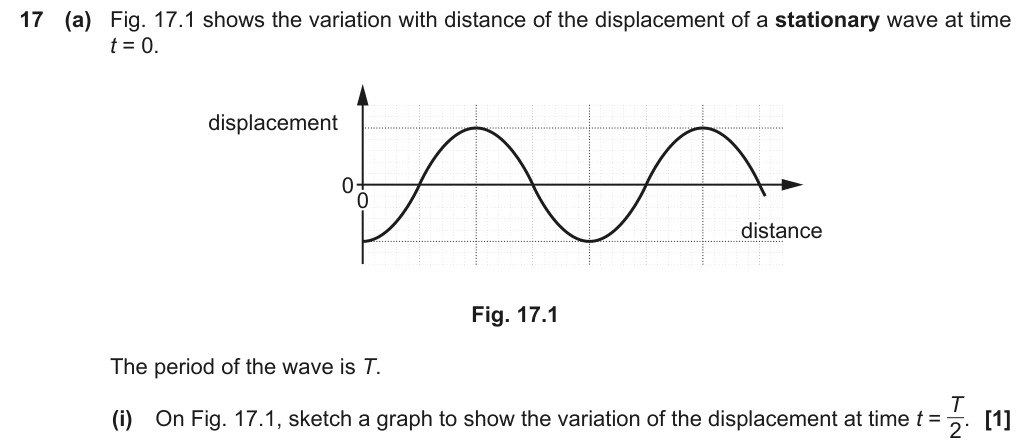
June 2019 · Paper 2 · Q17(a)(i)1 markDiagram or graphMedium
Mark scheme
Examiner's comment
The majority of the candidates drew the correct variation of the displacement after a time of half a period. In (a)(ii), it was good to see the nodes clearly marked with the letters N. The most common mistake was to draw a curve with a different period with nodes at all the points where the displacement was zero.
Notes from the mark scheme and report
inverted graph
Ignore amplitude
Skills: M3.12 Sketch relationships which are modelled by y = k/x, y = kx², y = k/x², y = kx, y = sin x, y = cos x, y = e^(±x) and y = sin²x, y = cos²x as applied to physical relationships
June 2019 · Paper 2 · Q17(a)(ii)1 markDiagram or graphMedium
Earlier part of question 17 that this part uses
Mark scheme
Examiner's comment
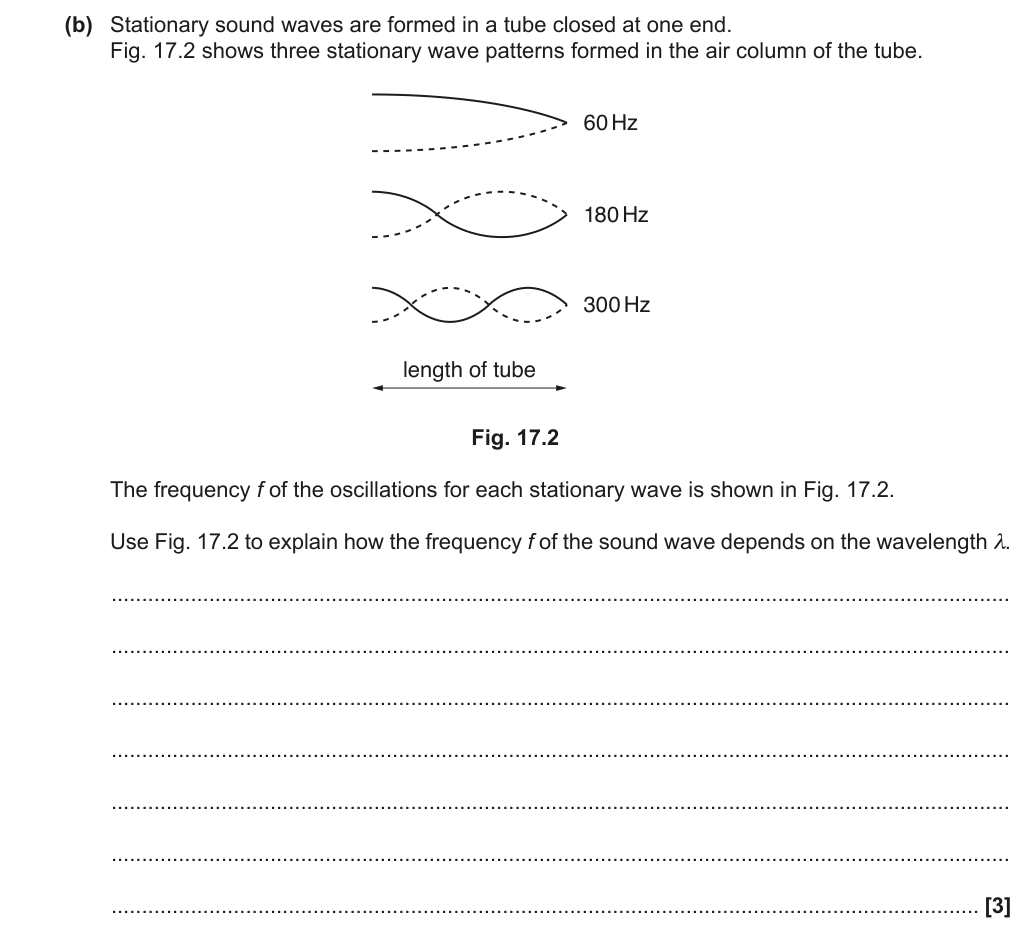
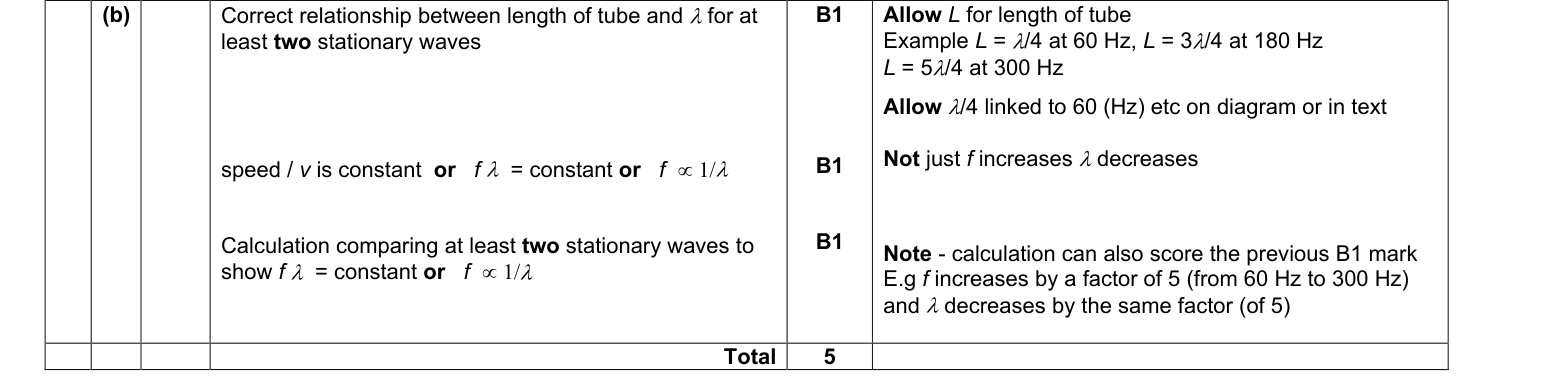
Question 17 (a) (i) The majority of the candidates drew the correct variation of the displacement after a time of half a period. Question 17 (a) (ii) Question 17 (b) The majority of the candidates scored 1 mark for either mentioning that the wavelength was inversely proportional to the frequency or identifying the correct relationship between the length of the tube and the wavelength.
Notes from the mark scheme and report
nodes must be on the original graph and labelled N
June 2019 · Paper 2 · Q17(b)3 marksPractical and data analysisMedium
Mark scheme
Examiner's comment
The majority of the candidates scored 1 mark for either mentioning that the wavelength was inversely proportional to the frequency or identifying the correct relationship between the length of the tube and the wavelength. Generally, the explanations lacked cohesion and showed poor comprehension of stationary waves formed within a fixed column of air. The common errors are highlighted below.
Notes from the mark scheme and report
L = λ/4, 3λ/4, 5λ/4
NOT just 'f increases as λ decreases'
needs fλ = constant with a calculation for two patterns
following mistakes.
• wavelength = λ/4, 3λ/4 and 5λ/4, instead of length of tube = λ/4, 3λ/4 and 5λ/4.
Skills: M0.3 Use ratios, fractions and percentages
June 2018 · AS Paper 1 · Q191 markMultiple choice
Answer
D
Mark scheme
June 2018 · Paper 2 · Q41 markMultiple choiceMedium
Answer
B
Mark scheme
Examiner's comment
Question 3 Question 4 Question 6 There was an erratum issues for this question.
June 2018 · AS Paper 2 · Q7(a)6 marks6-mark extended responseMedium
Mark scheme, with the levels and indicative content
Examiner's comment
This was the second Level of Response question; a good range of marks was achieved. It required candidates to explain a standing wave pattern formed by microwaves. Many good candidates explained the pattern produced in terms of the metal sheet reflecting the microwaves, causing superposition with an explanation of nodes and antinodes. It was hoped that their understanding that the distance between successive maxima/minima is λ/2 would assist them in the calculation of the frequency. Good candidates wrote the equation and indicated that the wavelength of the microwaves was 0.288 m. Candidates should practise writing explanations to physics phenomenon. It is expected that the answers to these Level of Response questions will have a well-developed line of reasoning which is clear and logically structured. The information presented is relevant and substantiated. This is an example of a Level of Response answer. The question gives a practical demonstration which candidates may have seen during the AS course. The question gives candidates the opportunity to describe the observations using their knowledge and understanding as well as determining the frequency of the microwaves. Candidates should use appropriate physics terms. In this case the candidate begins by implying that the microwaves are reflected by the barrier to superimpose a resultant wave. The candidate states that maxima are antinodes and formed by constructive interference. The candidate then explains the formation of nodes in terms of destructive interference. Appropriate physics terms have been used. The candidate has then correctly realised that the distance between the node and an anti-node is a quarter of a wavelength. The candidate could have stated that the distance between successive nodes is half a wavelength, but this is implied in the previous statement. Finally, the candidate clearly shows the method of determining the wavelength by quoting the wave equation, rearranging the equation and substituting values. The candidate finishes the determination of the frequency by calculating the frequency and then rounding to an appropriate number of significant figures two or three) and gives a correct unit (Hz).
Notes from the mark scheme and report
adjacent maximum and minimum are λ/4 apart, so λ = 288 mm and f = 1.04 x 10^9 Hz
Skills: M2.2 Change the subject of an equation, including non-linear equations; PAG5 Investigating waves
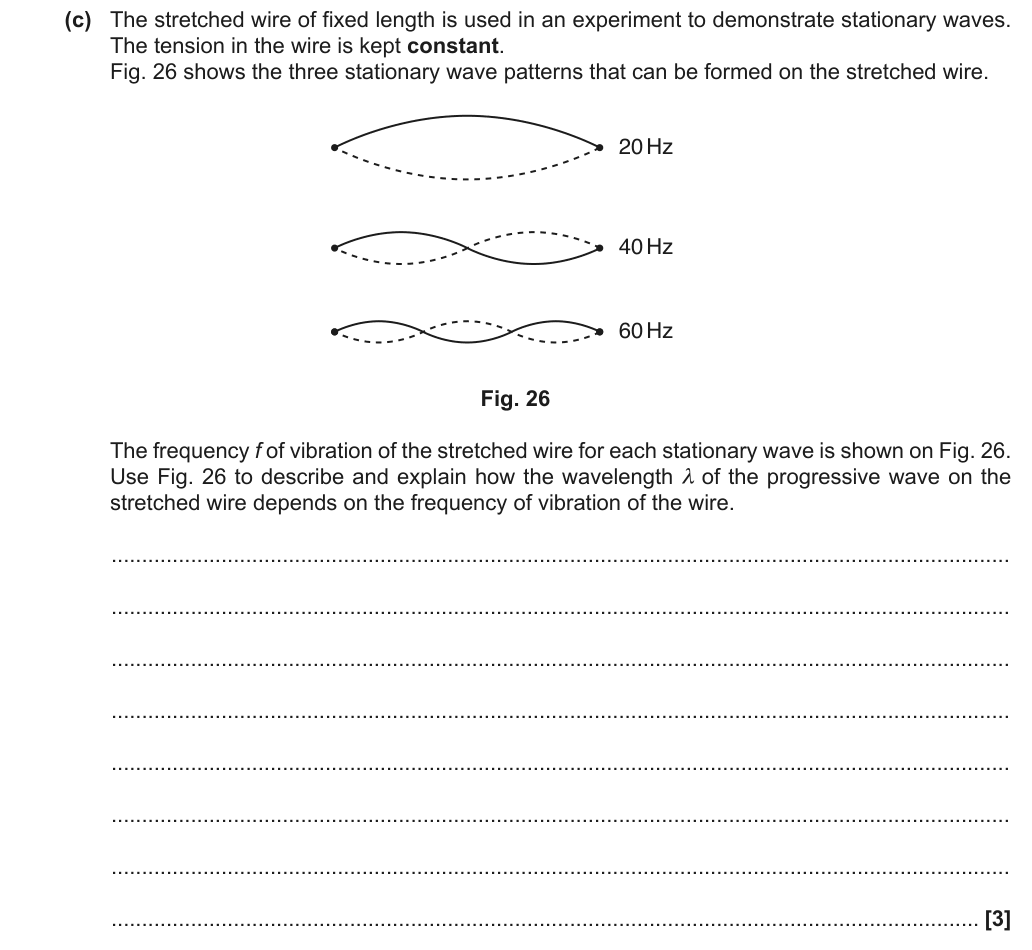
June 2017 · AS Paper 1 · Q26(c)3 marksPractical and data analysis
Earlier part of question 26 that this part uses
Mark scheme
Notes from the mark scheme and report
NOT just λ/2, λ and 3λ/2 written next to the patterns
Skills: M0.3 Use ratios, fractions and percentages
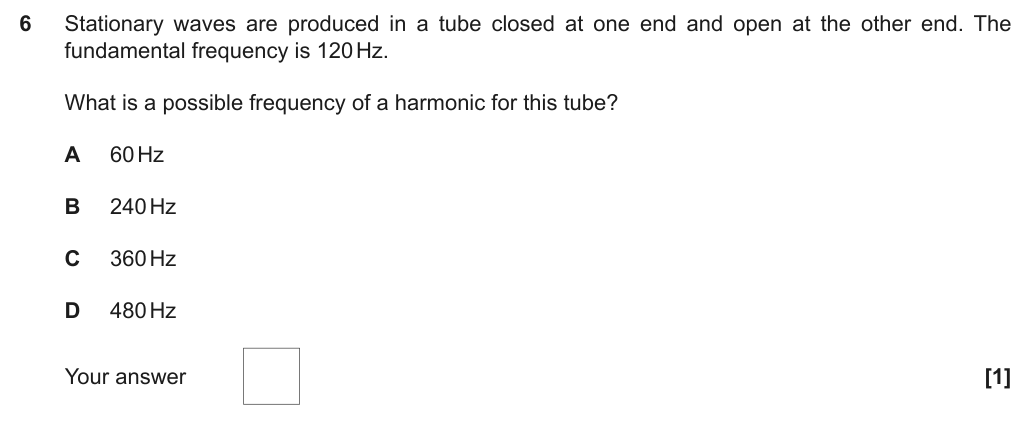
June 2017 · Paper 2 · Q61 markMultiple choice
Answer
C
Mark scheme
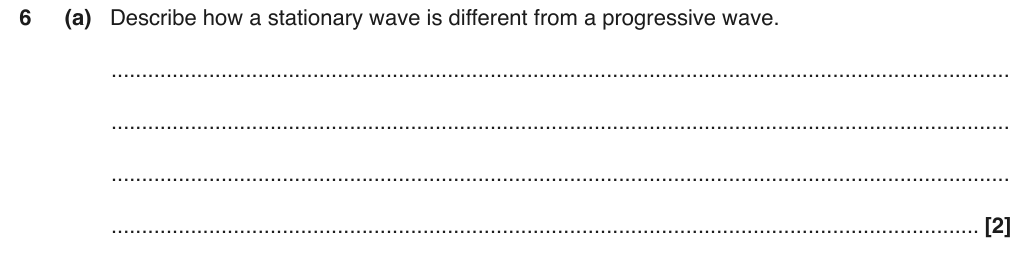
June 2017 · AS Paper 2 · Q6(a)2 marksExplanation
Mark scheme
Notes from the mark scheme and report
a comparison is needed for two marks
nodes and antinodes alone scores one
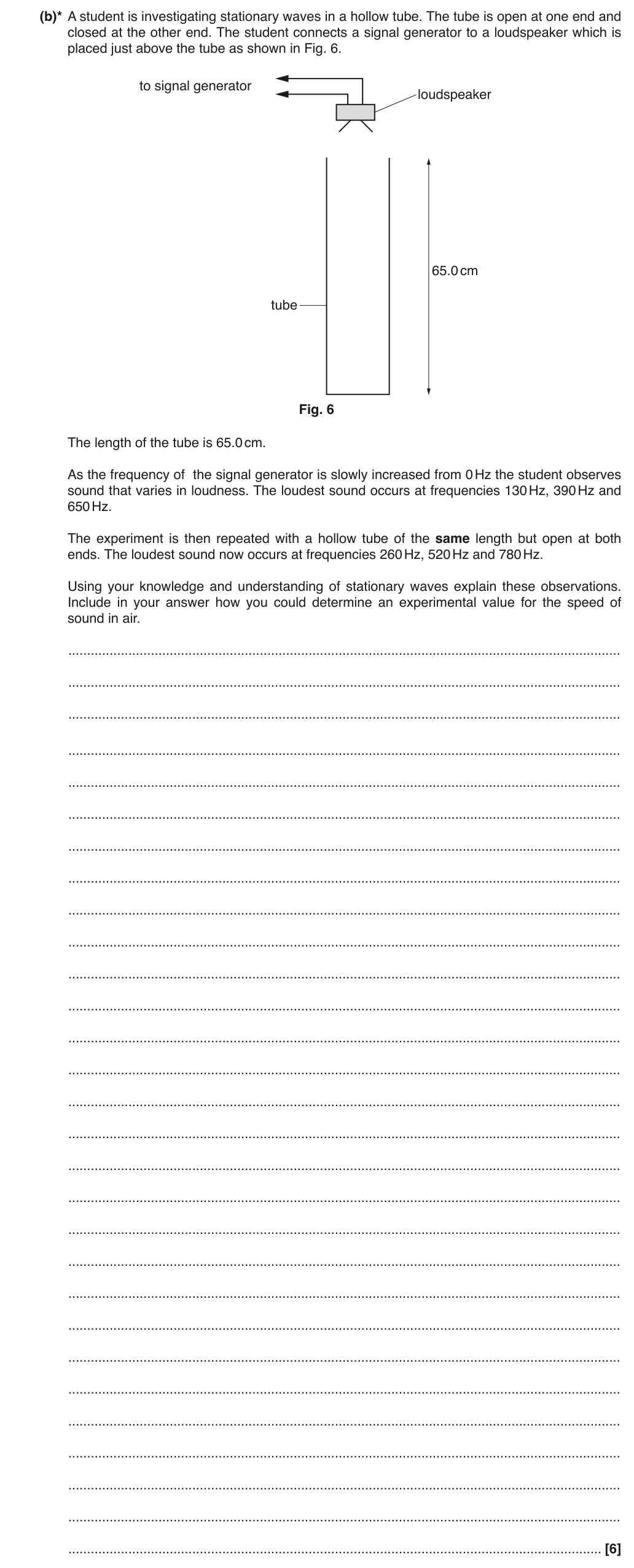
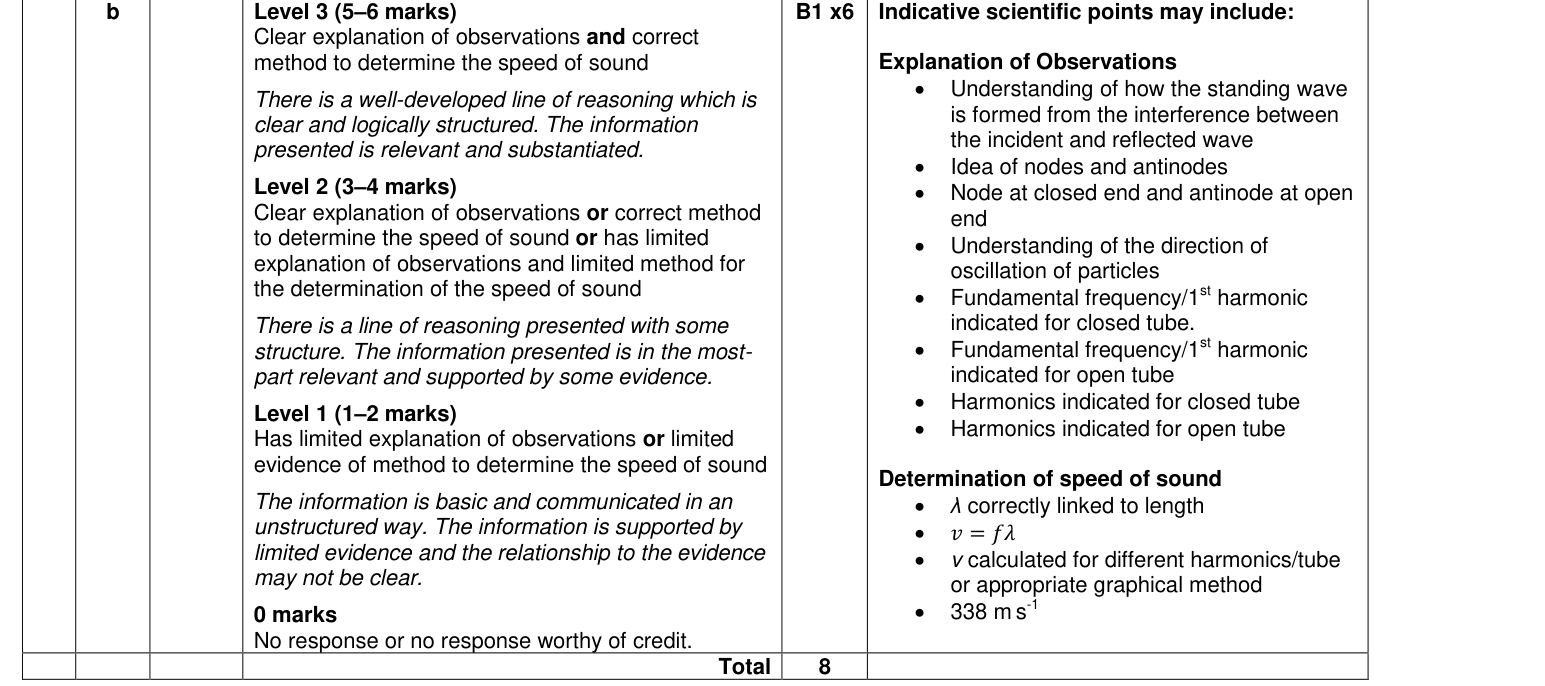
June 2017 · AS Paper 2 · Q6(b)6 marks6-mark extended response
Mark scheme, with the levels and indicative content
Notes from the mark scheme and report
node at closed end, antinode at open end
closed tube odd harmonics only
v = fλ gives 338 m s-1
Skills: M0.3 Use ratios, fractions and percentages; M2.3 Substitute numerical values into algebraic equations using appropriate units for physical quantities; PAG5 Investigating waves
June 2017 · Paper 3 · Q5(b)6 marks6-mark extended response
Earlier part of question 5 that this part uses
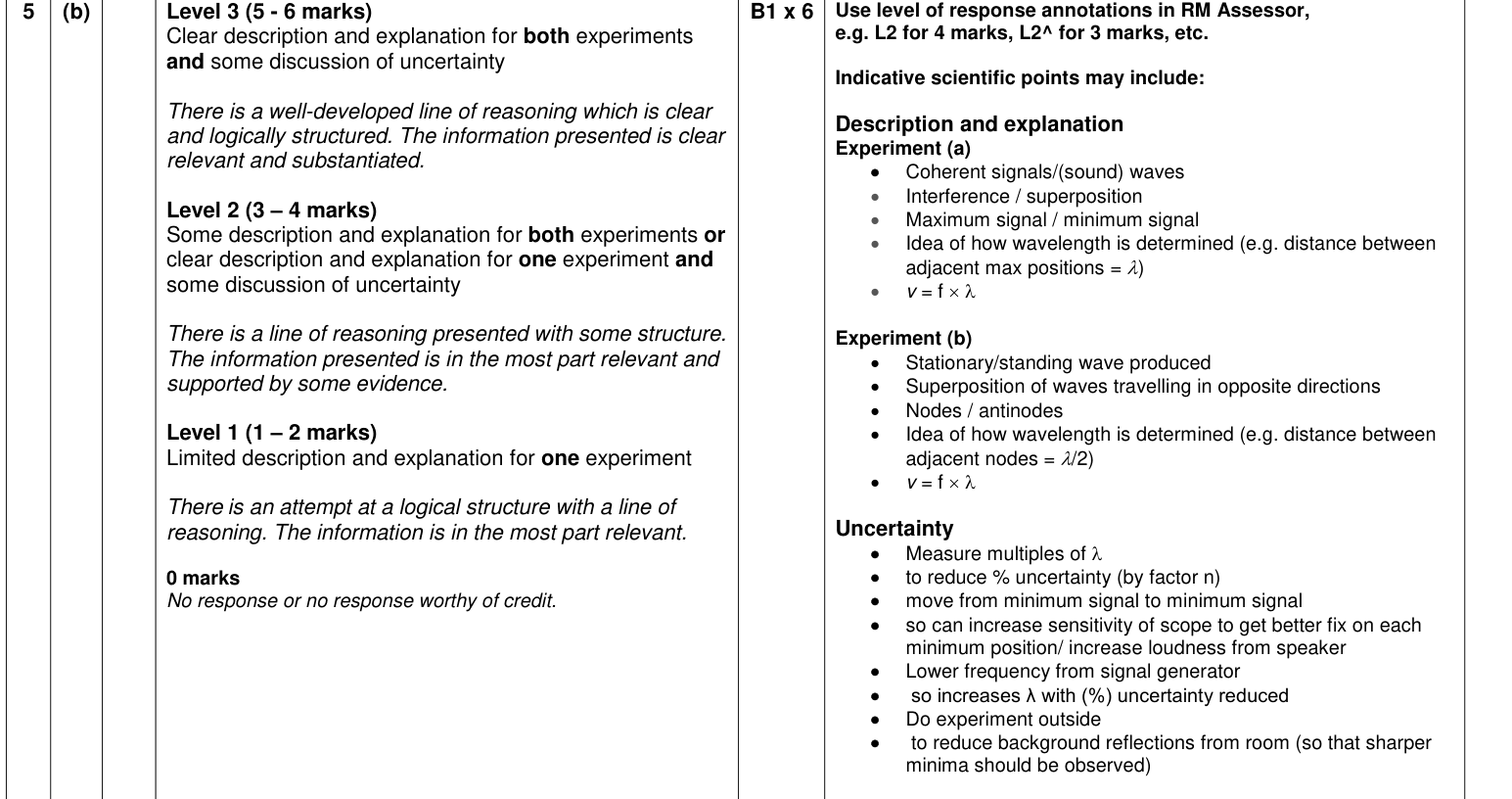
Mark scheme, with the levels and indicative content
Notes from the mark scheme and report
(a) two-source interference: move between adjacent maxima = λ
(b) stationary wave: adjacent nodes = λ/2
measure over several λ to reduce percentage uncertainty
Skills: PAG5 Investigating waves
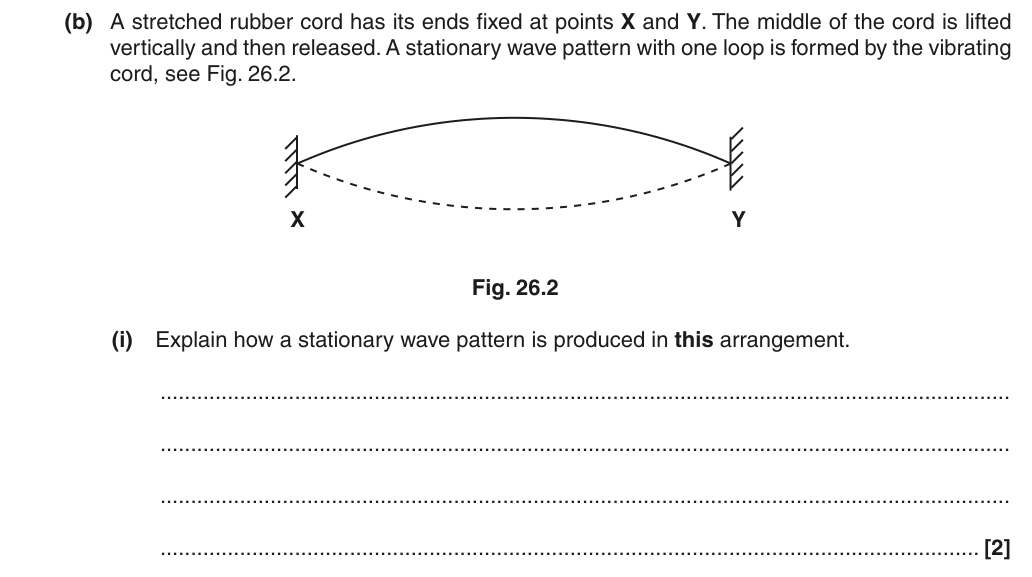
June 2016 · AS Paper 1 · Q26(b)(i)2 marksExplanation
Mark scheme
Notes from the mark scheme and report
Allow 'interference' for 'superposition'
June 2016 · AS Paper 1 · Q26(b)(ii)1 markExplanation
Earlier part of question 26 that this part uses
Mark scheme
Work with an OCR physics tutor
Dropping marks on calculations, practical questions or the six-mark level of response questions? Book a trial session with a specialist OCR physics tutor.