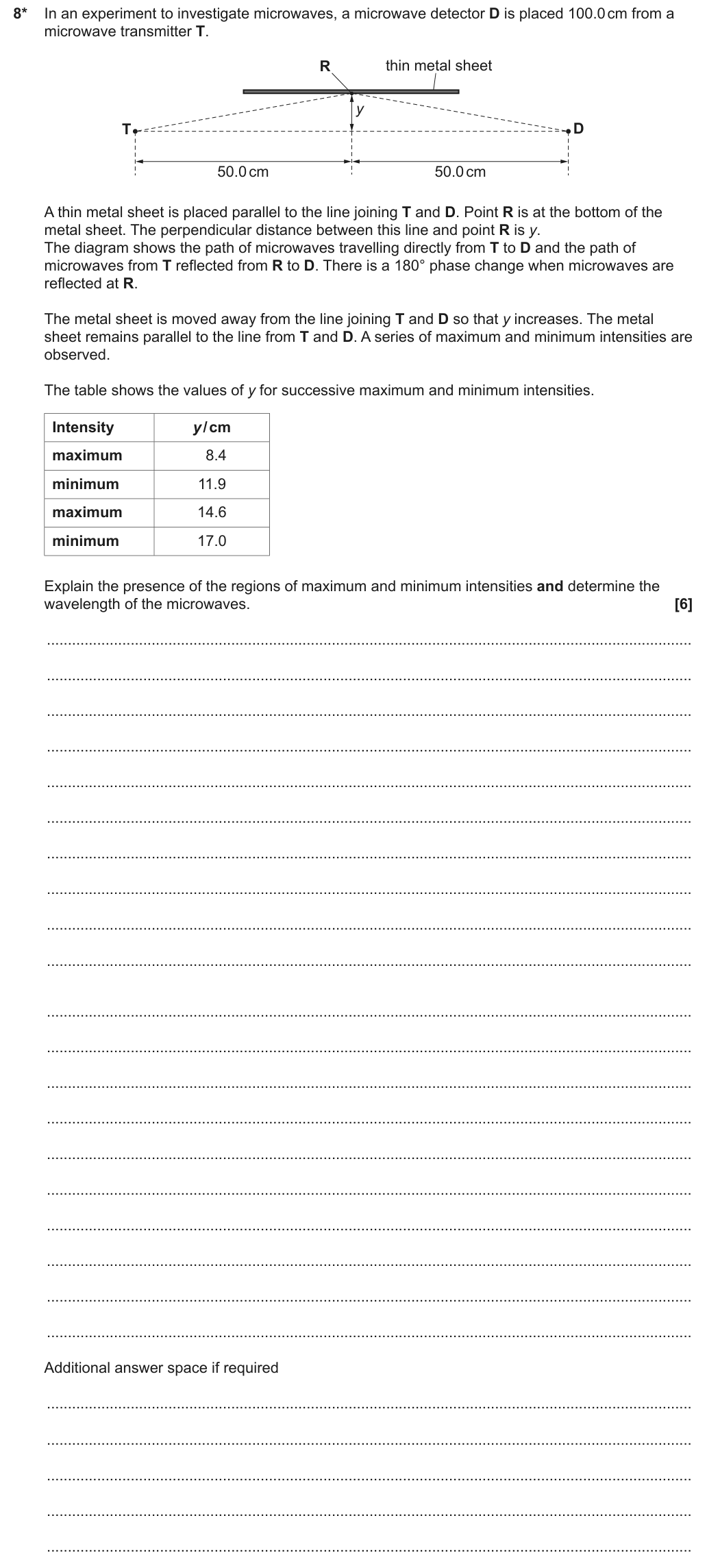
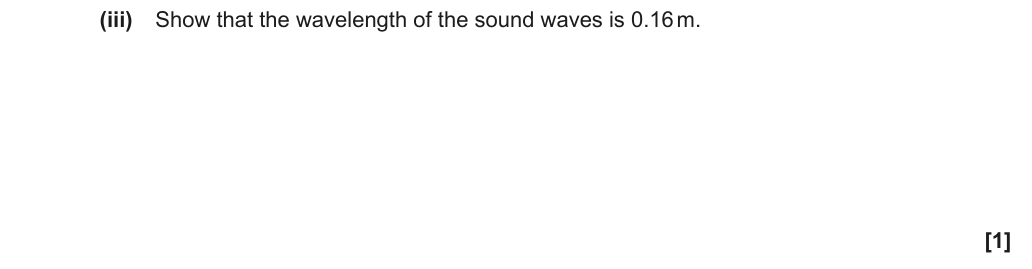
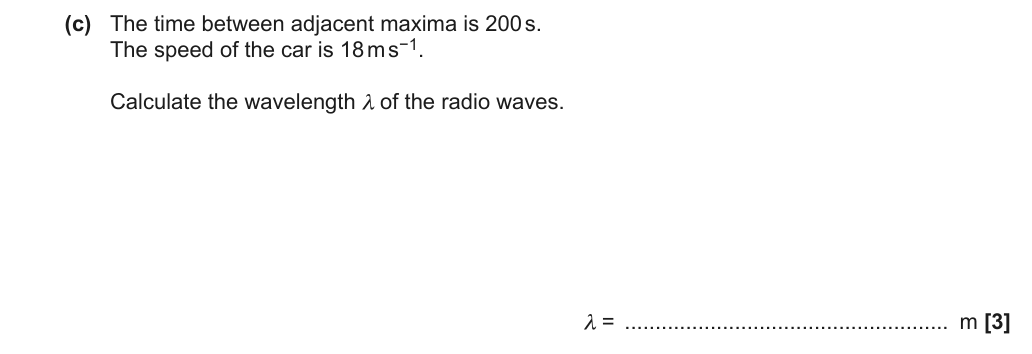
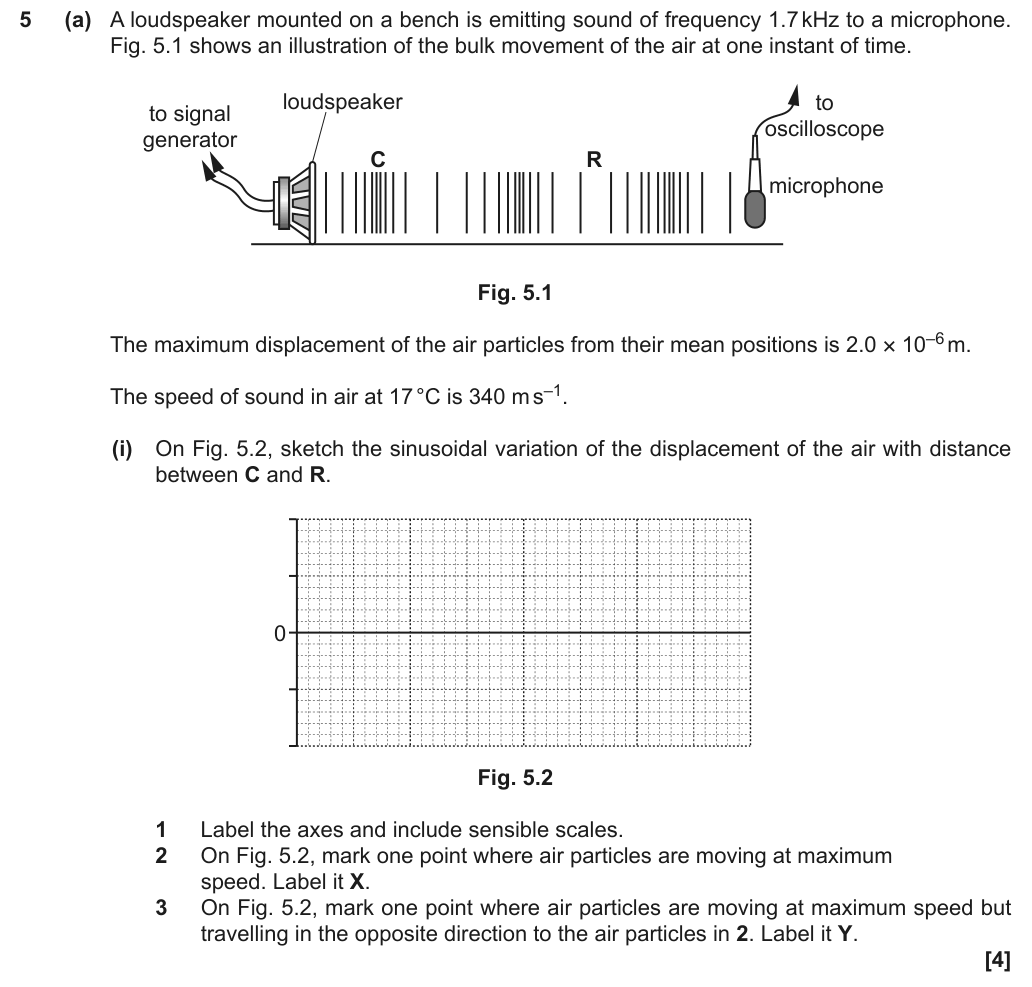
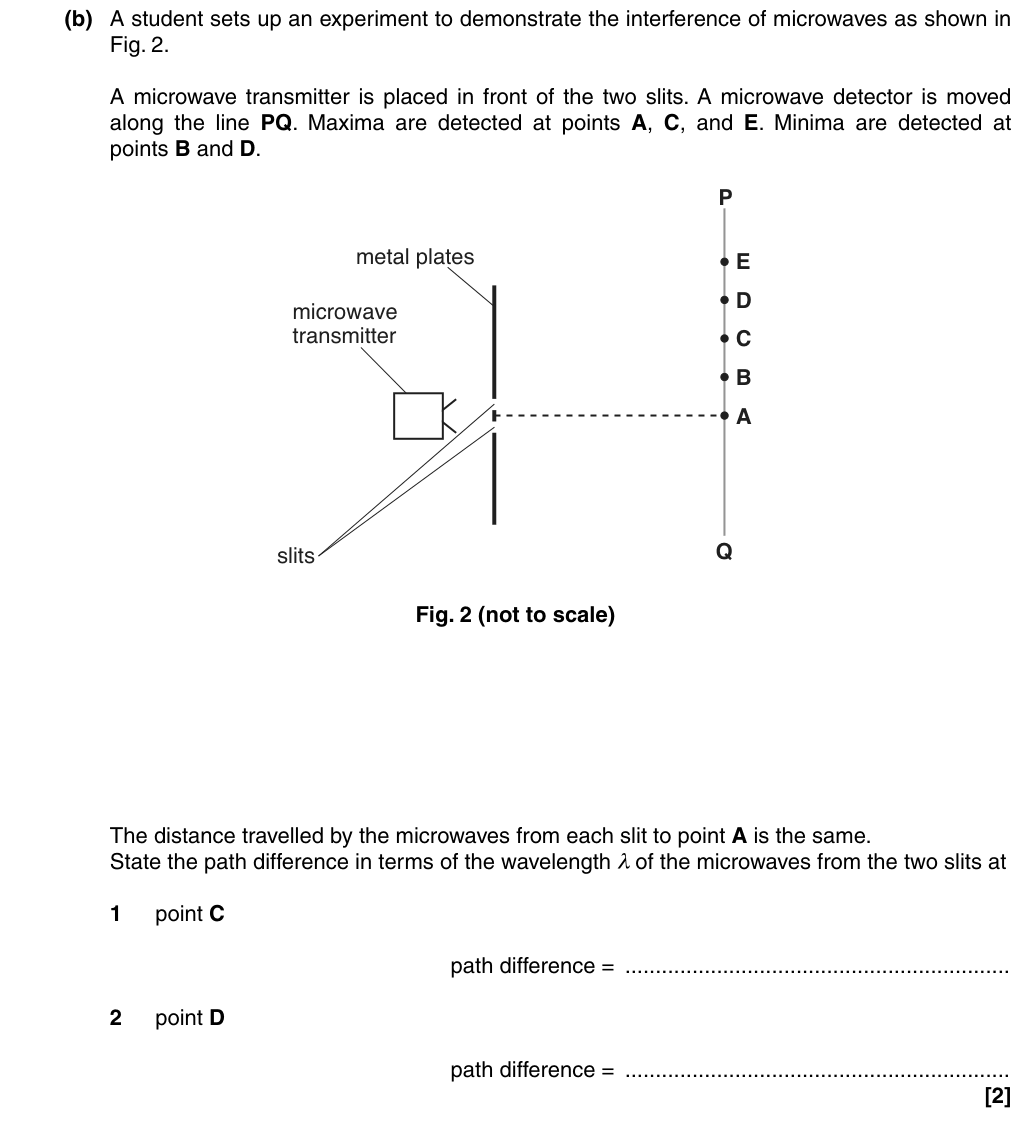
In an experiment to investigate microwaves, a microwave detector D is placed 100.0 cm from a Explain the presence of the regions of maximum and minimum intensities and determine the
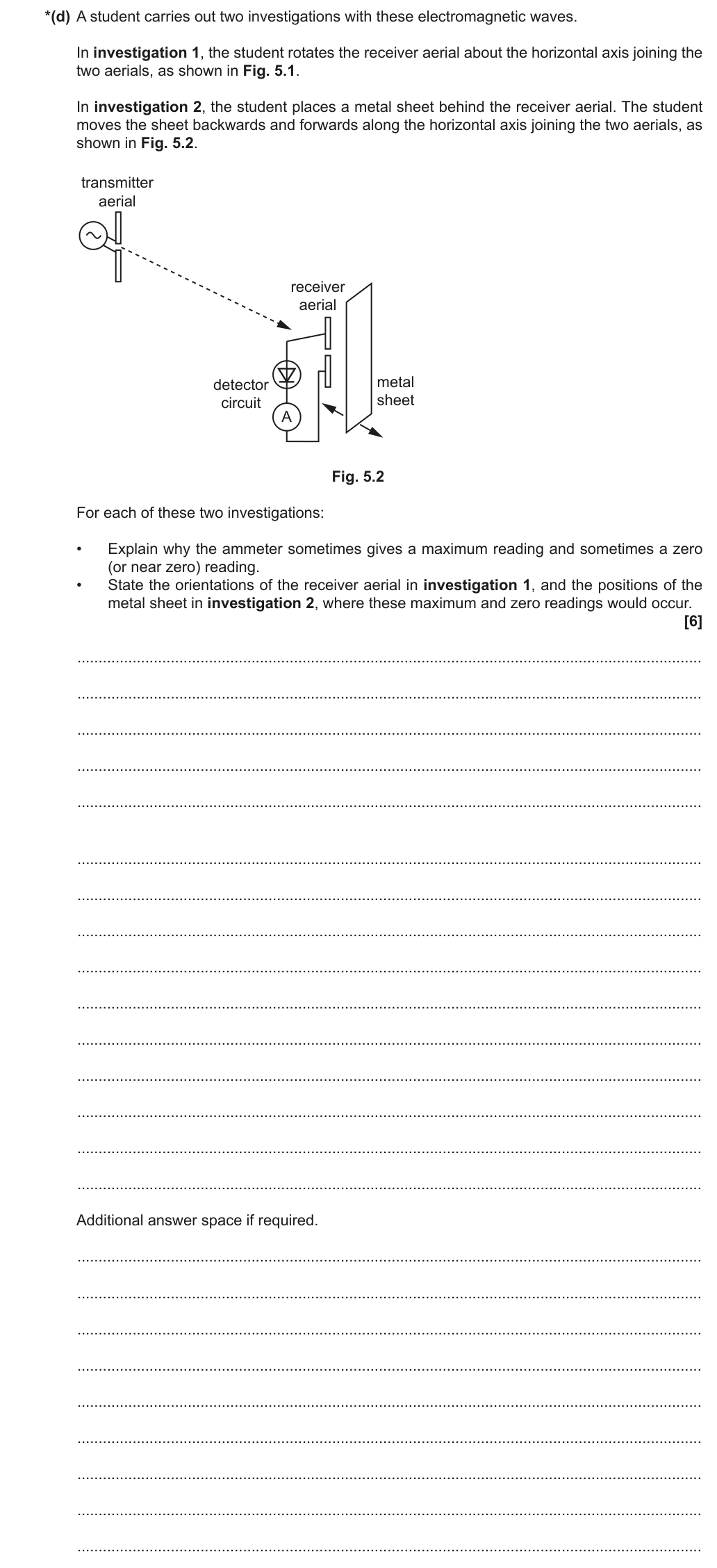
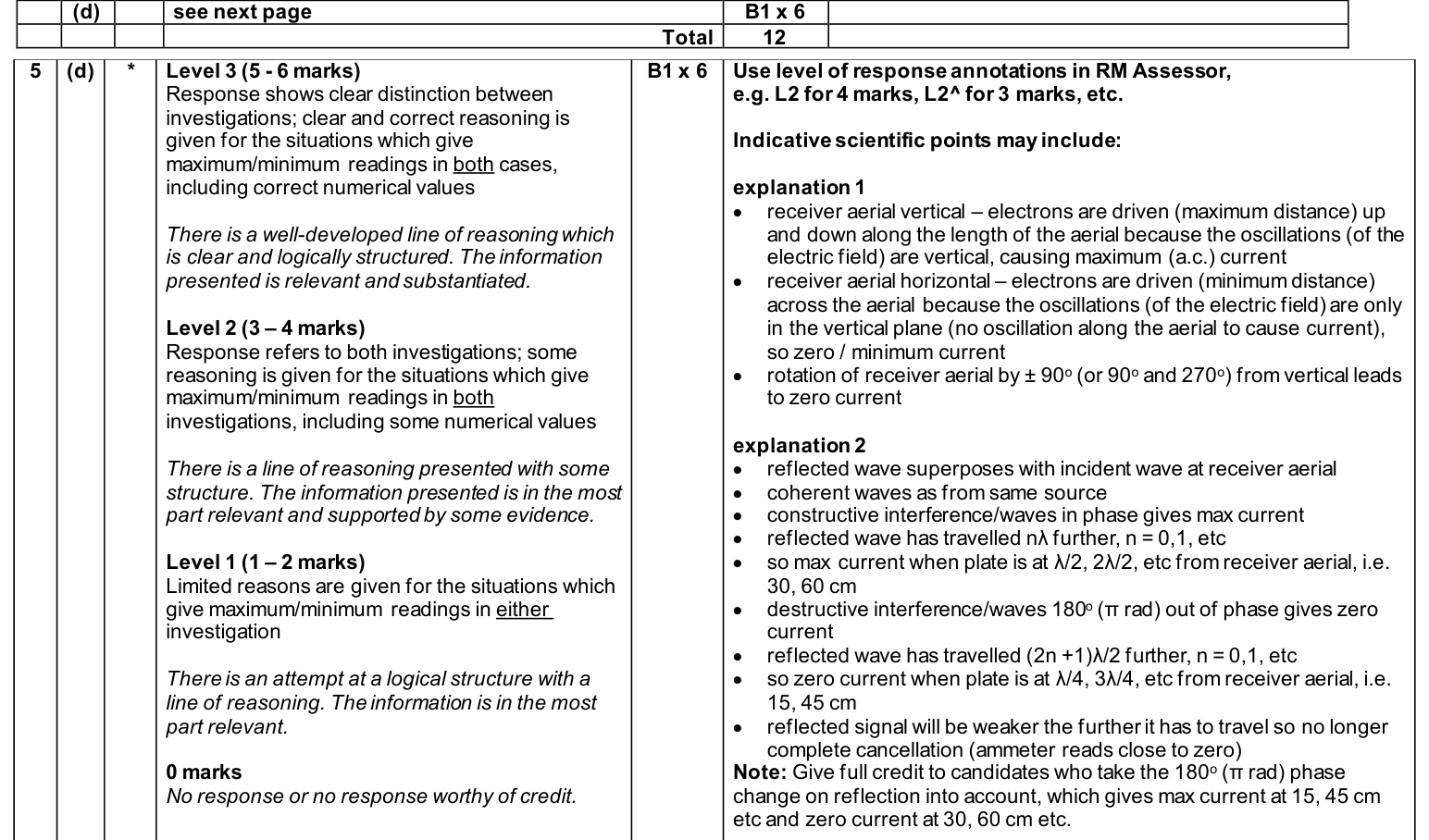
*(d) A student carries out two investigations with these electromagnetic waves. • Explain why the ammeter sometimes gives a maximum reading and sometimes a zero
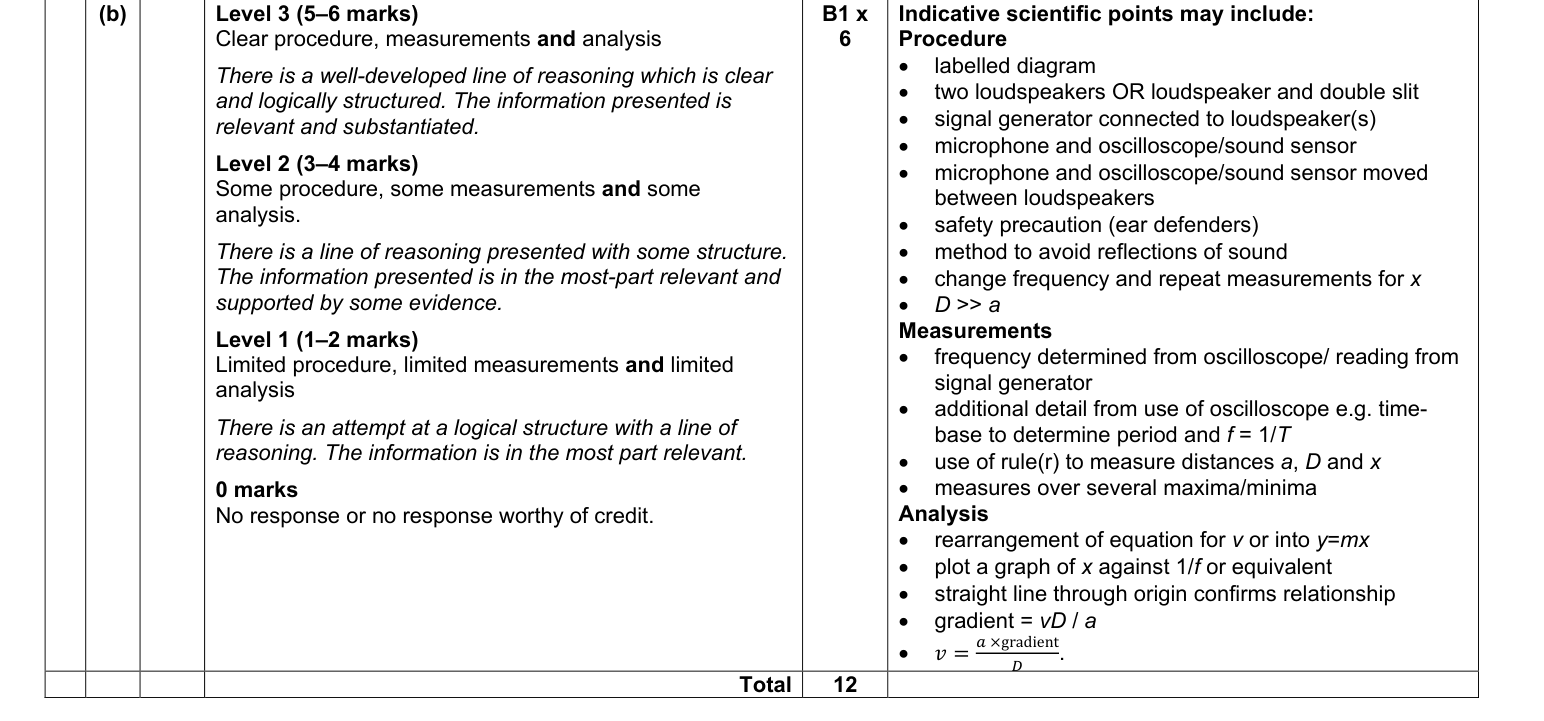
A student wishes to investigate how the fringe spacing x of an interference pattern produced Describe with the aid of a suitable diagram how an experiment can be safely conducted in the
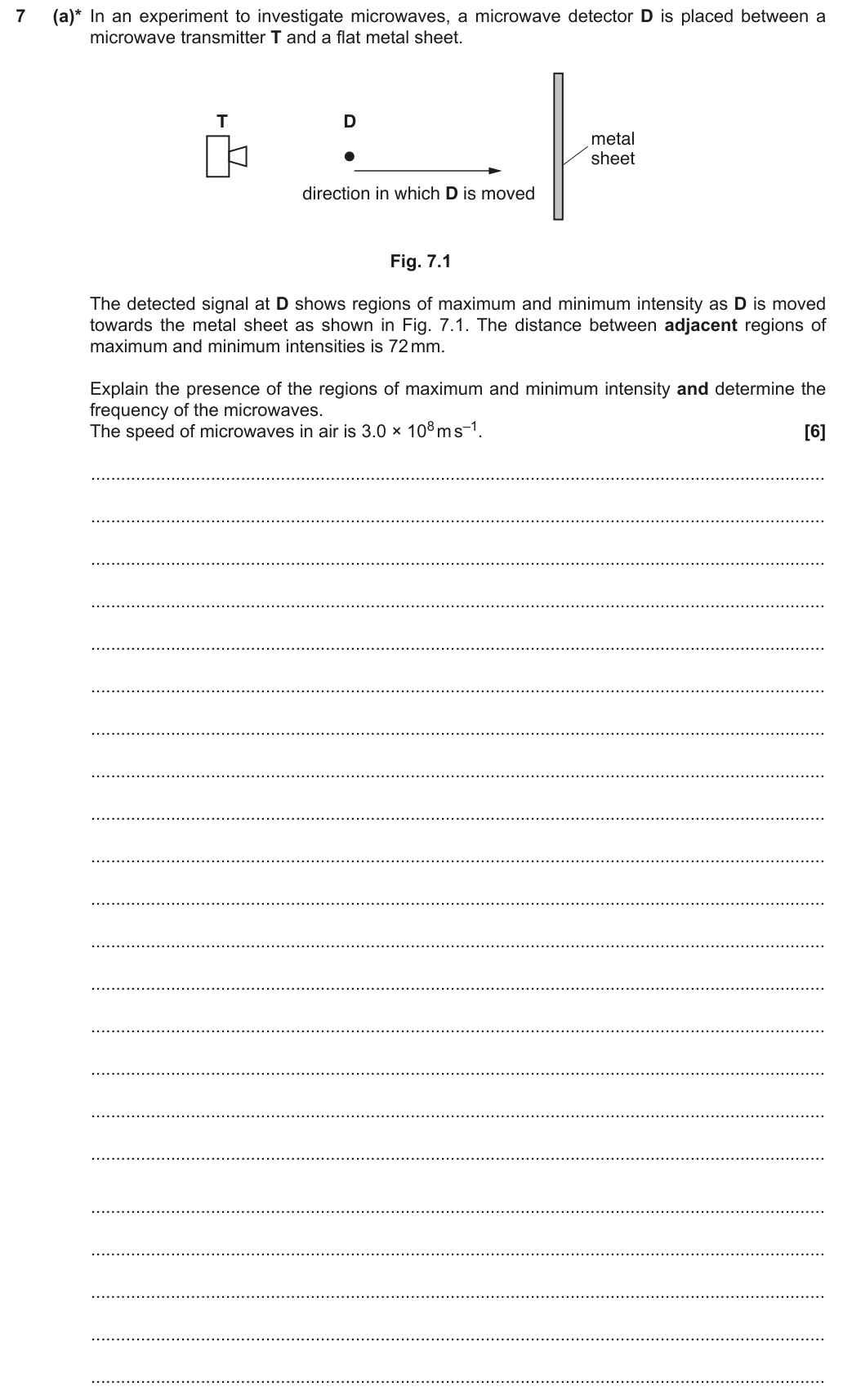
(a)* In an experiment to investigate microwaves, a microwave detector D is placed between a Explain the presence of the regions of maximum and minimum intensity and determine the
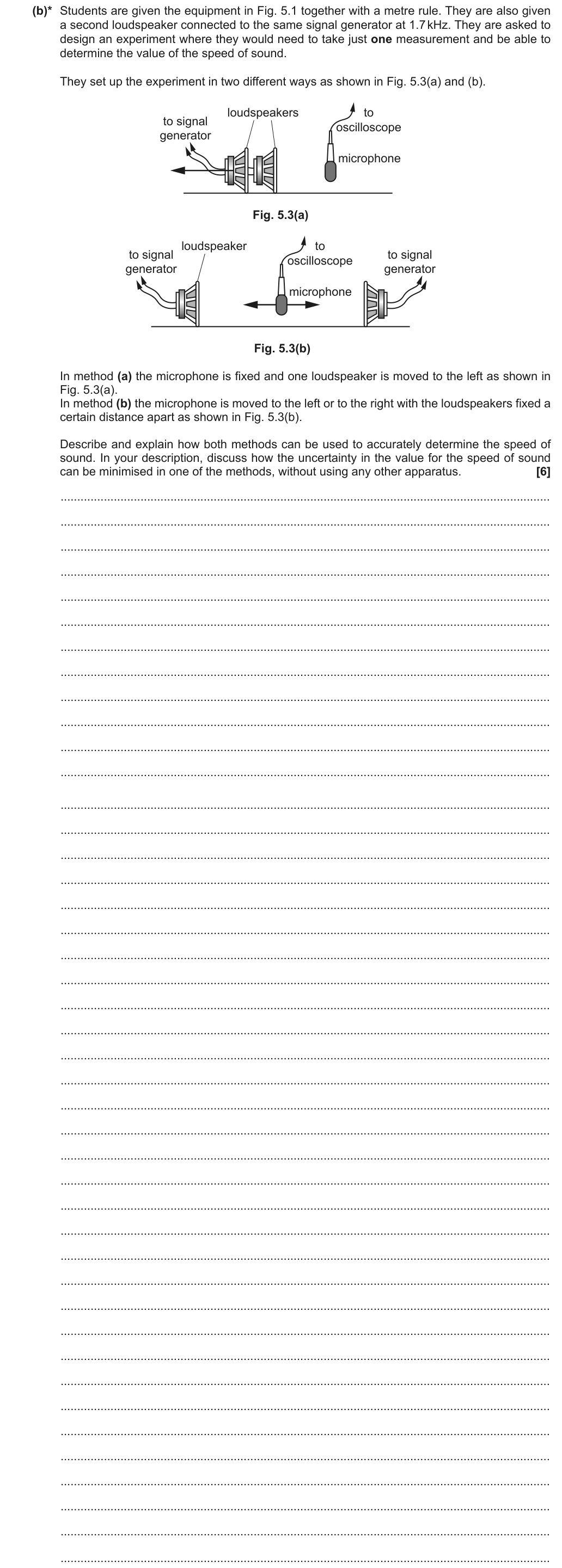
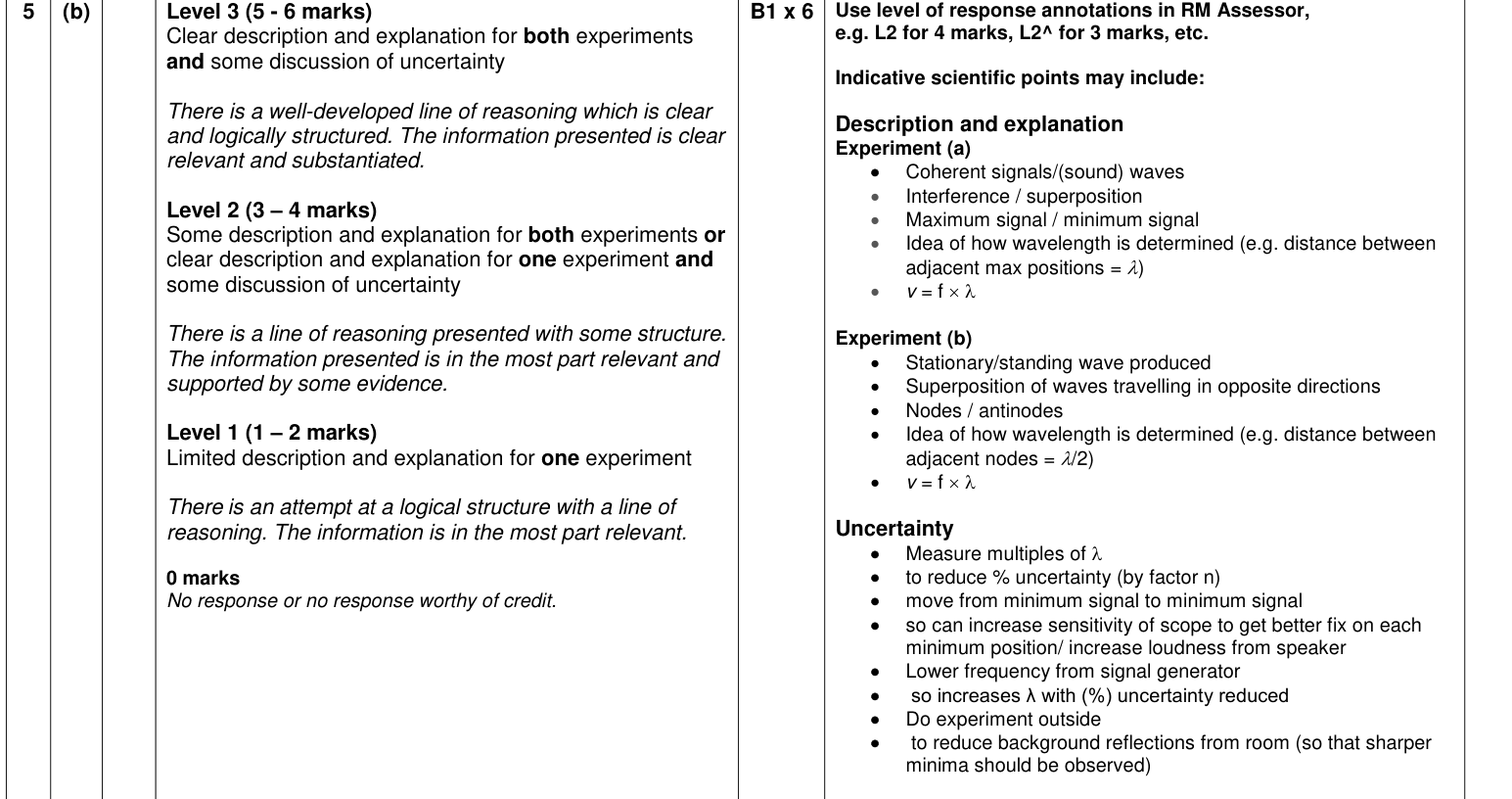
Students are given the equipment in Fig. 5.1 together with a metre rule. They are also given Describe and explain how both methods can be used to accurately determine the speed of
Tap a question to zoom it. Where a part needs a figure, table or graph from earlier in the question, that part folds out above it; the mark scheme and examiner's comment open underneath. Have the OCR Data, Formulae and Relationships Booklet beside you (see the data booklet page).
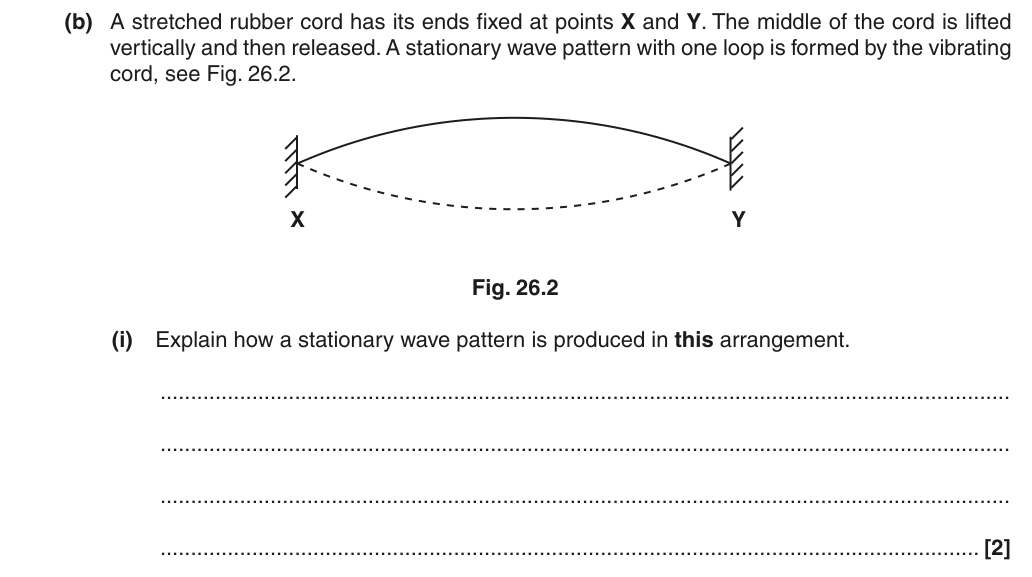
June 2025 · AS Paper 1 · Q23(c)(i)2 marksExplanationMedium
Mark scheme
Examiner's comment
Many candidates discussed the general conditions for stationary waves or described stationary waves. High scoring candidates related their answers to the microwave oven by stating that the emitted microwaves would reflect from the metal walls of the oven and that the emitted and reflected waves would interfere or superpose. Lower scoring candidates did not always use correct terms.
Notes from the mark scheme and report
ignore reference to coherence
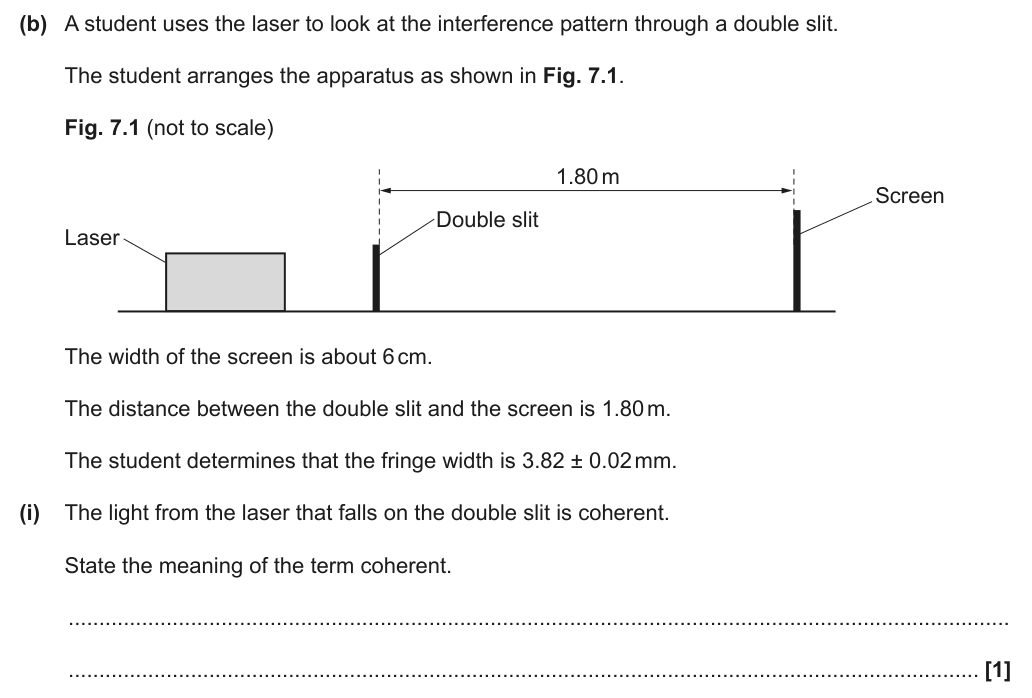
June 2025 · AS Paper 2 · Q7(b)(i)1 markShort answerMedium
Mark scheme
Examiner's comment
The majority of candidates were able to state there was a constant phase difference. Examiners did not accept same for constant.
Notes from the mark scheme and report
constant phase difference
NOT same
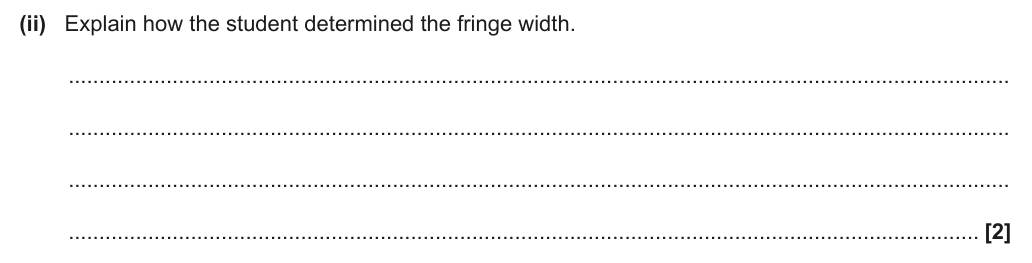
June 2025 · AS Paper 2 · Q7(b)(ii)2 marksExplanationHard
Earlier part of question 7 that this part uses
Mark scheme
Examiner's comment
Candidates found this question challenging. Many candidates answered it in term of rearranging the equation for Young slits equation. Some candidates realised that a good method would be to measure the distance for a number n fringes and divide the distance by n. Very few candidates realised that with the fringe width determined to the nearest 0.01 mm the original distance would need to be measured with a measuring instrument of 0.1 mm resolution, i.e. callipers.
Notes from the mark scheme and report
NOT rule(r) or micrometer
allow travelling microscope
measure across n fringes and divide by n
Candidates should be able to select appropriate measuring instruments. The resolution of the data provided should give an idea as to the resolution of the measuring instrument.
Skills: PAG5 Investigating waves
June 2025 · AS Paper 2 · Q7(b)(iii)2 marksCalculationEasy
Earlier parts of question 7 that this part uses
Mark scheme
Examiner's comment
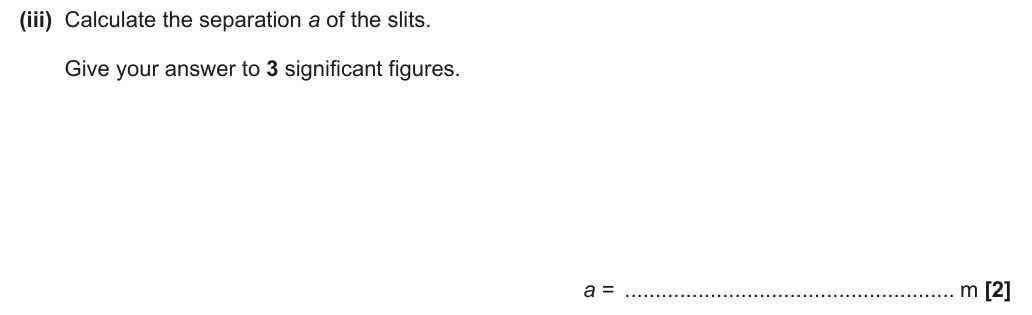
This question was answered well. Some candidates did not give an answer to 3 significant figures.
Notes from the mark scheme and report
2.5 x 10⁻⁴ m scores one mark (3 sf required)
Skills: M0.1 Recognise and make use of appropriate units in calculations; M1.1 Use an appropriate number of significant figures; M2.2 Change the subject of an equation, including non-linear equations
June 2025 · Paper 2 · Q20(a)2 marksDiagram or graphHard
Mark scheme
Examiner's comment
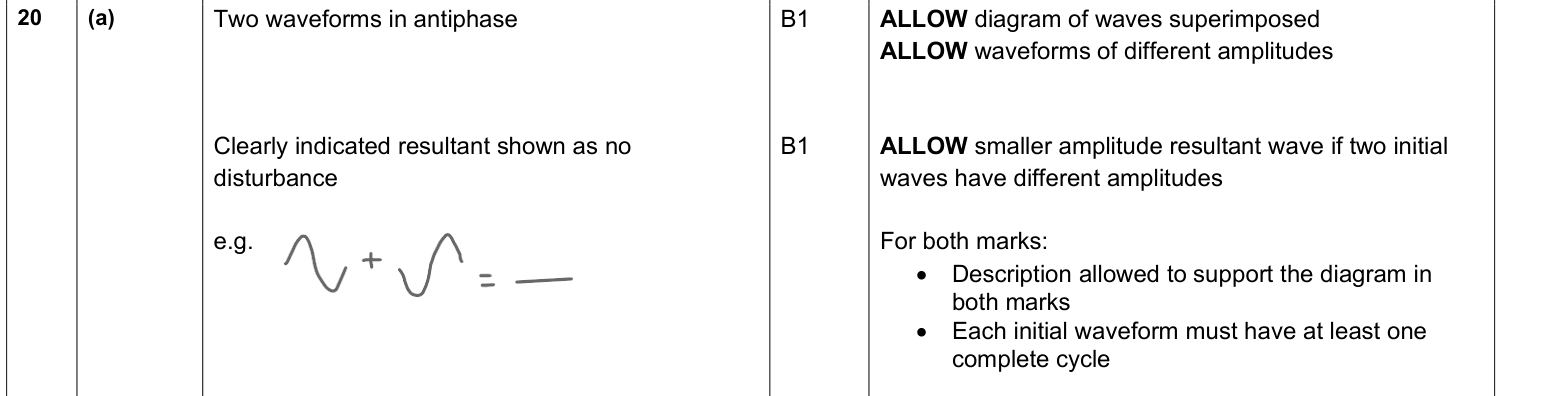
This question required the drawing of two transverse waves in antiphase, and a resultant shown with zero amplitude. Examiners need to use their professional judgement regarding the clarity of the diagrams and so annotations can help. Several candidates stated, but did not draw, the resultant and so could not be awarded the second mark. Some candidates drew the initial waves with different amplitudes and it was acceptable to draw a non-zero resultant, as long as it demonstrated destructive interference. A few candidates drew interference from circular wavefronts, but this was very unlikely to be awarded any marks.
Notes from the mark scheme and report
each waveform needs at least one complete cycle
resultant must be clearly indicated
Skills: M3.12 Sketch relationships which are modelled by y = k/x, y = kx², y = k/x², y = kx, y = sin x, y = cos x, y = e^(±x) and y = sin²x, y = cos²x as applied to physical relationships
June 2025 · Paper 2 · Q20(b)(i)3 marksShow thatHard
Mark scheme
Examiner's comment
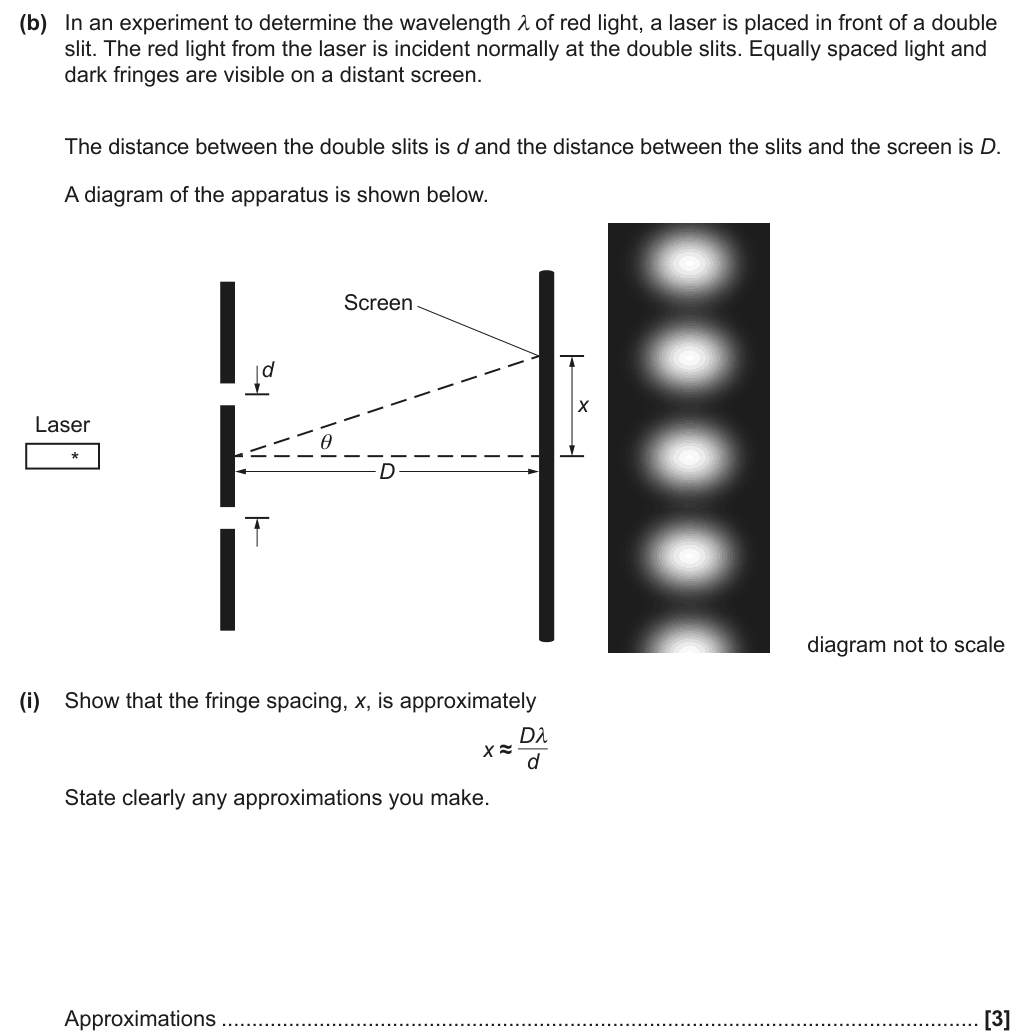
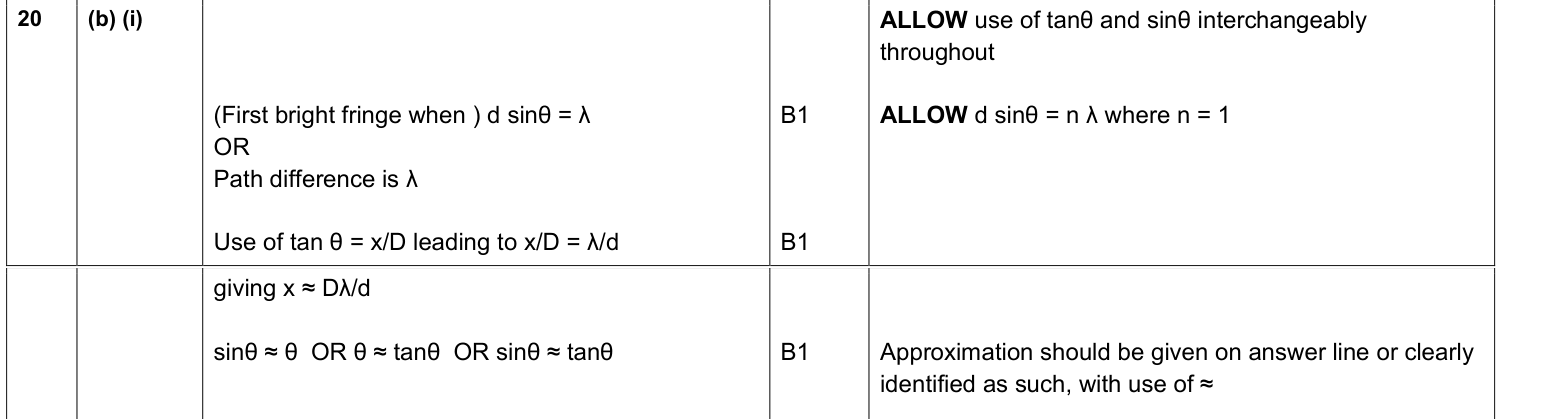
This was a challenging question, using mathematical skills and requiring candidates to apply two equations, one based on path difference and one of geometry and equate them. This is demonstrated in the exemplar that follows. The most common issue was a misapplication of geometry. The small angle approximation needed to be applied and a statement of how this was used was necessary for the approximation mark. Few candidates attempted to use Pythagoras to different degrees of success but often found the approximation difficult to express. This exemplar shows a candidate who has a clear understanding of this question and is able to set out their working clearly. On the left is the diffraction equation, which can be found in the Data, Formulae and Relationships Booklet), with n = 1 clearly identified. In the middle is the geometric expression for tan θ, and the approximation of tan θ is approximately θ This approximation is also shown in the booklet. This is also used for the sin equation, linking the two clearly and then resulting in the required expression. This gets all 3 marks, and it is evident that the candidate appreciates what they are doing at each stage.
Notes from the mark scheme and report
approximation (sin θ ≈ tan θ ≈ θ) must be clearly stated
Skills: M2.2 Change the subject of an equation, including non-linear equations; M4.5 Use sin, cos and tan in physical problems; M4.6 Use of small angle approximations including sin θ ≈ θ, tan θ ≈ θ, cos θ ≈ 1 for small θ where appropriate
June 2025 · Paper 2 · Q20(b)(ii)4 marksExplanationMedium
Earlier part of question 20 that this part uses
Mark scheme
Examiner's comment
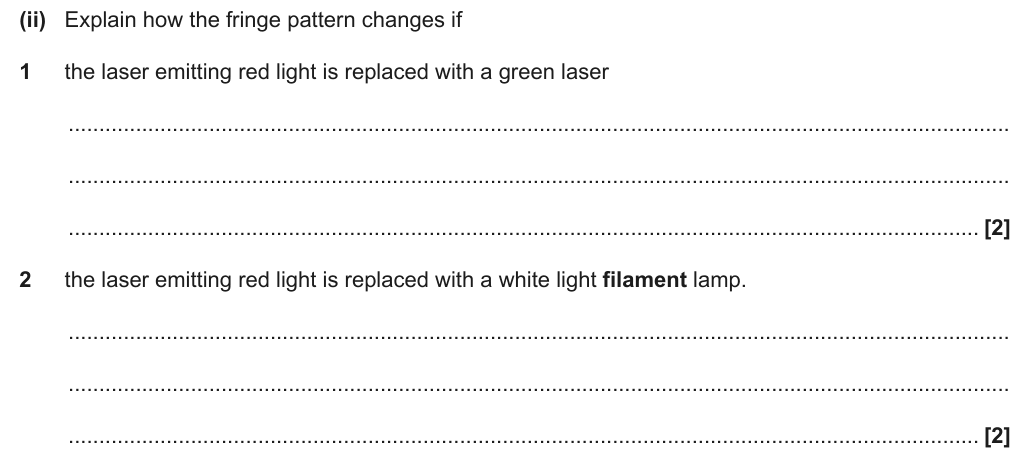
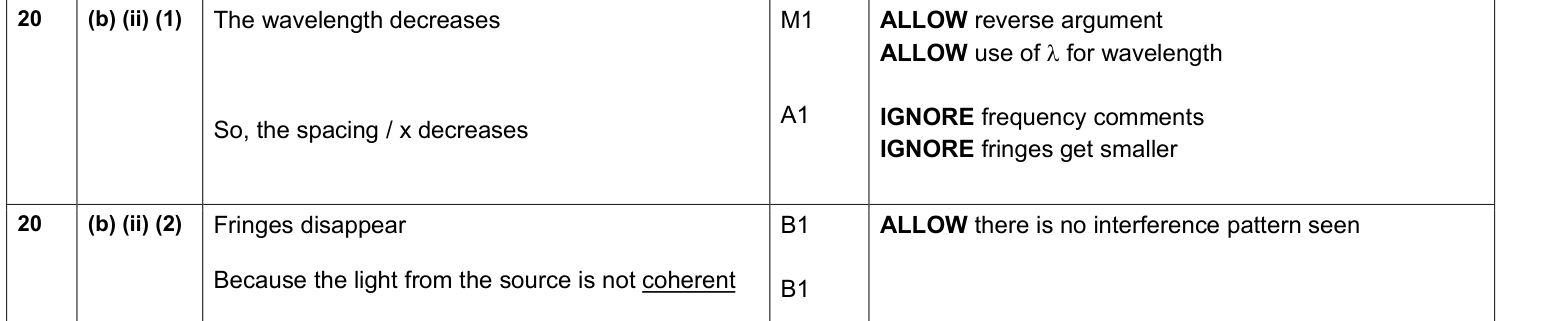
Most candidates were correctly able to give the required response to this question, however some stated that the wavelength of green light was larger than that of red. Symbols were accepted here, but it is always best to write the full words. Notation such as a lambda symbol followed by a downwards arrow is not sufficient to indicate the wavelength decreases. The M (method) mark for the wavelength meant that the candidates needed to make the link between wavelength and fringe separation, as this is the key point of the question. Care should be taken to distinguish between the fringe separation being narrower and the actual fringes being narrower. This question is asking about what happens to the fringes when white light from the filament lamp is used. The word filament is emboldened to emphasise that it is important. In the context of the question, as the light is no longer coherent, the fringes that existed with the red light will cease to be present. A fair fraction of candidates appreciated that this was the required response. Many candidates stated that there would be coloured fringes or ‘a rainbow’.
Notes from the mark scheme and report
part 2: mark scheme wants fringes disappear because the light is not coherent
Ignore 'fringes get smaller' and frequency comments in part 1
June 2025 · Paper 3 · Q2(a)2 marksExplanationMedium
Mark scheme
Examiner's comment
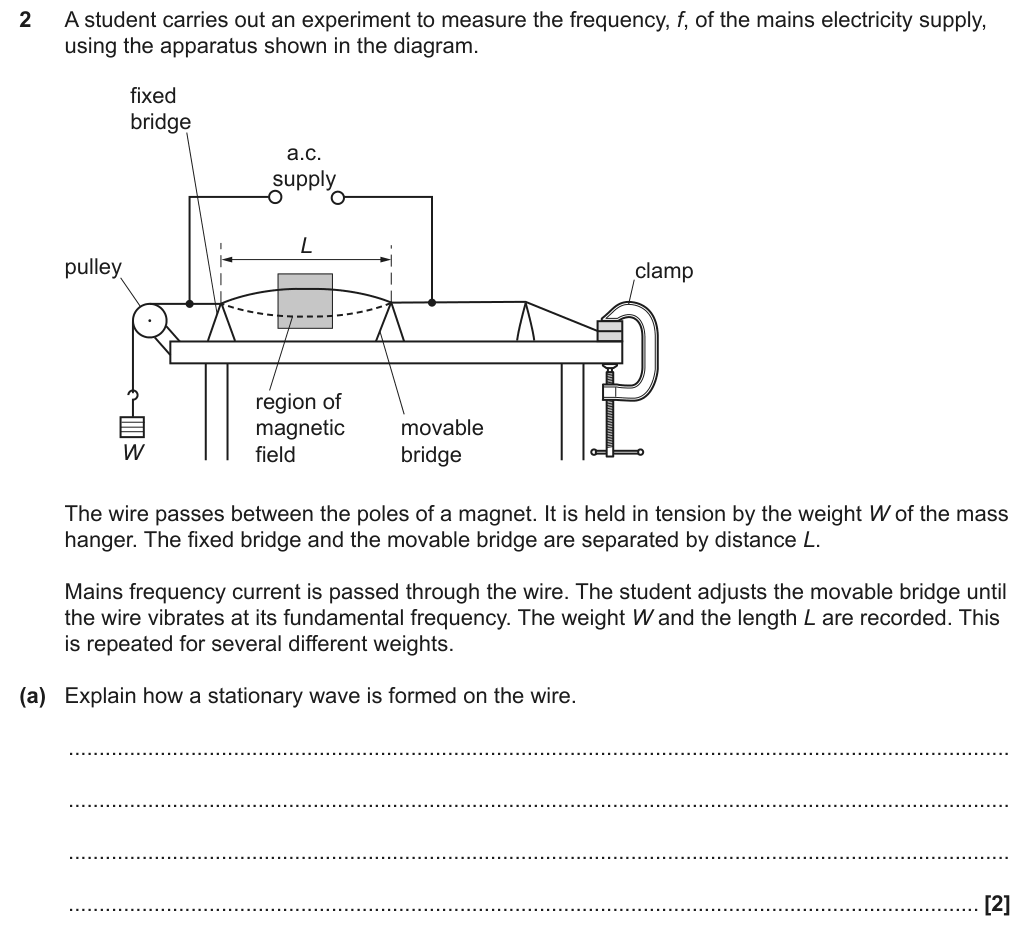
To gain full credit, candidates had to refer to both the force producing the vibration and the principle of superposition of waves. It was common for candidates to address one but not both points in their response. Approximately half of the candidates gained 1 mark, usually for explaining superposition in context. The strongest responses were often the most succinct. These usually described the incident and reflected waves interfering or superposing. Responses that did not gain marks often simply described what the nodes and antinodes seen in the diagram represented or referred to magnets attracting wires.
Notes from the mark scheme and report
ignore F = BIl sin θ unless quantities defined
ignore wire moves / oscillates
waves in opposite directions (reflection at a bridge) superpose
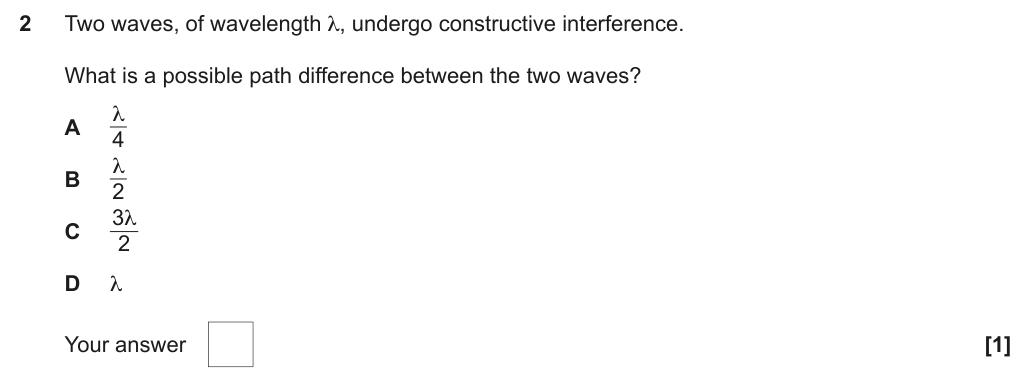
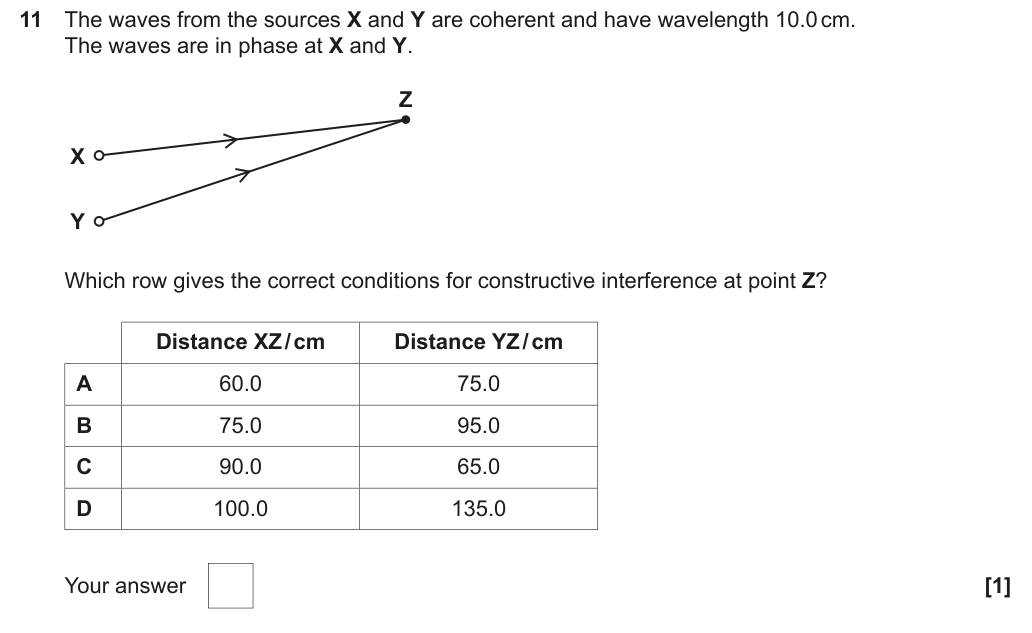
June 2024 · AS Paper 1 · Q21 markMultiple choiceMedium
Answer
D
Mark scheme
Examiner's comment
Overall, candidates performed well on this question as they correctly identified that the path difference for constructive interference is λ to give answer D. The most common distractor was B as some candidates confused the path difference for constructive interference with destructive interference.
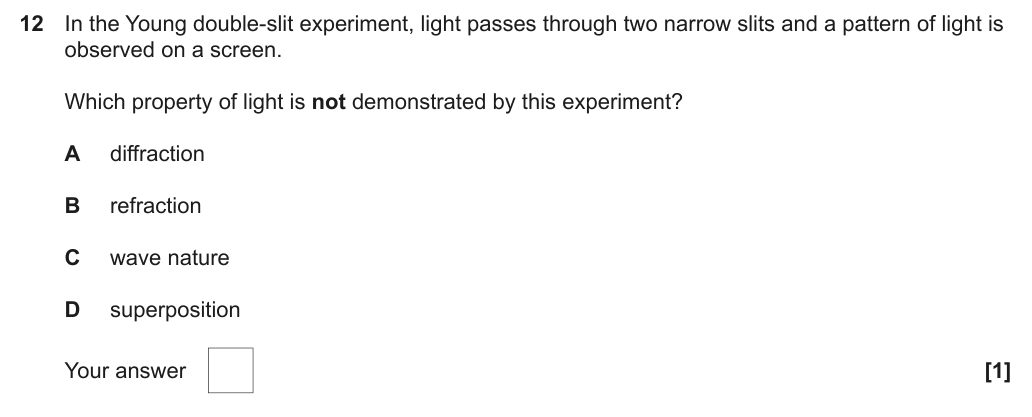
June 2024 · AS Paper 1 · Q121 markMultiple choiceMedium
Answer
B
Mark scheme
Examiner's comment
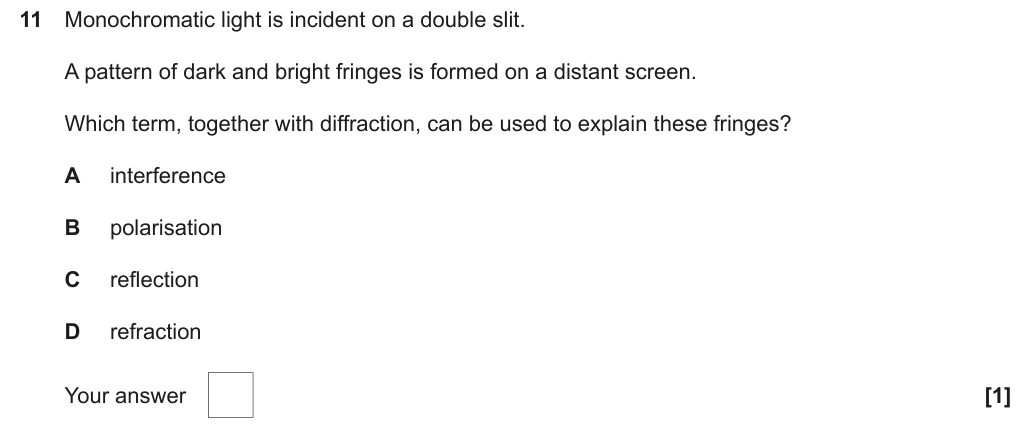
Candidates performed well on this question by correctly identifying that the Young’s double-slit experiment does not demonstrate the property of refraction of light to give the correct answer B.
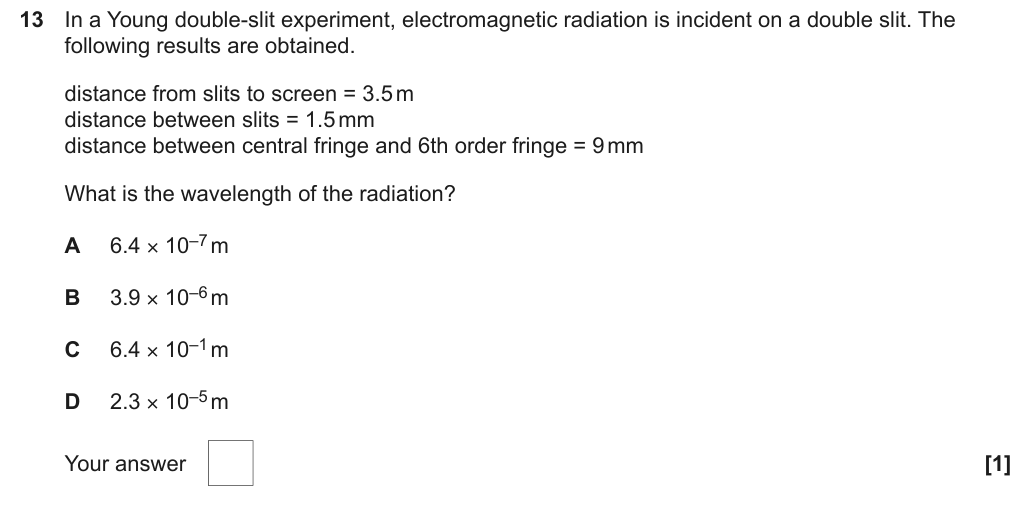
June 2024 · AS Paper 1 · Q131 markMultiple choiceMedium
Answer
A
Mark scheme
Examiner's comment
Some candidates correctly calculated the wavelength of radiation to be 6.4x10 -7m by determining that the fringe width was 9 mm/6 = 1.5 mm. Therefore, the most common distractor was answer B as candidates had used the value of 9 mm as the fringe width and had therefore not understood that the fringe width is the distance between successive bright fringes. Giving the answer B did demonstrate an understanding of consistent units by correctly converting mm to m.
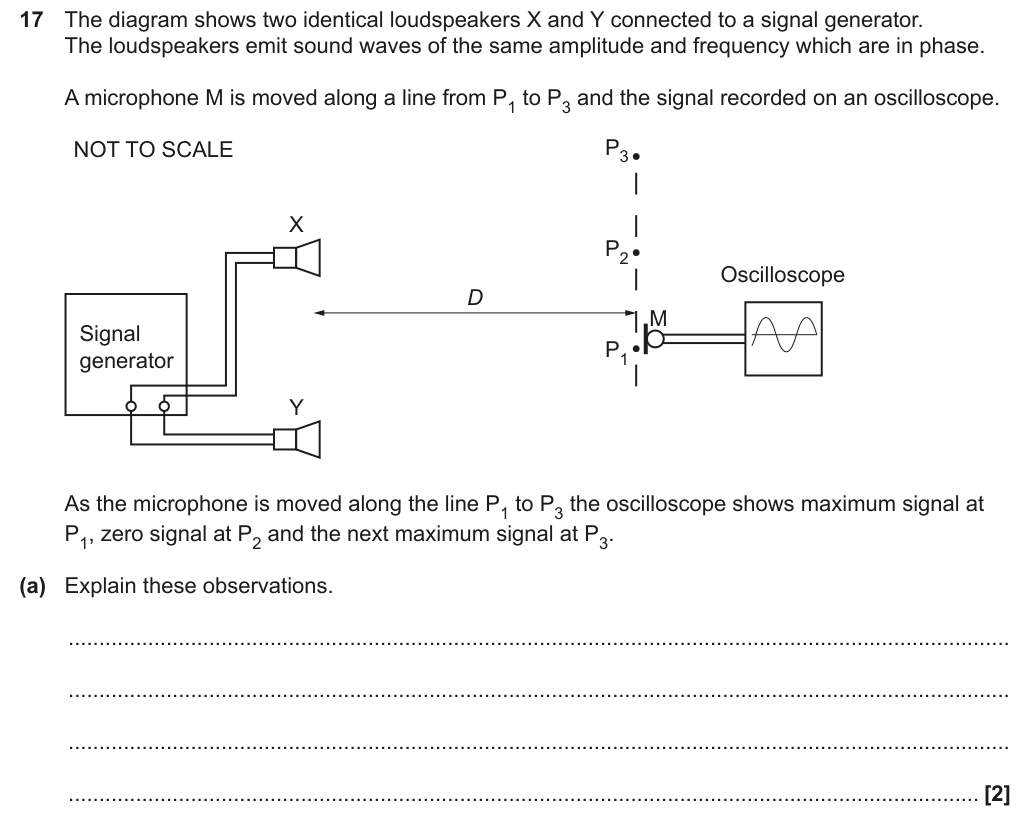
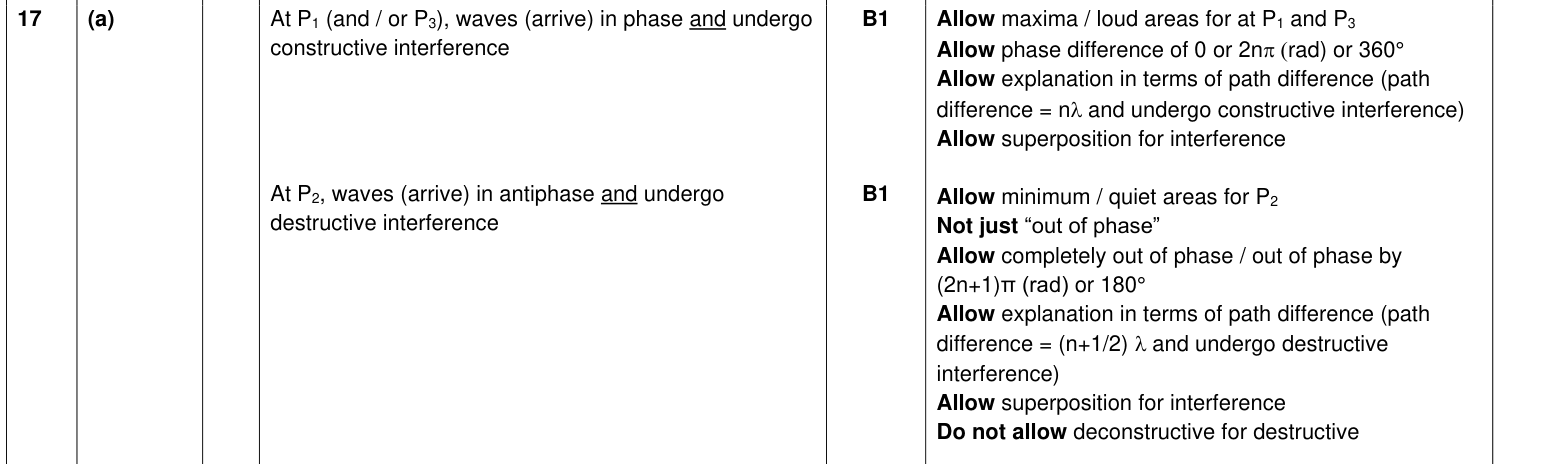
June 2024 · Paper 2 · Q17(a)2 marksExplanationMedium
Mark scheme
Examiner's comment
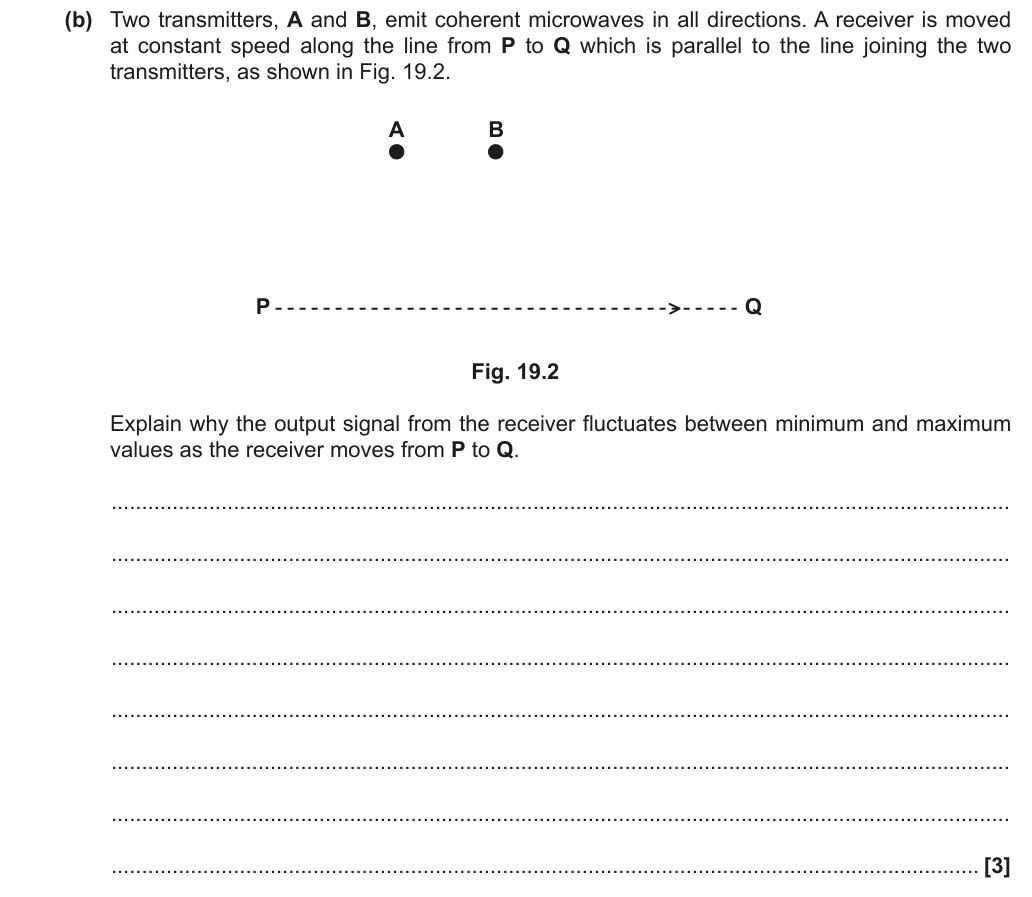
Candidates needed to appreciate that the maximum and minimum were due to interference and then give an explanation of constructive and destructive interference in terms of phase or path differences. It was a common misunderstanding that a stationary wave was formed, and a significant number of candidates described the observations in terms of nodes and antinodes. It was also common to see confusion between path and phase difference, with candidates giving phase differences in terms of wavelengths. In Exemplar 1, the candidate has given an excellent response to the maximum – stating constructive interference and then giving two reasons why this occurs (assuming n is an integer). However, the minima stops and isn’t developed, even though there is still some space, and the additional space at the back can also be used. It is likely that the candidate knew the reason for the destructive interference, and this demonstrates how important it is to complete descriptions and explanations.
Notes from the mark scheme and report
NOT just out of phase (antiphase / 180° needed)
do not allow deconstructive
path difference explanation allowed
Skills: PAG5 Investigating waves
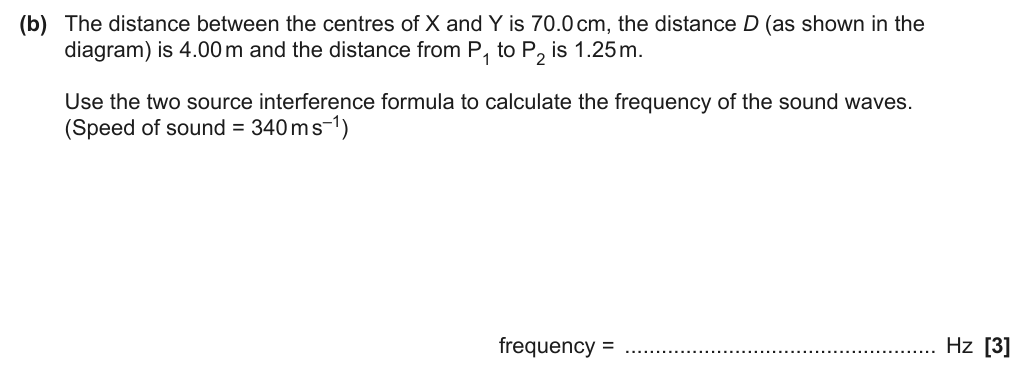
June 2024 · Paper 2 · Q17(b)3 marksCalculationMedium
Earlier part of question 17 that this part uses
Mark scheme
Examiner's comment
The majority of candidates were able to use the two source formula, however used 1.25m for their value of x, rather than double this. A small number of candidates attempted a geometrical solution, attempting to calculate angles, but this was unlikely on its own to score any marks.
Notes from the mark scheme and report
x is P1 to P3 = 2.5 m (maximum to maximum)
using x = 1.25 gives 1554 Hz for 1 mark
Skills: M0.1 Recognise and make use of appropriate units in calculations; M2.2 Change the subject of an equation, including non-linear equations; M2.3 Substitute numerical values into algebraic equations using appropriate units for physical quantities; PAG5 Investigating waves
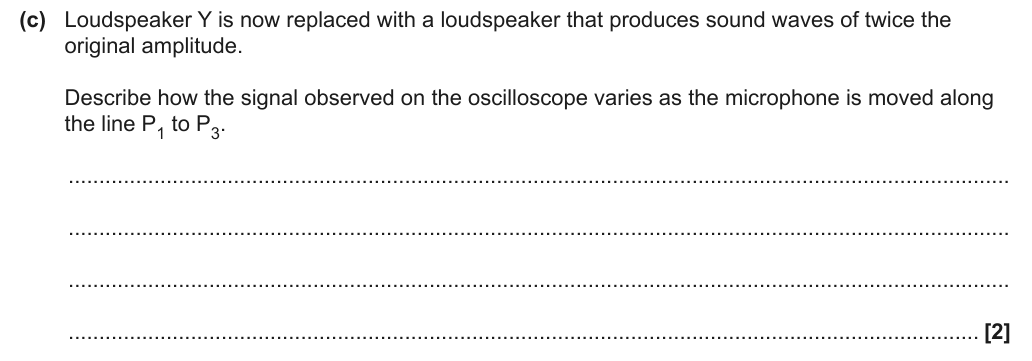
June 2024 · Paper 2 · Q17(c)2 marksExplanationMedium
Earlier part of question 17 that this part uses
Mark scheme
Examiner's comment
This question specifically asked about the observed signal and so responses based on loudness or sound volume are not appropriate. Candidates needed to be very clear that they were describing particular positions and how the signal varied from the previous situation. There was no penalty for an incorrect value of the increase in signal, although many candidates were able to state this correctly.
Notes from the mark scheme and report
larger maximum at P1 / P3 and non-zero signal at P2
ignore louder
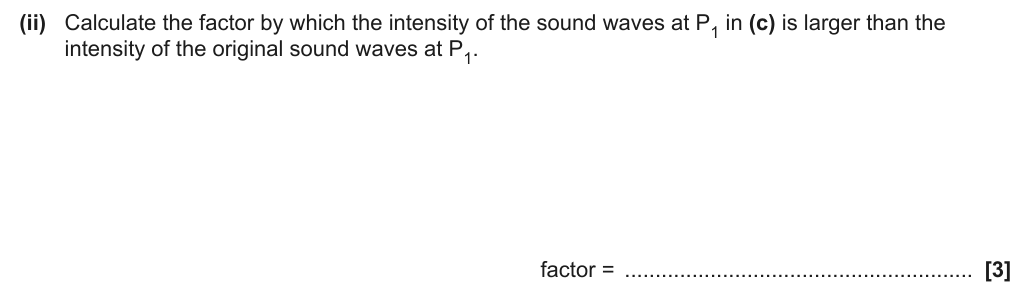
June 2024 · Paper 2 · Q17(d)(ii)3 marksCalculationMedium
Earlier parts of question 17 that this part uses
Mark scheme
Examiner's comment
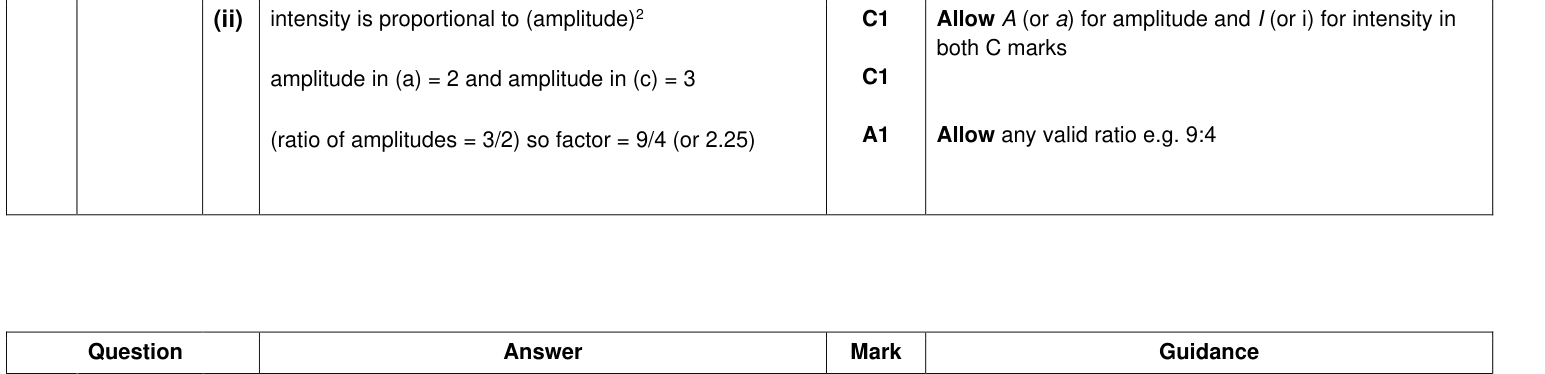
Some candidates were able to correctly calculate the factor, which could be expressed in a number of ways. Many candidates were able to correctly state the relationship between intensity and amplitude but not able to identify how the amplitudes were different and so could not carry on with the calculation, so only scoring a single mark.
Notes from the mark scheme and report
amplitudes add: 2A originally, 3A in (c)
intensity proportional to amplitude squared so 9/4
Skills: M0.3 Use ratios, fractions and percentages
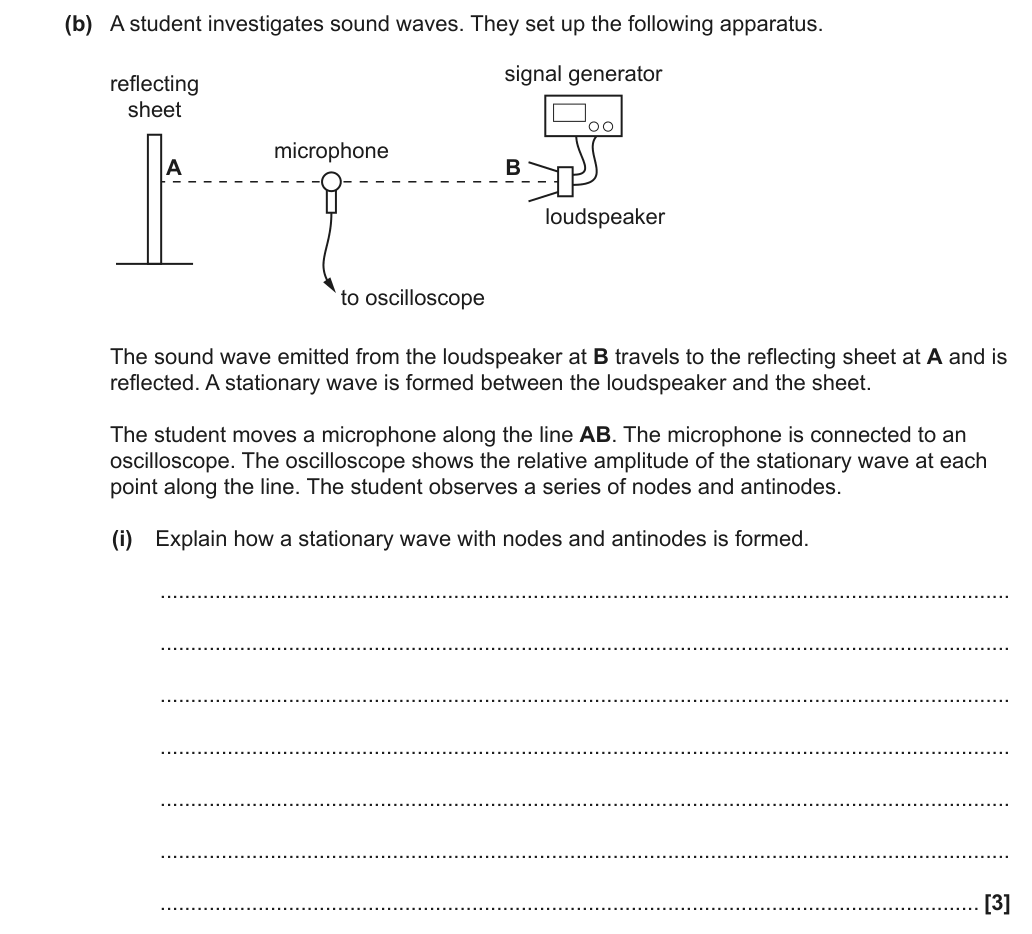
June 2023 · AS Paper 1 · Q22(b)(i)3 marksExplanationEasy
Mark scheme
Examiner's comment
About a third of candidates achieved no marks on this question but most candidates were able to correctly explain that a stationary wave is formed from the superposition of the incident and reflected wave. Often descriptions of nodes and antinodes was confused and lacked effective and correct use of scientific language by referring to constructive and destructive interference and explaining how these formed antinodes and nodes respectively.
Notes from the mark scheme and report
ignore 'superimpose'
Skills: PAG5 Investigating waves
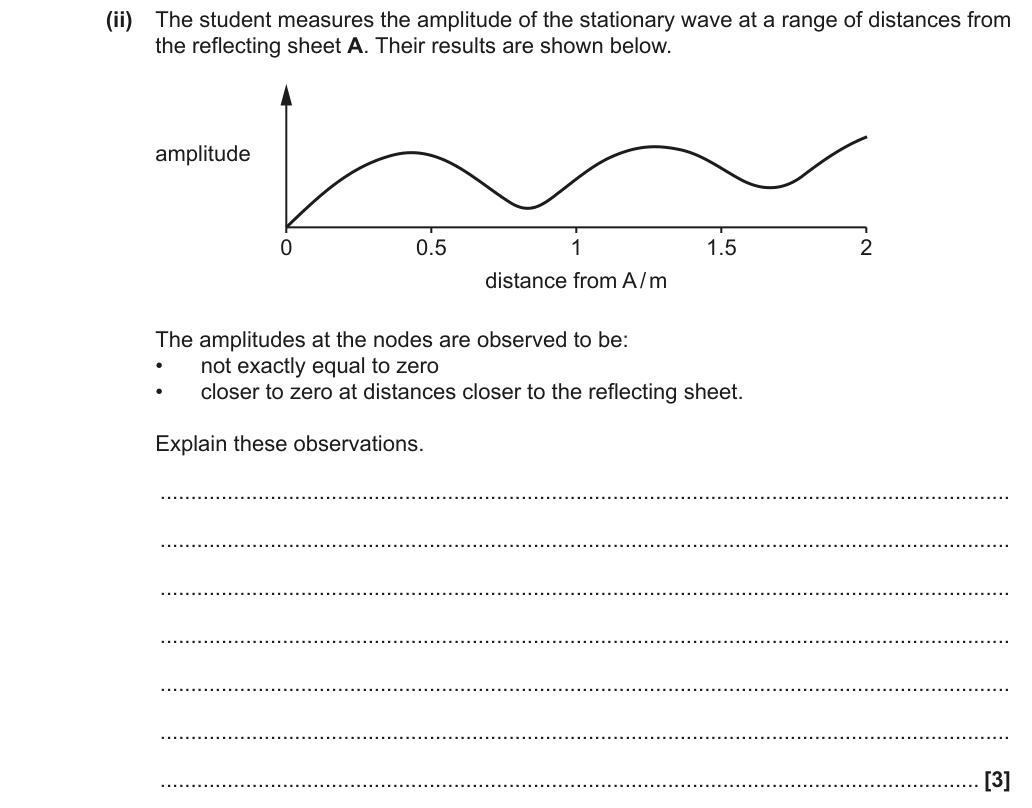
June 2023 · AS Paper 1 · Q22(b)(ii)3 marksExplanationMedium
Earlier part of question 22 that this part uses
Mark scheme
Examiner's comment
Candidates performed less well on this question with only about a third of candidates achieving 1 or more marks. Candidates had to explain both observations regarding the amplitudes of the nodes to fully access the question by interpreting that the change in amplitude was related to the decrease in intensity/amplitude of the reflected wave as it travelled a greater distance from the reflecting sheet A. This response is an example of a typical response where candidates have confused the change in amplitude of the nodes to either a change in frequency or phase difference due to the reflected wave being ‘out of phase’ with the incident wave. There was also a common misconception that the reflected wave from the reflecting sheet A had experienced interference from either background noise or from further reflections of the wave in the room. The candidates had assumed that the two waves were no longer coherent, and this resulted in a difference in the amplitude of the nodes further from the reflecting sheet A.
Notes from the mark scheme and report
allow energy absorbed when the wave is incident on the plate
Skills: M3.1 Translate information between graphical, numerical and algebraic forms; PAG5 Investigating waves
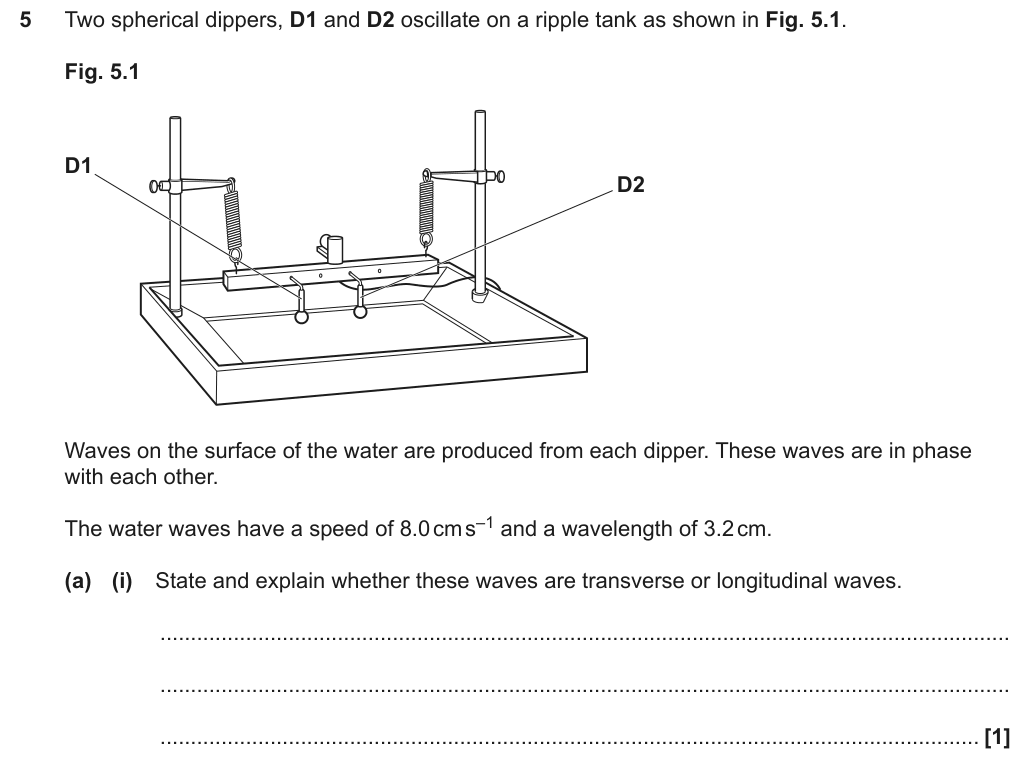
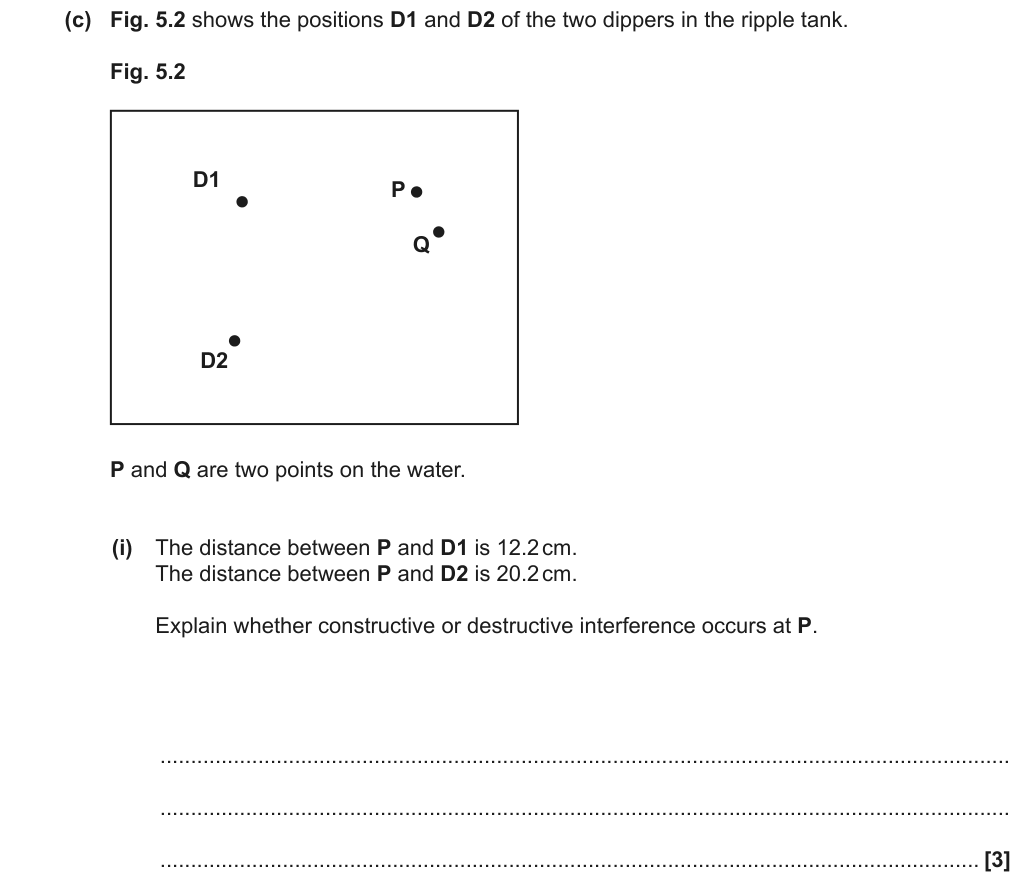
June 2023 · AS Paper 2 · Q5(c)(i)3 marksExplanationMedium
Earlier part of question 5 that this part uses
Mark scheme
Examiner's comment
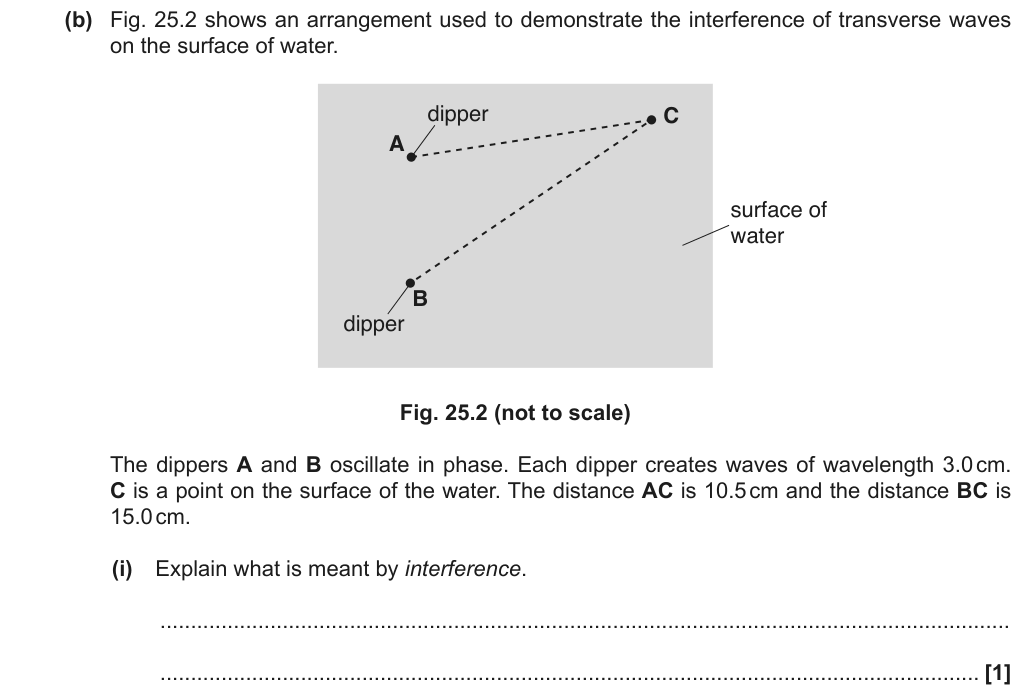
High scoring candidates showed their method clearly. It was expected that candidates would determine the path difference and then determine the path difference in terms of the number of wavelengths (2.5). There were some excellent explanations in terms of destructive interference occurring when there was an odd number (5) of half wavelengths.
Notes from the mark scheme and report
path difference 8.0 cm = 2.5 λ so destructive
Skills: M0.3 Use ratios, fractions and percentages; PAG5 Investigating waves
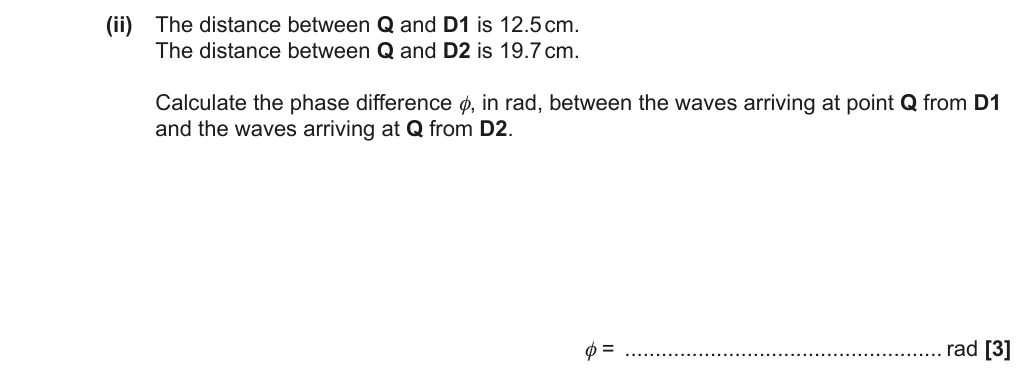
June 2023 · AS Paper 2 · Q5(c)(ii)3 marksCalculationHard
Earlier parts of question 5 that this part uses
Mark scheme
Examiner's comment
Candidates who scored well on this question showed their working clearly. Many clearly stated the path difference and determined that this path difference corresponded to 2.25 wavelengths. Some candidates struggled changing this to radians.
Notes from the mark scheme and report
2.25 λ
allow 1.6 rad, 9π/2 or 14 rad
Candidates need to understand the radian and how to covert between degrees and proportion of a wavelength.
Skills: M0.3 Use ratios, fractions and percentages; M4.7 Understand the relationship between degrees and radians and translate from one to the other
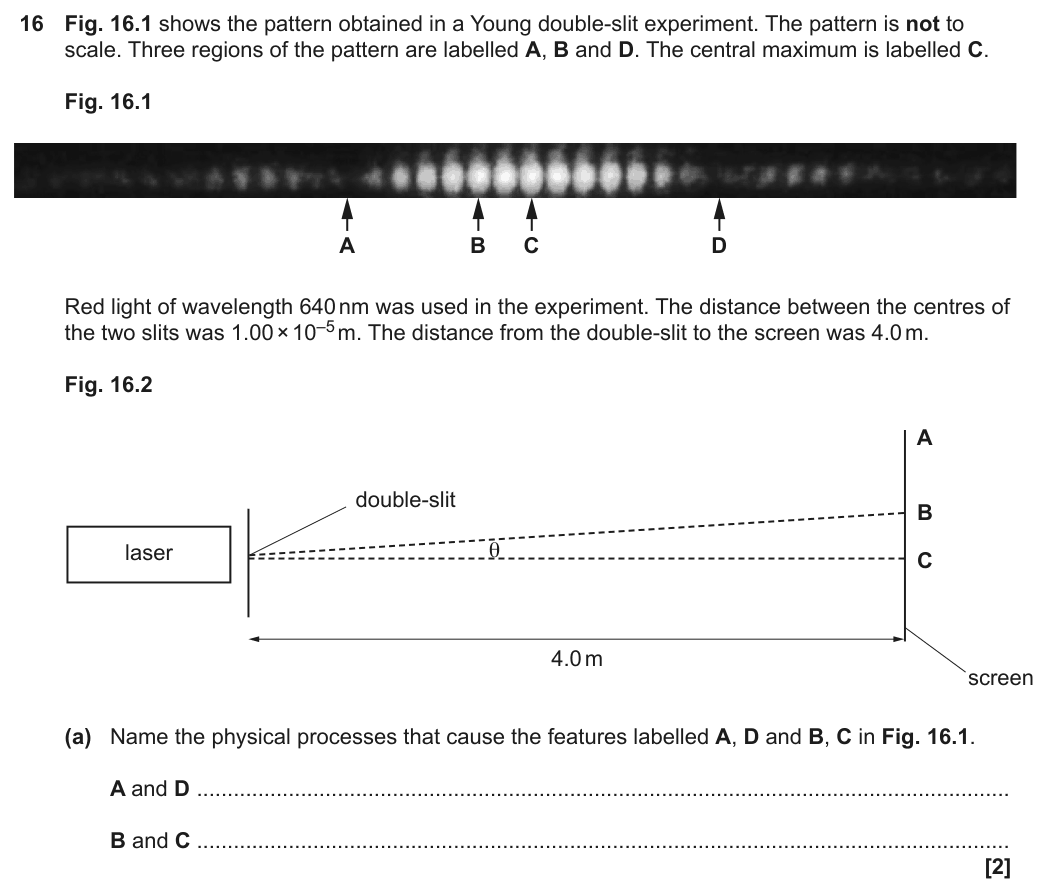
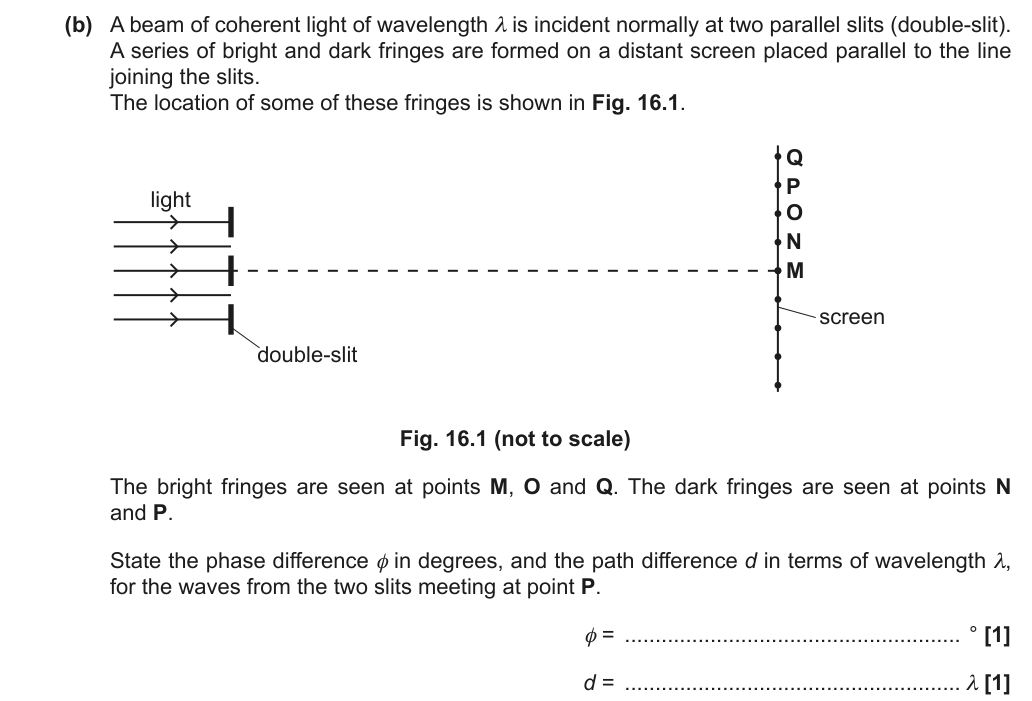
June 2023 · Paper 2 · Q16(a)2 marksShort answerEasy
Mark scheme
Examiner's comment
Most candidates were able to appreciate that the pattern in Fig. 16.1 was an interference pattern and that the ‘dark and light’ were the result of interference. The first mark could also be credited for the use of the term ‘diffraction’ as at that point the single slit diffraction pattern is dominant.
Notes from the mark scheme and report
interference for one mark
diffraction for A and D (or destructive for A, D and constructive for B, C)
ignore superposition alone
June 2023 · Paper 2 · Q16(b)1 markShort answerMedium
Mark scheme
Examiner's comment
Coherence is a term that candidates will likely have come across many times in their study of waves. While many candidates had an appreciation that it was related to phase, there were many responses that it was when two waves were in phase. Around half of candidates were able to correctly explain coherence.
Notes from the mark scheme and report
constant phase difference
ignore in phase, same frequency / wavelength
reject incorrect references to amplitude
June 2023 · Paper 2 · Q16(c)2 marksExplanationHard
Earlier part of question 16 that this part uses
Mark scheme
Examiner's comment
Around half of the candidates were able to achieve at least 1 mark and had a good idea that the waves must arrive in phase. Some candidates confused path difference and phase, giving statements such as ‘the phase difference is one wavelength’. Only a small number of candidates appreciated that this was a maximum two away from the central maximum and so had a path difference of 2 × wavelengths (or equivalent in phase). Many candidates who did not score gave responses in terms of superposition but gave little detail beyond the use of the terms.
Notes from the mark scheme and report
waves arrive in phase
path difference of 2 wavelengths (phase difference 4 pi or 720 degrees) for the second mark
June 2023 · Paper 2 · Q16(d)3 marksCalculationMedium
Earlier part of question 16 that this part uses
Mark scheme
Examiner's comment
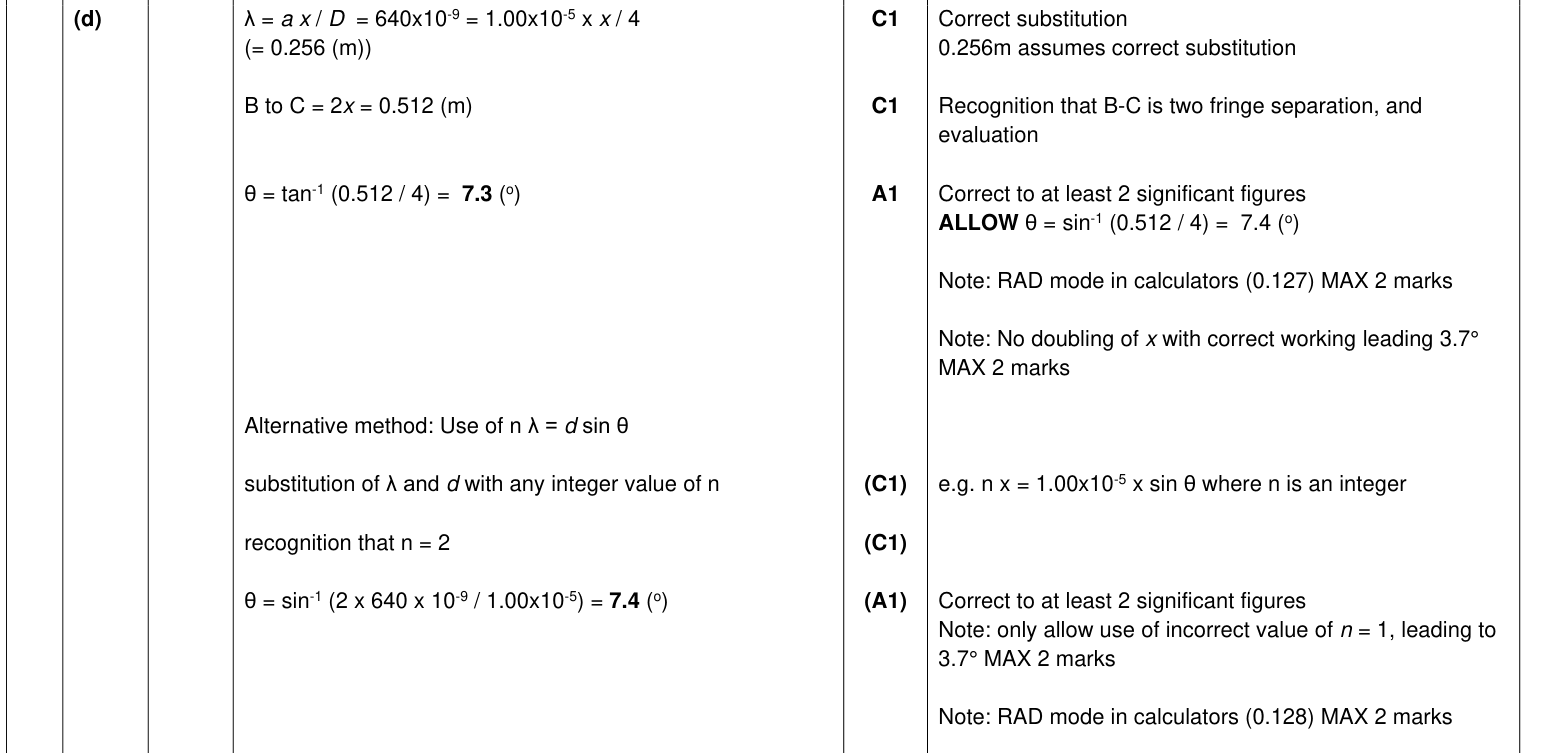
There was a roughly equal spread between 0, 1, 2 and 3 marks on this question and it illustrated the variety of ways in which the candidates attempted it. This calculation could be attempted in a number of ways; each of which would produce the correct final value. Most candidates who made an attempt were able to determine the fringe separation distance on the screen, generally by using the double slit formula. Only around a quarter of candidates appreciated that maximum B was the two away from the central maximum which was needed for the correct answer. Use of the diffraction grating formula gave a similar mark distribution. It is to be noted that, in general¸ incorrect answers with no working will gain no marks and it is very important that candidates who show no working run the risk of not gaining marks. In this case, an incorrect response of 3.7° could gain 2 marks as it was very evident where it came from.
Notes from the mark scheme and report
B is two fringe separations from C
3.7 degrees (no doubling, or n = 1) max 2 marks
calculator in radians max 2 marks
n lambda = d sin theta method also accepted
Skills: M0.6 Use calculators to handle sin x, cos x and tan x when x is expressed in degrees or radians; M2.3 Substitute numerical values into algebraic equations using appropriate units for physical quantities; M4.5 Use sin, cos and tan in physical problems
June 2023 · Paper 2 · Q19(b)3 marksExplanationMedium
Earlier part of question 19 that this part uses
Mark scheme
Examiner's comment
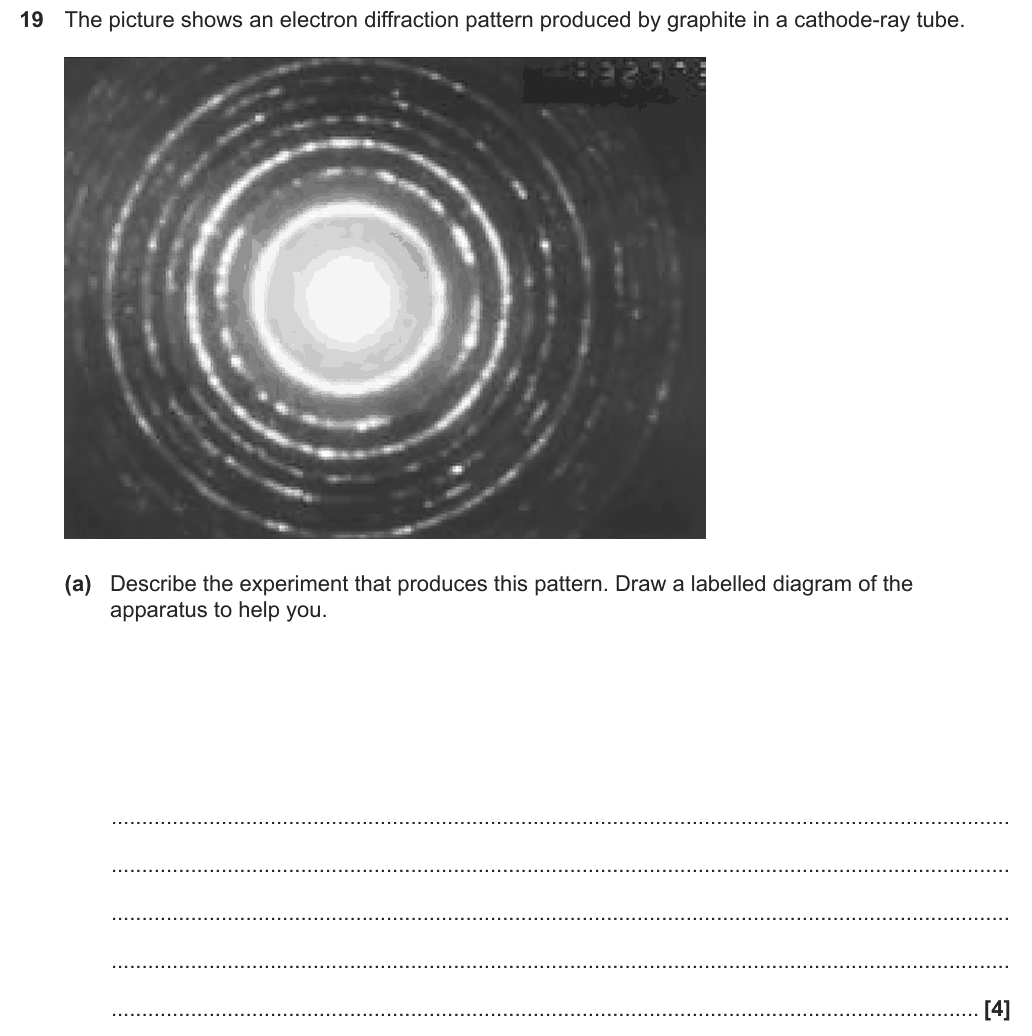
Most candidates appreciated that this was evidence of the wave nature of electrons, although a simple statement of ‘wave-particle duality’ does not really explain what the evidence provides. Although the circles could be described in terms of probability of electrons arriving, in the context of the question the concept of interference of the electron-waves was sufficient and was clearly the explanation that many candidates had been given and close to one half of candidates were able to achieve full marks.
Notes from the mark scheme and report
wave nature of electrons
dark circles need antiphase / out of phase by 180 degrees, NOT just 'out of phase'
June 2022 · AS Paper 1 · Q41 markMultiple choiceMedium
Answer
B
Mark scheme
Examiner's comment
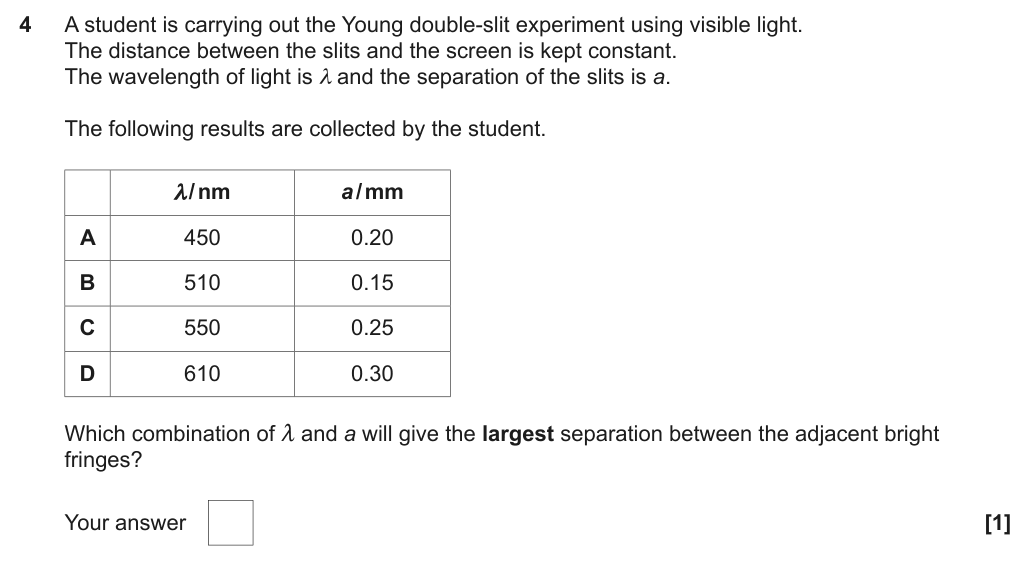
Most candidates identified the answer as B by correctly applying λ = a x / D and the relationship between λ, a and x when D is constant.
June 2022 · AS Paper 1 · Q61 markMultiple choiceMedium
Answer
C
Mark scheme
Examiner's comment
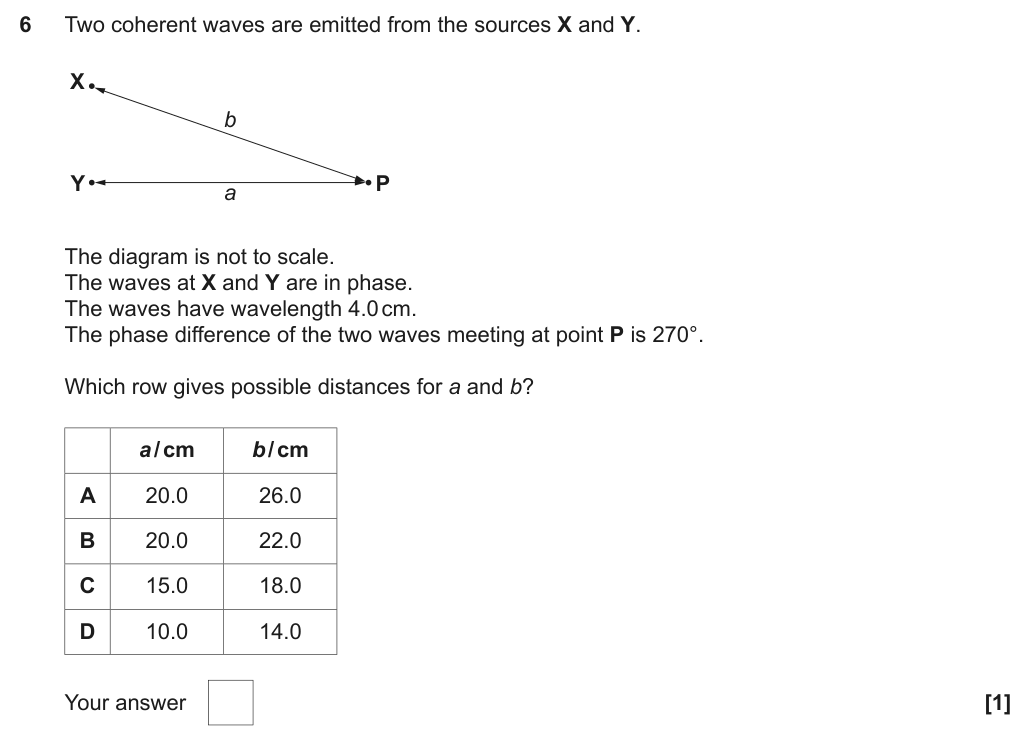
Candidates did not perform as well on this question with just a small majority of candidates determining the correct answer C. For A, B and D the path difference between a and b corresponds to either a whole or a half number of wavelengths so the waves must either be in phase or anti-phase.
June 2022 · AS Paper 2 · Q86 marks6-mark extended responseMedium
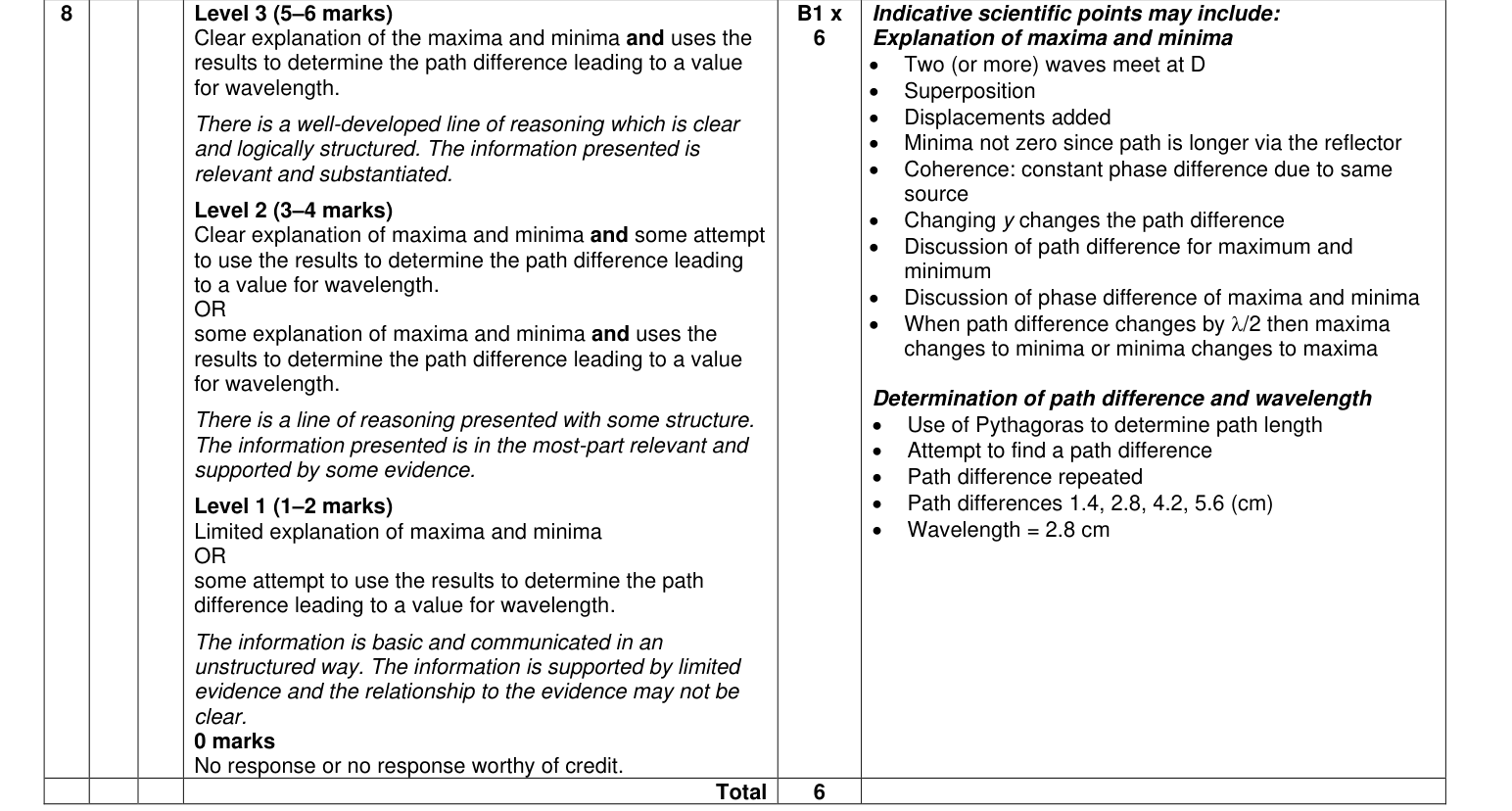
Mark scheme, with the levels and indicative content
Examiner's comment
To answer this question well, candidates needed to explain why there were maxima and minima. Many correctly explained the different paths but some were confused between phase difference and path difference. A significant number of candidates incorrectly discussed standing waves or two source interference. Most successful candidates clearly used the data correctly using Pythagoras to work out path differences and they realised that the difference between the two maxima or the two minima was the wavelength, however other candidates often just stated 14.6 – 8.4 was the wavelength or 11.9 – 8.4 x 2 was the wavelength. This candidate scored full marks – the scientific content of the response meets the Level 3 descriptor, and the communication statement is also met so six marks. The candidate structures the response by initially describing the experimental arrangement. There is appropriate scientific detail explaining how waves arrive at D. Importantly the candidate states that the resultant displacement is equal to the sum of the displacements of the individual waves. Although the phase change has not been discussed, there is a sensible discussion of path difference using the data given. Towards the end of the response the candidate clearly demonstrates how the wavelength of the microwaves may be calculated using Pythagoras calculations of the path difference and relating the path difference to the wavelength. If any of your students’ results are not as expected, you may wish to consider one of our post-results services. For full information about the options available visit the OCR website. We send a weekly roundup to tell you about important updates. You can also sign up for your subject specific updates. If you haven’t already, sign up here. Attend one of our popular CPD courses to hear directly from a senior assessor or drop in to a Q&A session. Most of our courses are delivered live via an online platform, so you can attend from any location. Please find details for all our courses on the relevant subject page on our website or visit OCR professional development. ExamBuilder is the question builder platform for a range of our GCSE, A Level, Cambridge Nationals and Cambridge Technicals qualifications. Find out more. ExamBuilder is free for all OCR centres with an Interchange account and gives you unlimited users per centre. We need an Interchange username to validate the identity of your centre's first user account for ExamBuilder. If you do not have an Interchange account please contact your centre administrator (usually the Exams Officer) to request a username, or nominate an existing Interchange user in your department. Review students' exam performance with our free online results analysis tool. It is available for all GCSEs, AS and A Levels and Cambridge Nationals. It allows you to: • review and run analysis reports on exam performance • analyse results at question and/or topic level • compare your centre with OCR national averages • identify trends across the centre • facilitate effective planning and delivery of courses • identify areas of the curriculum where students excel or struggle • help pinpoint strengths and weaknesses of students and teaching departments. Find out more. Post-results services Keep up-to-date OCR Professional Development Signed up for ExamBuilder?
Notes from the mark scheme and report
path differences 1.4, 2.8, 4.2, 5.6 cm (Pythagoras) give wavelength 2.8 cm
Skills: M2.3 Substitute numerical values into algebraic equations using appropriate units for physical quantities; M4.4 Use Pythagoras’ theorem, and the angle sum of a triangle
June 2022 · Paper 2 · Q16(b)2 marksCalculationEasy
Mark scheme
Examiner's comment
This was a well done question overall; most candidates were able to appreciate that destructive interference resulted from a half number of cycles. Generally, the phase difference seemed to be better understood than the path difference, where incorrect responses for the path difference included a common response of (n+1/2), or sometimes 0.5, showing an understanding of destructive interference but not applying it correctly to this situation.
Notes from the mark scheme and report
540 or 180 allowed
Do not allow answer in radians
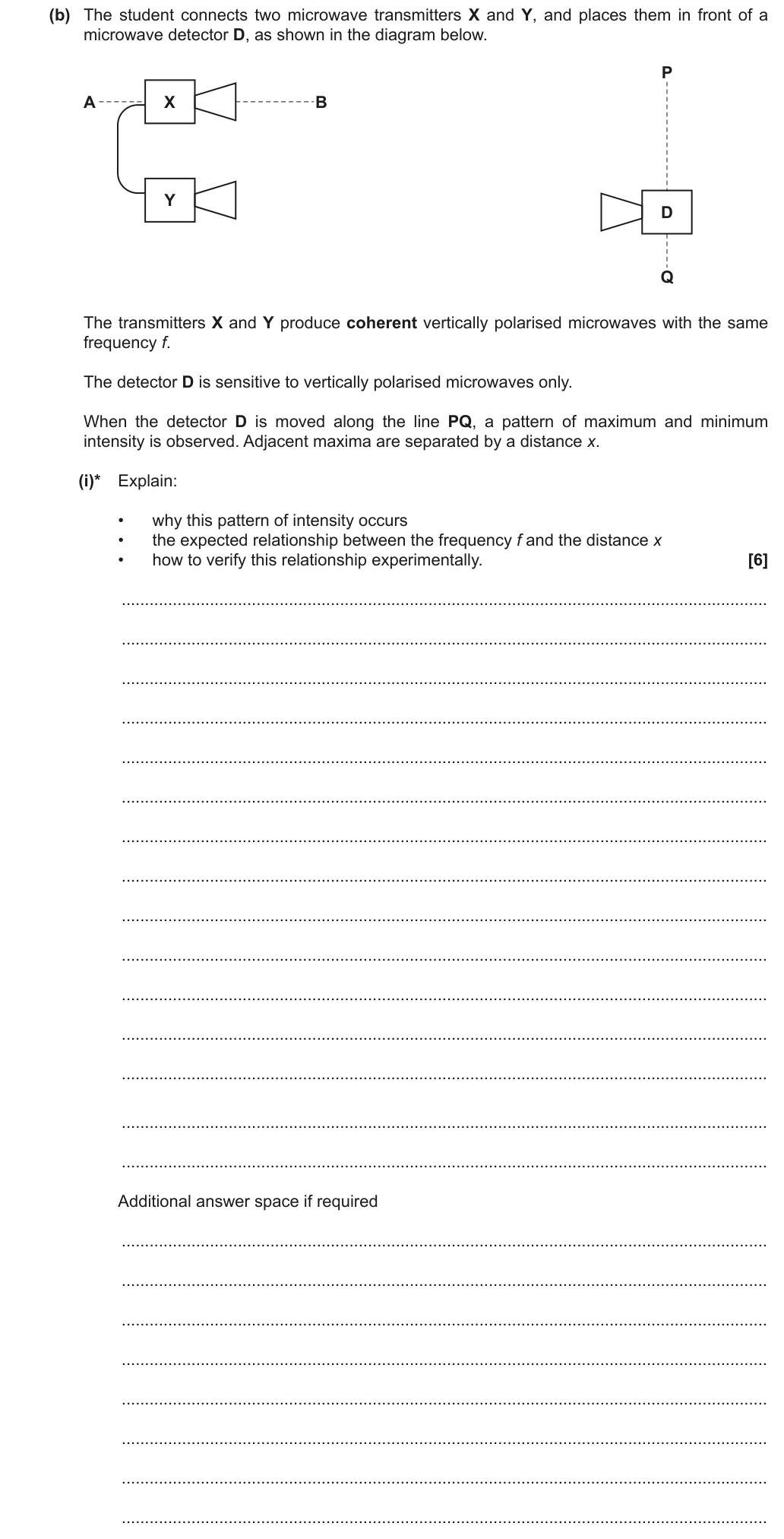
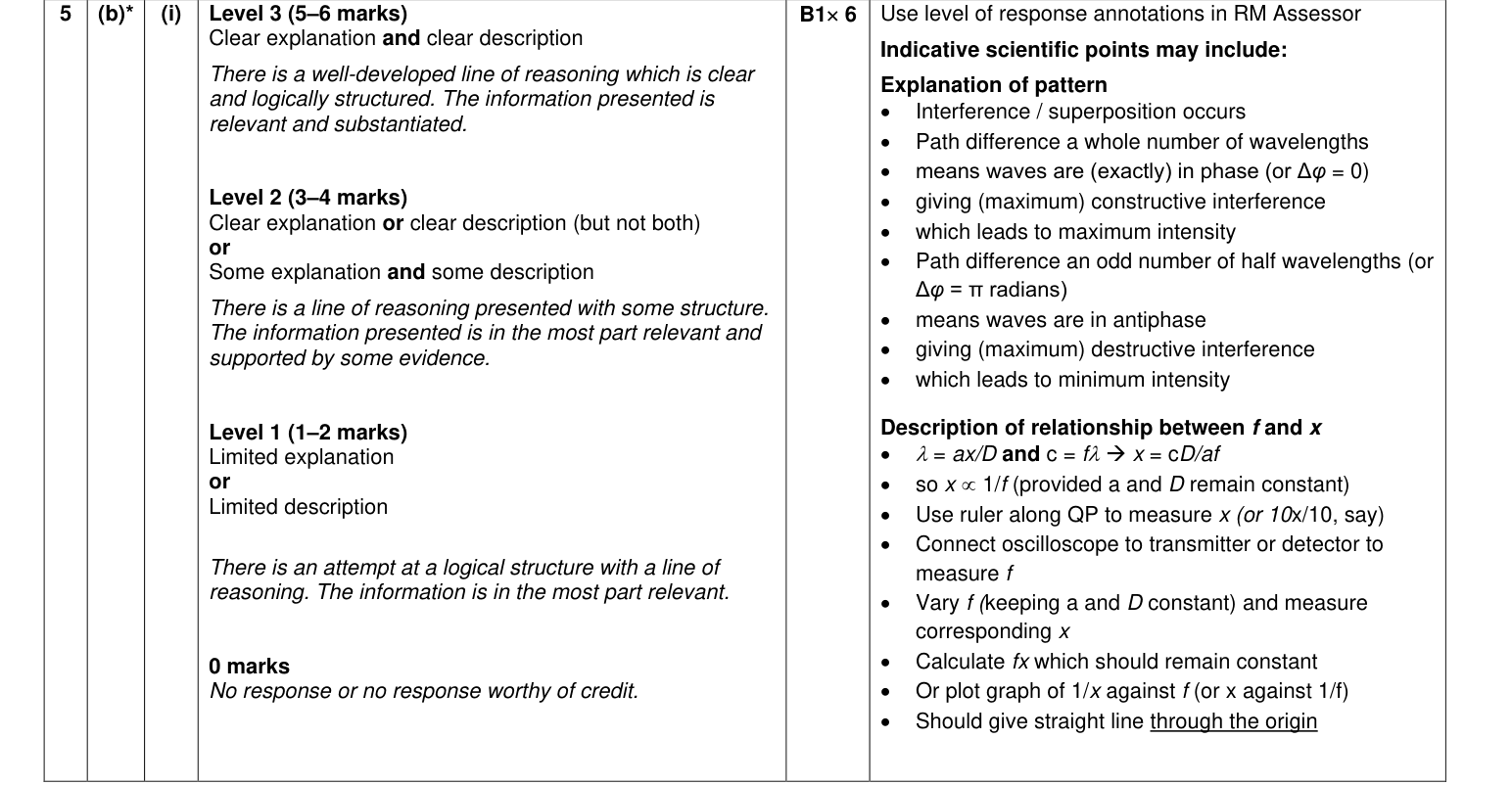
June 2022 · Paper 3 · Q5(b)(i)6 marks6-mark extended responseEasy
Mark scheme, with the levels and indicative content
Examiner's comment
There were three parts to this LoR question and all needed to be addressed to access the top level. Candidates were first asked to explain why a pattern of maximum and minimum intensity was observed. Marks were given to candidates who used precise scientific wording, e.g. destructive interference occurs when waves are in antiphase (rather than merely out of phase) or when the path difference is an odd number of half wavelengths (rather than merely an odd number of wavelengths). Fewer marks were given to candidates who wrote about waves ‘cancelling out’ or ‘amplitudes subtracting’. In the second part, the expected relationship between the frequency f and the distance x is that f and x are inversely proportional. Most candidates were able to explain this, either algebraically (λ = ax/D and c = fλ so x = cD/af) or descriptively in terms of the waves overlapping more closely as f increased. The third part of the question required an explanation of how to verify this inversely proportional relationship. The question stated that the frequency f of the microwaves could be adjusted. So the experimental procedure involved varying f and measuring x (over several maxima for accuracy). If a graph of f against 1/x gives a straight line through the origin then the relationship is verified. The exemplar above shows a successful response for the third part of the question. It makes it clear what to vary, what to measure, what measuring instruments to use, and what to do graphically with the results.
Notes from the mark scheme and report
x = cD/af so x ∝ 1/f with a and D constant
plot x against 1/f or show fx constant
Only use the words node and antinode in the context of stationary waves.
Skills: M3.3 Understand that y = mx + c represents a linear relationship; PAG5 Investigating waves
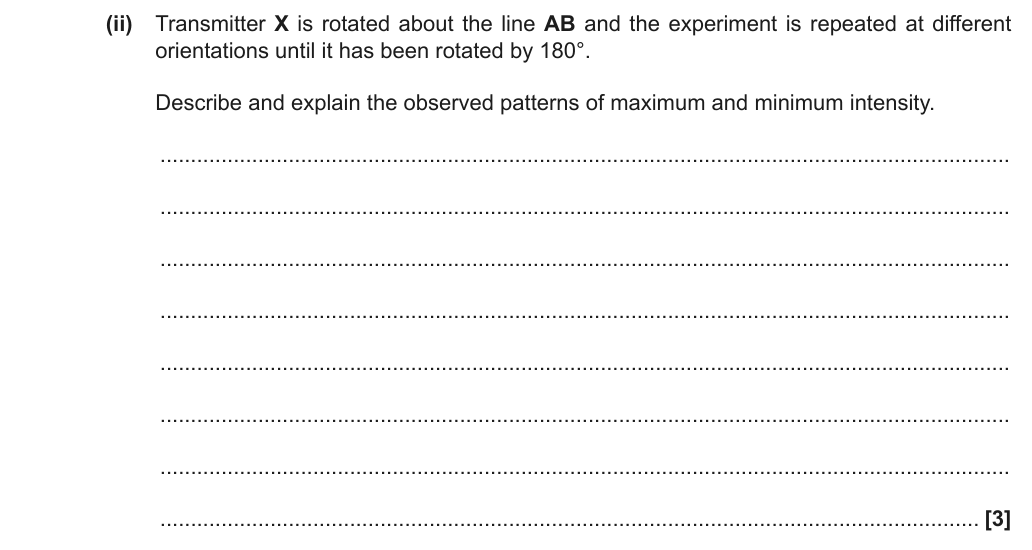
June 2022 · Paper 3 · Q5(b)(ii)3 marksExplanationHard
Earlier part of question 5 that this part uses
Mark scheme
Examiner's comment
This question was misread by many candidates, who described the variation in overall intensity instead of the variation in the interference pattern. Some candidates thought that transmitter X was rotating away from Y, rather than about the AB axis. Only a few candidates correctly explained the change in pattern in terms of the change in the amount of interference between the waves from X and Y. Many said detector D was receiving less of a signal from X, rather than interference was lessening because of a reduction in the vertical component from X.
Notes from the mark scheme and report
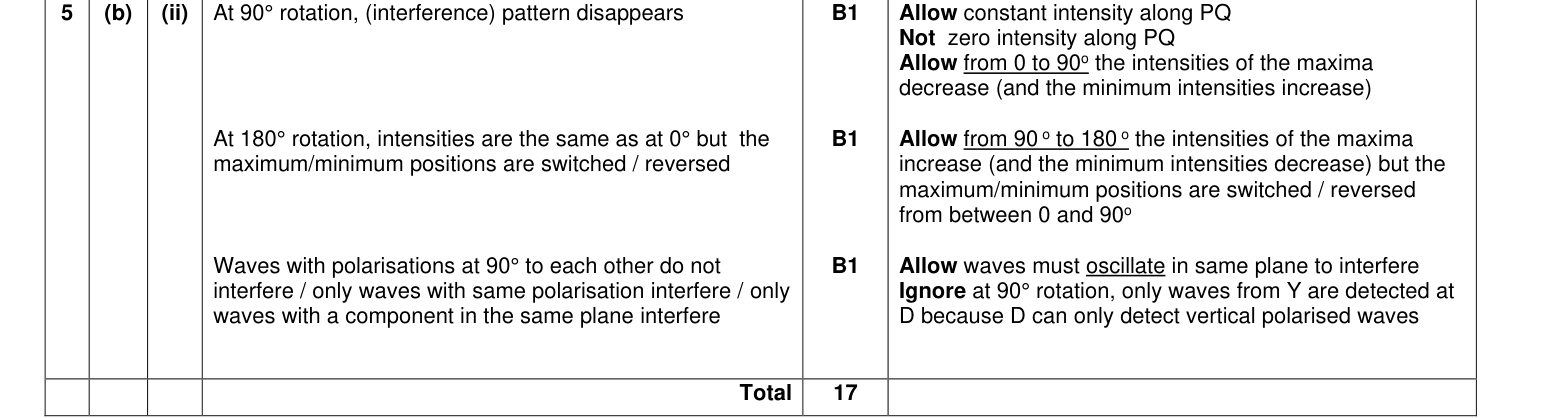
at 90° the pattern disappears (NOT zero intensity along PQ)
at 180° maxima and minima positions are swapped
Ignore 'only Y is detected at 90°'
November 2021 · AS Paper 1 · Q111 markMultiple choice
Answer
A
Mark scheme
November 2021 · AS Paper 2 · Q1(a)1 markShort answer
Mark scheme
Notes from the mark scheme and report
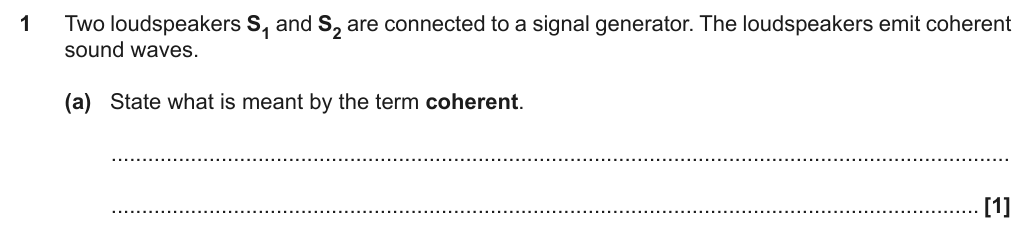
ignore in phase
November 2021 · AS Paper 2 · Q1(b)(i)1 markCalculation
Earlier part of question 1 that this part uses
Mark scheme
November 2021 · AS Paper 2 · Q1(b)(ii)1 markCalculation
Earlier part of question 1 that this part uses
Mark scheme
November 2021 · AS Paper 2 · Q1(b)(iii)1 markShow that
Earlier part of question 1 that this part uses
Mark scheme
Notes from the mark scheme and report
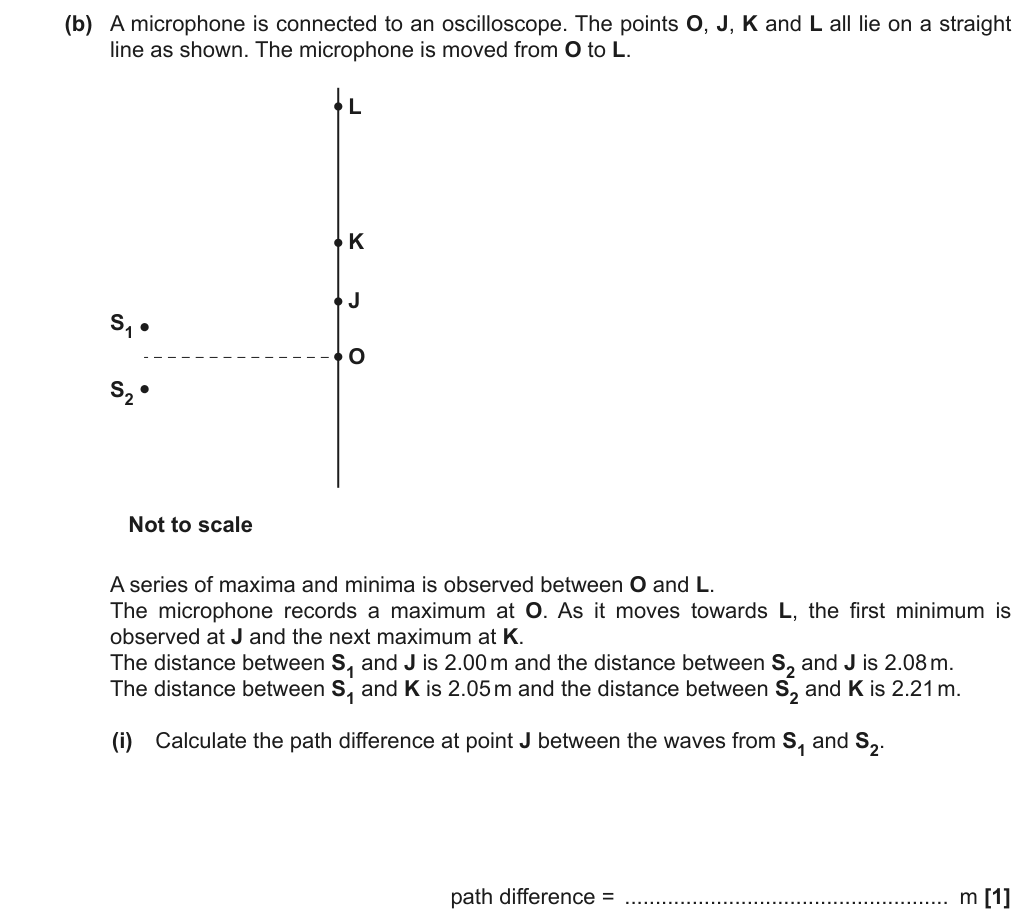
ecf from (b)(i)
Allow path difference shown at K
Skills: M0.3 Use ratios, fractions and percentages
November 2021 · Paper 2 · Q21 markMultiple choiceEasy
Answer
A
Mark scheme
Examiner's comment
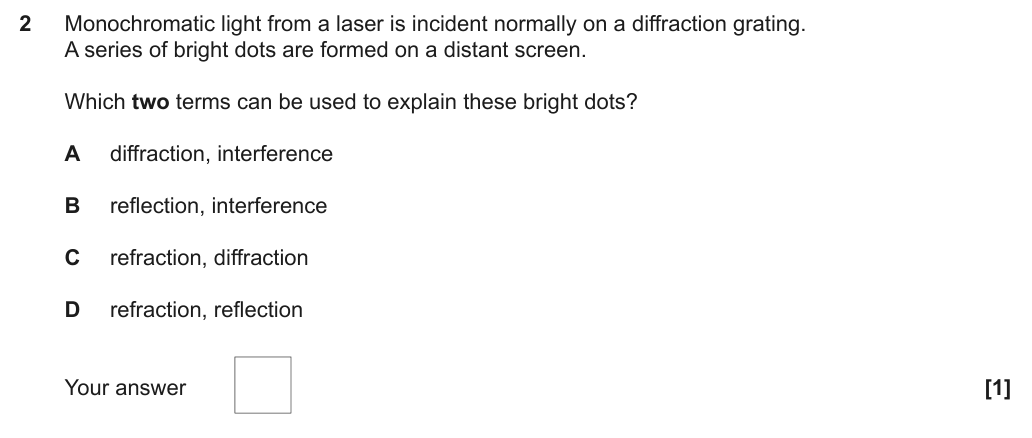
The correct response is A. This question was correctly answered by the vast majority of candidates, who were able to select the correct terms applicable.
November 2021 · Paper 2 · Q81 markMultiple choiceMedium
Answer
A
Mark scheme
Examiner's comment
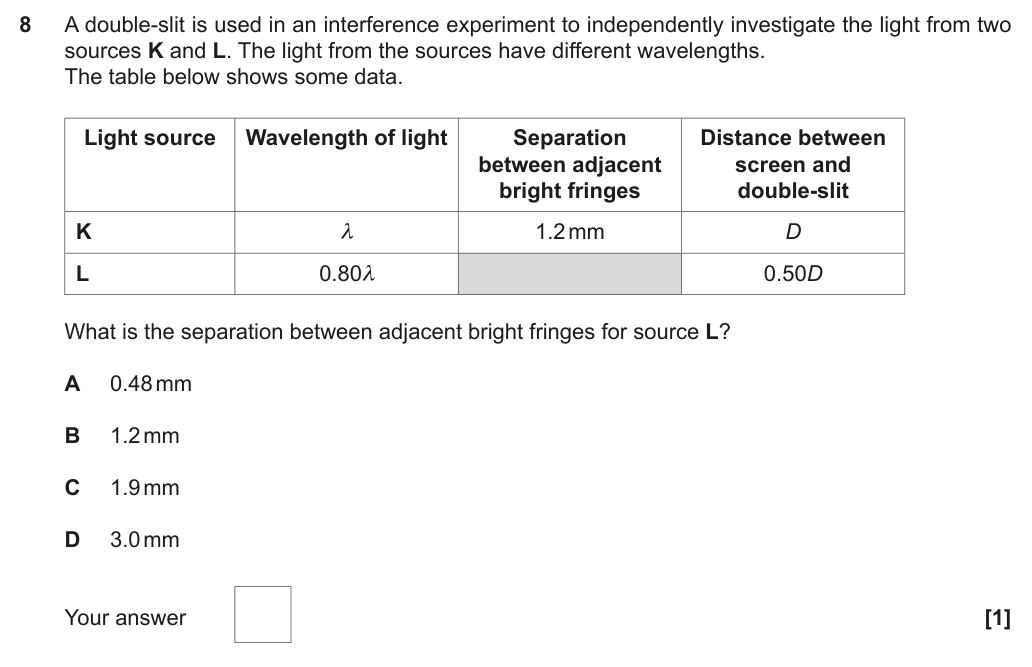
The correct response is A. A good number of candidates were able to correctly identify the new fringe separation. Most correctly identified the appropriate equation from the booklet and set out the solution either as ratios or by direct calculation. Quite a large fraction who achieved the correct response showed no working, suggesting that this is a relatively simple calculation probably done directly into a calculator.
November 2021 · Paper 2 · Q111 markMultiple choiceHard
Answer
C
Mark scheme
Examiner's comment
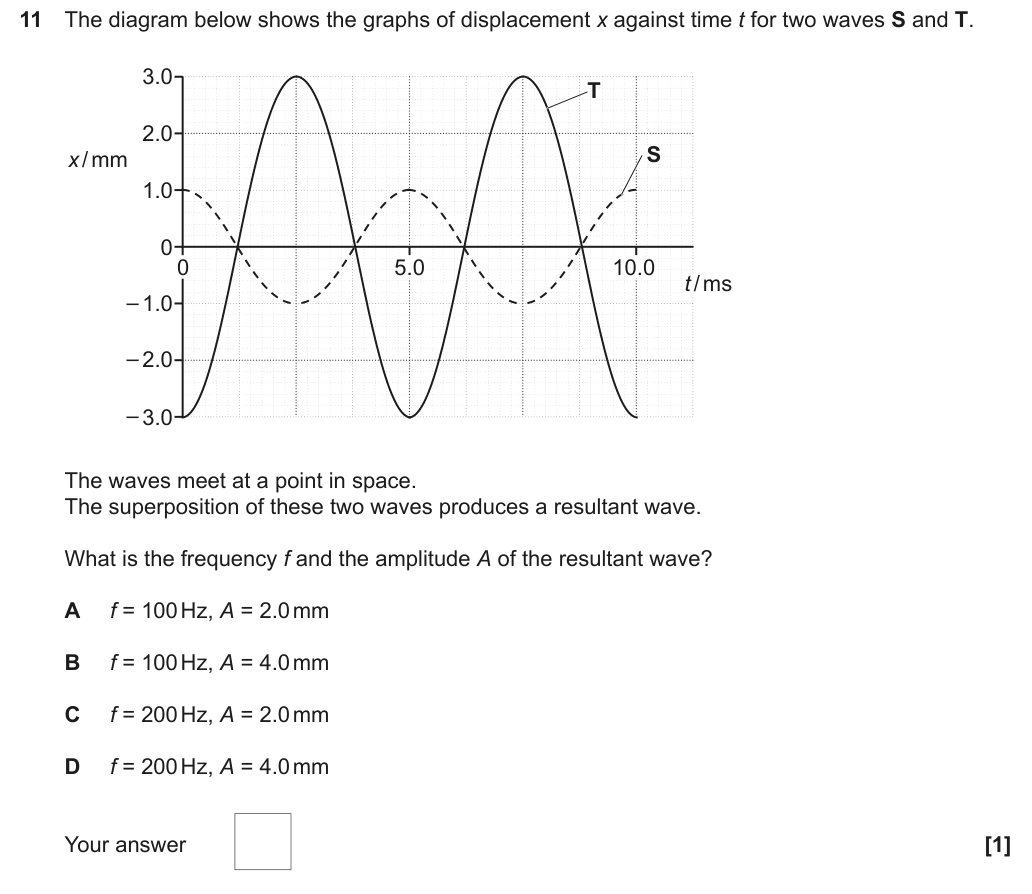
The correct response is C. Although not a particularly challenging question, it was encouraging to see around three quarters of entrants getting the correct solution. The most common incorrect response was A, suggesting that the idea of time period is not necessarily well understood.
November 2021 · Paper 3 · Q5(a)4 marksExplanationMedium
Mark scheme
Examiner's comment
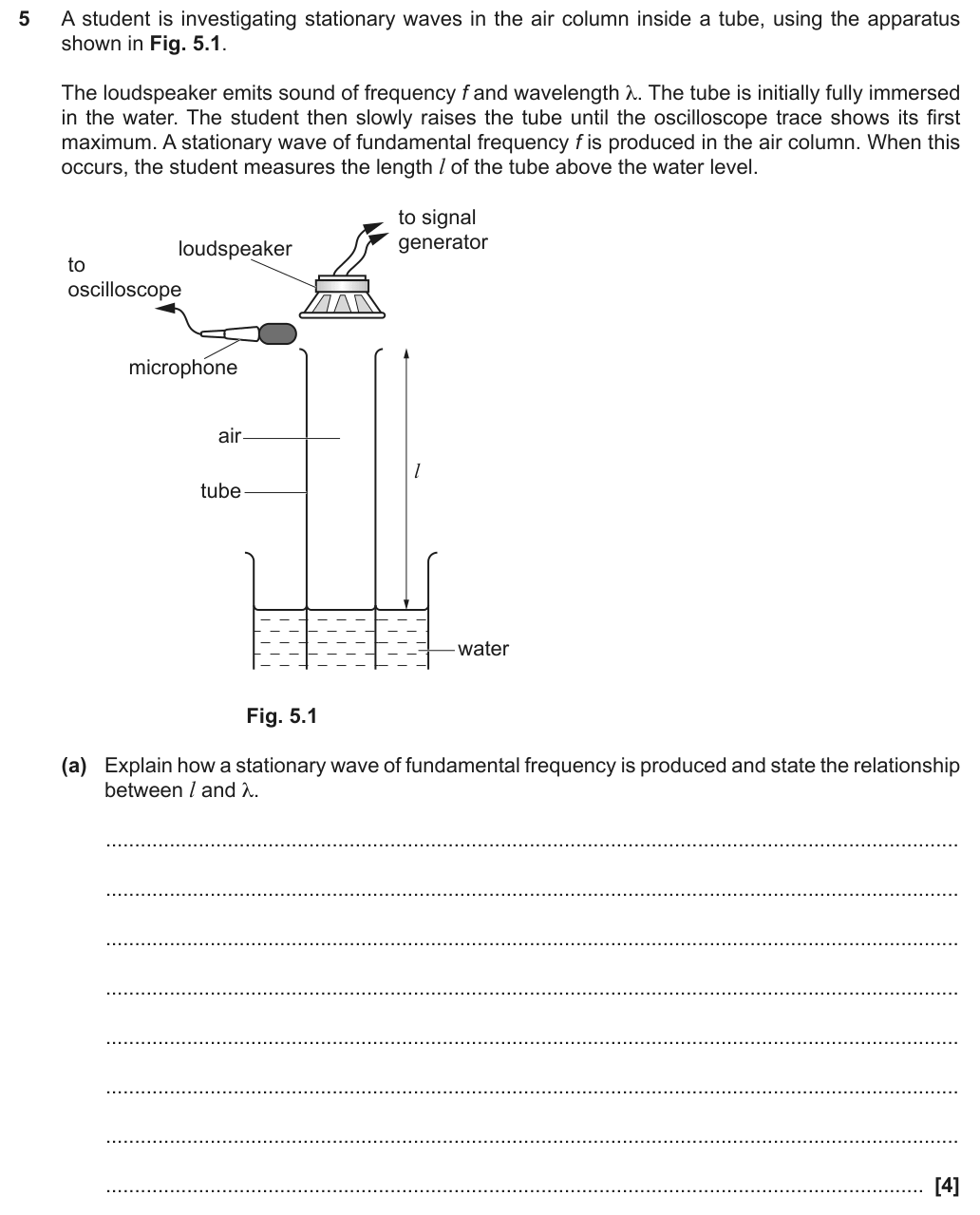
A good example where this approach would help is for Question 5(a), where many candidates either explained how a stationary wave is produced in general, with no reference to the fundamental frequency or l = ¼, or drew diagrams of several different harmonics, or gave the general equation l = (2n – 1)/4 × .
Notes from the mark scheme and report
reflection at the water surface
do not allow waves interact / combine (interfere / superpose needed)
node at water surface and antinode at top of tube
l = λ/4
Skills: PAG5 Investigating waves
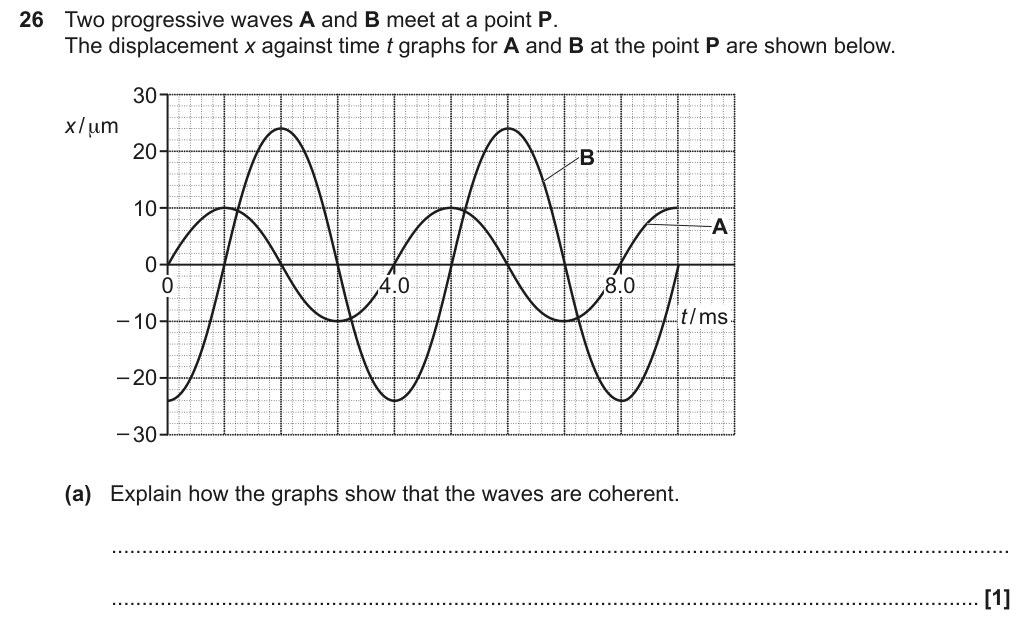
November 2020 · AS Paper 1 · Q26(a)1 markExplanationMedium
Mark scheme
Examiner's comment
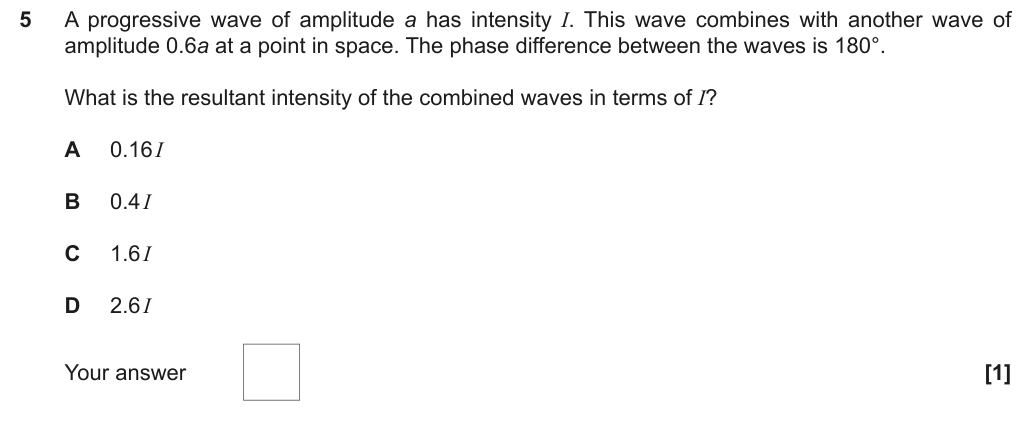
Misconception Question 26c The intensity of a progressive wave is directly proportional to amplitude2.
Notes from the mark scheme and report
ignore incorrect value of phase difference
ignore same wavelength / frequency / period
Skills: M3.1 Translate information between graphical, numerical and algebraic forms
November 2020 · AS Paper 1 · Q26(d)1 markCalculationMedium
Earlier part of question 26 that this part uses
Mark scheme
Examiner's comment
Misconception Question 26c The intensity of a progressive wave is directly proportional to amplitude2.
Notes from the mark scheme and report
allow ±1.5
ignore sign
Skills: M3.1 Translate information between graphical, numerical and algebraic forms
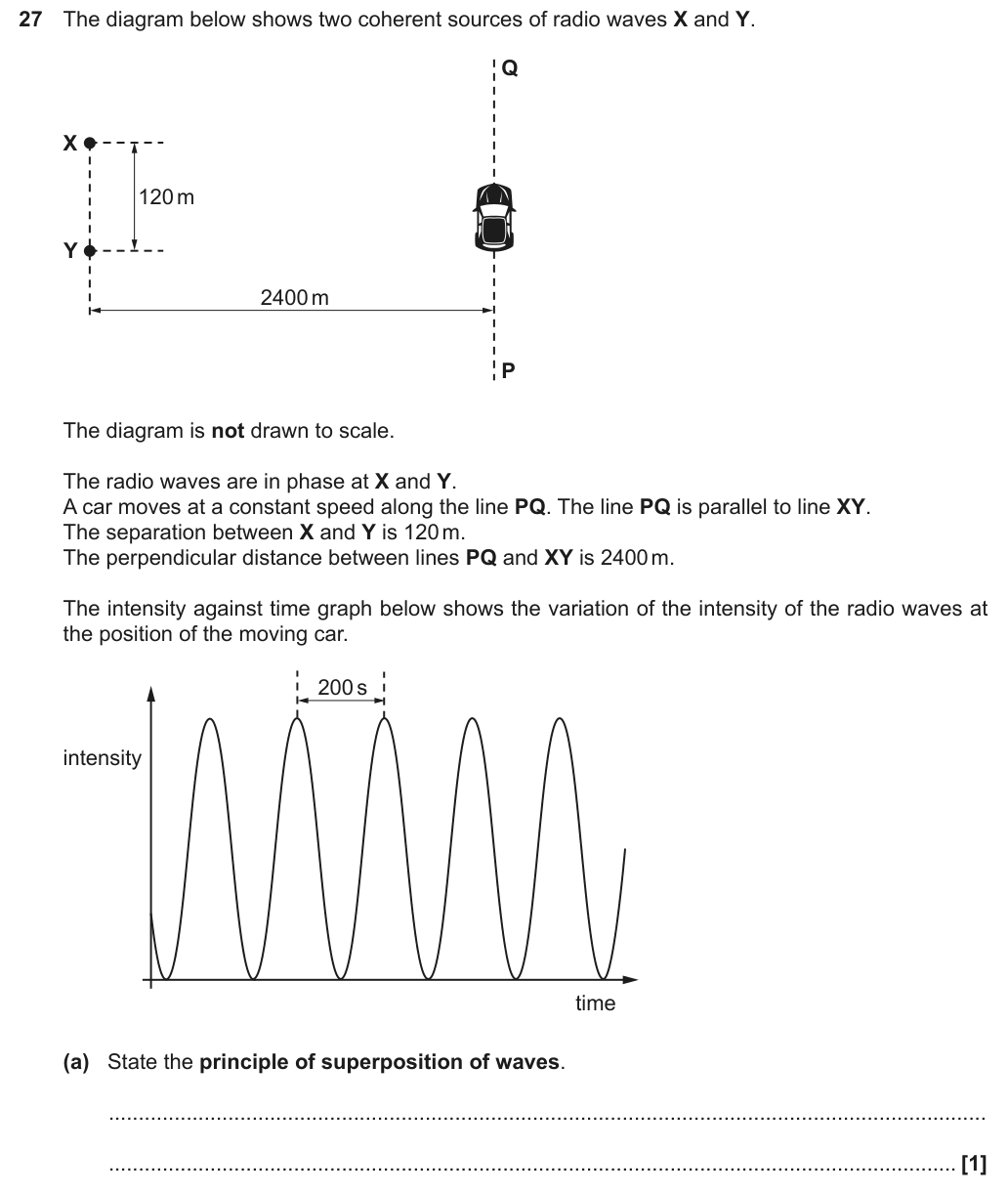
November 2020 · AS Paper 1 · Q27(a)1 markShort answerMedium
Mark scheme
Examiner's comment
Question 27b is all about superposition of radio waves and explanation of the maxima and minima.
Notes from the mark scheme and report
NOT amplitude
ignore vector sum
November 2020 · AS Paper 1 · Q27(b)2 marksExplanationMedium
Earlier part of question 27 that this part uses
Mark scheme
Examiner's comment
Question 27b is all about superposition of radio waves and explanation of the maxima and minima.
Notes from the mark scheme and report
1 mark only for 'constructive and destructive interference' with no link to maxima and minima
November 2020 · AS Paper 1 · Q27(c)3 marksCalculationMedium
Earlier part of question 27 that this part uses
Mark scheme
Examiner's comment
Question 27b is all about superposition of radio waves and explanation of the maxima and minima.
Notes from the mark scheme and report
NOT v = f x wavelength
using x = 1800 m scores zero (gives 90 m)
Skills: M2.2 Change the subject of an equation, including non-linear equations; M2.3 Substitute numerical values into algebraic equations using appropriate units for physical quantities
November 2020 · Paper 2 · Q20(b)1 markShort answerMedium
Mark scheme
Examiner's comment
Questions 16b, 17c, 18, 20ci, 21a, 21c, 22bii and 24b. • wrote all the steps and calculations when answering numerical multiple choice questions - this was unnecessary and time- consuming because most calculations could have been done on calculators • demonstrated poor recall of basic definitions and misunderstood key concepts, e.g. confusing phase difference and path difference in Question 20ci • truncated or rounded numbers prematurely within calculations, which led to incorrect final responses, e.g. Misconception Question 20aii The intensity of a sound wave is directly proportional to amplitude2. Question 20c is all about superposition of light from a double-slit and explanation of the fringes in terms of phase difference.
Notes from the mark scheme and report
sum of displacements
allow net / total
ignore vector sum
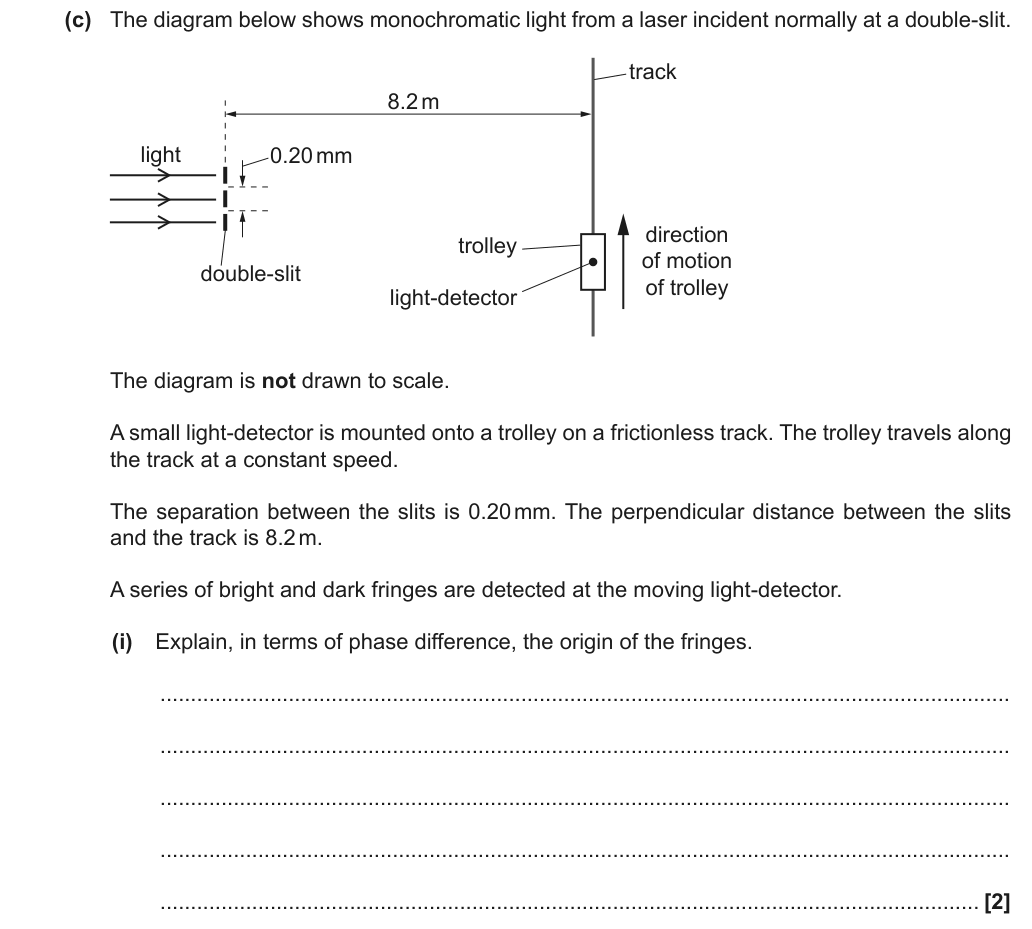
November 2020 · Paper 2 · Q20(c)(i)2 marksExplanationMedium
Mark scheme
Examiner's comment
Questions 16b, 17c, 18, 20ci, 21a, 21c, 22bii and 24b. • wrote all the steps and calculations when answering numerical multiple choice questions - this was unnecessary and time- consuming because most calculations could have been done on calculators • demonstrated poor recall of basic definitions and misunderstood key concepts, e.g. confusing phase difference and path difference in Question 20ci • truncated or rounded numbers prematurely within calculations, which led to incorrect final responses, e.g. Misconception Question 20aii The intensity of a sound wave is directly proportional to amplitude2. Question 20c is all about superposition of light from a double-slit and explanation of the fringes in terms of phase difference.
Notes from the mark scheme and report
'in phase for bright and in antiphase for dark' scores 1 mark only (needs n x 360° and (n + ½) x 360°, or equivalent)
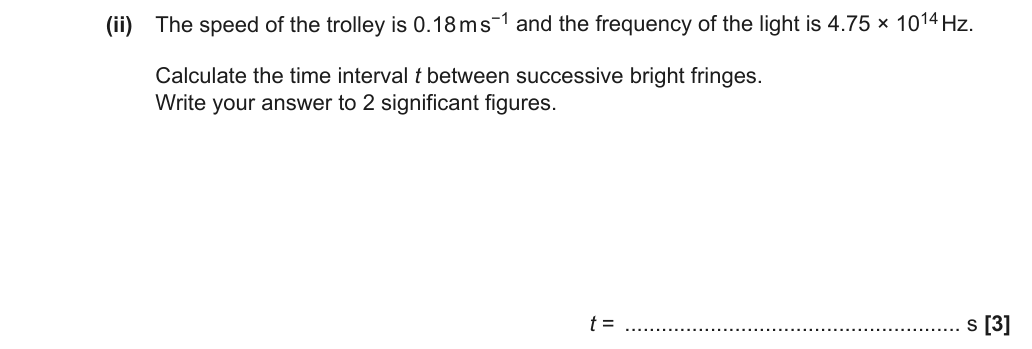
November 2020 · Paper 2 · Q20(c)(ii)3 marksCalculationMedium
Earlier part of question 20 that this part uses
Mark scheme
Examiner's comment
Questions 16b, 17c, 18, 20ci, 21a, 21c, 22bii and 24b. • wrote all the steps and calculations when answering numerical multiple choice questions - this was unnecessary and time- consuming because most calculations could have been done on calculators • demonstrated poor recall of basic definitions and misunderstood key concepts, e.g. confusing phase difference and path difference in Question 20ci • truncated or rounded numbers prematurely within calculations, which led to incorrect final responses, e.g. Misconception Question 20aii The intensity of a sound wave is directly proportional to amplitude2. Question 20c is all about superposition of light from a double-slit and explanation of the fringes in terms of phase difference.
Notes from the mark scheme and report
answer must be to 2 sf
8.6 x 10⁻¹¹ s scores 1 mark (0.18 = fλ is wrong physics)
Skills: M1.1 Use an appropriate number of significant figures; M2.2 Change the subject of an equation, including non-linear equations; M2.3 Substitute numerical values into algebraic equations using appropriate units for physical quantities
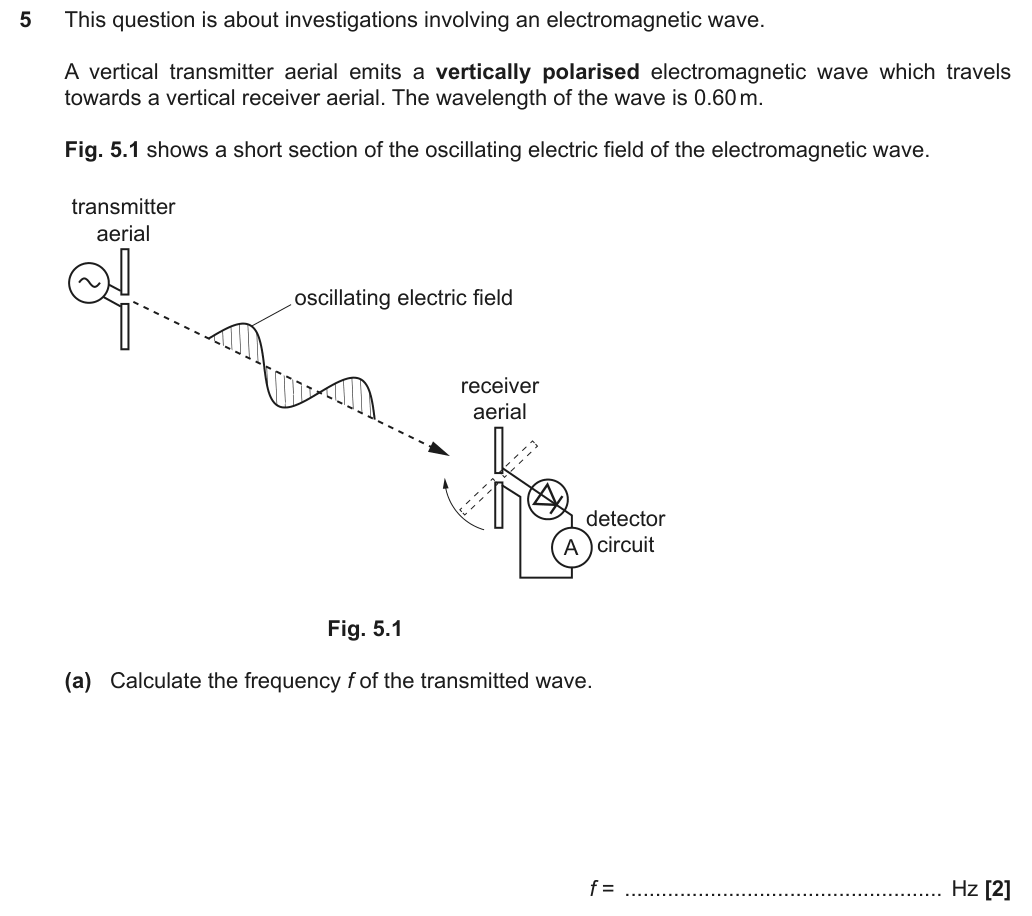
November 2020 · Paper 3 · Q5(d)6 marks6-mark extended responseEasy
Earlier part of question 5 that this part uses
Mark scheme, with the levels and indicative content
Examiner's comment
Question 5b The words ‘simple harmonic motion’ in the text prompted almost all candidates to use the correct formula here. Question 5c Allowing a mark for the diode only letting current pass in one direction enabled many candidates to score this mark. Question 5d This was the second of the two LoR questions in this paper.
Notes from the mark scheme and report
1: maximum with receiver aerial vertical, zero when rotated 90 degrees
2: reflected and incident waves superpose - maximum with sheet at 30, 60 cm and zero at 15, 45 cm from the aerial (full credit for the reverse if the 180 degree phase change on reflection is used)
Skills: PAG5 Investigating waves
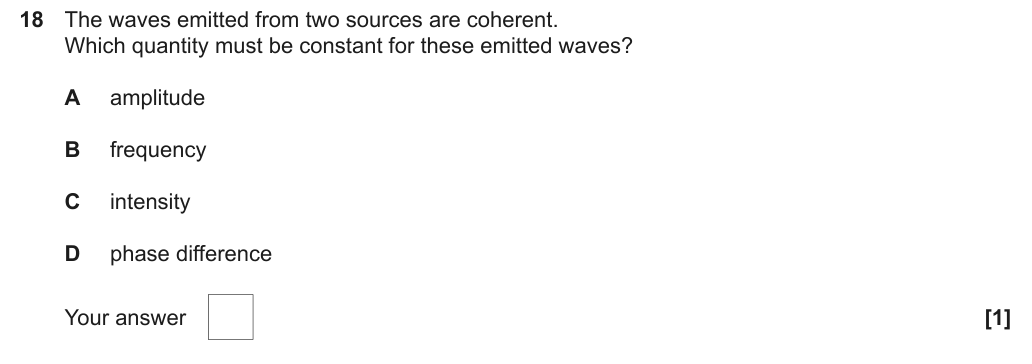
June 2019 · AS Paper 1 · Q111 markMultiple choice
Answer
B
Mark scheme
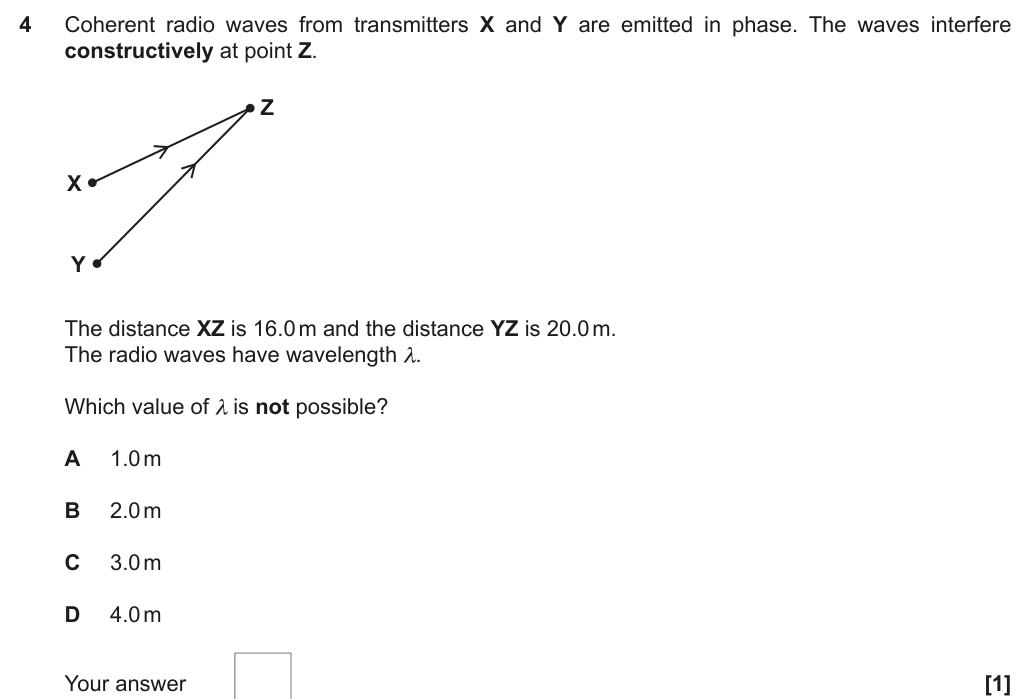
June 2019 · Paper 2 · Q41 markMultiple choiceMedium
Answer
C
Mark scheme
Examiner's comment
This question was assessing knowledge and understanding of path difference and constructive interference. The path difference is 4.0 m. With the waves in phase at X and Y, this means that the distance of 4.0 m must be equal to a multiple of wavelengths. This condition is satisfied by all but C. You cannot get 4.0 m by multiplying 3.0 m by an integer. The majority of the candidates effortlessly picked up 1 mark here.
Notes from the mark scheme and report
path difference 4.0 m must be a whole number of wavelengths
Skills: M0.3 Use ratios, fractions and percentages
June 2019 · AS Paper 2 · Q5(b)6 marks6-mark extended responseMedium
Mark scheme, with the levels and indicative content
Examiner's comment
This question is assessing candidates’ abilities to plan an investigation. Some candidates assumed that this was two-source light interference and discussed the use of lasers, etc. It is important that candidates answer the question set. The stem of the question indicates that a suitable diagram should be drawn. Many candidates did not label their diagrams, or the diagrams were not workable. Higher ability candidates indicated two loudspeakers connected to a signal generator and a microphone connected to an oscilloscope to detect the resultant signal. When answering planning questions, candidates should identify the measurements that need to be taken and indicate appropriate measuring instruments. In this experiment, candidates were able to explain how the frequency of the sound could be determined using an oscilloscope as well as how distances could be measured. Candidates also needed to explain how the data would be analysed. Higher ability candidates suggested the plotting of an appropriate graph and explained how the speed of sound could be determined from the gradient. The candidate’s is answering the question as shown by the diagram containing two speakers. There is an indication of how the distances may be measured and that the frequency is going to be varied. The candidate also indicated how the results would be analysed graphically and how the speed of sound could be determined from the gradient of the plotted graph. This is a Level 2 response worth four marks since there is a line of reasoning and the information provided is relevant. To improve this response, the candidate could have included a signal generator and also a means of detecting the sound at the distance indicated. There should also have been detail on how the frequency was determined.
Notes from the mark scheme and report
needs labelled diagram, a safety precaution, D much greater than a, and a graph such as x against 1/f with gradient vD/a
Practical skills guidance can be found in the Practical Skills Handbook available on the OCR website: https://www.ocr.org.uk/Images/295483-practical-skills-handbook.pdf
Skills: M3.3 Understand that y = mx + c represents a linear relationship; M3.4 Determine the slope and intercept of a linear graph; PAG5 Investigating waves
June 2019 · Paper 2 · Q16(c)(iii)1 markCalculationMedium
Earlier parts of question 16 that this part uses
Mark scheme
Examiner's comment
Question 16 (c) (i) Generally, candidates answered this question extremely well and most scoring full marks In (c)(i), the solutions ranged from being well-structured to an assortment of equations and substitutions filling the entire answer space. Question 16 (c) (ii) Question 16 (c) (iii) Question 16 (d) This level of response (LoR) question was designed to assess practical skills of planning, implementation, analysis and evaluation from module 1 of the specification, together with the mathematical skills of graphs from Section M3.
Notes from the mark scheme and report
answer must be (c)(i) x 360 / (c)(ii)
NOT in radians
Skills: M0.3 Use ratios, fractions and percentages
June 2018 · AS Paper 1 · Q181 markMultiple choice
Answer
D
Mark scheme
June 2018 · AS Paper 1 · Q25(b)(ii)2 marksExplanationMedium
Earlier part of question 25 that this part uses
Mark scheme
Examiner's comment
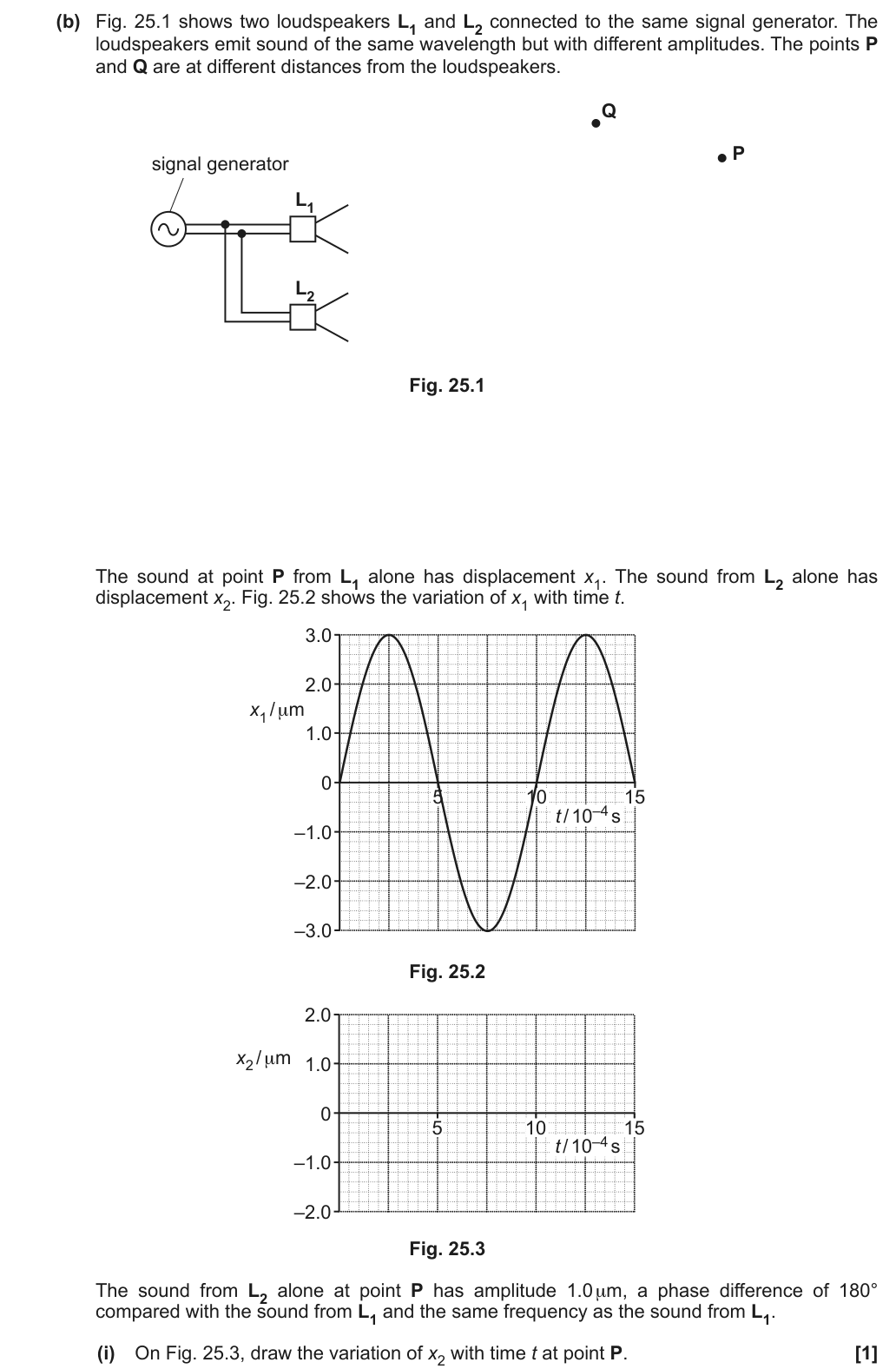
Question 25(b)(i) Question 25(b)(ii) Question 25(b)(iii) In (b)(i), the majority of the candidates drew the correct curve of amplitude 1.0 µm and a phase difference of 180°.
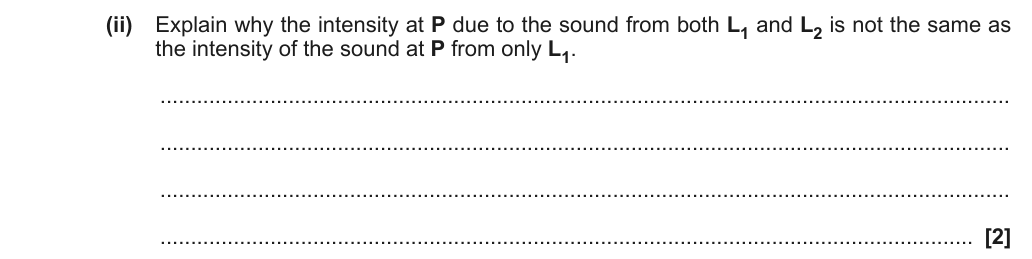
Notes from the mark scheme and report
Not displacement for amplitude
Skills: M0.3 Use ratios, fractions and percentages
June 2018 · AS Paper 1 · Q25(b)(iii)2 marksExplanationMedium
Earlier part of question 25 that this part uses
Mark scheme
Examiner's comment
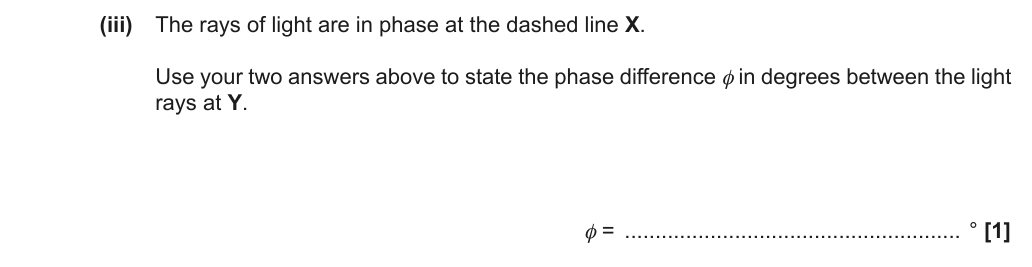
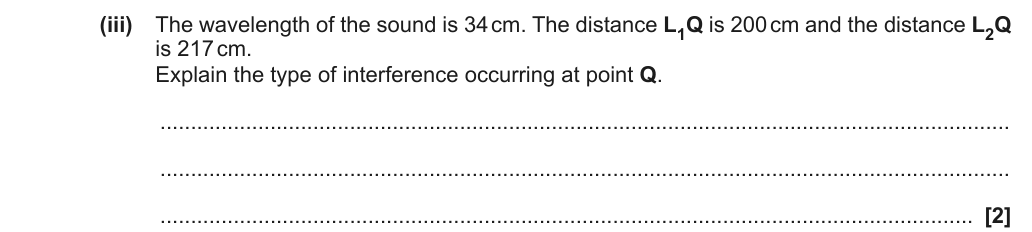
In (b)(i), the majority of the candidates drew the correct curve of amplitude 1.0 µm and a phase difference of 180°. Many candidates in (b)(ii) did not mention intensity at all in their description. Instead, the focus was on destructive interference without reference to their answer in (b)(i). A very small proportion of candidates did realise that the smaller amplitude of the signal at P meant the intensity was reduced because intensity is directly proportional to amplitude2. (b)(iii) was demanding. It was only the top-end candidates realising that the path difference of half a wavelength (17 cm) meant that the interference was destructive at point Q. Too many answers did not make any use of the information given in the question. Generic comments on interference prevented marks being gained in this question.
Notes from the mark scheme and report
Not (n + ½)λ
Not phase difference is 17 cm or half a wavelength
Skills: M0.3 Use ratios, fractions and percentages
June 2018 · AS Paper 2 · Q7(a)6 marks6-mark extended responseMedium
Mark scheme, with the levels and indicative content
Examiner's comment
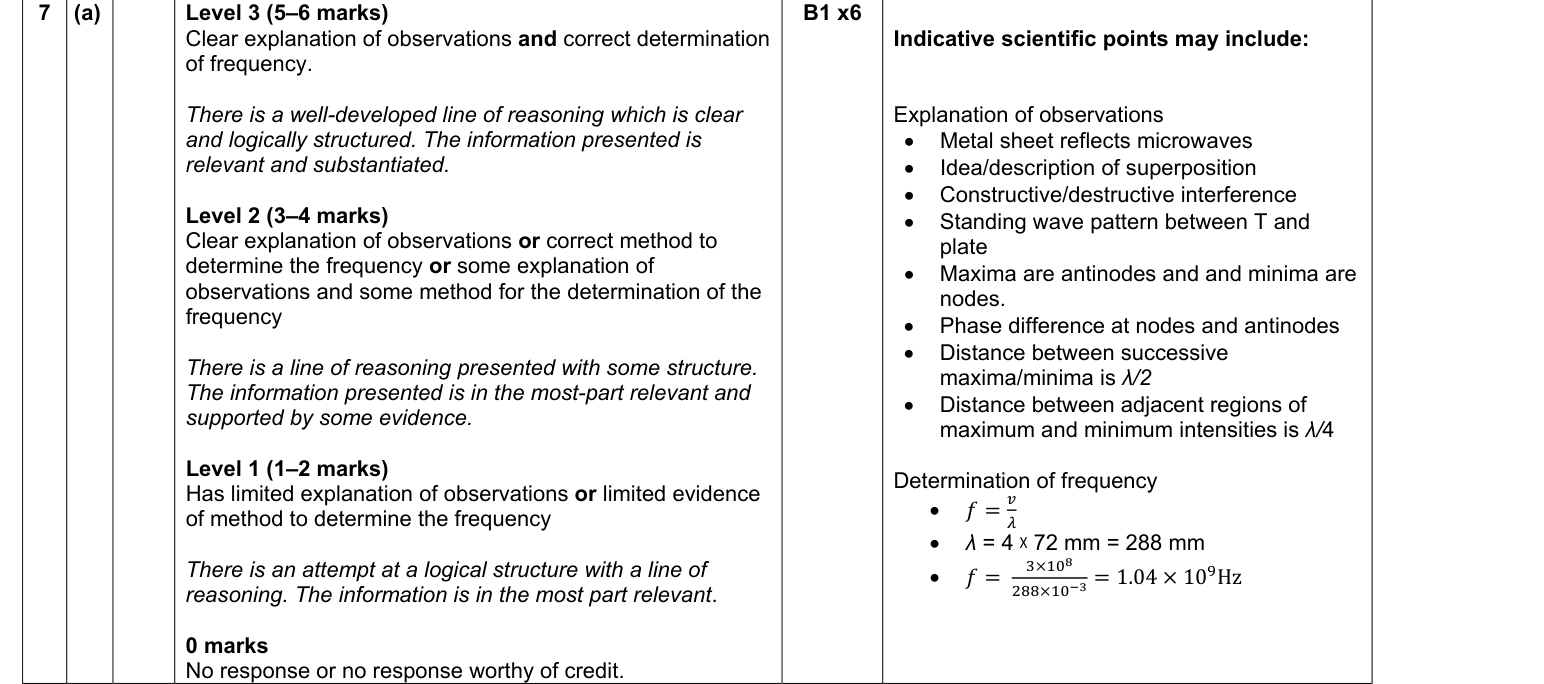
This was the second Level of Response question; a good range of marks was achieved. It required candidates to explain a standing wave pattern formed by microwaves. Many good candidates explained the pattern produced in terms of the metal sheet reflecting the microwaves, causing superposition with an explanation of nodes and antinodes. It was hoped that their understanding that the distance between successive maxima/minima is λ/2 would assist them in the calculation of the frequency. Good candidates wrote the equation and indicated that the wavelength of the microwaves was 0.288 m. Candidates should practise writing explanations to physics phenomenon. It is expected that the answers to these Level of Response questions will have a well-developed line of reasoning which is clear and logically structured. The information presented is relevant and substantiated. This is an example of a Level of Response answer. The question gives a practical demonstration which candidates may have seen during the AS course. The question gives candidates the opportunity to describe the observations using their knowledge and understanding as well as determining the frequency of the microwaves. Candidates should use appropriate physics terms. In this case the candidate begins by implying that the microwaves are reflected by the barrier to superimpose a resultant wave. The candidate states that maxima are antinodes and formed by constructive interference. The candidate then explains the formation of nodes in terms of destructive interference. Appropriate physics terms have been used. The candidate has then correctly realised that the distance between the node and an anti-node is a quarter of a wavelength. The candidate could have stated that the distance between successive nodes is half a wavelength, but this is implied in the previous statement. Finally, the candidate clearly shows the method of determining the wavelength by quoting the wave equation, rearranging the equation and substituting values. The candidate finishes the determination of the frequency by calculating the frequency and then rounding to an appropriate number of significant figures two or three) and gives a correct unit (Hz).
Notes from the mark scheme and report
adjacent maximum and minimum are λ/4 apart, so λ = 288 mm and f = 1.04 x 10^9 Hz
Skills: M2.2 Change the subject of an equation, including non-linear equations; PAG5 Investigating waves
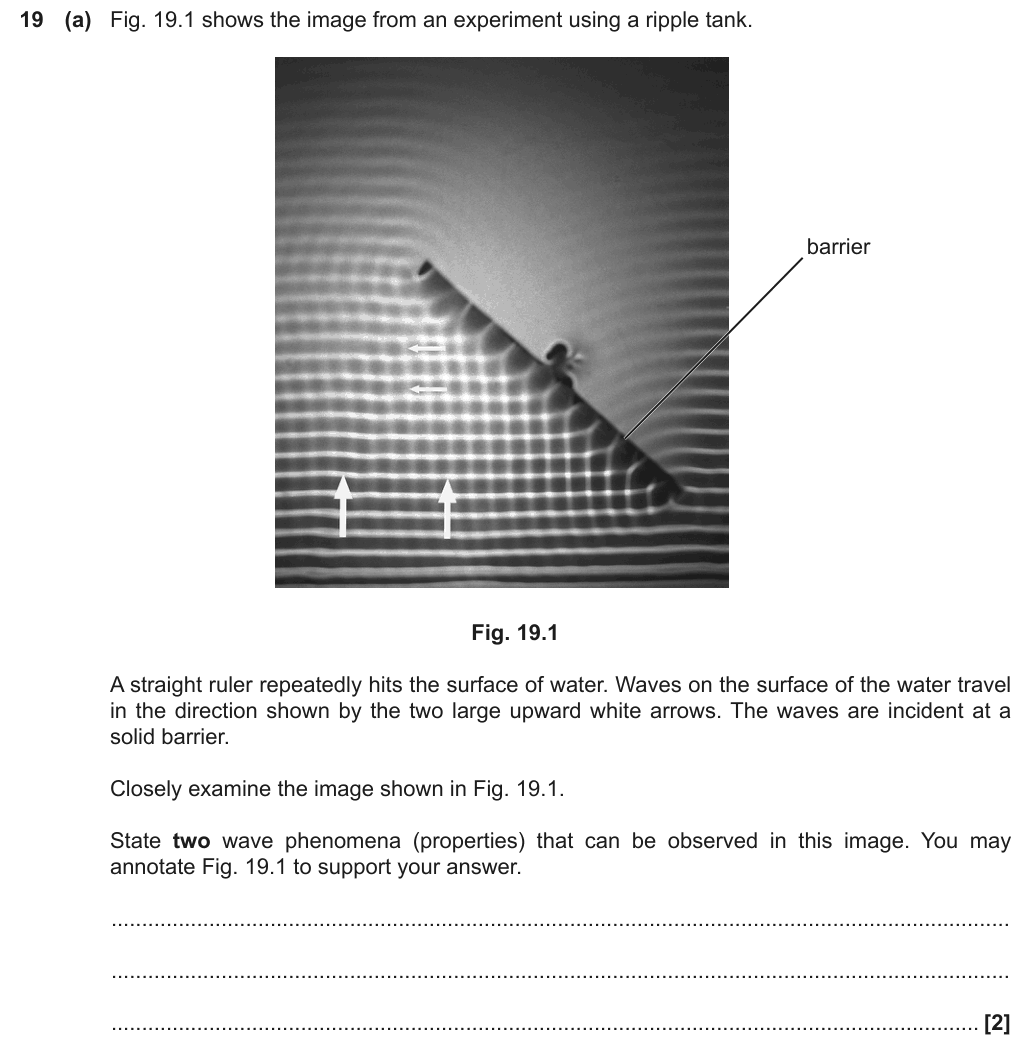
June 2018 · Paper 2 · Q19(a)2 marksShort answerEasy
Mark scheme
Examiner's comment
Most candidates scored two marks for identifying any two from diffraction, superposition (or interference) and reflection. A few answers were spoilt by mentioning either refraction or total internal reflection.
Notes from the mark scheme and report
any two from reflection, diffraction, interference / superposition
Skills: PAG5 Investigating waves
June 2018 · Paper 2 · Q19(b)3 marksExplanationMedium
Mark scheme
Examiner's comment
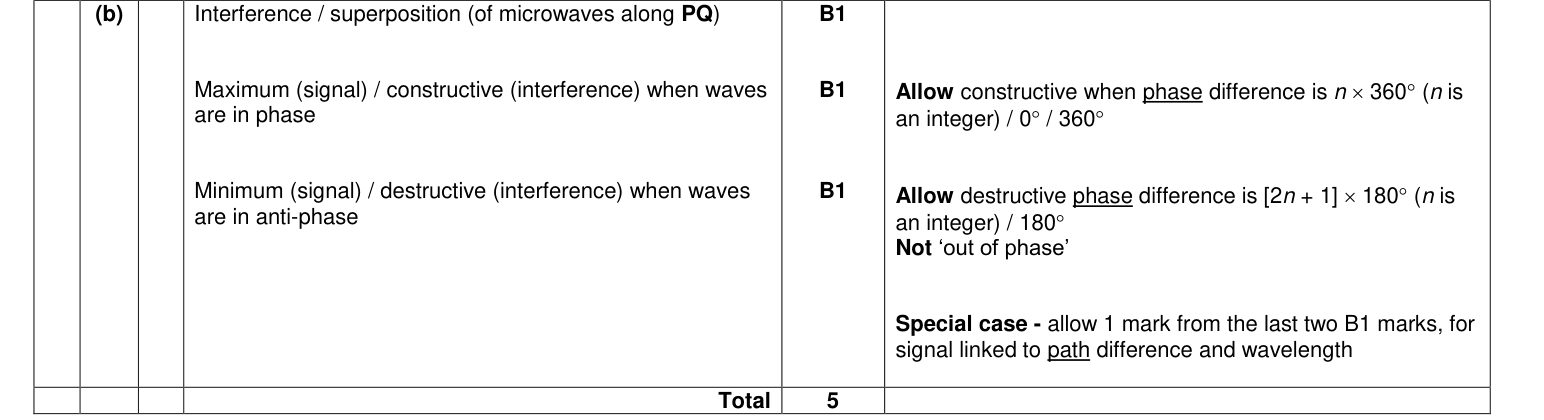
Many candidates made a start by defining coherence, this was not necessary. Most candidates realised that the maximum and minimum signals were linked to superposition, or interference, of the waves from A and B. The majority of the candidates equated coherence with ‘in phase’ and gave explanations in terms of path difference instead of phase difference. Constructive interference could not be linked to an integer number of wavelengths but it could be linked to the waves being in phase. Similarly, for destructive interference, the apt explanation was that the waves are in anti-phase at points of minimum signal. Specific values of phase differences were allowed. For anti-phase, ‘completely out of phase’ was allowed. Some of the common misconceptions were: • The maximum and minima signals were related to antinodes and nodes • The variation in the signal was due to Doppler effect
Notes from the mark scheme and report
NOT out of phase (must be antiphase / 180°)
path difference and wavelength argument scores max 1 of the last two marks
Skills: PAG5 Investigating waves
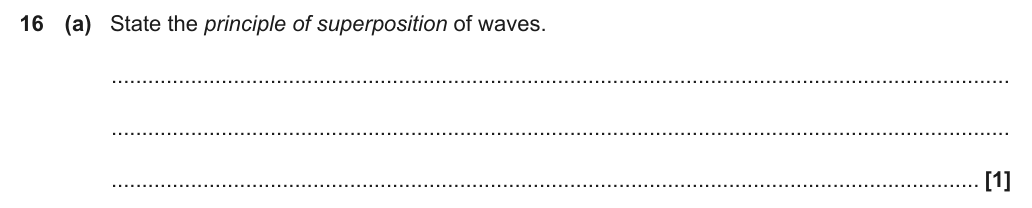
June 2017 · AS Paper 1 · Q25(b)(i)1 markExplanation
Mark scheme
Notes from the mark scheme and report
NOT combine / meet / interact for superposition
coherent needed
June 2017 · AS Paper 1 · Q25(b)(ii)2 marksExplanation
Earlier part of question 25 that this part uses
Mark scheme
Notes from the mark scheme and report
NOT λ/2 out of phase
NOT path difference is 1.5 cycles / periods / oscillations
Skills: M0.3 Use ratios, fractions and percentages
June 2017 · Paper 2 · Q51 markMultiple choice
Answer
A
Mark scheme
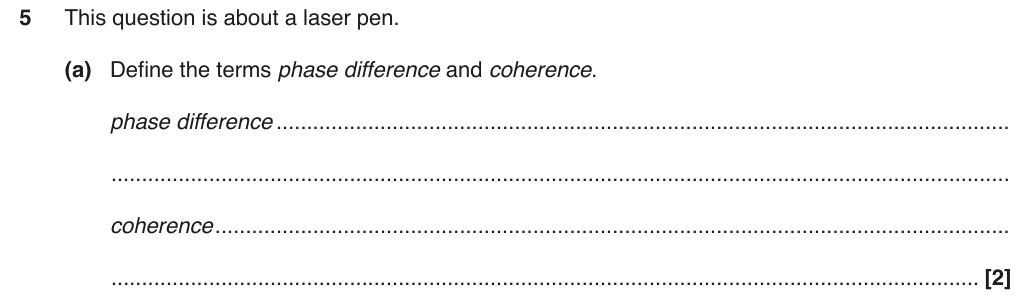
June 2017 · AS Paper 2 · Q5(a)2 marksShort answer
Mark scheme
Notes from the mark scheme and report
coherence: constant phase difference
NOT same / zero phase difference
ignore same frequency / wavelength
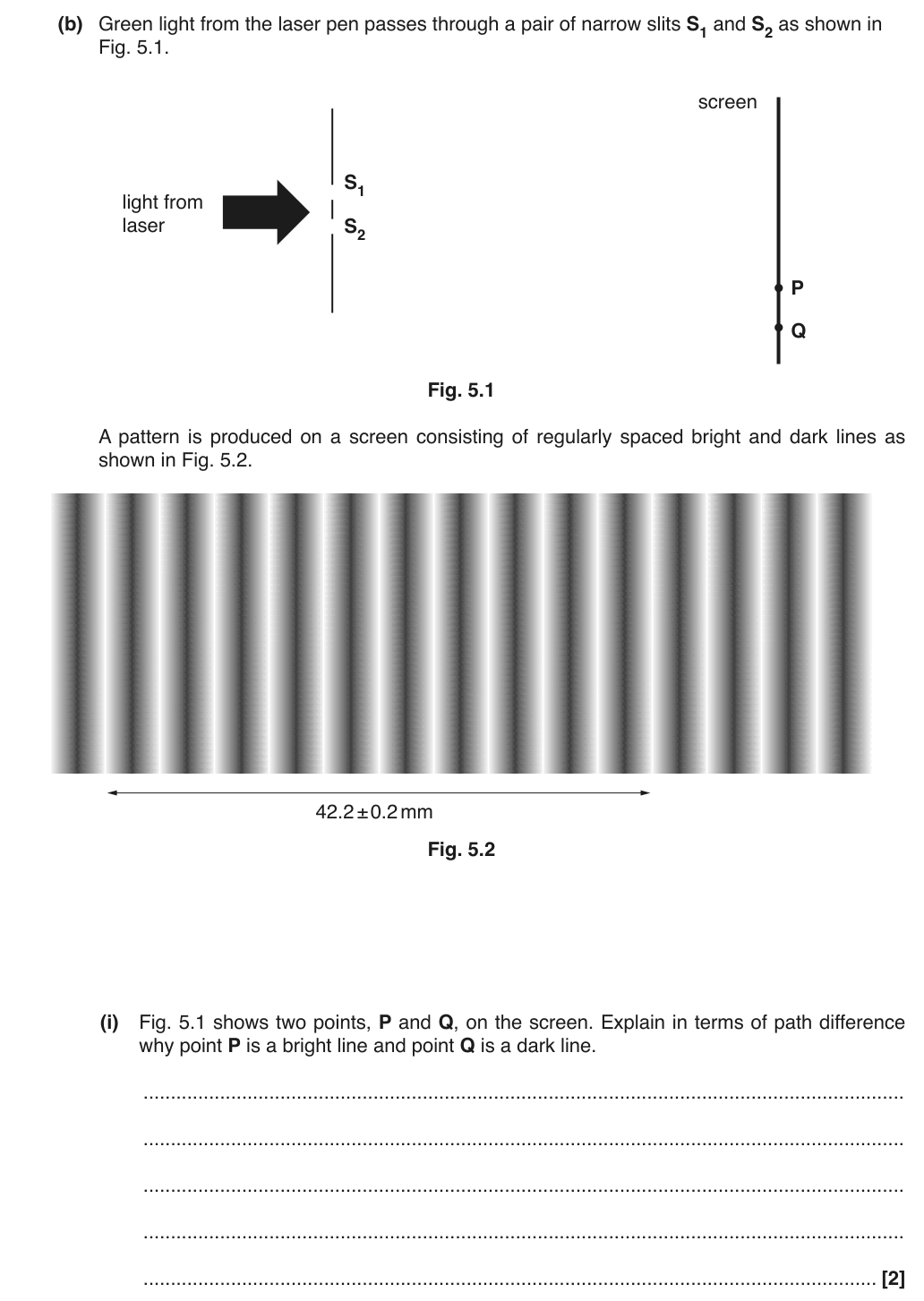
June 2017 · AS Paper 2 · Q5(b)(i)2 marksExplanation
Mark scheme
Notes from the mark scheme and report
NOT phase difference
NOT λ/2 for Q (odd number of half wavelengths)
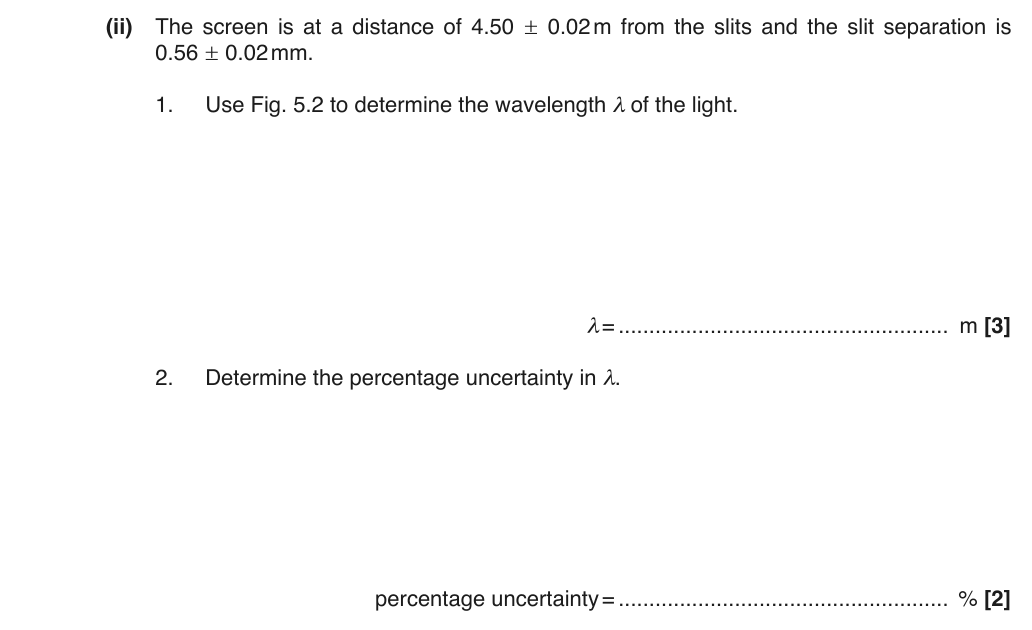
June 2017 · AS Paper 2 · Q5(b)(ii)5 marksCalculation
Earlier part of question 5 that this part uses
Mark scheme
Notes from the mark scheme and report
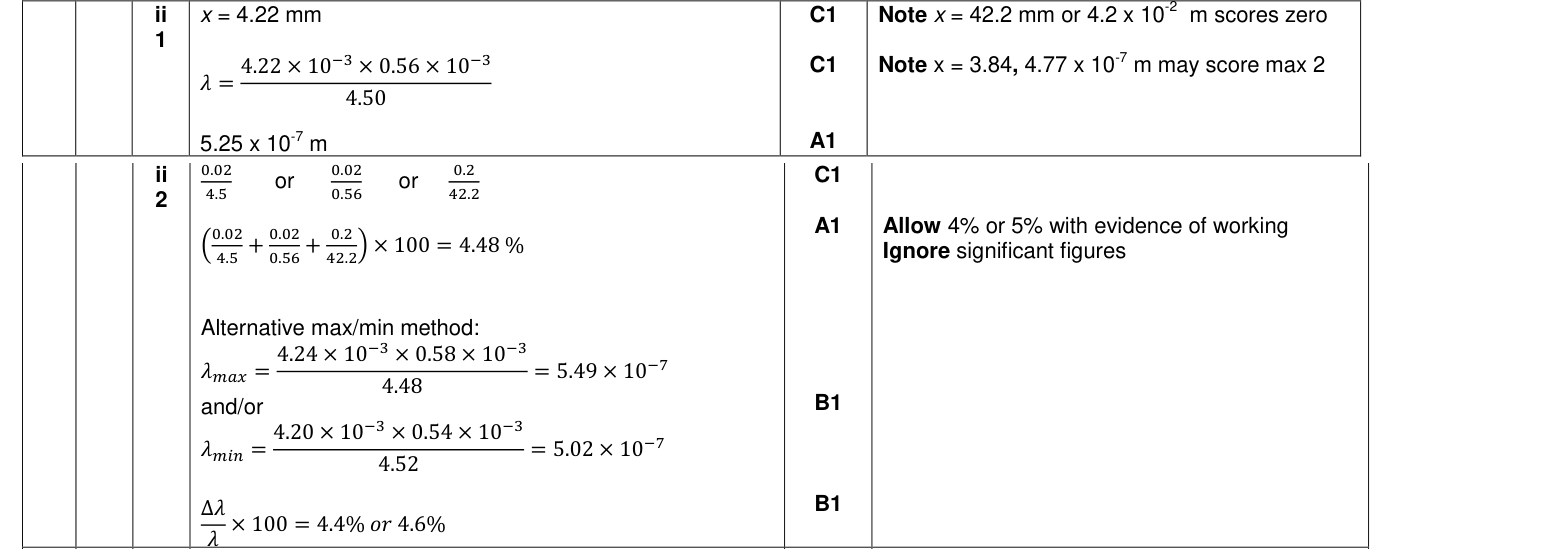
x = 42.2 mm scores zero (ten fringe spacings, x = 4.22 mm)
miscounted fringes max 2
allow 4% or 5% with working
Skills: M0.1 Recognise and make use of appropriate units in calculations; M1.5 Identify uncertainties in measurements and use simple techniques to determine uncertainty when data are combined; M2.3 Substitute numerical values into algebraic equations using appropriate units for physical quantities; PAG5 Investigating waves
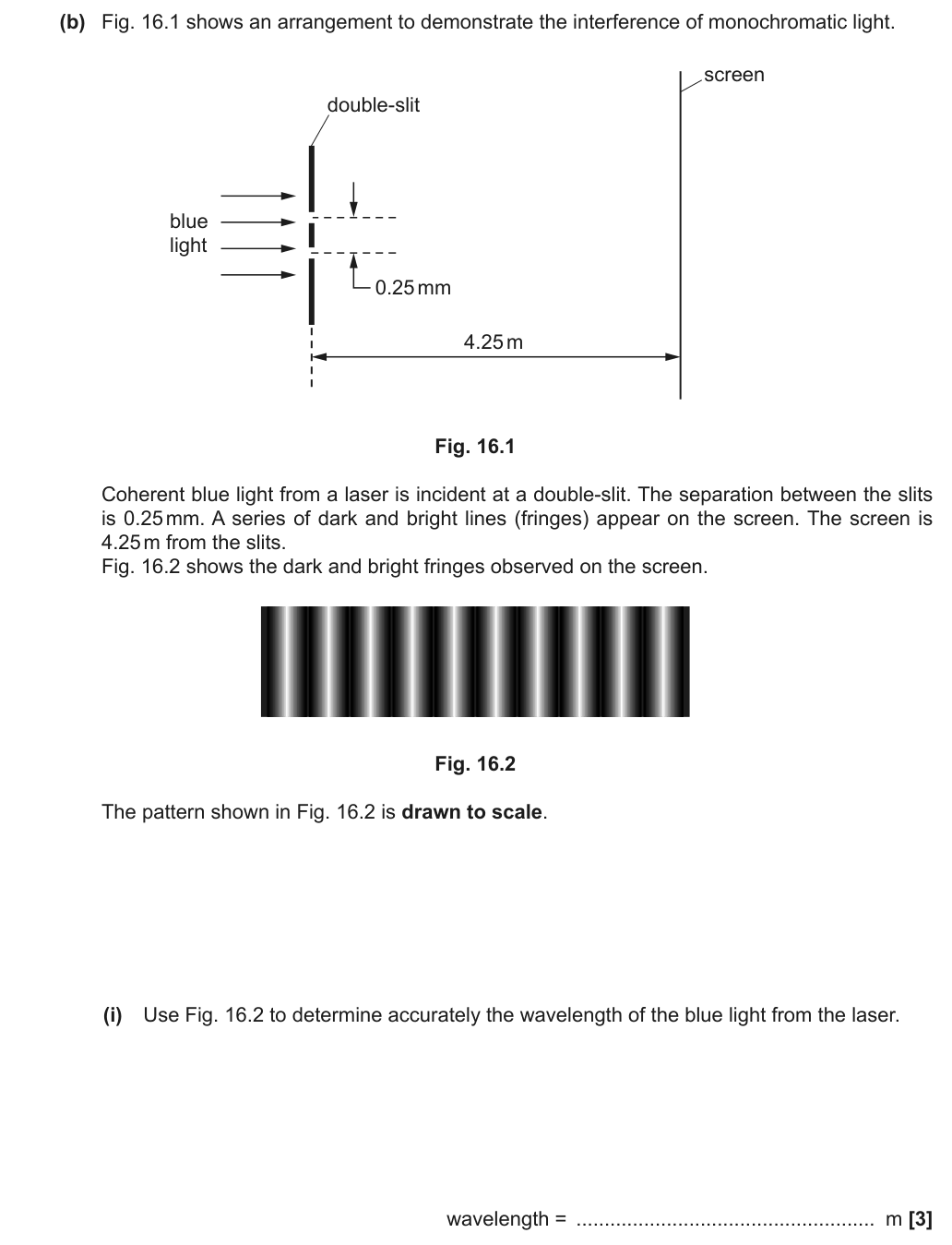
June 2017 · Paper 2 · Q16(a)1 markShort answer
Mark scheme
Notes from the mark scheme and report
NOT amplitude for displacement
June 2017 · Paper 2 · Q16(b)(i)3 marksCalculation
Mark scheme
Notes from the mark scheme and report
at least two fringe separations must be used to find x
x in range 7.0 to 9.0 mm measured on the printed figure
ecf for incorrect x
Skills: M0.1 Recognise and make use of appropriate units in calculations; M2.3 Substitute numerical values into algebraic equations using appropriate units for physical quantities; PAG5 Investigating waves
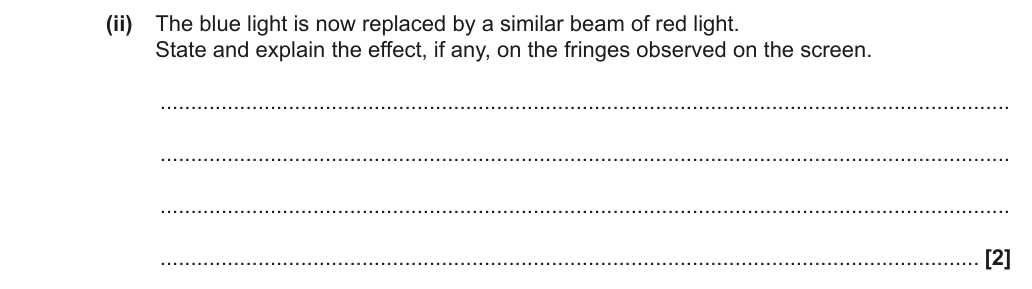
June 2017 · Paper 2 · Q16(b)(ii)2 marksExplanation
Earlier part of question 16 that this part uses
Mark scheme
Notes from the mark scheme and report
separation increases because red has longer wavelength
must justify with x proportional to wavelength (D and a constant)
Skills: M0.3 Use ratios, fractions and percentages
June 2017 · Paper 3 · Q5(b)6 marks6-mark extended response
Earlier part of question 5 that this part uses
Mark scheme, with the levels and indicative content
Notes from the mark scheme and report
(a) two-source interference: move between adjacent maxima = λ
(b) stationary wave: adjacent nodes = λ/2
measure over several λ to reduce percentage uncertainty
Skills: PAG5 Investigating waves
June 2016 · AS Paper 1 · Q26(b)(i)2 marksExplanation
Mark scheme
Notes from the mark scheme and report
Allow 'interference' for 'superposition'
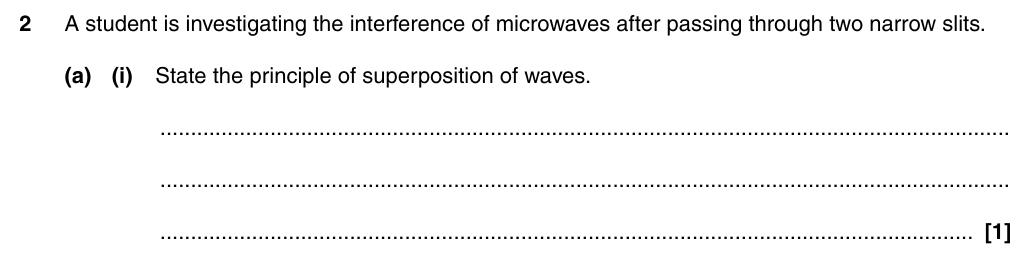
June 2016 · AS Paper 2 · Q2(a)(i)1 markShort answer
Mark scheme
Notes from the mark scheme and report
NOT amplitude
allow net / total for resultant
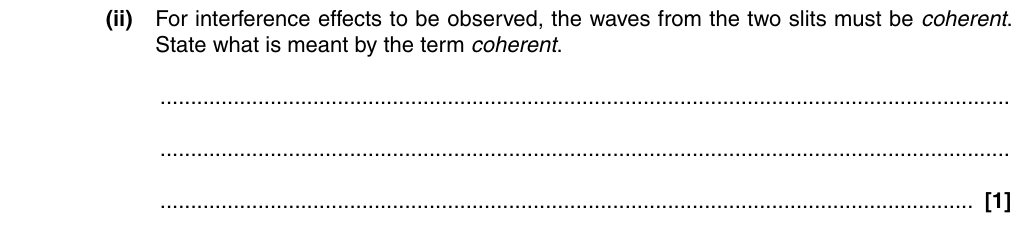
June 2016 · AS Paper 2 · Q2(a)(ii)1 markShort answer
Mark scheme
Notes from the mark scheme and report
NOT the same phase difference
NOT zero phase difference
ignore same frequency / wavelength
June 2016 · AS Paper 2 · Q2(b)2 marksCalculation
Mark scheme
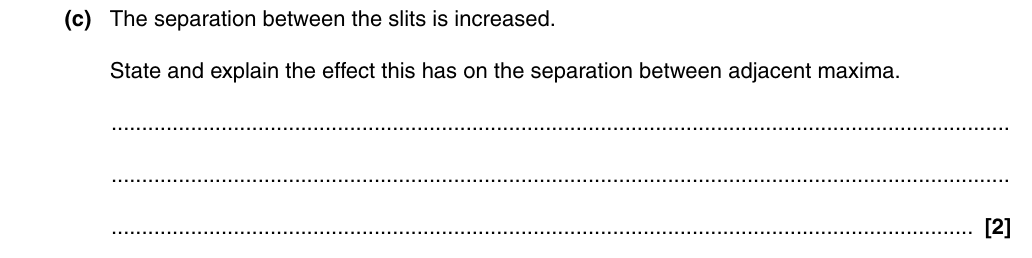
June 2016 · AS Paper 2 · Q2(c)2 marksExplanation
Earlier part of question 2 that this part uses
Mark scheme
Notes from the mark scheme and report
equation stated and D and wavelength constant for the M1
Skills: M0.3 Use ratios, fractions and percentages
Work with an OCR physics tutor
Dropping marks on calculations, practical questions or the six-mark level of response questions? Book a trial session with a specialist OCR physics tutor.