Answer
C
Mark scheme

Examiner's comment
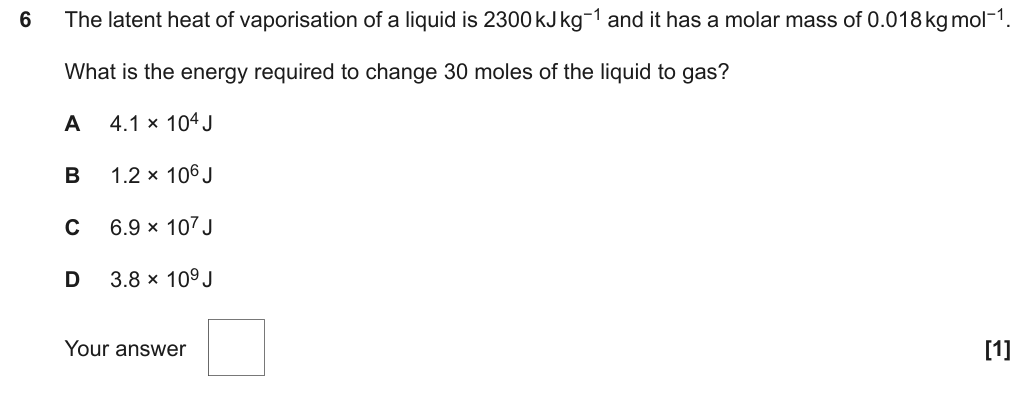
This question was answered successfully by the majority of candidates who rearranged and substituted accurately.
Notes and key-term cards for this topic are being written by our tutors. The past-paper questions below are ready now.
| Series | Paper | Q | What it asks |
|---|---|---|---|
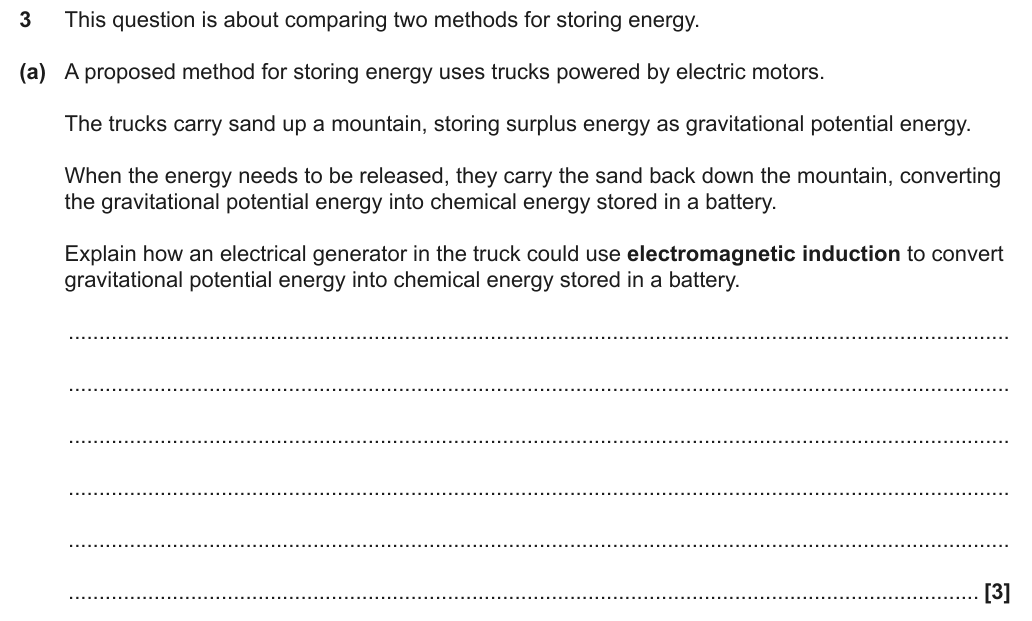
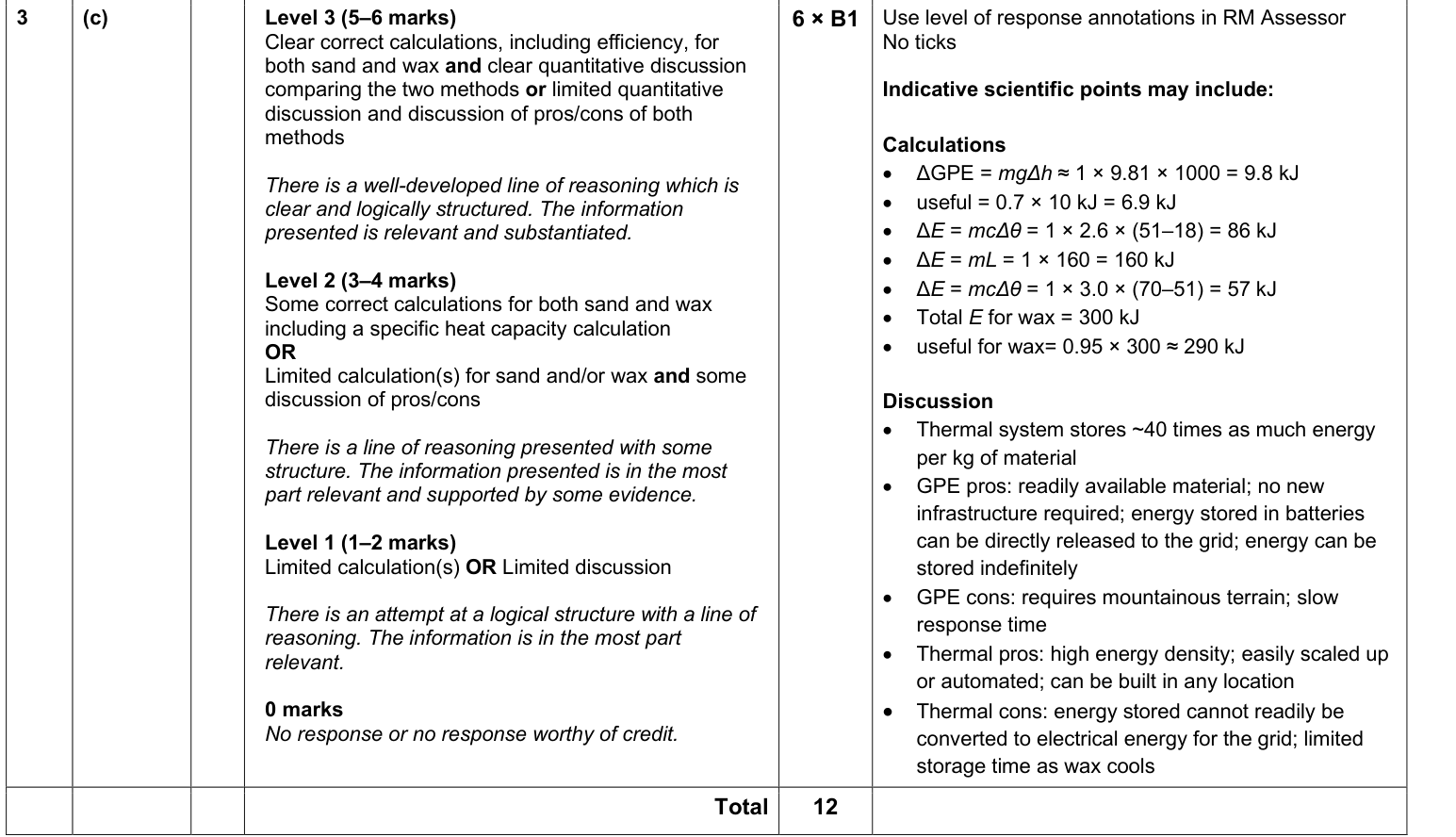
| June 2025 | Paper 3 | 3(c) | A gravitational potential energy storage system, as described in (a), is proposed as follows: |
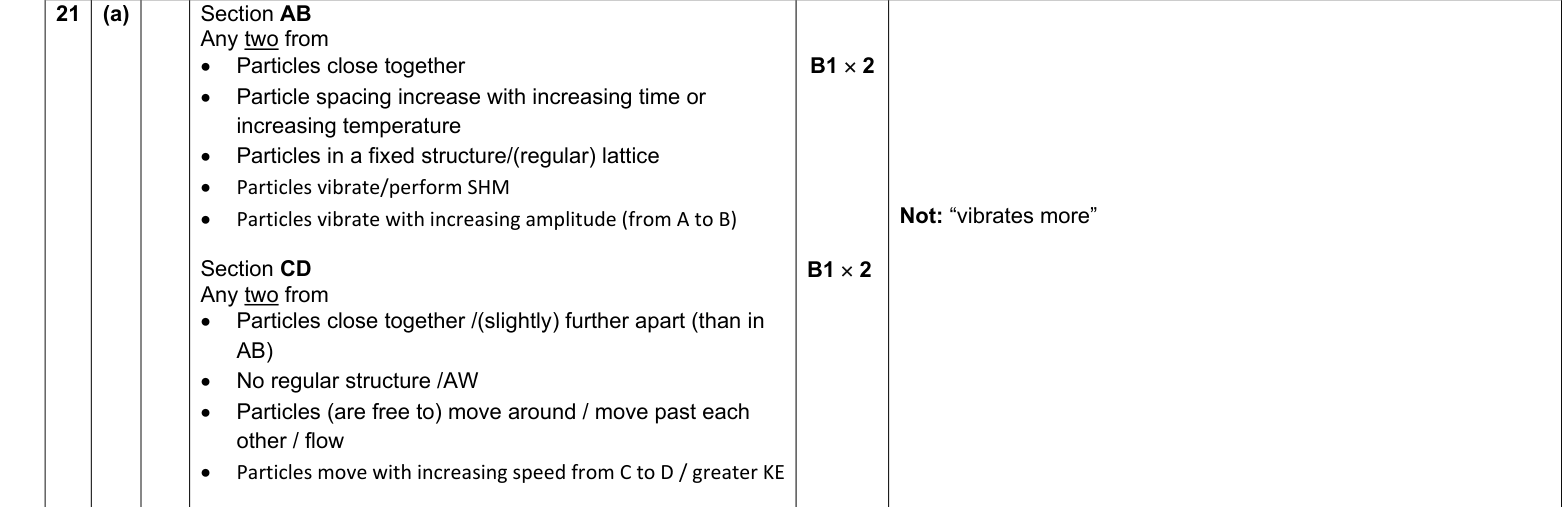
| November 2020 | Paper 1 | 17(b) | A student is carrying out an experiment to determine the specific latent heat of fusion Lf of ice. Describe and explain the shape of the two graphs in Fig. 17.3 and use them to determine the |
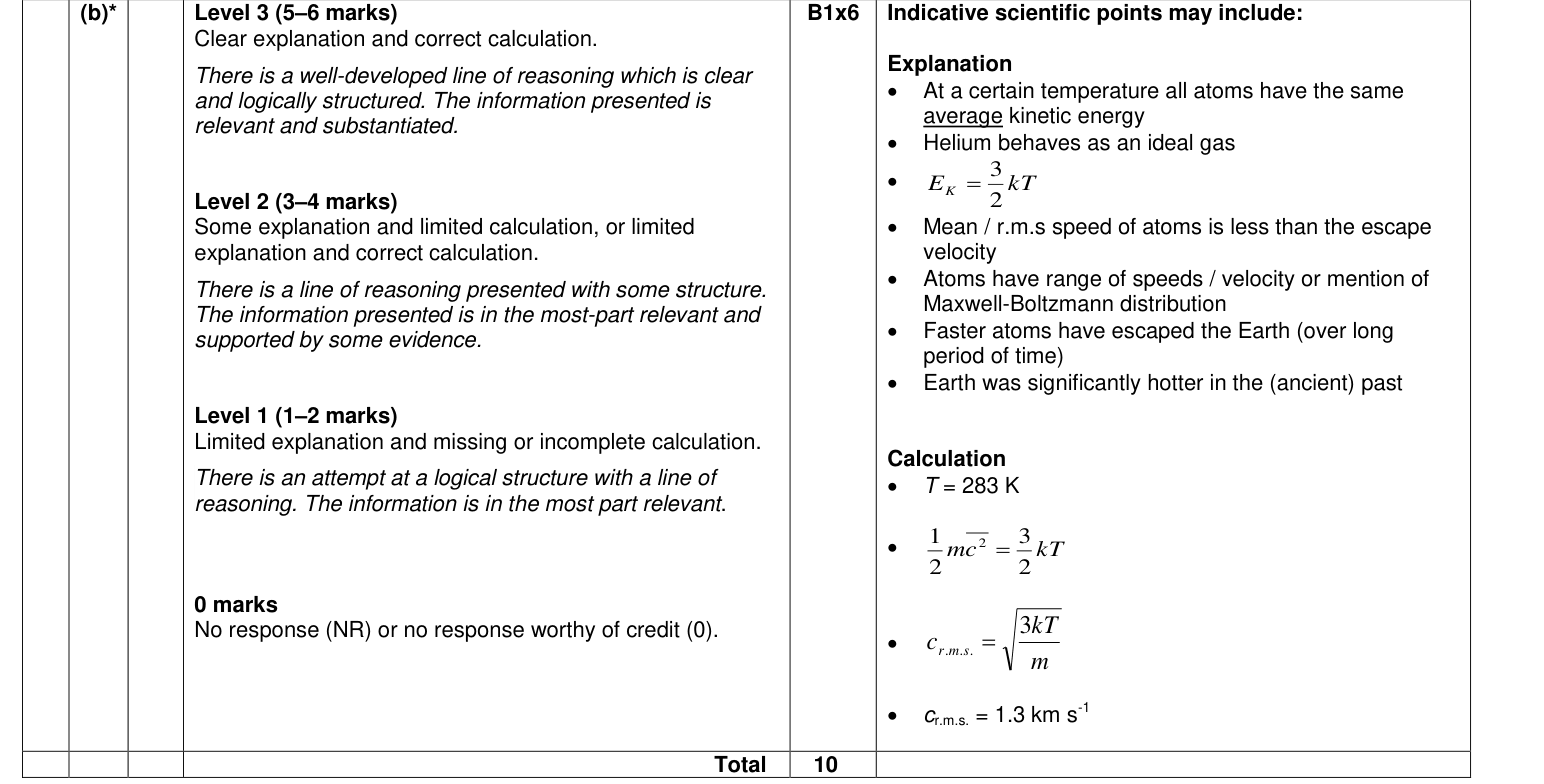
| June 2018 | Paper 1 | 22(b) | There is a lot of helium in the Universe. This was also true of the Earth when it was formed Use the kinetic theory of gases to explain why only small amounts of helium are found in the |
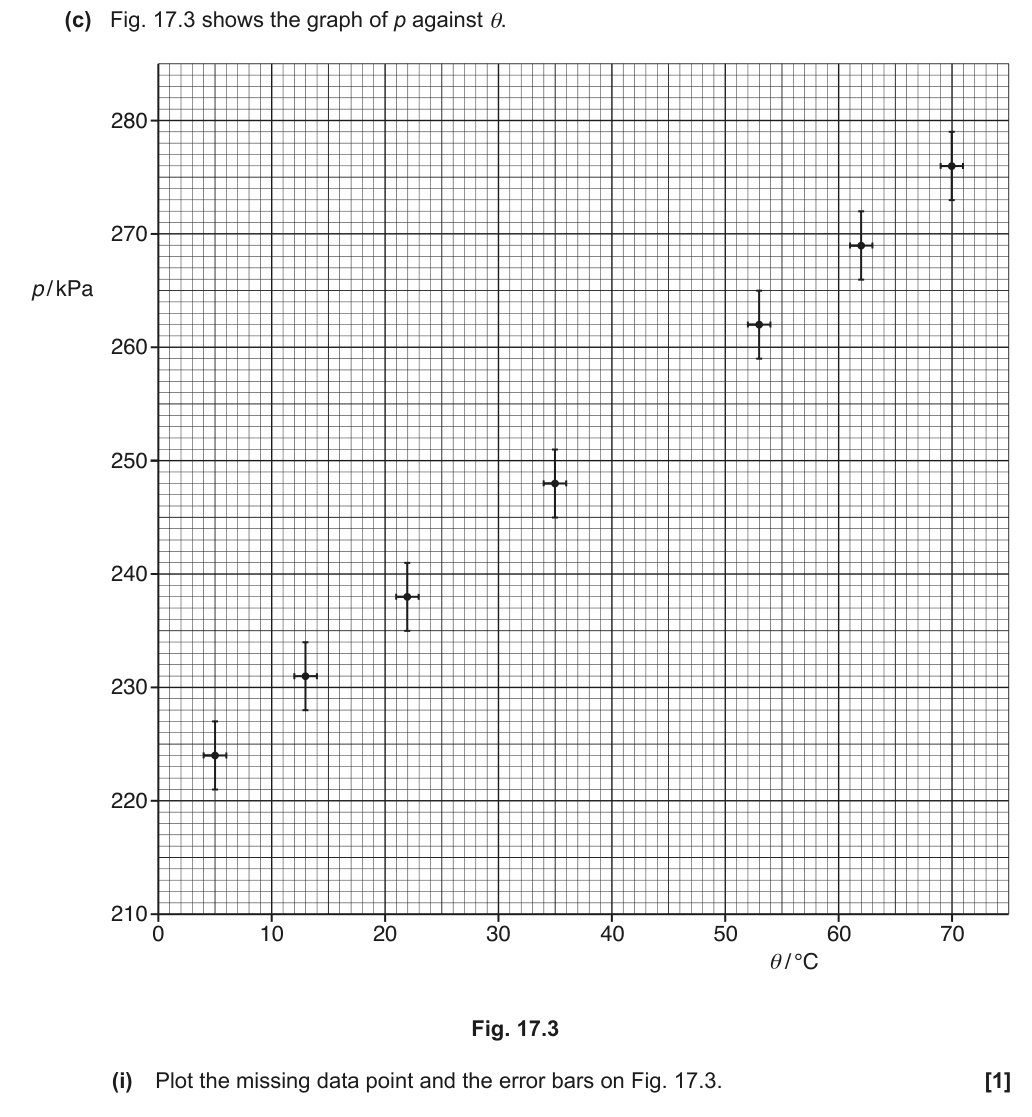
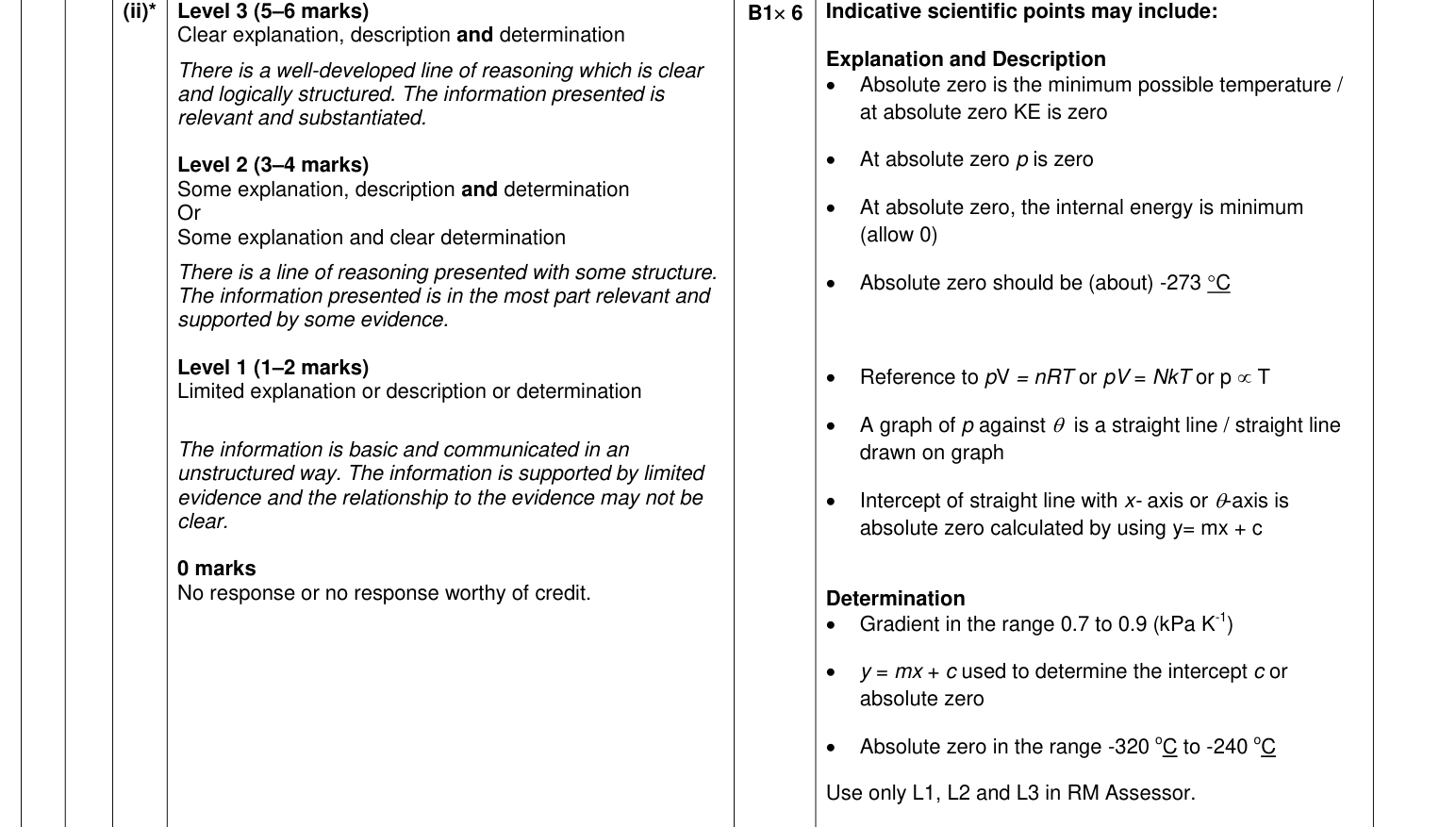
| June 2017 | Paper 1 | 17(c)(ii) | Explain what is meant by absolute zero. Describe how Fig. 17.3 can be used to determine Determine the value of absolute zero. You may assume that the gas behaves as an ideal |
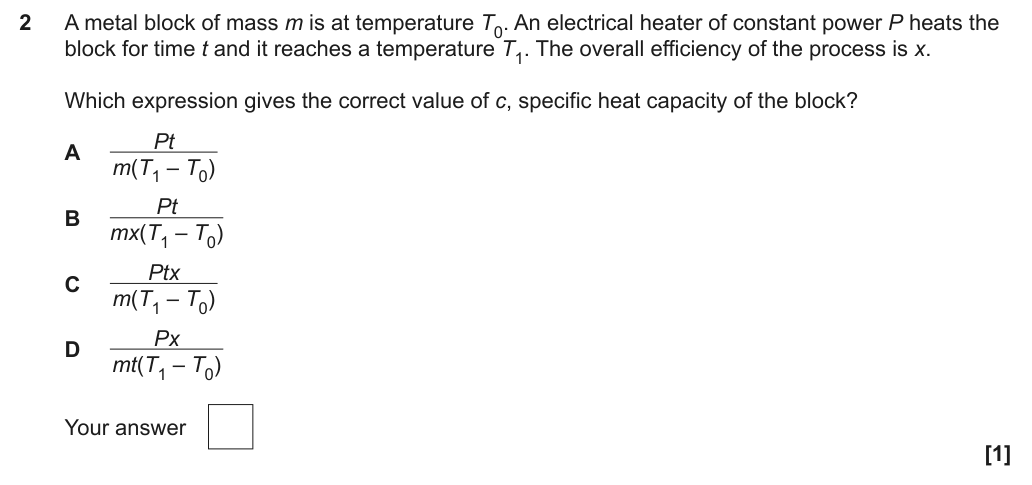
C
This question was answered successfully by the majority of candidates who rearranged and substituted accurately.
A
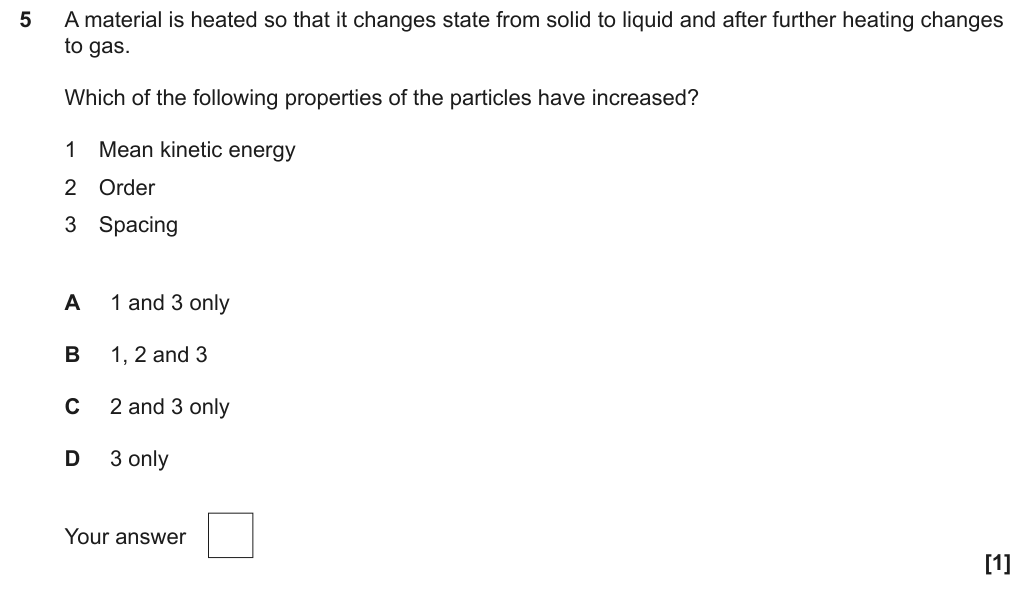
The heating process decreases the order, whereas the spacing and mean kinetic energy of the particles increases, giving the correct answer as A.
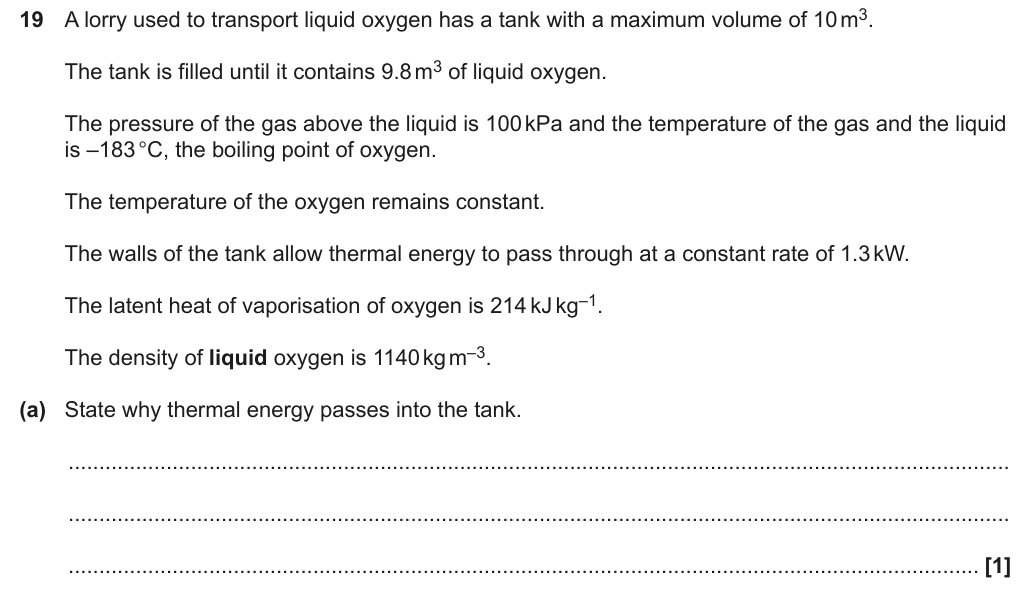
This was a straightforward question that most candidates got correct.
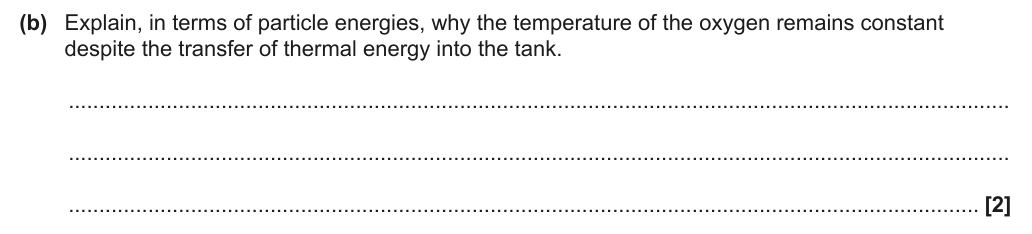
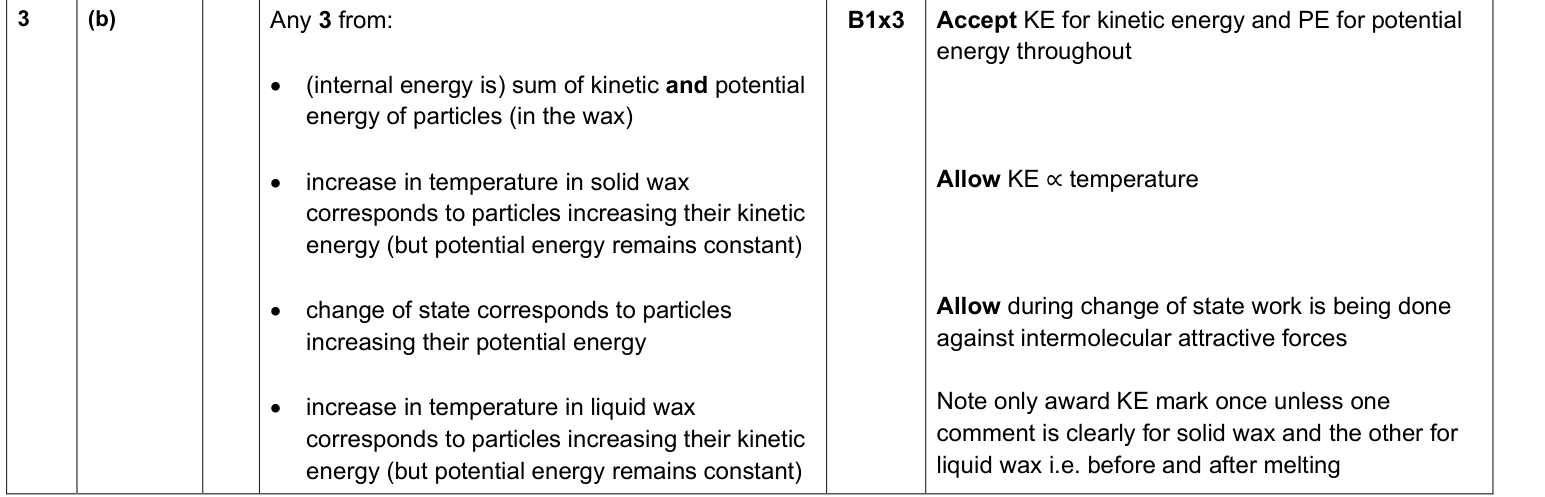
As in previous series, there is a requirement to be explicit about the change in potential energy of the particles (it increases) and about the kinetic energy remaining unchanged. Statements such as ‘KE doesn’t increase’ are consistently insufficient throughout.
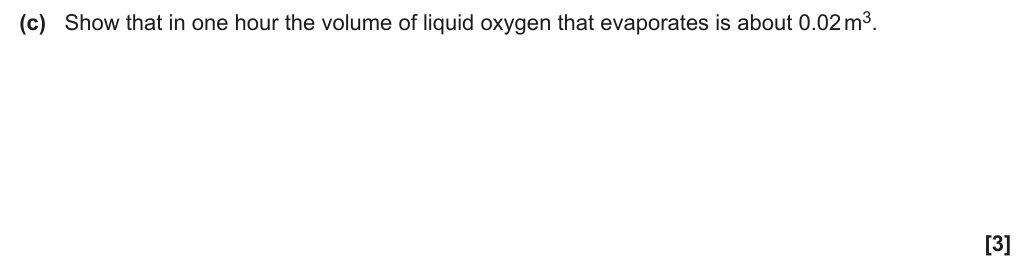
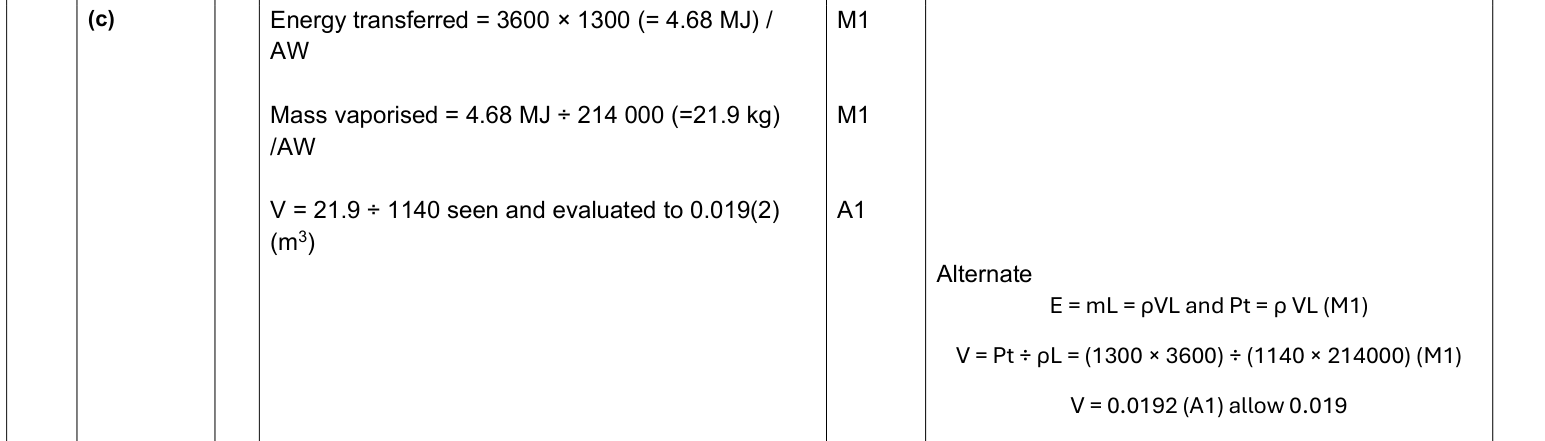
Successful candidates either rearranged all of the variables into a viable expression and then substituted into that expression or they performed each calculation separately. The common thread to all of the best answers was that the working was clear, with words often accompanying the calculations.
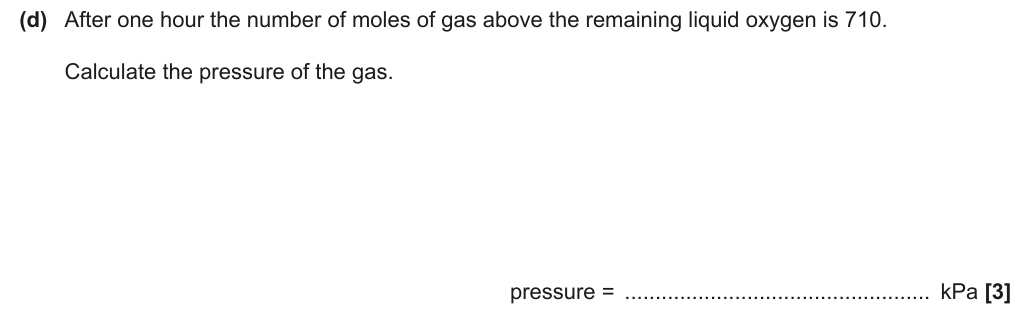
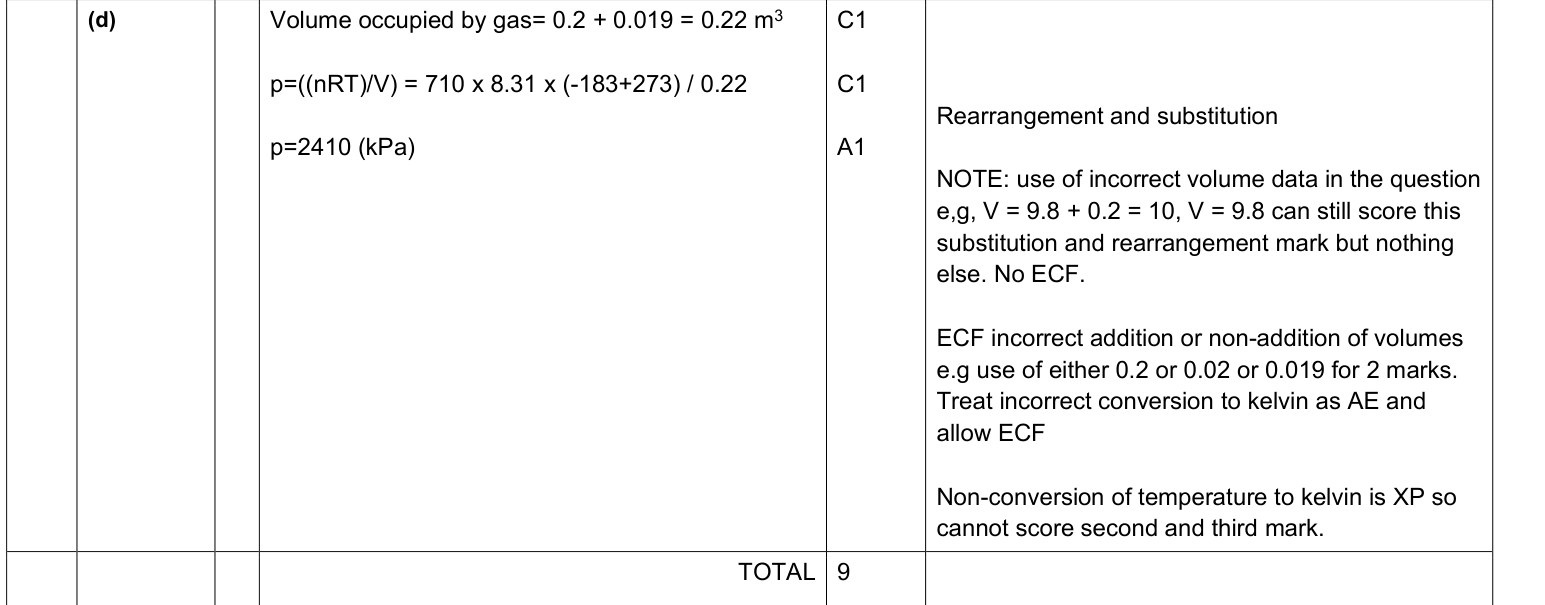
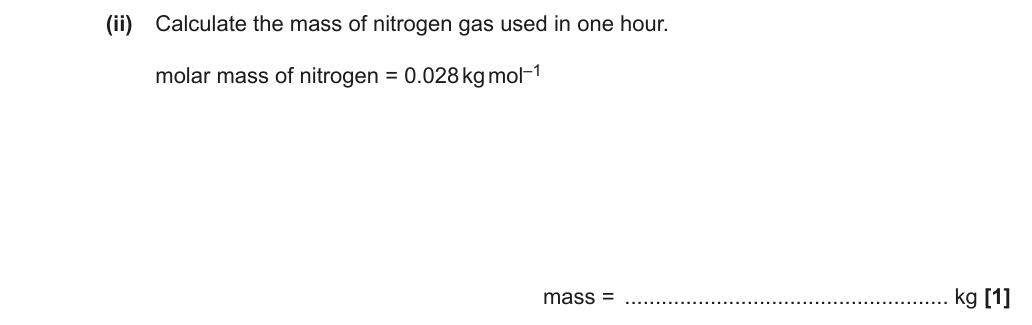
Candidates used a wide variety of volumes in the ideal gas equation to arrive at pressure values that were all broadly sensible. The correct volume was the original volume of the gas (0.2 m3) added to the volume of liquid oxygen that had evaporated after 1 hour (0.02 m3) giving a volume of 0.22 m3. There was still some credit available for volumes that were incorrect as shown in the mark scheme. Almost all candidates remembered to convert the temperature of the gas into kelvin and then rearrange the ideal gas equation correctly.
Skills: M0.1 Recognise and make use of appropriate units in calculations; M2.2 Change the subject of an equation, including non-linear equations; M2.3 Substitute numerical values into algebraic equations using appropriate units for physical quantities
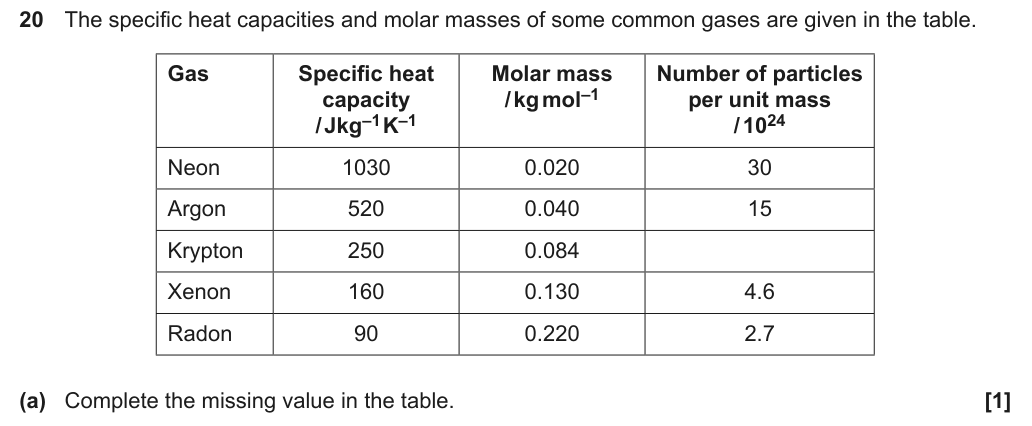
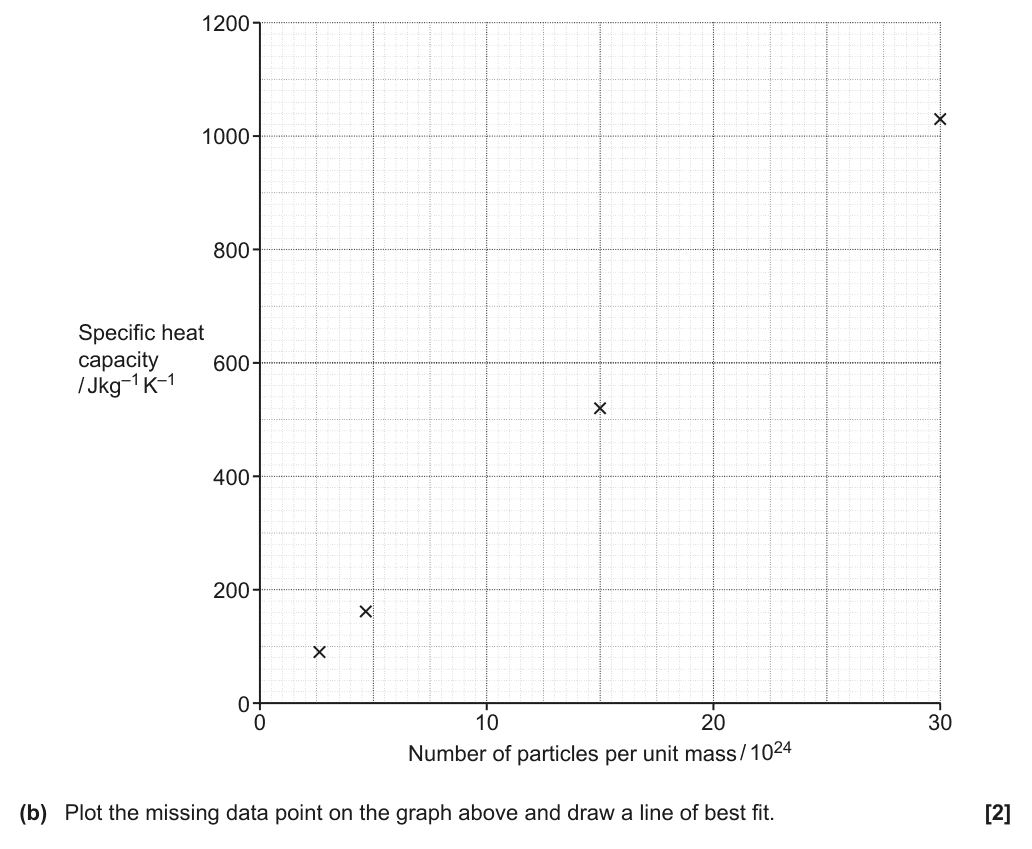
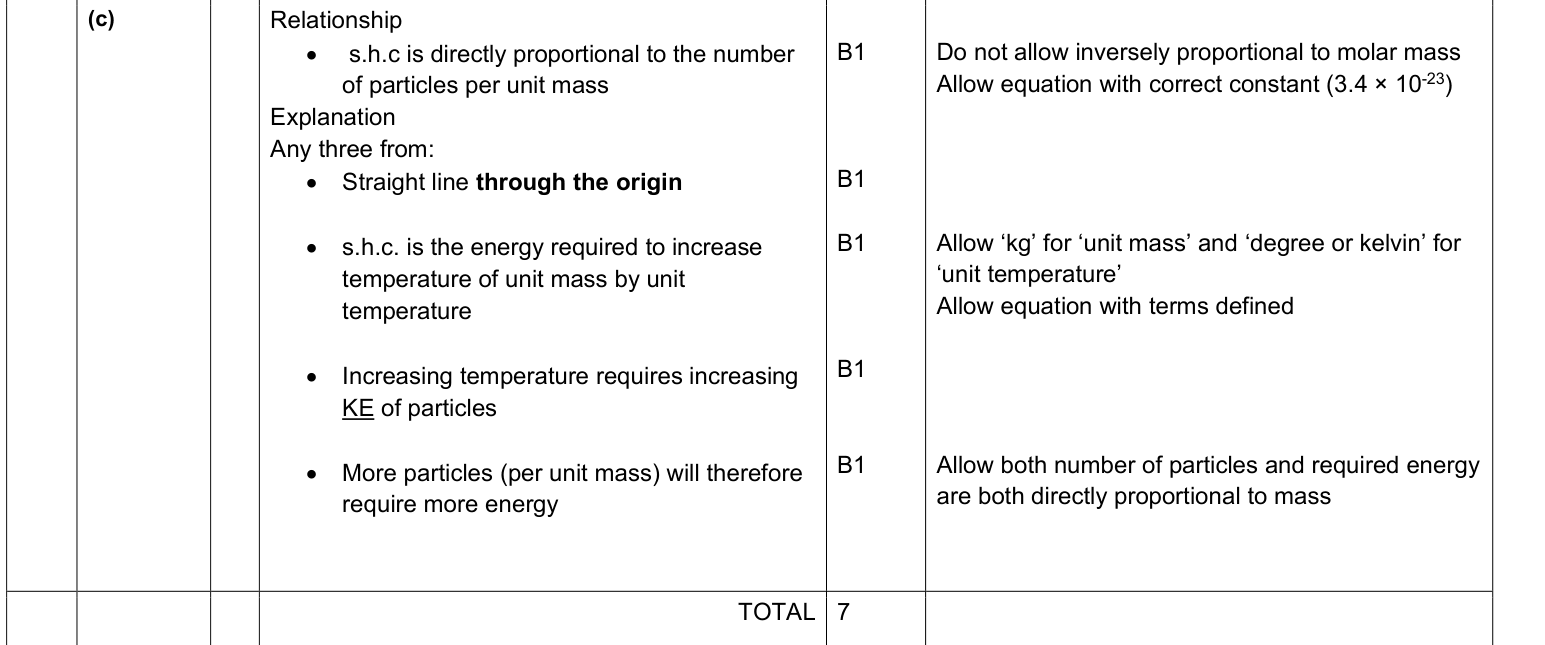
Candidates produced excellent answers here. Most scored two marks straight away by stating the directly proportional nature of the relationship and justifying that with a statement about a straight line of best fit passing through the origin. Although a small number of candidates incorrectly asserted that the mass of each of the particles would change depending on the number density, many correctly suggested that there was a link to the average kinetic energy of the particles.
Skills: M3.1 Translate information between graphical, numerical and algebraic forms; M3.3 Understand that y = mx + c represents a linear relationship
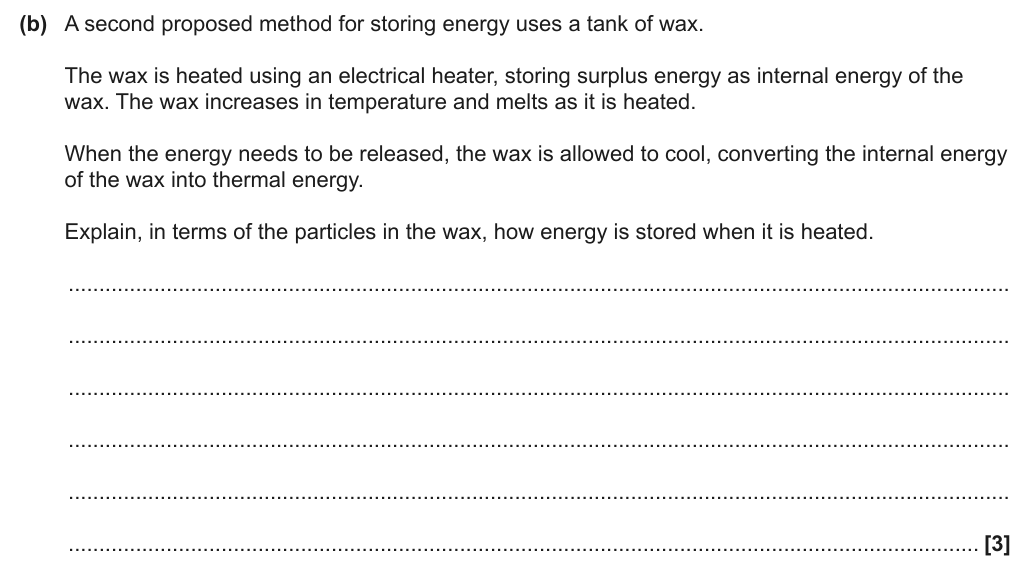
Candidates who gained marks clearly linked either the increase in temperature or change in state to the correct increase in energy. Many responses were vague, for example, simply discussing changes in energy while the wax was ‘being heated’. A significant minority incorrectly referenced changes in gravitational potential energy or the kinetic theory of gases. Candidates should be encouraged to structure responses so that they address each stage in a process sequentially so that they are less likely to write contradictory or generalised answers. This is an example of how candidates can logically structure answers to reference different stages in the process.
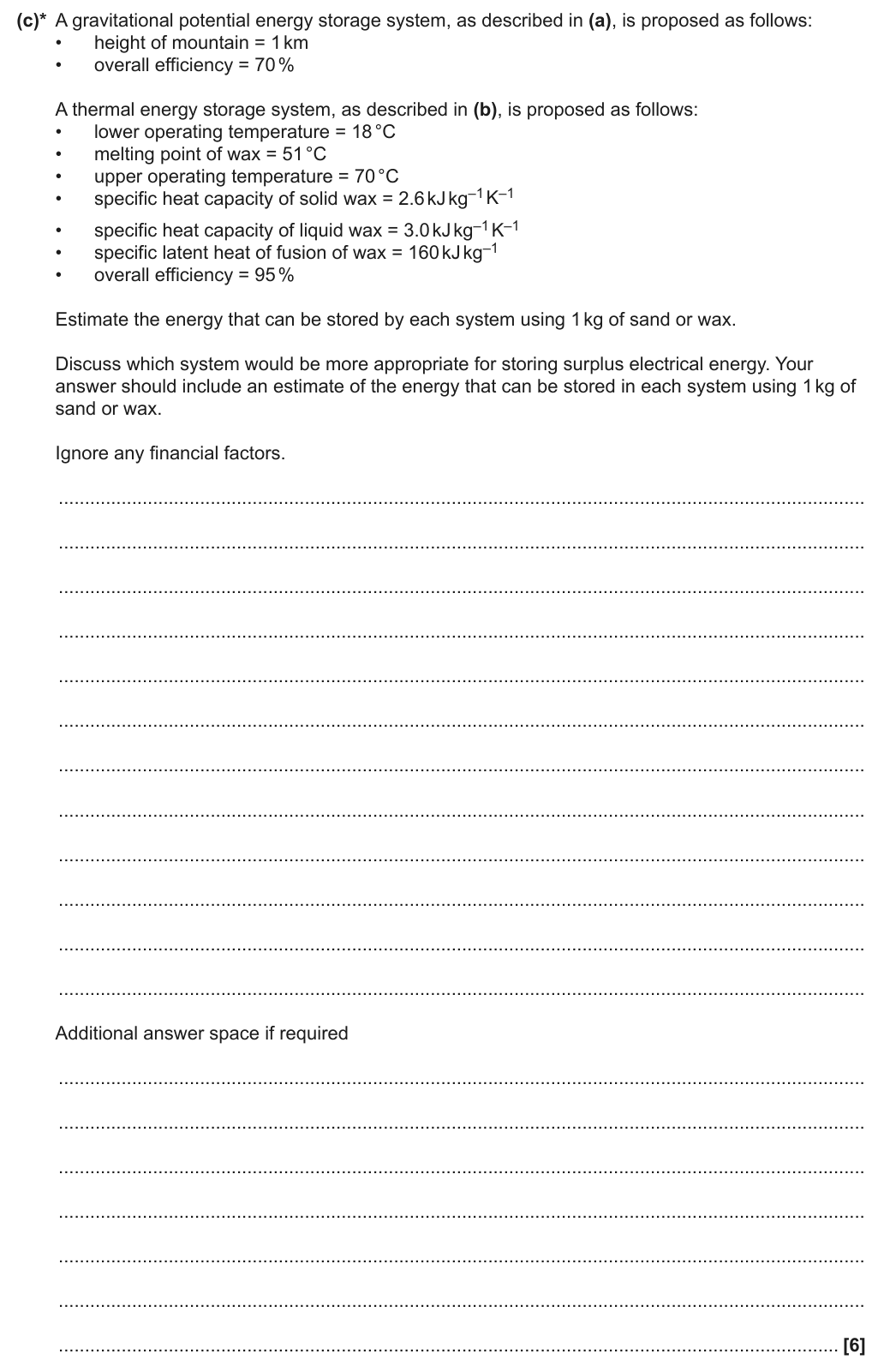
This Level of Response (LoR) question was well answered by the majority of candidates who were able to gain a high Level 2 or Level 3 mark. Characteristics of Level 3 responses were clearly set out calculations that indicated what was being calculated at each stage and a discussion which included a clear comparison of the total energy stored by wax and sand. A significant minority incorrectly calculated the total energy stored for wax despite correctly calculating for each stage of the process. The most common error in such responses was subtracting one of the values rather than adding all three. Other common mistakes were using incorrect powers of ten from prefixes, incorrect temperature changes or transposing data for different stages.
Skills: M0.1 Recognise and make use of appropriate units in calculations; M0.3 Use ratios, fractions and percentages; M2.3 Substitute numerical values into algebraic equations using appropriate units for physical quantities
This definition did not trouble the vast majority of candidates, although some did forget to mention about particles. References to potential energy were ignored.
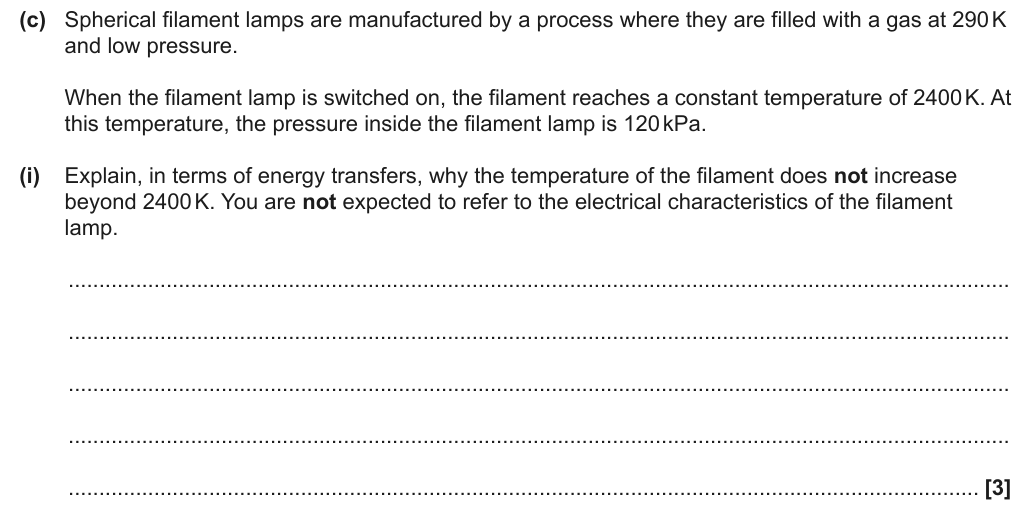
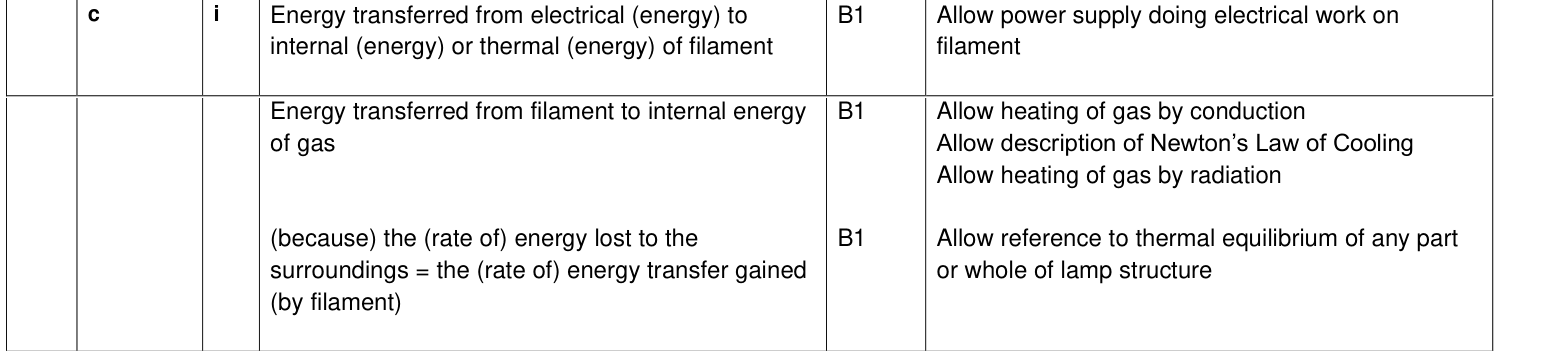
Again, the language required to suitably communicate the correct Physics was challenging here. Respones which described gas law physics had missed the point. The principal reasons why the temperature of the filament does not increase above any given temperature is that the energy in = energy out in a given time period. Further marks were for describing the energy process for supplying energy to the filament and the transfer of energy away from the filament. Quantities in Physics remain unchanged often because an idea of equilibrium or balancing two sides of an equation (see questions 16(a)(iii) or 16(b) for earlier examples). Explaining the physics of either side of that equation is often creditworthy.
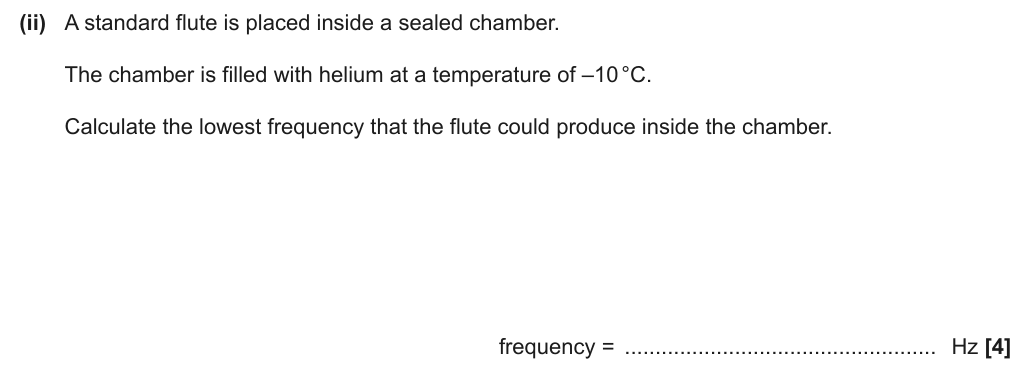
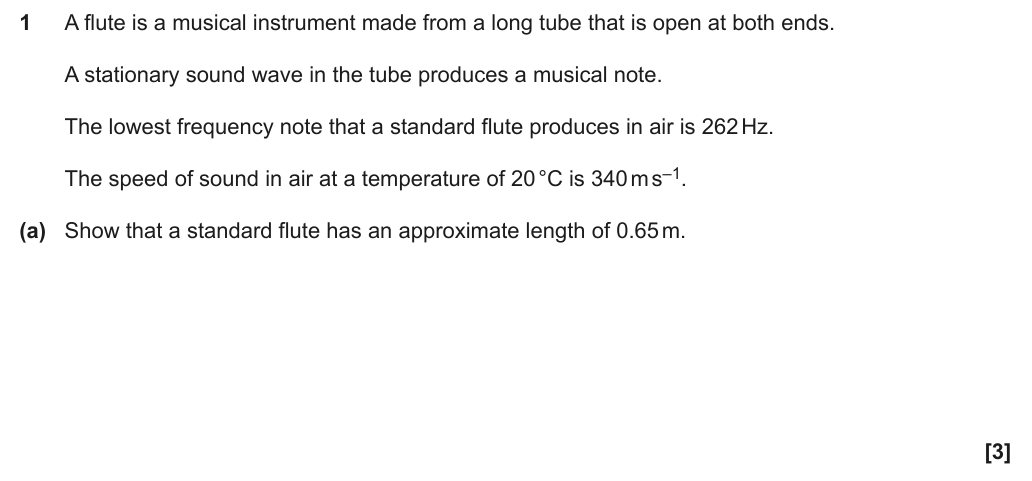
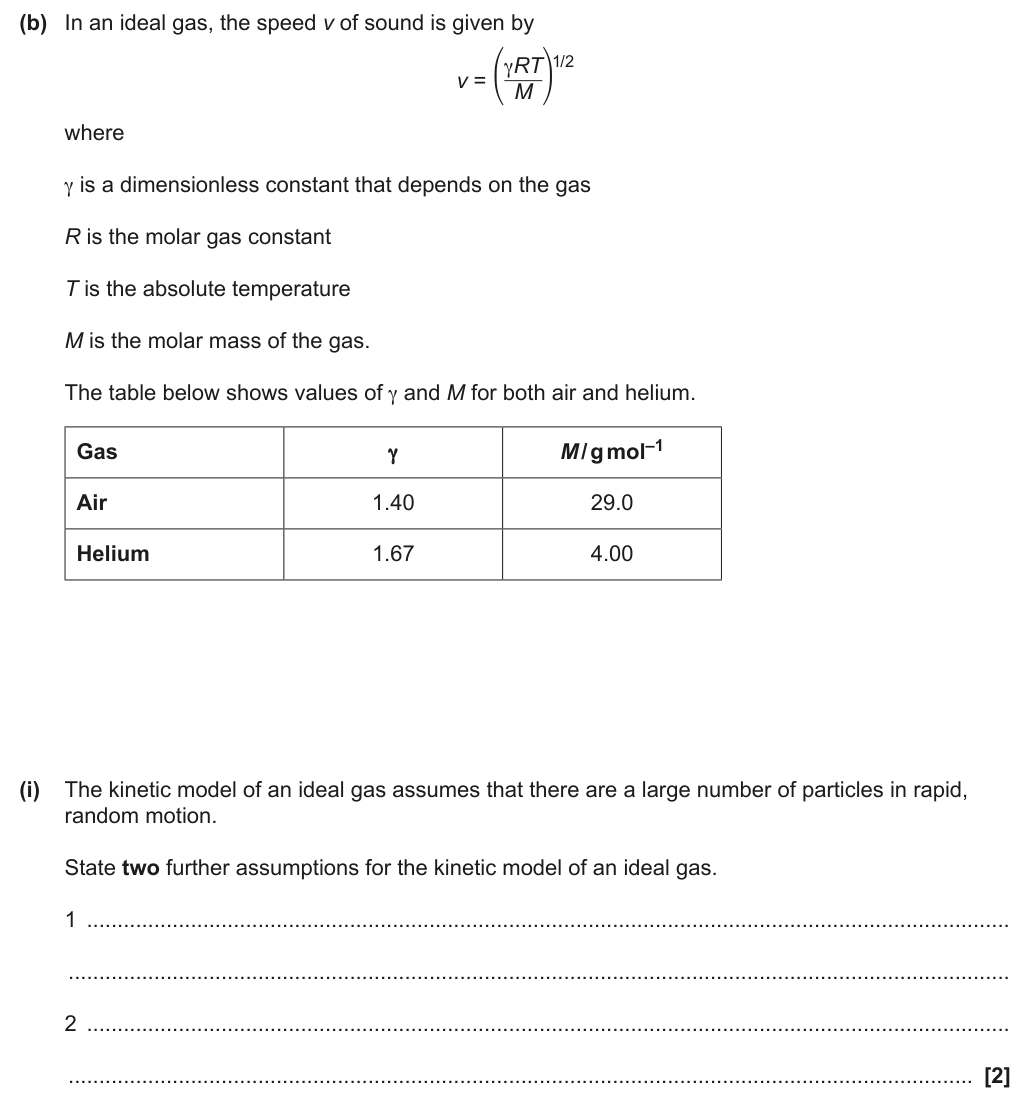
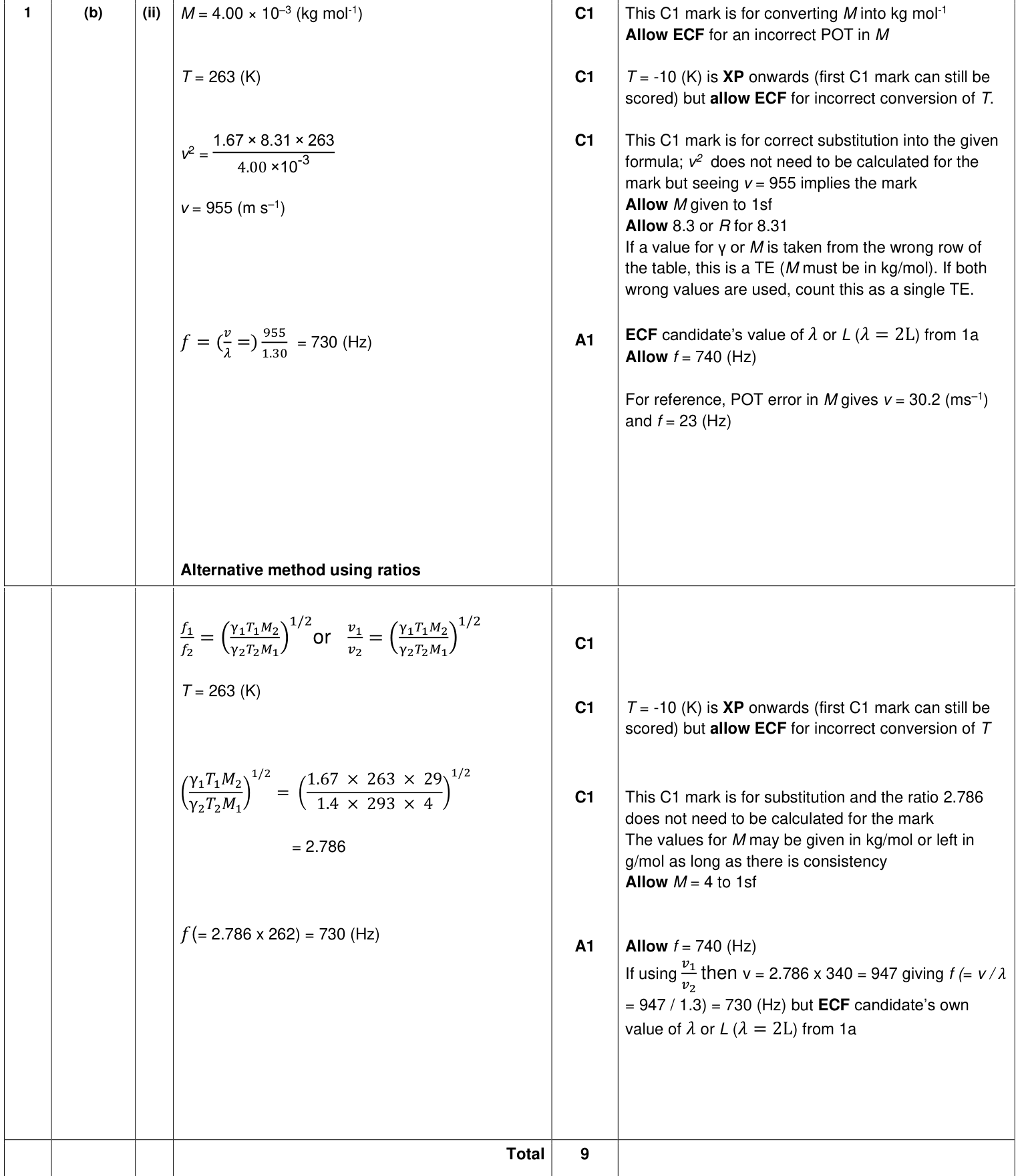
Common problems in 1 (b) (ii) • failing to convert the molar mass M into units of kg mol-1 • substituting the length of the flute (0.65m) instead of 1.30m for the wavelength. Question2(a) The initial step in this question is to use the equation I = Io𝑒−𝑡/𝑅𝐶 together with the fact that N resistors in series have a total resistance of NR and N capacitors in parallel have a total capacitance of NC.T is the time taken for Io to fall to Io/2 and so ½ = 𝑒−𝑇/𝑁𝑅.𝑁𝐶. Many candidates were able to navigate the tricky mathematics and were aware that ln(½) = -ln(2) It is important in this question to distinguish clearly between t, the general variable for time, and T, the time taken for Io to fall to Io/2. The statement ½ = 𝑒−𝑡/𝑁𝑅.𝑁𝐶 is not generally true; it is only true when t = T.
Skills: M0.1 Recognise and make use of appropriate units in calculations; M0.3 Use ratios, fractions and percentages; M0.5 Use calculators to find and use power, exponential and logarithmic functions; M2.3 Substitute numerical values into algebraic equations using appropriate units for physical quantities
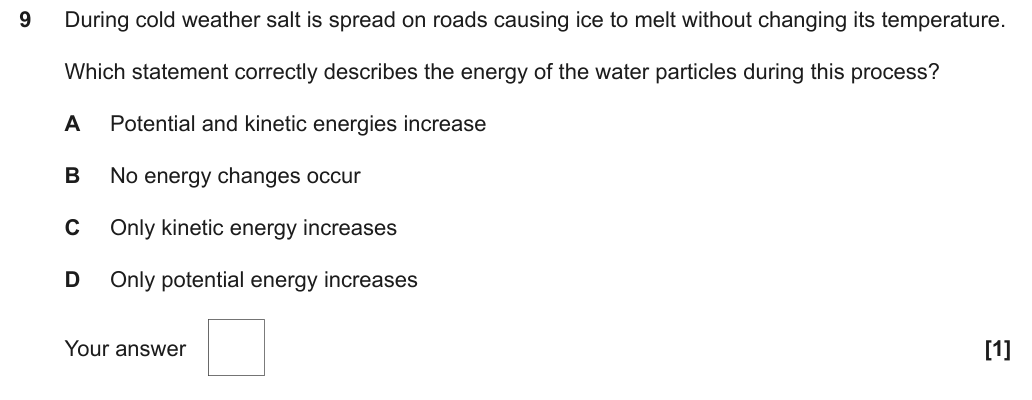
D
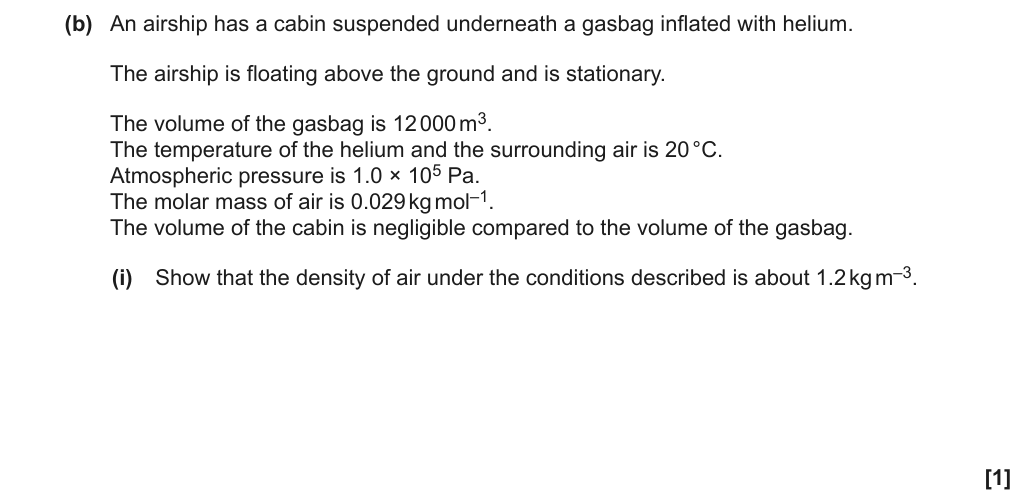
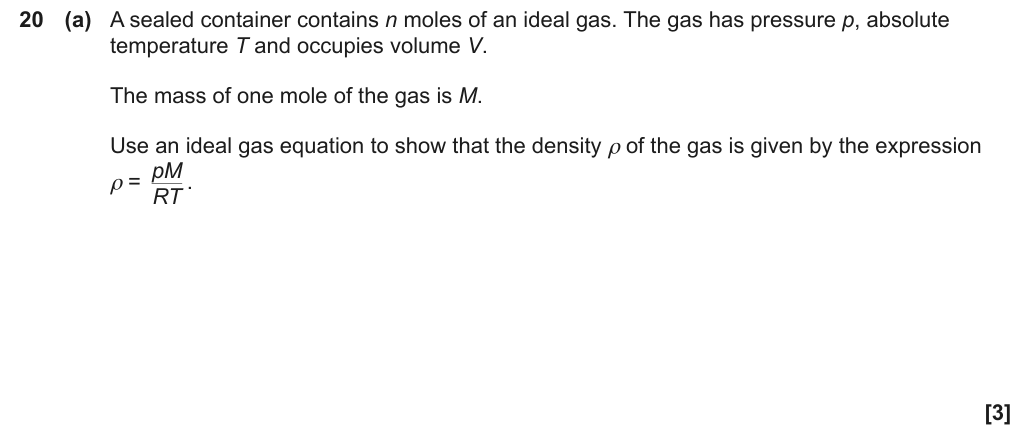
The vast majority of candidates correctly substituted values into the given formula, also remembering to convert the temperature from celsius into kelvin. Good practice for “show that” questions is to calculate the quantity required to at least one more significant figure in the question. In this example, that would mean evaluating the density to 1.19 kg m–3. In part (b) (ii), finding the weight was a matter of finding the mass and then finding the weight, all by using data in the question. Part (b) (iii) required understanding of Archimedes’ principle, rather than merely referring to it. Most candidates successfully related the principle to this context, writing about the upthrust being equal to the weight of fluid or air displaced by the gasbag. This is always true, regardless of the other forces that may be in play. References to displacement of water at this point were rejected. Fewer candidates completed the explanation by mentioning that the upthrust must be equal to the weight of the gas bag because we know that the gas bag is in equilibrium. Most candidates scored a mark in part (b) (iv) because they referred to some sort of structural failure if the pressure increased. Others delved a bit deeper, correctly stating that an increase in mass without an increase in volume (and hence upthrust) would cause the gas bag to sink.
Skills: M2.3 Substitute numerical values into algebraic equations using appropriate units for physical quantities
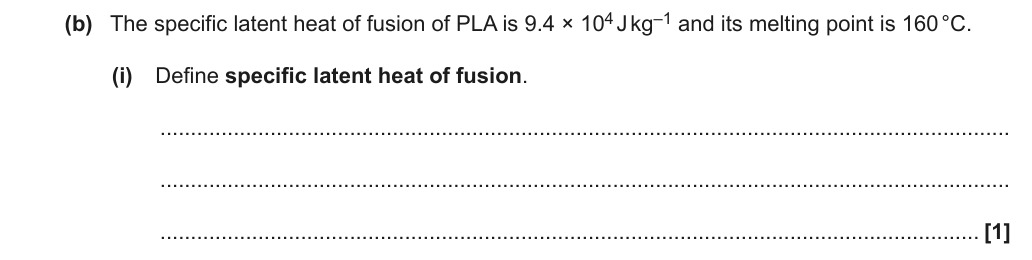
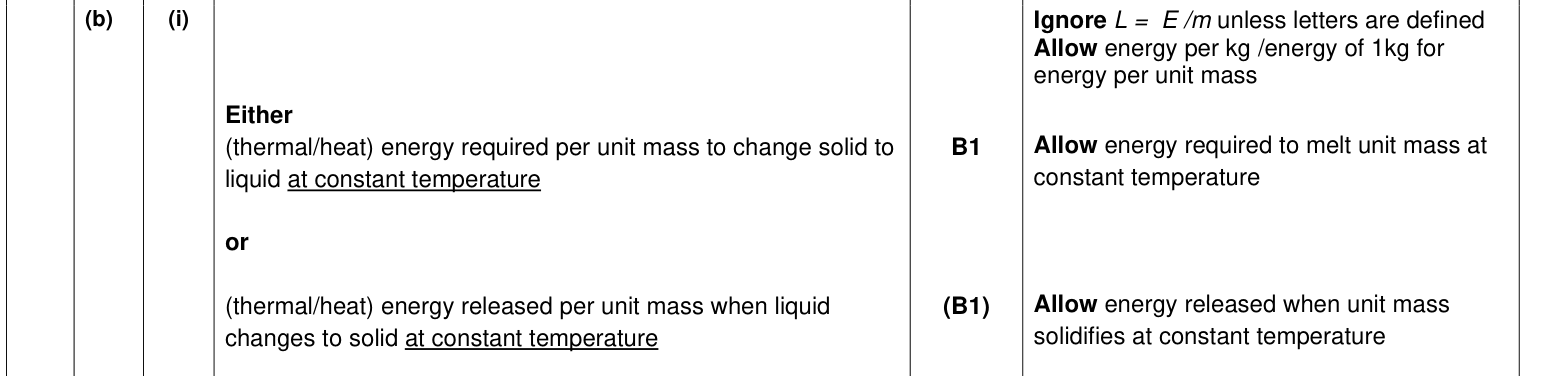
There were several reasons why responses to this question did not gain credit: • constant temperature was not mentioned • per unit mass (or per kg) was omitted • the phase change was not stated, or was incorrect • it was stated that energy was required to turn a liquid into a solid.
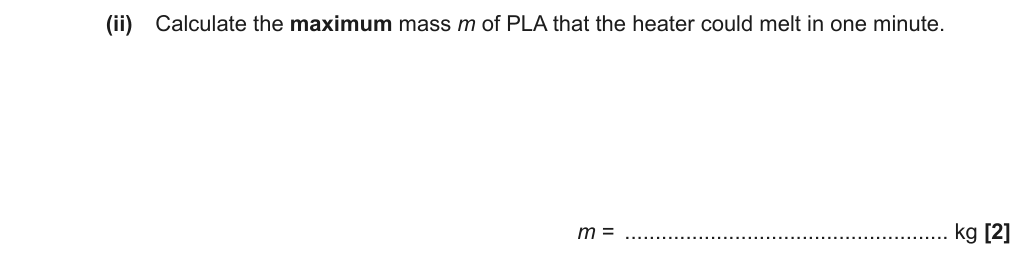
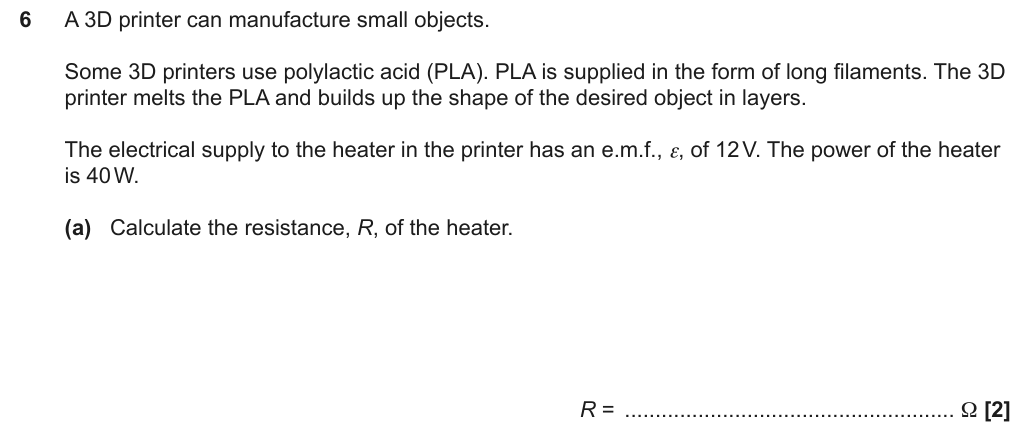
This question was well answered by most candidates. However, some tried to use E = mcΔθ with Δθ = 160 °C and a few gave their answer to only 1 sf.
Skills: M0.1 Recognise and make use of appropriate units in calculations; M2.2 Change the subject of an equation, including non-linear equations
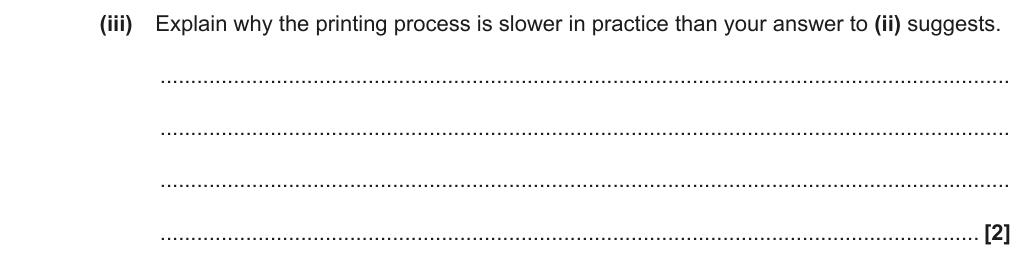
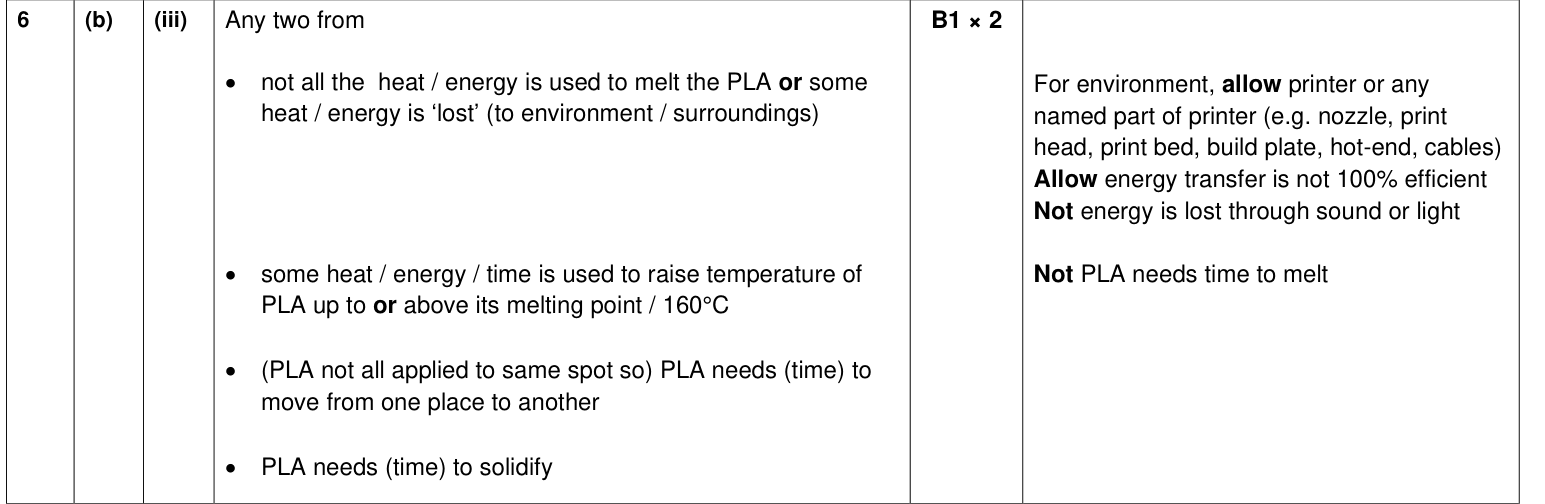
The most common correct response related to energy dissipated to the surroundings. A smaller number of correct responses mentioned that energy was needed to raise the temperature to melting point. Some candidates incorrectly referred to energy used for other parts of the system (e.g. motors to drive the mechanism) which was not relevant to the question.
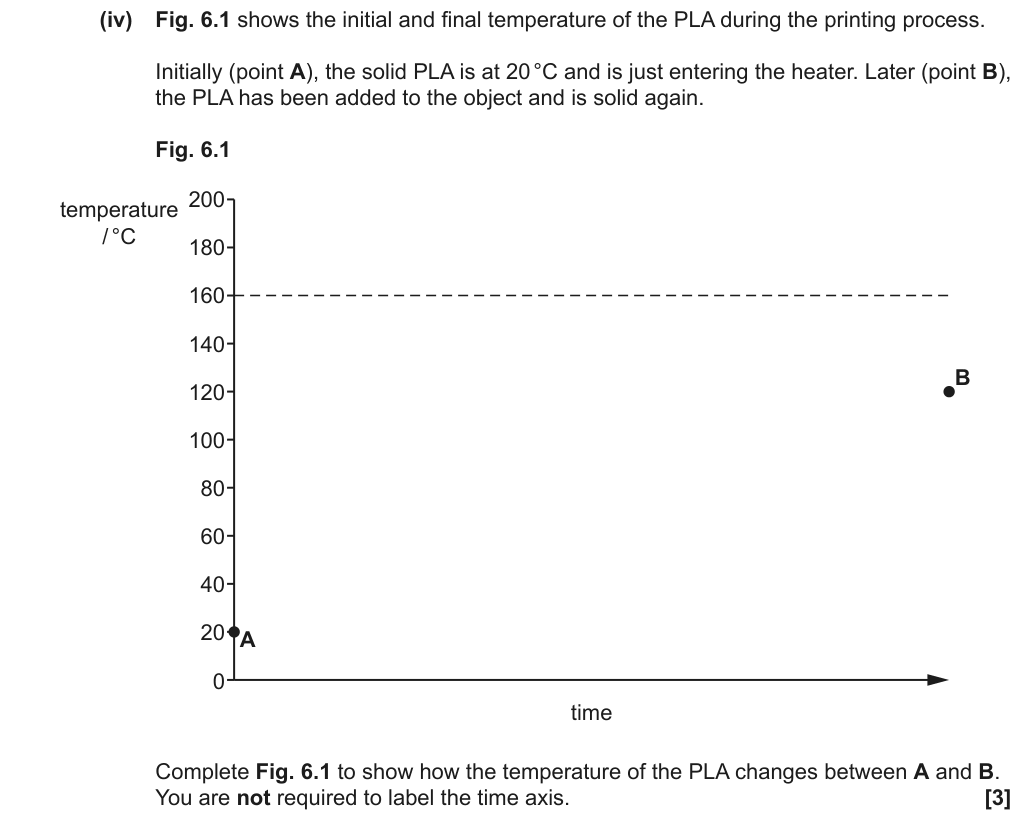
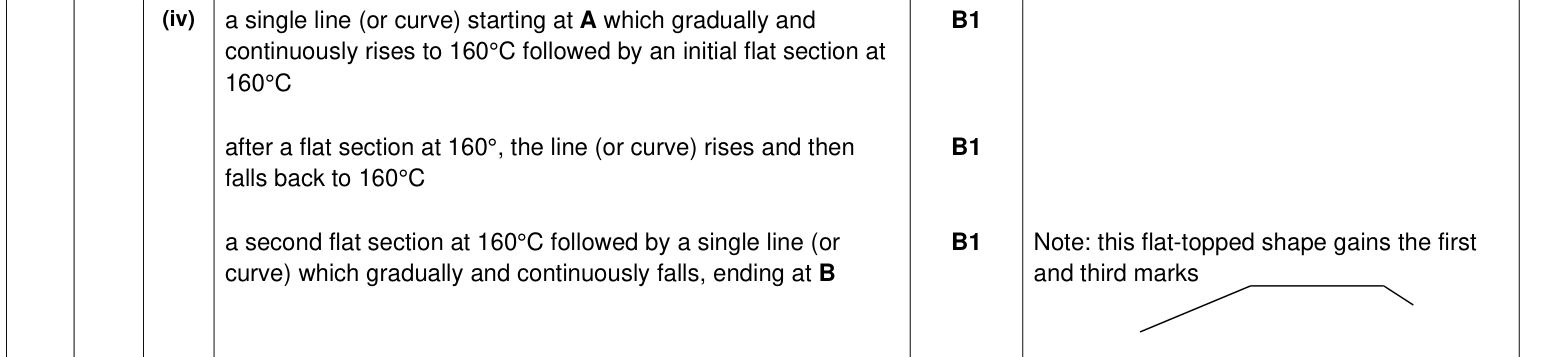
Most responses gained 2 marks for a line from point A followed by a flat section at 160 °C and then a line down to point B. A small minority of candidates also gained the 3rd mark for a ‘blip’ within the flat section, rising above 160 °C . Responses that went from A to B without a flat section at 160 °C gained no credit.
Skills: M3.12 Sketch relationships which are modelled by y = k/x, y = kx², y = k/x², y = kx, y = sin x, y = cos x, y = e^(±x) and y = sin²x, y = cos²x as applied to physical relationships
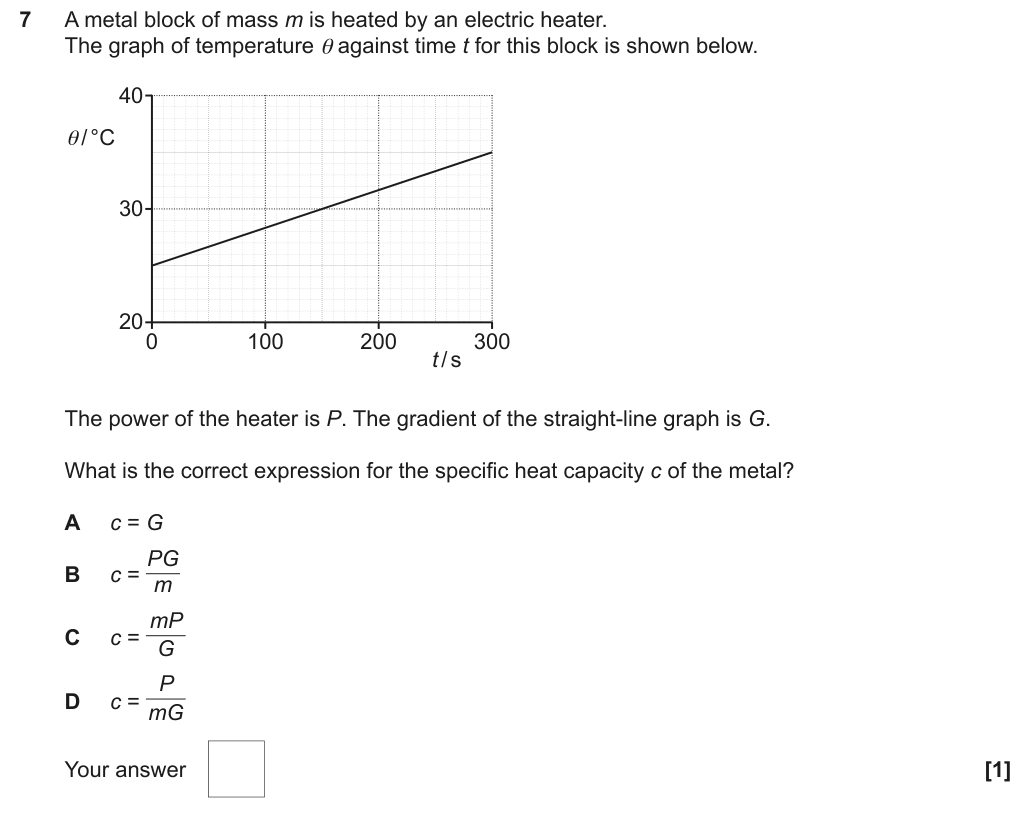
D
By thinking about the formula for specific heat capacity ( ∆E = m c ∆θ) and dividing both sides by ∆t, the equation becomes P = m c ∆θ / ∆t. ∆θ /∆t is the equivalent to the gradient, G. Rearranging this will give the correct answer.
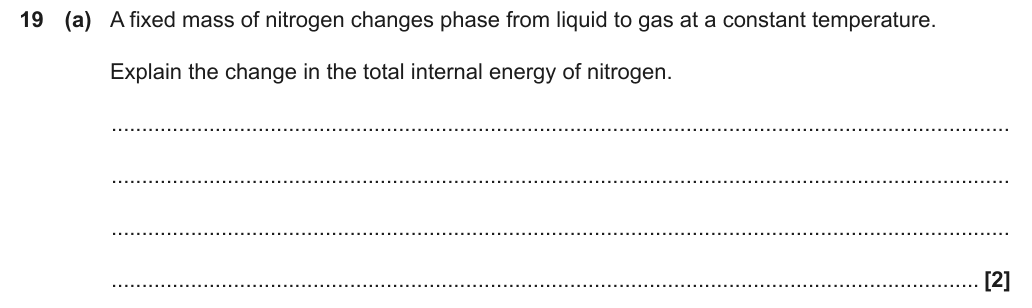
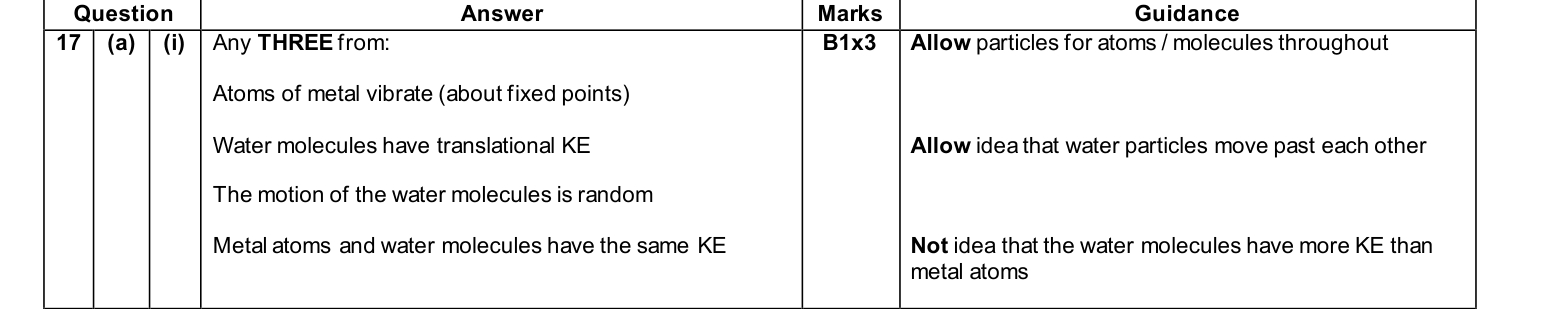
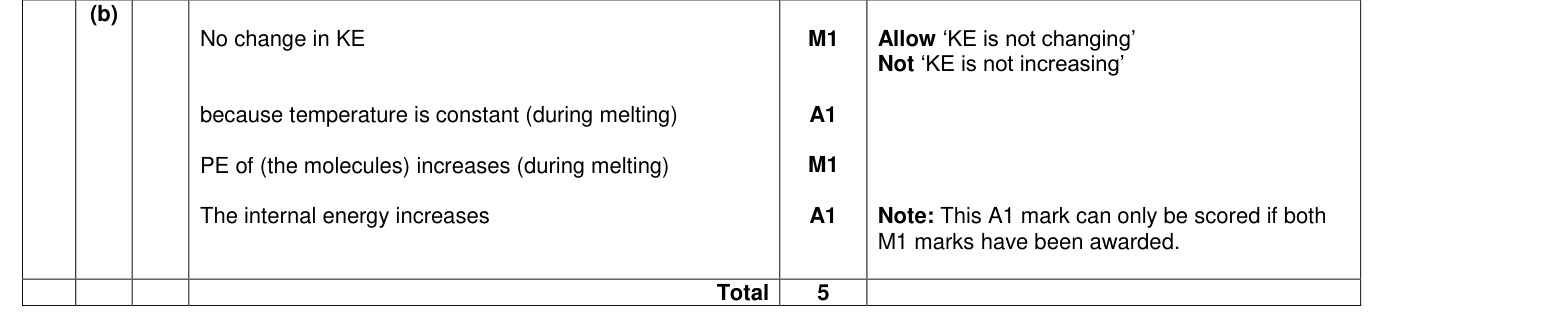
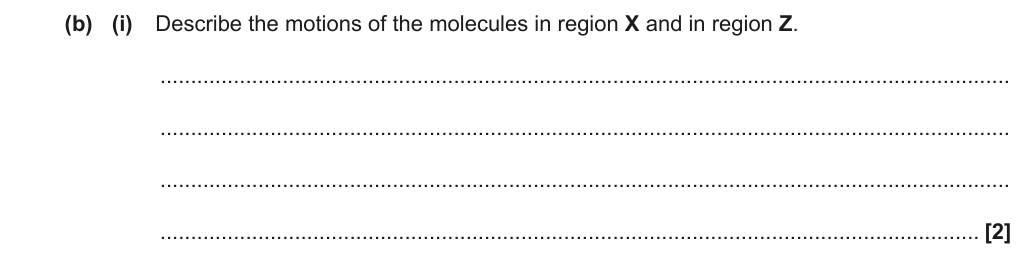
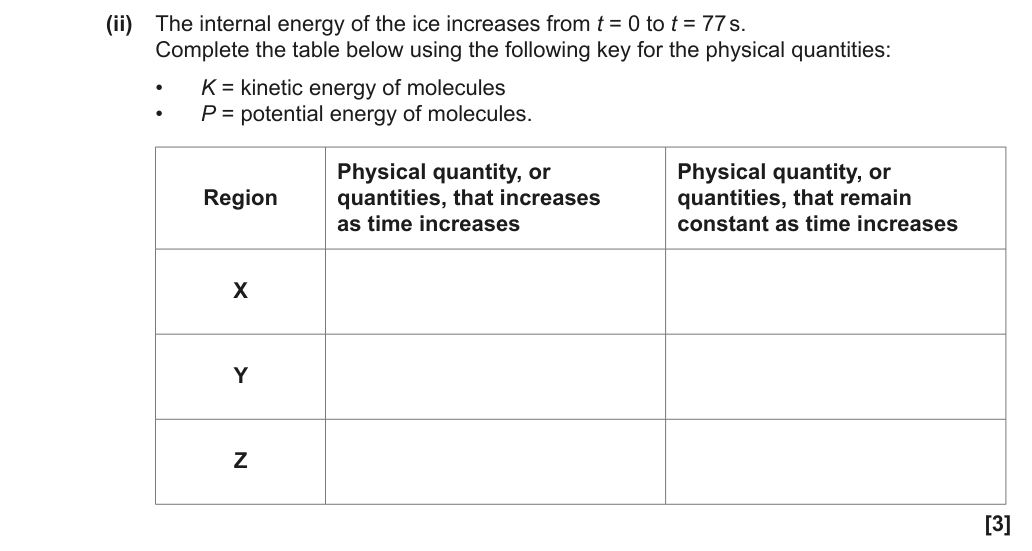
Most candidates got at least one of the marking points here. A significant fraction correctly linked the increase in PE and the constant KE to an increase in total internal energy.
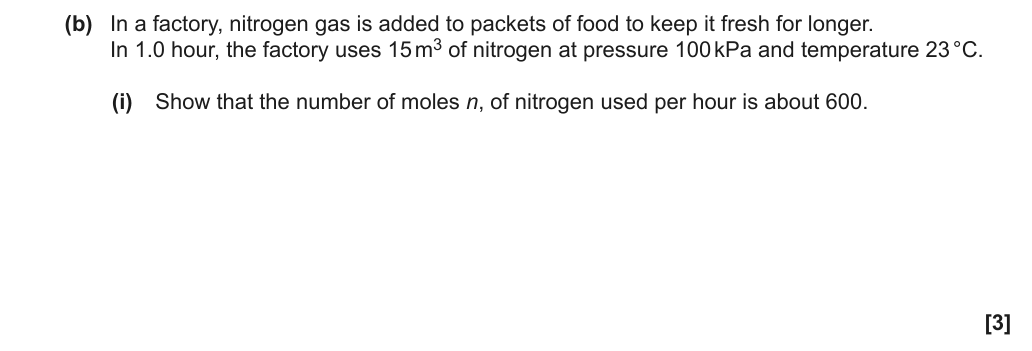
Almost all candidates could show this well, by using the ideal gas equation carefully. Those that scored less than full marks often did so because they forgot to convert the temperature from Celsius to kelvin.
Skills: M0.1 Recognise and make use of appropriate units in calculations; M2.2 Change the subject of an equation, including non-linear equations; M2.3 Substitute numerical values into algebraic equations using appropriate units for physical quantities
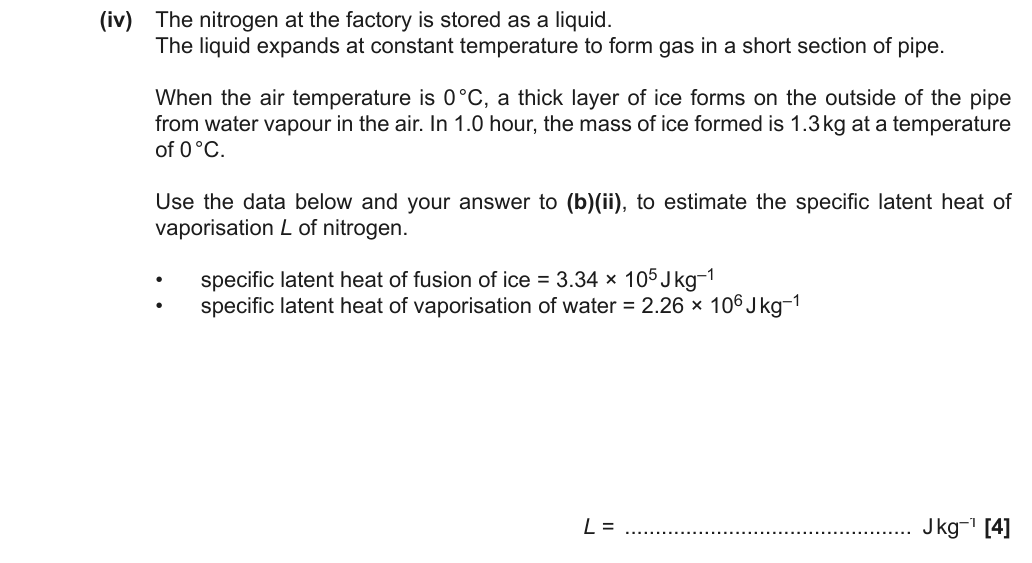
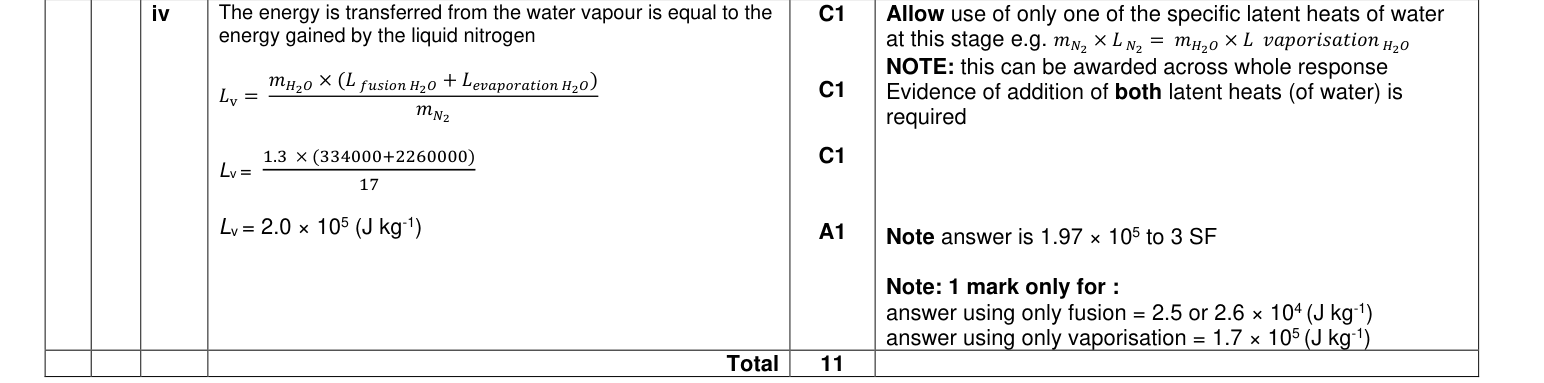
Most candidates calculated the energy loss for either the vapour to liquid change or the liquid to ice change for the water. A minority realised that the correct approach was to add these two energy changes before dividing by the mass of the nitrogen. This candidate has set out the calculation very carefully, with a diagram in the top left to help their thinking. They have calculated the energy loss required to condense the vapour to liquid water and also the energy loss required to freeze the water to ice. These calculations are done on separate lines yet one after the other. This total energy loss must be equal to the total energy gained by the nitrogen when turning from liquid to gas.
Skills: M0.2 Recognise and use expressions in decimal and standard form; M2.2 Change the subject of an equation, including non-linear equations; M2.3 Substitute numerical values into algebraic equations using appropriate units for physical quantities
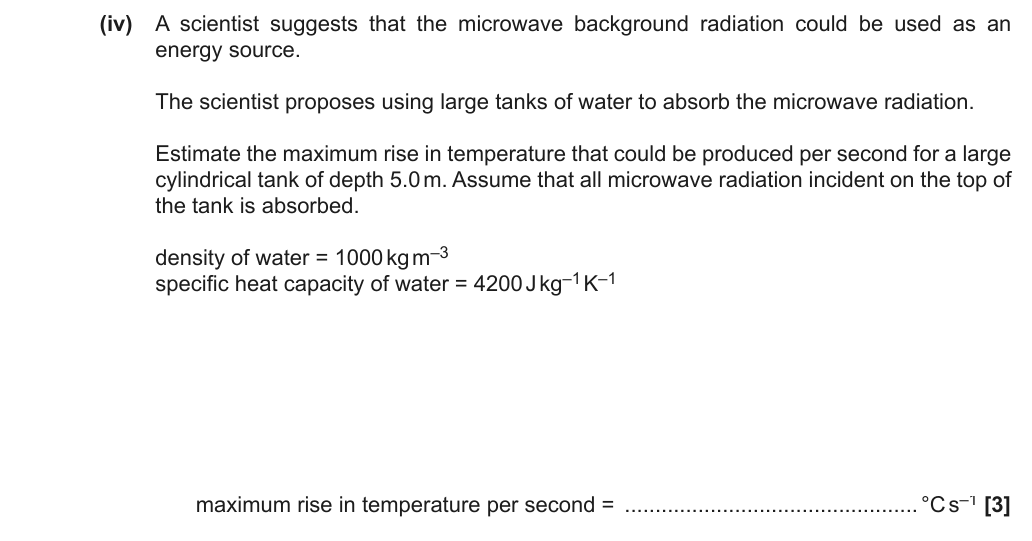
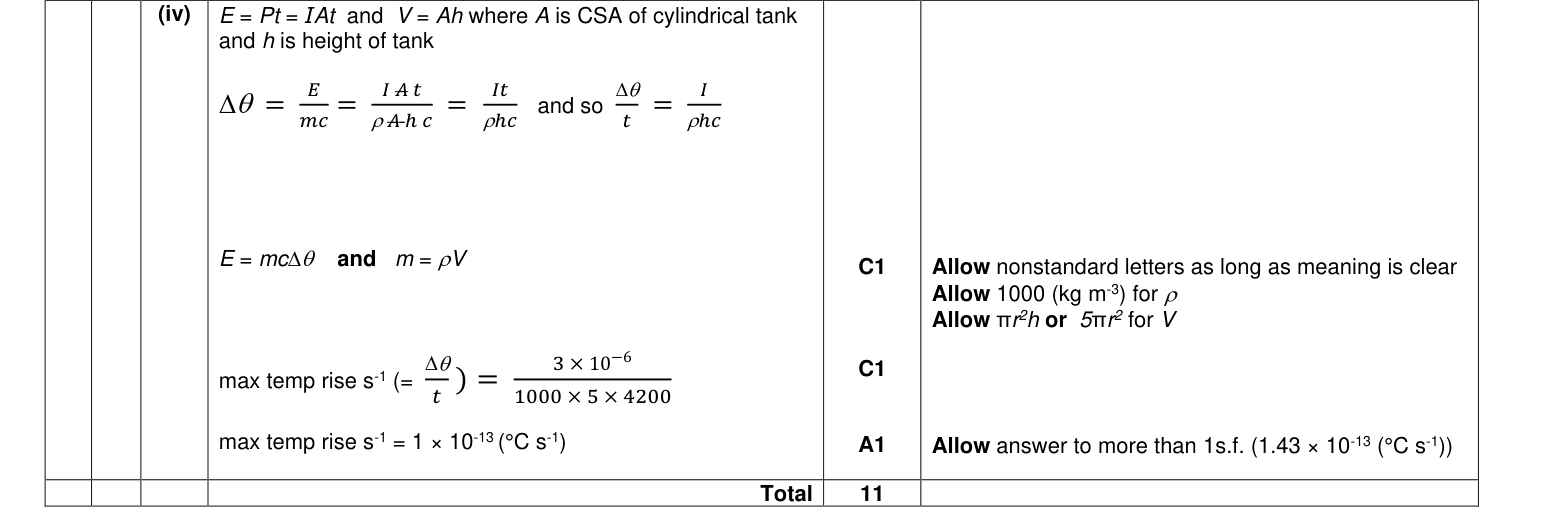
This too was a complex, multi-stage calculation. Most candidates correctly found their way into the question by writing down the formula E = mcΔθ and realising that they needed to use the formula ρ = m/V in order to calculate the mass. The volume V of the cylindrical tank could be found using V = depth × cross-sectional area. However, although the depth was specified in the question, the cross-sectional area was not. Successful candidates realised that, if the cross-sectional area was not given, then it must cancel out later in the calculation. Some used algebra and called the cross-sectional area A. Others simply made up a value for A (A = 1 m2 is the easiest).
Skills: M0.2 Recognise and use expressions in decimal and standard form; M2.2 Change the subject of an equation, including non-linear equations; M4.3 Calculate areas of triangles, circumferences and areas of circles, surface areas and volumes of rectangular blocks, cylinders and spheres
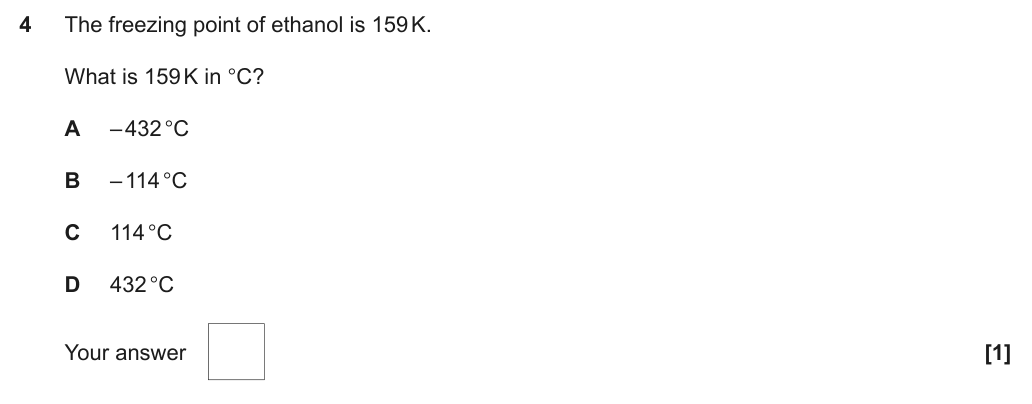
B
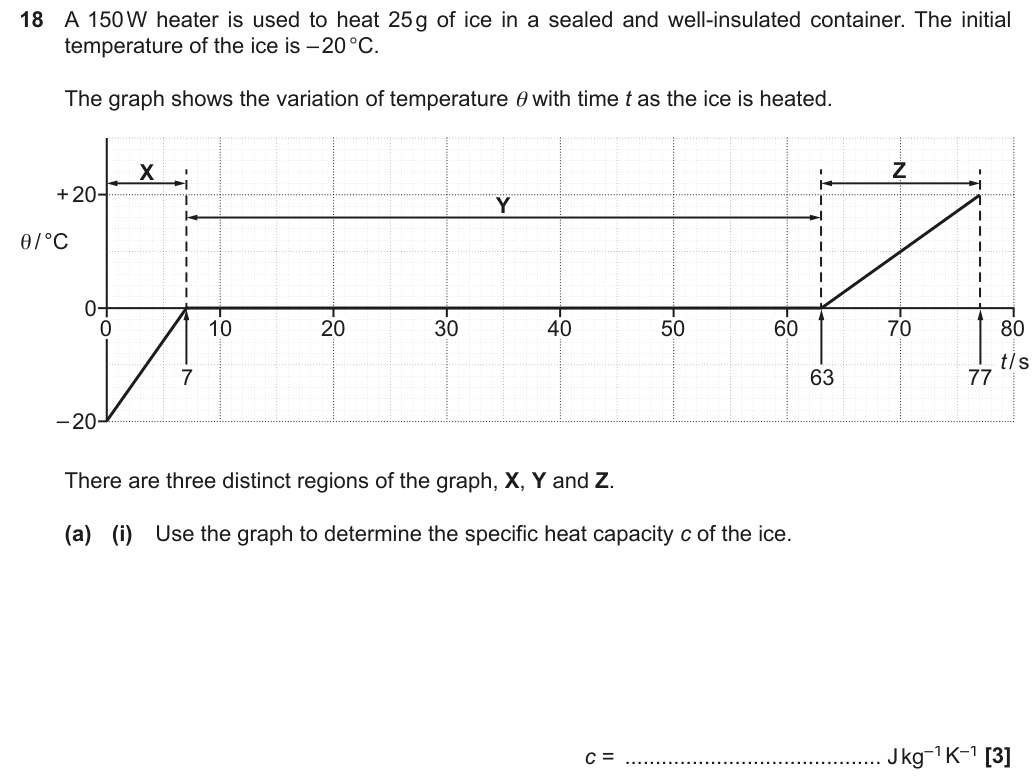
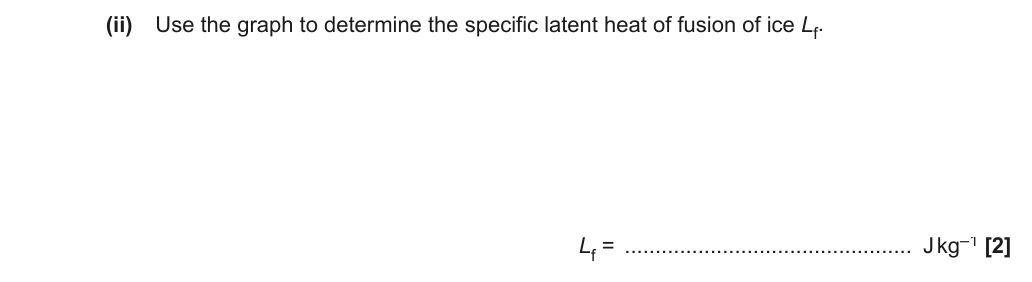
Skills: M3.1 Translate information between graphical, numerical and algebraic forms; M3.5 Calculate rate of change from a graph showing a linear relationship

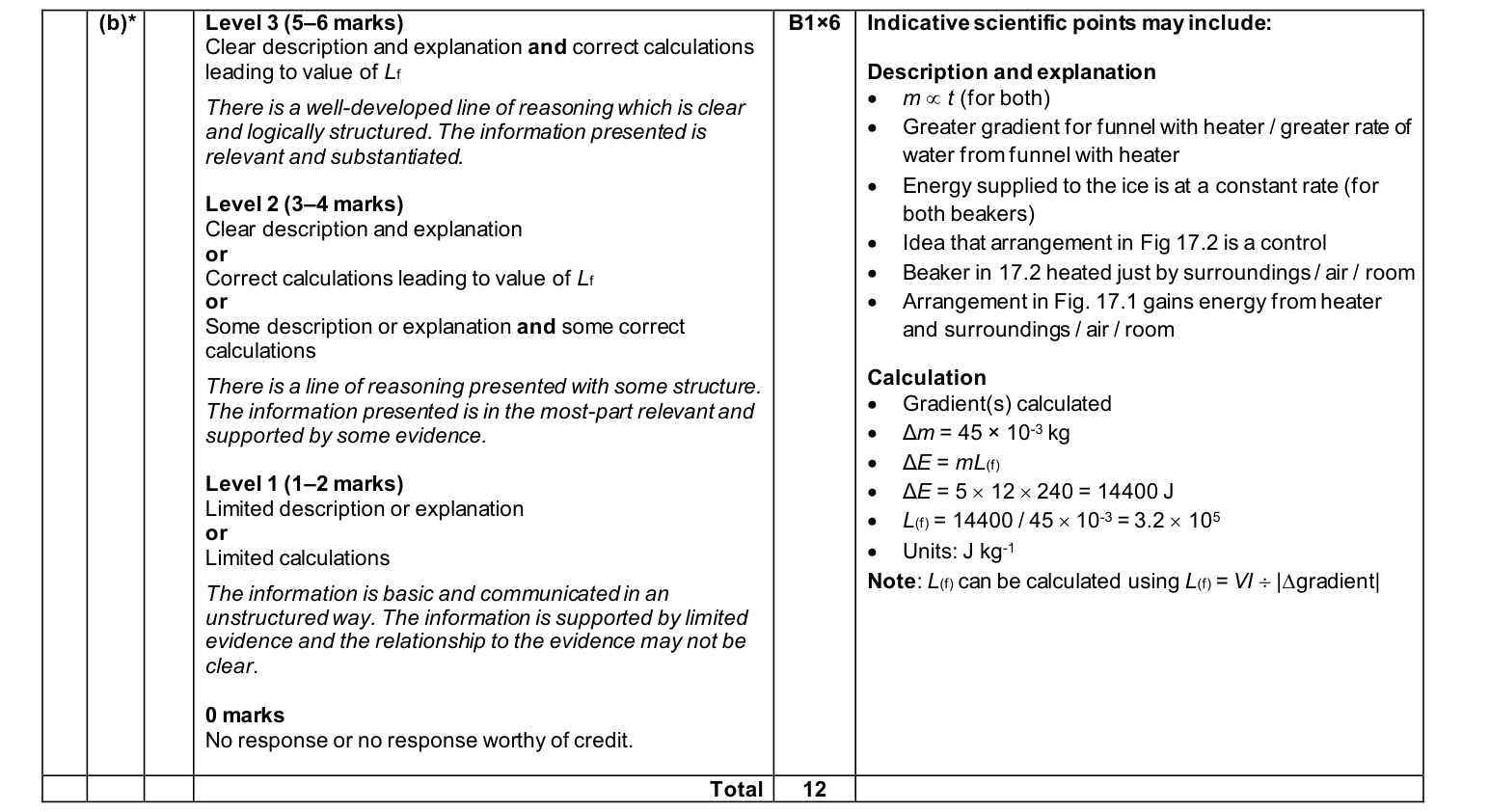
Question 17b was more challenging in this respect, as to get the correct answer for the specific latent heat, the candidate needed to understand the significance of the control apparatus.
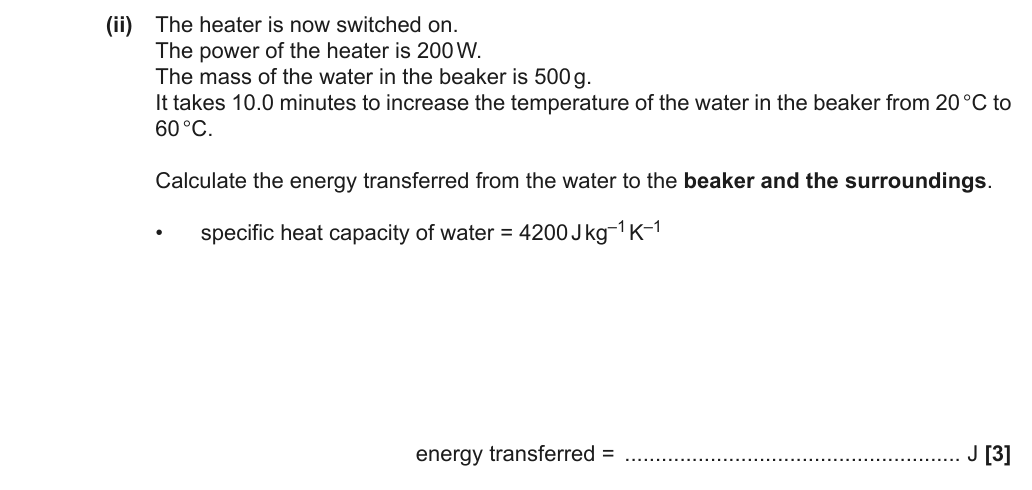
Question 17b was more challenging in this respect, as to get the correct answer for the specific latent heat, the candidate needed to understand the significance of the control apparatus.
Skills: M0.1 Recognise and make use of appropriate units in calculations; M2.3 Substitute numerical values into algebraic equations using appropriate units for physical quantities
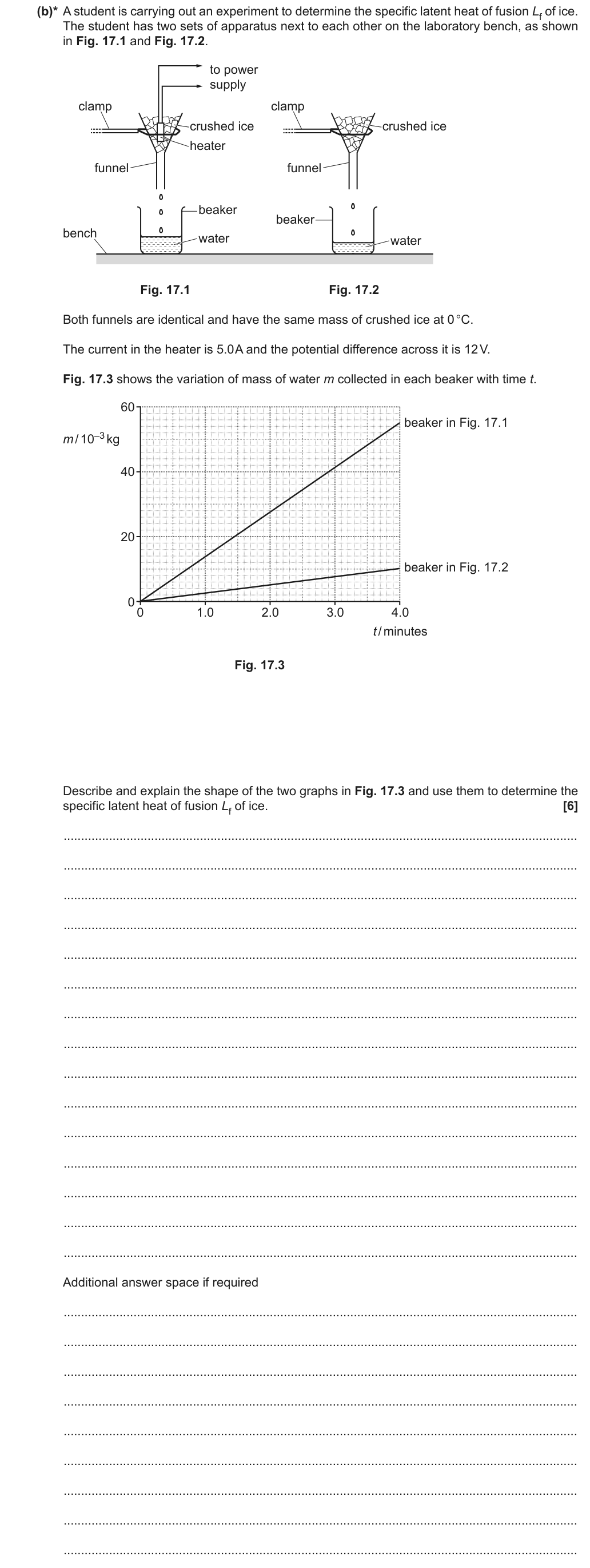
Question 17b was more challenging in this respect, as to get the correct answer for the specific latent heat, the candidate needed to understand the significance of the control apparatus.
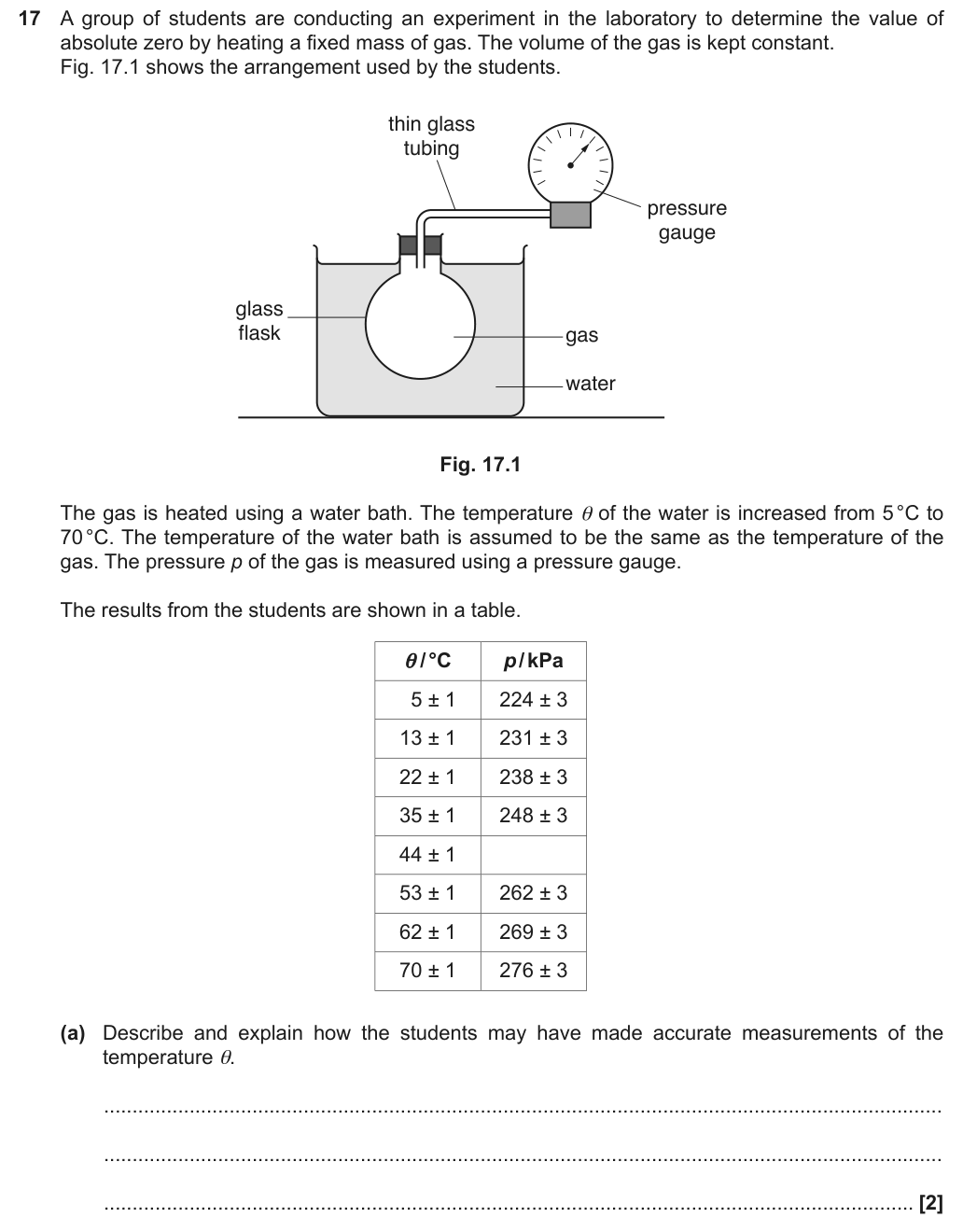
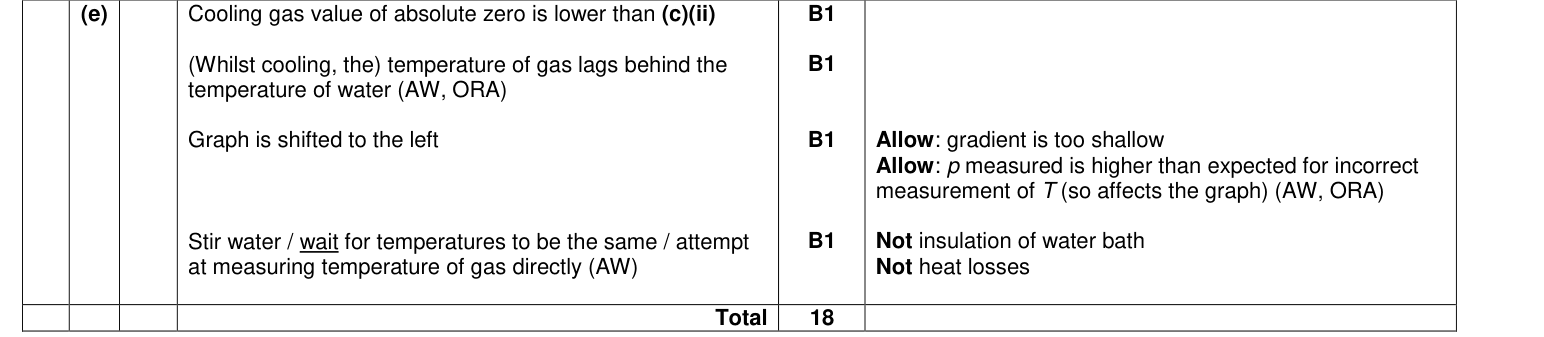
Skills: M2.3 Substitute numerical values into algebraic equations using appropriate units for physical quantities; M3.1 Translate information between graphical, numerical and algebraic forms; M3.4 Determine the slope and intercept of a linear graph; PAG8 Investigating gases
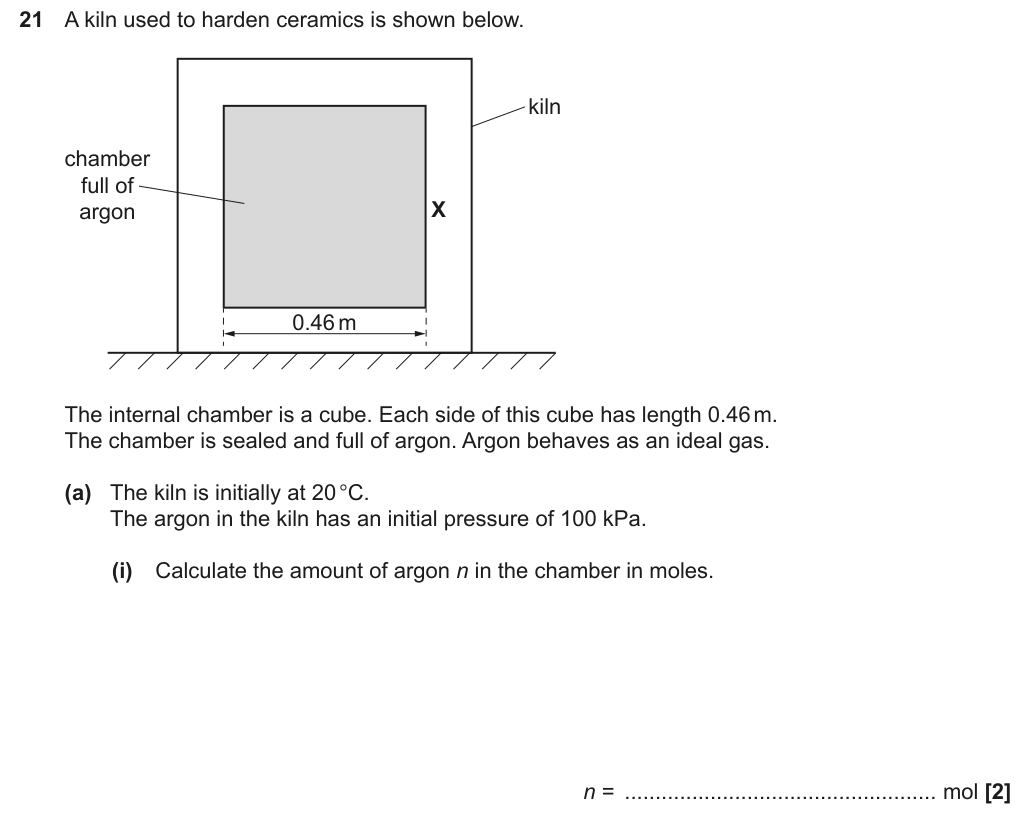
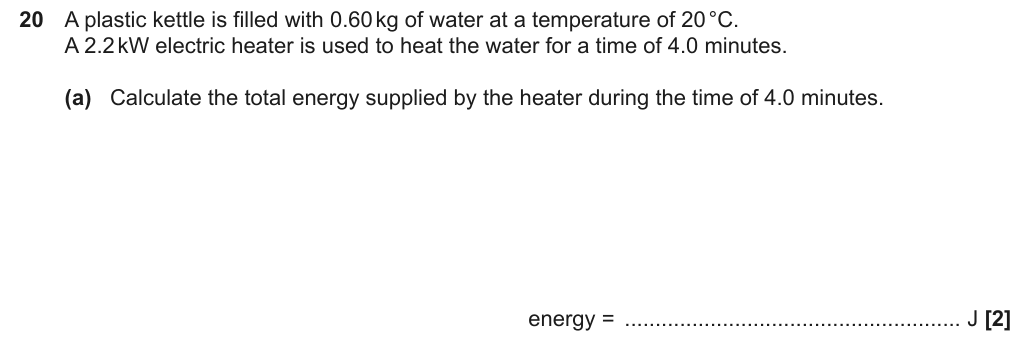
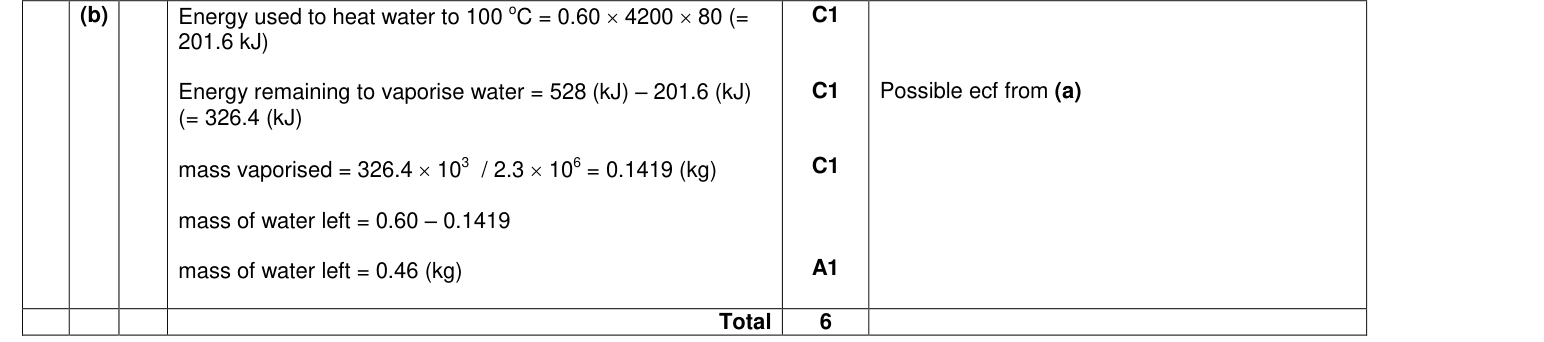
Some candidates used degrees centigrade rather than kelvin as the unit of temperature for Question 21.
Skills: M0.1 Recognise and make use of appropriate units in calculations; M2.2 Change the subject of an equation, including non-linear equations; M4.3 Calculate areas of triangles, circumferences and areas of circles, surface areas and volumes of rectangular blocks, cylinders and spheres
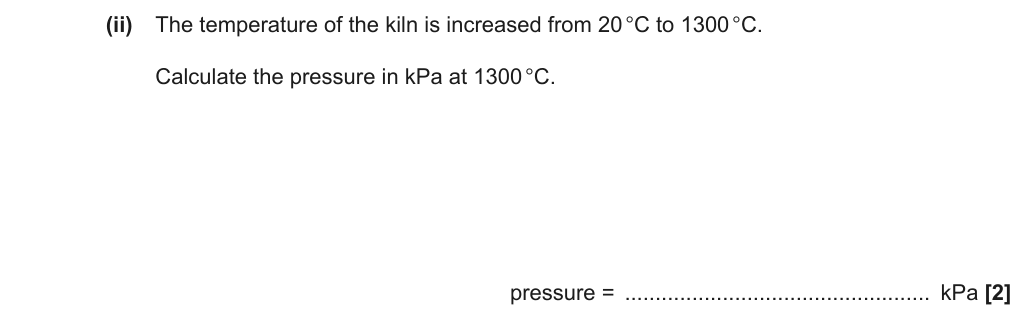
Some candidates used degrees centigrade rather than kelvin as the unit of temperature for Question 21.
Skills: M0.3 Use ratios, fractions and percentages; M2.3 Substitute numerical values into algebraic equations using appropriate units for physical quantities
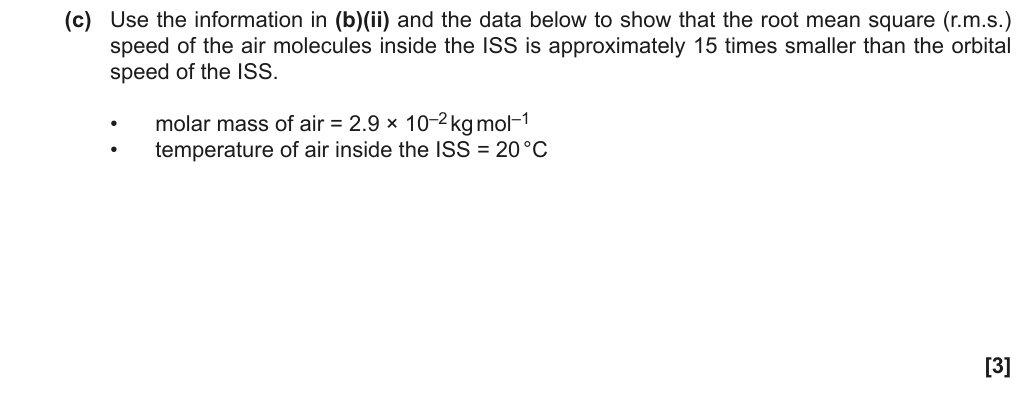
Question 4a Misconception Experiencing weightlessness is not the same as being in freefall There was a lack of understanding of the nature of feeling weightless. Question 4bi The simplest method here was to use the fact that g is inversely proportional to r2, so gr2 = constant. Question 4c The success in this question depended on understanding the meaning of the term m in the formula 2mc2 തതത = 3 2 kT given in the Data, Formulae and Relationship booklet. Question 4d Although this question looked daunting, it was actually quite linear and many candidates who attempted it were able to gain two or three marks even if they did not eventually get to the correct response.
Skills: M0.3 Use ratios, fractions and percentages; M0.5 Use calculators to find and use power, exponential and logarithmic functions; M2.2 Change the subject of an equation, including non-linear equations
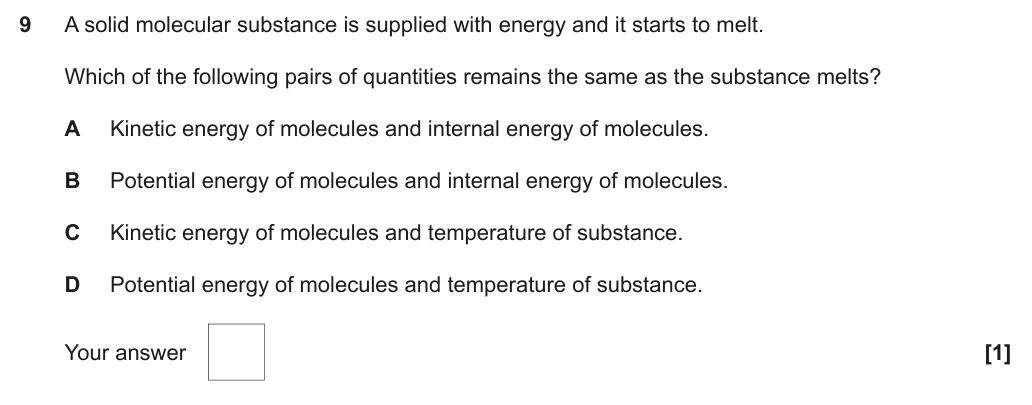
C
As a substance melts, the PE of the molecules increases, ruling out answers B and D. The temperature of a melting substance does not change and so the KE of the molecules cannot change, as the temperature and mean KE of molecules are directly proportional. This means that C must be correct. A cannot be correct since the internal energy is the sum of the KE and PE of the molecules. The KE is constant and the PE increases, meaning the internal energy must also increase.
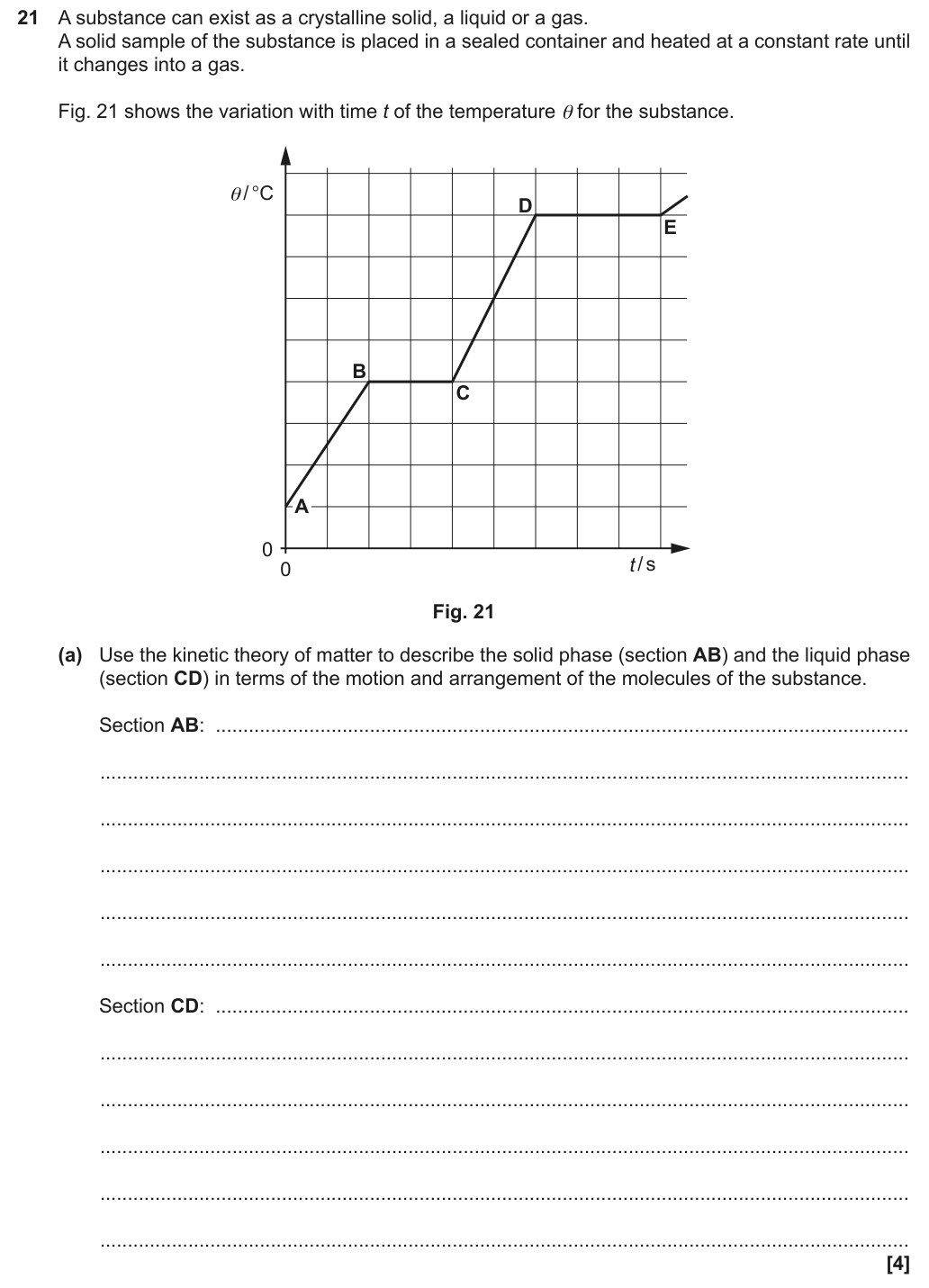
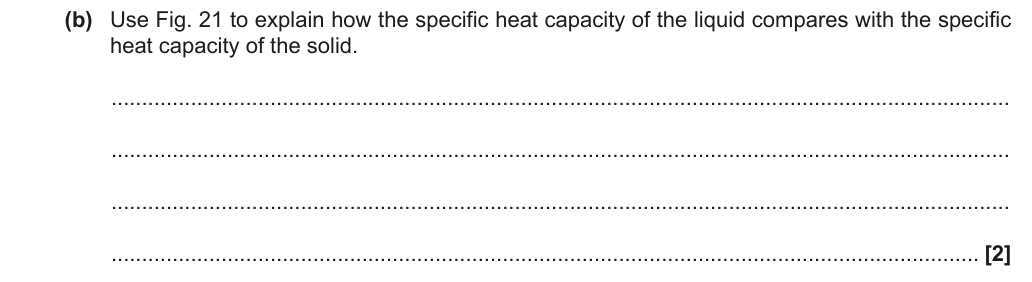
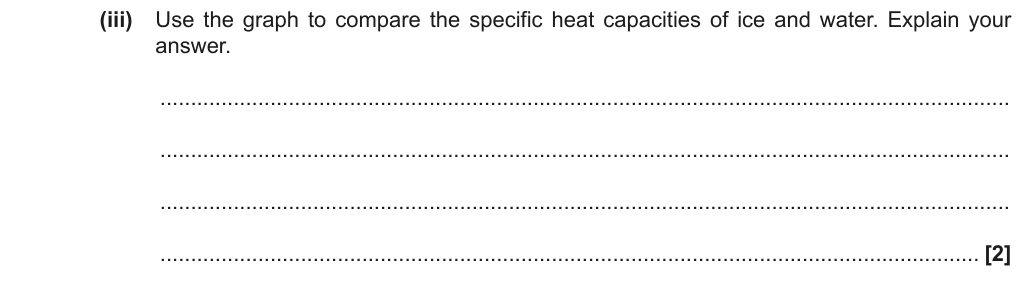
Many candidates realised that the gradients of the lines AB and CD were related to the specific heat capacities of the solid and liquid states. Higher level responses included the formula relating energy change, mass, specific heat capacity and the temperature change, and how that formula related to the gradient of the line on a temperature-time graph. Once that link was established, the lower gradient indicates a larger specific heat capacity.
Skills: M3.1 Translate information between graphical, numerical and algebraic forms; M3.4 Determine the slope and intercept of a linear graph
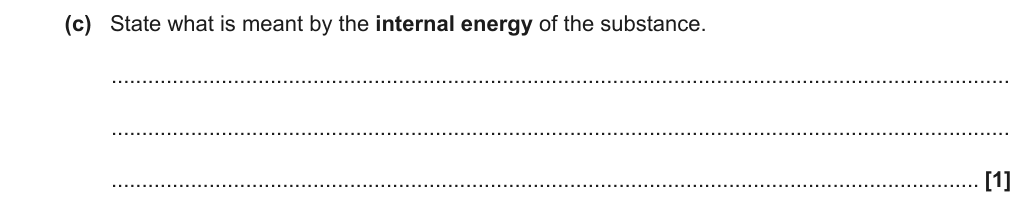
This is a simple definition that many candidates recalled well. Lower level responses missed out that this is to do with the kinetic energy and potential energy of particles.
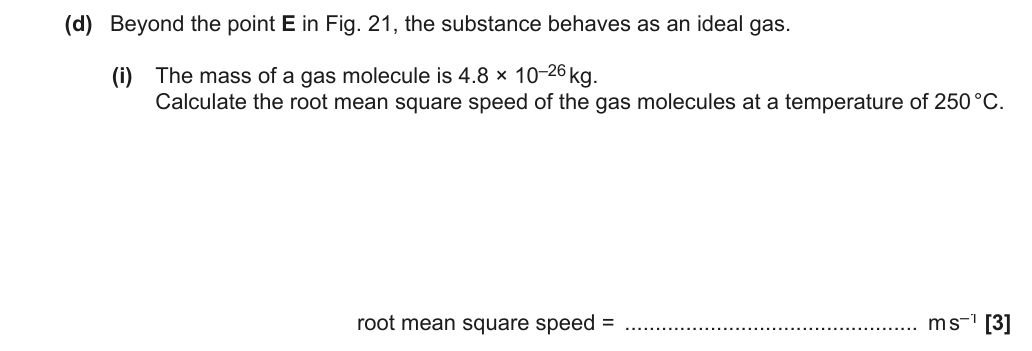
The key to this question is equating 2 formulae. The first is the familiar ½ m v2 for kinetic energy. In this case, the squared speed will be the mean squared speed of the particles. The second is the connection between average kinetic energy of a particle at absolute temperature, T, Ek = 3/2 k T. If candidates did that, then they not only scored the first mark but also could go on to complete the question. A common error was to forget to find the square root, as the question asks for the root mean square speed.
Skills: M0.5 Use calculators to find and use power, exponential and logarithmic functions; M2.2 Change the subject of an equation, including non-linear equations; M2.3 Substitute numerical values into algebraic equations using appropriate units for physical quantities
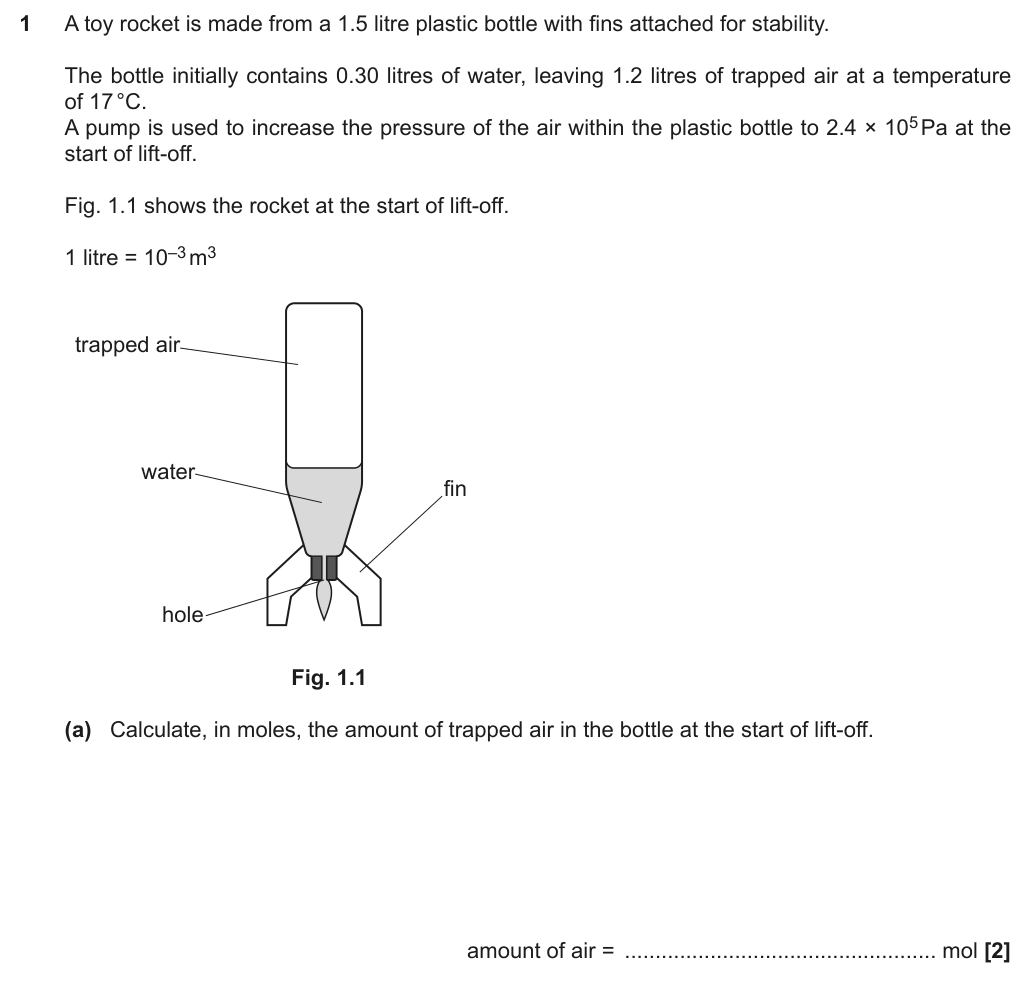
Questions 1(a) and 1(b) took the ideal gas equation and applied it to an unfamiliar situation, that of a toy rocket. Most candidates answered these questions well, remembering to convert the temperature from 17oC to 290K. Common problems in 1(a) and 1(b) • confusing N (number of molecules) with n (number of moles) • using an incorrect power of ten (POT) value for the volume, by either failing to convert litres correctly or simply omitting the 10-3.
Skills: M0.1 Recognise and make use of appropriate units in calculations; M2.2 Change the subject of an equation, including non-linear equations; M2.3 Substitute numerical values into algebraic equations using appropriate units for physical quantities
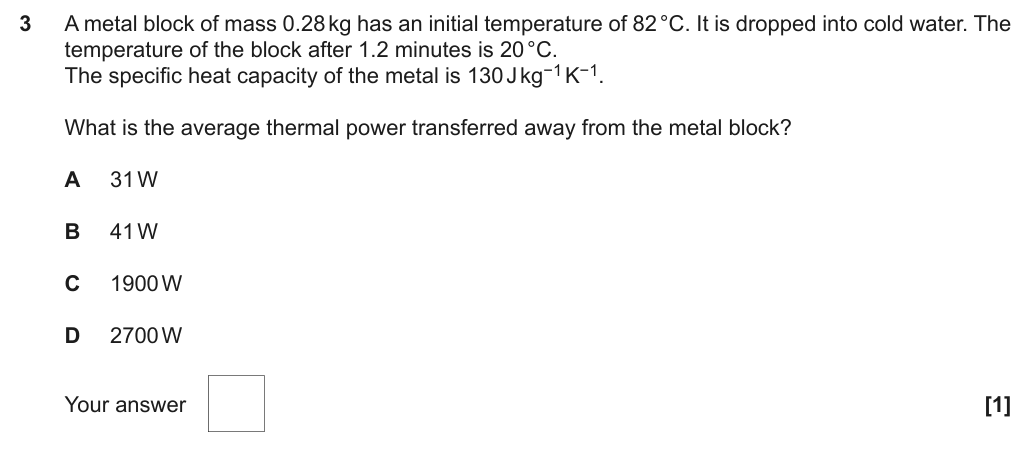
A
B
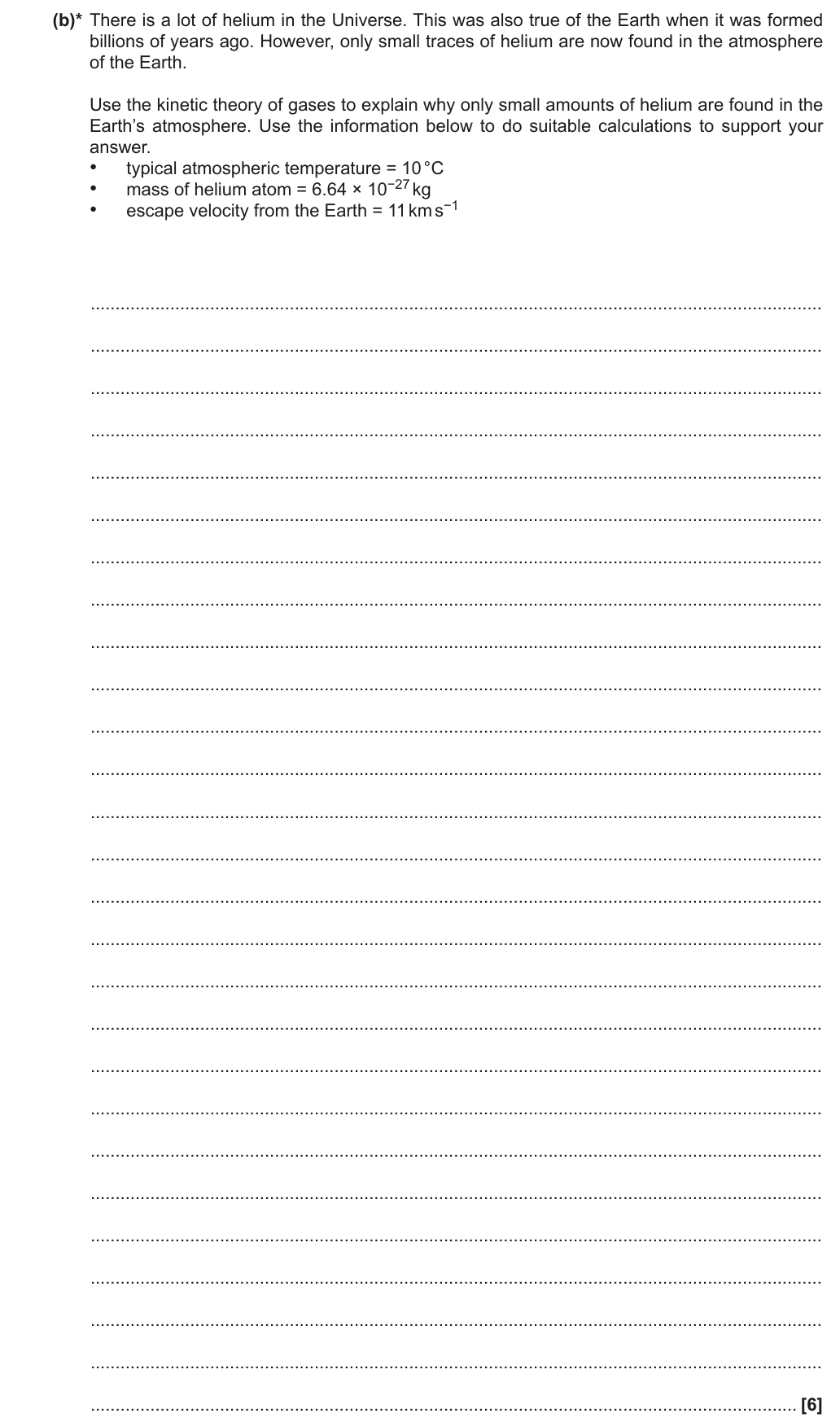
In correctly calculating the root means square speed and by being clear about how that has been calculated, this candidate has gained L2 already. There is a correct comparison of this speed with the escape velocity. There is also reference to the Boltzmann distribution of speeds, suggesting that even though a small fraction will have a sufficient velocity, over time those particles will escape. Most candidates made good progress with the calculation or provided an alternative by calculating the mean KE of a particle and comparing that with the KE a particle with escape velocity would have. A significant fraction made a poor comparison of their value with escape velocity (e.g. that 1300 ms-1 was greater than 11 km s-1) or compared the mean squared speed with the escape velocity.
Skills: M0.5 Use calculators to find and use power, exponential and logarithmic functions; M2.2 Change the subject of an equation, including non-linear equations; M2.3 Substitute numerical values into algebraic equations using appropriate units for physical quantities
B
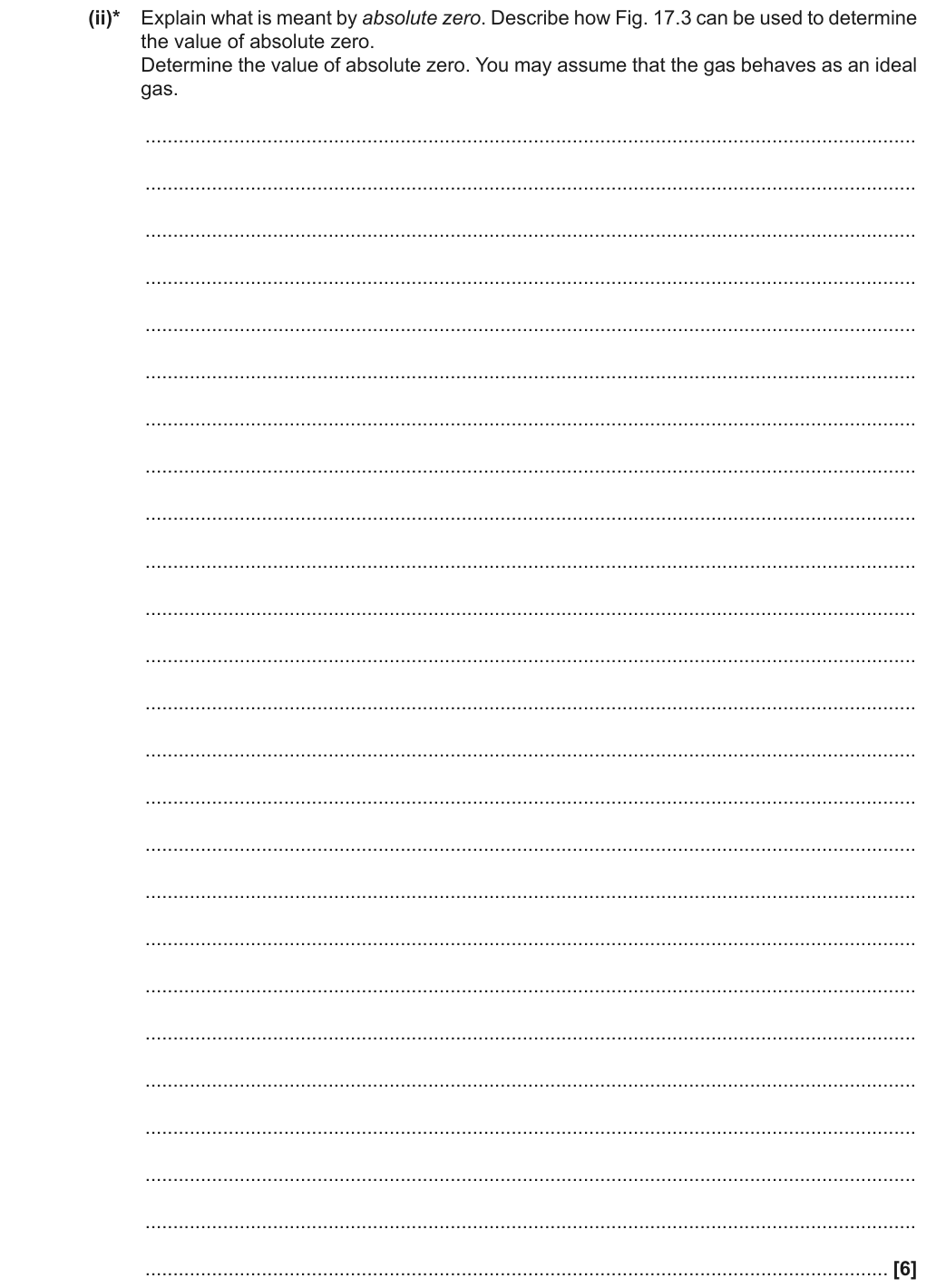
Skills: M3.3 Understand that y = mx + c represents a linear relationship; M3.4 Determine the slope and intercept of a linear graph; PAG8 Investigating gases
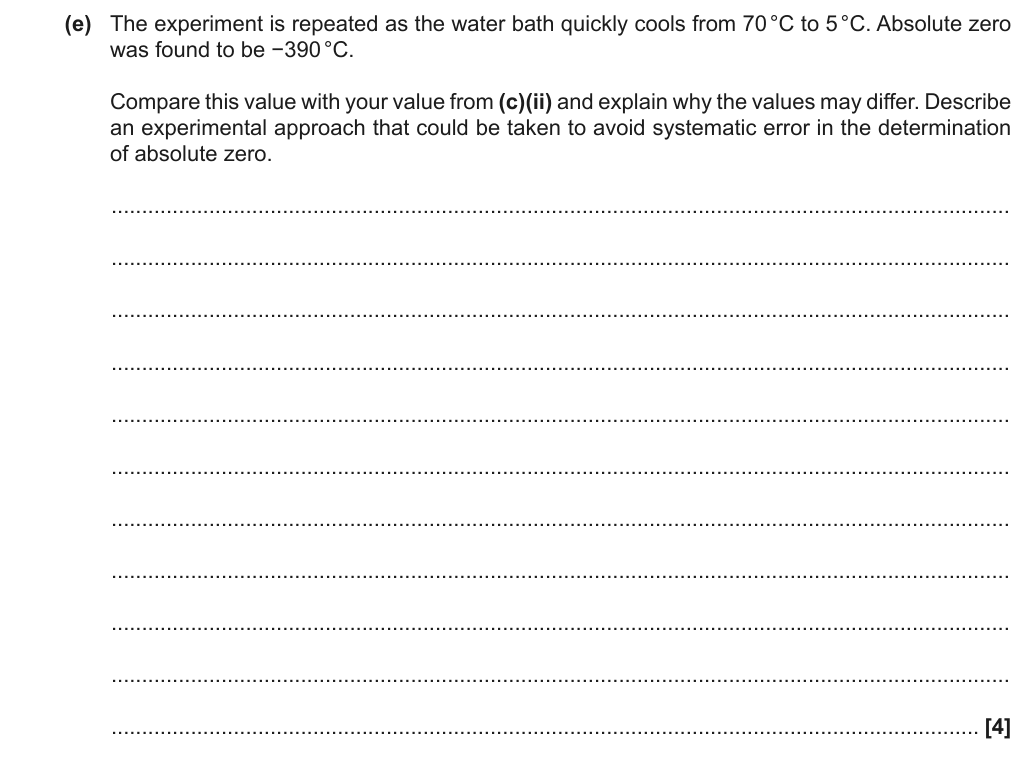
Skills: PAG8 Investigating gases
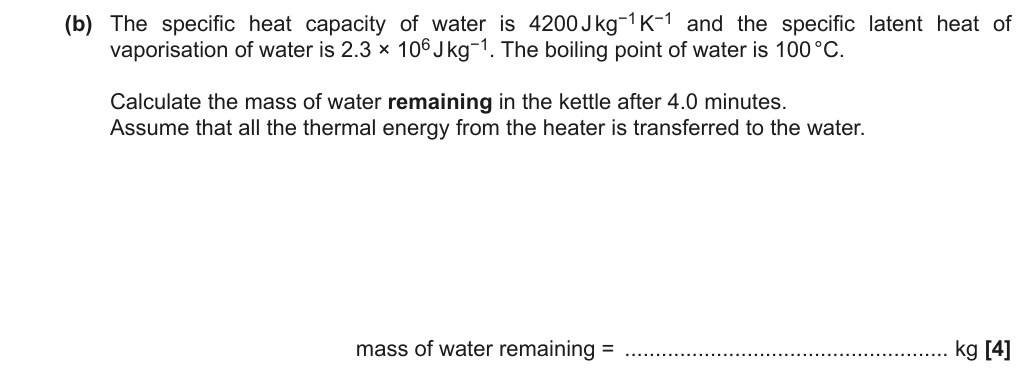
Skills: M2.2 Change the subject of an equation, including non-linear equations; M2.3 Substitute numerical values into algebraic equations using appropriate units for physical quantities

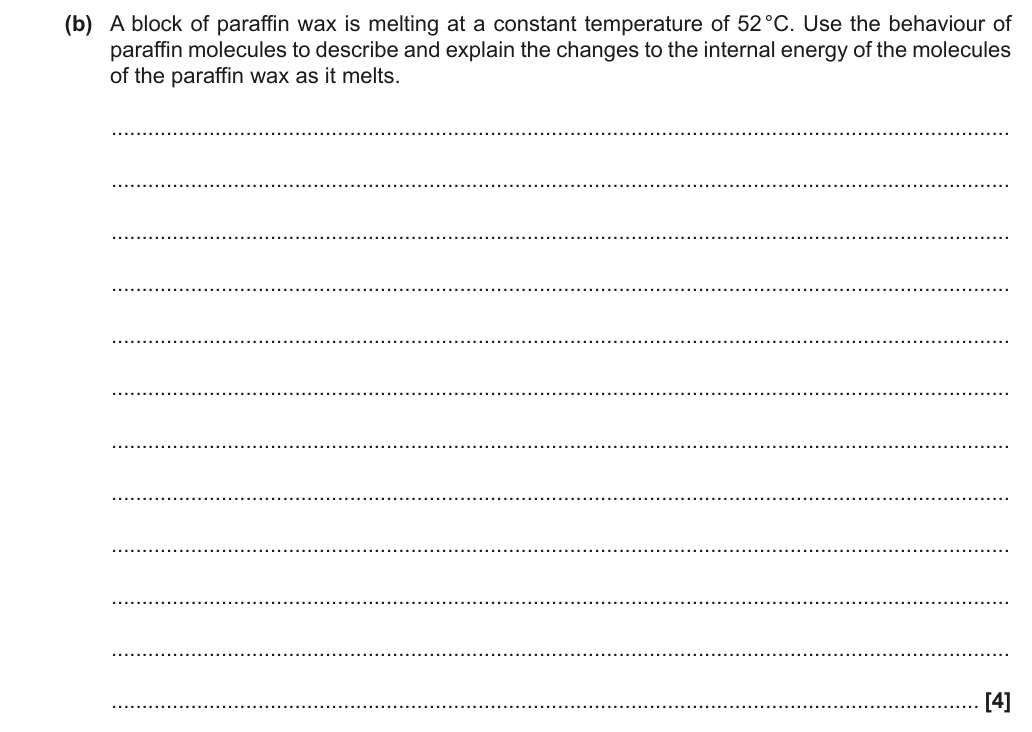
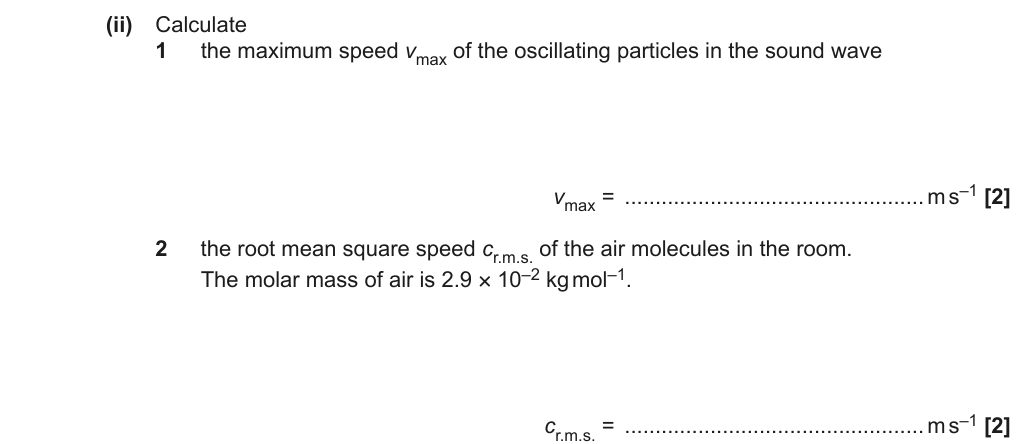
Skills: M0.1 Recognise and make use of appropriate units in calculations; M2.2 Change the subject of an equation, including non-linear equations; M2.3 Substitute numerical values into algebraic equations using appropriate units for physical quantities
Dropping marks on calculations, practical questions or the six-mark level of response questions? Book a trial session with a specialist OCR physics tutor.