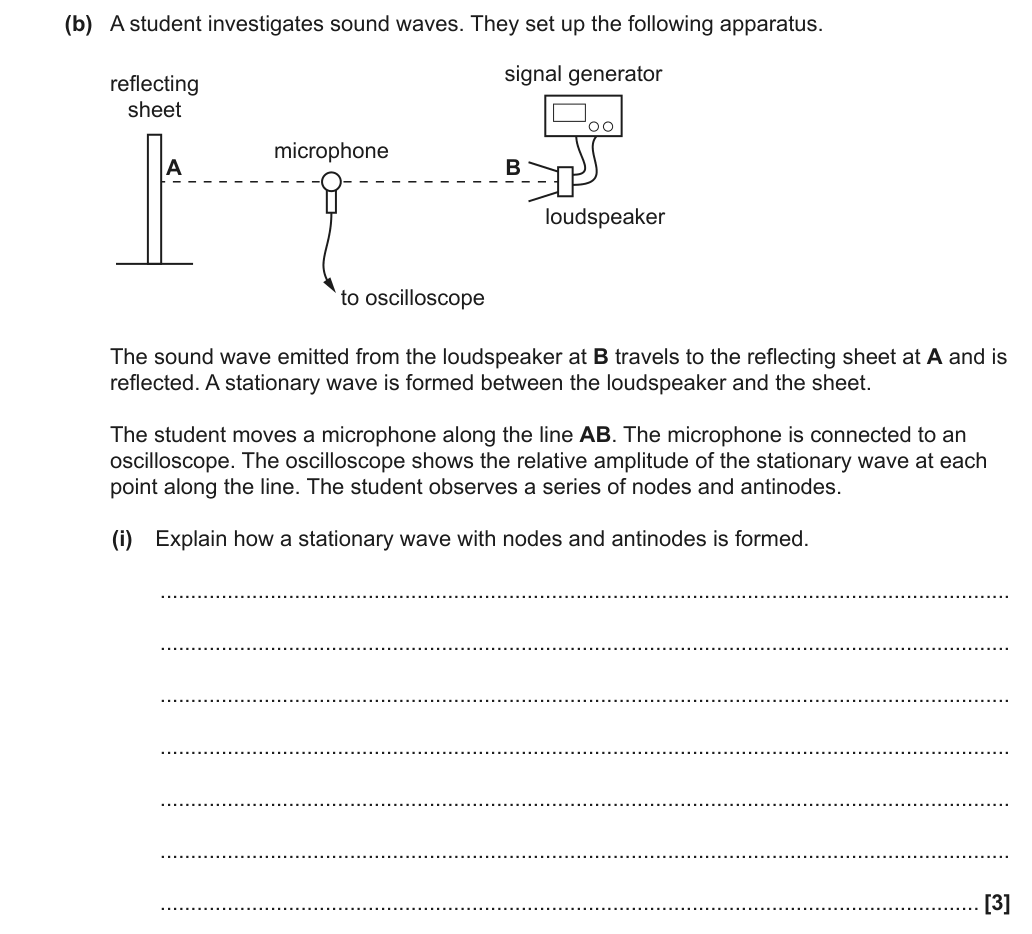
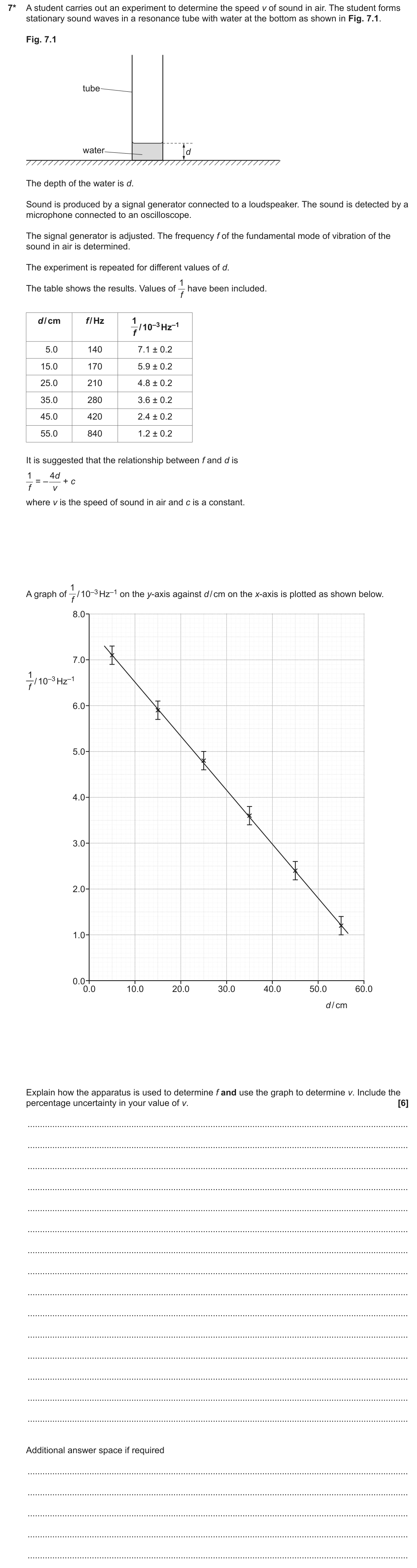
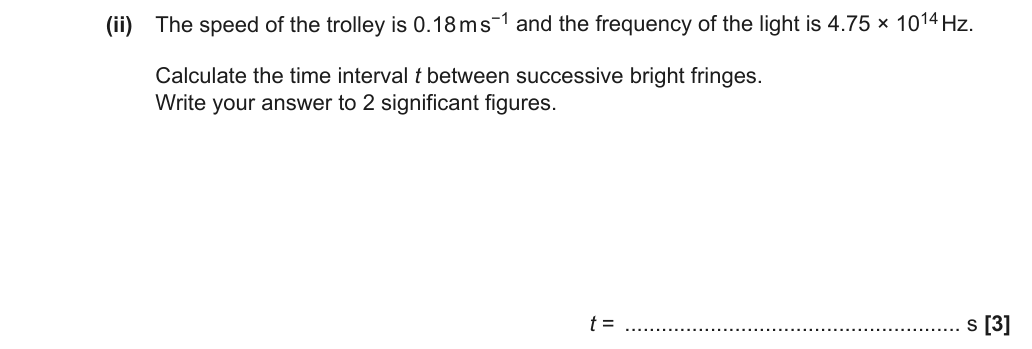
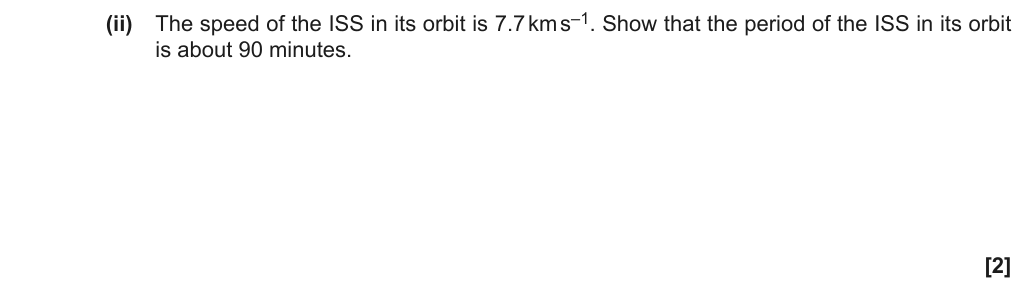
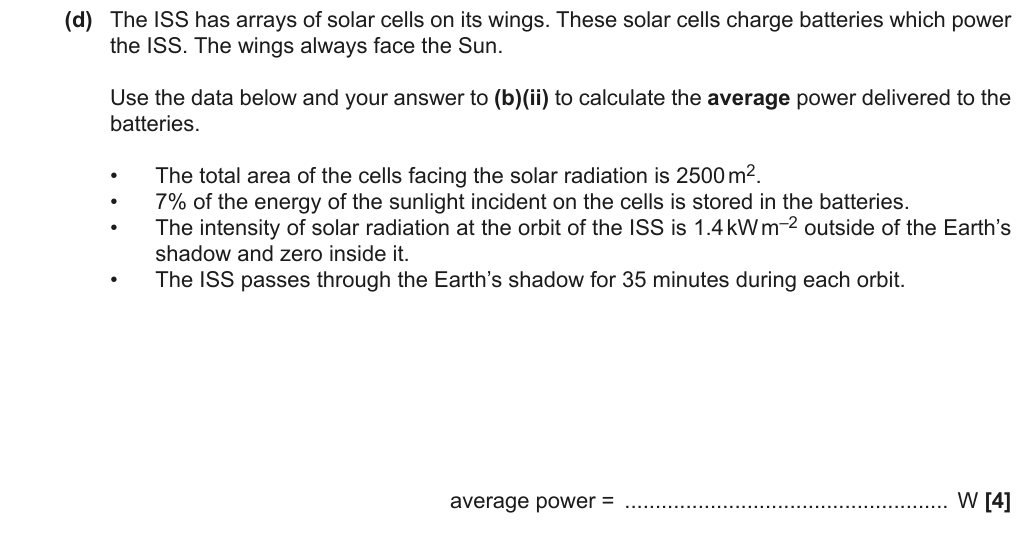
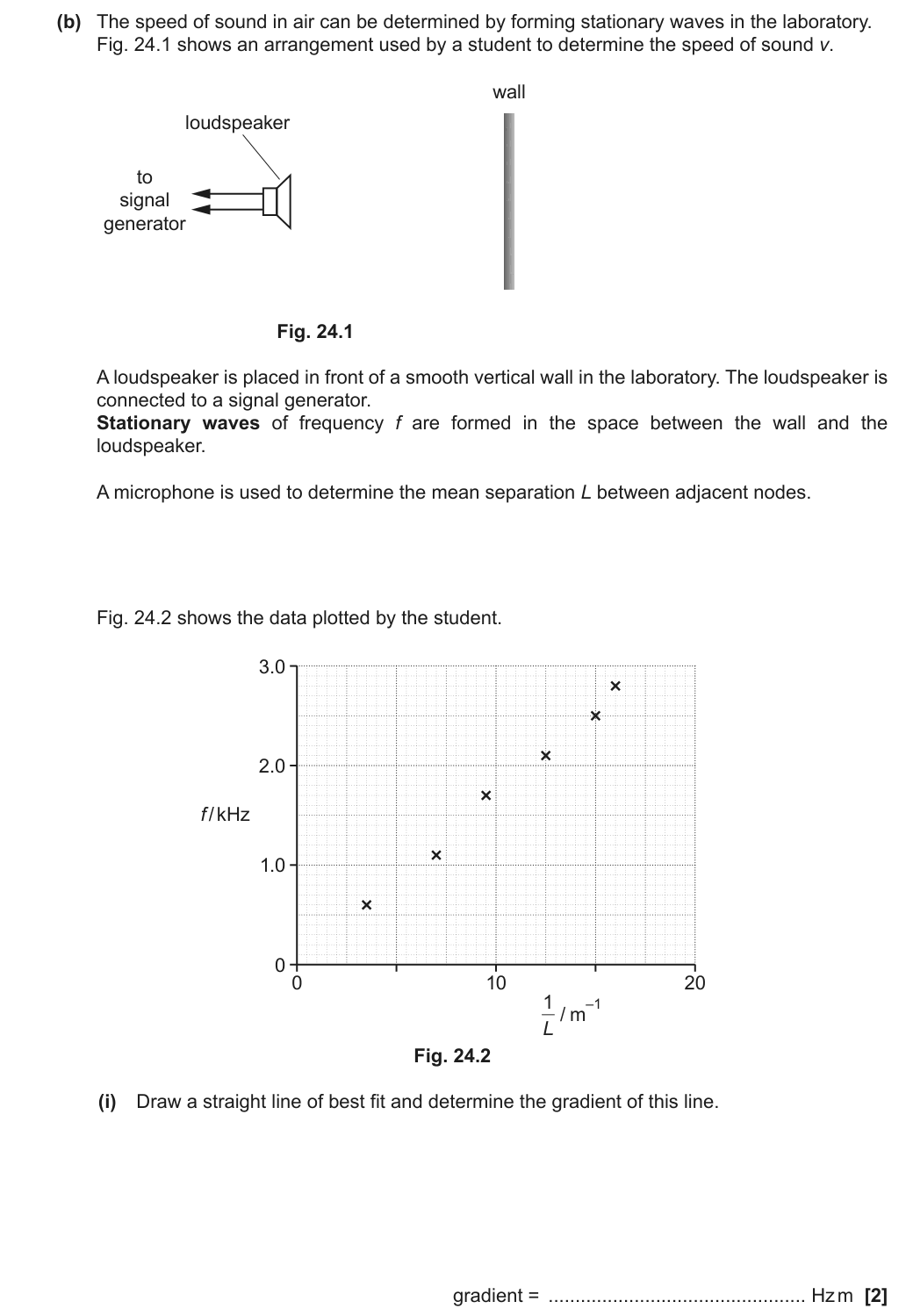
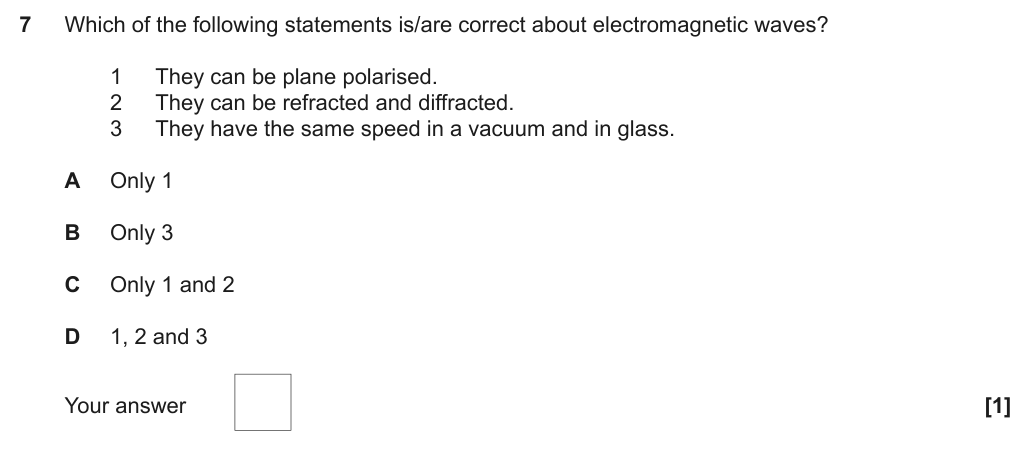
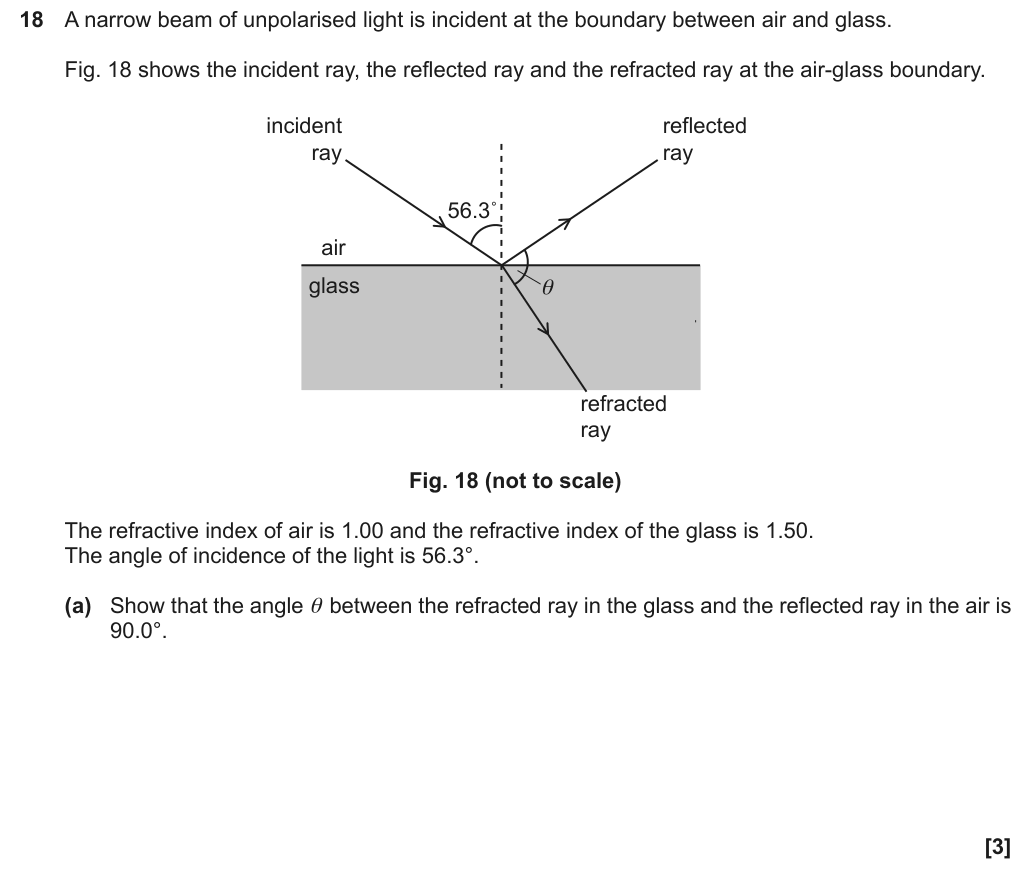
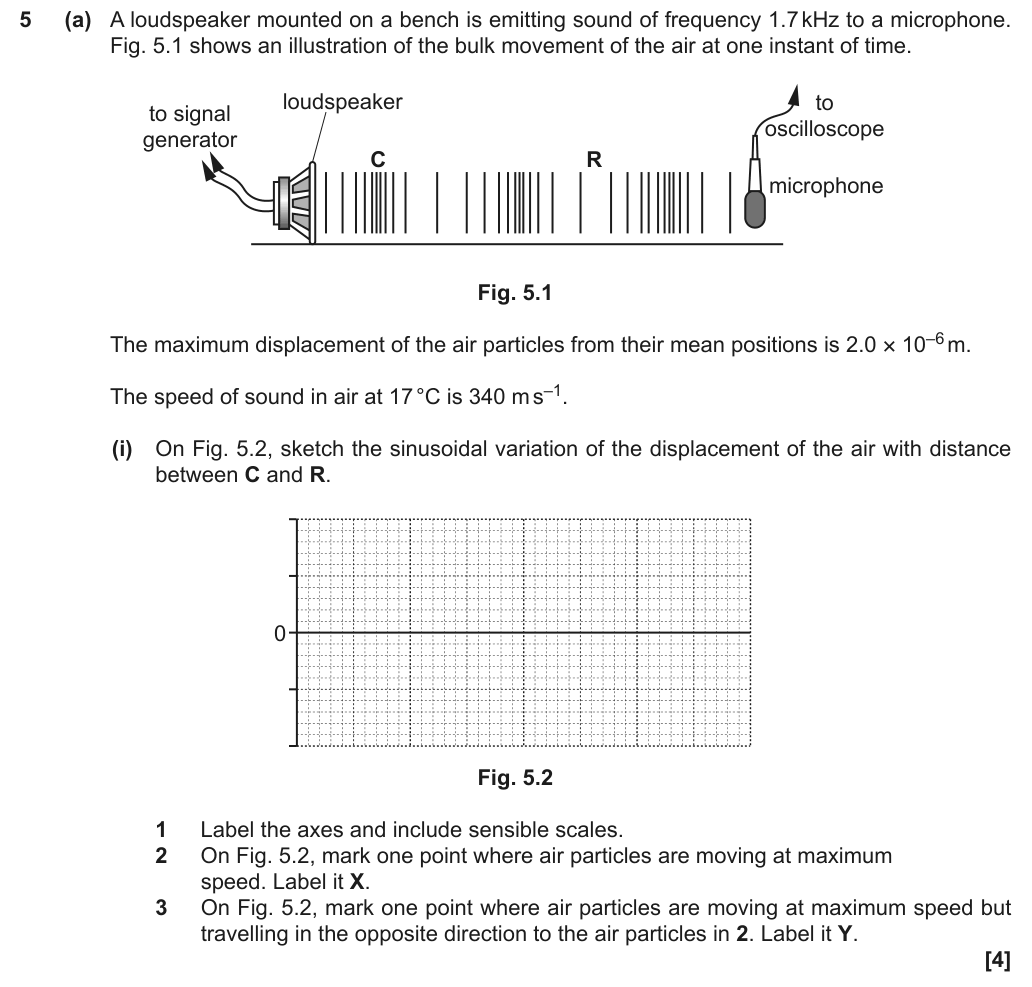
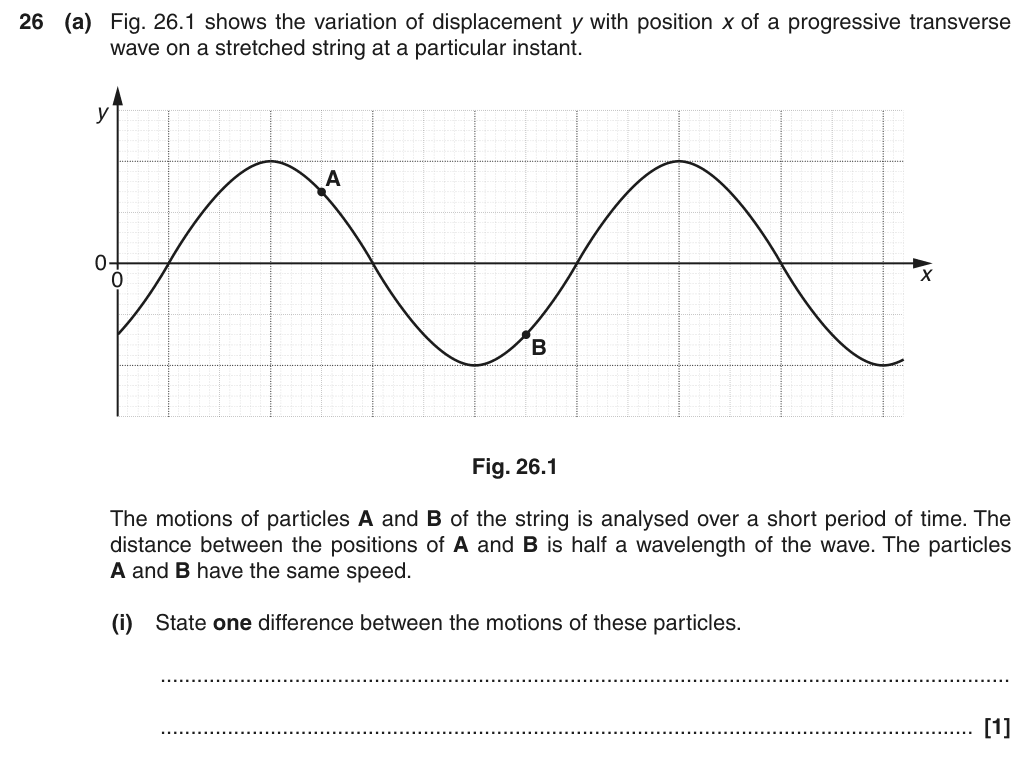
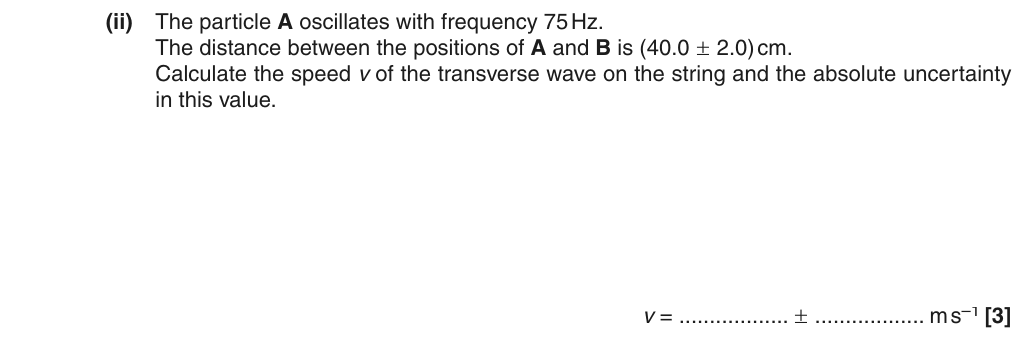
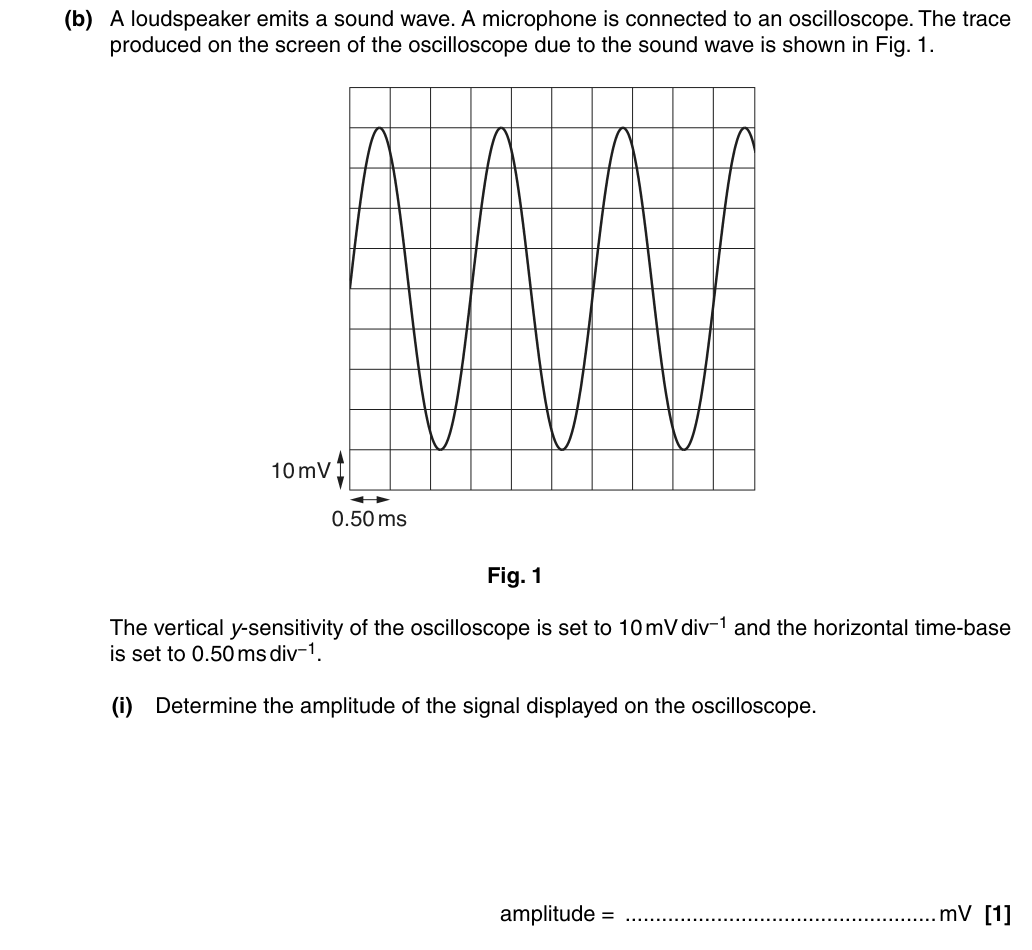
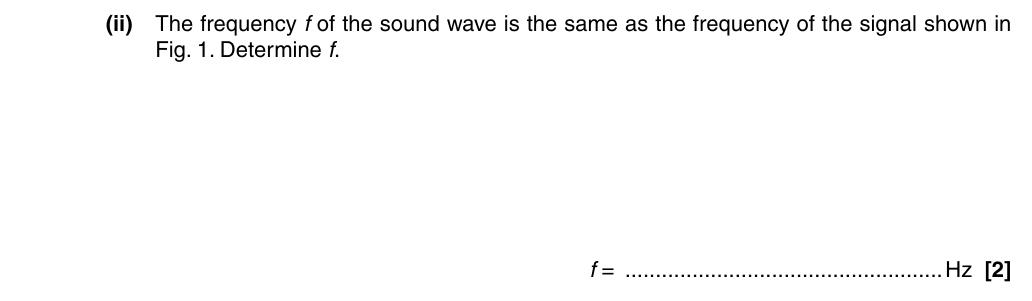
A student carries out an experiment to determine the speed v of sound in air. The student forms Explain how the apparatus is used to determine f and use the graph to determine v. Include the
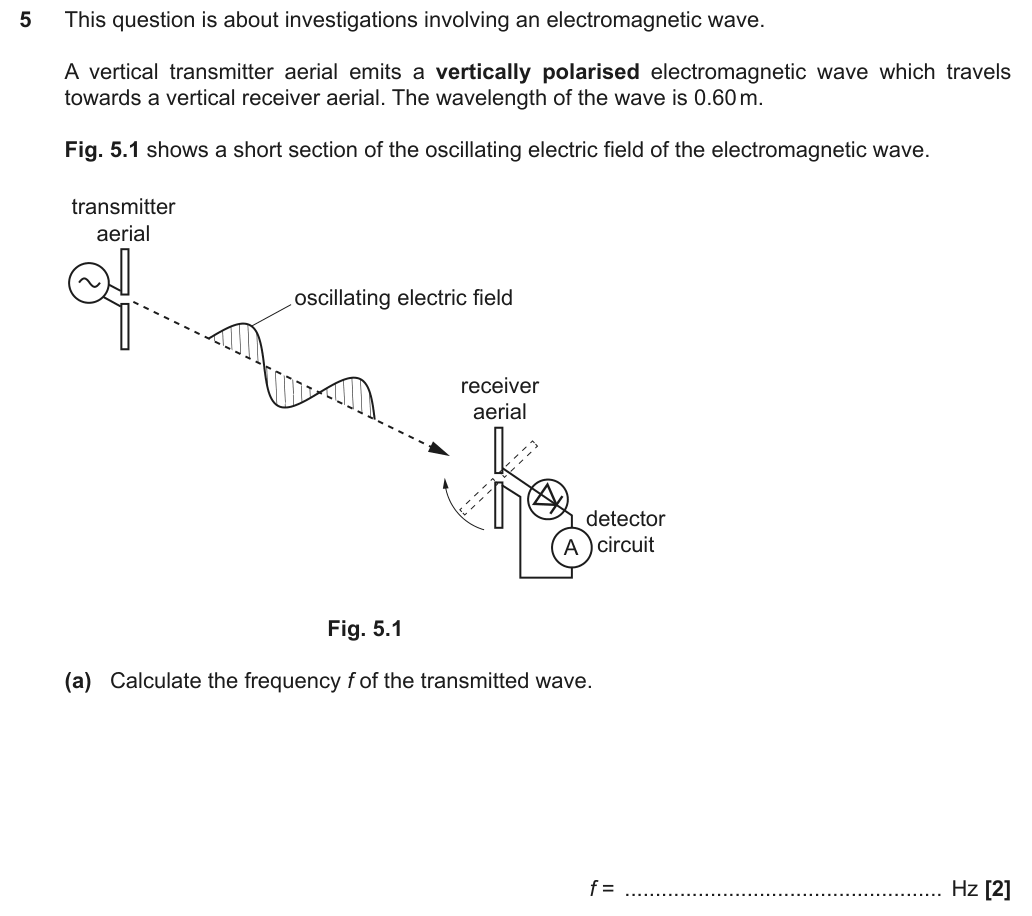
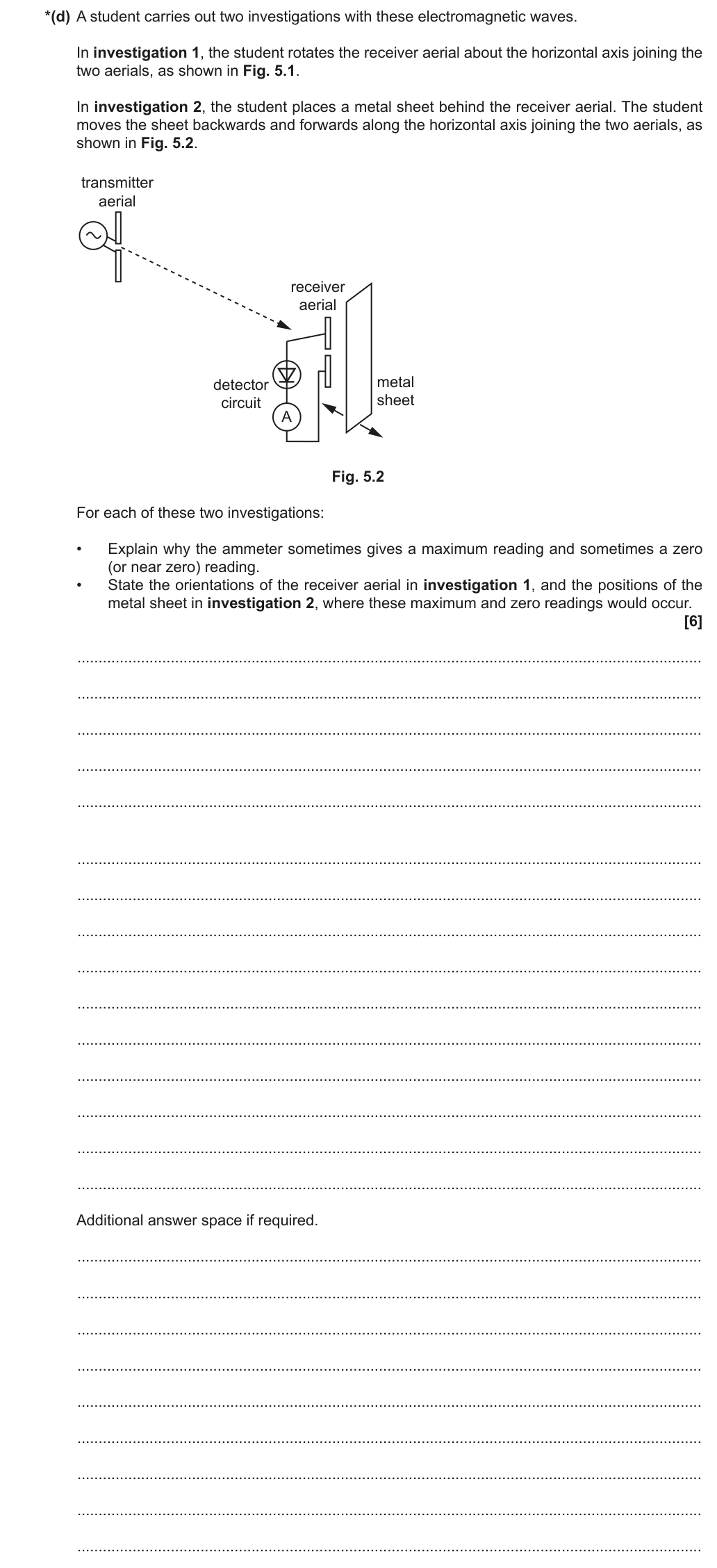
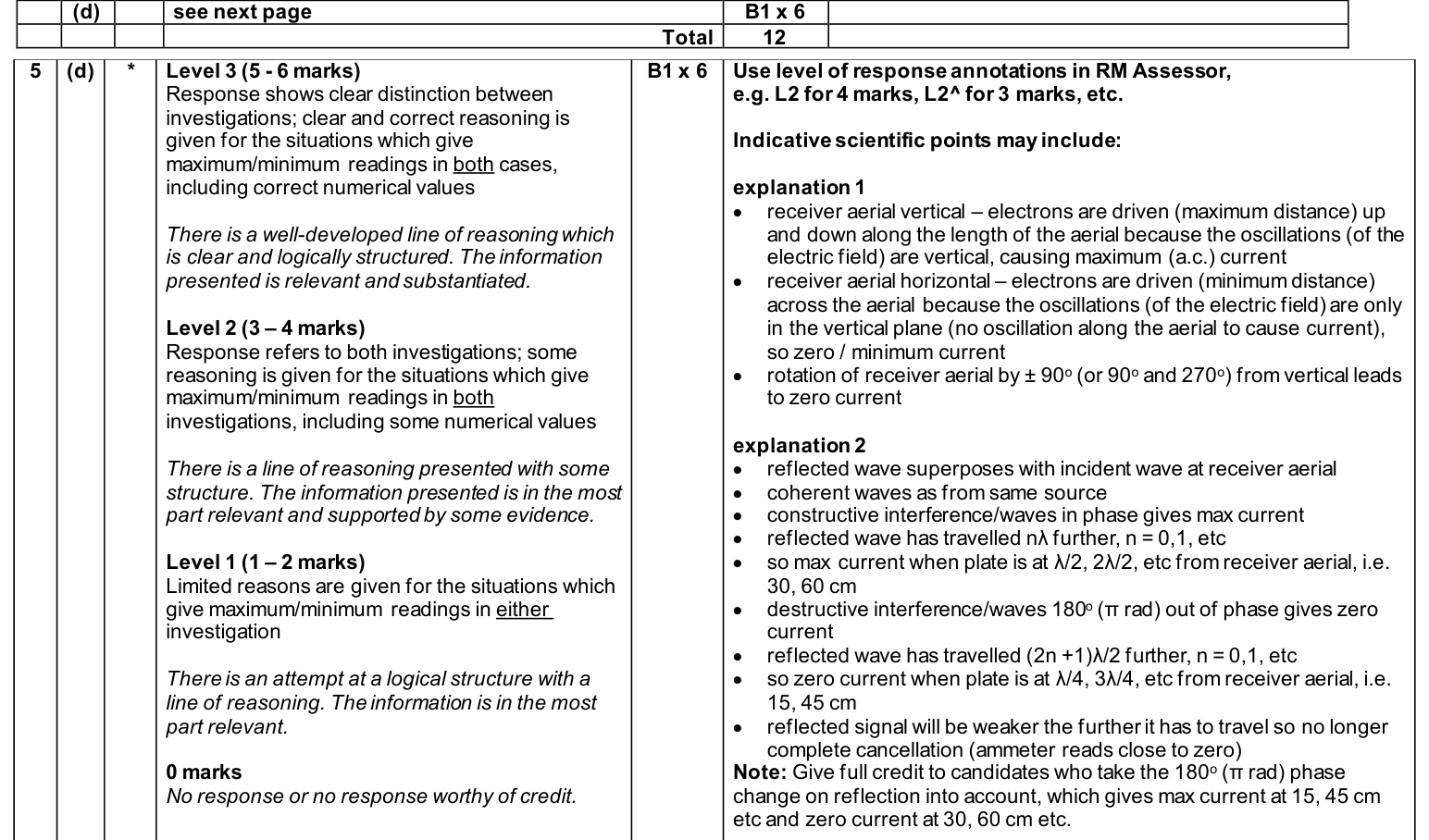
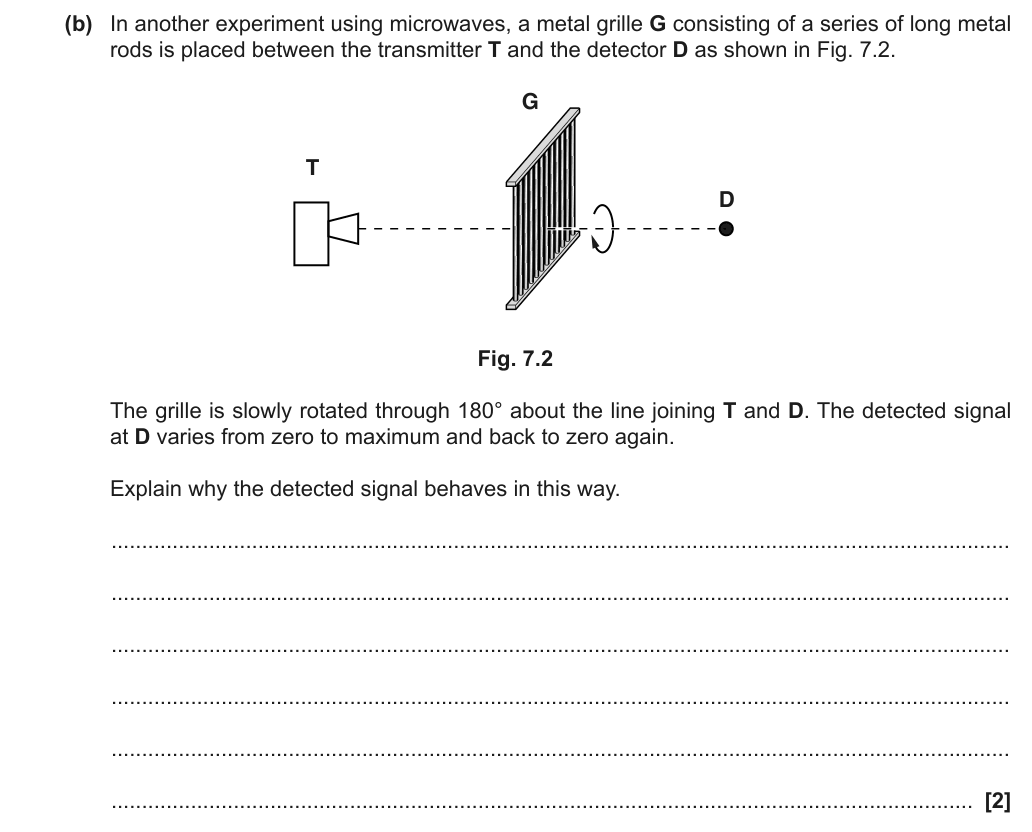
*(d) A student carries out two investigations with these electromagnetic waves. • Explain why the ammeter sometimes gives a maximum reading and sometimes a zero
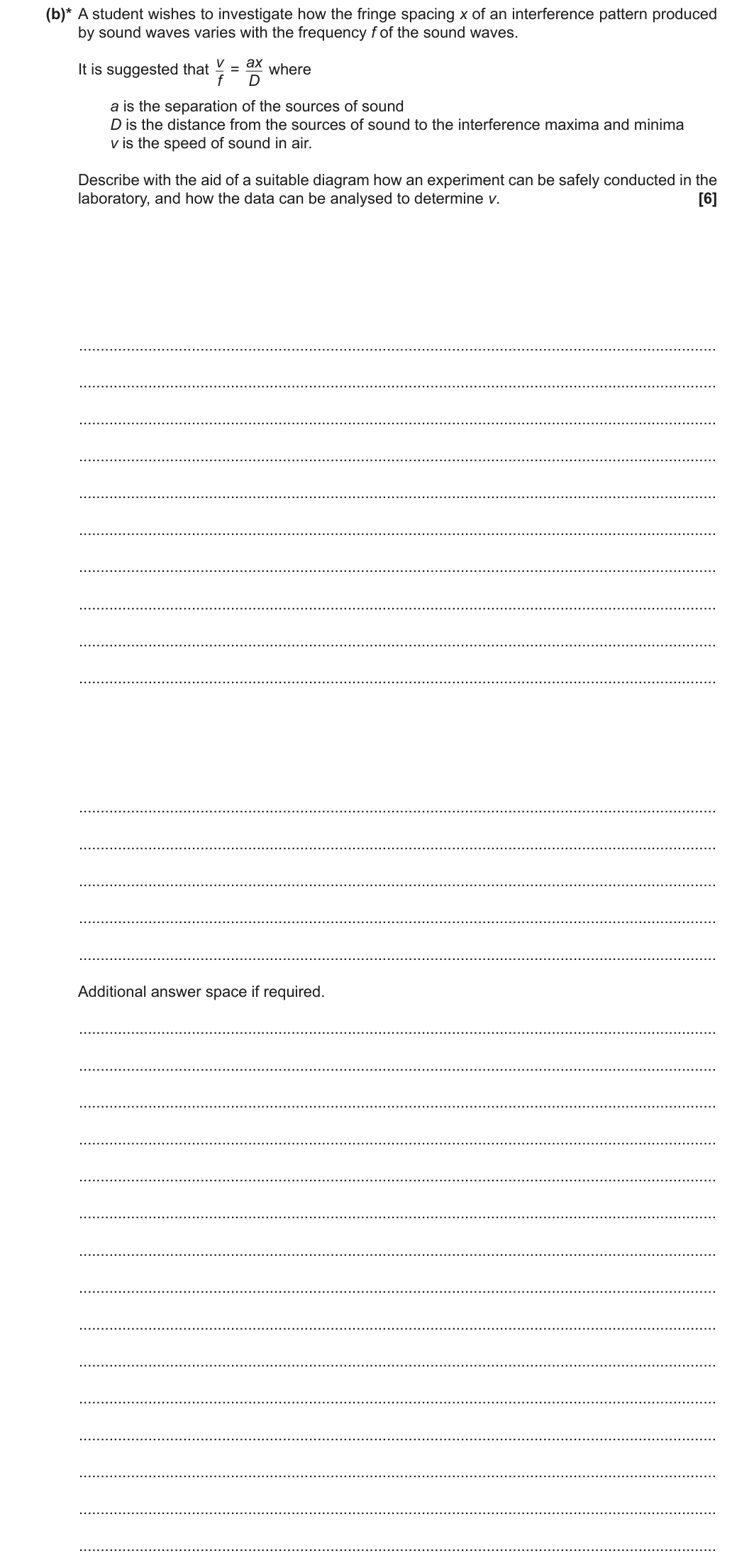
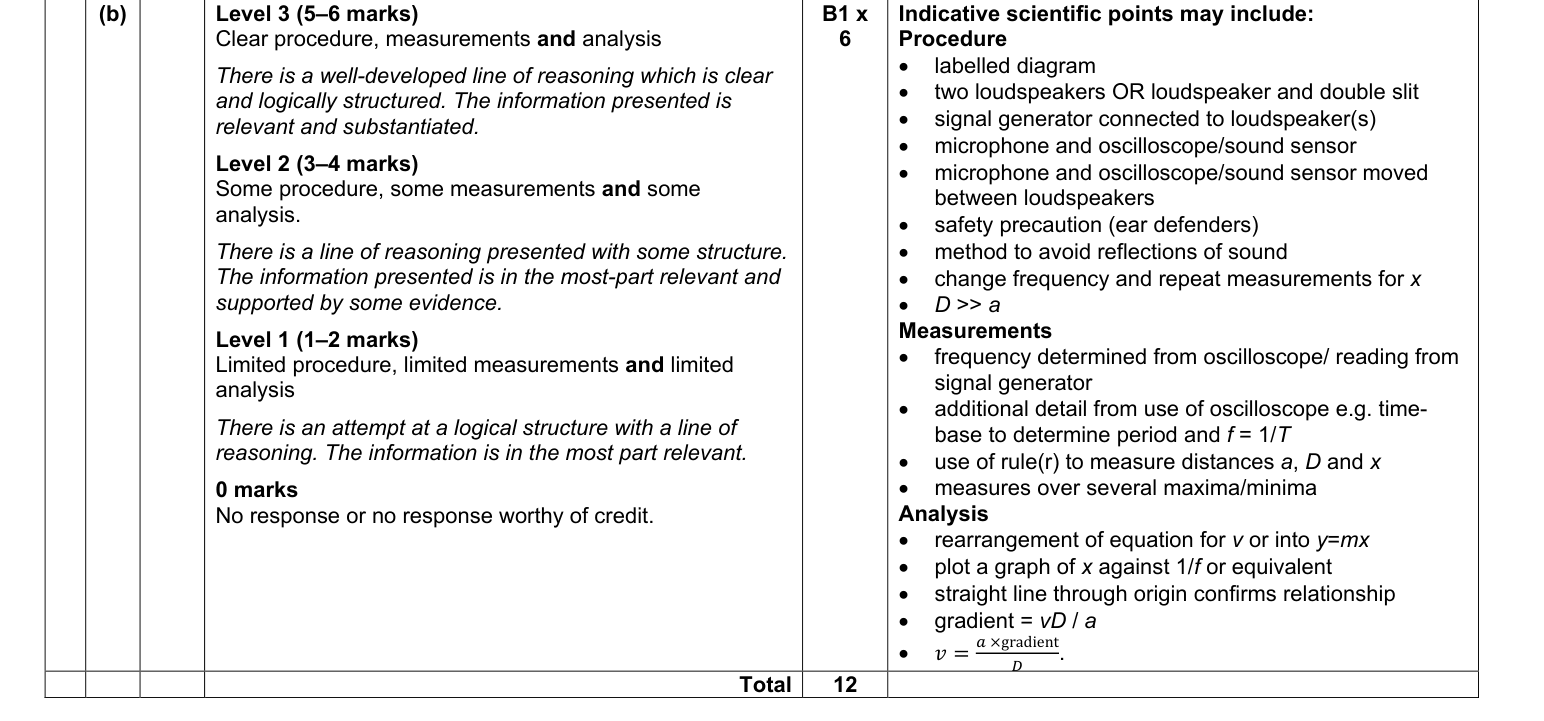
A student wishes to investigate how the fringe spacing x of an interference pattern produced Describe with the aid of a suitable diagram how an experiment can be safely conducted in the
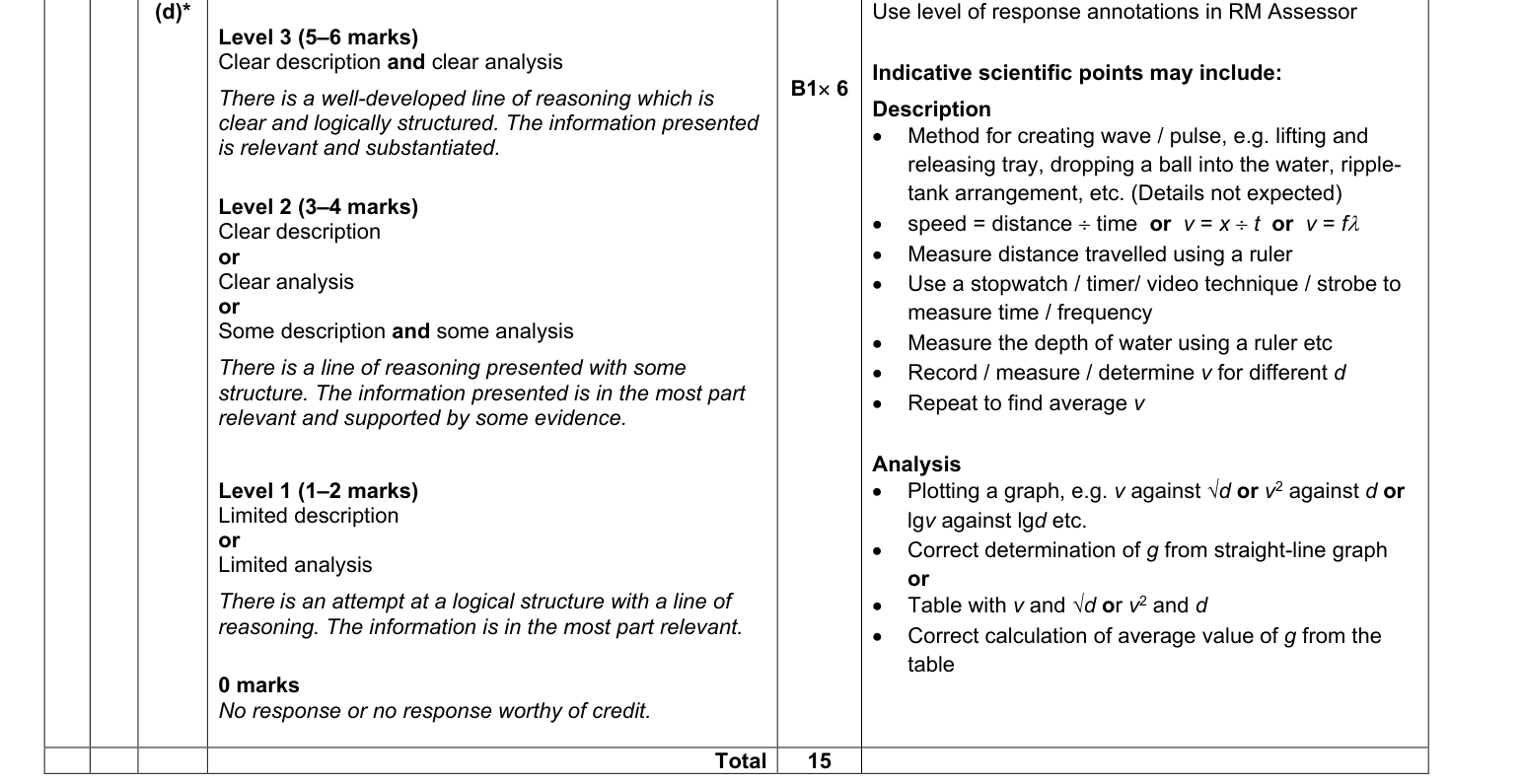
The speed v of surface water waves in shallow water of depth d is given by the equation Describe how an experiment can be conducted in the laboratory to test the validity of the
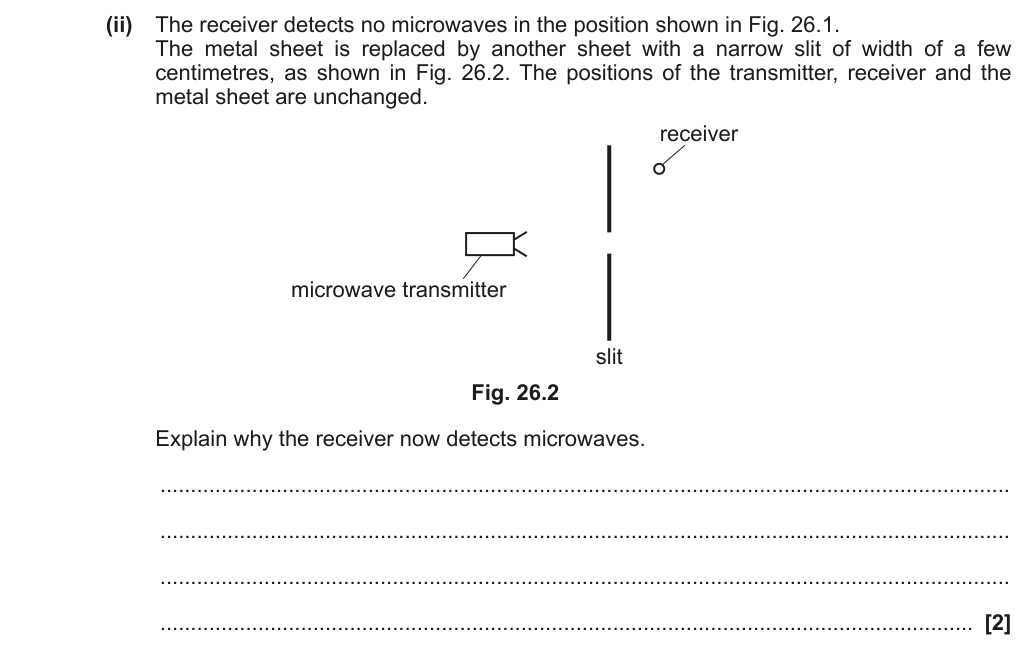
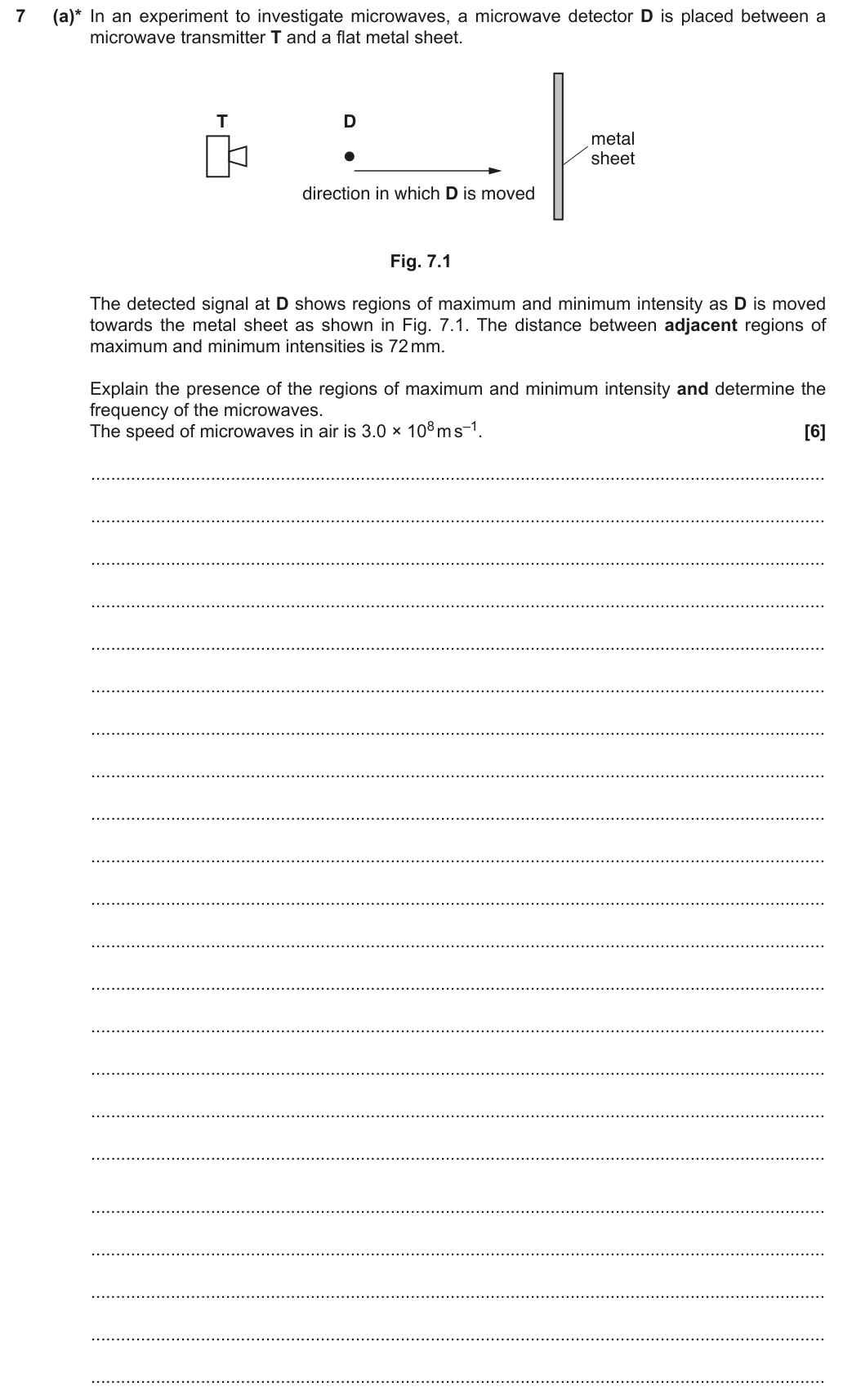
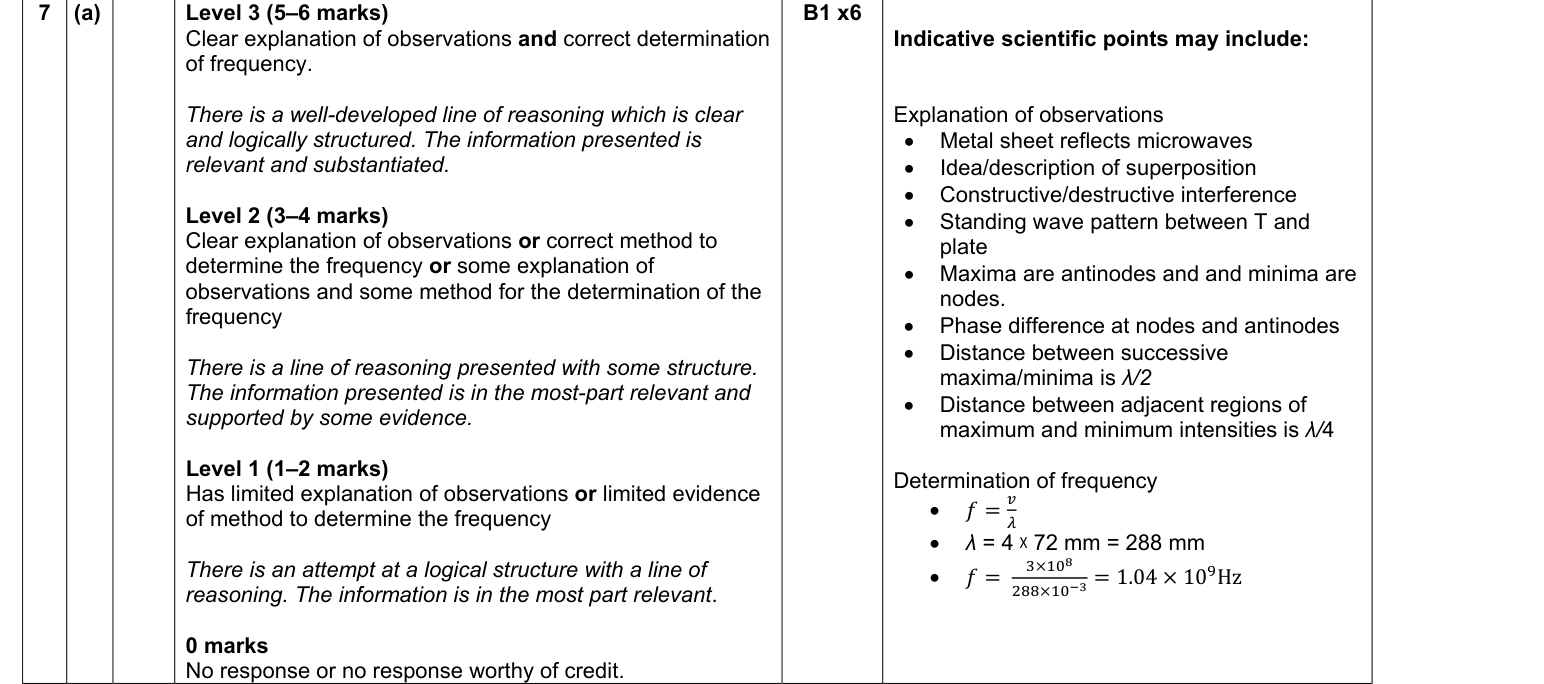
(a)* In an experiment to investigate microwaves, a microwave detector D is placed between a Explain the presence of the regions of maximum and minimum intensity and determine the
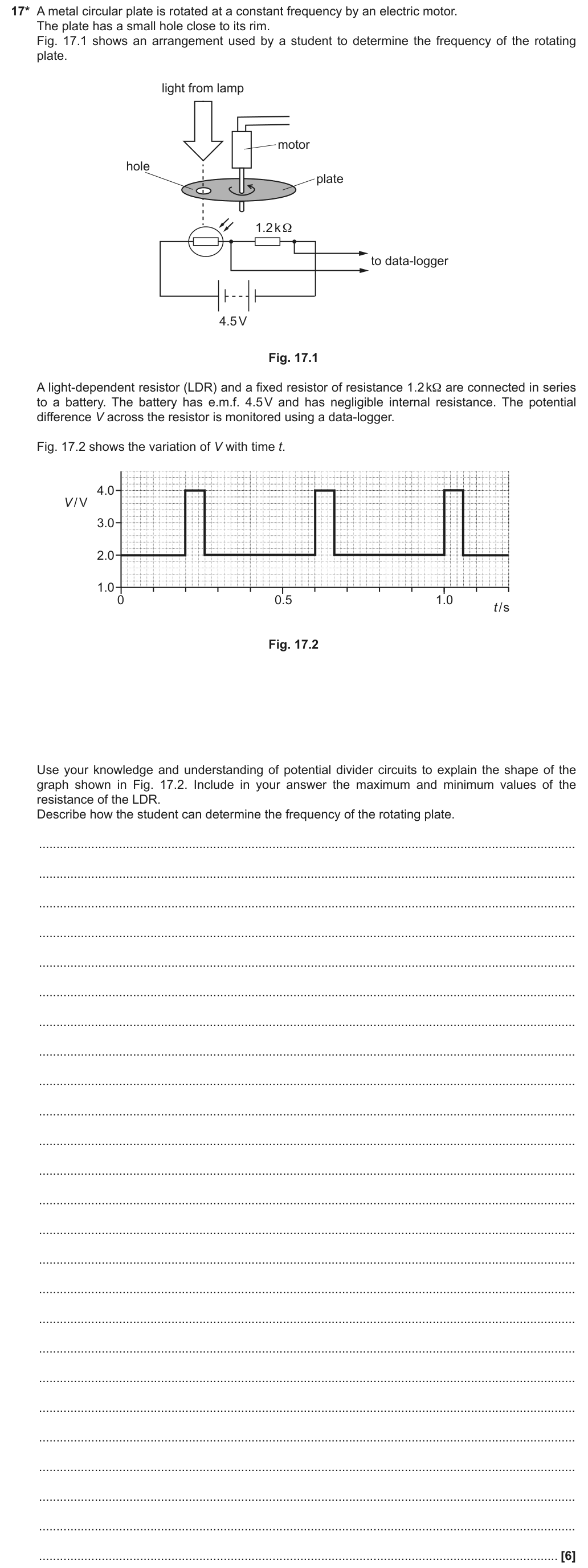
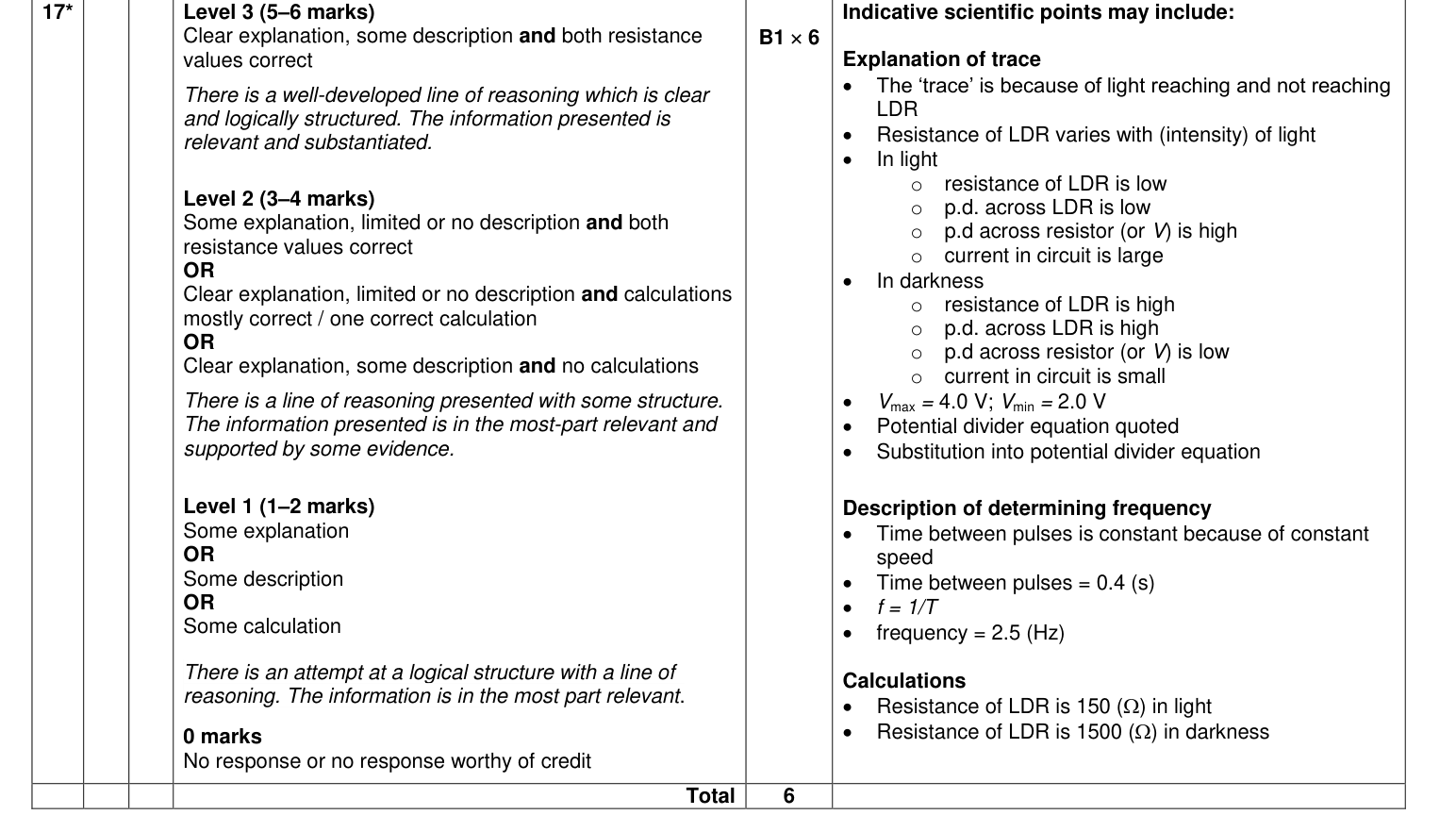
A metal circular plate is rotated at a constant frequency by an electric motor. Use your knowledge and understanding of potential divider circuits to explain the shape of the
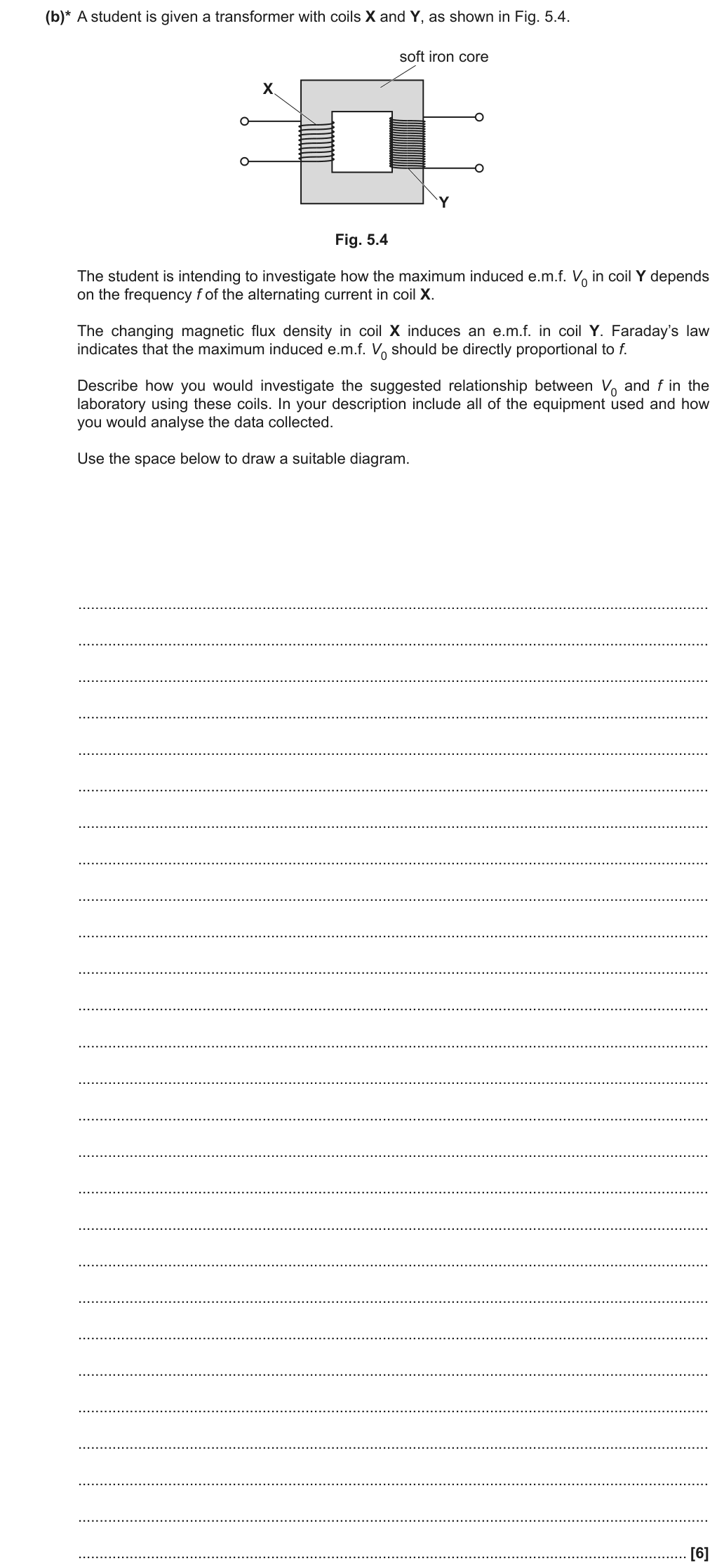
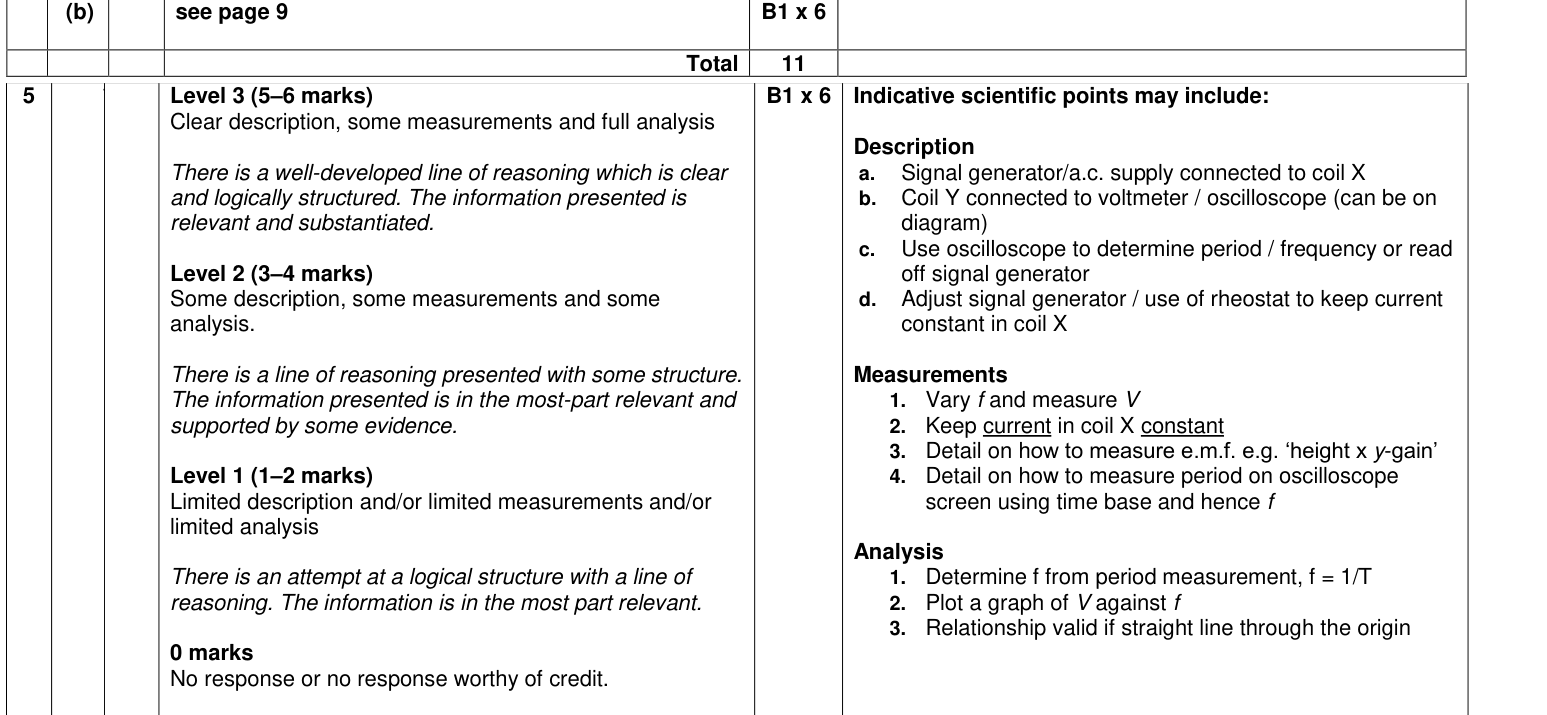
A student is given a transformer with coils X and Y, as shown in Fig. 5.4. Describe how you would investigate the suggested relationship between V0 and f in the
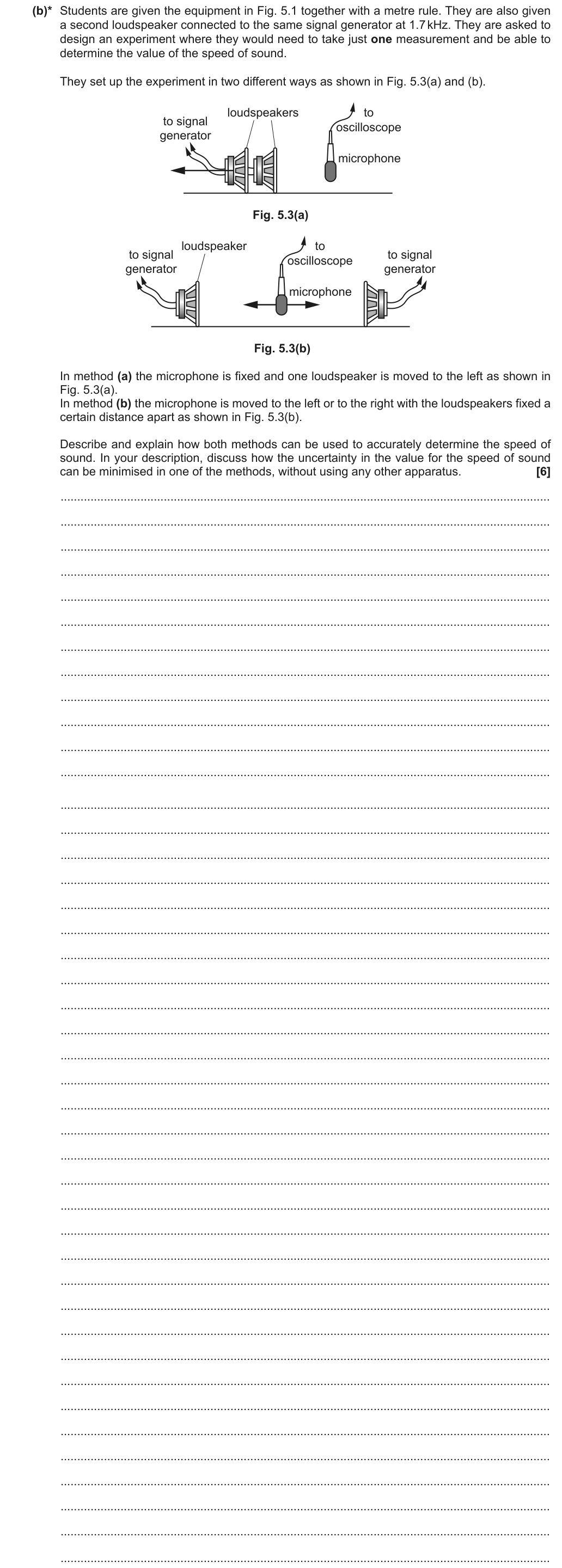
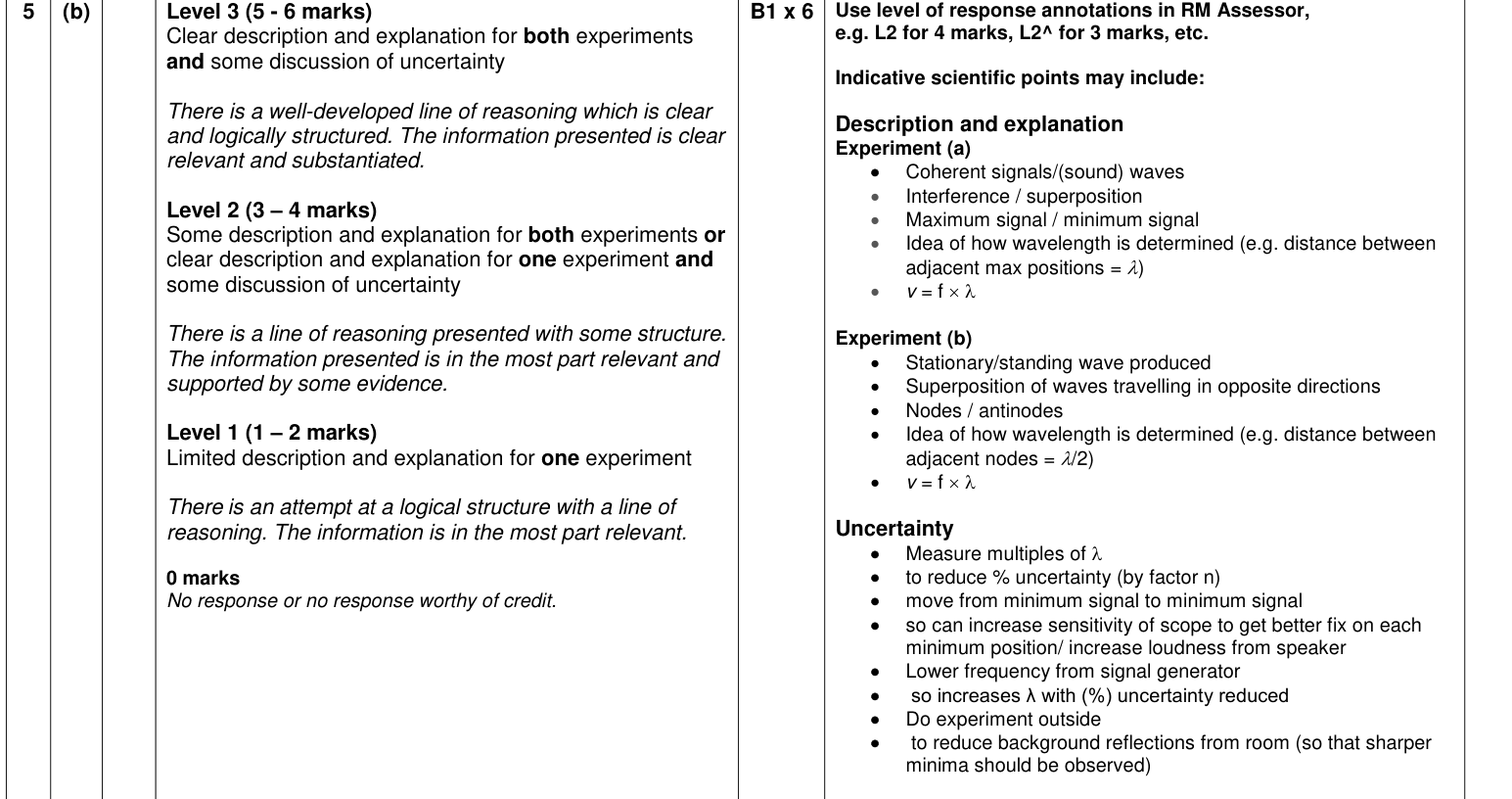
Students are given the equipment in Fig. 5.1 together with a metre rule. They are also given Describe and explain how both methods can be used to accurately determine the speed of
Tap a question to zoom it. Where a part needs a figure, table or graph from earlier in the question, that part folds out above it; the mark scheme and examiner's comment open underneath. Have the OCR Data, Formulae and Relationships Booklet beside you (see the data booklet page).
June 2025 · AS Paper 1 · Q51 markMultiple choiceEasy
Answer
C
Mark scheme
Examiner's comment
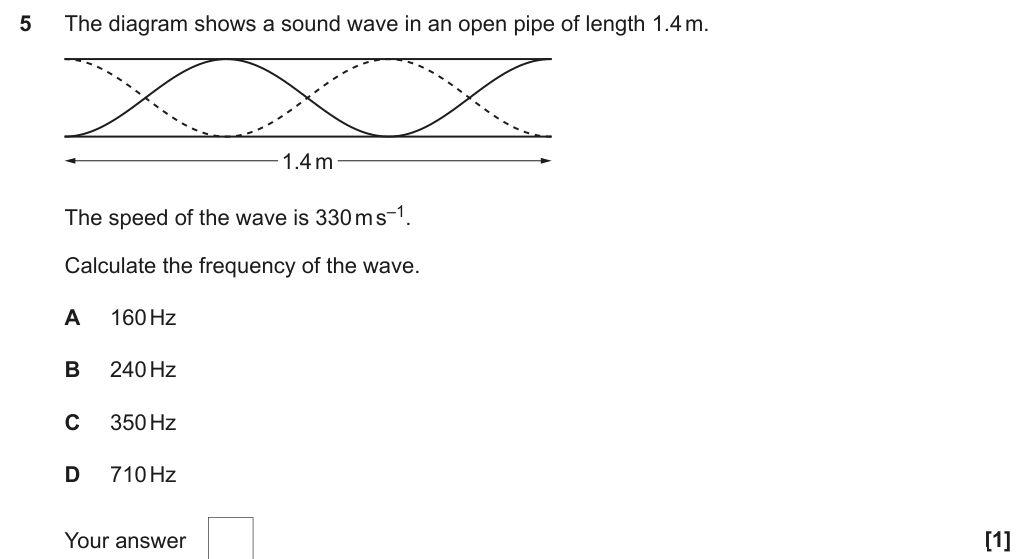
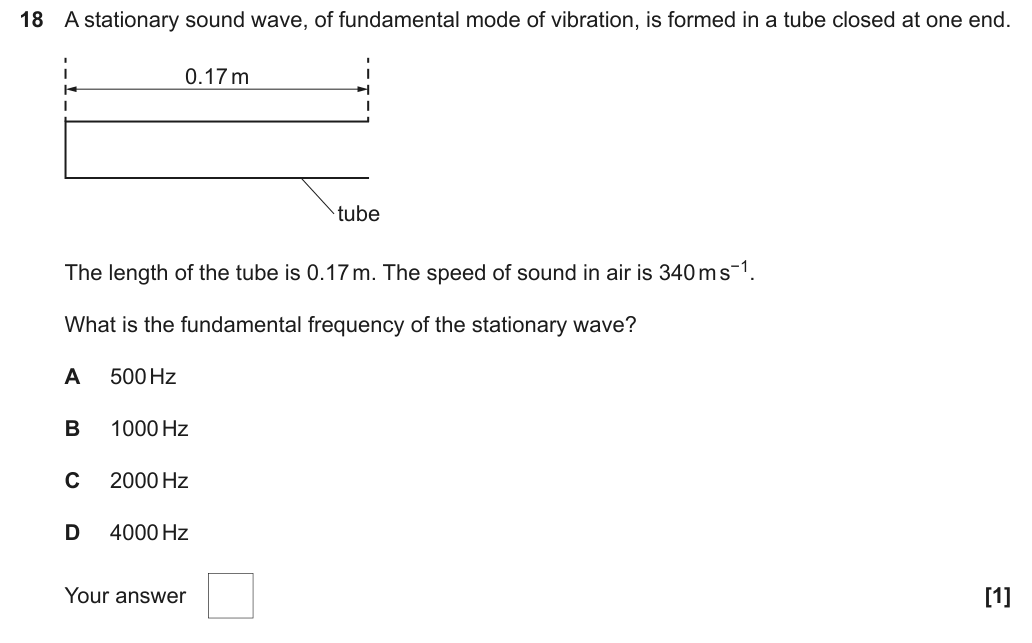
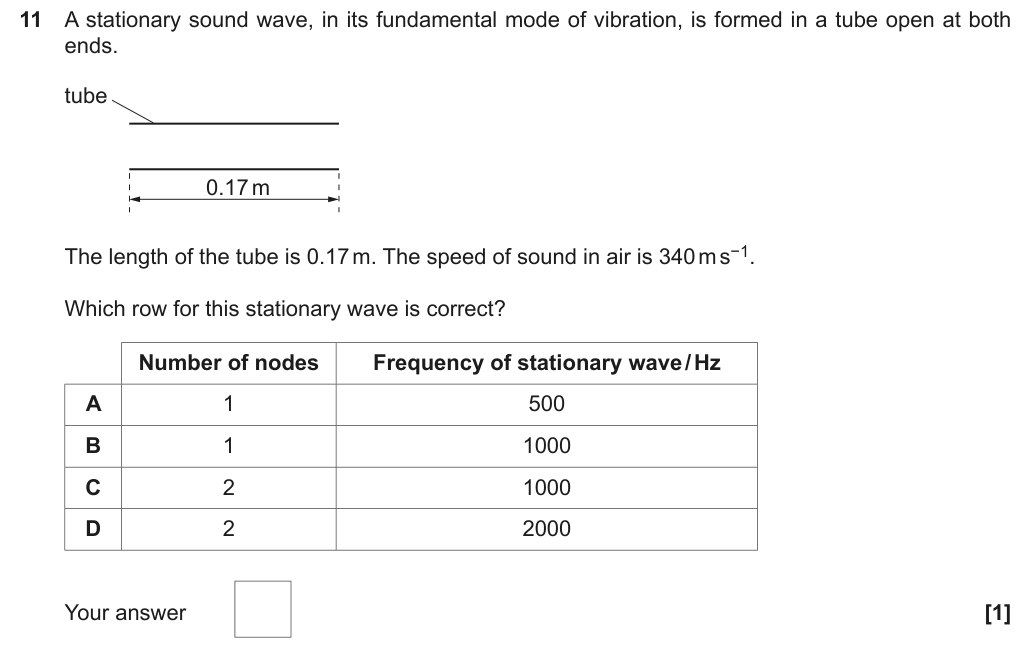
Most candidates correctly understood that the length of the tube was 1.5 wavelengths and gained the correct answer. Low scoring candidates often assumed that the length of the tube was equal to the wavelength and selected B as their answer.
June 2025 · AS Paper 1 · Q201 markMultiple choiceEasy
Answer
D
Mark scheme
Examiner's comment
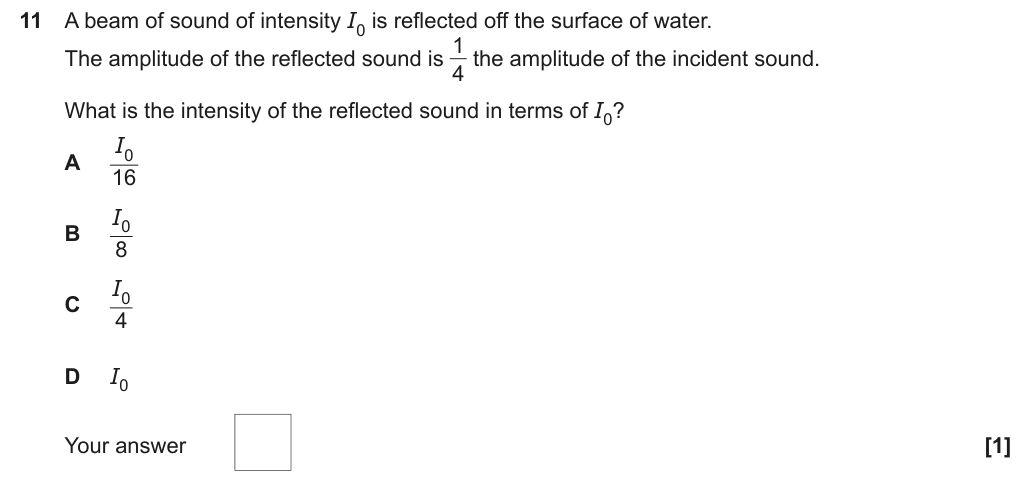
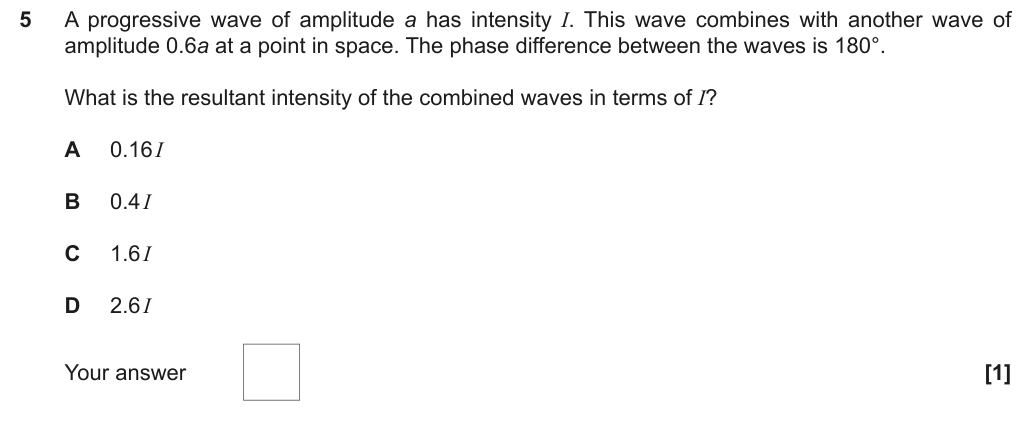
This question was generally answered well. The common error was selecting C (not understanding that intensity is proportional to amplitude2) or A (not understanding the direct proportion).
June 2025 · AS Paper 1 · Q23(c)(i)2 marksExplanationMedium
Mark scheme
Examiner's comment
Many candidates discussed the general conditions for stationary waves or described stationary waves. High scoring candidates related their answers to the microwave oven by stating that the emitted microwaves would reflect from the metal walls of the oven and that the emitted and reflected waves would interfere or superpose. Lower scoring candidates did not always use correct terms.
Notes from the mark scheme and report
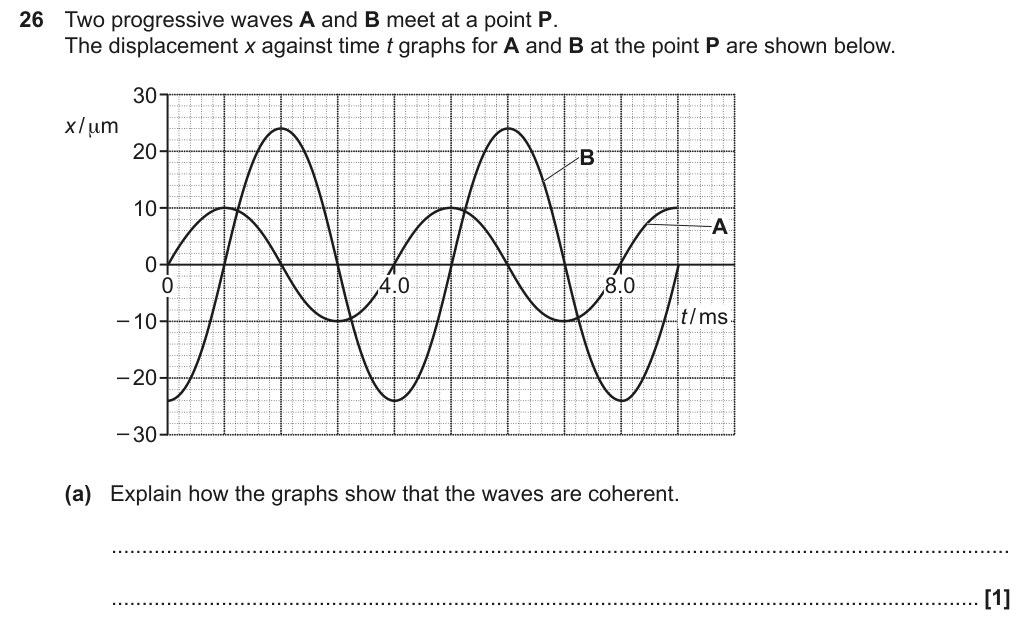
ignore reference to coherence
June 2025 · AS Paper 1 · Q25(a)2 marksExplanationMedium
Mark scheme
Examiner's comment
To gain full credit for this question, candidates needed to understand that only transverse waves could be polarised and thus the oscillations of vibrations of the wave were perpendicular to the direction of the wave. The majority of the candidates were able to state that in a plane polarised wave the oscillations are only in one direction or plane .Some candidates omitted any references to the oscillations or vibrations of the wave but instead answered the question in terms of ‘a wave travelling in a single plane’. Other lower scoring candidates stated that ‘polarising blocks some waves’.
Notes from the mark scheme and report
ignore waves (must refer to oscillations / vibrations)
Allow a named direction e.g. vertical
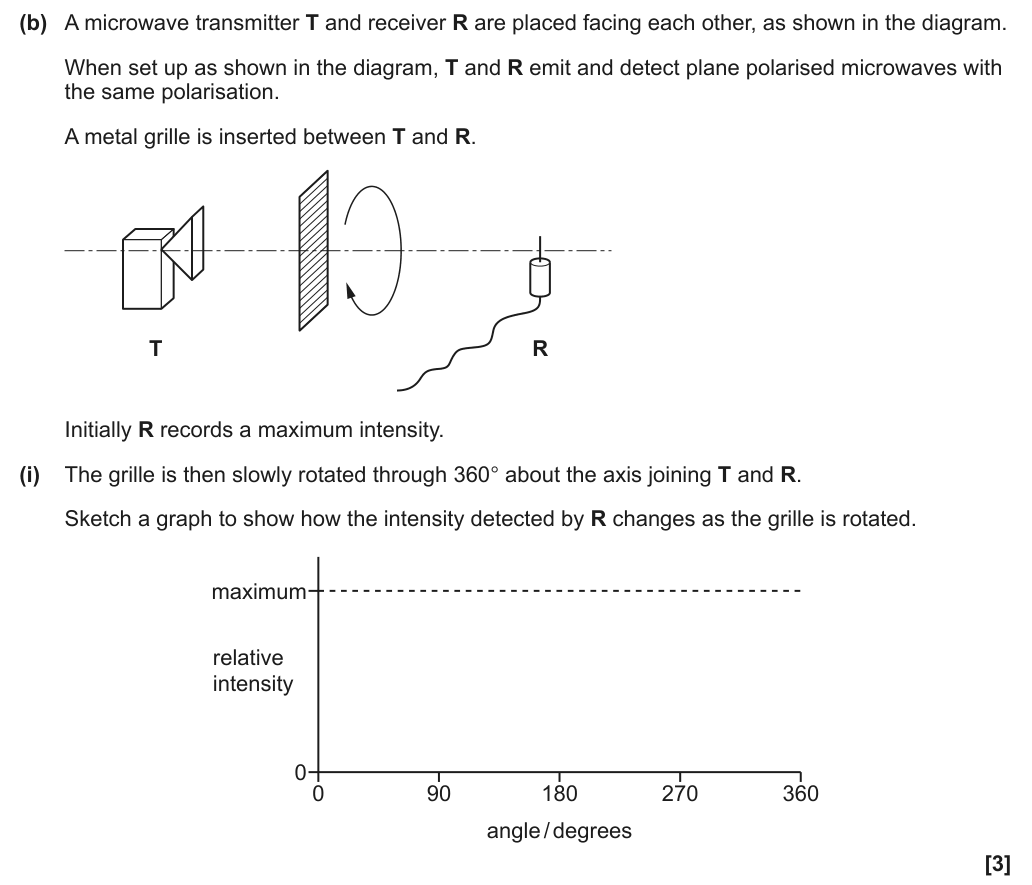
June 2025 · AS Paper 1 · Q25(b)(i)3 marksDiagram or graphEasy
Mark scheme
Examiner's comment
Most candidates correctly understood that maximum intensity occurred at 0 180 360 and that the minimum values would be at 90 and 270. Many candidates incorrectly drew straight lines between the maximum and minimum values. While Malus’ law is not part of the specification a qualitative understanding of the how the intensity changes when a polariser is used is expected.
Notes from the mark scheme and report
maxima at 0, 180 and 360 and minima close to zero at 90 and 270
cos² shape with curved peaks and troughs
Skills: M3.12 Sketch relationships which are modelled by y = k/x, y = kx², y = k/x², y = kx, y = sin x, y = cos x, y = e^(±x) and y = sin²x, y = cos²x as applied to physical relationships; PAG5 Investigating waves
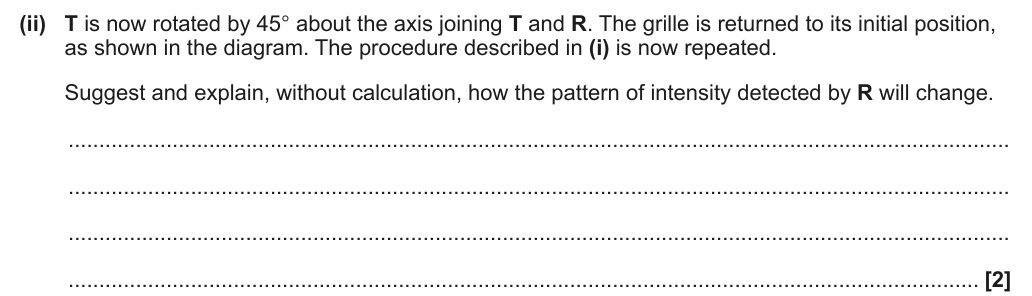
June 2025 · AS Paper 1 · Q25(b)(ii)2 marksExplanationHard
Earlier part of question 25 that this part uses
Mark scheme
Examiner's comment
Most candidates discussed that the pattern would be shifted without realising that the maximum intensity of the pattern would be reduced. Very few candidates explained that the reason for the decrease maximum intensity was due to the detector receiving a smaller component of the transmitted wave.
Notes from the mark scheme and report
ignore angle the pattern shifts
Skills: PAG5 Investigating waves
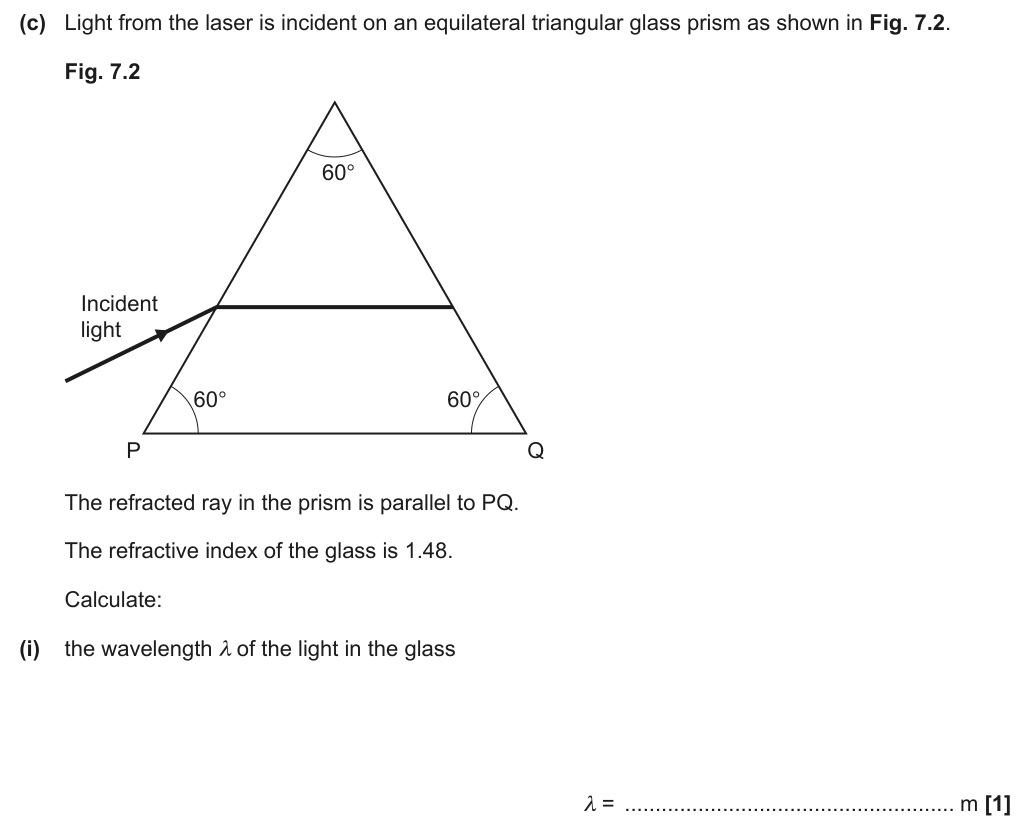
June 2025 · AS Paper 2 · Q7(c)(i)1 markCalculationHard
Earlier part of question 7 that this part uses
Mark scheme
Examiner's comment
This question appeared to challenge candidates. Some candidates worked out the speed of light in glass but did not then calculate the wavelength.
Notes from the mark scheme and report
allow 3.6 x 10⁻⁷
Skills: M2.3 Substitute numerical values into algebraic equations using appropriate units for physical quantities
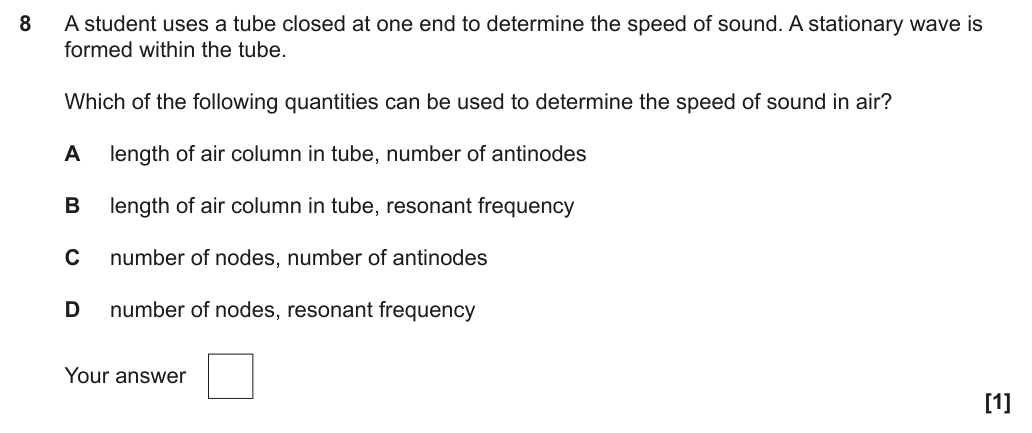
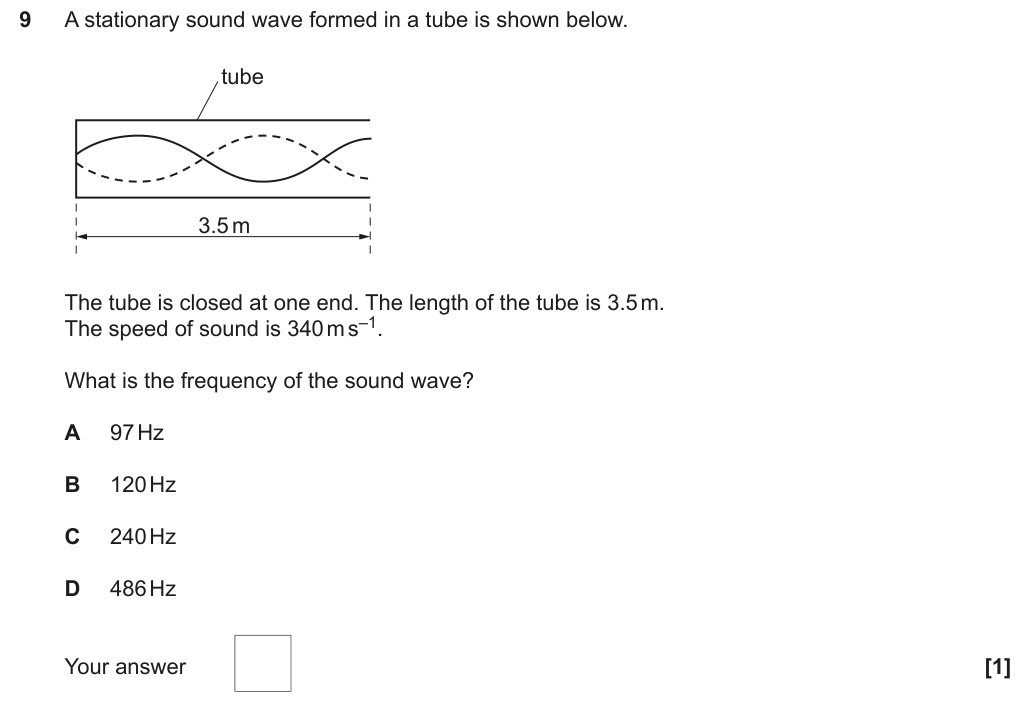
June 2025 · Paper 2 · Q81 markMultiple choiceMedium
Answer
B
Mark scheme
Examiner's comment
Most candidates gave the correct response. Many candidates drew helpful diagrams of a standing wave in a tube to help them identify relevant quantities.
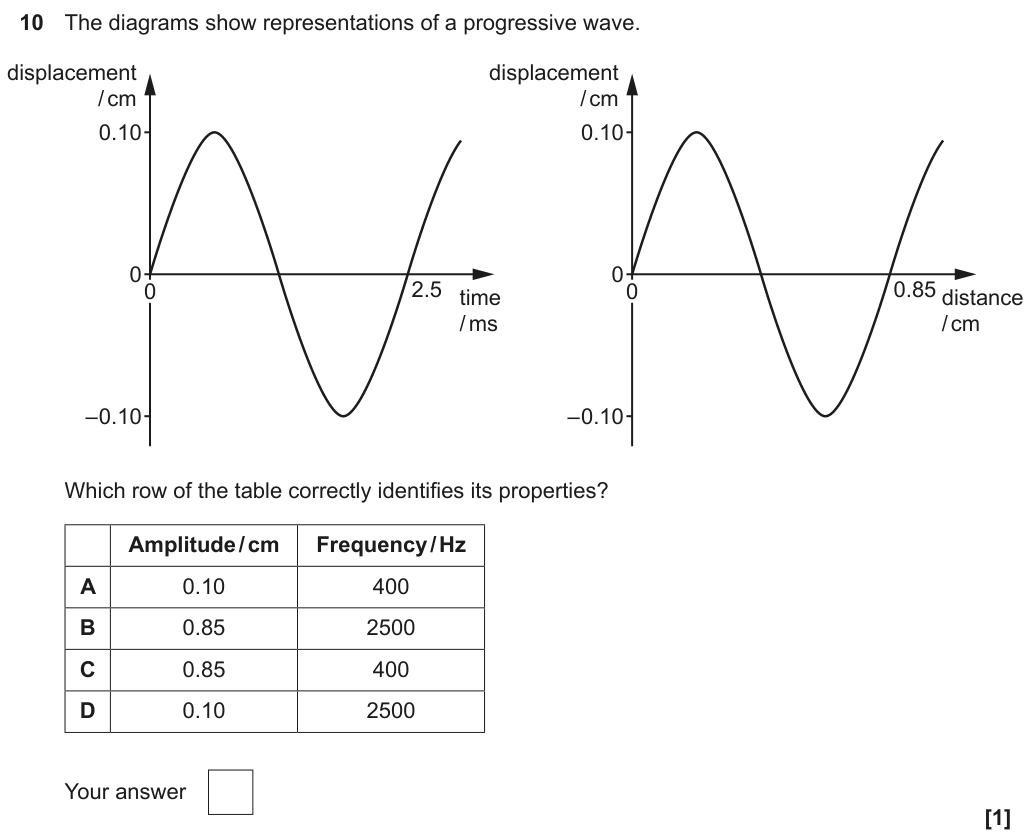
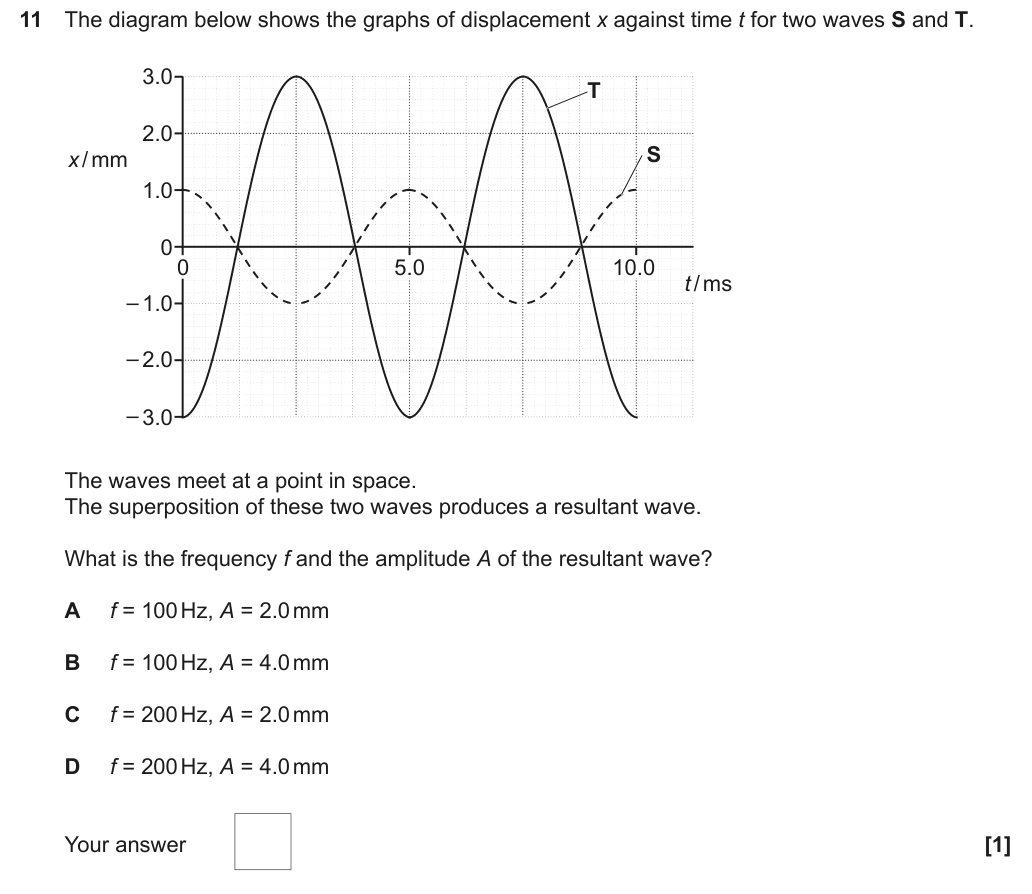
June 2025 · Paper 2 · Q101 markMultiple choiceEasy
Answer
A
Mark scheme
Examiner's comment
This relatively straightforward property of wave question was accessible to most candidates, with almost all candidates obtaining the correct answer. Candidates quite often cross incorrect responses and many put a cross against response B and C, as the correct amplitude was relatively simple to identify.
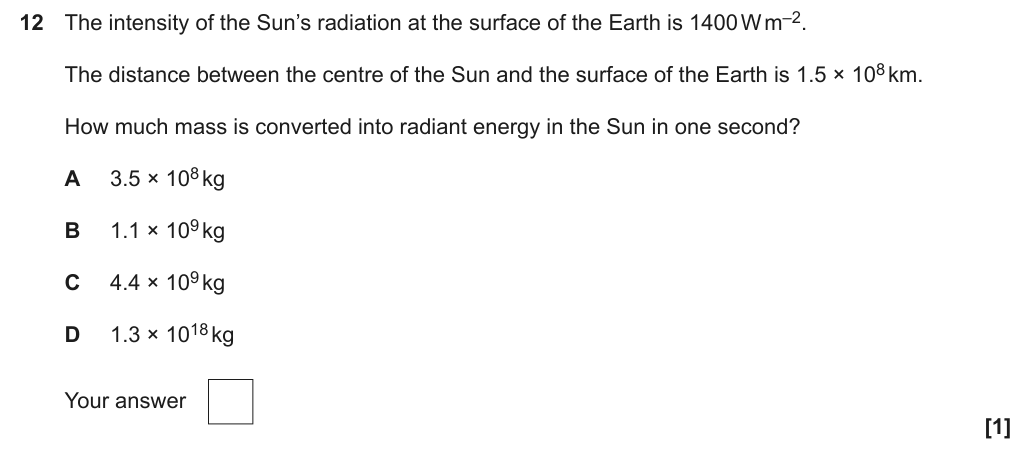
June 2025 · Paper 2 · Q121 markMultiple choiceMedium
Answer
C
Mark scheme
Examiner's comment
A little under half of candidates were able to correctly calculate the mass. While many were able to appreciate that 𝐼 = 𝐴 should be used, it was common not to be able to correctly calculate the area. A was the most popular incorrect response.
Notes from the mark scheme and report
power = intensity x 4πr² then m = E/c²
Skills: M0.1 Recognise and make use of appropriate units in calculations; M0.2 Recognise and use expressions in decimal and standard form; M4.3 Calculate areas of triangles, circumferences and areas of circles, surface areas and volumes of rectangular blocks, cylinders and spheres
June 2025 · Paper 2 · Q20(c)3 marksExplanationHard
Mark scheme
Examiner's comment
Few candidates were able to clearly explain polarisation in terms of oscillation, however most candidates knew that sound waves were longitudinal and could describe this type of wave. A number of candidates used movement for oscillation and this is not clear enough.
June 2025 · Paper 3 · Q6(b)(iii)3 marksCalculationMedium
Earlier part of question 6 that this part uses
Mark scheme
Examiner's comment
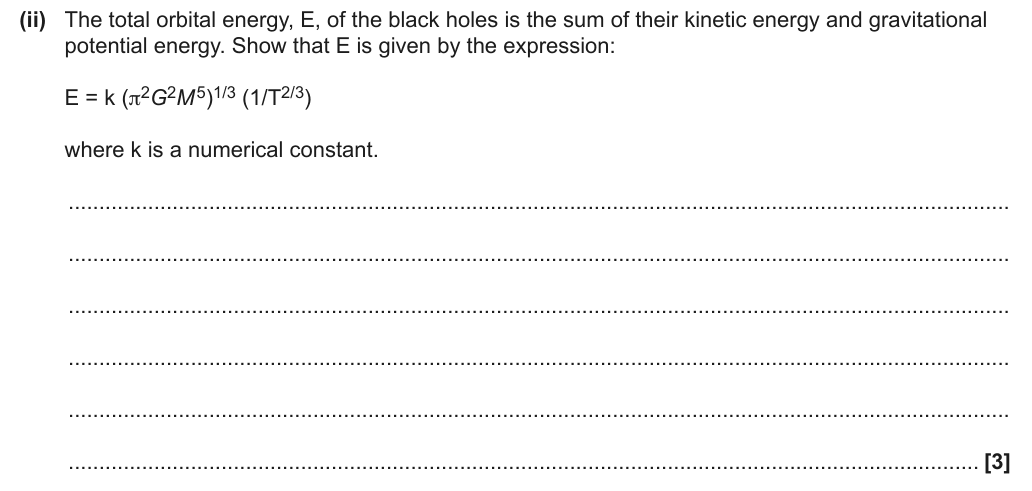
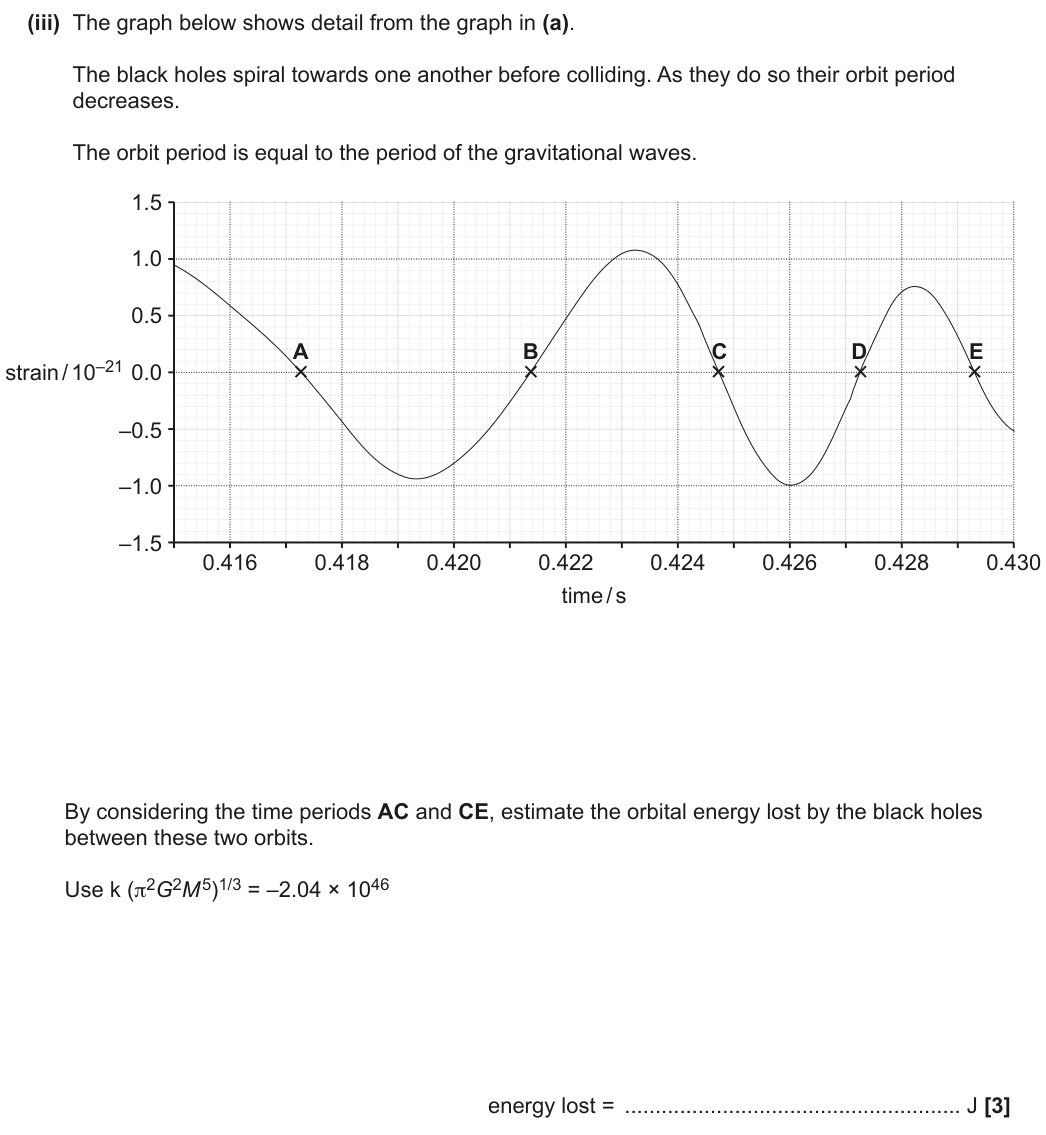
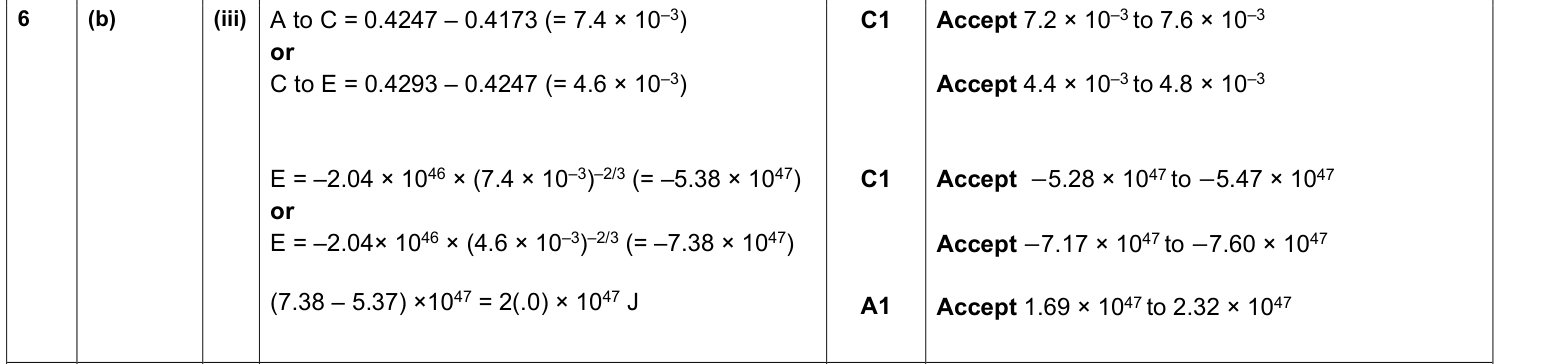
Many candidates were able to gain at least 2 marks on this question. Weaker responses were characterised by inaccurate read offs from the graph, not just values but also selecting incorrect sections, for example AB instead of AC. Some candidates incorrectly substituted the difference between the time periods into the equation for orbital energy rather than calculating two values of orbital energy and then finding the difference. This response shows a well laid out calculation where it is clear what is being evaluated at each step.
Notes from the mark scheme and report
periods 7.2 to 7.6 ms (AC) and 4.4 to 4.8 ms (CE)
answer 1.69 to 2.32 x 10^47 J
Skills: M0.5 Use calculators to find and use power, exponential and logarithmic functions; M2.3 Substitute numerical values into algebraic equations using appropriate units for physical quantities; M3.1 Translate information between graphical, numerical and algebraic forms
June 2024 · AS Paper 1 · Q41 markMultiple choiceEasy
Answer
B
Mark scheme
Examiner's comment
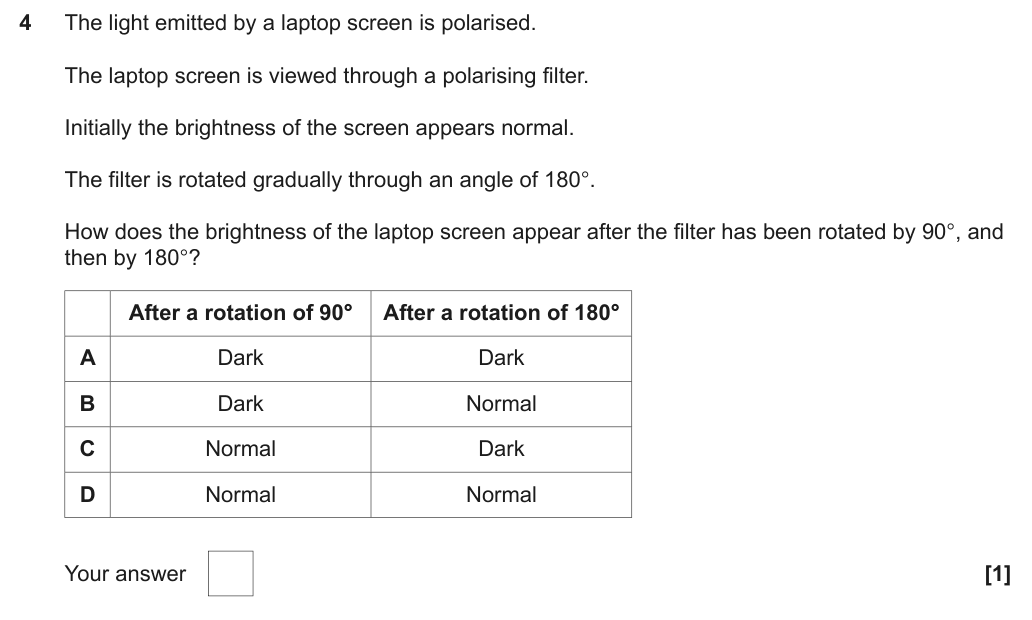
This question was answered well as candidates were able to apply knowledge and understanding of electromagnetic waves passing through a polarising filter to give the correct answer B.
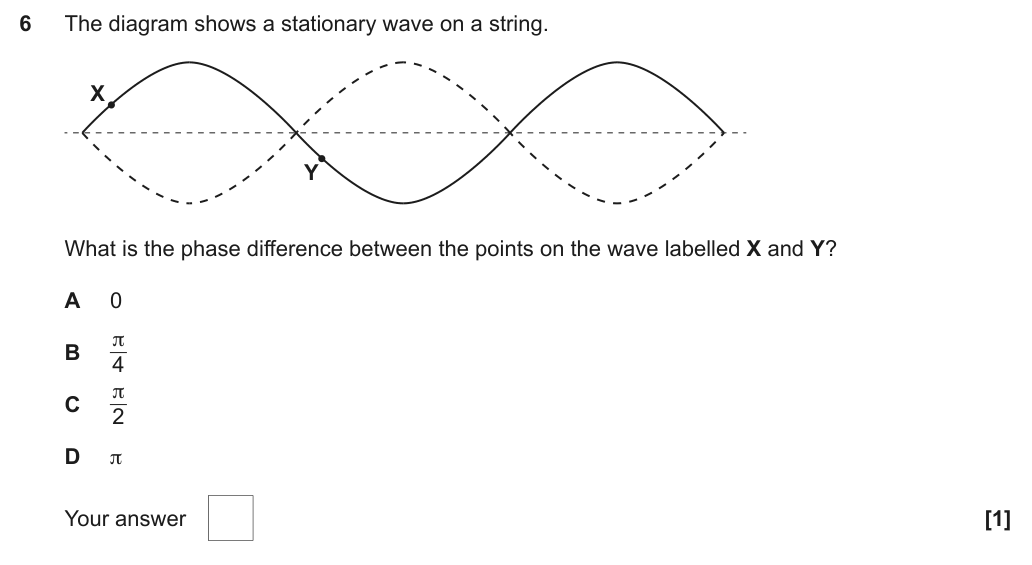
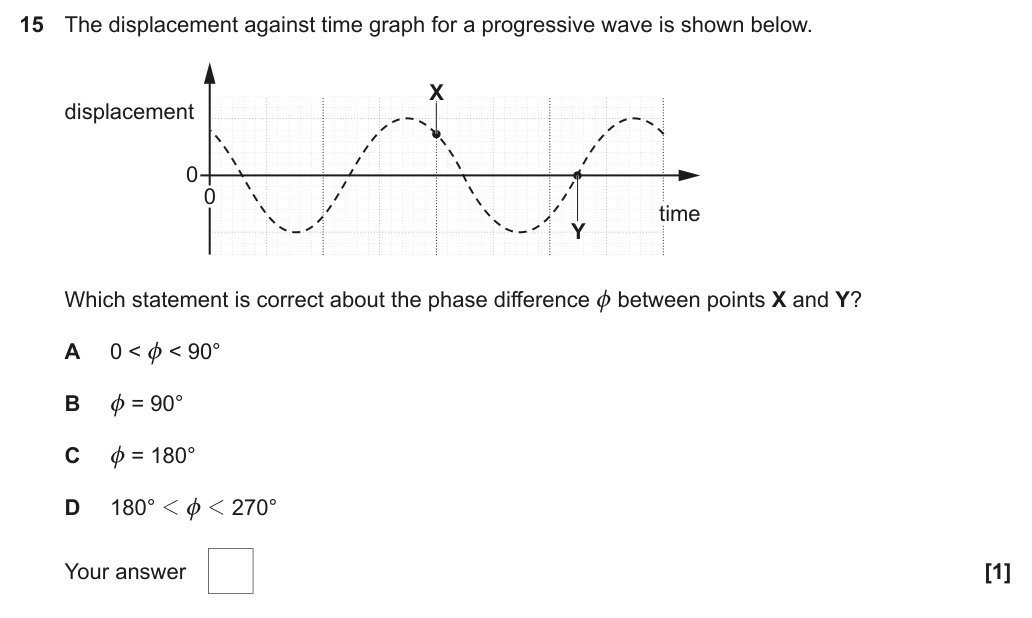
June 2024 · AS Paper 1 · Q61 markMultiple choiceMedium
Answer
D
Mark scheme
Examiner's comment
Many candidates correctly determined the correct phase difference as π between points X and Y as they interpretated that the fraction of the wave between points X and Y was the equivalent to λ/2. The most common distractor was C.
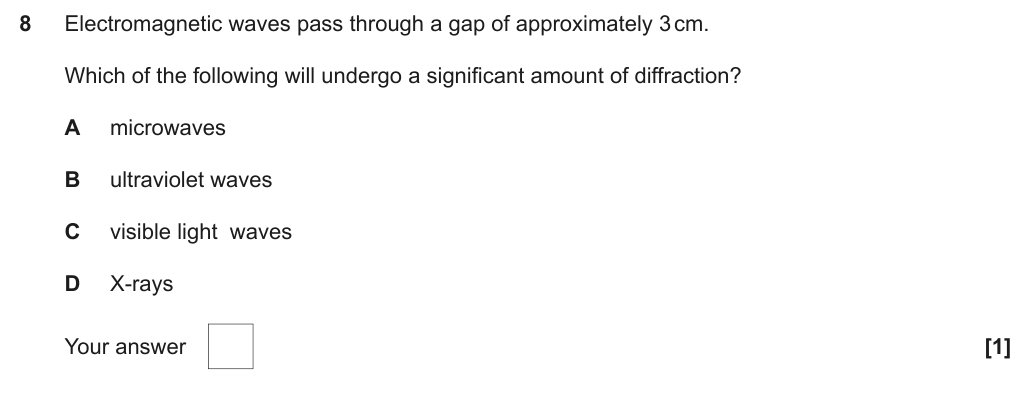
June 2024 · AS Paper 1 · Q81 markMultiple choiceMedium
Answer
A
Mark scheme
Examiner's comment
Candidates performed well on this question as they determined that when a wave passes through a gap with a similar size to its wavelength, it results in greater diffraction to give the response A.
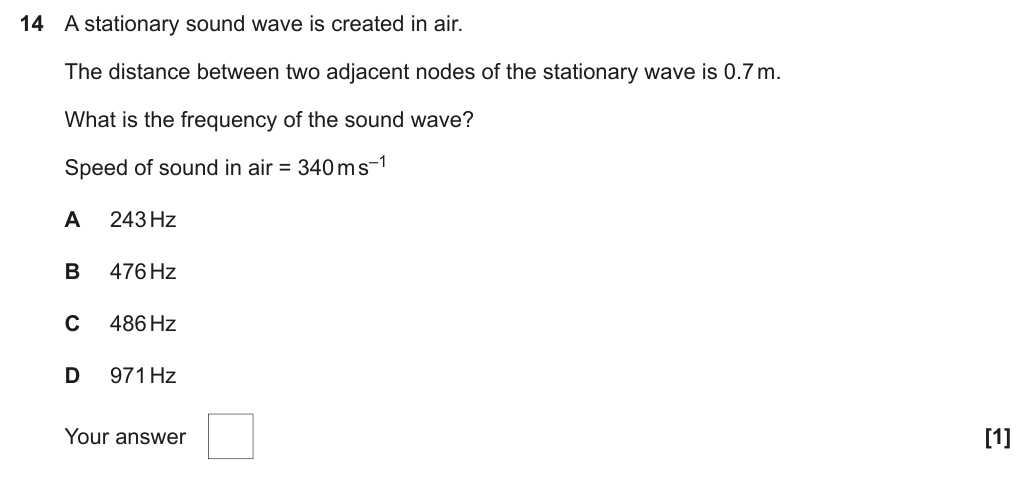
June 2024 · AS Paper 1 · Q141 markMultiple choiceMedium
Answer
A
Mark scheme
Examiner's comment
Candidates performed well on this question with many candidates correctly determining the wavelength of the standing wave as 1.4 m to then use this value to calculate the frequency of the wave as 243 Hz. This demonstrated understanding that the distance between adjacent nodes is λ/2 and not λ which was indicative of the most common distractor given by the answer B.
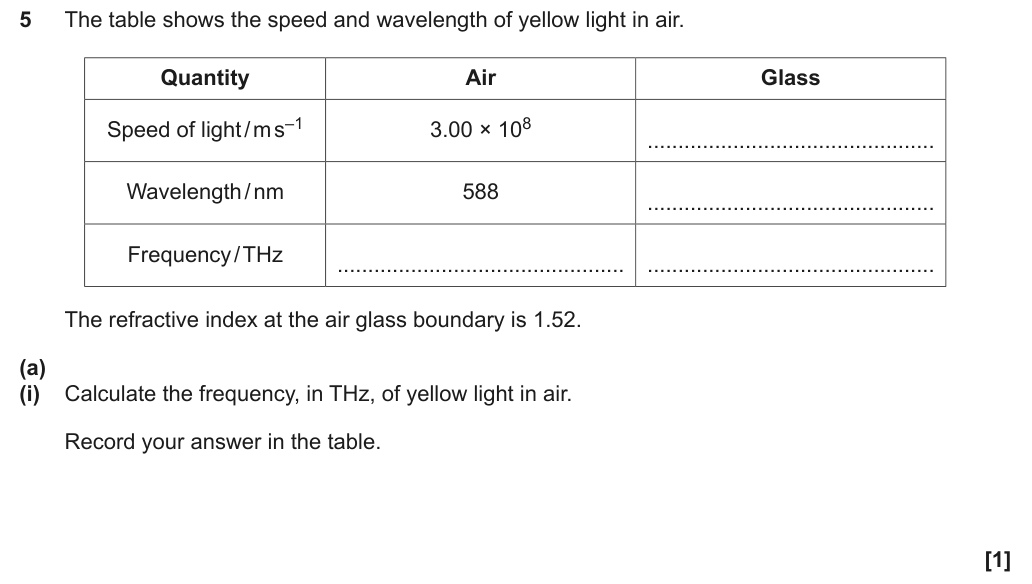
June 2024 · AS Paper 2 · Q5(a)(i)1 markCalculationEasy
Mark scheme
Examiner's comment
Most candidates were able to calculate the frequency, however, many candidates did not allow for the table heading in THz.
Notes from the mark scheme and report
Candidates should be able to record data in a table using the units given in the column headings.
Skills: M0.1 Recognise and make use of appropriate units in calculations; M0.2 Recognise and use expressions in decimal and standard form; M2.2 Change the subject of an equation, including non-linear equations
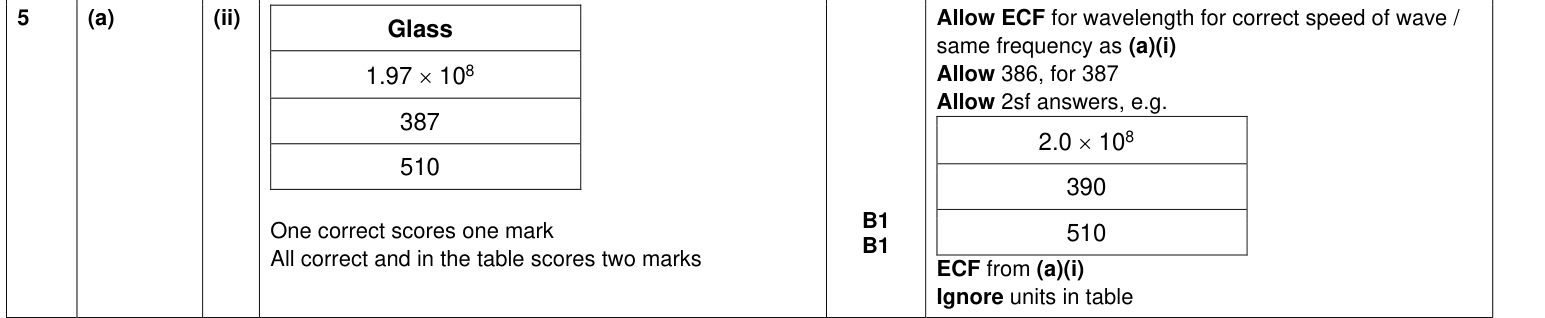
June 2024 · AS Paper 2 · Q5(a)(ii)2 marksShort answerEasy
Earlier part of question 5 that this part uses
Mark scheme
Examiner's comment
Most candidates were able to calculate the speed of light in glass correctly. Lower scoring candidates often incorrectly believed that the frequency (as opposed to the wavelength) decreased in glass.
Notes from the mark scheme and report
frequency unchanged (510)
one correct value scores 1
Allow 386 and 2 sf answers
ecf from (a)(i)
Many candidates did not fully understand effects of refraction on the quantities speed, frequency, and wavelength.
Skills: M0.3 Use ratios, fractions and percentages; M2.3 Substitute numerical values into algebraic equations using appropriate units for physical quantities
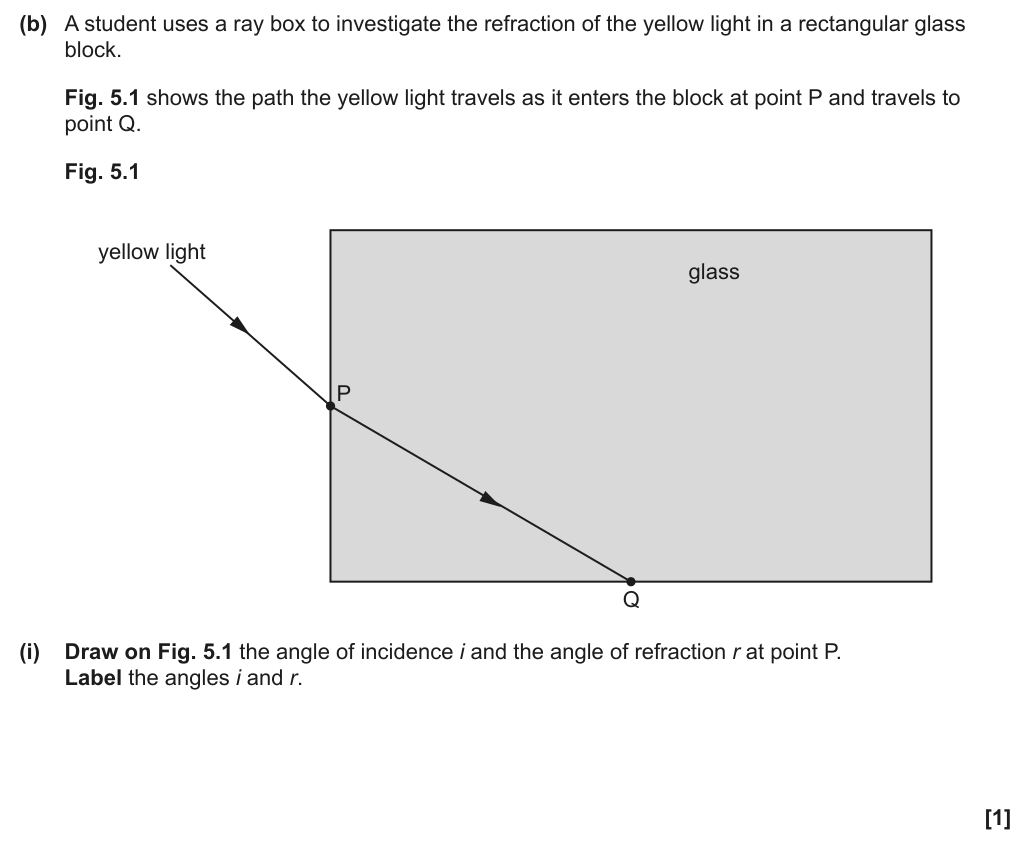
June 2024 · AS Paper 2 · Q5(b)(v)1 markDiagram or graphMedium
Earlier parts of question 5 that this part uses
Mark scheme
Examiner's comment
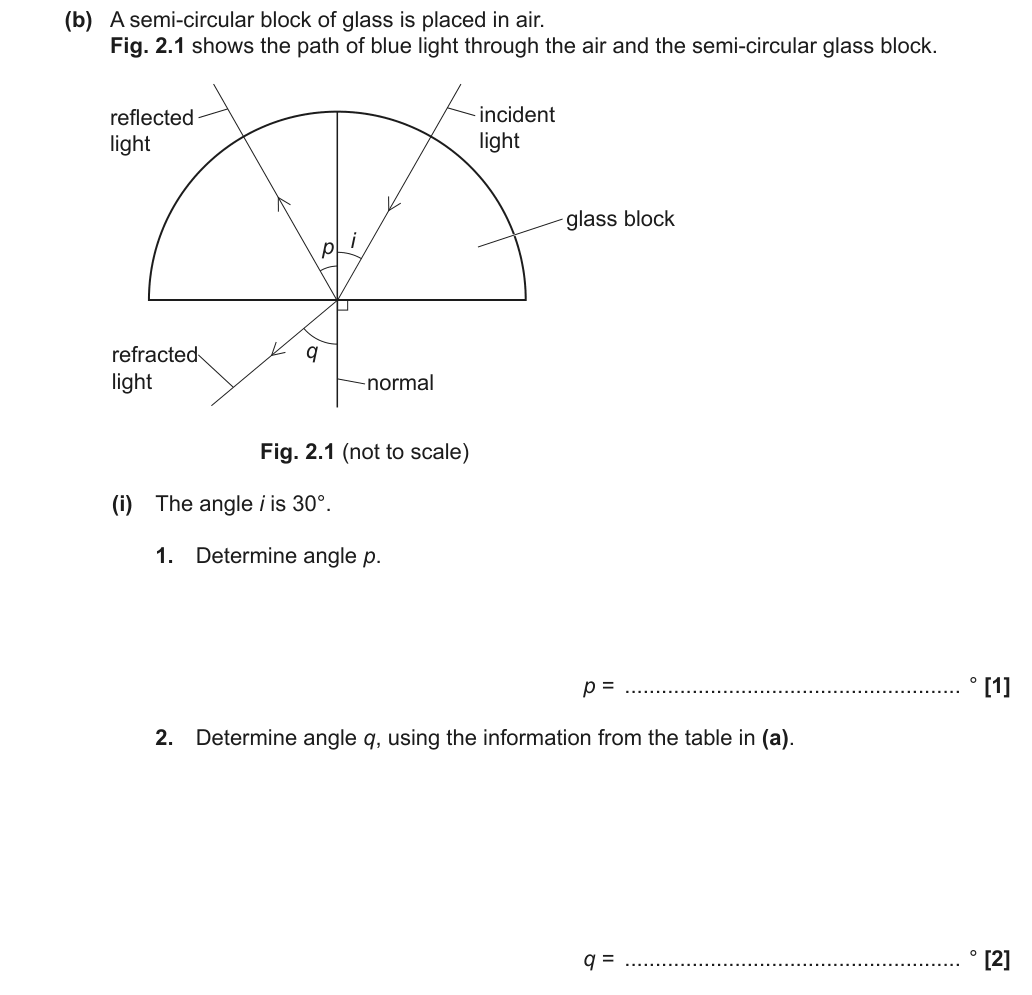
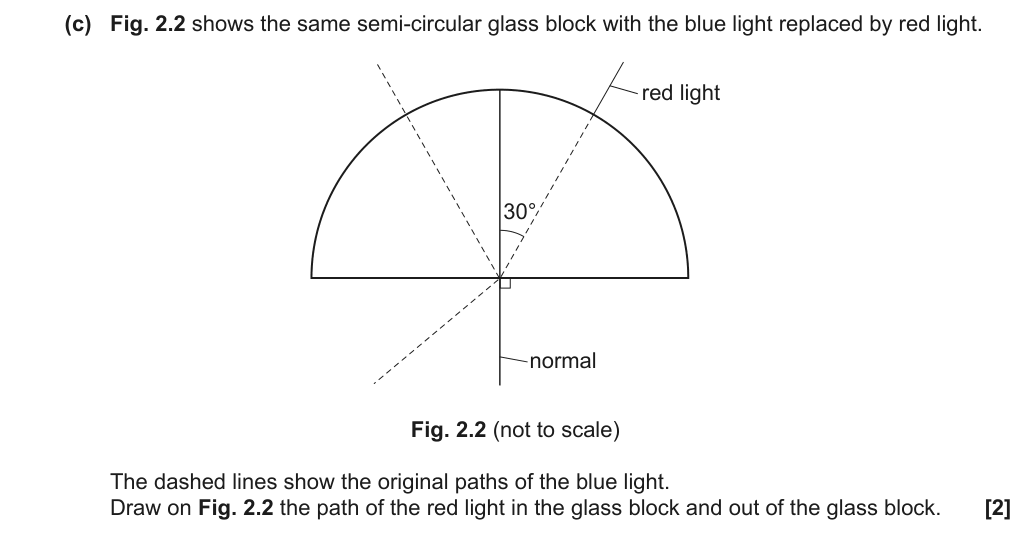
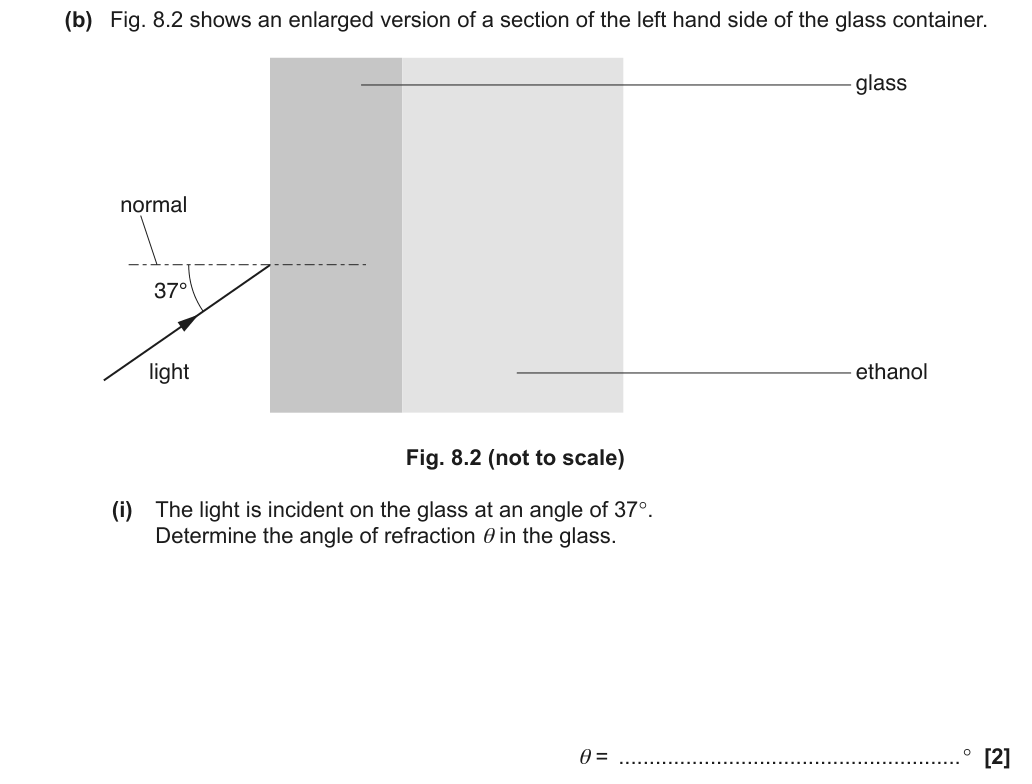
The majority of candidates did not realise that there should be a mirror image of the diagram. High scoring candidates answered this question well by adding appropriate lines to the diagram and adding where the angles were equal. The candidate has clearly shown the answer with the normal lines aligned and labelled the angles so that it is clear which ones are equal. This candidate has also clearly shown the angle of incidence and the angle of refraction for Question 5 (b) (i).
Notes from the mark scheme and report
reflected ray is mirror image at Q, then bends away from the normal where it leaves the block
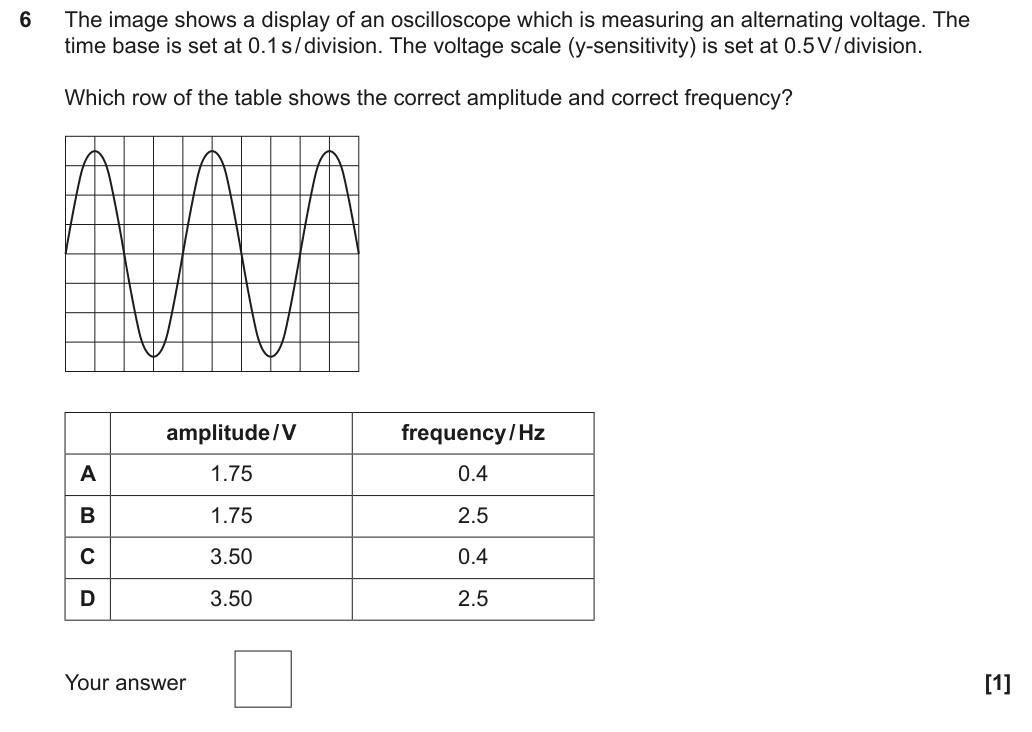
June 2024 · Paper 2 · Q61 markMultiple choiceEasy
Answer
B
Mark scheme
Examiner's comment
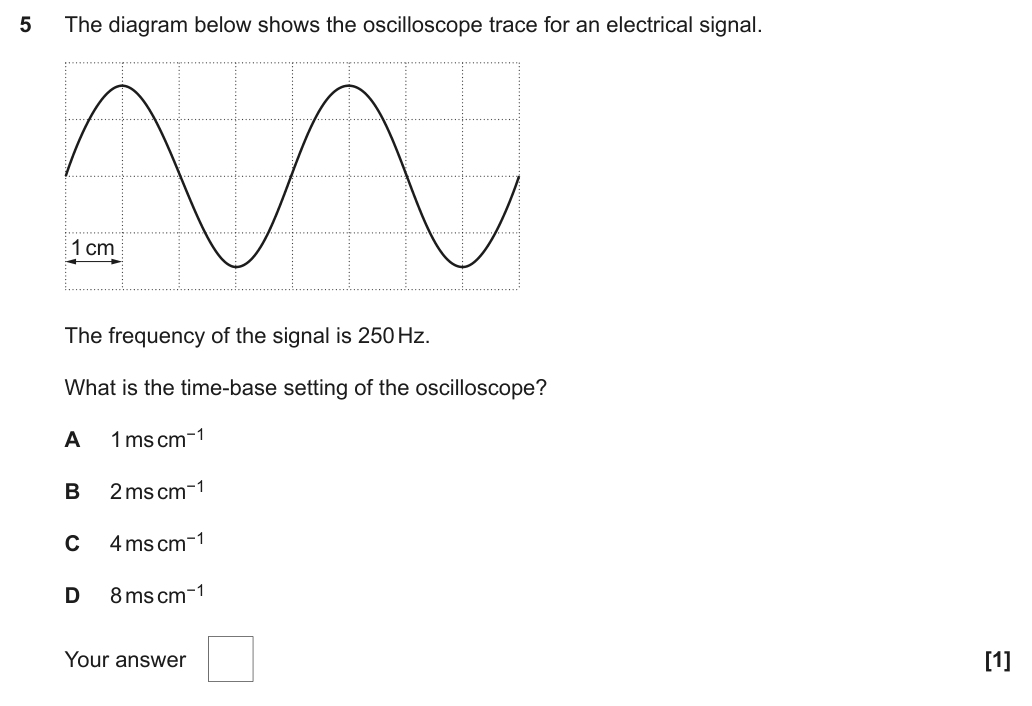
Most candidates were able to correctly calculate the amplitude and frequency. A was the most common distractor where candidates simply identified the time period rather than then calculate the frequency.
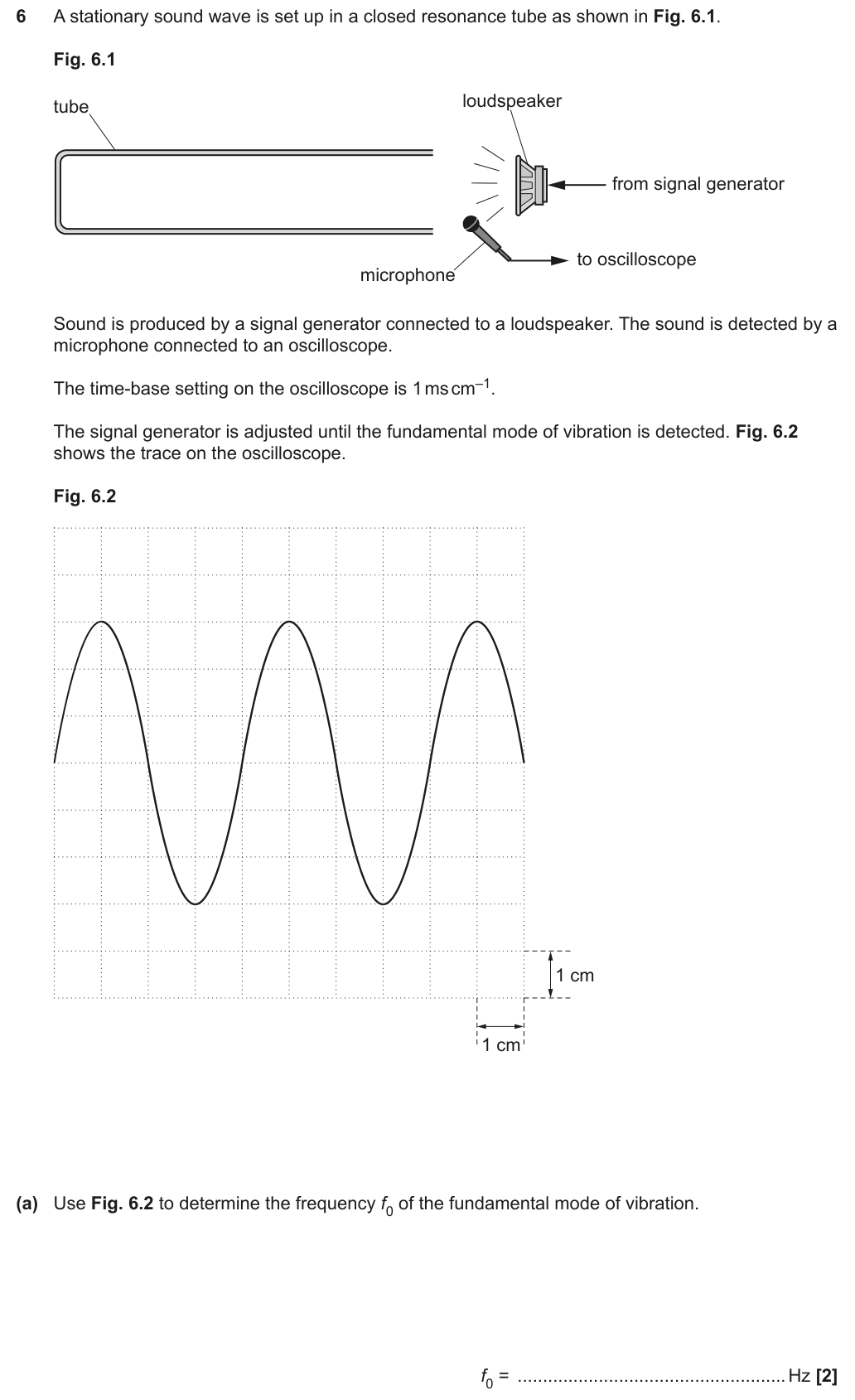
June 2024 · AS Paper 2 · Q6(a)2 marksCalculationMedium
Mark scheme
Examiner's comment
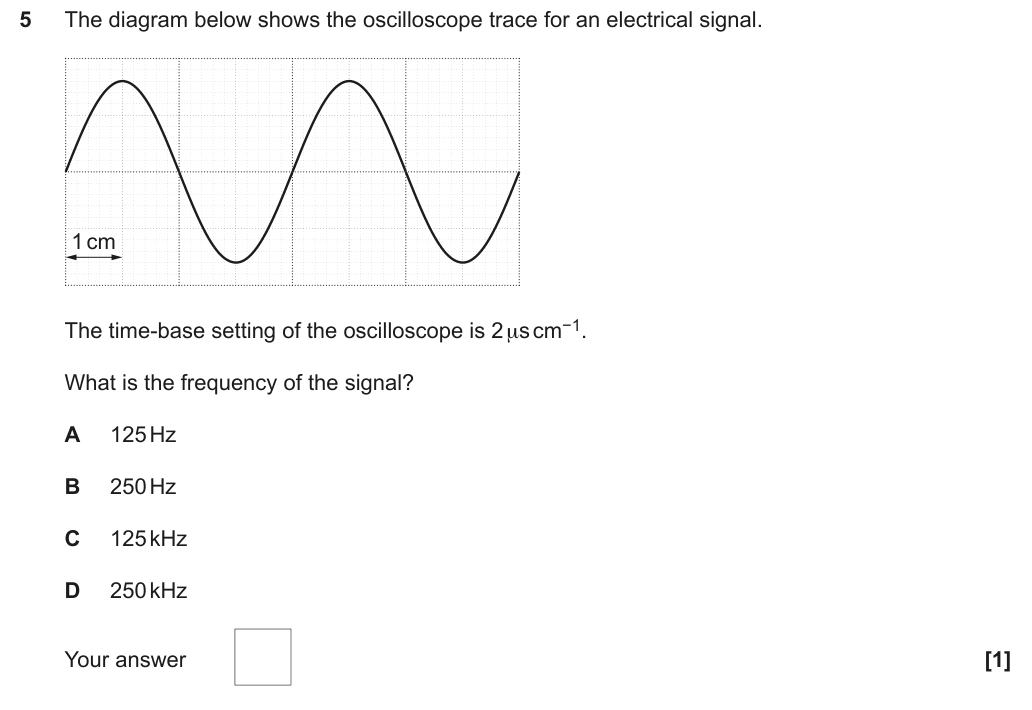
The majority of the candidates gained credit. Some lower scoring candidates did not interpret the trace correctly.
Notes from the mark scheme and report
0.25 to any power of ten scores 1
Skills: M0.1 Recognise and make use of appropriate units in calculations; M3.1 Translate information between graphical, numerical and algebraic forms; PAG5 Investigating waves
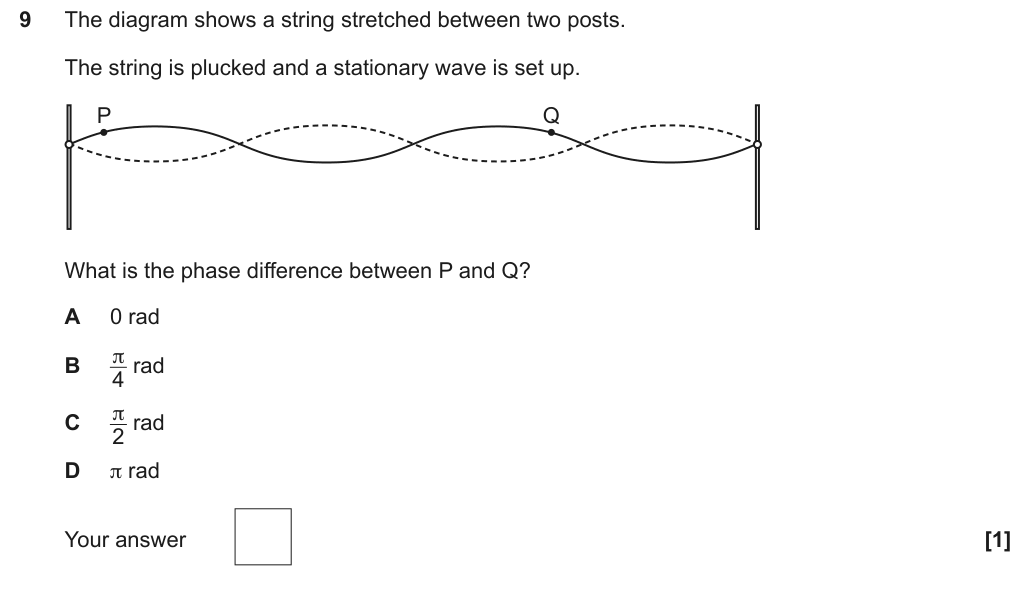
June 2024 · Paper 2 · Q91 markMultiple choiceHard
Answer
A
Mark scheme
Examiner's comment
Relatively few candidates got this phase difference correct; it was clear from many that they thought that it was a progressive wave as they attempted to add on fractions of cycles. It may also be the case that candidates are unfamiliar with phase differences in stationary waves.
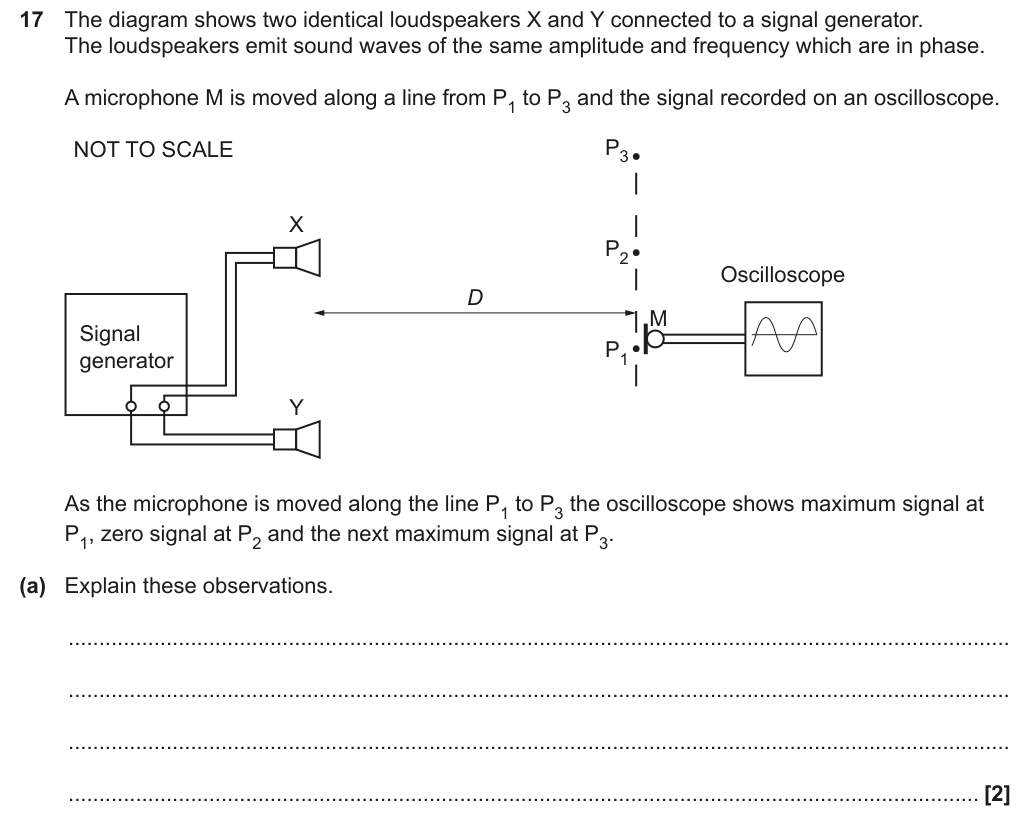
June 2024 · Paper 2 · Q17(b)3 marksCalculationMedium
Earlier part of question 17 that this part uses
Mark scheme
Examiner's comment
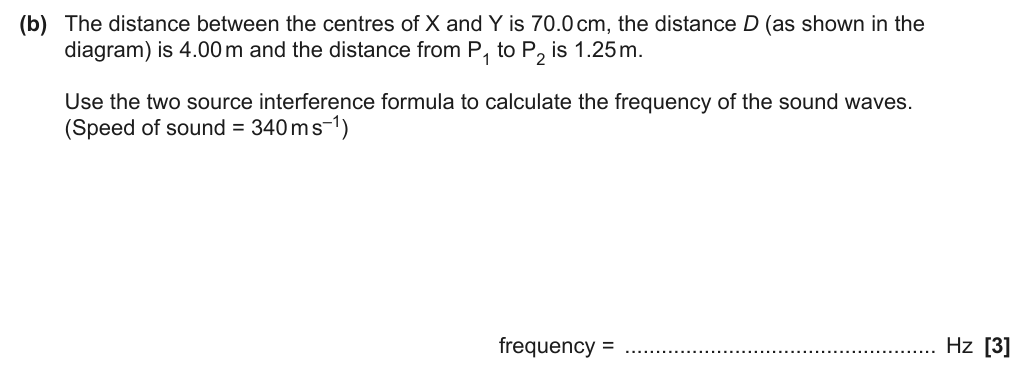
The majority of candidates were able to use the two source formula, however used 1.25m for their value of x, rather than double this. A small number of candidates attempted a geometrical solution, attempting to calculate angles, but this was unlikely on its own to score any marks.
Notes from the mark scheme and report
x is P1 to P3 = 2.5 m (maximum to maximum)
using x = 1.25 gives 1554 Hz for 1 mark
Skills: M0.1 Recognise and make use of appropriate units in calculations; M2.2 Change the subject of an equation, including non-linear equations; M2.3 Substitute numerical values into algebraic equations using appropriate units for physical quantities; PAG5 Investigating waves
June 2024 · Paper 2 · Q17(c)2 marksExplanationMedium
Earlier part of question 17 that this part uses
Mark scheme
Examiner's comment
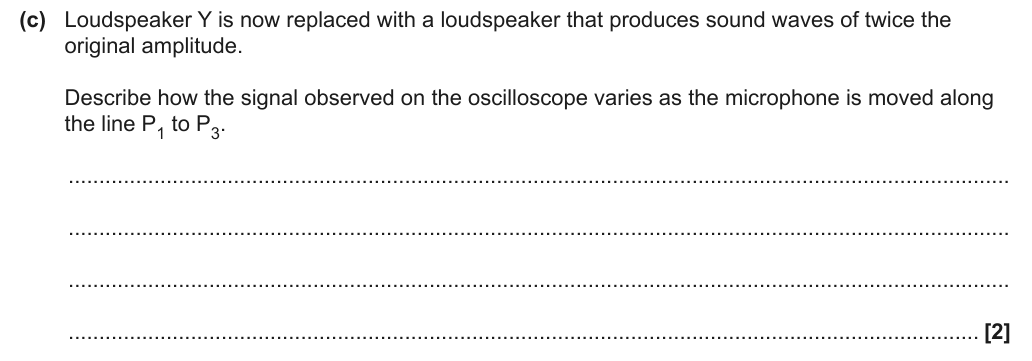
This question specifically asked about the observed signal and so responses based on loudness or sound volume are not appropriate. Candidates needed to be very clear that they were describing particular positions and how the signal varied from the previous situation. There was no penalty for an incorrect value of the increase in signal, although many candidates were able to state this correctly.
Notes from the mark scheme and report
larger maximum at P1 / P3 and non-zero signal at P2
ignore louder
June 2024 · Paper 2 · Q17(d)(i)1 markExplanationMedium
Mark scheme
Examiner's comment
Candidates need to give a clear and specific answer to this question, which is best expressed in words. The Data and Formulae booklet contains the equation for intensity in symbols, however it is important to state the ‘per unit area’ in the explanation rather than a vaguer statement such as ‘power over area’. Many candidates gave very simplistic responses such as ‘the amount of energy a wave has’ indicating a lack of appreciation for the detail required.
Notes from the mark scheme and report
power per unit area
do not allow power per area or power over area
June 2024 · Paper 2 · Q17(d)(ii)3 marksCalculationMedium
Earlier parts of question 17 that this part uses
Mark scheme
Examiner's comment
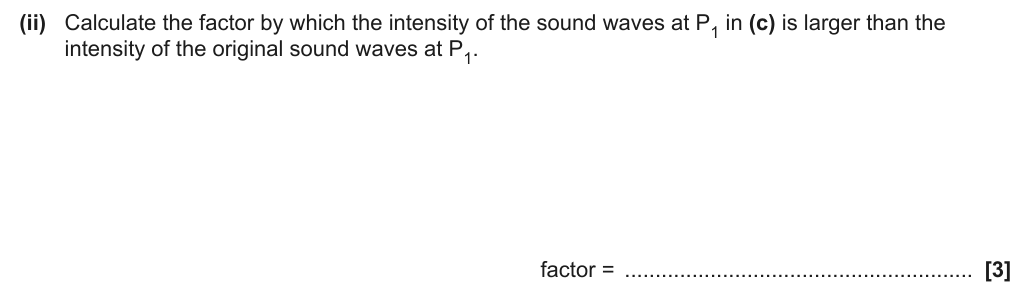
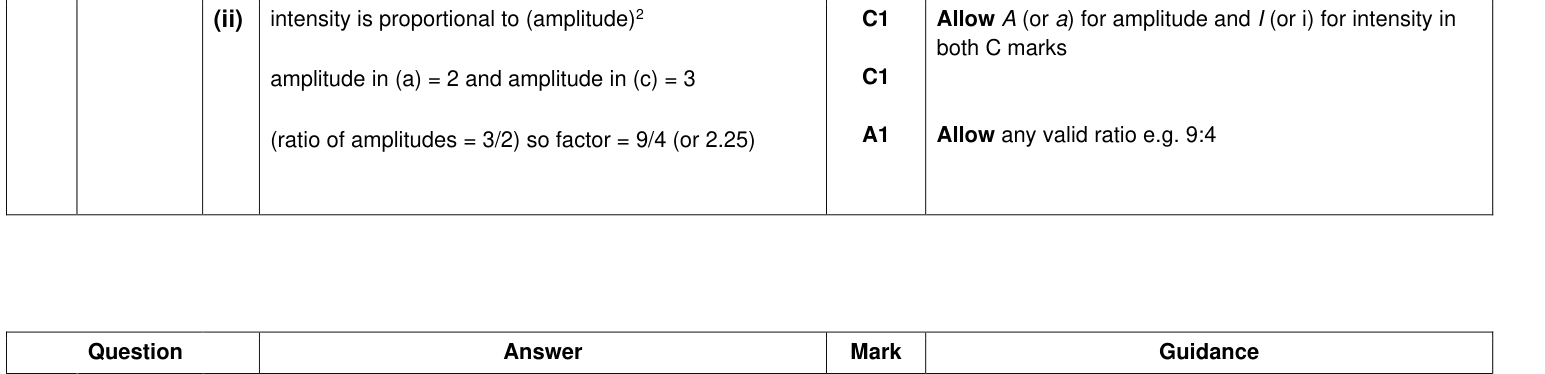
Some candidates were able to correctly calculate the factor, which could be expressed in a number of ways. Many candidates were able to correctly state the relationship between intensity and amplitude but not able to identify how the amplitudes were different and so could not carry on with the calculation, so only scoring a single mark.
Notes from the mark scheme and report
amplitudes add: 2A originally, 3A in (c)
intensity proportional to amplitude squared so 9/4
Skills: M0.3 Use ratios, fractions and percentages
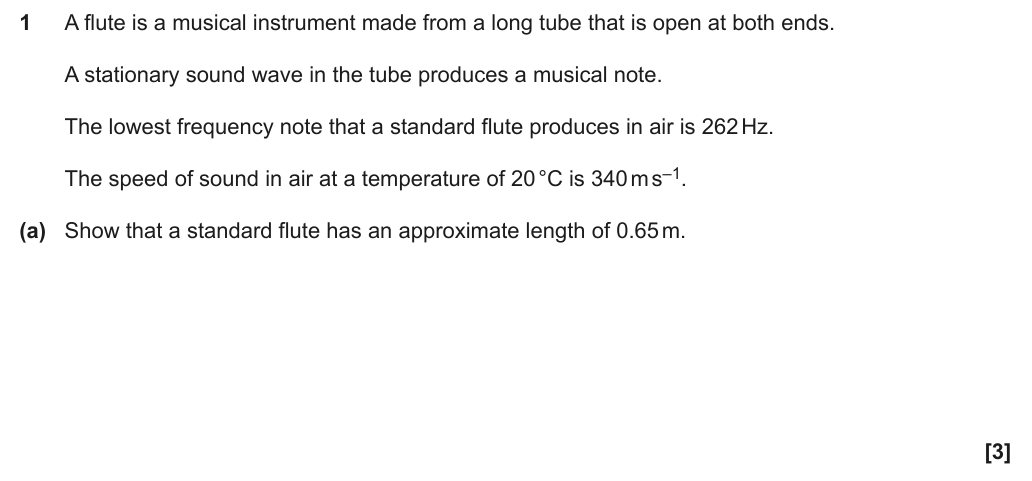
June 2024 · Paper 3 · Q1(a)3 marksShow thatMedium
Mark scheme
Examiner's comment
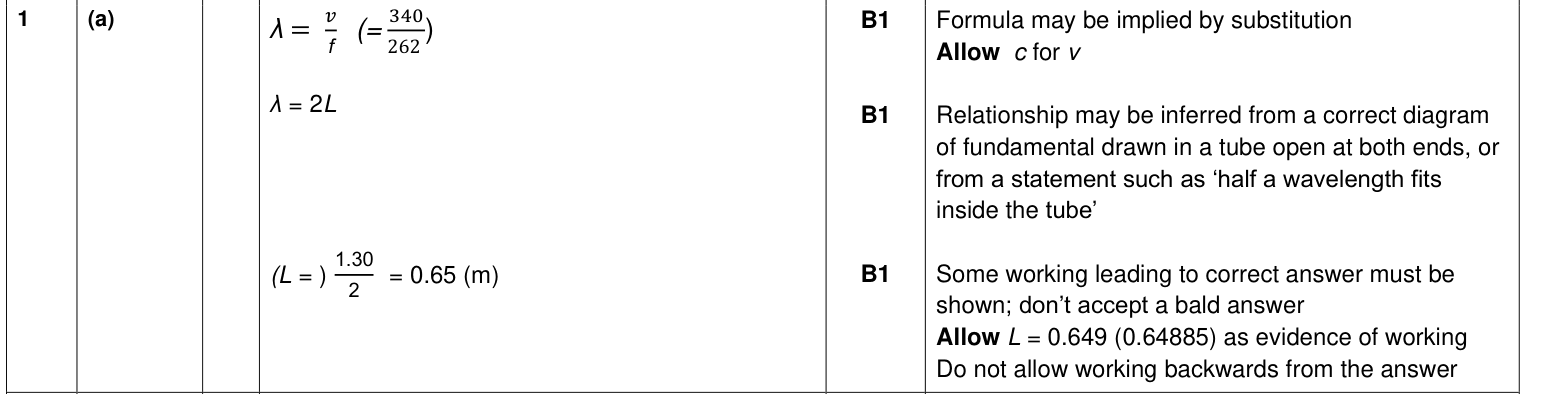
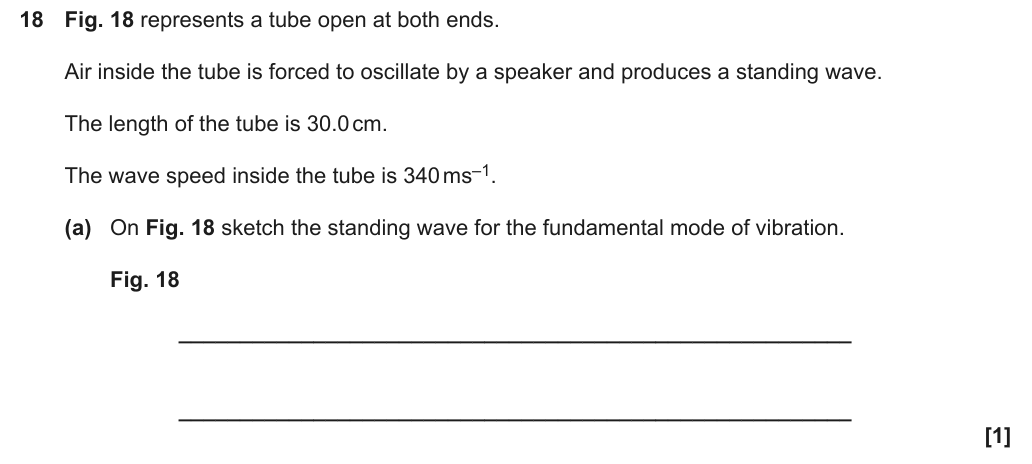
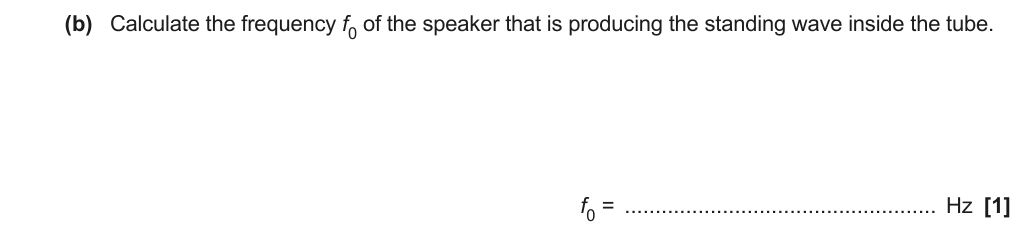
This is a ‘show that’ question and so every step of the calculation needs to be made clear. It is not enough to point out that 340 / (2 x 262) = 0.65: the examiner needs to know why the data is being combined in this particular way. The step that was most often omitted was saying that, for the fundamental (lowest) frequency, half a wavelength fits inside the flute. This could be demonstrated using a diagram, showing an open tube containing half a wavelength with antinodes at both ends. However, a written statement (length is half of a wavelength) or a mathematical statement (L = 𝜆/2) are just as good.
Notes from the mark scheme and report
working must be shown: no bald answer and no working backwards from 0.65 m
Skills: M2.2 Change the subject of an equation, including non-linear equations; M2.3 Substitute numerical values into algebraic equations using appropriate units for physical quantities
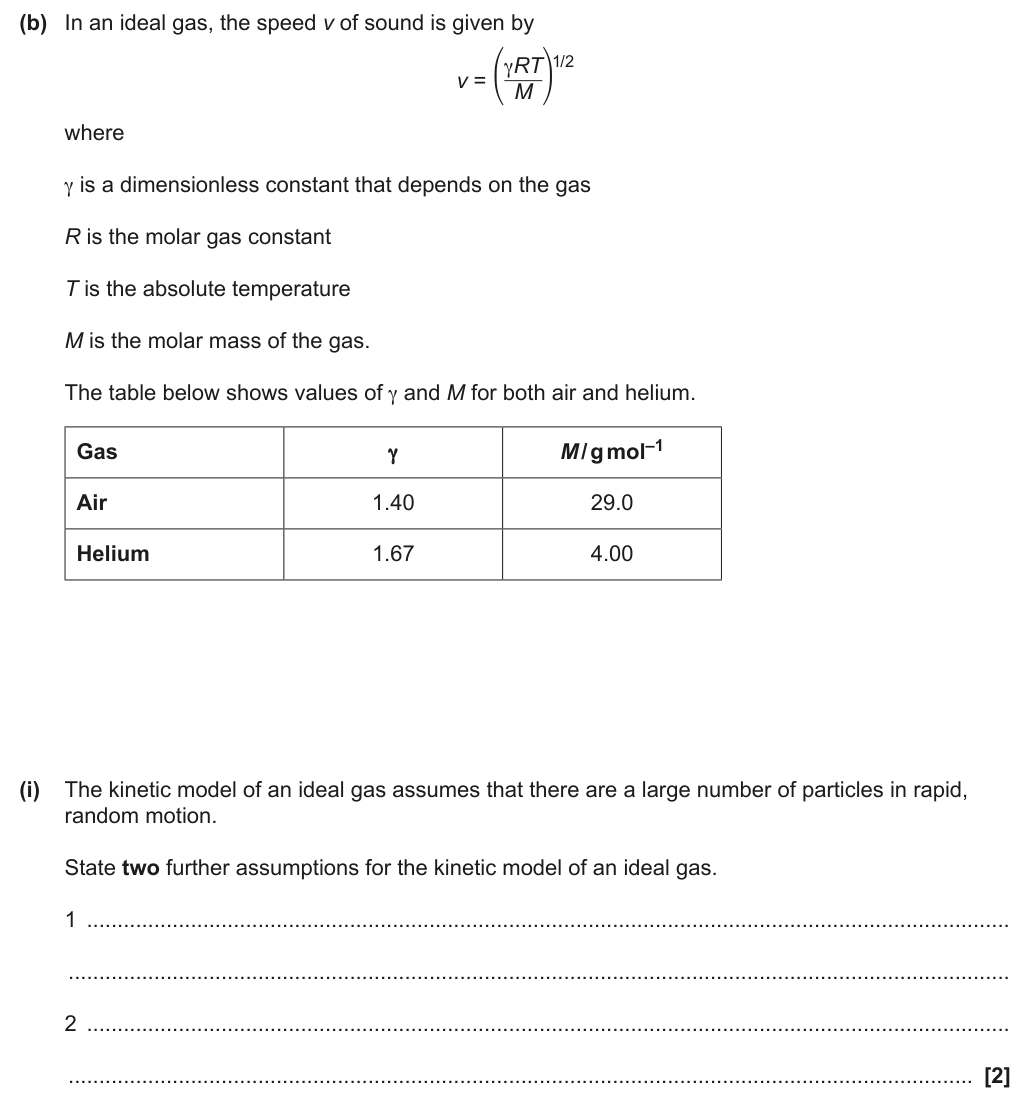
June 2024 · Paper 3 · Q1(b)(ii)4 marksCalculationMedium
Earlier parts of question 1 that this part uses
Mark scheme
Examiner's comment
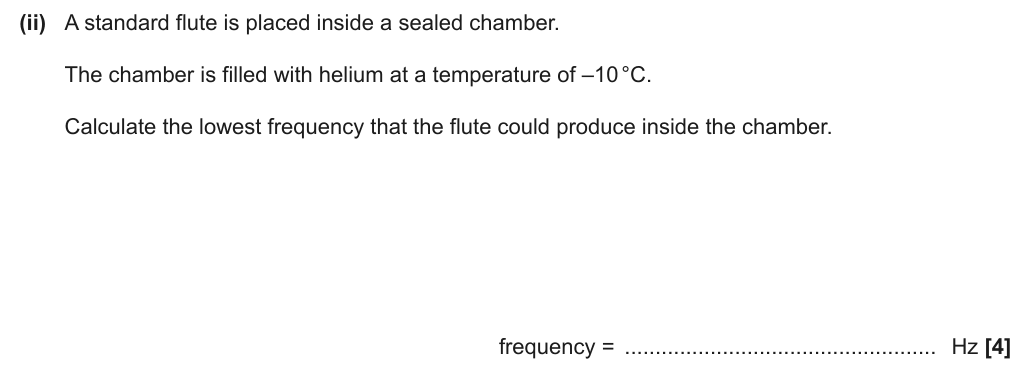
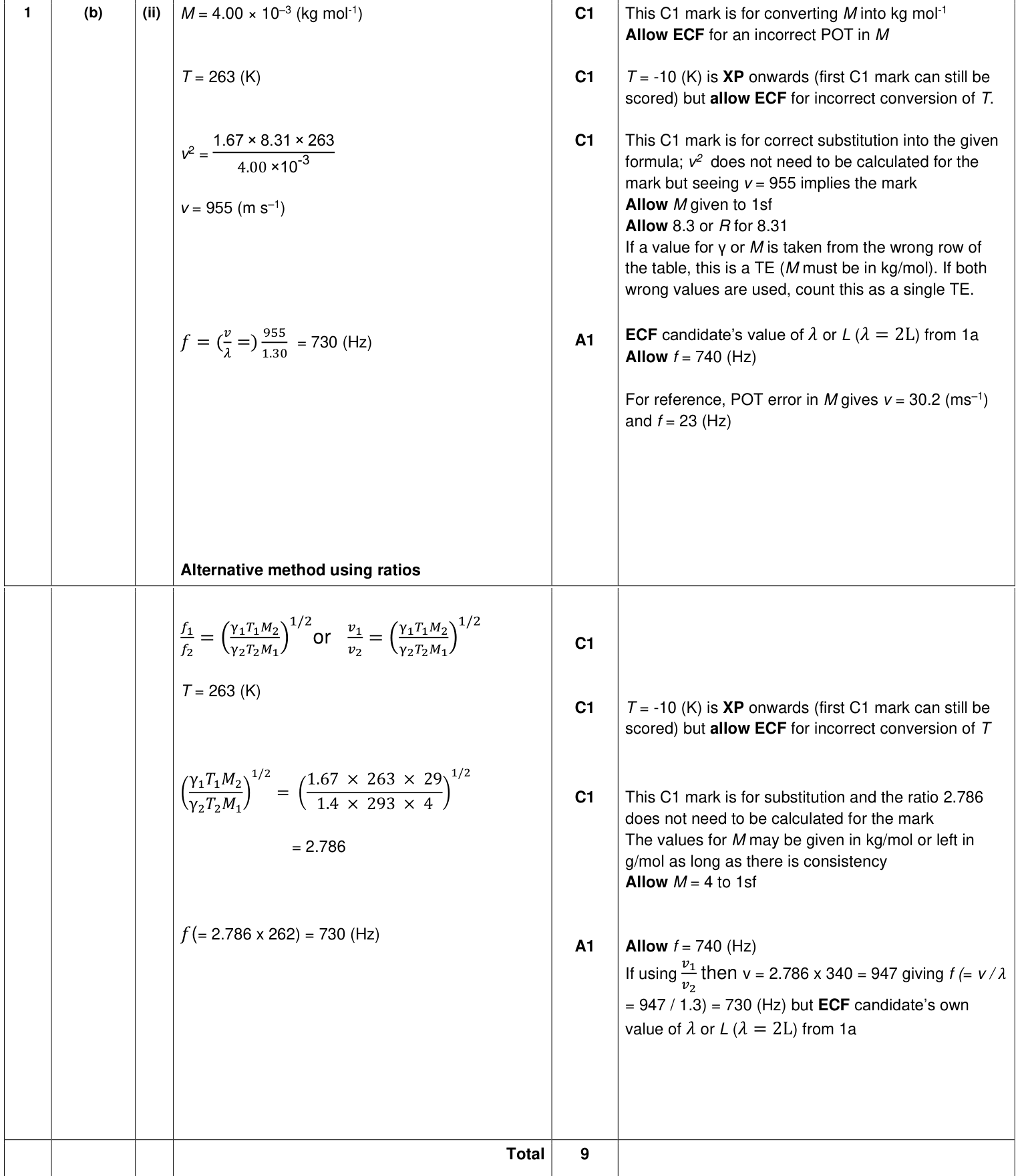
Common problems in 1 (b) (ii) • failing to convert the molar mass M into units of kg mol-1 • substituting the length of the flute (0.65m) instead of 1.30m for the wavelength. Question2(a) The initial step in this question is to use the equation I = Io𝑒−𝑡/𝑅𝐶 together with the fact that N resistors in series have a total resistance of NR and N capacitors in parallel have a total capacitance of NC.T is the time taken for Io to fall to Io/2 and so ½ = 𝑒−𝑇/𝑁𝑅.𝑁𝐶. Many candidates were able to navigate the tricky mathematics and were aware that ln(½) = -ln(2) It is important in this question to distinguish clearly between t, the general variable for time, and T, the time taken for Io to fall to Io/2. The statement ½ = 𝑒−𝑡/𝑁𝑅.𝑁𝐶 is not generally true; it is only true when t = T.
Notes from the mark scheme and report
M must be converted to kg mol⁻¹
T = −10 K scores no further marks
ecf λ or L from (a)
allow 740 Hz
Skills: M0.1 Recognise and make use of appropriate units in calculations; M0.3 Use ratios, fractions and percentages; M0.5 Use calculators to find and use power, exponential and logarithmic functions; M2.3 Substitute numerical values into algebraic equations using appropriate units for physical quantities
June 2023 · AS Paper 1 · Q131 markMultiple choiceMedium
Answer
D
Mark scheme
Examiner's comment
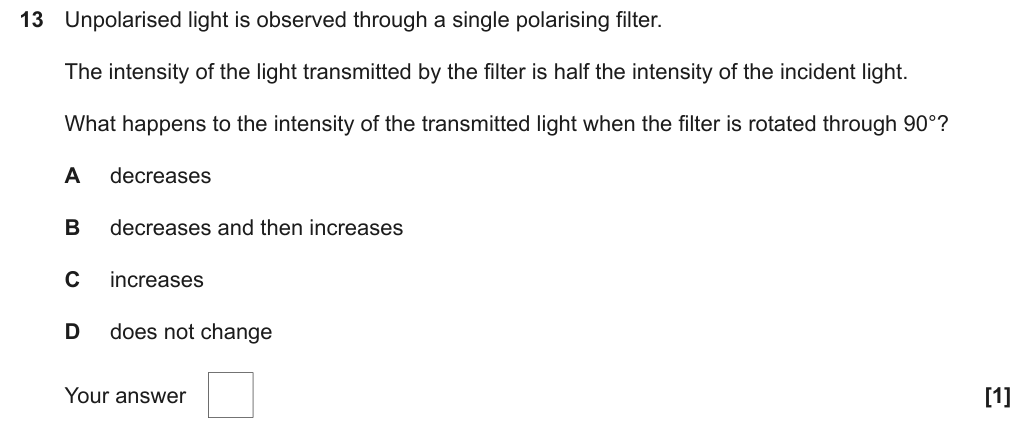
About half of candidates performed well on this question by determining the correct answer of D by understanding the behaviour and intensity of unpolarised light when transmitted through a polarising filter.
June 2023 · AS Paper 1 · Q171 markMultiple choiceMedium
Answer
B
Mark scheme
Examiner's comment
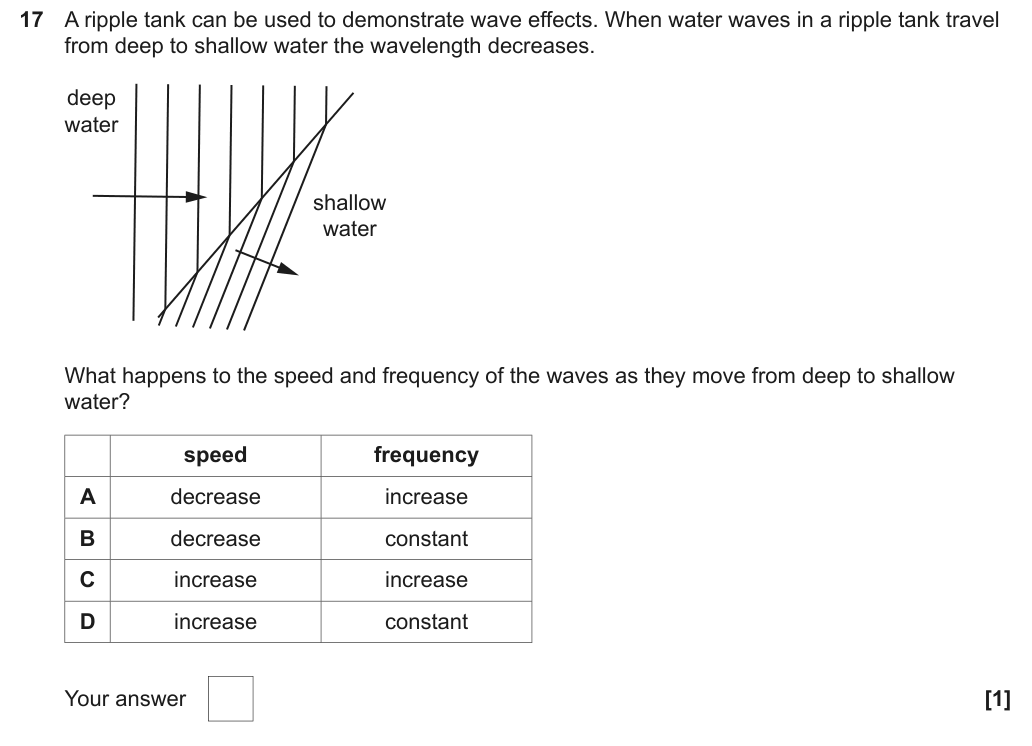
Only half of candidates correctly applied the behaviour of waves and understood that frequency of the waves remains constant when they travel through different media (different depths of water) and the wave speed equation to determine the correct answer B. Hence, the most common distractor was A.
Notes from the mark scheme and report
This is a common misconception that the frequency changes when waves travel through different media, whether it is water waves travelling through different depths of water or light when it travels through media with different refractive indices. When applying the wave speed equation v = f the frequency remains constant, so v is directly proportional to .
Skills: PAG5 Investigating waves
June 2023 · AS Paper 1 · Q22(a)3 marksExplanationHard
Mark scheme
Examiner's comment
Candidates’ performance on this question was variable with about of half of candidates scoring 1 or 2 marks but few candidates achieving all 3 marks for correctly explaining the movement of air molecules in compression and rarefaction of longitudinal waves. Descriptions of the movement of particles to transfer energy as a longitudinal wave was often weak with limited use of scientific language such as oscillation and parallel. The most common mark that was given was for an explanation of how compressions and rarefactions are formed in reference to the proximity of air molecules.
Notes from the mark scheme and report
allow particles
NOT reference to varying amplitude
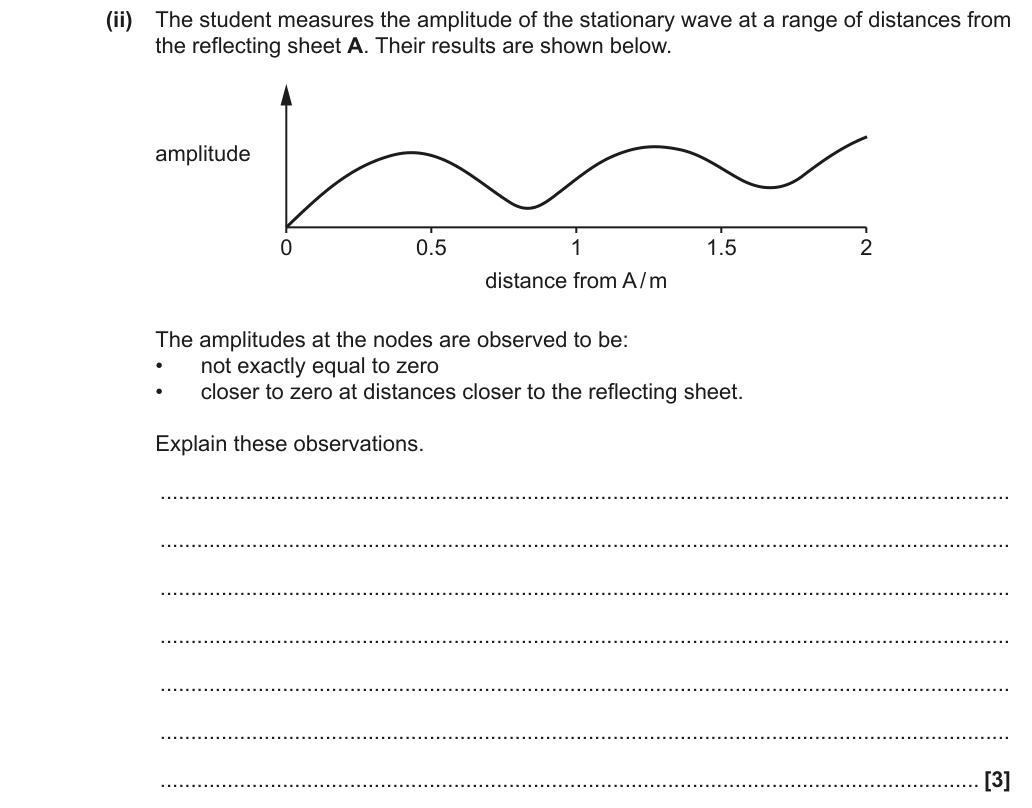
June 2023 · AS Paper 1 · Q22(b)(ii)3 marksExplanationMedium
Earlier part of question 22 that this part uses
Mark scheme
Examiner's comment
Candidates performed less well on this question with only about a third of candidates achieving 1 or more marks. Candidates had to explain both observations regarding the amplitudes of the nodes to fully access the question by interpreting that the change in amplitude was related to the decrease in intensity/amplitude of the reflected wave as it travelled a greater distance from the reflecting sheet A. This response is an example of a typical response where candidates have confused the change in amplitude of the nodes to either a change in frequency or phase difference due to the reflected wave being ‘out of phase’ with the incident wave. There was also a common misconception that the reflected wave from the reflecting sheet A had experienced interference from either background noise or from further reflections of the wave in the room. The candidates had assumed that the two waves were no longer coherent, and this resulted in a difference in the amplitude of the nodes further from the reflecting sheet A.
Notes from the mark scheme and report
allow energy absorbed when the wave is incident on the plate
Skills: M3.1 Translate information between graphical, numerical and algebraic forms; PAG5 Investigating waves
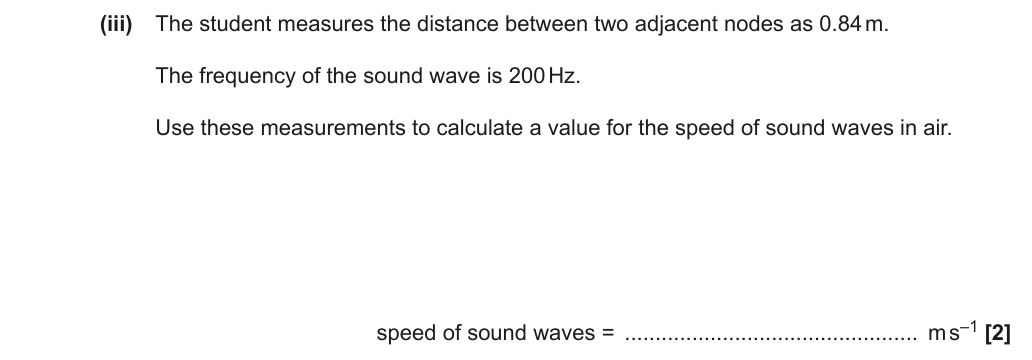
June 2023 · AS Paper 1 · Q22(b)(iii)2 marksCalculationMedium
Mark scheme
Examiner's comment
Candidates performed well in this question as two thirds correctly determined that the wavelength of the sound wave was twice the distance between the adjacent nodes and then applied the wave speed equation v = f to calculate the speed of sound waves as 336 m s–1.
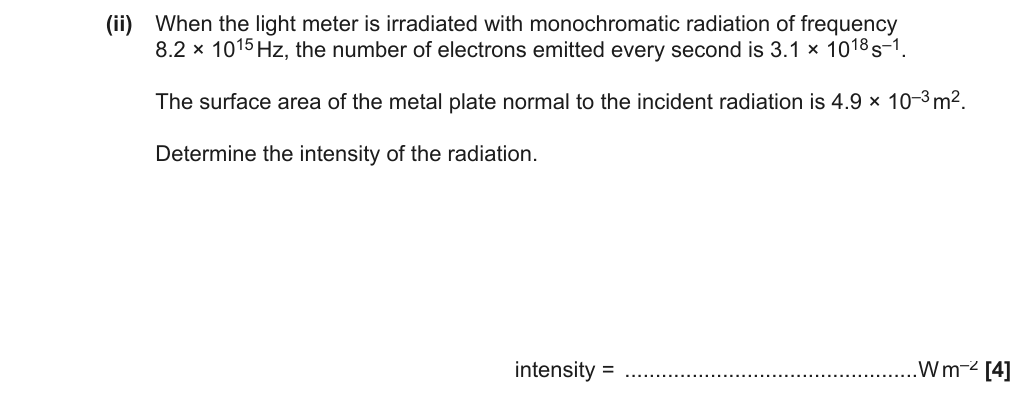
June 2023 · AS Paper 1 · Q23(c)(ii)4 marksCalculationMedium
Mark scheme
Examiner's comment
Candidates did not perform well on this question as just over half of candidates scored 0 marks. Candidates had to select the equations hf = E and I = P/A from the Data, Formulae and Relationship booklet and then apply that the power was equal to the energy as the rate of emission of electrons was in a time of 1 second. Many candidates would select the correct equation I = P/A but would then try and calculate power by using the equation P = VI and Q = It by using the charge of an electron to calculate the current and using the battery e.m.f. of 3 V given in the circuit diagram. This demonstrated for a majority of candidates a lack of a confident understanding of the photoelectric effect that the energy of incident photons results in the release of electrons. This response demonstrates the correct and clear selection and application of formulae to calculate the intensity of the incident radiation.
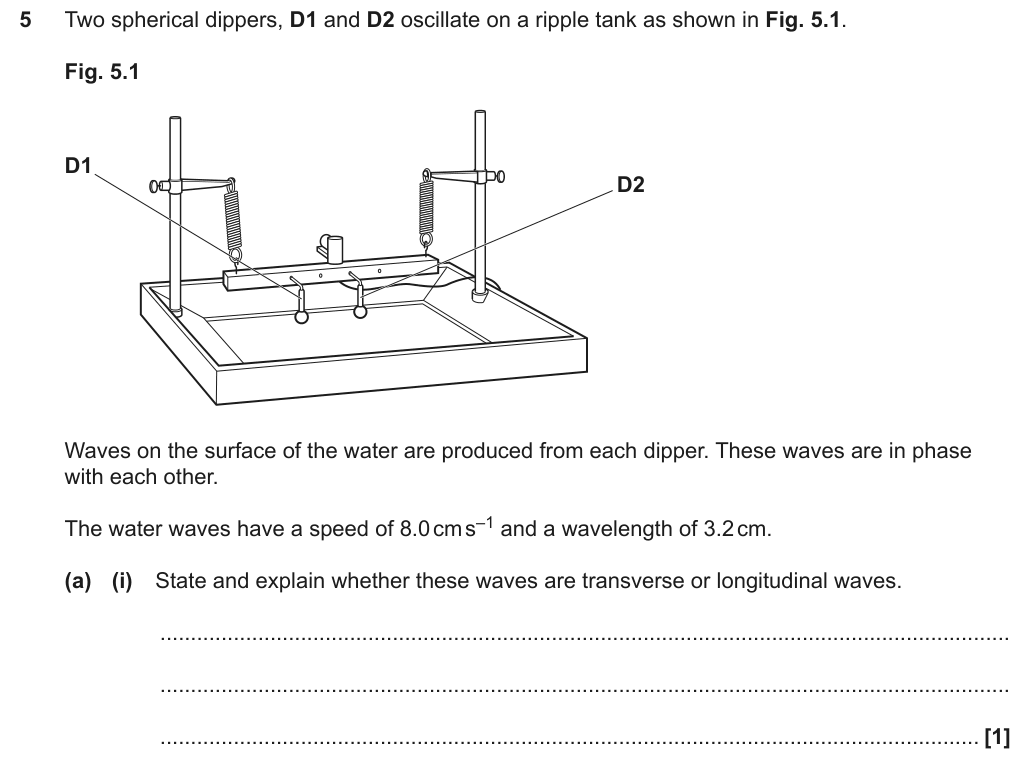
June 2023 · AS Paper 2 · Q5(a)(i)1 markExplanationMedium
Mark scheme
Examiner's comment
Many candidates incorrectly stated that water waves were longitudinal waves. High scoring candidates referred to oscillations or vibrations of the water particles and the direction of travel of the wave or energy transfer.
Notes from the mark scheme and report
must give reason: oscillations perpendicular to direction of travel / energy transfer
June 2023 · AS Paper 2 · Q5(a)(ii)1 markExplanationHard
Earlier part of question 5 that this part uses
Mark scheme
Examiner's comment
Few candidates were able to explain why the waves were plane polarised. High scoring candidates stated that the oscillations were in the vertical plane only.
Notes from the mark scheme and report
plane polarised because oscillations are all in one (vertical) plane
June 2023 · AS Paper 2 · Q5(b)1 markCalculationEasy
Earlier part of question 5 that this part uses
Mark scheme
Examiner's comment
This question was very well answered.
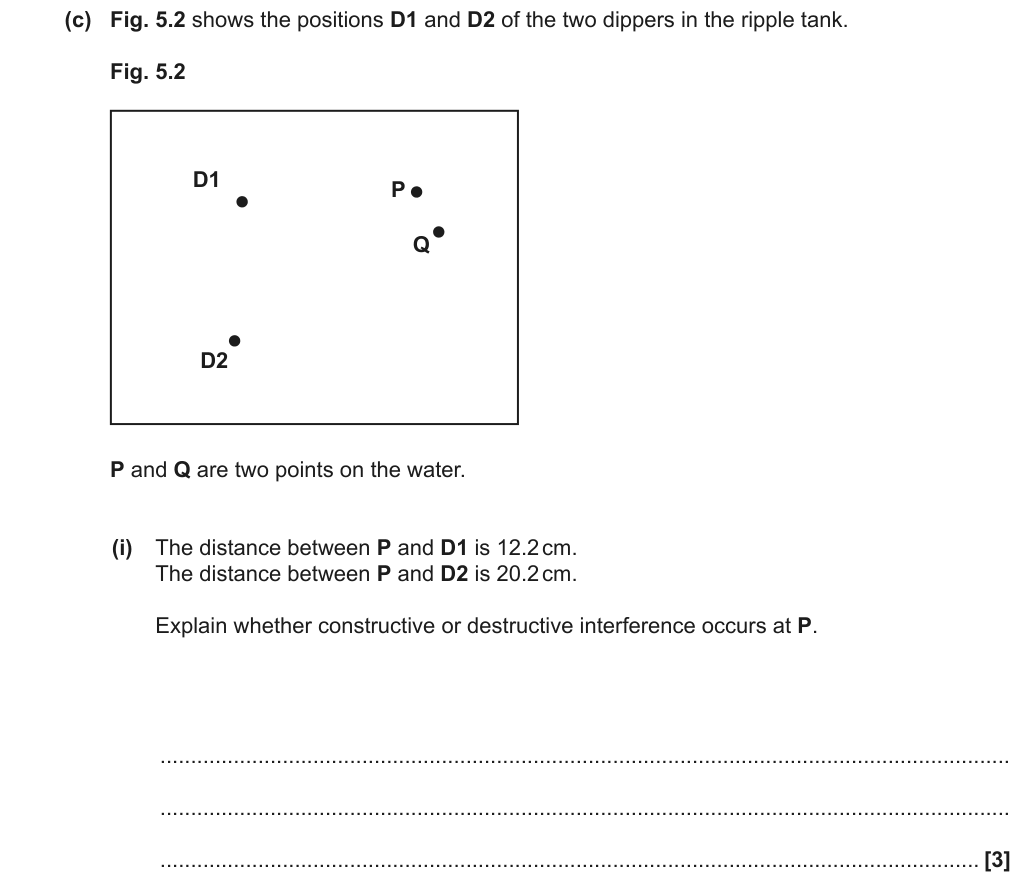
June 2023 · AS Paper 2 · Q5(c)(ii)3 marksCalculationHard
Earlier parts of question 5 that this part uses
Mark scheme
Examiner's comment
Candidates who scored well on this question showed their working clearly. Many clearly stated the path difference and determined that this path difference corresponded to 2.25 wavelengths. Some candidates struggled changing this to radians.
Notes from the mark scheme and report
2.25 λ
allow 1.6 rad, 9π/2 or 14 rad
Candidates need to understand the radian and how to covert between degrees and proportion of a wavelength.
Skills: M0.3 Use ratios, fractions and percentages; M4.7 Understand the relationship between degrees and radians and translate from one to the other
June 2023 · AS Paper 2 · Q76 marks6-mark extended responseMedium
Mark scheme, with the levels and indicative content
Examiner's comment
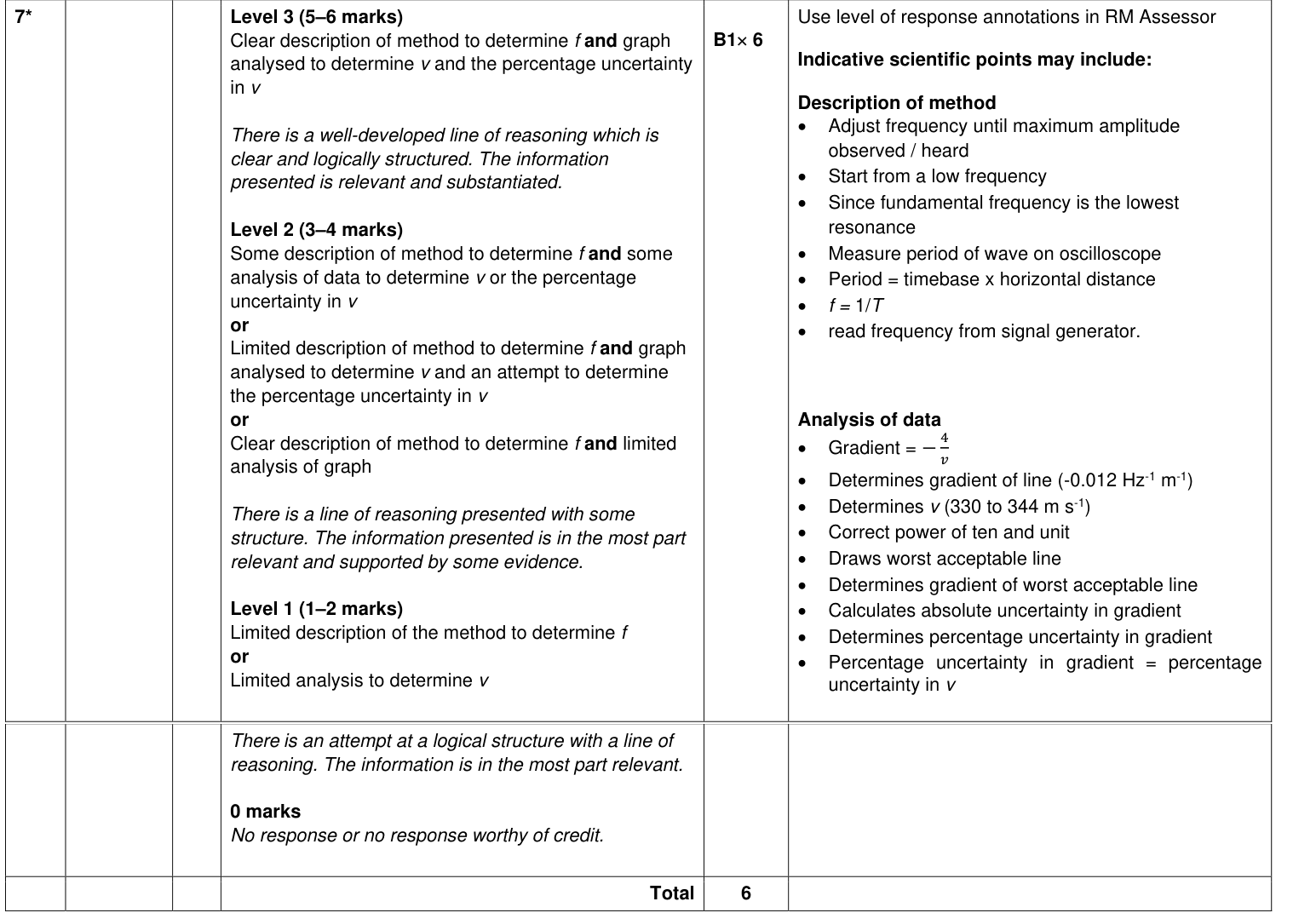
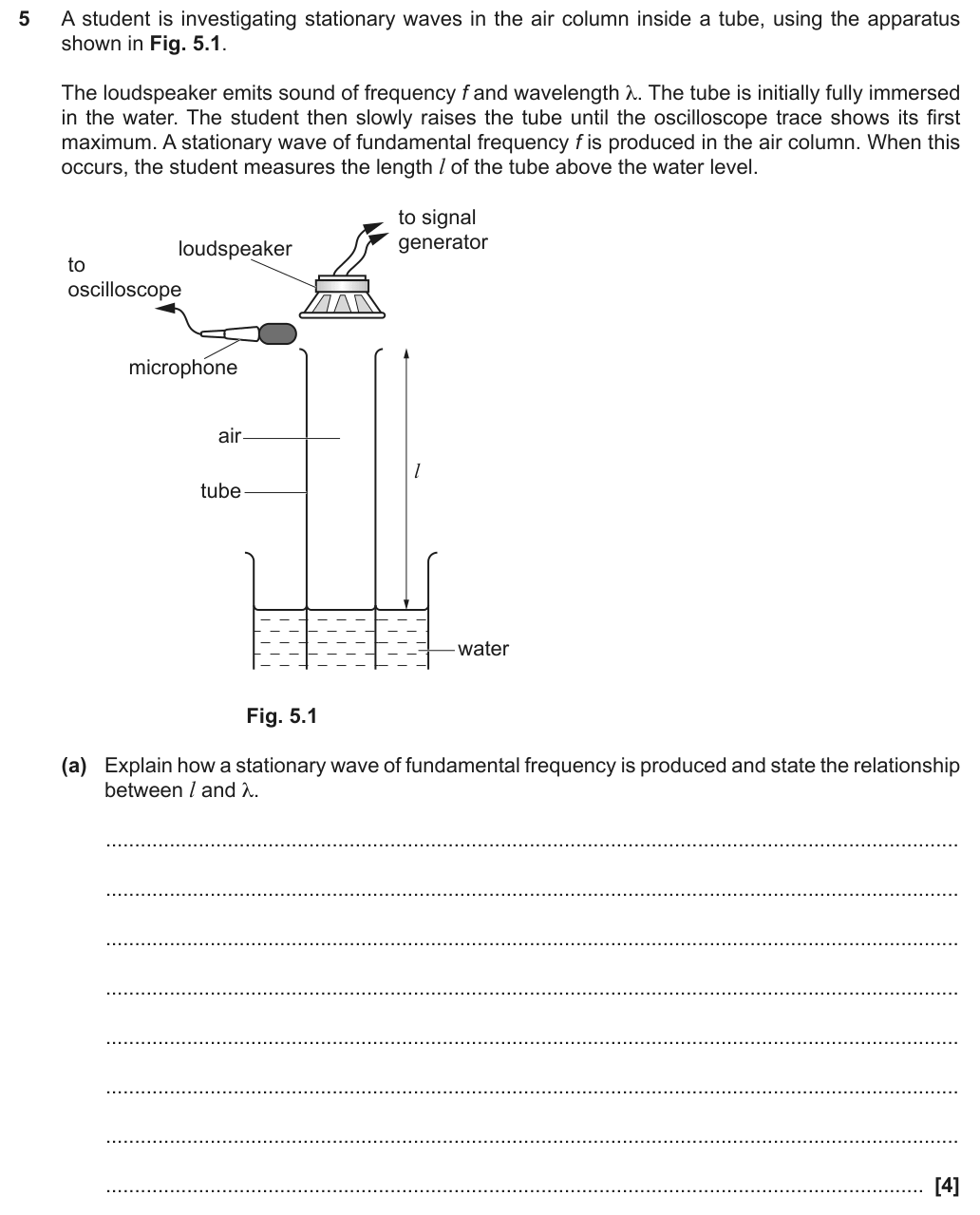
The second level of response question gave candidates the opportunity of drawing conclusions from an experiment as well as explaining how the fundamental frequency f may be determined experimentally. For good answers to these type of questions, candidates need to structure their answers logically so that all parts of the question are answered. An explanation to determine f should include the adjustment of the frequency and how to determine the fundamental frequency with the idea of the loudest sound. More successful candidates discussed the peak on the oscilloscope and starting from a low frequency. It was also expected that candidates could describe how to determine the frequency from an oscilloscope. Ideally reference would be made to the time-base. To determine the value of v with the percentage uncertainty, candidates needed to show their working clearly, taking into account the powers of ten and units from the graph. This candidate’s response is structured and detailed. Firstly, this candidate has added the steepest worst acceptable line to the graph which passes through all the error bars. The candidate then identifies how the gradient is related to the frequency of the wave before calculating the gradient. The calculation of the gradient is demonstrated and the candidate has also clearly taken into account the powers of ten on each axis of the graph before determining v with a correct unit. This process is repeated for the worst acceptable line with each of the steps shown before percentage uncertainty is calculated. Throughout this section, it is easy to follow the candidate’s method. It is clear that the candidate has used a large triangle to calculate the gradient. The candidate then explains how f is determined by adjusting the signal generator until a loud sound is heard and then explaining how the frequency is determined by the oscilloscope.
Notes from the mark scheme and report
gradient = -4/v (about -0.012 Hz-1 m-1) gives v 330 to 344 m s-1
worst acceptable line for percentage uncertainty
correct power of ten needed
Skills: M1.5 Identify uncertainties in measurements and use simple techniques to determine uncertainty when data are combined; M3.3 Understand that y = mx + c represents a linear relationship; M3.4 Determine the slope and intercept of a linear graph; PAG5 Investigating waves
June 2023 · AS Paper 2 · Q8(b)(ii)3 marksCalculationHard
Earlier parts of question 8 that this part uses
Mark scheme
Examiner's comment
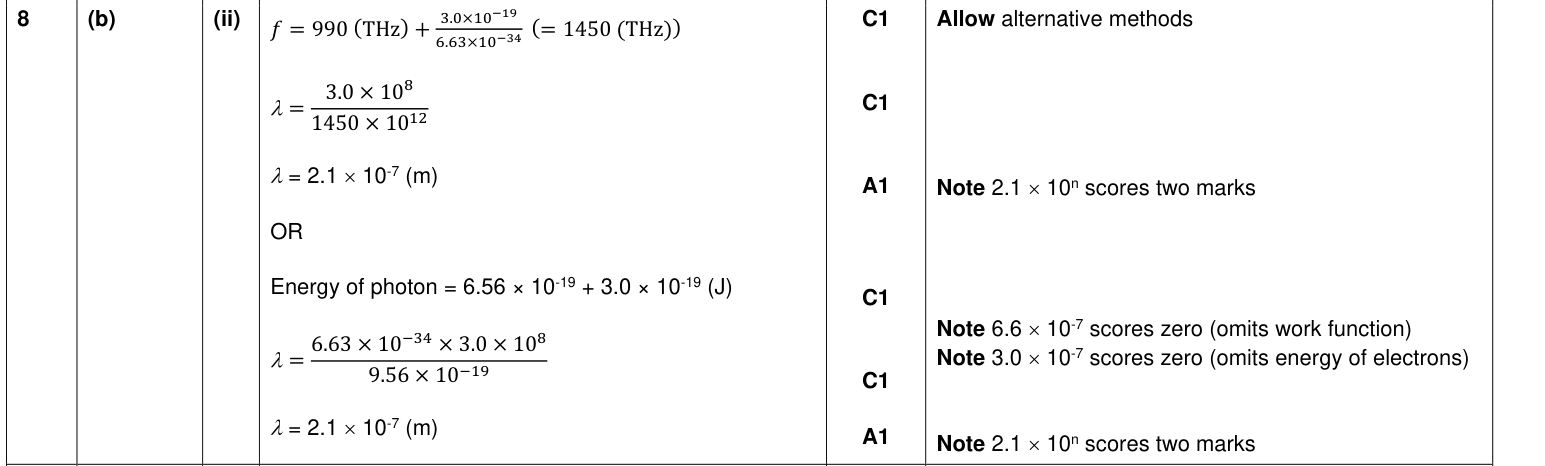
Candidates found this question challenging. The common error was to omit the work function of the metal. Other candidates determined the energy but omitted the energy of the electrons. A significant minority of candidates attempted to answer this question by determining the momentum of the electrons.
Notes from the mark scheme and report
6.6 x 10⁻⁷ scores zero (omits work function)
3.0 x 10⁻⁷ scores zero (omits energy of electrons)
2.1 x 10^n scores two
Understand the differences between the photelectric effect and electron diffraction.
Skills: M0.2 Recognise and use expressions in decimal and standard form; M2.2 Change the subject of an equation, including non-linear equations; M2.3 Substitute numerical values into algebraic equations using appropriate units for physical quantities
June 2023 · Paper 2 · Q16(a)2 marksShort answerEasy
Mark scheme
Examiner's comment
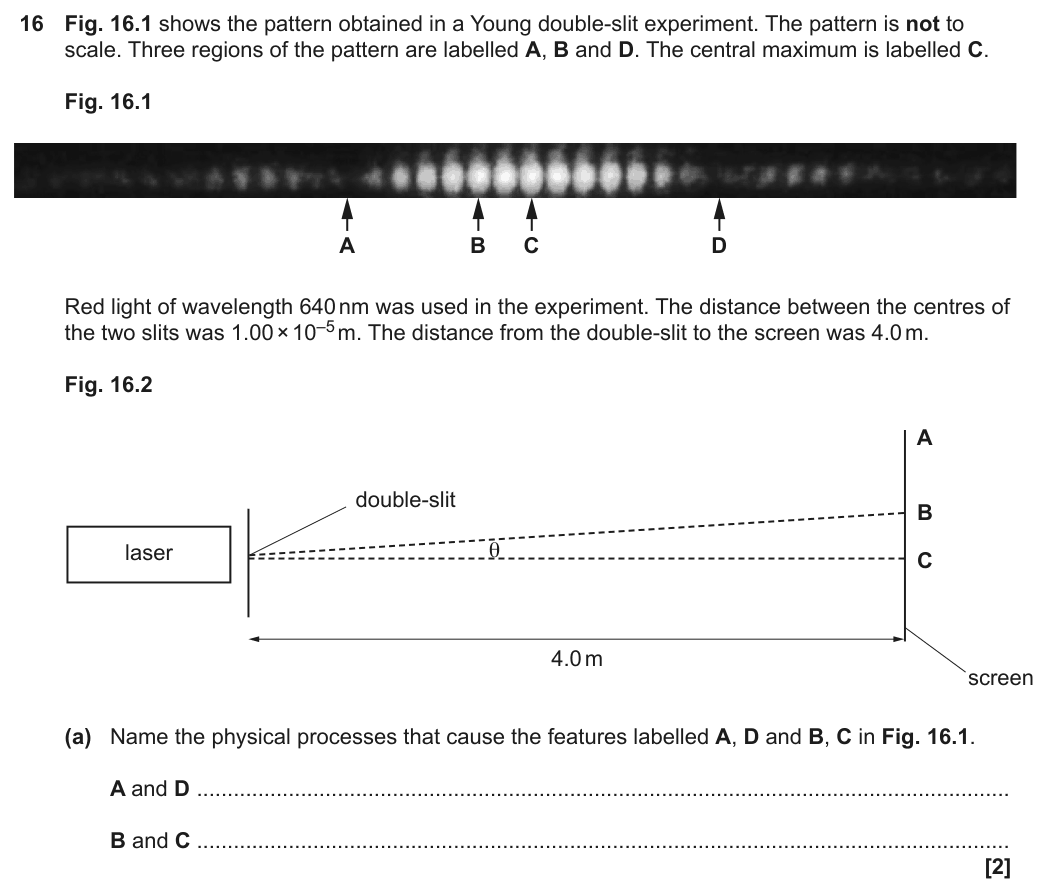
Most candidates were able to appreciate that the pattern in Fig. 16.1 was an interference pattern and that the ‘dark and light’ were the result of interference. The first mark could also be credited for the use of the term ‘diffraction’ as at that point the single slit diffraction pattern is dominant.
Notes from the mark scheme and report
interference for one mark
diffraction for A and D (or destructive for A, D and constructive for B, C)
ignore superposition alone
June 2023 · Paper 2 · Q18(b)1 markCalculationHard
Earlier part of question 18 that this part uses
Mark scheme
Examiner's comment
Around two thirds of candidates were able to calculate this correctly. The majority of incorrect responses were naturally when using 0.30 m as the wavelength. Relatively few candidates did not change their wavelength into metres, but a significant number were unable to rearrange the formula correctly.
Notes from the mark scheme and report
no ecf from 18(a)
Skills: M0.1 Recognise and make use of appropriate units in calculations; M2.3 Substitute numerical values into algebraic equations using appropriate units for physical quantities
June 2023 · Paper 2 · Q18(c)2 marksCalculationHard
Earlier parts of question 18 that this part uses
Mark scheme
Examiner's comment
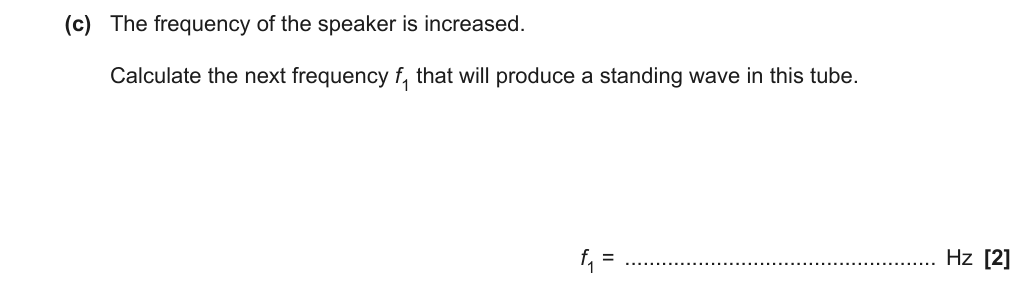
Most candidates appreciated that the wavelength would be smaller (and many drew a sketch) to produce the next frequency. However, it was difficult to score marks on this if the previous answers were incorrect. Error carried forward is often applied, but in this case major errors will compound and it is not possible to work through the candidates thinking.
Notes from the mark scheme and report
ecf from (b) if wavelength 0.600 m used
special case: full credit for 1700 Hz if 0.300 m drawn in (a) and 1130 Hz in (b)
Skills: M2.3 Substitute numerical values into algebraic equations using appropriate units for physical quantities
June 2023 · Paper 3 · Q3(c)(ii)3 marksCalculationMedium
Earlier part of question 3 that this part uses
Mark scheme
Examiner's comment
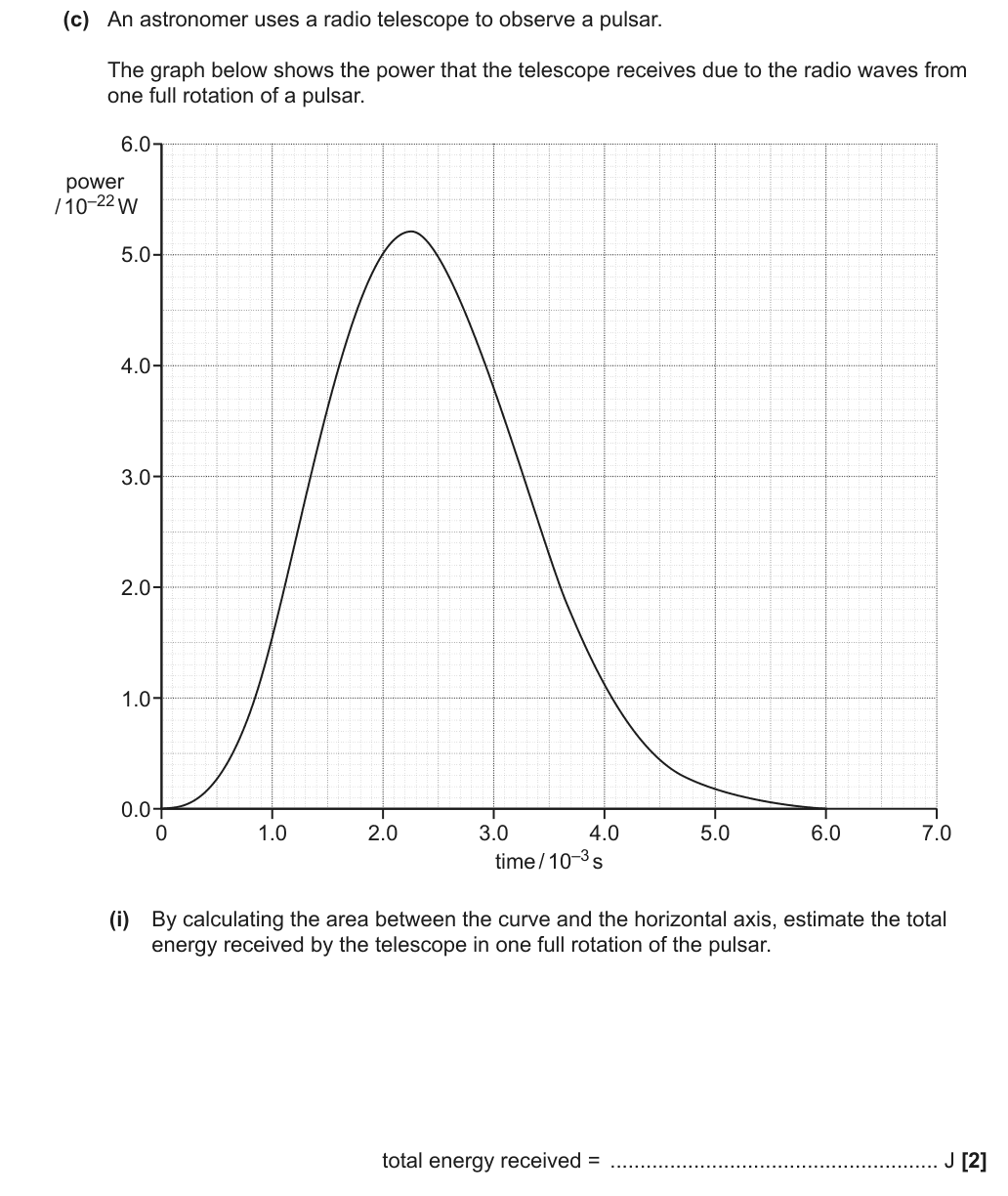
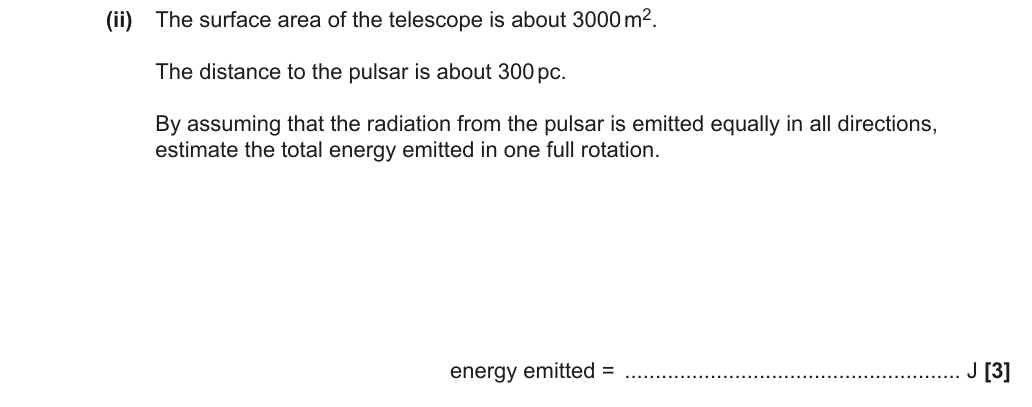
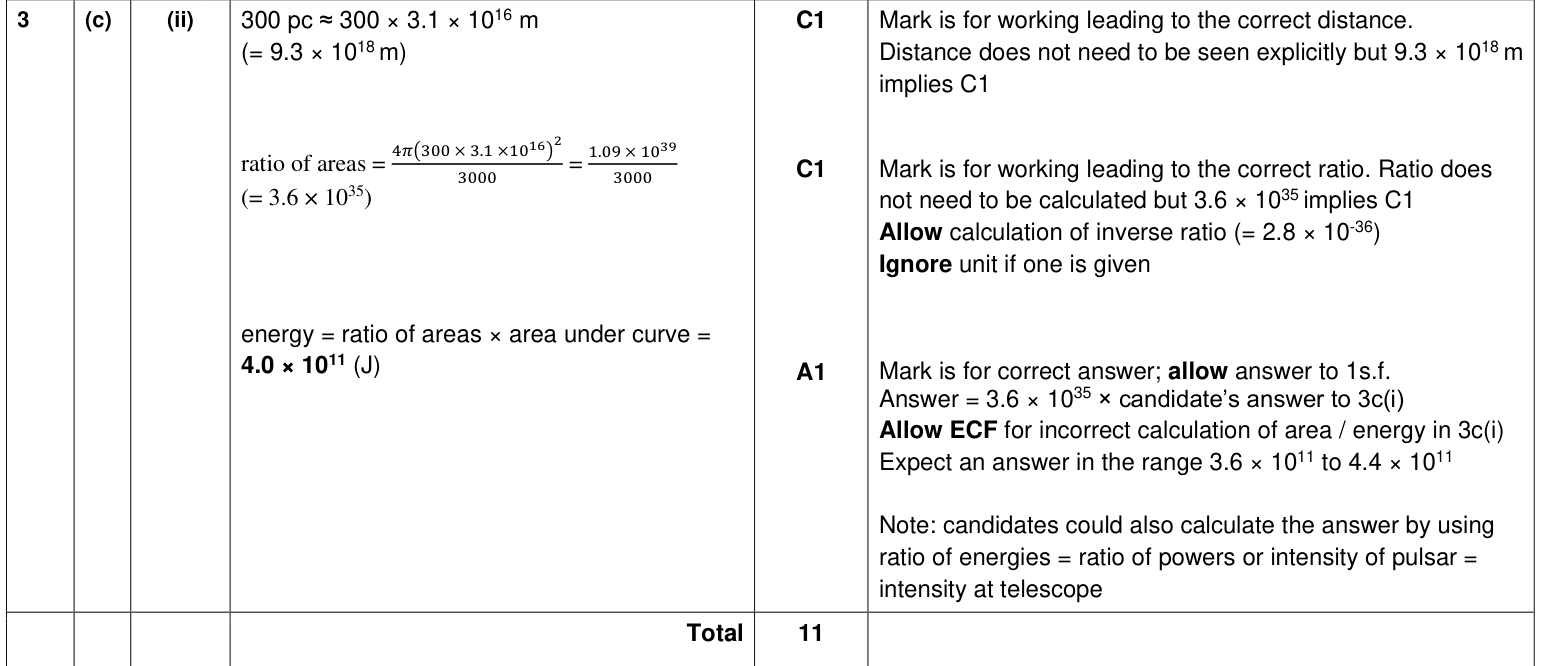
This question stretched even the highest ability candidates. The key was in realising that the intensity of the pulsar = the intensity at the telescope. So the ratio of powers (or energies) = ratio of surface areas. Most candidates successfully converted 300 pc into metres. However, some did not realise that the surface area of a sphere is 4r2, a formula that is in the data, formulae and relationships booklet.
Notes from the mark scheme and report
ratio of areas 4πd²/3000 = 3.6 x 10^35
ecf from (c)(i)
3.6 to 4.4 x 10^11 J
Skills: M0.2 Recognise and use expressions in decimal and standard form; M0.3 Use ratios, fractions and percentages; M4.3 Calculate areas of triangles, circumferences and areas of circles, surface areas and volumes of rectangular blocks, cylinders and spheres
June 2022 · AS Paper 1 · Q201 markMultiple choiceMedium
Answer
B
Mark scheme
Examiner's comment
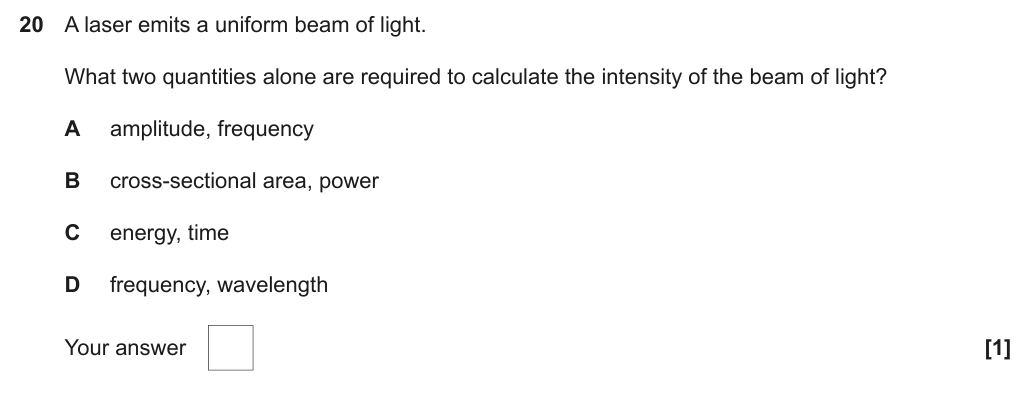
Candidates performed well on this question as most gave the correct answer B as they correctly selected and applied the equation I = P/A.
June 2022 · AS Paper 1 · Q24(b)(i)2 marksExplanationHard
Mark scheme
Examiner's comment
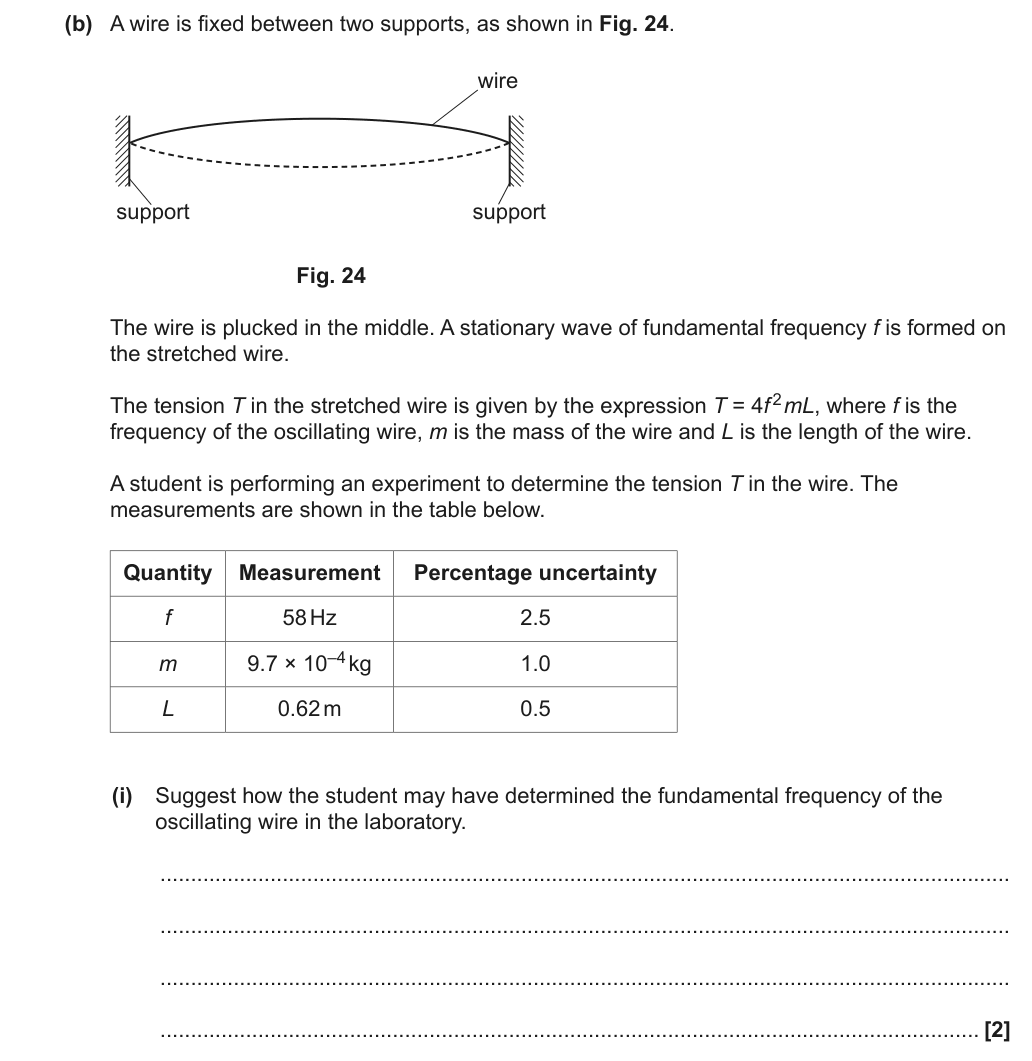
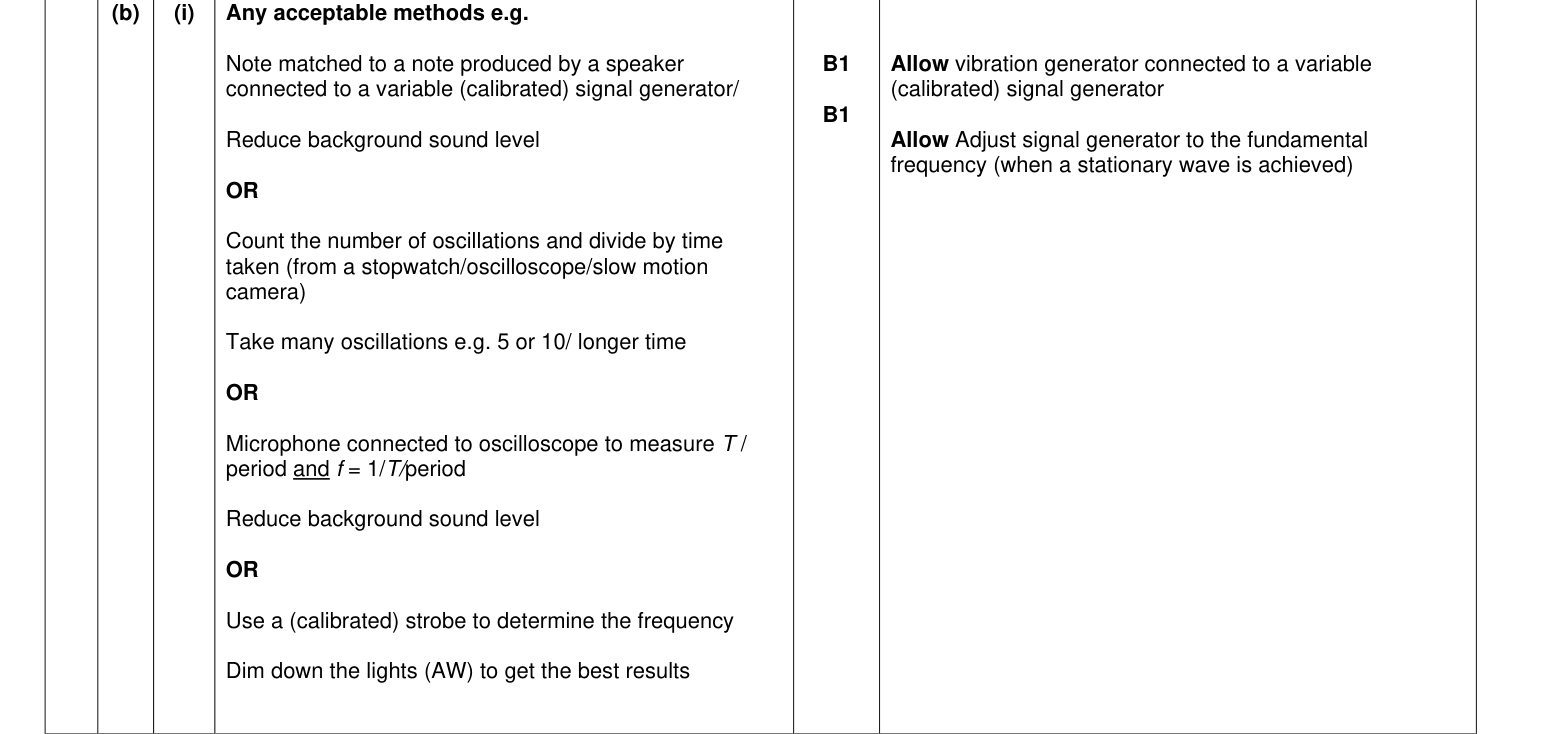
The advance information listed that practical skills would be assessed within topic 4.4 waves, but only some candidates were able to describe a simple method to determine the fundamental frequency of the oscillating wire. Marks were still given for a suitable method for determining the fundamental frequency of any oscillating wire, e.g. using a vibration generator and variable signal generator but few candidates developed their method to describe how they would obtain accurate measurements, e.g. measuring the time for 10 oscillations and then dividing by 10 to find the time period T, etc. Candidates may not have had the opportunity to carry out this practical skill independently but they should be familiar with the procedure and how measurements are taken to accurately find the fundamental frequency of a stationary wave. and understanding of the practical skills required to measure the fundamental frequency as there is no description of a method to measure the time period of a stationary wave.
Notes from the mark scheme and report
second mark is for a detail that improves the method (many oscillations, reduce background sound, dim the lights)
Skills: PAG5 Investigating waves
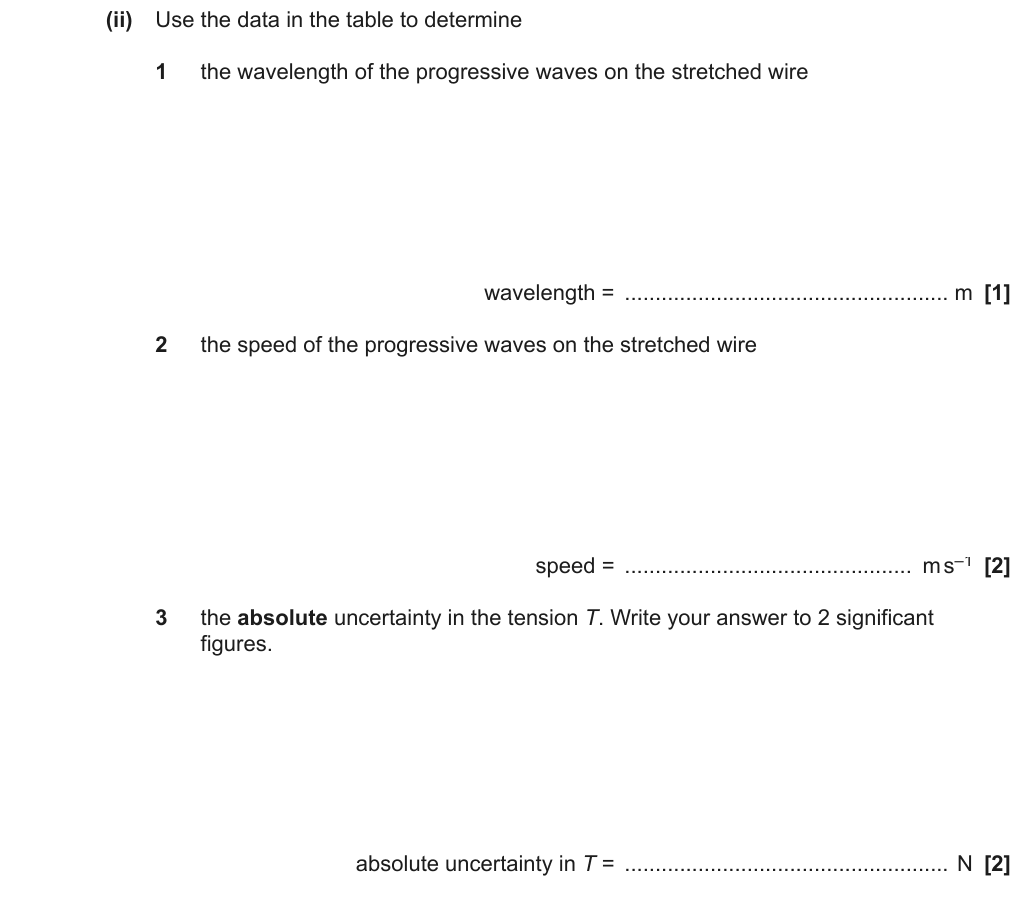
June 2022 · AS Paper 1 · Q24(b)(ii)5 marksCalculationEasy
Earlier part of question 24 that this part uses
Mark scheme
Examiner's comment
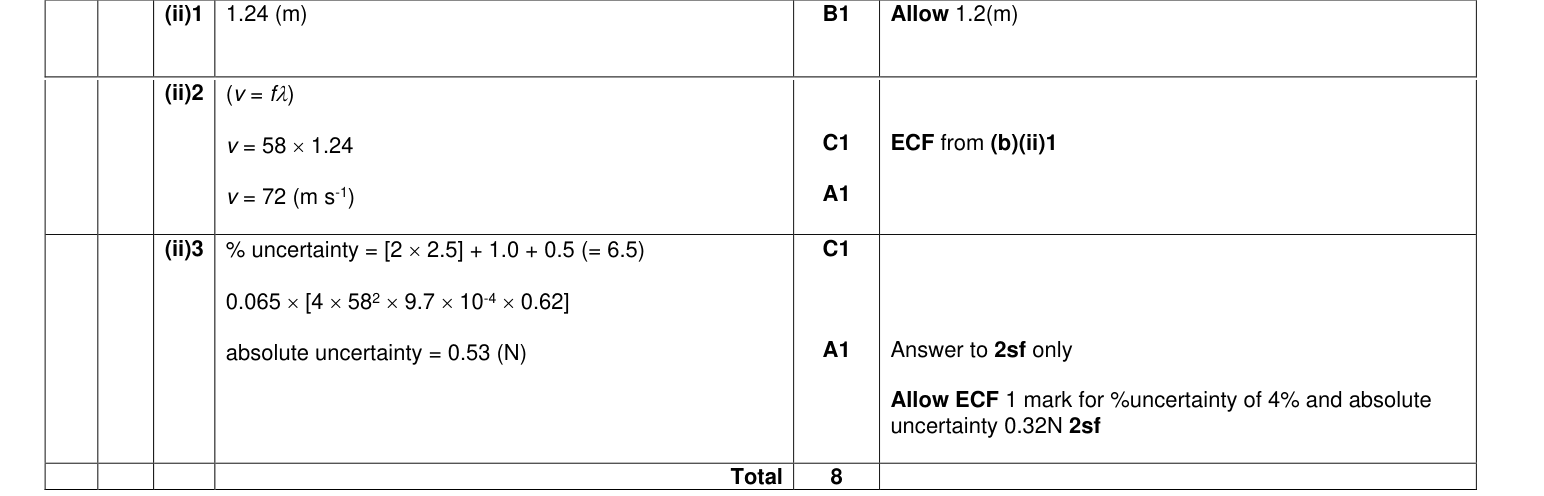
Most candidates performed well on this question as they correctly applied that at the fundamental frequency λ = 2L. Candidates at the lower end did not recall the wavelength of the stationary wave in terms of the length of wire. Nearly 80% of candidates correctly selected and applied the formula v = fλ. Where candidates had incorrectly determined the wavelength at the fundamental frequency, they were given marks for carrying out a correct calculation using their value. About a third of candidates used the information given in the question to determine the percentage uncertainty of 6.5% and used this to find the absolute uncertainty. Some candidates used the maximum and minimum values of the tension to find the absolute uncertainty. Some candidates correctly calculated a value for the absolute uncertainty but did not give their answer to 2 significant figures as the question requested.
Notes from the mark scheme and report
Allow 1.2 m
ecf from wavelength
uncertainty answer to 2 sf only
4% (f not doubled) giving 0.32 N scores 1
Skills: M1.1 Use an appropriate number of significant figures; M1.5 Identify uncertainties in measurements and use simple techniques to determine uncertainty when data are combined; M2.3 Substitute numerical values into algebraic equations using appropriate units for physical quantities
June 2022 · Paper 2 · Q111 markMultiple choiceEasy
Answer
A
Mark scheme
Examiner's comment
The vast majority of candidates were able to reach the correct response and appreciated that the intensity of a wave is proportional to the (amplitude)2 as given in the specification point 4.4.1(g). The most common incorrect response was, as expected, C.
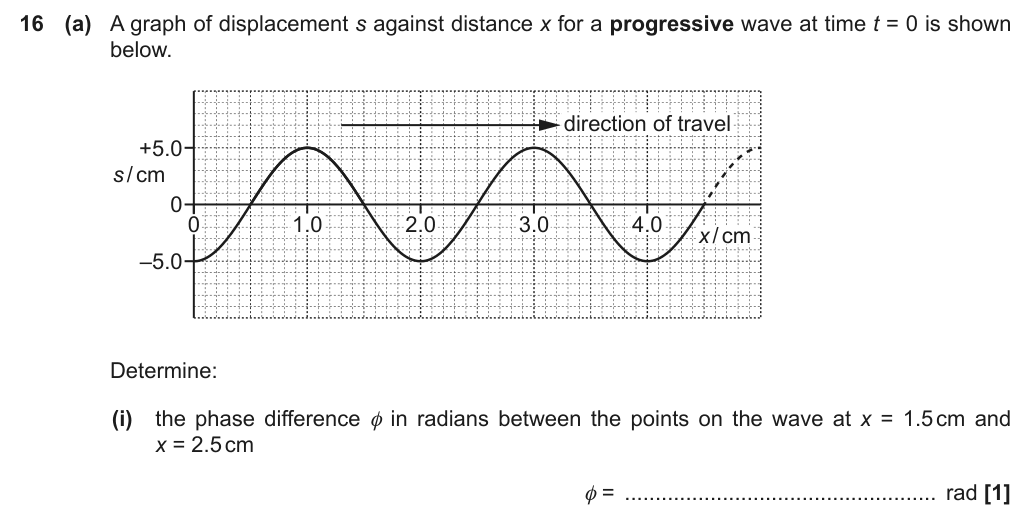
June 2022 · Paper 2 · Q16(a)(i)1 markCalculationEasy
Mark scheme
Examiner's comment
The first question can generally be expected to be accessible to most candidates and many were able to gain a mark on this. Common errors included /2 and giving responses in terms of wavelengths. Although there is no requirement to show working for this question, many candidates converted from complete cycles (using wavelengths or 360°) to help them convert to radians.
Notes from the mark scheme and report
Do not allow answer in degrees
Skills: M3.1 Translate information between graphical, numerical and algebraic forms; M4.7 Understand the relationship between degrees and radians and translate from one to the other
June 2022 · Paper 2 · Q16(a)(ii)1 markCalculationHard
Earlier part of question 16 that this part uses
Mark scheme
Examiner's comment
This proved to be a challenging question; it appears many candidates were unable to appreciate the progressive nature of the wave on a displacement-distance graph. By far the most common response was 0, where it is likely the candidates ignored the inclusion of time and simply gave the displacement at 1.5cm.
Notes from the mark scheme and report
must see the negative sign
Skills: M3.1 Translate information between graphical, numerical and algebraic forms
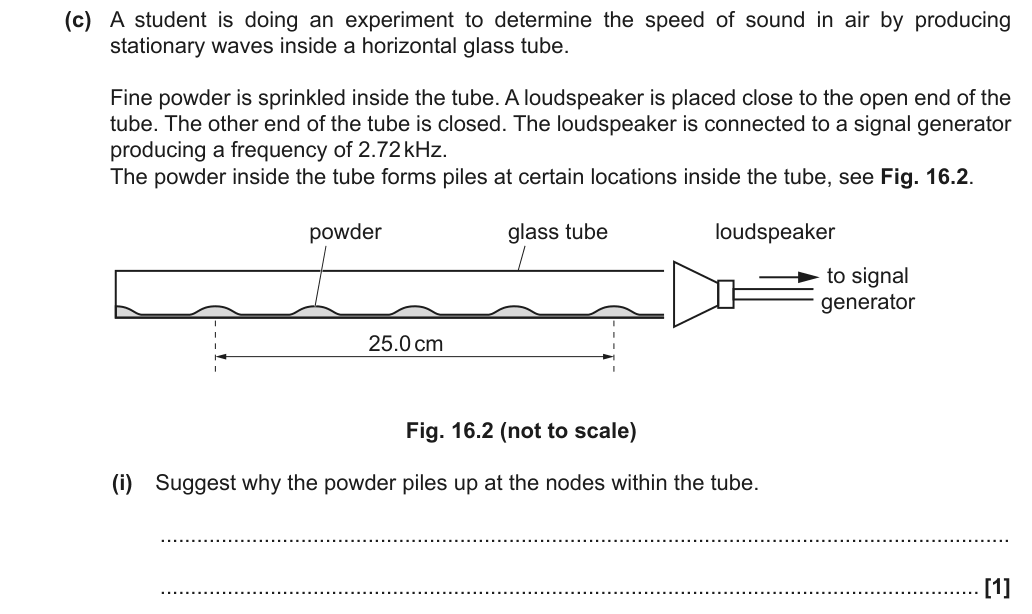
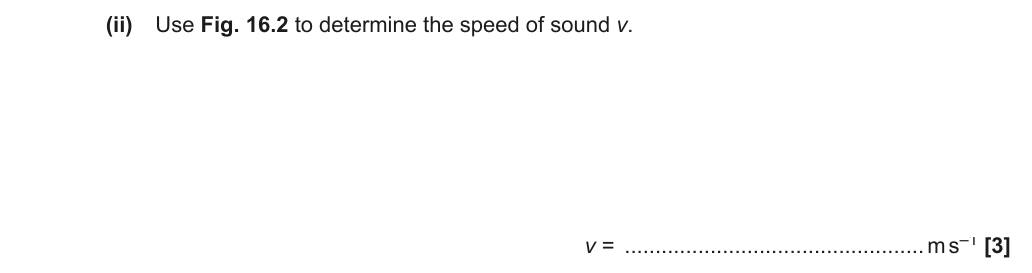
June 2022 · Paper 2 · Q16(c)(ii)3 marksCalculationMedium
Earlier part of question 16 that this part uses
Mark scheme
Examiner's comment
This question was well answered by most candidates who were able to correctly appreciate that the given distance of 25cm corresponded to two complete wavelengths of the stationary wave. Encouragingly, very few candidates did not make the cm to m conversion. A small number of candidates thought that the wavelength was the distance between two nodes resulting in an answer of 170 m s–1. Many candidates structured their responses clearly and were able to explain their reasoning.
Notes from the mark scheme and report
170 m s-1 from λ = 6.25 cm scores 2 marks
bare 340 with no working scores 1
one power-of-ten error max
Skills: M0.1 Recognise and make use of appropriate units in calculations; M2.3 Substitute numerical values into algebraic equations using appropriate units for physical quantities; PAG5 Investigating waves
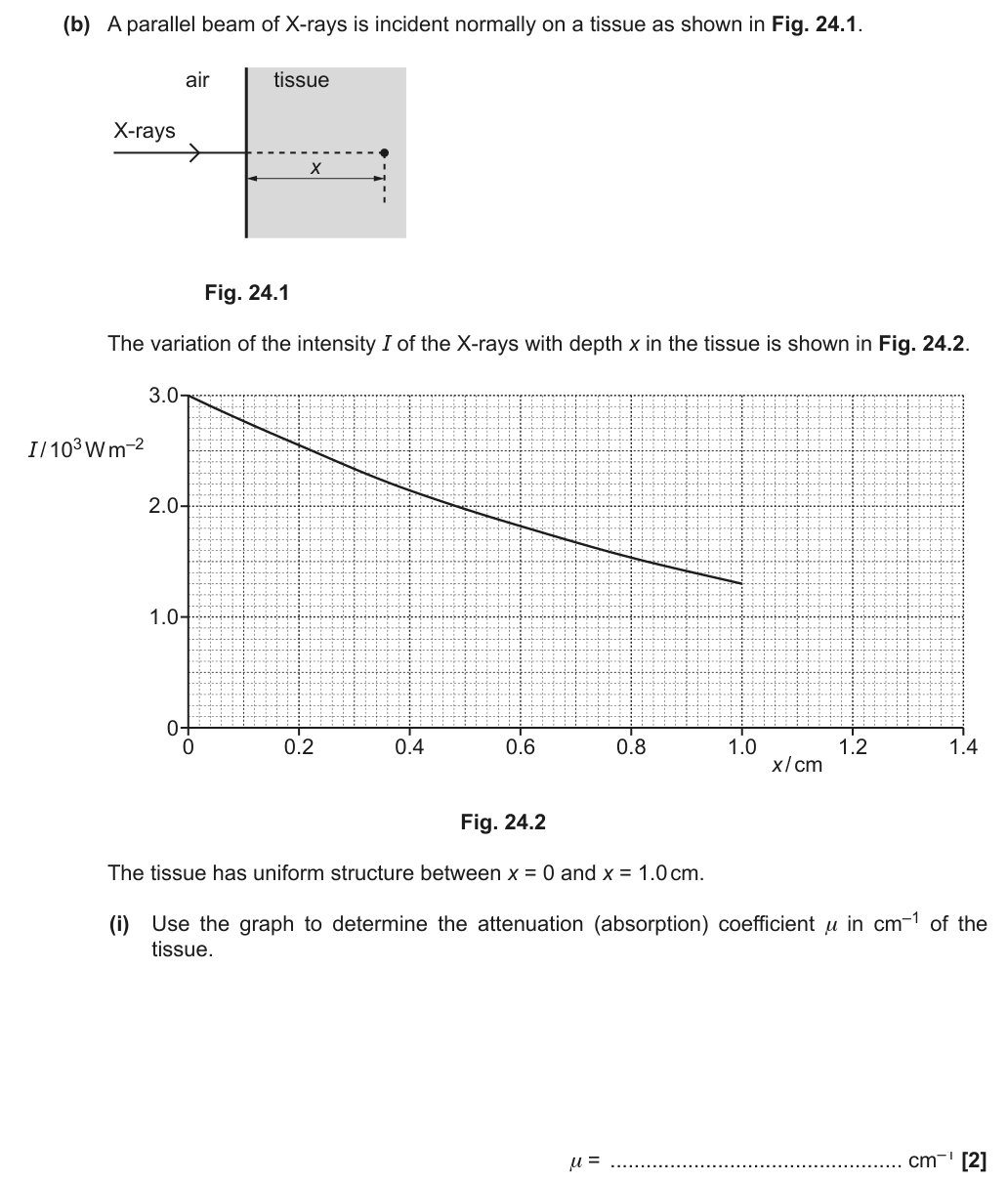
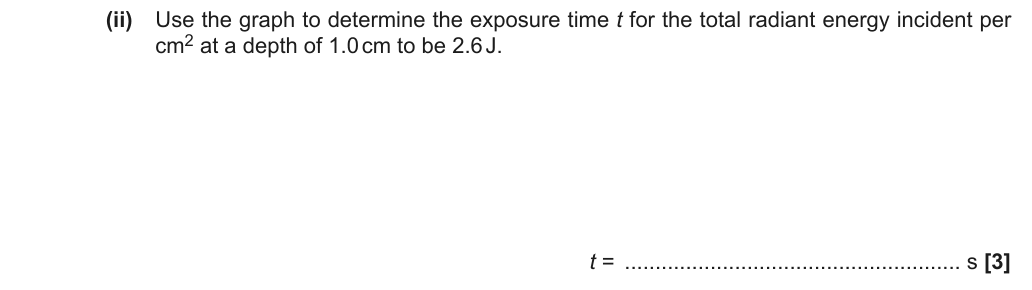
June 2022 · Paper 2 · Q24(b)(ii)3 marksCalculationEasy
Earlier part of question 24 that this part uses
Mark scheme
Examiner's comment
Many candidates made a good attempt at this question, however the conversion between cm2 to m2 and missing the 103 on the intensity reading caused two potential power of ten errors.
Notes from the mark scheme and report
I read at 1.0 cm in range 1.25 to 1.35 x 10^3
t = 16 s from I = 1.6 x 10^3 scores 2 marks
Skills: M0.1 Recognise and make use of appropriate units in calculations; M2.2 Change the subject of an equation, including non-linear equations; M3.1 Translate information between graphical, numerical and algebraic forms
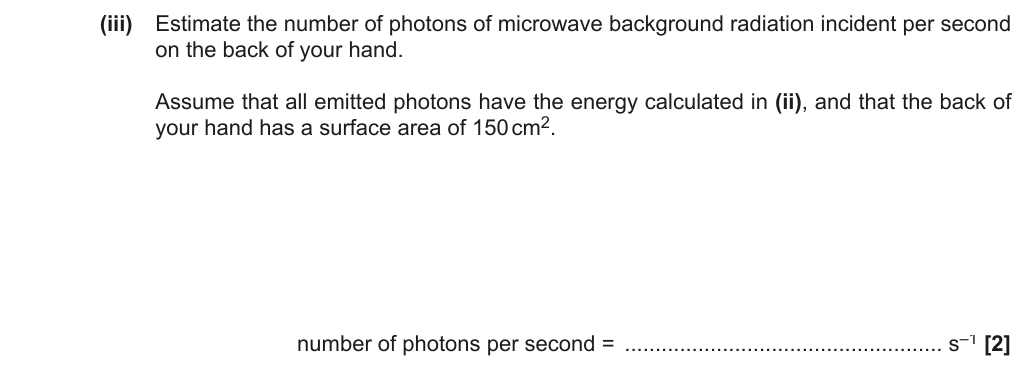
June 2022 · Paper 3 · Q4(b)(iii)2 marksCalculationHard
Earlier parts of question 4 that this part uses
Mark scheme
Examiner's comment
This is a complex, multi-stage calculation. A good approach was to use: number of photons per second × energy of each photon = amount of energy per second = power = intensity × area The total intensity of the microwave background radiation was given at the start of the question as 3 × 10⁻⁶ W m–2. Converting cm2 into m2 proved difficult for many.
Notes from the mark scheme and report
Allow 2 or 3 x 10^14
Skills: M0.1 Recognise and make use of appropriate units in calculations; M0.2 Recognise and use expressions in decimal and standard form; M2.3 Substitute numerical values into algebraic equations using appropriate units for physical quantities
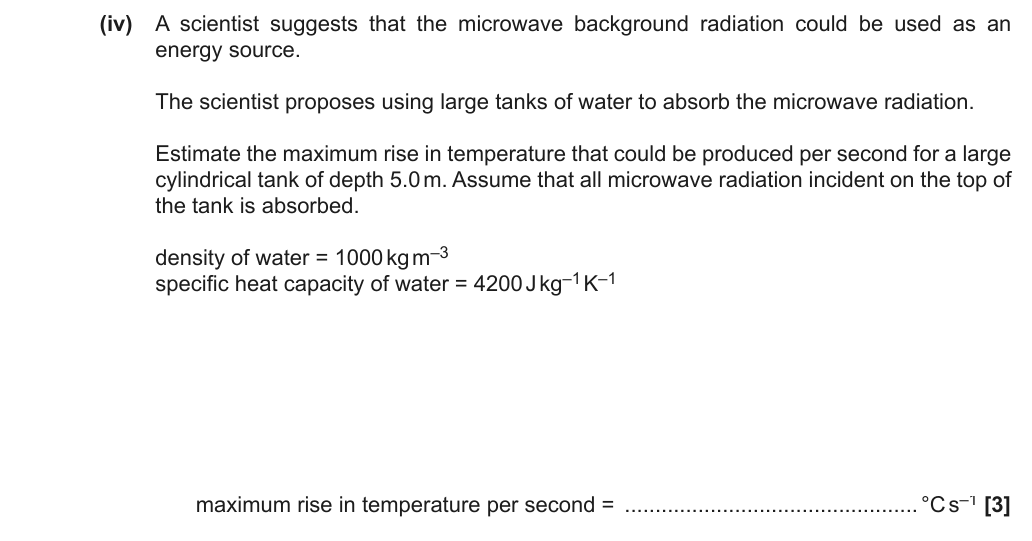
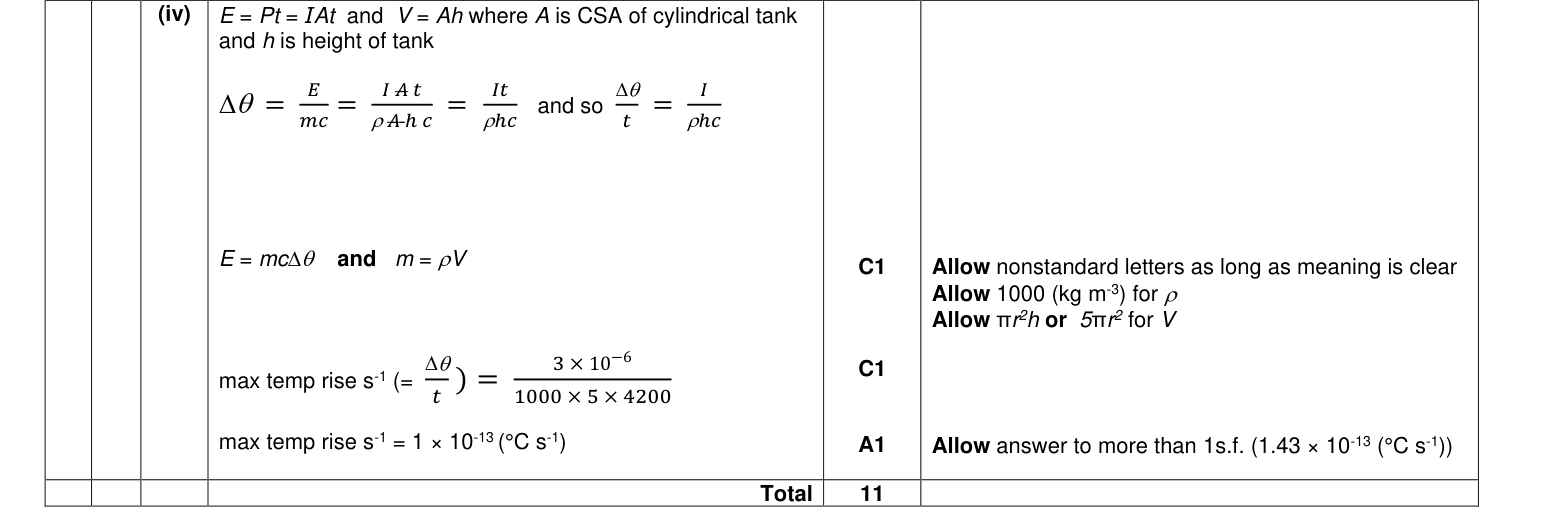
June 2022 · Paper 3 · Q4(b)(iv)3 marksCalculationEasy
Earlier part of question 4 that this part uses
Mark scheme
Examiner's comment
This too was a complex, multi-stage calculation. Most candidates correctly found their way into the question by writing down the formula E = mcΔθ and realising that they needed to use the formula ρ = m/V in order to calculate the mass. The volume V of the cylindrical tank could be found using V = depth × cross-sectional area. However, although the depth was specified in the question, the cross-sectional area was not. Successful candidates realised that, if the cross-sectional area was not given, then it must cancel out later in the calculation. Some used algebra and called the cross-sectional area A. Others simply made up a value for A (A = 1 m2 is the easiest).
Notes from the mark scheme and report
area cancels: Δθ/t = I/(ρhc)
Skills: M0.2 Recognise and use expressions in decimal and standard form; M2.2 Change the subject of an equation, including non-linear equations; M4.3 Calculate areas of triangles, circumferences and areas of circles, surface areas and volumes of rectangular blocks, cylinders and spheres
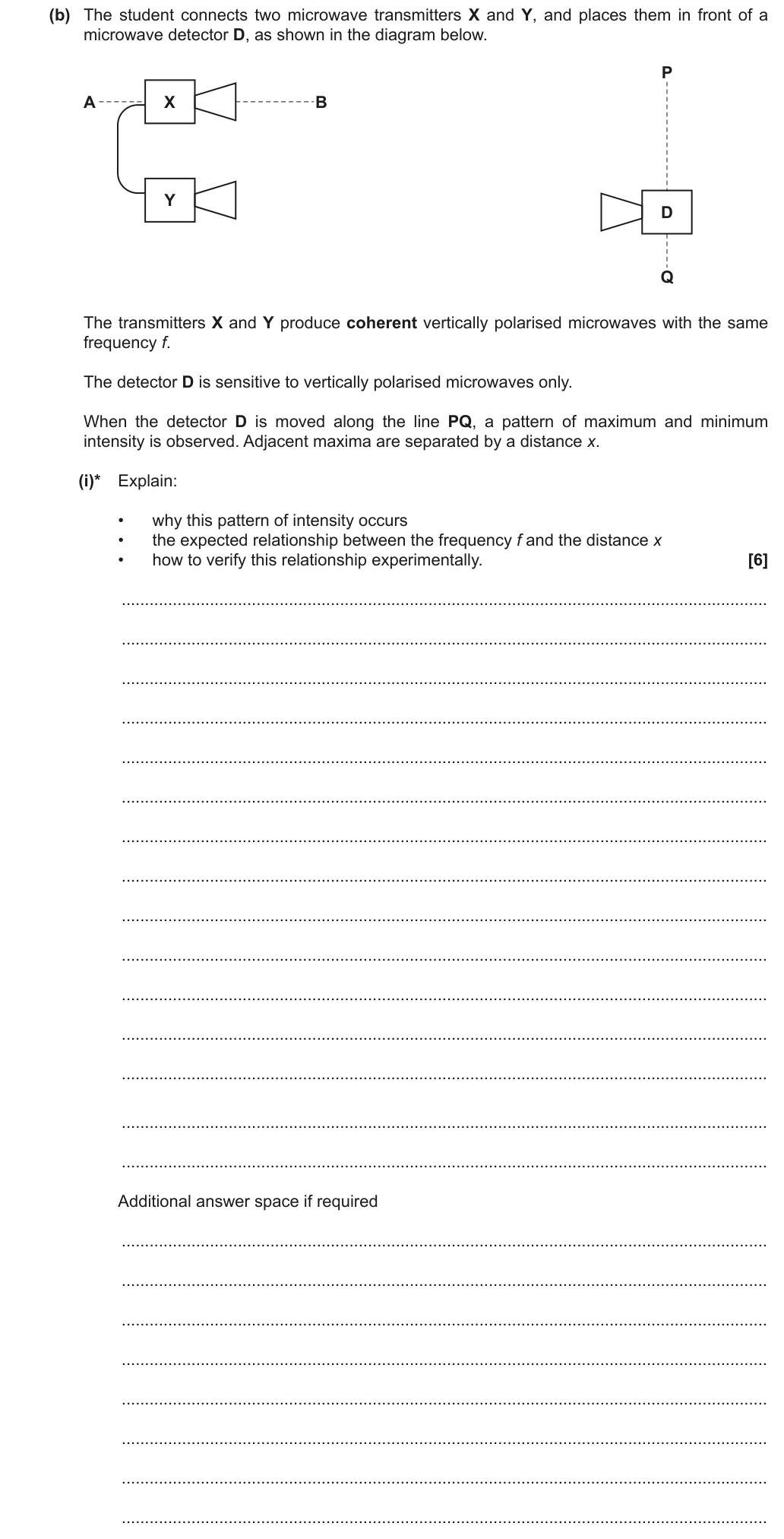
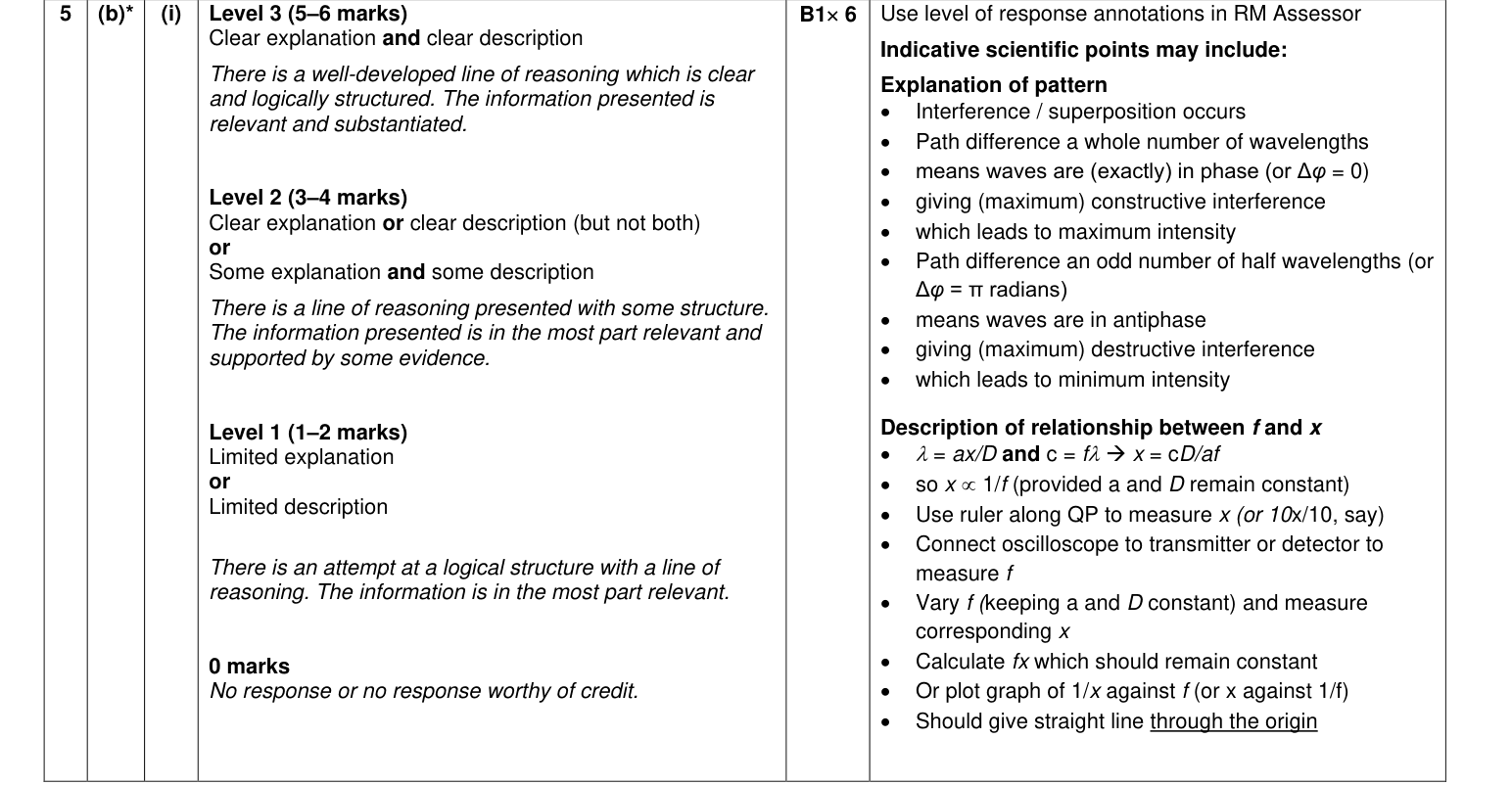
June 2022 · Paper 3 · Q5(b)(i)6 marks6-mark extended responseEasy
Mark scheme, with the levels and indicative content
Examiner's comment
There were three parts to this LoR question and all needed to be addressed to access the top level. Candidates were first asked to explain why a pattern of maximum and minimum intensity was observed. Marks were given to candidates who used precise scientific wording, e.g. destructive interference occurs when waves are in antiphase (rather than merely out of phase) or when the path difference is an odd number of half wavelengths (rather than merely an odd number of wavelengths). Fewer marks were given to candidates who wrote about waves ‘cancelling out’ or ‘amplitudes subtracting’. In the second part, the expected relationship between the frequency f and the distance x is that f and x are inversely proportional. Most candidates were able to explain this, either algebraically (λ = ax/D and c = fλ so x = cD/af) or descriptively in terms of the waves overlapping more closely as f increased. The third part of the question required an explanation of how to verify this inversely proportional relationship. The question stated that the frequency f of the microwaves could be adjusted. So the experimental procedure involved varying f and measuring x (over several maxima for accuracy). If a graph of f against 1/x gives a straight line through the origin then the relationship is verified. The exemplar above shows a successful response for the third part of the question. It makes it clear what to vary, what to measure, what measuring instruments to use, and what to do graphically with the results.
Notes from the mark scheme and report
x = cD/af so x ∝ 1/f with a and D constant
plot x against 1/f or show fx constant
Only use the words node and antinode in the context of stationary waves.
Skills: M3.3 Understand that y = mx + c represents a linear relationship; PAG5 Investigating waves
June 2022 · Paper 3 · Q5(b)(ii)3 marksExplanationHard
Earlier part of question 5 that this part uses
Mark scheme
Examiner's comment
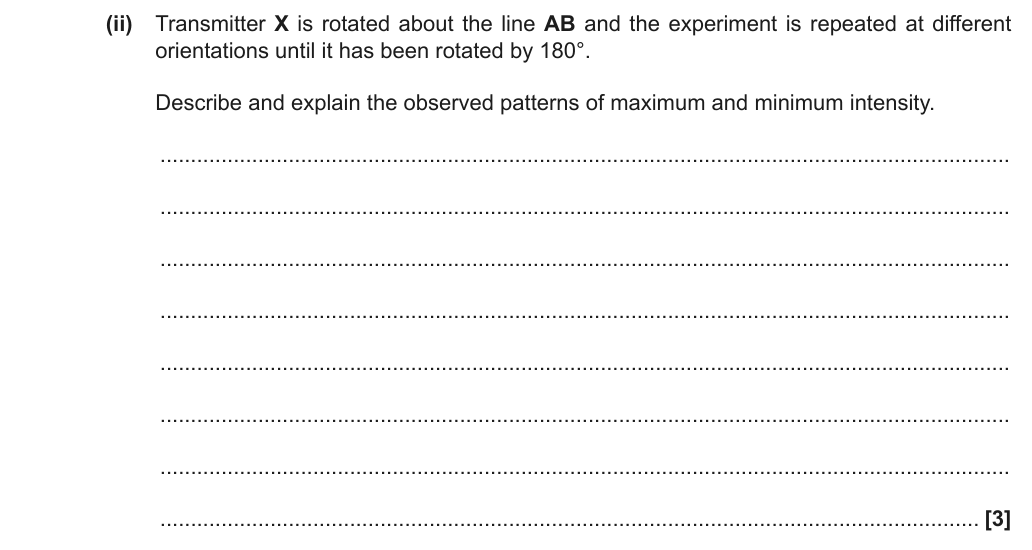
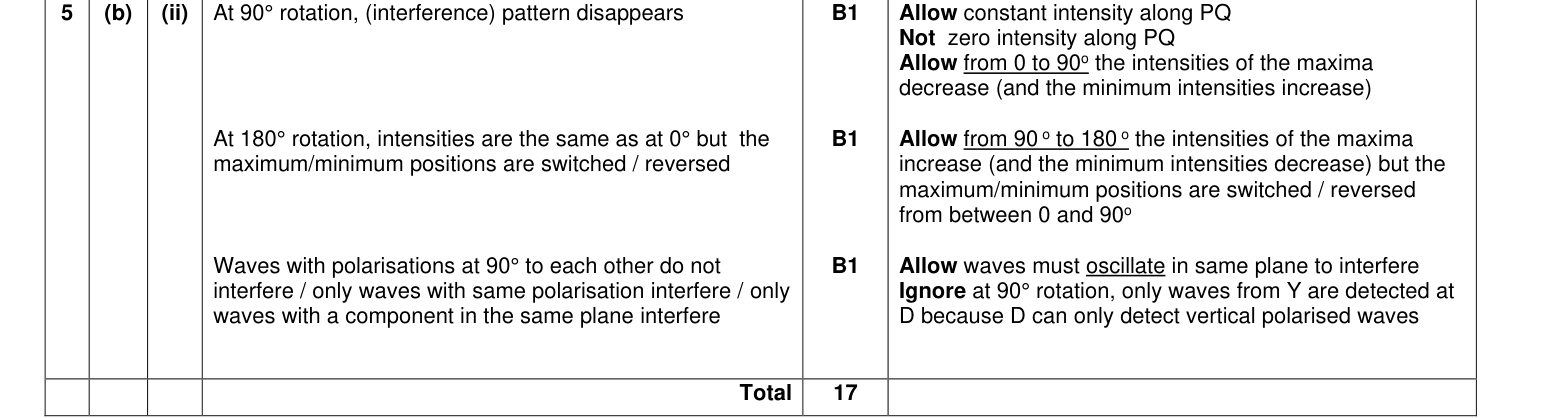
This question was misread by many candidates, who described the variation in overall intensity instead of the variation in the interference pattern. Some candidates thought that transmitter X was rotating away from Y, rather than about the AB axis. Only a few candidates correctly explained the change in pattern in terms of the change in the amount of interference between the waves from X and Y. Many said detector D was receiving less of a signal from X, rather than interference was lessening because of a reduction in the vertical component from X.
Notes from the mark scheme and report
at 90° the pattern disappears (NOT zero intensity along PQ)
at 180° maxima and minima positions are swapped
Ignore 'only Y is detected at 90°'
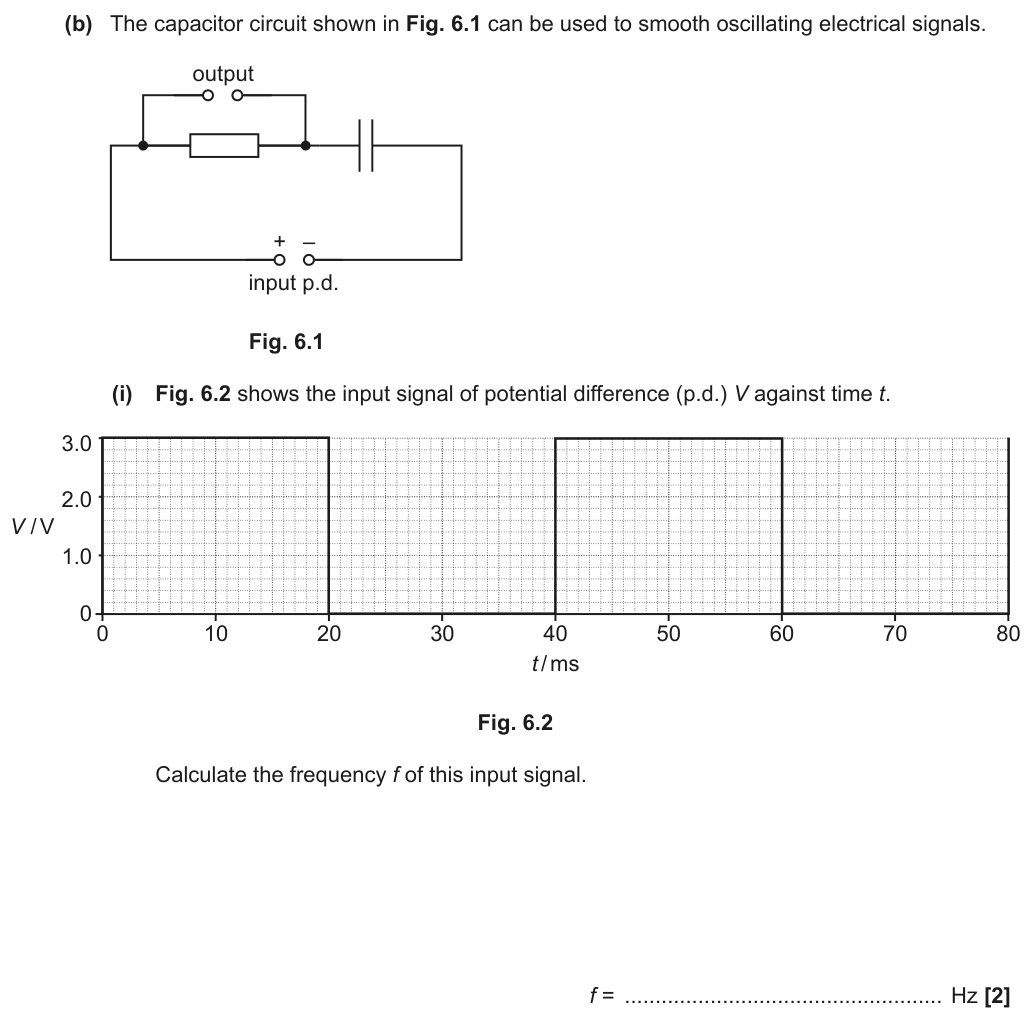
June 2022 · Paper 3 · Q6(b)(i)2 marksCalculationMedium
Mark scheme
Examiner's comment
It is important to show how the information from the graph has been used to calculate the frequency. The correct answer did not score full marks unless some working had been shown.
Notes from the mark scheme and report
T = 40 ms
Skills: M0.1 Recognise and make use of appropriate units in calculations; M3.1 Translate information between graphical, numerical and algebraic forms
November 2021 · AS Paper 1 · Q151 markMultiple choice
Answer
D
Mark scheme
November 2021 · AS Paper 1 · Q24(b)2 marksCalculation
Earlier part of question 24 that this part uses
Mark scheme
November 2021 · AS Paper 1 · Q25(a)(i)1 markShort answer
Mark scheme
November 2021 · AS Paper 1 · Q25(a)(ii)3 marksExplanation
Mark scheme
Notes from the mark scheme and report
NOT diffraction for the observation (it is in the stem)
slit size comparable to wavelength
Skills: PAG5 Investigating waves
November 2021 · AS Paper 1 · Q25(b)(ii)6 marksCalculation
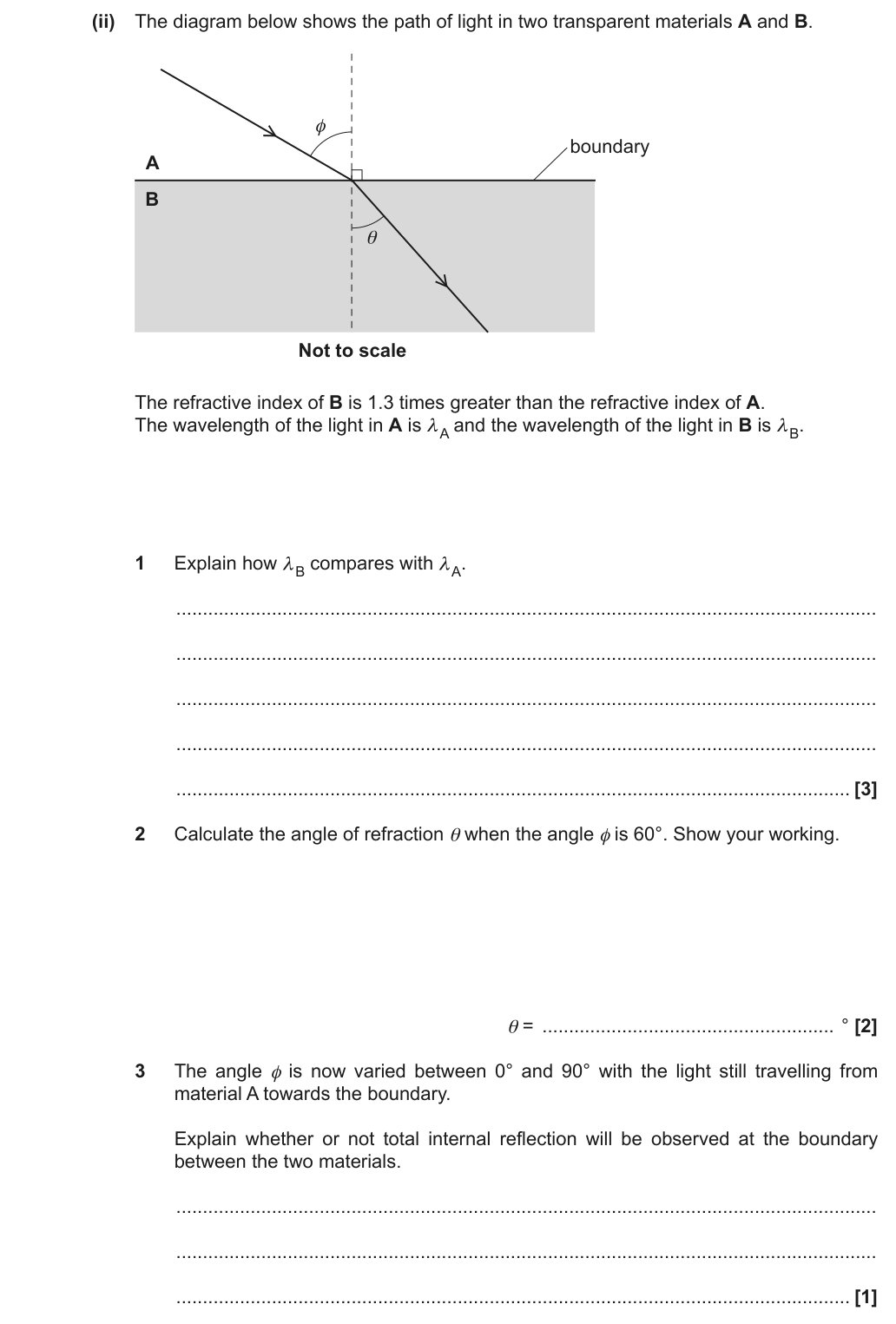
Mark scheme
Notes from the mark scheme and report
part 3: NOT θ < φ
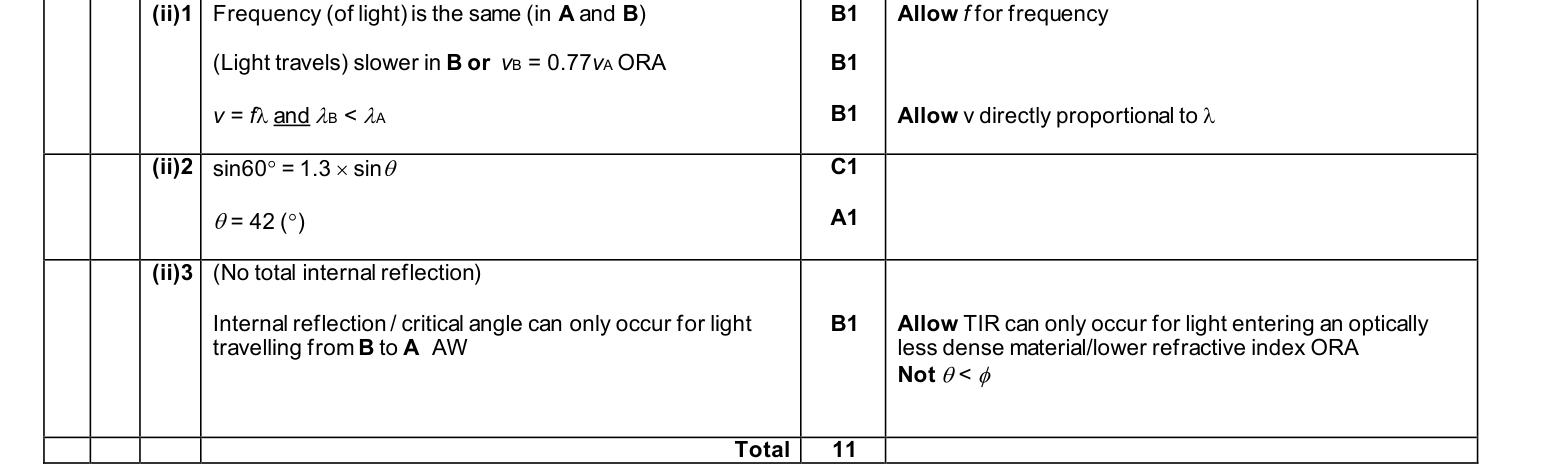
total internal reflection only for light travelling from B to A
Skills: M0.3 Use ratios, fractions and percentages; M0.6 Use calculators to handle sin x, cos x and tan x when x is expressed in degrees or radians; M2.2 Change the subject of an equation, including non-linear equations
November 2021 · AS Paper 2 · Q1(c)(i)2 marksExplanation
Mark scheme
Notes from the mark scheme and report
f = 1/T without T being defined scores 1 mark
Skills: PAG5 Investigating waves
November 2021 · AS Paper 2 · Q1(c)(ii)2 marksCalculation
Earlier part of question 1 that this part uses
Mark scheme
Notes from the mark scheme and report
0.336 or 0.34 scores 1 mark
ecf from (b)(iii)
Skills: M0.1 Recognise and make use of appropriate units in calculations; M2.3 Substitute numerical values into algebraic equations using appropriate units for physical quantities
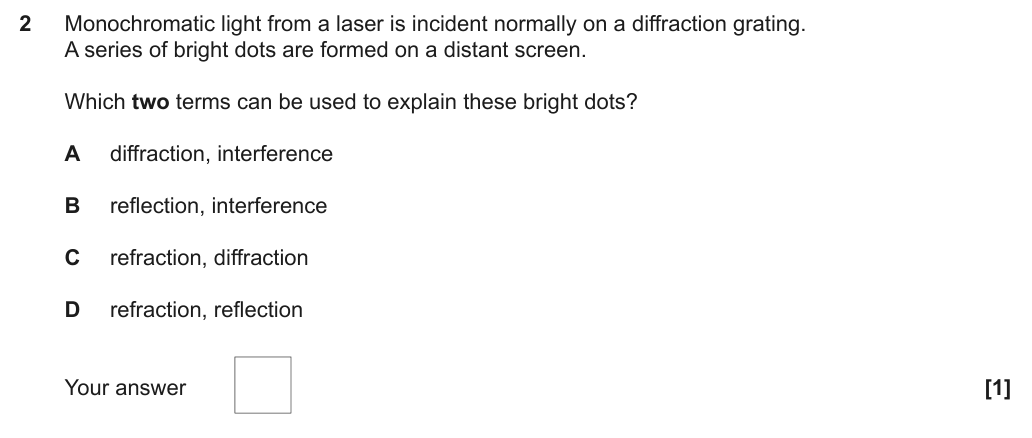
November 2021 · Paper 2 · Q21 markMultiple choiceEasy
Answer
A
Mark scheme
Examiner's comment
The correct response is A. This question was correctly answered by the vast majority of candidates, who were able to select the correct terms applicable.
November 2021 · Paper 2 · Q91 markMultiple choiceEasy
Answer
B
Mark scheme
Examiner's comment
The correct response is B. Around two thirds of candidates were able to correctly calculate the frequency; this question relies on the candidate appreciating that there is more than one complete cycle in the tube and then evaluating the correct wavelength. It is then a straightforward calculation. As expected, most of the incorrect responses were A, where the wave equation had simply been used with the given numbers. Several candidates drew on the diagram to help in their calculation of the wavelength, although some thought that the wavelength was two thirds of the tube length, rather than four fifths.
November 2021 · Paper 2 · Q111 markMultiple choiceHard
Answer
C
Mark scheme
Examiner's comment
The correct response is C. Although not a particularly challenging question, it was encouraging to see around three quarters of entrants getting the correct solution. The most common incorrect response was A, suggesting that the idea of time period is not necessarily well understood.
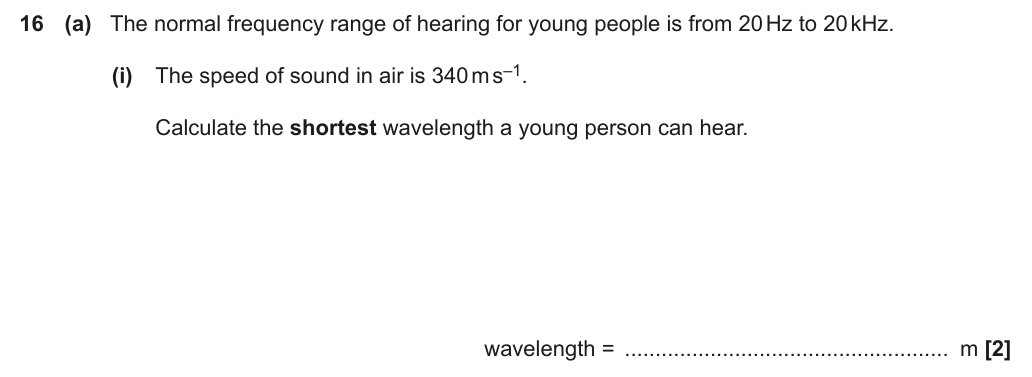
November 2021 · Paper 2 · Q16(a)(i)2 marksCalculationEasy
Mark scheme
Examiner's comment
This question should be a relatively simple introduction to the section, using a familiar formula to calculate a wavelength. Nearly all candidates were able to correctly make wavelength the subject of the equation, and the majority were able to select the correct frequency to use. Those that chose the other frequency could score 1 mark if correctly followed through.
Notes from the mark scheme and report
1 mark for 17 m (20 Hz used)
Skills: M0.1 Recognise and make use of appropriate units in calculations; M2.2 Change the subject of an equation, including non-linear equations
November 2021 · Paper 2 · Q16(a)(ii)3 marksExplanationHard
Mark scheme
Examiner's comment
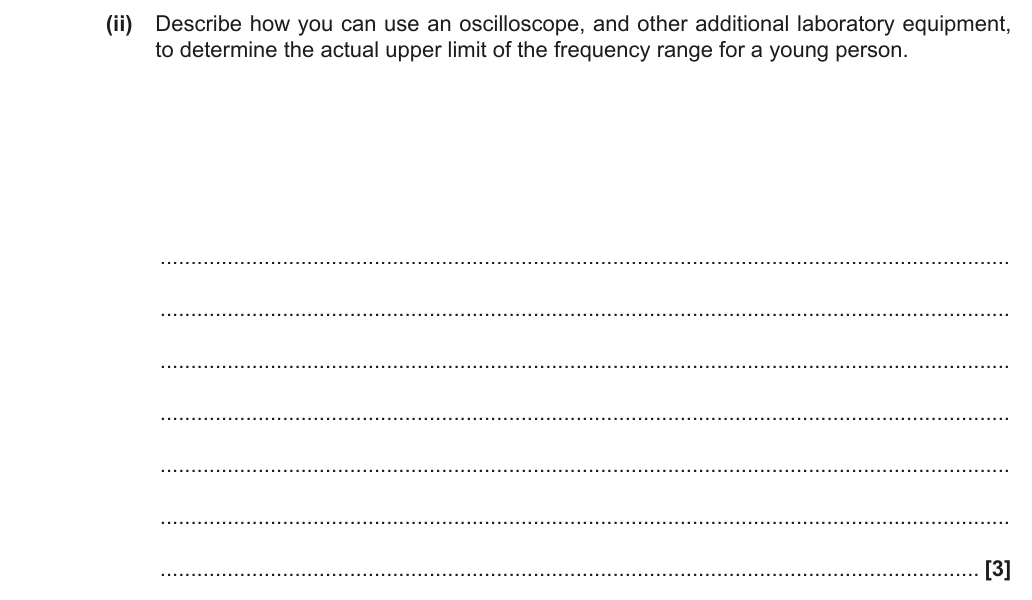
This question was poorly answered in general; very few candidates appreciated the need to use a signal generator to produce varying frequencies and seemed to think that the oscilloscope would do this. Many candidates used diagrams (yet not always labelled) to show their apparatus. Although many did appreciate that the upper limit is reached when the hearing stops, few also then went on to say how the frequency could actually be determined.
Notes from the mark scheme and report
loudspeaker and signal generator
do not allow t for time period
Skills: PAG5 Investigating waves
November 2021 · Paper 2 · Q21(b)4 marksCalculationMedium
Mark scheme
Examiner's comment
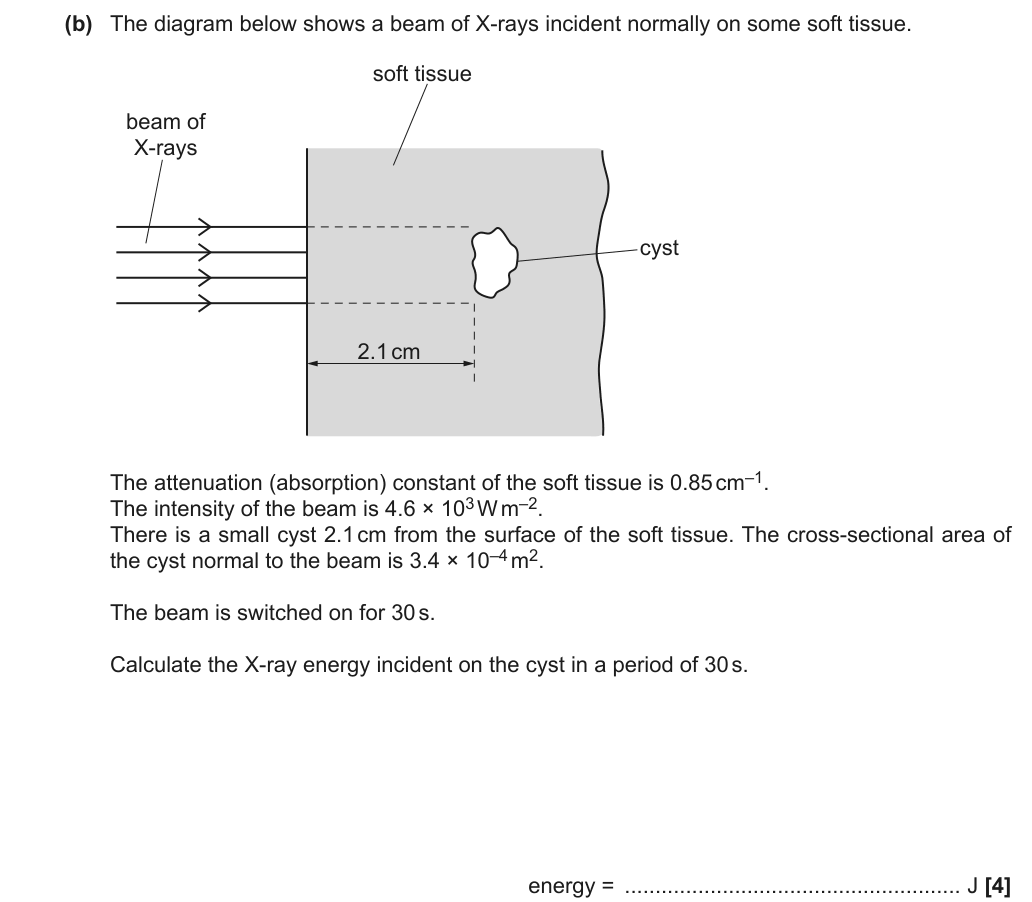
There were many routes to a final answer in this question. Those candidates who set out their working carefully, used letters to represent the calculated quantity, and set this out in several stages tended to be the most successful. Some calculated the energy at the surface before going on to apply the attenuation formula, and others carried out the attenuation on the intensity. Each method can be credited at various stages, but it is important that a clear structure is shown. Many candidates attempted to change cm-1 to m-1 by dividing by 100, whereas the better candidates appreciated that the units of distance and attenuation constant would cancel in the exponent. Several candidates used the incorrect formula energy = power / time which can be a common misconception. The correct formula is in the data booklet if required.
Notes from the mark scheme and report
energy at the surface = 47 J scores 2 marks
Skills: M0.5 Use calculators to find and use power, exponential and logarithmic functions; M2.3 Substitute numerical values into algebraic equations using appropriate units for physical quantities
November 2021 · Paper 3 · Q5(b)(i)2 marksShow thatMedium
Earlier part of question 5 that this part uses
Mark scheme
Examiner's comment
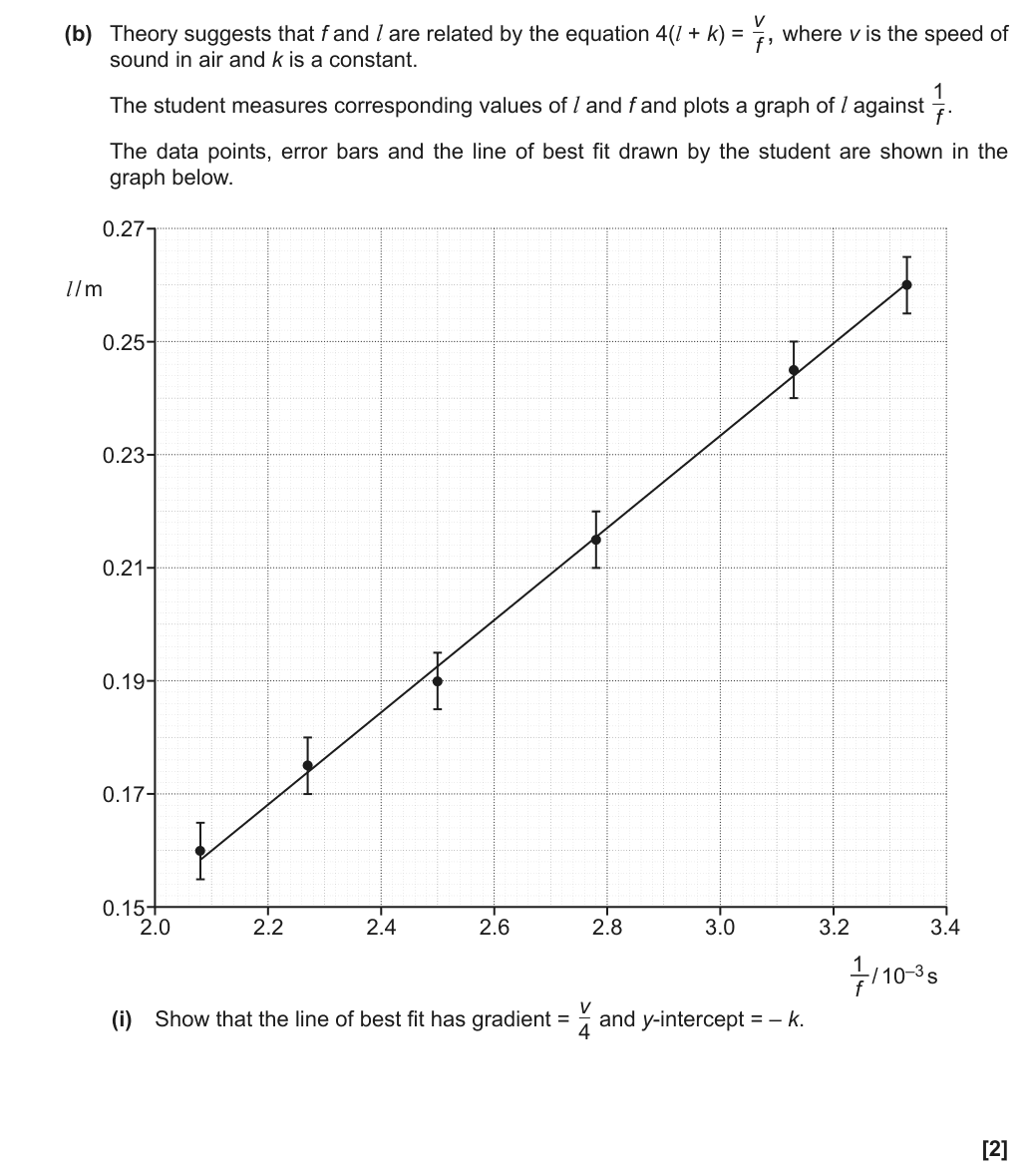
For example, they are asked to analyse and interpret experimental data, as in Question 5(b), or to design an experiment in order to test a conclusion, as in Question 2(b). Spotlight on Question 5(b) as an example A good illustrative example is the data analysis question, 5(b).
Notes from the mark scheme and report
correct manipulation to l = (v/4)(1/f) - k must be shown before comparison with y = mx + c
Skills: M2.2 Change the subject of an equation, including non-linear equations; M3.3 Understand that y = mx + c represents a linear relationship
November 2020 · AS Paper 1 · Q51 markMultiple choice
Answer
A
Mark scheme
November 2020 · AS Paper 1 · Q181 markMultiple choice
Answer
A
Mark scheme
November 2020 · AS Paper 1 · Q26(b)2 marksCalculationMedium
Earlier part of question 26 that this part uses
Mark scheme
Examiner's comment
Misconception Question 26c The intensity of a progressive wave is directly proportional to amplitude2.
Notes from the mark scheme and report
1 mark for 0.25 (milli omitted)
Skills: M0.1 Recognise and make use of appropriate units in calculations; M3.1 Translate information between graphical, numerical and algebraic forms
November 2020 · AS Paper 1 · Q26(c)2 marksCalculationMedium
Earlier part of question 26 that this part uses
Mark scheme
Examiner's comment
Misconception Question 26c The intensity of a progressive wave is directly proportional to amplitude2.
Notes from the mark scheme and report
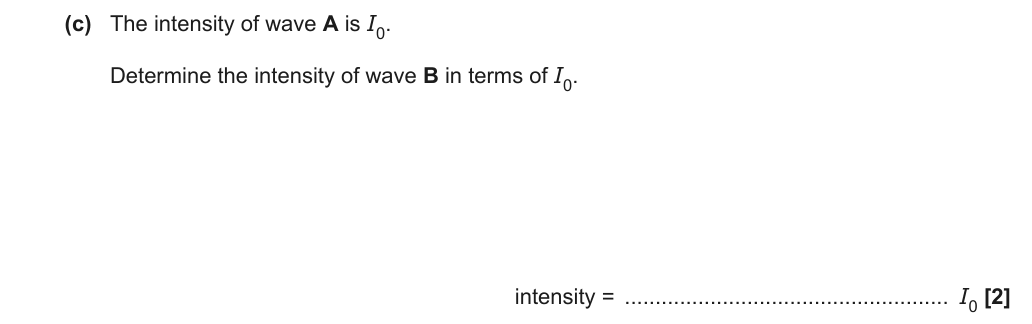
NOT 144/25 I0
1 mark for 4.84 (amplitude misread as 22)
Skills: M0.3 Use ratios, fractions and percentages; M3.1 Translate information between graphical, numerical and algebraic forms
November 2020 · AS Paper 2 · Q1(a)(i)1 markShort answer
Mark scheme
Notes from the mark scheme and report
oscillations parallel to the direction of travel / energy transfer
November 2020 · AS Paper 2 · Q1(a)(ii)2 marksDiagram or graphMedium
Mark scheme
Examiner's comment
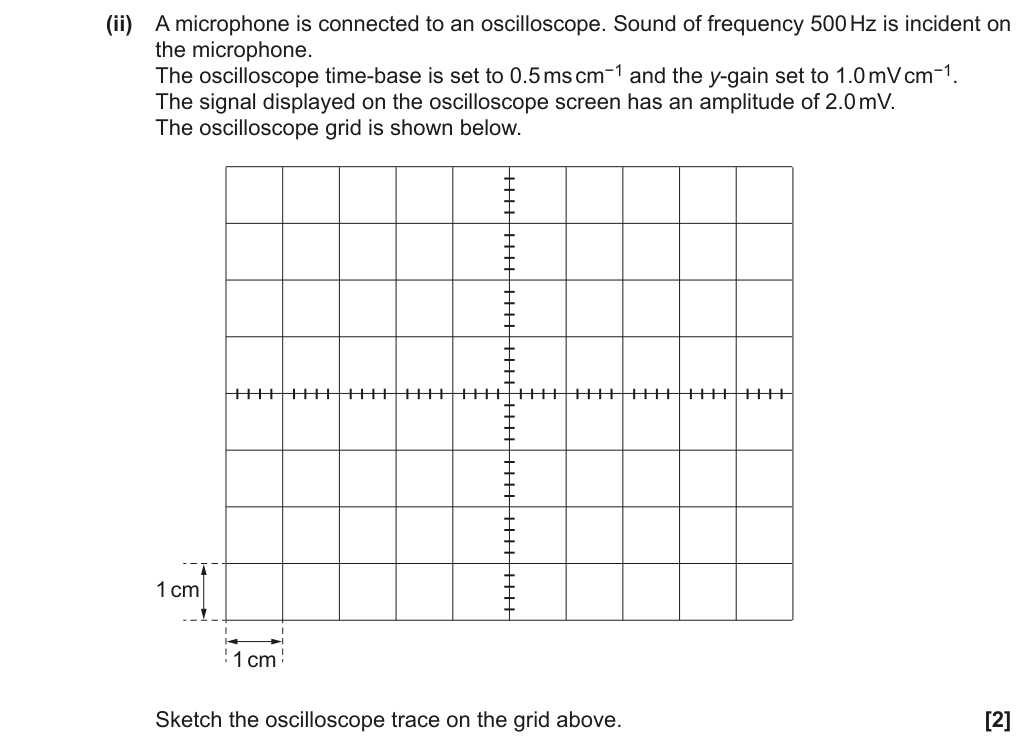
Other In Question 1 (a)(ii), candidates were required to sketch the trace.
Notes from the mark scheme and report
amplitude 2 cm
period 4 cm
at least two waves
Skills: M0.1 Recognise and make use of appropriate units in calculations; M3.1 Translate information between graphical, numerical and algebraic forms; PAG5 Investigating waves
November 2020 · AS Paper 2 · Q2(a)(i)1 markShow that
Mark scheme
November 2020 · AS Paper 2 · Q2(a)(ii)2 marksShort answerMedium
Earlier part of question 2 that this part uses
Mark scheme
Examiner's comment
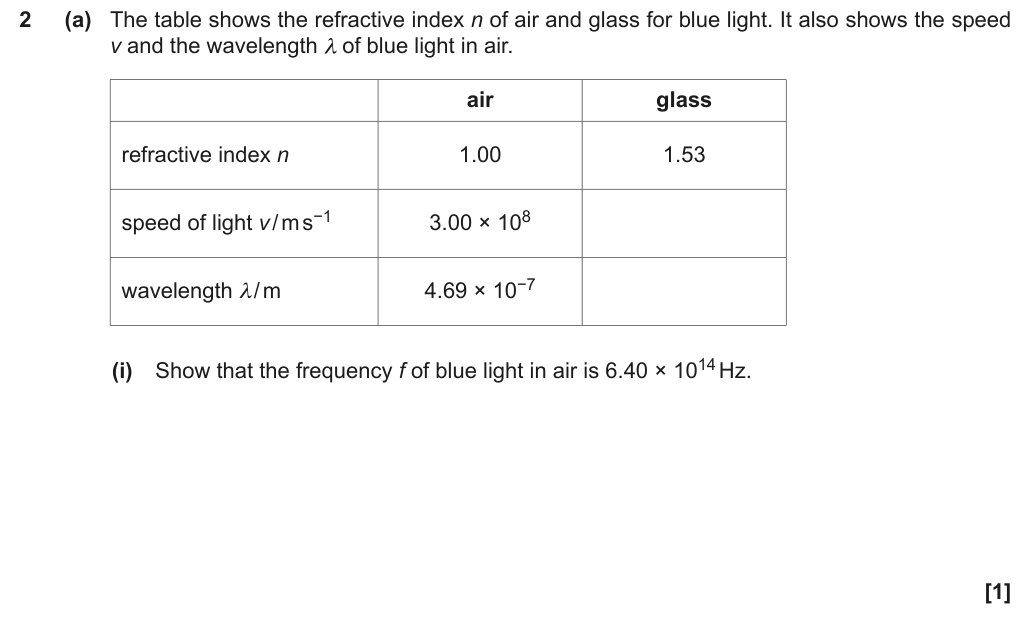
For example, in Question 2(a)(ii) answers of 4.59 × 10⁸ m s–1 (larger than the speed of light).
Notes from the mark scheme and report
allow 3.06 x 10⁻⁷ m
no ecf for incorrect speed
Skills: M1.1 Use an appropriate number of significant figures; M2.2 Change the subject of an equation, including non-linear equations; M2.3 Substitute numerical values into algebraic equations using appropriate units for physical quantities
November 2020 · AS Paper 2 · Q2(b)(i)3 marksCalculation
Earlier part of question 2 that this part uses
Mark scheme
Notes from the mark scheme and report
19° does not score
Skills: M0.6 Use calculators to handle sin x, cos x and tan x when x is expressed in degrees or radians; M2.3 Substitute numerical values into algebraic equations using appropriate units for physical quantities
November 2020 · AS Paper 2 · Q2(c)2 marksDiagram or graph
Earlier part of question 2 that this part uses
Mark scheme
Notes from the mark scheme and report
refracted angle must be less than 49.9° but greater than 30°
November 2020 · Paper 2 · Q51 markMultiple choice
Answer
C
Mark scheme
November 2020 · Paper 2 · Q111 markMultiple choice
Answer
B
Mark scheme
November 2020 · Paper 2 · Q20(a)(i)2 marksCalculationMedium
Mark scheme
Examiner's comment
Questions 16b, 17c, 18, 20ci, 21a, 21c, 22bii and 24b. • wrote all the steps and calculations when answering numerical multiple choice questions - this was unnecessary and time- consuming because most calculations could have been done on calculators • demonstrated poor recall of basic definitions and misunderstood key concepts, e.g. confusing phase difference and path difference in Question 20ci • truncated or rounded numbers prematurely within calculations, which led to incorrect final responses, e.g. Misconception Question 20aii The intensity of a sound wave is directly proportional to amplitude2. Question 20c is all about superposition of light from a double-slit and explanation of the fringes in terms of phase difference.
Notes from the mark scheme and report
diameter 2 to 16 mm allowed
NOT area = πd²
allow 1 sf
Skills: M0.4 Estimate results; M2.2 Change the subject of an equation, including non-linear equations; M4.3 Calculate areas of triangles, circumferences and areas of circles, surface areas and volumes of rectangular blocks, cylinders and spheres
November 2020 · Paper 2 · Q20(a)(ii)2 marksCalculationMedium
Earlier part of question 20 that this part uses
Mark scheme
Examiner's comment
Questions 16b, 17c, 18, 20ci, 21a, 21c, 22bii and 24b. • wrote all the steps and calculations when answering numerical multiple choice questions - this was unnecessary and time- consuming because most calculations could have been done on calculators • demonstrated poor recall of basic definitions and misunderstood key concepts, e.g. confusing phase difference and path difference in Question 20ci • truncated or rounded numbers prematurely within calculations, which led to incorrect final responses, e.g. Misconception Question 20aii The intensity of a sound wave is directly proportional to amplitude2. Question 20c is all about superposition of light from a double-slit and explanation of the fringes in terms of phase difference.
November 2020 · Paper 2 · Q20(c)(ii)3 marksCalculationMedium
Earlier part of question 20 that this part uses
Mark scheme
Examiner's comment
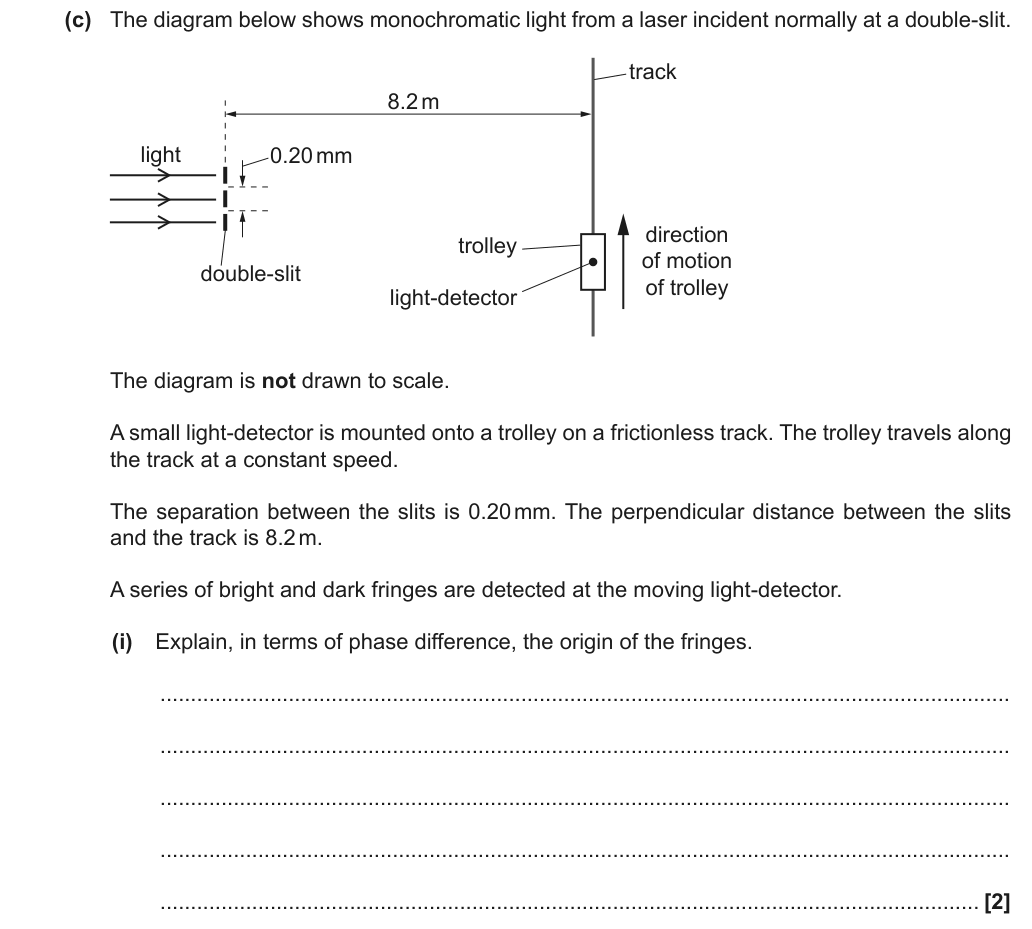
Questions 16b, 17c, 18, 20ci, 21a, 21c, 22bii and 24b. • wrote all the steps and calculations when answering numerical multiple choice questions - this was unnecessary and time- consuming because most calculations could have been done on calculators • demonstrated poor recall of basic definitions and misunderstood key concepts, e.g. confusing phase difference and path difference in Question 20ci • truncated or rounded numbers prematurely within calculations, which led to incorrect final responses, e.g. Misconception Question 20aii The intensity of a sound wave is directly proportional to amplitude2. Question 20c is all about superposition of light from a double-slit and explanation of the fringes in terms of phase difference.
Notes from the mark scheme and report
answer must be to 2 sf
8.6 x 10⁻¹¹ s scores 1 mark (0.18 = fλ is wrong physics)
Skills: M1.1 Use an appropriate number of significant figures; M2.2 Change the subject of an equation, including non-linear equations; M2.3 Substitute numerical values into algebraic equations using appropriate units for physical quantities
November 2020 · Paper 3 · Q4(d)4 marksCalculationMedium
Earlier part of question 4 that this part uses
Mark scheme
Examiner's comment
Question 4a Misconception Experiencing weightlessness is not the same as being in freefall There was a lack of understanding of the nature of feeling weightless. Question 4bi The simplest method here was to use the fact that g is inversely proportional to r2, so gr2 = constant. Question 4c The success in this question depended on understanding the meaning of the term m in the formula 2mc2 തതത = 3 2 kT given in the Data, Formulae and Relationship booklet. Question 4d Although this question looked daunting, it was actually quite linear and many candidates who attempted it were able to gain two or three marks even if they did not eventually get to the correct response.
Notes from the mark scheme and report
ecf for T from (b)(ii): 57/92 or 55/90 of 2.45 x 10^5 W
mark for x 0.07 at any stage
Skills: M0.1 Recognise and make use of appropriate units in calculations; M0.3 Use ratios, fractions and percentages; M2.3 Substitute numerical values into algebraic equations using appropriate units for physical quantities
November 2020 · Paper 3 · Q5(a)2 marksCalculationEasy
Mark scheme
Examiner's comment
Question 5b The words ‘simple harmonic motion’ in the text prompted almost all candidates to use the correct formula here. Question 5c Allowing a mark for the diode only letting current pass in one direction enabled many candidates to score this mark. Question 5d This was the second of the two LoR questions in this paper.
November 2020 · Paper 3 · Q5(d)6 marks6-mark extended responseEasy
Earlier part of question 5 that this part uses
Mark scheme, with the levels and indicative content
Examiner's comment
Question 5b The words ‘simple harmonic motion’ in the text prompted almost all candidates to use the correct formula here. Question 5c Allowing a mark for the diode only letting current pass in one direction enabled many candidates to score this mark. Question 5d This was the second of the two LoR questions in this paper.
Notes from the mark scheme and report
1: maximum with receiver aerial vertical, zero when rotated 90 degrees
2: reflected and incident waves superpose - maximum with sheet at 30, 60 cm and zero at 15, 45 cm from the aerial (full credit for the reverse if the 180 degree phase change on reflection is used)
Skills: PAG5 Investigating waves
June 2019 · AS Paper 1 · Q171 markMultiple choice
Answer
A
Mark scheme
June 2019 · AS Paper 1 · Q24(b)(ii)2 marksExplanationEasy
Earlier part of question 24 that this part uses
Mark scheme
Examiner's comment
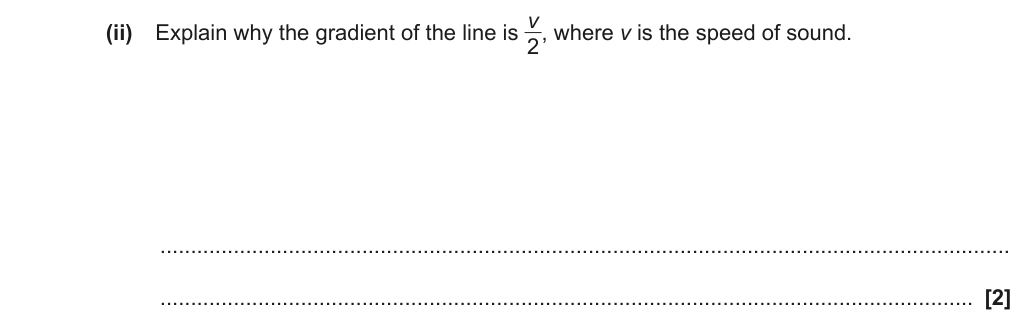
Most candidates scored 1 mark for either quoting the wave equation v = fλ or the wavelength being twice inter-nodal distance L. The analysis leading to the gradient = v/2 proved to be quite demanding for most of the candidates. The most frequent incorrect reasoning was that speed v was divided by 2 because the sound waves are reflected from the wall, and they had to travel twice the distance there and back. Only the most able of the candidates scored full marks.
June 2019 · AS Paper 2 · Q5(a)(i)1 markCalculationEasy
Mark scheme
Examiner's comment
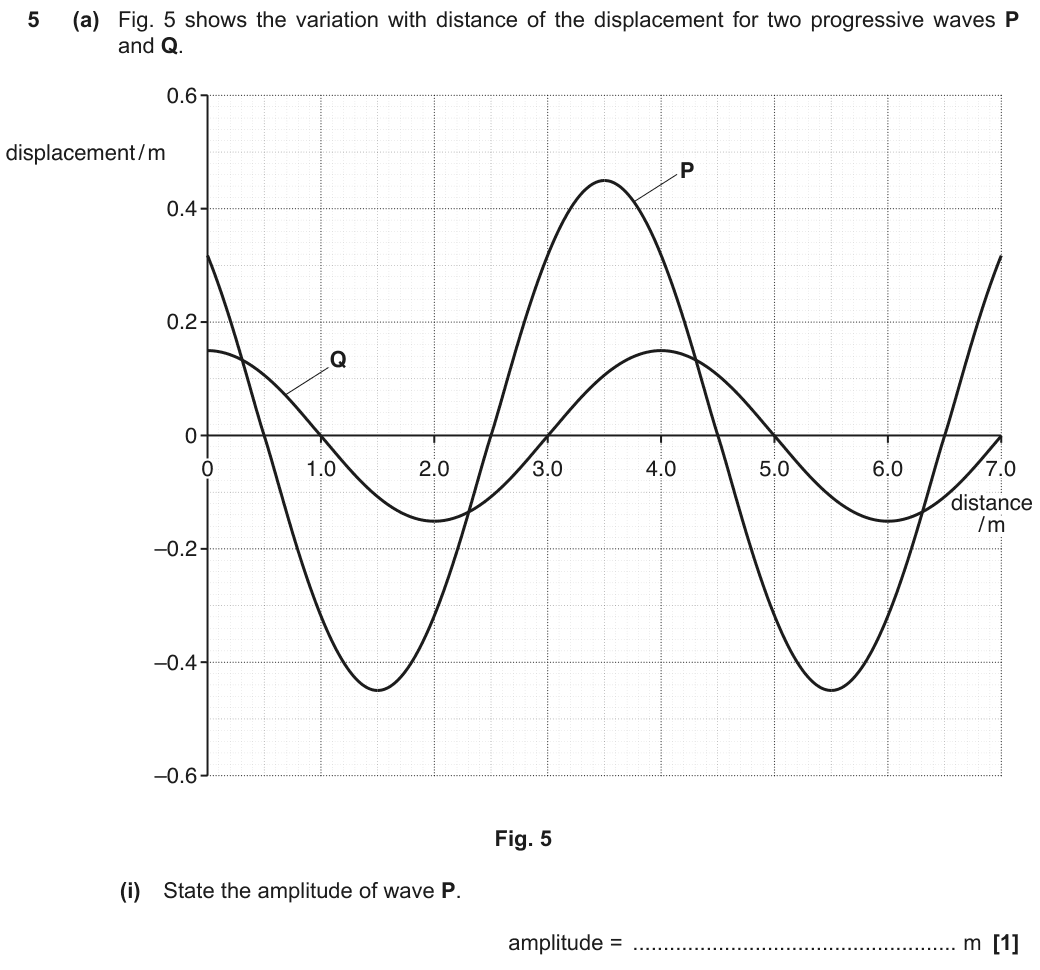
This question was generally answered very well. Most candidates understood the definition of amplitude although, a number of candidates incorrectly stated 0.9 m
June 2019 · AS Paper 2 · Q5(a)(ii)1 markCalculationEasy
Earlier part of question 5 that this part uses
Mark scheme
Examiner's comment
This question was generally answered very well with most candidates understanding the definition of wavelength.
Notes from the mark scheme and report
ignore significant figures
Skills: M3.1 Translate information between graphical, numerical and algebraic forms
June 2019 · AS Paper 2 · Q5(a)(iii)2 marksCalculationMedium
Earlier parts of question 5 that this part uses
Mark scheme
Examiner's comment
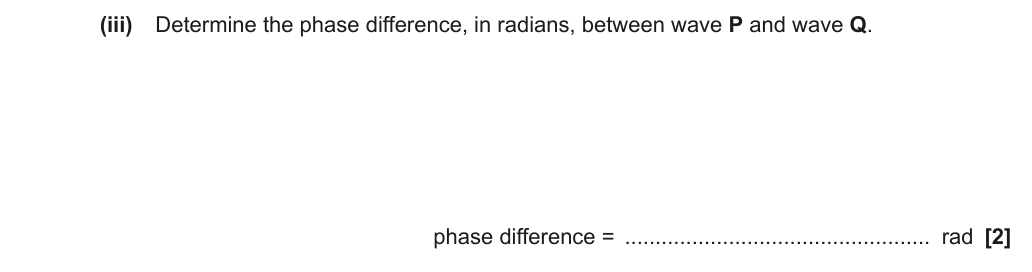
The majority of candidates did not gain credit on this question. Successful candidates clearly showed their working. Some candidates were not sure how to change a fraction of a wavelength into a phase difference in radians.
Notes from the mark scheme and report
ecf from (a)(ii)
Skills: M0.3 Use ratios, fractions and percentages; M3.1 Translate information between graphical, numerical and algebraic forms; M4.7 Understand the relationship between degrees and radians and translate from one to the other
June 2019 · AS Paper 2 · Q5(a)(iv)2 marksCalculationHard
Earlier part of question 5 that this part uses
Mark scheme
Examiner's comment
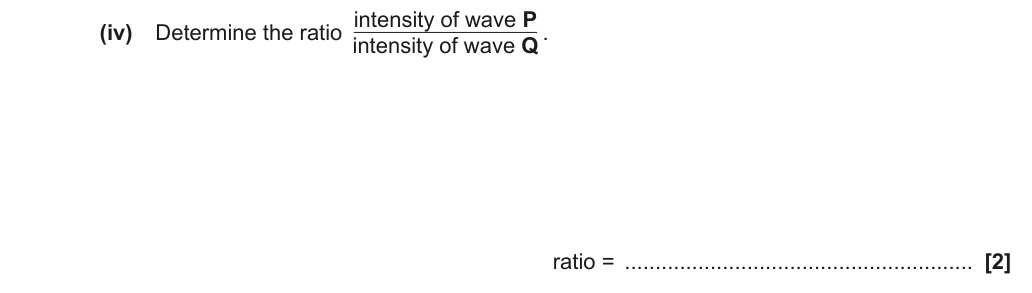
Candidates found this question challenging. They often did not realise that the intensity is proportional to the amplitude squared. It was helpful where candidates showed their working.
Notes from the mark scheme and report
allow 1 sf
ecf from (a)(i)
Skills: M0.3 Use ratios, fractions and percentages; M3.1 Translate information between graphical, numerical and algebraic forms
June 2019 · AS Paper 2 · Q5(b)6 marks6-mark extended responseMedium
Mark scheme, with the levels and indicative content
Examiner's comment
This question is assessing candidates’ abilities to plan an investigation. Some candidates assumed that this was two-source light interference and discussed the use of lasers, etc. It is important that candidates answer the question set. The stem of the question indicates that a suitable diagram should be drawn. Many candidates did not label their diagrams, or the diagrams were not workable. Higher ability candidates indicated two loudspeakers connected to a signal generator and a microphone connected to an oscilloscope to detect the resultant signal. When answering planning questions, candidates should identify the measurements that need to be taken and indicate appropriate measuring instruments. In this experiment, candidates were able to explain how the frequency of the sound could be determined using an oscilloscope as well as how distances could be measured. Candidates also needed to explain how the data would be analysed. Higher ability candidates suggested the plotting of an appropriate graph and explained how the speed of sound could be determined from the gradient. The candidate’s is answering the question as shown by the diagram containing two speakers. There is an indication of how the distances may be measured and that the frequency is going to be varied. The candidate also indicated how the results would be analysed graphically and how the speed of sound could be determined from the gradient of the plotted graph. This is a Level 2 response worth four marks since there is a line of reasoning and the information provided is relevant. To improve this response, the candidate could have included a signal generator and also a means of detecting the sound at the distance indicated. There should also have been detail on how the frequency was determined.
Notes from the mark scheme and report
needs labelled diagram, a safety precaution, D much greater than a, and a graph such as x against 1/f with gradient vD/a
Practical skills guidance can be found in the Practical Skills Handbook available on the OCR website: https://www.ocr.org.uk/Images/295483-practical-skills-handbook.pdf
Skills: M3.3 Understand that y = mx + c represents a linear relationship; M3.4 Determine the slope and intercept of a linear graph; PAG5 Investigating waves
June 2019 · Paper 2 · Q71 markMultiple choice
Answer
C
Mark scheme
June 2019 · Paper 2 · Q16(a)1 markDiagram or graphEasy
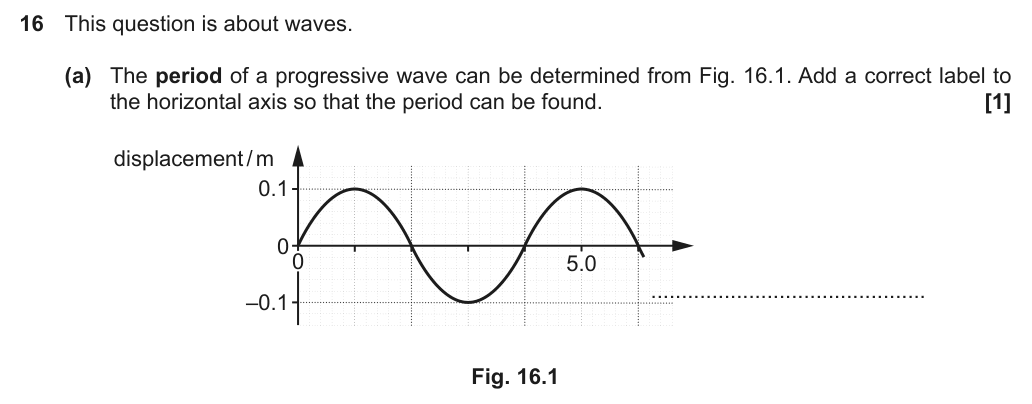
Mark scheme
Examiner's comment
Almost all candidates did well here by correctly labelling the horizontal axis. Most answers also included the unit, e.g. time / s. A very small number of candidates had distance, time period, frequency and velocity for the label.
Notes from the mark scheme and report
Allow t but NOT T
NOT just a unit
correct label with a wrong unit is a contradiction
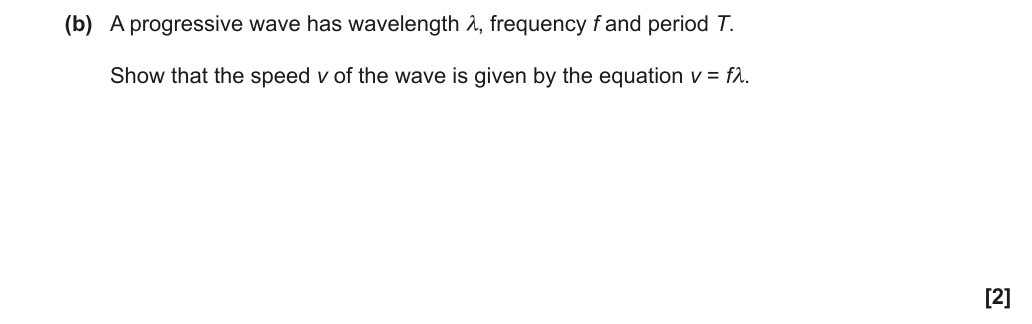
June 2019 · Paper 2 · Q16(b)2 marksShow thatEasy
Mark scheme
Examiner's comment
For maximum marks, it was important for candidates to clearly show all the steps leading to the wave equation. Supportive text always helps with the clarity of answers. The vast majority of the candidates produced flawless answers in terms of λ, f and T. A significant number of candidates used t or d, which made their working ambiguous. Some tried their luck with 4.0 s from Fig. 16.1, which led to no marks. The exemplar 3 below shows a model response supported by equations and text and exemplar 4 shows that even top end candidates make mistakes. This is a model response for a show-type question. The text provides continuity and supports the derivation of the wave equation. A perfect solution. This was a high scoring candidate overall who misunderstood the question here. The focus is on S.I. units of the various quantities and not on a derivation of v = fλ from first principles.
Notes from the mark scheme and report
NOT t for T
NOT cycles / oscillations in place of wavelengths
Skills: M2.2 Change the subject of an equation, including non-linear equations
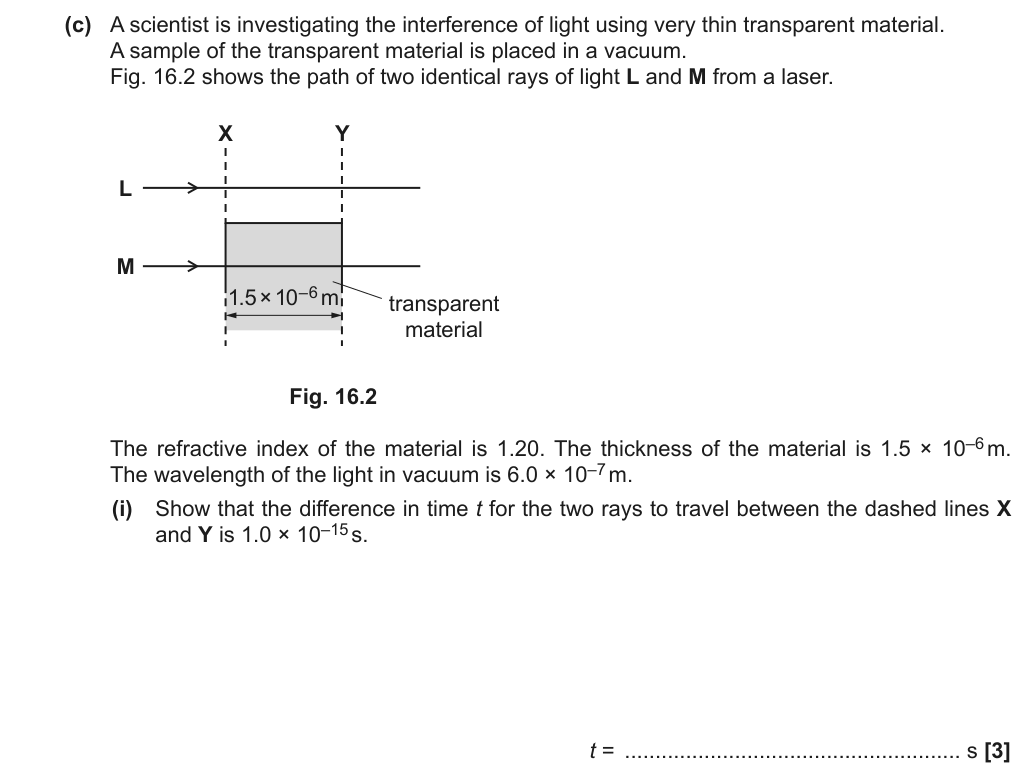
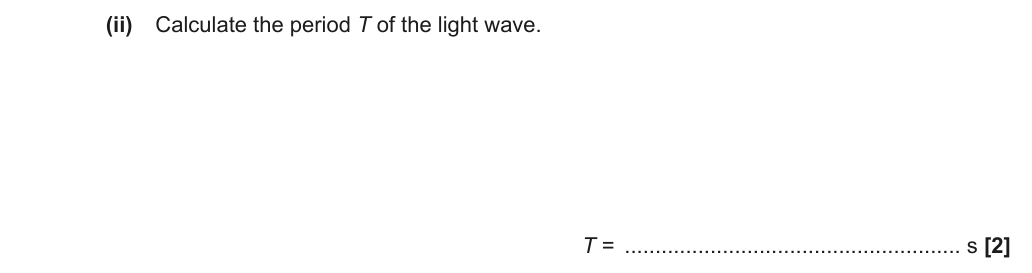
June 2019 · Paper 2 · Q16(c)(ii)2 marksCalculationMedium
Earlier part of question 16 that this part uses
Mark scheme
Examiner's comment
Question 16 (c) (i) Generally, candidates answered this question extremely well and most scoring full marks In (c)(i), the solutions ranged from being well-structured to an assortment of equations and substitutions filling the entire answer space. Question 16 (c) (ii) Question 16 (c) (iii) Question 16 (d) This level of response (LoR) question was designed to assess practical skills of planning, implementation, analysis and evaluation from module 1 of the specification, together with the mathematical skills of graphs from Section M3.
Notes from the mark scheme and report
2.4 x 10^-15 (2.5 x 10^8 m s-1 used) scores 1
Skills: M0.2 Recognise and use expressions in decimal and standard form; M2.2 Change the subject of an equation, including non-linear equations
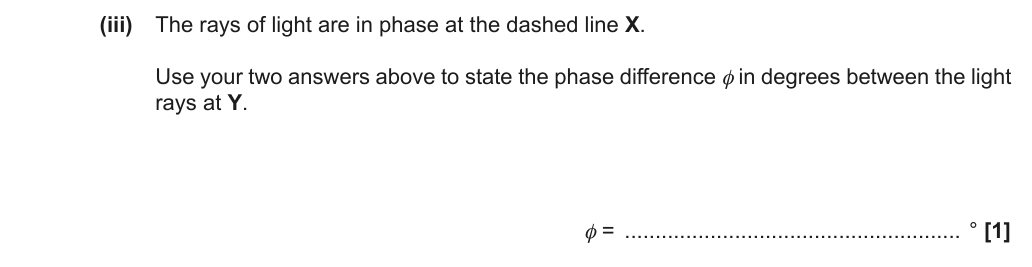
June 2019 · Paper 2 · Q16(c)(iii)1 markCalculationMedium
Earlier parts of question 16 that this part uses
Mark scheme
Examiner's comment
Question 16 (c) (i) Generally, candidates answered this question extremely well and most scoring full marks In (c)(i), the solutions ranged from being well-structured to an assortment of equations and substitutions filling the entire answer space. Question 16 (c) (ii) Question 16 (c) (iii) Question 16 (d) This level of response (LoR) question was designed to assess practical skills of planning, implementation, analysis and evaluation from module 1 of the specification, together with the mathematical skills of graphs from Section M3.
Notes from the mark scheme and report
answer must be (c)(i) x 360 / (c)(ii)
NOT in radians
Skills: M0.3 Use ratios, fractions and percentages
June 2019 · Paper 2 · Q16(d)6 marks6-mark extended responseMedium
Mark scheme, with the levels and indicative content
Examiner's comment
This level of response (LoR) question was designed to assess practical skills of planning, implementation, analysis and evaluation from module 1 of the specification, together with the mathematical skills of graphs from Section M3. The context of the question was waves and the relationship between wave speed v and depth d of the water. A holistic approach to marking is used, with marks given according answers matching the descriptors for the various levels. There is no one perfect answer for this question, examiners were expecting an eclectic approach. The key things examiners were looking for were: - A plausible technique for creating the waves on the surface of the water. - Method for determining the speed of the waves. - Instruments used for measurements. - Techniques used to produce reliable results. - The graph plotted, and how the acceleration of free fall g is determined from the data. On occasions, the methods used for determining the speed of the waves and creating the waves were a bit creative, but perhaps plausible in the hands of very competent physicists. For examples, light-gates were often used to determine the speed of the waves. The intricacies of this method were often omitted, but given lots of time, the technique could be made to work. There were some interesting suggestions about using a motion-sensor above a floating ball to determine the frequency of the waves. Examiners were not looking for perfection. Most candidates either dropped objects into the water or struck the side of the tray to create the waves. The speed was often determined by dividing the distance travelled by the wave by the time it took to travel a known distance. Candidates either plotted v2 against d or v against √d to determine g. Across the ability range, the analysis sections of the answers were generally better than the descriptions. The exemplar 5 shows a response that scored Level 3 (L3) and exemplar 6 shows a response that missed out on a top score because of lack of detail in the description. This exemplar shows that examiners are not expecting perfection with the practical skills or the analysis. The description here is clear, as is the analysis. This response met all the requirements of a Level 3 score. This exemplar shows a Level 2 response. You will notice that the description is not as robust at that shown in exemplar 5. The analysis in both is similar. There are small margins between the levels.
Notes from the mark scheme and report
e.g. graph of v² against d with gradient g
vary depth d and repeat for average v
Skills: M3.3 Understand that y = mx + c represents a linear relationship; M3.4 Determine the slope and intercept of a linear graph; PAG5 Investigating waves
June 2019 · Paper 2 · Q17(b)3 marksPractical and data analysisMedium
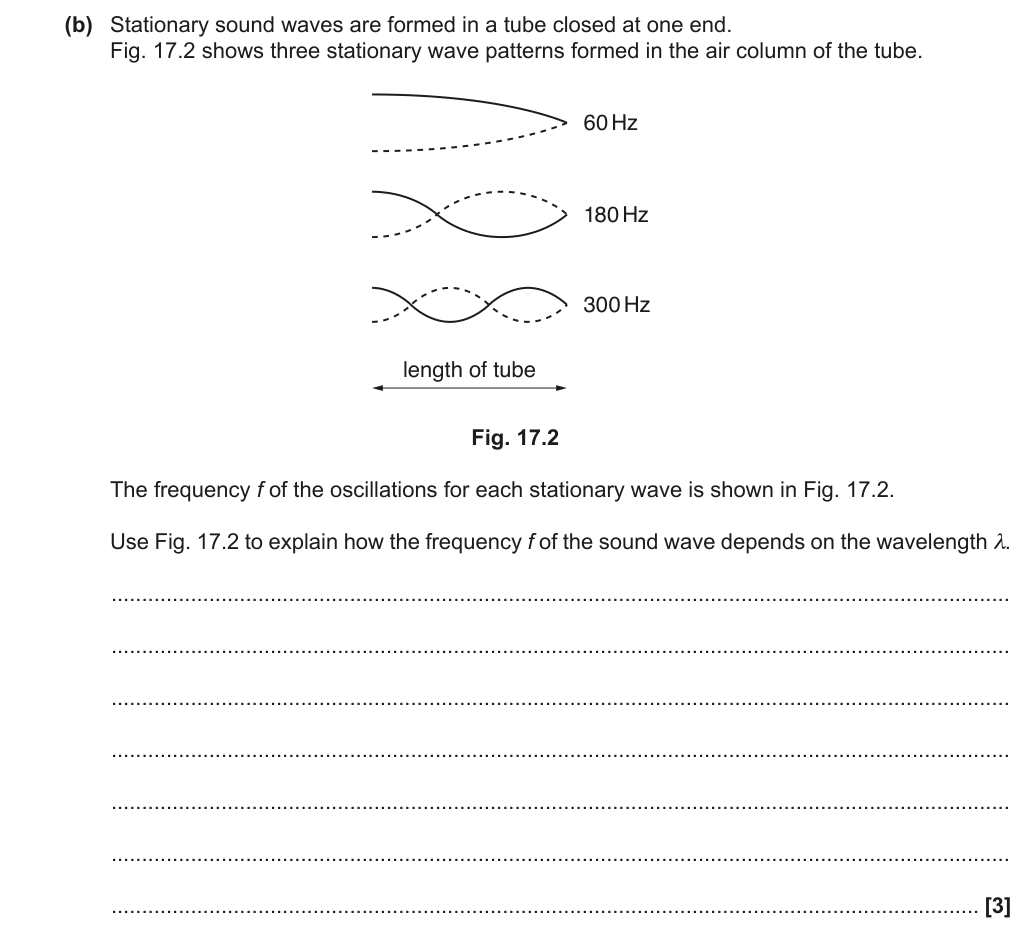
Mark scheme
Examiner's comment
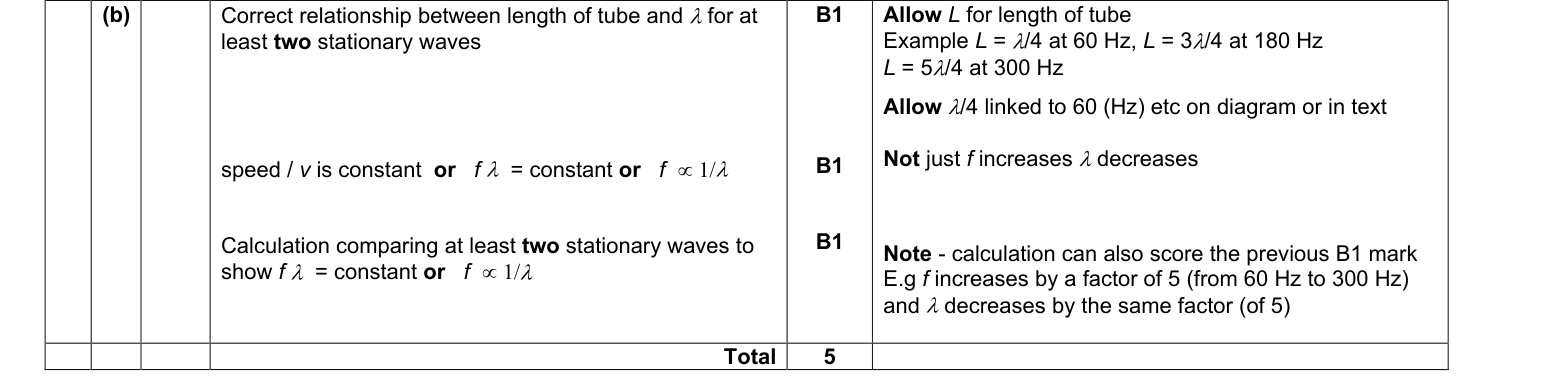
The majority of the candidates scored 1 mark for either mentioning that the wavelength was inversely proportional to the frequency or identifying the correct relationship between the length of the tube and the wavelength. Generally, the explanations lacked cohesion and showed poor comprehension of stationary waves formed within a fixed column of air. The common errors are highlighted below.
Notes from the mark scheme and report
L = λ/4, 3λ/4, 5λ/4
NOT just 'f increases as λ decreases'
needs fλ = constant with a calculation for two patterns
following mistakes.
• wavelength = λ/4, 3λ/4 and 5λ/4, instead of length of tube = λ/4, 3λ/4 and 5λ/4.
Skills: M0.3 Use ratios, fractions and percentages
June 2018 · AS Paper 1 · Q25(a)2 marksExplanationMedium
Mark scheme
Examiner's comment
The modal mark here was one, mainly through quoting the equation frequency = period-1. Most candidates were baffled with the oscilloscope and could not effectively communicate how the period was determined from the trace on the oscilloscope screen. A significant number of candidates mentioned wavelength of the trace instead of period. Unfortunately, this led many candidates to quote v =fλ as the equation for determining the frequency f.
Notes from the mark scheme and report
any reference to wavelength loses the first mark
Not just determine T
Skills: PAG5 Investigating waves
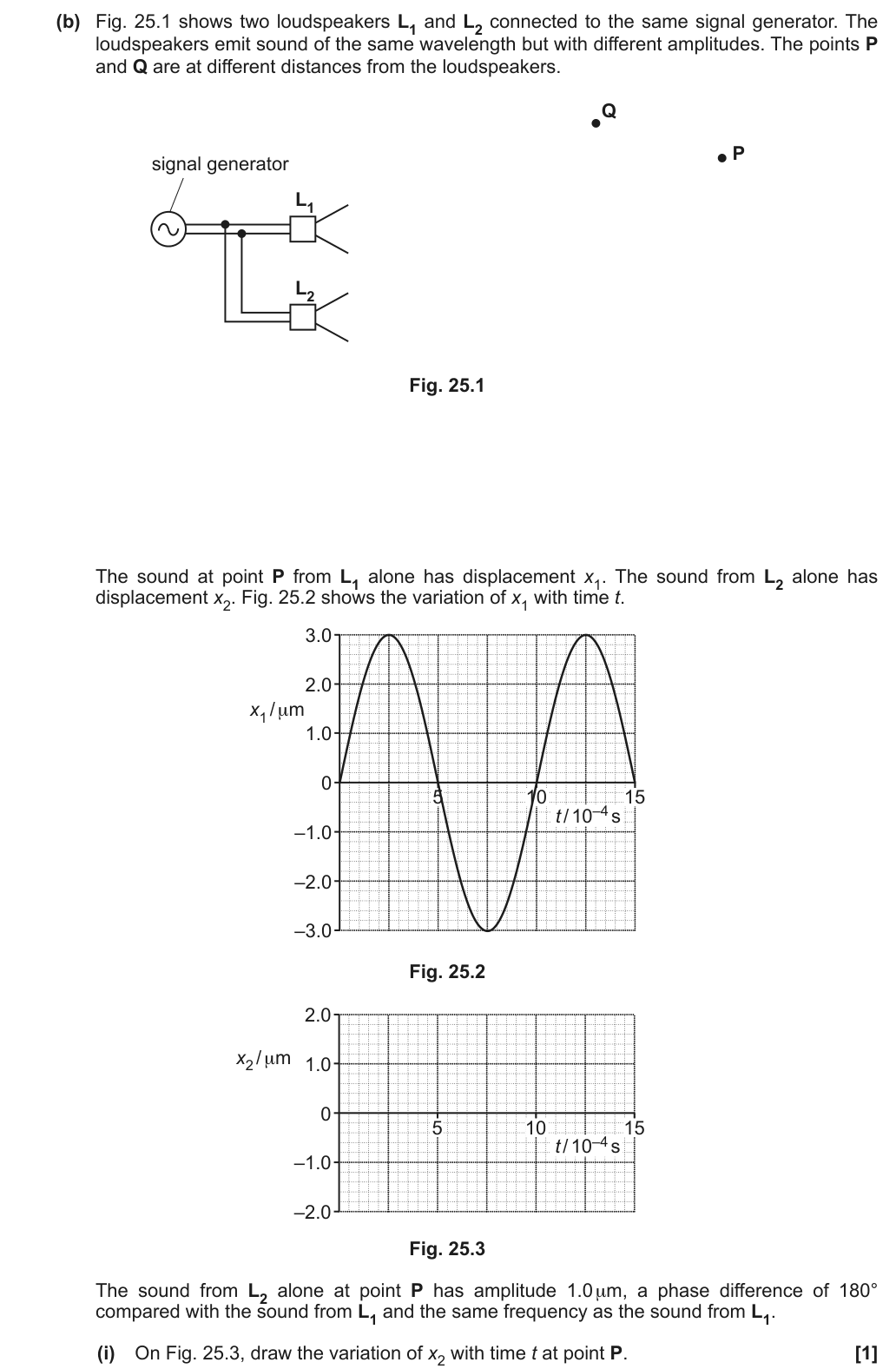
June 2018 · AS Paper 1 · Q25(b)(i)1 markDiagram or graphMedium
Mark scheme
Examiner's comment
Question 25(b)(i) Question 25(b)(ii) Question 25(b)(iii) In (b)(i), the majority of the candidates drew the correct curve of amplitude 1.0 µm and a phase difference of 180°.
Notes from the mark scheme and report
Not a triangular profile
amplitude within ± 0.2 μm
Skills: M3.1 Translate information between graphical, numerical and algebraic forms; M3.12 Sketch relationships which are modelled by y = k/x, y = kx², y = k/x², y = kx, y = sin x, y = cos x, y = e^(±x) and y = sin²x, y = cos²x as applied to physical relationships
June 2018 · AS Paper 1 · Q25(b)(ii)2 marksExplanationMedium
Earlier part of question 25 that this part uses
Mark scheme
Examiner's comment
Question 25(b)(i) Question 25(b)(ii) Question 25(b)(iii) In (b)(i), the majority of the candidates drew the correct curve of amplitude 1.0 µm and a phase difference of 180°.
Notes from the mark scheme and report
Not displacement for amplitude
Skills: M0.3 Use ratios, fractions and percentages
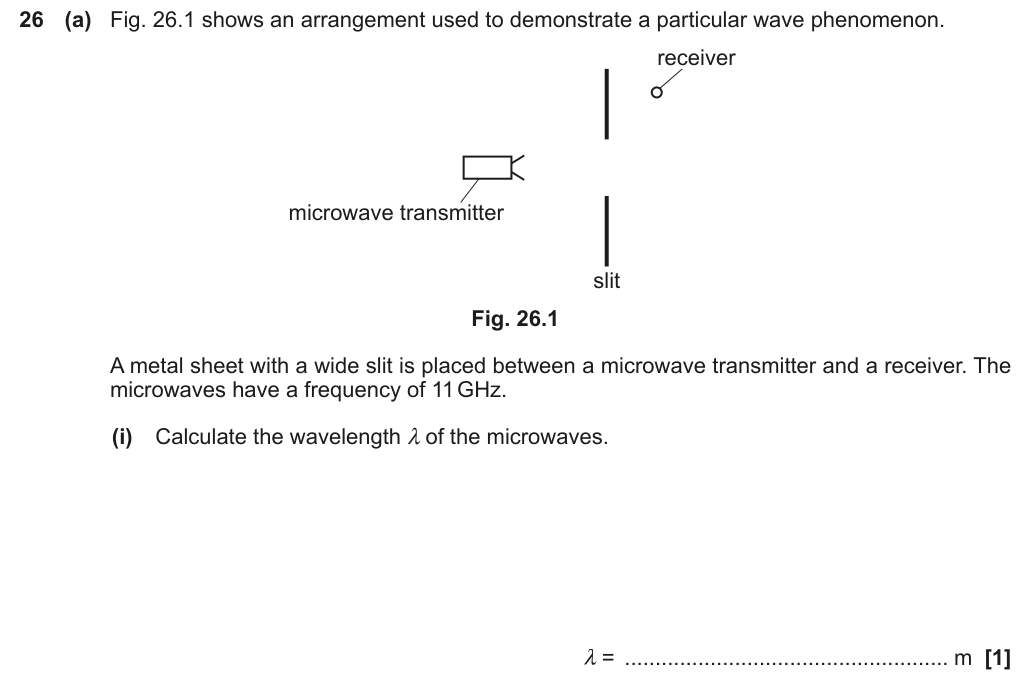
June 2018 · AS Paper 1 · Q26(a)(i)1 markCalculationEasy
Mark scheme
Examiner's comment
Question 26(a)(i) Question 26(b) Most candidates gained two or more marks.
Notes from the mark scheme and report
possible SF penalty for 0.03 m
Skills: M0.1 Recognise and make use of appropriate units in calculations; M0.2 Recognise and use expressions in decimal and standard form; M2.2 Change the subject of an equation, including non-linear equations
June 2018 · AS Paper 1 · Q26(a)(ii)2 marksExplanation
Earlier part of question 26 that this part uses
Mark scheme
Notes from the mark scheme and report
wavelength must be comparable to the slit width
June 2018 · AS Paper 1 · Q26(b)3 marksExplanationEasy
Mark scheme
Examiner's comment
Most candidates gained two or more marks. Many candidates were aware that the speed of light was less in water than in air. A significant number of candidates also knew that the frequency of light remains constant and successfully argued the fate of the wavelength using the wave equation v = fλ. This exemplar illustrates a flawless answer from a top-end candidate. It had all the main ingredients for scoring 3 marks. The answers matched well with the marking points – the examiner had no issues with following the text.
Notes from the mark scheme and report
Not v or c for speed
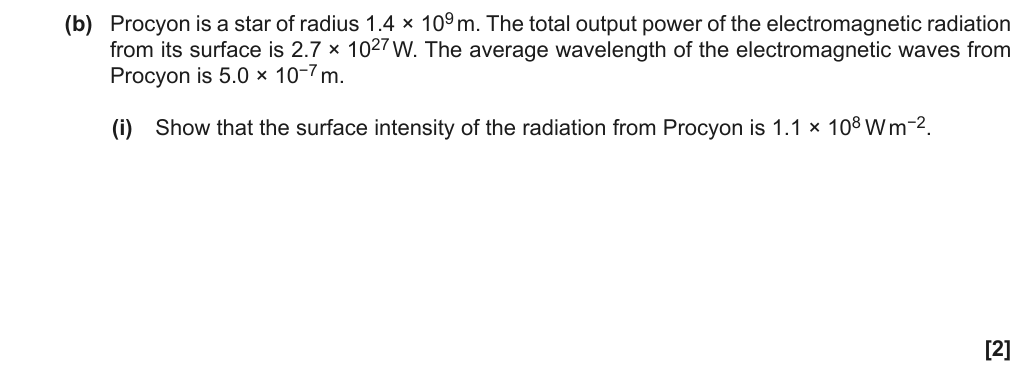
June 2018 · AS Paper 1 · Q27(b)(i)2 marksShow thatMedium
Mark scheme
Examiner's comment
This was a demanding question designed for middle and top-end candidates. The radiant intensity is equal to the power transmitted per unit cross-sectional area. The area being that of a sphere of radius 1.4 × 10⁹ m. The equation 4πR2 was appropriate here. The common errors, mainly from the low-scoring candidates, were using πR2 and 3πR3. All the key steps in the calculations had to be structured well for marks to be scored.
Notes from the mark scheme and report
using πr² is wrong physics: no marks
Skills: M0.2 Recognise and use expressions in decimal and standard form; M2.3 Substitute numerical values into algebraic equations using appropriate units for physical quantities; M4.3 Calculate areas of triangles, circumferences and areas of circles, surface areas and volumes of rectangular blocks, cylinders and spheres
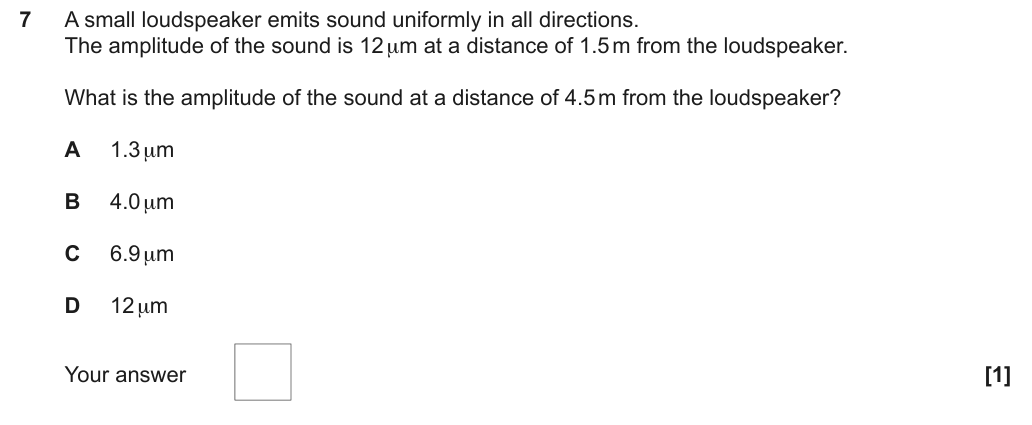
June 2018 · Paper 2 · Q71 markMultiple choiceMedium
Answer
B
Mark scheme
Examiner's comment
The emission of sound ‘uniformly in all direction’ was the clue that the intensity of the wave followed an inverse square law relationship with distance from the source. The intensity is also directly proportional to amplitude2. This meant that amplitude of the wave is inversely proportional to the distance from the source. The correct answer (key) for this question is B. The most popular distractor was C, where 12 µm was divided by √3. This exemplar illustrates the sensible strategy from a top-end candidate. The key ideas are jotted down and analysis completed: I ∝ 1/r2 and I ∝ A2, therefore A ∝ 1/r. The distance r increases by a factor of 3, therefore the amplitude will decrease by a factor of 3. This makes the answer 4.0 µm. The final sum being done either in the head or calculator – this is of little significance. What is important here is that all the important ideas have been extracted competently from the question. A commendable technique.
June 2018 · AS Paper 2 · Q7(a)6 marks6-mark extended responseMedium
Mark scheme, with the levels and indicative content
Examiner's comment
This was the second Level of Response question; a good range of marks was achieved. It required candidates to explain a standing wave pattern formed by microwaves. Many good candidates explained the pattern produced in terms of the metal sheet reflecting the microwaves, causing superposition with an explanation of nodes and antinodes. It was hoped that their understanding that the distance between successive maxima/minima is λ/2 would assist them in the calculation of the frequency. Good candidates wrote the equation and indicated that the wavelength of the microwaves was 0.288 m. Candidates should practise writing explanations to physics phenomenon. It is expected that the answers to these Level of Response questions will have a well-developed line of reasoning which is clear and logically structured. The information presented is relevant and substantiated. This is an example of a Level of Response answer. The question gives a practical demonstration which candidates may have seen during the AS course. The question gives candidates the opportunity to describe the observations using their knowledge and understanding as well as determining the frequency of the microwaves. Candidates should use appropriate physics terms. In this case the candidate begins by implying that the microwaves are reflected by the barrier to superimpose a resultant wave. The candidate states that maxima are antinodes and formed by constructive interference. The candidate then explains the formation of nodes in terms of destructive interference. Appropriate physics terms have been used. The candidate has then correctly realised that the distance between the node and an anti-node is a quarter of a wavelength. The candidate could have stated that the distance between successive nodes is half a wavelength, but this is implied in the previous statement. Finally, the candidate clearly shows the method of determining the wavelength by quoting the wave equation, rearranging the equation and substituting values. The candidate finishes the determination of the frequency by calculating the frequency and then rounding to an appropriate number of significant figures two or three) and gives a correct unit (Hz).
Notes from the mark scheme and report
adjacent maximum and minimum are λ/4 apart, so λ = 288 mm and f = 1.04 x 10^9 Hz
Skills: M2.2 Change the subject of an equation, including non-linear equations; PAG5 Investigating waves
June 2018 · AS Paper 2 · Q7(b)2 marksExplanationHard
Mark scheme
Examiner's comment
Candidates found this question difficult. Candidates often did not state that the microwaves were polarised or mistakenly thought that the grille caused the microwaves to become polarised. Candidates also did not appear to read the question carefully often thinking that the detected signal varied from a maximum initially. Some candidates quoted 𝐼𝐼= 𝐼𝐼0cos2𝜃𝜃 to help explain their answer.
Notes from the mark scheme and report
Allow explanation in terms of I = I0 cos²θ
Skills: PAG5 Investigating waves
June 2018 · AS Paper 2 · Q8(a)(ii)1 markCalculationMedium
Earlier part of question 8 that this part uses
Mark scheme
Examiner's comment
Surprisingly, this question did not score highly – many candidates did not realise that the wavelength of light in the glass would be the wavelength of light in air divided by the refractive index of glass.
Notes from the mark scheme and report
NOT ecf from (a)(i)
Allow 3.41 x 10^-7
Skills: M0.3 Use ratios, fractions and percentages
June 2018 · AS Paper 2 · Q8(b)(ii)1 markDiagram or graphMedium
Earlier parts of question 8 that this part uses
Mark scheme
Examiner's comment
This question required candidates to apply the previous answers to this question to draw an appropriate ray diagram. Candidates do need to use a ruler. A common error was for the emergent ray in the ethanol to be parallel to the incident ray in the air. This question required candidates to think through their diagram stage by stage using information from the previous part and the table given earlier in the question. This candidate has used a ruler and drawn straight rays. The candidate has marked on the normal and indicated the angle of refraction in the glass. It is clear that the ray in the ethanol is not parallel to the original ray.
Notes from the mark scheme and report
ray in ethanol bends away from normal but at less than 37°, not parallel to incoming ray
NOT angle of refraction zero in glass
June 2018 · Paper 2 · Q176 marks6-mark extended responseMedium
Mark scheme, with the levels and indicative content
Examiner's comment
This was one of the two LoR questions. It required understanding of potential dividers, light-dependent resistor and rotation frequency of a spinning plate. Examiners expect varied responses, and two very dissimilar answers can score comparable marks as long as the criteria set out in the answers’ section of the marking scheme are met. Level 3 answers had the correct maximum and minimum resistance values of the LDR, a decent description and explanation of the trace shown in Fig. 17.2, and an outline of how the frequency of the spinning plate was determined. As mentioned earlier, eclectic answers are inevitable – verbose and concise answers can be at Level 3. In Level 2 answers there were generally missed opportunities. Half-done calculation and descriptions either with some errors or lacking in depth. Level 1 answers had some elements of calculations or descriptions. The two exemplars below, illustrate a Level 3 response and a Level 1 response. This is a Level 3 response from a top-end candidate who scored 6 marks. The description of the variation of the resistance of the LDR, the circuit current and the potential difference across the fixed resistor is perfect. The calculations of the LDR resistances are nicely embedded into the general explanation. The calculation of the frequency is all correct. This is a model answer for 6 marks. Compare and contrast this with the Level 1 response below. This is a Level 1 response from an E-grade candidate. The description of the variation of the resistance of the LDR is correct. However, there are no calculations of the resistance of the LDR, as required in the question. Hence, a significant part of the question has been omitted. According to the marking criteria, this could only score Level 1. The examiner credited 2 marks for this response.
Notes from the mark scheme and report
V max 4.0 V and V min 2.0 V
LDR 150 Ω in light and 1500 Ω in darkness
time between pulses 0.4 s so f = 2.5 Hz
Skills: M2.2 Change the subject of an equation, including non-linear equations; M2.3 Substitute numerical values into algebraic equations using appropriate units for physical quantities; M3.1 Translate information between graphical, numerical and algebraic forms; PAG4 Investigating electrical circuits
June 2018 · Paper 2 · Q18(b)2 marksExplanationEasy
Earlier part of question 18 that this part uses
Mark scheme
Examiner's comment
Most candidates scored well deserved 2 marks here for opting to use a polarising filter and rotating it to see variation in the intensity of the transmitted light. A small number of candidates chose the wrong equipment – the most common of these were diffraction grating, a single slit and microwave receiver.
Notes from the mark scheme and report
polarising filter rotated
intensity / brightness changes
Skills: PAG5 Investigating waves
June 2018 · Paper 2 · Q19(a)2 marksShort answerEasy
Mark scheme
Examiner's comment
Most candidates scored two marks for identifying any two from diffraction, superposition (or interference) and reflection. A few answers were spoilt by mentioning either refraction or total internal reflection.
Notes from the mark scheme and report
any two from reflection, diffraction, interference / superposition
Skills: PAG5 Investigating waves
June 2018 · Paper 3 · Q5(b)6 marks6-mark extended responseHard
Mark scheme, with the levels and indicative content
Examiner's comment
From the proposed arrangements for the investigation, it was apparent that most of the candidates were unfamiliar with the most suitable equipment for this experiment, namely a signal generator. Many improvised by using an ac supply with a variable frequency. A minority of these believed that by increasing the voltage of their power supply it would alter the frequency. Most drew a cell or battery symbol for the ac supply. Others improvised by using the rotating magnet from part (a) but had not realised the significance of the calculation in part (a)(iii) which indicated that at 24 revolutions per second the output voltage was 1.2 V. This made the suggested method of using a stop watch to find the period of rotation impracticable. Few realised that the oscilloscope as a voltmeter could measure both the output voltage and the period of the ac. The instrument was often connected in series in the primary circuit. No one realised that the input current has to be constant to provide a constant flux. Despite all of these difficulties most candidates managed to write sensible statements worthy of credit but rarely full marks. The author of the example shown (exemplar 9) has used the rotating magnet as the ac source and continued with the clues from part (a) to produce an L3 quality answer.
Notes from the mark scheme and report
keep current in coil X constant
V against f straight line through the origin
Skills: M3.3 Understand that y = mx + c represents a linear relationship
June 2017 · AS Paper 1 · Q11 markMultiple choice
Answer
C
Mark scheme
June 2017 · AS Paper 1 · Q161 markMultiple choice
Answer
B
Mark scheme
June 2017 · AS Paper 1 · Q25(a)(i)1 markCalculation
Mark scheme
June 2017 · AS Paper 1 · Q25(a)(ii)2 marksExplanation
Earlier part of question 25 that this part uses
Mark scheme
Notes from the mark scheme and report
NOT displacement
NOT 'A decreases'
ignore 'energy is lost'
second mark lost if I proportional to 1/x² is also given
June 2017 · AS Paper 1 · Q26(c)3 marksPractical and data analysis
Earlier part of question 26 that this part uses
Mark scheme
Notes from the mark scheme and report
NOT just λ/2, λ and 3λ/2 written next to the patterns
Skills: M0.3 Use ratios, fractions and percentages
June 2017 · Paper 2 · Q51 markMultiple choice
Answer
A
Mark scheme
June 2017 · AS Paper 2 · Q5(a)2 marksShort answer
Mark scheme
Notes from the mark scheme and report
coherence: constant phase difference
NOT same / zero phase difference
ignore same frequency / wavelength
June 2017 · AS Paper 2 · Q6(b)6 marks6-mark extended response
Mark scheme, with the levels and indicative content
Notes from the mark scheme and report
node at closed end, antinode at open end
closed tube odd harmonics only
v = fλ gives 338 m s-1
Skills: M0.3 Use ratios, fractions and percentages; M2.3 Substitute numerical values into algebraic equations using appropriate units for physical quantities; PAG5 Investigating waves
June 2017 · Paper 3 · Q5(a)(i)4 marksDiagram or graph
Mark scheme
Notes from the mark scheme and report
1.5 wavelengths between C and R
λ = 0.2 m
unit must be present on the amplitude scale
NOT if axis labelled time
X and Y at adjacent intercepts
Skills: M2.3 Substitute numerical values into algebraic equations using appropriate units for physical quantities; M3.1 Translate information between graphical, numerical and algebraic forms; M3.12 Sketch relationships which are modelled by y = k/x, y = kx², y = k/x², y = kx, y = sin x, y = cos x, y = e^(±x) and y = sin²x, y = cos²x as applied to physical relationships
June 2017 · Paper 3 · Q5(b)6 marks6-mark extended response
Earlier part of question 5 that this part uses
Mark scheme, with the levels and indicative content
Notes from the mark scheme and report
(a) two-source interference: move between adjacent maxima = λ
(b) stationary wave: adjacent nodes = λ/2
measure over several λ to reduce percentage uncertainty
Skills: PAG5 Investigating waves
June 2016 · AS Paper 1 · Q31 markMultiple choice
Answer
C
Mark scheme
June 2016 · AS Paper 1 · Q26(a)(i)1 markShort answer
Mark scheme
Notes from the mark scheme and report
Allow antiphase / phase difference of 180°
June 2016 · AS Paper 1 · Q26(a)(ii)3 marksCalculation
Earlier part of question 26 that this part uses
Mark scheme
Notes from the mark scheme and report
30 (λ = 0.40 m used) scores 1 of first two marks
6000 ± 300 (POT error) scores 2
Skills: M0.1 Recognise and make use of appropriate units in calculations; M1.5 Identify uncertainties in measurements and use simple techniques to determine uncertainty when data are combined; M2.3 Substitute numerical values into algebraic equations using appropriate units for physical quantities
June 2016 · AS Paper 2 · Q1(a)2 marksExplanation
Mark scheme
Notes from the mark scheme and report
NOT 'move' for vibrations / oscillations
1 mark max for a correct description without saying which wave is which, or for 'transverse waves can be polarised'
June 2016 · AS Paper 2 · Q1(b)(i)1 markCalculation
Mark scheme
June 2016 · AS Paper 2 · Q1(b)(ii)2 marksCalculation
Earlier part of question 1 that this part uses
Mark scheme
Notes from the mark scheme and report
0.67 or 0.667 scores 1 mark (ms not converted)
Skills: M0.1 Recognise and make use of appropriate units in calculations; M3.1 Translate information between graphical, numerical and algebraic forms; PAG5 Investigating waves
June 2016 · AS Paper 2 · Q1(b)(iii)1 markCalculation
Earlier part of question 1 that this part uses
Mark scheme
Notes from the mark scheme and report
ecf from (b)(ii)
Skills: M2.2 Change the subject of an equation, including non-linear equations; M2.3 Substitute numerical values into algebraic equations using appropriate units for physical quantities
June 2016 · AS Paper 2 · Q1(c)2 marksExplanation
Earlier part of question 1 that this part uses
Mark scheme
Notes from the mark scheme and report
intensity proportional to amplitude squared and amplitude halved scores both marks
Skills: M0.3 Use ratios, fractions and percentages
Work with an OCR physics tutor
Dropping marks on calculations, practical questions or the six-mark level of response questions? Book a trial session with a specialist OCR physics tutor.