Answer
D
Mark scheme

Examiner's comment
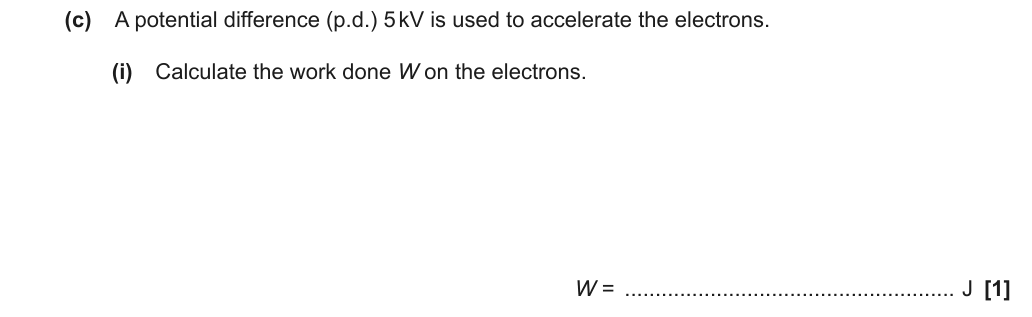
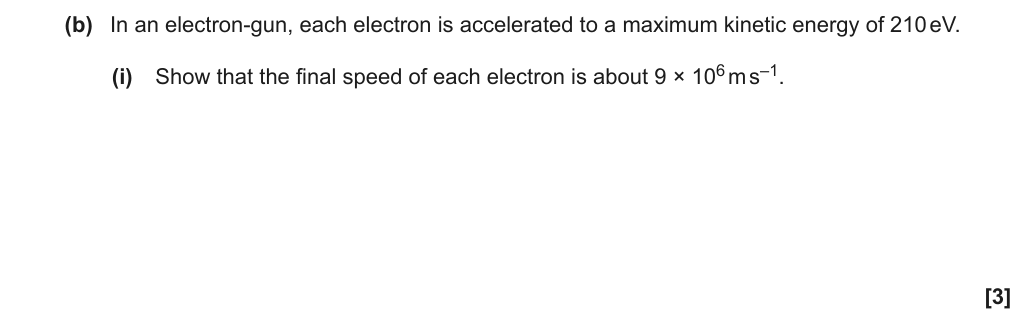
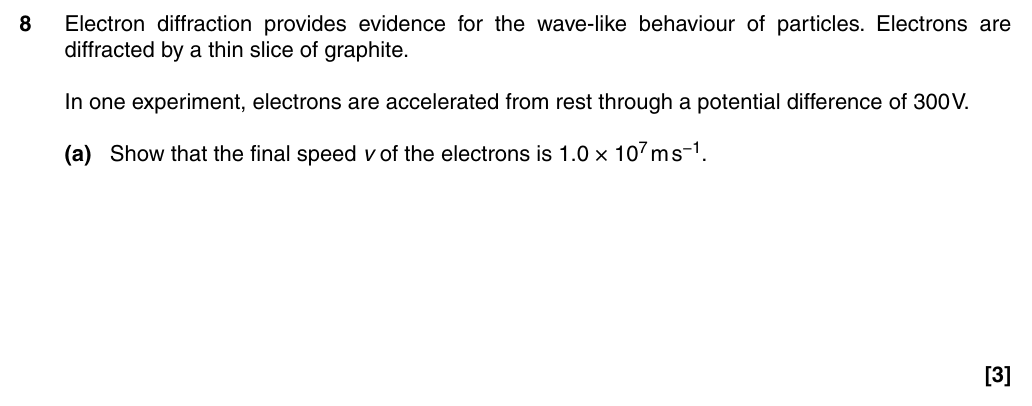
A range of answers were observed. High scoring candidates effectively used the white space to work out the speed of the electron and then wrote the equation and substituted the data.
Notes and key-term cards for this topic are being written by our tutors. The past-paper questions below are ready now.
| Series | Paper | Q | What it asks |
|---|---|---|---|
| June 2025 | Paper 2 | 17 | ‘Wave-particle duality’ refers to the idea that: Describe each model. |
| June 2024 | AS Paper 2 | 8 | In 1929, the Nobel prize was awarded to Louis de Broglie for his discovery of the wave nature of Describe, with the aid of a suitable diagram: |
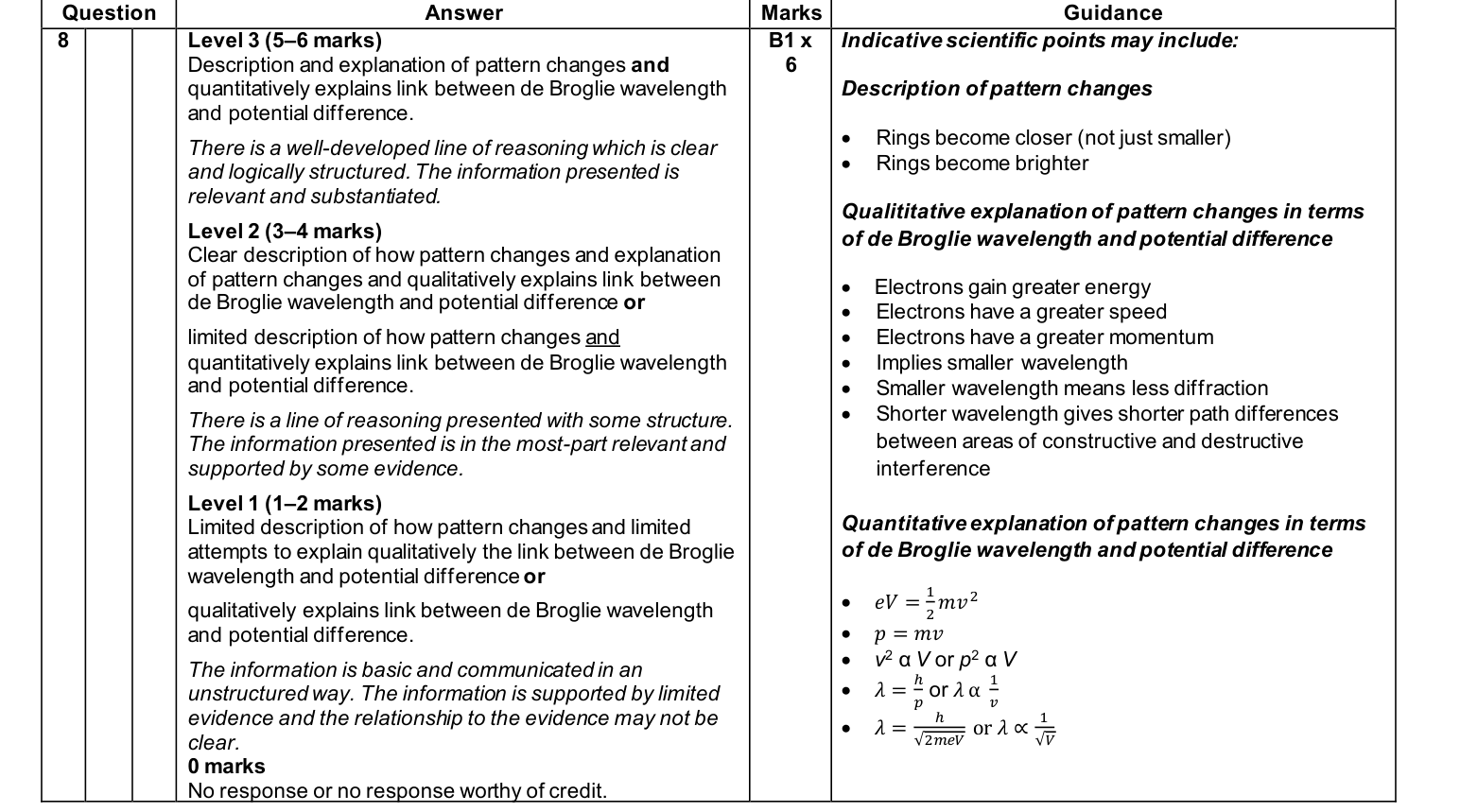
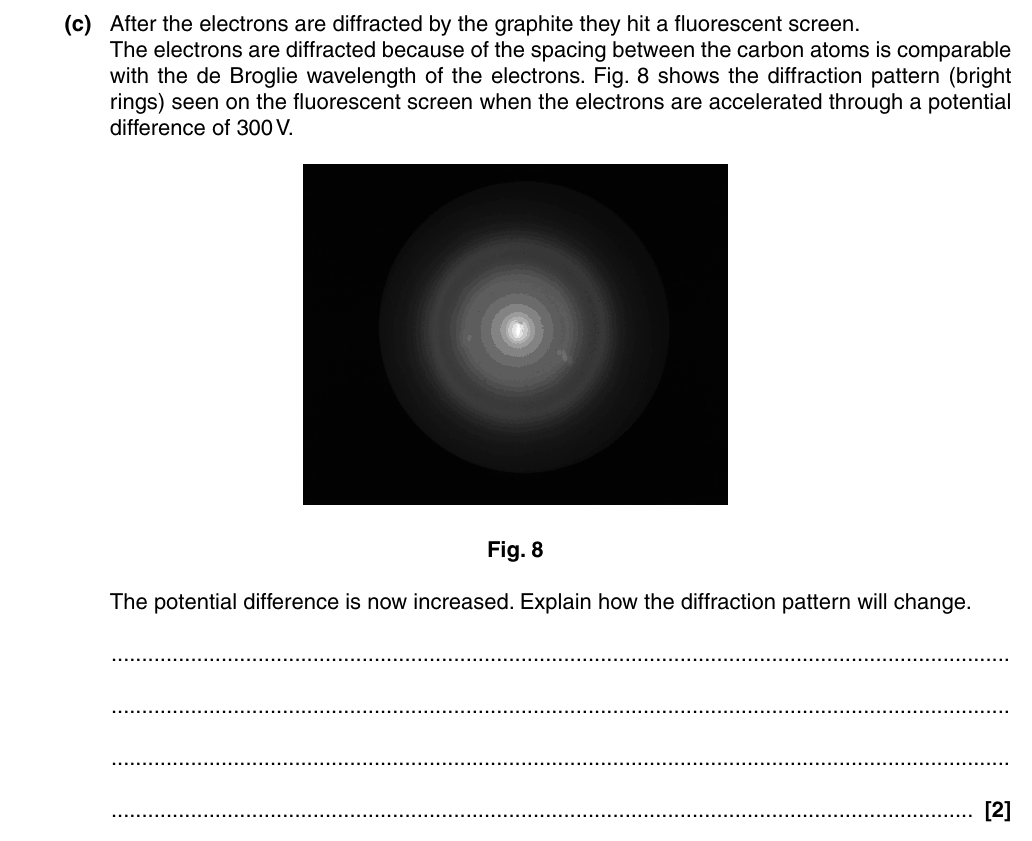
| November 2020 | AS Paper 2 | 8 | A student is investigating electron diffraction. A beam of electrons is directed towards a thin slice Describe and explain how the pattern changes as the potential difference is increased. Include |
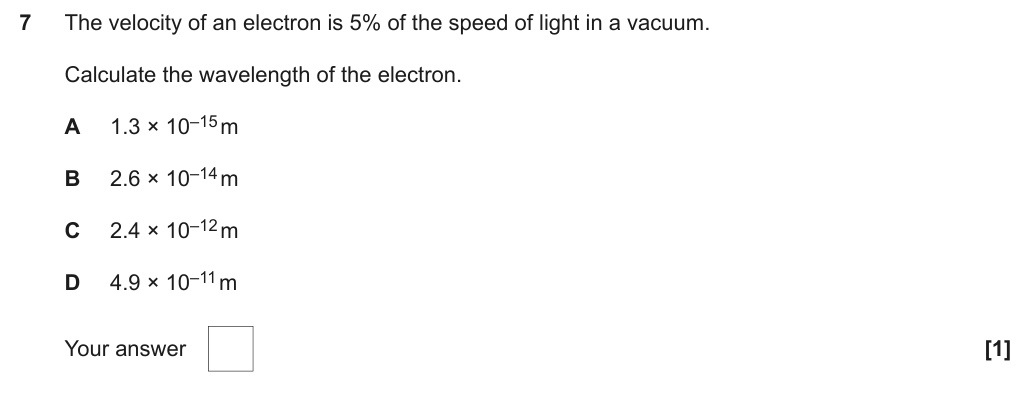
D
A range of answers were observed. High scoring candidates effectively used the white space to work out the speed of the electron and then wrote the equation and substituted the data.
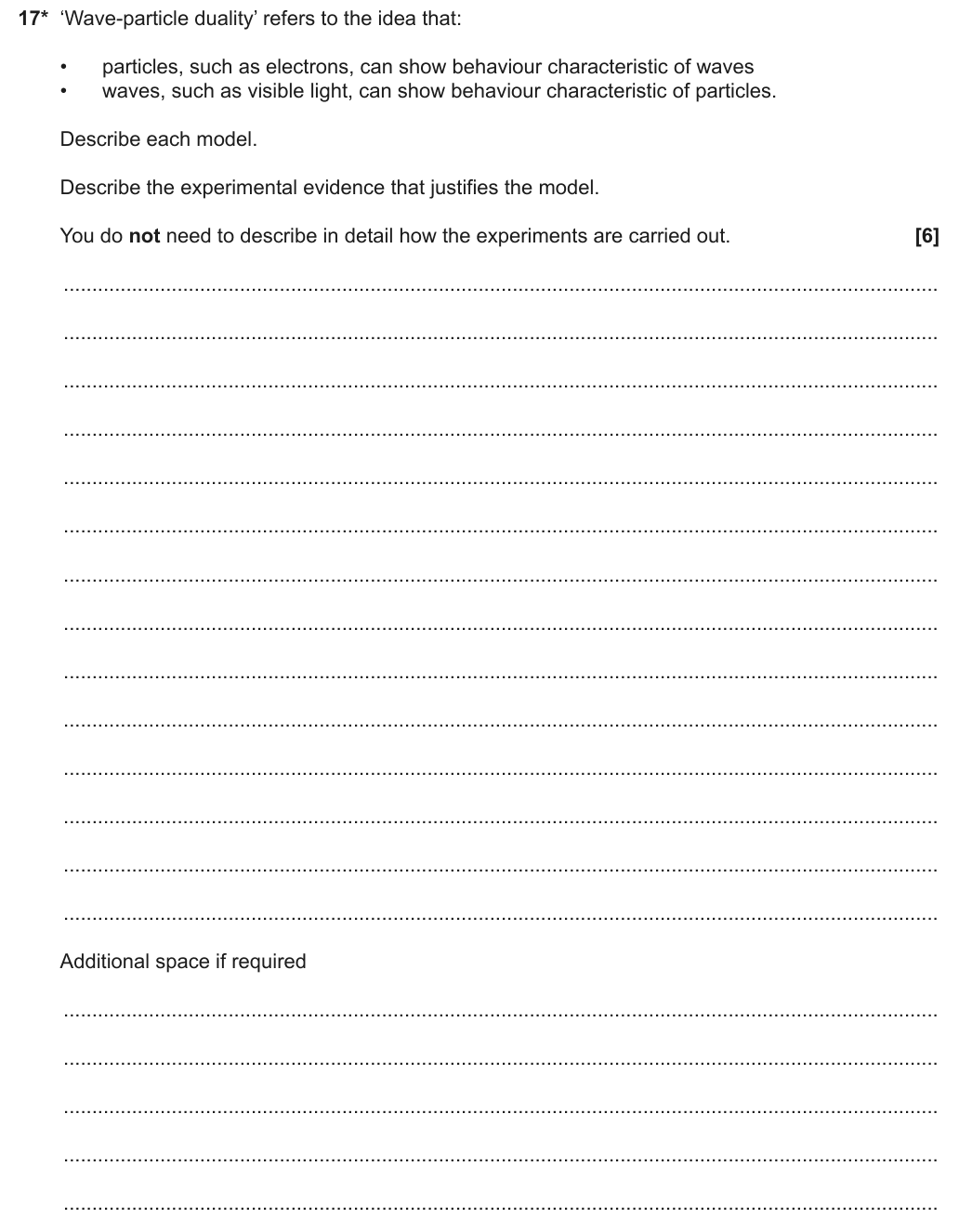
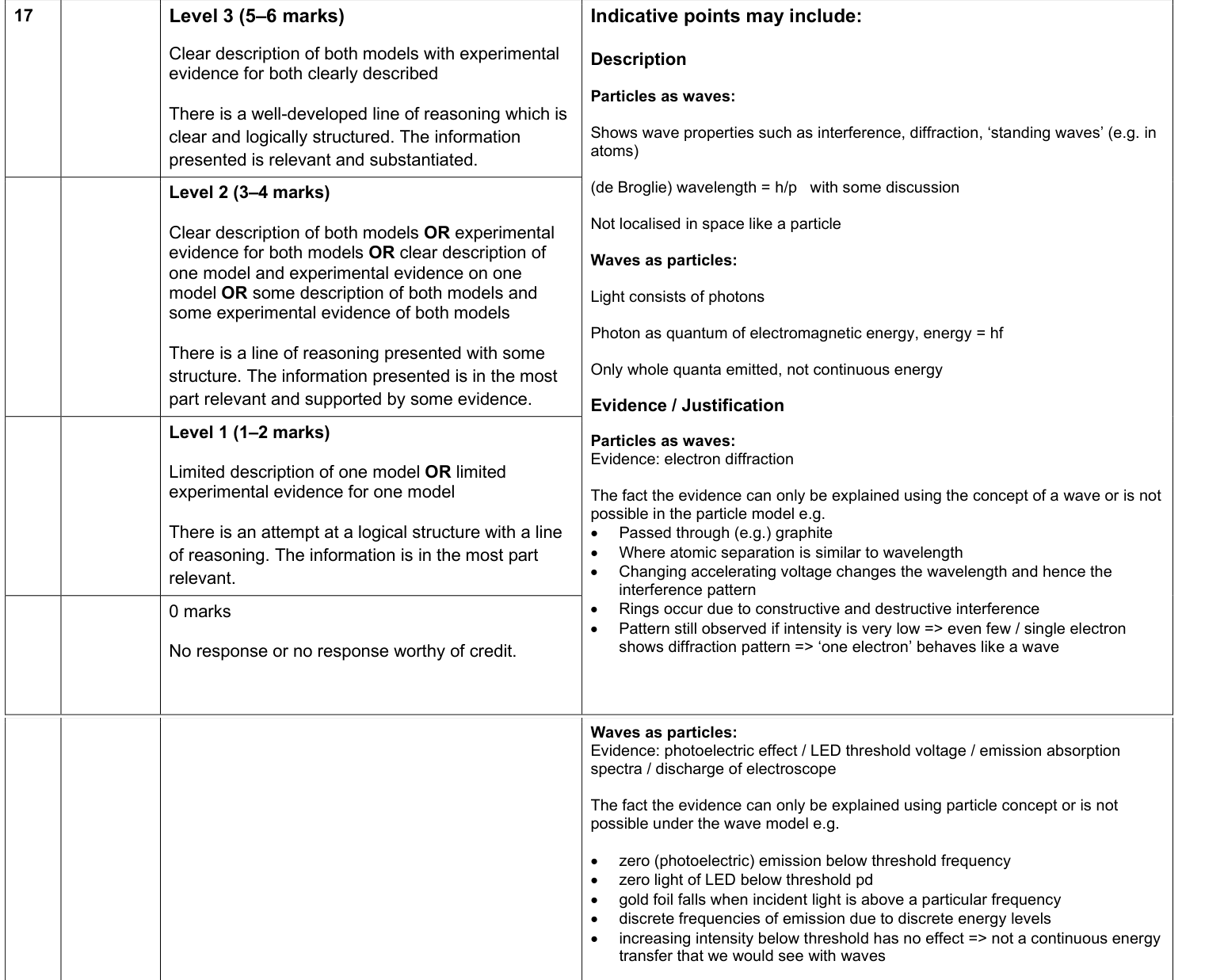
This Level of Response question was designed to assess the candidates’ knowledge of various aspects of wave-particle duality, in particular each model and experimental evidence. The key points in the description that examiners were looking for were: • a description of a model of how particles can be described as waves, and some experimental evidece to support this • a description of how waves can be described as particles, and some experimental evidence to support this. To obtain Level 3, it is important that all four aspects of this are approached. For the most part, it was clear that candidates had a general knowledge of this topic. Many were able to give some descriptions of electron diffraction and ‘the gold leaf experiment’, but not all gave sufficient detail in terms of the requirements of the question. Although not always required, it would be expected that candidates may use an equation in their description (the de Broglie relationship and E = hf) to support how the particle can be considered to act as a wave, and vice versa. More successful candidates used this in conjunction with the experimental evidence to draw their conclusions. The most common experimental evidence, which could achieve Level 3 if approached correctly, were electron diffraction through graphite and some form of the photoelectric effect. Anticipated detail for experimental evidence would be to explain how a diffraction pattern leads to the idea of waves, and with the idea of a threshold frequency. These can only be explained by use of the correct model and would support the response. Common weak points were to describe the electrons passing through a double slit, describing the interference pattern as fringes rather than concentric rings and explaining the photoelectric effect theoretically without any evidence. The question stated that there was no requirement to explain the experimental detail (as evidence was required) but several candidates used time doing so. Using the gold leaf electroscope (which many candidates had seen) is a good way to demonstrate the photoelectric effect, however there seemed to be some confusion about whether it was initially charged, and if so whether it was positive or negative, The statement ‘one to one interaction’ was common, although was often used without support and it was clearly something that had been learnt. Most candidates used the space, including the additional space, to answer this question. It is always possible to obtain a Level 3 in the given space by carefully answering the question rather than giving superfluous information and candidates are encouraged to think a little about their response before starting. This exemplar shows a good response, but not sufficient to reach Level 3. The candidate has given a fair, yet brief, description of the experimental evidence for electron diffraction, showing particles acting as waves. Similarly, the photoelectric effect is explained to some level of detail about how it demonstrates where a wave acts like a particle. There is little in terms of the descriptions of the model in either of these. There is a reference to diffraction for the wave model and use of the term ‘photon’ for the particle model. Considering the level guidance, this has some description of both model and experimental evidence so falls into Level 2. The experimental evidence has some valid details, so can be awarded the top of this level, 4 marks.
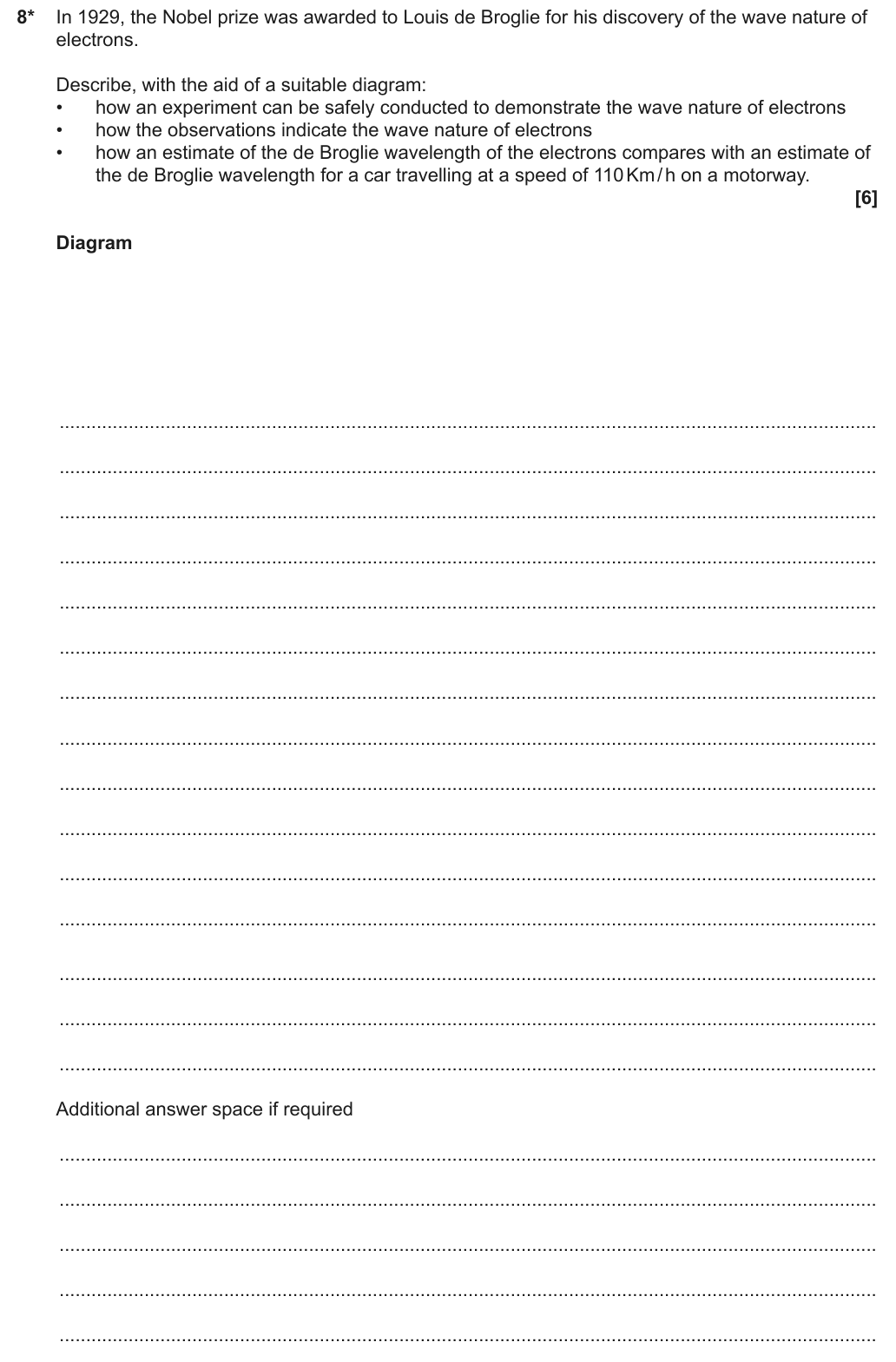
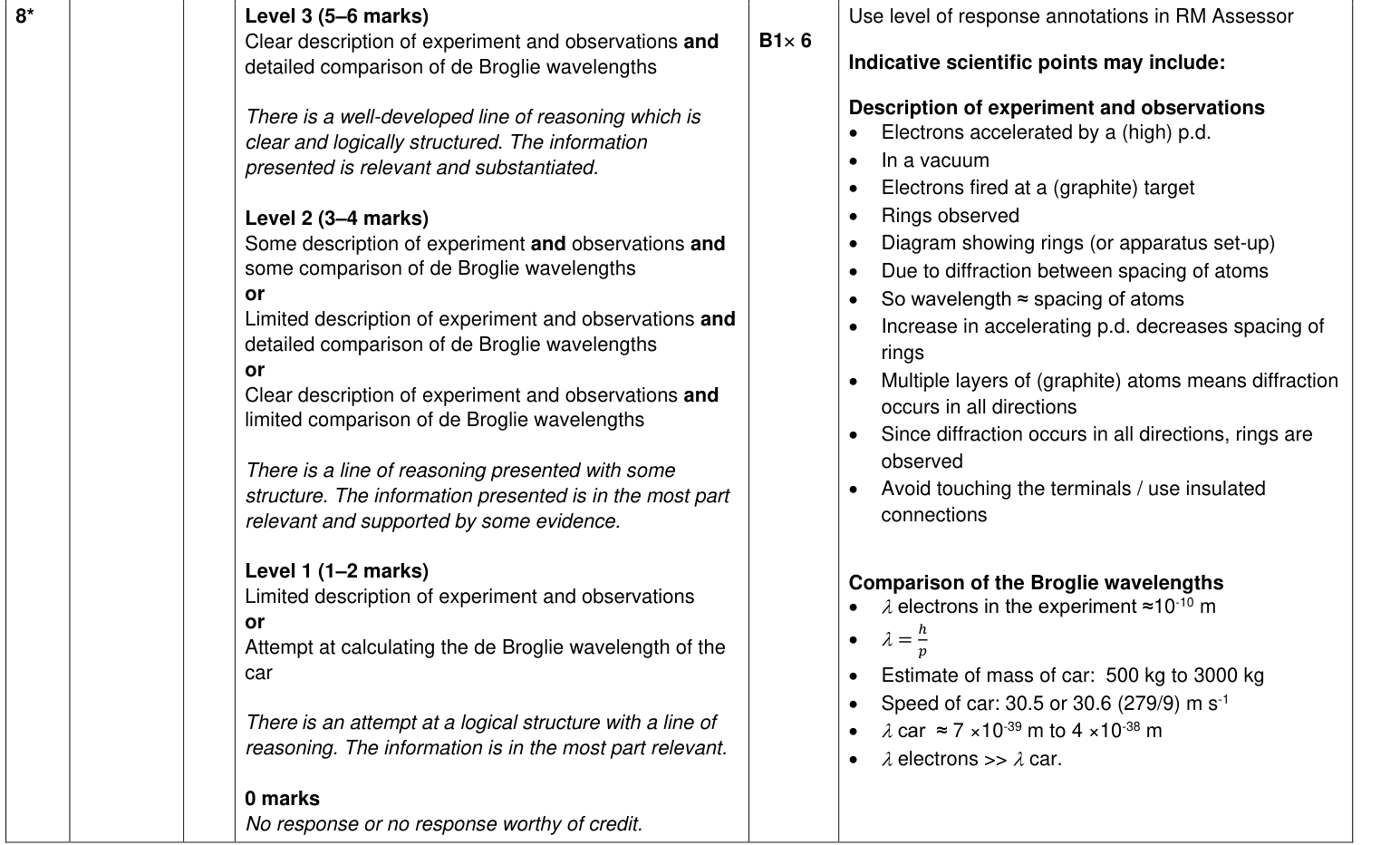
Many candidates appeared not to understand an experiment to demonstrate the wave nature of electrons often drawing a diagram of a double slit and using a screen, in effect the Young slit experiment for light. High scoring candidates often either stated an estimate of the de Broglie wavelength of electrons or used their knowledge and calculated a value for an estimated value of the accelerating potential difference. Ther were some very good answers working out the de Broglie wavelength of a car. The best answers clearly showed the working.
Skills: M0.1 Recognise and make use of appropriate units in calculations; M0.4 Estimate results; M1.4 Make order of magnitude calculations
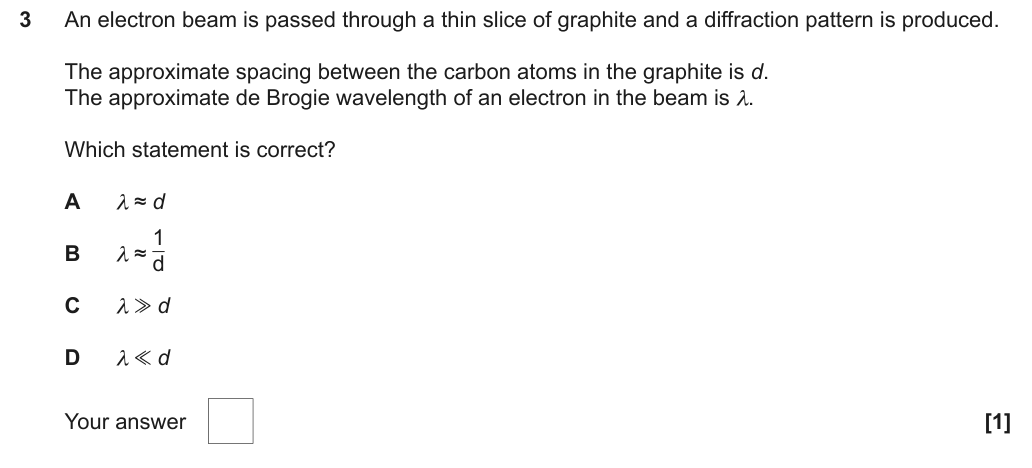
A
Just over half of candidates answered this correctly and determined that the correct conditions for a diffraction pattern to be produced was when the spacing between atoms was roughly equal to the de Broglie wavelength of an electron. The most common distractor was D.
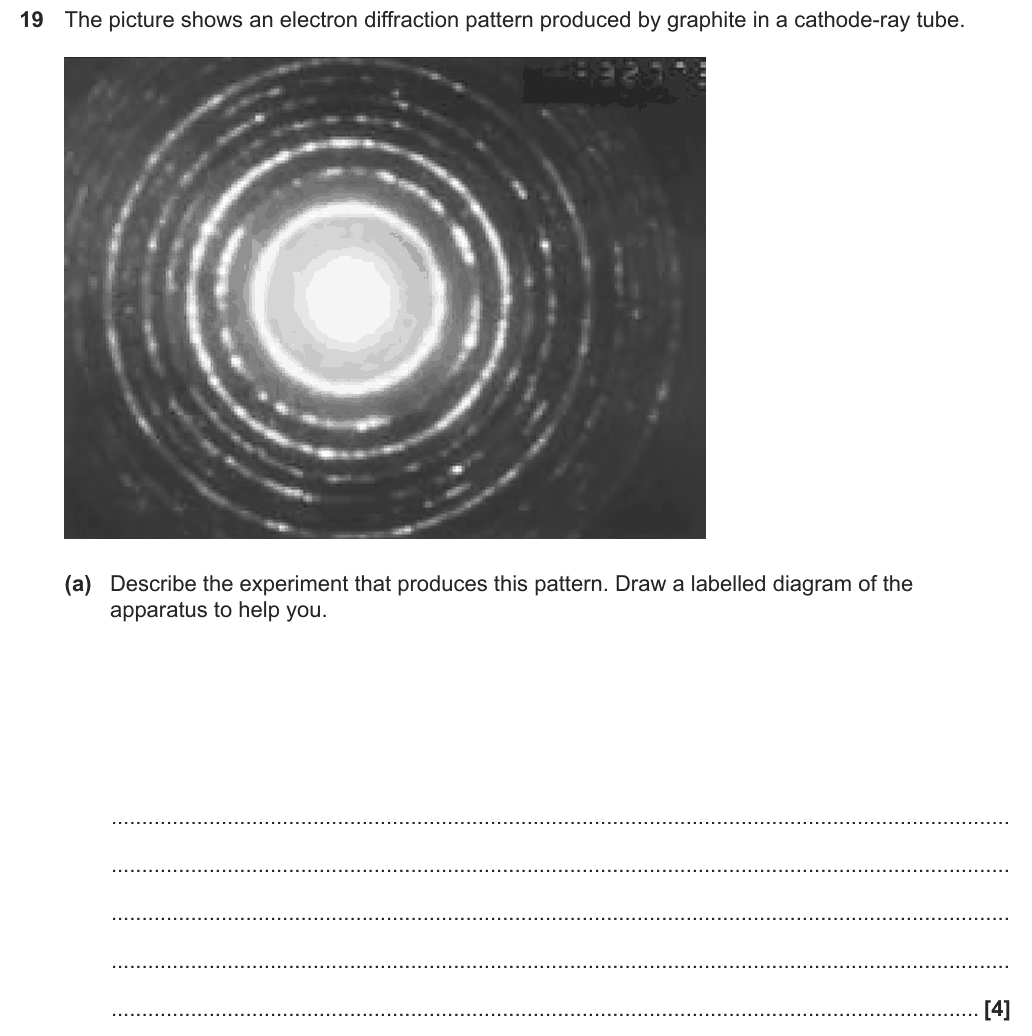
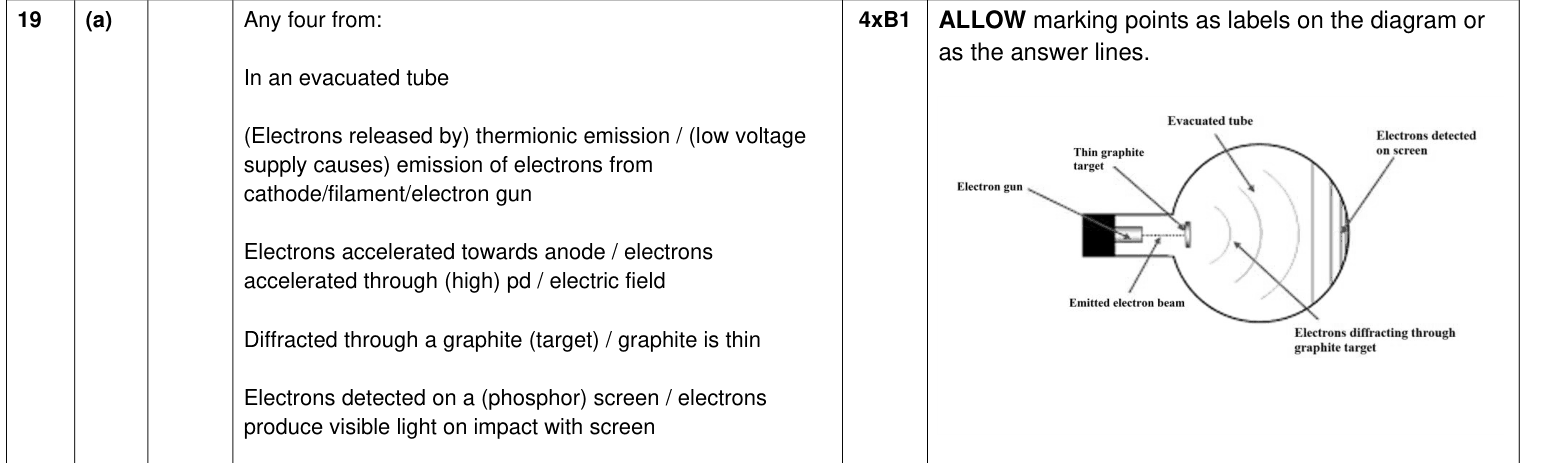
A diagram is always helpful if suggested and candidates who drew a labelled diagram were often able to score marks that they would not have gained in the text. Candidates who had seen this experimental set- up were at an advantage and often gave good descriptions, although relatively few gained full marks. Several candidates confused anode and cathode and others assumed that the graphite was in some way responsible for the production of the electrons. Nearly one third of candidates scored no marks on this question; those who did often had little knowledge of the experiment although it is specifically mentioned in the specification. Incorrect responses included considering it as a ripple tank. This response shows a candidate using a diagram to gain marks that would not otherwise be covered in the text. The word ‘vacuum’ will score the first mark for the evacuated tube.
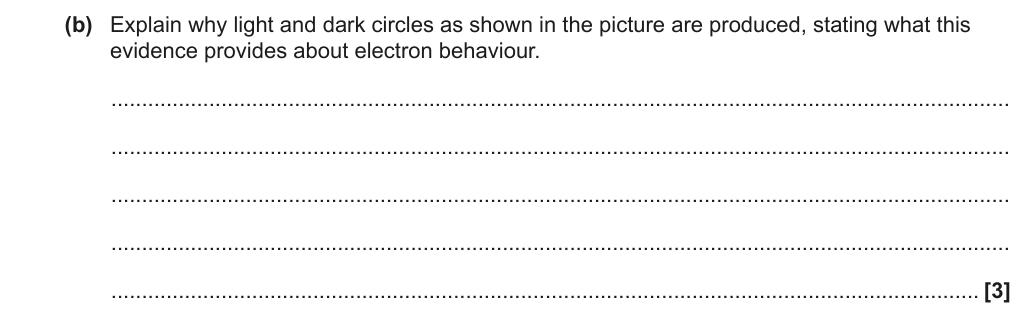
Most candidates appreciated that this was evidence of the wave nature of electrons, although a simple statement of ‘wave-particle duality’ does not really explain what the evidence provides. Although the circles could be described in terms of probability of electrons arriving, in the context of the question the concept of interference of the electron-waves was sufficient and was clearly the explanation that many candidates had been given and close to one half of candidates were able to achieve full marks.
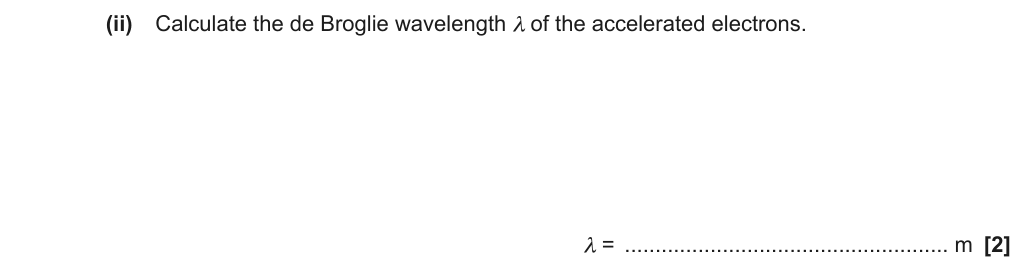
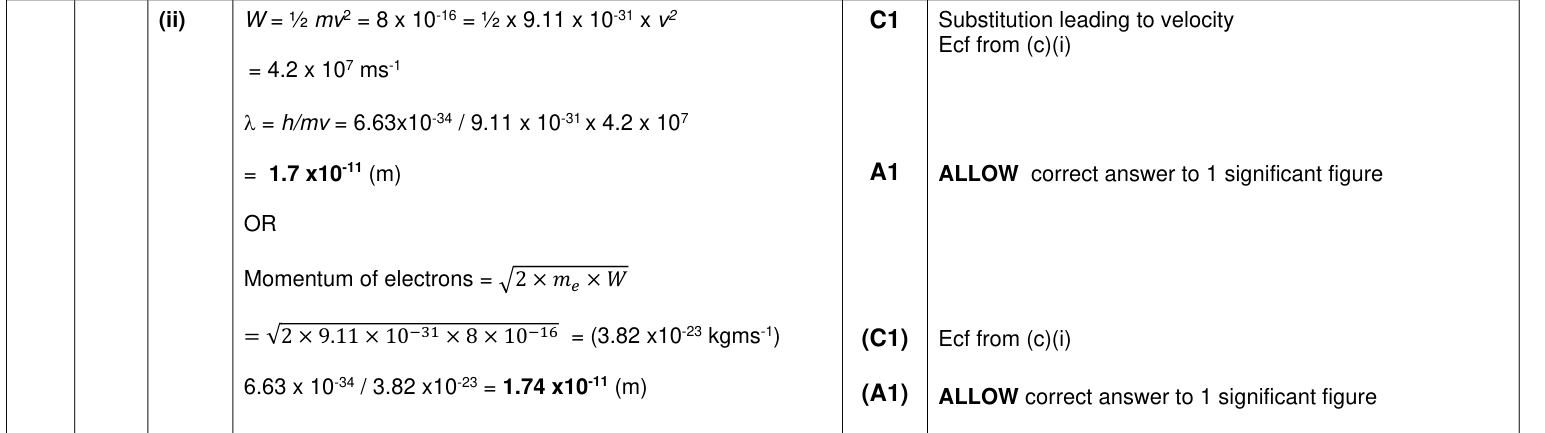
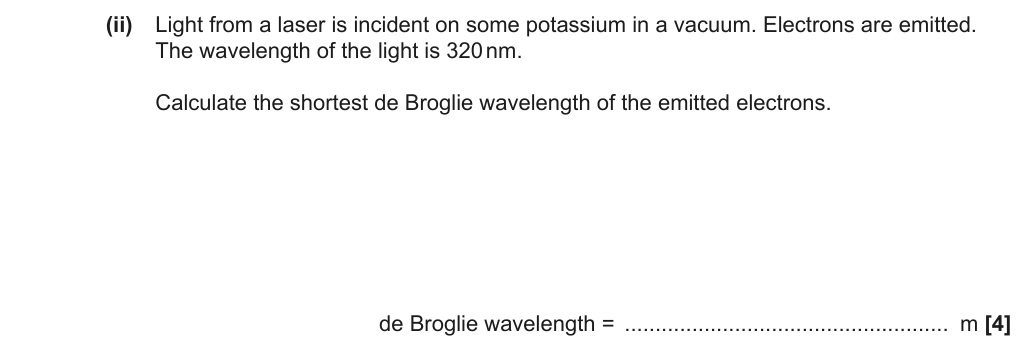
Around one half of candidates were able to correctly calculate the de Broglie wavelength. This is potentially difficult for the average candidate to carry out in a single calculation, so it is very helpful to show the working in a slightly extended calculation. Most candidates calculated the electron speed first from the kinetic energy equation and then correctly substituted it. Several candidates used the proton rest mass in place of the electron rest mass, but the majority of incorrect responses came from using the speed of light for the speed. This is a physics error which can score no marks.
Skills: M0.5 Use calculators to find and use power, exponential and logarithmic functions; M2.2 Change the subject of an equation, including non-linear equations; M2.3 Substitute numerical values into algebraic equations using appropriate units for physical quantities
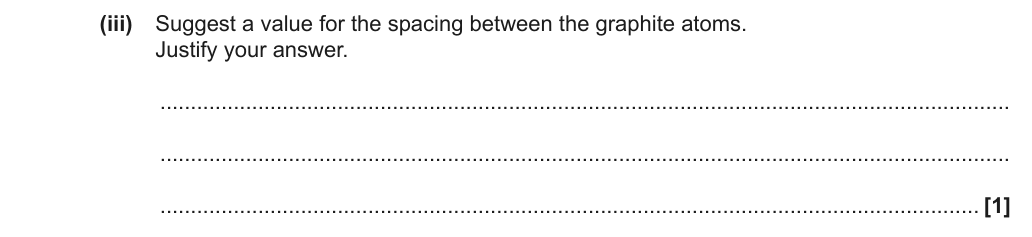
The justification for the spacing is in the context of the question and so must relate to their previously calculated value. Around half of the candidates correctly gave a value and supporting reason, which needed to relate their wavelength to the process of diffraction. Common incorrect answers included values of around 1fm (irrespective of their calculation) presumably from their knowledge of the nuclear radius.
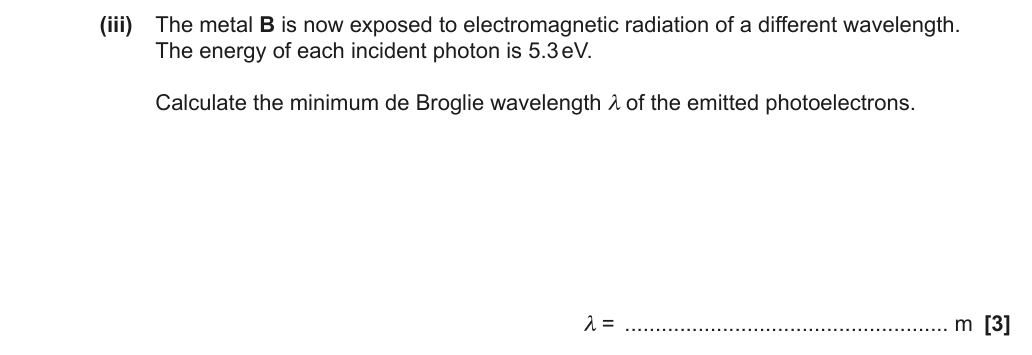
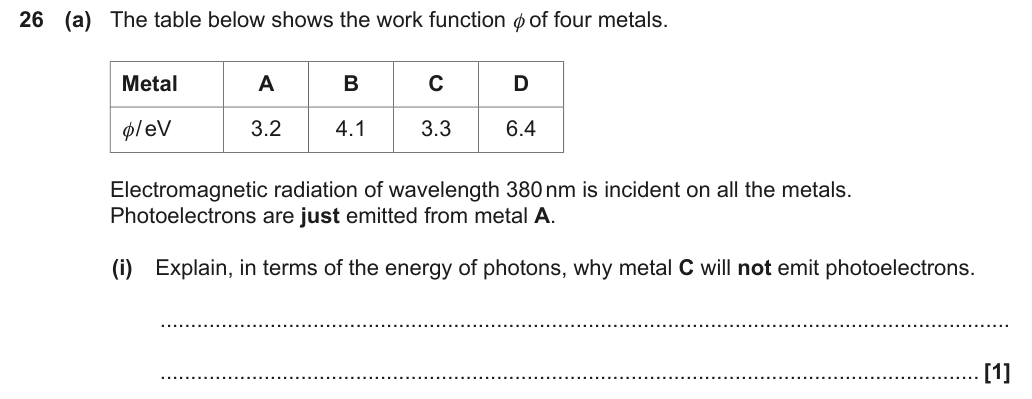
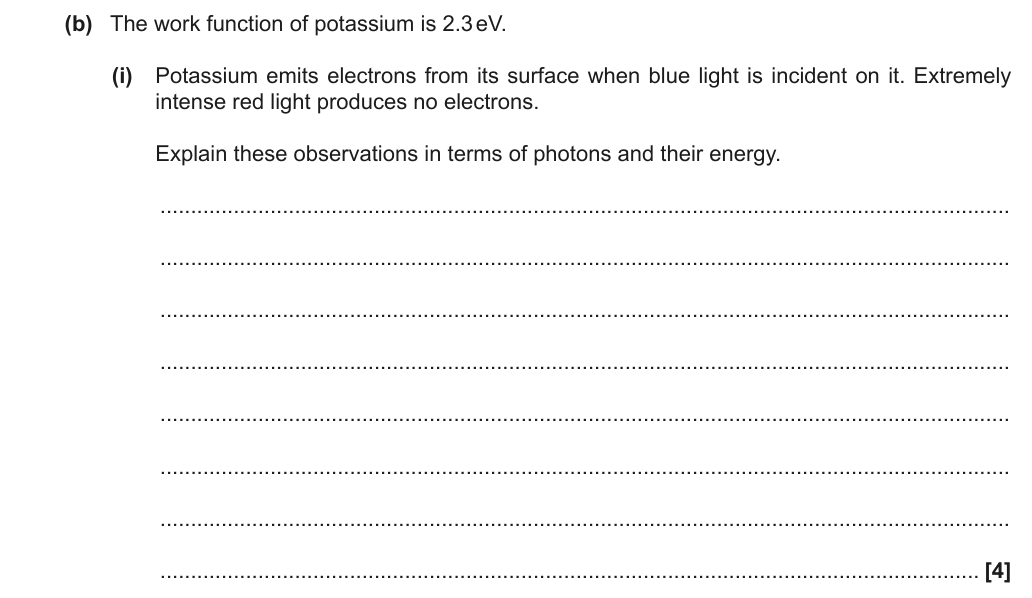
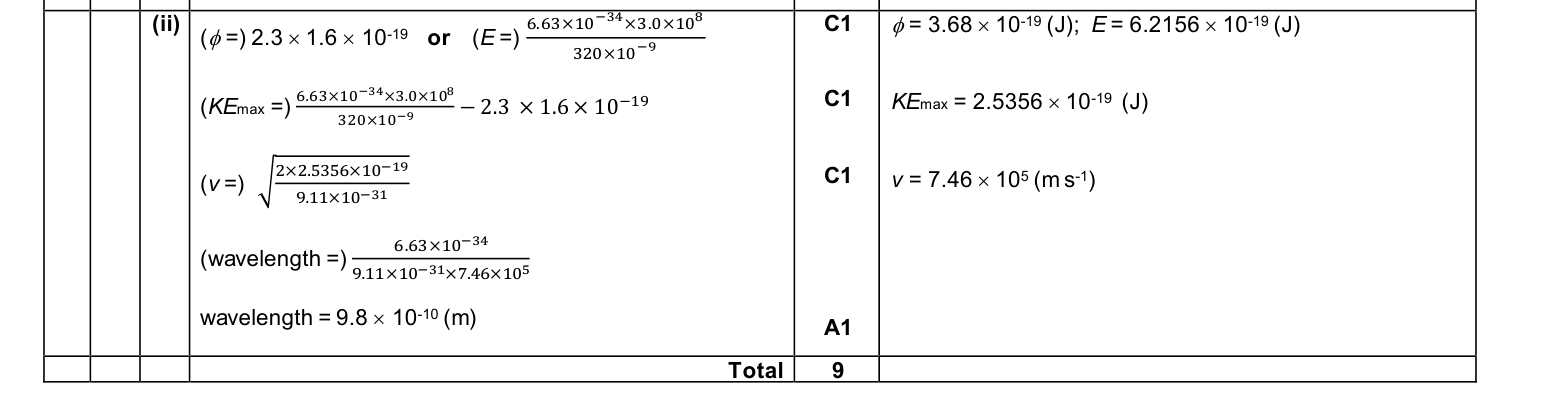
Most candidates were able to convert eV to J but did not correctly use this to calculate the velocity of the photoelectrons as they did not apply the formula λ = h/p to calculate the momentum. Only a few candidates correctly applied both formulae hf = φ + KEmax and λ = h/p to calculate the de Broglie wavelength. This response demonstrates a lack of understanding of the photoelectric effect and use and application of the formula hf = φ + KEmax. Candidates have selected the correct formula to calculate the de Broglie wavelength and have converted eV to J but have not understood that p is required to be calculated using v from the correct KE.
Skills: M0.2 Recognise and use expressions in decimal and standard form; M2.2 Change the subject of an equation, including non-linear equations; M2.3 Substitute numerical values into algebraic equations using appropriate units for physical quantities
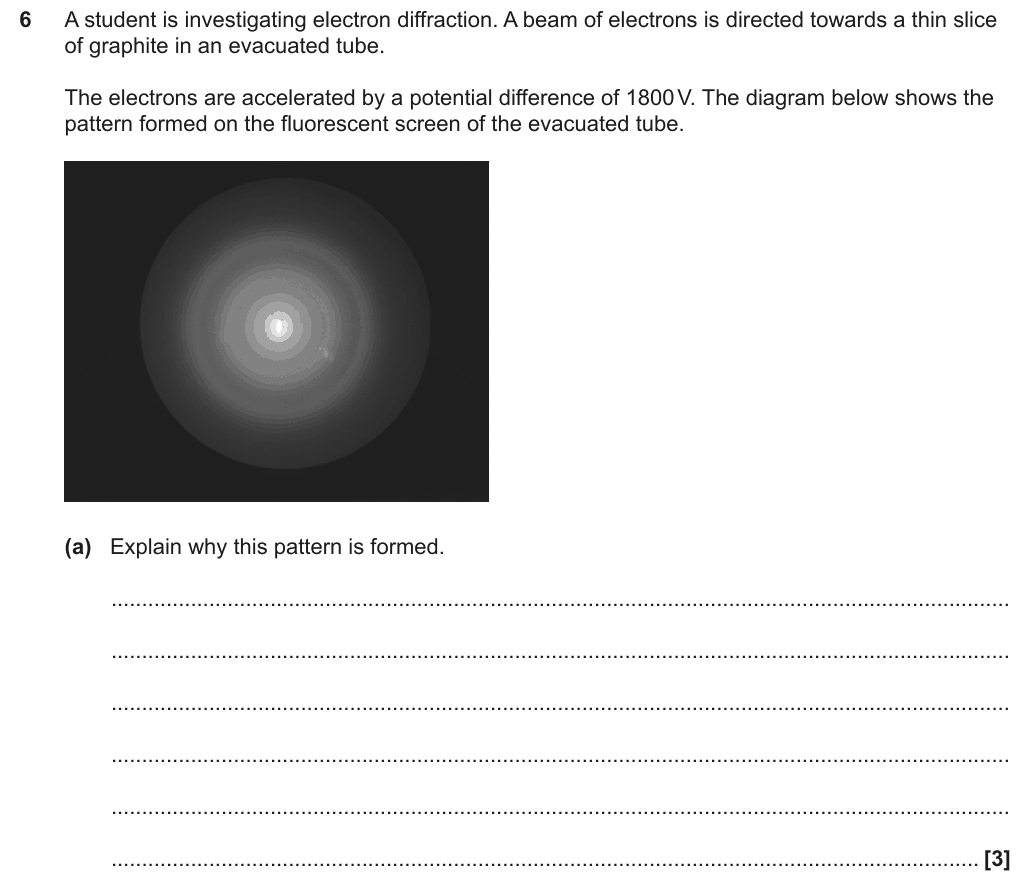
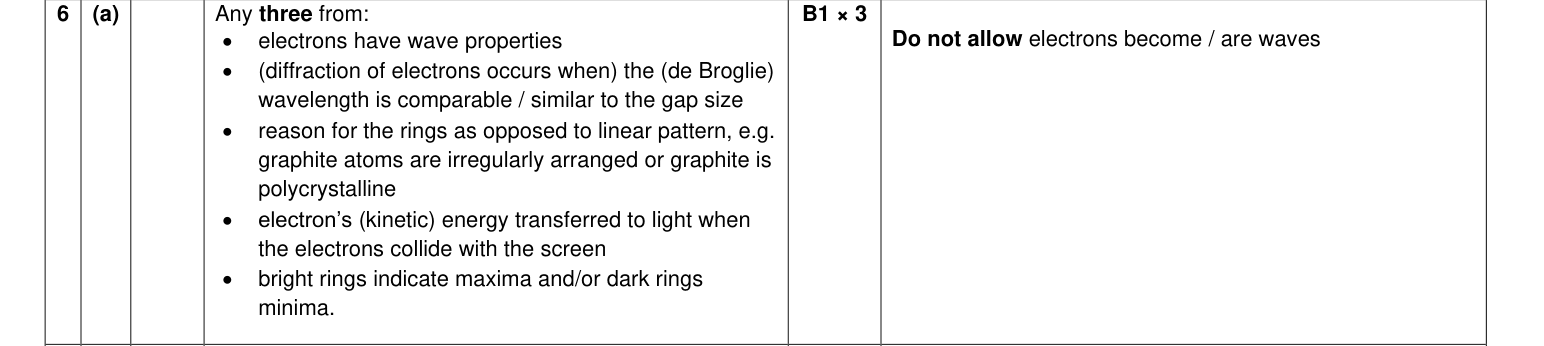
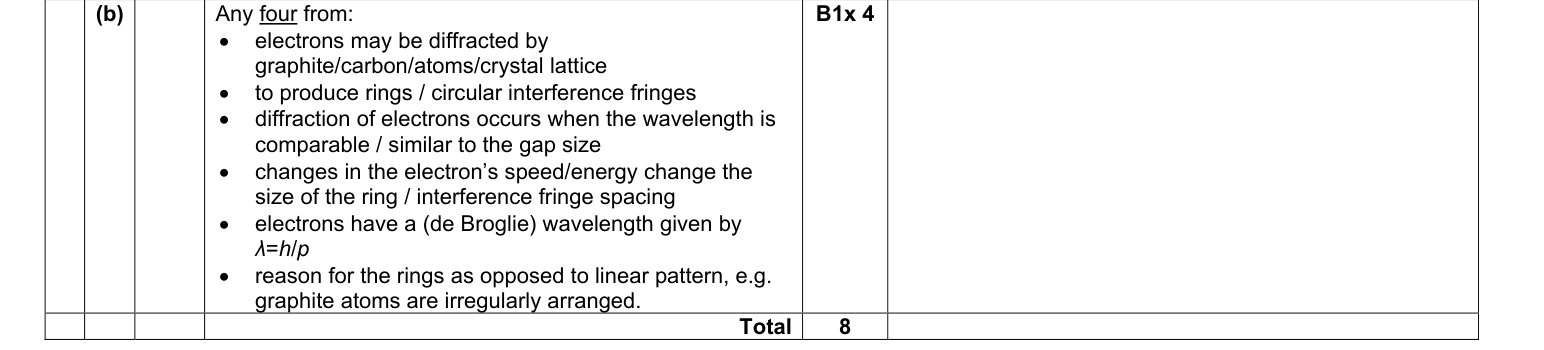
This question gave opportunities for candidates to demonstrate their knowledge and understanding of a standard experiment. To improve answers to this question candidates needed to use the terms accurately. Many candidates stated that electrons can behave as a wave, however some candidates tended to state this is the wave particle duality rather than applying it to the question. Also, a popular answer was that the diffraction of electrons occurs because the de Broglie wavelength is comparable to the spacing in graphite. Some candidates also describe why circular rings were produced in terms of the irregular arrangement of graphite and there were also bright and dark rings. Few candidates stated that the kinetic energy transferred to light when the electrons collided with the screen.
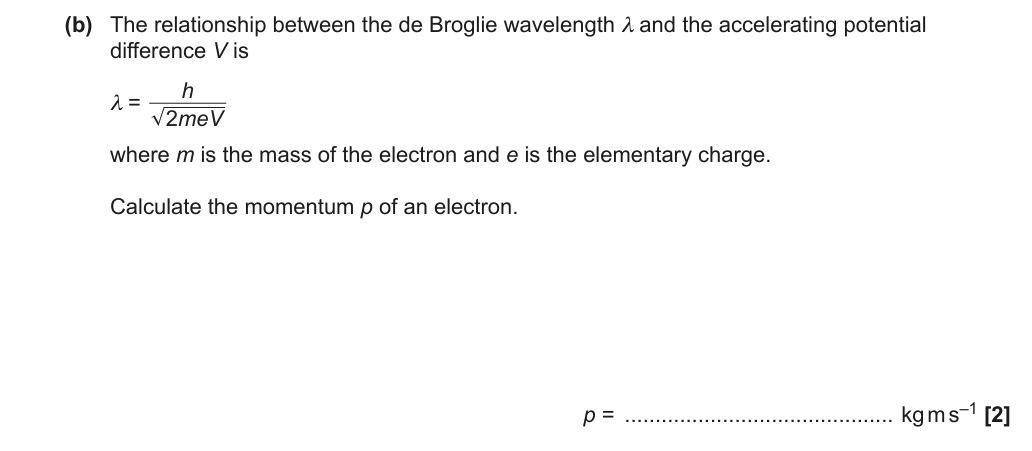
This question was generally well answered. Many candidates realised that the denominator was momentum. Other candidates calculated the wavelength and then calculated the momentum. Some candidates omitted the 1800 V. A significant number of candidates omitted the question, presumably based on the perceived difficulty of the question. To assist candidates in the examination it may help if they write the numerical values beside each quantity.
Skills: M0.5 Use calculators to find and use power, exponential and logarithmic functions; M2.2 Change the subject of an equation, including non-linear equations; M2.3 Substitute numerical values into algebraic equations using appropriate units for physical quantities
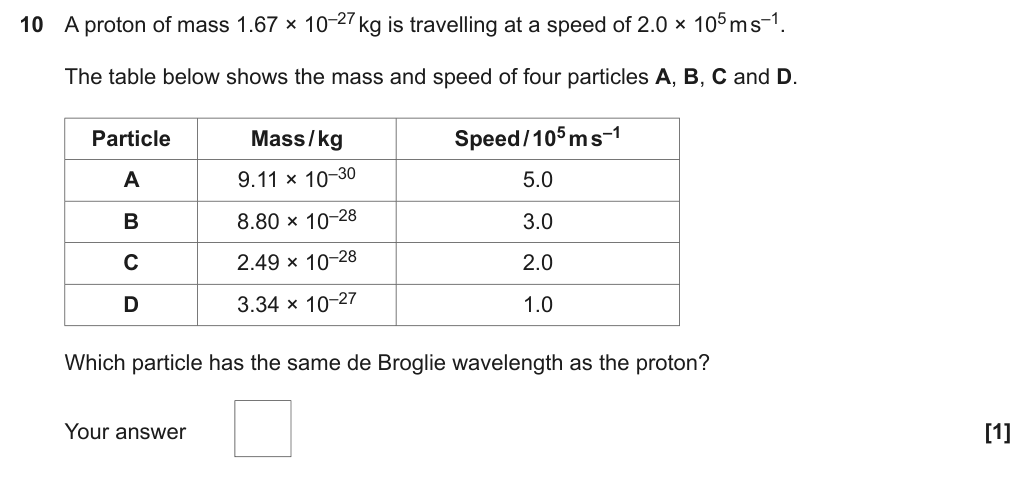
D
Many candidates were able to correctly calculate the wavelength of the two particles and show that the correct response was D. Some calculated the wavelength of all of the particles from A to D, but the most elegant solutions were done through a variety of methods to determine some ratio or constant factor.
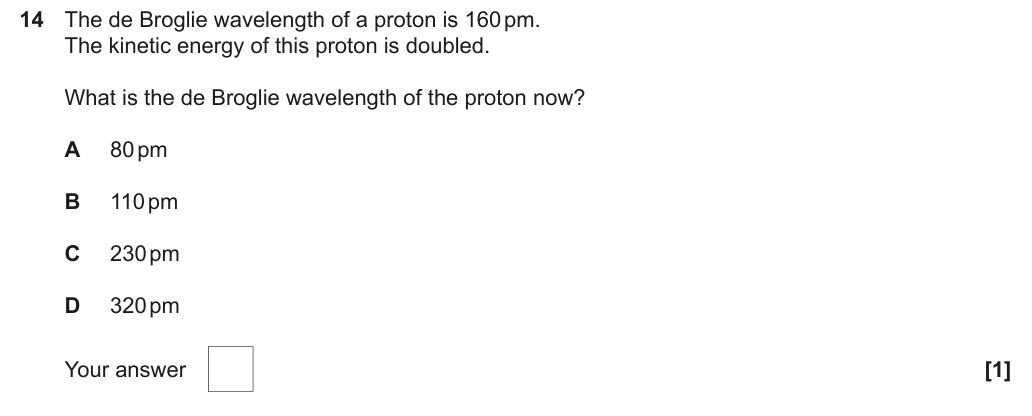
B
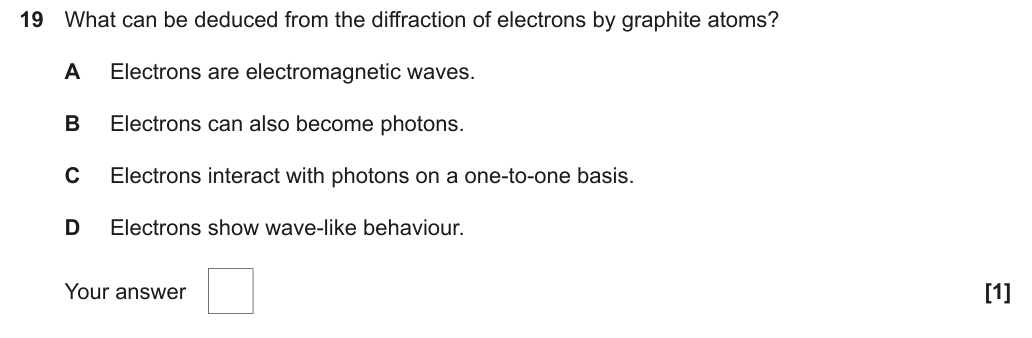
D
This question covers part of the quantum physics topic from module 4.
C
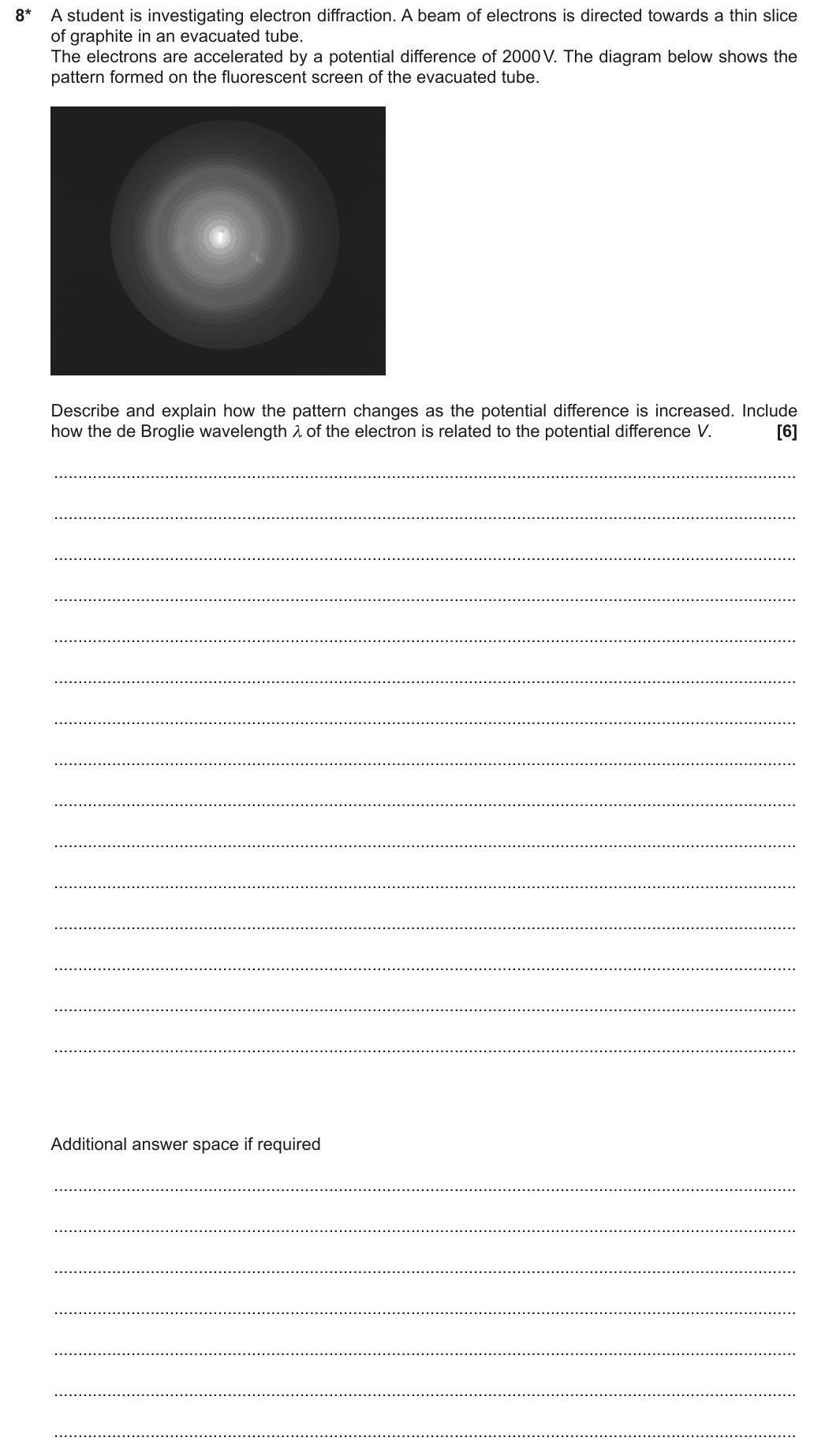
Comments on responses by question type Level of response questions The two LoR questions were Question 4 and Question 8. Question 8 tested an understanding of electron diffraction.
Skills: M0.3 Use ratios, fractions and percentages; M2.2 Change the subject of an equation, including non-linear equations
D
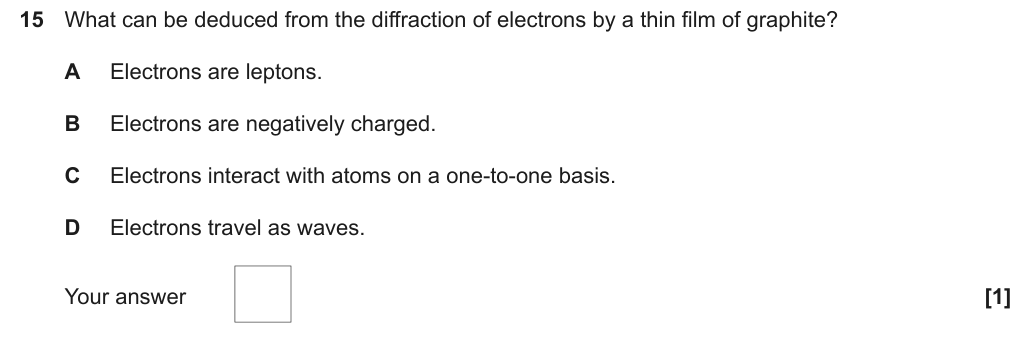
Comments on responses by question type Multiple choice questions Some of the questions, such as Question 1 on identifying the medical technique used to determine the speed of blood in arteries and Question 15 on the diffraction of electrons by a thin film of graphite, are expected to be done quickly without much reasoning.
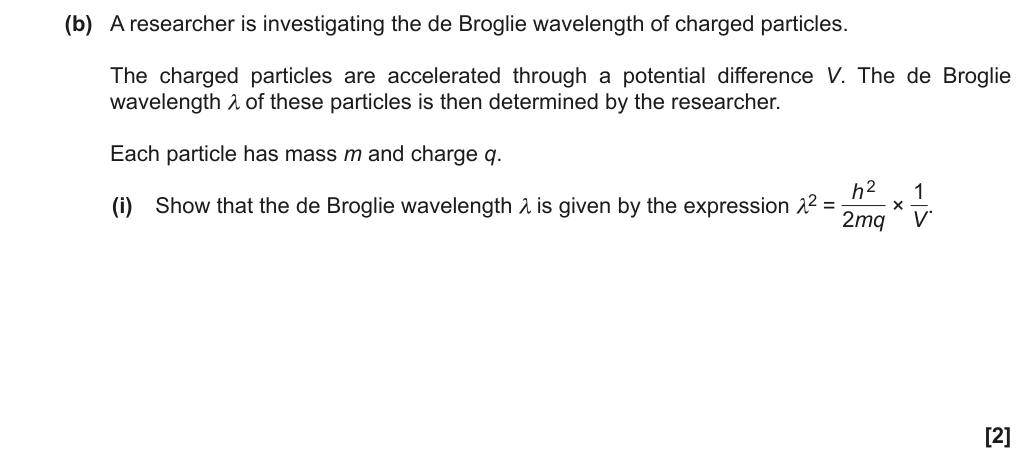
Question 19bi1 • made excellent use of information provided in the Data, Formulae and Relationship booklet when doing calculations, e.g. Questions 19bii3, 20cii and 23bii2 • did not underline (or circle) key data and terms in the questions, particularly in the MCQs.
Skills: M2.2 Change the subject of an equation, including non-linear equations
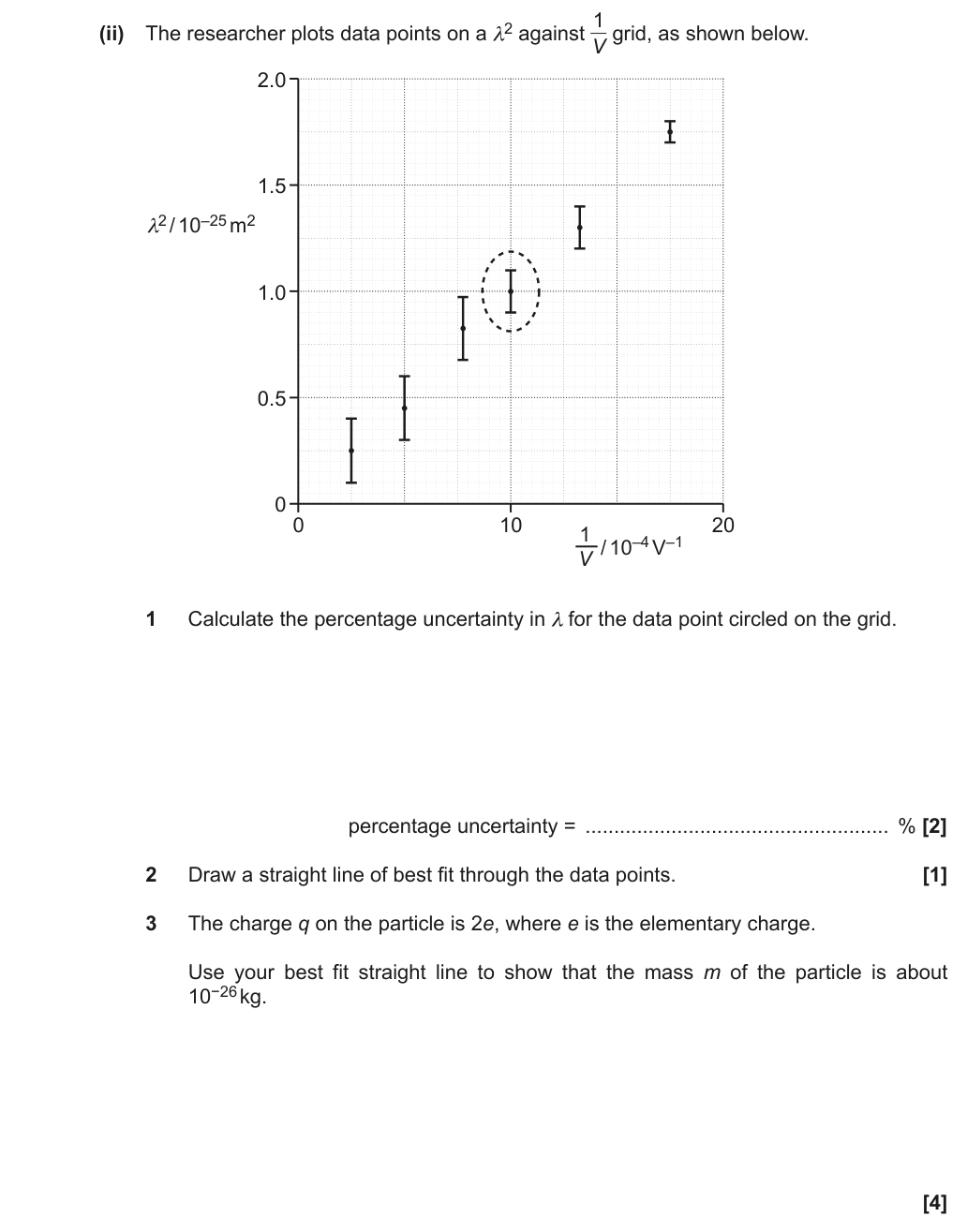
Question 19bi1 • made excellent use of information provided in the Data, Formulae and Relationship booklet when doing calculations, e.g. Questions 19bii3, 20cii and 23bii2 • did not underline (or circle) key data and terms in the questions, particularly in the MCQs.
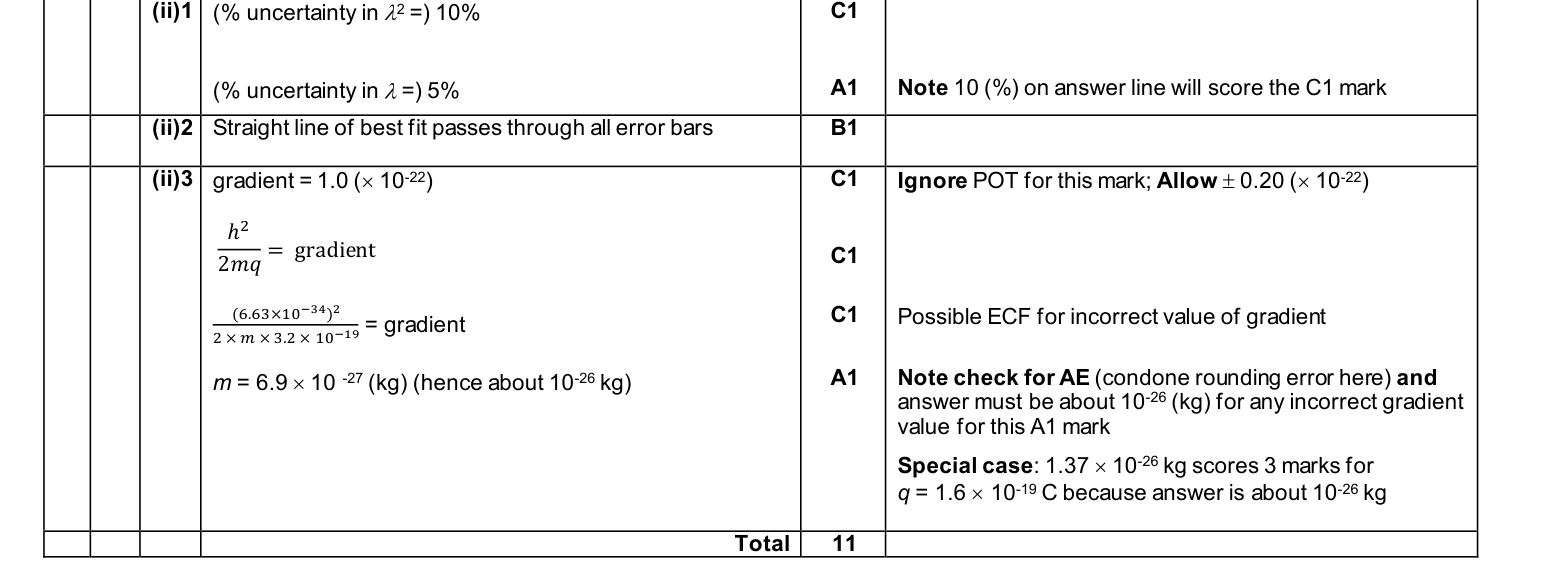
Skills: M1.5 Identify uncertainties in measurements and use simple techniques to determine uncertainty when data are combined; M2.2 Change the subject of an equation, including non-linear equations; M3.2 Plot two variables from experimental or other data; M3.4 Determine the slope and intercept of a linear graph

The majority of the candidates scored a mark for recalling that electron diffraction provided the key evidence for the wave-like behaviour of electrons. Two of the most frequent incorrect responses were refraction and the photoelectric effect.
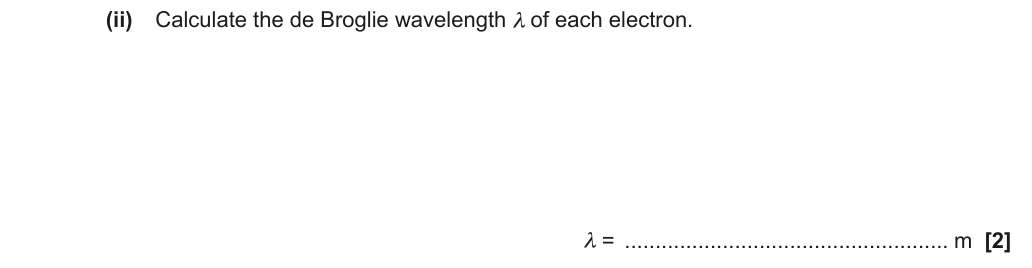
The majority of the candidates effortlessly used the de Broglie equation and their answer from (b)(i), or 9 × 10⁶ m s-1, to calculate the wavelength λ of the electron.
Skills: M0.2 Recognise and use expressions in decimal and standard form; M2.3 Substitute numerical values into algebraic equations using appropriate units for physical quantities
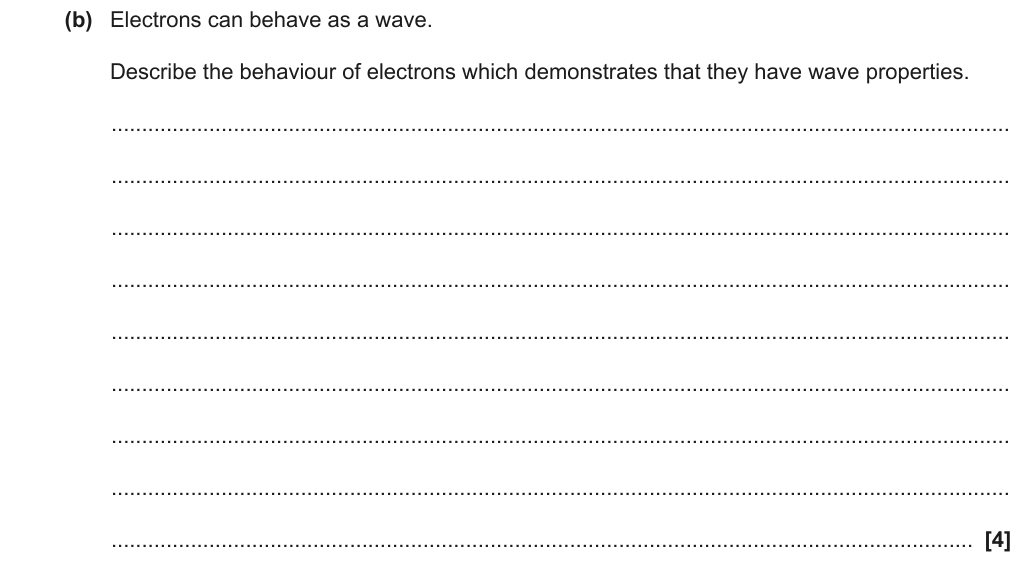
The final question gave candidates the opportunity to describe the electron diffraction experiment. Answers were often vague, lacking necessary detail. Most candidates were able to describe electrons being diffracted by a graphite crystal lattice. Additional marks could have been gained by discussing the observations, the idea that electrons have a de Broglie wavelength and how the wavelength may be changed and the effect on the observations of a change in wavelength. Some candidates described why a circular pattern may be produced.
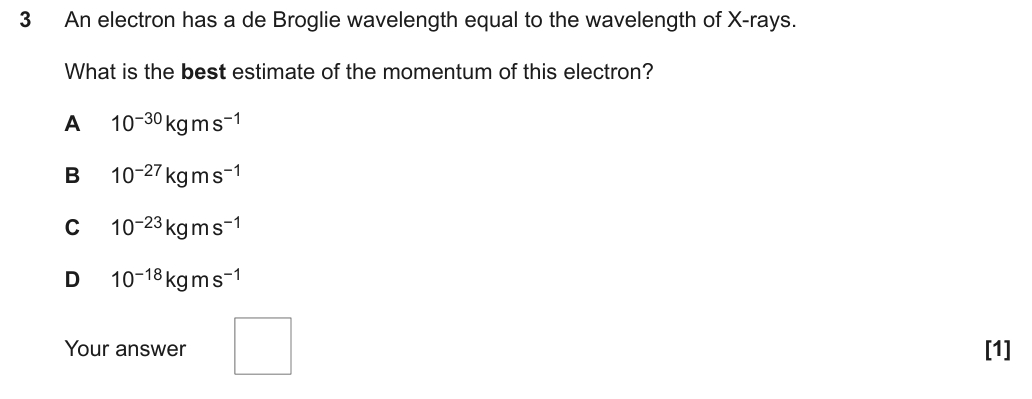
C
Question 3 Question 4 Question 6 There was an erratum issues for this question.
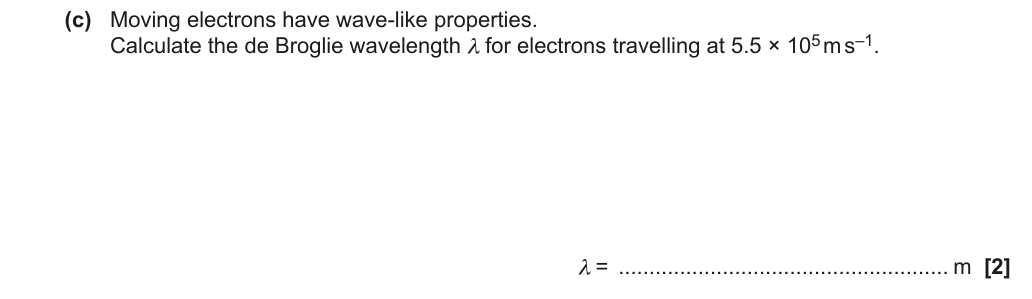
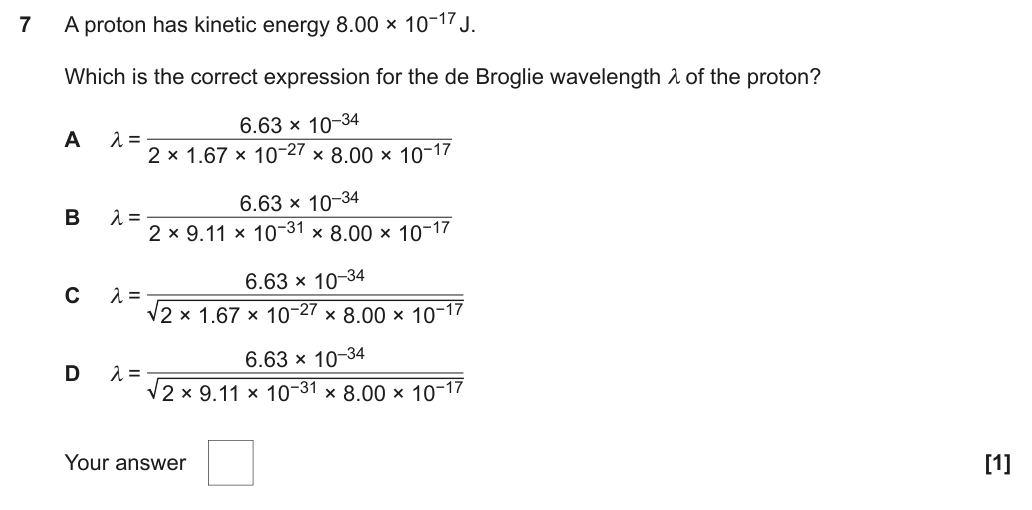
The final question was either answered very well or candidates chose an incorrect equation, often 𝐸𝐸= 𝜆𝜆.
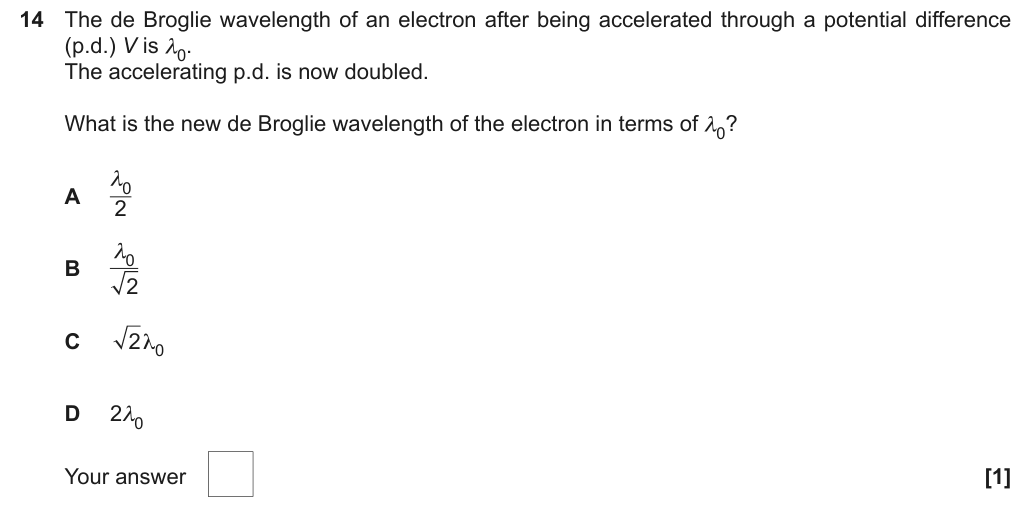
B
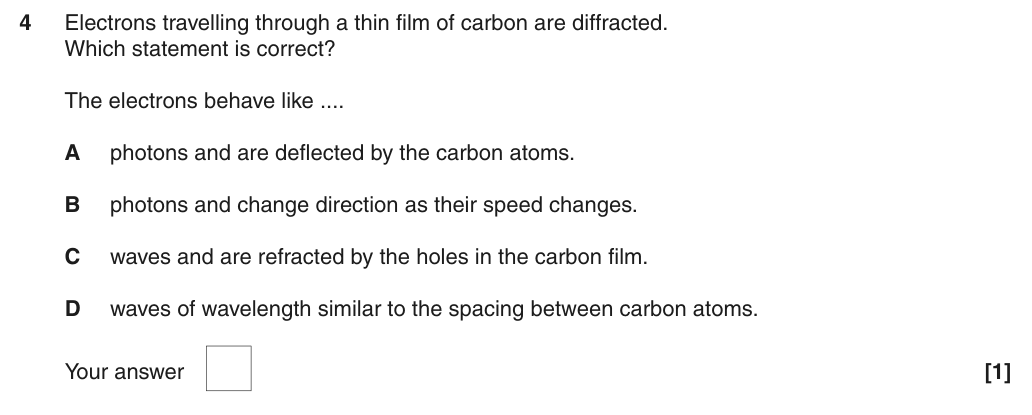
D
Skills: M0.2 Recognise and use expressions in decimal and standard form; M2.3 Substitute numerical values into algebraic equations using appropriate units for physical quantities
Dropping marks on calculations, practical questions or the six-mark level of response questions? Book a trial session with a specialist OCR physics tutor.